CN101486759A - Human Toll-like receptor protein, related reagent and method - Google Patents
Human Toll-like receptor protein, related reagent and method Download PDFInfo
- Publication number
- CN101486759A CN101486759A CNA2008102136180A CN200810213618A CN101486759A CN 101486759 A CN101486759 A CN 101486759A CN A2008102136180 A CNA2008102136180 A CN A2008102136180A CN 200810213618 A CN200810213618 A CN 200810213618A CN 101486759 A CN101486759 A CN 101486759A
- Authority
- CN
- China
- Prior art keywords
- protein
- seq
- sequence
- peptide
- cells
- Prior art date
- Legal status (The legal status is an assumption and is not a legal conclusion. Google has not performed a legal analysis and makes no representation as to the accuracy of the status listed.)
- Pending
Links
Images


Classifications
-
- C—CHEMISTRY; METALLURGY
- C07—ORGANIC CHEMISTRY
- C07K—PEPTIDES
- C07K14/00—Peptides having more than 20 amino acids; Gastrins; Somatostatins; Melanotropins; Derivatives thereof
-
- C—CHEMISTRY; METALLURGY
- C07—ORGANIC CHEMISTRY
- C07K—PEPTIDES
- C07K14/00—Peptides having more than 20 amino acids; Gastrins; Somatostatins; Melanotropins; Derivatives thereof
- C07K14/435—Peptides having more than 20 amino acids; Gastrins; Somatostatins; Melanotropins; Derivatives thereof from animals; from humans
- C07K14/705—Receptors; Cell surface antigens; Cell surface determinants
-
- C—CHEMISTRY; METALLURGY
- C12—BIOCHEMISTRY; BEER; SPIRITS; WINE; VINEGAR; MICROBIOLOGY; ENZYMOLOGY; MUTATION OR GENETIC ENGINEERING
- C12N—MICROORGANISMS OR ENZYMES; COMPOSITIONS THEREOF; PROPAGATING, PRESERVING, OR MAINTAINING MICROORGANISMS; MUTATION OR GENETIC ENGINEERING; CULTURE MEDIA
- C12N15/00—Mutation or genetic engineering; DNA or RNA concerning genetic engineering, vectors, e.g. plasmids, or their isolation, preparation or purification; Use of hosts therefor
- C12N15/09—Recombinant DNA-technology
- C12N15/63—Introduction of foreign genetic material using vectors; Vectors; Use of hosts therefor; Regulation of expression
-
- C—CHEMISTRY; METALLURGY
- C07—ORGANIC CHEMISTRY
- C07K—PEPTIDES
- C07K2319/00—Fusion polypeptide
Landscapes
- Health & Medical Sciences (AREA)
- Chemical & Material Sciences (AREA)
- Life Sciences & Earth Sciences (AREA)
- Organic Chemistry (AREA)
- Genetics & Genomics (AREA)
- Engineering & Computer Science (AREA)
- Biochemistry (AREA)
- Biophysics (AREA)
- General Health & Medical Sciences (AREA)
- Zoology (AREA)
- Molecular Biology (AREA)
- Medicinal Chemistry (AREA)
- Wood Science & Technology (AREA)
- Bioinformatics & Cheminformatics (AREA)
- Proteomics, Peptides & Aminoacids (AREA)
- Biotechnology (AREA)
- General Engineering & Computer Science (AREA)
- Gastroenterology & Hepatology (AREA)
- Biomedical Technology (AREA)
- Toxicology (AREA)
- Physics & Mathematics (AREA)
- Plant Pathology (AREA)
- Immunology (AREA)
- Microbiology (AREA)
- Cell Biology (AREA)
- Peptides Or Proteins (AREA)
- Measuring Or Testing Involving Enzymes Or Micro-Organisms (AREA)
- Investigating Or Analysing Biological Materials (AREA)
- Medicines Containing Antibodies Or Antigens For Use As Internal Diagnostic Agents (AREA)
- Micro-Organisms Or Cultivation Processes Thereof (AREA)
- Preparation Of Compounds By Using Micro-Organisms (AREA)
Abstract
编码与果蝇属Toll受体和人IL-1受体同源的9种人受体的核酸,所述受体命名为DNAX Toll样受体2-10(DTLR2-10);纯化的DTLR蛋白及其片段;针对这些受体的单克隆抗体/多克隆抗体;和诊断和治疗使用的方法。Nucleic acids encoding nine human receptors homologous to the Drosophila Toll receptor and the human IL-1 receptor, named DNAX Toll-like receptor 2-10 (DTLR2-10); purified DTLR protein and fragments thereof; monoclonal/polyclonal antibodies directed against these receptors; and methods for diagnostic and therapeutic use.
Description
本申请是申请日为1998年5月7日,申请号为200610100220.7,发明名称为“人Toll样受体蛋白、相关试剂和方法”的发明专利申请的分案申请。This application is a divisional application of an invention patent application with an application date of May 7, 1998, an application number of 200610100220.7, and an invention title of "Human Toll-like receptor protein, related reagents and methods".
该申请是申请日为1998年5月7日,申请号为200510092715.5,发明名称为“人Toll样受体蛋白、相关试剂和方法”的发明专利申请的分案申请。This application is a divisional application of an invention patent application with an application date of May 7, 1998, an application number of 200510092715.5, and an invention title of "Human Toll-like receptor protein, related reagents and methods".
该申请要求1997年5月7日申请的美国专利申请USSN60/044,293、1998年1月22日申请的USSN 60/072,212和1998年3月5日申请的USSN 60/076,947的优先权,这些专利申请的每个均通过引用结合到本文中。This application claims priority to U.S. Patent Applications USSN 60/044,293, filed May 7, 1997, USSN 60/072,212, filed January 22, 1998, and USSN 60/076,947, filed March 5, 1998, which Each of is incorporated herein by reference.
发明领域 field of invention
本发明涉及影响哺乳动物生理学的组合物和方法,所述哺乳动物生理学包括形态发生或免疫系统功能。具体地说,本发明提供调节发育和/或免疫系统的核酸、蛋白质和抗体。也公开了这些物质的诊断用途和治疗用途。The present invention relates to compositions and methods of affecting mammalian physiology, including morphogenesis or immune system function. In particular, the invention provides nucleic acids, proteins and antibodies that modulate development and/or the immune system. Diagnostic and therapeutic uses of these substances are also disclosed.
发明背景Background of the invention
重组DNA技术一般是指这些技术,所述技术通过将来自供体来源的遗传信息整合到用于后续加工的载体中,诸如通过引入到宿主中,由此使所转移的遗传信息在该新环境中复制和/或表达。通常,该遗传信息以互补DNA(cDNA)的形式存在,所述互补DNA衍生自编码所需的蛋白产物的信使RNA(mRNA)。该载体通常是一种质粒,该质粒具有将用于随后复制的cDNA加入宿主中的能力,在某些情况下,实际控制该cDNA的表达,并由此指导所编码的产物在该宿主中合成。Recombinant DNA techniques generally refer to those techniques by which genetic information from a donor source is incorporated into a vector for subsequent processing, such as by introduction into a host, whereby the transferred genetic information is Reproduced and/or expressed in. Typically, this genetic information is in the form of complementary DNA (cDNA) derived from messenger RNA (mRNA) encoding the desired protein product. The vector is usually a plasmid that has the ability to incorporate into a host cDNA for subsequent replication and, in some cases, actually control the expression of the cDNA and thereby direct the synthesis of the encoded product in the host .
一段时间以来,已经知道哺乳动物的免疫应答基于称为“免疫网络”的一系列复杂的细胞相互作用。最近的研究已经提供了对该网络内部运作的新的了解。尽管已经清楚许多免疫应答实际上确实围绕淋巴细胞、巨噬细胞、粒细胞和其它细胞的网络样相互作用运转,但免疫学家现在一般坚持这样一种观点:称为淋巴因子、细胞因子或单核因子的可溶性蛋白,在控制这些细胞相互作用中起关键作用。因此,人们对细胞调节因子的分离、特征鉴定和作用机制相当感兴趣,对这些信息的了解将导致在许多医学异常(例如免疫系统失调)的诊断和治疗方面取得显著的进展。It has been known for some time that the immune response of mammals is based on a complex series of cellular interactions known as the "immune network". Recent research has provided new insights into the inner workings of this network. Although it has become clear that many immune responses do in fact revolve around a network-like interaction of lymphocytes, macrophages, granulocytes, and other cells, immunologists now generally hold to the view that a single cytokine, known as a lymphokine, cytokine, or A soluble protein of nuclear factor, plays a key role in controlling these cellular interactions. Accordingly, there is considerable interest in the isolation, characterization and mechanism of action of cellular regulators, the knowledge of which will lead to significant advances in the diagnosis and treatment of many medical disorders, such as immune system disorders.
淋巴因子看来以多种方式介导细胞活性。已经表明,它们支持多能造血干细胞的增殖、生长和/或分化为大量的祖细胞(progenitor),所述祖细胞包括构成复杂的免疫系统的多样化的细胞谱系。细胞组分之间适当和平衡的相互作用是健康的免疫应答所必需的。当结合其它因子给予淋巴因子时,不同的细胞谱系常常以不同方式应答。Lymphokines appear to mediate cellular activity in a variety of ways. They have been shown to support the proliferation, growth and/or differentiation of pluripotent hematopoietic stem cells into a large number of progenitors, including the diverse lineages of cells that make up the complex immune system. Proper and balanced interactions between cellular components are necessary for a healthy immune response. Different cell lineages often respond differently when lymphokines are administered in combination with other factors.
对免疫应答尤其重要的细胞谱系包括两类淋巴细胞:B细胞,它们可以产生和分泌免疫球蛋白(具有识别并结合外源物质以实现将其去除的能力的蛋白);和各种亚群的T细胞,它们分泌淋巴因子,并诱导或抑制B细胞和构成免疫网络的各种其它细胞(包括其它T细胞)。这些淋巴细胞与许多其它细胞类型相互作用。Cell lineages that are particularly important to the immune response include two types of lymphocytes: B cells, which produce and secrete immunoglobulins (proteins that have the ability to recognize and bind foreign substances for removal); and various subpopulations of T cells, which secrete lymphokines and induce or suppress B cells and various other cells (including other T cells) that make up the immune network. These lymphocytes interact with many other cell types.
另一种重要的细胞谱系是肥大细胞(在所有哺乳动物物种中尚未被明确鉴定),这是一种含颗粒的结缔组织细胞,邻近遍布机体的毛细管定位。发现这些细胞在肺、皮肤以及胃肠道和生殖泌尿道中的浓度尤其高。肥大细胞如下在变态反应相关的病征(特别是过敏反应)中起中心作用:当选定的抗原与结合于肥大细胞表面上受体的一类免疫球蛋白交联时,该肥大细胞脱粒并释放引起变态反应(例如过敏反应)的介质,例如组胺、5-羟色胺、肝素和前列腺素。Another important cell lineage is the mast cell (not yet definitively characterized in all mammalian species), a granule-containing connective tissue cell located adjacent to capillaries throughout the body. These cells were found in particularly high concentrations in the lungs, skin, and gastrointestinal and genitourinary tracts. Mast cells play a central role in allergy-related conditions, particularly anaphylaxis, by degranulating and releasing Mediators that cause allergic reactions (eg, anaphylaxis), such as histamine, serotonin, heparin, and prostaglandins.
一般不能在体外维持免疫系统的细胞,这已经阻碍了为更好地了解和治疗各种免疫失调而进行的研究。免疫学家已经发现,通过使用T细胞和其它细胞的上清液,可以完成对许多这些细胞的培养,所述上清液含有各种生长因子,包括许多淋巴因子。The general inability to maintain cells of the immune system in vitro has hampered research to better understand and treat various immune disorders. Immunologists have discovered that culturing many T cells and other cells can be accomplished by using supernatants of these cells, which contain various growth factors, including many lymphokines.
蛋白的白介素-1家族包括IL-1α、IL-1β、IL-1RA和最近的IL-1γ(也命名为干扰素-γ诱导因子,IGIF)。在范围广泛的生物学功能中已经牵涉到该基因相关家族。参见Dinarello(1994)FASEB J.8:1314-1325;Dinarello(1991)Blood 77:1627-1652;和Okamura等(1995)Nature 378:88-91。The interleukin-1 family of proteins includes IL-1α, IL-1β, IL-1RA and most recently IL-1γ (also named interferon-γ-inducible factor, IGIF). This related family of genes has been implicated in a wide range of biological functions. See Dinarello (1994) FASEB J. 8:1314-1325; Dinarello (1991) Blood 77:1627-1652; and Okamura et al. (1995) Nature 378:88-91.
此外,存在调节形态发生发育的各种生长因子和调节因子。这包括例如Toll配体,它们通过结合于享有IL-1受体特征性的结构和机制特征的受体而发送信号。参见例如Lemaitre等(1996)Cell86:973-983;Belvin和Anderson(1960)Ann.Rev.Cell & Devel.Biol.12:393-416。In addition, there are various growth factors and regulators that regulate morphogenetic development. This includes, for example, Toll ligands, which signal by binding to receptors that share structural and mechanistic features characteristic of IL-1 receptors. See, eg, Lemaitre et al. (1996) Cell 86:973-983; Belvin and Anderson (1960) Ann. Rev. Cell & Devel. Biol. 12:393-416.
根据以上所述,可明显看出,新的可溶性蛋白及其受体(包括类似于淋巴因子的蛋白)的发现和研制,应该有助于用于范围广泛的退行性病征或异常病征的新疗法,所述病征直接或间接涉及例如免疫系统和/或造血细胞的发育、分化或功能。特别是,对于增加或增强其它淋巴因子有益活性的淋巴因子样分子,其新受体的发现和了解应该是非常有利。本发明提供新的受体和相关化合物及其使用方法,其中所述受体为表现出与白介素-1样组合物相似性的配体的受体。From the above it is evident that the discovery and development of new soluble proteins and their receptors, including those similar to lymphokines, should facilitate new therapies for a wide range of degenerative or abnormal conditions , the condition is directly or indirectly related to, for example, the development, differentiation or function of the immune system and/or hematopoietic cells. In particular, the discovery and understanding of new receptors for lymphokine-like molecules that increase or enhance the beneficial activity of other lymphokines should be very beneficial. The present invention provides novel receptors and related compounds and methods of use thereof, wherein the receptors are receptors for ligands that exhibit similarity to interleukin-1-like composition.
附图简述Brief description of the drawings
图1显示了果蝇属和人的DTLR蛋白结构的图示比较、以及它们与脊椎动物IL-1受体和植物抗病性蛋白的关系。三种果蝇属(Dm)DTLR(Toll、18w和Mst ORF片段)(Morisato和Anderson(1995)Ann. Rev.Genet.29:371-399;Chiang和Beachy(1994)Mech.Develop.47:225-239;Mitcham等(1996)J.Biol.Chem.271:5777-5783;和Eldon等(1994)Develop.120:885-899)排列在四个完整的(DTLR1-4)和一个部分的(DTLR5)人(Hu)受体旁边。清楚地框注了通过PRINTS(Attwood等(1997)Nucleci Acids Res.25:212-217)标记的所述受体胞外域的各个LRR;邻接LRR阵列(LRRarray)C末端或N末端的“顶部”和“底部”富含Cys的簇,分别用汇合的半圆画出。当与Toll和18w的784aa和977aa的延伸物相比时,DTLR 1-5中内部Cys富含区的丧失,主要产生其较小的胞外域(分别为558、570、690和652aa)。DmMst和HuDTLR5的不完整链(分别为519aa和153aa的胞外域)由虚线表示。与DTLR、IL-1型受体(IL-1R)、胞内蛋白Myd88和烟草抗病性基因N产物(DRgN)共同的胞内信号组件,显示在该质膜下面。参见例如Hardiman等(1996)Oncogene 13:2467-2475;和Rock等(1998)Proc.Nat’l Acad.Sci.USA 95:588-。其它域包括IL-1R中Ig样组件的trio(二硫键连接的环);DRgN蛋白的特征是一个NTP酶域(方框),而Myd88具有一个死域(death domain)(黑色椭圆)。Figure 1 shows a schematic comparison of Drosophila and human DTLR protein structures, and their relationship to the vertebrate IL-1 receptor and plant disease resistance proteins. Three Drosophila (Dm) DTLRs (Toll, 18w and Mst ORF fragments) (Morisato and Anderson (1995) Ann. Rev. Genet. 29: 371-399; Chiang and Beachy (1994) Mech. Develop. 47: 225 -239; Mitcham et al. (1996) J.Biol.Chem. 271:5777-5783; and Eldon et al. (1994) Develop. 120:885-899) arranged in four complete (DTLR1-4) and one partial ( DTLR5) next to the human (Hu) receptor. Each LRR of the receptor ectodomain labeled by PRINTS (Attwood et al (1997) Nucleci Acids Res. 25:212-217) is clearly boxed; the "top" adjacent to the C- or N-terminus of the LRR array (LRRarray) and "bottom" Cys-rich clusters, drawn with confluent semicircles, respectively. Loss of the internal Cys-rich region in DTLRs 1-5, when compared to the 784 aa and 977 aa stretches of Toll and 18w, primarily results in its smaller ectodomain (558, 570, 690 and 652 aa, respectively). Incomplete chains of DmMst and HuDTLR5 (ectodomains of 519 aa and 153 aa, respectively) are indicated by dashed lines. Intracellular signaling components common to DTLR, the IL-1 type receptor (IL-1R), the intracellular protein Myd88, and the tobacco resistance gene N product (DRgN), are displayed below the plasma membrane. See eg Hardiman et al. (1996) Oncogene 13:2467-2475; and Rock et al. (1998) Proc. Nat'l Acad. Sci. USA 95:588-. Other domains include the trio (disulfide-linked loop) of the Ig-like module in IL-1R; the DRgN protein is characterized by an NTPase domain (box), while Myd88 has a death domain (black oval).
图2A-2B显示Toll样和IL-1样细胞因子受体和两个分歧的组件蛋白信号域中的保守结构模式。图2A显示共同的TH域的序列对比。DTLR按图1中进行标记;人(Hu)或小鼠(Mo)IL-1家族受体(IL-1R1-6)按早年提出提出的方法(Hardiman等(1996)Oncogene 13:2467-2475)顺序编号;Myd88和来自烟草(To)和亚麻L.usitatissium(Lu)的序列,分别代表较大的多域分子的C末端域和N末端域。框注了不间断的序列区组(编号为1-10)。三角表示有害的突变,而箭头N末端的截短物消除人IL-1R1中的生物活性(Heguy等(1992)J.Biol.Chem.267:2605-2609)。标出了α-螺旋(H)、β-链(E)或螺旋(L)的PHD(Rost和Sander(1994)Proteins 19:55-72)和DSC(King和Sternberg(1996)Protein Sci.5:2298-2310)二级结构预测。氨基酸遮蔽方案描述了化学上相似的残基:疏水性、酸性、碱性、Cys、芳族、结构断裂性和微小的残基。通过75%严格性下的共有序列,得出IL-1R、DTLR和全部序列对比(ALL)的诊断序列模式。氨基酸亚组的符号是(关于细节请参见互联网网站(internet site)):o,醇;l,脂族的;·,任一氨基酸;a,芳族的;c,带电荷的;h,疏水性;-,阴性;p,极性;+,阳性;s,小的;u,微小的;t,转角样的。图2B显示了建议的THβ/α域折叠的拓扑图。在其C末端观察到平行的β-片(具有黄色三角的β-链A-E);α-螺旋(标记1-5的圆)连接所述β-链;链连接在前面(可见的)或后面(隐藏的)。以灰色(Asp)或作为单独的黑色(Arg)残基,标注β-片C末端保守的带电荷的残基(参见正文)。Figures 2A-2B show conserved structural patterns in Toll-like and IL-1-like cytokine receptors and two divergent component protein signaling domains. Figure 2A shows a sequence alignment of common TH domains. DTLR is labeled as in Figure 1; human (Hu) or mouse (Mo) IL-1 family receptor (IL-1R1-6) is according to the method proposed in the early years (Hardiman et al. (1996) Oncogene 13: 2467-2475) Sequential numbering; Myd88 and sequences from tobacco (To) and flax L. usitatissium (Lu), representing the C-terminal and N-terminal domains of larger multidomain molecules, respectively. Unbroken sequence blocks (numbered 1-10) are boxed. Triangles indicate deleterious mutations, while arrow N-terminal truncations abolish biological activity in human IL-IR1 (Heguy et al. (1992) J. Biol. Chem. 267:2605-2609). PHD (Rost and Sander (1994) Proteins 19:55-72) and DSC (King and Sternberg (1996) Protein Sci. 5 : 2298-2310) secondary structure prediction. The amino acid masking scheme describes chemically similar residues: hydrophobic, acidic, basic, Cys, aromatic, structurally disruptive, and minor. Diagnostic sequence patterns for IL-1R, DTLR, and total alignment (ALL) were derived by consensus at 75% stringency. The symbols for subgroups of amino acids are (see internet site for details): o, alcohol; l, aliphatic; ·, any amino acid; a, aromatic; c, charged; h, hydrophobic Sex; -, feminine; p, polarity; +, masculine; s, small; u, tiny; t, turn-like. Figure 2B shows the topology of the proposed THβ/α domain fold. Parallel β-sheets (β-strands AE with yellow triangles AE) are observed at their C-termini; α-helices (circles marked 1-5) connect the β-strands; strands connect in front (visible) or behind (hidden). The conserved charged residues at the C-terminus of the β-sheet are annotated in gray (Asp) or as individual black (Arg) residues (see text).
图3显示信号域超家族的进化。通过相邻连接法(Thompson等,(1994)Nucleic Acids Res.22:4673-4680),用图2A的多重TH组件序列对比得出进化系统树。同序列对比中一样标记蛋白;用TreeView提供该树。Figure 3 shows the evolution of the signaling domain superfamily. A phylogenetic tree was generated using the multiple TH module sequence alignment of Figure 2A by the neighbor joining method (Thompson et al., (1994) Nucleic Acids Res. 22: 4673-4680). Proteins are labeled as in the sequence alignment; the tree is rendered with TreeView.
图4A-4D显示人DTLR基因的FISH染色体作图。使来自人淋巴细胞同步培养物的变性染色体,与用于定位的生物素化DTLR cDNA探针杂交。通过使FISH信号与DAPI显带的染色体重叠(中心图板),得到具有染色体带的FISH作图数据(左边,图4A,DTLR2;4B,DTLR3;4C,DTLR4;4D,DTLR5)的对比。Heng和Tsui(1994)Meth. Molec.Biol.33:109-122。以人染色体模式图(ideograms)(右板)的形式总结分析。Figures 4A-4D show FISH chromosome mapping of human DTLR genes. Denatured chromosomes from synchronized cultures of human lymphocytes were hybridized with biotinylated DTLR cDNA probes for localization. Comparison of FISH mapping data with chromosome bands (left, Figure 4A, DTLR2; 4B, DTLR3; 4C, DTLR4; 4D, DTLR5) was obtained by overlapping the FISH signal with the DAPI-banded chromosome (center panel). Heng and Tsui (1994) Meth. Molec. Biol. 33:109-122. Analyzes are summarized in the form of human chromosome ideograms (right panels).
图5A-5F显示人DTLR的mRNA印迹分析。用放射标记的、编码上述DTLR1(图5A-5C)、DTLR2(图5D)、DTLR3(图5E)和DTLR4(图5F)的cDNA,探测每泳道含有大约2μg多聚(A)+RNA的人多种组织的印迹(He,心脏;Br,脑;P1,胎盘;Lu,肺;Li,肝脏;Mu,肌肉;Ki,肾脏;Pn,胰脏;Sp,脾脏;Th,胸腺;Pr,前列腺;Te,睾丸;Ov,卵巢;SI,小肠;Co,结肠;PBL,外周血淋巴细胞)和癌细胞系(早幼粒细胞性白血病,HL60;宫颈癌,HELAS3;慢性髓细胞性白血病,K562;淋巴细胞性白血病,Molt4;结肠直肠腺癌,SW480;黑素瘤,G361;伯基特淋巴瘤Raji,Burkitt’s;结肠直肠腺癌,SW480;肺癌,A549)。于-70℃用增感屏将印迹对X光片曝光2天(图5A-5C)或一周(图5D-5F)。在某些泳道中出现异常的0.3kB种类;杂交实验排除了编码DTLR胞质片段的信息。Figures 5A-5F show mRNA blot analysis of human DTLR. Human cells containing approximately 2 μg poly(A) + RNA per lane were probed with radiolabeled cDNA encoding DTLR1 (Figure 5A-5C), DTLR2 (Figure 5D), DTLR3 (Figure 5E) and DTLR4 (Figure 5F) as described above. Blots of various tissues (He, heart; Br, brain; P1, placenta; Lu, lung; Li, liver; Mu, muscle; Ki, kidney; Pn, pancreas; Sp, spleen; Th, thymus; Pr, prostate ; Te, testis; Ov, ovary; SI, small intestine; Co, colon; PBL, peripheral blood lymphocytes) and cancer cell lines (promyelocytic leukemia, HL60; cervical cancer, HELAS3; chronic myelogenous leukemia, K562 ; lymphocytic leukemia, Molt4; colorectal adenocarcinoma, SW480; melanoma, G361; Burkitt's lymphoma Raji, Burkitt's; colorectal adenocarcinoma, SW480; lung cancer, A549). Blots were exposed to radiographs at -70°C for 2 days (FIGS. 5A-5C) or 1 week (FIGS. 5D-5F) using an intensifying screen. An unusual 0.3 kB species appeared in some lanes; hybridization experiments excluded information encoding a cytoplasmic fragment of DTLR.
发明概述Summary of the invention
本发明涉及9种新的相关哺乳动物受体(例如人)-Toll受体样分子的结构及其生物活性,所述受体命名为DTLR2、DTLR3、DTLR4、DTLR5、DTLR6、DTLR7、DTLR8、DTLR9和DTLR10。本发明包括编码所述多肽本身的核酸以及它们的生产和使用方法。本发明核酸的特征,部分在于它们与本文公开的克隆的互补DNA(cDNA)序列的同源性。The present invention relates to the structure and biological activity of nine novel related mammalian receptors (e.g. human)-Toll receptor-like molecules named DTLR2, DTLR3, DTLR4, DTLR5, DTLR6, DTLR7, DTLR8, DTLR9 and DTLR10. The invention includes nucleic acids encoding the polypeptides themselves, as well as methods of their production and use. The nucleic acids of the invention are characterized in part by their homology to the cloned complementary DNA (cDNA) sequences disclosed herein.
在某些实施方案中,本发明提供选自以下物质的组合物:大致纯的或重组的DTLR2蛋白或肽,它在至少大约12个氨基酸的长度内,表现出与SEQ ID NO:4的序列同一性至少为85%;SEQ ID NO:4的天然序列DTLR2;包含DTLR2序列的融合蛋白;大致纯的或重组的DTLR3蛋白或肽,它在至少大约12个氨基酸的长度内,表现出与SEQID NO:6的序列同一性至少为85%;SEQ ID NO:6的天然序列DTLR3;包含DTLR3序列的融合蛋白;大致纯的或重组的DTLR4蛋白或肽,它在至少大约12个氨基酸的长度内,表现出与SEQ ID NO:26的序列同一性至少为85%;SEQ ID NO:26的天然序列DTLR4;包含DTLR4序列的融合蛋白;大致纯的或重组的DTLR5蛋白或肽,它在至少大约12个氨基酸的长度内,表现出与SEQ ID NO:10的序列同一性至少为85%;SEQ ID NO:10的天然序列DTLR5;和包含DTLR5序列的融合蛋白。In certain embodiments, the invention provides compositions selected from the group consisting of substantially pure or recombinant DTLR2 proteins or peptides exhibiting a sequence corresponding to SEQ ID NO: 4 at least about 12 amino acids in length At least 85% identity; the native sequence DTLR2 of SEQ ID NO: 4; a fusion protein comprising the sequence of DTLR2; a substantially pure or recombinant DTLR3 protein or peptide which, over at least about 12 amino acids in length, exhibits the same identity as SEQ ID NO: 4 NO:6 has a sequence identity of at least 85%; the native sequence DTLR3 of SEQ ID NO:6; a fusion protein comprising a DTLR3 sequence; a substantially pure or recombinant DTLR4 protein or peptide that is at least about 12 amino acids in length , exhibiting at least 85% sequence identity to SEQ ID NO: 26; the native sequence DTLR4 of SEQ ID NO: 26; a fusion protein comprising a DTLR4 sequence; a substantially pure or recombinant DTLR5 protein or peptide that is at least about Over a length of 12 amino acids, exhibiting at least 85% sequence identity to SEQ ID NO: 10; the native sequence DTLR5 of SEQ ID NO: 10; and fusion proteins comprising the DTLR5 sequence.
在其它实施方案中,本发明提供选自以下物质的组合物:大致纯的或重组的DTLR6蛋白或肽,它在至少大约12个氨基酸的长度内,表现出与SEQ ID NO:12的序列同一性至少为85%;SEQ ID NO:12的天然序列DTLR6;包含DTLR6序列的融合蛋白;大致纯的或重组的DTLR7蛋白或肽,它在至少大约12个氨基酸的长度内,表现出与SEQ ID NO:16或18的序列同一性至少为85%,或;SEQ ID NO:16或18的天然序列DTLR7;包含DTLR7序列的融合蛋白;大致纯的或重组的DTLR8蛋白或肽,它在至少大约12个氨基酸的长度内,表现出与SEQ ID NO:32的序列同一性至少为85%;SEQ ID NO:32的天然序列DTLR8;包含DTLR8序列的融合蛋白;大致纯的或重组的DTLR9蛋白或肽,它在至少大约12个氨基酸的长度内,表现出与SEQID NO:22的序列同一性至少为85%;SEQ ID NO:22的天然序列DTLR9;和包含DTLR9序列的融合蛋白;大致纯的或重组的DTLR10蛋白或肽,它在至少大约12个氨基酸的长度内,表现出与SEQ ID NO:34的序列同一性至少为85%;SEQ ID NO:34的天然序列DTLR10;和包含DTLR10序列的融合蛋白。In other embodiments, the invention provides compositions selected from the group consisting of substantially pure or recombinant DTLR6 proteins or peptides that exhibit sequence identity to SEQ ID NO: 12 over a length of at least about 12 amino acids at least 85% specific; the native sequence DTLR6 of SEQ ID NO: 12; a fusion protein comprising the sequence of DTLR6; a substantially pure or recombinant DTLR7 protein or peptide that exhibits the same identity as SEQ ID NO: 12 amino acids in length The sequence identity of NO: 16 or 18 is at least 85%, or; the native sequence DTLR7 of SEQ ID NO: 16 or 18; a fusion protein comprising a DTLR7 sequence; a substantially pure or recombinant DTLR8 protein or peptide, which is at least about Over a length of 12 amino acids, exhibiting at least 85% sequence identity to SEQ ID NO: 32; the native sequence DTLR8 of SEQ ID NO: 32; a fusion protein comprising the sequence of DTLR8; a substantially pure or recombinant DTLR9 protein or Peptides exhibiting at least 85% sequence identity to SEQ ID NO: 22 over a length of at least about 12 amino acids; the native sequence DTLR9 of SEQ ID NO: 22; and fusion proteins comprising the DTLR9 sequence; substantially pure or a recombinant DTLR10 protein or peptide exhibiting at least 85% sequence identity to SEQ ID NO: 34 over a length of at least about 12 amino acids; the native sequence DTLR10 of SEQ ID NO: 34; and comprising the DTLR10 sequence fusion protein.
最好是,所述大致纯的或分离的蛋白包含与以下序列的相应部分表现出序列同一性的区段:DTLR2、DTLR3、DTLR4、DTLR5、DTLR6、DTLR7、DTLR8、DTLR9或DTLR10,其中:所述同源性至少为大约90%的同一性,而所述部分为至少大约9个氨基酸;所述同源性至少为大约80%的同一性,而所述部分为至少大约17个氨基酸;或所述同源性至少为大约70%的同一性,而所述部分为至少大约25个氨基酸。在具体实施方案中,所述物质的组合物:为DTLR2,它包含SEQ ID NO:4的成熟序列;或表现出与天然DTLR2不同的翻译后+修饰模式;为DTLR3,它:包含SEQ ID NO:6的成熟序列,或表现出与天然DTLR3不同的翻译后修饰模式;为DTLR4,它:包含SEQID NO:26的成熟序列,或表现出与天然DTLR4不同的翻译后修饰模式;或为DTLR5,它:包含SEQ ID NO:10的完整序列,或表现出与天然DTLR5不同的翻译后修饰模式;或为DTLR6,它:包含SEQID NO:12的成熟序列,或表现出与天然DTLR6不同的翻译后修饰模式;为DTLR7,它:包含SEQ ID NO:16或18的成熟序列,或表现出与天然DTLR7不同的翻译后修饰模式;为DTLR8,它:包含SEQID NO:32的成熟序列,或表现出与天然DTLR8不同的翻译后修饰模式;或为DTLR9,它:包含SEQ ID NO:22的完整序列,或表现出与天然DTLR9不同的翻译后修饰模式;或为DTLR10,它:包含SEQID NO:34的完整序列,或表现出与天然DTLR10不同的翻译后修饰模式;或所述物质的组合物可以是一种蛋白或肽,该蛋白或肽:来自选自哺乳动物(包括诸如人的灵长类)的温血动物;包含SEQ ID NO:4、6、26、10、12、16、18、32、22或34的至少一种肽区段;表现出多个部分显示所述同一性;为DTLR2、DTLR3、DTLR4、DTLR5、DTLR6、DTLR7、DTLR8、DTLR9或DTLR10的天然等位基因变异体;其长度至少为大约30个氨基酸;表现出至少两个非重叠表位是灵长类DTLR2、DTLR3、DTLR4、DTLR5、DTLR6、DTLR7、DTLR8、DTLR9或DTLR10特有的;在至少大约20个氨基酸的长度内,表现出与灵长类DTLR2、DTLR3、DTLR4、DTLR5、DTLR6的序列同一性至少为大约90%;表现出至少两个非重叠表位是灵长类DTLR2、DTLR3、DTLR4、DTLR5、DTLR6、DTLR7、DTLR8、DTLR9或DTLR10特有的;在至少大约20个氨基酸的长度内,表现出与灵长类DTLR2、DTLR3、DTLR4、DTLR5、DTLR6、DTLR7、DTLR8、DTLR9或DTLR10的序列同一性至少为大约90%;为糖基化的;其分子量至少为100kD,并且被天然糖基化;为合成多肽;连接至固体基质;与另一化学部分缀合;为天然序列的5重或更低重取代的取代体;或为天然序列的缺失或插入变异体。Preferably, the substantially pure or isolated protein comprises a segment exhibiting sequence identity to a corresponding portion of: DTLR2, DTLR3, DTLR4, DTLR5, DTLR6, DTLR7, DTLR8, DTLR9 or DTLR10, wherein: Said homology is at least about 90% identity and said portion is at least about 9 amino acids; said homology is at least about 80% identity and said portion is at least about 17 amino acids; or The homology is at least about 70% identity and the portion is at least about 25 amino acids. In particular embodiments, the composition of matter: is DTLR2, which comprises the mature sequence of SEQ ID NO: 4; or exhibits a post-translation + modification pattern different from native DTLR2; is DTLR3, which: comprises SEQ ID NO : the mature sequence of 6, or exhibits a different post-translational modification pattern from native DTLR3; is DTLR4, which: comprises the mature sequence of SEQID NO: 26, or exhibits a different post-translational modification pattern from native DTLR4; or is DTLR5, It: Contains the complete sequence of SEQ ID NO: 10, or exhibits a post-translational modification pattern different from native DTLR5; or is DTLR6, which: Contains the mature sequence of SEQ ID NO: 12, or exhibits a different post-translational modification pattern than native DTLR6 Modification pattern; for DTLR7, it: comprises the mature sequence of SEQ ID NO: 16 or 18, or exhibits a post-translational modification pattern different from native DTLR7; for DTLR8, it: comprises the mature sequence of SEQ ID NO: 32, or exhibits A post-translational modification pattern different from native DTLR8; or DTLR9, which: comprises the complete sequence of SEQ ID NO: 22, or exhibits a different post-translational modification pattern than native DTLR9; or DTLR10, which: comprises SEQ ID NO: 34 or exhibit a post-translational modification pattern different from native DTLR10; or the composition of matter may be a protein or peptide from a group selected from mammals (including primate species such as humans) ) is a warm-blooded animal; comprising at least one peptide segment of SEQ ID NO: 4, 6, 26, 10, 12, 16, 18, 32, 22 or 34; exhibiting multiple portions showing said identity; being Natural allelic variants of DTLR2, DTLR3, DTLR4, DTLR5, DTLR6, DTLR7, DTLR8, DTLR9, or DTLR10; are at least about 30 amino acids in length; exhibit at least two non-overlapping epitopes are primate DTLR2, DTLR3 , DTLR4, DTLR5, DTLR6, DTLR7, DTLR8, DTLR9, or DTLR10; exhibits at least about 90 sequence identity to a primate DTLR2, DTLR3, DTLR4, DTLR5, DTLR6 over a length of at least about 20 amino acids %; exhibit at least two non-overlapping epitopes that are unique to primate DTLR2, DTLR3, DTLR4, DTLR5, DTLR6, DTLR7, DTLR8, DTLR9, or DTLR10; at least about 20 amino acids in length, exhibit DTLR2, DTLR3, DTLR4, DTLR5, DTLR6, DTLR7, DTLR8, DTLR9, or DTLR10-like sequence identity is at least about 90%; is glycosylated; has a molecular weight Is at least 100 kD and is naturally glycosylated; is a synthetic polypeptide; attached to a solid substrate; conjugated to another chemical moiety; is a 5-fold or lower substitution of the native sequence; Insert variants.
其它实施方案包括组合物,它包含:无菌DTLR2蛋白或肽;或所述DTLR2蛋白或肽和一种载体,其中所述载体为:水性化合物,包括水、盐水和/或缓冲液;和/或配制用于经口、直肠、鼻、局部或胃肠外给药;无菌DTLR3蛋白或肽;或所述DTLR3蛋白或肽和一种载体,其中所述载体为:水性化合物,包括水、盐水和/或缓冲液;和/或配制用于经口、直肠、鼻、局部或胃肠外给药;无菌DTLR4蛋白或肽;或所述DTLR4蛋白或肽和一种载体,其中所述载体为:水性化合物,包括水、盐水和/或缓冲液;和/或配制用于经口、直肠、鼻、局部或胃肠外给药;无菌DTLR5蛋白或肽;或所述DTLR5蛋白或肽和一种载体,其中所述载体为:水性化合物,包括水、盐水和/或缓冲液;和/或配制用于经口、直肠、鼻、局部或胃肠外给药;无菌DTLR6蛋白或肽;或所述DTLR6蛋白或肽和一种载体,其中所述载体为:水性化合物,包括水、盐水和/或缓冲液;和/或配制用于经口、直肠、鼻、局部或胃肠外给药;无菌DTLR7蛋白或肽;或所述DTLR7蛋白或肽和一种载体,其中所述载体为:水性化合物,包括水、盐水和/或缓冲液;和/或配制用于经口、直肠、鼻、局部或胃肠外给药;无菌DTLR8蛋白或肽;或所述DTLR8蛋白或肽和一种载体,其中所述载体为:水性化合物,包括水、盐水和/或缓冲液;和/或配制用于经口、直肠、鼻、局部或胃肠外给药;无菌DTLR9蛋白或肽;或所述DTLR9蛋白或肽和一种载体,其中所述载体为:水性化合物,包括水、盐水和/或缓冲液;和/或配制用于经口、直肠、鼻、局部或胃肠外给药;无菌DTLR10蛋白或肽;或所述DTLR10蛋白或肽和一种载体,其中所述载体为:水性化合物,包括水、盐水和/或缓冲液;和/或配制用于经口、直肠、鼻、局部或胃肠外给药。Other embodiments include compositions comprising: sterile DTLR2 protein or peptide; or said DTLR2 protein or peptide and a carrier, wherein said carrier is: an aqueous compound including water, saline, and/or buffer; and/or or formulated for oral, rectal, nasal, topical or parenteral administration; sterile DTLR3 protein or peptide; or said DTLR3 protein or peptide and a carrier, wherein said carrier is: an aqueous compound comprising water, saline and/or buffer solution; and/or formulated for oral, rectal, nasal, topical or parenteral administration; sterile DTLR4 protein or peptide; or said DTLR4 protein or peptide and a carrier, wherein said The carrier is: an aqueous compound, including water, saline, and/or buffer; and/or formulated for oral, rectal, nasal, topical, or parenteral administration; sterile DTLR5 protein or peptide; or said DTLR5 protein or peptide and a carrier, wherein the carrier is: an aqueous compound, including water, saline and/or buffer; and/or formulated for oral, rectal, nasal, topical or parenteral administration; sterile DTLR6 protein or peptide; or the DTLR6 protein or peptide and a carrier, wherein the carrier is: an aqueous compound, including water, saline and/or buffer; and/or formulated for oral, rectal, nasal, topical or gastric parenteral administration; sterile DTLR7 protein or peptide; or the DTLR7 protein or peptide and a carrier, wherein the carrier is: an aqueous compound, including water, saline and/or buffer; and/or formulated for via Oral, rectal, nasal, topical or parenteral administration; sterile DTLR8 protein or peptide; or said DTLR8 protein or peptide and a carrier, wherein said carrier is: an aqueous compound, including water, saline and/or buffered and/or formulated for oral, rectal, nasal, topical or parenteral administration; sterile DTLR9 protein or peptide; or said DTLR9 protein or peptide and a carrier, wherein said carrier is: an aqueous compound , comprising water, saline and/or buffer; and/or formulated for oral, rectal, nasal, topical or parenteral administration; sterile DTLR10 protein or peptide; or said DTLR10 protein or peptide and a carrier , wherein the carrier is: an aqueous compound, including water, saline and/or buffer; and/or formulated for oral, rectal, nasal, topical or parenteral administration.
在某些融合蛋白实施方案中,本发明提供一种融合蛋白,它包含:SEQ ID NO:4、6、26、10、12、16、18、32、22或34的成熟蛋白序列;一种检测或纯化标记,包括FLAG、His6或Ig序列;或另一受体蛋白的序列。In certain fusion protein embodiments, the present invention provides a fusion protein comprising: the mature protein sequence of SEQ ID NO: 4, 6, 26, 10, 12, 16, 18, 32, 22 or 34; a Detection or purification of markers, including FLAG, His6 or Ig sequences; or the sequence of another receptor protein.
各种试剂盒实施方案包括的试剂盒包含一种DTLR蛋白或多肽,和:包含所述蛋白或多肽的区室;和/或使用或处理该试剂盒中试剂的说明。Various kit embodiments include kits comprising a DTLR protein or polypeptide, and: a compartment comprising said protein or polypeptide; and/or instructions for using or disposing of the reagents in the kit.
结合化合物的实施方案包括那些化合物,它们包含来自抗体的抗原结合位点,该位点特异性地结合于天然的DTLR2、DTLR3、DTLR4、DTLR5、DTLR6、DTLR7、DTLR8、DTLR9或DTLR10蛋白,其中所述蛋白为灵长类蛋白;所述结合化合物为Fv、Fab或Fab2片段;所述结合化合物与另一化学部分缀合;或所述抗体:针对SEQ ID NO:4、6、26、10、12、16、18、32、22或34的成熟肽的肽序列而产生;针对成熟的DTLR2、DTLR3、DTLR4、DTLR5、DTLR6、DTLR7、DTLR8、DTLR9或DTLR10而产生;针对纯化的人DTLR2、DTLR3、DTLR4、DTLR5、DTLR6、DTLR7、DTLR8、DTLR9或DTLR10而产生;为免疫选择性的;为多克隆抗体;结合于变性的DTLR2、DTLR3、DTLR4、DTLR5、DTLR6、DTLR7、DTLR8、DTLR9或DTLR10;表现出与抗原的Kd至少为30μM;连接至固体基质,包括珠粒或塑料膜;在无菌组合物中;或进行了可检测标记,包括放射性标记或荧光标记。结合组合物的试剂盒通常包含所述结合化合物,和:包含所述结合化合物的区室;和/或使用或处理该试剂盒中试剂的说明。该试剂盒通常能够进行定性或定量分析。Embodiments of binding compounds include those compounds comprising an antigen binding site from an antibody that specifically binds to a native DTLR2, DTLR3, DTLR4, DTLR5, DTLR6, DTLR7, DTLR8, DTLR9 or DTLR10 protein, wherein the The protein is a primate protein; the binding compound is a Fv, Fab or Fab2 fragment; the binding compound is conjugated to another chemical moiety; or the antibody: against SEQ ID NO: 4, 6, 26, 10, 12, 16, 18, 32, 22, or 34 mature peptide peptide sequences; generated against mature DTLR2, DTLR3, DTLR4, DTLR5, DTLR6, DTLR7, DTLR8, DTLR9, or DTLR10; against purified human DTLR2, DTLR3 , DTLR4, DTLR5, DTLR6, DTLR7, DTLR8, DTLR9 or DTLR10; is immunoselective; is a polyclonal antibody; binds to denatured DTLR2, DTLR3, DTLR4, DTLR5, DTLR6, DTLR7, DTLR8, DTLR9 or DTLR10; Exhibits a Kd with the antigen of at least 30 μΜ; is attached to a solid substrate, including beads or a plastic film; is in a sterile composition; or is detectably labeled, including radiolabeled or fluorescently labeled. Kits of binding compositions typically comprise the binding compound, and: a compartment comprising the binding compound; and/or instructions for using or disposing of the reagents in the kit. The kit is usually capable of qualitative or quantitative analysis.
其它组合物包括这样的组合物,它包含:无菌结合化合物,或所述结合化合物和一种载体,其中所述载体为:水性化合物,包括水、盐水和/或缓冲液;和/或配制用于经口、直肠、鼻、局部或胃肠外给药。Other compositions include compositions comprising: a sterile conjugated compound, or said conjugated compound and a carrier, wherein said carrier is: an aqueous compound, including water, saline, and/or buffer; and/or formulated For oral, rectal, nasal, topical or parenteral administration.
核酸的实施方案包括分离的或重组的核酸,它编码DTLR2-10的蛋白或肽或融合蛋白,其中:所述DTLR来自哺乳动物;或所述核酸:编码SEQ ID NO:4、6、26、10、12、16、18、32、22或34的抗原肽序列;编码多个SEQ ID NO:4、6、26、10、12、16、18、32、22或34的抗原肽序列;表现出与编码所述区段的天然cDNA的同一性至少为大约80%;为一种表达载体;还包含一个复制起点;来自天然来源;包含一种可检测标记;包含合成的核苷酸序列;小于6kb,最好小于3kb;来自哺乳动物,包括灵长类;包含一种天然的全长编码序列;为编码所述DTLR的基因的杂交探针;或为一种PCR引物、PCR产物或诱变引物。也提供包含这样一种重组核酸的细胞、组织或器官。所述细胞最好是:原核细胞;真核细胞;细菌细胞;酵母细胞;昆虫细胞;哺乳动物细胞;小鼠细胞;灵长类细胞;或人细胞。提供的试剂盒包含这类核酸,和:包含所述核酸的区室;还包含灵长类DTLR2、DTLR3、DTLR4、DTLR5、DTLR6、DTLR7、DTLR8、DTLR9或DTLR10蛋白或多肽的区室;和/或使用或处理该试剂盒中试剂的说明。通常,该试剂盒能够进行定性或定量分析。Nucleic acid embodiments include isolated or recombinant nucleic acids that encode proteins or peptides or fusion proteins of DTLR2-10, wherein: the DTLR is from a mammal; or the nucleic acid: encodes SEQ ID NO: 4, 6, 26, Antigenic peptide sequences of 10, 12, 16, 18, 32, 22 or 34; antigenic peptide sequences encoding multiple SEQ ID NO: 4, 6, 26, 10, 12, 16, 18, 32, 22 or 34; representation is at least about 80% identical to the native cDNA encoding said segment; is an expression vector; also comprises an origin of replication; is from a natural source; comprises a detectable marker; comprises a synthetic nucleotide sequence; Less than 6kb, preferably less than 3kb; from mammals, including primates; comprising a natural full-length coding sequence; a hybridization probe for a gene encoding said DTLR; or a PCR primer, PCR product or decoy Change primers. Cells, tissues or organs comprising such a recombinant nucleic acid are also provided. Preferably, the cells are: prokaryotic cells; eukaryotic cells; bacterial cells; yeast cells; insect cells; mammalian cells; mouse cells; primate cells; or human cells. Kits are provided comprising such nucleic acids, and: a compartment comprising said nucleic acid; a compartment further comprising a primate DTLR2, DTLR3, DTLR4, DTLR5, DTLR6, DTLR7, DTLR8, DTLR9 or DTLR10 protein or polypeptide; and/or Or instructions for using or disposing of the reagents in this kit. Typically, the kit is capable of qualitative or quantitative analysis.
其它实施方案包括一种核酸,它:在30℃和低于2M盐的洗涤条件下与SEQ ID NO:3杂交;在30℃和低于2M盐的洗涤条件下与SEQ ID NO:5杂交;在30℃和低于2M盐的洗涤条件下与SEQ ID NO:25杂交;在30℃和低于2M盐的洗涤条件下与SEQ ID NO:9杂交;在30℃和低于2M盐的洗涤条件下与SEQ ID NO:11杂交;在30℃和低于2M盐的洗涤条件下与SEQ ID NO:15或17杂交;在30℃和低于2M盐的洗涤条件下与SEQ ID NO:31杂交;在30℃和低于2M盐的洗涤条件下与SEQ ID NO:21杂交;在30℃和低于2M盐的洗涤条件下与SEQ ID NO:33杂交;在至少大约30个核苷酸的一段序列内,表现出与灵长类DTLR2、DTLR3、DTLR4、DTLR5、DTLR6、DTLR7、DTLR8、DTLR9或DTLR10的同一性至少为大约85%。Other embodiments include a nucleic acid that: hybridizes to SEQ ID NO: 3 at 30°C and wash conditions below 2M salt; hybridizes to SEQ ID NO: 5 at 30°C and wash conditions below 2M salt; Hybridizes to SEQ ID NO: 25 at 30°C and below 2M salt wash conditions; hybridizes to SEQ ID NO: 9 at 30°C and below 2M salt wash conditions; washes at 30°C and below 2M salt hybridizes to SEQ ID NO: 11 under conditions; hybridizes to SEQ ID NO: 15 or 17 under washing conditions of 30°C and below 2M salt; hybridizes to SEQ ID NO: 31 under washing conditions of 30°C and below 2M salt Hybridizes; hybridizes to SEQ ID NO: 21 at 30°C and washes below 2M salt; hybridizes to SEQ ID NO: 33 at 30°C and washes below 2M salt; at least about 30 nucleotides exhibits at least about 85% identity to primate DTLR2, DTLR3, DTLR4, DTLR5, DTLR6, DTLR7, DTLR8, DTLR9 or DTLR10 within a sequence of .
优选的是,这种核酸将具有这类性质,其中:洗涤条件为45℃和/或500mM盐;或所述同一性至少为90%和/或所述一段序列至少为55个核苷酸。更优选的是,所述洗涤条件为55℃和/或150mM盐;或所述同一性至少为95%和/或所述一段序列至少为75个核苷酸。Preferably, such nucleic acid will have the properties wherein: wash conditions are 45°C and/or 500 mM salt; or said identity is at least 90% and/or said stretch is at least 55 nucleotides. More preferably, the washing condition is 55°C and/or 150 mM salt; or the identity is at least 95% and/or the sequence is at least 75 nucleotides.
本发明也提供调节细胞或组织培养细胞生理学或发育的方法,该方法包括使所述细胞与哺乳动物DTLR2、DTLR3、DTLR4、DTLR5、DTLR6、DTLR7、DTLR8、DTLR9或DTLR10的激动剂或拮抗剂接触。The invention also provides a method of modulating the physiology or development of a cell or tissue culture cell, the method comprising contacting said cell with an agonist or antagonist of a mammalian DTLR2, DTLR3, DTLR4, DTLR5, DTLR6, DTLR7, DTLR8, DTLR9 or DTLR10 .
优选实施方案的详述DETAILED DESCRIPTION OF THE PREFERRED EMBODIMENT
I.一般描述I. General description
本发明提供哺乳动物、本文的灵长类DNAX Toll样受体分子(DTLR)的氨基酸序列和DNA序列,所述受体分子具有特别限定的结构和生物学特性。这些受体分子在本文中已经分别命名为DTLR2、DTLR3、DTLR4、DTLR5、DTLR6、DTLR7、DTLR8、DTLR9和DTLR10,它们将人Toll样受体家族的成员数由1增加至10。由例如人的灵长类的cDNA序列文库,获得编码这些分子的各种cDNA。也可能需要其它灵长类或其它哺乳动物的相应物。The present invention provides the amino acid sequence and DNA sequence of a mammalian, here primate DNAX Toll-like receptor molecule (DTLR), said receptor molecule having particularly defined structural and biological properties. These receptor molecules have been named DTLR2, DTLR3, DTLR4, DTLR5, DTLR6, DTLR7, DTLR8, DTLR9 and DTLR10 in this paper, and they increase the number of members of the human Toll-like receptor family from 1 to 10. Various cDNAs encoding these molecules are obtained from, for example, human primate cDNA sequence libraries. Other primate or other mammalian counterparts may also be required.
例如在Maniatis等(1982)Molecular Cloning:A Laboratory Manual,Cold Spring Harbor Laboratory,Cold Spring Harbor Press;Sambrook等(1989)Molecular Cloning:A Laboratory Manual,(第二版),第1-3卷,CHS Press,NY;Ausubel等,Biology,Greene PublishingAssociates,Brooklyn,NY;或Ausubel等(1987和定期增刊)Current Protocols in Molecular Biology,Greene/Wiley,New York中描述或引用了可应用的某些标准方法,每个参考文献通过引用结合到本文中。For example in Maniatis et al. (1982) Molecular Cloning: A Laboratory Manual , Cold Spring Harbor Laboratory, Cold Spring Harbor Press; Sambrook et al. (1989) Molecular Cloning: A Laboratory Manual , (Second Edition), Vols 1-3, CHS Press , NY; Ausubel et al., Biology , Greene Publishing Associates, Brooklyn, NY; or Ausubel et al. (1987 and regular supplements) Current Protocols in Molecular Biology , Greene/Wiley, New York, where applicable certain standard methods are described or cited, per references are incorporated herein by reference.
在SEQ ID NO:1和2中显示了人DTLR1编码区段的完整的核苷酸序列和相应的氨基酸序列。也参见Nomura等(1994)DNA Res1:27-35。在SEQ ID NO:3和4中显示了人DTLR2编码区段的完整的核苷酸序列和相应的氨基酸序列。在SEQ ID NO:5和6中显示了人DTLR3编码区段的完整的核苷酸序列和相应的氨基酸序列。在SEQID NO:7和8中显示了人DTLR4编码区段的完整的核苷酸序列和相应的氨基酸序列。在SEQ ID NO:25和26中显示了人DTLR4编码区段的替代的核苷酸序列和相应的氨基酸序列。在SEQ ID NO:9和10中显示了人DTLR5编码区段的部分核苷酸序列和相应的氨基酸序列。在SEQ ID NO:11和12中显示了人DTLR6编码区段的完整的核苷酸序列和相应的氨基酸序列,而在SEQ ID NO:13和14中提供了小鼠DTLR6的部分序列。在SEQ ID NO:27和29(核苷酸序列)和SEQID NO:28和30(氨基酸序列)中提供了另一小鼠DTLR6的序列。也提供了人DTLR7编码区段的部分核苷酸序列(SEQ ID NO:15和17)和相应的氨基酸序列(SEQ ID NO:16和18)。在SEQ ID NO:19和20中显示了人DTLR8编码区段的部分核苷酸序列和相应的氨基酸序列。在SEQ ID NO:31和32中显示了一种人DTLR编码区段的更完整的核苷酸序列和相应的氨基酸序列。在SEQ ID NO:21和22中显示了人DTLR9编码区段的部分核苷酸序列和相应的氨基酸序列。在SEQ ID NO:23和24中显示了人DTLR10编码区段的部分核苷酸序列和相应的氨基酸序列。在SEQ ID NO:33和34中显示了人DTLR10编码区段的更完整的核苷酸序列和相应的氨基酸序列。在SEQ ID NO:35中显示了小鼠DTLR10编码区段的部分核苷酸序列。The complete nucleotide sequence and corresponding amino acid sequence of the human DTLR1 coding segment are shown in SEQ ID NO: 1 and 2. See also Nomura et al. (1994) DNA Res 1:27-35. The complete nucleotide sequence and corresponding amino acid sequence of the human DTLR2 coding segment are shown in SEQ ID NO:3 and 4. The complete nucleotide sequence and corresponding amino acid sequence of the human DTLR3 coding segment are shown in SEQ ID NO:5 and 6. The complete nucleotide sequence and corresponding amino acid sequence of the human DTLR4 coding segment are shown in SEQ ID NO:7 and 8. Alternative nucleotide sequences and corresponding amino acid sequences of the human DTLR4 coding segment are shown in SEQ ID NO:25 and 26. The partial nucleotide sequence and corresponding amino acid sequence of the human DTLR5 coding segment are shown in SEQ ID NO:9 and 10. The complete nucleotide sequence and corresponding amino acid sequence of the human DTLR6 coding segment are shown in SEQ ID NO: 11 and 12, while the partial sequence of mouse DTLR6 is provided in SEQ ID NO: 13 and 14. The sequence of another mouse DTLR6 is provided in SEQ ID NO: 27 and 29 (nucleotide sequence) and SEQ ID NO: 28 and 30 (amino acid sequence). Partial nucleotide sequences (SEQ ID NOs: 15 and 17) and corresponding amino acid sequences (SEQ ID NOs: 16 and 18) of the human DTLR7 coding segment are also provided. The partial nucleotide sequence and corresponding amino acid sequence of the coding segment of human DTLR8 are shown in SEQ ID NO:19 and 20. A more complete nucleotide sequence and corresponding amino acid sequence of a human DTLR coding segment is shown in SEQ ID NO:31 and 32. The partial nucleotide sequence and corresponding amino acid sequence of the human DTLR9 coding segment are shown in SEQ ID NO:21 and 22. The partial nucleotide sequence and corresponding amino acid sequence of the coding segment of human DTLR10 are shown in SEQ ID NO:23 and 24. A more complete nucleotide sequence and corresponding amino acid sequence of the human DTLR10 coding segment are shown in SEQ ID NO:33 and 34. A partial nucleotide sequence of the mouse DTLR10 coding segment is shown in SEQ ID NO:35.
表1:人DTLR胞内域的比较。DTLR1为SEQ ID NO:2;DTLR2为SEQ ID NO:4;DTLR3为SEQ ID NO:6;DTLR4为SEQ ID NO:8;DTLR5为SEQ ID NO:10;而DTLR6为SEQ IDNO:12。在所述DTLR中,特别重要和保守的(例如特征性的)残基对应于SEQ ID NO:18的残基try10-tyr13;trp26;cys46;trp52;pro54-gly55;ser69;lys71;trp134-pro135;和phe144-trp145。Table 1: Comparison of human DTLR intracellular domains. DTLR1 is SEQ ID NO:2; DTLR2 is SEQ ID NO:4; DTLR3 is SEQ ID NO:6; DTLR4 is SEQ ID NO:8; DTLR5 is SEQ ID NO:10; and DTLR6 is SEQ ID NO:12. In said DTLR, particularly important and conserved (e.g., characteristic) residues correspond to residues try10-tyr13 of SEQ ID NO: 18; trp26; cys46; trp52; pro54-gly55; ser69; lys71; trp134-pro135 ; and phe144-trp145.
DTLR1 QRNLQFHAFISYSGHD---SFWVKNELLPNLEKEG-----MQICLHERNFDTLR1 QRNLQFHAFISYSGHD---SFWVKNELLPNLEKEG-----MQICLHERNF
DTLR9 KENLQFHAFISYSEHD---SAWVKSELVPYLEKED-----IQICLHERNFDTLR9 KENLQFHAFISYSEHD---SAWVKSELVPYLEKED-----IQICLHERNF
DTLR8 ------------------------NELIPNLEKEDGS---ILICLYESYFDTLR8 ------------------------NELIPNLEKEDGS---ILICLYESYF
DTLR2 SRNICYDAFVSYSERD---AYWVENLMVQELENFNPP---FKLCLHKRDFDTLR2 SRNICYDAFVSYSERD---AYWVENLMVQELENFNPP---FKLCLHKRDF
DTLR6 SPDCCYDAFIVYDTKDPAVTEWVLAELVAKLEDPREK--HFNLCLEERDWDTLR6 SPDCCYDAFIVYDTKDPAVTEWVLAELVAKLEDPREK--HFNLCLEERDW
DTLR7 TSQTFYDAYISYDTKDASVTDWVINELRYHLEESRDK--NVLLCLEERDWDTLR7 TSQTFYDAYISYDTKDASVTDWVINELRYHLEESRDK--NVLLCLLEERDW
DTLR10 EDALPYDAFVVFDKTXSAVADWVYNELRGQLEECRGRW-ALRLCLEERDWDTLR10 EDALPYDAFVVFDKTXSAVADWVYNELRGQLEECRGRW-ALRLCLEERDW
DTLR4 RGENIYDAFVIYSSQD---EDWVRNELVKNLEEGVPP---FQLCLHYRDFDTLR4 RGENIYDAFVIYSSQD---EDWVVRNELVKNLEEGVPP---FQLCLHYRDF
DTLR5 PDMYKYDAYLCFSSKD---FTWVQNALLKHLDTQYSDQNRFNLCFEERDFDTLR5 PDMYKYDAYLCFSSKD---FTWVQNALLKHLDTQYSDQNRFNLCFEERDF
DTLR3 TEQFEYAAYIIHAYKD---KDWVWEHFSSMEKEDQS----LKFCLEERDFDTLR3 TEQFEYAAYIIHAYKD---KDWVWEHFSSMEKEDQS----LKFCLEERDF
: . . :*: : : . . . : *: :
DTLR1 VPGKSIVENIITC-IEKSYKSIFVLSPNFVQSEWCH-YELYFAHHNLFHEDTLR1 VPGKSIVENIITC-IEKSYKSIFVLSPNFVQSEWCH-YELYFAHHNLFHE
DTLR9 VPGKSIVENIINC-IEKSYKSIFVLSPNFVQSEWCH-YELYFAHHNLFHEDTLR9 VPGKSIVENINC-IEKSYKSIFVLSPNFVQSEWCH-YELYFAHHNLFHE
DTLR8 DPGKSISENIVSF-IEKSYKSIFVLSPNFVQNEWCH-YEFYFAHHNLFHEDTLR8 DPGKSISENIVSF-IEKSYKSIFVLSPNFVQNEWCH-YEFYFAHHNLFHE
DTLR2 IPGKWIIDNIIDS-IEKSHKTVFVLSENFVKSEWCK-YELDFSHFRLFEEDTLR2 IPGKWIIDNIIDS-IEKSHKTVFVLSENFVKSEWCK-YELDFSHFRLFEE
DTLR6 LPGQPVLENLSQS-IQLSKKTVFVMTDKYAKTENFK-IAFYLSHQRLMDEDTLR6 LPGQPVLENLSQS-IQLSKKTVFVMTDKYAKTENFK-IAFYLSHQRLMDE
DTLR7 DPGLAIIDNLMQS-INQSKKTVFVLTKKYAKSWNFK-TAFYLXLQRLMGEDTLR7 DPGLAIIDNLMQS-INQSKKTVFVLTKKYAKSWNFK-TAFYLXLQRLMGE
DTLR10 LPGKTLFENLWAS-VYGSRKTLFVLAHTDRVSGLLR-AIFLLAQQRLLE-DTLR10 LPGKTLFENLWAS-VYGSRKTLFVLAHTDRVSGLLR-AIFLLAQQRLLE-
DTLR4 IPGVAIAANIIHEGFHKSRKVIVVVSQHFIQSRWCI-FEYEIAQTWQFLSDTLR4 IPGVAIAANIIHEGFHKSRKVIVVVSQHFIQSRWCI-FEYEIAQTWQFLS
DTLR5 VPGENRIANIQDA-IWNSRKIVCLVSRHFLRDGWCL-EAFSYAQGRCLSDDTLR5 VPGENRIANIQDA-IWNSRKIVCLVSRHFLRDGWCL-EAFSYAQGRCLSD
DTLR3 EAGVFELEAIVNS-IKRSRKIIFVITHHLLKDPLCKRFKVHHAVQQAIEQDTLR3 EAGVFELEAIVNS-IKRSRKIIFVITHHLLKDPLCKRFKVHHAVQQAIEQ
.* : . **:::: :.* : . **:::::
DTLR1 GSNSLILILLEPIPQYSIPSSYHKLKSLMARRTYLEWPKEKSKRGLFWANDTLR1 GSNSLILILLEPIPQYSIPSSYHKLKSLMARRTYLEWPKEKSKRGLFWAN
DTLR9 GSNNLILILLEPIPQNSIPNKYHKLKALMTQRTYLQWPKEKSKRGLFWA-DTLR9 GSNNLILILLEPIPQNSIPNKYHKLKALMTQRTYLQWPKEKSKRGLFWA-
DTLR8 NSDHIILILLEPIPFYCIPTRYHKLEALLEKKAYLEWPKDRRKCGLFWANDTLR8 NSDHIILILLEPIPFYCIPTRYHKLEALLEKKAYLEWPKDRRKCGLFWAN
DTLR2 NNDAAILILLEPIEKKAIPQRFCKLRKIMNTKTYLEWPMDEAQREGFWVNDTLR2 NNDAAILILLEPIEKKAIPQRFCKLRKIMNTKTYLEWPMDEAQREGFWVN
DTLR6 KVDVIILIFLEKPFQK---SKFLQLRKRLCGSSVLEWPTNPQAHPYFWQCDTLR6 KVDVIILIFLEKPFQK---SKFLQLRKRLCGSSVLEWPTNPQAHPYFWQC
DTLR7 NMDVIIFILLEPVLQH---SPYLRLRQRICKSSILQWPDNPKAERLFWQTDTLR7 NMDVIIFILLEPVLQH---SPYLRLRQRICKSSILQWPDNPKAERLFWQT
DTLR10 --------------------------------------------------DTLR10 -------------------------------------------------- -
DTLR4 SRAGIIFIVLQKVEKT-LLRQQVELYRLLSRNTYLEWEDSVLGRHIFWRRDTLR4 SRAGIIFIVLQKVEKT-LLRQQVELYRLLSRNTYLEWEDSVLGRHIFWRR
DTLR5 LNSALIMVVVGSLSQY-QLMKHQSIRGFVQKQQYLRWPEDLQDVGWFLHKDTLR5 LNSALIMVVVGSLSQY-QLMKHQSIRGFVQKQQYLRWPEDLQDVGWFLHK
DTLR3 NLDSIILVFLEEIPDYKLNHALCLRRGMFKSHCILNWPVQKERIGAFRHKDTLR3 NLDSIILVFLEEIPDYKLNHALCLRRGMFKSHCILNWPVQKERIGAFRHK
DTLR1 LRAAINIKLTEQAKK--------------------------DTLR1 LRAAINIKLTEQAKK-------------------------
DTLR9 -----------------------------------------DTLR9 --------------------------------------------
DTLR8 LRAAVNVNVLATREMYELQTFTELNEESRGSTISLMRTDCLDTLR8 LRAAVNVNVLATREMYELQTFTELNEESRGSTISLMRTDCL
DTLR2 LRAAIKS----------------------------------DTLR2 LRAAIKS----------------------------------
DTLR6 LKNALATDNHVAYSQVFKETV--------------------DTLR6 LKNALATDNHVAYSQVFKETV-------------------
DTLR7 LXNVVLTENDSRYNNMYVDSIKQY-----------------DTLR7 LXNVVLTENDSRYNNMYVDSIKQY-----------------
DTLR10 -----------------------------------------DTLR10 -----------------------------------------
DTLR4 LRKALLDGKSWNPEGTVGTGCNWQEATSI------------DTLR4 LRKALLDGKSWNPEGTVGTGCNWQEATSI------------
DTLR5 LSQQILKKEKEKKKDNNIPLQTVATIS--------------DTLR5 LSQQILKKEKEKKKDNNIPLQTVATIS-------------
DTLR3 LQVALGSKNSVH-----------------------------DTLR3 LQVALGSKNSVH-----------------------------
本文所用的术语DNAX Toll样受体2(DTLR2)将用来描述一种蛋白,包括蛋白或肽区段,所述蛋白或肽区段具有和享有SEQ ID NO:4中所示的氨基酸序列或其大致的片段。DTLR3和SEQ ID NO:6、DTLR4和SEQ ID NO:26、DTLR5和SEQ ID NO:10、DTLR6和SEQID NO:12、DTLR7和SEQ ID NO:16和18、DTLR8和SEQ ID NO:32、DTLR9和SEQ ID NO:22、以及DTLR10和SEQ ID NO:34具有类似的对应关系。The term DNAX Toll-like receptor 2 (DTLR2) as used herein will be used to describe a protein, including protein or peptide segments having and sharing the amino acid sequence shown in SEQ ID NO: 4 or its roughly fragmented. DTLR3 and SEQ ID NO: 6, DTLR4 and SEQ ID NO: 26, DTLR5 and SEQ ID NO: 10, DTLR6 and SEQ ID NO: 12, DTLR7 and SEQ ID NO: 16 and 18, DTLR8 and SEQ ID NO: 32, DTLR9 It has a similar correspondence with SEQ ID NO: 22, and DTLR10 and SEQ ID NO: 34.
本发明也包括已提供其序列的相应DTLR等位基因的蛋白变异体,例如变异蛋白激动剂或拮抗剂。通常,这类激动剂或拮抗剂会表现出低于大约10%的序列差异,因此常常会具有1-11重取代,例如2重、3重、5重、7重和其它重取代。也包括所述蛋白的等位基因变异体和其它变异体,例如天然的多态变异体。通常,它会高亲和性地结合于其相应的生物学受体,其亲和性例如为至少大约100nM,通常优于大约30nM,优选优于大约10nM,更优选优于大约3nM。在本文中该术语也将用来指所述哺乳动物蛋白相关的天然存在的形式,例如等位基因变异体、多态变异体和代谢变异体。The present invention also includes protein variants of the corresponding DTLR alleles whose sequences are provided, such as variant protein agonists or antagonists. Typically, such agonists or antagonists will exhibit less than about 10% sequence divergence and thus often have 1-11 multiple substitutions, such as 2-fold, 3-fold, 5-fold, 7-fold and other multiple substitutions. Allelic and other variants of the proteins, such as natural polymorphic variants, are also included. Typically, it will bind to its corresponding biological receptor with high affinity, eg, at least about 100 nM, usually better than about 30 nM, preferably better than about 10 nM, more preferably better than about 3 nM. The term will also be used herein to refer to related naturally occurring forms of the mammalian protein, such as allelic variants, polymorphic variants and metabolic variants.
本发明也包括与SEQ ID NO:4中的氨基酸序列具有大致氨基酸序列同一性的蛋白或肽。它将包括具有相对少取代的序列变异体,例如最好少于3-5重取代。将相似的特征应用于SEQ ID NO:6、26、10、12、16、18、32、22和34中提供的其它DTLR序列。The invention also includes proteins or peptides having substantial amino acid sequence identity to the amino acid sequence in SEQ ID NO:4. It will include sequence variants with relatively few substitutions, eg preferably less than 3-5 substitutions. Similar features were applied to the other DTLR sequences provided in SEQ ID NO:6, 26, 10, 12, 16, 18, 32, 22 and 34.
大致的多肽“片段”或“区段”是指一段氨基酸残基序列,它至少大约为8个氨基酸,一般至少为10个氨基酸,更一般至少为12个氨基酸,经常至少为14个氨基酸,更经常至少为16个氨基酸,典型至少为18个氨基酸,更典型至少为20个氨基酸,通常至少为22个氨基酸,更通常至少为24个氨基酸,优选至少为26个氨基酸,更优选至少为28个氨基酸,而在特别优选的实施方案中,至少为大约30个或更多的氨基酸。可以在合适长度的数段序列内,将不同蛋白区段的序列与另一蛋白区段的序列比较。A broad polypeptide "fragment" or "segment" refers to a sequence of amino acid residues that is at least about 8 amino acids, usually at least 10 amino acids, more usually at least 12 amino acids, often at least 14 amino acids, more Often at least 16 amino acids, typically at least 18 amino acids, more typically at least 20 amino acids, usually at least 22 amino acids, more usually at least 24 amino acids, preferably at least 26 amino acids, more preferably at least 28 amino acids amino acids, and in particularly preferred embodiments, at least about 30 or more amino acids. The sequence of a different protein segment can be compared to the sequence of another protein segment within several segments of suitable length.
通过使残基匹配最优化,必要时,根据需要引入间隙,确定氨基酸序列的同源性或序列同一性。参见例如Needleham等(1970)J.Mol. Biol.48:443-453;Sankoff等,(1983)Time Warps,String Edits,and Macromolecules:The Theory and Practice of Sequence Comparsion的第1章,Addison-Wesley,Reading,MA;和IntelliGenetics(Mountain View,CA)的软件包;和Wisconsin Genetics Computer Group(GCG)(Madison,WI)的软件包;以上每个参考文献均通过引用结合到本文中。当将保守取代考虑为匹配时,会有变化。保守取代通常包括以下组内的取代:甘氨酸、丙氨酸;缬氨酸、异亮氨酸、亮氨酸;天冬氨酸、谷氨酸;天冬酰胺、谷氨酰胺;丝氨酸、苏氨酸;赖氨酸、精氨酸;和苯丙氨酸、酪氨酸。同源的氨基酸序列计划包括该细胞因子序列中的天然等位基因变异和种间变异。典型的同源蛋白或肽与SEQ ID NO:4、6、26、10、12、16、18、32、22或34的氨基酸序列区段的同源性将从50-100%(如果可以引入间隙)至60-100%(如果包括保守取代)。同源性测量结果将至少为大约70%,一般至少为76%,更一般至少为81%,常常至少为85%,更常常至少为88%,典型至少为90%,更典型至少为92%,通常至少为94%,更通常至少为大约95%,优选至少为大约96%,而更优选至少为大约97%,而在特别优选的实施方案中,至少为98%或更高。同源性的程度将随所比较的区段长度而变化。诸如等位基因变异体的同源蛋白或肽,将与SEQ ID NO:4、6、26、10、12、16、18、32、22或34中描述的实施方案共享大多数生物活性。在氨基酸水平或核苷酸水平上,特别感兴趣的比较区域对应于区组1-10中每个区组内的那些区域、或区组内的区域,所述区组对应于图2A中指明的区组。Amino acid sequence homology or sequence identity is determined by optimizing residue matching, introducing gaps, if necessary, as needed. See, eg, Needleham et al. (1970) J.Mol. Biol. 48 :443-453; Sankoff et al., (1983) Time Warps, String Edits, and Macromolecules:
本文所用的术语“生物活性”用来描述(但不限于)相应配体对炎症反应、先天免疫和/或形态发生发育的作用。例如,这些受体应该同IL-1受体一样,介导磷酸酶或磷酸化酶活性,所述活性容易用标准方法测定。参见例如Hardie等(编辑1995)The Protein Kinase FactBook第I和II卷,Academic Press,San Diego,CA;Hanks等(1991)Meth.Enzymol.200:38-62;Hunter等(1992)Cell 70:375-388;Lewin(1990)Cell 61:743-752;Pines等(1991)Cold Spring Harbor Symp. Ouant.Biol.56:449-463;和Parker等(1993)Nature 363:736-738。所述受体表现出同可调节酶非常相似的生物活性,该活性通过配体结合而被调节。然而,该酶的转换数比受体复合物更接近酶。此外,诱导这种酶活性所必需的被占据的受体数低于大多数受体系统,与在每个细胞数以千计的数值下触发的大多数受体相反,被占据的受体数可能更接近每个细胞数打。所述受体或其部分作为标记通用底物或特定底物的磷酸标记酶,可能是有用的。The term "biological activity" as used herein is used to describe, but is not limited to, the effect of the corresponding ligand on the development of inflammatory responses, innate immunity and/or morphogenesis. For example, these receptors should, like the IL-1 receptor, mediate phosphatase or phosphorylase activity readily assayed by standard methods. See, eg, Hardie et al. (ed. 1995) The Protein Kinase FactBook Volumes I and II, Academic Press, San Diego, CA; Hanks et al. (1991) Meth. Enzymol. 200:38-62; Hunter et al. (1992) Cell 70:375 -388; Lewin (1990) Cell 61:743-752; Pines et al. (1991) Cold Spring Harbor Symp. Ouant. Biol. 56:449-463; and Parker et al. (1993) Nature 363:736-738. The receptors exhibit biological activities very similar to regulatable enzymes, which are regulated by ligand binding. However, the turnover number of the enzyme is closer to that of the enzyme than the receptor complex. Furthermore, the number of occupied receptors necessary to induce this enzymatic activity is lower than most receptor systems, in contrast to most receptors being triggered at values in the thousands per cell, the number of occupied receptors Probably closer to a dozen per cell count. The receptors, or portions thereof, may be useful as phospho-tagging enzymes that tag general substrates or specific substrates.
术语例如DTLR的配体、激动剂、拮抗剂和类似物,包括调节对Toll配体样蛋白特征性细胞应答的分子、以及加工配体-受体相互作用的更标准的结构结合竞争特征的分子,例如在所述受体是天然受体或抗体的情况下。细胞应答可能通过不同的Toll配体与细胞受体结合而介导,其中所述细胞受体与I型或II型IL-1受体相关,但形式可能不同。参见例如Belvin和Anderson(1996)Ann.Rev.Cell Dev.Biol.12:393-416;Marisato和Anderson(1995)Ann.Rev.Genetics29:371-3991和Hultmark(1994)Nature 367:116-117。Terms such as ligands, agonists, antagonists, and analogs of DTLRs include molecules that modulate cellular responses characteristic of Toll ligand-like proteins, as well as molecules that process the more standard structural binding competition features of ligand-receptor interactions , for example where the receptor is a natural receptor or an antibody. Cellular responses may be mediated through binding of different Toll ligands to cellular receptors that are associated with, but possibly in different forms of, type I or type II IL-1 receptors. See eg Belvin and Anderson (1996) Ann. Rev. Cell Dev. Biol. 12: 393-416; Marisato and Anderson (1995) Ann. Rev. Genetics 29: 371-3991 and Hultmark (1994) Nature 367: 116-117 .
此外,配体是这样一种分子,它或者作为所述受体或其类似物结合的天然配体起作用,或者作为所述天然配体的功能类似物的分子而起作用。所述功能类似物可以是具有结构修饰的配体,或可以是完全不相关的分子,该分子具有与所述合适的配体结合决定基相互作用的分子形状。所述配体可以用作激动剂或拮抗剂,参见例如Goodman等(编辑)(1990)Goodman & Gilman’s:The Pharmacological Bases of Therapeutics,Pergamon Press,New York。Furthermore, a ligand is a molecule that functions either as a natural ligand to which said receptor or an analog thereof binds, or as a molecule that is a functional analog of said natural ligand. The functional analog may be a ligand with a structural modification, or may be a completely unrelated molecule having a molecular shape that interacts with the binding determinant of the appropriate ligand. The ligands can act as agonists or antagonists, see eg Goodman et al. (eds.) (1990) Goodman &Gilman's: The Pharmacological Bases of Therapeutics , Pergamon Press, New York.
合理的药物设计也可以基于受体或抗体以及其它效应物或配体的分子形状的结构研究。效应物可以是对配体结合应答而介导其它功能的其它蛋白、或正常与该受体相互作用的其它蛋白。确定哪些位点与特定的其它蛋白相互作用的方法是物理结构测定,例如X射线晶体学或2维NMR技术。这些将提供对于哪些氨基酸残基形成分子接触区的指南。关于蛋白结构测定的详细描述,参见例如Blundell和Johnson(1976)Protein Crystallography,Academic Press,New York,该文献通过引用结合到本文中。Rational drug design can also be based on structural studies of the molecular shape of receptors or antibodies and other effectors or ligands. Effectors may be other proteins that mediate other functions in response to ligand binding, or other proteins that normally interact with the receptor. A method of determining which sites interact with particular other proteins is physical structure determination, such as X-ray crystallography or 2-dimensional NMR techniques. These will provide guidance as to which amino acid residues form the contact region of the molecule. For a detailed description of protein structure determination, see, eg, Blundell and Johnson (1976) Protein Crystallography , Academic Press, New York, which is incorporated herein by reference.
II.活性II. Activity
Toll样受体蛋白将具有许多不同的生物活性,例如在磷酸代谢中,将磷酸加入特定底物(通常为蛋白)或从特定底物去除磷酸。这类活性通常导致对炎症功能、其它先天的免疫应答或形态学效应的调节。DTLR2、3、4、5、6、7、8、9或10蛋白与其它Toll样受体蛋白同源,但它们每种均具有结构差异。例如,人DTLR2基因的编码序列可能与小鼠DTLR2的核苷酸编码序列具有大约70%的同一性。在氨基酸水平上,也可能有相当的同一性。Toll-like receptor proteins will have many different biological activities, such as in phosphate metabolism, adding phosphate to or removing phosphate from a specific substrate, usually a protein. Such activity typically results in modulation of inflammatory functions, other innate immune responses, or morphological effects. DTLR2, 3, 4, 5, 6, 7, 8, 9 or 10 proteins are homologous to other Toll-like receptor proteins, but each of them has structural differences. For example, the coding sequence of the human DTLR2 gene may be about 70% identical to the nucleotide coding sequence of mouse DTLR2. At the amino acid level, there may also be considerable identity.
所述DTLR的生物活性与将磷酸部分添加至底物或从底物去除相关,通常以特异性方式相关,但有时以非特异性方式相关。可以鉴定底物,或可以用标准方法分析酶活性的条件,例如如以下文献中所述:Hardie等(编辑1995)The Protein Kinase FactBook第I和II卷,Academic Press,San Diego,CA;Hanks等(1991)Meth.Enzymol.200:38-62;Hunter等(1992)Cell 70:375-388;Lewin(1990)Cell 61:743-752;Pines等(1991)Cold Spring Harbor Symp.Quant.Biol.56:449-463;Parker等(1993)Nuature 363:736-738。The biological activity of the DTLRs is related to the addition or removal of phosphate moieties from substrates, usually in a specific manner, but sometimes in a non-specific manner. Substrates can be identified, or conditions under which enzymatic activity can be analyzed using standard methods, for example as described in: Hardie et al. (eds. 1995) The Protein Kinase FactBook Vol. I and II, Academic Press, San Diego, CA; Hanks et al (1991) Meth.Enzymol. 200:38-62; Hunter et al. (1992) Cell 70:375-388; Lewin (1990) Cell 61:743-752; Pines et al. (1991) Cold Spring Harbor Symp.Quant.Biol. 56:449-463; Parker et al. (1993) Nuature 363:736-738.
III.核酸III. Nucleic acid
本发明设想了分离的核酸或片段的用途,例如它们编码这些蛋白或密切相关的蛋白、或它们的片段,例如以编码相应的多肽,最好是具有生物活性的多肽。另外,本发明包括分离或重组的DNA,所述DNA编码的这类蛋白或多肽,具有所述相应DTLR(单独的或作为一组)的特征性序列。通常,该核酸能够在合适的条件下,与SEQ ID NO:3、5、25、9、11、15、17、31、21或33中所示的核酸序列区段杂交,但最好与SEQ ID NO:1的相应区段不杂交。所述生物活性蛋白或多肽可以是全长蛋白或片段,并且通常会具有其氨基酸序列与SEQID NO:4、6、26、10、12、16、18、32、22或34中所示的氨基酸序列同源的区段。此外,本发明包括分离的或重组的核酸或其片段的用途,所述核酸编码的蛋白具有等同于DTLR2-10蛋白的片段。所述分离的核酸在5’和3’侧翼可以具有相应的调节序列,例如启动子、增强子、聚腺苷酸添加信号和来自所述天然基因的其它调节序列。The present invention contemplates the use of isolated nucleic acids or fragments, eg, which encode these proteins or closely related proteins, or fragments thereof, eg, to encode corresponding polypeptides, preferably biologically active polypeptides. In addition, the invention includes isolated or recombinant DNA encoding such proteins or polypeptides having sequences characteristic of said corresponding DTLRs (individually or as a group). Typically, the nucleic acid is capable of hybridizing under suitable conditions to the nucleic acid sequence segment shown in SEQ ID NO: 3, 5, 25, 9, 11, 15, 17, 31, 21 or 33, but preferably with SEQ ID NO: The corresponding segment of ID NO: 1 does not hybridize. The biologically active protein or polypeptide may be a full-length protein or a fragment, and generally will have an amino acid sequence thereof identical to that shown in SEQ ID NO: 4, 6, 26, 10, 12, 16, 18, 32, 22 or 34. Segments of sequence homology. Furthermore, the present invention includes the use of isolated or recombinant nucleic acids or fragments thereof that encode proteins having fragments equivalent to the DTLR2-10 protein. The isolated nucleic acid may be flanked 5' and 3' by corresponding regulatory sequences, such as promoters, enhancers, polyA addition signals and other regulatory sequences from the native gene.
“分离的”核酸是大致纯的核酸,例如RNA、DNA或混合聚合物,它与天然伴随天然序列的其它组分分离,所述其它组分诸如核糖体、聚合酶和来自起源物种的侧翼基因组序列。该术语包括已经从其天然存在的环境中取出的核酸序列,包括:重组的或克隆的DNA分离物,它们因此可与天然存在的组分区别开来;和化学合成的类似物或由异源系统生物合成的类似物。大致纯的分子包括该分子的分离形式,或者为完全纯的,或者为大致纯的。An "isolated" nucleic acid is a substantially pure nucleic acid, such as RNA, DNA, or mixed polymers, that is separated from other components that naturally accompany the native sequence, such as ribosomes, polymerases, and flanking genomes from the species of origin sequence. The term includes nucleic acid sequences that have been removed from their naturally occurring environment, including: recombinant or cloned DNA isolates, which are thus distinguishable from naturally occurring components; and chemically synthesized analogs or derived from heterologous Analogs of systems biosynthesis. A substantially pure molecule includes isolated forms of the molecule, either completely pure or substantially pure.
分离的核酸一般为分子的均质组合物,但在某些实施方案中,含有异质性,最好具有较少的异质性。通常在该聚合物末端或对于所需的生物功能或活性不重要的部分发现这种异质性。An isolated nucleic acid will typically be a homogeneous composition of molecules, but, in certain embodiments, will contain heterogeneity, preferably less heterogeneity. This heterogeneity is often found at the ends of the polymer or at portions that are not critical to the desired biological function or activity.
“重组的”核酸通常根据生产方法或其结构而定义。对于其生产方法,例如用使用重组核酸技术的方法生产的产物,所述重组技术例如涉及在所述核苷酸序列中人的干涉。通常,这种干涉涉及体外操作,尽管在某些情况下,它可以涉及更经典的动物育种技术。或者,它可以是用以下方法制备的核酸:产生包含天然相互不相邻的两种片段的融合体的序列,但是指排除天然产物,例如在其天然状态中发现的天然存在的突变体。因此,例如,包括用任何非天然存在的载体转化细胞而制备的产物,也包括包含用任何合成寡核苷酸方法所衍生序列的核酸。通常进行这样一种方法,以用编码同一种或保守的氨基酸的丰余密码子取代一个密码子,同时通常引入或去除一个限制性酶的序列识别位点。或者,进行该方法,以将所需功能的核酸区段连接在一起,以产生包括所需功能组合的单一的遗传实体,例如编码融合蛋白的遗传实体,其中所述功能组合是未在通常可得到的天然形式中发现的组合。限制性酶的识别位点常常是这类人工修饰的靶,但可以通过设计,加入其它位点特异性靶,例如启动子、DNA复制位点、调节序列、控制序列或其它有用的特征。相似的概念将用于重组(例如融合)多肽。这将包括二体重复序列。具体包括:合成的核酸,它由于遗传密码的丰余性而编码相同的DTLR2-10的多肽或片段;和来自各种不同的相关分子(例如其它IL-1受体家族成员)的序列的融合体。A "recombinant" nucleic acid is generally defined by its method of production or its structure. As for its production method, for example a product produced by a method using recombinant nucleic acid technology, for example involving human intervention in the nucleotide sequence. Typically, this intervention involves in vitro manipulations, although in some cases it can involve more classical animal breeding techniques. Alternatively, it may be a nucleic acid prepared by generating a sequence comprising a fusion of two fragments that are not naturally adjacent to each other, but are meant to exclude natural products such as naturally occurring mutants found in their natural state. Thus, for example, products prepared by transformation of cells with any non-naturally occurring vector are included, as well as nucleic acids comprising sequences derived by any synthetic oligonucleotide method. A procedure is usually performed to replace a codon with a redundant codon encoding the same or conserved amino acid, while usually introducing or removing a sequence recognition site for a restriction enzyme. Alternatively, the method is performed to join together nucleic acid segments of desired functions to generate a single genetic entity comprising a desired combination of functions, such as a genetic entity encoding a fusion protein, wherein said combination of functions is not commonly available Get the combination found in the natural form. Recognition sites for restriction enzymes are often the target of such artificial modifications, but other site-specific targets such as promoters, DNA replication sites, regulatory sequences, control sequences, or other useful features can be added by design. A similar concept would apply to recombinant (eg, fusion) polypeptides. This would include disomic repeats. Specifically include: synthetic nucleic acids that encode identical DTLR2-10 polypeptides or fragments due to the redundancy of the genetic code; and fusions of sequences from various related molecules (such as other IL-1 receptor family members) body.
在核酸方面,“片段”是一连续的区段,它至少为大约17个核苷酸,一般至少为21个核苷酸,更一般至少为25个核苷酸,通常至少30个核苷酸,更通常至少为35个核苷酸,常常至少为39个核苷酸,更常常至少为45个核苷酸,典型至少为50个核苷酸,更典型至少为55个核苷酸,经常至少为60个核苷酸,更经常至少为66个核苷酸,更优选至少为72个核苷酸,更优选至少为79个核苷酸,在特别优选的实施方案中,将至少为85个或更多个核苷酸。通常,可以在合适长度的数段序列内,将不同遗传序列的片段与另一序列的片段进行比较,特别限定的区段诸如下述的域。In terms of nucleic acids, a "fragment" is a contiguous stretch of at least about 17 nucleotides, usually at least 21 nucleotides, more usually at least 25 nucleotides, and usually at least 30 nucleotides , more usually at least 35 nucleotides, often at least 39 nucleotides, more often at least 45 nucleotides, typically at least 50 nucleotides, more typically at least 55 nucleotides, often at least 60 nucleotides, more often at least 66 nucleotides, more preferably at least 72 nucleotides, more preferably at least 79 nucleotides, and in particularly preferred embodiments will be at least 85 one or more nucleotides. Typically, a segment of a different genetic sequence can be compared to a segment of another sequence within several stretches of sequence of appropriate length, specifically defined segments such as the domains described below.
编码DTLR2-10的核酸将特别有用,以鉴定编码蛋白本身或其相关蛋白的基因、mRNA和cDNA种类,以及鉴定编码来自不同个体或相关物种的多态变异体、等位基因变异体或其它遗传变异体。用于这类筛选的优选探针是白介素的那些区域,它们在不同多态变异体之间是保守的,或者它们含有缺乏特异性的核苷酸,并且它们最好是全长的或接近全长的。在其它情况下,多态变异体特异性序列将是更有用的。Nucleic acids encoding DTLR2-10 would be particularly useful to identify gene, mRNA and cDNA species encoding the protein itself or its related proteins, and to identify polymorphic variants, allelic variants or other genetic variants encoding polymorphic variants from different individuals or related species. variant. Preferred probes for such screens are those regions of interleukin that are conserved among different polymorphic variants, or that contain nucleotides that lack specificity, and that are preferably full-length or nearly full-length long. In other cases, polymorphic variant-specific sequences will be more useful.
本发明还包括重组核酸分子和片段,它们具有与本文提出的分离的DNA相同或高度同源的核酸序列。特别是,所述序列将常常与控制转录、翻译和DNA复制的DNA区段操作性地连接。这些额外的区段通常有助于表达所需的核酸区段。The present invention also includes recombinant nucleic acid molecules and fragments having nucleic acid sequences identical or highly homologous to the isolated DNA set forth herein. In particular, such sequences will often be operably linked to segments of DNA that control transcription, translation, and DNA replication. These additional segments generally facilitate expression of the desired nucleic acid segment.
当相互比较或与SEQ ID NO:3、5、25、9、11、15、17、31、21或33中所示的序列比较时,同源的、或高度相同的核酸序列表现出显著的相似性。核酸中的同源性标准是以下两个测量结果之一:本领域一般使用的通过序列比较得到的同源性,或基于杂交条件的同源性。以下更详细地描述比较性的杂交条件。Homologous, or highly identical nucleic acid sequences exhibit significant similarity. A criterion of homology in nucleic acids is one of two measurements: homology by sequence comparison, or homology based on hybridization conditions, as generally used in the art. Comparative hybridization conditions are described in more detail below.
在核酸序列比较方面,大致同一性是指当对比时,或者所述区段或者其互补链,在插入或缺失合适的核苷酸进行最佳对比时,至少大约60%的核苷酸相同,一般至少为66%,经常至少为71%,常常至少为76%,更常常至少为80%,通常至少为84%,更通常至少为大约88%,典型至少为91%,更典型至少为大约93%,优选至少为大约95%,更优选至少为大约96-98%或更多,而在特定实施方案中,高达大约99%或更高的核苷酸相同,所述区段包括例如编码结构域的区段,诸如下述的区段。另一方面,当所述区段在选择性杂交条件下与一条链或其互补链杂交时,存在着大致相似性,一般使用由SEQ ID NO:3、5、25、9、11、15、17、31、21或33衍生的序列。通常,当在一段至少大约14个核苷酸的序列中有大约55%同源性时,将发生选择性杂交,同源性更通常至少为大约65%,优选至少为大约75%,而更优选至少为大约90%。参见Kanehisa(1984)Nuc.Acids Res.12:203-213,该文献通过引用结合到本文中。所述的同源性比较的长度如上所述,可以为更长的序列,在某些实施方案中为一段至少为大约17个核苷酸的序列,一般至少为大约20个核苷酸,通常至少为大约24个核苷酸,经常至少为大约28个核苷酸,典型至少为大约32个核苷酸,更典型至少为大约40个核苷酸,优选至少为大约50个核苷酸,而更优选至少为大约75-100或更多个核苷酸。In respect of nucleic acid sequence comparisons, substantial identity means that when aligned, or the segments, or their complementary strands, are at least about 60% identical in nucleotides when optimally aligned with insertions or deletions of appropriate nucleotides, Typically at least 66%, often at least 71%, often at least 76%, more often at least 80%, usually at least 84%, more usually at least about 88%, typically at least 91%, more typically at least about 93%, preferably at least about 95%, more preferably at least about 96-98% or more, and in certain embodiments, up to about 99% or more of the nucleotides identical, said segments include, for example, encoding Segments of domains, such as those described below. On the other hand, when the segment hybridizes under selective hybridization conditions to one strand or its complementary strand, there is substantial similarity, generally used by SEQ ID NO: 3, 5, 25, 9, 11, 15, 17, 31, 21 or 33 derived sequences. Typically, selective hybridization will occur when there is about 55% homology over a sequence of at least about 14 nucleotides, more usually at least about 65%, preferably at least about 75%, and more Preferably at least about 90%. See Kanehisa (1984) Nuc. Acids Res. 12:203-213, which is hereby incorporated by reference. The length of the homology comparison is as described above, and can be a longer sequence, in some embodiments a sequence of at least about 17 nucleotides, generally at least about 20 nucleotides, usually at least about 24 nucleotides, often at least about 28 nucleotides, typically at least about 32 nucleotides, more typically at least about 40 nucleotides, preferably at least about 50 nucleotides, And more preferably at least about 75-100 or more nucleotides.
关于杂交方面的同源性,严格条件将是通常在杂交反应中控制的盐、温度、有机溶剂和其它参数的严格性的组合条件。严格性温度条件通常包括超过大约30℃的温度,更通常为超过大约37℃的温度,典型的为超过大约45℃的温度,更典型的为超过大约55℃的温度,优选为超过大约65℃的温度,而更优选为超过大约70℃的温度。严格性的盐条件一般低于大约500mM,通常低于大约400mM,更通常低于大约300mM,典型的低于大约200mM,优选低于大约100mM,而更优选低于大约80mM,甚至降至低于大约20mM。然而,参数的组合比任何单个参数的测量值更为重要。参见例如,Wetmur和Davidson(1968)J.Mol.Biol.31:349-370,该文献通过引用结合到本文中。With respect to homology in hybridization, stringent conditions will be a combination of the stringency of salt, temperature, organic solvent and other parameters normally controlled in hybridization reactions. Stringent temperature conditions generally include temperatures in excess of about 30°C, more typically in excess of about 37°C, typically in excess of about 45°C, more typically in excess of about 55°C, preferably in excess of about 65°C temperature, and more preferably a temperature in excess of about 70°C. Stringent salt conditions are generally lower than about 500 mM, usually lower than about 400 mM, more usually lower than about 300 mM, typically lower than about 200 mM, preferably lower than about 100 mM, more preferably lower than about 80 mM, and even lower than About 20mM. However, the combination of parameters is more important than the measured value of any single parameter. See, eg, Wetmur and Davidson (1968) J. Mol. Biol. 31:349-370, which is hereby incorporated by reference.
另一方面,对于序列比较,通常一个序列用作参比序列,将测试序列与其比较。当使用一种序列比较算法时,将测试序列和参比序列输入计算机,必要时指定亚序列坐标,并且指定序列运算规则程序的参数。然后,该序列比较算法根据指定的程序参数,计算测试序列相对于参比序列的序列同一性百分率。For sequence comparison, on the other hand, typically one sequence acts as a reference sequence, to which test sequences are compared. When using a sequence comparison algorithm, test and reference sequences are entered into a computer, subsequence coordinates are designated, if necessary, and sequence algorithm program parameters are designated. The sequence comparison algorithm then calculates the percent sequence identities for the test sequences relative to the reference sequence, based on the designated program parameters.
可以用如下进行用于比较的序列的光学序列对比:例如用Smith和Waterman(1981)Adv.Appl.Math.2:482的局部同源性算法、用Needlman和Wunsch(1970)J.Mol.Biol.48:443的同源性序列对比算法、通过Pearson和Lipman(1988)Proc.Nat’l Acad.Sci.USA 85:2444的相似性方法的检索、通过计算机实现这些算法(Wisconsin Genetics软件包中的GAP、BESTFIT、FASTA和TFASTA,Genetics ComputerGroup,575 Science Dr.,Madison,WI)、或通过目测检查(一般参见Ausubel等,见上述)。Optical alignment of sequences for comparison can be performed, for example, with the local homology algorithm of Smith and Waterman (1981) Adv. Appl. Math. 2:482, with Needlman and Wunsch (1970) J. Mol. Biol . 48:443 homology sequence comparison algorithm, retrieval by similarity method of Pearson and Lipman (1988) Proc.Nat'l Acad.Sci.USA 85:2444, computer implementation of these algorithms (in GAP, BESTFIT, FASTA, and TFASTA, Genetics Computer Group, 575 Science Dr., Madison, WI), or by visual inspection (see generally Ausubel et al., supra).
有用的算法的一个实例是PILEUP。PILEUP采用渐进的成对序列对比,产生来自一组相关序列的一个多重序列对比,以显示关系和序列同一性的百分率。它也绘出一个树(tree)或枝叉图(dendogram),显示用来产生所述序列对比的成簇关系。PILEUP采用Feng和Doolittle(1987)J.Mol.Evol.35:351-360的渐进序列对比法的简化方法。所用的方法类似于Higgins和Sharp(1989)CABIOS 5:151-153描述的方法。该程序可以对多达300个序列进行序列对比,每个序列的最大长度为5,000个核苷酸或氨基酸。多重序列对比法以两个最相似的序列的成对序列对比开始,产生一组(a cluster of)两个对比的序列。然后将该组与下一个最相关的序列或下一组对比的序列进行序列对比。通过简单地延伸两个单独序列的成对序列对比,将两组序列进行序列对比。通过一系列渐进的成对序列对比,得到最后的序列对比。通过指定序列比较区的特定序列及其氨基酸或核苷酸坐标,并且指定该程序的参数,运行该程序。例如,可以将参比序列与其它测试序列比较,以采用以下参数测定序列同一性关系的百分率:默认间隙加权值(3.00)、默认间隙长度加权值(0.10)和加权的末端间隙。One example of a useful algorithm is PILEUP. PILEUP employs progressive pairwise alignments to generate a multiple alignment from a group of related sequences to show relationships and percent sequence identities. It also draws a tree or dendogram showing the clustering relationships used to generate the sequence alignment. PILEUP employs a simplified method of the progressive sequence alignment method of Feng and Doolittle (1987) J. Mol. Evol. 35:351-360. The method used was similar to that described by Higgins and Sharp (1989) CABIOS 5: 151-153. The program can perform sequence alignments of up to 300 sequences, each of a maximum length of 5,000 nucleotides or amino acids. The multiple sequence alignment method begins with a pairwise alignment of the two most similar sequences, resulting in a cluster of the two aligned sequences. This group is then sequence aligned to the next most related sequence or next set of aligned sequences. Aligns two sets of sequences by simply extending the pairwise alignment of the two individual sequences. The final sequence alignment is obtained through a series of progressive pairwise sequence alignments. The program is run by designating particular sequences of regions of sequence comparison and their amino acid or nucleotide coordinates, and by designating the program's parameters. For example, a reference sequence can be compared to other test sequences to determine percent sequence identity relationships using the following parameters: default gap weight (3.00), default gap length weight (0.10), and weighted end gaps.
适用于测定序列同一性和序列相似性百分率的算法的另一实例是BLAST算法,在Altschul等(1990)J.Mol.Biol.215:403-410中有描述。公众可从国家生物技术信息中心(http:www.ncbi.nlm.nih.gov/)得到进行BLAST分析的软件。该算法包括首先通过在查询序列中鉴别长度为W的短字(short words),而鉴别高计分序列对(HSP),当与一数据库序列中相同长度的字进行序列对比时,它们或者匹配或者满足某些阳性值的阈值T。T称为相邻字计分阈值(Altschul等,见上述)。这些起始的相邻字命中(word hit)用作种子,起始搜寻以寻找含所述字命中的较长的HSP。然后,只要可以增加累积的序列对比计分,则所述字命中在两个方向上沿每个序列延伸。在以下情况下,每个方向上所述字命中的延伸停止:由于来自其最大得到的数值的数量X,累积的序列对比计分下降;由于一个或多个负计分的残基序列对比的累积,累积计分转到零或零以下;或达到两个序列之一的末端。BLAST算法的参数W、T和X决定该序列对比的灵敏度和速度。BLAST程序使用时,默认字长(W)为11,BLOSUM62计分矩阵(参见Henikoff和Henikoff(1989)Proc.Nat’l Acad.Sci.USA 89:10915)序列(B)为50,期望值(E)为10,M=5,并且比较两条链。Another example of an algorithm suitable for determining percent sequence identity and sequence similarity is the BLAST algorithm, described in Altschul et al. (1990) J. Mol. Biol. 215:403-410. Software for performing BLAST analyzes is publicly available from the National Center for Biotechnology Information (http:www.ncbi.nlm.nih.gov/). The algorithm involves first identifying high scoring sequence pairs (HSPs) by identifying short words of length W in the query sequence, which either match when aligned with words of the same length in a database sequence. Or satisfy a threshold T of some positive values. T is referred to as the neighborhood word score threshold (Altschul et al., supra). These initial adjacent word hits are used as seeds to initiate a search for longer HSPs containing that word hit. The word hits are then extended in both directions along each sequence as long as the cumulative alignment score can be increased. Extension of the word hits in each direction stops when: the cumulative alignment score drops due to the number X from its largest resulting value; Cumulative, where the cumulative score goes to zero or below; or reaches the end of one of the two sequences. The BLAST algorithm parameters W, T and X determine the sensitivity and speed of the alignment of sequences. When the BLAST program is used, the default word length (W) is 11, the BLOSUM62 scoring matrix (see Henikoff and Henikoff (1989) Proc.Nat'l Acad.Sci.USA 89:10915) sequence (B) is 50, and the expected value (E ) is 10, M=5, and the two chains are compared.
除计算序列同一性百分率外,BLAST算法也进行两个序列之间相似性的统计学分析(参见例如Karlin和Altschul(1993)Proc.Nat’l Acad.Sci.USA 90:5873-5787)。BLAST算法提供的相似性的一种测量是最小和概率(P(N)),这提供偶然发生两个核苷酸序列或氨基酸序列之间匹配概率的指标。例如,如果在测试核酸与参比核酸的比较中,最小和概率低于大约0.1,更优选低于大约0.01,最优选低于大约0.001时,认为该核酸与参比序列相似。In addition to calculating percent sequence identity, the BLAST algorithm also performs a statistical analysis of the similarity between two sequences (see, eg, Karlin and Altschul (1993) Proc. Nat'l Acad. Sci. USA 90:5873-5787). One measure of similarity provided by the BLAST algorithm is the smallest sum probability (P(N)), which provides an indicator of the probability by which a match between two nucleotide or amino acid sequences would occur by chance. For example, a nucleic acid is considered similar to a reference sequence if the smallest sum probability in a comparison of the test nucleic acid to the reference nucleic acid is less than about 0.1, more preferably less than about 0.01, and most preferably less than about 0.001.
两个多肽的核酸序列大致相同的再一指标是:第一种核酸编码的多肽与第二种核酸编码多肽免疫交叉反应,如以下所述。因此,例如在一种多肽与第二种多肽仅由于保守取代而不同时,这两种多肽通常大致相同。两个核酸序列大致相同的另一指标是:所述两种分子在严格条件下相互杂交,如下所述。Another indication that the nucleic acid sequences of two polypeptides are substantially identical is that the polypeptide encoded by the first nucleic acid is immunologically cross-reactive with the polypeptide encoded by the second nucleic acid, as described below. Thus, two polypeptides are generally about the same, for example, when one polypeptide differs from a second polypeptide only by conservative substitutions. Another indication that two nucleic acid sequences are substantially identical is that the two molecules hybridize to each other under stringent conditions, as described below.
通过核苷酸置换、核苷酸缺失、核苷酸插入和核苷酸序列倒位,可以容易地修饰分离的DNA。这些修饰产生新的DNA序列,它们编码该蛋白或其衍生物。这些修饰的序列可以用来产生突变的蛋白(突变蛋白),或增强变异体种类的表达。表达增强可以包括基因扩增、转录增加、翻译增加和其它机制。这类突变的DTLR样衍生物,包括该蛋白或其片段的预定突变或定点突变,包括利用遗传密码简并性的沉默突变。本文所用的“突变的DTLR”包括这样的多肽,它在其它情况下属于上述DTLR同源性定义范围内,但其氨基酸序列无论由于缺失、置换,还是由于插入,均不同于自然界中发现的其它DTLR样蛋白的氨基酸序列。特别是,“定点突变DTLR”包括与SEQ ID NO:4、6、26、10、12、16、18、32、22或34的蛋白大致同源的蛋白,并通常共享大多数本文公开形式的生物活性或作用。Isolated DNA can be readily modified by nucleotide substitutions, nucleotide deletions, nucleotide insertions, and nucleotide sequence inversions. These modifications generate new DNA sequences that encode the protein or its derivatives. These modified sequences can be used to generate mutated proteins (muteins), or to enhance expression of variant species. Enhanced expression can include gene amplification, increased transcription, increased translation, and other mechanisms. Such mutated DTLR-like derivatives include predetermined or site-directed mutations of the protein or fragments thereof, including silent mutations that take advantage of the degeneracy of the genetic code. As used herein, "mutated DTLR" includes polypeptides that otherwise fall within the definition of DTLR homology above, but whose amino acid sequence differs from other polypeptides found in nature, whether by deletion, substitution, or insertion. Amino acid sequences of DTLR-like proteins. In particular, "site-directed mutagenesis DTLR" includes proteins that are substantially homologous to the protein of SEQ ID NO: 4, 6, 26, 10, 12, 16, 18, 32, 22, or 34, and generally share most of the forms disclosed herein. biological activity or effect.
尽管定点突变位点是预定的,但突变体不必是定点的。通过在该基因中制造氨基酸插入或缺失,可以达到对哺乳动物DTLR诱变,并将其与表达偶联。可以产生置换、缺失、插入或任何组合,以得到最终的构成物。插入包括氨基末端融合或羧基末端融合。可以于靶密码子进行随机诱变,然后可以根据所需活性,筛选表达的哺乳动物DTLR突变体。在序列已知的DNA中于预定位点制造置换突变的方法是本领域众所周知的,例如通过M13引物诱变。也参见Sambrook等(1989)和Ausubel等(1987和定期增刊)。Although site-directed mutagenesis sites are predetermined, mutants need not be site-directed. Mutagenesis of mammalian DTLRs can be achieved and coupled to expression by making amino acid insertions or deletions in the gene. Substitutions, deletions, insertions, or any combination can be made to arrive at the final construct. Insertions include amino-terminal fusions or carboxy-terminal fusions. Random mutagenesis can be performed at target codons, and expressed mammalian DTLR mutants can then be screened for desired activity. Methods for making substitution mutations at predetermined sites in DNA of known sequence are well known in the art, such as by M13 primer mutagenesis. See also Sambrook et al. (1989) and Ausubel et al. (1987 and regular supplements).
所述DNA中的突变应该不将编码序列置于读框之外,最好不产生可以杂交而产生诸如环或发夹的mRNA二级结构的互补区。Mutations in the DNA should not place the coding sequence out of reading frame and ideally should not create complementary regions that could hybridize to produce mRNA secondary structures such as loops or hairpins.
Beaucage和Carruthers(1981)Tetra.Letts.22:1859-1862描述的亚磷酰胺法将产生合适的合成DNA片段。常常或者通过合成互补链,并在合适的条件下使所述链一起退火,或通过加入互补链,用DNA聚合酶与合适的引物序列,获得双链片段。The phosphoramidite method described by Beaucage and Carruthers (1981) Tetra. Letts. 22: 1859-1862 will produce suitable synthetic DNA fragments. Double-stranded fragments are often obtained either by synthesizing complementary strands and annealing the strands together under suitable conditions, or by adding complementary strands, using a DNA polymerase and appropriate primer sequences.
聚合酶链式反应(PCR)技术通常可以用于诱变。另一方面,诱变引物是通常用来于预定位点产生限定的突变的方法。参见例如Innis等(编辑1990)PCR Protocols:A Guide to Methods and ApplicationsAcademic Press,San Diego,CA;和Dieffenbach和Dveksler(1995;编辑)PCR Primer:A Laboratory Manual Cold Spring Harbor Press,CSH,NY。Polymerase chain reaction (PCR) techniques can generally be used for mutagenesis. Mutagenic primers, on the other hand, are methods commonly used to generate defined mutations at predetermined sites. See, eg, Innis et al. (eds. 1990) PCR Protocols: A Guide to Methods and Applications Academic Press, San Diego, CA; and Dieffenbach and Dveksler (1995; eds.) PCR Primer: A Laboratory Manual Cold Spring Harbor Press, CSH, NY.
IV.蛋白质、肽IV. Proteins, peptides
如上所述,本发明包括灵长类DTLR2-10,例如其序列公开于SEQ ID NO:4、6、26、10、12、16、18、32、22或34和上述的灵长类DTLR2-10。也设想了等位基因变异体和其它变异体,包括例如将这类序列与其它序列的部分组合的融合蛋白,所述其它序列包括表位标记和功能域。As mentioned above, the present invention includes primate DTLR2-10, for example whose sequence is disclosed in SEQ ID NO: 4, 6, 26, 10, 12, 16, 18, 32, 22 or 34 and the above-mentioned primate DTLR2- 10. Allelic and other variants are also contemplated, including, for example, fusion proteins combining such sequences with portions of other sequences, including epitope tags and functional domains.
本发明也提供重组蛋白,例如采用来自这些啮齿动物蛋白区段的异源融合蛋白。异源融合蛋白是一种蛋白或区段的融合体,所述蛋白或区段在天然状态下通常不以同一方式融合。因此,DTLR与IL-1受体的融合产物是一种连续的蛋白分子,它具有以典型的肽键融合的序列,通常作为单一的翻译产物制备,并表现出例如得自每种源肽的序列或抗原性的特性。相似的概念适用于异源核酸序列。The invention also provides recombinant proteins, for example using heterologous fusion proteins from these rodent protein segments. A heterologous fusion protein is a fusion of proteins or segments that are not normally fused in the same manner in nature. Thus, the fusion product of DTLR and the IL-1 receptor is a continuous protein molecule with sequences fused in typical peptide bonds, usually prepared as a single translation product, and exhibiting e.g. Sequential or antigenic properties. Similar concepts apply to heterologous nucleic acid sequences.
另外,通过组合来自其它相关蛋白的相似功能域或结构域,可以制备新的构成物,其中所述其它相关蛋白例如为IL-1受体或其它DTLR,包括种变异体。例如,在不同的新融合多肽或片段之间,可以“交换”配体结合区段或其它区段。参见例如Cunningham等(1989)Science 243:1330-1336;和O’Dowd等(1988)J.Biol.Chem.263:15985-15992,每个文献通过引用结合到本文中。因此,由于受体结合特异性的功能的结合,将产生表现出新的特异性组合的新嵌合多肽。例如,可以加入来自其它相关受体分子的配体结合域,或用其取代该蛋白或相关蛋白的其它域。所产生的蛋白通常会具有杂种功能或特性。例如,融合蛋白可以包含一个引导域,它可以用以将该融合蛋白结合至特定的亚细胞细胞器。In addition, new constructs can be made by combining similar functional domains or domains from other related proteins, such as the IL-1 receptor or other DTLRs, including species variants. For example, the ligand-binding or other segments may be "swapped" between different new fusion polypeptides or fragments. See, eg, Cunningham et al. (1989) Science 243:1330-1336; and O'Dowd et al. (1988) J. Biol. Chem. 263:15985-15992, each incorporated herein by reference. Thus, due to the incorporation of functions of receptor binding specificities, new chimeric polypeptides exhibiting new combinations of specificities will be generated. For example, ligand binding domains from other related receptor molecules may be added to or substituted for other domains of the protein or related proteins. The resulting protein will often have hybrid functions or properties. For example, a fusion protein can contain a guide domain that can be used to bind the fusion protein to a specific subcellular organelle.
可以从各种序列数据库中选择候选的融合伴侣和序列,所述数据库例如GenBank,c/o IntelliGenetics,Mountain View,CA;和BCG,University of Wisconsin Biotechnology Computing Group,Madison,WI,它们通过引用结合到本文中。Candidate fusion partners and sequences can be selected from various sequence databases such as GenBank, c/o IntelliGenetics, Mountain View, CA; and BCG, University of Wisconsin Biotechnology Computing Group, Madison, WI, which are incorporated by reference at In this article.
本发明特别提供结合Toll配体和/或影响信号转导的突变蛋白。人DTLR1-10与IL-1家族其它成员的结构对比,显示出保守的特征/残基。参见例如图3A。人DTLR序列与IL-1家族其它成员的序列对比,显示不同的结构和功能共享特征。也参见Bazan等(1996)Nature379:591;Lodi等(1994)Science 263:1762-1766;Sayle和Milner-White(1995)TIBS 20:374-376;和Gronenberg等(1991)Protein Engineering4:263-269。In particular, the invention provides muteins that bind Toll ligands and/or affect signal transduction. Structural comparison of human DTLR1-10 with other members of the IL-1 family showing conserved features/residues. See, eg, Figure 3A. Alignment of human DTLR sequences with other members of the IL-1 family reveals distinct structural and functional shared features. See also Bazan et al (1996) Nature 379:591; Lodi et al (1994) Science 263:1762-1766; Sayle and Milner-White (1995) TIBS 20:374-376; and Gronenberg et al (1991) Protein Engineering 4:263 -269.
IL-1α和IL-1β配体结合作为第一受体的IL-1受体I型,然后该复合物与IL-1受体III型形成一种高亲和性的受体复合物。这类受体亚基可能与所述新IL-1家族成员共享。IL-1α and IL-1β ligands bind IL-1 receptor type I as the first receptor, and this complex then forms a high-affinity receptor complex with IL-1 receptor type III. Such receptor subunits may be shared with members of the new IL-1 family.
DTLR2-10序列的其它物种相应物中的相似变异(例如在相应的区域中),应该提供与配体或底物的相似相互作用。特别优选用或者小鼠序列或人序列的取代。相反,离开配体结合相互作用区的保守取代将可能保留大多数信号活性。Similar variations in other species counterparts of the DTLR2-10 sequence, eg in the corresponding regions, should provide similar interactions with ligands or substrates. Substitutions with either mouse or human sequences are particularly preferred. Conversely, conservative substitutions away from the ligand-binding interaction region will likely retain most of the signaling activity.
灵长类DTLR2-10的“衍生物”,包括氨基酸序列的突变体、糖基化变异体、代谢衍生物以及与其它化学部分的共价缀合物或聚集缀合物。通过例如采用本领域熟知的方法,将官能团(functionalities)与所述DTLR氨基酸侧链中或于N末端或C末端发现的基团连接,可以制备共价缀合物。这些衍生物可以包括但不限于:羧基末端的脂族酯或酰胺、或含羧基侧链的残基、含羟基残基的O-酰基衍生物、和氨基末端氨基酸或含氨基残基(例如赖氨酸或精氨酸)的N-酰基衍生物。酰基选自烷基部分,包括C3-C18的正烷基,由此形成烷酰基芳酰基种类。"Derivatives" of primate DTLR2-10 include amino acid sequence mutants, glycosylation variants, metabolic derivatives, and covalent or aggregated conjugates with other chemical moieties. Covalent conjugates can be prepared by attaching functionalities to groups found in the side chains of the DTLR amino acids or at the N-terminus or C-terminus, eg, using methods well known in the art. These derivatives may include, but are not limited to: carboxyl-terminal aliphatic esters or amides, or residues containing carboxyl side chains, O-acyl derivatives of hydroxyl-containing residues, and amino-terminal amino acids or amino-containing residues (such as lysine amino acid or arginine) N-acyl derivatives. The acyl group is selected from alkyl moieties, including C3-C18 n-alkyl groups, thereby forming the alkanoylaroyl species.
特别是,包括糖基化改变,例如通过在多肽合成和加工期间,或在进一步加工步骤中,修饰该多肽的糖基化模式而制备的糖基化改变。完成这一步的特别优选的方法是:将多肽暴露于糖基化酶,例如哺乳动物糖基化酶,所述酶得自正常提供这种加工的细胞。也设想了去糖基化酶。也包括一级氨基酸序列相同的形式,它们具有其它少量修饰,包括磷酸化的氨基酸残基,例如磷酸酪氨酸、磷酸丝氨酸或磷酸苏氨酸。In particular, glycosylation alterations are included, eg, produced by modifying the glycosylation pattern of the polypeptide during synthesis and processing, or during further processing steps. A particularly preferred method of accomplishing this is by exposing the polypeptide to a glycosylase, such as a mammalian glycosylase, obtained from a cell that normally provides this processing. Deglycosylases are also contemplated. Also included are forms having the same primary amino acid sequence with other minor modifications including phosphorylated amino acid residues such as phosphotyrosine, phosphoserine or phosphothreonine.
主要一组衍生物是所述受体或其片段与多肽的其它蛋白的共价缀合物。这些衍生物可以在重组培养物中合成,诸如为N末端融合体或C末端融合体,通过利用本领域已知的试剂,根据它们在通过反应性侧基使蛋白交联的有用性,合成这些衍生物。优选用交联剂衍生的位点是游离氨基、碳水化合物部分和半胱氨酸残基。A main group of derivatives are covalent conjugates of said receptors or fragments thereof with other proteins of polypeptides. These derivatives can be synthesized in recombinant culture, such as N-terminal fusions or C-terminal fusions, by utilizing reagents known in the art, depending on their usefulness in cross-linking proteins through reactive side groups. derivative. Preferred sites for derivatization with crosslinkers are free amino groups, carbohydrate moieties and cysteine residues.
也提供所述受体和其它同源或异源蛋白之间的融合多肽。同源多肽可以是不同受体之间的融合体,产生例如表现出多种不同Toll配体的结合特异性的杂种蛋白,或产生可以扩大或减弱底物效应特异性的受体。同样,可以构建表现出所述衍生蛋白特性或活性组合的异源融合体。典型的实例是报道多肽(例如荧光素酶)与受体区段或域(例如配体结合区段)的融合体,使得可以容易地确定所需配体的存在或位置。参见例如Dull等的美国专利第4,859,609号,它通过引用结合到本文中。其它基因融合伴侣包括谷胱甘肽-S-转移酶(GST)、细菌β-半乳糖苷酶、trpE、A蛋白、β-内酰胺酶、α淀粉酶、醇脱氢酶和酵母α交配因子。参见例如Godowski等(1988)Science 241:812-816。Beaucage和Carruthers(1981)Tetra.Letts.22:1859-1862描述的亚磷酰胺法,将产生合适的合成DNA片段。常常或者通过合成互补链,并在合适的条件下使所述链一起退火,或通过使用DNA聚合酶与合适的引物序列加入互补链,获得双链片段。Fusion polypeptides between the receptors and other homologous or heterologous proteins are also provided. Homologous polypeptides may be fusions between different receptors, resulting in, for example, hybrid proteins exhibiting the binding specificities of multiple different Toll ligands, or resulting in receptors that may amplify or attenuate substrate effect specificity. Likewise, heterologous fusions can be constructed that exhibit the combination of properties or activities of the derivative proteins. A typical example is the fusion of a reporter polypeptide (eg luciferase) to a receptor segment or domain (eg ligand binding segment) so that the presence or location of the desired ligand can be readily determined. See, eg, US Patent No. 4,859,609 to Dull et al., which is incorporated herein by reference. Other gene fusion partners include glutathione-S-transferase (GST), bacterial β-galactosidase, trpE, protein A, β-lactamase, α-amylase, alcohol dehydrogenase, and yeast α-mating factor . See, eg, Godowski et al. (1988) Science 241:812-816. The phosphoramidite method, described by Beaucage and Carruthers (1981) Tetra. Letts. 22: 1859-1862, will produce suitable synthetic DNA fragments. Double-stranded fragments are often obtained either by synthesizing complementary strands and annealing the strands together under appropriate conditions, or by adding complementary strands using a DNA polymerase with appropriate primer sequences.
这类多肽也可以具有已经进行化学修饰的氨基酸残基,所述化学修饰通过磷酸化、磺化、生物素化、或添加或去除其它部分(特别是分子形状类似于磷酸基团的那些部分)而进行。在某些实施方案中,所述修饰将是有用的标记试剂,或用作纯化的靶,例如亲和配体。Such polypeptides may also have amino acid residues that have been chemically modified by phosphorylation, sulfonation, biotinylation, or the addition or removal of other moieties (particularly those moieties whose molecular shape resembles a phosphate group). And proceed. In certain embodiments, such modifications will be useful as labeling reagents, or as targets for purification, such as affinity ligands.
通常通过或者重组核酸方法,或者通过合成肽方法,制备融合蛋白。一般例如在Sambrook等(1989)Molecular Cloning:A Laboratory Manual(第二版),第1-3卷,Cold Spring Harbor Laboratory,和Ausubel等(编辑1987和定期增刊)Current Protocls in Molecular Biology,Greene/Wiley,New York中描述了核酸操作和表达的技术,所述文献通过引用结合到本文中。例如在Merrifield(1963)J.Amer.Chem.Soc.85:2149-2156;Merrifield(1986)Science 232:341-347;和Atherton等(1989)Solid Phase Peptide Synthesis:A Practical Approach,IRL Press,Oxford中描述了多肽合成的技术,每个文献通过引用结合到本文中。也参见Dawson等(1994)Science 266:776-779关于制备较大多肽的方法。Fusion proteins are typically prepared by either recombinant nucleic acid methods or by synthetic peptide methods. Generally eg in Sambrook et al (1989) Molecular Cloning: A Laboratory Manual (Second Edition), Vols 1-3, Cold Spring Harbor Laboratory, and Ausubel et al (eds 1987 and regular supplements) Current Protocols in Molecular Biology , Greene/Wiley Techniques for nucleic acid manipulation and expression are described in , New York, which is incorporated herein by reference. For example in Merrifield (1963) J.Amer.Chem.Soc. 85:2149-2156; Merrifield (1986) Science 232:341-347; and Atherton et al. (1989) Solid Phase Peptide Synthesis: A Practical Approach , IRL Press, Oxford Techniques for polypeptide synthesis are described in , each of which is incorporated herein by reference. See also Dawson et al. (1994) Science 266:776-779 for methods of making larger polypeptides.
本发明也设想了非氨基酸序列变异或糖基化变异的DTLR2-10衍生物的用途。这类衍生物可以包括与化学部分的共价结合或聚集结合。这些衍生物一般分为三类:(1)盐,(2)侧链和末端残基共价修饰,和(3)吸附复合体,例如与细胞膜的吸附复合体。这类共价或聚集衍生物可用作免疫原、免疫测定中的试剂,或用于纯化方法中,诸如用于受体或其它结合分子(例如抗体)的亲和纯化。例如,可以采用本领域熟知的方法,通过将Toll配体共价结合至固相支持体(诸如溴化氰活化的Sepharose),将Toll配体固定化,或将其吸附至聚烯烃表面上,并且进行或不进行戊二醛交联,用于DTLR受体、抗体或其它相似分子的测定或纯化。该配体也可以用可检测基团标记,例如用氯胺T法放射碘化、共价结合至稀土螯合物、或缀合至用于诊断测定的另一荧光部分。The present invention also contemplates the use of DTLR2-10 derivatives that are not amino acid sequence or glycosylation variants. Such derivatives may involve covalent or aggregated association with chemical moieties. These derivatives generally fall into three categories: (1) salts, (2) covalent modifications of side chains and terminal residues, and (3) adsorption complexes, eg, to cell membranes. Such covalent or aggregated derivatives are useful as immunogens, reagents in immunoassays, or in purification methods, such as for affinity purification of receptors or other binding molecules (eg, antibodies). For example, Toll ligands can be immobilized, or adsorbed onto polyolefin surfaces, by covalently binding them to a solid support such as cyanogen bromide-activated Sepharose using methods well known in the art, And with or without glutaraldehyde cross-linking for the determination or purification of DTLR receptors, antibodies or other similar molecules. The ligand can also be labeled with a detectable group, such as radioiodination with the Chloramine T method, covalently bound to a rare earth chelate, or conjugated to another fluorescent moiety for use in a diagnostic assay.
本发明的DTLR可以用作免疫原,用于生产对所述DTLR或其各种片段特异性的抗血清或抗体,例如它们能够区别其它IL-1受体家族成员。所述纯化的DTLR可以用来筛选单克隆抗体或抗原结合片段,所述抗体或片段是通过用各种形式的含该蛋白的不纯制剂免疫而制备的。具体地说,术语“抗体”也包括天然抗体的抗原结合片段,例如Fab、Fab2、Fv等等。所述纯化的DTLR也可以用作试剂,来检测对存在水平提高的表达应答而产生的抗体,或检测导致针对该内源受体的抗体产生的免疫失调。另外,DTLR片段也可以用作免疫原,以生产本发明的抗体,如下面紧接描述的。例如,本发明设想了这样的抗体或其片段或各种同源肽,所述抗体对SEQ ID NO:4、6、26、10、12、16、18、32、22或34中所示的氨基酸序列具有结合亲和性,或针对其而产生的。特别是,本发明设想了对特定片段具有结合亲和性或针对其产生的抗体,所述特定片段预期或实际上暴露于所述天然DTLR的外部蛋白表面上。The DTLRs of the present invention can be used as immunogens for the production of antisera or antibodies specific for said DTLRs or various fragments thereof, for example capable of distinguishing other IL-1 receptor family members. The purified DTLR can be used to screen monoclonal antibodies or antigen-binding fragments prepared by immunization with various forms of impure preparations containing the protein. In particular, the term "antibody" also includes antigen-binding fragments of natural antibodies, such as Fab, Fab2, Fv, and the like. The purified DTLR can also be used as a reagent to detect antibody production in response to the presence of elevated levels of expression, or to detect immune dysregulation resulting in the production of antibodies directed against the endogenous receptor. In addition, fragments of DTLR can also be used as immunogens to produce antibodies of the invention, as described immediately below. For example, the invention contemplates antibodies or fragments thereof, or various homologous peptides, that are directed against the peptides shown in SEQ ID NO: 4, 6, 26, 10, 12, 16, 18, 32, 22, or 34. The amino acid sequence has, or is made for, a binding affinity. In particular, the present invention contemplates antibodies having binding affinity for or raised against specific fragments that are expected or actually exposed on the external protein surface of said native DTLR.
由于可能通过竞争抑制,抑制该配体与所述受体的结合,可以阻断对所述受体配体的生理反应。因此,本发明的体外测定常常会采用抗体或这些抗体的抗原结合区段,或连接至固相基质的片段。这些测定也提供对或者配体结合区突变和修饰、或者其它突变和修饰(例如影响信号功能或酶功能的突变和修饰)的效应的诊断测定。By inhibiting the binding of the ligand to the receptor, possibly by competitive inhibition, the physiological response to the receptor ligand can be blocked. Thus, in vitro assays of the invention will often employ antibodies or antigen-binding regions of these antibodies, or fragments attached to a solid matrix. These assays also provide a diagnostic assay for the effect of either ligand binding region mutations and modifications, or other mutations and modifications such as those affecting signaling function or enzymatic function.
本发明也设想了竞争性药物筛选测定的用途,例如在针对所述受体或片段的中和抗体与测试化合物竞争配体或其它抗体结合的情况下。以该方式,可以用所述中和抗体或片段检测下述多肽的存在,所述多肽享有结合受体的一个或多个结合位点,并且也可以用来占据受体上的结合位点,其中所述结合位点在其它情况下可能结合配体。The invention also contemplates the use of competitive drug screening assays, for example where neutralizing antibodies directed against the receptor or fragment compete with the test compound for ligand or other antibody binding. In this way, the neutralizing antibody or fragment can be used to detect the presence of a polypeptide that shares one or more binding sites on the receptor and can also be used to occupy a binding site on the receptor, Wherein the binding site may otherwise bind a ligand.
V.制备核酸和蛋白V. Preparation of Nucleic Acids and Proteins
可以通过化学合成、筛选DNA文库、或通过筛选由多种细胞系或组织样品制备的基因组文库,获得编码所述蛋白或其片段的DNA。可以采用标准方法和本文提供的序列,分离天然序列。通过杂交技术,或通过各种PCR技术,结合在例如GenBank的序列数据库进行检索,或通过在数据库中检索,可以鉴定其它物种的相应物。DNA encoding the protein or fragments thereof can be obtained by chemical synthesis, screening of DNA libraries, or by screening of genomic libraries prepared from various cell lines or tissue samples. Native sequences can be isolated using standard methods and the sequences provided herein. The counterparts of other species can be identified by hybridization techniques, or by various PCR techniques, combined with searching in sequence databases such as GenBank, or by searching in databases.
该DNA可以在种类繁多的宿主细胞中表达,用以合成全长受体或片段,所述全长受体或片段可以进而例如用来产生多克隆抗体或单克隆抗体;用于结合研究;用于构建和表达修饰的配体结合域或激酶/磷酸酶域;和用于结构/功能研究。可以在用合适的表达载体转化或转染的宿主细胞中,表达变异体或片段。这些分子可以大致不含蛋白质或细胞污染物,不是得自重组宿主中的那些分子,因此当结合药用可接受的载体和/或稀释剂时,在药用组合物中特别有用。所述蛋白或其部分可以作为与其它蛋白的融合体表达。This DNA can be expressed in a wide variety of host cells for the synthesis of full-length receptors or fragments which can in turn be used, for example, to produce polyclonal or monoclonal antibodies; for binding studies; for the construction and expression of modified ligand-binding domains or kinase/phosphatase domains; and for structure/function studies. Variants or fragments can be expressed in host cells transformed or transfected with an appropriate expression vector. These molecules can be substantially free of protein or cellular contaminants other than those obtained in a recombinant host and are therefore particularly useful in pharmaceutical compositions when combined with a pharmaceutically acceptable carrier and/or diluent. Said proteins or portions thereof may be expressed as fusions with other proteins.
表达载体通常是自主复制的DNA或RNA构成物,它们含有所需的受体基因或其片段,通常与在合适宿主细胞中识别的合适的遗传控制元件操作性地连接。这些控制元件能够在合适的宿主中实现表达。实现表达所必需的特定类型的控制元件,将取决于最终使用的宿主细胞。一般而言,所述遗传控制元件可以包括原核启动子系统或真核启动子表达控制系统,通常包括一个转录启动子、一个控制转录启动的可选的操纵子、提高mRNA表达水平的转录增强子、一段编码合适的核糖体结合位点的序列、以及终止转录和翻译的序列。表达载体通常也含有一个复制起点,使得该载体独立于宿主细胞而复制。Expression vectors are usually autonomously replicating DNA or RNA constructs containing the desired receptor gene or fragment thereof, usually operably linked to appropriate genetic control elements recognized in a suitable host cell. These control elements enable expression in a suitable host. The particular type of control elements necessary to achieve expression will depend upon the ultimate host cell used. In general, the genetic control elements may include prokaryotic promoter systems or eukaryotic promoter expression control systems, usually including a transcriptional promoter, an optional operator that controls transcriptional initiation, transcriptional enhancers that increase mRNA expression levels , a sequence encoding a suitable ribosome binding site, and a sequence that terminates transcription and translation. Expression vectors also usually contain an origin of replication, allowing the vector to replicate independently of the host cell.
本发明的载体包括这样的载体,它们含有编码所述蛋白的DNA或其编码生物活性相当的多肽的片段。所述DNA可以处于病毒启动子的控制之下,并且可以编码一个选择标记。本发明还设想了这类表达载体的用途,当所述载体与所述宿主匹配,并且将编码该受体的真核cDNA插入该载体中,使得含所述载体的宿主的生长表达所述cDNA时,所述表达载体能够在原核或真核宿主中表达编码这种蛋白的真核cDNA。通常,设计表达载体,用于在其宿主细胞中稳定复制,或用于扩增,以大大提高每个细胞所需基因的总拷贝数。不必总是需要表达载体在宿主细胞中复制,例如,可以采用不含有被所述宿主细胞识别的复制起点的载体,实现该蛋白或其片段在各种宿主中瞬时表达。使用通过重组引起该蛋白编码部分或其片段整合入宿主DNA中的载体,这也可能。The vectors of the present invention include those containing the DNA encoding the protein or fragments thereof encoding biologically equivalent polypeptides. The DNA can be under the control of a viral promoter and can encode a selectable marker. The present invention also contemplates the use of such expression vectors when said vector is matched to said host and a eukaryotic cDNA encoding the receptor is inserted into the vector such that growth of a host containing said vector expresses said cDNA When, the expression vector is capable of expressing the eukaryotic cDNA encoding this protein in a prokaryotic or eukaryotic host. Typically, expression vectors are designed for stable replication in their host cells, or for amplification to greatly increase the total number of copies of the desired gene per cell. The expression vector does not always need to be replicated in the host cell, for example, a vector that does not contain an origin of replication recognized by the host cell can be used to realize the transient expression of the protein or its fragment in various hosts. It is also possible to use vectors which lead to the integration of the protein coding part or fragments thereof into the host DNA by recombination.
本文所用的载体包括质粒、病毒、噬菌体、可整合DNA片段和能够将DNA片段整合入该宿主基因组的其它载体。表达载体是特化的载体,它们含有实现表达操作性连接的基因的遗传控制元件。质粒是最常用的载体形式,但本领域已知的、或成为已知的、起作相当用的所有其它形式的载体均适用于本文。参见例如Pouewls等(1985和增刊)Cloing Vectors:A Laboratory Manual,Elsevier,N.Y.和Rodriquez等(编辑)Vectors:A Survey of Molecular Cloning Vectors and Their Uses,Buttersworth,Boston,1988,所述文献通过引用结合到本文中。As used herein, vectors include plasmids, viruses, bacteriophage, integratable DNA fragments and other vectors capable of integrating DNA fragments into the host genome. Expression vectors are specialized vectors that contain genetic control elements for the expression of operably linked genes. Plasmids are the most commonly used form of vectors, but all other forms of vectors known in the art, or becoming known to function equivalently, are suitable for use herein. See, e.g., Pouewls et al. (1985 and suppl.) Cloing Vectors: A Laboratory Manual , Elsevier, NY and Rodriquez et al. (eds.) Vectors: A Survey of Molecular Cloning Vectors and Their Uses , Buttersworth, Boston, 1988, incorporated by reference into In this article.
转化的细胞是已经用采用重组DNA技术构建的受体载体转化或转染的细胞,最好是哺乳动物细胞。转化的宿主细胞通常表达所需的蛋白或其片段,但对于克隆、扩增和操作其DNA的目的,不需要表达题述蛋白。本发明还设想了在营养培养基中培养转化的细胞,由此允许该受体在细胞膜中累积。可以或者从该培养物中,或者在某些情况下从培养基中,回收该蛋白。A transformed cell is a cell, preferably a mammalian cell, which has been transformed or transfected with a receptor vector constructed using recombinant DNA techniques. Transformed host cells typically express the desired protein or fragment thereof, but need not express the subject protein for the purposes of cloning, amplification and manipulation of its DNA. The present invention also contemplates culturing the transformed cells in a nutrient medium, thereby allowing the receptor to accumulate in the cell membrane. The protein can be recovered either from the culture or, in some cases, the medium.
对于本发明的目的,当核酸序列在功能上相互相关时,将核酸序列操作性地连接。例如,如果前序列或分泌前导序列的DNA作为蛋白原表达,或参与将多肽导向至细胞膜或参与该多肽的分泌,则将该DNA与所述多肽操作性地连接。如果启动子控制该多肽的分泌,则将该DNA与多肽操作性地连接。假如一种启动子控制该多肽的转录,则将该启动子与编码序列操作性地连接;如果将一个核糖体结合位点定位以允许翻译,则将其与编码序列操作性地连接。通常,操作性连接的是指连续的,并且在读框内,然而,诸如抑制基因的某些遗传元件是不连续连接的,但仍结合于操纵子序列,操纵子序列进而控制表达。For the purposes of the present invention, nucleic acid sequences are operably linked when they are functionally related to each other. For example, the DNA of a pre- or secretory leader sequence is operably linked to a polypeptide if it is expressed as a proprotein, or is involved in targeting the polypeptide to the cell membrane, or in the secretion of the polypeptide. The DNA is operably linked to the polypeptide if the promoter controls secretion of the polypeptide. A promoter is operably linked to the coding sequence if it controls the transcription of the polypeptide; it is operably linked to the coding sequence if it positions a ribosomal binding site to allow translation. Typically, operably linked means contiguous and in reading frame, however, certain genetic elements such as suppressor genes are not contiguously linked but are still associated with operator sequences which in turn control expression.
合适的宿主细胞包括原核细胞、低等真核细胞和高等真核细胞。原核细胞包括革兰氏阴性和革兰氏阳性生物,例如大肠杆菌和枯草杆菌(B.subtilis)。低等真核细胞包括酵母,例如酿酒酵母(S.cerevisiae)和毕赤酵母属(Pichia);以及网柄菌属(Dictyostelium)物种。高等真核细胞包括由动物细胞建立的组织培养细胞系,所述动物细胞包括非哺乳动物来源,例如昆虫细胞和鸟类,也包括哺乳动物来源,例如人类、灵长类和啮齿动物。Suitable host cells include prokaryotic cells, lower eukaryotic cells, and higher eukaryotic cells. Prokaryotic cells include Gram-negative and Gram-positive organisms such as E. coli and B. subtilis . Lower eukaryotic cells include yeast, such as S. cerevisiae and Pichia ; and Dictyostelium species. Higher eukaryotic cells include tissue culture cell lines established from animal cells, including non-mammalian sources such as insect cells and birds, and mammalian sources such as humans, primates and rodents.
原核宿主-载体系统包括种类繁多的用于许多不同物种的载体。本文所用的大肠杆菌及其载体在种属上用来包括用于其它原核细胞的相当的载体。用来扩增DNA的代表性载体是pBR322或许多其衍生物。可以用来表达该受体或其片段的载体,包括但不限于诸如这样的载体,它们含有lac启动子(pUC系列);trp启动子(pBR322-trp);Ipp启动子(pIN系列);λ-pP或pR启动子(pOTS);或杂种启动子,诸如ptac(pDR540)。参见Brosius等(1988)“利用λ-、trp-、lac-和Ipp衍生的启动子的表达载体”,载于Vectors:A Survey of Molecular Cloning Vectors and Their Uses,(编辑,Rodriguez和Denhardt),Buttersworth,Boston,第10章,第205-236页,该文献通过引用结合到本文中。Prokaryotic host-vector systems include a wide variety of vectors for many different species. As used herein, E. coli and its vectors are used generically to include equivalent vectors for other prokaryotic cells. A representative vector for amplifying DNA is pBR322 or many of its derivatives. Vectors that can be used to express the receptor or fragments thereof include, but are not limited to, vectors such as those containing the lac promoter (pUC series); the trp promoter (pBR322-trp); the Ipp promoter (pIN series); - pP or pR promoter (pOTS); or a hybrid promoter such as ptac (pDR540). See Brosius et al. (1988) "Expression Vectors Utilizing λ-, trp-, lac- and Ipp-Derived Promoters" in Vectors: A Survey of Molecular Cloning Vectors and Their Uses , (eds. Rodriguez and Denhardt), Buttersworth , Boston,
低等真核细胞,例如酵母和网柄菌属,可以用含DTLR序列的载体转化。对于本发明的目的,最常用的低等真核宿主是面包酵母,即酿酒酵母。它将用来在种属上代表低等真核细胞,尽管可利用许多其它菌种和物种。酵母载体通常由一个复制起点(整合型除外)、一个选择基因、一个启动子、编码该受体或其片段的DNA、以及用于翻译终止、聚腺苷酸化和转录终止的序列。合适的酵母表达载体包括组成型启动子,诸如3-磷酸甘油激酶和各种其它糖酵解酶基因的启动子;或诱导型启动子,诸如醇脱氢酶2启动子或金属硫蛋白启动子。合适的载体包括以下类型的衍生物:自主复制低拷贝数型(诸如YRp系列)、自主复制高拷贝数型(诸如YEp系列);整合型(诸如YIp系列),或微型染色体(诸如YCp系列)。Lower eukaryotic cells, such as yeast and Dictyostelium, can be transformed with vectors containing DTLR sequences. For the purposes of the present invention, the most commonly used lower eukaryotic host is the baker's yeast, Saccharomyces cerevisiae. It will be used to represent lower eukaryotic cells genusally, although many other strains and species can be used. Yeast vectors usually consist of an origin of replication (except for integrative types), a selection gene, a promoter, DNA encoding the receptor or fragments thereof, and sequences for translation termination, polyadenylation, and transcription termination. Suitable yeast expression vectors include constitutive promoters, such as those of 3-phosphoglycerol kinase and various other glycolytic enzyme genes; or inducible promoters, such as the
高等真核生物组织培养细胞一般是用于表达功能活性的白介素蛋白的优选宿主细胞。原则上,可以使用任何高等真核生物组织培养细胞系,例如昆虫杆状病毒表达系统,不论其来自无脊椎动物源还是来自脊椎动物源。然而,最好是哺乳动物细胞。这种细胞的转化或转染和繁殖已经成为常规技术。有用的细胞系的实例包括海拉细胞、中国仓鼠卵巢(CHO)细胞系、幼鼠肾(BRK)细胞系、昆虫细胞系、鸟细胞系和猴(COS)细胞系。用于这些细胞系的表达载体一般包括一个复制起点、一个启动子、一个翻译起始位点、RNA剪接位点(如果使用基因组DNA)、一个多腺苷酸化位点和一个转录终止位点。这些载体也通常含有一个选择基因或扩增基因。合适的表达载体可以是携带启动子的质粒、病毒或反转录病毒,所述启动子例如得自诸如腺病毒、SV40、细小病毒、痘苗病毒或巨细胞病毒这类来源。合适的表达载体的代表性实例包括pCDNA1;pCD,参见Okayama等(1985)Mol.Cell Biol.5:1136-1142;pMClneo PolyA,参见Thomas等(1987)Cell51:503-512;和诸如pAC 373或pAC 610的杆状病毒载体。Higher eukaryotic tissue culture cells are generally preferred host cells for expression of functionally active interleukin proteins. In principle, any higher eukaryotic tissue culture cell line can be used, eg the insect baculovirus expression system, whether from invertebrate or vertebrate origin. However, mammalian cells are preferred. Transformation or transfection and propagation of such cells have become routine techniques. Examples of useful cell lines include HeLa cells, Chinese Hamster Ovary (CHO) cell lines, Baby Rat Kidney (BRK) cell lines, insect cell lines, bird cell lines, and monkey (COS) cell lines. Expression vectors for these cell lines typically include an origin of replication, a promoter, a translation initiation site, RNA splicing site (if genomic DNA is used), a polyadenylation site and a transcription termination site. These vectors also usually contain a selection or amplification gene. Suitable expression vectors may be plasmids, viruses or retroviruses carrying promoters obtained, for example, from sources such as adenovirus, SV40, parvovirus, vaccinia virus or cytomegalovirus. Representative examples of suitable expression vectors include pCDNA1; pCD, see Okayama et al. (1985) Mol. Cell Biol. 5:1136-1142; pMClneo PolyA, see Thomas et al. (1987) Cell 51:503-512; or pAC 610 baculovirus vector.
对于分泌蛋白,一个可读框通常编码一种多肽,它由于其N末端共价连接于信号肽的成熟的或分泌的产物组成。在该成熟的、或有活性的多肽分泌之前,该信号肽被切割。根据经验性的规律(例如von-Heihne(1986)Nucleic Acids Research 14:4683-4690),可以以高度的精确性预测该切割位点,信号肽精确的氨基酸组成看来对其功能不重要,例如Randall等(1989)Science 243:1156-1159;Kaiser等(1987)Science 253:312-317。For secreted proteins, an open reading frame usually encodes a polypeptide consisting of the mature or secreted product with its N-terminus covalently linked to a signal peptide. Prior to secretion of the mature, or active polypeptide, the signal peptide is cleaved. According to empirical rules (eg von-Heihne (1986) Nucleic Acids Research 14: 4683-4690), the cleavage site can be predicted with a high degree of accuracy, the precise amino acid composition of the signal peptide does not appear to be important for its function, e.g. Randall et al. (1989) Science 243:1156-1159; Kaiser et al. (1987) Science 253:312-317.
通常需要在提供特定或限定的糖基化模式的系统中,表达这些多肽。在这种情况下,通常的模式是由该表达系统天然提供的。然而,将通过将该多肽(例如非糖基化形式)暴露于引入异源表达系统中的合适的糖基化蛋白,来修饰该模式。例如,该受体基因可以与一种或多种编码哺乳动物糖基化酶或其它糖基化酶的基因共转化。采用该方法,可在原核细胞或其它细胞中得到某些哺乳动物糖基化模式。It is often desirable to express these polypeptides in systems that provide specific or defined glycosylation patterns. In this case, the usual pattern is provided naturally by the expression system. However, this pattern will be modified by exposing the polypeptide (eg, in an aglycosylated form) to an appropriate glycosylated protein introduced into a heterologous expression system. For example, the receptor gene can be co-transformed with one or more genes encoding mammalian or other glycosylases. Using this method, certain mammalian glycosylation patterns can be obtained in prokaryotic or other cells.
DTLR源可以是表达重组DTLR的真核或原核宿主,诸如以上描述的。该源也可以是诸如小鼠Swiss 3T3成纤维细胞的细胞系,但本发明也设想了其它哺乳动物细胞系,优选的细胞系来自人的种类。The source of DTLR can be a eukaryotic or prokaryotic host expressing recombinant DTLR, such as described above. The source may also be a cell line such as mouse Swiss 3T3 fibroblasts, although other mammalian cell lines are also contemplated by the present invention, preferably cell lines are from human species.
因为所述序列是已知的,所以可以通过合成肽的常规方法,制备灵长类DTLR、其片段或衍生物。这些包括诸如在Stewart和Young(1984)Solid Phase Peptide Synthesis,Pierce Chemical Co.,Rockford,IL;Bodanszky和Bodanszky(1984)The Practice of Peptide Synthesis,Springer-Verlag,New York;和Bodanszky(1984)The Principles of Peptide Synthesis,Springer-Verlag,New York中所述的方法,所有这些文献均通过引用结合到本文中。例如,可以使用叠氮化物法、盐酸法、酸酐法、混合酐法、活性酯法(例如对硝基苯酯、N-羟基琥珀酰亚胺酯或氰基甲酯)、碳化二咪唑法、氧化还原法、或二环己基碳二亚胺(DCCD)/加成法。固相和液相合成都适用于前述方法。可以使用相似的技术与部分DTLR序列。Since the sequence is known, primate DTLRs, fragments or derivatives thereof, can be prepared by conventional methods of peptide synthesis. These include, for example, Stewart and Young (1984) Solid Phase Peptide Synthesis , Pierce Chemical Co., Rockford, IL; Bodanszky and Bodanszky (1984) The Practice of Peptide Synthesis , Springer-Verlag, New York; and Bodanszky (1984) The Principles of Peptide Synthesis , Springer-Verlag, New York, all of which are incorporated herein by reference. For example, the azide method, hydrochloric acid method, acid anhydride method, mixed anhydride method, active ester method (such as p-nitrophenyl ester, N-hydroxysuccinimide ester or cyanomethyl ester), carbodiimidazole method, Redox method, or dicyclohexylcarbodiimide (DCCD)/addition method. Both solid-phase and liquid-phase syntheses are suitable for the aforementioned methods. Similar techniques can be used with partial DTLR sequences.
按照通常用于肽合成的以上方法,适当地制备所述DTLR蛋白、片段或衍生物,一般或者用所谓的分段法,该方法包括按顺序一个接一个地将氨基酸缩合至末端氨基酸,或者通过将肽片段偶联至末端氨基酸。通常必须保护在偶联反应中不使用的氨基,以防止于不正确的位置进行偶联。Said DTLR proteins, fragments or derivatives are suitably prepared according to the above methods commonly used in peptide synthesis, generally either by the so-called segmented method, which involves sequentially condensing the amino acids one by one to the terminal amino acid, or by Coupling of peptide fragments to terminal amino acids. Amino groups that are not used in coupling reactions must usually be protected to prevent coupling at incorrect positions.
如果采用固相合成,则将C末端氨基酸通过其羧基结合至不溶性载体或支持体。不特别限制所述不溶性载体,只要它对反应性羧基具有结合能力即可。这类不溶性载体的实例包括:卤代甲基树脂(诸如氯代甲基树脂或溴代甲基树脂)、羟甲基树脂、酚树脂、叔烷氧羰基酰肼化(hydrazidated)树脂等等。If solid phase synthesis is used, the C-terminal amino acid is bound via its carboxyl group to an insoluble carrier or support. The insoluble carrier is not particularly limited as long as it has binding ability to reactive carboxyl groups. Examples of such insoluble carriers include halomethyl resins such as chloromethyl resins or bromomethyl resins, methylol resins, phenol resins, tert-alkoxycarbonylhydrazidated resins, and the like.
通过将氨基保护的氨基酸的活化羧基与先前形成的肽或链的反应性氨基缩合,将氨基保护的氨基酸按顺序结合,以逐步合成所述肽。合成所述完整的序列后,将该肽切离所述不溶性载体,以产生该肽。Merrifield等(1963)J.Am.Chem.Soc.85:2149-2156中一般描述了这种固相方法,该文献通过引用结合到本文中。The peptides are synthesized stepwise by sequentially combining amino-protected amino acids by condensation of the activated carboxyl group of the amino-protected amino acid with the reactive amino group of a previously formed peptide or chain. After the complete sequence has been synthesized, the peptide is cleaved from the insoluble carrier to produce the peptide. Such solid phase methods are generally described in Merrifield et al. (1963) J. Am. Chem. Soc. 85:2149-2156, which is hereby incorporated by reference.
通过肽分离,例如通过抽提、沉淀、电泳、各种形式的层析等等,可以从反应混合物中分离和纯化所制备的蛋白或其片段。根据所需的用途,本发明的受体可以以不同程度的纯度获得。利用本文公开的蛋白纯化技术(参见下文),或利用本文在免疫吸附亲和层析方法中描述的抗体,完成纯化。通过首先将所述抗体连接至固相支持体,然后使连接的抗体与合适细胞的溶解的裂解液、表达所述受体的其它细胞的裂解液或通过DNA技术产生该蛋白的细胞上清液接触,进行这种免疫吸附亲和层析,见下述。The prepared protein or fragment thereof can be isolated and purified from the reaction mixture by peptide separation, eg, by extraction, precipitation, electrophoresis, various forms of chromatography, and the like. Depending on the desired use, the acceptors of the invention can be obtained in varying degrees of purity. Purification is accomplished using the protein purification techniques disclosed herein (see below), or using the antibodies described herein in the immunoadsorbent affinity chromatography method. By first linking the antibody to a solid support and then reacting the linked antibody with lysed lysates of appropriate cells, lysates of other cells expressing the receptor, or cell supernatants that produce the protein by DNA techniques Contacting, this immunosorbent affinity chromatography is performed, see below.
一般而言,该纯化蛋白的纯度至少为大约40%,一般至少为大约50%,通常至少为大约60%,典型的至少为大约70%,更典型的至少为大约80%,优选至少为大约90%,更优选至少为大约95%,而在特别优选的实施方案中,为97%-99%或更高。纯度通常基于重量,但也可以基于摩尔。将适当地应用不同的测定。Generally, the purified protein has a purity of at least about 40%, usually at least about 50%, usually at least about 60%, typically at least about 70%, more typically at least about 80%, preferably at least about 90%, more preferably at least about 95%, and in particularly preferred embodiments, 97%-99% or higher. Purity is usually on a weight basis, but can also be on a molar basis. Different assays will be used as appropriate.
VI.抗体VI. Antibodies
可以针对不同哺乳动物(例如灵长类)的DTLR蛋白及其片段产生抗体,所述DTLR蛋白及其片段包括天然存在的天然形式和其重组形式,不同的是,针对该活性受体的抗体更可能识别仅存在于天然构象中的表位。变性抗原的检测也可以用于例如蛋白质分析。也设想了抗独特型抗体,它可以用作天然受体或抗体的激动剂或拮抗剂。Antibodies can be raised against DTLR proteins and fragments thereof of different mammals (such as primates), including naturally occurring native forms and recombinant forms thereof, and the difference is that antibodies against the active receptors are more Possibly recognizes epitopes that exist only in their native conformation. Detection of denatured antigens can also be used eg in protein analysis. Anti-idiotypic antibodies are also contemplated, which can act as agonists or antagonists of natural receptors or antibodies.
通过用蛋白预定片段与免疫原性蛋白的缀合物免疫动物,可以产生针对所述片段的抗体,包括结合片段和单链形式。由分泌所需抗体的细胞制备单克隆抗体。可以根据与正常蛋白或缺陷蛋白的结合,或根据激动剂或拮抗剂活性,筛选这些抗体。这些单克隆抗体结合的KD值通常至少为大约1mM,更通常至少为大约300μM,典型的至少为大约100μM,更典型的至少为大约30μM,优选至少为10μM,更优选至少为3μM。By immunizing an animal with a conjugate of a predetermined fragment of a protein with an immunogenic protein, antibodies can be raised against said fragment, including binding fragments and single-chain forms. Monoclonal antibodies are prepared from cells that secrete the desired antibody. These antibodies can be screened for binding to normal or defective proteins, or for agonist or antagonist activity. These monoclonal antibodies generally have a KD value for binding of at least about 1 mM, more usually at least about 300 μM, typically at least about 100 μM, more typically at least about 30 μM, preferably at least 10 μM, more preferably at least 3 μM.
包括抗原结合片段在内的本发明的抗体,可以具有显著的诊断或治疗价值。它们可以是有效的拮抗剂,它们结合于所述受体,并抑制与配体的结合,或抑制所述受体引发生物学反应(例如作用于其底物)的能力。它们也可以用作非中和性抗体,并可以偶联于毒素或放射性核素,以结合生产细胞或定位为白介素源的细胞。此外,这些抗体可以与药物或其它治疗剂缀合,或直接缀合,或者通过接头缀合。Antibodies of the invention, including antigen-binding fragments, may have significant diagnostic or therapeutic value. They can be potent antagonists, which bind to the receptor and inhibit binding to a ligand, or inhibit the ability of the receptor to elicit a biological response, eg, to act on its substrate. They can also be used as non-neutralizing antibodies and can be conjugated to toxins or radionuclides to bind to producing cells or cells positioned as sources of interleukins. In addition, these antibodies can be conjugated to drugs or other therapeutic agents, either directly or through a linker.
本发明的抗体也可以用于诊断应用。作为捕捉物或非中和性抗体,它们可以结合至所述受体,而不抑制配体或底物的结合。作为中和抗体,它们可以用于竞争性结合测定。它们也可以用来检测配体或对配体定量。它们可以用作蛋白质印迹分析的试剂,或用于相应蛋白的免疫沉淀或免疫纯化。Antibodies of the invention may also be used in diagnostic applications. As captures or non-neutralizing antibodies, they can bind to the receptor without inhibiting ligand or substrate binding. As neutralizing antibodies, they can be used in competitive binding assays. They can also be used to detect or quantify ligands. They can be used as reagents for western blot analysis, or for immunoprecipitation or immunopurification of the corresponding proteins.
可以将蛋白片段连接至其它材料,特别是多肽,如待用作免疫原的融合的或共价连接的多肽。哺乳动物DTLR及其片段可以与多种免疫原融合或共价连接,所述免疫原诸如匙孔椪血蓝蛋白、牛血清白蛋白、破伤风类毒素等。关于制备多克隆抗血清的方法的描述,参见Microbiology,Hoeber Medical Division,Harper和Row,1969;Landsteiner(1962)Specificity of Serological Reactions,DoverPublications,New York;和Williams等(1967)Methods in Immunology and Immunochemistry,第1卷,Academic Press,New York;每个参考文献均通过引用结合到本文中。典型的方法包括用免抗原超免疫动物。然后在重复免疫后不久,收集该动物的血液,并分离γ球蛋白。Protein fragments may be linked to other materials, especially polypeptides, such as fused or covalently linked polypeptides to be used as immunogens. Mammalian DTLRs and fragments thereof can be fused or covalently linked to various immunogens such as keyhole limpet hemocyanin, bovine serum albumin, tetanus toxoid, and the like. For descriptions of methods for preparing polyclonal antisera, see Microbiology , Hoeber Medical Division, Harper and Row, 1969; Landsteiner (1962) Specificity of Serological Reactions , Dover Publications, New York; and Williams et al. (1967) Methods in Immunology and Immunochemistry ,
在某些情况下,最好从各种哺乳动物宿主制备单克隆抗体,所述哺乳动物宿主诸如小鼠、啮齿动物、灵长类、人类等等。在例如以下文献中可以发现制备这类单克隆抗体的技术的描述:Stites等(编辑)Basic and Clinical Immunology(第4版),Lange Medical Publications,Los Altos,CA和其中引用的参考文献;Harlow和Lane(1988)Antibodies:A Laboratory Manual,CSH Press;Goding(1986)Monoclonal Antibodies:Principles and Practice(第2版)Academic Press,New York;以及特别是Kohler和Milstein(1975)Nature 256:495-497(它讨论了产生单克隆抗体的一种方法)。这些参考文献中的每个均通过引用结合到本文中。总之,该方法包括给动物注射一种免疫原。然后处死该动物,取出其脾脏细胞,然后将脾细胞与骨髓瘤细胞融合。结果是杂种细胞或“杂交瘤”,它能够在体外繁殖。然后筛选杂交瘤群体,以分离各个克隆,每个克隆分泌针对该免疫原的单种抗体。以该方式,获得的各个抗体种类是来自免疫动物的无限增殖化的和克隆的单种B细胞,是对该免疫原性物质上识别的特定位点应答而产生的B细胞。In some cases, it may be advantageous to prepare monoclonal antibodies from various mammalian hosts, such as mice, rodents, primates, humans, and the like. Descriptions of techniques for preparing such monoclonal antibodies can be found, for example, in Stites et al. (eds.) Basic and Clinical Immunology (4th ed.), Lange Medical Publications, Los Altos, CA and references cited therein; Harlow and Lane (1988) Antibodies: A Laboratory Manual , CSH Press; Goding (1986) Monoclonal Antibodies: Principles and Practice (2nd Edition) Academic Press, New York; and especially Kohler and Milstein (1975) Nature 256:495-497( It discusses one method for generating monoclonal antibodies). Each of these references is incorporated herein by reference. In general, the method involves injecting an immunogen into an animal. The animal is then sacrificed and its spleen cells removed, which are then fused with myeloma cells. The result is hybrid cells, or "hybridomas," which are capable of multiplying outside the body. The population of hybridomas is then screened to isolate individual clones, each of which secretes a single antibody directed against the immunogen. In this manner, the individual antibody species obtained are immortalized and cloned single B cells from the immunized animal produced in response to specific sites recognized on the immunogenic material.
其它合适的技术包括,使淋巴细胞体外暴露于该抗原多肽或者暴露于在噬菌体或相似载体中的抗体文库的选择物。参见Huse等(1989)“免疫球蛋白所有组成成分在噬菌体λ中的大组合文库的产生”,Science 246:1275-1281;和Ward等(1989)Nature 341:544-546,每个参考文献均通过引用结合到本文中。本发明的多肽和抗体可以修饰或不修饰使用,包括嵌合抗体和人源化抗体。通常,通过或者共价或者非共价连接一种提供可检测信号的物质,来标记所述多肽和抗体。种类繁多的标记和缀合技术是已知的,并且在科学文献和专利文献中均广泛地进行了报道。合适的标记包括放射性核素、酶、底物、辅因子、抑制剂、荧光部分、化学发光部分、磁性颗粒等等。指出这类标记用法的专利,包括美国专利第3,817,837;3,850,752;3,939,350;3,996,345;4,277,437;4,275,149;和4,366,241号。此外,可以产生重组或嵌合的免疫球蛋白,参见Cabilly的美国专利第4,816,567号;或在转基因小鼠中制备,参见Mendez等(1997)Nature Genetics 15:146-156。这些参考文献均通过引用结合到本文中。Other suitable techniques include exposing lymphocytes in vitro to the antigenic polypeptide or to selections from antibody libraries in phage or similar vectors. See Huse et al. (1989) "Generation of large combinatorial libraries of immunoglobulin repertoires in bacteriophage lambda", Science 246:1275-1281; and Ward et al. (1989) Nature 341:544-546, each referenced Incorporated herein by reference. The polypeptides and antibodies of the invention may be used with or without modification, including chimeric and humanized antibodies. Typically, the polypeptides and antibodies are labeled by either covalently or non-covalently linking a substance that provides a detectable signal. A wide variety of labels and conjugation techniques are known and extensively reported in both the scientific and patent literature. Suitable labels include radionuclides, enzymes, substrates, cofactors, inhibitors, fluorescent moieties, chemiluminescent moieties, magnetic particles, and the like. Patents that point out the use of such marks include US Patent Nos. 3,817,837; 3,850,752; 3,939,350; 3,996,345; 4,277,437; 4,275,149; In addition, recombinant or chimeric immunoglobulins can be produced, see US Patent No. 4,816,567 to Cabilly; or in transgenic mice, see Mendez et al. (1997) Nature Genetics 15:146-156. These references are hereby incorporated by reference.
本发明的抗体也可以用于分离所述DTLR的亲和层析。当所述抗体连接至固相支持体(例如颗粒,诸如琼脂糖、Sephadex等)时,可以制备柱子,在可以使细胞裂解液通过该柱的情况下,洗涤该柱,然后提高温和变性剂的浓度,由此释放所纯化的蛋白。该蛋白可以用来纯化抗体。Antibodies of the invention may also be used in affinity chromatography to isolate said DTLRs. When the antibody is attached to a solid support (e.g., particles such as Sepharose, Sephadex, etc.), a column can be prepared, the column can be passed through the column, the column is washed, and then the temperature of the mild denaturing agent is increased. concentration, thereby releasing the purified protein. This protein can be used to purify antibodies.
所述抗体也可以用来筛选特定表达产物的表达文库。通常,用于这种方法中的抗体用一个部分标记,所述部分通过抗体结合,允许容易地检测抗原的存在。The antibodies can also be used to screen expression libraries for specific expression products. Typically, the antibodies used in this method are labeled with a moiety that is bound by the antibody to allow easy detection of the presence of the antigen.
针对DTLR产生的抗体也可以用来产生抗独特型抗体。这些抗体将可用于检测或诊断与该蛋白表达或表达该蛋白的细胞相关的各种免疫疾病。它们也可用作所述配体的激动剂或拮抗剂,它们可以是天然存在的配体的竞争性抑制剂或替代物。Antibodies raised against DTLR can also be used to raise anti-idiotypic antibodies. These antibodies will be useful for detecting or diagnosing various immune diseases associated with the expression of the protein or cells expressing the protein. They may also act as agonists or antagonists of said ligands, which may be competitive inhibitors or surrogates of naturally occurring ligands.
通常在免疫测定中,确定与针对特定免疫原产生的抗体特异性地结合或特异性地免疫反应的DTLR蛋白,所述特定免疫原诸如由SEQID NO:4、6、26、10、12、16、18、32、22或34的氨基酸序列组成的免疫原。所述免疫测定通常使用多克隆抗血清,它是针对例如SEQID NO:4、6、26、10、12、16、18、32、22或34的蛋白产生的。选择对其它IL-1R家族成员(例如DTLR1)具有低交叉反应性的抗血清,所述抗血清最好来自相同的物种,并且在用于该免疫测定之前,通过免疫吸附除去任何这种交叉反应性。Typically in immunoassays, DTLR proteins that specifically bind to or specifically immunoreact with antibodies raised against a particular immunogen, such as those identified by SEQ ID NO: 4, 6, 26, 10, 12, 16, are determined. , 18, 32, 22, or 34 amino acid sequences. Such immunoassays typically use polyclonal antisera raised against proteins such as SEQ ID NO: 4, 6, 26, 10, 12, 16, 18, 32, 22 or 34. Choose antisera with low cross-reactivity to other IL-1R family members (e.g. DTLR1), preferably from the same species, and remove any such cross-reactivity by immunoadsorption prior to use in this immunoassay sex.
为了产生用于免疫测定的抗血清,按本文所述分离SEQ ID NO:4、6、26、10、12、16、18、32、22或34的蛋白或其组合的蛋白。例如,可以在哺乳动物细胞系中产生重组蛋白。通常使用标准佐剂(诸如弗氏佐剂)和标准的小鼠免疫方案(参见Harlow和Lane,见上述),用选定的蛋白免疫合适的宿主,例如小鼠的近交品系,诸如balb/c。或者,由本文公开的序列衍生、且与载体蛋白缀合的合成肽,可以用作免疫原。收集多克隆抗血清,并且在免疫测定中测定针对该免疫原蛋白的效价,例如在固相免疫测定中,用固定至固相支持体的免疫原测定。选择效价为104或更高的多克隆抗血清,并用竞争性结合免疫测定,测试其对其它IL-1R家族成员(例如小鼠DTLR或人DTLR1)的交叉反应性,所述竞争性免疫测定诸如Harlow和Lane(见上述,第570-573页)所述的免疫测定。最好是,在该测定中,结合人DTLR2-10中任一种或其中某些DTLR,使用至少两个DTLR家族成员。这些IL-1R家族成员可以作为重组蛋白产生,并用本文所述的标准分子生物学和蛋白化学技术进行分离。To generate antisera for use in immunoassays, the protein of SEQ ID NO: 4, 6, 26, 10, 12, 16, 18, 32, 22, or 34, or a combination thereof, is isolated as described herein. For example, recombinant proteins can be produced in mammalian cell lines. A suitable host, for example an inbred strain of mouse such as balb/ c. Alternatively, synthetic peptides derived from the sequences disclosed herein, conjugated to carrier proteins, can be used as immunogens. Polyclonal antisera are collected and titered against the immunogenic protein in an immunoassay, for example, with the immunogen immobilized to a solid support in a solid phase immunoassay. Polyclonal antisera with a titer of 104 or higher were selected and tested for cross-reactivity to other IL-1R family members (e.g., mouse DTLR or human DTLR1) using a competitive binding immunoassay that Assays such as the immunoassay described by Harlow and Lane (supra, pp. 570-573). Preferably, at least two members of the DTLR family are used in the assay in combination with any of human DTLR2-10 or some of the DTLRs. These IL-1R family members can be produced as recombinant proteins and isolated using standard molecular biology and protein chemistry techniques as described herein.
竞争性结合形式的免疫测定,可以用来测定交叉反应性。例如,可以将SEQ ID NO:4、6、26、10、12、16、18、32、22或34的蛋白或其各种片段固定于固相支持体。加入该测定中的蛋白,与所述抗血清竞争与所述固定化抗原的结合。将上述蛋白与所述抗血清竞争与所述固定化抗原结合的能力,与SEQ ID NO:4、6、26、10、12、16、18、32、22和/或34的蛋白进行比较。采用标准计算方法,计算上述蛋白的交叉反应性的百分率。选择并合并与每种以上所列蛋白的交叉反应性低于10%的抗血清。然后,通过用以上列出的蛋白进行免疫吸附,从合并的抗血清中,除去交叉反应性抗体。Immunoassays in the form of competitive binding can be used to measure cross-reactivity. For example, the protein of SEQ ID NO: 4, 6, 26, 10, 12, 16, 18, 32, 22 or 34 or various fragments thereof can be immobilized on a solid support. Proteins added to the assay compete with the antiserum for binding to the immobilized antigen. The ability of the above protein to compete with the antiserum for binding to the immobilized antigen is compared with the protein of SEQ ID NO: 4, 6, 26, 10, 12, 16, 18, 32, 22 and/or 34. The percent cross-reactivity of the above proteins was calculated using standard calculation methods. Antisera with less than 10% cross-reactivity with each of the proteins listed above were selected and pooled. Cross-reactive antibodies were then removed from the pooled antisera by immunoadsorption with the proteins listed above.
然后,将免疫吸附的合并的抗血清用于如上所述的竞争性结合免疫测定中,以将第二种蛋白与该免疫原蛋白(例如SEQ ID NO:4、6、26、10、12、16、18、32、22和/或34的IL-1R样蛋白)进行比较。为了进行这种比较,每次在很宽的浓度范围内分析所述两种蛋白,并测定抑制该抗血清与该固定化抗原结合的50%所需的每种蛋白的量。如果第二种蛋白的所需量低于选定蛋白或所需蛋白的蛋白量的2倍,则认为第二种蛋白特异性地结合于针对该免疫原产生的抗体。The immunosorbed pooled antisera are then used in a competitive binding immunoassay as described above to bind a second protein to the immunogenic protein (e.g., SEQ ID NO: 4, 6, 26, 10, 12, 16, 18, 32, 22 and/or 34 IL-1R-like proteins) for comparison. For this comparison, the two proteins were analyzed each time over a broad concentration range and the amount of each protein required to inhibit 50% of the binding of the antiserum to the immobilized antigen was determined. The second protein is considered to bind specifically to antibodies raised against the immunogen if the desired amount of the second protein is less than 2-fold the protein amount of the selected or desired protein.
不用说,这些DTLR蛋白是一个同源蛋白家族的成员,该家族包括迄今鉴定的至少10个基因。关于特定基因的产物,诸如DTLR2-10,该术语不仅是指本文公开的氨基酸序列,而且是指为等位基因变异体、非等位基因变异体或种变异体的其它蛋白。人们也理解,所述术语包括通过以下方法引入的非天然突变,所述方法为采用常规的重组技术(诸如单位点突变)的有意突变,或切下编码相应蛋白的DNA的短片段,或取代新的氨基酸或添加新的氨基酸。这类少量改变必须大体维持原始分子的免疫同一性和/或其生物活性。因此,这些改变包括与指定的天然存在的IL-1R相关蛋白特异性免疫反应的蛋白,所述相关蛋白例如为SEQ ID NO:4、6、26、10、12、16、18、32、22或34中所示的DTLR蛋白。可以通过在合适的细胞系中表达所述改变的蛋白,并测量对淋巴细胞的合适作用,可以确定该蛋白的生物学特性。认为修饰较少的具体蛋白修饰,包括化学性质相似的氨基酸的保守取代,如以上关于IL-1R大体上所述的。通过将一种蛋白与DTLR2-10的蛋白进行最佳序列对比,并采用本文所述的常规免疫测定测定免疫同一性,人们可以确定本发明的蛋白组成。Needless to say, these DTLR proteins are members of a family of homologous proteins that includes at least 10 genes identified so far. With respect to the product of a particular gene, such as DTLR2-10, the term refers not only to the amino acid sequence disclosed herein, but also to other proteins that are allelic, non-allelic, or species variants. It is also understood that the term includes unnatural mutations introduced by deliberate mutations using conventional recombinant techniques such as single point mutagenesis, or excising short fragments of DNA encoding the corresponding protein, or substituting New amino acids or addition of new amino acids. Such minor changes are necessary to substantially maintain the immunoidentity and/or biological activity of the original molecule. Thus, these alterations include proteins that are specifically immunoreactive with a given naturally occurring IL-1R-associated protein, such as SEQ ID NO: 4, 6, 26, 10, 12, 16, 18, 32, 22 or the DTLR proteins shown in 34. The biological properties of the protein can be determined by expressing the altered protein in a suitable cell line and measuring the appropriate effect on lymphocytes. Specific protein modifications that are considered less modified include conservative substitutions of chemically similar amino acids, as generally described above for IL-1R. By optimally aligning a protein to that of DTLR2-10 and determining immunoidentity using conventional immunoassays as described herein, one can determine the protein composition of the invention.
VII.试剂盒和定量测定VII. Kits and Quantitative Assays
天然存在形式和重组形式的本发明IL-1R样分子在试剂盒和测定方法中均特别有用。例如,这些方法也可以用来根据例如配体对这些蛋白的结合活性进行筛选。最近数年,已经开发了几种自动化测定方法,以便允许每年选数万种化合物。参见例如BIOMEK自动化工作站,Beckman Instruments,Palo Alto,California,和Fodor等(1991)Science 251:767-773,所述文献通过引用结合到本文中。后一篇文献描述了用固相基质上合成的多种特定聚合物测试结合的方法。大量纯化的活性状态的可溶性DTLR(诸如本发明提供的)的可得性,可以大大促进开发用来筛选配体或激动剂/拮抗剂同源蛋白的合适测定。Both naturally occurring and recombinant forms of the IL-IR-like molecules of the invention are particularly useful in kits and assays. For example, these methods can also be used to screen for binding activity of these proteins based on, for example, ligands. In recent years, several automated assays have been developed to allow the selection of tens of thousands of compounds per year. See, eg, BIOMEK Automated Workstation, Beckman Instruments, Palo Alto, California, and Fodor et al. (1991) Science 251:767-773, which is incorporated herein by reference. The latter document describes a method for testing binding with a variety of specific polymers synthesized on solid substrates. The availability of large quantities of purified active-state soluble DTLRs, such as those provided by the present invention, can greatly facilitate the development of suitable assays for screening ligand or agonist/antagonist cognate proteins.
可以将纯化的DTLR直接包被于平板上,用于在上述配体筛选技术中。然而,针对这些蛋白的非中和抗体,可以用作捕捉抗体,以将相应受体固定至固相上,例如可用于诊断用途。Purified DTLRs can be coated directly on plates for use in the ligand screening techniques described above. However, non-neutralizing antibodies against these proteins can be used as capture antibodies to immobilize the corresponding receptors on a solid phase, for example for diagnostic purposes.
本发明也设想了DTLR2-10、其片段、肽和它们的融合产物的用途,即用于检测该蛋白或其配体存在的多种诊断试剂盒和方法中。或者,或另外,可以将针对所述分子的抗体加入所述试剂盒和方法中。通常,该试剂盒将具有一个区室,该区室含有或者特定的DTLR肽或基因区段,或者含有识别一种或另一种肽或基因的试剂。通常,在肽的情况下,识别试剂是一种受体或抗体,或在基因区段的情况下,识别试剂通常是杂交探针。The present invention also contemplates the use of DTLR2-10, fragments thereof, peptides and fusion products thereof, in various diagnostic kits and methods for detecting the presence of the protein or its ligands. Alternatively, or in addition, antibodies against the molecule can be added to the kits and methods. Typically, the kit will have a compartment containing either specific DTLR peptides or gene segments, or reagents that recognize one or the other peptide or gene. Typically, the recognition agent is a receptor or antibody in the case of a peptide, or a hybridization probe in the case of a gene segment.
用于测定例如DTLR4的一种样品浓度的优选试剂盒,通常包含一种标记化合物,例如对DTLR4具有已知结合亲和性的配体或抗体、作为阳性对照的一种DTLR4源(天然存在的或重组的)和一种分离结合的与游离的标记化合物的一种工具,例如用于固定该测试样品中的DTLR4的固相。通常提供含有试剂的区室和说明。Preferred kits for determining the concentration of a sample, e.g. DTLR4, typically comprise a labeled compound, e.g., a ligand or antibody with known binding affinity for DTLR4, a source of DTLR4 (naturally occurring or recombinant) and a means of separating bound from free labeled compound, such as a solid phase for immobilizing DTLR4 in the test sample. Compartments and instructions containing reagents are usually provided.
对哺乳动物DTLR或肽片段、或受体片段特异性的抗体,包括抗原结合区段,可用于诊断应用中,以检测水平提高的配体/或其片段的存在。诊断测定可以是均相的(在游离试剂和抗体-抗原复合物之间没有分离步骤)或多相的(有分离步骤)。存在各种商业化测定,诸如放射免疫测定(RIA)、酶联免疫吸附测定(ELISA)、酶免疫测定(EIA)、酶倍增(enzyme-multiplied)免疫测定技术(EMIT)、底物标记荧光免疫测定(SLFIA)等等。例如,通过采用被标记并识别抗DTLR或抗其特定片段的抗体的第二抗体,可以利用未标记的抗体。这些测定也已经在参考文献中进行了广泛地讨论。参见例如Harlow和Lane(1988)Antibodies:A Laboratory Manual,CSH.,和Coligan(编辑)(1991)和定期增刊,Current Protocols In Immnunology Greene/Wiley,New York。Antibodies specific for mammalian DTLRs or peptide fragments, or receptor fragments, including antigen binding regions, may be used in diagnostic applications to detect the presence of increased levels of ligand and/or fragments thereof. Diagnostic assays can be homogeneous (no separation step between free reagent and antibody-antigen complex) or heterogeneous (with separation step). Various commercial assays exist, such as radioimmunoassay (RIA), enzyme-linked immunosorbent assay (ELISA), enzyme immunoassay (EIA), enzyme-multiplied immunoassay technique (EMIT), substrate-labeled fluorescent immunoassay Assay (SLFIA) etc. For example, unlabeled antibodies can be utilized by using a secondary antibody that is labeled and recognizes an antibody against DTLR or a specific fragment thereof. These assays have also been discussed extensively in ref. See, eg, Harlow and Lane (1988) Antibodies: A Laboratory Manual , CSH., and Coligan (eds.) (1991) and regular supplement, Current Protocols In Immnunology Greene/Wiley, New York.
抗独特型抗体可以具有相似的用途,作为DTLR4的激动剂或拮抗剂起作用。这些抗体应该在合适的情况下用作治疗剂。Anti-idiotypic antibodies may have similar utility, acting as agonists or antagonists of DTLR4. These antibodies should be used as therapeutic agents where appropriate.
通常,该试剂盒中提供用于诊断测定的试剂,以优化该测定的灵敏度。对于本发明,根据该测定的性质,提供所述方案和所述标记、或者标记或者未标记的抗体、或标记的配体。这通常结合其它添加剂,诸如缓冲液、稳定剂、用于产生信号所需的物质,诸如酶的底物等等。最好是,该试剂盒也含有正确使用内容物和使用后处理内容物的说明。该试剂盒通常具有用于每种有用试剂的区室,并且将含有正确使用和处理试剂的说明。希望的是,当可以在水性介质中重建具有合适浓度的所述试剂,以进行该测定时,所述试剂作为干的冻干粉提供。Typically, reagents for a diagnostic assay are provided in the kit to optimize the sensitivity of the assay. For the present invention, the protocol and the label, either labeled or unlabeled antibody, or labeled ligand are provided, depending on the nature of the assay. This is usually combined with other additives such as buffers, stabilizers, substances required for signal generation, such as substrates for enzymes, and the like. Preferably, the kit also contains instructions for proper use of the contents and disposal of the contents after use. The kit will generally have a compartment for each useful reagent and will contain instructions for the proper use and handling of the reagent. Desirably, when the reagent can be reconstituted in an aqueous medium at a suitable concentration to perform the assay, the reagent is provided as a dry lyophilized powder.
可以不加修饰地使用诊断测定的上述组分,或可以对其以多种方式进行修饰。例如,通过共价或非共价连接直接或间接提供可检测信号的部分,可以实现标记。在这些测定的任何一种中,可以或者直接、或者间接地标记测试化合物、DTLR或其抗体。可能用于直接标记的包括标记基团:诸如125I的放射标记、诸如过氧化物酶和碱性磷酸酶的酶(美国专利第3,645,090号)、和能够监测荧光强度变化、波长偏移或荧光偏振的荧光标记(美国专利第3,940,475号)。这两个专利均通过引用结合到本文中。可能用于间接标记的包括将一种组分生物素化,然后与偶联至一个上述标记基团的抗生物素蛋白结合。The above-described components of the diagnostic assay may be used without modification, or may be modified in various ways. For example, labeling can be achieved by covalently or non-covalently linking moieties that directly or indirectly provide a detectable signal. In any of these assays, the test compound, DTLR or an antibody thereof can be labeled either directly or indirectly. Potential for direct labeling include labeling groups: radiolabels such as 125 I, enzymes such as peroxidase and alkaline phosphatase (US Patent No. 3,645,090), and the ability to monitor changes in fluorescence intensity, wavelength shift, or fluorescence Polarized fluorescent labels (US Patent No. 3,940,475). Both of these patents are incorporated herein by reference. Possibilities for indirect labeling include biotinylation of one component followed by conjugation of avidin coupled to one of the aforementioned labeling groups.
也有许多从游离配体中分离结合配体、或者从游离的测试化合物中分离结合化合物的方法。可以在各种基质上固定所述DTLR,然后洗涤。合适的基质包括诸如ELISA板的塑料、滤膜和珠粒。将所述受体固定化至基质上的方法包括但不限于,直接附着到塑料上、使用捕捉抗体、化学偶联和生物素-抗生物素蛋白。该方案中的最后一步包括通过使用几种方法中的任何一个,沉淀抗体/抗原复合物,所述方法包括那些例如使用诸如聚乙二醇的有机溶剂或诸如硫酸铵的盐的方法。其它合适的分离技术,包括但不限于在Rattle等(1984)Clin. Chem. 30(9):1457-1461中描述的荧光素抗体可磁化微粒法,和在美国专利第4,659,678号中描述的双抗体磁性微粒分离,所述文献通过引用结合到本文中。There are also a number of methods for isolating bound ligand from free ligand, or bound compound from free test compound. The DTLRs can be immobilized on various substrates followed by washing. Suitable matrices include plastics such as ELISA plates, filters and beads. Methods of immobilizing the receptors onto a substrate include, but are not limited to, direct attachment to plastic, use of capture antibodies, chemical conjugation, and biotin-avidin. The final step in the protocol involves precipitating the antibody/antigen complex by using any of several methods including, for example, those using organic solvents such as polyethylene glycol or salts such as ammonium sulfate. Other suitable separation techniques include, but are not limited to, the fluorescein antibody magnetizable microparticles method described in Rattle et al. (1984) Clin. Chem. 30(9): 1457-1461, and the dual Antibody Magnetic Microparticle Separation, which is hereby incorporated by reference.
在所述文献中广泛报告了用于将蛋白或片段同各种标记连接的方法,本文并不需要详细讨论。所述技术中的许多技术涉及使用活化羧基,或者通过使用碳二亚胺或者通过使用活性酯形成肽键;涉及通过巯基与诸如氯乙酰的活化卤素或诸如马来酰亚胺的活化烯烃反应,形成硫醚来用于连接等等。在这些应用中也发现使用融合蛋白。Methods for linking proteins or fragments to various labels are widely reported in said literature and need not be discussed in detail here. Many of the techniques involve formation of peptide bonds using activated carboxyl groups, either by using carbodiimides or by using activated esters; involving reaction of activated halogens such as chloroacetyl or activated alkenes such as maleimides via sulfhydryl groups, Formation of thioethers for linkage etc. Fusion proteins also find use in these applications.
本发明另一诊断方面,包括使用取自DTLR序列的寡核苷酸或多核苷酸序列。可以使用这些序列作为探针,以检测怀疑患有免疫失调的患者中相应DTLR水平。RNA和DNA二者核苷酸序列的制备、所述序列的标记和所述序列的优选大小,已经在所述文献中得到了充分描述和讨论。一般寡核苷酸探针应当具有至少大约14个核苷酸,通常至少大约18个核苷酸,而所述多核苷酸探针最多可以达到几千个碱基。可以使用各种标记,最常用的是放射性核素,特别是32P。然而,也可以使用其它技术,诸如使用生物素修饰的用于引入多核苷酸中的核苷酸。然后,该生物素用作结合抗生物素蛋白或抗体的位点,所述抗生物素蛋白或抗体可以用各种各样的标记物标记,诸如放射性核素、荧光物质(fluorescer)、酶等等。另一方面,可以使用可识别特定双链体的抗体,所述双链体包括DNA双链体、RNA双链体、DNA-RNA杂种双链体或DNA-蛋白双链体。可以进而标记所述抗体,并进行所述测定,其中所述双链体结合于一表面,使得根据在所述表面上双链体的形成,可以检测结合于所述双链体的抗体的存在。使用任何常规技术,诸如核酸杂交、加减筛选、重组探针探测、杂交分子释放翻译(HRT)和杂交分子终止翻译(HART),可以实现对新型反义RNA的探针的应用。这也包括诸如聚合酶链式反应(PCR)的扩增技术。Another diagnostic aspect of the invention involves the use of oligonucleotide or polynucleotide sequences derived from DTLR sequences. These sequences can be used as probes to detect corresponding DTLR levels in patients suspected of having an immune disorder. The preparation of both RNA and DNA nucleotide sequences, the labeling of said sequences and the preferred size of said sequences are well described and discussed in the literature. Typically oligonucleotide probes should have at least about 14 nucleotides, usually at least about 18 nucleotides, while polynucleotide probes can be up to several thousand bases in length. Various labels can be used, the most common being radionuclides, especially32P . However, other techniques may also be used, such as the use of biotin-modified nucleotides for incorporation into polynucleotides. This biotin then serves as a binding site for avidin or antibodies, which can be labeled with a wide variety of labels, such as radionuclides, fluorescers, enzymes, etc. wait. In another aspect, antibodies that recognize specific duplexes, including DNA duplexes, RNA duplexes, DNA-RNA hybrid duplexes, or DNA-protein duplexes, can be used. The antibody can in turn be labeled and the assay performed wherein the duplex is bound to a surface such that upon duplex formation on the surface the presence of antibody bound to the duplex can be detected . The use of probes for novel antisense RNAs can be accomplished using any conventional technique, such as nucleic acid hybridization, additive and subtractive screening, recombination probe probing, hybrid release translation (HRT) and hybrid termination translation (HART). This also includes amplification techniques such as polymerase chain reaction (PCR).
也考虑了诊断试剂盒,所述试剂盒也定性或定量测试其它标记的存在。诊断或预后可以依靠用作标记的多种指示的组合。因此,试剂盒可以测试标记物的组合。参见例如Viallet等(1989)Progress in Growth Factor Res.1:89-97。Also contemplated are diagnostic kits that also test qualitatively or quantitatively for the presence of other markers. Diagnosis or prognosis can rely on a combination of indicators used as markers. Thus, kits can test combinations of markers. See, eg, Viallet et al. (1989) Progress in Growth Factor Res. 1:89-97.
VIII.治疗用途VIII. Therapeutic Uses
本发明提供具有重大治疗价值的试剂。所述DTLR(天然存在的或重组的)、其片段、突变蛋白受体和抗体以及鉴定为对所述受体或抗体具有结合亲和性的化合物,应该可用于治疗表现出其配体的受体表达异常的病征。这类异常通常表现为免疫失调。另外,本发明应该在与该配体表达异常或对该配体应答的触发异常相关的各种疾病或病征方面,提供治疗价值。已经提示,所述Toll配体参与形态发育(例如背腹极性的确定)和免疫应答,特别是原始的先天应答。参见例如Sun等(1991)Eur.J.Biochem.196:247-254;Hultmark(1994)Nature367:116-117。The present invention provides agents of great therapeutic value. The DTLRs (naturally occurring or recombinant), fragments thereof, mutein receptors and antibodies, and compounds identified as having binding affinity for the receptors or antibodies should be useful in the treatment of receptors exhibiting their ligands. Symptoms of abnormal body expression. Such abnormalities often manifest as immune dysregulation. Additionally, the invention should provide therapeutic value in various diseases or conditions associated with abnormal expression of the ligand or triggering of a response to the ligand. The Toll ligands have been suggested to be involved in morphological development (eg determination of dorsal-ventral polarity) and immune responses, especially primitive innate responses. See eg Sun et al. (1991) Eur. J. Biochem. 196:247-254; Hultmark (1994) Nature 367:116-117.
可以纯化重组DTLR、突变蛋白、其激动剂或拮抗剂抗体、或抗体,然后将其给予患者。这些试剂可以例如在常规药用可接受的载体或稀释剂以及生理上无害的稳定剂和赋形剂中,与另外的活性组分结合用于治疗用途。可以例如无菌过滤这些组合物,并通过在剂量瓶中冻干将其以剂量形式放置,或以稳定化的水性制剂贮藏。本发明也考虑了使用非补体结合的抗体或其结合片段。Recombinant DTLRs, muteins, agonist or antagonist antibodies thereof, or antibodies can be purified and then administered to a patient. These agents may be combined with additional active ingredients for therapeutic use, for example, in conventional pharmaceutically acceptable carriers or diluents and physiologically harmless stabilizers and excipients. These compositions can be, for example, sterile filtered and placed in dosage form by lyophilization in dosage vials, or stored as a stabilized aqueous formulation. The invention also contemplates the use of non-complement-fixing antibodies or binding fragments thereof.
可以进行采用DTLR或其片段的配体筛选,以鉴别与所述受体具有结合亲和性的分子。然后,可以利用后续的生物测定,确定推定的配体是否可以提供可阻断内在刺激活性的竞争性结合。受体片段可以用作阻断剂或拮抗剂,因为它阻断配体的活性。同样,具有内在刺激活性的化合物可以激活所述受体,并因此是一种激动剂,因为它刺激配体的活性,例如诱导信号。本发明还考虑了抗DTLR抗体作为拮抗剂的治疗用途。Ligand screens using DTLRs or fragments thereof can be performed to identify molecules with binding affinity for the receptor. Subsequent bioassays can then be used to determine whether a putative ligand can provide competitive binding that blocks intrinsic stimulatory activity. A receptor fragment can act as a blocker or antagonist because it blocks the activity of the ligand. Likewise, a compound with intrinsic stimulatory activity can activate the receptor and is thus an agonist in that it stimulates the activity of the ligand, eg, induces signaling. The invention also contemplates the therapeutic use of anti-DTLR antibodies as antagonists.
用于有效治疗所必需的试剂量取决于许多不同因素,包括给药方法、靶位点、患者的生理状态和给予的其它药物。因此应当确定治疗剂量,以最优化安全性和有效性。一般在体外使用的剂量可以为这些试剂的原位给药用量提供有用的指南。用于治疗特定疾病的有效剂量的动物测试,将对人的剂量提供进一步的预测指示。例如在Gilman等(编辑)(1990)Goodman and Gilman’s:The Pharmacological Bases of Therapeutics(第8版)Pergamon Press;和Remington’s Pharmaceutical Sciences(最新版)Mack Publishing Co.,Easton,Penn.中描述了各种考虑,所述每个文献通过引用结合到本文中。在其中和下文讨论了给药方法,例如经口、静脉内、腹膜内、或肌内给药、经皮扩散和其它方法。药用可接受的载体包括水、盐、缓冲液和例如在Merck Index(Merck & Co.,Rahway,New Jersey)中所述的其它化合物。因为推定的配体与其受体之间可能高亲和性结合或转换数高,所以最初预期低剂量的这些试剂是有效的。并且信号途径提示,极低量的配体可能具有效应。因此,一般预期具有合适载体的剂量范围低于1mM的浓度,通常低于大约10μM的浓度,一般低于大约100nM,优选低于大约10pM(皮摩尔浓度),最优选低于大约1fM(费摩尔浓度)。对于连续给药,经常使用缓释配方或缓释设备。The amount of agent necessary for effective treatment will depend on many different factors, including the method of administration, the target site, the physiological state of the patient and other drugs administered. Therapeutic dosage should therefore be determined to optimize safety and efficacy. The dosages typically used in vitro can provide useful guidance for the amount of these agents to be administered in situ. Animal testing of effective doses for the treatment of a particular disease will provide a further predictive indication of doses in humans. Various considerations are described, for example, in Gilman et al. (eds.) (1990) Goodman and Gilman's: The Pharmacological Bases of Therapeutics (8th ed.) Pergamon Press; and Remington's Pharmaceutical Sciences (latest edition) Mack Publishing Co., Easton, Penn. , each of which is incorporated herein by reference. Methods of administration, such as oral, intravenous, intraperitoneal, or intramuscular administration, transdermal diffusion, and other methods are discussed therein and below. Pharmaceutically acceptable carriers include water, saline, buffers and other compounds as described, for example, in the Merck Index (Merck & Co., Rahway, New Jersey). Low doses of these agents were initially expected to be effective because of the potential for high affinity binding or high turnover numbers between the putative ligand and its receptor. And the signaling pathways suggest that very low amounts of the ligand may have an effect. Thus, dosage ranges with suitable carriers are generally expected to be in the range of less than 1 mM, usually less than about 10 μM, generally less than about 100 nM, preferably less than about 10 pM (picomolar), most preferably less than about 1 fM (femtomolar). concentration). For continuous administration, sustained release formulations or sustained release devices are often used.
可以直接向待治疗的宿主给予DTLR、其片段以及抗体或其片段、拮抗剂和激动剂,或者根据所述化合物的大小,可能最好在给药前将所述化合物同载体蛋白缀合,所述载体蛋白诸如卵清蛋白或血清白蛋白。可以以任何常规给药制剂给予治疗制剂。尽管可能独自给予所述活性成分,但最好是作为药用制剂将其提呈。制剂包含至少一种如上文定义的活性成分,连同一种或多种可接受的载体。每种载体在与其它成分相容、且不伤害患者的意义上,必须既是药用可接受的,也是生理上可接受的。制剂包括那些适于经口、直肠、鼻或肠胃外(包括皮下、肌内、静脉在内和皮内)给药的制剂。所述制剂通常可以以单位剂量形式存在,并可以通过药剂学领域熟知的任何方法制备。参见例如Gilman等(编辑)(1990)Goodman and Gilman’s:The Pharmacological Bases of Therapeutics第8版Pergamon Press;和Remington’s Pharmaceutical Sciences(最新版)Mack Publishing Co.,Easton,Penn.;Avis等(编辑,1993)Pharmaceutical Dosage Forms: Parenteral Medications Dekker,NY;Lieberman等(编辑,1990)Pharmaceutical Dosage Forms:Tablets Dekker,NY;和Lieberman等(编辑,1990)Pharmaceutical Dosage Forms:Disperse Systems Dekker,NY。本发明的疗法可以和其它治疗剂组合,或与其它治疗剂结合使用,所述治疗剂特别是其它IL-1家族成员的激动剂或拮抗剂。DTLRs, fragments thereof, and antibodies or fragments thereof, antagonists and agonists may be administered directly to the host to be treated or, depending on the size of the compound, it may be preferable to conjugate the compound to a carrier protein prior to administration, so A carrier protein such as ovalbumin or serum albumin. Therapeutic formulations can be administered in any conventionally administered formulation. Although it is possible to administer the active ingredient on its own, it is best presented as a pharmaceutical formulation. Formulations comprise at least one active ingredient as defined above together with one or more acceptable carriers. Each carrier must be both pharmaceutically and physiologically acceptable in the sense of being compatible with the other ingredients and not injurious to the patient. Formulations include those suitable for oral, rectal, nasal or parenteral (including subcutaneous, intramuscular, intravenous and intradermal) administration. The formulations may generally be presented in unit dosage form and may be prepared by any of the methods well known in the art of pharmacy. See, eg, Gilman et al. (eds.) (1990) Goodman and Gilman's: The Pharmacological Bases of Therapeutics 8th ed. Pergamon Press; and Remington's Pharmaceutical Sciences (latest edition) Mack Publishing Co., Easton, Penn.; Avis et al. (eds., 1993) Pharmaceutical Dosage Forms: Parenteral Medications Dekker, NY; Lieberman et al. (ed., 1990) Pharmaceutical Dosage Forms: Tablets Dekker, NY; and Lieberman et al. (ed., 1990) Pharmaceutical Dosage Forms: Disperse Systems Dekker, NY. The therapies of the invention may be combined with, or used in conjunction with, other therapeutic agents, particularly agonists or antagonists of other IL-1 family members.
IX.配体IX. Ligands
本文对所述Toll受体的描述,提供了鉴定配体的方法,如上所述。这种配体应该以适当的高亲和性,特异性地结合于相应的受体。可得到各种构成物,它们允许对所述受体进行任何一种标记,以检测其配体。例如,直接标记DTLR,将其融合至用于第二标记的标记物(例如FLAG或其它表位标记等),将允许检测受体。这在组织学上可以作为生化纯化的亲和方法、或在表达克隆方法中的标记或选择。也可以应用双杂种选择系统,制备具有可利用的DTLR序列的合适构成物。参见例如Fields和Song(1989)Nature 340:245-246。The description herein of the Toll receptor provides methods for identifying ligands, as described above. This ligand should specifically bind to the corresponding receptor with suitably high affinity. Various constructs are available which allow any kind of labeling of the receptor for detection of its ligand. For example, direct labeling of DTLRs, fused to a marker for secondary labeling (eg FLAG or other epitope tag, etc.), would allow detection of the receptor. This can be used histologically as an affinity method for biochemical purification, or as a marker or selection in expression cloning methods. A two-hybrid selection system can also be used to generate suitable constructs with available DTLR sequences. See, eg, Fields and Song (1989) Nature 340:245-246.
一般而言,对DTLR的描述类似地适用于针对DTLR2、DTLR3、DTLR4、DTLR5、DTLR6、DTLR7、DTLR8、DTLR9和/或DTLR10试剂和组合物的各个具体实施方案。In general, descriptions of DTLR apply analogously to various embodiments directed to DTLR2, DTLR3, DTLR4, DTLR5, DTLR6, DTLR7, DTLR8, DTLR9 and/or DTLR10 agents and compositions.
参考以下实施例,可最好地理解本发明的广泛范围,所述实施例不会将本发明限于所述具体的实施方案。The broad scope of this invention is best understood by reference to the following examples, which do not limit the invention to the particular embodiments described.
实施例 Example
I.一般方法I. General approach
例如在以下文献中描述和引用了某些标准方法:Maniatis等(1982)分子克隆,实验室指南,Cold Spring Harbor Laboratory,Cold SpringHarbor Press,NY;Sambrook等(1989)分子克隆:实验室指南(第2版)第1-3卷,CSH Press,NY;Ausubel等,Biology,Greene PublishingAssociates,Brooklin,NY;或Ausubel等(1987和增补本)Current Protocols in Molecular Biology,Wiley/Greene,NY。用于蛋白纯化的方法,包括诸如硫酸铵沉淀、柱层析、电泳、离心、结晶的方法和其它方法。参见例如Ausubel等(1987和定期增补本);Coligan等(编辑,1996)和定期增补本,Current Protocols In Protein Science,Wiley/Greene,NY;Deutscher(1990)Methods in Enzymology第182卷和在这个系列中的其它卷中的“蛋白质纯化指南”;和生产商关于蛋白纯化产品用法的文献,例如Pharmacia,Piscataway,NJ或Bio-Rad,Richmond,CA。与重组技术结合,允许同合适的区段融合,例如同FLAG序列或可以通过蛋白酶可去除序列融合的相当序列融合。参见例如Hochuli(1989)Chemische Industrie 12:69-70;Hochuli(1990)“用金属螯合物吸收剂纯化重组蛋白”,载于Setlow(编辑)Genetic Engineering,Principle and Methods 12:87-98,Plenum Press,NY;和Crowe等(1992)OIAexpress: The High Level Expression & Protein Purification System QUIAGEN,Inc.,Chatsworth,CA。Certain standard methods are described and cited, for example, in Maniatis et al. (1982) Molecular Cloning, A Laboratory Guide , Cold Spring Harbor Laboratory, Cold Spring Harbor Press, NY; Sambrook et al. (1989) Molecular Cloning: A Laboratory Guide (pp. 2 editions) Vols 1-3, CSH Press, NY; Ausubel et al., Biology , Greene Publishing Associates, Brooklin, NY; or Ausubel et al. (1987 and supplements) Current Protocols in Molecular Biology , Wiley/Greene, NY. Methods for protein purification include methods such as ammonium sulfate precipitation, column chromatography, electrophoresis, centrifugation, crystallization and others. See, eg, Ausubel et al. (1987 and regular supplements); Coligan et al. (eds., 1996) and regular supplements, Current Protocols In Protein Science , Wiley/Greene, NY; Deutscher (1990) Methods in Enzymology Vol. 182 and in this series "Protein Purification Guidelines" in other volumes in ; and manufacturers' literature on the use of protein purification products, such as Pharmacia, Piscataway, NJ or Bio-Rad, Richmond, CA. In combination with recombinant techniques, fusions to suitable segments are permitted, for example to the FLAG sequence or equivalent sequences that can be fused to sequences that can be removed by proteases. See, eg, Hochuli (1989) Chemische Industrie 12:69-70; Hochuli (1990) "Purification of Recombinant Proteins Using Metal Chelate Absorbents", in Setlow (ed.) Genetic Engineering, Principle and Methods 12:87-98, Plenum Press, NY; and Crowe et al. (1992) OIAexpress: The High Level Expression & Protein Purification System QUIAGEN, Inc., Chatsworth, CA.
例如在Hertzenberg等(编辑,1996)Weir’s Handbook of Experimental Immunology第1-4卷,Blackwell Science;Coligan(1991)Current Protocols in Immunology Wiley/Greene,NY;和Methods in Enzymology第70、73、74、84、92、93、108、116、121、132、150、162和163卷中描述了标准免疫学技术和测定。For example, in Hertzenberg et al. (ed., 1996) Weir's Handbook of Experimental Immunology vol. 1-4, Blackwell Science; Coligan (1991) Current Protocols in Immunology Wiley/Greene, NY; and Methods in Enzymology pp. 70, 73, 74, 84, Standard immunological techniques and assays are described in volumes 92, 93, 108, 116, 121, 132, 150, 162 and 163.
对血管生物活性的测定是本领域熟知的。它们将包括在肿瘤或其它组织中的血管生成活性和血管抑制活性,例如动脉平滑肌增生(参见例如Koyoma等(1996)Cell 87:1069-1078)、单核细胞附着于血管上皮(参见McEvoy等(1997)J.Exp.Med.185:2069-2077)等。也参见Ross(1993)Nature 362:801-809;Rekhter和Gordon(1995)Am.J.Pathol.147:668-677;Thyberg等(1990)Atherosclerosis 10:966-990;和Gumbiner(1996)Cell 84:345-357。Assays for vascular bioactivity are well known in the art. They would include angiogenic and vascular inhibitory activities in tumors or other tissues, such as arterial smooth muscle hyperplasia (see e.g. Koyoma et al. (1996) Cell 87:1069-1078), monocyte attachment to vascular epithelium (see McEvoy et al. ( 1997) J.Exp.Med. 185:2069-2077) et al. See also Ross (1993) Nature 362:801-809; Rekhter and Gordon (1995) Am. J. Pathol. 147:668-677; Thyberg et al. (1990) Atherosclerosis 10:966-990; and Gumbiner (1996) Cell 84 : 345-357.
例如在Wouterlood(1995年编辑)Neutoscience Protocols第10单元,Elsevier;Methods in NeurosciencesAcademic Press;和Neuromethods Humana Press,Totowa,NJ中描述了对神经细胞生物活性的测定。例如在Meisami(编辑)Handbook of Human Growth and Developmental BiologyCRC Press;和Chrispeels(编辑)Molecular Techniques and Approaches in Developmental Biology Interscience中描述了发育系统方法学。Assays for the biological activity of neural cells are described, for example, in Wouterlood (ed. 1995)
例如采用可得到的软件程序,包括GCG(U.Wisconsin)和GenBank来源的那些程序,进行计算机序列分析。也使用例如来自GenBank、NCBI、EMBO和其它数据库的公开的序列数据库。In silico sequence analysis is performed, for example, using available software programs, including those from GCG (U. Wisconsin) and GenBank. Published sequence databases such as from GenBank, NCBI, EMBO and others are also used.
对于所有目的,适用于IL-10受体的许多技术可以用于DTLR,如例如在USSN 08/110,683(IL-10受体)中所述,该文献通过引用结合到本文中。For all purposes, many techniques applicable to the IL-10 receptor can be used for DTLRs, as described, for example, in USSN 08/110,683 (IL-10 receptor), which is incorporated herein by reference.
II.人受体的新家族II. A new family of human receptors
缩写:DTLR,Toll样受体;IL-1R,白介素-1受体;TH,Toll同源性;LRR,富含亮氨酸的重复序列;EST,表达的序列标记;STS,序列标志位点;FISH,原位杂交中的荧光。Abbreviations: DTLR, Toll-like receptor; IL-1R, interleukin-1 receptor; TH, Toll homology; LRR, leucine-rich repeat; EST, expressed sequence tag; STS, sequence tag site ; FISH, fluorescence in situ hybridization.
在果蝇属Toll和人白介素-1的胞质域之间发现序列同源性,已经传播了这两种分子触发依赖于Rel型转录因子核转位的相关信号途径的信念。在昆虫和脊椎动物中,这种保守的信号模式支配进化上古老的免疫应答。我们报道了一类新的推定的人受体的分子克隆,所述人受体在胞内和胞外区段中具有与果蝇属Toll非常相似的蛋白结构。命名为DTLR 1-5的5种人Toll样受体可能是蝇分子的直接同系物,同样可能组成人先天免疫的重要的和未识别的一种组分;有趣的是,在脊椎动物中DTLR在进化上保留,可能表明在果蝇属胚胎背腹化中类似于Toll的另一种作用,即作为早期形态发生图式发育的调节物。多种组织的mRNA印迹,显示人DTLR显著不同的表达模式。采用原位杂交中的荧光和序列标志位点数据库分析,我们也显示了位于第4(DTLR 1、2和3)、9(DTLR4)和1(DTLR5)染色体上的同系DTLR基因。对来自以下的序列对比的Toll同源(TH)域的结构预测,识别出一个具有酸性活性位点的平行β/α折叠:不同的昆虫和人的DTLR、脊椎动物IL-1受体和MyD88因子以及植物抗病性蛋白;在细菌中广泛参与转导感觉信息的一类应答调节物中,明显重现相似的结构。The discovery of sequence homology between the cytoplasmic domains of Drosophila Toll and human interleukin-1 has spread the belief that these two molecules trigger related signaling pathways that depend on nuclear translocation of Rel-type transcription factors. In insects and vertebrates, this conserved signaling pattern governs an evolutionarily ancient immune response. We report the molecular cloning of a new class of putative human receptors with a protein structure very similar to Drosophila Toll in both intracellular and extracellular segments. The five human Toll-like receptors designated DTLR 1-5 are likely direct homologues of the fly molecule and may likewise constitute an important and unrecognized component of human innate immunity; interestingly, in vertebrates DTLR Evolutionarily conserved, possibly suggesting an alternative role for Toll in dorsoventralization of Drosophila embryos, namely as a regulator of early morphogenetic schema development. mRNA blots of various tissues showing strikingly different expression patterns of human DTLR. Using fluorescence and sequence marker locus database analysis in in situ hybridization, we also revealed homologous DTLR genes located on chromosomes 4 (
如此显著地区分蝇与人的形态发生鸿沟的种子植于熟悉的胚胎形状和模式之中,但产生非常不同的细胞复杂度。DeRobertis和Sasai(1996)Nature 380:37-40;和Arendt和Nulbler-Jung(1997)Mech. Develop.61:7-21。显著相似的信号途径设计了昆虫和脊椎动物之间的这种发育计划的趋异,强调了来自不同基因所有组分成分的蛋白网络和生化机制更大的保守性。Miklos和Rubin(1996)Cell 86:521-529;和Chothia(1994)Develop.1994增刊,27-33。绘出这些调节途径进化设计的一个有功效的方法,是通过蛋白序列和结构的种间比较推断出它们可能的分子组分(和生物学功能)。Miklos和Rubin(1996)Cell86:521-529;Chothia(1994)Develop.1994增刊,27-33(3-5);和Banfi等(1996)Nature Genet.13:167-174。The seeds of the morphogenetic divide that so markedly distinguish flies from humans are planted in familiar embryonic shapes and patterns, but yield very different cellular complexities. DeRobertis and Sasai (1996) Nature 380:37-40; and Arendt and Nulbler-Jung (1997) Mech. Develop. 61:7-21. Remarkably similar signaling pathways underlie this divergence of developmental programs between insects and vertebrates, underscoring the greater conservation of protein networks and biochemical machinery derived from distinct gene repertoires. Miklos and Rubin (1996) Cell 86:521-529; and Chothia (1994) Develop. 1994 Suppl, 27-33. A powerful way to map the evolutionary design of these regulatory pathways is to infer their likely molecular components (and biological functions) through interspecies comparisons of protein sequences and structures. Miklos and Rubin (1996) Cell 86:521-529; Chothia (1994) Develop. 1994 Suppl., 27-33(3-5); and Banfi et al. (1996) Nature Genet. 13:167-174.
胚胎发育中的一个关键的通用步骤是体轴(body axes)的特化,所述特化或者来自先天的不对称,或者由外部信号触发。DeRobertis和Sasai(1996)Nature 380:37-40;和Arendt和Nulbler-Jung(1997)Mech. Develop.61:7-21。作为一个模型系统,已经将特殊的关注集中于系统发育基础和背腹极化的细胞机制。DeRobertis和Sasai(1996)Nature380:37-40;和Arendt和Nulbler-Jung(1997)Mech.Develop.61:7-21。由果蝇属胚胎形成了这种转化的一个原型分子策略,其中少数基因的顺序作用,产生转录因子Dorsal的腹侧梯度。St.Johnston和NussleinVolhard(1992)Cell 68:201-209;和Morisato和Anderson(1995)Ann. Rev.Genet.29:371-399。A key universal step in embryonic development is the specification of body axes, either arising from innate asymmetry or triggered by external signals. DeRobertis and Sasai (1996) Nature 380:37-40; and Arendt and Nulbler-Jung (1997) Mech. Develop. 61:7-21. As a model system, special attention has been focused on the phylogenetic basis and cellular mechanisms of dorsal-ventral polarization. DeRobertis and Sasai (1996) Nature 380:37-40; and Arendt and Nulbler-Jung (1997) Mech. Develop. 61:7-21. A prototype molecular strategy for this transformation was developed by Drosophila embryos, in which the sequential action of a small number of genes generates a ventral gradient of the transcription factor Dorsal. St. Johnston and Nusslein Volhard (1992) Cell 68:201-209; and Morisato and Anderson (1995) Ann. Rev. Genet. 29:371-399.
该信号途径以跨膜受体Toll为中心,Toll将母体分泌的腹侧因子Spatzle转导结合到辅助分子Tube的胞质接合(cytoplasmicengagement)中并转导Ser/Thr激酶Pelle的激活,Pelle催化Dorsal与抑制剂Cactus的解离,并允许Dorsal转移至腹侧核(Morisato和Anderson(1995)Ann.Rev.Genet.29:371-399;和Belvin和Anderson(1996)Ann.Rev.Cell Develop.Biol.12:393-416。所述Toll途径也控制成体蝇中有效抗微生物因子的诱导(Lemaitre等(1996)Cell86:973-983);在果蝇属免疫防御中的该作用加强了与IL-1途径平行的机械途径,它们在脊椎动物中支配免疫应答和炎症反应。Belvin和Anderson(1996)Ann.Rev.Cell Develop.Biol.12:393-416;和Wasserman(1993)Molec.Biol.Cell 4:767-771。IL-1受体中的Toll相关胞质域,指导Pelle样激酶IRAK的结合和反映出含有Dorsal和Cactus的潜伏NF/κB/I-κB复合物的激活。Belvin和Anderson(1996)Ann.Rev.Cell Develop.Biol.12:393-416;和Wasserman(1993)Molec. Biol.Cell 4:767-771。The signaling pathway is centered on the transmembrane receptor Toll, which transduces the ventral factor Spatzle secreted by the mother into the cytoplasmic engagement of the accessory molecule Tube and transduces the activation of the Ser/Thr kinase Pelle, which catalyzes Dorsal Dissociates from the inhibitor Cactus and allows translocation of Dorsal to the ventral nucleus (Morisato and Anderson (1995) Ann. Rev. Genet. 29:371-399; and Belvin and Anderson (1996) Ann. Rev. Cell Develop. Biol 12 :393-416. The Toll pathway also controls the induction of potent antimicrobial factors in adult flies (Lemaitre et al. (1996) Cell 86:973-983); The -1 pathway parallels the mechanistic pathways that govern immune and inflammatory responses in vertebrates. Belvin and Anderson (1996) Ann. Rev. Cell Develop. Biol. 12:393-416; and Wasserman (1993) Molec. Biol. Cell 4: 767-771. Toll-associated cytoplasmic domain in IL-1 receptor directs binding of Pelle-like kinase IRAK and reflects activation of latent NF/κB/I-κB complex containing Dorsal and Cactus. Belvin and Anderson (1996) Ann. Rev. Cell Develop. Biol. 12:393-416; and Wasserman (1993) Molec. Biol. Cell 4:767-771.
我们描述了人类4种新Toll样分子的克隆和分子鉴定,所述4种分子命名为DTLR2-5(根据Chiang和Beachy(1994)Mech.Develop.47:225-239),这揭示了一个与果蝇属Toll同系物的关系比与脊椎动物IL-1受体的关系更密切的受体家族。所述DTLR序列得自人EST;这些部分cDNA用来绘出人组织中5种DTLR的完整的表达分布型,对同源基因的染色体位置进行作图,并缩减用于全长cDNA挽回的cDNA文库的选择。我们被其它努力(Banfi等(1996)Nature Genet.13:167-174;和Wang等(1996)J.Biol.Chem.271:4468-4476)所激励,我们根据结构的保守和分子简约性,装配了一个人类的生物学系统,它是果蝇属中令人注目的调节方案的对应方案。此外,提出的由DTLR、广泛的IL-1受体家族、哺乳动物MyD88因子和植物抗病性蛋白共享的一个核心组件-Toll同源(TH)域的三级折叠,提示驱动Toll信号的生物化学机制。Mitcham等(1996)J.Biol.Chem.271-5777-5783;和Hardiman等(1996)Oncogene 13:2467-2475。我们提出:在昆虫、植物和动物中将形态发生和原始免疫偶联的信号途径(Belvin和Anderson(1996)Ann.Rev.Cell Develop.Biol.12:393-416;和Wilson等(1997)Curr.Biol.7:175-178)可能来源于细菌的双组分途径。We describe the cloning and molecular characterization of four novel Toll-like molecules in humans, named DTLR2-5 (after Chiang and Beachy (1994) Mech.Develop. 47:225-239), which reveal a relationship with The Drosophila Toll homologue is a receptor family more closely related to the vertebrate IL-1 receptor. The DTLR sequences were obtained from human ESTs; these partial cDNAs were used to map the complete expression profiles of the five DTLRs in human tissues, map the chromosomal locations of homologous genes, and reduce the cDNA for full-length cDNA retrieval Library selection. Motivated by other efforts (Banfi et al. (1996) Nature Genet. 13:167-174; and Wang et al. (1996) J.Biol.Chem. 271:4468-4476), we based on the conservation of structure and molecular parsimony, assembled a human biological system that is the counterpart of a compelling regulatory scheme in Drosophila. Furthermore, the proposed tertiary fold of the Toll homology (TH) domain, a core component shared by DTLRs, the broad IL-1 receptor family, mammalian MyD88 factors, and plant disease resistance proteins, suggests biological mechanisms driving Toll signaling. chemical mechanism. Mitcham et al. (1996) J. Biol. Chem. 271-5777-5783; and Hardiman et al. (1996) Oncogene 13:2467-2475. We propose: Signaling pathways coupling morphogenesis and primordial immunity in insects, plants and animals (Belvin and Anderson (1996) Ann. Rev. Cell Develop. Biol. 12:393-416; and Wilson et al. (1997) Curr .Biol. 7:175-178) may be derived from a bacterial two-component pathway.
计算机分析。computer analysis.
采用BLAST服务器(Altschul等(1994)Nature Genet.6:119-129),从国家生物技术信息中心(NCBI)的EST数据库(dbEST),鉴定出与昆虫DTLR相关的人类序列。使用更敏感的基于模式和分布型的方法(Bork和Gibson(1996)Meth.Enzymol.266:162-184),分离出所述DTLR家族中与非丰余数据库中存在的脊椎动物和植物蛋白共享的信号域。用ClustalW(Thompson,等(1994)Nucleic Acids Res.22:4673-4680),进行DTLR胞内域和胞外域序列的渐进序列对比;该程序也通过相邻连接法(5000自引导程序的复制提供树归组的可信度值),计算序列对比的序列的分支顺序。Human sequences related to insect DTLRs were identified from the National Center for Biotechnology Information (NCBI) EST database (dbEST) using the BLAST server (Altschul et al. (1994) Nature Genet. 6: 119-129). Using a more sensitive pattern- and profiling-based approach (Bork and Gibson (1996) Meth. Enzymol. 266:162-184), vertebrate and plant proteins shared by the DTLR family with those present in non-redundant databases were isolated. signal domain. A progressive sequence alignment of DTLR intracellular and extracellular domain sequences was performed with ClustalW (Thompson, et al. (1994) Nucleic Acids Res. 22:4673-4680); this program is also provided by the neighbor joining method (5000 copies of the bootstrap Confidence value of tree grouping), calculates the branching order of the sequences of the sequence alignment.
用Consensus程序(internet URLhttp://www.bork.embl-heidelberg.de/Alignment/consensus.html),绘出在几个严格性程度上分辨的保守的序列对比模式。用灵活地匹配趋异LRR的N末端和C末端特征的一个化合物基序(PRINTS密码Leurichrpt),蛋白指纹的RPINTS文库(http://www.biochem.ucl.ac.uk/bsm/dbbrowser/PRINTS/PRINTS.html)(Attwood等(1997)Nucleic Acids Res.25:212-217)可靠地鉴别出DTLR胞外区段中存在的无数富含亮氨酸的重复序列(LRR)。三态精度(three-state accuracy)高于72%的两种预测算法,用来得出胞内域序列对比的共有二级结构,作为折叠识别努力的桥梁(Fischer等(1996)FASEB J. 10:126-136)。神经网络程序PHD(Rost和Sander(1994)Proteins 19:55-72)和统计学预测方法DSC(King和Sternberg(1996)Protein Sci.5:2298-2310)有internet服务器(分别为URLshttp://www.embl-heidelberg.de/predictprotein/phd_pred.html和http://bonsai.lif.icnet.uk/bmm/dsc/dsc_read_align.html)。胞内区编码例如在Hardiman等(1996)Oncogene 13:2467-2475;和Rock等(1998)Proc Nat’l Acad.Sci.USA 95:588-593(每个文献通过引用结合到本文中)中讨论的THD区。该域在受体的信号机制中非常重要,它将磷酸基团转移至底物。Consensus programs (internet URL http://www.bork.embl-heidelberg.de/Alignment/consensus.html) were used to draw conserved alignment patterns resolved at several levels of stringency. The RPINTS library of protein fingerprints (http://www.biochem.ucl.ac.uk/bsm/dbbrowser/PRINTS /PRINTS.html) (Attwood et al. (1997) Nucleic Acids Res. 25:212-217) reliably identified numerous leucine-rich repeats (LRRs) present in the extracellular segment of DTLR. Two prediction algorithms with three-state accuracy higher than 72% were used to derive the consensus secondary structure of intracellular domain sequence alignments as a bridge for fold identification efforts (Fischer et al. (1996) FASEB J. 10: 126-136). The neural network program PHD (Rost and Sander (1994) Proteins 19:55-72) and the statistical prediction method DSC (King and Sternberg (1996) Protein Sci. 5:2298-2310) have internet servers (URLs http:// www.embl-heidelberg.de/predictprotein/phd_pred.html and http://bonsai.lif.icnet.uk/bmm/dsc/dsc_read_align.html). Intracellular regions are encoded, for example, in Hardiman et al. (1996) Oncogene 13:2467-2475; and Rock et al. (1998) Proc Nat'l Acad. Sci. USA 95:588-593 (each incorporated herein by reference) Discuss the THD area. This domain is very important in the signaling mechanism of the receptor, which transfers the phosphate group to the substrate.
全长人DTLR cDNA的克隆Cloning of full-length human DTLR cDNA
用得自Toll样Humrsc786序列(GenBank登记密码D13637)(Normura等(1994)DNA Res 1:27-35)的PCR引物作为探针,探测人红白血病TF-1细胞系衍生的cDNA文库(Kitamura等(1989)Blood73:375-380),产生DTLR1 cDNA序列。通过Research Genetics(Huntsville,AL),从dbEST和由I.M.A.G.E.聚生体获得的相关的EST克隆(Lennon等(1996)Genomics 33:151-152)中,标记其余的DTLR序列:CloneID# 80633和117262(DTLR2)、144675(DTLR3)、202057(DTLR4)和227229(DTLR5)。通过DNA杂交分别筛选λgt10噬菌体、成人肺脏、胎盘和胎肝5’-Stretch Plus cDNA文库(Clontech),克隆了人DTLR2-4的全长cDNA;所述DTLR5序列得自人多发性硬化斑的EST。对所有阳性克隆进行测序和序列对比,以鉴定各个DTLR ORF:DTLR1(2366bp的克隆,786aa ORF)、DTLR2(2600bp,784aa)、DTLR3(3029bp,904aa)、DTLR4(3811bp,879aa)和DTLR5(1275bp,370aa)。分别用人胎盘(Stratagene)和成人肝(Clontech)的cDNA文库作为模板,通过PCR产生用于DTLR3和DTLR4杂交的探针;引物对得自相应的ESR序列。用栖热水生菌(T.aquaticus)的Taqplus DNA聚合酶(Stratagene),在以下条件下进行PCR反应:1×(94℃,2分钟)、30×(55℃,20秒;72℃ 30秒;94℃ 20秒)、1×(72℃,8分钟)。对于DTLR2全长cDNA的筛选,通过EcoRI/XbaI消化第一个EST克隆(ID# 80633)产生的900bp片段用作探针。A cDNA library derived from the human erythroleukemia TF-1 cell line (Kitamura et al. (1989) Blood 73:375-380), generating the DTLR1 cDNA sequence. The remaining DTLR sequences were tagged by Research Genetics (Huntsville, AL) from dbEST and related EST clones obtained from the IMAGE consortium (Lennon et al. (1996) Genomics 33:151-152): CloneID# 80633 and 117262 (DTLR2 ), 144675 (DTLR3), 202057 (DTLR4), and 227229 (DTLR5). The full-length cDNAs of human DTLR2-4 were cloned by screening λgt10 phage, adult lung, placenta and fetal liver 5'-Stretch Plus cDNA libraries (Clontech) by DNA hybridization; the DTLR5 sequence was obtained from the EST of human multiple sclerosis . All positive clones were sequenced and sequence aligned to identify individual DTLR ORFs: DTLR1 (2366bp clone, 786aa ORF), DTLR2 (2600bp, 784aa), DTLR3 (3029bp, 904aa), DTLR4 (3811bp, 879aa) and DTLR5 (1275bp , 370aa). Probes for DTLR3 and DTLR4 hybridization were generated by PCR using cDNA libraries of human placenta (Stratagene) and adult liver (Clontech) respectively as templates; primer pairs were obtained from the corresponding ESR sequences. Use Taqplus DNA polymerase (Stratagene) of T. aquaticus to carry out PCR reaction under the following conditions: 1×(94°C, 2 minutes), 30×(55°C, 20 seconds; 72°C, 30 seconds) seconds; 20 seconds at 94°C), 1× (8 minutes at 72°C). For the screening of DTLR2 full-length cDNA, a 900 bp fragment generated by EcoRI/XbaI digestion of the first EST clone (ID# 80633) was used as a probe.
mRNA印迹和染色体定位mRNA blots and chromosome localization
每泳道含有大约2μg poly(A)+RNA的人多种组织印迹(Cat#1、2)和癌细胞系印迹(Cat# 7757-1),购自Clontech(Palo Alto,CA)。对于DTLR1-4,将分离的全长cDNA用作探针;对于DTLR5,使用EST克隆(ID #277229)质粒插入片段。简而言之,采用Amersham Rediprime随机标记试剂盒(RPN1633),用[α-32P]dATP放射标记所述探针。于65℃,在0.5M Na2HPO4、7% SDS、0.5M EDTA(pH 8.0)中进行预杂交和杂交。于65℃下进行所有严格性洗涤,最初2次洗涤在2×SSC、0.1% SDS中进行40分钟,然后在0.1×SSC、0.1% SDS中洗涤20分钟。然后,在增感屏存在下,于-70℃将膜对X光片(Kodak)曝光。用选定的人DTLR克隆通过cDNA文库Southern(14)进行的更详细的研究,以检查它们在造血细胞亚群中的表达。Human multiple tissue blots (
采用Heng和Tsui(1994)Meth.Molec.Biol.33:109-122中描述的原位杂交中的荧光(FISH)方法,用各种全长(DTLR2-4)或部分(DTLR5)cDNA克隆作为探针,进行人染色体作图。这些分析作为一种服务,由SeeDNA Biotech Inc.(Ontario,加拿大)进行。通过internet服务器(htpp://www.hgmp.mrc.ac.uk/DHMHD/hum_chromel.html),在畸形人-小鼠同源性数据库中,进行人综合征(或同线基因座中的小鼠缺陷)的检索。Various full - length (DTLR2-4) or partial (DTLR5) cDNA clones were used as Probes for human chromosome mapping. These analyzes were performed as a service by SeeDNA Biotech Inc. (Ontario, Canada). Human syndromes (or small ones in syntenic loci) in the Abnormal Human-Mouse Homology Database via the internet server (http://www.hgmp.mrc.ac.uk/DHMHD/hum_chromel.html) mouse defect) retrieval.
昆虫和人DTLR胞外域的保守结构。Conserved structure of insect and human DTLR ectodomains.
果蝇属中的Toll家族至少包括4种不同的基因产物:参与蝇胚胎背腹图式发育的原型受体Toll(Morisato和Anderson(1995)Ann. Rev.Genet.29:371-399)以及第二种称为“18 Wheeler”(18w)的产物,后者也可能参与早期的胚胎发育(Chiang和Beachy(1994)Mech. Develop.47:225-239;和Eldon等(1994)Develop.120:885-899);两种另外的受体根据雄性特异性转录物(Mst)基因座(GenBank密码X67703)下游的不完整的Toll样ORF来预测,或由“序列标志位点”(STS)Dm2245(GenBank密码G01378)编码(Mitscham等(1996)J.Biol. Cehm.271:5777-5783)。Toll和18w的胞外区段与众不同地由不完全的约24个氨基酸的LRR基元组成(Chiang和Beachy(1994)Mech. Develop.47:225-239;和Eldon等(1994)Develop.120:885-899)。相似的LRR串联排列通常形成不同细胞表面分子的粘附天线,推定它们的属三级结构,以模拟一种核糖核酸酶抑制剂折叠的马蹄形支架,其中17种LRR显示出重复的β/α发夹,这是一种28个残基的基元(Buchanan和Gay(1996)Prog.Biophys.Molec.Biol.65:1-44)。Toll对Spatzle的特异性地识别可能遵循一种模型,该模型是用弯曲β-片的凹面,为蛇受体的多LRR胞外域对胱氨酸结折叠糖蛋白激素的结合而提出的(Kaiava等(1995)Structure 3:867-877);有趣的是,在Spatzle和果蝇属孤独配体Trunk中的半胱氨酸模式,预测了一个相似的胱氨酸结三级结构(Belvin和Anderson(1996)Ann.Rev.Cell & Devel.Biol.12:393-416;和Casanova等(1995)Genes Develop. 9:2539-2544)。The Toll family in Drosophila includes at least four distinct gene products: the prototypical receptor Toll involved in the development of the dorsal-ventral pattern of the fly embryo (Morisato and Anderson (1995) Ann. Rev. Genet. 29:371-399) and pp. Two products called "18 Wheeler" (18w), which may also be involved in early embryonic development (Chiang and Beachy (1994) Mech. Develop. 47:225-239; and Eldon et al. (1994) Develop. 120: 885-899); two additional receptors are predicted from the incomplete Toll-like ORF downstream of the male-specific transcript (Mst) locus (GenBank code X67703), or from the "sequence tag site" (STS) Dm2245 (GenBank code G01378) coded (Mitscham et al. (1996) J. Biol. Cehm. 271:5777-5783). The extracellular segments of Toll and 18w are distinctively composed of incomplete LRR motifs of approximately 24 amino acids (Chiang and Beachy (1994) Mech. Develop. 47:225-239; and Eldon et al. (1994) Develop. 120:885-899). Similar tandem arrangements of LRRs often form adhesive antennae for different cell surface molecules, and their tertiary structures were deduced to mimic a folded horseshoe-shaped scaffold for ribonuclease inhibitors, in which 17 LRRs exhibited repeated β/α bursts Clip, a 28-residue motif (Buchanan and Gay (1996) Prog. Biophys. Molec. Biol. 65: 1-44). Toll's specific recognition of Spatzle may follow a model proposed for the binding of cystine-knot-folded glycoprotein hormones by the multi-LRR ectodomain of snake receptors using the concave surface of the curved β-sheet (Kaiava et al. (1995) Structure 3:867-877); interestingly, the cysteine patterns in Spatzle and the Drosophila orphan ligand Trunk predict a similar cystine knot tertiary structure (Belvin and Anderson (1996) Ann. Rev. Cell & Devel. Biol. 12:393-416; and Casanova et al. (1995) Genes Develop. 9:2539-2544).
根据序列和模式分析,Toll和18w分别为22个和31个LRR的胞外域(Mst ORF片段呈现出16个LRR)与DTLR1-4(目前不完整的DTLR5链包括4个膜近接的(membrane-proximal)LRR)相当的18个、19个、24个和22个LRR排列最密切相关(Altschul等(1994)Nature Genet. 6:119-129;和Bork和Gibson(1996)Meth.Enzymol.266:162-184)(图1)。然而,人DTLR链中显著的差异是通常丧失约90个残基的半胱氨酸富含区,该区可变地包含于Toll、18w和Mst ORF中(分别距膜边界4个、6个和2个LRR)。这些半胱氨酸簇是等分的,具有明显的“顶部”(结束一个LRR)和“底部”(堆叠在一个LRR顶部)两半(Chiang和Beachy(1994)Mech.Develop.47:225-239;Eldon等(1994)Develop.120:885-899;以及Buchanan和Gay(1996)Prog. Biophys.Molec.Biol.65:1-44);在果蝇属和人DTLR中均作为保守的近膜间隔区重现所述“顶部”组件(图1)。我们提出,当“顶部”与“底部”接合时,果蝇属受体(和其它LRR蛋白)中的可变定位的半胱氨酸簇,形成一个完整的组件,它具有匹配末端,可以插入任何LRR对之间,而不改变DTLR胞外域的整体折叠;类似的“挤出”域装饰其它蛋白的结构(Russell(1994)Protein Engin.7:1407-1410)。Based on sequence and pattern analysis, Toll and 18w are ectodomains of 22 and 31 LRRs (the Mst ORF fragment presents 16 LRRs) and DTLR1-4 (currently incomplete DTLR5 chains include 4 membrane-proximal (membrane- proximal) LRR) equivalent 18, 19, 24 and 22 LRR permutations are most closely related (Altschul et al. (1994) Nature Genet. 6: 119-129; and Bork and Gibson (1996) Meth. Enzymol. 266: 162-184) (Fig. 1). However, a striking difference in the human DTLR chain is the loss of a generally approximately 90-residue cysteine-rich region that is variably contained in the Toll, 18w, and Mst ORFs (4, 6 km from the membrane border, respectively). and 2 LRRs). These cysteine clusters are bisected, with distinct "top" (terminating an LRR) and "bottom" (stacking on top of an LRR) halves (Chiang and Beachy (1994) Mech. Develop. 47:225- 239; Eldon et al. (1994) Develop. 120:885-899; and Buchanan and Gay (1996) Prog. Biophys.Molec.Biol. 65:1-44); in both Drosophila and human DTLRs as conserved near Membrane spacers reproduce the "top" assembly (Fig. 1). We propose that variably positioned cysteine clusters in Drosophila receptors (and other LRR proteins), when the "top" is joined to the "bottom", form a complete assembly with matching ends that can be inserted between any pair of LRRs without altering the overall folding of the DTLR ectodomain; similar "extrusion" domains decorate the structure of other proteins (Russell (1994) Protein Engin. 7: 1407-1410).
TH信号域的分子设计Molecular Design of TH Signaling Domain
Toll和IL-1 I型(IL-1R1)受体的序列比较,已经揭示了一个约略相似的约200个氨基酸的胞质域,推测它由相似的Rel型转录因子来介导信号(Belvin和Anderson(1996)Ann.Rev.Cell Develop.Biol.12:393-416;和Wasserman(1993)Molec.Biol.Cell 4:767-771)。新近加入该功能性范例的包括来自烟草和亚麻的一对植物抗病性蛋白,它们的特征为一个N末端TH组件,后接核苷酸结合(NTP酶)区段和LRR区段(Wilson等(1997)Curr.Biol.7:175-178);相反,一个“死域”在MyD88的TH链之前,MyD88是一种胞内骨髓分化标记(Mitcham等(1997)J.Biol.Chem.271:5777-5783;和Hardiman等(1996)Oncogene13:2467-2475)(图1)。新的IL-1型受体包括一种辅助信号分子IL-1R3、和孤独受体IL-1R4(也称为ST2/Fit-1/T1)、IL-1R5(IL-1R相关蛋白)和IL-1R6(IL-1R相关蛋白-2)(Mitcham等(1996)J.Biol.Chem.271:5777-5783;Hardiman等(1996)Oncogene 13:2467-2475)。用所述新的人DTLR序列,通过分析共同TH域的构象,我们已经找到该进化线索的一个结构定义:包含128个氨基酸的10个区组的保守序列,形成最小的TH域折叠;序列对比中的间隙,标记了序列和长度可变的环的可能位置(图2a)。Sequence comparison of the Toll and IL-1 type I (IL-1R1) receptors has revealed a roughly similar ~200 amino acid cytoplasmic domain that is presumed to mediate signaling by similar Rel-type transcription factors (Belvin and Anderson (1996) Ann. Rev. Cell Develop. Biol. 12:393-416; and Wasserman (1993) Molec. Biol. Cell 4:767-771). Recent additions to this functional paradigm include a pair of plant resistance proteins from tobacco and flax that are characterized by an N-terminal TH module followed by a nucleotide-binding (NTPase) segment and an LRR segment (Wilson et al. (1997) Curr. Biol. 7:175-178); instead, a "dead domain" precedes the TH chain of MyD88, an intracellular myeloid differentiation marker (Mitcham et al. (1997) J. Biol. Chem. 271 : 5777-5783; and Hardiman et al. (1996) Oncogene 13: 2467-2475) (Figure 1). New IL-1-type receptors include IL-1R3, an accessory signaling molecule, and orphan receptors IL-1R4 (also known as ST2/Fit-1/T1), IL-1R5 (IL-1R-related protein) and IL-1R - 1R6 (IL-1R-related protein-2) (Mitcham et al. (1996) J. Biol. Chem. 271:5777-5783; Hardiman et al. (1996) Oncogene 13:2467-2475). Using the new human DTLR sequence, we have found a structural definition of this evolutionary thread by analyzing the conformation of the common TH domain: a conserved sequence comprising 10 blocks of 128 amino acids, forming a minimal TH domain fold; sequence alignment The gaps in , mark the possible positions of loops of variable sequence and length (Fig. 2a).
利用多个序列对比序列中保守和变异模式的两个预测算法PHD(Rost和Sander(1994)Proteins 19:55-72)和DSC(King和Sternberg(1996)Protein Sci.5:2298-2310),产生TH信号组件的强的一致的结果(图2a)。每个区组含有一个独立的二级结构元件:交替的β-链(标记为A-E)和α-螺旋(编号为1-5)的特征,是在平行β-片两面上具有α-螺旋的β/α类折叠的诊断性特征。预测疏水性β-链A、C和D形成β-片中的“内部”板条,而较短的两性β-链B和E装配典型的“边缘”单位(图2a)。这种布置与核心β-片中B-A-C-D-E的链顺序一致(图2b);折叠比较(“映射(mapping)”)和识别(“threading”)程序(Fischer等91996)FASEB J.10:126-136)强烈地返回该双缠绕β/α拓扑学。TH域的这种轮廓结构的一个惊人的功能预测是:将多重序列对比中的许多保守的带电荷的残基作图至该β-片的C末端:βA末端的残基Asp16(区组编码方案-图2a)、βB之后的Arg39和Asp40、α3的第一个转角中的Glu75以及βD-α4环中或βE之后更松散保守的Glu/Asp残基(图2a)。其它4个保守残基(Asp7、Glu28和Arg57-Arg/Lys58对)的位置与该β-片相对的N末端的盐桥网络相匹配(图2a)。Using two prediction algorithms for conservation and variation patterns in multiple sequence alignments, PHD (Rost and Sander (1994) Proteins 19:55-72) and DSC (King and Sternberg (1996) Protein Sci. 5:2298-2310), Strong consistent results were generated for TH signaling components (Fig. 2a). Each block contains an independent secondary structure element: characteristic of alternating β-strands (labeled AE) and α-helices (numbered 1-5), with α-helices on both sides of parallel β-sheets Diagnostic features of β/α-like folds. The hydrophobic β-strands A, C and D are predicted to form "inner" laths in the β-sheet, while the shorter amphipathic β-strands B and E assemble typical "edge" units (Fig. 2a). This arrangement is consistent with the strand order of BACDE in the core β-sheet (Fig. 2b); fold comparison ("mapping") and recognition ("threading") procedures (Fischer et al. 91996) FASEB J. 10:126-136 ) strongly returns this double wound β/α topology. A surprising functional prediction of this profile structure of the TH domain is that many conserved charged residues in multiple sequence alignments are mapped to the C-terminus of the β-sheet: residue Asp16 at the βA-terminus (block-encoded Scheme - Figure 2a), Arg39 and Asp40 after βB, Glu75 in the first turn of α3 and the more loosely conserved Glu/Asp residues in the βD-α4 loop or after βE (Figure 2a). The positions of the other 4 conserved residues (Asp7, Glu28 and the Arg57-Arg/Lys58 pair) matched the salt bridge network at the opposite N-terminus of the β-sheet (Fig. 2a).
信号功能依赖于TH域的结构完整性。对于IL-1R1和Toll,已经将所述组件边界内的失活突变或缺失(图2a)按目录分类。Heguy等(1992)J.Biol.Chem.267:2605-2609;Croston等(1995)J.Biol.Chem.270:16514-16517;Schneider等(1991)Genes Develop.5:797-807;Norris和Manley(1992)Genes Develop.6:1654-1667;Norris和Manley(1995)Genes Develop.9:358-369;和Norris和Manley(1996)Genes Develop.10:862-872。延伸越过所述最小TH域(分别长8、0、6、22和18个残基)的人DTLR1-5链,与Mst ORF的短粗的4aa“尾”最为相似。Toll和18w表现出不相关的102个和207个残基的尾(图2a),它可以负调节所述融合TH域的信号。Norris和Manley(1995)Genes Develop.9:358-369;和Norris和Manley(1996)Genes Develop.10:862-872。Signaling functions depend on the structural integrity of TH domains. For IL-1R1 and Toll, inactivating mutations or deletions within the boundary of the assembly (Fig. 2a) have been cataloged. Heguy et al. (1992) J.Biol.Chem. 267:2605-2609; Croston et al. (1995) J.Biol.Chem. 270:16514-16517; Schneider et al. (1991) Genes Develop. 5:797-807; Norris and Manley (1992) Genes Develop. 6:1654-1667; Norris and Manley (1995) Genes Develop. 9:358-369; and Norris and Manley (1996) Genes Develop. 10:862-872. The human DTLR1-5 chains extending beyond the minimal TH domain (8, 0, 6, 22 and 18 residues long, respectively) most closely resemble the stubby 4aa "tail" of the Mst ORF. Toll and 18w exhibit unrelated tails of 102 and 207 residues (Fig. 2a) that can negatively regulate the signal of the fused TH domain. Norris and Manley (1995) Genes Develop. 9:358-369; and Norris and Manley (1996) Genes Develop. 10:862-872.
携带该TH域的不同蛋白之间的进化关系,可能最好通过得自多重序列对比的系统发育树来鉴别(图3)。4个主要的分支分开了所述植物蛋白、MyD88因子、IL-1受体和Toll样分子;最后一个分支聚集于果蝇属和人的DTLR。The evolutionary relationship between the different proteins carrying this TH domain is probably best identified by phylogenetic trees obtained from multiple sequence alignments (Figure 3). Four major clades separate the plant proteins, MyD88 factors, IL-1 receptors, and Toll-like molecules; the last clade converges on Drosophila and human DTLRs.
人DTLR基因的染色体散布。Chromosomal spread of human DTLR genes.
为了研究该新生的人DTLR基因家族的遗传连锁,我们用FISH对5个基因中的4个的染色体位点进行了作图(图4)。人类基因组计划先前已经绘制了DTLR1基因:Humrc786 cDNA存在一个STS数据库基因座(dbSTS登记号G06709,对应于STS WI-7804或SHGC-12827)(Nomura等,(1994)DNA Res 1:27-35),并且将该基因固定至第4染色体标记间隔D4S1587-D42405(50-56cM)circa 4p14。最近已经通过FISH分析证实这种排列。Taguchi等(1996)Genomics 32:486-488。在本发明工作中,我们可靠地将其余的DTLR基因排列于染色体4q32(DTLR2)、4q35(DTLR3)、9q32-33(DTLR4)和1q33.3(DTLR5)上的基因座。在该工作期间,已经产生了亲代DTLR2EST(CloneID # 80633)的STS(STS SHGC-33147的dbSTS登记号为T57791),并且根据我们的发现,将其作图至第4染色体4q32的标记间隔D4S424-D4S1548(143-153cM)。在第4染色体长臂上的DTLR2和DTLR3基因之间有一个约50cM的间隙。To investigate the genetic linkage of this nascent human DTLR gene family, we used FISH to map the chromosomal loci of 4 of the 5 genes (Fig. 4). The Human Genome Project has previously mapped the DTLR1 gene: Humrc786 cDNA presents an STS database locus (dbSTS accession number G06709, corresponding to STS WI-7804 or SHGC-12827) (Nomura et al., (1994) DNA Res 1:27-35) , and the gene was fixed to the fourth chromosome marker interval D4S1587-D42405 (50-56cM) circa 4p14. This arrangement has recently been confirmed by FISH analysis. Taguchi et al. (1996) Genomics 32: 486-488. In the present work we reliably mapped the remaining DTLR genes to loci on chromosomes 4q32 (DTLR2), 4q35 (DTLR3), 9q32-33 (DTLR4) and 1q33.3 (DTLR5). During this work, the STS of the parental DTLR2EST (CloneID # 80633) (dbSTS accession number T57791 for STS SHGC-33147) has been generated and, based on our findings, mapped to the marker interval D4S424- D4S1548 (143-153 cM). There is a gap of about 50 cM between the DTLR2 and DTLR3 genes on the long arm of
差异表达DTLR基因。Differentially expressed DTLR genes.
在果蝇属中,Toll和18w均具有复杂的空间和时间表达模式,这可能指出胚胎模式以外的功能。St.Johnston和Nusslein-Volhard(1992)Cell 68:201-219;Morisato和Anderson(1995)Ann.Rev.Genet.29:371-399;Belvin和Anderson(1996)Ann.Rev.Cell Develop.Biol.12:393-416;Lemaitre等(1996)Cell 86:973-983;Chiang和Beachy(1994)Mech.Develop.47:225-239;和Eldon等(1994)Develop.120:885-899。我们采用放射标记的DTLR cDNA,通过用不同的人组织和癌细胞系的mRNA印迹分析,检查了DTLR转录物的空间分布(图5)。发现DTLR1是普遍表达的,并且表达水平高于其它受体。“短的”3.0kB和“长的”8.0kB的DTLR1转录物形式分别存在于卵巢和脾脏中,推定反映出替代剪接(图5,A板和B板)。癌细胞mRNA一板也显示出DTLR1在伯基特淋巴瘤Raji细胞系中占优势的过量表达(图5,C板)。DTLR2 mRNA的表达没有DTLR1的范围广,在肺脏中检测到一个4.0kB的种类,在心脏、脑和肌肉中明显检测到一个4.4kB的转录物。DTLR3的组织分布模式重复了DTLR2的组织分布模式(图5,E板)。DTLR3也以大小约为4.0kB和6.0kB的两个主要转录物存在,在胎盘和胰脏中观察到最高水平的表达。相反,DTLR4和DTLR5信息看来是极度组织特异性的。DTLR4仅在胎盘中作为约7.0kB的单一转录物检测到。在卵巢和外周血单核细胞中观察到DTLR5的4.0kB弱信号。In Drosophila, both Toll and 18w have complex spatial and temporal expression patterns, which may point to functions beyond embryonic patterns. St. Johnston and Nusslein-Volhard (1992) Cell 68: 201-219; Morisato and Anderson (1995) Ann. Rev. Genet. 29: 371-399; Belvin and Anderson (1996) Ann. Rev. Cell Develop. Biol. 12:393-416; Lemaitre et al. (1996) Cell 86:973-983; Chiang and Beachy (1994) Mech. Develop. 47:225-239; and Eldon et al. (1994) Develop. 120:885-899. We examined the spatial distribution of DTLR transcripts by mRNA blot analysis with different human tissues and cancer cell lines using radiolabeled DTLR cDNA (Fig. 5). DTLR1 was found to be ubiquitously expressed and at a higher level than other receptors. The "short" 3.0 kB and "long" 8.0 kB transcript forms of DTLR1 are present in the ovary and spleen, respectively, and putatively reflect alternative splicing (Fig. 5, panels A and B). The cancer cell mRNA panel also showed a predominant overexpression of DTLR1 in the Burkitt's lymphoma Raji cell line (Fig. 5, panel C). DTLR2 mRNA was less widely expressed than DTLR1, with a 4.0 kB species detected in lung and a 4.4 kB transcript distinctly detected in heart, brain and muscle. The tissue distribution pattern of DTLR3 replicated that of DTLR2 (Figure 5, panel E). DTLR3 also exists as two major transcripts of approximately 4.0 kB and 6.0 kB in size, with the highest levels of expression observed in the placenta and pancreas. In contrast, DTLR4 and DTLR5 messages appear to be extremely tissue specific. DTLR4 was only detected in the placenta as a single transcript of approximately 7.0 kB. A weak 4.0 kB signal for DTLR5 was observed in ovarian and peripheral blood mononuclear cells.
进化上古老的调节系统的组分。Components of an evolutionarily ancient regulatory system.
通过比较基因组法,可以重建信号途径的原始分子蓝图和趋异命运。Miklos和Rubin(1996)Cell 86:521-529;Chothia(1994)Develop.1994增刊,27-33;Banfi等(1996)Nature Genet.13:167-174;和Wang等(1996)J.Biol.Chem.271:4468-4476。我们已经采用该逻辑,鉴别出一个人类中出现的基因家族,它们目前编码5个受体的平行进化同源物DTLR 1-5,它们是以Toll为首的果蝇属基因家族的直接进化的对应物(图1-3)。人和蝇DTLR的保守结构即保守的LRR胞外域和胞内TH域(图1),暗示与果蝇属中Toll偶联的坚固的途径(6、7)在脊椎动物中继续存在。最佳证据来自重复途径:多功能IL-1系统及其受体融合的TH域的所有组成成分IRAK、NF-κB和I-κB同系物(Belvin和Anderson(1996)Ann.Rev.Cell Develop.Biol.12:393-416;和Wasserman(1993)Molec.Biol.Cell 4:767-771;Hardiman等(1996)Oncogene 13:2467-2475;和Cao等(1996)Science 271:1128-1131);也已经特征鉴定出一种Tube样因子。尚不知DTLR是否可以有效地偶联于IL-1R信号机器,或者,而是使用平行的一组蛋白。与IL-1受体不同,预测人DTLR的LRR支架保留对Spatzle-Trunk相关胱氨酸结因子的亲和性;已经分离出适合该模型的候选DTLR配体(所谓的PEN)。The original molecular blueprint and divergent fate of signaling pathways can be reconstructed through comparative genomic approaches. Miklos and Rubin (1996) Cell 86:521-529; Chothia (1994) Develop. 1994 Supplement, 27-33; Banfi et al. (1996) Nature Genet. 13:167-174; and Wang et al. (1996) J. Biol. Chem. 271:4468-4476. We have employed this logic to identify a human-emergent gene family that currently encodes paralogs of five receptors, DTLR 1-5, that are the direct evolutionary counterparts of the Toll-led Drosophila gene family objects (Figure 1-3). The conserved structure of human and fly DTLRs, namely the conserved LRR ectodomain and intracellular TH domain (Fig. 1), suggests that the robust pathway (6, 7) for Toll coupling in Drosophila continues in vertebrates. The best evidence comes from the repetitive pathway: the multifunctional IL-1 system and its receptor-fused TH domain repertoire of IRAK, NF-κB, and I-κB homologues (Belvin and Anderson (1996) Ann. Rev. Cell Develop. Biol. 12: 393-416; and Wasserman (1993) Molec. Biol. Cell 4: 767-771; Hardiman et al. (1996) Oncogene 13: 2467-2475; and Cao et al. (1996) Science 271: 1128-1131); A Tube-like factor has also been characterized. It is unknown whether DTLRs can efficiently couple to the IL-1R signaling machinery, or, instead, use a parallel set of proteins. Unlike the IL-1 receptor, the LRR scaffold of human DTLR is predicted to retain affinity for Spatzle-Trunk-associated cystine knot factors; candidate DTLR ligands (so-called PENs) that fit this model have been isolated.
通过途径中互作蛋白折叠的保守性,可以估计信号转导的生化机制。Miklos和Rubin(1996)Cell 86:521-529;Chothia(1994)Develop.1994增刊,27-33。目前,Toll信号范例包括其作用受其结构、作用或命运精密限定的某些分子:Pelle是一种Ser/Thr激酶(磷酸化),Dorsal是一种NF-κB样转录因子(DNA-结合),而Cactus是一种锚蛋白重复抑制剂(Dorsal结合,降解)。Belvin和Anderson(1996)Ann.Rev.Cell Develop.Biol.12:393-416。相反,Toll TH域和Tube的功能尚不清楚。与其它细胞因子受体一样(Heldin(1995)Cell 80:213-223),配体介导的Toll二聚看来是触发事件:Toll近膜区中的游离半胱氨酸产生组成型活性的受体对(Schneider等(1991)Genes Develop.5:797-807),而嵌合Torso-Toll受体以二聚体作为信号(Galindo等(1995)Develop.121:2209-2218);此外,Toll胞外域的严重截短或全部丧失,产生杂乱的胞内信号(Norris和Manley(1995)Genes Develop.9:358-369;Winans和Hashimoto(1995)Molec.Biol.Cell 6:587-596),这是具有催化域的癌基因受体的回忆(Heldin(1995)Cell 80:213-223)。Tube是膜定位的,它连接Pelle的N末端(死)域并且磷酸化,但双杂种分析均未显示出Toll-Tube和Toll-Pelle的相互作用(Galindo等(1995)Develop.121:2209-2218;和Groβhans等(1994)Nature 372:563-566);这后一结果提示:Toll TH域的构象“状态”略微影响因子的募集。Norris和Manley(1996)Genes Develop.10:862-872;和Galindo等(1995)Develop.121:2209-2218。The conservation of the folds of interacting proteins in a pathway allows the estimation of biochemical mechanisms of signal transduction. Miklos and Rubin (1996) Cell 86: 521-529; Chothia (1994) Develop. 1994 Suppl, 27-33. Currently, the Toll signaling paradigm includes certain molecules whose actions are tightly defined by their structure, action, or fate: Pelle is a Ser/Thr kinase (phosphorylation), Dorsal is an NF-κB-like transcription factor (DNA-binding) , while Cactus is an ankyrin repeat inhibitor (Dorsal binding, degradation). Belvin and Anderson (1996) Ann. Rev. Cell Develop. Biol. 12:393-416. In contrast, the functions of the Toll TH domain and Tube are unclear. As with other cytokine receptors (Heldin (1995) Cell 80:213-223), ligand-mediated dimerization of Toll appears to be the triggering event: free cysteines in the membrane-adjacent region of Toll generate constitutively active Receptor pair (Schneider et al. (1991) Genes Develop. 5: 797-807), while chimeric Torso-Toll receptors signal as dimers (Galindo et al. (1995) Develop. 121: 2209-2218); in addition, Severe truncation or complete loss of Toll ectodomain, resulting in promiscuous intracellular signaling (Norris and Manley (1995) Genes Develop. 9:358-369; Winans and Hashimoto (1995) Molec.Biol.Cell 6:587-596) , which is recalled by oncogene receptors with catalytic domains (Heldin (1995) Cell 80:213-223). Tube is membrane-localized, it links the N-terminal (dead) domain of Pelle and is phosphorylated, but two-hybrid analysis showed no interaction between Toll-Tube and Toll-Pelle (Galindo et al. (1995) Develop. 121:2209- 2218; and Groβhans et al. (1994) Nature 372:563-566); this latter result suggests that the conformational "state" of the Toll TH domain slightly affects factor recruitment. Norris and Manley (1996) Genes Develop. 10:862-872; and Galindo et al. (1995) Develop. 121:2209-2218.
这些令人苦恼的问题的本质是Toll TH域的结构性质。为了解决该问题,我们已经利用了来自昆虫、植物和脊椎动物的TH序列的进化趋异性,加入人DTLR链,并提取用于结构预测和折叠识别的最小的保守蛋白核心(图2)。强烈预测的(β/α)5TH域折叠具有其酸性残基不对称簇,在拓扑学上与细菌中双组分信号途径中的效应调节物的结构相同(Volz(1993)Biochemistry 32:11741-11753;和Parkinson(1993)Cell 73:857-871)(图2)。原型趋化性调节物CheY瞬时结合核心β-片C末端“天冬氨酸袋”中的二价阳离子;该阳离子提供静电稳定性,并促进不变的Asp的活化磷酸化。Volz(1993)Biochemistry32:11741-11753。同样,该TH域可以捕捉其酸性巢中的阳离子,但激活和下游信号依赖于带负电部分的特异性结合:阴离子配体可以通过将其锁入精确的氢键网络中,而克服强负电结合位点的电势。Ledvina等(1996)Proc.Nat’l Acad.Sci.USA 93:6786-6791。有趣的是,该TH域可以不仅仅用作装配Toll或植物和脊椎动物中同源系统的Tube/Pelle复合物的被动支架,而是作为信号转导机器中真正的构象触发剂而主动参与。Toll的二聚可以促进由调节受体尾引起的解掩蔽,也许解释了Tube/Pelle复合物的条件结合(Norris和Manley(1995)Genes Develop.9:358-369;和Norris和Manley(1996)Genes Develop.10:862-872),或促进TH袋的小分子激活物的结合。然而,该细胞内的“游离”TH域(Norris和Manley(1995)Genes Develop.9:358-369;Winans和Hashimoto(1995)Molec.Biol.Cell 6:587-596)可能通过激活并与游走的Tube/Pelle复合物对接,作为催化性的CheY样触发剂起作用。The essence of these vexing questions is the structural nature of Toll TH domains. To address this question, we have exploited the evolutionary divergence of TH sequences from insects, plants, and vertebrates, added human DTLR chains, and extracted a minimal conserved protein core for structure prediction and fold identification (Fig. 2). The strongly predicted (β/α) 5 TH domain fold, with its asymmetric cluster of acidic residues, is topologically identical to the structure of an effector regulator in a two-component signaling pathway in bacteria (Volz (1993) Biochemistry 32:11741 -11753; and Parkinson (1993) Cell 73:857-871) (Figure 2). The prototypical modulator of chemotaxis, CheY, transiently binds a divalent cation in the C-terminal "aspartic acid pocket" of the core β-sheet; this cation provides electrostatic stability and promotes activation phosphorylation of invariant Asp. Volz (1993) Biochemistry 32: 11741-11753. Likewise, this TH domain can capture cations in its acidic nest, but activation and downstream signaling depend on the specific binding of negatively charged moieties: anionic ligands can overcome strong negatively charged binding by locking them into precise hydrogen bond networks The potential of the point. Ledvina et al. (1996) Proc. Nat'l Acad. Sci. USA 93:6786-6791. Interestingly, this TH domain can be used not merely as a passive scaffold for the assembly of Toll or the Tube/Pelle complex of homologous systems in plants and vertebrates, but actively involved as a bona fide conformational trigger in signal transduction machinery. Dimerization of Toll may facilitate unmasking by regulatory receptor tails, perhaps explaining conditional association of the Tube/Pelle complex (Norris and Manley (1995) Genes Develop. 9:358-369; and Norris and Manley (1996) Genes Develop. 10:862-872), or promote the binding of small molecule activators of the TH pocket. However, the intracellular "free" TH domain (Norris and Manley (1995) Genes Develop . 9: 358-369; Winans and Hashimoto (1995) Molec. Biol. Cell 6: 587-596) may activate and interact with free TH domains. The walking Tube/Pelle complex docks and functions as a catalytic CheY-like trigger.
形态发生受体和免疫防御Morphogenetic receptors and immune defense
昆虫和脊椎动物免疫系统之间的进化联系印在DNA中:昆虫中编码抗微生物因子的基因显示出的上游基序与哺乳动物中急性期效应元件相似,已知所述急性期效应元件结合NF-κB转录因子。Hultmark(1993)Trends Genet.9:178-183。Dorsal和两种Dorsal相关因子Dif和Relish,帮助在细菌攻击后诱导这些防御蛋白(Reichhart等(1993)C.R.Acad.Sci.Paris 316:1218-1224;Ip等(1993)Cell75:753-763;和Dushay等(1996)Proc Nat’l Acad.Sci.USA93:10343-10347);Toll或其它DTLR可能在果蝇属成体中介导这些快速免疫应答(Lamaitre等(1996)Cell 86:973-983;和Rosetto等(1995)Biochem.Biophys.Res.Commun.209:111-116)。在脊椎动物中,与IL-1炎症反应机制平行的反应明显具有Toll信号途径的功能多面性,并提示在胚胎图式发育和先天免疫之间古老的协同作用(Belvin和Anderson(1996)Ann.Rev.Cell Develop.Biol.12:393-416;Lamaitre等(1996)Cell 86:973-983;Wasserman(1993)Molec.Biol.Cell 4:767-771;Wilson等(1997)Curr.Biol.7:175-178;Hultmark(1993)Trends Genet.9:178-183;Reichhart等(1993)C.R.Acad.Sci.Paris 316:1218-1224;Ip等(1993)Cell 75:753-763;和Dushay等(1996)Proc Nat’l Acad.Sci. USA 93:10343-10347;Rosetto等(1995)Biochem.Biophys.Res. Commun.209:111-116;Medzhitov和Janeway(1997)Curr.Opin. Immunol.9:4-9;和Medzhitov和Janeway(1997)Curr.Opin.Immunol.9:4-9)。昆虫和人DTLR蛋白的更密切的同系物,引起甚至更强的生物学功能的重叠,这些功能替代与IL-1系统平行的纯免疫系统,并提供对脊椎动物胚胎背腹转化和其它转化的潜在的分子调节物。DeRobertis和Sasai(1996)Nature 380:37-40;和Arendt和Nubler-Jung(1997)Mech.Develop.61:7-21。Evolutionary link between insect and vertebrate immune systems imprinted in DNA: genes encoding antimicrobial factors in insects display upstream motifs similar to acute-phase response elements in mammals known to bind NF -κB transcription factor. Hultmark (1993) Trends Genet. 9:178-183. Dorsal and the two Dorsal-associated factors, Dif and Relish, help induce these defense proteins following bacterial challenge (Reichhart et al (1993) CRAcad. Sci. Paris 316:1218-1224; Ip et al (1993) Cell 75:753-763; and Dushay et al. (1996) Proc Nat'l Acad. Sci. USA 93:10343-10347); Toll or other DTLRs may mediate these rapid immune responses in Drosophila adults (Lamaitre et al. (1996) Cell 86:973-983 and Rosetto et al. (1995) Biochem. Biophys. Res. Commun. 209:111-116). In vertebrates, a parallel response to the IL-1 inflammatory response mechanism clearly possesses the functional versatility of the Toll signaling pathway and suggests an ancient synergy between embryonic pattern development and innate immunity (Belvin and Anderson (1996) Ann. Rev. Cell Develop. Biol. 12: 393-416; Lamaitre et al. (1996) Cell 86: 973-983; Wasserman (1993) Molec. Biol. Cell 4: 767-771; Wilson et al . : 175-178 ; Hultmark (1993) Trends Genet. 9: 178-183; Reichhart et al. (1993) CRAcad. Sci. Paris 316: 1218-1224; 1996) Proc Nat'l Acad. Sci. USA 93: 10343-10347; Rosetto et al. (1995) Biochem. Biophys. Res. Commun. 209: 111-116; Medzhitov and Janeway (1997) Curr. Opin. Immunol. 9: 4-9; and Medzhitov and Janeway (1997) Curr. Opin. Immunol. 9:4-9). Closer homologues of insect and human DTLR proteins lead to an even stronger overlap of biological functions that replace the pure immune system in parallel with the IL-1 system and provide insight into dorsal-ventral and other transformations of vertebrate embryos. potential molecular modulators. DeRobertis and Sasai (1996) Nature 380:37-40; and Arendt and Nubler-Jung (1997) Mech. Develop. 61:7-21.
本文对人类中一个出现的强大的(robust)受体家族的描述,反映出最近对Wnt图式发育因子的脊椎动物Frizzled受体的发现。Wang等(1996)J.Biol.Chem.271:4468-4476。因为许多其它细胞因子受体系统在早期发育中有作用(Lemaire和Kodjabachian(1996)Trends Genet.12:525-531),也许致密的胚胎和组合的(gangly)成体的不同细胞环境(cellular context)仅仅产生熟悉的信号途径和在不同时间具有不同生物学结果的其可扩散触发剂,所述不同的生物学结果例如DTLR的形态发生相对于免疫防御。对于昆虫、植物和人的Toll相关系统(Hardiman等(1996)Oncogene 13:2467-2475;Wilson等(1997)Curr. Biol.7:175-178),这些信号通过调节性TH域运行,所述TH域有趣地类似细菌转导的发动机(Parkinson(1993)Cell 73:857-871)。The present description of an emerging robust receptor family in humans mirrors the recent discovery of vertebrate Frizzled receptors for Wnt-patterned developmental factors. Wang et al. (1996) J. Biol. Chem. 271:4468-4476. Because many other cytokine receptor systems have roles in early development (Lemaire and Kodjabachian (1996) Trends Genet. 12:525-531), perhaps the different cellular contexts of the compact embryo and gangly adult Familiar signaling pathways and their diffusible triggers at different times with different biological consequences, such as morphogenesis of DTLRs versus immune defense, simply arise. For Toll-related systems in insects, plants, and humans (Hardiman et al. (1996) Oncogene 13:2467-2475; Wilson et al. (1997) Curr. Biol. 7:175-178), these signals operate through regulatory TH domains, the The TH domain interestingly resembles the motor of bacterial transduction (Parkinson (1993) Cell 73:857-871).
特别是,DTLR6表现出确立在该家族中其成员资格的结构特征。此外,该家族成员已经涉及许多明显的发育疾病病征,并与先天免疫系统有关。具体地说,已经将DTLR6作图至X染色体的一个位置,该位置是主要的发育异常的热点。参见例如The Sanger Center:人X染色体网站http://.sanger.ac.uk/HGP/ChrX/index.shtml;和the BaylorCollege of Medicine人类基因组测序网站http://gc.bcm.tmc.edu:8088/cgi-bin/seq/home。In particular, DTLR6 exhibits structural features that establish its membership in this family. In addition, members of this family have been implicated in a number of distinct developmental disease phenotypes and have been implicated in the innate immune system. Specifically, DTLR6 has been mapped to a location on the X chromosome that is a hotspot of major dysplasia. See for example The Sanger Center: Human X Chromosome website http://.sanger.ac.uk/HGP/ChrX/index.shtml; and the BaylorCollege of Medicine Human Genome Sequencing website http://gc.bcm.tmc.edu: 8088/cgi-bin/seq/home.
登记的PAC的登记号是ACO03046。该登记号带有来自两种PAC的序列:RPC-164K3和RPC-263P4。这两种PAC序列作图至人染色体Xp22,于Baylor网站标记DX704和DXS7166之间。该区是严重的发育异常的“热点”。The registration number of the registered PAC is ACO03046. This accession number carries sequences from two PACs: RPC-164K3 and RPC-263P4. The two PAC sequences were mapped to human chromosome Xp22, between markers DX704 and DXS7166 at the Baylor site. This region is a "hot spot" for severe dysplasia.
III.DTLR片段的PCR扩增III. PCR Amplification of DTLR Fragment
选择两种合适的引物序列(参见表1-10)。在根据产生部分或全长cDNA的信息的存在而选择的合适mRNA样品上,例如在表达该基因的样品上,使用RT-PCR。参见例如Innis等(编辑,1990)PCR Ptotocols:A Guide to Methods and Applications Academic Press,SanDiego,CA;和Dieffenbach和Dveksler(1995;编辑)PCR Primer:A Laboratory Manual Cold Spring Harbor Press,CSH,NY。这样将允许确定有用的序列,以探测cDNA文库中的全长基因。TLR6是该基因组中的一个连续序列,这可能提示其它TLR也是连续的序列。因此,对基因组DNA进行PCR可能产生全长的连续序列,然后可应用染色体步查方法。或者,序列数据库会含有对应于所需实施方案的部分的序列,或密切相关的形式,例如替代剪接等。表达克隆技术也可以应用于cDNA文库。Two suitable primer sequences were selected (see Tables 1-10). RT-PCR is used on appropriate mRNA samples selected on the basis of the presence of information to generate partial or full-length cDNA, eg, samples expressing the gene. See, eg, Innis et al. (eds., 1990) PCR Ptotocols: A Guide to Methods and Applications Academic Press, San Diego, CA; and Dieffenbach and Dveksler (1995; eds.) PCR Primer: A Laboratory Manual Cold Spring Harbor Press, CSH, NY. This will allow the determination of useful sequences to probe full-length genes in cDNA libraries. TLR6 is a contiguous sequence in this genome, which may suggest that other TLRs are also contiguous sequences. Thus, PCR on genomic DNA may yield full-length contiguous sequences, after which chromosome walking methods can be applied. Alternatively, sequence databases will contain sequences corresponding to portions of the desired embodiment, or closely related forms such as alternative splicing and the like. Expression cloning techniques can also be applied to cDNA libraries.
IV.DTLR的组织分布IV. Tissue distribution of DTLR
已经检测到编码这些DTLR的每个基因的信息。参见图5A-5F。将用合适的技术分析其它细胞和组织,所述合适的技术例如为PCR、免疫测定、杂交或其它方法。组织和器官cDNA制备物可得自Clontech,Mountain View,CA。天然表达源的鉴定是有用的,如所述的。Information for each of the genes encoding these DTLRs has been detected. See Figures 5A-5F. Other cells and tissues will be analyzed using suitable techniques such as PCR, immunoassays, hybridization or other methods. Tissue and organ cDNA preparations are available from Clontech, Mountain View, CA. Identification of natural expression sources is useful, as described.
DNA分析:来自首次扩增的cDNA文库的DNA(5μg)用合适的限制性酶消化,以释放插入片段,在1%琼脂糖凝胶上电泳,并转移至尼龙膜(Schleicher和Schuell,Keene,NH)。DNA analysis: DNA (5 μg) from the first amplified cDNA library was digested with appropriate restriction enzymes to release the insert, electrophoresed on a 1% agarose gel, and transferred to a nylon membrane (Schleicher and Schuell, Keene, NH).
用于人mRNA分离的样品通常包括例如:外周血单核细胞(单核细胞、T细胞、NK细胞、粒细胞、B细胞),静息的(T100);外周血单核细胞,用抗CD3激活2、6、12小时的混合物(pooled)(T101);T细胞,TH0克隆Mot 72,静息的(T102);T细胞,TH0克隆Mot 72,用抗CD28和抗CD3激活3、6、12小时的混合物(T103);T细胞,TH0克隆Mot 72,用特定肽无反应性处理2、7、12小时的混合物(T104);T细胞,TH1克隆HY06,静息的(T107);T细胞,TH1克隆HY06,用抗CD28和抗CD3激活3、6、12小时的混合物(T108);T细胞,TH1克隆HY06,用特定肽无反应性处理2、6、12小时的混合物(T109);T细胞,TH2克隆HY935,静息的(T110);T细胞,TH2克隆HY935,用抗CD28和抗CD3激活2、7、12小时的混合物(T111);T细胞CD4+CD45RO-,在抗CD28、IL-4和抗IFN-γ中极化的T细胞,极化的TH2,用抗CD3和抗CD28激活4小时(T116);T细胞肿瘤系Jurkat和Hut78,静息的(T117);T细胞克隆,混合的AD130.2、Tc783.12、Tc783.13、Tc783.58、Tc783.69,静息的(T118);T细胞随机γδT细胞克隆,静息的(T119);脾细胞,静息的(B100);脾细胞,用抗CD40和IL-4激活的(B101);B细胞EBV系,混合的WT49、RSB、JY、CVIR、721.221、RM3、HSY,静息的(B102);B细胞系JY,用PMA和离子霉素激活1、6小时的混合物(B103);混合的K20克隆,静息的(K100);混合的NK20克隆,用PMA和离子霉素激活6小时(K101);NKL克隆,得自LGL白血病患者的外周血,IL-2处理的(K106);NK细胞毒性克隆640-A30-1,静息的(K107);造血前体系TF1,用PMA和离子霉素激活1、6小时的混合物(C100);U937前单核细胞系,静息的(M100);U937前单核细胞系,用PMA和离子霉素激活1、6小时的混合物(M101);淘析的单核细胞,用LPS、IFNγ、抗IL-10激活1、2、6、12、24小时的混合物(M102);淘析的单核细胞,用LPS、IFNγ、IL-10激活1、2、6、12、24小时的混合物(M103);淘析的单核细胞,用LPS、IFNγ、抗IL-10激活4、16小时的混合物(M106);淘析的单核细胞,用LPS、IFNγ、IL-10激活4、16小时的混合物(M107);淘析的单核细胞,用LPS激活1小时(M108);淘析的单核细胞,用LPS激活6小时(M109);DC 70% CDla+,来自CD34+GM-CSF、TNFα 12天,静息的(D101);DC7 0% CD1a+,来自CD34+GM-CSF、TNFα 12天,用PMA和离子霉素激活1小时(D102);DC70% CD1a+,来自CD34+GM-CSF、TNFα 12天,用PMA和离子霉素激活6小时(D103);DC 95% CD1a+,来自CD34+GM-CSF、TNFα 12天,通过FACS分选,用PMA和离子霉素激活1、6小时的混合物(D104);DC95% CD14+,来自CD34+GM-CSF、TNFα12天,通过FACS分选,用PMA和离子霉素激活1、6小时的混合物(D105);DC CD1a+CD86+,来自CD34+GM-CSF、TNFα 12天,通过FACS分选,用PMA和离子霉素激活1、6小时的混合物(D106);DC,来自单核细胞GM-CSF、IL-45天,静息的(D107);DC,来自单核细胞GM-CSF、IL-45天,静息的(D108);DC,来自单核细胞GM-CSF、IL-45天,用LPS激活4、16小时的混合物(D109);DC,来自单核细胞GM-CSF、IL-45天,用TNFα、单核细胞上清液(supe)激活4、16小时的混合物(D110);平滑肌瘤L11良性肿瘤(X101);正常子宫肌层M5(O115);恶性平滑肌肉瘤GS1(X103);肺成纤维细胞肉瘤系MRC5,用PMA和离子霉素激活1、6小时的混合物(C101);肾上皮癌细胞系CHA,用PMA和离子霉素激活1、6小时的混合物(C102);28周的雄性胎肾(O100);28周的雄性胎肺(O101);28周的雄性胎肝(O102);28周的雄性胎心(O103);28周的雄性胎脑(O104);28周的雄性胎儿膀胱(O106);28周的雄性胎儿小肠(O107);28周的雄性胎儿脂肪组织(O108);25周的雌性胎儿卵巢(O109);25周的雌性胎儿子宫(O110);28周的雄性胎儿睾丸(O111);28周的雄性胎脾(O112);28周的成人胎盘(O113);和来自12岁的发炎扁桃体(X100)。Samples for human mRNA isolation typically include, for example: peripheral blood mononuclear cells (monocytes, T cells, NK cells, granulocytes, B cells), resting (T100); peripheral blood mononuclear cells, treated with anti-CD3 Activation 2, 6, 12 hours pooled (T101); T cells, THO clone Mot 72, resting (T102); T cells, THO clone Mot 72, activated with anti-CD28 and anti-CD3 3, 6, 12 hr pool (T103); T cells, TH0 clone Mot 72, treated with specific peptide anergic pool for 2, 7, 12 hrs (T104); T cells, TH1 clone HY06, resting (T107); T Cells, TH1 clone HY06, mixture activated for 3, 6, 12 hours with anti-CD28 and anti-CD3 (T108); T cells, TH1 clone HY06, mixture treated with specific peptide anergy for 2, 6, 12 hours (T109) ; T cells, TH2 clone HY935, resting (T110); T cells, TH2 clone HY935, activated with anti-CD28 and anti-CD3 mixture for 2, 7, 12 hours (T111); T cells CD4+CD45RO-, in anti- T cells polarized in CD28, IL-4 and anti-IFN-γ, polarized TH2, activated with anti-CD3 and anti-CD28 for 4 hours (T116); T cell tumor lines Jurkat and Hut78, resting (T117); T cell clone, mixed AD130.2, Tc783.12, Tc783.13, Tc783.58, Tc783.69, resting (T118); T cell random γδ T cell clone, resting (T119); splenocytes, Resting (B100); splenocytes, activated with anti-CD40 and IL-4 (B101); B cell EBV line, mixed WT49, RSB, JY, CVIR, 721.221, RM3, HSY, resting (B102) ; B cell line JY, activated with PMA and ionomycin for 1, 6 hours mixture (B103); mixed K20 clone, resting (K100); mixed NK20 clone, activated with PMA and ionomycin for 6 hours ( K101); NKL clone, obtained from peripheral blood of an LGL leukemia patient, IL-2-treated (K106); NK cytotoxic clone 640-A30-1, resting (K107); prehematopoietic system TF1, treated with PMA and ion Mixture of mycin activated 1, 6 hours (C100); U937 promonocyte line, resting (M100); U937 promonocyte line, mixture of PMA and ionomycin activated for 1, 6 hours (M101) ; elutriated monocytes, activated with LPS, IFNγ, anti-IL-10 mixture for 1, 2, 6, 12, 24 hours (M102); elutriated monocytes, activated with LPS, IFNγ, IL-10 Activation mixture for 1, 2, 6, 12, 24 hours (M103); elutriated monocytes, activation mixture for 4, 16 hours with LPS, IFNγ, anti-IL-10 (M106); elutriated monocytes , activated with LPS, IFNγ, IL-10 mixture for 4, 16 hours (M107); elutriated monocytes, activated with LPS for 1 hour (M108); elutriated monocytes, activated with LPS for 6 hours (M109 ); DC 70% CD1a+ from CD34+GM-CSF, TNFα for 12 days, resting (D101); DC7 0% CD1a+, from CD34+GM-CSF, TNFα for 12 days, activated with PMA and ionomycin for 1 hour (D102); DC70% CD1a+, from CD34+GM-CSF, TNFα for 12 days, activated with PMA and ionomycin for 6 hours (D103); DC 95% CD1a+, from CD34+GM-CSF, TNFα for 12 days, by FACS Sorted, activated with PMA and ionomycin for 1, 6 hours mix (D104); DC95% CD14+, from CD34+GM-CSF, TNFα 12 days, sorted by FACS, activated with PMA and ionomycin for 1, 6 hours (D105); DC CD1a+CD86+, from CD34+GM-CSF, TNFα 12 days, sorted by FACS, activated with PMA and ionomycin for 1, 6 hours of the mixture (D106); DC, from monocytes GM-CSF, IL-45 days, resting (D107); DC, from monocytes GM-CSF, IL-45 days, resting (D108); DC, from monocytes GM-CSF, IL- 45 days, LPS activated 4, 16 hours mixture (D109); DC, from monocytes GM-CSF, IL-45 days, TNFα, monocyte supernatant (supe) activated 4, 16 hours mixture (D110); leiomyoma L11 benign tumor (X101); normal myometrium M5 (O115); malignant leiomyosarcoma GS1 (X103); lung fibroblast sarcoma line MRC5, activated with PMA and ionomycin for 1, 6 hours mixture (C101); renal epithelial carcinoma cell line CHA, activated with PMA and ionomycin for 1, 6 hours mixture (C102); 28-week-old male fetal kidney (O100); 28-week-old male fetal lung (O101); 28-week male fetal liver (O102); 28-week male fetal heart (O103); 28-week male fetal brain (O104); 28-week male fetal bladder (O106); 28-week male fetal small intestine (O107); 28-week male fetal adipose tissue (O108); 25-week female fetal ovary (O109); 25-week female fetal uterus (O110); 28 weeks Male fetal testis (O111); 28-week-old male fetal spleen (O112); 28-week-old adult placenta (O113); and inflamed tonsil (X100) from 12-year-old.
用于小鼠mRNA分离的样品可以包括例如:静息的小鼠成纤维细胞的L细胞系(C200);Braf:ER(与雌激素受体融合的Braf融合体)转染的细胞,对照(C201);T细胞,TH1,极化的(Mell4 bright,来自脾脏的CD4+细胞,用IFN-γ和抗IL-4极化7天;T200);T细胞,TH2,极化的(Mell4 bright,来自脾脏的CD4+细胞,用IL-4和抗IFN-γ极化7天;T201);T细胞,高度极化的TH1(参见Openshaw等(1995)J.Exp.Med.182:1357-1367;用抗CD3激活2、6、16小时的混合物;T202);T细胞,高度极化的TH2(参见Openshaw等(1995)J.Exp.Med.182:1357-1367;用抗CD3激活2、6、16小时的混合物;T203);CD44-CD25+前T细胞,从胸腺分选的(T204);TH1 T细胞克隆D1.1,用抗原最后一次刺激后静息3周(T205);TH1 T细胞克隆D1.1,10μg/mlConA激活15小时(T206);TH2 T细胞克隆CDC35,用抗原最后一次刺激后静息3周(T207);TH2 T细胞克隆CDC35,10μg/ml ConA激活15小时(T208);Me114+原初T细胞,来自脾脏,静息的(T209);Me114+T细胞,用IFN-γ/IL-12/抗IL-4极化6、12、24小时的混合物,极化成Th1(T210);Me114+T细胞,用IL-4/抗IFN-γ极化6、13、24小时的混合物,极化成Th2(T211);未刺激的成熟B细胞白血病细胞系A20(B200);未刺激的B细胞系CH12(B201);来自脾脏的未刺激的大B细胞(B202);来自全脾的B细胞,LPS激活(B203);来自脾脏的甲泛葡胺富集的树突细胞,静息的(D200);来自骨髓的树突细胞,静息的(D201);单核细胞细胞系RW264.7,用LPS激活4小时(M200);骨髓巨噬细胞,用GM和M-CSF衍生的(M201);巨噬细胞系J774,静息的(M202);于0.5、1、3、6、12小时混合的巨噬细胞系J774+LPS+抗IL-10(M203);于0.5、1、3、6、12小时混合的巨噬细胞系J774+LPS+IL-10(M204);气溶胶攻击的小鼠肺组织,Th2引物(primer)、气溶胶OVA攻击7、14、23小时的混合物(参见Garlisi等(1995)Clinical Immunology and Immunopathology 75:75-83;X206);日圆线虫属(Nippostrongulus)感染的肺组织(参见Coffman等(1989)Science245:308-310;X200);全成人肺脏,正常的(O200);全肺脏,rag-1(参见Schwarz等(1993)Immnodeficiency 4:249-252;O205);IL-10K.O.脾脏(参见Kuhn等(1991)Cell 75:263-274;X201);全成人脾脏,正常的(O201);全脾脏,rag-1(O207);IL-10 K.O.肠系膜淋巴结(X202);全肠系膜淋巴结,正常的(O210);IL-10 K.O.肠系膜淋巴结(X203);全肠系膜淋巴结,正常的(O211);IL-10 K.O.结肠(X203);全结肠,正常的(O212);NOD小鼠胰脏(参见Makino等(1980)Jikken Dobutsu29:1-13;X205);全胸腺,rag-1(O208);全肾脏,rag-1(O209);全心脏,rag-1(O202);全脑,rag-1(O203);全睾丸,rag-1(O204);全肝脏,rag-1(O206);大鼠正常关节组织(O300);和大鼠关节炎关节组织(X300)。Samples for mouse mRNA isolation may include, for example: L cell line (C200) of quiescent mouse fibroblasts; Braf:ER (Braf fusion fused to estrogen receptor) transfected cells, control ( C201); T cells, TH1, polarized (Mell4 bright, CD4+ cells from spleen, polarized with IFN-γ and anti-IL-4 for 7 days; T200); T cells, TH2, polarized (Mell4 bright, CD4+ cells from spleen, polarized with IL-4 and anti-IFN-γ for 7 days; T201); T cells, hyperpolarized TH1 (see Openshaw et al. (1995) J.Exp.Med. 182:1357-1367; 2, 6, 16 hr mixture activated with anti-CD3; T202); T cells, hyperpolarized TH2 (see Openshaw et al. (1995) J. Exp. Med. 182:1357-1367; 2, 6 activated with anti-CD3 , 16-hour mixture; T203); CD44-CD25+ pre-T cells, sorted from the thymus (T204); TH1 T-cell clone D1.1, resting for 3 weeks after the last stimulation with antigen (T205); TH1 T-cells Clone D1.1, activated with 10 μg/ml ConA for 15 hours (T206); TH2 T cell clone CDC35, rested for 3 weeks after the last stimulation with antigen (T207); TH2 T cell clone CDC35, activated with 10 μg/ml ConA for 15 hours (T208 ); Me114+ naive T cells from spleen, resting (T209); Me114+ T cells, polarized with IFN-γ/IL-12/anti-IL-4 mixture for 6, 12, 24 hours, polarized to Th1 ( T210); Me114+ T cells, polarized with IL-4/anti-IFN-γ mixture for 6, 13, 24 hours, polarized to Th2 (T211); unstimulated mature B-cell leukemia cell line A20 (B200); Stimulated B cell line CH12 (B201); Unstimulated large B cells from spleen (B202); B cells from whole spleen, LPS activated (B203); Meglumine-enriched dendritic cells from spleen, Resting (D200); bone marrow-derived dendritic cells, resting (D201); monocyte cell line RW264.7, activated with LPS for 4 hours (M200); bone marrow macrophages, treated with GM and M-CSF Derived (M201); macrophage cell line J774, resting (M202); macrophage cell line J774+LPS+anti-IL-10 mixed at 0.5, 1, 3, 6, 12 hours (M203); at 0.5, 1, 3, 6, 12 hours mixed macrophage cell line J774+LPS+IL-10 (M204); aerosol challenged mouse lung tissue, Th2 primer (primer ), a mixture of aerosol OVA challenged for 7, 14, and 23 hours (see Garlisi et al. (1995) Clinical Immunology and Immunopathology 75:75-83; X206); ) Science 245:308-310; X200); whole adult lung, normal (O200); whole lung, rag-1 (see Schwarz et al. (1993) Immnodeficiency 4:249-252; O205); IL-10K.O. Spleen (see Kuhn et al. (1991) Cell 75:263-274; X201); whole adult spleen, normal (O201); whole spleen, rag-1 (O207); IL-10 KO mesenteric lymph nodes (X202); whole mesentery Lymph node, normal (O210); IL-10 KO mesenteric lymph node (X203); total mesenteric lymph node, normal (O211); IL-10 KO colon (X203); Heart (see Makino et al. (1980) Jikken Dobutsu 29:1-13; X205); Whole Thymus, rag-1(O208); Whole Kidney, rag-1(O209); Whole Heart, rag-1(O202); Brain, rag-1 (O203); whole testis, rag-1 (O204); whole liver, rag-1 (O206); rat normal joint tissue (O300); and rat arthritic joint tissue (X300).
V.DTLR的种对应物的克隆V. Cloning of the species counterpart of DTLR
采用各种策略,以获得这些DTLR的种对应物,最好是来自其它灵长类的种对应物。一种方法是采用密切相关的物种的DNA探针进行交叉杂交。调查进化上相似的物种作为中间步骤,可能是有用的。另一方法是采用特异性PCR引物,所述引物基于特定物种(例如人)基因(例如多肽或核苷酸序列高度保守或非保守的区)之间相似性或差异的区组鉴定。或者,可以将抗体用于表达克隆。Various strategies were employed to obtain species counterparts of these DTLRs, preferably from other primate species. One approach is to perform cross-hybridization using DNA probes from closely related species. It may be useful to investigate evolutionarily similar species as an intermediate step. Another approach is to employ specific PCR primers based on block identification of similarities or differences between genes (eg, highly conserved or non-conserved regions of polypeptide or nucleotide sequences) of a particular species (eg, human). Alternatively, antibodies can be used for expression cloning.
VI.哺乳动物DTLR蛋白的生产VI. Production of Mammalian DTLR Proteins
工程改造合适的(例如GST)融合构成物,用于在例如大肠杆菌中表达。例如,构建小鼠IGIF pGex质粒,并将其转化入大肠杆菌中。在含有50μg/ml氨苄青霉素的LB培养基中培养新转化的细胞,并用IPTG(Sigma,St.Louis,MO)诱导。过夜诱导后,收获细菌,并分离含有DTLR蛋白的沉淀。将所述沉淀在2升TE缓冲液(50mM Tris碱pH 8.0、10mM EDTA和2mM pefabloc)中匀化。使该材料通过微流化装置(microfluidizer)(Microfluidics,Newton,MA)三次。在SorvallGS-3转子上,将流化的上清液以13,000rpm离心1小时。所产生的上清液含所述DTLR蛋白,将其过滤,并使其通过谷胱甘肽-SEPHAROSE柱,该柱在50mM Tris碱pH 8.0中平衡。合并含有所述DTLR-GST融合蛋白的流分,并用凝血酶(Enzyme ResearchLaboratories,Inc.,South Bend,IN)酶切。然后,使酶切的合并物通过Q-SEPHAROSE柱,该柱在50mM Tris碱中平衡。合并含有DTLR的流分,并在冷蒸馏水中稀释,以降低电导率,并再次仅通过新的Q-Sepharose柱,或再次接连通过新的Q-Sepharose和免疫亲和抗体柱。合并含有所述DTLR蛋白的流分,将其分成等分样品,并于-70℃冰箱中贮存。A suitable (eg GST) fusion construct is engineered for expression in eg E. coli. For example, construct the mouse IGIF pGex plasmid and transform it into E. coli. Newly transformed cells were cultured in LB medium containing 50 μg/ml ampicillin and induced with IPTG (Sigma, St. Louis, MO). After overnight induction, bacteria were harvested, and the pellet containing DTLR protein was isolated. The pellet was homogenized in 2 liters of TE buffer (50 mM Tris base pH 8.0, 10 mM EDTA and 2 mM pefabloc). The material was passed through a microfluidizer (Microfluidics, Newton, MA) three times. The fluidized supernatant was centrifuged at 13,000 rpm for 1 hour on a Sorvall GS-3 rotor. The resulting supernatant, containing the DTLR protein, was filtered and passed through a glutathione-SEPHAROSE column equilibrated in 50 mM Tris base pH 8.0. Fractions containing the DTLR-GST fusion protein were pooled and digested with thrombin (Enzyme Research Laboratories, Inc., South Bend, IN). The digested pool was then passed through a Q-SEPHAROSE column equilibrated in 50 mM Tris base. Fractions containing DTLR were pooled and diluted in cold distilled water to reduce conductivity and passed again through a new Q-Sepharose column only, or again sequentially through a new Q-Sepharose and immunoaffinity antibody column. Fractions containing the DTLR protein were pooled, aliquoted and stored in a -70°C freezer.
将CD谱与DTLR1蛋白比较,可以提示该蛋白是正确地折叠的。参见Hazuda等(1969)J.Biol.Chem.264:1689-1693。Comparing the CD spectrum to that of the DTLR1 protein suggests that the protein is correctly folded. See Hazuda et al. (1969) J. Biol. Chem. 264:1689-1693.
VII.用DTLR进行生物测定VII. Bioassays with DTLR
生物测定一般涉及该蛋白的配体结合特征,或涉及该受体的激酶/磷酸酶活性。该活性通常是可逆的,许多其它酶的作用(介导磷酸酶或磷酸化酶活性)也是可逆的,采用标准方法可容易地测量所述活性。参见例如Hardie等(编辑,1995)The Protein Kinase FactBook第I和II卷,Academic Press,San Diego,CA;Hanks等(1991)Meth.Enzymol.200:38-62;Hunter等(1992)Cell 70:375-388;Lewin(1990)Cell61:743-752;Pines等(1991)Cold Spring Harbor Symp.Quant.Biol.56:449-463;和Parker等(1993)Nature 363:736-738。Biological assays generally relate to the ligand binding characteristics of the protein, or to the kinase/phosphatase activity of the receptor. This activity is generally reversible, as are the actions of many other enzymes (mediating phosphatase or phosphorylase activity), which can be readily measured using standard methods. See, e.g., Hardie et al. (eds., 1995) The Protein Kinase FactBook Volumes I and II, Academic Press, San Diego, CA; Hanks et al. (1991) Meth. Enzymol. 200:38-62; Hunter et al. (1992) Cell 70: 375-388; Lewin (1990) Cell 61:743-752; Pines et al. (1991) Cold Spring Harbor Symp. Quant. Biol. 56:449-463; and Parker et al. (1993) Nature 363:736-738.
白介素-1家族含有这样的分子,它们每种均是重要的炎症疾病的介质。关于综合性综述,参见Dinarello(1996)“疾病中白介素-1的生物学基础”Blood 87:2095-2147。提示不同的Toll配体可能在疾病起始、特别是炎症反应中起重要作用。与IL-1家族相关的新蛋白的发现,促进这种分子的鉴定,所述分子提供疾病起始的分子基础,并允许开发范围和效力增加的治疗策略。The interleukin-1 family contains molecules each of which is an important mediator of inflammatory diseases. For a comprehensive review, see Dinarello (1996) "The Biological Basis of Interleukin-1 in Disease" Blood 87:2095-2147. It suggested that different Toll ligands may play an important role in disease initiation, especially in inflammatory response. The discovery of new proteins related to the IL-1 family facilitates the identification of molecules that provide the molecular basis for disease initiation and allow the development of therapeutic strategies of increased scope and potency.
VIII.对例如DTLR4特异性的抗体的制备VIII. Preparation of Antibodies Specific for, for example, DTLR4
近交Balb/c小鼠用重组形式的所述蛋白(例如纯化的DTLR4)腹膜内免疫,或用稳定转染的NIH-3T3细胞腹膜内免疫。于合适的时间点,用加入或不加入额外佐剂的蛋白加强免疫动物,以进一步刺激抗体产生。收集血清,或用收获的脾脏产生杂交瘤。Inbred Balb/c mice were immunized intraperitoneally with a recombinant form of the protein (eg, purified DTLR4), or with stably transfected NIH-3T3 cells. At appropriate time points, animals are boosted with the protein with or without additional adjuvant to further stimulate antibody production. Sera were collected, or harvested spleens were used to generate hybridomas.
或者,Balb/c小鼠用以该基因或其片段转化的细胞(或者内源细胞或者异源细胞)免疫,或用分离的富集膜免疫,以表达该抗原。于合适的时间点收集血清,通常在多次进一步给予免疫后收集。在原位生产蛋白中,各种基因治疗技术可能可用以产生免疫应答。Alternatively, Balb/c mice are immunized with cells (either endogenous or heterologous) transformed with the gene or fragments thereof, or isolated enriched membranes, to express the antigen. Sera are collected at appropriate time points, usually after multiple further immunizations. In the production of proteins in situ, various gene therapy techniques may be used to generate an immune response.
可以制备单克隆抗体。例如,将脾细胞与合适的融合伴侣融合,通过标准方法,在生长培养基中选择杂交瘤。例如通过ELISA或其它测定,根据与所需DTLR结合的抗体的存在,筛选杂交瘤上清液。也可以选择或制备特异性识别特定DTLR实施方案的抗体。Monoclonal antibodies can be produced. For example, splenocytes are fused with a suitable fusion partner, and hybridomas are selected in growth medium by standard methods. Hybridoma supernatants are screened for the presence of antibodies that bind to the desired DTLR, eg, by ELISA or other assay. Antibodies that specifically recognize particular DTLR embodiments can also be selected or prepared.
在另一方法中,可以将合成的肽或纯化的蛋白提呈给免疫系统,以产生单克隆抗体或多克隆抗体。参见例如Coligan(1991)Current Protocols in Immunology Wiley/Greene;和Harlow和Lane(1989)Antibodies:A Laboratory Manual Cold Spring Harbor Press。在合适的情况下,结合试剂或者如上所述进行标记,例如荧光标记或其它标记,或者将其固定至一种基质,以用于淘选方法。也可以将核酸引入动物细胞中,以产生用来诱出免疫应答的抗原。参见例如Wang等(1993)Proc.Nat’l Acad.Sci.90:4156-4160;Barry等(1994)BioTechiques16:616-619;和Xiang等(1995)Immunity 2:129-135。In another approach, synthetic peptides or purified proteins can be presented to the immune system to generate monoclonal or polyclonal antibodies. See eg Coligan (1991) Current Protocols in Immunology Wiley/Greene; and Harlow and Lane (1989) Antibodies: A Laboratory Manual Cold Spring Harbor Press. Where appropriate, binding reagents are either labeled as described above, eg fluorescent or other labels, or immobilized to a substrate for use in the panning method. Nucleic acids can also be introduced into animal cells to produce antigens that are used to elicit an immune response. See, eg, Wang et al. (1993) Proc. Nat'l Acad. Sci. 90:4156-4160; Barry et al. (1994) BioTechiques 16:616-619; and Xiang et al. (1995) Immunity 2:129-135.
IX.与例如DTLR5融合的融合蛋白的产生IX. Production of Fusion Proteins Fused with, for example, DTLR5
用DTLR5制备不同的融合构成物。将该基因的部分融合于一种表位标记,例如FLAG标记,或融合于双杂种系统构成物。参见例如Fields和Song(1989)Nature 340:245-246。Different fusion constructs were made with DTLR5. Portions of the gene are fused to an epitope tag, such as the FLAG tag, or to a two-hybrid system construct. See, eg, Fields and Song (1989) Nature 340:245-246.
所述表位标记可以用于表达克隆方法中,用抗FLAG抗体检测,以检测结合伴侣,例如相应DTLR5的配体。所述双杂种系统也可以用来分离特异性结合于DTLR5的蛋白。Said epitope tags can be used in expression cloning methods, detected with anti-FLAG antibodies, to detect binding partners, such as the corresponding ligands of DTLR5. The two-hybrid system can also be used to isolate proteins that specifically bind to DTLR5.
X.DTLR的染色体作图Chromosome mapping of X.DTLR
制备染色体线(chromosome spreads)。在染色体制备物上进行原位杂交,用以植物凝集素刺激、培养72小时的淋巴细胞获得所述染色体制备物。加入5-溴脱氧尿苷培养最后7小时(60μg/ml培养基),以确保良好质量的杂交后染色体显带。Preparation of chromosome spreads. In situ hybridization was performed on chromosome preparations obtained from lymphocytes stimulated with lectin and cultured for 72 hours. Add 5-bromodeoxyuridine for the last 7 hours of incubation (60 μg/ml medium) to ensure good quality post-hybridization chromosome banding.
将借助引物在总B细胞cDNA模板上扩增的合适片段(例如PCR片段),克隆入合适的载体中。通过切口平移,用3H标记该载体。使放射标记的探针杂交至中期线上,如Mattei等(1985)Hum.Genet.69:327-331中所述。Suitable fragments (eg PCR fragments) amplified by primers on the total B cell cDNA template are cloned into suitable vectors. The vector was labeled with3H by nick translation. Radiolabeled probes were hybridized to the metaphase line as described in Mattei et al. (1985) Hum. Genet. 69:327-331.
玻片用核示踪乳液(KODAK NTB2)包被后,于4℃曝光例如18天。为了避免在显带步骤期间有任何银颗粒滑落,染色体线首先用缓冲的吉姆萨溶液染色,并拍摄中期照片。然后,通过荧光染料-质子传递作用-吉姆萨(FPG)法,进行R-带显带,并且在分析之前,再次拍摄中期照片。After the slide was coated with a nuclear tracer emulsion (KODAK NTB 2 ), it was exposed at 4° C. for 18 days, for example. To avoid any silver grain slipping off during the banding step, chromosome lines were first stained with buffered Giemsa solution and metaphase pictures were taken. R-banding was then performed by the fluorochrome-proton transfer-Giemsa (FPG) method, and interim pictures were taken again before analysis.
或者,可以如上所述进行FISH。将所述DTLR基因定位于不同的染色体。DTLR2和DTLR3定位至人类第4染色体;DTLR4定位于人类第9染色体,而DTLR5定位于人类第1染色体。参见图4A-4D。Alternatively, FISH can be performed as described above. The DTLR genes are located on different chromosomes. DTLR2 and DTLR3 are mapped to
XI.结构活性关系XI. Structure Activity Relationships
采用标准方法和分析,测定特定残基关键性的信息。例如通过于确定的位置(例如于以上鉴定的位置)产生许多不同的变异体,并且评价所述变异体的生物活性,进行标准诱变分析。在某种程度上进行该分析,以确定修饰活性的位置,或集中于特定的几个位置,以确定可以取代的残基,以或者保留、阻断或调节生物活性。Information on the criticality of specific residues was determined using standard methods and analyses. Standard mutagenesis assays are performed, for example, by generating a number of different variants at defined positions, such as at the positions identified above, and evaluating the biological activity of the variants. This analysis is performed in part to determine where to modify activity, or to focus on a specific few positions to identify residues that can be substituted to either preserve, block or modulate biological activity.
或者,天然变异体的分析可以指明什么位置耐受天然突变。这可以得自个体、品系或物种间变异的群体分析。例如通过PCR分析并测序,分析选定个体的样品。这允许评价群体多态性。Alternatively, analysis of natural variants can indicate where natural mutations are tolerated. This can be obtained from population analysis of variation between individuals, lines or species. Samples from selected individuals are analyzed, eg, by PCR analysis and sequencing. This allows assessment of population polymorphism.
XI.DTLR配体的分离XI. Isolation of DTLR Ligands
利用DTLR的结合特异性,可以将DTLR用作特异性的结合试剂,以鉴定其结合伴侣,这非常象使用抗体。结合试剂或者如上所述标记,例如荧光标记或其它标记,或者固定至一种基质,以用于淘选方法。Taking advantage of the binding specificity of DTLRs, DTLRs can be used as specific binding reagents to identify their binding partners, much like using antibodies. Binding reagents are either labeled as described above, eg fluorescent or other labels, or immobilized to a substrate for use in the panning method.
所述结合组合物用来筛选表达文库,所述表达文库由表达结合伴侣(例如配体,最好是膜结合的)的细胞系制备。标准染色方法用来检测或分选表面表达的配体,或通过淘选,筛选表面表达的转化细胞。采用各种染色方法或免疫荧光法,进行胞内表达的筛选。也参见McMahan等(1991)EMBO J.10:2821-2832。The binding composition is used to screen an expression library prepared from a cell line expressing a binding partner (eg, a ligand, preferably membrane-bound). Standard staining methods are used to detect or sort for surface-expressed ligands, or by panning, to screen for surface-expressed transformed cells. Screen for intracellular expression using various staining methods or immunofluorescence. See also McMahan et al. (1991) EMBO J. 10:2821-2832.
例如,于第0天,用每室1ml纤连蛋白(10ng/ml)的PBS于室温下预包被2室的permanox玻片30分钟。用PBS冲洗1次。然后,将COS细胞以2-3×105细胞/室,在1.5ml生长培养基中平板接种。于37℃培养过夜。For example, on day 0, 2-chamber permanox slides were pre-coated with 1 ml of fibronectin (10 ng/ml) per chamber in PBS for 30 minutes at room temperature. Rinse once with PBS. Then, COS cells were plated at 2-3 x 10⁵ cells/chamber in 1.5 ml of growth medium. Incubate overnight at 37°C.
对于每种样品,第一天,制备0.5ml无血清DME溶液,该溶液含有66μg/ml DEAE-葡聚糖、66μM氯喹和4μg DNA。对于每组,制备阳性对照,即1和1/200稀释度的DTLR-FLAG cDNA,以及制备阴性模拟物。用无血清DME冲洗细胞。加入该DNA溶液,于37℃温育5小时。去除培养基,加入0.5ml 10% DMSO的DME 2.5分钟。去除DME,并用DME洗涤1次。加入1.5ml生长培养基,并且培养过夜。For each sample, on the first day, prepare 0.5 ml serum-free DME solution containing 66 μg/ml DEAE-dextran, 66 μM chloroquine and 4 μg DNA. For each group, prepare positive controls, i.e., 1 and 1/200 dilutions of DTLR-FLAG cDNA, as well as prepare negative mocks. Rinse cells with serum-free DME. This DNA solution was added and incubated at 37°C for 5 hours. The medium was removed and 0.5 ml of 10% DMSO in DME was added for 2.5 min. DME was removed and washed 1x with DME. Add 1.5ml growth medium and incubate overnight.
第2天,更换培养基。第3或4天,将所述细胞固定并染色。用Hank缓冲盐溶液(HBSS)冲洗细胞2次,并于4%低聚甲醛(PFA)/葡萄糖中固定5分钟。用HBSS洗涤3次。去除所有液体后,将所述玻片于-80℃贮存。对于每个室,如下进行0.5ml温育。加入具有32μl/ml1M NaN3的HBSS/皂苷(0.1%)20分钟。然后细胞用HBSS/皂苷洗涤1次。将合适的DTLR或DTLR/抗体复合物加入细胞中,并温育30分钟。用HBSS/皂苷洗涤细胞2次。如果合适,加入第一抗体30分钟。以1/200的稀释度加入第二抗体,例如Vector抗小鼠抗体,并温育30分钟。制备ELISA溶液,例如Vector Elite ABC辣根过氧化物酶溶液,并预温育30分钟。使用例如每2.5ml HBSS/皂苷1滴A溶液(抗生物素蛋白)和1滴B溶液(生物素)。用HBSS/皂苷洗涤细胞2次。加入ABCHRP溶液,并温育30分钟。用HBSS洗涤细胞2次,第二次洗涤2分钟,封闭细胞。然后,加入Vector的二氨基苯甲酸(DAB)5-10分钟。使用每5ml玻璃蒸馏水2滴缓冲液加4滴DAB加2滴H2O2。小心地除去室,并在水中冲洗玻片。风干数分钟,然后加入1滴Crystal Mount,加上盖玻片。于85-90℃烘5分钟。On
评价库和渐进亚克隆的阳性染色,以分离负责结合的单基因。Libraries and progressive subclones were evaluated for positive staining to isolate single genes responsible for binding.
或者,用DTLR试剂来亲和纯化或分选出表达推定配体的细胞。参见例如Sambrook等或Ausubel等。Alternatively, DTLR reagents are used to affinity purify or sort out cells expressing putative ligands. See eg Sambrook et al. or Ausubel et al.
另一策略是通过淘选,筛选膜结合受体。如上所述构建该受体的cDNA。可以将该配体固定化,并用以固定表达的细胞。利用识别例如DTLR融合构成物的FLAG序列的合适抗体,或利用针对第一抗体产生的抗体,可以达到固定化。筛选和扩增的递归(recursive)循环导致合适克隆的富集,并且最终分离受体表达克隆。Another strategy is to screen for membrane-bound receptors by panning. The cDNA for this receptor was constructed as described above. The ligand can be immobilized and used to immobilize expressing cells. Immobilization can be achieved using a suitable antibody that recognizes, for example, the FLAG sequence of the DTLR fusion construct, or using an antibody raised against the primary antibody. Recursive rounds of screening and amplification lead to enrichment of suitable clones and eventually isolation of receptor expressing clones.
用哺乳动物DTLR可以筛选噬菌体表达文库。例如抗FLAG抗体的合适的标记技术,将提供合适克隆的特异性标记。Phage expression libraries can be screened using mammalian DTLRs. Appropriate labeling techniques, such as anti-FLAG antibodies, will provide specific labeling of suitable clones.
本文引用的所有参考文献均通过引用结合到本文中,其程度与具体和单独地表明每个单独的出版物或专利申请通过引用结合到本文中的程度一样。All references cited herein are herein incorporated by reference to the same extent as if each individual publication or patent application was specifically and individually indicated to be incorporated by reference.
不偏离本发明的精神和范围,可以进行本发明的的许多修改和变化,这对本领域技术人员是显而易见的。提供本文所述的具体实施方案仅仅是作为实例,本发明由所附的权利要求书以及赋予这类权利要求的相当权利要求的全部范围所限制;本发明不受作为实例提出的具体实施方案的限制。Many modifications and variations of this invention can be made without departing from the spirit and scope of this invention, as will be apparent to those skilled in the art. The specific embodiments described herein are offered as examples only, and the invention is to be limited by the appended claims and the full scope of equivalents to which such claims are entitled; the invention is not limited by the specific embodiments set forth as examples. limit.
序列表sequence listing
(1)一般资料(1) General information
(i)申请人:(i) Applicant:
(A)姓名:Schering Corporation(A) Name: Schering Corporation
(B)街道:2000 Galloping Hill Road(B) Street: 2000 Galloping Hill Road
(C)城市:Kenilworth(C) City: Kenilworth
(D)州:New Jersey(D) State: New Jersey
(E)国家:美国(E) Country: United States
(F)邮政编码:07033(F) Zip code: 07033
(G)电话:(908)298-4000(G) Tel: (908)298-4000
(H)传真:(908)298-5388(H)Fax: (908)298-5388
(ii)发明名称:人受体蛋白;相关的药剂和方法(ii) Title of invention: human receptor protein; related agents and methods
(iii)序列数:35(iii) Number of sequences: 35
(v)计算机可读形式(v) in computer readable form
(A)媒体类型:软盘(A) Media type: floppy disk
(B)计算机:Macintosh Power PC(B) Computer: Macintosh Power PC
(C)操作系统:8.0(C) Operating system: 8.0
(D)软件:Microsoft Word 6.0(D) Software: Microsoft Word 6.0
(vi)当前申请数据(vi) Current application data
(A)申请号:(A) Application number:
(B)提交日期:(B) Submission date:
(C)分类:(C) Classification:
(vii)在先申请数据(vii) Prior application data
(A)申请号:USSN 60/044,293(A) Application number: USSN 60/044,293
(B)提交日期:1997年5月7日(B) Date of submission: May 7, 1997
(A)申请号:USSN 60/072,212(A) Application number: USSN 60/072,212
(B)提交日期:1998年1月22日(B) Date of submission: January 22, 1998
(A)申请号:USSN 60/076,947(A) Application number: USSN 60/076,947
(B)提交日期:1998年3月5日(B) Date of submission: March 5, 1998
(2)SEQ ID NO:1的信息:(2) Information on SEQ ID NO: 1:
(i)顺序特征:(i) Sequential features:
(A)长度:2367个碱基对(A) Length: 2367 base pairs
(B)类型:核酸(B) type: nucleic acid
(C)链型:单链(C) Chain type: single chain
(D)拓扑学:线性(D) Topology: Linear
(ii)分子类型:cDNA(ii) Molecular type: cDNA
(ix)特征:(ix) Features:
(A)名称/关键词:CDS(A) Name/keyword: CDS
(B)位置:1...2358(B) Position: 1...2358
(ix)特征:(ix) Features:
(A)名称/关键词:成熟肽(A) Name/keyword: mature peptide
(B)位置:67...2358(B) Position: 67...2358
(xi)顺序描述:SEQ ID NO:1:(xi) Sequence description: SEQ ID NO: 1:


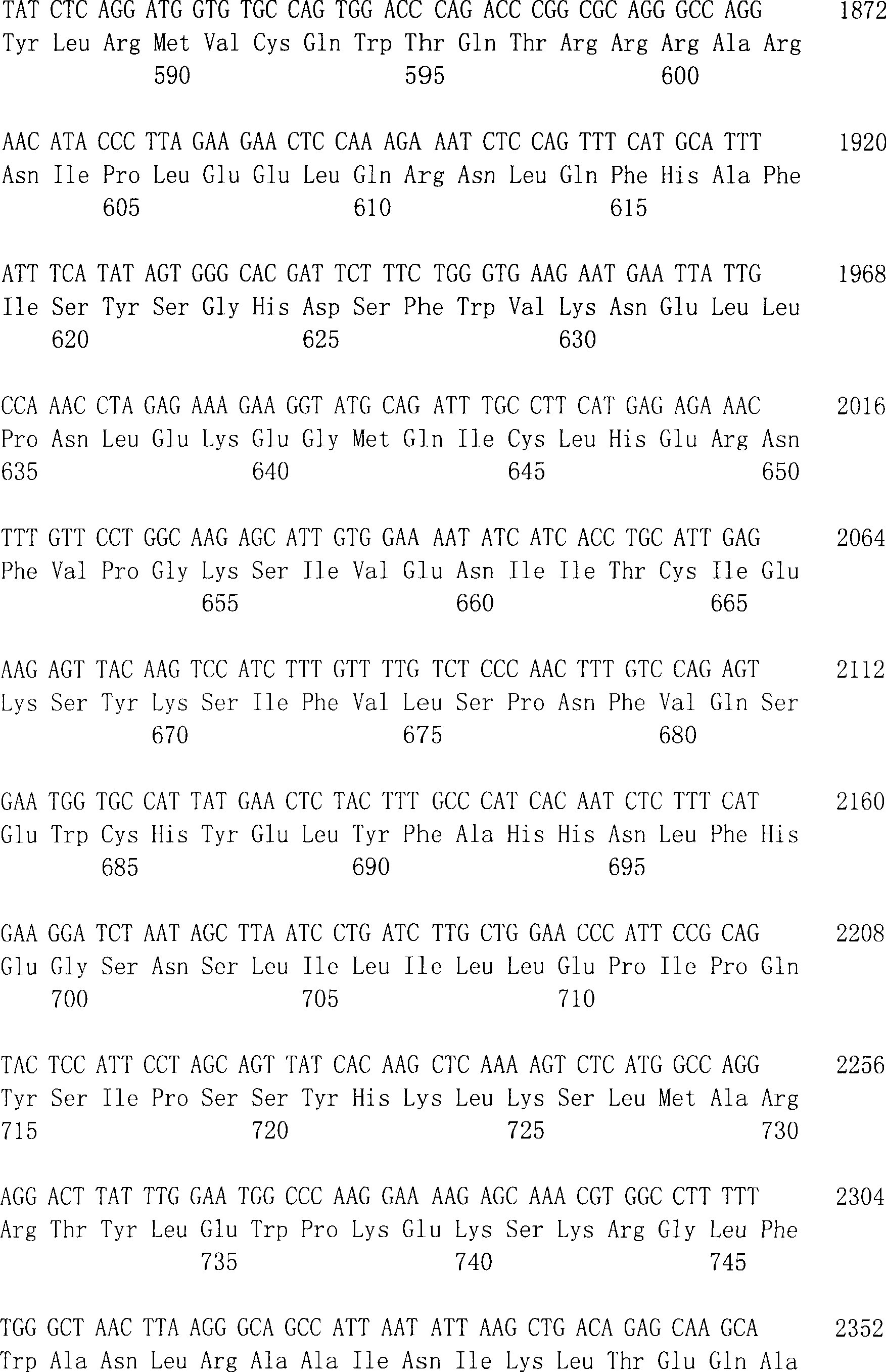
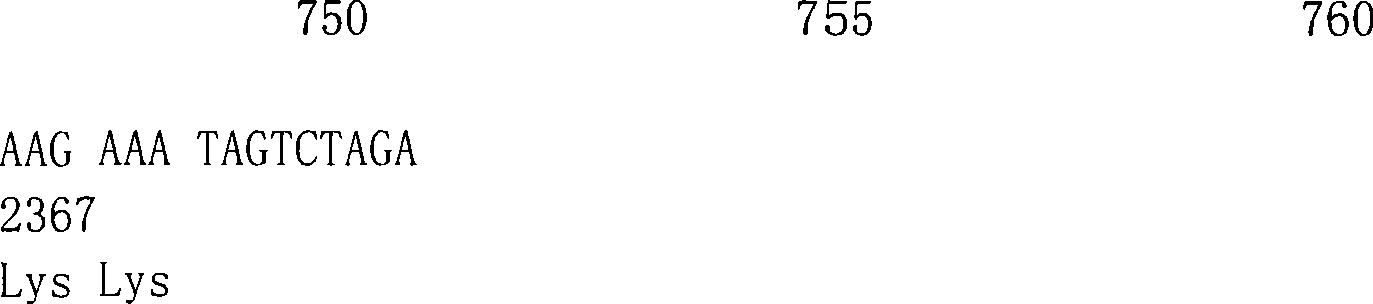
(2)SEQ ID NO:2的信息:(2) Information on SEQ ID NO: 2:
(i)顺序特征:(i) Sequential features:
(A)长度:786个氨基酸(A) Length: 786 amino acids
(B)类型:氨基酸(B) type: amino acid
(D)拓扑学:线性(D) Topology: Linear
(ii)分子类型:蛋白质(ii) Molecular type: protein
(xi)顺序描述:SEQ ID NO:2:(xi) Sequence description: SEQ ID NO: 2:


(2)SEQ ID NO:3的信息:(2) Information on SEQ ID NO: 3:
(i)顺序特征:(i) Sequential features:
(A)长度:2355个碱基对(A) Length: 2355 base pairs
(B)类型:核酸(B) type: nucleic acid
(C)链型:单链(C) Chain type: single chain
(D)拓扑学:线性(D) Topology: Linear
(ii)分子类型:cDNA(ii) Molecular type: cDNA
(ix)特征:(ix) Features:
(A)名称/关键词:CDS(A) Name/keyword: CDS
(B)位置:1...2352(B) Position: 1...2352
(ix)特征:(ix) Features:
(A)名称/关键词:成熟肽(A) Name/keyword: mature peptide
(B)位置:67...2352(B) Position: 67...2352
(xi)顺序描述:SEQ ID NO:3:(xi) Sequence description: SEQ ID NO: 3:


(2)SEQ ID NO:4的信息:(2) Information on SEQ ID NO: 4:
(i)顺序特征:(i) Sequential features:
(A)长度:784个氨基酸(A) Length: 784 amino acids
(B)类型:氨基酸(B) type: amino acid
(D)拓扑学:线性(D) Topology: Linear
(ii)分子类型:蛋白质(ii) Molecular type: protein
(xi)顺序描述:SEQ ID NO:4:(xi) Sequence description: SEQ ID NO: 4:

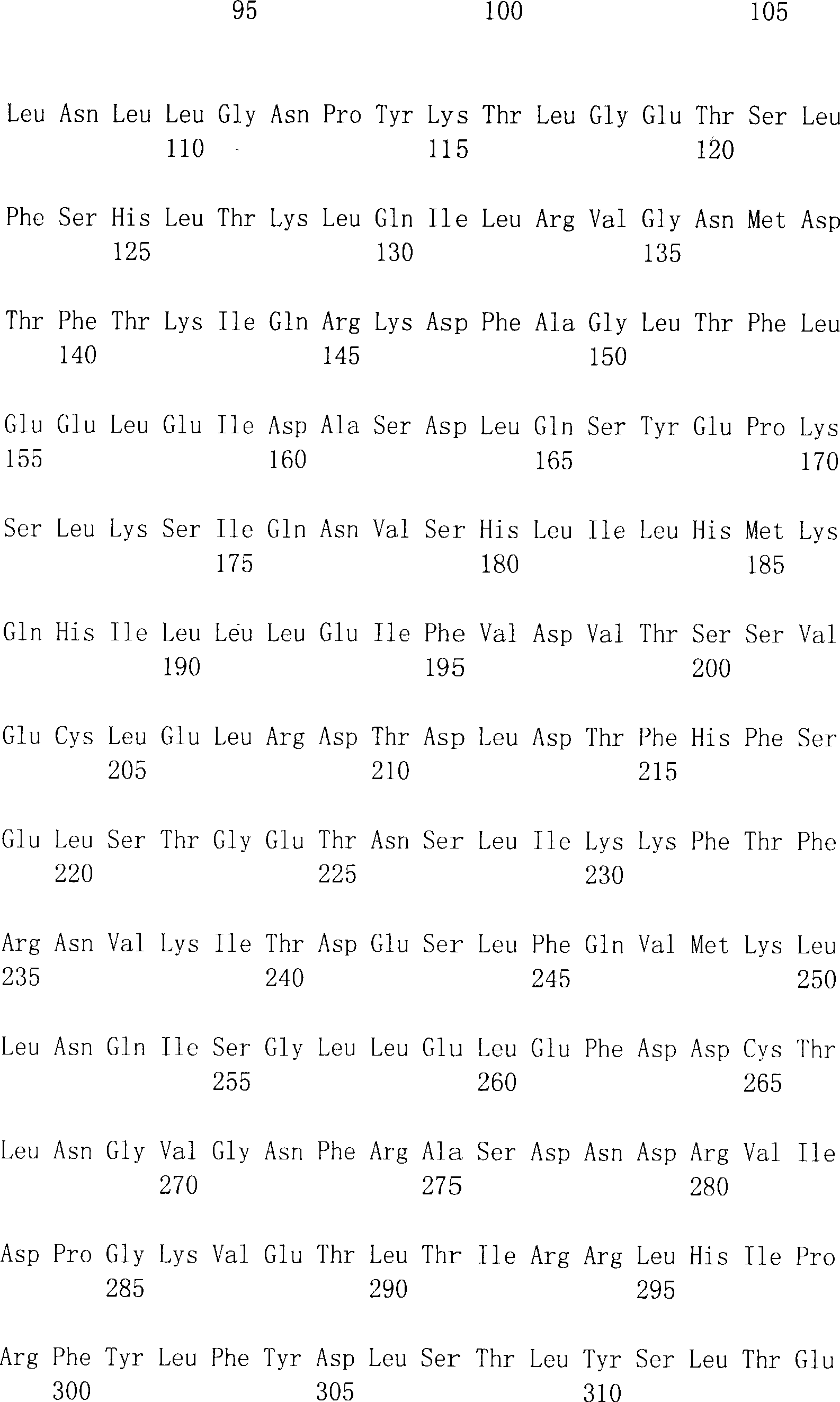

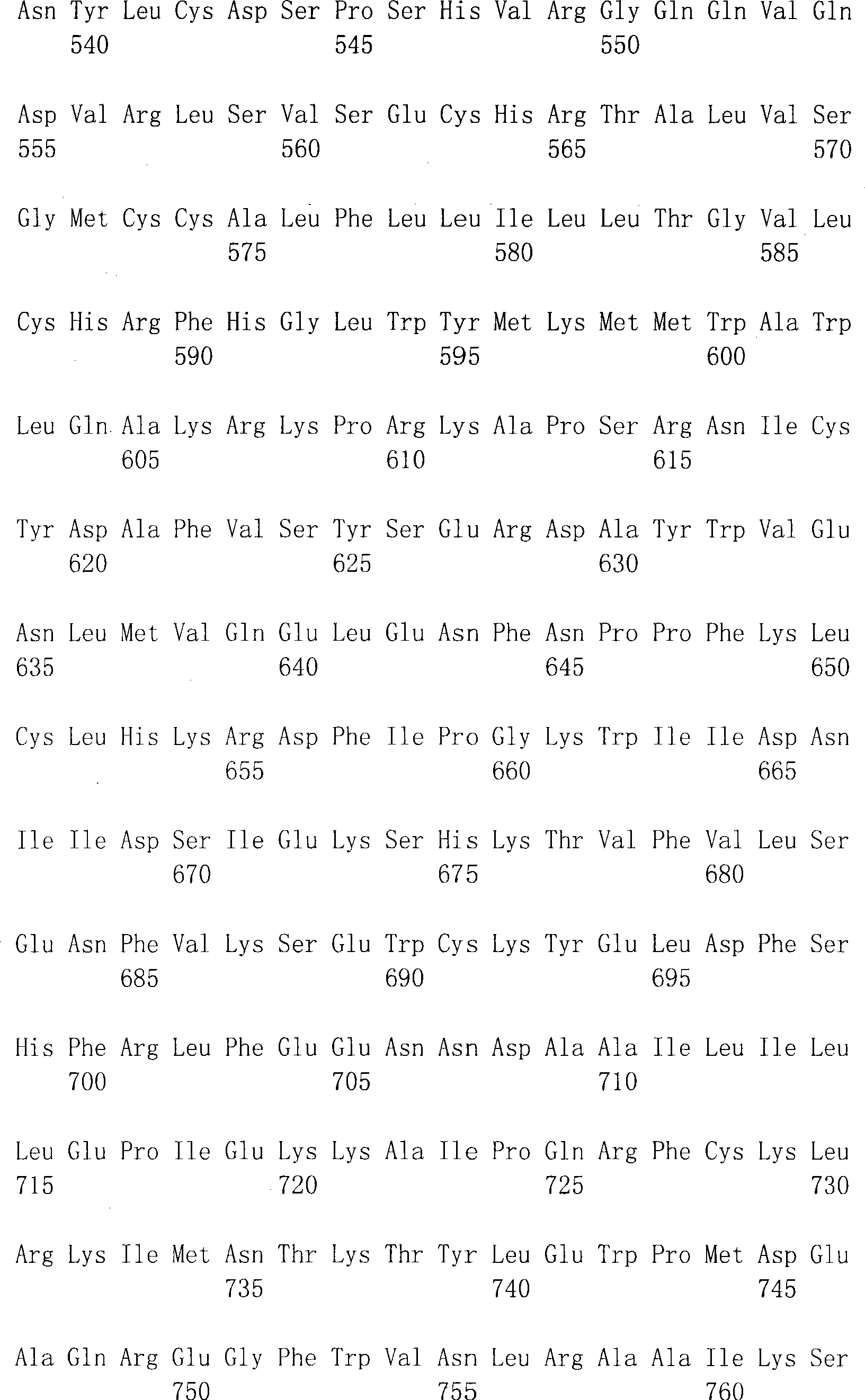
(2)SEQ ID NO:5的信息:(2) Information on SEQ ID NO: 5:
(i)顺序特征:(i) Sequential features:
(A)长度:2715个碱基对(A) Length: 2715 base pairs
(B)类型:核酸(B) type: nucleic acid
(C)链型:单链(C) Chain type: single chain
(D)拓扑学:线性(D) Topology: Linear
(ii)分子类型:cDNA(ii) Molecular type: cDNA
(ix)特征:(ix) Features:
(A)名称/关键词:CDS(A) Name/keyword: CDS
(B)位置:1...2712(B) Position: 1...2712
(ix)特征:(ix) Features:
(A)名称/关键词:成熟肽(A) Name/keyword: mature peptide
(B)位置:64...2712(B) Position: 64...2712
(xi)顺序描述:SEQ ID NO:5:(xi) Sequence description: SEQ ID NO: 5:

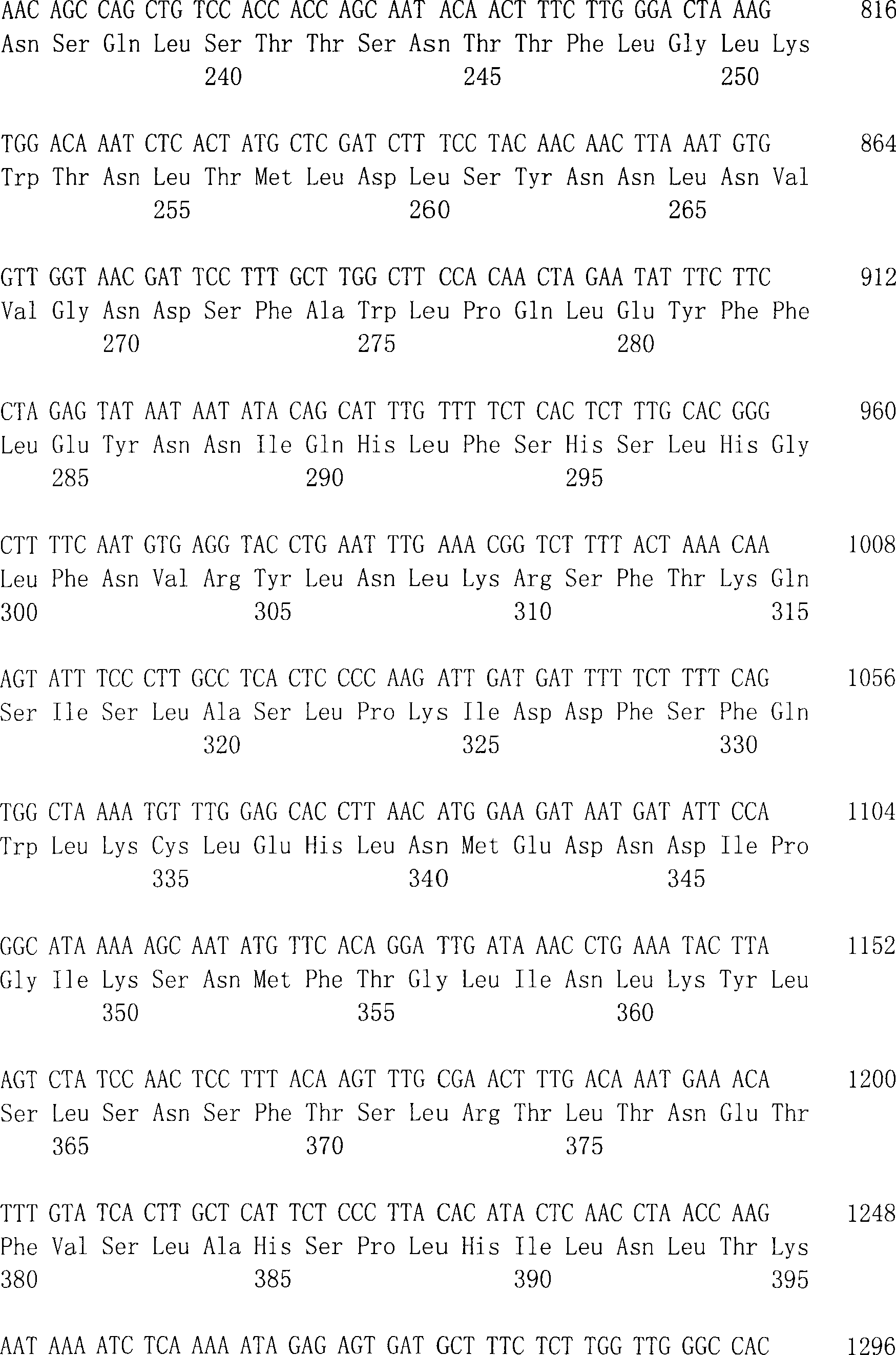


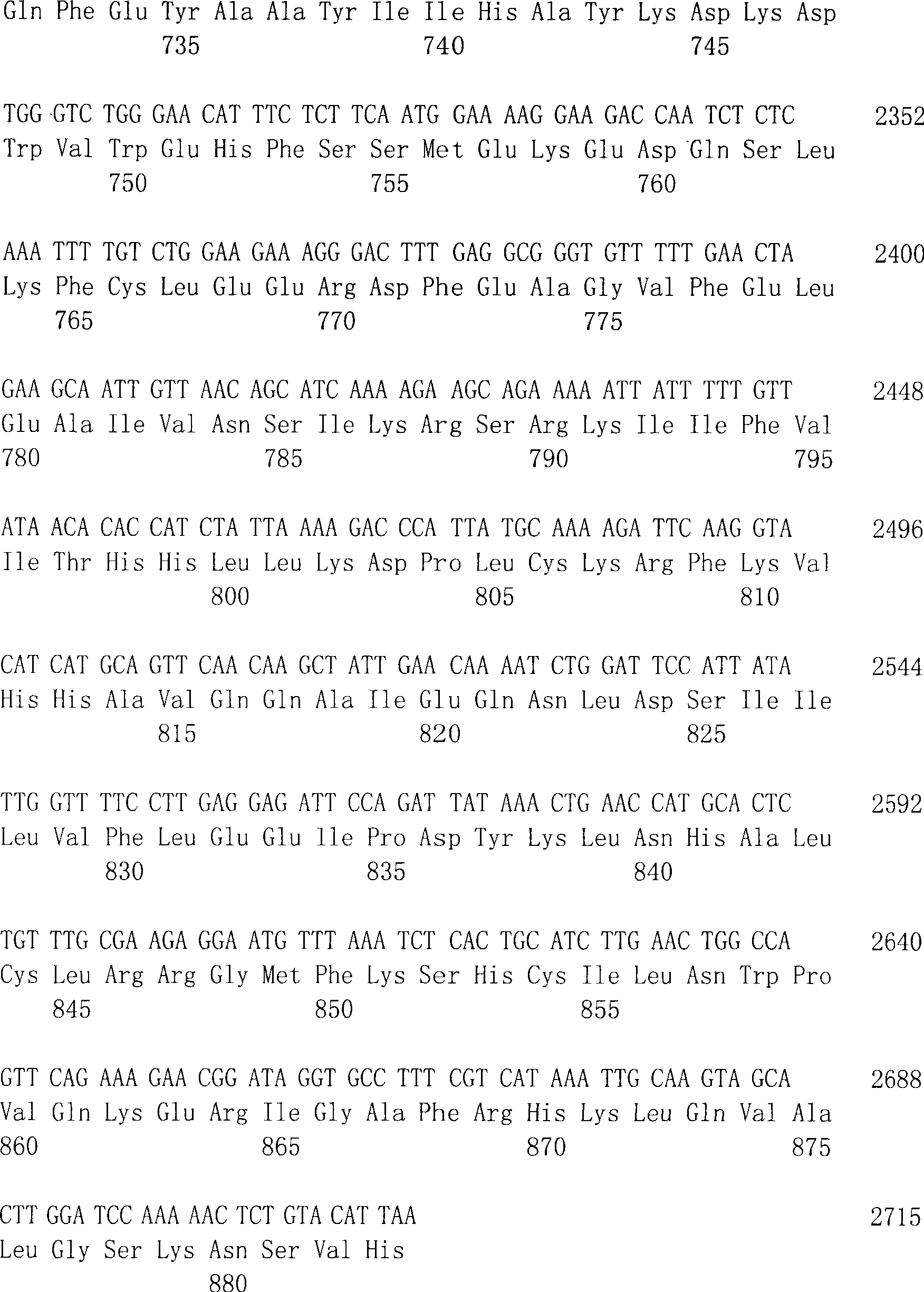
(2)SEQ ID NO:6的信息:(2) Information on SEQ ID NO: 6:
(i)顺序特征:(i) Sequential features:
(A)长度:904个氨基酸(A) Length: 904 amino acids
(B)类型:氨基酸(B) type: amino acid
(D)拓扑学:线性(D) Topology: Linear
(ii)分子类型:蛋白质(ii) Molecular type: protein
(xi)顺序描述:SEQ ID NO:6:(xi) Sequence description: SEQ ID NO: 6:
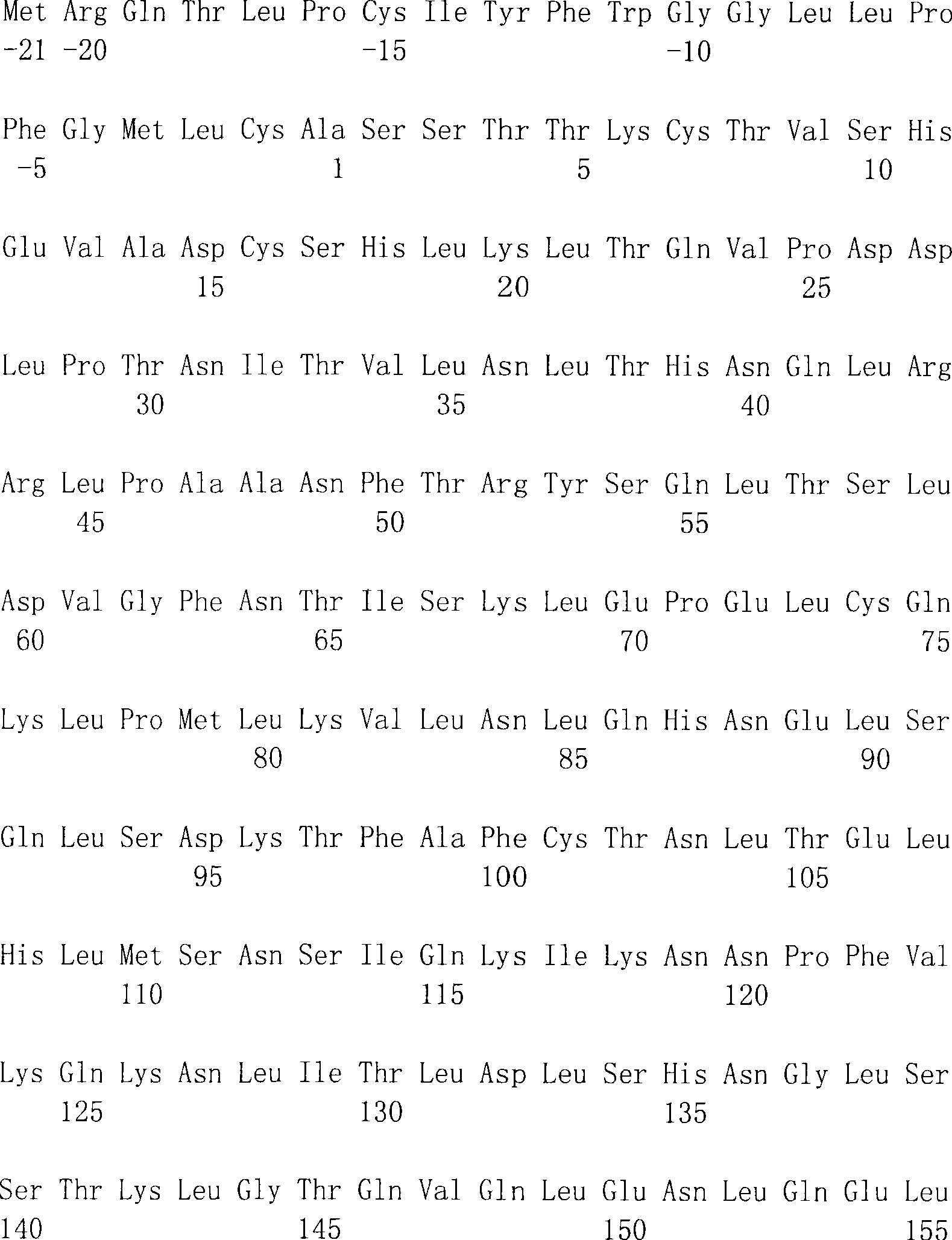


(2)SEQ ID NO:7的信息:(2) Information on SEQ ID NO: 7:
(i)顺序特征:(i) Sequential features:
(A)长度:2400个碱基对(A) Length: 2400 base pairs
(B)类型:核酸(B) type: nucleic acid
(C)链型:单链(C) Chain type: single chain
(D)拓扑学:线性(D) Topology: Linear
(ii)分子类型:cDNA(ii) Molecular type: cDNA
(ix)特征:(ix) Features:
(A)名称/关键词:CDS(A) Name/keyword: CDS
(B)位置:1...2397(B) Position: 1...2397
(xi)顺序描述:SEQ ID NO:7:(xi) Sequence description: SEQ ID NO: 7:


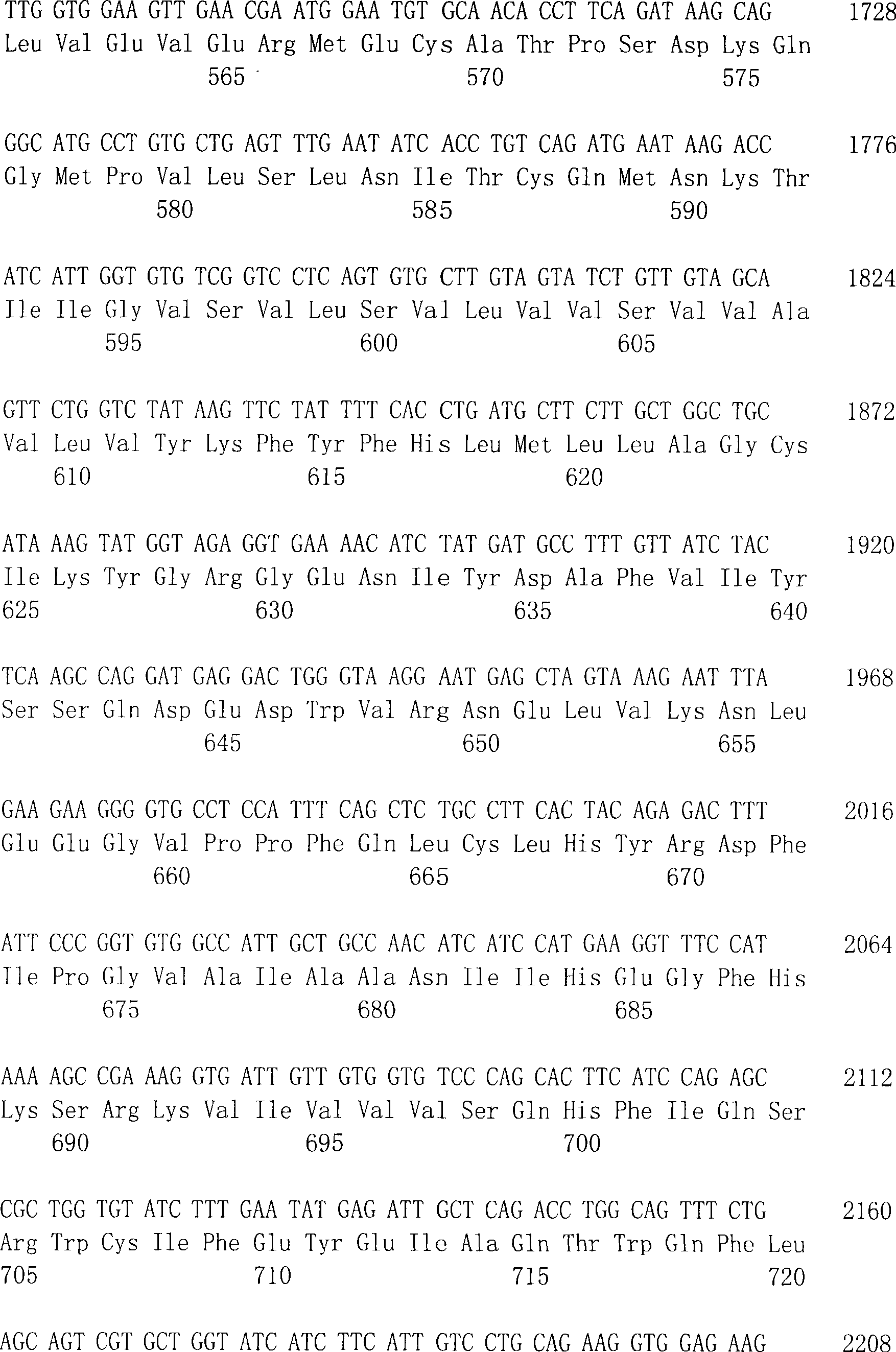

(2)SEQ ID NO:8的信息:(2) Information on SEQ ID NO: 8:
(i)顺序特征:(i) Sequential features:
(A)长度:799个氨基酸(A) Length: 799 amino acids
(B)类型:氨基酸(B) type: amino acid
(D)拓扑学:线性(D) Topology: Linear
(ii)分子类型:蛋白质(ii) Molecular type: protein
(xi)顺序描述:SEQ ID NO:8:(xi) Sequence description: SEQ ID NO: 8:


(2)SEQ ID NO:9的信息:(2) Information on SEQ ID NO: 9:
(i)顺序特征:(i) Sequential features:
(A)长度:1275个碱基对(A) Length: 1275 base pairs
(B)类型:核酸(B) type: nucleic acid
(C)链型:单链(C) Chain type: single chain
(D)拓扑学:线性(D) Topology: Linear
(ii)分子类型:cDNA(ii) Molecular type: cDNA
(ix)特征:(ix) Features:
(A)名称/关键词:CDS(A) Name/keyword: CDS
(B)位置:1...1095(B) Position: 1...1095
(xi)顺序描述:SEQ ID NO:9:(xi) Sequence description: SEQ ID NO: 9:


(2)SEQ ID NO:10的信息:(2) Information on SEQ ID NO: 10:
(i)顺序特征:(i) Sequential features:
(A)长度:365个氨基酸(A) Length: 365 amino acids
(B)类型:氨基酸(B) type: amino acid
(D)拓扑学:线性(D) Topology: Linear
(ii)分子类型:蛋白质(ii) Molecular type: protein
(xi)顺序描述:SEQ ID NO:10:(xi) Sequence description: SEQ ID NO: 10:


(2)SEQ ID NO:11的信息:(2) Information on SEQ ID NO: 11:
(i)顺序特征:(i) Sequential features:
(A)长度:3138个碱基对(A) Length: 3138 base pairs
(B)类型:核酸(B) type: nucleic acid
(C)链型:单链(C) Chain type: single chain
(D)拓扑学:线性(D) Topology: Linear
(ii)分子类型:cDNA(ii) Molecular type: cDNA
(ix)特征:(ix) Features:
(A)名称/关键词:CDS(A) Name/keyword: CDS
(B)位置:1...3135(B) Position: 1...3135
(ix)特征:(ix) Features:
(A)名称/关键词:成熟肽(A) Name/keyword: mature peptide
(B)位置:67...3135(B) Position: 67...3135
(xi)顺序描述:SEQ ID NO:11:(xi) Sequence description: SEQ ID NO: 11:


(2)SEQ ID NO:12的信息:(2) Information on SEQ ID NO: 12:
(i)顺序特征:(i) Sequential features:
(A)长度:1045个氨基酸(A) Length: 1045 amino acids
(B)类型:氨基酸(B) type: amino acid
(D)拓扑学:线性(D) Topology: Linear
(ii)分子类型:蛋白质(ii) Molecular type: protein
(xi)顺序描述:SEQ ID NO:12:(xi) Sequence description: SEQ ID NO: 12:


(2)SEQ ID NO:13的信息:(2) Information on SEQ ID NO: 13:
(i)顺序特征:(i) Sequential features:
(A)长度:180个碱基对(A) Length: 180 base pairs
(B)类型:核酸(B) type: nucleic acid
(C)链型:单链(C) Chain type: single chain
(D)拓扑学:线性(D) Topology: Linear
(ii)分子类型:cDNA(ii) Molecular type: cDNA
(ix)特征:(ix) Features:
(A)名称/关键词:CDS(A) Name/keyword: CDS
(B)位置:1...177(B) Position: 1...177
(xi)顺序描述:SEQ ID NO:13:(xi) Sequence description: SEQ ID NO: 13:


(2)SEQ ID NO:14的信息:(2) Information on SEQ ID NO: 14:
(i)顺序特征:(i) Sequential features:
(A)长度:59个氨基酸(A) Length: 59 amino acids
(B)类型:氨基酸(B) type: amino acid
(D)拓扑学:线性(D) Topology: Linear
(ii)分子类型:蛋白质(ii) Molecular type: protein
(xi)顺序描述:SEQ ID NO:14:(xi) Sequence description: SEQ ID NO: 14:

(2)SEQ ID NO:15的信息:(2) Information on SEQ ID NO: 15:
(i)顺序特征:(i) Sequential features:
(A)长度:990个碱基对(A) Length: 990 base pairs
(B)类型:核酸(B) type: nucleic acid
(C)链型:单链(C) Chain type: single chain
(D)拓扑学:线性(D) Topology: Linear
(ii)分子类型:cDNA(ii) Molecular type: cDNA
(ix)特征:(ix) Features:
(A)名称/关键词:CDS(A) Name/keyword: CDS
(B)位置:2...988(B) Position: 2...988
(xi)顺序描述:SEQ ID NO:15:(xi) Sequence description: SEQ ID NO: 15:


(2)SEQ ID NO:16的信息:(2) Information on SEQ ID NO: 16:
(i)顺序特征:(i) Sequential features:
(A)长度:329个氨基酸(A) Length: 329 amino acids
(B)类型:氨基酸(B) type: amino acid
(D)拓扑学:线性(D) Topology: Linear
(ii)分子类型:蛋白质(ii) Molecular type: protein
(xi)顺序描述:SEQ ID NO:16:(xi) Sequence description: SEQ ID NO: 16:


(2)SEQ ID NO:17的信息:(2) Information on SEQ ID NO: 17:
(i)顺序特征:(i) Sequential features:
(A)长度:1557个碱基对(A) Length: 1557 base pairs
(B)类型:核酸(B) type: nucleic acid
(C)链型:单链(C) Chain type: single chain
(D)拓扑学:线性(D) Topology: Linear
(ii)分子类型:cDNA(ii) Molecular type: cDNA
(ix)特征:(ix) Features:
(A)名称/关键词:CDS(A) Name/keyword: CDS
(B)位置:1...513(B) Position: 1...513
(ix)特征:(ix) Features:
(A)名称/关键词:misc特征(A) Name/keyword: misc feature
(B)位置:278(B) Position: 278
(D)其它信息:/注释=“核苷酸278标示为G,可以为G或C”(D) Other information: /Comment = "Nucleotide 278 is marked as G, can be G or C"
(ix)特征:(ix) Features:
(A)名称/关键词:misc特征(A) Name/keyword: misc feature
(B)位置:445(B) Position: 445
(D)其它信息:/注释=“核苷酸445标示为A,可以为A或T”(D) Other information: /Comment = "Nucleotide 445 is marked as A, can be A or T"
(ix)特征:(ix) Features:
(A)名称/关键词:misc特征(A) Name/keyword: misc feature
(B)位置:572(B) Position: 572
(D)其它信息:/注释=“核苷酸572、593、600、607、617、622、(D) Other information: /comment = "nucleotides 572, 593, 600, 607, 617, 622,
631、640、646、653、719、755和861标示为C;每个可以为A、C、G或 631, 640, 646, 653, 719, 755, and 861 are marked C; each may be A, C, G, or
T”T"
(xi)顺序描述:SEQ ID NO:17:(xi) Sequence description: SEQ ID NO: 17:


(2)SEQ ID NO:18的信息:(2) Information on SEQ ID NO: 18:
(i)顺序特征:(i) Sequential features:
(A)长度:171个氨基酸(A) Length: 171 amino acids
(B)类型:氨基酸(B) type: amino acid
(D)拓扑学:线性(D) Topology: Linear
(ii)分子类型:蛋白质(ii) Molecular type: protein
(xi)顺序描述:SEQ ID NO:18:(xi) Sequence description: SEQ ID NO: 18:


(2)SEQ ID NO:19的信息:(2) Information on SEQ ID NO: 19:
(i)顺序特征:(i) Sequential features:
(A)长度:629个碱基对(A) Length: 629 base pairs
(B)类型:核酸(B) type: nucleic acid
(C)链型:单链(C) Chain type: single chain
(D)拓扑学:线性(D) Topology: Linear
(ii)分子类型:cDNA(ii) Molecular type: cDNA
(ix)特征:(ix) Features:
(A)名称/关键词:CDS(A) Name/keyword: CDS
(B)位置:1...486(B) Position: 1...486
(ix)特征:(ix) Features:
(A)名称/关键词:misc特征(A) Name/keyword: misc feature
(B)位置:144(B) Position: 144
(D)其它信息:/注释=“核苷酸144和225标示为C;可以为C(D) Additional information: /comment = "Nucleotides 144 and 225 are marked as C; may be C
或T”or T"
(xi)顺序描述:SEQ ID NO:19:(xi) Sequence description: SEQ ID NO: 19:


(2)SEQ ID NO:20的信息:(2) Information on SEQ ID NO: 20:
(i)顺序特征:(i) Sequential features:
(A)长度:162个氨基酸(A) Length: 162 amino acids
(B)类型:氨基酸(B) type: amino acid
(D)拓扑学:线性(D) Topology: Linear
(ii)分子类型:蛋白质(ii) Molecular type: protein
(xi)顺序描述:SEQ ID NO:20:(xi) Sequence description: SEQ ID NO: 20:

(2)SEQ ID NO:21的信息:(2) Information on SEQ ID NO: 21:
(i)顺序特征:(i) Sequential features:
(A)长度:427个碱基对(A) Length: 427 base pairs
(B)类型:核酸(B) type: nucleic acid
(C)链型:单链(C) Chain type: single chain
(D)拓扑学:线性(D) Topology: Linear
(ii)分子类型:cDNA(ii) Molecular type: cDNA
(ix)特征:(ix) Features:
(A)名称/关键词:CDS(A) Name/keyword: CDS
(B)位置:1...426(B) Position: 1...426
(xi)顺序描述:SEQ ID NO:21:(xi) Sequence description: SEQ ID NO: 21:

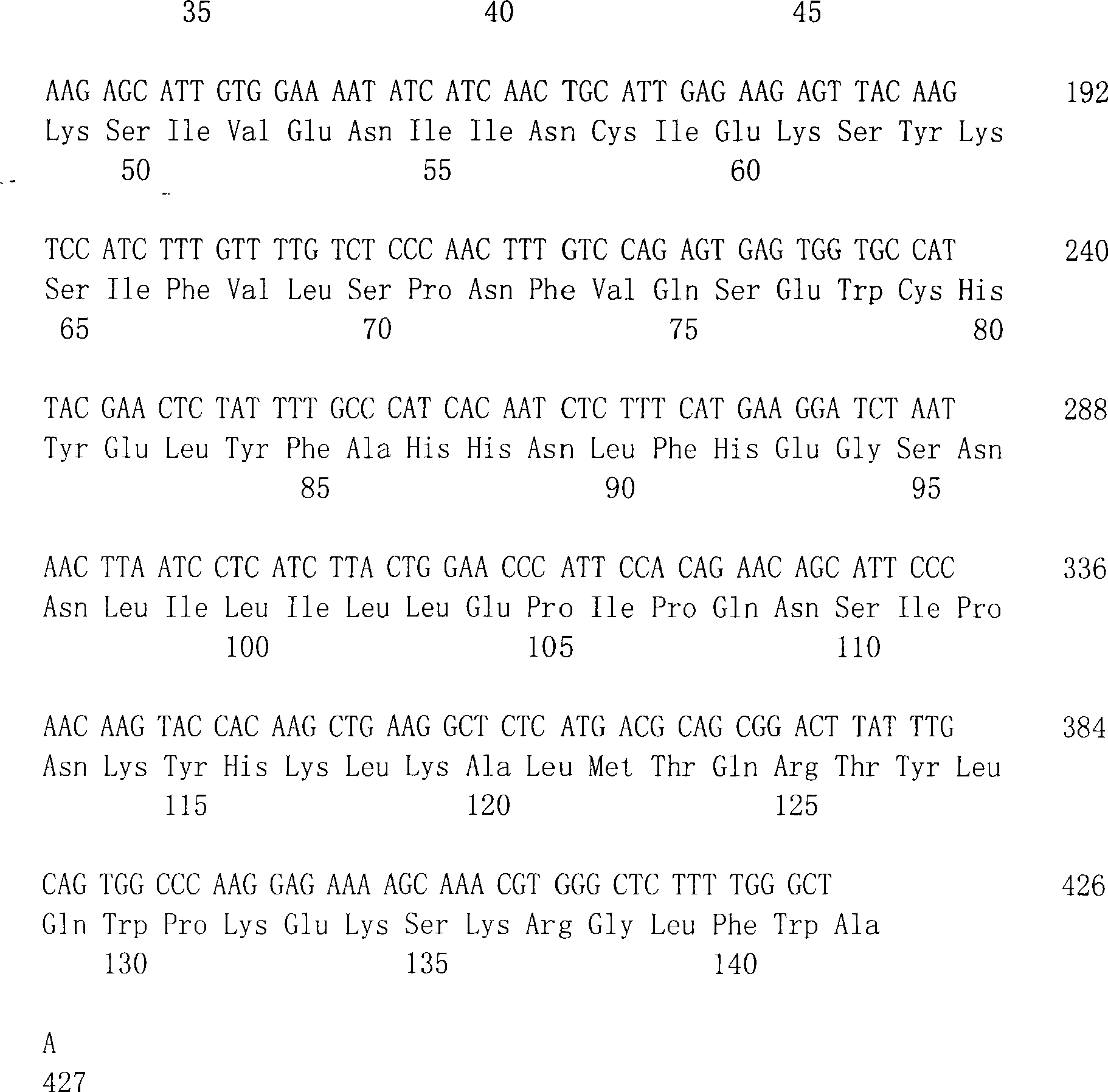
(2)SEQ ID NO:22的信息:(2) Information on SEQ ID NO: 22:
(i)顺序特征:(i) Sequential features:
(A)长度:142个氨基酸(A) Length: 142 amino acids
(B)类型:氨基酸(B) type: amino acid
(D)拓扑学:线性(D) Topology: Linear
(ii)分子类型:蛋白质(ii) Molecular type: protein
(xi)顺序描述:SEQ ID NO:22:(xi) Sequence description: SEQ ID NO: 22:


(2)SEQ ID NO:23的信息:(2) Information on SEQ ID NO: 23:
(i)顺序特征:(i) Sequential features:
(A)长度:662个碱基对(A) Length: 662 base pairs
(B)类型:核酸(B) type: nucleic acid
(C)链型:单链(C) Chain type: single chain
(D)拓扑学:线性(D) Topology: Linear
(ii)分子类型:cDNA(ii) Molecular type: cDNA
(ix)特征:(ix) Features:
(A)名称/关键词:CDS(A) Name/keyword: CDS
(B)位置:1...627(B) Position: 1...627
(ix)特征:(ix) Features:
(A)名称/关键词:misc特征(A) Name/keyword: misc feature
(B)位置:54(B) Position: 54
(D)其它信息:/注释=“核苷酸54、103和345标示为A;每个可(D) Additional information: /comment = "Nucleotides 54, 103, and 345 are designated A; each may
以为AThink A
或G”or G"
(ix)特征:(ix) Features:
(A)名称/关键词:misc特征(A) Name/keyword: misc feature
(B)位置:313(B) Position: 313
(D)其它信息:/注释=“核苷酸313标示为G;可以为G或T”(D) Other information: /comment = "Nucleotide 313 is marked as G; can be G or T"
(ix)特征:(ix) Features:
(A)名称/关键词:mi sc特征(A) Name/keyword: mi sc feature
(B)位置:316(B) Position: 316
(D)其它信息:/注释=“核苷酸316、380、407和408标示为C;(D) Additional information: /comment = "Nucleotides 316, 380, 407 and 408 are marked as C;
可以 Can
为A、C、G或T”for A, C, G or T"
(xi)顺序描述:SEQ ID NO:23:(xi) Sequence description: SEQ ID NO: 23:

(2)SEQ ID NO:24的信息:(2) Information on SEQ ID NO: 24:
(i)顺序特征:(i) Sequential features:
(A)长度:209个氨基酸(A) Length: 209 amino acids
(B)类型:氨基酸(B) type: amino acid
(D)拓扑学:线性(D) Topology: Linear
(ii)分子类型:蛋白质(ii) Molecular type: protein
(xi)顺序描述:SEQ ID NO:24:(xi) Sequence description: SEQ ID NO: 24:
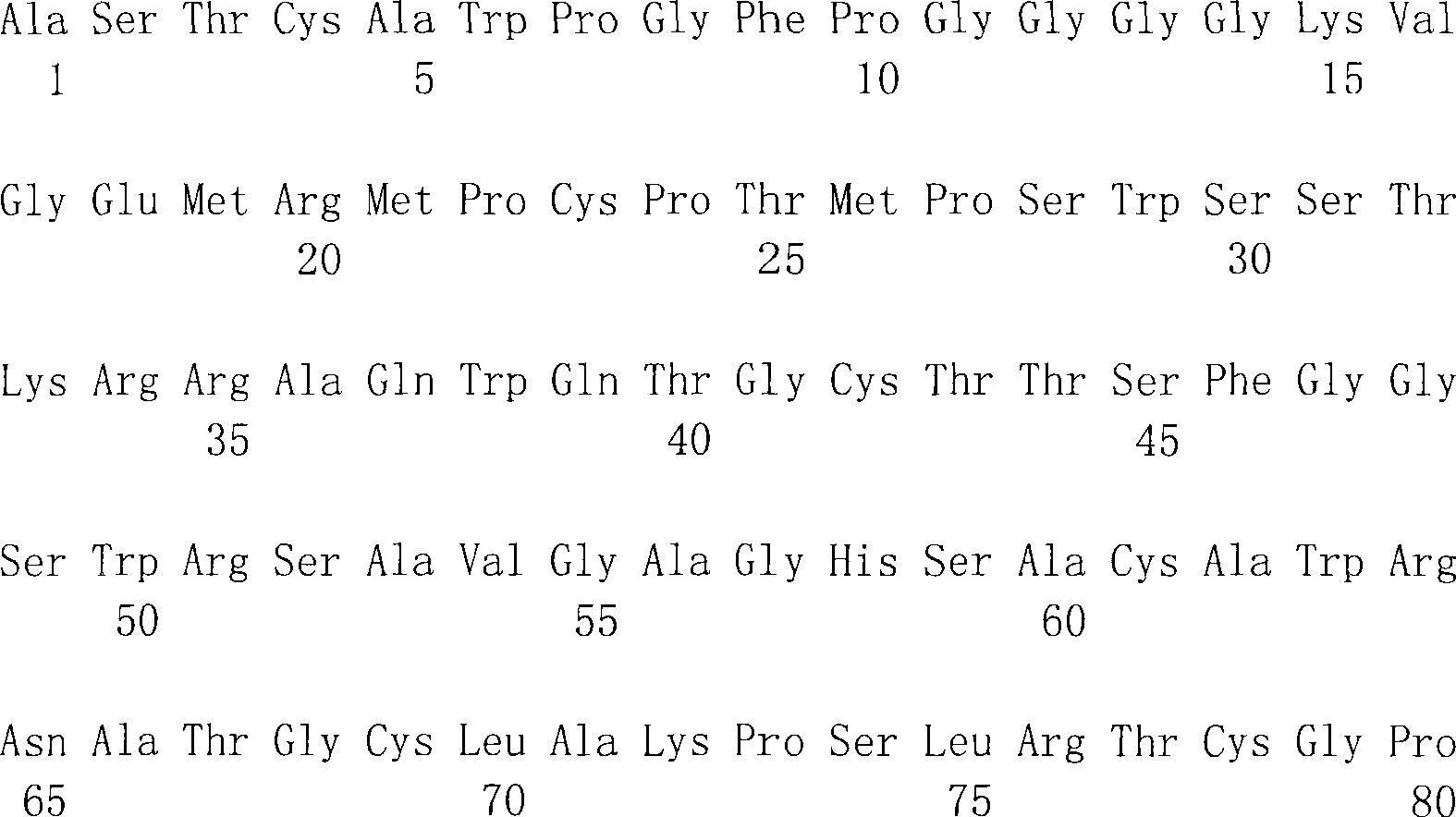


(2)SEQ ID NO:25的信息:(2) Information on SEQ ID NO: 25:
(i)顺序特征:(i) Sequential features:
(A)长度:4865个碱基对(A) Length: 4865 base pairs
(B)类型:核酸(B) type: nucleic acid
(C)链型:单链(C) Chain type: single chain
(D)拓扑学:线性(D) Topology: Linear
(ii)分子类型:cDNA(ii) Molecular type: cDNA
(ix)特征:(ix) Features:
(A)名称/关键词:CDS(A) Name/keyword: CDS
(B)位置:107...2617(B) Location: 107...2617
(ix)特征:(ix) Features:
(A)名称/关键词:成熟肽(A) Name/keyword: mature peptide
(B)位置:173...2617(B) Position: 173...2617
(ix)特征:(ix) Features:
(A)名称/关键词:misc特征(A) Name/keyword: misc feature
(B)位置:81(B) Position: 81
(D)其它信息:/注释=“核苷酸81、3144、3205和3563标示为A,(D) Additional information: /Comment = "Nucleotides 81, 3144, 3205, and 3563 are designated as A,
每 Every
个可以为A、C、G或T”One can be A, C, G or T"
(ix)特征:(ix) Features:
(A)名称/关键词:misc特征(A) Name/keyword: misc feature
(B)位置:84(B) Position: 84
(D)其它信息:/注释=“核苷酸84标示为C,可以为C或G”(D) Other information: /Comment = "Nucleotide 84 is marked as C, can be C or G"
(ix)特征:(ix) Features:
(A)名称/关键词:misc特征(A) Name/keyword: misc feature
(B)位置:739(B) Position: 739
(D)其它信息:/注释=“核苷酸739标示为C,可以为C或T”(D) Other information: /Comment = "Nucleotide 739 is marked as C, can be C or T"
(ix)特征:(ix) Features:
(A)名称/关键词:misc特征(A) Name/keyword: misc feature
(B)位置:3132(B) Location: 3132
(D)其它信息:/注释=“核苷酸3132、3532、3538和3553标示(D) Other information: /comment = "Nucleotides 3132, 3532, 3538 and 3553 marked
为G,for G,
每个可以为G或T”Each can be G or T"
(ix)特征:(ix) Features:
(A)名称/关键词:misc特征(A) Name/keyword: misc feature
(B)位置:3638(B) Location: 3638
(D)其它信息:/注释=“核苷酸A,可以为A或T”(D) Other information: /comment = "Nucleotide A, can be A or T"
(ix)特征:(ix) Features:
(A)名称/关键词:misc特征(A) Name/keyword: misc feature
(B)位置:3677(B) Location: 3677
(D)其它信息:/注释=“核苷酸3677、3685和3736标示为C,每(D) Additional information: /comment="Nucleotides 3677, 3685, and 3736 are denoted C, each
个可以one can
为A或C”for A or C"
(xi)顺序描述:SEQ ID NO:25:(xi) Sequence description: SEQ ID NO: 25:


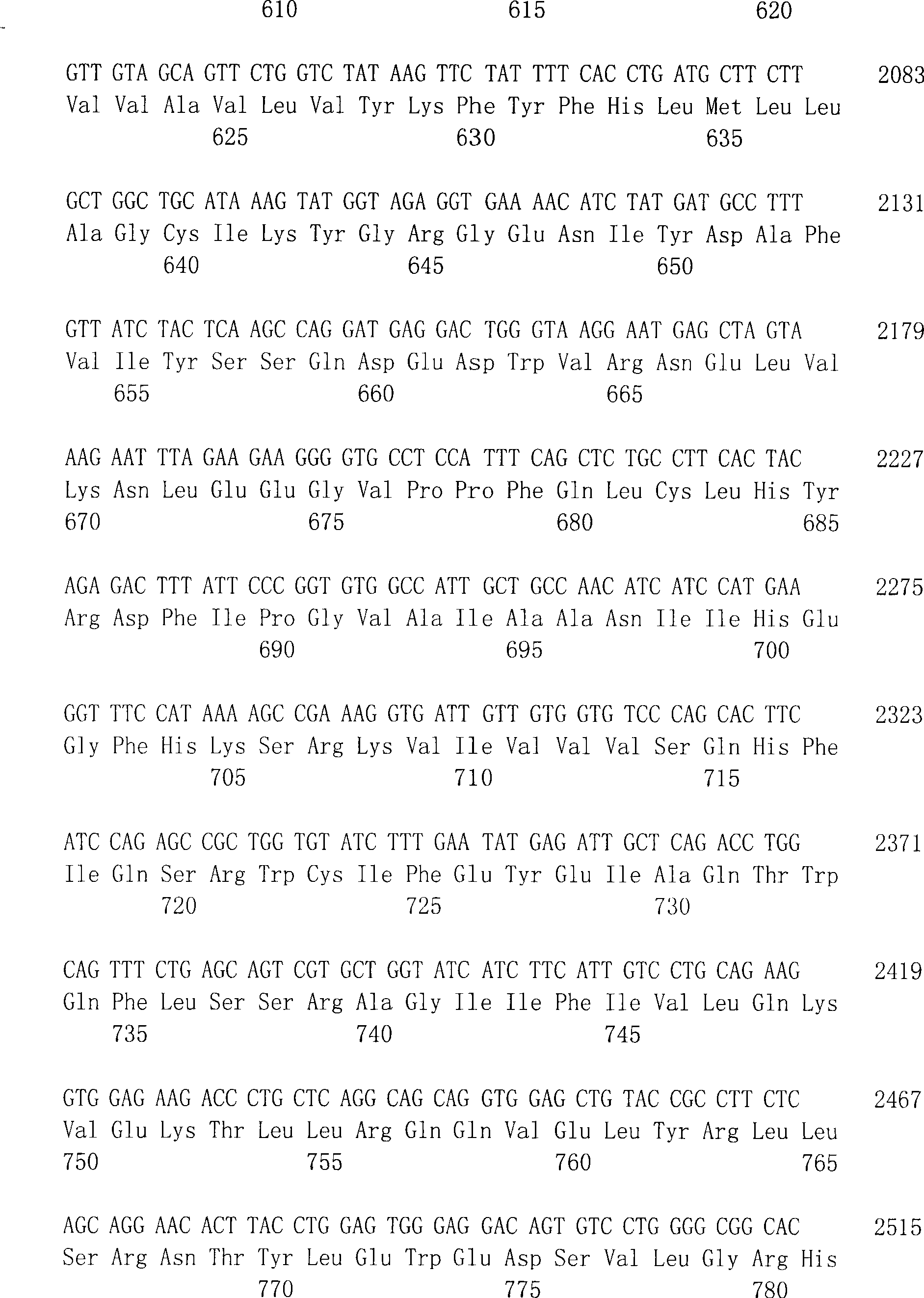
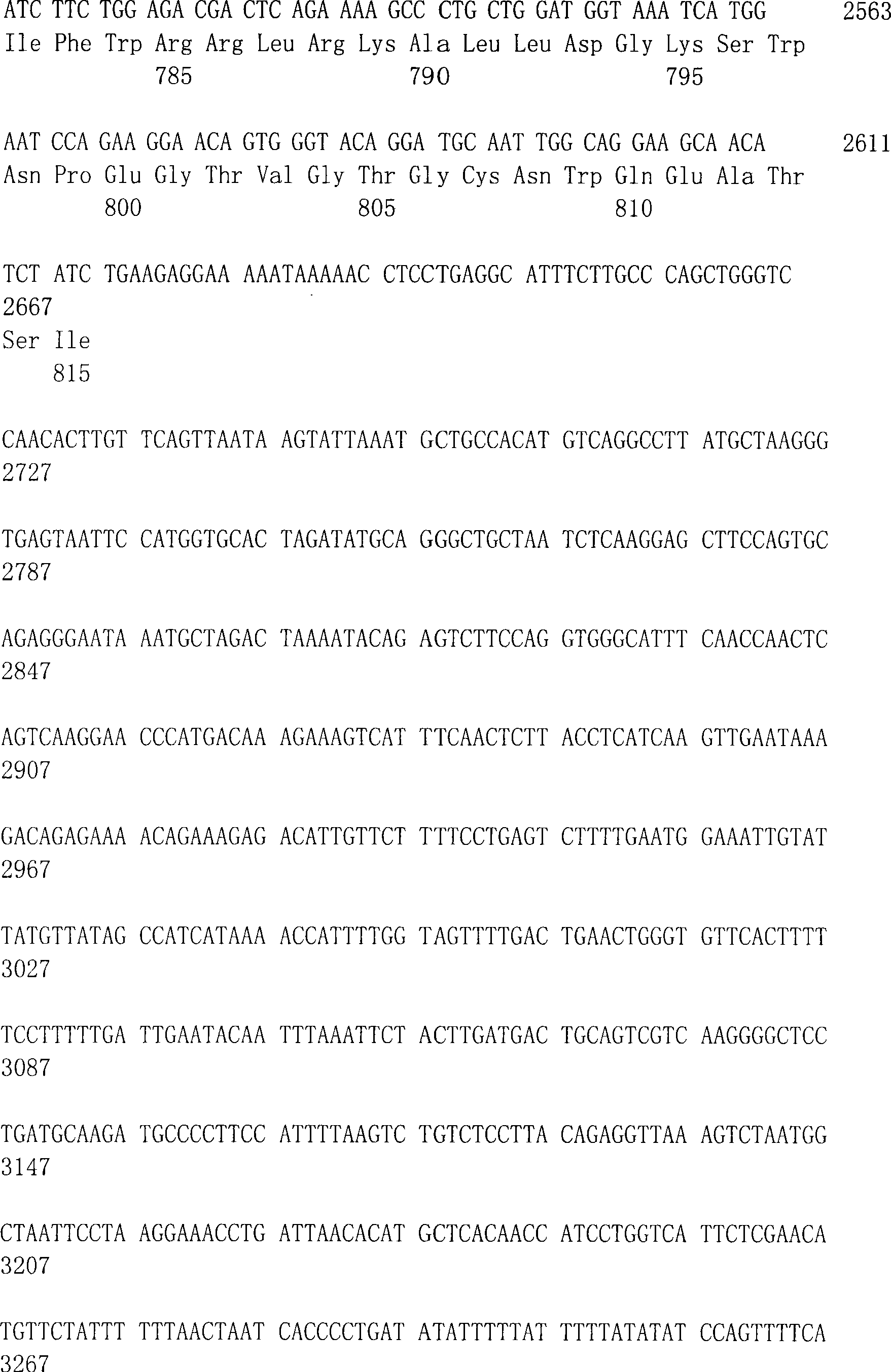


(2)SEQ ID NO:26的信息:(2) Information on SEQ ID NO: 26:
(i)顺序特征:(i) Sequential features:
(A)长度:837个氨基酸(A) Length: 837 amino acids
(B)类型:氨基酸(B) type: amino acid
(D)拓扑学:线性(D) Topology: Linear
(ii)分子类型:蛋白质(ii) Molecular type: protein
(xi)顺序描述:SEQ ID NO:26:(xi) Sequence description: SEQ ID NO: 26:

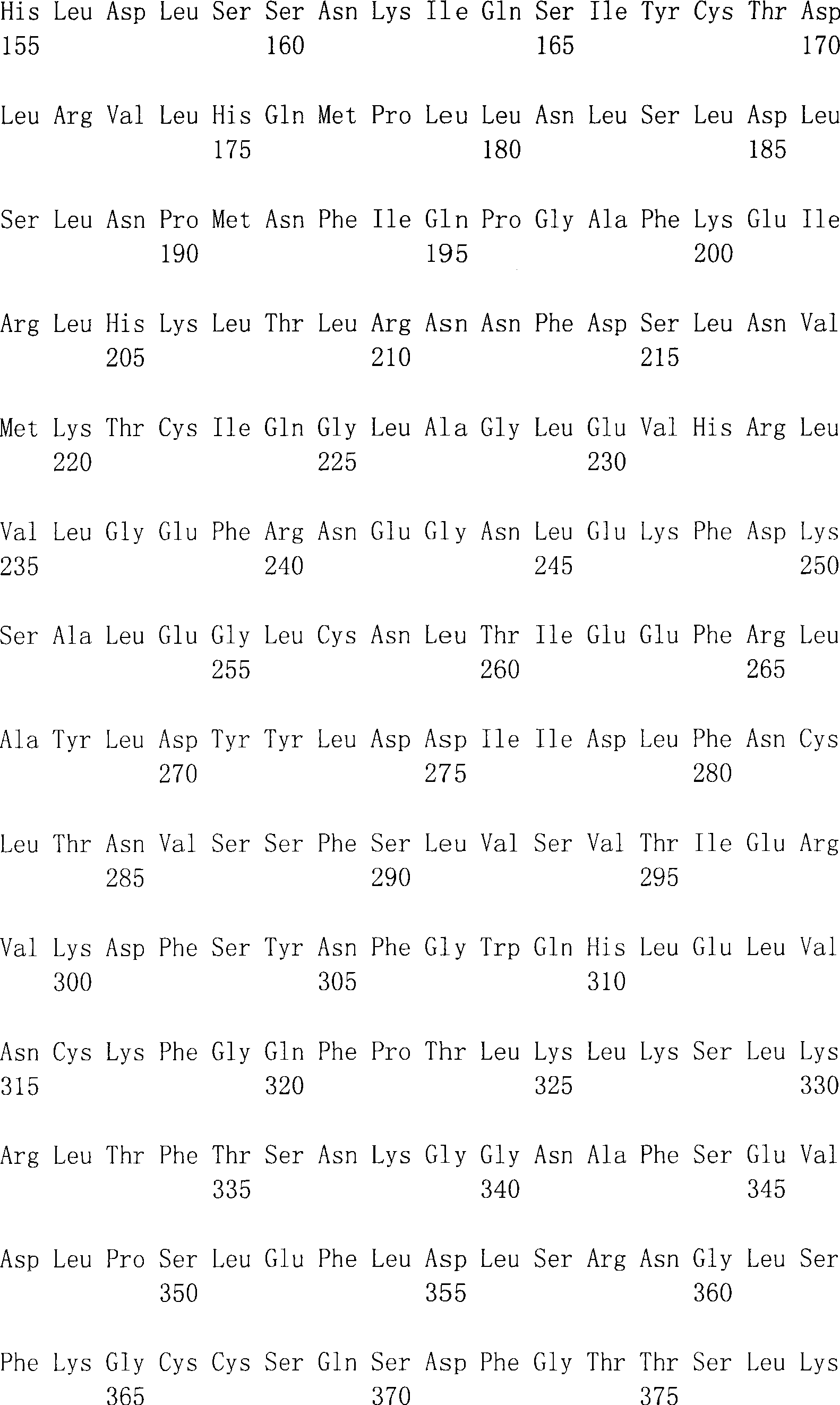
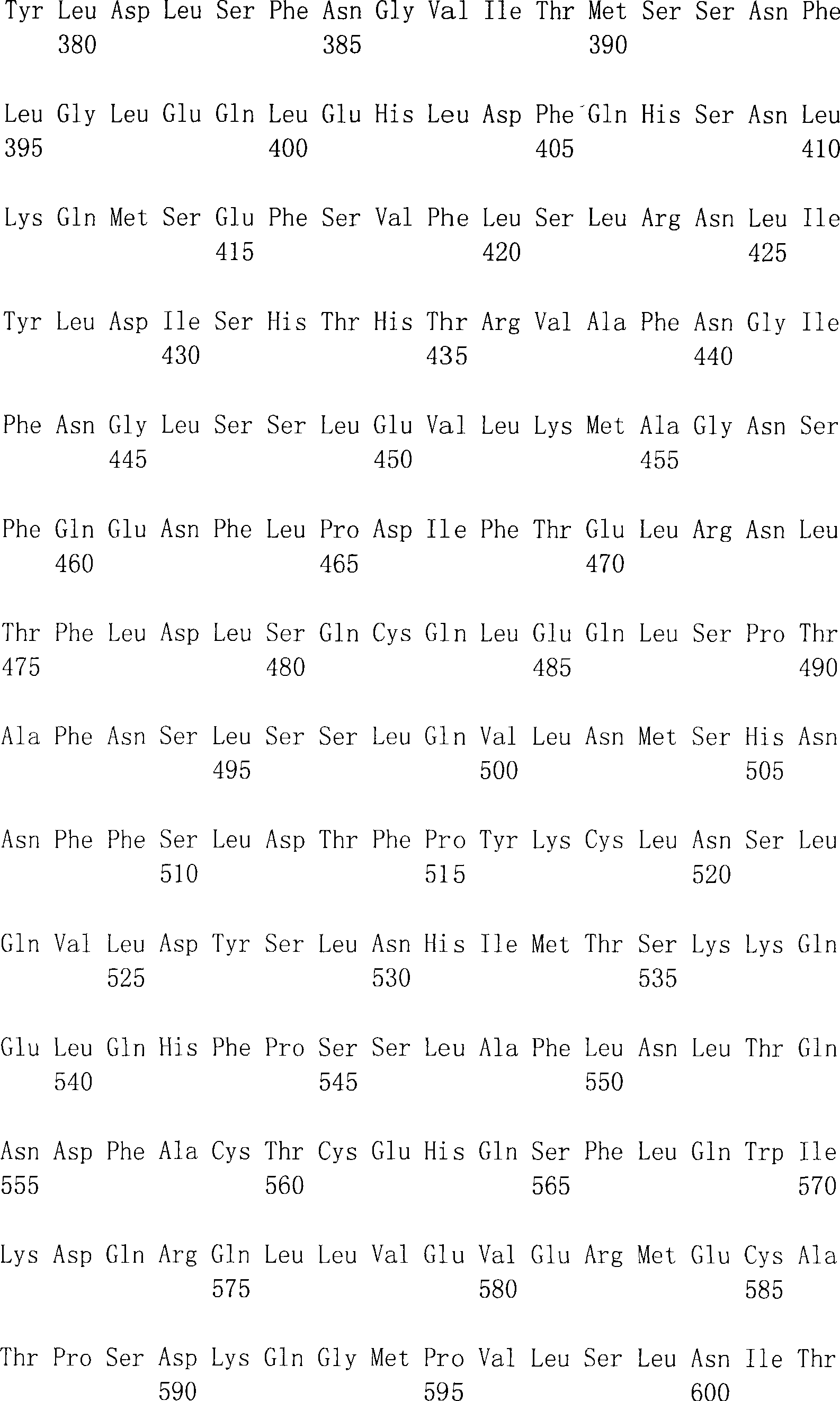

(2)SEQ ID NO:27的信息:(2) Information on SEQ ID NO: 27:
(i)顺序特征:(i) Sequential features:
(A)长度:300个碱基对(A) Length: 300 base pairs
(B)类型:核酸(B) type: nucleic acid
(C)链型:单链(C) Chain type: single chain
(D)拓扑学:线性(D) Topology: Linear
(ii)分子类型:cDNA(ii) Molecular type: cDNA
(ix)特征:(ix) Features:
(A)名称/关键词:CDS(A) Name/keyword: CDS
(B)位置:1...300(B) Position: 1...300
(ix)特征:(ix) Features:
(A)名称/关键词:misc特征(A) Name/keyword: misc feature
(B)位置:186(B) Position: 186
(D)其它信息:/注释=“核苷酸186、196、217、276和300标示(D) Other information: /comment = "Nucleotides 186, 196, 217, 276 and 300 are marked
为C,for C,
每个可以为A、C、G或T”Each can be A, C, G or T"
(xi)顺序描述:SEQ ID NO:27:(xi) Sequence description: SEQ ID NO: 27:


(2)SEQ ID NO:28的信息:(2) Information on SEQ ID NO: 28:
(i)顺序特征:(i) Sequential features:
(A)长度:100个氨基酸(A) Length: 100 amino acids
(B)类型:氨基酸(B) type: amino acid
(D)拓扑学:线性(D) Topology: Linear
(ii)分子类型:蛋白质(ii) Molecular type: protein
(xi)顺序描述:SEQ ID NO:28:(xi) Sequence description: SEQ ID NO: 28:

(2)SEQ ID NO:29的信息:(2) Information on SEQ ID NO: 29:
(i)顺序特征:(i) Sequential features:
(A)长度:1756个碱基对(A) Length: 1756 base pairs
(B)类型:核酸(B) type: nucleic acid
(C)链型:单链(C) Chain type: single chain
(D)拓扑学:线性(D) Topology: Linear
(ii)分子类型:cDNA(ii) Molecular type: cDNA
(ix)特征:(ix) Features:
(A)名称/关键词:CDS(A) Name/keyword: CDS
(B)位置:1...1182(B) Position: 1...1182
(ix)特征:(ix) Features:
(A)名称/关键词:misc特征(A) Name/keyword: misc feature
(B)位置:1643(B) Location: 1643
(D)其它信息:/注释=“核苷酸1643标示为A,可以为A或G”(D) Other information: /Comment = "Nucleotide 1643 is marked as A, can be A or G"
(ix)特征:(ix) Features:
(A)名称/关键词:misc特征(A) Name/keyword: misc feature
(B)位置:1664(B) Location: 1664
(D)其它信息:/注释=“核苷酸1664标示为C,可以为A、C、G(D) Other information: /comment="Nucleotide 1664 is marked as C, can be A, C, G
或T”or T"
(ix)特征:(ix) Features:
(A)名称/关键词:misc特征(A) Name/keyword: misc feature
(B)位置:1680(B) Position: 1680
(D)其它信息:/注释=“核苷酸1680和1735标示为G,可以为G(D) Other information: /comment="Nucleotides 1680 and 1735 are marked as G, can be G
或T”or T"
(ix)特征:(ix) Features:
(A)名称/关键词:misc特征(A) Name/keyword: misc feature
(B)位置:1719(B) Location: 1719
(D)其它信息:/注释=“核苷酸1719标示为C,可以为C或T”(D) Other information: /Comment = "Nucleotide 1719 is marked as C, can be C or T"
(ix)特征:(ix) Features:
(A)名称/关键词:misc特征(A) Name/keyword: misc feature
(B)位置:1727(B) Location: 1727
(D)其它信息:/注释=“核苷酸1727标示为A,可以为A、G或T”(D) Other information: /Comment = "Nucleotide 1727 is marked as A, which can be A, G or T"
(xi)顺序描述:SEQ ID NO:29:(xi) Sequence description: SEQ ID NO: 29:


(2)SEQ ID NO:30的信息:(2) Information on SEQ ID NO: 30:
(i)顺序特征:(i) Sequential features:
(A)长度:394个氨基酸(A) Length: 394 amino acids
(B)类型:氨基酸(B) type: amino acid
(D)拓扑学:线性(D) Topology: Linear
(ii)分子类型:蛋白质(ii) Molecular type: protein
(xi)顺序描述:SEQ ID NO:30:(xi) Sequence description: SEQ ID NO: 30:


(2)SEQ ID NO:31的信息:(2) Information on SEQ ID NO: 31:
(i)顺序特征:(i) Sequential features:
(A)长度:999个碱基对(A) Length: 999 base pairs
(B)类型:核酸(B) type: nucleic acid
(C)链型:单链(C) Chain type: single chain
(D)拓扑学:线性(D) Topology: Linear
(ii)分子类型:cDNA(ii) Molecular type: cDNA
(ix)特征:(ix) Features:
(A)名称/关键词:CDS(A) Name/keyword: CDS
(B)位置:2...847(B) Position: 2...847
(ix)特征:(ix) Features:
(A)名称/关键词:misc特征(A) Name/keyword: misc feature
(B)位置:4(B) Position: 4
(D)其它信息:/注释=“核苷酸4和23标示为C,每个可以为A、(D) Other information: /Comment = "Nucleotides 4 and 23 are marked as C, each can be A,
C、GC, G
或T”or T"
(ix)特征:(ix) Features:
(A)名称/关键词:misc特征(A) Name/keyword: misc feature
(B)位置:650(B) Position: 650
(D)其它信息:/注释=“核苷酸650标示为G,可以为A或G”(D) Other information: /Comment = "Nucleotide 650 is marked as G, can be A or G"
(ix)特征:(ix) Features:
(A)名称/关键词:misc特征(A) Name/keyword: misc feature
(B)位置:715(B) Position: 715
(D)其它信息:/注释=“核苷酸715、825和845标示为C,每个(D) Additional information: /Comment = "Nucleotides 715, 825, and 845 are denoted as C, each
可以为CCan be C
或T”or T"
(xi)顺序描述:SEQ ID NO:31:(xi) Sequence description: SEQ ID NO: 31:


(2)SEQ ID NO:32的信息:(2) Information on SEQ ID NO: 32:
(i)顺序特征:(i) Sequential features:
(A)长度:282个氨基酸(A) Length: 282 amino acids
(B)类型:氨基酸(B) type: amino acid
(D)拓扑学:线性(D) Topology: Linear
(ii)分子类型:蛋白质(ii) Molecular type: protein
(xi)顺序描述:SEQ ID NO:32:(xi) Sequence description: SEQ ID NO: 32:


(2)SEQ ID NO:33的信息:(2) Information on SEQ ID NO: 33:
(i)顺序特征:(i) Sequential features:
(A)长度:1173个碱基对(A) Length: 1173 base pairs
(B)类型:核酸(B) type: nucleic acid
(C)链型:单链(C) Chain type: single chain
(D)拓扑学:线性(D) Topology: Linear
(ii)分子类型:cDNA(ii) Molecular type: cDNA
(ix)特征:(ix) Features:
(A)名称/关键词:CDS(A) Name/keyword: CDS
(B)位置:1...1008(B) Position: 1...1008
(ix)特征:(ix) Features:
(A)名称/关键词:misc特征(A) Name/keyword: misc feature
(B)位置:854(B) Position: 854
(D)其它信息:/注释=“核苷酸854标示为A,可以为A或T”(D) Other information: /Comment = "Nucleotide 854 is marked as A, can be A or T"
(ix)特征:(ix) Features:
(A)名称/关键词:misc特征(A) Name/keyword: misc feature
(B)位置:1171(B) Location: 1171
(D)其它信息:/注释=“核苷酸1171和1172标示为C,每个可以(D) Additional information: /Comment = "Nucleotides 1171 and 1172 are marked as C, and each can
为A、for A,
C、G或T”C, G or T"
(xi)顺序描述:SEQ ID NO:33:(xi) Sequence description: SEQ ID NO: 33:


(2)SEQ ID NO:34的信息:(2) Information on SEQ ID NO: 34:
(i)顺序特征:(i) Sequential features:
(A)长度:336个氨基酸(A) Length: 336 amino acids
(B)类型:氨基酸(B) type: amino acid
(D)拓扑学:线性(D) Topology: Linear
(ii)分子类型:蛋白质(ii) Molecular type: protein
(xi)顺序描述:SEQ ID NO:34:(xi) Sequence description: SEQ ID NO: 34:


(2)SEQ ID NO:35的信息:(2) Information on SEQ ID NO: 35:
(i)顺序特征:(i) Sequential features:
(A)长度:497个碱基对(A) Length: 497 base pairs
(B)类型:核酸(B) type: nucleic acid
(C)链型:单链(C) Chain type: single chain
(D)拓扑学:线性(D) Topology: Linear
(ii)分子类型:cDNA(ii) Molecular type: cDNA
(xi)顺序描述:SEQ ID NO:35:(xi) Sequence description: SEQ ID NO: 35:


Claims (16)
Applications Claiming Priority (7)
| Application Number | Priority Date | Filing Date | Title |
|---|---|---|---|
| US4429397P | 1997-05-07 | 1997-05-07 | |
| US60/044293 | 1997-05-07 | ||
| US7221298P | 1998-01-22 | 1998-01-22 | |
| US60/072212 | 1998-01-22 | ||
| US7694798P | 1998-03-05 | 1998-03-05 | |
| US60/076947 | 1998-03-05 | ||
| PCT/US1998/008979 WO1998050547A2 (en) | 1997-05-07 | 1998-05-07 | Human toll-like receptor proteins, related reagents and methods |
Related Parent Applications (1)
| Application Number | Title | Priority Date | Filing Date |
|---|---|---|---|
| CNB988066408A Division CN1225555C (en) | 1997-05-07 | 1998-05-07 | Human TOLL-like receptor proteins, related reagents and methods |
Publications (1)
| Publication Number | Publication Date |
|---|---|
| CN101486759A true CN101486759A (en) | 2009-07-22 |
Family
ID=27366459
Family Applications (4)
| Application Number | Title | Priority Date | Filing Date |
|---|---|---|---|
| CNA2008102136180A Pending CN101486759A (en) | 1997-05-07 | 1998-05-07 | Human Toll-like receptor protein, related reagent and method |
| CNA2006101002207A Pending CN1935840A (en) | 1997-05-07 | 1998-05-07 | Human receptor proteins, related reagents and methods |
| CNA2005100927155A Pending CN1800214A (en) | 1997-05-07 | 1998-05-07 | Human Toll-like receptor protein, related reagents and methods |
| CNB988066408A Expired - Fee Related CN1225555C (en) | 1997-05-07 | 1998-05-07 | Human TOLL-like receptor proteins, related reagents and methods |
Family Applications After (3)
| Application Number | Title | Priority Date | Filing Date |
|---|---|---|---|
| CNA2006101002207A Pending CN1935840A (en) | 1997-05-07 | 1998-05-07 | Human receptor proteins, related reagents and methods |
| CNA2005100927155A Pending CN1800214A (en) | 1997-05-07 | 1998-05-07 | Human Toll-like receptor protein, related reagents and methods |
| CNB988066408A Expired - Fee Related CN1225555C (en) | 1997-05-07 | 1998-05-07 | Human TOLL-like receptor proteins, related reagents and methods |
Country Status (19)
| Country | Link |
|---|---|
| EP (4) | EP1798288B1 (en) |
| JP (4) | JP2002514083A (en) |
| KR (1) | KR100388860B1 (en) |
| CN (4) | CN101486759A (en) |
| AT (3) | ATE348157T1 (en) |
| AU (1) | AU740333B2 (en) |
| CA (1) | CA2289912C (en) |
| CY (1) | CY1109645T1 (en) |
| DE (3) | DE69836630T2 (en) |
| DK (2) | DK0980429T3 (en) |
| ES (3) | ES2331622T3 (en) |
| ID (1) | ID28299A (en) |
| IL (1) | IL132614A0 (en) |
| NO (1) | NO995458L (en) |
| NZ (1) | NZ338073A (en) |
| PL (1) | PL336635A1 (en) |
| PT (1) | PT1798288E (en) |
| SK (1) | SK146599A3 (en) |
| WO (1) | WO1998050547A2 (en) |
Families Citing this family (64)
| Publication number | Priority date | Publication date | Assignee | Title |
|---|---|---|---|---|
| US8212004B2 (en) | 1999-03-02 | 2012-07-03 | Human Genome Sciences, Inc. | Neutrokine-alpha fusion proteins |
| US6812327B1 (en) | 1996-10-25 | 2004-11-02 | Human Genome Sciences, Inc. | Neutrokine-alpha polypeptides |
| US7696327B1 (en) | 1997-10-17 | 2010-04-13 | Genentech, Inc. | Antibodies to human Toll homologues |
| US20030032090A1 (en) | 1997-05-07 | 2003-02-13 | Schering Corporation, A New Jersey Corporation | Human receptor proteins; related reagents and methods |
| AU2003203679B2 (en) * | 1997-10-17 | 2007-04-05 | Genentech, Inc. | Human toll homologues |
| ES2298905T3 (en) * | 1997-10-17 | 2008-05-16 | Genentech, Inc. | HOMOLOGOS OF HUMAN TYPE TOLL. |
| JP2000128900A (en) * | 1998-10-26 | 2000-05-09 | Japan Science & Technology Corp | Novel Toll-like receptor and its gene |
| US6303321B1 (en) | 1999-02-11 | 2001-10-16 | North Shore-Long Island Jewish Research Institute | Methods for diagnosing sepsis |
| US6740487B1 (en) | 1999-06-10 | 2004-05-25 | University Of Iowa Research Foundation | Variant TLR4 nucleic acid and uses thereof |
| WO2001036641A2 (en) * | 1999-11-02 | 2001-05-25 | Chiron Corporation | DOUBLE-STRANDED RNA RECEPTOR (dsRNA-R) AND METHODS RELATING THERETO |
| GB9927332D0 (en) * | 1999-11-18 | 2000-01-12 | Leiv Eiriksson Nyfotek As | Novel antibody and uses thereof |
| GB0001704D0 (en) * | 2000-01-25 | 2000-03-15 | Glaxo Group Ltd | Protein |
| US20030083244A1 (en) * | 2000-04-26 | 2003-05-01 | Vernet Corine A.M. | Novel proteins and nucleic acids encoding same |
| NZ522327A (en) * | 2000-05-25 | 2004-09-24 | Schering Corp | Mammalian DNAX Toll-like receptor protein, DTLR 10, antibodies and medicaments made therefrom and use in treating immunological disorders |
| US7879328B2 (en) | 2000-06-16 | 2011-02-01 | Human Genome Sciences, Inc. | Antibodies that immunospecifically bind to B lymphocyte stimulator |
| KR20060088905A (en) | 2000-06-16 | 2006-08-07 | 휴먼 게놈 사이언시즈, 인코포레이티드 | Antibodies that immunospecifically bind to LYXs |
| JP2002034565A (en) * | 2000-07-19 | 2002-02-05 | Japan Science & Technology Corp | Receptor protein that specifically recognizes bacterial DNA |
| AU2001288301A1 (en) | 2000-08-18 | 2002-03-04 | Human Genome Sciences, Inc. | Binding polypeptides and methods based thereon |
| EP2261246A3 (en) * | 2000-08-18 | 2011-07-13 | Human Genome Sciences, Inc. | Binding polypeptides for B-lymphocyte stimulator protein (BLyS) |
| US6943240B2 (en) | 2000-09-15 | 2005-09-13 | Coley Pharmaceuticals Gmbh | Nucleic acids for high throughput screening of CpG-based immuno-agonist/antagonist |
| US7304034B2 (en) | 2001-05-15 | 2007-12-04 | The Feinstein Institute For Medical Research | Use of HMGB fragments as anti-inflammatory agents |
| US7220723B2 (en) | 2001-05-15 | 2007-05-22 | The Feinstein Institute For Medical Research | Inhibitors of the interaction between HMGB polypeptides and toll-like receptor 2 as anti-inflammatory agents |
| CA2461315A1 (en) * | 2001-10-05 | 2003-04-17 | Coley Pharmaceutical Gmbh | Toll-like receptor 3 signaling agonists and antagonists |
| ES2318615T3 (en) * | 2001-11-16 | 2009-05-01 | Coley Pharmaceutical Group, Inc. | N- (4- (4-AMINO-2-ETIL-1H-IMIDAZO (4,5-C) QUINOLIN-1-IL) BUTIL) METHANOSULPHONAMIDE, A PHARMACEUTICAL COMPOSITION THAT UNDERSTANDS AND USES ITSELF. |
| GB0127618D0 (en) * | 2001-11-17 | 2002-01-09 | Univ Nottingham | "Composition and method for treatment of wounds" |
| JP2004016021A (en) | 2002-06-12 | 2004-01-22 | Japan Science & Technology Corp | Antibody and inhibitor, transformation method and transformation kit using the same |
| AU2003287316A1 (en) * | 2002-12-11 | 2004-06-30 | 3M Innovative Properties Company | Assays relating to toll-like receptor activity |
| EP1631687A2 (en) * | 2003-04-22 | 2006-03-08 | Coley Pharmaceutical GmbH | Methods and products for identification and assessment of tlr ligands |
| US7696169B2 (en) | 2003-06-06 | 2010-04-13 | The Feinstein Institute For Medical Research | Inhibitors of the interaction between HMGB polypeptides and toll-like receptor 2 as anti-inflammatory agents |
| JP4792392B2 (en) | 2003-09-11 | 2011-10-12 | コーナーストーン セラピューティクス インコーポレイテッド | Monoclonal antibody against HMGB1 |
| TW200516153A (en) * | 2003-10-03 | 2005-05-16 | Hitachi Chemical Co Ltd | Human toll-like receptor 3 gene polymorphism as marker for inherited factor of allergic disease and utilization of the same |
| WO2005032484A2 (en) | 2003-10-03 | 2005-04-14 | 3M Innovative Properties Company | Alkoxy substituted imidazoquinolines |
| TW200514850A (en) * | 2003-10-03 | 2005-05-01 | Hitachi Chemical Co Ltd | Method of evaluating risk for viral infection |
| US7202234B2 (en) | 2003-10-24 | 2007-04-10 | Eisai Co., Ltd. | Compounds and methods for treating Toll-like receptor 2-related diseases and conditions |
| NZ547467A (en) | 2003-11-25 | 2010-06-25 | 3M Innovative Properties Co | Substituted imidazo ring system and methods |
| JP2008022701A (en) * | 2004-09-24 | 2008-02-07 | Japan Science & Technology Agency | Soluble Toll-like receptor 4 protein |
| WO2006054129A1 (en) | 2004-11-19 | 2006-05-26 | Institut Gustave Roussy | Improved treatment of cancer by double-stranded rna |
| AR051836A1 (en) | 2004-11-30 | 2007-02-14 | Centocor Inc | RECEIVER ANTAGONISTS 3 SIMIL TOLL METHODS AND USES |
| AU2006210392A1 (en) | 2005-02-04 | 2006-08-10 | Coley Pharmaceutical Group, Inc. | Aqueous gel formulations containing immune response modifiers |
| US7700728B2 (en) | 2005-03-24 | 2010-04-20 | Schering Corporation | Use of chimeric receptors in a screening assay for identifying agonists and antagonists of cell receptors |
| US7498409B2 (en) | 2005-03-24 | 2009-03-03 | Schering Corporation | Screening assay for TLR7, TLR8 and TLR9 agonists and antagonists |
| US9168286B2 (en) | 2005-10-13 | 2015-10-27 | Human Genome Sciences, Inc. | Methods and compositions for use in treatment of patients with autoantibody positive disease |
| EP1945820B1 (en) | 2005-10-27 | 2013-08-28 | Janssen Biotech, Inc. | Toll like receptor 3 modulators, methods and uses |
| ES2555544T3 (en) | 2006-03-07 | 2016-01-04 | Vaxinnate Corporation | Compositions that include hemagglutinin, preparation methods and methods of use thereof |
| US8211649B2 (en) | 2006-03-31 | 2012-07-03 | Human Genome Sciences, Inc. | Methods of diagnosing and prognosing hodgkin's lymphoma |
| CN101134046B (en) * | 2006-09-01 | 2011-10-05 | 中国医学科学院药物研究所 | Application of TLR4 and TLR9 agonist compound in the restraint of tumour metastasis |
| US20080299138A1 (en) * | 2007-05-25 | 2008-12-04 | Duffy Karen E | Toll-Like Receptor 3 Modulators and Uses Thereof |
| WO2009130616A2 (en) | 2008-04-25 | 2009-10-29 | Innate Pharma | Improved tlr3 agonist compositions |
| EP2116602A1 (en) | 2008-05-07 | 2009-11-11 | Institut Gustave Roussy | Combination products for treating cancer |
| EP2334703B1 (en) | 2008-09-17 | 2015-07-08 | Innate Pharma | Compositions and methods for detecting tlr3 |
| US9512196B2 (en) | 2008-09-22 | 2016-12-06 | Cedars-Sinai Medical Center | Short-form human MD-2 as a negative regulator of toll-like receptor 4 signaling |
| WO2010033294A1 (en) | 2008-09-22 | 2010-03-25 | Cedars-Sinai Medical Center | Short-form human md-2 as a negative regulator of toll-like receptor 4 signaling |
| DK2451844T3 (en) | 2009-07-10 | 2015-07-27 | Innate Pharma | Tlr3-retention agents |
| JP5830744B2 (en) * | 2009-08-19 | 2015-12-09 | 国立大学法人東京工業大学 | Peptides that induce adhesion of lactic acid bacteria and uses thereof |
| US9890202B2 (en) | 2010-07-19 | 2018-02-13 | Yeda Research And Development Co. Ltd. | Peptides based on the transmembrane domain of a toll-like receptor (TLR) for treatment of TLR-mediated diseases |
| WO2012088272A1 (en) | 2010-12-21 | 2012-06-28 | Duke University | Methods and compositions combining immunotherapy with monocyte activation |
| AU2012206614A1 (en) | 2011-01-12 | 2013-08-01 | Innate Pharma | TLR3 binding agents |
| CA2837227C (en) | 2011-06-01 | 2022-05-10 | Janus Biotherapeutics, Inc. | Novel immune system modulators |
| ES2583877T3 (en) | 2011-06-01 | 2016-09-22 | Janus Biotherapeutics, Inc. | Novel immune system modulators |
| US9873694B2 (en) | 2011-10-04 | 2018-01-23 | Janus Biotherapeutics, Inc. | Imidazole quinoline-based immune system modulators |
| EP2766384B1 (en) * | 2011-10-10 | 2016-11-23 | Yeda Research and Development Co. Ltd. | Toll-like receptor 4 (tlr-4) agonist peptides for modulating tlr-4 mediated immune response |
| US9944712B2 (en) | 2012-05-31 | 2018-04-17 | Innate Pharma | TLR3 binding agents |
| US10017739B2 (en) | 2012-09-06 | 2018-07-10 | Duke University | Methods of expanding and assessing B cells and using expanded B cells to treat disease |
| CN113502299B (en) * | 2021-07-20 | 2023-03-14 | 中国农业大学 | Production method of staphylococcus aureus-resistant genetically modified goat |
Family Cites Families (16)
| Publication number | Priority date | Publication date | Assignee | Title |
|---|---|---|---|---|
| DE2031216A1 (en) | 1969-06-19 | 1971-01-14 | Citizen Watch Co Ltd , Tokio | Day and date setting device for clocks with calendar |
| US3940475A (en) | 1970-06-11 | 1976-02-24 | Biological Developments, Inc. | Radioimmune method of assaying quantitatively for a hapten |
| NL154598B (en) | 1970-11-10 | 1977-09-15 | Organon Nv | PROCEDURE FOR DETERMINING AND DETERMINING LOW MOLECULAR COMPOUNDS AND PROTEINS THAT CAN SPECIFICALLY BIND THESE COMPOUNDS AND TEST PACKAGING. |
| US3817837A (en) | 1971-05-14 | 1974-06-18 | Syva Corp | Enzyme amplification assay |
| US3939350A (en) | 1974-04-29 | 1976-02-17 | Board Of Trustees Of The Leland Stanford Junior University | Fluorescent immunoassay employing total reflection for activation |
| US3996345A (en) | 1974-08-12 | 1976-12-07 | Syva Company | Fluorescence quenching with immunological pairs in immunoassays |
| US4275149A (en) | 1978-11-24 | 1981-06-23 | Syva Company | Macromolecular environment control in specific receptor assays |
| US4277437A (en) | 1978-04-05 | 1981-07-07 | Syva Company | Kit for carrying out chemically induced fluorescence immunoassay |
| US4366241A (en) | 1980-08-07 | 1982-12-28 | Syva Company | Concentrating zone method in heterogeneous immunoassays |
| US4659678A (en) | 1982-09-29 | 1987-04-21 | Serono Diagnostics Limited | Immunoassay of antigens |
| US4816567A (en) | 1983-04-08 | 1989-03-28 | Genentech, Inc. | Recombinant immunoglobin preparations |
| US4859609A (en) | 1986-04-30 | 1989-08-22 | Genentech, Inc. | Novel receptors for efficient determination of ligands and their antagonists or agonists |
| US5789192A (en) | 1992-12-10 | 1998-08-04 | Schering Corporation | Mammalian receptors for interleukin-10 (IL-10) |
| JP2000500660A (en) * | 1996-07-12 | 2000-01-25 | シェーリング コーポレイション | Mammalian TNF-α convertase |
| CA2297306A1 (en) * | 1997-08-01 | 1999-02-11 | Genset | 5'ests for non tissue specific secreted proteins |
| ES2298905T3 (en) * | 1997-10-17 | 2008-05-16 | Genentech, Inc. | HOMOLOGOS OF HUMAN TYPE TOLL. |
-
1998
- 1998-05-07 ES ES06025414T patent/ES2331622T3/en not_active Expired - Lifetime
- 1998-05-07 PT PT06025414T patent/PT1798288E/en unknown
- 1998-05-07 SK SK1465-99A patent/SK146599A3/en unknown
- 1998-05-07 EP EP06025414A patent/EP1798288B1/en not_active Expired - Lifetime
- 1998-05-07 DE DE69836630T patent/DE69836630T2/en not_active Revoked
- 1998-05-07 CN CNA2008102136180A patent/CN101486759A/en active Pending
- 1998-05-07 DE DE69841170T patent/DE69841170D1/en not_active Expired - Lifetime
- 1998-05-07 EP EP07123073A patent/EP1925666B1/en not_active Expired - Lifetime
- 1998-05-07 IL IL13261498A patent/IL132614A0/en unknown
- 1998-05-07 PL PL98336635A patent/PL336635A1/en unknown
- 1998-05-07 AT AT98918934T patent/ATE348157T1/en not_active IP Right Cessation
- 1998-05-07 DE DE69841514T patent/DE69841514D1/en not_active Expired - Lifetime
- 1998-05-07 NZ NZ338073A patent/NZ338073A/en unknown
- 1998-05-07 JP JP54829998A patent/JP2002514083A/en not_active Withdrawn
- 1998-05-07 DK DK98918934T patent/DK0980429T3/en active
- 1998-05-07 CN CNA2006101002207A patent/CN1935840A/en active Pending
- 1998-05-07 WO PCT/US1998/008979 patent/WO1998050547A2/en not_active Ceased
- 1998-05-07 EP EP08104511A patent/EP1988166A1/en not_active Ceased
- 1998-05-07 CA CA2289912A patent/CA2289912C/en not_active Expired - Fee Related
- 1998-05-07 AT AT06025414T patent/ATE443139T1/en active
- 1998-05-07 AT AT07123073T patent/ATE458053T1/en not_active IP Right Cessation
- 1998-05-07 CN CNA2005100927155A patent/CN1800214A/en active Pending
- 1998-05-07 ES ES98918934T patent/ES2279572T3/en not_active Expired - Lifetime
- 1998-05-07 CN CNB988066408A patent/CN1225555C/en not_active Expired - Fee Related
- 1998-05-07 KR KR10-1999-7010275A patent/KR100388860B1/en not_active Expired - Fee Related
- 1998-05-07 DK DK06025414T patent/DK1798288T3/en active
- 1998-05-07 EP EP98918934A patent/EP0980429B1/en not_active Revoked
- 1998-05-07 ES ES07123073T patent/ES2340210T3/en not_active Expired - Lifetime
- 1998-05-07 AU AU71754/98A patent/AU740333B2/en not_active Ceased
- 1998-07-05 ID IDW991326A patent/ID28299A/en unknown
-
1999
- 1999-11-08 NO NO995458A patent/NO995458L/en not_active Application Discontinuation
-
2004
- 2004-12-15 JP JP2004363734A patent/JP2005120106A/en not_active Withdrawn
-
2005
- 2005-10-21 JP JP2005307907A patent/JP2006052232A/en active Pending
-
2008
- 2008-12-22 JP JP2008326610A patent/JP2009089713A/en not_active Withdrawn
-
2009
- 2009-11-25 CY CY20091101218T patent/CY1109645T1/en unknown
Also Published As
Similar Documents
| Publication | Publication Date | Title |
|---|---|---|
| KR100388860B1 (en) | Human Toll-like receptor proteins, related reagents and methods | |
| US7271248B2 (en) | Human receptor proteins; related reagents and methods | |
| KR100907356B1 (en) | Human receptor proteins, related reagents and methods | |
| JP2003534013A (en) | Mammalian receptor proteins; related reagents and methods | |
| HK1120291A (en) | Human toll-like receptor proteins, related reagents and methods | |
| HK1022175B (en) | Human toll-like receptor proteins, related reagents and methods | |
| HK1102720B (en) | Human toll-like receptor proteins, related reagents and methods | |
| HK1112018B (en) | Human toll-like receptor proteins, related reagents and methods | |
| HK1115900A (en) | Human receptor proteins, related reagents and methods | |
| HK1063190A (en) | Human receptor proteins, related reagents and methods | |
| HK1095153A (en) | Human receptor proteins, related reagents and methods | |
| CZ376299A3 (en) | Substantially pure or recombinant protein DLTR2 2 to 10, fusion protein, binding substance, nucleic acid, expression vector, host cell and process for preparing thereof |
Legal Events
| Date | Code | Title | Description |
|---|---|---|---|
| C06 | Publication | ||
| PB01 | Publication | ||
| C10 | Entry into substantive examination | ||
| SE01 | Entry into force of request for substantive examination | ||
| C02 | Deemed withdrawal of patent application after publication (patent law 2001) | ||
| WD01 | Invention patent application deemed withdrawn after publication |
Open date: 20090722 |