CN101484502B - Chemically curing all-in-one warm edge spacer and seal - Google Patents
Chemically curing all-in-one warm edge spacer and seal Download PDFInfo
- Publication number
- CN101484502B CN101484502B CN2007800253766A CN200780025376A CN101484502B CN 101484502 B CN101484502 B CN 101484502B CN 2007800253766 A CN2007800253766 A CN 2007800253766A CN 200780025376 A CN200780025376 A CN 200780025376A CN 101484502 B CN101484502 B CN 101484502B
- Authority
- CN
- China
- Prior art keywords
- composition
- optionally
- ingredient
- glass
- water
- Prior art date
- Legal status (The legal status is an assumption and is not a legal conclusion. Google has not performed a legal analysis and makes no representation as to the accuracy of the status listed.)
- Expired - Fee Related
Links
Images


Classifications
-
- C—CHEMISTRY; METALLURGY
- C08—ORGANIC MACROMOLECULAR COMPOUNDS; THEIR PREPARATION OR CHEMICAL WORKING-UP; COMPOSITIONS BASED THEREON
- C08L—COMPOSITIONS OF MACROMOLECULAR COMPOUNDS
- C08L83/00—Compositions of macromolecular compounds obtained by reactions forming in the main chain of the macromolecule a linkage containing silicon with or without sulfur, nitrogen, oxygen or carbon only; Compositions of derivatives of such polymers
- C08L83/02—Polysilicates
-
- C—CHEMISTRY; METALLURGY
- C08—ORGANIC MACROMOLECULAR COMPOUNDS; THEIR PREPARATION OR CHEMICAL WORKING-UP; COMPOSITIONS BASED THEREON
- C08L—COMPOSITIONS OF MACROMOLECULAR COMPOUNDS
- C08L23/00—Compositions of homopolymers or copolymers of unsaturated aliphatic hydrocarbons having only one carbon-to-carbon double bond; Compositions of derivatives of such polymers
- C08L23/02—Compositions of homopolymers or copolymers of unsaturated aliphatic hydrocarbons having only one carbon-to-carbon double bond; Compositions of derivatives of such polymers not modified by chemical after-treatment
- C08L23/18—Homopolymers or copolymers of hydrocarbons having four or more carbon atoms
- C08L23/20—Homopolymers or copolymers of hydrocarbons having four or more carbon atoms having four to nine carbon atoms
- C08L23/22—Copolymers of isobutene; Butyl rubber; Homopolymers or copolymers of other iso-olefins
-
- C—CHEMISTRY; METALLURGY
- C08—ORGANIC MACROMOLECULAR COMPOUNDS; THEIR PREPARATION OR CHEMICAL WORKING-UP; COMPOSITIONS BASED THEREON
- C08F—MACROMOLECULAR COMPOUNDS OBTAINED BY REACTIONS ONLY INVOLVING CARBON-TO-CARBON UNSATURATED BONDS
- C08F283/00—Macromolecular compounds obtained by polymerising monomers on to polymers provided for in subclass C08G
- C08F283/12—Macromolecular compounds obtained by polymerising monomers on to polymers provided for in subclass C08G on to polysiloxanes
-
- C—CHEMISTRY; METALLURGY
- C08—ORGANIC MACROMOLECULAR COMPOUNDS; THEIR PREPARATION OR CHEMICAL WORKING-UP; COMPOSITIONS BASED THEREON
- C08G—MACROMOLECULAR COMPOUNDS OBTAINED OTHERWISE THAN BY REACTIONS ONLY INVOLVING UNSATURATED CARBON-TO-CARBON BONDS
- C08G77/00—Macromolecular compounds obtained by reactions forming a linkage containing silicon with or without sulfur, nitrogen, oxygen or carbon in the main chain of the macromolecule
- C08G77/02—Polysilicates
-
- C—CHEMISTRY; METALLURGY
- C08—ORGANIC MACROMOLECULAR COMPOUNDS; THEIR PREPARATION OR CHEMICAL WORKING-UP; COMPOSITIONS BASED THEREON
- C08K—Use of inorganic or non-macromolecular organic substances as compounding ingredients
- C08K3/00—Use of inorganic substances as compounding ingredients
-
- C—CHEMISTRY; METALLURGY
- C08—ORGANIC MACROMOLECULAR COMPOUNDS; THEIR PREPARATION OR CHEMICAL WORKING-UP; COMPOSITIONS BASED THEREON
- C08L—COMPOSITIONS OF MACROMOLECULAR COMPOUNDS
- C08L51/00—Compositions of graft polymers in which the grafted component is obtained by reactions only involving carbon-to-carbon unsaturated bonds; Compositions of derivatives of such polymers
- C08L51/08—Compositions of graft polymers in which the grafted component is obtained by reactions only involving carbon-to-carbon unsaturated bonds; Compositions of derivatives of such polymers grafted on to macromolecular compounds obtained otherwise than by reactions only involving unsaturated carbon-to-carbon bonds
- C08L51/085—Compositions of graft polymers in which the grafted component is obtained by reactions only involving carbon-to-carbon unsaturated bonds; Compositions of derivatives of such polymers grafted on to macromolecular compounds obtained otherwise than by reactions only involving unsaturated carbon-to-carbon bonds on to polysiloxanes
-
- C—CHEMISTRY; METALLURGY
- C08—ORGANIC MACROMOLECULAR COMPOUNDS; THEIR PREPARATION OR CHEMICAL WORKING-UP; COMPOSITIONS BASED THEREON
- C08L—COMPOSITIONS OF MACROMOLECULAR COMPOUNDS
- C08L23/00—Compositions of homopolymers or copolymers of unsaturated aliphatic hydrocarbons having only one carbon-to-carbon double bond; Compositions of derivatives of such polymers
- C08L23/02—Compositions of homopolymers or copolymers of unsaturated aliphatic hydrocarbons having only one carbon-to-carbon double bond; Compositions of derivatives of such polymers not modified by chemical after-treatment
- C08L23/04—Homopolymers or copolymers of ethene
- C08L23/08—Copolymers of ethene
- C08L23/0807—Copolymers of ethene with unsaturated hydrocarbons only containing four or more carbon atoms
- C08L23/0815—Copolymers of ethene with unsaturated hydrocarbons only containing four or more carbon atoms with aliphatic 1-olefins containing one carbon-to-carbon double bond
-
- C—CHEMISTRY; METALLURGY
- C08—ORGANIC MACROMOLECULAR COMPOUNDS; THEIR PREPARATION OR CHEMICAL WORKING-UP; COMPOSITIONS BASED THEREON
- C08L—COMPOSITIONS OF MACROMOLECULAR COMPOUNDS
- C08L2312/00—Crosslinking
- C08L2312/08—Crosslinking by silane
-
- C—CHEMISTRY; METALLURGY
- C08—ORGANIC MACROMOLECULAR COMPOUNDS; THEIR PREPARATION OR CHEMICAL WORKING-UP; COMPOSITIONS BASED THEREON
- C08L—COMPOSITIONS OF MACROMOLECULAR COMPOUNDS
- C08L53/00—Compositions of block copolymers containing at least one sequence of a polymer obtained by reactions only involving carbon-to-carbon unsaturated bonds; Compositions of derivatives of such polymers
- C08L53/02—Compositions of block copolymers containing at least one sequence of a polymer obtained by reactions only involving carbon-to-carbon unsaturated bonds; Compositions of derivatives of such polymers of vinyl-aromatic monomers and conjugated dienes
Landscapes
- Chemical & Material Sciences (AREA)
- Health & Medical Sciences (AREA)
- Chemical Kinetics & Catalysis (AREA)
- Medicinal Chemistry (AREA)
- Polymers & Plastics (AREA)
- Organic Chemistry (AREA)
- Compositions Of Macromolecular Compounds (AREA)
- Sealing Material Composition (AREA)
- Adhesives Or Adhesive Processes (AREA)
- Joining Of Glass To Other Materials (AREA)
- Addition Polymer Or Copolymer, Post-Treatments, Or Chemical Modifications (AREA)
- Treatments Of Macromolecular Shaped Articles (AREA)
Abstract
将用量足以固化组合物的在施加温度范围内释放水的水释放剂加入到可固化组合物中,所述组合物含有10-65wt%湿气可固化的硅烷官能的弹性体有机聚合物;0.1-3wt%缩合催化剂;和(C)15-25wt%物理干燥剂。当在IG单元内用作边缘密封剂时,该组合物的固化产物行使密封、粘结、间隔和干燥的功能。A water-releasing agent that releases water over the temperature range of application is added to a curable composition in an amount sufficient to cure the composition, said composition containing 10-65% by weight of a moisture-curable silane-functional elastomeric organic polymer; 0.1 - 3 wt% condensation catalyst; and (C) 15-25 wt% physical drying agent. When used as an edge sealant within an IG unit, the cured product of the composition performs the functions of sealing, bonding, spacing and drying.
Description
相关申请的交叉参考 Cross References to Related Applications
本申请要求2006年7月3日提交的美国临时申请序列号60/818046的权益。美国临时申请序列号60/818046在此通过参考引入。关于联邦资助研究和开发的声明This application claims the benefit of US Provisional Application Serial No. 60/818046, filed July 3, 2006. US Provisional Application Serial No. 60/818046 is hereby incorporated by reference. Statement Regarding Federally Funded Research and Development
无。none.
发明背景 Background of the invention
技术领域 technical field
可用于绝缘玻璃单元的“多效合一”隔垫(spacer)和密封件是基于硅烷官能的弹性体有机聚合物(例如,硅可固化的聚异丁烯或硅可固化的丁基橡胶)技术。这一化学交联(固化)的挠性热固性隔垫和密封件提供克服目前可商购的热塑性隔垫材料缺点的解决方法。热固性材料固化,产生粘合性,并提供强度,以支持绝缘玻璃单元的玻璃面板。隔垫和密封件提供边缘密封(亦即封接),粘结,间隔和干燥这四种功能,因此是一种“多效合一”解决方法。"All-in-one" spacers and seals available for insulating glass units are based on silane-functional elastomeric organic polymer (eg, silicon-curable polyisobutylene or silicon-curable butyl rubber) technology. This chemically crosslinked (cured) flexible thermoset septum and seal provides a solution to the shortcomings of currently commercially available thermoplastic septum materials. The thermoset material cures, develops adhesion, and provides strength to support the glass panels of the insulating glass unit. Septa and seals provide the four functions of edge sealing (ie, sealing), bonding, spacing and drying, and are therefore an "all-in-one" solution.
背景技术 Background technique
绝缘玻璃(IG)单元是本领域已知的。在典型的IG单元中,玻璃板通过隔垫保持彼此平行并相隔固定的距离。主要的密封剂用作玻璃板之间的阻挡层。可使用主要的密封剂防止水蒸气进入到玻璃板之间的空间(玻璃板间的空间)内。也可使用主要的密封剂防止惰性气体例如氩气移出玻璃板间的空间。使用辅助密封剂粘合玻璃板到彼此和隔垫上。可添加干燥剂到隔垫上,以便从玻璃板间的空间中除去湿气。可由金属(例如,铝、不锈钢)、塑料、塑料涂布的金属、泡沫体(例如,EPDM、硅酮)或其他合适的材料形成隔垫。待解决的问题Insulating glass (IG) units are known in the art. In a typical IG unit, the glass plates are held parallel to each other and a fixed distance apart by spacers. The primary sealant acts as a barrier between the glass panes. A primary sealant can be used to prevent water vapor from entering the space between the glass sheets (the space between the glass sheets). A primary sealant may also be used to prevent inert gases such as argon from migrating out of the space between the glass panes. Use a secondary sealant to bond the glass plates to each other and to the septa. A desiccant can be added to the spacer to remove moisture from the space between the glass plates. The septum may be formed from metal (eg, aluminum, stainless steel), plastic, plastic coated metal, foam (eg, EPDM, silicone), or other suitable material. unresolved issues
希望更加有效的生产IG单元的方法。希望行使主要密封剂、辅助密封剂、隔垫和干燥剂的一种以上的功能,亦即封接、粘结、间隔和干燥的单一密封剂组合物。优选地,希望行使所有这些性能的单一密封剂组合物,因此“多效合一”的解决方法。A more efficient method of producing IG units is desired. A single sealant composition that performs more than one function of primary sealant, secondary sealant, septum and desiccant, ie, seals, bonds, spaces and dries, is desired. Preferably, a single sealant composition that performs all of these properties is desired, thus an "all in one" solution.
发明简述 Brief description of the invention
公开了可用于IG应用的“多效合一”密封剂组合物。该组合物包含:(A)湿气可固化的硅烷官能的弹性体有机聚合物;(B)缩合催化剂;(C)干燥剂;和(D)在施加温度范围内释放水的水释放剂。An "all-in-one" sealant composition useful for IG applications is disclosed. The composition comprises: (A) a moisture-curable silane-functional elastomeric organic polymer; (B) a condensation catalyst; (C) a desiccant; and (D) a water-releasing agent that releases water over an application temperature range.
本发明人令人惊奇地发现,可在干燥剂和水释放剂同时存在下固化湿气可固化的硅烷官能的弹性体有机聚合物。The inventors have surprisingly found that moisture curable silane functional elastomeric organic polymers can be cured in the simultaneous presence of desiccants and water releasing agents.
附图简述 Brief description of the drawings
图1是IG单元的部分截面。Figure 1 is a partial cross-section of an IG unit.
图2是IG单元的部分截面。Figure 2 is a partial cross-section of an IG unit.
发明详述 Detailed description of the invention
本发明涉及可用于IG应用的“多效合一”密封剂组合物。该组合物可以是单部分或多部分组合物。该组合物包含:(A)10-65重量份湿气可固化的硅烷官能的弹性体有机聚合物;(B)0.1-3重量份缩合催化剂;(C)15-25重量份物理干燥剂;(D)5-30重量份在施加温度范围内释放水的水释放剂;(E)0-30重量份除了成分(C)和(D)以外的填料;(F)0-30重量份非反应性的弹性体有机聚合物;(G)0-5重量份交联剂;(H)0-5重量份除了成分(G)以外的化学干燥剂;(I)0-5重量份除了成分(G)和(H)以外的粘合促进剂;(J)0-20重量份微晶蜡,所述微晶蜡在25℃下为固体和具有选择的熔点使得该蜡在所需的施加温度范围的下限端熔融;(K)0-3重量份抗老化添加剂;和(L)0-20重量份增粘剂。The present invention relates to "all in one" sealant compositions useful for IG applications. The composition may be a one-part or multi-part composition. The composition comprises: (A) 10-65 parts by weight of a moisture-curable silane-functional elastomeric organic polymer; (B) 0.1-3 parts by weight of a condensation catalyst; (C) 15-25 parts by weight of a physical desiccant; (D) 5-30 parts by weight of a water-releasing agent that releases water within the temperature range of application; (E) 0-30 parts by weight of fillers other than ingredients (C) and (D); (F) 0-30 parts by weight of non- Reactive elastomeric organic polymer; (G) 0-5 parts by weight crosslinking agent; (H) 0-5 parts by weight chemical desiccant except for ingredient (G); (I) 0-5 parts by weight except for ingredient Adhesion promoters other than (G) and (H); (J) 0-20 parts by weight of a microcrystalline wax that is solid at 25°C and has a melting point selected such that the wax is Melting at the lower end of the temperature range; (K) 0-3 parts by weight anti-aging additive; and (L) 0-20 parts by weight tackifier.
成分(A)湿气可固化的硅烷官能的弹性体有机聚合物 Ingredient (A) Moisture Curable Silane Functional Elastomeric Organic Polymer
成分(A)是湿气可固化的硅烷官能的弹性体有机聚合物。为了本申请的目的,“弹性体”是指由成分(A)赋予组合物的橡胶状稠度,和成分(A)不同于半晶和无定形聚烯烃(例如α-烯烃),常常称为热塑性聚合物。Ingredient (A) is a moisture curable silane functional elastomeric organic polymer. For the purposes of this application, "elastomer" means the rubbery consistency imparted to the composition by ingredient (A), and ingredient (A) differs from semicrystalline and amorphous polyolefins (such as alpha-olefins), often referred to as thermoplastic polymer.
成分(A)可包括异单烯烃和乙烯基芳族单体的硅烷化共聚物,二烯烃和乙烯基芳族单体的硅烷化共聚物,烯烃和二烯烃的硅烷化共聚物(例如,由聚异丁烯和异戊二烯制备的任选地卤化的硅烷化丁基橡胶),或其组合(硅烷化共聚物),异单烯烃的硅烷化均聚物,乙烯基芳族单体的硅烷化均聚物,二烯烃的硅烷化均聚物(例如,硅烷化聚丁二烯或硅烷化氢化聚丁二烯),或其组合(硅烷化均聚物),或硅烷化共聚物和硅烷化均聚物的组合。为了本申请的目的,硅烷化共聚物和硅烷化均聚物统称为“硅烷化聚合物”。硅烷化聚合物可任选地含有一个或多个卤素基团,尤其是溴基。Ingredient (A) may include silylated copolymers of isomonoolefins and vinyl aromatic monomers, silylated copolymers of dienes and vinyl aromatic monomers, silylated copolymers of olefins and dienes (e.g., made from Optionally halogenated silylated butyl rubbers prepared from polyisobutylene and isoprene), or combinations thereof (silylated copolymers), silylated homopolymers of isomonoolefins, silylated vinyl aromatic monomers Homopolymers, silylated homopolymers of dienes (e.g., silylated polybutadiene or silylated hydrogenated polybutadiene), or combinations thereof (silylated homopolymers), or silylated copolymers and silylated combination of homopolymers. For the purposes of this application, silylated copolymers and silylated homopolymers are collectively referred to as "silylated polymers." The silylated polymer may optionally contain one or more halo groups, especially bromo groups.
成分(A)可以是下式的含硅烷官能团的硅烷化聚合物:
或者,D可以是二价烃基,例如亚乙基、亚丙基、亚丁基和亚己基。或者,每一X可以选自烷氧基;链烯基氧基;酰胺基,例如乙酰胺基、甲基乙酰胺基或苯甲酰胺基;酰氧基,例如乙酰氧基;氨基;氨氧基;羟基;巯基;肟基;和酮肟基。或者,每一R可以独立地选自1-20个碳原子的烷基,6-20个碳原子的芳基,和7-20个碳原子的芳烷基。或者,下标g是0。Alternatively, D may be a divalent hydrocarbon group such as ethylene, propylene, butylene and hexylene. Alternatively, each X may be selected from alkoxy; alkenyloxy; amido, such as acetamido, methylacetamido, or benzamido; acyloxy, such as acetoxy; amino; hydroxy; mercapto; oxime; and ketoxime. Alternatively, each R can be independently selected from alkyl groups of 1-20 carbon atoms, aryl groups of 6-20 carbon atoms, and aralkyl groups of 7-20 carbon atoms. Alternatively, the subscript g is 0.
合适的单异烯烃的实例包括但不限于异烯烃,例如异丁烯、异戊烯、异己烯和异庚烯;或者异丁烯。合适的乙烯基芳族单体的实例包括但不限于烷基苯乙烯,例如α-甲基苯乙烯、叔丁基苯乙烯和对甲基苯乙烯;或者对甲基苯乙烯。合适的烷基的实例包括甲基、乙基、正丙基、异丙基、正丁基、异丁基和叔丁基;或者甲基。合适的链烯基的实例包括乙烯基、烯丙基、丙烯基、丁烯基和己烯基;或者乙烯基。成分(A)的平均分子量(Mn)范围为20,000-100,000,或者25,000-50,000,和或者28,000-35,000。成分(A)可含有用量范围为0.2%-10%,或者0.5%-5%,和或者0.5%-2.0%的硅烷官能团。Examples of suitable monoisoolefins include, but are not limited to, isoolefins such as isobutene, isopentene, isohexene, and isoheptene; or isobutene. Examples of suitable vinyl aromatic monomers include, but are not limited to, alkylstyrenes such as alpha-methylstyrene, tert-butylstyrene, and p-methylstyrene; or p-methylstyrene. Examples of suitable alkyl groups include methyl, ethyl, n-propyl, isopropyl, n-butyl, isobutyl and tert-butyl; or methyl. Examples of suitable alkenyl groups include vinyl, allyl, propenyl, butenyl and hexenyl; alternatively vinyl. Component (A) has an average molecular weight (Mn) in the range of 20,000-100,000, alternatively 25,000-50,000, and alternatively 28,000-35,000. Ingredient (A) may contain silane functionality in an amount ranging from 0.2% to 10%, alternatively 0.5% to 5%, and alternatively 0.5% to 2.0%.
硅烷化共聚物的合适实例及其制备方法是本领域已知的,和例举在EP 0320259B1(Dow Corning)、DE 19,821,356 A1(Metallgesellschaft)、和美国专利4,900,772(Kaneka)、4,904,732(Kaneka)、5,120,379(Kaneka)、5,262,502(Kaneka)、5,290,873(Kaneka)、5,580,925(Kaneka)、4,808,664(Dow Corning)、6,380,316(Dow Corning/ExxonMobil)、和6,177,519(Dow Corning/ExxonMobil)中公开的硅烷化共聚物。美国专利6,380,316和6,177,519在此通过参考引入。简而言之,美国专利6,177,519中制备硅烷化共聚物的方法包括使i)具有至少50mol%4-7个碳原子的异单烯烃和乙烯基芳族单体的烯烃共聚物;ii)具有至少两个可水解有机基团和至少一个烯键式不饱和烃或烃氧基的硅烷;和iii)自由基生成剂接触。Suitable examples of silylated copolymers and methods for their preparation are known in the art, and are exemplified in EP 0320259 B1 (Dow Corning), DE 19,821,356 A1 (Metallgesellschaft), and U.S. Patents 4,900,772 (Kaneka), 4,904,732 (Kaneka), 5,120,379 (Kaneka), 5,262,502 (Kaneka), 5,290,873 (Kaneka), 5,580,925 (Kaneka), 4,808,664 (Dow Corning), 6,380,316 (Dow Corning/ExxonMobil), and 6,177,519 (Dow Corning/ExxonMobil). US Patents 6,380,316 and 6,177,519 are hereby incorporated by reference. Briefly, the process for preparing silylated copolymers in U.S. Patent 6,177,519 involves making i) an olefin copolymer having at least 50 mole percent isomonoolefins of 4-7 carbon atoms and vinyl aromatic monomers; ii) having at least contacting a silane with two hydrolyzable organic groups and at least one ethylenically unsaturated hydrocarbon or alkoxy group; and iii) a free radical generator.
或者,可包括通过已知方法(例如,与异氰酸酯官能的烷氧基硅烷反应;在Na存在下与烯丙基氯反应,接着氢化硅烷化),转化可商购的羟化聚丁二烯(例如,以商品名Poly BD商购于Sartomer的那些)的方法来制备硅烷化共聚物。Alternatively, conversion of commercially available hydroxylated polybutadiene ( For example, silylated copolymers are prepared by methods such as those commercially available from Sartomer under the tradename Poly BD.
基于组合物的重量,成分(A)的用量范围可以是10-65份,或者10-35份,和或者15-35份。成分(A)可以是一种湿气可固化的硅烷官能的弹性体有机聚合物。或者,成分(A)可包括至少一种下述性能不同的两种或更多种湿气可固化的硅烷官能的弹性体有机聚合物:结构、粘度、平均分子量、聚合物单元和顺序。Ingredient (A) may be used in an amount ranging from 10-65 parts, alternatively 10-35 parts, and alternatively 15-35 parts, based on the weight of the composition. Ingredient (A) may be a moisture curable silane functional elastomeric organic polymer. Alternatively, ingredient (A) may comprise at least one of two or more moisture-curable silane-functional elastomeric organic polymers differing in structure, viscosity, average molecular weight, polymer units, and sequence.
成分(B)缩合催化剂 Component (B) condensation catalyst
成分(B)是缩合催化剂。合适的缩合催化剂包括锡(IV)化合物,锡(II)化合物和钛酸酯。锡(IV)化合物的实例包括二月桂酸二丁锡(DBTDL)、二月桂酸二甲锡、双酮酸(bis-ketonate)二-(正丁基)锡、二乙酸二丁锡、马来酸二丁锡、二乙酰基丙酮酸二丁锡、二甲氧化二丁锡、三-uberate甲氧羰基苯基锡、三铈酸(ceroate)异丁锡、二丁酸二甲锡、二新癸酸二甲锡、酒石酸三乙锡、二苯甲酸二丁锡、三-2-乙基己酸丁锡、二乙酸二辛锡、辛酸锡、油酸锡、丁酸锡、环烷酸锡、二氯化二甲锡、及其组合。锡(IV)化合物是本领域已知的且可商购,例如Metatin 740和Fascat 4202。Component (B) is a condensation catalyst. Suitable condensation catalysts include tin(IV) compounds, tin(II) compounds and titanates. Examples of tin(IV) compounds include dibutyltin dilaurate (DBTDL), dimethyltin dilaurate, bis-ketonate (bis-ketonate) di-(n-butyl)tin, dibutyltin diacetate, dibutyltin diacetylacetonate, dibutyltin diacetylacetonate, dibutyltin dimethoxide, tri-uberate methoxycarbonylphenyltin, isobutyltin triceric acid (ceroate), dimethyltin dibutyrate, dibutyltin Dimethyltin decanoate, Triethyltin tartrate, Dibutyltin dibenzoate, Butyltin tris-2-ethylhexanoate, Dioctyltin diacetate, Tin octoate, Tin oleate, Tin butyrate, Tin naphthenate , dimethyltin dichloride, and combinations thereof. Tin(IV) compounds are known in the art and are commercially available, such as Metatin 740 and Fascat 4202.
锡(II)化合物的实例包括有机羧酸的锡(II)盐,例如二乙酸锡(II),二辛酸锡(II),二乙基己酸锡(II),二月桂酸锡(II),羧酸的亚锡盐,例如辛酸亚锡,油酸亚锡,乙酸亚锡,月桂酸亚锡,及其组合。Examples of tin(II) compounds include tin(II) salts of organic carboxylic acids such as tin(II) diacetate, tin(II) dioctoate, tin(II) diethylhexanoate, tin(II) dilaurate , stannous salts of carboxylic acids, such as stannous octoate, stannous oleate, stannous acetate, stannous laurate, and combinations thereof.
有机官能的钛酸盐(酯)的实例包括双(乙基乙酰乙酸)1,3-丙二氧基钛;双(乙酰丙酮酸)1,3-丙二氧基钛;双(乙酰丙酮酸)二异丙氧基钛;2,3-二异丙氧基双(乙基乙酸)钛;环烷酸钛;钛酸四丙酯;钛酸四丁酯;钛酸四乙基己酯;钛酸四苯酯;钛酸四(十八烷)酯;四丁氧基钛;四异丙氧基钛;乙基三乙醇胺钛酸酯;β二羰基钛化合物,例如双(乙酰基丙酮基)二异丙基钛酸酯;或其组合。甲硅烷氧基钛酸酯例举四(三甲基甲硅烷氧基)钛,双(三甲基甲硅烷氧基)双(异丙氧基)钛、或其组合。Examples of organofunctional titanates include bis(ethylacetoacetate) 1,3-propanedioxytitanium; bis(acetylacetonate) 1,3-propanedioxytitanium; bis(acetylacetonate) ) diisopropoxy titanium; 2,3-diisopropoxy bis (ethyl acetate) titanium; titanium naphthenate; tetrapropyl titanate; tetrabutyl titanate; tetraethylhexyl titanate; Tetraphenyl titanate; tetraoctadecyl titanate; tetrabutoxytitanium; tetraisopropoxytitanium; ethyltriethanolamine titanate; ) diisopropyl titanate; or a combination thereof. The siloxy titanate is exemplified by tetrakis(trimethylsiloxy)titanium, bis(trimethylsiloxy)bis(isopropoxy)titanium, or a combination thereof.
成分(B)的用量足以固化该组合物。基于组合物的重量,成分(B)的用量范围可以是0.1-3份,或者0.2-2份。成分(B)可以是一种缩合催化剂。或者,成分(B)可包括两种或更多种不同的缩合催化剂。Ingredient (B) is used in an amount sufficient to cure the composition. Component (B) may be used in an amount ranging from 0.1 to 3 parts, or from 0.2 to 2 parts, based on the weight of the composition. Ingredient (B) may be a condensation catalyst. Alternatively, ingredient (B) may include two or more different condensation catalysts.
成分(C)干燥剂 Component (C) desiccant
成分(C)是干燥剂。干燥剂结合来自各种来源的水。在IG应用中,干燥剂可结合水,所述水是在制造IG单元时玻璃板之间的IG单元含有的和/或在IG单元的使用寿命期间扩散到玻璃板间的空间内的水。干燥剂可结合固化反应的副产物例如水和醇。干燥剂通过物理方式结合水和副产物。例如,干燥剂可通过物理吸附或吸收而结合水和副产物。成分(C)可加入到组合物中,以在IG单元内行使边缘密封的干燥功能并降低或消除固化反应的副产物可能引起的IG单元的化学发雾。Ingredient (C) is a desiccant. Desiccants combine water from various sources. In IG applications, the desiccant can bind water that is contained in the IG unit between the glass plates when the IG unit is manufactured and/or that diffuses into the space between the glass plates during the life of the IG unit. The desiccant can bind by-products of the curing reaction such as water and alcohol. Desiccants physically bind water and by-products. For example, desiccants can bind water and by-products through physical adsorption or absorption. Ingredient (C) may be added to the composition to perform the drying function of the edge seal within the IG unit and to reduce or eliminate chemical fogging of the IG unit that may be caused by by-products of the curing reaction.
用于成分(C)的合适的吸附剂的实例可以是无机粒状物。吸附剂的粒度可以是小于或等于10微米,或者小于或等于5微米。吸附剂的平均孔径可足以吸附水和醇,例如小于或等于10埃,或者小于或等于5埃,和或者小于或等于3埃。吸附剂的实例包括:沸石,例如菱沸石、丝光沸石和方沸石;分子筛,例如碱金属硅铝酸盐,硅胶,二氧化硅-氧化镁凝胶,活性炭,活性氧化铝,氧化钙,及其组合。本领域的技术人员在没有过度实验的情况下能选择成分(C)的合适的干燥剂。本领域的技术人员会意识到一些干燥剂例如硅胶将结合水,而其他干燥剂例如分子筛可结合水、醇或这二者。Examples of suitable adsorbents for component (C) may be inorganic particulates. The particle size of the adsorbent may be less than or equal to 10 microns, or less than or equal to 5 microns. The average pore size of the adsorbent may be sufficient to adsorb water and alcohol, for example, less than or equal to 10 Angstroms, or less than or equal to 5 Angstroms, and alternatively less than or equal to 3 Angstroms. Examples of the adsorbent include: zeolites such as chabazite, mordenite, and analcime; molecular sieves such as alkali metal aluminosilicates, silica gel, silica-magnesia gel, activated carbon, activated alumina, calcium oxide, and combination. Those skilled in the art will be able to select a suitable desiccant for ingredient (C) without undue experimentation. Those skilled in the art will appreciate that some desiccants, such as silica gel, will bind water, while others, such as molecular sieves, can bind water, alcohol, or both.
可商购的干燥剂的实例包括干燥分子筛,例如3埃分子筛,它以商品名SYLOSIV
成分(D)水释放剂 Ingredient (D) water release agent
成分(D)是在施加温度范围内释放水的水释放剂。选择成分(D),以便成分(D)含有足以固化该组合物的水量,和以便当在足够的时间下暴露于施加温度范围内的温度下时,例如通过本文参考例2的方法,成分(D)释放足量的水以固化该组合物。然而,成分(D)充分地结合水,以防止在加工过程中太多地释放。例如,在配混组合物的过程中,成分(D)充分地结合水,以便在其中使用组合物的施加工艺之中或之后,获得充足的水来固化组合物。这一“控释”性能也可提供在施加工艺过程中确保没有太快地释放太多的水,因为在通过固化组合物形成的密封剂内这可引起起泡或孔隙。例如,当在IG应用中使用组合物时,应用温度范围可以是组合物施加或者置于玻璃板之间时的温度范围。应用温度范围取决于各种因素,其中包括IG单元制造者的特定制造工艺。当应用温度范围为80-120℃,或者90-110℃,和或者90-100℃时,沉淀碳酸钙可用作成分(D)。然而,当在连续(例如双螺杆)配混器上制备组合物时,可在应用温度范围以上20-30℃的温度下配混各成分短的时间段。因此,选择成分(D),以确保在配混过程中并非释放全部的含水量,然而,当暴露于应用温度范围内足够的时间段时,成分(D)释放足量的水以固化组合物。沉淀碳酸钙以商品名WINOFIL
本发明人令人惊奇地发现,在成分(C)干燥剂存在下,当存在水源时,本发明的组合物将固化。在不希望束缚于理论的情况下,认为当在诸如IG单元之类的应用中使用所述组合物时,由成分(A)(和若存在的话,成分(F))赋予的低透湿率可防止组合物因暴露于大气湿气下合理的时间段而固化。添加成分(D)来解决这一问题。在不希望束缚于理论的情况下,认为当加热组合物到施加温度时,热量将使水释放,水将与成分(A)上的可水解基团反应,以固化该组合物,和在组合物内残留的任何副产物例如醇和/或水可被成分(C)结合,从而允许缩合反应(它是平衡反应)进行完全并防止例如IG单元内的玻璃板之间的固化副产物缩合(称为“化学发雾”)。The present inventors have surprisingly found that, in the presence of ingredient (C) desiccant, the compositions of the present invention will cure when a source of water is present. Without wishing to be bound by theory, it is believed that when the composition is used in applications such as IG units, the low moisture permeability imparted by ingredient (A) (and, if present, ingredient (F)) The composition is prevented from curing upon exposure to atmospheric moisture for a reasonable period of time. Ingredient (D) was added to solve this problem. Without wishing to be bound by theory, it is believed that when the composition is heated to the application temperature, the heat will cause the release of water which will react with the hydrolyzable groups on ingredient (A) to cure the composition, and in combination Any by-products such as alcohol and/or water remaining in the product can be bound by ingredient (C), allowing the condensation reaction (which is an equilibrium reaction) to go to completion and preventing condensation of solidification by-products between glass plates in an IG unit (called for "chemical hair fog").
对于本申请的目的来说,成分(D)水释放剂可排除液态水、水合金属盐,例如美国专利6025445中公开的那些,及其组合。在不希望束缚于理论的情况下,认为在配混工艺以制备组合物过程中,在施加组合物到基底的工艺过程中,或这两个过程中,添加液态水到组合物中可形成蒸汽。在不希望束缚于理论的情况下,认为特别地当粘合性需要耐受包括水或水蒸气的环境条件时,水合金属盐可对组合物的粘合性具有负面影响。For purposes of this application, ingredient (D) water release agents can exclude liquid water, hydrated metal salts, such as those disclosed in US Patent 6,025,445, and combinations thereof. Without wishing to be bound by theory, it is believed that during the compounding process to prepare the composition, during the process of applying the composition to a substrate, or both, the addition of liquid water to the composition may form vapor . Without wishing to be bound by theory, it is believed that the hydrated metal salt can have a negative impact on the adhesion of the composition, particularly when the adhesion needs to be resistant to environmental conditions including water or water vapor.
成分(E)填料 Component (E) Filler
组合物可任选地进一步包含额外的成分(E)。成分(E)是除了成分(C)和(D)以外的填料。成分(E)通常没有显著影响在固化组合物之中和之后存在的水量。成分(E)可包括增强填料、增量填料、触变填料、颜料、或其组合。本领域的技术人员在没有过度实验情况下能选择合适的额外的填料。合适的额外的填料的实例包括但不限于粉碎的碳酸钙、炭黑、热解法二氧化硅、沉淀二氧化硅、滑石、二氧化钛、塑料粉末、玻璃或塑料(例如SaranTM)微球、高长径比的填料例如云母或剥落的云母、及其组合。填料可任选地用处理剂例如脂肪酸(例如硬脂酸)处理。The composition may optionally further comprise additional ingredient (E). Component (E) is a filler other than components (C) and (D). Ingredient (E) generally does not significantly affect the amount of water present during and after curing the composition. Ingredient (E) may include reinforcing fillers, extending fillers, thixotropic fillers, pigments, or combinations thereof. Those skilled in the art will be able to select suitable additional fillers without undue experimentation. Examples of suitable additional fillers include, but are not limited to, pulverized calcium carbonate, carbon black, fumed silica, precipitated silica, talc, titanium dioxide, plastic powder, glass or plastic (e.g. Saran ™ ) microspheres, high Aspect ratio fillers such as mica or exfoliated mica, and combinations thereof. Fillers may optionally be treated with treating agents such as fatty acids (eg stearic acid).
合适的填料是本领域已知的且可商购。粉碎的碳酸钙以商品名Imerys Gammasperse获自QCI Britannic of Miami,Florida,U.S.A.。炭黑例如1011商购于Williams。二氧化硅商购于CabotCorporation。Suitable fillers are known in the art and are commercially available. Pulverized calcium carbonate was obtained from QCI Britannic of Miami, Florida, U.S.A. under the tradename Imerys Gammasperse. Carbon black such as 1011 is commercially available from Williams. Silica is commercially available from Cabot Corporation.
成分(E)在组合物内的用量取决于各种因素,其中包括所选的特定水释放剂和是否存在任何额外的填料。然而,基于组合物的重量,成分(E)的用量范围可以是0-30份,或者5-30份。成分(E)可以是一种填料。或者,成分(E)可包括至少一种下述性能不同的两种或更多种填料:组成、粒度和表面处理。The amount of ingredient (E) present in the composition depends on various factors including the particular water release agent selected and the presence or absence of any additional fillers. However, ingredient (E) may be used in an amount ranging from 0 to 30 parts, or from 5 to 30 parts, based on the weight of the composition. Ingredient (E) may be a filler. Alternatively, ingredient (E) may comprise two or more fillers differing in at least one of the following properties: composition, particle size, and surface treatment.
成分(F)非反应性粘合剂 Ingredient (F) Non-reactive binder
成分(F)是非反应性的弹性体有机聚合物,即不与成分(A)反应的弹性体有机聚合物。成分(F)与成分(A)相容,即成分(F)与成分(A)没有形成两相体系。成分(F)可具有足够低的透气率和透湿率,例如若在I G应用中使用该组合物。成分(F)的Mn范围可以是30,000-75,000。或者,成分(F)可以是较高分子量的非反应性弹性体有机聚合物与较低分子量的非反应性弹性体有机聚合物的共混物。在这一情况下,较高分子量聚合物的Mn范围可以是100,000-600,000,和较低分子量聚合物的Mn范围可以是900-10,000,或者900-3000。可选择Mn范围的下限端值,以便成分(F)可与成分(A)和组合物中的其他成分相容,以最小化其中使用组合物的IG单元中的化学发雾。Ingredient (F) is a non-reactive elastomeric organic polymer, ie, an elastomeric organic polymer that does not react with ingredient (A). Component (F) is compatible with component (A), ie component (F) and component (A) do not form a two-phase system. Ingredient (F) may have sufficiently low air and moisture transmission rates, for example if the composition is used in an IG application. The Mn of component (F) may range from 30,000-75,000. Alternatively, ingredient (F) may be a blend of a higher molecular weight non-reactive elastomeric organic polymer and a lower molecular weight non-reactive elastomeric organic polymer. In this case, the higher molecular weight polymer may have an Mn in the range of 100,000-600,000, and the lower molecular weight polymer may have an Mn in the range of 900-10,000, or 900-3000. The lower end of the Mn range can be chosen so that ingredient (F) is compatible with ingredient (A) and other ingredients in the composition to minimize chemical fogging in the IG unit in which the composition is used.
成分(F)可包括聚异丁烯。聚异丁烯是本领域已知的且可商购。适合于用作成分(F)的实例包括以商品名


基于组合物的重量,成分(F)的用量范围为0-50份,或者10-40份,或者5-35份。成分(F)可以是一种非反应性的弹性体有机聚合物。或者,成分(F)可包括至少一种下述性能不同的两种或更多种非反应性的弹性体有机聚合物:结构、粘度、平均分子量、聚合物单元和顺序。Component (F) is used in an amount ranging from 0-50 parts, or 10-40 parts, or 5-35 parts, based on the weight of the composition. Ingredient (F) may be a non-reactive elastomeric organic polymer. Alternatively, ingredient (F) may comprise two or more non-reactive elastomeric organic polymers differing in at least one of the following properties: structure, viscosity, average molecular weight, polymer units, and sequence.
成分(G)交联剂 Component (G) Crosslinking agent
成分(G)是交联剂。成分(G)可以是硅烷、硅烷的低聚反应产物、或其组合。烷氧基硅烷交联剂的通式可以是R1 aSiR2 (4-a),其中每一R1独立地为单价有机基团,例如烷基、链烯基或芳基,每一R2是可水解基团;和a是1、2或3。低聚交联剂的通式可以是R1Si(OSi(R2)3)3,其中R1和R2如上所述。Component (G) is a crosslinking agent. Ingredient (G) may be a silane, an oligomerization reaction product of a silane, or a combination thereof. The general formula of the alkoxysilane crosslinking agent can be R 1 a SiR 2 (4-a) , wherein each R 1 is independently a monovalent organic group, such as an alkyl, alkenyl or aryl group, and each R 2 is a hydrolyzable group; and a is 1, 2 or 3. The general formula of the oligomeric crosslinker may be R 1 Si(OSi(R 2 ) 3 ) 3 , wherein R 1 and R 2 are as described above.
在上式中,针对R1的合适的单价有机基团包括但不限于单价取代和未取代的烃基。针对R1的单价未取代的烃基的实例包括但不限于:烷基,例如甲基、乙基、丙基、戊基、辛基、十一烷基和十八烷基;环烷基,例如环己基;链烯基,例如乙烯基、烯丙基和丙烯基;芳基,例如苯基、甲苯基、二甲苯基、苄基和2-苯乙基。针对R1的单价取代烃基的实例包括但不限于:单价卤代烃基,例如氯化烷基,例如氯甲基和氯丙基;氟化烷基,例如氟代甲基、2-氟丙基、3,3,3-三氟丙基、4,4,4-三氟丁基、4,4,4,3,3-五氟丁基、5,5,5,4,4,3,3-七氟戊基、6,6,6,5,5,4,4,3,3-九氟己基和8,8,8,7,7-五氟辛基;氯化环烷基,例如2,2-二氯环丙基、2,3-三氯环戊基;和氟化环烷基,例如2,2-二氟环丙基、2,3-二氟环丁基、3,4-二氟环己基、和3,4-二氟-5-甲基环庚基。针对R1的单价取代烃基的实例包括但不限于被氧原子取代的烃基,例如环氧丙氧烷基,和被氮原子取代的烃基,例如氨烷基,和氰基官能的基团,例如氰乙基和氰丙基。或者,每一R1可以是烷基、链烯基或芳基。In the above formula, suitable monovalent organic groups for R include, but are not limited to, monovalent substituted and unsubstituted hydrocarbon groups. Examples of monovalent unsubstituted hydrocarbyl groups for R include, but are not limited to: alkyl groups such as methyl, ethyl, propyl, pentyl, octyl, undecyl, and octadecyl; cycloalkyl groups such as cyclohexyl; alkenyl such as vinyl, allyl and propenyl; aryl such as phenyl, tolyl, xylyl, benzyl and 2-phenethyl. Examples of monovalent substituted hydrocarbon groups for R include, but are not limited to: monovalent halogenated hydrocarbon groups such as chlorinated alkyl groups such as chloromethyl and chloropropyl; fluorinated alkyl groups such as fluoromethyl, 2-fluoropropyl , 3,3,3-trifluoropropyl, 4,4,4-trifluorobutyl, 4,4,4,3,3-pentafluorobutyl, 5,5,5,4,4,3, 3-heptafluoropentyl, 6,6,6,5,5,4,4,3,3-nonafluorohexyl and 8,8,8,7,7-pentafluorooctyl; chlorinated cycloalkyl, such as 2,2-dichlorocyclopropyl, 2,3-trichlorocyclopentyl; and fluorinated cycloalkyl groups such as 2,2-difluorocyclopropyl, 2,3-difluorocyclobutyl, 3 , 4-difluorocyclohexyl, and 3,4-difluoro-5-methylcycloheptyl. Examples of monovalent substituted hydrocarbyl groups for R include, but are not limited to, hydrocarbyl groups substituted with oxygen atoms, such as glycidoxyalkyl, and hydrocarbyl groups substituted with nitrogen atoms, such as aminoalkyl groups, and cyano-functional groups such as Cyanoethyl and cyanopropyl. Alternatively, each R 1 can be alkyl, alkenyl, or aryl.
每一R2可独立地选自烷氧基;链烯基氧基;酰胺基,例如乙酰胺基、甲基乙酰胺基或苯甲酰胺基;酰氧基,例如乙酰氧基;氨基;氨氧基;羟基;巯基;肟基;和酮肟基。或者,每一R2可以是烷氧基。针对R2的合适的烷氧基包括但不限于甲氧基、乙氧基、丙氧基和丁氧基。Each R can be independently selected from alkoxy; alkenyloxy; amido, such as acetamido, methylacetamido, or benzamido; acyloxy, such as acetoxy; amino; oxy; hydroxy; mercapto; oxime; and ketoxime. Alternatively, each R2 can be alkoxy. Suitable alkoxy groups for R include, but are not limited to, methoxy, ethoxy, propoxy and butoxy.
成分(G)可包括烷氧基硅烷,其中例举二烷氧基硅烷,例如二烷基二烷氧基硅烷或三烷氧基硅烷,例如烷基三烷氧基硅烷或链烯基三烷氧基硅烷,或其部分或完全水解产物,或它们的其他组合。合适的三烷氧基硅烷的实例包括甲基三甲氧基硅烷、甲基三乙氧基硅烷、乙基三甲氧基硅烷、乙基三乙氧基硅烷、苯基三乙氧基硅烷、苯基三甲氧基硅烷、乙烯基三甲氧基硅烷、乙烯基三乙氧基硅烷、及其组合。在美国专利4,962,076、5,051,455和5,053,442中公开了烷氧基硅烷交联剂的实例。Ingredient (G) may comprise alkoxysilanes such as dialkoxysilanes such as dialkyldialkoxysilanes or trialkoxysilanes such as alkyltrialkoxysilanes or alkenyltrioxanes Oxysilanes, or partial or complete hydrolysis products thereof, or other combinations thereof. Examples of suitable trialkoxysilanes include methyltrimethoxysilane, methyltriethoxysilane, ethyltrimethoxysilane, ethyltriethoxysilane, phenyltriethoxysilane, phenyl Trimethoxysilane, vinyltrimethoxysilane, vinyltriethoxysilane, and combinations thereof. Examples of alkoxysilane crosslinkers are disclosed in US Pat. Nos. 4,962,076, 5,051,455, and 5,053,442.
或者,成分(G)可包括二烷氧基硅烷,其选自氯代甲基甲基二甲氧基硅烷、氯代甲基甲基二乙氧基硅烷、二甲基二甲氧基硅烷、甲基-正丙基二甲氧基硅烷、(2,2-二氯环丙基)-甲基二甲氧基硅烷、(2,2-二氟环丙基)-甲基二乙氧基硅烷、(2,2-二氯环丙基)-甲基二乙氧基硅烷、氟代甲基-甲基二乙氧基硅烷、氟代甲基-甲基二甲氧基硅烷、或其组合。Alternatively, ingredient (G) may comprise a dialkoxysilane selected from the group consisting of chloromethylmethyldimethoxysilane, chloromethylmethyldiethoxysilane, dimethyldimethoxysilane, Methyl-n-propyldimethoxysilane, (2,2-dichlorocyclopropyl)-methyldimethoxysilane, (2,2-difluorocyclopropyl)-methyldiethoxy Silane, (2,2-dichlorocyclopropyl)-methyldiethoxysilane, fluoromethyl-methyldiethoxysilane, fluoromethyl-methyldimethoxysilane, or combination.
或者,成分(G)可包括三烷氧基硅烷,其选自甲基三甲氧基硅烷、乙基三甲氧基硅烷、丙基三甲氧基硅烷、异丁基三甲氧基硅烷、环戊基三甲氧基硅烷、己基三甲氧基硅烷、苯基三甲氧基硅烷、2-乙基-己基三甲氧基硅烷、2,3-二甲基环己基三甲氧基硅烷、环氧丙氧丙基三甲氧基硅烷、氨乙基氨丙基三甲氧基硅烷、(乙二胺丙基)三甲氧基硅烷、3-甲基丙烯酰氧基丙基三甲氧基硅烷、氯代甲基三甲氧基硅烷、3-氯丙基三甲氧基硅烷、三氯苯基三甲氧基硅烷、3,3,3-三氟丙基三甲氧基硅烷、4,4,4,3,3-五氟丁基三甲氧基硅烷、2,2-二氟环丙基三乙氧基硅烷、甲基三乙氧基硅烷、环己基三乙氧基硅烷、氯代甲基三乙氧基硅烷、四氯苯基三乙氧基硅烷、氟代甲基三乙氧基硅烷、甲基三异丙氧基硅烷、甲基-三(甲氧基乙氧基)硅烷、正丙基-三(3-甲氧基乙氧基)硅烷、苯基三-(甲氧基乙氧基)硅烷、乙烯基三甲氧基硅烷、乙烯基三乙氧基硅烷、或其组合。Alternatively, ingredient (G) may comprise a trialkoxysilane selected from the group consisting of methyltrimethoxysilane, ethyltrimethoxysilane, propyltrimethoxysilane, isobutyltrimethoxysilane, cyclopentyltrimethoxysilane Oxysilane, Hexyltrimethoxysilane, Phenyltrimethoxysilane, 2-Ethyl-Hexyltrimethoxysilane, 2,3-Dimethylcyclohexyltrimethoxysilane, Glycidoxypropyltrimethoxysilane Aminoethylaminopropyltrimethoxysilane, (ethylenediaminopropyl)trimethoxysilane, 3-methacryloxypropyltrimethoxysilane, chloromethyltrimethoxysilane, 3-Chloropropyltrimethoxysilane, Trichlorophenyltrimethoxysilane, 3,3,3-Trifluoropropyltrimethoxysilane, 4,4,4,3,3-Pentafluorobutyltrimethoxy 2,2-Difluorocyclopropyltriethoxysilane, Methyltriethoxysilane, Cyclohexyltriethoxysilane, Chloromethyltriethoxysilane, Tetrachlorophenyltriethoxysilane Oxysilane, Fluoromethyltriethoxysilane, Methyltriisopropoxysilane, Methyl-tris(methoxyethoxy)silane, n-Propyl-tris(3-methoxyethoxy) yl)silane, phenyltris-(methoxyethoxy)silane, vinyltrimethoxysilane, vinyltriethoxysilane, or combinations thereof.
或者,成分(G)可包括四烷氧基硅烷,其选自四乙氧基硅烷、四丙氧基硅烷、四丁氧基硅烷、或其组合。Alternatively, ingredient (G) may include a tetraalkoxysilane selected from tetraethoxysilane, tetrapropoxysilane, tetrabutoxysilane, or combinations thereof.
成分(G)的用量取决于所选的特定交联剂。然而,基于组合物的重量,成分(G)的用量范围可以是0-5份,或者0.1-5份。成分(G)可以是一种交联剂。或者,成分(G)可包括两种或更多种不同的交联剂。The amount of ingredient (G) used will depend on the particular crosslinker selected. However, ingredient (G) may be used in an amount ranging from 0 to 5 parts, or from 0.1 to 5 parts, based on the weight of the composition. Ingredient (G) may be a crosslinking agent. Alternatively, ingredient (G) may include two or more different crosslinking agents.
成分(G)可包括酰氧基硅烷,例如乙酰氧基硅烷。乙酰氧基硅烷包括四乙酰氧基硅烷、有机基三乙酰氧基硅烷、二有机基二乙酰氧基硅烷、或其组合。乙酰氧基硅烷可含有:烷基,例如甲基、乙基、丙基、异丙基、丁基和叔丁基;链烯基,例如乙烯基、烯丙基或己烯基;芳基,例如苯基、甲苯基或二甲苯基;芳烷基,例如苄基或2-苯乙基;和氟化烷基,例如3,3,3-三氟丙基。或者,成分(G)可包括有机基三乙酰氧基硅烷,例如含甲基三乙酰氧基硅烷和乙基三乙酰氧基硅烷的混合物。Ingredient (G) may include an acyloxysilane, such as an acetoxysilane. Acetoxysilanes include tetraacetoxysilanes, organotriacetoxysilanes, diorganodiacetoxysilanes, or combinations thereof. Acetoxysilanes can contain: alkyl groups such as methyl, ethyl, propyl, isopropyl, butyl and tert-butyl; alkenyl groups such as vinyl, allyl or hexenyl; aryl groups such as For example phenyl, tolyl or xylyl; aralkyl groups such as benzyl or 2-phenethyl; and fluorinated alkyl groups such as 3,3,3-trifluoropropyl. Alternatively, ingredient (G) may comprise an organotriacetoxysilane, for example a mixture comprising methyltriacetoxysilane and ethyltriacetoxysilane.
或者,成分(G)可包括酮肟基硅烷。用于成分(G)的酮肟基硅烷的实例包括但不限于四(甲基乙基酮肟基)硅烷、甲基三(甲基乙基酮肟基)硅烷、乙烯基三(甲基乙基酮肟基)硅烷、及其组合。Alternatively, ingredient (G) may include a ketoximosilane. Examples of ketoximosilanes for ingredient (G) include, but are not limited to, tetrakis(methylethylketoximo)silane, methyltris(methylethylketoximo)silane, vinyltris(methylethylketoximo)silane, ketoximino) silanes, and combinations thereof.
或者,成分(G)可包括化学式R4 3Si-D-SiR4 3的二硅烷,其中R4和D如此处所述。这种二硅烷的实例包括双(三乙氧基甲硅烷基)己烷、1,4-双[三甲氧基甲硅烷基(乙基)]苯,和双[3-(三乙氧基甲硅烷基)丙基]四硫化物,如在美国专利6130306中所述。Alternatively, ingredient (G) may comprise a disilane of formula R43Si -D- SiR43 , wherein R4 and D are as described herein . Examples of such disilanes include bis(triethoxysilyl)hexane, 1,4-bis[trimethoxysilyl(ethyl)]benzene, and bis[3-(triethoxymethyl) silyl)propyl]tetrasulfide as described in US Patent 6,130,306.
成分(H)化学干燥剂 Component (H) Chemical desiccant
或者,除了成分(G)以外,加入到组合物中的交联剂的用量可充当化学干燥剂。在不希望束缚于理论的情况下,认为可将化学干燥剂加入到多部分组合物的干部分内,以保持组合物不含水,并在一起混合组合物的各部分之后,辅助结合来自成分(D)的水。例如,适合于用作干燥剂的烷氧基硅烷包括乙烯基三甲氧基硅烷、乙烯基三乙氧基硅烷、及其组合。Alternatively, the amount of crosslinking agent added to the composition in addition to ingredient (G) may act as a chemical desiccant. Without wishing to be bound by theory, it is believed that a chemical desiccant may be added to the dry part of the multi-part composition to keep the composition free of water and to aid in binding the components from the ingredients ( D) water. For example, alkoxysilanes suitable for use as drying agents include vinyltrimethoxysilane, vinyltriethoxysilane, and combinations thereof.
成分(H)的用量取决于所选的特定干燥剂。然而,成分(H)的用量范围可以是0-5份,或者0.1-0.5份。成分(H)可以是一种化学干燥剂。或者,成分(H)可包括两种或更多种不同的化学干燥剂。The amount of ingredient (H) used will depend on the particular desiccant chosen. However, ingredient (H) may be used in an amount ranging from 0 to 5 parts, or from 0.1 to 0.5 parts. Ingredient (H) may be a chemical desiccant. Alternatively, ingredient (H) may include two or more different chemical desiccants.
成分(I)粘合促进剂 Ingredient (I) Adhesion Promoter
成分(I)是粘合促进剂。成分(I)可以是除了成分(G)以外的有机基官能的硅烷。该有机基官能的硅烷的通式为R3 bSiR4 (4-b),其中每一R3独立地为单价有机基团;每一R4是烷氧基;和b为0、1、2或3,或者b可以是0或1。Ingredient (I) is an adhesion promoter. Ingredient (I) may be an organofunctional silane other than ingredient (G). The general formula of the organofunctional silane is R 3 b SiR 4 (4-b) , wherein each R 3 is independently a monovalent organic group; each R 4 is an alkoxy group; and b is 0, 1, 2 or 3, or b can be 0 or 1.
或者,粘合促进剂可包括化学式为R5 cR6 dSi(OR5)4-(c+d)的有机官能的硅烷,其中每一R5独立地为具有至少3个碳原子的取代或未取代的单价烃基,和每一R6含有具有粘合促进基的至少一个SiC键合的基团,例如氨基、环氧基、巯基或丙烯酸酯基,c的数值为0-2,和d是1或2,且c+d之和不大于3。粘合促进剂也可以是上述硅烷的部分缩合物。Alternatively, the adhesion promoter may comprise an organofunctional silane of formula R 5 c R 6 d Si(OR 5 ) 4-(c+d) , wherein each R 5 is independently substituted with at least 3 carbon atoms or an unsubstituted monovalent hydrocarbon group, and each R contains at least one SiC-bonded group with an adhesion-promoting group, such as an amino, epoxy, mercapto, or acrylate group, and c has a value of 0-2, and d is 1 or 2, and the sum of c+d is not greater than 3. Adhesion promoters may also be partial condensates of the aforementioned silanes.
成分(I)的实例包括三烷氧基硅烷,例如γ-氨丙基三乙氧基硅烷、(乙二胺丙基)三甲氧基硅烷、乙烯基三乙氧基硅烷,(甲基丙烯酰氧基丙基)三甲氧基硅烷、乙烯基三甲氧基硅烷,和四烷氧基硅烷,例如四乙氧基硅烷,及其组合。Examples of ingredient (I) include trialkoxysilanes such as γ-aminopropyltriethoxysilane, (ethylenediaminopropyl)trimethoxysilane, vinyltriethoxysilane, (methacryloyl oxypropyl)trimethoxysilane, vinyltrimethoxysilane, and tetraalkoxysilane, such as tetraethoxysilane, and combinations thereof.
或者,成分(I)可包括二烷氧基硅烷,例如乙烯基、甲基、二甲氧基硅烷;乙烯基、甲基、二乙氧基硅烷;乙烯基、乙基、二甲氧基硅烷;乙烯基、乙基、二乙氧基硅烷,或其组合。Alternatively, ingredient (I) may include dialkoxysilanes such as vinyl, methyl, dimethoxysilane; vinyl, methyl, diethoxysilane; vinyl, ethyl, dimethoxysilane ; vinyl, ethyl, diethoxysilane, or combinations thereof.
或者,成分(I)可包括三烷氧基硅烷,其选自环氧丙氧丙基三甲氧基硅烷、氨乙基氨丙基三甲氧基硅烷、(乙二胺丙基)三甲氧基硅烷、3-甲基丙烯酰氧基丙基三甲氧基硅烷、乙烯基三甲氧基硅烷、乙烯基三乙氧基硅烷、或其组合。Alternatively, ingredient (I) may comprise a trialkoxysilane selected from the group consisting of glycidoxypropyltrimethoxysilane, aminoethylaminopropyltrimethoxysilane, (ethylenediaminopropyl)trimethoxysilane , 3-methacryloxypropyltrimethoxysilane, vinyltrimethoxysilane, vinyltriethoxysilane, or combinations thereof.
或者,成分(I)可包括四烷氧基硅烷,其选自四乙氧基硅烷、四丙氧基硅烷、四丁氧基硅烷、或其组合。Alternatively, ingredient (I) may include a tetraalkoxysilane selected from tetraethoxysilane, tetrapropoxysilane, tetrabutoxysilane, or combinations thereof.
或者,成分(I)可包括如上所述的环氧基官能的硅烷与氨基官能的硅烷的反应产物,和例举在美国专利4,602,078和5,405,889中公开的那些。或者,成分(I)可包括由环氧基官能的硅烷与胺化合物衍生的杂氮硅三环,其中例举在美国专利5,936,110中例举的那些。Alternatively, ingredient (I) may include the reaction products of epoxy-functional silanes and amino-functional silanes as described above, and exemplified by those disclosed in US Patent Nos. 4,602,078 and 5,405,889. Alternatively, ingredient (I) may include azasilatricycles derived from epoxy-functional silanes and amine compounds, exemplified by those exemplified in US Pat. No. 5,936,110.
或者,成分(I)可包括化学式R4 3Si-D-SiR4 3的二硅烷,其中R4和D如上所述。这种二硅烷的实例包括双(三乙氧基甲硅烷基)己烷、1,4-双[三甲氧基甲硅烷基(乙基)]苯和双[3-(三乙氧基甲硅烷基)丙基]四硫化物,如在美国专利6,130,306中所述。Alternatively, ingredient (I) may comprise a disilane of formula R43Si -D- SiR43 , wherein R4 and D are as described above. Examples of such disilanes include bis(triethoxysilyl)hexane, 1,4-bis[trimethoxysilyl(ethyl)]benzene and bis[3-(triethoxysilyl) base) propyl] tetrasulfide, as described in US Pat. No. 6,130,306.
成分(I)的用量取决于所选的特定粘合促进剂。本领域的技术人员会意识到;成分(G)和(I)的一些实例可兼有交联和粘合促进性能。本领域的技术人员会意识到,加入到组合物中的成分(I)的用量是除了成分(G)的用量以外的用量,和当添加成分(I)时,所选粘合促进剂可与交联剂相同或不同。然而,基于组合物的重量,成分(I)的用量范围可以是0-5份,或者0-2份,或者0.5-1.5份。成分(I)可以是一种粘合促进剂。或者,成分(I)可包括两种或更多种不同的粘合促进剂。The amount of ingredient (I) used will depend on the particular adhesion promoter selected. Those skilled in the art will appreciate that some examples of ingredients (G) and (I) may have both crosslinking and adhesion promoting properties. Those skilled in the art will appreciate that the amount of ingredient (I) added to the composition is in addition to the amount of ingredient (G), and when ingredient (I) is added, the selected adhesion promoter can be combined with The crosslinking agents are the same or different. However, ingredient (I) may be used in an amount ranging from 0-5 parts, alternatively 0-2 parts, alternatively 0.5-1.5 parts, based on the weight of the composition. Ingredient (I) may be an adhesion promoter. Alternatively, ingredient (I) may include two or more different adhesion promoters.
有机基官能的烷氧基硅烷交联剂和粘合促进剂是本领域已知的且可商购。例如,乙烯基三乙氧基硅烷、乙烯基三甲氧基硅烷、苯基三甲氧基硅烷、四乙氧基硅烷、异丁基三甲氧基硅烷、(乙二胺丙基)三甲氧基硅烷和(甲基丙烯酰氧基丙基)三甲氧基硅烷可商购于Dow Corning Corporation of Midland,Michigan,U.S.A.。氨丙基三乙氧基硅烷和γ-异氰酸丙酯基三乙氧基硅烷以牌号SILQUEST
本领域的技术人员会意识到,当选择成分(G)、(H)和(I)时,在交联剂(它影响固化产物的物理性能)、粘合促进剂(它影响固化产物的粘合性)和化学干燥剂(它影响货架稳定性)之间存在重叠。本领域的技术人员基于各种因素,其中包括组合物的打算用途和以单部分还是多部分组合物形式制备组合物,能区分并选择成分(G)、(H)和/或(I)。Those skilled in the art will appreciate that when selecting ingredients (G), (H) and (I), there is a trade-off between crosslinking agents (which affect the physical properties of the cured product), adhesion promoters (which affect the viscosity of the cured product), compatibility) and chemical desiccants (which affect shelf stability). Those skilled in the art can distinguish and select ingredients (G), (H) and/or (I) based on various factors, including the intended use of the composition and whether the composition is prepared as a one-part or multi-part composition.
成分(J)微晶蜡 Ingredient (J) Microcrystalline Wax
成分(J)是在25℃下为固体的微晶蜡(石蜡)。可选择熔点,以便蜡的熔点在所需的施加温度范围的下限。例如,当在IG单元中使用组合物时,蜡的熔点范围可以是80-100℃。在不希望束缚于理论的情况下,认为成分(J)充当加工助剂,所述加工助剂改进流动性能,同时当冷却组合物数度时,例如在组合物施加到基底上之后,允许形成快速的原始强度(即粘度显著增加,这对应于随着温度下降,由组合物制备的密封件的负载携带能力增加)。在不希望束缚于理论的情况下,认为掺入蜡也可促进填料的掺入、配混和脱气(在生产组合物的过程中),和混合(在施加两部分组合物中的两个部分的过程中,静态或动态混合)。认为当蜡熔融时,它充当加工助剂,从而在配混过程中、配混工艺本身以及脱气步骤中显著容易地掺入填料到密封剂内。熔点在100℃以下的蜡可加速在施加之前、甚至在简单的静态混合器内混合两部分密封剂组合物中的两部分。蜡也可有助于在范围为80-110℃或者90-100℃的温度下施加密封剂且具有良好的流变性。Component (J) is a microcrystalline wax (paraffin wax) that is solid at 25°C. The melting point can be selected so that the melting point of the wax is at the lower end of the desired application temperature range. For example, when the composition is used in an IG unit, the wax may have a melting point in the range of 80-100°C. Without wishing to be bound by theory, it is believed that ingredient (J) acts as a processing aid that improves flow properties while allowing the formation of Rapid green strength (ie, a significant increase in viscosity, which corresponds to an increase in the load-carrying capacity of seals made from the composition as the temperature decreases). Without wishing to be bound by theory, it is believed that the incorporation of waxes may also facilitate the incorporation of fillers, compounding and degassing (during production of the composition), and mixing (during application of the two parts in a two-part composition). process, static or dynamic mixing). It is believed that when the wax melts, it acts as a processing aid, thereby significantly facilitating the incorporation of the filler into the sealant during the compounding process, the compounding process itself, and the degassing step. Waxes with a melting point below 100°C facilitate mixing of the two parts of a two part sealant composition prior to application, even in a simple static mixer. Waxes can also help to apply the sealant at temperatures in the range of 80-110°C or 90-100°C with good rheology.
适合于用作成分(J)的蜡可以是非极性烃。蜡可具有支化结构、环状结构或其组合。例如,石油微晶蜡获自Strahl&Pitsch,Inc.,of West Babylon,NY,U.S.A.,且包括SP 96(熔点范围为62-69℃),SP 18(熔点范围为73-80℃),SP 19(熔点范围为76-83℃),SP 26(熔点范围为76-83℃),SP 60(熔点范围为79-85℃),SP 617(熔点范围为88-93℃),SP 89(熔点范围为90-95℃),和SP 624(熔点范围为90-95℃)。其他石油微晶蜡包括以商标Multiwax


成分(J)的用量取决于各种因素,其中包括所选特定的蜡,和成分(C)和(D)以及成分(E)(若存在的话)的选择。然而,基于组合物的重量,成分(J)的用量范围可以是0-20份,或者1-15份,或者1-5份。成分(J)可以是一种蜡。或者,成分(J)可以包括两种或更多种不同的蜡。The amount of ingredient (J) used will depend on various factors including the particular wax selected, and the choice of ingredients (C) and (D) and ingredient (E), if present. However, ingredient (J) may be used in an amount ranging from 0 to 20 parts, or from 1 to 15 parts, or from 1 to 5 parts, based on the weight of the composition. Ingredient (J) may be a wax. Alternatively, ingredient (J) may include two or more different waxes.
成分(K)抗老化添加剂 Ingredient (K) Anti-aging additive
成分(K)是抗老化添加剂。成分(K)可包括抗氧化剂、UV吸收剂、UV稳定剂、热稳定剂、或其组合。UV吸收剂的实例包括苯酚,2-(2H-苯并三唑-2-基)-6-十二烷基-4-甲基-,支链和直链(TINU VIN


成分(K)的用量取决于所选的特定抗老化添加剂。然而,基于组合物的重量,成分(K)的用量范围可以是0-5份,或者0.5-3份。成分(K)可以是一种抗老化添加剂。或者,成分(K)可包括两种或更多种不同的抗老化添加剂。The amount of ingredient (K) used will depend on the particular antiaging additive chosen. However, ingredient (K) may be used in an amount ranging from 0 to 5 parts, alternatively from 0.5 to 3 parts, based on the weight of the composition. Ingredient (K) may be an anti-aging additive. Alternatively, ingredient (K) may comprise two or more different anti-aging additives.
成分(L)增粘剂 Component (L) Thickener
合适的增粘剂是本领域已知的。例如,增粘剂可包括脂族烃树脂,例如具有6-20个碳原子的氢化聚烯烃,氢化萜烯树脂,松香酯,氢化松香甘油酯,或其组合。增粘剂可商购。脂族烃树脂可例举获自Exxon Chemical的ESCOREZ 1102、1304、1310、1315和5600,以及获自Eastman的Eastotac树脂,例如环球软化点为100℃的Eastotac H-100,环球软化点为115℃的Eastotac H-115E,和环球软化点为130℃的Eastotac H-130L。氢化萜烯树脂例举获自ArakawaChemicals的Arkon P 100和获自Goodyear的Wingtack 95。氢化松香甘油酯例举获自Hercules的Staybelite Ester 10和Foral。可商购的聚萜烯的实例包括获自Hercules的Piccolyte A125。脂族/芳族或脂环族/芳族树脂的实例包括获自Exxon Chemical的ECR 149B或ECR 179A。Suitable tackifiers are known in the art. For example, tackifiers may include aliphatic hydrocarbon resins, such as hydrogenated polyolefins having 6-20 carbon atoms, hydrogenated terpene resins, rosin esters, hydrogenated rosin glycerides, or combinations thereof. Tackifiers are commercially available. Aliphatic hydrocarbon resins are exemplified by ESCOREZ 1102, 1304, 1310, 1315 and 5600 available from Exxon Chemical, and Eastotac resins available from Eastman, such as Eastotac H-100 having a ring and ball softening point of 100°C and a ring and ball softening point of 115°C Eastotac H-115E, and Eastotac H-130L with a ring and ball softening point of 130°C. Hydrogenated terpene resins are exemplified by Arkon P 100 from Arakawa Chemicals and Wingtack 95 from Goodyear. Hydrogenated rosin glycerides are exemplified by Staybelite Ester 10 and Foral from Hercules. Examples of commercially available polyterpenes include Piccolyte A125 available from Hercules. Examples of aliphatic/aromatic or cycloaliphatic/aromatic resins include ECR 149B or ECR 179A from Exxon Chemical.
另外,包括基于中成分(L)的重量最多20重量份或者10重量份与成分(A)和(F)相容的固体增粘剂(即环球软化点为25℃以上的增粘剂)。合适的增粘剂包括任何相容树脂或其混合物,例如(1)天然或改性松香,例如树胶松香、木松香、妥尔油松香、蒸馏松香、氢化松香、二聚松香和聚合松香;(2)天然或改性松香的甘油和季戊四醇的酯,例如内稃(pale)、木松香的甘油酯,氢化松香的甘油酯,聚合松香的甘油酯,氢化松香的季戊四醇酯,和松香的酚改性的季戊四醇酯;(3)天然萜烯的二元共聚物和三元共聚物,例如苯乙烯/萜烯和α-甲基苯乙烯/萜烯;(4)根据ASTM方法E28,58T测定的软化点范围为60-150℃的聚萜烯树脂;后一聚萜烯树脂通常得自于在Friedel-Crafts催化剂存在下在适中的低温下聚合萜烯烃例如称为蒎烯的双环单萜烯;还包括氢化聚萜烯树脂;(5)酚改性的萜烯树脂及其氢化衍生物,例如得自于在酸性介质内缩合双环萜烯和苯酚的树脂产物;(6)环球软化点范围为60-135℃的脂族石油烃树脂;后一树脂得自于聚合主要由烯烃和二烯烃组成的单体;也包括氢化脂族石油烃树脂;(7)脂环族石油烃树脂及其氢化衍生物;和(8)脂族/芳族或脂环族/芳族共聚物及其氢化衍生物。In addition, up to 20 parts by weight or 10 parts by weight of a solid tackifier compatible with ingredients (A) and (F) (ie a tackifier with a Ring and Ball softening point of 25° C. or higher) is included based on the weight of component (L). Suitable tackifiers include any compatible resin or mixture thereof such as (1) natural or modified rosins such as gum rosin, wood rosin, tall oil rosin, distilled rosin, hydrogenated rosin, dimerized rosin, and polymerized rosin; ( 2) Esters of glycerol and pentaerythritol of natural or modified rosins, such as palea, glycerides of wood rosin, glycerides of hydrogenated rosin, glycerides of polymerized rosin, pentaerythritol ester of hydrogenated rosin, and phenolic modification of rosin (3) Copolymers and terpolymers of natural terpenes, such as styrene/terpene and α-methylstyrene/terpene; (4) Determination according to ASTM method E28, 58T Polyterpene resins with softening points in the range of 60-150°C; the latter polyterpene resins are usually obtained by polymerizing terpene hydrocarbons such as the bicyclic monoterpene known as pinene at moderately low temperatures in the presence of Friedel-Crafts catalysts; Also included are hydrogenated polyterpene resins; (5) phenol-modified terpene resins and their hydrogenated derivatives, such as resin products derived from the condensation of bicyclic terpenes and phenols in acidic media; (6) ring and ball softening points in the range of Aliphatic petroleum hydrocarbon resins at 60-135°C; the latter resins are obtained from the polymerization of monomers mainly composed of olefins and diolefins; hydrogenated aliphatic petroleum hydrocarbon resins are also included; (7) Aliphatic petroleum hydrocarbon resins and their hydrogenation derivatives; and (8) aliphatic/aromatic or cycloaliphatic/aromatic copolymers and hydrogenated derivatives thereof.
成分(L)的用量取决于各种因素,其中包括所选的特定增粘剂和成分(I)的选择。然而,基于组合物的重量,成分(L)的用量范围可以是0-20份。成分(L)可以是一种增粘剂。或者,成分(L)可包括两种或更多种不同的增粘剂。The amount of ingredient (L) used depends on various factors including the particular tackifier selected and the choice of ingredient (I). However, ingredient (L) may be used in an amount ranging from 0 to 20 parts by weight of the composition. Ingredient (L) may be a tackifier. Alternatively, ingredient (L) may include two or more different tackifiers.
制备组合物 preparation composition
该工艺可以是间歇配混工艺或连续配混工艺。连续配混工艺可允许更好地控制汽提条件且可最小化组合物的热暴露持续时间,从而改进组合物中水含量的控制。在不希望束缚于理论的情况下,认为改进水含量的控制提供组合物改进的固化。The process can be a batch compounding process or a continuous compounding process. The continuous compounding process can allow better control of the stripping conditions and can minimize the duration of heat exposure of the composition, thereby improving the control of the water content of the composition. Without wishing to be bound by theory, it is believed that improved control of the water content provides improved curing of the composition.
可将本发明的组合物配制为单部分组合物或多部分组合物,例如两部分组合物。可通过包括在剪切下混合各成分的工艺,制备单部分组合物。可在真空下或者干燥的惰性气体下或这两种条件下混合各成分。可在环境或升高温度或其组合下混合各成分。The compositions of the present invention may be formulated as one-part compositions or as multi-part compositions, eg two-part compositions. One-part compositions can be prepared by processes involving mixing the ingredients under shear. The ingredients can be mixed under vacuum or under dry inert gas or both. The ingredients can be mixed at ambient or elevated temperature or a combination thereof.
可在添加成分(D)和(C)之前,通过加热成分(A)和(F)和若存在的成分(J),制备单部分组合物。在升高的温度下结合这些成分之后,可添加成分(B)和若存在的话的额外成分例如(E)、(G)、(H)、(I)、(K)和(L)。或者,可结合成分(E)和(J),和之后可添加成分(A)、(F)、(G)、(E)、(H)、(I)、(C)和(B)。One-part compositions can be prepared by heating ingredients (A) and (F) and ingredient (J), if present, prior to adding ingredients (D) and (C). After combining these ingredients at elevated temperature, ingredient (B) and, if present, additional ingredients such as (E), (G), (H), (I), (K) and (L) can be added. Alternatively, ingredients (E) and (J) may be combined, and ingredients (A), (F), (G), (E), (H), (I), (C) and (B) may be added thereafter.
或者,可制备多部分组合物形式的组合物,例如以下所述的两部分组合物。本领域的技术人员将意识到如何通过在单独的部分内储存成分(B)缩合催化剂和成分(D)水释放剂来制备多部分组合物。例举的两部分组合物包括湿(含水)部分和干部分。可通过在剪切下混合包括(F)非反应性的弹性体有机聚合物和(D)水释放剂和一种或多种下述任选的成分:(J)蜡,(L)增粘剂,(E)填料例如增强填料(例如,炭黑)、增量填料或这两种成分的成分,来制备湿部分。Alternatively, the compositions may be prepared as multi-part compositions, such as the two-part compositions described below. Those skilled in the art will recognize how to prepare multi-part compositions by storing ingredient (B) condensation catalyst and ingredient (D) water release agent in separate parts. Exemplary two-part compositions include a wet (water) part and a dry part. The optional ingredients comprising (F) a non-reactive elastomeric organic polymer and (D) a water release agent and one or more of the following may be mixed under shear: (J) wax, (L) tackifier (E) fillers such as reinforcing fillers (eg, carbon black), extender fillers, or ingredients of both components to prepare the wet part.
可通过在剪切下混合包括(A)湿气可固化的硅烷官能的弹性体有机聚合物,(F)非反应性的弹性体有机聚合物,(B)缩合催化剂,(C)干燥剂和一种或多种下述任选的成分:(J)蜡,(L)增粘剂,(G)交联剂,(H)化学干燥剂,(K)稳定剂,和(I)粘合促进剂的成分,来制备干部分。can be obtained by mixing under shear comprising (A) a moisture-curable silane-functional elastomeric organic polymer, (F) a non-reactive elastomeric organic polymer, (B) a condensation catalyst, (C) a desiccant, and One or more of the following optional ingredients: (J) wax, (L) tackifier, (G) crosslinker, (H) chemical desiccant, (K) stabilizer, and (I) adhesive Accelerator ingredients, to prepare the dry portion.
或者,可通过在剪切下混合包括(A)湿气可固化的硅烷官能的弹性体有机聚合物,(F)非反应性的弹性体有机聚合物,和(D)水释放剂的成分,来制备湿部分。当湿部分包括成分(A)时,必须注意在湿部分内没有其他成分无意地可充当缩合催化剂。在这一情况下,应当考虑水释放剂(D)的性质。可通过在剪切下混合包括(A)湿气可固化的硅烷官能的弹性体有机聚合物,和(B)缩合催化剂,(C)物理干燥剂,任选地(G)交联剂,任选地(H)化学干燥剂,任选地(I)粘合促进剂的成分来制备干部分。湿部分和干部分中的每一个可任选地进一步包括选自(F)非反应性的弹性体有机聚合物,(J)在25℃下为固体的微晶蜡,(K)抗老化添加剂和(L)增粘剂中的一种或多种额外的成分。选择剪切和加热的工艺条件,以便在配混操作制备组合物的过程中足以固化组合物的水量保留在成分(D)水释放剂内。为了在这一操作过程中(特别是在聚合物和粉末组分例如干燥剂和水释放剂的情况下)实现充分均匀地混合,本领域的技术人员可选择配混温度接近于施加温度,以便聚合物组分为充分地液体,从而允许有效地掺入粉末组分。然而,由于这一操作所要求的机械剪切,实际的配混温度常常显著高于施加温度。例如,当采用双螺杆配混器制备组合物时,温度可在施加温度以上20-30℃(例如,当在IG单元内,组合物在80-100℃下施加时,为110-120℃)和有时高达施加温度以上100-110℃。尽管组合物没有暴露于这一温度下长的时间段,但“结合的”水仍然需要经受这一配混步骤。在不希望束缚于理论的情况下,认为成分(D)是水释放剂,其中水足够紧密地结合,以便充足量的水经受了配混步骤,且与此同时,水没有足够紧密地结合到防止在引发固化的施加温度下足量的水使组合物固化的程度。Alternatively, by mixing under shear ingredients comprising (A) a moisture-curable silane-functional elastomeric organic polymer, (F) a non-reactive elastomeric organic polymer, and (D) a water-releasing agent, to prepare the wet part. When the wet part includes ingredient (A), care must be taken that no other ingredients in the wet part can inadvertently act as condensation catalysts. In this case, the nature of the water-releasing agent (D) should be considered. can be obtained by mixing under shear comprising (A) a moisture-curable silane-functional elastomeric organic polymer, and (B) a condensation catalyst, (C) a physical desiccant, optionally (G) a cross-linking agent, any Optionally (H) a chemical desiccant, optionally (I) an ingredient of an adhesion promoter to prepare the dry part. Each of the wet and dry parts may optionally further comprise (F) non-reactive elastomeric organic polymers, (J) microcrystalline waxes that are solid at 25°C, (K) anti-aging additives and (L) one or more additional ingredients in the tackifier. The process conditions of shear and heat are selected so that an amount of water sufficient to cure the composition remains within ingredient (D) the water release agent during the compounding operation to prepare the composition. In order to achieve a sufficiently homogeneous mixing during this operation (especially in the case of polymer and powder components such as desiccants and water release agents), one skilled in the art can select the compounding temperature to be close to the application temperature so that The polymer component is sufficiently liquid to allow efficient incorporation of the powder component. However, the actual compounding temperature is often significantly higher than the applied temperature due to the mechanical shear required for this operation. For example, when a twin-screw compounder is used to prepare the composition, the temperature may be 20-30°C above the application temperature (e.g., 110-120°C when the composition is applied at 80-100°C in an IG unit) And sometimes up to 100-110°C above the applied temperature. Although the composition is not exposed to this temperature for an extended period of time, the "bound" water still needs to undergo this compounding step. Without wishing to be bound by theory, it is believed that ingredient (D) is a water release agent in which the water is bound tightly enough that a sufficient amount of water is subjected to the compounding step, and at the same time the water is not bound tightly enough to The degree to which sufficient water is prevented from curing a composition at the application temperature to initiate cure.
使用方法 Instructions
成分(A)允许组合物借助缩合反应固化。成分(A)和(F)被视为渗透率低的聚合物,即这些聚合物将最小化组合物的固化产物的透湿率和透气率。因此,在施加温度范围内将释放水的成分(D)水释放剂包括在组合物内,以固化该组合物。在两部分组合物中,添加水释放剂例如沉淀碳酸钙到单部分组合物中是一旦混合这两部分、当加热组合物到释放足量来自成分(D)的水的温度下时诱导固化的合适方式。由于在施加设备内,组合物暴露于施加温度下仅仅有限的持续时间,因此,可选择水释放剂,以便甚至在组合物施加之后再次冷却组合物之后,它释放足量的水以诱导充分快速地固化。例如,当组合物在室温或低于40-60℃下混合时,对于IG单元的工业制备工艺来说,组合物可能太缓慢地固化。Ingredient (A) allows the composition to cure by means of a condensation reaction. Components (A) and (F) are considered low permeability polymers, ie, these polymers will minimize the moisture and air permeability of the cured product of the composition. Accordingly, the water-releasing ingredient (D) a water-releasing agent is included in the composition within the application temperature range to cure the composition. In a two-part composition, the addition of a water-releasing agent such as precipitated calcium carbonate to the one-part composition induces solidification upon mixing the two parts when the composition is heated to a temperature at which sufficient water from ingredient (D) is released Appropriate way. Since the composition is exposed to the application temperature for only a limited duration within the application device, the water-releasing agent can be chosen so that it releases sufficient water to induce a sufficiently rapid to solidify. For example, when the composition is mixed at room temperature or below 40-60°C, the composition may cure too slowly for the industrial preparation process of the IG unit.
可在IG应用中使用本发明的组合物。图1(单一密封)和2(双重密封)是显示部分IG单元的截面视图。每一IG单元包括第一玻璃板101、与第一玻璃板101隔开一定距离的第二玻璃板102。在图1中,以上所述的组合物的固化产物103插在第一玻璃板101和第二玻璃板102之间的玻璃板间的空间内。固化产物103可充当一体化的边缘密封件,即充当水蒸气阻挡层、气体阻挡层、玻璃板之间的密封剂、隔垫、粘合剂和干燥剂基体。图2示出了以上所述的组合物的固化产物103作为主要密封剂的用途。辅助密封剂104例如多硫化物、聚氨酯或硅酮粘合到主要密封剂和玻璃板101、102上。在双重密封(图2)的情况下,固化产物103可充当一体化的边缘密封件,即充当水蒸气阻挡层、气体阻挡层、在玻璃板之间的密封剂,隔垫,粘合剂,和干燥剂基体。辅助密封剂104然后进一步支持固化产物103的密封和粘结(粘合)功能。Compositions of the invention may be used in IG applications. Figures 1 (single seal) and 2 (double seal) are cross-sectional views showing part of an IG unit. Each IG unit includes a
施加两部分组合物的方法可包括熔融这两部分并通过合适的机构(例如常规的设备,例如热熔泵或挤出机)喂入它们到加热的静态或动态混合器内,并从那儿经加热软管到达施加喷嘴。从喷嘴施加密封剂到玻璃上形成边缘密封件并制备IG单元的方法提供使用目前制备常规TPS

可通过包括下述步骤的方法制备IG单元:i)将第一玻璃板101和第二玻璃板102放入通过玻璃板间的空间隔开的平行位置内,ii)沿着第一玻璃板101和第二玻璃板102的周边,施加以上所述的组合物到玻璃板间的空间内,和iii)固化该组合物。The IG unit may be prepared by a process comprising: i) placing a
或者,可通过包括下述步骤的方法制备IG单元:i)在第一玻璃板101的周边周围以长丝密封件形式施加以上所述的组合物,ii)移动第二玻璃板102到与第一玻璃板101平行的位置内,以便第一玻璃板101和第二玻璃板102通过玻璃板间的空间隔开,任选地iii)用气体例如氩气或干燥空气填充玻璃板间的空间,iv)对着在第一玻璃板101上形成的长丝密封件挤压第二玻璃板102,和v)固化该组合物。Alternatively, the IG unit may be prepared by a process comprising i) applying the composition described above in the form of a filament seal around the perimeter of the
或者,可通过包括下述步骤的方法制备IG单元:i)在支持件上以长丝密封件形式施加以上所述的组合物,其中组合物对所述支持件的粘合性远远小于玻璃;ii)从支持件上转移长丝密封件到第一玻璃板101上;iii)将处于平行位置的第一玻璃板101和第二玻璃板102挤压在一起,和iv)固化该组合物。Alternatively, IG units may be prepared by a process comprising: i) applying the composition described above as a filament seal on a support, wherein the composition adheres to the support much less than glass ii) transferring the filament seal from the support onto the
在制备IG单元的方法的任何一种中,可使用以上所述的单部分或两部分组合物。当使用两部分组合物时,可在工艺步骤i)或工艺步骤ii)之前不久混合这两部分。制备IG单元的这些方法可提供下述优势:可在不存在大气湿气的情况下进行组合物的固化。对于本申请的目的来说,“不存在大气湿气”是指在大气氛围内存在的任何量的湿气不足以在3-4周的时间段内固化本发明。可通过加热组合物到施加温度范围,进行固化,从而从成分(D)中释放水。可在施加组合物到玻璃板之中或之后进行固化。在制备IG单元的方法中,可在范围为80-140℃的温度下进行组合物的施加。可在室温下进行固化3-4周,以达到最终性能的80%。In any of the methods of preparing IG units, the one-part or two-part compositions described above may be used. When a two-part composition is used, the two parts may be mixed shortly before process step i) or process step ii). These methods of preparing IG units can offer the advantage that curing of the composition can be performed in the absence of atmospheric moisture. For the purposes of this application, "absence of atmospheric moisture" means that any amount of moisture present in the atmospheric atmosphere is insufficient to cure the invention over a period of 3-4 weeks. Curing may be effected by heating the composition to the application temperature range, thereby liberating water from ingredient (D). Curing can be performed after or after application of the composition into the glass sheet. In the process of preparing IG units, the application of the composition may be carried out at a temperature in the range of 80-140°C. Curing can be carried out at room temperature for 3-4 weeks to achieve 80% of the final properties.
实施例 Example
对于本领域的技术人员来说,包括下述实施例以阐述本发明。然而,本领域的技术人员要理解,鉴于本发明的公开内容,可在没有脱离权利要求书列出的本发明的精神和范围的情况下,在所公开的具体的实施方案中作出许多变化,且仍然获得相同或类似的结果。所有用量、比值和百分数以重量计,除非另有说明。在下述实施例中使用表1中所述的成分。 

参考例1-性能评价方法 Reference Example 1 - Performance Evaluation Method
Ares流变仪 Ares Rheometer
在动态剪切中使用Ares流变仪,以使用复数模量组分测固化分布型,和测时间与温度累积的粘度和模量。An Ares rheometer was used in dynamic shear to measure cure profiles using complex modulus components, and to measure viscosity and modulus over time versus temperature.
当进行固化分布型时,所使用的条件为25mm的平行板几何形状,1Hz的频率,和95℃的温度。软件测定当在这一点处的G′储能模量交叉G″损耗模量(即G′=G″)时的时间点。然后将这一时间加合到它在该仪器内获得该材料时花费的时间上,且总的时间认定为固化的开始。这一点常常称为凝胶点(Melt Rheology and Its Role inPlastics Processing,Dealy,J and Wissbrun,K,1990pg.420)和固化开始的有限可测量的点。When performing a cure profile, the conditions used were a parallel plate geometry of 25 mm, a frequency of 1 Hz, and a temperature of 95°C. The software determines the point in time when the G' storage modulus at this point crosses the G" loss modulus (ie, G' = G"). This time is then added to the time it takes to obtain the material in the instrument, and the total time is considered to be the onset of cure. This point is often referred to as the gel point (Melt Rheology and Its Role in Plastics Processing, Dealy, J and Wissbrun, K, 1990 pg. 420) and the limited measurable point at which curing begins.
还使用流变仪,通过将固化样品置于板之间,并注意没有过载称量池或转换器,然后使用25mm的平行板和1Hz的频率,在所需的温度下测量G′值,从而测定固化程度。Also using a rheometer, the G' value is measured at the desired temperature by placing the cured sample between the plates taking care not to overload the weighing cell or transducer, using 25 mm parallel plates and a frequency of 1 Hz, thus Determine the degree of cure.
在混合之后立即还进行样品的温度扫描,和数天之后测定硬化点以及温度对新鲜混合的材料的粘度的影响,从而提供用于混合和清除(clean out)目的的流变学曲线。采用25mm的平行板或10mm的平行板和1Hz的频率,取决于待测试的样品,在-20℃到145℃的温度范围内进行这些。Temperature sweeps of the samples were also performed immediately after mixing, and several days later to determine the hardening point and the effect of temperature on the viscosity of the freshly mixed material, providing a rheological profile for mixing and clean out purposes. These are carried out at temperatures ranging from -20°C to 145°C with 25 mm parallel plates or 10 mm parallel plates and a frequency of 1 Hz, depending on the sample to be tested.
硬度计-材料的硬度 Durometer - hardness of material
通过ASTM D 2240的变通方案,测量材料的硬度。为了测试材料,使用具有Conveloader的获自Shore Instrument andManufacturing的Durometer Type A。所测试的材料厚度通常为3mm。在单独的一组试验中,示出了当将样品始终放置在Conveloader表面上时,3mm的厚度足以实现可再现的结果。关于任何粘弹性材料,该样品表明硬度计测量对硬度计针和样品表面之间的接触时间的依赖性。认为这一效果主要归因于在样品内包含的蜡。将样品置于Conveloader表面上,且由于1kg重量,允许硬度计头以其预定的速度下落。由于这一样品的性质不同,因此当硬度计针与表面紧密接触时,启动计时器5秒。不久之后,在仪器上观察到高的读数并记录为起始值。然后在过去5秒之后,记录在仪器上的第二次读数作为5秒数值。记录最少3个读数,并报道起始值和5秒值的中值。在其中蜡在样品内的情况下,在加热样品板之后,硬度计头通常留下仅仅返回到其起始形状的一个孔穴,并在测试之前使板固化。Measure the hardness of materials with a variation of ASTM D 2240. For testing the material, a Durometer Type A from Shore Instrument and Manufacturing with a Conveloader was used. The thickness of the material tested is typically 3mm. In a separate set of experiments it was shown that a thickness of 3 mm was sufficient to achieve reproducible results when the sample was placed consistently on the Conveloader surface. As with any viscoelastic material, this sample demonstrates the dependence of durometer measurements on the contact time between the durometer needle and the sample surface. This effect is believed to be primarily attributable to the wax contained within the samples. The sample is placed on the Conveloader surface and the durometer head is allowed to fall at its predetermined speed due to the 1 kg weight. Due to the different nature of this sample, a timer is started for 5 seconds when the durometer needle is in intimate contact with the surface. Shortly after, a high reading was observed on the instrument and recorded as the initial value. Then after 5 seconds have elapsed, record a second reading on the instrument as the 5 second value. Record a minimum of 3 readings and report the median of the initial and 5 second values. In cases where wax is within the sample, after heating the sample plate, the durometer head typically leaves only one cavity that returns to its original shape, and the plate is allowed to cure prior to testing.
粘合剂(T/A)接合处结构 Adhesive (T/A) joint structure
制备粘合剂(T/A)接合处结构,以测试在两个玻璃基底之间的粘合性。采用熔融样品,制备具有组合物的T/A接合处的一般组件,并在借助Hauschild混合器在97℃下混合样品之后,强制进入具有最好的无孔隙样品的接合处内,然后脱气,并再次借助Hauschild混合器在97℃下混合,或者如以下实施例中,以体积计,借助在两部分的混合中列出的方法,制备样品。在允许材料挤压或分配到接合处结构内的95℃炽热工作空间和/或高的空气流烘箱内,进行分配和T/A接合处的组装,其方式使得没有空气捕获在材料内。在填充组件之后,允许它们冷却到室温,但通常在它们冷却并获得原始强度之后的任何时间,从夹子中取出组件。由于样品的粘合剂性质,因此在特氟隆隔垫和样品之间放置一片剥离衬垫以容易从组件中剥离样品。在固化或完全冷却时,可除去这一剥离衬垫。发现当在冷冻器内进行组件的进一步冷却和进行剥离衬垫的快速牵引以除去它时,衬垫提高的剥离是可能的。Adhesive (T/A) joint structures were prepared to test adhesion between two glass substrates. Using molten samples, a general assembly with a T/A junction of the composition is prepared and after mixing the samples by means of a Hauschild mixer at 97° C., forced into the junction with the best non-porous samples, and then degassed, and again by means of a Hauschild mixer at 97[deg.] C. or, as in the following examples, by volume, by means of the method outlined in the mixing of two parts, to prepare the sample. Dispensing and assembly of the T/A joint is performed in a 95°C hot workspace and/or high air flow oven that allows the material to be extruded or dispensed into the joint structure in such a way that no air is trapped within the material. After the components are filled, they are allowed to cool to room temperature, but generally any time after they have cooled and acquired their original strength, the components are removed from the clamps. Due to the adhesive nature of the sample, a piece of release liner was placed between the Teflon septum and the sample to easily peel the sample from the assembly. This release liner can be removed upon curing or upon complete cooling. It was found that enhanced release of the liner was possible when further cooling of the assembly and rapid pulling of the release liner to remove it was performed in the freezer.
还制备具有商业等级TPS材料(非反应性的热塑性隔垫/密封件-对比例1)的粘合剂(T/A)接合处结构,但组装略有不同之处在于使用预挤出的材料,以产生2″×0.5″×0.5″的结构。在这一情况下,将三片TPS放置在一起。将TPS材料(Koemmerling Koedimelt
利用抗溶剂甲苯的性质测定固化的完全程度,所述溶剂甲苯常用于溶解未固化状态下的材料。允许样品固化5天,之后将已知的重量置于具有甲苯的1盎司的小瓶内。每数天用新鲜甲苯替代所述甲苯。在一周之后,取出样品,滗析掉溶剂本体,然后将其置于预称重的盘子内以干燥。测量在干燥成稳定水平之后留下的量,并与起始样品的重量比较,以测定聚合物、填料和其他可固化材料的固化的网络量。The completeness of cure was determined using the properties of the anti-solvent toluene, which is commonly used to dissolve the material in its uncured state. The samples were allowed to cure for 5 days, after which a known weight was placed in a 1 oz vial with toluene. The toluene was replaced with fresh toluene every few days. After one week, samples were removed, the bulk of the solvent was decanted, and then placed in pre-weighed dishes to dry. The amount left after drying to a plateau is measured and compared to the weight of the starting sample to determine the amount of cured network of polymers, fillers, and other curable materials.
耐溶剂性 Solvent resistance
将标称为64mm2×3mm厚的小片样品置于1盎司的小瓶内并用甲苯覆盖,观察样品是否溶解。在短时间之后,发现样品具有不同程度的溶剂化,和根据混合物变得多黑来修正评价体系,其中所述变黑是由于当聚合物溶剂化时炭黑游离出来导致的。“最好”的材料没有被溶剂化,和溶剂保持清澈,没有变黑,评价体系建议0值。采用1-10来测定从灰色到黑色的变化程度,其中10是完全溶解的样品。在设定的间隔处进行这些评价,采用在较短的时间内能鉴别多种组合物相互作用的不同组合物,以鉴别固化和固化程度。在翻转小瓶一次并观察甲苯的颜色之后,确定评价值。A small piece of sample, nominally 64mm2 x 3mm thick, was placed in a 1 oz vial and covered with toluene, and observed for dissolution of the sample. After a short time, the samples were found to have varying degrees of solvation, and the evaluation system was corrected according to how dark the mixture became due to the freeing of carbon black when the polymer was solvated. The "best" material is not solvated, and the solvent remains clear without darkening, and the evaluation system suggests a value of 0. The degree of change from gray to black is measured on a scale of 1-10, with 10 being a completely dissolved sample. These evaluations were performed at set intervals, using different compositions over a short period of time to identify the interaction of the various compositions to identify cure and degree of cure. After inverting the vial once and observing the color of toluene, the evaluation value was determined.
弹性恢复 elastic recovery
利用ASTM C 736-00的思想,研究弹性恢复,但当在95℃下进行时,变为使用与粘合质量相比更体现本体性能的样品。在固化的弹性体和TPS上进行试验(对比例)。在所有情况下,挤压样品或铸塑成片材。然后模切这些片材(“狗骨头”形状的试样),以具有较小截面积的区域和较大的用于固定/夹持的区域。在这一情况下,用于切割拉伸样品的模头与Arbor压机联合使用,然后将棒切割成一半以在试验中使用。制备试样用于在95℃的高空气流烘箱内垂直测试。采用机械夹具和在样品和夹具之间的掩蔽胶带,将试样保持在原地,其中掩蔽胶带用以辅助耗散在样品上的夹持压力,防止机械夹具使样品粉碎,从而引起在固定点处过早破坏。测量样品的起始距离,并记录为起始长度。将夹持样品放置在高空气流的烘箱内,和在样品本身重量下单独测试样品的耐热性预定的时间,有时20小时。从烘箱中取出样品,并垂直悬挂,直到冷却,其中再次测量样品并记录。然后这些样品被第二夹具和重物固定。基于截面积和提供给定力的量来预定重物。然后将这一装置垂直放回到95℃烘箱内设定的时间量,然后在处于垂直位置的同时取出以冷却。一旦冷却,再次测量长度。使用这一数值,与起始长度相比,推导伸长率百分数。然后,取下第二夹具或底部的夹具,并经10分钟的恢复时间,将样品放回到烘箱内。一旦取出并冷却样品,再次测量长度,然后比较这一恢复的长度与拉伸的长度,以测恢复或弹性恢复百分数。Utilizing the ideas of ASTM C 736-00, elastic recovery is studied, but when performed at 95°C, changes to using samples that reflect bulk properties compared to bond quality. Trials were carried out on cured elastomer and TPS (comparative example). In all cases, samples were extruded or cast into sheets. These sheets ("dog bone" shaped test pieces) were then die cut to have areas of smaller cross-sectional area and larger areas for fixation/clamping. In this case, the die used to cut the tensile samples was used in conjunction with the Arbor press, and the rods were then cut in half for use in the test. Samples were prepared for vertical testing in a high air draft oven at 95°C. Specimens are held in place using mechanical grips and masking tape between the sample and grips to assist in dissipating clamping pressure on the sample, preventing the mechanical grips from crushing the sample, causing premature failure. Measure the starting distance of the sample and record it as the starting length. The clamped sample is placed in an oven with high air flow, and the heat resistance of the sample is individually tested under the weight of the sample itself for a predetermined time, sometimes 20 hours. The samples were removed from the oven and hung vertically until cooled, at which point the samples were measured again and recorded. These samples are then held in place by a second clamp and weight. The weight is predetermined based on the cross-sectional area and the amount to provide a given force. This device was then placed back vertically into the 95°C oven for the set amount of time and then removed to cool while in the vertical position. Once cool, measure the length again. Using this value, the percent elongation is derived compared to the initial length. Then, the second or bottom grip was removed, and after a recovery time of 10 minutes, the sample was returned to the oven. Once the sample is removed and cooled, the length is again measured and this recovered length is compared to the stretched length to determine the percent recovery or elastic recovery.
静载荷测试 static load test
进行静载荷测试,以寻求在延长的时间段内样品支持给定重物的能力。按照与前面所述的弹性恢复类似的方式,进行样品制备,但从开始在两端处夹持。还在整个弹性恢复测量的测试中,在这些样品上进行长度测量。在固化样品上进行试验。在所有情况下,挤压样品或铸塑成片材和允许固化给定的时间段,和在一些情况下,为了增加的强度,进行后固化。使用Arbor压机,从拉伸模中模切样品,并使用较小截面积的区域测定传输所需的外加力2psi和3.45psi必需的重物,分别标称为18.2g和31.4g。在材料和夹具之间,采用机械夹具和掩蔽胶带组装样品,以辅助在样品的两端处耗散夹持压力。拉伸棒的笔直区域为在半径之间34mm,和这是在弹性恢复的拉伸过程中判断的区域。在所有情况下,在高空气流的烘箱内,在95℃下在样品上首先进行2psi试验3小时的时间段,之后取出样品,冷却并测量。然后取出重物和底部夹具,并将样品垂直放回到95℃下的高空气流烘箱内1小时,然后取出以冷却和测量以测定弹性恢复。然后给样品负载以进行3.45psi测试并置于烘箱内17小时(过夜);之后,取出样品,冷却并测量。然后取下重物和底部夹具,并将样品垂直放回到95℃下的高空气流烘箱内1小时,然后取出以冷却和测量,以测定弹性恢复。A static load test is performed to seek the ability of a sample to support a given weight over an extended period of time. Sample preparation was performed in a similar manner as previously described for elastic recovery, but clamped at both ends from the beginning. Length measurements were also carried out on these samples throughout the test for elastic recovery measurements. Tests were performed on cured samples. In all cases, samples were extruded or cast into sheets and allowed to cure for a given period of time, and in some cases post-cured for increased strength. Using an Arbor press, the samples were die cut from the tensile die, and the areas of smaller cross-sectional area were used to determine the weights necessary to transmit the applied force 2 psi and 3.45 psi necessary, nominally 18.2 g and 31.4 g, respectively. Between the material and the clamps, assemble the sample with mechanical clamps and masking tape to assist in dissipating clamping pressure at both ends of the sample. The straight area of the stretch bar is 34 mm between radii, and this is the area judged during stretching for elastic recovery. In all cases, the 2 psi test was first performed on the samples at 95°C for a period of 3 hours in a high air flow oven, after which the samples were removed, cooled and measured. The weight and bottom clamp were then removed and the sample was placed vertically back into the high air flow oven at 95°C for 1 hour before being removed to cool and measured to determine elastic recovery. The samples were then loaded for 3.45 psi testing and placed in the oven for 17 hours (overnight); thereafter, the samples were removed, cooled and measured. The weight and bottom clamp were then removed and the sample was placed vertically back into the high air draft oven at 95°C for 1 hour before being removed to cool and measured to determine elastic recovery.
湿气分析 moisture analysis
借助热重分析法,使用设定在150℃下的Mark 4 MoistureAnalyzer,测定原材料的水含量。这一装置测量填料或其他物质的重量损失且确实假设出来的物质仅仅是水,和在这一情况下有效的假设应当是纯成分(D)。The water content of the raw materials was determined by means of thermogravimetric analysis using a Mark 4 MoistureAnalyzer set at 150 °C. This device measures the weight loss of fillers or other substances and does assume that the only substance that comes out is water, and a valid assumption in this case should be the pure component (D).
固化深度 Curing Depth
在样品中,如果不存在足够的内部湿气,则发生仅仅暴露表面的固化。使用在固化7和6天之后的材料,采用在甲苯内浸渍1天的样品,进行耐溶剂性试验。然后取出样品并允许甲苯蒸发,以测量留下了什么。若进行重量测量的话,则这类试验类似于在典型的溶胀凝胶试验之后留下的那些。然而,从甲苯蒸发之后留下的膜的厚度可看出样品固化的情况。在留下非常少材料的情况下,表明非常小的固化网络和最可能仅仅来自暴露的表面,而具有足够的湿气固化材料本体且耐甲苯的样品非常厚且表明可获得合适的湿气源制备固化网络。In samples, if sufficient internal moisture is not present, curing occurs only on the exposed surfaces. Solvent resistance tests were carried out using the material after curing for 7 and 6 days, with samples immersed in toluene for 1 day. Samples were then removed and the toluene was allowed to evaporate to measure what was left behind. Such tests are similar to those left after typical swollen gel tests, if gravimetric measurements are made. However, the solidification of the sample was evident from the thickness of the film left after the toluene evaporated. With very little material left, indicating a very small curing network and most likely only from exposed surfaces, the samples with sufficient bulk of moisture cured material and resistance to toluene were very thick and indicated that a suitable moisture source was available for preparation Solidify the network.
搭接剪切测试 lap shear test
根据ASTM D3164-97,使用1″×3″玻璃板并在加热区域内施加加热的样品,产生0.25英寸的粘合层,从而制备搭接剪切样品。允许样品固化预定的时间,然后使用Alliance RT/5 Tensiometer牵拉样品并获得搭接剪切值。在95℃的工作空间内,施加样品挤压并在两个玻璃板之间,然后测试。全部在室温下测量这些值,或者在测试之前,在-31℃的冷冻器内放置30分钟,并在从冷冻器中取出之后立即测试。Lap shear samples were prepared according to ASTM D3164-97 using a 1" x 3" glass plate and applying a heated sample in a heated zone to create a 0.25 inch bond line. The samples were allowed to cure for a predetermined amount of time before pulling the samples using an Alliance RT/5 Tensiometer and obtaining lap shear values. In the working space at 95°C, the sample is squeezed between two glass plates and then tested. The values were all measured at room temperature, or placed in a -31°C freezer for 30 minutes prior to testing and tested immediately after removal from the freezer.
挠性 flexibility
在-30℃下进行芯轴弯曲试验ASTM 3111。将芯轴和样品放置在-30℃下的冷冻器内30分钟。每一样品的尺寸为8mm×22mm和3mm厚。当取出样品和棒时,立即在棒上弯曲样品,并观察任何龟裂或变化。记录龟裂或变化的任何迹象。Mandrel bend test ASTM 3111 at -30°C. Place the mandrel and sample in the freezer at -30°C for 30 minutes. The dimensions of each sample were 8mm x 22mm and 3mm thick. When the sample and rod are removed, the sample is immediately bent on the rod and observed for any cracks or changes. Record any signs of cracking or changes.
霜白点测试 frost white spot test
使用ASTM E546-88 Standard Test Method for Frost Pointof Sealed Insulating Glass(IG)units(密封的绝缘玻璃(IG)单元的ASTM E546-88霜白点的标准试验方法)作为指导,产生实验室工序以测试霜白点。在小的实验室单元(3″×6″)上进行试验。采用以1∶1体积比混合的样品,在高空气流烘箱内,使用MixPac S-50手持枪和维持在94℃下的静态混合器,制备该单元。分配样品,其方式使得在玻璃板上产生完整的圆形、椭圆形或矩形形状,然后将第二玻璃板置于分配的样品之上,从而产生密封的环境。然后干燥样品在玻璃板之间的空间。允许该单元在室温下固化4天。固化之后,将实验室I G单元置于直接在IG单元一侧上的干冰上10分钟。然后除去干冰,并用异丙醇喷洒外表面,以耗散在外表面上冷凝的湿气,从而使得窗户单元的内部空间可见。若没有可见的冷凝,则认为样品的霜白点低于-78℃,即干冰固体CO2的温度。Using the ASTM E546-88 Standard Test Method for Frost Point of Sealed Insulating Glass (IG) units as a guide, a laboratory procedure was created to test frost White dot. Experiments were performed on small laboratory units (3"x6"). The unit was prepared using samples mixed in a 1:1 volume ratio in a high air flow oven using a MixPac S-50 hand gun and a static mixer maintained at 94°C. The sample is dispensed in such a way as to create a complete circular, oval or rectangular shape on a glass plate, and then a second glass plate is placed over the dispensed sample to create a sealed environment. Then dry the sample in the space between the glass plates. The unit was allowed to cure for 4 days at room temperature. After curing, the lab IG unit was placed on dry ice directly on the side of the IG unit for 10 minutes. The dry ice was then removed, and the exterior surface was sprayed with isopropanol to dissipate moisture condensing on the exterior surface, thus making the interior of the window unit visible. If there is no visible condensation, the sample is considered to have a frost point below -78°C, the temperature of dry ice solid CO2 .
参考例2 Reference example 2
为了在施加组合物之后3-4周内实现前面所述的固化程度,组合物需要含有足量水,所述水将在给定的施加温度下释放(可获得)。优选在两部分组合物的“湿”部分上而不是在水释放剂本身或混合组合物上测定在施加温度下水的可获得性。在水释放剂本身上水的可获得性的测量忽略了由于各种其他因素例如在组合物的聚合物成分内水的溶解度导致的在组合物内水的任何可获得性。忽略在混合组合物内水的可获得性的测量,以计算水与硅烷、硅反应性聚合物和其他水清除剂成分的反应,这些反应可导致水转化成反应产物例如醇。In order to achieve the aforementioned degree of cure within 3-4 weeks after application of the composition, the composition needs to contain sufficient water which will be released (available) at a given application temperature. The water availability at the application temperature is preferably measured on the "wet" part of the two-part composition rather than on the water release agent itself or the mixed composition. The measurement of water availability on the water release agent itself ignores any availability of water within the composition due to various other factors such as the solubility of water within the polymer components of the composition. The measurement of the availability of water within the mixed composition is ignored to calculate the reactions of water with silanes, silicon reactive polymers, and other water scavenger ingredients that can result in the conversion of water to reaction products such as alcohols.
可使用Karl-Fischer-Coulometer和精度为0.1mg的分析天平,通过改性Annex C of EN 1279 Glass in Building-InsulatingGlass Units,Part 2,Long-Term Test Method and Requirements forMoisture Penetration中所述的方法,测定在2部分组合物内的湿部分中施加温度下水的可获得性。与标准试验方法相反,采用猛增的温度。以下描述了试验工序的细节:起始温度:50℃最终温度 250℃温度梯度 2℃/min气流:50ml/min工序:It can be determined by using a Karl-Fischer-Coulometer and an analytical balance with an accuracy of 0.1 mg, by modifying the method described in Annex C of EN 1279 Glass in Building-Insulating Glass Units, Part 2, Long-Term Test Method and Requirements for Moisture Penetration Availability of water at the applied temperature in the wet part within the 2 part composition. Contrary to the standard test method, a sharp increase in temperature is used. The details of the test procedure are described below: Initial temperature: 50°C Final temperature 250°C Temperature gradient 2°C/min Air flow: 50ml/min Process:
从组合物湿部分的本体(非表面)中取出0.5g样品和之后立即转移到Karl-Fischer-Coulometer小瓶内。将该小瓶转移到Karl-Fischer-Coulometer的烘箱样品处理器内,并基于在该Coulometer的操作软件中设定的工序参数,开始测量。在三个样品上进行独立的测量。Karl-Fischer方法然后测定在组合物的湿部分中释放的水的绝对量。基于样品的重量,这一绝对量然后可转化成所释放的水量wt%。基于这一读数,可基于组合物中两个组分之间的混合比,测定在混合的可固化组合物内的水量。A 0.5 g sample was taken from the bulk (not the surface) of the wet portion of the composition and immediately thereafter transferred to a Karl-Fischer-Coulometer vial. The vial was transferred into the oven sample handler of the Karl-Fischer-Coulometer and the measurement was started based on the process parameters set in the Coulometer's operating software. Independent measurements were performed on three samples. The Karl-Fischer method then determines the absolute amount of water released in the wet portion of the composition. This absolute amount can then be converted to wt% of the amount of water released, based on the weight of the sample. Based on this reading, the amount of water in the mixed curable composition can be determined based on the mixing ratio between the two components in the composition.
各自基于全部混合组合物的重量,当在施加温度下释放的水量在0.015%以上或者在0.02%以上或者在0.025%以上时,可获得良好的固化性(如上所定义的)。Good curability (as defined above) is obtained when the amount of water released at the application temperature is above 0.015%, or above 0.02%, or above 0.025%, each based on the weight of the total mixed composition.
实施例1-3 比较水释放剂 Embodiment 1-3 comparative water release agent
实施例1含有沉淀碳酸钙作为唯一的水释放剂。实施例2含有沉淀碳酸钙和水合分子筛这二者。实施例3不含水释放剂。通过使用获自德国Hauschild,Waterkamp 1,Hamm 59075的UniversalMixing Machine-Model AM 501 T,以所列的顺序,混合表2的成分,制备单部分组合物形式的实施例1-3。Example 1 contained precipitated calcium carbonate as the sole water release agent. Example 2 contains both precipitated calcium carbonate and hydrated molecular sieves. Example 3 contained no water release agent. Examples 1-3 were prepared as one-part compositions by mixing the ingredients of Table 2 in the order listed using the Universal Mixing Machine-Model AM 501 T obtained from Hauschild, Waterkamp 1, Hamm 59075, Germany.
为了制备样品,通过在Hauschild混合杯内放置25.2g成分(J2)蜡与18g成分(E1)炭黑,然后在97℃下加热30分钟,并混合26秒,从而制备第一预混物。用手搅拌该混合物并再次混合。取出该混合物并在两块剥离衬垫之间挤压和冷却。然后在母炼胶内以干燥组分形式添加这一预混物。因此,使用3.6g预混物导致在组合物内1.5g炭黑含量。To prepare the samples, a first premix was prepared by placing 25.2 g of ingredient (J2) wax with 18 g of ingredient (E1 ) carbon black in a Hauschild mixing cup, then heating at 97°C for 30 minutes and mixing for 26 seconds. The mixture was stirred by hand and mixed again. The mixture was removed and squeezed and cooled between two release liners. This premix is then added as dry components within the masterbatch. Thus, using 3.6 g of the premix results in a carbon black content of 1.5 g in the composition.
在Hauschild混合杯内结合成分(A1)硅烷化共聚物,(F2)聚异丁烯,以上制备的预混物,和(J2)蜡,在高气流烘箱内在97℃下加热1小时,然后混合26秒。然后,将成分(G2)乙烯基三甲氧基硅烷加入到该杯中并混合另外26秒。Combine ingredients (A1) silylated copolymer, (F2) polyisobutylene, premix prepared above, and (J2) wax in a Hauschild mixing cup, heat in a high airflow oven at 97°C for 1 hour, then mix for 26 seconds . Then, ingredient (G2) vinyltrimethoxysilane was added to the cup and mixed for an additional 26 seconds.
然后按照下述顺序添加下述成分:(D1)沉淀碳酸钙,(E2)粉碎碳酸钙,(I1)正硅酸四乙酯,(I2)γ-氨丙基三乙氧基硅烷,和(C1)分子筛。在每一次添加之后,将该杯放置在97℃下的高气流烘箱内10-15分钟,并混合杯子的内容物26秒。The following ingredients were then added in the following order: (D1) precipitated calcium carbonate, (E2) ground calcium carbonate, (I1) tetraethylorthosilicate, (I2) γ-aminopropyltriethoxysilane, and ( C1) Molecular sieves. After each addition, the cup was placed in a high airflow oven at 97°C for 10-15 minutes and the contents of the cup mixed for 26 seconds.
在这一阶段,该材料被视为随后工作的母炼胶。为了保留该材料并允许额外的测试,使用10g母炼胶基础物,并配制成最终组合物。在较小的混合杯内,添加母炼胶,并混合(D2)水合分子筛,如果有的话。紧跟着添加(B2)锡催化剂并混合。在添加锡之后,混合器启动时的时间被视为反应性的开始且被视为固化的开始。表2-单部分组合物
如参考例1中所述,测量物理性能硬度计硬度和耐溶剂性,且结果在表3中。实施例1和2表明,在这一单部分组合物中,存在(D2)水合分子筛没有对原始强度作出显著贡献,这通过起始的硬度计结果来显示。表3表明,来自水合分子筛的水(实施例2)确实轻微地有助于这一组合物产生5秒的硬度计硬度(本体)和耐溶剂性,尽管在没有来自沉淀碳酸钙(实施例3)的水的情况下,对于IG工业认为必须的快速加工循环来说,固化没有足够地快。借助Ares Rheometer的固化还表明,内部的固化水允许这一配制剂实现充分快速的固化。表3-结果
实施例1和2进一步表明,在这一组合物内,可在相对低的硅烷化共聚物含量下实现弹性网络的形成。这是令人惊奇的,因为不会发生交联不充分的网络,从而导致差的弹性体性能例如耐溶剂性,溶胀/凝胶级分,弹性恢复。Examples 1 and 2 further demonstrate that within this composition elastic network formation can be achieved at relatively low levels of silylated copolymer. This is surprising since insufficiently crosslinked networks do not occur, resulting in poor elastomeric properties such as solvent resistance, swelling/gel fractions, elastic recovery.
实施例4-7固化能力 Embodiment 4-7 curing ability
使用实施例4-7以证明固化的能力。以与以上实施例1所述类似的工艺,借助Hauschild混合器在97℃下加热之后通过混合材料,制备组合物。为了区分水源,使用尽可能少的组分。一旦添加锡催化剂,则开始固化时间。下表4示出了没有通过一些方式添加水的组合物,实施例4在允许测试的至少1小时内没有固化。沉淀碳酸钙样品实施例5在4.5分钟处显示出最快的凝胶点,该时间是实施例7高含量的水合分子筛配制剂的一半。表4-单部分组合物
借助热重分析方法,使用设定在150℃下的Mark 4Moisture Analyzer,在原材料和非实际组合物上测定水合分子筛和沉淀碳酸钙的水含量。这一装置测量重量损失,并假设出来的唯一物质是水,在这一情况下,有效的假设应当是对原材料作出。The water content of hydrated molecular sieves and precipitated calcium carbonate was determined by means of thermogravimetric analysis using a Mark 4 Moisture Analyzer set at 150 °C on raw materials and non-realistic compositions. This device measures weight loss and assumes that the only substance that comes out is water, in which case a valid assumption should be made for the raw material.
这些实验表明,在100℃的施加温度下,在这一组合物内,沉淀碳酸钙是比水合分子筛显著更加有效的水源。储能模量(G′)涉及组合物的固化产物的弹性性能。损耗模量(G″)涉及固化产物的粘性流动性能。在短的时间段内实现G′交叉G″模量的重叠可解释为组合物开始更加快速地固化。实施例5表明,在这一组合物内采用沉淀碳酸钙比在实施例6和7中采用水合分子筛开始固化更快,即使在实施例6和7中组合物内的水%高于实施例5。实施例5具有最高的G′值,这对应于比较快速的固化(发生更多的固化,与对比例相比,在实施例5中此刻形成更加固化的网络)。在不希望束缚于理论的情况下,认为本发明的组合物提供的优点是,与含有在水合分子筛上携带的较大量水的组合物相比,在水含量下降的情况下改进固化,和这可改进组合物的储存稳定性,且可降低湿气扩散到IG单元的玻璃板间的空间内的危险。基于实施例1-7的结果,对于范围为90-110℃的施加温度范围来说,沉淀碳酸钙而不是分子筛可用作水源。然而,在不希望束缚于理论的情况下,认为在较高的施加温度范围下,例如在120-140℃下,饱和分子筛可用于成分(D)。此外,在不希望束缚于理论的情况下,认为本发明的组合物可提供的优点是,不需要水合盐作为水源,从而避免与之相关的缺点,例如对粘合性的负面影响。These experiments show that precipitated calcium carbonate is a significantly more effective source of water than hydrated molecular sieves in this composition at an application temperature of 100°C. The storage modulus (G') relates to the elastic properties of the cured product of the composition. The loss modulus (G") is related to the viscous flow properties of the cured product. Achieving a G' cross G" modulus overlap within a short period of time can be explained by the fact that the composition begins to cure more rapidly. Example 5 shows that using precipitated calcium carbonate in this composition initiates solidification faster than using a hydrated molecular sieve in Examples 6 and 7, even though the % water in the composition is higher in Examples 6 and 7 than in Example 5 . Example 5 has the highest G' value, which corresponds to faster curing (more curing occurs, a more cured network is now formed in Example 5 compared to the comparative example). Without wishing to be bound by theory, it is believed that the compositions of the present invention provide the advantage of improved curing at reduced water levels compared to compositions containing a larger amount of water carried on hydrated molecular sieves, and The storage stability of the composition can be improved and the risk of moisture diffusing into the space between the glass plates of the IG unit can be reduced. Based on the results of Examples 1-7, for an applied temperature range ranging from 90-110°C, precipitated calcium carbonate instead of molecular sieves can be used as the water source. However, without wishing to be bound by theory, it is believed that at higher application temperature ranges, for example at 120-140°C, saturated molecular sieves may be used for ingredient (D). Furthermore, without wishing to be bound by theory, it is believed that the compositions of the present invention may provide the advantage of not requiring a hydrated salt as a water source, thereby avoiding the disadvantages associated therewith, such as negative effects on adhesion.
为了进一步研究通过湿含量引起的固化,根据参考例1,测试实施例4-7的耐溶剂性。在固化7和6天之后测试样品。尽管难以观察到样品是否溶解,因为不存在炭黑有效地使样品着色,但在每一情况下,样品看起来仍然完整,尽管不同。在甲苯内1天之后,取出样品,并允许甲苯蒸发,以测定留下什么,这是典型的溶胀凝胶试验。没有进行重量测量,结果没得到凝胶或未反应的材料的百分数。然而,可根据在甲苯蒸发之后留下的膜的厚度来观察样品固化的情况。在对比例2中,在0.07mm的膜厚下留下很少的材料,从而表明形成非常少的固化网络,和仅仅在暴露表面处发生最可能的固化。对比例3和4以及实施例3全部具有足够的湿气来固化材料本体,且耐甲苯,这表明若固化时间充分的话则各自是合适的湿气源。结果在表5中。表5-耐溶剂性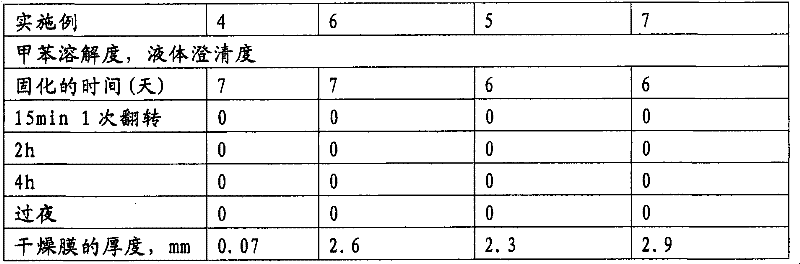
实施例8-10表明,可以具有1∶1或接近于1∶1(例如1∶2或2∶1)的混合比的两部分组合物形式制备组合物。在不希望束缚于理论的情况下,认为这是有益的,因为这些混合比在混合比的容限方面比RTV两部分产品更宽大,其中后者典型地具有10∶1的基础成分与催化剂的混合比。Examples 8-10 demonstrate that the compositions can be prepared as two-part compositions with a mixing ratio of 1:1 or close to 1:1 (eg, 1:2 or 2:1). Without wishing to be bound by theory, this is believed to be beneficial because these mix ratios are more lenient in the tolerance of mix ratios than RTV two-part products, which typically have a 10:1 ratio of base to catalyst. mixing ratio.
当以1∶1的体积或2∶1的重量混合比混合时,实施例8(混合)、9(混合)和10(混合)得到良好的产物。在1∶1体积比的实施例中,没有列出配制剂数据,因为数据是未知的,但可以重量为基础制备各部分,且认为在1∶1体积基础下混合被视为这两部分的比重。表6-两部分组合物
还测试以1∶1的体积为基础混合的实施例8、9和10的挠性。在-30℃下进行芯轴弯曲试验,ASTM 3111。将芯轴和每一样品的试样放置在-30℃下的冷冻器内30分钟。每一试样的尺寸为8×22mm和厚度为3mm。一旦取出样品和棒,则在棒上立即弯曲样品并观察任何裂纹或变化。所有样品容易弯曲且没有显示出龟裂迹象。Examples 8, 9 and 10 mixed on a 1:1 volume basis were also tested for flexibility. Mandrel bend test at -30°C, ASTM 3111. The mandrel and specimen of each sample were placed in the freezer at -30°C for 30 minutes. The dimensions of each sample were 8 x 22 mm and the thickness was 3 mm. Once the sample and rod are removed, the sample is immediately bent on the rod and observed for any cracks or changes. All samples flexed easily and showed no signs of cracking.
实施例11和12-可商购的“可固化”和“结构”PIB/丁基材料 Examples 11 and 12 - Commercially Available "Curable" and "Structural" PIB/Butyl Materials
实施例11 Delchem D-2000(以反应性Hot Melt Butyl IGSealant形式作广告)、实施例12 Delchem D130 HM Butyl(以针对Intercept


实施例14-17-形成原始强度 Examples 14-17 - Formation of raw strength
快速形成原始强度是理想的,因为它可允许在生产线最后和早期运输IG单元时处理密封的IG单元(可使该单元有序和快速地运输)。在不希望束缚于理论的情况下,认为微晶蜡提供密封剂优良的原始强度,即随着温度下降,组合物的粘度强烈增加。Rapid green strength development is desirable because it allows handling of sealed IG units at the end of the production line as well as early in the shipping of IG units (allowing orderly and rapid shipping of the units). Without wishing to be bound by theory, it is believed that the microcrystalline wax provides the sealant with excellent green strength, ie the viscosity of the composition increases strongly as the temperature decreases.
实施例15意证明在没有影响固化开始,从而扰乱原始强度的情况下,材料的原始强度或固化之前的强度的形成。因此,实施例15是没有添加锡催化剂来延迟固化开始的另一可固化的配制剂。根据ASTM D816-82(1993)e1,D1002-94,使用玻璃板并在加热区域内施加加热的材料,测量搭接剪切强度。样品产生20.4psi的搭接剪切值。在没有锡催化剂的情况下制备实施例16,并得到22.7psi的搭接剪切值。实施例14与实施例16相同,所不同的是添加锡催化剂。实施例14在固化7天之后,产生36.7psi的搭接剪切值。相比之下,获自

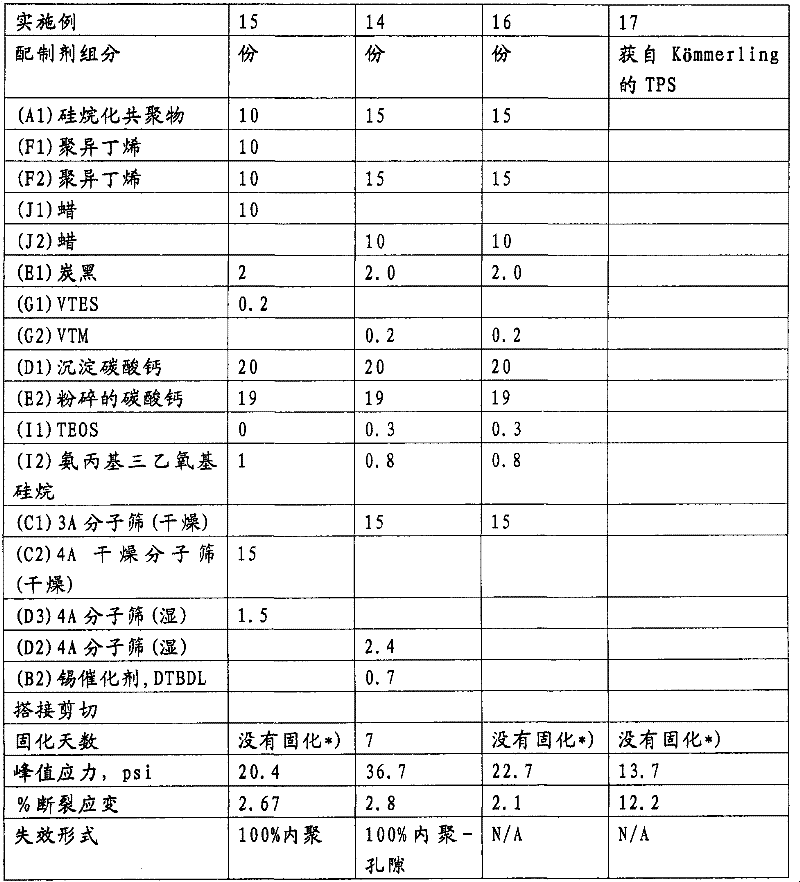
实施例18-尽管存在蜡时的冷挠性 Example 18 - Cold Flexibility Despite Wax
以1∶1体积为基础混合A和B部分的实施例18在7天固化之后显示出78.4psi的搭接剪切值和甚至在-31℃下4.6%应变。类似于前面的实施例8-10中所述的方法,再次使用炭黑的母炼胶,在单独的部分内制备样品,但在此处的情况下,还添加抗氧化剂到这一共混物中。根据ASTM D816-82(1993)e1,D1002-94,在1英寸×3英寸的两片玻璃上通过标准的方式制备搭接剪切试样,其中粘合剂的粘合层厚度为0.25英寸。混合该材料,并在于94℃的烘箱内加热的同时,通过两部分的50cc混合体系,施加到玻璃上,所述混合体系使用17个元件的静态混合器。表9-两部分组合物
实施例19-在连续的配混器上制备的两部分配制剂 Example 19 - Two-part formulation prepared on a continuous compounder
在COPERION 25mm共旋转的完全啮合式双螺杆挤出机,12机筒长(48∶1长度∶直径,L∶D之比)上配混表10所示的两部分组合物。表10-两部分组合物
通过在机筒1内,借助Bonnot泵和用于计量的齿轮泵,喂入成分(A1),制备B部分。在机筒3内添加成分(J2)和(L1)。在玻璃器皿内通过人工摇动,预混成分(I4)、(G2)、(G3)、(K1)、(K2)和(B2),然后借助高压双活塞(HPLC)泵添加在机筒5内。在机筒7处施加真空,以汽提掉甲醇。在机筒9内添加成分(C1)。在机筒11内施加真空。在机筒12末端挤出所得混合物。Part B is prepared by feeding ingredient (A1 ) in barrel 1 by means of a Bonnot pump and a gear pump for metering. In barrel 3, ingredients (J2) and (L1) are added. Premix components (I4), (G2), (G3), (K1), (K2) and (B2) by manual shaking in a glass vessel and add to barrel 5 with the aid of a high-pressure dual piston (HPLC) pump . Vacuum was applied at barrel 7 to strip the methanol. Ingredient (C1) is added in barrel 9. A vacuum is applied inside the barrel 11 . The resulting mixture is extruded at the end of barrel 12 .
对于A部分来说,挤出机在200-600rpm下运转,和对于B部分来说在100-400rpm下运转(机器能力为0-1200rpm)。当制备A部分时,沿着机器的长度,温度分布型90-120℃(一半的长度为90℃和其余为120℃)。当制备B部分时,对于整个机器长度来说,温度分布型典型地为90℃。The extruder was run at 200-600 rpm for part A and 100-400 rpm for part B (machine capacity 0-1200 rpm). When making Part A, the temperature profile was 90-120°C along the length of the machine (90°C for half the length and 120°C for the rest). When making Part B, the temperature profile is typically 90°C for the entire machine length.
将A和B部分包装在500ml“腊肠状”容器内。通过两部分混合和计量机器,将A和B部分混合在一起。通过将两部分喂入到加热的静态混合器(长度80cm,最小15个静态混合元件)的液压机,将腊肠状容器喂入到加压至约280 105Pa的两个圆筒内,并从那儿进入到齿轮泵,然后进入到Bystronic TPS施涂头(它具有5.8mm x 18mm的挤出模头)内。该设备设定在90℃的施加温度下。表11中是施加设备的进一步实验条件。表11-施加试验的实验条件 Parts A and B are packaged in 500ml "sausage-like" containers. With a two-part mixing and metering machine, mix parts A and B together. The sausage-shaped container was fed into two cylinders pressurized to about 280 10 5 Pa by feeding the two parts to a heated static mixer (length 80 cm, minimum 15 static mixing elements) hydraulic press, and from From there it goes to a gear pump and then into a Bystronic TPS applicator head (which has a 5.8mm x 18mm extrusion die). The equipment was set at an application temperature of 90°C. In Table 11 are further experimental conditions for the application equipment. Table 11 - Experimental conditions for application tests
采用>15个静态混合元件,实现两部分的优良混合(通过切割经过本体混合材料约1/3,然后通过牵拉开绳股延长切割部分来肉眼判断)。在90℃下,通过混合两部分制备的组合物很好地挤出(除了在施加设备上实现的低挤出速度(约100g/min)以外)。该组合物在玻璃上具有良好的润湿性(透过玻璃,通过肉眼观察玻璃/密封剂界面来判断)和当在90℃下热施加时在玻璃上具有良好的粘性。当在较低温度(30-40℃)下施加到冷玻璃表面上时,组合物仍然显示出可接受的粘性。该组合物还具有良好的自粘合性(最新施加的热材料粘合到前面施加的冷材料上)。With >15 static mixing elements, good mixing of the two parts was achieved (visually judged by cutting about 1/3 of the material through the bulk mix and then extending the cut by pulling apart the strands). At 90°C, the composition prepared by mixing the two parts extruded well (except for the low extrusion speed (approximately 100 g/min) achieved on the application equipment). The composition has good wettability on glass (through glass, as judged by visual inspection of the glass/sealant interface) and good adhesion on glass when applied hot at 90°C. The composition still exhibited acceptable tack when applied to cold glass surfaces at lower temperatures (30-40°C). The composition also has good self-adhesion (newly applied hot material adheres to previously applied cold material).
在90℃和30 105Pa的压力下固化组合物的2mm厚的片材40分钟。之后,当绕芯轴弯曲90°时,所得固化产物显示出在1分钟内几乎100%的弹性恢复。当在室温下,在甲苯中且在每日反复剧烈摇动的情况下储存1周时,固化产物没有溶解。A 2 mm thick sheet of the composition was cured at 90° C. and a pressure of 30 10 5 Pa for 40 minutes. Afterwards, the resulting cured product exhibited almost 100% elastic recovery within 1 minute when bent at 90° around the mandrel. The solidified product did not dissolve when stored at room temperature in toluene for 1 week with repeated vigorous shaking daily.
实施例19-在连续配混器上制备的两部分配制剂 Example 19 - Two-part formulation prepared on a continuous compounder
在COPERION 25mm共旋转的充分啮合式双螺杆挤出机,12个机筒长(48∶1的长度∶直径,L∶D之比)上配混表12所示的两部分组合物。表12-两部分组合物
借助Bonnot泵和用于计量的齿轮泵,通过在挤出机的第一机筒内喂入成分(F4),制备A部分。在第三机筒内添加成分(J2)和(L1)。通过在塑料袋内摇动这些成分,制备22份成分(D1)和15份成分(E1)的预混物。在挤出机的第九机筒内添加该预混物。在第六机筒内添加其余15份成分(E1)。在第十一机筒内施加真空。在第十二机筒的末端挤出所得混合物。Part A was prepared by feeding the ingredients (F4) in the first barrel of the extruder by means of a Bonnot pump and a gear pump for metering. In the third barrel, ingredients (J2) and (L1) were added. A premix of 22 parts of ingredient (D1 ) and 15 parts of ingredient (E1 ) was prepared by shaking the ingredients in a plastic bag. The premix was added in the ninth barrel of the extruder. The remaining 15 parts of ingredients (E1) are added in the sixth barrel. A vacuum is applied in the eleventh barrel. The resulting mixture is extruded at the end of the twelfth barrel.
借助Bonnot泵和用于计量的齿轮泵,通过在机筒1内喂入成分(A1),制备B部分。在机筒3内添加成分(J2)和(L1)。在玻璃器皿内通过人工摇动,预混成分(I4)、(G2)、(G3)、(K1)、(K2)和(B2),然后借助高压(HPLC)泵在机筒5内加入。在机筒7处施加真空,以汽提掉甲醇。在机筒9内添加成分(C1)。在机筒11内施加真空。在机筒12的末端挤出所得混合物。Part B is prepared by feeding ingredient (A1 ) in barrel 1 by means of a Bonnot pump and a gear pump for metering. In barrel 3, ingredients (J2) and (L1) are added. Components (I4), (G2), (G3), (K1), (K2) and (B2) were premixed by manual shaking in a glass vessel and then added in barrel 5 by means of a high pressure (HPLC) pump. Vacuum was applied at barrel 7 to strip the methanol. Ingredient (C1) is added in barrel 9. A vacuum is applied inside the barrel 11 . The resulting mixture is extruded at the end of barrel 12 .
对于A部分来说,挤出机在200-600rpm下运转,和对于B部分来说在100-400rpm下运转(机器能力为0-1200rpm)。当制备A部分时,沿着机器的长度,温度分布型为90-120℃(一半的长度为90℃和其余为120℃)。当制备B部分时,对于整个机器长度来说,温度曲线分布型地为90℃。The extruder was run at 200-600 rpm for part A and 100-400 rpm for part B (machine capacity 0-1200 rpm). When making Part A, the temperature profile was 90-120°C along the length of the machine (90°C for half the length and 120°C for the rest). When making Part B, the temperature profile was profiled at 90°C for the entire machine length.
将A和B部分包装在500ml“腊肠状”容器内。通过两部分混合和计量机器,将A和B部分混合在一起。通过将这两部分喂入到加热的静态混合器(长度80cm,最小15个静态混合元件)的液压机,将腊肠状容器喂入到加压至约280 105Pa的两个圆筒内,并从那儿进入到齿轮泵,然后进入到Bystronic TPS施涂头(它具有5.8mm × 18mm的挤出模头)内。该设备设定在90℃的施加温度下。表13中是施加设备的进一步实验条件。表13-施加试验的实验条件

实施例20-在连续配混器上制备的两部分配制剂 Example 20 - Two-part formulation prepared on a continuous compounder
在COPERION 25mm共旋转的充分啮合式双螺杆挤出机,12个机筒长(48∶1的长度∶直径,L∶D之比)上配混表14所示的两部分组合物。表14-两部分组合物
通过预混成分(J2)和(F5),并采用重力型单螺杆挤出机(K-Tron),将它们计量到第一机筒内,制备A部分。在头两个机筒内混合并捏和该材料,之后使用Bonnot泵结合齿轮泵,泵送并计量30-50%成分(F3)到第三机筒内。彻底混合这些成分,之后使用HPLC泵、静态混合器和高压注射阀,将成分(I4)和(B2)注入到第四机筒内。再次,彻底混合这些材料,之后添加成分(C3)和(E1),这两种成分被预混并使用双螺杆喂料器(Brabender)以及双螺杆侧供料器(Coperion)喂入。将该材料掺入到共混物内,并使用Bonnot泵结合齿轮泵,在机筒7内添加剩余50-70%成分(F3)的余量。再次使用双螺杆喂料器(K-Tron)结合双螺杆侧供料器(Coperion)添加成分(F6)到机筒9的侧面内之前,充分地分散填料。充分地分散第二填料并在机筒11上施加真空,以除去残留的副产物和空气。在第十二机筒的末端挤出所得混合物。Part A was prepared by preblending ingredients (J2) and (F5) and metering them into the first barrel using a gravity type single screw extruder (K-Tron). The material was mixed and kneaded in the first two barrels before pumping and metering 30-50% of the ingredients (F3) into the third barrel using a Bonnot pump in combination with a gear pump. These ingredients were mixed thoroughly before ingredients (I4) and (B2) were injected into the fourth barrel using HPLC pump, static mixer and high pressure injection valve. Again, these materials were thoroughly mixed before adding ingredients (C3) and (E1 ), which were premixed and fed using a twin screw feeder (Brabender) and a twin screw side feeder (Coperion). This material was incorporated into the blend and the balance of the remaining 50-70% of the ingredient (F3) was added in barrel 7 using a Bonnot pump combined with a gear pump. The filler was well dispersed before adding the ingredients (F6) into the sides of the barrel 9 again using a twin screw feeder (K-Tron) in combination with a twin screw side feeder (Coperion). Thoroughly disperse the second filler and apply vacuum on barrel 11 to remove residual by-products and air. The resulting mixture is extruded at the end of the twelfth barrel.
通过预混成分(J2)、(F5)和(F6),并采用重力型单螺杆喂料器(K-Tron),将它们计量到第一机筒内,制备B部分。在头两个机筒内混合并捏和该材料,之后使用Bonnot泵结合齿轮泵,泵送并计量30-50%成分(A1)到第三机筒内。彻底混合这些成分,之后使用HPLC泵、静态混合器和高压注射阀,将成分(G3)、(K1)和(K2)注入到第四机筒内。再次,彻底混合这些材料,之后添加成分(D1),其中使用双螺杆喂料器(Brabender)以及双螺杆侧供料器(Coperion)喂入所述成分(D1)到机筒6的侧面内。将该材料掺入到共混物内,并使用Bonnot泵结合齿轮泵,在机筒7内添加剩余50-70%成分(A1)的余量。再次使用双螺杆喂料器(K-Tron)结合双螺杆侧供料器(Coperion)添加成分(E3)到机筒9的侧面内之前,充分地分散填料。充分地分散第二填料并在机筒11上施加真空,以除去残留的副产物和空气。在第十二机筒的末端挤出所得混合物。Part B was prepared by premixing ingredients (J2), (F5) and (F6) and metering them into the first barrel using a gravity type single screw feeder (K-Tron). The material was mixed and kneaded in the first two barrels before pumping and metering 30-50% of the ingredient (A1 ) into the third barrel using a Bonnot pump in combination with a gear pump. These ingredients were thoroughly mixed before injecting ingredients (G3), (K1 ) and (K2) into the fourth barrel using HPLC pump, static mixer and high pressure injection valve. Again, these materials were thoroughly mixed before adding ingredient (D1) which was fed into the side of barrel 6 using a twin screw feeder (Brabender) and a twin screw side feeder (Coperion). This material was incorporated into the blend and the remaining 50-70% balance of ingredient (A1 ) was added in barrel 7 using a Bonnot pump combined with a gear pump. The filler was well dispersed before adding the ingredients (E3) into the sides of the barrel 9 again using a twin screw feeder (K-Tron) in combination with a twin screw side feeder (Coperion). Thoroughly disperse the second filler and apply vacuum on barrel 11 to remove residual by-products and air. The resulting mixture is extruded at the end of the twelfth barrel.
对于A部分来说,挤出机在200-600rpm下运转,和对于B部分来说在100-400rpm下运转(机器能力为0-1200rpm)。当制备A部分时,对于整个机器长度来说,温度分布型典型地为90℃。当制备B部分时,沿着机器长度,温度分布型为120-90℃(头三个机筒在120℃下和机器的其余部分在90℃下)。The extruder was run at 200-600 rpm for part A and 100-400 rpm for part B (machine capacity 0-1200 rpm). When making Part A, the temperature profile is typically 90°C for the entire machine length. When making Part B, the temperature profile was 120-90°C along the length of the machine (the first three barrels at 120°C and the rest of the machine at 90°C).
使用长枪型填充系统,将A和B部分包装在200L转鼓内。通过两部分混合和计量机器,将A和B部分混合在一起。借助水解操作的热熔转鼓泵,使用加热的从动板,将来自转鼓的材料(A和B部分)喂入到压力圆筒(如实施例18和19中所述)内。然后通过将这两部分喂入到加热的静态混合器(长度80mm,最小15个静态混合元件)内的液压机,将这两个圆筒加压到约280 105Pa,并从那儿进入到齿轮泵内,然后进入到Bystronic TPS施涂头(它具有5.8mm×18mm的挤出模头)内。该设备设定在95℃的施加温度下。表15和16中是施加设备的进一步实验条件。表15-施加试验的实验条件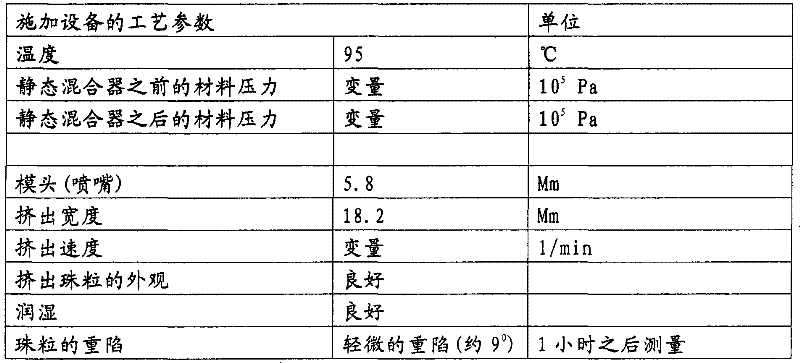
采用>15个静态混合元件,实现两部分的优良混合(通过切割经过本体混合材料约1/3,然后通过牵拉开绳股延长切割部分来肉眼判断)。在95℃下,通过混合两部分制备的组合物很好地挤出(在60rpm的齿轮泵旋转速度下,实现最大约1600g/min的挤出速度。该组合物在玻璃上具有良好的润湿性(透过玻璃,通过肉眼观察玻璃/密封剂界面来判断),和当在95℃下热施加时在玻璃上具有良好的粘性。当在较低温度(30-40℃)下施加到冷玻璃表面上时,组合物仍然显示出非常好的粘性。该组合物还具有良好的自粘合性(最新施加的热材料粘合到前面施加的冷材料上)。一直到12mm的挤出宽度,该珠粒根本没有显示出重陷。With >15 static mixing elements, good mixing of the two parts was achieved (visually judged by cutting about 1/3 of the material through the bulk mix and then extending the cut by pulling apart the strands). The composition prepared by mixing the two parts extruded well at 95°C (at a gear pump rotation speed of 60 rpm, a maximum extrusion speed of about 1600 g/min was achieved. The composition had good wetting on glass (through glass, judged by visual observation of the glass/sealant interface), and good adhesion on glass when applied hot at 95°C. When applied to cold at lower temperatures (30-40°C) The composition still exhibited very good tack when on a glass surface. The composition also had good self-adhesion (newly applied hot material bonded to previously applied cold material). Up to an extrusion width of 12mm , the beads showed no reentrapment at all.
在100℃和30 105Pa的压力下固化组合物的2mm厚的片材40分钟。之后,当通过绕芯轴弯曲90°时,所得固化产物显示出在1分钟内几乎100%的弹性恢复。当在室温下,在甲苯中且在每日反复剧烈摇动的情况下储存1周时,固化产物没有溶解。A 2 mm thick sheet of the composition was cured at 100° C. and a pressure of 30 10 5 Pa for 40 minutes. Afterwards, when bent by 90° around the mandrel, the resulting cured product showed almost 100% elastic recovery within 1 minute. The solidified product did not dissolve when stored at room temperature in toluene for 1 week with repeated vigorous shaking daily.
制备第一绝缘玻璃(IG)单元,以便评价新施加的珠粒的负载携带能力。如下所述组装IG单元:首先将12mm宽和5.8mm厚的混合材料的珠粒沿着尺寸为50×50cm2、厚度为4mm的浮选玻璃板的周边施加。之后立即对着尺寸为100×100cm2、厚度为4mm的浮选玻璃板挤压所述玻璃板与施加的珠粒在一起,其方式使得较小的玻璃板正好在较大玻璃板中间的中心。然后固定较小的玻璃板在木制定位块上,其方式使得较大的玻璃板完全没有被承载,和混合材料的珠粒必须携带未承载的玻璃板的重量。1小时之后,观察到较大玻璃板的2.5mm的最大下沉。相比之下,在相同条件下测试的新施加的TPS/硅酮二元密封剂将导致所述未承载的玻璃板最大3-4mm的下沉。A first insulating glass (IG) unit was prepared in order to evaluate the load carrying capacity of the freshly applied beads. The IG unit was assembled as follows: firstly beads of mixed material 12 mm wide and 5.8 mm thick were applied along the perimeter of a flotation glass plate measuring 50 x 50 cm2 and 4 mm thick. Immediately thereafter, said glass plate is pressed together with the applied beads against a flotation glass plate measuring 100 x 100 cm2 and 4 mm thick in such a way that the smaller glass plate is exactly centered in the middle of the larger glass plate . The smaller glass panes are then secured to the wooden spacers in such a way that the larger glass panes are completely unloaded, and the beads of mixed material must carry the weight of the unloaded glass panes. After 1 hour, a maximum sinking of 2.5 mm was observed for the larger glass plate. In contrast, a freshly applied TPS/silicone dual sealant tested under the same conditions would cause a maximum 3-4mm sag of the unsupported glass pane.
制备第二绝缘玻璃(IG)单元,以便评价新施加的珠粒的起始粘合性(粘性)。如下所述组装IG单元:首先将12mm宽和5.8mm厚的混合材料的珠粒沿着尺寸为35×55cm2、厚度为4mm的浮选玻璃板四周施加。之后立即对着尺寸为35×55cm2、厚度为4mm的浮选玻璃板挤压所述玻璃板与施加的珠粒在一起。在允许该材料冷却1小时之后,根据欧洲标准EN 1279 Part 6(2002)的附录F4.2 Butterfly Test,通过在IG单元上进行蝶形试验,测试该材料的起始粘合性(粘性)。通过在没有观察到密封剂材料的粘合性的任何损失情况下旋转浮选玻璃的两块切片180°,进行蝶形试验。A second insulating glass (IG) unit was prepared to evaluate the initial adhesion (tack) of the freshly applied beads. The IG unit was assembled as follows: firstly beads of mixed material 12 mm wide and 5.8 mm thick were applied around the perimeter of a flotation glass plate measuring 35 x 55 cm2 and 4 mm thick. Immediately thereafter, said glass plate is pressed together with the applied beads against a flotation glass plate measuring 35×55 cm 2 and having a thickness of 4 mm. After allowing the material to cool for 1 hour, the initial adhesion (tack) of the material was tested by performing a butterfly test on an IG unit according to Annex F4.2 Butterfly Test of European Standard EN 1279 Part 6 (2002). The butterfly test was performed by rotating two slices of flotation glass through 180° without observing any loss of adhesion of the sealant material.
通过保持在95℃下加热的转鼓16小时,测试材料组分(A和B部分)的稳定性。之后,在这一实施例中,如前面所述测试挤出速度。观察到挤出速度没有变化。The stability of the material components (Parts A and B) was tested by keeping the drum heated at 95°C for 16 hours. Afterwards, in this example, the extrusion speed was tested as previously described. No change in extrusion speed was observed.
Claims (16)
Applications Claiming Priority (3)
| Application Number | Priority Date | Filing Date | Title |
|---|---|---|---|
| US81804606P | 2006-07-03 | 2006-07-03 | |
| US60/818,046 | 2006-07-03 | ||
| PCT/US2007/014669 WO2008005214A2 (en) | 2006-07-03 | 2007-06-25 | Chemically curing all-in-one warm edge spacer and seal |
Publications (2)
| Publication Number | Publication Date |
|---|---|
| CN101484502A CN101484502A (en) | 2009-07-15 |
| CN101484502B true CN101484502B (en) | 2012-05-30 |
Family
ID=38895083
Family Applications (1)
| Application Number | Title | Priority Date | Filing Date |
|---|---|---|---|
| CN2007800253766A Expired - Fee Related CN101484502B (en) | 2006-07-03 | 2007-06-25 | Chemically curing all-in-one warm edge spacer and seal |
Country Status (11)
| Country | Link |
|---|---|
| US (1) | US8101251B2 (en) |
| EP (1) | EP2041204B9 (en) |
| JP (1) | JP5143835B2 (en) |
| KR (1) | KR101322672B1 (en) |
| CN (1) | CN101484502B (en) |
| AT (1) | ATE456603T1 (en) |
| DE (1) | DE602007004616D1 (en) |
| ES (1) | ES2339996T3 (en) |
| PL (1) | PL2041204T3 (en) |
| RU (1) | RU2448127C2 (en) |
| WO (1) | WO2008005214A2 (en) |
Families Citing this family (80)
| Publication number | Priority date | Publication date | Assignee | Title |
|---|---|---|---|---|
| US9115272B2 (en) | 2007-09-20 | 2015-08-25 | Adco Products Llc | Edge sealants having balanced properties |
| WO2011068597A1 (en) * | 2009-10-14 | 2011-06-09 | Adco Products, Inc. | Use of calcium oxide as a water scavenger in solar module applications |
| DE102007051610A1 (en) * | 2007-10-24 | 2009-04-30 | Lenhardt Maschinenbau Gmbh | Device for injecting a strand of a pasty mass into the space between two glass plates of an insulating glass pane |
| EP2262970A1 (en) | 2008-02-19 | 2010-12-22 | Plus Inventia AG | Spacer having a drying agent for an insulated glass pane |
| US8615883B2 (en) | 2008-04-11 | 2013-12-31 | Plus Inventia Ag | Method for producing a corner of a frame-shaped spacer for insulating glass panes and spacer and insulating glass panes produced according the method |
| CA2752683A1 (en) | 2009-02-18 | 2010-08-26 | Plus Inventia Ag | Spacer for insulating glass panes |
| DE102009024939A1 (en) * | 2009-06-09 | 2010-12-23 | Bystronic Lenhardt Gmbh | Method and device for preparing a pasty mass for sealing an insulating glass pane |
| KR101780631B1 (en) * | 2009-10-14 | 2017-09-21 | 에이디씨오 프로덕츠 엘엘씨 | Edge sealants having balanced properties |
| EP2532025A4 (en) * | 2010-02-02 | 2013-07-17 | Adco Products Inc | COATING COMPOUND FOR PROTECTION FROM MOISTURE |
| JP5908885B2 (en) * | 2010-03-27 | 2016-04-26 | エス.ジョーンズ ロバート | Vacuum insulated glass unit with a viscous end seal |
| US8629209B2 (en) * | 2010-12-02 | 2014-01-14 | 3M Innovative Properties Company | Moisture curable isobutylene adhesive copolymers |
| EP2465895B1 (en) | 2010-12-15 | 2014-07-16 | Merz+Benteli AG | Heat curable adhesive, sealant and coating |
| JP2014509683A (en) | 2011-03-31 | 2014-04-21 | ダウ コーニング コーポレーション | Compositions containing phosphate catalysts and methods for preparing and using the compositions |
| WO2012134784A1 (en) | 2011-03-31 | 2012-10-04 | Dow Corning Corporation | Compositions containing phosphonate catalysts and methods for the preparation and use of the compositions |
| EP2691468A1 (en) | 2011-03-31 | 2014-02-05 | Dow Corning Corporation | Compositions containing sulfonic acid catalysts and methods for the preparation and use of the compositions |
| EP2729260A1 (en) * | 2011-07-06 | 2014-05-14 | Dow Global Technologies LLC | Optoelectronic devices incorporating fluoropolymer compositions for protection |
| WO2013009840A1 (en) | 2011-07-12 | 2013-01-17 | Dow Corning Corporation | Lanthanide complexes with imidazole ligands for condensation reactions |
| JP2014530918A (en) | 2011-07-12 | 2014-11-20 | ダウ コーニング コーポレーションDowcorning Corporation | Complex containing samarium and condensation reaction catalyst, method for preparing the catalyst, and composition containing the catalyst |
| US20150152301A1 (en) | 2011-07-19 | 2015-06-04 | Dow Corning Corporation | Copper Containing Complex, Condensation Reaction Compositions Containing the Complex, and Methods for the Preparation and Use of the Compositions |
| JP5852239B2 (en) | 2011-07-20 | 2016-02-03 | ダウ コーニング コーポレーションDow Corning Corporation | Zinc-containing complex and condensation reaction catalyst, process for preparing the catalyst, and composition containing the catalyst |
| WO2013013109A1 (en) | 2011-07-21 | 2013-01-24 | Dow Corning Corporation | Germanium containing complex and condensation reaction curable compositions and methods for the preparation and use of the compositions |
| WO2013013111A1 (en) | 2011-07-21 | 2013-01-24 | Dow Corning Corporation | Yttrium containing complex and condensation reaction catalysts, methods for preparing the catalysts, and compositions containing the catalysts |
| WO2013016508A1 (en) | 2011-07-28 | 2013-01-31 | Dow Corning Corporation | Nickel containing complex and condensation reaction catalysts, methods for preparing the catalysts, and compositions containing the catalysts |
| EP2744848A1 (en) | 2011-08-05 | 2014-06-25 | Dow Corning Corporation | Filled silicone compositions, preparations and uses thereof |
| WO2013025887A2 (en) | 2011-08-17 | 2013-02-21 | Dow Corning Corporation | Bismuth containing complex and condensation reaction catalysts, methods for preparing the catalysts, and compositions containing the catalysts |
| EP2753655B1 (en) | 2011-09-07 | 2019-12-04 | Dow Silicones Corporation | Titanium containing complex and condensation reaction catalysts, methods for preparing the catalysts, and compositions containing the catalysts |
| JP2014525513A (en) | 2011-09-07 | 2014-09-29 | ダウ コーニング コーポレーション | Hafnium-containing complex and condensation reaction catalyst, method for preparing the catalyst, and composition containing the catalyst |
| WO2013036548A2 (en) | 2011-09-07 | 2013-03-14 | Dow Corning Corporation | Zirconium containing complex and condensation reaction catalysts, methods for preparing the catalysts, and compositions containing the catalysts |
| WO2013037105A1 (en) | 2011-09-13 | 2013-03-21 | Dow Corning (China) Holding Co., Ltd. | Filled silicone composition, preparation and uses thereof |
| CN103814040B (en) | 2011-09-20 | 2016-08-31 | 道康宁公司 | Nickel-containing hydrosilylation catalyst and composition containing same |
| WO2013043787A2 (en) | 2011-09-20 | 2013-03-28 | Dow Corning Corporation | Ruthenium containing hydrosilylation catalysts and compositions containing the catalysts |
| JP6117210B2 (en) | 2011-09-20 | 2017-04-19 | ダウ コーニング コーポレーションDow Corning Corporation | Hydrosilylation catalyst containing iridium and composition containing the catalyst |
| US9139699B2 (en) | 2012-10-04 | 2015-09-22 | Dow Corning Corporation | Metal containing condensation reaction catalysts, methods for preparing the catalysts, and compositions containing the catalysts |
| WO2013052585A2 (en) | 2011-10-04 | 2013-04-11 | Dow Corning Corporation | Iron(iii) containing complex and condensation reaction catalysts, methods for preparing the catalysts, and compositions containing the catalysts |
| EP2785454B1 (en) | 2011-12-01 | 2019-10-09 | Dow Silicones Corporation | Hydrosilylation reaction catalysts and curable compositions and methods for their preparation and use |
| KR20140106641A (en) | 2011-12-06 | 2014-09-03 | 다우 코닝 코포레이션 | Curable silicone composition, cured material, manufactured articles, methods and uses |
| WO2013164413A1 (en) | 2012-05-03 | 2013-11-07 | Henkel Ag & Co. Kgaa | Two-component hot-melt adhesive |
| US20130319598A1 (en) | 2012-05-30 | 2013-12-05 | Cardinal Ig Company | Asymmetrical insulating glass unit and spacer system |
| US20140186250A1 (en) * | 2012-07-19 | 2014-07-03 | The United States Of America | Carbonyl functionalized porous inorganic oxide adsorbents and methods of making and using the same |
| WO2014021980A1 (en) | 2012-07-30 | 2014-02-06 | Dow Corning Corporation | Thermally conductive condensation reaction curable polyorganosiloxane composition and methods for the preparation and use of the composition |
| WO2014051674A1 (en) | 2012-09-26 | 2014-04-03 | Dow Corning Corporation | Rubber article with elastomeric silicone coating |
| US9441086B2 (en) | 2012-12-20 | 2016-09-13 | Dow Corning Corporation | Curable silicone compositions, electrically conductive silicone adhesives, methods of making and using same, and electrical devices containing same |
| WO2014159792A1 (en) | 2013-03-14 | 2014-10-02 | Dow Corning Corporation | Curable silicone compositions, electrically conductive silicone adhesives, methods of making and using same, and electrical devices containing same |
| WO2014150302A1 (en) | 2013-03-14 | 2014-09-25 | Dow Corning Corporation | Conductive silicone materials and uses |
| CN105229056B (en) | 2013-03-28 | 2017-11-28 | 道康宁公司 | Organosiloxane compositions and coatings, articles of manufacture, methods and uses |
| WO2015020689A1 (en) | 2013-08-06 | 2015-02-12 | Dow Corning Corporation | Catalysts, compositions containing the catalysts, and methods for the preparation thereof |
| HRP20170648T4 (en) | 2013-11-28 | 2022-11-25 | PAN-DUR Holding GmbH & Co. KG | Glass assembly |
| WO2015086457A2 (en) * | 2013-12-12 | 2015-06-18 | Saint-Gobain Glass France | Double glazing having improved sealing |
| PL3212728T3 (en) * | 2014-10-29 | 2019-02-28 | Tesa Se | Adhesive compounds comprising multi-functional siloxane water scavengers |
| JP6499490B2 (en) * | 2015-04-02 | 2019-04-10 | アイカ工業株式会社 | Hot melt seal composition |
| US20160326408A1 (en) * | 2015-05-08 | 2016-11-10 | Henkel lP & Holding GmbH | Moisture curable hot melt adhesive with high adhesion strength and fast set time |
| CN107922621B (en) | 2015-07-27 | 2021-05-14 | 美国道康宁公司 | Polyorganosiloxane composition with metal-based N-heterocyclic carbene condensation reaction catalyst and method of making the same |
| DE102015122882A1 (en) * | 2015-12-29 | 2017-06-29 | Bystronic Lenhardt Gmbh | Method for forming a closed frame-shaped spacer for an insulating glass pane |
| JP6731872B2 (en) * | 2016-03-29 | 2020-07-29 | アイカ工業株式会社 | Hot melt seal composition |
| JP7168314B2 (en) * | 2016-11-30 | 2022-11-09 | 日東電工株式会社 | Adhesive composition, adhesive layer and adhesive sheet |
| WO2018160373A1 (en) | 2017-02-28 | 2018-09-07 | Dow Silicones Corporation | Dual cure polyorganosiloxane composition and methods for its preparation and use |
| US10968317B2 (en) | 2017-06-26 | 2021-04-06 | Dow Silicones Corporation | Method for hydrosilylation of aliphatically unsaturated alkoxysilanes and hydrogen terminated organosiloxane oligomers to prepare alkoxysilyl terminated polymers useful for functionalizing polyorganosiloxanes using an iridium catalyst |
| CN110997838B (en) | 2017-06-26 | 2021-10-01 | 美国陶氏有机硅公司 | Silicone-polyether copolymers, sealants including silicone-polyether copolymers, and related methods |
| CN110799575B (en) | 2017-06-26 | 2022-02-22 | 美国陶氏有机硅公司 | Process for preparing alkoxy-functional organohydrogensiloxane oligomers |
| WO2019005710A1 (en) | 2017-06-26 | 2019-01-03 | Dow Silicones Corporation | Method for hydrosilylation of aliphatically unsaturated alkoxysilanes and hydrogen terminated organosiloxane oligomers to prepare alkoxysilyl terminated polymers useful for functionalizing polyorganosiloxanes using a rhodium catalyst |
| EP3540006A1 (en) * | 2018-03-16 | 2019-09-18 | Bostik Sa | Hot melt sealant composition |
| US11760841B2 (en) | 2018-12-21 | 2023-09-19 | Dow Silicones Corporation | Silicone-polycarbonate copolymer, sealants comprising same, and related methods |
| EP3898779B1 (en) | 2018-12-21 | 2023-02-08 | Dow Silicones Corporation | Silicone-polyester copolymer, sealants comprising same, and related methods |
| CA3122280A1 (en) | 2018-12-21 | 2020-06-25 | Dow Silicones Corporation | Silicone-polyacrylate copolymer, sealants comprising same, and related methods |
| KR102811805B1 (en) | 2018-12-21 | 2025-05-27 | 다우 실리콘즈 코포레이션 | Silicone-organic copolymer, sealant comprising the same, and related methods |
| CN113950511B (en) | 2019-06-21 | 2024-01-16 | 美国陶氏有机硅公司 | Methods for preparing thixotropic silicone compositions |
| CN113950513B (en) | 2019-06-21 | 2024-11-05 | 美国陶氏有机硅公司 | Thermally conductive silicone composition |
| DE102019123700A1 (en) | 2019-09-04 | 2021-03-04 | Bystronic Lenhardt Gmbh | Method and device for assembling insulating glass panes and insulating glass panes produced thereby |
| DE102019123696A1 (en) | 2019-09-04 | 2021-03-04 | Bystronic Lenhardt Gmbh | Method and device for assembling insulating glass panes and insulating glass panes produced thereby |
| WO2021050325A1 (en) | 2019-09-11 | 2021-03-18 | Dow Silicones Corporation | Method for the preparation of an alkoxy-functional organohydrogensiloxane oligomer and use of said oligomer |
| JP7062837B2 (en) | 2019-09-11 | 2022-05-06 | ダウ シリコーンズ コーポレーション | Preparation and use of alkoxy-functional organohydrogensiloxane oligomers using purified starting materials and use of oligomers |
| EP3800226A1 (en) * | 2019-10-04 | 2021-04-07 | Sika Technology Ag | Moisture curable hot-melt adhesive with improved curing properties |
| KR102300607B1 (en) * | 2020-03-23 | 2021-09-10 | 주식회사 엘티웰 | Manuracturing device of thermal insulation spacer and manufacturing method of the same |
| US11214666B2 (en) * | 2020-04-15 | 2022-01-04 | Prc-Desoto International, Inc. | Controlling cure rate with wetted filler |
| JP7725743B2 (en) | 2022-05-04 | 2025-08-19 | ダウ シリコーンズ コーポレーション | Silicone polyether copolymers, sealants containing same, and related methods |
| DE102022128190A1 (en) * | 2022-10-25 | 2024-04-25 | SAS Chemicals GmbH | Sealant composition for multi-pane insulating glass |
| WO2024196439A1 (en) | 2023-03-20 | 2024-09-26 | Dow Global Technologies Llc | Alkoxy-functional silsesquioxane resin and processes for the preparation and use thereof |
| WO2025193391A1 (en) | 2024-03-12 | 2025-09-18 | Dow Global Technologies Llc | Curable aldehyde – aminosiloxane ester composition and method for its preparation |
| WO2025254798A1 (en) | 2024-06-04 | 2025-12-11 | Dow Global Technologies Llc | Aldehyde – amine curable polyorganosiloxane composition and methods for the preparation and use thereof |
| WO2025254797A1 (en) | 2024-06-04 | 2025-12-11 | Dow Global Technologies Llc | Aldehyde – diamine curable polyorganosiloxane composition and methods for the preparation and use thereof |
Citations (2)
| Publication number | Priority date | Publication date | Assignee | Title |
|---|---|---|---|---|
| EP0839872B1 (en) * | 1996-11-01 | 2003-03-12 | Kaneka Corporation | Curable polymer having reactive silicon-containing functional groups |
| US20040132949A1 (en) * | 2002-06-18 | 2004-07-08 | Roesler Richard R. | Polyether urethanes containing one reactive silane group and their use in moisture-curable polyether urethanes |
Family Cites Families (99)
| Publication number | Priority date | Publication date | Assignee | Title |
|---|---|---|---|---|
| US4215164A (en) | 1970-06-25 | 1980-07-29 | Ppg Industries, Inc. | Multiple glazed unit |
| US3758996A (en) | 1972-05-05 | 1973-09-18 | Ppg Industries Inc | Multiple glazed unit |
| FR2211413B1 (en) | 1972-12-21 | 1977-02-25 | Saint Gobain | |
| FR2294140A1 (en) | 1974-12-11 | 1976-07-09 | Saint Gobain | METHOD AND DEVICE FOR PLACING AN INTERCAL CORD AT THE ANGLES OF A MULTIPLE WINDOW |
| US4186685A (en) | 1974-12-11 | 1980-02-05 | Saint-Gobain Industries | Apparatus for applying a thick seal to a glass sheet |
| US4205104A (en) | 1974-12-11 | 1980-05-27 | Saint Gobain Industries | Multiple pane window having a thick seal and a process and apparatus for applying the seal |
| FR2317465A1 (en) | 1975-07-10 | 1977-02-04 | Saint Gobain | IMPROVEMENT IN THE INSTALLATION OF INTERCALAR SEALS OF MULTIPLE WINDOWS |
| GB1589878A (en) | 1976-11-26 | 1981-05-20 | Bfg Glassgroup | Method of manufacturing a hollow panel |
| SU804669A1 (en) | 1978-07-31 | 1981-02-15 | Научно-Исследовательский Институтстроительного Производства Госстрояукраинской Ccp | Two-component mastic hermetic and its preparation method |
| CA1280568C (en) | 1984-07-10 | 1991-02-26 | Karl Lenhardt | Preparation of a plastic material to be extruded in the shape of a dimensioned strand for use as an insert for multiple glazing |
| EP0178751B1 (en) | 1984-07-26 | 1988-12-07 | Dow Corning Limited | Silicone elastomers with good adhesion |
| FR2570366B1 (en) | 1984-09-17 | 1991-10-04 | Saint Gobain Vitrage | METHOD AND INSTALLATION FOR EXTRUDING A PLASTIC MATERIAL OF THE BUTYL RUBBER TYPE AND APPLICATION TO THE MANUFACTURE OF MULTIPLE WINDOWS |
| JPS61141761A (en) | 1984-12-12 | 1986-06-28 | Kanegafuchi Chem Ind Co Ltd | Curable composition |
| US4622249A (en) | 1985-04-15 | 1986-11-11 | Ppg Industries, Inc. | Multiple pane unit having a flexible spacing and sealing assembly |
| CA1274647A (en) | 1986-06-25 | 1990-09-25 | Takahisa Iwahara | Curable isobutylene polymer |
| GB2202539B (en) | 1987-01-28 | 1991-07-03 | Du Pont Canada | Polyolefin concentrate |
| JP2512468B2 (en) | 1987-04-13 | 1996-07-03 | 鐘淵化学工業株式会社 | Curable resin composition |
| CA1312409C (en) | 1987-10-16 | 1993-01-05 | Masayoshi Imanaka | Sealant for double-layered glass |
| US5162445A (en) | 1988-05-27 | 1992-11-10 | Exxon Chemical Patents Inc. | Para-alkylstyrene/isoolefin copolymers and functionalized copolymers thereof |
| US4808664A (en) | 1987-12-11 | 1989-02-28 | Dow Corning Corporation | Moisture curable polyisobutylenes |
| US5250607A (en) | 1988-01-05 | 1993-10-05 | Norton Company | Moisture cured elastomeric interpenetrating network sealants |
| DE3809301A1 (en) | 1988-03-19 | 1989-09-28 | Ver Glaswerke Gmbh | INSULATED GLASS PANEL |
| SU1706986A1 (en) * | 1988-05-27 | 1992-01-23 | А.А.Воробьев | Compound for internal polymer film in multilayer glass |
| US5459174A (en) | 1988-05-27 | 1995-10-17 | Merrill; Natalie A. | Radiation curable isoolefin copolymers |
| DE3830866A1 (en) | 1988-09-10 | 1990-03-15 | Lenhardt Maschinenbau | METHOD FOR ASSEMBLING TWO GLASS PANELS TO AN INSULATED GLASS PANEL |
| US4962076A (en) | 1988-11-28 | 1990-10-09 | Dow Corning Corporation | Silicone sealants having reduced color |
| DE3843400A1 (en) | 1988-12-23 | 1990-06-28 | Ppg Glastechnik Gmbh | INSULATED GLASS PANEL |
| JP2717719B2 (en) | 1989-02-28 | 1998-02-25 | 鐘淵化学工業株式会社 | Organic polymer, production method thereof and curable composition using the same |
| FR2646425B1 (en) | 1989-04-26 | 1991-08-30 | Neosystem Sa | SYNTHETIC PEPTIDES OF THE CONJUGATE OF UBIQUITINE AND HISTONE H2A |
| ATE127819T1 (en) | 1989-07-10 | 1995-09-15 | Mitsui Petrochemical Ind | METHOD FOR PRODUCING AN ELASTOMER COMPOSITION AND ELASTOMER COMPOSITION PRODUCED THEREFORE. |
| US5075387A (en) | 1989-12-22 | 1991-12-24 | Exxon Chemical Patents Inc. | Partially crosslinked elastomeric polymers and process for producing the same |
| US5051455A (en) | 1990-01-16 | 1991-09-24 | Dow Corning Corporation | Adhesion of silicone sealants |
| US5053442A (en) | 1990-01-16 | 1991-10-01 | Dow Corning Corporation | Low modulus silicone sealants |
| US5290873A (en) | 1990-04-16 | 1994-03-01 | Kanegafuchi Chemical Industry Co., Ltd. | Isobutylene polymer having unsaturated group and preparation thereof |
| JPH06504628A (en) | 1990-12-20 | 1994-05-26 | エクソン・ケミカル・パテンツ・インク | UV/EB curable butyl copolymers for lithography and anti-corrosion coating applications |
| US5270091A (en) | 1991-06-04 | 1993-12-14 | Tremco, Inc. | Window mastic strip having improved, flow-resistant polymeric matrix |
| DE4227217A1 (en) | 1991-08-24 | 1993-02-25 | Basf Ag | Olefin polymers with long chain branches, for films - prepd. by reaction of polyalk-1-ene(s) contg. one functional chain-end with polyalk-1-ene(s) contg. several functional gps. on main chain |
| JP3154529B2 (en) | 1991-10-14 | 2001-04-09 | 鐘淵化学工業株式会社 | Isobutylene polymer having functional group and method for producing the same |
| US5405889A (en) | 1991-10-31 | 1995-04-11 | Dow Corning Toray Silicone Co., Ltd. | Room-temperature-curable organopolysiloxane composition |
| EP0577276B1 (en) | 1992-06-30 | 1997-08-20 | Dow Corning Corporation | High strength elastomeric desiccant |
| US5632122A (en) | 1993-03-15 | 1997-05-27 | H.B. Fuller Licensing & Financing, Inc. | Pumpable desiccated mastic |
| US5855972A (en) | 1993-11-12 | 1999-01-05 | Kaeding; Konrad H | Sealant strip useful in the fabrication of insulated glass and compositions and methods relating thereto |
| DE4407892A1 (en) | 1994-03-10 | 1995-09-14 | Mecalit Gmbh | Multiple insulating glass pane |
| DE4433749C2 (en) | 1994-09-22 | 2002-11-21 | Lenhardt Maschinenbau | Method and device for applying a plastic spacer to a glass sheet |
| FR2726316B1 (en) | 1994-10-27 | 1996-12-13 | Saint Gobain Vitrage | MULTIPLE GLAZING WITH JOINT IN PLASTICS |
| JPH08127724A (en) | 1994-11-01 | 1996-05-21 | Asahi Glass Co Ltd | Curable composition and its use |
| JPH08198644A (en) | 1995-01-13 | 1996-08-06 | Kanegafuchi Chem Ind Co Ltd | Composition for double glazing |
| US6136446A (en) | 1995-05-19 | 2000-10-24 | Prc-Desoto International, Inc. | Desiccant matrix for an insulating glass unit |
| US5849832A (en) | 1995-10-25 | 1998-12-15 | Courtaulds Aerospace | One-component chemically curing hot applied insulating glass sealant |
| US6121379A (en) | 1995-11-27 | 2000-09-19 | Kaneka Corporation | Processes for producing polymers having functional groups |
| DE19617198A1 (en) | 1996-04-29 | 1997-11-13 | Lenhardt Maschinenbau | Process for the production of insulating glass panes with thermoplastic spacers |
| DE19624236A1 (en) | 1996-06-18 | 1998-01-08 | Henkel Teroson Gmbh | Reactive hot melt adhesive composition for insulating glass |
| US20040059069A1 (en) | 1996-06-18 | 2004-03-25 | Sefan Grimm | Reactive hotmelt adhesive composition for insulating glass |
| DE19632062C1 (en) | 1996-08-09 | 1998-03-05 | Lenhardt Maschinenbau | Method and device for applying a plastic spacer to a glass sheet |
| DE19634983C1 (en) | 1996-08-29 | 1998-05-20 | Lenhardt Maschinenbau | Method and device for applying a plastic spacer for insulating glass panes to a glass sheet |
| EP0827994B1 (en) | 1996-09-04 | 2002-12-18 | Degussa AG | Use of grafted amorphous poly-alfa-olefins as moisture-curable raw material for adhesives and as adhesives |
| US6286288B1 (en) | 1996-12-05 | 2001-09-11 | Vertical Ventures V-5, Llc | Integrated multipane window unit and sash assembly and method for manufacturing the same |
| ATE216750T1 (en) | 1997-02-12 | 2002-05-15 | Lenhardt Maschinenbau | METHOD FOR ASSEMBLING INSULATING GLASS PANELS WITH THERMOPLASTIC SPACER AND WITH INSERTED RUNG FRAME, RUNG FRAME THEREFOR AND INSULATING GLASS PANELS FORMED THEREFROM |
| JPH11116832A (en) | 1997-08-14 | 1999-04-27 | Kanegafuchi Chem Ind Co Ltd | Curable composition |
| DE69816395T2 (en) | 1997-10-13 | 2004-05-13 | Dow Corning Toray Silicone Company, Ltd. | Silatran derivatives and curable silicone compositions containing them |
| GB9724077D0 (en) | 1997-11-15 | 1998-01-14 | Dow Corning Sa | Insulating glass units |
| JP3941988B2 (en) | 1997-12-04 | 2007-07-11 | 株式会社カネカ | Alkenyl group-containing isobutylene block copolymer and method for producing the same |
| JPH11209539A (en) * | 1998-01-29 | 1999-08-03 | Kanegafuchi Chem Ind Co Ltd | Sealing material for double glazing |
| JPH11217243A (en) | 1998-01-30 | 1999-08-10 | Kanegafuchi Chem Ind Co Ltd | Rubber spacer for double glazing and double glazing |
| DE19821356B4 (en) | 1998-05-13 | 2005-09-15 | Chemetall Gmbh | Process for the preparation of silane-modified butyl rubber and use of the process product |
| JP2000129133A (en) | 1998-05-28 | 2000-05-09 | Kanegafuchi Chem Ind Co Ltd | Curable composition |
| AT406788B (en) | 1998-11-06 | 2000-09-25 | Lisec Peter | METHOD FOR APPLYING SPACERS FOR INSULATING GLASS DISC MADE OF THERMOPLASTIC MATERIAL |
| RU2162064C2 (en) * | 1998-12-23 | 2001-01-20 | Открытое акционерное общество "Саратовский институт стекла" | Method of producing multilayer laminated glass of complicated configurations |
| AT406979B (en) | 1999-01-08 | 2000-11-27 | Lisec Peter | METHOD FOR APPLYING A THERMOPLASTIC SPACER TO A GLASS DISC IN THE MANUFACTURE OF INSULATING GLASS DISC AND THE NOZZLE USED BY THE PROCESS |
| AU3146000A (en) | 1999-02-11 | 2000-08-29 | Jowat Lobers Und Frank Gmbh & Co. Kg. | Multicomponent coating and adhesive material |
| US6177519B1 (en) | 1999-03-02 | 2001-01-23 | Exxon Chemical Patents, Inc. | Silane grafted copolymers of an isomonoolefin and a vinyl aromatic monomer |
| US6380316B1 (en) | 1999-03-02 | 2002-04-30 | Dow Corning Corporation | Polyisobutylene copolymers having reactive silyl grafts |
| US6130306A (en) | 1999-03-11 | 2000-10-10 | Dow Corning S. A. | Moisture curable oxyalkylene polymer containing composition |
| EP1057861B1 (en) | 1999-05-31 | 2004-11-24 | Kaneka Corporation | Use of a crosslinked product as a heat-sensitive elastic adhesive |
| WO2000075226A1 (en) | 1999-06-04 | 2000-12-14 | Kaneka Corporation | Curable composition and method of use thereof |
| KR100710534B1 (en) | 1999-09-01 | 2007-04-24 | 피알시-데소토 인터내쇼날, 인코포레이티드 | Insulated glass unit with structural primary sealant system |
| DE10015290A1 (en) | 2000-03-28 | 2001-10-11 | Henkel Teroson Gmbh | Reactive Melt Granules for Isoliergals |
| JP4229575B2 (en) * | 2000-06-12 | 2009-02-25 | 横浜ゴム株式会社 | SEALING MATERIAL COMPOSITION AND MULTILAYER GLASS USING THE SAME |
| US6492281B1 (en) | 2000-09-22 | 2002-12-10 | Advanced Micro Devices, Inc. | Method of fabricating conductor structures with metal comb bridging avoidance |
| US7267854B2 (en) | 2001-01-11 | 2007-09-11 | Seal-Ops, Llc | Sealing strip composition |
| DE10142285A1 (en) | 2001-08-29 | 2003-03-20 | Basf Ag | Polymer composition containing at least one medium molecular weight reactive polyisobutene |
| JP2003077385A (en) * | 2001-09-04 | 2003-03-14 | Japan Science & Technology Corp | Field emission device |
| US6784248B2 (en) | 2002-02-15 | 2004-08-31 | Ppg Industries Ohio, Inc. | Thermosetting compositions containing alternating copolymers of isobutylene type monomers |
| US6686432B2 (en) | 2002-02-15 | 2004-02-03 | Ppg Industries Ohio, Inc. | Alternating copolymers of isobutylene type monomers |
| US6777026B2 (en) | 2002-10-07 | 2004-08-17 | Lord Corporation | Flexible emissive coatings for elastomer substrates |
| DE10253376A1 (en) | 2002-11-16 | 2004-05-27 | Spezial Polymer Mannheim Gmbh | Polymer composition, e.g. useful for decreasing resistance in e.g. oil pipelines, contains high molecular weight polymer, and solid particulate coating agent not reactive to polymer |
| US6894115B2 (en) | 2002-12-17 | 2005-05-17 | Equistar Chemicals, Lp | Dual-functionalized adhesive compositions |
| WO2004058828A1 (en) | 2002-12-20 | 2004-07-15 | Exxonmobil Chemical Patents Inc. | Polymerization processes |
| ATE469178T1 (en) | 2002-12-20 | 2010-06-15 | Exxonmobil Chem Patents Inc | POLYMERS WITH NEW SEQUENCE DISTRIBUTIONS |
| US8080308B2 (en) | 2003-03-11 | 2011-12-20 | H.B. Fuller Company | One-part moisture curable hot melt silane functional poly-alpha-olefin sealant composition |
| US7189781B2 (en) * | 2003-03-13 | 2007-03-13 | H.B. Fuller Licensing & Finance Inc. | Moisture curable, radiation curable sealant composition |
| EP1462500A1 (en) | 2003-03-28 | 2004-09-29 | Le Joint Francais | Single component, chemically curing warm applied sealant for durable insulating glazing units |
| JP2004307723A (en) | 2003-04-09 | 2004-11-04 | Shin Etsu Chem Co Ltd | Room temperature fast-curing saturated hydrocarbon polymer composition and double glazing |
| JP4226379B2 (en) | 2003-04-21 | 2009-02-18 | 三井化学株式会社 | Olefin polymer composition and cross-linked product thereof |
| EP1639222A1 (en) | 2003-05-28 | 2006-03-29 | H.B. Fuller Licensing & Financing, Inc. | Insulating glass assembly including a polymeric spacing structure |
| JP2005105017A (en) * | 2003-09-29 | 2005-04-21 | Aica Kogyo Co Ltd | Moisture-curing resin composition and its curing method |
| JP3764744B2 (en) | 2004-02-06 | 2006-04-12 | 横浜ゴム株式会社 | Thermoplastic resin composition and multilayer glass using the same |
| JP2005281404A (en) * | 2004-03-29 | 2005-10-13 | Aica Kogyo Co Ltd | Moisture curable resin composition and its curing acceleration method |
| DE102004052417B4 (en) | 2004-10-28 | 2010-09-02 | Infineon Technologies Ag | Circuit and method for forwarding data packets in a network |
-
2007
- 2007-06-25 KR KR1020097002258A patent/KR101322672B1/en not_active Expired - Fee Related
- 2007-06-25 AT AT07796405T patent/ATE456603T1/en not_active IP Right Cessation
- 2007-06-25 JP JP2009518194A patent/JP5143835B2/en not_active Expired - Fee Related
- 2007-06-25 CN CN2007800253766A patent/CN101484502B/en not_active Expired - Fee Related
- 2007-06-25 US US12/305,007 patent/US8101251B2/en not_active Expired - Fee Related
- 2007-06-25 ES ES07796405T patent/ES2339996T3/en active Active
- 2007-06-25 WO PCT/US2007/014669 patent/WO2008005214A2/en not_active Ceased
- 2007-06-25 RU RU2009103298/04A patent/RU2448127C2/en not_active IP Right Cessation
- 2007-06-25 EP EP07796405A patent/EP2041204B9/en active Active
- 2007-06-25 PL PL07796405T patent/PL2041204T3/en unknown
- 2007-06-25 DE DE602007004616T patent/DE602007004616D1/en active Active
Patent Citations (2)
| Publication number | Priority date | Publication date | Assignee | Title |
|---|---|---|---|---|
| EP0839872B1 (en) * | 1996-11-01 | 2003-03-12 | Kaneka Corporation | Curable polymer having reactive silicon-containing functional groups |
| US20040132949A1 (en) * | 2002-06-18 | 2004-07-08 | Roesler Richard R. | Polyether urethanes containing one reactive silane group and their use in moisture-curable polyether urethanes |
Also Published As
| Publication number | Publication date |
|---|---|
| KR101322672B1 (en) | 2013-10-30 |
| WO2008005214A2 (en) | 2008-01-10 |
| EP2041204B9 (en) | 2010-07-21 |
| CN101484502A (en) | 2009-07-15 |
| US8101251B2 (en) | 2012-01-24 |
| JP5143835B2 (en) | 2013-02-13 |
| KR20090038886A (en) | 2009-04-21 |
| US20090291238A1 (en) | 2009-11-26 |
| EP2041204B1 (en) | 2010-01-27 |
| ATE456603T1 (en) | 2010-02-15 |
| EP2041204A2 (en) | 2009-04-01 |
| RU2448127C2 (en) | 2012-04-20 |
| JP2009542846A (en) | 2009-12-03 |
| DE602007004616D1 (en) | 2010-03-18 |
| PL2041204T3 (en) | 2010-07-30 |
| RU2009103298A (en) | 2010-08-10 |
| WO2008005214A3 (en) | 2008-03-27 |
| ES2339996T3 (en) | 2010-05-27 |
Similar Documents
| Publication | Publication Date | Title |
|---|---|---|
| CN101484502B (en) | Chemically curing all-in-one warm edge spacer and seal | |
| JP5509312B2 (en) | Chemically curable integrated warm edge spacers and seals | |
| JP5421240B2 (en) | Hydrosilylation curable composition | |
| US20120128966A1 (en) | Non-halogenated polyisobutylene-thermoplastic elastomer blend pressure sensitive adhesives | |
| EP1195405A1 (en) | Curable composition and method of use thereof | |
| CN100549120C (en) | One-part moisture-curable silane-functional poly-alpha-olefin one-part hot melt sealing composition | |
| BR112014016036B1 (en) | sealing composition containing non-crosslinked non-butyl rubber polymers for hot application and insulating glass window unit | |
| US20040059069A1 (en) | Reactive hotmelt adhesive composition for insulating glass | |
| WO2000058392A1 (en) | One-part moisture-curable hydrocarbon polymer composition | |
| EP3369782A1 (en) | Hot melt composition, hot melt composition production method, seal material, electronic device, and lamp | |
| EP3765564B1 (en) | High performance single-component hot melt sealant composition | |
| CN101031627A (en) | Packaged glass sealants | |
| JP4064316B2 (en) | Thermoplastic polymer composition, molded article and multilayer structure | |
| CA3116911A1 (en) | Moisture curable hot melt sealant composition including silane functional polyurethane | |
| JP4062080B2 (en) | Thermoplastic polymer composition having gas barrier properties | |
| JP4246458B2 (en) | Primer composition | |
| EP3402840B1 (en) | Heat curable elastomer compositions | |
| JP2007099795A (en) | Hot-melt composition | |
| JP2008285612A (en) | Hot melt resin composition | |
| JP2004204108A (en) | Method for producing thermoplastic elastomer | |
| JP2012233090A (en) | Reaction-type hot melt sealant composition | |
| JP2000095953A (en) | Room-temperature-vulcanizable composition |
Legal Events
| Date | Code | Title | Description |
|---|---|---|---|
| C06 | Publication | ||
| PB01 | Publication | ||
| C10 | Entry into substantive examination | ||
| SE01 | Entry into force of request for substantive examination | ||
| C14 | Grant of patent or utility model | ||
| GR01 | Patent grant | ||
| CF01 | Termination of patent right due to non-payment of annual fee |
Granted publication date: 20120530 Termination date: 20140625 |
|
| EXPY | Termination of patent right or utility model |