CN101484170A - Compositions comprising nanoparticulate meloxicam and controlled release hydrocodone - Google Patents
Compositions comprising nanoparticulate meloxicam and controlled release hydrocodone Download PDFInfo
- Publication number
- CN101484170A CN101484170A CNA2007800236169A CN200780023616A CN101484170A CN 101484170 A CN101484170 A CN 101484170A CN A2007800236169 A CNA2007800236169 A CN A2007800236169A CN 200780023616 A CN200780023616 A CN 200780023616A CN 101484170 A CN101484170 A CN 101484170A
- Authority
- CN
- China
- Prior art keywords
- hydrocodone
- composition
- release
- naproxen
- modified release
- Prior art date
- Legal status (The legal status is an assumption and is not a legal conclusion. Google has not performed a legal analysis and makes no representation as to the accuracy of the status listed.)
- Pending
Links
Images


Classifications
-
- A—HUMAN NECESSITIES
- A61—MEDICAL OR VETERINARY SCIENCE; HYGIENE
- A61K—PREPARATIONS FOR MEDICAL, DENTAL OR TOILETRY PURPOSES
- A61K31/00—Medicinal preparations containing organic active ingredients
- A61K31/33—Heterocyclic compounds
- A61K31/395—Heterocyclic compounds having nitrogen as a ring hetero atom, e.g. guanethidine or rifamycins
- A61K31/435—Heterocyclic compounds having nitrogen as a ring hetero atom, e.g. guanethidine or rifamycins having six-membered rings with one nitrogen as the only ring hetero atom
- A61K31/47—Quinolines; Isoquinolines
- A61K31/485—Morphinan derivatives, e.g. morphine, codeine
-
- A—HUMAN NECESSITIES
- A61—MEDICAL OR VETERINARY SCIENCE; HYGIENE
- A61K—PREPARATIONS FOR MEDICAL, DENTAL OR TOILETRY PURPOSES
- A61K31/00—Medicinal preparations containing organic active ingredients
- A61K31/185—Acids; Anhydrides, halides or salts thereof, e.g. sulfur acids, imidic, hydrazonic or hydroximic acids
- A61K31/19—Carboxylic acids, e.g. valproic acid
- A61K31/192—Carboxylic acids, e.g. valproic acid having aromatic groups, e.g. sulindac, 2-aryl-propionic acids, ethacrynic acid
-
- A—HUMAN NECESSITIES
- A61—MEDICAL OR VETERINARY SCIENCE; HYGIENE
- A61K—PREPARATIONS FOR MEDICAL, DENTAL OR TOILETRY PURPOSES
- A61K9/00—Medicinal preparations characterised by special physical form
- A61K9/20—Pills, tablets, discs, rods
- A61K9/2004—Excipients; Inactive ingredients
- A61K9/2013—Organic compounds, e.g. phospholipids, fats
- A61K9/2018—Sugars, or sugar alcohols, e.g. lactose, mannitol; Derivatives thereof, e.g. polysorbates
-
- A—HUMAN NECESSITIES
- A61—MEDICAL OR VETERINARY SCIENCE; HYGIENE
- A61K—PREPARATIONS FOR MEDICAL, DENTAL OR TOILETRY PURPOSES
- A61K9/00—Medicinal preparations characterised by special physical form
- A61K9/20—Pills, tablets, discs, rods
- A61K9/2004—Excipients; Inactive ingredients
- A61K9/2022—Organic macromolecular compounds
- A61K9/205—Polysaccharides, e.g. alginate, gums; Cyclodextrin
- A61K9/2054—Cellulose; Cellulose derivatives, e.g. hydroxypropyl methylcellulose
-
- A—HUMAN NECESSITIES
- A61—MEDICAL OR VETERINARY SCIENCE; HYGIENE
- A61K—PREPARATIONS FOR MEDICAL, DENTAL OR TOILETRY PURPOSES
- A61K9/00—Medicinal preparations characterised by special physical form
- A61K9/20—Pills, tablets, discs, rods
- A61K9/2072—Pills, tablets, discs, rods characterised by shape, structure or size; Tablets with holes, special break lines or identification marks; Partially coated tablets; Disintegrating flat shaped forms
- A61K9/2077—Tablets comprising drug-containing microparticles in a substantial amount of supporting matrix; Multiparticulate tablets
-
- A—HUMAN NECESSITIES
- A61—MEDICAL OR VETERINARY SCIENCE; HYGIENE
- A61K—PREPARATIONS FOR MEDICAL, DENTAL OR TOILETRY PURPOSES
- A61K9/00—Medicinal preparations characterised by special physical form
- A61K9/20—Pills, tablets, discs, rods
- A61K9/2072—Pills, tablets, discs, rods characterised by shape, structure or size; Tablets with holes, special break lines or identification marks; Partially coated tablets; Disintegrating flat shaped forms
- A61K9/2077—Tablets comprising drug-containing microparticles in a substantial amount of supporting matrix; Multiparticulate tablets
- A61K9/2081—Tablets comprising drug-containing microparticles in a substantial amount of supporting matrix; Multiparticulate tablets with microcapsules or coated microparticles according to A61K9/50
-
- A—HUMAN NECESSITIES
- A61—MEDICAL OR VETERINARY SCIENCE; HYGIENE
- A61K—PREPARATIONS FOR MEDICAL, DENTAL OR TOILETRY PURPOSES
- A61K9/00—Medicinal preparations characterised by special physical form
- A61K9/48—Preparations in capsules, e.g. of gelatin, of chocolate
- A61K9/50—Microcapsules having a gas, liquid or semi-solid filling; Solid microparticles or pellets surrounded by a distinct coating layer, e.g. coated microspheres, coated drug crystals
- A61K9/5073—Microcapsules having a gas, liquid or semi-solid filling; Solid microparticles or pellets surrounded by a distinct coating layer, e.g. coated microspheres, coated drug crystals having two or more different coatings optionally including drug-containing subcoatings
- A61K9/5078—Microcapsules having a gas, liquid or semi-solid filling; Solid microparticles or pellets surrounded by a distinct coating layer, e.g. coated microspheres, coated drug crystals having two or more different coatings optionally including drug-containing subcoatings with drug-free core
-
- A—HUMAN NECESSITIES
- A61—MEDICAL OR VETERINARY SCIENCE; HYGIENE
- A61P—SPECIFIC THERAPEUTIC ACTIVITY OF CHEMICAL COMPOUNDS OR MEDICINAL PREPARATIONS
- A61P11/00—Drugs for disorders of the respiratory system
- A61P11/14—Antitussive agents
-
- A—HUMAN NECESSITIES
- A61—MEDICAL OR VETERINARY SCIENCE; HYGIENE
- A61P—SPECIFIC THERAPEUTIC ACTIVITY OF CHEMICAL COMPOUNDS OR MEDICINAL PREPARATIONS
- A61P19/00—Drugs for skeletal disorders
- A61P19/02—Drugs for skeletal disorders for joint disorders, e.g. arthritis, arthrosis
-
- A—HUMAN NECESSITIES
- A61—MEDICAL OR VETERINARY SCIENCE; HYGIENE
- A61P—SPECIFIC THERAPEUTIC ACTIVITY OF CHEMICAL COMPOUNDS OR MEDICINAL PREPARATIONS
- A61P25/00—Drugs for disorders of the nervous system
- A61P25/04—Centrally acting analgesics, e.g. opioids
-
- A—HUMAN NECESSITIES
- A61—MEDICAL OR VETERINARY SCIENCE; HYGIENE
- A61P—SPECIFIC THERAPEUTIC ACTIVITY OF CHEMICAL COMPOUNDS OR MEDICINAL PREPARATIONS
- A61P29/00—Non-central analgesic, antipyretic or antiinflammatory agents, e.g. antirheumatic agents; Non-steroidal antiinflammatory drugs [NSAID]
-
- A—HUMAN NECESSITIES
- A61—MEDICAL OR VETERINARY SCIENCE; HYGIENE
- A61P—SPECIFIC THERAPEUTIC ACTIVITY OF CHEMICAL COMPOUNDS OR MEDICINAL PREPARATIONS
- A61P43/00—Drugs for specific purposes, not provided for in groups A61P1/00-A61P41/00
Landscapes
- Health & Medical Sciences (AREA)
- Life Sciences & Earth Sciences (AREA)
- General Health & Medical Sciences (AREA)
- Chemical & Material Sciences (AREA)
- Medicinal Chemistry (AREA)
- Veterinary Medicine (AREA)
- Public Health (AREA)
- Pharmacology & Pharmacy (AREA)
- Animal Behavior & Ethology (AREA)
- Bioinformatics & Cheminformatics (AREA)
- Engineering & Computer Science (AREA)
- Epidemiology (AREA)
- Chemical Kinetics & Catalysis (AREA)
- Organic Chemistry (AREA)
- Nuclear Medicine, Radiotherapy & Molecular Imaging (AREA)
- General Chemical & Material Sciences (AREA)
- Pain & Pain Management (AREA)
- Rheumatology (AREA)
- Biomedical Technology (AREA)
- Immunology (AREA)
- Pulmonology (AREA)
- Emergency Medicine (AREA)
- Neurology (AREA)
- Biophysics (AREA)
- Molecular Biology (AREA)
- Neurosurgery (AREA)
- Orthopedic Medicine & Surgery (AREA)
- Physical Education & Sports Medicine (AREA)
- Medicinal Preparation (AREA)
- Pharmaceuticals Containing Other Organic And Inorganic Compounds (AREA)
- Acyclic And Carbocyclic Compounds In Medicinal Compositions (AREA)
- Medicines That Contain Protein Lipid Enzymes And Other Medicines (AREA)
Abstract
Description
相关申请的交叉引用Cross References to Related Applications
本申请要求2006年6月23日提交的临时申请No.60/815,885的优先权,并且本申请是2006年3月10日提交的申请No.11/372,857的部分续接申请,以及2004年4月19日提交的申请No.10/827,689的部分续接申请,其中,申请No.10/827,689为2003年1月30日提交的申请No.10/354,483(现在为美国专利No.6,793,936)的续接申请,申请No.10/354,483为2002年12月30日提交的申请No.10/331,754(现在为美国专利No.6,902,742)的续接申请,申请No.10/331,754为2001年5月7日提交的申请No.09/850,425(现在为美国专利No.6,730,325)的续接申请,申请No.09/850,425为2000年5月8日提交的申请No.09/566,636(现在为美国专利No.6,228,398)的续接申请,申请No.09/566,636为1999年11月1日提交的申请No.PCT/US99/25632的续接申请,而申请No.PCT/US99/25632要求1998年11月2日提交的临时申请No.60/106,726的优先权。所有上述申请通过引用并入本文。This application claims priority to Provisional Application No. 60/815,885, filed June 23, 2006, and is a continuation-in-part of Application No. 11/372,857, filed March 10, 2006, and 4, 2004 continuation-in-part of Application No. 10/827,689, filed January 19, which is a continuation-in-part of Application No. 10/354,483, filed January 30, 2003 (now U.S. Patent No. 6,793,936) Continuation of Application No. 10/354,483, continuation of Application No. 10/331,754, filed December 30, 2002 (now U.S. Patent No. 6,902,742), Application No. 10/331,754, May 2001 Application No. 09/850,425 (now U.S. Patent No. 6,730,325) filed on the 7th is a continuation of application No. 09/850,425 filed on May 8, 2000 (now U.S. Patent No. 09/566,636 No. 6,228,398), application No. 09/566,636 is a continuation of application No. PCT/US99/25632 filed on November 1, 1999, and application No. PCT/US99/25632 claims November 1998 Priority of Provisional Application No. 60/106,726 filed on 2 March. All of the above applications are incorporated herein by reference.
技术领域 technical field
本发明涉及组合物,该组合物包含纳米颗粒萘普生、或其盐、或其衍生物以及多颗粒修饰释放组合物,其中所述的多颗粒修饰释放组合物包含氢可酮、或其盐、或其衍生物。具体而言,本发明涉及这样组合物,该组合物包含纳米颗粒萘普生、或其盐、或其衍生物以及多颗粒修饰释放组合物,其中在所述的多颗粒修饰释放组合物的生效过程中,其以双峰态或多峰态的方式递送氢可酮、或其盐、或其衍生物。本发明进一步涉及包含所述的多颗粒控释组合物的固体口服剂型,以及用于将该组合物递送至对其有需要的患者的方法。The present invention relates to a composition comprising nanoparticle naproxen, or a salt thereof, or a derivative thereof, and a multiparticulate modified release composition, wherein the multiparticulate modified release composition comprises hydrocodone, or a salt thereof , or its derivatives. Specifically, the present invention relates to such composition, and this composition comprises nanoparticulate naproxen, or its salt, or its derivative and multiparticulate modified release composition, wherein in the effect of described multiparticulate modified release composition In doing so, it delivers hydrocodone, or a salt thereof, or a derivative thereof in a bimodal or multimodal manner. The invention further relates to solid oral dosage forms comprising said multiparticulate controlled release composition, and methods for delivering the composition to a patient in need thereof.
背景技术 Background technique
A.关于口服控释组合物的背景A. Background on Oral Controlled Release Compositions
用于预防和治疗疾病状态的药物化合物的效力取决于包括化合物从剂型中递送至患者的速度和持续时间在内的多种因素。在患者中由给定剂型所表现出来的递送速度和持续时间的结合可以描述为该剂型的体内释放规律(profile),并且根据施用的药物化合物的情况,所述的组合将与血浆中药物化合物的浓度和持续时间(其被称为血浆规律)有关。由于药物化合物在诸如生物利用度之类的药物动力学性质、以及吸收和清除的速度方面的不同,所以所述的释放规律以及所产生的血浆规律便成为考虑设计有效的药品治疗中的重要要素。The efficacy of pharmaceutical compounds for the prevention and treatment of disease states depends on a variety of factors including the rate and duration of delivery of the compound from the dosage form to the patient. The combination of rate and duration of delivery exhibited by a given dosage form in a patient can be described as the in vivo release profile of that dosage form and, depending on the drug compound administered, will interact with the drug compound in plasma The concentration and duration (which is called plasma regulation) are related. Because drug compounds differ in pharmacokinetic properties such as bioavailability, and rates of absorption and clearance, the release profile and resulting plasma profile are important considerations in designing effective drug treatments .
剂型的释放规律可以表现为不同的释放速度和持续时间,并且可以为连续的或脉冲的。连续的释放规律包括其中一种或多种药物化合物或者以恒定的速率或者以可变的速度被连续地释放的释放规律,而脉冲的释放规律包括其中一种或多种药物化合物以不同的速度和/或在不同的时间框内以至少两个不连续的量被释放出来的释放规律。在患者中,对于任何给定的药物化合物或这些化合物的组合而言,给定剂型的释放规律形成了相关的血浆规律。与适用于释放规律的变化情况相似,患者中相关的血浆规律可以表现为在药物作用的持续时间内剂型中药物化合物的血浆浓度水平是恒定的或可变的,并且可以为连续的或脉冲的。连续的血浆规律包括所有的速度和持续时间均表现为单一的血浆浓度最大值的血浆规律。脉冲的血浆规律包括其中至少两个较高的药物化合物的血浆浓度水平被较低的血浆浓度水平所分开的血浆规律。表现出两个波峰的脉冲的血浆规律可以描述为“双峰态的”。The release profile of dosage forms can exhibit varying release rates and durations and can be continuous or pulsed. Continuous release profiles include release profiles in which one or more drug compounds are released continuously at either a constant or variable rate, while pulsed release profiles include release profiles in which one or more drug compounds are released at varying rates and/or a release pattern that is released in at least two discrete amounts over different time frames. In a patient, for any given pharmaceutical compound or combination of compounds, the release profile of a given dosage form forms the associated plasma profile. Similar to the variation that applies to the release profile, the relevant plasma profile in the patient can be manifested as a constant or variable plasma concentration level of the drug compound in the dosage form over the duration of the drug's action and can be continuous or pulsed . A continuous plasma pattern includes a plasma pattern that exhibits a single plasma concentration maxima for all velocities and durations. Pulsed plasma patterns include plasma patterns in which at least two higher plasma concentration levels of the drug compound are separated by lower plasma concentration levels. The plasma pattern of pulses exhibiting two peaks can be described as "bimodal".
当剂型中的两种或多种成分具有不同的释放规律时,剂型的整体释放规律是单个释放规律的组合。两种成分的剂型(其中各种成分都具有不同的释放规律)的释放规律可以描述为“双峰态的”。对于多于两种成分的剂型(其中各种成分都具有不同的释放规律),该剂型所形成的释放规律可以被描述为“多峰态的”。根据(至少是部分根据)所用的药物化合物的药物动力学以及剂型中各成分的具体的释放规律,双峰态或多峰态的释放规律可以在患者中形成连续或脉冲的血浆规律。传统的频繁给药方案(其中以周期性的时间间隔施用速释(IR)剂型)通常形成脉冲的血浆规律。在这种情况下,在每次IR单剂量施用之后,都能观察到血浆药品浓度的波峰,并且在两个连续的给药时间点之间形成了波谷(药品浓度低的区域)。这种给药方案(以及它们形成的脉冲的血浆规律)可以具有特殊的药理学和治疗效果,而该效果与有利于某些药品治疗的情况是相关的。例如,在两峰之间由活性组分血浆浓度的降低所提供的冲洗期被认为是降低或抑制患者对不同种类药品产生耐受性的起作用的因素。When two or more ingredients in a dosage form have different release profiles, the overall release profile of the dosage form is a combination of the individual release profiles. The release profile of a two-ingredient dosage form in which the individual ingredients have different release profiles can be described as "bimodal". For dosage forms with more than two ingredients, where the individual ingredients have different release profiles, the resulting release profile of the dosage form can be described as "multimodal". Depending, at least in part, on the pharmacokinetics of the pharmaceutical compound employed and the specific release profile of the ingredients in the dosage form, a bimodal or multimodal release profile can result in a continuous or pulsed plasma profile in the patient. Traditional frequent dosing regimens, in which immediate release (IR) dosage forms are administered at periodic intervals, typically result in a pulsatile plasma regime. In this case, a peak in plasma drug concentration was observed after each IR single dose administration, and a trough (region of low drug concentration) was formed between two consecutive dosing time points. Such dosing regimens (and the plasma regime of the pulses they result in) can have specific pharmacological and therapeutic effects associated with conditions favorable to certain drug treatments. For example, the washout period provided by the decrease in plasma concentration of the active ingredient between two peaks is believed to be a contributing factor in reducing or inhibiting the development of tolerance in patients to different classes of drugs.
许多控释药品配制物的目的在于形成药品化合物的零级释放。事实上,此类配制物的具体目标是使与传统频繁给药方案相关的血浆浓度水平中的波峰-至-波谷的变化最小化。但是,对于某些药品而言,通过零级释放药品递送体系而得到的恒定或几乎恒定的血浆浓度水平的结果是,可能会丧失或减小脉冲体系内在所具有的一些治疗和药理学效果。因此,需要在减少频繁的定量给药需要的同时、基本上模仿了频繁IR给药方案的释放规律的修饰释放组合物或配制物。类似地,还需要这样的修饰释放组合物或配制物,该组合物或配制物结合了至少两种不同释放规律的优点,从而得到所需的血浆规律(其表现为药物动力学值(phatinacokinetic)在治疗有效参数的范围内)。The goal of many controlled release drug formulations is to provide zero order release of the drug compound. Indeed, a specific goal of such formulations is to minimize the peak-to-trough variation in plasma concentration levels associated with traditional frequent dosing regimens. However, for some drug products, the constant or nearly constant plasma concentration levels achieved by zero-order release drug delivery systems may result in loss or reduction of some of the therapeutic and pharmacological effects inherent in pulsatile systems. Accordingly, there is a need for a modified release composition or formulation that substantially mimics the release profile of frequent IR dosing regimens while reducing the need for frequent dosing. Similarly, there is also a need for modified release compositions or formulations that combine the advantages of at least two different release profiles to obtain a desired plasma profile (which is expressed as a phatinacokinetic value). within the range of therapeutically effective parameters).
Shah等人,J Cont.Rel.(1989)9:169-175声称公开了某种与治疗剂一起被压制到固体剂型中的羟丙基甲基纤维素醚可以形成双峰释放规律。但是,应该注明,在得自一个供应者的聚合物形成双峰态规律的同时,不同来源的具有几乎相同的产品说明的同一聚合物却形成非双峰态的释放规律。Shah et al., J Cont. Rel. (1989) 9: 169-175 purport to disclose that certain hydroxypropyl methylcellulose ethers compressed into solid dosage forms together with therapeutic agents can form a bimodal release profile. However, it should be noted that while a polymer from one supplier forms a bimodal profile, the same polymer from a different source with nearly identical product descriptions produces a non-bimodal release profile.
Giunchedi等人,Int.J.Pharm(1991)77:177-181公开了亲水性基质多元配制物在脉冲释放酮洛芬中的用途。Giunchedi等人教导,酮洛芬在定量施用后被快速从血液中清除掉(血浆半衰期为1-3小时),并且对于某些治疗,该药品的持续脉冲可能比恒定释放更有利。所公开的多元配制物包含置于明胶胶囊中的四种相同的亲水性基质片剂。虽然体内研究显示出在血浆规律中具有两个波峰,但是其中没有较好的所定义的冲洗期以及波峰与波谷之间的血浆水平变化较小。Giunchedi et al., Int. J. Pharm (1991) 77: 177-181 disclose the use of a hydrophilic matrix multiplex formulation for pulsatile release of ketoprofen. Giunchedi et al. teach that ketoprofen is rapidly cleared from the blood after dosing (plasma half-life 1-3 hours) and that for some treatments a sustained pulse of the drug product may be more advantageous than a constant release. The disclosed multiplex formulation comprises four identical hydrophilic matrix tablets placed in gelatin capsules. Although in vivo studies showed two peaks in the plasma regularity, there was no well-defined washout period and less variation in plasma levels between peaks and troughs.
Conte等人,Drug Dev.Ind.Pharm,(1989)15:2583-2596以及专利文献EP 0 274 734(Pharmidea Sri)教导了三层片剂在以连续脉冲的方式递送布洛芬中的用途。所述的三层片剂由含有活性组分的第一层、半渗透性材料形成的阻挡层(第二层)(其被插在第一层和第三层之间)以及含有附加量的活性组分的第三层构成。所述的阻挡层和所述的第三层被封装在非渗透性包装中。当第一层与溶解流体接触时发生溶解,而第三层仅在阻挡层溶解或破裂之后才是可用的。在这种片剂中,第一部分的活性组分必需瞬时释放。该方案还需要在第一层和第三层之间提供半渗透性层,以便控制两部分活性组分的相对递送速度。此外,半渗透性层的破裂导致第二部分的活性组分发生不受控制的倾泻,而这可能是不需要的。Conte et al., Drug Dev. Ind. Pharm, (1989) 15:2583-2596 and
美国专利No.5,158,777(E.R.Squibb & Sons Inc.)公开了这样一种配制物,其包含在肠释包衣或缓释包衣的、pH稳定的核心内的卡托普利、以及在给药后速释可用的另外的卡托普利。为了形成pH稳定的核心,可以单独或者与缓冲剂组合使用诸如依地酸二钠之类的螯合剂或诸如聚山梨醇酯80之类的表面活性剂。所述的组合物含有一定量的在口服给药后速释的可用的卡托普利,以及附加量的在结肠中释放可用的、pH稳定的卡托普利。U.S. Patent No. 5,158,777 (E.R.Squibb & Sons Inc.) discloses a formulation comprising captopril in an enteric- or slow-release-coated, pH-stable core, and Additional captopril available after immediate release. To form a pH stable core, a chelating agent such as disodium edetate or a surfactant such as
美国专利No.4,728,512、4,794,001和4,904,476(AmericanHome Products Corp.)涉及提供三种不同释放规律的制备物。该制备物含有三组球状物,而该三组球状物含有活性医药物质:其中所述的第一组球状物未被包衣,并且在摄取时能够快速分解,从而释放出初始剂量的医药物质;所述的第二组球状物包覆有对pH敏感的包衣,从而提供第二个剂量;而所述的第三组球状物包覆有pH依赖的包衣,从而提供第三个剂量。所述的制备物被设计成能够提供重复释放医药物质,该医药物质在体循环前广泛代谢或者具有相对短的清除半衰期。US Patent Nos. 4,728,512, 4,794,001 and 4,904,476 (American Home Products Corp.) relate to preparations that provide three different release profiles. The preparation comprises three sets of spheroids containing the active medicinal substance: said first set of spheroids are uncoated and rapidly disintegrate when ingested, releasing the initial dose of the medicinal substance the second set of spheroids is coated with a pH-sensitive coating to provide a second dose; and the third set of spheroids is coated with a pH-dependent coating to provide a third dose . Said preparations are designed to provide repeated release of medicinal substances that are extensively metabolized before systemic circulation or have a relatively short elimination half-life.
美国专利No.5,837,284(Mehta et al)公开了含有速释颗粒和缓释颗粒的哌甲酯。通过将氨合甲基丙烯酸酯pH依赖型聚合物与某种填料结合使用来提供缓释效果。U.S. Patent No. 5,837,284 (Mehta et al) discloses methylphenidate containing immediate release granules and sustained release granules. Sustained release is provided by combining an aminomethacrylate pH-dependent polymer with a filler of some kind.
B.关于氢可酮的背景B. Background on hydrocodone
可以使患者产生耐受性的药品的典型实例为氢可酮。还被称为4,5a-环氧-3-甲氧基-17-甲基吗喃-6-酮酒石酸盐(1:1)水合物(2:5)的氢可酮或二氢可待因酮(商标为


氢可酮的化学式为C18H21NO3,分子量为299.368,半衰期为4-8小时。氢可酮为口服活性麻醉类止痛剂和镇咳药。由于该药物具有消遣和非法的用途,所以近年来,该药物的出售和生产明显增多。氢可酮通常以片剂、胶囊和糖浆形式利用。The chemical formula of hydrocodone is C 18 H 21 NO 3 , the molecular weight is 299.368, and the half-life is 4-8 hours. Hydrocodone is an orally active narcotic analgesic and cough suppressant. Due to the drug's recreational and illicit uses, the sale and production of the drug has increased significantly in recent years. Hydrocodone is commonly available in tablet, capsule and syrup form.
作为麻醉类药剂,氢可酮可通过与脑和脊髓中的类阿片受体结合来减轻疼痛。氢可酮可与食物或不与食物一起服用。当氢可酮与酒精一起服用时,其可以强化睡意。氢可酮可以与单胺氧化酶抑制剂以及其他引起睡意的药品相互作用。其通常的副作用包括眩晕、头昏眼花、恶心、瞌睡、欣快、呕吐和便秘。一些非通常的副作用为过敏反应、血液病症、情绪变化、精神模糊、焦虑、嗜睡、小便困难、输尿管痉挛、呼吸不规则或呼吸抑制、以及皮疹。As a narcotic, hydrocodone reduces pain by binding to opioid receptors in the brain and spinal cord. Hydrocodone can be taken with or without food. When hydrocodone is taken with alcohol, it can enhance drowsiness. Hydrocodone can interact with monoamine oxidase inhibitors and other drugs that cause drowsiness. Common side effects include dizziness, lightheadedness, nausea, drowsiness, euphoria, vomiting, and constipation. Some unusual side effects are allergic reactions, blood disorders, mood changes, confusion, anxiety, drowsiness, difficulty urinating, ureteral spasms, irregular or depressed breathing, and rash.
氢可酮可以成瘾,并可以导致生理和心理沉溺。在美国,纯的氢可酮以及每剂量单位含有多于15mg的氢可酮的药物形式被认为是二类药品。每剂量单位含有少于15mg或等于15mg氢可酮的那些物质与醋氨酚或另一非受控药品的结合被称为氢可酮配混物,并被认为是III类药品。发现,氢可酮可以与诸如扑热息痛(醋氨酚)、阿司匹林、布洛芬和甲溴后马托品之类的其他药品结合。Hydrocodone is addictive and can lead to physical and psychological addiction. Pure hydrocodone and drug forms containing more than 15 mg of hydrocodone per dosage unit are considered Class II drugs in the United States. Combinations of those substances containing less than or equal to 15 mg of hydrocodone per dosage unit with acetaminophen or another non-controlled drug are known as hydrocodone compounds and are considered Class III drugs. It was found that hydrocodone can be combined with other medicines such as acetaminophen (acetaminophen), aspirin, ibuprofen and metropine.
含氢可酮产品中醋氨酚的存在使得许多药品使用者免于服用过多的量。但是,一些使用者通过利用药品的水溶性要素、用热/冷水提取出部分醋氨酚来绕开这一限制。通常的情况是,成瘾者会由于长期消耗过量的醋氨酚而患有肝脏问题,在24小时内服用10,000至15,000毫克的醋氨酚通常会导致严重的肝脏毒性,而已经报道每天服用剂量为15,000-20,0000毫克的醋氨酚是致命的。就是这个原因使得许多成瘾者只使用单一的完全的(single entity)鸦片(例如复方羟氢可待因)。The presence of acetaminophen in hydrocodone-containing products has prevented many drug users from taking excessive amounts. However, some users work around this limitation by extracting some of the acetaminophen with hot/cold water, taking advantage of the water-soluble element of the drug. It is common for addicts to suffer from liver problems as a result of chronically consuming excessive amounts of acetaminophen, taking 10,000 to 15,000 mg of acetaminophen over a 24-hour period usually results in severe liver toxicity, while daily doses have been reported Acetaminophen at 15,000-20,0000 mg is fatal. It is for this reason that many addicts use only a single entity (single entity) opiates (such as oxyhydrocodone).
对于对鸦片不能耐受的患者而言,每日消耗的氢可酮不应超过40毫克。但是,在2006 PDR(医师桌上手册)中清楚地陈述到,氨酚氢可酮10(Norco 10)含有10毫克的氢可酮和325毫克的Apap,其可以以每日最多12片的剂量(120毫克的氢可酮)服用。这种大量的氢可酮仅意欲用于鸦片耐受的患者,而对于滴定这种水平的氢可酮而言,则必需仔细地监测。上述限制仅受这样事实的限定,即,12片的氨酚氢可酮10,每片含有325毫克的Apap,使得患者服用的剂量恰好低于24小时FDA规定的最大量(4,000mg的Apap)。通常,将一些特定的配混产品以每日至多180mg氢可酮的剂量给予慢性疼痛患者。如果滥用这种药品,则对其产生的耐受性可以急剧增大。由于这种原因,成瘾者通常通过服用一把(handfiills)药丸而过量用药,以寻求他们在使用氢可酮的非常早的时期内所经历的高的效力。氢可酮过量用药的症状包括:呼吸抑制、极度嗜睡、昏睡、昏迷、皮肤冷和/或皮肤湿冷、有时会心动过缓、以及血压过低。严重的过量用药可能会涉及循环性虚脱、心脏骤停和/或死亡。For patients intolerable to opioids, daily consumption of hydrocodone should not exceed 40 mg. However, it is clearly stated in the 2006 PDR (Physician's Desk Manual) that Aminophen Hydrocodone 10 (Norco 10) contains 10 mg of Hydrocodone and 325 mg of Apap, which can be taken in a daily dose of up to 12 tablets (120 mg of hydrocodone) to take. This large amount of hydrocodone is intended only for opiate tolerant patients, and titration of this level of hydrocodone must be carefully monitored. The above limitations are limited only by the fact that 12 tablets of
C.关于萘普生的背景C. Background on Naproxen
萘普生,其高度不溶于水,即,少于10mg/ml,具有一下化学结构:Naproxen, which is highly insoluble in water, ie, less than 10 mg/ml, has the following chemical structure:

萘普生为经常用于缓解炎症,肿胀,僵硬,和与类风湿性关节炎相关的关节痛,骨关节炎(关节炎的最普通形式),幼年性关节炎,强直性脊柱炎(脊柱关节炎),肌腱炎,粘液囊炎,和急性通风的非甾体抗炎药品(NSAID)。此外,它还用于治疗与月经期相关的疼痛,偏头痛和其他类型的轻度到中度疼痛。Naproxen is often used to relieve inflammation, swelling, stiffness, and joint pain associated with rheumatoid arthritis, osteoarthritis (the most common form of arthritis), juvenile arthritis, ankylosing spondylitis (spine joints inflammation), tendonitis, bursitis, and nonsteroidal anti-inflammatory drugs (NSAIDs) for acute ventilation. Additionally, it is used to treat pain associated with menstrual periods, migraines, and other types of mild to moderate pain.
萘普生通过抑制前列腺素的产生而起作用,前列腺素是作用于局部组织以产生疼痛和炎症的激素样物质。它的药物递送形式包括,片剂,胶囊和液体。递送特性和形式公开于,例如,美国专利No.3,904,682;4,009,197;4,780,320;4,888,178;4,919,939;4,940,588;4,952,402;5,200,193;5,354,556;5,462,747;和5,480,650,所有这些专利通过引用特别并入本文。萘普生的合成描述于美国专利No.3,904,682和4,009,197。Naproxen works by inhibiting the production of prostaglandins, hormone-like substances that act on local tissues to produce pain and inflammation. Its drug delivery forms include, tablet, capsule and liquid. Delivery characteristics and forms are disclosed, for example, in U.S. Patent Nos. 3,904,682; 4,009,197; 4,780,320; 4,888,178; 4,919,939; 4,940,588; The synthesis of naproxen is described in US Patent Nos. 3,904,682 and 4,009,197.
萘普生是比阿司匹林更有效的疼痛缓解剂,尤其是对月经痛,牙痛,小关节炎(minor arthritis),和伴随有炎症的损伤,例如肌腱炎。萘普生钠盐特别用于治疗多种类型的急性和非常剧烈的疼痛,因为它诱导快速且持续的好转。此外,由于萘普生颗粒独特的药物动力学,有可能用少量的给药获得良好的止痛效果。萘普生的片剂制剂在1994年被U.S.Food and Drug Administration批准用于OTC(“非处方药”,与处方药相比)市场。Naproxen is a more effective pain reliever than aspirin, especially for menstrual pain, toothache, minor arthritis, and injuries associated with inflammation such as tendonitis. Naproxen sodium salt is especially used in the treatment of many types of acute and very severe pain as it induces rapid and sustained improvement. In addition, due to the unique pharmacokinetics of naproxen granules, it is possible to obtain a good analgesic effect with a small amount of administration. The tablet formulation of naproxen was approved by the U.S. Food and Drug Administration in 1994 for the OTC ("over the counter", as opposed to prescription drugs) market.
由于萘普生的低可溶性,它通常配制用于口服。但是,萘普生的口服经常导致胃肠道刺激。所有NSAID在口服后都产生一定程度的胃肠道症状。这样的症状通常为便秘,胃灼伤,腹泻,口腔炎,消化不良,恶心,呕吐,上腹部疼痛和胃灼热(heartburn)。口服还可导致胃或十二指肠溃疡或出血。Due to naproxen's low solubility, it is usually formulated for oral administration. However, oral administration of naproxen often results in gastrointestinal irritation. All NSAIDs produce some degree of gastrointestinal symptoms after oral administration. Such symptoms are typically constipation, heartburn, diarrhea, stomatitis, indigestion, nausea, vomiting, epigastric pain and heartburn. Oral administration can also cause gastric or duodenal ulcers or bleeding.
由口服NSAID导致的胃肠道刺激可以是显著的。大量的文献论文详述了由NSAID组合物引起的胃刺激的严重性。例如,一篇报道指出,加拿大每年有10,000到20,000人因口服NSAID引起的胃肠道大出血而就医,且这导致这些病人中至少1,000个死亡。参见,Marketplace,October 24,1996。另一篇报道指出,使用NSAID引起的胃肠道并发症可能对每年超过10,000死亡负有责任。参见American FamilyPhysician,March 1997。Gastrointestinal irritation caused by oral NSAIDs can be significant. Numerous literature articles detail the severity of gastric irritation caused by NSAID compositions. For example, one report states that 10,000 to 20,000 Canadians seek medical attention each year for major gastrointestinal bleeding caused by oral NSAIDs, and that this results in the death of at least 1,000 of these patients. See, Marketplace, October 24, 1996. Another report indicated that gastrointestinal complications from NSAID use may be responsible for more than 10,000 deaths per year. See American Family Physician, March 1997.
D.关于纳米颗粒活性剂组合物的背景D. Background on Nanoparticle Active Agent Compositions
最初在美国专利No.5,145,684(也称为"′684专利")中描述的纳米颗粒活性剂组合物是由溶解性较差的治疗剂或诊断剂构成的颗粒,其中该颗粒被吸附或结合到非交联的表面稳定剂的表面上。Nanoparticle active agent compositions, originally described in U.S. Patent No. 5,145,684 (also known as the "'684 patent"), are particles composed of poorly soluble therapeutic or diagnostic agents, wherein the particles are adsorbed or bound to Non-crosslinked surface stabilizers on the surface.
制备纳米颗粒活性剂组合物的方法在(例如)题目均为"Method ofGrinding Pharmaceutical Substances"的美国专利No.5,518,187和5,862,999中、题目为"Continuous Method of GrindingPharmaceutical Substances"的美国专利No.5,718,388中以及题目为"Process of Preparing Therapeutic Compositions ContainingNanoparticles"的美国专利No.5,510,118中有所描述。Methods of making nanoparticulate active agent compositions are described, for example, in U.S. Patent Nos. 5,518,187 and 5,862,999, both entitled "Method of Grinding Pharmaceutical Substances," in U.S. Patent No. 5,718,388, entitled "Continuous Method of Grinding Pharmaceutical Substances," and in U.S. Patent Nos. Described in US Patent No. 5,510,118 for "Process of Preparing Therapeutic Compositions Containing Nanoparticles".
纳米颗粒活性剂组合物还在以下专利文献中有所描述,所述的专利文献例如有:题目为"Use of Ionic Cloud Point Modifiers toPrevent Particle Aggregation During Sterilization"的美国专利No.5,298,262;题目为"Method to Reduce Particle Size GrowthDuring Lyophilization"的美国专利No.5,302,401;题目为"X-RayContrast Compositions Useful in Medical Imaging"的美国专利No.5,318,767;题目为"Novel Formulation For Nanoparticulate X-RayBlood Pool Contrast Agents Using High Molecular WeightNon-ionic Surfactants"的美国专利No.5,326,552;题目为"Methodof X-Ray Imaging Using Iodinated Aromatic Propanedioates"的美国专利No.5,328,404;题目为"Use of Charged Phosphol ipids toReduce Nanoparticle Aggregation"的美国专利No.5,336,507;题目为"Formulations Comprising Olin 10-G to Prevent ParticleAggregation and Increase Stability"的美国专利No.5,340,564;题目为"Use of Non-Ionic Cloud Point Modifiers to MinimizeNanoparticulate Aggregation During Sterilization"的美国专利No.5,346,702;题目为"Preparation and Magnetic Properties ofVery Small Magnetic-Dextran Particles"的美国专利No.5,349,957;题目为"Use of Purified Surface Modifiers to PreventParticle Aggregation During Sterilization"的美国专利No.5,352,459;题目均为"Surface Modified Anticancer Nanoparticles"的美国专利No.5,399,363和5,494,683;题目为"Water InsolubleNon-Magnetic Manganese Particles as Magnetic ResonanceEnhancement Agents"的美国专利No.5,401,492;题目为"Use ofTyloxapol as a Nanoparticulate Stabilizer"的美国专利No.5,429,824;题目为"Method for Making Nanoparticulate X-Ray BloodPool Contrast Agents Using High Molecular Weight Non-ionicSurfactants"的美国专利No.5,447,710;题目为"X-Ray ContrastCompositions Useful in Medical Imaging"的美国专利No.5,451,393;题目为"Formulations of Oral GastrointestinalDiagnostic X-Ray Contrast Agents in Combination withPharmaceutically Acceptable Clays"的美国专利No.5,466,440;题目为"Method of Preparing Nanoparticle CompositionsContaining Charged Phospholipids to Reduce Aggregation"的美国专利No.5,470,583;题目为"Nanoparticulate Diagnostic MixedCarbamic Anhydrides as X-Ray Contrast Agents for Blood Pool andLymphatic System Imaging"的美国专利No.5,472,683;题目为"Nanoparticulate Diagnostic Dimers as X-Ray Contrast Agents forBlood Pool and Lymphatic System Imaging"的美国专利No.5,500,204;题目为"Nanoparticulate NSAID Formulations"的美国专利No.5,518,738;题目为"Nanoparticulate IododipamideDerivatives for Use as X-Ray Contrast Agents"的美国专利No.5,521,218;题目为"Nanoparticulate Diagnostic Diatrizoxy EsterX-Ray Contrast Agents for Blood Pool and Lymphatic SystemImaging"的美国专利No.5,525,328;题目为"Process of PreparingX-Ray Contrast Compositions Containing Nanoparticles"的美国专利No.5,543,133;题目为"Surface Modified NSAIDNanoparticles"的美国专利No.5,552,160;题目为"Formulations ofCompounds as Nanoparticulate Dispersions in Digestible Oils orFatty Acids"的美国专利No.5,560,931;题目为"Polyalkylene BlockCopolymers as Surface Modifiers for Nanoparticles"的美国专利No.5,565,188;题目为"Sulfated Non-ionic Block CopolymerSurfactant as Stabilizer Coatings for NanoparticleCompositions"的美国专利No.5,569,448;题目为"Formulations ofCompounds as Nanoparticulate Dispersions in Digestible Oils orFatty Acids"的美国专利No.5,571,536;题目为"NanoparticulateDiagnostic Mixed Carboxylic Anydrides as X-Ray Contrast Agentsfor Blood Pool and Lymphatic System Imaging"的美国专利No.5,573,749;题目为"Diagnostic Imaging X-Ray Contrast Agents"的美国专利No.5,573,750;题目为"Redispersible NanoparticulateFilm Matrices With Protective Overcoats"的美国专利No.5,573,783;题目为"Site-specific Adhesion Within the GI TractUsing Nanoparticles Stabilized by High Molecular Weight,LinearPoly(ethylene Oxide)Polymers"的美国专利No.5,580,579;题目为"Formulations of Oral Gastrointestinal Therapeutic Agents inCombination with Pharmaceutically Acceptable Clays"的美国专利No.5,585,108;题目为"Butylene Oxide-Ethylene Oxide BlockCopolymer sSurfactants as Stabilizer Coatings forNanoparticulate Compositions"的美国专利No.5,587,143;题目为"Milled Naproxen with Hydroxypropyl Cellulose as DispersionStabilizer"的美国专利No.5,591,456;题目为"Novel Barium SaltFormulations Stabilized by Non-ionic and Anionic Stabilizers"的美国专利No.5,593,657;题目为"Sugar Based Surfactant forNanocrystals"的美国专利No.5,622,938;题目为"ImprovedFormulations of Oral Gastrointestinal Diagnostic X-RayContrast Agents and Oral Gastrointestinal Therapeutic Agents"的美国专利No.5,628,981;题目为"Nanoparticulate DiagnosticMixed Ca rbonic Anhydrides as X-Ray Contrast Agents for BloodPool and Lymphatic System Imaging"的美国专利No.5,643,552;题目为"Continuous Method of Grinding PharmaceuticalSubstances"的美国专利No.5,718,388;题目为"NanoparticlesContaining the R(-)Enantiomer of Ibuprofen"的美国专利No.5,718,919;题目为"Aerosols Containing BeclomethasoneNanoparticle Dispersions"的美国专利No.5,747,001;题目为"Reduction of Intravenously Administered NanoparticulateFormulation Induced Adverse Physiological Reactions"的美国专利No.5,834,025;题目为"Nanocrystalline Formulations of HumanImmunodeficiency Virus (HIV) Protease Inhibitors UsingCellulosic Surface Stabilizers"的美国专利No.6,045,829;题目为"Methods of Making Nanocrystalline Formulations of HumanImmunodeficiency Virus (HIV) Protease Inhibitors UsingCellulosic Surface Stabilizers"的美国专利No.6,068,858;题目为"Injectable Formulations of Nanoparticulate Naproxen"的美国专利No.6,153,225;题目为"New Solid Dose Form ofNanoparticulate Naproxen"的美国专利No.6,165,506;题目为"Methods of Treating Mammals Using NanocrystallineFormulations of Human Immunodeficiency Virus(HIV)ProteaseInhibitors"的美国专利No.6,221,400;题目为"Nebulized AerosolsContaining Nanoparticle Dispersions"的美国专利No.6,264,922;题目为"Methods for Preventing Crystal Growth and ParticleAggregation in Nanoparticle Compositions"的美国专利No.6,267,989;题目为"Use of PEG-Derivatized Lipids as SurfaceStabilizers for Nanoparticulate Compositions"的美国专利No.6,270,806;题目为"Rapidly Disintegrating Solid Oral DosageForm"的美国专利No.6,316,029;题目为"Solid DoseNanoparticulate Compositions Comprising a SynergisticCombination of a Polymeric Surface Stabilizer and DioctylSodium Sulfosuccinate"的美国专利No.6,375,986;题目为"Bioadhesive Nanoparticulate Compositions Having CationicSurface Stabilizers"的美国专利No.6,428,814;题目为"SmallScale Mill"的美国专利No.6,431,478;题目为"Methods forTargeting Drug Delivery to the Upper and/or LowerGastrointestinal Tract"的美国专利No.6,432,381;题目为"Nanoparticulate Dispersions Comprising a SynergisticCombination of a Polymeric Surface Stabilizer and DioctylSodium Sulfosuccinate"的美国专利No.6,592,903;题目为"Apparatus for sanitary wet milling"的美国专利No.6,582,285;题目为"Nanoparticulate Compositions Comprising AmorphousCyclosporine"的美国专利No.6,656,504;题目为"System and Methodfor Milling Materials"的美国专利No.6,742,734;题目为"SmallScale Mill and Method Thereof"的美国专利No.6,745,962;题目为"Liquid droplet aerosols of nanoparticulate drugs"的美国专利No.6,811,767;题目为"Compositions having a combination ofimmediate release and controlled release characteristics"的美国专利No.6,908,626;题目为"Nanoparticulate compositionscomprising copolymers of vinyl pyrrolidone and vinyl acetateas surface stabilizers"的美国专利No.6,969,529;以及题目为"System and Method for Milling Materials"的美国专利No.6,976,647,所有这些专利文献均以引用方式明确地并入本文。此外,题目为"Controlled Release Nanoparticulate Compositions"的美国专利公开No.No.20020012675 A1;题目为"NanoparticulateFibrate Formulations"的美国专利公开No.No.20050276974;题目为"Nanoparticulate compositions having a peptide as a surfacestabilizer"的美国专利公开No.20050238725;题目为"Nanoparticulate megestrol formulations"的美国专利公开No.20050233001;题目为"Compositions comprising antibodies andmethods of using the same for targeting nanoparticulate activeagent delivery"的美国专利公开No.20050147664;题目为"Novelmetaxalone compositions"的美国专利公开No.No.20050063913;题目为"Novel compositions of sildenafil free base"的美国专利公开No.20050042177;题目为"Gel stabilized nanoparticulateactive agent compositions;"的美国专利公开No.20050031691;题目为"Novel glipizide compositions"的美国专利公开No.20050019412;题目为"Novel griseofulvin compositions"的美国专利公开No.20050004049;题目为"Nanoparticulate topiramateformulations"的美国专利公开No.20040258758;题目为"Liquiddosage compositions of stable nanoparticul ate active agents"的美国专利公开No.20040258757;题目为"Nanoparticulatemeloxicam formulations"的美国专利公开No.20040229038;题目为"Novel fluticasone formulations"的美国专利公开No.20040208833;题目为"Compositions and method for millingmaterials"的美国专利公开No.20040195413;题目为"Solid dosageforms comprising pullulan"的美国专利公开No.20040156895;题目为"Novel nimesulide compositions"的美国专利公开No.20040156872;题目为"Novel triamcinolone compositions;"的美国专利公开No.20040141925;题目为"Novel nifedipine compositions"的美国专利公开No.20040115134;题目为"Low viscosity liquiddosage forms"的美国专利公开No.20040105889;题目为"Gammairradiation of solid nanoparticul ateactive agents"的美国专利公开No.20040105778;题目为"Novel benzoyl peroxidecompositions"的美国专利公开No.20040101566;题目为"Nanoparticulate beclomethasone dipropionate compositions;"的美国专利公开No.20040057905;题目为"Nanoparticulatecompositions of angiogenesis inhibitors"的美国专利公开No.20040033267;题目为"Nanoparticulate sterol formulations andnovel sterol combinations"的美国专利公开No.20040033202;题目为"Nanoparticulate nystatin formulations"的美国专利公开No.20040018242;题目为"Drug delivery systems and methods"的美国专利公开No.20040015134;题目为"Nanoparticulate polycosanolformu lations & novel polycosanol combinations"的美国专利公开No.20030232796;题目为"Fast dissolving dosage forms havingreduced friability"的美国专利公开No.20030215502;题目为"Nanoparticulate compositions having lysozyme as a surfacestabilizer"的美国专利公开No.20030185869;题目为"Nanoparticulate compositions of mitogen-activated protein(MAP)kinase inhibitors"的美国专利公开No.20030181411;题目为"Compositions having a combination of immediate release andcontrolled release characteristics"的美国专利公开No.20030137067;题目为"Nanoparticulate compositions comprisingcopolymers of vinyl pyrrolidone and vinyl acetate as surfacestabilizers"的美国专利公开No.20030108616;题目为"Nanoparticulate insulin"的美国专利公开No.20030095928;题目为"Method for high through put screening using a small scalemill or microfluidics"的美国专利公开No.20030087308;题目为"Drug delivery systems & methods"的美国专利公开No.20030023203;题目为"System and method for milling materials"的美国专利公开No.20020179758;以及题目为"Apparatus forsanitary wet milling"的美国专利公开No.20010053664都描述了纳米颗粒活性剂组合物,并且这些专利文献均以引用方式明确地并入本文。Nanoparticle active agent compositions are also described in, for example, U.S. Patent No. 5,298,262 entitled "Use of Ionic Cloud Point Modifiers to Prevent Particle Aggregation During Sterilization"; to Reduce Particle Size Growth During Lyophilization" U.S. Patent No. 5,302,401; U.S. Patent No. 5,318,767 entitled "X-Ray Contrast Compositions Useful in Medical Imaging"; -ionic Surfactants" US Patent No.5,326,552; US Patent No.5,328,404 titled "Method of X-Ray Imaging Using Iodinated Aromatic Propanedioates"; US Patent No.50,33 titled "Use of Charged Phospholipids toReduce Nanoparticle Aggregation"; U.S. Patent No. 5,340,564 entitled "Formulations Comprising Olin 10-G to Prevent Particle Aggregation and Increase Stability"; U.S. Patent No. 5,346,702 entitled "Use of Non-Ionic Cloud Point Modifiers to Minimize Nanoparticle Aggregation During Sterilization"; Preparation and Magnetic Properties of Very Small Magnetic-Dextran Particles" US Patent No. 5,349,957; entitled "Use of Purified Surface Modifiers to PreventParticle Ag gregation During Sterilization" US Patent No.5,352,459; US Patent No.5,399,363 and 5,494,683 titled "Surface Modified Anticancer Nanoparticles"; US Patent No. 5,399,363 and 5,494,683 titled "Water Insoluble Non-Magnetic Manganese Particles as Magnetic Resonance Enhancement Agents"; U.S. Patent No.5,429,824 entitled "Use of Tyloxapol as a Nanoparticulate Stabilizer"; U.S. Patent No.5,447,71 entitled "Method for Making Nanoparticulate X-Ray BloodPool Contrast Agents Using High Molecular Weight Non-ionic Surfactants" X-0; Ray ContrastCompositions Useful in Medical Imaging"的美国专利No.5,451,393;题目为"Formulations of Oral GastrointestinalDiagnostic X-Ray Contrast Agents in Combination withPharmaceutically Acceptable Clays"的美国专利No.5,466,440;题目为"Method of Preparing Nanoparticle CompositionsContaining Charged Phospholipids to U.S. Patent No. 5,470,583 entitled "Reduce Aggregation"; U.S. Patent No. 5,472,683 entitled "Nanoparticle Diagnostic Mixed Carbamic Anhydrates as X-Ray Contrast Agents for Blood Pool and Lymphatic System Imaging"; Poo l and Lymphatic System Imaging" US Patent No. 5,500,204; US Patent No. 5,518,738 entitled "Nanoparticulate NSAID Formulations"; US Patent No. 5,521,218 entitled "Nanoparticulate Iododipamide Derivatives for Use as X-Ray Contrast Agents"; U.S. Patent No.5,525,328 for "Nanoparticle Diagnostic Diatrizoxy EsterX-Ray Contrast Agents for Blood Pool and Lymphatic System Imaging"; U.S. Patent No.5,543,133 entitled "Process of Preparing X-Ray Contrast Compositions Containing Nanoparticles"; U.S. Patent No.5,552,160 for "Formulations of Compounds as Nanoparticulate Dispersions in Digestible Oils or Fatty Acids" U.S. Patent No.5,560,931 for "Formulations of Compounds as Nanoparticulate Dispersions in Digestible Oils or Fatty Acids"; U.S. Patent No.5,5 for "Polyalkylene BlockCopolymers as Surface Modifiers for Nanoparticles"; Non-ionic Block CopolymerSurfactant as Stabilizer Coatings for NanoparticleCompositions"的美国专利No.5,569,448;题目为"Formulations ofCompounds as Nanoparticulate Dispersions in Digestible Oils orFatty Acids"的美国专利No.5,571,536;题目为"NanoparticulateDiagnostic Mixed Carboxylic Anydrides as X-Ray Contrast Agents for U.S. Patent No. 5,573,749 entitled "Blood Pool and Lymphatic System Imaging"; U.S. Patent No. 5,573,750 entitled "Diagnostic Imaging X-Ray Contrast Agents"; U.S. Patent No. 5,573 entitled "Redispersible Nanoparticulate Film Matrices With Protective Overcoats";为"Site-specific Adhesion Within the GI TractUsing Nanoparticles Stabilized by High Molecular Weight,LinearPoly(ethylene Oxide)Polymers"的美国专利No.5,580,579;题目为"Formulations of Oral Gastrointestinal Therapeutic Agents inCombination with Pharmaceutically Acceptable Clays"的美国专利No .5,585,108;题目为"Butylene Oxide-Ethylene Oxide BlockCopolymer sSurfactants as Stabilizer Coatings forNanoparticulate Compositions"的美国专利No.5,587,143;题目为"Milled Naproxen with Hydroxypropyl Cellulose as DispersionStabilizer"的美国专利No.5,591,456;题目为"Novel Barium SaltFormulations Stabilized by Non-ionic and Anionic Stabilizers" U.S. Patent No. 5,593,657; U.S. Patent No. 5,622,938 entitled "Sugar Based Surfactant for Nanocrystals"; eutic Agents" U.S. Patent No. 5,628,981; U.S. Patent No. 5,643,552 entitled "Nanoparticulate Diagnostic Mixed Carbonic Anhydrides as X-Ray Contrast Agents for Blood Pool and Lymphatic System Imaging"; U.S. Patent No. 5,643,552 entitled "Continuous Method" Subma No. 5,718,388; U.S. Patent No. 5,718,919 entitled "Nanoparticles Containing the R(-) Enantiomer of Ibuprofen"; U.S. Patent No. 5,747,001 entitled "Aerosols Containing Beclomethasone Nanoparticle Dispersions"; Reactions"的美国专利No.5,834,025;题目为"Nanocrystalline Formulations of HumanImmunodeficiency Virus (HIV) Protease Inhibitors UsingCellulosic Surface Stabilizers"的美国专利No.6,045,829;题目为"Methods of Making Nanocrystalline Formulations of HumanImmunodeficiency Virus (HIV) Protease Inhibitors UsingCellulosic U.S. Patent No. 6,068,858 entitled "Surface Stabilizers"; U.S. Patent No. 6,153,225 entitled "Injectable Formulations of Nanoparticulate Naproxen"; U.S. Patent No. 6,165,506 entitled "New Solid Dose Form of Nanoparticulate Naproxen"; of Treating Mammals Using NanocrystallineFormulations of Human Immunodeficiency Virus(HIV)ProteaseInhibitors"的美国专利No.6,221,400;题目为"Nebulized AerosolsContaining Nanoparticle Dispersions"的美国专利No.6,264,922;题目为"Methods for Preventing Crystal Growth and ParticleAggregation in Nanoparticle Compositions" U.S. Patent No. 6,267,989; U.S. Patent No. 6,270,806 entitled "Use of PEG-Derivatized Lipids as Surface Stabilizers for Nanoparticulate Compositions"; U.S. Patent No. 6,316,029 entitled "Rapidly Disintegrating Solid Oral Dosage Form"; Compositions Comprising a SynergisticCombination of a Polymeric Surface Stabilizer and DioctylSodium Sulfosuccinate"的美国专利No.6,375,986;题目为"Bioadhesive Nanoparticulate Compositions Having CationicSurface Stabilizers"的美国专利No.6,428,814;题目为"SmallScale Mill"的美国专利No.6,431,478; U.S. Patent No. 6,432,381 entitled "Methods for Targeting Drug Delivery to the Upper and/or Lower Gastrointestinal Tract"; entitled "Nanoparticle Dispersions Comprising a Synergistic Combination of a Polymeric Surface Stabilizer and U.S. Patent No. 6,592,903 entitled "DioctylSodium Sulfosuccinate"; U.S. Patent No. 6,582,285 entitled "Apparatus for sanitary wet milling"; U.S. Patent No. 6,656,504 entitled "Nanoparticle Compositions Comprising Amorphous Cyclosporine"; U.S. Patent No. 6,742,734; U.S. Patent No. 6,745,962 entitled "SmallScale Mill and Method Thereof"; U.S. Patent No. 6,811,767 entitled "Liquid droplet aerosols of nanoparticulate drugs"; U.S. Patent No. 6,811,767 entitled "Compositions having a combination of immediate release and U.S. Patent No.6,908,626 for "controlled release characteristics"; U.S. Patent No.6,969,529 for "Nanoparticle compositions comprising copolymers of vinyl pyrrolidone and vinyl acetate as surface stabilizers"; and U.S. Patent No.6,969,529 for "System and Method for Milling Materials" No6,9 , all of which are expressly incorporated herein by reference. In addition, U.S. Patent Publication No. No. 20020012675 A1 entitled "Controlled Release Nanoparticulate Compositions"; U.S. Patent Publication No. No. 20050276974 entitled "Nanoparticulate Fibrate Formulations"; U.S. Patent Publication No. 20050238725; U.S. Patent Publication No. 20050233001 entitled "Nanoparticulate megestrol formulations"; U.S. Patent Publication No. 2005014766 entitled "Compositions comprising antibodies and methods of using the same for targeting nanoparticulate active agent delivery"; U.S. Patent Publication No.20050063913 of Novelmetaxalone compositions; U.S. Patent Publication No.20050042177 of Novel compositions of sildenafil free base; U.S. Patent Publication No.20050031691 of Gel stabilized nanoparticulate active agent compositions; U.S. Patent Publication No. 20050019412 for "Novel glipizide compositions"; U.S. Patent Publication No. 20050004049 for "Novel griseofulvin compositions"; U.S. Patent Publication No. 20040258758 for "Nanoparticulate topiramate formulations"; U.S. Patent Publication No.20040258757 of nanoparticulate active agents"; U.S. Patent Publication No. 20040229038 of "Nanoparticulate meloxicam formulations"; vel fluticasone formulations"; U.S. Patent Publication No. 20040195413 entitled "Compositions and method for milling materials"; U.S. Patent Publication No. 20040156895 entitled "Solid dosage forms comprising pullulan"; U.S. Patent Publication No.20040156872 entitled "Novel triamcinolone compositions;" U.S. Patent Publication No.20040141925 entitled "Novel nifedipine compositions"; U.S. Patent Publication No.20040115134 entitled "Low viscosity liquiddosage forms" U.S. Patent Publication No. 20040105889; U.S. Patent Publication No. 20040105778 entitled "Gammairradiation of solid nanoparticle active agents"; U.S. Patent Publication No. 20040101566 entitled "Novel benzoyl peroxide compositions"; U.S. Patent Publication No. 20040057905; U.S. Patent Publication No. 20040033267 entitled "Nanoparticle compositions of angiogenesis inhibitors"; U.S. Patent Publication No. 20040033202 entitled "Nanoparticle sterol formulations and novel sterol combinations"; Patent Publication No.20040018242; U.S. Patent Publication No.20040015134 entitled "Drug delivery systems and methods"; entitled "Nanoparticulate polycosanolformu lations & novel polycos U.S. Patent Publication No. 20030232796 entitled "Fast dissolving dosage forms having reduced friability"; U.S. Patent Publication No. 20030215502 entitled "Nanoparticulate compositions having lysozyme as a surface stabilizer"; U.S. Patent Publication No. 20030181411 for "Nanoparticle compositions of mitogen-activated protein (MAP) kinase inhibitors"; U.S. Patent Publication No. 20030137067 for "Compositions having a combination of immediate release and controlled release characteristics"; U.S. Patent Publication No. 20030108616 of vinyl pyrrolidone and vinyl acetate as surface stabilizers"; U.S. Patent Publication No. 20030095928 entitled "Nanoparticulate insulin"; U.S. Patent Publication No. 20030095928 entitled "Method for high through put screening using a small scalemill or microfluidics" Publication No. 20030087308; U.S. Patent Publication No. 20030023203 entitled "Drug delivery systems &methods"; U.S. Patent Publication No. 20020179758 entitled "System and method for milling materials"; and "Apparatus for sanitary wet milling" US Patent Publication No. 20010053664 both describe nanoparticulate active agent compositions and are expressly incorporated herein by reference.
特别地,题目为"Nanoparticulate NSAID Formulations"的美国专利No.5,518,738;题目为"Surface Modified NSAID Nanoparticles"的美国专利No.5,552,160;题目为"Milled Naproxen withHydroxypropyl Cellulose as Dispersion Stabilizer"的美国专利No.5,591,456;题目为"Injectable Formulations ofNanoparticulate Naproxen"的美国专利No.6,153,225;和题目为"New Solid Dose Form of Nanoparticulate Naproxen"的美国专利No.6,165,506描述了纳米颗粒萘普生,并且这些专利文献以引用方式并入本文。这些专利均未描述与控释氢可酮组合的纳米颗粒奈普生。In particular, U.S. Patent No. 5,518,738 entitled "Nanoparticle NSAID Formulations"; U.S. Patent No. 5,552,160 entitled "Surface Modified NSAID Nanoparticles"; U.S. Patent No. 5,591, entitled "Milled Naproxen with Hydroxypropyl Cellulose as Dispersion Stabilizer"; U.S. Patent No. 6,153,225, entitled "Injectable Formulations of Nanoparticulate Naproxen"; and U.S. Patent No. 6,165,506, entitled "New Solid Dose Form of Nanoparticulate Naproxen," describe nanoparticulate naproxen and are incorporated by reference This article. None of these patents describe nanoparticulate naproxen in combination with controlled release hydrocodone.
无定形小颗粒组合物在(例如)题目为"Particulate Compositionand Use Thereof as Antimicrobial Agent"的美国专利No.4,783,484;题目为"Method for Making Uniformly Sized Particlesfrom Water-Insoluble Organic Compounds"的美国专利No.4,826,689;题目为"Method for Making Uniformly-Sized ParticlesFrom Insoluble Compounds"的美国专利No.4,997,454;题目为"Ultrasmall,Non-aggregated Porous Particles of Uniform Sizefor Entrapping Gas Bubbles Within and Methods"的美国专利No.5,741,522;以及题目为"Ultrasmall Porous Particles forEnhancing Ultrasound Back Scatter"的美国专利No.5,776,496中有所描述。所有上述专利文献均以引用方式并入本文。Small amorphous particle compositions are described in, for example, U.S. Patent No. 4,783,484 entitled "Particulate Composition and Use Thereof as Antimicrobial Agent"; U.S. Patent No. 4,826,689 entitled "Method for Making Uniformly Sized Particles from Water-Insoluble Organic Compounds"; U.S. Patent No. 4,997,454 entitled "Method for Making Uniformly-Sized Particles From Insoluble Compounds"; U.S. Patent No. 5,741,522 entitled "Ultrasmall, Non-aggregated Porous Particles of Uniform Size for Entrapping Gas Bubbles Within and Methods"; and It is described in US Patent No. 5,776,496 for "Ultrasmall Porous Particles for Enhancing Ultrasound Back Scatter". All of the above patent documents are incorporated herein by reference.
使用传统的氢可酮配制物的问题在于它们可以是成瘾的。本领域需要可以减轻这种副作用的控释配制物。此外,本领域需要为现有的结合组合物提供可供选用的控释氢可酮的新型结合组合物。本发明满足了这些需要。The problem with using traditional hydrocodone formulations is that they can be addictive. There is a need in the art for controlled release formulations that can alleviate this side effect. Furthermore, there is a need in the art for new conjugation compositions that provide controlled release hydrocodone alternatives to existing conjugation compositions. The present invention fulfills these needs.
发明概述Summary of the invention
本发明的目的是提供一种组合物,其包含纳米颗粒萘普生、或其盐、或其衍生物以及多颗粒修饰释放组合物,其中所述的多颗粒修饰释放组合物包含至少两个群体的含氢可酮的颗粒,并且其中在对患者进行给药时,所述的多颗粒修饰释放组合物能够形成双峰态或多峰态的释放规律。The object of the present invention is to provide a composition comprising nanoparticle naproxen, or a salt thereof, or a derivative thereof and a multiparticulate modified release composition, wherein the multiparticulate modified release composition comprises at least two populations Hydrocodone-containing particles, and wherein the multi-particulate modified release composition can form a bimodal or multimodal release pattern when administered to a patient.
本发明的另一目的是提供一种组合物,其包含纳米颗粒萘普生、或其盐、或其衍生物以及控释氢可酮组合物,其中该控释氢可酮组合物的第一部分(即,氢可酮、或其盐、或其衍生物)在施用时被速释,而第二部分的氢可酮、或其盐、或其衍生物在初始延迟时间后以双峰态的形式被快速释放。Another object of the present invention is to provide a composition comprising nanoparticulate naproxen, or a salt thereof, or a derivative thereof, and a controlled-release hydrocodone composition, wherein the first part of the controlled-release hydrocodone composition (i.e., hydrocodone, or a salt thereof, or a derivative thereof) is released immediately upon administration, while the second portion of hydrocodone, or a salt thereof, or a derivative thereof is released in a bimodal manner after the initial delay time Forms are released quickly.
本发明的另一目的是提供一种组合物,其包含纳米颗粒萘普生、或其盐、或其衍生物以及多颗粒修饰释放组合物,其中所述的多颗粒修饰释放组合物包含至少两个群体的含氢可酮的颗粒,并且其中在对患者进行施用时,所述的多颗粒修饰释放组合物能够形成双峰态或多峰态的释放规律,从而形成在治疗有效的药物动力学参数范围内的血浆规律。Another object of the present invention is to provide a composition comprising nanoparticle naproxen, or a salt thereof, or a derivative thereof, and a multiparticulate modified release composition, wherein the multiparticulate modified release composition comprises at least two A population of hydrocodone-containing particles, and wherein when administered to a patient, the multi-particulate modified release composition can form a bimodal or multimodal release profile, thereby forming a therapeutically effective pharmacokinetic Plasma regularity within parameters.
本发明的另一目的是提供一种组合物,其包含纳米颗粒萘普生、或其盐、或其衍生物以及多颗粒修饰释放组合物,其中所述的多颗粒修饰释放组合物包含至少两个群体的含氢可酮的颗粒,并且其中在对患者进行施用时,所述的多颗粒修饰释放组合物能够形成脉冲的释放规律和/或脉冲的血浆规律。Another object of the present invention is to provide a composition comprising nanoparticle naproxen, or a salt thereof, or a derivative thereof, and a multiparticulate modified release composition, wherein the multiparticulate modified release composition comprises at least two A population of hydrocodone-containing particles, and wherein the multiparticulate modified release composition is capable of forming a pulsatile release pattern and/or a pulsatile plasma pattern when administered to a patient.
本发明的另一目的是提供一种组合物,其包含纳米颗粒萘普生、或其盐、或其衍生物以及多颗粒修饰释放组合物,其中所述的多颗粒修饰释放组合物包含至少两个群体的含氢可酮的颗粒,并且其中在对患者进行施用时,所述的多颗粒修饰释放组合物能够(1)形成与通过依次施用的两种或多种IR剂型而形成的血浆规律基本相似的血浆规律;和/或(2)基本模拟了通过依次施用两种或多种IR剂型而形成的药理学效果和治疗效果。Another object of the present invention is to provide a composition comprising nanoparticle naproxen, or a salt thereof, or a derivative thereof, and a multiparticulate modified release composition, wherein the multiparticulate modified release composition comprises at least two A population of hydrocodone-containing particles, and wherein when administered to a patient, the multiparticulate modified release composition is capable of (1) forming a plasma pattern consistent with that formed by sequentially administering two or more IR dosage forms substantially similar plasma patterns; and/or (2) substantially mimicking the pharmacological and therapeutic effects of sequential administration of two or more IR dosage forms.
传统的频繁给药方案(其中以周期性的时间间隔施用速释(IR)剂型)通常形成了脉冲的血浆规律。在这种情况下,在施用各IR剂量之后观察到血浆药品浓度的波峰,以及在两个连续给药的时间点之间形成的波谷(低药品浓度的区域)。这种给药方案(以及它们产生的脉冲的血浆规律)具有与其相关的特殊的药理学作用和治疗作用。例如,波峰之间的活性组分血浆浓度的降低所提供的冲洗期被认为是降低或防止患者对多种药品产生耐受性的起作用的因素。Traditional frequent dosing regimens, in which immediate release (IR) dosage forms are administered at periodic intervals, typically create a pulsatile plasma regime. In this case, a peak in plasma drug concentration was observed after administration of each IR dose, as well as a trough (region of low drug concentration) formed between two consecutive dosing time points. Such dosing regimens (and the pulsating plasma regimes they generate) have specific pharmacological and therapeutic effects associated with them. For example, the washout period provided by the reduction in active ingredient plasma concentration between peaks is believed to be a contributing factor in reducing or preventing the development of tolerance in patients to multiple drug products.
本发明进一步涉及一种组合物,其包含纳米颗粒萘普生、或其盐、或其衍生物以及控释组合物,其中所述的控释组合物包含氢可酮、或其盐、或其衍生物,并且其中所述的控释组合物在生效过程中形成了这样的氢可酮血浆规律,该血浆规律消除了通过依次施用两种或多种IR剂型而产生的“波峰”和“波谷”(如果这种规律是有利的话)。这种类型的规律可以通过采用允许进行“零级”递送的控释机理而得到。因此,本发明的另一目的是提供一种组合物,其包含纳米颗粒萘普生、或其盐、或其盐生物以及控释氢可酮组合物,其中在生效过程中以脉冲方式或零级方式递送氢可酮、或其盐或其衍生物。The present invention further relates to a composition comprising nanoparticle naproxen, or a salt thereof, or a derivative thereof, and a controlled-release composition, wherein the controlled-release composition comprises hydrocodone, or a salt thereof, or derivatives, and the controlled release composition described therein forms a hydrocodone plasma pattern during its effect that eliminates the "peaks" and "troughs" produced by the sequential administration of two or more IR dosage forms ” (if this law is favorable). This type of discipline can be achieved by employing a controlled release mechanism that allows for "zero order" delivery. Therefore, another object of the present invention is to provide a composition comprising nanoparticulate naproxen, or a salt thereof, or a salt thereof, and a controlled-release hydrocodone composition, wherein the effect is performed in a pulsed manner or zero Hydrocodone, or a salt or derivative thereof, is delivered in a hierarchical manner.
与本文所公开的那些类似的多颗粒修饰控释组合物在Devane等人的美国专利No.6,228,398和6,730,325中有所公开并要求保护,其中所述的两个专利文献均以引用方式并入本文。此外,所有本领域中相关的现有技术都可以在这些文献中找到。Multiparticulate modified controlled release compositions similar to those disclosed herein are disclosed and claimed in Devane et al., U.S. Patent Nos. 6,228,398 and 6,730,325, both of which are incorporated herein by reference . Furthermore, all relevant prior art in this field can be found in these documents.
本发明的另一目的是提供一种组合物,其包含纳米颗粒萘普生、或其盐、或其衍生物以及控释组合物,其中所述的控释组合物基本减小或消除了患者对氢可酮、或其盐、或其衍生物的耐受性的形成。Another object of the present invention is to provide a composition comprising nanoparticulate naproxen, or a salt thereof, or a derivative thereof, and a controlled-release composition, wherein said controlled-release composition substantially reduces or eliminates Development of tolerance to hydrocodone, or a salt thereof, or a derivative thereof.
本发明的另一目的是配制溶蚀配制物、扩散控制配制物和渗透控制配制物形式的剂型。Another object of the invention is to formulate dosage forms in the form of erosion-controlling, diffusion-controlling and penetration-controlling formulations.
本发明的另一目的是提供一种能够以双峰态或多峰态方式释放氢可酮或纳米颗粒萘普生的控释组合物,其中活性组分的第一部分被速释或在延迟时间后释放,从而提供脉冲的药品释放规律,并且氢可酮或纳米颗粒萘普生的一个或多个额外的部分在各个滞后时间后被释放出来,从而在高达24小时的时间内提供额外脉冲的药品释放规律。Another object of the present invention is to provide a controlled release composition capable of releasing hydrocodone or nanoparticulate naproxen in a bimodal or multimodal manner, wherein the first part of the active ingredient is released either immediately or at a delayed time post-release, thereby providing a pulsatile drug release profile, and one or more additional moieties of hydrocodone or nanoparticulate naproxen are released after respective lag times, thereby providing additional pulsatile drug delivery over a period of up to 24 hours. Drug release laws.
本发明的另一目的是提供一种组合物,其包含纳米颗粒萘普生、或其盐、或其衍生物以及多颗粒修饰释放组合物,其中所述的多颗粒修饰释放组合物包含至少两群体含氢可酮的颗粒,并且其中第一群体颗粒中的一种或多种活性组分的量是所述组合物中所述的一种或多种活性组分的较少部分的量,并且一个或多个额外的群体的颗粒中的一种或多种活性组分的量为所述组合物中所述的一种或多种活性组分的较多部分的量。Another object of the present invention is to provide a composition comprising nanoparticle naproxen, or a salt thereof, or a derivative thereof, and a multiparticulate modified release composition, wherein the multiparticulate modified release composition comprises at least two a population of hydrocodone-containing granules, and wherein the amount of one or more active ingredients in the first population of granules is an amount of a minor fraction of said one or more active ingredients in said composition, And the amount of one or more active ingredients in the one or more additional populations of particles is the amount of a major portion of said one or more active ingredients in said composition.
本发明的另一目的是提供一种固体剂型,该固体剂型包含这样的组合物,该组合物含有纳米颗粒萘普生、或其盐、或其衍生物以及本发明的多颗粒修饰释放组合物。本发明的优选剂型为固体口服剂型,但是可以采用任何可药用的剂型。Another object of the present invention is to provide a solid dosage form comprising a composition comprising nanoparticulate naproxen, or a salt thereof, or a derivative thereof and the multiparticulate modified release composition of the present invention . The preferred dosage form of the present invention is a solid oral dosage form, but any pharmaceutically acceptable dosage form may be used.
本发明的另一方面涉及药物组合物,该药物组合物包含根据本发明的组合物和可药用的载体,以及大量所需赋形剂中的任意一种或多种。Another aspect of the present invention relates to a pharmaceutical composition comprising a composition according to the present invention and a pharmaceutically acceptable carrier, and any one or more of a large number of required excipients.
本发明的一个实施方案涵盖了一种组合物,其包含纳米颗粒萘普生、或其盐、或其衍生物以及多颗粒修饰释放组合物,其中所述的多颗粒修饰释放组合物包含至少两群体含氢可酮的颗粒,并且其中所述的纳米颗粒萘普生、或其盐、或其衍生物的药物动力学规律不受摄取所述的萘普生组合物的受试对象的进食或禁食状态影响。One embodiment of the present invention encompasses a composition comprising nanoparticulate naproxen, or a salt thereof, or a derivative thereof, and a multiparticulate modified release composition, wherein the multiparticulate modified release composition comprises at least two A population containing particles of hydrocodone, and wherein the pharmacokinetics of the nanoparticle naproxen, or a salt thereof, or a derivative thereof is not affected by the food or Fasted state effects.
在另一实施方案中,本发明涵盖了一种组合物,其包含纳米颗粒萘普生、或其盐、或其衍生物以及多颗粒修饰释放组合物,其中所述的多颗粒修饰释放组合物包含至少两群体含氢可酮的颗粒,并且其中向处于禁食状态的受试对象施用所述的纳米颗粒萘普生与向处于进食状态的受试对象施用所述的纳米颗粒萘普生具有生物等效性。In another embodiment, the present invention encompasses a composition comprising nanoparticulate naproxen, or a salt thereof, or a derivative thereof, and a multiparticulate modified release composition, wherein said multiparticulate modified release composition comprising at least two populations of hydrocodone-containing particles, and wherein administering said nanoparticle naproxen to a subject in a fasted state and administering said nanoparticle naproxen to a subject in a fed state have Bioequivalence.
在以上所有的实施方案中,所述的纳米颗粒萘普生颗粒的有效平均粒度小于约2000nm,并还优选包含至少一种吸附或结合于萘普生颗粒的表面上的表面稳定剂。In all of the above embodiments, the nanoparticulate naproxen particles have an effective average particle size of less than about 2000 nm, and further preferably comprise at least one surface stabilizer adsorbed or bound to the surface of the naproxen particles.
本发明进一步公开了制备纳米颗粒萘普生组合物的方法。该方法包括在一定条件下,使所述的萘普生颗粒与至少一种表面稳定剂接触一定的时间,从而将所述的萘普生的有效平均粒度减小至小于约2000nm。The invention further discloses a method for preparing the nanoparticle naproxen composition. The method comprises contacting said naproxen particles with at least one surface stabilizer under conditions and for a period of time such that said naproxen has an effective average particle size of less than about 2000 nm.
本发明还涉及治疗方法,该方法包括但不限于治疗疼痛,并且该方法包括施用包含治疗有效量的本发明的组合物的剂型,从而提供其中所包含的氢可酮的双峰态或多峰态的释放规律。The present invention also relates to methods of treatment including, but not limited to, treating pain and comprising administering a dosage form comprising a therapeutically effective amount of a composition of the present invention, thereby providing a bimodal or multimodal form of hydrocodone contained therein. State release law.
本发明的其他目的包括:提供每日服用一次的氢可酮和纳米颗粒萘普生剂型,该剂型在生效过程中形成了与依次施用两种速释的氢可酮剂型所产生的血浆规律基本相似的血浆规律,以及基于施用所述的这种剂型来预防和治疗疼痛状态的方法。Other objects of the present invention include: providing a once-daily dosage form of hydrocodone and nanoparticulate naproxen that, during its onset, forms a plasma profile substantially similar to that produced by the sequential administration of two immediate-release hydrocodone dosage forms. Similar plasma patterns, and methods of preventing and treating pain states based on administering such dosage forms as described.
本发明的上述目的可以通过这样一种组合物来实现,所述的组合物包含纳米颗粒萘普生、或其盐、或其衍生物以及控释组合物,其中所述的控释组合物包含:第一成分,其含有第一群体氢可酮颗粒;以及第二成分或配制物,其包含第二群体氢可酮颗粒。所述的第二成分中的含氢可酮的颗粒进一步包含修饰释放组成部分,其包含释放包衣和/或释放基质材料。在经口递送后,所述的组合物在生效的过程中以脉冲的方式或零级方式递送氢可酮。在本发明的一个实施方案中,本发明的组合物在高达24小时内以脉冲的方式或零级方式递送氢可酮。The above object of the present invention can be achieved by a composition comprising naproxen nanoparticles, or a salt thereof, or a derivative thereof and a controlled-release composition, wherein the controlled-release composition comprises What is claimed is: a first component comprising a first population of hydrocodone granules; and a second component or formulation comprising a second population of hydrocodone granules. The hydrocodone-containing granules in the second component further comprise a modified release component comprising a release coating and/or a release matrix material. Following oral delivery, the composition delivers hydrocodone in a pulsatile or zero-order manner during the onset of action. In one embodiment of the invention, the compositions of the invention deliver hydrocodone in a pulsatile or zero order manner for up to 24 hours.
本发明利用由固体口服剂型配制物形成的氢可酮、或其盐、或其衍生物的控释递送,使得用药频率比以前低并且优选为每天一次给药,从而增大了患者的方便性和顺应性。控释的机理优选的是利用了(但不限于)溶蚀配制物、扩散控制配制物和渗透控制配制物。可以速释总体剂量的一部分,从而允许快速起效。对于需要氢可酮的所有治疗(包括但不限于治疗疼痛状态)而言,本发明可用于改善顺应性以及由此产生的治疗结果。The present invention utilizes the controlled release delivery of hydrocodone, or a salt thereof, or a derivative thereof formed from a solid oral dosage form formulation, allowing for less frequent dosing than before and preferably once daily dosing, thereby increasing patient convenience and compliance. The mechanism of controlled release preferably utilizes, but is not limited to, erosion control formulations, diffusion control formulations and penetration control formulations. A portion of the total dose may be released immediately, allowing for a rapid onset of action. For all treatments requiring hydrocodone, including but not limited to the treatment of pain states, the present invention can be used to improve compliance and thus treatment outcome.
优选的控释配制物为溶蚀配制物、扩散控制配制物和渗透控制配制物。根据本发明,可以速释总体剂量的一部分,从而允许快速起效,并且在延长的时间内释放总体剂量的余下的部分。对于需要氢可酮的治疗而言,本发明可用于改善顺应性以及由此产生的治疗结果。Preferred controlled release formulations are erosion controlled formulations, diffusion controlled formulations and penetration controlled formulations. According to the invention, a portion of the total dose may be released immediately, allowing a rapid onset of action, and the remainder of the total dose released over an extended period of time. For treatments requiring hydrocodone, the present invention can be used to improve compliance and thus treatment outcomes.
上文中的发明概述以及下文中的附图说明和发明详述都是示例性和说明性的,其旨在根据权利要求书对本发明提供进一步的说明。通过以下的发明详述,对于本领域的技术人员而言,本发明的其他目的、优点和新的特征将易于变得显而易见。The foregoing Summary of the Invention, and the following Descriptions of the Drawings and Detailed Description of the Invention are exemplary and explanatory and are intended to provide further explanation of the invention as claimed. Other objects, advantages and novel features of the present invention will become readily apparent to those skilled in the art from the following detailed description of the invention.
附图说明 Description of drawings
图1示出了10mg氢可酮配制物的单剂量模拟图,其中IR成分中含有20%的氢可酮。Figure 1 shows a single dose simulation of a 10 mg hydrocodone formulation with 20% hydrocodone in the IR component.
图2示出了10mg氢可酮配制物的单剂量模拟图,其中IR成分中含有20%的氢可酮。Figure 2 shows a single dose simulation of a 10 mg hydrocodone formulation with 20% hydrocodone in the IR component.
图3示出了10mg氢可酮配制物的稳态的模拟图,其中IR成分中含有20%的氢可酮。Figure 3 shows a simulation of the steady state of a 10 mg hydrocodone formulation with 20% hydrocodone in the IR component.
图4示出了10mg氢可酮配制物的稳态的模拟图,其中IR成分中含有20%的氢可酮。Figure 4 shows a simulation of the steady state of a 10 mg hydrocodone formulation with 20% hydrocodone in the IR component.
图5示出了10mg氢可酮配制物的单剂量模拟图,其中IR成分中含有50%的氢可酮。Figure 5 shows a single dose simulation of a 10 mg hydrocodone formulation with 50% hydrocodone in the IR component.
图6示出了10mg氢可酮配制物的单剂量模拟图,其中IR成分中含有50%的氢可酮。Figure 6 shows a single dose simulation of a 10 mg hydrocodone formulation with 50% hydrocodone in the IR component.
图7示出了10mg氢可酮配制物的稳态的模拟图,其中IR成分中含有50%的氢可酮。Figure 7 shows a simulation of steady state for a 10 mg hydrocodone formulation with 50% hydrocodone in the IR component.
图8示出了10mg氢可酮配制物的稳态的模拟图,其中IR成分中含有50%的氢可酮。Figure 8 shows a simulation of the steady state of a 10 mg hydrocodone formulation with 50% hydrocodone in the IR component.
图9示出了20-160mg/天氢可酮配制物的单剂量模拟图(选项1),其中IR成分中含有20%的氢可酮。Figure 9 shows a single dose simulation (option 1) of a 20-160 mg/day hydrocodone formulation with 20% hydrocodone in the IR component.
图10示出了20-160mg/天氢可酮配制物的稳态的模拟图(选项1),其中IR成分中含有20%的氢可酮。Figure 10 shows a simulation of steady state for a 20-160 mg/day hydrocodone formulation (option 1) with 20% hydrocodone in the IR component.
图11示出了20-80mg BID氢可酮配制物的单剂量模拟图(选项3),其中IR成分中含有20%的氢可酮。Figure 11 shows a single dose simulation (option 3) of a 20-80 mg BID hydrocodone formulation with 20% hydrocodone in the IR component.
图12示出了20-80mg BID氢可酮配制物的稳态的模拟图(选项3),其中IR成分中含有20%的氢可酮。Figure 12 shows a simulation of steady state for a 20-80 mg BID hydrocodone formulation (option 3) with 20% hydrocodone in the IR component.
图13示出了20-160mg/天氢可酮配制物的单剂量模拟图(选项1),其中IR成分中含有50%的氢可酮。Figure 13 shows a single dose simulation (option 1) of a 20-160 mg/day hydrocodone formulation with 50% hydrocodone in the IR component.
图14示出了20-160mg/天氢可酮配制物的稳态的模拟图(选项1),其中IR成分中含有50%的氢可酮。Figure 14 shows a simulation of steady state for a 20-160 mg/day hydrocodone formulation (option 1) with 50% hydrocodone in the IR component.
图15示出了20-160mg/天氢可酮配制物的单剂量模拟图(选项3),其中IR成分中含有50%的氢可酮。Figure 15 shows a single dose simulation (option 3) of a 20-160 mg/day hydrocodone formulation with 50% hydrocodone in the IR component.
图16示出了20-160mg/天氢可酮配制物的稳态的模拟图(选项3),其中IR成分中含有50%的氢可酮。Figure 16 shows a simulation of steady state for a 20-160 mg/day hydrocodone formulation (option 3) with 50% hydrocodone in the IR component.
发明详述Detailed description of the invention
本发明的组合物包含:(a)组合物,其包含纳米颗粒萘普生、或其盐、或其衍生物,以及至少一种表面稳定剂;以及(b)氢可酮、或其盐、或其衍生物的口服控释组合物。The composition of the present invention comprises: (a) a composition comprising nanoparticulate naproxen, or a salt thereof, or a derivative thereof, and at least one surface stabilizer; and (b) hydrocodone, or a salt thereof, Oral controlled-release compositions of derivatives thereof.
将非控释纳米颗粒萘普生组合物与控释氢可酮相结合的目的至少是双重的,即:(1)通过药品的协同作用来提供增强的止痛作用;以及(2)通过以比之前所述的剂量更高的剂量来引起人讨厌的并且通常是不安全的副作用来限制对氢可酮的摄取。The purpose of combining the non-controlled release nanoparticulate naproxen composition with the controlled release hydrocodone is at least twofold, namely: (1) to provide enhanced analgesic effect through the synergistic effect of the drugs; Higher doses of the aforementioned doses limit intake of hydrocodone to cause unwanted and often unsafe side effects.
本发明提供一种使用根据本发明的组合物来治疗需要减轻疼痛的患者的方法。该方法包括施用治疗有效量的剂型(例如固体口服剂型)来提供氢可酮的脉冲状的、双峰态的或零级的递送,其中所述的剂型包含纳米颗粒萘普生组合物以及控释氢可酮组合物。本发明的优点包括在减少定量给药的频率(这种定量给药的频率是传统多次IR给药方案所必需的)的同时,仍保持由脉冲的血浆规律所获得的益处,或者消除“波峰”与“波谷”的比值或使“波峰”与“波谷”的比值最小化。就患者的顺应性而言,这种减少的定量给药频率是有利的,从而具有了可以以减少的频率进行给药的配制物。可以通过利用本发明来减少用药频度,这将有助于通过减少健康医护人员在对药品进行施用处理时所消耗的时间来减少健康看护的成本。The present invention provides a method of treating a patient in need of pain relief using a composition according to the invention. The method comprises administering a therapeutically effective amount of a dosage form (e.g., a solid oral dosage form) to provide pulsatile, bimodal, or zero-order delivery of hydrocodone, wherein said dosage form comprises a nanoparticulate naproxen composition and a controlled Hydrocodone-releasing compositions. Advantages of the present invention include reducing the frequency of dosing (necessary for traditional multiple IR dosing regimens) while still maintaining the benefits gained from pulsed plasma regularity, or eliminating the " The ratio of "peaks" to "troughs" or minimize the ratio of "peaks" to "troughs". This reduced dosing frequency is advantageous in terms of patient compliance, thereby having a formulation that can be administered with reduced frequency. The frequency of dosing can be reduced by utilizing the present invention, which will help reduce health care costs by reducing the time spent by health care personnel in administering medications.
在本发明的一个实施方案中,根据标准的药物动力学实施方法,所述的纳米颗粒萘普生组合物的生物利用度比传统的非纳米颗粒萘普生剂型的生物利用度高约100%、约90%、约80%、约70%、约60%、约50%、约40%、约30%、约20%或约10%。In one embodiment of the invention, the bioavailability of the nanoparticulate naproxen composition is about 100% higher than the bioavailability of conventional non-nanoparticulate naproxen dosage forms according to standard pharmacokinetic practice methods , about 90%, about 80%, about 70%, about 60%, about 50%, about 40%, about 30%, about 20%, or about 10%.
可以通过任何传统的方式向受试对象施用本发明的组合物,所述的给药方式包括但不限于:口服给药、直肠给药、眼部给药、肠胃外给药(例如静脉内给药、肌肉内给药或皮下给药)、脑池内给药、肺部给药、阴道内给药、腹膜内给药、局部给药(例如粉末、膏剂或滴剂)或者口腔或鼻的喷雾剂。如本文所用,术语“受试对象”用于指动物,优选为哺乳动物,包括人或非人类。术语患者和受试对象可以互换使用。Compositions of the present invention may be administered to a subject by any conventional means, including, but not limited to, oral administration, rectal administration, ophthalmic administration, parenteral administration (e.g., intravenous administration) intramuscular, intramuscular, or subcutaneous), intracisternal, pulmonary, intravaginal, intraperitoneal, topical (such as powder, ointment, or drops), or oral or nasal spray agent. As used herein, the term "subject" is used to refer to animals, preferably mammals, including humans or non-humans. The terms patient and subject are used interchangeably.
适用于肠胃外注射的组合物可以包含:生理学可接受的无菌水性或非水性溶液、分散液、悬浮液或乳液,以及用于再次构建到无菌注射溶液或分散液中的无菌粉末。合适的水性和非水性的载体、稀释剂、溶剂或媒介物的实例包括水、乙醇、多元醇(丙二醇、聚乙二醇、甘油等)、它们合适的混合物、植物油(例如橄榄油)、和可注射的有机酯(例如油酸乙酯)。例如,可以通过使用诸如卵磷脂之类的衣料、通过在使用分散液的情况下保持所需的粒度、以及通过使用表面活性剂来保持合适的流动性。Compositions suitable for parenteral injection may comprise physiologically acceptable sterile aqueous or non-aqueous solutions, dispersions, suspensions or emulsions, and sterile powders for reconstitution into sterile injectable solutions or dispersions. Examples of suitable aqueous and non-aqueous carriers, diluents, solvents or vehicles include water, ethanol, polyols (propylene glycol, polyethylene glycol, glycerol, etc.), suitable mixtures thereof, vegetable oils (such as olive oil), and Injectable organic esters (eg ethyl oleate). For example, proper fluidity can be maintained by the use of coatings such as lecithin, by maintaining the desired particle size in the case of dispersions, and by the use of surfactants.
所述的组合物还可以包含诸如防腐剂、润湿剂、乳化剂和分散剂之类的佐剂。可以使用多种抗细菌试剂和抗真菌试剂(例如对羟基苯甲酸酯类、氯丁醇、苯酚、山梨酸等)来确保对微生物生长的抑制。此外,理想的是可以包含等渗剂,例如糖、氯化钠等。可以通过使用延迟吸收的试剂(例如单硬脂酸铝和明胶)来获得对可注射药物形式的延时吸收。The composition may also contain adjuvants such as preservatives, wetting agents, emulsifying agents and dispersing agents. Inhibition of the growth of microorganisms can be ensured by various antibacterial and antifungal agents (eg, parabens, chlorobutanol, phenol, sorbic acid, and the like). In addition, isotonic agents, such as sugars, sodium chloride, and the like may desirably be included. Prolonged absorption of the injectable pharmaceutical forms can be brought about by the use of agents which delay absorption, for example, aluminum monostearate and gelatin.
用于口服给药的固体剂型包括但不限于:胶囊、片剂、丸剂、粉末和颗粒剂。在这些固体剂型中,将活性剂与以下物质中的至少一种预混,所述的物质为:(a)一种或多种惰性赋形剂(或载体),例如柠檬酸钠或磷酸二钙;(b)填料或补充剂,例如淀粉、乳糖、蔗糖、葡萄糖、甘露醇和硅酸;(c)粘结剂,例如羧甲基纤维素、海藻酸盐、明胶、聚乙烯吡咯烷酮、蔗糖和阿拉伯树胶;(d)保湿剂,例如甘油;(e)分解剂,例如琼脂、碳酸钙、马铃薯淀粉或木薯淀粉、褐藻酸、某些复合的硅酸盐以及碳酸钠;(f)溶液阻滞剂,例如石蜡;(g)吸收加速剂,例如季铵化合物;(h)润湿剂,例如十六烷醇、单硬脂酸甘油酯;(i)吸附剂,例如高岭土和斑脱土;以及(j)润滑剂,例如滑石、硬脂酸钙、硬脂酸镁、固态聚乙二醇、十二烷基硫酸钠,或它们的混合物。对于胶囊、片剂和丸剂而言,所述的剂型还可以包含缓冲剂。Solid dosage forms for oral administration include, but are not limited to, capsules, tablets, pills, powders, and granules. In these solid dosage forms, the active agent is premixed with at least one of: (a) one or more inert excipients (or carriers), such as sodium citrate or diphosphate calcium; (b) fillers or extenders such as starch, lactose, sucrose, dextrose, mannitol and silicic acid; (c) binders such as carboxymethylcellulose, alginate, gelatin, polyvinylpyrrolidone, sucrose and Gum arabic; (d) humectants such as glycerin; (e) decomposers such as agar, calcium carbonate, potato or tapioca starch, alginic acid, certain complex silicates, and sodium carbonate; (f) solution retarding (g) absorption accelerators, such as quaternary ammonium compounds; (h) wetting agents, such as cetyl alcohol, glyceryl monostearate; (i) adsorbents, such as kaolin and bentonite; and (j) lubricants such as talc, calcium stearate, magnesium stearate, solid polyethylene glycol, sodium lauryl sulfate, or mixtures thereof. For capsules, tablets and pills, the dosage forms may also comprise buffering agents.
用于口服给药的液体剂型包括可以药用的乳液、溶液、悬浮液、糖浆和甘香酒剂。除了氢可酮和萘普生以外,液体剂型可以包含本领域中通常使用的惰性稀释剂,例如水或其他溶剂、增溶剂和乳化剂。乳化剂的实例有乙醇、异丙醇、碳酸乙酯、乙酸乙酯、苄醇、苯酸苄酯、丙二醇、1,3-丁二醇、二甲基甲酰胺、油类(例如棉花子油、花生油、玉米胚芽油、橄榄油、蓖麻油和麻油)、甘油、四氢糠醇、聚乙二醇、山梨聚糖的脂肪酸酯、这些物质的混合物等。Liquid dosage forms for oral administration include pharmaceutically acceptable emulsions, solutions, suspensions, syrups and elixirs. In addition to hydrocodone and naproxen, liquid dosage forms may contain inert diluents commonly used in the art, such as water or other solvents, solubilizers and emulsifiers. Examples of emulsifiers are ethanol, isopropanol, ethyl carbonate, ethyl acetate, benzyl alcohol, benzyl benzoate, propylene glycol, 1,3-butanediol, dimethylformamide, oils such as cottonseed oil , peanut oil, corn germ oil, olive oil, castor oil and sesame oil), glycerin, tetrahydrofurfuryl alcohol, polyethylene glycol, fatty acid esters of sorbitan, mixtures of these substances, etc.
除了这些惰性稀释剂以外,所述的组合物还可以包含佐剂,例如润湿剂、乳化剂和悬浮剂、甜味剂、调味剂和香味剂。Besides such inert diluents, the compositions can also contain adjuvants, such as wetting agents, emulsifying and suspending agents, sweetening, flavoring, and perfuming agents.
本文中,针对萘普生和氢可酮的剂量而使用的“治疗有效量”是指在许多需要施用氢可酮或萘普生的受试对象中,进行施用氢可酮或萘普生的处理,从而产生特定的药理应答的剂量。需要强调,向处于特殊情况下的特殊的受试对象施用的“治疗有效量”在治疗本文所述的那些状况中并不总是有效的,即使该剂量被本领域的技术人员认为是“治疗有效量”的。应该进一步理解的是,萘普生和氢可酮的剂量是在特定的情况下以口服剂量来测定的,或者参照药品水平在血液中测定的。Herein, the "therapeutically effective amount" used for the dosage of naproxen and hydrocodone refers to the amount of hydrocodone or naproxen administered in many subjects who need to administer hydrocodone or naproxen. Dosages that are treated to produce a specific pharmacological response. It is emphasized that a "therapeutically effective amount" administered to a particular subject in a particular situation is not always effective in treating those conditions described herein, even if the dosage is considered "therapeutically effective" by those skilled in the art. effective amount". It should further be understood that the doses of naproxen and hydrocodone are determined as oral doses under certain circumstances, or as measured in the blood relative to drug levels.
任一普通技术人员都将意识到,可以凭经验确定萘普生和氢可酮的有效量,并且萘普生和氢可酮可以以原样形式使用,或者以这些原样化合物形式能够存在的可药用的盐、酯或前药的形式使用。可以改变本发明组合物中萘普生和氢可酮的实际剂量水平,从而得到一定量的萘普生和氢可酮,该一定量的萘普生和氢可酮针对具体组合物和给药方法来获得所需的治疗应答是有效的。因此,所选的剂量水平取决于所需的治疗效果、给药途径、施用萘普生的效力、所需的治疗时间和其他因素。Any one of ordinary skill will appreciate that effective amounts of naproxen and hydrocodone can be determined empirically, and that naproxen and hydrocodone can be used as such, or as pharmaceutically acceptable compounds that can exist in the form of these compounds as such. used in the form of salts, esters or prodrugs. The actual dosage levels of naproxen and hydrocodone in the compositions of the present invention can be varied to obtain an amount of naproxen and hydrocodone specific to the particular composition and administration approach to achieve the desired therapeutic response is effective. Accordingly, the selected dosage level will depend upon the desired therapeutic effect, the route of administration, the potency with which the naproxen is administered, the desired duration of treatment, and other factors.
剂量单位的组合物可以含有多个亚剂量的组合物,而这些多个亚剂量可用于构成每日剂量。但是,应该理解,用于任何特定患者的具体的剂量水平将取决于多种因素:待取得的细胞或生理应答的类型和程度;所用的具体试剂或组合物的活性;所用的具体试剂或组合物;患者的年龄、体重、总体健康情况、性别和饮食情况;给药时间、给药途径和试剂的清除速度;治疗的持续时间;与具体试剂结合使用或与具体试剂同时使用的药品;以及医药领域中公知的因素。Dosage unit compositions may contain sub-doses of composition, and these sub-doses may be used to make up the daily dose. It is to be understood, however, that the specific dosage level for any particular patient will depend on a variety of factors: the type and extent of the cellular or physiological response to be achieved; the activity of the particular agents or compositions employed; the particular agents or combinations employed. the patient's age, weight, general health, sex, and diet; the time of administration, route of administration, and rate of clearance of the agent; the duration of treatment; the drug product used in combination with or with the specific agent; and Factors well known in the field of medicine.
I.控释氢可酮I. Controlled Release Hydrocodone
本发明组合物的成分INGREDIENTS OF THE COMPOSITIONS OF THE INVENTION
A.定义A. Definition
如本文所用,术语“增强剂”是指能够通过促进动物(例如人)中穿过胃肠道(GIT)的网络运输来增大活性组分的吸收和/或生物利用度的化合物。增强剂包括但不限于:中等链长的脂肪酸及其盐、酯、醚和衍生物,包括甘油酯和甘油三酸酯;非离子表面活性剂,例如可以通过使环氧乙烷与脂肪酸、脂肪醇、烷基苯酚、山梨聚糖脂肪酸酯或甘油脂肪酸酯反应而制备的那些;细胞色素P450抑制剂、P-糖蛋白抑制剂等;以及它们的混合物。As used herein, the term "enhancer" refers to a compound capable of increasing the absorption and/or bioavailability of an active ingredient by facilitating transport across the gastrointestinal tract (GIT) network in animals such as humans. Enhancers include, but are not limited to: medium-chain fatty acids and their salts, esters, ethers and derivatives, including glycerides and triglycerides; nonionic surfactants, such as those obtained by combining ethylene oxide with fatty acids, fatty alcohols, alkylphenols, sorbitan fatty acid esters, or glycerin fatty acid esters; cytochrome P450 inhibitors, P-glycoprotein inhibitors, etc.; and mixtures thereof.
如本文所用,术语“颗粒的”或“颗粒”是指物质的状态,其可表征为以分离的颗粒、小球、珠或小粒(granule)存在,而无需考虑它们的尺寸、形状或形态。本文中使用的术语“多颗粒”是指多个分离或聚集的颗粒、小球、珠、小粒(granule)或它们的混合物,而无需考虑它们的尺寸、形状或形态。As used herein, the term "particulate" or "particle" refers to a state of matter which can be characterized as existing as discrete particles, globules, beads or granules, regardless of their size, shape or morphology. As used herein, the term "multiparticulate" refers to a plurality of isolated or aggregated particles, pellets, beads, granules or mixtures thereof, regardless of their size, shape or morphology.
本文中针对衣料或包衣材料使用的、或者在任何其他上下文中使用术语“修饰释放”是指非速释的而是涵盖控释、缓释和延迟释放的释放。The term "modified release" as used herein with respect to a coating or coating material, or in any other context, refers to a release that is not immediate but encompasses controlled, sustained and delayed release.
如本文所用,术语“时间延迟”是指在施用所述的组合物至氢可酮从特定成分中释放出来之间的时间的持续情况。As used herein, the term "time delay" refers to the duration of time between administration of the composition and release of hydrocodone from a particular ingredient.
如本文所用,术语“滞后时间”是指从一种成分中递送出氢可酮至随后从另一成分中递送出氢可酮之间的时间。As used herein, the term "lag time" refers to the time between the delivery of hydrocodone from one component and the subsequent delivery of hydrocodone from the other component.
如本文所用,术语“可溶蚀”是指在体内可以通过一些物质的作用而消减、减少或劣化的配制物。As used herein, the term "erodable" refers to a formulation that can be diminished, reduced or deteriorated in vivo by the action of some substance.
如本文所用,术语“扩散控制”是指可以通过自发移动(例如从较高浓度的区域移至较低浓度的区域)而使其蔓延开的配制物。As used herein, the term "diffusion controlled" refers to a formulation that can be caused to spread by spontaneous movement, eg, from an area of higher concentration to an area of lower concentration.
如本文所以,术语“渗透控制”是指可以通过穿过半透膜而移至较高浓度溶液中而使其蔓延开的配制物,其中所述的较高浓度往往会使所述半透膜两侧的配制物的浓度相等。As used herein, the term "osmotic control" refers to a formulation that can be spread by moving across a semipermeable membrane into a solution of higher concentration, wherein said higher concentration tends to make the semipermeable membrane The concentrations of the formulations on both sides were equal.
B.示例性实施方案B. Exemplary Implementations
根据本发明的组合物包含至少两群体氢可酮、或其盐、或其衍生物,而该氢可酮、或其盐、或其衍生物包含具有不同的体内溶解规律的颗粒。The composition according to the invention comprises at least two populations of hydrocodone, or a salt thereof, or a derivative thereof comprising particles having different in vivo dissolution regimes.
多颗粒修饰释放组合物以及由其制得的剂型包含至少两种含氢可酮的成分。在一个实施方案中,对氢可酮、或其盐、或其衍生物由第二成分和随后的成分(如果有的话)中的释放进行调节,使得在氢可酮、或其盐、或其衍生物由第一成分中的释放与由各随后成分中的释放之间存在滞后时间。在生效过程中,由所述组合物形成的释放规律中脉冲的次数取决于该组合物中含氢可酮成分的数。例如,包含两种含氢可酮成分的组合物在释放规律中会形成两次脉冲,而包含三种含氢可酮成分的组合物在释放规律中将形成三次脉冲。在另一实施方案中,对活性组分由随后的成分中的释放进行调节,使得氢可酮由第一成分和各个随后的成分中的释放基本上在给药时开始,但是它们以不同的速度释放和/或释放不同的时间。The multiparticulate modified release composition and dosage forms made therefrom comprise at least two hydrocodone-containing ingredients. In one embodiment, the release of hydrocodone, or a salt thereof, or a derivative thereof from the second component and subsequent components (if any) is adjusted such that in hydrocodone, or a salt thereof, or There is a lag time between the release of its derivatives from the first component and the release from each subsequent component. During the effect, the number of pulses in the release profile formed by the composition depends on the number of hydrocodone-containing components in the composition. For example, a composition comprising two hydrocodone-containing components will result in two pulses in the release profile, while a composition comprising three hydrocodone-containing components will result in three pulses in the release profile. In another embodiment, the release of the active ingredient from subsequent ingredients is adjusted such that the release of hydrocodone from the first ingredient and each subsequent ingredient begins substantially at the time of administration, but they occur at different Speed release and/or release at different times.
例如,控释组合物可以具有包含第一群体氢可酮、或其盐、或其衍生物的第一成分,以及包含第二群体氢可酮、或其盐、或其衍生物的第二成分。将第二成分的含氢可酮颗粒用修饰释放衣料包衣。可供选用的其他方式或另外的方式是,第二群体含氢可酮的颗粒进一步包含修饰释放基质材料。在口服递送后,所述的组合物在生效过程中以脉冲的方式或零级方式递送氢可酮、或其盐、或其衍生物。For example, a controlled release composition may have a first component comprising a first population of hydrocodone, or a salt thereof, or a derivative thereof, and a second component comprising a second population of hydrocodone, or a salt thereof, or a derivative thereof . The hydrocodone-containing granules of the second component are coated with a modified release coating. Alternatively or additionally, the second population of hydrocodone-containing particles further comprises a modified release matrix material. Following oral delivery, the composition delivers hydrocodone, or a salt thereof, or a derivative thereof in a pulsatile or zero-order fashion during the onset of action.
在本发明的一个实施方案中,包含氢可酮、或其盐、或其衍生物的控释组合物在生效过程中以双峰态、脉冲或零级的方式递送氢可酮。这种组合物在生效过程中形成了这样的血浆规律,该规律基本模仿了通过依次施用两种IR氢可酮剂量而得到的血浆规律。In one embodiment of the invention, the controlled release composition comprising hydrocodone, or a salt thereof, or a derivative thereof delivers hydrocodone in a bimodal, pulsatile or zero-order manner during the onset of action. This composition, during its effect, develops a plasma pattern that substantially mimics that obtained by sequentially administering two doses of IR hydrocodone.
本发明进一步涉及包含氢可酮、或其盐、或其衍生物的控释组合物,该组合物在生效过程中形成了这样的血浆规律,该血浆规律消除通过依次施用两种或多种IR剂型而形成的“波峰”和“波谷”或使通过依次施用两种或多种IR剂型而形成的“波峰”和“波谷”最小(如果这样的血浆规律是有利的话)。这种类型的血浆规律可以通过利用允许进行“零级”递送的控释机理而得到。The present invention further relates to controlled release compositions comprising hydrocodone, or salts thereof, or derivatives thereof, which during the course of action form a plasma pattern that is eliminated by sequential administration of two or more IR The "peaks" and "troughs" formed by the dosage forms may be minimized (if such plasma regularity is favorable) by sequential administration of two or more IR dosage forms. This type of plasma regulation can be achieved by utilizing a controlled release mechanism that allows for "zero order" delivery.
任何合适的剂型都可以用于本发明的组合物。在一个实施方案中,本发明提供了包含根据本发明的组合物的固体口服剂型。Any suitable dosage form can be used in the compositions of the invention. In one embodiment, the invention provides a solid oral dosage form comprising a composition according to the invention.
可以通过调节各种成分的组成(包括调节可以存在的任何赋形剂或衣料)来改变用于由各种成分中递送氢可酮、或其盐、或其衍生物的时间释放特征。The time release profile for delivery of hydrocodone, or a salt thereof, or a derivative thereof, from the various ingredients can be altered by adjusting the composition of the various ingredients, including adjusting any excipients or coatings that may be present.
具体而言,可以通过改变颗粒上修饰释放衣料的组成和/或量(如果这种衣料存在的话)来控制氢可酮、或其盐、或其衍生物的释放。如果存在多于一种的修饰释放成分,则用于各成分的修饰释放衣料可以相同或不同。类似地,当通过包含修饰释放基质材料来促进修饰释放过程时,可以根据所用修饰释放基质材料的选择情况和修饰释放基质材料的用量来控制氢可酮、或其盐、或其衍生物的释放。在各成分中,修饰释放衣料可以以足以针对各种特定的成分产生所需的延迟时间的任何的量存在。在各成分中,修饰释放衣料可以以足以在各种成分之间产生所需的滞后时间的任何的量存在。In particular, the release of hydrocodone, or a salt thereof, or a derivative thereof may be controlled by varying the composition and/or amount (if such coating is present) of a modified release coating on the particles. If more than one modified release ingredient is present, the modified release coating for each ingredient can be the same or different. Similarly, when the modified release process is promoted by including a modified release matrix material, the release of hydrocodone, or a salt thereof, or a derivative thereof can be controlled according to the selection of the modified release matrix material used and the amount of the modified release matrix material . In each composition, the modified release coating may be present in any amount sufficient to produce the desired delay time for each particular composition. Among the components, the modified release coating may be present in any amount sufficient to produce the desired lag time between the components.
还可以通过调节各种成分的组成(包括调节可以存在的任何赋形剂和衣料)来改变由各成分中释放氢可酮、或其盐、或其衍生物的滞后时间或延迟时间。例如,第一成分可以为速释成分,其中氢可酮、或其盐、或其衍生物在施用时被速释。可供选用的其他方式是,第一成分可以为(例如)时间延迟的速释成分,其中在一定的时间延迟之后,基本上以整体形式速释氢可酮、或其盐、或其衍生物。第二成分可以为(例如)如刚刚描述的时间延迟的速释成分,或者可供选用的其他方式是,第二成分可以为(例如)时间延迟的缓释或缓慢释放的成分,其中在延长的时间内以受控的方式释放氢可酮、或其盐、或其衍生物。The lag time or lag time for the release of hydrocodone, or a salt thereof, or a derivative thereof from the ingredients can also be varied by adjusting the composition of the ingredients, including adjusting any excipients and coatings that may be present. For example, the first component may be an immediate release component, wherein the hydrocodone, or a salt thereof, or a derivative thereof is released immediately upon administration. Alternatively, the first component may be, for example, a time-delayed immediate-release component, wherein after a certain time delay, the hydrocodone, or a salt thereof, or a derivative thereof is released substantially in its entirety immediately . The second component may be, for example, a time-delayed immediate release component as just described, or alternatively, the second component may be, for example, a time-delayed sustained or sustained release component, wherein the Release hydrocodone, or a salt thereof, or a derivative thereof in a controlled manner within a certain period of time.
应该理解,合适的氢可酮还包括所有可药用的盐、酸、酯、复合物或氢可酮的其他衍生物,并且可以以一种对映体的形式,或者以对映体的混合物(以外消旋物或其他形式存在)。It should be understood that suitable hydrocodone also includes all pharmaceutically acceptable salts, acids, esters, complexes or other derivatives of hydrocodone, and may be in the form of one enantiomer, or as a mixture of enantiomers (Exist in racemate or other forms).
在各个成分中的氢可酮可以相同或不同。在一个实施方案中,第一成分包含第一氢可酮、或其盐、或其衍生物,而第二成分中包含第二氢可酮、或其盐、或其衍生物。在另一实施方案中,可以将两种或多种氢可酮掺入一个或多个成分中。此外,在所述组合物的一个成分存在的氢可酮可以伴有在该组合物的另一成分中存在的(例如)增强剂化合物或增敏剂化合物,从而调节氢可酮的生物利用度或治疗效果。The hydrocodone in each composition may be the same or different. In one embodiment, the first component comprises a first hydrocodone, or a salt thereof, or a derivative thereof, and the second component comprises a second hydrocodone, or a salt or derivative thereof. In another embodiment, two or more hydrocodones may be incorporated into one or more ingredients. In addition, the presence of hydrocodone in one component of the composition may be accompanied by, for example, an enhancer compound or sensitizer compound present in another component of the composition, thereby modulating the bioavailability of hydrocodone or therapeutic effect.
在所述组合物中以及在由该组合物制成的剂型中的氢可酮的量,在贯穿包含所述组合物的各种成分的不同的颗粒群体、以及在由所述组合物制成的各种剂型中所包含的不同的颗粒群体,可以均匀分配或不均匀分配。在一个实施方案中,在第一成分的颗粒中所包含的氢可酮、或其盐、或其衍生物占在所述组合物或剂型中的氢可酮、或其盐、或其衍生物的总量的一少部分,而在其他成分中所包含的氢可酮、或其盐、或其衍生物的量占所述组合物或剂型中的氢可酮、或其盐、或其衍生物的总量的一大部分。在一个包含两种成分的此类的实施方案中,在第一成分的颗粒中包含了氢可酮、或其盐、或其衍生物的总量的大约20%,而在第二成分的颗粒中包含了氢可酮、或其盐、或其衍生物的总量的大约80%。The amount of hydrocodone in the composition and in dosage forms made from the composition, across the different particle populations comprising the various ingredients of the composition, and in dosage forms made from the composition The different particle populations contained in the various dosage forms can be distributed evenly or unevenly. In one embodiment, the hydrocodone, or a salt thereof, or a derivative thereof comprised in the granules of the first component accounts for the hydrocodone, or a salt thereof, or a derivative thereof contained in said composition or dosage form. A small part of the total amount of hydrocodone, or its salt, or its derivatives contained in other ingredients accounts for the hydrocodone, or its salt, or its derivatives in the composition or dosage form a large part of the total amount. In one such embodiment comprising two components, about 20% of the total amount of hydrocodone, or a salt thereof, or a derivative thereof is contained in the granules of the first component, while the granules of the second component contains about 80% of the total amount of hydrocodone, or a salt thereof, or a derivative thereof.
氢可酮、或其盐、或其盐生物优选以约0.1至约1000mg、约1至约160mg、或约5至约80mg的量存在于所述组合物和由该组合物制成的剂型中。至少部分取决于所述组合物和剂型中所包含的具体的氢可酮、或其盐、或其衍生物,氢可酮、或其盐、或其衍生物可以存在的量为约5至约80mg、约5至约60mg、约5至约40mg、约5至约20mg、约5至约10mg、约10至约80mg、约10至约60mg、约10至约40mg、约10至约20mg、约20至约80mg、约20至约60mg、约20至约40mg、约40至约80mg、约40至约60mg或者约60至约80mg。Hydrocodone, or a salt thereof, or a salt thereof is preferably present in the composition and dosage forms made from the composition in an amount of from about 0.1 to about 1000 mg, from about 1 to about 160 mg, or from about 5 to about 80 mg . Depending at least in part on the particular hydrocodone, or salt, or derivative thereof contained in the compositions and dosage forms, hydrocodone, or salt, or derivative thereof may be present in an amount from about 5 to about 80 mg, about 5 to about 60 mg, about 5 to about 40 mg, about 5 to about 20 mg, about 5 to about 10 mg, about 10 to about 80 mg, about 10 to about 60 mg, about 10 to about 40 mg, about 10 to about 20 mg, About 20 to about 80 mg, about 20 to about 60 mg, about 20 to about 40 mg, about 40 to about 80 mg, about 40 to about 60 mg, or about 60 to about 80 mg.
当活性组分为氢可酮时,其优选以约5至约160mg的量存在于所述组合物以及由该组合物形成的剂型中;更优选的是,活性组分以约10至80mg的量存在于第一成分中。When the active ingredient is hydrocodone, it is preferably present in the composition and dosage forms formed therefrom in an amount of from about 5 to about 160 mg; more preferably, the active ingredient is present in an amount of from about 10 to 80 mg. amount is present in the first component.
可以通过调节各种成分组成(包括调节可以存在的任何赋形剂或衣料)来改变氢可酮、或其盐、或其衍生物从所述组合物的各种成分中释放的规律。具体而言,可以根据施加在颗粒上的修饰释放衣料(在这种衣料存在的情况下)的选择情况以及量来控制氢可酮、或其盐、或其衍生物的释放。如果存在多于一种的修饰释放成分,则用于各成分的修饰释放衣料可以相同或不同。类似地,当通过修饰释放基质材料来完成修饰释放过程时,可以根据修饰释放基质材料的选择情况和修饰释放基质材料的用量来控制氢可酮、或其盐、或其衍生物的释放。The release profile of hydrocodone, or a salt thereof, or a derivative thereof from the various ingredients of the composition may be altered by adjusting the composition of the various ingredients, including adjusting any excipients or coatings that may be present. In particular, the release of hydrocodone, or a salt thereof, or a derivative thereof may be controlled by the choice and amount of a modified release coating (where such coating is present) applied to the particles. If more than one modified release ingredient is present, the modified release coating for each ingredient can be the same or different. Similarly, when the modified release process is accomplished by modifying the release matrix material, the release of hydrocodone, or a salt thereof, or a derivative thereof can be controlled according to the selection of the modified release matrix material and the amount of the modified release matrix material.
例如,将修饰释放衣料施加在第二群体氢可酮、或其盐、或其衍生物上会在活性组分由第一群体含活性氢可酮颗粒中的释放与活性组分由第二群体含氢可酮颗粒中的释放之间形成滞后时间。类似地,在第二群体含氢可酮的颗粒中存在修饰释放基质材料会在氢可酮由第一群体含氢可酮的颗粒中的释放与氢可酮、或其盐、或其衍生物由第二群体含氢可酮的颗粒中的释放之间形成滞后时间。可以通过改变修饰释放衣料的组成和/或量,和/或改变所用的修饰释放基质材料的组成和/或量来改变滞后时间的持续时间。因此可以将滞后时间的持续时间设计成模仿了所需的血浆规律。For example, applying a modified release coating to a second population of hydrocodone, or a salt thereof, or a derivative thereof results in the same release of the active ingredient from the first population of active hydrocodone-containing granules as the release of the active ingredient from the second population. A lag time develops between the releases in the hydrocodone-containing granules. Similarly, the presence of a modified release matrix material in the second population of hydrocodone-containing particles will have a similar effect on the release of hydrocodone from the first population of hydrocodone-containing particles. A lag time develops between the release from the second population of hydrocodone-containing particles. The duration of the lag time can be varied by changing the composition and/or amount of the modified release coating, and/or changing the composition and/or amount of the modified release matrix material used. The duration of the lag time can thus be designed to mimic the desired plasma regularity.
在一个实施方案中,第一成分可以为直接释放的成分,其中第一成分中所包含的氢可酮、或其盐、或其衍生物基本上在施用时被直接释放出来。在另一实施方案中,第一成分可以为缓释成分,其中氢可酮、或其盐、或其衍生物基本上在一定的时间延迟后被速释。在上述实施方案的任一实施方案中,第二成分可以为修饰释放成分,其中氢可酮、或其盐、或其衍生物在一段时间内被释放出来,或者基本上在一定的时间延迟后被速释。In one embodiment, the first component may be an immediate release component, wherein the hydrocodone, or a salt thereof, or a derivative thereof comprised in the first component is released substantially directly upon administration. In another embodiment, the first component may be a sustained release component, wherein the hydrocodone, or a salt thereof, or a derivative thereof is released substantially immediately after a time delay. In any of the above embodiments, the second component may be a modified release component wherein hydrocodone, or a salt thereof, or a derivative thereof is released over a period of time, or substantially after a certain time delay Was released shortly.
在另一实施方案中,控释组合物包含速释成分以及至少一种修饰释放成分,其中所述的速释成分包含第一群体含氢可酮的颗粒,而所述的修饰释放成分包含第二群体和随后若干群体的含氢可酮的颗粒。第二群体和随后若干群体修饰释放成分可以包含控释衣料。可供选用的其他方式或另外的方式是,第二成分和随后的修饰释放成分可以包含修饰释放基质材料。在生效过程中,施用这种具有(例如)单一一种修饰释放成分的多颗粒修饰释放组合物会形成氢可酮的特征性脉冲状血浆浓度水平,其中所述组合物的速释成分在血浆规律中形成了第一个波峰,而修饰释放成分在血浆规律中形成了第二个波峰。包含多于一种修饰释放成分的本发明的实施方案会在血浆规律中形成其他的波峰。In another embodiment, a controlled release composition comprises an immediate release component and at least one modified release component, wherein said immediate release component comprises a first population of hydrocodone-containing particles and said modified release component comprises a second population of hydrocodone-containing particles. Two and subsequent populations of hydrocodone-containing granules. The second population and subsequent populations of modified release components may comprise a controlled release coating. Alternatively or additionally, the second component and subsequent modified release components may comprise a modified release matrix material. Administration of such a multiparticulate modified release composition having, for example, a single modified release component results in the characteristic pulsatile plasma concentration levels of hydrocodone during the onset of action, wherein the immediate release component of the composition occurs at The first peak was formed in the plasma regime, while the modified release component formed the second peak in the plasma regime. Embodiments of the invention comprising more than one modified release component will create additional peaks in the plasma regime.
如本领域中的技术人员所理解的那样,通过将上述所有因素结合起来将影响血浆规律的精确性。因此,通过改变各种成分的组成(包括氢可酮、或其盐、或其衍生物以及修饰释放衣料或修饰释放基质材料(如果存在的话)的量和性质),则在对患者进行施用时可以由此形成多种血浆规律。根据各种成分的释放规律,由此形成的血浆规律可以是双峰态的或多峰态的,并且可以定义与各种成分有关的很好分离且清楚定义的波峰(例如当速释成分与缓释成分之间的滞后时间是长时间时)或与各种成分有关的层阶状的波峰(例如当滞后时间为短时间时)。例如,施用包含速释成分和单一一种修饰释放成分的多颗粒修饰释放组合物时可以形成这样的血浆规律,其中所述组合物中的速释成分在血浆规律中形成第一个波峰,而修饰释放成分在血浆规律中形成第二个波峰。包含多于一种修饰释放成分的本发明的实施方案可以在血浆规律中形成其他的波峰。可供选用的其他方式是,施用包含速释成分以及一种或多种修饰释放成分的对颗粒修饰释放组合物时,可以形成双峰态或多峰态的释放规律,但是血浆规律会形成则具有单一一个波峰或者具有比所述组合物中所包含的各成分的数量更少的波峰。As will be appreciated by those skilled in the art, the accuracy of the plasma rule is affected by the combination of all of the above factors. Therefore, by changing the composition of the various ingredients, including the amount and nature of hydrocodone, or a salt thereof, or a derivative thereof, and a modified release coating or a modified release matrix material (if present), when administered to a patient Various plasma patterns can thus be formed. Depending on the release profile of the individual components, the resulting plasma profile can be bimodal or multimodal and can define well-separated and well-defined peaks associated with the various components (e.g. when an immediate-release component is combined with when the lag time between sustained-release ingredients is long) or hierarchical peaks related to various ingredients (for example, when the lag time is short). For example, a plasma profile can be developed upon administration of a multiparticulate modified release composition comprising an immediate release component and a single modified release component, wherein the immediate release component in said composition forms the first peak in the plasma profile, The modified release components form the second peak in the plasma pattern. Embodiments of the invention comprising more than one modified release component may form additional peaks in the plasma regime. Alternatively, when administering a modified release composition comprising an immediate release component and one or more modified release components, a bimodal or multimodal release profile may be formed, but a plasma profile may be formed There is a single peak or there are fewer peaks than the number of each ingredient contained in the composition.
当需要递送两部分或多个部分的氢可酮、或其盐、或其衍生物时,施用本发明的单一剂量单位而形成的血浆规律是有利的,其无需施用两个或多个剂量单位。另外的方式为,在某些紊乱的情况下,这种双峰态血浆规律是特别有用的。在其中包含用于疼痛处理的药品化合物(例如氢可酮)的实施方案中,本发明的组合物和剂型可以通过提供血浆水平中最小的波峰至波谷的脉冲来提供高达24小时的连续的止痛作用,并较小或消除与这种药品化合物有关的副作用。The plasma regime by administering a single dosage unit of the invention is advantageous when it is desired to deliver two or more portions of hydrocodone, or a salt thereof, or a derivative thereof, without requiring the administration of two or more dosage units . On the other hand, this bimodal plasma pattern is particularly useful in certain disorders. In embodiments wherein a pharmaceutical compound for pain management, such as hydrocodone, is included, the compositions and dosage forms of the invention can provide up to 24 hours of continuous analgesia by providing minimal peak-to-trough pulses in plasma levels effects and minimize or eliminate the side effects associated with this drug compound.
在本发明的试剂操作过程中,可以使用以所需的方式调节氢可酮、或其盐、或其衍生物的释放的任何衣料。具体而言,适用于本发明实际操作过程中的衣料包括但不限于:聚合物衣料,例如醋酸邻苯二甲酸纤维素、cellulose acetate trimaletate、羟丙基甲基邻苯二甲酸纤维素、聚醋酸乙烯邻苯二甲酸酯、异丁烯酸铵共聚物(例如以商品名




可以将诸如增塑剂、润滑剂、溶剂之类的赋形剂加入到所述的衣料中。合适的增塑剂包括(例如):乙酰单酸甘油乙酯;丁基邻苯二甲酰丁基羟乙酸酯;酒石酸二丁酯;邻苯二甲酸二乙酯;邻苯二甲酸二甲酯;乙基邻苯二甲酰乙基羟乙酸酯;甘油;丙二醇;三醋精;柠檬酸酯;tripropioin;二醋精;邻苯二甲酸二丁酯;乙酸甘油单酯;聚乙二醇;蓖麻油;柠檬酸三乙酯;多羟基醇;甘油;乙酸酯;三醋酸甘油酯;柠檬酸乙酰基三乙酯;邻苯二甲酸二苄酯;邻苯二甲酸二己酯;邻苯二甲酸丁辛酯;邻苯二甲酸二异壬酯;邻苯二甲酸丁辛酯;壬二酸二辛酯;环氧化的妥尔油中脂肪酸酯;偏苯三酸三异辛酯(triisoctyl trimellitate);邻苯二甲酸二乙基己酯;邻苯二甲酸二正辛酯;邻苯二甲酸二异辛酯;邻苯二甲酸二异癸酯;邻苯二甲酸二正十一烷基酯;邻苯二甲酸二正十三烷基酯;偏苯三酸三-2-乙基己酯;己二酸二-2-乙基己酯;癸二酸二-2-乙基己酯;壬二酸二-2-乙基己酯;癸二酸二丁酯。Excipients such as plasticizers, lubricants, solvents may be added to the coating. Suitable plasticizers include, for example: ethyl acetyl monoglyceride; butyl phthaloyl butyl glycolate; dibutyl tartrate; diethyl phthalate; dimethyl phthalate; Ethyl phthaloyl ethyl glycolate; glycerin; propylene glycol; triacetin; citrate; tripropioin; diacetin; dibutyl phthalate; monoglyceryl acetate; polyethylene glycol; Castor Oil; Triethyl Citrate; Polyhydric Alcohol; Glycerin; Acetate; Triacetin; Acetyl Triethyl Citrate; Dibenzyl Phthalate; Dihexyl Phthalate; Phthalate Butyl octyl dicarboxylate; Diisononyl phthalate; Butyl octyl phthalate; Dioctyl azelate; Epoxidized tall oil fatty acid esters; Triisooctyl trimellitate (triisoctyl trimellitate); Diethylhexyl phthalate; Di-n-octyl phthalate; Di-isooctyl phthalate; Di-isodecyl phthalate; Alkyl esters; Ditridecyl phthalate; Tri-2-ethylhexyl trimellitate; Di-2-ethylhexyl adipate; Di-2-ethyl sebacate Hexyl ester; Di-2-ethylhexyl azelate; Dibutyl sebacate.
当修饰释放成分包含修饰释放基质材料时,可以使用任何合适的修饰释放基质材料或修饰释放基质材料的合适的组合。这些材料是本领域的技术人员已知的。如本文所用,术语“修饰释放基质材料”包括能够调节在体外或体内所分散的氢可酮、或其盐、或其衍生物的释放的亲水性聚合物、疏水性聚合物以及它们的混合物。适用于实施本发明的修饰释放基质材料包括但不限于:微晶纤维素、羧甲基纤维素钠、羟烷基纤维素(例如羟丙基甲基纤维素和羟丙基纤维素)、聚乙烯氧化物、烷基纤维素(例如甲基纤维素和乙基纤维素)、聚乙二醇、聚乙烯吡咯烷酮、醋酸纤维素、乙酸丁酸纤维素、醋酸邻苯二甲酸纤维素、乙酸偏苯三酸纤维素、聚醋酸乙烯邻苯二甲酸酯、聚烷基甲基丙烯酸酯、聚乙酸乙烯酯和它们的混合物。When the modified release composition comprises a modified release matrix material, any suitable modified release matrix material or suitable combination of modified release matrix materials may be used. These materials are known to those skilled in the art. As used herein, the term "modified release matrix material" includes hydrophilic polymers, hydrophobic polymers, and mixtures thereof capable of modulating the release of hydrocodone, or a salt thereof, or a derivative thereof dispersed in vitro or in vivo . Modified release matrix materials suitable for use in the practice of the present invention include, but are not limited to: microcrystalline cellulose, sodium carboxymethylcellulose, hydroxyalkylcelluloses (such as hydroxypropylmethylcellulose and hydroxypropylcellulose), poly Ethylene oxide, alkyl cellulose (such as methyl cellulose and ethyl cellulose), polyethylene glycol, polyvinylpyrrolidone, cellulose acetate, cellulose acetate butyrate, cellulose acetate phthalate, partial acetate Cellulose trimellitate, polyvinyl acetate phthalate, polyalkylmethacrylate, polyvinyl acetate and mixtures thereof.
可以将根据本发明的多颗粒修饰释放组合物掺入到有助于以双峰态或多峰态形式释放氢可酮、或其盐、或其衍生物的任何合适的剂型中。通常,所述的剂型可以为由不同群体的氢可酮、或其盐、或其衍生物形成的共混物,其中所述的不同的群体包含构成速释成分和修饰释放成分的颗粒,其中该共混物被填加到合适的胶囊(例如硬的明胶胶囊或软的明胶胶囊)。可供选用的其他方式是,可以将包含所述颗粒的不同的且为单独的群体的氢可酮、或其盐、或其衍生物(可任选地与另外的赋形剂一起)压制到迷你型片剂中,该片剂可以在随后的过程中以合适的比例填加到胶囊中。另一种合适的剂型为多层片剂。在这种剂型中,可以将多颗粒修饰释放组合物中的第一成分压制到一层中,随后,将第二成分作为多层片剂的第二层加入。可以将包含所述颗粒(包含本发明的组合物)的多个群体的氢可酮、或其盐、或其衍生物进一步包含在快速溶解的剂型(例如泡腾剂型或速溶剂型)中。The multiparticulate modified release composition according to the invention may be incorporated into any suitable dosage form which facilitates the release of hydrocodone, or a salt thereof, or a derivative thereof, in a bimodal or multimodal form. Typically, the dosage form may be a blend of different populations of hydrocodone, or a salt thereof, or a derivative thereof, wherein the different populations comprise particles constituting an immediate release component and a modified release component, wherein The blend is filled into suitable capsules (eg hard or soft gelatin capsules). Alternatively, different and separate populations of hydrocodone, or a salt thereof, or a derivative thereof comprising said granules, optionally together with additional excipients, may be compressed into In mini-tablets, the tablet can be subsequently filled into the capsule in suitable proportions in the process. Another suitable dosage form is a multilayer tablet. In such dosage forms, the first component of the multiparticulate modified release composition may be compressed into one layer, and the second component subsequently added as the second layer of a multilayer tablet. Hydrocodone, or a salt thereof, or a derivative thereof comprising populations of said particles comprising the composition of the invention may further be contained in a rapidly dissolving dosage form, such as an effervescent dosage form or a fast dissolving dosage form.
在一个实施方案中,本发明的组合物以及由其制成的剂型会释放氢可酮、或其盐、或其衍生物,使得在第二成分中的氢可酮、或其盐、或其衍生物被释放出来以前,基本上第一成分中所包含的所有氢可酮、或其盐、或其衍生物都已经被释放出来。例如,当第一成分包含IR成分时,第二成分中氢可酮、或其盐、或其衍生物的释放可以被延迟,直到基本上IR成分中所有的氢可酮、或其盐、或其衍生物都已经被释放出来为止。可以按照上述详细说明的那样,通过使用修饰释放衣料和/或修饰释放基质材料来延迟第二成分中氢可酮、或其盐、或其衍生物的释放。In one embodiment, the compositions of the present invention and dosage forms made therefrom release hydrocodone, or salts thereof, or derivatives thereof such that hydrocodone, or salts thereof, or derivatives thereof in the second component Substantially all of the hydrocodone, or a salt thereof, or a derivative thereof contained in the first component has been released before the derivative is released. For example, when the first component comprises an IR component, the release of hydrocodone, or a salt thereof, or a derivative thereof in the second component may be delayed until substantially all of the hydrocodone, or a salt thereof, or All its derivatives have been released. The release of hydrocodone, or a salt thereof, or a derivative thereof from the second component may be delayed by the use of a modified release coating and/or a modified release matrix material as detailed above.
由于由控释氢可酮组合物在施用时所形成的血浆规律可以基本上与由依次施用两种或多种IR氢可酮剂型所形成的血浆规律相似,所以本发明的控释组合物可特别用于对其耐受性可能成问题的患者施用氢可酮、或其盐、或其衍生物。因此,这种控释组合物在减少患者对氢可酮、或其盐、或其衍生物的耐受性的形成或使患者对氢可酮、或其盐、或其衍生物的耐受性的形成最小化的方面中是有利的。Since the plasma profile formed by the controlled release hydrocodone composition upon administration can be substantially similar to the plasma profile formed by the sequential administration of two or more IR hydrocodone dosage forms, the controlled release composition of the present invention can It is particularly useful for administering hydrocodone, or a salt thereof, or a derivative thereof, to patients whose tolerability may be problematic. Therefore, this controlled-release composition is effective in reducing the formation of patient's tolerance to hydrocodone or its salt or its derivative or making the patient's tolerance to hydrocodone or its salt or its derivative It is advantageous in terms of the formation minimization.
当理想的是通过提供这样的给药方案来使患者的耐受性最小化时,其中所述的给药方案有助于从患者体系中冲洗第一剂量的氢可酮、或其盐、或其衍生物,则延迟氢可酮、或其盐、或其衍生物由第二成分中的释放,直到基本上第一成分中所包含的所有的氢可酮、或其盐、或其衍生物都已经被释放出来为止,并且将氢可酮、或其盐、或其衍生物由第二成分中的释放进一步延迟,直到由第一成分中释放的至少一部分的氢可酮、或其盐、或其衍生物已经从患者体系中被清除为止。在一个实施方案中,在施用所述的组合物之后,将氢可酮、或其盐、或其衍生物由该组合物的第二成分中的释放基本上(即使不完全)延迟至少约2小时的时间。When it is desirable to minimize patient tolerance by providing a dosing regimen that facilitates flushing the first dose of hydrocodone, or a salt thereof, from the patient's system, or Derivatives thereof, delay the release of hydrocodone, or a salt thereof, or a derivative thereof from the second component until substantially all of the hydrocodone, or a salt thereof, or a derivative thereof contained in the first component have been released, and the release of hydrocodone, or a salt thereof, or a derivative thereof, from the second component is further delayed until at least a portion of the hydrocodone, or a salt thereof, or a derivative thereof is released from the first component. or its derivatives have been cleared from the patient's system. In one embodiment, the release of hydrocodone, or a salt thereof, or a derivative thereof, from the second component of the composition is substantially, if not completely, delayed by at least about 2 hours after administration of the composition. hours of time.
在另一实施方案中,本发明的组合物以及由其制成的剂型会释放氢可酮、或其盐、或其衍生物,使得在释放第二成分中的氢可酮、或其盐、或其衍生物的过程中,将第一成分中的氢可酮、或其盐、或其衍生物释放出来。在一个此类的实施方案中,在释放第一成分中的氢可酮、或其盐、或其衍生物的过程中以及之后,来释放所述组合物的第二成分中的氢可酮、或其盐、或其衍生物。In another embodiment, the compositions of the present invention and dosage forms made therefrom release hydrocodone, or salts thereof, or derivatives thereof such that hydrocodone, or salts thereof, or derivatives thereof in the second component are released. During the process of hydrocodone or its derivatives, the hydrocodone, or its salt, or its derivatives in the first component is released. In one such embodiment, the release of hydrocodone, or a salt thereof, or a derivative thereof in the second component of the composition is performed during and after releasing the hydrocodone, or a salt thereof, or a derivative thereof in the first component, or a salt thereof, or a derivative thereof.
C.其他种类的控释氢可酮组合物C. Other types of controlled release hydrocodone compositions
如本文所述,本发明包含多种控释体系,通过该控释体系,可以以脉冲方式或零级方式递送氢可酮、或其盐、或其衍生物。这种体系包括但不限于:薄膜与氢可酮、或其盐、或其衍生物处于聚合物基质内(均混式装置);氢可酮、或其盐、或其衍生物由聚合物所包含(储藏池装置);储藏池和基质装置形式中的聚合物胶态颗粒或微胶囊(微颗粒、微球体或纳米颗粒);氢可酮、或其盐、或其衍生物被含有亲水性和/或可浸出添加剂(例如第二聚合物、表面活性剂、增塑剂等)的聚合物所包含,从而形成多孔装置或其中氢可酮、或其盐、或其衍生物的释放受到渗透作用的控制的装置(既是储存装置又是基质装置);肠包衣(在合适的pH下离子化并溶解);具有(共价)连接的“悬垂”的氢可酮、或其盐、或其衍生物分子的(可溶)聚合物;其中以动力学方式(例如渗透泵)控制释放速度的装置。As described herein, the present invention encompasses a variety of controlled release systems by which hydrocodone, or a salt thereof, or a derivative thereof can be delivered in a pulsatile or zero order manner. Such systems include, but are not limited to: film and hydrocodone, or a salt thereof, or a derivative thereof in a polymer matrix (homomixed device); Comprising (reservoir device); polymer colloidal particles or microcapsules (microparticles, microspheres or nanoparticles) in the form of reservoir and matrix devices; hydrocodone, or a salt thereof, or a derivative thereof is contained in a hydrophilic and/or leachable additives (such as second polymers, surfactants, plasticizers, etc.) Osmotically controlled device (both reservoir and matrix device); enteric coating (ionizes and dissolves at appropriate pH); hydrocodone, or a salt thereof, with (covalently) attached "pendant" A (soluble) polymer of molecules or derivatives thereof; a device in which the rate of release is controlled in a kinetic manner (eg osmotic pump).
本发明的递送机理将控制药品的释放速度。尽管一些机理以恒定的速度(零级)释放氢可酮、或其盐、或其衍生物,但是其他一些机理的释放速度将作为时间函数(取决于多种因素,例如改变浓度梯度或浸出进入到孔隙中的添加剂等)而变化。The delivery mechanism of the present invention will control the release rate of the drug. While some mechanisms release hydrocodone, or a salt thereof, or its derivatives at a constant rate (zero order), others release the rate as a function of time (depending on factors such as changing concentration gradients or leaching into to the additives in the pores, etc.)
在缓释衣料中使用的聚合物必需具有生物相容性,并且理想地是可生物降解的。诸如(FMC Corporation,Food &Pharmaceutical Products Division,Philadelphia,USA)(以机械方式spheronised成亚微米尺寸的水基拟乳化分散液的乙基纤维素)之类的天然形成的聚合物以及诸如(
1.储藏池装置1. Storage pool device
用于控制释放过程的典型的方法是将氢可酮、或其盐、或其衍生物完全(例如作为核心)囊封或包含在聚合物薄膜或包衣内(即,微胶囊或喷涂/聚丙烯腈涂敷的核心)。Typical methods for controlling the release process are to encapsulate hydrocodone, or a salt thereof, or a derivative thereof entirely (e.g. as a core) or within a polymer film or coating (i.e., microencapsulated or sprayed/polymerized). acrylonitrile coated core).
可以将能够影响扩散过程的多种因素(例如添加剂的作用、聚合物的功能性{以及由此形成的下沉溶液(sink solution)的pH}孔隙、膜的流延条件等)应用到储藏池装置中,因此在形成储藏池装置的过程中,聚合物的选择必需为重要的考虑因素。建立储藏池装置(以及均混式装置)的释放特征模型,其中在所述的储藏池装置中,氢可酮、或其盐、或其衍生物的输送是通过溶液的扩散机理来进行的,因此对于相关的边界条件,上述模型的建立通常涉及符合菲克第二定律(非稳定状态的条件:浓度依赖性流动)的溶液。当所述装置包含溶解的氢可酮、或其盐、或其衍生物时,随着所述装置内试剂(即,用于释放的驱动力)浓度(活性)的降低(即,一级释放),释放的速度随着时间的流逝以指数形式降低。但是,如果氢可酮、或其盐、或其衍生物处于饱和悬浮液中,则用于释放的驱动力保持恒定(零级),直到所述装置不再饱和为止。可供选用的其他方式是,释放速度动力学可以是脱附控制的,并且是时间平方根的函数。Various factors that can affect the diffusion process (such as the effect of additives, the functionality of the polymer {and thus the pH of the sink solution} porosity, the casting conditions of the membrane, etc.) can be applied to the reservoir In the device, and thus in the formation of the reservoir device, the choice of polymer must be an important consideration. Modeling the release characteristics of a reservoir device (and a homogenous device) in which hydrocodone, or a salt thereof, or a derivative thereof is delivered by a solution diffusion mechanism, For the relevant boundary conditions, therefore, the establishment of the above models generally involves solutions that obey Fick's second law (non-steady-state conditions: concentration-dependent flow). When the device comprises dissolved hydrocodone, or a salt thereof, or a derivative thereof, as the concentration (activity) of the agent (i.e., the driving force for release) within the device decreases (i.e., first order release ), the rate of release decreases exponentially with the passage of time. However, if hydrocodone, or a salt thereof, or a derivative thereof is in a saturated suspension, the driving force for release remains constant (zero order) until the device is no longer saturated. Alternatively, the release rate kinetics can be desorption controlled and a function of the square root of time.
与游离聚合物薄膜相比,经包衣的片剂的输送性能可以被增强,这是由于片剂核心形成了封闭的性质(浸透性),这种性质能够使渗透压在内部形成,而渗透压则将起到迫使片剂被浸透出来的作用。The delivery properties of coated tablets can be enhanced compared to free polymer films due to the closed nature of the tablet core (soakability), which enables osmotic pressure to build up inside while osmotic Pressing will then act to force the tablet to be soaked out.
人们已经对去离子水对含盐片剂(包有含聚(乙二醇)(PEG)的硅树脂弹性体)的作用以及水对游离薄膜的作用进行了研究。发现盐由片剂中的释放是通过使水填充孔隙的扩散过程(通过水化衣料而形成)以及渗透泵出的混合过程。尽管在相似的游离薄膜中观察到扩张性的溶胀,但是KCl通过仅含有10%PEG的薄膜的输送仍可以被忽略,这表明孔隙对于KCl的释放是必需的,该释放过程随后通过“穿孔扩散”而发生。发现,形状为盘状的经包衣的含盐片剂在去离子水中溶胀,并且由于内部静水压力的形成而导致所述片剂的形状变为扁球形:形状的变化提供了测定所产生的“力”的手段。如所预计的那样,随着PEG含量水平的升高,渗透力降低。较低的PEG水平使得水被吸入通过水化的聚合物;同时由衣料以较高水平的PEG含量(20至40%)溶解而形成的孔隙使得压力通过KCl的流动而减小。The effect of deionized water on saline tablets containing silicone elastomers containing poly(ethylene glycol) (PEG) and the effect of water on free films have been studied. The release of the salt from the tablet was found to be through a diffusion process allowing water to fill the pores (formed by hydration of the coating) and a mixing process through osmotic pumping. Despite the expansive swelling observed in similar free films, the transport of KCl through films containing only 10% PEG is still negligible, suggesting that pores are necessary for the release of KCl, which is then followed by "perforated diffusion" " and happened. It was found that coated salt-containing tablets discoid in shape swelled in deionized water and that the shape of the tablet changed to an oblate spheroid due to the development of internal hydrostatic pressure: the change in shape provides a measure of the resulting "Force" means. As expected, penetration decreased with increasing levels of PEG content. Lower PEG levels allow water to be absorbed through the hydrated polymer; meanwhile the pores formed by the dissolution of the coating at higher levels of PEG content (20 to 40%) allow the pressure to be reduced by the flow of KCl.
人们已经研究出多种方法和等式,这些方法和等式通过检测(独立地)两种不同盐(例如KCl和NaCl)的释放来对有助于盐从片剂中释放的渗透泵出和穿孔扩散的相对数量级进行计算。在PEG水平较低的情况下,渗透流动增大至比穿孔扩散大较多的程度,这是由于仅形成了较低的孔数密度(pore number density);在负载率为20%的情况下,渗透流动和穿孔扩散以大致相等的程度帮助释放。但是,静水压力的形成降低了渗透流入和渗透泵出。在PEG的负载率较高的情况下,水化的薄膜具有更多的孔,并且不会对盐的流出形成抵抗。因此,尽管渗透泵出增大(与负载量较低的情况相比),穿孔扩散仍是主要的释放机理。在含有水溶性核心的微孔胶囊中也已经报道了渗透释放的机理。Various methods and equations have been developed that measure the osmotic pumping and osmotic pumping that contribute to the release of salt from the tablet by detecting (independently) the release of two different salts (eg, KCl and NaCl). The relative magnitude of perforation diffusion is calculated. At lower PEG levels, permeate flow increased to a much greater extent than perforation diffusion due to only lower pore number density formed; at 20% loading , osmotic flow and perforation diffusion aid release to approximately equal extent. However, the development of hydrostatic pressure reduces osmotic inflow and osmotic pumping. At higher loadings of PEG, the hydrated films were more porous and did not develop resistance to salt efflux. Thus, despite the increased osmotic pump-out (compared to lower loadings), perforation diffusion is still the dominant release mechanism. The mechanism of osmotic release has also been reported in microporous capsules containing a water-soluble core.
2.均混式装置(基质型装置)2. Homogenous mixing device (matrix type device)
均混式(基质型)装置可能是用于控制药品释放的最普通的装置。这可能是由于与储藏池装置相比,这种装置相对易于制造,并且不存在储藏池装置中由于膜的破裂而导致的意外高剂量的危险。在这种装置中,氢可酮、或其盐、或其衍生物在聚合物基质中以分散剂的形式存在,并且这种装置通常通过压制聚合物/药品混合或者通过溶解或熔融来形成。均混式装置的剂量释放性能可以取决于氢可酮、或其盐、或其衍生物在聚合物基质中的溶解度,或者在多孔基质的情况下,均混式装置的剂量释放性能可以取决于氢可酮、或其盐、或其衍生物在颗粒多孔网络内的下沉溶液中的溶解度,此外所述网络的曲率(比薄膜的渗透率大很多)取决于氢可酮、或其盐、或其衍生物是否分散于聚合物中或者溶解于聚合物中。对于药品的负载率较低(0至5%W/V)的情况下,氢可酮、或其盐、或其衍生物通过溶液扩散机理释放(在缺少孔隙的情况下)。在负载率较高(5至10%W/V)的情况下,随着氢可酮、或其盐、或其衍生物的失去会在所述装置表面的附近形成腔体,而这种腔体的存在使得释放机理变得复杂:这种腔体被环境中的流体所填充,从而增大的药品释放的速度。Homomix (matrix-type) devices are probably the most common devices used for controlled drug release. This may be due to the relative ease of manufacture of such devices compared to reservoir devices and the absence of the risk of accidentally high doses in reservoir devices due to rupture of the membrane. In such devices, hydrocodone, or a salt thereof, or a derivative thereof is present as a dispersion in a polymer matrix, and such devices are typically formed by compressing the polymer/drug mix or by dissolving or melting. The dose release performance of the homomixer device may depend on the solubility of hydrocodone, or a salt thereof, or a derivative thereof in the polymer matrix, or in the case of a porous matrix, the dose release performance of the homomixer device may depend on The solubility of hydrocodone, or a salt thereof, or a derivative thereof in a sinking solution within the porous network of the particle, furthermore the curvature of the network (much greater than the permeability of the film) depends on hydrocodone, or a salt thereof, Whether or its derivatives are dispersed in the polymer or dissolved in the polymer. For low drug loading (0 to 5% W/V), hydrocodone, or a salt thereof, or a derivative thereof is released by a solution diffusion mechanism (in the absence of pores). At higher loading rates (5 to 10% W/V), cavities are formed near the surface of the device as the hydrocodone, or salts thereof, or derivatives thereof are lost, and such cavities The presence of the cavity complicates the release mechanism: this cavity is filled with fluid from the environment, thereby increasing the rate of drug release.
通常的情况是,向基质型装置(以及储藏池装置)中加入增塑剂(例如聚(乙二醇))、表面活性剂或佐剂(即,增大效力的组分)来作为增大渗透性的手段(但是,与此截然不同的是,增塑剂可能是易改变的,并且仅起到帮助薄膜形成的作用,并由此降低了渗透性-其是一种在聚合物涂装中通常更为需要的性质)。应该注明,作为PEG负载率的函数,PEG的浸出通过增大孔隙来以线性方式起到增大薄膜(乙基纤维素)渗透性的作用,但是,该薄膜仍保持其阻隔性能而不允许电解液被输送。可以推断,薄膜渗透性的增大是由于PEG的浸出而导致薄膜的厚度发生有效减小的结果。这一点可以由在PEG负载率为50%W/W的情况下、作为时间以及薄膜厚度的倒数的函数的每单位面积上的累积渗透流量图来证明:图中示出了渗透速度与薄膜厚度的倒数之间的线性关系,如在均匀薄膜中对于(Fickian)溶解-扩散类型的输送机理所预计的那样。对曲线的线性区域相对于时间轴进行外推,从而在时间轴上得到了正的截距:该截距的数量级随着薄膜厚度的减小而向0减小。这种变化的滞后时间有助于在试验的早期阶段中形成两种不同的流动(“药品”的流动以及PEG的流动),而且还有助于在薄膜中形成渗透浓度的过程中产生更通常的滞后时间。当将咖啡因用作渗透剂时,其显示出负的滞后时间。还没有形成对这种情况的解释,但是应该注明,咖啡因在所述体系中表现出低的分配系数,并且这也是苯胺通过聚乙烯薄膜进行渗透的特征(其显示出相似的负的滞后时间)。Typically, plasticizers (such as poly(ethylene glycol)), surfactants, or adjuvants (ie, potency-enhancing components) are added to matrix-type devices (and reservoir devices) as means of permeability (however, in contrast to this, plasticizers may be variable and act only to aid in film formation and thereby reduce permeability - which is an important factor in polymer coatings properties that are usually more desirable in . It should be noted that leaching of PEG acts to increase the permeability of the film (ethylcellulose) in a linear fashion by increasing the pores as a function of PEG loading, however, the film still retains its barrier properties without allowing Electrolyte is delivered. It can be inferred that the increase in film permeability is the result of an effective reduction in film thickness due to leaching of PEG. This is demonstrated by the plot of the cumulative permeate flux per unit area as a function of time and the reciprocal of film thickness at 50% W/W loading of PEG: A linear relationship between the reciprocal of , as expected for a (Fickian) dissolution-diffusion type of transport mechanism in a homogeneous film. Extrapolation of the linear region of the curve with respect to the time axis yields a positive intercept on the time axis: the magnitude of the intercept decreases towards zero with decreasing film thickness. This varying lag time helps to create two different flows (the "drug" flow and the PEG flow) in the early stages of the experiment, but also helps to create more general osmotic concentrations in the film. lag time. When caffeine was used as an osmotic agent, it showed a negative lag time. An explanation for this has not yet been developed, but it should be noted that caffeine exhibits a low partition coefficient in the system and this is also characteristic of the permeation of aniline through polyethylene films (which show a similar negative hysteresis time).
人们对在(疏水性)基质型装置上加入表面活性剂的作用进行研究。认为,表面活性剂可以以三种可能的机理来增大氢可酮、或其盐、或其衍生物的释放速度,所述的机理为:(i)增大的溶解作用,(ii)改善的对溶解介质的润湿性,以及(iii)孔隙形成,其为表面活性剂浸出的结果。对于所研究的体系(通过山梨醇塑化的


此外,还存在这样的复合装置,该复合装置由聚合物/药品基质构成,其中所述的基质被包在不含药品的聚合物中。这种装置由水性乳胶构建而成,并且发现这种装置通过药品由核心穿过壳的扩散而形成零级释放。相似地,制得含有药品的聚合物核心,而且将该核心用可以被胃液溶蚀的壳包被。发现,药品的释放速度是相对线性(为穿过壳的速度限制性扩散过程的函数)的,并且与壳的厚度成反比,而且发现单从核心的释放程度会随着时间的流逝而降低。In addition, composite devices exist that consist of a polymer/drug matrix, wherein the matrix is encapsulated in a drug-free polymer. This device consists of water-based Latex was constructed and the device was found to provide zero-order release by diffusion of drug from the core through the shell. Similarly, a drug-containing polymer core is prepared and coated with a shell that is erodible by gastric juices. The rate of drug release was found to be relatively linear (as a function of the rate-limiting diffusion process through the shell) and inversely proportional to the thickness of the shell, and the extent of release from the core alone was found to decrease over time.
3.微球体3. Microspheres
人们已经描述了用于制备中空微球体(“微球”)(其中药品分散在球体的壳中)的方法、以及孔隙率非常高的基质种类的微球体(“微型海绵”)。通过将药品和聚合物溶解于乙醇中来制备微型海绵。在加入水中后,乙醇从乳状液滴中扩散,从而形成高孔隙率的颗粒。Methods have been described for the preparation of hollow microspheres ("microspheres") in which the drug is dispersed within the shell of the spheres, as well as microspheres of the very high porosity matrix type ("microsponges"). Microsponges are prepared by dissolving drugs and polymers in ethanol. Upon addition to water, ethanol diffuses from the emulsion droplets, resulting in highly porous particles.
通过制备含有药品和聚合物的乙醇/二氯甲烷溶液来形成中空微球体。在倒入水中后,通过凝聚过程形成了含有分散的聚合物/药品/溶剂颗粒的乳液,通过所述的凝聚过程,乙醇(聚合物的良溶剂)快速扩散,从而使聚合物在液滴的表面上沉淀,由此得到封闭了药品的硬壳化颗粒,其中所述的药品溶解于二氯甲烷中。此时,在所述颗粒的内部产生了气相的二氯甲烷,在这些气相的二氯甲烷扩散穿过壳后,会观察到在水相的表面上形成了气泡。然后,向处于减压下的中空球体填充水,这些水可以通过一定时期的干燥而除去(没有发现水中含有药品)。所述微球体的建议性用途为在胃中使用的漂浮性药品递送装置。Hollow microspheres were formed by preparing an ethanol/dichloromethane solution containing drug and polymer. After being poured into water, an emulsion containing dispersed polymer/drug/solvent particles is formed by a coagulation process by which ethanol (a good solvent for the polymer) diffuses rapidly, thereby allowing the polymer to Precipitation occurs on the surface, thereby obtaining hard-shelled particles enclosing the drug substance dissolved in methylene chloride. At this point, a gaseous phase of methylene chloride is generated inside the particle, and after diffusion of this gaseous phase of methylene chloride through the shell, the formation of gas bubbles on the surface of the aqueous phase is observed. Then, the hollow spheres under reduced pressure were filled with water, which could be removed by drying for a certain period of time (drugs were not found in the water). A proposed use of the microspheres is a buoyant drug delivery device for use in the stomach.
4.悬垂装置4. Hanging device
人们已经开发出通过与聚(丙烯酸)酯乳胶颗粒(通过水乳聚合而制得)形成酯连接的方式来附着诸如止痛剂和抗抑郁剂之类的一系列药品的手段。当这些乳胶通过离子交换树脂使得聚合物的端基被转化为其强酸形式时,这些乳胶能够以“自我催化”的方式通过水解酯键来释放药品。Means have been developed to attach a range of pharmaceuticals such as analgesics and antidepressants by forming ester linkages with poly(acrylate) latex particles (produced by aqueous emulsion polymerization). When these latexes are passed through ion exchange resins so that the end groups of the polymers are converted to their strongly acidic forms, these latexes are able to "autocatalytically" release the drug by hydrolyzing the ester bonds.
已经将药品附着在聚合物上,此外已经用所附的悬垂的药品合成出单体。此外,研究小组已经制备出上述单体特有的剂型,其中药品通过不稳定的化学键与生物相容性聚合物结合,例如,将由取代的酸酐(其本身是通过使酸性氯化物与药品(例如甲基丙烯酰氯与甲氧基安息香酸的钠盐)反应而制得的)制备的聚酐用于与第二聚合物
5.肠溶性薄膜5. Enteric film
肠溶性衣料由pH敏感的聚合物构成。通常,所述的聚合物是羧基化的,并且在低pH下极少与水相互作用(溶胀),同时在高pH下,该聚合物离子化,从而发生聚合物的溶胀或溶解。因此,可以将衣料设计成在胃部的酸性环境中保持完整(保护药品免受胃部环境的影响或者保护胃部免受药品的影响),但是在肠内的更为碱性的环境中溶解。Enteric coatings are composed of pH sensitive polymers. Typically, the polymers are carboxylated and interact with water (swell) very little at low pH, while at high pH the polymer ionizes so that swelling or dissolution of the polymer occurs. Therefore, the coating can be designed to remain intact in the acidic environment of the stomach (protecting the drug from the stomach environment or protecting the stomach from the drug) but dissolves in the more alkaline environment of the intestine .
6.渗透性受控装置6. Permeability controlled device
渗透泵与储藏池装置相似,但是含有渗透剂(例如盐形式的活性剂),其渗透剂起到通过半透膜由周围介质中吸入水的作用。人们已经对这种被称为“初级渗透泵”的装置进行了描述。在所述装置的内部产生了压力,该压力迫使活性剂通过孔(其尺寸被设计成使得溶液的扩散程度最小,同时防止静水压头的形成,其中静水压头具有降低渗透压和改变装置大小{体积}的作用)来到装置外部。同时使装置的内部体积保持恒定,并且装置内存在有过多的固体(饱和的溶液),然后使释放速度保持恒定,从而递送与溶剂吸入的体积相等体积的药品。Osmotic pumps are similar to reservoir devices, but contain an osmotic agent (eg, an active agent in the form of a salt) that acts to draw water from the surrounding medium through a semipermeable membrane. Such devices, known as "primary osmotic pumps", have been described. Pressure is created inside the device that forces the active agent through pores (sized to minimize solution diffusion while preventing the formation of hydrostatic head, which has the effect of reducing osmotic pressure and changing The role of device size {volume}) comes outside the device. While keeping the internal volume of the device constant and the presence of excess solids (saturated solution) within the device, the release rate is then kept constant to deliver a volume of drug equal to the volume imbibed by the solvent.
7.电刺激释放装置7. Electrical stimulation release device
人们已经使用聚合电解质凝胶制备出均混式装置,其中在对所述的聚合电解质凝胶实施(例如)外部电刺激时,该凝胶会溶胀,从而使得pH改变。可以通过电流来调节释放过程,从而得到脉冲的释放规律。Homogenous devices have been prepared using polyelectrolyte gels that swell upon application of, for example, an external electrical stimulus to the polyelectrolyte gel, resulting in a change in pH. The release process can be adjusted by the current, so as to obtain the release law of the pulse.
8.水凝胶8. Hydrogel
发现,水凝胶除了用于药品基质中之外,其还用于许多生物医药应用(例如软性角膜接目镜镜片和多种“软性”移植物等)中。Hydrogels find use in a number of biomedical applications such as soft corneal eyepiece lenses and various "soft" implants, etc., in addition to their use in pharmaceutical matrices.
II.本发明组合物中的纳米颗粒萘普生成分II. Nanoparticulate Naproxen Components in Compositions of the Invention
本发明的组合物包含纳米颗粒萘普生组合物。该纳米颗粒萘普生组合物所包含的萘普生颗粒的有效平均粒度小于约2000nm,并且优选的是,至少一种表面稳定剂被吸附或结合在药品的表面上。Compositions of the present invention comprise nanoparticulate naproxen compositions. The nanoparticulate naproxen composition comprises naproxen particles having an effective average particle size of less than about 2000 nm, and preferably at least one surface stabilizer is adsorbed or bound to the surface of the drug product.
与传统的萘普生非纳米颗粒或溶解剂型相比,本发明的纳米颗粒萘普生组合物的优点包括但不限于:(1)片剂或其他固体剂型的尺寸较小;(2)获得相同的药物效果所需的药品剂量较少;(3)生物利用度增大;(4)在进食状态与禁食状态下进行施用时,本发明的萘普生组合物具有基本相似的药物动力学规律;(5)在进食状态与禁食状态下进行施用时,本发明的萘普生组合物具有生物等效性;(6)本发明的萘普生组合物的溶解速度增大;以及(7)本发明的萘普生组合物可以与其他活性剂结合以用于预防和治疗感染症状。Advantages of the nanoparticulate naproxen compositions of the present invention over conventional non-nanoparticle or dissolved dosage forms of naproxen include, but are not limited to: (1) smaller size of tablet or other solid dosage form; (2) access to The drug dose required for the same drug effect is less; (3) bioavailability is increased; (4) when administered in a fed state and a fasted state, the naproxen composition of the present invention has substantially similar pharmacokinetics (5) when administered in a fed state and a fasted state, the naproxen composition of the present invention has bioequivalence; (6) the dissolution rate of the naproxen composition of the present invention increases; and (7) The naproxen composition of the present invention can be used in combination with other active agents for the prevention and treatment of infection symptoms.
本发明还包括与一种或多种非毒性生理学可接受的载体、佐剂或媒介物(统称为载体)一起使用的纳米颗粒萘普生组合物。可以将所述的组合物配制用于肠胃外注射(例如静脉内注射、肌肉内注射或皮下注射),固体、液体或气溶胶形式的口服给药,阴道给药,鼻腔给药,直肠给药,眼部给药,内部局部给药(粉末、膏剂或滴剂),口腔给药,脑池内给药,腹膜内给药,外部给药等。The invention also includes nanoparticulate naproxen compositions for use with one or more non-toxic physiologically acceptable carriers, adjuvants or vehicles (collectively referred to as vehicles). The composition can be formulated for parenteral injection (such as intravenous, intramuscular or subcutaneous injection), oral administration in solid, liquid or aerosol form, vaginal administration, nasal administration, rectal administration , eye administration, internal topical administration (powder, ointment or drops), oral administration, intracisternal administration, intraperitoneal administration, external administration, etc.
本发明的优选剂型为固体剂型,但是可以使用任何可药用的剂型。固体剂型的实例包括但不限于:片剂、胶囊、散剂、锭剂、粉末、丸剂或颗粒剂,并且固体剂型可以为(例如)速溶剂型、控释剂型、冻干剂型、缓释剂型、缓慢释放剂型、脉冲释放剂型、速释与控释的混合剂型、或它们的组合。固体剂量的片剂配制物为优选。The preferred dosage form of the invention is a solid dosage form, but any pharmaceutically acceptable dosage form can be used. Examples of solid dosage forms include, but are not limited to, tablets, capsules, powders, lozenges, powders, pills, or granules, and solid dosage forms can be, for example, fast dissolving, controlled release, lyophilized, sustained release, slow Release dosage form, pulse release dosage form, mixed dosage form of immediate release and controlled release, or a combination thereof. Solid dosage tablet formulations are preferred.
如在下文中以及在整个申请中列出的那样,在此用多个定义来描述本发明。As set forth below and throughout the application, the invention is described herein in terms of a number of definitions.
如本文所用,术语“有效平均粒度”是指当通过(例如)沉降流体分馏、光子相关光谱、光散射、圆盘离心以及本领域的技术人员已知的其他技术进行测定时,至少约50%的纳米颗粒萘普生颗粒的尺寸小于约2000nm,其中所述的50%是以重量计或者以其他合适的量度技术(例如体积、数量等)计的。As used herein, the term "effective average particle size" refers to at least about 50% The nanoparticulate naproxen particles have a size of less than about 2000 nm, wherein said 50% is by weight or other suitable measurement technique (eg, volume, number, etc.).
如本文所用,“大约”是能够被本领域的普通技术人员所理解的,并且将根据所使用的内容而发生一定程度的变化。对于其中使用了“约”的给定内容,如果本领域的普通技术人员不清楚术语的使用,则“约”是指具体术语加或减10%。As used herein, "about" is understood by those of ordinary skill in the art and will vary to some extent depending on the context in which it is used. For a given where "about" is used, if the use of the term is unclear to one of ordinary skill in the art, "about" means plus or minus 10% of the particular term.
关于稳定的萘普生颗粒,如本文所用,“稳定的”是指颗粒不会由于颗粒间的吸引力而发生略微的絮凝或团聚,或者不会由于其他原因而增大粒度。“稳定的”涵盖(但不限于)了以下所示的一个或多个参数:(1)在一定时间内,颗粒不会由于颗粒间的吸引力而发生略微的絮凝或团聚,或者不会由于其他原因而明显增大粒度;(2)在一定的时间内,颗粒的物理结构不会改变,例如由不定形相变为晶相;(3)颗粒具有化学稳定性;和/或(4)在制备本发明的纳米颗粒的过程中,不使萘普生、或其盐、或其衍生物经历处于萘普生颗粒的熔点或熔点以上温度的加热步骤。With respect to stabilized naproxen particles, "stable" as used herein means that the particles do not undergo slight flocculation or agglomeration due to attractive forces between the particles, or otherwise increase in particle size. "Stable" encompasses (but is not limited to) one or more of the parameters shown below: (1) Particles will not slightly flocculate or agglomerate due to interparticle attraction, or will not (2) the physical structure of the particles does not change, for example, from an amorphous phase to a crystalline phase, over a period of time; (3) the particles are chemically stable; and/or (4) During the preparation of the nanoparticles of the invention, naproxen, or a salt thereof, or a derivative thereof is not subjected to a heating step at a temperature at or above the melting point of the naproxen particle.
术语“传统的”或“非纳米颗粒活性剂”是指溶解的或者有效平均粒度大于约2000nm的活性剂。如本文所定义的那样,纳米颗粒活性剂的有效平均粒度小于约2000nm。The term "conventional" or "non-nanoparticulate active agent" refers to an active agent that is dissolved or has an effective average particle size greater than about 2000 nm. As defined herein, nanoparticulate active agents have an effective average particle size of less than about 2000 nm.
如本文所用,短语“水溶性较差的药品”是指在水中的溶解度低于约30mg/ml、低于约20mg/ml、低于约10mg/ml或者低于约1mg/ml的药品。As used herein, the phrase "poorly water soluble drug product" refers to a drug product that has a solubility in water of less than about 30 mg/ml, less than about 20 mg/ml, less than about 10 mg/ml, or less than about 1 mg/ml.
如本文所用,短语“治疗有效量”是指在向需要进行治疗的大量的受试对象施用药品时,能够提供特定的药理学应答的该药品的剂量。应该强调,在治疗本文所述的状态/疾病的过程中,在特定情况下向特定受试对象进行施用的药品的治疗有效量不总是有效的,但是本领域的技术人员认为该剂量为治疗有效量。As used herein, the phrase "therapeutically effective amount" refers to that amount of a drug product that provides a specific pharmacological response when administered to a large number of subjects in need of treatment. It should be emphasized that in the treatment of the conditions/diseases described herein, a therapeutically effective amount of a drug product administered to a particular subject may not always be effective in a particular situation, but is considered by those skilled in the art to be the therapeutically effective amount. effective amount.
A.本发明纳米颗粒萘普生组合物的优选特征A. Preferred Features of the Nanoparticulate Naproxen Compositions of the Invention
1.增大的生物利用度1. Increased bioavailability
本发明的纳米颗粒萘普生配制物表现出增大的生物利用度,并且与之前传统的非纳米颗粒萘普生配制物相比仅需要较少的剂量。The nanoparticulate naproxen formulations of the present invention exhibit enhanced bioavailability and require less dosage than previous conventional non-nanoparticulate naproxen formulations.
2.改善的药物动力学规律2. Improved pharmacokinetics
本发明还提供了在向哺乳动物受试对象进行施用时、具有所需的药物动力学规律的纳米颗粒萘普生、或其盐、或其衍生物的组合物。包含萘普生的所述组合物的所需的药物动力学规律包括但不限于:(1)萘普生的C最大值,当在施用后对哺乳动物受试对象的血浆进行测试时,该C最大值优选大于以相同剂量施用的相同萘普生的非纳米颗粒配制物所形成的C最大值;和/或(2)萘普生的AUC,当在施用后对哺乳动物受试对象的血浆进行测试时,该AUC优选大于以相同剂量施用的相同萘普生的非纳米颗粒配制物所形成的AUC;和/或(3)萘普生的T最大值,当在施用后对哺乳动物受试对象的血浆进行测试时,该T最大值优选小于以相同剂量施用的相同萘普生的非纳米颗粒配制物所形成的T最大值。如本文所用,理想的药物动力学规律为在初始剂量的萘普生、或其盐、或其衍生物之后测定的药物动力学规律。The present invention also provides compositions of nanoparticulate naproxen, or a salt thereof, or a derivative thereof, which have a desired pharmacokinetic profile when administered to a mammalian subject. Desirable pharmacokinetic profiles of such compositions comprising naproxen include, but are not limited to: (1) the Cmax of naproxen, which is The Cmax is preferably greater than the Cmax formed by a non-nanoparticle formulation of the same naproxen administered at the same dose; and/or (2) the AUC of naproxen when administered to a mammalian subject When tested in plasma, the AUC is preferably greater than the AUC formed by a non-nanoparticle formulation of the same naproxen administered at the same dose; and/or (3) the T maximum of naproxen when administered to a mammal This Tmax is preferably less than the Tmax formed by the same non-nanoparticle formulation of naproxen administered at the same dose when the plasma of the subject is tested. As used herein, ideal pharmacokinetic profile is the pharmacokinetic profile determined after an initial dose of naproxen, or a salt thereof, or a derivative thereof.
在一个实施方案中,在与以相同剂量施用的相同萘普生的非纳米颗粒配制物进行的对比药物动力学测试中,包含纳米颗粒萘普生的组合物的T最大值是非纳米颗粒萘普生配制物所表现出来的T最大值的不到约90%、不到约80%、不到约70%、不到约60%、不到约50%、不到约40%、不到约30%、不到约25%、不到约20%、不到约15%、不到约10%或者不到约5%。In one embodiment, in a comparative pharmacokinetic test with a non-nanoparticulate formulation of the same naproxen administered at the same dose, the T -maximum of the composition comprising nanoparticulate naproxen is greater than that of the non-nanoparticulate naproxen Raw formulations exhibit less than about 90%, less than about 80%, less than about 70%, less than about 60%, less than about 50%, less than about 40%, less than about 30%, less than about 25%, less than about 20%, less than about 15%, less than about 10%, or less than about 5%.
在另一实施方案中,在与以相同剂量施用的相同萘普生的非纳米颗粒配制物进行的对比药物动力学测试中,包含纳米颗粒萘普生的组合物的C最大值比非纳米颗粒萘普生配制物所表现出来的C最大值高出至少约50%、至少约100%、至少约200%、至少约300%、至少约400%、至少约500%、至少约600%、至少约700%、至少约800%、至少约900%、至少约1000%、至少约1100%、至少约1200%、至少约1300%、至少约1400%、至少约1500%、至少约1600%、至少约1700%、至少约1800%或者至少约1900%。In another embodiment, in a comparative pharmacokinetic test with a non-nanoparticle formulation of the same naproxen administered at the same dose, the Cmax of the composition comprising nanoparticle naproxen is greater than that of the non-nanoparticle Naproxen formulations exhibit a Cmax that is at least about 50%, at least about 100%, at least about 200%, at least about 300%, at least about 400%, at least about 500%, at least about 600%, at least about 700%, at least about 800%, at least about 900%, at least about 1000%, at least about 1100%, at least about 1200%, at least about 1300%, at least about 1400%, at least about 1500%, at least about 1600%, at least About 1700%, at least about 1800%, or at least about 1900%.
在另一实施方案中,在与以相同剂量施用的相同萘普生的非纳米颗粒配制物进行的对比药物动力学测试中,包含纳米颗粒萘普生的组合物的AUC比非纳米颗粒萘普生配制物所表现出来的AUC高出至少约25%、至少约50%、至少约75%、至少约100%、至少约125%、至少约150%、至少约175%、至少约200%、至少约225%、至少约250%、至少约275%、至少约300%、至少约350%、至少约400%、至少约450%、至少约500%、至少约550%、至少约600%、至少约650%、至少约700%、至少约750%、至少约800%、至少约850%、至少约900%、至少约950%、至少约1000%、至少约1050%、至少约1100%、至少约1150%或者至少约1200%。In another embodiment, in a comparative pharmacokinetic test with a non-nanoparticle formulation of the same naproxen administered at the same dose, the AUC of the composition comprising nanoparticulate naproxen is greater than that of the non-nanoparticulate naproxen Raw formulations exhibit an AUC that is at least about 25%, at least about 50%, at least about 75%, at least about 100%, at least about 125%, at least about 150%, at least about 175%, at least about 200%, at least about 225%, at least about 250%, at least about 275%, at least about 300%, at least about 350%, at least about 400%, at least about 450%, at least about 500%, at least about 550%, at least about 600%, at least about 650%, at least about 700%, at least about 750%, at least about 800%, at least about 850%, at least about 900%, at least about 950%, at least about 1000%, at least about 1050%, at least about 1100%, At least about 1150% or at least about 1200%.
在本发明的一个实施方案中,当在哺乳动物受试对象的血浆中进行测试时,萘普生的T最大值小于约6至约8小时。在本发明的其他实施方案中,在施用后,萘普生的T最大值小于约6小时、小于约5小时、小于约4小时、小于约3小时、小于约2小时、小于约1小时或者小于约30分钟。In one embodiment of the invention, naproxen has a Tmax of less than about 6 to about 8 hours when tested in the plasma of a mammalian subject. In other embodiments of the invention, after administration, naproxen has a Tmax of less than about 6 hours, less than about 5 hours, less than about 4 hours, less than about 3 hours, less than about 2 hours, less than about 1 hour, or Less than about 30 minutes.
如本文所用,理想的药物动力学规律是在初始剂量的萘普生、或其盐、或其衍生物之后测定的药物动力学规律。所述组合物可以通过本文所述的以及本领域的技术人员所知道的任何方法配制。As used herein, ideal pharmacokinetic profile is the pharmacokinetic profile determined after an initial dose of naproxen, or a salt thereof, or a derivative thereof. The compositions can be formulated by any of the methods described herein and known to those skilled in the art.
3.本发明的萘普生组合物的药物动力学规律未受摄取该组合物的受试对象的进食状态或禁食状态的影响3. The pharmacokinetics of the naproxen composition of the present invention is not affected by the feeding state or fasting state of the test subject who takes the composition
本发明包括这样的萘普生组合物,其中萘普生的药物动力学规律基本上不受摄取所述组合物的受试对象的进食状态或禁食状态的影响。这意味着,当在进食状态与禁食状态施用非纳米颗粒萘普生组合物时,在药品吸收的量或者药品吸收的速度方面基本上不存在差异。The present invention includes naproxen compositions wherein the pharmacokinetic profile of naproxen is substantially unaffected by the fed or fasted state of the subject ingesting the composition. This means that there is substantially no difference in the amount of drug absorbed or the rate of drug absorption when the non-nanoparticulate naproxen composition is administered in the fed versus the fasted state.
基本上消除了食物的影响的剂型的优点包括增加了受试对象的方便性,由此增加了受试对象的顺应性,这是因为受试对象无需确保他们与食物或者不与食物一起服药。在受试对象的顺应性较差,并且观察到在医药条件下所描述的药品增多时,上述优点具有重要的意义。Advantages of a dosage form that substantially eliminates the effect of food include increased subject convenience, thereby increasing subject compliance, since subjects do not need to ensure that they take the drug with or without food. This advantage has important implications when the compliance of the subjects is poor and an increase in the drug described in the medical condition is observed.
4.在进食状态与禁食状态下进行施用时,本发明的萘普生组合物具有生物等效性4. The naproxen composition of the present invention is bioequivalent when administered in the fed state and the fasted state
本发明还包括提供这样一种纳米颗粒萘普生组合物,其中在禁食状态下向受试对象施用所述的组合物与在进食状态下施用所述的组合物具有生物等效性。The present invention also includes providing a nanoparticulate naproxen composition wherein administration of said composition to a subject in a fasted state is bioequivalent to administration of said composition in a fed state.
当在进食状态下与禁食状态下进行施用时,本发明的纳米颗粒萘普生组合物在吸收(AUC)或C最大值方面的差异优选低于约60%、低于约55%、低于约50%、低于约45%、低于约40%、低于约35%、低于约30%、低于约25%、低于约20%、低于约15%、低于约10%、低于约5%或者低于约3%。The difference in absorption (AUC) or Cmax of the nanoparticulate naproxen compositions of the present invention when administered in the fed versus the fasted state is preferably less than about 60%, less than about 55%, less than about 55%. At about 50%, less than about 45%, less than about 40%, less than about 35%, less than about 30%, less than about 25%, less than about 20%, less than about 15%, less than about 10%, less than about 5%, or less than about 3%.
在本发明的一个实施方案中,本发明包括这样的组合物,该组合物包含纳米颗粒萘普生,其中向处于禁食状态下的受试对象施用所述组合物与向处于进食状态下的受试对象施用所述的组合物具有生物等效性,具体而言,如由美国食品与药物管理局以及相应的欧洲管理机构(EMEA)给出的C最大值和AUC指导方针所定义的那样。根据美国FDA的指导方针,对于AUC和C最大值,如果90%的置信区间(CI)在0.80至1.25之间,则两种产品或方法具有生物等效性(T最大值测量值是用于调节的目的,与生物等效性无关)。依照欧洲EMEA,示出两种化合物或施用状态的生物等效性,对于AUC而言90%的CI必需在0.80至1.25之间,对于C最大值而言90%的CI必需在0.70至1.43之间。In one embodiment of the invention, the invention includes a composition comprising nanoparticulate naproxen wherein said composition is administered to a subject in a fasted state in combination with a subject in a fed state. Subjects administered the compositions are bioequivalent, specifically as defined by the Cmax and AUC guidelines given by the US Food and Drug Administration and the corresponding European Regulatory Agency (EMEA) . According to US FDA guidelines, two products or methods are bioequivalent if the 90% confidence interval (CI) for AUC and Cmax is between 0.80 and 1.25 ( Tmax measurement is used for regulatory purposes, not related to bioequivalence). To show bioequivalence of two compounds or administration states according to European EMEA, the 90% CI must be between 0.80 and 1.25 for AUC and between 0.70 and 1.43 for Cmax between.
5.本发明的萘普生组合物的溶解规律5. The dissolution rule of the naproxen composition of the present invention
本发明的纳米颗粒萘普生组合物被提出具有意想不到的急剧的溶解规律。施用的活性剂发生快速溶解是优选的,这是因为较快的溶解通常会快速起效并且生物利用度较高。为了改善溶解规律和萘普生的生物利用度,有用的是增大药品的溶解程度,使其达到接近100%的水平。本发明的萘普生组合物优选具有这样的溶解规律,其中在约5分钟内,至少约20%的组合物溶解。在本发明的其他实施方案中,至少约30%或至少约40%的萘普生组合物在约5分钟内溶解。在本发明的其他实施方案中,优选的是至少约40%、至少约50%、至少约60%、至少约70%或者至少约80%的萘普生组合物在约10分钟内溶解。最后,在本发明的另一实施方案中,优选的是至少约70%、至少约80%、至少约90%或者至少约100%的萘普生组合物在约20分钟内溶解。The nanoparticulate naproxen compositions of the present invention are proposed to have unexpectedly sharp dissolution profiles. Rapid dissolution of the administered active agent is preferred since faster dissolution generally results in a rapid onset of action and greater bioavailability. In order to improve the dissolution profile and bioavailability of naproxen, it is useful to increase the degree of dissolution of the drug product to a level close to 100%. The naproxen compositions of the present invention preferably have a dissolution profile wherein at least about 20% of the composition dissolves within about 5 minutes. In other embodiments of the invention, at least about 30% or at least about 40% of the naproxen composition dissolves within about 5 minutes. In other embodiments of the invention, it is preferred that at least about 40%, at least about 50%, at least about 60%, at least about 70%, or at least about 80% of the naproxen composition dissolve within about 10 minutes. Finally, in another embodiment of the present invention, it is preferred that at least about 70%, at least about 80%, at least about 90%, or at least about 100% of the naproxen composition dissolve within about 20 minutes.
优选的是在具有一定区别的介质中测定溶解程度。对于在胃液中具有极为不同的溶解规律的两种产物,所述的溶解介质将形成两种极为不同的溶解曲线:即,溶解介质预示了组合物在体内的溶解情况。溶解介质的实例为含有0.025M的表面活性剂十二烷基磺酸钠的水性介质。可以通过分光光度法测定溶解量。可以采用旋转叶片法(欧洲药典)来测定溶解程度。It is preferred to determine the degree of solubility in a somewhat differentiated medium. For two products with very different dissolution laws in gastric juice, the dissolution medium will form two very different dissolution curves: ie, the dissolution medium predicts the dissolution of the composition in vivo. An example of a dissolution medium is an aqueous medium containing 0.025M of the surfactant sodium dodecylsulfonate. The amount dissolved can be determined spectrophotometrically. The degree of dissolution can be determined by the rotary blade method (Ph. Eur.).
6.本发明的萘普生组合物的再分散性规律6. The redispersibility rule of the naproxen composition of the present invention
本发明的萘普生组合物的其他特征在于该组合物的再分散过程,此时再分散的萘普生颗粒的有效平均粒度小于约2微米。如果本发明的萘普生组合物在施用时没有再分散至基本上为纳米颗粒的粒度,则该剂型可能会失去通过将萘普生配制成纳米颗粒的粒度而提供的优点,这一点具有重要的意义。The naproxen compositions of the present invention are additionally characterized by the redispersion process of the composition wherein the redispersed naproxen particles have an effective average particle size of less than about 2 microns. If the naproxen composition of the present invention is not redispersed to a substantially nanoparticulate particle size upon application, the dosage form may lose the advantages provided by formulating naproxen into a nanoparticulate particle size, which has important implications. meaning.
这是因为,纳米颗粒活性剂组合物受益于活性剂的小粒度;如果活性剂在再分散时没有形成小粒度,则会由于纳米颗粒体系中极高的表面自由能以及使自由能总体减少的热力学驱动力而形成“团块”或团聚的活性剂颗粒。随着这种团聚颗粒的形成,所述剂型的生物利用度会恰好跌至在使用纳米颗粒活性剂的液体分散形式中所观察到的水平以下。This is because nanoparticulate active agent compositions benefit from the small particle size of the active agent; if the active agent does not form a small particle size upon redispersion, due to the extremely high surface free energy in the nanoparticulate system and the overall reduction in free energy The thermodynamic driving force to form "clumps" or agglomerated active agent particles. With the formation of such agglomerated particles, the bioavailability of the dosage form can drop well below the levels observed in liquid dispersion forms using nanoparticulate active agents.
此外,本发明的纳米颗粒萘普生、或其盐、或其衍生物的组合物在向诸如人或动物之类的哺乳动物施用时,表现出急剧的纳米颗粒萘普生颗粒的再分散过程,这可以通过在生物相关的水性介质中进行再构建/再分散来证实,此时再分散的萘普生颗粒的有效平均粒度小于约2微米。这种生物相关的水性介质可以是表现出所需离子强度和pH(其形成了介质的生物相关性的基础)的任何水性介质。所需的pH和离子强度为在人体中所发现的代表性生理学条件的那些。这种生物相关的水性介质可以为(例如)表现出所需pH和离子强度的水性电解质溶液或者任何盐、酸、碱或它们的组合的水性溶液。Furthermore, the composition of nanoparticulate naproxen, or a salt thereof, or a derivative thereof of the present invention exhibits a sharp redispersion process of the nanoparticulate naproxen particles when administered to a mammal such as a human or an animal , which can be demonstrated by reconstitution/redispersion in a biologically relevant aqueous medium where the redispersed naproxen particles have an effective mean particle size of less than about 2 microns. Such a biologically relevant aqueous medium may be any aqueous medium exhibiting the desired ionic strength and pH which form the basis for the medium's biological relevance. The desired pH and ionic strength are those representative of the physiological conditions found in humans. Such a biologically relevant aqueous medium can be, for example, an aqueous electrolyte solution or an aqueous solution of any salt, acid, base or combination thereof exhibiting the desired pH and ionic strength.
生物相关的pH是本领域公知的。例如,在胃中,pH在略低于2(但通常大于1)至4或5的范围内。在小肠中,pH可以在4至6的范围内,而在结肠中,pH可以在6至8的范围内。生物相关的离子强度是本领域公知的。处于禁食状态下胃液中的离子强度为约0.1M,而禁食状态下肠液中的离子强度为约0.14。例如参见Lindahl等人,"Characterization of Fluids from the Stomach and ProximalJejunum in Men and Women,"Pharm.Res.,14(4):497-502(1997)。Biologically relevant pH is well known in the art. In the stomach, for example, the pH ranges from slightly below 2 (but usually above 1) to 4 or 5. In the small intestine, the pH can range from 4 to 6, while in the colon, the pH can range from 6 to 8. Biologically relevant ionic strengths are well known in the art. The ionic strength in gastric fluid in the fasted state is about 0.1M, while the ionic strength in intestinal fluid in the fasted state is about 0.14. See, eg, Lindahl et al., "Characterization of Fluids from the Stomach and Proximal Jejunum in Men and Women," Pharm. Res., 14(4):497-502 (1997).
据信,测试溶液的pH和离子强度比特定的化学成分更重要。因此,合适的pH和离子强度值可以通过将强酸、强碱、盐、单个或多个共轭酸-碱对(即,弱酸和该酸相应的盐)、单质子和多质子电解质等进行多种组合来获得。It is believed that the pH and ionic strength of the test solution are more important than the specific chemical composition. Thus, suitable pH and ionic strength values can be determined by multiple interactions between strong acids, strong bases, salts, single or multiple conjugate acid-base pairs (i.e., weak acids and the corresponding salts of the acids), monoprotic and polyprotic electrolytes, etc. combination to obtain.
代表性的电解质溶液可以为但不限于:HCl溶液,浓度范围为约0.001至约0.1M;NaCl溶液,浓度范围为约0.001至约0.1M;以及它们的混合物。例如,电解质溶液可以为但不限于:约0.1M HCl或更低、约0.01M HCl或更低、约0.001M HCl或更低、约0.1M NaCl或更低、约0.01M NaCl或更低、约0.001M NaCl或更低、或者它们的混合物。在这些电解质溶液中,0.01M HCl和/或0.1M NaCl是最具有代表性的处于禁食状态下的人的生理条件,这是因为pH和离子强度的条件都最接近胃肠道。Representative electrolyte solutions can be, but are not limited to: HCl solutions in the concentration range of about 0.001 to about 0.1M; NaCl solutions in the concentration range of about 0.001 to about 0.1M; and mixtures thereof. For example, the electrolyte solution can be, but is not limited to: about 0.1M HCl or less, about 0.01M HCl or less, about 0.001M HCl or less, about 0.1M NaCl or less, about 0.01M NaCl or less, About 0.001M NaCl or less, or mixtures thereof. Of these electrolyte solutions, 0.01M HCl and/or 0.1M NaCl are the most representative of the physiological conditions of a fasted human because the conditions of pH and ionic strength are closest to those of the gastrointestinal tract.
0.001M HCl、0.01M HCl和0.1M HCl的电解质浓度分别对应于pH3、pH2和pH1。因此,0.01M HCl溶液模仿了在胃中所发现的典型的酸性条件。0.1M NaCl溶液提供的在整个身体(包括胃肠液)内所发现的离子强度条件的合理的近似值,但是在人的GI道中,可以采用高于0.1M的浓度以模仿进食状态。Electrolyte concentrations of 0.001M HCl, 0.01M HCl, and 0.1M HCl correspond to pH3, pH2, and pH1, respectively. Thus, the 0.01M HCl solution mimics the typically acidic conditions found in the stomach. The 0.1M NaCl solution provides a reasonable approximation of the ionic strength conditions found throughout the body (including gastrointestinal fluids), but in the human GI tract, concentrations above 0.1M may be used to mimic the fed state.
表现出所需的pH和离子强度的盐、酸、碱或它们的组合的示例性溶液包括但不限于:磷酸/磷酸盐+氯化物的钠盐、钾盐和钙盐,乙酸/乙酸盐+氯化物的钠盐、钾盐和钙盐,碳酸/碳酸氢盐+氯化物的钠盐、钾盐和钙盐,以及柠檬酸/柠檬酸盐+氯化物的钠盐、钾盐和钙盐。Exemplary solutions of salts, acids, bases, or combinations thereof exhibiting the desired pH and ionic strength include, but are not limited to: sodium, potassium, and calcium salts of phosphoric acid/phosphate+chloride, acetic acid/acetate Sodium, potassium and calcium salts of +chloride, sodium, potassium and calcium salts of carbonate/bicarbonate+chloride, and sodium, potassium and calcium salts of citric acid/citrate+chloride .
在本发明的一个实施方案中,本发明再分散(再分散于水性、生物相关的或任何其他合适的介质中)的萘普生颗粒的有效平均粒度小于约1900nm、小于约1800nm、小于约1700nm、小于约1600nm、小于约1500nm、小于约1400nm、小于约1300nm、小于约1200nm、小于约1100nm、小于约1000nm、小于约900nm、小于约800nm、小于约700nm、小于约600nm、小于约500nm、小于约400nm、小于约300nm、小于约250nm、小于约200nm、小于约150nm、小于约100nm、小于约75nm、或者小于约50nm,其可通过光散射方法、显微镜方法或其他合适的方法测定。In one embodiment of the invention, the redispersed (in aqueous, biorelevant or any other suitable medium) naproxen particles of the invention have an effective mean particle size of less than about 1900 nm, less than about 1800 nm, less than about 1700 nm , less than about 1600 nm, less than about 1500 nm, less than about 1400 nm, less than about 1300 nm, less than about 1200 nm, less than about 1100 nm, less than about 1000 nm, less than about 900 nm, less than about 800 nm, less than about 700 nm, less than about 600 nm, less than about 500 nm, less than About 400 nm, less than about 300 nm, less than about 250 nm, less than about 200 nm, less than about 150 nm, less than about 100 nm, less than about 75 nm, or less than about 50 nm, which can be determined by light scattering methods, microscopy methods, or other suitable methods.
B.纳米颗粒萘普生组合物B. Nanoparticulate Naproxen Compositions
本发明提供了包含萘普生颗粒和至少一种表面稳定剂的组合物。表面稳定剂优选地吸附或结合于萘普生颗粒的表面上。本发明中特别有用的表面稳定剂优选为以物理方式吸附或结合于纳米颗粒萘普生颗粒的表面上,而且不会与萘普生颗粒或其本身发生化学反应。单独吸附的表面稳定剂分子实质上不会形成分子内交联。The present invention provides compositions comprising naproxen particles and at least one surface stabilizer. Surface stabilizers are preferably adsorbed or bound to the surface of the naproxen particles. Surface stabilizers that are particularly useful in the present invention are preferably physically adsorbed or bound to the surface of the nanoparticulate naproxen particles and do not chemically react with the naproxen particles or themselves. Individually adsorbed surface stabilizer molecules form virtually no intramolecular crosslinks.
本发明还包括与一种或多种非毒性的生理学可接受的载体、佐剂或媒介物(统称为载体)一起使用的萘普生组合物。该组合物可以被配制用于肠胃外注射(例如静脉内注射、肌肉内注射或皮下注射),固体、液体或气溶胶形式的口服给药,阴道给药,鼻腔给药,直肠给药,眼部给药,内部局部给药(粉末、膏剂或滴剂),口腔给药,脑池内给药,腹膜内给药,外部给药等。The present invention also includes naproxen compositions for use with one or more non-toxic physiologically acceptable carriers, adjuvants or vehicles (collectively referred to as vehicles). The composition can be formulated for parenteral injection (e.g. intravenous, intramuscular or subcutaneous injection), oral administration in solid, liquid or aerosol form, vaginal administration, nasal administration, rectal administration, ophthalmic administration Topical administration, internal topical administration (powder, ointment or drops), oral administration, intracisternal administration, intraperitoneal administration, external administration, etc.
1.萘普生颗粒1. Naproxen Granules
本发明的组合物包含萘普生、或其盐、或其衍生物的颗粒。该颗粒可以为晶相、半晶相、无定形相、半无定形相或它们的组合。The composition of the present invention comprises granules of naproxen, or a salt thereof, or a derivative thereof. The particles may be in a crystalline phase, a semi-crystalline phase, an amorphous phase, a semi-amorphous phase, or combinations thereof.
2.表面稳定剂2. Surface stabilizer
在本发明中可以使用多于一种的表面稳定剂的组合。在本发明中可以使用的有用的表面稳定剂包括但不限于已知的有机和无机药物赋形剂。这种赋形剂包括多种聚合物、低分子量的低聚物、天然产物和表面活性剂。示例性的表面稳定剂包括非离子、离子型、阴离子、阳离子和两性离子表面活性剂和化合物。Combinations of more than one surface stabilizer may be used in the present invention. Useful surface stabilizers that can be used in the present invention include, but are not limited to, known organic and inorganic pharmaceutical excipients. Such excipients include various polymers, low molecular weight oligomers, natural products and surfactants. Exemplary surface stabilizers include nonionic, ionic, anionic, cationic, and zwitterionic surfactants and compounds.
表面稳定剂的代表性实例包括:羟丙基甲基纤维素(现在称为羟丙甲纤维素)、羟丙基纤维素、聚乙烯吡咯烷酮、十二烷基硫酸钠、二辛基磺基丁二酸盐、明胶、酪蛋白、卵磷脂(磷脂)、右旋糖苷、阿拉伯树胶、胆固醇、黄芪胶、硬脂酸、苯扎氯胺、硬脂酸钙、单硬脂酸甘油酯、十六醇十八醇混合物(cetostearyl alcohol)、聚西托醇乳化蜡、脱水山梨糖醇酯、聚氧乙烯烷基醚(例如聚乙二醇酯,如聚西托醇1000)、聚氧乙烯蓖麻油衍生物、聚氧乙烯山梨醇酐脂肪酸酯(例如市售可得的





可用的阳离子表面稳定剂的实例包括但不限于:聚合物、生物聚合物、多糖、纤维素酯、藻酸酯、磷脂和非聚合物类化合物,例如两性离子稳定剂、聚-n-甲基吡啶、蒽基(anthryul)吡啶氯化物、阳离子磷脂、壳聚糖、聚赖氨酸、聚乙烯基咪唑、1,5-二甲基-1,5-二氮十一亚甲基聚甲溴化物、聚甲基甲基丙烯酸酯三甲基溴化铵(polymethylmethacrylate trimethylammoniumbromide bromide)(PMMTMABr)、己基二苯乙酮基三甲基溴化铵(HDMAB)、和二甲基硫酸聚乙烯吡咯烷酮-2-二甲基氨基乙基甲基丙烯酸酯。Examples of useful cationic surface stabilizers include, but are not limited to: polymers, biopolymers, polysaccharides, cellulose esters, alginates, phospholipids, and non-polymeric compounds such as zwitterionic stabilizers, poly-n-methyl Pyridine, anthryl (anthryul) pyridinium chloride, cationic phospholipids, chitosan, polylysine, polyvinylimidazole, 1,5-dimethyl-1,5-diazaundecylidene polymethyl bromide compound, polymethylmethacrylate trimethylammonium bromide bromide (PMMTMABr), hexylbenzophenonyl trimethylammonium bromide (HDMAB), and polyvinylpyrrolidone dimethylsulfate - Dimethylaminoethyl methacrylate.
其他可用的阳离子稳定剂包括但不限于:阳离子脂质、锍、膦和季铵化合物,例如硬脂酰三甲基氯化铵、苄基-二(2-氯乙基)乙基溴化铵、椰子三甲基氯化铵或椰子三甲基溴化铵、椰子甲基二羟乙基氯化铵或椰子甲基二羟乙基溴化铵、癸基三乙基氯化铵、癸基二甲基羟乙基氯化铵或癸基二甲基羟乙基溴化铵、C12-15二甲基羟乙基氯化铵或C12-15二甲基羟乙基溴化铵、椰子二甲基羟乙基氯化铵或椰子二甲基羟乙基溴化铵、十四烷基三甲基甲基硫酸铵、十二烷基二甲基苄基氯化铵或十二烷基二甲基苄基溴化铵、十二烷二甲基(ethenoxy)4氯化铵或十二烷二甲基(ethenoxy)4溴化铵、N-烷基(C12-18)二甲基苄基氯化铵、N-烷基(C14-18)二甲基苄基氯化铵、N-十四烷基二甲基苄基氯化铵一水合物、二甲基二癸基氯化铵、N-烷基和(C12-14)二甲基1-萘基甲基氯化铵、三甲基卤化铵、烷基三甲基铵盐和二烷基二甲基铵盐、十二烷基三甲基氯化铵、乙氧基化的烷基氨基烷基二烷基铵盐和/或乙氧基化的三烷基铵盐、二烷基苯二烷基氯化铵、N-二癸基二甲基氯化铵、N-十四烷基二甲基苄基氯化铵一水合物、N-烷基(C12-14)二甲基1-萘基甲基氯化铵和十二烷基二甲基苄基氯化铵、二烷基苯基烷基氯化铵、十二烷基三甲基氯化铵、烷基苄基甲基氯化铵、烷基苄基二甲基溴化铵、C12,C15,C17三甲基溴化铵、十二烷基苄基三乙基氯化铵、聚二烯丙基二甲基氯化铵(DADMAC)、二甲基氯化铵、烷基二甲基卤化铵、三(十六烷基)甲基氯化铵、癸基三甲基溴化铵、十二烷基三乙基溴化铵、十四烷基三甲基溴化铵、甲基三辛基氯化铵(ALIQUAT336TM)、POLYQUAT10TM、四丁基溴化铵、苄基三甲基溴化铵、胆碱酯(例如脂肪酸的胆碱酯)、苯扎氯铵、stearalkonium chloride化合物(例如stearyltrimonium chloride和Distearyldimonium chloride)、十六烷基吡啶溴化物或十六烷基吡啶氯化物、季铵化聚氧乙基烷基胺的卤化物盐、MIRAPOLTM和ALKAQUATTM(Alkaril Chemical Company)、烷基吡啶盐;胺,例如烷基胺、二烷基胺、烷醇胺、polyethylenepolyamines、N,N-二烷基氨基烷基丙烯酸酯、和乙烯基吡啶,胺盐(例如十二烷基乙酸胺、硬脂酰乙酸胺、烷基吡啶盐和烷基咪唑鎓盐)、和胺氧化物;imide azolinium盐;质子化的quaternaryacrylamide;甲基化的quaternary polymer(例如聚[二烯丙基二甲基氯化铵]和聚[N-甲基乙烯基吡啶氯化物]);和阳离子瓜尔豆。Other useful cationic stabilizers include, but are not limited to: cationic lipids, sulfonium, phosphines, and quaternary ammonium compounds such as stearyltrimethylammonium chloride, benzyl-bis(2-chloroethyl)ethylammonium bromide , Cocotrimonium Chloride or Cocotrimonium Bromide, Coconut Methyldihydroxyethylammonium Chloride or Cocomethyldihydroxyethylammonium Bromide, Decyltriethylammonium Chloride, Decyl Dimethyl hydroxyethyl ammonium chloride or decyl dimethyl hydroxyethyl ammonium bromide, C 12-15 dimethyl hydroxyethyl ammonium chloride or C 12-15 dimethyl hydroxyethyl ammonium bromide, Coconut Dimethyl Hydroxyethyl Ammonium Chloride or Coco Dimethyl Hydroxyethyl Ammonium Bromide, Myristyl Trimethyl Ammonium Methyl Sulfate, Dodecyl Dimethyl Benzyl Ammonium Chloride or Lauryl Dimethyl benzyl ammonium bromide, dodecyl dimethyl (ethenoxy) 4 ammonium chloride or dodecyl dimethyl (ethenoxy) 4 ammonium bromide, N-alkyl (C 12-18 ) dimethyl Benzyl benzyl ammonium chloride, N-alkyl (C 14-18 ) dimethyl benzyl ammonium chloride, N-tetradecyl dimethyl benzyl ammonium chloride monohydrate, dimethyl didecyl Ammonium chloride, N-alkyl and (C 12-14 ) dimethyl 1-naphthylmethylammonium chloride, trimethylammonium halides, alkyltrimethylammonium salts and dialkyldimethylammonium salts , dodecyltrimethylammonium chloride, ethoxylated alkylaminoalkyldialkylammonium salts and/or ethoxylated trialkylammonium salts, dialkylbenzenedialkylchloride Ammonium, N-Didecyldimethylammonium Chloride, N-Tetradecyldimethylbenzylammonium Chloride Monohydrate, N-Alkyl (C 12-14 ) Dimethyl 1-Naphthyl Methanol ammonium chloride and dodecyldimethylbenzylammonium chloride, dialkylphenylalkylammonium chloride, dodecyltrimethylammonium chloride, alkylbenzylmethylammonium chloride, Alkylbenzyldimethylammonium bromide, C 12 , C 15 , C 17 trimethylammonium bromide, dodecylbenzyltriethylammonium chloride, polydiallyldimethylammonium chloride (DADMAC), Dimethylammonium Chloride, Alkyldimethylammonium Halide, Tris(Cetyl)methylammonium Chloride, Decyltrimethylammonium Bromide, Dodecyltriethylammonium Bromide Ammonium, tetradecyltrimethylammonium bromide, methyltrioctylammonium chloride (ALIQUAT336 TM ), POLYQUAT10 TM , tetrabutylammonium bromide, benzyltrimethylammonium bromide, choline esters (eg choline esters of fatty acids), benzalkonium chloride, stearalkonium chloride compounds (such as stearyltrimonium chloride and distearyldimonium chloride), cetylpyridinium bromide or cetylpyridinium chloride, quaternized polyoxyethylalkylamine Halide salts of MIRAPOL TM and ALKAQUAT TM (Alkaril Chemical Company), alkylpyridinium salts; amines such as alkylamines, dialkylamines, alkanolamines, polyethylenepolyamines, N,N-dialkylaminoalkylacrylic acid esters, and vinylpyridine , amine salts (such as ammonium laurylacetate, amine stearylacetate, alkylpyridinium salts, and alkylimidazolium salts), and amine oxides; imide azolinium salts; protonated quaternaryacrylamide; methylated quaternary polymer (such as poly[diallyldimethylammonium chloride] and poly[N-methylvinylpyridinium chloride]); and cationic guar.
这种示例性的阳离子表面稳定剂和其他可用的阳离子表面稳定剂在J.Cross和E.Singer,Cationic Surfactants:Analytical andBiological Evaluation(Marcel Dekker,1994);P.和D.Rubingh(Editor),Cationic Surfactants:Physical Chemistry(MarcelDekker,1991);以及J.Richmond,Cationic Surfactants:OrganicChemistry,(Marcel Dekker,1990)中有所描述。Such exemplary cationic surface stabilizers and other available cationic surface stabilizers are described in J.Cross and E.Singer, Cationic Surfactants: Analytical and Biological Evaluation (Marcel Dekker, 1994); P. and D. Rubingh (Editor), Cationic Surfactants Surfactants: Physical Chemistry (Marcel Dekker, 1991); and J. Richmond, Cationic Surfactants: Organic Chemistry, (Marcel Dekker, 1990).
非聚合物表面稳定剂为任意的非聚合物化合物,例如化学式为NR1R2R3R4 +的苯扎氯铵、碳鎓化合物、磷鎓化合物、氧鎓化合物、卤鎓化合物、阳离子有机金属化合物、季铵磷化合物、吡啶化合物、苯胺化合物、铵基化合物、羟铵化合物、伯铵化合物、仲铵化合物、叔铵化合物和季铵化合物。对于化学式为NR1R2R3R4(+)的化合物,其中:The non-polymeric surface stabilizer is any non- polymeric compound, such as benzalkonium chloride , carbonium compound, phosphonium compound, oxonium compound, halonium compound, cationic organic Metal compounds, quaternary ammonium phosphorus compounds, pyridine compounds, aniline compounds, ammonium compounds, hydroxyl ammonium compounds, primary ammonium compounds, secondary ammonium compounds, tertiary ammonium compounds, and quaternary ammonium compounds. For compounds of formula NR 1 R 2 R 3 R 4 ( + ), wherein:
(i)R1-R4均不是CH3;(i) none of R 1 -R 4 is CH 3 ;
(ii)R1-R4中的一个基团为CH3;(ii) A group in R 1 -R 4 is CH 3 ;
(iii)R1-R4中的三个基团为CH3;(iii) three groups in R 1 -R 4 are CH 3 ;
(iv)R1-R4均为CH3;(iv) R 1 -R 4 are all CH 3 ;
(v)R1-R4中的两个基团为CH3,R1-R4中的一个基团为C6H5CH2,并且R1-R4中的一个基团为具有7个或更少的碳原子的烷基链;(v) Two of R 1 -R 4 are CH 3 , one of R 1 -R 4 is C 6 H 5 CH 2 , and one of R 1 -R 4 has 7 Alkyl chains of one or fewer carbon atoms;
(vi)R1-R4中的两个基团为CH3,R1-R4中的一个基团为C6H5CH2,并且R1-R4中的一个基团为具有19个或更多的碳原子的烷基链;(vi) Two of R 1 -R 4 are CH 3 , one of R 1 -R 4 is C 6 H 5 CH 2 , and one of R 1 -R 4 has 19 Alkyl chains of one or more carbon atoms;
(vii)R1-R4中的两个基团为CH3,并且R1-R4中的一个基团为C6H5(CH2)n,其中n>1;(vii) Two groups in R 1 -R 4 are CH 3 , and one group in R 1 -R 4 is C 6 H 5 (CH 2 ) n, wherein n>1;
(viii)R1-R4中的两个基团为CH3,R1-R4中的一个基团为C6H5CH2,并且R1-R4中的一个基团具有至少一个杂原子;(viii) Two of R 1 -R 4 are CH 3 , one of R 1 -R 4 is C 6 H 5 CH 2 , and one of R 1 -R 4 has at least one heteroatom;
(ix)R1-R4中的两个基团为CH3,R1-R4中的一个基团为C6H5CH2,并且R1-R4中的一个基团具有至少一个卤素;(ix) Two groups among R 1 -R 4 are CH 3 , one group among R 1 -R 4 is C 6 H 5 CH 2 , and one group among R 1 -R 4 has at least one halogen;
(x)R1-R4中的两个基团为CH3,R1-R4中的一个基团为C6H5CH2,并且R1-R4中的一个基团具有至少一个环状链段;(x) Two of R 1 -R 4 are CH 3 , one of R 1 -R 4 is C 6 H 5 CH 2 , and one of R 1 -R 4 has at least one ring segment;
(xi)R1-R4中的两个基团为CH3,并且R1-R4中的一个基团为苯环;或者(xi) two groups in R 1 -R 4 are CH 3 , and one group in R 1 -R 4 is a benzene ring; or
(xii)R1-R4中的两个基团为CH3,并且R1-R4中的两个基团为纯脂肪族链段。(xii) Two groups in R 1 -R 4 are CH 3 , and two groups in R 1 -R 4 are pure aliphatic segments.
该化合物包括但不限于:山嵛烷基二甲基苄基氯化铵(behenalkonium chloride)、苄索氯铵、氯化十六烷基吡啶鎓、山嵛基三甲基氯化铵(behentrimonium chloride)、劳拉氯铵、十六烷基二甲基苄基氯化铵、西曲溴铵、西曲氯铵、cethylaminehydrofluoride、氯代烯丙基六亚甲基四胺氯化物(Quaternium-15)、二硬脂基二甲基氯化铵(Quaternium-5)、十二烷基二甲基乙基苄基氯化铵(Quaternium-14)、Quaternium-22、Quaternium-26、Quaternium-18锂蒙脱石、二甲基氨基乙基氯盐酸盐、半胱氨酸盐酸盐、二乙醇胺POE(10)十八烯基醚磷酸酯、二乙醇胺POE(3)十八烯基醚磷酸酯、牛脂烷基氯化铵、二甲基双十八烷基铵斑脱土、硬脂酰氯联二甲苯酰氨、度米芬、肉豆蔻基二甲基苄基氯化铵、十二烷基三甲基氯化铵、乙二胺盐酸盐、盐酸胍、吡哆醇HCl、非他胺盐酸盐、甲葡胺盐酸盐、甲苄索氯铵、肉豆蔻基三甲基溴化铵、油烯基三甲基氯化铵、聚季铵盐-1、盐酸普鲁卡因、cocobetaine、stearalkoniumbentonite、stearalkoniumhectonite、stearyl trihydroxyethylpropylenediamine dihydrofluoride、牛脂三甲基氯化铵和十六烷基三甲基溴化铵。The compounds include, but are not limited to: behenalkonium chloride, behenalkonium chloride, cetylpyridinium chloride, behentrimonium chloride ), Lorazonium Chloride, Cetyldimethylbenzyl Ammonium Chloride, Cetrimonium Bromide, Cetrimonium Chloride, Cethylaminehydrofluoride, Chloroallyl Hexamethylenetetramine Chloride (Quaternium-15) , Distearyldimethylammonium chloride (Quaternium-5), dodecyldimethylethylbenzyl ammonium chloride (Quaternium-14), Quaternium-22, Quaternium-26, Quaternium-18 Limonium De-stone, dimethylaminoethyl chloride hydrochloride, cysteine hydrochloride, diethanolamine POE (10) octadecyl ether phosphate, diethanolamine POE (3) octadecyl ether phosphate, Tallow Alkyl Ammonium Chloride, Dimethyl Dioctadecyl Ammonium Bentonite, Stearyl Ditoluamide, Domiphene, Myristyl Dimethyl Benzyl Ammonium Chloride, Lauryl Tris Methylammonium Chloride, Ethylenediamine Hydrochloride, Guanidine Hydrochloride, Pyridoxine HCl, Fetamide Hydrochloride, Meglumine Hydrochloride, Mebenzethonium Chloride, Myristyltrimethylammonium Bromide , oleyltrimethylammonium chloride, polyquaternium-1, procaine hydrochloride, cocobetaine, stearalkoniumbentonite, stearalkoniumhectonite, stearyl trihydroxyethylpropylenediamine dihydrofluoride, tallow trimethylammonium chloride, and cetyltrimethylbromide ammonium chloride.
表面稳定剂是市售可得的和/或可以通过本领域已知的技术制备。这些表面稳定剂的大部分是已知的药物赋形剂,并且在the Handbookof Pharmaceutical Excipients,published jointly by the AmericanPharmaceutical Association和The Pharmaceutical Society ofGreat Britain(The Pharmaceutical Press,2000)中有详细的描述,上述文献以引用方式并入本文。Surface stabilizers are commercially available and/or can be prepared by techniques known in the art. Most of these surface stabilizers are known pharmaceutical excipients and are described in detail in the Handbook of Pharmaceutical Excipients, published jointly by the American Pharmaceutical Association and The Pharmaceutical Society of Great Britain (The Pharmaceutical Press, 2000), supra Incorporated herein by reference.
3.其他药物赋形剂3. Other pharmaceutical excipients
根据本发明的药物组合物还可以包含一种或多种结合剂、填充剂、润滑剂、悬浮剂、甜味剂、调味剂、防腐剂、缓冲剂、润湿剂、分解剂、发泡剂和其他赋形剂。这些赋形剂是本领域已知的。The pharmaceutical composition according to the present invention may also contain one or more binding agents, fillers, lubricants, suspending agents, sweeteners, flavoring agents, preservatives, buffers, wetting agents, disintegrating agents, foaming agents and other excipients. Such excipients are known in the art.
填充剂的实例为乳糖一水合物、无水乳糖和各种淀粉;结合剂的实例为多种纤维素和交联的聚乙烯吡咯烷酮、微晶纤维素(例如
合适的润滑剂(包括对待压制粉末的流动性起作用的试剂)为胶态二氧化硅(例如
甜味剂的实例为任何天然或人工的甜味剂,例如蔗糖、木糖醇、糖精钠、环己烷氨基磺酸酯、天冬甜素和安赛蜜(acsulfame)。调味剂的实例为(商品名为MAFCO)、泡泡糖香料和水果香料。Examples of sweeteners are any natural or artificial sweeteners such as sucrose, xylitol, sodium saccharin, cyclamate, aspartame and acsulfame. Examples of flavoring agents are (trade name MAFCO), Bubble Gum Flavor and Fruit Flavor.
防腐剂的实例为山梨酸钾、羟苯甲酯、羟苯丙酯、安息香酸及其盐、对羟安息香酸的其他酯(例如对羟基苯甲酸酯)、醇(例如乙醇或苯甲醇)、酚类化合物(例如苯酚)或季铵化合物(例如氯化苯基烃铵)。Examples of preservatives are potassium sorbate, methylparaben, propylparaben, benzoic acid and its salts, other esters of p-hydroxybenzoic acid such as parabens, alcohols such as ethanol or benzyl alcohol , phenolic compounds (eg phenol) or quaternary ammonium compounds (eg phenylalkonium chloride).
合适的稀释剂包括可药用的惰性填料,例如微晶纤维素、乳糖、磷酸氢二钙、糖类、和/或上述物质中任何物质的混合物。稀释剂的实例包括:微晶纤维素,例如


合适的分解剂包括轻度交联的聚乙烯吡咯烷酮、谷物淀粉、马铃薯淀粉、玉米淀粉、改性淀粉、交联羟甲纤维素钠、交联聚维酮、羟基乙酸淀粉钠和它们的混合物。Suitable disintegrants include lightly cross-linked polyvinylpyrrolidone, corn starch, potato starch, corn starch, modified starches, croscarmellose sodium, crospovidone, sodium starch glycolate, and mixtures thereof.
发泡剂的实例为发泡偶(effervescent couple),例如有机酸和碳酸盐或碳酸氢盐。合适的有机酸包括(例如)柠檬酸、酒石酸、苹果酸、富马酸、脂肪酸、琥珀酸、海藻酸、以及它们的酸酐和盐。合适的碳酸盐和碳酸氢盐包括(例如)碳酸钠、碳酸氢钠、碳酸钾、碳酸氢钾、碳酸镁、甘氨酸钠碳酸盐、L-赖氨酸钠碳酸盐以及精氨酸钠碳酸盐。可供选用的其他方式是,仅存在发泡偶中的碳酸氢钠成分。Examples of blowing agents are effervescent couples such as organic acids and carbonates or bicarbonates. Suitable organic acids include, for example, citric acid, tartaric acid, malic acid, fumaric acid, fatty acids, succinic acid, alginic acid, and their anhydrides and salts. Suitable carbonates and bicarbonates include, for example, sodium carbonate, sodium bicarbonate, potassium carbonate, potassium bicarbonate, magnesium carbonate, sodium glycinate carbonate, sodium L-lysine carbonate, and sodium arginine carbonate. Alternatively, only the sodium bicarbonate content of the foaming couple is present.
4.纳米颗粒萘普生的粒度4. Particle Size of Naproxen Nanoparticles
本发明的组合物包含这样的萘普生颗粒,该萘普生颗粒的有效平均粒度为小于约2000nm(即,2微米)、小于约1900nm、小于约1800nm、小于约1700nm、小于约1600nm、小于约1500nm、小于约1400nm、小于约1300nm、小于约1200nm、小于约1100nm、小于约1000nm、小于约900nm、小于约800nm、小于约700nm、小于约600nm、小于约500nm、小于约400nm、小于约300nm、小于约250nm、小于约200nm、小于约150nm、小于约100nm、小于约75nm、或者小于约50nm,其可通过光散射方法、显微镜方法或其他合适的方法测定。Compositions of the present invention comprise naproxen particles having an effective average particle size of less than about 2000 nm (i.e., 2 microns), less than about 1900 nm, less than about 1800 nm, less than about 1700 nm, less than about 1600 nm, less than About 1500 nm, less than about 1400 nm, less than about 1300 nm, less than about 1200 nm, less than about 1100 nm, less than about 1000 nm, less than about 900 nm, less than about 800 nm, less than about 700 nm, less than about 600 nm, less than about 500 nm, less than about 400 nm, less than about 300 nm , less than about 250 nm, less than about 200 nm, less than about 150 nm, less than about 100 nm, less than about 75 nm, or less than about 50 nm, which can be determined by light scattering methods, microscopy methods, or other suitable methods.
短语“有效平均粒度小于约2000nm”是指当通过上文所述的技术进行测定时,至少50%的萘普生颗粒的粒度小于所述的有效平均粒度(即,小于约2000nm、1900nm、1800nm等),其中所述的50%是以重量计或者以其他合适的量度技术(例如体积、数量等)计的。在本发明的其他实施方案中,至少约60%、至少约70%、至少约80%、至少约90%、至少约95%或至少约99%的萘普生颗粒的粒度小于所述的有效平均粒度,即,小于约2000nm、1900nm、1800nm、1700nm等。The phrase "effective average particle size less than about 2000 nm" means that at least 50% of the particles of naproxen have a particle size smaller than the stated effective average particle size (i.e., less than about 2000 nm, 1900 nm, 1800 nm, etc.), where the stated 50% is by weight or other suitable measurement technique (eg, volume, number, etc.). In other embodiments of the present invention, at least about 60%, at least about 70%, at least about 80%, at least about 90%, at least about 95%, or at least about 99% of the naproxen particles have a particle size smaller than the effective Average particle size, ie, less than about 2000 nm, 1900 nm, 1800 nm, 1700 nm, etc.
在本发明中,纳米颗粒萘普生组合物的D50值为这样的粒度,在小于该粒度的范围内,有50重量%的萘普生颗粒落入其中。相似地,D90为这样的粒度,在小于该粒度的范围内,90重量%的萘普生颗粒落入其中。In the present invention, the D50 value of the nanoparticulate naproxen composition is the particle size within which 50% by weight of the naproxen particles fall into it. Similarly, D90 is the particle size below which 90% by weight of the naproxen particles fall.
5.萘普生和表面稳定剂的浓度5. Concentration of Naproxen and Surface Stabilizer
萘普生与一种或多种表面稳定剂的相对量可以在较大的范围内变化。单独成分的最佳量可以取决于(例如)所选的具体的萘普生、亲水亲油平衡(HLB)、熔点、稳定剂水溶液的表面张力等。The relative amounts of naproxen and one or more surface stabilizers can vary over a wide range. Optimum amounts of individual ingredients may depend, for example, on the particular naproxen selected, the hydrophilic-lipophilic balance (HLB), melting point, surface tension of the aqueous stabilizer solution, and the like.
基于萘普生与至少一种表面稳定剂相结合(不包含其他赋形剂)的总干重,萘普生的浓度可以在约99.5重量%至约0.001重量%、约95重量%至约0.1重量%、或者约90重量%至约0.5重量%之间变化。Based on the total dry weight of naproxen combined with at least one surface stabilizer (excluding other excipients), the concentration of naproxen can be from about 99.5% by weight to about 0.001% by weight, from about 95% by weight to about 0.1% by weight % by weight, or from about 90% to about 0.5% by weight.
基于萘普生与至少一种表面稳定剂相结合(不包含其他赋形剂)的总干重,至少一种表面稳定剂的浓度可以在约0.5重量%至约99.999重量%、约5.0重量%至约99.9重量%、或者约10重量%至约99.5重量%之间变化。Based on the total dry weight of naproxen combined with at least one surface stabilizer (excluding other excipients), the concentration of at least one surface stabilizer can be from about 0.5% by weight to about 99.999% by weight, about 5.0% by weight to about 99.9 wt%, or about 10 wt% to about 99.5 wt%.
C.制备纳米颗粒萘普生组合物的方法C. Methods of Making Nanoparticulate Naproxen Compositions
纳米颗粒萘普生组合物可以采用(例如)研磨、均化、沉淀、冷冻或模板乳化技术来制备。制备纳米颗粒组合物的示例性方法在′684专利中有所描述。此外,制备纳米颗粒组合物的方法在题目为"Methodof Grinding Pharmaceutical Substances"的美国专利No.5,518,187;在题目为"Continuous Method of GrindingPharmaceutical Substances"的美国专利No.5,718,388;在题目为"Method of Grinding Pharmaceutical Substances"的美国专利No.5,862,999;在题目为"CoMicroprecipitation of NanoparticulatePharmaceutical Agents with Crystal Growth Modifiers"的美国专利No.5,665,331;在题目为的美国专利No.;在题目为的美国专利No.;在题目为"Co-Microprecipitation of NanoparticulatePharmaceutical Agents with Crystal Growth Modifiers"的美国专利No.5,662,883;在题目为"Microprecipitation ofNanoparticulate Pharmaceutical Agents"的美国专利No.5,560,932;在题目为"Process of Preparing X-Ray ContrastCompositions Containing Nanoparticles"的美国专利No.5,543,133;在题目为"Method of Preparing Stable DrugNanoparticles"的美国专利No.5,534,270;在题目为"Process ofPreparing Therapeutic Compositions Containing Nanoparticles"的美国专利No.5,510,118;以及在题目为"Method of PreparingNanoparticle Compositions Containing Charged Phospholipids toReduce Aggregation"的美国专利No.5,470,583中有所描述,并且这些专利文献均以引用方式明确地并入本文。Nanoparticulate naproxen compositions can be prepared using, for example, milling, homogenization, precipitation, freezing or template emulsification techniques. Exemplary methods of preparing nanoparticle compositions are described in the '684 patent. In addition, methods of preparing nanoparticle compositions are described in U.S. Patent No. 5,518,187 entitled "Method of Grinding Pharmaceutical Substances"; U.S. Patent No. 5,718,388 entitled "Continuous Method of Grinding Pharmaceutical Substances"; Substances" U.S. Patent No. 5,862,999; U.S. Patent No. 5,665,331 entitled "CoMicroprecipitation of Nanoparticulate Pharmaceutical Agents with Crystal Growth Modifiers"; U.S. Patent No. entitled; U.S. Patent No. entitled; U.S. Patent No. 5,662,883 on "Co-Microprecipitation of Nanoparticulate Pharmaceutical Agents with Crystal Growth Modifiers"; U.S. Patent No. 5,560,932 on "Microprecipitation of Nanoparticulate Pharmaceutical Agents"; U.S. Patent No. 5,543,133; U.S. Patent No. 5,534,270 entitled "Method of Preparing Stable Drug Nanoparticles"; U.S. Patent No. 5,510,118 entitled "Process of Preparing Therapeutic Compositions Containing Nanoparticles"; Containing Charged Phospholipids to Reduce Aggregation" is described in U.S. Patent No. 5,470,583, and these patent documents are expressly incorporated herein by reference.
所得的纳米颗粒萘普生组合物或分散液可用于固体或液体剂型中,例如液体分散液、凝胶、气溶胶、药膏、乳脂、控释配制物、速溶配制物、冻干配制物、片剂、胶囊、缓释配制物、缓慢释放配制物、脉冲释放配制物、速释与控释的混合配制物等。The resulting nanoparticulate naproxen composition or dispersion can be used in solid or liquid dosage forms such as liquid dispersions, gels, aerosols, ointments, creams, controlled release formulations, fast dissolving formulations, lyophilized formulations, tablets formulations, capsules, sustained-release formulations, slow-release formulations, pulse-release formulations, mixed formulations of immediate-release and controlled-release, etc.
1.进行研磨以获得纳米颗粒萘普生分散液1. Grinding to obtain nanoparticle naproxen dispersion
研磨萘普生以获得纳米颗粒分散液包括:将萘普生颗粒分散于液体分散介质中,其中所述的萘普生的溶解性较差;然后在碾磨介质存在下通过采用机械方式来将萘普生的粒度减小至所需的有效平均粒度。所述的分散介质可以为(例如)水、红花油、乙醇、叔丁醇、甘油、聚乙二醇(PEG)、己烷或乙二醇。优选的分散介质为水。Grinding naproxen to obtain a nanoparticle dispersion comprises: dispersing naproxen particles in a liquid dispersion medium, wherein said naproxen is poorly soluble; The particle size of naproxen is reduced to the desired effective average particle size. The dispersion medium can be, for example, water, safflower oil, ethanol, tert-butanol, glycerin, polyethylene glycol (PEG), hexane or ethylene glycol. A preferred dispersion medium is water.
可以在至少一种表面稳定剂存在下减小萘普生颗粒的尺寸。可供选用的其他方式是,可以将萘普生颗粒在摩擦后与一种或多种表面稳定剂接触。可以在减小尺寸的过程中,将诸如稀释剂之类的其他化合物加入到萘普生/表面稳定剂组合物中。分散液可以以连续方式或分批方式制备。Naproxen particles can be reduced in size in the presence of at least one surface stabilizer. Alternatively, the naproxen particles may be contacted with one or more surface stabilizers after rubbing. Additional compounds such as diluents may be added to the naproxen/surface stabilizer composition during the size reduction process. Dispersions can be prepared continuously or batchwise.
2.进行沉淀以获得纳米颗粒萘普生组合物2. Precipitation to obtain nanoparticulate naproxen composition
用于形成所需的纳米颗粒萘普生组合物的另一种方法为微沉淀法。这是一种制备稳定分散液的方法,其中活性剂的溶解性较差并且是在一种或多种表面稳定剂、以及一种或多种用于增强稳定性的胶态表面活性剂(其中不含有任何痕量的毒性溶剂或溶解的重金属杂质)存在下进行的。该方法包括(例如):(1)将萘普生溶解于合适的溶剂中;(2)将由步骤(1)形成的配制物加入到包含至少一种表面稳定剂的溶液中;以及(3)使用合适的非溶剂使由步骤(2)制得的配制物沉淀。该方法完成后,可以通过透析或渗滤、以及通过传统方法来浓缩分散液从而除去任何形成的盐(如果存在的话)。Another method for forming the desired nanoparticulate naproxen composition is microprecipitation. This is a method of preparing stable dispersions in which the active agent is poorly soluble and is present in one or more surface stabilizers, and one or more colloidal surfactants to enhance stability (wherein without any traces of toxic solvents or dissolved heavy metal impurities). The method comprises, for example: (1) dissolving naproxen in a suitable solvent; (2) adding the formulation formed by step (1) to a solution comprising at least one surface stabilizer; and (3) The formulation from step (2) is precipitated using a suitable non-solvent. After the process is complete, any salts formed, if present, can be removed by dialysis or diafiltration, and by concentrating the dispersion by conventional means.
3.进行均化以获得纳米颗粒萘普生组合物3. Homogenization to obtain nanoparticulate naproxen composition
制备活性剂纳米颗粒组合物的示例性均化方法在题目为"Processof Preparing Therapeutic Compositions ContainingNanoparticles"的美国专利No.5,510,118中有所描述。该方法包括:将萘普生颗粒分散于液体分散介质中;然后将所得分散液经历均化处理,从而将萘普生的粒度减小至所需的有效平均粒度。可以在至少一种表面稳定剂存在下减小萘普生颗粒的尺寸。可供选用的其他方式是,可以将萘普生颗粒在摩擦之前或之后与一种或多种表面稳定剂接触。可以在减小尺寸的过程之前、过程中或过程后,将诸如稀释剂之类的其他化合物加入到萘普生/表面稳定剂组合物中。分散液可以以连续方式或分批方式制备。An exemplary homogenization method for preparing active agent nanoparticle compositions is described in US Patent No. 5,510,118, entitled "Process of Preparing Therapeutic Compositions Containing Nanoparticles." The method comprises: dispersing naproxen particles in a liquid dispersion medium; then subjecting the resulting dispersion to homogenization, thereby reducing the particle size of the naproxen to a desired effective average particle size. Naproxen particles can be reduced in size in the presence of at least one surface stabilizer. Alternatively, the naproxen particles can be contacted with one or more surface stabilizers either before or after rubbing. Additional compounds such as diluents may be added to the naproxen/surface stabilizer composition before, during or after the size reduction process. Dispersions can be prepared continuously or batchwise.
4.采用低温方法来获得纳米颗粒萘普生组合物4. Adopting low temperature method to obtain nanoparticulate naproxen composition
用于形成所需的纳米颗粒萘普生组合物的另一种方法为喷雾冷冻至液体(SFL)中。该技术包括:将萘普生与稳定剂形成的有机溶液或有机水性溶液注入到低温液体(例如液氮)中。以足以使晶体最小化以及使颗粒生长的速度冷冻萘普生溶液的液滴,由此形成纳米结构的萘普生颗粒。根据溶剂体系的选择情况以及处理条件,所述的纳米颗粒萘普生颗粒可以具有变化的颗粒形态。在分离步骤中,在避免萘普生颗粒团聚或成熟的条件下除去氮气和溶剂。Another method for forming the desired nanoparticulate naproxen composition is spray freezing into liquid (SFL). The technique includes: injecting an organic solution or an organic aqueous solution formed of naproxen and a stabilizer into a cryogenic liquid (such as liquid nitrogen). The droplets of the naproxen solution are frozen at a rate sufficient to minimize crystals and allow particle growth, thereby forming nanostructured naproxen particles. The nanoparticulate naproxen particles may have varying particle morphologies depending on the choice of solvent system and processing conditions. During the isolation step, nitrogen and solvent are removed under conditions that avoid agglomeration or maturation of the naproxen particles.
作为SFL的补充技术,还可以采用快速冷冻(URF)技术来形成表面积显著增大的相当的纳米结构萘普生颗粒。URF包括将萘普生与稳定剂形成的有机溶液或有机水性溶液注入到低温基底上。As a complementary technique to SFL, rapid freezing (URF) can also be employed to form comparable nanostructured naproxen particles with significantly increased surface area. URF involves infusing an organic solution of naproxen with a stabilizer or an organic aqueous solution onto a cryogenic substrate.
5.采用乳化方法来获得纳米颗粒萘普生组合物5. Adopt emulsification method to obtain nanoparticle naproxen composition
用于形成所需的纳米颗粒萘普生组合物的另一种方法为模板乳化法。模板乳化法形成了具有受控的粒度分布和快速的分散性能的纳米结构萘普生颗粒。该方法包括制备水包油的乳液,然后使用包含萘普生和稳定剂的非水性溶液对所得的乳液进行溶胀。萘普生颗粒的粒度分布情况是在用萘普生进行加载之前乳液液滴的尺寸的直接结果,可以在上述过程中对这种性质进行控制和优化。此外,通过选择性地使用溶剂和稳定剂,可以在未发生Ostwald成熟或Ostwald成熟受到抑制的条件下获得乳液的稳定性。随后,除去溶剂和水,并回收稳定的纳米结构萘普生颗粒。可以通过适当地控制加工条件来得到多种萘普生颗粒的形态。Another method used to form the desired nanoparticulate naproxen composition is template emulsification. The template emulsification method formed nanostructured naproxen particles with controlled particle size distribution and rapid dispersion properties. The method involves preparing an oil-in-water emulsion and then swelling the resulting emulsion with a non-aqueous solution comprising naproxen and a stabilizer. The particle size distribution of the naproxen particles is a direct result of the size of the emulsion droplets prior to loading with naproxen, and this property can be controlled and optimized during the process described above. Furthermore, by selective use of solvents and stabilizers, emulsion stability can be achieved under conditions in which Ostwald ripening does not occur or Ostwald ripening is inhibited. Subsequently, the solvent and water were removed, and stable nanostructured naproxen particles were recovered. Various naproxen particle morphologies can be obtained by appropriate control of the processing conditions.
在以下实施例中,除非另作说明,否则所有的百分含量均为重量比重量。在整个实施例部分中使用的术语“纯净的水”是指已经使其通过水过滤系统而纯化的水。应该理解,实施例仅是为了达到示意性的目的,而不应该被解释成限制了本发明的实质和范围,本发明的实质和范围由以下权利要求书的范围限定。本文列出的所有参考文献(包括美国专利)均以引用方式清楚地并入本文。In the following examples, unless otherwise stated, all percentages are weight to weight. The term "pure water" as used throughout the Examples section refers to water that has been purified by passing it through a water filtration system. It should be understood that the examples are for illustrative purposes only and should not be construed as limiting the spirit and scope of the present invention, which is defined by the scope of the following claims. All references listed herein, including US patents, are expressly incorporated herein by reference.
实施例1Example 1
本实施例的目的在于描述可用于本发明的结合组合物中的、包含氢可酮的多颗粒修饰释放组合物。The purpose of this example is to describe a multiparticulate modified release composition comprising hydrocodone that can be used in the binding composition of the present invention.
根据表1和2中所示的配方来制备根据本发明的、具有速释成分和修饰释放成分(具有修饰释放包衣)的多颗粒修饰释放氢可酮组合物。A multiparticulate modified release hydrocodone composition according to the invention having an immediate release component and a modified release component (with a modified release coating) was prepared according to the formulations shown in Tables 1 and 2.
表1Table 1
速释成分氢可酮溶液Immediate release ingredient hydrocodone solution
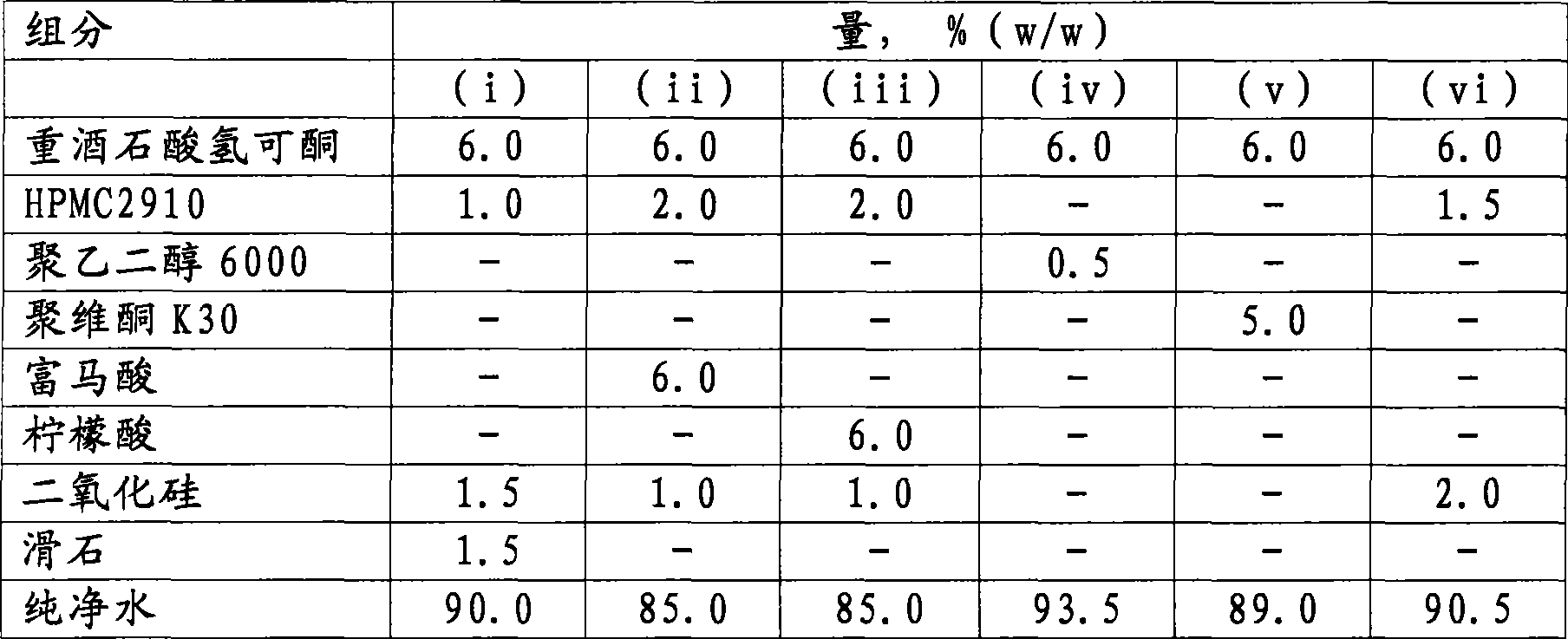
表2Table 2
修饰释放成分氢可酮溶液Modified release ingredient hydrocodone solution

在这些示例性的氢可酮配方中,提供糖球(30/35目)作为惰性核心,该惰性核心起到在配制物中存在的活性组分和其他赋形剂的载体的作用。所选的糖球的量和尺寸要反应出所生产出来的多颗粒的平均直径在0.5-0.6mm尺寸范围内的要求,从而有利于随后的包衣和囊封过程。使用羟丙基甲基纤维素(2910)(Methocal E6 Premium LV)来制备速释的包衣溶液,该包衣溶液被包覆到糖球上从而形成IR珠,并起到结合剂的作用。二氧化硅(Syloid 244FP)具有抗粘附性,其用于制备IR包衣溶液(参见表1)和修饰释放包衣悬浮液(参见表2)。In these exemplary hydrocodone formulations, sugar spheres (30/35 mesh) are provided as inert cores which serve as carriers for the active ingredient and other excipients present in the formulation. The amount and size of the sugar spheres is chosen to reflect the requirement that the average diameter of the produced multiparticulates be in the size range of 0.5-0.6 mm to facilitate subsequent coating and encapsulation processes. Hydroxypropylmethylcellulose (2910) (Methocal E6 Premium LV) was used to prepare an immediate release coating solution that was coated onto sugar spheres to form IR beads and act as a binding agent. Silica (Syloid 244FP), which has anti-adhesive properties, was used to prepare the IR coating solution (see Table 1) and the modified release coating suspension (see Table 2).
含氨的甲基丙烯酸酯形成的B型共聚物(Eudragit RS 100)是速度控制用聚合物,其赋予配制物以控释性质并表现出pH依赖的释放性质。在修饰释放包衣过程中,滑石(Altaic 200)被用作抗粘附剂,从而制备修饰释放珠。丙酮和异丙醇是这样的两种溶剂,其用于溶解速度控制用聚合物,由此产生用于施加到IR珠上、从而形成修饰释放珠的包衣悬浮液。将所得的包衣悬浮液施加到IR珠上,由此形成修饰释放珠。将所得的包衣悬浮液施加到IR珠上,从而形成修饰释放珠。将修饰释放珠在烘箱中在40-500℃/30-60%RH下干燥10-20小时,从而除去残余溶剂并得到约3-6%的湿含量。合适的处理过程在美国专利No.6,066,339中有进一步的详述,该专利文献以引用方式并入本文。Ammonia-containing methacrylate formed B-type copolymer (Eudragit RS 100) is a rate-controlling polymer that imparts controlled-release properties to the formulation and exhibits a pH-dependent release profile. Talc (Altaic 200) was used as an anti-adhesive agent during the modified release coating process to prepare modified release beads. Acetone and isopropanol are two solvents used to dissolve the rate controlling polymer, thereby producing a coating suspension for application to the IR beads, thereby forming modified release beads. The resulting coating suspension was applied to IR beads, thereby forming modified release beads. The resulting coating suspension was applied to IR beads, thereby forming modified release beads. The modified release beads were dried in an oven at 40-500° C./30-60% RH for 10-20 hours to remove residual solvent and obtain a moisture content of about 3-6%. Suitable treatments are described in further detail in US Patent No. 6,066,339, which is incorporated herein by reference.
表3示出了根据表1和表2制备的两种多颗粒修饰释放配制物的溶解规律。这些结果表明,大约20%的氢可酮在第一个小时内被释放,大约80%的氢可酮在约11小时内被释放。Table 3 shows the dissolution profile of two multiparticulate modified release formulations prepared according to Table 1 and Table 2. These results indicated that about 20% of the hydrocodone was released within the first hour and about 80% of the hydrocodone was released within about 11 hours.
表3table 3
包含IR成分和修饰释放成分的组合物的溶解数据Dissolution Data for Compositions Comprising IR Components and Modified Release Components
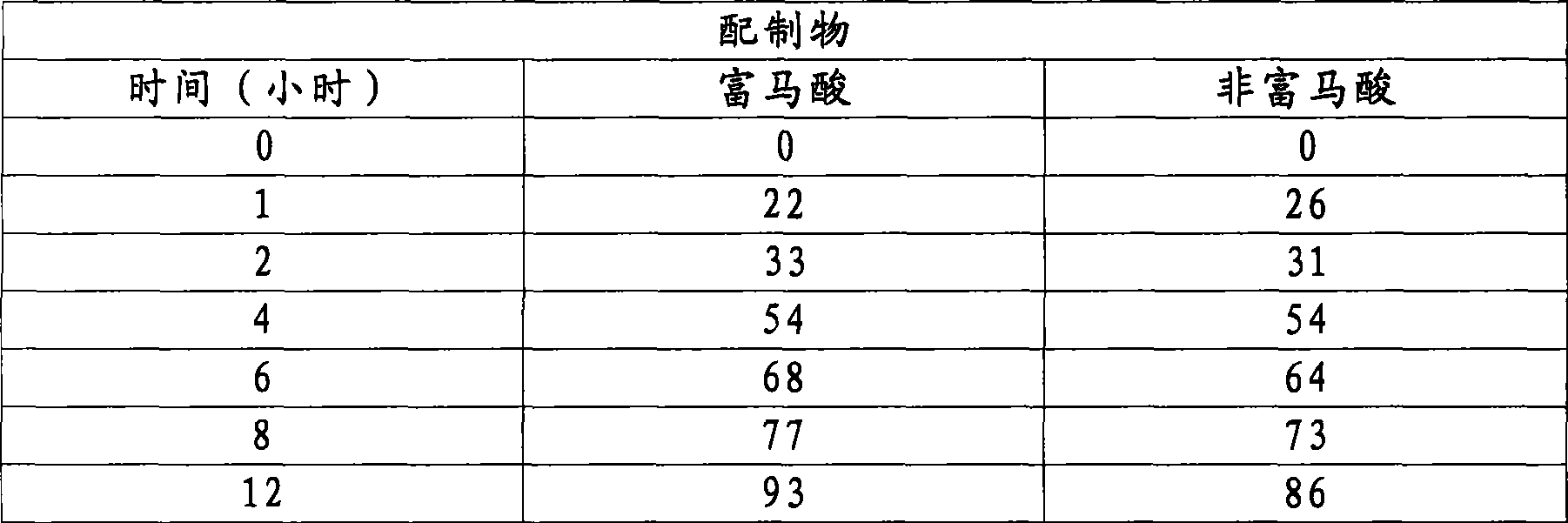
体内研究in vivo studies
在囊炎撤除后立即进行随机的、单剂量的、安慰剂平行组对照、活性对比剂平行组的研究,以评价氢可酮配制物在受试对象中的安全性、效力和PK。研究处理为10mg、20mg、30mg和40mg的重酒石酸氢可酮,匹配的活性对比剂(10mg氢可酮/APAP),或者匹配的安慰剂。在24小时限定的时间内,在基线以及最多17个另外的时间点时,由115个受试对象中收集血液(每组约17至21个受试对象),以测定氢可酮的血浆浓度。计算出以下PK参数,并列于表4-6中。A randomized, single-dose, parallel-group placebo-controlled, parallel-group active contrast study was conducted to evaluate the safety, efficacy and PK of the hydrocodone formulation in subjects immediately after bursitis withdrawal. Study treatments were 10 mg, 20 mg, 30 mg, and 40 mg of hydrocodone bitartrate, matching active contrast (10 mg hydrocodone/APAP), or matching placebo. Blood was collected from 115 subjects (approximately 17 to 21 subjects per group) at baseline and up to 17 additional time points over a defined 24-hour period to determine plasma concentrations of hydrocodone . The following PK parameters were calculated and listed in Tables 4-6.
表4Table 4
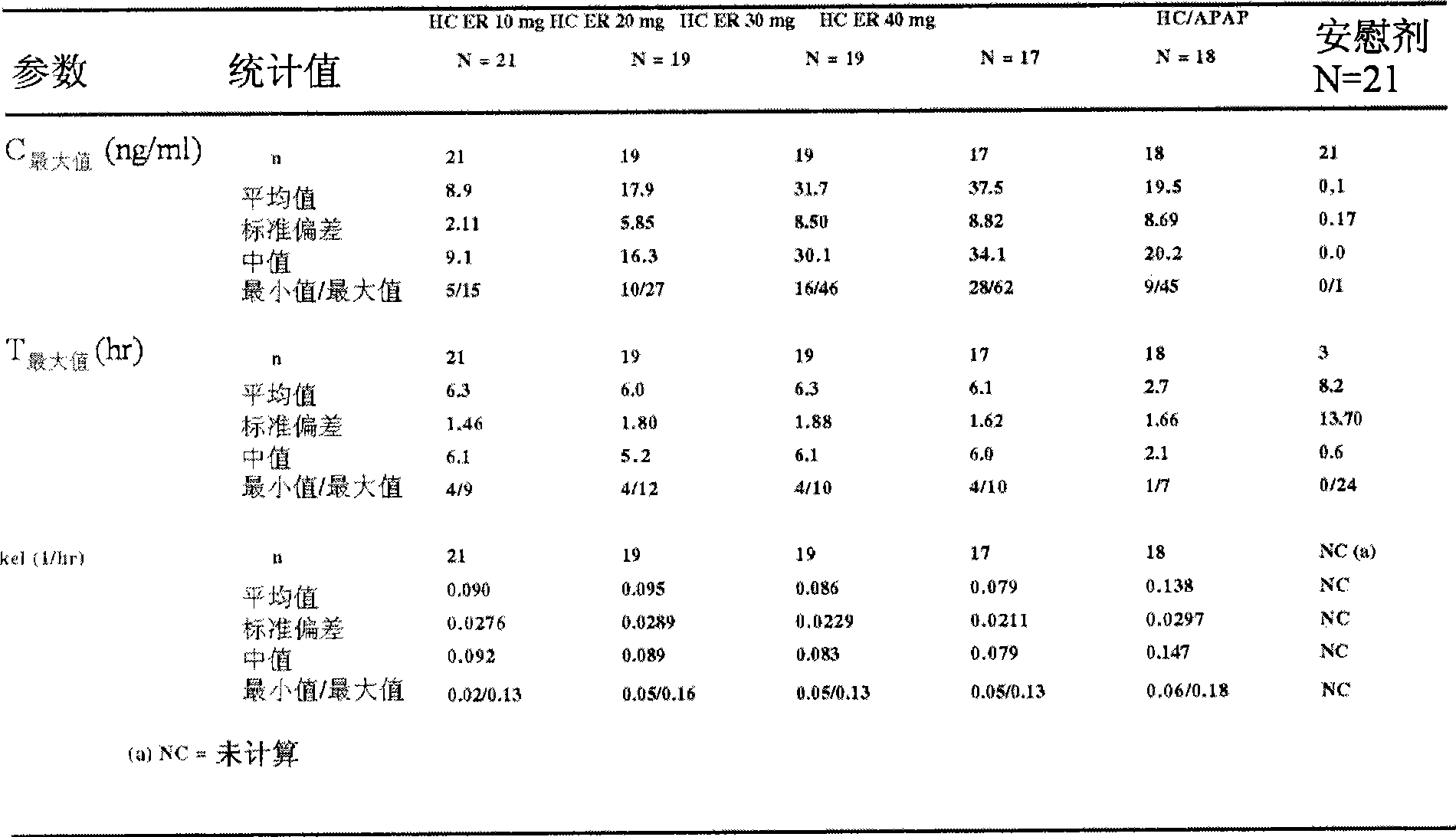
表5table 5

表6Table 6

氢可酮模拟Hydrocodone analog
对本发明的氢可酮配制物进行研究,以模拟在单剂量和稳态下与每日两次施用氢可酮有关的规律。目标剂量为10mg、20mg、40mg和80mg,并且目标最小浓度为5-10ng/ml。所研究的配制物为包含速释成分和修饰释放成分的双成分剂型,其中在双组份之间,氢可酮可以均匀分配(50/50)或不均匀分配(20/80)。使用非格室参数来获得单位输入所产生的应答的估测,并将一室模型假设用于所有的模拟。The hydrocodone formulations of the present invention were studied to mimic the patterns associated with twice-daily administration of hydrocodone at single dose and steady state. The target doses were 10 mg, 20 mg, 40 mg and 80 mg, and the target minimum concentration was 5-10 ng/ml. The formulations studied were two-component dosage forms comprising an immediate-release component and a modified-release component, in which hydrocodone could be distributed evenly (50/50) or unevenly (20/80) between the two components. Non-compartmental parameters were used to obtain estimates of the response generated by unit input, and a one-compartment model assumption was used for all simulations.
在将10mg的口服剂量氢可酮施用给5个成年男子后,报告所得的非格室参数,并将其示于下表7中。The resulting non-compartmental parameters were reported after administration of an oral dose of 10 mg of hydrocodone to 5 adult men and are shown in Table 7 below.
表7-非格室参数Table 7 - Non-compartment parameters
估测K10和V/f分别为0.18和334.29L。对于吸收速度常数k01而言,使用不同的k01估测值来模拟多个规律。比较第二参数估测值,以确定合适的ka,并将其列于下表8中。The estimated K10 and V/f are 0.18 and 334.29L, respectively. For the absorption rate constant k01, different k01 estimates were used to simulate multiple laws. The second parameter estimates were compared to determine the appropriate ka and are listed in Table 8 below.
表8-吸收速度常数(ka)的比较Table 8 - Comparison of absorption rate constants (ka)
假定所观察到的最大浓度以及达到最大浓度所用的时间与上述列出的之前的数据相当,ka=2似乎为速释氢可酮吸收速度的最佳估测值。Assuming that the maximum concentration observed and the time taken to reach it are comparable to the previous data listed above, ka = 2 appears to be the best estimate of the rate of absorption of immediate release hydrocodone.
在进行这种模拟的过程中,确定3个选项。选项1和2假定为一级释放,选项3为零级释放。这些模拟的血浆浓度的图示于图1至16中。In conducting this simulation, 3 options were identified.
实施例2Example 2
本实施例的目的是描述能用于本发明的结合组合物中的萘普生组合物的制备。The purpose of this example is to describe the preparation of naproxen compositions that can be used in the conjugate compositions of the present invention.
利用连续实验室搅拌器,将30g羟丙基纤维素(Klucel Type EF;Aqualon)溶于670g去离子水中。300g萘普生分散进入HPC溶液直至获得均一的悬浮液。以连续模式使用充满聚合物研磨介质的实验室规模介质研磨机直至平均粒度为大约200nm(如用激光散射技术ex.Microtrak UPA测量)。Using a continuous laboratory mixer, 30 g of hydroxypropylcellulose (Klucel Type EF; Aqualon) was dissolved in 670 g of deionized water. 300 g of naproxen was dispersed into the HPC solution until a homogeneous suspension was obtained. A laboratory scale media mill filled with polymer grinding media was used in continuous mode until the average particle size was approximately 200 nm (as measured with laser light scattering technique ex. Microtrak UPA).
实施例3Example 3
本实施例的目的是描述能用于本发明的结合组合物中的萘普生组合物的制备。The purpose of this example is to describe the preparation of naproxen compositions that can be used in the conjugate compositions of the present invention.
利用连续实验室搅拌器,将25g聚乙烯吡咯烷酮(K29/32;BASFCorp1)溶于575g去离子水中。400g萘普生分散进入PVP溶液直至获得均一的悬浮液。通过充满聚合物研磨介质的实验室规模介质研磨机以连续模式对其进行处理,直至平均粒度为大约200nm(如用激光散射技术ex.Microtrak UPA测量)。Using a continuous laboratory mixer, 25 g of polyvinylpyrrolidone (K29/32; BASF Corp 1 ) was dissolved in 575 g of deionized water. 400 g of naproxen was dispersed into the PVP solution until a homogeneous suspension was obtained. It was processed in continuous mode through a laboratory scale media mill filled with polymer grinding media until the average particle size was about 200 nm (as measured with laser light scattering technique ex. Microtrak UPA).
实施例4Example 4
本实施例的目的是描述能用于本发明的结合组合物中的萘普生组合物的制备。The purpose of this example is to describe the preparation of naproxen compositions that can be used in the conjugate compositions of the present invention.
如下在滚筒研磨机中制备纳米颗粒萘普生分散液。用120ml1.0mm预清洁的氧化锆珠(Zirbeads XR,可从Zircoa Inc.获得,具有1.0mm的标称直径),60g含3g萘普生(5%按重量)的含水浆液(购自Sigma,St.Louis,Mo.,粒度20-30微米),和1.8g(3%按重量)PluronicF-68(购自BASF Fine Chemicals,Inc.,作为表面稳定剂)装满250ml玻璃瓶。珠子通过在IN H2SO4中过夜漂洗和随后用去离子水漂洗数次进行预清洁。在92RPM下使一批原料(batch)滚转总共120小时。当将一部分加至0.1N HCl时,分散液是稳定的。由光子相关光谱测量的平均粒度是240-300nm。Nanoparticulate naproxen dispersions were prepared in a tumble mill as follows. With 120ml of 1.0mm pre-cleaned zirconia beads (Zirbeads XR, available from Zircoa Inc., with a nominal diameter of 1.0mm), 60g of an aqueous slurry containing 3g of naproxen (5% by weight) (available from Sigma, St. Louis, Mo., particle size 20-30 microns), and 1.8 g (3% by weight) of Pluronic F-68 (available from BASF Fine Chemicals, Inc. as a surface stabilizer) filled a 250 ml glass bottle. Beads were pre-cleaned by rinsing overnight in IN H2SO4 followed by several rinses with deionized water. The batch was tumbled for a total of 120 hours at 92 RPM. The dispersion was stable when a portion was added to 0.1N HCl. The average particle size measured by photon correlation spectroscopy was 240-300 nm.
在不脱离本发明的实质或范围的条件下,对本发明的方法和组合物进行各种修改和改变对于本领域的技术人员而言是显而易见的。因此,应该意识到,本发明涵盖了在所述的权利要求书及其等价物的范围内所提供的本发明的修改和改变。Various modifications and variations in the methods and compositions of the invention will be apparent to those skilled in the art without departing from the spirit or scope of the invention. Thus, it should be realized that the present invention covers the modifications and variations of this invention provided they come within the scope of the recited claims and their equivalents.
Claims (39)
Applications Claiming Priority (2)
| Application Number | Priority Date | Filing Date | Title |
|---|---|---|---|
| US81588506P | 2006-06-23 | 2006-06-23 | |
| US60/815,885 | 2006-06-23 |
Publications (1)
| Publication Number | Publication Date |
|---|---|
| CN101484170A true CN101484170A (en) | 2009-07-15 |
Family
ID=38834446
Family Applications (1)
| Application Number | Title | Priority Date | Filing Date |
|---|---|---|---|
| CNA2007800236169A Pending CN101484170A (en) | 2006-06-23 | 2007-06-25 | Compositions comprising nanoparticulate meloxicam and controlled release hydrocodone |
Country Status (12)
| Country | Link |
|---|---|
| EP (1) | EP2032137A2 (en) |
| JP (1) | JP2009541359A (en) |
| KR (1) | KR20090024284A (en) |
| CN (1) | CN101484170A (en) |
| AU (1) | AU2007260821B2 (en) |
| BR (1) | BRPI0713447A2 (en) |
| CA (1) | CA2660649A1 (en) |
| IL (1) | IL196065A0 (en) |
| MX (1) | MX2008016223A (en) |
| NO (1) | NO20090158L (en) |
| WO (1) | WO2007150074A2 (en) |
| ZA (1) | ZA200810221B (en) |
Cited By (2)
| Publication number | Priority date | Publication date | Assignee | Title |
|---|---|---|---|---|
| CN103917485A (en) * | 2011-09-21 | 2014-07-09 | 株式会社Bio-Synectics | Nanoparticle preparation method |
| CN112500694A (en) * | 2020-12-04 | 2021-03-16 | 东莞威赢高尔夫用品有限公司 | Electronic equipment veneer material and preparation method thereof |
Families Citing this family (14)
| Publication number | Priority date | Publication date | Assignee | Title |
|---|---|---|---|---|
| EP2957281A1 (en) | 2001-09-21 | 2015-12-23 | Egalet Ltd. | Polymer release system |
| EP1429744A1 (en) | 2001-09-21 | 2004-06-23 | Egalet A/S | Morphine polymer release system |
| ES2360102T3 (en) | 2003-03-26 | 2011-05-31 | Egalet A/S | SYSTEM FOR CONTROLLED RELEASE OF MORPHINE. |
| US8821928B2 (en) | 2007-06-04 | 2014-09-02 | Egalet Ltd. | Controlled release pharmaceutical compositions for prolonged effect |
| US20090311335A1 (en) * | 2008-06-12 | 2009-12-17 | Scott Jenkins | Combination of a triptan and an nsaid |
| WO2010089132A1 (en) | 2009-02-06 | 2010-08-12 | Egalet A/S | Immediate release composition resistant to abuse by intake of alcohol |
| CA2766179A1 (en) | 2009-06-24 | 2010-12-29 | Egalet Ltd. | Controlled release formulations |
| SG191288A1 (en) | 2010-12-22 | 2013-07-31 | Purdue Pharma Lp | Encased tamper resistant controlled release dosage forms |
| PH12013501345A1 (en) | 2010-12-23 | 2022-10-24 | Purdue Pharma Lp | Tamper resistant solid oral dosage forms |
| AU2013285988A1 (en) | 2012-07-06 | 2015-02-12 | Egalet Ltd. | Abuse deterrent pharmaceutical compositions for controlled release |
| PE20151301A1 (en) | 2013-02-05 | 2015-09-16 | Purdue Pharma Lp | PHARMACEUTICAL FORMULATIONS RESISTANT TO IMPROPER HANDLING |
| US10751287B2 (en) | 2013-03-15 | 2020-08-25 | Purdue Pharma L.P. | Tamper resistant pharmaceutical formulations |
| US9132096B1 (en) | 2014-09-12 | 2015-09-15 | Alkermes Pharma Ireland Limited | Abuse resistant pharmaceutical compositions |
| CA2999990A1 (en) | 2015-09-29 | 2017-04-06 | Acorda Therapeutics, Inc. | Sustained release compositions of 4-aminopyridine |
Family Cites Families (3)
| Publication number | Priority date | Publication date | Assignee | Title |
|---|---|---|---|---|
| US6165506A (en) * | 1998-09-04 | 2000-12-26 | Elan Pharma International Ltd. | Solid dose form of nanoparticulate naproxen |
| CN100444830C (en) * | 1998-11-02 | 2008-12-24 | 伊兰公司,Plc | Multiparticulate modified release compositions |
| EP1553927B9 (en) * | 2002-09-11 | 2011-09-21 | Elan Pharma International Limited | Gel-stabilized nanoparticulate active agent compositions |
-
2007
- 2007-06-25 BR BRPI0713447-9A patent/BRPI0713447A2/en not_active IP Right Cessation
- 2007-06-25 WO PCT/US2007/072052 patent/WO2007150074A2/en not_active Ceased
- 2007-06-25 AU AU2007260821A patent/AU2007260821B2/en not_active Expired - Fee Related
- 2007-06-25 EP EP07799011A patent/EP2032137A2/en not_active Withdrawn
- 2007-06-25 CN CNA2007800236169A patent/CN101484170A/en active Pending
- 2007-06-25 MX MX2008016223A patent/MX2008016223A/en not_active Application Discontinuation
- 2007-06-25 CA CA002660649A patent/CA2660649A1/en not_active Abandoned
- 2007-06-25 KR KR1020097001439A patent/KR20090024284A/en not_active Withdrawn
- 2007-06-25 JP JP2009516756A patent/JP2009541359A/en active Pending
-
2008
- 2008-12-02 ZA ZA200810221A patent/ZA200810221B/en unknown
- 2008-12-18 IL IL196065A patent/IL196065A0/en unknown
-
2009
- 2009-01-12 NO NO20090158A patent/NO20090158L/en not_active Application Discontinuation
Cited By (3)
| Publication number | Priority date | Publication date | Assignee | Title |
|---|---|---|---|---|
| CN103917485A (en) * | 2011-09-21 | 2014-07-09 | 株式会社Bio-Synectics | Nanoparticle preparation method |
| US9439871B2 (en) | 2011-09-21 | 2016-09-13 | Bio-Synectics, Inc. | Method for preparing nano particles |
| CN112500694A (en) * | 2020-12-04 | 2021-03-16 | 东莞威赢高尔夫用品有限公司 | Electronic equipment veneer material and preparation method thereof |
Also Published As
| Publication number | Publication date |
|---|---|
| WO2007150074A2 (en) | 2007-12-27 |
| BRPI0713447A2 (en) | 2012-03-13 |
| IL196065A0 (en) | 2009-09-01 |
| ZA200810221B (en) | 2009-11-25 |
| KR20090024284A (en) | 2009-03-06 |
| WO2007150074A3 (en) | 2008-04-10 |
| AU2007260821B2 (en) | 2012-06-21 |
| MX2008016223A (en) | 2009-01-19 |
| CA2660649A1 (en) | 2007-12-27 |
| NO20090158L (en) | 2009-03-20 |
| AU2007260821A1 (en) | 2007-12-27 |
| EP2032137A2 (en) | 2009-03-11 |
| JP2009541359A (en) | 2009-11-26 |
Similar Documents
| Publication | Publication Date | Title |
|---|---|---|
| AU2007260822B2 (en) | Compositions comprising nanoparticulate meloxicam and controlled release hydrocodone | |
| CN101484170A (en) | Compositions comprising nanoparticulate meloxicam and controlled release hydrocodone | |
| US20080102121A1 (en) | Compositions comprising nanoparticulate meloxicam and controlled release hydrocodone | |
| US20080113025A1 (en) | Compositions comprising nanoparticulate naproxen and controlled release hydrocodone | |
| MX2007007942A (en) | Nanoparticulate and controlled release compositions comprising a cephalosporin. | |
| CN101171000A (en) | Nanoparticles and controlled release compositions comprising cyclosporine | |
| US20080317843A1 (en) | Nanoparticulate formulations of modafinil | |
| CN101287451A (en) | Nanoparticles and controlled release compositions comprising platelet aggregation inhibitors | |
| CN101287453A (en) | Nanoparticles and controlled release compositions comprising cephalosporins | |
| WO2006132752A1 (en) | Nanoparticulate and controlled release compositions comprising vitamin k2 | |
| CN101879140A (en) | Nanoparticles and controlled release compositions comprising aryl-heterocyclic compounds | |
| JP2008536856A (en) | Nanoparticulate and sustained release composition comprising a prostaglandin derivative | |
| WO2007070082A1 (en) | Nanoparticulate and controlled release compositions comprising teprenone | |
| EP1954253A1 (en) | Nanoparticulate and controlled release compositions comprising cefditoren | |
| MX2007016151A (en) | Nanoparticulate and controlled release compositions comprising aryl-heterocyclic compounds. | |
| JP2008540550A (en) | Nanoparticles containing vitamin K2 and controlled release compositions |
Legal Events
| Date | Code | Title | Description |
|---|---|---|---|
| C06 | Publication | ||
| PB01 | Publication | ||
| C02 | Deemed withdrawal of patent application after publication (patent law 2001) | ||
| WD01 | Invention patent application deemed withdrawn after publication |