CN101479689A - NFC enabled pointing with a mobile device - Google Patents
NFC enabled pointing with a mobile device Download PDFInfo
- Publication number
- CN101479689A CN101479689A CNA2007800234604A CN200780023460A CN101479689A CN 101479689 A CN101479689 A CN 101479689A CN A2007800234604 A CNA2007800234604 A CN A2007800234604A CN 200780023460 A CN200780023460 A CN 200780023460A CN 101479689 A CN101479689 A CN 101479689A
- Authority
- CN
- China
- Prior art keywords
- mobile device
- communication unit
- orientation
- field communication
- near field
- Prior art date
- Legal status (The legal status is an assumption and is not a legal conclusion. Google has not performed a legal analysis and makes no representation as to the accuracy of the status listed.)
- Pending
Links
Images


Classifications
-
- H—ELECTRICITY
- H04—ELECTRIC COMMUNICATION TECHNIQUE
- H04B—TRANSMISSION
- H04B5/00—Near-field transmission systems, e.g. inductive or capacitive transmission systems
- H04B5/40—Near-field transmission systems, e.g. inductive or capacitive transmission systems characterised by components specially adapted for near-field transmission
- H04B5/48—Transceivers
-
- G—PHYSICS
- G06—COMPUTING OR CALCULATING; COUNTING
- G06F—ELECTRIC DIGITAL DATA PROCESSING
- G06F3/00—Input arrangements for transferring data to be processed into a form capable of being handled by the computer; Output arrangements for transferring data from processing unit to output unit, e.g. interface arrangements
- G06F3/01—Input arrangements or combined input and output arrangements for interaction between user and computer
- G06F3/03—Arrangements for converting the position or the displacement of a member into a coded form
- G06F3/033—Pointing devices displaced or positioned by the user, e.g. mice, trackballs, pens or joysticks; Accessories therefor
- G06F3/0346—Pointing devices displaced or positioned by the user, e.g. mice, trackballs, pens or joysticks; Accessories therefor with detection of the device orientation or free movement in a 3D space, e.g. 3D mice, 6-DOF [six degrees of freedom] pointers using gyroscopes, accelerometers or tilt-sensors
-
- H—ELECTRICITY
- H01—ELECTRIC ELEMENTS
- H01Q—ANTENNAS, i.e. RADIO AERIALS
- H01Q3/00—Arrangements for changing or varying the orientation or the shape of the directional pattern of the waves radiated from an antenna or antenna system
-
- H—ELECTRICITY
- H04—ELECTRIC COMMUNICATION TECHNIQUE
- H04W—WIRELESS COMMUNICATION NETWORKS
- H04W88/00—Devices specially adapted for wireless communication networks, e.g. terminals, base stations or access point devices
- H04W88/02—Terminal devices
- H04W88/06—Terminal devices adapted for operation in multiple networks or having at least two operational modes, e.g. multi-mode terminals
-
- H—ELECTRICITY
- H04—ELECTRIC COMMUNICATION TECHNIQUE
- H04W—WIRELESS COMMUNICATION NETWORKS
- H04W84/00—Network topologies
- H04W84/02—Hierarchically pre-organised networks, e.g. paging networks, cellular networks, WLAN [Wireless Local Area Network] or WLL [Wireless Local Loop]
- H04W84/10—Small scale networks; Flat hierarchical networks
-
- H—ELECTRICITY
- H04—ELECTRIC COMMUNICATION TECHNIQUE
- H04W—WIRELESS COMMUNICATION NETWORKS
- H04W88/00—Devices specially adapted for wireless communication networks, e.g. terminals, base stations or access point devices
- H04W88/02—Terminal devices
Landscapes
- Engineering & Computer Science (AREA)
- Computer Networks & Wireless Communication (AREA)
- Signal Processing (AREA)
- General Engineering & Computer Science (AREA)
- Theoretical Computer Science (AREA)
- Human Computer Interaction (AREA)
- Physics & Mathematics (AREA)
- General Physics & Mathematics (AREA)
- Telephone Function (AREA)
- User Interface Of Digital Computer (AREA)
- Mobile Radio Communication Systems (AREA)
Abstract
一种系统包括通信终端(CT1),该通信终端具有近场通信单元(10),用以在移动装置(MD1)位于该近场通信单元(10)的范围内时与之进行近场通信。将输出装置(OD1;OD2)定位在近场通信单元(10)的范围之外,来向移动装置(MD1)的用户提供输出。控制器(11)根据移动装置(MD1)的定向(D1)来控制输出装置(OD1;OD2)提供输出。
A system includes a communication terminal (CT1) having a near-field communication unit (10) for near-field communication with a mobile device (MD1) when it is within range of the near-field communication unit (10). Output devices (OD1; OD2) are positioned outside the range of the near-field communication unit (10) to provide output to a user of the mobile device (MD1). A controller (11) controls the output devices (OD1; OD2) to provide output based on the orientation (D1) of the mobile device (MD1).
Description
技术领域 technical field
本发明涉及一种包括通信终端、输出装置和控制器的系统。本发明还涉及一种通信方法。The present invention relates to a system including a communication terminal, an output device and a controller. The invention also relates to a communication method.
背景技术 Background technique
近年引入的近场通信(Near Field Communication,还被称为NFC)技术是从非接触识别和连接技术发展而来的。它提供了一种容易、直观的方式,只是通过使装置靠近在一起就实现了连接装置和在装置之间共享数据。由于只在短距离上工作,不需要用户进行任何配置,因此对于消费者而言,NFC是一种通过他们的移动电话与他们周围的世界进行交互的理想方式。NFC是ECMA-340(ISO-IEC18092)标准,工作在13.56MHz。它与Philips MIFARE以及SonyFeliCa非接触智能卡平台完全兼容。Near Field Communication (NFC, also known as NFC) technology introduced in recent years is developed from non-contact identification and connection technology. It provides an easy, intuitive way to connect devices and share data between devices simply by bringing them closer together. Since it only works over short distances and requires no configuration from the user, NFC is an ideal way for consumers to interact with the world around them through their mobile phones. NFC is an ECMA-340 (ISO-IEC18092) standard and works at 13.56MHz. It is fully compatible with Philips MIFARE and Sony FeliCa contactless smart card platforms.
NFC是一种基于近距离的超低功率无线技术,允许在相距几厘米的装置之间传输信息。因此,必须有意地邻近地放置装置来进行通信。虽然由于通信装置之间的短距离而使得处理本质上安全,然而通过将NFC和SIM卡或如Philips’SmartMX之类的智能卡控制器相结合可以保证甚至更安全的处理。这允许移动电话执行例如3-DES加密。NFC is a proximity-based, ultra-low-power wireless technology that allows information to be transferred between devices that are a few centimeters apart. Therefore, devices must be placed in intentional proximity to communicate. While the process is inherently secure due to the short distance between the communicating means, an even more secure process can be guaranteed by combining NFC with a SIM card or a smart card controller like Philips' SmartMX. This allows the mobile phone to perform eg 3-DES encryption.
已知的NFC应用包括:拨打两个NFC电话(NFC-enabled phone)一起来开始一个电话会议,或者立即交换电话号码,或者是购物时用电话对准感兴趣的DVD来观看预告片,或者用电话触碰音乐会的海报来将提醒放置在电话中或者买票。Known NFC applications include: dialing two NFC-enabled phones (NFC-enabled phones) to start a conference call together, or exchanging phone numbers immediately, or pointing the phone at a DVD of interest to watch a trailer when shopping, or using The phone touches the poster of the concert to place a reminder on the phone or buy a ticket.
不过,这些涉及NFC的应用由于内在的基于近距离的操作而受到限制。However, these applications involving NFC are limited due to inherent proximity-based operations.
发明内容 Contents of the invention
本发明的一个目的是提供一种NFC系统,其中采用了移动装置但响应于与移动装置进行的NFC活动提供给用户的输出不需要邻近移动装置。It is an object of the present invention to provide an NFC system in which a mobile device is employed but the output provided to the user in response to NFC activity with the mobile device does not need to be in proximity to the mobile device.
本发明的第一个方面提供了一种如权利要求1所述的系统。本发明的第二个方面提供了一种如权利要求16所述的方法。在从属权利要求中定义了有利的实施例。A first aspect of the invention provides a system as claimed in claim 1 . A second aspect of the invention provides a method as claimed in claim 16 . Advantageous embodiments are defined in the dependent claims.
根据本发明第一个方面的系统包括一种通信装置,该通信装置具有近场通信单元,用以当一个移动装置在该近场通信单元的范围内时与之进行通信。通常,移动装置和近场通信单元能够通信的范围小于20cm。系统还包括输出装置,该输出装置位于近场通信单元的范围之外。从而,通信终端和输出装置之间的距离相对较大。离通信终端足够近足以启动NFC的移动装置距离输出装置太远,而不能启动与输出装置的NFC。通常,实际上输出装置不需要具有NFC性能。输出装置向移动装置的用户提供了输出,控制器根据移动装置定向来控制输出装置提供输出。例如,输出装置可以向用户指示一个视觉和/或听觉反馈。A system according to a first aspect of the invention comprises a communication device having a near field communication unit for communicating with a mobile device when within range of the near field communication unit. Typically, the range over which the mobile device and the near field communication unit are able to communicate is less than 20 cm. The system also includes an output device located outside the range of the near field communication unit. Thus, the distance between the communication terminal and the output device is relatively large. A mobile device that is close enough to the communication terminal to enable NFC is too far from the output device to enable NFC with the output device. Typically, the output device does not actually need to have NFC capabilities. The output device provides output to a user of the mobile device, and the controller controls the output device to provide output based on the orientation of the mobile device. For example, the output device may indicate a visual and/or audible feedback to the user.
在这个系统中,通常被用户持在手中操作的移动装置接近通信终端,以便启动NFC。对移动装置任意定向的自由被用来根据移动装置的定向控制输出。例如,移动装置是移动电话或PDA(个人数字助理)。这种系统通常指的是主机系统。In this system, a mobile device, usually held and operated by a user, approaches a communication terminal in order to activate NFC. The freedom to arbitrarily orientate the mobile device is used to control the output according to the orientation of the mobile device. For example, the mobile device is a mobile phone or a PDA (Personal Digital Assistant). This system is usually referred to as the host system.
提供定向信息的移动装置同样是已知的。例如,Bluewand是一种类似于笔的小型装置,可以被用来通过手的移动来控制蓝牙装置。六轴加速度计和和陀螺仪系统检测该笔的完全定向和空间中的移动。蓝牙无线链接将这个数据发送到任意的协同操作的装置,然后该装置执行相关的命令。可能的应用包括各种消费电子产品的远程控制、对机器和建筑的访问控制、虚拟激光笔以及手机游戏。Mobile devices that provide orientation information are also known. For example, the Bluewand is a small pen-like device that can be used to control Bluetooth devices with the movement of the hand. A six-axis accelerometer and gyroscope system detects the pen's complete orientation and movement in space. The Bluetooth wireless link sends this data to any cooperating device, which then executes the associated command. Possible applications include remote control of various consumer electronics, access control to machines and buildings, virtual laser pointers, and mobile gaming.
在权利要求2所述的实施例中,输出装置是显示设备,其显示作为被显示信息的显示信息。被显示信息可以被显示在该显示设备的屏幕上。可替换地,被显示信息可以被显示在投影屏幕或墙壁上。显示信息可以是图像、影片或其他可视信息。控制器通过通信终端接收关于移动装置定向的定向信息。例如,定向信息可能是移动装置的指向或方位角、一维或多维倾斜角、侧倾(roll)或它们的任意组合。可替换地,定向信息可以是原始数据,例如,指示移动装置相对于地球表面的定向,现在,控制器必须处理原始数据来获得移动装置的定向。In an embodiment as claimed in claim 2, the output means is a display device which displays display information as displayed information. The displayed information may be displayed on the screen of the display device. Alternatively, the displayed information may be displayed on a projection screen or a wall. Display information can be images, movies, or other visual information. The controller receives orientation information about the orientation of the mobile device through the communication terminal. For example, orientation information may be the pointing or azimuth of the mobile device, one or more dimensions of tilt, roll, or any combination thereof. Alternatively, the orientation information may be raw data, eg indicating the orientation of the mobile device relative to the earth's surface, the controller now has to process the raw data to obtain the orientation of the mobile device.
控制器产生可视指示符,该指示符根据移动装置的定向来指示被显示信息中的位置。例如,在显示器的一个位置上指示一个标记,通过改变移动装置的定向或将移动装置保持在一个特定的定向上可以指示这个位置。可替换地,移动装置的定向可以在被显示信息中选择一个特定区域。例如,通过对该区域加亮可以使这种选择对用户可见。例如,加亮可以是增大亮度、改变颜色或在该区域周围画边框、或向用户指示被显示信息中的哪一个对应于移动装置的实际定向的其他任何方式。The controller generates a visual indicator that indicates a location in the displayed information based on the orientation of the mobile device. For example, a marker is indicated at a location on the display that can be indicated by changing the orientation of the mobile device or by holding the mobile device in a particular orientation. Alternatively, the orientation of the mobile device may select a specific area in the displayed information. This selection can be made visible to the user by, for example, highlighting the area. For example, highlighting may be to increase brightness, change color or draw a border around the area, or any other way of indicating to the user which of the displayed information corresponds to the actual orientation of the mobile device.
在权利要求3所述的实施例中,可视指示符指示出在被显示信息中由移动装置指向被显示信息的特定区域的方向所限定的位置。现在,具有指向方向的移动装置指向被显示信息,被显示信息是采用移动装置的定向来指示被显示信息上的位置的最直观方式。通常,移动装置被定形为能够清楚地向用户指示它的指向方向。例如,移动装置可以有具有指向轴的拉长形状。In an embodiment as claimed in claim 3, the visual indicator indicates a location within the displayed information defined by a direction in which the mobile device points to a particular area of the displayed information. Now, with a mobile device having a pointing direction pointing at the displayed information, the displayed information is the most intuitive way to use the orientation of the mobile device to indicate a location on the displayed information. Typically, a mobile device is shaped to clearly indicate to the user in which direction it is pointing. For example, a mobile device may have an elongated shape with a pointing axis.
在权利要求4所述的实施例中,控制器取得移动装置的个人识别码,来向该移动装置分配一个可视指示符,该可视指示符具有选择来使之能唯一地与另一移动装置(它与该通信终端或该系统中的其它终端进行通信)的另一个可视指示符区别开的外形。将不同的指示符分配给不同的移动装置允许不同的用户在同一时间与系统通信。每个用户均具有可以被该用户认出的特定的指示符。如果这些指示符是标记,这些标记的形状和/或颜色可能不同。如果指示符是加亮的特定区域(例如,表示为一个按键),则对不同的用户使用不同的颜色。In the embodiment of claim 4, the controller obtains the mobile device's PIN to assign to the mobile device a visual indicator with selection to be uniquely associated with another mobile device. Another visual indicator of a device that communicates with the communication terminal or with other terminals in the system. Assigning different indicators to different mobile devices allows different users to communicate with the system at the same time. Each user has a specific indicator that can be recognized by that user. If these indicators are markers, these markers may vary in shape and/or color. If the indicator is a specific area highlighted (for example, represented as a key), then use different colors for different users.
在权利要求5所述的实施例中,输出装置是一个诸如例如扬声器之类的声音变送器(sound transducer)。控制器通过通信终端接收关于移动装置定向的信息。控制器根据移动装置的定向来激活声音变送器。In an embodiment as claimed in claim 5, the output device is a sound transducer such as eg a loudspeaker. The controller receives information about the orientation of the mobile device through the communication terminal. The controller activates the sound transmitter according to the orientation of the mobile device.
在权利要求6所述的实施例中,当移动装置指向声音变送器时,激活声音变送器。例如,通过对扬声器进行持续预定时间段的指向来启动一个解释显示内容的描述。可以将扬声器定位在被显示信息的附近,以便可以自动地将声音与被显示的信息关联起来。可替换地,扬声器可以是头戴式耳机的一部分。In an embodiment as claimed in claim 6, the sound transducer is activated when the mobile device is pointed at the sound transducer. For example, a description explaining the displayed content is initiated by pointing the speaker for a predetermined period of time. Speakers can be positioned in the vicinity of displayed information so that sounds can be automatically associated with the displayed information. Alternatively, the speakers may be part of a headset.
可替换地,移动装置的定向可以被用来控制照明。例如,移动装置的定向可以被用来使灯变暗,或来用来控制灯的颜色。例如,在固态照明中,可以调节LED灯或像素墙(pixilated wall)的颜色。在像素墙上,例如,可以通过LED的闪烁或者LED的颜色变化来指示被指向的位置。可替换地,移动装置的定向可以被用来控制声音的音量/音高/平衡、光(或像素)的强度/颜色、房间的温度、相机的缩放功能或任何其他的可以感知的量。可以用绕移动装置的指向轴的一维旋转来控制这种量。Alternatively, the orientation of the mobile device can be used to control the lighting. For example, the orientation of the mobile device can be used to dim lights, or to control the color of lights. For example, in solid-state lighting, the color of LED lights or pixilated walls can be adjusted. On a pixel wall, for example, the pointed location may be indicated by the blinking of the LED or the color change of the LED. Alternatively, the orientation of the mobile device may be used to control sound volume/pitch/balance, light (or pixel) intensity/color, room temperature, camera zoom function, or any other perceivable quantity. This amount can be controlled with a one-dimensional rotation about the pointing axis of the mobile device.
在另一个实施例中,输出装置是用户界面。那么,将来自系统的被用户界面引用的信息发送到移动装置,以在移动装置自身的输出部件上显示给用户。这种输出部件是(例如)显示器。在一个应用中,用户界面是具有名称或选项的屏幕。然后,将更多关于名称或选项的详细信息发送到移动装置,并显示在显示器上。这允许用户可以更深入地阅读这些信息。这对于残疾人或老年人是很便利的,而且在傍晚或者夜晚的环境中也是相对便利的。那么,显示器可以点亮,以便可以正确地看到。在本发明的一个优选实施例中,利用名称列表,用户可以选择一个名称来建立一个诸如电话呼叫之类的无线连接。然后,用户可以请求打开用户界面附近的一扇门,或者可以请求其他的信息。In another embodiment, the output device is a user interface. The information referenced by the user interface from the system is then sent to the mobile device for display to the user on the output means of the mobile device itself. Such an output component is, for example, a display. In an application, the user interface is a screen with names or options. Then, more detailed information about the name or option is sent to the mobile device and displayed on the display. This allows users to read the information in greater depth. This is very convenient for the disabled or the elderly, and it is also relatively convenient in the evening or night environment. Then, the display can be lit so that it can be seen correctly. In a preferred embodiment of the present invention, using the list of names, the user can select a name to establish a wireless connection such as a telephone call. The user may then request to open a door near the user interface, or may request other information.
在另一应用中,用户界面的选择将启动一个动作。动作的结果将被显示在移动装置的输出部件上。这可能是从求助台拨打到移动装置上的电话呼叫。这还可能是关于在一间办公室内找到一个已选位置的路径的更详细的信息。在另一个应用中,用户界面可能是安全特性。例如,在用NFC协议识别之后,可以请求用户用他的移动装置指向一个选择的区域。In another application, a user interface selection will initiate an action. The result of the action will be displayed on the output part of the mobile device. This could be a phone call from a help desk to a mobile device. It may also be more detailed information about the path to find a selected location within an office. In another application, the user interface might be a security feature. For example, after identification with the NFC protocol, the user can be requested to point his mobile device at a selected area.
在权利要求7所述的实施例中,在与近场通信单元建立通信之后,控制器根据近场通信单元的位置和移动装置的定向来确定移动装置的指向方向。应当注意的是,通信终端和输出装置的(相对)位置是系统限定的并从而是已知的。因为,至少在通信的开始,移动装置必须定位在通信终端的附近,而且,移动装置相对于输出装置的位置是已知的。结果,不需要知道移动装置的位置,知道移动装置相对于地球表面或相对于地球磁场或相对于地球重力场的角度或者它们的任何组合就足够了。这个实施例具有以下优点:移动装置不必能够感知它的位置或将它的位置传送到通信终端。In an embodiment as claimed in claim 7, after establishing communication with the near field communication unit, the controller determines the pointing direction of the mobile device based on the position of the near field communication unit and the orientation of the mobile device. It should be noted that the (relative) positions of the communication terminal and the output device are system-defined and thus known. Because, at least at the beginning of the communication, the mobile device must be located in the vicinity of the communication terminal, and the position of the mobile device relative to the output device is known. As a result, knowledge of the position of the mobile device is not required, it is sufficient to know the angle of the mobile device relative to the Earth's surface or relative to the Earth's magnetic field or relative to the Earth's gravitational field, or any combination thereof. This embodiment has the advantage that the mobile device does not have to be able to sense its position or communicate its position to the communication terminal.
在权利要求8所述的实施例中,主机系统还包括另一个通信单元,用来与移动装置进行通信。另一个通信单元的范围大于近场通信单元的范围。另一个通信单元可以在能够进行NFC的更大距离上提供蓝牙、WiFi或能够执行NFC的任何其他更大范围的无线通信。这具有以下优点:在启动NFC通信之后,移动装置和主机系统之间的通信可能被允许用户更自由地移动的更大范围的通信所接管。对用户来讲,将移动装置保持长时间与通信终端直接相邻以保持NFC不受影响看起来是非常麻烦的。在NFC启动之后,人们倾向于将他们的胳膊移动至放松的位置。现在通过采用另一个通信单元来保持通信。另一个通信单元可能或可能没有位于通信终端内。可以采用单个另一通信单元来支持多个NFC通信终端。In the embodiment of claim 8, the host system further comprises another communication unit for communicating with the mobile device. The range of the other communication unit is greater than the range of the near field communication unit. Another communication unit may provide Bluetooth, WiFi or any other longer range wireless communication capable of NFC over a greater distance capable of NFC. This has the advantage that after initiation of NFC communication, the communication between the mobile device and the host system may be taken over by a larger range of communication allowing the user to move more freely. To the user, keeping the mobile device in direct proximity to the communication terminal for long periods of time to keep NFC unaffected seems very cumbersome. After NFC activation, people tend to move their arms to a relaxed position. Communication is now maintained by employing another communication unit. Another communication unit may or may not be located within the communication terminal. A single further communication unit may be employed to support multiple NFC communication terminals.
在检测到再也不可能进行NFC之后,可以建立更大范围的通信。但这可能有通信会被中断的缺点。After detecting that NFC is no longer possible, a wider range of communication can be established. But this may have the disadvantage that the communication will be interrupted.
在权利要求9所述的实施例中,控制器将主机系统和移动装置之间通信从近场通信单元切换至另一个通信单元。从而,至少在启动NFC的过程中,移动装置需要距通信终端足够近。一旦启动通信,更大范围的通信就接管NFC。结果,在NFC启动之后,更大范围的通信几乎立即接管NFC。从而,当移动装置移离通信终端,并且再也不可能进行NFC时,由于已经通过更大范围的通信单元有效地进行了通信,因此通信继续。In an embodiment as claimed in claim 9, the controller switches the communication between the host system and the mobile device from the near field communication unit to the other communication unit. Thus, at least during the activation of NFC, the mobile device needs to be sufficiently close to the communication terminal. Once the communication is initiated, the wider range communication takes over from NFC. As a result, wider range communications took over NFC almost immediately after it was launched. Thus, when the mobile device moves away from the communication terminal, and NFC is no longer possible, the communication continues since it has already been effectively communicated through a wider range of communication units.
在权利要求10所述的实施例中,在移动装置指向输出装置过程中改变它的位置时,控制器监视移动装置的平均定向。例如,如果用户在移动装置仍指向被显示图像的同一位置时将移动装置移离通信终端,则假定用户仍然指向被显示图像的同一位置。结果,由于移动装置的位置改变,可以进行校正来改变移动装置的定向。当检测到再也不可能进行NFC之后,可以启动这种监视模式。In an embodiment as claimed in
在一个实施例中,移动装置包括作为定向传感器的电子罗盘,其指示移动装置的定向。这种电子罗盘的一个示例是美国加利福尼亚州的Honeywell的“TruePoint Compass Module”。可以在Honeywell的网站上找到这种电子罗盘的说明。TruePoint Compass Module是真正的三轴数字罗盘模块,这种模块可以用于任何定向中。结合来自三个硅磁力计和三个加速度计的数据,来提供罗盘的方位角以及倾斜角和侧倾角(roll angle)。因此,这种罗盘非常适于提供定向信息。这种电子罗盘的另一个示例包括在PCT/IB2006/051314(PH000613)和PCT/IB2006/051317(PH000319)中公开的三维加速度计和二维磁力计。由于二维磁力计传感器容易制造、成本低,而且更耐用、尺寸较小,因此磁力计不需要是三维传感器而可以是二维传感器的事实是一个很大的优点。In one embodiment, the mobile device includes an electronic compass as an orientation sensor that indicates the orientation of the mobile device. An example of such an electronic compass is the "TruePoint Compass Module" of Honeywell, California, USA. Instructions for this electronic compass can be found on Honeywell's website. TruePoint Compass Module is a true three-axis digital compass module that can be used in any orientation. Data from three silicon magnetometers and three accelerometers are combined to provide compass azimuth as well as tilt and roll angles. Therefore, such compasses are well suited for providing orientation information. Another example of such an electronic compass includes a three-dimensional accelerometer and a two-dimensional magnetometer disclosed in PCT/IB2006/051314 (PH000613) and PCT/IB2006/051317 (PH000319). The fact that a magnetometer does not need to be a 3D sensor but can be a 2D sensor is a great advantage since 2D magnetometer sensors are easier and less expensive to manufacture, and are more durable and smaller in size.
参照下文所说明的实施例,本发明的这些和其他方面是很明显的,并得到了解释。These and other aspects of the invention are apparent from and elucidated with reference to the embodiments illustrated hereinafter.
本发明涉及另一方面,即一种适合在如权利要求1所述的系统中使用的移动装置。根据本发明,该移动装置包括与近场通信单元进行近场通信的装置。移动装置还包括电子罗盘,该电子罗盘指示移动装置的定向。在本文中,借助从近场通信单元获得的位置数据对该电子罗盘进行校准。可以用系统中的控制器来实现这种校准。此后,可以在移动装置自身的任何输出装置上向用户提供信息。用户可以用他的移动装置的任何输入设备向系统发送信息。利用其它通信协议,例如W-LAN、蓝牙等,在通信终端和移动装置之间可以有利地传递这种信息。The invention relates to another aspect, namely a mobile device suitable for use in a system as claimed in claim 1 . According to the invention, the mobile device comprises means for near field communication with a near field communication unit. The mobile device also includes an electronic compass that indicates the orientation of the mobile device. In this paper, the electronic compass is calibrated with the help of position data obtained from a near field communication unit. This calibration can be accomplished with a controller in the system. Thereafter, information can be provided to the user on any output device of the mobile device itself. The user can send information to the system with any input device of his mobile device. Such information may advantageously be communicated between the communication terminal and the mobile device using other communication protocols, such as W-LAN, Bluetooth, etc.
附图说明 Description of drawings
附图中:In the attached picture:
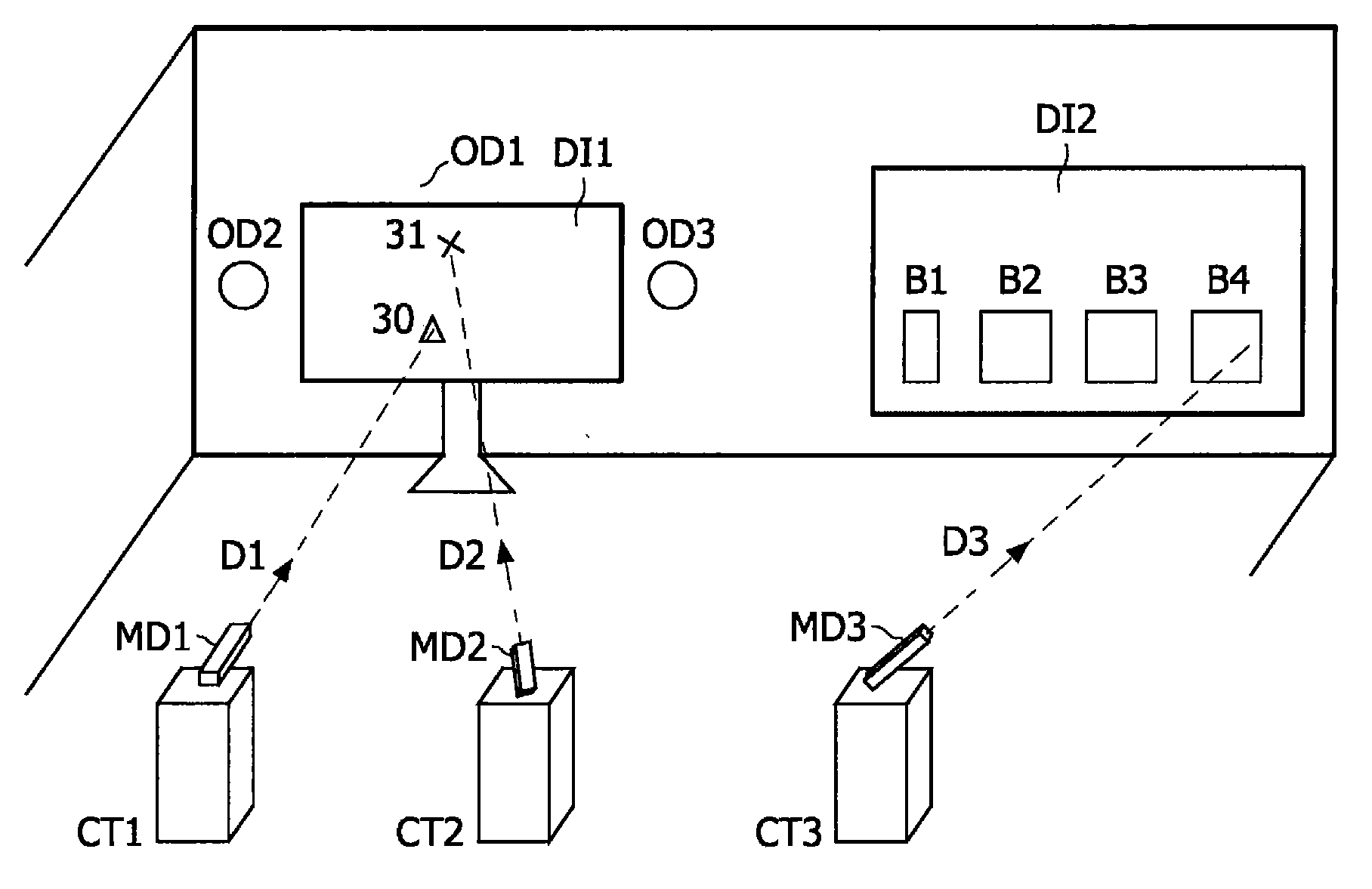
图1示意地示出了一种包括用于NFC的通信终端、移动装置的结构,移动装置与所述通信终端通信以根据移动装置的定向控制输出装置来提供输出,以及Fig. 1 schematically shows a structure comprising a communication terminal for NFC, a mobile device with which the mobile device communicates to provide an output according to an orientation of the mobile device to control the output device, and
图2示出了移动装置和通信终端的框图。Fig. 2 shows a block diagram of a mobile device and a communication terminal.
应当注意的是,在不同的附图中具有相同参考标号的项目具有相同的结构特性和相同的功能,或者是相同的信号。当解释这种项目的功能和/或结构时,不需要用详细说明的方式重复对它们的解释。It should be noted that items with the same reference numerals in different drawings have the same structural characteristics and the same functions, or are the same signals. When explaining the functions and/or structures of such items, it is not necessary to repeat their explanations in a detailed manner.
具体实施方式 Detailed ways
图1示意地示出了一种包括用于NFC的通信终端、移动装置的结构,移动装置与所述通信终端通信以根据移动装置的定向控制输出装置来提供输出。所示的系统包括了三个通信终端CT1、CT2和CT3。在所示的示例中,输出装置包括显示设备OD1、投影仪(未示出)和两个扬声器OD2和OD3,显示设备OD1具有显示屏幕,在显示屏幕上显示显示信息DI1,投影仪将显示信息DI2投影在房间的墙上。可替换地,可以通过包括几个显示屏幕的电视墙或一起生成大图像的投影仪来形成显示器。例如,显示信息可能是销售商品、广告、音乐播放列表、选举人名册、游戏输入和博物馆信息等。移动装置MD1、MD2、MD3分别与通信终端CT1、CT2、CT3进行NFC(near fieldcommunication,近场通信)。第一系统包括通信终端CT1、CT2和输出装置OD1、OD2、OD3。第二通信系统包括通信终端CT3和投影仪。在两个系统中,通信终端CT1~CT3的相对位置和输出装置OD1~OD4的相对位置都是已知的,从而,显示的信息DI1、DI2的位置是已知的。FIG. 1 schematically shows a structure including a communication terminal for NFC, a mobile device with which the mobile device communicates to control an output device to provide an output according to an orientation of the mobile device. The system shown includes three communication terminals CT1, CT2 and CT3. In the example shown, the output means include a display device OD1, a projector (not shown) and two speakers OD2 and OD3, the display device OD1 has a display screen on which display information DI1 is displayed, and the projector will display the information DI2 is projected on the wall of the room. Alternatively, the display can be formed by a video wall comprising several display screens or projectors that together generate a large image. For example, display information might be merchandise for sale, advertisements, music playlists, electoral rolls, game entries, museum information, etc. The mobile devices MD1, MD2, and MD3 respectively perform NFC (near field communication, near field communication) with the communication terminals CT1, CT2, and CT3. The first system comprises communication terminals CT1, CT2 and output devices OD1, OD2, OD3. The second communication system includes a communication terminal CT3 and a projector. In both systems, the relative positions of the communication terminals CT1-CT3 and the output devices OD1-OD4 are known, thus the positions of the displayed information DI1, DI2 are known.
在第一系统中,持有移动装置MD1的第一用户用移动装置指向显示设备OD1的屏幕上由标记30指示的位置。由于移动装置MD1、MD2分别邻近通信终端CT1、CT2,它们相对于显示信息DI1的位置是已知的。这足以将移动装置MD1、MD2的定向分别传送至通信终端CT1、CT2。根据传送的定向和移动装置MD1、MD2的假定位置,通信终端CT1、CT2可以确定移动装置MD1、MD2所指向的位置。通信终端CT1、CT2在显示信息DI(见图2)中插入标记30、31,来将显示信息DI1中的标记30、31显示在移动装置MD1、MD2所指向的各自位置上。In the first system, a first user holding a mobile device MD1 points with the mobile device to a position indicated by a
标记30、31被用来向用户反馈他指向的地方。例如,以比预定时间长的时间指向同一区域可以采取特定的动作。例如,如果标记在显示的按键内,将执行这个按键所定义的动作。可替换地,用户可以按下移动装置MD1上的按键,来指示与所指区域相关的动作应当被执行。
以相同的方式,用户可以将移动装置MD1指向扬声器OD2、OD3中的一个,来指示声音应当开始播放或停止播放。In the same way, the user can point the mobile device MD1 at one of the speakers OD2, OD3 to indicate that the sound should start playing or stop playing.
两个移动装置MD1、MD2均与各自相关的位于不同位置的通信终端CT1、CT2通信是不必要的。在同一个通信终端CT1中可以存在多个NFC通信收发机,或者,两个或多个移动装置MD1、MD2可以接近单个NFC收发机,并从而与单个通信终端CT1进行NFC通信。单个通信终端CT1可以与多个输出装置交互。It is not necessary that both mobile devices MD1 , MD2 communicate with respective associated communication terminals CT1 , CT2 located at different locations. There may be multiple NFC communication transceivers in the same communication terminal CT1, or two or more mobile devices MD1, MD2 may approach a single NFC transceiver and thereby perform NFC communication with a single communication terminal CT1. A single communication terminal CT1 can interact with multiple output devices.
虽然非常直观,但不必要将移动装置MD1指向应当插入标记的位置。例如,可以假定,不取决于移动装置MD1的定向,当建立NFC时,标记必须位于屏幕上的预定位置。移动装置MD1在建立NFC时相对于它的定向的所有定向变化都会在指示的方向上移动标记。Although very intuitive, it is not necessary to point the mobile device MD1 where the marker should be inserted. For example, it may be assumed that, independently of the orientation of the mobile device MD1, when NFC is established, the marker must be located at a predetermined position on the screen. All orientation changes of the mobile device MD1 relative to its orientation when establishing NFC will move the marker in the indicated direction.
在第二系统中,投影仪对示出了按键B1~B4的显示信息DI2进行投影。通信终端CT3确定移动装置MD3指向的位置,并且如果移动装置MD3指向的位置位于按键B1~B4中的一个按键所覆盖的区域内时,加亮B1~B4中的这个按键。同样,虽然非常直观,但移动装置MD3应当指向所述按键应当被加亮的位置不是必需的。例如,可以假定,不取决于于移动装置MD3的定向,当建立NFC时,按键B1被加亮。移动装置MD3的所有定向变化都可以被解释为从按键B1的中心开始。In the second system, the projector projects display information DI2 showing the buttons B1 to B4. The communication terminal CT3 determines where the mobile device MD3 is pointing, and if the pointing position of the mobile device MD3 is within the area covered by one of the buttons B1-B4, highlights this button B1-B4. Also, although very intuitive, it is not essential that the mobile device MD3 should point to where the key should be highlighted. For example, it may be assumed that, independently of the orientation of the mobile device MD3, when NFC is established, the button B1 is highlighted. All orientation changes of the mobile device MD3 can be interpreted as starting from the center of the button B1.
图2示出了移动装置和主机系统的框图。移动装置MD1包括近场通信单元20、通信单元21、定向传感器22和个人识别码存储器23。主机系统HS包括近场通信单元10、通信单元12和控制器11。虽然在图2中示出近场通信单元10、通信单元12和控制器11在物理上位于通信终端CT1中,但其他的架构也是可行的,即,控制器11和/或通信单元12在物理上不位于通信终端CT1中。如图1所示,主机系统可以支持多个近场通信单元10,这些通信单元位于相同的通信终端CT1中,或者位于不同的通信终端CT1、CT2、CT3中。假定,但不是必须的,单个通信单元12和单个控制器11足以使主机系统能够与已记录在主机系统上的不同的移动电话通信。Figure 2 shows a block diagram of a mobile device and a host system. The mobile device MD1 includes a near
移动装置MD1(例如是移动电话或PDA)的近场通信单元20提供了与通信终端CT1的近场通信单元10进行通信的近场通信路径CP1。通常,当将移动装置MD1移动到足够靠近通信终端以便这两个部件彼此位于对方的近场通信范围内时,近场通信路径CP1被自动激活。通常,这个相对短的近场范围是厘米量级的,例如20cm。可选地,移动装置MD1可以包括一个更大范围的通信单元21。这个通信单元21与通信终端CT1中的可选通信单元12一起提供了具有比通信路径CP1更大通信范围通信路径CP2。增加更大范围的通信路径CP2具有下述优点:只是将移动装置MD1带到足够靠近通信终端CT1的地方,一旦通过简单地使移动装置MD1充分靠近通信终端CT1来经由近场通信路径CP1开始通信,那么即使当移动装置MD1移动出了近场通信的范围时,也可以通过通信路径CP2保持通信。例如,可以根据蓝牙或WiFi标准来提供通信路径CP2。不过,可以实现任何无线通信协议。The near
定向传感器22向相对小范围的近场通信单元20和/或更大范围通信单元21提供了关于移动装置MD1定向的定向信息SD。可以以很多方式提供定向信息SD。例如,可以提供朝向和/或垂直倾斜,或者可以提供由涉及地球重力场或磁场的正交坐标系中的三个值定义的矢量。方位角和高度信息的组合允许例如由二维X-Y坐标系所表示的显示屏上的二自由度的指示。定向信息SD可以是未处理的或平均后的传感器数据。移动装置MD1仅提供定向信息就足够,不需要定向信息SD提供移动装置MD1的位置。当启动近场通信时,这个位置是隐含已知的。The
可选的个人识别码存储器23存储唯一地识别移动装置MD1的唯一识别码PI。通过经由近场通信路径CP1和/或通信路径CP2将这个唯一识别码PI发送到主机系统,主机系统就知道它与哪一个移动装置MD1进行通信。The optional personal
近场通信单元10向控制器11提供接收到的定向信息OI1。更大范围通信单元12向控制器11提供接收到的定向信息OI2。通常,接收到的定向信息OI1和OI2与定向信息SD是相同的。不过,接收到的定向信息OI1和OI2可以是定向信息SD的编码版本,这个编码版本需要被控制器11解码。经由通信路径CP1和CP2的最优通信需要定向信息的编码。根据移动装置MD1的使用模式,通信单元10或通信单元12任一个是激活的,或者,通信单元10和通信单元12都是激活的。在启动过程中,当移动装置MD1进入与通信终端CT1的近场通信时,近场通信单元10应一直保持激活直到近场通信路径CP1被激活。然后,通信单元12和21变为激活来接管通信。还可以只在检测到近场通信路径CP1中的信号强度小于预定值时或在检测到移动装置MD1由于通信路径故障而位于近场通信范围外时,才激活通信单元12和21。控制器11分别用控制信号CS1、CS2控制通信单元10和12的切换开/关。NFC被用来对移动装置进行验证,或实际上对移动装置用户进行验证,此后,建立唯一的更可取的安全数据连接,例如,蓝牙连接。可替换地,NFC单元10可以一直处于激活状态以便可以检测到任何接近的移动装置MD1。The near
控制器11产生显示信息DI,该显示信息被提供到输出装置OD1,将显示信息显示为显示的信息DI1。例如,显示信息DI1可以是计算机产生的图像或照片或影片。The
控制器11利用接收到的定向信息OI1或OI2来识别由移动装置MD1指示的指向位置。例如,指向位置的识别可以是在显示的信息DI1中的位置上的标记30。例如,如果图像是一组动物的展示,用户可以操作移动装置MD1的定向,以便标记30位于用户希望获得更多信息的动物上。如果将标记30保持在这个动物身上超过了预定时间,则示出下一个图像来给出关于这个动物的更多详情。除了将标记30保持在同一对象上超过预定的时间,移动装置MD1可以具有例如按键之类的用户选择器,当被用户激活时,该选择器指示选择了确定的物体。可替换地,图像可能具有例如按键之类的预定区域,当从接收到的定向信息OI1和OI2中检测到移动装置被保持在指示一个预定区域的定向处时,控制器11对按键加亮。The
在一个直观的实施例中,移动装置MD1有具有轴的拉长形式,该轴被定义为移动装置MD1的指向方向。在显示的信息DI1中指向的位置是这个轴与显示的信息DI1的交点。In an intuitive embodiment, the mobile device MD1 has an elongated form with an axis defined as the pointing direction of the mobile device MD1. The position pointed to in the displayed information DI1 is the intersection of this axis and the displayed information DI1.
在一种可替换的结构中,主机系统的控制器11只提供了显示的信息DI1中移动装置MD1指向的位置。例如在输出装置OD1中执行显示的信息DI1中的这个位置的指示CS3。在这种结构中,控制器11不需要提供要被显示的信息。In an alternative configuration, the
根据下述的三个步骤协议可以操作该系统。The system can be operated according to the three step protocol described below.
第一步,用户将移动装置MD1保持在通信终端CT1的NFC单元10的附近,来启动登录协议。主机系统通过移动用户的移动装置MD1(例如,移动电话)对该用户进行验证。在验证阶段,通信终端启动通信终端CT1和移动装置MD1之间的安全且唯一的通信路径CP2。在验证过程中可能需要用户交互,例如,可能需要输入密码或用户代码。一旦用户已登录,通信终端可以从移动装置MD1中搜集的数据或存储在通信终端的数据或(例如)从互联网上检索的数据中检索必须的信息,以允许诸如销售物品情况下的账单或显示的信息DI1的个性化之类的更进一步的选项。In a first step, the user initiates the login protocol by keeping the mobile device MD1 in the vicinity of the
在可选的第二步中,通信路径从NFC CP1路径变至更大范围的通信路径CP2。以对用户透明的方式无缝地执行NFC到(例如)蓝牙通信的转换。用户不需要主动地涉入该通信转换中。In an optional second step, the communication path is changed from the NFC CP1 path to the wider communication path CP2. The transition from NFC to eg Bluetooth communication is performed seamlessly in a manner transparent to the user. The user need not be actively involved in this communication transition.
第三步,激活指向功能。电子罗盘可以包括一个2D传感器,并必须被保持水平以获得正确的指向或方位角信息,或者可以包括一个倾斜补偿的3D传感器,该传感器提供了方位角和高度信息。根据系统中的通信终端CT1的已知位置假定移动装置MD1的位置与通信终端CT1的位置是相同的。移动装置还包括GPS接收机来确定它的位置。例如,如果通信终端CT1的位置在系统中未知,或者如果移动装置MD1已经被移离通信终端CT1而且移动装置MD1的真实位置的高精度适当,则这是特别适当的。为了提高移动装置MD1的正确定位,可以给予用户一个额外的指示(例如,通过地板上的标记区域)来弄清他可能将移动装置MD1保持在(例如)靠近通信终端CT1的什么地方。可替换地,在移动该移动装置MD1而同时基本上指向同一位置、区域或输出装置的过程中,通过监视平均指向方向,系统可以估计移动装置MD1的位置。不过,如果用户希望在输出装置之间进行转换,例如,从第一输出装置转换到第二输出装置,系统应当可以检测到该转换,否则,移动装置MD1的定向上的变化仍然可以被解释为第一输出装置中被指向位置的变化。如果用户将它的移动装置MD1保持在通信终端CT1、CT2、CT3附近来建立NFC链接,可以获得这种自动检测。可替换地,通过激活特定的用户输入(例如按键),用户可以指示这种事件。对于在有限的立体角上无空间连接的所有输出装置而言,监视(移动的)平均指向方向只对单一输出装置有效,或者在宽松的条件下有效。在这种情况下,主机系统为多个输出装置提供了指示功能。一个例子是墙上显示器的组合,从而,用户在用他的移动电话指向的时候可以在不同的显示器上无缝地漫游,包括监视平均指向方向的概念。The third step is to activate the pointing function. An electronic compass can include a 2D sensor that must be held level for correct heading or azimuth information, or it can include a tilt-compensated 3D sensor that provides azimuth and altitude information. The position of the mobile device MD1 is assumed to be the same as the position of the communication terminal CT1 based on the known position of the communication terminal CT1 in the system. The mobile device also includes a GPS receiver to determine its location. This is especially appropriate, for example, if the location of the communication terminal CT1 is unknown in the system, or if the mobile device MD1 has been moved away from the communication terminal CT1 and the high accuracy of the real location of the mobile device MD1 is appropriate. In order to improve the correct positioning of the mobile device MD1, the user can be given an additional indication (for example, by a marked area on the floor) where he might keep the mobile device MD1, for example close to the communication terminal CT1. Alternatively, the system may estimate the location of the mobile device MD1 by monitoring the average pointing direction during movement of the mobile device MD1 while pointing at substantially the same location, area or output device. However, if the user wishes to switch between output devices, for example, from a first output device to a second output device, the system should be able to detect the switch, otherwise, a change in the orientation of the mobile device MD1 can still be interpreted as A change in the pointed position in the first output device. This automatic detection can be obtained if the user keeps his mobile device MD1 close to the communication terminals CT1, CT2, CT3 to establish the NFC link. Alternatively, the user may indicate such an event by activating a specific user input, such as a key. For all output devices that are not spatially connected over a limited solid angle, monitoring the (moving) average pointing direction is only valid for a single output device, or under relaxed conditions. In this case, the host system provides indication functionality for multiple output devices. An example is the combination of wall displays so that a user can seamlessly roam through the different displays while pointing with his mobile phone, including the concept of monitoring the average pointing direction.
用户通过指向系统中的输出装置OD1而与它进行交互。如果该输出装置提供了被显示信息DI1,指向的位置是可见的。移动装置MD1的一个按键可以被用作点击功能。可替换地,绕移动装置MD1的指向轴倾斜或旋转可以被用作模拟或数字输入。指向功能不需要被限制为单输出装置OD1,但可以具有包括多个输出装置OD1、OD2、OD3的空间覆盖。The user interacts with the output device OD1 in the system by pointing at it. If the output device provides displayed information DI1, the pointed position is visible. A button of the mobile device MD1 can be used as a click function. Alternatively, tilt or rotation about the pointing axis of the mobile device MD1 may be used as an analog or digital input. The pointing function need not be limited to a single output device OD1, but may have spatial coverage including multiple output devices OD1, OD2, OD3.
系统的部件的位置必须已知。所有的位置信息可以被预定在控制器11中,或者在系统校准步骤中被输入控制器11中。优选地,位置信息以数据库格式存储在控制器11中。采用系统元件的位置信息、移动装置MD1的假定或真实位置以及移动装置MD1的定向的组合,可以计算被指向的输出装置或输出装置的被指向区域。The locations of the components of the system must be known. All position information can be predetermined in the
可替换地,可以采用来自至少一个参考位置的专用指向装置执行校准过程,以允许用指向装置的位置作为原点来填充或更新输出装置OD1~OD3已校准的指向方向的数据库。至少两个参考点和指向装置的对应的指向方向的组合使系统可以通过采用三角测量原则或多次三角测量原则来计算输出装置OD1~OD3相对于指向装置的3D位置。由于当用户登录时通过NFC终端CT1的位置隐含地提供了用户的最初位置,因此在登录过程中不需要用户进行其他的校准。Alternatively, the calibration process may be performed with a dedicated pointing device from at least one reference location, allowing the database of calibrated pointing directions of the output devices OD1-OD3 to be populated or updated with the pointing device's position as the origin. The combination of at least two reference points and the corresponding pointing directions of the pointing device enables the system to calculate the 3D position of the output devices OD1 - OD3 relative to the pointing device by adopting the triangulation principle or multiple triangulation principle. Since the user's initial location is implicitly provided by the location of the NFC terminal CT1 when the user logs in, no other calibration is required for the user during the log-in process.
采用具有指向功能的移动装置MD1具有以下优点:单个NFC终端CT1允许用户在被显示信息DI1的多个项目之间进行选择。这种指向方法比编号的输入容易使用。不过,可以同时例如为没有指向功能的移动装置MD1提供编号的输入。由于移动装置MD1不需要与对显示的信息OD1进行显示的区域近距离接触就可以指向显示的信息OD1,因此指向功能允许更多的系统设计灵活性。另外,由于对显示的信息OD1进行显示的区域与用户之间的距离增大,因此只有通信终端CT1需要防止故意破坏。Using a mobile device MD1 with pointing functionality has the advantage that a single NFC terminal CT1 allows the user to choose between multiple items of displayed information DI1 . This pointing method is easier to use than numbered entry. However, at the same time, for example, the input of a number can be provided for a mobile device MD1 without a pointing function. Since the mobile device MD1 can point to the displayed information OD1 without being in close contact with the area where the displayed information OD1 is displayed, the pointing function allows more system design flexibility. In addition, since the distance between the area where the displayed information OD1 is displayed and the user increases, only the communication terminal CT1 needs to be protected from vandalism.
应当注意的是,上述实施例是为了说明本发明,而不是为了限制本发明,在不脱离所附权利要求的范围的情况下,本领域技术人员可以设计出很多可替换的实施例。It should be noted that the above-mentioned embodiments illustrate rather than limit the invention, and that those skilled in the art will be able to design many alternative embodiments without departing from the scope of the appended claims.
在权利要求中,括弧中的任一参考标号都不应当被解释为对权利要求的限制。动词“包括”和它的组合的使用不排除权利要求中没有提到的部件或步骤的出现。部件前面的冠词“一个”或“一种”不排除多个同类部件的出现。通过包括多种不同部件和通过适当编程的计算机可以实现本发明。在装置权利要求中列举了几个装置,可以用同一种硬件来实现多个这种装置。在相互不同的从属权利要求中记载的特定措施这一事实并不表示不能组合这些措施来取得优势。In the claims, any reference signs placed between parentheses shall not be construed as limiting the claim. Use of the verb "to comprise" and its conjugations does not exclude the presence of elements or steps other than those mentioned in a claim. The article "a" or "an" preceding an element does not exclude the presence of a plurality of the same element. The invention can be implemented by means of a suitably programmed computer comprising various components. In the device claims enumerating several means, several such means can be embodied by one and the same hardware. The mere fact that certain measures are recited in mutually different dependent claims does not indicate that a combination of these measures cannot be used to advantage.
Claims (17)
Applications Claiming Priority (2)
| Application Number | Priority Date | Filing Date | Title |
|---|---|---|---|
| EP06115937 | 2006-06-23 | ||
| EP06115937.2 | 2006-06-23 |
Publications (1)
| Publication Number | Publication Date |
|---|---|
| CN101479689A true CN101479689A (en) | 2009-07-08 |
Family
ID=38923621
Family Applications (1)
| Application Number | Title | Priority Date | Filing Date |
|---|---|---|---|
| CNA2007800234604A Pending CN101479689A (en) | 2006-06-23 | 2007-06-15 | NFC enabled pointing with a mobile device |
Country Status (5)
| Country | Link |
|---|---|
| EP (1) | EP2078238A2 (en) |
| KR (1) | KR20090023735A (en) |
| CN (1) | CN101479689A (en) |
| TW (1) | TW200810395A (en) |
| WO (1) | WO2008007260A2 (en) |
Cited By (2)
| Publication number | Priority date | Publication date | Assignee | Title |
|---|---|---|---|---|
| CN103294841A (en) * | 2012-03-05 | 2013-09-11 | 北京千橡网景科技发展有限公司 | Computing method and system for information collecting |
| CN114946202A (en) * | 2020-02-14 | 2022-08-26 | 深圳市欢太数字科技有限公司 | NFC card simulation mode starting method and device, terminal and storage medium |
Families Citing this family (9)
| Publication number | Priority date | Publication date | Assignee | Title |
|---|---|---|---|---|
| US8862052B2 (en) | 2008-05-19 | 2014-10-14 | Nxp, B.V. | NFC mobile communication device and NFC reader |
| US20090315766A1 (en) | 2008-06-19 | 2009-12-24 | Microsoft Corporation | Source switching for devices supporting dynamic direction information |
| US8700301B2 (en) | 2008-06-19 | 2014-04-15 | Microsoft Corporation | Mobile computing devices, architecture and user interfaces based on dynamic direction information |
| US8467991B2 (en) | 2008-06-20 | 2013-06-18 | Microsoft Corporation | Data services based on gesture and location information of device |
| US8872767B2 (en) | 2009-07-07 | 2014-10-28 | Microsoft Corporation | System and method for converting gestures into digital graffiti |
| US8243097B2 (en) | 2009-10-21 | 2012-08-14 | Apple Inc. | Electronic sighting compass |
| US8068011B1 (en) | 2010-08-27 | 2011-11-29 | Q Street, LLC | System and method for interactive user-directed interfacing between handheld devices and RFID media |
| TWI561022B (en) * | 2012-12-17 | 2016-12-01 | Hon Hai Prec Ind Co Ltd | Nfc terminal and power saving method thereof |
| TWI474174B (en) * | 2013-02-04 | 2015-02-21 | 原相科技股份有限公司 | Wireless peripheral device with multiple transmission |
Family Cites Families (4)
| Publication number | Priority date | Publication date | Assignee | Title |
|---|---|---|---|---|
| KR100846761B1 (en) * | 2001-09-11 | 2008-07-16 | 삼성전자주식회사 | Pointer display method, the pointing device thereof, and the host device thereof |
| US20040095317A1 (en) * | 2002-11-20 | 2004-05-20 | Jingxi Zhang | Method and apparatus of universal remote pointing control for home entertainment system and computer |
| JP2005045557A (en) * | 2003-07-22 | 2005-02-17 | Sony Corp | Communication device |
| WO2005119356A2 (en) * | 2004-05-28 | 2005-12-15 | Erik Jan Banning | Interactive direct-pointing system and calibration method |
-
2007
- 2007-06-15 CN CNA2007800234604A patent/CN101479689A/en active Pending
- 2007-06-15 KR KR1020097001516A patent/KR20090023735A/en not_active Ceased
- 2007-06-15 EP EP07825820A patent/EP2078238A2/en not_active Withdrawn
- 2007-06-15 WO PCT/IB2007/052293 patent/WO2008007260A2/en not_active Ceased
- 2007-06-20 TW TW096122067A patent/TW200810395A/en unknown
Cited By (3)
| Publication number | Priority date | Publication date | Assignee | Title |
|---|---|---|---|---|
| CN103294841A (en) * | 2012-03-05 | 2013-09-11 | 北京千橡网景科技发展有限公司 | Computing method and system for information collecting |
| CN114946202A (en) * | 2020-02-14 | 2022-08-26 | 深圳市欢太数字科技有限公司 | NFC card simulation mode starting method and device, terminal and storage medium |
| CN114946202B (en) * | 2020-02-14 | 2024-02-27 | 深圳市与飞科技有限公司 | NFC card simulation mode starting method, device, terminal and storage medium |
Also Published As
| Publication number | Publication date |
|---|---|
| KR20090023735A (en) | 2009-03-05 |
| WO2008007260A3 (en) | 2008-05-15 |
| TW200810395A (en) | 2008-02-16 |
| WO2008007260A2 (en) | 2008-01-17 |
| EP2078238A2 (en) | 2009-07-15 |
Similar Documents
| Publication | Publication Date | Title |
|---|---|---|
| CN101479689A (en) | NFC enabled pointing with a mobile device | |
| US12302101B2 (en) | Method and mobile terminal for controlling screen lock | |
| KR102631541B1 (en) | Electronic device and method for switching network connection between multiple electronic devices | |
| CN105100390B (en) | A method of control mobile terminal | |
| EP3526658B1 (en) | Method and device for obtaining real time status and controlling of transmitting devices | |
| EP2830298B1 (en) | Methods and apparatuses for gesture based remote control | |
| US20190327594A1 (en) | Method for function control and electronic device thereof | |
| US11693490B2 (en) | Information output system and method | |
| KR20130127533A (en) | Visual pairing in an interactive display system | |
| US20130055103A1 (en) | Apparatus and method for controlling three-dimensional graphical user interface (3d gui) | |
| KR101680667B1 (en) | Mobile device and method for controlling the mobile device | |
| US20180024597A1 (en) | Method and apparatus for remotely controlling an electronic device | |
| KR20160147555A (en) | Mobile terminal and method for controlling the same | |
| JP2007304667A (en) | User interface device, user interface method and program | |
| KR101549027B1 (en) | Mobile device and method for controlling the mobile device | |
| KR101632220B1 (en) | A mobile device, a method for controlling the mobile device, and a control system having the mobile device | |
| KR101960485B1 (en) | Management server and method for control device, user terminal apparatus and method for control device, user terminal apparatus and control method therof | |
| JP2007306070A (en) | Remote control system and remote control method | |
| CN108837509B (en) | method for configuring setting parameters of virtual scene, computer device and storage medium | |
| JP6568007B2 (en) | Wearable terminal, communication method and program thereof | |
| KR20110126438A (en) | Mobile terminal and its operation method | |
| KR101556179B1 (en) | Mobile device and method for controlling the mobile device | |
| KR101692402B1 (en) | Electronic apparatus and method for network setup of audio apparatus | |
| JP5327805B2 (en) | Remote operation method, system, remote operation device, and program for acquiring remote control mode from peripheral device | |
| TWI811141B (en) | Remote-control system, remote-controller, and remote-control method |
Legal Events
| Date | Code | Title | Description |
|---|---|---|---|
| C06 | Publication | ||
| PB01 | Publication | ||
| C10 | Entry into substantive examination | ||
| SE01 | Entry into force of request for substantive examination | ||
| C02 | Deemed withdrawal of patent application after publication (patent law 2001) | ||
| WD01 | Invention patent application deemed withdrawn after publication |
Open date: 20090708 |