CN101460622A - Antibody modification process for purification of bispecific antibodies - Google Patents
Antibody modification process for purification of bispecific antibodies Download PDFInfo
- Publication number
- CN101460622A CN101460622A CNA2007800201263A CN200780020126A CN101460622A CN 101460622 A CN101460622 A CN 101460622A CN A2007800201263 A CNA2007800201263 A CN A2007800201263A CN 200780020126 A CN200780020126 A CN 200780020126A CN 101460622 A CN101460622 A CN 101460622A
- Authority
- CN
- China
- Prior art keywords
- polypeptide
- antibody
- amino acid
- variable region
- humanized
- Prior art date
- Legal status (The legal status is an assumption and is not a legal conclusion. Google has not performed a legal analysis and makes no representation as to the accuracy of the status listed.)
- Pending
Links
Images


Classifications
-
- C—CHEMISTRY; METALLURGY
- C07—ORGANIC CHEMISTRY
- C07K—PEPTIDES
- C07K16/00—Immunoglobulins [IGs], e.g. monoclonal or polyclonal antibodies
- C07K16/46—Hybrid immunoglobulins
Landscapes
- Health & Medical Sciences (AREA)
- Chemical & Material Sciences (AREA)
- Immunology (AREA)
- Organic Chemistry (AREA)
- General Health & Medical Sciences (AREA)
- Biophysics (AREA)
- Biochemistry (AREA)
- Genetics & Genomics (AREA)
- Medicinal Chemistry (AREA)
- Molecular Biology (AREA)
- Proteomics, Peptides & Aminoacids (AREA)
- Life Sciences & Earth Sciences (AREA)
- Peptides Or Proteins (AREA)
Abstract
本发明发现了高效纯化双特异性抗体的方法:对于构成双特异性抗体的2种抗体,通过修饰存在于抗体可变区表面的氨基酸,在2种抗体的H链之间导入等电点差异,利用等电点差异,用色谱柱高效纯化双特异性抗体。还发现:向等电点有差异的抗体的恒定区整合各抗原结合部位(重链可变区),使它们共表达,用色谱柱高效纯化双特异性抗体。The present invention has discovered a method for efficiently purifying bispecific antibodies. By modifying amino acids present on the surface of the variable regions of the two antibodies that comprise the bispecific antibody, a difference in isoelectric points is introduced between the H chains of the two antibodies. This difference in isoelectric points allows efficient purification of the bispecific antibody using a chromatographic column. Furthermore, the invention has discovered a method for efficiently purifying the bispecific antibody using a chromatographic column by integrating the respective antigen-binding sites (heavy chain variable regions) into the constant regions of antibodies with different isoelectric points and co-expressing them.
Description
技术领域 technical field
本发明涉及用于纯化双特异性抗体的抗体修饰方法、该双特异性抗体的分离方法、以及含有该双特异性抗体作为有效成分的药物组合物等。The present invention relates to an antibody modification method for purifying a bispecific antibody, a method for isolating the bispecific antibody, a pharmaceutical composition containing the bispecific antibody as an active ingredient, and the like.
背景技术 Background technique
抗体在血液中的稳定性高、副作用小,因此作为药物受到人们的关注。其中有可同时识别两种抗原(抗原A和抗原B)的双特异性抗体(非专利文献1)。目前,正在进行临床实验的MDX-210是将表达Fc γRI的单核细胞等对表达HER-2/neu的癌细胞重构的IgG型双特异性抗体(非专利文献2)。抗体的制备通常大多采用基因重组技术。具体来说,是从杂交瘤、生成抗体的致敏淋巴细胞等抗体生成细胞或呈递抗体基因的噬菌体文库中克隆编码抗体的蛋白质的DNA,整合到适当的载体中,将其导入宿主细胞而生成的技术。使用基因重组技术的IgG型双特异性抗体的制备是将作为目标的两种构成IgG的H链和L链的基因、共四种基因导入到细胞中,通过共表达来分泌。上述表达中,在表达野生型H链和L链的构成基因时,随机发生两种H链的缔合或H链与L链的缔合,因此,目标双特异性抗体的比例极少。具体来说,目标双特异性抗体只是十种中的一种,生产效率降低。目标抗体的生成效率低下不仅成为目标抗体纯化的障碍,也使批次之间的差异等的不均匀性增大,导致生产成本增大。Antibodies have high stability in blood and few side effects, so they are attracting attention as drugs. Among them, there is a bispecific antibody capable of simultaneously recognizing two kinds of antigens (antigen A and antigen B) (Non-Patent Document 1). Currently, MDX-210, which is undergoing clinical trials, is an IgG-type bispecific antibody reconstituted from monocytes expressing FcγRI to cancer cells expressing HER-2/neu (Non-Patent Document 2). The preparation of antibodies usually mostly adopts gene recombination technology. Specifically, DNA encoding an antibody protein is cloned from antibody-producing cells such as hybridomas, sensitized lymphocytes that produce antibodies, or a phage library that presents antibody genes, integrated into an appropriate vector, and introduced into host cells to produce Technology. IgG-type bispecific antibodies are prepared using gene recombination technology by introducing two targeted genes constituting the H chain and L chain of IgG, four genes in total, into cells, and secreting them by co-expression. In the above expression, when the constituent genes of the wild-type H chain and L chain are expressed, the association of the two H chains or the association of the H chain and the L chain occurs randomly, and therefore the ratio of the target bispecific antibody is extremely small. Specifically, the target bispecific antibody is only one of ten, and the production efficiency is reduced. The low production efficiency of the target antibody not only hinders the purification of the target antibody, but also increases inhomogeneity such as differences between batches, resulting in increased production costs.
作为用于开发双特异性抗体的有效的双特异性抗体的制备方法,有报道报告了用于获得两个H链中共通的L链的共通L链获得技术、以及用于使H链异种缔合化的Knobs-into-holes技术。具体来说,从噬菌体文库(Phage library)等中找出可对识别抗原A和抗原B的各H链保持两种抗原结合活性的共通的L链,再将存在于一种H链的CH3区域的氨基酸支链置换为更大的支链(knob,突起),将存在于另一个H链的CH3区域的氨基酸支链置换为更小的支链(hole,空隙),由此使突起配置在空隙内,促进H链杂合二聚体的形成,可有效地获得目标双特异性抗体(专利文献1、非专利文献3、非专利文献4)。As an effective method for producing bispecific antibodies for the development of bispecific antibodies, a common L chain obtaining technique for obtaining a common L chain among two H chains, and a method for making the H chain heterogeneously associated have been reported. Synthetic Knobs-into-holes technology. Specifically, a common L chain that can maintain two antigen-binding activities for each H chain that recognizes antigen A and antigen B is found from a phage library (Phage library), and then present in the CH3 region of one H chain The amino acid branch of the H chain is replaced with a larger branch (knob, protrusion), and the amino acid branch existing in the CH3 region of the other H chain is replaced with a smaller branch (hole, gap), thereby disposing the protrusion in the In the gap, the formation of H-chain hybrid dimers is promoted, and the target bispecific antibody can be efficiently obtained (
但是,为了获得H链杂合二聚体而使用Knobs-into-holes技术时,如非专利文献3、非专利文献4所示,通过Knobs-into-holes技术可以将目标A链B链杂合二聚体的含有率提高至最大95%程度左右,其余的5%是A链均二聚体、B链均二聚体,成为杂质。为了开发双特异性抗体作为药物,必需从使用共通L链(非专利文献3、非专利文献4)时所生成的三种分子种类(A链均二聚体、B链均二聚体、A链B链杂合二聚体)中尽可能地高纯度纯化A链B链杂合二聚体。因此,必需要除去残留的5%的杂质—A链均二聚体、B链均二聚体,将A链B链杂合二聚体纯化为可以作为药物开发的高纯度。使用共通L链而不采用Knobs-into-holes技术时,理论上A链均二聚体、A链B链杂合二聚体、B链均二聚体以1:2:1生成,必须除去50%的杂质—A链均二聚体、B链均二聚体。However, when the Knobs-into-holes technique is used to obtain an H-chain hybrid dimer, as shown in Non-Patent Document 3 and Non-Patent Document 4, the target A-chain and B-chain can be hybridized by the Knobs-into-holes technique. The dimer content is increased to about 95% at the maximum, and the remaining 5% is A-chain homodimer and B-chain homodimer, which become impurities. In order to develop bispecific antibodies as drugs, it is necessary to select from the three molecular species (A chain homodimer, B chain homodimer, A Chain B chain hybrid dimer) was purified as high purity as possible in the A chain B chain hybrid dimer. Therefore, it is necessary to remove the remaining 5% impurities—A chain homodimer and B chain homodimer, and purify the A chain B chain hybrid dimer to a high purity that can be developed as a drug. When the common L chain is used instead of the Knobs-into-holes technique, theoretically A-chain homodimer, A-chain B-chain heterodimer, and B-chain homodimer are generated at a ratio of 1:2:1, which must be removed 50% impurity - A chain homodimer, B chain homodimer.
在药物制造水平的色谱分离中,目前已经有几种分离A链B链杂合二聚体和A链均二聚体、B链均二聚体的方法。作为选择性地纯化A链B链杂合二聚体的方法,非专利文献5中报道了以下方法:A链使用小鼠IgG2a、B链使用大鼠IgG2b,利用蛋白A与小鼠IgG2a和大鼠IgG2b的各H链的亲和性的不同,控制蛋白A的洗脱pH,由此纯化A链B链杂合二聚体,但是由于是使用小鼠和大鼠的恒定区,因此从抗原性的观点来考虑,该方法难以应用于对人的药物。该方法无法分离含有相同亚类的H链的A链B链杂合二聚体,因此其利用受到限制。In chromatographic separations at the pharmaceutical manufacturing level, several methods have been developed for the separation of A-chain B-chain heterodimers and A-chain homodimers and B-chain homodimers. As a method for selectively purifying A-chain and B-chain heterodimers, Non-Patent Document 5 reports a method in which mouse IgG2a is used for the A chain and rat IgG2b is used for the B chain, and protein A is combined with mouse IgG2a and rat IgG2b. The affinity of each H chain of mouse IgG2b is different, and the elution pH of protein A is controlled to purify the A chain B chain hybrid dimer. However, since the constant regions of mouse and rat are used, the From the standpoint of sex, it is difficult to apply this method to human medicines. This method cannot separate A-chain B-chain hybrid dimers containing H-chains of the same subclass, so its utility is limited.
非专利文献6中报道了利用疏水相互作用色谱的A链B链杂合二聚体的纯化方法,但是含有抗CD3小鼠IgG2a和抗CD19小鼠IgG1的目标A链B链杂合二聚体难以充分进行峰的分离,另外,考虑到是使用不同的亚类的H链、利用其疏水性的不同进行分离,因此,未必可以分离含有相同亚类的H链的A链B链杂合二聚体。Non-Patent Document 6 reports a method for purifying A-chain and B-chain hybrid dimers using hydrophobic interaction chromatography, but the target A-chain and B-chain hybrid dimers containing anti-CD3 mouse IgG2a and anti-CD19 mouse IgG1 It is difficult to sufficiently separate the peaks, and considering that H chains of different subtypes are used and the difference in hydrophobicity is used for separation, it is not necessarily possible to separate A chain B chain hybrids containing H chains of the same subtype. Polymer.
非专利文献7中报道了利用嗜硫性亲和色谱纯化A链B链杂合二聚体的方法,由于是使用小鼠IgG1和大鼠IgG2a、利用该铰链区的游离半胱氨酸(硫醇基),因此难以用作分离含有相同亚类的H链的A链B链杂合二聚体,另外游离的半胱氨酸与保存中的聚集有关,因此不适合于稳定的药物制剂的开发。Non-Patent Document 7 reports a method for purifying A-chain and B-chain hybrid dimers by thiophilic affinity chromatography, since mouse IgG1 and rat IgG2a are used, and the free cysteine (sulfur) in the hinge region is used. Alcohol group), so it is difficult to be used to separate A-chain B-chain hybrid dimers containing H-chains of the same subtype. In addition, free cysteine is related to aggregation during storage, so it is not suitable for stable pharmaceutical preparations. develop.
非专利文献8中报道了使用抗原的亲和色谱。但是,使用蛋白质或肽抗原的亲和色谱存在柱的成本或稳定性的课题,因此使用亲和色谱制备药物并不是常规方法。另外,为了纯化与两种抗原结合的A链B链杂合二聚体,必须实施两次亲和色谱,可以预见成本升高。还报道了只识别抗原的立体结构的抗体或低亲和性、具有目标功能的抗体,具有上述性质的抗体难以采用利用抗原的亲和色谱。因此,使用亲和色谱的双特异性抗体的纯化并不通用。Non-Patent Document 8 reports affinity chromatography using an antigen. However, affinity chromatography using protein or peptide antigens has problems of cost and stability of columns, and therefore, preparation of pharmaceuticals using affinity chromatography is not a routine method. In addition, in order to purify the A-chain B-chain hybrid dimer bound to two antigens, it is necessary to perform affinity chromatography twice, and an increase in cost is expected. Antibodies that recognize only the three-dimensional structure of the antigen or antibodies that have a low affinity and target function have also been reported, but it is difficult to use affinity chromatography using the antigen for antibodies having the above properties. Therefore, the purification of bispecific antibodies using affinity chromatography is not universal.
如上所述,双特异性抗体的A链B链杂合二聚体的纯化只能在有限的范围内进行,对于将含有相同H链亚类、恒定区序列的双特异性抗体的A链B链杂合体纯化至可作为药物接受的高纯度的方法尚未见报道。构成双特异性抗体的两种抗体具有相同恒定区序列时,必须只根据可变区序列的不同来分离A链B链杂合二聚体,但抗体的可变区的氨基酸序列在抗体之间的同源性非常高(非专利文献9),只凭可变区序列的不同来将A链B链杂合二聚体纯化至可药用的高纯度是困难的。As mentioned above, the purification of A-chain B-chain hybrid dimers of bispecific antibodies can only be performed to a limited extent. A method for purifying chain hybrids to a high level of purity acceptable as a pharmaceutical has not been reported. When the two antibodies constituting the bispecific antibody have the same constant region sequence, the A chain and B chain hybrid dimer must be separated only based on the difference in the variable region sequence, but the amino acid sequence of the variable region of the antibody is between the antibodies. The homology of A and B chains is very high (Non-Patent Document 9), and it is difficult to purify the A-chain and B-chain hybrid dimers to a pharmaceutically acceptable high purity only based on the difference in the sequence of the variable region.
专利文献1:国际公开第96/27011号。Patent Document 1: International Publication No. 96/27011.
非专利文献1:Marvin JS和Zhu Z,“Recombinant approaches toIgG-like bispecific antibodies.”,Acta.Pharmacol.Sin.,June 2005,Vol.26(6),p.649-58.Non-Patent Document 1: Marvin JS and Zhu Z, "Recombinant approaches to IgG-like bispecific antibodies.", Acta.Pharmacol.Sin., June 2005, Vol.26(6), p.649-58.
非专利文献2:Segal D.M.等人.,Current Opinion in Immunology,1999,Vol.11,p.558-562.Non-Patent Document 2: Segal D.M. et al., Current Opinion in Immunology, 1999, Vol.11, p.558-562.
非专利文献3:Merchant AM等7人.,“An efficient route to humanbispecific IgG.”,Nat.Biotechnol.,Jul 1998,Vol.16(7),p.677-81.Non-Patent Document 3: Merchant AM et al., "An efficient route to humanbispecific IgG.", Nat.Biotechnol., Jul 1998, Vol.16(7), p.677-81.
非专利文献4:Carter P,“Bispecific human IgG by design.”,J.Immunol.Methods.,Feb 2001,Vol.248(1-2),p.7-15.Non-Patent Document 4: Carter P, "Bispecific human IgG by design.", J.Immunol.Methods., Feb 2001, Vol.248(1-2), p.7-15.
非专利文献5:Lindhofer H等4人.,“Preferential species-restrictedheavy/light chain pairing in rat/mouse quadromas.Implications for asingle-step purification of bispecific antibodies.”,J.Immunol.,Jul 1,1995,Vol.155(1),p.219-25.Non-Patent Document 5: Lindhofer H et al. 4., "Preferential species-restricted heavy/light chain pairing in rat/mouse quadromas. Implications for asingle-step purification of bispecific antibodies.", J.Immunol., Jul 1, 1995, Vol .155(1), p.219-25.
非专利文献6:Manzke O等4人.,“Single-step purification ofbispecific monoclonal antibodies for immunotherapeutic use byhydrophobic interaction chromatography.”,J.Immunol.Methods.,Oct 13,1997,Vol.208(1),p.65-73.Non-Patent Document 6: Manzke O et al., "Single-step purification of bispecific monoclonal antibodies for immunotherapeutic use by hydrophobic interaction chromatography.", J.Immunol.Methods., Oct 13, 1997, Vol.208(1), p. 65-73.
非专利文献7:Kreutz FT等3人.,“Efficient bispecific monoclonalantibody purification using gradient thiophilic affinity chromatography.”,J.Chromatogr.B.Biomed.Sci.Appl.,Sep 4,1998,Vol.714(2),p.161-70.Non-Patent Literature 7: Kreutz FT et al., "Efficient bispecific monoclonal antibody purification using gradient thiophilic affinity chromatography.", J.Chromatogr.B.Biomed.Sci.Appl., Sep 4, 1998, Vol.714(2), p.161-70.
非专利文献8:Gupta S和Suresh M,“Affinity chromatography andco-chromatography of bispecific monoclonal antibody immunoconjugates.”,J.Biochem.Biophys.Methods.,May 31,2002,Vol.51(3),p.203-16.Review.Non-Patent Document 8: Gupta S and Suresh M, "Affinity chromatography and co-chromatography of bispecific monoclonal antibody immunoconjugates.", J.Biochem.Biophys.Methods., May 31, 2002, Vol.51(3), p.203- 16. Review.
非专利文献9:Carl Branden,Introduction to Protein Structure 2ndedition,Newton Press.Non-Patent Document 9: Carl Branden, Introduction to Protein Structure 2ndedition, Newton Press.
发明内容 Contents of the invention
本发明针对上述状况而设,其目的在于提供用于高效地纯化双特异性抗体的抗体可变区的氨基酸修饰的方法、含有修饰的双特异性抗体的药物组合物、以及双特异性抗体药物组合物的制备方法。本发明还提供重链恒定区发生修饰的双特异性抗体、含有修饰的双特异性抗体的药物组合物、以及双特异性抗体药物组合物的制备方法。The present invention is made in view of the above situation, and its object is to provide a method for efficiently purifying the amino acid modification of the antibody variable region of a bispecific antibody, a pharmaceutical composition containing the modified bispecific antibody, and a bispecific antibody drug Method of preparation of the composition. The present invention also provides the bispecific antibody with the modified heavy chain constant region, the pharmaceutical composition containing the modified bispecific antibody, and the preparation method of the bispecific antibody pharmaceutical composition.
作为可通过使用常用的色谱柱高效地纯化以往难以进行目标物纯化的双特异性抗体的方法,本发明人对于抗体可变区的氨基酸置换的方法进行了深入的研究。The inventors of the present invention have conducted intensive studies on the method of amino acid substitution in antibody variable regions as a method for efficiently purifying bispecific antibodies that have been difficult to purify the target substance by using commonly used chromatography columns.
结果发现,对于构成双特异性抗体的两种抗体,通过修饰存在于抗体可变区表面的氨基酸、在两种抗体的H链之间导入等电点差异、利用等电点的差异来用色谱柱高效率地纯化双特异性抗体的方法。具体来说,在抗体的H链中发现了不会使抗体的功能(活性)降低而可只控制等电点的修饰位置。本发明人还确认了通过本发明的方法获得的双特异性抗体实际保持有功能。As a result, it was found that for the two antibodies constituting the bispecific antibody, by modifying the amino acids present on the surface of the variable region of the antibody, introducing a difference in isoelectric point between the H chains of the two antibodies, and utilizing the difference in isoelectric point, chromatographic analysis was performed. Column method for efficient purification of bispecific antibodies. Specifically, in the H chain of an antibody, a modified position that can only control the isoelectric point was found without reducing the function (activity) of the antibody. The inventors also confirmed that the bispecific antibodies obtained by the method of the present invention actually remain functional.
如上所述,作为使用常用的色谱柱高效率地纯化任意的双特异性抗体的方法,本发明人成功地开发了通过抗体可变区氨基酸置换进行的方法,从而完成了本发明。As described above, the present inventors succeeded in developing a method of amino acid substitution in antibody variable regions as a method for efficiently purifying an arbitrary bispecific antibody using a commonly used column, and completed the present invention.
本发明人还发现,对于构成双特异性抗体的两种H链的恒定区,通过在各个H链中使用原本等电点有差异的不同的亚类的恒定区、利用等电点的不同、可以通过色谱柱高效地纯化双特异性抗体的方法。本发明人又确认了通过本发明的方法获得的双特异性抗体实际保有功能。The present inventors also found that, for the constant regions of the two H chains constituting the bispecific antibody, by using the constant regions of different subtypes with different isoelectric points in each H chain, taking advantage of the differences in isoelectric points, A method that can efficiently purify bispecific antibodies through a chromatographic column. The inventors also confirmed that the bispecific antibody obtained by the method of the present invention actually retains the function.
本发明涉及为了使用色谱柱进行高效率纯化的抗体可变区的氨基酸置换方法、以及含有修饰的双特异性抗体的药物组合物、以及双特异性抗体药物组合物的制备方法,进一步涉及重链恒定区发生修饰的双特异性抗体、以及含有修饰的双特异性抗体的药物组合物、以及双特异性抗体药物组合物的制备方法,更具体地说,涉及以下内容:The present invention relates to an amino acid replacement method for antibody variable regions for efficient purification using chromatographic columns, a pharmaceutical composition containing a modified bispecific antibody, and a method for preparing a bispecific antibody pharmaceutical composition, and further relates to a heavy chain Bispecific antibodies with modified constant regions, pharmaceutical compositions containing modified bispecific antibodies, and methods for preparing bispecific antibody pharmaceutical compositions, more specifically, involve the following:
[1]多特异性抗体的制备方法,所述多特异性抗体含有第1多肽和第2多肽,该制备方法包含以下步骤:[1] A method for preparing a multispecific antibody, the multispecific antibody comprising a first polypeptide and a second polypeptide, the preparation method comprising the following steps:
(a)修饰编码第1多肽的氨基酸残基的核酸和编码第2多肽的氨基酸残基的核酸两者或其中之一,使第1多肽与第2多肽的等电点产生差异;(a) modifying both or one of the nucleic acid encoding the amino acid residues of the first polypeptide and the nucleic acid encoding the amino acid residues of the second polypeptide, so that the isoelectric points of the first polypeptide and the second polypeptide are different;
(b)培养宿主细胞,使其表达该核酸;(b) culturing the host cell so that it expresses the nucleic acid;
(c)从宿主细胞培养物中回收多特异性抗体。(c) Recovering the multispecific antibody from the host cell culture.
[2][1]所述的方法,其中,步骤(a)的修饰是修饰核酸,使第1多肽的均多聚体、第2多肽的均多聚体、以及第1多肽与第2多肽的杂合多聚体通过使用标准的色谱法进行分析而形成分离的峰。[2] The method described in [1], wherein the modification in step (a) is to modify the nucleic acid so that the homomultimer of the first polypeptide, the homomultimer of the second polypeptide, and the first polypeptide and the second polypeptide The heterozygous multimers form separate peaks by analysis using standard chromatographic methods.
[3][1]所述的方法,其中,上述第1多肽和上述第2多肽含有重链可变区。[3] The method of [1], wherein the first polypeptide and the second polypeptide contain a heavy chain variable region.
[4][3]所述的方法,其中,上述多特异性抗体含有含轻链可变区的第3多肽,上述第1多肽和第2多肽分别与该第3多肽形成多聚体。[4] The method of [3], wherein the multispecific antibody comprises a third polypeptide including a light chain variable region, and the first polypeptide and the second polypeptide each form a multimer with the third polypeptide.
[5][1]-[4]中任一项所述的方法,其中,上述第1多肽和上述第2多肽含有重链恒定区。[5] The method according to any one of [1] to [4], wherein the first polypeptide and the second polypeptide contain a heavy chain constant region.
[6][5]所述的方法,其中,上述第1多肽和第2多肽中所含的重链恒定区是等电点互不相同的重链恒定区。[6] The method of [5], wherein the heavy chain constant regions contained in the first polypeptide and the second polypeptide are heavy chain constant regions having different isoelectric points from each other.
[7][6]所述的方法,其中,上述等电点不同的重链恒定区是IgG1和IgG4、或IgG1和IgG2。[7] The method of [6], wherein the heavy chain constant regions having different isoelectric points are IgG1 and IgG4, or IgG1 and IgG2.
[8][1]所述的方法,其中,上述多特异性抗体是双特异性抗体。[8] The method of [1], wherein the multispecific antibody is a bispecific antibody.
[9]多特异性抗体,该多特异性抗体通过[1]所述的方法制备。[9] A multispecific antibody produced by the method of [1].
[10]多特异性抗体的纯化方法,该多特异性抗体含有第1多肽和第2多肽,其纯化方法如下:[10] A method for purifying a multispecific antibody comprising a first polypeptide and a second polypeptide, and the method for purifying the multispecific antibody is as follows:
(a)修饰编码第1多肽的氨基酸残基的核酸和编码第2多肽的氨基酸残基的核酸两者或其中之一,使第1多肽与第2多肽的等电点产生差异;(a) modifying both or one of the nucleic acid encoding the amino acid residues of the first polypeptide and the nucleic acid encoding the amino acid residues of the second polypeptide, so that the isoelectric points of the first polypeptide and the second polypeptide are different;
(b)培养宿主细胞,使其表达该核酸;(b) culturing the host cell so that it expresses the nucleic acid;
(c)通过标准的色谱法从宿主细胞培养物中纯化该多特异性抗体。(c) Purifying the multispecific antibody from host cell culture by standard chromatography.
[11][10]所述的方法,其中,步骤(a)的修饰是修饰核酸,使第1多肽的均多聚体、第2多肽的均多聚体、以及第1多肽与第2多肽的杂合多聚体通过使用标准的色谱法进行分析而形成分离的峰。[11] The method described in [10], wherein the modification in step (a) is to modify the nucleic acid so that the homomultimer of the first polypeptide, the homomultimer of the second polypeptide, and the first polypeptide and the second polypeptide The heterozygous multimers form separate peaks by analysis using standard chromatographic methods.
[12][10]所述的方法,其中,上述第1多肽和上述第2多肽含有重链可变区。[12] The method of [10], wherein the first polypeptide and the second polypeptide contain a heavy chain variable region.
[13][12]所述的方法,其中,上述多特异性抗体含有含轻链可变区的第3多肽,上述第1多肽和第2多肽分别与该第3多肽形成多聚体。[13] The method of [12], wherein the multispecific antibody comprises a third polypeptide including a light chain variable region, and the first polypeptide and the second polypeptide each form a multimer with the third polypeptide.
[14][10]-[13]中任一项所述的方法,其中,上述第1多肽和上述第2多肽含有重链恒定区。[14] The method according to any one of [10] to [13], wherein the first polypeptide and the second polypeptide contain a heavy chain constant region.
[15][14]所述的方法,其中,上述第1多肽和第2多肽中所含的重链恒定区是等电点互不相同的重链恒定区。[15] The method of [14], wherein the heavy chain constant regions contained in the first polypeptide and the second polypeptide are heavy chain constant regions having different isoelectric points from each other.
[16][15]所述的方法,其中,上述等电点不同的重链恒定区是IgG1和IgG4、或IgG1和IgG2。[16] The method of [15], wherein the heavy chain constant regions having different isoelectric points are IgG1 and IgG4, or IgG1 and IgG2.
[17][10]所述的方法,其中,上述多特异性抗体是双特异性抗体。[17] The method of [10], wherein the multispecific antibody is a bispecific antibody.
[18]多特异性抗体的制备方法,该方法包含通过[10]所述的方法进行纯化的步骤。[18] A method for producing a multispecific antibody, comprising the step of purifying by the method of [10].
[19]多特异性抗体,该抗体通过[18]所述的方法制备。[19] A multispecific antibody produced by the method of [18].
[20]多特异性抗体,该多特异性抗体含有第1多肽和第2多肽,第1多肽含有重链可变区和/或重链恒定区,选自该重链可变区的按照Kabat编号的第10号、12号、23号、39号、43号和105号氨基酸残基、或者该重链恒定区的按照EU编号的第137号、196号、203号、214号、217号、233号、268号、274号、276号、297号、355号、392号、419号、435号氨基酸残基的至少一种氨基酸残基具有电荷,第1多肽与第2多肽的等电点互不相同。[20] A multispecific antibody comprising a first polypeptide and a second polypeptide, the first polypeptide comprising a heavy chain variable region and/or a heavy chain constant region selected from the heavy chain variable region according to Kabat Amino acid residues No. 10, No. 12, No. 23, No. 39, No. 43 and No. 105 of the numbering, or No. 137, No. 196, No. 203, No. 214 and No. 217 of the heavy chain constant region according to EU numbering , No. 233, No. 268, No. 274, No. 276, No. 297, No. 355, No. 392, No. 419, and No. 435 amino acid residues have at least one charge, and the isoelectricity of the first polypeptide and the second polypeptide points are different.
[21][20]所述的多特异性抗体,其中,第2多肽含有重链可变区和/或重链恒定区,选自该重链可变区的按照Kabat编号的第10号、12号、23号、39号、43号和105号氨基酸残基、或者该重链恒定区的按照EU编号的第137号、196号、203号、214号、217号、233号、268号、274号、276号、297号、355号、392号、419号、435号氨基酸残基的至少一种氨基酸残基,具有与选自上述第1多肽中所含的重链可变区和/或重链可变区中的具有电荷的氨基酸残基相反的电荷、或者不具有电荷。[21] The multispecific antibody of [20], wherein the second polypeptide comprises a heavy chain variable region and/or a heavy chain constant region, selected from the group consisting of No. 10, Kabat numbering of the heavy chain variable region, Amino acid residues No. 12, No. 23, No. 39, No. 43 and No. 105, or No. 137, No. 196, No. 203, No. 214, No. 217, No. 233, No. 268 of the heavy chain constant region according to EU numbering , No. 274, No. 276, No. 297, No. 355, No. 392, No. 419, and at least one amino acid residue of No. 435 amino acid residues, which have the same heavy chain variable region contained in the above-mentioned first polypeptide and /or the charged amino acid residues in the heavy chain variable region have the opposite charge or have no charge.
[22][20]所述的多特异性抗体,其中,上述具有电荷的氨基酸残基和与该氨基酸残基具有相反电荷的氨基酸残基的组合分别选自下述(a)或(b)的任意组中所含的氨基酸残基:[22] The multispecific antibody of [20], wherein the combination of the amino acid residue having a charge and an amino acid residue having an opposite charge to the amino acid residue is selected from the following (a) or (b) Amino acid residues contained in any group of:
(a)谷氨酸(E)、天冬氨酸(D);(a) glutamic acid (E), aspartic acid (D);
(b)赖氨酸(K)、精氨酸(R)、组氨酸(H)(b) Lysine (K), Arginine (R), Histidine (H)
[23]多特异性抗体,该多特异性抗体中的第1多肽和第2多肽的等电点有差异,第1多肽的均多聚体、第2多肽的均多聚体、以及第1多肽与第2多肽的杂合多聚体通过使用标准的色谱法进行分析而形成分离的峰。[23] A multispecific antibody in which the first polypeptide and the second polypeptide have different isoelectric points, a homomultimer of the first polypeptide, a homomultimer of the second polypeptide, and the first polypeptide The heteromultimer of the polypeptide and the second polypeptide is analyzed using standard chromatography to form separate peaks.
[24][23]所述的多特异性抗体,其中,上述第1多肽和上述第2多肽含有重链可变区。[24] The multispecific antibody of [23], wherein the first polypeptide and the second polypeptide contain a heavy chain variable region.
[25][24]所述的多特异性抗体,其中,上述多特异性抗体含有含轻链可变区的第3多肽,上述第1多肽和上述第2多肽分别与该第3多肽形成多聚体。[25] The multispecific antibody described in [24], wherein the multispecific antibody comprises a third polypeptide containing a light chain variable region, and the first polypeptide and the second polypeptide each form a multispecific polypeptide with the third polypeptide. Polymer.
[26][23]-[25]中任一项所述的多特异性抗体,其中,上述第1多肽和上述第2多肽含有重链恒定区。[26] The multispecific antibody according to any one of [23] to [25], wherein the first polypeptide and the second polypeptide contain a heavy chain constant region.
[27][26]所述的多特异性抗体,其中,上述第1多肽和第2多肽中所含的重链恒定区是等电点互不相同的重链恒定区。[27] The multispecific antibody of [26], wherein the heavy chain constant regions contained in the first polypeptide and the second polypeptide are heavy chain constant regions having different isoelectric points from each other.
[28][27]所述的多特异性抗体,其中,上述等电点不同的重链恒定区是IgG1和IgG4、或IgG1和IgG2。[28] The multispecific antibody of [27], wherein the heavy chain constant regions having different isoelectric points are IgG1 and IgG4, or IgG1 and IgG2.
[29][23]所述的多特异性抗体,其中,上述多特异性抗体是双特异性抗体。[29] The multispecific antibody of [23], wherein the multispecific antibody is a bispecific antibody.
[30]组合物,该组合物含有[23]-[29]中任一项所述的多特异性抗体和可药用的载体。[30] A composition comprising the multispecific antibody according to any one of [23] to [29] and a pharmaceutically acceptable carrier.
[31]核酸,该核酸编码构成[23]-[29]中任一项所述的多特异性抗体的多肽。[31] A nucleic acid encoding a polypeptide constituting the multispecific antibody according to any one of [23] to [29].
[32]宿主细胞,该宿主细胞具有[31]中所述的核酸。[32] A host cell having the nucleic acid described in [31].
[33][23]-[29]中任一项所述的多特异性抗体的制备方法,该制备方法包含培养[32]所述的宿主细胞的步骤;从细胞培养物中回收多肽的步骤。[33] The production method of the multispecific antibody described in any one of [23]-[29], the production method comprising the step of culturing the host cell described in [32]; and the step of recovering the polypeptide from the cell culture .
[34][25]所述的多特异性抗体,其中,第1多肽的可变区含有以下(a1)-(a7)中任一项所述的氨基酸序列,第2多肽的可变区含有以下(b1)-(b3)中任一项所述的氨基酸序列,第3多肽的可变区含有以下(c1)或(c2)中所述的氨基酸序列:[34] The multispecific antibody of [25], wherein the variable region of the first polypeptide contains the amino acid sequence described in any one of (a1) to (a7) below, and the variable region of the second polypeptide contains The amino acid sequence described in any one of the following (b1)-(b3), the variable region of the third polypeptide contains the amino acid sequence described in the following (c1) or (c2):
(a1)SEQ ID NO.7(a1) SEQ ID NO.7
(a2)SEQ ID NO.8(a2) SEQ ID NO.8
(a3)SEQ ID NO.9(a3) SEQ ID NO.9
(a4)SEQ ID NO.10(a4) SEQ ID NO.10
(a5)SEQ ID NO.11(a5)SEQ ID NO.11
(a6)SEQ ID NO.12(a6)SEQ ID NO.12
(a7)SEQ ID NO:13(a7) SEQ ID NO: 13
(b1)SEQ ID NO.14(b1)SEQ ID NO.14
(b2)SEQ ID NO.15(b2)SEQ ID NO.15
(b3)SEQ ID NO.16(b3)SEQ ID NO.16
(c1)SEQ ID NO.17(c1)SEQ ID NO.17
(c2)SEQ ID NO.18。(c2) SEQ ID NO.18.
[35][34]所述的多特异性抗体,其中,第1多肽的可变区含有SEQ IDNO.11的氨基酸序列,第2多肽的可变区含有SEQ ID NO.16的氨基酸序列,第3多肽的可变区含有SEQ ID NO.17的氨基酸序列。[35] The multispecific antibody described in [34], wherein the variable region of the first polypeptide contains the amino acid sequence of SEQ ID NO.11, the variable region of the second polypeptide contains the amino acid sequence of SEQ ID NO.16, and the variable region of the second polypeptide contains the amino acid sequence of SEQ ID NO.16. 3 The variable region of the polypeptide contains the amino acid sequence of SEQ ID NO.17.
[36][34]所述的多特异性抗体,其中,第1多肽的可变区含有SEQ IDNO.12所述的氨基酸序列,第2多肽的可变区含有SEQ ID NO.16的氨基酸序列,第3多肽的可变区含有SEQ ID NO.18的氨基酸序列。[36] The multispecific antibody described in [34], wherein the variable region of the first polypeptide contains the amino acid sequence described in SEQ ID NO.12, and the variable region of the second polypeptide contains the amino acid sequence of SEQ ID NO.16 , the variable region of the third polypeptide contains the amino acid sequence of SEQ ID NO.18.
[37][34]-[36]中任一项所述的多特异性抗体,其中,第1多肽和第2多肽含有人IgG4恒定区,第3多肽含有人κ恒定区。[37] The multispecific antibody according to any one of [34] to [36], wherein the first polypeptide and the second polypeptide contain a human IgG4 constant region, and the third polypeptide contains a human κ constant region.
附图说明 Description of drawings
图1是表示对于人源化双特异性抗体(人源化A69(hA69a)/人源化B26(hB26-F123e4)/人源化BBA(hAL-F123j4))的凝固活性进行评价的结果的图。评价结果显示了与嵌合双特异性抗体具有同等以上的凝固活性。Fig. 1 is a graph showing the results of evaluation of the coagulation activity of a humanized bispecific antibody (humanized A69 (hA69a)/humanized B26 (hB26-F123e4)/humanized BBA (hAL-F123j4)) . The evaluation results showed that the coagulation activity was equivalent to or higher than that of the chimeric bispecific antibody.
图2是表示使用人源化A69-H链可变区(hA69a)和人源化BBA(hAL-F123j4)、以及人源化hB26-H链可变区(hB26-F123e4)和人源化BBA(hAL-F123j4)实施抗体建模的结果的图。对于可以使表面电荷变化的氨基酸着重表示支链。编号采用Kabat数据库的序列编号(Kabat EA等人.1991.Sequences of Proteins of Immunological Interest.NIH)。Figure 2 shows the use of humanized A69-H chain variable region (hA69a) and humanized BBA (hAL-F123j4), and humanized hB26-H chain variable region (hB26-F123e4) and humanized BBA (hAL-F123j4) Graph of the results of performing antibody modeling. For amino acids that can change the surface charge, branched chains are emphasized. Numbering adopts the sequence numbering of the Kabat database (Kabat EA et al. 1991.Sequences of Proteins of Immunological Interest.NIH).
图3是表示使用未修饰的和使可变区修饰的人源化A69抗体均二聚体、以及未修饰的和使可变区修饰的人源化B26抗体均二聚体实施等电聚焦电泳分析的结果的照片。分析结果确认:通过修饰,等电点发生变化。Figure 3 shows isoelectric focusing electrophoresis using unmodified and variable region-modified humanized A69 antibody homodimers, and unmodified and variable region-modified humanized B26 antibody homodimers A photo of the results of the analysis. As a result of the analysis, it was confirmed that the isoelectric point was changed by the modification.
图4是表示使用使可变区修饰的人源化A69抗体均二聚体实施阳离子交换色谱分析的结果的图。分析结果确认:与未修饰的抗体相比,峰发生移动。Fig. 4 is a graph showing the results of cation exchange chromatography analysis using a humanized A69 antibody homodimer with a modified variable region. As a result of the analysis, it was confirmed that the peak shifted compared with the unmodified antibody.
图5是表示使用使可变区修饰的人源化B26抗体均二聚体实施阳离子交换色谱分析的结果的图。分析结果确认:与未修饰的抗体相比,峰发生移动。Fig. 5 is a graph showing the results of cation exchange chromatography analysis using humanized B26 antibody homodimers with modified variable regions. As a result of the analysis, it was confirmed that the peak shifted compared with the unmodified antibody.
图6是表示使用使可变区修饰的人源化双特异性抗体(H链恒定区利用knobs-into-holes技术)评价凝固活性的结果的图。评价结果显示了与未修饰的抗体同等的凝固活性。Fig. 6 is a graph showing the results of evaluation of coagulation activity using humanized bispecific antibodies with modified variable regions (H chain constant region using knobs-into-holes technique). The evaluation results showed that the coagulation activity was equivalent to that of the unmodified antibody.
图7是表示使用使可变区(CDR)修饰的人源化A69抗体均二聚体实施等电聚焦电泳分析的结果的照片。分析结果确认:与未修饰的抗体比较,条带发生移动。Fig. 7 is a photograph showing the results of isoelectric focusing electrophoresis analysis using a humanized A69 antibody homodimer with modified variable regions (CDRs). As a result of the analysis, it was confirmed that the band shifted compared with the unmodified antibody.
图8是表示使用使可变区(CDR)修饰的人源化A69抗体均二聚体评价与作为抗原的因子IXa的结合活性的结果的图。评价结果显示,与未修饰的抗体保有同等的结合活性。Fig. 8 is a graph showing the results of evaluating the binding activity to factor IXa as an antigen using a humanized A69 antibody homodimer with modified variable regions (CDRs). The evaluation results showed that it retained the same binding activity as the unmodified antibody.
图9是表示使用人源化A69-H链—hA69a、人源化B26-H链—hB26-F123e4和人源化BBA-L链—hAL-F123j4作为未修饰抗体制备的未修饰的人源化双特异性抗体实施阳离子交换色谱分析的结果的图。分析结果中,两种均二聚体与双特异性抗体不分离,以一个峰的形式洗脱。Figure 9 shows the unmodified humanized antibodies prepared using humanized A69-H chain-hA69a, humanized B26-H chain-hB26-F123e4 and humanized BBA-L chain-hAL-F123j4 as unmodified antibodies. Graph of the results of cation exchange chromatography analysis of bispecific antibodies. In the analysis results, the two homodimers were not separated from the bispecific antibody and eluted as one peak.
图10是表示使用人源化A69-H链修饰体—hA69-PF、和人源化B26-H链的修饰体—hA26-PF、和人源化BBA-L链—hAL-s8制备的人源化双特异性PF抗体实施阳离子交换色谱分析的结果的图。分析结果中,两种均二聚体与双特异性抗体分别分离,依次按照hA69-PF均二聚体、人源化双特异性PF抗体、hB26-PF均二聚体的顺序、以三个峰的形式洗脱。Fig. 10 shows the humanized A69-H chain modified body-hA69-PF, humanized B26-H chain modified body-hA26-PF, and humanized BBA-L chain-hAL-s8 prepared human A graph showing the results of cation exchange chromatography analysis of the derivatized bispecific PF antibody. In the analysis results, the two homodimers and bispecific antibodies were separated separately, followed by the sequence of hA69-PF homodimer, humanized bispecific PF antibody, and hB26-PF homodimer in three Eluted as a peak.
图11是表示使用纯化的人源化A69抗体-PF均二聚体和人源化B26-PF抗体均二聚体、人源化双特异性PF抗体实施等电聚焦电泳分析的结果的照片。分析结果确认:可纯化目标双特异性抗体。Fig. 11 is a photograph showing the results of isoelectric focusing electrophoresis analysis using purified humanized A69 antibody-PF homodimer, humanized B26-PF antibody homodimer, and humanized bispecific PF antibody. The analysis results confirm that the target bispecific antibody can be purified.
图12是表示使用纯化的人源化双特异性PF抗体(H链恒定区为野生型)评价凝固活性的结果的图。评价结果显示了与在H链恒定区利用konds-into-holes技术得到的双特异性抗体(KiH)同等的凝固活性。Fig. 12 is a graph showing the results of evaluation of coagulation activity using a purified humanized bispecific PF antibody (the H chain constant region is wild-type). The evaluation results showed coagulation activity equivalent to that of the bispecific antibody (KiH) obtained by using the konds-into-holes technique in the constant region of the H chain.
图13表示使用制备中常用的柱、从含有人源化A69抗体均二聚体和人源化B26抗体均二聚体、人源化双特异性抗体三种抗体的培养上清中纯化双特异性抗体时的色谱图。Figure 13 shows the purification of bispecific antibodies from the culture supernatant containing humanized A69 antibody homodimer, humanized B26 antibody homodimer, and humanized bispecific antibody using columns commonly used in preparation Chromatograms of antibodies.
图14是表示使用用制备中常用的柱纯化的人源化双特异性抗体(H链恒定区为野生型)评价凝固活性的结果的图。评价结果显示了与人源化双特异性PF抗体同等的凝固活性。Fig. 14 is a graph showing the results of evaluation of coagulation activity using a humanized bispecific antibody (with wild-type H chain constant region) purified on a column commonly used in production. The evaluation results showed coagulation activity equivalent to that of the humanized bispecific PF antibody.
图15是表示使用未修饰、IgG2化和IgG4化人源化PM-1抗体实施等电聚焦电泳分析的结果的照片。分析结果中确认:通过修饰使等电点发生了变化。A表示未修饰人源化PM-1抗体、B表示IgG2化人源化PM-1抗体,C表示IgG4化人源化PM-1抗体。Fig. 15 is a photograph showing the results of isoelectric focusing electrophoresis analysis using unmodified, IgG2ylated and IgG4ylated humanized PM-1 antibodies. From the analysis results, it was confirmed that the isoelectric point was changed by the modification. A represents unmodified humanized PM-1 antibody, B represents IgG2ized humanized PM-1 antibody, and C represents IgG4ized humanized PM-1 antibody.
图16是表示使用未修饰、IgG2化和IgG4化人源化PM-1抗体的各个共表达抗体实施等电聚焦电泳分析的结果的照片。分析结果显示,各亚类抗体和亚类杂合抗体可通过pI差分离。A表示未修饰人源化PM-1抗体/IgG2化人源化PM-1抗体共表达抗体,B表示未修饰人源化PM-1抗体/IgG4化人源化PM-1抗体共表达抗体,C表示人源化PM-1抗体纯化品(批量)。Fig. 16 is a photograph showing the results of isoelectric focusing electrophoresis analysis using each co-expressed antibody of unmodified, IgG2ylated and IgG4ylated humanized PM-1 antibodies. The analysis results showed that antibodies of each subclass and hybrid antibodies of subclasses could be separated by pI difference. A represents unmodified humanized PM-1 antibody/IgG2 humanized PM-1 antibody co-expressed antibody, B represents unmodified humanized PM-1 antibody/IgG4 humanized PM-1 antibody co-expressed antibody, C represents the purified product of humanized PM-1 antibody (batch).
图17是表示使用单独表达的未修饰、IgG2化、IgG4化人源化PM-1抗体实施阳离子交换色谱分析的结果的图。分析结果确认:与未修饰的抗体相比,峰发生移动。Fig. 17 is a graph showing the results of cation exchange chromatography analysis using unmodified, IgG2ylated, and IgG4ylated humanized PM-1 antibodies expressed alone. As a result of the analysis, it was confirmed that the peak shifted compared with the unmodified antibody.
图18是表示实施未修饰、IgG2化和IgG4化人源化PM-1抗体的各个共表达抗体的阳离子交换色谱分析的结果的图。分析结果中,在未修饰人源化PM-1抗体/IgG2化人源化PM-1抗体的组合、以及未修饰人源化PM-1抗体/IgG4化人源化PM-1抗体的组合中,主要可观察到各亚类的均二聚体、杂合二聚体的三个主峰。A表示未修饰人源化PM-1抗体/IgG2化人源化PM-1抗体共表达抗体,B表示未修饰人源化PM-1抗体/IgG4化人源化PM-1抗体共表达抗体。Fig. 18 is a graph showing the results of cation exchange chromatography analysis of each co-expressed antibody of unmodified, IgG2ylated and IgG4ylated humanized PM-1 antibodies. In the analysis results, in the combination of unmodified humanized PM-1 antibody/IgG2ized humanized PM-1 antibody, and the combination of unmodified humanized PM-1 antibody/IgG4ized humanized PM-1 antibody , three main peaks of homodimer and heterodimer of each subclass can be observed. A represents unmodified humanized PM-1 antibody/IgG2ized humanized PM-1 antibody co-expressed antibody, B represents unmodified humanized PM-1 antibody/IgG4ized humanized PM-1 antibody co-expressed antibody.
图19是表示通过阳离子交换色谱,从共表达未修饰人源化PM-1抗体/IgG4化人源化PM-1抗体的抗体中纯化均二聚体、杂合二聚体的结果的图。结果,依次以三个峰的形式洗脱了IgG4化人源化PM-1抗体均二聚体、未修饰人源化PM-1/IgG4化人源化PM-1杂合抗体、未修饰人源化PM-1抗体均二聚体,因此可将它们分离。箭头表示大致的组分范围。Fig. 19 is a graph showing the results of purification of homodimers and heterodimers from antibodies co-expressing unmodified humanized PM-1 antibody/IgG4ized humanized PM-1 antibody by cation exchange chromatography. As a result, IgG4 humanized PM-1 antibody homodimer, unmodified humanized PM-1/IgG4 humanized PM-1 hybrid antibody, unmodified human Homogenized PM-1 antibody homodimers, so they can be separated. Arrows indicate approximate compositional ranges.
图20是表示使用通过阳离子交换色谱纯化的未修饰人源化PM-1抗体均二聚体、未修饰人源化PM-1/IgG4化人源化PM-1杂合抗体、IgG4化人源化PM-1抗体均二聚体进行二次色谱的结果的图。结果确认:可以纯化目标亚类杂合抗体。Figure 20 is a graph showing the use of unmodified humanized PM-1 antibody homodimer purified by cation exchange chromatography, unmodified humanized PM-1/IgG4ylated humanized PM-1 hybrid antibody, IgG4ylated human A graph of the results of secondary chromatography of the Homodimer of the EPM-1 antibody. The results confirm that the target subclass hybrid antibody can be purified.
图21是表示使用通过阳离子交换色谱纯化的未修饰人源化PM-1抗体均二聚体、未修饰/IgG4化人源化PM-1杂合抗体、IgG4化人源化PM-1抗体均二聚体实施等电聚焦电泳分析的结果的照片。分析结果确认:可以纯化目标亚类杂合抗体。A表示未修饰人源化PM-1抗体/IgG4化人源化PM-1抗体共表达抗体,B表示未修饰人源化PM-1抗体分离组分,C表示未修饰人源化PM-1/IgG4化人源化PM-1杂合抗体分离组分,D表示IgG4化人源化PM-1抗体分离组分。Figure 21 is a graph showing the use of unmodified humanized PM-1 antibody homodimer, unmodified/IgG4 humanized PM-1 hybrid antibody, IgG4 humanized PM-1 antibody purified by cation exchange chromatography. Photograph of the results of isoelectric focusing electrophoretic analysis of dimers. The analysis results confirmed that the target subclass hybrid antibody can be purified. A represents unmodified humanized PM-1 antibody/IgG4 humanized PM-1 antibody co-expression antibody, B represents the fraction of unmodified humanized PM-1 antibody, C represents unmodified humanized PM-1 /IgG4ylated humanized PM-1 hybrid antibody fraction, D represents IgG4ylated humanized PM-1 antibody fraction.
图22是使用通过阳离子交换色谱纯化的未修饰人源化PM-1抗体均二聚体、未修饰人源化PM-1/IgG4化人源化PM-1杂合抗体、IgG4化人源化PM-1抗体均二聚体评价人IL-6中和活性的结果的图。评价结果显示了任何抗体均与人源化PM-1纯化抗体同等的中和活性。A和B表示表达人gp130的BaF3细胞株,C和D表示共表达人gp130/人IL-6受体的BaF3细胞株。黑色圆圈(●)表示人源化PM-1抗体纯化品(批量),白色方框(□)表示未修饰人源化PM-1抗体,白色三角(△)表示IgG4化人源化PM-1抗体,×表示未修饰人源化PM-1/IgG4化人源化PM-1杂合抗体。Figure 22 is the use of unmodified humanized PM-1 antibody homodimer purified by cation exchange chromatography, unmodified humanized PM-1/IgG4ylated humanized PM-1 hybrid antibody, IgG4ylated humanized A graph showing the results of evaluating human IL-6 neutralizing activity of PM-1 antibody homodimer. The evaluation results showed that any antibody had the same neutralizing activity as the purified humanized PM-1 antibody. A and B represent BaF3 cell lines expressing human gp130, C and D represent BaF3 cell lines co-expressing human gp130/human IL-6 receptor. Black circles (●) represent purified humanized PM-1 antibody (batch), white squares (□) represent unmodified humanized PM-1 antibody, white triangles (△) represent IgG4 humanized PM-1 Antibody, × indicates unmodified humanized PM-1/IgG4 humanized PM-1 hybrid antibody.
具体实施方式 Detailed ways
首先,本发明提供用于制备多特异性抗体的抗体修饰方法。本发明的制备方法的优选方案是包含修饰编码第1多肽的氨基酸残基的核酸和编码第2多肽的氨基酸残基的核酸两者或其中一方,使第1多肽与第2多肽的等电点产生差异的方法。即,可以通过改变第1多肽和第2多肽的氨基酸残基的电荷,向多肽中导入等电点(pI)的差异,利用该等电点的差异制备多特异性抗体。具体来说是包含以下的(a)-(c)的步骤的制备方法。First, the present invention provides antibody modification methods for preparing multispecific antibodies. The preferred version of the preparation method of the present invention comprises modifying both or one of the nucleic acid encoding the amino acid residues of the first polypeptide and the nucleic acid encoding the amino acid residues of the second polypeptide, so that the isoelectric points of the first polypeptide and the second polypeptide method of making a difference. That is, by changing the charge of the amino acid residues of the first polypeptide and the second polypeptide, a difference in isoelectric point (pI) can be introduced into the polypeptides, and a multispecific antibody can be prepared using the difference in isoelectric point. Specifically, it is a preparation method comprising the steps of (a)-(c) below.
(a)修饰编码第1多肽的氨基酸残基的核酸和编码第2多肽的氨基酸残基的核酸两者或其中一方,使第1多肽和第2多肽的等电点产生差异;(a) modifying both or one of the nucleic acid encoding the amino acid residues of the first polypeptide and the nucleic acid encoding the amino acid residues of the second polypeptide, so that the isoelectric points of the first polypeptide and the second polypeptide are different;
(b)培养宿主细胞,使其表达该核酸;(b) culturing the host cell so that it expresses the nucleic acid;
(c)从宿主细胞培养物中回收多特异性抗体。(c) Recovering the multispecific antibody from the host cell culture.
本发明中的多肽通常是指具有10个氨基酸左右以上的长度的多肽以及蛋白质。通常是来自生物的多肽,但没有特别限定,例如也可以是含有人工设计的序列的多肽。还可以是天然多肽、或合成多肽、重组多肽等任意形式。并且,上述多肽的片段也包含在本发明的多肽中。The polypeptide in the present invention generally refers to polypeptides and proteins having a length of about 10 amino acids or more. It is usually a biologically derived polypeptide, but it is not particularly limited. For example, it may be a polypeptide containing an artificially designed sequence. It can also be in any form such as natural polypeptides, synthetic polypeptides, or recombinant polypeptides. Furthermore, fragments of the above-mentioned polypeptides are also included in the polypeptides of the present invention.
本发明中,“多肽的等电点产生差异”是指在两种以上的多肽中,通过进行表面氨基酸电荷的改变,使它们等电点互相不相等。等电点的差异例如可通过使用等电聚焦电泳等方法观察。本发明中,优选不改变该多肽的结构或功能(活性)地控制等电点。In the present invention, "difference in the isoelectric point of the polypeptide" means that two or more polypeptides have different isoelectric points from each other by changing the charge of the surface amino acids. The difference in isoelectric point can be observed, for example, by using isoelectric focusing electrophoresis or the like. In the present invention, it is preferable to control the isoelectric point without changing the structure or function (activity) of the polypeptide.
即,本发明提供多特异性抗体的制备方法,该多特异性抗体含有第1多肽和第2多肽,所述多特异性抗体的制备方法包含以下步骤:That is, the present invention provides a method for preparing a multispecific antibody comprising a first polypeptide and a second polypeptide, and the method for preparing the multispecific antibody comprises the following steps:
(a)修饰编码第1多肽的氨基酸残基的核酸和编码第2多肽的氨基酸残基的核酸两者或其中一方,使第1多肽与第2多肽的等电点的差为0.5以上,优选0.7或以上,进一步优选0.9或以上;(a) modifying both or one of the nucleic acid encoding the amino acid residues of the first polypeptide and the nucleic acid encoding the amino acid residues of the second polypeptide, so that the difference between the isoelectric points of the first polypeptide and the second polypeptide is 0.5 or more, preferably 0.7 or above, more preferably 0.9 or above;
(b)培养宿主细胞,使其表达该核酸;(b) culturing the host cell so that it expresses the nucleic acid;
(c)从宿主细胞培养物中回收多特异性抗体。(c) Recovering the multispecific antibody from the host cell culture.
本发明还提供用于纯化多特异性抗体的抗体修饰方法。本发明的纯化方法的优选方案是包含修饰编码第1多肽的氨基酸残基的核酸和编码第2多肽的氨基酸残基的核酸两者或其中一方进行,使第1多肽和第2多肽的等电点产生差异的方法。即,通过改变第1多肽和第2多肽的氨基酸残基的电荷,向多肽中导入等电点(pI)的差异,可利用该等电点的差异纯化多特异性抗体。具体来说是含有以下的(a)-(c)的步骤的纯化方法。The present invention also provides antibody modification methods for purifying multispecific antibodies. The preferred version of the purification method of the present invention includes modifying both or one of the nucleic acid encoding the amino acid residues of the first polypeptide and the nucleic acid encoding the amino acid residues of the second polypeptide, so that the isoelectricity of the first polypeptide and the second polypeptide point of difference. That is, by changing the charge of the amino acid residues of the first polypeptide and the second polypeptide, a difference in isoelectric point (pI) is introduced into the polypeptides, and the difference in isoelectric point (pI) can be used to purify a multispecific antibody. Specifically, it is a purification method including the following steps (a)-(c).
(a)修饰编码第1多肽的氨基酸残基的核酸和编码第2多肽的氨基酸残基的核酸两者或其中一方,使第1多肽和第2多肽的等电点产生差异;(a) modifying both or one of the nucleic acid encoding the amino acid residues of the first polypeptide and the nucleic acid encoding the amino acid residues of the second polypeptide, so that the isoelectric points of the first polypeptide and the second polypeptide are different;
(b)培养宿主细胞,使其表达该核酸;(b) culturing the host cell so that it expresses the nucleic acid;
(c)通过标准的色谱法,从宿主细胞培养物中纯化该多特异性抗体。(c) Purifying the multispecific antibody from host cell culture by standard chromatography.
包含通过上述纯化方法进行纯化的步骤的多特异性抗体的制备方法也包含在本发明中。A method for producing a multispecific antibody comprising the step of purifying by the above-mentioned purification method is also included in the present invention.
本发明的核酸通常是被克隆(插入)到适当的载体中,导入到宿主细胞中。该载体只要可稳定保有插入的核酸即可,没有特别限定,例如,宿主如果使用大肠杆菌则克隆用的载体优选pBluescript载体(Stratagene制备)等,还可利用市场销售的各种载体。为了生产本发明的多特异性抗体(多肽),使用载体时表达载体特别有效。表达载体只要是在试管内、大肠杆菌内、培养细胞内、生物个体内表达多肽的载体即可,没有特别限定,例如,如果在试管内表达则优选pBEST载体(プロメガ制备),如果在大肠杆菌中表达则优选pEP载体(Invitrogen制备),如果在培养细胞中表达则优选pME18S-SL3载体(GenBank登记号No.AB009864),如果在生物个体中表达则优选pME18S载体(Mol Cell Biol.8:466-472(1988))等。本发明的DNA向载体中的插入可通过常规方法,例如可通过使用限制酶切位点的连接酶反应进行(Current protocols in Molecular Biologyedit.Ausubel等人.(1987)Publish.John Wiley & Sons.Section11.4-11.11)。The nucleic acid of the present invention is usually cloned (inserted) into an appropriate vector and introduced into a host cell. The vector is not particularly limited as long as it can stably retain the inserted nucleic acid. For example, if Escherichia coli is used as the host, the vector for cloning is preferably pBluescript vector (manufactured by Stratagene), and various commercially available vectors can also be used. In order to produce the multispecific antibody (polypeptide) of the present invention, expression vectors are particularly effective when vectors are used. The expression vector is not particularly limited as long as it expresses the polypeptide in a test tube, in Escherichia coli, in cultured cells, or in an individual organism. The pEP vector (manufactured by Invitrogen) is preferred for expression in medium, the pME18S-SL3 vector (GenBank Accession No. AB009864) is preferred if expressed in cultured cells, and the pME18S vector (Mol Cell Biol. 8:466 -472(1988)) etc. Insertion of the DNA of the present invention into the vector can be performed by a conventional method, for example, by a ligase reaction using a restriction enzyme site (Current protocols in Molecular Biology edit. Ausubel et al. (1987) Publish.John Wiley & Sons.Section 11 .4-11.11).
上述宿主细胞没有特别限定,可以根据目的使用各种宿主细胞。用于表达多肽的细胞例如有细菌细胞(例如链球菌、葡萄球菌、大肠杆菌、链霉菌、枯草杆菌)、真菌细胞(例如酵母、曲霉)、昆虫细胞(例如黑腹果蝇S2、夜蛾SF9)、动物细胞(例如CHO、COS、HeLa、C127、3T3、BHK、HEK293、Bowes黑素瘤细胞)和植物细胞。载体对宿主细胞的导入例如可通过磷酸钙沉淀法、电脉冲穿孔法(Current protocols in MolecularBiology edit.Ausubel等人.(1987)Publish.John Wiley & Sons.Section9.1-9.9)、脂转染法、显微注射法等公知的方法进行。The above-mentioned host cells are not particularly limited, and various host cells can be used according to the purpose. Cells used to express polypeptides include, for example, bacterial cells (such as Streptococcus, Staphylococcus, Escherichia coli, Streptomyces, Bacillus subtilis), fungal cells (such as yeast, Aspergillus), insect cells (such as Drosophila melanogaster S2, Spodoptera SF9 ), animal cells (eg CHO, COS, HeLa, C127, 3T3, BHK, HEK293, Bowes melanoma cells) and plant cells. The vector can be introduced into the host cell by, for example, calcium phosphate precipitation, electric pulse perforation (Current protocols in Molecular Biology edit. Ausubel et al. (1987) Publish. John Wiley & Sons. Section 9.1-9.9), lipofection , microinjection and other known methods.
为了使在宿主细胞中表达的多肽在内质网的内腔中、周质中、或者细胞外的环境中分泌,可以将适当的分泌信号整合到目标多肽中。这些信号对于目标多肽可以是内源性,也可以是不同种的信号。In order for a polypeptide expressed in a host cell to be secreted in the lumen of the endoplasmic reticulum, in the periplasm, or in the extracellular environment, appropriate secretion signals can be incorporated into the polypeptide of interest. These signals may be endogenous to the target polypeptide or may be signals of different species.
上述制备方法中,对于多特异性抗体(多肽)的回收,当本发明的多肽分泌到培养基中时则回收培养基。本发明的多肽在细胞内产生时,首先溶解该细胞,然后回收多肽。In the above production method, for the recovery of the multispecific antibody (polypeptide), the medium is recovered when the polypeptide of the present invention is secreted into the medium. When the polypeptide of the present invention is produced in a cell, the cell is first lysed, and then the polypeptide is recovered.
从重组细胞培养物中回收本发明的多肽并纯化时,可以采用包含磷酸铵或乙醇沉淀、酸提取、阴离子或阳离子交换色谱、磷酸纤维素色谱、疏水性相互作用色谱、亲和色谱、羟基磷灰石色谱和凝集素色谱等公知的方法。When recovering and purifying the polypeptide of the present invention from recombinant cell culture, methods including ammonium phosphate or ethanol precipitation, acid extraction, anion or cation exchange chromatography, phosphocellulose chromatography, hydrophobic interaction chromatography, affinity chromatography, hydroxyl phosphate Known methods such as limestone chromatography and lectin chromatography.
本发明还涉及含有本发明的多特异性抗体以及可药用的载体的组合物(药物)。The present invention also relates to a composition (medicine) comprising the multispecific antibody of the present invention and a pharmaceutically acceptable carrier.
本发明中,药物组合物通常是指用于疾病的治疗或预防、或者检查、诊断的药物。In the present invention, a pharmaceutical composition generally refers to a drug used for treatment or prevention, or inspection or diagnosis of a disease.
本发明的药物组合物可以按照本领域所公知的方法制成制剂。例如,可以以与水或除此之外的可药用的液体形成的无菌性溶液或混悬剂的注射剂形式非口服使用。例如,可以与可药用的载体或介质、具体来说灭菌水或生理盐水、植物油、乳化剂、悬浮剂、表面活性剂、稳定剂、香味剂、赋形剂、载体、防腐剂、粘结剂等适当组合,以通常认可的制药实施所要求的单元用量形式混合,制成制剂。这些制剂中的有效成分量设定为可获得所指示的范围的适当的容量。The pharmaceutical composition of the present invention can be formulated according to methods known in the art. For example, it can be used parenterally in the form of injections of sterile solutions or suspensions with water or other pharmaceutically acceptable liquids. For example, it can be mixed with a pharmaceutically acceptable carrier or medium, specifically sterile water or saline, vegetable oil, emulsifying agent, suspending agent, surfactant, stabilizer, flavoring agent, excipient, carrier, preservative, viscous Appropriate combination of binders, etc., mixed in the form of unit dosage required by generally recognized pharmaceutical practice, to make preparations. The amount of active ingredient in these formulations is set at an appropriate volume to obtain the indicated ranges.
用于注射的灭菌组合物可使用如注射用蒸馏水的载体,按照通常的制剂实施进行处方。Sterile compositions for injection can be formulated in accordance with usual formulation practice using a carrier such as distilled water for injection.
注射用的水溶液例如有:含有生理盐水、葡萄糖或含有其它辅助试剂(例如D-山梨醇、D-甘露糖、D-甘露糖醇、氯化钠)的等渗液。也可以结合使用适当的溶解助剂例如醇(乙醇等)、多元醇(丙二醇、聚乙二醇等)、非离子性表面活性剂(聚山梨醇80(TM)、HCO-50等)。Aqueous solutions for injection include, for example, isotonic solutions containing physiological saline, glucose, or other auxiliary agents (such as D-sorbitol, D-mannose, D-mannitol, and sodium chloride). Appropriate dissolution aids such as alcohols (ethanol, etc.), polyols (propylene glycol, polyethylene glycol, etc.), nonionic surfactants (polysorbate 80(TM), HCO-50, etc.) may also be used in combination.
油性液体有芝麻油、大豆油,溶解助剂可以结合使用苯甲酸苄酯和/或苄醇。还可以配合缓冲剂(例如磷酸盐缓冲液和乙酸钠缓冲液)、止痛剂(例如盐酸普鲁卡因)、稳定剂(例如苄醇和苯酚)、抗氧化剂。制备的注射液通常填充在适当的安瓿瓶中。Oily liquids include sesame oil, soybean oil, and dissolution aids can be combined with benzyl benzoate and/or benzyl alcohol. Buffers (such as phosphate buffer and sodium acetate buffer), analgesics (such as procaine hydrochloride), stabilizers (such as benzyl alcohol and phenol), and antioxidants can also be added. The prepared injections are usually filled in appropriate ampoules.
本发明的药物组合物优选非口服给予。例如可以制成注射剂型、经鼻给予剂型、经肺给予剂型、透皮给予型的组合物。例如通过静脉内注射、肌内注射、腹腔内注射、皮下注射等可以全身或局部给予。The pharmaceutical composition of the present invention is preferably administered parenterally. For example, it can be prepared as a composition for injection, nasal administration, pulmonary administration, or transdermal administration. For example, it can be administered systemically or locally by intravenous injection, intramuscular injection, intraperitoneal injection, subcutaneous injection and the like.
给予方法可根据患者的年龄、症状适当选择。含有抗体或编码抗体的多核苷酸的药物组合物的给予量例如可设定为每次按照1公斤体重为0.0001mg-1000mg的范围。或者例如每位患者可以是0.001-100000mg的给予量,本发明并不限于这些数值。给予量和给予方法根据患者的体重、年龄、症状等变化,本领域技术人员可考虑这些条件适当设定给予量和给予方法。The administration method can be appropriately selected according to the patient's age and symptoms. The dose of a pharmaceutical composition containing an antibody or a polynucleotide encoding an antibody can be administered, for example, within a range of 0.0001 mg to 1000 mg per kilogram of body weight. Or, for example, 0.001-100000 mg per patient may be administered, and the present invention is not limited to these values. The amount and method of administration vary depending on the patient's body weight, age, symptoms, etc., and those skilled in the art can appropriately set the amount and method of administration in consideration of these conditions.
还可以根据需要将本发明的多特异性抗体与其它药物成分组合,制成制剂。The multispecific antibody of the present invention can also be prepared in combination with other pharmaceutical ingredients as necessary.
本发明还提供编码构成本发明的多特异性抗体的多肽的核酸。并且,担载有该核酸的载体也包含在本发明中。The present invention also provides nucleic acids encoding polypeptides constituting the multispecific antibodies of the present invention. Furthermore, vectors carrying the nucleic acid are also included in the present invention.
本发明进一步提供具有上述核酸的宿主细胞。该宿主细胞没有特别限定,例如有大肠杆菌或各种动物细胞等。宿主细胞例如可以以用于本发明的抗体或多肽的制备或表达的生产体系的形式使用。用于制备多肽的生产体系中有体外和体内的生产体系。体外的生产体系有使用真核细胞的生产体系和使用原核细胞的生产体系。The present invention further provides a host cell having the above-mentioned nucleic acid. The host cell is not particularly limited, and examples thereof include Escherichia coli and various animal cells. Host cells can be used, for example, as a production system for the production or expression of the antibody or polypeptide of the present invention. Among the production systems used to prepare polypeptides are in vitro and in vivo production systems. The in vitro production system includes a production system using eukaryotic cells and a production system using prokaryotic cells.
可作为宿主细胞使用的真核细胞例如有动物细胞、植物细胞、真菌细胞。动物细胞例如有哺乳类细胞,例如CHO(J.Exp.Med.(1995)108,945)、COS、HEK293、3T3、骨髓瘤、BHK(baby hamster kidney,幼鼠肾细胞)、HeLa、Vero等、两栖类细胞例如非洲爪蟾卵细胞(Valle,等人.,Nature(1981)291:338-340)、以及昆虫细胞例如Sf9、Sf21、Tn5。本发明的抗体的表达中,优选采用CHO-DD44、CHO-DX11B、COS7细胞、HEK293细胞、BHK细胞。动物细胞中,为了大量表达,特别优选CHO细胞。载体对宿主细胞的导入例如可通过磷酸钙法、DEAE葡聚糖法、使用阳离子性脂质体DOTAP(Boehringer Mannheim制备)的方法、电穿孔法、脂转染等方法进行。Eukaryotic cells usable as host cells include, for example, animal cells, plant cells, and fungal cells. Animal cells include mammalian cells, such as CHO (J. Exp. Med. (1995) 108, 945), COS, HEK293, 3T3, myeloma, BHK (baby hamster kidney, young mouse kidney cells), HeLa, Vero, etc. , amphibian cells such as Xenopus laevis egg cells (Valle, et al., Nature (1981) 291:338-340), and insect cells such as Sf9, Sf21, Tn5. For expression of the antibody of the present invention, CHO-DD44, CHO-DX11B, COS7 cells, HEK293 cells, and BHK cells are preferably used. Among animal cells, CHO cells are particularly preferred for large-scale expression. The introduction of the vector into host cells can be carried out by, for example, the calcium phosphate method, the DEAE dextran method, the method using cationic liposome DOTAP (manufactured by Boehringer Mannheim), electroporation, lipofection, and the like.
植物细胞例如已知有来自烟草(Nicotiana tabacum)的细胞和浮萍(Lemma minor)作为蛋白质生产体系,通过将该细胞进行愈伤组织培养可以生产本发明的抗体。公知有使用酵母例如糖酵母(Saccharomyces)属的细胞(啤酒糖酵母(Saccharomyces cerevisiae)、粟酒裂殖酵母(Saccharomyces pombe)等);和丝状菌例如曲霉(Aspergillus)属的细胞(黑曲霉(Aspergillus niger)等)的蛋白质表达体系,可用作本发明的抗体生成的宿主。Plant cells, for example, cells derived from tobacco (Nicotiana tabacum) and duckweed (Lemma minor) are known as protein production systems, and the antibody of the present invention can be produced by subjecting the cells to callus culture. The use of yeast such as cells of the genus Saccharomyces (Saccharomyces cerevisiae, Saccharomyces pombe, etc.); and filamentous fungi such as cells of the genus Aspergillus (Aspergillus niger ( Aspergillus niger, etc.) protein expression system can be used as the host of the antibody production of the present invention.
使用原核细胞时,有使用细菌细胞的生产体系。细菌细胞除上述大肠杆菌(E.coli)之外,还已知使用枯草杆菌的生产体系,也可用于本发明的抗体生成。When prokaryotic cells are used, there are production systems using bacterial cells. In addition to the aforementioned Escherichia coli (E. coli), a production system using Bacillus subtilis is known and can be used for the production of the antibody of the present invention.
使用本发明的宿主细胞生产抗体时,可以进行宿主细胞的培养,使多核苷酸表达,其中,所述宿主细胞用含有编码本发明抗体的多核苷酸的表达载体转化。例如以动物细胞为宿主时,培养液例如可使用DMEM、MEM、RPMI1640、IMDM。此时,可以结合使用FBS、胎牛血清(FCS)等血清补液,通过无血清培养进行细胞培养。培养时的pH优选约6-8。培养通常在约30-40℃下进行约15-200小时,可以根据需要进行培养基的更换、通气、搅拌。When producing an antibody using the host cell of the present invention, the host cell may be transformed with an expression vector containing a polynucleotide encoding the antibody of the present invention by culturing the host cell to express the polynucleotide. For example, when animal cells are used as the host, DMEM, MEM, RPMI1640, and IMDM can be used as the culture medium, for example. In this case, the cells can be cultured by serum-free culture in combination with serum rehydration such as FBS and fetal calf serum (FCS). The pH at the time of cultivation is preferably about 6-8. Cultivation is usually carried out at about 30-40° C. for about 15-200 hours, and medium replacement, aeration, and stirring may be performed as necessary.
体内生产多肽的体系中例如有使用动物的生产系统或使用植物的生产系统。向这些动物或植物中导入目标多核苷酸,在动物或植物的体内生成多肽并回收。本发明的“宿主”包含这些动物、植物。Examples of systems for producing polypeptides in vivo include production systems using animals and production systems using plants. The polynucleotide of interest is introduced into these animals or plants, and the polypeptide is produced in the animal or plant and recovered. The "host" of the present invention includes these animals and plants.
使用动物时,有使用哺乳类动物、昆虫的生产体系。哺乳类动物可以使用山羊、猪、绵羊、小鼠、牛等(Vicki Glaser,SPECTRUMBiotechnology Applications(1993))。使用哺乳类动物时,可以使用转基因动物。When animals are used, there are production systems using mammals and insects. As mammals, goats, pigs, sheep, mice, cattle, etc. can be used (Vicki Glaser, SPECTRUMBiotechnology Applications (1993)). When mammalian animals are used, transgenic animals can be used.
例如将编码本发明的抗体的多核苷酸和编码如山羊β酪蛋白等乳汁中特有生产的多肽的基因以融合基因的形式制备。接着,将含有该融合基因的多核苷酸片段注入到山羊的胚胎中,将该胚胎移植到雌山羊体内。从接受了胚胎的山羊所生产的转基因山羊、或其子孙所生产的乳汁中可以获得目标抗体。为了使含有由转基因山羊生产的抗体的乳汁量增加,可以对转基因山羊适当给予激素(Ebert等人.,Bio/Technology(1994)12:699-702)。For example, a polynucleotide encoding the antibody of the present invention and a gene encoding a polypeptide uniquely produced in milk such as goat β casein can be prepared as a fusion gene. Next, the polynucleotide fragment containing the fusion gene is injected into goat embryos, and the embryos are transplanted into female goats. Antibodies of interest can be obtained from milk produced by transgenic goats produced by goats that have received embryos, or by their progeny. In order to increase the amount of milk containing antibodies produced by transgenic goats, hormones can be appropriately administered to the transgenic goats (Ebert et al., Bio/Technology (1994) 12:699-702).
生产本发明的抗体的昆虫例如可以使用蚕。使用蚕时,将插入了编码目标抗体的多核苷酸的杆状病毒感染蚕,由此可从蚕的体液中获得目标抗体(Susumu等人.,Nature(1985)315:592-594)。As insects producing the antibody of the present invention, for example, silkworms can be used. When silkworms are used, the target antibodies can be obtained from the body fluids of silkworms by infecting silkworms with a baculovirus inserted with a polynucleotide encoding the target antibody (Susumu et al., Nature (1985) 315:592-594).
将植物用于本发明的抗体生产时,例如可以使用烟草。使用烟草时,将编码目标抗体的多核苷酸插入到植物表达用的载体例如pMON 530中,将该载体导入到根癌土壤杆菌(Agrobacterium tumefaciens)等的细菌中。将该细菌感染烟草、例如烟草(Nicotiana tabacum),可由该烟叶获得所需抗体(Ma等人.,Eur.J.Immunol.(1994)24:131-138)。将同样的细菌感染浮萍,进行克隆后可由浮萍的细胞中获得所需抗体(Cox K.M.等人.,Nat.Biotechnol.2006 Dec;24(12):1591-1597)。When plants are used for the production of the antibody of the present invention, for example, tobacco can be used. When tobacco is used, the polynucleotide encoding the antibody of interest is inserted into a vector for plant expression such as pMON 530, and the vector is introduced into bacteria such as Agrobacterium tumefaciens. Infecting tobacco, such as Nicotiana tabacum, with the bacteria, the desired antibody can be obtained from the tobacco leaves (Ma et al., Eur. J. Immunol. (1994) 24:131-138). Infect duckweed with the same bacteria, and obtain the desired antibody from duckweed cells after cloning (Cox K.M. et al., Nat. Biotechnol. 2006 Dec; 24(12): 1591-1597).
上述得到的抗体可从宿主细胞内或细胞外(培养基、乳汁等)中分离,纯化为实质上纯粹、均匀的抗体。抗体的分离、纯化可以使用通常在多肽的纯化中使用的分离、纯化方法,并没有任何限定。例如可以将色谱柱、过滤器、超滤、盐析、溶剂沉淀、溶剂提取、蒸馏、免疫沉淀、SDS-聚丙烯酰胺凝胶电泳、等电聚焦电泳法、透析、重结晶等适当选择、组合,分离并纯化抗体。Antibodies obtained above can be isolated from host cells or outside cells (culture medium, milk, etc.), and purified into substantially pure and uniform antibodies. For the isolation and purification of antibodies, separation and purification methods generally used for the purification of polypeptides can be used without any limitation. For example, chromatographic columns, filters, ultrafiltration, salting out, solvent precipitation, solvent extraction, distillation, immunoprecipitation, SDS-polyacrylamide gel electrophoresis, isoelectric focusing electrophoresis, dialysis, recrystallization, etc. can be appropriately selected and combined , isolate and purify the antibody.
色谱例如有:亲和色谱、离子交换色谱、疏水性色谱、凝胶过滤、反相色谱、吸附色谱等(Strategies for Protein Purification andCharacterization:A Laboratory Course Manual.Ed Daniel R.Marshak等人.,(1996)Cold Spring Harbor Laboratory Press)。这些色谱可以使用液相色谱例如HPLC、FPLC等液相色谱进行。亲和色谱中使用的柱有蛋白A柱、蛋白G柱。例如使用蛋白A的柱有:Hyper D、POROS、SepharoseF.F.(Pharmacia)等。Chromatography has for example: affinity chromatography, ion exchange chromatography, hydrophobicity chromatography, gel filtration, reverse phase chromatography, adsorption chromatography etc. (Strategies for Protein Purification and Characterization: A Laboratory Course Manual.Ed Daniel R.Marshak etc., (1996 )Cold Spring Harbor Laboratory Press). These chromatography can be performed using liquid chromatography such as HPLC, FPLC and the like. The columns used in affinity chromatography include protein A column and protein G column. For example, columns using protein A include: Hyper D, POROS, Sepharose F.F. (Pharmacia), etc.
还可以根据需要,在抗体的纯化前或纯化后使适当的蛋白质改性酶作用,由此可以施加任意的改性,或可部分地除去肽。蛋白质改性酶例如可使用胰蛋白酶、胰凝乳蛋白酶、赖氨酰肽链内切酶、蛋白激酶、葡糖苷酶等。If necessary, an appropriate protein-modifying enzyme can be acted on before or after purification of the antibody, thereby allowing arbitrary modification or partial removal of the peptide. As protein modifying enzymes, for example, trypsin, chymotrypsin, lysyl endopeptidase, protein kinase, glucosidase and the like can be used.
如上所述,包含培养本发明的宿主细胞、由该培养物中回收多肽的步骤的本发明的多特异性抗体的制备方法也是本发明的优选方案之一。As mentioned above, the production method of the multispecific antibody of the present invention comprising the steps of culturing the host cell of the present invention and recovering the polypeptide from the culture is also one of the preferred embodiments of the present invention.
本发明的“多特异性抗体”是可以与至少两种不同的抗原特异性结合的抗体。通过本发明的制备方法或纯化方法得到的优选的多特异性抗体有:可与两种抗原特异性结合的双特异性抗体(BsAb)(也可称为两种类特异性抗体)。A "multispecific antibody" of the present invention is an antibody that can specifically bind at least two different antigens. The preferred multispecific antibodies obtained by the preparation method or purification method of the present invention include: bispecific antibodies (BsAbs) that can specifically bind to two antigens (also called two-class specific antibodies).
本发明中,“不同的抗原”不必是抗原本身不同,抗原决定基不同的情况等也包含在本发明的“不同的抗原”中。因此,例如单一分子内的不同的抗原决定基团包含在本发明的不同的抗原中,分别识别上述单一分子内的不同的抗原决定基的两种抗体在本发明中可作为识别不同的抗原的抗体使用。In the present invention, "different antigens" do not necessarily mean that the antigens themselves are different, and cases where epitopes are different are also included in the "different antigens" of the present invention. Therefore, for example, different epitopes in a single molecule are contained in different antigens of the present invention, and two antibodies that respectively recognize different epitopes in the above-mentioned single molecule can be used as antibodies for recognizing different antigens in the present invention. Antibody use.
本发明的多特异性抗体是含有与两种以上不同的抗原具有特异性的抗体或抗体片段的分子。The multispecific antibody of the present invention is a molecule comprising antibodies or antibody fragments specific for two or more different antigens.
本发明的上述方法中,“核酸的修饰”包含修饰核酸,以得到通过使用标准的色谱法进行分析,将第1多肽和第2多肽分离形成的峰。In the above-mentioned method of the present invention, the "modification of nucleic acid" includes modifying nucleic acid so as to obtain a peak formed by separating the first polypeptide and the second polypeptide by analysis using standard chromatography.
本发明的方法中,“修饰核酸”是指修饰核酸,与通过本发明的“修饰”而导入的氨基酸残基对应。更具体地说,对于编码原有的(修饰前)氨基酸残基的核酸,修饰为编码通过修饰导入的氨基酸残基的核酸。In the method of the present invention, "modified nucleic acid" refers to a modified nucleic acid corresponding to the amino acid residue introduced by the "modification" of the present invention. More specifically, a nucleic acid encoding an original (before modification) amino acid residue is modified to a nucleic acid encoding an amino acid residue introduced by modification.
通常是指对于原有的核酸进行至少一个碱基的插入、缺失或置换等基因操作或突变处理,形成编码目标氨基酸残基的密码子。即,编码原有氨基酸残基的密码子被编码通过修饰导入的氨基酸残基的密码子置换。上述核酸的修饰可使用本领域公知的技术、例如位点专一诱变法、PCR突变导入法等适当实施。Generally, it refers to performing genetic manipulation or mutation treatment such as insertion, deletion or substitution of at least one base on the original nucleic acid to form a codon encoding the target amino acid residue. That is, the codons encoding the original amino acid residues are replaced by the codons encoding the amino acid residues introduced by modification. Modification of the above nucleic acid can be appropriately carried out using techniques known in the art, such as site-specific mutagenesis, PCR mutation introduction, and the like.
本发明中的修饰位置例如有:(1)位于多肽的表面的氨基酸残基、(2)位于可变区、优选FR区的氨基酸残基、(3)位于恒定区的氨基酸残基。Modification positions in the present invention include, for example: (1) amino acid residues located on the surface of the polypeptide, (2) amino acid residues located in the variable region, preferably FR region, and (3) amino acid residues located in the constant region.
“位于多肽的表面的氨基酸”是其支链可以与溶剂分子(通常为水分子)相接触的氨基酸,不一定是整个支链都与溶剂分子接触,支链的一部分与溶剂分子接触时,该氨基酸是位于表面的氨基酸。本领域技术人员通过使用市售的软件进行的同源性建模等,可以制备多肽或抗体的同源模型,由此可以选择使适当的残基位于表面的氨基酸。"Amino acid located on the surface of the polypeptide" is an amino acid whose branched chain can contact with solvent molecules (usually water molecules), not necessarily the entire branched chain is in contact with solvent molecules, when a part of the branched chain contacts with solvent molecules, the Amino acids are amino acids that are on the surface. Those skilled in the art can prepare homology models of polypeptides or antibodies by using commercially available software such as homology modeling, and thus can select amino acids for placing appropriate residues on the surface.
本领域技术人员可以通过由同源性建模等制备的同源性模型,适当选择抗体可变区中的表面氨基酸,例如在H链FR区,可例举H1、H3、H5、H8、H10、H12、H13、H15、H16、H19、H23、H25、H26、H39、H42、H43、H46、H68、H71、H72、H73、H75、H76、H81、H82b、H83、H85、H86、H105、H108、H110、H112为表面氨基酸,但本发明并不限于此。H链的CDR区同样可通过同源性模型选择表面氨基酸,例如H97几乎整个抗体暴露在表面。在L链的FR区可以例举L1、L3、L7、L8、L9、L11、L12、L16、L17、L18、L20、L22、L38、L39、L41、L42、L43、L45、L46、L49、L57、L60、L63、L65、L66、L68、L69、L70、L74、L76、L77、L79、L80、L81、L85、L100、L103、L105、L106、L107、L108作为表面氨基酸,但本发明并不限于此。L链的CDR区同样可通过同源模型选择表面氨基酸。Those skilled in the art can appropriately select the surface amino acids in the antibody variable region, for example, in the FR region of the H chain, H1, H3, H5, H8, H10, for example, through a homology model prepared by homology modeling, etc. , H12, H13, H15, H16, H19, H23, H25, H26, H39, H42, H43, H46, H68, H71, H72, H73, H75, H76, H81, H82b, H83, H85, H86, H105, H108 , H110, and H112 are surface amino acids, but the present invention is not limited thereto. The CDR region of the H chain can also select surface amino acids through the homology model. For example, almost the entire antibody of H97 is exposed on the surface. In the FR region of the L chain, for example, L1, L3, L7, L8, L9, L11, L12, L16, L17, L18, L20, L22, L38, L39, L41, L42, L43, L45, L46, L49, L57 , L60, L63, L65, L66, L68, L69, L70, L74, L76, L77, L79, L80, L81, L85, L100, L103, L105, L106, L107, L108 as surface amino acids, but the present invention is not limited to this. The CDR region of the L chain can also select surface amino acids through the homology model.
本发明中,位于可变区的氨基酸残基包含位于重链可变区(VH)或轻链可变区(VL)的氨基酸残基,优选位于支架区(FR)的氨基酸残基。In the present invention, the amino acid residues located in the variable region include amino acid residues located in the variable region of the heavy chain (VH) or the variable region of the light chain (VL), preferably amino acid residues located in the framework region (FR).
本发明中,在CDR以外的FR区,暴露在表面的氨基酸例如有:H10、H12、H23、H39、H43、H105,但并不限于此。In the present invention, in the FR region other than the CDR, the amino acids exposed on the surface include, for example, H10, H12, H23, H39, H43, and H105, but are not limited thereto.
本发明中,修饰核酸得到的多肽优选为第1多肽的均多聚体、第2多肽的均多聚体、以及第1多肽与第2多肽的杂合多聚体。例如如下述实施例所述,第1多肽的均多聚体有:人源化A69-H链与人源化BBA-L链的均二聚体,第2多肽的均多聚体有:人源化B26-H链与人源化BBA-L链的均二聚体,第1多肽和第2多肽的杂合多聚体有:人源化A69-H链以及人源化B26-H链与人源化BBA-L链的杂合二聚体,但并不限于此。In the present invention, the polypeptide obtained by modifying the nucleic acid is preferably a homomultimer of the first polypeptide, a homomultimer of the second polypeptide, or a hybrid multimer of the first polypeptide and the second polypeptide. For example, as described in the following examples, the homomultimer of the first polypeptide is: the homodimer of humanized A69-H chain and humanized BBA-L chain, and the homomultimer of the second polypeptide is: human The homodimer of humanized B26-H chain and humanized BBA-L chain, the hybrid multimer of the first polypeptide and the second polypeptide are: humanized A69-H chain and humanized B26-H chain A hybrid dimer with, but not limited to, a humanized BBA-L chain.
本发明的标准的色谱法有:阳离子交换色谱、阴离子交换色谱、疏水色谱、羟基磷灰石色谱、疏水电荷相互作用色谱、色谱聚焦等。The standard chromatography methods of the present invention include: cation exchange chromatography, anion exchange chromatography, hydrophobic chromatography, hydroxyapatite chromatography, hydrophobic charge interaction chromatography, chromatographic focusing and the like.
本发明的上述方法中,第1多肽和第2多肽优选含有重链可变区(VH)。该可变区可含有例如互补决定区(CDR)、支架区(FR)。In the above method of the present invention, the first polypeptide and the second polypeptide preferably contain a heavy chain variable region (VH). The variable region may contain, for example, complementarity determining regions (CDRs), framework regions (FRs).
本发明的方法中,供给修饰的氨基酸残基的数目没有特别限定,例如,使抗体的可变区修饰时,为了不使与抗原的结合活性降低、为了不提高抗原性,优选使实现目标多肽分离所必须的最低限度的氨基酸残基修饰。In the method of the present invention, the number of amino acid residues to be modified is not particularly limited. For example, when modifying the variable region of an antibody, it is preferable to achieve the target polypeptide in order not to reduce the binding activity to the antigen or to increase the antigenicity. Minimal modification of amino acid residues necessary for isolation.
为了不提高抗原性,还优选修饰后氨基酸序列为人序列,但本发明并不限于此。并且,还可以将突变导入到可使修饰后的FR(FR1、FR2、FR3、FR4)作为FR分别为人序列、使等电点发生变化而导入的修饰以外的位置。上述将各FR置换为人序列的方法在非专利文献(Ono K.等人.,Mol.Immunol.1999 Apr;36(6):387-395)中有报道。为了使各FR的等电点变化,也可以修饰为等电点变化之外的人的FR(例如将FR3与等电点低的以外的人FR交换)。上述人源化方法在非专利文献(Dall’Acqua WF.,Methods.2005 May;36(1):43-60)中有报道。In order not to increase antigenicity, the modified amino acid sequence is preferably a human sequence, but the present invention is not limited thereto. In addition, mutations can also be introduced at positions other than modifications that allow the modified FRs (FR1, FR2, FR3, FR4) to be human sequences as FRs and to change the isoelectric point. The above method of replacing each FR with a human sequence is reported in non-patent literature (Ono K. et al., Mol. Immunol. 1999 Apr; 36(6): 387-395). In order to change the isoelectric point of each FR, it may be modified to a human FR other than the one whose isoelectric point is changed (for example, FR3 is exchanged with a human FR other than a low isoelectric point). The above-mentioned humanization method is reported in non-patent literature (Dall'Acqua WF., Methods. 2005 May; 36(1):43-60).
如果较少的表面电荷改变无法实现目标多肽的分离,则通过反复进行表面电荷的改变和多肽的分离的评价,可以获得所需多特异性抗体。If minor changes in surface charge cannot achieve the separation of the target polypeptide, the desired multispecific antibody can be obtained by repeatedly evaluating the change in surface charge and the separation of the polypeptide.
本发明的上述方法中,多特异性抗体优选含有含轻链可变区的第3多肽。优选第1多肽和第2多肽分别与第3多肽形成多聚体。In the above method of the present invention, the multispecific antibody preferably contains a third polypeptide comprising a light chain variable region. Preferably, the first polypeptide and the second polypeptide each form a multimer with the third polypeptide.
本发明的上述方法中,优选第1多肽和第2多肽含有重链恒定区。更优选重链恒定区中,第1多肽与第2多肽产生pI差。上述重链恒定区有:具有pI差的抗体的重链恒定区,可以使用原来具有pI差的IgG1、IgG2、IgG3、IgG4的重链恒定区,向第1和第2多肽导入pI差;还可以通过只将引起第1和第2多肽的重链恒定区中这些亚类间的等电点差异的氨基酸、或者对这些等电点没有影响的相邻氨基酸同时进行修饰,制备非野生型人恒定区,向两个恒定区导入pI差。根据H链恒定区的EU编号,用于向恒定区导入pI差的修饰位置例如有:H链的第137号、第196号、第203号、第214号、第217号、第233号、第268号、第274号、第276号、第297号、第355号、第392号、第419号、第435号。In the above method of the present invention, it is preferable that the first polypeptide and the second polypeptide contain a heavy chain constant region. More preferably, in the heavy chain constant region, there is a pI difference between the first polypeptide and the second polypeptide. The above-mentioned heavy chain constant region includes: the heavy chain constant region of an antibody with a pI difference, and the heavy chain constant region of IgG1, IgG2, IgG3, IgG4 that originally had a pI difference can be used to introduce a pI difference to the first and second polypeptides; Non-wild-type human can be prepared by simultaneously modifying only amino acids that cause differences in isoelectric points between these subclasses in the heavy chain constant regions of the first and second polypeptides, or adjacent amino acids that have no effect on these isoelectric points. The constant region introduces a pI difference between the two constant regions. According to the EU numbering of the constant region of the H chain, modification positions for introducing a pI difference to the constant region are, for example: No. 137, No. 196, No. 203, No. 214, No. 217, No. 233, No. 268, No. 274, No. 276, No. 297, No. 355, No. 392, No. 419, No. 435.
通过除去重链恒定区的糖链可以产生pI差。因此糖链施加部位的第297号也作为用于导入pI链的修饰位置。The pi difference can be generated by removing sugar chains in the heavy chain constant region. Therefore, No. 297 of the sugar chain application site also serves as a modification site for introducing the pI chain.
本发明中,对于上述第1多肽和第2多肽含有重链恒定区的方法,也包含上述第1多肽和第2多肽含有重链可变区的方法,和/或与将上述多特异性抗体含有含轻链可变区的第3多肽、上述第1多肽和上述第2多肽分别与该第3多肽形成多聚体的方法组合而成的方法。In the present invention, the method in which the above-mentioned first polypeptide and the second polypeptide contain a heavy chain constant region also includes the method in which the above-mentioned first polypeptide and the second polypeptide contain a heavy chain variable region, and/or combining the above-mentioned multispecific antibody A method comprising a combination of a method of forming a multimer with the third polypeptide including the light chain variable region, the above-mentioned first polypeptide, and the above-mentioned second polypeptide, respectively, and the third polypeptide.
通过上述方法制备的多特异性抗体也包含在本发明中。Multispecific antibodies produced by the above methods are also included in the present invention.
由本发明提供的多特异性抗体中,第1多肽含有重链可变区和/或重链恒定区时,为了实现上述的“等电点产生差异”,例如可以是使该重链可变区的Kabat编号的10号、12号、23号、39号、43号和105号的氨基酸残基,或者该重链恒定区的EU编号的137号、196号、203号、214号、217号、233号、268号、274号、276号、297号、355号、392号、419号、435号氨基酸残基的至少一种氨基酸残基具有电荷。上述编号中所示的第1多肽的氨基酸残基中,只要第1多肽和第2多肽的等电点有差异,具有该电荷的氨基酸残基以外的氨基酸残基可以是与具有该电荷的氨基酸残基为同种电荷,也可以不具有电荷,还可以具有相反的电荷。In the multispecific antibody provided by the present invention, when the first polypeptide contains a heavy chain variable region and/or a heavy chain constant region, in order to achieve the above-mentioned "difference in isoelectric point", for example, the heavy chain variable region may be made Amino acid residues No. 10, No. 12, No. 23, No. 39, No. 43 and No. 105 of Kabat numbering, or No. 137, No. 196, No. 203, No. 214 and No. 217 of the EU numbering of the heavy chain constant region At least one of amino acid residues No. 233, 268, 274, 276, 297, 355, 392, 419, and 435 has a charge. Among the amino acid residues of the first polypeptide indicated by the above numbering, as long as the isoelectric points of the first polypeptide and the second polypeptide are different, the amino acid residues other than the amino acid residue having the charge may be the same as the amino acid residue having the charge. The residues may have the same charge, may have no charge, or may have opposite charge.
本发明的上述多特异性抗体优选的特征在于:第2多肽具有与第1多肽的具有电荷的氨基酸残基为相反的电荷,或者不具有电荷。具体有以下的多特异性抗体:第2多肽含有重链可变区和/或重链恒定区,选自该重链可变区的Kabat编号的10号、12号、23号、39号、43号和105号的氨基酸残基、或该重链恒定区的EU编号的137号、196号、203号、214号、217号、233号、268号、274号、276号、297号、355号、392号、419号、435号氨基酸残基的至少一种氨基酸残基与上述第1多肽中所含的重链可变区和/或重链恒定区中的具有电荷的氨基酸残基具有相反的电荷,或不具有电荷。上述编号所示的第2多肽的氨基酸残基中,只要第1多肽和第2多肽有等电点差异,则具有该电荷的氨基酸残基以外的氨基酸残基可以与具有该电荷的氨基酸残基为同种电荷,也可以不具有电荷,或具有相反的电荷。The aforementioned multispecific antibody of the present invention is preferably characterized in that the second polypeptide has a charge opposite to that of the charged amino acid residues of the first polypeptide, or has no charge. Specifically, there are the following multispecific antibodies: the second polypeptide contains a heavy chain variable region and/or a heavy chain constant region, selected from the Kabat numbering of the heavy chain variable region No. 10, No. 12, No. 23, No. 39, Amino acid residues No. 43 and No. 105, or No. 137, No. 196, No. 203, No. 214, No. 217, No. 233, No. 268, No. 274, No. 276, No. 297, No. At least one amino acid residue of No. 355, No. 392, No. 419, and No. 435 amino acid residue and the amino acid residue having a charge in the heavy chain variable region and/or the heavy chain constant region contained in the first polypeptide have an opposite charge, or have no charge. Among the amino acid residues of the second polypeptide indicated by the above numbering, as long as there is a difference in isoelectric point between the first polypeptide and the second polypeptide, amino acid residues other than the amino acid residues having the charge can be combined with the amino acid residue having the charge They may have the same charge, may have no charge, or may have the opposite charge.
为了使等电点降低,例如优选137号采用IgG2或IgG4序列、196号采用IgG1或IgG2或IgG4的序列、203号采用IgG2或IgG4的序列、214号采用IgG2的序列、217号采用IgG1或IgG3或IgG4的序列、233号采用IgG1或IgG3或IgG4的序列、268号采用IgG4的序列、274号采用IgG2或IgG3或IgG4的序列、276号采用IgG1或IgG2或IgG4的序列、355号采用IgG4的序列、392号采用IgG3的序列、419号采用IgG4的序列、435号采用IgG1或IgG2或IgG4的序列。为了使等电点升高,例如优选137号采用IgG1或IgG3的序列、196号采用IgG3的序列、203号采用IgG1或IgG3的序列、214号采用IgG1或IgG3或IgG4的序列、217号采用IgG2的序列、233号采用IgG2的序列、268号采用IgG1或IgG2或IgG3的序列、274号采用IgG1的序列、276号采用IgG3的序列、355号采用IgG1或IgG2或IgG3的序列、392号采用IgG1或IgG2或IgG4的序列、419号采用IgG1或IgG2或IgG3的序列、435号采用IgG3的序列。In order to lower the isoelectric point, for example, it is preferable to use an IgG2 or IgG4 sequence for No. 137, an IgG1 or IgG2 or IgG4 sequence for No. 196, an IgG2 or IgG4 sequence for No. 203, an IgG2 sequence for No. 214, and an IgG1 or IgG3 for No. 217. or IgG4 sequence, No. 233 adopts the sequence of IgG1 or IgG3 or IgG4, No. 268 adopts the sequence of IgG4, No. 274 adopts the sequence of IgG2 or IgG3 or IgG4, No. 276 adopts the sequence of IgG1 or IgG2 or IgG4, No. 355 adopts the sequence of IgG4 No. 392 adopts the sequence of IgG3, No. 419 adopts the sequence of IgG4, and No. 435 adopts the sequence of IgG1 or IgG2 or IgG4. In order to increase the isoelectric point, for example, it is preferable to use the sequence of IgG1 or IgG3 for No. 137, the sequence of IgG3 for No. 196, the sequence of IgG1 or IgG3 for No. 203, the sequence of IgG1 or IgG3 or IgG4 for No. 214, and the sequence of IgG2 for No. 217. No. 233 adopts the sequence of IgG2, No. 268 adopts the sequence of IgG1 or IgG2 or IgG3, No. 274 adopts the sequence of IgG1, No. 276 adopts the sequence of IgG3, No. 355 adopts the sequence of IgG1 or IgG2 or IgG3, No. 392 adopts the sequence of IgG1 Or the sequence of IgG2 or IgG4, No. 419 adopts the sequence of IgG1 or IgG2 or IgG3, and No. 435 adopts the sequence of IgG3.
这些序列的应用只要可以使两个H链产生足够的等电点差异即可,未必采用所有的序列。The use of these sequences is sufficient as long as the two H chains can have a sufficient difference in isoelectric points, and not all sequences may be used.
氨基酸中已知有带有电荷的氨基酸。通常带有正电荷的氨基酸(正电荷氨基酸)有赖氨酸(K)、精氨酸(R)、组氨酸(H)。带有负电荷的氨基酸(负电荷氨基酸)已知有天冬氨酸(D)、谷氨酸(E)等。Amino acids are known to have charged amino acids. Usually positively charged amino acids (positively charged amino acids) are lysine (K), arginine (R), and histidine (H). Aspartic acid (D), glutamic acid (E) and the like are known as negatively charged amino acids (negatively charged amino acids).
上述“具有电荷的氨基酸残基”优选从以下的(a)或(b)的任意一组中所含的氨基酸残基中适当选择,没有特别限定。The aforementioned "charged amino acid residue" is preferably appropriately selected from amino acid residues included in any one of the following (a) or (b), and is not particularly limited.
(a)谷氨酸(E)、天冬氨酸(D)(a) Glutamic acid (E), aspartic acid (D)
(b)赖氨酸(K)、精氨酸(R)、组氨酸(H)(b) Lysine (K), Arginine (R), Histidine (H)
上述抗体中,“具有同种电荷”是指例如重链可变区的上述Kabat编号的氨基酸残基、或重链恒定区的上述EU编号的氨基酸残基的任意一种具有上述(a)或(b)中任意一组所含的氨基酸残基。In the above-mentioned antibodies, "having the same charge" means, for example, that any one of the above-mentioned Kabat numbered amino acid residues in the heavy chain variable region or the above-mentioned EU numbered amino acid residues in the heavy chain constant region has the above-mentioned (a) or Amino acid residues contained in any group in (b).
“具有相反的电荷”是指例如具有重链可变区和/或重链恒定区的第2多肽中,上述Kabat编号或上述EU编号的氨基酸残基的至少一种氨基酸残基是第1多肽中所含的重链可变区和/或重链恒定区的对应位置的氨基酸残基,具有上述(a)或(b)中任一组所含的氨基酸残基时,其余的氨基酸残基具有不同组中所含的氨基酸残基。"Having an opposite charge" means, for example, that in the second polypeptide having a heavy chain variable region and/or a heavy chain constant region, at least one of the above-mentioned Kabat numbering or the above-mentioned EU numbering amino acid residues is the first polypeptide The amino acid residues at the corresponding positions of the heavy chain variable region and/or the heavy chain constant region contained in , when having the amino acid residues contained in any one of the above (a) or (b), the remaining amino acid residues There are amino acid residues contained in different groups.
即,本发明提供多特异性抗体,其中,上述具有同种电荷的氨基酸残基选自上述(a)或(b)中任意一组所含的氨基酸残基。That is, the present invention provides a multispecific antibody, wherein the above-mentioned amino acid residues having the same charge are selected from the amino acid residues included in any one of the above-mentioned (a) or (b).
原有的(修饰前的)氨基酸残基已经具有电荷时,修饰为不具有电荷的氨基酸残基,这也是本发明的优选方案之一。When the original (before modification) amino acid residues already have charges, modify them to uncharged amino acid residues, which is also one of the preferred solutions of the present invention.
本发明中,优选氨基酸残基进行修饰,以使第1多肽和第2多肽的等电点(pI)产生差异,通过修饰导入的氨基酸残基为多个时,这些氨基酸残基中可以以少数含有不具有电荷的氨基酸残基。In the present invention, amino acid residues are preferably modified so that the isoelectric points (pI) of the first polypeptide and the second polypeptide are different. When a plurality of amino acid residues are introduced by modification, a few of these amino acid residues may Contains uncharged amino acid residues.
本发明还提供多特异性抗体,其中,第1多肽的可变区含有下述(a1)-(a7)中任一项所述的氨基酸序列,第2多肽的可变区含有以下(b1)-(b3)中任一项所述的氨基酸序列,第3多肽的可变区含有以下(c1)或(c2)所述的氨基酸序列。The present invention also provides a multispecific antibody, wherein the variable region of the first polypeptide contains the amino acid sequence described in any one of (a1) to (a7) below, and the variable region of the second polypeptide contains the following (b1) - the amino acid sequence described in any one of (b3), wherein the variable region of the third polypeptide contains the amino acid sequence described in (c1) or (c2) below.
(a1)SEQ ID NO.7(a1) SEQ ID NO.7
(a2)SEQ ID NO.8(a2) SEQ ID NO.8
(a3)SEQ ID NO.9(a3) SEQ ID NO.9
(a4)SEQ ID NO.10(a4) SEQ ID NO.10
(a5)SEQ ID NO.11(a5)SEQ ID NO.11
(a6)SEQ ID NO.12(a6)SEQ ID NO.12
(a7)SEQ ID NO.13(a7)SEQ ID NO.13
(b1)SEQ ID NO.14(b1)SEQ ID NO.14
(b2)SEQ ID NO.15(b2)SEQ ID NO.15
(b3)SEQ ID NO.16(b3)SEQ ID NO.16
(c1)SEQ ID NO.17(c1)SEQ ID NO.17
(c2)SEQ ID NO.18(c2)SEQ ID NO.18
上述氨基酸序列是为了更具体地例举本发明中可用于修饰的氨基酸,并不限定为可变区为这些氨基酸的情形。The above-mentioned amino acid sequence is to more specifically exemplify the amino acids that can be modified in the present invention, and is not limited to the case where the variable region contains these amino acids.
上述多特异性抗体的优选方案之一有以下多特异性抗体:第1多肽的可变区含有SEQ ID NO.11的氨基酸序列、第2多肽的可变区含有SEQID NO.16的氨基酸序列、第3多肽的可变区含有SEQ ID NO.17的氨基酸序列。One of the preferred schemes of the above-mentioned multispecific antibody has the following multispecific antibody: the variable region of the first polypeptide contains the amino acid sequence of SEQ ID NO.11, the variable region of the second polypeptide contains the amino acid sequence of SEQ ID NO.16, The variable region of the third polypeptide contains the amino acid sequence of SEQ ID NO.17.
另外一个优选的方案之一例如有以下多特异性抗体:第1多肽的可变区含有SEQ ID NO.12的氨基酸序列、第2多肽的可变区含有SEQ IDNO.16的氨基酸序列、第3多肽的可变区含有SEQ ID NO.18的氨基酸序列。One of another preferred scheme has, for example, the following multispecific antibody: the variable region of the first polypeptide contains the amino acid sequence of SEQ ID NO.12, the variable region of the second polypeptide contains the amino acid sequence of SEQ ID NO.16, and the variable region of the third polypeptide contains the amino acid sequence of SEQ ID NO. The variable region of the polypeptide contains the amino acid sequence of SEQ ID NO.18.
上述多特异性抗体的又一优选方案之一有以下多特异性抗体:第1多肽和第2多肽含有人IgG4恒定区、第3多肽含有人κ恒定区。Another preferred embodiment of the above-mentioned multispecific antibody includes the following multispecific antibody: the first polypeptide and the second polypeptide contain human IgG4 constant regions, and the third polypeptide contains human kappa constant regions.
本发明中,“抗体”的术语以最广泛意义使用,只要显示所需生物学活性即可,包含单克隆抗体、多克隆抗体、抗体突变体(嵌合抗体、人源化抗体、低分子化抗体(也包含抗体片段)、多特异性抗体等)。本发明中,在获得这些抗体时,优选采用本发明的抗体修饰方法。In the present invention, the term "antibody" is used in the broadest sense, as long as it exhibits the desired biological activity, including monoclonal antibodies, polyclonal antibodies, antibody mutants (chimeric antibodies, humanized antibodies, low-molecularized antibodies) Antibodies (also including antibody fragments), multispecific antibodies, etc.). In the present invention, when obtaining these antibodies, it is preferable to use the antibody modification method of the present invention.
如上所述,本发明中的“抗体”包含对使氨基酸残基的电荷改变的抗体进一步通过氨基酸的置换、缺失、附加和/或插入等使氨基酸序列发生改变的抗体。还包含对于通过氨基酸的置换、缺失、附加和/或插入,或者嵌合化或人源化等使氨基酸序列发生了改变的抗体进一步发生氨基酸残基的电荷改变的抗体。即,可以与使小鼠抗体人源化的步骤同时修饰,或者将人源化抗体进一步修饰。As described above, the "antibody" in the present invention includes antibodies in which the charge of amino acid residues is changed and the amino acid sequence is further changed by amino acid substitution, deletion, addition and/or insertion. Also included are antibodies in which the charge of amino acid residues is further changed relative to antibodies whose amino acid sequence has been changed by amino acid substitution, deletion, addition and/or insertion, or chimerization or humanization. That is, it can be modified simultaneously with the step of humanizing the mouse antibody, or the humanized antibody can be further modified.
氨基酸的置换、缺失、附加和/或插入,以及人源化、嵌合化等氨基酸序列的改变可按照本领域所公知的方法进行。同样,以重组抗体的形式制备本发明的抗体时所利用的抗体的可变区和恒定区也可通过氨基酸的置换、缺失、附加和/或插入,或嵌合化或人源化等来改变其氨基酸序列。Amino acid substitutions, deletions, additions and/or insertions, and amino acid sequence changes such as humanization and chimerization can be carried out according to methods known in the art. Similarly, the variable region and constant region of the antibody used to prepare the antibody of the present invention in the form of a recombinant antibody can also be changed by amino acid substitution, deletion, addition and/or insertion, or chimerization or humanization, etc. its amino acid sequence.
本发明的抗体可以是小鼠抗体、人抗体、大鼠抗体、兔抗体、山羊抗体、骆驼抗体等来自任何动物的抗体。并且,例如可以是将嵌合抗体、其中的人源化抗体等氨基酸序列进行置换的修饰抗体。还可以是结合有各种分子的抗体修饰物、抗体片段、低分子抗体等任何抗体。The antibody of the present invention may be an antibody derived from any animal such as a mouse antibody, a human antibody, a rat antibody, a rabbit antibody, a goat antibody, or a camel antibody. Furthermore, for example, it may be a modified antibody obtained by substituting the amino acid sequence of a chimeric antibody or a humanized antibody therein. Any antibody, such as modified antibody, antibody fragment, and low-molecular-weight antibody to which various molecules are bound, may also be used.
“嵌合抗体”是指将来自不同的动物的序列组合制备的抗体。例如,可以是含有小鼠抗体的重链、轻链的可变(V)区和人抗体的重链、轻链的恒定(C)区的抗体。嵌合抗体的制备是公知的,例如可以将编码抗体V区的DNA与编码人抗体C区的DNA连接,将其整合到表达载体中,导入宿主并生成,由此可获得嵌合抗体。"Chimeric antibody" refers to an antibody produced by combining sequences derived from different animals. For example, it may be an antibody comprising the heavy and light chain variable (V) regions of a mouse antibody and the heavy and light chain constant (C) regions of a human antibody. Production of chimeric antibodies is well known. For example, DNA encoding the V region of an antibody can be linked to DNA encoding the C region of a human antibody, integrated into an expression vector, introduced into a host, and produced to obtain a chimeric antibody.
“人源化抗体”也称为重构(reshaped)人抗体,是将来自人以外的哺乳动物的抗体、例如小鼠抗体的互补决定区(CDR)移植到人抗体的CDR所得。鉴定CDR的方法是公知的(Kabat等人.,Sequence of Proteinsof Immunological Interest(1987),National Institute of Health,Bethesda,Md.;Chothia等人.,Nature(1989)342:877)。另外,其常规的基因重组方法也是公知的(欧洲专利申请公开编号EP125023号公报、WO96/02576号公报)。因此,通过公知的方法,可以确定例如小鼠抗体的CDR,获得编码该CDR与人抗体的支架区(FR)连接而得的抗体,通过使用通常的表达载体所得的系统生产人源化抗体。上述DNA可以使用制备的在CDR和FR两者的末端区具有重叠部分的多个寡核苷酸作为引物,通过PCR法合成(参照WO98/13388号公报所述方法)。经由CDR连接而成的人抗体的FR可以进行选择,使CDR形成良好的抗原结合部分。还可根据需要使抗体可变区中的FR的氨基酸修饰,以使重构人抗体的CDR形成适当的抗原结合部位(Sato,K.等人.,Cancer Res.(1993)53:851-856)。可修饰的FR中的氨基酸残基包含与抗原直接、或以非共价键结合的部分(Amit等人.,Science(1986)233:747-53)、对于CDR的结构有影响或作用的部分(Chothia等人.,J.Mol.Biol.(1987)196:901-17)以及与VH-VL相互作用相关的部分(EP239400号专利公报)。A "humanized antibody" is also called a reshaped human antibody, and is obtained by grafting the complementarity determining regions (CDRs) of an antibody derived from a non-human mammal, such as a mouse antibody, to the CDRs of a human antibody. Methods for identifying CDRs are well known (Kabat et al., Sequence of Proteins of Immunological Interest (1987), National Institute of Health, Bethesda, Md.; Chothia et al., Nature (1989) 342:877). In addition, conventional gene recombination methods are also known (European Patent Application Publication No. EP125023, WO96/02576). Therefore, by known methods, for example, the CDRs of a mouse antibody can be determined, an antibody obtained by linking the coding CDRs to the framework regions (FRs) of a human antibody, and a humanized antibody can be produced using a system obtained by using a common expression vector. The above-mentioned DNA can be synthesized by PCR method using as primers a plurality of prepared oligonucleotides having overlapping portions in the terminal regions of both CDR and FR (refer to the method described in WO98/13388). The FRs of a human antibody linked via CDRs can be selected so that the CDRs form a good antigen-binding portion. Amino acids of FRs in the antibody variable region can also be modified as necessary so that the CDRs of the reshaped human antibody form an appropriate antigen-binding site (Sato, K. et al., Cancer Res. (1993) 53:851-856 ). The amino acid residues in the modifiable FR include a part that binds directly or non-covalently to the antigen (Amit et al., Science (1986) 233:747-53), a part that affects or acts on the structure of the CDR (Chothia et al., J. Mol. Biol. (1987) 196:901-17) and the part related to VH-VL interaction (EP239400 Patent Publication).
本发明的抗体为嵌合抗体或人源化抗体时,这些抗体的C区优选使用来自人抗体的区。例如,H链可以使用Cγ1、Cγ2、Cγ3、Cγ4、L链可以使用Cκ、Cλ。为了改善抗体或其生产的稳定性,可以根据需要修饰人抗体C区。本发明中的嵌合抗体优选含有来自人以外的哺乳动物的抗体的可变区和来自人抗体的恒定区。人源化抗体优选含有来自人以外的哺乳动物的抗体的CDR、以及来自人抗体的FR和C区。来自人抗体的恒定区是每种IgG(IgG1、IgG2、IgG3、IgG4)、IgM、IgA、IgD和IgE等同型中具有特有的氨基酸序列。本发明的人源化抗体中使用的恒定区可以是属于任意同型的抗体的恒定区。优选使用人IgG的恒定区,但并不限于此。另外,在人源化抗体中所利用的来自人抗体的FR也没有特别限定,可以是属于任意同型的抗体。When the antibody of the present invention is a chimeric antibody or a humanized antibody, it is preferable to use a human antibody-derived C region for these antibodies. For example, Cγ1, Cγ2, Cγ3, and Cγ4 can be used for the H chain, and Cκ and Cλ can be used for the L chain. In order to improve the stability of the antibody or its production, the human antibody C region can be modified as necessary. The chimeric antibody of the present invention preferably contains variable regions derived from non-human mammalian antibodies and constant regions derived from human antibodies. A humanized antibody preferably contains CDRs derived from an antibody derived from a mammal other than human, and FR and C regions derived from a human antibody. The constant regions derived from human antibodies have amino acid sequences unique to each isotype of IgG (IgG1, IgG2, IgG3, IgG4), IgM, IgA, IgD, and IgE. The constant region used in the humanized antibody of the present invention may be a constant region of an antibody belonging to any isotype. The constant region of human IgG is preferably used, but not limited thereto. In addition, the FRs derived from human antibodies used in humanized antibodies are not particularly limited, and may be antibodies of any isotype.
本发明的嵌合抗体和人源化抗体的可变区和恒定区在可显示原有抗体的结合特异性的范围内,可以通过缺失、置换、插入和/或附加等进行修饰。The variable region and constant region of the chimeric antibody and humanized antibody of the present invention can be modified by deletion, substitution, insertion and/or addition within the range that can show the binding specificity of the original antibody.
利用来自人的序列得到的嵌合抗体和人源化抗体中,在人体内的抗原性降低,因此可根据治疗目的等给予人。Chimeric antibodies and humanized antibodies obtained using human-derived sequences have reduced antigenicity in humans, so they can be administered to humans according to therapeutic purposes and the like.
低分子化抗体从体内动力学的性质角度考虑,以及从可使用大肠杆菌、植物细胞等以低成本制备考虑,可用作抗体。Low-molecular-weight antibodies can be used as antibodies in view of their in vivo kinetic properties and their low-cost production using Escherichia coli, plant cells, and the like.
抗体片段是低分子化抗体的一种。低分子化抗体包含将抗体片段作为其结构的一部分的抗体。本发明中的低分子化抗体只要具有与抗原的结合能力即可,对其结构、制备方法等没有特别限定。低分子化抗体中也存在比全长抗体具有更高活性的抗体(Orita等人.,Blood(2005)105:562-566)。本说明书中,“抗体片段”只要是全长抗体(例如全长IgG等)的一部分即可,没有特别限定,优选含有重链可变区(VH)或轻链可变区(VL)。优选的抗体片段的例子例如有:Fab、F(ab')2、Fab'、Fv等。抗体片段中的VH或VL的氨基酸序列可以通过置换、缺失、附加和/或插入进行修饰。并且只要保持与抗原的结合能力即可,可以使VH和VL的一部分缺损。例如,上述抗体片段中的“Fv”是含有完全的抗原识别部位和结合部位的最小抗体片段。“Fv”是一个VH和一个VL通过非共价键强力结合的二聚体(VH-VL二聚体)。根据各可变区的三个互补链决定区(CDR),可以在VH-VL二聚体的表面形成抗原结合部位。六个CDR使抗体具有抗原结合部位。但是,一个可变区(或者为只含有抗原特异性的三个CDR的Fv的一半),其亲和性比与全部结合部位低,但仍具有识别抗原并结合的能力。因此,上述比Fv小的分子也包含在本发明的抗体片段中。抗体片段的可变区可以进行嵌合化或人源化。Antibody fragments are a type of low-molecular-weight antibodies. Low-molecular-weight antibodies include antibodies that have antibody fragments as part of their structure. The low-molecular-weight antibody in the present invention is not particularly limited in structure, production method, etc. as long as it has the ability to bind to an antigen. Antibodies with lower molecular weights have higher activity than full-length antibodies (Orita et al., Blood (2005) 105: 562-566). In the present specification, an "antibody fragment" is not particularly limited as long as it is a part of a full-length antibody (for example, full-length IgG, etc.), and preferably contains a heavy chain variable region (VH) or a light chain variable region (VL). Examples of preferred antibody fragments include, for example, Fab, F(ab')2, Fab', Fv, and the like. The amino acid sequence of VH or VL in an antibody fragment can be modified by substitution, deletion, addition and/or insertion. In addition, as long as the antigen-binding ability is maintained, a part of VH and VL can be deleted. For example, "Fv" in the above-mentioned antibody fragments is the smallest antibody fragment that contains a complete antigen recognition site and binding site. "Fv" is a dimer in which one VH and one VL are strongly bound by a non-covalent bond (VH-VL dimer). According to the three complementary chain determining regions (CDRs) of each variable region, an antigen-binding site can be formed on the surface of the VH-VL dimer. Six CDRs give the antibody its antigen-binding site. However, one variable region (or half of the Fv containing only three antigen-specific CDRs) has a lower affinity than the entire binding site, but still has the ability to recognize and bind to the antigen. Therefore, the aforementioned molecules smaller than Fv are also included in the antibody fragments of the present invention. The variable regions of antibody fragments can be chimerized or humanized.
低分子化抗体优选含有VH和VL两者。低分子化抗体的例子有:利用Fab、Fab'、F(ab')2和Fv等抗体片段、以及可利用抗体片段制备的scFv(信号链Fv)等(Huston等人.,Proc.Natl.Acad.Sci.USA(1988)85:5879-83;Pluckthun“The Pharmacology of Monoclonal Antibodies”Vol.113,Resenburg and Moore(eds.),Springer Verlag,New York,pp.269-315,(1994));diabodies(Holliger等人.,Proc.Natl.Acad.Sci.USA(1993)90:6444-8;EP 404097;WO93/11161;Johnson等人.,Method inEnzymology(1991)203:88-98;Holliger等人.,Protein Engineering(1996)9:299-305;Perisic等人.,Structure(1994)2:1217-26;John等人.,ProteinEngineering(1999)12(7):597-604;Atwell等人.,Mol.Immunol.(1996)33:1301-12);sc(Fv)2(Hudson等人,J Immunol.Methods(1999)231:177-89;Orita等人.,Blood(2005)105:562-566);triabodies(Journal ofImmunological Methods(1999)231:177-89);tandem diabodies(CancerResearch(2000)60:4336-41)。A low-molecular-weight antibody preferably contains both VH and VL. Examples of low-molecular-weight antibodies include antibody fragments such as Fab, Fab', F(ab') 2 and Fv, and scFv (signal chain Fv) that can be prepared using antibody fragments (Huston et al., Proc. Natl. Acad. Sci. USA (1988) 85:5879-83; Pluckthun "The Pharmacology of Monoclonal Antibodies" Vol.113, Resenburg and Moore (eds.), Springer Verlag, New York, pp.269-315, (1994)) ; diabodies (Holliger et al., Proc.Natl.Acad.Sci.USA (1993) 90:6444-8; EP 404097; WO93/11161; Johnson et al., Method in Enzymology (1991) 203:88-98; Holliger et al., Protein Engineering (1996) 9:299-305; Perisic et al., Structure (1994) 2:1217-26; John et al., Protein Engineering (1999) 12(7):597-604; Atwell et al. People., Mol. Immunol. (1996) 33: 1301-12); sc(Fv) 2 (Hudson et al., J Immunol. Methods (1999) 231: 177-89; Orita et al., Blood (2005) 105 : 562-566); triabodies (Journal of Immunological Methods (1999) 231: 177-89); tandem diabodies (Cancer Research (2000) 60: 4336-41).
抗体片段可通过酶例如木瓜蛋白酶、胰蛋白酶蛋白酶等对抗体进行处理获得(参照Morimoto等人.,J.Biochem.Biophys.Methods(1992)24:107-17;Brennan et al.,Science(1985)229:81)。可以以该抗体片段的氨基酸序列为基础,通过基因重组制备。Antibody fragments can be obtained by treating antibodies with enzymes such as papain, trypsin, etc. (refer to Morimoto et al., J. Biochem. Biophys. Methods (1992) 24: 107-17; Brennan et al., Science (1985) 229:81). It can be prepared by gene recombination based on the amino acid sequence of the antibody fragment.
具有使抗体片段修饰的结构的低分子化抗体可以利用由酶处理或基因重组得到的抗体片段进行构建。或者可以构建编码低分子化抗体全体的基因,将其导入表达载体中,然后在适当的宿主细胞中表达(例如参照Co等人.,J.Immunol.(1994)152:2968-76;Better和Horwitz,MethodsEnzymol.(1989)178:476-96;Pluckthun和Skerra,Methods Enzymol.(1989)178:497-515;Lamoyi,Methods Enzymol.(1986)121:652-63;Rousseaux等人.,Methods Enzymol.(1986)121:663-9;Bird和Walker,Trends Biotechnol.(1991)9:132-7)。Low-molecular-weight antibodies having a modified structure of antibody fragments can be constructed using antibody fragments obtained by enzyme treatment or gene recombination. Alternatively, a gene encoding the entirety of a low-molecularized antibody can be constructed, introduced into an expression vector, and then expressed in an appropriate host cell (for example, refer to Co et al., J. Immunol. (1994) 152: 2968-76; Better and Horwitz, Methods Enzymol. (1989) 178:476-96; Pluckthun and Skerra, Methods Enzymol. (1989) 178:497-515; Lamoyi, Methods Enzymol. (1986) 121:652-63; Rousseaux et al., Methods Enzymol (1986) 121:663-9; Bird and Walker, Trends Biotechnol. (1991) 9:132-7).
上述“scFv”是将两个可变区根据需要经由接头等结合而成的单链多肽。scFv中所含的两个可变区通常是一个VH和一个VL,也可以是两个VH或两个VL。通常,scFv多肽在VH和VL结构域之间含有接头,由此可以形成为了结合抗原而必须的VH和VL的成对的部分。通常,在同一分子内,为了在VH和VL之间形成成对的部分,通常是将连接VH和VL的接头制成10个氨基酸以上长度的肽接头。只要不妨碍scFv的形成,本发明的scFv的接头并不限于上述多肽接头。scFv的总论可参考Pluckthun“The Pharmacology of Monoclonal Antibody”,Vol.113(Rosenburg and Moore ed.,Springer Verlag,NY,pp.269-315(1994))。The aforementioned "scFv" is a single-chain polypeptide in which two variable regions are linked via a linker or the like as necessary. The two variable regions contained in scFv are usually one VH and one VL, and may also be two VHs or two VLs. Typically, scFv polypeptides contain a linker between the VH and VL domains, thereby forming the paired portions of VH and VL necessary for antigen binding. Usually, in order to form a paired part between VH and VL in the same molecule, the linker connecting VH and VL is generally made into a peptide linker of 10 amino acids or more in length. As long as the formation of scFv is not hindered, the scFv linker of the present invention is not limited to the above-mentioned polypeptide linker. For the general introduction of scFv, please refer to Pluckthun "The Pharmacology of Monoclonal Antibody", Vol.113 (Rosenburg and Moore ed., Springer Verlag, NY, pp.269-315 (1994)).
另外,“双价小抗体(diabody,Db)”是指通过基因融合构建的双价的抗体片段(P.Holliger等人.,Proc.Natl.Acad.Sci.USA 90:6444-6448(1993);EP 404,097号;WO93/11161号等)。双价小抗体是由两根多肽链构成的二聚体,多肽链是在个自、相同的链中,轻链可变区(VL)和重链可变区(VH)经由短的、例如5个残基左右的接头结合在互相不能结合的位置上。被编码在同一多肽链上的VL和VH,由于它们之间的接头短,因此无法形成单链V区片段,而形成二聚体,因此双价小抗体具有两个抗原结合部位。此时,如果同时表达将两个不同的表位(a、b)所对应的VL和Vh以VLa-VHb和VLb-VHa的组合、以5个残基左右的接头连接所得,则以双特异性Db的形式分泌。In addition, "diabody, Db" refers to a bivalent antibody fragment constructed by gene fusion (P. Holliger et al., Proc. Natl. Acad. Sci. USA 90: 6444-6448 (1993) ; EP 404,097; WO93/11161, etc.). The bivalent small antibody is a dimer composed of two polypeptide chains. The polypeptide chains are in separate and identical chains. The light chain variable region (VL) and the heavy chain variable region (VH) pass through a short, such as A linker of about 5 residues binds at a position that cannot bind to each other. VL and VH encoded on the same polypeptide chain cannot form a single-chain V region fragment due to the short linker between them, but form a dimer, so the bivalent small antibody has two antigen-binding sites. At this time, if the VL and Vh corresponding to two different epitopes (a, b) are expressed simultaneously through the combination of VLa-VHb and VLb-VHa and a linker of about 5 residues, then the bispecific Secreted in the form of Db.
双价小抗体含有两个分子的scFv,因此含四个可变区。结果具有两个抗原结合部位。与未形成二聚体的scFv的情形不同,为了形成双价小抗体,如果通常各scFv分子内的连接VH和VL之间的接头制成多肽接头,则可以制成5个氨基酸左右。但是,形成双价小抗体的scFv的接头只要不妨碍scFv的表达、不妨碍双价小抗体的形成即可,并不限于上述肽接头。Small diabodies contain two molecules of scFv and therefore four variable domains. The result has two antigen binding sites. Unlike the case of scFv that does not form a dimer, in order to form a small diabody, if the linker connecting VH and VL in each scFv molecule is usually made into a polypeptide linker, it can be made into about 5 amino acids. However, the linker of the scFv forming the bivalent small antibody is not limited to the above-mentioned peptide linker as long as it does not interfere with the expression of the scFv or the formation of the bivalent small antibody.
本发明中进一步优选双特异性抗体作为多特异性抗体。In the present invention, bispecific antibodies are further preferred as multispecific antibodies.
上述“双特异性抗体”是指重链可变区和轻链可变区连接成一条链的结构的抗体(例如可以是sc(Fv)2)。还可以是重链可变区(VH)和轻链可变区(VL)连接成scFv(或sc(Fv)2)、将其与Fc区(欠缺CH1结构域的恒定区)结合而成的抗体样分子(例如scFv-Fc)。含有scFv-Fc的多特异性抗体具有(scFv)2-Fc型的结构,该结构由以下形成:第1多肽为VH1-接头-VL1-Fc、第2多肽为VH2-接头-VL2-Fc。还可以是单结构域抗体与Fc区结合而成的抗体样分子(Curr.Opin.Drug Discov.Devel.2006,9(2),184-93)。The above-mentioned "bispecific antibody" refers to an antibody in which the variable region of the heavy chain and the variable region of the light chain are connected into one chain (for example, it may be sc(Fv)2). Alternatively, the heavy chain variable region (VH) and the light chain variable region (VL) may be linked to scFv (or sc(Fv)2) and combined with an Fc region (constant region lacking a CH1 domain) Antibody-like molecules (eg scFv-Fc). A scFv-Fc-containing multispecific antibody has a (scFv)2-Fc type structure formed by the first polypeptide being VH1-linker-VL1-Fc and the second polypeptide being VH2-linker-VL2-Fc. It can also be an antibody-like molecule in which a single-domain antibody is combined with an Fc region (Curr. Opin. Drug Discov. Devel. 2006, 9(2), 184-93).
本发明的方法中,编码导入突变前的抗体(本说明书中可简称为“本发明的抗体”)的H链或L链的基因可使用已知的序列,还可以按照本领域公知的方法获得。例如可以从抗体文库中获得,还可以从生产单克隆抗体的杂交瘤中克隆编码抗体的基因来获得。In the method of the present invention, the gene encoding the H chain or L chain of the antibody before the introduction of the mutation (in this specification may be simply referred to as "the antibody of the present invention") can use a known sequence, and can also be obtained according to methods known in the art. . For example, it can be obtained from an antibody library, or can be obtained by cloning a gene encoding an antibody from a hybridoma producing a monoclonal antibody.
关于抗体文库,已公知很多抗体文库,还公知抗体文库的制备方法,因此,本领域人员可以获得适当的抗体文库。例如对于抗体噬菌体文库可以参照Clackson等人.,Nature 1991,352:624-8;Marks等人.,J.Mol.Biol.1991,222:581-97;Waterhouses等人.,Nucleic Acids Res.1993,21:2265-6;Griffiths等人.,EMBO J.1994,13:3245-60;Vaughan等人.,NatureBiotechnology 1996,14:309-14;以及日本特表平20-504970号公报等文献。其它还可以使用将真核细胞制成文库的方法(WO95/15393号说明书)或核糖体展示法等公知的方法。并且还已知由使用人抗体文库、通过淘选获得人抗体的技术。例如,可以将人抗体的可变区制成单链抗体(scFv),通过噬菌体展示法在噬菌体的表面表达,选择与抗原结合的噬菌体。对所选择的噬菌体的基因进行分析,则可以确定编码与抗原结合的人抗体的可变区的DNA序列。如果了解了与抗原结合的scFv的DNA序列,则可以以该序列为基础制备适当的表达载体,获得人抗体。这些方法是已知的,可以参考WO92/01047、WO92/20791、WO93/06213、WO93/11236、WO93/19172、WO95/01438、WO95/15388。Regarding antibody libraries, many antibody libraries are known, and methods for preparing antibody libraries are also known, so those skilled in the art can obtain appropriate antibody libraries. For example, for an antibody phage library, reference can be made to Clackson et al., Nature 1991, 352:624-8; Marks et al., J.Mol.Biol.1991, 222:581-97; Waterhouses et al., Nucleic Acids Res.1993 , 21:2265-6; Griffiths et al., EMBO J.1994, 13:3245-60; Vaughan et al., Nature Biotechnology 1996, 14:309-14; Other well-known methods such as the method of preparing a library of eukaryotic cells (WO95/15393 specification) and the ribosome display method can also be used. In addition, techniques for obtaining human antibodies by panning using human antibody libraries are also known. For example, the variable region of a human antibody can be made into a single-chain antibody (scFv), expressed on the surface of a phage by a phage display method, and the phage that binds to the antigen can be selected. By analyzing the genes of the selected phage, the DNA sequence encoding the variable region of the human antibody that binds to the antigen can be determined. Once the DNA sequence of the scFv that binds to the antigen is known, an appropriate expression vector can be prepared based on the sequence to obtain a human antibody. These methods are known and reference can be made to WO92/01047, WO92/20791, WO93/06213, WO93/11236, WO93/19172, WO95/01438, WO95/15388.
由杂交瘤获得编码抗体的基因的方法基本上可以使用公知技术,可如下获得:使用所需抗原或表达所需抗原的细胞作为致敏抗原,将其按照常规的免疫方法进行免疫,将所得免疫细胞通过通常的细胞融合与公知的母细胞融合,通过通常的筛选法筛选单克隆的抗体生成细胞(杂交瘤),使用反转录酶,从所得杂交瘤的mRNA中合成抗体的可变区(V区)的cDNA,将其与编码抗体恒定区(C区)的DNA连接。The method of obtaining the gene encoding the antibody from the hybridoma can basically use known techniques, and can be obtained as follows: use the desired antigen or cells expressing the desired antigen as a sensitizing antigen, immunize it according to a conventional immunization method, and immunize the obtained Cells are fused with known parent cells by normal cell fusion, monoclonal antibody-producing cells (hybridomas) are screened by normal screening methods, and antibody variable regions ( V region) cDNA, which is linked to the DNA encoding the antibody constant region (C region).
更具体地说,用于获得编码上述H链和L链的抗体基因的致敏抗原包含具有免疫原性的完全抗原和含有不显示免疫原性的半抗原等的不完全抗原两者,但并不限于该例举。例如可以使用目标蛋白质的全长蛋白或部分肽等。除此之外还已知由多糖类、核酸、脂质等构成的物质可以作为抗原,本发明的抗体的抗原没有特别限定。抗原的制备可按照本领域公知的方法进行,例如可按照使用杆状病毒的方法(例如WO98/46777等)进行。杂交瘤的制备例如可按照Milstein等人.(G.Kohler和C.Milstein,Methods Enzymol.1981,73:3-46)的方法等进行。抗原的免疫原性低时,可以与白蛋白等具有免疫原性的巨大分子结合,进行免疫。还可根据需要使抗原与其它分子结合,制成可溶性抗原。使用受体等的跨膜分子作为抗原时,可以使用受体胞外区部分作为片段,或使用在细胞表面上表达跨膜分子的细胞作为免疫原。More specifically, the sensitizing antigen used to obtain the antibody genes encoding the above-mentioned H chain and L chain includes both a complete antigen having immunogenicity and an incomplete antigen containing a hapten that does not exhibit immunogenicity, etc., but does not It is not limited to this example. For example, a full-length protein or a partial peptide of the target protein can be used. In addition, substances composed of polysaccharides, nucleic acids, lipids, etc. are also known as antigens, and the antigens of the antibodies of the present invention are not particularly limited. Antigens can be prepared by methods known in the art, for example, by methods using baculovirus (eg, WO98/46777, etc.). Hybridomas can be prepared, for example, according to the method of Milstein et al. (G. Kohler and C. Milstein, Methods Enzymol. 1981, 73: 3-46). When the immunogenicity of the antigen is low, it can be combined with a macromolecule with immunogenicity such as albumin for immunization. Antigens can also be combined with other molecules as needed to prepare soluble antigens. When a transmembrane molecule such as a receptor is used as the antigen, the extracellular region of the receptor can be used as a fragment, or a cell expressing the transmembrane molecule on the cell surface can be used as the immunogen.
抗体生成细胞可使用上述适当的致敏抗原免疫动物获得。或者将可生成抗体的淋巴细胞进行体外免疫,制成抗体生成细胞。被免疫的动物可使用各种哺乳动物,通常使用啮齿目、兔目、灵长目动物。可例举小鼠、大鼠、仓鼠等啮齿目。兔等兔目。食蟹猴、猕猴、狒狒、黑猩猩等的灵长目动物。除此之外还已知具有人抗体基因的所有组成成分的转基因动物,使用上述动物也可以获得人抗体(参照WO96/34096;Mendez等人.,Nat.Genet.1997,15:146-56)。例如体外用所需抗原或表达所需抗原的细胞对人淋巴细胞致敏,将致敏淋巴细胞与人骨髓瘤细胞例如U266融合,以此代替上述转基因动物的使用,可以获得与抗原具有结合活性的所需的人抗体(参照日本特公平1-59878号)。另外,具有人抗体基因的所有组成成分的转基因动物用所需抗原免疫,则可以获得所需的人抗体(参照WO93/1227、WO92/03918、WO94/02602、WO96/34096和WO96/33735)。Antibody-producing cells can be obtained by immunizing animals with the above-mentioned appropriate sensitizing antigens. Alternatively, antibody-producing lymphocytes can be immunized in vitro to produce antibody-producing cells. Various types of mammals can be used as animals to be immunized, and generally rodents, lagomorphs, and primates are used. Examples thereof include rodents such as mice, rats, and hamsters. Rabbits and other rabbits. Primates such as cynomolgus monkeys, macaques, baboons, chimpanzees, etc. In addition, transgenic animals having a repertoire of human antibody genes are known, and human antibodies can be obtained using these animals (see WO96/34096; Mendez et al., Nat. Genet. 1997, 15: 146-56) . For example, human lymphocytes are sensitized with the desired antigen or cells expressing the desired antigen in vitro, and the sensitized lymphocytes are fused with human myeloma cells such as U266, so as to replace the use of the above-mentioned transgenic animals, and antigen-binding activity can be obtained The desired human antibody (see Japanese Patent Application Publication No. 1-59878). Alternatively, the desired human antibody can be obtained by immunizing a transgenic animal having a repertoire of human antibody genes with a desired antigen (see WO93/1227, WO92/03918, WO94/02602, WO96/34096 and WO96/33735).
动物的免疫例如可如下进行:用磷酸盐缓冲液(PBS)或生理盐水等将致敏抗原稀释并悬浮,根据需要混合佐剂进行乳化,然后注射到动物的腹腔内或皮下。然后优选每隔4-21天给予数次混合在氟氏不完全佐剂中的致敏抗原。抗体生成的确认可通过常用的方法测定动物血清中的目标抗体效价来进行。Immunization of animals can be carried out, for example, by diluting and suspending the sensitizing antigen in phosphate buffered saline (PBS) or physiological saline, emulsifying it with an adjuvant if necessary, and injecting it intraperitoneally or subcutaneously into the animal. The sensitizing antigen mixed in Freund's incomplete adjuvant is then preferably administered several times at intervals of 4-21 days. Confirmation of antibody production can be carried out by measuring the titer of the target antibody in animal serum by a common method.
杂交瘤可以用常用的融合剂(例如聚乙二醇),将从用所需抗原免疫了的动物或由淋巴细胞中得到的抗体生成细胞与骨髓瘤细胞融合制备(Goding,Monoclonal Antibodies:Principles and Practice,Academic Press,1986,59-103)。还可根据需要培养杂交瘤细胞,使其增殖,通过免疫沉淀、放射免疫分析(RIA)、酶联免疫吸附分析(ELISA)等公知的分析方法测定由该杂交瘤生成的抗体的结合特异性。然后根据需要将生产测定了目标特异性、亲和性或活性的生成抗体的杂交瘤通过极限稀释法等方法进行亚克隆。Hybridomas can be prepared by fusing antibody-producing cells obtained from animals immunized with the desired antigen or from lymphocytes with myeloma cells using a commonly used fusion agent (such as polyethylene glycol) (Goding, Monoclonal Antibodies: Principles and Practice, Academic Press, 1986, 59-103). If necessary, hybridoma cells can be cultured and proliferated, and the binding specificity of antibodies produced by the hybridomas can be measured by known analytical methods such as immunoprecipitation, radioimmunoassay (RIA), and enzyme-linked immunosorbent assay (ELISA). Then, if necessary, hybridomas that produce antibodies whose target specificity, affinity, or activity have been measured are subcloned by methods such as limiting dilution.
接着,使用可与抗体特异性结合的探针(例如与编码抗体恒定区的序列互补的寡核苷酸等),从杂交瘤或抗体生成细胞(致敏淋巴细胞等)中克隆编码被选择的抗体的基因。还可以通过RT-PCR从mRNA中克隆。免疫球蛋白分为IgA、IgD、IgE、IgG和IgM五个不同的类。并且这些类又分为几种亚类(同型)(例如IgG-1、IgG-2、IgG-3和IgG-4;IgA-1和IgA-2等)。本发明中,在抗体的制备中使用的H链和L链可以来自属于这些任意的类和亚类的抗体,没有特别限定,特别优选IgG。Next, using a probe that can specifically bind to the antibody (for example, an oligonucleotide complementary to a sequence encoding an antibody constant region, etc.), clone the selected antibody from hybridomas or antibody-producing cells (sensitized lymphocytes, etc.). Antibody genes. It can also be cloned from mRNA by RT-PCR. Immunoglobulins are divided into five different classes, IgA, IgD, IgE, IgG, and IgM. And these classes are further divided into several subclasses (isotypes) (eg IgG-1, IgG-2, IgG-3 and IgG-4; IgA-1 and IgA-2, etc.). In the present invention, the H chain and L chain used in the preparation of antibodies may be derived from antibodies belonging to any of these classes and subclasses, and are not particularly limited, but IgG is particularly preferred.
这里,可以通过基因工程的方法将使编码H链和L链的基因修饰。例如对于小鼠抗体、大鼠抗体、兔抗体、仓鼠抗体、绵羊抗体、骆驼抗体等抗体,为了降低与人的异种抗原性等,可以适当制备人工修饰的基因重组型抗体、例如嵌合抗体、人源化抗体等。嵌合抗体是含有人以外的哺乳动物例如小鼠抗体的H链、L链的可变区和人抗体的H链、L链的恒定区的抗体,可如下获得:将编码小鼠抗体可变区的DNA与编码人抗体恒定区的DNA连接,将其整合到表达载体中,导入宿主并生产。人源化抗体也称为重构人抗体,如下合成:通过PCR法,由制备的末端部具有重叠部分的多个寡核苷酸合成设计成连接有人以外的哺乳动物例如小鼠抗体的互补决定区(CDR)的DNA序列由。将所得DNA与编码人抗体恒定区的DNA连接,接着整合到表达载体中,将其导入宿主并生成(参照EP239400,WO96/02576)。经由CDR连接的人抗体的FR选择互补决定区形成良好的抗原结合部位的FR。还可以根据需要,置换抗体的可变区的支架区的氨基酸,使重构人抗体的互补决定区形成适当的抗原结合部位(K.Sato等人.,Cancer Res.1993,53:851-856)。Here, the genes encoding the H chain and the L chain can be modified by genetic engineering. For example, for antibodies such as mouse antibody, rat antibody, rabbit antibody, hamster antibody, sheep antibody, and camel antibody, in order to reduce the heteroantigenicity with humans, artificially modified gene recombinant antibodies, such as chimeric antibodies, Humanized antibodies, etc. A chimeric antibody is an antibody comprising variable regions of the H chain and L chain of a mouse antibody and constant regions of the H chain and L chain of a human antibody from a mammal other than a human, such as a mouse antibody, and can be obtained as follows: The DNA for the human antibody constant region is ligated to the DNA encoding the constant region of the human antibody, which is incorporated into an expression vector, introduced into a host, and produced. Humanized antibodies are also called reshaped human antibodies, and are synthesized as follows: by PCR, multiple oligonucleotides with overlapping parts at the prepared ends are synthesized and designed to connect to the complementarity determination of non-human mammalian such as mouse antibodies The DNA sequence of the region (CDR) consists of. The resulting DNA is ligated with DNA encoding a human antibody constant region, and then incorporated into an expression vector, which is introduced into a host and produced (see EP239400, WO96/02576). Among the FRs of human antibodies linked via CDRs, FRs whose complementarity-determining regions form good antigen-binding sites are selected. It is also possible to replace amino acids in the scaffold region of the variable region of the antibody as needed, so that the complementarity determining region of the reshaped human antibody forms an appropriate antigen-binding site (K. Sato et al., Cancer Res. 1993, 53: 851-856 ).
除上述人源化之外,还可以为了改善与抗原的结合性等抗体的生物学特性而进行修饰。本发明的修饰可通过位点专一性突变(例如参照Kunkel(1985)Proc.Natl.Acad.Sci.USA 82:488)、PCR突变、盒突变法等方法进行。通常,生物学特性得到改善的抗体突变体与原有的抗体的可变区的氨基酸序列具有70%或以上、更优选80%以上、进一步优选90%以上(例如95%以上、97%、98%、99%等)的氨基酸序列同源性和/或以类似性。本说明书中,序列的同源性和/或类似性是根据需要使序列重整以及导入缺口,使序列同源性获得最大值,然后以与原有的抗体残基相同(相同残基)或类似(通常根据氨基酸支链的特性被分类为同一组的氨基酸残基)的氨基酸残基的比例定义。通常,天然的氨基酸残基根据其支链的性质被分类为(1)疏水性:丙氨酸、异亮氨酸、缬氨酸、甲硫氨酸和亮氨酸;(2)中性亲水性:天冬酰胺、谷氨酰胺、半胱氨酸、苏氨酸和丝氨酸;(3)酸性:天冬氨酸和谷氨酸;(4)碱性:精氨酸、组氨酸和赖氨酸;(5)对链的取向有影响的残基:甘氨酸和脯氨酸;以及(6)芳族性:酪氨酸、色氨酸和苯丙氨酸。In addition to the above-mentioned humanization, modification may be performed to improve the biological characteristics of the antibody, such as binding to an antigen. The modification of the present invention can be carried out by site-specific mutation (for example, refer to Kunkel (1985) Proc. Natl. Acad. Sci. USA 82: 488), PCR mutation, cassette mutation and other methods. Usually, the antibody mutant with improved biological properties has 70% or more, more preferably 80% or more, further preferably 90% or more (for example, 95% or more, 97%, 98% or more) of the amino acid sequence of the variable region of the original antibody. %, 99%, etc.) amino acid sequence homology and/or similarity. In this specification, the sequence homology and/or similarity refers to rearranging the sequence and introducing gaps as needed to maximize the sequence homology, and then using the same residues as the original antibody residues (same residues) or Definition of the ratio of amino acid residues that are similar (amino acid residues that are usually classified into the same group based on the properties of the amino acid branch). In general, natural amino acid residues are classified according to the nature of their branched chains as (1) hydrophobic: alanine, isoleucine, valine, methionine, and leucine; (2) neutral hydrophilic Aqueous: asparagine, glutamine, cysteine, threonine and serine; (3) acidic: aspartic acid and glutamic acid; (4) alkaline: arginine, histidine and lysine; (5) residues that contribute to chain orientation: glycine and proline; and (6) aromaticity: tyrosine, tryptophan, and phenylalanine.
通常,存在于H链和L链可变区中的全部中,六个互补决定区(超可变部;CDR)相互作用,形成抗体的抗原结合部位。已知其中的一个可变区的亲和性比含有全部结合部位的低,但是仍具有识别抗原并结合的能力。因此,对于本发明的编码H链和L链的抗体基因,只要由该基因所编码的多肽可以保持与所需抗原的结合性即可,可以编码含有H链和L链各抗原结合部位的片段部分。Generally, six complementarity determining regions (hypervariable regions; CDRs) present in all of the H chain and L chain variable regions interact to form an antigen-binding site of an antibody. It is known that one of the variable regions has a lower affinity than that containing all the binding sites, but still has the ability to recognize and bind to the antigen. Therefore, for the antibody gene encoding the H chain and the L chain of the present invention, as long as the polypeptide encoded by the gene can maintain the binding property to the desired antigen, it can encode a fragment containing each antigen-binding site of the H chain and the L chain part.
根据本发明的方法,如上所述,例如可以保持实际活性,有效地获得双特异性抗体。According to the method of the present invention, as described above, for example, bispecific antibodies can be efficiently obtained while maintaining substantial activity.
重链可变区如上所述,通常由3个CDR区和4个FR区构成。本发明的优选方案中,进行“修饰”的氨基酸残基可以从位于CDR区或FR区的氨基酸残基中适当选择。通常CDR区的氨基酸残基的修饰可以使其与抗原的结合能力降低。因此,本发明中,进行“修饰”的氨基酸残基并没有特别限定,优选从位于FR区的氨基酸残基中适当选择。As mentioned above, the heavy chain variable region usually consists of three CDR regions and four FR regions. In a preferred aspect of the present invention, the amino acid residues to be "modified" can be appropriately selected from amino acid residues located in the CDR region or FR region. Usually, the modification of the amino acid residues in the CDR region can reduce its ability to bind to the antigen. Therefore, in the present invention, the amino acid residues to be "modified" are not particularly limited, and are preferably appropriately selected from amino acid residues located in the FR region.
在人或小鼠等生物中,本领域技术人员可以利用公共数据库等适当获得可用作抗体的可变区的FR的序列。更具体地说,通过后述实施例的方法,可以获得FR区的氨基酸序列信息。In organisms such as humans and mice, those skilled in the art can appropriately obtain sequences of FRs that can be used as variable regions of antibodies by using public databases or the like. More specifically, the amino acid sequence information of the FR region can be obtained by the method described in the Examples below.
本说明书中引用的所有现有技术文献均作为参照原引到本说明书中。All prior art documents cited in this specification are incorporated in this specification as original references.
实施例Example
以下通过实施例具体说明本发明,但本发明并不受这些实施例的限定。The following examples illustrate the present invention in detail, but the present invention is not limited by these examples.
[实施例1]具有杂合L链的双特异性抗体的人源化[Example 1] Humanization of bispecific antibody with hybrid L chain
在日本特愿2005-112514中,对于含有凝血时间缩短效果最高的抗FactorIXa抗体A69-VH、抗FactorX抗体B26-VH、杂合L链(BBA)的组合的双特异性抗体如下进行人源化。In Japanese Patent Application No. 2005-112514, a bispecific antibody containing a combination of anti-FactorIXa antibody A69-VH, anti-FactorX antibody B26-VH, and hybrid L chain (BBA) with the highest coagulation time shortening effect was humanized as follows .
1-1人抗体的同源性检索1-1 Homology search of human antibody
由一般公开的Kabat数据库(ftp://ftp.ebi.ac.uk/pub/databases/kabat/)和IMGT数据库(http://imgt.cines.fr/)获得人抗体氨基酸序列数据,使用构建的数据库,分成小鼠A69-H链可变区(氨基酸序列:SEQ ID NO.19)、小鼠B26-H链可变区(氨基酸序列:SEQ ID NO.20)、小鼠BBA-L链可变区(氨基酸序列:SEQ ID NO.21)进行同源性检索。结果可以确认:与以下所示人抗体序列具有较高的同源性,由此决定在人源化抗体的支架区(以下称为FR)使用。Human antibody amino acid sequence data were obtained from the generally published Kabat database (ftp://ftp.ebi.ac.uk/pub/databases/kabat/) and the IMGT database (http://imgt.cines.fr/), using the construct The database is divided into mouse A69-H chain variable region (amino acid sequence: SEQ ID NO.19), mouse B26-H chain variable region (amino acid sequence: SEQ ID NO.20), mouse BBA-L chain The variable region (amino acid sequence: SEQ ID NO.21) was searched for homology. As a result, it was confirmed that it has a high homology with the human antibody sequence shown below, so it was decided to use it in the scaffold region (hereinafter referred to as FR) of the humanized antibody.
(1)A69-H链可变区:KABATID-000064(Kabat数据库)(1) A69-H chain variable region: KABATID-000064 (Kabat database)
(Kipps等人.,J.Clin.Invest.1991;87:2087-2096)(Kipps et al., J. Clin. Invest. 1991;87:2087-2096)
(2)B26-H链可变区:EMBL登记号AB063872(IMGT数据库)(2) B26-H chain variable region: EMBL accession number AB063872 (IMGT database)
(未公开数据)(unpublished data)
(3)BBA-L链可变区:KABATID-024300(Kabat数据库)(3) BBA-L chain variable region: KABATID-024300 (Kabat database)
(Welschof等人.,J.Immunol.Method.1995;179:203-214)(Welschof et al., J. Immunol. Method. 1995; 179:203-214)
将各小鼠抗体的互补性抗原决定区(以下称为CDR)移植到(1)-(3)的人抗体的FR,制备人源化抗体。Humanized antibodies were prepared by grafting the complementary epitope-determining regions (hereinafter referred to as CDRs) of the respective mouse antibodies to the FRs of the human antibodies of (1)-(3).
使用NCBI中一般公开的同源性检索网站(http://www.ncbi.nlm.nih.gov/BLAST/),检索与(4)-(6)的人抗体的同源性高的人抗体分泌信号序列。使用检索得到的、以下所示的分泌信号序列。Using the homology search site (http://www.ncbi.nlm.nih.gov/BLAST/) generally published in NCBI, search for human antibodies with high homology to the human antibodies of (4)-(6) Secretion signal sequence. The retrieved secretion signal sequences shown below were used.
(4)A69-H链可变区:Genbank登记号AF062257。(4) A69-H chain variable region: Genbank Accession No. AF062257.
(5)B69-H链可变区:Genbank登记号AAC18248。(5) B69-H chain variable region: Genbank accession number AAC18248.
(6)BBA-L链可变区:Genbank登记号AAA59100。(6) BBA-L chain variable region: Genbank accession number AAA59100.
1-2人源化抗体基因表达载体的构建1-2 Construction of humanized antibody gene expression vector
在编码由分泌信号序列至抗体可变区的氨基酸序列的碱基序列中,交互制备12条50个碱基左右的寡DNA,使3'末端一侧有约20个碱基左右杂合。合成寡DNA设计成在5'末端一侧编码人序列,在3'末端一侧编码小鼠序列,或者全部碱基编码人序列。并且,在抗体可变区基因的5'末端退火,与具有XhoI切断序列的引物一起在抗体可变区基因的3'末端退火,制备具有SfiI切断序列且编码内含子序列的5'末端序列的引物。In the base sequence encoding the amino acid sequence from the secretory signal sequence to the variable region of the antibody, 12 oligo DNAs of about 50 bases were alternately prepared, so that about 20 bases were hybridized on the 3' end side. The synthetic oligo DNA was designed to encode the human sequence on the 5' end side, the mouse sequence on the 3' end side, or all bases encoding the human sequence. Also, anneal at the 5' end of the antibody variable region gene, and anneal at the 3' end of the antibody variable region gene together with a primer having an XhoI cleavage sequence to prepare a 5' end sequence having an SfiI cleavage sequence and encoding an intron sequence primers.
将各1μL制备成2.5μM的合成寡DNA混合,加入1×TaKaRa ExTaq缓冲液、0.4mM dNTPs、0.5单位TaKaRa Ex Taq(均为宝酒造制备),制备成48μL反应液。在94℃下保温5分钟后,将含有94℃2分钟、55℃2分钟、72℃2分钟的反应进行2个循环,实施各合成寡DNA的装配和链延伸反应。接着,添加1μL在抗体基因的5'末端和3'末端退火的引物(各10μM),将含有94℃30秒、50℃30秒、72℃1分钟的反应进行35个循环,在72℃反应5分钟,扩增抗体可变区基因。PCR后,将反应液总量供给1%琼脂糖凝胶电泳。使用QIA quick Gel Extraction试剂盒(QIAGEN),按照所附说明书的方法纯化目标大小(约400dp)的扩增片段,用30μL灭菌水洗脱。使用pGEM-T Easy载体系统(Promega),按照所附说明书的方法对该片段进行克隆。各DNA片段的碱基序列是使用BigDye终止子循环测序试剂盒(Applied Biosystems),通过DNA测序仪ABI PRISM 3730xL DNA测序仪或ABI PRISM 3700 DNA测序仪(Applied Biosystems),按照所附说明书的方法确定各DNA片段的碱基序列。
将插入了确认为正确的人源化抗体可变区基因序列的H链可变区片段的质粒用XhoI和SfiI、将插入了L链可变区片段的质粒用EcoRI消化,然后将反应液供给1%琼脂糖凝胶电泳。使用QIAquick凝胶纯化试剂盒(QIAGEN),按照所附说明书的方法纯化目标尺寸(约400bp)的DNA片段,用30μL灭菌水洗脱。然后如下制备动物细胞用表达载体。为了使H链为杂合组合的IgG4优先表达,参考IgG1的knobs-into-hole技术(Merchant AM等人.,Nature Biotechnology,1998年,Vol.16,p.677-681),使用IgG4的CH3部分的氨基酸置换体。并为了促进H链的二聚体形成,向铰链导入氨基酸置换(-ppcpScp-→-ppcpPcp-)。在具有鸡β肌动蛋白启动子的pCAGGS(Niwa等人.,Gene,1991年,Vol.108,193-199页)中整合置换为Y39C、T366W的恒定区基因,向所得表达载体中插入人源化A69H链可变区抗体基因片段,制备人源化A69H链表达载体。另外,在pCAGGS中整合置换为E356C、T366S、L368A、Y407V的恒定区基因,向所得表达载体中插入人源化B26H链可变区抗体基因片段,制备人源化B26H链表达载体。另外,在pCAGGS中插入了野生型抗体L链恒定区得到的质粒(pCAG-gκDNA)用EcoII消化,制备插入了人源化BBA L链可变区抗体基因片段的表达载体。连接反应是使用Rapid DNA连接试剂盒(Roche Diagnostics),转化大肠杆菌DH5α株(东洋纺绩制备)。The plasmid inserted with the H chain variable region fragment confirmed to be the correct humanized antibody variable region gene sequence was digested with XhoI and SfiI, and the plasmid inserted with the L chain variable region fragment was digested with EcoRI, and the reaction solution was supplied to 1% agarose gel electrophoresis. Using the QIAquick Gel Purification Kit (QIAGEN), the DNA fragment of the target size (about 400 bp) was purified according to the attached instructions, and eluted with 30 μL of sterile water. Expression vectors for animal cells were then prepared as follows. In order to preferentially express the IgG4 whose H chain is a heterozygous combination, refer to the knobs-into-hole technology of IgG1 (Merchant AM et al., Nature Biotechnology, 1998, Vol.16, p.677-681), and use the CH3 of IgG4 Partial amino acid substitutions. And in order to promote dimer formation of the H chain, an amino acid substitution (-ppcpScp-→-ppcpPcp-) was introduced into the hinge. The constant region genes replaced by Y39C and T366W were integrated into pCAGGS (Niwa et al., Gene, 1991, Vol.108, pages 193-199) having chicken β-actin promoter, and human The antibody gene fragment of the variable region of the A69H chain is sourced, and the expression vector of the humanized A69H chain is prepared. In addition, the constant region genes replaced by E356C, T366S, L368A, and Y407V were integrated into pCAGGS, and the humanized B26H chain variable region antibody gene fragment was inserted into the obtained expression vector to prepare a humanized B26H chain expression vector. In addition, the plasmid (pCAG-gκDNA) obtained by inserting the constant region of the L chain of the wild-type antibody into pCAGGS was digested with EcoII to prepare an expression vector in which the gene fragment of the variable region of the humanized BBA L chain was inserted. For the ligation reaction, Escherichia coli DH5α strain (manufactured by Toyobo Co., Ltd.) was transformed using Rapid DNA Ligation Kit (Roche Diagnostics).
1-3人源化双特异性抗体的表达1-3 Expression of humanized bispecific antibody
采用以下方法进行人源化双特异性抗体的表达。来自人胎肾癌细胞的人源化双特异性抗体的表达使用实施例1-2所述方法或以下方法进行。将来自人胎肾癌细胞的HEK293H株(Invitrogen)悬浮于含有10%胎牛血清的DMEM培养基(Invitrogen)中,以5-6×10⁵个/mL的细胞密度、以10mL接种于粘着细胞用培养皿(直径10cm,CORNING)的各皿中,在CO2培养箱(37℃、5%CO2)内培养一昼夜,然后吸引除去培养基,添加6.9mL含有1%胎牛血清(Invitrogen)的CHO-S-SFM-II(Invitrogen)培养基。将在1-2中制备的质粒DNA混合液(合计13.8μg)与20.7μL 1μg/mL聚乙烯亚胺(Polysciences Inc.)和690μL CHO-S-SFM-II培养基混合,在室温下静置10分钟,将其加入到各培养皿的细胞中,在CO2培养箱(37℃,5%CO2)内培养4-5小时。然后添加6.9mL含有1%胎牛血清(Invitrogen)的CHO-S-SFM-II(Invitrogen)培养基,在CO2培养箱内培养3天。回收培养上清,然后离心(约2000g,5分钟,室温)除去细胞,进一步过0.22μm滤器MILLEX(R)-GV(Millipore)进行灭菌,该样品在使用之前在4℃下保存。The following method was used to express the humanized bispecific antibody. The expression of the humanized bispecific antibody from human fetal kidney cancer cells was performed using the method described in Example 1-2 or the following method. Suspend HEK293H strain (Invitrogen) derived from human fetal kidney cancer cells in DMEM medium (Invitrogen) containing 10% fetal bovine serum, and inoculate 10 mL of adherent cells at a cell density of 5-6×10 5 cells/mL Each dish was cultured in a CO 2 incubator (37° C., 5% CO 2 ) in a Petri dish (10 cm in diameter, CORNING) for a day and night, and then the medium was removed by suction, and 6.9 mL of 1% fetal bovine serum (Invitrogen) was added. CHO-S-SFM-II (Invitrogen) medium. Mix the plasmid DNA mixture prepared in 1-2 (13.8 μg in total) with 20.7 μL of 1 μg/mL polyethyleneimine (Polysciences Inc.) and 690 μL of CHO-S-SFM-II medium, and let stand at room temperature After 10 minutes, it was added to the cells in each culture dish, and incubated in a CO 2 incubator (37° C., 5% CO 2 ) for 4-5 hours. Then 6.9 mL of CHO-S-SFM-II (Invitrogen) medium containing 1% fetal bovine serum (Invitrogen) was added, and cultured in a CO 2 incubator for 3 days. The culture supernatant was recovered, then centrifuged (about 2000g, 5 minutes, room temperature) to remove the cells, and further sterilized by passing through a 0.22 μm filter MILLEX (R) -GV (Millipore), and the sample was stored at 4° C. before use.
1-4人源化双特异性抗体的纯化1-4 Purification of humanized bispecific antibody
向按照实施例1-2所述方法得到的培养上清中添加100μL的rProtein A SepharoseTM Fast Flow(Amersham Biosciences),在4℃下颠倒混合4小时以上。将该溶液转移至0.22μm的滤器杯Ultrafree(R)-MC(Millipore),用500μL含有0.01%吐温(R)20的TBS洗涤三次,将100μL含有0.01%吐温(R)20的50mM乙酸钠溶液悬浮于rrProtein ASepharoseTM树脂中,使pH为3.3,静置2分钟,然后使抗体溶出。立即加入6.7μL的1.5M Tris-HCl pH7.8进行中和。100 μL of rProtein A Sepharose ™ Fast Flow (Amersham Biosciences) was added to the culture supernatant obtained by the method described in Example 1-2, and mixed by inversion at 4° C. for more than 4 hours. Transfer this solution to a 0.22 μm filter cup Ultrafree (R) -MC (Millipore), wash three times with 500 μL TBS containing 0.01
1-5人源化双特异性抗体的浓度定量1-5 Concentration quantification of humanized bispecific antibody
如下所示按照两种方法进行测定。The measurement was carried out according to two methods as shown below.
用包被缓冲液将山羊Goat抗人IgG(Biosource International)制备成1μg/mL,固定于Nunc-Immuno板上(Nunc)。用稀释缓冲液(D.B.)进行封闭,然后添加用D.B.适当稀释的培养上清样品。同样地添加由2000ng/mL以3倍系列、用D.B.稀释为11个梯度的人IgG4(人源化抗TF抗体,参照WO 99/51743),作为用于计算抗体浓度的标准品。洗涤3次后,使其与山羊抗人IgG、碱性磷酸酶反应(Biosource International)。洗涤5次后,以Sigma 104(R)磷酸酶底物(Sigma-Aldrich)作为底物进行显色,通过吸光度读数仪型号3550(Bio-Rad Laboratories))、以665nm作为参照波长测定405nm的吸光度。使用微量板管理III(Bio-Rad Laboratories)软件,由标准品的校正曲线计算培养上清中人IgG的浓度。Goat Goat anti-human IgG (Biosource International) was prepared at 1 μg/mL with coating buffer and immobilized on Nunc-Immuno plates (Nunc). Blocking was performed with dilution buffer (DB), and culture supernatant samples appropriately diluted with DB were added. Similarly, human IgG4 (humanized anti-TF antibody, refer to WO 99/51743) diluted in 3-fold series with DB to 11 gradients from 2000 ng/mL was added as a standard for calculating the antibody concentration. After washing 3 times, it was reacted with goat anti-human IgG, alkaline phosphatase (Biosource International). After washing 5 times, use Sigma 104 (R) phosphatase substrate (Sigma-Aldrich) as the substrate for color development, and measure the absorbance at 405 nm by absorbance reader model 3550 (Bio-Rad Laboratories)) with 665 nm as the reference wavelength . The concentration of human IgG in the culture supernatant was calculated from the calibration curve of the standard using Microplate Management III (Bio-Rad Laboratories) software.
还使用Biacore 1000(BIACORE),使用固定有蛋白A的传感芯片CM5(BIACORE)进行定量。具体来说,按照生产商的说明书,将用10mM乙酸钠水溶液(pH4.0,BIACORE)稀释为50μg/mL的蛋白A(SIGMA)溶液以5μL/分钟在活化的传感芯片反应30分钟,然后实施封闭操作,制备固定有蛋白A的传感芯片。使用该传感芯片、使用Biacore 1000(BIACORE),测定培养上清和纯化品的浓度。传感芯片的固定和浓度测定是使用HBS-EP缓冲液(BIACORE)。浓度测定时的标准品使用由4000ng/mL按照2倍系列用HBS-EP缓冲液稀释为6个梯度的人源化IgG4抗体(人源化抗TF抗体,参照WO99/51743)。Quantification was also performed using Biacore 1000 (BIACORE), using protein A-immobilized sensor chip CM5 (BIACORE). Specifically, according to the manufacturer's instructions, the protein A (SIGMA) solution diluted to 50 μg/mL with 10 mM sodium acetate aqueous solution (pH 4.0, BIACORE) was reacted at 5 μL/min for 30 minutes on the activated sensor chip, and then A blocking operation was performed to prepare a sensor chip immobilized with protein A. Using this sensor chip, the concentrations of the culture supernatant and the purified product were measured using Biacore 1000 (BIACORE). The immobilization and concentration determination of the sensor chip was performed using HBS-EP buffer (BIACORE). As a standard for concentration determination, a humanized IgG4 antibody (humanized anti-TF antibody, refer to WO99/51743) was used that was serially diluted to 6 gradients from 4000 ng/mL with HBS-EP buffer in a 2-fold series.
1-6人源化双特异性抗体的凝血活性评价1-6 Evaluation of blood coagulation activity of humanized bispecific antibody
为了明确双特异性抗体对血友病A血液的凝固能力是否有改变,研究该抗体对使用乏因子VIII血浆的活化部分凝血酶时间(APTT)的影响。将50μL各种浓度的抗体溶液、50μL乏因子VIII血浆(Biomerieux)和50μL APTT试剂(Dade Behring)的混合液在37℃下加温3分钟。凝固反应是通过将50μL 20mM的CaCl2(Dade Behring)加入到该混合液中引发。通过连接有CR-A(Amelung)的KC10A(Amelung)测定至凝固所需时间。To determine whether a bispecific antibody alters the clotting ability of hemophilia A blood, the effect of the antibody on activated partial thrombin time (APTT) using factor VIII-deficient plasma was investigated. A mixture of 50 μL of various concentrations of antibody solutions, 50 μL of factor VIII-deficient plasma (Biomerieux) and 50 μL of APTT reagent (Dade Behring) was warmed at 37° C. for 3 minutes. The coagulation reaction was initiated by adding 50 μL of 20 mM CaCl 2 (Dade Behring) to the mixture. The time to coagulation was determined by KC10A (Amelung) linked to CR-A (Amelung).
以乏因子VIII血浆的凝固时间为0%,以正常血浆的凝固时间为100%,制作校正曲线,使用该校正曲线,由添加了双特异性抗体时的凝固时间计算双特异性抗体的因子VIII样活性(%)。Taking the clotting time of factor VIII-deficient plasma as 0% and the clotting time of normal plasma as 100%, a calibration curve was prepared, and using this calibration curve, factor VIII of the bispecific antibody was calculated from the clotting time when the bispecific antibody was added Like activity (%).
1-7保持凝血活性的人源化双特异性抗体的获得1-7 Obtainment of humanized bispecific antibody that maintains blood coagulation activity
在上述凝血活性评价中,对于凝血能力低的人源化双特异性抗体,关注其活性的升高,使人源化抗体FR的氨基酸修饰。具体来说,使用QuikChange位点专一性突变试剂盒(Stratagene),按照所附说明书记载的方法向人源化抗体可变区导入突变。将插入了确认为目标人源化抗体可变区基因序列的H链可变区片段的质粒用XhoI和SfiI、将插入了L链可变区片段的质粒用EcoRI消化,然后将反应液供给1%琼脂糖凝胶电泳。使用QIAquick凝胶纯化试剂盒(QIAGEN),按照所附说明书记载的方法纯化目标大小(约400bp)的DNA片段,用30μL灭菌水洗脱。然后按照实施例1-2所示方法制备动物细胞用表达质粒。按照实施例1-3、1-4、1-5所示方法制备人源化双特异性抗体,按照实施例1-6所示方法评价凝血活性。In the evaluation of the blood coagulation activity described above, the humanized bispecific antibody with low blood coagulation ability was focused on the increase of its activity, and the amino acid modification of the FR of the humanized antibody was carried out. Specifically, using the QuikChange site-specific mutagenesis kit (Stratagene), mutations were introduced into the variable region of the humanized antibody according to the method described in the attached manual. The plasmid inserted with the H chain variable region fragment confirmed to be the target humanized antibody variable region gene sequence was digested with XhoI and SfiI, and the plasmid inserted with the L chain variable region fragment was digested with EcoRI, and the reaction solution was supplied to 1 % agarose gel electrophoresis. Using the QIAquick Gel Purification Kit (QIAGEN), the DNA fragment of the target size (about 400 bp) was purified according to the method described in the attached manual, and eluted with 30 μL of sterile water. Then, an expression plasmid for animal cells was prepared according to the method shown in Example 1-2. The humanized bispecific antibody was prepared according to the methods shown in Examples 1-3, 1-4, and 1-5, and the blood coagulation activity was evaluated according to the method shown in Example 1-6.
将FR序列的氨基酸修饰和血液凝固能力的评价反复进行,获得与嵌合双特异性抗体(A69/B26/BBA)具有同等活性的人源化双特异性抗体(人源化A69(hA69a)/人源化B26(hB26-F123e4)/人源化BBA(hAL-F123j4))(图1)。将各抗体可变区序列表示为以下的SEQ IDNO。Amino acid modification of the FR sequence and evaluation of blood coagulation ability were repeated to obtain a humanized bispecific antibody (humanized A69(hA69a)/ Humanized B26 (hB26-F123e4)/humanized BBA (hAL-F123j4)) ( FIG. 1 ). Each antibody variable region sequence is represented as the following SEQ ID NO.
(1)人源化A69抗体VH(hA69a)SEQ ID NO.1(碱基序列)、SEQID NO.2(氨基酸序列)(1) Humanized A69 antibody VH (hA69a) SEQ ID NO.1 (base sequence), SEQ ID NO.2 (amino acid sequence)
(2)人源化B26抗体VH(hB26-F123e4)SEQ ID NO.3(碱基序列)、SEQ ID NO.4(氨基酸序列)(2) Humanized B26 antibody VH (hB26-F123e4) SEQ ID NO.3 (base sequence), SEQ ID NO.4 (amino acid sequence)
(3)人源化BBA抗体VHL(hAL26-F123j4)SEQ ID NO.5(碱基序列)、SEQ ID NO.6(氨基酸序列)(3) Humanized BBA antibody VHL (hAL26-F123j4) SEQ ID NO.5 (base sequence), SEQ ID NO.6 (amino acid sequence)
[实施例2]为了双特异性抗体的分离而确定可变区氨基酸修饰位置在制备双特异性抗体时的表达中,使用两种H链和一种L链,则人源化A69-H链和人源化BBA-L链的均二聚体、人源化B26-H链和人源化BBA-L链的均二聚体、人源化A69-H链和人源化B26-H链与人源化BBA-L链的杂合二聚体三种抗体表达。将该三种抗体分离,为了只纯化双特异性抗体,使人源化A69H链可变区的等电点降低,使人源化B26H链可变区的等电点升高,进行氨基酸修饰。[Example 2] Determination of amino acid modification positions in the variable region for the isolation of bispecific antibodies In the expression of bispecific antibodies, two types of H chains and one type of L chain were used to humanize the A69-H chain and humanized BBA-L chain homodimer, humanized B26-H chain and humanized BBA-L chain homodimer, humanized A69-H chain and humanized B26-H chain Three antibodies were expressed as heterodimers with humanized BBA-L chains. These three antibodies were separated, and the isoelectric point of the humanized A69H chain variable region was lowered, and the isoelectric point of the humanized B26H chain variable region was raised, and amino acid modifications were performed in order to purify only the bispecific antibody.
首先,为了确认暴露在人源化A69抗体和人源化B26抗体的可变区表面的氨基酸残基,使用MOE软件(Chemical Computing Group Inc.),通过同源性建模制备人源化A69抗体和人源化B26抗体的抗体Fv区模型。模型如图2所示,通过该模型的详细分析,在CDR以外的FR序列中,在露出于表面的氨基酸中,H10、H12、H23、H39、H43、H105(Kabat编号,Kabat EA等人.1991.Sequences of Proteins of ImmunologicalInterest.NIH)是不会使活性降低、而可以使等电点变化的候选氨基酸。First, in order to confirm the amino acid residues exposed on the surface of the variable regions of the humanized A69 antibody and the humanized B26 antibody, the humanized A69 antibody was prepared by homology modeling using MOE software (Chemical Computing Group Inc.) and antibody Fv region models of the humanized B26 antibody. The model is shown in Figure 2. Through detailed analysis of the model, in the FR sequences other than the CDR, among the amino acids exposed on the surface, H10, H12, H23, H39, H43, H105 (Kabat numbering, Kabat EA et al. 1991. Sequences of Proteins of Immunological Interest. NIH) is a candidate amino acid that can change the isoelectric point without reducing the activity.
[实施例3]人源化双特异性抗体的可变区氨基酸的修饰[Example 3] Amino acid modification of the variable region of the humanized bispecific antibody
在实施例2中所选定的位置,为了制备修饰抗体而进行氨基酸修饰。具体来说,使用QuikChange位点专一性突变试剂盒(Stratagene),按照所附说明书记载的方法制备人源化A69抗体H链可变区(hA69a,SEQ IDNO.1)和人源化B26抗体H链可变区(hB26-F123e4,SEQ ID NO.3),向其中导入突变。将插入了确认为目标人源化抗体可变区基因序列的H链可变区的片段的质粒用XhoI和SfiI消化,然后将反应液供给1%琼脂糖凝胶电泳。使用QIAquick凝胶纯化试剂盒(QIAGEN),按照所附说明书记载的方法纯化目标大小(约400bp)的DNA片段,用30μL灭菌水洗脱。按照实施例1-2所示的方法,参考konbs-into-hole技术,将制备的DNA片段插入到置换了恒定区氨基酸的表达质粒和具有野生型恒定区的表达质粒中,制备H链表达载体。然后按照实施例1-3、1-4、1-5所示方法制备人源化双特异性抗体。修饰的人源化抗体的可变区序列如以下表1所述SEQ ID NO所示。At the positions selected in Example 2, amino acid modifications were carried out in order to prepare modified antibodies. Specifically, the QuikChange site-specific mutation kit (Stratagene) was used to prepare the humanized A69 antibody H chain variable region (hA69a, SEQ ID NO.1) and the humanized B26 antibody according to the method described in the attached instructions. H chain variable region (hB26-F123e4, SEQ ID NO.3), into which mutations were introduced. The plasmid inserted with the fragment of the H chain variable region confirmed to be the variable region gene sequence of the target humanized antibody was digested with XhoI and SfiI, and the reaction solution was subjected to 1% agarose gel electrophoresis. Using the QIAquick Gel Purification Kit (QIAGEN), the DNA fragment of the target size (about 400 bp) was purified according to the method described in the attached manual, and eluted with 30 μL of sterile water. According to the method shown in Example 1-2, referring to the konbs-into-hole technique, insert the prepared DNA fragment into the expression plasmid with the amino acid replacement of the constant region and the expression plasmid with the wild-type constant region to prepare the H chain expression vector . Then, humanized bispecific antibodies were prepared according to the methods shown in Examples 1-3, 1-4, and 1-5. The variable region sequence of the modified humanized antibody is shown in SEQ ID NO in Table 1 below.
表1Table 1
[实施例4]修饰的人源化抗体的等电聚焦电泳分析[Example 4] Isoelectric focusing electrophoresis analysis of modified humanized antibody
为了对可变区的氨基酸修饰导致的表面电荷变化进行评价,实施修饰抗体的制备以及等电聚焦电泳的分析Preparation of modified antibody and analysis by isoelectric focusing electrophoresis to evaluate the change in surface charge due to amino acid modification of the variable region
将人源化BBA-L链(hAL-F123j4)表达载体与使人源化A69-H链修饰得到的hA69-p18、hA69-p8、hA69-p17、hA69-p16和未修饰的hA69a的各H链表达载体组合,同时表达,由此制备由hA69、hA69a-p18、hA69-p8、hA69-p17、hA69-p16五种均二聚体构成的抗体。同样,将人源化BBA-L链表达载体与使人源化B26-H链修饰得到的hB26-p19、hB26-p15和未修饰的hB26-F123e4的各H链表达载体组合,同时表达,由此制备由hB26-F123e4、hB26-p19、hB26-p15三种均二聚体构成的抗体。等电聚焦电泳如下进行。使用Phastsystem Cassette(Amercham Bioscience制备),用以下的溶胀液用使Phast-Gel Dry IEF(Amercham Bioscience制备)凝胶溶胀约30分钟。The hA69-p18, hA69-p8, hA69-p17, hA69-p16 and unmodified hA69a obtained by modifying the humanized BBA-L chain (hAL-F123j4) expression vector and the humanized A69-H chain Chain expression vectors were combined and expressed simultaneously, thereby preparing antibodies composed of five homodimers of hA69, hA69a-p18, hA69-p8, hA69-p17, and hA69-p16. Similarly, the humanized BBA-L chain expression vector was combined with the hB26-p19, hB26-p15 and unmodified hB26-F123e4 H chain expression vectors obtained by modifying the humanized B26-H chain, and expressed simultaneously, by In this way, antibodies composed of three homodimers of hB26-F123e4, hB26-p19 and hB26-p15 were prepared. Isoelectric focusing electrophoresis was performed as follows. Phast-Gel Dry IEF (manufactured by Amercham Bioscience) gel was swelled for about 30 minutes with the following swelling solution using Phastsystem Cassette (manufactured by Amercham Bioscience).
20%甘油 0.95mL20% glycerin 0.95mL
milliQ水 0.95mLmilliQ water 0.95mL
Bio-Lyte7/9(BioRad制备) 10μLBio-Lyte7/9 (prepared by BioRad) 10 μL
Bio-Lyte3/10(BioRad制备) 10μLBio-Lyte3/10 (prepared by BioRad) 10 μL
Pharmalyte 8-10.5 for IEF(Amercham Bioscience制备) 80μLPharmalyte 8-10.5 for IEF (manufactured by Amercham Bioscience) 80 μL
使用溶胀的凝胶,通过Phastsystem(Amercham Bioscience制备),按照以下程序进行电泳。样品是在步骤2添加到凝胶中。pI标志使用pl校正曲线试剂盒(Amersham Biosciences)。Using the swollen gel, electrophoresis was performed by Phastsystem (manufactured by Amercham Bioscience) according to the following procedure. Samples are added to the gel in
步骤1:2000V 2.5mA 3.5W 15℃ 75VhStep 1: 2000V 2.5mA 3.5W 15℃ 75Vh
步骤2:200V 2.5mA 3.5W 15℃ 15VhStep 2: 200V 2.5mA 3.5W 15℃ 15Vh
步骤3:2000V 2.5mA 3.5W 15℃ 410VhStep 3: 2000V 2.5mA 3.5W 15℃ 410Vh
电泳后的凝胶用20%TCA固定,然后用Silver staining试剂盒、蛋白质(Amersham Biosciences),按照试剂盒所附的说明书进行银染。染色后,由pI标志的已知等电点计算样品的等电点。The gel after electrophoresis was fixed with 20% TCA, and then silver stained with Silver staining kit and protein (Amersham Biosciences) according to the instructions attached to the kit. After staining, the isoelectric point of the sample was calculated from the known isoelectric point of the pi marker.
未修饰和修饰的人源化A69抗体的均二聚体、人源化B26抗体的均二聚体的分析结果如图3所示。通过表面电荷的改变,在等电聚焦电泳中观察到条带的移动。以pI标志为参考推测的各抗体的等电点是相对于未修饰的hA69a均二聚体的8.8,修饰的hA69-p18约为8.4,hA69-p17约为8.2,hA69-p8约为8.1,通过修饰可以产生最大约0.7的等电点差。人源化B26均二聚体也同样,相对于未修饰的hB26-F123e4的9.1,修饰的hB26-p19约为9.3,hB26-p15约为9.4,通过修饰产生了最大约0.3的等电点差。本研究显示,将所选择的可变区H12、H23、H39、H43、H105的表面氨基酸进行电荷改变,可以使等电点发生变化。The analysis results of the homodimer of the unmodified and modified humanized A69 antibody and the homodimer of the humanized B26 antibody are shown in FIG. 3 . Band movement is observed in isoelectric focusing electrophoresis through changes in surface charge. The estimated isoelectric point of each antibody based on the pI mark is 8.8 for the unmodified hA69a homodimer, about 8.4 for the modified hA69-p18, about 8.2 for hA69-p17, and about 8.1 for the hA69-p8, An isoelectric point difference of up to about 0.7 can be produced by modification. The same is true for humanized B26 homodimer. Compared with 9.1 of unmodified hB26-F123e4, the modified hB26-p19 is about 9.3, and the hB26-p15 is about 9.4. The modification produces a maximum isoelectric point difference of about 0.3. This study shows that changing the charge of the surface amino acids of the selected variable regions H12, H23, H39, H43, and H105 can change the isoelectric point.
[实施例5]修饰的人源化抗体的阳离子交换色谱分析[Example 5] Cation-exchange chromatography analysis of modified humanized antibody
使用在实施例4中制备的修饰抗体,按照以下方法进行阳离子交换色谱的分析,评价修饰对两种抗体分离带来的影响。阳离子交换色谱分析条件如下,计算人源化A69抗体的均二聚体、人源化B26抗体的均二聚体的保留时间。Using the modified antibody prepared in Example 4, analysis by cation exchange chromatography was performed according to the following method to evaluate the effect of the modification on the separation of the two antibodies. The cation exchange chromatography analysis conditions were as follows, and the retention times of the homodimer of the humanized A69 antibody and the homodimer of the humanized B26 antibody were calculated.
柱:ProPac WCX-10,4 x 250mm,(Dionex)Column: ProPac WCX-10, 4 x 250mm, (Dionex)
流动相:A:10mmol/L NaH2PO4/Na2HPO4,pH6.25Mobile phase: A: 10mmol/L NaH 2 PO 4 /Na 2 HPO 4 , pH6.25
B:10mmol/L NaH2PO4/Na2HPO4,500mmol/L NaCl,pH6.25B: 10mmol/L NaH 2 PO 4 /Na 2 HPO 4 , 500mmol/L NaCl, pH6.25
流速:1.0mL/minFlow rate: 1.0mL/min
梯度:10%B(5分钟)→(40分钟)→60%B→(5分钟)→100%B(5分钟)Gradient: 10% B (5 minutes) → (40 minutes) → 60% B → (5 minutes) → 100% B (5 minutes)
检测:220nmDetection: 220nm
未修饰和修饰的五种人源化A69抗体的均二聚体的分析结果如图4所示,未修饰和修饰的三种人源化B26抗体的均二聚体的分析结果如图5所示。未修饰人源化A69抗体的均二聚体和人源化B26抗体的均二聚体的保留时间均为25分钟左右,无法进行两种均二聚体的分离、乃至目标双特异性抗体的分离。发生了使未修饰抗体等电点降低的改变所得的人源化A69抗体与未修饰的抗体相比,可观察到峰的移动,伴随着改变的数目,保留时间缩短为约22.4分钟、约21.2分钟、约20.2分钟。进行使可变区等电点升高的改变所得的人源化B26抗体与未改变的抗体比较可观察到峰的移动,伴随着改变的数目不同,保留时间延长至约28.4分钟、约29.4分钟。通过本研究中所选择的可变区H12、H23、H39、H43、H105的表面氨基酸电荷的改变,两种抗体表面电荷发生变化,由此可使保留时间改变。The analysis results of the homodimers of the five unmodified and modified humanized A69 antibodies are shown in Figure 4, and the analysis results of the homodimers of the unmodified and modified three humanized B26 antibodies are shown in Figure 5 Show. The homodimer of the unmodified humanized A69 antibody and the homodimer of the humanized B26 antibody both have a retention time of about 25 minutes. separate. Compared with the unmodified antibody, the humanized A69 antibody obtained by changing the isoelectric point of the unmodified antibody was observed to shift, and the retention time was shortened to about 22.4 minutes and about 21.2 minutes with the number of changes. minutes, about 20.2 minutes. Compared with the unaltered antibody, the humanized B26 antibody obtained by modifying the isoelectric point of the variable region increased, and the peak shift was observed, and the retention time was extended to about 28.4 minutes and about 29.4 minutes according to the number of changes. . By changing the surface amino acid charges of the variable regions H12, H23, H39, H43, and H105 selected in this study, the surface charges of the two antibodies were changed, thereby changing the retention time.
根据实施例4中所测定的等电点,未修饰的hA69a均二聚体和未修饰的hB26-F123e4均二聚体的pI有0.3的差异,但两者的保留时间均为25分钟左右,无法分离(图9),而未修饰的hA69均二聚体与hB26-p19的pI有0.5的差异,结果两者以保留时间约2.6分钟的差异分离,hA69-p18和hB26均二聚体的pI有0.7的差异,结果两者以保留时间约3.4分钟的差异分离,最大的是hA69-p16和hB26-p15的pI有1.3的差异,结果保留时间以约9.2分钟的差异分离。这样,通过修饰使两种均二聚体分离首次成为可能。According to the isoelectric point determined in Example 4, the pI of the unmodified hA69a homodimer and the unmodified hB26-F123e4 homodimer has a difference of 0.3, but the retention time of both is about 25 minutes. could not be separated (Figure 9), while the unmodified hA69 homodimer and hB26-p19 had a pI difference of 0.5, and the result was that the two were separated with a retention time difference of about 2.6 minutes, hA69-p18 and hB26 homodimer There was a difference of 0.7 in pI, and as a result, the two were separated with a difference in retention time of about 3.4 minutes. The largest difference in pI between hA69-p16 and hB26-p15 was 1.3, and the result was separation with a difference of about 9.2 minutes in retention time. In this way, it was possible for the first time to separate the two homodimers by modification.
[实施例6]修饰的人源化双特异性抗体的凝固活性评价[Example 6] Coagulation activity evaluation of modified humanized bispecific antibody
通过实施例4、实施例5的分析,我们可以观察到表面电荷的变化,使修饰的两种人源化抗体H链(hA69-p8、hB26-p15)和人源化L链(hAL-F123j4)表达,制备人源化双特异性抗体。为了有效地促进杂合二聚体,H链载体使用整合了利用konbs-into-holes技术的IgG4恒定区的表达载体。使用制备的人源化双特异性抗体,按照以下所示方法评价凝固活性。Through the analysis of Example 4 and Example 5, we can observe the change of surface charge, so that the modified two humanized antibody H chains (hA69-p8, hB26-p15) and humanized L chains (hAL-F123j4 ) expression to prepare humanized bispecific antibody. In order to efficiently promote hybrid dimers, the H-chain vector uses an expression vector incorporating an IgG4 constant region using konbs-into-holes technology. Using the prepared humanized bispecific antibody, coagulation activity was evaluated according to the method shown below.
为了明确双特异性抗体是否可改变血友病A血液的凝固能力,研究该抗体对使用乏因子VII血浆的活化部分凝血酶时间(APTT)的影响。将50μL各种浓度的抗体溶液、50μL乏因子VIII血浆(Biomerieux)和50μLAPTT试剂(Dade Behring)的混合液在37℃下加温3分钟。凝固反应是通过将50μL 20mM的CaCl2(Dade Behring)加入到该混合液中引发。通过连接有CR-A(Amelung)的KC10A(Amelung)测定至凝固所需时间。To determine whether a bispecific antibody could alter the clotting ability of hemophilia A blood, the effect of the antibody on the activated partial thrombin time (APTT) using factor VII-deficient plasma was investigated. A mixture of 50 μL of various concentrations of antibody solutions, 50 μL of factor VIII-deficient plasma (Biomerieux) and 50 μL of LAPTT reagent (Dade Behring) was warmed at 37° C. for 3 minutes. The coagulation reaction was initiated by adding 50 μL of 20 mM CaCl 2 (Dade Behring) to the mixture. The time to coagulation was determined by KC10A (Amelung) linked to CR-A (Amelung).
以乏因子VIII血浆的凝固时间为0%,以正常血浆的凝固时间为100%,制作校正曲线,使用该校正曲线,由添加了双特异性抗体时的凝固时间计算双特异性抗体的因子VIII样活性(%)。Taking the clotting time of factor VIII-deficient plasma as 0% and the clotting time of normal plasma as 100%, a calibration curve was prepared, and using this calibration curve, factor VIII of the bispecific antibody was calculated from the clotting time when the bispecific antibody was added Like activity (%).
活性评价结果如图6所示。使可变区修饰的人源化双特异性抗体与未修饰的人源化双特异性抗体显示同等的凝固活性,因此显示本实施例的可变区的修饰对于抗体的活性没有影响。The activity evaluation results are shown in FIG. 6 . The variable region-modified humanized bispecific antibody exhibited the same coagulation activity as the unmodified humanized bispecific antibody, so it was shown that the modification of the variable region of this example had no effect on the activity of the antibody.
[实施例7]使CDR修饰的人源化抗体的制备和评价[Example 7] Preparation and evaluation of humanized antibody with CDR modification
对实施例2制备的人源化抗A69抗体的模型进行分析,结果确认H97是暴露于表面的氨基酸。表1所示的抗体中,人源化A69-H链的hA69-N97R具有将存在于CDR3的第97号天冬酰胺修饰为精氨酸的序列。按照实施例1-2的方法制备具有hA69-N97R的表达载体,与人源化BBA-L链—hAL-F123j4一起表达,制备修饰抗体。对该抗体的表面电荷的变化进行评价,按照实施例4的方法进行等电聚焦电泳。如图7所示,未修饰的抗体(hA69a/hAL-F123j4)的等电点为8.9,而修饰抗体(hA69a-N97R/hAL-F123j4)为9.1,在CDR的氨基酸置换中观察到表面电荷的变化。As a result of analyzing the model of the humanized anti-A69 antibody prepared in Example 2, it was confirmed that H97 is an amino acid exposed on the surface. Among the antibodies shown in Table 1, hA69-N97R of the humanized A69-H chain has a sequence in which asparagine No. 97 present in CDR3 is modified to arginine. According to the method of Example 1-2, the expression vector with hA69-N97R was prepared, and expressed together with the humanized BBA-L chain—hAL-F123j4, to prepare the modified antibody. To evaluate the change of the surface charge of the antibody, isoelectric focusing electrophoresis was performed according to the method of Example 4. As shown in Figure 7, the isoelectric point of the unmodified antibody (hA69a/hAL-F123j4) was 8.9, while that of the modified antibody (hA69a-N97R/hAL-F123j4) was 9.1, and a change in surface charge was observed in the amino acid substitution of the CDR. Variety.
为了评价修饰抗体的功能,按照以下方法评价与抗原—因子IXa的结合活性。将用包被缓冲液(100mM二碳酸钠,pH 9.6,0.02%叠氮化钠)稀释为1μg/mL的因子Ixaβ(Enzyme Research Labratories)以100μL/孔分注到Nunc-Immuno板(Nunc-ImmunoTM96MicroWellTM MaxiSorpTM(Nalge Nunc Interantional)),在4℃下温育过夜。用含有吐温(R)20的PBS(-)洗涤3次,然后用稀释缓冲液(50mM Tris-HCl、pH8.1,1%牛血清白蛋白,1mM MgCl2,0.15M NaCl,0.05%吐温(R)20,0.02%叠氮化钠)将板在室温下封闭2小时。除去缓冲液,然后添加100μL/孔用稀释缓冲液稀释的纯化抗体,在室温下温育1小时。将板洗涤3次,然后添加100μL/孔用稀释缓冲液稀释为1/4000的碱性磷酸酶标记山羊抗小鼠IgG(BIOSOURCE),在室温下温育1小时。将板洗涤5次,添加100μL/孔显色底物(Sigma),在室温下温育30分钟。用微量板读板仪型号3550(Bio-Rad Laboratories)测定405nm(对照655nm)的吸光度。结果如图8所示,由于改变电荷而使CDR修饰的抗体与修饰前的抗体显示同等的结合活性。还显示:如上述改变表面电荷时,修饰的位置不只是实施例5所示的FR,也显示可以是CDR。In order to evaluate the function of the modified antibody, the binding activity to the antigen-Factor IXa was evaluated according to the following method. Factor Ixaβ (Enzyme Research Laboratories) diluted to 1 μg/mL with coating buffer (100 mM sodium bicarbonate, pH 9.6, 0.02% sodium azide) was injected into Nunc-Immuno plate (Nunc-Immuno TM 96 MicroWell TM MaxiSorp TM (Nalge Nunc Interantional)), incubated overnight at 4°C. Wash 3 times with PBS(-) containing
[实施例8]人源化双重特异性PF抗体的制备和评价[Example 8] Preparation and evaluation of humanized bispecific PF antibody
在表1所示的抗体中,使用人源化A69-H链hA69a、人源化B26-H链hB26-F123e4和人源化BBA-L链hAL-F123j4(SEQ ID NO.5)作为未修饰的抗体,制备未修饰的人源化双特异性抗体。在表1所示的抗体中,使用人源化A69-H链的修饰体hA69a-PFL、人源化B26-H链的修饰体hB26-PF和人源化BBA-L链hAL-s8(SEQ ID NO.17)作为修饰抗体,制备人源化双特异性PF抗体。H链使用具有野生型恒定区的表达载体,按照实施例1-2所示构建表达载体,按照实施例1-3、实施例1-4、实施例1-5的方法制备抗体。使用含有该两种均二聚体和双特异性抗体的混合溶液,按照实施例5所示的方法实施阳离子交换色谱分析。Among the antibodies shown in Table 1, humanized A69-H chain hA69a, humanized B26-H chain hB26-F123e4 and humanized BBA-L chain hAL-F123j4 (SEQ ID NO.5) were used as unmodified Antibodies to prepare unmodified humanized bispecific antibodies. Among the antibodies shown in Table 1, humanized A69-H chain modified hA69a-PFL, humanized B26-H chain modified hB26-PF, and humanized BBA-L chain hAL-s8 (SEQ ID NO.17) was used as a modified antibody to prepare a humanized bispecific PF antibody. For the H chain, use an expression vector with a wild-type constant region, construct the expression vector according to Example 1-2, and prepare antibodies according to the methods in Example 1-3, Example 1-4, and Example 1-5. Using the mixed solution containing the two types of homodimer and bispecific antibody, cation exchange chromatography analysis was performed according to the method shown in Example 5.
未修饰的人源化双特异性抗体和人源化双特异性PF抗体分析结果如图9、图10所示。该结果中,在未修饰的人源化双特异性抗体中,两种均二聚体与双特异性抗体不分离,以一个峰的形式洗脱,而人源化双特异性PF抗体中,两种均二聚体和目标双特异性抗体分别分离,依次以hA69-PF均二聚体、人源化双特异性PF抗体、hB26-PF均二聚体的顺序洗脱出三个峰。阳离子交换色谱分析时获得三种峰,由此可以纯化两种均二聚体和人源化双特异性PF抗体。将该组分通过Amicon Ultra,MWCO 10000(Millipore)浓缩后,用20mM乙酸钠、150mM NaCl、pH6.0在低温处透析过夜,进行浓度测定。The analysis results of the unmodified humanized bispecific antibody and the humanized bispecific PF antibody are shown in Figure 9 and Figure 10 . In this result, in the unmodified humanized bispecific antibody, the two homodimers were not separated from the bispecific antibody and eluted as one peak, while in the humanized bispecific PF antibody, The two homodimers and the target bispecific antibody were separated separately, and three peaks were eluted in the order of hA69-PF homodimer, humanized bispecific PF antibody, and hB26-PF homodimer. Three peaks were obtained upon cation-exchange chromatography analysis, allowing purification of both homodimeric and humanized bispecific PF antibodies. After the fraction was concentrated by Amicon Ultra, MWCO 10000 (Millipore), it was dialyzed overnight at low temperature with 20 mM sodium acetate, 150 mM NaCl, pH 6.0, and the concentration was determined.
将各抗体纯化后,按照实施例4所示的方法进行等电聚焦电泳。如图1所示,进行阳离子交换色谱分析之前的抗体存在三条条带,通过阳离子交换色谱,确认可以纯化各抗体。人源化A69-PF抗体的均二聚体、人源化双特异性PF抗体、人源化B26-PF抗体的均二聚体的等电点约为7.9、约8.6、约9.2,人源化A69-PF抗体的均二聚体与人源化双重特异性PF抗体等电点的差约为0.7,人源化B26-PF抗体的均二聚体与人源化双重特异性PF抗体等电点的差约为0.6。After each antibody was purified, isoelectric focusing electrophoresis was performed according to the method shown in Example 4. As shown in FIG. 1 , there were three bands in the antibody before cation exchange chromatography analysis, and it was confirmed that each antibody could be purified by cation exchange chromatography. The homodimer of humanized A69-PF antibody, humanized bispecific PF antibody, and homodimer of humanized B26-PF antibody have an isoelectric point of about 7.9, about 8.6, and about 9.2, and the human source The difference between the isoelectric point of the homodimer of the B26-PF antibody and the humanized bispecific PF antibody is about 0.7, the homodimer of the humanized B26-PF antibody and the humanized bispecific PF antibody, etc. The difference in electrical points is about 0.6.
接着,按照实施例6所示的方法,对纯化的双特异性PF抗体的凝固活性进行评价,与以下三种抗体进行凝固活性的比较:使用利用上述knobs-into-holes技术的IgG4恒定区进行表达的双特异性抗体;含有未使可变区修饰的hA69a(SEQ ID NO.2)、hB26-F123e4(SEQ ID NO.4)、hAL-F123j4(SEQ ID NO.6)的双特异性抗体;与纯化的双特异性PF抗体相同具有可变区、使用利用knobs-into-holes技术的IgG4恒定区的双特异性抗体。评价结果如图12所示。具有利用knobs-into-holes技术的IgG4恒定区的双特异性PF抗体与具有野生型恒定区、通过离子交换色谱纯化的双特异性PF抗体的凝固活性同等,显示本实施例的H10、H12、H23、H39、H43、H105的可变区修饰对于活性没有影响,可以以高纯度纯化双特异性抗体。Next, according to the method shown in Example 6, the coagulation activity of the purified bispecific PF antibody was evaluated, and the coagulation activity was compared with the following three antibodies: using the IgG4 constant region using the knobs-into-holes technique described above Expressed bispecific antibody; bispecific antibody containing hA69a (SEQ ID NO.2), hB26-F123e4 (SEQ ID NO.4), hAL-F123j4 (SEQ ID NO.6) without variable region modification ; A bispecific antibody with the same variable region as the purified bispecific PF antibody, using an IgG4 constant region using knobs-into-holes technology. The evaluation results are shown in FIG. 12 . Bispecific PF antibodies with IgG4 constant regions using knobs-into-holes technology had equivalent clotting activity to bispecific PF antibodies with wild-type constant regions purified by ion-exchange chromatography, showing that H10, H12, H10, H12, Modifications in the variable regions of H23, H39, H43, and H105 have no effect on the activity, and bispecific antibodies can be purified with high purity.
[实施例8]人源化双特异性抗体表达细胞株的构建[Example 8] Construction of humanized bispecific antibody expression cell line
为了制备修饰的人源化双特异性抗体,如下构建抗体表达细胞株。In order to prepare the modified humanized bispecific antibody, an antibody-expressing cell line was constructed as follows.
以人IgG4的野生型H链恒定区基因为模板,使用与设计成编码H链恒定区的N末端一侧的两个氨基酸(Ala-Ser)的碱基序列为NheI识别序列(GCTAGC)的5'末端一侧引物,和设计成与3'末端一侧退火、且具有NotI识别位点的引物,PCR扩增H链恒定区,与将pBluescriptKS+载体(东洋纺)用NheI、NotI(均为宝酒造制备)消化所得的载体连接,制备pBCH4(包含IgG4恒定区基因)。使用表1所示的与人源化A69-H链抗体(hA69-KQ)和人源化B26-H链抗体(hB26-PF)的H链可变区5'末端一侧碱基序列互补、具有Kozak序列(CCACC)和EcoII识别序列的引物,以及具有NheI识别序列的3'末端一侧碱基序列的引物进行PCR,将所得PCR产物用EcoRI、NheI(均为宝酒造制备)消化,插入到同样用EcoRI、NheI消化的pBCH4中,连接可变区和恒定区。将制备的人源化A69-H链抗体载体用EcoRI、NotI(均为宝酒造制备)消化,克隆到同样用EcoRI、NotI消化的动物细胞用表达载体pCXND3中。Using the wild-type H chain constant region gene of human IgG4 as a template, the base sequence designed to encode two amino acids (Ala-Ser) on the N-terminal side of the H chain constant region was used as the NheI recognition sequence (GCTAGC) 5 ’ end side primer, and a primer designed to anneal to the 3’ end side and have a NotI recognition site, PCR amplifies the H chain constant region, and pBluescriptKS+ vector (Toyobo) with NheI, NotI (both Takara Shuzo Preparation) The resulting vector ligation was digested to prepare pBCH4 (containing IgG4 constant region gene). Using the nucleotide sequence complementary to the 5' end of the H chain variable region of the humanized A69-H chain antibody (hA69-KQ) and humanized B26-H chain antibody (hB26-PF) shown in Table 1, The primers with the Kozak sequence (CCACC) and the EcoII recognition sequence, and the primers with the base sequence on the 3' end side of the NheI recognition sequence were used for PCR, and the resulting PCR products were digested with EcoRI and NheI (both prepared by Takara Shuzo) and inserted into the In pBCH4 also digested with EcoRI and NheI, the variable region and the constant region were ligated. The prepared humanized A69-H chain antibody vector was digested with EcoRI and NotI (both produced by Takara Shuzo), and cloned into the animal cell expression vector pCXND3 which was also digested with EcoRI and NotI.
该载体pCXND3的构建流程如下所示。为了将DHFR-ΔE-γVH-PM1-f(参照WO92/19759)的抗体H链基因与载体分割,用限制酶EcoRI、SmaI位点进行消化,只回收载体一侧,然后克隆EcoRI-NotI-BamHI适配子(宝酒造制备)。将该载体命名为pCHOI。将pCHOI的DHFR基因表达位点克隆到pCXN(Niwa等人,Gene 1991,108:193-200)的限制酶HindIII位点上,将所得载体命名为pCXND3。将制备的人源化B26-H链抗体载体用EcoRI、NotI(均为宝酒造制备)消化,克隆到同样用EcoRI、NotI消化的动物细胞用表达载体pCXZD1中。pCXZD1载体是将pCXND3载体的新霉素抗性基因置换为博来酶素抗性基因得到的表达载体。使用与人源化BBA-L链抗体(hAL-AQ,SEQ IDNO.18)的L链可变区的5'末端一侧碱基序列互补、具有Kozak序列的合成寡核苷酸,以及与BsiWI位点的3'末端侧碱基序列互补的合成寡核苷酸进行PCR,将所得PCR产物克隆到人kappa恒定区插入到pBluescriptKS+载体中所得的pBCL载体中。通过BsiWI位点使人L链可变区与恒定区连接。将制备的L链基因片段克隆到表达载体pUCAG中。该载体pUCAG是将pCXN(Niwa等人.,Gene 1991,108:193-200)用限制酶BamHI消化所得到的2.6kbp的片段与pUC19载体(东洋纺)的限制酶BamHI位点连接并克隆得到的载体。将L链克隆到pUCAG中,将所得的载体用限制酶BamHI消化,克隆到含有潮霉素抗性基因的表达载体pHycDHFR-4b中。将制备的三种表达载体通过限制酶制成直链连接,然后基因导入CHO-DG44细胞中,建立抗体表达细胞株。The construction procedure of the vector pCXND3 is as follows. In order to separate the antibody H chain gene of DHFR-ΔE-γVH-PM1-f (refer to WO92/19759) from the vector, digest with restriction enzymes EcoRI and SmaI sites, recover only one side of the vector, and then clone EcoRI-NotI-BamHI Aptamers (manufactured by Takara Shuzo). This vector was named pCHOI. The DHFR gene expression site of pCHOI was cloned into the restriction enzyme HindIII site of pCXN (Niwa et al., Gene 1991, 108:193-200), and the resulting vector was named pCXND3. The prepared humanized B26-H chain antibody vector was digested with EcoRI and NotI (both manufactured by Takara Shuzo), and cloned into the animal cell expression vector pCXZD1 which was also digested with EcoRI and NotI. The pCXZD1 vector is an expression vector obtained by replacing the neomycin resistance gene of the pCXND3 vector with the bleomycin resistance gene. A synthetic oligonucleotide with a Kozak sequence complementary to the base sequence on the 5' end side of the L chain variable region of the humanized BBA-L chain antibody (hAL-AQ, SEQ ID NO.18), and BsiWI PCR was performed on synthetic oligonucleotides complementary to the base sequence at the 3' end of the site, and the resulting PCR product was cloned into the pBCL vector obtained by inserting the human kappa constant region into the pBluescriptKS+ vector. The human L chain variable and constant regions were linked via the BsiWI site. The prepared L chain gene fragment was cloned into the expression vector pUCAG. The vector pUCAG is obtained by cloning the 2.6kbp fragment obtained by digesting pCXN (Niwa et al., Gene 1991, 108: 193-200) with the restriction enzyme BamHI site of the pUC19 vector (Toyobo) Carrier. The L chain was cloned into pUCAG, the resulting vector was digested with the restriction enzyme BamHI, and cloned into the expression vector pHycDHFR-4b containing the hygromycin resistance gene. The three prepared expression vectors were linearly connected by restriction enzymes, and then the genes were introduced into CHO-DG44 cells to establish antibody expression cell lines.
稳定表达细胞株的制备如下进行。通过使用GenePulserII(Bio-Rad)的电穿孔法导入基因。将各抗体表达载体与0.75mL悬浮于PBS中的CHO细胞(1×10⁷细胞/mL)混合,将混合物在冰上冷却10分钟,转移到样品杯中,然后以1.5kV、25μFD的容量给予脉冲。在室温下恢复10分钟后,将电穿孔处理过的细胞悬浮于40mL以1倍浓度含有HTsupplement(Invitrogen)的CHO-S-SFMII培养基(Invitrogen)中。用同样的培养基制备10倍稀释液,以100μL/孔分注到96孔培养板中。在CO2培养箱(5%CO2)中培养24小时,然后添加0.5mg/mL遗传霉素(Invitrogen)、0.6mg/mL博来霉素(Invitrogen)、0.4mg/mL潮霉素B(Invitrogen),培养2周。将显示抗药性的转化细胞的集落依次放大培养,使用建立的高生产细胞株进行大量的培养,得到培养上清。The preparation of stable expression cell lines was carried out as follows. Genes were introduced by electroporation using GenePulserII (Bio-Rad). Each antibody expression vector was mixed with 0.75 mL of CHO cells (1×10 7 cells/mL) suspended in PBS, the mixture was cooled on ice for 10 minutes, transferred to a sample cup, and administered at a volume of 1.5 kV, 25 μFD pulse. After recovering at room temperature for 10 minutes, the electroporated cells were suspended in 40 mL of CHO-S-SFMII medium (Invitrogen) containing 1-fold concentration of HTsupplement (Invitrogen). A 10-fold dilution was prepared with the same medium, and dispensed into a 96-well culture plate at 100 μL/well. Cultivate in a CO 2 incubator (5% CO 2 ) for 24 hours, then add 0.5 mg/mL Geneticin (Invitrogen), 0.6 mg/mL Bleomycin (Invitrogen), 0.4 mg/mL Hygromycin B ( Invitrogen), cultured for 2 weeks. Colonies of transformed cells showing drug resistance are enlarged and cultured sequentially, and the established high-production cell lines are used for large-scale culture to obtain culture supernatants.
[实施例9]通过制备用的常用柱对人源化双特异性抗体的分离纯化[Example 9] Separation and purification of humanized bispecific antibodies by common columns for preparation
按照以下方法,从实施例8得到的培养上清中纯化双特异性抗体。将培养上清添加到用平衡缓冲液(20mmol/L磷酸钠缓冲液、1mol/LNaCl)平衡的rProtein A Sepharose Fast Flow柱(Amersham Biosciences,50mmI.D.×9.9cmH.=194.3mL-树脂)中,用洗涤缓冲液1(20mmol/L磷酸钠缓冲液,1mol/L NaCl,pH7.0)、洗涤缓冲液2(50mmol/L乙酸钠缓冲液,pH6.0)洗涤,然后用100mmol/L乙酸洗脱。洗脱后立即用20mmol/L乙酸钠缓冲液、pH6.0稀释3倍。The bispecific antibody was purified from the culture supernatant obtained in Example 8 according to the following method. Add the culture supernatant to rProtein A Sepharose Fast Flow column (Amersham Biosciences, 50mmI.D.×9.9cmH.=194.3mL-resin) equilibrated with equilibration buffer (20mmol/L sodium phosphate buffer, 1mol/LNaCl) , washed with washing buffer 1 (20mmol/L sodium phosphate buffer, 1mol/L NaCl, pH7.0), washing buffer 2 (50mmol/L sodium acetate buffer, pH6.0), and then washed with 100mmol/L acetic acid elute. Immediately after elution, dilute 3-fold with 20mmol/L sodium acetate buffer, pH 6.0.
将所得纯化溶液添加到用Solvent A(20mmol/L乙酸钠缓冲液,pH6.0)平衡的制备用常用柱SP TOYOPERL 650M柱(東ソ—、26mmI.D.×22.3cm H.=118.3mL-树脂)中。在以下所示的溶液和梯度中通过抗体表面电荷差进行分离。The resulting purified solution was added to a common preparative column SP TOYOPERL 650M column equilibrated with Solvent A (20mmol/L sodium acetate buffer, pH 6.0) (Tosoh—, 26mmI.D.×22.3cm H.=118.3mL- resin). Separation was achieved by differences in antibody surface charge in the solutions and gradients shown below.
溶剂A:20mmol/L乙酸钠缓冲液,pH6.0Solvent A: 20mmol/L sodium acetate buffer, pH6.0
溶剂B:20mmol/L乙酸钠缓冲液,1mol/L NaCl,pH6.0Solvent B: 20mmol/L sodium acetate buffer, 1mol/L NaCl, pH6.0
流速:10mL/分钟(113cm/小时)只在洗脱时为5.3mL/分钟(60cm/小时)Flow rate: 10mL/min (113cm/hour) 5.3mL/min (60cm/hour) only during elution
梯度:0→15%B 台阶梯度 3柱容积(CV)冲洗液体Gradient: 0 → 15% B step gradient 3 column volume (CV) wash liquid
15→22%B 梯度 2.5CV15→22% B Gradient 2.5CV
22→30%B 梯度 6CV22 → 30% B Gradient 6CV
30→100%B 台阶梯度 3CV冲洗液体30→100% B step gradient 3CV flushing liquid
洗脱的结果显示,检测出图13所示的三个峰,在使用制备常用柱时也可以分离纯化双特异性抗体。The elution results showed that the three peaks shown in Figure 13 were detected, and the bispecific antibody could also be separated and purified by using a commonly used preparative column.
[实施例10]修饰的人源化双特异性抗体的活性评价[Example 10] Activity evaluation of modified humanized bispecific antibody
对于实施例9制备的人源化双特异性抗体,按照实施例6所示的方法评价凝固活性。评价结果如图14所示。与实施例8中制备的人源化双特异性PF抗体比较,与在实施例9中纯化的人源化双特异性抗体的凝固活性同等。如hA69-PFL和hA69-KQ,可变区的氨基酸序列即使有些不同,使用制备常用的柱纯化的抗体对活性也没有影响。For the humanized bispecific antibody prepared in Example 9, the coagulation activity was evaluated according to the method shown in Example 6. The evaluation results are shown in FIG. 14 . Compared with the humanized bispecific PF antibody prepared in Example 8, the coagulation activity of the humanized bispecific antibody purified in Example 9 was equivalent. For example, hA69-PFL and hA69-KQ, even if the amino acid sequence of the variable region is slightly different, the activity of the antibody purified by using a commonly used column will not be affected.
以上表明,在制备双特异性抗体时,通过H链可变区的修饰,无需改变结构或抗体的功能(活性),只改变表面电荷,即可以分离纯化目标人源化双特异性抗体和形成两种均二聚体的抗体。通过使用本方法,显示制备用常用柱也可以分离纯化双特异性抗体,由此可用作含有双特异性抗体的药物的制备方法。The above shows that when preparing bispecific antibodies, the modification of the variable region of the H chain does not need to change the structure or the function (activity) of the antibody, only the surface charge is changed, that is, the target humanized bispecific antibody can be isolated and purified and formed Two homodimeric antibodies. By using this method, it was shown that a column commonly used for production can also separate and purify a bispecific antibody, and thus it can be used as a method for producing a drug containing a bispecific antibody.
[实施例11]亚类杂合抗体的制备[Example 11] Preparation of subclass hybrid antibody
11-1.人IgG2抗体H链恒定区基因的克隆11-1. Cloning of human IgG2 antibody H chain constant region gene
为了克隆人IgG2抗体H链恒定区的基因,进行以下操作。In order to clone the gene of the human IgG2 antibody H chain constant region, the following operations were performed.
为了扩增cDNA片段,制备50μL的各反应液(各1μL 20μM K62引物(5'cac cgt ctc ctc agc ctc cac caa 3'/SEQ ID NO.22)、K63引物(5'gtggca ctc att tac ccg gag aca3'/SEQ ID NO.23)、5μL MTC多组织cDNA组(外周血白细胞)(Clontech制备)、4μL 5×Prime STAR缓冲液、4μL2.5mM dNTPs、1μL Prime STAR HS DNA聚合酶(以上由TaKaRa制备)),进行PCR。PCR是使用热循环GeneAmp PCR系统9700(Parkin Elmer),在98℃下加热2分钟,然后将含有98℃10秒、60℃5秒、72℃2分钟的反应进行30个循环,最后在72℃下加热10分钟。PCR后,将反应液供给1%琼脂糖凝胶电泳。按照QIAqucick凝胶纯化试剂盒(QIAGEN)、按照所附说明书的方法纯化目标大小(约1000bp)的扩增片段,用50μL灭菌水洗脱,然后为了在扩增片段的末端附加A(腺苷)而进行γ-Taq处理。γ-Taq处理是将所得扩增片段的10μL γTaq反应液(1μL 10×γTaq反应溶液,1μL 2.5mM dNTPs、1μL rTaq、7μL上述扩增片段)在72℃下保温30分钟。将经γ-Taq处理的片段克隆到pCR2.1-TOPO载体(Invitrogen)上,确定碱基序列。各DNA片段的碱基序列是使用BigDye终端3.1循环测序试剂盒(Applied Biosystems),通过DNA测序仪ABI PRISM3730xL Genetic分析仪(Applied Biosystems)、按照所附说明书记载的方法确定。To amplify cDNA fragments, prepare 50 μL of each reaction solution (1 μL each of 20 μM K62 primer (5'cac cgt ctc ctc agc ctc cac caa 3'/SEQ ID NO.22), K63 primer (5'gtggca ctc att tac ccg gag aca3'/SEQ ID NO.23), 5 μL MTC multi-tissue cDNA group (peripheral blood leukocytes) (prepared by Clontech), 4 μL 5×Prime STAR buffer, 4 μL 2.5mM dNTPs, 1 μL Prime STAR HS DNA polymerase (above provided by TaKaRa Preparation)), PCR was performed. PCR was performed using a thermocycling GeneAmp PCR system 9700 (Parkin Elmer), heated at 98°C for 2 minutes, and then carried out 30 cycles of reactions containing 98°C for 10 seconds, 60°C for 5 seconds, and 72°C for 2 minutes, and finally at 72°C. Lower heat for 10 minutes. After PCR, the reaction solution was subjected to 1% agarose gel electrophoresis. According to the QIAqucick Gel Purification Kit (QIAGEN), the amplified fragment of the target size (about 1000bp) was purified according to the attached instructions, eluted with 50 μL of sterile water, and then in order to attach A (adenosine) to the end of the amplified fragment ) for γ-Taq treatment. For γ-Taq treatment, 10 μL γTaq reaction solution (1 μL 10×γTaq reaction solution, 1 μL 2.5 mM dNTPs, 1 μL rTaq, 7 μL above-mentioned amplified fragment) of the obtained amplified fragment was incubated at 72°C for 30 minutes. The γ-Taq-treated fragment was cloned into pCR2.1-TOPO vector (Invitrogen), and the base sequence was determined. The base sequence of each DNA fragment was determined using the BigDye Terminal 3.1 Cycle Sequencing Kit (Applied Biosystems) and the DNA sequencer ABI PRISM3730xL Genetic Analyzer (Applied Biosystems) according to the method described in the attached instructions.
将确定的碱基序列与Accession.No.BX640623比较,所翻译的氨基酸序列不同的碱基可以认为是在PCR扩增时由于插入而发生的突变,使用QuickChange位点专一性突变试剂盒(Stratagene)进行氨基酸置换,修饰为与BX640623的氨基酸序列相同的序列。QuickChange位点专一性突变试剂盒(Stratagene)按照所附说明书记载的方法进行。并且,为了连接人IgG2-H链恒定区基因和目标可变区基因,使其突变为人IgG2-H链恒定区的最初的两个氨基酸(Ala-Ser)为限制酶NheI识别序列(GCTAGC)。本实验中使用的人IgG2-H链恒定区的碱基序列和氨基酸序列分别如SEQ ID NO.24和SEQ ID NO.25所示。By comparing the determined base sequence with Accession.No.BX640623, the different bases in the translated amino acid sequence can be considered as mutations due to insertion during PCR amplification, using the QuickChange site-specific mutation kit (Stratagene ) to perform amino acid substitutions and modify to a sequence identical to the amino acid sequence of BX640623. The QuickChange site-specific mutation kit (Stratagene) was carried out according to the method described in the attached instructions. In addition, in order to connect the human IgG2-H chain constant region gene and the target variable region gene, the first two amino acids (Ala-Ser) of the human IgG2-H chain constant region were mutated to a restriction enzyme NheI recognition sequence (GCTAGC). The base sequence and amino acid sequence of the human IgG2-H chain constant region used in this experiment are shown in SEQ ID NO.24 and SEQ ID NO.25 respectively.
11-2.亚类置换抗体的表达载体的构建11-2. Construction of expression vector for subclass substitution antibody
将人源化PM-1抗体的H链可变区与人IgG1、人IgG2、人IgG4、的各种H链恒定区连接而成的抗体表达载体如下制备。Antibody expression vectors in which the H chain variable region of the humanized PM-1 antibody was linked to various H chain constant regions of human IgG1, human IgG2, and human IgG4 were prepared as follows.
使用与非专利文献(Sato K等人,Cancer Research 1993,53:851-856)所示的人源化抗人白细胞介素6受体抗体(人源化PM-1抗体)的H链可变区的5'末端一侧碱基序列互补、具有Kozak序列的合成寡核苷酸,以及具有限制酶NheI识别序列、与3'末端一侧碱基序列互补的合成寡核苷酸,进行PCR,将所得PCR产物克隆到人IgG1-H链恒定区(参照SatoK等人,Cancer Research 1993,53:851-856)插入到pBluescript KS+载体(TOYOBO)所得的pB-CH载体上。将H链可变区和恒定区连接而成的H链基因片段插入到通过鸡β肌动蛋白启动子控制表达的pCAGGS载体(Niwa等人.1991 Gene,108:193-199)中。将PCR扩增的人源化PM-1抗体的H链可变区基因与人IgG4恒定区基因(参照WO99/51743)和实施例11-1中制备的人IgG2-H链基因的5'末端的NheI连接,插入到pCAGGS载体中。各种H链表达载体是通过NheI序列使人源化PM-1抗体的H链可变区与人H链恒定区连接,表达H链。Using the variable H chain of the humanized anti-human interleukin-6 receptor antibody (humanized PM-1 antibody) shown in the non-patent literature (Sato K et al., Cancer Research 1993, 53: 851-856) The base sequence of the 5' end side of the region is complementary to the synthetic oligonucleotide having the Kozak sequence, and the synthetic oligonucleotide having the restriction enzyme NheI recognition sequence and complementary to the base sequence of the 3' end side is subjected to PCR. The resulting PCR product was cloned into the human IgG1-H chain constant region (refer to SatoK et al., Cancer Research 1993, 53: 851-856) and inserted into the pB-CH vector obtained from the pBluescript KS+ vector (TOYOBO). The H chain gene fragment formed by connecting the H chain variable region and the constant region was inserted into the pCAGGS vector (Niwa et al. 1991 Gene, 108: 193-199) whose expression was controlled by the chicken β-actin promoter. The H chain variable region gene of the humanized PM-1 antibody amplified by PCR and the human IgG4 constant region gene (refer to WO99/51743) and the 5' end of the human IgG2-H chain gene prepared in Example 11-1 NheI ligated and inserted into the pCAGGS vector. Various H chain expression vectors link the H chain variable region of the humanized PM-1 antibody with the human H chain constant region through the NheI sequence to express the H chain.
同样,使用与人源化PM-1抗体的L链可变区的5'末端侧碱基序列互补、具有Kozak序列的合成寡核苷酸,以及具有与限制酶BsiWI识别序列的3'末端一侧碱基序列互补的合成寡核苷酸进行PCR,将所得PCR产物克隆到人kappa恒定区插入到pBluescript KS+载体(TOYOBO)中得到的pB-CL载体中。将L链可变区和恒定区连接而成的L链基因片段插入到通过鸡β肌动蛋白启动子控制表达的pCAGGS载体中。通过BsiWI序列使人源化PM-1抗体的L可变区与人kappa链恒定区连接,表达L链。Similarly, a synthetic oligonucleotide having a Kozak sequence complementary to the 5'-terminal side base sequence of the L chain variable region of the humanized PM-1 antibody and having a 3'-terminal sequence identical to the recognition sequence of the restriction enzyme BsiWI was used. Synthetic oligonucleotides complementary to the side base sequence were subjected to PCR, and the resulting PCR product was cloned into the pB-CL vector obtained by inserting the human kappa constant region into the pBluescript KS+ vector (TOYOBO). The L chain gene segment formed by connecting the L chain variable region and the constant region is inserted into the pCAGGS vector whose expression is controlled by the chicken β-actin promoter. The L variable region of the humanized PM-1 antibody was connected to the constant region of the human kappa chain through the BsiWI sequence to express the L chain.
11-3.亚类杂合抗体的表达11-3. Expression of Subclass Hybrid Antibody
亚类杂合抗体可以分别将2种具有人IgG1、人IgG2、人IgG4的各种恒定区的人源化PM-1抗体H链表达载体组合,与人源化PM-1抗体L链表达载体一起在表达用细胞中共表达。各抗体的表达可使用实施例4-2的方法或以下方法进行。将来自人胎肾癌细胞的HEK293H株(Invitrogen)悬浮于含有10%胎牛血清(Invitrogen)的DMEM培养基(Invitrogen)中,以各10mL、5-6×10⁵个/mL细胞密度接种于粘着细胞用培养皿(直径10cm,CORNING)的各皿中,在CO2培养箱(37℃,5%CO2)内培养一昼夜,然后吸引除去培养基,添加6.9mL CHO-S-SFM-II(Invitrogen)培养基。使用11-2中制备的质粒DNA,如下制备各亚类抗体表达用混合液和杂合抗体表达用的混合液(共13.8μg)。Subclass hybrid antibodies can combine two kinds of humanized PM-1 antibody H chain expression vectors with various constant regions of human IgG1, human IgG2, and human IgG4 respectively, and humanized PM-1 antibody L chain expression vectors co-expressed together in expression cells. Expression of each antibody can be performed using the method of Example 4-2 or the following method. The HEK293H strain (Invitrogen) derived from human fetal kidney cancer cells was suspended in DMEM medium (Invitrogen) containing 10% fetal bovine serum (Invitrogen), and inoculated at 10 mL each at a density of 5-6×10 5 cells/mL. Adhesive cells were cultured in a culture dish (
(1)6.9μg L链表达载体、6.9μg IgG1-H链表达载体(1) 6.9 μg L chain expression vector, 6.9 μg IgG1-H chain expression vector
(2)6.9μg L链表达载体、6.9μg IgG2-H链表达载体(2) 6.9 μg L chain expression vector, 6.9 μg IgG2-H chain expression vector
(3)6.9μg L链表达载体、6.9μg IgG4-H链表达载体(3) 6.9 μg L chain expression vector, 6.9 μg IgG4-H chain expression vector
(4)6.9μg L链表达载体、3.45μg IgG1-H链表达载体、3.45μg IgG2-H链表达载体(4) 6.9 μg L chain expression vector, 3.45 μg IgG1-H chain expression vector, 3.45 μg IgG2-H chain expression vector
(5)6.9μg L链表达载体、3.45μg IgG2-H链表达载体、3.45μg IgG4-H链表达载体(5) 6.9 μg L chain expression vector, 3.45 μg IgG2-H chain expression vector, 3.45 μg IgG4-H chain expression vector
(6)6.9μgL链表达载体、3.45μg IgG1-H链表达载体、3.45μg IgG4-H链表达载体(6) 6.9 μg L chain expression vector, 3.45 μg IgG1-H chain expression vector, 3.45 μg IgG4-H chain expression vector
将各混合液与20.7μL 1μg/mL聚乙烯亚胺(Polysciences Inc.)和690μL CHO-S-SFMII培养基混合,在室温下静置10分钟,将所得加入到各培养皿的细胞中,在CO2培养箱(37℃,5%CO2)内培养4-5小时。然后添加6.9mL CHO-S-SFM-II(Invitrogen)培养基,在CO2培养箱内培养3天。回收培养上清,然后离心(约2000g,5分钟,室温)除去细胞,再过0.22μm滤器MILLEX(R)-GV(Millipore)进行灭菌。该样品在使用之前保存在4℃下。Each mixture was mixed with 20.7 μL of 1 μg/mL polyethyleneimine (Polysciences Inc.) and 690 μL of CHO-S-SFMII medium, and allowed to stand at room temperature for 10 minutes, and then added to the cells in each culture dish, and the Cultivate in a CO 2 incubator (37° C., 5% CO 2 ) for 4-5 hours. Then 6.9 mL of CHO-S-SFM-II (Invitrogen) medium was added, and cultured in a CO 2 incubator for 3 days. The culture supernatant was recovered, and then centrifuged (about 2000 g, 5 minutes, room temperature) to remove cells, and then sterilized by passing through a 0.22 μm filter MILLEX(R)-GV (Millipore). The samples were stored at 4°C until use.
11-4.亚单元杂合抗体的纯化11-4. Purification of Subunit Hybrid Antibody
在实施例11-3中所述的方法得到的培养上清中添加100μLrProteinA SepharoseTMFast Flow(Amersham Biosciences),在4℃下颠倒混合4小时以上。将该溶液转移至0.22μm的滤杯Ultrafree(R)-MC(Millipore)中,用500μL TBS洗涤3次,然后悬浮于rProtein A SepharoseTM树脂的100μL的50mM乙酸钠水溶液、pH3.0中,静置2分钟,然后洗脱抗体。立即加入6.7μL 1.5M Tris-HCl、150mM NaCl,pH8.0,进行中和。所得抗体溶液如果作为活性测定用则用PBS透析、如果作为DSC测定用则用含有150mM NaCl的20mM乙酸缓冲液pH6.0透析,置换缓冲液。以下,将具有纯化的人IgG1的H链恒定区的抗体称为“未修饰人源化抗PM-1抗体”,将具有人IgG2的H链恒定区的抗体称为“IgG2化人源化抗PM-1抗体”,将具有人IgG4的H链恒定区的抗体称为“IgG4化人源化抗PM-1抗体”。100 µL of rProteinA Sepharose ™ Fast Flow (Amersham Biosciences) was added to the culture supernatant obtained by the method described in Example 11-3, and mixed by inversion at 4°C for 4 hours or more. The solution was transferred to a 0.22 μm filter cup Ultrafree (R) -MC (Millipore), washed 3 times with 500 μL TBS, then suspended in 100 μL of rProtein A Sepharose ™ resin in 50 mM aqueous sodium acetate solution, pH 3.0, and statically After 2 minutes, the antibody was eluted. Immediately add 6.7 μL of 1.5M Tris-HCl, 150 mM NaCl, pH 8.0 for neutralization. The resulting antibody solution was dialyzed against PBS for activity measurement, or against 20 mM acetate buffer pH 6.0 containing 150 mM NaCl to replace the buffer. Hereinafter, the antibody having the H chain constant region of purified human IgG1 is referred to as "unmodified humanized anti-PM-1 antibody", and the antibody having the H chain constant region of human IgG2 is referred to as "IgG2 humanized anti-PM-1 antibody". PM-1 antibody", an antibody having a human IgG4 H chain constant region is referred to as an "IgG4 humanized anti-PM-1 antibody".
11-5.亚类杂合抗体的浓度定量11-5. Concentration quantification of subclass hybrid antibody
将2μL含有实施例11-4所得抗体的溶液供给ND-1000光谱仪(NanoDrop),或将50μL供给分光光度计DU-600(BECKMAN),测定280nm下的吸光度。用以下算式,由所得值计算抗体浓度。空白是使用PBS或含有150mM NaCl的20mM乙酸缓冲液,pH为6.0。2 μL of the solution containing the antibody obtained in Example 11-4 was supplied to ND-1000 spectrometer (NanoDrop), or 50 μL was supplied to spectrophotometer DU-600 (BECKMAN), and the absorbance at 280 nm was measured. The antibody concentration was calculated from the obtained value using the following formula. Blanks were either PBS or 20 mM acetate buffer containing 150 mM NaCl, pH 6.0.
抗体浓度(mg/mL)=吸光度×稀释倍率÷14.6×10Antibody concentration (mg/mL) = absorbance × dilution factor ÷ 14.6 × 10
[实施例12]亚类杂合抗体的分析[Example 12] Analysis of subclass hybrid antibodies
12-1.亚类杂合抗体的等电聚焦电泳分析12-1. Isoelectric focusing electrophoresis analysis of subclass hybrid antibody
为了对恒定区置换导致的表面电荷的变化进行评价,通过等电聚焦电泳进行分析。In order to evaluate the change in surface charge caused by the replacement of the constant region, analysis was performed by isoelectric focusing electrophoresis.
等电聚焦电泳如下进行。使用Phastsystem Cassette(AmerchamBioscience制备),用以下的溶胀液用使Phast-Gel Dry IEF(AmerchamBioscience制备)凝胶溶胀约30分钟。Isoelectric focusing electrophoresis was performed as follows. Using Phastsystem Cassette (manufactured by Amercham Bioscience), the gel of Phast-Gel Dry IEF (manufactured by Amercham Bioscience) was swelled for about 30 minutes with the following swelling solution.
20%甘油 1.5mL20% Glycerin 1.5mL
Pharmalyte 8-10.5 for IEF(Amercham Bioscience制备) 100μLPharmalyte 8-10.5 for IEF (manufactured by Amercham Bioscience) 100μL
使用溶胀的凝胶,通过Phastsystem(Amercham Bioscience制备),按照以下程序进行电泳。样品是在步骤2添加到凝胶中。pI标志使用pl校正曲线试剂盒(Amersham Biosciences)。Using the swollen gel, electrophoresis was performed by Phastsystem (manufactured by Amercham Bioscience) according to the following procedure. Samples are added to the gel in
步骤1:2000V 2.5mA 3.5W 15℃ 75VhStep 1: 2000V 2.5mA 3.5W 15℃ 75Vh
步骤2:200V 2.5mA 3.5W 15℃ 15VhStep 2: 200V 2.5mA 3.5W 15℃ 15Vh
步骤3:2000V 2.5mA 3.5W 15℃ 410VhStep 3: 2000V 2.5mA 3.5W 15℃ 410Vh
电泳后的凝胶用20%TCA固定,然后用Silver staining试剂盒、蛋白质(Amersham Biosciences),按照试剂盒所附的说明书进行银染。染色后,由pI标志的已知等电点计算样品的等电点。The gel after electrophoresis was fixed with 20% TCA, and then silver stained with Silver staining kit and protein (Amersham Biosciences) according to the instructions attached to the kit. After staining, the isoelectric point of the sample was calculated from the known isoelectric point of the pi marker.
未修饰、IgG2化和IgG4化人源化PM-1抗体的分析结果如图15所示。通过亚类的置换,在等电聚焦电泳中观察到条带的移动。以pI标志为参考推测的各抗体的等电点是相对于未修饰人源化PM-1抗体的9.3,IgG2化人源化PM-1抗体约为8.9,IgG4化人源化PM-1抗体约为8.7,通过置换可以产生最大约0.7的等电点差。本研究显示,通过置换抗体亚类的恒定区,可以使等电点发生变化。The analysis results of unmodified, IgG2ylated and IgG4ylated humanized PM-1 antibodies are shown in FIG. 15 . Band shifts were observed in isoelectric focusing electrophoresis by subclass displacement. The estimated isoelectric point of each antibody using the pI mark as a reference is 9.3 for the unmodified humanized PM-1 antibody, about 8.9 for the IgG2 humanized PM-1 antibody, and about 8.9 for the IgG4 humanized PM-1 antibody It is about 8.7, and a maximum isoelectric point difference of about 0.7 can be produced by substitution. This study shows that by substituting the constant region of an antibody subclass, the isoelectric point can be altered.
未修饰、IgG2化人源化PM-1抗体,以及未修饰、IgG4化人源化PM-1抗体的共表达抗体分析结果如图16所示。由此,任何组合中,各亚类的均二聚体、杂合二聚体都可以3个主条带的形式观察到,以pI标志为参考推测的各抗体的等电点是相对于未修饰人源化PM-1/IgG2化人PM-1抗体的9.2,未修饰人源化PM-1/IgG2化人PM-1的杂合抗体为9.0。本研究中显示,通过将各亚类抗体的表达载体组合共表达,可以制备亚类杂合抗体,它们通过等电点进行分离。Figure 16 shows the co-expression antibody analysis results of unmodified, IgG2ized humanized PM-1 antibody, and unmodified, IgG4ized humanized PM-1 antibody. Therefore, in any combination, homodimers and heterodimers of each subclass can be observed in the form of three main bands, and the isoelectric point of each antibody estimated using the pI marker as a reference is relative to that of the unidentified antibody. The modified humanized PM-1/IgG2 human PM-1 antibody is 9.2, and the unmodified humanized PM-1/IgG2 human PM-1 hybrid antibody is 9.0. In this study, it was shown that subclass hybrid antibodies can be produced by combining and co-expressing expression vectors of antibodies of each subclass, which are separated by isoelectric points.
12-2.亚类杂合抗体的阳离子交换色谱分析12-2. Cation Exchange Chromatography Analysis of Subclass Hybrid Antibody
使用在实施例11中制备的亚类杂合抗体,按照以下方法进行阳离子交换色谱的分析,评价亚类置换对分离的影响。阳离子交换色谱分析条件如下,计算未修饰人源化PM-1抗体、IgG2化人源化PM-1抗体、IgG4化人源化PM-1抗体,以及未修饰人源化PM-1抗体/IgG2化人源化PM-1抗体的杂合抗体、未修饰人源化PM-1抗体/IgG4化人源化PM-1抗体的杂合抗体的保留时间。Using the subclass hybrid antibody prepared in Example 11, analysis by cation exchange chromatography was performed according to the following method to evaluate the effect of subclass substitution on separation. The cation exchange chromatography analysis conditions are as follows, calculate unmodified humanized PM-1 antibody, IgG2 humanized PM-1 antibody, IgG4 humanized PM-1 antibody, and unmodified humanized PM-1 antibody/IgG2 The retention time of the hybrid antibody of the humanized PM-1 antibody and the hybrid antibody of the unmodified humanized PM-1 antibody/IgG4 humanized PM-1 antibody.
柱:ProPac WCX-10,4 x 250mm,(Dionex)Column: ProPac WCX-10, 4 x 250mm, (Dionex)
流动相:A:25mmol/L MES/NaOH,pH6.1Mobile phase: A: 25mmol/L MES/NaOH, pH6.1
B:25mmol/L MES/NaOH,250mmol/L NaCl,pH6.1B: 25mmol/L MES/NaOH, 250mmol/L NaCl, pH6.1
流速:0.5mL/minFlow rate: 0.5mL/min
梯度:10%B(5分钟)→(105分钟)→67%B→(1分钟)→100%B(5分钟)Gradient: 10% B (5 minutes) → (105 minutes) → 67% B → (1 minute) → 100% B (5 minutes)
检测:280nmDetection: 280nm
单独表达的未修饰、IgG2化和IgG4化人源化PM-1抗体的分析结果如图17所示。未修饰人源化PM-1抗体、IgG2化人源化PM-1抗体和IgG4化人源化PM-1抗体的保留时间分别约为60.2分钟、30.5分钟和30.3分钟,通过亚类置换,保留时间变化了稍低于30分钟。另一方面,等电聚焦电泳中,可见pI差异的IgG2化人源化PM-1抗体和IgG4化人源化PM-1抗体的保留时间大致相同。未修饰、IgG2化,以及未修饰、IgG4化人源化PM-1抗体共表达抗体分析结果如图18所示。在未修饰人源化PM-1抗体/IgG2化人源化PM-1抗体的组合,以及未修饰人源化PM-1抗体/IgG4化人源化PM-1抗体的组合中,观察到了各亚类的均二聚体、杂合二聚体的三个主峰。关于保留时间,未修饰人源化PM-1/IgG2化人源化PM-1的杂合抗体约为43.8分钟,未修饰人源化PM-1/IgG4化人源化PM-1的杂合抗体约为45.1分钟,以10分钟以上的保留时间差与各均二聚体分离。本研究显示,通过将各亚类抗体的表达载体组合共表达,可以制备亚类杂合抗体,它们可以通过离子交换色谱分离。The analysis results of the unmodified, IgG2ylated and IgG4ylated humanized PM-1 antibodies expressed separately are shown in FIG. 17 . The retention times of unmodified humanized PM-1 antibody, IgG2ylated humanized PM-1 antibody, and IgG4ylated humanized PM-1 antibody were about 60.2 minutes, 30.5 minutes, and 30.3 minutes, respectively. The time has changed a little under 30 minutes. On the other hand, in isoelectric focusing electrophoresis, the retention time of the IgG2-ylated humanized PM-1 antibody and the IgG4-ylated humanized PM-1 antibody showing a difference in pI were almost the same. Unmodified, IgG2ylated, and unmodified, IgG4ylated humanized PM-1 antibody co-expressed antibody analysis results are shown in Figure 18. In the combination of unmodified humanized PM-1 antibody/IgG2ylated humanized PM-1 antibody, and the combination of unmodified humanized PM-1 antibody/IgG4ylated humanized PM-1 antibody, each Three main peaks of homodimer and heterodimer of the subclass. Regarding the retention time, the hybrid antibody of unmodified humanized PM-1/IgG2ized humanized PM-1 is about 43.8 minutes, and the hybrid antibody of unmodified humanized PM-1/IgG4ized humanized PM-1 The antibody was separated from each homodimer with a retention time difference of more than 10 minutes at approximately 45.1 minutes. This study shows that subclass hybrid antibodies can be prepared by co-expressing combinations of expression vectors for antibodies of each subclass, which can be separated by ion-exchange chromatography.
[实施例13]亚类杂合抗体通过阳离子交换色谱的分离纯化[Example 13] Separation and purification of subclass hybrid antibody by cation exchange chromatography
将实施例1所得的抗体溶液用Amicon-Ultra4(Amicon)浓缩,封装到EasySep(トミ—精工)中,用5mM柠檬酸缓冲液(pH6.5)进行透析,置换缓冲液,按以下条件纯化亚类杂合抗体。The antibody solution obtained in Example 1 was concentrated with Amicon-Ultra4 (Amicon), encapsulated into EasySep (Tomi-Seiko), dialyzed with 5mM citric acid buffer (pH6.5), replaced the buffer, and purified the subunit according to the following conditions: class of hybrid antibodies.
柱:Poly GAT A,4.6×100mm,粒径3μm,孔径150nm(Poly LC)Column: Poly GAT A, 4.6×100mm, particle size 3μm, pore size 150nm (Poly LC)
流动相:A:25mmol/L MES/NaOH,pH6.1Mobile phase: A: 25mmol/L MES/NaOH, pH6.1
B:25mmol/L MES/NaOH,250mmol/L乙酸钠,pH6.1B: 25mmol/L MES/NaOH, 250mmol/L sodium acetate, pH6.1
流速:1.0mL/minFlow rate: 1.0mL/min
梯度:35%B(5分钟)→(54分钟)-65%B→(1分钟)→100%B(5分钟)Gradient: 35% B (5 minutes) → (54 minutes) - 65% B → (1 minute) → 100% B (5 minutes)
检测:280nmDetection: 280nm
每次注入约100-200μg,制备未修饰人源化PM-1抗体、未修饰人源化PM-1抗体/IgG4化人源化PM-1亚类杂合抗体、IgG4化人源化PM-1抗体峰。制备时的色谱谱如图19所示。将多次的峰的制备组分分别混合,用Amicon-Ultra4(Amicon)浓缩后封装到EasySep(トミ—精工)中,如果是测定活性用则用PBS透析、如果是DSC测定用则用含有150mMNaCl的20mM乙酸缓冲液、pH6.0透析,置换缓冲液。制备峰在上述同样的条件下进行重分析,结果如图20所示。由此显示亚类杂合抗体可通过离子交换色谱法制备纯化。Inject about 100-200 μg each time to prepare unmodified humanized PM-1 antibody, unmodified humanized PM-1 antibody/IgG4 humanized PM-1 subclass hybrid antibody, IgG4 humanized PM-1 1 antibody peak. The chromatogram during preparation is shown in Figure 19. The preparation components of multiple peaks were mixed separately, concentrated with Amicon-Ultra4 (Amicon) and packaged into EasySep (Tomi-Seiko). If it is used for measuring activity, it is dialyzed with PBS, and if it is used for DSC measurement, it contains 150mM NaCl 20mM acetic acid buffer, pH 6.0 dialyzed, replacement buffer. The prepared peaks were reanalyzed under the same conditions as above, and the results are shown in Figure 20. This shows that subclass hybrid antibodies can be prepared and purified by ion exchange chromatography.
本技术可利用pI值不同的亚类的恒定区分离具有共通的H链可变区的抗体,因此即使是没有pI差的不同的H链可变区,通过与pI值不同的亚类的H链恒定区连接,也可以通过离子交换色谱分离双特异性抗体。另外,具有不同的H链可变区时,通过与实施例9所示的向可变区导入突变的技术组合,可以使分子间的pI差进一步增大,可以更容易地分离纯化。难以向H链可变区导入突变时,可以将它们变换为天然存在的IgG亚类序列,无需考虑抗原性而可以通过离子交换色谱分离纯化双特异性抗体。This technique can utilize the constant regions of subclasses with different pI values to separate antibodies with a common H chain variable region. Therefore, even if there are different H chain variable regions with no difference in pI, H Linking the chain constant regions, bispecific antibodies can also be separated by ion exchange chromatography. In addition, when there are different H chain variable regions, the pI difference between molecules can be further increased by combining with the technique of introducing mutations into the variable regions shown in Example 9, and separation and purification can be made easier. When it is difficult to introduce mutations into the H-chain variable region, they can be converted into naturally occurring IgG subclass sequences, and bispecific antibodies can be separated and purified by ion-exchange chromatography regardless of antigenicity.
[实施例14]亚类杂合抗体制备纯化品的等电聚焦电泳[Example 14] Isoelectric focusing electrophoresis of purified products prepared from subclass hybrid antibodies
为了评价制备品的纯度,通过等电聚焦电泳实施分析。To assess the purity of the preparations, analysis was performed by isoelectric focusing electrophoresis.
等电聚焦电泳如下进行。使用Phastsystem Cassette(AmerchamBioscience制备),用以下的溶胀液用使Phast-Gel Dry IEF(AmerchamBioscience制备)凝胶溶胀约30分钟。Isoelectric focusing electrophoresis was performed as follows. Using Phastsystem Cassette (manufactured by Amercham Bioscience), the gel of Phast-Gel Dry IEF (manufactured by Amercham Bioscience) was swelled for about 30 minutes with the following swelling solution.
MilliQ水 1.5mLMilliQ Water 1.5mL
Pharmalyte 5-8 for IEF(Amercham Bioscience制备) 50μLPharmalyte 5-8 for IEF (manufactured by Amercham Bioscience) 50 μL
Pharmalyte 8-10.5 for IEF(Amercham Bioscience制备) 50μLPharmalyte 8-10.5 for IEF (manufactured by Amercham Bioscience) 50 μL
使用溶胀的凝胶,通过Phastsystem(Amercham Bioscience制备),按照以下程序进行电泳。样品是在步骤2添加到凝胶中。pI标志使用pl校正曲线试剂盒(Amersham Biosciences)。Using the swollen gel, electrophoresis was performed by Phastsystem (manufactured by Amercham Bioscience) according to the following procedure. Samples are added to the gel in
步骤1:2000V 2.5mA 3.5W 15℃ 75VhStep 1: 2000V 2.5mA 3.5W 15℃ 75Vh
步骤2:200V 2.5mA 3.5W 15℃ 15VhStep 2: 200V 2.5mA 3.5W 15℃ 15Vh
步骤3:2000V 2.5mA 3.5W 15℃ 410VhStep 3: 2000V 2.5mA 3.5W 15℃ 410Vh
电泳后的凝胶用20%TCA固定,然后用Silver staining试剂盒、蛋白质(Amersham Biosciences),按照试剂盒所附的说明书进行银染。The gel after electrophoresis was fixed with 20% TCA, and then silver stained with Silver staining kit and protein (Amersham Biosciences) according to the instructions attached to the kit.
亚类杂合抗体制备纯化品的分析结果如图21所示。通过离子交换色谱,可以纯化至几乎不含有各亚类的均二聚体。The analysis results of the purified product prepared from the subclass hybrid antibody are shown in Figure 21. By ion exchange chromatography, it can be purified to almost no homodimer of each subclass.
[实施例15]亚类杂合抗体制备纯化品的活性评价[Example 15] Activity evaluation of purified products prepared from subclass hybrid antibodies
15-1.表达人gp130的BaF3细胞株、共表达人gp130/人IL-6受体的BaF3细胞株的建立15-1. Establishment of BaF3 cell line expressing human gp130 and BaF3 cell line co-expressing human gp130/human IL-6 receptor
为了获得显示依赖IL-6的增殖性的细胞株,如下所示,建立表达人gp130的BaF3细胞株。In order to obtain a cell line showing IL-6-dependent proliferation, a BaF3 cell line expressing human gp130 was established as follows.
通过PCR扩增全长人gp130 cDNA(Hibi等人,Cell 1990,63:1149-1157(GenBank#NM_002184)),除去pCHOI的DHFR基因表达位点,克隆到插入了博来霉素抗性基因表达位点的表达载体pCOS2Zeo上,构建pCOS2Zeo/gp130。The full-length human gp130 cDNA (Hibi et al., Cell 1990, 63:1149-1157 (GenBank #NM_002184)) was amplified by PCR, the DHFR gene expression site of pCHOI was removed, and cloned into the expression site inserted into the bleomycin resistance gene. On the expression vector pCOS2Zeo, construct pCOS2Zeo/gp130.
将10μg pCOS2Zeo/gp130与悬浮在PBS中的BaF3细胞(0.8×107个细胞)混合,用GenePulser(Bio-Rad)、以0.33kV、950μFD的容量施加脉冲。通过电穿孔处理导入基因的BaF3细胞在含有0.2ng/mL小鼠白细胞介素-3(Peprotech)、10%胎牛血清(以下称为FBS,HyClone)的RPMI16540培养基(Invitrogen)中培养过夜,加入10ng/mL人白细胞介素-6(R&D)、100ng/mL人白细胞介素-6可溶性受体(R&D系统)和含有10%FBS的RPMI1640培养基进行筛选,建立表达人gp130的BaF3细胞株(以下称为BaF3/gp130)。10 µg of pCOS2Zeo/gp130 was mixed with BaF3 cells (0.8×10 7 cells) suspended in PBS, and a pulse was applied using a GenePulser (Bio-Rad) at a capacity of 0.33 kV and 950 µFD. The BaF3 cells into which the gene was introduced by electroporation were cultured overnight in RPMI16540 medium (Invitrogen) containing 0.2ng/mL mouse interleukin-3 (Peprotech), 10% fetal bovine serum (hereinafter referred to as FBS, HyClone), Add 10ng/mL human interleukin-6 (R&D), 100ng/mL human interleukin-6 soluble receptor (R&D system) and RPMI1640 medium containing 10% FBS for screening to establish a BaF3 cell line expressing human gp130 (hereinafter referred to as BaF3/gp130).
15-2.亚类杂合抗体制备纯化品对人IL-6的中和活性的评价15-2. Evaluation of Neutralizing Activity of Subclass Hybrid Antibody to Human IL-6 of Purified Products
使用显示IL-6依赖性增殖的BaF3/gp130,如下所示评价IL-6中和活性。将纯化的未修饰人源化PM-1抗体、未修饰/IgG4化人源化PM-1亚类杂合抗体以及IgG4化人源化PM-1抗体用含有10%FBS的RPMI1640稀释为10μg/mL,使用该溶液,制备稀释倍率3、共7个系列的稀释液,以各50μL分注到96孔板(CORINIG)的各孔中。接着,将BaF3/gp130用含有10%FBS的RPMI1640培养基洗涤3次,悬浮于60ng/mL人白细胞介素-6(TORAY)、60ng/mL可溶性人IL-6受体(本公司制备)和含有10%FBS的RPMI1640培养基中,浓度为5×104个细胞/mL,以各50μL在各孔中混合后分注抗体样品。人可溶性IL-6受体按以下方法制备。将编码人可溶性受体IL-6受体的第1号至第344号氨基酸的基因导入到CHO细胞中,然后从培养上清中纯化并制备。在37℃、5%CO2条件下培养72小时,以20μL/孔加入用PBS稀释为2倍的WST-8试剂(Cell Counting Kit-8、株式会社同仁化学研究所),立即使用SUNRISECLASSIC(TECAN)测定450nm的吸光度(参照波长620nm)。培养2小时后再次测定450nm的吸光度(参照波长620nm),以2小时的吸光度变化作为指标评价IL-6的中和活性。Using BaF3/gp130 showing IL-6-dependent proliferation, IL-6 neutralizing activity was evaluated as follows. Dilute the purified unmodified humanized PM-1 antibody, unmodified/IgG4 humanized PM-1 subclass hybrid antibody and IgG4 humanized PM-1 antibody with RPMI1640 containing 10% FBS to 10 μg/ mL, using this solution, prepare a dilution ratio of 3, a total of 7 serial dilutions, and dispense 50 μL each into each well of a 96-well plate (CORINIG). Next, BaF3/gp130 was washed three times with RPMI1640 medium containing 10% FBS, suspended in 60 ng/mL human interleukin-6 (TORAY), 60 ng/mL soluble human IL-6 receptor (manufactured by our company) and Antibody samples were dispensed by mixing 50 μL each in RPMI1640 medium containing 10% FBS at a concentration of 5×10 4 cells/mL in each well. Human soluble IL-6 receptor was prepared as follows. The gene
结果如图22所示,制备纯化的未修饰人源化PM-1抗体、未修饰/IgG4化人源化PM-1亚类杂合抗体、以及IgG4化人源化PM-1抗体与人源化PM-1抗体纯化品(批量)的中和活性同等。以上显示,亚类杂合抗体未丧失原来的抗原结合能力,并具有中和抗体的功能。The results are shown in Figure 22, prepared purified unmodified humanized PM-1 antibody, unmodified/IgG4 humanized PM-1 subclass hybrid antibody, and IgG4 humanized PM-1 antibody with human The neutralizing activity of the purified EPM-1 antibody (batch) was equivalent. The above shows that the subclass hybrid antibody has not lost its original antigen-binding ability, and has the function of neutralizing antibody.
产业实用性Industrial applicability
本发明的方法中,氨基酸的置换数为少数即可不使其结构、功能(活性)改变,可以控制等电点,由此,通过使用常用的色谱柱,可以高效地且达到作为药物开发的高纯度地纯化双特异性抗体,在开发双特异性抗体作为药物方面的有用性非常高。In the method of the present invention, the number of amino acid substitutions is small so that the structure and function (activity) are not changed, and the isoelectric point can be controlled. Therefore, by using a commonly used chromatographic column, it is possible to efficiently and achieve high efficiency as a drug development. Purification of a bispecific antibody is extremely useful in the development of a bispecific antibody as a drug.
通过使用本发明的方法,可以高效地获得实际保持活性的双特异性抗体。By using the method of the present invention, bispecific antibodies that actually maintain activity can be efficiently obtained.
序列表sequence listing
<110>中外制药株式会社<110> Chugai Pharmaceutical Co., Ltd.
<120>用于纯化双特异性抗体的抗体修饰方法<120> Antibody Modification Method for Purification of Bispecific Antibody
<130>C1-A0603Y1P<130>C1-A0603Y1P
<150>JP 2006-097795<150> JP 2006-097795
<151>2006-03-31<151>2006-03-31
<150>JP 2006-275804<150> JP 2006-275804
<151>2006-10-06<151>2006-10-06
<160>25<160>25
<170>PatentIn版本3.3<170> PatentIn version 3.3
<210>1<210>1
<211>354<211>354
<212>DNA<212>DNA
<213>人工序列<213> Artificial sequence
<220><220>
<223>人工合成的序列<223>Synthetic sequences
<400>1<400>1
<210>2<210>2
<211>118<211>118
<212>PRT<212>PRT
<213>人工序列<213> Artificial sequence
<220><220>
<223>人工合成的序列<223>Synthetic sequences
<400>2<400>2

<210>3<210>3
<211>357<211>357
<212>DNA<212>DNA
<213>人工序列<213> Artificial sequence
<220><220>
<223>人工合成的序列<223>Synthetic sequences
<400>3<400>3
<210>4<210>4
<211>119<211>119
<212>PRT<212>PRT
<213>人工序列<213> Artificial sequence
<220><220>
<223>人工合成的序列<223>Synthetic sequences
<400>4<400>4


<210>5<210>5
<211>318<211>318
<212>DNA<212>DNA
<213>人工序列<213> Artificial sequence
<220><220>
<223>人工合成的序列<223>Synthetic sequences
<400>5<400>5
<210>6<210>6
<211>106<211>106
<212>PRT<212>PRT
<213>人工序列<213> Artificial sequence
<220><220>
<223>人工合成的序列<223>Synthetic sequences
<400>6<400>6

<210>7<210>7
<211>118<211>118
<212>PRT<212>PRT
<213>人工序列<213> Artificial sequence
<220><220>
<223>人工合成的序列<223>Synthetic sequences
<400>7<400>7

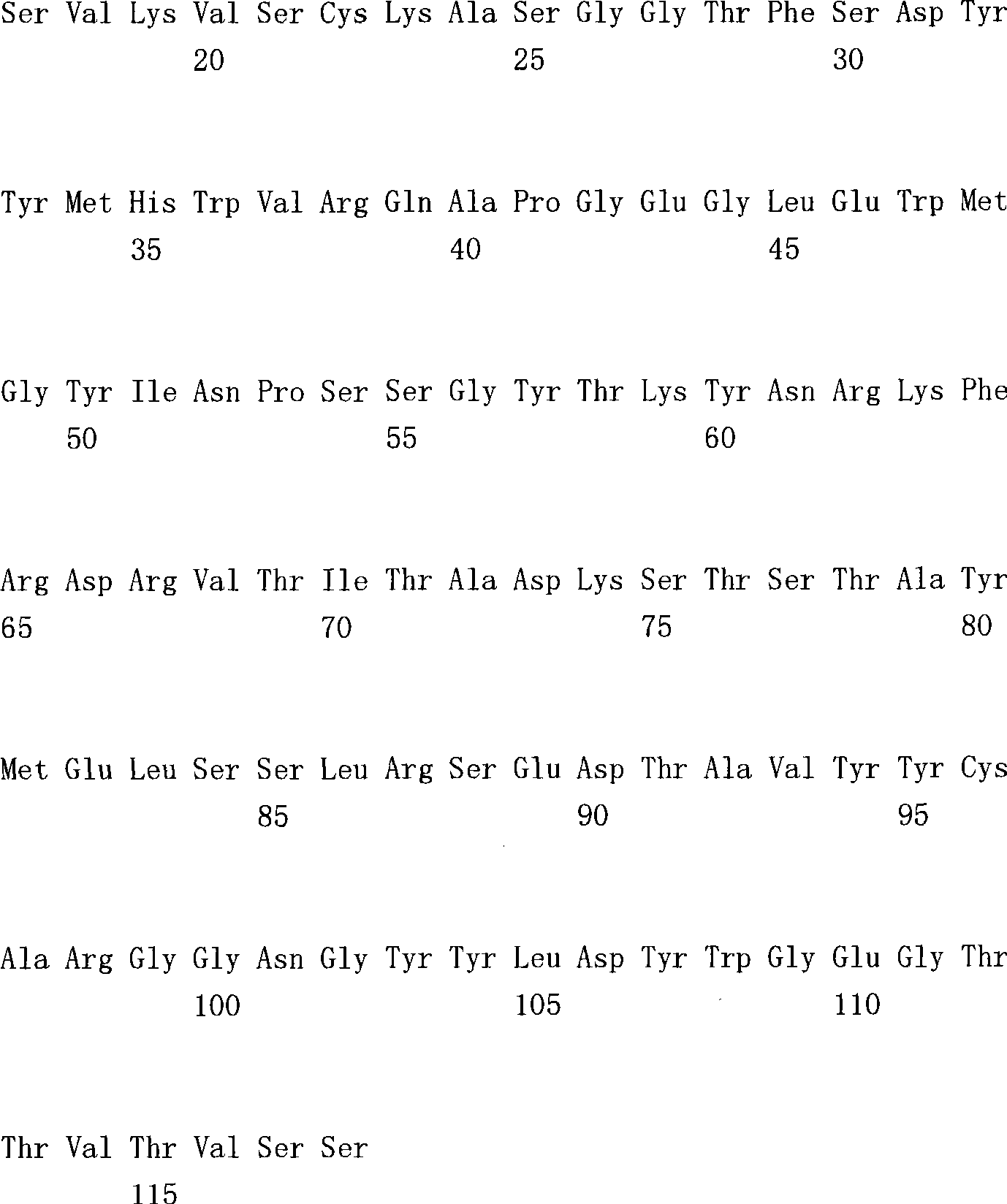
<210>8<210>8
<211>118<211>118
<212>PRT<212>PRT
<213>人工序列<213> Artificial sequence
<220><220>
<223>人工合成的序列<223>Synthetic sequences
<400>8<400>8


<210>9<210>9
<211>118<211>118
<212>PRT<212>PRT
<213>人工序列<213> Artificial sequence
<220><220>
<223>人工合成的序列<223>Synthetic sequences
<400>9<400>9

<210>10<210>10
<211>118<211>118
<212>PRT<212>PRT
<213>人工序列<213> Artificial sequence
<220><220>
<223>人工合成的序列<223>Synthetic sequences
<400>10<400>10

<210>11<210>11
<211>118<211>118
<212>PRT<212>PRT
<213>人工序列<213> Artificial sequence
<220><220>
<223>人工合成的序列<223>Synthetic sequences
<400>11<400>11

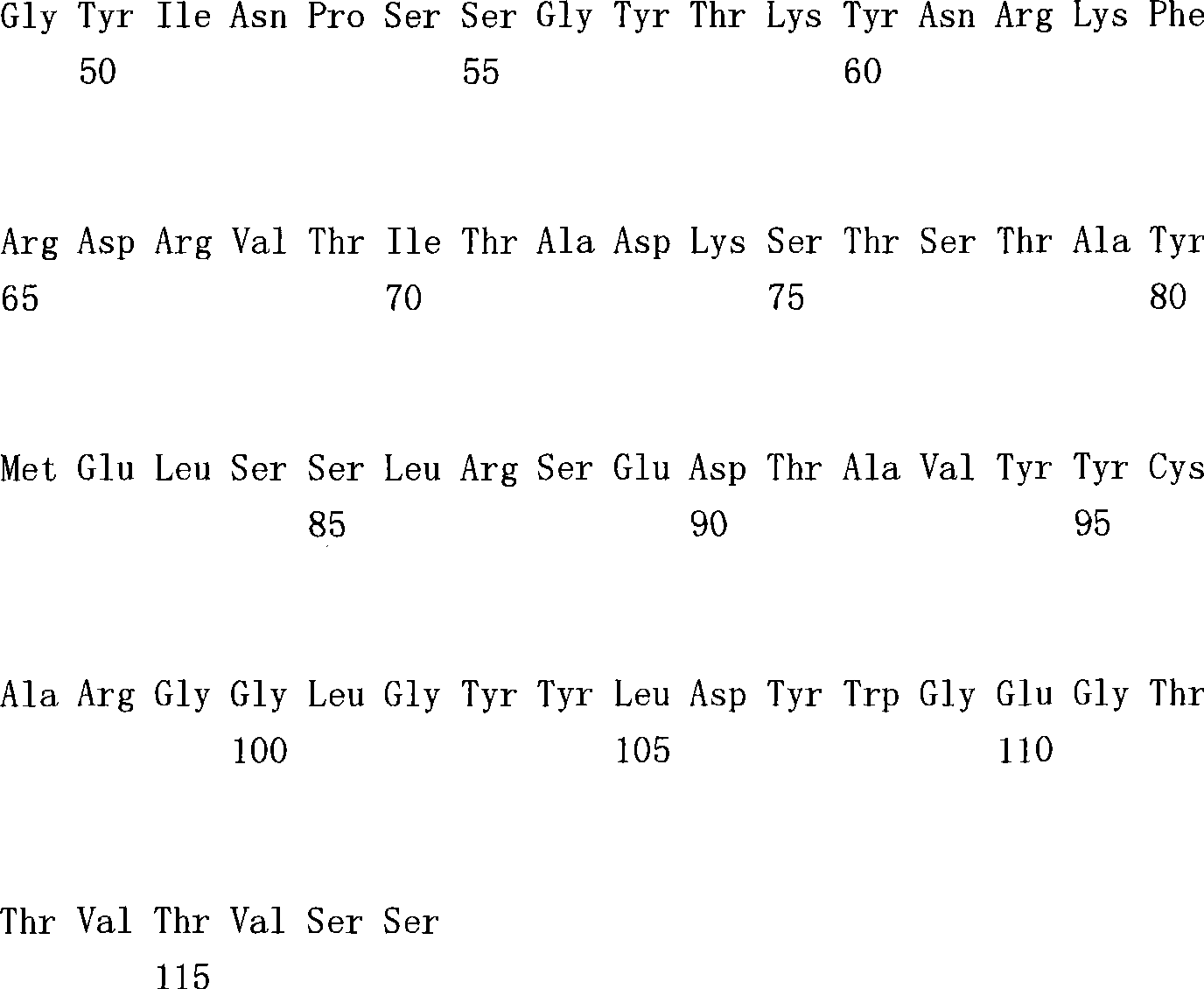
<210>12<210>12
<211>118<211>118
<212>PRT<212>PRT
<213>人工序列<213> Artificial sequence
<220><220>
<223>人工合成的序列<223>Synthetic sequences
<400>12<400>12

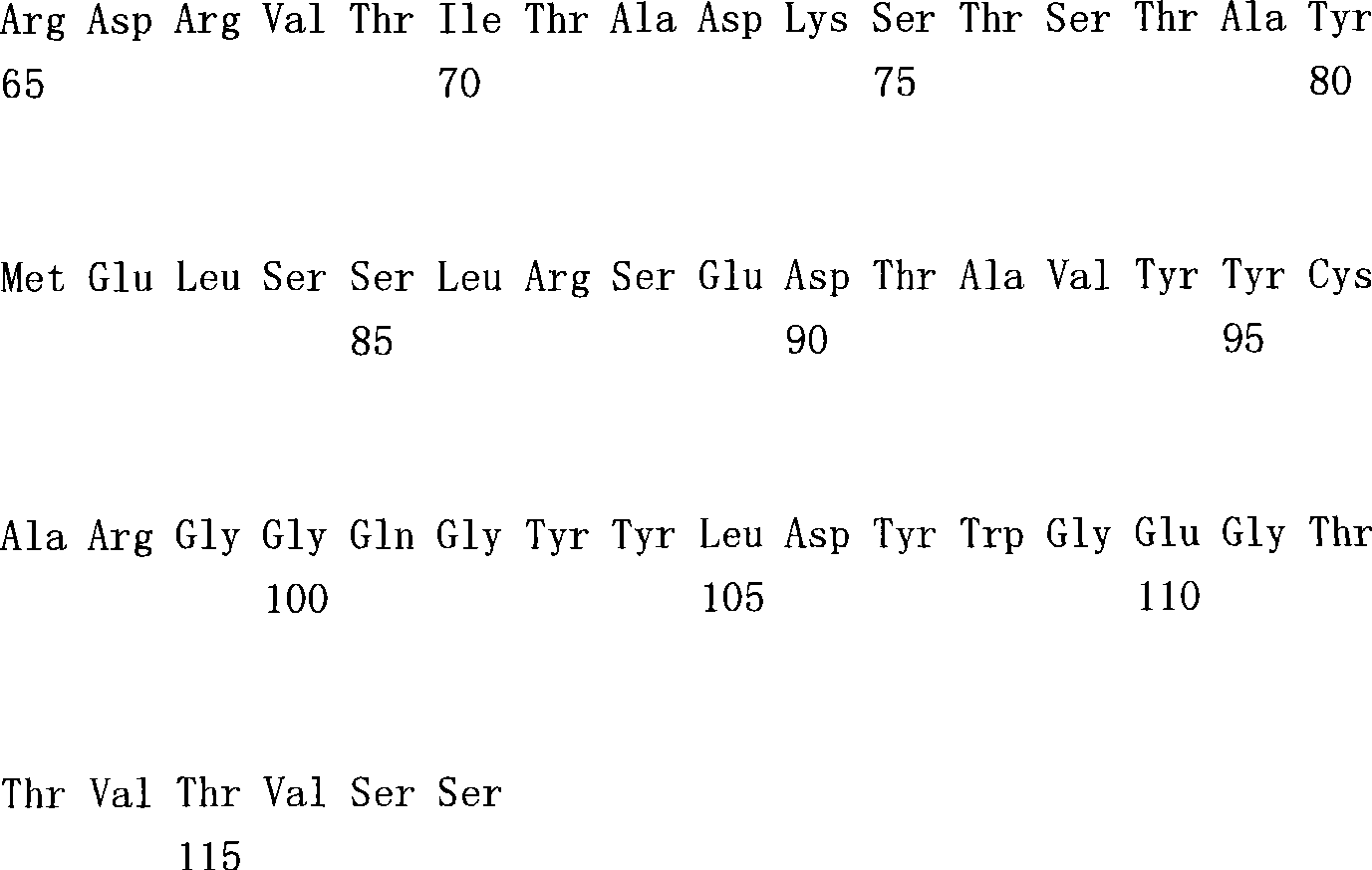
<210>13<210>13
<211>118<211>118
<212>PRT<212>PRT
<213>人工序列<213> Artificial sequence
<220><220>
<223>人工合成的序列<223>Synthetic sequences
<400>13<400>13


<210>14<210>14
<211>119<211>119
<212>PRT<212>PRT
<213>人工序列<213> Artificial sequence
<220><220>
<223>人工合成的序列<223>Synthetic sequences
<400>14<400>14


<210>15<210>15
<211>119<211>119
<212>PRT<212>PRT
<213>人工序列<213> Artificial sequence
<220><220>
<223>人工合成的序列<223>Synthetic sequences
<400>15<400>15


<210>16<210>16
<211>119<211>119
<212>PRT<212>PRT
<213>人工序列<213> Artificial sequence
<220><220>
<223>人工合成的序列<223>Synthetic sequences
<400>16<400>16

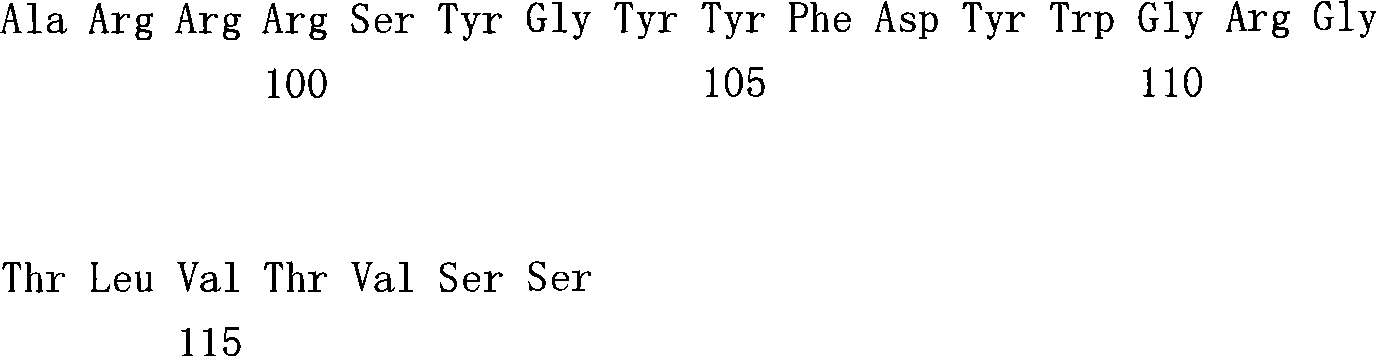
<210>17<210>17
<211>106<211>106
<212>PRT<212>PRT
<213>人工序列<213> Artificial sequence
<220><220>
<223>人工合成的序列<223>Synthetic sequences
<400>17<400>17
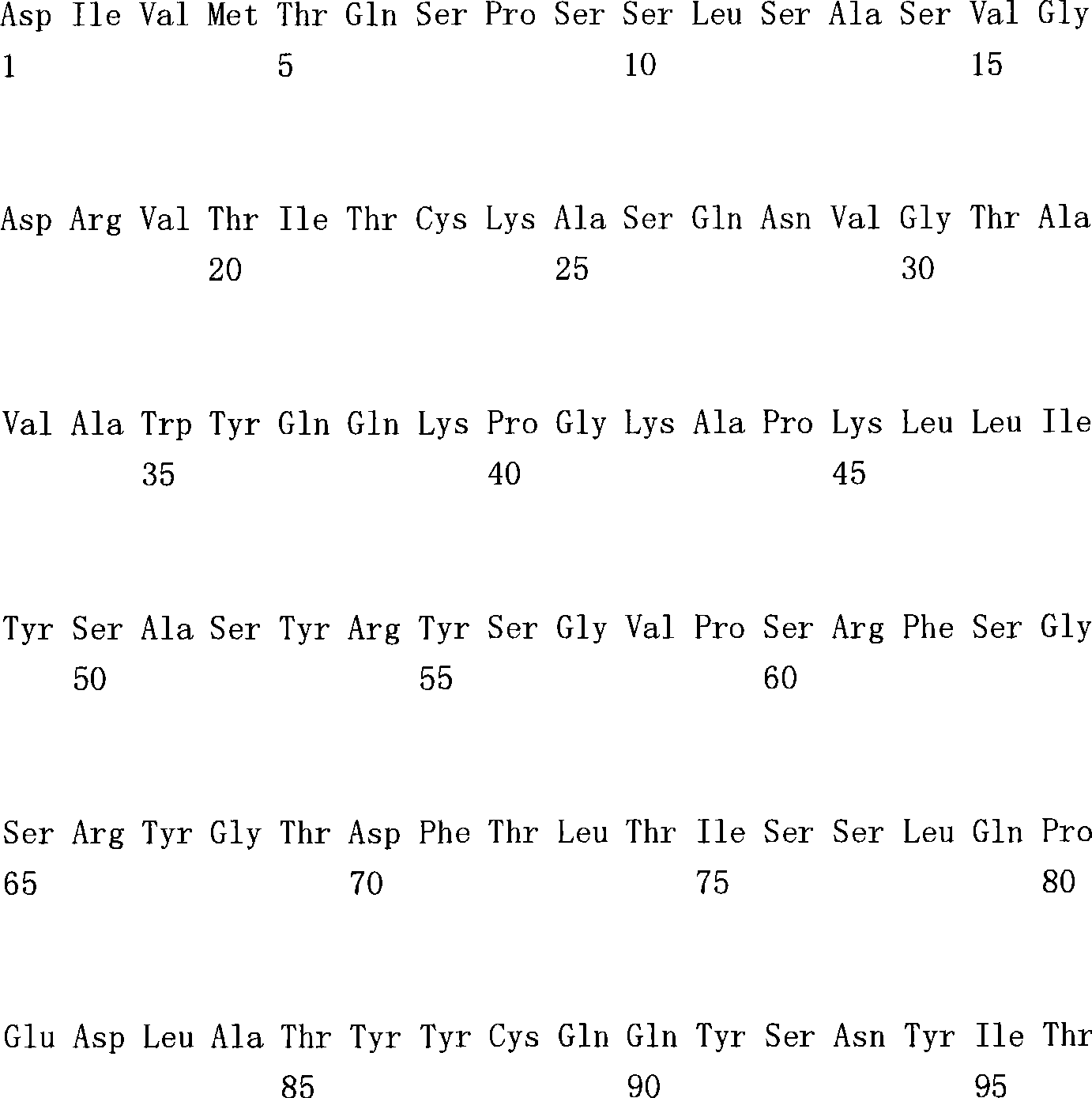

<210>18<210>18
<211>106<211>106
<212>PRT<212>PRT
<213>人工序列<213> Artificial sequence
<220><220>
<223>人工合成的序列<223>Synthetic sequences
<400>18<400>18

<210>19<210>19
<211>119<211>119
<212>PRT<212>PRT
<213>小鼠<213> mouse
<400>19<400>19

<210>20<210>20
<211>120<211>120
<212>PRT<212>PRT
<213>小鼠<213> mouse
<400>20<400>20

<210>21<210>21
<211>107<211>107
<212>PRT<212>PRT
<213>人<213> people
<400>21<400>21
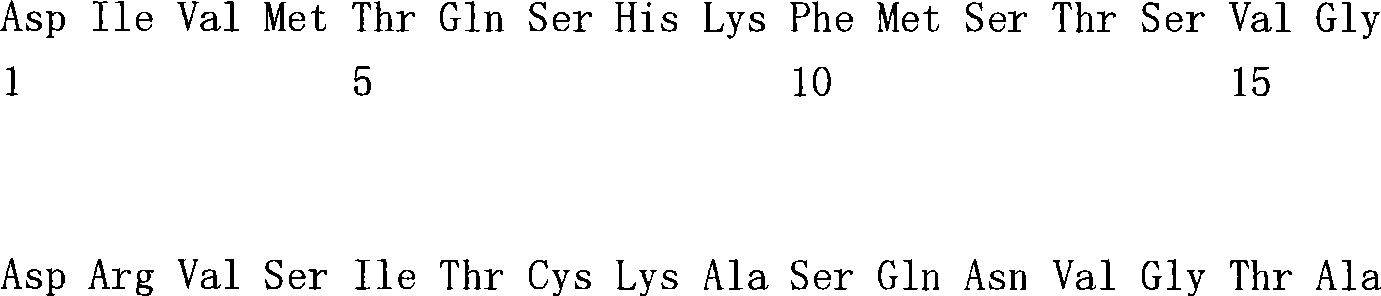

<210>22<210>22
<211>24<211>24
<212>DNA<212>DNA
<213>人工序列<213> Artificial sequence
<220><220>
<223>人工合成的引物序列<223> artificially synthesized primer sequences
<400>22<400>22

<210>23<210>23
<211>24<211>24
<212>DNA<212>DNA
<213>人工序列<213> Artificial sequence
<220><220>
<223>人工合成的引物序列<223> artificially synthesized primer sequences
<400>23<400>23

<210>24<210>24
<211>981<211>981
<212>DNA<212>DNA
<213>人<213> people
<400>24<400>24

<210>25<210>25
<211>326<211>326
<212>PRT<212>PRT
<213>人<213> people
<400>25<400>25

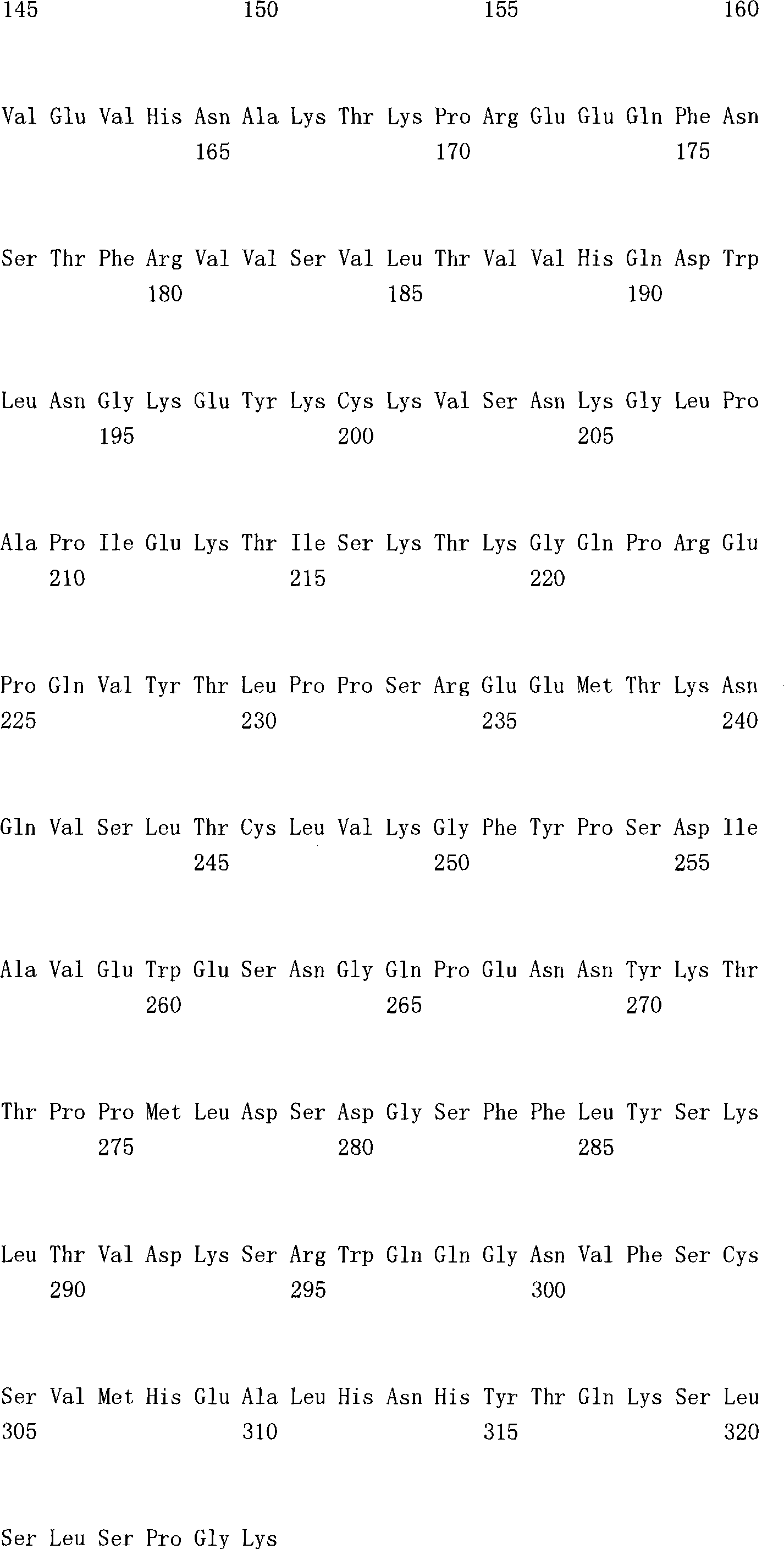
Claims (37)
Priority Applications (1)
| Application Number | Priority Date | Filing Date | Title |
|---|---|---|---|
| CN201510498322.8A CN105177091A (en) | 2006-03-31 | 2007-03-30 | Antibody modification method for purifying bispecific antibody |
Applications Claiming Priority (3)
| Application Number | Priority Date | Filing Date | Title |
|---|---|---|---|
| JP2006097795 | 2006-03-31 | ||
| JP097795/2006 | 2006-03-31 | ||
| JP275804/2006 | 2006-10-06 |
Related Child Applications (1)
| Application Number | Title | Priority Date | Filing Date |
|---|---|---|---|
| CN201510498322.8A Division CN105177091A (en) | 2006-03-31 | 2007-03-30 | Antibody modification method for purifying bispecific antibody |
Publications (1)
| Publication Number | Publication Date |
|---|---|
| CN101460622A true CN101460622A (en) | 2009-06-17 |
Family
ID=40770646
Family Applications (1)
| Application Number | Title | Priority Date | Filing Date |
|---|---|---|---|
| CNA2007800201263A Pending CN101460622A (en) | 2006-03-31 | 2007-03-30 | Antibody modification process for purification of bispecific antibodies |
Country Status (1)
| Country | Link |
|---|---|
| CN (1) | CN101460622A (en) |
Cited By (6)
| Publication number | Priority date | Publication date | Assignee | Title |
|---|---|---|---|---|
| CN105377889A (en) * | 2013-03-15 | 2016-03-02 | Xencor股份有限公司 | Heterodimeric proteins |
| CN105944099A (en) * | 2010-01-20 | 2016-09-21 | 中外制药株式会社 | Solution preparation containing stabilized antibody |
| CN108472360A (en) * | 2015-04-10 | 2018-08-31 | 阿迪马布有限责任公司 | The method of purification of heterologous dimerization multi-specificity antibody from parental generation homologous dimerization antibody type |
| CN109134658A (en) * | 2011-10-31 | 2019-01-04 | 中外制药株式会社 | Control the antigen binding molecules of the association of heavy chain and light chain |
| CN111479829A (en) * | 2017-11-01 | 2020-07-31 | 中外制药株式会社 | Antibody variants and isotypes with reduced biological activity |
| CN116769044A (en) * | 2023-07-11 | 2023-09-19 | 康日百奥生物科技(苏州)有限公司 | anti-CD 3 and CD19 bispecific antibody protein and chromatographic purification method thereof |
-
2007
- 2007-03-30 CN CNA2007800201263A patent/CN101460622A/en active Pending
Cited By (14)
| Publication number | Priority date | Publication date | Assignee | Title |
|---|---|---|---|---|
| CN105944099A (en) * | 2010-01-20 | 2016-09-21 | 中外制药株式会社 | Solution preparation containing stabilized antibody |
| US11612562B2 (en) | 2010-01-20 | 2023-03-28 | Chugai Seiyaku Kabushiki Kaisha | Solution preparation containing stabilized antibody |
| CN105944099B (en) * | 2010-01-20 | 2021-06-04 | 中外制药株式会社 | Liquid formulations containing stabilized antibodies |
| CN109134658A (en) * | 2011-10-31 | 2019-01-04 | 中外制药株式会社 | Control the antigen binding molecules of the association of heavy chain and light chain |
| CN109134658B (en) * | 2011-10-31 | 2022-10-14 | 中外制药株式会社 | Antigen binding molecules that control association of heavy and light chains |
| CN105377889A (en) * | 2013-03-15 | 2016-03-02 | Xencor股份有限公司 | Heterodimeric proteins |
| CN111138543B (en) * | 2013-03-15 | 2024-06-11 | Xencor股份有限公司 | Heterodimer protein |
| CN111138543A (en) * | 2013-03-15 | 2020-05-12 | Xencor股份有限公司 | Heterodimeric proteins |
| CN105377889B (en) * | 2013-03-15 | 2020-07-17 | Xencor股份有限公司 | heterodimeric protein |
| CN108472360B (en) * | 2015-04-10 | 2023-01-17 | 阿迪马布有限责任公司 | Method for purifying heterodimeric multispecific antibodies from parental homodimeric antibody species |
| CN108472360A (en) * | 2015-04-10 | 2018-08-31 | 阿迪马布有限责任公司 | The method of purification of heterologous dimerization multi-specificity antibody from parental generation homologous dimerization antibody type |
| CN111479829A (en) * | 2017-11-01 | 2020-07-31 | 中外制药株式会社 | Antibody variants and isotypes with reduced biological activity |
| US12421322B2 (en) | 2017-11-01 | 2025-09-23 | Chugai Seiyaku Kabushiki Kaisha | Antibody variant and isoform with lowered biological activity |
| CN116769044A (en) * | 2023-07-11 | 2023-09-19 | 康日百奥生物科技(苏州)有限公司 | anti-CD 3 and CD19 bispecific antibody protein and chromatographic purification method thereof |
Similar Documents
| Publication | Publication Date | Title |
|---|---|---|
| US10934344B2 (en) | Methods of modifying antibodies for purification of bispecific antibodies | |
| US20220267822A1 (en) | Methods for producing polypeptides by regulating polypeptide association | |
| CN109111524B (en) | Antigen binding molecules that control association of heavy and light chains | |
| CN104761637B (en) | Methods for modulating antibody hemodynamics | |
| CN102770537A (en) | Polypeptide modification method for purifying polypeptide multimers | |
| CN101460622A (en) | Antibody modification process for purification of bispecific antibodies | |
| HK1129420A (en) | Antibody modification method for purifying bispecific antibody | |
| HK1259058B (en) | Antigen-binding molecule having regulated conjugation between heavy-chain and light-chain | |
| HK1259059B (en) | Antigen-binding molecule having regulated conjugation between heavy-chain and light-chain | |
| HK1197429A (en) | Antigen-binding molecule having regulated conjugation between heavy-chain and light-chain | |
| HK1208229B (en) | Method for control of blood kinetics of antibody | |
| HK1114878B (en) | Methods for producing polypeptides by regulating polypeptide association | |
| HK1130833B (en) | Method for control of blood kinetics of antibody | |
| HK1197429B (en) | Antigen-binding molecule having regulated conjugation between heavy-chain and light-chain |
Legal Events
| Date | Code | Title | Description |
|---|---|---|---|
| C06 | Publication | ||
| PB01 | Publication | ||
| C10 | Entry into substantive examination | ||
| SE01 | Entry into force of request for substantive examination | ||
| REG | Reference to a national code |
Ref country code: HK Ref legal event code: DE Ref document number: 1129420 Country of ref document: HK |
|
| C12 | Rejection of a patent application after its publication | ||
| RJ01 | Rejection of invention patent application after publication |
Application publication date: 20090617 |
|
| REG | Reference to a national code |
Ref country code: HK Ref legal event code: WD Ref document number: 1129420 Country of ref document: HK |