CN101415747A - Processes for making copolymers using macrocyclic oligoesters, and copolymers therefrom - Google Patents
Processes for making copolymers using macrocyclic oligoesters, and copolymers therefrom Download PDFInfo
- Publication number
- CN101415747A CN101415747A CNA2007800120124A CN200780012012A CN101415747A CN 101415747 A CN101415747 A CN 101415747A CN A2007800120124 A CNA2007800120124 A CN A2007800120124A CN 200780012012 A CN200780012012 A CN 200780012012A CN 101415747 A CN101415747 A CN 101415747A
- Authority
- CN
- China
- Prior art keywords
- segmented copolymer
- block
- molecular weight
- ester
- poly
- Prior art date
- Legal status (The legal status is an assumption and is not a legal conclusion. Google has not performed a legal analysis and makes no representation as to the accuracy of the status listed.)
- Pending
Links
Classifications
-
- C—CHEMISTRY; METALLURGY
- C08—ORGANIC MACROMOLECULAR COMPOUNDS; THEIR PREPARATION OR CHEMICAL WORKING-UP; COMPOSITIONS BASED THEREON
- C08G—MACROMOLECULAR COMPOUNDS OBTAINED OTHERWISE THAN BY REACTIONS ONLY INVOLVING UNSATURATED CARBON-TO-CARBON BONDS
- C08G63/00—Macromolecular compounds obtained by reactions forming a carboxylic ester link in the main chain of the macromolecule
- C08G63/66—Polyesters containing oxygen in the form of ether groups
- C08G63/668—Polyesters containing oxygen in the form of ether groups derived from polycarboxylic acids and polyhydroxy compounds
- C08G63/672—Dicarboxylic acids and dihydroxy compounds
-
- C—CHEMISTRY; METALLURGY
- C08—ORGANIC MACROMOLECULAR COMPOUNDS; THEIR PREPARATION OR CHEMICAL WORKING-UP; COMPOSITIONS BASED THEREON
- C08G—MACROMOLECULAR COMPOUNDS OBTAINED OTHERWISE THAN BY REACTIONS ONLY INVOLVING UNSATURATED CARBON-TO-CARBON BONDS
- C08G63/00—Macromolecular compounds obtained by reactions forming a carboxylic ester link in the main chain of the macromolecule
-
- C—CHEMISTRY; METALLURGY
- C08—ORGANIC MACROMOLECULAR COMPOUNDS; THEIR PREPARATION OR CHEMICAL WORKING-UP; COMPOSITIONS BASED THEREON
- C08G—MACROMOLECULAR COMPOUNDS OBTAINED OTHERWISE THAN BY REACTIONS ONLY INVOLVING UNSATURATED CARBON-TO-CARBON BONDS
- C08G63/00—Macromolecular compounds obtained by reactions forming a carboxylic ester link in the main chain of the macromolecule
- C08G63/02—Polyesters derived from hydroxycarboxylic acids or from polycarboxylic acids and polyhydroxy compounds
- C08G63/12—Polyesters derived from hydroxycarboxylic acids or from polycarboxylic acids and polyhydroxy compounds derived from polycarboxylic acids and polyhydroxy compounds
- C08G63/16—Dicarboxylic acids and dihydroxy compounds
-
- C—CHEMISTRY; METALLURGY
- C08—ORGANIC MACROMOLECULAR COMPOUNDS; THEIR PREPARATION OR CHEMICAL WORKING-UP; COMPOSITIONS BASED THEREON
- C08G—MACROMOLECULAR COMPOUNDS OBTAINED OTHERWISE THAN BY REACTIONS ONLY INVOLVING UNSATURATED CARBON-TO-CARBON BONDS
- C08G63/00—Macromolecular compounds obtained by reactions forming a carboxylic ester link in the main chain of the macromolecule
- C08G63/02—Polyesters derived from hydroxycarboxylic acids or from polycarboxylic acids and polyhydroxy compounds
- C08G63/60—Polyesters derived from hydroxycarboxylic acids or from polycarboxylic acids and polyhydroxy compounds derived from the reaction of a mixture of hydroxy carboxylic acids, polycarboxylic acids and polyhydroxy compounds
Landscapes
- Chemical & Material Sciences (AREA)
- Health & Medical Sciences (AREA)
- Chemical Kinetics & Catalysis (AREA)
- Medicinal Chemistry (AREA)
- Polymers & Plastics (AREA)
- Organic Chemistry (AREA)
- Polyesters Or Polycarbonates (AREA)
- Other Resins Obtained By Reactions Not Involving Carbon-To-Carbon Unsaturated Bonds (AREA)
Abstract
Description
技术领域 technical field
本发明通常涉及一种热塑性塑料以及由此形成的制品。更具体地,在某些实施方式中,本发明涉及由大环聚酯低聚物(大环低聚酯,MPO)制备共聚物的方法以及由此制成的共聚物。The present invention relates generally to thermoplastics and articles formed therefrom. More specifically, in certain embodiments, the present invention relates to methods for preparing copolymers from macrocyclic polyester oligomers (macrocyclic oligoesters, MPOs) and copolymers made therefrom.
背景技术 Background technique
大环聚酯低聚物(大环低聚酯,MPO)具有独特的物理性质,其有利于制造聚酯产品。MPO与热固性树脂相比具有一些加工优势,其可以聚合形成具有良好韧性、优异耐化学性、高耐热性的热塑性聚酯,并且可以热成形、可以涂抹、可以结合、可以焊接并且可以回收。例如,MPO树脂可以是易于操作的固体小球,当被加热时熔融形成低粘性流体。熔融粘度较低使得MPO树脂易于填充模具或者渗透织物,从而制成预浸渍坯。而且,某些MPO在低于所得聚合物的熔点的温度下熔融并聚合。在熔融过程中并且在适当催化剂的存在下,聚合和结晶在基本上等温的条件下发生,没有显著的生热也没有产生挥发性有机化合物(VOC)或其它有害排放物。可以取出聚合产品而不需冷却模具,并且热循环设备所需时间和成本被有利地降低了。Macrocyclic polyester oligomers (macrocyclic oligoesters, MPOs) have unique physical properties that facilitate the manufacture of polyester products. MPO has some processing advantages over thermoset resins, it can be polymerized to form a thermoplastic polyester with good toughness, excellent chemical resistance, high heat resistance, and can be thermoformed, painted, bonded, welded and recycled. For example, MPO resins can be easily handled solid pellets that melt to form low viscosity fluids when heated. The low melt viscosity makes it easy for MPO resins to fill molds or penetrate fabrics to create prepregs. Also, certain MPOs melt and polymerize at temperatures below the melting point of the resulting polymer. During melting and in the presence of suitable catalysts, polymerization and crystallization occur under substantially isothermal conditions without significant heat generation and without production of volatile organic compounds (VOCs) or other deleterious emissions. Polymerized product can be removed without cooling the mold, and the time and cost of thermal cycling equipment is advantageously reduced.
MPO可以在合适催化剂的存在下在高温下通过开环聚合以聚合形成热塑性聚酯。具有“硬嵌段”和“软嵌段”的嵌段共聚物可以例如通过如下形成:在缩聚工艺中,诸如环状聚(对苯二甲酸丁二醇酯)(cPBT)的MPO与二羟基官能化的聚合物进行反应,正如Wang等人共同所有的美国专利6,436,549所述,该专利文献的内容通过引用全文插入本文。上述嵌段共聚物可例如用在汽车车体面板和底盘组件以及飞机机翼蒙皮的制造中。MPO can be polymerized to form thermoplastic polyesters by ring-opening polymerization at high temperature in the presence of a suitable catalyst. Block copolymers with "hard blocks" and "soft blocks" can be formed, for example, by combining MPO such as cyclic poly(butylene terephthalate) (cPBT) with dihydroxy The functionalized polymer is reacted as described in commonly owned US Patent 6,436,549 to Wang et al., the contents of which are incorporated herein by reference in their entirety. The block copolymers described above can be used, for example, in the manufacture of automotive body panels and chassis components and aircraft wing skins.
然而,通过缩聚来商业制造嵌段共聚物需要对缩聚反应器和相关的工业设备进行巨额投资。大多数缩聚系统被设计成用于大量生产单一产品,这使得该种系统很难适用于低量生产,或者生产频繁更换的多种产品。However, the commercial manufacture of block copolymers by polycondensation requires a huge investment in polycondensation reactors and associated industrial equipment. Most polycondensation systems are designed for high-volume production of a single product, which makes them difficult to adapt to low-volume production, or to produce multiple products that are frequently changed.
而且,通过缩聚来制造嵌段共聚物会导致共聚物的分子量不足,尤其是当加载大量诸如二羟基官能化聚合物的软嵌段反应物时。这可能是由于在聚合反应中作为链终止剂的物质浓度较高。人们希望得到具有较高分子量的共聚物,因为它们的物理性质有利。例如,较高分子量的共聚物通常具有高强度。它们还具有较高的特性粘度和较高的熔融强度,因而加工成本较低。Furthermore, making block copolymers by polycondensation can lead to insufficient molecular weight of the copolymers, especially when loaded with high amounts of soft block reactants such as dihydroxy functional polymers. This may be due to the higher concentration of species acting as chain terminators in the polymerization reaction. Copolymers having higher molecular weights are desirable because of their favorable physical properties. For example, higher molecular weight copolymers generally have high strength. They also have higher intrinsic viscosity and higher melt strength, resulting in lower processing costs.
而且,由于混溶问题,可以在缩聚工艺中用于制备嵌段共聚物的软嵌段反应物的类型和分子量受限。软嵌段反应物(即多元醇)通常必须具有小于1000g/mol的分子量(Mw),从而抑制在聚合反应过程中出现相分离。由于这个原因,大多数商业上可用的二羟基官能化的聚合物具有低于1000g/mol的分子量。而且,为了足以构成具有一般分子量的嵌段共聚物,嵌段共聚物中“软嵌段”组分的重量百分率通常被保持在低水平。然而,这导致嵌段共聚物中的硬嵌段单元过长。而且,高度极性的羟基官能化的聚合物由于它们所导致的混溶问题增强通常不可用于传统的缩聚工艺中。Also, due to miscibility issues, the types and molecular weights of soft block reactants that can be used in the polycondensation process to prepare block copolymers are limited. Soft block reactants (ie, polyols) must generally have a molecular weight (Mw) of less than 1000 g/mol in order to inhibit phase separation during polymerization. For this reason, most commercially available dihydroxy-functional polymers have a molecular weight below 1000 g/mol. Also, the weight percent of the "soft block" component in the block copolymer is generally kept low in order to be sufficient to form a block copolymer of typical molecular weight. However, this results in too long hard block units in the block copolymer. Furthermore, highly polar hydroxy-functional polymers are generally not usable in conventional polycondensation processes due to the increased miscibility problems they cause.
需要一种用于制备如下嵌段共聚物的方法,所述嵌段共聚物的结构和组成可以被定制以便在较宽范围内使用。例如需要一种用于制备如下嵌段共聚物的方法,所述嵌段共聚物具有所需物理和化学性质,诸如具有耐化学性、耐热性和高熔点(即由硬嵌段提供)以及具有韧性、滞后性和低模量(即由软嵌段提供)。具体地,需要一种用于制备软嵌段含量较高的嵌段共聚物以及用于制备具有较高极性软嵌段的嵌段共聚物的方法。在可掺入嵌段共聚物中的软嵌段组分的类型和用量方面,传统的缩聚工艺受到限制。There is a need for a method for preparing block copolymers whose structure and composition can be tailored for use over a wide range. For example, there is a need for a process for the preparation of block copolymers having desirable physical and chemical properties such as chemical resistance, heat resistance and high melting point (i.e. provided by the hard blocks) and Toughness, hysteresis, and low modulus (ie, provided by the soft block). In particular, there is a need for a method for making block copolymers with higher soft block content and for making block copolymers with soft blocks of higher polarity. Conventional polycondensation processes are limited in the types and amounts of soft block components that can be incorporated into block copolymers.
而且,传统的缩聚工艺需要巨额投资,并且通常仅被设计成大量制备一种特定产品。因此,还需要一种用于制备嵌段共聚物的方法,该方法需要的投资额较低,适合高产率进行小批量生产并且允许频繁更换产品。Furthermore, traditional polycondensation processes require huge investments and are usually only designed to produce one specific product in large quantities. Therefore, there is also a need for a process for the preparation of block copolymers which requires low investment, is suitable for high yields in small batches and allows for frequent product changes.
发明内容 Contents of the invention
嵌段共聚物通过如下制备:使大环聚酯低聚物(MPO)(“硬嵌段组分”)与诸如二羟基官能化的聚合物、低聚醚和/或二聚脂肪酸的“软嵌段”组分在高剪切环境(例如挤出机或其它混合装置)中在高温下进行反应。Block copolymers are prepared by combining a macrocyclic polyester oligomer (MPO) (“hard block component”) with a “soft block component” such as a dihydroxy-functionalized polymer, an oligoether, and/or a dimerized fatty acid. The "block" components are reacted at elevated temperatures in a high shear environment such as an extruder or other mixing device.
使用高剪切能够使较大量的软嵌段组分掺入嵌段共聚物中,并且与传统缩聚方法相比,允许使用极性更高的软嵌段组分和/或分子量更高的软嵌段组分。例如使用挤出机使各个组分在初始聚合过程中充分分散从而克服与缩聚方法相关的混溶问题。MPO独特的物理性质便于使用挤出机(或其它产生剪切力的装置)作为反应容器。The use of high shear enables the incorporation of larger amounts of soft block components into block copolymers and allows the use of more polar soft block components and/or higher molecular weight soft block components than conventional polycondensation methods. block components. For example, the use of an extruder allows the components to be sufficiently dispersed during the initial polymerization to overcome miscibility problems associated with the polycondensation process. The unique physical properties of MPO facilitate the use of an extruder (or other device that generates shear forces) as the reaction vessel.
然后,可以例如使用固态聚合设备在真空下通过加热产品来提高挤出后共聚产品的分子量。这得到高分子量的共聚产品,该共聚产品的结构和组成可被设计成提供所需的物理和/或化学性质组合。The molecular weight of the extruded copolymerized product can then be increased, for example by heating the product under vacuum using solid state polymerization equipment. This results in a high molecular weight copolymerized product whose structure and composition can be tailored to provide a desired combination of physical and/or chemical properties.
可以通过挤出和固体聚合来制备嵌段共聚物,而不需缩聚反应器或其它相关的设备,从而降低了商业上生产嵌段共聚物所需资金。可以使用现有的挤出机和固体聚合设备以连续、半连续或间歇工艺形式制造嵌段共聚物。还通过频繁更换产品和高产率进行小批量生产来提高制造的灵活性和生产力。Block copolymers can be prepared by extrusion and solid state polymerization without the need for polycondensation reactors or other associated equipment, thereby reducing the capital required to produce block copolymers commercially. Block copolymers can be produced in continuous, semi-continuous or batch processes using existing extruders and solid polymerization equipment. It also increases manufacturing flexibility and productivity through frequent product changes and high yields for small batch production.
因此,一方面,本发明涉及一种用于制造嵌段共聚物的方法,所述方法包括如下步骤:(a)加工含有(i)大环低聚酯、(ii)二羟基官能化的聚合物、低聚醚和/或二聚脂肪酸以及(iii)催化剂的混合物从而形成嵌段共聚物;(b)在真空、高于80℃的温度下通过加热来提高所述嵌段共聚物的分子量。可以例如使用一种或多种挤出机(即单螺杆挤出机和/或双螺杆挤出机)、混合机、共混机和/或其它能够产生高剪切力的设备来进行步骤(a),但是在某些可供选择的实施方式中,高剪切力不是必须的。在某些实施方式中,例如使用一种或多种密炼机、拉挤成型机(pultruder)、混合辊、Tilt Body分散混合机、捏合机和/或其它合适的加工设备来进行步骤(a)。在一些实施方式中,组合使用一种或多种挤出机和/或其它加工设备。在某些实施方式中,步骤(a)中所用的设备进行分配混合和分散混合。例如可以使用固态聚合装置来进行步骤(b)。在优选的实施方式中,大环低聚酯构成嵌段共聚物的硬嵌段,组分(ii)(即,二羟基官能化的聚合物、低聚醚和/或二聚脂肪酸)构成嵌段共聚物的软嵌段。Thus, in one aspect, the present invention relates to a process for the manufacture of block copolymers comprising the steps of: (a) processing polymeric polymers containing (i) macrocyclic oligoesters, (ii) dihydroxy functionalization compound, oligomeric ether and/or dimerized fatty acid and (iii) catalyst to form a block copolymer; (b) increase the molecular weight of said block copolymer by heating under vacuum at a temperature above 80°C . The step ( a), but in some alternative embodiments high shear is not necessary. In certain embodiments, step (a) is performed, for example, using one or more internal mixers, pultruders, mixing rolls, Tilt Body dispersing mixers, kneaders, and/or other suitable processing equipment ). In some embodiments, one or more extruders and/or other processing equipment are used in combination. In certain embodiments, the equipment used in step (a) performs both distributive and dispersive mixing. Step (b) can be performed, for example, using a solid state polymerization apparatus. In a preferred embodiment, the macrocyclic oligoester constitutes the hard block of the block copolymer and component (ii) (i.e., the dihydroxy-functionalized polymer, oligoether and/or dimerized fatty acid) constitutes the block copolymer. Soft blocks of segment copolymers.
在优选的实施方式中,大环低聚酯具有式I的结构重复单元:In a preferred embodiment, the macrocyclic oligoester has a structural repeat unit of formula I:

其中,A是亚烷基、亚环烷基、或单或多氧化亚烷基;B是二价芳基或脂环基。Wherein, A is an alkylene group, a cycloalkylene group, or a mono- or polyoxyalkylene group; B is a divalent aryl group or an alicyclic group.
该方法与传统缩合方法相比允许使用分子量更高的软嵌段组分。例如,步骤(a)(即挤出步骤)中的混合物可以包括分子量(即数均分子量)大于1000g/mol、大于2000g/mol、大于2500g/mol、大于5000g/mol、大于7500g/mol、大于10000g/mol、大于15000g/mol、大于20000g/mol或大于25000g/mol或更高的二羟基官能化的聚合物。This method allows the use of higher molecular weight soft block components than conventional condensation methods. For example, the mixture in step (a) (i.e. the extrusion step) may comprise a molecular weight (i.e. number average molecular weight) greater than 1000 g/mol, greater than 2000 g/mol, greater than 2500 g/mol, greater than 5000 g/mol, greater than 7500 g/mol, greater than 10,000 g/mol, greater than 15,000 g/mol, greater than 20,000 g/mol, or greater than 25,000 g/mol or more dihydroxy-functionalized polymers.
上述方法允许在所得嵌段共聚物中掺入相对于硬嵌段组分更高比例的软嵌段组分。例如,在一个实施方式中,嵌段共聚物中所有由组分(ii)构成的嵌段单元与所有由组分(i)构成的嵌段单元的重量比至少约为10:90。在另一实施方式中,该比至少约为15:85,至少约为20:80,至少约为25:75,至少约为30:70,至少约为35:65,至少约为40:60,至少约为45:55或至少约为50:50。在优选的实施方式中,步骤(a)中加入加工装置(即挤出机)中的组分(i)与组分(ii)的量大约等于结合到所得嵌段共聚物中的组分(i)和组分(ii)的量,但这并不是必须的。在某些实施方式中,步骤(a)包括将重量比至少为25:75的组分(ii)与组分(i)加入挤出机中。在其它实施方式中,该比至少约为15:85,至少约为20:80,至少约为25:75,至少约为30:70,至少约为35:65,至少约为40:60,至少约为45:55和至少约为50:50。在某些实施方式中,对嵌段共聚物中软嵌段与硬嵌段的重量比进行选择,从而得到一种或多种所需物理性质、化学性质和/或机械性质。例如,可以对软嵌段与硬嵌段的重量比进行选择,从而得到特定组合的物理性质、化学性质和/或机械性质。The method described above allows the incorporation of a higher proportion of the soft block component relative to the hard block component in the resulting block copolymer. For example, in one embodiment, the weight ratio of all block units comprised of component (ii) to all block units comprised of component (i) in the block copolymer is at least about 10:90. In another embodiment, the ratio is at least about 15:85, at least about 20:80, at least about 25:75, at least about 30:70, at least about 35:65, at least about 40:60 , at least about 45:55 or at least about 50:50. In a preferred embodiment, the amounts of components (i) and (ii) added to the processing device (i.e. extruder) in step (a) are approximately equal to the components incorporated into the resulting block copolymer ( i) and component (ii), but this is not required. In certain embodiments, step (a) includes feeding component (ii) to component (i) into the extruder in a weight ratio of at least 25:75. In other embodiments, the ratio is at least about 15:85, at least about 20:80, at least about 25:75, at least about 30:70, at least about 35:65, at least about 40:60, At least about 45:55 and at least about 50:50. In certain embodiments, the weight ratio of soft blocks to hard blocks in the block copolymer is selected to result in one or more desired physical, chemical, and/or mechanical properties. For example, the weight ratio of soft blocks to hard blocks can be selected to obtain a particular combination of physical, chemical, and/or mechanical properties.
同样可以对所用软嵌段组分的类型进行选择,从而得到具有特定性质的共聚物。例如,为了制备诸如本征型消静电聚合物(inherentlydissipative polymer)(IDP)的嵌段共聚物,可以使用极性较高的羟基官能化的聚合物,例如二醇,诸如聚乙二醇。例如IDP可以与商业聚合物混合使用从而提供抗静电性质。IDP可以与大量商业聚合物,例如ABS、聚碳酸酯、聚苯乙烯和聚烯烃中的任意一种共混,而对其它性质的影响较小。IDP优于抗静电剂;例如IDP不会像抗静电剂一样从主体聚合物中流失,并且与抗静电剂相比IDP的性能并不高度依赖于环境湿度。Likewise, the type of soft block component used can be selected to obtain a copolymer with specific properties. For example, to prepare block copolymers such as intrinsically dissipative polymers (IDPs), more polar hydroxyl-functional polymers, such as diols, such as polyethylene glycol, can be used. For example IDP can be blended with commercial polymers to provide antistatic properties. IDP can be blended with any of a large number of commercial polymers, such as ABS, polycarbonate, polystyrene and polyolefin, with little effect on other properties. IDP is superior to antistatic agents; for example, IDP does not bleed from the host polymer like antistatic agents, and the performance of IDP is not highly dependent on ambient humidity compared to antistatic agents.
在优选实施方式中,所述催化剂是酯交换催化剂。所述催化剂可以包括例如锡化合物和/或钛酸酯化合物。In a preferred embodiment, the catalyst is a transesterification catalyst. The catalyst may include, for example, tin compounds and/or titanate compounds.
在一个实施方式中,在步骤(a)中挤出以后,通过将挤出物在真空下进行加热来进行步骤(b)从而提高嵌段共聚物的分子量。例如,在某些实施方式中,步骤(b)包括,加热嵌段共聚物从而将步骤(a)后的所述嵌段共聚物的分子量提高到至少约2倍,至少约3倍,至少约4倍,至少约5倍,至少约6倍,至少约7倍,至少约8倍,至少约9倍或至少约10倍。在某些实施方式中,步骤(b)后的嵌段共聚物具有至少约30000、至少约50000、至少约100000、至少约125000、至少约150000、至少约175000、至少约200000、至少约225000、至少约250000、至少约275000、至少约300000的分子量(即相对于GPC聚苯乙烯标样的重均分子量)。In one embodiment, after extrusion in step (a), step (b) is performed by heating the extrudate under vacuum to increase the molecular weight of the block copolymer. For example, in certain embodiments, step (b) includes heating the block copolymer to increase the molecular weight of the block copolymer after step (a) by at least about 2 times, at least about 3 times, at least about 4 times, at least about 5 times, at least about 6 times, at least about 7 times, at least about 8 times, at least about 9 times or at least about 10 times. In certain embodiments, the block copolymer after step (b) has at least about 30,000, at least about 50,000, at least about 100,000, at least about 125,000, at least about 150,000, at least about 175,000, at least about 200,000, at least about 225,000, A molecular weight (ie, weight average molecular weight relative to GPC polystyrene standards) of at least about 250,000, at least about 275,000, at least about 300,000.
本文所用术语“真空下”意指在低于环境压力的压力下。在某些实施方式中,步骤(b)涉及在不超过约100torr、不超过约20torr、优选不超过约5torr、更优选不超过约0.5torr的压力下进行加热。例如可以在至少约100℃、至少约150℃、至少约175℃、至少约190℃或至少约200℃的温度下进行步骤(b)中的加热。在优选的实施方式中,在约180℃至约250℃、约190至约240℃或约200℃至约220℃的温度下实施步骤(b)中的加热。优选在所述嵌段共聚物处于固态的情况下进行步骤(b)中的加热。在某些实施方式中,步骤(b)包括,将所述嵌段共聚物加热约2小时至约16小时,或约4小时至约8小时。取决于嵌段共聚物、所用设备和/或需要增加的分子量,加热时间、加热温度和/或压力可以发生变化。The term "under vacuum" as used herein means under pressure below ambient pressure. In certain embodiments, step (b) involves heating at a pressure of no more than about 100 torr, no more than about 20 torr, preferably no more than about 5 torr, more preferably no more than about 0.5 torr. For example, the heating in step (b) can be performed at a temperature of at least about 100°C, at least about 150°C, at least about 175°C, at least about 190°C, or at least about 200°C. In preferred embodiments, the heating in step (b) is carried out at a temperature of from about 180°C to about 250°C, from about 190 to about 240°C, or from about 200°C to about 220°C. The heating in step (b) is preferably carried out with the block copolymer in the solid state. In certain embodiments, step (b) comprises heating the block copolymer for about 2 hours to about 16 hours, or for about 4 hours to about 8 hours. Depending on the block copolymer, the equipment used, and/or the desired molecular weight increase, heating times, heating temperatures, and/or pressures can vary.
在某些实施方式中,大环低聚酯包括至少一个对苯二甲酸亚烷基酯的单体单元,例如对苯二甲酸丁二醇酯、对苯二甲酸乙二醇酯和/或对苯二甲酸丙二醇酯。In certain embodiments, the macrocyclic oligoester comprises at least one monomer unit of an alkylene terephthalate, such as butylene terephthalate, ethylene terephthalate, and/or terephthalate Propylene glycol phthalate.
在某些组分(ii)包括二羟基官能化的聚合物的实施方式中,二羟基官能化的聚合物包括二羟基官能化的聚(对苯二甲酸亚烷基酯),例如二羟基官能化的聚(对苯二甲酸乙二醇酯)、聚(对苯二甲酸丁二醇酯)和/或聚(对苯二甲酸丙二醇酯)。在某些实施方式中,二羟基官能化的聚合物包括二聚二醇、聚烯烃二醇、聚己内酯二醇、聚全氟醚二醇和/或聚硅氧烷二醇。In certain embodiments where component (ii) comprises a dihydroxy-functional polymer, the dihydroxy-functional polymer comprises a dihydroxy-functional poly(alkylene terephthalate), such as a dihydroxy-functional Poly(ethylene terephthalate), poly(butylene terephthalate), and/or poly(trimethylene terephthalate). In certain embodiments, dihydroxy-functional polymers include dimer diols, polyolefin diols, polycaprolactone diols, polyperfluoroether diols, and/or polysiloxane diols.
在某些组分(ii)包括低聚醚的实施方式中,低聚醚包括聚(亚乙基醚)二醇、聚(亚丙基醚)二醇、聚(四亚甲基醚)二醇和/或聚(氧化四亚甲基)。In certain embodiments where component (ii) includes an oligoether, the oligoether includes poly(ethylene ether) glycol, poly(trimethylene ether) glycol, poly(tetramethylene ether) diol alcohol and/or poly(tetramethylene oxide).
在某些组分(ii)包括二聚脂肪酸的实施方式中,二聚脂肪酸包括油酸、亚油酸、棕榈油酸、反油酸、芥酸(eucric acid)、向日葵油、大豆油、橄榄油、油菜籽油、棉花籽油和妥尔油(tall oil)的二聚产物。In certain embodiments where component (ii) includes a dimerized fatty acid, the dimerized fatty acid includes oleic acid, linoleic acid, palmitoleic acid, elaidic acid, eucric acid, sunflower oil, soybean oil, olive oil, Dimerization products of oil, rapeseed oil, cottonseed oil and tall oil.
由于本发明的各种实施方式提供了改善的多功能性,所以可以制备其它方法无法制备的具有独特性质的新型嵌段共聚物。例如,可以通过使嵌段共聚物与不同于MPO的酯(即环状酯,诸如己内酯或聚己内酯)在酯交换催化剂的存在下进行反应来调整共聚物的熔点和硬嵌段部分的结晶度。这样的结果是共聚物中的硬嵌段部分包含无规构型的MPO构成单元和酯构成单元。改变组成可以影响共聚物的总混溶性以及硬嵌段和软嵌段部分的微相分离特性,从而改变共聚物的物理性质、机械性质和/或化学性质。Because of the improved versatility provided by the various embodiments of the present invention, novel block copolymers with unique properties that cannot be prepared by other methods can be prepared. For example, the melting point and hard block of the copolymer can be adjusted by reacting the block copolymer with an ester other than MPO (i.e., a cyclic ester such as caprolactone or polycaprolactone) in the presence of a transesterification catalyst. part of the crystallinity. As a result, the hard block portion in the copolymer contains MPO constituting units and ester constituting units in a random configuration. Changing the composition can affect the overall miscibility of the copolymer as well as the microphase separation characteristics of the hard and soft block segments, thereby changing the physical, mechanical and/or chemical properties of the copolymer.
因此,在某些实施方式中,本方法进一步包括如下步骤:(c)在步骤(b)后,使所述嵌段共聚物与酯在酯交换催化剂的存在下在高温下进行反应,从而制成含有由组分(i)、组分(ii)和酯构成的结构单元的共聚酯,其中,所述酯包括至少一个式II结构单元:Therefore, in certain embodiments, the method further comprises the step of: (c) after step (b), reacting the block copolymer with the ester at high temperature in the presence of a transesterification catalyst, thereby producing into a copolyester comprising structural units consisting of component (i), component (ii) and an ester, wherein the ester comprises at least one structural unit of formula II:
-R1-O-C(O)-R2-(II)-R 1 -OC(O)-R 2 -(II)
其中,R1和R2中的每一个都独立地是二价有机片段。在某些实施方式中,嵌段共聚物中的软嵌段包括由组分(ii)构成的单元,并且嵌段共聚物中的硬嵌段包括由组分(i)和步骤(c)中的酯构成的单元。在某些实施方式中,硬嵌段包括由组分(i)和步骤(c)中的酯构成的无规单元。在优选的实施方式中,所述酯不包括与MPO相同的物质,也就是说,如果R2是-B′-C(O)-,那么R1不是-O-A′-,其中,A’是亚烷基、亚环烷基、或单或多氧化亚烷基;B是二价芳基或脂环基。Wherein, each of R and R is independently a divalent organic moiety. In certain embodiments, the soft block in the block copolymer comprises units composed of component (ii), and the hard block in the block copolymer comprises units formed from component (i) and step (c) units of esters. In certain embodiments, the hard block comprises random units consisting of component (i) and the ester in step (c). In a preferred embodiment, the ester does not include the same species as MPO, that is, if R 2 is -B'-C(O)-, then R 1 is not -OA'-, where A' is Alkylene, cycloalkylene, or mono- or polyoxyalkylene; B is a divalent aryl or alicyclic group.
在某些实施方式中,步骤(c)中的酯是环状酯,例如内酯。所述内酯例如可以为己内酯。在某些实施方式中,所述酯包括脂族聚酯和/或芳族聚酯。步骤(c)可以例如在典型的酯交换反应条件下进行,例如在约100℃至约300℃范围内的温度下进行,优选在约180℃至约250℃范围内的温度下进行。In certain embodiments, the ester in step (c) is a cyclic ester, such as a lactone. The lactone may be, for example, caprolactone. In certain embodiments, the esters include aliphatic polyesters and/or aromatic polyesters. Step (c) can be carried out, for example, under typical transesterification reaction conditions, for example at a temperature ranging from about 100°C to about 300°C, preferably at a temperature ranging from about 180°C to about 250°C.
另一方面,本发明提供了一种嵌段共聚物,所述共聚物包括(a)第一嵌段单元,所述单元包括在聚合主链上的至少一种式I结构单元:In another aspect, the present invention provides a block copolymer comprising (a) a first block unit comprising at least one structural unit of formula I on the polymeric backbone:

其中,A是亚烷基、亚环烷基、或者单或多氧化亚烷基且B是二价芳基或脂环基;和至少一种式II结构单元:Wherein, A is an alkylene group, a cycloalkylene group, or a mono- or polyoxyalkylene group and B is a divalent aryl group or an alicyclic group; and at least one structural unit of formula II:
-R1-O-C(O)-R2- (II)-R 1 -OC(O)-R 2 - (II)
其中,R1和R2中的每一个都独立地是二价有机片段;并且所述共聚物包括(b)第二嵌段单元,所述单元包括在聚合主链上的至少一种式III结构单元:wherein each of R and R is independently a divalent organic moiety; and the copolymer comprises (b) a second block unit comprising at least one formula III on the polymeric backbone Structural units:
-D- (III)-D- (III)
其中,D是亚烷基、亚环烷基、或单或多氧化亚烷基,并且D中的碳原子中的一个或多个可以被氧原子、氮原子或硫原子替代。在某些实施方式中,嵌段共聚物中的第一嵌段单元包括无规构型的式I和II结构单元。所述嵌段共聚物可以例如通过本文所述的方法制造。在某些实施方式中,D包括聚亚烷基醚、聚亚乙基醚、聚亚丙基醚、聚亚甲基醚、聚烯烃、聚己内酯、聚全氟醚、二聚二醇和/或聚硅氧烷二醇。在优选的实施方式中,如果R2是-B′-C(O)-,那么R1不是-O-A′-,其中,A’是亚烷基、亚环烷基、或者单或多氧化亚烷基;B’是二价芳基或脂环基。Wherein, D is an alkylene group, a cycloalkylene group, or a mono- or polyoxyalkylene group, and one or more of the carbon atoms in D may be replaced by an oxygen atom, a nitrogen atom or a sulfur atom. In certain embodiments, the first block unit in the block copolymer comprises structural units of formulas I and II in a random configuration. The block copolymers can be made, for example, by the methods described herein. In certain embodiments, D includes polyalkylene ethers, polyethylene ethers, polypropylene ethers, polymethylene ethers, polyolefins, polycaprolactones, polyperfluoroethers, dimer glycols, and /or polysiloxane diol. In a preferred embodiment, if R 2 is -B'-C(O)-, then R 1 is not -OA'-, where A' is alkylene, cycloalkylene, or mono- or polyoxyethylene Alkyl; B'is a divalent aryl or alicyclic group.
在某些实施方式中,嵌段共聚物具有至少约30000、至少约50000、至少约100000、至少约125000、至少约150000、至少约175000、至少约200000、至少约225000、至少约250000、至少约275000或者至少约300000的分子量(即相对于GPC聚苯乙烯标样的重均分子量)。In certain embodiments, the block copolymer has at least about 30,000, at least about 50,000, at least about 100,000, at least about 125,000, at least about 150,000, at least about 175,000, at least about 200,000, at least about 225,000, at least about 250,000, at least about A molecular weight of 275,000 or at least about 300,000 (ie, weight average molecular weight relative to GPC polystyrene standards).
在一个实施方式中,所有第二嵌段单元与所有第一嵌段单元的重量比至少约为10:90。在其它实施方式中,该比至少约为15:85,至少约为20:80,至少约为25:75,至少约为30:70,至少约为35:65,至少约为40:60,至少约为45:55和至少约为50:50。在某些实施方式中,嵌段共聚物具有本征型消静电性。例如,可以选择所有第二嵌段单元与所有第一嵌段单元的重量比足够高,从而嵌段共聚物是本征型消静电聚合物(IDP)。In one embodiment, the weight ratio of all second block units to all first block units is at least about 10:90. In other embodiments, the ratio is at least about 15:85, at least about 20:80, at least about 25:75, at least about 30:70, at least about 35:65, at least about 40:60, At least about 45:55 and at least about 50:50. In certain embodiments, the block copolymer has intrinsic static dissipating properties. For example, the weight ratio of all second block units to all first block units can be selected to be high enough such that the block copolymer is an intrinsically dissipative polymer (IDP).
另一方面,本发明提供了一种共混物,所述共混物包括(a)嵌段共聚物,所述嵌段共聚物具有第一嵌段单元,所述第一嵌段单元包括在聚合主链上的至少一种式I结构单元:In another aspect, the present invention provides a blend comprising (a) a block copolymer having a first block unit comprising At least one structural unit of formula I on the polymeric main chain:

其中,A是亚烷基、亚环烷基、或者单或多氧化亚烷基且B是二价芳基或脂环基;并且具有第二嵌段单元,所述第二嵌段单元包括在聚合主链上的至少一种式III结构单元:Wherein, A is an alkylene group, a cycloalkylene group, or a single or polyoxyalkylene group and B is a divalent aryl group or an alicyclic group; and has a second block unit, and the second block unit is included in At least one structural unit of formula III on the polymeric main chain:
-D-(III)-D-(III)
其中,D是亚烷基、亚环烷基、或单或多氧化亚烷基,并且D中的碳原子中的一个或多个可以被氧原子、氮原子或硫原子替代;并且所述共混物包括(b)羟基官能化的聚合物、低聚物和二聚脂肪酸中的至少一种。在一个实施方式中,共混物中的组分(b)包括聚乙二醇。Wherein, D is an alkylene group, a cycloalkylene group, or a mono- or polyoxyalkylene group, and one or more of the carbon atoms in D may be replaced by an oxygen atom, a nitrogen atom or a sulfur atom; and the co- The blend includes (b) at least one of hydroxy-functionalized polymers, oligomers, and dimerized fatty acids. In one embodiment, component (b) in the blend includes polyethylene glycol.
具体实施方式 Detailed ways
嵌段共聚物通过如下制备:将大环低聚酯(MPO)和二羟基官能化的聚合物(和/或低聚醚、二聚脂肪酸和/或其它嵌段共聚物中的软嵌段组分)在酯交换催化剂的存在下挤出(或以其它方式剪切)。通过在真空下(在低于环境压力的压力下)加热固体挤出物来提高所得嵌段共聚物的分子量。Block copolymers are prepared by combining macrocyclic oligoesters (MPOs) with dihydroxy-functionalized polymers (and/or oligoethers, dimerized fatty acids, and/or other soft block groups in block copolymers) sub) extruded (or otherwise sheared) in the presence of a transesterification catalyst. The molecular weight of the resulting block copolymer is increased by heating the solid extrudate under vacuum (at a pressure below ambient pressure).
在初始聚合步骤过程中,在挤出机中施加剪切力从而使得软嵌段组分与MPO分散。与传统缩聚工艺相关的混溶问题被克服了,并且该方法能够使用更多种的软嵌段组分,包括那些具有较高分子量和/或较高极性的软嵌段组分。使用挤出机得到嵌段共聚物,其分子量可以通过固态聚合来提高。During the initial polymerization step, shear forces are applied in the extruder to disperse the soft block component with the MPO. Miscibility issues associated with traditional polycondensation processes are overcome, and the process enables the use of a wider variety of soft block components, including those with higher molecular weight and/or higher polarity. Extruders are used to obtain block copolymers whose molecular weight can be increased by solid state polymerization.
在某些实施方式中,本发明与使用缩聚反应器来制备嵌段共聚物的传统方法相比具有优点。例如,能够制备具有较高分子量的嵌段共聚物,并且该嵌段共聚物承载二羟基官能化的聚合物(和/或其它软嵌段组分)的水平较高。结果,可以根据所需应用更好地设计嵌段共聚物的物理性质、机械性质和化学性质。In certain embodiments, the present invention has advantages over conventional methods of making block copolymers using polycondensation reactors. For example, block copolymers can be prepared with higher molecular weights and which carry higher levels of dihydroxy-functionalized polymers (and/or other soft block components). As a result, the physical, mechanical and chemical properties of the block copolymers can be better tailored according to the desired application.
例如可以采用挤出机和固态聚合装置以连续工艺、半连续工艺和/或间歇工艺制造共聚物。在某些实施方式中,本发明避免了使用缩聚工艺通常使用的昂贵反应器。上述反应器通常是高度工程化且是高耗能的。在某些实施方式中,本发明通过允许频繁更换产品和高产率进行小批量生产来提高生产的灵活性和生产力。Copolymers can be produced, for example, in continuous, semi-continuous, and/or batch processes using extruders and solid state polymerization equipment. In certain embodiments, the present invention avoids the use of expensive reactors commonly used in polycondensation processes. The aforementioned reactors are generally highly engineered and energy intensive. In certain embodiments, the present invention increases production flexibility and productivity by allowing frequent product changes and high throughput for small batch production.
在某些实施方式中,本发明的方法适合与塑料部件制造中的其它单元操作一起使用,所述单元操作例如包括模塑工艺、注射模制工艺、挤出工艺、拉挤工艺、粉末涂布工艺和例如在Winckler等人共同所有的美国专利6,369,157和Winckler等人共同所有的美国专利6,420,047中所述的任何工艺,上述专利文献通过引用全文插入本文。In certain embodiments, the method of the present invention is suitable for use with other unit operations in the manufacture of plastic parts including, for example, molding processes, injection molding processes, extrusion processes, pultrusion processes, powder coating process and any of the processes described, for example, in commonly owned US Patent 6,369,157 to Winckler et al. and US Patent 6,420,047 commonly owned by Winckler et al., which are incorporated herein by reference in their entirety.
本文所述的组合物和方法可用于制造具有各种尺寸和形状的制品。可以制造的制品例如包括,汽车车体面板和底盘组件、保险杠、飞机机翼蒙皮、风车叶片、液体存储罐、拖拉机挡泥板、网球拍、高尔夫球杆、冲浪帆板桅杆、玩具、杆、管、棒材、自行车架和机器外壳。The compositions and methods described herein can be used to manufacture articles of various sizes and shapes. Articles that can be manufactured include, for example, automotive body panels and chassis components, bumpers, aircraft wing skins, windmill blades, liquid storage tanks, tractor fenders, tennis rackets, golf clubs, surfboard masts, toys, Rods, tubes, rods, bike frames and machine housings.
在这些制品的制造过程中,可以添加额外的组分和/或填料。示例性的添加剂例如包括,着色剂、颜料、磁性材料、抗氧化剂、UV稳定剂、增塑剂、阻燃剂、润滑剂、脱模剂和/或其它填料。During the manufacture of these articles, additional components and/or fillers may be added. Exemplary additives include, for example, colorants, pigments, magnetic materials, antioxidants, UV stabilizers, plasticizers, flame retardants, lubricants, mold release agents, and/or other fillers.
在某些实施方式中,可以例如采用溶剂,从而协助大环聚酯低聚物与软嵌段组分和催化剂在挤出机(或混合机,或其他产生剪切力的单元操作)中均匀混合。可以使用各种溶剂,除了溶剂应当基本上无水以避免催化剂失活的情况以外,对可以使用的溶剂的类型通常没有限制。可用在本发明中的溶剂的示例性实例包括,邻-二氯苯、甲苯、甲醇、乙醇、异丙醇、丙酮、甲基乙基甲酮、苯、邻-二甲苯、氯苯、二氯甲烷和氯仿。In certain embodiments, a solvent may be used, for example, to assist in homogenizing the macrocyclic polyester oligomer with the soft block component and catalyst in the extruder (or mixer, or other unit operation that generates shear forces). mix. A variety of solvents can be used, and there is generally no restriction on the type of solvent that can be used, except that the solvent should be substantially anhydrous to avoid catalyst deactivation. Illustrative examples of solvents that can be used in the present invention include o-dichlorobenzene, toluene, methanol, ethanol, isopropanol, acetone, methyl ethyl ketone, benzene, o-xylene, chlorobenzene, dichloro methane and chloroform.
在某些实施方式中,本发明涉及一种单组分、预备聚合的共混物(所述共混物包括MPO(硬嵌段反应物))、软嵌段反应物(二羟基官能化的聚合物、低聚醚和/或二聚脂肪酸)和催化剂。所述共混物还可以包含一种或更多种填料和/或其它物质。单组分共混物保持至少一天、至少2天、至少3天、至少一周、至少一个月或至少一年或更长的稳定性,而MPO没有明显过早聚合,而且催化剂没有明显失活。当希望聚合MPO时,使单组分共混物暴露于足以使MPO熔融并聚合的温度下,在该过程中,聚合和结晶基本上等温发生。该共混物例如可被用作单组分、预备聚合的组合物,从而用于通过注塑、挤出、拉挤和/或例如在Winckler等人共同所有的美国专利6,420,047中描述的任何一种工艺来制备产品,上述专利文献通过引用全文插入本文。In certain embodiments, the present invention relates to a one-component, prepolymerized blend comprising MPO (hard block reactant), soft block reactant (dihydroxy functionalized polymers, oligoethers and/or dimerized fatty acids) and catalysts. The blend may also contain one or more fillers and/or other substances. The one-component blend remains stable for at least one day, at least 2 days, at least 3 days, at least one week, at least one month, or at least one year or longer without significant premature polymerization of the MPO and without significant catalyst deactivation. When it is desired to polymerize the MPO, the one-component blend is exposed to a temperature sufficient to melt and polymerize the MPO, during which polymerization and crystallization occur substantially isothermally. The blend can be used, for example, as a one-component, ready-to-polymerize composition for injection molding, extrusion, pultrusion, and/or any of those described, for example, in commonly owned U.S. Patent 6,420,047 to Winckler et al. process to prepare the product, the above patent documents are incorporated herein by reference in their entirety.
预料到,所要求保护的本发明的实施方式中的方法、系统和工艺包括利用得自本文所描述实施方式的信息进行的放大、变化和修改。例如,本发明的实施方式包括试验工场和工厂规模的制造工艺,上述工艺通过本文所描述的实验室规模试验证实是可行的。本文所述工艺可以以间歇、半连续和/或连续操作方式进行。聚合物制造和加工领域中的普通技术人员可以将该系统从实验室规模放大至工厂规模。例如,该领域普通技术人员通过试验工厂和/或全套反应器实验可以选择加工设备、设计得到动力学数据的实验、开发并应用设备和工艺设计所用模型、开发经济上最佳的设备和工艺设计和/或使设备和工艺设计有效。还预料到,所要求保护的本发明的方法、系统和工艺可以包括聚合物制造和加工领域中普通技术人员已知的泵、热交换器和气相、液相和/或固相材料处理设备。It is contemplated that the methods, systems and processes of the claimed embodiments of the invention include amplifications, variations and modifications utilizing information obtained from the embodiments described herein. For example, embodiments of the invention include pilot plant and plant scale manufacturing processes that were demonstrated to be feasible by the laboratory scale tests described herein. The processes described herein can be performed in batch, semi-continuous and/or continuous operation. One of ordinary skill in the art of polymer manufacturing and processing can scale up this system from laboratory scale to plant scale. For example, one of ordinary skill in the art can select process equipment, design experiments to derive kinetic data, develop and apply models for equipment and process design, and develop economically optimal equipment and process designs through pilot plant and/or full reactor experiments and/or enable equipment and process design to be effective. It is also contemplated that the methods, systems and processes of the claimed invention may include pumps, heat exchangers and gas, liquid and/or solid phase material handling equipment known to those of ordinary skill in the polymer manufacturing and processing arts.
整篇说明书中,当描述组合物、混合物、共混物和复合物具有、包含或包括特定组分时,或描述工艺和方法具有、包含或包括特定步骤时,应预料到本发明的组合物、混合物、共混物和复合物也可以基本上由所述的组分组成或由所述的组分组成,并且应预料到本发明的工艺和方法也可以基本上由所述的处理步骤组成或由所述的处理步骤组成。Throughout the specification, when compositions, mixtures, blends and compounds are described as having, comprising or comprising specific components, or when processes and methods are described as having, comprising or comprising specific steps, the compositions of the present invention are contemplated , mixtures, blends and composites may also consist essentially of or consist of the described components, and it is contemplated that the processes and methods of the present invention may also consist essentially of the described processing steps Or consist of the processing steps described.
应当理解到,只要本发明具有可操作性,步骤的次序和进行某种动作的次序并不重要。而且,两个或更多个步骤或动作可以同时进行。It should be understood that the order of steps or order for performing certain actions is immaterial so long as the invention remains operable. Also, two or more steps or actions may be performed simultaneously.
本文在例如背景技术部分对任何出版物进行的描述不视为承认该出版物是与本文中存在的任何权利要求相关的现有技术。背景技术部分的存在是为了清楚说明的目的,并不意味着作为对任何权利要求现有技术的描述。The description herein of any publication, eg, in the Background section, is not an admission that that publication is prior art to any claims presented herein. This Background section is presented for the purpose of clarity and is not intended as a description of the prior art for any claim.
以下一般性定义有助于理解本说明书中所用的各种术语和表达。The following general definitions facilitate understanding of various terms and expressions used in this specification.
定义definition
本文中,“大环”被理解为意指:在其分子结构中具有至少一个环的环状分子,该分子结构包含5个或更多个共价连接的原子以形成所述的环。In this context, "macrocycle" is understood to mean: a cyclic molecule having in its molecular structure at least one ring comprising 5 or more atoms covalently linked to form said ring.
本文中,“低聚物”被理解为意指:包含一个或更多个相同或不同的可识别结构重复单元的分子。Herein, "oligomer" is understood to mean: a molecule comprising one or more identical or different recognizable structural repeat units.
本文中,“大环聚酯低聚物”(MPO)被理解为意指:包含具有酯官能性的结构重复单元的大环低聚物。大环聚酯低聚物通常指多个具有一个具体重复单元结构式的分子。然而,大环聚酯低聚物还可以包括多个具有不同或混合结构式的分子,该结构式具有不同数量的相同或不同结构重复单元。而且,大环聚酯低聚物可以是共聚酯或多组分聚酯的低聚物,即,在一个环状分子中具有两个或更多个具有酯官能性的不同结构重复单元的低聚物。Herein, "macrocyclic polyester oligomer" (MPO) is understood to mean: a macrocyclic oligomer comprising structural repeat units with ester functionality. Macrocyclic polyester oligomers generally refer to multiple molecules having a specific repeating unit formula. However, macrocyclic polyester oligomers may also include multiple molecules with different or mixed structural formulas having different numbers of repeating units of the same or different structures. Furthermore, macrocyclic polyester oligomers may be copolyesters or oligomers of multicomponent polyesters, i.e., those having two or more different structural repeat units with ester functionality in one cyclic molecule. Oligomer.
本文中,“基本上均聚酯或基本上共聚酯低聚物”被理解为意指:聚酯低聚物,其中结构重复单元基本上相同或基本上由两种或更多种不同结构重复单元组成。As used herein, "substantially homopolyester or copolyester oligomer" is understood to mean: a polyester oligomer in which the structural repeat units are substantially identical or consist essentially of two or more different structures Composition of repeating units.
本文中,“亚烷基”被理解为意指:-CnH2n-,其中,n≥2。Herein, "alkylene" is understood to mean: -C n H 2n -, where n≥2.
本文中,“亚环烷基”被理解为意指:环状亚烷基,-CnH2n-x-,其中x表示由环化所替代的氢的数量。Herein, "cycloalkylene" is understood to mean: cyclic alkylene, -CnH2n -x- , where x represents the number of hydrogens replaced by cyclization.
本文中,“单或多氧化亚烷基”被理解为意指:[-(CH2)m-O-]n-(CH2)m-,其中m是大于1的整数,n是大于0的整数。Herein, "mono- or polyoxyalkylene" is understood to mean: [-(CH 2 ) m -O-] n -(CH 2 ) m -, where m is an integer greater than 1 and n is greater than 0 an integer of .
本文中,“二价芳基”被理解为意指:与大环分子的其它部分具有键的芳基。例如,二价芳基可以包括间位或对位键合的单环芳基(例如苯)。Herein, "divalent aryl" is understood to mean: an aryl having a bond to the rest of the macrocyclic molecule. For example, divalent aryl groups may include meta- or para-bonded monocyclic aryl groups (eg, benzene).
本文中,“脂环基”被理解为意指:其中含有环状结构的非芳族烃基。Herein, "alicyclic group" is understood to mean: a non-aromatic hydrocarbon group containing a ring structure therein.
本文中,“填料”被理解为意指:除可以包括在含有MPO的共混物中的大环聚酯低聚物或聚合催化剂以外的其它材料,其可以存在于由聚合含MPO共混物得到的聚合物组合物中。填料可用于达到所需目的或性质,并且可以存在于所得聚酯聚合物中或在所得聚酯聚合物中转化成已知和/或未知物质。例如,填料的目的可以是:为共混材料或聚合物组合物提供稳定性,例如,化学稳定性、热稳定性或光稳定性;增强聚合物组合物/产品的强度;和/或增强共混材料和/或聚合物组合物的导电性和/或导热性。填料还可以提供颜色或减少颜色、提供重量或体积以达到特定密度、减小气体和蒸汽渗透性、提供阻燃性或耐烟雾性(即,阻燃剂)、替代昂贵的材料、有助于加工和/或提供其它希望的性质。填料的示例性实例是:石墨、片状石墨、碳纳米管、碳黑、碳纤维、巴基球富勒烯(minsterfullerene)、金刚石、无水硅酸镁(无水滑石)、白碳黑、二氧化钛、碳酸钙、钙硅石、短纤维、飞尘、玻璃、玻璃纤维、磨碎玻纤、玻璃微球、微球、碎石、纳米粘土、线性聚合物、单体、支化聚合物、工程树脂、冲击改性剂、有机粘土和颜料。例如,多种填料可以包含在MPO共混物中以达到性质平衡。例如,冲击改性剂可被加入含有片状石墨的MPO共混物中,以使所得共混物和/或聚合物组合物具有高耐冲击性以及高导电性。Herein, "filler" is understood to mean: other materials than macrocyclic polyester oligomers or polymerization catalysts which may be included in the MPO-containing blend, which may be present in the polymerized MPO-containing blend in the resulting polymer composition. Fillers may be used to achieve desired purposes or properties and may be present or converted to known and/or unknown species in the resulting polyester polymer. For example, the purpose of the filler may be to: provide stability to the blend material or polymer composition, for example, chemical stability, thermal stability, or light stability; enhance the strength of the polymer composition/product; and/or enhance the co- Electrical and/or thermal conductivity of hybrid materials and/or polymer compositions. Fillers can also provide color or reduce color, provide weight or volume to achieve a specific density, reduce gas and vapor permeability, provide flame or smoke resistance (i.e., flame retardants), replace expensive materials, contribute to processing and/or providing other desirable properties. Illustrative examples of fillers are: graphite, flake graphite, carbon nanotubes, carbon black, carbon fibers, buckyball fullerene (minsterfullerene), diamond, anhydrous magnesium silicate (anhydrous talc), white carbon black, titanium dioxide , calcium carbonate, wollastonite, short fibers, fly ash, glass, glass fibers, ground glass fibers, glass microspheres, microspheres, gravel, nanoclays, linear polymers, monomers, branched polymers, engineering resins , impact modifiers, organoclays and pigments. For example, various fillers can be included in MPO blends to achieve a balance of properties. For example, impact modifiers can be added to MPO blends containing flake graphite to impart high impact resistance as well as high electrical conductivity to the resulting blend and/or polymer composition.
本文中,“C1-4伯烷基”被理解为意指:具有1至4个碳原子经由伯碳原子连接的烷基。Herein, "C 1-4 primary alkyl" is understood to mean: an alkyl group having 1 to 4 carbon atoms linked via a primary carbon atom.
本文中,“C1-10烷基”被理解为意指:具有1至10个碳原子的烷基,包括直链或支化基。Herein, "C 1-10 alkyl" is understood to mean: an alkyl group having 1 to 10 carbon atoms, including straight chain or branched groups.
本文中,“亚甲基”被理解为意指:-CH2-。Herein, "methylene" is understood to mean: -CH2- .
本文中,“亚乙基”被理解为意指:-CH2-CH2-。Herein, "ethylene" is understood to mean: -CH 2 -CH 2 -.
本文中,“C2-3亚烷基”被理解为意指:-CnH2n-,其中,n是2或3。Herein, "C 2-3 alkylene" is understood to mean: -C n H 2n -, wherein n is 2 or 3.
本文中,“C2-6亚烷基”被理解为意指:-CnH2n-,其中,n是2-6。Herein, "C 2-6 alkylene" is understood to mean: -C n H 2n -, wherein n is 2-6.
本文中,“二羟基官能化的聚合物”被理解为意指:具有至少两个羟基官能团的聚合物。通常,所述至少两个羟基官能团位于聚合物链的末端。然而,所述聚合物可以是支化的,具有两个或多个分支的所述聚合物的每个分支上都可以具有羟基官能化的末端。Herein, "dihydroxy-functional polymer" is understood to mean: a polymer having at least two hydroxyl functions. Typically, the at least two hydroxyl functional groups are located at the end of the polymer chain. However, the polymer may be branched, and polymers having two or more branches may have hydroxyl functionalized ends on each branch.
本文中,“低聚醚”被理解为意指:结构重复单元具有醚官能团的低聚物。In this context, "oligoethers" are understood to mean: oligomers whose structural repeat units have ether functional groups.
本文中,“二聚脂肪酸”被理解为意指:单不饱和或多不饱和脂肪酸的二聚产物。Herein, "dimerized fatty acid" is understood to mean: dimerization products of monounsaturated or polyunsaturated fatty acids.
所给出的如下标题作为一般性组织框架,并不意欲将本发明的任何特定元素限定在本说明书的特定部分。The following headings are given as a general organizational framework and are not intended to limit any particular element of the invention to that particular portion of the specification.
I.大环聚酯低聚物I. Macrocyclic polyester oligomers
大环聚酯低聚物也可以被称为大环低聚酯,在本文中缩写为MPO。可以制备许多不同的MPO并可用在本发明的各种实施方式中。因此,根据所需嵌段共聚物的性质,可以在其制造过程中选择使用合适的MPO。Macrocyclic polyester oligomers may also be referred to as macrocyclic oligoesters, abbreviated herein as MPO. Many different MPOs can be prepared and used in various embodiments of the invention. Therefore, depending on the desired properties of the block copolymer, an appropriate MPO can be selected for use in its manufacture.
可用在本发明中的MPO包括,但不限于,具有式I结构重复单元的大环聚(二羧酸亚烷基酯)低聚物:MPOs useful in the present invention include, but are not limited to, macrocyclic poly(alkylene dicarboxylate) oligomers having structural repeat units of formula I:
其中,A是亚烷基、亚环烷基、或单或聚氧化亚烷基;B是二价芳香基或脂环基。Among them, A is an alkylene group, a cycloalkylene group, or a single or polyoxyalkylene group; B is a divalent aromatic group or an alicyclic group.
优选的MPO是大环聚(对苯二甲酸1,4-丁二醇酯)(cPBT)、大环聚(对苯二甲酸1,3-丙二醇酯)(cPPT)、大环聚(对苯二甲酸1,4-亚环己基二亚甲酯)(cPCT)、大环聚(对苯二甲酸亚乙酯)(PET)和大环聚(2,6-萘二羧酸1,2-亚乙酯)(cPEN)低聚物以及含有两个或多个上述单体重复单元的共聚酯低聚物。Preferred MPOs are macrocyclic poly(1,4-butylene terephthalate) (cPBT), macrocyclic poly(1,3-propylene terephthalate) (cPPT), macrocyclic poly(1,3-butylene terephthalate) 1,4-cyclohexylene dimethylene dicarboxylate) (cPCT), macrocyclic poly(ethylene terephthalate) (PET) and macrocyclic poly(2,6-naphthalene dicarboxylic acid 1,2- Ethylene ester) (cPEN) oligomers and copolyester oligomers containing two or more repeating units of the above monomers.
可以通过已知方法制备MPO。优选MPO的合成方法可以包括如下步骤:使至少一个结构式为HO-A-OH的二醇和至少一个具有如下结构式的二酰氯接触:MPO can be prepared by known methods. Preferably, the synthetic method of MPO may comprise the steps of contacting at least one diol having the structural formula HO-A-OH and at least one diacid chloride having the following structural formula:

其中,A和B为如上所定义的。通常,该反应在至少一种胺的存在下进行,所述的胺基本没有环绕碱性氮原子的位阻。上述的胺的示例性实例是1,4-二氮杂双环[2,2,2]辛烷(DABCO)。该反应通常在诸如二氯甲烷之类的基本水不能混溶的有机溶剂中,在基本无水的条件下进行。反应温度通常在从约-25℃到约25℃的范围内。参见例如Brunelle等人的美国专利No.5,039,783。wherein, A and B are as defined above. Typically, the reaction is carried out in the presence of at least one amine that is substantially free of steric hindrance around the basic nitrogen atom. An illustrative example of the aforementioned amine is 1,4-diazabicyclo[2,2,2]octane (DABCO). The reaction is generally carried out under substantially anhydrous conditions in a substantially water-immiscible organic solvent such as dichloromethane. The reaction temperature generally ranges from about -25°C to about 25°C. See, eg, US Patent No. 5,039,783 to Brunelle et al.
还可以在高度非受阻胺或其与至少一种诸如三乙胺之类的其它叔胺的混合物的存在下,在诸如二氯甲烷、氯苯或其混合物之类的基本惰性的有机溶剂中,通过二氯酰和至少一种诸如对苯二甲酸二(4-羟基丁酯)之类的二羟烷基酯的缩合来制备MPO。参见例如Brunelle等的美国专利No.5,231,161。It is also possible, in the presence of a highly unhindered amine or a mixture thereof with at least one other tertiary amine such as triethylamine, in a substantially inert organic solvent such as dichloromethane, chlorobenzene or a mixture thereof, MPO is prepared by condensation of dichloroacyl and at least one dihydroxyalkyl ester such as bis(4-hydroxybutyl) terephthalate. See, eg, US Patent No. 5,231,161 to Brunelle et al.
另一种制备MPO的方法是:在有机锡或钛酸酯化合物的存在下解聚线型聚酯聚合物。在该方法中,通过加热线型聚酯、有机溶剂和诸如锡或钛化合物之类的酯交换催化剂的混合物将线型聚酯转化成大环聚酯低聚物。所使用的诸如邻二甲苯和邻二氯苯的溶剂通常基本上没有氧气和水。参见例如Brunelle等的美国专利No.5,407,984和Brunelle等的美国专利No.5,668,186。在Phelps等人共同所有的美国临时专利申请60/665,648中描述了制备并解聚低酸性聚对苯二甲酸亚烷基酯以制备MPO的方法。Another way to prepare MPO is by depolymerizing linear polyester polymers in the presence of organotin or titanate compounds. In this method, linear polyesters are converted to macrocyclic polyester oligomers by heating a mixture of linear polyesters, an organic solvent, and a transesterification catalyst such as tin or titanium compounds. The solvents used, such as ortho-xylene and ortho-dichlorobenzene, are generally substantially free of oxygen and water. See, eg, US Patent Nos. 5,407,984 to Brunelle et al. and US Patent No. 5,668,186 to Brunelle et al. A method of making and depolymerizing low acid polyalkylene terephthalates to make MPO is described in commonly owned US Provisional Patent Application 60/665,648 to Phelps et al.
已通过如下来制备MPO:由具有中等分子量的聚酯出发,在催化剂的存在下,通过接触二元羧酸或二元羧酸酯从而制备含有羟烷基终止的聚酯低聚物的组合物。将羟烷基终止的聚酯低聚物加热,从而制成具有中等分子量的聚酯的组合物,所述具有中等分子量的聚酯优选具有20000道尔顿至约70000道尔顿的分子量。在进行加热工艺以制备含有MPO的组合物以前或过程中,将具有中等分子量的聚酯进行加热并加入溶剂。参见Faler的美国专利6,525,164。MPO has been prepared by starting from polyesters of moderate molecular weight by contacting dicarboxylic acids or dicarboxylic acid esters in the presence of catalysts to prepare compositions containing hydroxyalkyl-terminated polyester oligomers . The hydroxyalkyl terminated polyester oligomers are heated to form compositions having intermediate molecular weight polyesters, preferably having a molecular weight of from 20,000 Daltons to about 70,000 Daltons. The medium molecular weight polyester is heated and a solvent is added before or during the heating process to prepare the MPO-containing composition. See US Patent 6,525,164 to Faler.
利用Phelps等人共同所有的美国专利6,787,632中所述的有机钛酸酯催化剂,通过解聚制备的MPO基本上没有大环共聚低聚酯。MPO prepared by depolymerization was substantially free of macrocyclic co-oligoesters using the organotitanate catalysts described in commonly owned US Patent 6,787,632 to Phelps et al.
采用大环均聚酯低聚物和共聚酯低聚物都包括在本发明的范围内。因此,除非另有声明,涉及大环聚酯低聚物的组合物、制品、工艺或方法的实施方式还包括共聚酯实施方式。It is within the scope of this invention to employ macrocyclic homopolyester oligomers and copolyester oligomers. Thus, unless otherwise stated, embodiments of compositions, articles, processes or methods involving macrocyclic polyester oligomers also include copolyester embodiments.
在一个实施方式中,用在本发明中的大环酯均聚低聚物和共聚低聚物包括具有式V通用结构重复单元的低聚物:In one embodiment, macrocyclic ester homo-oligomers and co-oligomers for use in the present invention include oligomers having a general structural repeat unit of Formula V:
其中,A’是亚烷基、亚环烷基、或者单或多氧化亚烷基,并且A’可以是被取代的、未被取代的、支化的和/或线性的。这种类型MPO的实例包括丁内酯和己内酯,其中,聚合度为1;和2,5-二氧代-1,4-二氧杂环己烷和丙交酯,其中,聚合度为2。聚合度也可以为3、4、5或更高。以下分别表示2,5-二氧代-1,4-二氧杂环己烷和丙交酯的分子结构:Wherein, A' is an alkylene group, a cycloalkylene group, or a mono- or polyoxyalkylene group, and A' can be substituted, unsubstituted, branched and/or linear. Examples of this type of MPO include butyrolactone and caprolactone, where the degree of polymerization is 1; and 2,5-dioxo-1,4-dioxane and lactide, where the degree of polymerization is 2. The degree of polymerization may also be 3, 4, 5 or higher. The molecular structures of 2,5-dioxo-1,4-dioxane and lactide are shown below:

一般而言,用在本发明的各种实施方式中MPO包括具有不同聚合度的物质。本文中,MPO的聚合度(DP)意指,低聚主链中可确认的结构重复单元的个数。结构重复单元可以具有相同或不同的分子结构。例如,MPO可以包括二聚物、三聚物、四聚物、五聚物和/或其它物质。In general, MPOs for use in various embodiments of the invention include materials having different degrees of polymerization. Herein, the degree of polymerization (DP) of MPO means the number of identifiable structural repeating units in the oligomeric main chain. Structural repeat units can have the same or different molecular structures. For example, MPO may include dimers, trimers, tetramers, pentamers, and/or other species.
在某些实施方式中,MPO是含有约30至约45wt%二聚物、约30至约45wt%三聚物、约0至约10wt%四聚物以及约5wt%至约20wt%五聚物的组合物。也可以使用在上述范围以外的MPO配制品。本发明的某些实施方式包括组成被修正的MPO。共同所有的美国专利6,436,548中描述了修正MPO组成的各种示例性方法。In certain embodiments, the MPO is composed of about 30 to about 45 wt % dimers, about 30 to about 45 wt % trimers, about 0 to about 10 wt % tetramers, and about 5 wt % to about 20 wt % pentamers Compositions. MPO formulations outside the above ranges may also be used. Certain embodiments of the invention include compositionally modified MPOs. Various exemplary methods of modifying the composition of MPO are described in commonly owned US Patent 6,436,548.
II.二羟基官能化的聚合物、低聚醚和二聚脂肪酸II. Dihydroxy-functionalized polymers, oligoethers and dimerized fatty acids
各种二羟基官能化的聚合物、低聚醚和二聚脂肪酸可用在本发明的实施方式中。因此,根据所需最终聚酯聚合物产品的性质,在其制造过程中可以选择使用合适的二羟基官能化的聚合物、低聚醚和/或二聚脂肪酸。A variety of dihydroxy-functional polymers, oligoethers, and dimerized fatty acids can be used in embodiments of the present invention. Thus, depending on the desired properties of the final polyester polymer product, suitable dihydroxy-functionalized polymers, oligoethers and/or dimerized fatty acids can be selected for use in its manufacture.
在本发明的各种实施方式中使用的二羟基官能化的聚合物包括,任何可以与大环聚酯低聚物在酯交换条件下进行反应从而形成嵌段共聚物的二羟基官能化的聚合物。这些二羟基官能化的聚合物的示例性实例包括,二羟基官能化的聚(对苯二甲酸亚烷基酯)、二羟基官能化的聚(对苯二甲酸乙二醇酯)、二羟基官能化的聚(对苯二甲酸丁二醇酯)、二聚二醇、聚烯烃二醇、聚己内酯二醇、聚全氟醚二醇和聚硅氧烷二醇。大部分或者全部这些二羟基官能化的聚合物都可商购。Dihydroxy-functional polymers useful in various embodiments of the present invention include any dihydroxy-functional polymer that can react with macrocyclic polyester oligomers under transesterification conditions to form block copolymers. thing. Illustrative examples of such dihydroxy-functional polymers include, dihydroxy-functional poly(alkylene terephthalate), dihydroxy-functional poly(ethylene terephthalate), dihydroxy-functional Functionalized poly(butylene terephthalate), dimer diols, polyolefin diols, polycaprolactone diols, polyperfluoroether diols, and polysiloxane diols. Most or all of these dihydroxy-functional polymers are commercially available.
在本发明的各种实施方式中使用的低聚醚包括,任何可以与MPO在酯交换条件下进行反应从而形成嵌段共聚物的低聚醚。这些低聚醚例如包括聚(亚烷基醚)二醇和聚(氧化亚烷基),诸如聚(亚乙基醚)二醇、聚(亚丙基醚)二醇、聚(四亚甲基醚)二醇和聚(氧化四亚甲基)。这些低聚醚可商购,例如包括E.I.duPont Nemours and Company制造的Terathane
在本发明的各种实施方式中使用的二聚脂肪酸包括,任何可以与MPO在酯交换条件下进行反应从而形成嵌段共聚物的二聚脂肪酸。用在本发明中的二聚脂肪酸的示例性实例例如包括,油酸、亚油酸、棕榈油酸、反油酸、芥酸的二聚产物。例如包括向日葵油、大豆油、橄榄油、油菜籽油、棉花籽油和妥尔油的天然脂肪和油水解得到的二聚产物也可用在本发明中。这些二聚脂肪酸可商购。Dimerized fatty acids used in various embodiments of the present invention include any dimerized fatty acid that can be reacted with MPO under transesterification conditions to form a block copolymer. Illustrative examples of dimerized fatty acids used in the present invention include, for example, dimerization products of oleic acid, linoleic acid, palmitoleic acid, elaidic acid, erucic acid. Dimerization products obtained by hydrolysis of natural fats and oils, for example including sunflower oil, soybean oil, olive oil, rapeseed oil, cottonseed oil and tall oil, are also useful in the present invention. These dimerized fatty acids are commercially available.
本发明的共聚物包括如下共聚物:其硬嵌段具有一个或多个MPO(硬嵌段低聚物)并且其软嵌段具有二羟基官能化的聚合物、低聚醚和二聚脂肪酸(软嵌段低聚物)中至少一个。在某些实施方式中,软嵌段低聚物与硬嵌段低聚物的重量比至少约为10:90,至少约为15:85,至少约为20:80,至少约为25:75,至少约为30:70,至少约为35:65,至少约为40:60,至少约为45:55或至少约为50:50。The copolymers of the present invention include copolymers whose hard blocks have one or more MPOs (hard block oligomers) and whose soft blocks have dihydroxy-functionalized polymers, oligoethers, and dimerized fatty acids ( at least one of soft block oligomers). In certain embodiments, the weight ratio of soft block oligomers to hard block oligomers is at least about 10:90, at least about 15:85, at least about 20:80, at least about 25:75 , at least about 30:70, at least about 35:65, at least about 40:60, at least about 45:55 or at least about 50:50.
用在各种实施方式中的二羟基官能化的聚合物、低聚醚和二聚脂肪酸可以具有例如大于1000g/mol、大于2000g/mol、大于2500g/mol、大于5000g/mol、大于7500g/mol、大于10000g/mol、大于15000g/mol、大于20000g/mol或大于25000g/mol的分子量(即数均分子量)。在一个实施方式中,所用二羟基官能化的聚合物、低聚醚和/或二聚脂肪酸具有在约1000至约100000范围内的分子量。在另一实施方式中,所述分子量在约1000至约10000的范围内。The dihydroxy-functionalized polymers, oligoethers, and dimerized fatty acids used in various embodiments can have, for example, greater than 1000 g/mol, greater than 2000 g/mol, greater than 2500 g/mol, greater than 5000 g/mol, greater than 7500 g/mol , a molecular weight greater than 10000 g/mol, greater than 15000 g/mol, greater than 20000 g/mol or greater than 25000 g/mol (ie number average molecular weight). In one embodiment, the dihydroxy-functionalized polymers, oligoethers and/or dimerized fatty acids used have a molecular weight in the range of about 1,000 to about 100,000. In another embodiment, the molecular weight is in the range of about 1,000 to about 10,000.
III.共聚催化剂III. Copolymerization Catalyst
在本发明的各种实施中所用的催化剂能够在由MPO和软嵌段低聚物(即二羟基官能化的聚合物)制备嵌段共聚物的过程中催化反应。与用于进行以酯-酯交换为基础的MPO的环状开环聚合的现有工艺一样,有机锡和有机钛酸酯化合物是优选的催化剂,但也可以使用其它催化剂。例如,可以使用的催化剂包括Brunelle等人共同所有的美国专利5,407,984、Brunelle的5,498,651、Takekoshi等人的5,527,976、Brunelle等人的5,661,214以及Brunelle等人的5,710,086中所述的那些。例如,二羟基丁基氯化锡(即二羟基正丁基氯化锡(IV))可被用作催化剂。其它说明性的有机锡化合物包括,二烷基锡(IV)氧化物,诸如,二正丁基锡(IV)氧化物和二正辛基锡氧化物;和无环族和环族一烷基锡(IV)衍生物,诸如,正丁基锡三正丁氧化物;二烷基锡(IV)二烷氧化物,诸如二正丁基锡(IV)二正丁氧化物和2,2-二正丁基-2-锡-1,3-二氧杂环庚烷;和三烷基锡烷氧化物,诸如三丁基锡乙氧化物。其它可用作聚合催化剂的说明性有机锡化合物是1,1,6,6-四正丁基-1,6-二锡-2,5,7,10-四氧杂环癸烷。参见,Pearce等的US专利5,348,985。The catalysts used in various implementations of the invention are capable of catalyzing reactions during the preparation of block copolymers from MPO and soft block oligomers (ie, dihydroxy-functionalized polymers). As with existing processes for carrying out the ring-opening polymerization of MPO based on ester-transesterification, organotin and organotitanate compounds are preferred catalysts, but other catalysts can also be used. For example, catalysts that may be used include those described in commonly owned US Pat. For example, dihydroxybutyltin chloride (ie, dihydroxyn-butyltin(IV) chloride) can be used as a catalyst. Other illustrative organotin compounds include dialkyltin(IV) oxides, such as di-n-butyltin(IV) oxide and di-n-octyltin oxide; and acyclic and cyclic monoalkyltin(IV) Derivatives such as n-butyltin tri-n-butoxide; dialkyltin(IV) dialkoxides such as di-n-butyltin(IV) di-n-butoxide and 2,2-di-n-butyl-2-tin - 1,3-dioxepane; and trialkyltin alkoxides, such as tributyltin ethoxide. Another illustrative organotin compound useful as a polymerization catalyst is 1,1,6,6-tetra-n-butyl-1,6-ditin-2,5,7,10-tetraoxacyclodecane. See, US Patent 5,348,985 to Pearce et al.
而且,具有如下所示通式(VIII)的三亚锡氧化物(trisstannoxanes)可被用作聚合和/或解聚催化剂以制备支化聚酯共聚物:Furthermore, tristannoxanes having the general formula (VIII) shown below can be used as polymerization and/or depolymerization catalysts to prepare branched polyester copolymers:

其中,R2是C1-4伯烷基,R3是C1-10烷基。Wherein, R 2 is C 1-4 primary alkyl, R 3 is C 1-10 alkyl.
另外,具有如下所示通式(IX)的有机锡化合物可被用作聚合催化剂从而由MPO和软嵌段低聚物制备支化聚酯共聚物:Additionally, organotin compounds having the general formula (IX) shown below can be used as polymerization catalysts to prepare branched polyester copolymers from MPO and soft block oligomers:

其中,R3如上所定义。Wherein, R 3 is as defined above.
可用作催化剂的钛酸酯化合物的实例包括,钛酸四(2-乙基己基)酯、钛酸四异丙酯、钛酸四丁酯和具有如下所示通式(X)的钛酸酯四烷氧化物:Examples of titanate compounds usable as catalysts include tetra(2-ethylhexyl) titanate, tetraisopropyl titanate, tetrabutyl titanate, and titanic acid having the general formula (X) shown below Esters tetraalkoxides:
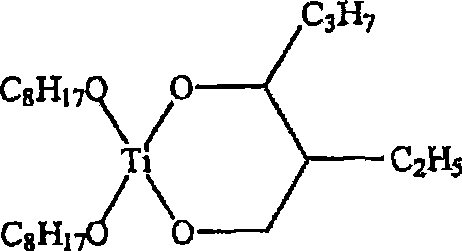
其中,每个R4独立地是烷基或两个R4基团连在一起形成二价脂族烃基;R5是C2-10二价或三价脂族烃基;R6是亚甲基或亚乙基;n是0或1。表1中列出了具有上述通式X的钛酸酯化合物的例子。Wherein, each R 4 is independently an alkyl group or two R 4 groups are linked together to form a divalent aliphatic hydrocarbon group; R 5 is a C 2-10 divalent or trivalent aliphatic hydrocarbon group; R 6 is a methylene or ethylene; n is 0 or 1. Table 1 lists examples of titanate compounds having the general formula X above.
表1.具有通式(X)的钛酸酯化合物的实例Table 1. Examples of titanate compounds having general formula (X)
2.2-二甲基丙烷-1,3- 2,2-二乙基丙烷-1,3-2.2-Dimethylpropane-1,3- 2,2-Diethylpropane-1,3-
二氧钛酸二-1-丁酯 二氧钛酸二-1-丁酯Di-1-butyl dioxytitanate Di-1-butyl dioxytitanate

2(1-丙基)2-甲基丙烷-1,3- 2-乙基己烷-1,3-2(1-Propyl)2-Methylpropane-1,3- 2-Ethylhexane-1,3-
二氧钛酸二-1-丁酯 二氧钛酸二-1-丁酯Di-1-butyl dioxytitanate Di-1-butyl dioxytitanate


2.2-二甲基丙烷-1,3- 2.2-二乙基丙烷-1,3-2.2-Dimethylpropane-1,3- 2.2-Diethylpropane-1,3-
二氧钛酸二(2-乙基-1-己基)酯 二氧钛酸二(2-乙基-1-己基)酯Bis(2-ethyl-1-hexyl) dioxytitanate Bis(2-ethyl-1-hexyl)dioxytitanate
2-(1-丙基)-2-甲基丙烷-1,3- 2-乙基己烷-1,3-2-(1-Propyl)-2-methylpropane-1,3- 2-Ethylhexane-1,3-
二氧钛酸二(2-乙基-1-己基)酯 二氧钛酸二(2-乙基-1-己基)酯Bis(2-ethyl-1-hexyl) dioxytitanate Bis(2-ethyl-1-hexyl)dioxytitanate

2-(1-丁基)-2-乙基丙烷-1,3-2-(1-butyl)-2-ethylpropane-1,3-
二氧钛酸二(2-乙基-1-己基)酯Bis(2-ethyl-1-hexyl) dioxytitanate
具有至少一个以下通式XI或通式XII片段的钛酸酯化合物也可用作催化剂:Titanate compounds having at least one fragment of the following general formula XI or general formula XII can also be used as catalysts:
其中,每个R7独立地是C2-3亚烷基;R8是C1-6烷基或未被取代或被取代的苯基;Z是O或N;当Z是O时,m=n=0,当Z是N时,m=0或1且m+n=1;每个R9独立地是C2-6亚烷基;q是0或1。Wherein, each R 7 is independently C 2-3 alkylene; R 8 is C 1-6 alkyl or unsubstituted or substituted phenyl; Z is O or N; when Z is O, m =n=0, when Z is N, m=0 or 1 and m+n=1; each R 9 is independently C 2-6 alkylene; q is 0 or 1.
上述钛酸酯化合物的例子表示为如下式XIII和式XIV:Examples of the aforementioned titanate compounds are represented by the following formulas XIII and XIV:
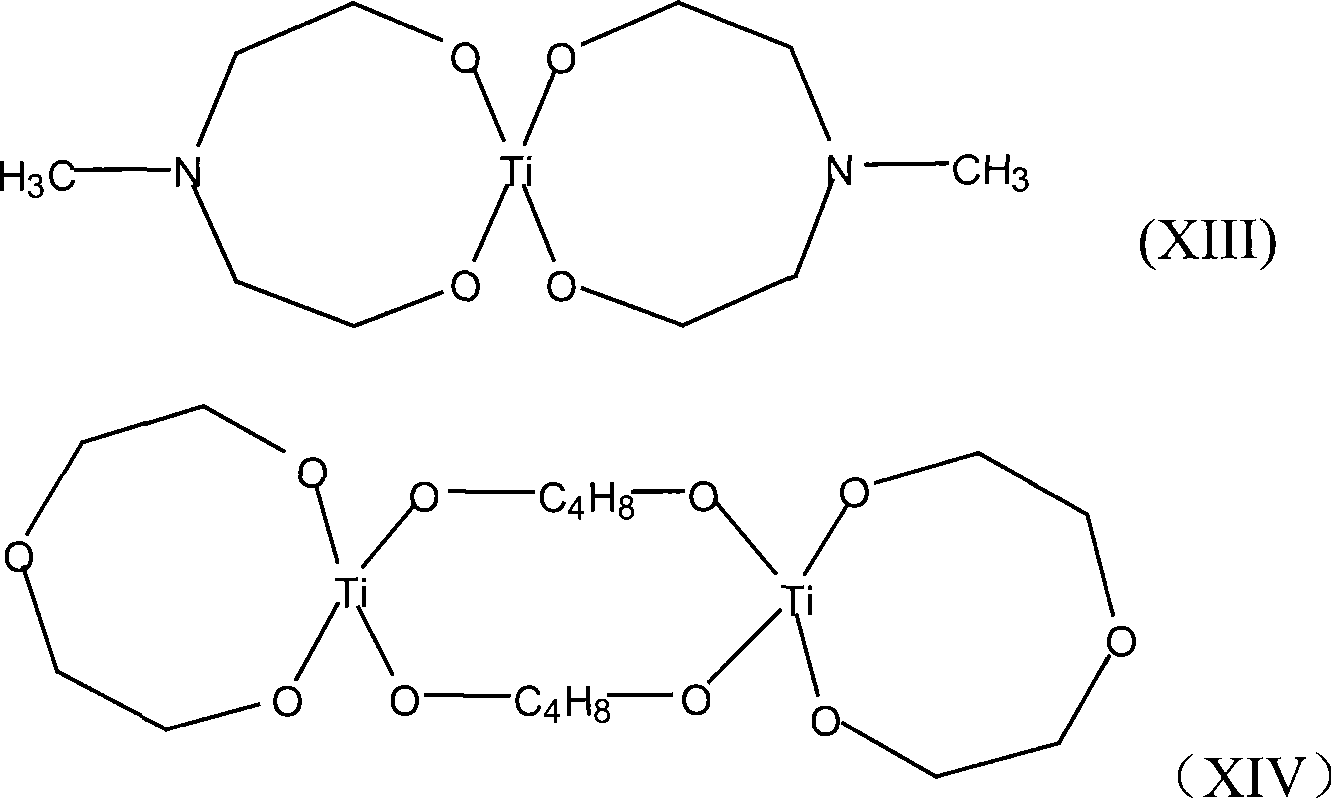
可以使用的其它催化剂包括例如在Wang等共同所有的美国专利6,906,147中所描述的芳基钛酸酯。而且,含有聚合物的有机金属催化剂也可用在本发明中。这些催化剂包括Wang等共同所有的美国专利6,831,138中描述的含有聚合物的催化剂。Other catalysts that may be used include, for example, aryl titanates as described in commonly owned US Patent 6,906,147 by Wang et al. Furthermore, organometallic catalysts containing polymers can also be used in the present invention. These catalysts include the polymer-containing catalysts described in commonly owned US Patent 6,831,138 by Wang et al.
在本发明的一个实施方式中,聚合催化剂的浓度介于每100mol单体重复单元约0.01mol至约10mol之间。利用感兴趣的系统可以由常规实验确定所用的催化剂的量。In one embodiment of the present invention, the concentration of the polymerization catalyst is between about 0.01 moles and about 10 moles per 100 moles of monomeric repeating units. The amount of catalyst used can be determined by routine experimentation using the system of interest.
IV.嵌段共聚物IV. Block Copolymers
在某些实施方式中,通过将一种或多种大环聚酯低聚物(MPO)硬嵌段组分与包含二羟基官能化的聚合物、低聚醚和/或二聚脂肪酸的软嵌段组分在挤出机、混合机、共混机或其它产生剪切力的设备中进行反应来制备嵌段共聚物。在催化剂的存在下,该反应在产生剪切力的设备中在高温下进行。In certain embodiments, a combination of one or more macrocyclic polyester oligomer (MPO) hard block components with a soft The block components are reacted in an extruder, mixer, blender, or other shear generating equipment to produce a block copolymer. The reaction is carried out at elevated temperature in the presence of a catalyst in a device generating shear forces.
可以将用于制备嵌段共聚物的混合物中的各个成分以任意次序加入挤出机中,只要这些成分在挤出、混合或共混期间的某些时刻彼此接触即可。可以通过任何剪切工艺来实现MPO和软嵌段低聚物的接触从而提高软嵌段低聚物在MPO中的分散性。优选地,在挤出机中,例如在单螺杆或双螺杆挤出机中,进行剪切。剪切工艺可以是间歇工艺,或者可以是连续工艺或半连续工艺。The individual ingredients of the mixture used to make the block copolymer can be added to the extruder in any order, as long as the ingredients contact each other at some point during extrusion, mixing, or blending. The contact between MPO and soft block oligomer can be achieved by any shear process to improve the dispersion of soft block oligomer in MPO. Preferably, the shearing is performed in an extruder, for example in a single or twin screw extruder. The shearing process may be a batch process, or may be a continuous or semi-continuous process.
混合组分之间的反应在高温下进行。该反应优选在约130℃至约300℃范围内的温度下实施。在某些实施方式中,该反应在约230℃至约260℃范围内的温度下实施。整个挤出机中的温度可以变化。该反应可以在环境压力下进行、在高于环境压力下进行或者在低于环境压力下进行。例如,该反应可以在惰性气体(诸如氮气或氩气)中或在真空中进行。The reaction between the mixed components takes place at high temperature. The reaction is preferably carried out at a temperature in the range of about 130°C to about 300°C. In certain embodiments, the reaction is carried out at a temperature in the range of about 230°C to about 260°C. The temperature throughout the extruder can vary. The reaction can be carried out at ambient pressure, above ambient pressure or below ambient pressure. For example, the reaction can be performed under an inert gas such as nitrogen or argon or under vacuum.
在挤出机中的嵌段共聚反应通常例如在几分钟内完成,并且该时间可被设定为挤出机中材料的平均保留时间。在某些实施方式,反应可以更快或更慢。反应的持续时间依赖于各种因素,例如所需反应程度、所需挤出步骤后(固态聚合前)的分子量、反应物的粘度(影响挤出机的生产量)、反应物的浓度和类型、催化剂的浓度和类型、MPO与软嵌段低聚物的比、温度、压力和其它反应条件。The block copolymerization reaction in the extruder is usually completed eg within a few minutes, and this time can be set as the average residence time of the material in the extruder. In some embodiments, the reaction can be faster or slower. The duration of the reaction depends on various factors such as the desired degree of reaction, the molecular weight after the desired extrusion step (before solid state polymerization), the viscosity of the reactants (which affects the throughput of the extruder), the concentration and type of reactants , concentration and type of catalyst, ratio of MPO to soft block oligomer, temperature, pressure and other reaction conditions.
嵌段共聚物的产率是例如反应物(包括大环低聚酯、二羟基官能化的聚合物、低聚醚、二聚脂肪酸、催化剂等)用量和类型、反应时间和反应条件的函数。在某些实施方式中,嵌段共聚物的产率基于MPO的消耗量约大于60%,约大于70%,约大于80%,约大于90%或约大于95%。The yield of the block copolymer is a function of, for example, the amount and type of reactants (including macrocyclic oligoesters, dihydroxy-functionalized polymers, oligoethers, dimerized fatty acids, catalysts, etc.), reaction time and reaction conditions. In certain embodiments, the yield of the block copolymer is greater than about 60%, greater than about 70%, greater than about 80%, greater than about 90%, or greater than about 95% based on MPO consumption.
在优选的实施方式中,挤出的反应产物是固体或变成固体,并且可以进行固态聚合从而提高其分子量。在某些实施方式中,挤出的嵌段共聚物包括硬嵌段和软嵌段。所述硬嵌段优选包括由MPO构成的聚酯基团,所述软嵌段优选包括由二羟基官能化的聚合物、低聚醚和/或二聚脂肪酸构成的被取代的或未被取代的亚烷基、亚环烷基、或者单或多氧化亚烷基。可以选择硬嵌段与软嵌段的比,从而得到所需物理性质。例如,硬嵌段与软嵌段的比值较小的嵌段共聚物具有高韧性且具有弹性,并且在一些情况下是本征型消静电聚合物(IDP)。In preferred embodiments, the extruded reaction product is or becomes solid and can be solid state polymerized to increase its molecular weight. In certain embodiments, the extruded block copolymer includes hard blocks and soft blocks. The hard block preferably comprises polyester groups consisting of MPO, and the soft block preferably comprises substituted or unsubstituted polymers consisting of dihydroxy-functional polymers, oligoethers and/or dimerized fatty acids. Alkylene, cycloalkylene, or mono- or polyoxyalkylene. The ratio of hard blocks to soft blocks can be selected so that the desired physical properties are obtained. For example, block copolymers with low ratios of hard blocks to soft blocks are tough and elastic, and in some cases intrinsically dissipative polymers (IDPs).
V加热嵌段共聚物以提高分子量V Heating Block Copolymers to Increase Molecular Weight
在某些实施方式中,挤出的嵌段共聚物在挤出过程中具有相对低的分子量,为了提高其分子量进行额外的步骤。在某些实施方式中,在低于环境压力的压力下(即在真空下)对挤出的嵌段共聚物进行加热。一般而言,不需添加额外的催化剂,但是在一些实施方式中,在加热步骤以前添加额外的催化剂(即与初始聚合期间所用的催化剂相同或不同的催化剂)。在某些实施方式中,在初始聚合后残留一些残余活性催化剂,这些残余活性催化剂可用在随后的加热步骤中;然而,在某些实施方式中,不需活性催化剂进行固态聚合。In certain embodiments, the extruded block copolymer has a relatively low molecular weight during extrusion, and additional steps are performed to increase its molecular weight. In certain embodiments, the extruded block copolymer is heated at a pressure below ambient pressure (ie, under vacuum). Generally, no additional catalyst needs to be added, but in some embodiments, an additional catalyst (ie, the same or a different catalyst than that used during the initial polymerization) is added prior to the heating step. In certain embodiments, some residual active catalyst remains after the initial polymerization, which can be used in a subsequent heating step; however, in certain embodiments, no active catalyst is required for solid state polymerization.
在某些实施方式中,在约180℃至约250℃范围内的温度下、在约190℃至约240℃范围内的温度下或在约200℃至约220℃范围内的温度下对嵌段共聚物进行加热。在某些实施方式中,加热温度至少约为100℃,至少约为150℃,至少约为175℃,至少约为190℃或至少约为200℃。一般而言,在较高温度下增加分子量所需时间较短。可以根据嵌段共聚物、催化剂、所需分子量、所需反应时间和其它因素来选择温度。在某些实施方式中,在真空下(即在低于环境压力的压力下)对嵌段共聚物进行加热从而进行固态聚合。在某些实施方式中,抽真空从而使得压力不大于约100torr,不大于约20torr,不大于约5torr或不大于约0.5torr。优选将嵌段共聚物加热长达约16小时,但是也可以加热更长时间。在某些实施方式中,将嵌段共聚物加热约2小时至约16小时或加热约4小时至约8小时。上述加热步骤可以利用固态聚合装置来进行,但也可以使用其它加工设备。在一个实施方式中,用于进行初始聚合的加工设备与用于进行分子量提高步骤的设备相同;然而,通常利用不同的加工设备来进行这两个步骤。In certain embodiments, intercalation is performed at a temperature in the range of about 180°C to about 250°C, at a temperature in the range of about 190°C to about 240°C, or at a temperature in the range of about 200°C to about 220°C. The block copolymer is heated. In certain embodiments, the heating temperature is at least about 100°C, at least about 150°C, at least about 175°C, at least about 190°C, or at least about 200°C. In general, the time required to increase molecular weight is shorter at higher temperatures. The temperature can be selected based on the block copolymer, catalyst, desired molecular weight, desired reaction time, and other factors. In certain embodiments, the solid state polymerization of the block copolymer is carried out by heating the block copolymer under vacuum (ie, at a pressure below ambient pressure). In certain embodiments, the vacuum is drawn such that the pressure is no greater than about 100 torr, no greater than about 20 torr, no greater than about 5 torr, or no greater than about 0.5 torr. Preferably, the block copolymer is heated for up to about 16 hours, but longer times are also possible. In certain embodiments, the block copolymer is heated for about 2 hours to about 16 hours or for about 4 hours to about 8 hours. The heating step described above can be performed using a solid state polymerization apparatus, but other processing equipment can also be used. In one embodiment, the processing equipment used to conduct the initial polymerization is the same as the equipment used to perform the molecular weight increasing step; however, the two steps are typically performed using different processing equipment.
在某些实施方式中,加热步骤使嵌段共聚物的分子量提高到至少约2倍,至少约3倍,至少约4倍,至少约5倍,至少约6倍,至少约7倍,至少约8倍,至少约9倍或至少约10倍。In certain embodiments, the heating step increases the molecular weight of the block copolymer by at least about 2-fold, at least about 3-fold, at least about 4-fold, at least about 5-fold, at least about 6-fold, at least about 7-fold, at least about 8 times, at least about 9 times or at least about 10 times.
在分子量提高步骤以后,某些实施方式中的嵌段共聚物具有至少约30000、至少约50000、至少约100000、至少约125000、至少约150000、至少约175000、至少约200000、至少约225000、至少约250000、至少约275000或至少约300000的分子量(即相对于GPC苯乙烯标样的重均分子量)。After the molecular weight increasing step, the block copolymers in certain embodiments have an A molecular weight (ie, weight average molecular weight relative to GPC styrene standards) of about 250,000, at least about 275,000, or at least about 300,000.
VI.所得具有较高分子量的嵌段共聚物与酯进行接触VI. Contact of the resulting higher molecular weight block copolymer with the ester
由于本发明的各种实施方式提供了改善的多功能性,所以可以制备其它方法无法制备的具有独特性质的新型嵌段共聚物。例如,可以通过使嵌段共聚物与不同于MPO的酯(例如环状酯,诸如己内酯或聚己内酯)在酯交换催化剂的存在下进行反应来调整上述高分子量嵌段共聚物的熔点和硬嵌段部分的结晶度。这样的结果是共聚物中的硬嵌段部分包含由MPO和酯构成的具有无规构型的单元。对酯进行选择可以提高共聚物的总混溶性和硬嵌段和软嵌段部分的微相分离特性,从而改变共聚物的物理性质、机械性质和/或化学性质。Because of the improved versatility provided by the various embodiments of the present invention, novel block copolymers with unique properties that cannot be prepared by other methods can be prepared. For example, the above-mentioned high molecular weight block copolymer can be adjusted by reacting the block copolymer with an ester other than MPO (for example, a cyclic ester such as caprolactone or polycaprolactone) in the presence of a transesterification catalyst. Melting point and crystallinity of the hard block portion. The result of this is that the hard block portion of the copolymer contains units with a random configuration composed of MPO and ester. Selection of esters can improve the overall miscibility of the copolymer and the microphase separation characteristics of the hard and soft block segments, thereby modifying the physical, mechanical and/or chemical properties of the copolymer.
因此,在某些实施方式中,这种嵌段共聚物通过如下形成:将上述嵌段共聚物中的任意一种与式II酯,在酯交换催化剂的存在下,在高温下,进行接触:Thus, in certain embodiments, such block copolymers are formed by contacting any of the block copolymers described above with an ester of formula II in the presence of a transesterification catalyst at elevated temperature:
-R1-O-C(O)-R2- (II)-R 1 -OC(O)-R 2 - (II)
其中,R1和R2中的每一个都独立地是二价有机片段,如果R2是-B′-C(O)-,那么R1不是-O-A′-,其中,A’是亚烷基、亚环烷基、或单或多氧化亚烷基;B是二价芳基或脂环基。在一个实施方式中,所述嵌段共聚物在与式II酯接触以前已经进行了用于提高其分子量的前述加热工艺;然而,也可以在提高分子量的固态聚合步骤以前通过与式II酯进行接触来制备改变的嵌段共聚物。where each of R1 and R2 is independently a divalent organic moiety, and if R2 is -B'-C(O)-, then R1 is not -OA'-, where A' is an alkylene A group, a cycloalkylene group, or a mono- or polyoxyalkylene group; B is a divalent aryl group or an alicyclic group. In one embodiment, the block copolymer has been subjected to the aforementioned heating process for increasing its molecular weight prior to contacting with the ester of formula II; contact to prepare modified block copolymers.
所述酯可以是任何能够进行酯交换的酯。所述酯例如可以为环状酯和/或脂族或芳族聚酯。在某些优选的实施方式中,环状酯为内酯,例如为聚己内酯。酯交换催化剂可以是上述锡化合物或碳酸酯化合物。在一个实施方式中,在这个步骤中使用的酯交换催化剂与初始聚合MPO和软嵌段组分使用的催化剂相同,并且/或者与固态聚合步骤期间存在的催化剂相同。嵌段共聚物与酯接触时的高温优选在约100℃至约300℃的范围内。可以根据反应物、浓度和其它反应条件对反应温度进行选择。The ester can be any ester capable of transesterification. The esters may be, for example, cyclic esters and/or aliphatic or aromatic polyesters. In certain preferred embodiments, the cyclic ester is a lactone, such as polycaprolactone. The transesterification catalyst may be the aforementioned tin compound or carbonate compound. In one embodiment, the transesterification catalyst used in this step is the same catalyst used to initially polymerize the MPO and soft block components and/or the same catalyst that was present during the solid state polymerization step. The elevated temperature at which the block copolymer is contacted with the ester is preferably in the range of about 100°C to about 300°C. The reaction temperature can be selected according to the reactants, concentrations and other reaction conditions.
在某些实施方式中,所得新型嵌段共聚物包括(a)第一嵌段单元,所述单元包括在聚合主链上的至少一种式I结构单元:In certain embodiments, the resulting novel block copolymers include (a) a first block unit comprising at least one structural unit of Formula I on the polymeric backbone:
其中,A是亚烷基、亚环烷基、或者单或多氧化亚烷基且B是二价芳基或脂环基;以及至少一种式II结构单元:Wherein, A is an alkylene group, a cycloalkylene group, or a mono- or polyoxyalkylene group and B is a divalent aryl group or an alicyclic group; and at least one structural unit of formula II:
-R1-O-C(O)-R2- (II)-R 1 -OC(O)-R 2 - (II)
其中,R1和R2中的每一个都独立地是二价有机片段;并且所述共聚物包括(b)第二嵌段单元,所述单元包括在聚合主链上的至少一种式III结构单元:wherein each of R and R is independently a divalent organic moiety; and the copolymer comprises (b) a second block unit comprising at least one formula III on the polymeric backbone Structural units:
-D-(III)-D-(III)
其中,D是亚烷基、亚环烷基、或单或多氧化亚烷基,并且D中的碳原子中的一个或多个可以被氧原子、氮原子或硫原子替代。D可以例如包括聚亚烷基醚基团、聚烯烃基团、聚己内酯基团、聚全氟醚二醇、二聚二醇和/或聚硅氧烷二醇中的至少一种。如果R2是-B′-C(O)-,那么R1不是-O-A′-,其中,A’是亚烷基、亚环烷基、或者单或多氧化亚烷基;B’是二价芳基或脂环基。在一个实施方式中,所得嵌段共聚物中的第一嵌段单元具有无规构型的式I和II结构单元。Wherein, D is an alkylene group, a cycloalkylene group, or a mono- or polyoxyalkylene group, and one or more of the carbon atoms in D may be replaced by an oxygen atom, a nitrogen atom or a sulfur atom. D may, for example, comprise at least one of polyalkylene ether groups, polyolefin groups, polycaprolactone groups, polyperfluoroether diols, dimer diols and/or polysiloxane diols. If R 2 is -B'-C(O)-, then R 1 is not -OA'-, where A' is alkylene, cycloalkylene, or mono- or polyoxyalkylene; B' is di Valence aryl or alicyclic group. In one embodiment, the first block unit in the resulting block copolymer has structural units of formulas I and II in a random configuration.
在某些实施方式中,所得嵌段共聚物的分子量(即相对于GPC聚苯乙烯标样的重均分子量)在约30000至约300000的范围内。嵌段共聚物的分子量优选在约40000至约220000的范围内。在某些实施方式中,嵌段共聚物具有至少约30000、至少约50000、至少约100000、至少约125000、至少约150000、至少约175000、至少约200000、至少约225000、至少约250000、至少约275000或者至少约300000的分子量。In certain embodiments, the resulting block copolymer has a molecular weight (ie, weight average molecular weight relative to a GPC polystyrene standard) in the range of about 30,000 to about 300,000. The molecular weight of the block copolymers preferably ranges from about 40,000 to about 220,000. In certain embodiments, the block copolymer has at least about 30,000, at least about 50,000, at least about 100,000, at least about 125,000, at least about 150,000, at least about 175,000, at least about 200,000, at least about 225,000, at least about 250,000, at least about A molecular weight of 275,000 or at least about 300,000.
VII.共混物VII. Blends
本文所述高分子量嵌段共聚物是聚合物体系中令人感兴趣的弹性体材料或共混相容剂。如上所述,高极性羟基官能化的聚合物(例如二醇,诸如聚乙二醇)可被用在上述方法中,从而制备作为本征型消静电聚合物(IDP)的嵌段共聚物。IDP例如可以用在具有商业聚合物的共混物中,从而提供抗静电性质。IDP可以与大量商业聚合物,例如ABS、聚碳酸酯、聚苯乙烯和聚烯烃,中的任意一种共混,而对其它性质的影响较小。IDP优于抗静电剂;例如IDP不会像抗静电剂一样从主体聚合物中流失,并且IDP的性能不是环境湿度的函数,因为与抗静电剂不同,IDP作用在主体树脂内部而非作用在表面上。The high molecular weight block copolymers described herein are interesting elastomeric materials or blend compatibilizers in polymer systems. As mentioned above, highly polar hydroxyl functionalized polymers (e.g. diols such as polyethylene glycol) can be used in the above process to prepare block copolymers as intrinsically dissipative polymers (IDPs) . IDP can be used, for example, in blends with commercial polymers to provide antistatic properties. IDP can be blended with any of a large number of commercial polymers, such as ABS, polycarbonate, polystyrene and polyolefin, with little effect on other properties. IDP is superior to antistatic agents; for example, IDP does not bleed from the host polymer like antistatic agents, and the performance of IDP is not a function of ambient humidity because, unlike antistatic agents, IDP acts inside the host resin rather than in the host resin On the surface.
在某些实施方式中,不需要高极性组分形成共聚物本身的一部分,只要可以制备充分混溶并且/或者不会出现过量相分离的高极性聚合物与嵌段共聚物的共混物就可以。因为本发明的某些实施方式中的嵌段共聚物可被制成具有相对大量的软嵌段组分(该组分与高极性组分混溶),所以可以制成高极性聚合物与上述嵌段共聚物不会发生分离的共混物。因此,可以制备具有本征型消静电性质的共混物,接着该共混物可以例如与商业可得聚合物共混从而提供抗静电性。In certain embodiments, it is not required that the highly polar component form part of the copolymer itself, so long as blends of highly polar polymers and block copolymers can be made that are sufficiently miscible and/or do not exhibit excessive phase separation Things will do. Because the block copolymers of certain embodiments of the present invention can be made with a relatively high amount of soft block components that are miscible with highly polar components, highly polar polymers can be made Blends that do not segregate with the above block copolymers. Thus, a blend can be prepared that has intrinsically dissipative properties, which blend can then be blended, for example, with a commercially available polymer to provide antistatic properties.
因此,在某些实施方式中,制成的共混物包括(a)嵌段共聚物,所述嵌段共聚物具有第一嵌段单元,所述第一嵌段单元包括在聚合主链上的至少一种式I结构单元:Thus, in certain embodiments, a blend is produced comprising (a) a block copolymer having a first block unit included on the polymeric backbone At least one structural unit of formula I:

其中,A是亚烷基、亚环烷基、或者单或多氧化亚烷基和且是二价芳基或脂环基;并且具有第二嵌段单元,所述第二嵌段单元包括在聚合主链上的至少一种式III结构单元:Wherein, A is an alkylene group, a cycloalkylene group, or a single or polyoxyalkylene group and a divalent aryl group or an alicyclic group; and has a second block unit, and the second block unit is included in At least one structural unit of formula III on the polymeric main chain:
-D-(III)-D-(III)
其中,D是亚烷基、亚环烷基、或单或多氧化亚烷基,并且D中的碳原子中的一个或多个可以被氧原子、氮原子或硫原子替代;并且所述共混物包括(b)羟基官能化的聚合物、低聚物和/或二聚脂肪酸。Wherein, D is an alkylene group, a cycloalkylene group, or a mono- or polyoxyalkylene group, and one or more of the carbon atoms in D may be replaced by an oxygen atom, a nitrogen atom or a sulfur atom; and the co- Blends include (b) hydroxyl functionalized polymers, oligomers and/or dimerized fatty acids.
D例如可以包括聚亚烷基醚基团、聚亚乙基醚基团、聚亚丙基醚基团、聚亚甲基醚基团、聚烯烃基团、聚己内酯基团、聚全氟醚二醇、二聚二醇和聚硅氧烷二醇。D can include, for example, polyalkylene ether groups, polyethylene ether groups, polypropylene ether groups, polymethylene ether groups, polyolefin groups, polycaprolactone groups, polyperoxides Fluoroether diols, dimer diols and polysiloxane diols.
在某些实施方式中,共混物中嵌段共聚物的含量小于约90重量%,小于约80重量%,小于约70重量%,小于约60重量%,小于约50重量%,小于约40重量%或小于约30重量%。In certain embodiments, the blend contains less than about 90% by weight, less than about 80% by weight, less than about 70% by weight, less than about 60% by weight, less than about 50% by weight, less than about 40% by weight % by weight or less than about 30% by weight.
VIII.实验实施例VIII. Experimental Example
实验实施例示出了通过如下制备高分子量嵌段共聚物:将大环聚酯低聚物(MPO)(硬嵌段组分)与高比例的诸如二羟基官能化的聚合物、低聚醚和/或二聚脂肪酸之类的软嵌段组分挤出,接着在真空下加热。The experimental examples show the preparation of high molecular weight block copolymers by combining macrocyclic polyester oligomers (MPO) (the hard block component) with high proportions of functionalized polymers such as dihydroxyl, oligoethers and and/or extrusion of soft block components such as dimerized fatty acids followed by heating under vacuum.
实验实施例中使用的MPO是大环聚(对苯二甲酸1,4-丁二醇酯)低聚物(为了简便在本文中也被称为cPBT)。所提供的cPBT与催化剂预先混合,该混合物具有由Cyclics Corporation of Schenectady,NY生产,产品编号为XB3-CA4。XB3-CA4是含有cPBT和0.3mol%的Atoflna ofPhiladelphia,Pennsylvania的
在实施例1中,在约240℃至约260℃范围内的温度下在Randcastle单螺杆挤出机中挤出含有75wt% XB3-CA4和25wt%
在实施例2中,将得自实施例1的PBT-聚四亚甲基醚二醇嵌段共聚物置于安装有真空接头(vacuum adaptor)的试管中,并在210℃、真空下加热长达16小时。将所得聚合物通过GPC分析以测定分子量的增量。分析结果总结在表2中。该表中,Mw表示重均分子量,Mp表示峰位平均分子量(peak average molecular weight)。In Example 2, the PBT-polytetramethylene ether glycol block copolymer obtained in Example 1 was placed in a test tube equipped with a vacuum adapter, and heated at 210° C. under vacuum for up to 16 hours. The resulting polymer was analyzed by GPC to determine the increase in molecular weight. The results of the analysis are summarized in Table 2. In this table, Mw represents the weight average molecular weight, and Mp represents the peak average molecular weight (peak average molecular weight).
在实施例3中,在桶温为约250℃至约260℃的Randcastle单螺杆挤出机中挤出含有50wt%XB3-CA4和50wt%
在实施例4中,在各个批次中,将得自实施例3的PBT-聚四亚甲基醚二醇嵌段共聚物在210℃下每批加热3至6小时,并将各批次合并。合并的批料具有190000g/mol的平均分子量。然后,将材料注射模制成拉伸棒用于物理性质测试。结果表示在表3中。50/50的PBT-聚四亚甲基醚二醇嵌段共聚物的性能优于各种可商购热塑性聚酯弹性体。In Example 4, in each batch, the PBT-polytetramethylene ether glycol block copolymer obtained in Example 3 was heated at 210°C for 3 to 6 hours per batch, and each batch merge. The combined batches had an average molecular weight of 190000 g/mol. Then, the material was injection molded into tensile bars for physical property testing. The results are shown in Table 3. The 50/50 PBT-polytetramethylene ether glycol block copolymer outperforms various commercially available thermoplastic polyester elastomers.
实施例1:挤出MPO与二羟基官能化的聚合物(75:25重量比)从而制Example 1: Extrusion of MPO and dihydroxy functionalized polymer (75:25 weight ratio) to produce 成低分子量的嵌段共聚物low molecular weight block copolymer
将约300g XB3-CA4在80℃、真空下干燥16小时以上。将约100g 2900(聚四亚甲基醚二醇、分子量为2900,由E.I.duPont deNemours and Company制造)用液氮冷冻后研磨成粉末。然后,将磨碎的 2900采用氮气流在真空、室温下干燥至少12小时。通过翻转1小时将
实施例2:对实施例1中得到的低分子量嵌段共聚物进行加热和真空处理Embodiment 2: The low molecular weight block copolymer obtained in embodiment 1 is carried out heating and vacuum treatment
将实施例1中得到的0.4至0.5g材料样品置于13×100玻璃试管中。将四个样品置于处于真空下的歧管中,然后下降至210℃的浴室中。在0.5小时、1小时、2小时和8小时时取出样品。每次取出样品后释放真空,然后再次施加。在取出其他样品中的一个后添加4小时样品并单独处理16小时样品。通过GPC分析利用聚苯乙烯标样进行标定来测试样品的分子量和转化百分率(表2)。A 0.4 to 0.5 g sample of the material obtained in Example 1 was placed in a 13 x 100 glass test tube. Four samples were placed in the manifold under vacuum and then lowered to 210°C in the bath. Samples were taken at 0.5 hour, 1 hour, 2 hours and 8 hours. The vacuum is released and reapplied after each sample removal. The 4-hour sample was added after one of the other samples was taken and the 16-hour sample was processed separately. The samples were tested for molecular weight and percent conversion by GPC analysis calibrated with polystyrene standards (Table 2).
表2.加热和真空处理对PBT-聚四亚甲基醚二醇嵌段共聚物的影响Table 2. Effect of heating and vacuum treatment on PBT-polytetramethylene ether glycol block copolymer
实施例3:挤出MPO与二羟基官能化的聚合物(50:50重量比)从而制Example 3: Extrusion of MPO and dihydroxy functionalized polymer (50:50 weight ratio) to produce 成低分子量的嵌段共聚物low molecular weight block copolymer
将约2.3lbs的

实施例4:对实施例3中得到的低分子量嵌段共聚物进行加热和真空处理Embodiment 4: The low molecular weight block copolymer obtained in embodiment 3 is carried out heating and vacuum treatment
将实施例3中得到的约400g的嵌段共聚物分批置于采用外部脱模剂(例如Zyvex
然后,将材料注射模制成拉伸棒用于物理性质测试。物理性质测试结果总结在下表中并与三种由DuPont制造的热塑性聚酯弹性体
表3:采用加热处理和真空处理的PBT-聚四亚甲基醚二醇嵌段共聚物制成Table 3: Preparation of PBT-polytetramethylene ether glycol block copolymers with heat treatment and vacuum treatment 的样品的物理性质测试结果The physical property test results of the samples

等价物equivalent
尽管本发明根据具体优选的实施方式进行具体表示和描述,但是本领域技术人员应当理解到,可以进行各种形式和细节上的变化,而并未脱离本发明的精神和权利要求所限定的范围。Although the present invention has been specifically shown and described according to specific preferred embodiments, those skilled in the art should understand that various changes in form and details can be made without departing from the spirit of the present invention and the scope defined by the claims .
Claims (53)


Applications Claiming Priority (2)
| Application Number | Priority Date | Filing Date | Title |
|---|---|---|---|
| US11/345.057 | 2006-01-31 | ||
| US11/345,057 US7745561B2 (en) | 2006-01-31 | 2006-01-31 | Processes for making copolymers using macrocyclic oligoesters, and copolymers therefrom |
Publications (1)
| Publication Number | Publication Date |
|---|---|
| CN101415747A true CN101415747A (en) | 2009-04-22 |
Family
ID=38222367
Family Applications (1)
| Application Number | Title | Priority Date | Filing Date |
|---|---|---|---|
| CNA2007800120124A Pending CN101415747A (en) | 2006-01-31 | 2007-01-31 | Processes for making copolymers using macrocyclic oligoesters, and copolymers therefrom |
Country Status (5)
| Country | Link |
|---|---|
| US (1) | US7745561B2 (en) |
| EP (1) | EP1984419A2 (en) |
| JP (1) | JP2009525390A (en) |
| CN (1) | CN101415747A (en) |
| WO (1) | WO2007089779A2 (en) |
Cited By (5)
| Publication number | Priority date | Publication date | Assignee | Title |
|---|---|---|---|---|
| CN102803340A (en) * | 2009-06-19 | 2012-11-28 | 普立万公司 | Oxygen scavenging terpolymers |
| CN103652543A (en) * | 2012-09-12 | 2014-03-26 | 江西江中制药(集团)有限责任公司 | Health food capable of lowering decomposition and absorption speeds of starch in bodies and preparation method thereof |
| WO2014044129A1 (en) * | 2012-09-19 | 2014-03-27 | 上海杰事杰新材料(集团)股份有限公司 | Novel biodegradable copolyester and preparation method thereof |
| CN103804857A (en) * | 2012-11-15 | 2014-05-21 | 上海凯众材料科技股份有限公司 | Thermoplastic polyester elastomer composition and application thereof |
| CN107531829A (en) * | 2014-12-17 | 2018-01-02 | Sabic环球技术有限责任公司 | For the product for preparing the method for the block copolymer comprising the first polyolefin block and second polymer block and being obtained from methods described |
Families Citing this family (7)
| Publication number | Priority date | Publication date | Assignee | Title |
|---|---|---|---|---|
| US20080138167A1 (en) * | 2006-12-12 | 2008-06-12 | Ivan Wayne Wallace | Direct Tension Indicating Washers |
| WO2009142978A1 (en) | 2008-05-19 | 2009-11-26 | Molecon, Inc. | Synthesis of polyesters with precisely sequenced two or more structural units |
| CN102924700B (en) * | 2008-09-09 | 2016-09-28 | 莫立克股份有限公司 | Polymer with hydroxy acid block |
| US9120895B2 (en) * | 2009-04-20 | 2015-09-01 | Dsm Ip Assets B.V. | Flexible polymer |
| US9617375B2 (en) | 2012-05-25 | 2017-04-11 | Polyone Corporation | Oxygen scavenging copolymers made from cyclic aliphatic monomers |
| US9115266B2 (en) | 2013-07-31 | 2015-08-25 | E I Du Pont De Nemours And Company | Carbon nanotube-polymer composite and process for making same |
| KR101889038B1 (en) * | 2016-12-06 | 2018-08-17 | 주식회사 삼양사 | Polylactic acid copolymer and method for preparing the same |
Family Cites Families (18)
| Publication number | Priority date | Publication date | Assignee | Title |
|---|---|---|---|---|
| US4680345A (en) * | 1985-06-05 | 1987-07-14 | Toyo Boseki Kabushiki Kaisha | Continuous production of elastic polyesters |
| US5039717A (en) * | 1985-07-25 | 1991-08-13 | Amoco Corporation | Copolyesters |
| US4785060A (en) * | 1986-08-28 | 1988-11-15 | Colgate-Palmolive Company | Soil release promoting pet-poet copolymer, method of producing same and use thereof in detergent composition having soil release promoting property |
| JPH04253764A (en) | 1991-01-30 | 1992-09-09 | Toray Ind Inc | Polyester-polyester block copolymer composition |
| AU7099794A (en) | 1993-06-22 | 1995-01-17 | Olin Corporation | Polyetherester block copolymer elastomers |
| US5386037A (en) * | 1994-06-20 | 1995-01-31 | General Electric Company | Trisstannoxanes useful for polymerizing macrocyclic poly(alkylene dicarboxylate) oligomers |
| DE4429524C2 (en) * | 1994-08-19 | 1997-12-18 | Inventa Ag | Process for the preparation of linear copolyesters containing omega-hydroxycarboxylic acid units |
| US5648454A (en) * | 1996-02-14 | 1997-07-15 | General Electric Company | Process for producing high ductile polyesters |
| US5661214A (en) * | 1996-08-05 | 1997-08-26 | General Electric Company | Titanate esters useful as polymerization initiators for macrocylic polyester oligomers |
| US6297330B1 (en) * | 1998-08-28 | 2001-10-02 | E. I. Du Pont De Nemours And Company | Polymerizations based on cyclic oligomer |
| US6420047B2 (en) | 2000-01-21 | 2002-07-16 | Cyclics Corporation | Macrocyclic polyester oligomers and processes for polymerizing the same |
| US20040068059A1 (en) | 2000-11-30 | 2004-04-08 | Hiroshi Katayama | Aliphatic polyester copolymer and process for producing the same, biodegradable resin molding based on aliphatic polyester, and lactone-containing resin |
| JP3618679B2 (en) | 2001-04-03 | 2005-02-09 | ダイセル化学工業株式会社 | Polyester block copolymer composition |
| JP4045572B2 (en) | 2001-04-25 | 2008-02-13 | 東レ・デュポン株式会社 | Blow molding pellet mixture |
| US6420048B1 (en) * | 2001-06-05 | 2002-07-16 | Cyclics Corporation | High molecular weight copolyesters from macrocyclic oligoesters and cyclic esters |
| US6436549B1 (en) * | 2001-07-16 | 2002-08-20 | Cyclics Corporation | Block copolymers from macrocyclic oligoesters and dihydroxyl-functionalized polymers |
| WO2004060640A1 (en) | 2002-12-23 | 2004-07-22 | Dow Global Technologies Inc. | Method of smc molding |
| JP4253764B2 (en) | 2003-06-20 | 2009-04-15 | 三菱電機株式会社 | Humidifier and ventilator |
-
2006
- 2006-01-31 US US11/345,057 patent/US7745561B2/en not_active Expired - Fee Related
-
2007
- 2007-01-21 WO PCT/US2007/002534 patent/WO2007089779A2/en not_active Ceased
- 2007-01-21 EP EP07762686A patent/EP1984419A2/en not_active Withdrawn
- 2007-01-21 JP JP2008553308A patent/JP2009525390A/en not_active Withdrawn
- 2007-01-31 CN CNA2007800120124A patent/CN101415747A/en active Pending
Cited By (8)
| Publication number | Priority date | Publication date | Assignee | Title |
|---|---|---|---|---|
| CN102803340A (en) * | 2009-06-19 | 2012-11-28 | 普立万公司 | Oxygen scavenging terpolymers |
| CN102803340B (en) * | 2009-06-19 | 2014-10-22 | 普立万公司 | Oxygen scavenging terpolymers |
| CN103652543A (en) * | 2012-09-12 | 2014-03-26 | 江西江中制药(集团)有限责任公司 | Health food capable of lowering decomposition and absorption speeds of starch in bodies and preparation method thereof |
| CN103652543B (en) * | 2012-09-12 | 2017-02-08 | 江西江中制药(集团)有限责任公司 | Health food capable of lowering decomposition and absorption speeds of starch in bodies and preparation method thereof |
| WO2014044129A1 (en) * | 2012-09-19 | 2014-03-27 | 上海杰事杰新材料(集团)股份有限公司 | Novel biodegradable copolyester and preparation method thereof |
| CN103804857A (en) * | 2012-11-15 | 2014-05-21 | 上海凯众材料科技股份有限公司 | Thermoplastic polyester elastomer composition and application thereof |
| CN107531829A (en) * | 2014-12-17 | 2018-01-02 | Sabic环球技术有限责任公司 | For the product for preparing the method for the block copolymer comprising the first polyolefin block and second polymer block and being obtained from methods described |
| CN107531829B (en) * | 2014-12-17 | 2020-09-22 | Sabic环球技术有限责任公司 | Process for preparing a block copolymer comprising a first polyolefin block and a second polymer block and product obtained from said process |
Also Published As
| Publication number | Publication date |
|---|---|
| EP1984419A2 (en) | 2008-10-29 |
| WO2007089779A2 (en) | 2007-08-09 |
| US7745561B2 (en) | 2010-06-29 |
| JP2009525390A (en) | 2009-07-09 |
| WO2007089779A3 (en) | 2007-09-20 |
| US20100120957A1 (en) | 2010-05-13 |
Similar Documents
| Publication | Publication Date | Title |
|---|---|---|
| CN101415747A (en) | Processes for making copolymers using macrocyclic oligoesters, and copolymers therefrom | |
| EP1401910B1 (en) | Copolyesters and polymerization of macrocyclic oligoesters | |
| JP4078855B2 (en) | Polylactic acid block copolymer, process for producing the same, molded article, and polylactic acid composition | |
| EP1406943A1 (en) | Block copolymers from macrocyclic oligoesters and dihydroxyl-functionalized polymers | |
| US20040220334A1 (en) | Blends containing macrocyclic polyester oligomer and high molecular weight polymer | |
| EP1694771B1 (en) | Processes for dispersing an impact modifier in a macrocyclic polyester oligomer | |
| US20070216067A1 (en) | Macrocyclic polyester oligomers as carriers and/or flow modifier additives for thermoplastics | |
| CN102838734A (en) | Polylactic acid block polymer and preparation method thereof | |
| JP2006511652A (en) | Conductive polymerized macrocyclic oligomer-carbon nanofiber composition | |
| CN104045984B (en) | Poly(lactic acid) stereo complex and preparation method thereof | |
| JP2013544911A (en) | Polycarbonate as a nucleating agent for polylactide | |
| US20050282952A1 (en) | Graphite-polyester composites made from macrocyclic polyester oligomers | |
| KR20210057244A (en) | Biodegradable polyester composite using solid dispersion of anhydrosugar alcohol and method for preparing the same, and molded article comprising the same | |
| EP1976903A2 (en) | Methods for polymerizing macrocyclic polyester oligomers using catalyst promoters | |
| JP2020519745A (en) | Polyester copolymer | |
| CN103642005A (en) | Biodegradable BAB type block polyester, preparation method thereof and application | |
| CN104356372B (en) | A kind of cladodification aliphatic-aromatic copolyester and synthetic method thereof | |
| TW201437251A (en) | Polylactic resin composition, molded product, and method for producing polylactic resin composition | |
| JP4656056B2 (en) | POLYLACTIC ACID BLOCK COPOLYMER, PROCESS FOR PRODUCING THE SAME, MOLDED ARTICLE, AND POLYLACTIC ACID COMPOSITION | |
| EP1910443A2 (en) | Macrocyclic polyester oligomers as carriers and/or flow modifier additives for thermoplastics | |
| JP5177200B2 (en) | Polylactic acid composition, molded article and method for producing polylactic acid composition | |
| KR20210057255A (en) | Biodegradable polyester composite using melt dispersion of anhydrosugar alcohol and method for preparing the same, and molded article comprising the same | |
| CN103113563B (en) | A kind of cladodification aliphatic polyester and synthetic method thereof | |
| CN116410452B (en) | A polyester compatibilizer and its preparation method and application | |
| CN119081375A (en) | Preparation method and application of a strong and tough balanced polylactic acid blend |
Legal Events
| Date | Code | Title | Description |
|---|---|---|---|
| C06 | Publication | ||
| PB01 | Publication | ||
| C10 | Entry into substantive examination | ||
| SE01 | Entry into force of request for substantive examination | ||
| C02 | Deemed withdrawal of patent application after publication (patent law 2001) | ||
| WD01 | Invention patent application deemed withdrawn after publication |
Open date: 20090422 |