CN101410523B - Expression system - Google Patents
Expression system Download PDFInfo
- Publication number
- CN101410523B CN101410523B CN2007800112768A CN200780011276A CN101410523B CN 101410523 B CN101410523 B CN 101410523B CN 2007800112768 A CN2007800112768 A CN 2007800112768A CN 200780011276 A CN200780011276 A CN 200780011276A CN 101410523 B CN101410523 B CN 101410523B
- Authority
- CN
- China
- Prior art keywords
- plasmid
- promotor
- operator gene
- gene sequence
- sequence
- Prior art date
- Legal status (The legal status is an assumption and is not a legal conclusion. Google has not performed a legal analysis and makes no representation as to the accuracy of the status listed.)
- Active
Links
Images


Classifications
-
- C—CHEMISTRY; METALLURGY
- C12—BIOCHEMISTRY; BEER; SPIRITS; WINE; VINEGAR; MICROBIOLOGY; ENZYMOLOGY; MUTATION OR GENETIC ENGINEERING
- C12N—MICROORGANISMS OR ENZYMES; COMPOSITIONS THEREOF; PROPAGATING, PRESERVING, OR MAINTAINING MICROORGANISMS; MUTATION OR GENETIC ENGINEERING; CULTURE MEDIA
- C12N15/00—Mutation or genetic engineering; DNA or RNA concerning genetic engineering, vectors, e.g. plasmids, or their isolation, preparation or purification; Use of hosts therefor
- C12N15/09—Recombinant DNA-technology
-
- C—CHEMISTRY; METALLURGY
- C12—BIOCHEMISTRY; BEER; SPIRITS; WINE; VINEGAR; MICROBIOLOGY; ENZYMOLOGY; MUTATION OR GENETIC ENGINEERING
- C12P—FERMENTATION OR ENZYME-USING PROCESSES TO SYNTHESISE A DESIRED CHEMICAL COMPOUND OR COMPOSITION OR TO SEPARATE OPTICAL ISOMERS FROM A RACEMIC MIXTURE
- C12P21/00—Preparation of peptides or proteins
-
- C—CHEMISTRY; METALLURGY
- C12—BIOCHEMISTRY; BEER; SPIRITS; WINE; VINEGAR; MICROBIOLOGY; ENZYMOLOGY; MUTATION OR GENETIC ENGINEERING
- C12N—MICROORGANISMS OR ENZYMES; COMPOSITIONS THEREOF; PROPAGATING, PRESERVING, OR MAINTAINING MICROORGANISMS; MUTATION OR GENETIC ENGINEERING; CULTURE MEDIA
- C12N1/00—Microorganisms, e.g. protozoa; Compositions thereof; Processes of propagating, maintaining or preserving microorganisms or compositions thereof; Processes of preparing or isolating a composition containing a microorganism; Culture media therefor
- C12N1/20—Bacteria; Culture media therefor
- C12N1/205—Bacterial isolates
-
- C—CHEMISTRY; METALLURGY
- C12—BIOCHEMISTRY; BEER; SPIRITS; WINE; VINEGAR; MICROBIOLOGY; ENZYMOLOGY; MUTATION OR GENETIC ENGINEERING
- C12N—MICROORGANISMS OR ENZYMES; COMPOSITIONS THEREOF; PROPAGATING, PRESERVING, OR MAINTAINING MICROORGANISMS; MUTATION OR GENETIC ENGINEERING; CULTURE MEDIA
- C12N15/00—Mutation or genetic engineering; DNA or RNA concerning genetic engineering, vectors, e.g. plasmids, or their isolation, preparation or purification; Use of hosts therefor
- C12N15/09—Recombinant DNA-technology
- C12N15/63—Introduction of foreign genetic material using vectors; Vectors; Use of hosts therefor; Regulation of expression
- C12N15/70—Vectors or expression systems specially adapted for E. coli
-
- C—CHEMISTRY; METALLURGY
- C12—BIOCHEMISTRY; BEER; SPIRITS; WINE; VINEGAR; MICROBIOLOGY; ENZYMOLOGY; MUTATION OR GENETIC ENGINEERING
- C12N—MICROORGANISMS OR ENZYMES; COMPOSITIONS THEREOF; PROPAGATING, PRESERVING, OR MAINTAINING MICROORGANISMS; MUTATION OR GENETIC ENGINEERING; CULTURE MEDIA
- C12N15/00—Mutation or genetic engineering; DNA or RNA concerning genetic engineering, vectors, e.g. plasmids, or their isolation, preparation or purification; Use of hosts therefor
- C12N15/09—Recombinant DNA-technology
- C12N15/63—Introduction of foreign genetic material using vectors; Vectors; Use of hosts therefor; Regulation of expression
- C12N15/70—Vectors or expression systems specially adapted for E. coli
- C12N15/72—Expression systems using regulatory sequences derived from the lac-operon
-
- C—CHEMISTRY; METALLURGY
- C12—BIOCHEMISTRY; BEER; SPIRITS; WINE; VINEGAR; MICROBIOLOGY; ENZYMOLOGY; MUTATION OR GENETIC ENGINEERING
- C12N—MICROORGANISMS OR ENZYMES; COMPOSITIONS THEREOF; PROPAGATING, PRESERVING, OR MAINTAINING MICROORGANISMS; MUTATION OR GENETIC ENGINEERING; CULTURE MEDIA
- C12N15/00—Mutation or genetic engineering; DNA or RNA concerning genetic engineering, vectors, e.g. plasmids, or their isolation, preparation or purification; Use of hosts therefor
- C12N15/09—Recombinant DNA-technology
- C12N15/63—Introduction of foreign genetic material using vectors; Vectors; Use of hosts therefor; Regulation of expression
- C12N15/70—Vectors or expression systems specially adapted for E. coli
- C12N15/73—Expression systems using phage (lambda) regulatory sequences
-
- C—CHEMISTRY; METALLURGY
- C12—BIOCHEMISTRY; BEER; SPIRITS; WINE; VINEGAR; MICROBIOLOGY; ENZYMOLOGY; MUTATION OR GENETIC ENGINEERING
- C12N—MICROORGANISMS OR ENZYMES; COMPOSITIONS THEREOF; PROPAGATING, PRESERVING, OR MAINTAINING MICROORGANISMS; MUTATION OR GENETIC ENGINEERING; CULTURE MEDIA
- C12N15/00—Mutation or genetic engineering; DNA or RNA concerning genetic engineering, vectors, e.g. plasmids, or their isolation, preparation or purification; Use of hosts therefor
- C12N15/09—Recombinant DNA-technology
- C12N15/63—Introduction of foreign genetic material using vectors; Vectors; Use of hosts therefor; Regulation of expression
- C12N15/74—Vectors or expression systems specially adapted for prokaryotic hosts other than E. coli, e.g. Lactobacillus, Micromonospora
- C12N15/78—Vectors or expression systems specially adapted for prokaryotic hosts other than E. coli, e.g. Lactobacillus, Micromonospora for Pseudomonas
-
- C—CHEMISTRY; METALLURGY
- C12—BIOCHEMISTRY; BEER; SPIRITS; WINE; VINEGAR; MICROBIOLOGY; ENZYMOLOGY; MUTATION OR GENETIC ENGINEERING
- C12N—MICROORGANISMS OR ENZYMES; COMPOSITIONS THEREOF; PROPAGATING, PRESERVING, OR MAINTAINING MICROORGANISMS; MUTATION OR GENETIC ENGINEERING; CULTURE MEDIA
- C12N15/00—Mutation or genetic engineering; DNA or RNA concerning genetic engineering, vectors, e.g. plasmids, or their isolation, preparation or purification; Use of hosts therefor
- C12N15/09—Recombinant DNA-technology
- C12N15/63—Introduction of foreign genetic material using vectors; Vectors; Use of hosts therefor; Regulation of expression
- C12N15/79—Vectors or expression systems specially adapted for eukaryotic hosts
- C12N15/80—Vectors or expression systems specially adapted for eukaryotic hosts for fungi
- C12N15/81—Vectors or expression systems specially adapted for eukaryotic hosts for fungi for yeasts
-
- C—CHEMISTRY; METALLURGY
- C12—BIOCHEMISTRY; BEER; SPIRITS; WINE; VINEGAR; MICROBIOLOGY; ENZYMOLOGY; MUTATION OR GENETIC ENGINEERING
- C12N—MICROORGANISMS OR ENZYMES; COMPOSITIONS THEREOF; PROPAGATING, PRESERVING, OR MAINTAINING MICROORGANISMS; MUTATION OR GENETIC ENGINEERING; CULTURE MEDIA
- C12N15/00—Mutation or genetic engineering; DNA or RNA concerning genetic engineering, vectors, e.g. plasmids, or their isolation, preparation or purification; Use of hosts therefor
- C12N15/09—Recombinant DNA-technology
- C12N15/63—Introduction of foreign genetic material using vectors; Vectors; Use of hosts therefor; Regulation of expression
- C12N15/79—Vectors or expression systems specially adapted for eukaryotic hosts
- C12N15/85—Vectors or expression systems specially adapted for eukaryotic hosts for animal cells
-
- C—CHEMISTRY; METALLURGY
- C12—BIOCHEMISTRY; BEER; SPIRITS; WINE; VINEGAR; MICROBIOLOGY; ENZYMOLOGY; MUTATION OR GENETIC ENGINEERING
- C12R—INDEXING SCHEME ASSOCIATED WITH SUBCLASSES C12C - C12Q, RELATING TO MICROORGANISMS
- C12R2001/00—Microorganisms ; Processes using microorganisms
- C12R2001/01—Bacteria or Actinomycetales ; using bacteria or Actinomycetales
- C12R2001/185—Escherichia
- C12R2001/19—Escherichia coli
Landscapes
- Health & Medical Sciences (AREA)
- Genetics & Genomics (AREA)
- Life Sciences & Earth Sciences (AREA)
- Engineering & Computer Science (AREA)
- Chemical & Material Sciences (AREA)
- Organic Chemistry (AREA)
- Wood Science & Technology (AREA)
- Zoology (AREA)
- Biotechnology (AREA)
- Bioinformatics & Cheminformatics (AREA)
- General Engineering & Computer Science (AREA)
- Biomedical Technology (AREA)
- Microbiology (AREA)
- Biochemistry (AREA)
- General Health & Medical Sciences (AREA)
- Molecular Biology (AREA)
- Plant Pathology (AREA)
- Biophysics (AREA)
- Physics & Mathematics (AREA)
- Mycology (AREA)
- Virology (AREA)
- Chemical Kinetics & Catalysis (AREA)
- General Chemical & Material Sciences (AREA)
- Medicinal Chemistry (AREA)
- Tropical Medicine & Parasitology (AREA)
- Preparation Of Compounds By Using Micro-Organisms (AREA)
- Micro-Organisms Or Cultivation Processes Thereof (AREA)
- Peptides Or Proteins (AREA)
- Medicines Containing Material From Animals Or Micro-Organisms (AREA)
Abstract
Description
本发明涉及适用于重组多肽的微生物表达的表达系统。 The present invention relates to expression systems suitable for microbial expression of recombinant polypeptides.
从美国专利US6537779知道了基于T7的以完全回文操纵基因序列为基础的蛋白质表达系统。基于T7的系统存在缺点,因为T7系统的操作需要噬菌体聚合酶,它通常是通过将表达所需噬菌体聚合酶的λDE3原噬菌体插入到大肠杆菌宿主株中产生溶原宿主株而提供的。也可通过用特异性λ转导噬菌体进行侵染而将噬菌体聚合酶传递到细胞中,该特异性λ转导噬菌体携带了噬菌体聚合酶(例如T7RNA聚合酶)的基因。λDE3原噬菌体缺少了用于切除原噬菌体以形成裂解噬菌体颗粒所需的遗传元件。然而,已经证明λDE3溶原宿主株释放了噬菌体颗粒从而引起了发酵装置中不合需要的侵染。实际上,某些发酵装置操纵基因是不允许使用λDE3菌株的。 A T7-based protein expression system based on a complete palindromic operator sequence is known from US Pat. No. 6,537,779. T7-based systems have disadvantages because the operation of the T7 system requires phage polymerase, which is usually provided by inserting a λDE3 prophage expressing the desired phage polymerase into an E. coli host strain to generate a lysogenic host strain. Phage polymerase can also be delivered into cells by infection with a specific lambda transducing phage carrying a gene for a phage polymerase (eg, T7 RNA polymerase). The lambda DE3 prophage lacks the genetic elements required for excision of the prophage to form lytic phage particles. However, it has been demonstrated that the lambda DE3 lysogenic host strain releases phage particles causing undesirable infection in the fermentation unit. In fact, some fermenter operators do not allow the use of the λDE3 strain. the
不希望在诱导之前就表达异源蛋白质,因为一些异源蛋白质对宿主细胞生长和质粒稳定性具有有害影响,这就降低了总产量。为避免这一点,基于T7的表达系统通常在两种水平上控制异源蛋白质表达 。首先,驱动从T7启动子的表达需要诱导T7RNA聚合酶基因的表达以产生T7RNA聚合酶。第二,T7启动子本身也需要被诱导。这就增加了操作基于T7的表达系统的复杂性。 It is not desirable to express heterologous proteins prior to induction because some heterologous proteins have detrimental effects on host cell growth and plasmid stability, which reduces overall yield. To avoid this, T7-based expression systems usually control heterologous protein expression at two levels. First, driving expression from the T7 promoter requires induction of expression of the T7 RNA polymerase gene to produce T7 RNA polymerase. Second, the T7 promoter itself also needs to be induced. This adds to the complexity of operating T7-based expression systems.
有着大量的具有不同控制和诱导模式的异源蛋白质表达系统,这使得对感兴趣的蛋白质进行表达系统/发酵过程的选择和优化很大程度上成为了完全根据经验的过程。这是费时间的以及不合需要的。因此,就需要这样的系统,它们能够提供改善的表达控制和改善的蛋白质表达水平,它们不使用噬菌体聚合酶和溶原宿主株 。也需要这样的系统,它们能够提供原核细胞以及真核细胞诸如哺乳动物和酵母细胞中的可诱导异源表达。 There are a large number of heterologous protein expression systems with different modes of control and induction, making the selection and optimization of expression systems/fermentation processes for proteins of interest largely an empirical process. This is time consuming and undesirable. Therefore, there is a need for systems that provide improved expression control and improved protein expression levels without the use of phage polymerases and lysogenic host strains. There is also a need for systems that provide inducible heterologous expression in prokaryotic cells as well as eukaryotic cells such as mammalian and yeast cells.
根据本发明,提供了基于完全回文操纵基因序列的蛋白质表达系统,包括: According to the present invention, a protein expression system based on a complete palindromic operator sequence is provided, comprising:
a)启动子;以及 a) a promoter; and
b)完全回文操纵基因序列; b) a complete palindromic operator sequence;
特征在于启动子不是T7。 Characterized in that the promoter is not T7.
本发明的表达系统中可采用的启动子通常是基于宿主RNA聚合酶的启动子系统,优选基于大肠杆菌RNA聚合酶的启动子系统。可采用的启动子的例子包括T7A1、T7A2、T7A3、λpL、λpR、lac、lacUV5、trp、tac、trc、phoA和rrnB。 The promoter that can be used in the expression system of the present invention is generally a promoter system based on host RNA polymerase, preferably a promoter system based on E. coli RNA polymerase. Examples of usable promoters include T7A1, T7A2, T7A3, λpL, λpR, lac, lacUV5, trp, tac, trc, phoA and rrnB.
在根据本发明的表达系统中可采用的操纵基因序列包括lac、gal、deo和gln。可采用一种或多种完全回文操纵基因序列。在许多优选的实施方案中,采用了两种完全回文操纵基因序列,最有利的是一种操纵基因序列位于启动子的下游,并且一种操纵基因序列位于启动子的上游。当采用两种操纵基因系统时,操纵基因序列优选被间隔开,从而最大程度控制启动子。在许多实施方案中,间隔85到150个碱基对,优选间隔90到126个碱基对,最优选间隔91或92个碱基对。在某些实施方案中,操纵基因序列与转录起始点重叠。 Operator sequences that may be employed in the expression system according to the invention include lac, gal, deo and gln. One or more perfect palindromic operator sequences may be used. In many preferred embodiments, two perfectly palindromic operator sequences are used, most advantageously one operator sequence located downstream of the promoter and one operator sequence located upstream of the promoter. When using two operator systems, the operator sequences are preferably spaced apart to maximize control of the promoter. In many embodiments, the separation is 85 to 150 base pairs, preferably 90 to 126 base pairs, and most preferably 91 or 92 base pairs. In certain embodiments, the operator sequence overlaps with the start of transcription.
将考虑到的是,操纵基因系统通常会采用合适的阻抑物序列。阻抑物序列产生阻抑蛋白,例如当使用lac操纵基因时的lacI基因序列。也可使用其它lac阻抑物序列,例如lacIQ序列可用来增加lac阻抑蛋白的水平。也可由宿主细胞基因组提供阻抑物序列或者通过使用另外的相容性质粒来提供。 It will be taken into account that the operator system will generally employ an appropriate repressor sequence. A repressor sequence produces a repressor protein, such as the lacI gene sequence when the lac operator is used. Other lac repressor sequences can also be used, for example the lacI Q sequence can be used to increase the level of lac repressor protein. The repressor sequence may also be provided by the host cell genome or through the use of another compatible plasmid.
可将表达系统整合到宿主细胞基因组中,但是优选将其包含在染色体外元件诸如质粒之中。备选地,可将表达系统掺入到噬菌体或病毒载体中,使用这些载体将表达系统传递到宿主细胞系统中。可通过现有技术中的已知方法装配质粒或表达载体。典型地,质粒也包括如下之一或更多:选择标记,例如赋予抗生素抗性的序列,cer稳定性序列和表达盒。如果需要所期望的蛋白质分泌,表达系统也可掺入信号序列。 The expression system can be integrated into the host cell genome, but is preferably contained within extrachromosomal elements such as plasmids. Alternatively, the expression system can be incorporated into phage or viral vectors, which are used to deliver the expression system into the host cell system. Plasmids or expression vectors can be assembled by methods known in the art. Typically, the plasmid also includes one or more of: a selectable marker, such as a sequence conferring antibiotic resistance, a cer stability sequence, and an expression cassette. The expression system may also incorporate a signal sequence if desired for secretion of the protein.
表达的诱导可通过加入诱导物诸如异丙基-β-D-1-硫代半乳糖苷(IPTG),IPTG类似物诸如异丁基-C-吡喃半乳糖苷(IBCG),乳糖或者蜜二糖。可以使用其它诱导物,在其它地方更充分地描述了所述其它诱导物(例如参见《操纵基因》(The Operon),Miller和Renznikoff编辑(1978))。诱导物可单独使用或者组合使用。合适质粒或表达载体的构建对于普通技术的科学家来说将是显而易见的。 Expression can be induced by adding inducers such as isopropyl-β-D-1-thiogalactoside (IPTG), IPTG analogs such as isobutyl-C-galactopyranoside (IBCG), lactose or honey Disaccharides. Other inducers can be used and are more fully described elsewhere (see, eg, The Operon, Miller and Renznikoff eds. (1978)). Inducers can be used alone or in combination. The construction of suitable plasmids or expression vectors will be apparent to a scientist of ordinary skill.
可采用本发明的表达系统在宿主细胞特别是微生物中表达蛋白。如本文使用的,“蛋白质”一般是指具有超过大约10个氨基酸的肽或蛋白质。宿主细胞可以是原核的或真核的。原核细胞的例子包括细菌细胞, 例如革兰氏阴性细菌细胞,包括大肠杆菌、鼠伤寒沙门氏菌、粘质沙雷氏菌、铜绿假单胞菌以及革兰氏阳性细菌,包括枯草芽孢杆菌。真核细胞的例子包括酵母,诸如巴斯德毕赤酵母、啤酒糖酵母、多形汉逊酵母、乳克鲁维酵母、粟酒裂殖酵母。可采用的哺乳动物宿主细胞包括人类细胞系,诸如人胚肾和PERC6细胞;鼠细胞系,诸如NSO细胞;以及特别是仓鼠细胞系,诸如幼仓鼠肾细胞和特别是中国仓鼠卵巢细胞。也可以采用其它真核宿主细胞,诸如丝状真菌、植物、昆虫、两栖动物细胞或卵巢物质。优选的宿主细胞是细菌,特别是肠细菌科,优选大肠杆菌,特别是其B或K12株。 The expression system of the present invention can be used to express proteins in host cells, especially microorganisms. As used herein, "protein" generally refers to a peptide or protein having more than about 10 amino acids. Host cells can be prokaryotic or eukaryotic. Examples of prokaryotic cells include bacterial cells, such as Gram-negative bacterial cells, including E. coli, Salmonella typhimurium, Serratia marcescens, Pseudomonas aeruginosa, and Gram-positive bacteria, including Bacillus subtilis. Examples of eukaryotic cells include yeasts such as Pichia pastoris, Saccharomyces cerevisiae, Hansenula polymorpha, Kluyveromyces lactis, Schizosaccharomyces pombe. Mammalian host cells that may be employed include human cell lines, such as human embryonic kidney and PERC6 cells; murine cell lines, such as NSO cells; and especially hamster cell lines, such as baby hamster kidney cells and especially Chinese hamster ovary cells. Other eukaryotic host cells, such as filamentous fungi, plant, insect, amphibian cells or ovarian material may also be employed. Preferred host cells are bacteria, especially Enterobacteriaceae, preferably Escherichia coli, especially the B or K12 strains thereof.
本发明的表达载体通常采用质粒形式,包括启动子和完全回文操纵基因序列的质粒形成了本发明的另一方面,其中启动子不是T7。质粒可以是自主复制质粒或者整合型质粒。 The expression vectors of the invention are usually in the form of plasmids, and plasmids comprising a promoter and a complete palindromic operator sequence form a further aspect of the invention wherein the promoter is not T7. The plasmid can be an autonomously replicating plasmid or an integrating plasmid.
对于通过培养重组细胞生产蛋白质特别是重组蛋白质来说,采用本发明的表达系统是有利的。对于蛋白质的表达来说,将考虑到的是将启动子和操纵基因序列可操作地连接到编码待表达蛋白质的DNA上。 For the production of proteins, especially recombinant proteins, by culturing recombinant cells, the use of the expression system of the present invention is advantageous. For expression of a protein, it will be contemplated that the promoter and operator sequences are operably linked to the DNA encoding the protein to be expressed.
因此,本发明也提供了生产蛋白质的方法,其包括使表达系统表达,该表达系统包括: Accordingly, the present invention also provides a method of producing a protein comprising expressing an expression system comprising:
a)启动子; a) a promoter;
b)完全回文操纵基因序列;以及 b) a perfect palindromic operator sequence; and
c)蛋白质的表达盒; c) an expression cassette for the protein;
其特征在于启动子不是T7。 Characterized in that the promoter is not T7.
如果需要的话,也可以存在一种或多种启动子、操纵基因序列和表达盒,它们可以是相同的或不同的。 If desired, one or more promoters, operator sequences and expression cassettes may also be present, which may be the same or different.
通过现有技术中公知的用于所采用细胞的方法来使表达系统表达。优选的表达方法包括在生长培养基中培养重组细胞,特别是通过发酵,然后回收所表达的蛋白质。术语“生长培养基”是指用于生长重组细胞的营养培养基。在许多实施方案中,采用营养液。用于特定重组细胞的合适的生长培养基是现有技术中公知的。 The expression system is expressed by methods well known in the art for the cells employed. A preferred method of expression involves culturing the recombinant cells in a growth medium, particularly by fermentation, followed by recovery of the expressed protein. The term "growth medium" refers to a nutrient medium used to grow recombinant cells. In many embodiments, a nutrient solution is employed. Suitable growth media for particular recombinant cells are well known in the art.
通过下面的实施例但并不限制地说明本发明。 The invention is illustrated by the following examples without limitation.
1.pAVE系列载体的产生1. Generation of pAVE series vectors
载体pAVE011、pAVE012和pAVE013 Vectors pAVE011, pAVE012 and pAVE013
产生pAVE011的起始载体是pZT7#2.0,根据US6537779的描述进行 制备。pZT7#2.0具有pAT153载体骨架、cer稳定性序列、tet A/R、感兴趣基因上游的单一天然lac操纵基因序列以及上游T4转录终止子。使用合成的寡核苷酸接头通过Nco1、EcoR I和Xba1限制酶位点将T7A3启动子和双完全回文lac操纵基因克隆到该质粒中。 The starting vector for generating pAVE011 was pZT7#2.0, prepared as described in US6537779. pZT7#2.0 has the pAT153 vector backbone, cer stabilization sequence, tet A/R, single native lac operator sequence upstream of the gene of interest, and upstream T4 transcription terminator. The T7A3 promoter and double perfect palindromic lac operator were cloned into this plasmid through the Nco1, EcoRI and Xba1 restriction enzyme sites using synthetic oligonucleotide linkers.
通过退火寡核苷酸1和2.1,制备接头12.1:
Prepare linker 12.1 by annealing
寡核苷酸1(SEQ ID NO 1) Oligonucleotide 1 (SEQ ID NO 1)
5′CATGTGGGAATTGTGAGCGCTCACAATTCCAAGAACAATCCTGCACG 5′ CATGTGGGAATTGTGAGCGCTCACAATTCCAAGAACAATCCTGCACG
寡核苷酸2.1(SEQ ID NO 2) Oligonucleotide 2.1 (SEQ ID NO 2)
5′AATTCGTGCAGGATTGTTCTTGGAATTGTGAGCGCTCACAATTCCCA 5′ AATTCGTGCAGGATTGTTCTTGGAATTGTGAGCGCTCACAATTCCCA
然后将接头作为Nco1/EcoR I片段连接到质粒pZT7#2.0中,转化到克隆宿主株XL-1Blue MR(Stratagene)中。通过使用Nco I限制酶切消化初步筛选转化体。通过测序确认序列。将所得质粒命名为pAVE012。 The linker was then ligated into plasmid pZT7#2.0 as a Nco1/EcoRI fragment and transformed into the cloning host strain XL-1Blue MR (Stratagene). Transformants were initially screened by restriction digestion using Nco I. Sequence was confirmed by sequencing. The resulting plasmid was named pAVE012.
然后通过退火寡核苷酸3和4,将T7A3启动子盒克隆到pAVE012中:
The T7A3 promoter cassette was then cloned into pAVE012 by annealing
寡核苷酸3(SEQ ID NO 3) Oligonucleotide 3 (SEQ ID NO 3)
5′AATTCAAACAAAACGGTTGACAACATGAAGTAAACACGGTACGATGTACCGGAATTGTGAGCGCTCACAATTCCCCA 5′ AATTCAAACAAAACGGTTGACAACATGAAGTAAACACGGTACGATGTACCGGAATTGTGAGCGCTCACAATTCCCCA
寡核苷酸4(SEQ ID NO 4) Oligonucleotide 4 (SEQ ID NO 4)
5′CTGGTGGGGGGTTGTGGGCGCTCGCGGTTCCGGTGCGTCGTGCCGT 5′ CTGGTGGGGGGTTGTGGGCGCTCGCGGTTCCGGTGCGTCGTGCCGT
GTTTGCTTCGTGTTGTCGGCCGTTTTGTTTG GTTTGCTTCGTGTTGTCGGCCGTTTTGTTTG
将退火的寡核苷酸作为Xba1/EcoR I片段连接到质粒pAVE012中,转化到克隆宿主株XL-1Blue MR(Stratagene)中。通过质粒DNA的限制酶切消化进行初步筛选。然后通过测序确认序列。将所得质粒命名为pAVE011。 The annealed oligonucleotide was ligated into plasmid pAVE012 as an Xba1/EcoRI fragment and transformed into the cloning host strain XL-1 Blue MR (Stratagene). Initial screening was performed by restriction digestion of plasmid DNA. The sequence was then confirmed by sequencing. The resulting plasmid was named pAVE011.
将人TNFα基因作为Nde I/Xho I片段克隆到该质粒中以产生pAVE013。PAVE013的质粒图谱示于图18中。这显示了操纵基因和启动子以及构建中使用的限制酶位点的排列。两个操纵基因都是完全回文lac操纵基因。RBS是核糖体识别位点。载体包括pAT153载体骨架、cer稳定性序列、诱导型四环素抗性基因(tet A/R)以及上游T4转录终止 子。 The human TNFα gene was cloned into this plasmid as a Nde I/Xho I fragment to generate pAVE013. The plasmid map of PAVE013 is shown in FIG. 18 . This shows the arrangement of the operator and promoter as well as the restriction enzyme sites used in the construction. Both operators are perfect palindromic lac operators. RBS is the ribosome recognition site. The vector includes the pAT153 vector backbone, cer stability sequence, inducible tetracycline resistance gene (tet A/R), and upstream T4 transcription terminator.
载体pAVE038和pAVE041 Vectors pAVE038 and pAVE041
产生pAVE038的起始载体是pZT7#2.0,根据US6537779的描述进行制备。使用合成的寡核苷酸接头通过EcoR I和Xba 1限制酶位点将tac启动子和单一天然lac操纵基因克隆到该质粒中。 The starting vector for generating pAVE038 was pZT7#2.0, prepared as described in US6537779. The tac promoter and single native lac operator were cloned into this plasmid via EcoRI and Xba1 restriction enzyme sites using synthetic oligonucleotide linkers.
通过退火寡核苷酸11和12,制备接头1112: Linker 1112 was prepared by annealing oligonucleotides 11 and 12:
寡核苷酸11(SEQ ID NO 5) Oligonucleotide 11 (SEQ ID NO 5)
5′AATTTTCTGAAATGAGCTGTTGACAATTAATCATCGGCTCGGATACTGTGTGGAATTGTGAGCGGATAACAATTCCCCA 5′AATTTTCTGAAATGAGCTGTTGACAATTAATCATCGGCTCGGATACTGTGTGGAATTGTGAGCGGATAACAATTCCCCA
寡核苷酸12(SEQ ID NO 6) Oligonucleotide 12 (SEQ ID NO 6)
5′CTAGTGGGGAATTGTTATCCGCTCACAATTCCACACAGTATCCGAGCC GATGATTAATTGTCAACAGCTCATTTCAGAA 5′CTAGTGGGGAATTGTTATCCGCTCACAATTCCACACAGTATCCGAGCC GATGATTAATTGTCAACAAGCTCATTTCAGAA
然后将接头作为Xba 1/EcoR I片段连接到质粒pZT7#2.0中,转化到克隆宿主株XL-1Blue MR(Stratagene)中。通过使用Nco I限制酶切消化初步筛选转化体。通过测序确认序列。将所得质粒命名为pAVE038。
The linker was then ligated into plasmid pZT7#2.0 as an
将人TNFα基因作为Nde I/Xho I片段克隆到该质粒中以产生质粒pAVE041。 The human TNFα gene was cloned into this plasmid as a Nde I/Xho I fragment to generate plasmid pAVE041.
载体pAVE037和pAVE040 Vectors pAVE037 and pAVE040
产生pAVE037的起始载体是pZT7#2.0,根据US6537779的描述进行制备。使用合成的寡核苷酸接头通过EcoR I和Xba 1限制酶位点将tac启动子和单一完全回文lac操纵基因克隆到该质粒中。 The starting vector for generating pAVE037 was pZT7#2.0, prepared as described in US6537779. The tac promoter and a single fully palindromic lac operator were cloned into this plasmid via EcoRI and Xba1 restriction enzyme sites using synthetic oligonucleotide linkers.
通过退火寡核苷酸13和14,制备接头1314: Linker 1314 was prepared by annealing oligonucleotides 13 and 14:
寡核苷酸13(SEQ ID NO 7) Oligonucleotide 13 (SEQ ID NO 7)
5′AATTTTCTGAAATGAGCTGTTGACAATTAATCATCGGCTCGGATACTGT GTGGAATTGTGAGCGCTCACAATTCCCCA 5′AATTTTCTGAAATGAGCTGTTGACAATTAATCATCGGCTCGGATACTGTGTGGAATTGTGAGCGCTCACAATTCCCCA
寡核苷酸14(SEQ ID NO 8) Oligonucleotide 14 (SEQ ID NO 8)
5′CTAGTGGGGAATTGTGAGCGCTCACAATTCCACACAGTATCCGAGCCG ATGATTAATTGTCAACAGCTCATTTCAGAA 5′CTAGTGGGGAATTGTGAGCGCTCACAATTCCACACAGTATCCGAGCCG ATGATTAATTGTCAACAGCTCATTTCAGAA
然后将接头作为Xba1/EcoR I片段连接到质粒pZT7#2.0中,转化到克隆宿主株XL-1Blue MR(Stratagene)中。通过使用Nco I限制酶切消化初步筛选转化体。通过测序确认序列。将所得质粒命名为pAVE037。 The linker was then ligated into plasmid pZT7#2.0 as an Xba1/EcoRI fragment and transformed into the cloning host strain XL-1Blue MR (Stratagene). Transformants were initially screened by restriction digestion using Nco I. Sequence was confirmed by sequencing. The resulting plasmid was named pAVE037.
将人TNFα基因作为Nde I/Xho I片段克隆到该质粒中以产生 pAVE040。 The human TNFα gene was cloned into this plasmid as an Nde I/Xho I fragment to generate pAVE040.
载体pAVE028和pAVE030 Vectors pAVE028 and pAVE030
产生pAVE028的起始载体是pAVE012。通过退火寡核苷酸5和6,将T7A3启动子盒克隆到pAVE012中:
The starting vector to generate pAVE028 was pAVE012. The T7A3 promoter cassette was cloned into pAVE012 by annealing
寡核苷酸5(SEQ ID NO 9) Oligonucleotide 5 (SEQ ID NO 9)
5′AATTCGAAACAAAACGGTTGACAACATGAAGTAAACACGGTACGATGTACCGGAATTGTGAGCGCTCACAATTCCCCA 5′AATTCGAAACAAAACGGTTGACAACATGAAGTAAACACGGTACGATGTACCGGAATTGTGAGCGCTCACAATTCCCCA
寡核苷酸6(SEQ ID NO 10) Oligonucleotide 6 (SEQ ID NO 10)
5′CTGGTGGGGGGTTGTGGGCGCTCGCGGTTCCGGTGCGTCGTGCCGTTTTTGCTTCGTGTTGTCGGCCGTTTTGTTTCG 5'CTGGTGGGGGGTTGTGGGCGCTCGCGGTTCCGGTGCGTCGTGCCGTTTTTTGCTTCGTGTTGTCGGCCGTTTTGTTTCG
将退火的寡核苷酸作为Xba1/EcoR I片段连接到质粒pAVE012中,转化到克隆宿主株XL-1 Blue MR(Stratagene)中。通过限制酶切消化质粒DNA进行初步筛选。然后通过测序确认序列。将所得质粒命名为pAVE028。 The annealed oligonucleotide was ligated into plasmid pAVE012 as an Xba1/EcoRI fragment and transformed into the cloning host strain XL-1 Blue MR (Stratagene). Initial screening was performed by restriction digestion of plasmid DNA. The sequence was then confirmed by sequencing. The resulting plasmid was named pAVE028.
将人TNFα基因作为Nde I/Xho I片段克隆到该质粒中以产生pAVE030。 The human TNFα gene was cloned into this plasmid as a Nde I/Xho I fragment to generate pAVE030.
载体pAVE007和pAVE031 Vectors pAVE007 and pAVE031
产生pAVE007的起始载体是pZT7#2.0,根据US6537779的描述进行制备。使用合成的寡核苷酸接头通过EcoR I和Xba 1限制酶位点将T7A3启动子和单一完全回文lac操纵基因克隆到该质粒中。 The starting vector for generating pAVE007 was pZT7#2.0, prepared as described in US6537779. The T7A3 promoter and a single fully palindromic lac operator were cloned into this plasmid via EcoRI and Xba1 restriction enzyme sites using synthetic oligonucleotide linkers.
含有T7A3启动子的接头由寡核苷酸3和4组成。
The linker containing the T7A3 promoter consisted of
寡核苷酸3(SEQ ID NO 3) Oligonucleotide 3 (SEQ ID NO 3)
5′AATTCAAACAAAACGGTTGACAACATGAAGTAAACACGGTACGATGTACCGGAATTGTGAGCGCTCACAATTCCCCA 5′ AATTCAAACAAAACGGTTGACAACATGAAGTAAACACGGTACGATGTACCGGAATTGTGAGCGCTCACAATTCCCCA
寡核苷酸4(SEQ ID NO 4) Oligonucleotide 4 (SEQ ID NO 4)
5′CTGGTGGGGGGTTGTGGGCGCTCGCGGTTCCGGTGCGTCGTGCCGT 5′ CTGGTGGGGGGTTGTGGGCGCTCGCGGTTCCGGTGCGTCGTGCCGT
GTTTGCTTCGTGTTGTCGGCCGTTTTGTTTG GTTTGCTTCGTGTTGTCGGCCGTTTTGTTTG
退火寡核苷酸3和4,然后将形成的接头作为Xba 1/EcoR I片段连接到质粒pZT7#2.0中,转化到克隆宿主株XL-1Blue MR(Stratagene)中。通过限制酶切消化质粒DNA进行初步筛选。然后通过测序确认序列。将所得质粒命名为pAVE007。
将人TNFα基因作为Nde I/Xho I片段克隆到该质粒中以产生pAVE031。 The human TNFα gene was cloned into this plasmid as a Nde I/Xho I fragment to generate pAVE031.
载体pAVE029和pAVE027 Vectors pAVE029 and pAVE027
产生pAVE029的起始载体是pZT7#2.0,根据US6537779的充分描述进行制备。使用合成的寡核苷酸接头通过EcoR I和Xba I限制酶位点将λpL启动子和单一完全回文lac操纵基因克隆到该质粒中。 The starting vector to generate pAVE029 was pZT7#2.0, prepared as fully described in US6537779. The lambda pL promoter and a single fully palindromic lac operator were cloned into this plasmid via EcoRI and Xba I restriction enzyme sites using synthetic oligonucleotide linkers.
通过退火寡核苷酸7和8,制备接头78:
Linker 78 was prepared by annealing
寡核苷酸7(SEQ ID NO 11) Oligonucleotide 7 (SEQ ID NO 11)
5′AATTATCTCTGGCGGTGTTGACATAAATACCACTGGCGGTGATACTGAGCGGAATTGTGAGCGCTCACAATTCCCCA 5′AATTATCTCTGGCGGTGTTGACATAAATACCACTGGCGGTGATACTGAGCGGAATTGTGAGCGCTCACAATTCCCCA
寡核苷酸8(SEQ ID NO 12) Oligonucleotide 8 (SEQ ID NO 12)
5′CTAGTGGGGAATTGTGAGCGCTCACAATTCCGCTCAGTATCACCGCCA GTGGTATTTATGTCAACACCGCCAGAGAT 5′CTAGTGGGGAATTGTGAGCGCTCACAATTCCGCTCAGTATCACCGCCA GTGGTATTTATGTCAACACCGCCAGAGAT
然后将接头作为Xba1/EcoR I片段连接到质粒pZT7#2.0中,转化到克隆宿主株XL-1 Blue MR(Stratagene)中。通过使用Nco I限制酶切消化初步筛选转化体。通过测序确认序列。将所得质粒命名为pAVE029。 The linker was then ligated into plasmid pZT7#2.0 as an Xba1/EcoRI fragment and transformed into the cloning host strain XL-1 Blue MR (Stratagene). Transformants were initially screened by restriction digestion using Nco I. Sequence was confirmed by sequencing. The resulting plasmid was named pAVE029.
将人TNFα基因作为Nde I/Xho I片段克隆到该质粒中以产生pAVE027。 The human TNFα gene was cloned into this plasmid as a Nde I/Xho I fragment to generate pAVE027.
载体pAVE043和pAVE044 Vectors pAVE043 and pAVE044
产生pAVE043的起始载体是pAVE012。通过退火寡核苷酸17和18,将tac启动子盒克隆到pAVE012中: The starting vector to generate pAVE043 was pAVE012. The tac promoter cassette was cloned into pAVE012 by annealing oligonucleotides 17 and 18:
寡核苷酸17(SEQ ID NO 37) Oligonucleotide 17 (SEQ ID NO 37)
5′AATTTTCTGAAATGAGCTGTTGACAATTAATCATCGGCTCGTATAATGTG TGGAATTGTGAGCGCTCACAATTCCCCA 5′AATTTTCTGAAATGAGCTGTTGACAATTAATCATCGGCTCGTATAATGTG TGGAATTGTGAGCGCTCACAATTCCCCA
寡核苷酸18(SEQ ID NO 38) Oligonucleotide 18 (SEQ ID NO 38)
5′CTAGTGGGGAATTGTGAGCGCTCACAATTCCACACATTATACGAGCCG ATGATTAATTGTCAACAGCTCATTTCAGAA 5′CTAGTGGGGAATTGTGAGCGCTCCACAATTCCACACATTATACGAGCCG ATGATTAATTGTCAACAGCTCATTTCAGAA
将退火的寡核苷酸作为Xba 1/EcoR I片段连接到质粒pAVE012中,转化到克隆宿主株XL-1 Blue MR(Stratagene)中。通过限制酶切消化质粒DNA进行初步筛选。然后通过测序确认序列。将所得质粒命名为pAVE043。
The annealed oligonucleotide was ligated into plasmid pAVE012 as an
将人TNFα基因作为Nde I/Xho I片段克隆到该质粒中以产生 pAVE044。 The human TNFα gene was cloned into this plasmid as an Nde I/Xho I fragment to generate pAVE044.
载体pAVE034和pAVE035 Vectors pAVE034 and pAVE035
产生pAVE034的起始载体是pAVE012。通过退火寡核苷酸9和10,将λpL启动子盒克隆到pAVE012中: The starting vector to generate pAVE034 was pAVE012. The λpL promoter cassette was cloned into pAVE012 by annealing oligonucleotides 9 and 10:
寡核苷酸9(SEQ ID NO 39) Oligonucleotide 9 (SEQ ID NO 39)
5′AATTCATCTCTGGCGGTGTTGACATAAATACCACTGGCGGTGATACT GAGCGGAATTGTGAGCGCTCACAATTCCCCA 5′AATTCATCTCTGGCGGTGTTGACATAAATACCACTGGCGGTGATACTGAGCGGAATTGTGAGCGCTCACAATTCCCCA
寡核苷酸10(SEQ ID NO 40) Oligonucleotide 10 (SEQ ID NO 40)
5′CTAGTGGGGAATTGTGAGCGCTCACAATTCCGCTCAGTATCACCGCCAGTGGTATTTATGTCAACACCGCCAGAGATG 5′CTAGTGGGGAATTGTGAGCGCTCACAATTCCGCTCAGTATCACCGCCAGTGGTATTTATGTCAACACCGCCAGAGATG
将退火的寡核苷酸作为Xba 1/EcoR I片段连接到质粒pAVE012中,转化到克隆宿主株XL-1 Blue MR(Stratagene)中。通过限制酶切消化质粒DNA进行初步筛选。然后通过测序确认序列。将所得质粒命名为pAVE034。
The annealed oligonucleotide was ligated into plasmid pAVE012 as an
将人TNFα基因作为Nde I/Xho I片段克隆到该质粒中以产生pAVE035。 The human TNFα gene was cloned into this plasmid as an Nde I/Xho I fragment to generate pAVE035.
载体VE020和AVE021 Vector VE020 and AVE021
产生pAVE020的起始载体是pAVE012。通过退火寡核苷酸7和8,将λpL启动子盒克隆到pAVE012中:
The starting vector to generate pAVE020 was pAVE012. The λpL promoter cassette was cloned into pAVE012 by annealing
寡核苷酸7(SEQ ID NO 11) Oligonucleotide 7 (SEQ ID NO 11)
5′AATTATCTCTGGCGGTGTTGACATAAATACCACTGGCGGTGATACTGAGCGGAATTGTGAGCGCTCACAATTCCCCA 5′AATTATCTCTGGCGGTGTTGACATAAATACCACTGGCGGTGATACTGAGCGGAATTGTGAGCGCTCACAATTCCCCA
寡核苷酸8(SEQ ID NO 12) Oligonucleotide 8 (SEQ ID NO 12)
5′CTAGTGGGGAATTGTGAGCGCTCACAATTCCGCTCAGTATCACCGCCA GTGGTATTTATGTCAACACCGCCAGAGAT 5′CTAGTGGGGAATTGTGAGCGCTCACAATTCCGCTCAGTATCACCGCCA GTGGTATTTATGTCAACACCGCCAGAGAT
将退火的寡核苷酸作为Xba 1/EcoR I片段连接到质粒pAVE012中,转化到克隆宿主株XL-1 Blue MR(Stratagene)中。通过限制酶切消化质粒DNA进行初步筛选。然后通过测序确认序列。将所得质粒命名为pAVE020。
The annealed oligonucleotide was ligated into plasmid pAVE012 as an
将人TNFα基因作为Nde I/Xho I片段克隆到该质粒中以产生pAVE021。 The human TNFα gene was cloned into this plasmid as a Nde I/Xho I fragment to generate pAVE021.
载体pAVE016和pAVE017 Vectors pAVE016 and pAVE017
产生pAVE016的起始载体是pAVE012。通过退火寡核苷酸15和16,将tac启动子盒克隆到pAVE012中:
The starting vector to generate pAVE016 was pAVE012. The tac promoter cassette was cloned into pAVE012 by annealing
寡核苷酸15(SEQ ID NO 13) Oligonucleotide 15 (SEQ ID NO 13)
5′AATTCCTGAAATGAGCTGTTGACAATTAATCATCGGCTCGTATAATGTG TGGAATTGTGAGCGCTCACAATTCCCCA 5′AATTCCTGAAATGAGCTGTTGACAATTAATCATCGGCTCGTATAATGTG TGGAATTGTGAGCGCTCACAATTCCCCA
寡核苷酸16(SEQ ID NO 14) Oligonucleotide 16 (SEQ ID NO 14)
5′CTAGTGGGGAATTGTGAGCGCTCACAATTCCACACATTATACGAGCCG ATGATTAATTGTCAACAGCTCATTTCAGG 5′CTAGTGGGGAATTGTGAGCGCTCCACAATTCCACACATTATACGAGCCG ATGATTAATTGTCAACAGCTCATTTCAGG
将退火的寡核苷酸作为Xba 1/EcoR I片段连接到质粒pAVE012中,转化到克隆宿主株XL-1 Blue MR(Stratagene)中。通过限制酶切消化质粒DNA进行初步筛选。然后通过测序确认序列。将所得质粒命名为pAVE016。
The annealed oligonucleotide was ligated into plasmid pAVE012 as an
将人TNFα基因作为Nde I/Xho I片段克隆到该质粒中以产生pAVE017。 The human TNFα gene was cloned into this plasmid as a Nde I/Xho I fragment to generate pAVE017.
载体pAVE049 Vector pAVE049
产生pAVE049的起始载体是pAVE017。不改变tac启动子盒。为增加两个操纵基因之间91到124个碱基对的间隔,克隆进了EcoR I接头。这是由寡核苷酸19和20组成的。
The starting vector to generate pAVE049 was pAVE017. The tac promoter cassette was not altered. To increase the separation between the two operators by 91 to 124 base pairs, an EcoRI linker was cloned. This consisted of
寡核苷酸19(SEQ ID NO 15) Oligonucleotide 19 (SEQ ID NO 15)
5′AATTCACCGGTGTACAGTCATGTACAACCGGTG 5′AATTCACCGGTGTACAGTCATGTACAACCGGTG
寡核苷酸20(SEQ ID NO 16) Oligonucleotide 20 (SEQ ID NO 16)
5′AATTCACCGGTTGTACATGACTGTACACCGGTG 5′AATTCACCGGTTGTACATGACTGTACACCGGTG
通过限制酶切消化质粒DNA进行初步筛选。然后通过测序确认序列。将所得质粒命名为pAVE049。 Initial screening was performed by restriction digestion of plasmid DNA. The sequence was then confirmed by sequencing. The resulting plasmid was named pAVE049.
载体pAVE046 Vector pAVE046
产生分泌载体pAVE046的起始载体是pAVE027。将A D1.3Fab表达盒(图1,SEQ ID NO 17)作为Nde I-BamH I片段进行克隆。通过限制酶切消化质粒DNA进行初步筛选。然后通过测序确认序列。将所得质粒命名为pAVE046。 The starting vector to generate the secretion vector pAVE046 was pAVE027. The AD1.3 Fab expression cassette (Figure 1, SEQ ID NO 17) was cloned as a Nde I-BamH I fragment. Initial screening was performed by restriction digestion of plasmid DNA. The sequence was then confirmed by sequencing. The resulting plasmid was named pAVE046.
表1:pAVE载体汇总 Table 1: Summary of pAVE Vectors
2.重组菌株的产生 2. Generation of Recombinant Strains
通过用下面表2中描述的质粒电穿孔,转化大肠杆菌W3110(获自美国典型培养物保藏中心菌株ATCC27325)和BL21(获自EMD生物科学公司(EMD Biosciences Inc),圣地亚哥,美国)。纯化所得重组菌株,保持在-80℃的甘油原液中。 Escherichia coli W3110 (obtained from the American Type Culture Collection strain ATCC27325) and BL21 (obtained from EMD Biosciences Inc, San Diego, USA) were transformed by electroporation with the plasmids described in Table 2 below. The resulting recombinant strains were purified and kept in a glycerol stock solution at -80°C.
表2:所构建的重组菌株 Table 2: The recombinant strains constructed
比较例1 Comparative example 1
用于产生带有T7A3启动子而不带任何操纵基因的质粒的起始载体是pZT7#2.0。使用合成的寡核苷酸接头通过EcoR I和Xba I限制酶位点将T7A3启动子克隆到该质粒中。 The starting vector used to generate the plasmid with the T7A3 promoter without any operator was pZT7#2.0. The T7A3 promoter was cloned into this plasmid via EcoRI and Xba I restriction enzyme sites using synthetic oligonucleotide linkers.
通过退火寡核苷酸21和22,制备接头2122: Linker 2122 was prepared by annealing oligonucleotides 21 and 22:
寡核苷酸21(SEQ ID NO 18) Oligonucleotide 21 (SEQ ID NO 18)
5′AATTCGAAACAAAACGGTTGACAACATGAAGTAAACACGGTACGATGTACCACATGAAACGACAGTGAGTCA 5′ AATTCGAAACAAAACGGTTGACAACATGAAGTAAACACGGTACGATGTACCACATGAAACGACAGTGAGTCA
寡核苷酸22(SEQ ID NO 19) Oligonucleotide 22 (SEQ ID NO 19)
5′CTAGTGACTCACTGTCGTTTCATGTGGTACCTCGTACCGTGTTTACTTCATGTTGTCAACCGTTTTGTTTCG 5′ CTAGTGACTCACTGTCGTTTCATGTGGTACCTCGTACCGTGTTTACTTCATGTTGTCAACCGTTTTGTTTCG
然后将接头作为Xba 1/EcoR I片段连接到质粒pZT7#2.0中,转化到克隆宿主株XL-1 Blue MR(Stratagene)中。通过限制酶切消化质粒DNA进行初步筛选。然后通过测序确认序列。通过限制酶切消化和测序筛选 到了82个克隆。
The linker was then ligated into plasmid pZT7#2.0 as an
用正确的T7A3启动子序列没有鉴定到克隆(所有序列中都含有突变)。这表明含有这种强力组成型启动子的质粒的构建是存在问题的。 No clones were identified with the correct T7A3 promoter sequence (all sequences contained mutations). This suggests that the construction of plasmids containing this strong constitutive promoter is problematic.
比较例2 Comparative example 2
用于产生带有受单一天然lac操纵基因序列控制的T7A3启动子的质粒的起始载体是pZT7#2.0。使用合成的寡核苷酸接头通过EcoR I和Xba I限制酶位点将T7A3启动子和天然lac操纵基因(LacO)序列克隆到该质粒中。 The starting vector for generating a plasmid with the T7A3 promoter under the control of a single native lac operator sequence was pZT7#2.0. The T7A3 promoter and native lac operator (LacO) sequence were cloned into this plasmid via EcoRI and Xba I restriction enzyme sites using synthetic oligonucleotide linkers.
通过退火寡核苷酸23和24,制备接头2324:
Linker 2324 was prepared by annealing
寡核苷酸23(SEQ ID NO 20) Oligonucleotide 23 (SEQ ID NO 20)
5′AATTCGAAACAAAACGGTTGACAACATGAAGTAAACACGGTACGATGTACCGGAATTGTGAGCGGATAACAATTCCCCA 5′AATTCGAAACAAAACGGTTGACAACATGAAGTAAACACGGTACGATGTACCGGAATTGTGAGCGGATAACAATTCCCCA
寡核苷酸24(SEQ ID NO 21) Oligonucleotide 24 (SEQ ID NO 21)
5′CTAGTGGGGAATTGTTATCCGCTCACAATTCCGGTACATCGTACCGTGTTTACTTCATGTTGTCAACCGTTTTGTTTCG 5′CTAGTGGGGAATTGTTATCCGCTCACAATTCCGGTACATCGTACCGTGTTTACTTCATGTTGTCAACCGTTTTGTTTCG
然后将接头作为Xba 1/EcoR I片段连接到质粒pZT7#2.0中,转化到克隆宿主株XL-1 Blue MR(Stratagene)中。通过限制酶切消化质粒DNA进行初步筛选。然后通过测序确认序列。通过限制酶切消化和测序筛选到了94个克隆。用正确的序列再一次没有鉴定到克隆。然而,发现了一个克隆具有接近完整的序列。这个克隆在序列的大约位置-37处含有额外的“G”。很难指定突变的确切位置,因为期望的序列在这个区域含有-GG-。将人TNFα基因作为Nde I/Xho I片段克隆到带有接近完整序列的质粒中。从克隆宿主株株XL-Blue MR(Stratagene)中筛选到了20个克隆。有一个是没有突变(除了上述额外的“G”)的阳性克隆。将该质粒转化到生产宿主(ATCC27325),再次测序质粒。
The linker was then ligated into plasmid pZT7#2.0 as an
这表明质粒在T7A3启动子和人TNFα序列两者中都含有严重突变,表明T7A3启动子的使用即使在天然lac操纵基因序列的控制之下也导致质粒不稳定。 This indicates that the plasmid contains severe mutations in both the T7A3 promoter and the human TNFα sequence, suggesting that use of the T7A3 promoter leads to plasmid instability even under the control of the native lac operator sequence. the
实施例3 Example 3
从-80℃冷冻机中取出CLD032小瓶,让它解冻。将10μl的解冻甘 油原液接种到补充四环素(10μg/ml)和葡萄糖(1g/L)的5ml LB培养液(LB,5g/L酵母提取物(Oxoid),10g/L胰化蛋白胨(Oxoid)和5g/L氯化钠)中。在37℃的定轨摇床中温育16小时。然后使用500μl的该培养物接种含有50ml的LB培养液(组成如上所述)的两个250ml锥形瓶。将锥形瓶在定轨摇床中37℃、200rpm进行温育。监测生长直到OD600=0.5-0.7。这时用0.05mM终浓度的IPTG(异丙基-β-D-1-硫代吡喃半乳糖苷)诱导一个锥形瓶,而第二个锥形瓶不诱导,留着监测基础表达。在上述条件下继续温育,在此期间取样进行生长的测定、细菌细胞中hTNFα累积的测定。使用光密度扫描取样细菌的全细胞溶胞产物的胶体蓝染色的SDS-PAGE胶来确定hTNFα的累积水平。结果汇总在下面的表3中。
Remove the CLD032 vial from the -80°C freezer and allow it to thaw.
表3 table 3

(*):TCP=细胞总蛋白质 ( * ): TCP = total cellular protein
一并考虑比较例1和2以及实施例3提供的数据,证明使用单一完全回文操纵基因序列令人惊讶地实现了强力T7A3启动子的有效控制。 这是完全预料不到的,因为已知的是单一天然操纵基因的使用(比较例2)不会提供足够的基础控制来允许建立稳定的重组生产菌株。用单一完全回文控制系统在使用相当低浓度的诱导物进行诱导时就获得了高的产物累积水平。尽管观察到了基础表达(没有诱导物时),但是显然仅仅是在显著延长温育(24小时)之后的。 Considering the data presented in Comparative Examples 1 and 2 together with Example 3, it was demonstrated that effective control of the strong T7A3 promoter was surprisingly achieved using a single complete palindromic operator sequence. This was totally unexpected since it is known that the use of a single natural operator (Comparative Example 2) does not provide sufficient base control to allow establishment of stable recombinant production strains. High levels of product accumulation were obtained with a single perfect palindromic control system when induced with relatively low concentrations of inducer. Although basal expression (in the absence of inducer) was observed, it was apparently only after significantly prolonged incubation (24 hours).
实施例4 Example 4
从-80℃冷冻机中取出CLD018小瓶,让它们解冻。将10μl的解冻甘油原液接种到补充四环素(10μg/ml)和葡萄糖(1g/L)的5ml LB培养液(LB,5g/L酵母提取物(Oxoid),10g/L胰化蛋白胨(Oxoid)和5g/L氯化钠)中。在37℃的定轨摇床中温育种子培养物16小时。然后使用500μl的种子培养物接种含有50ml的LB培养液(组成如上所述)的250ml锥形瓶。将锥形瓶在定轨摇床中37℃、200rpm进行温育。监测生长直到OD600=0.5-0.7。这时用0.05mM和1mM终浓度的IPTG(异丙基-β-D-1-硫代吡喃半乳糖苷)诱导锥形瓶。也留下锥形瓶不诱导,在上述条件下继续锥形瓶的温育,在此期间取样进行生长的测定、细菌细胞中hTNFα累积的测定。使用光密度扫描取样细菌的全细胞溶胞产物的胶体蓝染色的SDS-PAGE胶来确定hTNFα的累积水平。结果汇总在下面的表4中。
Remove the CLD018 vials from the -80 °C freezer and allow them to thaw.
表4 Table 4
该数据证明,强力T7A3启动子的进一步控制能够使用间隔91bp的两个完全回文操纵基因序列来实现。与使用单一完全回文操纵基因控制阻抑所获得的相比,基础表达(没有诱导物时)已经显著降低了。与US6537779的T7系统相比,使用双重完全回文序列所获得的基础表达的控制是预料不到的,所述T7系统的基础表达控制需要两种不同的控 制元件。在本实施例中,基础表达的控制是在大肠杆菌RNA聚合酶的高背景中实现的。 This data demonstrates that further control of the strong T7A3 promoter can be achieved using two perfect palindromic operator sequences separated by 91 bp. Basal expression (without inducer) has been significantly reduced compared to that obtained using a single perfect palindromic operator to control repression. The control of basal expression obtained using double perfect palindromic sequences was unexpected compared to the T7 system of US6537779, which required two different control elements. In this example, control of basal expression was achieved in a high background of E. coli RNA polymerase. the
实施例5 Example 5
从-80℃冷冻机中取出CLD026小瓶,让它们解冻。将10μl的解冻甘油原液接种到补充四环素(10μg/ml)和葡萄糖(1g/L)的5ml LB培养液(LB,5g/L酵母提取物(Oxoid),10g/L胰化蛋白胨(Oxoid)和5g/L氯化钠)中。在37℃的定轨摇床中温育16小时。然后使用500μl的该培养物接种含有50ml的LB培养液(组成如上所述)的250ml锥形瓶。将锥形瓶在定轨摇床中37℃、200rpm进行温育。监测生长直到OD600=0.5-0.7。这时用0.05mM和0.005mM终浓度的IPTG(异丙基-β-D-1-硫代吡喃半乳糖苷)诱导锥形瓶。也留下锥形瓶不诱导,在上述条件下继续温育,在此期间取样进行生长的测定、细菌细胞中hTNFα累积的测定。使用光密度扫描取样细菌的全细胞溶胞产物的胶体蓝染色的SDS-PAGE胶来确定hTNFα的累积水平。结果汇总在下面的表5中。
Remove the CLD026 vials from the -80 °C freezer and allow them to thaw.
表5 table 5
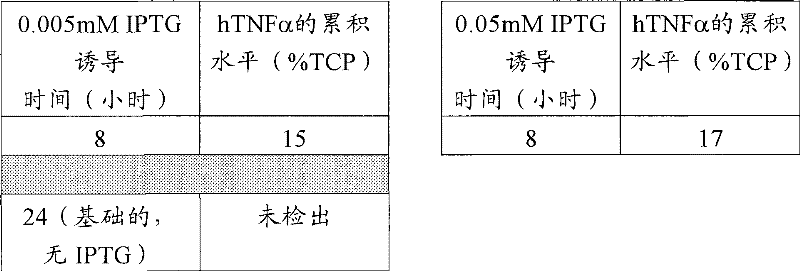
结果证明,两个完全回文操纵基因序列之间1bp间隔的变化(从91到92bp)没有不利影响所获得的基础表达和最终累积水平的表现。出乎意料的是,降低IPTG浓度10倍(从0.05mM到0.005mM)没有显著降低诱导的生产率。 The results demonstrated that a change in the 1 bp spacing (from 91 to 92 bp) between the two perfect palindromic operator sequences did not adversely affect the representation of the basal expression and final cumulative levels obtained. Unexpectedly, reducing the IPTG concentration 10-fold (from 0.05 mM to 0.005 mM) did not significantly reduce the induced productivity. the
实施例6 Example 6
从-80℃冷冻机中取出CLD042和CLD043小瓶,让它们解冻。将10μl的每瓶解冻甘油原液分别接种到补充四环素(10μg/ml)和葡萄糖(1g/L)的每份2×5ml LB培养液(LB,5g/L酵母提取物(Oxoid),10g/L胰化蛋白胨(Oxoid)和5g/L氯化钠)中。在37℃的定轨摇床中温育16小时。然后使用500μl的这些培养物分别接种含有50ml的LB培养液(组成如上所述)的250ml锥形瓶。将锥形瓶在定轨摇床中37℃、200rpm进行温育。监测生长直到OD600=0.5-0.7。这时用0.5mM终浓度的IPTG(异丙基-β-D-1-硫代吡喃半乳糖苷)诱导锥形瓶。也留下含有每种菌株培养物的锥形瓶不诱导,在上述条件下继续温育,在此期间取样进行生长的测定、细菌细胞中hTNFα累积的测定。使用光密度扫描取样细菌的全细胞溶胞产物的胶体蓝染色的SDS-PAGE胶来确定hTNFα的累积水平。在取样细菌的SDS-PAGE之后,通过蛋白质印迹(使用抗hTNFα抗体)比较温育20小时后的CLD042和CLD043的未诱导培养物中hTNFα的基础累积水平。结果汇总在下面的表6中。
Remove the CLD042 and CLD043 vials from the -80°C freezer and allow them to thaw.
表6 Table 6
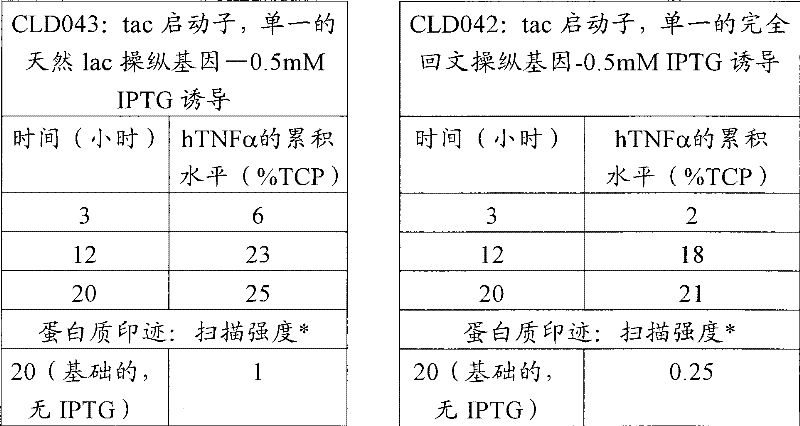
(*)=蛋白质印迹上的hTNFα带的扫描。将CLD042的强度扫描数据对CLD043的强度扫描数据进行标准化。 ( * ) = scan of hTNFα band on Western blot. The intensity scan data of CLD042 were normalized to the intensity scan data of CLD043.
结果证明,单一的完全回文操纵基因序列能够用来降低基础表达 (没有诱导物时)四倍,而没有不利影响tac启动子系统的诱导的生产率。 The results demonstrate that a single complete palindromic operator sequence can be used to reduce basal expression (in the absence of an inducer) four-fold without adversely affecting the induced productivity of the tac promoter system. the
实施例7 Example 7
从-80℃冷冻机中取出CLD019小瓶,让它解冻。将10μl的解冻甘油原液接种到补充四环素(10μg/ml)和葡萄糖(1g/L)的5ml LB培养液(LB,5g/L酵母提取物(Oxoid),10g/L胰化蛋白胨(Oxoid)和5g/L氯化钠)中。在37℃的定轨摇床中温育16小时。然后使用500μl的该培养物接种含有50ml的LB培养液(组成如上所述)的250ml锥形瓶。将锥形瓶在定轨摇床中37℃、200rpm进行温育。监测生长直到OD600=0.5-0.7。这时用0.5mM、0.1mM、0.05mM和0.005mM终浓度的IPTG(异丙基-β-D-1-硫代吡喃半乳糖苷)诱导锥形瓶。也留下锥形瓶不诱导,在上述条件下继续温育,在此期间取样进行生长的测定、细菌细胞中hTNFα累积的测定。使用光密度扫描取样细菌的全细胞溶胞产物的胶体蓝染色的SDS-PAGE胶来确定hTNFα的累积水平。结果示于图2中。
Remove the CLD019 vial from the -80°C freezer and allow it to thaw.
图2显示的数据证明,tac启动子与双重完全回文操纵基因序列的组合产生了这样一种系统,其中的表达速率可被用来诱导的IPTG的浓度直接调节。可采用这样的系统来调节异源蛋白质的表达,例如最大化可溶形式蛋白质的累积或者避免异源蛋白质分泌所可能具有的对重组细胞生长和生产率的有害影响这一问题。 The data shown in Figure 2 demonstrate that the combination of the tac promoter with a double perfect palindromic operator sequence results in a system in which the rate of expression can be directly regulated by the concentration of IPTG used to induce. Such systems can be employed to regulate the expression of heterologous proteins, for example to maximize the accumulation of soluble forms of the protein or to avoid the problem that secretion of heterologous proteins can have detrimental effects on the growth and productivity of recombinant cells. the
实施例8 Example 8
从-80℃冷冻机中取出小瓶CLD030,让它解冻。将10μl的解冻甘油原液接种到补充四环素(10μg/ml)和葡萄糖(1g/L)的5ml LB培养液(LB,5g/L酵母提取物(Oxoid),10g/L胰化蛋白胨(Oxoid)和5g/L氯化钠)中。在37℃的定轨摇床中温育16小时。然后使用500μl的该培养物接种含有50ml的LB培养液(组成如上所述)的250ml锥形瓶。将锥形瓶在定轨摇床中37℃、200rpm进行温育。监测生长直到OD600=0.5-0.7。这时用0.005mM终浓度的IPTG(异丙基-β-D-1-硫代吡喃半乳糖苷)诱导锥形瓶,同时留下另一个锥形瓶不诱导,在上述条件下继续温育,在此期间取样进行生长的测定、细菌细胞中hTNFα累积的 测定。使用光密度扫描取样细菌的全细胞溶胞产物的胶体蓝染色的SDS-PAGE胶来确定hTNFα的累积水平。结果汇总在下面的表7中。
Remove the vial of CLD030 from the -80°C freezer and allow it to thaw.
表7 Table 7
表7所示数据清楚地显示,使用单一的完全回文操纵基因序列可令人惊讶地获得非常强力的λpL启动子。使用单一的完全回文控制系统可获得高的产物累积水平。 The data presented in Table 7 clearly show that a surprisingly strong lambda pL promoter can be obtained using a single, fully palindromic operator sequence. High levels of product accumulation can be achieved using a single perfect palindromic control system. the
实施例9 Example 9
从-80℃冷冻机中取出CLD021和CLD038小瓶,让它们解冻。将10μl的每瓶解冻甘油原液分别接种到补充四环素(10μg/ml)和葡萄糖(1g/L)的5ml LB培养液(LB,5g/L酵母提取物(Oxoid),10g/L胰化蛋白胨(Oxoid)和5g/L氯化钠)中。在37℃的定轨摇床中温育16小时。然后使用500μl的该培养物接种含有50ml的LB培养液(组成如上所述)的250ml锥形瓶。将锥形瓶在定轨摇床中37℃、200rpm进行温育。监测生长直到OD600=0.5-0.7。这时用1mM终浓度的IPTG(异丙基-β-D-1-硫代吡喃半乳糖苷)诱导锥形瓶,同时留下第二个锥形瓶不诱导,在上述条件下继续温育,在此期间取样进行生长的测定、细菌细胞中hTNFα累积的测定。在取样细菌的全细胞溶胞产物的SDS-PAGE之后,使用胶体蓝染色的SDS-PAGE胶和蛋白质印迹分析(使用抗hTNFα抗体)确定hTNFα的累积。数据汇总在表8中。菌株CLD038的蛋白质印迹分析示于图3中。
Remove the CLD021 and CLD038 vials from the -80°C freezer and allow them to thaw.
表8 Table 8
这些结果证明,间隔91bp或92bp的带有λpL启动子的双重完全回文操纵基因序列的组合产生了非常严重的阻抑。蛋白质印迹表明,未检测到靶蛋白的基础表达。在诱导时获得了低水平的表达水平。这些结果是完全预料不到的,因为已知的是λpL启动子是极其强力的启动子。这样的系统可用于例如引导对宿主细胞有高毒性的蛋白质的表达。当受控表达是有利的时候,它也可用于膜蛋白的表达和插入。 These results demonstrate that the combination of the double perfect palindromic operator sequence with the lambda pL promoter separated by 91 bp or 92 bp produces very severe repression. Western blot showed that no basal expression of the target protein was detected. Low expression levels were obtained upon induction. These results were totally unexpected since the lambda pL promoter is known to be an extremely potent promoter. Such systems are useful, for example, to direct the expression of proteins that are highly toxic to host cells. It can also be used for the expression and insertion of membrane proteins when controlled expression is advantageous. the
实施例10 Example 10
从-80℃冷冻机中取出CLD028和CLD035小瓶,让它们解冻。将10μl的每瓶解冻甘油原液分别接种到补充四环素(10μg/ml)和葡萄糖(1g/L)的每份2×5ml LB培养液(LB,5g/L酵母提取物(Oxoid),10g/L胰化蛋白胨(Oxoid)和5g/L氯化钠)中。在37℃的定轨摇床中温育16小时。然后使用500μl的这些培养物分别接种含有50ml的LB培养液(组成如上所述)的250ml锥形瓶。将锥形瓶在定轨摇床中37℃、200rpm进行温育。监测生长直到OD600=0.5-0.7。这时用1mM终浓度的IPTG(异丙基-β-D-1-硫代吡喃半乳糖苷)诱导锥形瓶,在上述条件下继续温育,在此期间取样进行生长的测定、细菌细胞中hTNFα累积 的测定。使用光密度扫描取样细菌的全细胞溶胞产物的胶体蓝染色的SDS-PAGE胶来确定hTNFα的累积水平。结果汇总在下面的表9中。
Remove the CLD028 and CLD035 vials from the -80°C freezer and allow them to thaw.
表9 Table 9
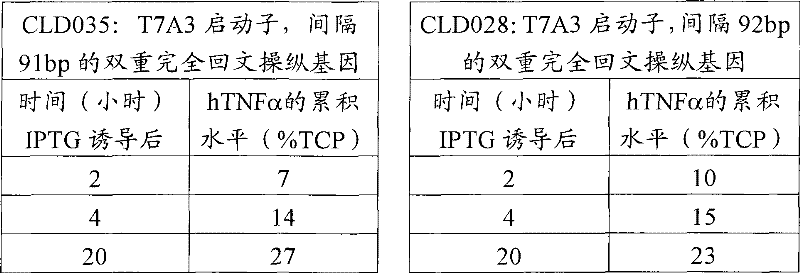
这些数据结合前面实施例4和5所示数据一起来看,表明能够使用大肠杆菌K-12和B菌株两者。 These data, taken together with the data previously shown in Examples 4 and 5, demonstrate that both E. coli K-12 and B strains can be used.
实施例11 Example 11
通过将下面描述的每种菌株的200μl甘油原液加入到含有补充了15μg/ml四环素的200mL LB培养液(LB,5g/L酵母提取物(Oxoid),10g/L胰化蛋白胨(Oxoid)和5g/L氯化钠)的2.0L带挡板的摇瓶中而产生发酵接种物。在带有250rpm搅拌的摇床-培养箱中于37℃生长接种物12小时。使用200ml摇瓶接种物来接种含有10L分批生长培养基的15L工作体积的发酵罐。在下面描述的工作条件下进行发酵。将温度控制在37℃,通过35%(w/v)氢氧化铵的自动添加将pH控制在6.8。 By adding 200 μl of glycerol stock solution of each strain described below to 200 mL of LB culture medium supplemented with 15 μg/ml tetracycline (LB, 5 g/L yeast extract (Oxoid), 10 g/L tryptone (Oxoid) and 5 g /L NaCl) in a 2.0L baffled shake flask to generate the fermentation inoculum. The inoculum was grown for 12 hours at 37°C in a shaker-incubator with agitation at 250 rpm. A 200 ml shake flask inoculum was used to inoculate a 15 L working volume fermentor containing 10 L batch growth medium. Fermentation was carried out under the working conditions described below. The temperature was controlled at 37°C and the pH was controlled at 6.8 by automatic addition of 35% (w/v) ammonium hydroxide.
溶解氧张力(dOT)设定点是30%空气饱和度,通过发酵罐搅拌器速度(从最小的250rpm直到最大的1500rpm)的自动调节来控制,氧气自动补充到入口气流中。到发酵罐容器的气流始终是10L/min。发酵罐中的压力保持在50和200毫巴之间。 The dissolved oxygen tension (dOT) set point was 30% air saturation, controlled by automatic adjustment of the fermenter stirrer speed (from a minimum of 250 rpm up to a maximum of 1500 rpm), and oxygen was automatically added to the inlet airflow. Airflow to the fermenter vessel was always 10 L/min. The pressure in the fermenter was maintained between 50 and 200 mbar.
以分批模式进行发酵,直到碳源(即甘油)耗尽,它发生在接种后大约10小时,特征在于dOT的急剧升高。在碳源耗尽时通过以每小时每升培养基11g甘油的进料速度加入甘油/氯化镁进料来起始补料分批发酵。一旦发酵中的生物量水平达到OD600=50-60,就通过加入IPTG到0.5mM终浓度而进行诱导。在诱导后继续补料分批阶段12小时。在收获 时取样确定生物量水平(OD600)和hTNFα累积(%TCP)/hTNFα滴度(g/L)(胶体蓝染色的SDS-PAGE胶)。 Fermentation was performed in batch mode until the carbon source (ie glycerol) was depleted, which occurred approximately 10 hours after inoculation and was characterized by a sharp rise in dOT. Fed-batch fermentations were initiated upon depletion of the carbon source by adding a glycerol/magnesium chloride feed at a feed rate of 11 g glycerol per liter of medium per hour. Once the biomass level in the fermentation reached OD600 = 50-60, induction was performed by adding IPTG to a final concentration of 0.5 mM. The fed-batch phase was continued for 12 hours after induction. Samples were taken at harvest to determine biomass levels ( OD600 ) and hTNF[alpha] accumulation (%TCP)/hTNF[alpha] titer (g/L) (Colloidal Blue stained SDS-PAGE gel).
分批生长培养基的组成提供在表10中。 The composition of the batch growth medium is provided in Table 10.
表10 Table 10
甘油/氯化镁进料的组成提供在表11中。 The composition of the glycerol/magnesium chloride feed is provided in Table 11.
表11 Table 11
结果汇总在表12中。菌株CLD030的hTNFα生产率分布图示于图4中。 The results are summarized in Table 12. The hTNFα productivity profile of strain CLD030 is shown in FIG. 4 .
表12 Table 12
数据清楚地证明了系统用于制备异源蛋白质的有用性。使用简单的普通优化的发酵和诱导工艺获得了高的产物滴度。如图4中例举的生产率分布图所证实的,可利用质粒pAVE027的控制特征来最大化异源蛋白质的生产,特别是需要控制表达以最大化分泌的蛋白质。 The data clearly demonstrate the usefulness of the system for making heterologous proteins. High product titers were obtained using a simple general optimized fermentation and induction process. As demonstrated by the productivity profile exemplified in Figure 4, the control features of plasmid pAVE027 can be exploited to maximize production of heterologous proteins, particularly proteins that require controlled expression to maximize secretion.
实施例12 Example 12
从-80℃冷冻机中取出CLD050小瓶,让它解冻。将10μl的解冻甘油原液接种到补充四环素(10μg/ml)和葡萄糖(1g/L)的5ml LB培养液(LB,5g/L酵母提取物(Oxoid),10g/L胰化蛋白胨(Oxoid)和5g/L氯化钠)中。在37℃的定轨摇床中温育16小时。然后使用500μl的该培养物接种含有50ml的LB培养液(组成如上所述)的250ml锥形瓶。将锥形瓶在定轨摇床中37℃、200rpm进行温育。监测生长直到OD600=0.5-0.7。这时用0.05mM终浓度的IPTG(异丙基-β-D-1-硫代吡喃半乳糖苷)诱导锥形瓶,同时留下另一锥形瓶不诱导,在上述条件下继续温育,在此期间取样进行生长的测定、细菌细胞中hTNFα累积的测定。使用光密度扫描取样细菌的全细胞溶胞产物的胶体蓝染色的SDS-PAGE胶来确定hTNFα的累积水平。结果汇总在下面的表13中。
Remove the CLD050 vial from the -80 °C freezer and allow it to thaw.
表13 Table 13
令人惊讶的是,当间隔增加时,双重完全回文操纵基因序列是起作用的。例如可以改变双重完全回文的间隔以实现对其它启动子的有效控制。 Surprisingly, the double perfect palindromic operator sequence was functional when the spacing was increased. For example, the spacing of the double perfect palindrome can be varied to achieve effective control of other promoters. the
实施例13 Example 13
从-80℃冷冻机中取出CLD048小瓶,让它解冻。将10μl的解冻甘油原液接种到补充四环素(10μg/ml)和葡萄糖(1g/L)的5ml LB培养液(LB,5g/L酵母提取物(Oxoid),10g/L胰化蛋白胨(Oxoid)和5g/L氯化钠)中。在37℃的定轨摇床中温育16小时。然后使用500μl的该培养物接种含有50ml的LB培养液(组成如上所述)的250ml锥形瓶。将锥形瓶在定轨摇床中37℃、200rpm进行温育。监测生长直到OD600=0.5-0.7。这时用0.1mM终浓度的IPTG(异丙基-β-D-1-硫代吡喃半乳糖苷)诱导锥形瓶,在上述条件下再继续温育2小时。然后收获细胞和剩余的没有细胞的生长培养基。进一步进行所收获细胞的渗透压休 克细胞分级分离以分离含有蛋白质的细胞组分,它们是分布在可溶性大肠杆菌周质组分中的。参考用纯化的活性D1.3Fab所制备的标准曲线,通过确定ELISA分析中D1.3Fab与溶菌酶(抗原)的结合来评估可溶性周质提取物和残余生长培养基中生物活性D1.3Fab的累积。大肠杆菌周质和残余生长培养基(因为物质从周质泄漏到了生长培养基中)中生物活性D1.3Fab的累积示于表14中。将周质和残余生长培养基中的D1.3Fab的累积标准化为“每单位生物量每升培养物的μg活性物质(OD600)”。
Remove the CLD048 vial from the -80°C freezer and allow it to thaw.
表14 Table 14
该系统所提供的控制使得能够高水平分泌异源蛋白质,特别是需要复杂的二硫键形成的那些蛋白质的,有用性被大肠杆菌周质中高水平生物活性D1.3Fab的分泌和累积清楚地例证。 此外,如何才能使用补料分批发酵(例如前面实施例11或下面的实施例14中所描述的)来高产率地制备这样的蛋白质,这对于本领域技术人员来说将是明确的。 The usefulness of the control afforded by this system to enable high-level secretion of heterologous proteins, especially those requiring complex disulfide bond formation, is clearly exemplified by the secretion and accumulation of high-level bioactive D1.3 Fab in the periplasm of E. coli . Furthermore, it will be apparent to those skilled in the art how such proteins can be produced in high yield using fed-batch fermentation such as described in Example 11 above or Example 14 below.
实施例14 Example 14
使用CLD048重复实施例11所描述的发酵过程。一旦发酵物中的生物量水平达到OD600=大约50,就通过加入IPTG到0.15mM终浓度进行诱导。在诱导后继续补料分批阶段35-45小时。然后收获细胞和剩余的不含细胞的生长培养基。进一步进行所收获细胞的渗透压休克细胞分级分离以分离含有蛋白质的细胞组分,它们是分布在可溶性大肠杆菌周质组分中的。参考用纯化的活性D1.3Fab所制备的标准曲线,通过确定ELISA分析中D1.3Fab与溶菌酶(抗原)的结合来评估可溶性周质提取物和残余生长培养基中生物活性D1.3Fab的累积。将周质和残余生长培养基中的D1.3Fab的累积标准化为“每升培养物的mg活性物质”。 The fermentation process described in Example 11 was repeated using CLD048. Once the biomass level in the ferment reached OD6oo = approximately 50, induction was performed by adding IPTG to a final concentration of 0.15 mM. The fed-batch phase was continued for 35-45 hours after induction. The cells and remaining cell-free growth medium are then harvested. Osmotic shock cell fractionation of the harvested cells was further performed to isolate protein-containing cellular fractions that were distributed in the soluble E. coli periplasmic fraction. Accumulation of bioactive D1.3 Fab in soluble periplasmic extracts and residual growth medium was assessed by determining the binding of D1.3 Fab to lysozyme (antigen) in an ELISA assay with reference to a standard curve prepared with purified active D1.3 Fab . The accumulation of D1.3 Fab in the periplasm and residual growth medium was normalized as "mg active substance per liter of culture".
大肠杆菌周质和残余生长培养基(因为物质从周质泄漏到了生长培养基中)中生物活性D1.3Fab的累积示于表15中。 The accumulation of bioactive D1.3 Fab in the E. coli periplasm and residual growth medium (due to leakage of material from the periplasm into the growth medium) is shown in Table 15.
表15 Table 15
使用表达系统证明生物活性D1.3Fab的高水平分泌 。 High-level secretion of biologically active D1.3 Fab was demonstrated using an expression system.
实施例15 Example 15
设计了合成的双特异性单链四价双抗体(diabody)(bsctDb),其中将来自D1.3(抗溶菌酶)和A5B7(抗-CEA(癌胚抗原))的轻链可变区和重链可变区连接在单一的多肽链上。该分子的DNA序列示于图5中(SEQ ID NO 22)。将它作为Nde I/Not I片段克隆到已经用Nde I和Not I消化过的pAVE046中。通过限制酶切消化筛选重组质粒,通过测序确认。将所得质粒命名为pAVE078。将pAVE078转化到大肠杆菌W3110中以制备CLD073,将它纯化并保藏在-80℃的甘油原液中。 A synthetic bispecific single-chain tetravalent diabody (diabody) (bsctDb) was designed in which the light chain variable regions from D1.3 (anti-lysozyme) and A5B7 (anti-CEA (carcinoembryonic antigen)) and The heavy chain variable regions are linked on a single polypeptide chain. The DNA sequence of this molecule is shown in Figure 5 (SEQ ID NO 22). It was cloned as a Nde I/Not I fragment into pAVE046 which had been digested with Nde I and Not I. Recombinant plasmids were screened by restriction digestion and confirmed by sequencing. The resulting plasmid was named pAVE078. pAVE078 was transformed into E. coli W3110 to prepare CLD073, which was purified and stored in glycerol stocks at -80°C.
从-80℃冷冻机中取出CLD073小瓶,让它解冻。将10μl的解冻甘油原液接种到补充四环素(10μg/ml)和葡萄糖(1g/L)的5ml LB培养液(LB,5g/L酵母提取物(Oxoid),10g/L胰化蛋白胨(Oxoid)和5g/L氯化钠)中。在37℃的定轨摇床中温育16小时。然后使用500μl的该培养物接种含有50ml的LB培养液(组成如上所述)的两个250ml锥形瓶。将锥形瓶在定轨摇床中37℃、200rpm进行温育。监测生长直到OD600=0.5-0.7。这时用0.5mM或0.1mM终浓度的IPTG(异丙基-β-D-1-硫代吡喃半乳糖苷)诱导锥形瓶,在上述条件下再继续温育20小时。然后收获细胞和剩余的没有细胞的生长培养基。进一步进行所收获细胞的渗透压休克细胞分级分离以分离含有蛋白质的细胞组分,它们是分布在可溶性大肠杆菌周质组分中的。通过确定竞争性ELISA分析中抗-CEA 单克隆抗体与CEA(抗原)的结合抑制以及通过竞争性ELISA分析中抗溶菌酶Fab抗体片段与溶菌酶(抗原)的结合来评估周质提取物和残余生长培养基中生物活性D1.3-A5B7bsctDb的表达、分泌、折叠和累积。
Remove the CLD073 vial from the -80°C freezer and allow it to thaw.
获得的数据表明,在诱导结束时大多数的D1.3-A5B7bsctDb分布在残余生长培养基中(从周质泄漏)。该数据(竞争性ELISA中bsctDb的结合)示于表16中。获得的数据证明,来自0.5mM IPTG诱导的培养物的残余生长培养基样品就完全抑制了竞争性ELISA分析中抗-CEA和抗溶菌酶抗体两者的结合。来自0.1mM IPTG诱导的培养物的残余生长培养基样品显示了降低的抑制水平,这表明该样品中生物活性D1.3-A5B7 bsctDb的累积水平更低。 The data obtained indicated that most of the D1.3-A5B7bsctDb was distributed in the residual growth medium (leaked from the periplasm) at the end of induction. The data (binding of bsctDb in competitive ELISA) are shown in Table 16. The data obtained demonstrated that residual growth medium samples from cultures induced with 0.5 mM IPTG completely inhibited the binding of both anti-CEA and anti-lysozyme antibodies in a competitive ELISA assay. Residual growth medium samples from 0.1 mM IPTG-induced cultures showed reduced levels of inhibition, suggesting a lower level of accumulation of biologically active D1.3-A5B7 bsctDb in this sample.
表16 Table 16
使用新表达系统就可以生产使用大肠杆菌很难生产的复杂的多链异源蛋白质 。通过证明使用新表达系统在大肠杆菌中能够生产生物活性形式的双特异性单链四价双抗体,已经例证了这一点。这进一步例证了表达系统的有用性。 Using the new expression system, it is possible to produce complex multi-chain heterologous proteins that are difficult to produce using E. coli. This has been exemplified by demonstrating that bispecific single chain tetravalent diabodies in biologically active form can be produced in E. coli using a new expression system. This further exemplifies the usefulness of expression systems.
实施例16 Example 16
将谷胱甘肽-S-转移酶-3C蛋白酶融合物(GST-3C)作为Nde I/Xho I片段克隆到用Nde I和Xho I消化过的pAVE011中。插入片段的序列示于图6中(SEQ ID NO 23)。通过限制酶切消化筛选重组质粒,通过测序 确认。将所得质粒命名为pAVE052。将pAVE052转化到大肠杆菌BL21中以制备CLD054,将它纯化并保存在-80℃的甘油原液中。 Glutathione-S-transferase-3C protease fusion (GST-3C) was cloned as Nde I/Xho I fragment into pAVE011 digested with Nde I and Xho I. The sequence of the insert is shown in Figure 6 (SEQ ID NO 23). Recombinant plasmids were screened by restriction digestion and confirmed by sequencing. The resulting plasmid was named pAVE052. pAVE052 was transformed into E. coli BL21 to prepare CLD054, which was purified and stored in a glycerol stock solution at -80°C.
将人干扰素α2(IFNα2)基因作为Nde I/Xho I片段克隆到用Nde I和Xho I消化过的pAVE011中。插入片段的DNA序列示于图7中(SEQ ID NO24)。通过限制酶切消化筛选重组质粒,通过测序确认。将所得质粒命名为pAVE058。将pAVE058转化到大肠杆菌W3110中以制备CLD059,将它纯化并保存在-80℃的甘油原液中。 The human interferon alpha 2 (IFNα2) gene was cloned as an Nde I/Xho I fragment into pAVE011 digested with Nde I and Xho I. The DNA sequence of the insert is shown in Figure 7 (SEQ ID NO 24). Recombinant plasmids were screened by restriction digestion and confirmed by sequencing. The resulting plasmid was named pAVE058. pAVE058 was transformed into E. coli W3110 to prepare CLD059, which was purified and stored in a glycerol stock solution at -80°C.
将已经进行适于大肠杆菌表达的密码子优化的人促红细胞生成素(EPO)基因作为Nde I/Xho I片段克隆到用Nde I和Xho I消化过的pAVE011中。插入序列的DNA序列示于图8中(SEQ ID NO 25)。通过限制酶切消化筛选重组质粒,通过测序确认。将所得质粒命名为pAVE061。将pAVE061转化到大肠杆菌W3110中以制备CLD060,将它纯化并保存在-80℃的甘油原液中。 The human erythropoietin (EPO) gene that had been codon-optimized for expression in E. coli was cloned as an Nde I/Xho I fragment into pAVE011 digested with Nde I and Xho I. The DNA sequence of the insert is shown in Figure 8 (SEQ ID NO 25). Recombinant plasmids were screened by restriction digestion and confirmed by sequencing. The resulting plasmid was named pAVE061. pAVE061 was transformed into E. coli W3110 to prepare CLD060, which was purified and stored in a glycerol stock solution at -80°C.
使用实施例11中描述的培养基和工艺条件进行使用CLD054、CLD059和CLD060的补料分批发酵。如表19中所述将发酵保持在30℃或37℃。以分批模式进行发酵,直到碳源(即甘油)耗尽。这时通过加入含有甘油(714g/L)和硫酸镁(30g/L)的进料来起始补料分批发酵。一旦发酵中的生物量水平达到OD600=50-60,就通过加入IPTG进行诱导。使用的IPTG浓度如表17中所述。在诱导后继续补料分批阶段12-15小时。在发酵期间取样确定生物量水平(OD600)和蛋白质产物((GST-3C、IFNα2和EPO)滴度(g/L),使用取样细菌的全细胞溶胞产物的胶体蓝染色的SDS-PAGE胶)。 Fed-batch fermentations with CLD054, CLD059 and CLD060 were performed using the media and process conditions described in Example 11. Fermentations were maintained at 30°C or 37°C as described in Table 19. Fermentation was performed in batch mode until the carbon source (ie glycerol) was exhausted. At this point the fed-batch fermentation was initiated by adding a feed containing glycerol (714 g/L) and magnesium sulfate (30 g/L). Once the biomass level in the fermentation reached OD600 = 50-60, it was induced by adding IPTG. The IPTG concentrations used are as described in Table 17. The fed-batch phase was continued for 12-15 hours after induction. Samples were taken during fermentation to determine biomass levels (OD 600 ) and protein product ((GST-3C, IFNα2, and EPO) titers (g/L) using colloidal blue-stained SDS-PAGE of whole cell lysates of sampled bacteria glue).
表17 Table 17

表17中提供的数据进一步证明了系统用于广范围的异源蛋白质生产的有用性。使用简单的普通发酵工艺加上仅仅控制用于诱导的IPTG浓度就获得了高的产物滴度。降低工艺过程开发的时间界限对于治疗上有用的异源蛋白质来说是特别有利的。 The data presented in Table 17 further demonstrate the usefulness of the system for the production of a wide range of heterologous proteins. High product titers were obtained using a simple common fermentation process plus only controlling the IPTG concentration for induction. Lowering the time frame for process development is particularly advantageous for therapeutically useful heterologous proteins. the
实施例17 Example 17
使用已经用PCR改造过的Nde I和Spe I位点克隆了来自恶臭假单胞菌(Pseudomonas putida)的L-2-卤代链烷酸脱卤素酶(hadL)基因。基因序列示于图9中(SEQ ID NO 26)。用Nde I和Spe I消化质粒pAVE011,对带进行凝胶提取。用Nde I和Spe I消化hadL,对hadL基因进行凝胶提取,连接到pAVE011中产生pAVE075。使用PCR从质粒pCN60(ATCC77101;Nieto C,et al.(1990)基因(Gene)87:145-149)中拷贝了萨氏假单胞菌(Pseudomonas savastanoi)的复制起点。 The L-2-haloalkanoate dehalogenase (hadL) gene from Pseudomonas putida was cloned using Nde I and Spe I sites that had been engineered by PCR. The gene sequence is shown in Figure 9 (SEQ ID NO 26). Plasmid pAVE011 was digested with Nde I and Spe I and the bands were gel extracted. hadL was digested with Nde I and Spe I, the hadL gene was gel extracted and ligated into pAVE011 to generate pAVE075. The origin of replication for Pseudomonas savastanoi was copied using PCR from plasmid pCN60 (ATCC77101; Nieto C, et al. (1990) Gene 87: 145-149).
使用的引物是: The primers used were:
F37A:序列:5′AGATCTACGCTTATGGGTGCCTTTCC(SEQ ID NO27),以及 F37A: Sequence: 5'AGATCTACGCTTATGGGTGCCTTTCC (SEQ ID NO 27), and
B29a:序列:5′AGATCTAATACGCAAACCGCCTCTCC(SEQ ID NO28)。 B29a: Sequence: 5' AGATCTAATACGCAAACCGCCTCTCC (SEQ ID NO 28).
将PCR产物首先克隆到TOPO TA pCR2.1(Invitrogen)中,然后通过Bgl II消化克隆到pAVE075中。通过电穿孔将所得质粒pAVE086转化到恶臭假单胞菌NCIMB 12018中以制备CLD075,将它纯化并保存在-80℃的甘油原液中。从-80℃冷冻机中取出CLD075小瓶,让它解冻。将10μl的解冻甘油原液接种到补充四环素(10μg/ml)的5ml LB培养液(LB,5g/L酵母提取物(Oxoid),10g/L胰化蛋白胨(Oxoid)和5g/L氯化钠)中。在37℃的定轨摇床中温育16小时。然后使用500μl的该培养物接种含有50ml的LB培养液(组成如上所述)的两个250ml锥形瓶。将锥形瓶在定轨摇床中30℃、200rpm进行温育。监测生长直到OD600=0.5-0.7。这时用0.5mM终浓度的IPTG诱导一个锥形瓶,而留下第二个锥形瓶不诱导以检测基础表达。在上述条件下继续温育,在此期间取样进行生长的测定和细菌细胞中HadL蛋白质累积的测定。使用光密度扫描取样细菌的全细胞溶胞产物的胶体蓝染色的SDS-PAGE胶来确定HadL的累积水平。
The PCR product was first cloned into TOPO TA pCR2.1 (Invitrogen) and then cloned into pAVE075 by Bgl II digestion. The resulting plasmid pAVE086 was transformed into Pseudomonas putida NCIMB 12018 by electroporation to prepare CLD075, which was purified and stored in a glycerol stock solution at -80°C. Remove the CLD075 vial from the -80°C freezer and allow it to thaw.
HadL蛋白质的表达和累积示于图10中。数据表明,T7A3:DPPS91表达系统在另一种原核宿主系统中起作用。令人惊讶的是,表达系统在恶臭假单胞菌中的生产效率与使用大肠杆菌作为宿主系统所观察到的生产效率是相同的。甚至在没有诱导物的23小时温育之后也未检测到基础表达。在使用IPTG诱导后获得了恶臭假单胞菌中的高水平蛋白质表达和累积。 The expression and accumulation of HadL protein is shown in FIG. 10 . The data suggest that the T7A3:DPPS91 expression system functions in another prokaryotic host system. Surprisingly, the production efficiency of the expression system in P. putida was the same as that observed using E. coli as the host system. No basal expression was detected even after 23 hours of incubation without inducer. High level protein expression and accumulation in Pseudomonas putida was obtained after induction with IPTG. the
实施例18 Example 18
使用实施例11中描述的普通大肠杆菌培养基和工艺条件进行使用恶臭假单胞菌CLD075的补料分批发酵。将发酵保持在30℃和pH7.0(用25%氢氧化铵和10%磷酸控制)。以分批模式进行发酵,直到碳源(即甘油)耗尽。这时通过加入含有甘油(714g/L)和硫酸镁(30g/L)的进料来起始补料分批发酵。一旦发酵中的生物量水平达到OD600=50,就通过加入1mM IPTG(终浓度)进行诱导。在诱导后继续补料分批阶段12-15小时。在发酵期间取样确定生物量水平(OD600)和HadL蛋白质累积((%TCP)取样细菌的全细胞溶胞产物的胶体蓝染色的SDS-PAGE胶)。诱导之后CLD075的生长和HadL蛋白质的表达/累积示于图11中。 The fed-batch fermentation with Pseudomonas putida CLD075 was performed using the normal E. coli medium and process conditions described in Example 11. The fermentation was maintained at 30°C and pH 7.0 (controlled with 25% ammonium hydroxide and 10% phosphoric acid). Fermentation was performed in batch mode until the carbon source (ie glycerol) was exhausted. At this point the fed-batch fermentation was initiated by adding a feed containing glycerol (714 g/L) and magnesium sulfate (30 g/L). Once the biomass level in the fermentation reached OD600 = 50, it was induced by adding 1 mM IPTG (final concentration). The fed-batch phase was continued for 12-15 hours after induction. Samples were taken during fermentation to determine biomass levels ( OD600 ) and HadL protein accumulation (Colloidal blue stained SDS-PAGE gels of whole cell lysates of bacteria sampled (%TCP)). Growth of CLD075 and expression/accumulation of HadL protein after induction are shown in FIG. 11 .
使用表达系统在恶臭假单胞菌中获得了高水平的蛋白质表达和累积(>40%TCP),甚至通过仅仅使用设计来用于大肠杆菌的普通生长培养基也是如此。 High levels of protein expression and accumulation (>40% TCP) were obtained in P. putida using the expression system, even by using only common growth media designed for E. coli. the
实施例19 Example 19
将合成的Gal阻抑物基因(大肠杆菌)作为PstI片段克隆到载体pZen042(如EP 0502637所述)的PstI位点中。鉴别具有顺时针方向和反时针方向Gal阻抑物基因的克隆。选择具有反时针方向的克隆以产生pAVE071。 The synthetic Gal repressor gene (E. coli) was cloned as a PstI fragment into the PstI site of vector pZen042 (as described in EP 0502637). Clones with clockwise and counterclockwise Gal repressor genes were identified. Clones with counterclockwise orientation were selected to generate pAVE071.
在质粒pZT7#2.0中开始构建Gal启动子和操纵基因序列,所述质粒根据US6537779所述进行制备。pZT7#2.0具有pAT153载体骨架、cer稳定性序列、tet A/R、感兴趣基因上游的单一天然lac操纵基因序列以及上游T4转录终止子。修饰天然Gal操纵基因序列以产生完全回文操纵基因序列。使用合成的寡核苷酸接头通过EcoR I和Xba I限制酶位点将它克隆到上述质粒中。通过退火寡核苷酸GalB1和GalB2来制备接头GalB: Construction of the Gal promoter and operator sequence was initiated in plasmid pZT7#2.0 prepared as described in US6537779. pZT7#2.0 has the pAT153 vector backbone, cer stabilization sequence, tet A/R, single native lac operator sequence upstream of the gene of interest, and upstream T4 transcription terminator. The native Gal operator sequence was modified to generate a fully palindromic operator sequence. It was cloned into the above plasmid via EcoR I and Xba I restriction enzyme sites using synthetic oligonucleotide linkers. Linker GalB was prepared by annealing oligonucleotides GalB1 and GalB2:
GalB1(SEQ ID NO 29) GalB1 (SEQ ID NO 29)
5′AATTCATACCATAAGCCTAATTCTACGAATTATCAGAGTTCTGGTTACCGGTGTAAGCGCTTACACTGT 5′ AATTCATACCATAAGCCTAATTCTACGAATTATCAGAGTTCTGGTTACCGGTGTAAGCGCTTACACTGT
GalB2(SEQ ID NO 30) GalB2 (SEQ ID NO 30)
5′CTAGACAGTGTAAGCGCTTACACCGGTAACCAGAACTCTGATAATTCGTAGAATTAGGCTTATGGTATG 5′CTAGACAGTGTAAGCGCTTACACCGGTAACCAGAACTCTGATAATTCGTAGAATTAGGCTTATGGTATG
然后将接头连接到质粒pZT7#2.0中,作为EcoR I/Xba I片段转化到克隆宿主株XL-1Blue MR(Stratagene)中。使用AgeI通过限制酶切消化初步筛选转化体。通过测序确认序列。将hTNFα基因作为NdeI/XhoI片段克隆到该质粒中。 The linker was then ligated into plasmid pZT7#2.0 and transformed into the cloning host strain XL-1Blue MR (Stratagene) as an EcoR I/Xba I fragment. Transformants were initially screened by restriction digestion using AgeI. Sequence was confirmed by sequencing. The hTNFα gene was cloned into this plasmid as a NdeI/XhoI fragment.
通过用XmaI和MscI消化并连接到用XmnI和XmaI消化过的pAVE071中来克隆hTNFα基因和部分的Gal完全回文操纵基因序列。通过限制酶切消化来筛选克隆中hTNFα基因的存在。 The hTNF[alpha] gene and part of the Gal perfect palindromic operator sequence were cloned by digestion with XmaI and MscI and ligation into pAVE071 digested with XmnI and XmaI. Clones were screened for the presence of the hTNF[alpha] gene by restriction digestion.
使用合成接头通过StuI和EcoRI位点将每个上游完全回文Gal操纵基因和Gal启动子克隆到该质粒中。通过退火寡核苷酸GalA1和GalA2来制备接头GalA: Each upstream fully palindromic Gal operator and Gal promoter were cloned into this plasmid via StuI and EcoRI sites using synthetic linkers. Linker GalA was prepared by annealing oligonucleotides GalA1 and GalA2:
GalA1(SEQ ID NO 31): GalA1 (SEQ ID NO 31):
5′CAATTGTGTAAGCGCTTACACAACTTTATTCCATGTCACACTTTTCGCATCTTTGTTATGCTATGGTG 5′CAATTGTGTAAGCGCTTACACAACTTTTATTCCATGTCACACTTTTCGCATCTTTGTTATGCTATGGTG
GalA2(SEQ ID NO 32) GalA2 (SEQ ID NO 32)
5′AATTCACCATCGCATAACAAGGATGCGAAAAGTGTGACATGGAATAAAGTTGTGTAAGCGCTTACACAATTG 5′AATTCACCATCGCATAACAAGGATGCGAAAAGTGTGACATGGAATAAAGTTGTGTAAGCGCTTACACAATTG
用MfeI消化来检测接头的存在,通过测序确认。将该质粒转化到大肠杆菌菌株W3110中以产生CLD085,将它纯化并保存在-80℃的甘油原液中。 The presence of the linker was detected by digestion with Mfel and confirmed by sequencing. This plasmid was transformed into E. coli strain W3110 to generate CLD085, which was purified and stored in a glycerol stock at -80°C.
从-80℃冷冻机中取出CLD085小瓶,让它解冻。将10μl的解冻甘油原液接种到补充四环素(10μg/ml)的5ml LB培养液(LB,5g/L酵母提取物(Oxoid),10g/L胰化蛋白胨(Oxoid)和5g/L氯化钠)中。在37℃的定轨摇床中温育16小时。然后使用500μl的该培养物接种含有50ml的LB培养液(组成如上所述)的250ml锥形瓶。将锥形瓶在定轨摇床中37℃、200rpm进行温育。监测生长直到OD600=0.5-0.7。这时用10.0mM终浓度的半乳糖诱导锥形瓶。在上述条件下继续温育,在此期间取样进行生长的测定和细菌细胞中hTNFα累积的测定。在取样细菌的SDS-PAGE之后,使用蛋白质印迹分析(使用抗-hTNFα抗体)来确定hTNFα的累积水平。数据提供在图17中。这证明使用完全回文的gal操纵基因序列结合gal阻抑物基因会导致没有诱导物时的gal启动子的非常严重的阻抑,同时令人惊讶的是,在加入半乳糖时,仍然保持了诱导能力。
Remove the CLD085 vial from the -80°C freezer and allow it to thaw.
实施例20 Example 20
如下构建非整合型酵母载体: Construct a non-integrating yeast vector as follows:
1)将序列1(啤酒糖酵母CYC1启动子的大肠杆菌lac I下游)作为XhoI片段克隆到Xho I消化的pCR2.1(Invitrogen)中。克隆序列1示于图15中(SEQ ID NO 35)。
1) Sequence 1 (E. coli lac I downstream of the Saccharomyces cerevisiae CYC1 promoter) was cloned as an Xho I fragment into Xho I digested pCR2.1 (Invitrogen).
2)将序列2(由啤酒糖酵母MF-α1基因启动子组成,在MF-α1启动子区的任意一侧带有完全回文lac操纵基因序列,带有蛋白质-抑弹性蛋白酶蛋白的基因序列,c-myc标记(抑弹性蛋白酶蛋白-cmyc)位于下游)作为Hind III片段(通过PCR制备)克隆到Hind III消化的步骤1所构建的 质粒中以产生质粒2。克隆序列2示于图16中(SEQ ID NO 36)。
2) Sequence 2 (consisting of the Saccharomyces cerevisiae MF-α1 gene promoter, with a complete palindromic lac operator sequence on either side of the MF-α1 promoter region, with the gene sequence of the protein-elafin , the c-myc tag (elafin-cmyc) downstream) was cloned as a Hind III fragment (prepared by PCR) into the plasmid constructed in
3)从YEp13(ATCC37115)克隆含有LEU2(选择标记基因)和酵母2μ复制起点的Spe I片段到Spe I消化的质粒2中以产生pAVE091。
3) The Spe I fragment containing LEU2 (selectable marker gene) and the yeast 2μ origin of replication was cloned from YEp13 (ATCC37115) into Spe I digested
通过电穿孔将pAVE091质粒DNA转化到啤酒糖酵母XS95-6C(ATCC204688)中,在没有亮氨酸的酵母缺陷培养基上筛选阳性菌落(Kaiser C,Michaelis S和Mitchel A,酵母遗传学方法,冷泉港实验手册(Methods in Yeast Genetics,C0ld Spring Harbor Laboratory Manual,1994))。使用同样的培养基进行摇瓶生长研究以确定抑弹性蛋白酶蛋白-cmyc蛋白质表达。将锥形瓶在定轨摇床中30℃、200rpm进行温育。将克隆生长到约3的OD,用0.5mM IPTG(终浓度)诱导。在上述条件下再继续温育16小时,在此期间取样测定生长和分泌到生长培养基中的抑弹性蛋白酶蛋白-cmyc蛋白质。按照WiedoW O,et al,J Biol Chem.(1990)265(25):14791-5所述,使用弹性蛋白酶抑制酶试验来确定分泌到残余生长培养基中的抑弹性蛋白酶蛋白-cmyc。IPTG诱导后4小时,生长培养基中有30mg/L的活性抑弹性蛋白酶蛋白蛋白质。这证明本发明的表达系统在酵母中是有效的。 The pAVE091 plasmid DNA was transformed into Saccharomyces cerevisiae XS95-6C (ATCC204688) by electroporation, and positive colonies were screened on yeast-deficient medium without leucine (Kaiser C, Michaelis S and Mitchel A, Methods in Yeast Genetics, Cold Spring Harbor Experiment Manual (Methods in Yeast Genetics, Cold Spring Harbor Laboratory Manual, 1994)). Shake flask growth studies were performed using the same medium to determine elafin-cmyc protein expression. The Erlenmeyer flasks were incubated in an orbital shaker at 30°C, 200 rpm. Clones were grown to an OD of approximately 3 and induced with 0.5 mM IPTG (final concentration). Incubation was continued under the above conditions for an additional 16 hours, during which time samples were taken for growth and secretion of elafin-cmyc protein into the growth medium. Secretion of elafin-cmyc into residual growth medium was determined using the elastase inhibitory enzyme assay as described by Wiedo W O, et al, J Biol Chem. (1990) 265(25): 14791-5. Four hours after IPTG induction, there was 30 mg/L of active elafin protein in the growth medium. This demonstrates that the expression system of the present invention is effective in yeast. the
实施例21 Example 21
合成含有组成型人巨细胞病毒(hCMV)启动子的DNA片段,启动子侧接双重的完全回文lac操纵基因序列。将它克隆到表达IgG Fc蛋白质的表达载体中。将所得质粒命名为pAVE081,它源自pCMV-Script(Stratagene),含有hCMV启动子,启动子侧接Nde I/Nhe I片段上的双重的完全回文lac操纵基因序列,载体的多克隆位点中带有IgG FcDNA序列。HCMV启动子和双重的完全回文lac操纵基因的DNA序列示于图12中(SEQ ID NO 33)。IgG Fc蛋白质的DNA序列示于图13中(SEQ ID NO 34)。如现有技术中所充分描述的那样进行了表达IgG Fc蛋白质的pAVE081和表达lac阻抑物的pCMVlacI(Stratagene)的瞬时共转染,以确定在IPTG诱导型hCMV启动子-双重的完全回文lac操纵基因表达系统的控制之下能否表达IgG Fc蛋白质。 A DNA fragment was synthesized containing a constitutive human cytomegalovirus (hCMV) promoter flanked by a double, fully palindromic lac operator sequence. It was cloned into an expression vector expressing IgG Fc protein. The resulting plasmid was named pAVE081, which was derived from pCMV-Script (Stratagene), containing the hCMV promoter, the double complete palindromic lac operator sequence on the promoter flanking the Nde I/Nhe I fragment, the multiple cloning site of the vector with IgG FcDNA sequence. The DNA sequence of the HCMV promoter and the dual fully palindromic lac operator is shown in Figure 12 (SEQ ID NO 33). The DNA sequence of the IgG Fc protein is shown in Figure 13 (SEQ ID NO 34). Transient co-transfection of pAVE081 expressing the IgG Fc protein and pCMVlacI (Stratagene) expressing the lac repressor was performed as fully described in the prior art to determine the complete palindrome in the IPTG-inducible hCMV promoter-duplex Whether the IgG Fc protein can be expressed under the control of the lac operator gene expression system.
将2ml的每毫升1.5x10⁵个活细胞的中国仓鼠卵巢(CHO细胞系ECACC 85050302,适于在无血清培养基中悬浮生长)悬浮培养物加入到6孔组织培养平板的每个孔中。然后将6孔组织培养平板在5%CO2的37℃湿润培养箱中温育过夜(16小时),然后制备转染混合物,每孔含有2μg的pAVE081 DNA与等量pCMVlacI(Stratagene)DNA、6μl的转染试剂和94μl的生长培养基。将100μl的转染混合物加入到含有CHO细胞的每个孔中。然后将6孔组织培养平板在5%CO2的37℃湿润培养箱中温育。为确定表达/分泌进入生长培养基中的IgG Fc的水平,用5mM IPTG(终浓度)诱导一组孔(第2天),留下一组孔不诱导。在第三天,对用IPTG诱导的一组孔和留下未诱导的那些孔进行取样(IPTG诱导后和未诱导的)。如现有技术中所公知的那样通过ELISA确定由CHO细胞所表达和分泌到生长培养基中的IgG Fc蛋白质。所获得的数据示于图14中。 2 ml of a suspension culture of Chinese hamster ovary (CHO cell line ECACC 85050302, suitable for growth in suspension in serum-free medium) at 1.5 x 10⁵ viable cells per ml was added to each well of a 6-well tissue culture plate. The 6-well tissue culture plate was then incubated overnight (16 hours) in a humidified incubator at 37°C with 5% CO 2 , and then a transfection mixture was prepared, each well containing 2 μg of pAVE081 DNA and an equal amount of pCMVlacI (Stratagene) DNA, 6 μl of Transfection reagent and 94 μl of growth medium. Add 100 μl of transfection mix to each well containing CHO cells. The 6-well tissue culture plates were then incubated in a 37 °C humidified incubator with 5% CO2 . To determine the level of IgG Fc expressed/secreted into the growth medium, one set of wells was induced with 5 mM IPTG (final concentration) (day 2), leaving one set uninduced. On the third day, a set of wells induced with IPTG and those left uninduced were sampled (post-IPTG induction and non-induced). IgG Fc protein expressed by CHO cells and secreted into the growth medium was determined by ELISA as known in the art. The data obtained are shown in FIG. 14 .
数据清楚地证明了表达系统的广泛有用性。表达系统可用于控制典型地用在哺乳动物表达系统中的强力组成型启动子诸如hCMV启动子,以便在哺乳动物细胞中以可控制的、可诱导的方式来表达蛋白质。 The data clearly demonstrate the broad usefulness of the expression system. Expression systems can be used to control strong constitutive promoters typically used in mammalian expression systems, such as the hCMV promoter, to express proteins in a controllable, inducible manner in mammalian cells. the
Claims (32)
Priority Applications (2)
| Application Number | Priority Date | Filing Date | Title |
|---|---|---|---|
| CN201810774783.7A CN108841848B (en) | 2006-02-03 | 2007-02-01 | Expression system |
| CN201210056815.2A CN102690834B (en) | 2006-02-03 | 2007-02-01 | Expression system |
Applications Claiming Priority (3)
| Application Number | Priority Date | Filing Date | Title |
|---|---|---|---|
| GBGB0602173.7A GB0602173D0 (en) | 2006-02-03 | 2006-02-03 | Expression system |
| GB0602173.7 | 2006-02-03 | ||
| PCT/GB2007/000351 WO2007088371A2 (en) | 2006-02-03 | 2007-02-01 | Expression system |
Related Child Applications (2)
| Application Number | Title | Priority Date | Filing Date |
|---|---|---|---|
| CN201210056815.2A Division CN102690834B (en) | 2006-02-03 | 2007-02-01 | Expression system |
| CN201810774783.7A Division CN108841848B (en) | 2006-02-03 | 2007-02-01 | Expression system |
Publications (2)
| Publication Number | Publication Date |
|---|---|
| CN101410523A CN101410523A (en) | 2009-04-15 |
| CN101410523B true CN101410523B (en) | 2012-05-16 |
Family
ID=36100973
Family Applications (3)
| Application Number | Title | Priority Date | Filing Date |
|---|---|---|---|
| CN201810774783.7A Active CN108841848B (en) | 2006-02-03 | 2007-02-01 | Expression system |
| CN201210056815.2A Active CN102690834B (en) | 2006-02-03 | 2007-02-01 | Expression system |
| CN2007800112768A Active CN101410523B (en) | 2006-02-03 | 2007-02-01 | Expression system |
Family Applications Before (2)
| Application Number | Title | Priority Date | Filing Date |
|---|---|---|---|
| CN201810774783.7A Active CN108841848B (en) | 2006-02-03 | 2007-02-01 | Expression system |
| CN201210056815.2A Active CN102690834B (en) | 2006-02-03 | 2007-02-01 | Expression system |
Country Status (15)
| Country | Link |
|---|---|
| US (4) | US8530188B2 (en) |
| EP (6) | EP2386644B1 (en) |
| JP (5) | JP5221385B2 (en) |
| KR (3) | KR101512776B1 (en) |
| CN (3) | CN108841848B (en) |
| CA (2) | CA2637818C (en) |
| DK (4) | DK2386642T3 (en) |
| ES (3) | ES2436883T3 (en) |
| GB (1) | GB0602173D0 (en) |
| HU (1) | HUE027350T2 (en) |
| PL (3) | PL2695943T3 (en) |
| PT (2) | PT2386642E (en) |
| SG (3) | SG169390A1 (en) |
| WO (1) | WO2007088371A2 (en) |
| ZA (2) | ZA200806238B (en) |
Families Citing this family (19)
| Publication number | Priority date | Publication date | Assignee | Title |
|---|---|---|---|---|
| GB0602173D0 (en) * | 2006-02-03 | 2006-03-15 | Avecia Ltd | Expression system |
| GB0709061D0 (en) * | 2007-05-11 | 2007-06-20 | Avecia Biolog Ltd | Expression system |
| GB0810154D0 (en) * | 2008-06-04 | 2008-07-09 | Avecia Biolog Ltd | Expression vector |
| GB0905331D0 (en) * | 2009-03-27 | 2009-05-13 | Avecia Biolog Ltd | Expression process |
| GB201018664D0 (en) | 2010-11-05 | 2010-12-22 | Msd Biolog Uk Ltd | Expression process |
| GB201021795D0 (en) * | 2010-12-21 | 2011-02-02 | Msd Biolog Uk Ltd | Expression Process |
| GB201209896D0 (en) | 2012-06-01 | 2012-07-18 | Fujifilm Diosynth Biotechnologies Uk Ltd | Process |
| RU2015128651A (en) | 2013-01-31 | 2017-03-06 | Глаксо Груп Лимитед | The method of producing protein |
| CN105392889A (en) * | 2013-05-03 | 2016-03-09 | 富士胶片戴奥辛思生物技术英国有限公司 | expression method |
| GB201311837D0 (en) | 2013-07-01 | 2013-08-14 | Fujifilm Diosynth Biotechnologies Uk Ltd | Expression Process |
| GB201319930D0 (en) | 2013-11-12 | 2013-12-25 | Fujifilm Diosynth Biotechnologies Uk Ltd | Expression process |
| EP3186379B1 (en) * | 2014-08-28 | 2020-04-08 | Synthetic Biologics, Inc. | E. coli-based production of beta-lactamase |
| US9791697B2 (en) | 2015-12-11 | 2017-10-17 | Panasonic Intellectual Property Management Co., Ltd. | Screen |
| AU2017242031B2 (en) | 2016-03-29 | 2023-07-27 | Geltor, Inc. | Expression of proteins in gram-negative bacteria wherein the ratio of periplasmic volume to cytoplasmic volume is between 0.5:1 and 10:1 |
| MX2018013562A (en) | 2016-05-06 | 2019-03-14 | Glaxosmithkline Ip Dev Ltd | Method of producing a recombinant protein. |
| GB201704659D0 (en) * | 2017-03-24 | 2017-05-10 | Fujifilm Diosynth Biotechnologies Uk Ltd | Expression system |
| CA3174377A1 (en) * | 2020-04-09 | 2021-10-14 | Samuel Newton Sathyanesan | Compositions comprising recombinant epo and methods of use thereof |
| US20230167467A1 (en) * | 2020-04-15 | 2023-06-01 | University of Alaska Anchorage | Methods and compositions for the production of isobutene |
| CN118488963A (en) | 2021-12-17 | 2024-08-13 | 肯特大学 | Sequences and methods for producing recombinant biomolecules in vesicles |
Citations (2)
| Publication number | Priority date | Publication date | Assignee | Title |
|---|---|---|---|---|
| WO1999005297A1 (en) * | 1997-07-25 | 1999-02-04 | Zeneca Limited | T7 promoter-based expression system |
| WO2005071089A2 (en) * | 2004-01-12 | 2005-08-04 | Vertex Pharmaceuticals Incorporated | Dual host expression vector system and screening methods |
Family Cites Families (27)
| Publication number | Priority date | Publication date | Assignee | Title |
|---|---|---|---|---|
| GB8517071D0 (en) * | 1985-07-05 | 1985-08-14 | Hoffmann La Roche | Gram-positive expression control sequence |
| US5059530A (en) * | 1985-09-30 | 1991-10-22 | Suntory Ltd. | Expression vector for human TNF |
| JPS63267288A (en) | 1986-12-26 | 1988-11-04 | Hoechst Japan Kk | Method for producing protein using amplified genes and genes for the same |
| US5510099A (en) * | 1987-05-01 | 1996-04-23 | Stratagene | Mutagenesis testing using transgenic non-human animals carrying test DNA sequences |
| US5223407A (en) | 1988-08-31 | 1993-06-29 | Allelix Inc. | Excretion of heterologous proteins from e. coli |
| WO1991013979A1 (en) | 1990-03-05 | 1991-09-19 | President And Fellows Of Harvard College | Transgenic mouse overexpressing il-4 and method of use |
| DE4029844A1 (en) * | 1990-09-20 | 1992-03-26 | Boehringer Mannheim Gmbh | CARBAMOYL SARCOSINE HYDROLASE, CLONED |
| US5589392A (en) | 1991-01-14 | 1996-12-31 | Stratagene | Nucleic acid construct encoding a nuclear transport peptide operatively linked to an inducible promoter |
| EP0502637B1 (en) * | 1991-02-26 | 2004-04-07 | AstraZeneca AB | Vector |
| DE69231306T2 (en) * | 1991-02-26 | 2001-01-11 | Zeneca Ltd., London | Fermentation process for the production of peptides by a host |
| CA2130081A1 (en) | 1992-02-14 | 1993-08-19 | Jay M. Short | Mutagenesis testing using transgenic non-human animals carrying test dna sequences |
| WO1998022578A1 (en) | 1996-11-15 | 1998-05-28 | Institute Of Cytosignal Research, Inc. | Methods for detecting and isolating genes |
| WO1998022581A1 (en) | 1996-11-15 | 1998-05-28 | Institute Of Cytosignal Research, Inc. | Transcription repressor |
| WO1999005279A1 (en) | 1997-07-25 | 1999-02-04 | Zeneca Limited | Mcp-1 analogs |
| EP1183357A2 (en) * | 1999-05-20 | 2002-03-06 | Scios Inc. | Vascular endothelial growth factor dimers |
| AU2002311767A1 (en) | 2001-03-05 | 2002-11-05 | University Of Virginia Patent Foundation | A lac operator-repressor system |
| GB0113318D0 (en) | 2001-06-01 | 2001-07-25 | Lonza Biologics Plc | Method for production of a protein |
| GB0227346D0 (en) * | 2002-11-22 | 2002-12-31 | Chiron Spa | 741 |
| AU2003299732A1 (en) | 2002-12-18 | 2004-07-14 | Genpath Pharmaceuticals, Incorporated | Vectors for inducible rna interference |
| US20050186666A1 (en) | 2003-11-19 | 2005-08-25 | Dow Global Technologies Inc. | Protein expression systems |
| US20060177895A1 (en) | 2003-12-12 | 2006-08-10 | Chung Chan | Methods for enhancing expression of recombinant proteins |
| JP4854202B2 (en) * | 2004-03-31 | 2012-01-18 | 株式会社日本触媒 | Novel modified S-hydroxynitrile lyase |
| JP2005314252A (en) * | 2004-04-27 | 2005-11-10 | Okayama Univ | Preventive and therapeutic agent for diabetic nephropathy |
| JP2005341803A (en) * | 2004-05-31 | 2005-12-15 | Institute Of Physical & Chemical Research | Enzyme I-CsmI that recognizes and cleaves an asymmetric base sequence and method for producing the same |
| GB0602173D0 (en) * | 2006-02-03 | 2006-03-15 | Avecia Ltd | Expression system |
| RU2006129690A (en) | 2006-08-16 | 2008-02-27 | Закрытое акционерное общество "Научно-исследовательский институт Аджиномото-Генетика" (ЗАО АГРИ) (RU) | METHOD FOR PRODUCING L-AMINO ACID USING BACTERIA OF THE Enterobacteriaceae FAMILY IN WHICH EXPRESSION OF THE ydiN GENE, ydiB GENE OR THEIR COMBINATION IS DECREASED |
| WO2008051854A2 (en) | 2006-10-20 | 2008-05-02 | Trustees Of Boston University | A tunable genetic switch for regulating gene expression |
-
2006
- 2006-02-03 GB GBGB0602173.7A patent/GB0602173D0/en not_active Ceased
-
2007
- 2007-02-01 CA CA2637818A patent/CA2637818C/en active Active
- 2007-02-01 JP JP2008552885A patent/JP5221385B2/en active Active
- 2007-02-01 CA CA2959915A patent/CA2959915C/en active Active
- 2007-02-01 SG SG201100858-8A patent/SG169390A1/en unknown
- 2007-02-01 ES ES07712658.9T patent/ES2436883T3/en active Active
- 2007-02-01 DK DK11171994.4T patent/DK2386642T3/en active
- 2007-02-01 PL PL13191424T patent/PL2695943T3/en unknown
- 2007-02-01 US US12/223,527 patent/US8530188B2/en active Active
- 2007-02-01 CN CN201810774783.7A patent/CN108841848B/en active Active
- 2007-02-01 EP EP11172432.4A patent/EP2386644B1/en active Active
- 2007-02-01 EP EP07712658.9A patent/EP1984506B1/en active Active
- 2007-02-01 SG SG201100857-0A patent/SG169389A1/en unknown
- 2007-02-01 CN CN201210056815.2A patent/CN102690834B/en active Active
- 2007-02-01 HU HUE13191424A patent/HUE027350T2/en unknown
- 2007-02-01 PT PT111719944T patent/PT2386642E/en unknown
- 2007-02-01 WO PCT/GB2007/000351 patent/WO2007088371A2/en not_active Ceased
- 2007-02-01 DK DK07712658.9T patent/DK1984506T3/en active
- 2007-02-01 KR KR1020147017744A patent/KR101512776B1/en active Active
- 2007-02-01 DK DK11172432.4T patent/DK2386644T3/en active
- 2007-02-01 EP EP11171994.4A patent/EP2386642B1/en active Active
- 2007-02-01 CN CN2007800112768A patent/CN101410523B/en active Active
- 2007-02-01 ES ES13191424.4T patent/ES2569075T3/en active Active
- 2007-02-01 KR KR1020147026047A patent/KR101624345B1/en active Active
- 2007-02-01 KR KR1020087018552A patent/KR101492844B1/en active Active
- 2007-02-01 SG SG201100856-2A patent/SG169388A1/en unknown
- 2007-02-01 PT PT77126589T patent/PT1984506E/en unknown
- 2007-02-01 DK DK13191424.4T patent/DK2695943T3/en active
- 2007-02-01 EP EP11172429.0A patent/EP2386643B1/en active Active
- 2007-02-01 EP EP13191424.4A patent/EP2695943B1/en active Active
- 2007-02-01 EP EP11172434.0A patent/EP2390334B1/en not_active Not-in-force
- 2007-02-01 ES ES11171994.4T patent/ES2445173T3/en active Active
- 2007-02-01 PL PL11171994T patent/PL2386642T3/en unknown
- 2007-02-01 PL PL07712658T patent/PL1984506T3/en unknown
-
2008
- 2008-07-17 ZA ZA200806238A patent/ZA200806238B/en unknown
-
2010
- 2010-07-12 ZA ZA2010/04904A patent/ZA201004904B/en unknown
-
2012
- 2012-11-21 JP JP2012255098A patent/JP5713984B2/en active Active
-
2013
- 2013-08-14 US US13/966,600 patent/US9677103B2/en active Active
-
2014
- 2014-08-21 JP JP2014168362A patent/JP2015006193A/en active Pending
-
2016
- 2016-02-23 JP JP2016031742A patent/JP6298481B2/en active Active
-
2017
- 2017-03-06 JP JP2017041457A patent/JP6571707B2/en active Active
- 2017-05-08 US US15/588,851 patent/US11098335B2/en active Active
-
2021
- 2021-07-16 US US17/377,805 patent/US20210348205A1/en not_active Abandoned
Patent Citations (2)
| Publication number | Priority date | Publication date | Assignee | Title |
|---|---|---|---|---|
| WO1999005297A1 (en) * | 1997-07-25 | 1999-02-04 | Zeneca Limited | T7 promoter-based expression system |
| WO2005071089A2 (en) * | 2004-01-12 | 2005-08-04 | Vertex Pharmaceuticals Incorporated | Dual host expression vector system and screening methods |
Non-Patent Citations (3)
| Title |
|---|
| Hironori Edamatsu et al..Inducible high-level expression vector for mammalian cells, pEF-LAC carrying human elongation factor 1α promoter and lac operator.《Gene》.1997,第187卷(第2期),289-294. * |
| HironoriEdamatsuetal..Induciblehigh-levelexpressionvectorformammaliancells pEF-LAC carrying human elongation factor 1α promoter and lac operator.《Gene》.1997 |
| 张锐等.构建重组系统分析回文结构对基因表达的影响.《微生物学报》.2002,第42卷(第02期),186-192. * |
Also Published As
Similar Documents
| Publication | Publication Date | Title |
|---|---|---|
| CN101410523B (en) | Expression system | |
| US5508192A (en) | Bacterial host strains for producing proteolytically sensitive polypeptides | |
| EP0177343B1 (en) | Dna, cell cultures and methods for the secretion of heterologous proteins and periplasmic protein recovery | |
| US4963495A (en) | Secretion of heterologous proteins | |
| WO1999016858A1 (en) | Expression control sequences | |
| KR960011523B1 (en) | High titer production of human somatomedin c | |
| JP6027019B2 (en) | Expression process | |
| JP2023549432A (en) | Methods for producing recombinant proteins in host cells with incompetent rhamnose metabolism, and expression vectors, host cells, and recombinant proteins thereof | |
| EP1945772A1 (en) | Novel selection system | |
| WO2025035093A1 (en) | Cytoplasmic expression of soluble proteins | |
| HK1004148B (en) | Promoters for gene expression | |
| HK1004148A1 (en) | Promoters for gene expression |
Legal Events
| Date | Code | Title | Description |
|---|---|---|---|
| C06 | Publication | ||
| PB01 | Publication | ||
| C10 | Entry into substantive examination | ||
| SE01 | Entry into force of request for substantive examination | ||
| C14 | Grant of patent or utility model | ||
| GR01 | Patent grant |