CN101409614B - Data synchronization method, system and equipment - Google Patents
Data synchronization method, system and equipment Download PDFInfo
- Publication number
- CN101409614B CN101409614B CN2007101822395A CN200710182239A CN101409614B CN 101409614 B CN101409614 B CN 101409614B CN 2007101822395 A CN2007101822395 A CN 2007101822395A CN 200710182239 A CN200710182239 A CN 200710182239A CN 101409614 B CN101409614 B CN 101409614B
- Authority
- CN
- China
- Prior art keywords
- data
- fingerprint
- fingerprints
- synchronized
- database
- Prior art date
- Legal status (The legal status is an assumption and is not a legal conclusion. Google has not performed a legal analysis and makes no representation as to the accuracy of the status listed.)
- Active
Links
Images


Classifications
-
- H—ELECTRICITY
- H04—ELECTRIC COMMUNICATION TECHNIQUE
- H04L—TRANSMISSION OF DIGITAL INFORMATION, e.g. TELEGRAPHIC COMMUNICATION
- H04L67/00—Network arrangements or protocols for supporting network services or applications
- H04L67/01—Protocols
- H04L67/04—Protocols specially adapted for terminals or networks with limited capabilities; specially adapted for terminal portability
-
- G—PHYSICS
- G06—COMPUTING OR CALCULATING; COUNTING
- G06F—ELECTRIC DIGITAL DATA PROCESSING
- G06F16/00—Information retrieval; Database structures therefor; File system structures therefor
- G06F16/20—Information retrieval; Database structures therefor; File system structures therefor of structured data, e.g. relational data
- G06F16/27—Replication, distribution or synchronisation of data between databases or within a distributed database system; Distributed database system architectures therefor
- G06F16/275—Synchronous replication
-
- G—PHYSICS
- G06—COMPUTING OR CALCULATING; COUNTING
- G06F—ELECTRIC DIGITAL DATA PROCESSING
- G06F16/00—Information retrieval; Database structures therefor; File system structures therefor
- G06F16/80—Information retrieval; Database structures therefor; File system structures therefor of semi-structured data, e.g. markup language structured data such as SGML, XML or HTML
-
- H—ELECTRICITY
- H04—ELECTRIC COMMUNICATION TECHNIQUE
- H04L—TRANSMISSION OF DIGITAL INFORMATION, e.g. TELEGRAPHIC COMMUNICATION
- H04L67/00—Network arrangements or protocols for supporting network services or applications
- H04L67/01—Protocols
- H04L67/10—Protocols in which an application is distributed across nodes in the network
- H04L67/1095—Replication or mirroring of data, e.g. scheduling or transport for data synchronisation between network nodes
Landscapes
- Engineering & Computer Science (AREA)
- Theoretical Computer Science (AREA)
- Databases & Information Systems (AREA)
- Data Mining & Analysis (AREA)
- Physics & Mathematics (AREA)
- General Engineering & Computer Science (AREA)
- General Physics & Mathematics (AREA)
- Computer Networks & Wireless Communication (AREA)
- Signal Processing (AREA)
- Computing Systems (AREA)
- Information Retrieval, Db Structures And Fs Structures Therefor (AREA)
Abstract
本发明实施例公开了一种数据同步方法,包括:通过比较需要进行数据同步双方的数据库中的数据指纹,确定需要同步的数据,然后对所述需要同步的数据进行数据同步。本发明实施例还公开了一种数据同步系统和两种数据同步设备。本发明实施例的技术方案利用数据指纹实现数据同步,避免了需要进行数据同步的双方之间通过传送大量的数据。
The embodiment of the present invention discloses a data synchronization method, comprising: determining the data to be synchronized by comparing the data fingerprints in the databases of both parties that need to be synchronized, and then performing data synchronization on the data to be synchronized. The embodiment of the invention also discloses a data synchronization system and two data synchronization devices. The technical solutions of the embodiments of the present invention use data fingerprints to realize data synchronization, which avoids the transmission of a large amount of data between the two parties that need to perform data synchronization.
Description
技术领域technical field
本发明涉及数据通信技术领域,尤指一种数据同步方法、系统和设备。 The invention relates to the technical field of data communication, in particular to a data synchronization method, system and equipment. the
背景技术Background technique
现代社会是信息社会,随着信息通信技术的发展,用户可以随时随地进行信息的接收和发送,可以随时随地用一台终端设备执行设备中的应用程序。而这种数据交互和执行应用程序的结果需要存储到终端设备中,也需要与其他终端设备中的同一类型的数据保持一致。比如,在手机和个人数字助理(PDA,Personal Digital Assistant)中都存有通讯录,在办公室和家里的PC机或者笔记本也都存有相同的通讯录,人们希望这些终端设备中的通讯录信息能保持一致,当其中一个设备中保存的数据发生变化时,可以操作其他设备中的数据做相应的改变,这就是数据同步。 Modern society is an information society. With the development of information and communication technology, users can receive and send information anytime and anywhere, and use a terminal device to execute applications in the device anytime and anywhere. The result of this data interaction and application program execution needs to be stored in the terminal device, and also needs to be consistent with the same type of data in other terminal devices. For example, there are address books in mobile phones and personal digital assistants (PDA, Personal Digital Assistant), and the same address books are also stored in office and home PCs or notebooks. People hope that the address book information in these terminal devices It can be kept consistent. When the data stored in one of the devices changes, the data in other devices can be operated to make corresponding changes. This is data synchronization. the
通用数据同步协议的目标是普遍适用,即同步两端可以是任一种网络上的任一种类型的网络设备,如掌上电脑、PDA、移动电话、自动计算机和桌面计算机等,同步操作的数据可以是任一种网络数据。同步标记语言(SyncML,Synchronization Makeup Language)协议就是为了实现这个目标而应运而生的一个通用标准。 The goal of the general data synchronization protocol is to be universally applicable, that is, the two ends of the synchronization can be any type of network device on any network, such as handheld computers, PDAs, mobile phones, automatic computers and desktop computers, etc., and the data of synchronous operations It can be any kind of network data. Synchronization Markup Language (SyncML, Synchronization Makeup Language) protocol is a general standard that came into being in order to achieve this goal. the
SyncML同步协议是一套协议集,主要包括4个部分:SyncML数据同步协议的框架结构、SyncML同步协议、SyncML表示协议和SyncML的传输方式。其中,SyncML同步协议主要定义数据同步操作会话过程中的数据流程,同步双方的握手过程,数据同步操作的类型等;SyncML表示协议主要涉及同步过程所支持的数据类型、命令格式以及能够在各种网络传输的SyncML消息格式;SyncML消息可以在任何一种有线和无线的网络连接上 传输,在SyncML协议的传输绑定中定义了可以在基于超文本传输协议(HTTP,Hyper-Text Transfer Protocol)、无线会话协议(WSP,WirelessSession Protocol)和对象交换协议(OBEX,Object Exchange Protocol)三种协议的网络连接上传输SyncML包和消息,这三种传输协议基本上含盖了所有的远程和短程连接;图1是现有技术中SyncML数据同步协议的框架结构图,如图1所示,虚线框内部表示的是SyncML标准讨论的SyncML框架结构,虚线框外部是数据同步协议,SyncML框架由SyncML数据格式、SyncML适配器和SyncML功能接口三部分组成。 The SyncML synchronization protocol is a set of protocols, which mainly includes four parts: the frame structure of the SyncML data synchronization protocol, the SyncML synchronization protocol, the SyncML presentation protocol and the transmission mode of SyncML. Among them, the SyncML synchronization protocol mainly defines the data flow during the data synchronization operation session, the handshake process between the two sides of the synchronization, the type of data synchronization operation, etc.; SyncML message format for network transmission; SyncML message can be transmitted on any kind of wired and wireless network connection. SyncML packets and messages are transmitted over the network connections of three protocols: Wireless Session Protocol (WSP, Wireless Session Protocol) and Object Exchange Protocol (OBEX, Object Exchange Protocol). These three transmission protocols basically cover all long-range and short-range connections; Fig. 1 is a frame structure diagram of the SyncML data synchronization protocol in the prior art. As shown in Fig. 1, the inside of the dotted box represents the SyncML framework structure discussed in the SyncML standard, and the outside of the dotted box is the data synchronization protocol, and the SyncML framework consists of the SyncML data format , SyncML adapter and SyncML functional interface are composed of three parts. the
在图1中,应用″A″代表一个网络服务,可以与其他网络设备上一些应用进行数据同步交互,如图1中的应用″B″。应用″A″和应用″B″之间的数据同步操作服务可以利用HTTP协议、WSP协议和OBEX协议等公用网络连接。″同步引擎″负责管理整个同步数据的操作。应用″A″的数据同步操作基于数据同步协议,由″同步引擎″负责管理整个操作过程。″同步服务代理”管理″同步引擎″对网络的访问,管理客户端和服务器端的应用进行数据同步的相互通信过程。″同步服务代理″通过调用″SyncML接口″或在此接口上的函数完成这些功能。″SyncML接口″是面向″SyncML适配器″的应用程序接口。″SyncML适配器″负责消息的收发过程,在这个过程中收发双方相互通信,收发SyncML格式文档。″SyncML适配器″同时负责创建和维护应用″A″和应用″B″之间的网络连接。通过调用″SyncML接口″的函数,应用″B″用一个″同步客户代理″访问网络和它的″SyncML适配器″。 In FIG. 1, application "A" represents a network service, which can perform data synchronization interaction with some applications on other network devices, such as application "B" in FIG. 1 . The data synchronization operation service between application "A" and application "B" can utilize public network connections such as HTTP protocol, WSP protocol and OBEX protocol. The "sync engine" is responsible for managing the operation of the entire sync data. The data synchronization operation of the application "A" is based on the data synchronization protocol, and the "synchronization engine" is responsible for managing the entire operation process. The "synchronization service agent" manages the access of the "synchronization engine" to the network, and manages the mutual communication process of the application of the client and the server to perform data synchronization. "Sync service proxy" completes these functions by calling "SyncML interface" or functions on this interface. "SyncML Interface" is an application program interface for "SyncML Adapter". The "SyncML Adapter" is responsible for the process of sending and receiving messages. In this process, the sending and receiving parties communicate with each other and send and receive SyncML format documents. The "SyncML Adapter" is also responsible for creating and maintaining the network connection between Application "A" and Application "B". Application "B" uses a "Sync Client Agent" to access the network and its "SyncML Adapter" by calling functions of the "SyncML Interface". the
由上述描述可见,在SyncML同步协议中,需要进行数据同步的各个SyncML客户端都与同一个SyncML服务器进行数据同步,从而实现各个SyncML客户端之间的数据同步。 It can be seen from the above description that in the SyncML synchronization protocol, each SyncML client that needs to perform data synchronization performs data synchronization with the same SyncML server, thereby realizing data synchronization among various SyncML clients. the
图2是现有的SyncML同步协议中服务器和客户端进行数据同步的流程图。如图2所示,一次SyncML同步过程通常需要六个数据包来完成,该同步过程具体包括以下步骤: FIG. 2 is a flowchart of data synchronization between a server and a client in the existing SyncML synchronization protocol. As shown in Figure 2, a SyncML synchronization process usually requires six data packets to complete, and the synchronization process specifically includes the following steps:
步骤201,客户端向服务器发送同步初始化数据包PKG1。 In step 201, the client sends a synchronization initialization packet PKG1 to the server. the
无论同步过程由哪方发起,客户端都会首先向服务器发送同步初始化数据包PKG1,在PKG1中主要包含客户端鉴权信息、设备能力等信息。 No matter which party initiates the synchronization process, the client will first send a synchronization initialization packet PKG1 to the server, and PKG1 mainly includes client authentication information, device capabilities and other information. the
步骤202,服务器收到PKG1后,验证客户端的鉴权信息,并通过同步初始化响应数据包PKG2将验证结果返回给客户端。 Step 202, after receiving PKG1, the server verifies the authentication information of the client, and returns the verification result to the client through the synchronous initialization response packet PKG2. the
步骤203,客户端通过分析PKG2中指定的同步类型,将本地数据库中自上次同步完成之后发生过变更的所有数据,即需要同步的数据封装到PKG3中发送给服务器。 Step 203 , by analyzing the synchronization type specified in PKG2, the client encapsulates all data that has changed since the last synchronization in the local database, that is, the data that needs to be synchronized, into PKG3 and sends it to the server. the
发生过变更的数据包括:增加、删除以及更改的数据。在本地数据库的操作日志中通常通过日志ID来标识出上次同步完成后日志所处的位置,通常采用“Anchor”术语来表示该位置,这样下次进行同步时需要同步给服务器的数据就是Anchor之后的日志中所记载的信息,参考日志信息格式如表1所示: Data that has changed includes: added, deleted, and changed data. In the operation log of the local database, the log ID is usually used to identify the location of the log after the last synchronization is completed, and the term "Anchor" is usually used to indicate the location, so that the data that needs to be synchronized to the server during the next synchronization is the Anchor For the information recorded in subsequent logs, refer to the log information format as shown in Table 1:
表1 Table 1
表1中,LUID是本地唯一标识,是终端数据库中某条数据对应的唯一标识。LUID由终端分配。 In Table 1, LUID is a local unique identifier, which is a unique identifier corresponding to a piece of data in the terminal database. LUID is assigned by the terminal. the
步骤204,服务器收到PKG3后,执行其中的各种操作指令,将数据更新到对应数据库中,并通过PKG4将指令执行状态返回给客户端的同时,服务器也会把本身数据库中自上次同步完成之后发生过变更的所有数据封装到PKG4中返回给客户端。 Step 204, after receiving PKG3, the server executes various operation instructions in it, updates the data to the corresponding database, and returns the execution status of the instruction to the client through PKG4, at the same time, the server will also update its own database since the last synchronization All data that has changed since then is encapsulated into PKG4 and returned to the client. the
步骤205,客户端收到PKG4后,执行其中的各种操作指令,将数据更新到本地数据库中,并通过PKG5将指令执行状态返回给服务器。 Step 205, after receiving the PKG4, the client executes various operation instructions therein, updates the data to the local database, and returns the instruction execution status to the server through the PKG5. the
如果客户端收到的PKG4中包含向本地数据库中增加数据条目的add指令,则客户端在成功向本地添加新的数据后,还需要生成相应的ID映射信息通过PKG5通知服务器。 If the PKG4 received by the client includes an add command to add data entries to the local database, the client needs to generate corresponding ID mapping information and notify the server through PKG5 after successfully adding new data to the local. the
由于服务器的数据库容量很大,因而其中某条数据对应的唯一标识ID和客户端数据库中的同一条数据对应的唯一标识ID是不一样的。为了能够将双方要操作的同一数据条目对应起来,服务器端还需要维护一个映射表(Server Mapping Table),用于关联客户端维护的数据库(Client Database)和服务器维护的数据库(Server Database),如表2所示: Since the database capacity of the server is large, the unique identification ID corresponding to a piece of data is different from the unique identification ID corresponding to the same piece of data in the client database. In order to be able to correspond to the same data entry to be operated by both parties, the server also needs to maintain a mapping table (Server Mapping Table), which is used to associate the database maintained by the client (Client Database) and the database maintained by the server (Server Database), such as As shown in Table 2:
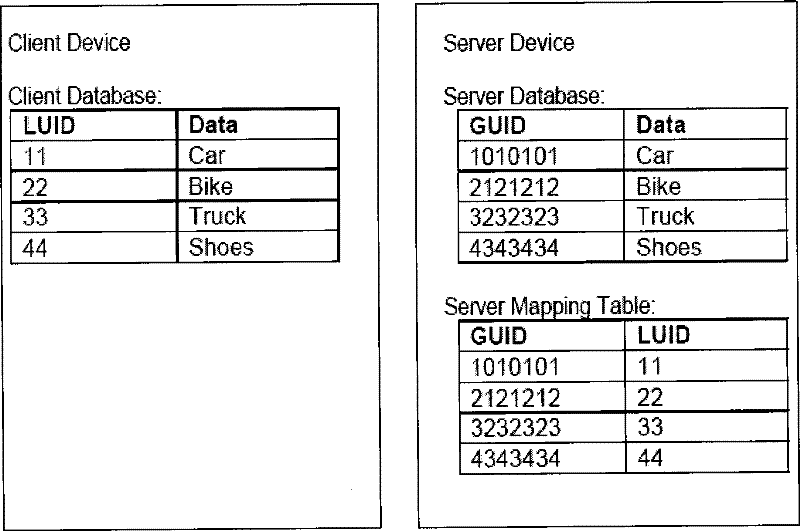
表2 Table 2
表2中,GUID是全局唯一标识,是服务器数据库中某条数据对应的唯一标识ID,GUID由服务器分配。 In Table 2, GUID is a globally unique identifier, which is a unique identifier ID corresponding to a piece of data in the server database, and the GUID is assigned by the server. the
步骤206,服务器在将PKG5中包含的ID映射信息维护到映射表之后,会返回PKG6告知客户端维护指令的执行状态,客户端收到PKG6后,如果其中状态码全部正常,则此次同步成功,结束流程。 Step 206, after the server maintains the ID mapping information contained in PKG5 into the mapping table, it will return PKG6 to inform the client of the execution status of the maintenance command. After the client receives PKG6, if all the status codes in it are normal, the synchronization is successful , to end the process. the
在图2所示的流程中,客户端和服务器通常依靠Anchor和执行的操作 来判定数据是否经过了改变。但Anchor和执行操作的记录根据同步命令或对数据的更改指示完成后进行更新,如果在操作过程中发生通信中断,如未收到同步响应消息等,则Anchor和执行操作的记录可能不匹配,从而不同正确确定哪些数据发生了变化。因此出现了一种指纹技术,通过数据指纹可以实现对数据条目进行标识,比如,通过对某个数据条目作摘要,得到数据条目的指纹。指纹可以只由客户端产生,也可以由双方产生。指纹的用途是服务器用于来判别从终端收到的数据与自身存储的数据是否相同,进而判断数据是否发生了变化,因为无论服务器和客户端哪一边修改了数据,指纹都会不一致。 In the process shown in Figure 2, the client and server usually rely on the Anchor and the operations performed to determine whether the data has changed. However, the Anchor and the record of the execution operation are updated according to the synchronization command or the data change instruction. If communication interruption occurs during the operation, such as no synchronization response message is received, the Anchor and the execution operation record may not match. This makes it difficult to correctly determine which data has changed. Therefore, there is a fingerprint technology that can identify data items through data fingerprints, for example, by summarizing a certain data item, the fingerprint of the data item can be obtained. Fingerprints can be generated by the client only, or by both parties. The purpose of the fingerprint is for the server to determine whether the data received from the terminal is the same as the data stored by itself, and then determine whether the data has changed, because no matter which side of the server and the client modifies the data, the fingerprints will be inconsistent. the
指纹运算有单向和双向的区别。单向指纹运算是指客户端计算并保存指纹的同时发送给服务器,而服务器不进行指纹运算,只保存客户端发送的指纹;双向指纹运算是指服务器和客户端双方都计算指纹,并保存自身计算的指纹。 There are one-way and two-way differences in fingerprint operations. One-way fingerprint calculation means that the client calculates and saves the fingerprint and sends it to the server at the same time, and the server does not perform fingerprint calculation, but only saves the fingerprint sent by the client; two-way fingerprint calculation means that both the server and the client calculate the fingerprint and save it. Calculated fingerprint. the
但现有技术中只提到可以利用数据指纹来判断数据是否发生变化,而没有给出数据同步过程中具体如何利用数据指纹实现数据同步的方案。 However, in the prior art, it is only mentioned that the data fingerprint can be used to determine whether the data has changed, and no specific solution on how to use the data fingerprint to realize data synchronization during the data synchronization process is not provided. the
发明内容Contents of the invention
本发明实施例提供了一种数据同步方法,该方法能够利用数据指纹实现数据同步。 An embodiment of the present invention provides a data synchronization method, which can realize data synchronization by using data fingerprints. the
本发明实施例提供了一种数据同步系统,该系统能够利用数据指纹实现数据同步。 An embodiment of the present invention provides a data synchronization system, which can realize data synchronization by using data fingerprints. the
本发明实施例提供了两种数据同步设备,这些设备能够利用数据指纹实现数据同步。 The embodiment of the present invention provides two kinds of data synchronization devices, and these devices can realize data synchronization by using data fingerprints. the
为达到上述目的,本发明的技术方案具体是这样实现的: In order to achieve the above object, the technical solution of the present invention is specifically realized in the following way:
本发明实施例公开了一种数据同步方法,该方法包括: The embodiment of the present invention discloses a data synchronization method, the method comprising:
通过比较需要进行数据同步双方的数据库中的数据指纹,确定需要同步的数据; Determine the data that needs to be synchronized by comparing the data fingerprints in the databases of both parties that need to be synchronized;
对所述确定的需要同步的数据进行数据同步; Perform data synchronization on the determined data that needs to be synchronized;
上述所有步骤之前进一步包括:根据需要进行数据同步的双方所存储或设置的指纹特性信息确定指纹产生方式。 Before all the steps above, it further includes: determining the fingerprint generation method according to the fingerprint characteristic information stored or set by both parties that need to perform data synchronization. the
本发明实施例公开了一种数据同步系统,该系统包括需要相互进行数据同步的第一设备和第二设备,其中, The embodiment of the present invention discloses a data synchronization system, the system includes a first device and a second device that need to synchronize data with each other, wherein,
第一设备,用于将自身数据库中的所有数据指纹和相应的数据标识发送的第二设备;用于在接收到第二设备发送的需要同步的数据的标识后,根据自身数据库的修改日志,将需要同步的数据区分为由第一设备的修改导致需要同步的数据和由第二设备的修改导致需要同步的数据,并将由自身的修改导致需要同步的数据和相应的数据标识发送给第二设备; The first device is used to send all data fingerprints and corresponding data identifications in its own database to the second device; after receiving the identification of the data that needs to be synchronized sent by the second device, according to the modification log of its own database, Divide the data that needs to be synchronized into the data that needs to be synchronized due to the modification of the first device and the data that needs to be synchronized due to the modification of the second device, and send the data that needs to be synchronized due to its own modification and the corresponding data identification to the second device. equipment;
第二设备,用于根据所接收的数据标识比较自身数据库中的数据指纹和所接收的数据指纹,将指纹不一致的数据确定为需要同步的数据,并将所有需要同步的数据的标识发送给第一设备;用于根据所接收的数据标识将同时所接收的由第一设备的修改导致需要同步的数据同步到自身数据库中; The second device is used to compare the data fingerprints in its own database with the received data fingerprints according to the received data identifiers, determine the data with inconsistent fingerprints as the data that needs to be synchronized, and send the identifiers of all the data that need to be synchronized to the first device. A device; used to synchronize the data that needs to be synchronized due to the modification of the first device received at the same time to its own database according to the received data identification;
所述第一设备和第二设备进一步用于协商指纹产生方式。 The first device and the second device are further configured to negotiate a fingerprint generation manner. the
本发明实施例公开了一种数据同步设备,该设备包括:确定模块和同步模块,其中, The embodiment of the present invention discloses a data synchronization device, which includes: a determination module and a synchronization module, wherein,
确定模块,用于接收对端设备发送的数据指纹和相应的数据标识,根据所接收的数据标识比较自身数据库中的数据指纹和所接收的数据指纹,将指纹不一致的数据确定为需要同步的数据,将所有需要同步的数据的标识发送给对端设备; The determination module is used to receive the data fingerprint and the corresponding data identification sent by the peer device, compare the data fingerprint in its own database with the received data fingerprint according to the received data identification, and determine the data with inconsistent fingerprints as the data that needs to be synchronized , send the identifiers of all the data to be synchronized to the peer device;
同步模块,用于接收对端设备发送的由对端设备的修改导致的需要同步的数据,并将所接收的数据同步到自身数据库中; The synchronization module is used to receive the data sent by the peer device that needs to be synchronized due to the modification of the peer device, and synchronize the received data to its own database;
该设备进一步包括协商模块,用于同对端设备进行协商,并确定指纹产生方式。 The device further includes a negotiation module, which is used for negotiating with the peer device and determining the fingerprint generation method. the
由上述技术方案可见,本发明实施例通过比较需要进行数据同步双方的数据库中的数据指纹,确定需要同步的数据,然后对所述需要同步的数据进行数据同步。本发明实施例的技术方案利用数据指纹实现数据同步,避免了需要进行数据同步的双方之间通过传送大量的数据。 It can be seen from the above technical solution that in the embodiment of the present invention, the data to be synchronized is determined by comparing the data fingerprints in the databases of the two parties that need to be synchronized, and then data synchronization is performed on the data to be synchronized. The technical solutions of the embodiments of the present invention use data fingerprints to realize data synchronization, which avoids the transmission of a large amount of data between the two parties that need to perform data synchronization. the
附图说明Description of drawings
图1是现有技术中SyncML数据同步协议的框架结构图; Fig. 1 is a frame structure diagram of the SyncML data synchronization protocol in the prior art;
图2是现有的SyncML同步协议中服务器和客户端进行数据同步的流程图; Fig. 2 is the flowchart that server and client carry out data synchronization in existing SyncML synchronous protocol;
图3是本发明实施例一种实现数据同步的方法的流程图; Fig. 3 is a flow chart of a method for realizing data synchronization in an embodiment of the present invention;
图4是本发明实施例客户端和服务器进行数据同步的流程图; Fig. 4 is the flow chart that client and server of the embodiment of the present invention carry out data synchronization;
图5是本发明实施例Notification消息的格式示意图; Fig. 5 is a schematic diagram of the format of the Notification message of the embodiment of the present invention;
图6是本发明实施例在客户端的DS MO中增加的树结构示意图; Fig. 6 is the tree structure schematic diagram that the embodiment of the present invention increases in the DSMO of client;
图7是本发明一种实现数据同步的方法的第一较佳实施例的流程图; Fig. 7 is the flow chart of the first preferred embodiment of a kind of method realizing data synchronization of the present invention;
图8是本发明实施例中的数据库结构示意图; Fig. 8 is the database structure schematic diagram in the embodiment of the present invention;
图9是本发明实施例确定需要同步的数据的第一方法流程图; Fig. 9 is a flow chart of a first method for determining data that needs to be synchronized in an embodiment of the present invention;
图10是本发明实施例确定需要同步的数据的第二方法流程图; Fig. 10 is the flow chart of the second method of determining the data that needs to be synchronized in the embodiment of the present invention;
图11是本发明一种实现数据同步的方法的第二较佳实施例的流程图; Fig. 11 is the flowchart of the second preferred embodiment of a kind of method realizing data synchronization of the present invention;
图12是本发明实施例一种数据同步系统的结构框图; Fig. 12 is a structural block diagram of a kind of data synchronization system of the embodiment of the present invention;
图13是本发明一种数据同步设备的第一实施例结构框图; Fig. 13 is a structural block diagram of a first embodiment of a data synchronization device of the present invention;
图14是本发明一种数据同步设备的第二实施例结构框图。 Fig. 14 is a structural block diagram of a second embodiment of a data synchronization device according to the present invention. the
具体实施方式Detailed ways
图3是本发明实施例一种实现数据同步的方法的流程图。如图3所示,包括以下步骤: Fig. 3 is a flowchart of a method for implementing data synchronization according to an embodiment of the present invention. As shown in Figure 3, the following steps are included:
步骤301,通过比较需要进行数据同步双方的数据库中的数据指纹,确定需要同步的数据。
步骤302,对所述需要同步的数据进行数据同步。
为使本发明的目的、技术方案及优点更加清楚明白,以下参照附图并举较佳实施例,对本发明进一步详细说明。 In order to make the object, technical solution and advantages of the present invention clearer, the present invention will be further described in detail below with reference to the accompanying drawings and preferred embodiments. the
由于不同的指纹算法对同一个数据会计算出不同的指纹,因此在图3所示的实施例中,需要进行数据同步的双方,如服务器和客户端,利用数据指纹来确定需要进行同步的数据,因此,服务器和客户端双方数据的指纹必须是使用同一种指纹算法计算而来的。如果服务器和客户端使用单向指纹产生方式,即客户端计算数据指纹,服务器只保存客户端计算的指纹,则双方保存的同一数据的指纹是相同的;如果服务器和客户端使用双向指纹产生方式,即服务器和客户端分别计算指纹,且保存各自计算的指纹,则双方需要使用同一种指纹计算方法,才能保证双方保存的同一数据的指纹是相同的。 Since different fingerprint algorithms can calculate different fingerprints for the same data, in the embodiment shown in Figure 3, both parties that need to synchronize data, such as the server and the client, use data fingerprints to determine the data that needs to be synchronized. Therefore, the fingerprints of the data of both the server and the client must be calculated using the same fingerprint algorithm. If the server and the client use the one-way fingerprint generation method, that is, the client calculates the data fingerprint, and the server only saves the fingerprint calculated by the client, then the fingerprints of the same data saved by both parties are the same; if the server and the client use the two-way fingerprint generation method , that is, the server and the client calculate fingerprints separately and save their calculated fingerprints, then both parties need to use the same fingerprint calculation method to ensure that the fingerprints of the same data stored by both parties are the same. the
因此,服务器和客户端在执行图3所示的数据同步过程之前需要协商好指纹的产生方式和计算指纹的算法。在现有技术中需要进行数据同步的双方对单双向指纹产生方式的选择是通过默认的约定进行的,即约定单向或是双向。这种约定的方式限制了指纹运用的灵活性,更主要的,现有技术中没有给出何种情况下使用的何种指纹产生方式才能正确高效地实现数据同步的方案。 Therefore, before executing the data synchronization process shown in FIG. 3 , the server and the client need to negotiate a fingerprint generation method and a fingerprint calculation algorithm. In the prior art, the two parties who need to perform data synchronization choose a single-bidirectional fingerprint generation method through a default agreement, that is, to agree on one-way or two-way. This agreed method limits the flexibility of fingerprint application. More importantly, the prior art does not provide a solution for which fingerprint generation method to use under which circumstances to correctly and efficiently realize data synchronization. the
接下来给出本发明实施例中,服务器和客户端协商指纹产生方式的几种方式: Next, in the embodiment of the present invention, several ways for the server and the client to negotiate the fingerprint generation method are given:
第一种方式:在服务器上保存一个布尔型的单向标识变量FPMethod,如果FPMethod的值为真(true),则表示使用单向指纹产生方式,即指纹由客户端计算,服务器保存客户端提供的指纹,服务器中未保存有指纹的数据用空指纹表示该数据;如果FPMethod的值为假(false),则表示使用双向指纹产生方式,即指纹由客户端和服务器同时计算,并各自保存自身计算的指纹。FPMethod的缺省值可以为false。当服务器与终端协商后的指纹计 算方法不在服务器的指纹计算方法集中,则将FPMethod设置为true。 The first method: save a Boolean one-way identification variable FPMethod on the server. If the value of FPMethod is true (true), it means that the one-way fingerprint generation method is used, that is, the fingerprint is calculated by the client, and the server saves the provided by the client. If the fingerprint is not saved in the server, the data is represented by an empty fingerprint; if the value of FPMethod is false (false), it means that the two-way fingerprint generation method is used, that is, the fingerprint is calculated by the client and the server at the same time, and each saves itself Calculated fingerprint. The default value of FPMethod can be false. When the fingerprint calculation method negotiated between the server and the terminal is not in the fingerprint calculation method set of the server, set FPMethod to true. the
第二种方式:服务器和客户端中的一方接收另一方发送的同步数据和该同步数据的指纹,并保存所接收的同步数据,计算所保存数据的指纹,如果计算所得的指纹与所接收的指纹不同,则要求服务器将FPMethod设置为true。该验证工作更好的可以在服务器侧完成,即服务器接收客户端发送的同步数据和指纹,保存所接收的数据后计算其指纹,将计算所得的指纹与所接收指纹进行比较。 The second method: one of the server and the client receives the synchronous data sent by the other party and the fingerprint of the synchronous data, and saves the received synchronous data, and calculates the fingerprint of the stored data. If the calculated fingerprint is consistent with the received If the fingerprints are different, the server is required to set FPMethod to true. This verification work can be better completed on the server side, that is, the server receives the synchronization data and fingerprints sent by the client, saves the received data and calculates its fingerprints, and compares the calculated fingerprints with the received fingerprints. the
第三种方式:根据使用的具体指纹算法类型来确定指纹产生方式。例如,Change Log算法是在同步后内容发生改变则将指纹设置为1,再次同步后置为0,因此服务器和客户端采用该算法对同一数据计算出的指纹不会产生偏差,因此在使用Change Log算法计算指纹的情况下可以采用双向指纹产生方式;而Hash算法在同一数据的保存格式不同时所计算出的指纹也会不同,由于客户端和服务器保存数据的方式可能不一致,所以在使用Hash算法计算指纹的情况下采用单向指纹产生方式。 The third method: determine the fingerprint generation method according to the specific fingerprint algorithm type used. For example, the Change Log algorithm sets the fingerprint to 1 when the content changes after synchronization, and sets it to 0 after synchronization again. Therefore, the fingerprint calculated by the server and the client using this algorithm for the same data will not produce deviations. Therefore, when using Change When the Log algorithm calculates the fingerprint, the two-way fingerprint generation method can be used; while the Hash algorithm calculates different fingerprints when the storage format of the same data is different, because the way the client and the server save data may be inconsistent, so when using Hash When the algorithm calculates the fingerprint, the one-way fingerprint generation method is adopted. the
第四种方式:对于需要进行同步的数据库中的所有叶子节点的指纹,即数据的指纹一律采用单向产生的方式;对于中间节点,即目录和文件夹可以采用单向或双向计算的方式,至于使用单向还是双向方式,可以根据上述方式中所示的方法来确定,此时FPMethod的含义为目录和文件夹是否采用单向产生指纹的方式。 The fourth way: For the fingerprints of all leaf nodes in the database that need to be synchronized, that is, the fingerprints of the data are all generated in one way; for intermediate nodes, that is, directories and folders can be calculated in one way or two ways, As for whether to use the one-way or two-way method, it can be determined according to the method shown in the above-mentioned method. At this time, the meaning of FPMethod is whether the directory and folder adopt the one-way fingerprint generation method. the
在上述服务器和客户端协商指纹产生方式的四种方式中,服务器和客户端需要进行通信以了解对方是否支持指纹特性以及对方支持哪种指纹算法等信息,例如服务器要通知终端协商后的单双向标识,或通知终端其支持的指纹算法集等。本发明实施例中给出三种服务器和客户端进行协商的通信方式:Notification通知法、DS MO设置法和Device Info指示法。下面分别介绍。 In the above four methods of negotiating the fingerprint generation method between the server and the client, the server and the client need to communicate to know whether the other party supports the fingerprint feature and which fingerprint algorithm the other party supports. For example, the server needs to notify the terminal of the negotiated one-way Identify, or notify the terminal of the fingerprint algorithm set it supports, etc. In the embodiment of the present invention, three communication modes for negotiation between the server and the client are provided: Notification notification method, DS MO setting method and Device Info indication method. Introduce respectively below. the
方式一、消息通知法
图4是本发明实施例客户端和服务器进行数据同步的流程图。如图4所 示,在PKG1之前,服务器可以在PKG0中下发其是否支持指纹特性,以及其所支持的指纹算法集,客户端将这两个参数保存在与该服务器ID相关的条目中。PKG0为Notification通知消息。服务器仅当上述指纹特性以及其所支持的指纹算法集等参数发生变化时再次通过通知(Notification)消息通知客户端。图5是本发明实施例Notification消息的格式示意图,如图5所示,Notification消息体(Notification-body)中的“Actionl”字段又包括四个字段,分别为:“Action-type”字段、“Action-specific”字段、“URI-length”字段和“URI”字段。在本发明实施例中将上述四个字段分别定义为“0101”、“Specific”、“Algorithm-length”和“Algorithm”,其中: Fig. 4 is a flowchart of data synchronization between a client and a server according to an embodiment of the present invention. As shown in Figure 4, before PKG1, the server can issue in PKG0 whether it supports the fingerprint feature and the set of fingerprint algorithms it supports, and the client saves these two parameters in the entry related to the server ID. PKG0 is Notification notification message. The server notifies the client again through a notification (Notification) message only when the parameters such as the above-mentioned fingerprint characteristics and the set of fingerprint algorithms it supports change. Fig. 5 is a schematic diagram of the format of the Notification message of the embodiment of the present invention. As shown in Fig. 5, the "Action1" field in the Notification message body (Notification-body) includes four fields, respectively: "Action-type" field, " Action-specific" field, "URI-length" field, and "URI" field. In the embodiment of the present invention, the above four fields are respectively defined as "0101", "Specific", "Algorithm-length" and "Algorithm", where:
<0101>;‘用于标识该Actionl字段是指示指纹特性的’ <0101>; 'Used to identify that the Actionl field indicates fingerprint characteristics'
<Specific>::=<noFPsupport>/<FPClient>/<FPMutually>;‘用于标识服务器的指纹支持信息’ <Specific>::=<noFPsupport>/<FPClient>/<FPMutually>; 'Fingerprint support information used to identify the server'
如<noFPsupport>::=‘00’; ‘表示服务器不支持指纹’ Such as <noFPsupport>::='00'; 'means the server does not support fingerprint'
<FPClient>::=‘10’ ; ‘表示客户端单向产生指纹’ <FPClient>::='10'; 'Indicates that the client generates fingerprints one-way'
<FPMutually>::=‘11’ ‘表示客户端和服务器双方产生指纹’ <FPMutually>::=‘11’ ‘Indicates that both the client and the server generate fingerprints’
<Algorithm-length>::=1*CHAR;‘用于标识服务器的指纹算法信息长度’ <Algorithm-length>::=1*CHAR; 'The length of the fingerprint algorithm information used to identify the server'
<Algorithm>::=<Algorithm-length>*4*BIT;‘用于标识服务器的指纹信息’ <Algorithm>::=<Algorithm-length>*4*BIT; 'Fingerprint information used to identify the server'
在上述参数中,Algorithm中每种指纹算法用4bit表示,每个值表示一种算法类型。Algorithm中的值为服务器所支持的每种算法所对应的4bit数级联而得,级联后字符串的长度由Algorithm-length设定。 In the above parameters, each fingerprint algorithm in Algorithm is represented by 4 bits, and each value represents an algorithm type. The value in Algorithm is obtained by concatenating the 4-bit numbers corresponding to each algorithm supported by the server, and the length of the string after concatenation is set by Algorithm-length. the
方式二、数据同步管理对象设置法 Method 2. Data synchronization management object setting method
服务器通过数据同步(DS,Date Synchronization)管理对象(MO,Management Object)把自身关于指纹的信息下发给客户端,后续通过设备管理(DM,Device Management)的方式对客户端的DS MO其进行读写、修改。客户端也可以把自身关于指纹的信息保存在DS MO中。 The server sends its own fingerprint information to the client through the data synchronization (DS, Date Synchronization) management object (MO, Management Object), and then reads the client's DS MO through device management (DM, Device Management) Write, revise. The client can also save its own information about the fingerprint in DSMO. the
图6是本发明实施例在客户端的DS MO中增加的树结构示意图,如图6所示,在FPSupport中记录是否支持DS的指纹特性,Algorithm中记录所使用的指纹算法。下面是对图6所示的MO节点的描述: Fig. 6 is the tree structure schematic diagram that the embodiment of the present invention increases in the client's DSMO, as shown in Fig. 6, records whether to support the fingerprint characteristic of DS in FPSupport, records the used fingerprint algorithm in Algorithm. The following is a description of the MO node shown in Figure 6:
<FP> <FP>
这是一个内部节点,记录DS客户端或服务器与指纹相关的信息。上述表格中描述的是关于<FP>节点的信息,其中:该节点的状态(Status)是“REQUIRED”,表示该节点是必须的;该节点的出现次数(Occurrence)是“One”,表示该节点在图6所示的树结构中只出现一次;该节点的格式(Format)是“Node”,表示该节点是中间节点;该节点内容的接入方式(Access)是“Get”,表示该节点的内容是可获取的,即可读的。 This is an internal node that records fingerprint-related information for DS clients or servers. The above table describes the information about the <FP> node, where: the status (Status) of the node is "REQUIRED", indicating that the node is necessary; the number of occurrences (Occurrence) of the node is "One", indicating that the node The node only appears once in the tree structure shown in Figure 6; the format (Format) of the node is "Node", indicating that the node is an intermediate node; the access mode (Access) of the content of the node is "Get", indicating that the The content of a node is fetchable, i.e. readable. the
<FP>/<SupportedAlg> <FP>/<SupportedAlg>
这是一个内部节点,记录DS客户端所支持的指纹算法。如果这个节点不存在,即表明DS客户端不支持指纹。与该节点对应的表格中该节点的出现次数(Occurrence)是“ZeroOrOne”,表示该节点在图6所示的树结构中出现零次或一次。 This is an internal node that records the fingerprint algorithms supported by the DS client. If this node does not exist, it means that the DS client does not support fingerprints. The occurrence number (Occurrence) of this node in the table corresponding to this node is "ZeroOrOne", which means that this node appears zero or one time in the tree structure shown in FIG. 6 . the
<FP>/<SupportedAlg>/<X> <FP>/<SupportedAlg>/<X>
这是一个占位符节点,用于包含一个或多个叶子节点,记录DS客户端所支持的指纹算法。如果这个节点不存在,即表明DS客户端不支持指纹。与该节点对应的表格中该节点的出现次数(Occurrence)是“ZeroOrMore”,表示该节点在图6所示的树结构中出现零次或多次。 This is a placeholder node used to contain one or more leaf nodes, recording the fingerprint algorithm supported by the DS client. If this node does not exist, it means that the DS client does not support fingerprints. The occurrence number (Occurrence) of this node in the table corresponding to this node is "ZeroOrMore", which means that this node appears zero or more times in the tree structure shown in FIG. 6 . the
<FP>/<SupportedAlg>/<X>/<Algorithm> <FP>/<SupportedAlg>/<X>/<Algorithm>
这是一个叶子节点,记录DS客户端所支持的指纹算法。如果这个节点不存在,即表明DS客户端不支持指纹。与该节点对应的表格中该节点的格式(Format)是“Chr”,表示该节点是叶子节点且为字符串类型。 This is a leaf node, which records the fingerprint algorithm supported by the DS client. If this node does not exist, it means that the DS client does not support fingerprints. The format (Format) of the node in the table corresponding to the node is "Chr", indicating that the node is a leaf node and is of character string type. the
该节点可能的值及其解释如表3所示: The possible values of this node and their interpretations are shown in Table 3:
表3 table 3
<FP>/<x> <FP>/<x>
占位符节点,用于指示对于客户端或服务器的不同的数据库的指纹特性。 Placeholder nodes to indicate different database fingerprint properties for the client or server. the
<FP>/<x>/<DataStore> <FP>/<x>/<DataStore>
用于指示该指纹特性是与哪个数据库相关。该节点下存储客户端和服务器对应的数据库的标识信息。 Used to indicate which database the fingerprint feature is related to. The identification information of the database corresponding to the client and the server is stored under this node. the
<FP>/<x>/<DataStore>/<Client> <FP>/<x>/<DataStore>/<Client>
用于指示客户端数据库的标识。 Used to indicate the ID of the client database. the
<FP>/<x>/<DataStore>/<Server> <FP>/<x>/<DataStore>/<Server>
用于指示服务器端数据库的标识。客户端数据库与服务器数据库必须是成对的,互相对应的。 Used to indicate the ID of the server-side database. The client database and the server database must be paired and correspond to each other. the
<FP>/<x>/<FPSupport> <FP>/<x>/<FPSupport>
用于指示DS客户端或服务器的某个数据库是否支持指纹特性。与该节点对应的表格中该节点的格式(Fomat)是“Bool”,表示该节点是叶子节点,且是布尔类型的。 It is used to indicate whether a certain database of the DS client or server supports the fingerprint feature. The format (Fomat) of the node in the table corresponding to the node is "Bool", indicating that the node is a leaf node and is of Boolean type. the
其值含义如表4所示: The meaning of its value is shown in Table 4:
表4 Table 4
<FP>/<x>/<FPMethod> <FP>/<x>/<FPMethod>
定义DS客户端或服务器的某个数据库的指纹产生方式。其值含义如表5所示: Define the fingerprint generation method of a certain database of the DS client or server. The meaning of its value is shown in Table 5:
表5 table 5
<FP>/<x>/<Algorithm> <FP>/<x>/<Algorithm>
这是叶子节点,记录DS客户端或服务器某个数据库所采用的指纹算法。其值为客户端所支持的算法中的一个。 This is a leaf node, which records the fingerprint algorithm adopted by a certain database of the DS client or server. Its value is one of the algorithms supported by the client. the
<FP>/<x>/<Uniqueness> <FP>/<x>/<Uniqueness>
这是叶子节点,指示对于某个数据库,指纹算法算出来的指纹是否唯一。 This is a leaf node, indicating whether the fingerprint calculated by the fingerprint algorithm is unique for a certain database. the
其值的含义如表6所示: The meaning of its value is shown in Table 6:
表6 Table 6
如果数据库中所有的数据条目的指纹都不一样,则指纹算法唯一,如果有两个或多个不同的数据条目,对应相同的指纹,则指纹算法不唯一。 If the fingerprints of all data entries in the database are different, the fingerprint algorithm is unique; if there are two or more different data entries corresponding to the same fingerprint, the fingerprint algorithm is not unique. the
从图6可以看出,<FP>/<SupportedAlg>分支为关于客户端的指纹特性信息。服务器从客户端的MO中读取图6所示树型数据结构中关于客户端的指纹特性信息,即读取<FP>/<SupportedAlg>分支所保存的信息,根据所读取的信息确定服务器和客户端中的需要同步的数据库的指纹特性信息,如采用单向指纹产生方式还双向指纹产生方式,采用哪种指纹计算方法等,并将确定的信息保存到客户端MO中的如图6所示树型结构中的<FP>/<x>x分支的相应位置中,以达到协商指纹产生方式,指纹计算方法,并且服务器将协商结果通知客户端的目的。 It can be seen from Figure 6 that the <FP>/<SupportedAlg> branch is the fingerprint feature information about the client. The server reads the fingerprint feature information about the client in the tree data structure shown in Figure 6 from the MO of the client, that is, reads the information stored in the <FP>/<SupportedAlg> branch, and determines the server and client based on the read information The fingerprint characteristic information of the database that needs to be synchronized in the terminal, such as the one-way fingerprint generation method or the two-way fingerprint generation method, which fingerprint calculation method to use, etc., and save the determined information to the client MO as shown in Figure 6 In the corresponding position of the <FP>/<x> x branch in the tree structure, in order to achieve the purpose of negotiating the fingerprint generation method and fingerprint calculation method, and the server notifies the client of the negotiation result.
方式三、Device Info指示法 Method 3, Device Info instruction method
客户端和服务器也可将需要进行同步的数据库的指纹信息保存在设备信息(Device Info)中,通过读取Device Info中的信息完成协商过程。下面是Device Info中的元素的数据模型(Schema): The client and the server can also save the fingerprint information of the database that needs to be synchronized in the device information (Device Info), and complete the negotiation process by reading the information in the Device Info. The following is the data model (Schema) of the elements in Device Info:
<xs:element name=″FPSupport″type=″xs:boolean″/> <xs:element name="FPSupport"type="xs:boolean"/>
这个元素用于表示是否支持指纹。其值,可以是True或False,True表示支持,False表示不支持。 This element is used to indicate whether fingerprinting is supported. Its value can be True or False, True means support, False means not support. the
在服务器和终端上都保存一个标识单向指纹产生方式的布尔型变量FPMethod,如果该变量的值为true,则表示指纹由客户端计算,服务器保存客户端提供的指纹,服务器中未保存有指纹的数据用空指纹表示该数据;如果该变量的值为false,则表示指纹由客户端和服务器同时计算,并保存各自计算的指纹。FPMethod的缺省值可以为false。该FPMethod值保存在与设备相关的Device Info中,Schema可以类似于: Both the server and the terminal save a Boolean variable FPMethod that identifies the one-way fingerprint generation method. If the value of this variable is true, it means that the fingerprint is calculated by the client, and the server saves the fingerprint provided by the client. No fingerprint is saved in the server. The data of the data is represented by an empty fingerprint; if the value of this variable is false, it means that the fingerprints are calculated by the client and the server at the same time, and the fingerprints calculated by each are saved. The default value of FPMethod can be false. The FPMethod value is saved in the Device Info related to the device, and the Schema can be similar to:
<xs:element name=″FPMethod″type=″xs:boolean″default=″false″/> <xs:element name="FPMethod"type="xs:boolean"default="false"/>
其值,可以是True或False,True表示单向指纹产生方式,False表示双向指纹产生方式。 Its value can be True or False, True indicates the one-way fingerprint generation method, and False indicates the two-way fingerprint generation method. the
指纹产生算法的Schema可以是: The Schema of the fingerprint generation algorithm can be:
<xs:element name=″FPAlgorithm″type=″xs:char″/> <xs:element name="FPAlgorithm" type="xs:char"/>
这个元素用于表明指纹算法,其值的含义可以同表3中所描述。 This element is used to indicate the fingerprint algorithm, and the meaning of its value can be described in Table 3. the
<xs:element name=″Uniqueness″type=″xs:Boolean″/> <xs:element name="Uniqueness" type="xs:Boolean"/>
这个元素用于表明指纹算法是否唯一。 This element is used to indicate whether the fingerprint algorithm is unique. the
服务器和客户端通过上述Device Info进行指纹产生方式以及指纹计算方法等的协商可以是:首先,客户端在自身的Device Info中保存自身的指纹特性信息,如是否支持指纹以及所支持的指纹算法集等信息;服务器向客户端下发Notification通知消息,以通知客户端上报Device Info中的关于指纹特性的信息;客户端接收到Notification通知消息后将自身Device Info中的关于指纹特性的信息上报给服务器;服务器根据客户端的上报信息以及自身的指纹特征信息,确定指纹产生方式以及指纹计算方法等,例如,服务器从上报信息中查看自己是否支持客户端所支持的指纹算法集中的一种,是则选择服务器和客户端都支持的一种指纹计算方法,并确定指纹产生方式为单向或双向,否则确定指纹产生方式为单向;服务器将所确定的结果通过Notification通知消息发送给客户端;客户端根据Notification通知消息获知协商结果,如果Notification通知消息中指示为单向产生指纹,则客户端从自身所支持的指纹算法集中选择一种指纹计算方法即可。 The negotiation between the server and the client on the fingerprint generation method and fingerprint calculation method through the above-mentioned Device Info can be as follows: first, the client stores its own fingerprint feature information in its own Device Info, such as whether to support fingerprints and the supported fingerprint algorithm set and other information; the server sends a Notification notification message to the client to notify the client to report the information about the fingerprint characteristics in the Device Info; after receiving the Notification notification message, the client reports the information about the fingerprint characteristics in its Device Info to the server ;The server determines the fingerprint generation method and fingerprint calculation method according to the reported information of the client and its own fingerprint feature information. A fingerprint calculation method supported by both the server and the client, and determine whether the fingerprint generation method is one-way or two-way, otherwise determine that the fingerprint generation method is one-way; the server sends the determined result to the client through the Notification notification message; the client The negotiation result is obtained according to the Notification notification message. If the Notification notification message indicates that fingerprint generation is one-way, the client can select a fingerprint calculation method from the fingerprint algorithm set supported by itself. the
可选择地,服务器在确定自身不支持客户端所支持的指纹算法集中的任一种,从而确定指纹产生方式为单向时,从客户端所支持的指纹算法集中指定一种算法,并通过Notification通知消息通知客户端。 Optionally, when the server determines that it does not support any of the fingerprint algorithm sets supported by the client, and thus determines that the fingerprint generation method is one-way, it specifies an algorithm from the fingerprint algorithm sets supported by the client, and passes Notification A notification message notifies the client. the
上述实施例中给出了Notification通知法、DS MO设置法和Device Info指示法三种服务器和客户端进行协商的通信方式。通过上述三种方式中任一种,服务器和客户端可以协商好数据同步过程中所涉及的指纹产生方式和指纹计算方法等。接下来给出本发明中实现数据同步的一个具体实施例。 In the above-mentioned embodiment, three kinds of communication modes for negotiation between the server and the client are provided, including the Notification notification method, the DS MO setting method and the Device Info indication method. Through any one of the above three methods, the server and the client can negotiate the fingerprint generation method and fingerprint calculation method involved in the data synchronization process. Next, a specific embodiment for realizing data synchronization in the present invention is given. the
图7是本发明一种实现数据同步的方法的第一较佳实施例的流程图。如图7所示,包括以下步骤: Fig. 7 is a flow chart of a first preferred embodiment of a method for implementing data synchronization in the present invention. As shown in Figure 7, the following steps are included:
步骤701,客户端发送PKG1到服务器,该PKG1中还包括客户端的数 据库指纹Container。 Step 701, the client sends PKG1 to the server, and the PKG1 also includes the client's database fingerprint Container. the
如果服务器和客户端没有预先协商好指纹产生方法,则本步骤中的PKG1中还可以包含客户端所使用的指纹计算方法。如果服务器没有记录终端是否支持指纹特性,则PKG1中还可以包含一个布尔型的参数FPSupport,指示客户端是否支持指纹特性。 If the server and the client have not pre-negotiated on the fingerprint generation method, the PKG1 in this step may also include the fingerprint calculation method used by the client. If the server does not record whether the terminal supports the fingerprint feature, PKG1 may also include a Boolean parameter FPSupport, indicating whether the client supports the fingerprint feature. the
PKG1的一个消息实例为: An example message for PKG1 is:
<Alert> <Alert>
…… ... ...
<FPSupport>true</FPSupport> <!-客户端支持指纹--> <FPSupport>true</FPSupport> <! -The client supports fingerprints -->
<Container>142a7ed3</Container> <!-客户端数据库的指纹--> <Container>142a7ed3</Container> <! -Fingerprint of the client database -->
<Algorithm>MD5</Algorithm> <!-客户端使用的指纹算法为MD5--> <Algorithm>MD5</Algorithm> <! -The fingerprint algorithm used by the client is MD5-->
</Alert> </Alert>
步骤702,服务器收PKG1后,检验收到的Container和保存的自身数据库的指纹Container是否一致,如果一致则表示数据没有发生变化,无需进行同步,结束流程;否则向客户端下发PKG2,PKG2中包含服务器数据库中所有数据条目的指纹和标识(ID)。 Step 702, after receiving PKG1, the server checks whether the received Container is consistent with the fingerprint Container stored in its own database. If they are consistent, it means that the data has not changed, and no synchronization is required, and the process ends; otherwise, PKG2 is sent to the client. Contains the fingerprint and identification (ID) of all data entries in the server database. the
如果服务器和客户端没有预先协商好指纹产生方法,且步骤701中的PKG1中包含客户端所使用的指纹计算方法,则本步骤中,服务器验证自身是否支持PKG1中提供的指纹计算方法,如果不支持则将布尔型参数FPMethod的值设为true,表示指纹产生方式为单向,并将FPMethod通过PKG2下发给客户端。 If the server and the client have not pre-negotiated the fingerprint generation method, and the PKG1 in step 701 contains the fingerprint calculation method used by the client, then in this step, the server verifies whether it supports the fingerprint calculation method provided in PKG1, if not If it is supported, set the value of the Boolean parameter FPMethod to true, indicating that the fingerprint generation method is one-way, and send FPMethod to the client through PKG2. the
PKG2的一个消息实例为: An example of a message for PKG2 is:
<FPMethod>true</FPMethod> <!-服务器不支持指纹,采用客户端单向指纹--> <FPMethod>true</FPMethod> <! - The server does not support fingerprints, and the client uses one-way fingerprints -->
<Status> <Status>
…… ... ...
<Data>400</Data> <!-双方的数据库指纹Container不一致--> <Data>400</Data> <! - The database fingerprint Containers of both parties are inconsistent -->
</status> </status>
<Put> <Put>
<Item> <Item>
<GUID>1</GUID><FingerPrint>12a34dta</FingerPrint> <GUID>1</GUID><FingerPrint>12a34dta</FingerPrint>
</Item> </Item>
<Item> <Item>
<GUID>2</GUID><FingerPrint>35ba147f</FingerPrint> <GUID>2</GUID><FingerPrint>35ba147f</FingerPrint>
</Item> </Item>
…… ...
</Put> </Put>
步骤703,客户端收到PKG2后,根据数据条目的ID一一比较下发的数据条目指纹和本身数据库中对应的数据条目的指纹,根据指纹间的差异确定需要同步的数据条目,向服务器发送PKG3,PKG3中包含需同步的数据条目的ID。 Step 703: After receiving the PKG2, the client compares the fingerprints of the issued data entries with the fingerprints of the corresponding data entries in its own database according to the IDs of the data entries, determines the data entries that need to be synchronized according to the differences between the fingerprints, and sends them to the server. PKG3, PKG3 contains the ID of the data entry to be synchronized. the
如果需要向服务器进行同步,则本步骤中的PKG3还可包含与需要同步的数据条目ID对应的数据条目内容,如果是单向指纹产生方式,则还需要在PKG3中携带所述需要同步的数据条目的指纹。 If it needs to be synchronized to the server, the PKG3 in this step can also include the data entry content corresponding to the data entry ID that needs to be synchronized. If it is a one-way fingerprint generation method, it is also necessary to carry the data that needs to be synchronized in PKG3 The fingerprint of the entry. the
PKG3的一个消息实例为: An example of a message for PKG3 is:
<RequiredID> <RequiredID>
<Item> <Item>
<LUID>LUID004</LUID> <!-需要同步的数据条目的ID--> <LUID>LUID004</LUID> <! - The ID of the data entry that needs to be synchronized -->
… ...
</Item> </Item>
…… ... ...
</RequiredID> </RequiredID>
步骤704,服务器收到PKG3后,检查自身数据库中的修改日志(ChangeLog),确定需要进行同步的数据条目中哪些是由于服务器数据库中的数据发生改变而导致需要同步的,以及哪些由于客户端数据库中的数据发生改变而导致需要同步的,并在PKG4中向客户端下发由于服务器数据库中的数据发生改变而导致需要同步的数据条目ID和对应的数据条目内容。 Step 704, after receiving the PKG3, the server checks the modification log (ChangeLog) in its own database to determine which of the data entries that need to be synchronized need to be synchronized due to changes in the data in the server database, and which are due to changes in the client database. Changes in the data in the database require synchronization, and in PKG4, the data entry IDs and corresponding data entry contents that need to be synchronized due to changes in the data in the server database are sent to the client. the
如果需要向服务器进行同步,则步骤703中的PKG3中包含与需要同步的数据条目ID对应的数据条目内容,则本步骤中,服务器还需根据PKG3中的与数据条目ID对应的数据条目内容,将由于客户端数据库中的数据发 生改变而导致需要同步的数据,同步到自身数据库中。如果是单向指纹产生方式,PKG3中携带了所述需要同步的数据条目的指纹,则本步骤中,服务器在同步完自身数据库中的数据的同时保存PKG3中带来的与所同步的数据对应的指纹。 If it needs to be synchronized to the server, the PKG3 in step 703 contains the data entry content corresponding to the data entry ID that needs to be synchronized, then in this step, the server also needs to according to the data entry content corresponding to the data entry ID in PKG3, Synchronize the data that needs to be synchronized due to changes in the data in the client database to its own database. If it is a one-way fingerprint generation method, PKG3 carries the fingerprint of the data entry that needs to be synchronized, then in this step, the server saves the data corresponding to the synchronized data brought in PKG3 while synchronizing the data in its own database. fingerprints. the
如果所采用的指纹算法可以用于判别数据的完整性,比如Hash算法,则在PKG4中还可以包括与数据条目内容对应的指纹,以便接收方能够根据指纹验证所接收数据的完整性。 If the adopted fingerprint algorithm can be used to judge the integrity of the data, such as the Hash algorithm, the fingerprint corresponding to the content of the data entry can also be included in PKG4, so that the receiver can verify the integrity of the received data based on the fingerprint. the
PKG4的一个消息实例为: An example of a message for PKG4 is:
<Sync> <Sync>
<Replace> <Replace>
<Item> <Item>
<LUID>1</LUID> <LUID>1</LUID>
<Data><!--data ofthe item--></Data> <Data><! --data of the item--></Data>
<FingerPrint>9d8723e5</FingerPrinter> <FingerPrint>9d8723e5</FingerPrinter>
</Item> </Item>
…… ...
</Replace> </Replace>
</Sync> </Sync>
步骤705,客户端在接收到PKG4后,根据PKG4中的内容同步自身数据库中的相应数据,并为这些新同步的数据计算指纹并保存,同时向服务器发送确认消息PKG5。 Step 705, after receiving PKG4, the client synchronizes corresponding data in its own database according to the content in PKG4, calculates and saves fingerprints for these newly synchronized data, and sends a confirmation message PKG5 to the server at the same time. the
如果采用单向指纹产生方式,则PKG5中还需要包括客户端对新同步的数据所计算的指纹和相应的数据条目ID。 If the one-way fingerprint generation method is adopted, PKG5 also needs to include the fingerprint calculated by the client for the newly synchronized data and the corresponding data entry ID. the
如果终端在PKG3中客户端没有向服务器发送同步数据条目的内容和指纹,则可以在本步骤的PKG5中发送需要向服务器进行同步的数据条目内容和指纹。 If the terminal does not send the content and fingerprint of the synchronization data entry to the server in PKG3, it can send the content and fingerprint of the data entry to be synchronized to the server in PKG5 of this step. the
步骤706,服务器收到PKG5后,向客户端返回PKG6,以表示此次同步会话结束。 Step 706: After receiving PKG5, the server returns PKG6 to the client to indicate the end of the synchronization session. the
如果PKG5中包括了更新数据条目的内容和指纹,则服务器通过PKG6向客户端确认收到PKG5,返回同步结果。 If PKG5 includes the content and fingerprint of the updated data entry, the server confirms receipt of PKG5 to the client through PKG6, and returns the synchronization result. the
到此结束了图7所示的同步流程。 This completes the synchronization process shown in FIG. 7 . the
在图7所示的上述流程中,由于客户端先把自身数据库的指纹Container发送给服务器,由服务器通过比较双方的Container来判断是否需要进行同步,在不需要进行同步时直接结束流程的方案,节省了不必要的数据发送流程,提高了效率。并且在如图7所示的同步流程中,服务器和客户端可以互换角色,即步骤701中可以是服务器向客户端发送PKG1,之后客户端向服务器发送PKG2,以此类推。 In the above process shown in Figure 7, since the client first sends the fingerprint Container of its own database to the server, the server judges whether synchronization is required by comparing the Containers of both parties, and ends the process directly when synchronization is not required. The unnecessary data sending process is saved, and the efficiency is improved. And in the synchronization process shown in FIG. 7 , the server and the client can exchange roles, that is, in step 701, the server can send PKG1 to the client, and then the client can send PKG2 to the server, and so on. the
在图7所示流程中的步骤703中,客户端需要根据数据条目的ID一一比较服务器数据库中的所有数据条目指纹和自身数据库中对应的数据条目的指纹,来确定需要进行同步的数据条目。这里数据条目的指纹是指数据库中叶子节点的指纹。如果数据库中叶子节点较多,则步骤703中一一比较叶子节点指纹的方法比较消耗时间,因此接下来结合图8和图9给出本发明实施例提供的比较服务器数据库和客户端数据库中节点的指纹确定同步数据的方法。 In step 703 in the process shown in Figure 7, the client needs to compare the fingerprints of all data entries in the server database with the fingerprints of the corresponding data entries in its own database according to the ID of the data entry to determine the data entry that needs to be synchronized . The fingerprint of the data entry here refers to the fingerprint of the leaf node in the database. If there are many leaf nodes in the database, the method of comparing the fingerprints of the leaf nodes one by one in step 703 is time-consuming, so the comparison of the nodes in the server database and the client database provided by the embodiment of the present invention is given in conjunction with Fig. 8 and Fig. 9 The fingerprint determines the method by which the data is synchronized. the
图8是本发明实施例中的数据库结构示意图。如图8所示,数据库中的每个节点都有自己的ID(在图8中用UID表示)和指纹,例如,节点MP3的UID=02,指纹为FP02,根节点的指纹FP00即是数据库的指纹Container。每个中间节点的指纹由其下面的子节点的指纹计算获得,如中间节点Contacts的指纹FP01是通过对其子节点的指纹FP05、FP06和FP07进行指纹计算得到的;而叶子节点的指纹由叶子节点中的数据条目内容计算而得。 Fig. 8 is a schematic diagram of the database structure in the embodiment of the present invention. As shown in Figure 8, each node in the database has its own ID (represented by UID in Figure 8) and fingerprints, for example, the UID=02 of node MP3, the fingerprint is FP02, and the fingerprint FP00 of the root node is the database The fingerprint Container. The fingerprint of each intermediate node is obtained from the fingerprint calculation of the child nodes below it. For example, the fingerprint FP01 of the intermediate node Contacts is obtained by fingerprint calculation of the fingerprints FP05, FP06 and FP07 of its child nodes; The content of the data entry in the node is calculated. the
图9是本发明实施例确定需要同步的数据的第一方法流程图。如图9所示包括以下步骤: Fig. 9 is a flowchart of a first method for determining data to be synchronized according to an embodiment of the present invention. As shown in Figure 9, the following steps are included:
步骤901,获取服务器和客户端双方的数据库指纹,即获取双方数据库的根节点的指纹。 Step 901, obtain the database fingerprints of both the server and the client, that is, obtain the fingerprints of the root nodes of the databases of both parties. the
步骤902,根据双方的数据库指纹判断是否要进行数据同步,是则执行步骤903,否则,结束流程。 Step 902, judge whether to perform data synchronization according to the database fingerprints of both parties, if yes, execute step 903, otherwise, end the process. the
本步骤中,如果服务器和客户端双方的数据库指纹一致则不需要进行数 据同步,否则需要进行数据同步。 In this step, if the database fingerprints of the server and the client are consistent, data synchronization is not required; otherwise, data synchronization is required. the
步骤903,进入未进行指纹比较的任一下一级节点。 Step 903, enter any next-level node that has not performed fingerprint comparison. the
步骤904,获取该节点的双方指纹。 Step 904, acquire the fingerprints of both parties of the node. the
步骤905,根据所获取的指纹,判断该节点是否需要同步,是则执行步骤906,否则执行步骤908。 Step 905, according to the obtained fingerprint, judge whether the node needs to be synchronized, if yes, execute step 906; otherwise, execute step 908. the
本步骤中,如果关于该节点的服务器和客户端双方的指纹一致则该节点不需要进行数据同步,否则需要进行数据同步。 In this step, if the fingerprints of the server and the client of the node are consistent, the node does not need to perform data synchronization, otherwise, data synchronization is required. the
步骤906,判断该节点是否为中间节点,是则执行步骤903,否则执行步骤907。 Step 906, judging whether the node is an intermediate node, if yes, execute step 903; otherwise, execute step 907. the
步骤907,记录该节点需要同步。 Step 907, record that the node needs to be synchronized. the
步骤908,返回上一级节点。 Step 908, return to the upper level node. the
步骤909,判断所返回的上一级节点,是否还有其它未进行指纹比较过的下一级节点,是则执行步骤903,否则执行步骤910。 Step 909, judging whether the returned upper-level node has other lower-level nodes whose fingerprints have not been compared, if yes, execute step 903; otherwise, execute step 910. the
步骤910,判断所述返回的上一级节点是否为根节点,是则结束流程,否则执行步骤908。 Step 910, judge whether the returned upper-level node is the root node, if yes, end the process; otherwise, execute step 908. the
在图9所述的流程中,最先判定根节点的指纹,即判断服务器和客户端数据库指纹是否一致,如果根节点的指纹一致,则无需进行同步;如果不一致,则进入一个下级节点,并获取该下级节点的指纹,比对客户端和服务器数据库中与该节点对应的的指纹,判定该节点是否需要同步,如果需要同步,则将该节点的UID记录下来,然后判断该节点是否为中间节点,即是否为目录或文件夹,如果是中间节点,则进入该中间节点,重复上面的操作。完成该节点的判定后,再检查该节点的上级节点是否还有其它下级节点,执行相同的操作直至完成对整个数据库的判定。最后获得的UID记录表即是这个数据库中需要同步的节点。与图7所示的同步流程对应,服务器在接收的PKG1后执行步骤901和步骤902中的过程,而客户端在接收到PKG2后执行步骤903至步骤910的过程,并在PKG3中将所记录的需要同步的数据条目ID,即需要同步的叶子节点ID发送给服务器。 In the process described in Figure 9, first determine the fingerprint of the root node, that is, determine whether the fingerprints of the server and client databases are consistent. If the fingerprints of the root node are consistent, no synchronization is required; Obtain the fingerprint of the subordinate node, compare the fingerprints corresponding to the node in the client and server databases, and determine whether the node needs to be synchronized. If synchronization is required, record the UID of the node, and then determine whether the node is an intermediate Node, that is, whether it is a directory or a folder, if it is an intermediate node, enter the intermediate node, and repeat the above operation. After completing the judgment of the node, check whether the upper-level node of the node has other lower-level nodes, and perform the same operation until the judgment of the entire database is completed. The finally obtained UID record table is the node that needs to be synchronized in this database. Corresponding to the synchronization process shown in Figure 7, the server executes the process in step 901 and step 902 after receiving PKG1, and the client executes the process in step 903 to step 910 after receiving PKG2, and stores the recorded The ID of the data entry that needs to be synchronized, that is, the ID of the leaf node that needs to be synchronized is sent to the server. the
图9所示的方法,与一一比较服务器数据库中的所有数据条目指纹和客户端数据库中对应的数据条目的指纹,来确定需要进行同步的数据条目方式相比,可以减少比对的次数。例如,当一个中间节点下没有更改的节点时,则检查完这一中间节点的指纹一致后即可替代对其下所有节点的检查,即无需再对该中间节点下的众多叶子节点进行比较。 The method shown in FIG. 9 can reduce the number of comparisons compared with the method of comparing the fingerprints of all data items in the server database with the fingerprints of corresponding data items in the client database to determine the data items that need to be synchronized. For example, when there is no changed node under an intermediate node, after checking that the fingerprints of this intermediate node are consistent, the inspection of all nodes under it can be replaced, that is, there is no need to compare many leaf nodes under the intermediate node. the
接下来给出本发明实施例中的又一种数据指纹比较方式,该方式对数据库中的节点指纹逐层进行比较,确定需要同步的数据。这里,层和级是不同的两个定义。一个节点是其父节点的下级,是其子节点的上级,这是两个节点间的关系。所有以根节点为父节点的节点为1层节点,所有以任一n层节点为父节点的节点为n+1层节点,这是数据库内的一种关系。 Next, another data fingerprint comparison method in the embodiment of the present invention is given, which compares the node fingerprints in the database layer by layer to determine the data that needs to be synchronized. Here, layers and levels are two different definitions. A node is the subordinate of its parent node and the superior of its child nodes, which is the relationship between two nodes. All nodes with the root node as the parent node are
图10是本发明实施例确定需要同步的数据的第二方法流程图。如图10所示包括以下步骤: Fig. 10 is a flowchart of a second method for determining data to be synchronized according to an embodiment of the present invention. As shown in Figure 10, the following steps are included:
步骤1001,获取服务器和客户端双方的数据库指纹,即双方数据库的根节点的指纹。 Step 1001, acquire the database fingerprints of both the server and the client, that is, the fingerprints of the root nodes of the databases of both parties. the
步骤1002,根据双方的数据库指纹判断是否要进行数据同步,是则执行步骤1003,否则,结束流程。 Step 1002, judge whether to perform data synchronization according to the database fingerprints of both parties, if yes, execute step 1003, otherwise, end the process. the
本步骤中,如果服务器和客户端双方的数据库指纹一致则不需要进行数据同步,否则需要进行数据同步。 In this step, if the database fingerprints of the server and the client are consistent, data synchronization is not required; otherwise, data synchronization is required. the
步骤1003,进入下一层节点。 Step 1003, enter the next layer of nodes. the
步骤1004,获取该层节点中的任一未进行指纹比较的节点的双方指纹。 Step 1004, obtain the fingerprints of both parties of any node in the layer that has not performed fingerprint comparison. the
步骤1005,根据所获取的双方指纹,判断该下层节点是否需要同步,是则执行步骤1006,否则执行步骤1007。 Step 1005, according to the acquired fingerprints of both parties, judge whether the lower layer node needs to be synchronized, if yes, execute step 1006, otherwise execute step 1007. the
步骤1006,记录该下层节点需要同步,即记录该节点的ID,并执行步骤1007。 Step 1006, record that the lower layer node needs to be synchronized, that is, record the ID of the node, and execute step 1007. the
步骤1007,判断该层节点中是否还有未进行指纹比较的节点,是则执行步骤1004,否则执行步骤1008。 In step 1007, it is judged whether there are nodes whose fingerprints have not been compared among the nodes in this layer, if yes, execute step 1004, otherwise, execute step 1008. the
步骤1008,通知对方需要同步的节点。 Step 1008, notify the other party of the nodes that need to be synchronized. the
步骤1009,对已获知的需要同步的节点进行同步操作。 Step 1009, perform a synchronization operation on the known nodes that need to be synchronized. the
步骤1010,上述执行同步操作的节点中是否有中间节点,是则返回步骤1003,进入该中间节点的下一层节点;否则结束流程。 Step 1010, whether there is an intermediate node in the above-mentioned nodes performing the synchronization operation, if yes, return to step 1003, and enter the next layer node of the intermediate node; otherwise, end the process. the
如果将图10所示的方法应用于图7所示的同步流程,则在服务器在PKG2中下发的数据条目为数据库第一层节点的数据条目ID和指纹;客户端比对第一层节点,记录不同指纹的节点ID,并在PKG3中上报需同步的节点的ID,如果这些节点中存在中间节点,则同时上报这些中间节点的所有下级节点(二层节点)的ID和指纹;服务器继续比对这些二层节点,然后在PKG4中将需要进行同步的二层节点的ID下发给客户端,如果这些二层节点中存在中间节点,则同时在PKG4中下发这些中间节点的所有下级节点(三层节点)的ID和指纹,以此类推,直至完成数据库中的所有节点的指纹比较操作。数据同步操作,可以在服务器和客户端完成数据库的全部节点的指纹比较操作后,根据最终得到的需要同步的数据条目ID列表,即叶子节点ID列表一次性执行;可选择地,也可以在服务器和客户端在确定每一层的需要同步的叶子节点后,便对这些叶子节点执行数据同步过程。 If the method shown in Figure 10 is applied to the synchronization process shown in Figure 7, the data entry issued by the server in PKG2 is the data entry ID and fingerprint of the first-level node of the database; the client compares the first-level node , record the node IDs of different fingerprints, and report the IDs of the nodes to be synchronized in PKG3, if there are intermediate nodes among these nodes, report the IDs and fingerprints of all subordinate nodes (level 2 nodes) of these intermediate nodes at the same time; the server continues Compare these second-level nodes, and then send the IDs of the second-level nodes that need to be synchronized to the client in PKG4. If there are intermediate nodes among these second-level nodes, then send all the subordinates of these intermediate nodes in PKG4 at the same time The ID and fingerprint of the node (three-layer node), and so on, until the fingerprint comparison operation of all nodes in the database is completed. The data synchronization operation can be performed once after the server and the client complete the fingerprint comparison operation of all nodes in the database, according to the finally obtained data entry ID list that needs to be synchronized, that is, the leaf node ID list; optionally, it can also be performed on the server After determining the leaf nodes of each layer that need to be synchronized, the client and the client execute the data synchronization process on these leaf nodes. the
在图9和图10所示的实施例中,指纹比较操作都是从根节点开始的,当指纹比较操作从某一中间节点开始,则在图9所示的流程中以该中间节点为根节点判定该子树上需要同步的节点;在图10所示的逐层比较节点指纹的方法中以该中间节点作为根节点分层进行比较操作。 In the embodiment shown in Fig. 9 and Fig. 10, the fingerprint comparison operation starts from the root node, when the fingerprint comparison operation starts from an intermediate node, then in the process shown in Fig. 9, the intermediate node is taken as the root The node determines the node that needs to be synchronized on the subtree; in the method for comparing node fingerprints layer by layer shown in FIG. 10 , the intermediate node is used as the root node to perform hierarchical comparison operations. the
在图7所示的实施例中首先通过比较服务器和客户端双方的数据库指纹Container来判断是否进行数据同步。在现有技术中,Container是由数据库中所有叶子节点的指纹按照ID排列顺序再次进行指纹运算获得的。现有技术的这种方法在叶子节点个数较多,运算费时费力。因此在本发明实施例中给出计算数据库指纹Container的方法。 In the embodiment shown in FIG. 7 , firstly, it is judged whether to perform data synchronization by comparing the database fingerprint Containers of both the server and the client. In the prior art, the Container is obtained by performing fingerprint calculation on the fingerprints of all the leaf nodes in the database according to the sequence of IDs. This method in the prior art has a large number of leaf nodes, and the calculation is time-consuming and laborious. Therefore, a method for calculating the database fingerprint Container is given in the embodiment of the present invention. the
在本发明实施例中,通过为中间节点设置指纹来实现Container的计算,具体为:每个叶子节点的指纹为正常的指纹运算结果,即对该叶子节点中的内容进行指纹运算而得,每个中间节点的指纹通过将其所有子节点的指纹按 照ID排列顺序再次进行指纹运算获得,Container等于数据库根节点的指纹值,即对根节点下的所有子节点的指纹按照ID排列顺序再次进行指纹运算获得。 In the embodiment of the present invention, the calculation of the Container is realized by setting the fingerprint for the intermediate node, specifically: the fingerprint of each leaf node is the normal fingerprint operation result, that is, the fingerprint operation is performed on the content of the leaf node, and each The fingerprint of an intermediate node is obtained by performing fingerprint operation again on the fingerprints of all its child nodes according to the order of ID arrangement. The fingerprint operation is obtained. the
需要注意的是:在目前的具有代表性的四种算法中,Changed Flag是记录该节点是否有更改,Changed Count是记录该节点更改的次数,将这两种算法应用于中间节点的指纹计算之上,并不会由于子节点的排列顺序导致计算结果不同;而Hash算法以及Sub-Item specific算法计算结果与子节点指纹的排列顺序相关,所以利用这两种算法计算父节点的指纹时,必须先约定子节点的排列顺序,比如,一种约定的排序方法可以是按照UID的顺序排列,客户端和服务器都会记录节点的UID值,可按照值的大小进行排序,如果服务器中有一个节点没有UID值,则可以将该节点置于所有节点之后或之前。 It should be noted that among the current representative four algorithms, Changed Flag is to record whether the node has been changed, and Changed Count is to record the number of times the node has been changed. Apply these two algorithms to the fingerprint calculation of the intermediate node In fact, the calculation results will not be different due to the arrangement order of the sub-nodes; while the calculation results of the Hash algorithm and the Sub-Item specific algorithm are related to the arrangement order of the sub-node fingerprints, so when using these two algorithms to calculate the fingerprint of the parent node, you must First agree on the order of sub-nodes. For example, an agreed sorting method can be arranged in the order of UID. Both the client and the server will record the UID value of the node, which can be sorted according to the size of the value. If there is a node in the server without UID value, the node can be placed after or before all nodes. the
接下来给出本发明一种实现数据同步的方法的又一实施例,如图11中所示。该实施例的前提条件是:客户端与服务器已协商好指纹产生方式,以及指纹算法。 Next, another embodiment of a method for realizing data synchronization of the present invention is given, as shown in FIG. 11 . The precondition of this embodiment is that: the client and the server have negotiated a fingerprint generation method and a fingerprint algorithm. the
图11是本发明一种实现数据同步的方法的第二较佳实施例的流程图。如图11所示,包括以下步骤: Fig. 11 is a flowchart of a second preferred embodiment of a method for implementing data synchronization in the present invention. As shown in Figure 11, the following steps are included:
步骤1101,客户端向服务器发送初始化包PKG1,PKG1中包括认证信息、客户端的设备能力信息以及同步协商参数。 Step 1101, the client sends an initialization packet PKG1 to the server, and the PKG1 includes authentication information, device capability information of the client and synchronization negotiation parameters. the
通过客户端的设备能力信息的上报,客户端会告诉服务器自身的数据库是否支持指纹、指纹是单向产生还是双向产生以及所使用的指纹产生算法等。 Through the report of the client's device capability information, the client will tell the server whether its own database supports fingerprints, whether the fingerprints are generated in one direction or two directions, and the fingerprint generation algorithm used. the
同步协商参数的上报是为了便于双方协商同步机制。同步协商参数包括:同步方向、同步行为、ID有效性和Change Log有效性等,其中: The purpose of reporting the synchronization negotiation parameters is to facilitate the negotiation of the synchronization mechanism between the two parties. Synchronization negotiation parameters include: synchronization direction, synchronization behavior, ID validity and Change Log validity, among which:
同步方向包括:从客户端单向、从服务器单向、双向以及无方向。 The synchronization direction includes: one-way from client, one-way from server, two-way and no direction. the
同步行为包括:刷新和保存。刷新是指用一方的数据覆盖另一方的数据,从而使双方的数据保持一致,后者数据库中的修改不作保留。而保存是指, 一方保存另一方发送上来的数据,但自身数据的修改仍然保留。例如,同步之前,客户端增加了数据条目A,服务器增加了数据条目B,如果客户端发起单向刷新同步,则服务器上增加的数据条目B会被删掉,而如果客户端发起单向保存同步,则服务器上增加的数据条目B不会被删掉。 Synchronous actions include: refresh and save. Refresh refers to overwriting the data of one party with the data of the other party, so that the data of both parties are consistent, and the modification in the latter database is not retained. And saving means that one party saves the data sent by the other party, but the modification of its own data is still retained. For example, before synchronization, the client adds data entry A, and the server adds data entry B. If the client initiates a one-way refresh synchronization, the data entry B added on the server will be deleted, and if the client initiates a one-way save Synchronization, the data entry B added on the server will not be deleted. the
ID有效性是指数据库中数据条目的标识信息是否有效。由于软件升级、误操作等,数据库中数据条目的标识信息可能会丢失或错乱。 ID validity refers to whether the identification information of the data entry in the database is valid. Due to software upgrades, misuse, etc., the identification information of data entries in the database may be lost or confused. the
Change Log有效性是指数据库的修改日志是否有效。在有些情况下,修改日志会丢失或无效,这样的话,就无法知道从上次同步后,哪些数据被修改了。 Change Log validity refers to whether the modification log of the database is valid. In some cases, the modification log is missing or invalid, so it is impossible to know what data has been modified since the last sync. the
可选地,客户端还发送待同步内部节点的指纹信息,如数据库或文件夹的指纹信息,这一指纹信息用于服务器判断客户端的待同步节点与服务器的待同步节点的数据是否一致,如果一致,两者不需要同步,服务器可以拒绝同步会话,如果不一致,则两者继续同步会话。如果客户端明确知道双方的数据不一致,则不需要发送此指纹信息,比如,客户端的Change Log有效且显示有数据被修改,则双方的数据不会保持一致,此时,客户端不需要发送此指纹信息。 Optionally, the client also sends the fingerprint information of the internal node to be synchronized, such as the fingerprint information of the database or folder. This fingerprint information is used by the server to judge whether the data of the node to be synchronized on the client side is consistent with that of the server. If Consistent, the two do not need to be synchronized, the server can reject the synchronization session, if not, the two continue to synchronize the session. If the client clearly knows that the data of the two parties is inconsistent, it does not need to send this fingerprint information. For example, if the Change Log of the client is valid and shows that data has been modified, the data of the two parties will not be consistent. At this time, the client does not need to send this fingerprint information. the
举一个消息实例: Give an example of a message:
<SyncAlert> <SyncAlert>
<SyncType Direction=”twoWay”Behaviour=“Preserve”IDValidity=“Valid”ChangeLogValidity=“Valid”/> <SyncType Direction="twoWay" Behaviour="Preserve" IDValidity="Valid"ChangeLogValidity="Valid"/>
…… ... ...
</SyncAlert> </SyncAlert>
上述消息表示:客户端指示同步方向为双向,同步行为为保存,ID有效,Change Log有效。 The above message means: the client indicates that the synchronization direction is bidirectional, the synchronization behavior is save, the ID is valid, and the Change Log is valid. the
步骤1102,服务器根据预定义的规则进行判断,判断客户端发送的同步参数是否合适,并向客户端发送初始化包PKG2,在PKG2中返回同意或修改的同步参数,并指示客户端是否发送指纹,以及发送哪些指纹。 Step 1102, the server judges according to the predefined rules, judges whether the synchronization parameters sent by the client are appropriate, and sends an initialization packet PKG2 to the client, returns agreed or modified synchronization parameters in PKG2, and instructs the client whether to send a fingerprint, and which fingerprints to send. the
预定义的同步参数协商的规则包括: The predefined synchronization parameter negotiation rules include:
1).如果客户端支持指纹,客户端应该发送指纹;如果客户端不支持指纹,客户端不能发送指纹。 1). If the client supports fingerprints, the client should send fingerprints; if the client does not support fingerprints, the client cannot send fingerprints. the
2).如果客户端的ID无效,并且指纹算法不唯一,客户端不应该发送指纹。 2). If the client's ID is invalid and the fingerprint algorithm is not unique, the client should not send the fingerprint. the
因为在指纹算法不唯一的情况下,可能有多个不同的数据条目对应相同的指纹,如果ID又无效,客户端将无法通过指纹与数据条目相关联,这时,发送指纹就没有太大的意义。 Because in the case that the fingerprint algorithm is not unique, there may be multiple different data entries corresponding to the same fingerprint. If the ID is invalid, the client will not be able to associate the fingerprint with the data entry. At this time, sending the fingerprint is not very important. significance. the
3).如果修改日志有效,客户端发送修改的数据条目或者是其指纹。如果修改日志无效,客户端发送所有的数据条目或者是其指纹。 3). If the modification log is valid, the client sends the modified data entry or its fingerprint. If the modification log is invalid, the client sends all data entries or their fingerprints. the
4).如果ID有效,指纹与ID配对使用,如果ID无效,则只发送指纹。 4). If the ID is valid, the fingerprint is paired with the ID. If the ID is invalid, only the fingerprint is sent. the
5).如果ID无效,修改日志的有效性将没有意义,客户端应该发送所有的数据条目或是其指纹,而不是发送修改的数据的指纹。 5). If the ID is invalid, the validity of the modification log will be meaningless, and the client should send all data entries or their fingerprints instead of sending the fingerprints of the modified data. the
因为此时,即使修改日志有效,由于ID错乱,客户端也无法正确地识别哪些数据条目被更改了,只能发送所有的数据条目或是其指纹。 Because at this time, even if the modification log is valid, due to the disordered ID, the client cannot correctly identify which data entries have been changed, and can only send all data entries or their fingerprints. the
6).服务器端的修改日志有效性对客户端的修改日志有效性没有影响,但服务器端的ID有效性对客户端的ID有效性有影响。 6). The validity of the modification log on the server side has no effect on the validity of the modification log on the client side, but the validity of the ID on the server side has an impact on the validity of the ID on the client side. the
因为服务器端维护LUID(Local Unique Identifier,客户端上数据条目的标识)与GUID(Glaobal Unique Identifier,服务器上数据条目的标识)的映射表,如果服务器端侧的映射表无效,即使客户端发送LUID,服务器侧也无法进行正确的匹配、识别。 Because the server maintains a mapping table between LUID (Local Unique Identifier, the identifier of the data entry on the client) and GUID (Glaobal Unique Identifier, the identifier of the data entry on the server), if the mapping table on the server side is invalid, even if the client sends the LUID , and the server side cannot perform correct matching and identification. the
运用上述规则时,需要考虑组合的情况,比如,规则1与规则4的组合、规则3和规则4的组合等。例如,规则3和规则4组合时,具体为:在修改日志有效,且ID有效时,指示客户端发送修改过数据条目和相应的ID或者是其指纹和相应的ID;修改日志有效,ID无效时,指示客户端发送所有的数据条目或者是其指纹;修改日志无效,ID有效时,指示客户端发送所有的数据条目和相应ID或者是所有数据条目的指纹和相应的ID;修改日志无效,且ID无效时,指示客户端发送所有的数据条目或者是其指纹。 When using the above rules, it is necessary to consider the combination, for example, the combination of
同步参数确定后,服务器可指示客户端是否发送指纹,以及发送哪些数据的指纹,比如:发送所有数据条目的指纹或是修改的数据条目的指纹。 After the synchronization parameters are determined, the server can instruct the client whether to send fingerprints and which data fingerprints to send, for example: to send fingerprints of all data entries or modified data entries. the
消息实例: Message instance:
<Status> <Status>
<Cmd>SyncAlert</Cmd> <Cmd>SyncAlert</Cmd>
<Data>200</Data><!-Status code for OK--> <Data>200</Data><! -Status code for OK-->
…… ... ...
</Status> </Status>
上述消息表示:服务器同意客户端发送的同步参数。 The above message means: the server agrees with the synchronization parameters sent by the client. the
步骤1103,根据服务器的指示,客户端发送包含相应的数据指纹的PKG3。 Step 1103, according to the instruction of the server, the client sends PKG3 containing the corresponding data fingerprint. the
如果客户端发送修改数据的指纹,则需要根据Change Log来确定哪些数据条目被修改了,发送这部分数据条目的指纹信息。 If the client sends the fingerprint of the modified data, it needs to determine which data entries have been modified according to the Change Log, and send the fingerprint information of this part of the data entry. the
在部分同步中,客户端同样可以从Change Log中找出属于指定目录的数据条目,并发送这部分数据中的修改数据的指纹。比如,Change Log中有3个修改了的元素:LUID001、LUID003、LUID005,但只有LUID005属于待同步目录,则客户端只发送LUID005的指纹。 In partial synchronization, the client can also find out the data entries belonging to the specified directory from the Change Log, and send the fingerprint of the modified data in this part of the data. For example, there are three modified elements in the Change Log: LUID001, LUID003, and LUID005, but only LUID005 belongs to the directory to be synchronized, and the client only sends the fingerprint of LUID005. the
指纹信息一般是与ID配对发送,如果ID无效,也可以单独发送指纹。 The fingerprint information is usually sent in pair with the ID. If the ID is invalid, the fingerprint can also be sent separately. the
消息实例为: Examples of messages are:
<Put> <Put>
<Item> <Item>
<LUID>LUID004</LUID><FingerPrint>2c8a357e</FingerPrint> <LUID>LUID004</LUID><FingerPrint>2c8a357e</FingerPrint>
</Item> </Item>
…… ... ...
</Put> </Put>
值得说明的是,PKG1与PKG3可以合并,PKG2与PKG4也可以合并,即,客户端也可以在PKG1中发送指纹。 It is worth noting that PKG1 and PKG3 can be merged, and PKG2 and PKG4 can also be merged, that is, the client can also send the fingerprint in PKG1. the
步骤1104,服务器比较接收到的指纹,在PKG4中指示客户端需要发送的数据条目的标识或指纹。 Step 1104, the server compares the received fingerprints, and indicates in PKG4 the identification or fingerprint of the data item that the client needs to send. the
本步骤中,服务器根据存储或计算的指纹与客户端发送的指纹进行比较,如果指纹相同,则表明双方的数据条目一样,客户端不需要发送数据条目,即数据条目内容相同。如果指纹不一样,服务器可以根据冲突检测策略确定客户端是否需要发送数据条目,如果冲突检测策略是服务器端赢,则将以服务器的修改为准,客户端没有必要发送数据条目,否则客户端需要发送数据条目。比较完后,服务器将客户端需要发送的数据条目的标识或指纹通过PKG4返回给客户端。本步骤中,指纹的作用与数据标识相同,即服务器通过在PKG4中发送指纹来告知客户端发送哪些数据条目。 In this step, the server compares the stored or calculated fingerprint with the fingerprint sent by the client. If the fingerprints are the same, it means that the data entries of both parties are the same, and the client does not need to send the data entry, that is, the content of the data entry is the same. If the fingerprints are different, the server can determine whether the client needs to send data entries according to the conflict detection strategy. If the conflict detection strategy is that the server side wins, the modification of the server will prevail, and the client does not need to send data entries, otherwise the client needs to Send data entry. After the comparison, the server returns the identification or fingerprint of the data item to be sent by the client to the client through PKG4. In this step, the role of the fingerprint is the same as that of the data identifier, that is, the server informs the client which data items to send by sending the fingerprint in PKG4. the
消息实例为: Examples of messages are:
<RequiredID> <RequiredID>
<Item> <Item>
<LUID>LUID004</LUID> <LUID>LUID004</LUID>
… ...
</Item> </Item>
…… ... ...
</RequiredID> </RequiredID>
步骤1105,客户端在PKG5中向服务器发送所指示的数据条目。 Step 1105, the client sends the indicated data item to the server in PKG5. the
本步骤中,客户端根据PKG4中的数据标识或指纹确定相应的数据,并将确定的数据通过PKG5发送给服务器。 In this step, the client determines corresponding data according to the data identifier or fingerprint in PKG4, and sends the determined data to the server through PKG5. the
值得注意的是,如果是单向产生指纹,在PKG5中发送完整数据的同时,也要发送相应的指纹。 It is worth noting that if the fingerprint is generated in one direction, the corresponding fingerprint should also be sent while sending the complete data in PKG5. the
步骤1106,服务器通过PKG6向服务器返回接收状态信息。 Step 1106, the server returns receiving status information to the server through PKG6. the
可选地,服务器可以在PKG6中将服务器端的修改数据发送给客户端,以供客户端进行同步。 Optionally, the server may send the modified data on the server side to the client in PKG6 for synchronization by the client. the
步骤1107,客户端通过PKG7返回接收数据的状态,发送映射命令给服务器。 Step 1107, the client returns the status of receiving data through PKG7, and sends a mapping command to the server. the
步骤1108,服务器端通过PKG8向客户端返回对映射命令的状态信息。 Step 1108, the server returns status information of the mapping command to the client through PKG8. the
在上述流程中,可选择在PKG1之前,服务器下发Notification通知消 息给客户端,指示同步方向及同步行为,客户端根据Notification中的指示信息发起同步会话。 In the above process, before PKG1, the server can choose to send a Notification notification message to the client to indicate the synchronization direction and synchronization behavior, and the client initiates a synchronization session according to the instruction information in the Notification. the
可选择地,在PKG1中,客户端发送同步锚信息,服务器根据同步锚信息判断上次会话的成功或失败的情况及会话中断的情况。 Optionally, in PKG1, the client sends synchronization anchor information, and the server judges the success or failure of the last session and the interruption of the session according to the synchronization anchor information. the
基于上述实施例,接下来给出本发明实施中的数据同步的系统和设备的组成结构。 Based on the above embodiments, the composition structure of the data synchronization system and equipment in the implementation of the present invention is given next. the
图12是本发明实施例一种数据同步系统的结构框图。如图12所示,该系统包括需要相互进行数据同步的第一设备和第二设备,其中: Fig. 12 is a structural block diagram of a data synchronization system according to an embodiment of the present invention. As shown in Figure 12, the system includes a first device and a second device that need to synchronize data with each other, wherein:
第一设备,用于将自身数据库中的所有数据指纹和相应的数据标识发送给第二设备;用于在接收到第二设备发送的需要同步的数据的标识后,根据自身数据库的修改日志,将需要同步的数据区分为由第一设备的修改导致需要同步的数据和由第二设备的修改导致需要同步的数据,并将由自身的修改导致需要同步的数据和相应的数据标识发送给第二设备; The first device is used to send all data fingerprints and corresponding data identifiers in its own database to the second device; after receiving the identifier of the data to be synchronized sent by the second device, according to the modification log of its own database, Divide the data that needs to be synchronized into the data that needs to be synchronized due to the modification of the first device and the data that needs to be synchronized due to the modification of the second device, and send the data that needs to be synchronized due to its own modification and the corresponding data identification to the second device. equipment;
第二设备,用于根据所接收的数据标识比较自身数据库中的数据指纹和所接收的数据指纹,将指纹不一致的数据确定为需要同步的数据,并将所有需要同步的数据的标识发送给第一设备;用于根据所接收的数据标识将同时所接收的由第一设备的修改导致需要同步的数据同步到自身数据库中。 The second device is used to compare the data fingerprints in its own database with the received data fingerprints according to the received data identifiers, determine the data with inconsistent fingerprints as the data that needs to be synchronized, and send the identifiers of all the data that need to be synchronized to the first device. A device; used for synchronizing, according to the received data identification, the data that needs to be synchronized due to the modification of the first device received at the same time into its own database. the
在图12所示的系统中,如果第一设备和第二设备需要进行双向同步,则:第二设备,将所有需要同步的数据的标识发送给第一设备的同时,进一步用于将自身数据库中的需要同步的数据发送给第一设备;第一设备,在将需要同步的数据区分为由第一设备的修改导致需要同步的数据和由第二设备的修改导致需要同步的数据后,进一步用于将由第二设备的修改导致需要同步的数据同步到自身数据库中。 In the system shown in Figure 12, if the first device and the second device need to perform two-way synchronization, then: the second device, while sending the identifiers of all the data that needs to be synchronized to the first device, further uses its own database The data that needs to be synchronized is sent to the first device; the first device, after distinguishing the data that needs to be synchronized into the data that needs to be synchronized due to the modification of the first device and the data that needs to be synchronized due to the modification of the second device, further It is used to synchronize the data that needs to be synchronized due to the modification of the second device to its own database. the
在图12所示的系统中,为了减少不必要的数据传输过程,两个设备可以先比较双方的数据库指纹是否一致,如果一致则不必进行数据同步。因此第二设备,可以进一步用于将自身的数据库指纹发送给第一设备;第一设备,进一步用于判断自身的数据库指纹是否与第二设备的数据库指纹一致,并在 不一致时将自身数据库中的所有数据指纹和相应的数据标识发送给第二设备。 In the system shown in Figure 12, in order to reduce unnecessary data transmission, the two devices can first compare whether the database fingerprints of both devices are consistent, and if they are consistent, data synchronization is not necessary. Therefore, the second device can be further used to send its own database fingerprint to the first device; the first device is further used to judge whether its own database fingerprint is consistent with the database fingerprint of the second device, and when inconsistent All data fingerprints and corresponding data identifiers are sent to the second device. the
在图12所示的系统中,第一设备可以为客户端,第二设备可以是服务器;或者,第一设备是服务器,第二设备是客户端。 In the system shown in FIG. 12, the first device may be a client, and the second device may be a server; or, the first device may be a server, and the second device may be a client. the
图13是本发明一种数据同步设备的第一实施例结构框图。如图13所示,该设备主要包括:确定模块1301和同步模块1302,其中, Fig. 13 is a structural block diagram of the first embodiment of a data synchronization device according to the present invention. As shown in Figure 13, the device mainly includes: a determination module 1301 and a synchronization module 1302, wherein,
确定模块1301,用于接收对端设备发送的数据指纹和相应的数据标识,根据所接收的数据标识比较自身数据库中的数据指纹和所接收的数据指纹,将指纹不一致的数据确定为需要同步的数据,将所有需要同步的数据的标识发送给对端设备。 The determining module 1301 is configured to receive the data fingerprint and the corresponding data identification sent by the peer device, compare the data fingerprint in its own database with the received data fingerprint according to the received data identification, and determine the data with inconsistent fingerprints as the data that needs to be synchronized data, and send the identifiers of all the data to be synchronized to the peer device. the
同步模块1302,用于接收对端设备发送的由对端设备的修改导致的需要同步的数据,并将所接收的数据同步到自身数据库中。 The synchronization module 1302 is configured to receive the data sent by the peer device that needs to be synchronized due to the modification of the peer device, and synchronize the received data into its own database. the
这里,对端设备是指与图13所示的数据同步设备进行数据同步的设备。 Here, the peer device refers to a device that performs data synchronization with the data synchronization device shown in FIG. 13 . the
在图13中,确定模块1301,将所有需要同步的数据的标识发送给对端设备的同时,进一步用于将自身数据库中的需要同步到对端的数据发送给对端设备。 In FIG. 13 , the determination module 1301 is further configured to send the data in its own database that needs to be synchronized to the peer device to the peer device while sending the identifiers of all the data to be synchronized to the peer device. the
图13所示的数据同步设备还可以进一步包括数据库指纹模块1303,用于将自身所在数据同步设备的数据库指纹发送给对端设备,以供对端设备判断是否进行数据同步。 The data synchronization device shown in FIG. 13 may further include a database fingerprint module 1303, configured to send the database fingerprint of the data synchronization device where it is located to the peer device, so that the peer device can judge whether to perform data synchronization. the
图13所示的数据同步设备还可以进一步包括协商模块1304,用于同对端设备进行协商,并确定指纹产生方式。 The data synchronization device shown in FIG. 13 may further include a negotiation module 1304, configured to negotiate with the peer device and determine a fingerprint generation method. the
图13所示的设备可以是客户端,也可以是服务器。 The device shown in FIG. 13 may be a client or a server. the
图14是本发明一种数据同步设备的第二实施例结构框图。如图1 4所示,该设备主要包括:发送模块1401和区分模块1402,其中, Fig. 14 is a structural block diagram of a second embodiment of a data synchronization device according to the present invention. As shown in Figure 14, the device mainly includes: sending module 1401 and distinguishing module 1402, wherein,
发送模块1401,用于将自身所在数据同步设备的数据库中的所有数据指纹和相应的数据标识发送给对端设备。 The sending module 1401 is configured to send all data fingerprints and corresponding data identifiers in the database of the data synchronization device where it is located to the peer device. the
区分模块1402,用于接收对端设备发送的需要同步的数据的标识,并根 据自身所在设备的数据库的修改日志,将需要同步的数据区分为由自身所在设备的修改导致需要同步的数据和由对端设备的修改导致需要同步的数据,并将由自身所在设备的修改导致需要同步的数据和相应的数据标识发送给对端设备。 The distinguishing module 1402 is used to receive the identification of the data that needs to be synchronized sent by the peer device, and according to the modification log of the database of the device where the device is located, the data that needs to be synchronized is divided into the data that needs to be synchronized due to the modification of the device where the device is located and the data that needs to be synchronized. The data that needs to be synchronized is caused by the modification of the peer device, and the data that needs to be synchronized and the corresponding data identifier are sent to the peer device due to the modification of the device where it is located. the
在图14中,区分模块1402,还可以进一步用于接收对端设备发送的需要同步的数据,并在将需要同步的数据区分为由自身所在设备的修改导致需要同步的数据和由对端设备的修改导致需要同步的数据后,进一步用于将由第二设备的修改导致需要同步的数据同步到自身数据库中。 In Figure 14, the distinguishing module 1402 can be further used to receive the data that needs to be synchronized sent by the peer device, and distinguish the data that needs to be synchronized into the data that needs to be synchronized due to the modification of the device where it is located and the data that needs to be synchronized by the peer device. After the modification of the second device leads to the data that needs to be synchronized, it is further used to synchronize the data that needs to be synchronized due to the modification of the second device to its own database. the
图14所示的数据同步设备还可以进一步包括数据库指纹模块1403,用于接收对端设备发送的数据库指纹,根据所接收的数据库指纹和自身所在设备的数据库指纹,判断是否进行数据同步。 The data synchronization device shown in FIG. 14 may further include a database fingerprint module 1403 for receiving the database fingerprint sent by the peer device, and judging whether to perform data synchronization according to the received database fingerprint and the database fingerprint of the device where it is located. the
图14所示的设备可以是客户端,也可以是服务器。 The device shown in FIG. 14 may be a client or a server. the
综上所述,本发明实施例中通过比较需要进行数据同步双方的数据库中的数据指纹,确定需要同步的数据,然后对所述需要同步的数据进行数据同步。该技术方案利用数据指纹实现数据同步,避免了需要进行数据同步的双方之间通过传送大量的数据来确定需要同步的数据的过程。此外,本发明实施例中该给出了需要进行数据同步的双方如何协商指纹产生方式的多种方法,以及如何比较双方数据库中的数据指纹的具体方法。 To sum up, in the embodiment of the present invention, the data to be synchronized is determined by comparing the data fingerprints in the databases of both parties that need to be synchronized, and then data synchronization is performed on the data to be synchronized. The technical solution uses data fingerprints to realize data synchronization, and avoids the process of determining the data to be synchronized by transmitting a large amount of data between the two parties that need to perform data synchronization. In addition, in the embodiment of the present invention, multiple methods of how to negotiate the fingerprint generation method between the two parties that need to perform data synchronization, and a specific method of how to compare the data fingerprints in the databases of the two parties are given. the
以上所述,仅为本发明的较佳实施例而已,并非用于限定本发明的保护范围,凡在本发明的精神和原则之内所做的任何修改、等同替换、改进等,均应包含在本发明的保护范围之内。 The above is only a preferred embodiment of the present invention, and is not used to limit the protection scope of the present invention. Any modification, equivalent replacement, improvement, etc. made within the spirit and principles of the present invention shall include Within the protection scope of the present invention. the
Claims (25)
Priority Applications (5)
| Application Number | Priority Date | Filing Date | Title |
|---|---|---|---|
| CN2007101822395A CN101409614B (en) | 2007-10-12 | 2007-10-12 | Data synchronization method, system and equipment |
| PCT/CN2008/072567 WO2009049524A1 (en) | 2007-10-12 | 2008-09-27 | A data synchronization method, system and device |
| EP08839217A EP2200222A4 (en) | 2007-10-12 | 2008-09-27 | A data synchronization method, system and device |
| KR1020107008496A KR101193001B1 (en) | 2007-10-12 | 2008-09-27 | Data synchronization method, system, and device |
| US12/758,617 US8489548B2 (en) | 2007-10-12 | 2010-04-12 | Method, system, and device for data synchronization |
Applications Claiming Priority (1)
| Application Number | Priority Date | Filing Date | Title |
|---|---|---|---|
| CN2007101822395A CN101409614B (en) | 2007-10-12 | 2007-10-12 | Data synchronization method, system and equipment |
Publications (2)
| Publication Number | Publication Date |
|---|---|
| CN101409614A CN101409614A (en) | 2009-04-15 |
| CN101409614B true CN101409614B (en) | 2011-04-13 |
Family
ID=40567008
Family Applications (1)
| Application Number | Title | Priority Date | Filing Date |
|---|---|---|---|
| CN2007101822395A Active CN101409614B (en) | 2007-10-12 | 2007-10-12 | Data synchronization method, system and equipment |
Country Status (5)
| Country | Link |
|---|---|
| US (1) | US8489548B2 (en) |
| EP (1) | EP2200222A4 (en) |
| KR (1) | KR101193001B1 (en) |
| CN (1) | CN101409614B (en) |
| WO (1) | WO2009049524A1 (en) |
Cited By (1)
| Publication number | Priority date | Publication date | Assignee | Title |
|---|---|---|---|---|
| US8489548B2 (en) | 2007-10-12 | 2013-07-16 | Huawei Technologies Co., Ltd. | Method, system, and device for data synchronization |
Families Citing this family (107)
| Publication number | Priority date | Publication date | Assignee | Title |
|---|---|---|---|---|
| US8326814B2 (en) | 2007-12-05 | 2012-12-04 | Box, Inc. | Web-based file management system and service |
| CN101771723A (en) * | 2010-01-05 | 2010-07-07 | 深圳中兴网信科技有限公司 | Data synchronization method |
| CN102065137B (en) * | 2010-12-21 | 2013-08-14 | 山东浪潮齐鲁软件产业股份有限公司 | Method for synchronizing table data application programs of network databases |
| US10554426B2 (en) | 2011-01-20 | 2020-02-04 | Box, Inc. | Real time notification of activities that occur in a web-based collaboration environment |
| US9015601B2 (en) | 2011-06-21 | 2015-04-21 | Box, Inc. | Batch uploading of content to a web-based collaboration environment |
| US9063912B2 (en) | 2011-06-22 | 2015-06-23 | Box, Inc. | Multimedia content preview rendering in a cloud content management system |
| GB2503625A (en) | 2011-07-08 | 2014-01-01 | Box Inc | Collaboration sessions in a workspace on cloud-based content management system |
| WO2013009337A2 (en) | 2011-07-08 | 2013-01-17 | Arnold Goldberg | Desktop application for access and interaction with workspaces in a cloud-based content management system and synchronization mechanisms thereof |
| CN102916993B (en) * | 2011-08-03 | 2016-06-15 | 腾讯科技(深圳)有限公司 | A kind of network hard disc data-updating method and device |
| KR101869555B1 (en) * | 2011-08-29 | 2018-06-21 | 한국전력공사 | Remote meter reading method and system using data synchronization |
| US9197718B2 (en) | 2011-09-23 | 2015-11-24 | Box, Inc. | Central management and control of user-contributed content in a web-based collaboration environment and management console thereof |
| US8515902B2 (en) | 2011-10-14 | 2013-08-20 | Box, Inc. | Automatic and semi-automatic tagging features of work items in a shared workspace for metadata tracking in a cloud-based content management system with selective or optional user contribution |
| US20130097116A1 (en) * | 2011-10-17 | 2013-04-18 | Research In Motion Limited | Synchronization method and associated apparatus |
| WO2013062599A1 (en) | 2011-10-26 | 2013-05-02 | Box, Inc. | Enhanced multimedia content preview rendering in a cloud content management system |
| US9098474B2 (en) | 2011-10-26 | 2015-08-04 | Box, Inc. | Preview pre-generation based on heuristics and algorithmic prediction/assessment of predicted user behavior for enhancement of user experience |
| CN103106200B (en) * | 2011-11-09 | 2017-08-01 | 上海盛大网络发展有限公司 | Non-relational database synchronization system and double write synchronous method |
| US8990307B2 (en) * | 2011-11-16 | 2015-03-24 | Box, Inc. | Resource effective incremental updating of a remote client with events which occurred via a cloud-enabled platform |
| GB2500152A (en) | 2011-11-29 | 2013-09-11 | Box Inc | Mobile platform file and folder selection functionalities for offline access and synchronization |
| US9019123B2 (en) | 2011-12-22 | 2015-04-28 | Box, Inc. | Health check services for web-based collaboration environments |
| US9904435B2 (en) | 2012-01-06 | 2018-02-27 | Box, Inc. | System and method for actionable event generation for task delegation and management via a discussion forum in a web-based collaboration environment |
| US8601121B2 (en) * | 2012-01-09 | 2013-12-03 | International Business Machines Corporation | Tracking changes to data within various data repositories |
| US11232481B2 (en) | 2012-01-30 | 2022-01-25 | Box, Inc. | Extended applications of multimedia content previews in the cloud-based content management system |
| US9965745B2 (en) | 2012-02-24 | 2018-05-08 | Box, Inc. | System and method for promoting enterprise adoption of a web-based collaboration environment |
| US9195636B2 (en) | 2012-03-07 | 2015-11-24 | Box, Inc. | Universal file type preview for mobile devices |
| US9054919B2 (en) | 2012-04-05 | 2015-06-09 | Box, Inc. | Device pinning capability for enterprise cloud service and storage accounts |
| US9575981B2 (en) | 2012-04-11 | 2017-02-21 | Box, Inc. | Cloud service enabled to handle a set of files depicted to a user as a single file in a native operating system |
| US9413587B2 (en) | 2012-05-02 | 2016-08-09 | Box, Inc. | System and method for a third-party application to access content within a cloud-based platform |
| US9691051B2 (en) | 2012-05-21 | 2017-06-27 | Box, Inc. | Security enhancement through application access control |
| US9027108B2 (en) | 2012-05-23 | 2015-05-05 | Box, Inc. | Systems and methods for secure file portability between mobile applications on a mobile device |
| US8914900B2 (en) | 2012-05-23 | 2014-12-16 | Box, Inc. | Methods, architectures and security mechanisms for a third-party application to access content in a cloud-based platform |
| US9021099B2 (en) | 2012-07-03 | 2015-04-28 | Box, Inc. | Load balancing secure FTP connections among multiple FTP servers |
| US9792320B2 (en) | 2012-07-06 | 2017-10-17 | Box, Inc. | System and method for performing shard migration to support functions of a cloud-based service |
| GB2505072A (en) | 2012-07-06 | 2014-02-19 | Box Inc | Identifying users and collaborators as search results in a cloud-based system |
| US9712510B2 (en) | 2012-07-06 | 2017-07-18 | Box, Inc. | Systems and methods for securely submitting comments among users via external messaging applications in a cloud-based platform |
| US20140019957A1 (en) * | 2012-07-11 | 2014-01-16 | Tencent Technology (Shenzhen) Co., Ltd. | Method, apparatus, and system for sharing software among terminals |
| US9473532B2 (en) | 2012-07-19 | 2016-10-18 | Box, Inc. | Data loss prevention (DLP) methods by a cloud service including third party integration architectures |
| US8868574B2 (en) | 2012-07-30 | 2014-10-21 | Box, Inc. | System and method for advanced search and filtering mechanisms for enterprise administrators in a cloud-based environment |
| US9794256B2 (en) | 2012-07-30 | 2017-10-17 | Box, Inc. | System and method for advanced control tools for administrators in a cloud-based service |
| US9369520B2 (en) | 2012-08-19 | 2016-06-14 | Box, Inc. | Enhancement of upload and/or download performance based on client and/or server feedback information |
| US8745267B2 (en) | 2012-08-19 | 2014-06-03 | Box, Inc. | Enhancement of upload and/or download performance based on client and/or server feedback information |
| US9558202B2 (en) | 2012-08-27 | 2017-01-31 | Box, Inc. | Server side techniques for reducing database workload in implementing selective subfolder synchronization in a cloud-based environment |
| US9135462B2 (en) | 2012-08-29 | 2015-09-15 | Box, Inc. | Upload and download streaming encryption to/from a cloud-based platform |
| US9117087B2 (en) | 2012-09-06 | 2015-08-25 | Box, Inc. | System and method for creating a secure channel for inter-application communication based on intents |
| US9195519B2 (en) | 2012-09-06 | 2015-11-24 | Box, Inc. | Disabling the self-referential appearance of a mobile application in an intent via a background registration |
| US9311071B2 (en) | 2012-09-06 | 2016-04-12 | Box, Inc. | Force upgrade of a mobile application via a server side configuration file |
| US9292833B2 (en) | 2012-09-14 | 2016-03-22 | Box, Inc. | Batching notifications of activities that occur in a web-based collaboration environment |
| US10200256B2 (en) | 2012-09-17 | 2019-02-05 | Box, Inc. | System and method of a manipulative handle in an interactive mobile user interface |
| US9553758B2 (en) | 2012-09-18 | 2017-01-24 | Box, Inc. | Sandboxing individual applications to specific user folders in a cloud-based service |
| US10915492B2 (en) | 2012-09-19 | 2021-02-09 | Box, Inc. | Cloud-based platform enabled with media content indexed for text-based searches and/or metadata extraction |
| US9959420B2 (en) | 2012-10-02 | 2018-05-01 | Box, Inc. | System and method for enhanced security and management mechanisms for enterprise administrators in a cloud-based environment |
| US9705967B2 (en) | 2012-10-04 | 2017-07-11 | Box, Inc. | Corporate user discovery and identification of recommended collaborators in a cloud platform |
| US9495364B2 (en) | 2012-10-04 | 2016-11-15 | Box, Inc. | Enhanced quick search features, low-barrier commenting/interactive features in a collaboration platform |
| US9665349B2 (en) | 2012-10-05 | 2017-05-30 | Box, Inc. | System and method for generating embeddable widgets which enable access to a cloud-based collaboration platform |
| EP2784717A1 (en) | 2012-10-17 | 2014-10-01 | Box, Inc. | Remote key management in a cloud-based environment |
| US9756022B2 (en) | 2014-08-29 | 2017-09-05 | Box, Inc. | Enhanced remote key management for an enterprise in a cloud-based environment |
| CN102982087B (en) * | 2012-11-01 | 2016-05-25 | 华为技术有限公司 | A kind of method, device and Database Systems of Test database data consistency |
| US10235383B2 (en) | 2012-12-19 | 2019-03-19 | Box, Inc. | Method and apparatus for synchronization of items with read-only permissions in a cloud-based environment |
| US9396245B2 (en) | 2013-01-02 | 2016-07-19 | Box, Inc. | Race condition handling in a system which incrementally updates clients with events that occurred in a cloud-based collaboration platform |
| US9953036B2 (en) | 2013-01-09 | 2018-04-24 | Box, Inc. | File system monitoring in a system which incrementally updates clients with events that occurred in a cloud-based collaboration platform |
| US9507795B2 (en) | 2013-01-11 | 2016-11-29 | Box, Inc. | Functionalities, features, and user interface of a synchronization client to a cloud-based environment |
| EP2757491A1 (en) | 2013-01-17 | 2014-07-23 | Box, Inc. | Conflict resolution, retry condition management, and handling of problem files for the synchronization client to a cloud-based platform |
| US8909656B2 (en) | 2013-03-15 | 2014-12-09 | Palantir Technologies Inc. | Filter chains with associated multipath views for exploring large data sets |
| CN103237075B (en) * | 2013-04-24 | 2016-07-06 | 广州市动景计算机科技有限公司 | A kind of method of data synchronization, Apparatus and system |
| US10725968B2 (en) | 2013-05-10 | 2020-07-28 | Box, Inc. | Top down delete or unsynchronization on delete of and depiction of item synchronization with a synchronization client to a cloud-based platform |
| US10846074B2 (en) | 2013-05-10 | 2020-11-24 | Box, Inc. | Identification and handling of items to be ignored for synchronization with a cloud-based platform by a synchronization client |
| US9633037B2 (en) | 2013-06-13 | 2017-04-25 | Box, Inc | Systems and methods for synchronization event building and/or collapsing by a synchronization component of a cloud-based platform |
| CN103347005B (en) * | 2013-06-19 | 2016-08-10 | 北京奇虎科技有限公司 | A kind of control method that data report and client device and server apparatus |
| US9805050B2 (en) | 2013-06-21 | 2017-10-31 | Box, Inc. | Maintaining and updating file system shadows on a local device by a synchronization client of a cloud-based platform |
| US10110656B2 (en) | 2013-06-25 | 2018-10-23 | Box, Inc. | Systems and methods for providing shell communication in a cloud-based platform |
| US10229134B2 (en) | 2013-06-25 | 2019-03-12 | Box, Inc. | Systems and methods for managing upgrades, migration of user data and improving performance of a cloud-based platform |
| US9535924B2 (en) | 2013-07-30 | 2017-01-03 | Box, Inc. | Scalability improvement in a system which incrementally updates clients with events that occurred in a cloud-based collaboration platform |
| US9704137B2 (en) | 2013-09-13 | 2017-07-11 | Box, Inc. | Simultaneous editing/accessing of content by collaborator invitation through a web-based or mobile application to a cloud-based collaboration platform |
| US9213684B2 (en) | 2013-09-13 | 2015-12-15 | Box, Inc. | System and method for rendering document in web browser or mobile device regardless of third-party plug-in software |
| US8892679B1 (en) | 2013-09-13 | 2014-11-18 | Box, Inc. | Mobile device, methods and user interfaces thereof in a mobile device platform featuring multifunctional access and engagement in a collaborative environment provided by a cloud-based platform |
| US10509527B2 (en) | 2013-09-13 | 2019-12-17 | Box, Inc. | Systems and methods for configuring event-based automation in cloud-based collaboration platforms |
| GB2518298A (en) | 2013-09-13 | 2015-03-18 | Box Inc | High-availability architecture for a cloud-based concurrent-access collaboration platform |
| US9535909B2 (en) | 2013-09-13 | 2017-01-03 | Box, Inc. | Configurable event-based automation architecture for cloud-based collaboration platforms |
| US10866931B2 (en) | 2013-10-22 | 2020-12-15 | Box, Inc. | Desktop application for accessing a cloud collaboration platform |
| DE102013225058A1 (en) * | 2013-12-05 | 2015-06-11 | Fraunhofer-Gesellschaft zur Förderung der angewandten Forschung e.V. | DEVICE, SYSTEM AND METHOD FOR THE EFFICIENT AND DELIVERABLE SYNCHRONIZATION OF GRAPHIC DATA STRUCTURES |
| US9779153B2 (en) * | 2014-03-03 | 2017-10-03 | Netapp, Inc. | Data transfer between storage systems using data fingerprints |
| US8924429B1 (en) * | 2014-03-18 | 2014-12-30 | Palantir Technologies Inc. | Determining and extracting changed data from a data source |
| US10530854B2 (en) | 2014-05-30 | 2020-01-07 | Box, Inc. | Synchronization of permissioned content in cloud-based environments |
| US10346358B2 (en) * | 2014-06-04 | 2019-07-09 | Waterline Data Science, Inc. | Systems and methods for management of data platforms |
| US9602514B2 (en) | 2014-06-16 | 2017-03-21 | Box, Inc. | Enterprise mobility management and verification of a managed application by a content provider |
| CN104216672A (en) * | 2014-08-20 | 2014-12-17 | 小米科技有限责任公司 | Display control method and display control device |
| US10038731B2 (en) | 2014-08-29 | 2018-07-31 | Box, Inc. | Managing flow-based interactions with cloud-based shared content |
| US9894119B2 (en) | 2014-08-29 | 2018-02-13 | Box, Inc. | Configurable metadata-based automation and content classification architecture for cloud-based collaboration platforms |
| US10574442B2 (en) | 2014-08-29 | 2020-02-25 | Box, Inc. | Enhanced remote key management for an enterprise in a cloud-based environment |
| KR101645163B1 (en) * | 2014-11-14 | 2016-08-03 | 주식회사 인프라웨어 | Method for synchronizing database in distributed system |
| CN104580454A (en) * | 2014-12-31 | 2015-04-29 | 乐视网信息技术(北京)股份有限公司 | Data synchronizing method, device and system |
| US11023492B2 (en) * | 2015-05-20 | 2021-06-01 | Guidewire Software, Inc. | Deferred synchronization for work unit-related data |
| KR102284092B1 (en) * | 2015-10-22 | 2021-07-29 | 삼성에스디에스 주식회사 | Method for synchronizing of dictionary of deduplication |
| US10394781B2 (en) * | 2015-12-21 | 2019-08-27 | Sap Se | Synchronization of offline data |
| CN106713422A (en) * | 2016-12-05 | 2017-05-24 | 广州因特信息科技有限公司 | Method and system for realizing different-place quick data transmission based on Internet |
| CN107016542A (en) * | 2016-12-06 | 2017-08-04 | 阿里巴巴集团控股有限公司 | A kind of business data processing method, verification method, apparatus and system |
| US11310314B1 (en) * | 2017-07-28 | 2022-04-19 | Zero Cognitive Systems, Inc. | Automatic data synchronization across applications installed on multiple devices via mail server |
| CN109391656B (en) * | 2017-08-09 | 2021-10-08 | 中兴通讯股份有限公司 | A device management session recovery method, device, client and server |
| US11126755B2 (en) * | 2018-01-30 | 2021-09-21 | Hewlett Packard Enterprise Development Lp | Object signatures in object stores |
| KR102263053B1 (en) * | 2019-05-30 | 2021-06-10 | 문성욱 | A database structure capable of synchronizing data between devices in a local area network environment and a data synchronization method using the same |
| CN110704435B (en) * | 2019-09-24 | 2022-08-09 | 新华三大数据技术有限公司 | Data storage method, electronic device and machine-readable storage medium |
| CN111737204B (en) * | 2020-06-12 | 2024-03-19 | 北京百度网讯科技有限公司 | File directory traversal methods, devices, equipment and media |
| CN112562137B (en) * | 2020-12-25 | 2022-11-18 | 珠海格力电器股份有限公司 | Unlocking instruction synchronization method and device, electronic equipment and storage medium |
| EP4208774B1 (en) * | 2021-05-04 | 2025-07-09 | Huawei Technologies Co., Ltd. | Method for reducing primary and backup storage |
| CN114640687B (en) * | 2022-03-15 | 2024-08-23 | 北京中交兴路信息科技有限公司 | Software upgrading method and device, storage medium and electronic equipment |
| US12216622B2 (en) | 2022-05-20 | 2025-02-04 | Dell Products L.P. | Supporting multiple fingerprint formats for data file segment |
| US12050549B2 (en) * | 2022-05-20 | 2024-07-30 | Dell Products L.P. | Client support of multiple fingerprint formats for data file segments |
| CN117251510A (en) * | 2023-10-31 | 2023-12-19 | 上海喜鹊到网络技术有限公司 | A data synchronization method and device |
Citations (3)
| Publication number | Priority date | Publication date | Assignee | Title |
|---|---|---|---|---|
| CN1407475A (en) * | 2001-08-24 | 2003-04-02 | 前锦网络信息技术(上海)有限公司 | Synchronous updating personnel resume database method based on internet |
| CN1691571A (en) * | 2004-04-21 | 2005-11-02 | 华为技术有限公司 | Method for data synchronization in communication system and apparatus therefor |
| CN101009516A (en) * | 2006-01-26 | 2007-08-01 | 华为技术有限公司 | A method and system for data synchronization |
Family Cites Families (21)
| Publication number | Priority date | Publication date | Assignee | Title |
|---|---|---|---|---|
| US1708096A (en) * | 1929-04-09 | Loader-controlling means for concrete mixers | ||
| US1852137A (en) * | 1928-03-17 | 1932-04-05 | Celanese Corp | Tinting liquid and method of applying the same |
| US8611919B2 (en) * | 2002-05-23 | 2013-12-17 | Wounder Gmbh., Llc | System, method, and computer program product for providing location based services and mobile e-commerce |
| US6785674B2 (en) * | 2003-01-17 | 2004-08-31 | Intelitrac, Inc. | System and method for structuring data in a computer system |
| US7222139B2 (en) * | 2002-07-30 | 2007-05-22 | International Business Machines Corporation | Method, system and program for synchronizing data |
| US7716742B1 (en) * | 2003-05-12 | 2010-05-11 | Sourcefire, Inc. | Systems and methods for determining characteristics of a network and analyzing vulnerabilities |
| KR20060037403A (en) | 2003-07-25 | 2006-05-03 | 코닌클리케 필립스 일렉트로닉스 엔.브이. | Method and apparatus for generating and detecting fingerprints for synchronizing audio and video |
| US7143117B2 (en) | 2003-09-25 | 2006-11-28 | International Business Machines Corporation | Method, system, and program for data synchronization by determining whether a first identifier for a portion of data at a first source and a second identifier for a portion of corresponding data at a second source match |
| AU2003294095B2 (en) * | 2003-11-27 | 2010-10-07 | Advestigo | System for intercepting multimedia documents |
| EP1862923A1 (en) * | 2004-02-10 | 2007-12-05 | Research In Motion Limited | Apparatus and associated method for synchronizing databases by comparing hash values |
| US20060080427A1 (en) * | 2004-10-12 | 2006-04-13 | Yach David P | Apparatus, and associated method, for facilitating determination of synchronization status of database copies connected by way of a radio air interface of a radio communication system |
| EP1708096A1 (en) | 2005-03-31 | 2006-10-04 | Ubs Ag | Computer Network System and Method for the Synchronisation of a Second Database with a First Database |
| CN1852137A (en) * | 2005-07-20 | 2006-10-25 | 华为技术有限公司 | Method for realizing synchronization of client end data and server end data |
| US8917159B2 (en) * | 2005-08-19 | 2014-12-23 | CLARKE William McALLISTER | Fully secure item-level tagging |
| US8589574B1 (en) * | 2005-12-29 | 2013-11-19 | Amazon Technologies, Inc. | Dynamic application instance discovery and state management within a distributed system |
| CN101005428A (en) * | 2006-01-19 | 2007-07-25 | 华为技术有限公司 | Realizing method for detecting and resolving data synchronous conflict |
| US7860825B2 (en) * | 2006-05-08 | 2010-12-28 | Palm, Inc. | Method for synchronizing software application and user data for asynchronous client-server and peer to peer computer networks |
| US8099605B1 (en) * | 2006-06-05 | 2012-01-17 | InventSec AB | Intelligent storage device for backup system |
| US7558797B2 (en) * | 2006-06-30 | 2009-07-07 | Microsoft Corporation | Metadata structures for mass P2P file sharing |
| US7747584B1 (en) * | 2006-08-22 | 2010-06-29 | Netapp, Inc. | System and method for enabling de-duplication in a storage system architecture |
| CN101409614B (en) | 2007-10-12 | 2011-04-13 | 华为技术有限公司 | Data synchronization method, system and equipment |
-
2007
- 2007-10-12 CN CN2007101822395A patent/CN101409614B/en active Active
-
2008
- 2008-09-27 KR KR1020107008496A patent/KR101193001B1/en active Active
- 2008-09-27 WO PCT/CN2008/072567 patent/WO2009049524A1/en not_active Ceased
- 2008-09-27 EP EP08839217A patent/EP2200222A4/en not_active Withdrawn
-
2010
- 2010-04-12 US US12/758,617 patent/US8489548B2/en active Active
Patent Citations (3)
| Publication number | Priority date | Publication date | Assignee | Title |
|---|---|---|---|---|
| CN1407475A (en) * | 2001-08-24 | 2003-04-02 | 前锦网络信息技术(上海)有限公司 | Synchronous updating personnel resume database method based on internet |
| CN1691571A (en) * | 2004-04-21 | 2005-11-02 | 华为技术有限公司 | Method for data synchronization in communication system and apparatus therefor |
| CN101009516A (en) * | 2006-01-26 | 2007-08-01 | 华为技术有限公司 | A method and system for data synchronization |
Cited By (1)
| Publication number | Priority date | Publication date | Assignee | Title |
|---|---|---|---|---|
| US8489548B2 (en) | 2007-10-12 | 2013-07-16 | Huawei Technologies Co., Ltd. | Method, system, and device for data synchronization |
Also Published As
| Publication number | Publication date |
|---|---|
| EP2200222A1 (en) | 2010-06-23 |
| US20100198783A1 (en) | 2010-08-05 |
| CN101409614A (en) | 2009-04-15 |
| US8489548B2 (en) | 2013-07-16 |
| EP2200222A4 (en) | 2011-01-26 |
| WO2009049524A1 (en) | 2009-04-23 |
| KR101193001B1 (en) | 2012-10-19 |
| KR20100072268A (en) | 2010-06-30 |
Similar Documents
| Publication | Publication Date | Title |
|---|---|---|
| CN101409614B (en) | Data synchronization method, system and equipment | |
| CN101009516B (en) | A method, system and device for data synchronization | |
| CN110912937B (en) | Block chain-based digital certificate storage platform and certificate storage method | |
| US20030191827A1 (en) | Method and apparatus for synchronizing how data is stored in different data stores | |
| CN1956452B (en) | Method, system, user terminal and server for implementing data synchronization | |
| KR20100133380A (en) | Computing environment representation | |
| JP2009140515A (en) | Method, apparatus, and system for synchronizing data in response to an interrupted synchronization process | |
| EP2122514A1 (en) | Live entities internet store service | |
| CN101610276A (en) | Data soft deletion, recovery and synchronization method, terminal and system | |
| WO2022237497A1 (en) | Data storage method and apparatus based on blockchain network | |
| CN108694331A (en) | A kind of date storage method, device, system and computer readable storage medium | |
| KR20160048806A (en) | Automatically generating certification documents | |
| CN101374307B (en) | Method and apparatus for updating digital content information of mobile equipment | |
| CN102769671A (en) | Web Service Relational Network System Based on Competition and Cooperation | |
| TWI385543B (en) | Data Synchronization System and Method for Establishing Mediation Data in Directory Service Format | |
| CN103685453A (en) | A method for obtaining metadata in a cloud storage system | |
| CN104615784B (en) | A kind of method for accessing data | |
| CN118051958B (en) | Block chain-based accounting data modification method and system | |
| CN119449487B (en) | Data processing method and device with front-end and back-end separation | |
| CN101119511B (en) | Method of obtaining resource entity and server and client terminal | |
| WO2024258296A2 (en) | Methods, systems and computer-readable media for generating unique identifiers using hashing | |
| CN114780635A (en) | Block chain taking structured document data as center and application method thereof | |
| Lindholm | XML-aware data synchronization for mobile devices | |
| TW201010396A (en) | Address book system and implementation method thereof |
Legal Events
| Date | Code | Title | Description |
|---|---|---|---|
| C06 | Publication | ||
| PB01 | Publication | ||
| C10 | Entry into substantive examination | ||
| SE01 | Entry into force of request for substantive examination | ||
| C14 | Grant of patent or utility model | ||
| GR01 | Patent grant |