CN101405320B - Microparticles containing cross-linked polymers - Google Patents
Microparticles containing cross-linked polymers Download PDFInfo
- Publication number
- CN101405320B CN101405320B CN200780010215XA CN200780010215A CN101405320B CN 101405320 B CN101405320 B CN 101405320B CN 200780010215X A CN200780010215X A CN 200780010215XA CN 200780010215 A CN200780010215 A CN 200780010215A CN 101405320 B CN101405320 B CN 101405320B
- Authority
- CN
- China
- Prior art keywords
- fragments
- fragment
- particulate
- microparticles
- heteroatoms
- Prior art date
- Legal status (The legal status is an assumption and is not a legal conclusion. Google has not performed a legal analysis and makes no representation as to the accuracy of the status listed.)
- Expired - Fee Related
Links
Images


Classifications
-
- C—CHEMISTRY; METALLURGY
- C08—ORGANIC MACROMOLECULAR COMPOUNDS; THEIR PREPARATION OR CHEMICAL WORKING-UP; COMPOSITIONS BASED THEREON
- C08G—MACROMOLECULAR COMPOUNDS OBTAINED OTHERWISE THAN BY REACTIONS ONLY INVOLVING UNSATURATED CARBON-TO-CARBON BONDS
- C08G18/00—Polymeric products of isocyanates or isothiocyanates
- C08G18/06—Polymeric products of isocyanates or isothiocyanates with compounds having active hydrogen
- C08G18/28—Polymeric products of isocyanates or isothiocyanates with compounds having active hydrogen characterised by the compounds used containing active hydrogen
- C08G18/40—High-molecular-weight compounds
- C08G18/42—Polycondensates having carboxylic or carbonic ester groups in the main chain
- C08G18/4266—Polycondensates having carboxylic or carbonic ester groups in the main chain prepared from hydroxycarboxylic acids and/or lactones
- C08G18/4269—Lactones
- C08G18/4277—Caprolactone and/or substituted caprolactone
-
- A—HUMAN NECESSITIES
- A61—MEDICAL OR VETERINARY SCIENCE; HYGIENE
- A61K—PREPARATIONS FOR MEDICAL, DENTAL OR TOILETRY PURPOSES
- A61K47/00—Medicinal preparations characterised by the non-active ingredients used, e.g. carriers or inert additives; Targeting or modifying agents chemically bound to the active ingredient
- A61K47/30—Macromolecular organic or inorganic compounds, e.g. inorganic polyphosphates
- A61K47/34—Macromolecular compounds obtained otherwise than by reactions only involving carbon-to-carbon unsaturated bonds, e.g. polyesters, polyamino acids, polysiloxanes, polyphosphazines, copolymers of polyalkylene glycol or poloxamers
-
- A—HUMAN NECESSITIES
- A61—MEDICAL OR VETERINARY SCIENCE; HYGIENE
- A61K—PREPARATIONS FOR MEDICAL, DENTAL OR TOILETRY PURPOSES
- A61K9/00—Medicinal preparations characterised by special physical form
- A61K9/14—Particulate form, e.g. powders, Processes for size reducing of pure drugs or the resulting products, Pure drug nanoparticles
- A61K9/16—Agglomerates; Granulates; Microbeadlets ; Microspheres; Pellets; Solid products obtained by spray drying, spray freeze drying, spray congealing,(multiple) emulsion solvent evaporation or extraction
- A61K9/1605—Excipients; Inactive ingredients
- A61K9/1629—Organic macromolecular compounds
- A61K9/1641—Organic macromolecular compounds obtained otherwise than by reactions only involving carbon-to-carbon unsaturated bonds, e.g. polyethylene glycol, poloxamers
-
- A—HUMAN NECESSITIES
- A61—MEDICAL OR VETERINARY SCIENCE; HYGIENE
- A61P—SPECIFIC THERAPEUTIC ACTIVITY OF CHEMICAL COMPOUNDS OR MEDICINAL PREPARATIONS
- A61P29/00—Non-central analgesic, antipyretic or antiinflammatory agents, e.g. antirheumatic agents; Non-steroidal antiinflammatory drugs [NSAID]
-
- A—HUMAN NECESSITIES
- A61—MEDICAL OR VETERINARY SCIENCE; HYGIENE
- A61P—SPECIFIC THERAPEUTIC ACTIVITY OF CHEMICAL COMPOUNDS OR MEDICINAL PREPARATIONS
- A61P35/00—Antineoplastic agents
-
- A—HUMAN NECESSITIES
- A61—MEDICAL OR VETERINARY SCIENCE; HYGIENE
- A61P—SPECIFIC THERAPEUTIC ACTIVITY OF CHEMICAL COMPOUNDS OR MEDICINAL PREPARATIONS
- A61P7/00—Drugs for disorders of the blood or the extracellular fluid
- A61P7/02—Antithrombotic agents; Anticoagulants; Platelet aggregation inhibitors
-
- A—HUMAN NECESSITIES
- A61—MEDICAL OR VETERINARY SCIENCE; HYGIENE
- A61P—SPECIFIC THERAPEUTIC ACTIVITY OF CHEMICAL COMPOUNDS OR MEDICINAL PREPARATIONS
- A61P9/00—Drugs for disorders of the cardiovascular system
- A61P9/06—Antiarrhythmics
-
- A—HUMAN NECESSITIES
- A61—MEDICAL OR VETERINARY SCIENCE; HYGIENE
- A61P—SPECIFIC THERAPEUTIC ACTIVITY OF CHEMICAL COMPOUNDS OR MEDICINAL PREPARATIONS
- A61P9/00—Drugs for disorders of the cardiovascular system
- A61P9/10—Drugs for disorders of the cardiovascular system for treating ischaemic or atherosclerotic diseases, e.g. antianginal drugs, coronary vasodilators, drugs for myocardial infarction, retinopathy, cerebrovascula insufficiency, renal arteriosclerosis
-
- C—CHEMISTRY; METALLURGY
- C08—ORGANIC MACROMOLECULAR COMPOUNDS; THEIR PREPARATION OR CHEMICAL WORKING-UP; COMPOSITIONS BASED THEREON
- C08G—MACROMOLECULAR COMPOUNDS OBTAINED OTHERWISE THAN BY REACTIONS ONLY INVOLVING UNSATURATED CARBON-TO-CARBON BONDS
- C08G18/00—Polymeric products of isocyanates or isothiocyanates
- C08G18/06—Polymeric products of isocyanates or isothiocyanates with compounds having active hydrogen
- C08G18/28—Polymeric products of isocyanates or isothiocyanates with compounds having active hydrogen characterised by the compounds used containing active hydrogen
- C08G18/40—High-molecular-weight compounds
- C08G18/48—Polyethers
- C08G18/4854—Polyethers containing oxyalkylene groups having four carbon atoms in the alkylene group
-
- C—CHEMISTRY; METALLURGY
- C08—ORGANIC MACROMOLECULAR COMPOUNDS; THEIR PREPARATION OR CHEMICAL WORKING-UP; COMPOSITIONS BASED THEREON
- C08G—MACROMOLECULAR COMPOUNDS OBTAINED OTHERWISE THAN BY REACTIONS ONLY INVOLVING UNSATURATED CARBON-TO-CARBON BONDS
- C08G18/00—Polymeric products of isocyanates or isothiocyanates
- C08G18/06—Polymeric products of isocyanates or isothiocyanates with compounds having active hydrogen
- C08G18/28—Polymeric products of isocyanates or isothiocyanates with compounds having active hydrogen characterised by the compounds used containing active hydrogen
- C08G18/67—Unsaturated compounds having active hydrogen
- C08G18/671—Unsaturated compounds having only one group containing active hydrogen
- C08G18/672—Esters of acrylic or alkyl acrylic acid having only one group containing active hydrogen
-
- C—CHEMISTRY; METALLURGY
- C08—ORGANIC MACROMOLECULAR COMPOUNDS; THEIR PREPARATION OR CHEMICAL WORKING-UP; COMPOSITIONS BASED THEREON
- C08G—MACROMOLECULAR COMPOUNDS OBTAINED OTHERWISE THAN BY REACTIONS ONLY INVOLVING UNSATURATED CARBON-TO-CARBON BONDS
- C08G18/00—Polymeric products of isocyanates or isothiocyanates
- C08G18/06—Polymeric products of isocyanates or isothiocyanates with compounds having active hydrogen
- C08G18/70—Polymeric products of isocyanates or isothiocyanates with compounds having active hydrogen characterised by the isocyanates or isothiocyanates used
- C08G18/81—Unsaturated isocyanates or isothiocyanates
- C08G18/8108—Unsaturated isocyanates or isothiocyanates having only one isocyanate or isothiocyanate group
- C08G18/8116—Unsaturated isocyanates or isothiocyanates having only one isocyanate or isothiocyanate group esters of acrylic or alkylacrylic acid having only one isocyanate or isothiocyanate group
Landscapes
- Health & Medical Sciences (AREA)
- Chemical & Material Sciences (AREA)
- Medicinal Chemistry (AREA)
- Organic Chemistry (AREA)
- Chemical Kinetics & Catalysis (AREA)
- Life Sciences & Earth Sciences (AREA)
- General Health & Medical Sciences (AREA)
- Public Health (AREA)
- Veterinary Medicine (AREA)
- Pharmacology & Pharmacy (AREA)
- Animal Behavior & Ethology (AREA)
- Polymers & Plastics (AREA)
- Bioinformatics & Cheminformatics (AREA)
- Engineering & Computer Science (AREA)
- General Chemical & Material Sciences (AREA)
- Nuclear Medicine, Radiotherapy & Molecular Imaging (AREA)
- Epidemiology (AREA)
- Proteomics, Peptides & Aminoacids (AREA)
- Inorganic Chemistry (AREA)
- Heart & Thoracic Surgery (AREA)
- Cardiology (AREA)
- Hematology (AREA)
- Pain & Pain Management (AREA)
- Rheumatology (AREA)
- Diabetes (AREA)
- Urology & Nephrology (AREA)
- Vascular Medicine (AREA)
- Medicinal Preparation (AREA)
- Polyesters Or Polycarbonates (AREA)
- Polyamides (AREA)
- Addition Polymer Or Copolymer, Post-Treatments, Or Chemical Modifications (AREA)
- Processes Of Treating Macromolecular Substances (AREA)
- Polymerisation Methods In General (AREA)
- Organic Low-Molecular-Weight Compounds And Preparation Thereof (AREA)
Abstract
本发明涉及一种含有交联聚合物的微粒,所述聚合物由式(I)所表示的可交联化合物组成,其中,X是多官能可自由基聚合化合物(具有至少等于n的官能度)的残基;各个Y独立地存在或不存在,如果存在的话,各个Y独立地代表选自O、S、NR0的片段;各个R0独立地选自氢、被取代的和未被取代的脂族烃基、脂环族烃基和芳族烃基,所述基团可选包含一个或多个选自如下的片段:酯片段、醚片段、硫酯片段、硫醚片段、氨基甲酸酯片段、硫代氨基甲酸酯片段、酰胺片段和其它含有一个或多个杂原子的片段,具体地,一个或多个杂原子选自S、O、P和N,具体地,各个R0独立地选自氢、被取代的和未被取代的烷基,所述烷基可选包含一个或多个杂原子,具体地,一个或多个杂原子选自P、S、O和N;各个Z独立地选自O和S;各个R1独立地选自被取代的和未被取代的脂族烃基、脂环族烃基和芳族烃基,所述基团可选包含一个或多个选自如下的片段:酯片段、醚片段、硫酯片段、硫醚片段、氨基甲酸酯片段、硫代氨基甲酸酯片段、酰胺片段和其它含有一个或多个杂原子的片段,具体地,一个或多个杂原子选自S、O、P和N;各个R2独立地选自氢、被取代的和未被取代的脂族烃基、脂环族烃基和芳族烃基,所述基团可选包含一个或多个选自如下的片段:酯片段、醚片段、硫酯片段、硫醚片段、氨基甲酸酯片段、硫代氨基甲酸酯片段、酰胺片段和其它含有一个或多个杂原子的片段,具体地,一个或多个杂原子选自S、O、P和N,具体地,各个R0独立地选自氢、被取代的和未被取代的烷基,所述烷基可选包含一个或多个杂原子,具体地,一个或多个杂原子选自P、S、O和N;且n至少为2;各个R3选自氢、-COOCH3、-COOC2H5、-COOC3H7、-COOC4H9。 The present invention relates to microparticles containing a crosslinked polymer, wherein the polymer is composed of a crosslinkable compound represented by formula (I), wherein X is a residue of a multifunctional free-radically polymerizable compound (having a functionality at least equal to n); each Y is independently present or absent, and if present, each Y independently represents a fragment selected from O, S, NR 0 ; each R 0 is independently selected from hydrogen, substituted and unsubstituted aliphatic hydrocarbon groups, alicyclic hydrocarbon groups and aromatic hydrocarbon groups, and the group optionally contains one or more fragments selected from the following: ester fragments, ether fragments, thioester fragments, thioether fragments, carbamate fragments, thiocarbamate fragments, amide fragments and other fragments containing one or more heteroatoms, specifically, one or more heteroatoms are selected from S, O, P and N, specifically, each R 0 is independently selected from hydrogen, substituted and unsubstituted alkyl groups, and the alkyl groups optionally contain one or more heteroatoms, specifically, one or more heteroatoms are selected from P, S, O and N; each Z is independently selected from O and S; each R 0 is independently selected from O and S; R 1 is independently selected from substituted and unsubstituted aliphatic hydrocarbon groups, alicyclic hydrocarbon groups and aromatic hydrocarbon groups, and the group optionally contains one or more fragments selected from the following: ester fragments, ether fragments, thioester fragments, thioether fragments, carbamate fragments, thiocarbamate fragments, amide fragments and other fragments containing one or more heteroatoms, specifically, one or more heteroatoms are selected from S, O, P and N; each R 2 is independently selected from hydrogen, substituted and unsubstituted aliphatic hydrocarbon groups, alicyclic hydrocarbon groups and aromatic hydrocarbon groups, and the group optionally contains one or more fragments selected from the following: ester fragments, ether fragments, thioester fragments, thioether fragments, carbamate fragments, thiocarbamate fragments, amide fragments and other fragments containing one or more heteroatoms, specifically, one or more heteroatoms are selected from S, O, P and N, specifically, each R 0 is independently selected from hydrogen, substituted and unsubstituted alkyl groups, and the alkyl group optionally contains one or more heteroatoms, specifically, one or more heteroatoms are selected from P, S, O and N; and n is at least 2; each R 3 is selected from hydrogen, -COOCH 3 , -COOC 2 H 5 , -COOC 3 H 7 , -COOC 4 H 9 .
Description
本发明涉及一种含有交联聚合物的微粒,涉及一种用于制备此类微粒的方法以及所述微粒的用途。The present invention relates to a microparticle comprising a crosslinked polymer, to a process for the preparation of such microparticles and to the use of said microparticles.
WO98/22093中描述了含有交联聚合物的球形微粒(微球)。该微球可用作可释放化合物(药物)的输送体系。该文献提到用于制备粒子的可交联聚合物并不是最重要的。在这篇文献中涉及的合适聚合物是可交联的水溶性右旋糖苷、衍生的右旋糖苷、淀粉、淀粉衍生物、纤维素、聚乙烯基吡咯烷酮、蛋白质和衍生的蛋白质。Spherical microparticles (microspheres) containing crosslinked polymers are described in WO 98/22093. The microspheres can be used as a delivery system for releasable compounds (drugs). The document mentions that the crosslinkable polymer used to prepare the particles is not of paramount importance. Suitable polymers referred to in this document are cross-linkable water-soluble dextran, derivatized dextran, starch, starch derivatives, cellulose, polyvinylpyrrolidone, proteins and derivatized proteins.
这种微球的缺点在于,交联聚合物的孔尺寸必需小于可释放化合物的粒子尺寸。因此,在微球制成后,该微球不能加载可释放化合物。因此,先制备没有可释放化合物的微球母料,稍后再确定哪种可释放化合物包含在微球中就不可行了。A disadvantage of such microspheres is that the pore size of the crosslinked polymer must be smaller than the particle size of the releasable compound. Therefore, the microspheres cannot be loaded with releasable compounds after they are fabricated. Therefore, it is not feasible to prepare a masterbatch of microspheres without the releasable compound and later determine which releasable compound is contained in the microspheres.
然而,人们希望能够稍后加载微粒,原因在于,这允许放大粒子的制备工艺规模从而得到大批量的粒子,如果需要的话,可以在所述微粒的不同部分以为了特定目的的有效量加载不同的活性试剂。而且,希望能够稍后加载微粒,以防由微粒释放出的试剂在粒子的制备过程中受到不利影响,例如降解、变性或以其它方式失活。However, it is desirable to be able to load the microparticles at a later time, because this allows scaling up the particle preparation process to obtain large batches of particles, and different parts of the microparticles can be loaded, if desired, with different particles in effective amounts for a specific purpose. Active reagent. Furthermore, it is desirable to be able to load the microparticles at a later time in case agents released from the microparticles are adversely affected, eg degraded, denatured or otherwise inactivated during the preparation of the particles.
US-B-6228423描述了含有非交联可生物降解聚酯的微粒。所述聚酯的侧链上含有氨基。这种微粒可用作能够引起免疫响应的生物活性材料的载剂。US-B-6228423 describes microparticles comprising non-crosslinked biodegradable polyesters. The side chain of the polyester contains amino groups. Such microparticles can be used as carriers for bioactive materials capable of eliciting an immune response.
而且US2005/0013869公开了一种微粒,其可用于治疗用活性化合物的缓释配制品。该微粒包括非交联可生物降解聚合物,具体是聚酯、聚(磷酸酯)、聚(酸酐)、聚(原酸酯)或其混合物。所述治疗用活性化合物是氨基甲酸盐,其是有效的AChE抑制剂或结合剂。Also US 2005/0013869 discloses microparticles which can be used in sustained release formulations of therapeutically active compounds. The microparticles comprise non-crosslinked biodegradable polymers, in particular polyesters, poly(phosphates), poly(anhydrides), poly(orthoesters) or mixtures thereof. The therapeutically active compounds are carbamates, which are potent AChE inhibitors or binders.
已报道了由于剧烈加工(例如冷冻干燥)的影响已知微粒的性质会受到不利影响。尤其在医药应用中,具体在药物释放应用中,经药物加载的微粒的良好的储存稳定性很重要。用于获得具有长期产品稳定性的药物释放体系的合适方法是冻干(冷冻-干燥)。The properties of known microparticles have been reported to be adversely affected as a result of intensive processing (eg freeze-drying). Especially in pharmaceutical applications, particularly in drug release applications, good storage stability of drug-loaded microparticles is important. A suitable method for obtaining drug delivery systems with long-term product stability is lyophilization (freeze-drying).
为了克服受到不利影响的微粒所具有的上述问题,使用防冻剂以保持原有的微粒特征,例如尺寸和形状(参见,Saez等的European Journal ofPharmaceutics or Biopharmaceutics50(2000)379-387,Chacon等的EuropeanJournal of Pharmaceutical Sciences,8(1999)99-107)。In order to overcome the above-mentioned problems with negatively affected particles, antifreeze agents are used to maintain original particle characteristics, such as size and shape (see, European Journal of Pharmaceutics or Biopharmaceutics 50 (2000) 379-387 by Saez et al, European Journal of Chacon et al. of Pharmaceutical Sciences, 8(1999) 99-107).
对于替代性的或性质改进的含有交联聚合物的微粒具有持续的需求。具体地,希望得到一种含有交联聚合物的微粒,其可以在剧烈的加工条件下被适当地加工,而将其损害至不可接受程度的风险较低。剧烈加工条件具体意指,促使被处理的粒子遭受物理冲击(physical shock)的条件,诸如在冷冻干燥过程中所发生的温度(快速)变化(例如变化为至少每秒1℃)或者例如在(重复)的加压和/或卸压过程中压力突然变化。例如,在造粒机中,使用的压力为每cm2每秒0.5T。There is a continuing need for alternative or improved properties of microparticles containing cross-linked polymers. In particular, it would be desirable to have microparticles comprising cross-linked polymers which can be suitably processed under severe processing conditions with a low risk of damaging them to unacceptable levels. Severe processing conditions mean in particular conditions that cause the particles being processed to suffer physical shock, such as (rapid) changes in temperature (for example by at least 1° C. per second) that occur during freeze-drying or for example in ( Sudden changes in pressure during pressurization and/or depressurization of repeated). For example, in a granulator, the pressure used is 0.5T per second per cm2 .
进一步希望得到一种含有交联聚合物的微粒,其可以在微粒形成过程中和/或在制备微粒以后被适当地加载诸如生物活性试剂的活性物质。It is further desirable to have microparticles comprising cross-linked polymers which can be suitably loaded with active substances such as bioactive agents during microparticle formation and/or after microparticle preparation.
因此,本发明的目的在于提供一种新型的微粒,其至少可以作为已知微粒的替代品。具体地,本发明的目的在于提供一种微粒,其具有有利的性质,诸如对物理冲击具有良好的承受能力。It is therefore an object of the present invention to provide a new type of microparticle which can at least serve as a substitute for known microparticles. In particular, the object of the present invention is to provide a microparticle having advantageous properties, such as a good resistance to physical shocks.
而且,本发明的目的在于提供一种可被有效加载活性试剂的微粒。Furthermore, it is an object of the present invention to provide a microparticle that can be effectively loaded with an active agent.
本发明的另一个目的在于提供一种具有一个或多个本文如下所指出的其它有利性质的微粒。已发现提供了一种含有交联聚合物的微粒,所述聚合物由下式所表示的可交联化合物组成:Another object of the present invention is to provide a microparticle having one or more of the other advantageous properties indicated herein below. It has been found that there is provided a microparticle comprising a crosslinked polymer consisting of a crosslinkable compound represented by the formula:

其中:in:
X是多官能可自由基聚合化合物(具有至少等于n的官能度)的残基;X is the residue of a multifunctional radically polymerizable compound (having a functionality at least equal to n);
各个Y独立地存在或不存在,如果存在的话,各个Y独立地代表选自O、S、NR0的片段;Each Y is independently present or absent, and if present, each Y independently represents a fragment selected from O, S, NR 0 ;
各个R0独立地选自氢、被取代的和未被取代的脂族烃基、脂环族烃基和芳族烃基,所述基团可选包含一个或多个选自如下的片段:酯片段、醚片段、硫酯片段、硫醚片段、氨基甲酸酯片段、硫代氨基甲酸酯片段、酰胺片段和其它含有一个或多个杂原子的片段,具体地,一个或多个杂原子选自S、O、P和N,具体地,各个R0独立地选自氢、被取代的和未被取代的烷基,所述烷基可选包含一个或多个杂原子,具体地,一个或多个杂原子选自P、S、O和N;Each R is independently selected from hydrogen, substituted and unsubstituted aliphatic hydrocarbyl, alicyclic hydrocarbyl, and aromatic hydrocarbyl, said group optionally comprising one or more moieties selected from the group consisting of ester moieties, Ether fragments, thioester fragments, thioether fragments, carbamate fragments, thiocarbamate fragments, amide fragments and other fragments containing one or more heteroatoms, specifically, one or more heteroatoms selected from S, O, P and N, specifically each R is independently selected from hydrogen, substituted and unsubstituted alkyl optionally containing one or more heteroatoms, specifically one or Multiple heteroatoms are selected from P, S, O and N;
各个Z独立地选自O和S;each Z is independently selected from O and S;
各个R1独立地选自被取代的和未被取代的脂族烃基、脂环族烃基和芳族烃基,所述基团可选包含一个或多个选自如下的片段:酯片段、醚片段、硫酯片段、硫醚片段、氨基甲酸酯片段、硫代氨基甲酸酯片段、酰胺片段和其它含有一个或多个杂原子的片段,具体地,一个或多个杂原子选自S、O、P和N;Each R is independently selected from substituted and unsubstituted aliphatic hydrocarbon groups, alicyclic hydrocarbon groups, and aromatic hydrocarbon groups, said groups optionally comprising one or more segments selected from the group consisting of ester segments, ether segments , thioester fragment, thioether fragment, carbamate fragment, thiocarbamate fragment, amide fragment and other fragments containing one or more heteroatoms, specifically, one or more heteroatoms are selected from S, O, P and N;
各个R2独立地选自氢、被取代的和未被取代的脂族烃基、脂环族烃基和芳族烃基,所述基团可选包含一个或多个选自如下的片段:酯片段、醚片段、硫酯片段、硫醚片段、氨基甲酸酯片段、硫代氨基甲酸酯片段、酰胺片段和其它含有一个或多个杂原子的片段,具体地,一个或多个杂原子选自S、O、P和N,具体地,各个R0独立地选自氢、被取代的和未被取代的烷基,所述烷基可选包含一个或多个杂原子,具体地,一个或多个杂原子选自P、S、O和N;Each R2 is independently selected from hydrogen, substituted and unsubstituted aliphatic hydrocarbyl, alicyclic hydrocarbyl and aromatic hydrocarbyl, said group optionally comprising one or more moieties selected from the group consisting of ester moieties, Ether fragments, thioester fragments, thioether fragments, carbamate fragments, thiocarbamate fragments, amide fragments and other fragments containing one or more heteroatoms, specifically, one or more heteroatoms selected from S, O, P and N, specifically each R is independently selected from hydrogen, substituted and unsubstituted alkyl optionally containing one or more heteroatoms, specifically one or Multiple heteroatoms are selected from P, S, O and N;
n至少为2;n is at least 2;
各个R3选自氢、-COOCH3、-COOC2H5、-COOC3H7、-COOC4H9。Each R 3 is selected from hydrogen, -COOCH 3 , -COOC 2 H 5 , -COOC 3 H 7 , -COOC 4 H 9 .
具体地,R0是氢或含有至多12个碳的烃。R0可以是氢、被取代的或未被取代的C1-C6烷基。R0还可以是被取代的或未被取代的环烷基,更具体地可以是被取代的或未被取代的C1-C3烷基或氢。环烷基可以是环戊基、环己基或环庚基。所述烷基可以是线性烷基或支化烷基。优选的支化烷基是叔丁基。Specifically, R 0 is hydrogen or a hydrocarbon containing up to 12 carbons. R 0 can be hydrogen, substituted or unsubstituted C 1 -C 6 alkyl. R 0 may also be substituted or unsubstituted cycloalkyl, more specifically may be substituted or unsubstituted C 1 -C 3 alkyl or hydrogen. Cycloalkyl may be cyclopentyl, cyclohexyl or cycloheptyl. The alkyl group may be linear or branched. A preferred branched alkyl group is tert-butyl.
可选地,R0可以包括碳碳双键或三键,例如R0可以包括-CH=CH2基团。Alternatively, R 0 may include a carbon-carbon double or triple bond, for example R 0 may include a —CH═CH 2 group.
R0可以包括杂原子,例如为酯片段,诸如为-(C=O)-O-(CH2)i-CH3或-(C=O)-O-(CH2)i-CH=CH2,其中i是整数,通常在0-8的范围内,优选在1-6的范围内。杂原子还可以是酮片段,诸如为-(C=O)-(CH2)i-CH3或-(C=O)-(CH2)i-CH=CH2,其中,i是整数,通常在0-8的范围内,优选在1-6的范围内。含有杂原子的R0基团优选包括NR’R”基团,其中,R’和R”各自独立地是氢或烃基,具体是C1-C6烷基。R 0 may include heteroatoms, for example an ester moiety such as -(C=O)-O-(CH 2 ) i -CH 3 or -(C=O)-O-(CH 2 ) i -CH=CH 2 , wherein i is an integer, usually in the range of 0-8, preferably in the range of 1-6. The heteroatom can also be a ketone moiety, such as -(C=O)-(CH 2 ) i -CH 3 or -(C=O)-(CH 2 ) i -CH=CH 2 , where i is an integer, Usually in the range of 0-8, preferably in the range of 1-6. R 0 groups containing heteroatoms preferably include NR'R" groups, wherein R' and R" are each independently hydrogen or hydrocarbyl, in particular C 1 -C 6 alkyl.
更优选地,R0是氢或烷基。还要更优选地,R0是氢或甲基。More preferably, R 0 is hydrogen or alkyl. Still more preferably, R 0 is hydrogen or methyl.
优选地,R1包括1-20个碳原子。更优选地,R1是被取代地或未被取代地C1-C20亚烷基,具体地是被取代的或未被取代的C2-C14亚烷基。R1可以包括芳族片段,诸如为邻亚苯基、间亚苯基或对亚苯基。芳族片段可以未被取代,或被例如酰胺取代,例如乙酰胺。Preferably, R 1 comprises 1-20 carbon atoms. More preferably, R 1 is a substituted or unsubstituted C 1 -C 20 alkylene, in particular a substituted or unsubstituted C 2 -C 14 alkylene. R 1 may comprise an aromatic moiety such as o-, m-, or p-phenylene. Aromatic moieties may be unsubstituted, or substituted with, for example, amides, such as acetamide.
R1可以包括-(O-C=O)-、-(N-C=O)、-(O-C=S)-官能团。R1还可以包括脂环族片段,例如亚环戊基、亚环己基或亚环庚基片段,上述片段可选包括一个或多个杂原子,例如N-基和/或酮基。R 1 may include -(OC=O)-, -(NC=O), -(OC=S)- functional groups. R 1 may also include cycloaliphatic moieties such as cyclopentylene, cyclohexylene or cycloheptylene moieties optionally including one or more heteroatoms such as N-groups and/or keto groups.
可选地,R1包括碳碳双键或三键,具体地,R1可以包括-CH=CH2基团。在优选的实施方式中,R1选自-CH2-CH2-O-C(O)-、-CH2-CH2-N-C(O)-或-CH2-CH2-O-C(S)-。Optionally, R 1 includes a carbon-carbon double bond or triple bond, specifically, R 1 may include a -CH=CH 2 group. In a preferred embodiment, R 1 is selected from -CH 2 -CH 2 -OC(O)-, -CH 2 -CH 2 -NC(O)- or -CH 2 -CH 2 -OC(S)-.
R2例如是氢或含有至多12个碳的烃。具体地,R2可以是氢、被取代的或未被取代的C1-C6烷基,更具体地可以是被取代的或未被取代的C1-C3烷基。可选地,R2包括碳碳双键或三键,具体地,R2可以包括-CH=CH2基团。n优选为2-8。 R2 is for example hydrogen or a hydrocarbon containing up to 12 carbons. Specifically, R 2 may be hydrogen, substituted or unsubstituted C 1 -C 6 alkyl, more specifically may be substituted or unsubstituted C 1 -C 3 alkyl. Optionally, R 2 includes a carbon-carbon double bond or triple bond, specifically, R 2 may include a -CH=CH 2 group. n is preferably 2-8.
R3优选为氢。 R3 is preferably hydrogen.
R0、R1和/或R2上的取代基例如可以选自氢原子和羟基。优选的取代基是羟基。具体地,R1为-CH2OH基团,因为这种化合物可商购。Substituents on R 0 , R 1 and/or R 2 may be selected from hydrogen atoms and hydroxyl groups, for example. A preferred substituent is hydroxyl. Specifically, R 1 is a -CH 2 OH group, since such compounds are commercially available.
聚合物通常由式I所示的化合物通过乙烯基键的反应交联得到。Polymers are generally obtained by cross-linking compounds represented by formula I through the reaction of vinyl bonds.
附图说明 Description of drawings
图1是本发明的微粒的SEM照片。Fig. 1 is a SEM photograph of microparticles of the present invention.
图2是本发明的多个微粒的尺寸分布。Figure 2 is a size distribution of a plurality of microparticles of the present invention.
图3是采用药物加载的本发明的微粒的释放谱图。Figure 3 is the release profile of microparticles of the present invention loaded with drugs.
优选地,在交联聚合物是氨基甲酸酯、硫代氨基甲酸酯、脲基或酰胺共聚物的情况下,微粒(可以是微球)是硬质的,但仍然是具有弹性的。考虑到允许在诸如压力突然变化、高温、低温和/或高剪切条件的剧烈条件下进行加工,这是相当有益的。Preferably, where the crosslinked polymer is a urethane, thiourethane, urea-based or amide copolymer, the microparticles (which may be microspheres) are rigid, yet elastic. This is quite beneficial in view of allowing processing under severe conditions such as sudden pressure changes, high temperature, low temperature and/or high shear conditions.
本发明的微粒对于温度突然降低具有良好的承受能力,例如在冻干微粒时会出现这种温度突然降低的情况。The microparticles of the invention have a good resistance to sudden temperature drops, such as can occur during freeze-drying of the microparticles.
在优选的实施方式中,本发明的微粒甚至基本上不含防冻剂。防冻剂是一种保护微粒材料免于受到冷冻损害(由于形成冰而造成的损害)的物质。防冻剂的实例包括二醇,例如乙二醇、丙二醇和丙三醇或二甲基亚砜(DMSO)。In a preferred embodiment, the microparticles of the invention are even substantially free of antifreeze. Antifreeze is a substance that protects particulate material from freezing damage (damage due to the formation of ice). Examples of antifreeze agents include glycols such as ethylene glycol, propylene glycol, and glycerol or dimethyl sulfoxide (DMSO).
进一步发现本发明的微粒对加热具有良好的承受能力,例如在120℃以上的温度下对该粒子消毒的情况下或者在高温(例如高于100℃的温度下)下采用活性物质加载该粒子的情况下会出现这种加热的情况。It has further been found that the microparticles according to the invention have a good resistance to heating, for example in the case of sterilization of the particles at temperatures above 120° C. or loading of the particles with active substances at elevated temperatures (e.g. at temperatures above 100° C.). This kind of heating will occur under the circumstances.
本发明的微粒可被用作活性试剂的输送体系,所述活性试剂具体为药物、诊断助剂或成像助剂。还可以采用高压使所述微粒填充胶囊或导管,或者所述微粒可被压缩成小球,而基本上不会对所述微粒造成损害。所述微粒还可以采用可注射形式或可喷射形式被用作自由形式的悬浮液或原位形成凝胶配制品。而且,所述微粒可以掺入例如(快速成型的)支架、涂层、贴剂、复合材料、凝胶或软膏中。The microparticles of the invention can be used as a delivery system for active agents, in particular drugs, diagnostic aids or imaging aids. The microparticles can also be filled into capsules or catheters using high pressure, or the microparticles can be compressed into pellets without substantially damaging the microparticles. The microparticles can also be used in injectable or sprayable form as a free-form suspension or in situ gel formulation. Furthermore, the microparticles may be incorporated into eg (rapid prototyping) scaffolds, coatings, patches, composites, gels or ointments.
本发明的微粒可被注射、喷射、植入或吸入。The microparticles of the invention can be injected, sprayed, implanted or inhaled.
式I中的Y任选地存在,如果存在的话,各个Y独立地代表选自O、S和NR0的片段。Y in formula I is optionally present, and if present, each Y independently represents a moiety selected from O, S and NR 0 .
式I中的X是多官能可自由基聚合化合物的残基,优选地,X是-OH、-NH2、-RNH或-SH多官能聚合物或低聚物的残基。具体地,多官能聚合物或低聚物选自生物稳定的或可生物降解的聚合物或低聚物,它们可以是天然的或合成的。X in formula I is the residue of a multifunctional radical polymerizable compound, preferably, X is the residue of an -OH, -NH2 , -RNH or -SH multifunctional polymer or oligomer. In particular, the multifunctional polymer or oligomer is selected from biostable or biodegradable polymers or oligomers, which may be natural or synthetic.
术语“可生物降解”指通过水解、通过酶作用或通过环境中存在的生物试剂(诸如细菌和真菌)的作用而发生降解的材料。上述降解可归因于微生物,并且/或者上述降解可以在动物体内或人体内发生。The term "biodegradable" refers to a material that degrades by hydrolysis, by enzymatic action, or by the action of biological agents present in the environment, such as bacteria and fungi. Such degradation may be attributable to microorganisms and/or such degradation may occur in animals or in humans.
术语“生物稳定”指在生物环境中基本上不会分解的物质,即植入体至少在植入体被植入的对象(特别是人)的通常寿命内不会明显分解。The term "biostable" refers to a substance that does not substantially decompose in a biological environment, ie the implant does not decompose appreciably, at least for the normal lifetime of the subject (especially a human) into whom the implant is implanted.
可生物降解聚合物的实例是聚丙交酯(PLA)、聚乙交酯(PGA)、聚二噁酮、聚(丙交酯-共-乙交酯)、聚(乙交酯-共-聚二噁酮)、聚酸酐、聚(乙交酯-共-碳酸丙二酯)、聚(乙交酯-共-己内酯)、聚(碳酸丙二酯)、脂族聚酯、聚(原酸酯)、聚(羟基酸)、聚氨基-碳酸酯或聚(ε-己内酯)(PCL)。Examples of biodegradable polymers are polylactide (PLA), polyglycolide (PGA), polydioxanone, poly(lactide-co-glycolide), poly(glycolide-co-poly Dioxanone), polyanhydride, poly(glycolide-co-propylene carbonate), poly(glycolide-co-caprolactone), poly(propylene carbonate), aliphatic polyester, poly( orthoesters), poly(hydroxy acids), polyamino-carbonates or poly(ε-caprolactone) (PCL).
生物稳定或合成聚合物的实例是聚(氨基甲酸乙酯);聚(乙烯基醇)(PVA);聚醚,诸如聚亚烷基二醇,优选聚(乙二醇)(PEG);聚硫醚、芳族聚酯、芳族硫酯、聚氧化亚烷基(优选选自聚(氧化乙烯)和聚(氧化丙烯));泊洛沙姆(poloxamer)、美罗沙波(meroxapol)、泊洛沙胺(poloxamine)、聚碳酸酯、聚(乙烯基吡咯烷酮)、聚(乙基噁唑啉)。Examples of biostable or synthetic polymers are poly(urethane); poly(vinyl alcohol) (PVA); polyethers, such as polyalkylene glycols, preferably poly(ethylene glycol) (PEG); Thioethers, aromatic polyesters, aromatic thioesters, polyoxyalkylenes (preferably selected from poly(ethylene oxide) and poly(propylene oxide)); poloxamers, meroxapols , poloxamine, polycarbonate, poly(vinylpyrrolidone), poly(ethyloxazoline).
天然聚合物的实例是多肽、多糖(例如聚蔗糖)、透明质酸、右旋糖苷及其衍生物、肝磷脂硫酸盐、软骨素硫酸盐、肝磷脂、海藻酸盐和蛋白质,诸如明胶、胶原质、清蛋白、卵清蛋白、淀粉、羧甲基纤维素或羟烷基化纤维素及其共聚低聚物、共聚物和共混物。Examples of natural polymers are polypeptides, polysaccharides (e.g. polysucrose), hyaluronic acid, dextran and its derivatives, heparin sulfate, chondroitin sulfate, heparin, alginate and proteins such as gelatin, collagen protein, albumin, ovalbumin, starch, carboxymethylcellulose or hydroxyalkylated cellulose and co-oligomers, copolymers and blends thereof.
式I中的X可以根据其生物稳定性/生物降解性来选择。为了提供具有高生物稳定性的微粒,聚醚、聚硫醚、芳族聚酯或芳族硫酯通常特别合适。为了提供具有高生物降解性的微粒,脂族聚酯、脂族聚硫酯、脂族聚酰胺、脂族聚碳酸酯或多肽特别合适。优选地,X选自脂族聚酯、脂族聚硫酯、脂族聚硫醚、脂族聚醚或多肽。更优选的是含有PLA、PGA、PLGA、PCL和/或聚(氧化乙烯)-共-聚(氧化丙烯)嵌段共聚低聚物/共聚物的共聚物混合物。X in Formula I can be selected based on its biostability/biodegradability. In order to provide microparticles with high biological stability, polyethers, polythioethers, aromatic polyesters or aromatic thioesters are often particularly suitable. In order to provide microparticles with high biodegradability, aliphatic polyesters, aliphatic polythioesters, aliphatic polyamides, aliphatic polycarbonates or polypeptides are particularly suitable. Preferably, X is selected from aliphatic polyesters, aliphatic polythioesters, aliphatic polythioethers, aliphatic polyethers or polypeptides. More preferred are copolymer blends containing PLA, PGA, PLGA, PCL and/or poly(ethylene oxide)-co-poly(oxypropylene) block co-oligomers/copolymers.
将形成X的两个或多个不同片段进行组合可以调节粒子的降解速率和/或加载到所述粒子中或所述粒子上的活性试剂的释放速率,而不必改变粒子尺寸,当然如果希望的话可以改变粒子尺寸。形成X的两个或多个不同片段例如可以为共聚物或共聚低聚物(即含有两个或多个不同单体残基的聚合物或低聚物)。将形成X的两个或多个不同片段进行组合还可以改变加载能力,改变微粒的机械性质和/或亲水性/疏水性。Combining two or more different fragments forming X can adjust the degradation rate of the particle and/or the release rate of the active agent loaded into or on the particle without having to change the particle size, if desired of course Particle size can be varied. The two or more different fragments forming X may, for example, be copolymers or co-oligomers (ie, polymers or oligomers containing two or more different monomer residues). Combining two or more different fragments forming X can also alter the loading capacity, alter the mechanical properties and/or hydrophilicity/hydrophobicity of the microparticle.
X片段的(数均)分子量通常被选定在100至100000g/mol的范围内。具体地,(数均)分子量可以为至少200、至少500、至少700或至少1000g/mol。具体地,(数均)分子量可以为至多50000或至多10000g/mol。在本发明中,(数均)分子量利用实施例中所述方法通过尺寸排斥色谱(GPC)来测定。The (number-average) molecular weight of the X fragments is generally selected in the range from 100 to 100 000 g/mol. In particular, the (number average) molecular weight may be at least 200, at least 500, at least 700 or at least 1000 g/mol. In particular, the (number-average) molecular weight may be at most 50000 or at most 10000 g/mol. In the present invention, the (number average) molecular weight is determined by size exclusion chromatography (GPC) using the method described in the examples.
在优选的实施方式中,交联聚合物中的X片段以具有至少两个如下官能团的化合物为基础,所述官能团可以与异氰酸酯发生反应从而形成氨基甲酸酯、硫代氨基甲酸酯或脲键。在这种实施方式中,式I具有Y基。X片段通常是具有最少两个反应性基团的聚合化合物或低聚化合物,所述反应性基团诸如为羟基(-OH)、氨基或硫醇基。In a preferred embodiment, the X segment in the crosslinked polymer is based on a compound having at least two functional groups that can react with isocyanates to form urethane, thiourethane or urea key. In this embodiment, formula I has a Y group. Fragment X is typically a polymeric or oligomeric compound with a minimum of two reactive groups, such as hydroxyl (-OH), amino, or thiol groups.
在另一实施方式中,X是含胺化合物的残基,从而提供烯酰基脲(alkenoyl urea),即提供式X-(N-CO-NR-CO-CH=CH2)n或X-(N-CO-NR-CO-C(CH3)=CH2)n所表示的化合物。所述化合物的实例具体为聚(丙烯酰脲)、聚(甲基丙烯酰脲)或聚(丁烯酰脲)。本文中,各个R独立地表示烃基,如以上所述。In another embodiment, X is the residue of an amine-containing compound, thereby providing an alkenoyl urea, ie, providing the formula X—(N—CO—NR—CO—CH=CH 2 ) n or X—( A compound represented by N-CO-NR-CO-C(CH 3 )=CH 2 ) n . Examples of such compounds are in particular poly(acryloyl urea), poly(methacryloyl urea) or poly(crotonyl urea). Herein, each R independently represents a hydrocarbyl group, as described above.
在另一实施方式中,X是含硫醇化合物的残基,从而提供式X-(S-C(S)-NH-苯基-CH=CH2)2所代表化合物,诸如聚(氨甲酰基连二硫酸烷烯基)酯(poly(alkenyl carbamodithioic)ester)。In another embodiment, X is the residue of a thiol-containing compound, thereby providing a compound represented by the formula X-(SC(S)-NH-phenyl-CH=CH 2 ) 2 , such as poly(carbamoyl-linked Poly(alkenyl carbamodithioic) ester.
在另一实施方式中,X是含羧酸化合物的残基,从而提供式X-(C(O)-NR-C(O)-CH=CH2)n所代表的化合物。本文中,各个R独立地表示烃基,如以上所述。所述化合物的实例为聚(甲基)-氧杂-丙烯酰胺。In another embodiment, X is the residue of a carboxylic acid-containing compound, thereby providing a compound represented by the formula X-(C(O)-NR-C(O)-CH= CH2 ) n . Herein, each R independently represents a hydrocarbyl group, as described above. An example of such a compound is poly(meth)-oxa-acrylamide.
本申请使用的术语“低聚物”意指基本上由少量如下单元组成的分子,所述单元实际上或在概念上由具有相对较低分子量的分子衍生。应当注意到,如果分子的性质随着一个或几个单元的去除而发生显著变化,那么该分子被认为具有相对中等的分子量。还应当注意到,如果一部分或者全部分子具有相对中等的分子量并且基本上包括少量实际上或在概念上由具有相对较低分子量的分子衍生的单元,那么该分子可被描述为低聚物或通过形容词形式使用的低聚物来描述。一般而言,低聚物的分子量大于200Da,例如大于400、800、1000、1200、2000、3000或大于4000。上限由聚合物质量的下限来限定(参见下段)。As used herein, the term "oligomer" means a molecule consisting essentially of a small number of units that are actually or conceptually derived from molecules of relatively low molecular weight. It should be noted that a molecule is considered to have a relatively intermediate molecular weight if its properties change significantly with the removal of one or a few units. It should also be noted that a molecule may be described as an oligomer or by The adjectival form is used to describe the oligomer. Generally, the molecular weight of the oligomer is greater than 200 Da, such as greater than 400, 800, 1000, 1200, 2000, 3000 or greater than 4000. The upper limit is defined by the lower limit of the polymer mass (see next paragraph).
相应地,术语“聚合物”表示基本上包括多个重复的如下单元的结构,所述单元实际上或在概念上由具有相对较低分子量的分子衍生。上述聚合物可以包括交联的网络、支化聚合物和线性聚合物。应当注意到,在一些情况下,尤其对于合成聚合物,如果一个或几个单元的添加或去除对分子性质的影响可忽略,那么该分子可被认为具有相对较高的分子量。上述声明不包括某些大分子的性质主要依赖于分子结构的细节的情况。还应当注意到,如果一部分或者全部分子具有相对较高的分子量并且基本上包括多个重复的实际上或在概念上由具有相对较低分子量的分子衍生的单元,那么该分子可被描述为大分子或聚合物,或通过形容词形式使用的聚合物来描述。一般而言,聚合物的分子量大于8000Da,例如大于10000、12000、15000、25000、40000、100000或大于1000000Da。Accordingly, the term "polymer" denotes a structure substantially comprising a plurality of repetitions of units derived, actually or conceptually, from molecules having relatively low molecular weights. Such polymers may include crosslinked networks, branched polymers and linear polymers. It should be noted that in some cases, especially for synthetic polymers, a molecule may be considered to have a relatively high molecular weight if the addition or removal of one or a few units has a negligible effect on the properties of the molecule. The above statement excludes the case where the properties of some macromolecules depend largely on details of the molecular structure. It should also be noted that a molecule may be described as large if some or all of the molecule has a relatively high molecular weight and essentially consists of multiple repetitions of units derived, actually or conceptually, from molecules having a relatively low molecular weight. Molecules or polymers, or polymers used in adjective form to describe. Generally, the molecular weight of the polymer is greater than 8000 Da, such as greater than 10000, 12000, 15000, 25000, 40000, 100000 or greater than 1000000 Da.
以各种不同方式对微粒进行了定义和分类,这依赖于所述微粒的特定结构、尺寸或组成,参见Encyclopaedia of Controlled drugdelivery Vol2M-Z Index,章节:Microencapsulation Wiley Interscience,从493页开始,具体参见第495页至496页。Microparticles are defined and classified in various ways, depending on the particular structure, size or composition of said particles, see Encyclopaedia of Controlled drug delivery Vol2M-Z Index, chapter: Microencapsulation Wiley Interscience, starting on page 493, see Pages 495-496.
本文使用的微粒包括微米尺寸或纳米尺寸的粒子,所述粒子通常由固体或半固体材料组成,并且能够承载活性试剂。通常,通过Fraunhofer理论以体积百分率计算的微粒的平均直径在10nm至1000μm的范围内。优选的平均直径依赖于所需用途。例如,在微粒被意欲用作可注射药物输送体系的情况下,具体被用作血管内药物输送体系时,理想的平均直径至多为10μm,具体为1-10μm。Microparticles, as used herein, include micron-sized or nano-sized particles, generally composed of solid or semi-solid materials, and capable of carrying active agents. Generally, the average diameter of the microparticles calculated in volume percent by Fraunhofer theory is in the range of 10 nm to 1000 μm. The preferred average diameter depends on the desired use. For example, where the microparticles are intended for use as an injectable drug delivery system, in particular as an intravascular drug delivery system, ideally the mean diameter is at most 10 μm, in particular 1-10 μm.
平均直径小于800nm,具体为500nm或更小的微粒可用于细胞内目的。对于上述目的,平均直径优选为至少20nm或至少30nm。在其它应用中,需要较大的直径,例如在1-100μm或10-100μm范围内的直径。具体地,本文所用粒子直径是通过LST230系列的激光衍射粒子尺寸分析仪(Beckman Coulter)测定的直径,使用UHMW-PE(0.02-0.04μm)作为标样。由Fraunhofer衍射数据估算平均粒子尺寸分布,并以体积(%)表示。Microparticles having an average diameter of less than 800 nm, in particular 500 nm or less, are useful for intracellular purposes. For the above purposes, the average diameter is preferably at least 20 nm or at least 30 nm. In other applications, larger diameters are required, such as diameters in the range of 1-100 μm or 10-100 μm. Specifically, the particle diameter used herein is the diameter measured by a LST230 series laser diffraction particle size analyzer (Beckman Coulter), using UHMW-PE (0.02-0.04 μm) as a standard sample. The average particle size distribution was estimated from Fraunhofer diffraction data and expressed in volume (%).
如果粒子过小或者由于其光学性质不可通过光散射分析,那么可以使用扫描电子显微镜(SEM)或透射电子显微镜(TEM)。If the particles are too small or cannot be analyzed by light scattering due to their optical properties, scanning electron microscopy (SEM) or transmission electron microscopy (TEM) can be used.
可以根据本发明制备数种类型的微粒结构。这些结构包括基本上均匀的结构,包括纳米球和微米球等。然而,在必须释放一种以上活性试剂的情况下,或者在需要一个或多个官能团的情况下,优选为微粒提供包括内部核和外部壳的结构。核/壳结构能够在例如不相容化合物的药物释放中或在成像中具有多种作用模式。在形成核后可以利用喷雾干燥器涂敷壳。核和壳可以包括相同的或不同的交联聚合物,这些交联聚合物具有不同的活性试剂。在这种情况下,可以以不同速率释放活性试剂。活性试剂仅存在于核中而壳由能够提供润滑性的交联聚合物组成的情况也是可以的。Several types of particulate structures can be prepared according to the invention. These structures include substantially uniform structures, including nanospheres and microspheres, among others. However, where it is necessary to release more than one active agent, or where one or more functional groups are desired, it is preferred to provide the microparticle with a structure comprising an inner core and an outer shell. The core/shell structure is capable of multiple modes of action eg in drug release of incompatible compounds or in imaging. The shell can be coated using a spray dryer after the core has been formed. The core and shell may comprise the same or different crosslinked polymers with different active agents. In such cases, the active agent may be released at different rates. It is also possible that the active agent is only present in the core and the shell consists of a cross-linked polymer capable of providing lubricity.
在另一实施方式中,微粒可以包括如下结构,核包括本发明的交联聚合物,壳包括磁性材料或可磁化材料。In another embodiment, microparticles may comprise a structure comprising a core comprising a cross-linked polymer of the invention and a shell comprising a magnetic or magnetizable material.
在另一实施方式中,微粒可以包括磁性或可磁化核,并且可以包括含有本发明的交联聚合物的壳。合适的磁性材料或可磁化材料是本领域已知的。上述微粒可用于能够被包括金属(具体为钢)的物体吸引,例如诸如移植物或支架的植入物体。上述微粒还可以进一步用于纯化或分析目的。In another embodiment, microparticles may include a magnetic or magnetizable core, and may include a shell comprising a crosslinked polymer of the invention. Suitable magnetic or magnetisable materials are known in the art. The particles described above are useful for being attracted to objects comprising metal, in particular steel, for example implanted objects such as grafts or stents. The microparticles described above may further be used for purification or analytical purposes.
在另一实施方式中,所述微粒可以通过特定技术成像。合适的成像技术为MRI、CT、X射线。成像试剂可以掺入粒子内部或者偶联到粒子表面。上述粒子可用于使粒子在例如血液或细胞中如何迁移可见。合适的成形试剂例如为钆。In another embodiment, the microparticles can be imaged by certain techniques. Suitable imaging techniques are MRI, CT, X-ray. Imaging agents can be incorporated into the interior of the particle or coupled to the surface of the particle. The particles described above can be used to visualize how particles migrate in eg blood or cells. A suitable forming agent is, for example, gadolinium.
根据本发明的微粒可以承载一种或多种活性试剂。活性试剂可以或多或少地均匀分散在微粒中或微粒核中。活性化合物也可以存在于微粒壳中。Microparticles according to the invention may carry one or more active agents. The active agent can be dispersed more or less uniformly in the microparticles or in the core of the microparticles. The active compound may also be present in the particle shell.
具体地,活性试剂可以选自营养品、医药品、蛋白质和肽、疫苗、遗传物质(诸如多核苷酸、寡核苷酸、质粒、DNA和RNA)、诊断试剂和成像试剂。诸如活性药理成分(API)的活性试剂可以具有任何类型的活性,这依赖于所需用途。In particular, active agents may be selected from nutraceuticals, pharmaceuticals, proteins and peptides, vaccines, genetic material (such as polynucleotides, oligonucleotides, plasmids, DNA and RNA), diagnostic reagents and imaging reagents. An active agent such as an active pharmacological ingredient (API) may have any type of activity, depending on the intended use.
活性试剂能够刺激或抑制生物响应。活性试剂可以例如选自生长因子(VEGF、FGF、MCP-1、P1GF)、抗生素(例如盘尼西林类,诸如B-内酰胺、氯霉素)、消炎化合物、抗血栓化合物(antithrombogeniccompound)、抗跛行药物(anti-claudication drug)、抗心律失常药物、抗粥样动脉硬化药物、抗组胺剂、癌症药物、血管药物、眼科药物、氨基酸、维生素、激素、神经传递素、神经激素、酶、信号分子和精神药物。Active agents are capable of stimulating or inhibiting a biological response. The active agent may for example be selected from growth factors (VEGF, FGF, MCP-1, P1GF), antibiotics (e.g. penicillins such as B-lactams, chloramphenicol), anti-inflammatory compounds, antithrombogenic compounds, anti-cluating drugs (anti-claudication drug), antiarrhythmic drugs, antiatherosclerotic drugs, antihistamines, cancer drugs, vascular drugs, ophthalmic drugs, amino acids, vitamins, hormones, neurotransmitters, neurohormones, enzymes, signaling molecules and psychotropic drugs.
具体活性试剂或药物的实例是神经药物(安非他明(amphetamine)、哌甲酯(methylphenidate))、α1肾上腺素受体拮抗剂(哌唑嗪(prazosin)、四唑嗪(terazosin)、多沙唑嗪(doxazosin)、酮色林(ketenserin)、乌拉地尔(urapidil))、α2阻滞剂(精氨酸、硝化甘油)、降压药(氯压定(clonidine)、甲基多巴(methyldopa)、莫索尼定(moxonidine)、肼屈嗪(hydralazine)、米诺地尔(minoxidil))、缓激肽、血管紧缩素受体阻滞剂(苯那普利(benazepril)、卡托普利(captopril)、西拉普利(cilazepril)、依拉普利(enalapril)、福辛普利(fosinopril)、赖诺普利(lisinopril)、培哚普利(perindopril)、喹那普利(quinapril)、雷米普利(ramipril)、群多普利(trandolapril)、佐酚普利(zofenopril))、血管紧缩素-1阻滞剂(坎地沙坦(candesartan)、依普罗沙坦(eprosartan)、厄贝沙坦(irbesartan)、洛沙坦(losartan)、替米沙坦(telmisartan)、缬沙坦(valsartan))、肽链内切酶(奥帕拉特(omapatrilate))、β2激动剂(醋丁洛尔(acebutolol)、阿替洛尔(atenolol)、比索洛尔(bisoprolol)、噻利洛尔(celiprolol)、艾丝洛尔(esmodol)、美托洛尔(metoprolol)、萘必洛尔(nebivolol)、倍他洛尔(betaxolol))、β2阻滞剂(卡维地洛(carvedilol)、拉贝洛尔(labetalol)、氧烯洛尔(oxprenolol)、吲哚洛尔(pindolol)、普萘洛尔(propanolol))、利尿剂(氯噻酮(chlortalidon)、氯噻嗪(chlorothiazide)、依匹噻嗪(epitizide)、氢氯噻嗪(hydrochlorthiazide)、吲哒帕胺(indapamide)、阿米洛利(amiloride)、氨苯蝶啶(triamterene))、钙通道阻滞剂(氨氯地平(amlodipin)、巴尼地平(barnidipin)、地尔硫卓(diltiazem)、非洛地平(felodipin)、依拉地平(isradipin)、拉西地平(lacidipin)、lercanidipin、尼卡地平(nicardipin)、硝苯地平(nifedipin)、尼莫地平、尼群地平(nitrendipin)、维拉帕米(verapamil))、抗arthymic活性剂(胺碘酮(amiodarone)、solatol、双氯酚酸(diclofenac)、依那普利(enalapril)、氟卡尼(flecainide))或环丙沙星(ciprofloxacin)、拉坦前列素(latanoprost)、氟氯西林(flucloxacillin)、雷帕霉素(rapamycin)及其类似物和limus衍生物、紫杉醇(paclitaxel)、泰素(taxol)、环孢霉素(cyclosporine)、肝磷脂、皮质类固醇(曲胺萘德(triamcinolone acetonide)、地塞米松(dexamethasone)、醋酸服轻松(fluocinolone acetonide))、拮抗剂(iRNA、VEGF拮抗剂:贝伐单抗(bevacizumab)、兰尼单抗(ranibizumab)、哌加他尼(pegaptanib))、生长因子、锌指纹转录因子、三氯沙(triclosan)、胰岛素、舒喘宁(salbutamol)、雌激素、去甲斑蝥素(norcantharidin)、microlidil类似物、前列腺素、他汀(statins)、软骨素酶(chondroitinase)、二酮哌嗪、大环化合物(macrocycli compounds)、neuregulins、骨桥素(osteopontin)、生物碱、免疫抑制剂、抗体、抗生物素蛋白、生物素、氯硝西泮(clonazepam)。Examples of specific active agents or drugs are neurological agents (amphetamine, methylphenidate), alpha 1 adrenoceptor antagonists (prazosin, terazosin, doxazosin, ketenserin, urapidil), alpha 2 blockers (arginine, nitroglycerin), antihypertensive drugs (clonidine, methyldopa (methyldopa, moxonidine, hydralazine, minoxidil), bradykinin, angiotensin receptor blockers (benazepril, Cato captopril, cilazepril, enalapril, fosinopril, lisinopril, perindopril, quinapril (quinapril, ramipril, trandolapril, zofenopril), angiotensin-1 blockers (candesartan, eprosartan) (eprosartan), irbesartan, losartan, telmisartan, valsartan), endopeptidase (omapatrilate), Beta2 agonists (acebutolol, atenolol, bisoprolol, celiprolol, esmodol, metoprolol , nebivolol, betaxolol), beta2 blockers (carvedilol, labetalol, oxprenolol, pindole pindolol, propanolol), diuretics (chlortalidon, chlorothiazide, epitizide, hydrochlorothiazide, indapamide ), amiloride, triamterene), calcium channel blockers (amlodipine, barnidipine, diltiazem zem), felodipine, isradipin, lacidipine, lercanidipin, nicardipin, nifedipine, nimodipine, nitrendipine , verapamil), antiarthymic active agents (amiodarone, solatol, diclofenac, enalapril, flecainide), or cyproterone Ciprofloxacin, latanoprost, flucloxacillin, rapamycin and its analogs and limus derivatives, paclitaxel, taxol, cyclosporine Cyclosporine, heparin, corticosteroids (triamcinolone acetonide, dexamethasone, fluocinolone acetonide), antagonists (iRNA, VEGF antagonist: bevacizumab (bevacizumab, ranibizumab, pegaptanib), growth factors, zinc fingerprint transcription factor, triclosan, insulin, salbutamol, estrogen, normethyl Norcantharidin, microlidil analogs, prostaglandins, statins, chondroitinase, diketopiperazines, macrocycli compounds, neuregulins, osteopontin, alkaloids, Immunosuppressants, antibodies, avidin, biotin, clonazepam.
所述活性试剂可被输送用于局部输送或者作为术前或术后治疗剂用于处理疼痛、骨髓炎、骨肉瘤、关节感染、黄斑变性、糖尿病眼、糖尿病、牛皮癣、溃疡、动脉粥样硬化、跛行、血栓、病毒感染、癌症或用于治疗氙气。The active agent may be delivered for topical delivery or as a pre- or post-operative treatment for pain, osteomyelitis, osteosarcoma, joint infection, macular degeneration, diabetic eye, diabetes, psoriasis, ulcers, atherosclerosis , lameness, blood clots, viral infection, cancer or for the treatment of xenon.
根据本发明,如果存在活性试剂,那么一种或多种活性试剂在微粒中的浓度基于所述微粒的总重优选为至少5wt%,具体为至少10wt%,更具体为至少20wt%。正如所希望的,所述浓度可以高达90wt%,高达70wt%,高达50wt%或高达30wt%。According to the invention, if active agents are present, the concentration of one or more active agents in the microparticles is preferably at least 5 wt%, in particular at least 10 wt%, more in particular at least 20 wt%, based on the total weight of the microparticles. The concentration may be as high as 90 wt%, as high as 70 wt%, as high as 50 wt% or as high as 30 wt%, as desired.
本发明的微粒可以使用的领域包括皮肤科、血管、整形外科、眼科、脊髓麻醉、肠内、肺部、鼻或耳等领域。The fields where the microparticles of the present invention can be used include dermatology, blood vessel, orthopedic surgery, ophthalmology, spinal anesthesia, enteral, pulmonary, nasal or ear and other fields.
除了用在医药应用中以外,本发明的微粒还可以用在农业应用中。具体地,所述微粒可以包括杀虫剂或植物营养剂。In addition to use in medical applications, the microparticles of the invention may also be used in agricultural applications. In particular, the microparticles may comprise pesticides or plant nutrients.
还可以通过至少为微粒的表面提供官能团,具体提供信号分子、酶或受体分子(诸如抗体),来至少使所述微粒的表面官能化。所述受体分子可以例如为感兴趣组分的受体分子,该受体分子利用本发明的粒子被纯化或被检测(例如作为诊断测试的一部分)。合适的官能方法可以以本领域已知的方法为基础。具体地,受体分子可以通过残基X中的反应性片段结合到构成粒子的交联聚合物上。残基X中的反应性片段的实例是碳化二亚胺基团或琥珀酰胺基团。It is also possible to functionalize at least the surface of the microparticle by providing at least the surface of the microparticle with functional groups, in particular signaling molecules, enzymes or receptor molecules such as antibodies. The receptor molecule may for example be a receptor molecule for a component of interest which has been purified or detected (eg as part of a diagnostic test) using the particles of the invention. Suitable functional methods can be based on methods known in the art. In particular, the receptor molecule can be bound to the cross-linked polymer constituting the particle via a reactive moiety in residue X. Examples of reactive moieties in residue X are carbodiimide groups or succinamide groups.
如果所述微粒例如在X片段中包括例如-OH和/或-COOH基团,那么可以采用碳化二亚胺对上述-OH或-COOH基团进行官能化,所述碳化二亚胺可以进一步与待偶联到粒子上的目标官能片段的羟基发生反应。If the microparticles comprise, for example, -OH and/or -COOH groups in the X segment, for example, these -OH or -COOH groups can be functionalized with carbodiimides which can be further combined with The hydroxyl groups of the functional moiety of interest to be coupled to the particle react.
为了偶联含有酰胺基团的目标官能片段,可以使用N-羟基琥珀酰胺(NHS)。具体地,如果微粒包括诸如PEG片段的聚亚烷基二醇片段,那么NHS可被偶联到所述微粒上。上述聚亚烷基二醇片段具体可以为式I所指出的X残基或其一部分。For coupling of target functional fragments containing amide groups, N-hydroxysuccinamide (NHS) can be used. Specifically, NHS can be coupled to microparticles if they include polyalkylene glycol segments such as PEG segments. The above-mentioned polyalkylene glycol segment can specifically be the X residue indicated in formula I or a part thereof.
目标官能片段还可以包括-SH基团,例如巯基丙氨酸残基,所述片段可以通过所述微粒首先与乙烯基砜进行反应而被偶联到所述微粒上。具体地,在微粒包括诸如PEG片段的聚亚烷基二醇片段的情况下,乙烯基砜可被偶联到所述微粒上。上述聚亚烷基二醇片段具体可以为式I所指出的X基团或其一部分。各种其它偶联剂是已知的(参见Fisher等的Journal ofControlled release111(2006)135-144和Kasturi等的Journal of Controlledrelease113(2006)261-270)。The functional moiety of interest may also include -SH groups, such as mercaptoalanine residues, and the moiety may be coupled to the microparticle by first reacting the microparticle with vinyl sulfone. In particular, where the microparticles include polyalkylene glycol segments such as PEG segments, vinyl sulfone can be coupled to the microparticles. The above-mentioned polyalkylene glycol segment can specifically be the X group indicated in formula I or a part thereof. Various other coupling agents are known (see Journal of Controlled release 111 (2006) 135-144 by Fisher et al. and Journal of Controlled release 113 (2006) 261-270 by Kasturi et al.).
原则上,可以采用本领域已知的方式来制备微粒,前提条件是现有技术中使用的聚合物(至少部分)被式I的可交联化合物替换。In principle, microparticles can be prepared in a manner known in the art, provided that the polymers used in the prior art are (at least partly) replaced by crosslinkable compounds of the formula I.
除了式I所表示的可交联化合物以外,本发明的微粒还可以进一步包括一种或多种选自如下的其它化合物:聚合物和可交联或可聚合化合物。所述聚合物具体可以为上述聚合物。所述可交联或可聚合化合物具体为选自如下的化合物:丙烯酸化合物和其它烯属不饱和化合物,例如乙烯基醚、烯丙基醚、烯丙基氨基甲酸酯、富马酸酯、马来酸酯、衣康酸酯或不饱和丙烯酸酯单元。合适的不饱和丙烯酸酯例如为不饱和氨基甲酸酯丙烯酸酯、不饱和聚酯丙烯酸酯、不饱和环氧丙烯酸酯和不饱和聚醚丙烯酸酯。In addition to the crosslinkable compound represented by formula I, the microparticles of the present invention may further comprise one or more other compounds selected from the group consisting of polymers and crosslinkable or polymerizable compounds. Specifically, the polymer may be the above-mentioned polymers. The crosslinkable or polymerizable compound is in particular a compound selected from the group consisting of acrylic compounds and other ethylenically unsaturated compounds such as vinyl ethers, allyl ethers, allyl carbamates, fumarates, Maleate, itaconate or unsaturated acrylate units. Suitable unsaturated acrylates are, for example, unsaturated urethane acrylates, unsaturated polyester acrylates, unsaturated epoxy acrylates and unsaturated polyether acrylates.
可以使用其它聚合物或可聚合化合物来调整微粒的性质,例如调整活性试剂的释放谱图或者达到完全聚合(即可能具有细胞毒素的反应性不饱和键没有残留)或者使微粒的尺寸分布变窄。在由式I化合物和一种或多种其它可聚合化合物的组合来制备微粒的情况下,交联聚合物可以由式I化合物和一种或更多种其它化合物二者形成并组成。Other polymers or polymerizable compounds can be used to tailor the properties of the microparticles, for example to tailor the release profile of the active agent or to achieve complete polymerization (i.e. no residual unsaturated bonds that may be cytotoxic reactive) or to narrow the size distribution of the microparticles . Where microparticles are prepared from a combination of a compound of formula I and one or more other polymerizable compounds, the crosslinked polymer may be formed and consist of both the compound of formula I and one or more other compounds.
其它聚合物和可聚合化合物与式I所表示化合物的重量比可以为0或更高。如果存在其它聚合物或可聚合化合物,那么其它聚合物和可聚合化合物与式I所表示化合物的比通常为至少10:90,具体为至少25:75或至少为45:55。优选地,所述比为90:10或更小,具体为55:45或更小或35:65或更小。The weight ratio of other polymers and polymerizable compounds to the compound represented by formula I may be zero or higher. If other polymers or polymerizable compounds are present, the ratio of other polymers and polymerizable compounds to the compound represented by formula I is generally at least 10:90, in particular at least 25:75 or at least 45:55. Preferably, said ratio is 90:10 or less, in particular 55:45 or less or 35:65 or less.
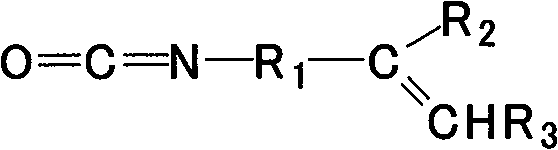
所述微粒例如通过如下步骤来制备:The microparticles are prepared, for example, by the following steps:
使所述多官能可自由基聚合化合物X与式II所表示的异氰酸酯进行反应Reaction of the polyfunctional free radical polymerizable compound X with the isocyanate represented by formula II

其中X、R1、R2和R3如上所定义;wherein X, R 1 , R 2 and R 3 are as defined above;
形成含有所述(由式I表示的)反应产物的液滴;forming droplets containing said reaction product (represented by formula I);
使所述反应产物交联。The reaction product is crosslinked.
上述方法的优点在于简单,其中所述微粒可以仅由两种原料来制备:提供X的化合物和式II化合物,尤其是可商购的式II化合物。The above method has the advantage of simplicity, wherein the microparticles can be prepared from only two starting materials: the compound providing X and the compound of formula II, especially the compound of formula II which is commercially available.
另一种制备路线是通过如下反应:Another preparation route is through the following reaction:

其中,R4是脂族、脂环族或芳族基团,其中R5是烷基(C2-C4),其中,A选自O或N,R2如式I中所定义。上述替代制备方法从实践上来说是有利的,尤其考虑到具有各种R基团的原料在商业上获取的难易程度。还可以使用硫代异氰酸酯替代异氰酸酯。Wherein, R 4 is an aliphatic, alicyclic or aromatic group, wherein R 5 is an alkyl group (C2-C4), wherein, A is selected from O or N, and R 2 is as defined in formula I. The above alternative methods of preparation are practically advantageous, especially in view of the commercial availability of starting materials with various R groups. It is also possible to use thioisocyanates instead of isocyanates.
优选通过如下来形成液滴:制备反应产物在非连续相中的乳液。式I化合物可以例如在水、水性溶液或其它液体或溶剂中乳化。通过使用已知的表面活性剂,例如triton X、聚乙二醇或吐温80来提高所述乳液的稳定性。乳液聚合简单且特别适用于间歇工艺。The droplets are preferably formed by preparing an emulsion of the reaction product in the discontinuous phase. Compounds of formula I may be emulsified, for example, in water, aqueous solutions or other liquids or solvents. The stability of the emulsion is increased by using known surfactants such as triton X, polyethylene glycol or
还可以利用挤出技术、喷雾干燥技术或喷墨技术来制备液滴。本文中,通常使用喷嘴将含有反应产物的液体挤入或“喷射”入合适的气体(例如空气、氮气、稀有气体等)中或液体和反应产物的非溶剂中。可以通过配制品的粘度、使用振动喷嘴和/或施加电场的喷嘴来控制液滴的尺寸。通过选择非溶剂或气体的合适温度和/或通过施加其它条件(例如辐射)来完成交联,从而形成本发明的微粒,例如在Espesito等的Pharm.Dev.Technol5(2);267-278或Ozeki等的Journal of controlled release107(2005)387-394中进行描述。上述方法具体适于连续实施,这在制备大量微粒的情况下特别有利。Droplets can also be prepared using extrusion techniques, spray drying techniques or inkjet techniques. Here, the liquid containing the reaction product is typically squeezed or "sprayed" using a nozzle into a suitable gas (eg, air, nitrogen, noble gas, etc.) or a non-solvent for the liquid and the reaction product. The droplet size can be controlled by the viscosity of the formulation, the use of vibrating nozzles and/or nozzles applying an electric field. Cross-linking is accomplished by selecting a suitable temperature of the non-solvent or gas and/or by applying other conditions such as radiation to form the microparticles of the invention, for example in Espesito et al. Pharm. Dev. Technol 5(2); 267-278 or Described in Journal of controlled release 107 (2005) 387-394 by Ozeki et al. The method described above is particularly suitable for continuous implementation, which is particularly advantageous in the case of the production of large quantities of microparticles.
反应温度通常高于式I化合物的熔融温度。另一个选择是将化合物在低于或高于所述化合物的熔融温度下溶解在溶剂中。除了允许在相对较低的温度下形成液滴以外,这对制备多孔微粒是有益的。还可以使用反应性溶剂,例如可以与聚合试剂发生反应的溶剂,诸如是可自由基聚合单体的溶剂。以这种方式,可以获得网络密度被细微调整的微粒。温度通常低于液相的沸点。The reaction temperature is generally above the melting temperature of the compound of formula I. Another option is to dissolve the compound in a solvent at a temperature below or above the melting temperature of the compound. In addition to allowing droplet formation at relatively low temperatures, this is beneficial for the preparation of porous particles. Reactive solvents may also be used, for example solvents that can react with polymerization reagents, such as solvents for free radically polymerizable monomers. In this way, particles with finely tuned network densities can be obtained. The temperature is generally below the boiling point of the liquid phase.
可以采用任何已知的用于交联含乙烯基化合物的合适方法来实施交联,具体通过热引发(借助热引发剂,诸如过氧化物或偶氮引发剂,例如偶氮二异丁腈);通过光引发(借助光引发剂,诸如Norrish I型或II型引发剂);通过氧化还原引发或任何其它利用化学化合物和/或电磁辐射产生自由基的机制。合适交联剂的实例是三羟甲基丙烷三甲基丙烯酸酯、二乙二醇二甲基丙烯酸酯或羟乙基丙烯酸酯。Crosslinking can be carried out by any suitable method known for crosslinking vinyl-containing compounds, in particular by thermal initiation (by means of thermal initiators such as peroxides or azo initiators such as azobisisobutyronitrile) ; by photoinitiation (by means of photoinitiators, such as Norrish Type I or Type II initiators); by redox initiation or any other mechanism that utilizes chemical compounds and/or electromagnetic radiation to generate free radicals. Examples of suitable crosslinkers are trimethylolpropane trimethacrylate, diethylene glycol dimethacrylate or hydroxyethyl acrylate.
如果需要的话,所述微粒可被加载一种或多种活性试剂。可以在形成微粒时存在活性试剂来实现加载或之后加载。为了获得具有大量活性试剂的微粒,通常优选在活性试剂的存在下制备微粒。具体地,在所述活性试剂对交联敏感或者直接或间接受到交联的不利影响或者干扰的情况下,优选在微粒形成以后加载所述微粒。这可以通过如下来实现:使所述微粒与活性试剂接触,并且允许所述试剂扩散到所述微粒中和/或附着/吸附到所述微粒的表面上。The microparticles can be loaded with one or more active agents, if desired. Loading can be achieved in the presence of the active agent when forming the microparticles or afterward. In order to obtain microparticles with a high amount of active agent, it is generally preferred to prepare the microparticles in the presence of the active agent. In particular, where the active agent is sensitive to cross-linking or is directly or indirectly adversely affected or interfered with by cross-linking, it is preferred to load the microparticles after their formation. This can be achieved by contacting the microparticles with an active agent and allowing the agent to diffuse into the microparticles and/or attach/adsorb to the surface of the microparticles.
本发明可以提供一种对于一种或多种活性试剂具有令人满意封装效率(即粒子中活性试剂的量除以所用活性试剂的量)的微粒。依赖于加载条件,至少约50%,至少约75%或至少90%或更高的效率是可行的。The present invention can provide a microparticle with a satisfactory encapsulation efficiency (ie, the amount of active agent in the particle divided by the amount of active agent used) for one or more active agents. Depending on the loading conditions, efficiencies of at least about 50%, at least about 75%, or at least 90% or higher are feasible.
现在通过以下实施例来阐述本发明,但并不局限于此。The invention is now illustrated without being limited thereto by the following examples.
材料和方法Materials and methods
聚(乙二醇)35kD(PEG)、乙基己酸锡(II)、过氧化二硫酸钾(KPS)、盐酸四唑嗪、二乙二醇二甲基丙烯酸酯(DEGDMA)、三羟甲基丙烷三甲基丙烯酸酯(TMPTMA)、Irgacure819、聚己内酯三醇(PCL300)、羟乙基丙烯酸酯(HEA)、2,4-甲苯二异氰酸酯(TDI)和Darocure1173购自Sigma-Aldrich。PTGL1000(即聚(-甲基-1,4-丁二醇)共(四亚甲基二醇),Mw为1000g/mol)购自Desotech;异氰酸酯甲基丙烯酸乙酯(IEMA)购自KarenzMOI(纯度98%)。Irganox1035购自CibaSpeciality Chemicals。上述化学品原样使用,除非另有声明。Poly(ethylene glycol) 35kD (PEG), tin(II) ethylhexanoate, potassium peroxodisulfate (KPS), tetrazosin hydrochloride, diethylene glycol dimethacrylate (DEGDMA), trimethylol Propanyl trimethacrylate (TMPTMA), Irgacure819, polycaprolactone triol (PCL 300 ), hydroxyethylacrylate (HEA), 2,4-toluene diisocyanate (TDI) and Darocure1173 were purchased from Sigma-Aldrich . PTGL 1000 (i.e. poly(-methyl-1,4-butanediol)co(tetramethylene glycol), Mw 1000 g/mol) was purchased from Desotech; isocyanate ethyl methacrylate (IEMA) was purchased from KarenzMOI (purity 98%). Irganox 1035 was purchased from Ciba Specialty Chemicals. The above chemicals were used as received unless otherwise stated.
在Varian Inova300光谱仪上进行核磁共振(NMR)实验。Nuclear magnetic resonance (NMR) experiments were performed on a Varian Inova300 spectrometer.
在Perkin Elmer Spectrum FT-IR光谱仪1760x,1720x上进行红外实验。将聚合物样品置于两片KBr片之间。Infrared experiments were performed on Perkin Elmer Spectrum FT-IR spectrometers 1760x, 1720x. The polymer sample was placed between two KBr sheets.
在安装有Golden Gate衰减全反射(ATR)附件的Perkin ElmerSpectrum One FTIR光谱仪上测量丙烯酸酯的转化率。Sectrum One由DTGS检测器和利用单反射钻石晶体的Golden Gate组成。以平均4次扫描来记录在4000至650cm-1之间的红外光谱,光谱分辨率为4cm-1。将透射光谱转换成吸收光谱。在1410、1630和810cm-1处测定峰高,从而测定丙烯酸酯的转化率。Acrylate conversion was measured on a Perkin Elmer Spectrum One FTIR spectrometer equipped with a Golden Gate Attenuated Total Reflectance (ATR) accessory. Sectrum One consists of a DTGS detector and a Golden Gate utilizing a single reflection diamond crystal. Infrared spectra were recorded between 4000 and 650 cm −1 with an average of 4 scans with a spectral resolution of 4 cm −1 . Convert the transmission spectrum to an absorption spectrum. Acrylate conversion was determined by measuring peak heights at 1410, 1630 and 810 cm -1 .
使用Waters515HPLC泵、Waters410微分折射仪和安装有WatersStyragel HR2、3、4柱子的Servern Analytical SA6503可编程吸光率检测器,以1ml/min的流速,使用四氢呋喃(THF)作为洗脱液,来进行尺寸排斥色谱分析(SEC)。利用IR检测器收集SEC数据。该系统采用窄分布的聚苯乙烯标样(EasyCal PS2,得自Polymer Laboratories,Heerlen)进行标定。Size exclusion was performed using a Waters 515HPLC pump, a Waters 410 differential refractometer, and a Servern Analytical SA6503 programmable absorbance detector equipped with Waters Styragel HR2, 3, 4 columns at a flow rate of 1 ml/min using tetrahydrofuran (THF) as the eluent Chromatography (SEC). SEC data was collected using an IR detector. The system was calibrated using narrow polystyrene standards (EasyCal PS2 from Polymer Laboratories, Heerlen).
所有涉及四唑嗪浓度测量的实验通过液相色谱(对于TRH的duplot测量)来进行。HPLC系统(HP1090液相色谱)由以下组件组成:DR5泵、二极管检测器(DAD)、内置自动取样器和ChemStation软件,版本Rev.A.08.03(Agilent Technologies)。在40.0℃下使用平均粒子尺寸为3.5μm的C18分析柱150×4.6mm(XTerra RP18,Waters)。流速为1.5ml/min。使用由流动相A(10mM磷酸盐缓冲液)和B(乙腈)组成的流动相梯度液。洗脱梯度如下:在14分钟的一个梯度循环中,流动相中的流动相B在8分钟内由10%变化至95%,将流动相B保持在95%下2分钟,此后在4分钟内将流动相B降至10%,其中保持所述流动相直到注射下一个样品。注射体积为50μl。在250至340nm处进行探测。All experiments involving tetrazosin concentration measurements were performed by liquid chromatography (duplot measurement for TRH). The HPLC system (HP1090 liquid chromatograph) consisted of the following components: DR5 pump, diode detector (DAD), built-in autosampler and ChemStation software, version Rev. A.08.03 (Agilent Technologies). A C18 analytical column 150 x 4.6 mm (XTerra RP18, Waters) with an average particle size of 3.5 μm was used at 40.0°C. The flow rate was 1.5ml/min. A mobile phase gradient consisting of mobile phase A (10 mM phosphate buffer) and B (acetonitrile) was used. The elution gradient was as follows: In one gradient cycle of 14 minutes, the mobile phase B in the mobile phase was changed from 10% to 95% in 8 minutes, and the mobile phase B was kept at 95% for 2 minutes, and thereafter in 4 minutes. Decrease mobile phase B to 10%, where it remains until the next sample is injected. The injection volume was 50 μl. Probing was performed at 250 to 340 nm.
使用LST230系列激光衍射粒子尺寸分析仪(Beckman Coulter)测量微粒的尺寸分布。标样为UHMwPE(0.02-0.04μm)。The particle size distribution was measured using a LST230 series laser diffraction particle size analyzer (Beckman Coulter). The standard sample is UHMwPE (0.02-0.04μm).
使用Leica DMLB显微镜(放大倍数×50至×400)分析微粒的形态。Microparticle morphology was analyzed using a Leica DMLB microscope (magnification x50 to x400).
使用Philips CP SEM XL30在5和10kV加速电压下检测所述微粒。将样本安装在SEM样品台上,并镀金(2×60s,20mA)。The particles were detected using a Philips CP SEM XL30 at accelerating voltages of 5 and 10 kV. The samples were mounted on the SEM sample stage and plated with gold (2×60s, 20mA).
实施例1:PTGLExample 1: PTGL 10001000 -(IEMA)-(IEMA) 22 低聚物的合成Synthesis of oligomers
将51mg(相对于总重的0.1wt%)的Irganox1035、13.9g(0.09mol)的IEMA和11mg(相对于IEMA的0.1mol%)的2-乙基己酸锡(II)在干燥空气下的100ml反应烧瓶中进行搅拌。在恒定温度(20℃)下,30分钟内滴加45.6g(0.045mol)PTGL1000。然后,将反应混合物加热至60℃,并继续进行18小时。由如下分析结果证实了PTGL1000-(IEMA)2的形成:1H-NMR(300MHz,CDCl3,22℃):δ(ppm)=6.26-5.83(s,1H,H-CH=CH(CH3)-);5.78-5.77(s,1H,H-CH=CH(CH3)-);4.50-4.05(m,2H,-O-CH2-CH2-NH-);4.05-3.88(m,2H,-O-CH2-CH2-NH-);3.22-2.51(m,2H,-O-CH2-CH2-CH(CH3)-);1.95-4.79(s,3H,CH2=CH(CH3)-);1.66-1.38(s,24H,-CH2-CH(CH3)-CH2-);IR(纯,cm-1):1723.59(C=O,伸缩),1638.14(C=C);SEC(IR检测器):Mw4800,PDI=1.57。51 mg (0.1 wt% relative to the total weight) of Irganox 1035, 13.9 g (0.09 mol) of IEMA and 11 mg (relative to 0.1 mol % of IEMA) of tin(II) 2-ethylhexanoate were prepared under dry air. 100ml reaction flask for stirring. At constant temperature (20° C.), 45.6 g (0.045 mol) of PTGL 1000 were added dropwise within 30 minutes. Then, the reaction mixture was heated to 60 °C and continued for 18 hours. The formation of PTGL 1000 -(IEMA) 2 was confirmed by the following analytical results: 1 H-NMR (300MHz, CDCl 3 , 22°C): δ(ppm)=6.26-5.83(s, 1H,H-CH=CH(CH 3 )-); 5.78-5.77 (s, 1H, H-CH=CH(CH 3 )-); 4.50-4.05 (m, 2H, -O-CH 2 -CH 2 -NH-); 4.05-3.88 ( m, 2H, -O-CH 2 -CH 2 -NH-); 3.22-2.51 (m, 2H, -O-CH 2 -CH 2 -CH(CH 3 )-); 1.95-4.79 (s, 3H, CH2=CH(CH 3 )-); 1.66-1.38 (s, 24H, -CH 2 -CH(CH 3 )-CH 2 -); IR (pure, cm-1): 1723.59 (C=O, stretched) , 1638.14 (C=C); SEC (IR detector): Mw 4800, PDI=1.57.
实施例2:PTGLExample 2: PTGL 10001000 -(IEMA)-(IEMA) 22 微球的制备Preparation of microspheres
在60℃下,将2g PTGL1000-(IEMA)2低聚物和20g PEG溶液(20%的软化水溶液)在1500rmp(Eurostar Power Control Visc,IKA-WERKE)下搅拌15分钟。停止搅拌使乳液稳定。15分钟后,加入4.5ml KPS溶液(50mg/ml)。在70℃下聚合2小时。微球通过离心(Harrier15/80,MSE,4500rpm下15分钟)分离并用20ml的软化水洗涤。通过显微镜检查微球的形态。粒子尺寸分析仪表明平均直径为25μm(d75/d25=9)。2 g of PTGL 1000 -(IEMA) 2 oligomer and 20 g of PEG solution (20% in softened water) were stirred at 60° C. for 15 min at 1500 rpm (Eurostar Power Control Visc, IKA-WERKE). Stirring was stopped to allow the emulsion to stabilize. After 15 minutes, 4.5 ml KPS solution (50 mg/ml) was added. Polymerization was carried out at 70°C for 2 hours. Microspheres were isolated by centrifugation (Harrier 15/80, MSE, 15 minutes at 4500 rpm) and washed with 20 ml of demineralized water. Check the morphology of the microspheres by microscopy. A particle size analyzer indicated an average diameter of 25 μm (d 75 /d 25 =9).
实施例3:PTGLExample 3: PTGL 10001000 -(TDI-HEA)-(TDI-HEA) 22 的合成Synthesis
在0.3g(0.48mmol)的乙基己酸锡II的存在下,将75.48g(0.65mol)HEA滴加到113.20g(0.65mol)TDI中。通过滴定监测异氰酸酯基团(NCO)的转化率。将174.95g(0.60mol)的上述HEA-TDI混合物加入购自Hodogaya的301.33克PTGL1000(0.60mol OH)和0.3g Irganox1035中并进行搅拌。将温度逐渐升高至80℃。7小时后,NCO值为0.026%。过夜后将反应混合物冷却至50℃。另外16小时后,NCO含量为0.007%。氨基甲酸酯二丙烯酸酯低聚物的产量为450g(92%)。In the presence of 0.3 g (0.48 mmol) of tin II ethylhexanoate, 75.48 g (0.65 mol) of HEA was added dropwise to 113.20 g (0.65 mol) of TDI. The conversion of isocyanate groups (NCO) was monitored by titration. 174.95 g (0.60 mol) of the above HEA-TDI mixture was added to 301.33 g of PTGL1000 (0.60 mol OH) and 0.3 g of Irganox 1035 purchased from Hodogaya and stirred. The temperature was gradually increased to 80°C. After 7 hours, the NCO value was 0.026%. After overnight the reaction mixture was cooled to 50 °C. After another 16 hours, the NCO content was 0.007%. The yield of urethane diacrylate oligomer was 450 g (92%).
实施例4:PTGLExample 4: PTGL 10001000 -(TDI-HEA)-(TDI-HEA) 22 微球的制备Preparation of microspheres
在室温下,将1.70g PTGL1000-(TDI-HEA)2低聚物和15g PEG溶液(20%的软化水溶液)在1500rmp(Eurostar Power Control Visc,IKA-WERKE)下搅拌15分钟。停止搅拌使乳液稳定。15分钟后,加入5mlKPS水溶液(50mg/ml)。将乳液在500rpm下搅拌10分钟。在70℃下聚合2小时。微球通过离心(Harrier15/80,MSE,4500rpm下15分钟)分离并用20ml的软化水洗涤。通过显微镜检查微球的形态。粒子尺寸分析仪表明平均直径为130μm(d75/d25=7)。1.70 g of PTGL 1000 -(TDI-HEA) 2 oligomer and 15 g of PEG solution (20% in softened water) were stirred at 1500 rpm (Eurostar Power Control Visc, IKA-WERKE) for 15 minutes at room temperature. Stirring was stopped to allow the emulsion to stabilize. After 15 minutes, 5 ml of aqueous KPS (50 mg/ml) was added. The emulsion was stirred at 500 rpm for 10 minutes. Polymerization was carried out at 70°C for 2 hours. Microspheres were isolated by centrifugation (Harrier 15/80, MSE, 15 minutes at 4500 rpm) and washed with 20 ml of demineralized water. Check the morphology of the microspheres by microscopy. A particle size analyzer indicated an average diameter of 130 μm (d 75 /d 25 =7).
实施例5:PTGLExample 5: PTGL 10001000 -(IEMA)-(IEMA) 22 /EGDMA/TMPTMA微粒的制备/ Preparation of EGDMA/TMPTMA microparticles
采用1.4g PTGL1000(IEMA)2、0.5g DEGDMA、0.1g TMPTMA和20mg的Darocur1173来制备配制品。采用2g PEG和13g软化水来制备水溶液。将该配制品加入水溶液中,从而得到乳液。将乳液在500rmp(Heidolph MR3002)下搅拌30分钟。在UV光下(Macam Flexicure控制器,D-bulb,200mW/s/cm2)聚合30分钟。聚合后,微球通过离心(Harrier15/80,MSE,4500rpm下15分钟)分离并用20ml的软化水洗涤两次。通过扫描电子显微镜检查微球的形态(见图1)。粒子尺寸分析仪表明平均直径为100μm(d75/d25=1.9)(见图2)。丙烯酸酯的转化率为80%。A formulation was prepared using 1.4 g PTGL 1000 (IEMA) 2 , 0.5 g DEGDMA, 0.1 g TMPTMA and 20 mg of Darocur 1173 . An aqueous solution was prepared using 2 g PEG and 13 g demineralized water. This formulation is added to an aqueous solution to obtain an emulsion. The emulsion was stirred for 30 minutes at 500 rpm (Heidolph MR3002). Polymerization was performed under UV light (Macam Flexicure controller, D-bulb, 200 mW/s/cm 2 ) for 30 minutes. After polymerization, the microspheres were isolated by centrifugation (Harrier 15/80, MSE, 15 minutes at 4500 rpm) and washed twice with 20 ml of demineralized water. The morphology of the microspheres was examined by scanning electron microscopy (see Figure 1). A particle size analyzer indicated an average diameter of 100 μm (d 75 /d 25 =1.9) (see FIG. 2 ). The conversion of acrylate was 80%.
实施例6:官能化PTGLExample 6: Functionalized PTGL 10001000 -(TDI-IEMA)-(TDI-IEMA) 22 /HEA微粒的制备/ Preparation of HEA microparticles
采用1.5g PTGL1000(TDI-HEA)2、1.5g HEA和30mg的Irgacure819制备配制品。采用4g PEG和21g软化水制备水溶液。将上述配制品滴加到水溶液中,从而得到乳液。将乳液在500rmp(Heidolph MR3002)下搅拌30分钟。在UV光下(Macam Flexicure控制器,D-bulb,200mW/s/cm2)聚合30分钟。聚合后,微球通过离心(Harrier15/80,MSE,4500rpm下15分钟)分离并用20ml的软化水洗涤两次。通过显微镜检查微球的形态。粒子尺寸分析仪表明平均直径为390μm(d75/d25=2.5)。丙烯酸酯的转化率大于95%。这些微粒由羟基组成,这些羟基可以进一步用于官能化。A formulation was prepared using 1.5 g PTGL 1000 (TDI-HEA) 2 , 1.5 g HEA and 30 mg Irgacure 819. An aqueous solution was prepared using 4 g PEG and 21 g demineralized water. The above formulation was added dropwise to an aqueous solution to obtain an emulsion. The emulsion was stirred for 30 minutes at 500 rpm (Heidolph MR3002). Polymerization was performed under UV light (Macam Flexicure controller, D-bulb, 200 mW/s/cm 2 ) for 30 minutes. After polymerization, the microspheres were isolated by centrifugation (Harrier 15/80, MSE, 15 minutes at 4500 rpm) and washed twice with 20 ml of demineralized water. Check the morphology of the microspheres by microscopy. A particle size analyzer indicated an average diameter of 390 μm (d 75 /d 25 =2.5). The conversion of acrylate is greater than 95%. These microparticles consist of hydroxyl groups, which can be further used for functionalization.
实施例7:PTGLExample 7: PTGL 10001000 -(IEMA)-(IEMA) 22 /EGDMA/TMPTMA微粒的释放谱图Release spectrum of /EGDMA/TMPTMA particles
采用2ml的四唑嗪溶液(5mg/ml的磷酸盐缓冲盐水(PBS)的溶液)培养三批次的100mg的干燥微粒(得自实施例5)。这导致加载率为10%。在60℃的烘箱中蒸发水过夜。将干燥的微粒用7.5ml PBS洗涤三次。测定洗涤步骤中的四唑嗪的浓度,从而确定封装效率。封装效率为75%。在37℃的PBS中研究释放谱图。结果表示在图3中。竖条表示标准偏差(n=3)。Three batches of 100 mg of dried microparticles (from Example 5) were incubated with 2 ml of tetrazosin solution (5 mg/ml in phosphate buffered saline (PBS)). This results in a load rate of 10%. Evaporate water overnight in a 60°C oven. Dried microparticles were washed three times with 7.5 ml PBS. The concentration of tetrazosin in the wash step was measured to determine the encapsulation efficiency. Packaging efficiency is 75%. Release profiles were studied in PBS at 37°C. The results are shown in FIG. 3 . Vertical bars represent standard deviation (n=3).
实施例8:PTGLExample 8: PTGL 10001000 -(TDI-HEA)-(TDI-HEA) 22 /HEA微粒的冷冻-干燥稳定性Freeze-drying stability of /HEA microparticles
将实施例6的微粒冷冻干燥整夜(安装有真空泵Edward5两阶段和压力控制器Vaccuubrand CVC2的Edwards冷冻干燥器Micro Modulyo)。在重新溶于软化水中后,通过显微镜检查微粒的形态(没有观察到破裂的微粒)。粒子尺寸分析仪表明平均直径为360μm,这表明与新鲜微粒的直径相比偏差小于7%。结果表明,这些微粒在物理冲击(冷冻干燥)的作用下对不利影响(尺寸降低)具有良好的承受能力。The microparticles of Example 6 were freeze-dried overnight (Edwards freeze-dryer Micro Modulyo equipped with vacuum pump Edward5 two-stage and pressure controller Vaccuubrand CVC2). After redissolving in demineralized water, the morphology of the microparticles was examined microscopically (no broken microparticles were observed). The particle size analyzer indicated an average diameter of 360 μm, which indicated a deviation of less than 7% from the diameter of the fresh particles. It was shown that the microparticles are well tolerated against adverse effects (size reduction) by physical shock (freeze-drying).
实施例9:PTGL基微粒的压力稳定性Example 9: Pressure stability of PTGL-based microparticles
利用KBr压力机压缩实施例5的微粒。将5吨压力保持5分钟。在重新溶于软化水中后,通过显微镜检查微粒的形态。没有观察到破裂的微粒。粒子尺寸分析仪表明平均直径为110μm,这表明与未遭受挤压的微粒的直径相比偏差仅为10%。The microparticles of Example 5 were compressed using a KBr press. Hold 5 tons of pressure for 5 minutes. After redissolving in demineralized water, the morphology of the microparticles was examined microscopically. No broken particles were observed. The particle size analyzer indicated an average diameter of 110 μm, which represented only a 10% deviation from the diameter of the unextruded particles.
实施例10:漂浮(on-fly)PTGLExample 10: Floating (on-fly) PTGL 10001000 -(TDI-HEA)-(TDI-HEA) 22 微粒的制备Microparticle preparation
将1.5g PTGL1000-(TDI-HEA)2、1.5g HEA和30mg Irgacure819混合在一起。将该配制品通过直径0.6mm的针头滴入空气中。当通过空气落下时,使微粒进行UV聚合(使用Macam Flexicure控制器,D-bulb,200mW/s/cm2)并收集在乙二醇中。使微粒在乙二醇中后固化30分钟。通过显微镜评估微粒的形态和尺寸:平均直径为1000μm,分布较窄(950-1050μm,利用显微镜目测)。1.5 g PTGL 1000 -(TDI-HEA) 2 , 1.5 g HEA and 30 mg Irgacure 819 were mixed together. The formulation was dropped into the air through a needle with a diameter of 0.6 mm. While falling through air, the microparticles were UV polymerized (using a Macam Flexicure controller, D-bulb, 200 mW/s/cm 2 ) and collected in ethylene glycol. The microparticles were post-cured in ethylene glycol for 30 minutes. The morphology and size of the microparticles were assessed by microscopy: mean
实施例11:PCLExample 11: PCL 300300 -IEMA-IEMA 33 的合成Synthesis
将聚己内酯三醇(80克,0.266mol)、Irganox1035(0.2克,相对于总重为0.1wt%)搅拌10分钟。在90分钟内滴加IEMA(124克,0.800mol)。将反应混合物加热至60℃并搅拌4小时,直到IR和NMR表明反应完成。1H-NMR(300MHz,CDCl3,22℃,TMS):δ(ppm)=6.1(CH,甲基丙烯酸酯),5.6(CH,甲基丙烯酸酯),5.0(NH,氨基甲酸酯),4,2(2H,-CH2-CH2-),4.0(CH2-CO-),3.5(2H,-CH2-CH2-),2.4(CH3-CH2),1.4-1.7(6H,-CH2-CH2-CH2-),1.93H(CH3,甲基丙烯酸酯)-CH2),0.93H(CH3-CH2)。Polycaprolactone triol (80 g, 0.266 mol), Irganox 1035 (0.2 g, 0.1 wt % relative to the total weight) was stirred for 10 minutes. IEMA (124 g, 0.800 mol) was added dropwise over 90 minutes. The reaction mixture was heated to 60°C and stirred for 4 hours until IR and NMR indicated the reaction was complete. 1 H-NMR (300MHz, CDCl 3 , 22°C, TMS): δ (ppm) = 6.1 (CH, methacrylate), 5.6 (CH, methacrylate), 5.0 (NH, urethane) , 4, 2(2H, -CH 2 -CH 2 -), 4.0(CH2-CO-), 3.5(2H, -CH 2 -CH 2 -), 2.4(CH3-CH2), 1.4-1.7(6H, -CH2-CH2-CH2-), 1.93H(CH3, methacrylate)-CH2), 0.93H(CH3-CH2).
实施例12:可生物降解PCLExample 12: Biodegradable PCL 300300 -IEMA-IEMA 33 微粒的制备Microparticle preparation
将1g PCL300-IEMA3与1g PEG、6.5g软化水和70mg Darocur1173混合15分钟(Heidolph MR3002,1250rpm)。在UV光(MacamFlexicure控制器,D-bulb,200mW/s/cm2)下聚合60分钟。聚合后,将微粒在真空下(Gelman Sciences Supor-800)通过0.8μm的过滤器进行过滤并用100ml软化水冲洗。采用光显微镜检查形貌。丙烯酸酯的转化率为90%。平均尺寸为140μm(D75/D25=3.2)。1 g of PCL300-IEMA 3 was mixed with 1 g of PEG, 6.5 g of demineralized water and 70 mg of Darocur 1173 for 15 minutes (Heidolph MR3002, 1250 rpm). Polymerization was performed for 60 minutes under UV light (Macam Flexicure controller, D-bulb, 200 mW/s/cm 2 ). After polymerization, the microparticles were filtered through a 0.8 μm filter under vacuum (Gelman Sciences Supor-800) and rinsed with 100 ml of demineralized water. The morphology was examined by light microscopy. The conversion of acrylate was 90%. The average size was 140 μm (D75/D25=3.2).
Claims (17)

Applications Claiming Priority (3)
| Application Number | Priority Date | Filing Date | Title |
|---|---|---|---|
| EP06075678.0 | 2006-03-21 | ||
| EP06075678 | 2006-03-21 | ||
| PCT/EP2007/002514 WO2007107358A1 (en) | 2006-03-21 | 2007-03-21 | Microparticles comprising a crosslinked polymer |
Publications (2)
| Publication Number | Publication Date |
|---|---|
| CN101405320A CN101405320A (en) | 2009-04-08 |
| CN101405320B true CN101405320B (en) | 2012-05-30 |
Family
ID=36369939
Family Applications (1)
| Application Number | Title | Priority Date | Filing Date |
|---|---|---|---|
| CN200780010215XA Expired - Fee Related CN101405320B (en) | 2006-03-21 | 2007-03-21 | Microparticles containing cross-linked polymers |
Country Status (11)
| Country | Link |
|---|---|
| US (1) | US20100233083A1 (en) |
| EP (1) | EP1996640B1 (en) |
| JP (2) | JP2009530457A (en) |
| CN (1) | CN101405320B (en) |
| AT (1) | ATE440879T1 (en) |
| AU (1) | AU2007228951A1 (en) |
| BR (1) | BRPI0711035A2 (en) |
| CA (1) | CA2645203A1 (en) |
| DE (1) | DE602007002176D1 (en) |
| EA (1) | EA200802017A1 (en) |
| WO (1) | WO2007107358A1 (en) |
Families Citing this family (18)
| Publication number | Priority date | Publication date | Assignee | Title |
|---|---|---|---|---|
| WO2007081386A2 (en) | 2006-01-11 | 2007-07-19 | Raindance Technologies, Inc. | Microfluidic devices and methods of use |
| EP2021113A2 (en) | 2006-05-11 | 2009-02-11 | Raindance Technologies, Inc. | Microfluidic devices |
| US9562837B2 (en) | 2006-05-11 | 2017-02-07 | Raindance Technologies, Inc. | Systems for handling microfludic droplets |
| WO2008097559A2 (en) | 2007-02-06 | 2008-08-14 | Brandeis University | Manipulation of fluids and reactions in microfluidic systems |
| WO2008130623A1 (en) | 2007-04-19 | 2008-10-30 | Brandeis University | Manipulation of fluids, fluid components and reactions in microfluidic systems |
| US20090081276A1 (en) * | 2007-08-13 | 2009-03-26 | Eben Alsberg | Bioresorbable implant composition |
| EP4047367A1 (en) | 2008-07-18 | 2022-08-24 | Bio-Rad Laboratories, Inc. | Method for detecting target analytes with droplet libraries |
| US12038438B2 (en) | 2008-07-18 | 2024-07-16 | Bio-Rad Laboratories, Inc. | Enzyme quantification |
| EP3415235B1 (en) | 2009-03-23 | 2025-11-12 | Bio-Rad Laboratories, Inc. | Manipulation of microfluidic droplets |
| JP5934657B2 (en) | 2010-02-12 | 2016-06-15 | レインダンス テクノロジーズ, インコーポレイテッド | Digital specimen analysis |
| US9399797B2 (en) | 2010-02-12 | 2016-07-26 | Raindance Technologies, Inc. | Digital analyte analysis |
| EP3736281A1 (en) | 2011-02-18 | 2020-11-11 | Bio-Rad Laboratories, Inc. | Compositions and methods for molecular labeling |
| US9556470B2 (en) | 2011-06-02 | 2017-01-31 | Raindance Technologies, Inc. | Enzyme quantification |
| US8658430B2 (en) | 2011-07-20 | 2014-02-25 | Raindance Technologies, Inc. | Manipulating droplet size |
| US9944977B2 (en) | 2013-12-12 | 2018-04-17 | Raindance Technologies, Inc. | Distinguishing rare variations in a nucleic acid sequence from a sample |
| US9734927B2 (en) | 2015-04-09 | 2017-08-15 | International Business Machines Corporation | Optical capture and isolation of circulating tumor cells in a micro-fluidic device utilizing size selective trapping with optical cogwheel tweezers |
| US20160368821A1 (en) | 2015-06-17 | 2016-12-22 | International Business Machines Corporation | Method of glass fabric production including resin adhesion for printed circuit board formation |
| WO2017100350A1 (en) * | 2015-12-07 | 2017-06-15 | Raindance Technologies, Inc. | Multiplexing in partitions using microparticles |
Citations (4)
| Publication number | Priority date | Publication date | Assignee | Title |
|---|---|---|---|---|
| US6228423B1 (en) * | 1996-12-20 | 2001-05-08 | Connaught Laboratories Limited | Biodegradable targetable microparticle delivery system |
| EP1172693A1 (en) * | 2000-01-25 | 2002-01-16 | DAICEL CHEMICAL INDUSTRIES, Ltd. | Photocurable resin compositions |
| US6787597B1 (en) * | 2002-02-15 | 2004-09-07 | Ppg Industries Ohio, Inc. | Waterborne film-forming compositions containing alternating copolymers of isobutylene type monomers |
| US20050013869A1 (en) * | 2003-07-18 | 2005-01-20 | Chaw Cheng Shu | Sustained release formulation for carbamates and a method therefor |
Family Cites Families (4)
| Publication number | Priority date | Publication date | Assignee | Title |
|---|---|---|---|---|
| WO1986003506A1 (en) * | 1983-01-05 | 1986-06-19 | Theodore Ares N | Non-aqueous dispersions based on capped stabilizers and vinyl monomers i |
| CA2087125A1 (en) * | 1992-01-23 | 1993-07-24 | Mridula Nair | Chemically fixed micelles |
| US5807944A (en) * | 1996-06-27 | 1998-09-15 | Ciba Vision Corporation | Amphiphilic, segmented copolymer of controlled morphology and ophthalmic devices including contact lenses made therefrom |
| EP1231905B1 (en) * | 1999-11-15 | 2009-04-08 | BioCure, Inc. | Responsive polymeric hollow particles |
-
2007
- 2007-03-21 US US12/293,640 patent/US20100233083A1/en not_active Abandoned
- 2007-03-21 AU AU2007228951A patent/AU2007228951A1/en not_active Abandoned
- 2007-03-21 AT AT07723471T patent/ATE440879T1/en not_active IP Right Cessation
- 2007-03-21 CA CA002645203A patent/CA2645203A1/en not_active Abandoned
- 2007-03-21 WO PCT/EP2007/002514 patent/WO2007107358A1/en not_active Ceased
- 2007-03-21 JP JP2009500773A patent/JP2009530457A/en active Pending
- 2007-03-21 EP EP07723471A patent/EP1996640B1/en not_active Not-in-force
- 2007-03-21 DE DE602007002176T patent/DE602007002176D1/en active Active
- 2007-03-21 BR BRPI0711035-9A patent/BRPI0711035A2/en not_active IP Right Cessation
- 2007-03-21 EA EA200802017A patent/EA200802017A1/en unknown
- 2007-03-21 CN CN200780010215XA patent/CN101405320B/en not_active Expired - Fee Related
-
2013
- 2013-06-12 JP JP2013123791A patent/JP2013209420A/en active Pending
Patent Citations (4)
| Publication number | Priority date | Publication date | Assignee | Title |
|---|---|---|---|---|
| US6228423B1 (en) * | 1996-12-20 | 2001-05-08 | Connaught Laboratories Limited | Biodegradable targetable microparticle delivery system |
| EP1172693A1 (en) * | 2000-01-25 | 2002-01-16 | DAICEL CHEMICAL INDUSTRIES, Ltd. | Photocurable resin compositions |
| US6787597B1 (en) * | 2002-02-15 | 2004-09-07 | Ppg Industries Ohio, Inc. | Waterborne film-forming compositions containing alternating copolymers of isobutylene type monomers |
| US20050013869A1 (en) * | 2003-07-18 | 2005-01-20 | Chaw Cheng Shu | Sustained release formulation for carbamates and a method therefor |
Also Published As
| Publication number | Publication date |
|---|---|
| CA2645203A1 (en) | 2007-09-27 |
| EP1996640A1 (en) | 2008-12-03 |
| BRPI0711035A2 (en) | 2011-08-23 |
| AU2007228951A1 (en) | 2007-09-27 |
| US20100233083A1 (en) | 2010-09-16 |
| EA200802017A1 (en) | 2009-04-28 |
| JP2009530457A (en) | 2009-08-27 |
| CN101405320A (en) | 2009-04-08 |
| WO2007107358A1 (en) | 2007-09-27 |
| ATE440879T1 (en) | 2009-09-15 |
| DE602007002176D1 (en) | 2009-10-08 |
| JP2013209420A (en) | 2013-10-10 |
| EP1996640B1 (en) | 2009-08-26 |
Similar Documents
| Publication | Publication Date | Title |
|---|---|---|
| CN101405320B (en) | Microparticles containing cross-linked polymers | |
| US6497903B1 (en) | Hydrolysable hydrogels for controlled release | |
| US6565842B1 (en) | Crosslinkable polypeptide compositions | |
| Langer et al. | Advances in biomaterials, drug delivery, and bionanotechnology | |
| Aluri et al. | Development of l-tyrosine-based enzyme-responsive amphiphilic poly (ester-urethane) nanocarriers for multiple drug delivery to cancer cells | |
| EP2222754B1 (en) | Thermoresponsive arginine-based hydrogels as biologic carriers | |
| US20090253809A1 (en) | Bioabsorbable elastomeric polymer networks, cross-linkers and methods of use | |
| CA2791559A1 (en) | Micelle compositions and process for the preparation thereof | |
| US20090022772A1 (en) | Bioabsorbable elastomeric arterial support device and methods of use | |
| CN102014879A (en) | Particles comprising polymers with thioester bonds | |
| US20160083516A1 (en) | Crosslinked poly-depsipeptide copolymers and methods of making thereof | |
| US20100291116A1 (en) | Microparticle comprising cross-linked polymer | |
| JP2007516323A (en) | Stereocomplex hydrogel with adjustable degradation time | |
| Mirabbasi et al. | Preparation of mesalamine nanoparticles using a novel polyurethane-chitosan graft copolymer | |
| US20110301288A1 (en) | Thioic acids as building block for polythioesters | |
| CN114409887B (en) | Fluorinated end group amphiphilic polymer, preparation method and application thereof | |
| Nasongkla et al. | Development of tri-component copolymer rods as implantable drug delivery systems for liver cancer therapy |
Legal Events
| Date | Code | Title | Description |
|---|---|---|---|
| C06 | Publication | ||
| PB01 | Publication | ||
| C10 | Entry into substantive examination | ||
| SE01 | Entry into force of request for substantive examination | ||
| C14 | Grant of patent or utility model | ||
| GR01 | Patent grant | ||
| CF01 | Termination of patent right due to non-payment of annual fee | ||
| CF01 | Termination of patent right due to non-payment of annual fee |
Granted publication date: 20120530 Termination date: 20160321 |