CN101388294A - An all-carbon counter electrode for dye-sensitized solar cells and its preparation method - Google Patents
An all-carbon counter electrode for dye-sensitized solar cells and its preparation method Download PDFInfo
- Publication number
- CN101388294A CN101388294A CNA2008101180716A CN200810118071A CN101388294A CN 101388294 A CN101388294 A CN 101388294A CN A2008101180716 A CNA2008101180716 A CN A2008101180716A CN 200810118071 A CN200810118071 A CN 200810118071A CN 101388294 A CN101388294 A CN 101388294A
- Authority
- CN
- China
- Prior art keywords
- carbon
- counter electrode
- substrate
- electrode
- dssc
- Prior art date
- Legal status (The legal status is an assumption and is not a legal conclusion. Google has not performed a legal analysis and makes no representation as to the accuracy of the status listed.)
- Granted
Links
Images

Classifications
-
- Y—GENERAL TAGGING OF NEW TECHNOLOGICAL DEVELOPMENTS; GENERAL TAGGING OF CROSS-SECTIONAL TECHNOLOGIES SPANNING OVER SEVERAL SECTIONS OF THE IPC; TECHNICAL SUBJECTS COVERED BY FORMER USPC CROSS-REFERENCE ART COLLECTIONS [XRACs] AND DIGESTS
- Y02—TECHNOLOGIES OR APPLICATIONS FOR MITIGATION OR ADAPTATION AGAINST CLIMATE CHANGE
- Y02E—REDUCTION OF GREENHOUSE GAS [GHG] EMISSIONS, RELATED TO ENERGY GENERATION, TRANSMISSION OR DISTRIBUTION
- Y02E10/00—Energy generation through renewable energy sources
- Y02E10/50—Photovoltaic [PV] energy
- Y02E10/542—Dye sensitized solar cells
-
- Y—GENERAL TAGGING OF NEW TECHNOLOGICAL DEVELOPMENTS; GENERAL TAGGING OF CROSS-SECTIONAL TECHNOLOGIES SPANNING OVER SEVERAL SECTIONS OF THE IPC; TECHNICAL SUBJECTS COVERED BY FORMER USPC CROSS-REFERENCE ART COLLECTIONS [XRACs] AND DIGESTS
- Y02—TECHNOLOGIES OR APPLICATIONS FOR MITIGATION OR ADAPTATION AGAINST CLIMATE CHANGE
- Y02E—REDUCTION OF GREENHOUSE GAS [GHG] EMISSIONS, RELATED TO ENERGY GENERATION, TRANSMISSION OR DISTRIBUTION
- Y02E60/00—Enabling technologies; Technologies with a potential or indirect contribution to GHG emissions mitigation
- Y02E60/10—Energy storage using batteries
-
- Y—GENERAL TAGGING OF NEW TECHNOLOGICAL DEVELOPMENTS; GENERAL TAGGING OF CROSS-SECTIONAL TECHNOLOGIES SPANNING OVER SEVERAL SECTIONS OF THE IPC; TECHNICAL SUBJECTS COVERED BY FORMER USPC CROSS-REFERENCE ART COLLECTIONS [XRACs] AND DIGESTS
- Y02—TECHNOLOGIES OR APPLICATIONS FOR MITIGATION OR ADAPTATION AGAINST CLIMATE CHANGE
- Y02P—CLIMATE CHANGE MITIGATION TECHNOLOGIES IN THE PRODUCTION OR PROCESSING OF GOODS
- Y02P70/00—Climate change mitigation technologies in the production process for final industrial or consumer products
- Y02P70/50—Manufacturing or production processes characterised by the final manufactured product
Landscapes
- Hybrid Cells (AREA)
Abstract
本发明涉及一种用于染料敏化太阳能电池的全碳对电极及制备方法,该全碳对电极由一碳基底A,和在一碳基底上涂覆一层碳催化活性层B组成。全碳对电极的制备方法包括:首先按照专利公开号CN101188257A公开的制备碳浆料的方法,将碳催化活性材料分散制成碳浆料;然后通过丝网印刷、刮涂、旋转涂膜、滴膜或提拉法方法转移到清洗干净的碳基底A上;最后经过干燥或烘干制得全碳对电极。本发明的全碳对电极能够降低电池器件中的串联电阻与界面电阻,从而提高染料敏化太阳能电池的短路电流(Jsc)、填充因子(FF)和光电转换效率。用本发明的全碳对电极所采用的基底材料电阻较小,在大面积电池制作过程中可减少使用或避免使用金属集流引线,简化了制备工艺。

The invention relates to an all-carbon counter electrode for dye-sensitized solar cells and a preparation method thereof. The all-carbon counter electrode consists of a carbon substrate A and a carbon catalytic active layer B coated on the carbon substrate. The preparation method of the all-carbon counter electrode includes: firstly, according to the method for preparing the carbon slurry disclosed in the patent publication number CN101188257A, the carbon catalytic active material is dispersed to form the carbon slurry; The film or pulling method is transferred to the cleaned carbon substrate A; finally, the all-carbon counter electrode is obtained by drying or drying. The all-carbon counter electrode of the invention can reduce the series resistance and interface resistance in the battery device, thereby improving the short-circuit current (Jsc), fill factor (FF) and photoelectric conversion efficiency of the dye-sensitized solar cell. The resistance of the base material adopted by the all-carbon counter electrode of the present invention is small, and the use of metal current-collecting leads can be reduced or avoided in the production process of large-area batteries, thereby simplifying the preparation process.
Description
技术领域 technical field
本发明涉及太阳能电池的对电极及其制备方法,尤其涉及一种染料敏化太阳能电池使用的基底与催化活性层都采用碳材料制作的对电极及制备方法。The invention relates to a counter electrode of a solar cell and a preparation method thereof, in particular to a counter electrode in which both the substrate and the catalytic active layer of a dye-sensitized solar cell are made of carbon materials and a preparation method thereof.
背景技术 Background technique
自1991年,瑞士科学家
这种电池一般由三部分组成:吸附有染料的半导体薄膜光阳极、含有氧化还原电对(I3 -/I-)的电解质和对电极。对电极的作用是将由外电路流入的电子快速、无损耗的传给电解液中的I3 -,并将其还原为I-用于染料的再生反应。作为电池的重要组成部分,对电极需要具有如下的特性:电阻低,电化学催化活性高以及耐电解液的腐蚀性。传统的对电极是由基底和催化活性层两部分组成,基底一般采用FTO或ITO导电玻璃,催化活性层一般为铂。使用导电玻璃作基底一方面成本较高,另一方面玻璃较厚,增加了电池的厚度和重量,不利于电池安装时的轻便化。另外,催化活性层铂虽然催化活性很好,但其本身是一种贵重金属,价格昂贵,不适合未来大规模生产和应用;另有研究指出铂可与电解质发生化学反应,溶解到电解质中,进一步的反应会造成光阳极与对电极之间的短路,降低电池的使用寿命(Solar Energy Materials and Solar Cells,Vol44,99,1996)。This battery generally consists of three parts: a semiconductor film photoanode with dyes adsorbed on it, an electrolyte containing a redox couple (I 3 - /I - ), and a counter electrode. The role of the counter electrode is to transfer the electrons flowing in from the external circuit to the I 3 - in the electrolyte quickly and without loss, and reduce it to I - for the regeneration reaction of the dye. As an important part of the battery, the counter electrode needs to have the following characteristics: low electrical resistance, high electrochemical catalytic activity and corrosion resistance of the electrolyte. The traditional counter electrode is composed of substrate and catalytic active layer. The substrate is generally made of FTO or ITO conductive glass, and the catalytic active layer is generally platinum. On the one hand, the cost of using conductive glass as the substrate is high, and on the other hand, the glass is thicker, which increases the thickness and weight of the battery, which is not conducive to the portability of the battery during installation. In addition, although the catalytic activity of platinum in the catalytic active layer is very good, it is a precious metal itself, which is expensive and not suitable for large-scale production and application in the future; another study pointed out that platinum can chemically react with the electrolyte and dissolve into the electrolyte. Further reaction will cause a short circuit between the photoanode and the counter electrode, reducing the service life of the battery (Solar Energy Materials and Solar Cells, Vol44, 99, 1996).
目前的研究中,对电极铂催化活性层的替代材料主要包括两类:一类为导电聚合物材料(Chemistry Letters,1060,2002),另一类为各种碳催化活性材料。前者的催化活性一方面比较低,另一方面,催化活性相对较好的导电聚合物PEDOT(poly(3,4-ethylenedioxythiophene))也同样存在价格较高的问题。而碳材料由于其来源广泛,具有价格低的优势,同时又具有很好的导电性和电化学催化活性而成为研究的热点。采用碳材料来制备染料敏化太阳能电池对电极的例子有:专利(公开号CN101017856A)已公开了在ITO(indium tin oxide)或FTO(fluorine-doped tin oxide)导电基底制备碳黑对电极的方法。我们知道,使用碳材料做对电极的最大优势在于其来源广泛,价格较低,而专利CN101017856A中采用的ITO和FTO导电基底仍然存在价格昂贵和增加电池重量的缺点。另外,本申请人也在专利公开号:CN101188257A公开了一种染料敏化太阳能电池对电极的碳浆料及其制备方法。但该专利申请只涉及染料敏化太阳能电池对电极使用的碳浆料配方及其制备方法,并未涉及到作为染料敏化太阳能电池使用的对电极的组成和制作。In the current research, the alternative materials for the platinum catalytic active layer of the counter electrode mainly include two types: one is conductive polymer materials (Chemistry Letters, 1060, 2002), and the other is various carbon catalytic active materials. On the one hand, the catalytic activity of the former is relatively low. On the other hand, the conductive polymer PEDOT (poly(3,4-ethylenedioxythiophene)) with relatively good catalytic activity also has the problem of high price. Carbon materials have become a research hotspot because of their wide sources, low price, good electrical conductivity and electrochemical catalytic activity. The example that adopts carbon material to prepare dye-sensitized solar cell counter electrode has: Patent (publication number CN101017856A) has disclosed the method for preparing carbon black counter electrode at ITO (indium tin oxide) or FTO (fluorine-doped tin oxide) conductive substrate . We know that the greatest advantage of using carbon materials as the counter electrode is that it has a wide range of sources and low prices, while the ITO and FTO conductive substrates used in the patent CN101017856A still have the disadvantages of being expensive and increasing the weight of the battery. In addition, the applicant also discloses a carbon paste for a counter electrode of a dye-sensitized solar cell and a preparation method thereof in Patent Publication No.: CN101188257A. However, this patent application only relates to the formulation and preparation method of the carbon paste used as the counter electrode of the dye-sensitized solar cell, and does not involve the composition and production of the counter electrode used as the dye-sensitized solar cell.
发明内容 Contents of the invention
本发明的目的在于:针对以上问题,提供一种基底与催化活性层都采用廉价碳材料的催化对电极及其制备方法。该全碳对电极具有很高的电化学催化活性,很好的导电性,耐电解液腐蚀能力强,以及价格低廉,重量轻,从而能够保证在降低电池制造成本的同时,又保持电池的高光电转换效率和提高电池的稳定性,有利于促进电池的商品化。该全碳对电极可以通过工业上常用的制膜方式,如丝网印刷,刮涂等方法制备,所以便于大规模工业化生产。The object of the present invention is to provide a catalytic counter electrode in which cheap carbon materials are used for both the substrate and the catalytic active layer and a preparation method thereof in view of the above problems. The all-carbon counter electrode has high electrochemical catalytic activity, good electrical conductivity, strong electrolyte corrosion resistance, low price, and light weight, so that it can ensure the high cost of the battery while reducing the manufacturing cost of the battery. The photoelectric conversion efficiency and the improvement of the stability of the battery are conducive to promoting the commercialization of the battery. The all-carbon counter electrode can be prepared by common film-making methods in industry, such as screen printing, scrape coating and other methods, so it is convenient for large-scale industrial production.
本发明提供的染料敏化太阳能电池全碳对电极由两部分组成:The dye-sensitized solar cell all-carbon counter electrode provided by the present invention consists of two parts:
A:一碳基底;和A: a carbon substrate; and
B:一碳催化活性材料层,所述的碳催化活性材料层涂覆在所述的碳基底上;其中催化活性材料层厚度为0.1~100μm;B: a carbon catalytic active material layer, the carbon catalytic active material layer is coated on the carbon substrate; wherein the thickness of the catalytic active material layer is 0.1-100 μm;
所述的基底选取具有耐腐蚀,高电导率的膜状、片状或板状的碳材料,所述的碳材料具有电阻为0.01~100Ω/□之间,体积密度在0.1~2.2g/cm3之间,厚度在0.05mm~5mm之间;The base is selected from a film-like, sheet-like or plate-like carbon material with corrosion resistance and high electrical conductivity. The carbon material has a resistance of 0.01-100Ω/□ and a volume density of 0.1-2.2g/cm 3 , the thickness is between 0.05mm and 5mm;
所述的碳催化活性材料层可以用已知的碳材料制成碳浆料,其中碳催化活性材料的粉末颗粒粒径在5nm~20μm之间,比表面积在10~2500m2/g之间。The carbon catalytically active material layer can be made of known carbon materials into carbon slurry, wherein the carbon catalytically active material has a powder particle size between 5 nm and 20 μm and a specific surface area between 10 and 2500 m 2 /g.
在上述的技术方案中,还包括在制成的碳浆料中添加陶瓷粉末,其添加量为碳催化活性材料总重量的0.5—50wt%,制成的碳催化活性材料。In the above technical solution, it also includes adding ceramic powder to the prepared carbon slurry in an amount of 0.5-50wt% of the total weight of the carbon catalytic active material to form the carbon catalytic active material.
在上述的技术方案中,所述的碳基底材料为:柔性石墨纸、碳纤维纸、碳板或碳片。In the above technical solution, the carbon base material is: flexible graphite paper, carbon fiber paper, carbon plate or carbon sheet.
在上述的技术方案中,所述的制成碳催化活性层的碳材料至少包括:活性炭、碳黑、鳞片状石墨、球形石墨、石墨烯、单壁碳纳米管、多壁碳纳米管、碳纤维或硬碳类材料中的一种;或其中活性炭、碳黑、鳞片状石墨、球形石墨、石墨烯、单壁碳纳米管、多壁碳纳米管、碳纤维或硬碳类材料的两种或多种以任意重量比例混合使用。In the above-mentioned technical scheme, the carbon material for making the carbon catalytic active layer at least includes: activated carbon, carbon black, flake graphite, spherical graphite, graphene, single-walled carbon nanotubes, multi-walled carbon nanotubes, carbon fibers Or one of hard carbon materials; or two or more of activated carbon, carbon black, flake graphite, spherical graphite, graphene, single-wall carbon nanotubes, multi-wall carbon nanotubes, carbon fibers or hard carbon materials can be mixed in any weight ratio.
本发明用于染料敏化太阳能电池全碳对电极的制备方法,包括以下步骤:The present invention is used for the preparation method of all-carbon counter electrode of dye-sensitized solar cell, comprises the following steps:
1)首先按照专利公开号CN101188257A公开的制备碳浆料的方法,将碳催化活性材料分散制成碳浆料;1) First, according to the method for preparing carbon slurry disclosed in Patent Publication No. CN101188257A, the carbon catalytically active material is dispersed to make carbon slurry;
还包括在制成的碳浆料中添加陶瓷粉末,其添加量为碳催化活性材料总重量的0.5—50wt%;所述的陶瓷粉末主要起到连接碳催化颗粒和增加碳催化活性层机械强度的作用;It also includes adding ceramic powder in the prepared carbon slurry, the amount of which is 0.5-50wt% of the total weight of the carbon catalytic active material; the ceramic powder mainly serves to connect the carbon catalytic particles and increase the mechanical strength of the carbon catalytic active layer role;
2)将步骤1)分散制成的碳浆料,通过丝网印刷、刮涂、旋转涂膜、滴膜或提拉法方法转移到清洗干净的碳基底A上;2) Transfer the carbon slurry prepared in step 1) to the cleaned carbon substrate A by screen printing, scraping, spin coating, drop film or pulling method;
3)然后将步骤2)值得的产物在室温~800℃下,进行加热干燥或烘干(约10秒至12小时),可通过重复步骤2)和步骤3)来控制碳催化活性层B的厚度,最终得到催化活性层厚度在0.1~100μm之间的全碳对电极。步骤3制得的全碳对电极中碳催化活性层B的微观结构为多孔结构,通过热处理时,烧去有机物造孔剂得到的多孔结构,因此具有大量的表面可与电解质接触,提高交换电流密度,从而有效的提高染料敏化太阳能电池的短路电流和电池效率。3) Then, the product worthy of step 2) is heated and dried (about 10 seconds to 12 hours) at room temperature to 800 ° C, and the carbon catalytic active layer B can be controlled by repeating step 2) and step 3). Finally, an all-carbon counter electrode with a catalytically active layer thickness between 0.1 and 100 μm is obtained. The microstructure of the carbon catalytically active layer B in the all-carbon counter electrode prepared in step 3 is a porous structure, and the porous structure obtained by burning off the organic pore-forming agent during heat treatment has a large number of surfaces that can be in contact with the electrolyte to increase the exchange current Density, thereby effectively improving the short-circuit current and cell efficiency of dye-sensitized solar cells.
在上述的技术方案中,所述的碳基底材料为:柔性石墨纸、碳纤维纸、碳板或碳片。In the above technical solution, the carbon base material is: flexible graphite paper, carbon fiber paper, carbon plate or carbon sheet.
在上述的技术方案中,所述的碳基底A的电阻在0.01~100Ω/□之间,体积密度0.1~2.2g/cm3之间,厚度在0.05mm~5mm之间;In the above technical solution, the resistance of the carbon substrate A is between 0.01-100Ω/□, the bulk density is between 0.1-2.2g/ cm3 , and the thickness is between 0.05mm-5mm;
在上述的技术方案中,所述的碳催化活性材料至少包括:活性炭、碳黑、鳞片状石墨、球形石墨、石墨烯、单壁碳纳米管、多壁碳纳米管、碳纤维或硬碳类材料中的一种;或其中活性炭、碳黑、鳞片状石墨、球形石墨、石墨烯、单壁碳纳米管、多壁碳纳米管、碳纤维或硬碳类材料的两种或多种以任意重量比例混合使用。In the above technical scheme, the carbon catalytically active material at least includes: activated carbon, carbon black, flake graphite, spherical graphite, graphene, single-walled carbon nanotubes, multi-walled carbon nanotubes, carbon fibers or hard carbon materials One of them; or two or more of activated carbon, carbon black, flaky graphite, spherical graphite, graphene, single-walled carbon nanotubes, multi-walled carbon nanotubes, carbon fibers or hard carbon materials in any weight ratio Mixed use.
在上述的技术方案中,所述碳催化材料粉末的颗粒粒径在5nm~20μm之间,比表面积在10~2500m2/g之间。In the above technical solution, the particle size of the carbon catalytic material powder is between 5 nm and 20 μm, and the specific surface area is between 10 and 2500 m 2 /g.
在上述的技术方案中,所述的陶瓷粉末为以下耐氧化还原腐蚀性的材料,至少包括:TiO2,ZnO,SiO2,Al2O3,ZrO2,SnO2,CeO2,MgO,La2O3,Y2O3,Ta2O5,Nb2O5中的一种,或一种以上陶瓷粉末以任意重量比例混合使用;其中陶瓷粉末粒径在5nm~500nm之间。In the above technical solution, the ceramic powder is the following material resistant to redox corrosion, at least including: TiO 2 , ZnO, SiO 2 , Al 2 O 3 , ZrO 2 , SnO 2 , CeO 2 , MgO, La One of 2 O 3 , Y 2 O 3 , Ta 2 O 5 , Nb 2 O 5 , or more than one ceramic powder mixed in any weight ratio; wherein the particle size of the ceramic powder is between 5nm and 500nm.
在上述的技术方案中,所述步骤3中的干燥或烘干可以在大气或惰性气氛中进行。In the above technical solution, the drying or drying in step 3 can be carried out in the air or in an inert atmosphere.
在上述的技术方案中,所述步骤3中所得全碳对电极催化活性层厚度在0.1~100μm之间。In the above technical solution, the thickness of the all-carbon counter electrode catalytic active layer obtained in the step 3 is between 0.1 μm and 100 μm.
本发明的优点在于:The advantages of the present invention are:
本发明所制备的全碳对电极,由于基底材料选用了的电阻较小的碳材料,制作催化活性层的材料对I3 -/I-等氧化还原电对有非常高的催化活性,因此能够降低电池器件中的串联电阻与界面电阻,从而提高染料敏化太阳能电池的短路电流(Jsc)、填充因子(FF)和光电转换效率。并且在碳浆料中加入陶瓷粉末,该陶瓷粉末起到连接碳催化颗粒和增加碳催化活性层机械强度的作用,因此本发明所制备的全碳对电极耐摩擦等机械性能好,便于电池的进一步组装。The all-carbon counter electrode prepared by the present invention has a very high catalytic activity for redox pairs such as I 3 - /I - due to the carbon material with low resistance used as the base material, so it can Reduce the series resistance and interface resistance in the battery device, thereby improving the short-circuit current (Jsc), fill factor (FF) and photoelectric conversion efficiency of the dye-sensitized solar cell. And ceramic powder is added in the carbon slurry, and the ceramic powder plays the role of connecting the carbon catalytic particles and increasing the mechanical strength of the carbon catalytic active layer. Therefore, the all-carbon counter electrode prepared by the present invention has good mechanical properties such as friction resistance, and is convenient for battery installation. further assembly.
用本发明的全碳对电极所采用的基底材料电阻较小,在大面积电池制作过程中可减少使用或避免使用金属集流引线,简化了制备工艺。The resistance of the base material adopted by the all-carbon counter electrode of the present invention is small, and the use of metal current-collecting leads can be reduced or avoided in the production process of large-area batteries, thereby simplifying the preparation process.
本发明选用的碳基底材料与已有技术中使用的导电玻璃基底相比,具有较小的密度,可有效降低太阳能电池组件的重量,实现太阳能电池的轻便化,降低运输成本。采用本发明柔性石墨基底碳对电极也可与柔性光阳极配合,用于制备全柔性染料敏化太阳能电池。用本发明所制备的全碳对电极来替代载铂导电玻璃对电极,避免使用价格昂贵的铂和导电玻璃基底,降低了染料敏化太阳能电池的制造成本,适于大面积电池的制造。Compared with the conductive glass substrate used in the prior art, the carbon base material selected by the present invention has a lower density, which can effectively reduce the weight of the solar cell module, realize the portability of the solar cell, and reduce the transportation cost. The flexible graphite substrate carbon counter electrode of the present invention can also be used in combination with a flexible photoanode to prepare fully flexible dye-sensitized solar cells. Using the all-carbon counter electrode prepared by the invention to replace the platinum-loaded conductive glass counter electrode avoids the use of expensive platinum and conductive glass substrates, reduces the manufacturing cost of dye-sensitized solar cells, and is suitable for the manufacture of large-area cells.
本发明的制备全碳对电极的方法使用涂敷工艺,避免了使用溅射铂对电极所需要的高温和高真空条件及相应设备,而采用常规的丝网印刷和刮涂等手段在敞开体系下制作,有效地降低了制作的前期投资成本和生产成本。另外,该方法的步骤3制得的全碳对电极中碳催化活性层B的微观结构为多孔结构,通过热处理时,烧去有机物造孔剂得到的多孔结构,因此具有大量的表面可与电解质接触,提高交换电流密度,从而有效的提高染料敏化太阳能电池的短路电流和电池效率。The method for preparing the all-carbon counter electrode of the present invention uses a coating process, which avoids the high temperature and high vacuum conditions and corresponding equipment required for the sputtered platinum counter electrode, and adopts conventional methods such as screen printing and scraping coating in the open system Down production, effectively reducing the initial investment cost and production cost of production. In addition, the microstructure of the carbon catalytically active layer B in the all-carbon counter electrode prepared in step 3 of the method is a porous structure, and the porous structure obtained by burning off the organic pore-forming agent during heat treatment has a large amount of surface that can interact with the electrolyte. contacts to increase the exchange current density, thereby effectively improving the short-circuit current and cell efficiency of the dye-sensitized solar cell.
附图说明 Description of drawings
图1是本发明的染料敏化太阳能电池全碳对电极结构示意图Fig. 1 is the structural representation of the all-carbon counter electrode of the dye-sensitized solar cell of the present invention
图2是使用全碳对电极(编号20)的染料敏化太阳能电池的光电流—光电压曲线Figure 2 is the photocurrent-photovoltage curve of a dye-sensitized solar cell using an all-carbon counter electrode (No. 20)
图面说明:Graphic description:
A-碳基底 B-碳催化活性层A-Carbon substrate B-Carbon catalytic active layer
具体实施方式 Detailed ways
下面将结合附图和实施例具体描述本发明的全碳对电极的结构和具体的制备方法实施例1The structure and specific preparation method of the all-carbon counter electrode of the present invention will be described in detail below in conjunction with the accompanying drawings and Examples Example 1
选取0.3mm厚,表面电阻为0.1Ω/□的石墨纸作为导电的碳基底A,选取比表面积为1958m2/g的活性炭为催化活性材料。按照专利公开号CN101188257A的碳浆料的制备方法制备碳浆料,同时在碳浆料中添加不同比例的ZrO2陶瓷粉末(6种实施例的数据列在表1中),将制备好的碳浆料涂敷在碳基底A上形成催化活性材料层B,其中催化活性材料层B的厚度为:15μm。Graphite paper with a thickness of 0.3 mm and a surface resistance of 0.1 Ω/□ was selected as the conductive carbon substrate A, and activated carbon with a specific surface area of 1958 m 2 /g was selected as the catalytic active material. Prepare carbon slurry according to the preparation method of the carbon slurry of patent publication number CN101188257A, add ZrO of different proportions in carbon slurry simultaneously ceramic powder (the data of 6 kinds of embodiments is listed in table 1), the prepared carbon The slurry is coated on the carbon substrate A to form a catalytically active material layer B, wherein the thickness of the catalytically active material layer B is 15 μm.
表1中6种实施例的全碳对电极的具体制备过程如下:The concrete preparation process of the all-carbon counter electrode of 6 kinds of embodiments in table 1 is as follows:
1)首先按照专利公开号CN101188257A的碳浆料的制备方法制备碳浆料1-6,即将CN101188257A中的固体碳粉末改为本发明的碳催化活性材料。1) First prepare carbon slurry 1-6 according to the preparation method of carbon slurry in patent publication number CN101188257A, that is, change the solid carbon powder in CN101188257A to the carbon catalytic active material of the present invention.
具体的配方和制作步骤为:a)称取1.500g聚乙二醇20000(粘度调节剂),加入到10ml水(溶剂)中,温度保持在70-80℃,搅拌2小时,使其溶解,然后加入2.100g的造孔物质羧甲基纤维素钠和0.200g的表面活性剂TX-100并混合均匀,形成液体混合物;The specific formula and production steps are: a) Weigh 1.500g of polyethylene glycol 20000 (viscosity regulator), add it to 10ml of water (solvent), keep the temperature at 70-80°C, stir for 2 hours to dissolve it, Then add 2.100g of pore-forming substance sodium carboxymethylcellulose and 0.200g of surfactant TX-100 and mix uniformly to form a liquid mixture;
b)将制备的液体混合物与6.000g碳催化活性材料活性碳和不同比例的陶瓷粉末混合,再用球磨机混合4小时,制成碳浆料1-6。b) The prepared liquid mixture was mixed with 6.000 g of carbon catalytic active material activated carbon and different proportions of ceramic powder, and then mixed with a ball mill for 4 hours to prepare carbon slurry 1-6.
2)在洗净的石墨纸基底A上,将表1中的碳浆料1-6在室温下刮涂到基底A上;2) On the cleaned graphite paper base A, the carbon slurry 1-6 in Table 1 is scraped onto the base A at room temperature;
3)将步骤2)制得的产物在室温下自然晾干后,再进行500℃热处理15min,自然冷却,重复步骤2)和3)三次,得到本发明具有催化活性的全碳对电极1-6,碳催化活性层B的膜厚15μm。3) After drying the product obtained in step 2) naturally at room temperature, heat treatment at 500°C for 15 minutes, cooling naturally, and repeating steps 2) and 3) three times to obtain the catalytically active all-carbon counter electrode 1- 6. The film thickness of the carbon catalytic active layer B is 15 μm.
将制备的全碳对电极组装成染料敏化太阳能电池,组装方法如美国化学会志(Journalofthe American Chemical Society),vol.115,p.6382,1991的实验部分所描述。在导电玻璃上通过刮涂或丝网印刷的方法沉积TiO2薄膜,在450℃退火30分钟。用此方法沉积TiO2薄膜2~5次,使薄膜厚度约为10~20微米。再在450℃退火30分钟,再降温至约80℃时,将TiO2薄膜泡入染料RuL2(NCS)2.2H2O(其中,L为2,2′-联吡啶-4,4′-二羧酸)的乙醇溶液中(浓度0.3mM)。浸泡十二小时后,将玻片取出,在氮气下干燥,这个玻片作为染料敏化太阳能电池的光阳极。对电极为本发明所制备的全碳对电极。阳极与对电极之间为电解质。在每平方厘米的光阳极上,电解质用量一般约为10毫克(固体电解质)或30微升(液体电解质)。组装好的电池在模拟太阳光下测量其电流与电压的电流-电压曲线。取电流与电压乘积的最大值作为电池的最大输出功率。电池的最大输出功率与输入的光强的比值称为电池的效率,即光能转化为电能的效率,列于表1。The prepared all-carbon counter electrode was assembled into a dye-sensitized solar cell, and the assembly method was described in the experimental part of Journal of the American Chemical Society, vol.115, p.6382, 1991. Deposit TiO2 thin films on conductive glass by blade coating or screen printing and anneal at 450 °C for 30 min. Use this method to deposit TiO 2 film 2 to 5 times, so that the film thickness is about 10 to 20 microns. Then anneal at 450°C for 30 minutes, and then lower the temperature to about 80°C, soak the TiO 2 film into the dye RuL 2 (NCS) 2 .2H 2 O (wherein, L is 2,2′-bipyridine-4,4′ - dicarboxylic acid) in ethanol solution (concentration 0.3mM). After soaking for twelve hours, the glass slide was taken out and dried under nitrogen gas. This glass slide served as the photoanode of the dye-sensitized solar cell. The counter electrode is an all-carbon counter electrode prepared in the present invention. Between the anode and the counter electrode is an electrolyte. The amount of electrolyte used is typically about 10 mg (solid electrolyte) or 30 microliters (liquid electrolyte) per square centimeter of photoanode. The current-voltage curves of the assembled cells were measured for their current and voltage under simulated sunlight. Take the maximum value of the product of current and voltage as the maximum output power of the battery. The ratio of the maximum output power of the battery to the input light intensity is called the efficiency of the battery, that is, the efficiency of converting light energy into electrical energy, which is listed in Table 1.
表1Table 1

实施例2Example 2
选取0.5mm厚,表面电阻为0.07Ω/□的石墨纸作为导电的碳基底A,选取比表面积分别为830m2/g和77m2/g的活性炭和碳黑为催化活性材料。按照专利公开号CN101188257A的碳浆料的制备方法制备碳浆料,同时在碳浆料中添加1.2g的陶瓷粉末,陶瓷粉末的种类和大小见表2(6种实施例的数据列在表2中),活性炭和碳黑按照质量配比为80:20,将碳浆料涂敷在碳基底A上形成催化活性材料层B,其中催化活性材料层B的厚度为:10μm。。Graphite paper with a thickness of 0.5mm and a surface resistance of 0.07Ω/□ was selected as the conductive carbon substrate A, and activated carbon and carbon black with specific surface areas of 830m 2 /g and 77m 2 /g were selected as catalytic active materials. Prepare carbon slurry according to the preparation method of the carbon slurry of patent publication number CN101188257A, add the ceramic powder of 1.2g in carbon slurry simultaneously, the type and size of ceramic powder are shown in Table 2 (the data of 6 kinds of embodiments are listed in Table 2 Middle), activated carbon and carbon black according to the mass ratio of 80:20, the carbon slurry is coated on the carbon substrate A to form a catalytic active material layer B, wherein the thickness of the catalytic active material layer B is: 10 μm. .
表2中6种实施例的全碳对电极的具体制备过程如下:The concrete preparation process of the all-carbon counter electrode of 6 kinds of embodiments in table 2 is as follows:
1)首先按照专利公开号CN101188257A的碳浆料的制备方法制备碳浆料7-12,即将CN101188257A中的固体碳粉末改为本发明的碳催化活性材料。1) First prepare carbon slurry 7-12 according to the preparation method of carbon slurry in patent publication number CN101188257A, that is, change the solid carbon powder in CN101188257A into the carbon catalytic active material of the present invention.
具体的配方和制作步骤为:a)称取1.500g聚乙二醇2000(粘度调节剂),加入到10ml水(溶剂)中,温度保持在70-80℃,搅拌2小时,使其溶解,然后加入2.100g的造孔物质羧甲基纤维素钠和0.200g的表面活性剂TX-100并混合均匀,形成液体混合物。b)将制备的液体混合物与6.000g碳催化活性材料和1.200g的陶瓷粉末混合,再用砂磨机混合4小时,制成碳浆料7-12。其中碳催化活性材料为比表面积分别为830m2/g和77m2/g的活性炭和碳黑的混合物,其中活性炭占碳催化活性材料的质量百分数为80%,碳黑的质量百分数为20%。The specific formula and production steps are: a) Weigh 1.500g of polyethylene glycol 2000 (viscosity regulator), add it to 10ml of water (solvent), keep the temperature at 70-80°C, stir for 2 hours to dissolve it, Then 2.100 g of pore-forming substance sodium carboxymethylcellulose and 0.200 g of surfactant TX-100 were added and mixed uniformly to form a liquid mixture. b) Mix the prepared liquid mixture with 6.000 g of carbon catalytically active material and 1.200 g of ceramic powder, and then mix with a sand mill for 4 hours to prepare carbon slurry 7-12. The carbon catalytic active material is a mixture of activated carbon and carbon black with specific surface areas of 830m 2 /g and 77m 2 /g respectively, wherein the active carbon accounts for 80% by mass of the carbon catalytic active material and 20% by mass of carbon black.
2)在洗净的石墨纸基底上,将表2中的碳浆料7-12在室温下刮涂到基底上。2) On the cleaned graphite paper substrate, the carbon slurries 7-12 in Table 2 were blade-coated on the substrate at room temperature.
3)产物在室温下自然晾干后,在500℃热处理15min,自然冷却,重复步骤2)和步骤3)两次,得到本发明具有催化活性的全碳对电极7-12,催化活性层碳膜厚10μm。3) After the product is naturally dried at room temperature, it is heat-treated at 500° C. for 15 minutes, cooled naturally, and steps 2) and 3) are repeated twice to obtain the catalytically active all-carbon counter electrode 7-12 of the present invention, the catalytically active layer carbon The film thickness is 10 μm.
将其组装成染料敏化太阳能电池,组装方法同实施例1。全碳对电极7-12及用其组装的染料敏化太阳能电池性能见表2。It was assembled into a dye-sensitized solar cell, and the assembly method was the same as in Example 1. Table 2 shows the properties of the all-carbon counter electrodes 7-12 and the dye-sensitized solar cells assembled therewith.
表2Table 2
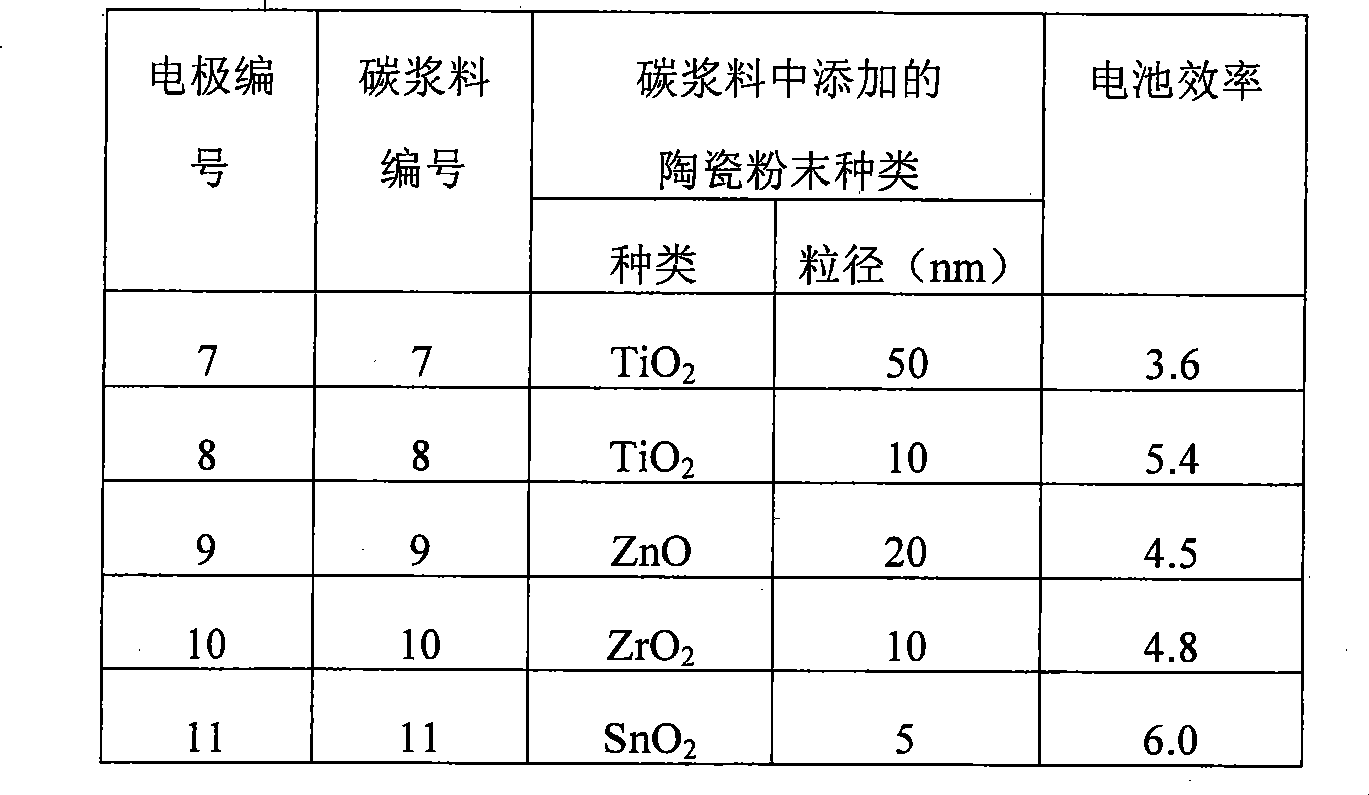

实施例3:Example 3:
选取2mm厚,表面电阻为0.03Ω/□的石墨板作为导电的碳基底A,比表面积为13m2/g的鳞片状石墨为催化活性材料。按照专利公开号CN101188257A的碳浆料的制备方法制备碳浆料,同时在碳浆料中添加1.2g的陶瓷粉末,陶瓷粉末的种类和大小见表3(6种实施例的数据列在表3中),将碳浆料涂敷在碳基底A上形成催化活性材料层B,其中催化活性材料层B的厚度为:20μm。A graphite plate with a thickness of 2mm and a surface resistance of 0.03Ω/□ was selected as the conductive carbon substrate A, and flake graphite with a specific surface area of 13m2/g was used as the catalytic active material. Prepare carbon slurry according to the preparation method of the carbon slurry of patent publication number CN101188257A, add the ceramic powder of 1.2g in carbon slurry simultaneously, the type and size of ceramic powder are shown in Table 3 (the data of 6 kinds of embodiments are listed in Table 3 Middle), the carbon slurry is coated on the carbon substrate A to form a catalytically active material layer B, wherein the thickness of the catalytically active material layer B is: 20 μm.
表3中包括6种实施例的全碳对电极的具体制备过程如下:The specific preparation process of the all-carbon counter electrode including 6 kinds of embodiments in Table 3 is as follows:
1)首先按照专利(公开号CN101188257A)碳浆料的制备方法制备碳浆料13-18。具体的配方和制作步骤为:a)称取2.000g乙基纤维素(粘度调节剂),加入到5ml松油醇和15ml异丙醇的混合溶剂中,温度保持在30-40℃,搅拌4小时,使其溶解,然后加入5.900g的造孔物质聚乙二醇2000和1.500g的表面活性剂TX-100并混合均匀,形成液体混合物。b)将制备的液体混合物与6.0000g碳催化活性材料和0.1200g的陶瓷粉末混合,再用球磨机混合4小时,制成碳浆料13-18。其中碳催化活性材料为比表面积为13m2/g的鳞片状石墨,所用陶瓷粉末的种类和大小见表3。1) Firstly, prepare carbon slurry 13-18 according to the preparation method of carbon slurry in the patent (publication number CN101188257A). The specific formula and production steps are: a) Weigh 2.000g of ethyl cellulose (viscosity regulator), add it to a mixed solvent of 5ml terpineol and 15ml isopropanol, keep the temperature at 30-40°C, and stir for 4 hours , make it dissolve, then add 5.900g of pore-forming substance polyethylene glycol 2000 and 1.500g of surfactant TX-100 and mix well to form a liquid mixture. b) The prepared liquid mixture was mixed with 6.0000 g of carbon catalytically active material and 0.1200 g of ceramic powder, and then mixed with a ball mill for 4 hours to prepare carbon slurry 13-18. The carbon catalytic active material is flake graphite with a specific surface area of 13m 2 /g, and the types and sizes of the ceramic powders used are shown in Table 3.
2)在洗净的石墨板基底上,将表3中的碳浆料13-18在室温下丝网印刷到基底上。2) On the cleaned graphite plate substrate, the carbon pastes 13-18 in Table 3 were screen printed onto the substrate at room temperature.
3)产物在室温下自然晾干后,450℃热处理30min,自然冷却,得到本发明具有催化活性的全碳对电极13-18,催化活性层碳膜厚20μm。3) After the product was dried naturally at room temperature, it was heat-treated at 450° C. for 30 minutes, and cooled naturally to obtain the catalytically active all-carbon counter electrode 13-18 of the present invention, and the carbon film thickness of the catalytic active layer was 20 μm.
将其组装成染料敏化太阳能电池,组装方法同实施例1。全碳对电极及组装的染料敏化太阳能电池性能见表3。It was assembled into a dye-sensitized solar cell, and the assembly method was the same as in Example 1. The properties of the all-carbon counter electrode and the assembled dye-sensitized solar cells are shown in Table 3.
表3table 3
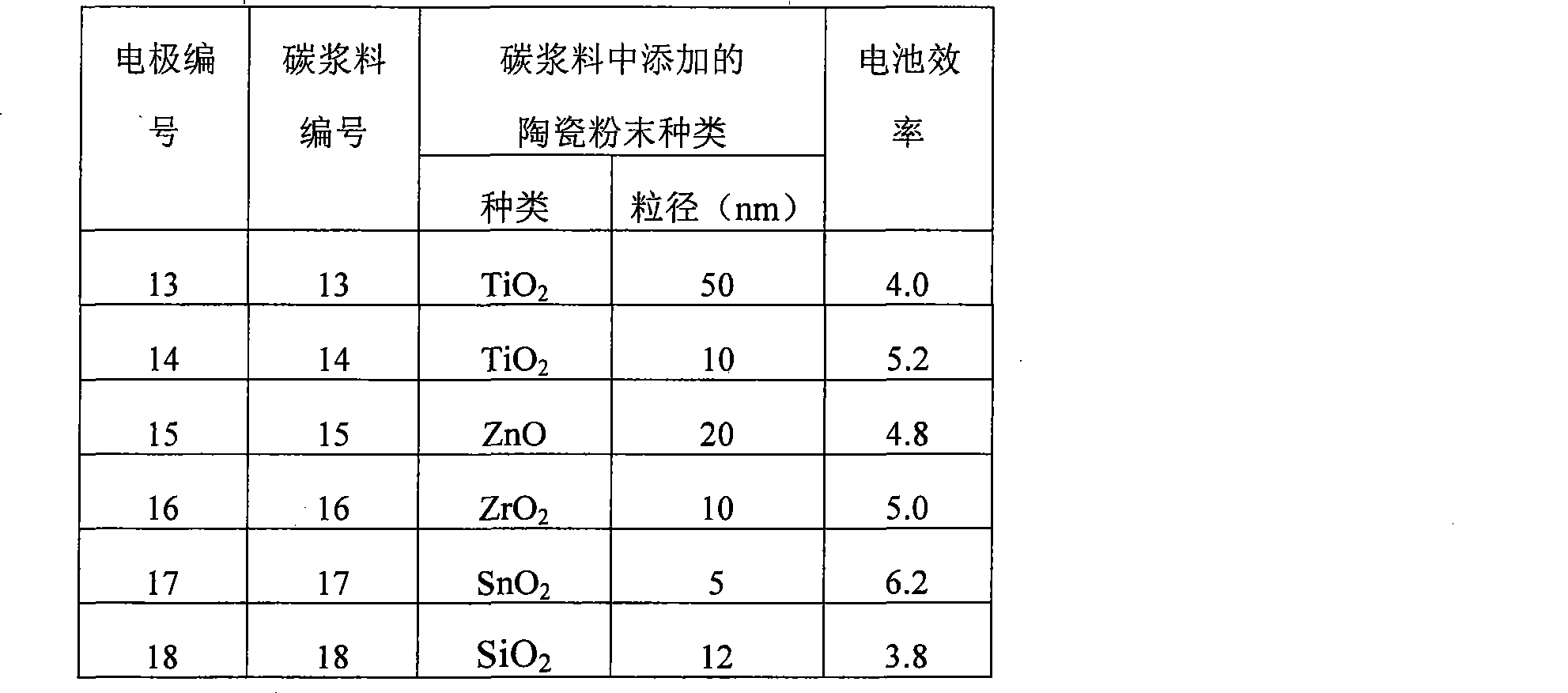
实施例4:Example 4:
以硬碳粉末1(粒径1μm,比表面积为80m2/g)、硬碳粉末2((粒径5μm,比表面积为733m2/g)和碳黑(粒径30nm,比表面积为77m2/g)为催化活性材料,按照专利公开号CN101188257A的碳浆料的制备方法制备碳浆料19,将碳浆料19涂敷在碳基底A上形成催化活性材料层B,制得全碳对电极19-24。Take hard carbon powder 1 (particle size 1μm, specific surface area of 80m 2 /g), hard carbon powder 2 ((particle size 5μm, specific surface area of 733m 2 /g) and carbon black (particle size 30nm, specific surface area of 77m 2 /g) is the catalytically active material, according to the preparation method of the carbon slurry of the patent publication number CN101188257A, the carbon slurry 19 is prepared, and the carbon slurry 19 is coated on the carbon substrate A to form the catalytically active material layer B, and the whole Carbon counter electrodes 19-24.
表4中6种实施例的全碳对电极的具体制备过程如下:The concrete preparation process of the all-carbon counter electrode of 6 kinds of embodiments in table 4 is as follows:
1)依据专利(公开号CN101188257A)中的实施例4方法制备碳浆料,称取1.250g乙基纤维素(粘度调节剂),加入到7ml松油醇(溶剂)中,温度保持在70-80℃,搅拌4小时,使其溶解,再加入8.000g的造孔物质聚乙二醇1500和1.200g的表面活性剂TX-100并混合均匀,形成液体混合物。将以上液体混合物与6.000g碳催化活性材料和0.6000g ZrO2粉末(粒径10nm)混合,再用球磨机混合8小时,制成碳浆料(编号为19)。其中的碳催化活性材料为硬碳粉末1、硬碳粉末2和碳黑的混合物,其中硬碳粉末1占碳催化活性材料的质量百分数为65%,硬碳粉末2的质量百分数为10%,碳黑的质量百分数为25%。1) Prepare carbon slurry according to the method of Example 4 in the patent (publication number CN101188257A), weigh 1.250g ethyl cellulose (viscosity regulator), join in 7ml terpineol (solvent), and keep the temperature at 70- Stir at 80°C for 4 hours to dissolve, then add 8.000g of pore-forming substance polyethylene glycol 1500 and 1.200g of surfactant TX-100 and mix uniformly to form a liquid mixture. The above liquid mixture was mixed with 6.000g of carbon catalytically active material and 0.6000g of ZrO2 powder (particle size 10nm), and mixed with a ball mill for 8 hours to make a carbon slurry (No. 19). Carbon catalytic active material wherein is the mixture of hard carbon powder 1, hard carbon powder 2 and carbon black, and wherein hard carbon powder 1 accounts for the mass percentage of carbon catalytic active material to be 65%, the mass percentage of hard carbon powder 2 is 10%, and the mass percentage of carbon black is 25%.
2)在洗净的基底上,将碳浆料19在室温下丝网印刷到基底上。2) On the cleaned substrate, the carbon paste 19 is screen printed onto the substrate at room temperature.
3)产物在室温下自然晾干后,450℃通空气热处理10min,通氮气热处理20min,然后在氮气气氛下冷却,通过重复步骤2)和步骤3)可得到具有不同催化活性层厚度的全碳对电极19-24。3) After the product is naturally dried at room temperature, it is heat-treated with air at 450°C for 10 minutes, heat-treated with nitrogen for 20 minutes, and then cooled under a nitrogen atmosphere. By repeating steps 2) and 3), full carbon with different catalytically active layer thicknesses can be obtained. Counter electrodes 19-24.
按照实施例1中所述的方法将全碳对电极组装成染料敏化太阳能电池,全碳对电极与相应电池的性能参数见表4。采用全碳对电极20所组装染料敏化太阳能电池的光电流-光电压曲线见图2。According to the method described in Example 1, the all-carbon counter electrode was assembled into a dye-sensitized solar cell, and the performance parameters of the all-carbon counter electrode and the corresponding battery are shown in Table 4. The photocurrent-photovoltage curve of the dye-sensitized solar cell assembled with the all-carbon counter electrode 20 is shown in FIG. 2 .
表4Table 4

实施例5Example 5
选取0.3mm厚,表面电阻为0.1Ω/□的石墨纸作为导电的碳基底A,选取比表面积为1958m2/g的活性炭为催化活性材料。按照专利公开号CN101188257A的碳浆料的制备方法制备碳浆料,将制备好的碳浆料涂敷在碳基底A上形成催化活性材料层B,其中催化活性材料层B的厚度为:15μm;其结构如图1所示。Graphite paper with a thickness of 0.3 mm and a surface resistance of 0.1 Ω/□ was selected as the conductive carbon substrate A, and activated carbon with a specific surface area of 1958 m 2 /g was selected as the catalytic active material. Prepare the carbon slurry according to the preparation method of the carbon slurry in the patent publication number CN101188257A, apply the prepared carbon slurry on the carbon substrate A to form a catalytically active material layer B, wherein the thickness of the catalytically active material layer B is: 15 μm; Its structure is shown in Figure 1.
Claims (8)
Priority Applications (1)
| Application Number | Priority Date | Filing Date | Title |
|---|---|---|---|
| CN2008101180716A CN101388294B (en) | 2008-08-07 | 2008-08-07 | Full carbon counter electrode dye-sensitized solar cell and preparing method |
Applications Claiming Priority (1)
| Application Number | Priority Date | Filing Date | Title |
|---|---|---|---|
| CN2008101180716A CN101388294B (en) | 2008-08-07 | 2008-08-07 | Full carbon counter electrode dye-sensitized solar cell and preparing method |
Publications (2)
| Publication Number | Publication Date |
|---|---|
| CN101388294A true CN101388294A (en) | 2009-03-18 |
| CN101388294B CN101388294B (en) | 2011-05-04 |
Family
ID=40477636
Family Applications (1)
| Application Number | Title | Priority Date | Filing Date |
|---|---|---|---|
| CN2008101180716A Active CN101388294B (en) | 2008-08-07 | 2008-08-07 | Full carbon counter electrode dye-sensitized solar cell and preparing method |
Country Status (1)
| Country | Link |
|---|---|
| CN (1) | CN101388294B (en) |
Cited By (15)
| Publication number | Priority date | Publication date | Assignee | Title |
|---|---|---|---|---|
| CN101777429A (en) * | 2010-02-10 | 2010-07-14 | 中国科学院上海硅酸盐研究所 | Graphene-based dye-sensitized solar cell complex light anode and preparation method |
| CN101894677A (en) * | 2010-06-30 | 2010-11-24 | 中国乐凯胶片集团公司 | Flexible carbon counter electrode for flexible dye-sensitized solar cell and preparation method thereof |
| CN101976608A (en) * | 2010-09-27 | 2011-02-16 | 彩虹集团公司 | Method for preparing counter electrode of dye-sensitized solar cell |
| CN102522213A (en) * | 2011-12-03 | 2012-06-27 | 三峡大学 | Preparation method for dye sensitization solar cell carbon counter electrodes |
| CN102568849A (en) * | 2011-12-29 | 2012-07-11 | 大连理工大学 | Carbon counter electrode for dye-sensitized solar cell and preparation method for carbon counter electrode |
| CN102568839A (en) * | 2011-11-30 | 2012-07-11 | 北京信息科技大学 | Carbon counter electrode used for sensitized solar cells and preparation method thereof |
| CN102881458A (en) * | 2012-09-25 | 2013-01-16 | 南京工业大学 | Preparation method of graphene composite titanium dioxide slurry |
| CN103384915A (en) * | 2011-02-11 | 2013-11-06 | 诺基亚公司 | Sensing of photons |
| CN103594249A (en) * | 2013-11-29 | 2014-02-19 | 天津理工大学 | Manufacturing method and application of graphene oxide-nano-graphite powder compound counter electrode |
| CN104681283A (en) * | 2015-02-12 | 2015-06-03 | 宁波大学 | Modified carbon black and graphite counter electrode as well as preparation method and application thereof |
| CN107275493A (en) * | 2017-05-31 | 2017-10-20 | 南京航空航天大学 | Preparation method of all print perovskite high osmosis porous carbon used for solar batteries to electrode |
| CN107633950A (en) * | 2017-09-20 | 2018-01-26 | 陈卓 | It is a kind of to be used for the compound carbon-based to electrode and preparation method thereof of DSSC |
| CN108666140A (en) * | 2017-03-28 | 2018-10-16 | 北京大学深圳研究生院 | A kind of dye-sensitized solar cell counter electrode material and its preparation method and application |
| CN110651367A (en) * | 2017-09-14 | 2020-01-03 | 谷歌有限责任公司 | Paint circuit |
| CN110828186A (en) * | 2019-11-18 | 2020-02-21 | 黑龙江科技大学 | A kind of preparation method of CeO2 modified nitrogen-doped graphene DSSC counter electrode |
Family Cites Families (2)
| Publication number | Priority date | Publication date | Assignee | Title |
|---|---|---|---|---|
| CN101188257B (en) * | 2006-11-16 | 2011-08-17 | 中国科学院物理研究所 | Carbon plasma for electrode of dye sensitization solar battery pair and its making method |
| CN101170137A (en) * | 2007-11-21 | 2008-04-30 | 清华大学 | Mesoporous carbon counter electrode for dye-sensitized solar cells and preparation method thereof |
-
2008
- 2008-08-07 CN CN2008101180716A patent/CN101388294B/en active Active
Cited By (24)
| Publication number | Priority date | Publication date | Assignee | Title |
|---|---|---|---|---|
| CN101777429A (en) * | 2010-02-10 | 2010-07-14 | 中国科学院上海硅酸盐研究所 | Graphene-based dye-sensitized solar cell complex light anode and preparation method |
| CN101894677A (en) * | 2010-06-30 | 2010-11-24 | 中国乐凯胶片集团公司 | Flexible carbon counter electrode for flexible dye-sensitized solar cell and preparation method thereof |
| CN101976608A (en) * | 2010-09-27 | 2011-02-16 | 彩虹集团公司 | Method for preparing counter electrode of dye-sensitized solar cell |
| CN103384915B (en) * | 2011-02-11 | 2016-01-20 | 诺基亚技术有限公司 | photon sensing |
| CN103384915A (en) * | 2011-02-11 | 2013-11-06 | 诺基亚公司 | Sensing of photons |
| CN102568839A (en) * | 2011-11-30 | 2012-07-11 | 北京信息科技大学 | Carbon counter electrode used for sensitized solar cells and preparation method thereof |
| CN102522213A (en) * | 2011-12-03 | 2012-06-27 | 三峡大学 | Preparation method for dye sensitization solar cell carbon counter electrodes |
| CN102522213B (en) * | 2011-12-03 | 2013-11-13 | 三峡大学 | Preparation method for dye sensitization solar cell carbon counter electrodes |
| CN102568849B (en) * | 2011-12-29 | 2014-12-31 | 大连理工大学 | Carbon counter electrode for dye-sensitized solar cell and preparation method for carbon counter electrode |
| CN102568849A (en) * | 2011-12-29 | 2012-07-11 | 大连理工大学 | Carbon counter electrode for dye-sensitized solar cell and preparation method for carbon counter electrode |
| CN102881458B (en) * | 2012-09-25 | 2016-01-20 | 南京工业大学 | Preparation method of graphene composite titanium dioxide slurry |
| CN102881458A (en) * | 2012-09-25 | 2013-01-16 | 南京工业大学 | Preparation method of graphene composite titanium dioxide slurry |
| CN103594249A (en) * | 2013-11-29 | 2014-02-19 | 天津理工大学 | Manufacturing method and application of graphene oxide-nano-graphite powder compound counter electrode |
| CN103594249B (en) * | 2013-11-29 | 2016-02-10 | 天津理工大学 | A kind of graphene oxide-nano-graphite flour complexes is to the preparations and applicatio of electrode |
| CN104681283A (en) * | 2015-02-12 | 2015-06-03 | 宁波大学 | Modified carbon black and graphite counter electrode as well as preparation method and application thereof |
| CN108666140A (en) * | 2017-03-28 | 2018-10-16 | 北京大学深圳研究生院 | A kind of dye-sensitized solar cell counter electrode material and its preparation method and application |
| CN108666140B (en) * | 2017-03-28 | 2020-02-07 | 北京大学深圳研究生院 | Counter electrode material of dye-sensitized solar cell and preparation method and application thereof |
| CN107275493A (en) * | 2017-05-31 | 2017-10-20 | 南京航空航天大学 | Preparation method of all print perovskite high osmosis porous carbon used for solar batteries to electrode |
| CN107275493B (en) * | 2017-05-31 | 2019-07-09 | 南京航空航天大学 | Preparation method of all print perovskite high osmosis porous carbon used for solar batteries to electrode |
| CN110651367A (en) * | 2017-09-14 | 2020-01-03 | 谷歌有限责任公司 | Paint circuit |
| CN110651367B (en) * | 2017-09-14 | 2023-08-08 | 谷歌有限责任公司 | dope circuit |
| CN107633950A (en) * | 2017-09-20 | 2018-01-26 | 陈卓 | It is a kind of to be used for the compound carbon-based to electrode and preparation method thereof of DSSC |
| CN110828186A (en) * | 2019-11-18 | 2020-02-21 | 黑龙江科技大学 | A kind of preparation method of CeO2 modified nitrogen-doped graphene DSSC counter electrode |
| CN110828186B (en) * | 2019-11-18 | 2021-09-28 | 黑龙江科技大学 | CeO (CeO)2Preparation method of modified nitrogen-doped graphene DSSC counter electrode |
Also Published As
| Publication number | Publication date |
|---|---|
| CN101388294B (en) | 2011-05-04 |
Similar Documents
| Publication | Publication Date | Title |
|---|---|---|
| CN101388294B (en) | Full carbon counter electrode dye-sensitized solar cell and preparing method | |
| Li et al. | High-performance and low platinum loading Pt/Carbon black counter electrode for dye-sensitized solar cells | |
| Poudel et al. | Carbon nanostructure counter electrodes for low cost and stable dye-sensitized solar cells | |
| Suzuki et al. | Application of carbon nanotubes to counter electrodes of dye-sensitized solar cells | |
| Zhang et al. | Increased power conversion efficiency of dye-sensitized solar cells with counter electrodes based on carbon materials | |
| Zhu et al. | Anthocyanin-sensitized solar cells using carbon nanotube films as counter electrodes | |
| CN102347143B (en) | A kind of graphene composite porous counter electrode, preparation method and applications | |
| CN102543469B (en) | Dye-sensitized solar cell nitrogen-doping graphene counter electrode and preparation method thereof | |
| Zhang et al. | Fabrication of double-walled carbon nanotube counter electrodes for dye-sensitized solar sells | |
| KR101041931B1 (en) | Dye-sensitized solar cell electrode using carbon nanotube grafted with living polymer and modified method | |
| Joshi et al. | Nickel incorporated carbon nanotube/nanofiber composites as counter electrodes for dye-sensitized solar cells | |
| Chokkiah et al. | Novel PDPA-SiO2 nanosphericals network decorated graphene nanosheets composite coated FTO electrode for efficient electro-oxidation of methanol | |
| CN103413687B (en) | Preparation method of dye-sensitized solar cell platinum loaded silicon carbide counter electrodes | |
| CN108922653A (en) | A kind of perovskite carbon pastes used for solar batteries and electrode | |
| CN105374568B (en) | Graphite-phase C3N4The preparation method of/CNT combined counter electrode | |
| Siwach et al. | Effect of carbonaceous counter electrodes on the performance of ZnO-graphene nanocomposites based dye sensitized solar cells | |
| Zheng et al. | Fabrication and characterization of a multi-walled carbon nanotube-based counter electrode for dye-sensitized solar cells | |
| KR100783766B1 (en) | Carbon nanotube electrode and manufacturing method thereof and dye-sensitized solar cell | |
| JP6374950B2 (en) | Photoelectric conversion positive electrode, positive electrode forming slurry, and production method thereof | |
| JP5569947B2 (en) | Counter electrode for dye-sensitized solar cell, solar cell device and manufacturing method thereof | |
| CN101783212B (en) | Conductive adhesive and preparation method of conductive porous membrane with large specific surface | |
| CN102779650B (en) | Method for manufacturing carbon counter electrode of dye-sensitized solar cell | |
| CN101207159A (en) | A kind of titanium dioxide binary nanocrystalline porous film and preparation method thereof | |
| CN102568849B (en) | Carbon counter electrode for dye-sensitized solar cell and preparation method for carbon counter electrode | |
| CN103021663B (en) | The carbon nano-tube film solaode preparation method to electrode material |
Legal Events
| Date | Code | Title | Description |
|---|---|---|---|
| C06 | Publication | ||
| PB01 | Publication | ||
| C10 | Entry into substantive examination | ||
| SE01 | Entry into force of request for substantive examination | ||
| C14 | Grant of patent or utility model | ||
| GR01 | Patent grant | ||
| TR01 | Transfer of patent right |
Effective date of registration: 20221129 Address after: 518100 602, Block A, Longgang Smart Home, No. 76, Baohe Avenue, Baolong Community, Baolong Street, Longgang District, Shenzhen, Guangdong Patentee after: Shenzhen Huayu Solar Technology Co.,Ltd. Address before: 100190 No. 8, South Third Street, Haidian District, Beijing, Zhongguancun Patentee before: INSTITUTE OF PHYSICS, CHINESE ACADEMY OF SCIENCES |
|
| TR01 | Transfer of patent right |