CN101379192A - anti-Met monoclonal antibody for treating tumor, fragment and carrier thereof and corresponding product - Google Patents
anti-Met monoclonal antibody for treating tumor, fragment and carrier thereof and corresponding product Download PDFInfo
- Publication number
- CN101379192A CN101379192A CNA2007800047097A CN200780004709A CN101379192A CN 101379192 A CN101379192 A CN 101379192A CN A2007800047097 A CNA2007800047097 A CN A2007800047097A CN 200780004709 A CN200780004709 A CN 200780004709A CN 101379192 A CN101379192 A CN 101379192A
- Authority
- CN
- China
- Prior art keywords
- hgfr
- antibody
- met
- seq
- cells
- Prior art date
- Legal status (The legal status is an assumption and is not a legal conclusion. Google has not performed a legal analysis and makes no representation as to the accuracy of the status listed.)
- Granted
Links
Images


Classifications
-
- C—CHEMISTRY; METALLURGY
- C07—ORGANIC CHEMISTRY
- C07K—PEPTIDES
- C07K16/00—Immunoglobulins [IGs], e.g. monoclonal or polyclonal antibodies
- C07K16/18—Immunoglobulins [IGs], e.g. monoclonal or polyclonal antibodies against material from animals or humans
- C07K16/28—Immunoglobulins [IGs], e.g. monoclonal or polyclonal antibodies against material from animals or humans against receptors, cell surface antigens or cell surface determinants
-
- C—CHEMISTRY; METALLURGY
- C07—ORGANIC CHEMISTRY
- C07K—PEPTIDES
- C07K16/00—Immunoglobulins [IGs], e.g. monoclonal or polyclonal antibodies
- C07K16/18—Immunoglobulins [IGs], e.g. monoclonal or polyclonal antibodies against material from animals or humans
- C07K16/28—Immunoglobulins [IGs], e.g. monoclonal or polyclonal antibodies against material from animals or humans against receptors, cell surface antigens or cell surface determinants
- C07K16/2863—Immunoglobulins [IGs], e.g. monoclonal or polyclonal antibodies against material from animals or humans against receptors, cell surface antigens or cell surface determinants against receptors for growth factors, growth regulators
-
- A—HUMAN NECESSITIES
- A61—MEDICAL OR VETERINARY SCIENCE; HYGIENE
- A61K—PREPARATIONS FOR MEDICAL, DENTAL OR TOILETRY PURPOSES
- A61K39/00—Medicinal preparations containing antigens or antibodies
- A61K39/395—Antibodies; Immunoglobulins; Immune serum, e.g. antilymphocytic serum
-
- A—HUMAN NECESSITIES
- A61—MEDICAL OR VETERINARY SCIENCE; HYGIENE
- A61P—SPECIFIC THERAPEUTIC ACTIVITY OF CHEMICAL COMPOUNDS OR MEDICINAL PREPARATIONS
- A61P35/00—Antineoplastic agents
-
- A—HUMAN NECESSITIES
- A61—MEDICAL OR VETERINARY SCIENCE; HYGIENE
- A61P—SPECIFIC THERAPEUTIC ACTIVITY OF CHEMICAL COMPOUNDS OR MEDICINAL PREPARATIONS
- A61P35/00—Antineoplastic agents
- A61P35/04—Antineoplastic agents specific for metastasis
-
- A—HUMAN NECESSITIES
- A61—MEDICAL OR VETERINARY SCIENCE; HYGIENE
- A61P—SPECIFIC THERAPEUTIC ACTIVITY OF CHEMICAL COMPOUNDS OR MEDICINAL PREPARATIONS
- A61P43/00—Drugs for specific purposes, not provided for in groups A61P1/00-A61P41/00
-
- C—CHEMISTRY; METALLURGY
- C07—ORGANIC CHEMISTRY
- C07K—PEPTIDES
- C07K16/00—Immunoglobulins [IGs], e.g. monoclonal or polyclonal antibodies
- C07K16/18—Immunoglobulins [IGs], e.g. monoclonal or polyclonal antibodies against material from animals or humans
- C07K16/32—Immunoglobulins [IGs], e.g. monoclonal or polyclonal antibodies against material from animals or humans against translation products of oncogenes
-
- C—CHEMISTRY; METALLURGY
- C12—BIOCHEMISTRY; BEER; SPIRITS; WINE; VINEGAR; MICROBIOLOGY; ENZYMOLOGY; MUTATION OR GENETIC ENGINEERING
- C12N—MICROORGANISMS OR ENZYMES; COMPOSITIONS THEREOF; PROPAGATING, PRESERVING, OR MAINTAINING MICROORGANISMS; MUTATION OR GENETIC ENGINEERING; CULTURE MEDIA
- C12N15/00—Mutation or genetic engineering; DNA or RNA concerning genetic engineering, vectors, e.g. plasmids, or their isolation, preparation or purification; Use of hosts therefor
- C12N15/09—Recombinant DNA-technology
- C12N15/11—DNA or RNA fragments; Modified forms thereof; Non-coding nucleic acids having a biological activity
-
- C—CHEMISTRY; METALLURGY
- C12—BIOCHEMISTRY; BEER; SPIRITS; WINE; VINEGAR; MICROBIOLOGY; ENZYMOLOGY; MUTATION OR GENETIC ENGINEERING
- C12N—MICROORGANISMS OR ENZYMES; COMPOSITIONS THEREOF; PROPAGATING, PRESERVING, OR MAINTAINING MICROORGANISMS; MUTATION OR GENETIC ENGINEERING; CULTURE MEDIA
- C12N15/00—Mutation or genetic engineering; DNA or RNA concerning genetic engineering, vectors, e.g. plasmids, or their isolation, preparation or purification; Use of hosts therefor
- C12N15/09—Recombinant DNA-technology
- C12N15/63—Introduction of foreign genetic material using vectors; Vectors; Use of hosts therefor; Regulation of expression
- C12N15/79—Vectors or expression systems specially adapted for eukaryotic hosts
- C12N15/85—Vectors or expression systems specially adapted for eukaryotic hosts for animal cells
- C12N15/86—Viral vectors
- C12N15/867—Retroviral vectors
-
- A—HUMAN NECESSITIES
- A61—MEDICAL OR VETERINARY SCIENCE; HYGIENE
- A61K—PREPARATIONS FOR MEDICAL, DENTAL OR TOILETRY PURPOSES
- A61K39/00—Medicinal preparations containing antigens or antibodies
- A61K2039/505—Medicinal preparations containing antigens or antibodies comprising antibodies
-
- C—CHEMISTRY; METALLURGY
- C07—ORGANIC CHEMISTRY
- C07K—PEPTIDES
- C07K2317/00—Immunoglobulins specific features
- C07K2317/70—Immunoglobulins specific features characterized by effect upon binding to a cell or to an antigen
- C07K2317/76—Antagonist effect on antigen, e.g. neutralization or inhibition of binding
-
- C—CHEMISTRY; METALLURGY
- C07—ORGANIC CHEMISTRY
- C07K—PEPTIDES
- C07K2317/00—Immunoglobulins specific features
- C07K2317/70—Immunoglobulins specific features characterized by effect upon binding to a cell or to an antigen
- C07K2317/77—Internalization into the cell
-
- C—CHEMISTRY; METALLURGY
- C12—BIOCHEMISTRY; BEER; SPIRITS; WINE; VINEGAR; MICROBIOLOGY; ENZYMOLOGY; MUTATION OR GENETIC ENGINEERING
- C12N—MICROORGANISMS OR ENZYMES; COMPOSITIONS THEREOF; PROPAGATING, PRESERVING, OR MAINTAINING MICROORGANISMS; MUTATION OR GENETIC ENGINEERING; CULTURE MEDIA
- C12N2799/00—Uses of viruses
- C12N2799/02—Uses of viruses as vector
- C12N2799/021—Uses of viruses as vector for the expression of a heterologous nucleic acid
- C12N2799/027—Uses of viruses as vector for the expression of a heterologous nucleic acid where the vector is derived from a retrovirus
Landscapes
- Health & Medical Sciences (AREA)
- Chemical & Material Sciences (AREA)
- Life Sciences & Earth Sciences (AREA)
- Organic Chemistry (AREA)
- Genetics & Genomics (AREA)
- General Health & Medical Sciences (AREA)
- Medicinal Chemistry (AREA)
- Immunology (AREA)
- Engineering & Computer Science (AREA)
- Molecular Biology (AREA)
- Biophysics (AREA)
- Biochemistry (AREA)
- Bioinformatics & Cheminformatics (AREA)
- Proteomics, Peptides & Aminoacids (AREA)
- Biomedical Technology (AREA)
- Pharmacology & Pharmacy (AREA)
- Wood Science & Technology (AREA)
- Veterinary Medicine (AREA)
- Public Health (AREA)
- Animal Behavior & Ethology (AREA)
- Zoology (AREA)
- Biotechnology (AREA)
- General Engineering & Computer Science (AREA)
- Nuclear Medicine, Radiotherapy & Molecular Imaging (AREA)
- General Chemical & Material Sciences (AREA)
- Chemical Kinetics & Catalysis (AREA)
- Oncology (AREA)
- Microbiology (AREA)
- Plant Pathology (AREA)
- Physics & Mathematics (AREA)
- Mycology (AREA)
- Epidemiology (AREA)
- Virology (AREA)
- Medicines Containing Antibodies Or Antigens For Use As Internal Diagnostic Agents (AREA)
- Peptides Or Proteins (AREA)
- Medicines That Contain Protein Lipid Enzymes And Other Medicines (AREA)
- Preparation Of Compounds By Using Micro-Organisms (AREA)
- Pharmaceuticals Containing Other Organic And Inorganic Compounds (AREA)
Abstract
Description
发明领域field of invention
本发明涉及单克隆抗体、其片段和/或部分的用途,及编码单克隆抗体、其片段和/或部分的核苷酸序列用于制备治疗肿瘤和转移的药物和体内或体外检测赘生细胞的诊断装置的用途。本发明特别涉及靶向于肝细胞生长因子受体的胞外域的抗Met单克隆抗体的用途。The present invention relates to the use of monoclonal antibodies, fragments and/or parts thereof, and the nucleotide sequences encoding monoclonal antibodies, fragments and/or parts thereof, for the preparation of drugs for treating tumors and metastasis and the detection of neoplastic cells in vivo or in vitro use of diagnostic devices. The present invention particularly relates to the application of the anti-Met monoclonal antibody targeting the extracellular domain of the hepatocyte growth factor receptor.
发明背景Background of the invention
癌免疫疗法的科学探索始于20世纪50年代并且首先应用多克隆抗体。在经过了50多年的今天,使用单克隆抗体的免疫疗法继续给癌症治疗提供了有希望的选择(1、2)。数个以癌症中的酪氨酸激酶受体(RTKs)为靶的抗体现在用于临床实践(3)。在不同情况下这些抗体的作用机制不同并且尽管有成功使用的实例,通常并不能充分了解其机制(4)。贝伐单抗和西妥昔单抗分别靶向于血管内皮生长因子-血管内皮生长因子受体(VEGF-VEGFR)和表皮生长因子-表皮生长因子受体(EGF-EGFR),通过阻止配体-受体的相互作用来起作用(5,6)。赫赛汀(Herceptin)是对人表皮生长因子受体2(HER2)特异的单克隆抗体,HER2是EGFR家族中的一员。赫赛汀起效的作用机制还不明确,但是已显示它促进HER2降解从而降低癌细胞表面的受体水平(7)。The scientific exploration of cancer immunotherapy began in the 1950s with the first application of polyclonal antibodies. Today, more than 50 years later, immunotherapy using monoclonal antibodies continues to offer a promising option for cancer treatment (1, 2). Several antibodies targeting receptor tyrosine kinases (RTKs) in cancer are now in clinical practice (3). The mechanism of action of these antibodies varies in different situations and although there are examples of successful use, the mechanism is often not well understood (4). Bevacizumab and cetuximab target vascular endothelial growth factor-vascular endothelial growth factor receptor (VEGF-VEGFR) and epidermal growth factor-epidermal growth factor receptor (EGF-EGFR), respectively, by blocking ligand -Receptor interactions to function (5,6). Herceptin is a monoclonal antibody specific to human epidermal growth factor receptor 2 (HER2), which is a member of the EGFR family. The mechanism by which Herceptin works is unclear, but it has been shown to promote the degradation of HER2 thereby reducing the level of the receptor on the surface of cancer cells (7).
编码肝细胞生长因子(HGF)的酪氨酸激酶受体的MET致癌基因控制导致细胞生长、侵入和免于细胞凋亡的遗传程序。不受调控的肝细胞生长因子受体(HGFR)的活化状态对获得致瘤性质和侵入表型均十分重要(8)。人肿瘤中的MET的作用从多种实验中揭示出来并通过发现癌遗传形式中的MET激活突变(9,10)被毫无疑义的证实。此外,HGFR组成型激活还常常存在于散发性癌中,并且从本实验室和其他实验室的研究已证明MET致癌基因在特殊组织分型的肿瘤中过表达或由自身内分泌机制被激活。此外,MET基因在结肠直肠癌的血原性转移中被扩增(11)。因此干扰Met激活成为阻止肿瘤发生和转移过程的有挑战性的方法。过去数年中已提出许多策略来阻断变异HGFR信号系统、靶向HGFR自身或其配体。这些方法包括使用HGF拮抗剂、HGF中和抗体、HGFR诱饵、HGFR或小分子如格尔德霉素的小分子ATP结合位点抑制剂、SH2域多肽和核酶(12中综述)。The MET oncogene, encoding the tyrosine kinase receptor for hepatocyte growth factor (HGF), controls genetic programs leading to cell growth, invasion, and protection from apoptosis. The unregulated activation status of the hepatocyte growth factor receptor (HGFR) is important for the acquisition of both tumorigenic properties and the invasive phenotype (8). The role of MET in human tumors has been revealed from various experiments and unequivocally confirmed by the discovery of MET activating mutations in inherited forms of cancer (9, 10). In addition, constitutive activation of HGFR is often present in sporadic carcinomas, and studies from our laboratory and other laboratories have demonstrated that the MET oncogene is overexpressed in tumors of specific tissue types or activated by their own endocrine mechanisms. Furthermore, the MET gene is amplified in hematogenous metastases of colorectal cancer (11). Interfering with Met activation therefore becomes a challenging approach to prevent tumorigenesis and metastatic processes. A number of strategies have been proposed over the past few years to block the mutant HGFR signaling system, targeting HGFR itself or its ligands. These approaches include the use of HGF antagonists, HGF neutralizing antibodies, HGFR decoys, small molecule ATP binding site inhibitors of HGFR or small molecules such as geldanamycin, SH2 domain polypeptides and ribozymes (reviewed in 12).
发明概述Summary of the invention
本发明涉及靶向于肝细胞生长因子(HGFR)的胞外域的单克隆抗体用于治疗肿瘤病人肿瘤和/或转移以及在体内或体外检测赘生细胞的诊断装置中的用途。The present invention relates to the use of a monoclonal antibody targeting the extracellular domain of hepatocyte growth factor (HGFR) in a diagnostic device for treating tumors and/or metastasis of tumor patients and detecting neoplastic cells in vivo or in vitro.
因此,本发明的目的是i)抗-Met单克隆抗体、ii)含有抗-Met单克隆抗体的表位结合区的片段和/或iii)含有抗-Met单克隆抗体的表位结合区或互补决定区(CDRs)的基因工程抗体用于制备治疗肿瘤病人肿瘤和转移的药物和体内或体外检测赘生细胞的诊断装置的用途,其中命名为抗MET-R的抗-Met单克隆抗体由保存于Adanced BiotechnologyCenter(ABC),Interlab Cell Line Collection(ICLC),S.S.Banca Cellule e Colture in GMP、Largo Rosanna Benzi 10,Genva,Italy、登记号为ICLC PD 05006的杂交瘤细胞系制备。Therefore, the object of the present invention is i) an anti-Met monoclonal antibody, ii) a fragment containing the epitope binding region of an anti-Met monoclonal antibody and/or iii) an anti-Met monoclonal antibody containing an epitope binding region or The genetically engineered antibody of complementarity determining region (CDRs) is used for preparing the purposes of the medicine of treating tumor patient's tumor and metastases and the diagnostic device of in vivo or in vitro detection neoplastic cell, wherein the anti-Met monoclonal antibody named as anti-MET-R is obtained by Prepared from a hybridoma cell line stored in Advanced Biotechnology Center (ABC), Interlab Cell Line Collection (ICLC), S.S. Banca Cellule e Colture in GMP, Largo Rosanna Benzi 10, Genva, Italy, with accession number ICLC PD 05006.
本发明的另一目的是包含至少编码抗Met单克隆抗体的表位结合区或CDRs的核苷酸序列的部分的载体的用途,其中由ICLC PD 05006杂交瘤细胞系制备的抗Met单克隆抗体用于制备治疗肿瘤病人肿瘤和转移的药物。Another object of the present invention is the use of a vector comprising at least part of the nucleotide sequence encoding the epitope binding region or CDRs of an anti-Met monoclonal antibody, wherein the anti-Met monoclonal antibody produced by the ICLC PD 05006 hybridoma cell line It is used for preparing medicines for treating tumors and metastases of tumor patients.
本发明的另一目的是i)抗-Met单克隆抗体、ii)含有抗-Met单克隆抗体的表位结合区的片段和/或iii)含有抗-Met单克隆抗体的表位结合区或CDRs的基因工程抗体和至少一种激酶抑制剂作为组合制剂在肿瘤和/或转移治疗中同时、分别或连续使用的用途。Another object of the present invention is i) an anti-Met monoclonal antibody, ii) a fragment containing the epitope binding region of an anti-Met monoclonal antibody and/or iii) an anti-Met monoclonal antibody containing an epitope binding region or The use of genetically engineered antibodies of CDRs and at least one kinase inhibitor as a combined preparation in the treatment of tumors and/or metastases simultaneously, separately or sequentially.
本发明的另一目的是筛选能够与至少一部分肝细胞生长因子受体(HGFR)胞外域结合的化合物以鉴别在预防和/或治疗肿瘤和/或转移中具有药理学活性的化合物的方法。Another object of the present invention is a method of screening compounds capable of binding to at least a part of the extracellular domain of hepatocyte growth factor receptor (HGFR) to identify compounds with pharmacological activity in the prevention and/or treatment of tumors and/or metastasis.
本发明的另一目的是抗MET-R抗体、其片段和/或含有抗MET-R抗体的表位结合区或CRDs的遗传工程抗体作为体内或体外检测赘生细胞的诊断工具的用途。Another object of the present invention is the use of anti-MET-R antibodies, fragments thereof and/or genetically engineered antibodies containing epitope binding regions or CRDs of anti-MET-R antibodies as diagnostic tools for detecting neoplastic cells in vivo or in vitro.
根据本发明,这些目的通过以下所附的权利要求来完成,这些权利要求是在此公开的本发明的技术教导不可缺少的部分。According to the present invention, these objects are achieved by the following appended claims, which are an integral part of the technical teaching of the invention disclosed herein.
附图简述Brief description of the drawings
图1.抗MET-R阻碍HGFR的激活和信号转导:(A)HGFR激活的评价。在所指示的时间使GTL16细胞接触抗MET-R。HGFR从细胞裂解产物中免疫沉淀,用指示的抗体(Abs)进行蛋白质印迹检测。抗MET-R处理得到比受体衰减调节更明显的受体激活的降低,如条带密度定量所显示的。(B)HGFR信号系统分析。细胞用疹型口炎病毒壳G糖蛋白(VSV-G)或抗MET-R预处理然后在指示的时间用HGF刺激。评价细胞总裂解产物中的Akt磷酸化。如上图所显示的,抗MET-R减少了基本的和HFG诱导的AKt激活。 Figure 1. Anti-MET-R blocks HGFR activation and signaling: (A) Evaluation of HGFR activation. GTL16 cells were exposed to AntiMET-R at the indicated times. HGFR was immunoprecipitated from cell lysates and detected by Western blot with the indicated antibodies (Abs). AntiMET-R treatment resulted in a more pronounced reduction in receptor activation than receptor attenuation, as shown by band density quantification. (B) Analysis of HGFR signaling system. Cells were pretreated with vesicular stomatitis virus capsid G glycoprotein (VSV-G) or antiMET-R and then stimulated with HGF at the indicated times. Akt phosphorylation was assessed in total cell lysates. As shown in the upper panel, AntiMET-R reduced basal and HFG-induced AKt activation.
图2.抗MET-R在体外抑制癌细胞的转化表型。(A)GRL16细胞的非停泊性生长。预处理细胞接种于0.5%琼脂中。然后细胞在指示量的抗MET-R或VSV-G抗体的存在下生长,10天后生长的菌落染色。即使在低剂量抗MET-R下非停泊性生长被彻底抑制。(B)侵入检测。在接种到基质胶涂层的Transwell小室前,用指示抗体预处理MDA-MB-435 β4 24小时。下层小室中充满DMEM 2%FBS和100ng/ml HGF。24小时后,移行细胞染色计数。响应HGF的侵入能力表达与未刺激细胞相比成倍增加。如图所示,抗MET-R处理显著降低细胞侵入。 Figure 2. AntiMET-R inhibits the transformed phenotype of cancer cells in vitro. (A) Non-anchorage growth of GRL16 cells. Pretreated cells were plated in 0.5% agar. Cells were then grown in the presence of the indicated amounts of anti-MET-R or VSV-G antibodies, and colonies grown after 10 days were stained. Non-anchoring growth was completely inhibited even at low doses of AntiMET-R. (B) Intrusion detection. MDA-MB-435 β4 was pretreated with the indicated antibodies for 24 hours prior to inoculation into matrigel-coated Transwell chambers. The lower chamber was filled with
图3.抗MET-R在体内抑制癌细胞的转化表型。(A、B)肿瘤发生检测。裸小鼠皮下注射1.5×10⁶GTL16细胞。肿瘤出现后,选择显示同样大小肿瘤的小鼠每周两次在相同位置注射2μg/gr VSV-G或抗MET-R。在不同时间点测量肿瘤体积(A)。如图所示,抗MET-R减少移入人肿瘤细胞的裸小鼠的肿瘤生长。处理8周后处死小鼠并且测量肿瘤重量(B)。在抗MET-R处理的小鼠中,肿瘤显著小于对照小鼠(p<0.05)。(C)HGFR激活评价。来自VSV-G(A图)、或抗MET-R(B图)处理的小鼠的肿瘤切片用抗人磷酸HGFR染色。 Figure 3. AntiMET-R suppresses the transformed phenotype of cancer cells in vivo. (A, B) Tumor occurrence detection. Nude mice were subcutaneously injected with 1.5×10 6 GTL16 cells. After tumor appearance, mice showing tumors of the same size were selected to be injected with 2 μg/gr VSV-G or antiMET-R at the same location twice a week. Tumor volume was measured at different time points (A). As shown, AntiMET-R reduced tumor growth in nude mice engrafted with human tumor cells. Mice were sacrificed after 8 weeks of treatment and tumor weights were measured (B). In AntiMET-R treated mice, tumors were significantly smaller than control mice (p<0.05). (C) HGFR activation assessment. Tumor sections from VSV-G (Panel A), or anti-MET-R (Panel B) treated mice were stained with anti-human phospho-HGFR.
肿瘤的免疫组化分析显示活化的HGFR水平在抗MET-R处理的小鼠中大大降低。Immunohistochemical analysis of tumors revealed that activated HGFR levels were greatly reduced in antiMET-R-treated mice.
图4.抗MET-R的处理在体内阻碍肿瘤的进程。裸小鼠皮下接种2.5×10⁶MDA-MB-435 β4细胞。评价未处理小鼠(A)和用10微克/喱(gr)VSV-G腹腔注射(IP)给药(B)、1微克/喱抗MET-R腹腔注射(C)、10微克/喱腹腔注射(D)和2微克/喱抗MET-R动脉注射(IS)(E)的小鼠的肿瘤生长。如图(K)所示,抗MET-R在移入人肿瘤细胞的裸小鼠中抑制肿瘤生长。在左图显示的肿瘤切片进行抗人磷酸HGFR免疫组化染色。在未处理小鼠(F)和对照抗体处理小鼠(G)中均出现强HGFR激活。施用抗MET-R导致损伤肿瘤生长相关的HGFR抑制。(L)肺转移分析。苏木素/伊红染色后显微镜观察肺切片计数转移。在抗MET-R处理的小鼠中明显见到转移数目剂量依赖的减少。(M-N)肿瘤血管化作用评价。使用抗小鼠CD31抗体进行肿瘤组织化切片的免疫荧光染色。荧光显微镜检查评价血管数量和区域。如图所示,血管的数量和大小响应抗MET-R处理而减少。 Figure 4. AntiMET-R treatment hinders tumor progression in vivo. Nude mice were subcutaneously inoculated with 2.5×10 6 MDA-MB-435 β4 cells. Evaluation of untreated mice (A) and intraperitoneal (IP) administration of 10 μg/gril (gr) VSV-G (B), 1 μg/gril anti-MET-R intraperitoneal injection (C), 10 μg/gril intraperitoneal injection (IP) Tumor growth in mice injected (D) and intra-arterially injected (IS) with 2 μg/gel anti-MET-R (E). As shown in panel (K), AntiMET-R inhibited tumor growth in nude mice transplanted with human tumor cells. Tumor sections shown on the left were immunohistochemically stained with anti-human phospho-HGFR. Strong HGFR activation was seen in both untreated mice (F) and control antibody-treated mice (G). Administration of AntiMET-R resulted in impaired tumor growth-associated HGFR inhibition. (L) Analysis of lung metastases. After hematoxylin/eosin staining, lung slices were observed under microscope to count metastases. A dose-dependent reduction in the number of metastases was clearly seen in AntiMET-R treated mice. (MN) Evaluation of tumor vascularization. Immunofluorescent staining of tumor tissue sections using an anti-mouse CD31 antibody. Fluorescence microscopy was used to evaluate vessel number and area. As shown, the number and size of blood vessels decreased in response to AntiMET-R treatment.
图5.抗MET-R诱导HGFR衰减调节。GTL16细胞(A)和MDA-MB-435β4细胞(B)用抗MET-R在指示时间处理。相同量的总细胞裂解产物用于蛋白质印迹检测和抗HGFR作为探针(上图)或,用抗Hsp70(下图)抗体作为对照。如图所示,抗MET-R能够在过表达细胞(GTL16)和表达正常水平HGFR的细胞(MDA-MB-435β4)中均诱导HGFR衰减调节。(C)细胞荧光测量术定量细胞表面的HGFR。在单独培养基(黑条)或HGF(绿条)或抗MET-R(白条)中培养MDA-MB-435β4细胞。在指示时间点细胞用抗外HGFR抗体(Ab)(DO24)染色。如图所示,30小时处理后AntiMET-R能够有效降低表面HGFR的量达到最大降低。 Figure 5. AntiMET-R induces HGFR downregulation. GTL16 cells (A) and MDA-MB-435β4 cells (B) were treated with antiMET-R at the indicated times. The same amount of total cell lysate was used for western blot detection with anti-HGFR as probe (upper panel) or, with anti-Hsp70 (lower panel) antibody as control. As shown, AntiMET-R was able to induce HGFR downregulation in both overexpressing cells (GTL16) and cells expressing normal levels of HGFR (MDA-MB-435β4). (C) Cytofluorimetry quantification of HGFR on the cell surface. MDA-MB-435β4 cells were cultured in medium alone (black bars) or HGF (green bars) or antiMET-R (white bars). Cells were stained with anti-exo-HGFR antibody (Ab) (DO24) at indicated time points. As shown in the figure, AntiMET-R was able to effectively reduce the amount of surface HGFR to reach the maximum reduction after 30 hours of treatment.
图6.不同途径下的抗体诱导的和配体依赖的衰减调节。在用HGF或抗MET-R处理前,(A)HeLa(上图)和GTL16(下图)细胞用乳胞素(lactacystine)(lact)或刀豆素(conc)任一或两者处理2小时。在总细胞裂解产物中评价HGFR衰减调节。在蛋白酶体抑制剂存在下,配体诱导的HGFR衰减调节受损,而抗体诱导的不受损。在此条件下,仅被靶向于胞内部分的抗体检测(抗内Met)的60Kd片段(箭头)在细胞内累积。此外,抗泛素抗体(B,上图)探测显示此片段标记泛素部分,说明为导致蛋白酶体降解的分子。 Figure 6. Antibody-induced and ligand-dependent downregulation of different pathways. (A) HeLa (upper panel) and GTL16 (lower panel) cells were treated with either or both lactacystine (lact) or concanavalin (conc) before treatment with HGF or antiMET-R2 Hour. HGFR attenuation regulation was assessed in total cell lysates. Ligand-induced but not antibody-induced regulation of HGFR down-regulation was impaired in the presence of proteasome inhibitors. Under these conditions, only the 60Kd fragment (arrow) detected by an antibody targeted to the intracellular portion (anti-IntraMet) accumulates intracellularly. In addition, probing with an anti-ubiquitin antibody (B, upper panel) revealed that this fragment was tagged with a ubiquitin moiety, suggesting a molecule responsible for proteasomal degradation.
图7.抗MET-R诱导HGFR的蛋白水解断裂和细胞外区域(外功能区)的脱落。(A)GTL16细胞用35S甲硫氨酸和35S半胱氨酸代谢标记然后用HGF或抗MET-R处理4小时。收集上清液,用靶向于胞外域的抗HGFR抗体免疫沉淀。在非还原(上图)或还原(下图)条件下跑胶。没有还原剂时,HGFR α和β链以复合物迁移,而在β-巯基乙醇存在时,则分别跑出两条带。如图所示,抗MET-R而不是HGF可诱导HGFR外功能区的脱落。(B)抗MET-R还在上皮细胞中诱导外功能区脱落。人脐静脉内皮细胞(HUVEC)细胞在指示时间接触抗体。收集培养基,用识别HGFR β链的细胞外部分的抗体免疫沉淀。用相同的抗外HGFR进行蛋白质印迹实验。(C、D)HGFR脱落是剂量和时间依赖的。用渐增量(C)的抗MET-R或在不同时间(D)刺激细胞。培养基如(B)中处理。 Figure 7. AntiMET-R induces proteolytic cleavage of HGFR and shedding of the extracellular region (ectodomain). (A) GTL16 cells were metabolically labeled with 35 S methionine and 35 S cysteine and then treated with HGF or antiMET-R for 4 hours. Supernatants were collected and immunoprecipitated with an anti-HGFR antibody targeting the extracellular domain. Gels were run under non-reducing (top) or reducing (bottom) conditions. In the absence of reducing agent, the HGFR α and β chains migrated as a complex, while in the presence of β-mercaptoethanol, they ran out as two separate bands. As shown, anti-MET-R but not HGF induced shedding of the HGFR ectodomain. (B) AntiMET-R also induced exodomain shedding in epithelial cells. Human umbilical vein endothelial cells (HUVEC) cells were exposed to antibodies at the indicated times. The medium was collected and immunoprecipitated with an antibody recognizing the extracellular portion of the HGFR beta chain. Western blot experiments were performed with the same anti-exo-HGFR. (C, D) HGFR shedding is dose- and time-dependent. Cells were stimulated with increasing amounts (C) of AntiMET-R or at different times (D). Media were treated as in (B).
图8.信号转导的激活不需要HGFR脱落。Cos-7细胞用不同HGFR突变体转染,48小时后用抗MET-R处理4小时。相同量的总细胞裂解产物和条件培养基进行蛋白质印迹实验。如图所示,抗MET-R能够诱导所有HGFR突变体的衰减调节和外功能区脱落。HGFR KD=HGFR激酶死亡,没有激酶活性;HGFR双体(Double)=没有1349、1356这2个结合酪氨酸从而不能形成信号转导蛋白的HGFR突变体;HGFR-GFP=整个细胞内部分被GFP序列置换的HGFR突变体。 Figure 8. Activation of signal transduction does not require HGFR shedding. Cos-7 cells were transfected with different HGFR mutants and treated with AntiMET-R for 4 hours after 48 hours. The same amount of total cell lysate and conditioned medium was used for Western blot experiments. As shown, anti-MET-R was able to induce down-regulation and ectodomain shedding in all HGFR mutants. HGFR KD = HGFR kinase dead, no kinase activity; HGFR double (Double) = HGFR mutant without 1349, 1356 binding tyrosine to form a signal transduction protein; HGFR-GFP = the entire intracellular part is blocked HGFR mutants with GFP sequence substitutions.
图9.HGFR脱落外功能区作为“诱饵”。用抗MET-R预处理的细胞在培养基中用有或没有HGFR外功能区(Met外功能区)存在的HGF刺激。如图所示,脱落的HGFR外功能区损伤Akt激活作用和作为“诱饵”。 Figure 9. HGFR shedding ectodomain as "bait". Cells pretreated with AntiMET-R were stimulated in culture medium with HGF with or without the presence of the HGFR ectodomain (Met ectodomain). As shown, the shed HGFR ectodomain impairs Akt activation and acts as a "decoy".
图10.细胞通过慢病毒载体介导的基因转移表达抗MET-R进行基因修饰。(A)双向慢病毒载体(整合形式)的概略图用于表达抗MET-R;LTR:HIV-1长末端重复序列;R区中从-18位删除U3区。SD:拼接供体。SA:拼接受体。多聚腺苷酸(polyA)SV40:猿猴病毒40的多腺苷酸化位点。Cte:从Mason-Pfizer猴病毒获得的组成型转运元件。P分钟CMV:从细胞巨化病毒获得最小启动子。hPGK:人磷酸甘油酸激酶(Phophoglycerato)基因的启动子。PRE:土拨鼠肝炎病毒的转录后调控元件。FLAG标签:编码3次重复DYKDDDK表位的序列。His标签:编码7个组氨酸残基的序列。(B)从两个用携带抗MET-R cDNAs的慢病毒载体转导的典型细胞系收集的无血清培养基上清液(每个样品75μl)的蛋白印迹分析。样品在还原性条件下进行SDS-PAGE,相应滤器用抗鼠Ig探测。(C)报告培养基上清液中抗MET-R量的表格,培养基上清液是从用携带抗MET-R cDNAs的慢病毒载体转导的一组细胞系中获得的。 Figure 10. Cells were genetically modified to express AntiMET-R by lentiviral vector-mediated gene transfer. (A) Schematic diagram of a bidirectional lentiviral vector (integrated form) used to express antiMET-R; LTR:HIV-1 long terminal repeat; U3 region deleted from position -18 in the R region. SD: splice donor. SA: splice acceptor. Polyadenylation (polyA) SV40: the polyadenylation site of
图11:重组抗MET-R与Met胞外域以高亲合力结合。(A)含有用获得自不同来源(杂交瘤或基因修饰的癌细胞系)的抗MET-R免疫沉淀的Met受体的细胞裂解产物的蛋白印迹分析。用来自1:产生无关MAb的杂交瘤;2:产生抗MET-R MAb的杂交瘤;3:感染携带抗MET-R MAb的cDNAs的慢病毒载体的MDA-MB 435细胞;4:未感染MDA-MB 435细胞的细胞培养基上清液培养Seph.Prot.G进行免疫沉淀。样品在还原性条件下进行SDS-PAGE,相应滤器用靶向于受体C末端的抗Met抗体探测。(B)抗MET-R和重组抗MET-R与Met受体胞外域的结合检测。渐增浓度的纯化抗MET-R或重组抗MET-R(0-5.5nm)在与人Ig来源的Fc域融合的纯化MET胞外域包被(100ng/孔)的96孔板中孵育。用抗鼠Ig-HRP连接抗体描绘结合曲线。为了控制结合的特异性,我们用Fc-Ron(它是将人Ig Fc域融合至Ron受体的胞外域产生的嵌合体蛋白质,属于Met受体家族的蛋白质)包被的孔进行同样检测。Figure 11: Recombinant anti-MET-R binds with high affinity to the extracellular domain of Met. (A) Western blot analysis of cell lysates containing Met receptors immunoprecipitated with antiMET-R obtained from different sources (hybridomas or genetically modified cancer cell lines). 2: Hybridomas producing anti-MET-R MAb; 3: MDA-
图12:重组抗MET-R诱导HGFR的溶蛋白性裂解和胞外域(外功能区)脱落。HCT-116细胞,一种结肠直肠癌源的细胞系,在无血清条件下用指示量的纯化抗MET-R(A)或重组抗MET-R(B)培养24小时。总细胞裂解产物(上图)和细胞培养基上清液(下图)进行SDS-PAGE和蛋白质印迹实验。细胞中形成的成熟Met(p145)的减少和培养基上清液中Met外功能区(p80)的相应增加用识别位于Metβ链细胞外部分的区域的DL-21抗MetmAb探测滤器来监测。Figure 12: Recombinant antiMET-R induces proteolytic cleavage and ectodomain (ectodomain) shedding of HGFR. HCT-116 cells, a colorectal cancer-derived cell line, were cultured with the indicated amounts of purified antiMET-R (A) or recombinant antiMET-R (B) for 24 hours under serum-free conditions. Total cell lysates (upper panels) and cell culture supernatants (lower panels) were subjected to SDS-PAGE and Western blot experiments. The reduction of mature Met (p145) formed in the cells and the corresponding increase in the Met ectodomain (p80) in the culture supernatant was monitored using a DL-21 anti-Met mAb detection filter that recognizes a region located in the extracellular portion of the Met beta chain.
图13:用编码抗MET-R的慢病毒载体转导在体外或体内抑制癌细胞的转化表型。(A)非停泊性生长检测。用编码抗MET-R的慢病毒载体转导(抗MET-R)或未转导(WT)的HCT-116细胞接种于0.5%琼脂上。然后细胞在补充了2%FCS+80ng/ml HGF的培养基中培养。14天后计数菌落;上部显示了典型孔;底部图表示菌落的数量(三次计算)。(B)侵入检测。用编码抗MET-R的慢病毒载体转导(抗MET-R)或未转导(WT)的HCT-116细胞平铺在包被基质胶的Transwell小室上。下层小室充满2% FBS+80ng/ml HGF的培养基。24小时后,计数接触到滤器下部的细胞。图为滤器的典型区域。(C)体内肿瘤潜伏期。用编码抗MET-R的慢病毒载体转导(抗MET-R)或未转导(WT)的HCT-116细胞皮下(sub-cute)注射至无胸腺裸小鼠的侧腹(3×10⁶个细胞/鼠,每组中n=6)。每两天用测径器测量肿瘤块。当肿瘤块超过15mm3时认为小鼠肿瘤存在阳性。(D)体内肿瘤生长。用编码抗MET-R的慢病毒载体转导(抗MET-R)或未转导(WT)的HCT-116细胞皮下注射至无胸腺裸小鼠的侧腹(3×106个细胞/鼠,每组中n=6)。每三天用测径器测量肿瘤块来评价肿瘤生长动力学。在第65天处死所有小鼠。Figure 13: Transduction with a lentiviral vector encoding antiMET-R suppresses the transformed phenotype of cancer cells in vitro or in vivo. (A) Non-anchoring growth assay. HCT-116 cells transduced (anti-MET-R) or non-transduced (WT) with a lentiviral vector encoding anti-MET-R were plated on 0.5% agar. Cells were then cultured in media supplemented with 2% FCS+80ng/ml HGF. Colonies were counted after 14 days; the upper panel shows typical wells; the bottom panel represents the number of colonies (three counts). (B) Intrusion detection. HCT-116 cells transduced (anti-MET-R) or non-transduced (WT) with the lentiviral vector encoding anti-MET-R were plated on Matrigel-coated Transwell chambers. The lower chamber is filled with medium of 2% FBS+80ng/ml HGF. After 24 hours, the cells touching the lower part of the filter were counted. The picture shows a typical area of the filter. (C) In vivo tumor latency. HCT-116 cells transduced (anti-MET-R) or non-transduced (WT) with a lentiviral vector encoding anti-MET-R were injected subcutaneously (sub-cute) into the flanks of athymic nude mice (3×10⁶ cells/mouse, n=6 in each group). Tumor mass was measured with calipers every two days. Mouse tumors were considered positive when the tumor mass exceeded 15mm3. (D) Tumor growth in vivo. HCT-116 cells transduced (anti-MET-R) or non-transduced (WT) with a lentiviral vector encoding anti-MET-R were subcutaneously injected into the flanks of athymic nude mice (3×10⁶ cells/mouse, n=6 in each group). Tumor growth kinetics were assessed by measuring tumor mass with calipers every three days. All mice were sacrificed on day 65.
图14:编码抗MET-R的慢病毒载体的肿瘤内直接运输抑制肿瘤生长。HCT-116细胞(4×10⁶个细胞/鼠)皮下注射至无胸腺裸小鼠的侧腹。当肿瘤块大约10mm3时在第0天和第3天瘤内注射肿瘤慢病毒载体颗粒(1μg p24/鼠)。一组(对照组CTRL)是编码GFP的载体颗粒,而另一组是编码抗MET-R(抗MET-R)的载体颗粒。每三天用测径器测量肿瘤块来评价肿瘤生长动力学。Figure 14: Intratumoral direct delivery of anti-MET-R-encoding lentiviral vector inhibits tumor growth. HCT-116 cells (4×10⁶ cells/mouse) were subcutaneously injected into the flank of athymic nude mice. Tumor lentiviral vector particles (1 μg p24/mouse) were injected intratumorally on
图15:编码抗-MET-R的质粒图谱Figure 15: Plasmid map encoding anti-MET-R
图16:编码抗-MET-R FLAG-His的质粒图谱Figure 16: Plasmid map encoding anti-MET-R FLAG-His
图17:来源于HGFR的细胞外部分(Met外功能区)的域的概略图。Figure 17: Schematic diagram of domains derived from the extracellular part of HGFR (Met ectodomain).
图18:抗MET-R特异性识别位于IPTs区的表位。用编码myc标记的诱饵Met、myc标记的SEMA PSI和myc标记PSI IPT1-4的慢病毒载体颗粒转导的MDA-MB-435细胞条件培养基用抗MET-R抗体免疫沉淀,用生物素化的抗myc抗体(右图)进行蛋白质印迹实验来检测。上样相同量的条件培养基作为蛋白质表达的对照(左图)。对照:用空慢病毒载体转导的MDA-MB-435细胞条件培养基。诱饵Met:用表达全部HGFR胞外域的慢病毒载体转导的MDA-MB-435细胞条件培养基。PSI-IPT:用表达HGFR的PSI、IPT-1、IPT-2、IPT-3、IPT-4域的慢病毒载体转导的MDA-MB-435细胞条件培养基。SEMA-PSI:用表达HGFR的Sema和PSI域的慢病毒载体转导的MDA-MB-435细胞条件培养基。右侧以KD显示分子量。Figure 18: AntiMET-R specifically recognizes epitopes located in the IPTs region. Conditioned media of MDA-MB-435 cells transduced with lentiviral vector particles encoding myc-tagged bait Met, myc-tagged SEMA PSI, and myc-tagged PSI IPT1-4 were immunoprecipitated with anti-MET-R antibody and treated with biotinylated The anti-myc antibody (right panel) was detected by Western blot. The same amount of conditioned medium was loaded as a control for protein expression (left panel). Control: conditioned medium of MDA-MB-435 cells transduced with empty lentiviral vector. Bait Met: conditioned medium of MDA-MB-435 cells transduced with a lentiviral vector expressing the entire extracellular domain of HGFR. PSI-IPT: Conditioned medium of MDA-MB-435 cells transduced with lentiviral vectors expressing PSI, IPT-1, IPT-2, IPT-3, IPT-4 domains of HGFR. SEMA-PSI: Conditioned media of MDA-MB-435 cells transduced with a lentiviral vector expressing the Sema and PSI domains of HGFR. Molecular weights are shown in KD on the right.
图19:抗MET-R识别位于IPT-4区的表位。用表达单独IPT-1、IPT-2、IPT-3、IPT-4区的慢病毒载体,它们全部由flag标记,转导的MDA-MB-435细胞的细胞裂解产物用抗MET-R抗体免疫沉淀,用抗flag抗体进行蛋白质印迹实验来检测(左图);作为蛋白质表达的对照,相似量的细胞裂解产物用抗flag抗体免疫沉淀,并用相同抗flag抗体进行蛋白质印迹实验来检测(右图)。对照:来源于用空慢病毒载体转导的MDA-MB-435细胞的细胞裂解产物。IPT1:来源于用表达HGFR的IPT-1区的慢病毒载体转导的MDA-MB-435细胞的细胞裂解产物。IPT2:来源于用表达HGFR的IPT-2区的慢病毒载体转导的MDA-MB-435细胞的细胞裂解产物。IPT3:来源于用表达HGFR的IPT-3区的慢病毒载体转导的MDA-MB-435细胞的细胞裂解产物。IPT4:来源于用表达HGFR的IPT-4区的慢病毒载体转导的MDA-MB-435细胞的细胞裂解产物。右侧以KD显示分子量。Figure 19: AntiMET-R recognizes an epitope located in the IPT-4 region. Cell lysates of transduced MDA-MB-435 cells were immunized with anti-MET-R antibody using lentiviral vectors expressing individual IPT-1, IPT-2, IPT-3, IPT-4 regions, all of which were flag-tagged Precipitation, detected by Western blot with anti-flag antibody (left panel); as a control for protein expression, similar amounts of cell lysates were immunoprecipitated with anti-flag antibody and detected by Western blot with the same anti-flag antibody (right panel ). Control: Cell lysate derived from MDA-MB-435 cells transduced with empty lentiviral vector. IPT1: cell lysate derived from MDA-MB-435 cells transduced with a lentiviral vector expressing the IPT-1 region of HGFR. IPT2: Cell lysate derived from MDA-MB-435 cells transduced with a lentiviral vector expressing the IPT-2 region of HGFR. IPT3: Cell lysate derived from MDA-MB-435 cells transduced with a lentiviral vector expressing the IPT-3 region of HGFR. IPT4: Cell lysate derived from MDA-MB-435 cells transduced with a lentiviral vector expressing the IPT-4 region of HGFR. Molecular weights are shown in KD on the right.
图20:在完整细胞中抗MET-R特异性染色HGF受体。图A:用抗MET-R抗体进行流式细胞术分析GTL-16的图谱。细线:用同型对照抗体培养的GTL-16。粗线:用抗MET-R培养的GTL-16。MFI:平均荧光强度。图C:抗MET-R抗体标记的GTL-16细胞用三氟甲(fluorocrome)Alexa Fluor 488缀合的羊抗鼠Ig进行的免疫荧光分析。图B:仅用抗鼠Ig/Alexa Fluor 488标记的GTL-16细胞。(原始放大率,x63) Figure 20 : AntiMET-R specifically stains HGF receptor in intact cells. Panel A: Profile of GTL-16 analyzed by flow cytometry with anti-MET-R antibody. Thin line: GTL-16 incubated with isotype control antibody. Bold line: GTL-16 cultured with antiMET-R. MFI: mean fluorescence intensity. Panel C: Immunofluorescence analysis of anti-MET-R antibody-labeled GTL-16 cells with fluorocrome Alexa Fluor 488-conjugated goat anti-mouse Ig. Panel B: GTL-16 cells labeled with anti-mouse Ig/Alexa Fluor 488 only. (native magnification, x63)
图21:抗MET-R重链的核苷酸(a)和氨基酸(b)序列。核苷酸和氨基酸序列的CDR区下均有下划线。 Figure 21 : Nucleotide (a) and amino acid (b) sequence of antiMET-R heavy chain. The CDR regions of both nucleotide and amino acid sequences are underlined.
图22:抗MET-R轻链的核苷酸(a)和氨基酸(b)序列。核苷酸和氨基酸序列的CDR区下均有下划线。 Figure 22 : Nucleotide (a) and amino acid (b) sequence of antiMET-R light chain. The CDR regions of both nucleotide and amino acid sequences are underlined.
发明详述Detailed description of the invention
由MET原癌基因编码的肝细胞生长因子受体是一种酪氨酸激酶受体,一旦被激活,它就会发出已知为“侵袭性生长”的生物反应的复合光谱(8)。这暗示了细胞增殖、迁移、分化和生存的诱导和协调。在生理条件下,这种侵袭性生长过程在胚胎发育期间的器官生长中起中枢性作用,但是当在癌症中不受控制时,它促进肿瘤的进程和转移(13)。The hepatocyte growth factor receptor, encoded by the MET proto-oncogene, is a tyrosine kinase receptor that, once activated, emits a complex spectrum of biological responses known as "aggressive growth" (8). This implies the induction and coordination of cell proliferation, migration, differentiation and survival. Under physiological conditions, this aggressive growth process plays a central role in organ growth during embryonic development, but when uncontrolled in cancer, it promotes tumor progression and metastasis (13).
人肿瘤中HGFR的涉及现在已明确确定,因为MET基因的种系错义突变会导致一些遗传类型的癌症(9、10)并且已在多数类型的实体瘤中出现不适当的HGFR激活,通常与预后不良相关(14)。人癌症中最常见的改变是受体过表达(15),其导致组成型二聚作用和即使没有配体下的受体激活(16)。增加的HGFR表达可归结于(i)基因扩增,如在结肠直肠肿瘤中,MET使赘生细胞对肝转移有选择优势(11)、(ii)被其它致癌基因例如Ras、Ret和Ets诱导的增强的转录(17、18)、(iii)缺氧激活的转录,在此种情况下,较高量的受体使细胞对HGF过度致敏和促进肿瘤侵入(19)。The involvement of HGFR in human tumors is now well established, as germline missense mutations in the MET gene cause some inherited types of cancer (9, 10) and inappropriate HGFR activation has occurred in most types of solid tumors, often associated with associated with poor prognosis (14). The most common alteration in human cancers is receptor overexpression (15), which leads to constitutive dimerization and receptor activation even in the absence of ligand (16). Increased HGFR expression can be attributed to (i) gene amplification, as in colorectal tumors, MET gives neoplastic cells a selective advantage for liver metastasis (11), (ii) induction by other oncogenes such as Ras, Ret and Ets (17, 18), (iii) hypoxia-activated transcription, where higher amounts of the receptor hypersensitize cells to HGF and promote tumor invasion (19).
当前临床实践中使用两种策略来干扰酪氨酸激酶受体(RTKs):(i)用抑制酪氨酸激酶活性的小分子处理;(ii)用干扰受体激活的抗体处理。Two strategies are used in current clinical practice to interfere with tyrosine kinase receptors (RTKs): (i) treatment with small molecules that inhibit tyrosine kinase activity; and (ii) treatment with antibodies that interfere with receptor activation.
本发明涉及抗HGFR抗体特别是称为抗MET-R的抗Met单克隆抗体在肿瘤治疗中的用途,此抗体由存放于ICLC登记号为PD 05006的杂交瘤细胞系制备,令人惊讶地发现它能够诱导受体衰减调节。The present invention relates to the use of an anti-HGFR antibody, in particular an anti-Met monoclonal antibody known as anti-MET-R, prepared from a hybridoma cell line deposited with ICLC under accession number PD 05006, surprisingly found It is capable of inducing receptor down-regulation.
在一个实施方案中,本发明涉及单克隆抗体抗MET-R用于制备治疗患有肿瘤的病人的肿瘤和转移的药物的用途。In one embodiment, the present invention relates to the use of the monoclonal antibody antiMET-R for the manufacture of a medicament for the treatment of tumors and metastases in patients suffering from tumors.
在另一个实施方案中,本发明涉及抗MET-R抗体用于制造体内或体外检测赘生细胞的诊断装置的用途。In another embodiment, the present invention relates to the use of an anti-MET-R antibody for the manufacture of a diagnostic device for the detection of neoplastic cells in vivo or in vitro.
抗MET-R是特异于HGFR的胞外域的单克隆抗体(mAb)(20)。这个单克隆抗体不触发所有肝细胞生长因子引起的生物学效应(运动性、增殖、细胞存活、侵入、小管发生和血管发生),但是仅诱导运动性。此外,它正调节尿激酶型纤维蛋白酶原激活剂的组成型表达但是不能长期诱导和维持尿激酶型纤维蛋白酶原激活剂的表达。这种单克隆抗体激活受体磷酸化,此磷酸化严格依赖二价单克隆抗体,需要受体形成二聚体。AntiMET-R is a monoclonal antibody (mAb) specific for the extracellular domain of HGFR (20). This monoclonal antibody does not trigger all the biological effects induced by hepatocyte growth factor (motility, proliferation, cell survival, invasion, tubulogenesis and angiogenesis), but only induces motility. In addition, it positively regulates the constitutive expression of urokinase-type plasminogen activator but fails to induce and maintain the expression of urokinase-type plasminogen activator in the long term. This mAb activates receptor phosphorylation, which is strictly dependent on the bivalent mAb and requires receptor dimerization.
此抗体的激动剂能力本身不足以证明其治疗活性。事实上,本发明者检测的一种不同抗MET-R单克隆抗体(DO-24)不能诱导有效的受体衰减性调节且不能促进受体细胞外部分的脱落。The agonist capability of this antibody is not, by itself, sufficient to demonstrate therapeutic activity. In fact, a different anti-MET-R monoclonal antibody (DO-24) tested by the inventors was unable to induce potent receptor downregulation and failed to promote shedding of the extracellular portion of the receptor.
抗MET-R不能阻止HGFR和HGF的相互作用,但是有效地促进HGFR衰减调节如以下实施例4所示和参考图5所讨论。这种相互作用导致HGFR介导的信号转导和特别是已知涉及抗细胞凋亡应答的AKt通路的抑制。AntiMET-R was unable to prevent the interaction of HGFR and HGF, but effectively promoted HGFR downregulation as shown in Example 4 below and discussed with reference to FIG. 5 . This interaction leads to inhibition of HGFR-mediated signal transduction and in particular the AKt pathway known to be involved in anti-apoptotic responses.
由于在以下描述的结果中十分明显,本发明者证明了体外用抗MET-R处理导致细胞以不依赖于贴壁的方法生长的能力的损伤(参见实施例2和图2)、这是由于缺乏支撑而需要逃离凋亡的一种性质。此外,如实施例3中详述的在动物体内用抗MET-R处理,本发明者已观察到肿瘤以增加的速率凋亡而增殖速率没有重大变化。另一方面,本发明者在体外或体内均没有观察到响应抗体的细胞生长性质的改变,这与缺乏抗MET-R激活MAPK通路的抑制作用一致。这种HGFR激活不同通路的能力的分离并不异常,其已在多种HGFR突变体(21)和应答HGFR部分激动剂(22)中显示。As is evident in the results described below, the inventors demonstrated that in vitro treatment with AntiMET-R resulted in impairment of the ability of cells to grow in an anchorage-independent manner (see Example 2 and Figure 2), since A property that lacks support and requires escape from apoptosis. Furthermore, the inventors have observed that tumors undergo apoptosis at increased rates without major changes in proliferation rates, in animals treated with AntiMET-R in vivo as detailed in Example 3. On the other hand, the inventors did not observe changes in the growth properties of cells in response to antibodies, either in vitro or in vivo, consistent with the lack of inhibition of anti-MET-R activation of the MAPK pathway. This dissociation of the ability of HGFR to activate different pathways is not abnormal and has been shown in various HGFR mutants (21) and in response to HGFR partial agonists (22).
抗体诱导的HGFR衰减调节涉及受体的细胞外部分的脱落。外功能区脱落是膜蛋白质的胞外域从细胞表面蛋白水解释放从而允许细胞快速改变其表面以应答环境刺激和获得可溶性调节物的过程。本发明者在实施例6和7中展示了抗MET-R这一活性的证据。Antibody-induced regulation of HGFR attenuation involves shedding of the extracellular portion of the receptor. Ectodomain shedding is the process by which the ectodomains of membrane proteins are proteolytically released from the cell surface, allowing the cell to rapidly alter its surface in response to environmental stimuli and to acquire soluble regulators. Evidence of this activity against MET-R is shown by the inventors in Examples 6 and 7.
在本发明特别是实施例3中,发明者提出了抗MET-R抗体在体内有活性即损伤肿瘤生长和从移入裸小鼠的癌细胞中形成自发转移的证据。此实验说明这些效果在癌细胞和微环境中均由抗体的作用介导。事实上,上皮细胞表达HGFR(24),我们已证实抗MET-R还在此类细胞中诱导HGFR脱落(数据未列出)。原发性肿瘤的新生血管形成对于肿瘤生长和转移都是绝对必需的(23)并且已确证HGF是有效的血管形成因子(24)。此外一旦HGFR激活,VEGF和其它血管形成因子释放增加(48,49,40)。因此,肿瘤血管化作用还可是间接的例如抑制肿瘤细胞中的Met功能可取消肿瘤中释放这些因子。本发明的发明者观察到瘤内新生血管形成的显著减少,这是由于用抗MET-R处理后微环境中的萌芽血管数量的减少。In the present invention, particularly Example 3, the inventors present evidence that anti-MET-R antibodies are active in vivo, impairing tumor growth and forming spontaneous metastases from cancer cells transplanted into nude mice. This experiment demonstrates that these effects are mediated by the action of antibodies both in cancer cells and in the microenvironment. In fact, epithelial cells express HGFR (24), and we have shown that antiMET-R also induces HGFR shedding in such cells (data not shown). Neovascularization of primary tumors is absolutely essential for both tumor growth and metastasis (23) and HGF has been identified as a potent angiogenic factor (24). Furthermore upon activation of HGFR there is increased release of VEGF and other angiogenic factors (48, 49, 40). Thus, tumor vascularization can also be indirect eg inhibition of Met function in tumor cells abolishes the release of these factors from the tumor. The inventors of the present invention observed a significant reduction in intratumoral neovascularization due to a reduction in the number of sprouting vessels in the microenvironment after treatment with AntiMET-R.
不用说宿主细胞的抗MET-R活性不影响不同器官例如脾脏、骨髓、肝脏、心脏、骨和肾脏的功能,它们在长期接触抗体后没有显示明显的病理学改变(数据未列出)。因此,尽管在正常和赘生细胞中均识别HGF-R,抗MET-R显示了检测HGF-R过表达和诱导细胞生存力改变的能力。It goes without saying that the anti-MET-R activity of host cells did not affect the functions of different organs such as spleen, bone marrow, liver, heart, bone and kidney, which showed no obvious pathological changes after long-term exposure to antibodies (data not shown). Thus, despite recognizing HGF-R in both normal and neoplastic cells, AntiMET-R showed the ability to detect HGF-R overexpression and induce changes in cell viability.
总之,如本文显示的结果说明抗MET-R诱导的HGFR的衰减调节是免疫疗法的候选机理并且药学组合物中的抗MET-R或其片段的使用提供了另一种对患有肿瘤的病人治疗肿瘤和防止转移的方法。Taken together, the results as shown herein demonstrate that AntiMET-R-induced down-regulation of HGFR is a candidate mechanism for immunotherapy and that the use of AntiMET-R or its fragments in pharmaceutical compositions provides another alternative for patients with tumors. Methods of treating tumors and preventing metastasis.
另外,抗MET-R可用作在体内或体外检测赘生细胞的诊断工具,例如通过用适合的标记物来标记抗MET-R。In addition, AntiMET-R can be used as a diagnostic tool for detecting neoplastic cells in vivo or in vitro, for example by labeling AntiMET-R with a suitable marker.
根据本发明的抗MET-R可通过使用动物的常规方法优选通过基因工程技术来制备。AntiMET-R according to the present invention can be prepared by conventional methods using animals, preferably by genetic engineering techniques.
根据本发明的单克隆抗体抗MET-R的使用还包括基因工程和人化抗体以及用适合的诊断标记物标记的抗体的使用。基因工程和人化抗体以及制造它们的方法本领域公知。参见综述(25)。The use of the monoclonal antibody antiMET-R according to the invention also includes the use of genetically engineered and humanized antibodies as well as antibodies labeled with suitable diagnostic markers. Genetically engineered and humanized antibodies and methods for making them are well known in the art. See review (25).
抗MET-R的使用还包括包含其表位结合区的片段,例如包含表位结合区或互补决定区(CDRs)、Fv、ScFv、Fab、Fab’、F(ab’)2片段的肽的使用。常规片段一般通过蛋白水解断裂制备,还可通过化学合成例如液相或固相合成以及重组DNA技术来制备。The use of AntiMET-R also includes fragments comprising its epitope binding region, such as peptides comprising epitope binding regions or complementarity determining regions (CDRs), Fv, ScFv, Fab, Fab', F(ab') 2 fragments use. Conventional fragments are generally prepared by proteolytic cleavage, but may also be prepared by chemical synthesis such as solution or solid phase synthesis and recombinant DNA techniques.
抗MET-R及其片段优选以可溶性蛋白质的形式用于药学组合物,可用药物释出的常规方法来完成给药。包含抗体抗体MET-R和/或其片段的药学组合物的给药可使用任何本领域技术人员已知的方法来完成。例如,组合物可作为对患者注射或输液的水溶液来给药。适当剂量的确定取决于大量病例特殊变量,包括患者的年龄和体重以及本领域技术人员的专业意见内的例行实验。AntiMET-R and its fragments are preferably used in pharmaceutical compositions in the form of soluble proteins, and can be administered by conventional methods for drug release. Administration of the pharmaceutical composition comprising the antibody Antibody MET-R and/or fragments thereof can be accomplished using any method known to those skilled in the art. For example, the composition can be administered as an aqueous solution for injection or infusion into a patient. Determination of appropriate dosages will depend upon numerous case-specific variables including age and weight of the patient as well as routine experimentation within the professional opinion of those skilled in the art.
本发明的另一个实施方案涉及含有单克隆抗体抗MET-R的药物组合物的制备,其中所述的单克隆抗体抗MET-R被适合的诊断标记物标记用于体内或体外检测肿瘤病人的赘生细胞。Another embodiment of the present invention relates to the preparation of a pharmaceutical composition containing a monoclonal antibody anti-MET-R, wherein said monoclonal antibody anti-MET-R is labeled with a suitable diagnostic marker for detecting tumor patients in vivo or in vitro Neoplastic cells.
本发明涉及包含合成的启动子的DNA载体的制备,其中所述的启动子通过将最小核心启动子(minCMV启动子)上游反方向连接至少编码单克隆抗体抗MET-R部分的人磷酸甘油激酶基因和DNA的有效启动子来获得。载体中包含的DNA序列编码抗MET-R的轻和/或重链;本发明还包括DNA序列中的保守置换以及在5’或3’末端添加标签序列的序列修饰。编码抗MET-R的重和轻链的核苷酸序列分别用SEQ ID No.:1和SEQ IDNo.:2表示。The present invention relates to the preparation of a DNA vector comprising a synthetic promoter, wherein said promoter is linked in reverse direction upstream of a minimal core promoter (minCMV promoter) to at least human phosphoglycerol kinase encoding the anti-MET-R portion of a monoclonal antibody Efficient promoters for genes and DNA are obtained. The DNA sequence contained in the vector encodes the light and/or heavy chain of antiMET-R; the present invention also includes conservative substitutions in the DNA sequence and sequence modification of adding a tag sequence at the 5' or 3' end. The nucleotide sequences encoding the heavy and light chains of anti-MET-R are represented by SEQ ID No.: 1 and SEQ ID No.: 2, respectively.
此外本发明者在抗MET-R重链的3’末端添加标签序列来修饰重链(SEQ ID No.:3)。这一序列允许使用镍柱来纯化单克隆抗体且被抗FLAG抗体(SIGMA)特异性识别。In addition, the present inventors added a tag sequence to the 3' end of the anti-MET-R heavy chain to modify the heavy chain (SEQ ID No.: 3). This sequence allows the purification of monoclonal antibodies using nickel columns and is specifically recognized by anti-FLAG antibody (SIGMA).
虽然本发明的DNA载体的制备可通过多种本领域公知的方法来完成,实施例10中举例说明了制备方法。Although the preparation of the DNA vector of the present invention can be accomplished by various methods known in the art, Example 10 exemplifies the preparation method.
在另一个实施方案中,本发明涉及包含编码单克隆抗体抗MET-R的表位结合区的DNA的DNA载体用于制备治疗患者肿瘤和转移的药物的用途。本发明的DNA载体的给药可通过基因治疗的已知方法来完成例如参考(10)。In another embodiment, the present invention relates to the use of a DNA vector comprising DNA encoding the epitope-binding region of the monoclonal antibody anti-MET-R for the preparation of a medicament for treating tumors and metastases in patients. Administration of the DNA vector of the present invention can be accomplished by known methods of gene therapy, for example refer to (10).
本发明的另一个实施方案涉及包含抗体抗MET-R和/或其片段和激酶抑制剂作为肿瘤治疗中同时、分别或连续使用的组合制剂的产品。本发明中可方便地使用的激酶抑制剂的实例是K252A星形孢菌素类似物(Calbiochem-Novabiochem Intl.;36);PHA-665752(3z)-5-[(2,6-二氯苄基)磺酰基]-3-[(3,5-二甲基-4-{[(2R)-2-(吡咯烷-1-基甲基)吡咯烷-1-基]羰基}-1H-吡咯-2-基)亚甲基]-1,3-二氢-2H-吲哚-2-酮(34);SU11274[(3Z)-N-(3-氯苯基)-3-({3,5-二甲基-4-[(4-甲基哌嗪-1-基)羰基]-1H-吡咯-2-基}亚甲基)-N-甲基-2-氧代二氢吲哚-5-磺胺](37,38,35);SU11271[(3Z)-5-(2,3-二氢-1H-吲哚-1-基磺酰基)-3-({3,5-二甲基-4-[(4-甲基哌嗪-1-基)羰基]-1H-吡咯-2-基}亚甲基)-1,3-二氢-2H-吲哚-2-酮](38);SU11606[(3Z)-N-(3-氯苯基)-3-{[3,5-二甲基-4-(3-吗啉-4-基丙基)-1H-吡咯-2-基]亚甲基}-N-甲基-2-氧代二氢吲哚-5-磺胺](38)。Another embodiment of the present invention relates to a product comprising the antibody anti-MET-R and/or fragments thereof and a kinase inhibitor as a combined preparation for simultaneous, separate or sequential use in tumor therapy. Examples of kinase inhibitors that may be conveniently used in the present invention are K252A staurosporine analogues (Calbiochem-Novabiochem Intl.; 36); PHA-665752(3z)-5-[(2,6-dichlorobenzyl Base)sulfonyl]-3-[(3,5-dimethyl-4-{[(2R)-2-(pyrrolidin-1-ylmethyl)pyrrolidin-1-yl]carbonyl}-1H- Pyrrol-2-yl)methylene]-1,3-dihydro-2H-indol-2-one (34); SU11274[(3Z)-N-(3-chlorophenyl)-3-({ 3,5-Dimethyl-4-[(4-methylpiperazin-1-yl)carbonyl]-1H-pyrrol-2-yl}methylene)-N-methyl-2-oxodihydro Indole-5-sulfonamide] (37,38,35); SU11271[(3Z)-5-(2,3-dihydro-1H-indol-1-ylsulfonyl)-3-({3,5 -Dimethyl-4-[(4-methylpiperazin-1-yl)carbonyl]-1H-pyrrol-2-yl}methylene)-1,3-dihydro-2H-indole-2- Ketone] (38); SU11606[(3Z)-N-(3-chlorophenyl)-3-{[3,5-dimethyl-4-(3-morpholin-4-ylpropyl)-1H -pyrrol-2-yl]methylene}-N-methyl-2-oxoindoline-5-sulfonamide] (38).
事实上本发明者观察到抗MET-R激活的抑制机制不需要HGFR酪氨酸激酶活性。这一特点代表了治疗方法中的相关优点。在临床实践中,事实上组合不同药物以提高对靶分子的作用是十分常见的。因此对于HGFR,组合激酶抑制剂和抗体是可能的,可以对HGFR激活和浓度同时作用。这样可能会通过干扰肿瘤生长和侵入转移表型的获得来增强对Met过表达肿瘤的靶向治疗的治疗效果。In fact the inventors observed that the inhibitory mechanism of AntiMET-R activation does not require HGFR tyrosine kinase activity. This feature represents a relevant advantage in therapeutic approaches. In clinical practice, it is in fact quite common to combine different drugs to enhance the effect on target molecules. Thus for HGFR, it is possible to combine kinase inhibitors and antibodies that can act simultaneously on HGFR activation and concentration. This may enhance the therapeutic efficacy of targeted therapy against Met-overexpressing tumors by interfering with tumor growth and the acquisition of an invasive metastatic phenotype.
根据本发明的产品中的抗体抗MET-R及其片段如上详述制备。用于根据本发明的组合制剂的激酶抑制剂可通过常规化学合成或基因工程技术制备。The antibody antiMET-R and fragments thereof in the product according to the invention are prepared as detailed above. The kinase inhibitors used in the combination preparations according to the present invention can be prepared by conventional chemical synthesis or genetic engineering techniques.
在另一个实施方案中,本发明包括筛选能够与肝细胞生长因子受体胞外域的至少一部分结合的化合物,其中这些化合物具有对肝细胞生长因子受体的拮抗剂活性且对预防和/或治疗肿瘤和/或转移药理学上有效。特别是这些化合物能够诱导肝细胞生长因子受体的衰减调节或至少部分肝细胞生长因子受体胞外域的脱落。In another embodiment, the invention includes screening for compounds capable of binding to at least a portion of the extracellular domain of the hepatocyte growth factor receptor, wherein these compounds have antagonist activity to the hepatocyte growth factor receptor and are useful for the prophylaxis and/or treatment of Tumors and/or metastases are pharmacologically effective. In particular these compounds are capable of inducing attenuation of the hepatocyte growth factor receptor or shedding of at least part of the hepatocyte growth factor receptor ectodomain.
本发明将通过非限制性实施例在一些相关优选实施方案中进行描述。The invention will be described in some relative preferred embodiments by way of non-limiting examples.
抗体、抑制剂和其它试剂Antibodies, Inhibitors, and Other Reagents
单克隆抗HGFR抗MET-R最初由Prat描述(20)。其它用于免疫沉淀和蛋白质印迹分析的抗体是:抗HGFR抗体DO24和DL21(20中描述识别HGFR胞外域);抗磷酸酪氨酸PY20(Transduction Laboratories)、抗泛素(Babco)、抗Hsp70(Stressgen)、抗磷酸Akt(Ser473,Cell Signaling Techology)、抗Akt(Santa Cruz Biotechnologies)、抗HGFR胞内域(C12,Santa Cruz Biotechnologies)。免疫组化染色用:抗人磷酸HGFR(Cell Signaling)和抗鼠CD31抗体(Pharmingen)进行。体外和体内实验中抗水泡性口膜炎病毒抗体(VSV-G,Sigma)用作对照。乳胞素和刀豆素购自Calbiochem。The monoclonal anti-HGFR antiMET-R was originally described by Prat (20). Other antibodies used for immunoprecipitation and Western blot analysis were: anti-HGFR antibodies DO24 and DL21 (described in 20 to recognize HGFR ectodomain); anti-phosphotyrosine PY20 (Transduction Laboratories), anti-ubiquitin (Babco), anti-Hsp70 ( Stressgen), anti-phospho-Akt (Ser473, Cell Signaling Technology), anti-Akt (Santa Cruz Biotechnologies), anti-HGFR intracellular domain (C12, Santa Cruz Biotechnologies). Immunohistochemical staining was performed with: anti-human phospho-HGFR (Cell Signaling) and anti-mouse CD31 antibody (Pharmingen). Anti-vesicular stomatitis virus antibody (VSV-G, Sigma) was used as a control in in vitro and in vivo experiments. Lactacystin and concanavalin were purchased from Calbiochem.
抗MET-R核苷酸和氨基酸序列Anti-MET-R Nucleotide and Amino Acid Sequences
对应SEQ ID No.:1和图21a的抗MET-R重链核苷酸序列的翻译在图21b和SEQ IDNo.:6中报道。The translation of the AntiMET-R heavy chain nucleotide sequence corresponding to SEQ ID No.: 1 and Figure 21a is reported in Figure 21b and SEQ ID No.:6.
在图21a和21b中对应CDR区域的核苷酸和氨基酸序列有下划线;它们的氨基酸序列是:CDR-H1:GYTFTSYW(SEQ ID No.:8);CDR-H2:INPSSGRT(SEQ ID No.:9);CDR-H3:ASRGY(SEQ ID No.:10)。The nucleotide and amino acid sequences corresponding to the CDR regions are underlined in Figures 21a and 21b; their amino acid sequences are: CDR-H1:GYTFTSYW (SEQ ID No.:8); CDR-H2:INPSSGRT (SEQ ID No.: 9); CDR-H3:ASRGY (SEQ ID No.: 10).
对应SEQ ID No.:2和图22a的抗MET-R轻链核苷酸序列的翻译在图22b和SEQ IDNo.:7中报道。The translation of the antiMET-R light chain nucleotide sequence corresponding to SEQ ID No.:2 and Figure 22a is reported in Figure 22b and SEQ ID No.:7.
在图22a和22b中对应CDR区域的核苷酸和氨基酸序列有下划线;它们的氨基酸序列是:CDR-L1:QSVDYDGGSY(SEQ ID No.:11);CDR-L2:AAS(SEQ ID No.:12);CDR-L3:QQSYEDPLT(SEQ ID No.:13)。The nucleotide and amino acid sequences corresponding to the CDR regions are underlined in Figures 22a and 22b; their amino acid sequences are: CDR-L1:QSVDYDGGSY (SEQ ID No.:11); CDR-L2:AAS (SEQ ID No.: 12); CDR-L3:QQSYEDPLT (SEQ ID No.: 13).
慢病毒载体产品的293T细胞瞬时转染Transient transfection of 293T cells with lentiviral vector products
转染前大约24小时接种6.0×10⁶个293T细胞于15cm盘上。转染前2小时加入22ml含有热灭活FBS(10%)、青霉素(25U/ml)、链霉素(25U/ml)和谷氨酰胺(1%)的IMDM至培养基中。加入:ENV质粒(VSV-G),9μg;包装质粒pMDLg/pRRE,16.2μg;REV质粒,6.25μg;转移载体质粒#330或#331,37.5μg混合制备用于转染的质粒DNA。质粒溶液用0.1×TE/d水(2:1)制为终体积1125μl。加入125μl 2.5M CaCl2且室温保存5分钟。然后在全速涡旋下加入1250μl 2×HBS溶液,立刻滴加至细胞培养液中。磷酸钙沉淀的质粒DNA培育14-16小时,用加入了1mM丁酸钠的新鲜培养液换液(每盘18ml)。换液30-36小时后收集含有载体颗粒的细胞培养基上清液。收集后,上清液以2500RPM旋转10分钟,0.2μm滤膜过滤后保存于-80℃。About 24 hours before transfection, seed 6.0×10 6 293T cells on a 15cm dish. 22 ml of IMDM containing heat-inactivated FBS (10%), penicillin (25 U/ml), streptomycin (25 U/ml) and glutamine (1%) was added to the medium 2 hours before transfection. Add: ENV plasmid (VSV-G), 9 μg; packaging plasmid pMDLg/pRRE, 16.2 μg; REV plasmid, 6.25 μg; transfer vector plasmid #330 or #331, 37.5 μg and mix to prepare plasmid DNA for transfection. The plasmid solution was prepared with 0.1×TE/d water (2:1) to a final volume of 1125 μl. Add 125 [mu]l 2.5M CaCl2 and keep at room temperature for 5 minutes. Then, 1250 μl of 2×HBS solution was added under full-speed vortex, and immediately added dropwise to the cell culture medium. The calcium phosphate-precipitated plasmid DNA was incubated for 14-16 hours, and the medium was replaced with fresh culture medium added with 1 mM sodium butyrate (18 ml per plate). The cell culture supernatant containing the carrier particles was collected 30-36 hours after the medium change. After collection, the supernatant was spun at 2500 RPM for 10 minutes, filtered through a 0.2 μm filter and stored at -80°C.
通过含有慢病毒载体的细胞上清液感染靶细胞Infect target cells with cell supernatants containing lentiviral vectors
105个细胞接种于含有10%FBS、谷氨酰胺的新鲜培养基中。为了感染,在8μg/ml聚凝胺的存在下,用如上述制备含有慢病毒载体颗粒的上清液,其中载体颗粒的终浓度在10-150ng/ml HIV-1 Gag p24等量之间(ELISA测定法测量)培养细胞系。18小时后换液,使细胞生长。当培养基80%汇合时,用无血清培养基培养细胞,72小时后收集含有抗MET-R的上清液。10 5 cells were inoculated in fresh medium containing 10% FBS, glutamine. For infection, supernatants containing lentiviral vector particles were prepared as above in the presence of 8 μg/ml polybrene, where the final concentration of vector particles was between 10-150 ng/ml HIV-1 Gag p24 equivalent ( ELISA assay measurement) cultured cell lines. The medium was changed after 18 hours to allow the cells to grow. When the medium was 80% confluent, the cells were cultured with serum-free medium, and the anti-MET-R-containing supernatant was collected after 72 hours.
HGFR衰减调节测定HGFR attenuation regulation assay
细胞在含有10%胎牛血清的Dulbecco’s改良的Eagle培养基(DMEM)中培养。在无血清培养基中分别用80μg/ml和80ng/ml的抗体和HGF处理。需要指出的是,刺激前用10μM乳胞素或100nM刀豆素预处理2小时。为了分析HGFR降解,细胞用LB缓冲液(2% SDS、0.5M Tris-HCl pH=6.8)裂解,细胞裂解产物中的蛋白质浓度用BCA蛋白质检测试剂盒(Pierce)测定。然后相同量的总蛋白质用SDS-PAGE和蛋白质印迹实验分析。对于免疫沉淀实验,细胞用EB缓冲液(20mM Tris-HCl,pH=7.4、5mM EDTA、150mM NaCl、10%甘油、1%Triton X-100)在蛋白酶抑制剂和1mM Na-orthovaandate存在下裂解。用适当的抗体免疫沉淀后,严格清洗。然后免疫沉淀的蛋白质根据标准方法进行蛋白质印迹实验。最终检测用ECL检测系统(Amersham)来进行。Cells were cultured in Dulbecco's Modified Eagle's Medium (DMEM) containing 10% fetal bovine serum. Antibody and HGF were treated with 80 μg/ml and 80 ng/ml respectively in serum-free medium. It should be pointed out that the cells were pretreated with 10 μM lactacystin or 100 nM concanavalin for 2 hours before stimulation. To analyze HGFR degradation, cells were lysed with LB buffer (2% SDS, 0.5M Tris-HCl pH=6.8), and the protein concentration in the cell lysate was determined with BCA protein detection kit (Pierce). The same amount of total protein was then analyzed by SDS-PAGE and Western blot experiments. For immunoprecipitation experiments, cells were lysed with EB buffer (20 mM Tris-HCl, pH=7.4, 5 mM EDTA, 150 mM NaCl, 10% glycerol, 1% Triton X-100) in the presence of protease inhibitors and 1 mM Na-orthovaandate. After immunoprecipitation with appropriate antibodies, stringent washes were performed. Immunoprecipitated proteins were then subjected to Western blotting according to standard methods. Final detection was performed with the ECL detection system (Amersham).
HGFR脱落的代谢标记和分析Metabolic labeling and analysis of HGFR shedding
细胞无血清培养16小时,用[35S]甲硫氨酸和[35S]半胱氨酸(100μCi/ml,AmershamCorp.)在无甲硫氨酸和半胱氨酸的DMEM培养基中脉冲标记30分钟,然后用抗MET-R或VSV-G或HGF处理4小时。收集条件培养基用于用抗HGFR胞外抗体的免疫沉淀。免疫沉淀的蛋白质用SDS-PAGE分离和放射自显影如(26)中前述进行。Cells were cultured without serum for 16 hours and pulsed with [ 35 S]methionine and [ 35 S]cysteine (100 μCi/ml, Amersham Corp.) in DMEM medium without methionine and cysteine Labeling was performed for 30 minutes, followed by treatment with anti-MET-R or VSV-G or HGF for 4 hours. Conditioned medium was collected for immunoprecipitation with anti-HGFR extracellular antibody. Immunoprecipitated proteins were separated by SDS-PAGE and autoradiography was performed as described previously in (26).
体外生物学检测In Vitro Biological Assays
为了评价非停泊性生长,GTL16用抗MET-R或VSV-G在培养基残渣(spent medium)中预处理48小时。然后每孔中将1500个细胞接种在含有2%FBS和0.5%软琼脂(SeaPlague琼脂糖,BMA)的DMEM且在指示量抗体和HGF的存在下培养10天。生长的菌落最终通过四唑盐染色可见(47)。侵入测定用Transwell小室(Corning)来进行。聚碳酸酯滤器(8μm孔径)用15μg/cm2基质胶基底膜(Collaborative Research)包被。在接种前用20nM抗MET-R或VSV-G抗体处理预培养细胞24小时。然后在滤器上层接种5×10⁴个细胞且在含有2%FBS的DMEM和在小室底部孔中加入100ng/ml HGF中培养。48小时后,滤器上层的细胞机械移除。移至下层的细胞固定、染色和计数。HGF刺激的移行细胞数目除以未刺激移行细胞数目获得移行指数。To assess non-docking growth, GTL16 were pretreated for 48 hours with anti-MET-R or VSV-G in spent medium. Then 1500 cells per well were seeded in DMEM containing 2% FBS and 0.5% soft agar (SeaPlague agarose, BMA) and cultured for 10 days in the presence of indicated amounts of antibodies and HGF. Growing colonies were eventually visualized by tetrazolium staining (47). Invasion assays were performed using Transwell chambers (Corning). Polycarbonate filters (8 μm pore size) were coated with 15 μg/cm 2 matrigel basement membrane (Collaborative Research). Pre-cultured cells were treated with 20 nM anti-MET-R or VSV-G antibody for 24 hours before inoculation. Then 5×10 4 cells were seeded on the upper layer of the filter and cultured in DMEM containing 2% FBS and 100 ng/ml HGF was added in the bottom well of the chamber. After 48 hours, the cells in the upper layer of the filter were mechanically removed. Cells transferred to the lower layer were fixed, stained and counted. The number of transitional cells stimulated by HGF was divided by the number of unstimulated transitional cells to obtain the migration index.
用抗MET-R的HGFR体外标记In vitro labeling of HGFR with anti-MET-R
为了流式细胞计量分析,105个GTL16细胞用PBS-EDTA 0.025%分离,PBS冲洗,50μg/ml抗Met-R抗体或同样量的同型对照鼠Ig室温培养15分钟。PBS冲洗两遍后,细胞用15μg/ml FITC缀合的羊抗鼠Ig(Jackson Immunoresearch laboratories)室温培养15分钟。然后冲洗细胞,重悬于PBS-5%BSA中,用流式细胞计量术(Becton Dicknson,Mountain View,CA)分析。For flow cytometric analysis, 10 5 GTL16 cells were isolated with PBS-EDTA 0.025%, washed with PBS, and incubated at room temperature for 15 minutes with 50 μg/ml anti-Met-R antibody or the same amount of isotype control mouse Ig. After washing twice with PBS, the cells were incubated with 15 μg/ml FITC-conjugated goat anti-mouse Ig (Jackson Immunoresearch laboratories) for 15 minutes at room temperature. Cells were then washed, resuspended in PBS-5% BSA, and analyzed by flow cytometry (Becton Dicknson, Mountain View, CA).
GTL-16细胞在冰上在甲醇:丙酮(3:1)中固定5分钟,然后用2%羊血清的PBS室温封闭30分钟。加入浓度为2.5μg/ml在PBS 2%羊血清中的纯化抗Met-R且室温培养1小时,然后PBS冲洗3遍,用4μg/ml缀合Alexa Fluor 488(Molecular Probes)的抗鼠Ig显示结合的抗HGFR抗体。样品分析用荧光显微镜(DM-IRB,Leica Microsystems)进行。GTL-16 cells were fixed in methanol:acetone (3:1) for 5 minutes on ice and then blocked with 2% goat serum in PBS for 30 minutes at room temperature. Add 2.5 μg/ml purified anti-Met-R in
体内实验in vivo experiment
体内实验用在Swiss CD1背景(Charles River Laboratories)上皮下接种1×10⁶个GTL16或2.5×10⁶个MDA-MB-435 β4细胞至六周大的免疫不足的雌性裸小鼠的后侧腹来进行。肿瘤出现后,选择具有可比较大小肿块的小鼠每周两次腹腔或肋间隙(GTL16注射的小鼠仅用肋间隙)注射指示量的抗MET-R和抗-VSV-G。处理8周后,处死小鼠计算肿瘤重量。在注射MDA-MB-435 β4的小鼠中分析肺部自发转移的存在。评价磷酸化HGFR的免疫组化染色原发性肿瘤在5μm石蜡肿瘤切片上用抗磷酸HGFR抗体(CellSignaling,1:100)进行。转移数量由用于常规病理学研究的根据马森三色方法(Sigma)进行的苏木紫/伊红染色后在显微镜下观察肺来确定。肿瘤血管化作用的评价根据植入Tissue-Tek OCT化合物(Sakuraa Finetek)的样品的免疫组化实验和立即于-80℃冷冻来进行。免疫组化染色中使用大鼠单克隆抗小鼠CD31抗体(Pharmingen)。In vivo experiments were performed using 1 x 10⁶ GTL16 or 2.5 x 10⁶ MDA-MB-435 β4 cells subcutaneously inoculated into the rear flank of six-week-old immunodeficient female nude mice on a Swiss CD1 background (Charles River Laboratories) to proceed. After tumor appearance, mice with tumors of comparable size were selected and injected with the indicated amounts of anti-MET-R and anti-VSV-G twice a week either in the abdominal cavity or in the intercostal space (GTL16-injected mice used the intercostal space only). After 8 weeks of treatment, the mice were sacrificed to calculate the tumor weight. The presence of lung spontaneous metastasis was analyzed in mice injected with MDA-MB-435β4. Immunohistochemical staining for evaluation of phosphorylated HGFR Primary tumors were performed on 5 μm paraffin tumor sections with an anti-phospho-HGFR antibody (CellSignaling, 1:100). The number of metastases was determined by microscopic observation of the lungs after hematoxylin/eosin staining according to the Masson trichrome method (Sigma) for routine pathological studies. Evaluation of tumor vascularization was performed by immunohistochemical experiments on samples implanted with Tissue-Tek OCT compound (Sakuraa Finetek) and immediately frozen at -80°C. Rat monoclonal anti-mouse CD31 antibody (Pharmingen) was used in immunohistochemical staining.
细胞凋亡评价Apoptosis evaluation
细胞凋亡的形态学鉴定通过克尔标准来评价。由于大量坏死病灶附近的单独坏死细胞和局部缺血诱导的凋亡,只有离坏死区域至少1HPF(高倍视野=0.63mm)远的组织认为可用于凋亡计数。大块肿瘤坏死的情况不评价。所有情况可归为两类之一:多于或少于10凋亡数字/10HPF。Morphological identification of apoptosis was assessed by Kerr criteria. Due to the large number of individual necrotic cells near the necrotic foci and ischemia-induced apoptosis, only tissue at least 1 HPF (high power field = 0.63 mm) away from the necrotic area was considered acceptable for apoptosis counts. Massive tumor necrosis was not evaluated. All cases could be classified into one of two categories: more or less than 10 apoptotic figures/10HPF.
蛋白酶抑制protease inhibition
抗体刺激前用以下抑制剂:4m抑制尿激酶的阿米洛利(Sigma);5mM抑制ADAM和锌依赖的蛋白酶1,10-邻二氮菲(Sigma);抑制丝氨酸和半胱氨酸蛋白酶的20μg/ml抑肽酶和100μg/ml亮抑酶肽;抑制酸性蛋白酶(Calbiochem)的10μg/ml胃酶抑素A处理细胞2小时。用1μM TPA处理细胞24小时来抑制PKC。The following inhibitors were used before antibody stimulation: 4m amiloride (Sigma) for inhibiting urokinase; 5mM for inhibiting ADAM and zinc-
筛选方法screening method
本发明提供了一种筛选调整HGFR的表达/功能/生物活性或在HGF或其它受体激动剂存在或不存在下诱导HGFR胞外域脱落的受试化合物的方法。The present invention provides a method for screening test compounds that adjust the expression/function/biological activity of HGFR or induce the shedding of the extracellular domain of HGFR in the presence or absence of HGF or other receptor agonists.
受试化合物与HGFR结合优选与受体胞外部分相互作用。更优选的是,受试化合物降低HGFR介导的生物活性至少大约10,优选大约50,更优选大约75、90或100%,相对没有受试化合物下的生物活性。Test compounds bind to HGFR and preferably interact with the extracellular portion of the receptor. More preferably, the test compound reduces the HGFR-mediated biological activity by at least about 10, preferably about 50, more preferably about 75, 90 or 100%, relative to the biological activity in the absence of the test compound.
另一个受试化合物优选调整HGFR的表达。更优选的是,受试化合物衰减调节HGFR转录物或蛋白质至少大约10,优选大约50,更优选大约75、90或100%,相对没有受试化合物下的生物活性。Another test compound preferably modulates the expression of HGFR. More preferably, the test compound attenuates modulation of HGFR transcript or protein by at least about 10, preferably about 50, more preferably about 75, 90 or 100%, relative to the biological activity in the absence of the test compound.
受试化合物test compound
受试化合物可以是本领域内已知的药理学试剂、肽或蛋白质或者可以是先前不知道具有任何药理学活性的化合物。受试化合物可以是自然存在的或在实验室中设计得到的。它们可以分离自微生物、动物或植物,可以通过本领域公知的重组技术或化学方法合成制备。如果希望的话,受试化合物可以通过使用本领域公知的大量组合库法中任何一个来获得,包括但是不限于生物库、空间寻址并行固相或液相库、需要重叠合法的合成库法、“一珠一化合物”库法和使用亲合色谱选择的合成库法。生物库方法限于多肽库,而其它四个方法可应用多肽、非肽寡聚物或小分子库化合物。The test compound may be a pharmacological agent, peptide or protein known in the art or may be a compound not previously known to have any pharmacological activity. Test compounds can be naturally occurring or engineered in the laboratory. They can be isolated from microorganisms, animals or plants, and can be synthesized by recombinant techniques or chemical methods known in the art. If desired, test compounds can be obtained by using any of a number of combinatorial library methods known in the art, including but not limited to biological libraries, space-addressed parallel solid-phase or liquid-phase libraries, synthetic libraries requiring overlap legality, "One-bead-one-compound" libraries and synthetic libraries using affinity chromatography selection. The biobank approach is limited to peptide libraries, while the other four methods can apply peptide, non-peptide oligomer, or small molecule library compounds.
结合测定binding assay
对于结合测定,受试化合物优选结合于HGFR胞外部分的分子,其中所述分子模拟抗MET-R活性所以避免了HGFR的正常生物活性。这些分子的实例包括但是不限于小分子、肽或类肽分子。For binding assays, the test compound is preferably a molecule that binds to the extracellular portion of HGFR, wherein said molecule mimics antiMET-R activity and thus avoids the normal biological activity of HGFR. Examples of such molecules include, but are not limited to, small molecules, peptides or peptoid molecules.
在结合测定中,受试化合物或HGFR胞外部分均可包含检测标签,例如放射性同位素、荧光、化学发光或酶标签(例如放射标记的碘、放射标记的磷、荧光基团或荧光蛋白质、荧光素酶辣根过氧化物酶或碱性磷酸酯酶)。然后可完成检测结合于HGFR胞外域的受试化合物,例如,通过直接放射计数、闪烁计数或通过决定可检测产物的适当底物的转变,其中HGFR或其部分胞外域结合于支持物或细胞表达或根据本领域技术人员众所周知的方法得到。In binding assays, either the test compound or the extracellular portion of HGFR may contain a detection label such as a radioisotope, fluorescence, chemiluminescence or an enzyme label (e.g. radiolabeled iodine, radiolabeled phosphorus, fluorophore or fluorescent protein, fluorescent Sulfase horseradish peroxidase or alkaline phosphatase). Detection of test compounds bound to the ectodomain of HGFR, for example, by direct radiation counting, scintillation counting, or by determining the conversion of an appropriate substrate for a detectable product, where HGFR or a portion of the ectodomain thereof is bound to a support or expressed by cells, can then be accomplished. Or obtained according to methods well known to those skilled in the art.
功能测定functional assay
受试化合物可检测其降低HGFR生物效应的能力。这些生物效应可使用本发明描述的功能测定法来确定。它们是非停泊性生长检测和侵入测定(均在实施例2和11中详述)和体内转化表型的评价(实施例3、11、12中详述)。因此,功能测定可在体外使用任何表达HGFR的细胞系进行或使用任何可研究实验产生或自然产生的表达HGFR的肿瘤发育的动物模型在体内进行。降低HGFR生物活性至少大约10,优选大约50,更优选大约75、90或100%的受试化合物鉴定为现在的降低HGFR生物活性的药理学药物。Test compounds can be tested for their ability to reduce the biological effects of HGFR. These biological effects can be determined using the functional assays described herein. These are non-docking growth assays and invasion assays (both detailed in Examples 2 and 11) and assessment of transformation phenotypes in vivo (detailed in Examples 3, 11, 12). Accordingly, functional assays can be performed in vitro using any HGFR-expressing cell line or in vivo using any animal model that can study the development of experimentally or naturally occurring HGFR-expressing tumors. A test compound that reduces HGFR biological activity by at least about 10, preferably about 50, more preferably about 75, 90 or 100% is identified as a current pharmacological drug that reduces HGFR biological activity.
实施例Example
实施例1.抗Met抗体抗MET-R损伤HGFR信号转导Example 1. Anti-Met antibody against MET-R damages HGFR signal transduction
抗MET-R是靶向于HGF受体胞外域的单克隆抗体,在HGF受体胞外域它识别不同于配体结合的表位。此单克隆抗体表现为部分激动剂,因为它不触发所有肝细胞生长因子引起的生物效应(运动性、增殖、细胞存活、侵入、小管发生和血管发生)但是仅诱导运动性。此外,它正调节尿激酶型纤维蛋白酶原激活剂组成型表达但是不能诱导和维持尿激酶型纤维蛋白酶原激活剂受体的长期表达。此单克隆抗体激活受体磷酸化,这种磷酸化严格依赖于二价单克隆抗体,需要受体形成二聚体。AntiMET-R is a monoclonal antibody targeted to the extracellular domain of the HGF receptor, where it recognizes an epitope distinct from that to which the ligand binds. This monoclonal antibody behaves as a partial agonist since it does not trigger all the biological effects caused by hepatocyte growth factor (motility, proliferation, cell survival, invasion, tubulogenesis and angiogenesis) but only induces motility. Furthermore, it upregulates constitutive expression of urokinase-type plasminogen activator but fails to induce and maintain long-term expression of urokinase-type plasminogen activator receptor. This mAb activates receptor phosphorylation, which is strictly dependent on the bivalent mAb and requires receptor dimerization.
为了回答抗MET-R抗体是否可代表在过表达肿瘤中干扰组成型HGF受体激活的工具这个问题,本发明者首先分析了其在长期接触抗体的肿瘤细胞中的生物化学和生物活性。作为模型,本发明者使用来源于人胃癌的GTL16细胞,其中HGFR过表达并因此寡聚体化和组成性激活(27)。图1A显示了HGFR表达和酪氨酸磷酸化的显著降低。To answer the question of whether anti-MET-R antibodies might represent a tool to interfere with constitutive HGF receptor activation in overexpressing tumors, the inventors first analyzed their biochemical and biological activity in tumor cells chronically exposed to the antibodies. As a model, the inventors used GTL16 cells derived from human gastric carcinoma in which HGFR is overexpressed and thus oligomerized and constitutively activated (27). Figure 1A shows a significant decrease in HGFR expression and tyrosine phosphorylation.
然后评价抗体在HGFR信号转导中的作用。由于HGFR已知通过刺激Akt激活来促进强抗凋亡程序,本发明者评价抗MET-R处理的Akt磷酸化的水平。如图1B所示,在基本条件下和HGF刺激的细胞中Akt磷酸化均被抑制。Antibodies were then evaluated for their role in HGFR signaling. Since HGFR is known to promote a strong anti-apoptotic program by stimulating Akt activation, the inventors evaluated the level of Akt phosphorylation by anti-MET-R treatment. As shown in Figure 1B, Akt phosphorylation was inhibited both under basal conditions and in HGF-stimulated cells.
另一个HGFR激活的重要通路是MAPK通路,已知与刺激细胞生长有关。本发明者检查用抗体处理的细胞中MAPKs激活水平,但是没有观察到这条通路的显著抑制(数据未列出)。Another important pathway activated by HGFR is the MAPK pathway, known to be involved in stimulating cell growth. The present inventors examined the level of activation of MAPKs in cells treated with antibodies, but no significant inhibition of this pathway was observed (data not shown).
实施例2.抗MET-R体外抑制癌细胞的转化表型Example 2. Anti-MET-R inhibits the transformed phenotype of cancer cells in vitro
抗体对细胞生长和转化表型的作用通过测量细胞非停泊性和停泊性生长以及侵入细胞外基质的能力来评价。如图2A所示,抗体处理中没有观察到停泊相关条件下细胞生长能力的区别。The effect of antibodies on cell growth and transformed phenotypes was assessed by measuring the ability of cells to grow non-anchorage and anchorage and to invade the extracellular matrix. As shown in Figure 2A, no difference in cell growth capacity under docking-related conditions was observed among antibody treatments.
非停泊性生长严格依赖于细胞克服缺乏停泊物导致的凋亡的能力,所以称为“失巢凋亡”;此性质通常通过评价细胞在软琼脂上的生长能力来分析(28)。由于许多报道已显示HGFR激活能够给予细胞这种性质,本发明者在0.5%琼脂上接种GTL16细胞且在不同量抗MET-R存在或不存在下或无关同型配对抗体(VSV-G)作为对照下的培养基中培养。如图2B所示,VSV-G处理或未处理的细胞能够形成大量菌落。相反,抗MET-R以剂量依赖方式彻底抑制癌细胞的非停泊性生长。有趣的是由于组成型HGFR激活,GTL16细胞在软琼脂测定中即使在基本条件下也能够形成菌落,并且此抗体在HGF存在或不存在下均减少这些细胞的转化表型。Non-anchoring growth is strictly dependent on the ability of cells to overcome apoptosis caused by the lack of anchors, hence the term "anoikis"; this property is usually analyzed by evaluating the ability of cells to grow on soft agar (28). Since many reports have shown that HGFR activation can confer this property on cells, the inventors seeded GTL16 cells on 0.5% agar in the presence or absence of different amounts of antiMET-R or an irrelevant isotype-paired antibody (VSV-G) as a control cultured in the medium below. As shown in Figure 2B, VSV-G treated or untreated cells were able to form a large number of colonies. In contrast, AntiMET-R completely inhibited the anchorage-free growth of cancer cells in a dose-dependent manner. Interestingly, due to constitutive HGFR activation, GTL16 cells were able to form colonies in a soft agar assay even under basal conditions, and this antibody reduced the transformed phenotype of these cells in the presence or absence of HGF.
为了评价抗体干扰细胞侵入力的能力,本发明者研究乳腺癌细胞系MDA-MB-435β4,它应答HGF,能够侵入再生基底膜(29)。如图2C所示,体外用抗MET-R处理这些细胞导致剂量依赖的降低应答HGF的侵入性。To evaluate the ability of antibodies to interfere with cell invasiveness, the inventors studied the breast cancer cell line MDA-MB-435β4, which was able to invade regenerating basement membranes in response to HGF (29). As shown in Figure 2C, treatment of these cells with AntiMET-R in vitro resulted in a dose-dependent decrease in invasiveness in response to HGF.
实施例3.抗MET-R体内抑制转化表型Example 3. AntiMET-R Inhibits Transformed Phenotypes in Vivo
为了评价抗MET-R的体内肿瘤生长活性,本发明者皮下接种GTL16细胞至免疫不足的雌性裸小鼠的后侧腹。动物用抗MET-R或VSV-G每周两次原位给药处理(2μg/gr)。治疗在移植1周后注射部位出现肿瘤开始:仅具有可比较大小肿瘤的动物处理4周。在所有处理中监测肿瘤体积,在抗MET-R处理的小鼠中观察到生长减慢(图3A)。处理后解剖小鼠尸体,切出肿瘤并称重。如图3B所示,在用抗MET-R处理的小鼠中,肿瘤显著小于对照组(p<0.05)。在这些肿瘤中,用针对磷酸化形式受体的特异性抗体染色显示的HGFR激活水平降低(图3C),而凋亡细胞的百分比显著增加(图3D)。此外,本发明者用苏木紫/伊红染色肿瘤切片后评价凋亡和有丝分裂图。当获得自抗MET-R处理的小鼠的肿瘤组织中凋亡显著增加时,有丝分裂数量几乎没有改变(数据未列出)。To evaluate the in vivo tumor growth activity of Anti-MET-R, the present inventors inoculated GTL16 cells subcutaneously into the rear flank of immunocompromised female nude mice. Animals were treated twice weekly with anti-MET-R or VSV-G in situ (2 μg/gr). Treatment started with the appearance of tumors at the
本发明者还在MDA-MB-435 β4细胞中进行同类实验,该细胞是体内自发转移的模型系统(29)。动物每周两次用不同剂量的抗MET-R或对照抗体处理,全身(腹膜内1μg/gr或10μg/gr)或肿瘤内(原位2μg/gr)给药。治疗在移植当天开始进行八周(显示转移可能的时间)。处理后,解剖小鼠尸体和分析原发性肿瘤和肺(这些细胞转移的特殊部位)。还检查不同器官(脾脏、骨髓、肝脏、心脏、骨和肾脏)以排除可能的毒性作用。目视分析显示抗MET-R处理导致原发性肿瘤肿块的生长抑制(图4A-E和K)。用识别酪氨酸磷酸化形式HGFR的抗体免疫组化染色还显示此例中受体激活的显著减少(图4F-J)。此外,肺切片的显微镜分析显示抗MET-R的肿瘤内注射给药和全身给药均阻止了肺和已检查器官中远距离转移的出现(图4L)。The inventors also performed similar experiments in MDA-MB-435 β4 cells, a model system for spontaneous metastasis in vivo (29). Animals were treated twice weekly with different doses of antiMET-R or control antibody administered systemically (1 μg/gr or 10 μg/gr ip) or intratumorally (2 μg/gr in situ). Treatment started on the day of transplantation for eight weeks (time to show potential for metastasis). After treatment, mouse cadavers were dissected and primary tumors and lungs (specific sites of these cell metastases) were analyzed. Different organs (spleen, bone marrow, liver, heart, bone and kidney) were also examined to rule out possible toxic effects. Visual analysis showed that AntiMET-R treatment resulted in growth inhibition of the primary tumor mass (Fig. 4A-E and K). Immunohistochemical staining with antibodies recognizing the tyrosine-phosphorylated form of HGFR also revealed a significant reduction in receptor activation in this case (Fig. 4F-J). Furthermore, microscopic analysis of lung sections revealed that both intratumoral injection and systemic administration of antiMET-R prevented the appearance of distant metastases in the lung and examined organs (Fig. 4L).
由于许多工作已显示HGF是有效的血管生成因子并且HGFR信号通路有助于肿瘤血管发生,本发明者分析了抗MET-R处理的肿瘤血管化作用。本发明者发现这些肿瘤中血管(较少的和较大的)和其分支的数量显著减少(图4M、N)。因此本发明者推断这样处理的观察到的抗肿瘤和抗转移作用是由于抗体对肿瘤和微环境的萌芽血管的复合作用。Since many works have shown that HGF is a potent angiogenic factor and that the HGFR signaling pathway contributes to tumor angiogenesis, the inventors analyzed the effect of antiMET-R treatment on tumor vascularization. The inventors found that the number of blood vessels (both smaller and larger) and their branches was significantly reduced in these tumors (Fig. 4M, N). The inventors therefore conclude that the observed anti-tumor and anti-metastatic effects of such treatments are due to the combined effects of the antibodies on the tumor and the sprouting vessels of the microenvironment.
实施例4.抗MET-R诱导HGFR衰减调节Example 4. Anti-MET-R induces HGFR downregulation
为了研究抗MET-R能够干扰HGFR激活的机制,本发明者用抗MET-R或VSV-G处理HGFR过表达细胞;这类似于在许多自然产生的肿瘤中常常观察到的情况。如图5A所示,本发明者观察到用抗MET-R而不是VSV-G处理的以时间依赖方式减少HGFR的总量。这说明抗-Met抗体特异性诱导受体衰减调节。有趣的是在这些细胞中,过表达HGFR、HGF、配体不能诱导受体衰减调节(图6,下图)。To investigate the mechanism by which AntiMET-R can interfere with HGFR activation, the inventors treated HGFR overexpressing cells with AntiMET-R or VSV-G; this is similar to what is often observed in many naturally occurring tumors. As shown in Figure 5A, the inventors observed a time-dependent reduction in the total amount of HGFR treated with AntiMET-R but not VSV-G. This demonstrates that anti-Met antibodies specifically induce receptor downregulation. Interestingly, in these cells, overexpression of HGFR, HGF, and ligands failed to induce receptor downregulation (Fig. 6, lower panel).
然后本发明者验证抗MET-R抗体是否还可以在表达正常水平HGFR的细胞中触发受体衰减调节。如图5B左图所示,也是在这些细胞中,抗MET-R有效衰减调节HGFR。The inventors then verified whether anti-MET-R antibodies could also trigger receptor downregulation in cells expressing normal levels of HGFR. As shown in the left panel of Figure 5B, also in these cells, AntiMET-R effectively attenuated HGFR.
细胞膜接触的抗体诱导的HGFR减少还通过FACS分析评价。细胞荧光分析显示抗体处理比HGF本身更有效减少细胞表面表达HGFR的量(图5B,右图)。在相同检测方法下,还在GTL16细胞中观察到类似减少(未列出)。Antibody-induced HGFR reduction of cell membrane exposure was also assessed by FACS analysis. Cytofluorescence analysis showed that antibody treatment was more effective than HGF itself in reducing the amount of HGFR expressed on the cell surface (Fig. 5B, right panel). Similar reductions were also observed in GTL16 cells under the same assay (not shown).
实施例5.抗MET-R诱导的HGFR衰减调节的分子机制Example 5. Molecular mechanism of HGFR attenuation regulation induced by AntiMET-R
配体依赖的和抗体诱导的衰减调节可通过不同通路。配体依赖的RTKs衰减调节是包括内在化、泛素化、胞内分选和最后溶酶体或蛋白酶体降解的多级过程(30)。Ligand-dependent and antibody-induced attenuation can be regulated through different pathways. Ligand-dependent downregulation of RTKs is a multistage process that includes internalization, ubiquitination, intracellular sorting, and finally lysosomal or proteasomal degradation (30).
为了评价与抗体诱导的HGFR衰减调节有关的是哪条降解通路,本发明者在抗体刺激前用特异性抑制剂刀豆素和乳胞素分别阻断溶酶体或蛋白酶体的活性。令人惊讶的是,当蛋白酶体通路的抑制严重损伤配体诱导的HGFR降解时,由于抗MET-R处理它并不影响受体衰减调节(图6A,上图),因此说明抗体和受体通过不同分子机制促进HGFR衰减调节。此外,当蛋白酶体活性损伤时,一个几乎不能在基本条件下检测到的60Kd片段通过抗体处理在细胞中大量蓄积(图6A,下图)。这个片段仅在用抗胞内HGFR抗体进行的蛋白质印迹实验中检测到且存在于受体的胞浆区。此外,作为导致蛋白酶体降解的分子,60Kd片段用泛素部分标记(图6B)。In order to evaluate which degradation pathway is involved in the regulation of antibody-induced HGFR attenuation, the inventors blocked the activity of lysosome or proteasome with specific inhibitors concanavalin and lactacystin, respectively, before antibody stimulation. Surprisingly, while inhibition of the proteasomal pathway severely impaired ligand-induced HGFR degradation, it did not affect receptor attenuation regulation due to AntiMET-R treatment (Fig. 6A, upper panel), thus demonstrating that antibody and receptor Promote HGFR downregulation through different molecular mechanisms. Furthermore, a 60Kd fragment that was barely detectable under basal conditions was massively accumulated in cells by antibody treatment when proteasome activity was impaired (Fig. 6A, lower panel). This fragment was detected only in Western blot experiments with anti-intracellular HGFR antibody and was present in the cytoplasmic region of the receptor. Furthermore, as a molecule leading to proteasomal degradation, the 60Kd fragment was partially labeled with ubiquitin (Fig. 6B).
由于受体的胞外域(外功能区)不能在抗MET-R处理的细胞裂解产物中检测到,本发明者验证了它是否在细胞外断裂释放,即一种称为“脱落”的现象(31)。为了检测这种假设,本发明者在细胞培养基中寻找HGFR外功能区的存在。用放射性35S半胱氨酸和35S甲硫氨酸代谢标记细胞然后用HGF或抗MET-R处理4小时。收集培养液用于使用识别胞外域的抗HGFR抗体的免疫沉淀。如图7A所示,从代谢标记的细胞的培养液中,本发明者免疫沉淀一条非还原条件下跑的分子量近似130Kd(符合细胞外αβ链复合物)的条带;当还原性条件下跑胶时,复合物分解为两条80Kd(β链)和45Kd(α链)的条带。而HGF刺激不增强此过程,抗体结合显著增强受体脱落。根据先前数据(15),少量HGFR胞外域已知在细胞外环境中组成性释放。有趣的是还在表达正常水平HGFR的细胞例如上皮细胞中观察到抗体诱导的胞外域脱落(图7B)。Since the extracellular domain (ectodomain) of the receptor could not be detected in anti-MET-R treated cell lysates, the inventors verified whether it was released by extracellular cleavage, a phenomenon known as "shedding" ( 31). To test this hypothesis, the inventors looked for the presence of HGFR ectodomains in cell culture media. Cells were metabolically labeled with radioactive 35S cysteine and 35S methionine and then treated with HGF or antiMET-R for 4 hours. The culture fluid was collected for immunoprecipitation using an anti-HGFR antibody that recognizes the extracellular domain. As shown in Figure 7A, from the culture fluid of metabolically labeled cells, the inventors immunoprecipitated a band with a molecular weight of approximately 130Kd (consistent with the extracellular αβ chain complex) running under non-reducing conditions; When glued, the complex decomposes into two bands of 80Kd (beta chain) and 45Kd (alpha chain). While HGF stimulation did not enhance this process, antibody binding significantly enhanced receptor shedding. From previous data (15), a small amount of HGFR ectodomain is known to be constitutively released in the extracellular environment. Interestingly, antibody-induced ectodomain shedding was also observed in cells expressing normal levels of HGFR, such as epithelial cells (Fig. 7B).
通过用渐增量的抗体处理细胞4小时,本发明者观察到抗体介导的HGFR脱落是剂量依赖的(图7C)。为了分析抗体诱导的HGFR脱落的动力学,本发明者用相同量的抗MET-R或VSV-G在不同时间刺激细胞。在抗MET-R而不是VSV-G处理的细胞的培养液中检测到渐增浓度的外功能区,说明观察到的抗体诱导的脱落是特异性和时间依赖的(图7D)。By treating cells with increasing amounts of antibody for 4 hours, the inventors observed that antibody-mediated shedding of HGFR was dose-dependent (Fig. 7C). To analyze the kinetics of antibody-induced HGFR shedding, the inventors stimulated cells at different times with the same amount of antiMET-R or VSV-G. Increasing concentrations of ectodomains were detected in culture medium of AntiMET-R but not VSV-G treated cells, indicating that the observed antibody-induced shedding was specific and time-dependent (Fig. 7D).
实施例6.抗体诱导的HGFR脱落发生在细胞表面Example 6. Antibody-induced HGFR shedding occurs on the cell surface
为了检测HGFR脱落是否需要内吞作用,本发明者使用稳定转染发动蛋白突变体形式(Dyn K44A)的细胞系,此蛋白已知损伤内涵蛋白依赖的内吞作用且其表达由四环素调控系统控制。细胞在四环素存在(对照)或不存在(K44A Dyn)下培养48小时以损伤内吞作用作为突变发动蛋白表达的后果。如图7D所示,在发动蛋白依赖的内吞作用被抑制的细胞中抗体诱导的脱落没被损伤。To test whether endocytosis is required for HGFR shedding, the inventors used cell lines stably transfected with a mutant form of dynamin (Dyn K44A), a protein known to impair endocytosis-dependent endocytosis and whose expression is controlled by a tetracycline regulatory system . Cells were cultured for 48 hours in the presence (control) or absence (K44A Dyn) of tetracycline to impair endocytosis as a consequence of mutant dynamin expression. As shown in Figure 7D, antibody-induced shedding was not impaired in cells in which dynamin-dependent endocytosis was inhibited.
更常涉及膜蛋白质脱落的蛋白酶属于ADAM家族的α-分泌酶。为了鉴别导致HGFR脱落的酶,锌螯合试剂1,10-邻二氮菲(phenantroline)是一种ADAMs和锌依赖的蛋白酶的抑制剂,在抗体处理前将其加入至细胞中。在此条件下,受体脱落未受影响(数据未列出),说明HGFR胞外域的溶蛋白性裂解不是由α-分泌酶而是锌依赖的蛋白酶介导的。Proteases more commonly involved in membrane protein shedding belong to the α-secretases of the ADAM family. To identify the enzyme responsible for HGFR shedding, the
由于已知HGFR转录调控涉及抗凝血(blot clotting)的基因,本发明者还检测凝血系统的蛋白酶是否会导致外功能区脱落。但是由于抑肽酶对它的抑制不改变抗体诱导的HGFR外功能区脱落,所以排除了此过程中促凝血因子的作用(数据未列出)。使用一组其它抑制剂(阿米洛利、胃酶抑素A、亮肽酶素),本发明者还排除了其它已知水解酶例如尿激酶、酸性蛋白酶、丝氨酸和半胱氨酸蛋白酶的的涉及(数据未列出)。此外,本发明者还证明了外功能区的脱落独立于PKCa激活,因为佛波酯TPA高剂量(1μm)和长期处理(24小时)抑制此酶不降低外功能区的脱落(数据未列出)。Since it is known that HGFR transcriptionally regulates genes involved in anti-clotting (blot clotting), the present inventors also examined whether proteases of the blood coagulation system would cause ectodomain shedding. However, since its inhibition by aprotinin did not alter antibody-induced HGFR ectodomain shedding, the role of procoagulant factors in this process was ruled out (data not shown). Using a panel of other inhibitors (amiloride, pepstatin A, leupeptin), the inventors also ruled out other known hydrolases such as urokinase, acid protease, serine and cysteine proteases. involved (data not shown). Furthermore, the inventors also demonstrated that shedding of the ectodomain is independent of PKCa activation, since inhibition of this enzyme by high dose (1 μM) and chronic treatment (24 h) of phorbol ester TPA did not reduce shedding of the ectodomain (data not shown ).
所有实验均有适当的阳性对照,此类实验表明导致HGFR外功能区脱落的酶不在明显涉及受体脱落的蛋白酶列表中。Appropriate positive controls were provided for all experiments showing that the enzyme causing HGFR ectodomain shedding is not on the list of proteases apparently involved in receptor shedding.
实施例7.HGFR激活不需要抗体诱导的脱落Example 7. HGFR activation does not require antibody-induced shedding
如本发明者先前所报道,含有吞蛋白(Endophilin)、CIN85和Cbl的三聚复合物介导配体依赖的HGFR衰减调节(32)。这个复合物通过HGFR激活募集至受体且促进内吞作用、泛素化和受体降解。为了证实受体激活和信号转导是否是抗体诱导的衰减调节和脱落所需要的,本发明者引发抗MET-R衰减调节多种HGFR突变体的能力。本发明者在COS-7细胞中表达野生型HGFR和下列突变体:i)MET KD,编码由于ATP结合口袋中Lys-Ala置换而没有酪氨酸激酶活性的“死”受体,ii)MET“双”,编码缺乏对接信号转导蛋白的酪氨酸Y1349、Y1356的HGFR,iii)MET-GFP,显性负性突变体,其编码整个受体的胞内域的序列被GTP序列置换。转染48小时后,细胞用抗MET-R处理3小时。细胞提取物和细胞外培养基用蛋白质印迹实验分析。意外的,抗MET-R能够以所有突变体触发衰减调节和诱导HGFR脱落(图8)。此实验说明抗体诱导的HGF受体衰减调节不需要受体激酶活性和细胞质转导蛋白的募集,并且整个胞内域对此过程不是必要的。这进一步证明了抗体和配体激活不同衰减调节机制。As previously reported by the present inventors, a trimeric complex containing Endophilin, CIN85 and Cbl mediates ligand-dependent downregulation of HGFR (32). This complex is recruited to the receptor by HGFR activation and promotes endocytosis, ubiquitination and receptor degradation. To test whether receptor activation and signaling were required for antibody-induced downregulation and shedding, the inventors elicited anti-MET-R's ability to downregulate multiple HGFR mutants. The inventors expressed wild-type HGFR and the following mutants in COS-7 cells: i) MET KD, encoding a "dead" receptor without tyrosine kinase activity due to Lys-Ala substitution in the ATP-binding pocket, ii) MET "Double", encoding HGFR lacking tyrosines Y1349, Y1356 of the docking signal transduction protein, iii) MET-GFP, dominant negative mutant whose sequence encoding the entire intracellular domain of the receptor was replaced by a GTP sequence. 48 hours after transfection, cells were treated with AntiMET-R for 3 hours. Cell extracts and extracellular media were analyzed by Western blot. Unexpectedly, AntiMET-R was able to trigger downregulation and induce HGFR shedding in all mutants (Fig. 8). This experiment demonstrates that antibody-induced HGF receptor downregulation does not require receptor kinase activity and cytoplasmic transducin recruitment, and that the entire intracellular domain is not necessary for this process. This provides further evidence that antibodies and ligands activate different attenuation regulatory mechanisms.
实施例8.HGFR的脱落外功能区作为“诱饵”Example 8. Shedding ectodomain of HGFR as "bait"
由于已显示基因工程的HGFR胞外域可有效作为显性负相“诱饵”分子(33),本发明者检测了脱落的外功能区抑制HGFR信号通路的能力。抗MET-R或VSV-G预处理72小时的细胞用HGF在HGFR胞外域存在(图9,4-6道)或不存在(7-9道)的培养基中不同时间刺激。如图所示,在HGFR胞外域存在下,HGF触发的Akt磷酸化严重受损,从而支持了脱落片段像诱饵一样(33)既作为HGF结合的竞争者也作为干扰HGFR激活的显性负相分子的想法。Since genetically engineered HGFR ectodomains have been shown to be effective as dominant negative "decoy" molecules (33), the inventors tested the ability of the shed ectodomain to inhibit HGFR signaling pathways. Cells pretreated with anti-MET-R or VSV-G for 72 hours were stimulated with HGF at different times in the medium in the presence (Figure 9, lanes 4-6) or absence (lanes 7-9) of HGFR ectodomain. As shown, HGF-triggered Akt phosphorylation is severely impaired in the presence of the HGFR ectodomain, thus supporting the idea that the shed fragment acts like a decoy (33) both as a competitor for HGF binding and as a dominant negative that interferes with HGFR activation molecule idea.
实施例9.激动剂抗MET-R抗体DO-24不诱导胞外域脱落Example 9. Agonist anti-MET-R antibody DO-24 does not induce extracellular domain shedding
此抗体的激动剂能力本身不足以证明其治疗活性。事实上,我们检测的一个不同的抗MET-R单克隆抗体(DO-24)不能促进受体胞外部分的脱落但是能够完全激活受体。The agonist capability of this antibody is not, by itself, sufficient to demonstrate therapeutic activity. In fact, a different anti-MET-R monoclonal antibody (DO-24) that we tested did not promote shedding of the extracellular portion of the receptor but was able to fully activate the receptor.
实施例10.由慢病毒载体的基因转移制备的抗MET-RExample 10. Anti-MET-R prepared by gene transfer of lentiviral vector
本发明者将抗MET-R重和轻链序列插入至双向慢病毒载体(51)(图10A、15和16)。由于将最小核心启动子(minCMV启动子)的上游以反向连接至hPGK启动子而获得的合成启动子(ACCTGGGTT,SEQ ID No.:4)的存在使慢病毒载体允许两个单独cDNAs的协同表达(51)。此合成启动子能够在两个方向加强转录活性。因此,使两个编码抗MET-R的cDNAs中的一个的反义方向位于上游区(轻链)而另一个正义方向位于下游区(重链),这样可以同等产生两个独立的mRNAs。本发明者用描述的293T细胞瞬时转染制备载体颗粒。然后,为了永久改变靶细胞的基因组,本发明者用含有载体颗粒的上清液感染了一组癌来源的细胞系。感染后,细胞在无血清培养基中培养72小时,收集细胞培养基上清液。抗MET-R抗体的存在通过蛋白质印迹分析来评价(图10B),ELISA定量抗MET-R(图10C)。所有转导的细胞系制备正确分泌于培养基上清液中的抗MET-R抗体。抗体的产量是变量,范围是0.2-6μg/ml,取决于分析的细胞系。重组抗MET-R的特异性由免疫沉淀检测控制(图11A),而结合亲合力用ELISA检测评价(图11B)。重组抗MET-R能够以与杂交瘤常规制备的抗MET-R所获得的亲合力同样范围的亲合力特异性识别Met受体。此外重组抗MET-R和杂交瘤制备的抗MET-R一样,能够诱导Met溶蛋白性裂解和胞外域脱落(图12)。The inventors inserted antiMET-R heavy and light chain sequences into a bidirectional lentiviral vector (51) (Figures 10A, 15 and 16). The presence of a synthetic promoter (ACCTGGGTT, SEQ ID No.: 4) obtained by linking the upstream of the minimal core promoter (minCMV promoter) in reverse to the hPGK promoter allows the synergy of two individual cDNAs Express (51). This synthetic promoter is capable of enhancing transcriptional activity in both directions. Thus, placing one of the antiMET-R-encoding cDNAs in the antisense orientation in the upstream region (light chain) and the other in the sense orientation in the downstream region (heavy chain) would equally produce two independent mRNAs. The present inventors prepared vector particles by transient transfection of 293T cells as described. Then, in order to permanently alter the genome of target cells, the inventors infected a panel of cancer-derived cell lines with the supernatant containing the vector particles. After infection, cells were cultured in serum-free medium for 72 hours, and cell culture supernatants were collected. The presence of anti-MET-R antibodies was assessed by Western blot analysis (FIG. 10B), antiMET-R was quantified by ELISA (FIG. 10C). All transduced cell lines produced anti-MET-R antibodies that were correctly secreted in the culture supernatant. Antibody production was variable, ranging from 0.2-6 μg/ml, depending on the cell line analyzed. The specificity of recombinant AntiMET-R was controlled by immunoprecipitation assay (Fig. 11A), while binding affinity was evaluated by ELISA assay (Fig. 11B). Recombinant antiMET-R is capable of specifically recognizing the Met receptor with the same range of affinities obtained with conventionally prepared antiMET-R from hybridomas. In addition, the recombinant anti-MET-R, like the anti-MET-R produced by the hybridoma, can induce Met proteolytic cleavage and shedding of the extracellular domain ( FIG. 12 ).
实施例11.编码抗MET-R的慢病毒载体的转导在体外和体内抑制癌细胞的转化表Example 11. Transduction of anti-MET-R-encoding lentiviral vectors inhibits transformation of cancer cells in vitro and in vivo 型type
本发明者用编码抗MET-R的慢病毒载体(25ng p24/ml)转导HCT-116细胞。检测转导细胞的转化表型与野生型细胞比较,分析体外和体内肿瘤发生的非停泊性生长和侵入性。对于非停泊性生长,本发明者在0.5%琼脂上接种产生抗MET-R的细胞和野生型细胞作为对照,15天后计数培养基中获得的菌落。转导细胞的非停泊性生长能力被抑制因为与野生型细胞生成的菌落相比它们得到的菌落数目减少,大小也更小(图13A)。为了检测细胞侵入力,本发明者分析了细胞侵入再生基底膜的能力。如图13B所示,转导细胞显示了其侵入性的降低。本发明者还检测了编码抗MET-R的慢病毒载体转导的细胞皮下注射入无胸腺裸小鼠侧腹导致的体内肿瘤发生。图13C和D中显示的数据表明转导细胞体内肿瘤发生性质损伤由于与野生型细胞相比肿瘤潜伏期和肿瘤生长均被抑制。The present inventors transduced HCT-116 cells with a lentiviral vector (25ng p24/ml) encoding anti-MET-R. Detection of the transformed phenotype of transduced cells compared to wild-type cells, analysis of non-anchoring growth and invasiveness of tumorigenesis in vitro and in vivo. For non-docking growth, the inventors inoculated anti-MET-R producing cells and wild-type cells on 0.5% agar as controls, and counted the colonies obtained in the medium after 15 days. The anchorage-free growth capability of the transduced cells was inhibited as they resulted in colonies of reduced number and size compared to those produced by wild-type cells (Fig. 13A). To examine cell invasiveness, the present inventors analyzed the ability of cells to invade the regenerated basement membrane. As shown in Figure 13B, the transduced cells showed a decrease in their invasiveness. The present inventors also examined in vivo tumorigenesis resulting from subcutaneous injection of cells transduced with a lentiviral vector encoding anti-MET-R into the flank of athymic nude mice. The data shown in Figures 13C and D demonstrate that the transduced cells are impaired in tumorigenicity in vivo due to inhibition of both tumor latency and tumor growth compared to wild-type cells.
实施例12:编码抗MET-R的慢病毒载体定向肿瘤内给药抑制肿瘤生长Example 12: Directed intratumoral administration of lentiviral vector encoding anti-MET-R inhibits tumor growth
为了获得抗MET-R的基因转移效力的正式证据,本发明者直接将携带编码抗体的cDNAs的慢病毒载体颗粒施用于形成的肿瘤中,此肿瘤通过皮下注射HCT-116细胞至裸小鼠侧腹获得。用编码抗MET-R的载体处理的肿瘤与对照载体处理的肿瘤相比显示了较慢的生长速度(图14)。To obtain formal evidence of the gene transfer efficacy of anti-MET-R, the inventors administered lentiviral vector particles carrying cDNAs encoding the antibody directly into tumors formed by subcutaneously injecting HCT-116 cells into the side of nude mice Belly obtained. Tumors treated with vectors encoding antiMET-R showed slower growth rates compared to control vector-treated tumors (Fig. 14).
实施例13:Met外功能区的抗MET-R的结合位点Example 13: Anti-MET-R binding site of Met ectofunctional domain
为了定位抗-MET-R的识别的表位,使用不同肝细胞生长因子受体胞外域(还已知为Met外功能区)进行免疫沉淀实验(图17):To localize the recognized epitope of anti-MET-R, immunoprecipitation experiments were performed using different hepatocyte growth factor receptor ectodomains (also known as Met ectodomains) (Figure 17):
-诱饵Met(氨基酸1-932):它是对应人Met跨膜区前截短的整个胞外区的可溶性重组蛋白质(Michieli等人,2004);- Decoy Met (amino acids 1-932): it is a soluble recombinant protein corresponding to the entire extracellular region truncated before the transmembrane region of human Met (Michieli et al., 2004);
-SEMA PSI(氨基酸1-562):它是含有SEMA域的(氨基酸1-515)(Stamos,2004;Gherardi等人,2004)和PSI区(氨基酸516-562)(Kozlov等人,2004)的诱饵Met的截短形式。- SEMA PSI (amino acids 1-562): it is a SEMA domain containing (amino acids 1-515) (Stamos, 2004; Gherardi et al., 2004) and a PSI region (amino acids 516-562) (Kozlov et al., 2004) A truncated form of the decoy Met.
-PSI IPT(氨基酸1-24;516-932):它是含有融合于PSI区(氨基酸516-562)的内源前导序列(氨基酸1-24)和四个IPT域(氨基酸563-932)(Bork等人,1999;Gherardi等人,2004)的诱饵Met的截短形式。-PSI IPT (amino acids 1-24; 516-932): it is an endogenous leader sequence (amino acids 1-24) and four IPT domains (amino acids 563-932) fused to the PSI region (amino acids 516-562) ( Truncated forms of the decoy Met of Bork et al., 1999; Gherardi et al., 2004).
在每个分子的C末端加上多聚组氨酸(polihistidine)标签和Myc-表位标签。A polyhistidine (polihistidine) tag and a Myc-epitope tag were added to the C-terminus of each molecule.
诱饵Met序列来源于基因库登记号X54559(Giordano等人,1991)编码的序列;此序列对应编码正确进行和位于膜上的酪氨酸激酶蛋白质的人Met基因的主要转录物。The bait Met sequence was derived from the sequence encoded by GenBank Accession No. X54559 (Giordano et al., 1991); this sequence corresponds to the major transcript of the human Met gene encoding a properly-progressing and membrane-localized tyrosine kinase protein.
其它文献涉及基因库登记号J02958(Park等人,1987)编码的序列;此编号对应可选的在核苷酸2264-2318间位置含有54bp插入物的剪接的小转录物。此转录物编码不正确进行和不位于膜上的酪氨酸激酶蛋白质(Rodriguez等人,1991)。根据此序列,Met胞外区对应氨基酸1-950且第三IPT域(IPT3)含有18个氨基酸的插入物。Other references refer to the sequence encoded by Genbank accession number J02958 (Park et al., 1987); this number corresponds to an alternatively spliced small transcript containing a 54 bp insertion at positions between nucleotides 2264-2318. This transcript encodes a tyrosine kinase protein that proceeds incorrectly and is not membrane localized (Rodriguez et al., 1991). According to this sequence, the Met extracellular region corresponds to amino acids 1-950 and the third IPT domain (IPT3) contains an 18 amino acid insertion.
表1总结了根据序列X54559和J02958的Met的不同域的位置Table 1 summarizes the positions of the different domains of Met according to the sequences X54559 and J02958
表1.Table 1.
工程分子的cDNAs亚克隆至pRRL.sin.PPT.CMV.Wpre慢病毒载体(Follenzi等人,2000);重组慢病毒颗粒大量制备且用于转导人肿瘤细胞系(Michieli等人,2004)。The cDNAs of the engineered molecules were subcloned into the pRRL.sin.PPT.CMV.Wpre lentiviral vector (Follenzi et al., 2000); recombinant lentiviral particles were produced in large quantities and used to transduce human tumor cell lines (Michieli et al., 2004).
Myc标记的诱饵Met、SEMA PSI和PSI IPT转导的MDA-MB-435细胞的条件培养基用抗MET-R抗体免疫沉淀且用生物素化的抗myc抗体蛋白质印迹法检测(图18,右图)。上样相同量的条件培养基作为蛋白质表达的对照(图18,左图),其中对照是空慢病毒载体转导的MDA-MB-435细胞的条件培养基。如图18右图所示,抗MET-R能够免疫沉淀诱饵Met和PSI IPT和而不能免疫沉淀SEMAPSI。因此,它识别IPT区的表位。The conditioned medium of MDA-MB-435 cells transduced with Myc-tagged bait Met, SEMA PSI and PSI IPT was immunoprecipitated with anti-MET-R antibody and detected by Western blotting with biotinylated anti-myc antibody (Fig. 18, right picture). The same amount of conditioned medium was loaded as a control for protein expression (Fig. 18, left panel), wherein the control was the conditioned medium of MDA-MB-435 cells transduced with an empty lentiviral vector. As shown in the right panel of Figure 18, AntiMET-R was able to immunoprecipitate the bait Met and PSI IPT and not SEMAPSI. Therefore, it recognizes epitopes in the IPT region.
为了详细定位抗体抗MET-R识别的表位,使用单独IPT域进行免疫沉淀实验(Bork等人,1999)。每个IPT都是含有融合于IPT1(氨基酸563-656)或IPT2(氨基酸657-741)或IPT3(氨基酸742-838)或IPT4(氨基酸839-932)的内源引导序列(氨基酸1-24)的PSI-IPT的截短形式。To map in detail the epitope recognized by the antibody antiMET-R, immunoprecipitation experiments were performed using individual IPT domains (Bork et al., 1999). Each IPT contains an endogenous leader sequence (amino acids 1-24) fused to IPT1 (amino acids 563-656) or IPT2 (amino acids 657-741) or IPT3 (amino acids 742-838) or IPT4 (amino acids 839-932) Truncated form of PSI-IPT.
将多聚组氨酸标签和Flag-表位标签加至每个分子的C末端。工程分子的cDNAs亚克隆至如前报道的相同慢病毒载体,重组慢病毒颗粒用于转导人肿瘤细胞系。A polyhistidine tag and a Flag-epitope tag were added to the C-terminus of each molecule. The cDNAs of the engineered molecules were subcloned into the same lentiviral vectors as previously reported, and the recombinant lentiviral particles were used to transduce human tumor cell lines.
所有这些重组蛋白质是可溶性因子,但是IPT2不分泌至转导细胞的条件培养基中。为此用细胞裂解产物进行免疫沉淀实验。All of these recombinant proteins are soluble factors, but IPT2 is not secreted into the conditioned medium of the transduced cells. For this purpose immunoprecipitation experiments were performed with cell lysates.
用flag标记的单独IPTs转导的MDA-MB-435细胞的细胞裂解产物用抗MET-R抗体免疫沉淀且用抗flag抗体蛋白质印迹实验检测(图19,左图);相似量的细胞裂解产物用抗flag抗体免疫沉淀且用相同抗flag抗体作为蛋白质表达的对照蛋白质印迹实验检测(图19,右图)。Cell lysates of MDA-MB-435 cells transduced with flag-tagged IPTs alone were immunoprecipitated with anti-MET-R antibody and detected with anti-flag antibody Western blot (Fig. 19, left panel); similar amounts of cell lysates Immunoprecipitation with anti-flag antibody and detection with the same anti-flag antibody as control Western blot for protein expression (Figure 19, right panel).
如左图所示,抗MET-R能够免疫沉淀IPT4,但是不能沉淀其它三种IPT域。抗MET-R识别MET胞外区的IPT4域中包含的表位。As shown in the left panel, AntiMET-R was able to immunoprecipitate IPT4, but not the other three IPT domains. AntiMET-R recognizes an epitope contained in the IPT4 domain of the extracellular region of MET.
实施例14:抗MET-R通过FACS分析或免疫荧光分析两者在完整细胞中识别HGFRExample 14: AntiMET-R recognizes HGFR in intact cells by both FACS analysis or immunofluorescence analysis
GTL-16细胞是一种人胃癌细胞系,在抗MET-R抗体下将其进行培养。流式细胞计量术分析GTL-16的图谱显示抗MET-R能够特异性染色表达HGFR的细胞。事实上,抗MET-R抗体标记的细胞的荧光强度平均值比对照细胞有所增加(图20,A图)。GTL-16细胞还在固定后在抗MET-R抗体下培养以进行免疫荧光分析。染色显示了细胞表面上对应Met受体的特异标记(图20,B、C图)。GTL-16 cells, a human gastric cancer cell line, were cultured under anti-MET-R antibody. Flow cytometry analysis of the profile of GTL-16 revealed that AntiMET-R was able to specifically stain cells expressing HGFR. In fact, the mean fluorescence intensity of cells labeled with anti-MET-R antibody was increased compared to control cells (Fig. 20, panel A). GTL-16 cells were also cultured under anti-MET-R antibody after fixation for immunofluorescence analysis. Staining revealed specific labeling on the cell surface corresponding to the Met receptor (Fig. 20, panels B, C).
自然,当本发明的原理保持不变时,构建和实施方案的细节可以与仅由实施例描述和说明的广泛不同,而不脱离本发明如附加权利要求定义的范围。Naturally, while the principles of the invention remain unchanged, details of construction and implementation may vary widely from that described and illustrated by the examples only, without departing from the scope of the invention as defined in the appended claims.
参考书目bibliography
1. Hudson,P.J.(1999年)Curr.Opin.Immunol.11,548-557.1. Hudson, P.J. (1999) Curr. Opin. Immunol. 11, 548-557.
2. Hudson,P.J.& Souriau,C.(2003)Nat.Med.9,129-134.2. Hudson, P.J. & Souriau, C. (2003) Nat.Med.9, 129-134.
3. Gschwind,A.,Fischer,O.M.和Ullrich,A.(2004年)Nat.Rev.Cancer 4,361-370.3. Gschwind, A., Fischer, O.M. and Ullrich, A. (2004)
4. Cragg,M.S.,French,R.R.和Glennie,M.J.(1999年)Curr.Opin.Immunol.11,541-547.4. Cragg, M.S., French, R.R., and Glennie, M.J. (1999) Curr. Opin. Immunol. 11, 541-547.
5. Ferrara,N.,Hillan,K.J.,Gerber,H.P.和Novotny,W.(2004年)Nat.Rev.Drug Discov.3,391-400.5. Ferrara, N., Hillan, K.J., Gerber, H.P., and Novotny, W. (2004) Nat. Rev. Drug Discov. 3, 391-400.
6. Li,S.,Schmitz,K.R.,Jeffrey,P.D.,Wiltzius,J.J.,Kussie,P.和Ferguson,K.M.(2005年)Cancer Cell 7,301-311.6. Li, S., Schmitz, K.R., Jeffrey, P.D., Wiltzius, J.J., Kussie, P., and Ferguson, K.M. (2005)
7. Hynes,N.E.和Lane,H.A.(2005年)Nat.Rev.Cancer 5,341-354.7. Hynes, N.E. and Lane, H.A. (2005)
8. Trusolino,L.和Comoglio,P.M.(2002年)Nat.Rev.Cancer 2,289-300.8. Trusolino, L. and Comoglio, P.M. (2002)
9. Schmidt,L.,Duh,F.M.,Chen,F.,Kishida,T.,Glenn,G.,Choyke,P.,Scherer,S.W.,Zhuang,Z.,Lubensky,I.,Dean,M.等(1997年)Nat.Genet.16,68-73.9. Schmidt, L., Duh, F.M., Chen, F., Kishida, T., Glenn, G., Choyke, P., Scherer, S.W., Zhuang, Z., Lubensky, I., Dean, M., etc. (1997) Nat. Genet. 16, 68-73.
10. Kim,I.J.,Park,J.H.,Kang,H.C.,Shin,Y.,Lim,S.B.,Ku,J.L.,Yang,H.K.,Lee,K.U.和Park,J.G.(2003年)J.Med.Genet.40,e97.10. Kim, I.J., Park, J.H., Kang, H.C., Shin, Y., Lim, S.B., Ku, J.L., Yang, H.K., Lee, K.U., and Park, J.G. (2003) J.Med. Genet. 40, e97.
11. Di Renzo,M.F.,Olivero,M.,Giacomini,A.,Porte,H.,Chastre,E.,Mirossay,L.,Nordlinger,B.,Bretti,S.,Bottardi,S.,Giordano,S.等(1995)Clin.Cancer Res.1,147-154.11. Di Renzo, M.F., Olivero, M., Giacomini, A., Porte, H., Chastre, E., Mirossay, L., Nordlinger, B., Bretti, S., Bottardi, S., Giordano, S. . et al. (1995) Clin. Cancer Res. 1, 147-154.
12. Corso,S.,Comoglio,P.M.和Giordano,S.(2005年)Trends Mol.Med.11,284-292.12. Corso, S., Comoglio, P.M. and Giordano, S. (2005) Trends Mol. Med. 11, 284-292.
13. Comoglio,P.M.和Trusolino,L.(2002年)J.Clin.Invest 109,857-862.13. Comoglio, P.M. and Trusolino, L. (2002) J. Clin. Invest 109, 857-862.
14. Maulik,G.,Shrikhande,A.,Kijima,T.,Ma,P.C.,Morrison,P.T.和Salgia,R.(2002年)Cytokine Growth Factor Rev.13,41-59.14. Maulik, G., Shrikhande, A., Kijima, T., Ma, P.C., Morrison, P.T. and Salgia, R. (2002) Cytokine Growth Factor Rev. 13, 41-59.
15. Birchmeier,C.,Birchmeier,W.,Gherardi,E.和Vande Woude,G.F.(2003年)Nat.Rev.Mol.Cell Biol.4,915-925.15. Birchmeier, C., Birchmeier, W., Gherardi, E., and Vande Woude, G.F. (2003) Nat. Rev. Mol. Cell Biol. 4, 915-925.
16. Kong-Beltran,M.,Stamos,J.和Wickramasinghe,D.(2004年)Cancer Cell 6,75-84.16. Kong-Beltran, M., Stamos, J. and Wickramasinghe, D. (2004)
17. Ivan,M.,Bond,J.A.,Prat,M.,Comoglio,P.M.& Wynford-Thomas,D.(1997年)Oncogene 14,2417-2423.17. Ivan, M., Bond, J.A., Prat, M., Comoglio, P.M. & Wynford-Thomas, D. (1997)
18. Gambarotta,G.,Boccaccio,C.,Giordano,S.,Ando,M.,Stella,M.C.和Comoglio,P.M.(1996年)Oncogene 13,1911-1917.18. Gambarotta, G., Boccaccio, C., Giordano, S., Ando, M., Stella, M.C. and Comoglio, P.M. (1996) Oncogene 13, 1911-1917.
19. Pennacchietti,S.,Michieli,P.,Galluzzo,M.,Mazzone,M.,Giordano,S.和Comoglio,P.M.(2003年)Cancer Cell 3,347-361.19. Pennacchietti, S., Michieli, P., Galluzzo, M., Mazzone, M., Giordano, S., and Comoglio, P.M. (2003)
20. Prat,M.,Crepaldi,T.,Pennacchietti,S.,Bussolino,F.和Comoglio,P.M.(1998年)J.Cell Sci.111(Pt2),237-247.20. Prat, M., Crepaldi, T., Pennacchietti, S., Bussolino, F. and Comoglio, P.M. (1998) J. Cell Sci. 111(Pt2), 237-247.
21. Giordano S,Maffe A,Williams TA,Artigiani S,Gual P,Bardelli A,Basilico C.Michieli,P.,Comoglio PM.(2000年),FASEB J.,2,399-406.21. Giordano S, Maffe A, Williams TA, Artigiani S, Gual P, Bardelli A, Basilico C. Michieli, P., Comoglio PM. (2000), FASEB J., 2, 399-406.
22.Boccaccio C.,Ando′M.,Comoglio PM.,(2002年)FASEB J 1,120-2.22. Boccaccio C., Ando′M., Comoglio PM., (2002)
23. Folkman,J.(1971年)N.Engl.J.Med.285,1182-1186.23. Folkman, J. (1971) N. Engl. J. Med. 285, 1182-1186.
24. Bussolino,F.,Di Renzo,M.F.,Ziche,M.,Bocchietto,E.,Olivero,M.,Naldini,L.,Gaudino,G.,Tamagnone,L.,Coffer,A.和Comoglio,P.M.(1992年)J.Cell Biol.119,629-641.24. Bussolino, F., Di Renzo, M.F., Ziche, M., Bocchietto, E., Olivero, M., Naldini, L., Gaudino, G., Tamagnone, L., Coffer, A., and Comoglio, P.M. (1992) J. Cell Biol. 119, 629-641.
25. Clark M.(2000年)Imm.Today 21 397-402.25. Clark M. (2000)
26. Prat,M.,Crepaldi,T.,Gandino,L.,Giordano,S.,Longati,P.和Comoglio,P.(1991年)Mol.Cell Biol.11,5954-5962.26. Prat, M., Crepaldi, T., Gandino, L., Giordano, S., Longati, P. and Comoglio, P. (1991) Mol. Cell Biol. 11, 5954-5962.
27. Giordano,S.,Ponzetto,C.,Di Renzo,M.F.,Cooper,C.S.和Comoglio,P.M.(1989年)Nature 339,155-156.27. Giordano, S., Ponzetto, C., Di Renzo, M.F., Cooper, C.S. and Comoglio, P.M. (1989) Nature 339, 155-156.
28. Frisch,S.M.和Francis,H.(1994年)J.Cell Biol.124,619-626.28. Frisch, S.M. and Francis, H. (1994) J. Cell Biol. 124, 619-626.
29. Trusolino,L.,Bertotti,A.和Comoglio,P.M.(2001年)Cell 107,643-654.29. Trusolino, L., Bertotti, A. and Comoglio, P.M. (2001) Cell 107, 643-654.
30. Di Fiore,P.P.和De Camilli,P.(2001年)Cell 106,1-430. Di Fiore, P.P. and De Camilli, P. (2001)
31. Arribas,J.和Borroto,A.(2002年)Chem.Rev.102,4627-4638.31. Arribas, J. and Borroto, A. (2002) Chem. Rev. 102, 4627-4638.
32. Petrelli,A.,Gilestro,G.F.,Lanzardo,S.,Comoglio,P.M.,Migone,N.和Giordano,S.(2002年)Nature 416,187-190.32. Petrelli, A., Gilestro, G.F., Lanzardo, S., Comoglio, P.M., Migone, N., and Giordano, S. (2002) Nature 416, 187-190.
33. Michieli,P.,Mazzone,M.,Basilico,C.,Cavassa,S.,Sottile,A.,Naldini,L.和Comoglio,P.M.(2004年)Cancer Cell 6,61-73.33. Michieli, P., Mazzone, M., Basilico, C., Cavassa, S., Sottile, A., Naldini, L., and Comoglio, P.M. (2004)
34. Christensen JG,Schreck R,Burrows J,Kuruganti P,Chan E,Le P,Chen J,Wang X,Ruslim L,Blake R,Lipson KE,Ramphal J,Do S,Cui JJ,Cherrington JM,Mendel DB.(2003年)Cancer Res.Nov 1;63(21):7345-55.34. Christensen JG, Schreck R, Burrows J, Kuruganti P, Chan E, Le P, Chen J, Wang X, Ruslim L, Blake R, Lipson KE, Ramphal J, Do S, Cui JJ, Cherrington JM, Mendel DB. (2003) Cancer Res.
35. Berthou S,Aebersold DM,Schmidt LS,Stroka D,Heigl C,Streit B,Stalder D,Gruber G,Liang C,Howlett AR,Candinas D,Greiner RH,Lipson KE,Zimmer Y.(2004年)Oncogene Jul 8;23(31):5387-93.35. Berthou S, Aebersold DM, Schmidt LS, Stroka D, Heigl C, Streit B, Stalder D, Gruber G, Liang C, Howlett AR, Candinas D, Greiner RH, Lipson KE, Zimmer Y. (2004) Oncogene Jul 8;23(31):5387-93.
36.Morotti A,Mila S,Accornero P,Tagliabue E,Ponzetto C.(2002年)Oncogene Jul25;21(32):4885-93.36. Morotti A, Mila S, Accornero P, Tagliabue E, Ponzetto C. (2002) Oncogene Jul25; 21(32):4885-93.
37. Sattler M,Pride YB,Ma P,Gramlich JL,Chu SC,Quinnan LA,Shirazian S,Liang C,Podar K,Christensen JG,Salgia R.(2003年)Cancer Res.Sep1;63(17):5462-9.37. Sattler M, Pride YB, Ma P, Gramlich JL, Chu SC, Quinnan LA, Shirazian S, Liang C, Podar K, Christensen JG, Salgia R. (2003) Cancer Res. Sep1;63(17):5462 -9.
38. Wang X,Le P,Liang C,Chan J,Kiewlich D,Miller T,Harris D,Sun L,Rice A,Vasile S,Blake RA,Howlett AR,Patel N,McMahon G,Lipson KE.(2003年)Mol CancerTher.Nov;2(11):1085-92.38. Wang X, Le P, Liang C, Chan J, Kiewlich D, Miller T, Harris D, Sun L, Rice A, Vasile S, Blake RA, Howlett AR, Patel N, McMahon G, Lipson KE. (2003 ) Mol Cancer Ther. Nov; 2(11):1085-92.
39. Stamos J,Lazarus RA,Yao X,Kirchhofer D,Wiesmann C,(2004年)EMBO J;23:2325-2335.39. Stamos J, Lazarus RA, Yao X, Kirchhofer D, Wiesmann C, (2004) EMBO J;23:2325-2335.
40. Gherardi E,Love CA,Esnouf RM,Jones EY,(2004年)Curr.Opin.Struct.Biol.,14:669-678.40. Gherardi E, Love CA, Esnouf RM, Jones EY, (2004) Curr. Opin. Struct. Biol., 14:669-678.
41. Kozlov G,Perreault A,Schrag JD,Park M,Cygler M,Gehring K,Ekiel I,(2004年)Biochem Biophys Res Commun.;321(1):234-40.41. Kozlov G, Perreault A, Schrag JD, Park M, Cygler M, Gehring K, Ekiel I, (2004) Biochem Biophys Res Commun.; 321(1):234-40.
42.Bork P,Doerks T,Springer TA,Snel B,(1999年)Trends Biochem Sci.;24(7):261-3.42. Bork P, Doerks T, Springer TA, Snel B, (1999) Trends Biochem Sci.; 24(7):261-3.
43.Giordano S,Ponzetto C,Comoglio PM,(1991年)J.Biol.Chem.;266:19558-19564.43. Giordano S, Ponzetto C, Comoglio PM, (1991) J. Biol. Chem.; 266:19558-19564.
44.Park M,Dean M,Kaul K,Braun MJ,Gonda MA,Vande Woude G,(1987年)PNAS;84:6379-6383.44. Park M, Dean M, Kaul K, Braun MJ, Gonda MA, Vande Woude G, (1987) PNAS; 84:6379-6383.
45.Rodrigues GA,Naujokas MA,Prak M,(1991年)Mol.Cell Biol.;11:2962-2970.45. Rodrigues GA, Naujokas MA, Prak M, (1991) Mol. Cell Biol.; 11:2962-2970.
46.Follenzi A,Ailles LE,Bakovic S,Geuna M,Naldini L,(2000年)Nat.Genet.;25:217-222.46. Follenzi A, Ailles LE, Bakovic S, Geuna M, Naldini L, (2000) Nat. Genet.; 25:217-222.
47.Schaeffer W.I.,和Friend K(1976年)Cancer lett.;1:259-262.47. Schaeffer W.I., and Friend K (1976) Cancer lett.; 1:259-262.
48.Senguptas,Gherardi E,sellers LA,WoodJM,Sasisekharan R,Fan TP(2003年).Arterioscler Thromb Vasc Biol.23:69-7548. Senguptas, Gherardi E, sellers LA, Wood JM, Sasisekharan R, Fan TP (2003). Arterioscler Thromb Vasc Biol. 23:69-75
49.Worden B,Yang XP,Lee TL,Bagain L,Yeh NT,Cohen JG,Van Waes C,ChenZ.(2005年)Cancer Res.;65:7071-80.49. Worden B, Yang XP, Lee TL, Bagain L, Yeh NT, Cohen JG, Van Waes C, Chen Z. (2005) Cancer Res.; 65:7071-80.
50.Zhang YW,Su Y,Volpert OV,Vande Woude GF.(2003年)Proc Natl Acad Sci U S A.;100:12718-23.50. Zhang YW, Su Y, Volpert OV, Vande Woude GF. (2003) Proc Natl Acad Sci U S A.; 100:12718-23.
51.Amendola M,Venneri MA,Biffi A,Vigna E,Naldini L.(2005年)Nature Biotech.23:108-116。51. Amendola M, Venneri MA, Biffi A, Vigna E, Naldini L. (2005) Nature Biotech. 23:108-116.
序列表sequence listing
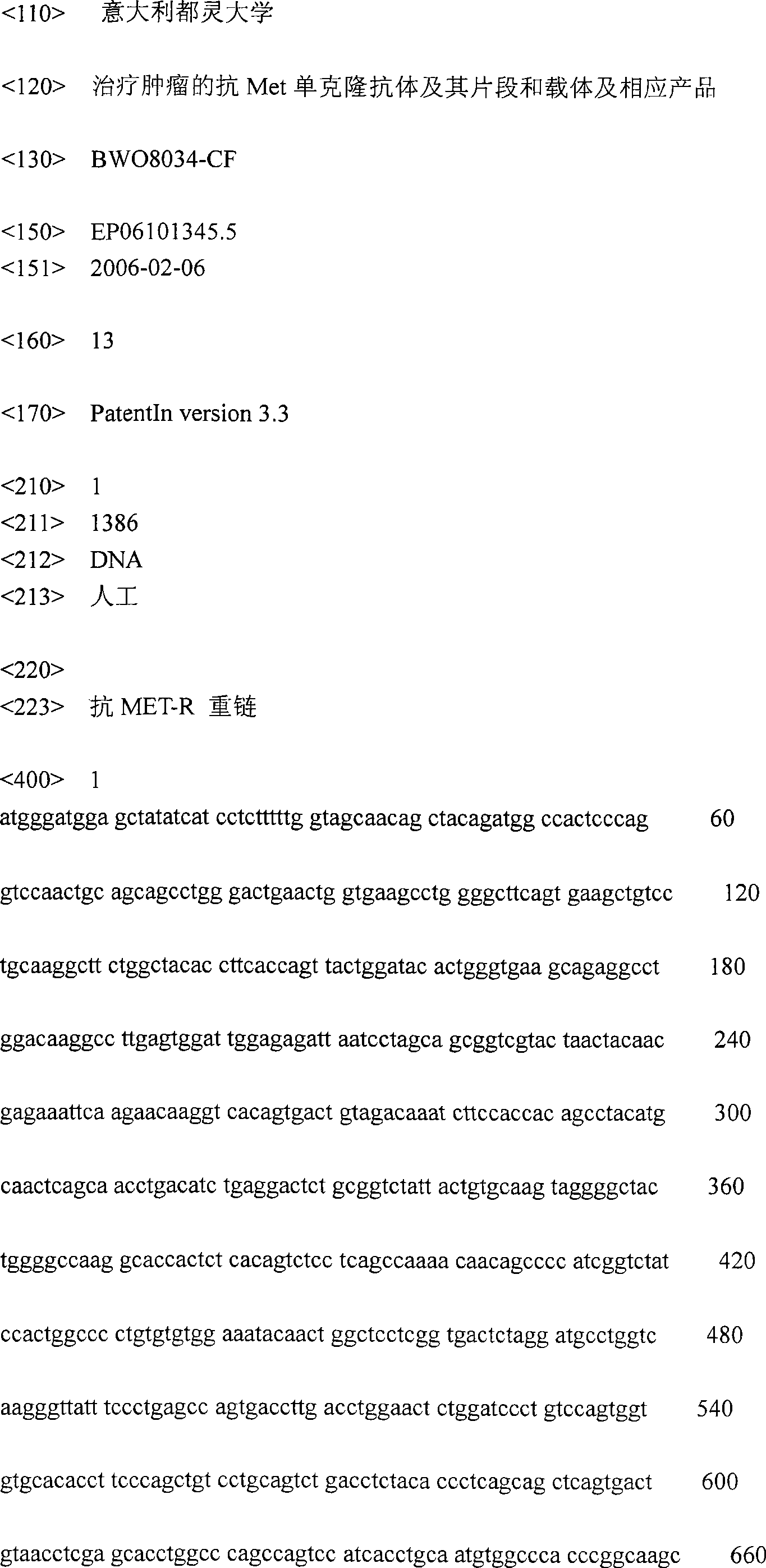


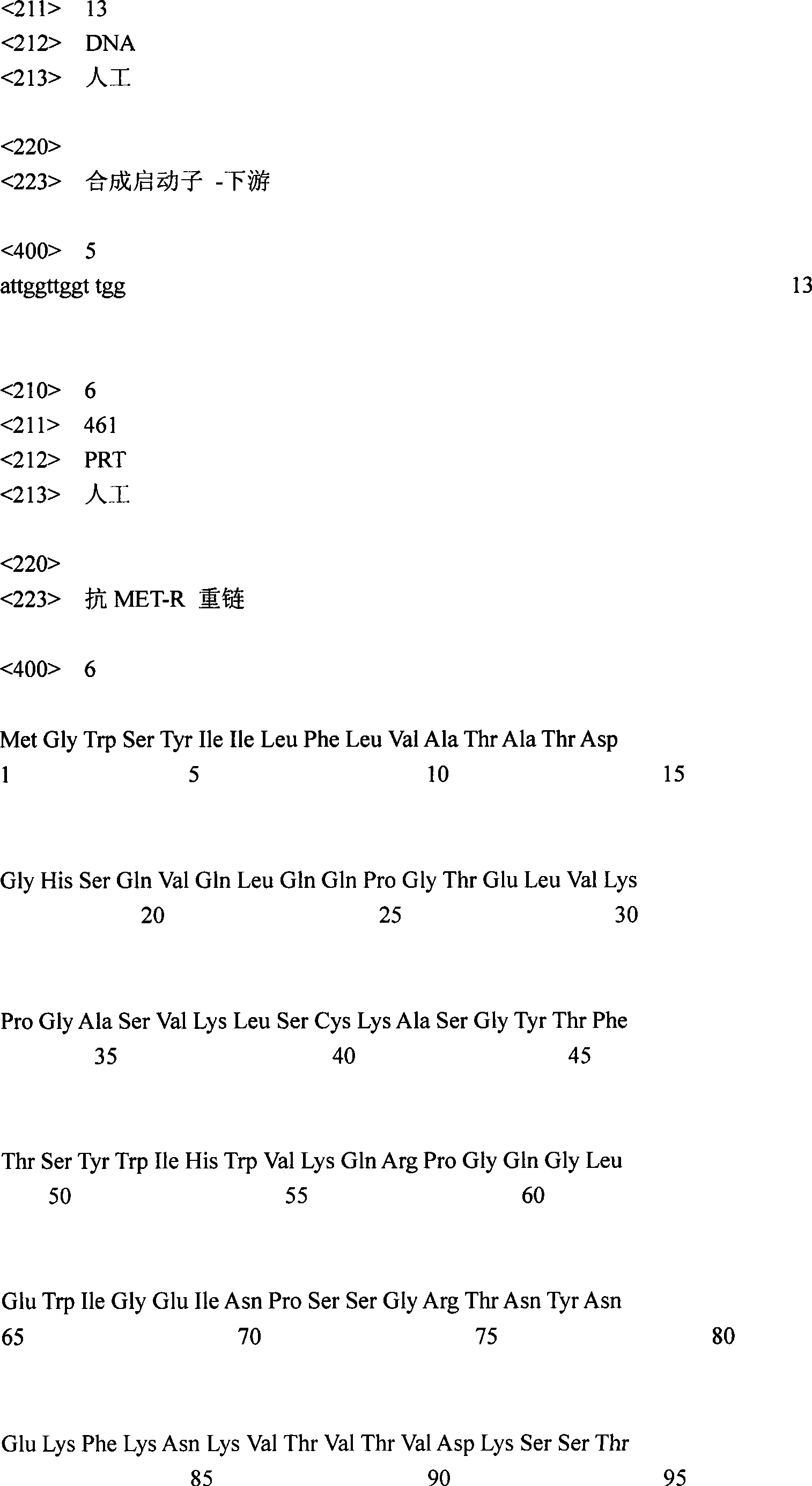

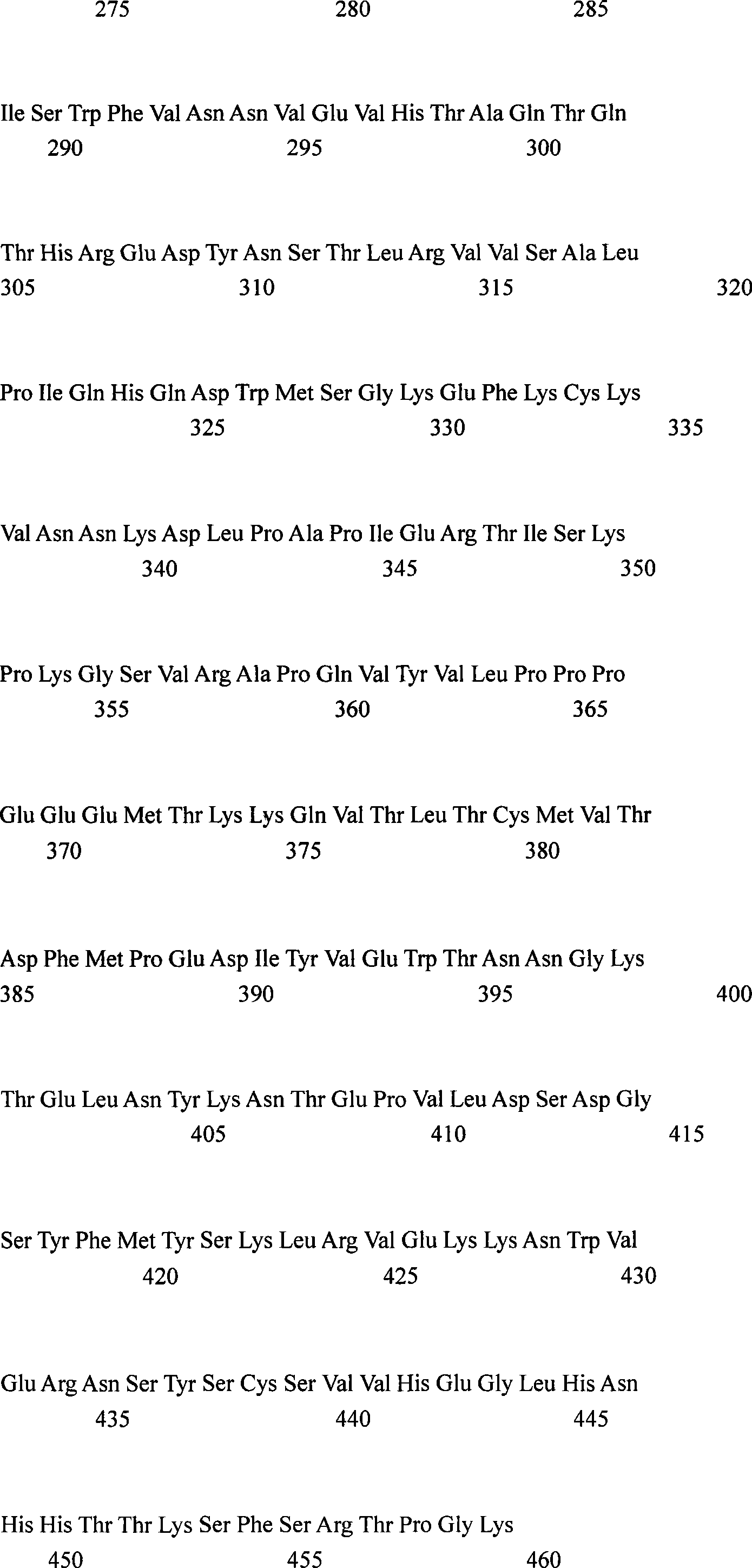
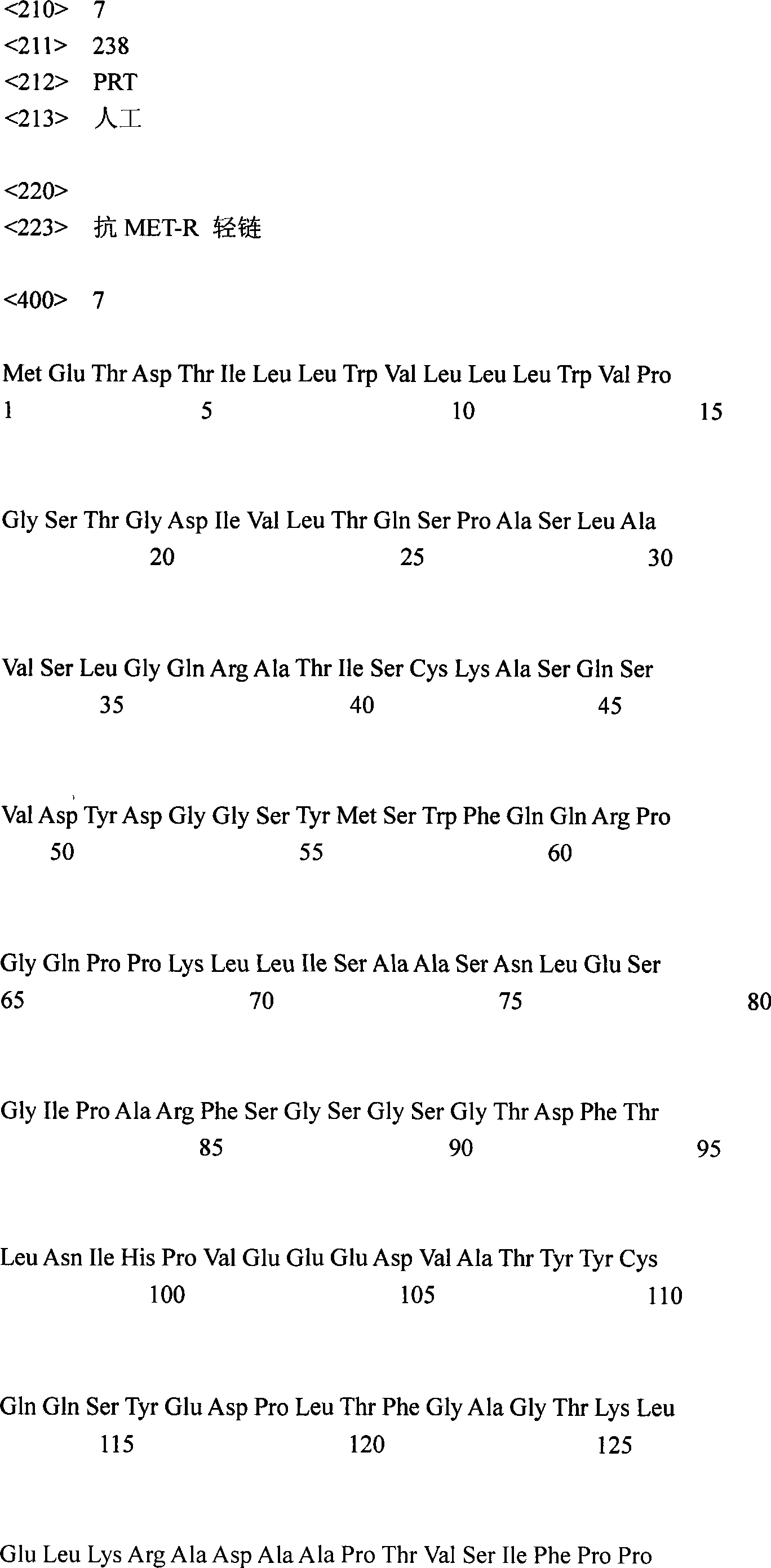
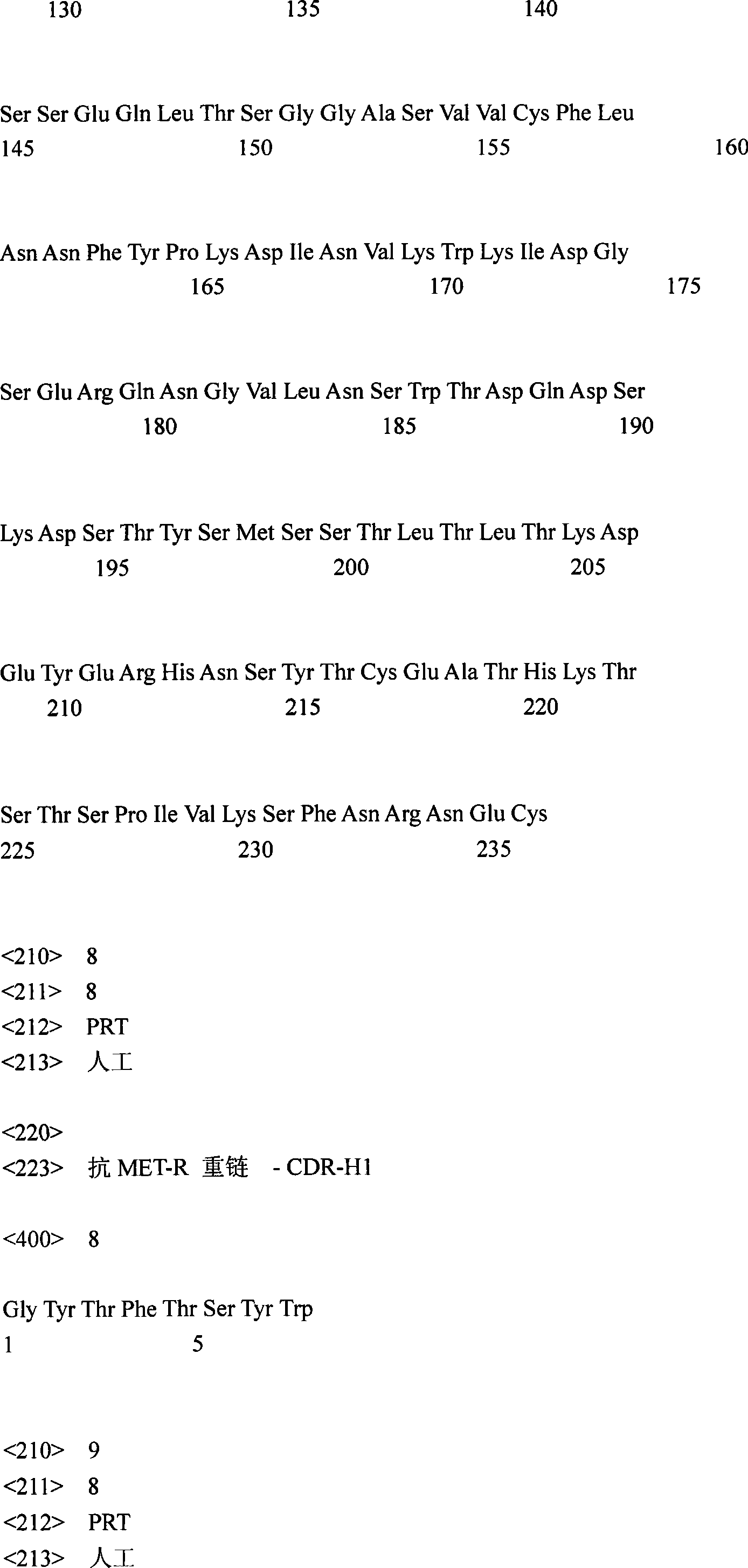
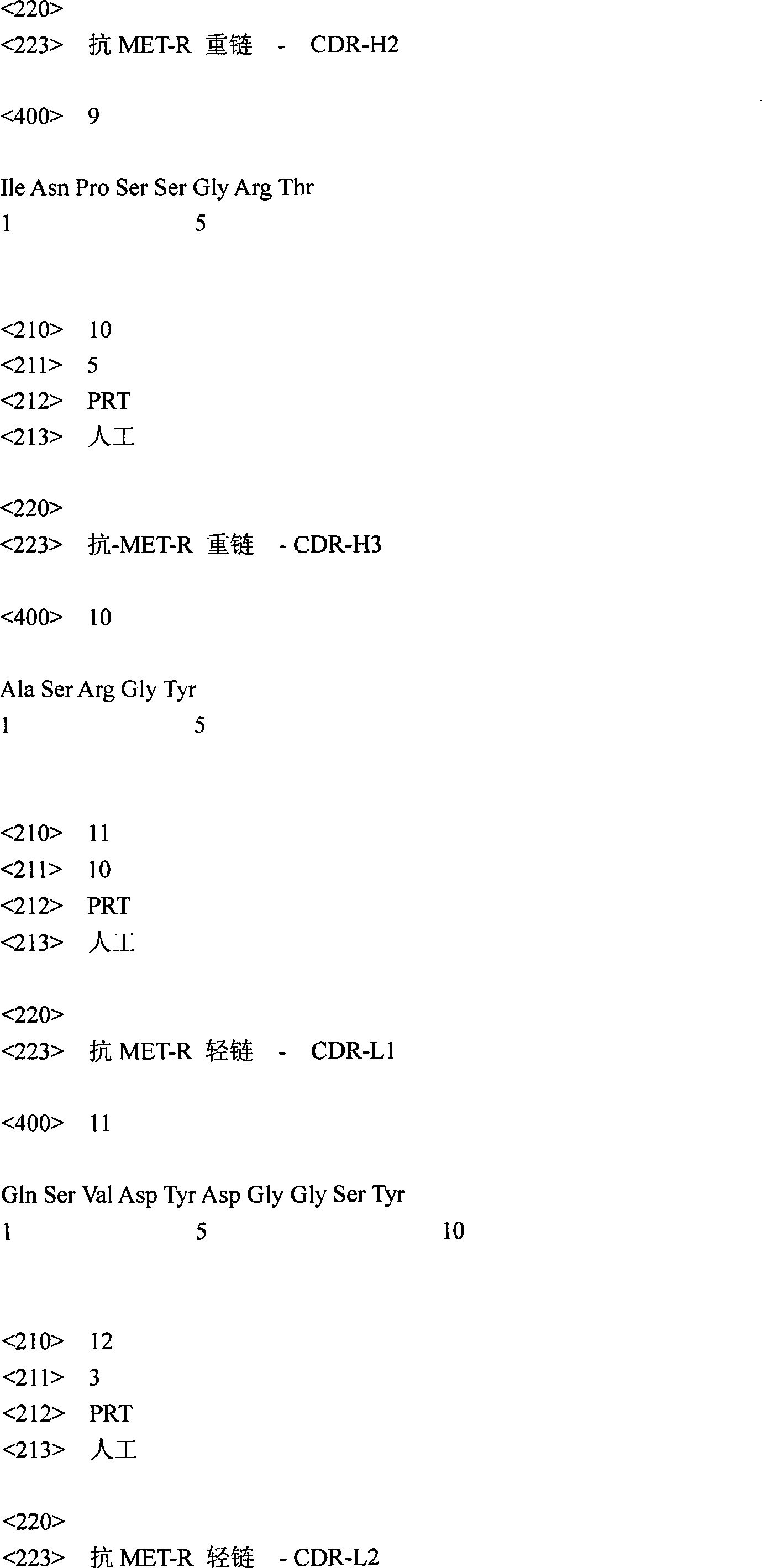
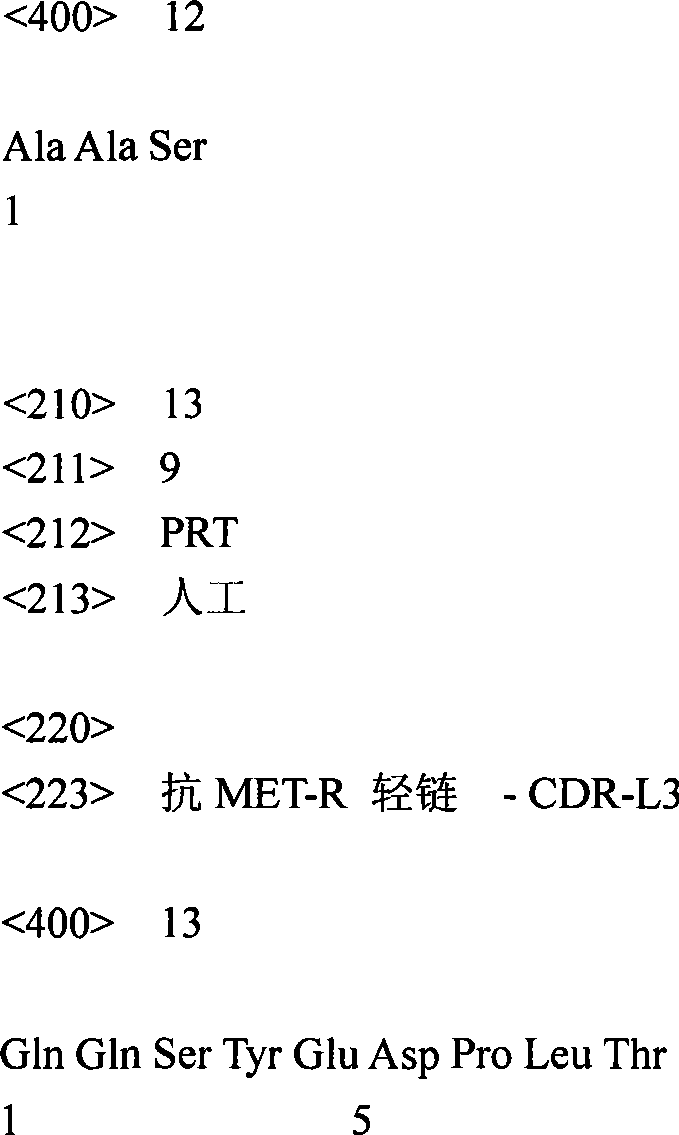
Claims (30)
Applications Claiming Priority (3)
| Application Number | Priority Date | Filing Date | Title |
|---|---|---|---|
| EP06101345 | 2006-02-06 | ||
| EP06101345.4 | 2006-02-06 | ||
| PCT/EP2007/051066 WO2007090807A1 (en) | 2006-02-06 | 2007-02-05 | Anti-met monoclonal antibody, fragments and vectors thereof, for the treatment of tumors and corresponding products |
Publications (2)
| Publication Number | Publication Date |
|---|---|
| CN101379192A true CN101379192A (en) | 2009-03-04 |
| CN101379192B CN101379192B (en) | 2013-07-31 |
Family
ID=36616994
Family Applications (1)
| Application Number | Title | Priority Date | Filing Date |
|---|---|---|---|
| CN2007800047097A Active CN101379192B (en) | 2006-02-06 | 2007-02-05 | Anti-Met monoclonal antibody for the treatment of tumors and its fragments and carriers and corresponding products |
Country Status (21)
| Country | Link |
|---|---|
| US (2) | US8388958B2 (en) |
| EP (2) | EP2192188A1 (en) |
| JP (1) | JP5306828B2 (en) |
| KR (1) | KR101429297B1 (en) |
| CN (1) | CN101379192B (en) |
| AT (1) | ATE514715T1 (en) |
| AU (1) | AU2007213804B2 (en) |
| BR (1) | BRPI0707480A8 (en) |
| CA (1) | CA2638889C (en) |
| CY (1) | CY1111884T1 (en) |
| DK (1) | DK1981981T3 (en) |
| EA (1) | EA015580B1 (en) |
| ES (1) | ES2368864T3 (en) |
| IL (1) | IL192879A (en) |
| MX (1) | MX2008009833A (en) |
| PL (1) | PL1981981T3 (en) |
| PT (1) | PT1981981E (en) |
| SG (2) | SG169383A1 (en) |
| SI (1) | SI1981981T1 (en) |
| WO (1) | WO2007090807A1 (en) |
| ZA (1) | ZA200806559B (en) |
Cited By (6)
| Publication number | Priority date | Publication date | Assignee | Title |
|---|---|---|---|---|
| CN102688491A (en) * | 2011-03-18 | 2012-09-26 | 梅思尔斯平移研究有限公司 | MET inhibitors for enhancing radiotherapy efficacy |
| CN106872695A (en) * | 2017-01-20 | 2017-06-20 | 中山大学 | A kind of H7 subtype avian influenza virus hemagglutinin antibody indirect ELISA detection kit |
| CN107739407A (en) * | 2010-03-10 | 2018-02-27 | 根马布股份公司 | Anti- c MEt monoclonal antibody |
| CN109503714A (en) * | 2012-06-21 | 2019-03-22 | 索伦托治疗有限公司 | Antigen-binding proteins in conjunction with c-Met |
| CN111886252A (en) * | 2018-01-03 | 2020-11-03 | 阿戈马布治疗有限公司 | Method for promoting islet cell growth |
| CN112041340A (en) * | 2018-03-22 | 2020-12-04 | 美迪斯精密药业有限公司 | Combination of anti-GHFR antibody and HEGFR for the treatment of tumors and/or metastases |
Families Citing this family (29)
| Publication number | Priority date | Publication date | Assignee | Title |
|---|---|---|---|---|
| EP2014681A1 (en) | 2007-07-12 | 2009-01-14 | Pierre Fabre Medicament | Novel antibodies inhibiting c-met dimerization, and uses thereof |
| IL198545A0 (en) | 2008-05-14 | 2011-07-31 | Metheresis Translational Res Sa | High affinity binding site of hgfr and methods for identification of antagonists thereof |
| EP2127683A1 (en) * | 2008-05-29 | 2009-12-02 | Metheresis Translational Research SA | Anti-Met monoclonal antibody, fragments and derivatives thereof for use in tumor imaging, corresponding compositions and kits |
| PA8849001A1 (en) | 2008-11-21 | 2010-06-28 | Lilly Co Eli | C-MET ANTIBODIES |
| EP2287197A1 (en) * | 2009-08-21 | 2011-02-23 | Pierre Fabre Medicament | Anti-cMET antibody and its use for the detection and the diagnosis of cancer |
| KR101671378B1 (en) * | 2009-10-30 | 2016-11-01 | 삼성전자 주식회사 | c-Met specific antibodies and uses thereof |
| KR101748707B1 (en) | 2009-11-27 | 2017-06-20 | 삼성전자주식회사 | c-Met specific antibodies and diagnosis kit for cancer using thereof |
| WO2011125458A1 (en) * | 2010-04-02 | 2011-10-13 | 富士レビオ株式会社 | Marker for diagnosing effect of anticancer agent |
| JP2013534515A (en) * | 2010-06-01 | 2013-09-05 | モナシュ ユニバーシティ | Antibody to unprocessed receptor tyrosine kinase c-MET |
| RU2013114783A (en) * | 2010-09-03 | 2014-10-10 | Академиа Синика | ANTI-C-MET ANTIBODIES AND WAYS OF THEIR APPLICATION |
| JP5857060B2 (en) | 2010-11-03 | 2016-02-10 | アルゲン−エックス エヌ.ブイ. | Anti-c-Met antibody |
| CA2843771A1 (en) | 2011-09-20 | 2013-03-28 | Eli Lilly And Company | Anti-c-met antibodies |
| EP2773660A2 (en) | 2011-11-03 | 2014-09-10 | Argen-X B.V. | Chimeric human-camel antigens and their use |
| AU2012340826A1 (en) | 2011-11-21 | 2014-05-29 | Genentech, Inc. | Purification of anti-c-met antibodies |
| WO2013079973A1 (en) * | 2011-12-02 | 2013-06-06 | Di Cara Danielle Marie | Antibodies against hgf - receptor and uses |
| US8900582B2 (en) | 2011-12-22 | 2014-12-02 | Samsung Electronics Co., Ltd. | Deimmunized anti c-Met humanized antibodies and uses thereof |
| CN103382223B (en) * | 2012-04-01 | 2015-06-10 | 上海益杰生物技术有限公司 | Multi-functional antibody polypeptide aiming at epidermal growth factor receptor (EGFR) cryptic epitope and T cell antigen |
| ITTO20130012A1 (en) | 2013-01-09 | 2014-07-10 | Metheresis Translational Res S A | NEW ANTICORPAL FRAGMENTS, RELATED COMPOSITIONS AND USES |
| CN107001471B (en) | 2014-09-16 | 2022-01-18 | 西福根有限公司 | anti-MET antibodies and compositions |
| WO2016149116A1 (en) * | 2015-03-13 | 2016-09-22 | University Of Maryland, Baltimore | Antibodies targeting s100b and methods of use |
| EP3270918A4 (en) | 2015-03-16 | 2018-10-24 | Celldex Therapeutics, Inc. | Anti-met antibodies and methods of use thereof |
| GB201611123D0 (en) | 2016-06-27 | 2016-08-10 | Euremab Srl | Anti met antibodiesand uses thereof |
| JP6942179B2 (en) * | 2016-09-29 | 2021-09-29 | 田辺三菱製薬株式会社 | cMET monoclonal binder, its drug complex and its use |
| TWI782930B (en) | 2016-11-16 | 2022-11-11 | 美商再生元醫藥公司 | Anti-met antibodies, bispecific antigen binding molecules that bind met, and methods of use thereof |
| IT201800000535A1 (en) | 2018-01-03 | 2019-07-03 | Procedures for the treatment of cancer. | |
| US12060427B2 (en) * | 2018-03-28 | 2024-08-13 | Mitsubishi Tanabe Pharma Corporat | Drug conjugates of cMET monoclonal binding agents, and uses thereof |
| IT201800009282A1 (en) | 2018-10-09 | 2020-04-09 | Metis Prec Medicine Sb Srl | NEW THERAPEUTIC AGENT FOR THE TREATMENT OF A CANCER AND / OR METASTASIS |
| JP7750828B2 (en) | 2019-09-16 | 2025-10-07 | リジェネロン・ファーマシューティカルズ・インコーポレイテッド | Radiolabeled MET-binding proteins for immunoPET imaging |
| TW202448953A (en) | 2023-06-01 | 2024-12-16 | 法商皮爾法伯製藥公司 | Silenced antibody-based anti-met constructs for the treatment of tumors and metastasis |
Family Cites Families (4)
| Publication number | Priority date | Publication date | Assignee | Title |
|---|---|---|---|---|
| CU22545A1 (en) * | 1994-11-18 | 1999-03-31 | Centro Inmunologia Molecular | OBTAINING A CHEMICAL AND HUMANIZED ANTIBODY AGAINST THE RECEPTOR OF THE EPIDERMAL GROWTH FACTOR FOR DIAGNOSTIC AND THERAPEUTIC USE |
| US6814962B1 (en) | 1994-06-02 | 2004-11-09 | Aventis Pharma S.A. | Recombinant viruses and their use for treatment of atherosclerosis and other forms of coronary artery disease and method, reagent, and kit for evaluating susceptibility to same |
| US6214344B1 (en) * | 1995-06-02 | 2001-04-10 | Genetech, Inc. | Hepatocyte growth factor receptor antagonists and uses thereof |
| HN2004000285A (en) * | 2003-08-04 | 2006-04-27 | Pfizer Prod Inc | ANTIBODIES DIRECTED TO c-MET |
-
2007
- 2007-02-05 WO PCT/EP2007/051066 patent/WO2007090807A1/en not_active Ceased
- 2007-02-05 SG SG201100806-7A patent/SG169383A1/en unknown
- 2007-02-05 EP EP10151809A patent/EP2192188A1/en not_active Withdrawn
- 2007-02-05 ES ES07704350T patent/ES2368864T3/en active Active
- 2007-02-05 PL PL07704350T patent/PL1981981T3/en unknown
- 2007-02-05 AT AT07704350T patent/ATE514715T1/en active
- 2007-02-05 AU AU2007213804A patent/AU2007213804B2/en active Active
- 2007-02-05 BR BRPI0707480A patent/BRPI0707480A8/en not_active Application Discontinuation
- 2007-02-05 DK DK07704350.3T patent/DK1981981T3/en active
- 2007-02-05 SG SG201100805-9A patent/SG169382A1/en unknown
- 2007-02-05 CN CN2007800047097A patent/CN101379192B/en active Active
- 2007-02-05 JP JP2008553739A patent/JP5306828B2/en active Active
- 2007-02-05 US US12/223,623 patent/US8388958B2/en active Active
- 2007-02-05 EP EP07704350A patent/EP1981981B1/en active Active
- 2007-02-05 SI SI200730720T patent/SI1981981T1/en unknown
- 2007-02-05 KR KR1020087016543A patent/KR101429297B1/en active Active
- 2007-02-05 PT PT07704350T patent/PT1981981E/en unknown
- 2007-02-05 MX MX2008009833A patent/MX2008009833A/en active IP Right Grant
- 2007-02-05 CA CA2638889A patent/CA2638889C/en active Active
- 2007-02-05 EA EA200870234A patent/EA015580B1/en not_active IP Right Cessation
-
2008
- 2008-07-17 IL IL192879A patent/IL192879A/en active IP Right Grant
- 2008-07-28 ZA ZA2008/06559A patent/ZA200806559B/en unknown
-
2011
- 2011-09-26 CY CY20111100926T patent/CY1111884T1/en unknown
- 2011-11-04 US US13/373,101 patent/US8729043B2/en active Active
Cited By (8)
| Publication number | Priority date | Publication date | Assignee | Title |
|---|---|---|---|---|
| CN107739407A (en) * | 2010-03-10 | 2018-02-27 | 根马布股份公司 | Anti- c MEt monoclonal antibody |
| CN107739407B (en) * | 2010-03-10 | 2021-07-06 | 根马布股份公司 | Anti-c-MEt monoclonal antibody |
| CN102688491A (en) * | 2011-03-18 | 2012-09-26 | 梅思尔斯平移研究有限公司 | MET inhibitors for enhancing radiotherapy efficacy |
| CN109503714A (en) * | 2012-06-21 | 2019-03-22 | 索伦托治疗有限公司 | Antigen-binding proteins in conjunction with c-Met |
| CN106872695A (en) * | 2017-01-20 | 2017-06-20 | 中山大学 | A kind of H7 subtype avian influenza virus hemagglutinin antibody indirect ELISA detection kit |
| CN111886252A (en) * | 2018-01-03 | 2020-11-03 | 阿戈马布治疗有限公司 | Method for promoting islet cell growth |
| CN111886252B (en) * | 2018-01-03 | 2024-06-18 | 阿戈马布治疗有限公司 | Methods for promoting the growth of pancreatic islet cells |
| CN112041340A (en) * | 2018-03-22 | 2020-12-04 | 美迪斯精密药业有限公司 | Combination of anti-GHFR antibody and HEGFR for the treatment of tumors and/or metastases |
Also Published As
Similar Documents
| Publication | Publication Date | Title |
|---|---|---|
| CN101379192A (en) | anti-Met monoclonal antibody for treating tumor, fragment and carrier thereof and corresponding product | |
| CA2881966C (en) | Antibodies and vaccines for use in treating ror1 cancers and inhibiting metastasis | |
| AU2007272995B2 (en) | Compositions and methods for inhibiting growth of smad4-deficient cancers | |
| CN104168916B (en) | Anti-epithelial cell adhesion molecule (EpCAM) antibodies and methods of use thereof | |
| US7531304B2 (en) | Method for screening FGFR-4 agonists | |
| US20110212091A1 (en) | Materials and methods for inhibiting cancer cell invasion | |
| US10106601B2 (en) | Inhibition of PLGF to treat philadelphia chromosome positive leukemia | |
| US20090123462A1 (en) | Fgfr agonists | |
| EP3283528B1 (en) | Anti-vegfr2 human antibody for anti-angiogenic and targeted cancer therapy | |
| EP2507265B1 (en) | Antibody specific for heparanase splice variant T5 and its use. | |
| WO2023016509A1 (en) | Drug for inhibiting tumor cell metastasis and use thereof | |
| US20120183547A1 (en) | Compositions and methods comprising vegfr-2 and vegfr-3 antagonists for the treatment of metastatic disease | |
| US9555109B2 (en) | Method of inhibiting cell proliferation induced by alternatively spliced tissue factor by administering a monoclonal antibody | |
| Janetka et al. | Extracellular Targeting of Cell Signaling in Cancer: Strategies Directed at MET and RON Receptor Tyrosine Kinase Pathways | |
| Sato | Studies on nStudies on neutralizing anti-heparin-binding epidermal growth factor-like growth factor (HB-EGF) antibodies for drug development of cancer treatment |
Legal Events
| Date | Code | Title | Description |
|---|---|---|---|
| C06 | Publication | ||
| PB01 | Publication | ||
| C10 | Entry into substantive examination | ||
| SE01 | Entry into force of request for substantive examination | ||
| C14 | Grant of patent or utility model | ||
| GR01 | Patent grant | ||
| TR01 | Transfer of patent right | ||
| TR01 | Transfer of patent right |
Effective date of registration: 20220221 Address after: Basel, Switzerland Patentee after: Vertical biology Co.,Ltd. Address before: Torino Patentee before: Medex precision Pharmaceutical Co.,Ltd. Effective date of registration: 20220221 Address after: Torino Patentee after: Medex precision Pharmaceutical Co.,Ltd. Address before: Lugano, Switzerland Patentee before: METHERESIS TRANSLATIONAL RESEARCH S.A. |
|
| TR01 | Transfer of patent right | ||
| TR01 | Transfer of patent right |
Effective date of registration: 20241127 Address after: Laval, France Patentee after: PIERRE FABRE MEDICAMENT Country or region after: France Address before: Basel, SUI Patentee before: Vertical biology Co.,Ltd. Country or region before: Switzerland |