CN101372528B - Preparation method of low-viscosity allophanate containing actinically curable groups - Google Patents
Preparation method of low-viscosity allophanate containing actinically curable groups Download PDFInfo
- Publication number
- CN101372528B CN101372528B CN2008101463255A CN200810146325A CN101372528B CN 101372528 B CN101372528 B CN 101372528B CN 2008101463255 A CN2008101463255 A CN 2008101463255A CN 200810146325 A CN200810146325 A CN 200810146325A CN 101372528 B CN101372528 B CN 101372528B
- Authority
- CN
- China
- Prior art keywords
- groups
- radiation
- compounds
- nco
- curing
- Prior art date
- Legal status (The legal status is an assumption and is not a legal conclusion. Google has not performed a legal analysis and makes no representation as to the accuracy of the status listed.)
- Active
Links
Classifications
-
- C—CHEMISTRY; METALLURGY
- C08—ORGANIC MACROMOLECULAR COMPOUNDS; THEIR PREPARATION OR CHEMICAL WORKING-UP; COMPOSITIONS BASED THEREON
- C08G—MACROMOLECULAR COMPOUNDS OBTAINED OTHERWISE THAN BY REACTIONS ONLY INVOLVING UNSATURATED CARBON-TO-CARBON BONDS
- C08G18/00—Polymeric products of isocyanates or isothiocyanates
- C08G18/06—Polymeric products of isocyanates or isothiocyanates with compounds having active hydrogen
- C08G18/70—Polymeric products of isocyanates or isothiocyanates with compounds having active hydrogen characterised by the isocyanates or isothiocyanates used
- C08G18/72—Polyisocyanates or polyisothiocyanates
- C08G18/77—Polyisocyanates or polyisothiocyanates having heteroatoms in addition to the isocyanate or isothiocyanate nitrogen and oxygen or sulfur
- C08G18/78—Nitrogen
- C08G18/7806—Nitrogen containing -N-C=0 groups
- C08G18/7818—Nitrogen containing -N-C=0 groups containing ureum or ureum derivative groups
- C08G18/7837—Nitrogen containing -N-C=0 groups containing ureum or ureum derivative groups containing allophanate groups
-
- C—CHEMISTRY; METALLURGY
- C08—ORGANIC MACROMOLECULAR COMPOUNDS; THEIR PREPARATION OR CHEMICAL WORKING-UP; COMPOSITIONS BASED THEREON
- C08G—MACROMOLECULAR COMPOUNDS OBTAINED OTHERWISE THAN BY REACTIONS ONLY INVOLVING UNSATURATED CARBON-TO-CARBON BONDS
- C08G18/00—Polymeric products of isocyanates or isothiocyanates
- C08G18/06—Polymeric products of isocyanates or isothiocyanates with compounds having active hydrogen
- C08G18/08—Processes
- C08G18/10—Prepolymer processes involving reaction of isocyanates or isothiocyanates with compounds having active hydrogen in a first reaction step
- C08G18/12—Prepolymer processes involving reaction of isocyanates or isothiocyanates with compounds having active hydrogen in a first reaction step using two or more compounds having active hydrogen in the first polymerisation step
-
- C—CHEMISTRY; METALLURGY
- C08—ORGANIC MACROMOLECULAR COMPOUNDS; THEIR PREPARATION OR CHEMICAL WORKING-UP; COMPOSITIONS BASED THEREON
- C08G—MACROMOLECULAR COMPOUNDS OBTAINED OTHERWISE THAN BY REACTIONS ONLY INVOLVING UNSATURATED CARBON-TO-CARBON BONDS
- C08G18/00—Polymeric products of isocyanates or isothiocyanates
- C08G18/06—Polymeric products of isocyanates or isothiocyanates with compounds having active hydrogen
- C08G18/08—Processes
- C08G18/16—Catalysts
- C08G18/18—Catalysts containing secondary or tertiary amines or salts thereof
-
- C—CHEMISTRY; METALLURGY
- C08—ORGANIC MACROMOLECULAR COMPOUNDS; THEIR PREPARATION OR CHEMICAL WORKING-UP; COMPOSITIONS BASED THEREON
- C08G—MACROMOLECULAR COMPOUNDS OBTAINED OTHERWISE THAN BY REACTIONS ONLY INVOLVING UNSATURATED CARBON-TO-CARBON BONDS
- C08G18/00—Polymeric products of isocyanates or isothiocyanates
- C08G18/06—Polymeric products of isocyanates or isothiocyanates with compounds having active hydrogen
- C08G18/08—Processes
- C08G18/16—Catalysts
- C08G18/22—Catalysts containing metal compounds
- C08G18/227—Catalysts containing metal compounds of antimony, bismuth or arsenic
-
- C—CHEMISTRY; METALLURGY
- C08—ORGANIC MACROMOLECULAR COMPOUNDS; THEIR PREPARATION OR CHEMICAL WORKING-UP; COMPOSITIONS BASED THEREON
- C08G—MACROMOLECULAR COMPOUNDS OBTAINED OTHERWISE THAN BY REACTIONS ONLY INVOLVING UNSATURATED CARBON-TO-CARBON BONDS
- C08G18/00—Polymeric products of isocyanates or isothiocyanates
- C08G18/06—Polymeric products of isocyanates or isothiocyanates with compounds having active hydrogen
- C08G18/28—Polymeric products of isocyanates or isothiocyanates with compounds having active hydrogen characterised by the compounds used containing active hydrogen
- C08G18/2805—Compounds having only one group containing active hydrogen
- C08G18/2815—Monohydroxy compounds
- C08G18/282—Alkanols, cycloalkanols or arylalkanols including terpenealcohols
-
- C—CHEMISTRY; METALLURGY
- C08—ORGANIC MACROMOLECULAR COMPOUNDS; THEIR PREPARATION OR CHEMICAL WORKING-UP; COMPOSITIONS BASED THEREON
- C08G—MACROMOLECULAR COMPOUNDS OBTAINED OTHERWISE THAN BY REACTIONS ONLY INVOLVING UNSATURATED CARBON-TO-CARBON BONDS
- C08G18/00—Polymeric products of isocyanates or isothiocyanates
- C08G18/06—Polymeric products of isocyanates or isothiocyanates with compounds having active hydrogen
- C08G18/28—Polymeric products of isocyanates or isothiocyanates with compounds having active hydrogen characterised by the compounds used containing active hydrogen
- C08G18/40—High-molecular-weight compounds
- C08G18/42—Polycondensates having carboxylic or carbonic ester groups in the main chain
- C08G18/4236—Polycondensates having carboxylic or carbonic ester groups in the main chain containing only aliphatic groups
- C08G18/4238—Polycondensates having carboxylic or carbonic ester groups in the main chain containing only aliphatic groups derived from dicarboxylic acids and dialcohols
-
- C—CHEMISTRY; METALLURGY
- C08—ORGANIC MACROMOLECULAR COMPOUNDS; THEIR PREPARATION OR CHEMICAL WORKING-UP; COMPOSITIONS BASED THEREON
- C08G—MACROMOLECULAR COMPOUNDS OBTAINED OTHERWISE THAN BY REACTIONS ONLY INVOLVING UNSATURATED CARBON-TO-CARBON BONDS
- C08G18/00—Polymeric products of isocyanates or isothiocyanates
- C08G18/06—Polymeric products of isocyanates or isothiocyanates with compounds having active hydrogen
- C08G18/70—Polymeric products of isocyanates or isothiocyanates with compounds having active hydrogen characterised by the isocyanates or isothiocyanates used
- C08G18/81—Unsaturated isocyanates or isothiocyanates
- C08G18/8141—Unsaturated isocyanates or isothiocyanates masked
- C08G18/815—Polyisocyanates or polyisothiocyanates masked with unsaturated compounds having active hydrogen
- C08G18/8158—Polyisocyanates or polyisothiocyanates masked with unsaturated compounds having active hydrogen with unsaturated compounds having only one group containing active hydrogen
- C08G18/8175—Polyisocyanates or polyisothiocyanates masked with unsaturated compounds having active hydrogen with unsaturated compounds having only one group containing active hydrogen with esters of acrylic or alkylacrylic acid having only one group containing active hydrogen
-
- C—CHEMISTRY; METALLURGY
- C09—DYES; PAINTS; POLISHES; NATURAL RESINS; ADHESIVES; COMPOSITIONS NOT OTHERWISE PROVIDED FOR; APPLICATIONS OF MATERIALS NOT OTHERWISE PROVIDED FOR
- C09D—COATING COMPOSITIONS, e.g. PAINTS, VARNISHES OR LACQUERS; FILLING PASTES; CHEMICAL PAINT OR INK REMOVERS; INKS; CORRECTING FLUIDS; WOODSTAINS; PASTES OR SOLIDS FOR COLOURING OR PRINTING; USE OF MATERIALS THEREFOR
- C09D11/00—Inks
- C09D11/02—Printing inks
- C09D11/10—Printing inks based on artificial resins
- C09D11/102—Printing inks based on artificial resins containing macromolecular compounds obtained by reactions other than those only involving unsaturated carbon-to-carbon bonds
-
- C—CHEMISTRY; METALLURGY
- C09—DYES; PAINTS; POLISHES; NATURAL RESINS; ADHESIVES; COMPOSITIONS NOT OTHERWISE PROVIDED FOR; APPLICATIONS OF MATERIALS NOT OTHERWISE PROVIDED FOR
- C09D—COATING COMPOSITIONS, e.g. PAINTS, VARNISHES OR LACQUERS; FILLING PASTES; CHEMICAL PAINT OR INK REMOVERS; INKS; CORRECTING FLUIDS; WOODSTAINS; PASTES OR SOLIDS FOR COLOURING OR PRINTING; USE OF MATERIALS THEREFOR
- C09D175/00—Coating compositions based on polyureas or polyurethanes; Coating compositions based on derivatives of such polymers
- C09D175/04—Polyurethanes
- C09D175/14—Polyurethanes having carbon-to-carbon unsaturated bonds
- C09D175/16—Polyurethanes having carbon-to-carbon unsaturated bonds having terminal carbon-to-carbon unsaturated bonds
-
- C—CHEMISTRY; METALLURGY
- C09—DYES; PAINTS; POLISHES; NATURAL RESINS; ADHESIVES; COMPOSITIONS NOT OTHERWISE PROVIDED FOR; APPLICATIONS OF MATERIALS NOT OTHERWISE PROVIDED FOR
- C09D—COATING COMPOSITIONS, e.g. PAINTS, VARNISHES OR LACQUERS; FILLING PASTES; CHEMICAL PAINT OR INK REMOVERS; INKS; CORRECTING FLUIDS; WOODSTAINS; PASTES OR SOLIDS FOR COLOURING OR PRINTING; USE OF MATERIALS THEREFOR
- C09D5/00—Coating compositions, e.g. paints, varnishes or lacquers, characterised by their physical nature or the effects produced; Filling pastes
- C09D5/002—Priming paints
-
- C—CHEMISTRY; METALLURGY
- C09—DYES; PAINTS; POLISHES; NATURAL RESINS; ADHESIVES; COMPOSITIONS NOT OTHERWISE PROVIDED FOR; APPLICATIONS OF MATERIALS NOT OTHERWISE PROVIDED FOR
- C09D—COATING COMPOSITIONS, e.g. PAINTS, VARNISHES OR LACQUERS; FILLING PASTES; CHEMICAL PAINT OR INK REMOVERS; INKS; CORRECTING FLUIDS; WOODSTAINS; PASTES OR SOLIDS FOR COLOURING OR PRINTING; USE OF MATERIALS THEREFOR
- C09D7/00—Features of coating compositions, not provided for in group C09D5/00; Processes for incorporating ingredients in coating compositions
- C09D7/40—Additives
- C09D7/65—Additives macromolecular
-
- Y—GENERAL TAGGING OF NEW TECHNOLOGICAL DEVELOPMENTS; GENERAL TAGGING OF CROSS-SECTIONAL TECHNOLOGIES SPANNING OVER SEVERAL SECTIONS OF THE IPC; TECHNICAL SUBJECTS COVERED BY FORMER USPC CROSS-REFERENCE ART COLLECTIONS [XRACs] AND DIGESTS
- Y10—TECHNICAL SUBJECTS COVERED BY FORMER USPC
- Y10T—TECHNICAL SUBJECTS COVERED BY FORMER US CLASSIFICATION
- Y10T428/00—Stock material or miscellaneous articles
- Y10T428/31504—Composite [nonstructural laminate]
- Y10T428/31551—Of polyamidoester [polyurethane, polyisocyanate, polycarbamate, etc.]
Landscapes
- Chemical & Material Sciences (AREA)
- Organic Chemistry (AREA)
- Chemical Kinetics & Catalysis (AREA)
- Health & Medical Sciences (AREA)
- Medicinal Chemistry (AREA)
- Polymers & Plastics (AREA)
- Materials Engineering (AREA)
- Engineering & Computer Science (AREA)
- Life Sciences & Earth Sciences (AREA)
- Wood Science & Technology (AREA)
- Polyurethanes Or Polyureas (AREA)
- Organic Low-Molecular-Weight Compounds And Preparation Thereof (AREA)
- Macromonomer-Based Addition Polymer (AREA)
- Addition Polymer Or Copolymer, Post-Treatments, Or Chemical Modifications (AREA)
- Sealing Material Composition (AREA)
- Paints Or Removers (AREA)
- Inks, Pencil-Leads, Or Crayons (AREA)
- Adhesives Or Adhesive Processes (AREA)
Abstract
本发明涉及含有可光化固化基团的低粘度脲基甲酸酯的制备方法。本发明涉及多异氰酸酯的低粘度反应产物的制备方法,所述多异氰酸酯含当暴露于光化辐射时通过聚合与烯属不饱和化合物反应的活化基团。The invention relates to a method for preparing a low-viscosity allophanate containing photochemically curable groups. The present invention relates to a process for the preparation of low viscosity reaction products of polyisocyanates containing activated groups which react by polymerization with ethylenically unsaturated compounds when exposed to actinic radiation.
Description
相关申请的交叉引用Cross References to Related Applications
本申请按35U.S.C.§119(a)-(d)要求于2007年8月25日提交的德国专利申请102007040240.8的优先权。This application claims priority under 35 U.S.C. §119(a)-(d) to German Patent Application 102007040240.8 filed August 25, 2007.
技术领域 technical field
本发明涉及多异氰酸酯的低粘度反应产物的制备方法,所述多异氰酸酯含有当暴露于光化辐射(actinic radiation)时通过聚合反应的烯属不饱和活化基团,涉及它们的制备方法,还涉及它们在涂料材料中的用途。The present invention relates to a process for the preparation of low-viscosity reaction products of polyisocyanates containing ethylenically unsaturated groups activated by polymerization when exposed to actinic radiation, to a process for their preparation, and to Their use in coating materials.
背景技术 Background technique
通过诸如UV光、IR辐射的光化辐射或电子束对携带活化双键的涂料系统的固化是工业上已知并应用了的。这是涂料技术中最快速的固化方法之一。基于此原理的涂料组合物因而被称为辐射或光化固化或可固化系统。The curing of coating systems carrying activated double bonds by actinic radiation such as UV light, IR radiation or electron beams is known and applied in industry. This is one of the fastest curing methods in coatings technology. Coating compositions based on this principle are thus referred to as radiation or actinic curing or curable systems.
环境和经济方面对现代涂料系统的要求是,对于粘度调整,应当尽量少使用或根本不使用有机溶剂,因此希望使用已经是低粘度的涂料原料。为此目的长时期以来一直已知的是具有脲基甲酸酯结构的多异氰酸酯,尤其是如EP-A0 682 012所描述。Environmental and economical requirements placed on modern coating systems are that, for viscosity adjustment, minimal or no organic solvents should be used, and it is therefore desirable to use already low-viscosity coating materials. Polyisocyanates having an allophanate structure have been known for a long time for this purpose, especially as described in EP-A 0 682 012.
在工业上这些物质是通过使单羟基或多羟基醇与大量过量的脂族和/或脂环族二异氰酸酯进行反应制备的(参见GB-A994 890、EP-A0 000 194或EP-A0 712 840)。这接下来要借助于低压蒸馏去除未反应的二异氰酸酯。根据DE-A198 60 041,这一步也可以用具有活化双键的OH官能化合物进行,例如丙烯酸羟烷基酯,尽管对于特别低单体含量的产品制备中会出现困难。由于蒸馏步骤需在最高为135℃的温度下进行,为了能够充分降低残余异氰酸酯的含量(残余单体按重量计<0.5%),因此即使在纯化过程期间,在热引发下双键可通过聚合发生反应,这意味着不再可能获得理想的产品。These substances are prepared industrially by reacting monohydric or polyhydric alcohols with large excesses of aliphatic and/or cycloaliphatic diisocyanates (see GB-A994 890, EP-A0 000 194 or EP-A0 712 840 ). This is followed by removal of unreacted diisocyanate by means of low-pressure distillation. According to DE-A 198 60 041, this step can also be carried out with OH-functional compounds with activated double bonds, such as hydroxyalkyl acrylates, although difficulties arise in the preparation of products with particularly low monomer contents. Since the distillation step has to be carried out at a temperature of up to 135 °C, in order to be able to sufficiently reduce the residual isocyanate content (residual monomer < 0.5% by weight), the double bond can be polymerized by thermal initiation even during the purification process A reaction occurs, which means that it is no longer possible to obtain the desired product.
低单体含量的含脲基甲酸酯的聚氨酯基辐射固化粘结剂的制备描述在EP-A0 867 457和US-A5 739 251中。然而这些粘结剂不携带活化双键,代之的是携带非反应性的烯丙基醚基团(结构R-O-CH2-CH=CH2)。因此需要添加引入所需UV反应性的反应性稀释剂(丙烯酸的低分子量酯)。The preparation of allophanate-containing polyurethane-based radiation-curing adhesives with low monomer content is described in EP-A 0 867 457 and US-A 5 739 251 . However, these binders do not carry activated double bonds, but instead carry non-reactive allyl ether groups (structure RO—CH 2 —CH=CH 2 ). It is therefore necessary to add reactive diluents (low molecular weight esters of acrylic acid) which introduce the desired UV reactivity.
一直不乏从异氰酸酯衍生物而不是氨基甲酸酯和异氰酸酯间接制备脲基甲酸酯的尝试。例如,EP-A 0 825 211描述了由氧杂二嗪三酮类(oxadiazinetriones)合成脲基甲酸酯结构的方法,尽管其中没有提到含活化双键的辐射固化衍生物。向辐射固化系统特定情况的变换描述在WO2004/033522中。There has been no shortage of attempts to prepare allophanates indirectly from isocyanate derivatives other than urethanes and isocyanates. For example, EP-A 0 825 211 describes the synthesis of allophanate structures from oxadiazinetriones, although radiation-curable derivatives containing activated double bonds are not mentioned therein. A conversion to the specific case of radiation curing systems is described in WO2004/033522.
另一种途经是打开脲二酮类(uretdiones)(参见Proceedings of theInternational Waterborne,High-Solids,and Powder Coatings Symposium2001,28th,405-419以及US-A20030153713)以得到脲基甲酸酯结构,其也已成功地变换到辐射固化系统(WO2005/092942)。Another route is to open uretdiones (see Proceedings of the International Waterborne, High-Solids, and Powder Coatings Symposium 2001, 28th, 405-419 and US-A20030153713) to obtain allophanate structures, which also It has been successfully converted to a radiation curing system (WO2005/092942).
这两种途径均需要高等级的基本材料为起始原料,并且只会导致富含副产物的脲基甲酸酯产品。Both routes require high-grade base materials as starting materials and lead only to by-product-rich allophanate products.
US5 777 024描述了通过使携带活化双键的羟基官能单体与脲基甲酸酯改性的异氰脲酸酯多异氰酸酯的异氰酸酯基团进行反应制备低粘度的辐射固化脲基甲酸酯。经由脲基甲酸酯基团连接的基团是饱和的,因此任何可能的较高官能度是必然的。US 5 777 024 describes the preparation of low-viscosity radiation-curing allophanates by reacting hydroxyl-functional monomers carrying activated double bonds with the isocyanate groups of allophanate-modified isocyanurate polyisocyanates. Groups attached via allophanate groups are saturated, so any possible higher functionality is necessary.
EP-B694 531描述了含有辐射固化基团的亲水化(hydrophilicized)脲基甲酸酯的多阶段制备方法。不过在该情况下,首先制备NCO和丙烯酸酯官能的氨基甲酸酯,其在添加进一步的NCO和丙烯酸酯官能的氨基甲酸酯之后被亲水化并随后被脲基甲酸酯化。对于脲基甲酸酯化的工艺温度,所记载的温度为100-110℃。EP-B 694 531 describes a multistage process for the preparation of hydrophilized allophanates containing radiation-curing groups. In this case, however, first an NCO- and acrylate-functional urethane is prepared, which is hydrophilized and subsequently allophanated after addition of a further NCO- and acrylate-functional urethane. As for the process temperature of allophanation, the recorded temperature is 100-110°C.
最后,EP-A1 645 582中介绍了一种方法,该方法从简单的二异氰酸酯出发,通过与羟基官能的丙烯酸酯的反应,不需要产物的蒸馏,得到低粘度的脲基甲酸酯。然而,此方法的一个缺点在于,只有使用很难获得的铵盐才能达到令人满意的反应速度。此外,所描述的产品的粘度也不及可通过例如EP-A 0 825 211中所描述的方法得到的脲基甲酸酯的粘度低。Finally, EP-A1 645 582 describes a process starting from simple diisocyanates to obtain low-viscosity allophanates by reaction with hydroxy-functional acrylates without distillation of the product. However, a disadvantage of this method is that satisfactory reaction rates can only be achieved with ammonium salts which are difficult to obtain. Furthermore, the viscosities of the products described are not as low as those of the allophanates obtainable, for example, by the process described in EP-A 0 825 211.
因此本发明的目的是要提供这样的一种方法,采用此方法可以提供如EP-A1 645 582中所描述的那样具有较低粘度且可通过光化辐射交联的脲基甲酸酯(辐射固化脲基甲酸酯),其可以通过更容易获得的基本材料得到。It is therefore an object of the present invention to provide a process with which allophanates, as described in EP-A1 645 582, which can be crosslinked by actinic radiation (radiation curing allophanate), which can be obtained from more readily available base materials.
从EP-A1 645 582出发,现已发现,通过使用作为催化剂的辛酸锌与叔胺的组合,可以制备出这种特别低粘度的辐射固化脲基甲酸酯。EP-A1 645 582中只描述了仅使用一个组分作为催化剂。尽管事实上EP-A1 645 582同样涉及低粘度脲基甲酸酯问题,但EP-A1 645 582同样地没有能描述通过使所述两种化合物组合可以若干倍地降低粘度。Starting from EP-A1 645 582, it has now been found that such particularly low-viscosity radiation-curing allophanates can be prepared by using zinc octoate in combination with tertiary amines as a catalyst. EP-A1 645 582 only describes the use of only one component as catalyst. Despite the fact that EP-A1 645 582 likewise deals with the problem of low-viscosity allophanates, EP-A1 645 582 likewise fails to describe the several-fold reduction in viscosity that can be achieved by combining the two compounds described.
发明内容 Contents of the invention
本发明因此提供一种辐射固化脲基甲酸酯(radiation-curingallophanates)的制备方法,所述辐射固化脲基甲酸酯的残余单体含量小于0.5重量%,NCO含量小于1重量%,该方法包括:The present invention therefore provides a process for the preparation of radiation-curing allophanates having a residual monomer content of less than 0.5% by weight and an NCO content of less than 1% by weight, which process include:
1)通过使以下物质反应制备具有辐射固化基团的含NCO基团的氨基甲酸酯:1) Preparation of NCO-group-containing urethanes with radiation-curing groups by reacting:
A)一种或多种含异氰酸酯基团的化合物,A) one or more compounds containing isocyanate groups,
B)一种或多种羟基官能的化合物,其含有当暴露于光化辐射时通过聚合与烯属不饱和化合物反应的基团(which contain groups whichreact,with polymerization,with ethylenically unsaturated compounds onexposure to actinic radiation)(辐射固化基团),和B) One or more hydroxyl-functional compounds which contain groups which react, with polymerization, with ethylenically unsaturated compounds on exposure to actinic radiation, by polymerization when exposed to actinic radiation ) (radiation curing group), and
C)任选的含有NCO-反应性基团的进一步的化合物;C) optionally further compounds containing NCO-reactive groups;
D)任选地,在催化剂的存在下D) Optionally, in the presence of a catalyst
2)在以下物质的存在下,不进一步加入含异氰酸酯基团的化合物,同时或随后使具有辐射固化基团的含NCO基团的氨基甲酸酯发生反应:2) Simultaneously or subsequently reacting NCO group-containing urethanes having radiation-curing groups without further addition of compounds containing isocyanate groups in the presence of:
E)辛酸锌,和,E) zinc octanoate, and,
F)叔胺,F) tertiary amines,
A)中化合物的NCO基团与B)和如果使用的话C)中化合物的OH基团的比例为1.45∶1.0至1.1∶1.0。The ratio of NCO groups of the compounds in A) to OH groups of the compounds in B) and, if used, C) is from 1.45:1.0 to 1.1:1.0.
本发明进一步提供一种涂料组合物,其包含The present invention further provides a coating composition comprising
a)一种或多种可由本发明的方法得到的辐射固化脲基甲酸酯,a) one or more radiation-curing allophanates obtainable by the process of the invention,
b)任选的一种或多种含游离或被保护的异氰酸酯基团的多异氰酸酯,其不含当暴露于光化辐射时通过聚合与烯属不饱和化合物反应的基团,b) optionally one or more polyisocyanates containing free or blocked isocyanate groups, which do not contain groups which react with ethylenically unsaturated compounds by polymerization when exposed to actinic radiation,
c)任选的不同于a)中那些的其它化合物,其含有当暴露于光化辐射时通过聚合与烯属不饱和化合物反应的基团,且任选含有游离或被保护的NCO基团,c) optionally other compounds different from those in a), which contain groups which react with ethylenically unsaturated compounds by polymerization when exposed to actinic radiation, and which optionally contain free or protected NCO groups,
d)任选的一种或多种含活性氢的异氰酸酯反应性化合物,d) optionally one or more active hydrogen-containing isocyanate-reactive compounds,
e)一种或多种引发剂,e) one or more initiators,
f)任选的溶剂,和f) an optional solvent, and
g)任选的助剂和添加剂。g) Optional auxiliaries and additives.
具体实施方式 Detailed ways
当在组分F)中使用包含至少九个碳原子且不含进一步官能度的叔胺时,本发明的方法是有利的。The process according to the invention is advantageous when tertiary amines comprising at least nine carbon atoms and containing no further functionality are used in component F).
当A)中组分存在六亚甲基二异氰酸酯(HDI)、异佛尔酮二异氰酸酯(IPDI)和/或4,4′-二异氰酸根合二环己基甲烷时,本发明的方法是有利的。When the components in A) are present with hexamethylene diisocyanate (HDI), isophorone diisocyanate (IPDI) and/or 4,4'-diisocyanatodicyclohexylmethane, the process of the invention is advantageous.
当在组分B)中存在(甲基)丙烯酸羟乙酯、(甲基)丙烯酸羟丙酯和/或(甲基)丙烯酸羟丁酯时,本发明的方法是有利的。The process according to the invention is advantageous when hydroxyethyl (meth)acrylate, hydroxypropyl (meth)acrylate and/or hydroxybutyl (meth)acrylate are present in component B).
当A)中化合物的NCO基团与B)和如果使用的话C)中化合物的OH基团的比例为1.35∶1.0至1.3∶1.0时,本发明的方法是有利的。The process of the invention is advantageous when the ratio of the NCO groups of the compounds in A) to the OH groups of the compounds in B) and, if used, C) is from 1.35:1.0 to 1.3:1.0.
当脲基甲酸酯化进行到最终产物的NCO含量低于0.2重量%时,本发明的方法是有利的。The process according to the invention is advantageous when the allophanation is carried out until the end product has an NCO content of less than 0.2% by weight.
本发明进一步提供可由本发明方法得到的辐射固化脲基甲酸酯。The invention further provides radiation-curable allophanates obtainable by the process according to the invention.
本发明进一步提供可由本发明方法得到的辐射固化脲基甲酸酯在制备涂料、涂料材料、粘合剂、印刷油墨、铸模树脂、牙用料(dentalcompounds)、胶料(sizes)、光致抗蚀剂、立体光刻系统(stereolithographysystem)、用于复合材料的树脂和密封剂中的用途。The invention further provides the use of radiation-curable allophanates obtainable by the process of the invention in the preparation of coatings, coating materials, adhesives, printing inks, casting resins, dental compounds, sizes, photoresist etchants, stereolithography systems, resins and encapsulants for composite materials.
本发明进一步提供用涂料涂覆的基材,所述的涂料是使用可由本发明方法得到的辐射固化脲基甲酸酯获得的。The invention further provides substrates coated with a coating obtained using a radiation-curing allophanate obtainable by the process of the invention.
优选A)中化合物的NCO基团与B)和如果使用的话C)中化合物的OH基团的比例为1.43∶1.0至1.2∶1.0,更优选为1.35∶1.0至1.3∶1.0。Preferably the ratio of NCO groups of the compounds in A) to OH groups of the compounds in B) and if used C) is from 1.43:1.0 to 1.2:1.0, more preferably from 1.35:1.0 to 1.3:1.0.
合适的含异氰酸酯的化合物A)包括芳族、脂族和脂环族多异氰酸酯。合适的多异氰酸酯为数均分子量低于800g/mol的式Q(NCO)n的化合物,其中n为2至4的数,Q为芳族C6-C15烃基、脂族C4-C12烃基或脂环族C6-C15烃基。例如以下系列的二异氰酸酯是适宜的:2,4-/2,6-甲苯二异氰酸酯(TDI)、亚甲基二苯基二异氰酸酯(MDI)、三异氰酸根合壬烷(TIN)、萘二异氰酸酯(NDI)、4,4′-二异氰酸根合-二环己基甲烷、3-异氰酸根合甲基-3,3,5-三甲基环己基异氰酸酯(异佛尔酮二异氰酸酯=IPDI)、四亚甲基二异氰酸酯、六亚甲基二异氰酸酯(HDI)、2-甲基五亚甲基二异氰酸酯、2,2,4-三甲基-六亚甲基二异氰酸酯(THDI)、十二亚甲基二异氰酸酯、1,4-二异氰酸根合环己烷、4,4′-二异氰酸根合-3,3′-二甲基二环己基甲烷、2,2-二(4-异氰酸根合环己基)丙烷、3-异氰酸根合甲基-1-甲基-1-异氰酸根合-环己烷(MCI)、1,3-二异氰酸根合-4-甲基环己烷、1,3-二异氰酸根合-2-甲基环己烷和α,α,α′,α′-四甲基-m-或-p-亚二甲苯基二异氰酸酯(TMXDI)以及这些化合物构成的混合物。Suitable isocyanate-containing compounds A) include aromatic, aliphatic and cycloaliphatic polyisocyanates. Suitable polyisocyanates are compounds of the formula Q(NCO) n with a number average molecular weight of less than 800 g/mol, where n is a number from 2 to 4, Q is an aromatic C 6 -C 15 hydrocarbon group, an aliphatic C 4 -C 12 hydrocarbon group or an alicyclic C 6 -C 15 hydrocarbon group. For example the following series of diisocyanates are suitable: 2,4-/2,6-toluene diisocyanate (TDI), methylene diphenyl diisocyanate (MDI), triisocyanatononane (TIN), naphthalene Diisocyanate (NDI), 4,4'-diisocyanato-dicyclohexylmethane, 3-isocyanatomethyl-3,3,5-trimethylcyclohexyl isocyanate (isophorone diisocyanate =IPDI), tetramethylene diisocyanate, hexamethylene diisocyanate (HDI), 2-methylpentamethylene diisocyanate, 2,2,4-trimethyl-hexamethylene diisocyanate (THDI ), dodecamethylene diisocyanate, 1,4-diisocyanatocyclohexane, 4,4'-diisocyanato-3,3'-dimethyldicyclohexylmethane, 2,2 - Bis(4-isocyanatocyclohexyl)propane, 3-isocyanatomethyl-1-methyl-1-isocyanato-cyclohexane (MCI), 1,3-diisocyanato Syn-4-methylcyclohexane, 1,3-diisocyanato-2-methylcyclohexane and α, α, α', α'-tetramethyl-m- or -p-di Tolyl diisocyanate (TMXDI) and mixtures of these compounds.
同样适合作为含异氰酸酯的化合物A)的是上述异氰酸酯自身或彼此间进行反应形成脲二酮类或异氰脲酸酯类的反应产物。作为例子可以提到的有

进一步适合作为含异氰酸酯的化合物A)的是上述异氰酸酯与其它异氰酸酯反应性化合物进行反应形成预聚物的反应产物。这种异氰酸酯反应性化合物尤其是多元醇,例如诸如聚醚多元醇、聚酯多元醇、聚碳酸酯多元醇和多羟基醇。作为多元醇,可以使用相对高分子量的羟基化合物,以及使用少量低分子量的羟基化合物。Further suitable as isocyanate-containing compounds A) are the reaction products of the abovementioned isocyanates with other isocyanate-reactive compounds to form prepolymers. Such isocyanate-reactive compounds are especially polyols such as, for example, polyether polyols, polyester polyols, polycarbonate polyols and polyhydric alcohols. As polyols, relatively high-molecular-weight hydroxyl compounds can be used, as well as low-molecular-weight hydroxyl compounds in small amounts.
组分A)的化合物可以相应地直接引入到本发明的方法当中,或者可以在实施本发明的方法之前,由任意的前体开始经初步反应进行制备。The compounds of component A) can accordingly be introduced directly into the process according to the invention or can be prepared starting from any precursors by preliminary reactions before carrying out the process according to the invention.
作为组分A)优选是使用单体二异氰酸酯。特别优选使用六亚甲基二异氰酸酯(HDI)、异佛尔酮二异氰酸酯(IPDI)和/或4,4′-二异氰酸根合二环己基甲烷,非常特别优选使用六亚甲基二异氰酸酯(HDI)。As component A) monomeric diisocyanates are preferably used. Particular preference is given to using hexamethylene diisocyanate (HDI), isophorone diisocyanate (IPDI) and/or 4,4′-diisocyanatodicyclohexylmethane, very particularly preferably hexamethylene diisocyanate (HDI).
光化辐射是指:电磁辐射、电离辐射,尤其是电子束、UV辐射,还有可见光(Roche Lexikon Medizin,第4版;Urban & Fischer Verlag,Munich1999)。Actinic radiation refers to: electromagnetic radiation, ionizing radiation, especially electron beams, UV radiation, and also visible light (Roche Lexikon Medizin, 4th ed.; Urban & Fischer Verlag, Munich 1999).
对于本发明的目的而言,当曝露于光化辐射时通过聚合与烯属不饱和化合物反应的基团(辐射固化基团)为乙烯基醚、马来酰基、富马酰基、马来酰亚胺、二环戊二烯基、丙烯酰胺、丙烯酸类和甲基丙烯酸类基团,优选考虑乙烯基醚、丙烯酸酯和/或甲基丙烯酸酯基团,更优选为丙烯酸酯基团。For the purposes of the present invention, groups that react by polymerization with ethylenically unsaturated compounds (radiation-curing groups) when exposed to actinic radiation are vinyl ether, maleyl, fumaryl, maleyl Amine, dicyclopentadienyl, acrylamide, acrylic and methacrylic groups, preferably vinyl ether, acrylate and/or methacrylate groups, more preferably acrylate groups, come into consideration.
组分B)的含羟基化合物的合适例子有:(甲基)丙烯酸2-羟乙酯,单(甲基)丙烯酸聚环氧乙烷酯(如PEA6/PEM6;Laporte PerformanceChemicals Ltd.,UK),单(甲基)丙烯酸聚环氧丙烷酯(如PPA6、PPM5S;Laporte Performance Chemicals Ltd.,UK),单(甲基)丙烯酸聚环氧烷酯(如PEM63P,Laporte Performance Chemicals Ltd.,UK),聚(ε-己内酯)单(甲基)丙烯酸酯,例如Tone
同样也适合作为B)的成分的是由含有双键的酸与任选含有双键的环氧化合物进行反应所得到的醇,例如(甲基)丙烯酸与(甲基)丙烯酸缩水甘油酯或双酚A二缩水甘油醚的反应产物。Also suitable as constituents of B) are alcohols obtained from the reaction of acids containing double bonds with epoxy compounds optionally containing double bonds, for example (meth)acrylic acid with glycidyl (meth)acrylate or bis Reaction product of phenol A diglycidyl ether.
另外同样可以使用由任选不饱和的酸酐与任选含有丙烯酸酯基团的羟基化合物和环氧化合物进行反应所得到的不饱和醇。作为例子,存在马来酸酐与(甲基)丙烯酸2-羟乙酯和(甲基)丙烯酸缩水甘油酯的反应产物。In addition, it is likewise possible to use unsaturated alcohols obtained from the reaction of optionally unsaturated anhydrides with hydroxyl compounds and epoxy compounds which optionally contain acrylate groups. As an example, there are reaction products of maleic anhydride with 2-hydroxyethyl (meth)acrylate and glycidyl (meth)acrylate.
特别优选组分B)的化合物对应于上述的种类且具有0.9至1.1的OH官能度。Particular preference is given to compounds of component B) which correspond to the abovementioned classes and which have an OH functionality of 0.9 to 1.1.
优选使用(甲基)丙烯酸羟乙酯、(甲基)丙烯酸羟丙酯和(甲基)丙烯酸羟丁酯。非常特别优选丙烯酸羟乙酯和丙烯酸羟丙酯。Preference is given to using hydroxyethyl (meth)acrylate, hydroxypropyl (meth)acrylate and hydroxybutyl (meth)acrylate. Very particular preference is given to hydroxyethyl acrylate and hydroxypropyl acrylate.
除了组分B)的OH官能不饱和化合物以外,在本发明的方法当中也可以使用进一步的化合物C),所述化合物C)不同于B)的化合物且包含NCO-反应性基团,例如OH、SH或NH。In addition to the OH-functional unsaturated compounds of component B), further compounds C) which differ from the compounds of B) and which contain NCO-reactive groups, such as OH, can also be used in the process according to the invention , SH or NH.
这些例如可以是含有当暴露于光化辐射时通过聚合与烯属不饱和化合物反应的基团的NH或SH官能化合物。These may, for example, be NH or SH functional compounds containing groups which react by polymerization with ethylenically unsaturated compounds when exposed to actinic radiation.
作为组分C),另外还可以使用曝露于光化射线时是非反应性的化合物,例如聚醚多元醇、聚酯多元醇、聚碳酸酯多元醇和多羟基醇,以影响产品的性能。作为多元醇,可以使用相对高分子量的羟基化合物,以及使用少量低分子量的羟基化合物。As component C), it is additionally possible to use compounds which are non-reactive on exposure to actinic radiation, such as polyether polyols, polyester polyols, polycarbonate polyols and polyhydric alcohols, in order to influence the properties of the product. As polyols, relatively high-molecular-weight hydroxyl compounds can be used, as well as low-molecular-weight hydroxyl compounds in small amounts.
相对高分子量的羟基化合物包括聚氨酯化学中常见的羟基聚酯、羟基聚醚、羟基聚硫醚、羟基聚缩醛(hydroxy polyacetals)、羟基聚碳酸酯、二聚体脂肪醇和/或酯酰胺,每个的平均分子量为400至8000g/mol,优选平均分子量为500至6500g/mol的那些。优选的相对高分子量的羟基化合物是羟基聚醚、羟基聚酯和羟基聚碳酸酯。Relatively high molecular weight hydroxy compounds include hydroxy polyesters, hydroxy polyethers, hydroxy polythioethers, hydroxy polyacetals, hydroxy polycarbonates, dimer fatty alcohols and/or ester amides commonly found in polyurethane chemistry, each Individuals having an average molecular weight of 400 to 8000 g/mol, preferably those having an average molecular weight of 500 to 6500 g/mol. Preferred relatively high molecular weight hydroxyl compounds are hydroxyl polyethers, hydroxyl polyesters and hydroxyl polycarbonates.
可以使用的低分子量多羟基化合物为通常在聚氨酯化学中常见的多元醇,分子量为62至399,例如乙二醇、三乙二醇、四乙二醇、1,2-和1,3-丙二醇、1,4-和1,3-丁二醇、1,6-己二醇、1,8-辛二醇、新戊二醇、1,4-二(羟甲基)环己烷、二(羟甲基)-三环[5.2.1.02,6]癸烷或1,4-二(2-羟乙氧基)苯、2-甲基-1,3-丙二醇、2,2,4-三甲基戊二醇、2-乙基-1,3-己二醇、二丙二醇、聚丙二醇、二丁二醇、聚丁二醇、双酚A、四溴双酚A、甘油、三羟甲基丙烷、1,2,6-己三醇、1,2,4-丁三醇、季戊四醇、对环己二醇、甘露醇、山梨醇、甲基葡萄糖苷(methyl glycoside)和4,3,6-二脱水己糖醇(4,3,6-dianhydro hexitols)。Low molecular weight polyols that can be used are the polyols generally found in polyurethane chemistry with a molecular weight of 62 to 399, such as ethylene glycol, triethylene glycol, tetraethylene glycol, 1,2- and 1,3-propanediol , 1,4- and 1,3-butanediol, 1,6-hexanediol, 1,8-octanediol, neopentyl glycol, 1,4-bis(hydroxymethyl)cyclohexane, di (Hydroxymethyl)-tricyclo[5.2.1.0 2,6 ]decane or 1,4-bis(2-hydroxyethoxy)benzene, 2-methyl-1,3-propanediol, 2,2,4 - Trimethylpentanediol, 2-ethyl-1,3-hexanediol, dipropylene glycol, polypropylene glycol, dibutylene glycol, polytetramethylene glycol, bisphenol A, tetrabromobisphenol A, glycerin, tri Methylolpropane, 1,2,6-hexanetriol, 1,2,4-butanetriol, pentaerythritol, p-cyclohexanediol, mannitol, sorbitol, methyl glycoside and 4, 3,6-dianhydrohexitols (4,3,6-dianhydro hexitols).
合适的聚醚多元醇为在聚氨酯化学中常见的聚醚,例如四氢呋喃、氧化苯乙烷、环氧乙烷、环氧丙烷、环氧丁烷或环氧氯丙烷的,尤其是环氧乙烷和/或环氧丙烷的加成化合物或混合加成化合物,使用二至六价的起始物分子制备,所述的起始物分子例如水或上述的多元醇或含1-至4-NH键的胺。优选的是含平均2至4个羟基且可以包含最多50重量%结合的聚环氧乙烷单元的环氧丙烷聚醚。Suitable polyether polyols are the polyethers customary in polyurethane chemistry, such as tetrahydrofuran, styrene oxide, ethylene oxide, propylene oxide, butylene oxide or epichlorohydrin, especially ethylene oxide and/or addition compounds or mixed addition compounds of propylene oxide, prepared using di- to hexavalent starter molecules such as water or the above-mentioned polyols or containing 1- to 4-NH bonded amine. Preference is given to propylene oxide polyethers which contain on average 2 to 4 hydroxyl groups and which may contain up to 50% by weight of incorporated polyethylene oxide units.
合适的聚酯多元醇的例子包括多羟基化合物与多元羧酸的反应产物,所述多羟基化合物优选为二羟基化合物以及另外任选三羟基化合物,所述多元羧酸优选为二元羧酸。可以使用相应的多元羧酸酸酐或相应的低级醇的多元羧酸酯或其混合物代替游离的多元羧酸来制备聚酯。多元羧酸可以为脂族、脂环族、芳族和/或杂环的,且可以在适当的情况下被取代例如被卤素原子取代,和/或是不饱和的。作为例子提到的是己二酸、邻苯二甲酸、间苯二甲酸、丁二酸、辛二酸、壬二酸、癸二酸、偏苯三酸、邻苯二甲酸酐、四氢邻苯二甲酸酐、戊二酸酐、四氯邻苯二甲酸酐、内亚甲基四氢邻苯二甲酸酐、马来酸酐、马来酸、富马酸、二聚和三聚脂肪酸(例如油酸,任选作为与单体脂肪酸的混合物)、对苯二甲酸二甲酯或对苯二甲酸二乙二醇酯(bis-glycolterephthalate)。优选在低于60℃熔化且具有2或3个端OH基团的羟基聚酯。Examples of suitable polyester polyols include reaction products of polyols, preferably dihydroxy compounds and additionally optionally trihydroxy compounds, with polycarboxylic acids, preferably dicarboxylic acids. Instead of the free polycarboxylic acids, the corresponding polycarboxylic acid anhydrides or corresponding polycarboxylic acid esters of lower alcohols or mixtures thereof can be used to prepare polyesters. The polycarboxylic acids may be aliphatic, cycloaliphatic, aromatic and/or heterocyclic and may where appropriate be substituted, for example by halogen atoms, and/or be unsaturated. Mentioned as examples are adipic acid, phthalic acid, isophthalic acid, succinic acid, suberic acid, azelaic acid, sebacic acid, trimellitic acid, phthalic anhydride, tetrahydrophthalic acid, Phthalic anhydride, glutaric anhydride, tetrachlorophthalic anhydride, endomethylenetetrahydrophthalic anhydride, maleic anhydride, maleic acid, fumaric acid, dimerized and trimerized fatty acids (e.g. oil acid, optionally as a mixture with monomeric fatty acids), dimethyl terephthalate or diethylene glycol terephthalate (bis-glycolterephthalate). Hydroxyl polyesters which melt below 60° C. and have 2 or 3 terminal OH groups are preferred.
可以考虑的聚碳酸酯多元醇可以由碳酸衍生物与二醇反应得到,所述碳酸衍生物如碳酸二苯酯、碳酸二甲酯或碳酰氯。这种二醇的合适例子包括乙二醇、三乙二醇、四乙二醇、1,2-和1,3-丙二醇、1,4-和1,3-丁二醇、1,5-戊二醇、1,6-己二醇、1,8-辛二醇、新戊二醇、1,4-二(羟甲基)环己烷、二(羟甲基)-三环[5.2.1.02,6]癸烷或1,4-二(2-羟乙氧基)苯、2-甲基-1,3-丙二醇、2,2,4-三甲基戊二醇、二丙二醇、聚丙二醇、二丁二醇、聚丁二醇、双酚A和四溴双酚A或所述二醇的混合物。二醇组分优选接纳40%至100%重量的己二醇,优选1,6-己二醇,和/或己二醇衍生物,优选除了端OH基团外还含有醚基或酯基的那些,例子是按DE-A1 770 245使1mol的己二醇与至少1mol、优选1至2mol的己内酯进行反应得到的产物或由己二醇自身醚化给出二或三己二醇得到的产物。这些衍生物的制备例如在DE-A1 570 540中是已知的。也可以使用DE-A3 717 060中所述的聚醚-聚碳酸酯二醇,达到很好的效果。Polycarbonate polyols which come into consideration are obtainable from the reaction of carbonic acid derivatives, such as diphenyl carbonate, dimethyl carbonate or phosgene, with diols. Suitable examples of such diols include ethylene glycol, triethylene glycol, tetraethylene glycol, 1,2- and 1,3-propanediol, 1,4- and 1,3-butanediol, 1,5- Pentylene glycol, 1,6-hexanediol, 1,8-octanediol, neopentyl glycol, 1,4-bis(hydroxymethyl)cyclohexane, bis(hydroxymethyl)-tricyclo[5.2 .1.0 2,6 ]decane or 1,4-di(2-hydroxyethoxy)benzene, 2-methyl-1,3-propanediol, 2,2,4-trimethylpentanediol, dipropylene glycol , polypropylene glycol, dibutylene glycol, polytetramethylene glycol, bisphenol A and tetrabromobisphenol A or mixtures of said glycols. The diol component preferably accepts 40% to 100% by weight of hexanediol, preferably 1,6-hexanediol, and/or hexanediol derivatives, preferably containing ether or ester groups in addition to terminal OH groups Those, for example, are the products obtained by reacting 1 mol of hexanediol with at least 1 mol, preferably 1 to 2 mol, of caprolactone according to DE-A1 770 245 or from the etherification of hexanediol itself to give di- or tri-hexanediol product. The preparation of these derivatives is known, for example, from DE-A1 570 540 . The polyether-polycarbonate diols described in DE-A 3 717 060 can also be used with good effect.
羟基聚碳酸酯应基本上是直链的。然而,由于结合了多官能团组分,特别是低分子量的多元醇,它们也可以任选为略带支链的。适合此目的的化合物的例子包括三羟甲基丙烷、1,2,6-己三醇、甘油、1,2,4-丁三醇、季戊四醇、对环己二醇、甘露醇、山梨醇、甲基葡萄糖苷和4,3,6-二脱水己糖醇。The hydroxypolycarbonate should be substantially linear. However, they may optionally also be slightly branched due to the incorporation of multifunctional components, especially low molecular weight polyols. Examples of compounds suitable for this purpose include trimethylolpropane, 1,2,6-hexanetriol, glycerol, 1,2,4-butanetriol, pentaerythritol, p-cyclohexanediol, mannitol, sorbitol, Methyl glucoside and 4,3,6-dianhydrohexitol.
另外,可以结合具有亲水化作用(hydrophilicizing action)的基团,尤其是如果设想从水性介质使用时,例如在水性涂料材料中。具有亲水化作用的基团是离子基团,其可以为阳离子性或阴离子性的,和/或非离子亲水基团。阳离子性、阴离子性或非离子性分散化合物是这样一些:含有例如锍、铵、鏻、羧酸根、磺酸根或膦酸根基团或含有可以通过形成盐转化成上述基团的基团(潜在的离子基团),或者含有聚醚基团且可以借助于存在的异氰酸酯反应性基团结合。优选适宜的异氰酸酯反应性基团是羟基和胺基团。In addition, groups with a hydrophilizing action may be incorporated, especially if use from aqueous media is envisaged, for example in aqueous coating materials. Groups having a hydrophilizing effect are ionic groups, which may be cationic or anionic, and/or nonionic hydrophilic groups. Cationic, anionic or nonionic dispersing compounds are those which contain, for example, sulfonium, ammonium, phosphonium, carboxylate, sulfonate or phosphonate groups or groups which can be converted into the aforementioned groups by formation of salts (potential ionic groups), or contain polyether groups and can be bound by means of the presence of isocyanate-reactive groups. Preferred suitable isocyanate-reactive groups are hydroxyl and amine groups.
含有离子性或潜在离子性基团的合适化合物的例子为单和二羟基羧酸、单和二氨基羧酸、单和二羟基磺酸、单和二氨基磺酸以及还有单和二羟基膦酸或单和二氨基膦酸以及它们的盐,例如二羟甲基丙酸、二羟甲基丁酸、羟基特戊酸(hydroxypivalic acid)、N-(2-氨基乙基)-β-丙氨酸、2-(2-氨乙基氨基)-乙烷磺酸、乙二胺-丙基或丁基磺酸、1,2-或1,3-丙二胺-β-乙基磺酸、苹果酸、柠檬酸、乙醇酸、乳酸、甘氨酸、丙氨酸、牛磺酸、赖氨酸、3,5-二氨基苯甲酸、IPDI与丙烯酸的加合物(EP-A0 916 647,实施例1)及其碱金属和/或铵盐;在例如DE-A2 446440(第5-9页,式I-III)中所描述的亚硫酸氢钠与丁-2-烯-1,4-二醇的加合物、聚醚磺酸盐、2-丁烯二醇与NaHSO3的丙氧基化加合物,以及能够转化成阳离子基团的结构单元,例如N-甲基二乙醇胺,作为亲水性的合成组分。优选的离子性或潜在离子性化合物为具有羧基或羧酸根和/或磺酸根和/或铵基团的那些。特别优选的离子性化合物是含有羧基和/或磺酸根基团作为离子性或潜在离子性基团的那些,例如N-(2-氨基乙基)-β-丙氨酸的盐、2-(2-氨基乙基氨基)乙烷磺酸的盐或IPDI与丙烯酸的加合物的盐(EP-A-0 916 647,实施例1)以及二羟甲基丙酸的盐。Examples of suitable compounds containing ionic or potentially ionic groups are mono- and dihydroxycarboxylic acids, mono- and diaminocarboxylic acids, mono- and dihydroxysulfonic acids, mono- and diaminosulfonic acids and also mono- and dihydroxyphosphine Acids or mono- and diaminophosphonic acids and their salts, such as dimethylolpropionic acid, dimethylolbutyric acid, hydroxypivalic acid, N-(2-aminoethyl)-β-propane amino acid, 2-(2-aminoethylamino)-ethanesulfonic acid, ethylenediamine-propyl or butylsulfonic acid, 1,2- or 1,3-propanediamine-β-ethanesulfonic acid , malic acid, citric acid, glycolic acid, lactic acid, glycine, alanine, taurine, lysine, 3,5-diaminobenzoic acid, adducts of IPDI and acrylic acid (EP-A0 916 647, implemented Example 1) and their alkali metal and/or ammonium salts; sodium bisulfite and but-2-ene-1,4- Adducts of diols, polyether sulfonates, propoxylated adducts of 2-butene diol with NaHSO3 , and structural units that can be converted into cationic groups, such as N-methyldiethanolamine, As a hydrophilic synthetic component. Preferred ionic or potentially ionic compounds are those having carboxyl or carboxylate and/or sulfonate and/or ammonium groups. Particularly preferred ionic compounds are those containing carboxyl and/or sulfonate groups as ionic or potentially ionic groups, for example salts of N-(2-aminoethyl)-β-alanine, 2-( Salts of 2-aminoethylamino)ethanesulfonic acid or of adducts of IPDI with acrylic acid (EP-A-0 916 647, Example 1) and of dimethylolpropionic acid.
合适的非离子性亲水化化合物例如为含有至少一个羟基或氨基的聚氧化烯醚。这些聚醚包括30%至100%重量部分的源自于环氧乙烷的单元。合适的化合物包括官能度介于1至3之间的直链构造的聚醚,但还包括通式(I)的化合物,Suitable nonionic hydrophilizing compounds are, for example, polyoxyalkylene ethers which contain at least one hydroxyl or amino group. These polyethers comprise from 30% to 100% by weight of units derived from ethylene oxide. Suitable compounds include polyethers of linear structure with a functionality of between 1 and 3, but also compounds of the general formula (I),

其中in
R1和R2彼此独立地各自为具有1至18个碳原子的二价脂族、脂环族或芳族基团,其可以被氧和/或氮原子中断,且R and R independently of each other are each a divalent aliphatic, cycloaliphatic or aromatic group having 1 to 18 carbon atoms , which may be interrupted by oxygen and/or nitrogen atoms, and
R3为端烷氧基的聚环氧乙烷基团。R 3 is an alkoxy-terminated polyethylene oxide group.
非离子性亲水化化合物例如还有每个分子平均含5至70、优选7至55个环氧乙烷单元的单羟基聚环氧烷聚醚醇,例如可由常规方式烷氧基化合适的起始物分子得到(如,Ullmanns
合适起始物分子的例子为饱和一元醇,例如:甲醇,乙醇,正丙醇,异丙醇,正丁醇,异丁醇,仲丁醇,异构体戊醇、己醇、辛醇和壬醇,正癸醇,正十二烷醇,正十四烷醇,正十六烷醇,正十八烷醇,环己醇,异构体甲基环己醇或羟甲基环己烷,3-乙基-3-羟基-甲基氧杂环丁烷或四氢糠醇,二乙二醇单烷基醚,例如二乙二醇单丁醚,诸如烯丙醇、1,1-二甲基烯丙醇或油醇的不饱和醇,诸如苯酚的芳香醇,异构体甲酚或甲氧基苯酚,诸如苯甲醇、茴香醇或肉桂醇的芳脂族醇,诸如二甲胺、二乙胺、二丙胺、二异丙胺、二丁胺、二(2-乙基己基)胺、N-甲基和N-乙基环己胺或二环己胺的仲单胺,以及诸如吗啉、吡咯烷、哌啶或1H-吡唑的杂环仲胺。优选的起始物分子是饱和一元醇。特别优选的是使用二乙二醇单丁醚为起始物分子。Examples of suitable starter molecules are saturated monohydric alcohols such as methanol, ethanol, n-propanol, isopropanol, n-butanol, isobutanol, sec-butanol, the isomers pentanol, hexanol, octanol and nonyl alcohol alcohol, n-decyl alcohol, n-dodecanol, n-tetradecyl alcohol, n-hexadecanol, n-stearyl alcohol, cyclohexanol, isomer methylcyclohexanol or hydroxymethylcyclohexane, 3-Ethyl-3-hydroxy-methyloxetane or tetrahydrofurfuryl alcohol, diethylene glycol monoalkyl ethers, such as diethylene glycol monobutyl ether, such as allyl alcohol, 1,1-dimethyl unsaturated alcohols such as aryl or oleyl alcohol, aromatic alcohols such as phenol, isomer cresols or methoxyphenols, araliphatic alcohols such as benzyl alcohol, anisyl alcohol or cinnamyl alcohol, such as dimethylamine, di Secondary monoamines such as ethylamine, dipropylamine, diisopropylamine, dibutylamine, di(2-ethylhexyl)amine, N-methyl and N-ethylcyclohexylamine or dicyclohexylamine, and morpholine , pyrrolidine, piperidine or 1H-pyrazole heterocyclic secondary amine. Preferred starter molecules are saturated monoalcohols. Particular preference is given to using diethylene glycol monobutyl ether as starter molecule.
适于烷氧基化反应的环氧烷特别地为环氧乙烷和环氧丙烷,在烷氧基化反应中可以按任意的顺序或以混合物的形式使用它们。Suitable alkylene oxides for the alkoxylation are in particular ethylene oxide and propylene oxide, which can be used in the alkoxylation in any order or in the form of a mixture.
聚环氧烷聚醚醇为直链聚环氧乙烷聚醚或者为其环氧烷单元的至少30mol%、优选至少40mol%是由环氧乙烷单元组成的混合聚环氧烷聚醚。优选的非离子性化合物为包含至少40mol%环氧乙烷单元和不超过60mol%环氧丙烷单元的单官能混合聚环氧烷聚醚。Polyalkylene oxide polyether alcohols are straight-chain polyethylene oxide polyethers or mixed polyalkylene oxide polyethers in which at least 30 mol %, preferably at least 40 mol %, of their alkylene oxide units are composed of ethylene oxide units. Preferred nonionic compounds are monofunctional mixed polyalkylene oxide polyethers comprising at least 40 mol % ethylene oxide units and not more than 60 mol % propylene oxide units.
特别地,当使用含离子性基团的亲水化试剂时,有必要研究其对催化剂D)以及特别是E)的作用的影响。基于这个原因,优选非离子性化合物作为亲水化试剂。In particular, when using hydrophilizing agents containing ionic groups, it is necessary to study their influence on the action of catalysts D) and especially E). For this reason, nonionic compounds are preferred as the hydrophilizing agent.
催化剂组分D)的合适化合物包括对于本领域技术人员来说本身已知的氨基甲酸酯化催化剂(urethanization catalysts),例如有机锡化合物、锌化合物或氨属(aminic)催化剂。作为例子可以提到的有机锡化合物包括如下:二乙酸二丁基锡、二月桂酸二丁基锡、双乙酰丙酮二丁基锡(dibutyltin bis-acetoacetonate)和例如辛酸锡的羧酸锡。所提到的锡催化剂可以任选与诸如氨基硅烷或1,4-二氮杂双环[2.2.2]辛烷的氨属催化剂组合使用。作为锌化合物,例如可以使用乙酰丙酮锌(zincacetylacetonate)或辛酸锌,后者也催化脲基甲酸酯化反应。Suitable compounds for the catalyst component D) include urethanization catalysts known per se to the person skilled in the art, such as organotin compounds, zinc compounds or aminic catalysts. Organotin compounds which may be mentioned as examples include the following: dibutyltin diacetate, dibutyltin dilaurate, dibutyltin bis-acetoacetonate and tin carboxylates such as tin octoate. The tin catalysts mentioned can optionally be used in combination with ammoniacal catalysts such as aminosilanes or 1,4-diazabicyclo[2.2.2]octane. As zinc compounds, it is possible to use, for example, zinc acetylacetonate or zinc octoate, which also catalyzes the allophanation reaction.
优选的是,在D)中使用二月桂酸二丁基锡或辛酸锌作为氨基甲酸酯化催化剂。Preference is given to using dibutyltin dilaurate or zinc octoate as urethanization catalyst in D).
在本发明的方法中,如果真要使用催化剂组分D),则基于该方法产品的固体含量而言,其使用量为0.001重量%-5.0重量%,优选为0.001重量%-0.1重量%。In the process of the invention, if catalyst component D) is used at all, it is used in an amount of 0.001% to 5.0% by weight, preferably 0.001% to 0.1% by weight, based on the solids content of the process product.
作为脲基甲酸酯化催化剂E),采用的是辛酸锌。用于本发明目的的术语“辛酸锌”也包含技术上的异构体产品混合物,其除了各种异构辛酸盐外还可以包含部分的C6-C19脂肪酸的锌盐。可以使用的产品的例子有购自Borchers GmbH,Langenfeld,DE的Borchi Kat22或购自Goldschmidt GmbH,Essen,DE的
基于该方法产品的固体含量而言,脲基甲酸酯化催化剂的使用量为0.001-5.0重量%,优选为0.001-1.0重量%,更优选为0.05-0.5重量%。The allophanation catalyst is used in an amount of 0.001-5.0% by weight, preferably 0.001-1.0% by weight, more preferably 0.05-0.5% by weight, based on the solids content of the process product.
原则上即使对于D)中的氨基甲酸酯化反应也可以使用脲基甲酸酯化催化剂E),从而将两阶段过程简化成单阶段反应。In principle it is also possible to use the allophanation catalysts E) even for the urethanization reaction in D), thereby simplifying the two-stage process into a single-stage reaction.
催化剂E)可以以一份全部一次地添加,或者分成多份添加,或者连续地添加。优选全部一次加入。Catalyst E) can be added in one portion all at once, or in several portions, or continuously. It is preferably added all at once.
由于单独使用辛酸锌的脲基甲酸酯化反应十分缓慢,并且往往是不完全的,因此本发明中有必要使用叔胺作为组分F)。合适的叔胺优选具有至少九个碳原子,不但可以存在芳族基团,还可以存在脂族基团,它们也可以相互桥联。所述胺优选不包含进一步的官能团。合适化合物的例子有N,N,N-苄基二甲胺、N,N,N-二苄基甲胺、N,N,N-环己基二甲胺、N-甲基吗啉、N,N,N-三苄胺、N,N,N-三丙胺、N,N,N-三丁胺、N,N,N-三戊胺或N,N,N-三己胺。这里优选使用N,N,N-苄基二甲胺。Since the allophanation reaction using zinc octoate alone is very slow and often incomplete, it is necessary to use tertiary amines as component F) in the present invention. Suitable tertiary amines preferably have at least nine carbon atoms, and not only aromatic but also aliphatic groups may be present, which may also be bridged to one another. The amine preferably contains no further functional groups. Examples of suitable compounds are N,N,N-benzyldimethylamine, N,N,N-dibenzylmethylamine, N,N,N-cyclohexyldimethylamine, N-methylmorpholine, N, N,N-tribenzylamine, N,N,N-tripropylamine, N,N,N-tributylamine, N,N,N-tripentylamine or N,N,N-trihexylamine. Preference is given here to using N,N,N-benzyldimethylamine.
基于该方法产品的固体含量而言,叔胺的使用量为0.01重量%-5.0重量%,优选为0.01重量%-1.0重量%,更优选为0.05重量%-0.5重量%。Based on the solids content of the process product, the tertiary amine is used in an amount of 0.01% to 5.0% by weight, preferably 0.01% to 1.0% by weight, more preferably 0.05% to 0.5% by weight.
优选将胺一次性地与辛酸锌一起或者在加入辛酸锌后立即加入。在辛酸锌也被用作氨基甲酸酯化催化剂的情况下,可以设想刚好在脲基甲酸酯化前加入叔胺,但这不是优选的。The amine is preferably added all at once with the zinc octoate or immediately after the addition of the zinc octoate. In the case where zinc octoate is also used as urethanization catalyst, it is conceivable to add the tertiary amine just before allophanation, but this is not preferred.
脲基甲酸酯化反应优选进行到产品的NCO含量低于0.5重量%,更优选低于0.2重量%。The allophanation reaction is preferably carried out until the NCO content of the product is below 0.5% by weight, more preferably below 0.2% by weight.
原则上可以在脲基甲酸酯化反应结束后使剩余的NCO基团含量与NCO-反应性化合物(例如醇)进行反应。这使得产品具有特别低的NCO含量。In principle, it is possible to react the remaining NCO group content with NCO-reactive compounds (for example alcohols) after the allophanation reaction has ended. This results in products with a particularly low NCO content.
还可以通过技术人员已知的方法将催化剂D)和/或E)施加到载体材料,从而将它们用作非均相催化剂。It is also possible to apply catalysts D) and/or E) to support materials by methods known to the skilled person so that they are used as heterogeneous catalysts.
在本发明的方法中,可以在任何需要的时候使用溶剂或反应性稀释剂。In the process of the present invention, solvents or reactive diluents may be used whenever desired.
合适的溶剂对于本方法的产品中存在的官能团来说是惰性的,从加入它们的时候直到该方法结束都是如此。合适的溶剂例如是涂料工业中所用的那些,例如烃、酮和酯,如甲苯、二甲苯、异辛烷、丙酮、丁酮、甲基异丁基酮、醋酸乙酯、醋酸丁酯、四氢呋喃、N-甲基吡咯烷酮、二甲基乙酰胺和二甲基甲酰胺,但优选不添加任何溶剂。Suitable solvents are inert to the functional groups present in the product of the process from the time of their addition until the end of the process. Suitable solvents are, for example, those used in the coatings industry, such as hydrocarbons, ketones and esters, such as toluene, xylene, isooctane, acetone, methyl ethyl ketone, methyl isobutyl ketone, ethyl acetate, butyl acetate, tetrahydrofuran , N-methylpyrrolidone, dimethylacetamide and dimethylformamide, but preferably without adding any solvent.
作为反应性稀释剂,可以使用在UV固化过程中同样(共)聚合并因此结合到聚合物网络当中且对NCO基团是惰性的化合物。作为例子,这样的反应性稀释剂示例性地描述在P. K.T.Oldring(Ed.),Chemistry&Technology of UV & EB Formulations For Coatings,Inks & Paints,Vol.2,1991,SITA Technology,London,pp.237-285当中。它们可以是丙烯酸或甲基丙烯酸与单或多官能醇的酯,优选为丙烯酸的酯。合适醇的例子包括异构丁醇、戊醇、己醇、庚醇、辛醇、壬醇和癸醇,还有脂环醇,例如异莰醇(isobornol)、环己醇和烷基化环己醇、二环戊醇,芳基脂肪醇,例如苯氧乙醇和壬基苯乙醇,以及四氢糠醇类。另外可以使用这些醇的烷氧基化衍生物。合适的二羟基醇例如是诸如乙二醇、1,2-丙二醇、1,3-丙二醇、二乙二醇、二丙二醇、异构丁二醇、新戊二醇、1,6-己二醇,2-乙基己二醇和三丙二醇的醇或这些醇的烷氧基化衍生物。优选的二羟基醇是1,6-己二醇、二丙二醇和三丙二醇。合适的三羟基醇为甘油或三羟甲基丙烷或它们的烷氧基化衍生物。四羟基醇有季戊四醇或其烷氧基化衍生物。As reactive diluents it is possible to use compounds which likewise (co)polymerize during the UV curing and are thus incorporated into the polymer network and which are inert towards NCO groups. As an example, such reactive diluents are exemplarily described in P. K.T. Oldring (Ed.), Chemistry & Technology of UV & EB Formulations For Coatings, Inks & Paints, Vol.2, 1991, SITA Technology, London, pp.237 -285 of them. They may be esters of acrylic or methacrylic acid with mono- or polyfunctional alcohols, preferably acrylic acid. Examples of suitable alcohols include isobutanol, pentanol, hexanol, heptanol, octanol, nonanol and decanol, but also alicyclic alcohols such as isobornol, cyclohexanol and alkylated cyclohexanol , dicyclopentanol, aryl fatty alcohols such as phenoxyethanol and nonylphenethyl alcohol, and tetrahydrofurfuryl alcohol. It is also possible to use alkoxylated derivatives of these alcohols. Suitable dihydric alcohols are, for example, ethylene glycol, 1,2-propanediol, 1,3-propanediol, diethylene glycol, dipropylene glycol, isobutylene glycol, neopentyl glycol, 1,6-hexanediol , the alcohols of 2-ethylhexanediol and tripropylene glycol or alkoxylated derivatives of these alcohols. Preferred dihydric alcohols are 1,6-hexanediol, dipropylene glycol and tripropylene glycol. Suitable trihydric alcohols are glycerol or trimethylolpropane or their alkoxylated derivatives. Tetrahydric alcohols are pentaerythritol or its alkoxylated derivatives.
必须对本发明的粘结剂进行稳定化以免过早聚合。因此,在反应之前和/或反应期间加入抑制聚合的稳定剂作为组分A)或B)的成分。就此而言优选使用吩噻嗪。其它可行的稳定剂是酚类,例如对甲氧基苯基、2,5-二叔丁基氢醌或2,6-二叔丁基-4-甲基苯酚。同样合适的有用于稳定的N-氧基化合物(N-oxyl compounds),例如2,2,6,6-四甲基哌啶N-氧化物(TEMPO)或其衍生物。也可以将稳定剂以化学方式结合到粘结剂之中;就此而言上述种类的化合物是合适的,尤其是如果它们还携带进一步的游离脂肪醇基团或者伯或仲胺基团并因此可以借助于氨基甲酸酯或脲基团化学连接至组分A)的化合物的话。特别适合此目的的是2,2,6,6-四甲基-4-羟基哌啶N-氧化物。The binders of the invention must be stabilized against premature polymerization. Stabilizers which inhibit polymerization are therefore added as constituents of component A) or B) before and/or during the reaction. Preference is given to using phenothiazines in this regard. Other possible stabilizers are phenols such as p-methoxyphenyl, 2,5-di-tert-butylhydroquinone or 2,6-di-tert-butyl-4-methylphenol. Also suitable are N-oxyl compounds for stabilization, such as 2,2,6,6-tetramethylpiperidine N-oxide (TEMPO) or derivatives thereof. Stabilizers can also be incorporated chemically into the binder; compounds of the abovementioned kind are suitable in this regard, especially if they also carry further free fatty alcohol groups or primary or secondary amine groups and thus can If chemically linked to the compounds of component A) by means of urethane or urea groups. Particularly suitable for this purpose is 2,2,6,6-tetramethyl-4-hydroxypiperidine N-oxide.
相反,在E)中不大优选使用诸如HALS类化合物(HALS=受阻胺光稳定剂)的其它稳定剂,因为已知它们不能产生这种有效的稳定作用,反而可能导致不饱和基团的“缓慢(creeping)”自由基聚合。In contrast, the use of other stabilizers such as HALS-like compounds (HALS = hindered amine light stabilizer) is less preferred in E), since they are known not to produce such effective stabilization and may instead lead to " creeping" free radical polymerization.
稳定剂的选择应使它们在催化剂D)和E)的影响下是稳定的,并且在反应条件下不与本发明方法中的组分发生反应。这可能导致稳定性质的损失。The stabilizers are chosen such that they are stable under the influence of the catalysts D) and E) and do not react with the components of the process according to the invention under the reaction conditions. This may result in a loss of stability properties.
为了稳定反应混合物,特别是不饱和基团,以免过早的聚合,可以将优选为空气的含氧气体通入到反应混合物当中和/或反应混合物之上。优选该气体的水分含量非常低,以防止异氰酸酯存在下的不需要的反应。In order to stabilize the reaction mixture, especially the unsaturated groups, against premature polymerization, an oxygen-containing gas, preferably air, can be passed into and/or over the reaction mixture. The moisture content of the gas is preferably very low to prevent unwanted reactions in the presence of isocyanates.
通常,在本发明的粘结剂的制备过程中加入稳定剂,最后,为了实现长期的稳定性,用酚类稳定剂重复进行稳定化,并任选用空气对反应产物进行饱和。Usually, a stabilizer is added during the preparation of the binder according to the invention and finally, in order to achieve long-term stability, the stabilization with a phenolic stabilizer is repeated and the reaction product is optionally saturated with air.
在本发明的方法中,基于该方法产品的固体含量而言,稳定剂组分的使用量通常为0.001重量%-5.0重量%,优选为0.01重量%-2.0重量%,更优选为0.05重量%-1.0重量%。In the process of the present invention, based on the solids content of the process product, the stabilizer component is generally used in an amount of 0.001% by weight to 5.0% by weight, preferably 0.01% by weight to 2.0% by weight, more preferably 0.05% by weight -1.0% by weight.
本发明方法在不超过100℃,优选为20至100℃,更优选为40至100℃,特别是60至90℃的温度实施。The process of the present invention is carried out at a temperature of not more than 100°C, preferably 20 to 100°C, more preferably 40 to 100°C, especially 60 to 90°C.
本发明方法的一个或两个阶段是在例如静态混合器、挤出机或混料机中连续地实施,或者是在例如搅拌反应器中分批地实施,这一点不重要。It is immaterial whether one or both stages of the process according to the invention are carried out continuously, eg in static mixers, extruders or compounders, or batchwise, eg in stirred reactors.
优选本发明的方法在搅拌反应器中实施。Preferably the process of the invention is carried out in a stirred reactor.
可借助于安置在反应容器中的适当测量仪器和/或基于对取样的分析来监控反应过程。合适的技术是技术人员已知的。例如它们包括粘度测量,NCO含量、折射率、OH含量的测量,气相色谱(GC),核磁共振波谱(NMR),红外光谱(IR)和近红外光谱(NIR)。优选用IR检测存在的游离NCO基团(对于脂族NCO基团,谱带位于大约v=2272cm-1)以及采用GC分析A)、B)和如果使用的话C)中未反应的化合物。The course of the reaction can be monitored by means of suitable measuring instruments placed in the reaction vessel and/or based on the analysis of samples taken. Suitable techniques are known to the skilled person. They include, for example, viscosity measurement, measurement of NCO content, refractive index, OH content, gas chromatography (GC), nuclear magnetic resonance spectroscopy (NMR), infrared spectroscopy (IR) and near infrared spectroscopy (NIR). Preference is given to IR detection of free NCO groups present (for aliphatic NCO groups the band lies at about v=2272 cm −1 ) and GC analysis of unreacted compounds in A), B) and, if used, C).
可由本发明方法得到的不饱和脲基甲酸酯,尤其是基于优选使用的HDI的那些,优选在23℃时的剪切粘度≤100000mPas,更优选≤70000mPas。The unsaturated allophanates obtainable by the process according to the invention, in particular those based on the preferably used HDI, preferably have a shear viscosity at 23° C. of ≦100 000 mPas, more preferably ≦70 000 mPas.
可由本发明方法得到的不饱和脲基甲酸酯,尤其是基于优选使用的HDI的那些,优选数均分子量Mn为600至3000g/mol,更优选为750至1500g/mol。The unsaturated allophanates obtainable by the process according to the invention, especially those based on the preferably used HDI, preferably have a number-average molecular weight M n of 600 to 3000 g/mol, more preferably of 750 to 1500 g/mol.
可由本发明方法得到的不饱和脲基甲酸酯优选含有少于0.5重量%的游离二和/或三异氰酸酯单体,更优选少于0.1重量%。The unsaturated allophanates obtainable by the process according to the invention preferably contain less than 0.5% by weight of free di- and/or triisocyanate monomers, more preferably less than 0.1% by weight.
本发明的辐射固化脲基甲酸酯可用于生产涂料和油漆,还有粘合剂、印刷油墨、铸模树脂、牙用料、胶料、光致抗蚀剂、立体光刻系统、用于复合材料的树脂和密封剂。不过在粘合剂粘接或密封情况下,一个要求是,若使用UV辐射固化,待粘接或密封的两个基材中的至少一个应能透过UV辐射;换言之,一般来说,它必须是透明的。若使用电子束,应当保证对电子有充分的透过性。优选用于油漆和涂料。The radiation-curing allophanates according to the invention can be used for the production of coatings and paints, but also adhesives, printing inks, casting resins, dental compositions, sizes, photoresists, stereolithography systems, for lamination Material resins and sealants. In the case of adhesive bonding or sealing, however, one requirement is that, if curing with UV radiation is used, at least one of the two substrates to be bonded or sealed should be transparent to UV radiation; Must be transparent. If electron beams are used, sufficient permeability to electrons should be ensured. Preferred for paints and coatings.
本发明进一步提供涂料组合物,包含The present invention further provides a coating composition comprising
a)一种或多种本发明的辐射固化脲基甲酸酯,a) one or more radiation-curing allophanates according to the invention,
b)任选的一种或多种含有游离的或被保护的异氰酸酯基团的多异氰酸酯,其不含当曝露于光化辐射时通过聚合与烯属不饱和化合物反应的基团,b) optionally one or more polyisocyanates containing free or blocked isocyanate groups which do not contain groups which react with ethylenically unsaturated compounds by polymerization when exposed to actinic radiation,
c)任选的不同于a)中那些的其它化合物,其含有当暴露于光化辐射时通过聚合与烯属不饱和化合物反应的基团,且任选含有游离的或被保护的NCO基团,c) optionally other compounds different from those in a) containing groups which react with ethylenically unsaturated compounds by polymerization when exposed to actinic radiation, and which optionally contain free or protected NCO groups ,
d)任选的一种或多种含有活性氢的异氰酸酯反应性化合物,d) optionally one or more isocyanate-reactive compounds containing active hydrogen,
e)引发剂,e) initiators,
f)任选的溶剂和f) optional solvent and
g)任选的助剂和添加剂。g) Optional auxiliaries and additives.
组分b)的多异氰酸酯本身是技术人员已知的。这里优选的是使用任选用异氰脲酸酯、脲基甲酸酯、缩二脲、脲二酮和/或亚氨基氧杂二嗪三酮(iminooxadiazinetrione)基团改性且基于六亚甲基二异氰酸酯、异佛尔酮二异氰酸酯、4,4`-二异氰酸根合二环己基甲烷和/或三甲基六亚甲基二异氰酸酯的化合物。The polyisocyanates of component b) are known per se to the skilled person. Preference is given here to using hexamethylene-based diisocyanate, isophorone diisocyanate, 4,4'-diisocyanatodicyclohexylmethane and/or trimethylhexamethylene diisocyanate.
这种情况下,NCO基团也可以被保护(blocked),使用的保护试剂(blocking agent)为在对组分A)的描述中已经提到的化合物。In this case, the NCO group can also be blocked, using blocking agents which are already mentioned in the description of component A).
组分c)的化合物特别包括诸如氨基甲酸酯丙烯酸酯的化合物,所述的氨基甲酸酯丙烯酸酯优选基于六亚甲基二异氰酸酯、异佛尔酮二异氰酸酯、4,4`-二异氰酸根合二环己基甲烷和/或三甲基六亚甲基二异氰酸酯,其任选可以已经用异氰脲酸酯、脲基甲酸酯、缩二脲、脲二酮和/或亚氨基氧杂二嗪三酮基团改性,且不含含有活性氢的对异氰酸酯基团有反应性的官能团。The compounds of component c) include in particular compounds such as urethane acrylates, preferably based on hexamethylene diisocyanate, isophorone diisocyanate, 4,4'-diisocyanate Cyanatodicyclohexylmethane and/or trimethylhexamethylene diisocyanate, which optionally may have been prepared with isocyanurate, allophanate, biuret, uretdione and/or imino Modified with oxadiazinestrione groups and free of active hydrogen-containing functional groups reactive towards isocyanate groups.
含NCO的氨基甲酸酯丙烯酸酯可以作为


另外,已经描述过的在辐射固化涂料领域中已知的反应性稀释剂可以用作c)的成分,条件是它们不含有任何NCO-反应性基团。In addition, the already described reactive diluents known in the field of radiation-curing coatings can be used as constituents of c), provided that they do not contain any NCO-reactive groups.
组分d)的化合物可以是饱和或不饱和的。与NCO基团反应的化学官能团是含有活化氢原子的官能团,例如羟基、胺或硫醇。The compounds of component d) may be saturated or unsaturated. The chemical functional groups that react with NCO groups are functional groups containing activated hydrogen atoms, such as hydroxyl, amine or thiol.
优选的是饱和多羟基化合物,例子有聚醚多元醇、聚酯多元醇、聚碳酸酯多元醇、聚(甲基)丙烯酸酯多元醇和/或聚氨酯多元醇,它们在涂料、粘合剂粘接、印刷油墨或密封剂技术中是已知的,且不含当曝露于光化辐射时通过聚合与烯属不饱和化合物反应的基团。Preference is given to saturated polyols, examples being polyether polyols, polyester polyols, polycarbonate polyols, poly(meth)acrylate polyols and/or polyurethane polyols, which are used in coatings, adhesives, bonding , printing ink or sealant technology and do not contain groups that react with ethylenically unsaturated compounds by polymerization when exposed to actinic radiation.
不饱和的羟基官能的化合物是例如,环氧丙烯酸酯(epoxyacrylates),聚酯丙烯酸酯,聚醚丙烯酸酯,氨基甲酸酯丙烯酸酯和丙烯酸化的聚丙烯酸酯(acrylated polyacrylates),其在辐射固化涂料领域是已知的并具有30至300mg KOH/g的羟值。Unsaturated hydroxy-functional compounds are, for example, epoxyacrylates, polyester acrylates, polyether acrylates, urethane acrylates and acrylated polyacrylates, which are cured by radiation Coatings are known in the art and have a hydroxyl number of 30 to 300 mg KOH/g.
另外可以使用作为成分d)已经描述的在辐射固化涂料领域中已知的反应性稀释剂,条件是它们含有NCO-反应性基团。It is additionally possible to use the reactive diluents already described as component d) which are known in the field of radiation-curing coatings, provided that they contain NCO-reactive groups.
作为用于自由基聚合的组分e)的引发剂,可以使用能通过热和/或辐射活化的引发剂。就此而言通过UV或可见光活化的光引发剂是优选的。光引发剂本身是商业出售的已知化合物,分为单分子(I型)和双分子(II型)引发剂。合适的(I型)系统为芳香酮化合物,如二苯甲酮类与叔胺的组合、烷基二苯甲酮、4,4‘-二(二甲氨基)二苯甲酮(Michler酮)、蒽酮和卤代二苯甲酮或所述类型的混合物。进一步适宜的是(II型)引发剂,例如二苯乙醇酮及其衍生物、苯偶酰缩酮(benzil ketals)、酰基膦氧化物(acylphosphine oxides)例如2,4,6-三甲基苯甲酰基二苯基氧化膦、双酰基膦氧化物(bisacylphosphine oxides)、苯甲酰甲酸酯(phenylglyoxylic esters)、樟脑醌(camphorquinone)、α-氨基烷基苯酮、α,α-二烷氧基苯乙酮和α-羟基烷基苯酮。As initiators for component e) for the free-radical polymerization, it is possible to use initiators which can be activated by heat and/or radiation. Photoinitiators activated by UV or visible light are preferred in this connection. Photoinitiators themselves are known compounds sold commercially and are classified as unimolecular (Type I) and bimolecular (Type II) initiators. Suitable (Type I) systems are aromatic ketone compounds such as benzophenones in combination with tertiary amines, alkylbenzophenones, 4,4'-bis(dimethylamino)benzophenone (Michler's ketone) , anthrone and halogenated benzophenones or mixtures of said types. Further suitable are (type II) initiators such as benzil ketals and their derivatives, benzil ketals, acylphosphine oxides such as 2,4,6-trimethylbenzene Formyl diphenylphosphine oxide, bisacylphosphine oxides, phenylglyoxylic esters, camphorquinone, α-aminoalkylphenone, α,α-dialkoxy Acetophenones and α-hydroxyalkylphenones.
基于成膜粘结剂的重量而言,引发剂的使用量为0.1重量%至10重量%,优选为0.1%至5%重量,其可以作为单独的物质使用,或者常常由于有利的协同效应原因而相互组合地使用。The initiators are used in amounts of 0.1% to 10% by weight, preferably 0.1% to 5% by weight, based on the weight of the film-forming binder, either as individual substances or often for reasons of favorable synergistic effects used in combination with each other.
如果使用电子束代替UV辐射则无需光引发剂。技术人员已知电子束是借助于热发射(thermal emission)产生并由电位差加速的。高能电子然后穿过钛箔并被导向到待固化的粘结剂上。电子束固化的一般原理详细描述在“Chemistry & Technology of UV & EB Formulations forCoatings,Inks & Paints”,Vol.1,P K T Oldring(Ed.),SITA Technology,London,England,pp.101-157,1991当中。No photoinitiator is needed if electron beams are used instead of UV radiation. The skilled person knows that electron beams are generated by means of thermal emission and accelerated by a potential difference. The energetic electrons then pass through the titanium foil and are directed onto the adhesive to be cured. The general principle of electron beam curing is described in detail in "Chemistry & Technology of UV & EB Formulations for Coatings, Inks & Paints", Vol.1, P K T Oldring (Ed.), SITA Technology, London, England, pp.101-157 , in 1991.
在活化双键热固化的情况下,这也可以通过添加热分解自由基引发剂来发生。如技术人员已知的那样,适宜的是例如过氧化合物,例如诸如过氧化二碳酸二(4-叔丁基环己基)酯的二烷氧基二碳酸酯,二烷基过氧化物,例如二月桂基过氧化物,芳香酸或脂肪酸的过酸酯,例如过苯甲酸叔丁酯或过氧化2-乙基己酸叔戊酯,无机过氧化物,例如过二硫酸铵、过二硫酸钾,有机过氧化物,例如2,2-二(叔丁基过氧)丁烷、过氧化二异丙苯、叔丁基过氧化氢,或偶氮化合物,例如2,2′-偶氮二[N-(2-丙烯基)-2-甲基丙酰胺]、1-[(氰基-1-甲基乙基)偶氮]甲酰胺、2,2′-偶氮二(N-丁基-2-甲基丙酰胺)、2,2′-偶氮二(N-环己基-2-甲基丙酰胺)、2,2′-偶氮二{2-甲基-N-[2-(1-羟丁基)]丙酰胺}、2,2′-偶氮二{2-甲基-N-[2-(1-羟丁基)]丙酰胺、2,2′-偶氮二{2-甲基-N-[1,1-二(羟甲基)-2-羟乙基]丙酰胺。还可行的是高取代的1,2-二苯基乙烷类(苯频哪醇类),例如3,4-二甲基-3,4-二苯基己烷、1,1,2,2-四苯基乙烷-1,2-二醇或其甲硅烷基化衍生物。In the case of thermal curing with activated double bonds, this can also take place by adding thermally decomposing free-radical initiators. Suitable, as known to the skilled person, are for example peroxy compounds, for example dialkoxydicarbonates such as di(4-tert-butylcyclohexyl)peroxydicarbonate, dialkyl peroxides, for example dilauryl base peroxides, peresters of aromatic acids or fatty acids, such as t-butyl perbenzoate or t-amyl peroxy 2-ethylhexanoate, inorganic peroxides, such as ammonium peroxodisulfate, potassium peroxodisulfate, Organic peroxides such as 2,2-bis(tert-butylperoxy)butane, dicumyl peroxide, tert-butyl hydroperoxide, or azo compounds such as 2,2'-azobis[ N-(2-propenyl)-2-methylpropanamide], 1-[(cyano-1-methylethyl)azo]formamide, 2,2′-azobis(N-butyl -2-methylpropionamide), 2,2'-azobis(N-cyclohexyl-2-methylpropionamide), 2,2'-azobis{2-methyl-N-[2- (1-Hydroxybutyl)]propionamide}, 2,2'-Azobis{2-Methyl-N-[2-(1-Hydroxybutyl)]propionamide, 2,2'-Azobis {2-Methyl-N-[1,1-bis(hydroxymethyl)-2-hydroxyethyl]propionamide. Also feasible are highly substituted 1,2-diphenylethanes (benzopinacols), such as 3,4-dimethyl-3,4-diphenylhexane, 1,1,2, 2-tetraphenylethane-1,2-diol or its silylated derivatives.
也可以使用可通过UV光及热活化活化的引发剂的组合。Combinations of initiators that can be activated by UV light and thermal activation can also be used.
组分e)的助剂和添加剂包括上述类型的溶剂。Auxiliaries and additives of component e) include solvents of the abovementioned type.
另外,为了增加固化涂膜的耐候稳定性,可以使e)中还包含UV吸收剂和/或HALS稳定剂。优选它们的组合。前者应该具有不超过390nm的吸收范围,例如三苯基三嗪类型(如




在e)中同样可以包含颜料、染料、填料、流平添加剂和脱挥发份添加剂(devolatilizing additives)。Pigments, dyes, fillers, leveling additives and devolatilizing additives may likewise be contained in e).
另外如果必要的话,在e)中可以存在聚氨酯化学中已知用于加速NCO/OH反应的催化剂。这些例如是锡盐或锌盐或有机锡化合物、锡皂和/或锌皂,例如辛酸锡、二月桂酸二丁基锡、二丁基氧化锡或诸如二氮杂双环[2.2.2]辛烷(DABCO)的叔胺。Also, if necessary, catalysts known in polyurethane chemistry for accelerating the NCO/OH reaction can be present in e). These are, for example, tin or zinc salts or organotin compounds, tin and/or zinc soaps such as tin octoate, dibutyltin dilaurate, dibutyltin oxide or compounds such as diazabicyclo[2.2.2]octane ( DABCO) tertiary amine.
采用在涂料技术中已知和惯常的方法将本发明的涂料组合物施加到待涂覆的材料上,这些方法例如有喷涂、刮涂、辊涂、浇注、浸渍、旋涂、刷涂或喷射,或者借助于印刷技术,例如丝网印刷、凹版印刷、柔板印刷或胶版印刷,也可以借助于迁移方法。The coating compositions of the invention are applied to the material to be coated by methods known and customary in coatings technology, such as spraying, knife coating, roller coating, pouring, dipping, spin coating, brushing or spraying , or by means of printing techniques, such as screen printing, gravure printing, flexo printing or offset printing, but also by means of migration methods.
合适的基材例如有:木材,金属,特别是在漆包线漆、卷材涂料、罐涂料或集装箱涂料应用中使用的金属,以及塑料,包括膜形式的塑料,特别是ABS、AMMA、ASA、CA、CAB、EP、UF、CF、MF、MPF、PF、PAN、PA、PE、HDPE、LDPE、LLDPE、UHMWPE、PET、PMMA、PP、PS、SB、PUR、PVC、RF、SAN、PBT、PPE、POM、PUR-RIM、SMC、BMC、PP-EPDM和UP(按照DIN7728T1的缩写),纸张,皮革,纺织品,毡,玻璃,木材,木制材料,软木,无机粘结的基材如木板和纤维水泥板,电子组件或矿物基材。还可以涂覆由各种上述材料构成的基材,或者涂覆已经涂过的基材,例如车辆、飞机或船只以及它们的部件,特别是车身或用于外部装配的部件。例如为了生产膜,也可以在基材上暂时施加涂料组合物,然后使它们部分或完全固化,并任选再使它们脱离。Suitable substrates are, for example: wood, metals, especially those used in wire enamels, coil coatings, can coatings or container coating applications, and plastics, including in film form, especially ABS, AMMA, ASA, CA , CAB, EP, UF, CF, MF, MPF, PF, PAN, PA, PE, HDPE, LDPE, LLDPE, UHMWPE, PET, PMMA, PP, PS, SB, PUR, PVC, RF, SAN, PBT, PPE , POM, PUR-RIM, SMC, BMC, PP-EPDM and UP (according to DIN7728T1 abbreviation), paper, leather, textiles, felt, glass, wood, wooden materials, cork, inorganically bonded substrates such as wood boards and Fiber cement boards, electronic components or mineral substrates. It is also possible to coat substrates composed of the various aforementioned materials, or to coat already coated substrates, for example vehicles, aircraft or boats and parts thereof, in particular car bodies or parts for exterior fittings. For example for the production of films, it is also possible to temporarily apply the coating compositions to the substrates, then to cure them partially or completely and optionally to release them again.
对于固化,例如可以通过闪蒸全部或部分地除去所存在的溶剂。For curing, the solvent present can be completely or partially removed, for example by flash evaporation.
随后或同时,可以相继或同时进行任选必要的热和光化学固化操作或多个这种操作。Subsequently or simultaneously, the optionally necessary thermal and photochemical curing operation or a plurality of such operations can be carried out sequentially or simultaneously.
如果必要,热固化可以在室温或者在升高的温度下进行,优选在40至160℃,更优选60至130℃,非常优选是80至110℃。If necessary, thermal curing can be carried out at room temperature or at elevated temperature, preferably at 40 to 160°C, more preferably at 60 to 130°C, very preferably at 80 to 110°C.
如果在d)中使用光引发剂,则优选通过曝露于高能辐射进行辐射固化,换句话说是UV辐射或日光,例如波长200至700nm的光,或者通过高能电子轰击(电子束,150至300keV)进行辐射固化。所用的光或UV光辐射源例如是高压或中压汞蒸气灯,汞蒸汽可以已经通过掺杂诸如镓或铁的其它元素而改性。激光器、脉冲灯(已知名称UV闪光灯)、卤素灯或准分子发射器(excimer emitters)也同样是可行的。作为其设计的固有部件,或通过使用特殊的滤光器和/或反射器,可以装备发射器,从而阻止部分UV光谱的发射。作为例子,例如出于职业卫生的原因,可以滤掉归于UV-C或归于UV-C和UV-B的辐射。发射器可以按固定方式安装,这样借助于机械装置使需要照射的材料输送经过辐射源,或者发射器可以是可移动的,而需照射的材料在固化过程中可以保持固定。通常,在UV固化的情况下足以交联的辐射剂量范围是80至5000mJ/cm2。If a photoinitiator is used in d), radiation curing is preferably carried out by exposure to high-energy radiation, in other words UV radiation or sunlight, for example light with a wavelength of 200 to 700 nm, or by high-energy electron bombardment (electron beam, 150 to 300 keV ) for radiation curing. The light or UV light radiation sources used are, for example, high- or medium-pressure mercury vapor lamps, which mercury vapor may have been modified by doping with other elements such as gallium or iron. Lasers, pulsed lamps (known under the name UV flash lamps), halogen lamps or excimer emitters are likewise feasible. As an inherent part of its design, or by using special filters and/or reflectors, the emitters can be equipped so as to block the emission of part of the UV spectrum. As an example, radiation due to UV-C or due to UV-C and UV-B can be filtered out, eg for reasons of occupational hygiene. The emitters may be mounted in a fixed manner so that the material to be irradiated is transported past the radiation source by mechanical means, or the emitters may be movable and the material to be irradiated remains stationary during curing. Typically, the radiation dose sufficient for crosslinking in the case of UV curing ranges from 80 to 5000 mJ/cm 2 .
如果愿意的话,也可以在不存在氧的情况下进行照射,例如在惰性气体气氛下进行或在氧减少的气氛下进行。合适的惰性气体优选为氮、二氧化碳、稀有气体或燃烧气体。另外可以在用能透过辐射的介质覆盖涂层的情况下进行照射。这种的例子例如为聚合物膜、玻璃或诸如水的液体。Irradiation can also be carried out in the absence of oxygen, for example under an inert gas atmosphere or under an oxygen-reduced atmosphere, if desired. Suitable inert gases are preferably nitrogen, carbon dioxide, noble gases or combustion gases. Alternatively, the irradiation can be carried out by covering the coating with a radiation-transparent medium. Examples of this are eg polymer films, glass or liquids such as water.
依照辐射剂量和固化条件,可以按本领域技术人员已知的方式改变所使用的任何引发剂的类型及浓度。Depending on radiation dose and curing conditions, the type and concentration of any initiator used can be varied in a manner known to those skilled in the art.
特别优选使用固定安装的高压汞灯进行固化。然后基于涂层的固体而言以0.1重量%至10重量%,更优选为0.2重量%至3.0重量%的浓度使用光引发剂。为了固化这些涂料,优选采用在200至600nm波长范围下测量为200至3000mJ/cm2的剂量。Particular preference is given to curing using permanently installed high-pressure mercury lamps. The photoinitiator is then used in a concentration of 0.1% to 10% by weight, more preferably 0.2% to 3.0% by weight, based on the solids of the coating. To cure these coatings, a dose of 200 to 3000 mJ/cm 2 measured in the wavelength range of 200 to 600 nm is preferably employed.
在通过提高温度在d)中使用可热活化引发剂的情况下。这种情况下可以通过辐射、热传导和/或对流的方式将热能引入到涂料中,通常使用涂料技术中常规的红外灯、近红外灯和/或烘箱。In the case of using thermally activatable initiators in d) by increasing the temperature. In this case heat energy can be introduced into the coating by means of radiation, heat conduction and/or convection, usually using infrared lamps, near infrared lamps and/or ovens conventional in coating technology.
施加的膜的厚度(固化前)通常为0.5至5000μm,优选为5至1000μm,更优选为15至200μm。如果使用了溶剂,则在施加之后和固化之前通过惯常的方法将其去除。The thickness of the applied film (before curing) is generally 0.5 to 5000 μm, preferably 5 to 1000 μm, more preferably 15 to 200 μm. If solvents are used, they are removed by customary methods after application and before curing.
实施例Example
除另有说明外,所有的百分比均为按重量计。All percentages are by weight unless otherwise indicated.
NCO含量%的确定是基于DIN EN ISO11909,通过在与丁胺反应之后用0.1mol/l的盐酸反滴定进行的。The determination of the % NCO content is based on DIN EN ISO 11909 by back titration with 0.1 mol/l hydrochloric acid after reaction with butylamine.
按照ISO/DIS3219:1990,使用购自Haake,DE的盘对盘旋转粘度计Roto Visko1进行粘度测量,剪切速率47.94/s。Viscosity measurements were performed according to ISO/DIS 3219:1990 using a disk-to-disk rotational viscometer Roto Visko1 from Haake, DE, with a shear rate of 47.94/s.
进行实验时普遍的23℃环境温度用RT表示。The prevailing ambient temperature of 23°C when the experiments were carried out is denoted by RT.
胆碱2-乙基己酸盐(choline2-ethylhexanoate)的制备(用于比较例): Preparation of choline 2-ethylhexanoate (choline2-ethylhexanoate) (for comparative example) :
在带有搅拌装置的1000ml玻璃烧瓶中,在RT下将83g的2-乙基己酸钠溶于600ml甲醇中。随后分批加入69.8g氯化胆碱,混合物在室温下进一步搅拌10个小时。滤掉形成的沉淀物,在减小的压力下使用旋转蒸发器将溶液浓缩至大约三分之一,直到再次形成沉淀物。用约400ml丙酮进行稀释,接下来再次进行过滤,再次在减小的压力下除掉溶剂。剩下的残留物再次用约400ml的丙酮溶解,接下来进行过滤,除掉溶剂。得到117g结晶稳定的液体产物,其以这种形式用作脲基甲酸酯化催化剂。In a 1000 ml glass flask with a stirring device, 83 g of sodium 2-ethylhexanoate were dissolved in 600 ml of methanol at RT. Subsequently, 69.8 g of choline chloride were added in portions, and the mixture was stirred for a further 10 hours at room temperature. The formed precipitate was filtered off and the solution was concentrated to about one-third using a rotary evaporator under reduced pressure until a precipitate formed again. Dilution is carried out with about 400 ml of acetone, followed by filtration again, and the solvent is removed again under reduced pressure. The remaining residue was again dissolved in about 400 ml of acetone, followed by filtration to remove the solvent. 117 g of a crystalline stable liquid product are obtained which are used in this form as allophanation catalyst.
实施例1:本发明含脲基甲酸酯的粘结剂(NCO/OH=1.33:1)将230.45g六亚甲基二异氰酸酯(

实施例1的比较例:非本发明的含脲基甲酸酯的粘结剂(NCO/OH=1.33:1) Comparative example of Example 1: non-inventive allophanate-containing binder (NCO/OH=1.33:1)
将231.16g六亚甲基二异氰酸酯(H,BayerMaterialScience,Leverkusen)和50mg吩噻嗪加入到500-ml四颈玻璃烧瓶中,所述烧瓶配备有回流冷凝器、可加热的油浴、机械搅拌器、空气导管0.5(l/h)、内部温度计和滴液漏斗,将此初始物料加热到70℃。加入25mg二月桂酸二丁基锡(
实施例2:本发明含脲基甲酸酯的粘结剂(NCO/OH=1.25:1)Example 2: Allophanate-containing binder of the present invention (NCO/OH=1.25:1)
将221.95g六亚甲基二异氰酸酯和50mg吩噻嗪加入到500-ml四颈玻璃烧瓶中,所述烧瓶配备有回流冷凝器、可加热的油浴、机械搅拌器、空气导管0.5(1/h)、内部温度计和滴液漏斗,将此初始物料加热到70℃。加入25mg二月桂酸二丁基锡,以使温度不超过80℃的速率滴加274.48g丙烯酸羟丙酯。然后持续进行搅拌,直至达到4.46%的理论NCO值。加入2.0g的N,N-二甲基苄胺,混合物搅拌约5分钟,直到均匀化。随后混入1.5g辛酸锌(
实施例2的比较例:非本发明的含脲基甲酸酯的粘结剂(NCO/OH=1.25:1) Comparative example of Example 2 : non-inventive allophanate-containing binder (NCO/OH=1.25:1)
将223.18g六亚甲基二异氰酸酯和50mg吩噻嗪加入到500-ml四颈玻璃烧瓶中,所述烧瓶配备有回流冷凝器、可加热的油浴、机械搅拌器、空气导管0.5(l/h)、内部温度计和滴液漏斗,将此初始物料加热到70℃。加入25mg二月桂酸二丁基锡,以使温度不超过80℃的速率滴加276.00g丙烯酸羟丙酯。然后持续进行搅拌,直至达到4.46%的理论NCO值。随后于70℃下在6小时的时间里缓慢地计量加入0.75g胆碱2-乙基己酸盐。在所述时间接近终点时观察到明显的放热,这就需要冷却混合物。尽管如此,仍完成计量,接下来再另外搅拌两小时。得到残余NCO含量为0.05%且粘度为35800mPas(23℃)的无色树脂。实施例3:本发明含脲基甲酸酯的粘结剂(NCO/OH=1.43:1)223.18 g of hexamethylene diisocyanate and 50 mg of phenothiazine were added to a 500-ml four-necked glass flask equipped with a reflux condenser, a heatable oil bath, a mechanical stirrer, an air duct of 0.5 (l/ h), internal thermometer and dropping funnel, heat this initial charge to 70°C. Add 25 mg of dibutyltin dilaurate, and add 276.00 g of hydroxypropyl acrylate dropwise at a rate such that the temperature does not exceed 80°C. Stirring was then continued until a theoretical NCO value of 4.46% was reached. Subsequently, 0.75 g of choline 2-ethylhexanoate were slowly metered in at 70° C. over a period of 6 hours. A significant exotherm was observed towards the end of the time, which required cooling of the mixture. Nevertheless, the metering was completed and stirring was followed for a further two hours. This gave a colorless resin with a residual NCO content of 0.05% and a viscosity of 35800 mPas (23° C.). Example 3: Allophanate-containing binder of the present invention (NCO/OH=1.43:1)
将238.48g六亚甲基二异氰酸酯和50mg吩噻嗪加入到500-ml四颈玻璃烧瓶中,所述烧瓶配备有回流冷凝器、可加热的油浴、机械搅拌器、空气导管0.5(l/h)、内部温度计和滴液漏斗,将此初始物料加热到70℃。加入25mg二月桂酸二丁基锡,以使温度不超过80℃的速率滴加258.06g丙烯酸羟丙酯。然后持续进行搅拌,直至达到7.19%的理论NCO值。加入1.88g的N,N-二甲基苄胺,混合物搅拌约5分钟,直到均匀化。随后混入1.5g辛酸锌(Kat22,购自Borchers GmbH,Langenfeld,DE),混合物于80℃下搅拌,直至NCO含量下降到低于0.2%(大约20小时)。得到残余NCO含量为0.19%且粘度为79000mPas(23℃)的无色树脂。238.48 g of hexamethylene diisocyanate and 50 mg of phenothiazine were added to a 500-ml four-necked glass flask equipped with a reflux condenser, a heatable oil bath, a mechanical stirrer, an air duct of 0.5 (l/ h), internal thermometer and dropping funnel, heat this initial charge to 70°C. 25mg of dibutyltin dilaurate was added, and 258.06g of hydroxypropyl acrylate was added dropwise at a rate such that the temperature did not exceed 80°C. Stirring was then continued until a theoretical NCO value of 7.19% was reached. 1.88 g of N,N-dimethylbenzylamine was added and the mixture was stirred for about 5 minutes until homogeneous. Then mixed with 1.5g zinc octanoate ( Kat22, available from Borchers GmbH, Langenfeld, DE), the mixture was stirred at 80° C. until the NCO content dropped below 0.2% (approximately 20 hours). This gave a colorless resin with a residual NCO content of 0.19% and a viscosity of 79000 mPas (23° C.).
实施例3的比较例:非本发明的含脲基甲酸酯的粘结剂(NCO/OH=1.43:1) Comparative example of Example 3 : non-inventive allophanate-containing binder (NCO/OH=1.43:1)
将239.74g六亚甲基二异氰酸酯和50mg吩噻嗪加入到500-ml四颈玻璃烧瓶中,所述烧瓶配备有回流冷凝器、可加热的油浴、机械搅拌器、空气导管0.5(l/h)、内部温度计和滴液漏斗,将此初始物料加热到70℃。加入25mg二月桂酸二丁基锡,以使温度不超过80℃的速率滴加259.43g丙烯酸羟丙酯。然后持续进行搅拌,直至达到7.18%的理论NCO值。随后于70℃下在6小时的时间里缓慢地计量加入0.75g胆碱2-乙基己酸盐。在约超过一半的时间后观察到明显的放热,这就需要冷却混合物。尽管如此,仍完成计量,接下来再另外搅拌一小时。得到残余NCO含量为0.0%且粘度为125000mPas(23℃)的无色树脂。239.74 g of hexamethylene diisocyanate and 50 mg of phenothiazine were added to a 500-ml four-necked glass flask equipped with a reflux condenser, a heatable oil bath, a mechanical stirrer, an air duct of 0.5 (l/ h), internal thermometer and dropping funnel, heat this initial charge to 70°C. 25 mg of dibutyltin dilaurate was added, and 259.43 g of hydroxypropyl acrylate was added dropwise at a rate such that the temperature did not exceed 80°C. Stirring was then continued until a theoretical NCO value of 7.18% was reached. Subsequently, 0.75 g of choline 2-ethylhexanoate were slowly metered in at 70° C. over a period of 6 hours. A significant exotherm was observed after about half the time, necessitating cooling of the mixture. Nevertheless, the metering was completed, followed by stirring for a further hour. This gave a colorless resin with a residual NCO content of 0.0% and a viscosity of 125 000 mPas (23° C.).
实施例4:本发明含脲基甲酸酯的粘结剂(NCO/OH=1.33:1),只用一种催化剂的方法,没有二月桂酸二丁基锡 Embodiment 4 : the binder (NCO/OH=1.33:1) that contains allophanate of the present invention, only uses the method of a kind of catalyst, does not have dibutyltin dilaurate
将229.93g六亚甲基二异氰酸酯(Desmodur

实施例5:涂料配方和涂料材料 Embodiment 5 : coating formula and coating material
使实施例1产品的一部分与3.0%的光引发剂

汇总: Summary :
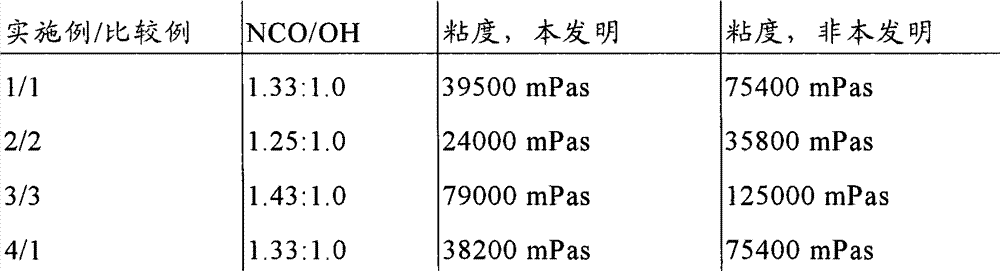
在所有的实施例中,用辛酸锌和胺制备的本发明粘结剂的粘度只有非本发明产品粘度的50-70%。在合成过程中也没有显著的放热峰,这代表着明显的技术工艺优势。In all examples, the viscosities of the inventive binders prepared with zinc octoate and amines were only 50-70% of the viscosities of the non-inventive products. There is also no significant exothermic peak during the synthesis, which represents a clear technical process advantage.
为了说明的目的,虽然前面已经对本发明进行了详细的描述,但应该理解的是,这种细节只是为了此目的,除了由权利要求所限定的以外,本领域的技术人员在不偏离本发明精神和范围的情况下可以对其作出改动。For illustrative purposes, although the present invention has been described in detail above, it should be understood that such details are for this purpose only, and those skilled in the art will not depart from the spirit of the present invention except as defined by the claims. It can be changed according to the circumstances and scope.
Claims (9)
Applications Claiming Priority (2)
| Application Number | Priority Date | Filing Date | Title |
|---|---|---|---|
| DE102007040240.8 | 2007-08-25 | ||
| DE200710040240 DE102007040240A1 (en) | 2007-08-25 | 2007-08-25 | Process for the preparation of low-viscosity allophanates with actinically curable groups |
Publications (2)
| Publication Number | Publication Date |
|---|---|
| CN101372528A CN101372528A (en) | 2009-02-25 |
| CN101372528B true CN101372528B (en) | 2012-11-14 |
Family
ID=40039714
Family Applications (1)
| Application Number | Title | Priority Date | Filing Date |
|---|---|---|---|
| CN2008101463255A Active CN101372528B (en) | 2007-08-25 | 2008-08-25 | Preparation method of low-viscosity allophanate containing actinically curable groups |
Country Status (13)
| Country | Link |
|---|---|
| US (1) | US8071659B2 (en) |
| EP (1) | EP2031005B1 (en) |
| JP (1) | JP5591457B2 (en) |
| KR (2) | KR101504356B1 (en) |
| CN (1) | CN101372528B (en) |
| AT (1) | ATE496953T1 (en) |
| AU (1) | AU2008203814B2 (en) |
| BR (1) | BRPI0803675A2 (en) |
| CA (1) | CA2639063C (en) |
| DE (2) | DE102007040240A1 (en) |
| ES (1) | ES2358301T3 (en) |
| PL (1) | PL2031005T3 (en) |
| TW (1) | TWI433861B (en) |
Families Citing this family (19)
| Publication number | Priority date | Publication date | Assignee | Title |
|---|---|---|---|---|
| DE102004048873A1 (en) * | 2004-10-07 | 2006-04-13 | Bayer Materialscience Ag | Process for the preparation of low-viscosity allophanates with actinically curable groups |
| DE102009008569A1 (en) | 2009-02-12 | 2010-08-19 | Bayer Materialscience Ag | Process for the preparation of particularly reactive and low-viscosity allophanates with actinically curable groups and their use for the production of particularly scratch-resistant coatings |
| CN103080175B (en) | 2010-06-30 | 2015-11-25 | 陶氏环球技术有限责任公司 | Low viscosity silyl modified polymer |
| EP2436668B1 (en) | 2010-09-30 | 2012-09-12 | VOCO GmbH | Polymerisable compounds comprising a polyalicyclic structure element |
| US9023916B2 (en) | 2010-09-30 | 2015-05-05 | Voco Gmbh | Composite material comprising a monomer with a polyalicyclic structure element |
| US8697769B2 (en) | 2010-09-30 | 2014-04-15 | Voco Gmbh | Lacquer composition comprising a monomer with a polyalicyclic structure element |
| US8669302B2 (en) | 2010-09-30 | 2014-03-11 | Voco Gmbh | Composite material comprising a monomer with a polyalicyclic structure element as a sealing material |
| US8915736B2 (en) | 2010-09-30 | 2014-12-23 | Voco Gmbh | Composition comprising a monomer with a polyalicyclic structure element for filling and/or sealing a root canal |
| CN103797041B (en) | 2011-06-30 | 2015-11-25 | 陶氏环球技术有限责任公司 | Improving one's methods of preparation low viscosity, fast setting silane-terminated polymer |
| PL2581397T3 (en) | 2011-10-14 | 2015-05-29 | Allnex Ip Sarl | Method for producing low viscosity, water soluble urethane(meth)acrylates |
| EP2581398B1 (en) * | 2011-10-14 | 2014-08-06 | Allnex IP S.à.r.l. | Method for producing low viscosity, water-emulsifiable allophanates with radiation curable groups |
| FR3003255B1 (en) | 2013-03-14 | 2015-10-02 | Vencorex France | ALLOPHANATE POLYACRYLATE |
| JP6281188B2 (en) * | 2013-03-28 | 2018-02-21 | 日油株式会社 | Urethane (meth) acrylate and photocurable resin composition containing the same |
| JP6262341B2 (en) * | 2013-07-17 | 2018-01-17 | ハネウェル・インターナショナル・インコーポレーテッドHoneywell International Inc. | Support coating composition and coating method |
| JP6241727B2 (en) * | 2013-10-31 | 2017-12-06 | 日油株式会社 | Urethane (meth) acrylate composition |
| CN114734628A (en) | 2014-06-23 | 2022-07-12 | 卡本有限公司 | Method for producing three-dimensional objects from materials with multiple hardening mechanisms |
| US10316213B1 (en) | 2017-05-01 | 2019-06-11 | Formlabs, Inc. | Dual-cure resins and related methods |
| EP3424971A1 (en) * | 2017-07-03 | 2019-01-09 | HILTI Aktiengesellschaft | Urethane methacrylate compounds containing reactive resins, and reactive resin systems and their use |
| WO2025192236A1 (en) * | 2024-03-14 | 2025-09-18 | 三井化学株式会社 | (meth)acrylate compound production method |
Citations (2)
| Publication number | Priority date | Publication date | Assignee | Title |
|---|---|---|---|---|
| CN1746245A (en) * | 2004-09-09 | 2006-03-15 | 拜尔材料科学股份公司 | Low viscosity allophanates containing photocurable groups |
| CN1934154A (en) * | 2004-03-17 | 2007-03-21 | 拜尔材料科学股份公司 | Low viscosity allophanates containing photocurable groups |
Family Cites Families (26)
| Publication number | Priority date | Publication date | Assignee | Title |
|---|---|---|---|---|
| US577024A (en) * | 1897-02-16 | Device foe air storage motor cars | ||
| GB994890A (en) | 1961-12-18 | 1965-06-10 | Ici Ltd | New organic polyisocyanates and their manufacture |
| DE1770245C3 (en) | 1968-04-23 | 1979-11-15 | Bayer Ag, 5090 Leverkusen | Process for the production of optionally crosslinked polyurethanes |
| DE2446440C3 (en) | 1974-09-28 | 1981-04-30 | Bayer Ag, 5090 Leverkusen | Process for the preparation of aqueous dispersions of polyurethanes containing sulfonate groups |
| US4108814A (en) | 1974-09-28 | 1978-08-22 | Bayer Aktiengesellschaft | Aqueous polyurethane dispersions from solvent-free prepolymers using sulfonate diols |
| DE2729990A1 (en) | 1977-07-02 | 1979-01-18 | Bayer Ag | PROCESS FOR THE PREPARATION OF ALLOPHANATES HAVING ISOCYANATE GROUPS |
| DE3717060A1 (en) | 1987-05-21 | 1988-12-01 | Bayer Ag | POLYETHER-POLYCARBONATE-DIOLE, THEIR PRODUCTION AND USE AS STARTING PRODUCTS FOR POLYURETHANE PLASTICS |
| DE4416321A1 (en) | 1994-05-09 | 1995-11-16 | Bayer Ag | Process for the preparation of light-fast polyisocyanates containing allophanate groups |
| AT401524B (en) | 1994-07-27 | 1996-09-25 | Vianova Kunstharz Ag | METHOD FOR PRODUCING WATER-THINNABLE URETHANE RESINS AND THE USE THEREOF |
| DE4441176A1 (en) | 1994-11-18 | 1996-05-23 | Bayer Ag | Polyisocyanates containing allophanate groups |
| DE19632951A1 (en) | 1996-08-19 | 1998-02-26 | Bayer Ag | Process for the preparation of aliphatic and / or cycloaliphatic and / or isocyanate groups having allophanates |
| US5739251A (en) | 1997-03-27 | 1998-04-14 | Bayer Corporation | Low viscosity, ethylenically unsaturated polyurethanes containing allophanate groups |
| US5777024A (en) | 1997-04-30 | 1998-07-07 | The Valspar Corporation | Urethane resins and coating compositions and methods for their use |
| US5767220A (en) * | 1997-08-25 | 1998-06-16 | Bayer Corporation | Low viscosity, ethylenically unsaturated polyurethanes containing allophanate groups |
| DE19750186A1 (en) | 1997-11-13 | 1999-05-20 | Bayer Ag | Hydrophilizing agent, a process for its preparation and its use as a dispersant for aqueous polyurethane dispersions |
| US6150476A (en) * | 1998-12-23 | 2000-11-21 | Bayer Corporation | Coating compositions containing a mixture of ethylenically unsaturated polyurethanes |
| DE19860041A1 (en) | 1998-12-23 | 2000-06-29 | Basf Ag | Coating agents curable by addition to isocyanate groups and also by radiation-induced addition to activated C-C double bonds |
| JP4678466B2 (en) * | 2001-08-09 | 2011-04-27 | Dic株式会社 | Energy ray curable resin composition |
| DE10205608A1 (en) | 2002-02-11 | 2003-08-21 | Degussa | Solid uretdione group-containing polyurethane powder coating compositions curable at low temperature |
| DE10246512A1 (en) | 2002-10-04 | 2004-04-15 | Bayer Ag | Low-viscosity radiation-curing and thermally curing polyisocyanates |
| DE102004043539A1 (en) * | 2004-09-09 | 2006-03-30 | Bayer Materialscience Ag | Low-viscosity allophanates with actinically curable groups |
| DE102004043538A1 (en) * | 2004-09-09 | 2006-03-16 | Bayer Materialscience Ag | Production of new radiation-curing binders |
| JP2006083273A (en) * | 2004-09-15 | 2006-03-30 | Mitsui Chemicals Inc | Allophanate group-containing (meth) acrylate resin composition |
| DE102004048873A1 (en) | 2004-10-07 | 2006-04-13 | Bayer Materialscience Ag | Process for the preparation of low-viscosity allophanates with actinically curable groups |
| US20060128923A1 (en) * | 2004-12-15 | 2006-06-15 | Bayer Materialscience Llc | Radiation curable compositions |
| DE102005011231A1 (en) | 2005-03-11 | 2006-09-14 | Bayer Materialscience Ag | Special allophanates containing modified polyurethanes |
-
2007
- 2007-08-25 DE DE200710040240 patent/DE102007040240A1/en not_active Withdrawn
-
2008
- 2008-08-09 AT AT08014258T patent/ATE496953T1/en active
- 2008-08-09 PL PL08014258T patent/PL2031005T3/en unknown
- 2008-08-09 DE DE200850002449 patent/DE502008002449D1/en active Active
- 2008-08-09 EP EP20080014258 patent/EP2031005B1/en active Active
- 2008-08-09 ES ES08014258T patent/ES2358301T3/en active Active
- 2008-08-11 AU AU2008203814A patent/AU2008203814B2/en not_active Ceased
- 2008-08-20 US US12/229,185 patent/US8071659B2/en active Active
- 2008-08-22 CA CA2639063A patent/CA2639063C/en not_active Expired - Fee Related
- 2008-08-22 BR BRPI0803675-6A patent/BRPI0803675A2/en not_active IP Right Cessation
- 2008-08-22 KR KR1020080082280A patent/KR101504356B1/en active Active
- 2008-08-22 TW TW97132005A patent/TWI433861B/en active
- 2008-08-25 CN CN2008101463255A patent/CN101372528B/en active Active
- 2008-08-25 JP JP2008215332A patent/JP5591457B2/en not_active Expired - Fee Related
-
2014
- 2014-11-18 KR KR20140161197A patent/KR20140143733A/en not_active Ceased
Patent Citations (2)
| Publication number | Priority date | Publication date | Assignee | Title |
|---|---|---|---|---|
| CN1934154A (en) * | 2004-03-17 | 2007-03-21 | 拜尔材料科学股份公司 | Low viscosity allophanates containing photocurable groups |
| CN1746245A (en) * | 2004-09-09 | 2006-03-15 | 拜尔材料科学股份公司 | Low viscosity allophanates containing photocurable groups |
Also Published As
| Publication number | Publication date |
|---|---|
| ATE496953T1 (en) | 2011-02-15 |
| US8071659B2 (en) | 2011-12-06 |
| JP5591457B2 (en) | 2014-09-17 |
| JP2009074070A (en) | 2009-04-09 |
| ES2358301T3 (en) | 2011-05-09 |
| EP2031005B1 (en) | 2011-01-26 |
| DE502008002449D1 (en) | 2011-03-10 |
| CA2639063C (en) | 2015-10-13 |
| BRPI0803675A2 (en) | 2009-05-05 |
| KR101504356B1 (en) | 2015-03-19 |
| TW200920759A (en) | 2009-05-16 |
| EP2031005A2 (en) | 2009-03-04 |
| KR20090021247A (en) | 2009-03-02 |
| TWI433861B (en) | 2014-04-11 |
| KR20140143733A (en) | 2014-12-17 |
| AU2008203814A1 (en) | 2009-03-12 |
| CA2639063A1 (en) | 2009-02-25 |
| EP2031005A3 (en) | 2009-11-25 |
| DE102007040240A1 (en) | 2009-02-26 |
| PL2031005T3 (en) | 2011-06-30 |
| AU2008203814B2 (en) | 2014-07-10 |
| US20090137750A1 (en) | 2009-05-28 |
| CN101372528A (en) | 2009-02-25 |
Similar Documents
| Publication | Publication Date | Title |
|---|---|---|
| CN101372528B (en) | Preparation method of low-viscosity allophanate containing actinically curable groups | |
| US9988485B2 (en) | Process for preparing low-viscosity allophanates containing actinically curable groups | |
| US8106140B2 (en) | Process for preparing low-viscosity allophanates containing actinically curable groups | |
| US8853295B2 (en) | Process for the preparation of particularly reactive and low-viscosity allophanates having actinic-curable groups and the use thereof for the preparation of particularly scratch-resistant coatings | |
| US8604097B2 (en) | Low viscosity allophanates containing actinically curable groups | |
| US20060052527A1 (en) | Radiation-curing binders and a process for their preparation | |
| MXPA05009605A (en) | Low-viscosity allophanates having actinically hardenable groups. |
Legal Events
| Date | Code | Title | Description |
|---|---|---|---|
| C06 | Publication | ||
| PB01 | Publication | ||
| C10 | Entry into substantive examination | ||
| SE01 | Entry into force of request for substantive examination | ||
| C14 | Grant of patent or utility model | ||
| GR01 | Patent grant | ||
| ASS | Succession or assignment of patent right |
Owner name: ZHAN XIN IP CO., LTD. Free format text: FORMER OWNER: BAYER AG Effective date: 20140710 |
|
| C41 | Transfer of patent application or patent right or utility model | ||
| TR01 | Transfer of patent right |
Effective date of registration: 20140710 Address after: Luxemburg Luxemburg Patentee after: Zhanxin IP Co.,Ltd. Address before: Germany Leverkusen Patentee before: BAYER MATERIALSCIENCE AG |
|
| TR01 | Transfer of patent right | ||
| TR01 | Transfer of patent right |
Effective date of registration: 20180629 Address after: Bergen Op Zoom Holland Patentee after: Zhanxin Holland Co.,Ltd. Address before: Bergen Op Zoom Holland Patentee before: Zhanxin Holdings International Co.,Ltd. Effective date of registration: 20180629 Address after: Bergen Op Zoom Holland Patentee after: Zhanxin Holdings International Co.,Ltd. Address before: Luxemburg Luxemburg Patentee before: Zhanxin IP Co.,Ltd. |