CN101309747A - Surface features in micro-fabrication technology - Google Patents
Surface features in micro-fabrication technology Download PDFInfo
- Publication number
- CN101309747A CN101309747A CNA2006800175809A CN200680017580A CN101309747A CN 101309747 A CN101309747 A CN 101309747A CN A2006800175809 A CNA2006800175809 A CN A2006800175809A CN 200680017580 A CN200680017580 A CN 200680017580A CN 101309747 A CN101309747 A CN 101309747A
- Authority
- CN
- China
- Prior art keywords
- microchannel
- feature
- surface characteristics
- fluid
- surface features
- Prior art date
- Legal status (The legal status is an assumption and is not a legal conclusion. Google has not performed a legal analysis and makes no representation as to the accuracy of the status listed.)
- Pending
Links
Images


Landscapes
- Physical Or Chemical Processes And Apparatus (AREA)
Abstract
本发明涉及微通道设备,其包括具有用来改善流动的内表面特征的微通道;涉及使用该微通道结构的方法,以及具有这些特征的设备的制造方法。
The present invention relates to microchannel devices including microchannels having interior surface features for improving flow, methods of using the microchannel structures, and methods of making devices having these features.
Description
Related application
The application is the part continuation application of No. the 11/089th, 440, the U.S. Patent application serial number submitted on March 23rd, 2005.In addition, according to 35U.S.C. the 119th (e) bar, the application requires following U.S. Provisional Application No.: the 60/697th of submission on July 8th, 2005, No. 900, the 60/727th, No. 126 of submitting on October 13rd, 2005, and the 60/731st, No. 596 of submitting on October 27th, 2005.
Invention field
The present invention relates to microchannel apparatus, it comprises having the microchannel that is used for improving mobile interior surface features (feature); The invention still further relates to the method for using described MCA, and the manufacture method with equipment of these features.
Introduce
In recent years, industry and academic aspect micromodule equipment has been shown great interest.Why people produce these interest: size reduces, production capacity improves, can arrange system's (i.e. number of " increase (number up) " passage), the raising heat transfer with any required ability by size and improve mass transfer.Gavrilidis etc. provide the comment of some achievements that relate to microreactor (microchannel apparatus part), referring to " technology of miniature process reactor and application (Technology And Applications OfMicroengineered Reactors) " Trans.IchemE, the 80th volume, the A part, 3-30 page or leaf (in January, 2002).
Surface characteristics has been used to mix in the microchannel.Prior art uses surface characteristics to strengthen the mixing of two fluid streams stream under the utmost point low reynolds number in microfluidic applications.Usually the numerical value of Reynolds number is less than 100, the more normal 0.1-10 that is about.The good mixing device is defined as: the material composition difference of material on cross section of leaving described micro-mixer is very little.In addition, prior art proposes: it is effective especially using surface characteristics under low reynolds number, but surpasses 10 or 100 along with Reynolds number increases, and mixing efficiency can reduce.
Svasek has at first discussed the prior art micro-mixer that has the wall of groove or recessed angle (recessed angle) based on use 1996, wherein a series of angled grooves (each feature has a kind of oblique groove of fixed angle) are placed a wall, be used for iodine blue starch solution is mixed with the photograph fixing solution.Described with smooth passage and compared, mix improved, target is by making fluid crooked mixing in the main channel, makes the diffusion length of two kinds of liquid in the primary flow channel reduce, and diffusion can be finished final mixing.Depth of groove is 0.25 with the ratio of path clearance.
Johnson, Ross and Locascio have described again on the net in December calendar year 2001 and have used the surface with groove, and they have described and have used four kinds of oblique grooves (each feature has a kind of fixing oblique groove) to strengthen the mixing in the micro-mixer main channel.The author has described the situation for all evaluations, at low flow velocity or than all having improved mixing under the low reynolds number.They have also described after the district of the same groove of four repetitions increases different angles to oblique groove.Although performance obtains to improve, along with the increase of Reynolds number, mixed performance can reduce.The degree of depth of recess or groove is 2.74 with the ratio of path clearance.
In January, 2002, Strook etc. have described the use of two kinds of recess channels micro-mixers in Science, this micro-mixer with fixing oblique angle groove and second pattern is called as staggered herringbone blender (SHM), just changes after continuous six features of wherein said angled feature.The center of this work is the mixing of improvement by the liquid of two kinds of low reynolds numbers (less than 100) logistics of described microchannel.The author has described mixing length and has increased along with the logarithm value of Peclet number is linear.Described Peclet number is defined as speed * path clearance ÷ diffusion coefficient.Under higher speed, required mixing length increases, and expression is unfavorable for mixing.For SHM, depth of groove is 0.6 with the maximum of the ratio of path clearance.
In 2002, Strook etc. described a series of oblique angles that similarly have fixed angle in Analytical Chemistry equally, were used for mixing the fluid mixture that Reynolds number is, described depth of groove is 1.175 with the maximum of the ratio of path clearance.This author has described to flow and has been spirality, and this pitch with the rotating fluid logistics is relevant.The author claims that staggered herringbone blender will be by producing the chaotic mixing of quickening in the microfluidic device of Lagrange under low reynolds number.
Johnson and Locascio have described a kind of micro-mixer in June, 2002, and it has four kinds of continuous inclined grooves, to strengthen the mixing in the overall flow passage.The author claims that when recess or depth of groove increase to up to 50 microns the liquid transfer in the passage obtains to improve, and when surpassing this degree of depth, does not then improve.The darker degree of depth is called as dead zone area, and fluid or molecule may be captured in this zone rather than mix.Reynolds number is less than 1.The author claims that also the axial dispersion of the passage with recess or groove is higher than the axial dispersion of wall smooth or that do not have recess.Depth of groove is 0.32-2.74 with the ratio of path clearance.The author mentions when ratio surpasses 1.6, does not have further improvement.In all cases, chart shows that fluid-mixing does not almost enter the inwall of groove.
Strook and Whitesides have discussed in Accounts of Chemical Research in 2003 and have used staggered herringbone blender, by with the interval of rule or the orientation of cyclomorphosis groove, the fluid in the main channel are stretched and bending.Less than 1 situation, the depth of groove of use is 0.44 with the ratio of path clearance for Reynolds number.The author claims that mixing length is directly proportional with the logarithm value of flow velocity, and this is because staggered herringbone blender (SHM) has promoted the advection of the confusion in the primary flow channel.In unmixing passage, mixing length is directly proportional with flow velocity.The author claims that also SHM has reduced the dispersion that the pool Xiao Ye in the microchannel flows.
In 2003, Aubin etc. have described oblique blender in Chemical Engineering Technology, this oblique blender can produce few convection current to be mixed, and this is to have produced strong spiral flow because center on the edge of passage, but does not comprise the central streams of passage.In contrast, SHM has produced in the fabulous passage and has mixed.In this research, the ratio of depth of groove and path clearance is less than 0.6.Reynolds number is 2.The author claims, finds that the degree of fluid deformation in channel groove (the expression fluid stretches or motion) is minimum, but this may not be to be used for good tolerance that mixed performance is quantized.
Wang etc. are in July, 2003, disclose in a large number the research of microchannel that band is had the groove of pattern in J.Micromech.Microeng.Depth of groove is 0.1-0.86 with the ratio of path clearance.Used Reynolds number is 0.25-5.This pattern is made up of a series of same oblique angle grooves, and each groove has fixing angle.The author claims that the depth-width ratio (aspect ratio) of groove is to mix most important variable, and this depth-width ratio is that to be better than depth-width ratio at 0.86 o'clock be 0.1 situation.The eddy current that flow pattern in the main channel is seemingly single.As can be seen from the figure, when Reynolds number increased, the amplitude of the helicity of shear rate or definition was lower.As if average shear in the circulation or helicity irrelevant with Reynolds number.The author claims for this kind geometry and does not have chaotic advection.The author claims that the groove that has pattern in the microchannel has produced dead volume, but darker feature also can be improved the passage length that mixes and shorten mixing.It is said that these blenders can be in lower flow velocity (Re<5) work down, this has reduced pressure drop.
Bennett and Wiggins disclosed the contrast of the various geometries of SHM on the net in 2003.Specifically, removed short section (a short leg), the depth minus half-sum of groove has been doubled.Reynolds number is less than 0.1.When short section removed in discovery, the groove that uses the degree of depth to double improved than original SHM and mixes; The degree of depth of groove reduces by half then to mix and slightly is inferior to original SHM.The author claims that the effect of blender causes owing to raceway groove mixes, and some fluids move back and forth in passage in groove or raceway groove, for fluid has increased extra shearing, thereby have strengthened mixing.Owing to proposed this mechanism, thereby the author thinks and can remove the weak point section of propping up of SHM and almost do not have influence-generation that the feature of an angle is only arranged.The author also claims the pressure drop of reeded passage less than simple unnotched passage, and this is because the opening of groove plays a role effectively, weakens no-slip boundary condition.At last, the author has discussed the functional relation of mixing length along with the logarithm value increase of Pe.Also be that mixing length increases along with the increase of speed or diffusion length or increases along with reducing of mass diffusion coefficient.
Kim etc. disclose the use that embeds the chaotic micro-mixer of obstacle in April, 2004, and described obstacle places in the primary flow channel, also has the array of a series of angled grooves in this primary flow channel, and each feature comprises an angle.Author's claimed features can form pattern in the top and the bottom of passage, can obtain stronger helical flow.The author claims that stronger helical flow will produce the mixing of higher level.Depth of groove is 0.15 with the ratio of path clearance.The obstacle height is 40 microns, extends in 60 microns the gap, microchannel.Reynolds number changes in the 0.228-2.28 scope.The author shows that in the length-specific in the microchannel (21 millimeters), mixing intensity reduces along with the increase of Reynolds number, and mixing length is logarithmic relationship and increases along with the increase of Reynolds number.
In addition, in April, 2004, Schonfeld and Hardt disclose the work about helical flow in the microchannel.They claim from the heat transfer of conduit wall and obtain to improve that the fluid dynamic of the concentration tracer that transmits disperses to reduce in passage.They have estimated a kind of surface characteristics pattern from numerical value, and this pattern has the oblique angle groove on any one or two walls of microchannel, and depth of groove is 0.02-6.3 with the ratio of path clearance.The author claims, in the groove recess, the average specific of the horizontal speed vector of the y of surface characteristics inner plane (channel width) direction and x (passage length) direction increases to-0.4 linearly from-1, and in the flow path of main thoroughfare, increase with exponential relationship, flatten until 0 place on channel centerline, promptly in the overall flow passage, there is not clean interconnection to flow substantially.The interconnection flow vector moves back and forth with identical speed substantially.The author claims that by two walls the laminar flow between the two fluid streams stream to be mixed tangles and increases, thereby has produced surf zone between the border that increases, and the diffusion that is used in the main channel mixes.The author has analyzed the dependence of relative lateral velocity to Reynolds number, reported that they find that dependence shockingly a little less than.When Reynolds number when 1 changes to 1000, the absolute lateral velocity in the hip can increase, the relative lateral velocity on this structure only is subjected to minimum influence.For described situation, cross over the gap of microchannel, the ratio of average y speed and x speed is about 0 in the main channel.Along with Reynolds number increases, the fluid relative velocity of crossing over the main channel on width is constant.
Locascio discloses the summary of Microfluidic Mixing in May, 2004.She claims that mixing is because fluid rotation or crooked the causing that fluid took place by time on the feature of channel bottom.Bottom at passage does not almost have fluid motion.Be blended in the recess channels device by diffusion and mix, reduced diffusion length between two kinds of fluids, mix thereby strengthened described diffusion by flecition.
And in May, 2004, Kang and Kwon disclose inclined groove micro-mixer (all features have a kind of angle), and SHM and obstacle embed the comparison of micro-mixer.The depth of groove of various micro-mixers is 0.1765 with the ratio of path clearance.Various micro-mixers comprise 24 continuous features, and described SHM comprises 12 features of two groups, and the summit with feature of two kinds of angles moves by side to opposite side from one of passage.Be about 0.01 according to describing Reynolds number.According to description, the inclined groove blender is very poor blender, and SHM is best blender.Flow pattern shows in the passage, and in primary flow channel, fluid bends and mixes.
Liu, Kim and Sung disclose the research of estimating reeded micro-mixer in July, 2004.The proportional amplification of size with described in the article of Strook on Science keeps constant depth-width ratio, with estimate hydraulic diameter be 200 microns with 111 microns passage.The depth of groove of gained is 0.23 with the ratio of path clearance.It is 10 situation that mixed performance when Reynolds number is 1 slightly is better than Reynolds number.The author claims, than high reynolds number the time, because fluid time of staying in blender significantly shortens, causes the mixed performance variation.
Strook and McGraw disclose a kind of simple lid in March, 2004 and have driven (lid-driven) hole flow model, so that mixed pattern and actual experiment are compared qualitatively.This model is investigated SHM with 0.9 millimeter total surface feature repetitive length.Depth of groove is 0.44 with the ratio of path clearance.In model, use Reynolds number near 0 Stokes flow, compare with the mobile of Re=0.01.The result that this model has been described test has qualitatively particularly described a kind of " fluid lobe (lobe of fluid) " flows through the SHM groove with dextrosinistral lobe and lobe from left to right motion.But the model Stokes flow is included into non-inertia flow with it, and the inertia that flows in non-inertia flow can't be competed mutually with the momentum diffusion.
Sato etc. disclose a research that has single corner characteristics on three walls in November, 2004.The author describes and has produced intensive spiral flow.Depth of groove is 0.3 with the ratio of path clearance.The author claims that the feature on two sidewalls has displacement, and wherein 5 inclined grooves of a row are positioned on the sidewall, interrupts then, and 5 inclined grooves of a row begin on relative side simultaneously, interrupt then, by that analogy, at this moment can obtain result preferably.In this research work, Reynolds number is less than 10.
Howell etc. disclose a research in April, 2005, wherein are provided with groove in the top and the bottom of microchannel.Described groove is made up of following form: one group 4 single angle grooves that tilt are four herringbone grooves then, are again 4 single angle grooves then, by that analogy.Depth of groove is 0.24-0.74 with the ratio of path clearance.The Reynolds number of research is 0.06-10.Fluid mainly stretches in main flow path and is crooked, and producing more, the thin layer of close spacing is used for the diffusion mixing.The author claims that they find not observe flow pattern generation marked change in the whole reynolds number range that is studied.
Yang, Huang and Lin disclose the research of the influence that a geometry convection cell mixes in reeded micro-mixer in August, 2005.According to description, described fluid also bends and stretches, with the diffusion length that reduces to mix.Depth of groove is 0.15-0.44 with the ratio of path clearance.Reynolds number is 10.The author claims does not have significant correlation between the pressure loss and the blended index.The author has estimated the SHM with following form: 6 one group same feature in a row before this changes the position of the summit of 6 one group of same features next along the main channel width then.Think that the ratio of flow is the very important tolerance of mixing in flow and the main channel in the groove.In the groove in Peak Flow Rate and the main channel ratio of flow velocity be 8.9%.
The list of references table
| Aubin, Joelle, Fletcher, David F, Bertrand, Joel and Xuereb, Catherine, " sign of mixing quality in the micro-mixer (Characterization of the Mixing Quality in Micromixers) " CA em Eng Technol 26,12 (2003) |
| Bennett, John Patrick and Wiggins, Chris H, " (mixing the calculating research of microchannel stream) A Computational Study of Mixing Microchannel Flows, " Columbus University, New York, NY, July 15 (2003) |
| Chew, Y T, Xia, H M and Shu, C, " technology of the little mixing of enhance fluid and chaotic micro-mixer (Techniques to Enhance Fluid Micro-Mixing and Chaotic Micromixers) " World Scientfic Modern Physics Letters B, the 19th volume, 29 phases of the 28th ﹠, 1567-1570 (2005) |
| Hessel, Volker, Lowe, Holger and Schonfeld, Fnedhelm, " summary (Micromixers-a review on passive and active mixing principles) of micro-mixer-rule passive and that initiatively mix " Chemical Engineering Sciences 60,2479-2501 (2005) |
| Howell, Peter B, Mott, David R, Fertig, Stephanie, Kaplan, Carolyn R, Golden, Joel P, Oran, Elaine S and Ligler, Frances S, " microfluid mixer (A microfluidic mixer with grooves placed on top and bottom of the channel) " The Royal Society of Chemistry Lab Chip, 5 with the groove that is positioned at channel roof and bottom, 524-230, (2005) |
| Johnson, Timothy J and Locascio, Laurie E, the The Royal Society of Chemistry that " is used under EOF, carrying out the sign and the optimization (Characterization and optimization of slanted well designs for microfluidic mixing under electroosmotic flow) of the inclination recess structure of Microfluidic Mixing ", Lab Chip, 2,135-140 (2002) |
| Johnson, Timothy J, Ross, David and Locascio, Laurie E, " Microfluidic Mixing (Rapid Microfluidic Mixing) fast " Analytical Chemistry, the 74th volume, the 1st phase, January 1 (2002) |
| Kang, Tae Gon and Kwon, Tai Hun, " the color grains trace method (Colored particle tracking method for mixing analysis of chaotic Micromixers) that is used for the hybrid analysis of chaotic micro-mixer " Journal of Micromechamcs and Microengmeenng, 14,891-899 (2004) |
| Kim, Dong Sung, Lee, Seok Woo, Kwon, Tai Hun and Lee, Seung S, " the chaotic micro-mixer (A barrier embedded chaotic Micromixer) of embedding obstacle " Journal of Micromechamcs and Microengmeenng, " 14,798-805 (2004) |
| Liu, Ymg Zheng, Kim, Byoung Jae and Sung, Hyung Jm, " mixing of two kinds of fluids in the microchannel (Two-fluid mixing m a Microchannel) " Elsevier International Journal of Heat and Fluid Flow, 25,986-995 (2004) |
| Locascio, Laurie E, " Microfluidic mixing, " Anal Bioanal Chem, 379 325-327, May 5 (2004) |
| Nguyen, Nam-Trung and Wu, Zhigang, " micro-mixer-summary (Micromixers-a review) " Journal of Micromechamcs and Microengmeenng 15R1-R1 6 (2005) |
| Sato, Hironobu, Ito, Sella, Tajima, Kenji, Orimoto, Norimune, Shoji, Shuichi, " having the inclined groove, the PDMS microchannel (PDMS Microchannels with slanted grooves embedded in three walls to realize efficient spiral flow) that embed three walls " Elsevier B V Sensors and Actuators A 119 to realize effective spiral flow, 365-371, (2005) |
| Schonfeld, F, Hessel, V and Hofmann, C " has the division of the optimization that uniformly " confusion " mix-again in conjunction with micro-mixer (An optimized split-and-recombine micro-mixer with uniform |
| ′chaotic′mixing)″The Royal Society of Chemistry Lab Chip,4,65-69(2004) |
| Schonfeld, Fnedhelm and Hardt, Steffen, " simulation of spiral flow in the microchannel (Simulation of Helical Flows in Microchannels) " AIChE Journal the 50th volume, the 4th phase, April (2004) |
| Stremler, Mark A, Haselton, F R and Aref, Hassan, " chaotic design, the application of chaotic advection on the miniature scale (Designing for chaos; applications of chaotic advection at the microscale) " The Royal Society 362,1019-1036 (2004) |
| Stroock, Abraham D and McGraw, Gregory J, " with of the research (Investigation of the staggered herringbone mixer with a simple analytical model) of simple analysis model " The Royal Society 10 1098/rsta 1357 (2003) to staggered herringbone blender |
| Stroock, Abraham D and Whitesides, George M, " control (Controlling Flows in Microchannels with Patterned Surface Change and Topography) of in microchannel, flowing " Accounts of Chemical Research with patterned surfaces variation and profile, 597-604, the 36th volume, the 8th phase (2003) |
| Stroock, Abraham D, Dertinger, Stephan K, Whitesides, George M and Ajdari, Armand, " using surface to make the mobile pattern (Patterning Flows Using Grooved Surfaces) that forms " Analytical Chemistry with groove, the 74th volume, the 20th phase, 15 days 15 October, (2002) |
| Stroock, Abraham D, Dertinger, Stephan K W, Ajdari, Armand, Mezic, Igor, Stone, Howard A and Whitesides, George M, " the chaotic blender of microchannel (Chaotic Mixer for Microchannels) " Science the 295th volume, 25 phases, January (2002) |
| Svasek, Peter, Jobst, Gerhard, Urban, Gerald and Svasek, Edda, " opposing is used for the dry film (Dry Film Resist Based Fluid Handling Components for μ T AS) of the alkaline fluids process element of μ T AS " Analytical Methods ﹠ Instrumentation Special Issue, 78-80, (1996) |
| Wang, Hengzi, Iovemtti, Pio, Harvey, Erol and Masood, Syed, " to the big quantity research (Numerical investigation of mixing in Microchannels with patterned grooves) that mixes in the microchannel with pattern groove " Journal of Micromechamcs and Microengmeenng 13,801-808 (2003) |
| Wang, Hengzi, Masood, A/Prof Syed, Iovemtti, Dr Pio and Harvey, A/Prof Erol, " the passive mixing in the microchannel (Passive Mixing in a Microchannel) " Abstract, 261-268 |
| Yang, Jing-Tang, Huang, Ker-Jer and Lin, Yu-Chun, " influence (Geometric effects on fluid mixing in passive grooved Micromixers) that the geometry convection cell mixes in the passive reeded micro-mixer " The Royal Society of Chemistry Lab Chip, 5,1140-1147 (2005) |
Summary of the invention
In the present invention, can use the surface characteristics in the microchannel, along with the increase raising unit operations of Reynolds number.In the present invention, described surface characteristics can be used for Re valuably and be equal to or greater than 100 situation, and in some embodiments, Re is equal to or greater than 200, is equal to or greater than 100, and Re is 300-2200 in some embodiments.In addition, by using surface characteristics, also provide extra surprising raising to turbulence state (turbulent regime).
Of the present invention many aspect in, very important part is a fluid molecule and the interaction of " active surface ".If mass exchange or exchange heat take place on a surface, think that then this surface is active.Described surface comprises the bottom surface and the side of groove, and the ridge between the feature." ridge " is to connect at least two open surface features, and wall or the surface open to primary flow channel.When the interaction quantity increase of fluid and active surface, the performance of unit operations further improves.For chemical reactor, can place heterogeneous catalysis in the surface characteristics, on the top of microchannel or the ridge or in the flat site, optionally be provided with along all surface or selected surface.Diffusion is not to be unique motive force that reactive material is moved to active walls, and advection or convection current become the main motive force that makes reactant rapidly move to the catalysis wall and product is flowed from the wall shift to the overall flow.For example, if the diffusion conduct is only arranged with the main motive force of logistics from mass motion to the active catalytic wall, then for being the several milliseconds of gas-phase chemical reaction devices to tens of milliseconds of operations total time of contact, the characteristic time may be about several milliseconds to tens of milliseconds.For methane and air stream in 850 ℃, 1 millimeter passage of 1.0 crust, diffusion coefficient is about 2.2 centimetres
2/ second, the diffusion length (supposing that catalyst is arranged on the active surface feature of both sides, gap, microchannel) from the path clearance center is about 0.5 millimeter.The characteristic time of result's diffusion is about 1 millisecond.
For high-speed and high laminar flow Reynolds number embodiment (for 850 ℃, 1 atmospheric pressure, airborne rare methane stream, Re is about 700), the feature average speed in the main channel is 100 meter per seconds.For pure laminar flow, under this speed, center line velocity is 1.5 times of mean value, is total up to 150 meter per seconds.In long 10 centimetres passage, approximately need 0.7 millisecond consuming time along the mobile molecule of the center line of path clearance is average in passage.Therefore, it is not enough probably so that these reaction molecular collision active catalyst walls that single-pass is crossed diffusion.Even the speed in the main channel is little of 1/10th, less than 100 situation, average speed is 10 meter per seconds for Reynolds number, and the time of staying of center line molecule (near the molecule the expression path clearance center) will be elevated to 7 milliseconds.In essence, only with diffusion, the average collision frequency of center line reaction molecular and active catalyst wall will be less than ten times.
This performance is compared with the situation of active surface feature (thrust and pulling force force fluid and reactant to enter surface characteristics).Model result shows, to corresponding smooth passage, (z is a flow direction in x direction and y direction, x and y are respectively the side direction (side to opposite side) and the horizontal flow direction of (top is to the bottom)) flow velocity can be above the mean flow rate of z direction, but be about 1% of length direction mean flow rate, or 5%, 10%, 20% or higher.Correspondingly, for this embodiment, the average speed of y direction (top of microchannel supposes perhaps that to the bottom active walls is arranged on two surfaces, then between the active surface feature wall) is at least 1 meter per second.Under this speed, reaction molecular to characteristic time of active surface feature wall advection less than 0.5 millisecond, promptly less than half of diffusion required time.Along with y direction flow velocity further increases, the characteristic time of advection correspondingly shortens.
Only the time difference between convection current and the diffusion is the advantage of a part, but is not whole advantages.Other advantage of active surface feature is that material disperse to reduce, and makes from the frequency of exposure of the molecule of the overall flow in the main gap and active surface feature wall much higher.In addition, in case molecule has entered active surface feature groove, they have left the overall flow path, the difficult identical advection that makes molecule leave active surface feature groove or move downstream.In this way, in the active surface feature, stop the longer time, reduced typical Taylor-Aris and disperseed, to promote required unit operations by allowing molecule.
Catalyst in the surface characteristics of prior art is provided with and will only can produces common raising effect, this is because the target of the device of prior art is to allow molecule to mix in the overall flow passage, rather than makes itself and active surface feature wall that active collision or interaction take place.For the present invention, in order to obtain good performance, need center line molecule and active surface feature wall collision at least 1 time, perhaps 2 times or 3 times or more times.In addition, the fluid that advantageously enters at least 30% in the all-mass of at least one passage that comprises at least one surface characteristics district enter in the surface characteristics district at least one surface characteristics at least once." surface characteristics district " is defined as length of flow along the microchannel, has closely-spaced continuous surface characteristics series in wall.In the method for the invention, " surface characteristics district " represents a kind of zone, in this zone, between two features, flows and can not relax stratified flow parabola flow pattern substantially.More of the present invention preferred embodiment in, at least 50%, more preferably at least 70% in the quality of admission passage, be more preferably at least 90% fluid and enter at least one active surface feature in the surface characteristics district.
For the unit operations that comprises homogeneous chemical reaction and heat exchanger, the interaction between overall flow material and the active surface feature wall also is of value to heat is delivered to adjacent heat transfer chamber.Different with the micro-mixer of prior art, need make ensemble stream move near the wall or by wall, and the mixed population stream that flows fully equably.Make how fresh fluid motion near the active surface and the active surface feature wall by active surface, will be more preferably than the structure of main mixed population stream.
For these application, obtaining to improve than performance under the high reynolds number, rather than than being unfavorable under the high reynolds number that performance improves, this is because the rotational flow pattern movement of high momentum logistics to repeat, make overall flow crooked, can not stop the rotation of logistics substantially and attempt to make it to go back in the opposite direction by the active surface feature.In case logistics begins in the active surface feature with fixing direction rotation, it continues rotation with identical direction, thereby confirms the vorticity height, and fluid is strengthened to the mobile acquisition of active surface feature wall like this.Along with in increase, make the relative vorticity of fluid rotation or angular force (angle force) also increase, like this with active surface feature wall or the also increase thereupon of number of times that contacts in its vicinity or collide than momentum under the high reynolds number thereupon.But for these situations, vorticity is not unique factor.Only make the pattern that fluid rotates in the overall flow path, for example the pattern that forms by the oblique feature groove in single angle of crossing over the microchannel wall width can't be accomplished the active surface feature is drawn in the center flow logistics.In the present invention, the geometry of active surface feature wall pattern can be designed to strengthen and " contact " (be defined as the plane that molecule is worn out active surface feature groove, enter in the groove with angle of depression) with the active surface feature.Preferred active surface feature has more than one angle on the width of at least one wall of microchannel." at least a angle " means that slope change-feature is not a straight line, but comprises curved shape; Described feature is adjacency preferably, for example is herringbone or zigzag; But in some embodiments, if the alignment of the part of feature, it can be discontinuous then having " at least a angle " surface characteristics, and therefore except the gap, it is to have the herringbone structure that lacks the top that depression or projection will connect-example.
Example for prior art, the time that conventional molecule spends in surface characteristics compares approximately less than 10% with the mean residence time that spends in passage, and in the present invention, the time that conventional molecule spends in the active surface feature compares preferably approximately greater than 15% with the mean residence time that spends in passage, more preferably greater than 20%, more preferably from about greater than 30%.The timing definition that molecule spends in the active surface feature is molecule deface characteristic plane and has shifted out from the overall flow path the time that the back is spent." overall flow path " is continuous substantially from the outlet that enters the mouth, and the length in the moving path of the common longshore current of described active surface feature begins and stops.
For the present invention, along with the shortening of the time of staying, described active surface feature can obtain to improve with respect to the no feature of correspondence or the performance raising of the wall plane or level and smooth usually.Undistinguishable wall is limited by the microchannel, and the gap of this microchannel does not comprise the degree of depth of recess feature, and has identical width and length.Along with the increase of Reynolds number, the importance of inertial force increases thereupon.For the logistics of higher inertia or momentum, momentum remained on single inceptive direction rather than make direction put upside down or change, can make logistics keep rotation easilier.When logistics kept rotation, its maintenance flowed in the active surface feature increasing logistics or molecule, and they can be in described active surface feature interact with the two wall of heat-shift or material or this.
In one aspect, the invention provides microchannel apparatus, this equipment comprises: the microchannel that comprises surface characteristics; At least one section of described microchannel be characterized as the feature inlet length greater than 10; Described section length is at least 1 centimetre; Described section comprises a plurality of similar repetition surface characteristics; Described similar repetition surface characteristics comprises at least a angle in each similar surface characteristics.Preferably, most of periphery of microchannel has surface characteristics; For example, the opposite face of rectangle microchannel.
On the other hand, the invention provides microchannel apparatus, this equipment comprises: the microchannel that is limited by at least three microchannel wall; At least one section feature of described microchannel is that feature inlet length number (featureentrance length number) is greater than 10; Described section is at least 1 centimeter length; Described section comprises a plurality of similar repetition surface characteristics; Described similar repetition surface characteristics comprises at least a angle in each similar surface characteristics.
On the other hand, the invention provides microchannel apparatus, this equipment comprises: the microchannel, and this microchannel comprises the microchannel wall with surface characteristics; Described surface characteristics comprises the inferior patterning (sub-patterning) of the surface area that increases described microchannel wall; Also comprise the carbon monoxide-olefin polymeric that is arranged at least on the described surface characteristics that comprises inferior patterning.
On the other hand, the invention provides microchannel apparatus, this equipment comprises: microchannel, this microchannel comprise having the microchannel wall that surpass 15 similar repetition surface characteristics.In each similar surface characteristics, described similar repetition surface characteristics comprises at least a angle.
The feature of either side of the present invention also comprises arbitrary characteristics as herein described.For example, in preferred embodiment, described microchannel has two relative main walls, and described relative main wall comprises surface characteristics, and the ratio of the wherein said surface characteristics degree of depth and path clearance is greater than 0.3.In preferred embodiment, the microchannel is operated in parallel, and connects by manifold.The flow distribution that flows to microchannel in parallel preferably evenly distributes, and the difference of the mass flow in each passage is less than 35% (25%, 10%).
For comprising heterogeneous catalysis or in the technology that is higher than the heat transfer under 100 the Re, equipment of the present invention can show excellent results.
On the other hand, the invention provides microchannel apparatus, this equipment comprises: the microchannel, and it comprises microchannel wall, described microchannel wall comprises the surface characteristics of staggered herringbone blender (SHM) structure, and described SHM has the interval between angled surface characteristics; With the filling feature that is positioned at this interval.
On the one hand, the invention provides a kind of method of carrying out fluid treatment in the microchannel again, this method comprises, microchannel apparatus is provided, and described microchannel apparatus comprises the microchannel; Described microchannel comprises two relative microchannel wall and the gap between described two relative microchannel wall; In the described microchannel wall at least one comprises at least 10 continuous similar surface characteristics; Described similar surface characteristics comprises at least a angle separately, and the surface characteristics degree of depth is at least 0.4 with the ratio of path clearance; Under greater than 100 Re, make fluid flow through described microchannel.
Some preferred embodiment in, have catalyst or the sorbent be arranged on the surface characteristics.Some preferred embodiment in, have the radiator or the thermal source that contact with the described microchannel wall that comprises a series of similar surface characteristics.Many preferred embodiment in, method of the present invention is operated under the condition of short contacting time and/or high reynolds number (Re) and/or high Pe (Peclet number).
On the other hand, the invention provides a kind of method of carrying out fluid treatment in the microchannel, this method comprises: make fluid flow through the microchannel under greater than 100 reynolds number Re; Described microchannel comprises surface characteristics; In described surface characteristics, described fluid is carried out unit operations.Described unit operations can be any unit operations that this paper discusses, and is independent mixing (taking place with other unit operations usually although mix).
On the other hand, the invention provides a kind of method of carrying out fluid treatment in the microchannel, this method comprises: make fluid enter the microchannel by channel entrance; Described microchannel comprises surface characteristics at least one surface characteristics district; The fluid that enters quality of (more preferably at least 50%, 75% or 90%) enters within the volume of at least one surface characteristics in the described surface characteristics district to surpass 30%; Convection cell carries out unit operations in described surface characteristics district.The quality that enters the fluid of described surface characteristics is determined according to method provided herein and description.
On the other hand, the invention provides the method for carrying out fluid treatment in the microchannel, this method comprises: the microchannel apparatus that comprises the microchannel is provided; Described microchannel comprises surface characteristics; In each surface characteristics, described surface characteristics comprises at least a angle; Radiator or thermal source and the thermo-contact of described active surface feature.Fluid passes through described microchannel under greater than 100 Re, the result is that heat is delivered to fluid mobile in the microchannel or passes away heat from described fluid.Preferably, described radiator or thermal source comprise heat exchanger, and this heat exchanger preferably includes the microchannel.
On the other hand, the invention provides a kind of method of carrying out fluid treatment in the microchannel, this method comprises: the microchannel apparatus that comprises the microchannel is provided; Described microchannel comprises microchannel wall, and this microchannel wall comprises a district, and this district comprises the surface characteristics that contacts with thermal source or radiator heat; Make fluid flow through described microchannel,, between fluid and thermal source or radiator, carry out heat exchange by at least one microchannel wall; Produce pressure drop in the district that comprises surface characteristics; The heat that in this district, transmits divided by under the same conditions, do not having the heat (h that transmits in the district of feature
SF/ h
O) numerical value of gained, be that pressure drop in this district is divided by the pressure (dP in the district that does not have feature under the same terms at least
SF/ dP
O) 1.1 times of institute's value." undistinguishable district " is not another district that does not have feature in the same device, but (by experiment or calculate) simulation identical with described district, but replace the device of described feature with wall.The present invention also comprises some equipment, it is characterized in that the heat transfer of this equipment of recording by the techniques described herein obtains to improve.
On the other hand, the invention provides a kind of method of carrying out fluid treatment in the microchannel, this method comprises: the microchannel apparatus that comprises the microchannel is provided; Described microchannel comprises first district and second district; Described first district comprises the surface characteristics of first series; Described second district comprises the surface characteristics of second series; Make fluid pass through described microchannel, make fluid in described first and second districts, mix, but between these districts, relax into parabolic flow substantially.One preferred embodiment in, the characteristic of the described first serial surface characteristics is different from second series (for example different average characteristics degree of depth-but can select any characteristic as herein described).In some embodiments, first module operates in described first district carries out, and different unit operations carries out in described second district.
On the other hand, the invention provides a kind of method of making stacked microchannel goods, this method comprises: will have first sheet material of seeing through (see through) surface characteristics and the sheet material adjacent stacked that comprises the microchannel, and make and describedly see through surface characteristics and place on the side of microchannel; Second sheet material and the described first sheet material adjacent stacked that will comprise the hole, it is adjacent to make on hole on described second sheet material and described first sheet material at least one see through feature.Described hole can be to see through feature.The present invention also comprises the equipment of making by any technology as herein described.
In aspect another, the invention provides a kind of method to microchannel coating cover coating (washcoating), this method comprises: the microchannel that comprises a plurality of similar repetition surface characteristics is provided, in each similar surface characteristics, described similar repetition surface characteristics has at least a angle; On described a plurality of similar repetition surface characteristics, apply cover coating.
The inventor finds by using darker feature can improve performance.For example, the degree of depth of feature is at least 20% of clearance distance between the relative microchannel surface; Be at least 30% in some embodiments, be in some embodiments between the relative microchannel surface clearance distance 20 to about 100%.In some embodiments, the degree of depth of described surface characteristics reaches as high as 500% of gap greater than 100% of described clearance distance.Another inventive features of some preferred implementations is, the size ratio of the stroke of described surface characteristics (run) width and path clearance.
The present invention can with application include but not limited to: heterogeneous catalytic reaction (for example solid catalyst is set at the situation on the microchannel wall); Homogeneous catalytic reaction; The homogeneous phase uncatalyzed reaction; Distillation; Emulsion forms; Improved heat transfer; Mix; Gas liquid reaction; Absorb, absorption separates with other solution-air or liquid-liquid separates.The present invention also can be used for other application that can promote by the collision of molecule and active walls.For example, sensor or detector surface preferentially can be placed within the active surface feature, make more body solute to collide, thereby activate described active surface with active surface.This can be useful especially for the diluent in the fluid.The present invention also can be used to destroy these waste material molecules when the waste material molecular flow that dilutes in the fluid or concentrate is crossed the lip-deep active transforming agent that is arranged in the active surface feature or release agent.The present invention also can be used for enzymatic reaction or bioreactor, equally preferably makes the collision of reaction molecular and catalyst, and described catalyst is a biocatalyst, also can not be, for example is enzyme or more conventional heterogeneous catalysis.If catalyst is fixed or adheres to from the teeth outwards, but still part extends on the surface, and to produce more surface area, then the present invention can further obtain to improve.Surface of extending or fixing catalyst or fixing active agent (for example sorbent) or other can chemistry take place with solute molecule or the physical interaction surface all can extend to the sub-fraction of surface characteristics total depth (<10%) more than the wall perhaps can extend to the signal portion of surface characteristics total depth (10%-100%) more than the wall.In some methods of the present invention, the surface or the fixing part (tether) of extension may extend in the overall flow path.Described fixing part can be a rigidity, not can along with fluid in surface characteristics or overall flow path shearing and move, perhaps described fixing part can be moved along with the shearing of fluid.For the situation of non-rigid standing part, this collateral motion may produce other space or instantaneous gradient in fluid flow fields, or causes the motion of described standing part self.The latter may be of value to the mass transfer limit that further reduces between fluid molecule and the active agent more, and described active agent is arranged on the active surface feature wall, on the fixing extension that perhaps connects on it.
The present invention also comprises the method (for example homogeneous ethylene forms or heterogeneous steam methane transforms) that is used for catalytic chemistry and transforms, this method comprises goes in the microchannel reaction-ure fluid combined stream, in this microchannel, there is catalyst, perhaps catalyst can add with described reactant, makes described reaction-ure fluid composition react form required one or more products in described microchannel.The present invention comprises that also use any equipment as herein described carries out the method for unit operations.
The present invention includes the lamination of the sheet material of combination in advance, and the device of combination.Connect by any-mode in conjunction with expression, these modes comprise: diffusion combination, brazing, welding, gummed, reaction bonded, and other method.The instrument of described combination can comprise and is positioned on the zone with pattern and/or has coating (for example catalyst coat) within the depression in zone of pattern, also can not comprise these coatings.The present invention also is included in the chemical method of carrying out in any apparatus as herein described.
In others, the invention provides a kind of chemically treated method, this method comprises: fluid is fed in any apparatus as herein described.The present invention includes use and can strengthen the equipment and the method for the surface characteristics of mixing.Present invention is described also to cross the fluid (for example any mixed species among the embodiment) of microchannel by mixed flow.
The vocabulary of used term
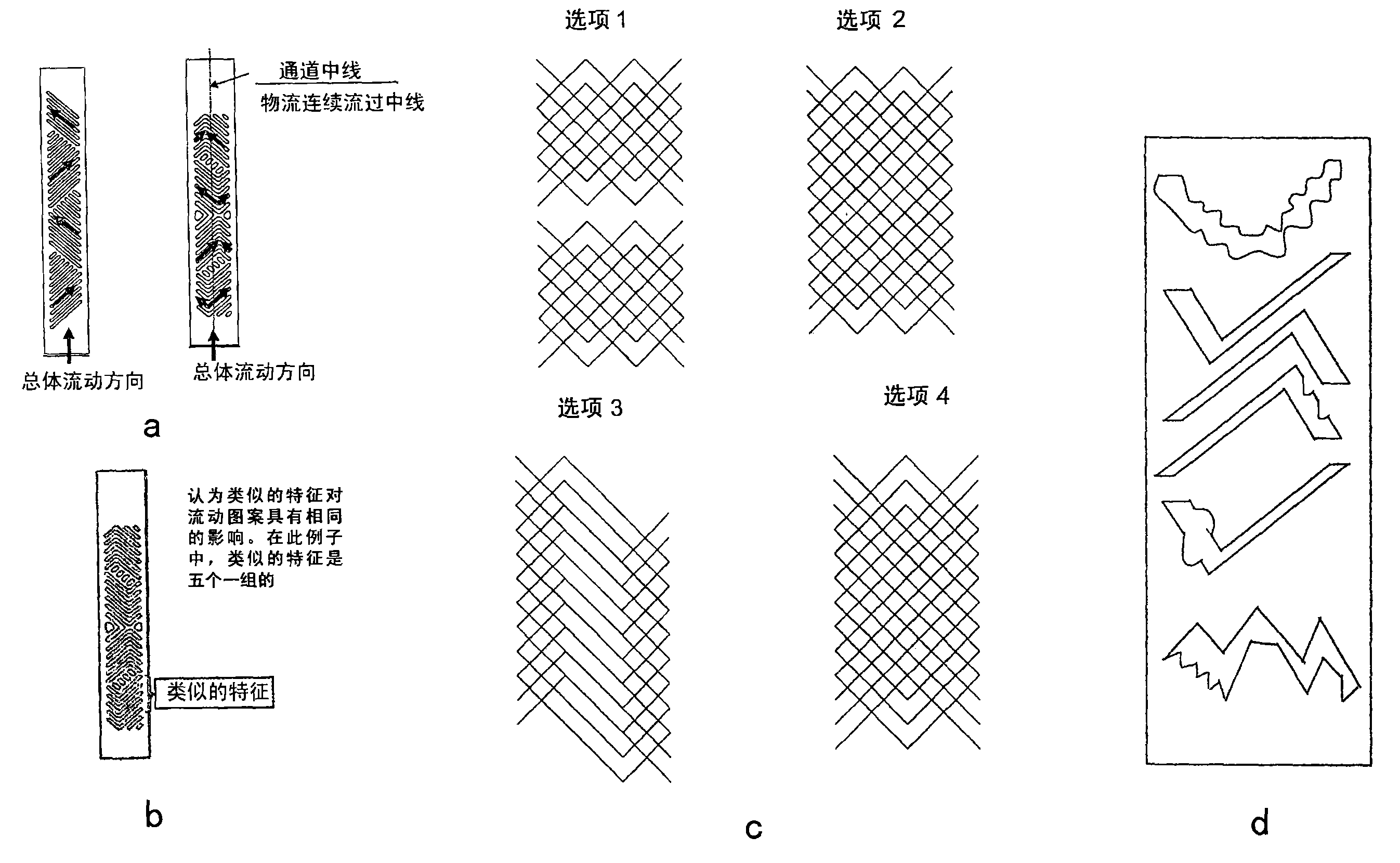
" surface characteristics " is the structure of protruding or be recessed into microchannel wall from microchannel wall, and they can improve flowing in the microchannel.If the area at feature top equates with the area of feature bottom, perhaps the former is greater than the latter, and then this feature can be regarded depression as.If the area of feature bottom has surpassed the area at feature top, can think that then it is (hereinafter except the CRF of Tao Luning) that protrudes.For the non-circular surfaces feature, surface characteristics has the degree of depth, width, and length.Surface characteristics can comprise circle, ellipse, square, rectangle, check mark (check) shape, herringbone, zigzag etc., and they dent in the wall of main channel.Surface characteristics can comprise Ya Tezheng, and the main wall of described first recess feature also comprises less feature, and these less features can be recess, waveform, indenture, hole, burr, check mark, fan-shaped etc. form.Some non-limitative examples that shown the surface characteristics periphery among Fig. 1 d.
A " hole " is the feature partially or completely in wall or the sheet material, and it can be the active surface feature, slit, and the hole, irregular or regular shape, perhaps diffusion or advection or both other volumes can take place in fluid stream in feature.
" closely recess feature (Compact recessed features) " is the depression in the main channel.Closely recess feature (CRF) does not have the outlet of flowing except the main channel.Each CRF has the periphery of one or more sealings at the boundary with main gap, the surface of each border seal throughout all with the main channel in overall flow direction quadrature, accounting for more than 50% of wall area of given wall in the main channel by the gross area of the border seal of all recess feature with the boundary of main channel.CRF does not have the continuous-flow path from a feature to next feature under the condition that does not reenter the main channel.Protrude is not the feature or the CRF of depression.
For two features, if the periphery (this periphery is the border between surface characteristics and the main channel) of one of them feature at least 50% (preferably at least 80%) can overlapping within the periphery of another kind of feature by the length translation of overall flow direction in the main channel (rotation of each feature periphery be less than 20 degree (perhaps preferably not being rotated)), the periphery (this periphery is the border between surface characteristics and the main channel) of another feature at least 50% (preferably at least 80%) can overlapping within the periphery of described last feature by the length translation of overall flow direction in the main channel (rotation of each feature periphery be less than 20 degree (perhaps preferably not being rotated)), claims that then these two features are " similarly feature " or " same feature ".If the periphery on border is uneven between defining surface feature and the main channel, then should use each peripheral quadrature (promptly with main channel in overall flow direction quadrature) projection to determine whether feature is same feature.
The length of surface characteristics defines according to the mode identical with the microchannel with width.The degree of depth is the distance that feature is absorbed in microchannel surface; Its direction is identical with the gap, microchannel with the microchannel height.One preferred embodiment in, comprise the device of stacked and combination, this device has surface characteristics on sheet surface, the described surface characteristics degree of depth is corresponding to stacked direction.The full-size of the size Expressing feature of these surface characteristics; For example the depth representing depth capacity of circular groove, the i.e. degree of depth of bottom portion of groove.
The degree of depth of feature: the plane of intersecting from surface characteristics and main channel to the surface characteristics bottom (bottom is the plane tangent with the surface characteristics edge, the plane crossing, this plane from surface characteristics and main channel farthest, and parallel with it) average distance.
The width of feature or span: in the plane that intersect surface characteristics and main channel, the nominal value of the shortest size of surface characteristics, perhaps distance from the surface characteristics edge to the surface characteristics edge.
The haul distance of the feature section of propping up (leg) (run length): in the plane that intersect surface characteristics and main channel, the nominal value of the longest dimension of the surface characteristics section of propping up.
(surface) feature section of propping up: do not have a part of feature discontinuous or that change along haul distance, slope with respect to main channel average overall flow direction.
The spacing of repeated characteristic: perpendicular to the direction of the haul distance of the feature section of propping up, the average distance between the repeated characteristic.
Feature angle: the haul distance direction of the surface characteristics section of propping up and perpendicular to the angle between the plane of average overall flow direction in the main channel.Surface characteristics preferably has more than one angle.This angle can be from fading to the angle less than 0 greater than 0 angle.This angle can along described feature in a continuous manner or discontinuous mode change.
The orientation of feature: the repetition surface characteristics in a district is with respect to the orientation of the same characteristic features on the adjacent or relative wall in the main channel.
Flow orientation with respect to feature: average overall flows with respect to the direction of the characteristic orientation of particular wall sunken inside in the main channel in the main channel.Represent average overall flow direction in the main channel with label A, the haul distance of each section with surface characteristics of two sections is tended to assemble or adjacent to each other along main channel average overall flow direction.Represent the flow direction opposite with label B with respect to surface characteristics.For the feature with section more than two, the expression of A orientation is with respect to mean flow direction, and the convergence situation is greater than the average or clean feature haul distance of the situation of dispersing.On the contrary, the expression of B orientation is dispersed the average or clean feature haul distance of situation greater than the situation of convergence with respect to mean flow direction.
" capillary feature " is and the relevant feature in microchannel that is used for keeping liquid substance.They are at the microchannel wall sunken inside, and perhaps the wall from the microchannel protrudes into the flow path adjacent with this microchannel wall.The interval that this feature forms more preferably is equal to or less than 1 millimeter less than 2 millimeters, is more preferably and is equal to or less than 500 microns.At least one size of described feature is less than the arbitrary dimension of its microchannel that is positioned at.Described capillary feature can be slit class formation at any angle, perhaps is the array in hole, perhaps is other structure depression or that protrude that is used for keeping by capillary force liquid arbitrarily.
" catalyst material " be can the required reaction of catalysis material.The non-limitative example of catalyst material comprises metal, metal oxide and acidic site.
" catalyst metals " is the form of preferred catalyst material, is the material of metallic forms that can the required reaction of catalysis.Particularly preferred catalyst metals is Pd, Rh, Re, Ir and Pt.
" chemical unit operation " comprises reaction, separation, heating, cooling, evaporation, condensation and mixing.
The microchannel that " microchannel of adjacency " sealed by one or more microchannel wall that do not have tangible breach or opening-this means to have under the situation of opening, the amount of opening (if existence) is not more than 20% (being not more than 5% in some embodiments, in some embodiments without any opening) of microchannel wall area.
" inner microchannel " is illustrated in the microchannel that all sides are limited by one or more microchannel wall, but have import and outlet, also optional have along the connecting hole of microchannel length, for example porous barrier or aperture, for example the connection aperture between fuel channel and the oxidant channel.
" manifold " is head (header) or the foot (footer) that connects a plurality of parallel microchannels, is integrated into one with described equipment.
" microchannel " is a kind of passage, wherein (wall is to wall at least one inside dimension, disregard catalyst) be equal to or less than 1 centimetre, preferably be equal to or less than 2 millimeters (being approximately equal to or less than 1.0 millimeters in some embodiments) and, be the 50-500 micron in some embodiments greater than 100 nanometers (being preferably greater than 1 micron).The microchannel also can be by existing at least one import away from least one outlet to define.The microchannel is not only the passage by zeolite or mesopore material.The length of microchannel is corresponding to the flow direction that flows through the microchannel.The height of microchannel and width are basically perpendicular to the flow direction that flows through passage.Having the situation (for example, by the surface that sheet layer superimposition combination is formed) of the lamination device of two first type surfaces for the microchannel, highly is the distance from the first type surface to the first type surface, and width is perpendicular to height." degree of depth " of surface characteristics is identical with " highly " direction of microchannel.
" enter the quality of the fluid of surface characteristics " and be defined as the import department that is arranged in the surface characteristics district, the amount of substance that enters at least one surface characteristics in surface characteristics district, enter surface characteristics and mean that described fluid molecule destroys the plane of the surface characteristics of described depression, the overall flow passage is left in motion.Should enter the percentage amounts of the material at least one surface characteristics in the surface characteristics district with computational fluid dynamics (CFD) coding (code) evaluation, this allows the explanation and the spike of the fluid flow trace line (path line) by the surface characteristics district are estimated.Should be in the surface characteristics district at the grid (cell) of the degree of depth and discrete minimum 6 volumes of length direction, to obtain reasonably to flow discretization (discretization), main straight channel has dispersed and has set the grid of size in proportion, remain on and passage that surface characteristics is adjacent in and the size of mesh opening continuity in the gap between surface characteristics.Correct hydrodinamical model should be used for inlet stream speed and cross section.Solution should be assembled well, and the difference of the summation of import mass velocity and general export mass velocity should be in ± 0.0001%, enter system energy must with leave system can amount phase equilibrium, its error is in ± 1%.In the import department of passage, the CFD coding should be uniformly distributed into few 100 trajectories on the cross section of passage.The percentage that enters the trajectory of at least one surface characteristics has been represented the mass percent that enters at least one surface characteristics again.
Main channel: the open approach of overall flow
(master) channel width: the full-size of rectangle main channel cross section.
(main channel) gap: the minimum dimension of main channel cross section.
Main channel average overall flow direction: along the mobile mean direction that flows to a part of main channel of outlet from import.
Reynolds number, Re are the ratio of passing through of using always the inertia that the current observation in the passage arrives to viscous effect power.It is defined as mass flux speed (G) * hydraulic diameter (D) ÷ dynamic viscosity (μ),
The numerical value of Reynolds number has been described the flow condition of logistics.Although depend on the function that the flow condition of Reynolds number is the channel cross-section shape and size, passage is used following scope usually: laminar flow: Re<2000 are to 2200; Transition: 2000-2200<Re<4000-5000; Turbulent flow: Re>4000-5000.
" unit operations " expression chemical reaction, evaporation, compression, Chemical Decomposition, distillation, condensation, mixing, heating or cooling.Often carry out with unit operations although fluid is carried, " unit operations " not only represents the fluid conveying.Some preferred embodiment in, unit operations is not only mixing.
The accompanying drawing summary
Fig. 1 a has shown the surface characteristics pattern with continuous feature alternately, and these features are used for changing flowing by the microchannel.
Fig. 1 b has shown the series of same feature in the surface characteristics pattern.
Fig. 1 c has shown that some are by making the selection scheme of the relative pattern that forms of surface characteristics.
Fig. 1 d has shown some possible shapes of surface characteristics.
Fig. 2 a-2e has shown the various patterns of capillary/surface characteristics.
Fig. 3 a-3k has shown the various patterns of surface characteristics.
Fig. 4 a is the vertical view that forms the different surfaces characteristic pattern of stratiform surface characteristics with adjacent stacked putting.
Fig. 4 b is the front view of three-dimensional surface feature, and the herringbone of depression is adjacent with the overall flow microchannel, has other difform feature in its back in the different degree of depth and position.
Fig. 5 has illustrated the inferior patterning on surface characteristics that is used for increasing surface area.
Fig. 6 has shown the surface characteristics pattern of analyzing in example.
Fig. 7 has illustrated that the heat transfer that the surface characteristics pattern by Fig. 6 obtains improves.
Fig. 8 has shown that surface characteristics is compared with no surface characteristics situation, methane conversion improves.
Fig. 9 has illustrated the pressure drop under the situation that comprises and do not comprise surface characteristics.
Figure 10 has illustrated and has comprised and do not comprise under the situation of surface characteristics the relation of pressure drop and Reynolds number.
Figure 11 is for the liquid surface that 45 degree contact angles are arranged of expection and is full of the capillary feature (whole groove) of cover coating liquid fully, compares and measures and the load capacity (uptake) of each coating of predicting.
Figure 12 illustrate comparison smooth test specimen (FC) go up with the test specimen with the dark capillary feature of 5 mils (127 microns), 3 mils (76 microns) or 1 mil (25 microns) on catalyst loadings.
Figure 13 illustrates the test component main body and inserts the sub-assembly of test specimen.
Figure 14 is the accompanying drawing of an example, shows that the heat transfer coefficient increase and the ratio of pressure drop increase change with Reynolds number.
Figure 15 has illustrated the particle off-position of an embodiment.
Describe in detail
" surface characteristics " is that depression in the microchannel wall is (perhaps in not quite preferred embodiment, from microchannel wall, protrude), it can help fluid along being different from net flow direction (direction that namely the is different from microchannel length) orientation by the microchannel or producing fluid rotary. This feature has increased surface area, has produced convection current, and diffuse flow is to microchannel wall so that fluid passes through advection. Flow pattern can eddy current, rotation, and upset perhaps has other irregular or chaotic pattern, but flow pattern and do not require it is chaotic in some cases, can be fairly regular pattern. Flow pattern is stable in time, but also can carry out secondary transition rotation (secondary transient rotation). Surface characteristics preferably has the inclination angle, both has been not parallel to the net flow direction by the surface, also is not orthogonal to this direction. Surface characteristics can with the flow direction quadrature, an angle of 90 degrees, but preferably have an angle. Described active surface feature also preferred at least at an axial location, along the width of microchannel, limited by more than one angles. Two or more sides of described surface characteristics can be physical connection or unconnected. One or more angles along described microchannel width preferably are used for described straight stratiform streamline (stream line) is released and pulled out to fluid. For the embodiment that need to relatively conduct heat with smooth passage, all surface characteristics all can be defined as depression.
" crossing over the gap mixes " is illustrated in the microchannel, mixes logistics in the direction perpendicular to overall flow; In having the passage of rectangular cross section, this term represents to cross over the gap, mixes between two first type surfaces. This is by two first type surfaces in the microchannel surface characteristics to be set to finish. The design principle that reaches this mixing comprises: (1) surface characteristics haul distance direction of the mean direction of overall flow in respect to the main channel provides the angled component of basic tool (component). Near the upstream extremity of each surface characteristics section of propping up in the main channel speed will be higher than near the speed each the surface characteristics section of propping up downstream. Cooperation in top wall and the base wall between the surface characteristics pattern can be used for the pushing the speed vertical component of vector, thus mix when not being important factor in side direction, have the larger effect that reduces outside resistance to mass tranfer. For example, by denting into the surface characteristics of relative wall, in order to prevent overall middle one or more mobile cores that are not easy to sweep in the active surface feature that form, use " cis " configuration and be more preferably than using " trans " active surface feature configuration. (2) provide the adjacent feature of sufficient amount, so that fluid motion is by whole path clearance. More angle in each surface characteristics, bending, distortion or other direction change will make fluid motion or mixing in passage, but may not be preferred aspect the mark that increases the time of staying that feature spends in the active surface feature. Preferably at least one axial location, along having more than one angles in one or more surface characteristics of microchannel width, the feature of described leap width can be physical connection, also is not. The alignment at described adjacent feature or embedded angle also will be used for fluid side is pulled through described passage. (3) along length of flow, provide similarly basic or " same " feature of a plurality of repetitions for any given microchannel wall. Described similar feature is along the repetition of length of flow so that when fluid flows downward along passage length, kept the flow pattern of (being vortex type) of non-linear in the main channel.
In arbitrarily specific microchannel, can comprise various features, comprise that the deep recess with different enters the feature of one or more microchannel wall. Preferably, the spacing between the groove is the 0.05-10 millimeter, more preferably the 0.1-1 millimeter. Described surface characteristics can be in the whole microchannel, or is within its part. Part with zone of surface characteristics can be interrupted, with required reaction or unit operations in the zone that promotes design. For example, 2.5 centimetres district of microchannel can have closely-spaced surface characteristics array, then is 10 centimetres smooth passage, then is 5 centimetres the surface characteristics district than large-spacing. Than greater than the surface characteristics stroke width five times of the spacing of large-spacing presentation surface feature or the distance between feature and the feature.
In some embodiments, described surface characteristics is extended (not comprising any flow distribution or dress manifold region) basically in the length of microchannel. In some embodiments, the microchannel can have surface characteristics in being equal to or less than 50% scope of its length, in some embodiments in the scope of 20 % that is equal to or less than its length, be in the scope of 10-100% of microchannel length in some embodiments. In some embodiments, preferably in dress manifold region or flow distribution district, also comprise surface characteristics, so that by improving pressure drop in some passages or the district regulating flow distribution, thereby promote or regulate to conduct heat or regulate flow distribution.
Combine with leap gap composite character by crossing over the width composite character, can in unit operations, obtain good mixing and performance. For overall mixing is provided, these two kinds of design principles can be used in conjunction with each other. Required feature comprises: surface characteristics is placed on the relative conduit wall; Form feature at any one face, move back and forth to allow fluid crossing channel width; Surface characteristics import on the face is alignd with the surface characteristics import on the relative face. That is to say, the feature between top board and the base plate is matched, become mutually " cis " but not " trans " so that the pattern on two faces is basic on orientation.
One preferred embodiment in, the array that will have the similar surfaces feature of herringbone or check mark pattern is arranged on the wall, similarly the similar array of feature is with angle (the 180 degree conversion) alignment of identical angle or basic upset, produced useful especially pattern, this pattern can be used to make fluid and molecule to move in the active surface feature, along with the increase of Reynolds number, disproportionately prolong the time that in the active surface feature, spends.
Preferably the minimum number along the continuous same feature that arranges of passage length depends on path clearance and the surface characteristics degree of depth. Similarly or " same " feature mutually be adjacent to repeat arrange along passage length. Shown an example among Fig. 1 b. The flow pattern that these features produce is not considered to turbulent flow, especially away from overall flow the time. Can better described flowing be described as " oriented (directed) layer " stream.
Described surface characteristics can have two or more layers, and these layers perhaps tangle with the three-D pattern form mutually in stacked on top. Each independently the layer in pattern can be identical or different. Fluid can rotate or advection in each layer, also can only rotate or advection in a layer. Subgrade (being defined as not adjacent with the overall flow passage) can only be used for producing other surf zone with deposited catalyst, wherein fluid rotates in the ground floor of surface characteristics, form with molecule diffuses in the second subgrade or the more subgrade, to promote reaction. Can make three-dimensional feature by casting of metals or other method, wherein different patterns can insert in the discrete plane, and these planes are stacked in the top of each other seemingly. Can find the three-dimensional different surfaces feature adjacent with the overall flow passage, described feature has the different degree of depth, shape and position, also with the Ya Tezheng of the pattern with different depth, shape and position. Structure of the present invention needing can be valuably to be used for the chemical reaction of the chemically separated other surf zone of catalyst deposit or distillation and so on.
Fig. 4 b has shown a kind of three-dimensional surface feature structure, wherein find the herringbone structure of depression at the boundary adjacent with the overall flow microchannel, under described herringbone structure, has a series of three-dimensional structure (line (pale line) of light color), these three-dimensional structures link to each other with the feature adjacent with the overall flow path, but make by having the structure that mixes shape, depth and place. This structure also can produce the subgrade passage valuably, and these passages are not to be located immediately under the open surface feature adjacent with the overall flow microchannel, but links to each other by one or more tortuous two dimension or three-dimensional channel. The method can be used for valuably producing the time of staying of setting and distribute in needs obtain reactor that wider or narrower time of staying distributes.
Fig. 2 a has shown the surface characteristics with various patterns (axially) and various degree of depth (side direction). The pattern of the surface characteristics shown in Fig. 2 a is in the surface characteristics district in the independent surface characteristics and/or introduce the surface characteristics degree of depth of spatial variations between any two surface characteristics. Use for some, this may be useful especially, and in described application, the variation of the surface characteristics interior surface features degree of depth can produce more fluid rotary or vorticity so that between the fluid or the outside resistance to mass tranfer from fluid to the catalyst wall significantly reduce.
The pattern of Fig. 2 b can be especially valuably as lower floor's picture on surface, and it is positioned under at least one or a plurality of other surface characteristics sheet, to increase catalyst or the available surface area of mass exchange agent. The pattern displaying of Fig. 2 c have a surface characteristics of drawing Ge Tezheng.
The pattern of Fig. 2 d has been introduced the angled feature of tool and horizontal properties simultaneously. Described feature geometries structure can be along the length variations of process channel. This design can be especially valuably as lower floor's picture on surface sheet, and this sheet is used for fixing more catalyst or mass exchange agent, can also produce the darker degree of depth for the angled feature of tool (it is preferably adjacent with this sheet) simultaneously. Described second angled adjacent with flow path, causes fluid rotary. The different degree of depth of described angled feature can produce more turbulent flow or obvious turbulent flow in flow path.
The preferred scope of the surface characteristics degree of depth is less than 2 millimeters, is more preferably less than 1 millimeter, is the 0.01-0.5 millimeter in some embodiments. The preferable range of the lateral width of surface characteristics should be enough to almost cross over microchannel width (as shown in the herringbone design), but (for example fill in the feature) in some embodiments can cross over the microchannel width 60% or still less, be 40% or still less in some embodiments, be about in some embodiments 10-50%. In preferred embodiment, at least one angle is 10 ° with respect to the orientation angles of microchannel width in the described surface characteristics pattern, is preferably 30 °, or larger (90 ° is to be parallel to length direction, and 0 ° is to be parallel to width). In the orientation measurement lateral width identical with the microchannel width.
The lateral width of described surface characteristics is preferably 0.05 millimeter to 100 centimetres, is 0.5 millimeter to 5 centimetres in some embodiments, is in some embodiments 1-2 centimetre.
The feature of the depression on the opposite face of microchannel can match, to enlarge markedly the level of heat transfer and mass transfer. Substantially oblique (with respect to length or the flow direction) flow path that dents in the microchannel wall is for the basic structural unit of promotion flow pattern of the present invention (building block), can cooperate at relative wall, in order to provide surprising good mixing with respect to the same or similar pattern on single wall only. Because the substantially oblique character of the flow path of depression, speed in the passage of depression comprise the mean direction that is parallel to significantly overall flow in the microchannel or with the angled component of this direction, thereby in the passage of described depression, cause significant flowing. Yet, when the obliquely flow path in the recess channel on the interarea in microchannel suitably when flow path on the opposite face matches, the mobile meeting perpendicular to the average overall flow direction in the open microchannel is promoted very effectively. Perpendicular flow can be particularly conducive to and reduce outside mass transfer or the heat transfer limitations that exists in the laminar flow microchannel. Specifically, perpendicular to the advection speed that flows of overall flow direction so that the speed of direction of flow microchannel wall than the mass transfer rate that only causes by diffusion greatly at least twice or five times or ten times or more. Therefore, the reaction that is promoted by the catalyst that is fixed on microchannel wall or the carrier structure adjacent with microchannel wall will have higher surface reaction substrate concentration, thereby have higher overall reaction rate. Vertical advection and velocity also are conducive to conduct heat, and this is because this has increased surface coefficient of heat transfer, have reduced the boundary layer restriction of fluid temperature (F.T.). Some preferred embodiment in, caused perpendicular flow can obtain to improve in the following manner: the feature that (1) can draw in fluid in the upper passage that caves in of one side strategically places a kind of position, this position is corresponding to the position (being cis-configuration) that fluid can be drawn in the passage that caves on the opposite face on the opposite face, (2) relative wall is kept enough nearly (maintenance gap, microchannel is enough narrow), so that interact between the relative face.
Usually, if need side direction to mix (width of crossing channel), then the feature on the opposite face should be used perpendicular to the substantially oblique component in the plane of average overall flow direction and promote to flow. In the case, described feature should cooperate to accomplish this point. Be recessed in substantially oblique feature in the wall of open microchannel and have length component in the overall flow direction, this length component preferably is equal to or greater than the component of side direction (channel width direction), more preferably is the twice of cross component at least.
Some preferred embodiment in, further promotes to mix by in whole passage, producing a plurality of points, at these points, at first by division (mobile dispersing), then position and the fluid at other reconsolidates (mobile convergence) to fluid. In the present invention, this can be by finishing with having dispersing with the substantially oblique feature of convergent geometry of replacing. For example, can the laterally disposed a plurality of herringbone structures of crossing channel or angle, rather than fixing axial location arranges a point or angle or herringbone structure in the microchannel. These features are preferably dispersed and the pattern assembled will utilize three principles listed above, it is the cooperation of relative characteristic position on the relative face, disperse the balance of feature and convergence feature quantity (on the flow direction and on the width, (namely perpendicular to the direction of average overall flow direction, and the direction that enters the gap, microchannel between the face that comprises recess feature)), open and have enough little gap (described gap size sees above) in the microchannel. Some preferred embodiment in, make the quantity of dispersing feature and convergence feature minimum, and this similar feature of repeating group.
Fig. 1 c has shown the selection scheme of some laps of the surface characteristics on the relative wall. Because in Fig. 1 c, the feature on the opposite face is to be mutually trans substantially, thus the expected flow pattern for the effect of mixing not can as on the opposite face be characterized as cis-configuration the time good.
The present invention can use the tool patterned surface in two sides of microchannel, perhaps can only use in a side of microchannel. For example, the surface can be matched (on the opposite flank of microchannel) with the pad of the similar structures with slanted bar line (these stripeds are groove preferably), and described slanted bar line is alignment, that interlock with respect to opposite face or intersects. For certain situation, the mixed effect that produces of pairing is better than the effect of mixing in the channel design on a first type surface only, especially when the gap of main channel is increased to above 1 millimeter. Some preferred embodiment in, described patterning mainly is comprised of the oblique groove on the whole width that is substantially disposed in microchannel surface. The figuratum surf zone of the tool of wall can occupy the part or all of length of microchannel surface; In some embodiments, oblique groove is arranged on microchannel surface at least 10%, 20%, and 50%, or at least 80% the length. In some embodiments, feature comprises having one or more oblique features with respect to the angle of flow direction (be preferably groove, comprise CRF). Some preferred embodiment in, described feature has two or more with respect to the angle of flow direction at least one wall. These angles can be on the summit or the some place connect or do not connect. Described different angles of crossing over the width of at least one wall of microchannel at least a axial location are used for pushing away and draw fluid in different directions, improve side direction and horizontal flowing with respect to other straight stratiform streamline. When the side direction of fluid and lateral flow increased, it preferably increased along with Reynolds number and tendency of increasing enters described active surface feature.
On the other hand, the tool patterned surface comprises the multiple patterns that is layered in top of each other. In an example, the pattern in hole or array are arranged to heat conductive wall adjacent, the second pattern (for example oblique or lambdoid character array) is layered in top and adjacent with the open channel that is used for flowing. The sheet adjacent with open gap has the patterning by sheet thickness, so that fluid can by described, enter in the following patterning. Can flow by advection or diffusion. For example, the first with via-hole array can place the heat conductive wall top, and second of array with oblique straight joint (through slot) or herringbone structure is arranged on the first. This has preferred embodiment produced the larger attached catalyst or comprise the surf zone of other active agent of sorbent, core etc. of being used for. In some embodiments, described pattern repeats at least one other wall of microchannel. Described pattern can preferably be offset at relative wall. Inner most tool patterned surface (limiting the surface of flow channel) can comprise the pattern of oblique array and so on. Oblique array is streamwise orientation (cis orientation) simultaneously, or side streamwise orientation, and opposite side is along the direction orientation (trans orientation) opposite with flow direction. By changing the surface characteristics on the relative wall, can in downwards by the fluid of center and open gap, produce different flow fields and vorticity in various degree.
Gap between the microchannel wall (being expedite overall flow path) preferably is equal to or less than 10 millimeters, more preferably is equal to or less than 5 millimeters, in some embodiments, is the 0.05-2 millimeter. Described surface characteristics can repeat identical shape or different shapes. Different characteristic changes along orientation and/or shape and/or the size of microchannel length. For example, pattern can comprise herringbone (or check mark shape) structure, and it aligns with flow direction, and then the direction opposite with flow direction alignd, and then aims at or point to a side of microchannel, then is the opposite side of aiming at or point to the microchannel. Described feature can be arbitrarily to arrange, perhaps can comprise contain 25 or 10 or more multiclass then become New Characteristics like the group of feature. It preferably has similar characteristics or a series of many features that is positioned at the continuous alignment at least one wall of main channel, and on the length of the one or more walls in main channel, at least 10 or 20 or more similar feature are continuous. Similarly feature has kept total overall flow direction basically, it is defined as in the x-direction or clean positive velocity (the flowing between surface characteristics top and the bottom of y direction, and flowing from the side of microchannel to the side), rather than the net velocity that moves along the passage length negative sense at x or y coordinate, a situation after just can occurring when moving back and forth in primary flow channel for fluid. Therefore, on the width of microchannel, in the position that the second angle of the active surface feature groove of described at least two kinds of angles begins, similarly feature can not change or occur appropriate variation. The herringbone structure of displacement place is not similar in the staggered herringbone blender. In each feature, feature span or stroke width can have different separately variations, but the variation between preferred each feature is less than 50%. Be more preferably less than 30%, be more preferably less than 15%. It shall yet further be noted that to have and comprise that at least the feature of discontinuous section of two or more angles must regard as and have one with the feature of upper angle. For example, consider a kind of simple herringbone structure, two sections that wherein have different angles connect at the place, summit at the top of fluted feature. The summit of the herringbone structure of described groove can be closed, so that the microchannel has two kinds of pure single angle characters along the width of at least one wall of microchannel. If the distance that described two unconnected sections are separated is less than 20% of microchannel width, then the performance of this unconnected feature group of gained is substantially similar with the feature group that is connected. In essence, when at least one wall of microchannel has at least two angled features of tool along the microchannel width, just can produce the flow behavior of the present invention that the present invention describes, and whether physical connection is irrelevant with described feature. In addition, when basic that similarly connect or unconnected feature with the oblique angle suitably or the mode of minimum change when repeating, for a succession of at least 15 features, method of the present invention is favourable.
Preferably, (interior wall in the groove is to the distance of wall for the stroke width of described feature; For rectangular characteristic, this width is straight, and for circular feature, it is diameter, and for the feature that conduct narrows down with the degree of depth, it is that the wall of maximum is to the distance of wall; For variable feature, its for average maximum wall to span from) be about 0.25-10 with the size ratio of path clearance (being generally the minimum range between minimum range between the surface characteristics or surface characteristics and the relative microchannel wall), the stroke width of described surface characteristics preferably be at least path clearance 25% to as high as 10 times of path clearance. More preferably, described size is than being 0.5-1, to produce enough flow disturbances. If feature is narrow, overall flow can be skimmed over its top, is subject to minimum disturbance. If the stroke width of surface characteristics is wide, then overall flow can be easy to expand and fill new path clearance, can be subject to minimum flow disturbance. Flow disturbance is defined as the flowing velocity vector of not following conventional stratiform parabolic type, having vertical or horizontal speed vector. When being used for catalytic reactor, need to fill and discharge the active surface feature, and solution catalyst is kept thereon, stroke width that therefore also may preferred active surface feature is less than the gap, main channel. The capillary force that fluid in the active surface feature produces will be used for keeping fluid when discharge opeing, can carry out dried in place and calcining. If the gap, main channel is less than the stroke width of active surface feature, it can be used to when discharge opeing fluid pulled out described active surface feature, example for some catalytic reactors, the example of the reaction method deposited catalyst of electroless plating film and so on for example, the described discharge opeing of in to the passage discharge opeing feature being carried out afterwards may not be problem.
Find shockingly that also when feature being added to Reynolds number greater than 2200 flow, its service behaviour is better than the smooth passage that operates equally under turbulence state. Specifically, the turbulent flow (Re>2200) that has the laminar flow (Re<2200) of surface characteristics or have a surface characteristics can obtain to be better than having identical Reynolds number, but improved mixing quality and/or the heat transfer of the smooth passage of in turbulence state, working. Surface characteristics increased clean radially or lateral velocity component, the speed that this component produces than the irregular eddy current in the conventional turbulence channel radially or cross stream component strong. In fact, the design of described surface characteristics can be so that determine comparing of lateral velocity and vertical speed according to using. For needing good lateral to mix, comprise the application of chemical reaction, the reinforcement of vertical speed vector is useful especially, because this is the main method that fresh reactant is carried to reaction surface.
Preferably, minimum range between near described depths of features (being defined as inner recess or groove or the surface characteristics degree of depth between groove base plate and overall flow path clearance or the opening) and path clearance (surface characteristics (for example 1 centimetre in) microchannel wall) size is than being 0.25-10, the depths of features of described surface characteristics preferably is at least 25% of path clearance, extremely 10 times of described path clearance. More preferably, described size is than being 0.5-3, to produce enough flow disturbances. If described feature is excessively shallow, overall flow can be skimmed over the top, is subject to minimum disturbance. If the degree of depth of surface characteristics is excessively dark, then the overall flow convection current of will not allowing to change places enters in the dark feature, and the part that enters the overall flow of described active surface feature will be very little.
Surface characteristics one with the embodiment on the upper wall in, the pattern identical (or similar) that exists on the feature on wall and the second wall, but around main channel average overall flow direction (or length) rotation. Have in the embodiment of the feature on the relative wall at other, the feature on wall is approximately the mirror image of feature on the relative wall. Have in other embodiment of surface characteristics in upper wall at one, the pattern identical (or similar) that exists on feature on wall and the second wall, but rotate (in other words around the axle perpendicular to main channel average overall flow direction, described feature is with respect to main channel average overall flow direction Rotate 180 degree, around the mobile center line rotation of main channel average overall). Feature on the relative or adjacent wall can directly be alignd mutually, perhaps not mutually directly alignment, but preferably repeat continuously certain-length along wall. In other embodiment, can there be surface characteristics on three or more surfaces of microchannel. For having three or the microchannel geometry of side still less, such as triangle, avette, oval, circular etc., surface characteristics can cover the microchannel periphery at least 20% to as high as 100%.
Each surface characteristics is propped up Duan Keyu overall flow direction bevel. The described feature length of span or span or opening are defined as perpendicular to characteristic orientation. For example, a kind of surface characteristics is a kind of oblique depression, and it becomes miter angle with plane perpendicular to the mean direction of main channel overall flow, and opening or span or the feature length of span are 0.38 millimeter, and the feature haul distance is 5.59 millimeters. Haul distance has been described along the distance of the end to end of the longest direction, feature, and span or the feature length of span are the distances along the shortest direction (the non-degree of depth). Depths of features is to leave the distance of main channel. For the feature with inhomogeneous width (span), span is the average span on the haul distance.
Some preferred embodiment in, two or more tools figuratum (at least two have penetrating pattern (through Pattern), for example through hole or straight joint) are stacked in top of each other. Two or more described patterns can be identical, and perhaps three kinds in the described patterned surface or more kinds of pattern can be different. Stacked pattern with different geometries can produce useful flow regime, thereby so that fluid near piston flow, and interior near piston flow in quite short distance. The distance of setting up described flow regime can perhaps be more preferably less than 50 feature lengths of span less than 100 feature lengths of span, is more preferably less than 20 feature lengths of span. Described surface characteristics can with overall flow direction bevel. The described feature length of span or span are defined as perpendicular to characteristic orientation. Haul distance has been described along the longest direction, from the distance of the end to end of feature, and described span or the feature length of span are along the shortest direction (not being the degree of depth). Depths of features is the distance from the main channel. For the feature with inhomogeneous width (span), span is the average span on the haul distance.
The present invention includes equipment, at least one district of wherein said equipment comprises that being positioned at the surface characteristics that any channel section surpasses on 20 % (preferably at least 40%, the more preferably at least 70%) channel surface (measures in the cross section perpendicular to length; Namely perpendicular to the net flow direction by passage), at least 1 centimetre of preferred continuously extension, in some embodiments, surface characteristics is extended at least 5 centimetres length. For the passage of sealing, surperficial percentage be the cross section that covers of surface characteristics with from the bottom of surface characteristics or top or the ratio of the airtight passage that evenly extends of definite value therebetween. The latter is defined as smooth passage. For example, if passage has patterned top and lower surface (width is respectively done for oneself 0.9 centimetre) and not patterned sidewall (high 0.1 centimetre), then 90% channel surface will comprise surface characteristics.
In some embodiments, device can comprise the passage of substantially flat in the flow distribution district, and logistics enters in each passage at inner lease making manifold. Described device can comprise heat transfer zone, and this heat transfer zone can comprise improving the surface characteristics district of heat transfer, or does not comprise the surface characteristics district. Described device also can comprise reaction zone, and all or part of in the described reaction zone comprises surface characteristics. The best cluster of described surface characteristics uses, wherein 5 or 10 or 20 or more feature (the active surface feature groove before this that aligns continuously like the multiclass, then being ridge, then is active surface feature etc.), comprise the logistics of at least two kinds of fluids to carry out unit operations or mixing. Linear range or preferably remain on along the distance of the ridge between the surface characteristics between surface characteristics span or stroke width 0.01 times to 10 times. Distance between the preferred adjacently situated surfaces feature is the opening of active surface feature or span or stroke width 0.2-3 times. Along with this apart from increase, other laminar flow logistics will relax into conventional parabola stream, be not easy fluid is introduced the active surface feature.
Preferably, described passage seals in all sides, and in some embodiments, described passage has the cross section (for rectangular channel, patterning preferably is arranged on two interareas) that is substantially square or rectangle. For square or the rectangular channel of routine, described passage can only seal at two or three faces, the side of these two or three walls is only arranged for the calculating of above-mentioned surface characteristics percentage.
Pattern
Each surface characteristics pattern can repeat along the one side of main channel, in main channel overall flow direction, has spacing variable or rule between the feature. In some embodiments, each feature only has an independent section, and other embodiment has a plurality of sections (2,3 or more). For the main channel of wide width, the width of crossing over the main channel can be adjacent to arrange a plurality of features or multiple row repeated characteristic mutually. For each surface characteristics pattern, along with the overall flow direction of pattern along the main channel repeats, depths of features, width, span and interval can change or be constant, but preferably have constant or regular repeat size. In addition, have a surface characteristics geometry that connects the summit of propping up section with two different angles and can comprise another kind of embodiment, the wherein said feature section of propping up does not connect on the summit.
Fig. 2 e has shown the many different pattern that can be used for surface characteristics. These patterns are not to limit the present invention, and only being used for enumerating some may situation. Pattern can have arbitrarily surface characteristics, can be used for the different axial or side direction part in microchannel.
(comprise carbon monoxide-olefin polymeric is hidden coating (washcoat) to the microchannel) in some embodiments, need to be in gravitational field, liquid is fixed in the surface characteristics (namely for example the wall in the microchannel applies the application of uniform coating). For these embodiments, the vertical component of the haul distance of each surface characteristics section of propping up (with respect to gravity) should be more preferably less than 2 millimeters preferably less than 4 millimeters, in case the liquid in the feature is discharged. For these embodiments, also the stroke width of preferred active surface feature, span or opening are less than the open channel gap (herein, generation discharge and main flow flow in unit process) of microchannel. If stroke width is greater than path clearance, then in discharge process, feature possibly can't keep fluid.
Surface characteristics geometrical pattern SFG-0 (sees that Fig. 3 a) describes by herringbone or v shape array of depressions that the length along the unit operations process microchannel exists. Described herringbone pattern can be regular interval or irregular spacing, and the distance between continuous feature is equal or different. (or equating) significant interval of rule may be preferred, and this is owing to there is each feature the splitting action that the overall flow in the main channel causes to be strengthened the splitting action that is caused by further feature better. One-sided feature only has feature in a side of microchannel. The bilateral feature has feature (on the relative wall or on the adjacent wall) in two sides of microchannel. In some two sided orientation embodiments, characteristic orientation can be cis orientation or trans orientation. Shown in Fig. 3 a, on relative wall in the characteristic cis of the tool orientation, the feature on two conduit walls becomes mirror image. Trans expression has a kind of alignment thereof of the microchannel that two or more sides are arranged of surface characteristics, wherein, feature on the wall is not aligned with each other relatively, but at first regard second wall as mirror image, then with its Rotate 180 degree (putting upside down so that the top view of pattern looks like with respect to the first wall) to produce the feature of skew. The feature on the wall should be noted that described second-phase can not be rotating mirror-image accurately to wall, fills feature producing the microchannel net area that more comprises surface characteristics because can add, owing to can be offset slightly mutually along the overall flow direction relatively. Can be cis A (flow direction is from the bottom of Fig. 3 a to the top) or cis B (for example the top of flow direction from Fig. 3 a is to the bottom) with respect to the flow orientation of the feature on the particular wall. Usually, described feature is on relative wall, but they can be on adjacent wall.
Cis A represents to have a kind of alignment thereof of microchannel of the belt surface feature of two or more sides, and wherein the feature on end face and the bottom surface is with respect to the equidirectional alignment of flowing, and the surface characteristics section of propping up streamwise is assembled.
Cis B represents to have a kind of alignment thereof of microchannel of the belt surface feature of two or more sides, and wherein the feature on end face and the bottom surface is with respect to the equidirectional alignment of flowing, and the surface characteristics section of propping up streamwise is dispersed.
The Fanelli pattern represents by the discontinuous position of a section of the surface characteristics of alternate manner connection or little disconnection. Discontinuous position is less than 20% of the microchannel width, preferably less than 10% of microchannel width. Fig. 3 h has shown the Fanelli of SFG-0 characteristic pattern, has wherein removed the summit, to help to reduce in the flow path of main channel because the dead point that the angle variation causes or the zone that reduces speed. The open position of Fanelli between two surface characteristics also can be subjected to displacement along channel-length direction, half of v shape begins and stops at two axial locations along passage length, and the beginning of second half of v shape and the position that stops with respect to the beginning of v shape the first half and the position that stops slightly displacement up and down occur.
Fig. 3 b has shown surface characteristics geometry 1 (SFG1), and it comprises along the feature that each microchannel wall alternately is orientated or angle replaces. For this geometry, be provided with five or more asymmetric chevron structures (one of them feature section of propping up is propped up the segment length than Second Characteristic), wherein the summit of feature is arranged on 1/3 place of microchannel width, after this feature, be provided with two and fill features (attention can use still less or more fill feature), then five or more asymmetric feature are set, and wherein the summit of herringbone structure roughly is positioned at 2/3 place along the microchannel width. This pattern repeats several times. As shown in the figure, the pattern on the relative microchannel wall is trans orientation, and feature is not mirror image.
SFG-2 is a kind of following design, and shown in Fig. 3 c (top view), each angle changes continuously along the haul distance of feature, and the flow direction in the main channel adjacent with feature is from left to right or from right to left. Because this shape more meets aerodynamics, so this feature can make the flow disturbance at each feature leading edge place minimum valuably. The angle that described basic continous changes also can be along the haul distance of feature by on the occasion of becoming negative value.
The top view that has shown SFG-3 surface characteristics pattern among Fig. 3 d, it comprises the view of observing from end face and bottom surface, and how overlapping both are when observing from top. This pattern can be as required repeatedly to fill required length. The principal character of SFG-3 is the repetition of SFG-5 " check mark " shape.
Characteristic pattern SFG-4 is a kind of simple oblique slit, and a feature section of propping up (for example shown in the right figure of Fig. 3 e) is only arranged in every kind of surface characteristics. Pattern SFG4 basic with the oblique feature class in many single angles described in the prior seemingly, for mixing and unit operations is special poor efficiency, especially for the double-walled pattern of the pattern that single wall is only arranged or trans orientation. Along with the increase of Reynolds number, the mark that is flowing in the time of staying that spends in the described feature in this pattern reduces.
The a series of check mark of surface characteristics geometry 5 usefulness represents that the summit of described check mark is so that the haul distance of the feature section of propping up is about half of another section haul distance. The group that in these " check mark shape " features 4 or more features become can with many different assembled arrangement, comprise three kinds shown in Fig. 3 f. These check mark groups can have different orientations mutually, perhaps all have identical orientation, form surfacewise continuous check mark pattern. Various SFG-5 or combination will obtain different mixed characteristics. Fig. 3 f has shown the layout that substitutes that three kinds of SFG-5 surface characteristics geometrical pattern are different.
The orientation angles of surface characteristics preferably has at least a variation. Surface characteristics geometry 6 (SFG6) comprises three surface characteristics sections of propping up, and with respect to flow direction, the angle of orientation occurs twice by just to the variation of bearing, shown in Fig. 3 g. When two in the feature section of propping up assemble mutually along the overall flow direction and the feature section of propping up in two when dispersing mutually along the overall flow direction, this has given the fluid in the main channel with " A " and " B " class flow direction.
Section is propped up in entering of " room shape pattern (house) " presentation surface feature, and the trend of one or more sections parallels with main channel overall flow direction herein, then turns to flow direction (seeing Fig. 3 i) with the oblique angle. This angle is optionally more round than the structure shown in figure below. Room shape pattern also can preferably be the angle of non-90 degree, can improve the advection that fluid enters the active surface feature.
Shark profile of tooth pattern has represented a kind of surface characteristics of the list section of propping up, and it has the span (for example seeing Fig. 3 j) that passes through and change. Described section can have arbitrarily angle with respect to main channel overall flow direction, and a plurality of teeth with different angles can be filled microchannel wall.
Fig. 3 e has shown the SFG-0 with 60 degree angles, the SFG-0 with 75 degree angles and the surface characteristics with SFG-4 pattern of miter angle, stipulates that described angle is with respect to the horizontal plane, and this horizontal plane will be halved perpendicular to the microchannel cross section of main flow direction.
For the group of each section or some sections or 5 or how identical surface characteristics, other embodiment of branched section surface feature geometries structure has different angles or length (shown in Fig. 3 k). The repeating also and can in the process of making, provide potential advantage of surface characteristics group. For example, when developing and printing feature by thin plate, can make stamping tool, a plurality of features of punching press.
Multiple-level surface feature: in one or more walls of main channel, formed the multiple-level surface feature. Described multiple-level surface feature wall is by stacked (the seeing Fig. 4 a), make the column alignment of feature, so that the two is stacked, form more complicated three-dimensional feature of forming of the adjacent layer that will wherein have different surfaces feature geometries structure. For multilayer feature, except the layer away from the main channel, the surface characteristics in all layers all must be penetrating (through) feature. Perhaps, the described identical surface characteristics that is made for penetrating feature in thin plate can be directly stacked mutually by the thin plate that will have the similar face feature, so that the feature in each thin plate is alignd and become darker.
Microchannel apparatus
The feature of micro passage reaction is to exist at least one to have the reaction channel of following characteristics, (wall is to wall at least one size of this reaction channel, disregard catalyst) be equal to or less than 1 centimetre, preferably be equal to or less than 2 millimeters (being approximately equal to or less than in some embodiments 1.0 millimeters) and greater than 100 nanometers (being preferably greater than 1 micron), be the 50-500 micron in some embodiments. The catalytic reaction passage is the passage that comprises catalyst, and wherein said catalyst can be heterogeneous or homogeneous phase. Homogeneous catalyst can with the reactant co-flow. Microchannel apparatus has similar feature, and its difference is not need to comprise the reaction channel of catalyst. The gap of microchannel (or height) preferably is approximately equal to or less than 2 millimeters, more preferably is equal to or less than 1 millimeter. The length of reaction channel is usually longer. Preferably, described length in some embodiments greater than 50 centimetres, in some embodiments greater than 20 centimetres, is 1-100 centimetre greater than 1 centimetre in some embodiments. The side of microchannel is limited by the reaction channel wall. These walls are preferably by the Ni-of pottery, ferroalloy (for example steel) or monel metal and so on, the hard material manufacturing of Co-or Fe-base superalloy and so on. They also can be made by other metal of plastics, glass or copper, aluminium etc. and so on. The selection of the material of the wall of reaction channel can be depending on the used reaction of this reactor. In some embodiments, reaction chamber wall is by the stainless steel with durability and thermal conductive resin or Inconel Consist of. Described alloy should have low sulfur content, in some embodiments, will carry out before desulfurization at formation aluminide (aluminide) and process. Usually the reaction channel wall is by the material manufacturing of the primary structure supporting that microchannel apparatus is provided. Microchannel apparatus can be by known method manufacturing, be stacked manufacturing of sheet material (being also referred to as " pad ") by replacing preferred embodiment at some, the pad that decision design is used for reaction channel is arranged alternately with the pad that is designed for heat exchange. Some microchannel apparatus comprise at least ten layers that are layered in the device, and these layers comprise at least ten passages separately; Described device can comprise other the layer with less passage.
Microchannel apparatus (for example micro passage reaction) preferably includes microchannel (for example a plurality of microchannel reaction passages) and a plurality of adjacent heat exchange microchannel. Described a plurality of microchannel for example can comprise 2,10,100,1000 or the passage that enough is operated in parallel of multipotency more. In preferred embodiment, described microchannel arranges with the parallel array of planar microchannels (for example at least the array of three dimensions microchannel). Some preferred embodiment in, the import of a plurality of microchannels links to each other with common head and/or the outlet of a plurality of microchannel links to each other with common foot. In operating process, heat exchange microchannel (if present) comprises the fluid of mobile heating and/or cooling. The non-limitative example that can be used for this class known reactor of the present invention comprises the reactor of micromodule chip architecture class (duplexer that for example has the microchannel), such as United States Patent (USP) the 6th, 200, No. 536 and the 6th, 219, No. 973 (these two pieces of documents all are incorporated by reference into herein) enumerates. For the present invention, the feature performance benefit of this class structure of reactor comprises heat transfer and the mass transfer rate that they are larger, and substantially without any explosion limit. Pressure drop can be very low, allows the high material throughput, and catalyst can be fixed on the form that is very easy to enter in the passage, therefore do not need to separate. In some embodiments, one or more microchannel comprise the overall flow path. Open approach in term " overall flow path " the expression reative cell (the overall flow zone of adjacency). The overall flow zone of adjacency allows the fluid Rapid Flow to cross reative cell and do not produce large pressure drop. The cross-sectional area in the overall flow zone in each reaction channel is preferably 5 * 10-8To 1 * 10-2Rice2, more preferably 5 * 10-7To 1 * 10-4Rice2 Described overall flow zone preferably accounts for 1) internal volume of microchannel, or 2) cross section of microchannel at least 5%, more preferably at least 50%, be 30-99% in some embodiments.
Many preferred embodiment in, described microchannel apparatus comprises a plurality of microchannels, preferred at least 5, the more preferably group of at least ten parallel channels, these parallel channels link to each other in common manifold, described manifold and described device consist of whole (the latter linked pipe that is not), and described common manifold comprises one or more features that make the fluid equalization that flows through the passage that links to each other with described manifold. The example of these manifolds sees and is set forth in the U.S. Patent application serial number the 10/695th, No. 400 that the document was submitted on October 27th, 2003, was incorporated by reference into herein. In context, " parallel " not necessarily represents is straight, and refers to that passage is consistent mutually. Some preferred embodiment in, microchannel devices comprises at least three group parallel microchannels, passage in each group link to each other with common manifold (for example four groups of microchannels and four manifolds), preferably, each common manifold comprises one or more features that can make the fluid equalization that flows through the passage that links to each other with manifold.
Heat-exchange fluid can flow through the heat transfer microchannel adjacent with process channel (for example microchannel), they can be gas or liquid, can comprise steam, oil or arbitrarily known heat-exchange fluid-described system can optimize so that comprise phase transformation in the heat exchanger. Some preferred embodiment in, a plurality of heat exchange layers and a plurality of microchannel are staggered. For example, at least ten heat exchangers are staggered with at least ten microchannel, and preferably, ten layers of heat exchange micro channel array are adjacent with at least ten layers of microchannel. In these layers each layer can comprise simple straight passage, and perhaps the passage in the layer can have more complicated geometry. In preferred embodiment, one or more inwalls of one or more hot switching paths have surface characteristics.
In some embodiments, equipment of the present invention (or method) comprises catalyst material. Described catalyst can limit at least a portion of at least one wall in overall flow path. Some preferred embodiment in, the surface of described catalyst defines at least one wall in the overall flow path of wherein flowing through flow. In heterogeneous catalysis technique, reactant composition can flow through the microchannel, by and contact with catalyst.
In some preferred structures, catalyst comprises following macropore carrier. The example of preferred macropore carrier comprises commercially available metal foam body and metal felt. The porosity of macropore carrier is at least 5%, more preferably 30-99, more preferably 70-98%. Preferably, the equal aperture of body that records described carrier with BET is equal to or greater than 0.1 micron, more preferably the 1-500 micron. The form of preferred porous carrier is foams and felt, and they preferably by thermally-stabilised and Heat Conduction Material manufacturing, preferably use the metal of stainless steel or FeCrAlY alloy and so on, these porous carriers can be very thin, and for example thickness is the 0.1-1 millimeter. Foams are a kind of continuous structures, and it has the continuous wall that limits by the hole of this structure. Felt is non woven fibre, has the space between fiber, comprises the tow of the entanglement of steel wool and so on. Described porous carrier can be stacked between the heat conductive wall and sheet material with penetrating (through) surface characteristics. Perhaps, described porous carrier can be etched, cutting or by alternate manner, has the active surface feature groove that places in the sheet material. Described sheet material can be stacked with the non-porous sheet material as wall, to form assembly. In this embodiment, the porosity of described active surface feature self has increased the quantity in chemical reaction site, and in this site, reactant can be diffused in the less hole of the inside in the described porous sheet from the groove that is formed in the porous sheet. One or more layers active catalyst layer can be arranged on the porous sheet. Described penetrating surface characteristics is introduced molecule in the groove of depression by advection and diffusion, and these molecules can be thereon or wherein are provided with in the porous carrier of catalyst and continue diffusion in groove. Because along with the increase of Reynolds number, molecule disproportionately spends the longer time in feature, so reactant has more time and catalyst surface collision and with it reaction. Because reactant spended time in surface characteristics groove and porous catalytic basic unit, they do not move with overall flow downstream in the mode of convection current, thereby leave described active catalyst.
Take the cumulative volume of porous material as benchmark, the pore volume of the eurypyloue catalyst of tool (active site that comprises alumina load) is preferably 5-98%, more preferably 30-95%. Preferably, at least 20% in the material hole volume (more preferably at least 50%) is the 0.1-300 micron by aperture (diameter), more preferably 0.3-200 micron, the hole that is more preferably the 1-100 micron form. Pore volume and pore-size distribution are with the mercury porosity detection method geometry of hole (supposition be cylindrical) and determination of nitrogen adsorption. Known mercury porosity detection method and nitrogen adsorption method are complementary technology, and mercury porosity detection method is more accurate when measuring larger aperture (greater than 30 nanometers), and when measuring small-bore (less than 50 nanometers), nitrogen adsorption method is more accurate. The catalyst that is arranged on catalyst metals on the oxide layer and so on can be deposited on the macropore carrier.
In some embodiments, height and the width of described microchannel define cross section, this cross section comprises porous catalytic agent material and open area, and the porous catalytic agent material accounts for the 5-99% of described cross-sectional area, and described open area accounts for the 5-99% of described cross-sectional area. Under another kind of alternative case, the form that catalyst can be used as material coating (for example cover coating) is provided within one or more microchannel reaction passages. Use by-pass flow (flow by) catalyst structure can produce favourable capacity/pressure drop relation. In the by-pass flow catalyst structure, described fluid preferably flows in the gap adjacent with the insert of porous, or flow through the catalyst wall coating that contacts with microchannel wall, (preferably, the described microchannel wall that contacts with catalyst contacts with heat exchanger (preferably micro channel heat exchanger) direct heat, in some embodiments, heat exchange flow contacts the opposition side that described wall contacts with catalyst).
In some embodiments, the microchannel comprises porous by-pass flow catalyst, and this catalyst thickness (>25 microns) is greater than the thickness (<25 microns) of wall cover coating. In some embodiments, the thickness of described porous by-pass flow catalyst can surpass 25 microns, and the thickness of catalyst cover coating also can be above 25 microns. In all cases, the thickness of preferred cover coating is less than the thickness of by-pass flow catalyst structure. Porous catalyst can have surface characteristics (the preferably feature of depression), the overall flow path of this feature in can disturbance open flow passage, to reduce outside resistance to mass tranfer, can also promote the advection in the surface characteristics, this helps to guide to fresh reactant on the porous catalyst structure and remove product. The surface characteristics of described depression can be in the whole thickness depression of described thick porous catalyst structure, and perhaps the part at this thickness caves in. Described porous catalyst can have arbitrarily length; For example, continuous poriferous catalyst (having surface characteristics) or discontinuous porous catalyst (being separated by surface characteristics) can extend at least 1 centimetre, 3 centimetres or longer length.
Can at macroporous catalyst, for example form surface characteristics in catalyst foams or the catalyst felt. Can be by in the microchannel, inserting the surface that the catalyst insert with surface characteristics provides structure. Described insert can be formed by macroporous catalyst (for example foams or felt), perhaps by insertion have the metallic carrier of surface characteristics, then coating catalyst forms on described carrier surface.
Cover coating is by making conduit wall contact the coating that is applied on the conduit wall with the liquid type coating composition. Described coating composition can comprise suspended substance or the colloidal sol of particle (the normally mixture of metal oxide or metal oxide and metallic particles). Be called as cover coating by the catalyst coat that hides coating formation.
Microchannel apparatus also can comprise along a plurality of districts of the active surface feature of reactor length. The first district can be used to improve conducts heat, and Second Region can be used for chemical reaction. Perhaps, two or more districts can be arranged, the mass transfer that reacts or separate and so in these districts in unit operations. Also can in different surface characteristics districts, comprise two or more order chemical reactions. In one embodiment, can preferably use two kinds of different reactions for consecutive reaction, perhaps add new reactant, so that reaction carries out continuously, perhaps just in time proceed to react with new heat-transfer fluid or control regulate between the surperficial characteristic area or within wall temperature in react continuously or control by alternate manner the mechanical strain of metal. Another motivation that has two or more continuous active surface characteristic areas in microchannel apparatus is, can utilize the passage that comprises bending or U-shaped stream, fluid flows along a kind of direction therein substantially, and is then crooked and return along second channel and flow downward. The active surface characteristic area can be set in the path, front and back simultaneously, and this is particularly useful in the catalytic combustion that needs low emissions is used.
Capillary feature in the microchannel wall
Surface characteristics also can be used as and can effectively liquid be remained on the microchannel wall or near capillary feature.Described feature can have arbitrarily shape (rectangle, circle, trapezoidal, other shape) as long as they can provide at least one less than the critical dimension according to the fluid properties predetermined parameter, make this capillary force greater than gravity, prevent to get final product along the discharge or the slip of microchannel wall.
The capillary feature can be provided with in the desired position along the length of microchannel, to distribute in the uniform or specific passage that produces coating composition.In order to promote the uniformity between the good passage, the capillary feature of same profile is set along every in micro channel array parallel microchannels.Described feature is preferentially arranging perpendicular to the direction of gravity direction partially or completely, so that the discharge minimum of gravity direction.Described feature can with the angled arrangement of the direction of gravity in the discharge process.If described feature is short and discontinuous, they can be oriented to and be parallel to gravity direction.On microchannel wall, preferably include three, five, ten or more feature in one group.
In one embodiment, special profile can stay more capillary feature near the front portion that catalyst is needed higher reactor zone, thereby stays more catalyst solution.In the embodiment of another exothermic reaction (for example selective oxidation), can reduce the amount that is provided with or remains near the catalyst in reactor front portion, and then reduce thermal discharge and undesirable intensification.In the 3rd embodiment, can determine the position and the size of the capillary feature on the microchannel devices edge gateway, make that near the heat release the device edge reduces.For example, in one deck of microchannel devices, near the concentration of the capillary feature the layer center may be higher than near the concentration the edge, and therefore more coating is applied near the device center.Therefore, in comprising the layer of micro channel array, this micro channel array comprises microchannel, at least one center and microchannel, two edges, and in some embodiments, the concentration of the capillary feature of described at least one central passage is higher than the concentration of the arbitrary passage in this two edges passage; If need bigger catalyst concn in position, then can make this situation opposite along the edge.This can create useful Machine Design, and wherein near high thermal strain zone, the local edge temperature reduces.Described capillary feature can be used under specific capacity or unit volume flow conditions, control or the adjusting processing performance of conversion ratio and selective measurement.Described feature also can be used to by reducing localized heat release, thereby reduces the thermograde that produced, and makes the mechanical strain minimum in the high strain zone of equipment.
In order to keep liquid (catalyst precarsor or other).Insert fluid in the microchannel or the array of parallel microchannels within, discharge then, simultaneously fluid is stayed within the capillary characteristics on the wall.Dry then described fluid stays active agent on wall.Described fluid can be water base, perhaps comprises solution or the slurries or the suspended substance of solid particle or drop (comprising nano particle), perhaps can be polymer solution, or liquid coating composition arbitrarily.
The method for preparing surface characteristics
Surface characteristics can for example be made by the following method: laser-induced thermal etching; Discharge processing (EDM), this method is used small diameter wire, makes required feature by burning conductive substrate; One sheet material that perhaps will have through hole is stacked on another sheet material, then these sheet materials is combined.Described surface characteristics can be partially-etched in sheet material, perhaps is formed in the sheet material as penetrating feature, then described sheet material placed and solid (solid) wall position adjacent.Perhaps can produce described surface characteristics by with solid or etched sheet material position adjacent is stacked with the sheet material that two or more have penetrating feature.It can be different that described two or more have patterns of features on the stacked sheet material of penetrating feature and/or size and/or shape.Surface characteristics also can be by forming the three-D pattern manufactured, and for example the SLS method is wherein carried out selective sintering to metal dust, to produce complicated three-dimensional structure.
Described surface characteristics can be used as straight joint in the thin metallic gasket or the form of through hole forms, and described pad and wall pad are adjacent to stacked, spread combination then.The feature class that caves in the structure of gained and the microchannel wall seemingly.
Surface characteristics can be used for regulating catalyst or other hides coating solution along the mixing of microchannel wall length and/or apply arbitrarily.Can enter the mouth in the microchannel surface characteristics of greater density is set near (near for example import the head), the surface characteristics of greater density perhaps can be set near the outlet of microchannel.Therefore, in some embodiments, the microchannel with an import and an outlet near the density of the capillary feature the import greater than near the density the outlet; Perhaps on the contrary, near the density of the capillary feature outlet is greater than near the density the import.
Catalyst coat
Can be to microchannel coating catalyst or other material, for example sorbent that comprises surface characteristics.Can use technology known in the art, for example covering is coated in and applies catalyst in the microchannel.Also can use the technology of CVD or electroless plating and so on.In some embodiments, preferably use the aqueous solution dipping of salt.Preferably Pt, Rh and/or Pd in some embodiments.Usually heat-treat after this and activation step known in the art.Preferably form the salt of the solution of pH>0.Other coating can comprise the solution that comprises catalyst precarsor and/or carrier of colloidal sol or slurry-based.Coating also can comprise the reaction method that applies to wall, for example electroless plating or other surfactant fluid reaction.
Applying coating on microchannel wall by the following method also: with liquid coating composition passage is filled to required height, under reduced pressure, removes volatile component (normally solvent).Need carefully carry out, in order to avoid produce the defective of bubbling.
Can be by printing, preferably the technology by similar ink jet printing and so on is printed on the material of metal and so on the microchannel wall (smooth or have feature).Also the metal pattern of printing can be used as the seed crystal material (catalyst) that forms electroless deposition of metals (preferably having pattern, no electropaining layer).In addition or as an alternative, can adopt selective etch and/or the selective deposition technology developed in the electronics industry in surface characteristics 52, to form inferior patterning (subpatterning).See Fig. 5.This inferior patterning can improve the surface area that is used for deposited catalyst especially effectively, and/or directly the selective deposition catalyst is controlled with intensified response.For example, can form a plurality of inferior recesses (sub-well) 54, can on a plurality of inferior recesses, deposit (for example by being coated with cover coating) catalyst 56 in the bottom of surface characteristics and/or the top of surface characteristics.Randomly, Heat Conduction Material zone 55 can be deposited, with further increase surface area on described surface characteristics and/or inferior recess.
Reaction
In some embodiments, the invention provides the method for reacting, this method comprises: make at least a reactant flow into the microchannel, in the presence of catalyst, make described at least a reactant form at least a product at the microchannel internal reaction.In some embodiments, described reaction is mainly formed by being selected from following reaction: acetylation; addition reaction; alkylation; dealkylation; the hydrogenation dealkylation; standard reductive alkylation; amination; ammoxidation; ammonia synthesis; aromatisation; arylation; Autothermal reforming; carbonylation; take off carbonylation; the reproducibility carbonylation; carboxylation; the reproducibility carboxylation; the reproducibility coupling; condensation; cracking; hydrocracking; cyclisation; the ring oligomerization; dehalogenation; dimerization; epoxidation; esterification; exchange; Fischer-Tropsch reaction; halogenation; hydrohalogenation; homologization; hydration; dehydration; hydrogenation; dehydrogenation; hydrocarboxylation; hydroformylation; hydrogenolysis; hydrometallation; hydrosilation; hydrolysis; hydrotreatment (HDS/HDN); isomerization; methylate; demethylation; double decomposition; nitrated; polymerization; reduction; reform; coal gas by turns against the current; Sabatier; sulfonation; telomerisation; ester exchange reaction; trimerization reaction and water-gas shift.Burning is another kind of preferred reaction.Hydrocarbon steam conversion is particularly preferred (for example methane, ethane or propane vapor conversion etc.).
Embodiment
The steam methane that carries out in the microreactor with wall surface feature transforms
At the steam methane conversion reaction, surface characteristics is explored the influence of reactor performance.Feature tends to increase the conversion ratio of per unit length, especially when low catalyst is active.Surface characteristics has increased the surface area that catalyst can be used, they allow to apply cover coating equably with catalyst solution, therefore reduced the outside mass transfer limit in the overall microchannel, allowed reactor to operate in mode more near the intrinsic potential (intrinsic potential) of catalyst activity.
In the present embodiment, described surface characteristics has the shape of cross section of rectangle; They are on arbitrary side of microchannel or two sides; The degree of depth of described surface characteristics and mainstream channel gap are same order; Described surface characteristics is to become specific angle setting with main flow direction.
For all embodiment, the portion size that limits this problem keeps identical
Path clearance: 0.0125 "
Channel width: 0.18 "
The degree of depth of groove: 0.010 " (also estimated 0.005 " and 0.015 "), place on two sides of microchannel
The stroke width of groove or span: 0.015 "
Distance between the adjacent grooves (distance of edge-to-edge): 0.015 "
5 grooves are provided with continuously that (length is about 0.15 ")
For all calculating, each passage steam of 3: 1 under 25 atmospheric pressure: the flow velocity of methane mixture be 0.238 kilogram/hour,
SMR dynamics
The emphasis of present embodiment is that the steam methane in the micro passage reaction transforms (SMR) reaction.
Also can consider water-gas shift (WGS) reaction, this reaction is an exothermic medium, and this is because of CO on the SMR catalyst
2The importance that generates.

All suppose the following dynamics of use (wherein subscript " 1 " expression SMR reaction, subscript " 2 " expression WGS reaction) for all CFD analog results of reporting in the present embodiment.In the present embodiment following speed expression formula is used for kinetics,
The unit of reaction rate thousand rubs/rice
2-catalyst. second, the pressure P in the following formula
iUnit be the crust.Reaction rate constant is followed following Arrhenius form:
k
1=A
1exp(-E
1/RT)
k
2=A
2exp(-E
2/RT)
Suppose the activation energy E of SMR reaction
1=1.7E8 J/Kmol; For WGS reaction, E
2=6.713E+7J/Kmol.Suppose that pre-exponential factor is A
1=2.126E+04 and A
2=1.222.
In these reaction rate expression formulas, back reaction is taken into account by corresponding chemical equilibrium constant
K
1=exp(-26830/T+30.114)
K
1=exp(4400/T-4.036)
Parameter in the dynamics is to use the experimental data that is dispersed in the SMR catalyst on the stable aluminium oxide of MgO according to the Rh of 5 weight %, model prediction is carried out the result of best fit.Should be pointed out that for all SMR catalyst this group dynamics is not necessarily typical, but be used for illustrating that paralleling reactor geometry and design are to Effect on Performance.
This group dynamics is called baseline dynamics.Also estimated the influence of the activity that reduces from this baseline values
Boundary condition
Following condition is set on the border.
Import: total mass flow rate F=6.48E-5kg/s; 3: 1 (mol ratio, steam: methane); Temperature equates with wall temperature.
Outlet:, be 345psia (2.38MPa) to all situations assumed stress unless specify in addition
Wall: fricton-tight speed; Constant temperature
Apply mass velocity in reactor import department partly and be easy to realize, if but import just in time is positioned at the leading edge place of catalyst structure, may cause some problems, and this is because known inlet length can influence the position that fluid is completed into laminar-type.In calculating,, the microchannel import is placed the length-specific of catalyst structure upstream for fear of this influence.Entering at this does not have simulation reaction in district.The physical length of this import is the content of numerical experiment, is completed into laminar flow really to determine described fluid when arriving catalyst structure.Usually, when inlet length is 20 times of fluid gap (flow gap) length, just be enough to be completed into laminar flow.
Use the relatively reactor performance of different structure of methane conversion.In addition, for relatively, having simulated a kind of baseline case, at this moment is a kind of straight passage, and the passage length of this passage, width and gap size are identical with the passage with surface characteristics.Use the following reactor performance that factor quantitative measurment has surface characteristics that improves,

X in the above-mentioned equation is a methane conversion.Its mass velocity according to the methane of inflow reactor and outflow reactor calculates.Although supposition Reactor inlet place has uniform methane concentration, and is really not so at reactor exit.Usually, on the channel cross-section of outlet, methane concentration is also not exclusively even.With the methane overall flow rate in exit in whole discharge area upper integral, to calculate average conversion.
A) become the surface groove of an angle of 90 degrees or basic and flow direction level with flow direction
Analog result shows do not have convection current to mix between fluid in groove and the fluid in the main channel.For the track of the fluid particles that discharges in the groove, their form the circle of sealing, make them be limited in they are released in wherein the groove.Described fluid only rolls in surface characteristics or rotation.Under reaction environment, the chemical reaction that takes place on groove surfaces will cause the concentration gradient of material.The material diffusion takes place on the border between groove and the mainstream channel.In each groove, pressure differential is too small, makes not observe the lateral fluid motion.As shown in table 1, calculated the E-factor.
Table 1

For this geometry, notice a kind of surprising result, if dynamic process enough fast (under higher temperature), then in fact surface characteristics may have adverse influence (the negative feature that improves).If dynamic process is enough fast, in surface characteristics, has only the fluid rotation, then each catalyst area has increased more resistance to mass tranfer from overall flow passage (or empty passage) to the motion or the translation of farther distance (end of surface characteristics paddy or bottom), has suppressed performance.When dynamic process is very slow, result by lower temperature observes, the mass transfer distance of the length from wall to surface characteristics paddy is offset by following factor, and also has more than needed: the surface area that surface characteristics increases, and the prolongation in the reaction time of the interior molecule of surface characteristics.This pattern does not use advection that reactant is introduced in the active surface feature.
B) become the surface groove at inclination angle-on two relative walls of the passage-symmetry-fluid in the groove is assembled with flow direction
In the present embodiment, by the simulation of the CFD on the relative wall in main channel in " cis A configuration " SFGO (V-shape or herringbone) surface characteristics (or groove).Described SFGO pattern is made up of the people of the kind's font pattern that repeats, and is used for introducing in the active surface feature than horizontal groove pattern more fluid.Therefore, efficiency factor always on the occasion of, therefore described feature always is used for more reactant is introduced in the described active surface feature.
Three kinds of angles have been estimated, 30 degree, 45 degree and 60 degree.Positive angle means the downstream (perhaps pointing to flow direction) that the summit sensing of v-depression is flowed, and the fluid that flows in two branches of the capable groove of described V is assembled in the middle of mainstream channel.
Near the fluid particles of the imaginary no quality that discharges the flow channel sidewall enters in the groove, towards channel center's transverse movement.Fluid in each section (or branch) of groove flows and is promoted by pressure differential, and (upstream-most position of this particular groove) observes maximum near the mainstream channel sidewall.Secondary flow pattern in the groove is promoted by the momentum-exchange of inswept fluid in the sprue and the boundary between the fluid in the groove.By in groove, be stacked on the main lateral flow secondary flow is moving, observed the helical flow pattern.Therefore this flow pattern is of value to the degree of the chemical conversion that takes place because long effective reaction time is arranged on groove walls.The centre convergence that is flowing in passage in two continuous branches of groove has formed fierce upwelling herein, flows into mainstream channel.Described upwelling produces on a district of groove, reaches its maximum intensity near the channel width center.Near this channel center fierce upwelling can prevent that the fluid in the mainstream channel is inhaled in the groove.
Analog result shows that for mid-plane, it is symmetrical that methane concentration distributes.But observe methane at horizontal direction to a certain degree uneven distribution is arranged.This will cause the inhomogeneous of reaction rate distribution, and this can cause uneven thermic load again.But, consider that the heat along horizontal direction is conducted in the conduit wall, this uneven thermic load will obtain to reduce effectively.Similarly, observing uneven product (H2) in a lateral direction distributes.
In addition, observe the bigger raising factor of acquisition at a lower temperature, illustrate that notch feature accelerated reaction rate effectively, as do not have this feature, described reaction rate then can be very slow.
Table 2

In following table, we see that for tested angle, the initial reactor performance of this geometry is from preferably as follows to the poorest ordering: 60 degree>45 degree>30 degree
Table: the influence of angle

C) become on two relative walls of the surface groove at inclination angle-be positioned at passage with flow direction-symmetry-make at the fluid of groove and disperse
Still simulate with the v connected in star of directed in opposite directions (promptly opposite with flow direction, perhaps cis-B is orientated), surprisingly, the raising factor that records is identical with the situation of the v connected in star that points to flow direction.Flow pattern is very different with the groove of opposed orientation.For the v shape feature of pointing to flow direction, the fluid in the groove rolls towards the center of passage or the summit of v shape structure.For the v shape feature reverse with flow direction, fluid rolls towards the side of passage.In given groove.At the place, summit of v shape, pressure is the highest.For both of these case, the total increment of surface area or the total increment that can be used for the reacted surface site keep constant, therefore have identical performance.(0.0125 ") can give smooth passage hardly with outside resistance to mass tranfer, and therefore horizontal with vertical mobile influence is not influence almost in narrow gap, microchannel.Expection is along with the increase in reaction channel gap, and influence horizontal and perpendicular flow will be more remarkable.
Table 4

For mid-plane, CONCENTRATION DISTRIBUTION also is symmetrical, but observes the uneven distribution (opposite with observed situation among the situation B) that has methane in a lateral direction, wherein has local high methane concentration at the center of channel width.This can cause uneven reaction rate to distribute, and this can cause uneven thermic load again.But, consider that the heat along horizontal direction is conducted in the conduit wall, this uneven thermic load should be able to be reduced effectively.
D) become the surface groove at inclination angle-on two relative walls of passage with flow direction, but have different orientations
In Embodiment B and C, with regard to shape and orientation, on the relative wall of passage, has the mirror surface feature.In the present embodiment, be provided with the category-B groove on the wall, be provided with C class groove (angle is opposite) on the wall relatively.This orientation is also referred to as anti-configuration.Lost the middle plane of symmetry of passage.
The direction that mainly is flowing in horizontal directed in opposite in the surface characteristics on the relative wall.On a side, flow from turned edge edge far away near the mainstream channel center.On relative side, flow from away from the turned edge at mainstream channel center edge near the flow channel center.These flow pattern in the surface groove cause does not have significant lateral flow direction in the mainstream channel.This obviously is different from the phenomenon that has significant flow direction situation B (flowing from the center points sideways) and the situation C (flow and point to the center from the side of flow channel).
In addition, in the uneven distribution of transverse observation to methane, but degree of irregularity is less.Different with situation B and C, it is not dull distributing along horizontal methane concentration.In a side, the concentration at center is higher than near the concentration the channel side wall.At opposite side, near the concentration the channel side wall is higher than near the concentration the flow channel center.The opposite orientation of wall upper groove can make CONCENTRATION DISTRIBUTION and flow field equalization relatively.Surface characteristics is arranged on the relative wall with non-perfect symmetry, incomplete symmetry or asymmetric feature, therefore compares with the setting of the symmetry shown in the C with situation B, and better initial reactor performance can be provided.
Table 5

These results show, its performance almost with the wall both sides on have a situation of identical surface characteristics performance equate.Owing to have, improved perpendicular flow, thereby reduced outside mass transfer slightly, so slightly extra raising is arranged to push away-two kinds of features that the La mode cooperates.Yet, if simulated the long district of this surface characteristics pattern, will produce one or more core streams (core flow), can interact with the active surface feature hardly in the core stream.
For the situation of the channel of reactor with big gap, the importance of perpendicular flow speed will be more remarkable.Along with the gap increases, will be more remarkable to the contribution of the outside mass transfer in the smooth passage with laminar-type fluid, this be because the increase of diffusion time along with diffusion length (or half gap) square and increase.Use surface characteristics to produce vertical current and will increase the initial raising factor.For gas-phase reaction, the importance of the surface characteristics relevant with gap size also will depend on the speed that carries out of reaction, and reaction speed that carries out and time that in reaction channel, spends and to spread the required time relevant.For example, in the SMR reaction of operating near 1 millisecond time of contact, even in 25-50 micron (micron=mil) gap, also will have outside mass transport affects.In SMR reaction, during near 500 microns, just have outside resistance to mass tranfer up to the gap near operation time of contact of 10 milliseconds.Even for less than 500 microns fluid gap, liquid phase reactor also will have significant mass transfer limit.Expect that feature of the present invention is useful to gas-phase reaction not only, and be of value to liquid phase reactor that this is because liquid phase reactor more likely shows outside mass transfer limit.
E) have with flow direction and be the asymmetric pattern of the surface characteristics at inclination angle-on passage is one-sided, have-on the relative wall of passage, have different orientations
Improve the design parameter of having tested wide range with regard to reactor performance.Comprising:
The surface characteristics degree of depth
Catalyst activity levels
The main channel gap size
Process flow rate
The design of analyzing as shown in Figure 6; Black line has shown the depression on the end face, and the line of light color has shown the depression on the bottom surface.
Table: for SMR dynamics, under 700 ℃ and 25 atmospheric pressure, the reactor of different characteristic degree of depth raising (equilibrium conversion~44%)
| Active fully | Methane conversion | The E_ factor | dP,psi | The relative increase of dP |
| Baseline | 41.4% | 0.0517 | ||
| 0.005”SF | 42.8% | 3.4% | 0.0634 | 22.6% |
| 0.01”SF | 43.7% | 5.7% | 0.0832 | 60.8% |
| 0.015”SF | 44.2% | 6.8% | 0.0957 | 85.0% |
In these all simulations, all used at the given complete SMR catalyst activity of this part beginning place.As above shown in the table, observing methane conversion has little raising.The methane conversion that should be pointed out that under all situations to be reached is near the equilibrium conversion under 700 ℃.Along with the increase of the surface characteristics degree of depth, the pressure drop from Reactor inlet to outlet also increases.This reflects the bigger loss of momentum of existence in the surface characteristics with big degree of depth.Yet when surface characteristics was darker, advancing the speed of pressure drop was slower.
Table: the reactor for different depths of features improves (than low catalyst activity level-20%)
| 20% activity | Methane conversion | The E_ factor | dP,psi | The relative increase of dP |
| Baseline | 19.8% | 0.0459 | ||
| 0.005”SF | 22.6% | 14.0% | 0.0571 | 24.4% |
| 0.01”SF | 25.1% | 26.6% | 0.0755 | 64.6% |
| 0.015”SF | 27.3% | 37.5% | 0.0872 | 90.1% |
Observe along with catalyst activity reduces, the degree of raising is much higher.For situation about summing up in the last table, previously described baseline dynamics is reduced to 20% of initial baseline.It is shocking that darker feature obtains preferable performance.Darker feature has bigger surface area, but the overall flow path is also farther to the distance of reactor wall.Other surface area has surpassed the problem of mass transfer, this be because in the main channel with surface characteristics self within vertical flow velocity cause.
Activity level is defined as the percentage that reduces of the pre-exponential factor that is used for the dynamics expression formula that preamble describes.Usually, when reaction rate or dynamics were slow, the influence of active surface feature was more remarkable.This is when catalyst activity reduces, and the time that is spent in the active surface feature increases the prior result that becomes.
Table: for methane conversion, dark 0.01 " feature, 700 ℃ and 25 atmospheric conditions under, activity level is to the influence of reactor performance
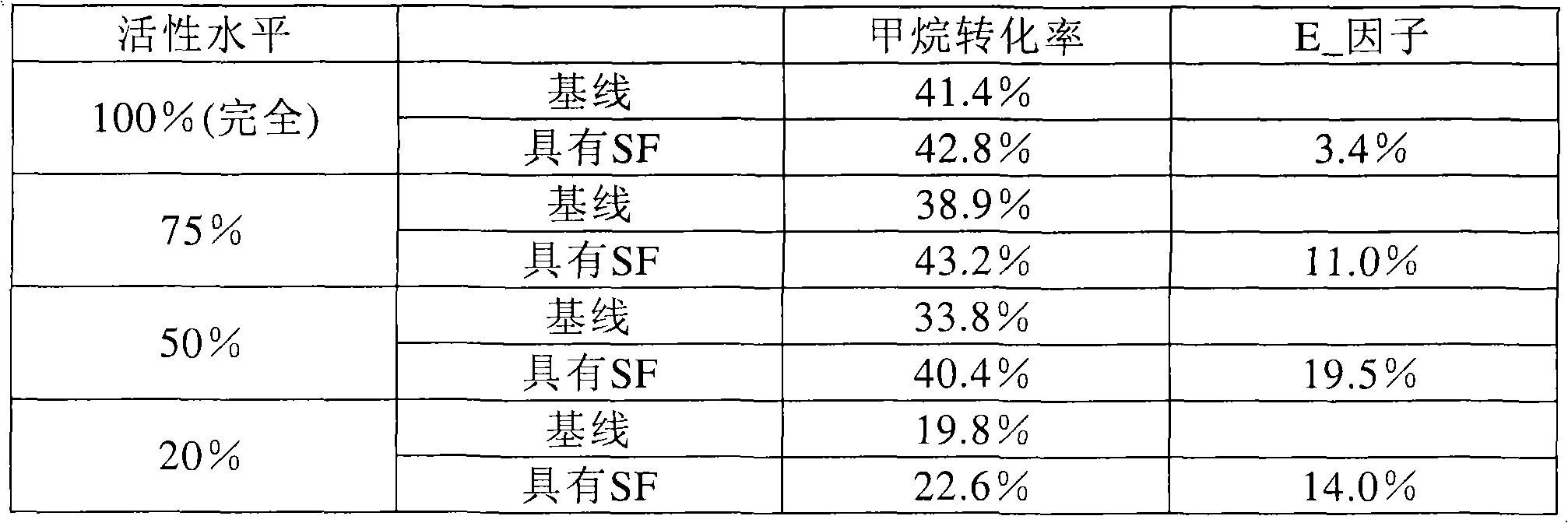
Optimization under the relative raising experience catalyst activity condition that surface characteristics gives.If kinetics is very fast and the gap, microchannel is very little (for the gas-phase reaction of time of contact less than 10 milliseconds,<0.015 "); then in passage, increase laterally and perpendicular flow almost do not increase advantage, most influence is that the increase by surface area causes.If dynamics is slow excessively, then the environment of short contacting time is preponderated in the microchannel, just because reactant was scanned out reactor before reaching considerable conversion ratio.
Table: for methane conversion, dark 0.015 " feature, 700 ℃ and 25 atmospheric conditions under, process flow rate is to the influence of reactor performance
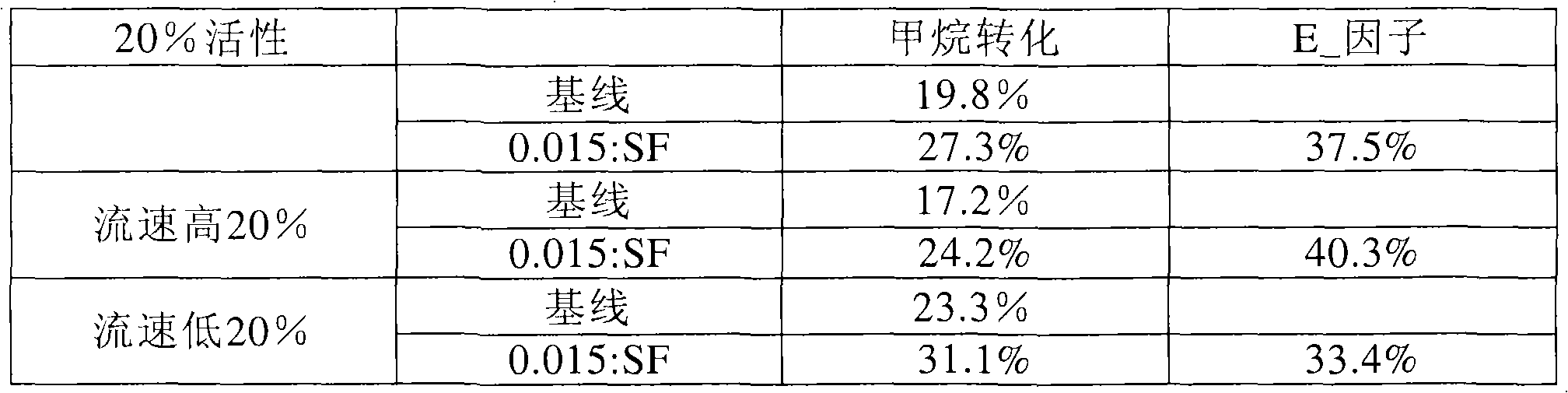
Under 20% baseline activity level, the methane conversion under all situations is all thought away from the equilibrium valve (~44%) under 700 ℃ for the SMR reaction rate.As shown in Table, find that the raising effect of the darkest feature is the highest.When flow velocity increases above the baseline flow velocity, observe further raising surprisingly.Along with flow velocity reduces, improve and reduce.For latter event, be reduced to lower speed from lower flow velocity, reduce the fluid rotation of this fixed geometirc structure, thereby reduced the raising factor slightly.When flow velocity increased, overall rate also increased, and had therefore produced the horizontal and vertical speed that is produced by surface characteristics.When dynamics was slower than baseline case, more important-part that the influence of surface characteristics becomes was because the baseline dynamics of this research is very fast.
Higher flow velocity is also corresponding to higher Reynolds number.When Reynolds number increases, molecule will spend the long time in the active surface feature, thus they the catalyst place or near time of reacting longer.
Table: the path clearance size is to influence (gap size: 0.04 "), 700 ℃, 25 atmospheric pressure, SMR reaction, 0.01 " the deep surface feature of reactor performance
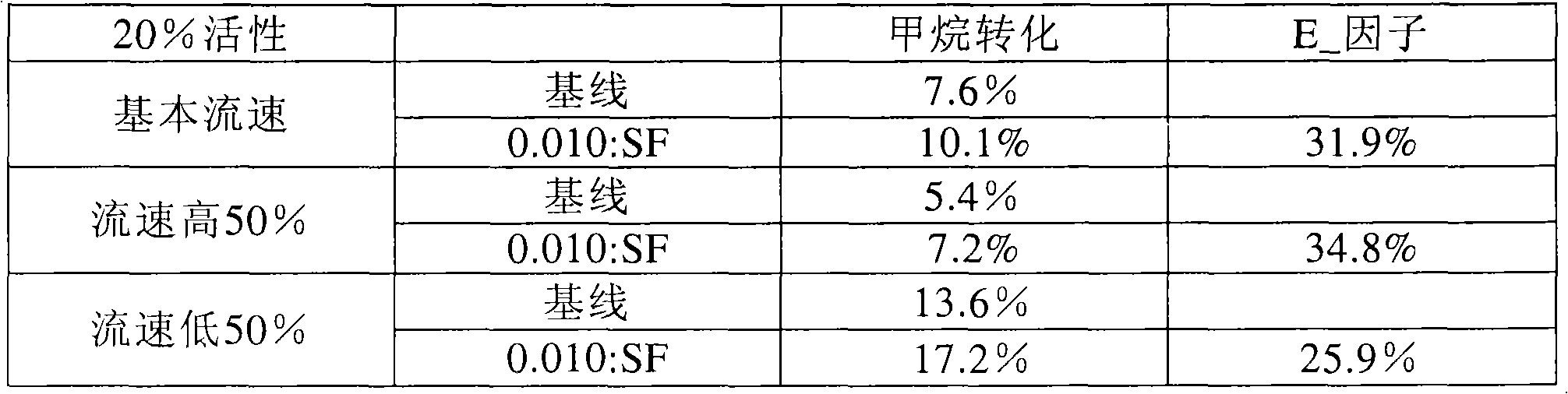
For the situation shown in this table, simulated much bigger gap.Use much bigger gap,, observed the bigger raising factor as expection.The raising factor in the gap of " the active and basic similar situation of flow velocity of 20% baseline of dark surface characteristics is: for 0.0125 " is 26.6% to 0.01, to 0.04 " the raising factor in gap be 31.9%.Under the situation in big gap, also observe the trend that under the high flow velocities situation, has the higher raising factor.
Embodiment-use surface characteristics improves conducts heat
Surface characteristics causes rotation or helical flow path, and these flow paths can improve from the heat transfer of wall to bodies of fluid (or vice versa).Use computational fluid dynamics to estimate the improvement of the heat transfer that surface characteristics is brought.The instrument that uses is Fluent V 6.1.22.
The CFD model is set up in two kinds of microchannels that minimum dimension is different.A kind of gap of passage is 0.0125 ", the gap of another kind of passage is 0.040 ".For various gap sizes, set up two kinds of models: 1) do not have surface characteristics and 2) have surface characteristics, with estimation heat transfer raising respectively.
Use Gambit V2.2.30 to set up the CFD model.The detail drawing that has shown channel size and surface characteristics among Fig. 1-3.The main channel size is wide 4.06 millimeters, 36.83 millimeters of 1.02 millimeters in gap and length.One section main channel between 3.81 millimeters of main channel length beginnings and 5.08 millimeters terminations has surface characteristics shown in Figure 6.The pattern that proposes among described surface characteristics pattern and the SHM is similar, but comprises the size or the quantity difference of the microchannel wall of feature, nor uses the filling feature in present embodiment.0.38 millimeter the opening that surface characteristics is separated by 0.38 millimeter wall, its degree of depth is 0.25 millimeter, is used for two sides of microchannel.
In Gambit, produced and be used for the net (mesh) that Fluid Computation is analyzed.Grid add up to 131106, face add up to 542409, node add up to 177006.Produce net as far as possible it is remained the net of rule.
Considered to determine the mixing efficiency of surface characteristics with two kinds of fluids.Provided the character and the operating condition of fluid below:
1) gas
A. outlet pressure=34S psi
B. inlet temperature=300K
C. viscosity=1.28 * 10
-5Kg/m/s
D. thermal conductivity factor=0.087W/m/K
E. specific heat=2768.03J/kg/K
F. density=use perfect gas law
G. molecular weight=17.49g/mol
H. coefficient of molecular diffusion=1 * 10
-5m
2/ s
2) aqueous water
A. outlet pressure=14.7psi
B operating temperature=300K
C viscosity=1.0 * 10
-3Kg/m/s
D. thermal conductivity factor=0.6W/m/K
E specific heat=4182J/kg/K
F density=998.2kg/m
3
G molecular weight=18.01g/mol
H coefficient of molecular diffusion=1 * 10
-9m
2/ s
The path clearance of situation 1:0.0125 inch
Use aqueous water as fluid
Boundary condition
O operating pressure=14.7psi
O outlet pressure=0psig
O inlet velocity=1.54m/s
O inlet temperature=300K
O wall temperature=350K
The Reynolds number of fluid is 1000 in the passage.Reynolds number is calculated as follows
ρ=fluid density in the formula, kg/m
3
The v=fluid velocity, m/s
The hydraulic diameter of D=passage, m
The viscosity of μ=fluid, kg/m/s
Overall heat-transfer coefficient is estimated by following formula:

In the formula
HTC
Totally=overall heat-transfer coefficient (W/m
2/ K)
Q
Wall=the heat (W) that transmits from wall
A
Smooth=based on the heat transfer area of smooth (or not having surface characteristics) geometry, m
2
The logarithm value of LMTD=mean temperature difference
Model Selection
CFD is analyzed selection K-Ω model (SST class).The numerical value of model constants is the default value that Fluent 6.0 provides.Select complete multicomponent diffusate TRANSFER MODEL.Diffusion coefficient is 1E-5m
2/ s.
The result
Fig. 7 has shown smooth passage (no surface characteristics) and has had the comparison of the temperature curve between the passage of surface characteristics geometry.This temperature curve is along flow direction, draws in channel center.The unit of all temperature is out.For geometry, very fast to the heat transfer ratio of fluid from wall with surface characteristics.Following table has compared the heat transfer coefficient of the calculating of smooth passage and surface characteristics geometry.The result shows that the geometry with surface characteristics is with respect to the situation that does not have surface characteristics, and heat transfer coefficient improves 143%, and pressure drop increases 63%.Note the relative raising of the relative raising of heat transfer greater than pressure drop.Be also noted that in order to reach and the identical performance of smooth passage of growing 1.4 inches, the length with passage of surface characteristics only is required to be 0.3 inch.
Table: for 0.0125 inch gap, the heat transfer coefficient of smooth passage and surface characteristics geometry and the comparison of pressure drop
| Smooth passage | SFG-1 | |
| Inlet velocity (meter per second) | 1.54 | 1.54 |
| Reynolds number | About 1000 | About 1000 |
| Area increases % | 39% | |
| HTC(W/m 2/K) | 12076 | 29339 |
| HTC improves % | 143% | |
| Pressure drop (psi) | 1.2 | 1.9 |
| Pressure drop increases percentage % | 63% |
The path clearance of situation 2:0.040 inch
Using gases is as fluid:
Boundary condition
O operating pressure=345psi
O outlet pressure=0psig
O inlet velocity=0.47m/s
O inlet temperature=300K
O wall temperature=350K
Use aqueous water as fluid:
O operating pressure=14.7psi
O outlet pressure=0psig
O inlet velocity=0.60m/s
O inlet temperature=300K
O wall temperature=350K
The Reynolds number of the fluid in the passage is 1000.
Model Selection
Selecting K-Ω model (SST class) to be used for CFD analyzes.The numerical value of model constants is the default value that is provided by Fluent 6.0.
Select complete multicomponent diffusate TRANSFER MODEL.Diffusion coefficient is 1E-5m
2/ s.
The result
For this bigger gap, the geometry with surface characteristics still shows the raising that is better than planar geometry and conducts heat.Table 2 compares planar geometry and heat transfer coefficient and pressure drop with geometry of surface characteristics.
Table: for 0.040 inch gap, to the heat transfer coefficient of smooth passage and surface characteristics geometry and the comparison of pressure drop
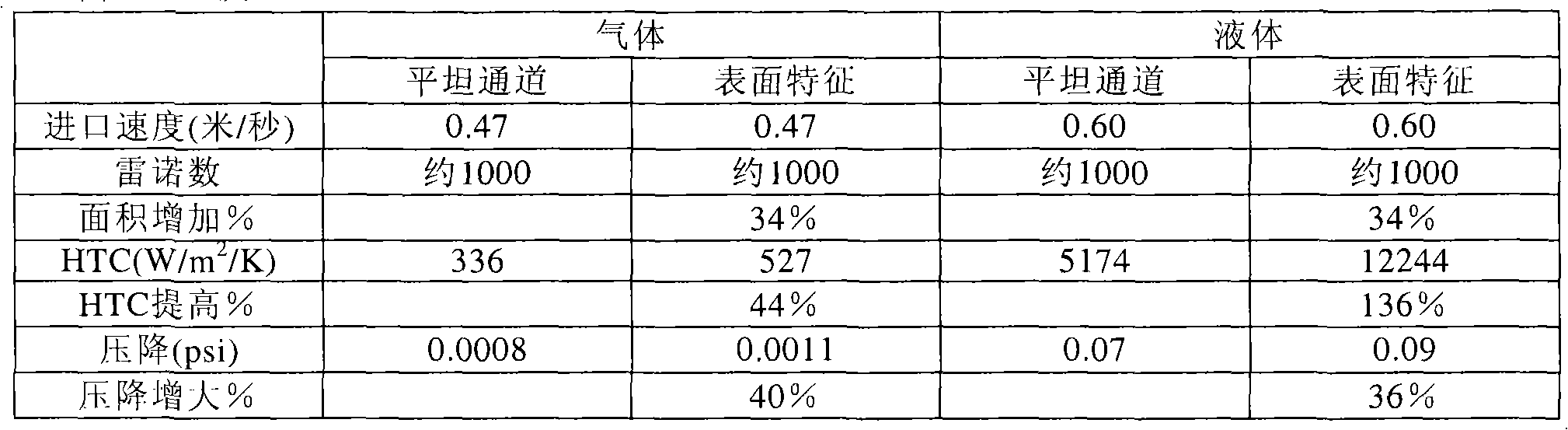
In both cases, the increase of heat transfer coefficient increases greater than the pressure drop of per unit length.In addition, also can expect, can obtain interchanger more efficiently, thereby can further reduce the pressure drop of system by reducing the length of microchannel.
The embodiment methyl hydride combustion
Use the burning of whole step mechanism simulation methane, in this mechanism, methane and two oxygen molecules react, and generate the CO of 1 molecule
2Water (formula 1) with 2 molecules.Having simulated the burn rate of methane, all is first order reaction (formula 2) for methane and oxygen.Independently having estimated activation energy in the research, be 553,900kJ/mol, pre-exponential factor are 1130m
4/ kgmol/s, central temperature is 1098.2K.
CH
4+2O
2→CO
2+2H
2O
The objectives of present embodiment are to use little CFD modeling to have the microchannel geometry of isothermal wall boundary condition, so that the design with surface characteristics is carried out quantitative comparison with respect to the combustibility that can relatively the design raising with smooth wall (or not having surface characteristics).
Following table has provided initial conditions
Table: the boundary condition of Pt-Re fuel lean-burn cleaning of emissions channel C FD simulation.
| Computing | Unit | Situation 1-750 ℃ | Situation 2-850 ℃ |
| Import ppmCH 4 | (ppmv) | 2500 | 2500 |
| The inlet gas temperature | (℃) | 750 | 850 |
| Outlet pressure | (psig) | 3.3 | 3.3 |
| CH 4Inlet velocity | (Kilograms Per Second) | 2.483E-07 | 2.483E-07 |
| O 2Inlet velocity | (Kilograms Per Second) | 5.181E-06 | 5.181E-06 |
| N 2Inlet velocity | (Kilograms Per Second) | 1.717E-04 | 1.717-E04 |
Fig. 8 has shown the experimental performance data that have surface characteristics and do not have surface characteristics.
This model uses upward, and the listed boundary condition of table carries out computing.Constant before the dynamic (dynamical) index of combustion catalyst is revised, until the CH of simulation and forecast
4Conversion ratio conforms to 750 ℃ the experimental data that has with not having surface characteristics.Use is used for mating the ratio that has and do not have pre-exponential factor required in the model of surface characteristics, and the performance raising that has under the surface characteristics situation is carried out quantitatively.Surface characteristics under having estimated 750 ℃ improves the factor.
It is 4.4 times that the methane conversion performance with surface characteristics under 750 ℃ improves the factor.That is to say that under 750 ℃, the activity of such catalysts that only is arranged on the flat wall must reach 4.4 times, just can reach be arranged on microchannel with surface characteristics on the identical performance of catalyst.
Suppose and reference
Described geometry is the passage in 0.058 inch in gap, and is wide 0.16 inch, long 3.5 inches
The surface characteristics pattern is the SFG-1 on passage end face and the bottom surface.
The fuel lean-burn dynamics pre-exponential factor of baseline case is 1129.3, is expressed as 1 times.Test catalyst in this experiment on the level and smooth or smooth passage that records is much higher-result of improved formulations.Two kinds of situations are used identical catalyst formulation.
Pre-exponential factor is revised, to mate the CH of 750 ℃ of following smooth passage
4Conversion ratio.The CH of 750 ℃ of following smooth passage
4Conversion ratio is about 47% (see figure 1).After the performance of coupling smooth passage, change pre-exponential factor so that be complementary with the performance that surface characteristics is arranged.Following table has been listed the result.
Table: in the summary of 750 ℃ CFD model analysis
| Smooth passage | The surface characteristics passage | |
| Pre-exponential factor lean-burn dynamics | 191978 | 846960 |
| CH 4Conversion ratio | ||
| Test | 47.6% | 58.9% |
| CFD | 47.9% | 59.5% |
| O 2Conversion ratio | ||
| CFD | 8.8% | 11.2% |
| CFD model quality balance | 0.0% | 0.0% |
| CFD model energy balance | 0.0% | 0.0% |
Performance with surface characteristics improves the factor (at 750 ℃)=4.4 times, thereby if the explanation catalyst is arranged on smooth or undistinguishable passage on, then need 4.4 times of high activity could obtain identical conversion ratio performance.
The embodiment waste gas purification
Present embodiment (only contains CH at the simulated combustion waste gas stream of simplifying
4, O
2N with surplus
2) in simulated the purification of burnt gas (final 2500ppm).
The design general introduction
This geometry comprises the passage in 0.058 inch in gap, and is wide 0.16 inch, long 3.5 inches, be arranged in chip (pellet) device, have plate on arbitrary side in described 0.058 inch gap, this plate has the surface characteristics of depression, perhaps has smooth surface.Selected surface characteristics pattern is the SFG-I that is positioned on two the relative main walls in main channel, and it is an anti-configuration, and depths of features is 0.010 inch, has 0.015 separately " span, feature pitch 0.015 ".
Make and describe in detail
In order to make background active minimum, the parts in the device have chromium oxide crust (grow out by inconel 617 heat treatments, in the reason, described passage is heated to 1000 ℃ in the lean mixture of oxygen and nitrogen, handled 4 hours herein).
To smooth and comprise that the test specimen of surface characteristics heat-treats, it is grown after the chromium oxide crust, will be dispersed in platinum on the pyrolysismethod aluminium oxide (fumed alumina) and hide and be coated on this test specimen.Cover coating catalyst on the pyrolysismethod aluminium oxide is 50% Pt, 3% CaO, and load capacity is about 10 milligrams/inch
2Described blank test specimen is smooth, has the chromium oxide crust, but does not have catalyst.
Test is provided with
Air and " fuel " (N
2+ CH
4) separately preheating in coil pipe, then immediately with the upstream in the air injection device sheet.Owing in the waste gas of simulation, use N
2All CO have been replaced, H
2, CO
2And H
2O, the expection kinetic activity is different from the situation that comprises water in the charging.Design current velocity is if make all CH
4To keep 2.05% O in burning, the waste gas
2Temperature (750-950 ℃) 2) N
2Flow velocity (7.383-3.184 SLPM)
Fixed constant: CH
4Flow velocity (0.0213 SLPM), O
2Flow velocity (1.035 SLPM), and equipment
The result
Smooth and have in the test specimen of surface characteristics, record CH
4Conversion ratio make a marked difference statistically (at 750 ℃, conversion ratio is high relatively by 24%, at 900 ℃, conversion ratio high relatively 7%).CFD simulates proof, and the smooth primary data of device sheet under 750-850 ℃ mainly is mass transfer limit, and the such identical methane conversion that reaches if desired by adding the surface characteristics acquisition improves relatively, needs catalyst activity to increase 4.4 times.Even for the temperature up to 950 ℃, air and fuel mixed before entering chip device immediately, had also reduced the background activity that records greatly.
The embodiment pressure drop
Carried out experimental study,, it has been compared with the pressure drop in the passage that does not have surface characteristics with the pressure drop in the passage of determining to have surface characteristics.
Made a kind of device, this device has the SFGO pattern of cis-A orientation on two masters (relatively) wall of main channel.Between import and outlet, 7 pressure positions have been made, to measure the pressure of diverse location in the passage.Channel size is 0.16 inch * 0.020 inch * 6.985 inches.
Surface characteristics is V-shaped, angle at 45 between the surface characteristics arm.The opening of surface characteristics is 0.015 inch, separates 0.015 inch between the feature.The degree of depth of each surface characteristics is 0.010 inch.Two arms of " V-shape " are with radiuses 0.008 " curve connect.The other end of the described feature section of propping up (or arm) is semicircle.
Use air as fluid.Testing stand is made up of a moving air mass velocity controller, 9 magnetic valves and 2 differential pressure pick-ups (0-5psid and 0-15psid).This system is fully automatically, calibrated the mass velocity controller, connected after the pipe for various flow velocitys like this, the laboratory observation person will set flow velocity, open the magnetic valve that links to each other with first port, which differential pressure transducer (0-5psid or 0-15psid) is used in decision, keep stable state, note numerical value, transfer to next port.Stable state is defined as pressure and changes situation less than 1%.
Designed planning of experiments and tested under the situation of different fluids and different in flow rate, surface characteristics is to the influence of pressure drop.The fluid that selection is used to test is a water and air.Change flow velocity to obtain the Reynolds number of laminar condition and transition state.Be the planning of experiments of experimental test below.
The device of experiment 1 no surface characteristics
Mass velocity
Test number flow surface feature flow rate unit Reynolds number
(Kilograms Per Second)
The ARSTH1 air does not have 4.88 SLPM 1.048E-04 2519
The ARSTH2 air does not have 6.00 SLPM 1.289E-04 3097
The ARSTH3 air does not have 2.63 SLPM 5.641E-05 1358
The ARSTH4 air does not have 3.75 SLPM 8.059E-05 1936
The ARSTH5 air does not have 6.00 SLPM 1.289E-04 3097
The ARSTH6 air does not have 1.50 SLPM 3.224E-05 774.3
The ARSTH7 air does not have 3.75 SLPM 8.059E-05 1936
The ARSTH8 air does not have 1.50 SLPM 3.224E-05 774.3
Test 2A has the device on the surface of cis A orientation
Mass velocity
Test number flow surface feature flow rate unit Reynolds number
(Kilograms Per Second)
The ARSFG0-45-CISA1-A air has 4.88 SLPM 1.048E-04 2519
The ARSFG0-45-CISA2-A air has 6.00 SLPM 1.289E-04 3097
The ARSFG0-45-CISA3-A air has 2.63 SLPM 5.641E-05 1358
The ARSFG0-45-CISA4-A air has 3.75 SLPM 8.059E-05 1936
The ARSFG0-45-CISA5-A air has 6.00 SLPM 1.289E-04 3097
The ARSFG0-45-CISA6-A air has 1.50 SLPM 3.224E-05 774.3
The ARSFG0-45-CISA7-A air has 3.75 SLPM 8.059E-05 1936
The ARSFG0-45-CISA8-A air has 1.50 SLPM 3.224E-05 774.3
The result:
The passage total length of gaging pressure is 6.985 ".Fig. 9 has shown the comparison that has and do not have the test pressure drop of surface characteristics.As can be seen from Figure 9, have the passage of surface characteristics and do not have the poor of overall channel pressure drop between the passage of surface characteristics, along with Reynolds number increases and increases." the pressure drop factor " is defined as: the pressure drop in the pressure drop/smooth passage in the passage of the pressure drop factor=have surface characteristics.Figure 10 has shown the variation of the pressure drop factor with Reynolds number.Calculated in the overall presure drop factor and the passage pressure drop factor in the same district not.The pressure drop factor (1 near import) between " the pressure drop factor-1-2 " expression pressure port 1 and 2.As can be seen from the figure, in the position (between the port one and 2) near import, the pressure drop factor is comparatively smooth with the variation of Reynolds number.Distance between the port one and 2 is 0.985 ".After port 2, in the laminar region, the pressure drop factor increases and sharply increases along with Reynolds number, in transition flow region, then can flatten.The pressure drop factor subsequently is similar with the situation of change of Reynolds number with the overall presure drop factor with the variation (between the port 2 and 3, between 3 and 4, between 4 and 5) of Reynolds number.It shall yet further be noted that the pressure drop factor becomes with the surface characteristics design.
These results show that the pressure drop of described surface characteristics passage is the function of Reynolds number with respect to the increase of smooth or smooth passage.Along with Reynolds number increases, the pressure drop factor is from increasing to greater than 2.3 times less than 1.5 times.Surpass the laminar region when Reynolds number increases, when entering transition region and turbulent area, surface characteristics moves closer to about 2.3 times with respect to the pressure drop ratio of smooth passage.For different surface characteristics design, gap, main channel and fluid properties, estimate that asymptotic value can change in different systems.These results show, use surface characteristics also can improve transition or turbulent flow system in the microchannel valuably, and than under the high reynolds number, the increase of pressure drop is tending towards smooth, but the net increase of the surface area of surface characteristics may be offset the increase of pressure drop.For example, for the heat exchanger of the turbulence state in being used for the microchannel of the foregoing description operation, provide surface characteristics geometry will make total heat transfer increase net increase that (heat transfer coefficient multiply by heat transfer area) surpasses pressure drop greater than 2.3 times surface area.Net result is for specific load, and the heat exchange volume is less, and overall presure drop does not increase.For similarly total device thermic load, the corresponding length of the surface characteristics microchannel of operating under turbulence state is shorter than the smooth microchannel of operating under the turbulence state probably.
The simulation of embodiment pressure drop
In the present embodiment, use FLUENT to simulate the situation that flows through microchannel with surface characteristics.The structure of simulation is SFGO-45 degree angle, and is trans, long 10.3 inches.The purpose of this analog operation is to study the pressure drop of this surface characteristics device under various conditions.CFD result shows that pressure drop is to surperficial feature height sensitivity, and according to condition, in smooth passage, pressure drop everywhere increases to 162% from 53%.
Particular surface feature geometries structure comprises:
45 ° of surface characteristics
Anti-configuration is provided with (opposite orientation on top and the base wall)
The surface characteristics degree of depth=0.010 inch; Width=0.015 inch
Surface characteristics length direction spacing=0.042 inch
Gap=0.0125 inch
Overall width=0.160 inch
Total length=10.3 inch (0.15 inch upstream and downstream does not comprise surface characteristics).
The sum of feature=239
For above-mentioned geometry has produced the CFD net, amount to 1,400,000 grid-hexahedrons.
Above-mentioned CFD model carries out computing under 12 kinds of different conditions:
Four computings are carried out under " SMR " condition, that is: T=800 ℃, and P=2533000Pa, ρ=5.067kg/cu.m, inlet velocity=12.13-37.6m/s.
Four computings are carried out under " water " condition, that is: T=20 ℃, and P=101325Pa, ρ=998.2kg/cu.m, inlet velocity=1.704-5.284m/s.
Four computings are carried out under " air " condition, that is: T=20 ℃, and P=101325Pa, ρ=1.205kg/cu.m, inlet velocity=25.72-79.49m/s.
In addition, for relatively, these CFD computings these conditions, but do not have to repeat under the situation of surface characteristics.
The basic main hypothesis that these CFD analyze comprises:
1. aisle limit becomes not comprise reaction.
2. flow and think complete laminar flow.
3. whole flow field is made as adiabatic.
4. flowing is stable state.
Calculating/analysis
The CFD result who has comprised these 12+12 time computing below.Flow field pressure drop on the whole length of " total dP " expression." (Developed) dP that produces " is illustrated in the pressure drop of thinking that periodic position of flowing occurs.CFD result shows that existing 0.654 inch to 10.066 inches position should periodic zone.Also comprised the pressure drop increase at last.
Under the laminar flow conditions, surface characteristics and flat-tope structure pressure drop are relatively
Has the zone (0654-10.066 inch) that surface characteristics-herringbone structure produces
| The computing numbering | Reynolds number [-] | Kind [-] | Total dP[psi] | Import (In.) speed (meter per second) | Density [kilogram/rice 3] | The dP[psi that produces] | Friction (fric.) coefficient [-] that produces | DP increases [%] |
| 1 | 1000.02 | SMR | 3.517 | 12.13 | 5.067 | 3.209 | 0.1462 | 53.2 |
| 2 | 1699.95 | SMR | 8.384 | 20.62 | 5.067 | 7.673 | 0.1210 | 100.8 |
| 3 | 2399.98 | SMR | 14.928 | 29.11 | 5.067 | 13.683 | 0.1082 | 135.8 |
| 4 | 3099.81 | SMR | 23.030 | 37.6 | 5.067 | 21.126 | 0.1002 | 162.1 |
| 5 | 1001.83 | Water | 13.662 | 1.704 | 998.2 | 12.465 | 0.1461 | 53.2 |
| 6 | 1703.22 | Water | 32.580 | 2.897 | 998.2 | 29.818 | 0.1209 | 100.9 |
| 7 | 2405.20 | Water | 58.043 | 4.091 | 998.2 | 53.199 | 0.1082 | 136.2 |
| 8 | 3106.60 | Water | 89.543 | 5.284 | 998.2 | 82.140 | 0.1001 | 162.3 |
| 9 | 997.50 | Air | 3.764 | 25.72 | 1.205 | 3.434 | 0.1463 | 52.9 |
| 10 | 1694.43 | Air | 8.961 | 43.69 | 1.205 | 8.201 | 0.1211 | 100.6 |
| 11 | 2389.81 | Air | 15.929 | 61.62 | 1.205 | 14.599 | 0.1084 | 135.3 |
| 12 | 3082.86 | Air | 24.509 | 79.49 | 1.205 | 22.482 | 0.1003 | 160.8 |
Water/oil meter face feature-flat-top
| The computing numbering | Reynolds number [-] | Kind [-] | Total dP[psi] | Import (In.) speed (meter per second) | Density [kilogram/rice 3] | The dP[psi that produces] | Friction (fric.) coefficient [-] that produces |
| 1 | 1000.02 | SMR | 2.329 | 12.13 | 5.067 | 2.095 | 0.0955 |
| 2 | 1699.95 | SMR | 4.283 | 20.62 | 5.067 | 3.822 | 0.0603 |
| 3 | 2399.98 | SMR | 6.538 | 29.11 | 5.067 | 5.804 | 0.0459 |
| 4 | 3099.81 | SMR | 9.110 | 37.6 | 5.067 | 8.060 | 0.0382 |
| 5 | 1001.83 | Water | 9.043 | 1.704 | 998.2 | 8.134 | 0.0953 |
| 6 | 1703.22 | Water | 16.631 | 2.897 | 998.2 | 14.842 | 0.0602 |
| 7 | 2405.20 | Water | 25.371 | 4.091 | 998.2 | 22.521 | 0.0458 |
| 8 | 3106.60 | Water | 35.390 | 5.284 | 998.2 | 31.311 | 0.0382 |
| 9 | 997.50 | Air | 2.497 | 25.72 | 1.205 | 2.246 | 0.0957 |
| 10 | 1694.43 | Air | 4.581 | 43.69 | 1.205 | 4.088 | 0.0604 |
| 11 | 2389.81 | Air | 6.988 | 61.62 | 1.205 | 6.204 | 0.0461 |
| 12 | 3082.86 | Air | 9.739 | 79.49 | 1.205 | 8.619 | 0.0385 |
By these results, notice a surprising result, under specific Reynolds number, the increase of pressure drop character complete and real fluid is irrelevant.In other words, with compare with fluid air (gas) or water (liquid) under 1 atmospheric pressure at 20 ℃, when Reynolds number is about 1000,800 ℃, fluid mixture (23 atmospheric pressure for the steam methane conversion reaction, steam is 3: 1 with the ratio of methane), the pressure drop increase of observing in the smooth passage is about 52-54%.Similarly, under near 3000 Reynolds number, pressure drop ratio increases near 160%.These tangible presentation of results, the degree of the other mixing of being represented by the increase of pressure drop is only controlled by Reynolds number.The surprising part of another of these results is that they are converted into transition flow state (Re~3000) from laminar condition.Think and to change the absolute value that the pressure drop from smooth passage to the surface characteristics passage increases with respect to the surface characteristics geometry of mainstream channel and size, but under identical Reynolds number, the planomural of this pressure drop increase and fluid surpass to(for) particular geometric configuration are irrelevant.
The different degree of depth and the width of embodiment surface characteristics
For this research, the surface characteristics degree of depth is different with width.In Fluent-6.0, develop the CFD model and studied the degree of depth of surface characteristics and the influence of width.Trajectory (pathline) fathoms qualitatively and the influence of width by observing.For quantitative measurment, on the surface of feature, apply surface reaction, measure the gas composition in exit.The width of surface characteristics is compared in discovery, and the influence that the degree of depth of surface characteristics is mixed flowing is bigger.
Following table has provided the description of the CFD model that is used for this research.
Table: the model description of situation 1
| Dynamics pre-exponential factor (s) | 282.3 |
| The situation numbering | 1,2,3 |
| Surface characteristics geometry kind | SFG-0-60° |
| Flow direction | Cis-A |
| Surface characteristics width (millimeter) | 0.381 |
| The surface characteristics degree of depth (millimeter) | 0.508 |
| The surface characteristics spacing, or tangent line is to the spacing (millimeter) of tangent line | 0.381 |
| Surface characteristics angle (with respect to the angle of width, perhaps perpendicular to the angle of overall flow direction) | 60° |
| The path clearance (millimeter) of simulation | 0.597 |
| Full tunnel gap (millimeter) | 1.194 |
| The channel width (millimeter) of simulation | 2.032 |
| Full tunnel width (millimeter) | 4.064 |
| Feature upstream passageway length (centimetre) | 0.381 |
| Have surface characteristics passage length (centimetre) | 5.588 |
| Feature downstream passage length (centimetre) | 0.381 |
| Each comprises the surface characteristics sum on the wall of surface characteristics | 33 |
| The sum that comprises the wall of surface characteristics | 2 |
| The quantity of grid | 126975 |
| The model symmetry | Quartering symmetry |
| The wall boundary condition | 870 ℃ of wall temperatures |
| The inlet fluid temperature (℃) | 870℃ |
| The import mass velocity (Kilograms Per Second) of the part of simulation | 4.975E-5 Kilograms Per Second |
| The inlet velocity distribution curve | Evenly |
| Outlet pressure (crust) | 1.26 |
| Whether can react | Energy |
| Fluid properties | |
| Density (kilogram/rice 3) | Perfect gas |
| Thermal capacitance (Jiao/kilogram-K) | Mixing rule |
| Thermal conductivity factor (watt/meter-K) | Quality weighted blend law |
| Viscosity (kilogram/rice-second) | Quality weighted blend law |
| Inlet fluid is formed | |
| O 2(quality %) | 0.03240 |
| CO 2(quality %) | 0.31480 |
| CH 4(quality %) | 0.00263 |
| H 2O (quality %) | 0.09184 |
| H 2(quality %) | 0.00000 |
| CO (quality %) | 0.00000 |
| N 2(quality %) | 0.55833 |
| Balance | |
| Quality ([advancing-go out]/advance) | 0 |
| Energy ([advancing-go out]/advance) | 0 |
The hypothesis that these CFD analyze comprises: think that flowing is complete laminar flow; Whole flow field is adiabatic; Flowing is stable state.
Under the gap, fixedly main channel at 0.597 millimeter, the degree of depth of surface characteristics is compared the surface characteristics of broad when 0.508 millimeter increases to 0.762 millimeter, and the mobile number of times that flow to the edge, flows to the center then significantly increases.
A purpose introducing surface characteristics in passage is to break laminar boundary layer, conducts heat and mass transfer character to improve.By on the surface characteristics wall, applying the surface reaction of methyl hydride combustion, and the methane concentration of relatively outlet and the overall presure drop in the passage, the effect that increases the width and the degree of depth studied.Following table has been listed the outlet/inlet methane concentration and the pressure drop of the situation 1, situation 2 and the situation 3 that are applied with surface reaction.
Table: methane concentration and pressure drop
| Import methane concentration (ppm) | Outlet methane concentration (ppm) | Pressure drop (psi) | |
| |
4902 | 937 | 1.81 |
| |
4899 | 1036 | 1.85 |
| |
4902 | 679 | 2.13 |
As can be seen from the above table, situation 3 (depths of features with increase) has reached minimum methane concentration in the exit.This more does more physical exercises in passage owing to fluid and fluid is contacted with the surface reaction wall and causes.Yet the athletic meeting of fluid causes higher pressure drop in the passage.Aspect the visualization trajectory in addition, fluid motion and mixing in passage, situation 2 be it seems the situation of being better than 1.But the relatively demonstration of methane exit concentration between situation 1 and the situation 2, fluid are introduced to the degree of reaction wall not as situation 1.
Should be noted that the catalyst dynamics of using in this research is slightly slower than the employed catalyst dynamics of (factor is 4.5) aforesaid burning embodiment.Therefore, the outlet predicted value of the methane ppm of gained is much higher.
Feature on embodiment-opposite flank
At the passage that surface characteristics is arranged on the wall with there is the mixed performance of passage of the surface characteristics of " cis " orientation to compare evaluation on two relative walls, wherein the main channel is of a size of 0.0125 inch * 0.160 inch * 2.5 inches to only.Described surface characteristics is the SFG-0 type, and the span width is 0.015 inch, and the degree of depth is 0.01 inch, and is separated from each other, is spaced apart 0.015 inch.The surface characteristics angle of SFG-0 geometry is 45 °.For the concrete condition of considering, find that the one-sided feature with " A " flow orientation is reaching best mixing perpendicular to the direction that flows herein.But the effect of surface characteristics design depends on channel geometry and flow velocity.
Calculating/analysis
One-sided geometry carries out computing: A and B with two kinds of flow orientations, and fluid feed is along angled section, mobile towards the summit among the A, and the fluid impact among the B outwards flows through the section with angle then on the summit.
One-sided and the pressure drop ratio of double-sided surface feature in passage that following table has been listed cis A and cis B orientation.
Table: pressure drop ratio
Higher pressure drop is because the feature on two sides of passage causes in the bilateral feature.For " B " flow orientation, one-sided feature geometries structure has minimum pressure drop, and its mixed effect is better than the situation of bilateral.Should be noted that and thisly relatively be for 0.381 millimeter the less open flow gap and 0.67 the surface characteristics degree of depth: the microchannel open gap is than carrying out.Other places have also shown when the increase of gap, open microchannel, or the surface characteristics degree of depth: the ratio in microchannel openings gap is reduced to and is lower than 0.3, and it is useful especially then using the double-sided surface feature.Be particularly conducive to and move to bigger microchannel openings gap, with the production capacity of increase unit operations, and the total amount of the metal that reduces to comprise in the unit operations.In some embodiments, " A " flow orientation is than " B " flow orientation more unlikely formation Infinite Cyclic district (or dead band).For other pattern, observe opposite tendency.
Embodiment surface characteristics geometry
Studied the mixing efficiency of many surface characteristics geometries and to the inducing of the rotation of flowing, its condition is listed in Table X 1-X2.As if for the geometry and the condition of situation 1 in the Table X 1, some mobile trajectories are trapped within the dead band in the site of place, summit or the variation of channel width center surface characteristics angle.Potential dead band part is located owing to following reason forms in described summit: a segment length of two sections of surface characteristics is identical, the angle of each section changes 180 degree, the place produces symmetric points completely on the summit, and the active force of the fluid in place, the summit feature all is identical, along arbitrary section down.The pattern that does not produce this symmetric points is difficult for forming the dead band.
The geometry and the condition of the CFD model of the simulation of Table X 1 situation 1-3
| The situation numbering | 1 | 2 | 3 |
| Surface characteristics geometry kind | SFG-0-45 °-cis-B | SFG-6-45 °-trans | SFG-6-45 °-cis |
| Flow direction | Cis-B | N/A | N/A |
| Surface characteristics width (millimeter) | 0.381 | 0.381 | 0.381 |
| The surface characteristics degree of depth (millimeter) | 0.254 | 0.254 | 0.254 |
| The surface characteristics spacing, or tangent line is to the spacing (millimeter) of tangent line | 0.381 | 0.381 | 0.381 |
| Surface characteristics angle (with respect to the angle of width, perhaps perpendicular to the angle of overall flow direction) | 45° | 45° | 45° |
| The path clearance (millimeter) of simulation | 0.159 | 0.457 | 0.2285 |
| Full tunnel gap (millimeter) | 0.318 | 0.457 | 0.457 |
| The channel width (millimeter) of simulation | 2.032 | 4.064 | 4.064 |
| Full tunnel width (millimeter) | 4.064 | 4.064 | 4.064 |
| Feature upstream passageway length (centimetre) | 0.381 | 0.381 | 0.381 |
| Have surface characteristics passage length (centimetre) | 5.588 | 5.588 | 5.588 |
| Feature downstream passage length (centimetre) | 0.381 | 0.381 | 0.381 |
| Each comprises the surface characteristics sum on the wall of surface characteristics | 50 | 51 | 51 |
| The sum that comprises the wall of surface characteristics | 2 | 2 | 2 |
| The quantity of grid | 157800 | 284160 | 142080 |
| The model symmetry | Quartering symmetry | Full geometry symmetry | Hemihedrism |
| The wall boundary condition | Fricton-tight | Fricton-tight | Fricton-tight |
| The inlet fluid temperature (℃) | N/A | N/A | N/A |
| Inlet velocity (meter per second) | 12.13 | 12.13 | 12.13 |
| The inlet velocity distribution curve | Evenly | Evenly | Evenly |
| Outlet pressure (crust) | 25.3 | 25.3 | 25.3 |
| Whether can react | Can not | Can not | Can not |
| Fluid properties | |||
| Density (kilogram/rice 3) | 5.067 | 5.067 | 5.067 |
| Viscosity (kilogram/rice-second) | 3.62e-5 | 3.62e-5 | 3.62e-5 |
| Balance | |||
| Quality ([advancing-go out]/advance) | 2.0e-7 | 6.5e-15 | 2.7e-8 |
| Energy ([advancing-go out]/advance) | N/A | N/A | N/A |
The CFD model geometry and the condition of Table X 2 situation 4-5 simulation
| The situation numbering | 4 | 5 |
| Surface characteristics geometry kind | SFG-5.1-45 °-cis-A | SFG-5.1-45 °-cis-B |
| Flow direction | Cis-A | Cis B |
| Surface characteristics width (millimeter) | 0.381 | 0.381 |
| The surface characteristics degree of depth (millimeter) | 0.254 | 0.254 |
| The surface characteristics spacing, or tangent line is to the spacing (millimeter) of tangent line | 0.381 | 0.381 |
| Surface characteristics angle (with respect to the angle of width, perhaps perpendicular to the angle of overall flow direction) | 45° | 45° |
| The path clearance (millimeter) of simulation | 0.2285 | 0.457 |
| Full tunnel gap (millimeter) | 0.457 | 0.457 |
| The channel width (millimeter) of simulation | 4.064 | 4.064 |
| Full tunnel width (millimeter) | 4.064 | 4.064 |
| Feature upstream passageway length (centimetre) | 0.381 | 0.381 |
| Have surface characteristics passage length (centimetre) | 5.588 | 5.588 |
| Feature downstream passage length (centimetre) | 0.381 | 0.381 |
| Each comprises the surface characteristics sum on the wall of surface characteristics | 51 | 51 |
| The sum that comprises the wall of surface characteristics | 2 | 2 |
| The quantity of grid | 118650 | 284160 |
| The model symmetry | Hemihedrism | Full geometry symmetry |
| The wall boundary condition | Fricton-tight | Fricton-tight |
| The inlet fluid temperature (℃) | N/A | N/A |
| Inlet velocity (meter per second) | 12.13 | 12.13 |
| The inlet velocity distribution curve | Evenly | Evenly |
| Outlet pressure (crust) | 25.3 | 25.3 |
| Whether can react | Can not | Can not |
| Fluid properties | ||
| Density (kilogram/rice 3) | 5.067 | 5.067 |
| Viscosity (kilogram/rice-second) | 3.62e-5 | 3.62e-5 |
| Balance | ||
| Quality ([advancing-go out]/advance) | 1.4e-15 | 4.7e-16 |
| Energy ([advancing-go out]/advance) | N/A | N/A |
Analyzed CFD result, with helping determine the hereinafter characteristic of the surface characteristics of discussion.For the geometry and the condition of situation 1 in the Table X 1, trajectory is trapped within the dead band in the surface characteristics at channel width center (positions that intersect at two upstream extremities of the described surface characteristics groove section of propping up part or angle).The CFD analog result explanation of situation 2 in the Table X 1, that the anti-configuration of this kind surface characteristics geometry type has produced near center, gap, main channel at the lateral position across the main channel width that roughly align with the mid point of each section part (angle) of surface characteristics groove is straight substantially/the distortion bad mixed zone of flowing slightly, and near the fluid the wall that comprises surface characteristics of main channel centers on these three mobile centronucleus vortexs.On the contrary, this surface characteristics geometry cis-configuration (situation 3 in the Table X 1) CFD result show, on the entire cross section that flows in the main channel, the cis-structure mixing efficiency is much higher, does not have the mobile nuclear that can periodically not sweep in the surface characteristics.For other main flow in main channel is pulled to the cis-configuration situation of the lateral position of the leap main channel width that aligns with the upstream extremity of each section part (or angle) of surface characteristics groove, the streamline of situation 3 has shown identical trend.The CFD analog result of situation 4 and situation 5 shows in the Table X 2, this surface characteristics geometry depends on flow direction, wherein cis-B flow direction can omit and produce flowing of good mixing soon, and cis-A is flowing in and is divided into two strands in the main channel, but both of these case all shows good mixing.For the cis situation in the Table X 1, the result of situation 4 and situation 5 (Table X 2) shows the main flow in the main channel pulled to and each section of described surface characteristics groove lateral position of the leap main channel width that aligns of the upstream extremity of (or angle) partly, do not exist in along the main channel length Shi Buhui that flows downward and periodically sweeps mobile nuclear in the surface characteristics.
The general introduction of feature geometries structure influence effect
Providing good mixing for overall flow in the main channel is that two aspects of very important surface characteristics geometry are:
1) described surface characteristics must cause in passage effectively that a part of overall flow changes the leading edge of each surface characteristics over to,
2) surface characteristics that repeats for the moving length of the longshore current of sufficient amount, at the local upstream and downstream of each surface characteristics terminal or " end " between keep enough feature haul distances.Enough haul distances preferably are at least the twice of path clearance, and more preferably minimum is four times of path clearance.
The important variable that fluid is introduced in the surface characteristics is the surface characteristics depth ratio, R
The degree of depth:
The degree of depth in the formula
SFBe the degree of depth of surface characteristics, the gap is the gap in the main channel.In order to cause enough fluids to enter described surface characteristics, the ratio R of the described surface characteristics degree of depth and path clearance
The degree of depthBe preferably 0.010-100, more preferably 0.10-10 is more preferably 0.25-2.
Along the side direction expansion (lateral spread) between the local upstream and downstream end of all surface feature of the bearing of trend of the passage that comprises the surface characteristics geometry that the moving length of identical longshore current repeats by side direction ratio R
The side direction expansionDefinition.The side direction ratio is defined as:

Formula medial end portions _ length
SFBe to prop up segment length from end, local upstream to the surface characteristics of local downstream end, α is the surface characteristics angle, span
SFIt is the span of surface characteristics.Attention is under the limiting case of α=90 degree (surface characteristics is alignd with main channel average overall flow direction), and the side direction ratio is 0.In order to run through overall flow effectively, the side direction ratio is preferably 3-100, more preferably 5-20.Note having suitable side direction ratio and be mobilization that surface characteristics causes and cause obviously running through necessity of overall flow but non-adequate condition.
When the surface characteristics streamwise repeated continuously, the quantity and spacing of surface characteristics also was important.Spacing between feature and the feature is preferably less than end _ length
SF, more preferably gap length is 0.1-10 with the ratio of surface characteristics span, is more preferably under the reasonable prerequisite closely as far as possible, this can be by making limit decision.In order to form good mixing, the minimum number that surface characteristics should repeat depends on geometry and condition, but the empirical method of simplifying is the passage that design has suitable surface characteristics inlet length.In other words, we can be with feature inlet length number (L
The feature import) be defined as:

In the formula, the degree of depth
SFBe the degree of depth of surface characteristics, the gap is the gap in the main channel, N
SFBe the minimum number of the basic surface characteristics that similarly repeats continuously on each wall, N
Wall with featureBe the quantity that comprises the wall of surface characteristics.In order to form the good mixing pattern, feature inlet length number is preferably 5-80, more preferably 10-40, more preferably 10-20.Certainly, surpass the feature inlet length, can repeat the feature of Duoing continuously, but the feature inlet length has provided the estimated value (others (for example gap, main channel) that supposition designs can not got rid of this point) that forms the required minimum number of the flow pattern will fresh overall flow introduced from the main channel in the active surface feature than minimum number.
The embodiment thermal response
The expection surface characteristics can be used for homogeneous reaction valuably, comprises catalysis and non-catalytic reaction.An example of non-catalytic homogeneous reaction is the reaction that the ethane thermal cracking generates ethene.
Use surface characteristics to cause that mixing or fluid in the microchannel rotate, thereby destroyed the stratiform streamline.In the laminar flow microchannel of routine, from the channel centerline to the wall, there is sizable thermograde.For the endothermic reaction, the temperature of center line is much lower, so overall reaction rate can reduce.For exothermic reaction, centerline temperature is much higher, and the situation that therefore forms undesirable side reaction can be aggravated.Fluid rotates in passage and has reduced the thermograde in the passage.In addition, on microchannel wall, much higher heat transfer coefficient and bigger heat transfer surface area are arranged with wall surface feature.Therefore, for the endothermic reaction, heat can be applied to process microchannel quickly, perhaps for exothermic reaction, can remove from process channel quickly, thereby might avoid taking place undesirable side reaction.The increase of expection surface heat flux is greater than the twice of corresponding smooth passage, and this is based on the cross section with the surface characteristics tangential.And the total reactor volume that comprises the homogeneous reaction of surface characteristics can be as small as 1/10th of the reactor respective volume that do not comprise surface characteristics.
Embodiment capillary feature is to the load capacity of catalyst and the influence of redistributing
Use two kinds of test specimens (152 millimeters in length * wide 12.7 millimeters), a kind of have a capillary feature (the capillary feature that 3CFC=0.76 millimeter or 3 mils are dark).(angle is 0 degree to the slit that described capillary feature is a level, and is dark 0.076 millimeter, wide 0.076 millimeter.Propping up segment length is 4 millimeters, and another kind does not have the capillary feature, and (smooth test specimen FC), by these test specimens being immersed in the rhodium acetate solution of 15% (weight) Rh in deionized water, applies them.Capillary feature in the present embodiment is not to form as the penetrating feature in the thin plate, but is machined in the feature in the thicker plate.The feature of Xing Chenging can be effective equally like this, and can have the cross section except the rectangle open channel.The surface characteristics cross section also can have fillet, is triangle, becomes circle etc. fully.In present embodiment (11), the cross section of surface characteristics or capillary feature has fillet.Then these test specimens 120 ℃ vertically dry, be similar in device and handle, then 400 ℃ of horizontal roastings.After the calcining, for FC, load capacity is 2.3 milligrams of (Rh
2O
3)/inch
2For the test specimen that comprises 3CFC capillary feature, load capacity is 5.1 milligrams of (Rh
2O
3)/inch
2
By SEM two kinds of test specimens being carried out the surface detects:
On the 3CFC test specimen, on the test specimen face, from the top to the bottom, to be distributed in macro-size be uniform to Rh from left to right; But on smooth test specimen, on axial or lateral, the skewness of metal.
Coating quality:
Observe the crackle in the coating made from the Rh solution of 15% (weight).By using the coating solution of low concentration, cracking can be reduced to minimum.Obtained to apply the optical photograph of twice test specimen with capillary feature with 8% Rh solution.Rh load capacity in the coating is 8 milligrams of (Rh
2O
3)/inch
2Do not observe crackle.
From result of the test the capillary feature is carried out model validation
For three kinds of capillary feature geometries structures, keep model prediction to hide in the coating process with cover coating with the precious metal salt aqueous solution, the liquid of every kind of coating keeps situation.Also by experimental test these geometries catalyst loadings separately.The supposition contact angle is about 45 degree (hiding before the coating approximation to the rhodium solution of 8 weight % that records on the test specimen of the surface-stable of routine) in model.Should be noted that on the heat treatment surface, contact angle can change really a little, can think that also the paddy of capillary feature is slightly different.
Owing to compare with measured value, the load capacity of the prediction on every kind of coating is always very low, therefore also can calculate the load capacity of prediction under supposition capillary feature is full of the situation of liquid fully.In Figure 11, two kinds of predicted values and measured value are compared.Attention is in Figure 11, because actual geometry does not meet the hypothesis of being done in the cover coating maintenance model, two kinds of predicted values of 1CFC geometry suppose that all groove is full of fully.Surprising is to suppose that the capillary feature is full of the model predication value that obtains by liquid fully and conforms to better with the numerical value that test records.Produce higher contact angle on the surface that these presentation of results produce in the paddy of capillary feature.Should be noted that aluminium oxide can ftracture, surface roughness also may influence catalyst loadings.
Figure 12 has shown the design of depending on the capillary feature on the Rh load capacity certain degree.About the load capacity of rhodium, test specimen grades in the following order according to the size of effect: 5CFC>3CFC>1CFC>FC, and wherein FC represents smooth passage (no capillary feature), CFC represents capillary feature passage or surface characteristics passage.Numeral before the CFC is with the degree of depth of the feature of mil or 0.001 inch expression, and promptly 5CFC is recessed in 5 mils in the mainstream channel of microchannel or the surface characteristics of 0.005 inch or 125 microns dark horizontal alignment.
Embodiment is used to improve the single side surface of the apparent catalyst activity that steam methane transforms
In having 0.006 inch the device in by-pass flow (flow-by) gap, have the test specimen with surface characteristics of par catalyst loadings and do not have the test specimen of surface characteristics (smooth) at per unit area by test, study in the microchannel single side surface feature the influence of the apparent activity of Rh/MgO catalyst.Described surface characteristics is formed by herringbone structure, and the arm of these structures becomes miter angle (SFG-0) with passage major axis center line.The degree of depth of described feature 10 mils of respectively doing for oneself own, width or span are 15 mils.The tip of herringbone structure has the circle of radius 10 mils, and a section end has circular completely.The area that the existence of surface characteristics will can be used to keep catalyst has increased 1.63 times.In 675-850 ℃ temperature range, use 3: 1 steam: the methane ratio compares with 4.1ms.Under the situation of undistinguishable test specimen, the load capacity of test specimen is 9.5 milligrams/inch
2(milligram reactive metal); Under the situation of the test specimen that comprises surface characteristics, the load capacity of test specimen is 10.5 milligrams/inch
2(milligram reactive metal).Use FLUENT to carry out the computational fluid dynamics simulation, find to comprise that described feature can be with at least 2.1 times of the active increases of apparent kinetics.So the mass transfer that single side surface feature (only on a side of passage) provides strengthens apparent activity than only surface area is desired to have increased about 31% based on increasing.
The test test specimen
Preparation is used for the test specimen of catalyst coat under the situation that has and do not have surface characteristics.
Generally speaking, the length of described test specimen is 1.4 inches, has disposed the surface characteristics that is included in wherein on 1.323 inches the length altogether at it.The width of described test specimen is 0.215 inch, but designed corresponding test component, makes reacting gas only can flow in 0.080 inch scope on the surface of passage major axis center line either side.Thick 0.095 inch of described test specimen is made by Inconel 617.
Described test specimen comprises two hot walls, to allow to measure the temperature of metal in operating process.Surface characteristics is formed by herringbone structure, the arm of these structures and passage major axis center line angle at 45 (SFGO).Dark separately 10 mils of described feature itself, width or opening are 15 mils.Lambdoid top is the circle of 10 mils, and the end of arm has circular completely.Smooth test specimen has 0.301 inch
2Area be used for applying catalyst, the surface area that the test specimen with surface characteristics can be used to apply catalyst is 0.435 inch
2These areas are used for calculating the amount of the catalyst of load per square inch (for smooth test specimen, at 4 milligrams/inch
2MgO on the Rh load capacity be 9.5 milligrams/inch
2, for sample, at 4.2 milligrams/inch with surface characteristics
2MgO on the Rh load capacity be 10.7 milligrams/inch
2).The area that each test specimen contacts with reaction gas mixtures is: undistinguishable test specimen: 0.212 inch
2, the test specimen with surface characteristics: 0.346 inch
2Before applying catalyst, test specimen is applied nickel aluminide (nickel aluminide) coating of estimating thick 10-20 micron, then it is heat-treated, to make the thin aluminium oxide crust that adheres to.
Test-catalyst
By with the Mg (NO of pipette with 12 weight %
3)
2Catalyst drops applies catalyst to the test specimen with surface characteristics on test specimen.Test specimen after the coating was 100 ℃ of dryings 1 hour.Hiding coating process repeats once again.Test specimen was calcined 4 hours in 1000 ℃ air then.The MgO load capacity is 4.2 milligrams/inch
2Next, with acetate six (acetate)-mu-oxo three (hydration) three rhodiums (III) drips of solution of 10 weight % on test specimen.This test specimen is 100 ℃ of dryings, then 450 ℃ of roastings 1 hour.Repeat this coating process, to obtain 10.7 milligrams/inch
2The Rh load capacity.
With 35 ℃/minute the rate of heat addition, the H that is flowing
2In, described smooth test specimen (not having surface characteristics) is heated to 1050 ℃.After under 1050 ℃, purging 1 hour, gas become 21% O with Ar
2/ Ar.Continuing logical O
2Under the condition of/Ar,, be cooled to room temperature then to this test specimen heat treatment 10 hours.After heat treatment, produced α-Al from the teeth outwards
2O
3Crust.
By with the Mg (NO of pipette with 12 weight %
3)
2Catalyst solution drops on the smooth test specimen, and catalyst is applied on this smooth test specimen.Test specimen after the coating was 100 ℃ of dryings 1 hour.Hiding coating process repeats 1 time.This test specimen is in air, 1000 ℃ of roastings 4 hours then.The MgO load capacity is 3.7 milligrams/inch
2Next with acetate six (acetate)-mu-oxo three (hydration) three rhodiums (III) drips of solution of 10 weight % on test specimen.This test specimen is 100 ℃ of dryings, then 450 ℃ of roastings 1 hour.Repeat this coating process, to obtain 9.4 milligrams/inch
2The Rh load capacity.
After the preparation, smooth test specimen comprises and is positioned at 4 milligrams/inch
2MgO on 9.5 milligrams/inch
2Rh, the test specimen with surface characteristics has and is positioned at 4.2 milligrams/inch
2MgO on 10.7 milligrams/inch
2Rh.Blank test specimen has also obtained the aluminium oxide thin layer in the mode that is similar to the test specimen that contains catalyst, but does not contain catalyst.
Test-condition
A kind of test specimen that has applied catalyst is installed in the test component of microchannel, this means for each test, surface characteristics and catalyst exist only on the wall of main channel.In case after being installed in the device of finishing in the test foundation structure,, make catalyst contact 2 hours, catalyst reduced with the hydrogen of 50sccm and the nitrogen of 450sccm by under normal pressure, 450 ℃ condition.Test is 675,750, carries out under 800 and 850 ℃.The flow velocity of methane is 150sccm, and the flow velocity of steam is 450sccm (ratio of steam and carbon is 3: 1).
Result-test and simulation
Can also show in the table with computational fluid dynamics bag Fluent referring to table 1 with result at smooth test specimen with test of carrying out on the test specimen of surface characteristics
TMThe reaction Simulation result of carrying out.For smooth test specimen, under 673-852 ℃ temperature, carried out about 53 hours running test with nine kinds of samples.For test specimen, under 671-865 ℃ temperature, carried out about 52 hours running test with sample with surface characteristics.
Use one group of undistinguishable (smooth) test specimen that the background activity of system is tested.Do not carry out reduction step.Notice under the condition that is lower than 800 ℃ (670,700,718) no methane conversion.Discovery is at 800 ℃, and methane conversion is about 4%, and at 900 ℃, methane conversion is about 22%.
By making up the zoning that expression has the passage of outer surface features simultaneously, that is to say, on the total length of wide by 0.160 " * high by 0.006 " * long by 1.70 " fluid mass and comprise be arranged on 1.7 as mentioned above " 1.32 " length on the similar zone of surface characteristics, carry out Fluent
TMSimulation.This regional reactive moieties long 1.4 ", allow for 0.15 in import and outlet ", mobile to produce.In the reactive moieties of model, the SMR activity is used with the form based on the speed on surface, allow water gas shift reaction to carry out with volumetric rate, make the gas composition of this reaction be in local equilibrium, for the situation of SMR activity, only be made as and have catalytic activity corresponding to the surface on the surface on the test specimen.The gas feed temperature, flow velocity and the outlet pressure that record in the simulated service test.Also used the isothermal boundary condition that equates with the test specimen temperature.
Use activation energy and the predetermined rate form of 169kJ/mol to measure the first dynamics level (level), wherein the speed of Zhuan Huaing is directly proportional with 1.6 powers (power) of methane dividing potential drop, regulate pre-exponential factor value (speed constant), between the predicted value of the result of the test of undistinguishable test specimen and CFD model, obtain reasonably coupling.This pre-exponential factor value is made as dynamics level 1.Use described test specimen to carry out identical step, collect data, set up the second dynamics level (level) with surface characteristics.Second level of finding is 2.1 times of value of first level.
These results show, use surface characteristics also can reduce the outside resistance to mass tranfer that exists in chemical reaction.If catalyst is arranged on the smooth wall, its activity should be arranged on the twice of the activity on the wall with surface characteristics at least.This result partly is because the increase (about 60%) of surface area, part is because outside resistance to mass tranfer reduces, and the latter is owing to eliminated stratiform parabola fluid distribution curve and cause convection current, reactant is caused from the overall flow path to the wall that has applied catalyst is mobile.
Embodiment 14-is used to improve the both side surface feature of the fuel lean-burn of methane and carbon monoxide
Platinum-rhodium catalyst is applied on two kinds of test specimens with the form of slurries, a kind of test specimen has surface characteristics, another kind of test specimen does not have surface characteristics, they is tested, to measure by add the raising that surface characteristics produces in the fuel lean-burn (excessive oxygen) of CO and methane.Presentation of results has obtained higher CO and methane conversion having on the test specimen of surface characteristics.Have that observed pressure drop increases on the test specimen of surface characteristics (1.5-1.8 doubly) surperficial feature affects be described the flow field.Although two kinds of test specimens have all experienced inactivation, the test specimen with surface characteristics obtains stable conversion ratio in the operating time process of test.For smooth test specimen and test specimen with surface characteristics, it seems that methane conversion limited by reaction rate, but it seems that CO be subjected to mass transfer limit.For the situation of CO burning, comprise that surface characteristics makes initial outlet CO be reduced to 1/15 (increase with respect to the surface area that can be used for catalysis 2.2 times).CO burning after this time internal combustion is average to improve 4.1 times.The rising of this activity has surpassed the influence based on surface area of expection, can owing to surface characteristics (and make concentration maximum near the reactive material of catalytic surface at the surface characteristics place) and make any fluid crooked along longer path by reactor (longer) than what occur in the strict laminar flow conditions, thereby prolong effective time of staying and due to the streamline mixing that causes.
Described surface area with test specimen of surface characteristics is about 2.2 times of smooth test specimen surface area, applying catalyst when reaching similar load factor (quality/unit are), can expect the effect that can observe similar this size, but have CO on the test specimen of surface characteristics reduce explanation reaction rate average specific smooth or undistinguishable test specimen big 4.1 times.Therefore, for the CO burning, compare smooth test specimen, surface characteristics can provide far away surpassing by the desired reaction rate of the amount that increases catalyst to improve.This raising is because the fluid mixing that feature causes causes to a great extent.This near surface that is blended in the catalyst covering keeps high reactive material concentration.Except this immixture, the path that the fluid part flows through in this reactor can be than the path length that flows through in the laminar flow reactor.For the fluid part of any specific, this can prolong mean residence time.
Embodiment 15-is used for strengthening " seeing through " surface characteristics of mixing and conducting heat
" seeing through " surface characteristics is the surface characteristics of the arbitrary shape of continuous transparent walls, makes adjacent passage link to each other (being described surface channel links to each other the overall flow passage with adjacent space or passage).Can make and a plurality ofly see through feature, to increase the degree of depth of surface characteristics in the alignment of mutual top.Even when feature bottom does not have solid surface, they still can be used for when fluid is sheared mutually with the fluid in the adjacency channel fluid of main channel being turned to.In the situation of needs than the one-sided mixing in big gap, " seeing through " feature is effective especially.
In second kind of application, can stir the incompressible fluid that need in suspended substance, keep solid with feature.An advantage of described " seeing through " feature is that particularly when channel vertical was provided with, particles suspended can not assembled in feature " bottom ", but when particle unclamped, they fall back to made in its streamline that suspends again.In another kind was used, solid particle was suspended in the compressible fluid, remained in the suspension by " seeing through " feature, and in another kind was used, drop was suspended in the compressible fluid, remains in the suspended substance.Can obtain similar effects with two kinds immiscible (or the immiscible fluids of part).
In the third is used, catalyst can be remained in the surface characteristics, owing to allow reactant and product to go into the coating (rather than the coating in the picture bag type surface characteristics, only spread), improved the efficient of coating from a side from two side diffusion.
In the 4th kind of application, two kinds of immiscible fluids are moving at the upper reaches, arbitrary side that comprises the wall of seeing through feature, for example by water saturated air or by the water of the saturation of the air, and co-flow on arbitrary side of feature.By described feature air stream is mixed, the particle that is suspended in the air stream is introduced described feature, it is contacted with water.Described then particle becomes and is suspended in the water, and washing is come out from gas phase.Perhaps, gas and liquid (or liquid and liquid) can not be saturated, and contact causes producing saturated logistics on the border.Thisly see through feature and also can be used for the contact of liquid-liquid, for example can carry out liquid-liquid extraction.
Embodiment 17
By (carrying out the CFD simulation of methyl hydride combustion in 0.047 ") main channel; estimate the different surface characteristics geometries and the influence of orientation; operate at a high speed and carry out under (>80 meter per second);, perhaps the lean mixture of oxygen in the nitrogen and methane is converted into the methane of utmost point low content in the exit to reduce emission in big gap.
Analyze, in the exhaust reactor district of 64 millimeters long (having surface characteristics on 55 millimeters in this length), 870 ℃ constant wall temperature, the methyl hydride combustion result of following different situations under the condition of import 5700ppm methane: straight channel (no surface characteristics), SFG-0-cis-A-60 ° (surface characteristics on two relative walls is aimed at mirror image by median plane, with respect to inlet face with 60 ° of orientations (90 ° is to be parallel to the net flow direction)), SFG-0-cis-B-75 ° and SFG-5.1-cis-B-60 °.Described SFG-5.1 geometry is same orientation, the continuous SFG-5 geometry that repeats " check mark " surface characteristics.For in these geometries each, use 0.38 millimeter feature span and feature pitch, and 0.51 millimeter depths of features.On each relative wall, each surface characteristics has been crossed over 4.1 millimeters whole main channel width.SFG-0-cis-A-60 ° has minimum outlet methane ppm (262ppm), secondly is SFG-5 cis-B-60 ° (529ppm), SFG-0-cis-B-75 ° (545ppm) and straight channel (2844ppm).
| Geometry | Conversion ratio | Dry gas methane ppm | Pressure drop [psid] |
| Straight channel, high by 0.047 " | 50.5% | 2844 | 0.76 |
| CSF-0-cis-B-75 °, high by 0.047 ", wide by 0.015 ", dark 0.020 " | 90.5% | 545 | 1.33 |
| CSF-0-cis-A-60 °, high by 0.047 ", wide by 0.015 ", dark 0.020 " | 95.4% | 262 | 1.80 |
| CSFG-5.1-cis-B-75 °, high by 0.047 ", wide by 0.015 ", dark 0.020 " | 90.8% | 529 | 1.60 |
Table: for the tabulating result of 5700ppm import methyl hydride combustion situation
The concentration of methane is straight line decline in the initial a few tenths of inch of described reactor at first, and along the 0.3-0.4 inch of described reactor length, reduction obviously tails off then.In this zone, the flow field that surface characteristics produces is not in stable state yet, begins to mix in reactor.After about 0.4 inch of main channel length, overall flow begins good mixing or rotation take place in reactor, and the discharge of methane thing descends with declivitous slope again.Should flow is not laminar flow, but in all direction motion and rotation, makes new material by advection but not center line is introduced in diffusion, thereby causes the variation of center line concentration.After about 2 inches, along with the total conversion of methane reaches high level, it is more even that center line concentration begins to become.2.3 (surface characteristics termination part) center line concentration is very low after the inch, so the surface characteristics passage reveals splendid transformation efficiency to the issue table of this high mass transfer limit.
0.3 the inlet length of inch is corresponding to entering about 10 surface characteristics in the described overall flow path.The inlet length of about 10 features is less than entering the inlet length that surpasses the smooth microchannel of 10 hydraulic diameter length in the microchannel.For the situation of gap=1.19 millimeter, hydraulic diameter surpasses 1.2 millimeters, and the length that therefore needs to surpass in the total reactor length 1.2 centimetres produces the lamellar field fully.In contrast, the surface characteristics passage just flows near producing fully in 0.8 centimeters, this part be since the size (gap between the surface characteristics and span are 0.015 inch) of surface characteristics less than 0.047 inch gap, microchannel.Expection is used with respect to smooth or smooth passage can produce the surface characteristics of good mixing, can obtain the effect of short inlet length.
Under the flow velocity of accelerating (>50 meter per second), SFG-0-cis-A-45 ° feature demonstrates the fluid circulation in surface characteristics.The inclination angle of SFG-0-cis-A herringbone structure increases to 60 ° and 75 ° from 45 °.The result shows two important situations: for the situation of high flow velocities, angle is to being mixed with very big influence, and when the angle of surface characteristics increases to 75 ° from 60 °, cis-B orientation becomes more favourable slightly than cis-A orientation.Under the cis-A orientation situation at 60 ° of angles, observed best reactivity worth.Described optimum response performance situation also has the highest pressure drop, and this is because the fluid motion to the active surface feature increases from the main channel.
The embodiment 18-time of staying distributes relatively
An important performance indexes when time of staying distribution (RTD) is the design chemical reactor.Under most of operating conditions, mobile in the micro passage reaction is laminar flow.In undistinguishable micro passage reaction, near the fluid the reactor wall is difficult to be pushed away reactor.This might cause selectivity of product very poor, makes exothermic reaction produce focus.For the RTD of improving layer flow reactor, surface characteristics is incorporated into the overall logistics that can will enter reactor in the conduit wall under the situation that does not need extraneous input energy is divided into many strands of Arius.The opposed orientation of wall upper surface feature can keep more of a specified duration with fluid relatively.
In all cases, use surface characteristics to make the flow distribution curve, thereby obtain much narrow that the time of staying distributes near piston flow.The feature of selecting in this research is the SFG-0 of 45.In the present embodiment, cis-A orientation obtains maximum fluid rotations, and the fluid distribution curve is a steepest, therefore the most approaching real piston flow.
In second kind of comparison, carry out instantaneous RTD and estimate relatively following RTD in the two: smooth microchannel (1.02 millimeters * 4.1 millimeters, no surface characteristics); Identical main channel with dark 0.25 millimeter depression inclined groove (pattern SFG-1).The hydrodynamics of passage with surface characteristics is more near piston flow.The RTD of inner tube layer stream shows typical Taylor-Aris to be disperseed, and this is owing to cause the flowing fast of center line (mean value 1.5 times) and the slowly mobile of fricton-tight boundary vicinity.The rectangle microchannel has the axle point (side direction and horizontal) of two no-slip boundary condition.The mobile distribution curve of the parabolic type of gained all provides velocity gradient in x direction and y direction.2 dimension gradients of gained produce multiple slope in straight channel RTD.
Embodiment 19 has the vorticity in the microchannel of surface characteristics
Vorticity
Vorticity (ω) is Local Vector component or the curl that flows, and is
 The vector product of vector and velocity U.
The size of this vector is directly proportional with the spin intensity of fluid, is the instrument that mixability is quantized therefore.Consequently the vorticity vector is according to moving with the mode that moves into mirror image of fluid self.If fluid stretches, then vorticity strengthens along tensile axis; If fluid tilts, then the vorticity vector therewith tilts; Viscosity acts on vorticity and resembles it fully and act on speed.The vorticity that is used for being completed into laminar flow is 0 in theory, in case therefore this laminar flow is completed into, corresponding smooth passage microchannel has 0 vorticity.
Transform the CFD simulation for the steam methane in the microchannel with surface characteristics of carrying out the vorticity comparison, use following condition.
-0.0125 " (0.32 millimeter) gap, main channel
-2.5 " (63.5 millimeters) are long
-0.160 " (4.1 millimeters) wide main channel
-surface characteristics span is 0.015 " (0.38 millimeter), dark 0.010 " (0.25 millimeter), at interval 0,015 " (0.38 millimeter)
The inlet velocity of-10 meter per seconds
-350psig (25.1 crust) outlet
-3 parts of steam: 1 part of methane
-Reynolds number is about 1450, just in time is positioned at the laminar region
The geometry of estimating is (angle of all geometries all is 45 °, and except the SFG-4 geometry, its angle is 22.5 °):
SFG-0F-cis-A (SFG-O) with Fanelli
SFG-0-cis Cis-A
SFG-0-cis-B
SFG-0F-is trans
SFG-4-is trans
Use FLUENT CFD computer code, finish the calculating of the volume averaging total vorticity size of full tunnel volume (comprising open channel and surface characteristics volume).Following table has shown the qualitative mixing resultant of vorticity result and logistics.Vorticity is higher in the passage mixes relevant qualitatively with improvement.The mixability of particular surface feature is relevant with main channel vorticity or surface characteristics volume vorticity well.Vorticity is the function of local velocity, so density and speed can change its total value.
Along passage and down across 1.875 " size of the SFG-0-cis-A fluid vorticity of the cross section of cross section demonstrates the high vorticity in the corner, main channel.Interaction between three surfaces of corner and channel flow help to produce mixing in surface characteristics with in the surface, main channel.
| The surface characteristics geometry | The volume averaging vorticity | Qualitative mixing resultant |
| SFG-0F-cis-A | 77841 | Two whirlpools are observed and are crossed over width centreline mixing three times, leave then-good the mixing by surface characteristics |
| SFG-0-cis-A | 75830 | Two whirlpools are observed and are crossed over width centreline trajectory mixing three times, leave then-good the mixing by surface characteristics |
| SFG-0-cis-B | 74525 | Two whirlpools are crossed over the width centreline trajectory and are entered the surface characteristics center, and generation circulates and do not leave surface characteristics |
| SFG-0F-is trans | 72468 | Two whirlpools are crossed over the width centreline trajectory and observed some mixing, and are few but mix at the center of each whirlpool |
| SFG-4-is trans | 71628 | The fluid rotation of whole passage, but the center of fluid does not enter surface characteristics |
Table: geometry and volume averaging vorticity and qualitative mixing resultant
The size of vorticity vector is 100 (hz) to greater than 628,000hz.The equal vorticity of the average body of this kind situation surpasses 70,000hz.This surprising high vorticity reflects the splendid mixability that surface characteristics produces.Should notice that only vorticity is not enough to think that unit operations has the performance of active surface feature.Pattern SFG4 (trans) has higher vorticity, although it is high like that to be not so good as SFGO, it can not provide splendid performance.The center line fluid molecule can not enter active surface characteristic area at least 1 time.
The smooth passage of operating under turbulence state is compared.Described smooth or level and smooth passage is taked identical geometry
-0.0125 " (0.32 millimeter) gap, main channel
-2.5 " (63.5 millimeters) are long
-0.160 " (4.1 millimeters) main channel width
-surface characteristics span is 0.015 " (0.38 millimeter), dark 0.010 " (0.25 millimeter), at interval 0.015 " (0.38 millimeter)
-30 meter per second inlet velocities (or above-mentioned situation flow velocity three times)
-350psig (25.1 crust) outlet
-3 parts of steam: 1 part of methane
-Reynolds number is about 4360, just in time is positioned at the laminar region
Shockingly be higher than the situation in (4360) smooth passage under much higher Reynolds number than the peak vorticity in the low reynolds number lower surface feature passage.For three times of flow velocitys, near the peak vorticity the wall is 551000hz, and Reynolds number be the vorticity of 1450 o'clock surface characteristics passage is 628000hz.In addition, vorticity increases to run through overall flow path many than in the smooth microchannel of operating under three times of flow velocitys or three times of Reynolds number in the surface characteristics passage.Smooth passage is confined to the vorticity of maximum near the wall, and can not produce more fluid rotation and motion in the overall flow passage.
Calculate under these conditions by Fluent, the pressure drop of the smooth passage of operating under 4360 Reynolds number is 0.47psig, and the pressure drop of the smooth passage of operating under 1450 Reynolds number accordingly is 0.2psig.To simulating by the pressure drop in the microchannel with surface characteristics, recording Reynolds number is two times of smooth passage near 1500 pressure drop, is about 0.4psig.Net result is by using the active surface feature than the mixability height of mixability under the low reynolds number than the passage introducing turbulence state by will be identical, and the former fine pressure is fallen then low than the latter.
Embodiment conducts heat
The manufacturing test device proves that using the passage with surface characteristics to improve conducts heat.The main body of device comprises slit, makes two test specimens insert in the slit, and the gap between the test specimen of insertion is formed for the microchannel that fluid flows into.The main body of this device is made of with the opening that is used for test specimen the rod of 12.7 mm dias, and the part of the slit of making in the device main body is 5.59 millimeters * 2.54 millimeters, is positioned at apart from the position of 0.64 millimeter of excellent cross-section center.When test specimen is inserted opening, form the microchannel of 1.27 millimeters of nominal gap.The width of described microchannel is 4.06 millimeters.The total length of main body is 88.39 millimeters.Thermocouple well places the position of respectively holding 25.4 millimeters apart from device main body.Dark 3.81 millimeters of thermocouple well, diameter is 0.89 millimeter.On the whole, the length of smooth walls and surface characteristics test specimen is 88.39 millimeters.For the surface characteristics test specimen, the total length of surface characteristics is 86.36 millimeters.The width of test specimen is 5.46 millimeters.The thickness of test specimen is 2.41 millimeters, makes with Inconel 617.
Shown reactor among Figure 13 with the test specimen that comprises surface characteristics.Described surface characteristics is " V " shape structure, and its arm becomes 75 ° of angles (basic and main flow direction are represented in 90 ° of angles, and 0 ° of angle represents to main flow path to be horizontal substantially).The described feature degree of depth separately itself is 0.51 millimeter, and width or opening are 0.38 millimeter.The summit of surface characteristics is 0.20 millimeter a circle, and the arm end has complete circle.Spacing between each surface characteristics is 0.38 millimeter.
In heater, nitrogen is heated to required temperature, makes it enter described device then.This device remains in the constant temperature bath.Nitrogen leaves from the other end of device, enters environment.Joints all in the flowloop all use stainless joint casing fitting and pipe.In experimentation, water bath with thermostatic control circulates continuously, to keep even temperature.Two thermocouples also are arranged on pellet parts (pioneer pellet) surface of initiative, separately with the pellet parts end at a distance of 3.25 ".Thermocouple is arranged on and the surperficial about 6.3 millimeters position apart of pellet parts, to measure water temperature.The gas that enters device is carried out preheating.In whole time, this device keeps being immersed under water, to keep temperature.Use Watlow Watlube between test specimen and main body, this is a kind of thermal conductance slurries.
Under various flow velocitys and inlet temperature, test.Listed the term that is used for different thermocouples and pressure sensor below:
TC1: enter the device average gas inlet temperature at 3.2 millimeters places before, ℃
TC2: near the mean temperature of (the device import) thermocouple in the thermocouple hole, ℃
TC3: near the mean temperature of (the device outlet) thermocouple in the thermocouple hole, ℃
TC4: leave the device average gas inlet temperature at 3.2 millimeters places afterwards, ℃
TC5: average bath temperature, ℃
PT1: average inlet pressure, kPa
PT2: average outlet pressure, kPa
The surface characteristics lane testing two kinds of orientations have been stipulated.Orientation 1 is defined as the direction that fluid motion direction at this moment is a surface characteristics summit indication.It is opposite with the direction of surface characteristics summit indication that orientation 2 is defined as fluid motion direction at this moment.The surface characteristics geometry of two kinds of orientations and the result of the test of smooth channel geometry are listed in the table below:
Table: the result of the test of surface characteristics geometry (two kinds of orientations) and smooth channel geometry.
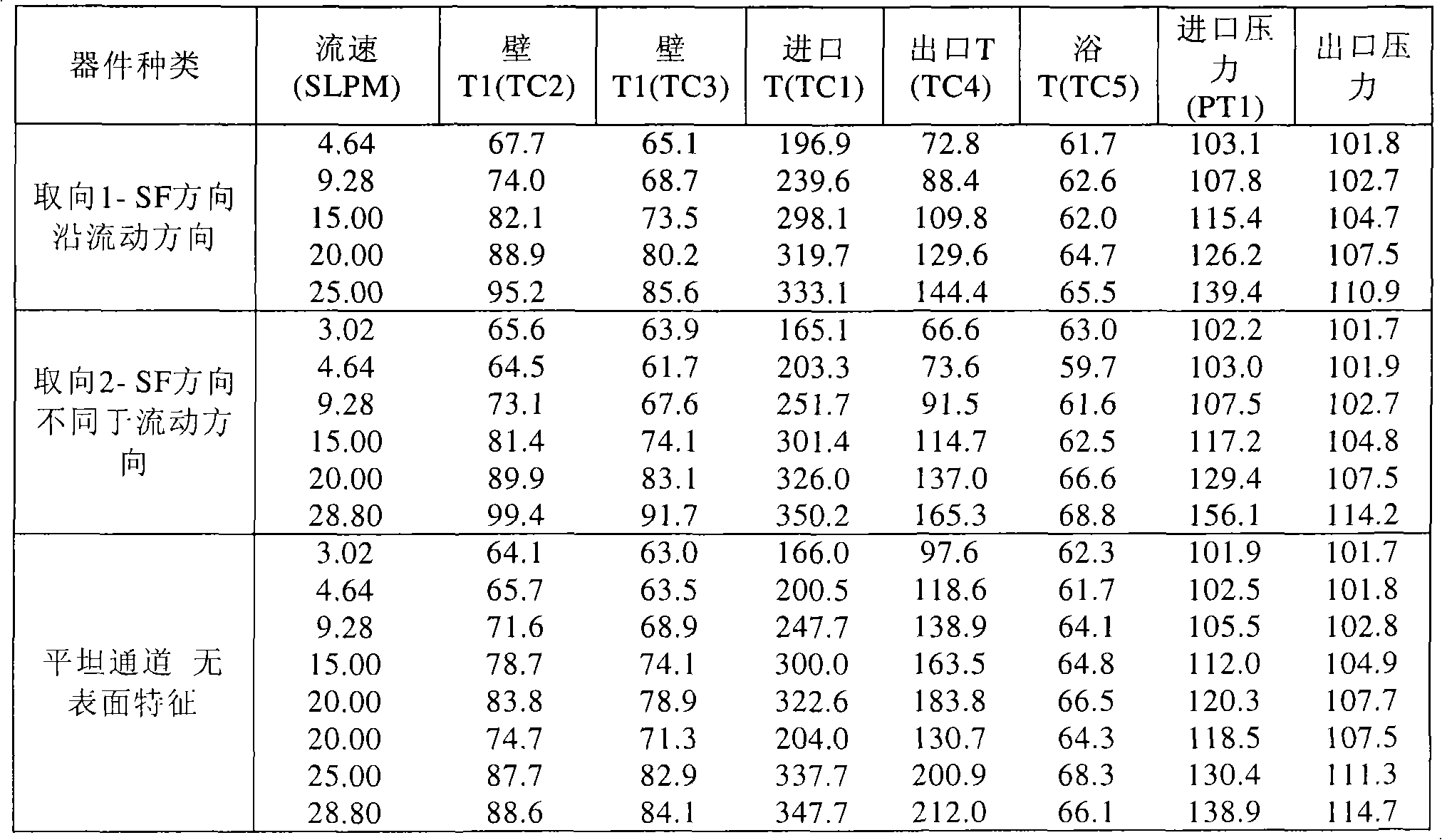
Use described test data (temperature and pressure) and channel geometry to determine the heat transfer coefficient that passage is interior.All calculating is all based on smooth channel surface zone.Smooth passage heat transfer surface area is about 6.43 centimetres
2, and the heat transfer surface area with passage of surface characteristics is 19.41 centimetres
2Because the increase of the heat transfer surface area that surface characteristics causes is 2.06 times of smooth passage heat transfer surface area.The heat transfer coefficient and the pressure drop of smooth passage have also been predicted based on the correlation in the document.
Following table provides by the passage with surface characteristics and does not have heat transfer coefficient that the experimental data of the passage of surface characteristics obtains and the estimated value of pressure drop.Give the predicted value of smooth passage.
Table: heat transfer coefficient and the pressure drop estimated value, the heat transfer coefficient of smooth passage and the predicted value of pressure drop that obtain by test data.
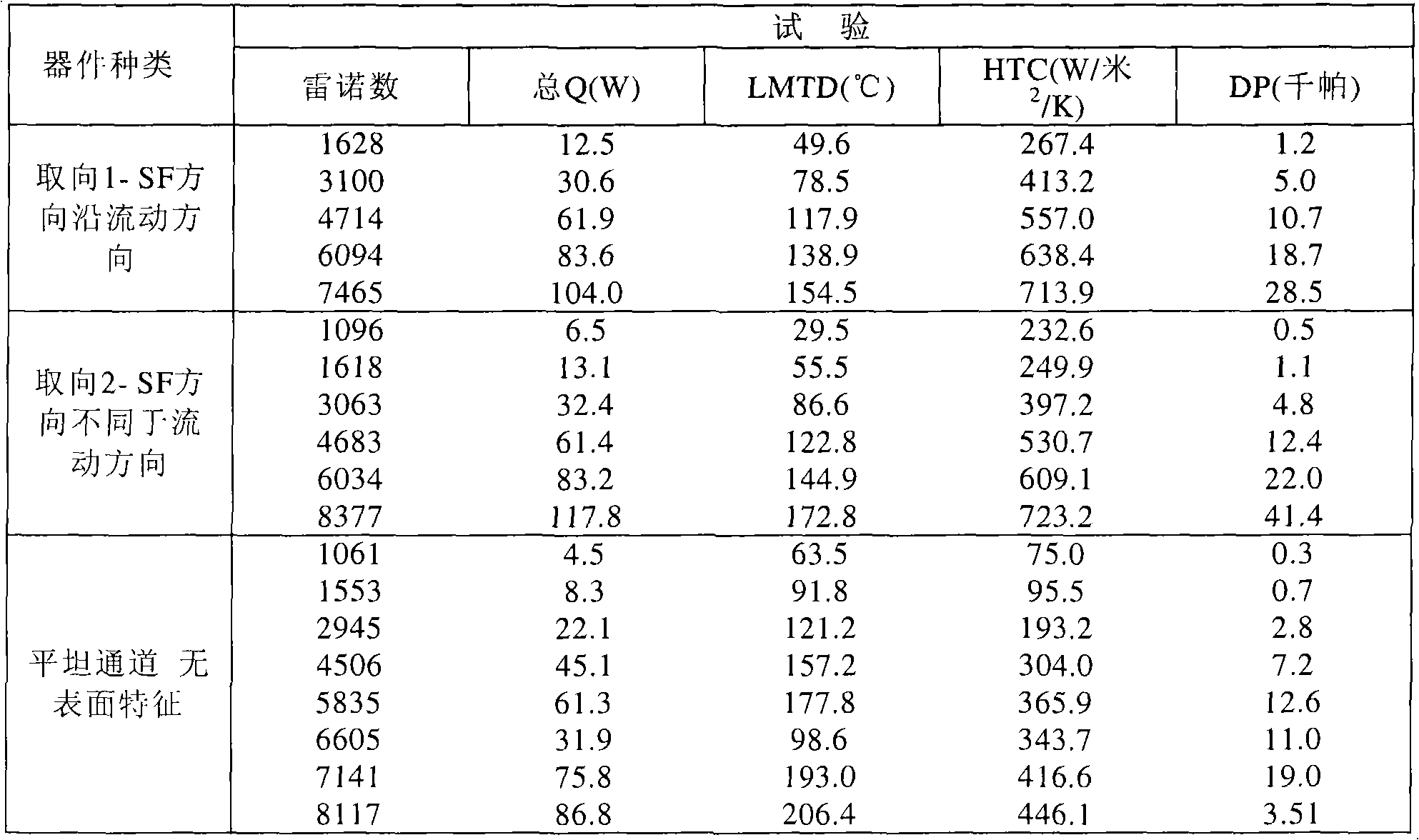
Total heat transfer of Q=estimation in the table, W
The logarithm of LMTD=mean temperature difference, ℃
The heat transfer coefficient of HTC=estimation, W/m
2/ K
DP=tests pressure drop, kPa
Following table shows that heat transfer coefficient improves and the pressure drop increase in the surface characteristics passage.
Table: compare the smooth walls passage, the heat transfer coefficient in the surface characteristics passage improves and pressure drop increases
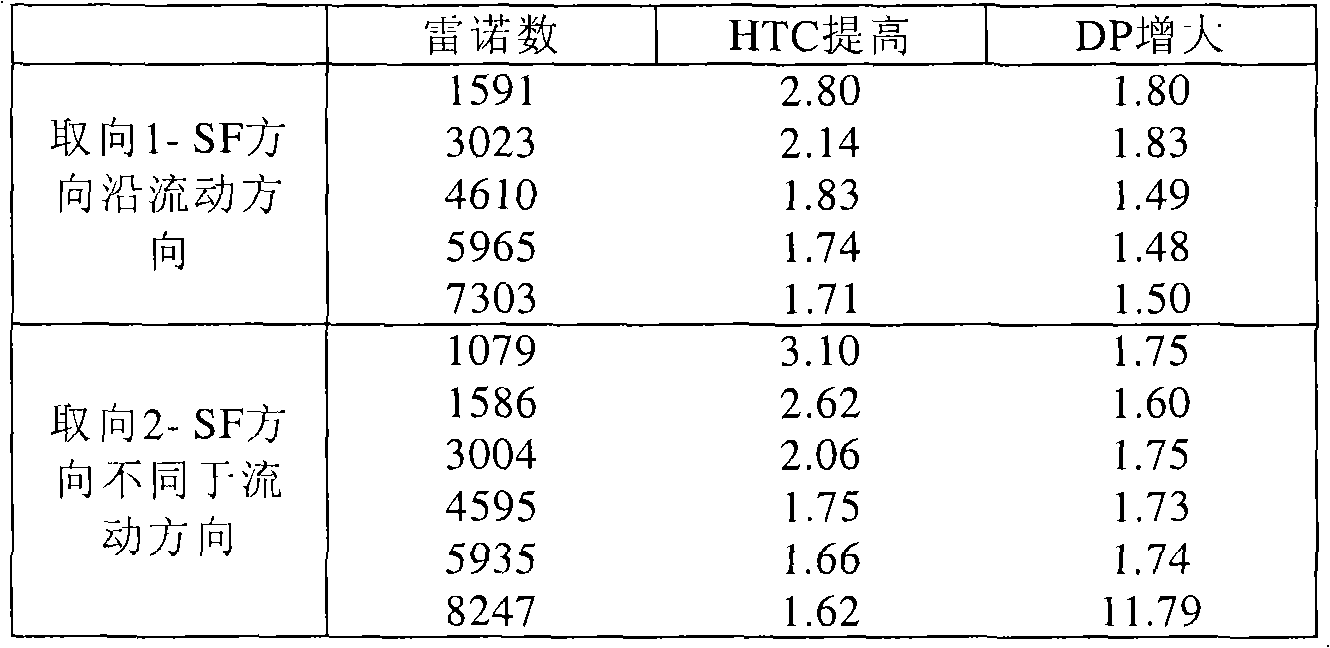
The heat transfer coefficient of HTC=estimation in the table, W/m
2/ K
DP=tests pressure drop, kPa
Figure 14 has shown that the ratio that improves with the pressure drop increase that conducts heat changes with Reynolds number.When this ratio greater than 1 the time, illustrating conducts heat improves and increases greater than pressure drop.
Embodiment: Reynolds number carries out the influence of major path gap mixed effect to using surface characteristics
(the high clearance channel of 0.047 ") detects to 0.119 centimetre of herringbone surface characteristics SFG-0-cis-A design with 60 ° of angles to use computational fluid dynamics coding Fluent Version 6.2.16.The size of passage is as follows: the gap is 0.119 centimetre, and width is 0.406 centimetre, and (0.160 "), length are 6.35 centimetres of (2.5 ").The degree of depth that described herringbone structure enters wall is 0.051 centimetre, and (0.020 "), width are 0.038 centimetre, and (0.015 "), normal is 0.038 centimetre of (0.015 ") to the spacing of the herringbone structure of normal (normal to normal).This pattern is cis-A, has identical pattern on two sides of path clearance.The center of described herringbone structure is in the centre of described channel width, described herringbone structure extend to from the center 0.203 centimetre on wall on the either side (0.080 "),, opposite at the channel width center line with flow direction between the wall, be 60 ° of angles.In other words, the point on the described herringbone structure line of symmetry aligns with flow direction.One has 33 continuous surface characteristics, and upstream before feature is initial forms length and is 0.406 centimetre (0.160 "), the downstream length that begins from the summit of last herringbone structure is 0.584 centimetre of (0.230 ").The plane of symmetry that this model uses this kind geometry to provide: by cis arrange to produce the path clearance center with the binary horizontal width plane of symmetry of this passage, the herringbone structure at center produce at the center of channel width with the binary down suction of the passage plane of symmetry.These line of symmetries can be for the usefulness of passage quartering symmetry model.
This section condition of listing Fluent Version 6.2.16 model.In this quartering symmetry model, use 127,000 nodes altogether.The outlet static pressure of passage is 125.42kPa (18.19psia).The design point flow velocity is the 4.975E-05 Kilograms Per Second, uses following inlet stream mass fraction: oxygen content 0.03240, carbon dioxide content 0.31482, methane content 0.00263, steam content 0.09184, surplus is a nitrogen, supposes that these materials well mix in import.For three kinds of situations that we observe, flow velocity is 100%, 50% and 10% of a design point flow velocity.Inlet stream and all wall temperatures all are fixed on 870
℃(1598 °F).This system uses the laminar viscous flow model, and density and thermal capacitance are used perfect gas law, to the average mixing rule of thermal conductivity factor and the weighting of viscosity service property (quality), the kinetic theory binary diffusion coefficient is combined with full multicomponent diffusion formula.For methyl hydride combustion, reactor utilizes the surface velocity reaction, but this speed is irrelevant with the analysis that mixes as fluid, because the total methane flow rate that is used to burn is very little, and should greatly not change the temperature or the composition of logistics in the flow trace line, the quality weighting dynamic viscosity of import and outlet is respectively 4.44E-05kg/m/s and 4.43E-05kg/m/s.
ZZ is shown in the results are shown in of model, has shown the inlet flow parameter of passage and the mixing resultant that full flow percentage is at 100% to 50% to 10% o'clock.When pressure is set in 141.2 kPas, be based on inlet velocity, path clearance based on the Peclet number in gap, rather than based on the hydraulic diameter of main channel (only the size of Shi Yonging is gap and height) and the methane diffusion coefficient under import composition and the temperature.Described Reynolds number calculates the import dynamic viscosity that is based on 4 times of model input quality flow velocitys, main channel hydraulic diameter and 4.44E-05kg/m/s.At least once the trajectory percentage by surface characteristics calculates and is based on CFD particle trajectory line analysis, and the line that wherein weightless particle is made from inlet face and the down suction plane of symmetry (6 trajectory) or the horizontal width plane of symmetry (23 trajectory) discharges.
| |
100% | 50% | 10% |
| Import overall rate [meter per second] | 94 | 50.4 | 10.34 |
| 870 ℃, 141.2 kPas [centimetre 2/ second] the methane diffusion coefficient | 2.22 | 2.22 | 2.22 |
| Peclet number [-] based on the gap | 505 | 271 | 56 |
| Import Reynolds number [-] | 1705 | 852 | 170 |
| At least once pass through the trajectory % of surface characteristics | |||
| From the down suction plane of symmetry (6 trajectories altogether) | 100.0% | 50.0% | 0.0% |
| From the horizontal width plane of symmetry (23 trajectories altogether) | 100.0% | 69.5% | 17.4% |
| The characteristic that begins to mix | 6 | 8 | 10 |
| The characteristic of Hun Heing (totally 33) fully | 25 | Not applicable | Not applicable |
Table ZZ. is in the model result that reduces the tabulation of CSF-0-cis-A60 ° surface characteristics under the condition of mass velocity.For the situation of 10% and 50% flow, on 33 features that are provided with continuously, do not observed fully and mixed.
Presentation of results among the table ZZ, the design point flow velocity with CSF-0-cis-A surface characteristics of 60 ° of herringbone structures can mix logistics effectively, forces all logistics trajectories that enters to pass through at least one surface characteristics.Use lower flow velocity and identical surface characteristics and channel geometry, observe trajectory much less by feature.In described 10% and 50% the full flow rate conditions, make logistics by these motive forces that angular surface characteristics of inclining arranged just less than the situation of high flow velocities.Described cis A orientation makes full flow velocity can utilize (forming in abutting connection with solid wall) speed that corner is lower, makes these corner portions located can feed the other zone that surface characteristics provides.Described 60 ° angle then allows to leave surface characteristics from the fluid that surface characteristics is left, enter in the main channel stream to flow, if this moment described fluid the momentum of ratio of momentum angle when being 45 ° consistent with flow direction more.When surface characteristics was left in logistics, it had the fluid momentum vector of streamwise, but also had the fluid momentum vector of vertical direction, and the latter can cause in overall flow and mix.If flow velocity further increases from full flow speed value, then need to increase the inclination angle and mix to produce, for example the inclination angle is increased to and be equal to or greater than 75 °.The flow rate effect of the passage of this presentation of results by having surface characteristics the mixing in the passage, best surface characteristics angle depends on the flow velocity of channel size and design.
Embodiment: under different Reynolds number, the comparison of time that particle is spent in surface characteristics and the time that in the main channel, is spent
Studied a kind of situation, compared under different Reynolds number time that particle is spent and the time that (outside the surface characteristics) spent in the main channel with estimation in surface characteristics.Use the computational fluid dynamics instrument to carry out this research, used research tool is Fluent V 6.1.22.
The detail drawing of channel size and surface characteristics sees Fig. 3 b (SFG-1), carries out description in the above-described embodiments.From the position of import, the initial 3.81 millimeters district of passage on wall arbitrarily all without any surface characteristics.This channel cross-section is a rectangle, and width of channel and gap are 4.57 millimeters and 1.02 millimeters.Ensuing 27.94 mm lengths comprise that being positioned at width is surface characteristics on 4.57 millimeters the wall, is called this zone " surface characteristics district ".The gap of main channel is identical with entrance region in this district, is 1.02 millimeters.Last 5.08 millimeters length is outlet area, on wall arbitrarily all without any surface characteristics.
The net that is used for the CFD model is to use Gambit V2.2.30 to make up.The building mode of this model makes the gap (1.02 millimeters sizes) of passage along directions X, and the length of passage (36.83 mm size) is along the Y direction, and width of channel (4.06 mm size) is along the Z direction.The X-coordinate of model changes to (2.95 millimeters, 0,0) from (1.53 millimeters, 0,0).The Y-coordinate of model changes to (0,36.83 millimeter, 0) from (0,0,0).The Z-coordinate of model changes to (0,0,0) from (0,0 ,-4.57 millimeters).Fig. 4 has shown X, Y and Z direction and coordinate thereof.
The net that Fluid Computation is analyzed produces in Gambit.Total grid number is 131106, and total face number is 542409, and total node number is 177006.Produce the net that net will keep rule as far as possible.Think that fluid has following character and operating condition:
I. viscosity=1.28 * 10
-5Kg/m/s
J. thermal conductivity factor=0.087W/m/K
K. specific heat=2768.03J/kg/K
L. density=use perfect gas law
M. molecular weight=17.49g/mol
N. coefficient of molecular diffusion=1 * 10
-5m
2/ s
As shown in Figure 4 inlet face is divided into four equal quadrants.Each zone gives different titles, but the heat-physical property in each district is identical.So the A area definition is concentration A=1, B, C, the district of D=0, the B area definition is concentration B=1, A, district of C and D=0 or the like.Coefficient of molecular diffusion between four districts is 1 * 10
-5m
2/ S.The Reynolds number computational methods are
ρ=fluid density, kg/m
3
The fluid average speed of v=import, m/s
The hydraulic diameter of D=passage, m
The viscosity of μ=fluid, kg/m/s
Three kinds of situations have been considered, import Reynolds number=10,100,1000.The boundary condition of various situations is as follows:
O operating pressure=2379kPa
O outlet pressure=0psig
The o inlet velocity: being 0.467m/s when Re=1000, is 0.0467m/s when Re=10 (should be 100), is 0.00467m/s when Re=10
O inlet temperature=300K
O wall temperature=350K
OA district mass fraction
oA=1
oB=0
oC=0
oD=0
OB district mass fraction
oA=0
oB=1
oC=0
oD=0
OC district mass fraction
oA=0
oB=0
oC=1
oD=0
OD district mass fraction
oA=0
oB=0
oC=0
oD=1
Model Selection
K-Ω model (SST class) is selected to be used for CFD and is analyzed.The numerical value of model constants is the default value that fluent 6.0 provides.The coefficient of turbulence model is: α
*_ inf=1; α _ inf=0.52; β
*_ inf=0.09; R_ β=8; A1=0.31; β _ i (interior)=0.075; β _ i (outward)=0.0828; TKE (interior) P Prandtl#=1.176; TKE (outward) PPrandtl#=1.0; SDR (interior) P Prandtl#=2; SDR (outward) P Prandtl#=1.168; Energy Prandtly number=0.85; Wall Prandtly number=0.85; Turbulent flow Schmidt number=0.7.
Select full multicomponent diffusate TRANSFER MODEL.Diffusion coefficient is 1E-5m
2/ s.Calculate A, B, the character of the mixture of C and D according to mass-weighted average.This model is carried out computing, converge to less than 1% of import quality and energy until quality and energy.
The result
Shown in Figure 15 (should be 14), select three points.All these points all are positioned on the face of passage that fluid enters the place.For each point, discharge the particle that does not have quality, follow the trail of this particle and in passage, how to move.Time that the numerical computations particle is spent in surface characteristics and the time that in the main channel, outside the surface characteristics, is spent.Under any Reynolds number, particle 1 and particle 2 never enter the surface characteristics passage.
Following table has compared Reynolds number and has increased to 1000 o'clock described time from 10.
Table 1: particle within the surface characteristics and outside the comparison of institute's spended time

We can clearly be seen that from last table, and the particle in the passage corner enters surface characteristics.In addition, when Reynolds number is about 1000, is 10 with Reynolds number or compared that the chance that particle enters in the surface characteristics significantly reduces at 100 o'clock.
Embodiment: for the active surface characteristic pattern that has an above angle along each feature of channel width, Reynolds number is to the influence as the total residence time mark of time of staying of spending in surface characteristics
Consideration has 0.254 meter (passage that 10 ") are long of SFG-0-cis/Fanelli type surface characteristics in Reynolds number is the scope of 6-600.Simple herringbone features is mutually mirror image on relative microchannel face, be cis-A configuration with respect to flow direction.Described herringbone structure does not connect at summit place, and distance at interval is less than 0.4 millimeter (or microchannel overall width 1/10).Two of the surface characteristics of different angles are propped up the Fanelli distance between the section or are not connected distance preferred less than 20% of channel width, are more preferably less than 10% of microchannel width.
The width of described main channel is 0.4064 centimetre, and (0.16 "), gap, main channel are 0.04572 centimetre of (0.018 ").The degree of depth of described surface characteristics is 0.254 millimeter, and (0.01 "), width are 0.381 millimeter (0.015 ").Orientation angles is 45 °.On the whole length of this device, on each side of relative wall, have 234 surface characteristics altogether.With different average speed nitrogen is sent into described device.Temperature constant is at 25 ℃.The pressure in device exit is set at 1 atmospheric pressure.Reynolds number calculates according to the average speed of import department and the hydraulic diameter of main channel.Find the solution the flow field with Fluent CFD simulation tool.
In order to use wall to carry out chemical reaction, coating catalyst on the wall of flow channel with feature.Considered single surface characteristics, surface area is very high with the ratio of fluid volume.Because this point, the reactant in the surface characteristics is easier to be catalytically conveted to required product.The mark that the time that spends in surface characteristics accounts for total residence time can be used as the index of surface characteristics efficient.
Can be by carrying out integration along the particle trajectory of introducing from Reactor inlet, the time of staying that Fluid Computation spends in surface characteristics, this result represents with the form of the mark that accounts for total residence time.In fact, discharge the particle of limited quantity, determined their track.For the geometry of present embodiment, two planes of symmetry are divided into four equal quarterings with import.Only need the track of consideration from the particle of a quartering release of import.This fourth class is divided into a large amount of grids.In each grid, discharge a particle from its center.The grid number of considering is many more, and the collection (ensemble) of the particle that its track is followed the trail of is big more, and available time of staying result is detailed more by statistical average.For near the particle that wall, discharges, they to load the diffusion length much shorter of wall of catalyst.Their great majority can transform on the catalysis wall.For near the particle that discharges the plane of symmetry, they are not representational, and this is because they may not flow in the surface characteristics, especially when surface characteristics is symmetrical fully.For the time of staying that Fluid Computation spends in surface characteristics, more representative from the particle that gray area discharges.In order to simplify, only to discharge the particle of a no quality, and follow the trail of its track from the center of Dk Trellis.
In arbitrfary point, exist after import discharges, to reach the relevant flowing time of real time that this point is spent with particle along described track.From coordinate, can determine whether this particle is positioned at the dented space of a surface characteristics of wall along the arbitrfary point of track.By only the line segment that is in the track in the surface characteristics being carried out integration, can calculate the accumulated time that particle spends in surface characteristics.By the whole track from import to outlet is carried out integration, can calculate the whole time of staying.Calculate the ratio of time that particle spends and total residence time for the situation of all considerations in surface characteristics, the results are shown in following table.
| Reynolds number | The time % that in surface characteristics, spends | The time % that in the main channel, spends |
| 6 | 11% | 89% |
| 24 | 16% | 84% |
| 60 | 30% | 70% |
| 600 | 37% | 63% |
The result shows time of staying that fluid spends mark as total residence time in surface characteristics, when Reynolds number increased, although total residence time reduces, this mark can increase.In the reynolds number range that this explanation is considered in this work at least, when flow velocity or Reynolds number increase, can realize more effectively contacting with active surface.
For comprising more than one angle on the width of any microchannel wall, and repeat the basic similarly active surface characteristic pattern of surface characteristics more than 15, these results are typical, when particularly using the cis orientation on relative wall.For the pattern that a kind of angle is only arranged along the microchannel width, the mark of the time of staying that spends in feature may not necessarily increase and improve along with Reynolds number.
Claims (27)
Applications Claiming Priority (5)
| Application Number | Priority Date | Filing Date | Title |
|---|---|---|---|
| US11/089,440 US8124177B2 (en) | 2004-03-23 | 2005-03-23 | Tailored and uniform coatings in microchannel apparatus |
| US11/089,440 | 2005-03-23 | ||
| US60/697,900 | 2005-07-08 | ||
| US60/727,126 | 2005-10-13 | ||
| US60/731,596 | 2005-10-27 |
Related Child Applications (1)
| Application Number | Title | Priority Date | Filing Date |
|---|---|---|---|
| CN201410454998.2A Division CN104525072A (en) | 2005-03-23 | 2006-03-23 | Surface features in microprocess technology |
Publications (1)
| Publication Number | Publication Date |
|---|---|
| CN101309747A true CN101309747A (en) | 2008-11-19 |
Family
ID=40125758
Family Applications (1)
| Application Number | Title | Priority Date | Filing Date |
|---|---|---|---|
| CNA2006800175809A Pending CN101309747A (en) | 2005-03-23 | 2006-03-23 | Surface features in micro-fabrication technology |
Country Status (2)
| Country | Link |
|---|---|
| CN (1) | CN101309747A (en) |
| ZA (1) | ZA200708237B (en) |
Cited By (9)
| Publication number | Priority date | Publication date | Assignee | Title |
|---|---|---|---|---|
| CN102500266A (en) * | 2011-11-04 | 2012-06-20 | 华中科技大学 | Quick micro-mixing device for high-viscosity solution |
| CN105126683A (en) * | 2015-08-05 | 2015-12-09 | 沈阳理工大学 | Micro mixer with cylindrical phyllotaxy assignment structure |
| CN105597641A (en) * | 2016-01-14 | 2016-05-25 | 重庆大学 | Preparation method of catalyst layer in microchannel reactor |
| CN108778476A (en) * | 2015-12-23 | 2018-11-09 | 联邦科学技术研究组织 | Static mixers for continuous flow catalytic reactors |
| CN109346445A (en) * | 2018-08-29 | 2019-02-15 | 杭州电子科技大学 | A microchannel heat sink that generates helical flow |
| CN109657326A (en) * | 2018-12-13 | 2019-04-19 | 西安航天动力研究所 | A kind of straight-through electromagnetic valve integrated design method |
| CN109758786A (en) * | 2018-12-29 | 2019-05-17 | 四川大学 | A microchannel device for forming stable annular flow |
| CN110075944A (en) * | 2019-04-10 | 2019-08-02 | 华北电力大学 | A kind of fin electric heater unit of analog focus solar energy high heat flux density |
| US12343693B2 (en) | 2015-12-23 | 2025-07-01 | Commonwealth Scientific And Industrial Research Organisation | Static mixers for continuous flow catalytic reactors |
-
2006
- 2006-03-23 CN CNA2006800175809A patent/CN101309747A/en active Pending
-
2007
- 2007-09-19 ZA ZA200708237A patent/ZA200708237B/en unknown
Cited By (11)
| Publication number | Priority date | Publication date | Assignee | Title |
|---|---|---|---|---|
| CN102500266A (en) * | 2011-11-04 | 2012-06-20 | 华中科技大学 | Quick micro-mixing device for high-viscosity solution |
| CN102500266B (en) * | 2011-11-04 | 2013-12-18 | 华中科技大学 | Quick micro-mixing device for high-viscosity solution |
| CN105126683A (en) * | 2015-08-05 | 2015-12-09 | 沈阳理工大学 | Micro mixer with cylindrical phyllotaxy assignment structure |
| CN108778476A (en) * | 2015-12-23 | 2018-11-09 | 联邦科学技术研究组织 | Static mixers for continuous flow catalytic reactors |
| US11541412B2 (en) | 2015-12-23 | 2023-01-03 | Commonwealth Scientific And Industrial Research Organisation | Static mixers for continuous flow catalytic reactors |
| US12343693B2 (en) | 2015-12-23 | 2025-07-01 | Commonwealth Scientific And Industrial Research Organisation | Static mixers for continuous flow catalytic reactors |
| CN105597641A (en) * | 2016-01-14 | 2016-05-25 | 重庆大学 | Preparation method of catalyst layer in microchannel reactor |
| CN109346445A (en) * | 2018-08-29 | 2019-02-15 | 杭州电子科技大学 | A microchannel heat sink that generates helical flow |
| CN109657326A (en) * | 2018-12-13 | 2019-04-19 | 西安航天动力研究所 | A kind of straight-through electromagnetic valve integrated design method |
| CN109758786A (en) * | 2018-12-29 | 2019-05-17 | 四川大学 | A microchannel device for forming stable annular flow |
| CN110075944A (en) * | 2019-04-10 | 2019-08-02 | 华北电力大学 | A kind of fin electric heater unit of analog focus solar energy high heat flux density |
Also Published As
| Publication number | Publication date |
|---|---|
| ZA200708237B (en) | 2008-05-28 |
Similar Documents
| Publication | Publication Date | Title |
|---|---|---|
| JP5702909B2 (en) | Surface functional structure in microprocess technology | |
| An et al. | Computational fluid dynamics (CFD) analysis of micro-reactor performance: Effect of various configurations | |
| Ferroni et al. | A fundamental investigation of gas/solid heat and mass transfer in structured catalysts based on periodic open cellular structures (POCS) | |
| Zhao et al. | Liquid–liquid two‐phase mass transfer in the T‐junction microchannels | |
| Schmidt et al. | Mass transfer limitations in microchannel reactors | |
| Roy et al. | Monoliths as multiphase reactors: a review | |
| Yue et al. | Hydrodynamics and mass transfer characteristics in gas–liquid flow through a rectangular microchannel | |
| Zhang et al. | Hydrodynamics and mass transfer of gas–liquid flow in a falling film microreactor | |
| Yao et al. | Bubble/droplet formation and mass transfer during gas–liquid–liquid segmented flow with soluble gas in a microchannel | |
| Fang et al. | A novel microreactor with 3D rotating flow to boost fluid reaction and mixing of viscous fluids | |
| Kolaczkowski et al. | Application of a CFD code (FLUENT) to formulate models of catalytic gas phase reactions in porous catalyst pellets | |
| Wang et al. | Strategy for scaling‐up of a microsieve dispersion reactor | |
| Niu et al. | Flow pattern, pressure drop, and mass transfer in a gas− liquid concurrent two-phase flow microchannel reactor | |
| Pan et al. | Modeling of velocity distribution among microchannels with triangle manifolds | |
| ZA200708237B (en) | Surface features in microprocess technology | |
| Malecha et al. | Serpentine microfluidic mixer made in LTCC | |
| Li et al. | Simulation and optimization of chaotic micromixer using lattice Boltzmann method | |
| Cao et al. | Hybrid modeling of integrated microchannel methane reformer for miniaturized GTL application using an effectiveness factor submodel based on complex surface chemistry | |
| Adeosun et al. | Mass transfer enhancement in microchannel reactors by reorientation of fluid interfaces and stretching | |
| Mbodji et al. | Preliminary design and simulation of a microstructured reactor for production of synthesis gas by steam methane reforming | |
| Abdallah et al. | CFD and kinetic methods for mass transfer determination in a mesh microreactor | |
| Klenov et al. | Impact of heat and mass transfer in porous catalytic monolith: CFD modeling of exothermic reaction | |
| Karakaya et al. | Microchannel reactor modeling for combustion driven reforming of iso-octane | |
| CN104525072A (en) | Surface features in microprocess technology | |
| Goel et al. | Numerical simulations of bubble formation and rise in microchannels |
Legal Events
| Date | Code | Title | Description |
|---|---|---|---|
| C06 | Publication | ||
| PB01 | Publication | ||
| C10 | Entry into substantive examination | ||
| SE01 | Entry into force of request for substantive examination | ||
| C12 | Rejection of a patent application after its publication | ||
| RJ01 | Rejection of invention patent application after publication |
Application publication date: 20081119 |