CN101296992B - Polyester compositions containing cyclobutanediol and certain heat stabilizers and/or their reaction products - Google Patents
Polyester compositions containing cyclobutanediol and certain heat stabilizers and/or their reaction products Download PDFInfo
- Publication number
- CN101296992B CN101296992B CN2006800401246A CN200680040124A CN101296992B CN 101296992 B CN101296992 B CN 101296992B CN 2006800401246 A CN2006800401246 A CN 2006800401246A CN 200680040124 A CN200680040124 A CN 200680040124A CN 101296992 B CN101296992 B CN 101296992B
- Authority
- CN
- China
- Prior art keywords
- polyester
- mole
- dicarboxylic acid
- polyester composition
- mol
- Prior art date
- Legal status (The legal status is an assumption and is not a legal conclusion. Google has not performed a legal analysis and makes no representation as to the accuracy of the status listed.)
- Active
Links
Images


Classifications
-
- A—HUMAN NECESSITIES
- A47—FURNITURE; DOMESTIC ARTICLES OR APPLIANCES; COFFEE MILLS; SPICE MILLS; SUCTION CLEANERS IN GENERAL
- A47G—HOUSEHOLD OR TABLE EQUIPMENT
- A47G19/00—Table service
-
- B—PERFORMING OPERATIONS; TRANSPORTING
- B29—WORKING OF PLASTICS; WORKING OF SUBSTANCES IN A PLASTIC STATE IN GENERAL
- B29C—SHAPING OR JOINING OF PLASTICS; SHAPING OF MATERIAL IN A PLASTIC STATE, NOT OTHERWISE PROVIDED FOR; AFTER-TREATMENT OF THE SHAPED PRODUCTS, e.g. REPAIRING
- B29C49/00—Blow-moulding, i.e. blowing a preform or parison to a desired shape within a mould; Apparatus therefor
- B29C49/0005—Blow-moulding, i.e. blowing a preform or parison to a desired shape within a mould; Apparatus therefor characterised by the material
-
- C—CHEMISTRY; METALLURGY
- C08—ORGANIC MACROMOLECULAR COMPOUNDS; THEIR PREPARATION OR CHEMICAL WORKING-UP; COMPOSITIONS BASED THEREON
- C08G—MACROMOLECULAR COMPOUNDS OBTAINED OTHERWISE THAN BY REACTIONS ONLY INVOLVING UNSATURATED CARBON-TO-CARBON BONDS
- C08G63/00—Macromolecular compounds obtained by reactions forming a carboxylic ester link in the main chain of the macromolecule
- C08G63/02—Polyesters derived from hydroxycarboxylic acids or from polycarboxylic acids and polyhydroxy compounds
- C08G63/12—Polyesters derived from hydroxycarboxylic acids or from polycarboxylic acids and polyhydroxy compounds derived from polycarboxylic acids and polyhydroxy compounds
- C08G63/16—Dicarboxylic acids and dihydroxy compounds
- C08G63/18—Dicarboxylic acids and dihydroxy compounds the acids or hydroxy compounds containing carbocyclic rings
- C08G63/199—Acids or hydroxy compounds containing cycloaliphatic rings
-
- C—CHEMISTRY; METALLURGY
- C08—ORGANIC MACROMOLECULAR COMPOUNDS; THEIR PREPARATION OR CHEMICAL WORKING-UP; COMPOSITIONS BASED THEREON
- C08L—COMPOSITIONS OF MACROMOLECULAR COMPOUNDS
- C08L67/00—Compositions of polyesters obtained by reactions forming a carboxylic ester link in the main chain; Compositions of derivatives of such polymers
- C08L67/02—Polyesters derived from dicarboxylic acids and dihydroxy compounds
-
- C—CHEMISTRY; METALLURGY
- C08—ORGANIC MACROMOLECULAR COMPOUNDS; THEIR PREPARATION OR CHEMICAL WORKING-UP; COMPOSITIONS BASED THEREON
- C08L—COMPOSITIONS OF MACROMOLECULAR COMPOUNDS
- C08L69/00—Compositions of polycarbonates; Compositions of derivatives of polycarbonates
-
- C—CHEMISTRY; METALLURGY
- C08—ORGANIC MACROMOLECULAR COMPOUNDS; THEIR PREPARATION OR CHEMICAL WORKING-UP; COMPOSITIONS BASED THEREON
- C08K—Use of inorganic or non-macromolecular organic substances as compounding ingredients
- C08K3/00—Use of inorganic substances as compounding ingredients
- C08K3/32—Phosphorus-containing compounds
-
- C—CHEMISTRY; METALLURGY
- C08—ORGANIC MACROMOLECULAR COMPOUNDS; THEIR PREPARATION OR CHEMICAL WORKING-UP; COMPOSITIONS BASED THEREON
- C08K—Use of inorganic or non-macromolecular organic substances as compounding ingredients
- C08K5/00—Use of organic ingredients
- C08K5/49—Phosphorus-containing compounds
-
- C—CHEMISTRY; METALLURGY
- C08—ORGANIC MACROMOLECULAR COMPOUNDS; THEIR PREPARATION OR CHEMICAL WORKING-UP; COMPOSITIONS BASED THEREON
- C08L—COMPOSITIONS OF MACROMOLECULAR COMPOUNDS
- C08L101/00—Compositions of unspecified macromolecular compounds
Landscapes
- Chemical & Material Sciences (AREA)
- Health & Medical Sciences (AREA)
- Chemical Kinetics & Catalysis (AREA)
- Medicinal Chemistry (AREA)
- Polymers & Plastics (AREA)
- Organic Chemistry (AREA)
- Engineering & Computer Science (AREA)
- Manufacturing & Machinery (AREA)
- Mechanical Engineering (AREA)
- Polyesters Or Polycarbonates (AREA)
- Compositions Of Macromolecular Compounds (AREA)
- Table Devices Or Equipment (AREA)
Abstract
One aspect of the present invention describes a polyester composition comprising: at least one polyester comprising: (a) a dicarboxylic acid component comprising: (i)70-100 mole% of terephthalic acid residues; (ii)0 to 30 mol% of aromatic dicarboxylic acid residues having up to 20 carbon atoms; and (iii)0 to 10 mole% of aliphatic dicarboxylic acid residues having up to 16 carbon atoms; and (b) a diol component comprising: (i)1 to 99 mole% of 2, 2, 4, 4-tetramethyl-1, 3-cyclobutanediol residues; and (ii)1 to 99 mole% cyclohexanedimethanol residues; and (II) at least one thermal stabilizer selected from at least one of alkyl phosphate esters, aryl phosphate esters, mixed alkyl aryl phosphate esters, reaction products thereof, and mixtures thereof; wherein the total mol% of the dicarboxylic acid component is 100 mol%, and wherein the total mol% of the diol component is 100 mol%.
Description
The cross reference of related application
The application has required following right of priority according to 35U.S.C. § 119 (e): the U.S. Provisional Application sequence number (SN) No.60/731 that on October 28th, 2005 submitted to, 454; The U.S. Provisional Application sequence number (SN) No.60/731 that on October 28th, 2005 submitted to, 389; The U.S. Provisional Application sequence number (SN) No.60/739 that on November 22nd, 2005 submitted to, 058; The U.S. Provisional Application sequence number (SN) No.60/738 that on November 22nd, 2005 submitted to, 869; The U.S. Provisional Application sequence number (SN) No.60/750 that on December 15th, 2005 submitted to, 692, the U.S. Provisional Application sequence number (SN) No.60/750 that on December 15th, 2005 submitted to, the U.S. Provisional Application sequence number (SN) No.60/750 that on December 15th, 693,2005 submitted to, 682, with the U.S. Provisional Application sequence number (SN) No.60/750 that submitted on December 15th, 2005, the U. S. application sequence number (SN) No.11/390 that on March 28th, 547,2006 submitted to, 672; The U. S. application sequence number (SN) No.11/390 that on March 28th, 2006 submitted to, 752; The U. S. application sequence number (SN) No.11/390 that on March 28th, 2006 submitted to, 794; The U. S. application sequence number (SN) No.11/391 that on March 28th, 2006 submitted to, 565; The U. S. application sequence number (SN) No.11/390 that on March 28th, 2006 submitted to, 671; The U. S. application sequence number (SN) No.11/390 that on March 28th, 2006 submitted to, 853; The U. S. application sequence number (SN) No.11/390 that on March 28th, 2006 submitted to, 631; With the U. S. application sequence number (SN) No.11/390 that submitted on March 28th, 2006,655; The U. S. application sequence number (SN) No.11/391 that on March 28th, 2006 submitted to, 125; The U. S. application sequence number (SN) No.11/390 that on March 28th, 2006 submitted to, 751; The U. S. application sequence number (SN) No.11/390 that on March 28th, 2006 submitted to, 955; The U. S. application sequence number (SN) No.11/390 that on March 28th, 2006 submitted to, 827; The U. S. application sequence number (SN) No.60/786 that on March 28th, 2006 submitted to, 572; The U. S. application sequence number (SN) No.60/786 that on March 28th, 2006 submitted to, 596; The U. S. application sequence number (SN) No.60/786 that on March 28th, 2006 submitted to, 547; The U. S. application sequence number (SN) No.60/786 that on March 28th, 2006 submitted to, 571; The U. S. application sequence number (SN) No.60/786 that on March 28th, 2006 submitted to, 598; The U. S. application sequence number (SN) No.11/390 that on March 28th, 2006 submitted to, 883; The U. S. application sequence number (SN) No.11/390 that on March 28th, 2006 submitted to, 846; The U. S. application sequence number (SN) No.11/390 that on March 28th, 2006 submitted to, 809; The U. S. application sequence number (SN) No.11/390 that on March 28th, 2006 submitted to, 812; The U. S. application sequence number (SN) No.11/391 that on March 28th, 2006 submitted to, 124; The U. S. application sequence number (SN) No.11/390 that on March 28th, 2006 submitted to, 908; The U. S. application sequence number (SN) No.11/390 that on March 28th, 2006 submitted to, 793; The U. S. application sequence number (SN) No.11/391 that on March 28th, 2006 submitted to, 642; The U. S. application sequence number (SN) No.11/390 that on March 28th, 2006 submitted to, 826; The U. S. application sequence number (SN) No.11/390 that on March 28th, 2006 submitted to, 563; The U. S. application sequence number (SN) No.11/390 that on March 28th, 2006 submitted to, 847; The U. S. application sequence number (SN) No.11/391 that on March 28th, 2006 submitted to, 156; The U. S. application sequence number (SN) No.11/390 that on March 28th, 2006 submitted to, 630; The U. S. application sequence number (SN) No.11/391 that on March 28th, 2006 submitted to, 495; The U. S. application sequence number (SN) No.11/391 that on March 28th, 2006 submitted to, 576; The U. S. application sequence number (SN) No.11/390 that on March 28th, 2006 submitted to, 858; The U. S. application sequence number (SN) No.11/390 that on March 28th, 2006 submitted to, 629; The U. S. application sequence number (SN) No.11/391 that on March 28th, 2006 submitted to, 485; The U. S. application sequence number (SN) No.11/390 that on March 28th, 2006 submitted to, 811; The U. S. application sequence number (SN) No.11/390 that on March 28th, 2006 submitted to, 750; The U. S. application sequence number (SN) No.11/390 that on March 28th, 2006 submitted to, 773; The U. S. application sequence number (SN) No.11/390 that on March 28th, 2006 submitted to, 865; The U. S. application sequence number (SN) No.11/390 that on March 28th, 2006 submitted to, 654; The U. S. application sequence number (SN) No.11/390 that on March 28th, 2006 submitted to, 882; The U. S. application sequence number (SN) No.11/390 that on March 28th, 2006 submitted to, 836; The U. S. application sequence number (SN) No.11/391 that on March 28th, 2006 submitted to, 063; The U. S. application sequence number (SN) No.11/390 that on March 28th, 2006 submitted to, 814; The U. S. application sequence number (SN) No.11/390 that on March 28th, 2006 submitted to, 722; The U. S. application sequence number (SN) No.11/391 that on March 28th, 2006 submitted to, 659; The U. S. application sequence number (SN) No.11/391 that on March 28th, 2006 submitted to, 137; The U. S. application sequence number (SN) No.11/391 that on March 28th, 2006 submitted to, 505; The U. S. application sequence number (SN) No.11/390 that on March 28th, 2006 submitted to, 864; The U. S. application sequence number (SN) No.11/391 that submitted on March 28th, 2006,571, and be incorporated herein their full content for reference.
Invention field
Generality of the present invention relates to the polymer blend by following component preparation: terephthalic acid, or terephthalate, and their mixture; 2,2,4,4-tetramethyl--1,3-tetramethylene two pure and mild cyclohexanedimethanols; And some thermo-stabilizer, their reaction product and their mixture; These compositions have certain combination of following two or more performances: high impact, high glass-transition temperature (Tg), toughness, certain logarithmic viscosity number, low ductile-brittle transition temperature, good color and transparency, low density, chemical-resistant, stability to hydrolysis, and the long hypocrystalline time, this makes these polymer blends be easy to be shaped to goods.
Background of invention
Poly terephthalic acid 1,4-cyclohexylidene dimethylene ester (PCT) based on the polyester of terephthalic acid or its ester and cyclohexanedimethanol, is well known in the art only, and commercially available.This polyester can when cooling rapidly from melt crystallization, make be difficult to for example extrude by means commonly known in the art, injection moulding etc. forms amorphous goods.For the crystallization rate of the PCT that slows down, can prepare the copolyesters that contains extra dicarboxylic acid or glycol (for example m-phthalic acid or glycol residue).These also are well known in the art by the PCT of glycol residue or isophthalate modified, and commercially available.
A kind ofly be generally used for producing the copolyesters of film, sheet material and moulded parts from terephthalic acid, 1,4 cyclohexane dimethanol and glycol residue preparation.Though these copolyesters can be used in many end-uses, when comprising enough modification spent glycol residues providing long hypocrystalline during the time in batching, they are presented at for example defective of second-order transition temperature and shock strength aspect of performance.For example, by terephthalic acid, 1,4-cyclohexanedimethanol and glycol residue prepare and have the copolyesters of sufficiently long hypocrystalline time can provide amorphous products, compare with composition disclosed herein, it demonstrates and it is believed that undesirable higher ductile-brittle transition temperature and lower second-order transition temperature.
4, the polycarbonate of 4 '-isopropylidene biphenol (bisphenol-a polycarbonate) as the substitute of polyester known in the art, also has been known engineering moulded plastic.Bisphenol-a polycarbonate is transparent high performance plastics, and it has good physicals, for example dimensional stability, high heat resistance and good shock strength.Although bisphenol-a polycarbonate has many good physicalies, its higher melt viscosity causes melt processability poor, and the chemical-resistant of polycarbonate is poor.They also are difficult to thermoforming.
Contain 2,2,4,4-tetramethyl--1, the polymkeric substance of 3-tetramethylene glycol also has description in the art.But generally speaking, these polymkeric substance demonstrate high logarithmic viscosity number, high melt viscosity and/or high Tg (second-order transition temperature or Tg), make that the equipment that uses in industry is not enough to produce or these materials of polymerization post-treatment.
Therefore, there is a need in the art for and also have at least a at least a polymkeric substance that is selected from following two or more performance combinations when remaining on for the workability on the standard equipment of industry: the toughness of polyester, high glass-transition temperature, high impact, stability to hydrolysis, chemical-resistant, the long hypocrystalline time, low ductile-brittle transition temperature, good color and transparency, low density, and/or thermal formability.
In addition, in one embodiment, need a kind of method in the prior art, this method makes more to such an extent that produce polyester of the present invention easily but do not have at least a of following situation: bubble, splay mark forms, color forms, gas and unsettled melt liquid level are emitted in foaming, that is the fluctuation of polyester or polyester manufacture and system of processing.Also need the method for a kind of easier (for example, pilot scale and/or industrial-scale production) in large quantity production polyester of the present invention in the prior art, but do not have at least a generation in the above-mentioned difficulties.
Summary of the invention
It is believed that by terephthalic acid its ester and/or their mixture; Cyclohexanedimethanol; With 2,2,4,4-tetramethyl--1, some polymer blend that comprises some thermo-stabilizer, its reaction product and its mixture that 3-tetramethylene glycol forms is better than polyester as known in the art and polycarbonate at following one or more aspect of performances: high impact, stability to hydrolysis, toughness, chemical-resistant, good color and transparency, the long hypocrystalline time, low ductile-brittle transition temperature, low-gravity and thermal formability.It is believed that these compositions are similar to polycarbonate aspect thermotolerance, and process at standard industry equipment easilier.Simultaneously, these polyester have the thermostability easier manufacturing of permission of enhancing and the downstream materials processing of enhancing.
In one embodiment, it is believed that, use in preparing according to the method for polyester of the present invention when comprising at least a thermo-stabilizer of at least a phosphorus compound described here, this polyester can more easily be produced but not have at least a following situation to occur: bubble, splay mark forms, color forms, gas and unsettled melt liquid level are emitted in foaming, that is the fluctuation of polyester or production of polyester and system of processing.In another embodiment, it is believed that, at least a method of the present invention provides in enormous quantities (for example, pilot scale and/or industrial-scale production) more easily to produce to can be used for the means of the polyester among the present invention, but does not have at least a generation in the above-mentioned difficulties.
Here the term of Shi Yonging " in enormous quantities " comprises the amount that can be used for the polyester among the present invention of producing with greater than 100 pounds amount.In one embodiment, the term " in enormous quantities " that here uses comprises the amount that can be used for the polyester among the present invention of producing with greater than 1000 pounds amount.
In one aspect, prepare the method that can be used for the polyester among the present invention and can comprise discontinuous method or continuation method.
In one aspect, prepare the method that can be used for the polyester among the present invention and comprise continuation method.
In one aspect, the present invention relates to a kind of polymer blend, it comprises:
(I) at least a polyester, this polyester contains:
(a) dicarboxylic acid component, it contains:
(i) terephthalic acid residue of 70-100 mole %;
(ii) 0-30 mole %'s has an aromatic dicarboxylic acid residue of 20 carbon atoms at the most; With
(iii) 0-10 mole %'s has an aliphatic dicarboxylic acid residue of 16 carbon atoms at the most; With
(b) diol component, it contains:
(i) 2,2,4,4-tetramethyl--1,3-tetramethylene diol residue; With
(ii) cyclohexanedimethanol residue; With
(II) at least a thermo-stabilizer, it is selected from least a in alkyl phosphate, aryl phosphate ester, mixed alkyl aryl phosphate ester, their reaction product and their mixture.
In one aspect, the present invention relates to a kind of polymer blend, it comprises:
(I) at least a polyester, this polyester contains:
(a) dicarboxylic acid component, it contains:
(i) terephthalic acid residue of 70-100 mole %;
(ii) 0-30 mole %'s has an aromatic dicarboxylic acid residue of 20 carbon atoms at the most; With
(iii) 0-10 mole %'s has an aliphatic dicarboxylic acid residue of 16 carbon atoms at the most; With
(b) diol component, it contains:
(i) 2,2,4 of 1-99 mole %, 4-tetramethyl--1,3-tetramethylene diol residue; With
The (ii) cyclohexanedimethanol residue of 1-99 mole %; With
(II) at least a thermo-stabilizer, it is selected from least a in alkyl phosphate, aryl phosphate ester, mixed alkyl aryl phosphate ester, their reaction product and their mixture;
Wherein dicarboxylic acid component's total mole of % is 100 moles of %, and total mole of % of diol component is 100 moles of %; Wherein the logarithmic viscosity number of this polyester is 0.10-1.2dL/g, in the phenol/tetrachloroethane of 60/40 (w/w) under the concentration of 0.25g/50ml in 25 ℃ of mensuration; Wherein this polyester has 85-200 ℃ Tg.
In one aspect, the present invention relates to a kind of polymer blend, it comprises:
(I) at least a polyester, this polyester contains:
(a) dicarboxylic acid component, it contains:
(i) terephthalic acid residue of 70-100 mole %;
(ii) 0-30 mole %'s has an aromatic dicarboxylic acid residue of 20 carbon atoms at the most; With
(iii) 0-10 mole %'s has an aliphatic dicarboxylic acid residue of 16 carbon atoms at the most; With
(b) diol component, it contains:
(i) 2,2,4 of 1-99 mole %, 4-tetramethyl--1,3-tetramethylene diol residue; With
The (ii) cyclohexanedimethanol residue of 1-99 mole %; With
(II) at least a thermo-stabilizer, it is selected from least a in alkyl phosphate, aryl phosphate ester, mixed alkyl aryl phosphate ester, their reaction product and their mixture;
Wherein dicarboxylic acid component's total mole of % is 100 moles of %, and total mole of % of diol component is 100 moles of %; With
The logarithmic viscosity number of wherein said polyester is 0.35-1.2dL/g, in the phenol/tetrachloroethane of 60/40 (w/w) under the concentration of 0.25g/50ml in 25 ℃ of mensuration; With the Tg of wherein said polyester be 85-200 ℃.
In one aspect, the present invention relates to a kind of polymer blend, it comprises:
(I) at least a polyester, this polyester contains:
(a) dicarboxylic acid component, it contains:
(i) terephthalic acid residue of 70-100 mole %;
(ii) 0-30 mole %'s has an aromatic dicarboxylic acid residue of 20 carbon atoms at the most; With
(iii) 0-10 mole %'s has an aliphatic dicarboxylic acid residue of 16 carbon atoms at the most; With
(b) diol component, it contains:
(i) 2,2,4 of 1-80 mole %, 4-tetramethyl--1,3-tetramethylene diol residue; With
The (ii) cyclohexanedimethanol residue of 20-99 mole %; With
(II) at least a thermo-stabilizer, it is selected from least a in alkyl phosphate, aryl phosphate ester, mixed alkyl aryl phosphate ester, their reaction product and their mixture;
Wherein dicarboxylic acid component's total mole of % is 100 moles of %, and total mole of % of diol component is 100 moles of %; With
The logarithmic viscosity number of wherein said polyester is 0.35-1.2dL/g, in the phenol/tetrachloroethane of 60/40 (w/w) under the concentration of 0.25g/50ml in 25 ℃ of mensuration; With the Tg of wherein said polyester be 85 ℃-200 ℃.
In one aspect, the present invention relates to a kind of polymer blend, it comprises:
(I) at least a polyester, this polyester contains:
(a) dicarboxylic acid component, it contains:
(i) terephthalic acid residue of 70-100 mole %;
(ii) 0-30 mole %'s has an aromatic dicarboxylic acid residue of 20 carbon atoms at the most; With
(iii) 0-10 mole %'s has an aliphatic dicarboxylic acid residue of 16 carbon atoms at the most; With
(b) diol component, it contains:
(i) 2,2,4 of 40-80 mole %, 4-tetramethyl--1,3-tetramethylene diol residue; With
The (ii) cyclohexanedimethanol residue of 20-60 mole %; With
(II) at least a thermo-stabilizer, it is selected from least a in alkyl phosphate, aryl phosphate ester, mixed alkyl aryl phosphate ester, their reaction product and their mixture;
Wherein dicarboxylic acid component's total mole of % is 100 moles of %, and total mole of % of diol component is 100 moles of %; With
The logarithmic viscosity number of wherein said polyester is 0.35-1.2dL/g, in the phenol/tetrachloroethane of 60/40 (w/w) under the concentration of 0.25g/50ml in 25 ℃ of mensuration; With the Tg of wherein said polyester be 85-200 ℃.
In one aspect, the present invention relates to a kind of polymer blend, it comprises:
(I) at least a polyester, this polyester contains:
(a) dicarboxylic acid component, it contains:
(i) terephthalic acid residue of 70-100 mole %;
(ii) 0-30 mole %'s has an aromatic dicarboxylic acid residue of 20 carbon atoms at the most; With
(iii) 0-10 mole %'s has an aliphatic dicarboxylic acid residue of 16 carbon atoms at the most; With
(b) diol component, it contains:
(i) 2,2,4 of 40-65 mole %, 4-tetramethyl--1,3-tetramethylene diol residue; With
The (ii) cyclohexanedimethanol residue of 35-60 mole %; With
(II) at least a thermo-stabilizer, it is selected from least a in alkyl phosphate, aryl phosphate ester, mixed alkyl aryl phosphate ester, their reaction product and their mixture;
Wherein dicarboxylic acid component's total mole of % is 100 moles of %, and total mole of % of diol component is 100 moles of %; With
The logarithmic viscosity number of wherein said polyester is 0.35-1.2dL/g, in the phenol/tetrachloroethane of 60/40 (w/w) under the concentration of 0.25g/50ml in 25 ℃ of mensuration; With the Tg of wherein said polyester be 85-200 ℃.
In one aspect, the present invention relates to a kind of polymer blend, it comprises:
(I) at least a polyester, this polyester contains:
(a) dicarboxylic acid component, it contains:
(i) terephthalic acid residue of 70-100 mole %;
(ii) 0-30 mole %'s has an aromatic dicarboxylic acid residue of 20 carbon atoms at the most; With
(iii) 0-10 mole %'s has an aliphatic dicarboxylic acid residue of 16 carbon atoms at the most; With
(b) diol component, it contains:
(i) 2,2,4 of 40-55 mole %, 4-tetramethyl--1,3-tetramethylene diol residue; With
The (ii) cyclohexanedimethanol residue of 45-60 mole %; With
(II) at least a thermo-stabilizer, it is selected from least a in alkyl phosphate, aryl phosphate ester, mixed alkyl aryl phosphate ester, their reaction product and their mixture;
Wherein dicarboxylic acid component's total mole of % is 100 moles of %, and total mole of % of diol component is 100 moles of %; With
The logarithmic viscosity number of wherein said polyester is 0.35-1.2dL/g, in the phenol/tetrachloroethane of 60/40 (w/w) under the concentration of 0.25g/50ml in 25 ℃ of mensuration; With the Tg of wherein said polyester be 85-200 ℃.
In one aspect, the present invention relates to a kind of polymer blend, it comprises:
(I) at least a polyester, this polyester contains:
(a) dicarboxylic acid component, it contains:
(i) terephthalic acid residue of 70-100 mole %;
(ii) 0-30 mole %'s has an aromatic dicarboxylic acid residue of 20 carbon atoms at the most; With
(iii) 0-10 mole %'s has an aliphatic dicarboxylic acid residue of 16 carbon atoms at the most; With
(b) diol component, it contains:
(i) 2,2,4 of 40-50 mole %, 4-tetramethyl--1,3-tetramethylene diol residue; With
The (ii) cyclohexanedimethanol residue of 50-60 mole %; With
(II) at least a thermo-stabilizer, it is selected from least a in alkyl phosphate, aryl phosphate ester, mixed alkyl aryl phosphate ester, their reaction product and their mixture;
Wherein dicarboxylic acid component's total mole of % is 100 moles of %, and total mole of % of diol component is 100 moles of %; With
The logarithmic viscosity number of wherein said polyester is 0.35-1.2dL/g, in the phenol/tetrachloroethane of 60/40 (w/w) under the concentration of 0.25g/50ml in 25 ℃ of mensuration; With the Tg of wherein said polyester be 85-200 ℃.
In one aspect, the present invention relates to a kind of polymer blend, it comprises:
(I) at least a polyester, this polyester contains:
(a) dicarboxylic acid component, it contains:
(i) terephthalic acid residue of 70-100 mole %;
(ii) 0-30 mole %'s has an aromatic dicarboxylic acid residue of 20 carbon atoms at the most; With
(iii) 0-10 mole %'s has an aliphatic dicarboxylic acid residue of 16 carbon atoms at the most; With
(b) diol component, it contains:
(i) 2,2,4 of 45-55 mole %, 4-tetramethyl--1,3-tetramethylene diol residue; With
The (ii) cyclohexanedimethanol residue of 45-55 mole %; With
(II) at least a thermo-stabilizer, it is selected from least a in alkyl phosphate, aryl phosphate ester, mixed alkyl aryl phosphate ester, their reaction product and their mixture;
Wherein dicarboxylic acid component's total mole of % is 100 moles of %, and total mole of % of diol component is 100 moles of %; With
The logarithmic viscosity number of wherein said polyester is 0.35-1.2dL/g, in the phenol/tetrachloroethane of 60/40 (w/w) under the concentration of 0.25g/50ml in 25 ℃ of mensuration; With the Tg of wherein said polyester be 85-200 ℃.
In one aspect, the present invention relates to a kind of polymer blend, it comprises:
(I) at least a polyester, this polyester contains:
(a) dicarboxylic acid component, it contains:
(i) terephthalic acid residue of 70-100 mole %;
(ii) 0-30 mole %'s has an aromatic dicarboxylic acid residue of 20 carbon atoms at the most; With
(iii) 0-10 mole %'s has an aliphatic dicarboxylic acid residue of 16 carbon atoms at the most; With
(b) diol component, it contains:
(i) 2,2,4 of 1-99 mole %, 4-tetramethyl--1,3-tetramethylene diol residue; With
The (ii) cyclohexanedimethanol residue of 1-99 mole %; With
(c) at least a branching agent or its residue; With
(II) at least a thermo-stabilizer, it is selected from least a in alkyl phosphate, aryl phosphate ester, mixed alkyl aryl phosphate ester, their reaction product and their mixture;
Wherein dicarboxylic acid component's total mole of % is 100 moles of %, and total mole of % of diol component is 100 moles of %; With
The logarithmic viscosity number of wherein said polyester is 0.35-1.2dL/g, in the phenol/tetrachloroethane of 60/40 (w/w) under the concentration of 0.25g/50ml in 25 ℃ of mensuration; With the Tg of wherein said polyester be 85-200 ℃.
In one aspect, the present invention relates to a kind of polymer blend, it comprises:
(I) at least a polyester, this polyester contains:
(a) dicarboxylic acid component, it contains:
(i) terephthalic acid residue of 70-100 mole %;
(ii) 0-30 mole %'s has an aromatic dicarboxylic acid residue of 20 carbon atoms at the most; With
(iii) 0-10 mole %'s has an aliphatic dicarboxylic acid residue of 16 carbon atoms at the most; With
(b) diol component, it contains:
(i) 2,2,4 of 1-99 mole %, 4-tetramethyl--1,3-tetramethylene diol residue; With
The (ii) cyclohexanedimethanol residue of 1-99 mole %; With
(II) at least a thermo-stabilizer, it is selected from least a in alkyl phosphate, aryl phosphate ester, mixed alkyl aryl phosphate ester, their reaction product and their mixture;
Wherein dicarboxylic acid component's total mole of % is 100 moles of %, and total mole of % of diol component is 100 moles of %; With
The logarithmic viscosity number of wherein said polyester is 0.35-0.75dL/g, in the phenol/tetrachloroethane of 60/40 (w/w) under the concentration of 0.25g/50ml in 25 ℃ of mensuration; With the Tg of wherein said polyester be 100-200 ℃.
In one aspect, the present invention relates to a kind of polymer blend, it comprises:
(I) at least a polyester, this polyester contains:
(a) dicarboxylic acid component, it contains:
(i) terephthalic acid residue of 70-100 mole %;
(ii) 0-30 mole %'s has an aromatic dicarboxylic acid residue of 20 carbon atoms at the most; With
(iii) 0-10 mole %'s has an aliphatic dicarboxylic acid residue of 16 carbon atoms at the most; With
(b) diol component, it contains:
(i) 2,2,4 of 40-80 mole %, 4-tetramethyl--1,3-tetramethylene diol residue; With
The (ii) cyclohexanedimethanol residue of 20-60 mole %; With
(II) at least a thermo-stabilizer, it is selected from least a in alkyl phosphate, aryl phosphate ester, mixed alkyl aryl phosphate ester, their reaction product and their mixture;
Wherein dicarboxylic acid component's total mole of % is 100 moles of %, and total mole of % of diol component is 100 moles of %; With
The logarithmic viscosity number of wherein said polyester is 0.35-0.75dL/g, in the phenol/tetrachloroethane of 60/40 (w/w) under the concentration of 0.25g/50ml in 25 ℃ of mensuration; With the Tg of wherein said polyester be 110-200 ℃.
In one aspect, the present invention relates to a kind of polymer blend, it comprises:
(I) at least a polyester, this polyester contains:
(a) dicarboxylic acid component, it contains:
(i) terephthalic acid residue of 70-100 mole %;
(ii) 0-30 mole %'s has an aromatic dicarboxylic acid residue of 20 carbon atoms at the most; With
(iii) 0-10 mole %'s has an aliphatic dicarboxylic acid residue of 16 carbon atoms at the most; With
(b) diol component, it contains:
(i) 2,2,4 of 40-65 mole %, 4-tetramethyl--1,3-tetramethylene diol residue; With
The (ii) cyclohexanedimethanol residue of 35-60 mole %; With
(II) at least a thermo-stabilizer, it is selected from least a in alkyl phosphate, aryl phosphate ester, mixed alkyl aryl phosphate ester, their reaction product and their mixture;
Wherein dicarboxylic acid component's total mole of % is 100 moles of %, and total mole of % of diol component is 100 moles of %; With
The logarithmic viscosity number of wherein said polyester is 0.35-0.75dL/g, in the phenol/tetrachloroethane of 60/40 (w/w) under the concentration of 0.25g/50ml in 25 ℃ of mensuration; With the Tg of wherein said polyester be 110-200 ℃.
In one aspect, the present invention relates to a kind of polymer blend, it comprises:
(I) at least a polyester, this polyester contains:
(a) dicarboxylic acid component, it contains:
(i) terephthalic acid residue of 70-100 mole %;
(ii) 0-30 mole %'s has an aromatic dicarboxylic acid residue of 20 carbon atoms at the most; With
(iii) 0-10 mole %'s has an aliphatic dicarboxylic acid residue of 16 carbon atoms at the most; With
(b) diol component, it contains:
(i) 2,2,4 of 40-55 mole %, 4-tetramethyl--1,3-tetramethylene diol residue; With
The (ii) cyclohexanedimethanol residue of 45-60 mole %; With
(II) at least a thermo-stabilizer, it is selected from least a in alkyl phosphate, aryl phosphate ester, mixed alkyl aryl phosphate ester, their reaction product and their mixture;
Wherein dicarboxylic acid component's total mole of % is 100 moles of %, and total mole of % of diol component is 100 moles of %; With
The logarithmic viscosity number of wherein said polyester is 0.35-0.75dL/g, in the phenol/tetrachloroethane of 60/40 (w/w) under the concentration of 0.25g/50ml in 25 ℃ of mensuration; With the Tg of wherein said polyester be 110-200 ℃.
In one aspect, the present invention relates to a kind of polymer blend, it comprises:
(I) at least a polyester, this polyester contains:
(a) dicarboxylic acid component, it contains:
(i) terephthalic acid residue of 70-100 mole %;
(ii) 0-30 mole %'s has an aromatic dicarboxylic acid residue of 20 carbon atoms at the most; With
(iii) 0-10 mole %'s has an aliphatic dicarboxylic acid residue of 16 carbon atoms at the most; With
(b) diol component, it contains:
(i) 2,2,4 of 40-50 mole %, 4-tetramethyl--1,3-tetramethylene diol residue; With
The (ii) cyclohexanedimethanol residue of 50-60 mole %; With
(II) at least a thermo-stabilizer, it is selected from least a in alkyl phosphate, aryl phosphate ester, mixed alkyl aryl phosphate ester, their reaction product and their mixture;
Wherein dicarboxylic acid component's total mole of % is 100 moles of %, and total mole of % of diol component is 100 moles of %; With
The logarithmic viscosity number of wherein said polyester is 0.35-0.75dL/g, in the phenol/tetrachloroethane of 60/40 (w/w) under the concentration of 0.25g/50ml in 25 ℃ of mensuration; With the Tg of wherein said polyester be 110-200 ℃.
In one aspect, the present invention relates to a kind of polymer blend, it comprises:
(I) at least a polyester, this polyester contains:
(a) dicarboxylic acid component, it contains:
(i) terephthalic acid residue of 70-100 mole %;
(ii) 0-30 mole %'s has an aromatic dicarboxylic acid residue of 20 carbon atoms at the most; With
(iii) 0-10 mole %'s has an aliphatic dicarboxylic acid residue of 16 carbon atoms at the most; With
(b) diol component, it contains:
(i) 2,2,4 of 45-55 mole %, 4-tetramethyl--1,3-tetramethylene diol residue; With
The (ii) cyclohexanedimethanol residue of 45-55 mole %; With
(II) at least a thermo-stabilizer, it is selected from least a in alkyl phosphate, aryl phosphate ester, mixed alkyl aryl phosphate ester, their reaction product and their mixture;
Wherein dicarboxylic acid component's total mole of % is 100 moles of %, and total mole of % of diol component is 100 moles of %; With
The logarithmic viscosity number of wherein said polyester is 0.35-0.75dL/g, in the phenol/tetrachloroethane of 60/40 (w/w) under the concentration of 0.25g/50ml in 25 ℃ of mensuration; With the Tg of wherein said polyester be 110-200 ℃.
In one aspect, the present invention relates to a kind of polymer blend, it comprises:
(I) at least a polyester, this polyester contains:
(a) dicarboxylic acid component, it contains:
(i) terephthalic acid residue of 70-100 mole %;
(ii) 0-30 mole %'s has an aromatic dicarboxylic acid residue of 20 carbon atoms at the most; With
(iii) 0-10 mole %'s has an aliphatic dicarboxylic acid residue of 16 carbon atoms at the most; With
(b) diol component, it contains:
(i) 2,2,4 of 40-80 mole %, 4-tetramethyl--1,3-tetramethylene diol residue; With
The (ii) cyclohexanedimethanol residue of 20-60 mole %; With
(II) at least a thermo-stabilizer, it is selected from least a in alkyl phosphate, aryl phosphate ester, mixed alkyl aryl phosphate ester, their reaction product and their mixture;
Wherein dicarboxylic acid component's total mole of % is 100 moles of %, and total mole of % of diol component is 100 moles of %; With
The logarithmic viscosity number of wherein said polyester is 0.35-0.75dL/g, in the phenol/tetrachloroethane of 60/40 (w/w) under the concentration of 0.25g/50ml in 25 ℃ of mensuration; With the Tg of wherein said polyester be 110-200 ℃.
In one aspect, the present invention relates to a kind of polymer blend, it comprises:
(I) at least a polyester, this polyester contains:
(a) dicarboxylic acid component, it contains:
(i) terephthalic acid residue of 70-100 mole %;
(ii) 0-30 mole %'s has an aromatic dicarboxylic acid residue of 20 carbon atoms at the most; With
(iii) 0-10 mole %'s has an aliphatic dicarboxylic acid residue of 16 carbon atoms at the most; With
(b) diol component, it contains:
(i) 2,2,4 of 40-80 mole %, 4-tetramethyl--1,3-tetramethylene diol residue; With
The (ii) cyclohexanedimethanol residue of 20-60 mole %; With
(II) at least a thermo-stabilizer, it is selected from least a in alkyl phosphate, aryl phosphate ester, mixed alkyl aryl phosphate ester, their reaction product and their mixture;
Wherein dicarboxylic acid component's total mole of % is 100 moles of %, and total mole of % of diol component is 100 moles of %; With
The logarithmic viscosity number of wherein said polyester is 0.35-0.70dL/g, in the phenol/tetrachloroethane of 60/40 (w/w) under the concentration of 0.25g/50ml in 25 ℃ of mensuration; With the Tg of wherein said polyester be 110-200 ℃.
In one aspect, the present invention relates to a kind of polymer blend, it comprises:
(I) at least a polyester, this polyester contains:
(a) dicarboxylic acid component, it contains:
(i) terephthalic acid residue of 70-100 mole %;
(ii) 0-30 mole %'s has an aromatic dicarboxylic acid residue of 20 carbon atoms at the most; With
(iii) 0-10 mole %'s has an aliphatic dicarboxylic acid residue of 16 carbon atoms at the most; With
(b) diol component, it contains:
(i) 2,2,4 of 40-80 mole %, 4-tetramethyl--1,3-tetramethylene diol residue; With
The (ii) cyclohexanedimethanol residue of 20-60 mole %; With
(II) at least a thermo-stabilizer, it is selected from least a in alkyl phosphate, aryl phosphate ester, mixed alkyl aryl phosphate ester, their reaction product and their mixture;
Wherein dicarboxylic acid component's total mole of % is 100 moles of %, and total mole of % of diol component is 100 moles of %; With
The logarithmic viscosity number of wherein said polyester is 0.35-0.68dL/g, in the phenol/tetrachloroethane of 60/40 (w/w) under the concentration of 0.25g/50ml in 25 ℃ of mensuration; With the Tg of wherein said polyester be 110-200 ℃.
In one aspect, the present invention relates to a kind of polymer blend, it comprises:
(I) at least a polyester, this polyester contains:
(a) dicarboxylic acid component, it contains:
(i) terephthalic acid residue of 70-100 mole %;
(ii) 0-30 mole %'s has an aromatic dicarboxylic acid residue of 20 carbon atoms at the most; With
(iii) 0-10 mole %'s has an aliphatic dicarboxylic acid residue of 16 carbon atoms at the most; With
(b) diol component, it contains:
(i) 2,2,4 of 1-99 mole %, 4-tetramethyl--1,3-tetramethylene diol residue; With
The (ii) cyclohexanedimethanol residue of 1-99 mole %; With
(II) at least a thermo-stabilizer, it is selected from least a in alkyl phosphate, aryl phosphate ester, mixed alkyl aryl phosphate ester, their reaction product and their mixture;
Wherein dicarboxylic acid component's total mole of % is 100 moles of %, and total mole of % of diol component is 100 moles of %; With
The logarithmic viscosity number of wherein said polyester is 0.35 to being lower than 0.70dL/g, in the phenol/tetrachloroethane of 60/40 (w/w) under the concentration of 0.25g/50ml in 25 ℃ of mensuration; With the Tg of wherein said polyester be 110-200 ℃.
In one aspect, the present invention relates to a kind of polymer blend, it comprises:
(I) at least a polyester, this polyester contains:
(a) dicarboxylic acid component, it contains:
(i) terephthalic acid residue of 70-100 mole %;
(ii) 0-30 mole %'s has an aromatic dicarboxylic acid residue of 20 carbon atoms at the most; With
(iii) 0-10 mole %'s has an aliphatic dicarboxylic acid residue of 16 carbon atoms at the most; With
(b) diol component, it contains:
(i) 2,2,4 of 40-65 mole %, 4-tetramethyl--1,3-tetramethylene diol residue; With
The (ii) cyclohexanedimethanol residue of 35-60 mole %; With
(II) at least a thermo-stabilizer, it is selected from least a in alkyl phosphate, aryl phosphate ester, mixed alkyl aryl phosphate ester, their reaction product and their mixture;
Wherein dicarboxylic acid component's total mole of % is 100 moles of %, and total mole of % of diol component is 100 moles of %; With
The logarithmic viscosity number of wherein said polyester is 0.35-1.2dL/g, in the phenol/tetrachloroethane of 60/40 (w/w) under the concentration of 0.25g/50ml in 25 ℃ of mensuration; With the Tg of wherein said polyester be 110-200 ℃.
In one aspect, the present invention relates to a kind of polymer blend, it comprises:
(I) at least a polyester, this polyester contains:
(a) dicarboxylic acid component, it contains:
(i) terephthalic acid residue of 70-100 mole %;
(ii) 0-30 mole %'s has an aromatic dicarboxylic acid residue of 20 carbon atoms at the most; With
(iii) 0-10 mole %'s has an aliphatic dicarboxylic acid residue of 16 carbon atoms at the most; With
(b) diol component, it contains:
(i) 2,2,4 of 40-65 mole %, 4-tetramethyl--1,3-tetramethylene diol residue; With
The (ii) cyclohexanedimethanol residue of 35-60 mole %; With
(II) at least a thermo-stabilizer, it is selected from least a in alkyl phosphate, aryl phosphate ester, mixed alkyl aryl phosphate ester, their reaction product and their mixture;
Wherein dicarboxylic acid component's total mole of % is 100 moles of %, and total mole of % of diol component is 100 moles of %; With
The logarithmic viscosity number of wherein said polyester is 0.35 to being lower than 0.75dL/g, in the phenol/tetrachloroethane of 60/40 (w/w) under the concentration of 0.25g/50ml in 25 ℃ of mensuration; With the Tg of wherein said polyester be 110-160 ℃.
In one aspect, the present invention relates to a kind of polymer blend, it comprises:
(I) at least a polyester, this polyester contains:
(a) dicarboxylic acid component, it contains:
(i) terephthalic acid residue of 70-100 mole %;
(ii) 0-30 mole %'s has an aromatic dicarboxylic acid residue of 20 carbon atoms at the most; With
(iii) 0-10 mole %'s has an aliphatic dicarboxylic acid residue of 16 carbon atoms at the most; With
(b) diol component, it contains:
(i) 2,2,4 of 40-65 mole %, 4-tetramethyl--1,3-tetramethylene diol residue; With
The (ii) cyclohexanedimethanol residue of 35-60 mole %; With
(II) at least a thermo-stabilizer, it is selected from least a in alkyl phosphate, aryl phosphate ester, mixed alkyl aryl phosphate ester, their reaction product and their mixture;
Wherein dicarboxylic acid component's total mole of % is 100 moles of %, and total mole of % of diol component is 100 moles of %; With
The logarithmic viscosity number of wherein said polyester is 0.35-0.75dL/g, in the phenol/tetrachloroethane of 60/40 (w/w) under the concentration of 0.25g/50ml in 25 ℃ of mensuration; With the Tg of wherein said polyester be 110-150 ℃.
In one aspect, the present invention relates to a kind of polymer blend, it comprises:
(I) at least a polyester, this polyester contains:
(a) dicarboxylic acid component, it contains:
(i) terephthalic acid residue of 70-100 mole %;
(ii) 0-30 mole %'s has an aromatic dicarboxylic acid residue of 20 carbon atoms at the most; With
(iii) 0-10 mole %'s has an aliphatic dicarboxylic acid residue of 16 carbon atoms at the most; With
(b) diol component, it contains:
(i) 2,2,4 of 40-65 mole %, 4-tetramethyl--1,3-tetramethylene diol residue; With
The (ii) cyclohexanedimethanol residue of 35-60 mole %; With
(II) at least a thermo-stabilizer, it is selected from least a in alkyl phosphate, aryl phosphate ester, mixed alkyl aryl phosphate ester, their reaction product and their mixture;
Wherein dicarboxylic acid component's total mole of % is 100 moles of %, and total mole of % of diol component is 100 moles of %; With
The logarithmic viscosity number of wherein said polyester is 0.35-1.2dL/g, in the phenol/tetrachloroethane of 60/40 (w/w) under the concentration of 0.25g/50ml in 25 ℃ of mensuration; With the Tg of wherein said polyester be 120-135 ℃.
In one aspect, the present invention relates to a kind of polymer blend, it comprises:
(I) at least a polyester, this polyester contains:
(a) dicarboxylic acid component, it contains:
(i) terephthalic acid residue of 70-100 mole %;
(ii) 0-30 mole %'s has an aromatic dicarboxylic acid residue of 20 carbon atoms at the most; With
(iii) 0-10 mole %'s has an aliphatic dicarboxylic acid residue of 16 carbon atoms at the most; With
(b) diol component, it contains:
(i) 2,2,4 of 40-65 mole %, 4-tetramethyl--1,3-tetramethylene diol residue; With
The (ii) cyclohexanedimethanol residue of 35-60 mole %; With
(II) at least a thermo-stabilizer, it is selected from least a in alkyl phosphate, aryl phosphate ester, mixed alkyl aryl phosphate ester, their reaction product and their mixture;
Wherein dicarboxylic acid component's total mole of % is 100 moles of %, and total mole of % of diol component is 100 moles of %; With
The logarithmic viscosity number of wherein said polyester is 0.35-0.75dL/g, in the phenol/tetrachloroethane of 60/40 (w/w) under the concentration of 0.25g/50ml in 25 ℃ of mensuration; With the Tg of wherein said polyester be 120-135 ℃.
In one aspect, the present invention relates to a kind of polymer blend, it comprises:
(I) at least a polyester, this polyester contains:
(a) dicarboxylic acid component, it contains:
(i) terephthalic acid residue of 70-100 mole %;
(ii) 0-30 mole %'s has an aromatic dicarboxylic acid residue of 20 carbon atoms at the most; With
(iii) 0-10 mole %'s has an aliphatic dicarboxylic acid residue of 16 carbon atoms at the most; With
(b) diol component, it contains:
(i) 2,2,4 of 40-65 mole %, 4-tetramethyl--1,3-tetramethylene diol residue; With
The (ii) cyclohexanedimethanol residue of 35-60 mole %; With
(II) at least a thermo-stabilizer, it is selected from least a in alkyl phosphate, aryl phosphate ester, mixed alkyl aryl phosphate ester, their reaction product and their mixture;
Wherein dicarboxylic acid component's total mole of % is 100 moles of %, and total mole of % of diol component is 100 moles of %; With
The logarithmic viscosity number of wherein said polyester is 0.35-1.2dL/g, in the phenol/tetrachloroethane of 60/40 (w/w) under the concentration of 0.25g/50ml in 25 ℃ of mensuration; With the Tg of wherein said polyester be 130-145 ℃.
In one aspect, the present invention relates to a kind of polymer blend, it comprises:
(I) at least a polyester, this polyester contains:
(a) dicarboxylic acid component, it contains:
(i) terephthalic acid residue of 70-100 mole %;
(ii) 0-30 mole %'s has an aromatic dicarboxylic acid residue of 20 carbon atoms at the most; With
(iii) 0-10 mole %'s has an aliphatic dicarboxylic acid residue of 16 carbon atoms at the most; With
(b) diol component, it contains:
(i) 2,2,4 of 40-65 mole %, 4-tetramethyl--1,3-tetramethylene diol residue; With
The (ii) cyclohexanedimethanol residue of 35-60 mole %; With
(II) at least a thermo-stabilizer, it is selected from least a in alkyl phosphate, aryl phosphate ester, mixed alkyl aryl phosphate ester, their reaction product and their mixture;
Wherein dicarboxylic acid component's total mole of % is 100 moles of %, and total mole of % of diol component is 100 moles of %; With
The logarithmic viscosity number of wherein said polyester is 0.35-0.75dL/g, in the phenol/tetrachloroethane of 60/40 (w/w) under the concentration of 0.25g/50ml in 25 ℃ of mensuration; With the Tg of wherein said polyester be 130-145 ℃.
In one aspect, the present invention relates to a kind of polymer blend, it comprises:
(I) at least a polyester, this polyester contains:
(a) dicarboxylic acid component, it contains:
(i) terephthalic acid residue of 70-100 mole %;
(ii) 0-30 mole %'s has an aromatic dicarboxylic acid residue of 20 carbon atoms at the most; With
(iii) 0-10 mole %'s has an aliphatic dicarboxylic acid residue of 16 carbon atoms at the most; With
(b) diol component, it contains:
(i) 2,2,4 of 40-65 mole %, 4-tetramethyl--1,3-tetramethylene diol residue; With
The (ii) cyclohexanedimethanol residue of 35-60 mole %; With
(II) at least a thermo-stabilizer, it is selected from least a in alkyl phosphate, aryl phosphate ester, mixed alkyl aryl phosphate ester, their reaction product and their mixture;
Wherein dicarboxylic acid component's total mole of % is 100 moles of %, and total mole of % of diol component is 100 moles of %; With
The logarithmic viscosity number of wherein said polyester is 0.35-0.70dL/g, in the phenol/tetrachloroethane of 60/40 (w/w) under the concentration of 0.25g/50ml in 25 ℃ of mensuration; With the Tg of wherein said polyester be 130-145 ℃.
In one aspect, the present invention relates to a kind of polymer blend, it comprises:
(I) at least a polyester, this polyester contains:
(a) dicarboxylic acid component, it contains:
(i) terephthalic acid residue of 70-100 mole %;
(ii) 0-30 mole %'s has an aromatic dicarboxylic acid residue of 20 carbon atoms at the most; With
(iii) 0-10 mole %'s has an aliphatic dicarboxylic acid residue of 16 carbon atoms at the most; With
(b) diol component, it contains:
(i) 2,2,4 of 40-65 mole %, 4-tetramethyl--1,3-tetramethylene diol residue; With
The (ii) cyclohexanedimethanol residue of 35-60 mole %; With
(II) at least a thermo-stabilizer, it is selected from least a in alkyl phosphate, aryl phosphate ester, mixed alkyl aryl phosphate ester, their reaction product and their mixture;
Wherein dicarboxylic acid component's total mole of % is 100 moles of %, and total mole of % of diol component is 100 moles of %; With
The logarithmic viscosity number of wherein said polyester is 0.58-1dL/g, in the phenol/tetrachloroethane of 60/40 (w/w) under the concentration of 0.25g/50ml in 25 ℃ of mensuration; With the Tg of wherein said polyester be 130-145 ℃.
In one aspect, the present invention relates to a kind of polymer blend, it comprises:
(I) at least a polyester, this polyester contains:
(a) dicarboxylic acid component, it contains:
(i) terephthalic acid residue of 70-100 mole %;
(ii) 0-30 mole %'s has an aromatic dicarboxylic acid residue of 20 carbon atoms at the most; With
(iii) 0-10 mole %'s has an aliphatic dicarboxylic acid residue of 16 carbon atoms at the most; With
(b) diol component, it contains:
(i) 2,2,4 of 40-65 mole %, 4-tetramethyl--1,3-tetramethylene diol residue; With
The (ii) cyclohexanedimethanol residue of 35-60 mole %; With
(II) at least a thermo-stabilizer, it is selected from least a in alkyl phosphate, aryl phosphate ester, mixed alkyl aryl phosphate ester, their reaction product and their mixture;
Wherein dicarboxylic acid component's total mole of % is 100 moles of %, and total mole of % of diol component is 100 moles of %; With
The logarithmic viscosity number of wherein said polyester be from 0.58dL/g to being lower than 1dL/g, in the phenol/tetrachloroethane of 60/40 (w/w) under the concentration of 0.25g/50ml in 25 ℃ of mensuration; With the Tg of wherein said polyester be 130-145 ℃.
In one aspect, the present invention relates to a kind of polymer blend, it comprises:
(I) at least a polyester, this polyester contains:
(a) dicarboxylic acid component, it contains:
(i) terephthalic acid residue of 70-100 mole %;
(ii) 0-30 mole %'s has an aromatic dicarboxylic acid residue of 20 carbon atoms at the most; With
(iii) 0-10 mole %'s has an aliphatic dicarboxylic acid residue of 16 carbon atoms at the most; With
(b) diol component, it contains:
(i) 2,2,4 of 40-65 mole %, 4-tetramethyl--1,3-tetramethylene diol residue; With
The (ii) cyclohexanedimethanol residue of 35-60 mole %; With
(II) at least a thermo-stabilizer, it is selected from least a in alkyl phosphate, aryl phosphate ester, mixed alkyl aryl phosphate ester, their reaction product and their mixture;
Wherein dicarboxylic acid component's total mole of % is 100 moles of %, and total mole of % of diol component is 100 moles of %; With
The logarithmic viscosity number of wherein said polyester is 0.58-0.75dL/g, in the phenol/tetrachloroethane of 60/40 (w/w) under the concentration of 0.25g/50ml in 25 ℃ of mensuration; With the Tg of wherein said polyester be 130-145 ℃.
In one aspect, the present invention relates to a kind of polymer blend, it comprises:
(I) at least a polyester, this polyester contains:
(a) dicarboxylic acid component, it contains:
(i) terephthalic acid residue of 70-100 mole %;
(ii) 0-30 mole %'s has an aromatic dicarboxylic acid residue of 20 carbon atoms at the most; With
(iii) 0-10 mole %'s has an aliphatic dicarboxylic acid residue of 16 carbon atoms at the most; With
(b) diol component, it contains:
(i) 2,2,4 of 40-65 mole %, 4-tetramethyl--1,3-tetramethylene diol residue; With
The (ii) cyclohexanedimethanol residue of 35-60 mole %; With
(II) at least a thermo-stabilizer, it is selected from least a in alkyl phosphate, aryl phosphate ester, mixed alkyl aryl phosphate ester, their reaction product and their mixture;
Wherein dicarboxylic acid component's total mole of % is 100 moles of %, and total mole of % of diol component is 100 moles of %; With
The logarithmic viscosity number of wherein said polyester is 0.58-0.72dL/g, in the phenol/tetrachloroethane of 60/40 (w/w) under the concentration of 0.25g/50ml in 25 ℃ of mensuration; With the Tg of wherein said polyester be 130-145 ℃.
In one aspect, the present invention relates to a kind of polymer blend, it comprises:
(I) at least a polyester, this polyester contains:
(a) dicarboxylic acid component, it contains:
(i) terephthalic acid residue of 70-100 mole %;
(ii) 0-30 mole %'s has an aromatic dicarboxylic acid residue of 20 carbon atoms at the most; With
(iii) 0-10 mole %'s has an aliphatic dicarboxylic acid residue of 16 carbon atoms at the most; With
(b) diol component, it contains:
(i) 2,2,4 of 40-65 mole %, 4-tetramethyl--1,3-tetramethylene diol residue; With
The (ii) cyclohexanedimethanol residue of 35-60 mole %; With
(II) at least a thermo-stabilizer, it is selected from least a in alkyl phosphate, aryl phosphate ester, mixed alkyl aryl phosphate ester, their reaction product and their mixture;
Wherein dicarboxylic acid component's total mole of % is 100 moles of %, and total mole of % of diol component is 100 moles of %; With
The logarithmic viscosity number of wherein said polyester is 0.6-1dL/g, in the phenol/tetrachloroethane of 60/40 (w/w) under the concentration of 0.25g/50ml in 25 ℃ of mensuration; With the Tg of wherein said polyester be 130-145 ℃.
In one aspect, the present invention relates to a kind of polymer blend, it comprises:
(I) at least a polyester, this polyester contains:
(a) dicarboxylic acid component, it contains:
(i) terephthalic acid residue of 70-100 mole %;
(ii) 0-30 mole %'s has an aromatic dicarboxylic acid residue of 20 carbon atoms at the most; With
(iii) 0-10 mole %'s has an aliphatic dicarboxylic acid residue of 16 carbon atoms at the most; With
(b) diol component, it contains:
(i) 2,2,4 of 40-65 mole %, 4-tetramethyl--1,3-tetramethylene diol residue; With
The (ii) cyclohexanedimethanol residue of 35-60 mole %; With
(II) at least a thermo-stabilizer, it is selected from least a in alkyl phosphate, aryl phosphate ester, mixed alkyl aryl phosphate ester, their reaction product and their mixture;
Wherein dicarboxylic acid component's total mole of % is 100 moles of %, and total mole of % of diol component is 100 moles of %; With
The logarithmic viscosity number of wherein said polyester is 0.6 to being lower than 1dL/g, in the phenol/tetrachloroethane of 60/40 (w/w) under the concentration of 0.25g/50ml in 25 ℃ of mensuration; With the Tg of wherein said polyester be 130-145 ℃.
In one aspect, the present invention relates to a kind of polymer blend, it comprises:
(I) at least a polyester, this polyester contains:
(a) dicarboxylic acid component, it contains:
(i) terephthalic acid residue of 70-100 mole %;
(ii) 0-30 mole %'s has an aromatic dicarboxylic acid residue of 20 carbon atoms at the most; With
(iii) 0-10 mole %'s has an aliphatic dicarboxylic acid residue of 16 carbon atoms at the most; With
(b) diol component, it contains:
(i) 2,2,4 of 40-65 mole %, 4-tetramethyl--1,3-tetramethylene diol residue; With
The (ii) cyclohexanedimethanol residue of 35-60 mole %; With
(II) at least a thermo-stabilizer, it is selected from least a in alkyl phosphate, aryl phosphate ester, mixed alkyl aryl phosphate ester, their reaction product and their mixture;
Wherein dicarboxylic acid component's total mole of % is 100 moles of %, and total mole of % of diol component is 100 moles of %; With
The logarithmic viscosity number of wherein said polyester is 0.6-0.75dL/g, in the phenol/tetrachloroethane of 60/40 (w/w) under the concentration of 0.25g/50ml in 25 ℃ of mensuration; With the Tg of wherein said polyester be 130-145 ℃.
In one aspect, the present invention relates to a kind of polymer blend, it comprises:
(I) at least a polyester, this polyester contains:
(a) dicarboxylic acid component, it contains:
(i) terephthalic acid residue of 70-100 mole %;
(ii) 0-30 mole %'s has an aromatic dicarboxylic acid residue of 20 carbon atoms at the most; With
(iii) 0-10 mole %'s has an aliphatic dicarboxylic acid residue of 16 carbon atoms at the most; With
(b) diol component, it contains:
(i) 2,2,4 of 40-65 mole %, 4-tetramethyl--1,3-tetramethylene diol residue; With
The (ii) cyclohexanedimethanol residue of 35-60 mole %; With
(II) at least a thermo-stabilizer, it is selected from least a in alkyl phosphate, aryl phosphate ester, mixed alkyl aryl phosphate ester, their reaction product and their mixture;
Wherein dicarboxylic acid component's total mole of % is 100 moles of %, and total mole of % of diol component is 100 moles of %; With
The logarithmic viscosity number of wherein said polyester is 0.6-0.72dL/g, in the phenol/tetrachloroethane of 60/40 (w/w) under the concentration of 0.25g/50ml in 25 ℃ of mensuration; With the Tg of wherein said polyester be 130-145 ℃.
In one aspect, the present invention relates to a kind of polymer blend, it comprises:
(I) at least a polyester, this polyester contains:
(a) dicarboxylic acid component, it contains:
(i) terephthalic acid residue of 70-100 mole %;
(ii) 0-30 mole %'s has an aromatic dicarboxylic acid residue of 20 carbon atoms at the most; With
(iii) 0-10 mole %'s has an aliphatic dicarboxylic acid residue of 16 carbon atoms at the most; With
(b) diol component, it contains:
(i) 2,2,4 of 1-99 mole %, 4-tetramethyl--1,3-tetramethylene diol residue; With
The (ii) cyclohexanedimethanol residue of 1-99 mole %; With
(II) at least a thermo-stabilizer, it is selected from least a in alkyl phosphate, aryl phosphate ester, mixed alkyl aryl phosphate ester, their reaction product and their mixture;
Wherein dicarboxylic acid component's total mole of % is 100 moles of %, and total mole of % of diol component is 100 moles of %; With
The logarithmic viscosity number of wherein said polyester is 0.35-1.2dL/g, in the phenol/tetrachloroethane of 60/40 (w/w) under the concentration of 0.25g/50ml in 25 ℃ of mensuration; With the Tg of wherein said polyester be 127 ℃-200 ℃.
In one aspect, the present invention relates to a kind of polymer blend, it comprises:
(I) at least a polyester, this polyester contains:
(a) dicarboxylic acid component, it contains:
(i) terephthalic acid residue of 70-100 mole %;
(ii) 0-30 mole %'s has an aromatic dicarboxylic acid residue of 20 carbon atoms at the most; With
(iii) 0-10 mole %'s has an aliphatic dicarboxylic acid residue of 16 carbon atoms at the most; With
(b) diol component, it contains:
(i) 2,2,4 of 1-80 mole %, 4-tetramethyl--1,3-tetramethylene diol residue; With
The (ii) cyclohexanedimethanol residue of 20-99 mole %; With
(II) at least a thermo-stabilizer, it is selected from least a in alkyl phosphate, aryl phosphate ester, mixed alkyl aryl phosphate ester, their reaction product and their mixture;
Wherein dicarboxylic acid component's total mole of % is 100 moles of %, and total mole of % of diol component is 100 moles of %; With
The logarithmic viscosity number of wherein said polyester is 0.35-1.2dL/g, in the phenol/tetrachloroethane of 60/40 (w/w) under the concentration of 0.25g/50ml in 25 ℃ of mensuration; With the Tg of wherein said polyester be 127-200 ℃.
In one aspect, the present invention relates to a kind of polymer blend, it comprises:
(I) at least a polyester, this polyester contains:
(a) dicarboxylic acid component, it contains:
(i) terephthalic acid residue of 70-100 mole %;
(ii) 0-30 mole %'s has an aromatic dicarboxylic acid residue of 20 carbon atoms at the most; With
(iii) 0-10 mole %'s has an aliphatic dicarboxylic acid residue of 16 carbon atoms at the most; With
(b) diol component, it contains:
(i) 2,2,4 of 1-99 mole %, 4-tetramethyl--1,3-tetramethylene diol residue; With
The (ii) cyclohexanedimethanol residue of 1-99 mole %; With
(II) at least a thermo-stabilizer, it is selected from least a in alkyl phosphate, aryl phosphate ester, mixed alkyl aryl phosphate ester, their reaction product and their mixture;
Wherein dicarboxylic acid component's total mole of % is 100 moles of %, and total mole of % of diol component is 100 moles of %; With
The logarithmic viscosity number of wherein said polyester is 0.35-1.2dL/g, in the phenol/tetrachloroethane of 60/40 (w/w) under the concentration of 0.25g/50ml in 25 ℃ of mensuration; With the Tg of wherein said polyester be from being higher than 148 ℃ to the highest 200 ℃.
In one aspect, the present invention relates to a kind of polymer blend, it comprises:
(I) at least a polyester, this polyester contains:
(a) dicarboxylic acid component, it contains:
(i) terephthalic acid residue of 70-100 mole %;
(ii) 0-30 mole %'s has an aromatic dicarboxylic acid residue of 20 carbon atoms at the most; With
(iii) 0-10 mole %'s has an aliphatic dicarboxylic acid residue of 16 carbon atoms at the most; With
(b) diol component, it contains:
(i) 2,2,4 of 40-65 mole %, 4-tetramethyl--1,3-tetramethylene diol residue; With
The (ii) cyclohexanedimethanol residue of 35-60 mole %; With
(II) at least a thermo-stabilizer, it is selected from least a in alkyl phosphate, aryl phosphate ester, mixed alkyl aryl phosphate ester, their reaction product and their mixture;
Wherein dicarboxylic acid component's total mole of % is 100 moles of %, and total mole of % of diol component is 100 moles of %; With
The logarithmic viscosity number of wherein said polyester is 0.35-1.2dL/g, in the phenol/tetrachloroethane of 60/40 (w/w) under the concentration of 0.25g/50ml in 25 ℃ of mensuration; With the Tg of wherein said polyester be from being higher than 148 ℃ to the highest 200 ℃.
In one aspect, the present invention relates to a kind of polymer blend, it comprises:
(I) at least a polyester, this polyester contains:
(a) dicarboxylic acid component, it contains:
(i) terephthalic acid residue of 70-100 mole %;
(ii) 0-30 mole %'s has an aromatic dicarboxylic acid residue of 20 carbon atoms at the most; With
(iii) 0-10 mole %'s has an aliphatic dicarboxylic acid residue of 16 carbon atoms at the most; With
(b) diol component, it contains:
(i) 2,2,4 of 40-64.9 mole %, 4-tetramethyl--1,3-tetramethylene diol residue; With
The (ii) cyclohexanedimethanol residue of 35.1-60 mole %; With
(iii) 0.1 to the modification glycol that is selected from least a following material that is lower than 15 moles of %: glycol residue, propylene glycol, butyleneglycol and their mixture; With
(II) at least a thermo-stabilizer, it is selected from least a in alkyl phosphate, aryl phosphate ester, mixed alkyl aryl phosphate ester, their reaction product and their mixture;
Wherein dicarboxylic acid component's total mole of % is 100 moles of %, and total mole of % of diol component is 100 moles of %; With
The logarithmic viscosity number of wherein said polyester is 0.35-1.2dL/g, in the phenol/tetrachloroethane of 60/40 (w/w) under the concentration of 0.25g/50ml in 25 ℃ of mensuration; With the Tg of wherein said polyester be from being higher than 85 ℃ to the highest 200 ℃.
In one aspect, the present invention relates to a kind of polymer blend, it comprises:
(I) at least a polyester, this polyester contains:
(a) dicarboxylic acid component, it contains:
(i) terephthalic acid residue of 70-100 mole %;
(ii) 0-30 mole %'s has an aromatic dicarboxylic acid residue of 20 carbon atoms at the most; With
(iii) 0-10 mole %'s has an aliphatic dicarboxylic acid residue of 16 carbon atoms at the most; With
(b) diol component, it contains:
(i) 2,2,4 of 40-65 mole %, 4-tetramethyl--1,3-tetramethylene diol residue; With
The (ii) cyclohexanedimethanol residue of 35-60 mole %; With
(II) at least a thermo-stabilizer, it is selected from least a in alkyl phosphate, aryl phosphate ester, mixed alkyl aryl phosphate ester, their reaction product and their mixture;
Wherein dicarboxylic acid component's total mole of % is 100 moles of %, and total mole of % of diol component is 100 moles of %; With
The logarithmic viscosity number of wherein said polyester is 0.35-1.2dL/g, in the phenol/tetrachloroethane of 60/40 (w/w) under the concentration of 0.25g/50ml in 25 ℃ of mensuration; With the Tg of wherein said polyester be 85 ℃ to 200 ℃; With
Randomly, wherein add one or more branching agents before the polymerization of this polymkeric substance or in the process.
In one aspect, the present invention relates to a kind of polymer blend, it comprises:
(I) at least a polyester, this polyester contains:
(a) dicarboxylic acid component, it contains:
(i) terephthalic acid residue of 70-100 mole %;
(ii) 0-30 mole %'s has an aromatic dicarboxylic acid residue of 20 carbon atoms at the most; With
(iii) 0-10 mole %'s has an aliphatic dicarboxylic acid residue of 16 carbon atoms at the most; With
(b) diol component, it contains:
(i) 2,2,4 of 40-64.9 mole %, 4-tetramethyl--1,3-tetramethylene diol residue; With
The (ii) cyclohexanedimethanol residue of 35.1-60 mole %; With
(iii) 0.01 to the modification glycol that is selected from least a following material that is lower than 15 moles of %: glycol residue, propylene glycol, butyleneglycol and their mixture; With
(II) at least a thermo-stabilizer, it is selected from least a in alkyl phosphate, aryl phosphate ester, mixed alkyl aryl phosphate ester, their reaction product and their mixture;
Wherein dicarboxylic acid component's total mole of % is 100 moles of %, and total mole of % of diol component is 100 moles of %; With
The logarithmic viscosity number of wherein said polyester is 0.35-0.75dL/g, in the phenol/tetrachloroethane of 60/40 (w/w) under the concentration of 0.25g/50ml in 25 ℃ of mensuration; With the Tg of wherein said polyester be 110 ℃ to 200 ℃.
In one aspect, the present invention relates to a kind of polymer blend, it comprises:
(I) at least a polyester, this polyester contains:
(a) dicarboxylic acid component, it contains:
(i) terephthalic acid residue of 70-100 mole %;
(ii) 0-30 mole %'s has an aromatic dicarboxylic acid residue of 20 carbon atoms at the most; With
(iii) 0-10 mole %'s has an aliphatic dicarboxylic acid residue of 16 carbon atoms at the most; With
(b) diol component, it contains:
(i) 2,2,4 of 40-65 mole %, 4-tetramethyl--1,3-tetramethylene diol residue; With
The (ii) cyclohexanedimethanol residue of 35-60 mole %; With
(II) at least a thermo-stabilizer, it is selected from least a in alkyl phosphate, aryl phosphate ester, mixed alkyl aryl phosphate ester, their reaction product and their mixture;
Wherein dicarboxylic acid component's total mole of % is 100 moles of %, and total mole of % of diol component is 100 moles of %; With
The logarithmic viscosity number of wherein said polyester is 0.35-0.75dL/g, in the phenol/tetrachloroethane of 60/40 (w/w) under the concentration of 0.25g/50ml in 25 ℃ of mensuration; With the Tg of wherein said polyester be 110 ℃ to 200 ℃; With
Randomly, wherein add one or more branching agents before the polymerization of this polymkeric substance or in the process.
In one aspect, the present invention relates to a kind of polymer blend, it comprises:
(I) at least a polyester, this polyester contains:
(a) dicarboxylic acid component, it contains:
(i) terephthalic acid residue of 70-100 mole %;
(ii) 0-30 mole %'s has an aromatic dicarboxylic acid residue of 20 carbon atoms at the most; With
(iii) 0-10 mole %'s has an aliphatic dicarboxylic acid residue of 16 carbon atoms at the most; With
(b) diol component, it contains:
(i) 2,2,4 of 1-99 mole %, 4-tetramethyl--1,3-tetramethylene diol residue; With
The (ii) cyclohexanedimethanol residue of 1-99 mole %; With
(II) at least a thermo-stabilizer, it is selected from least a in alkyl phosphate, aryl phosphate ester, mixed alkyl aryl phosphate ester, their reaction product and their mixture;
Wherein dicarboxylic acid component's total mole of % is 100 moles of %, and total mole of % of diol component is 100 moles of %; With
The logarithmic viscosity number of wherein said polyester is 0.35-1.2dL/g, in the phenol/tetrachloroethane of 60/40 (w/w) under the concentration of 0.25g/50ml in 25 ℃ of mensuration; With the Tg of wherein said polyester be 110 ℃ to 200 ℃.
In one aspect, the present invention relates to a kind of polymer blend, it comprises:
(I) at least a polyester, this polyester contains:
(a) dicarboxylic acid component, it contains:
(i) terephthalic acid residue of 70-100 mole %;
(ii) 0-30 mole %'s has an aromatic dicarboxylic acid residue of 20 carbon atoms at the most; With
(iii) 0-10 mole %'s has an aliphatic dicarboxylic acid residue of 16 carbon atoms at the most; With
(b) diol component, it contains:
(i) 2,2,4 of 40-65 mole %, 4-tetramethyl--1,3-tetramethylene diol residue; With
The (ii) cyclohexanedimethanol residue of 35-60 mole %; With
(II) at least a thermo-stabilizer, it is selected from least a in alkyl phosphate, aryl phosphate ester, mixed alkyl aryl phosphate ester, their reaction product and their mixture;
Wherein dicarboxylic acid component's total mole of % is 100 moles of %, and total mole of % of diol component is 100 moles of %; With
The logarithmic viscosity number of wherein said polyester is 0.35-1.2dL/g, in the phenol/tetrachloroethane of 60/40 (w/w) under the concentration of 0.25g/50ml in 25 ℃ of mensuration; The Tg of wherein said polyester is 110 ℃ to 200 ℃.
In one aspect, the present invention relates to a kind of polymer blend, it comprises:
(I) at least a polyester, this polyester contains:
(a) dicarboxylic acid component, it contains:
(i) terephthalic acid residue of 70-100 mole %;
(ii) 0-30 mole %'s has an aromatic dicarboxylic acid residue of 20 carbon atoms at the most; With
(iii) 0-10 mole %'s has an aliphatic dicarboxylic acid residue of 16 carbon atoms at the most; With
(b) diol component, it contains:
(i) 2,2,4 of 40-64.9 mole %, 4-tetramethyl--1,3-tetramethylene diol residue; With
The (ii) cyclohexanedimethanol residue of 35-59.9 mole %; With
(iii) 0.01 to the modification glycol that is selected from least a following material that is lower than 15 moles of %: glycol residue, propylene glycol, butyleneglycol and their mixture; With
(II) at least a thermo-stabilizer, it is selected from least a in alkyl phosphate, aryl phosphate ester, mixed alkyl aryl phosphate ester, their reaction product and their mixture;
Wherein dicarboxylic acid component's total mole of % is 100 moles of %, and total mole of % of diol component is 100 moles of %; With
The logarithmic viscosity number of wherein said polyester is 0.35-0.75dL/g, in the phenol/tetrachloroethane of 60/40 (w/w) under the concentration of 0.25g/50ml in 25 ℃ of mensuration; With the Tg of wherein said polyester be 110 ℃ to 200 ℃.
In one aspect, the present invention relates to a kind of polymer blend, it comprises:
(I) at least a polyester, this polyester contains:
(a) dicarboxylic acid component, it contains:
(i) terephthalic acid residue of 70-100 mole %;
(ii) 0-30 mole %'s has an aromatic dicarboxylic acid residue of 20 carbon atoms at the most; With
(iii) 0-10 mole %'s has an aliphatic dicarboxylic acid residue of 16 carbon atoms at the most; With
(b) diol component, it contains:
(i) 2,2,4 of 1-99 mole %, 4-tetramethyl--1,3-tetramethylene diol residue; With
The (ii) cyclohexanedimethanol residue of 1-99 mole %; With
(II) at least a thermo-stabilizer, it is selected from least a in alkyl phosphate, aryl phosphate ester, mixed alkyl aryl phosphate ester, their reaction product and their mixture;
Wherein dicarboxylic acid component's total mole of % is 100 moles of %, and total mole of % of diol component is 100 moles of %; With
The logarithmic viscosity number of wherein said polyester is 0.35-1.2dL/g, in the phenol/tetrachloroethane of 60/40 (w/w) under the concentration of 0.25g/50ml in 25 ℃ of mensuration; With the Tg of wherein said polyester be 110 ℃ to 200 ℃; With
Randomly, wherein add one or more branching agents before the polymerization of this polymkeric substance or in the process.
In one aspect, the present invention relates to a kind of polymer blend, it comprises:
(I) at least a polyester, this polyester contains:
(a) dicarboxylic acid component, it contains:
(i) terephthalic acid residue of 70-100 mole %;
(ii) 0-30 mole %'s has an aromatic dicarboxylic acid residue of 20 carbon atoms at the most; With
(iii) 0-10 mole %'s has an aliphatic dicarboxylic acid residue of 16 carbon atoms at the most; With
(b) diol component, it contains:
(i) 2,2,4 of 1-99 mole %, 4-tetramethyl--1,3-tetramethylene diol residue; With
The (ii) cyclohexanedimethanol residue of 1-99 mole %; With
(c) at least a branching agent; With
(II) at least a thermo-stabilizer, it is selected from least a in alkyl phosphate, aryl phosphate ester, mixed alkyl aryl phosphate ester, their reaction product and their mixture;
Wherein dicarboxylic acid component's total mole of % is 100 moles of %, and total mole of % of diol component is 100 moles of %; With
The logarithmic viscosity number of wherein said polyester is 0.6-0.72dL/g, in the phenol/tetrachloroethane of 60/40 (w/w) under the concentration of 0.25g/50ml in 25 ℃ of mensuration; With the Tg of wherein said polyester be 110 ℃ to 200 ℃.
In one aspect, the present invention relates to a kind of polymer blend, it comprises:
(I) at least a polyester, this polyester contains:
(a) dicarboxylic acid component, it contains:
(i) terephthalic acid residue of 70-100 mole %;
(ii) 0-30 mole %'s has an aromatic dicarboxylic acid residue of 20 carbon atoms at the most; With
(iii) 0-10 mole %'s has an aliphatic dicarboxylic acid residue of 16 carbon atoms at the most; With
(b) diol component, it contains:
(i) greater than 2,2,4 of 40 moles of % to 99 mole of %, 4-tetramethyl--1,3-tetramethylene diol residue; With
(ii) 1 mole of % is to the cyclohexanedimethanol residue that is lower than 60 moles of %; With
(II) at least a thermo-stabilizer, it is selected from least a in alkyl phosphate, aryl phosphate ester, mixed alkyl aryl phosphate ester, their reaction product and their mixture;
Wherein dicarboxylic acid component's total mole of % is 100 moles of %, and total mole of % of diol component is 100 moles of %; With
The logarithmic viscosity number of wherein said polyester is 0.10-1.2dL/g, in the phenol/tetrachloroethane of 60/40 (w/w) under the concentration of 0.25g/50ml in 25 ℃ of mensuration; With the Tg of wherein said polyester be 85 ℃ to 200 ℃;
Wherein, if glycol residue is present in the diol component, then it is present in the polyester with the amount that is lower than 15 moles of %.
In one aspect, the present invention relates to a kind of polymer blend, it comprises:
(I) at least a polyester, this polyester contains:
(a) dicarboxylic acid component, it contains:
(i) terephthalic acid residue of 70-100 mole %;
(ii) 0-30 mole %'s has an aromatic dicarboxylic acid residue of 20 carbon atoms at the most; With
(iii) 0-10 mole %'s has an aliphatic dicarboxylic acid residue of 16 carbon atoms at the most; With
(b) diol component, it contains:
(i) 2,2,4 of 10 moles of % to 100 mole of %, 4-tetramethyl--1,3-tetramethylene diol residue; With
The (ii) cyclohexanedimethanol residue of 90 moles of % at the most; With
(II) at least a thermo-stabilizer, it is selected from least a in alkyl phosphate, aryl phosphate ester, mixed alkyl aryl phosphate ester, their reaction product and their mixture;
Wherein dicarboxylic acid component's total mole of % is 100 moles of %, and total mole of % of diol component is 100 moles of %.
In one aspect, the present invention relates to a kind of polymer blend, it comprises:
(I) at least a polyester, this polyester contains:
(a) dicarboxylic acid component, it contains:
(i) terephthalic acid residue of 70-100 mole %;
(ii) 0-30 mole %'s has an aromatic dicarboxylic acid residue of 20 carbon atoms at the most; With
(iii) 0-10 mole %'s has an aliphatic dicarboxylic acid residue of 16 carbon atoms at the most; With
(b) diol component, it contains:
(i) 2,2,4 of 25 moles of % to 100 mole of %, 4-tetramethyl--1,3-tetramethylene diol residue; With
The (ii) cyclohexanedimethanol residue of 75 moles of % at the most; With
(II) at least a thermo-stabilizer, it is selected from least a in alkyl phosphate, aryl phosphate ester, mixed alkyl aryl phosphate ester, their reaction product and their mixture;
Wherein dicarboxylic acid component's total mole of % is that total mole of % of 100 moles of % and diol component is 100 moles of %; Wherein amorphous polyester has the second-order transition temperature (Tg) greater than 120 ℃.
In one aspect, the present invention relates to a kind of polymer blend, it comprises:
(I) at least a polyester, this polyester contains:
(a) dicarboxylic acid component, it contains:
(i) terephthalic acid residue of 70-100 mole %;
(ii) 0-30 mole %'s has an aromatic dicarboxylic acid residue of 20 carbon atoms at the most; With
(iii) 0-10 mole %'s has an aliphatic dicarboxylic acid residue of 16 carbon atoms at the most; With
(b) diol component, it contains:
(i) 2,2,4 of 1-99 mole %, 4-tetramethyl--1,3-tetramethylene diol residue; With
The (ii) cyclohexanedimethanol residue of 1-99 mole %; With
(II) at least a thermo-stabilizer, it is selected from least a in alkyl phosphate, aryl phosphate ester, mixed alkyl aryl phosphate ester, their reaction product and their mixture;
Wherein dicarboxylic acid component's total mole of % is 100 moles of %, and total mole of % of diol component is 100 moles of %; With
The logarithmic viscosity number of wherein said polyester is 0.10dL/g to being lower than 1dL/g, in the phenol/tetrachloroethane of 60/40 (w/w) under the concentration of 0.25g/50ml in 25 ℃ of mensuration; With the Tg of wherein said polyester be 85 ℃ to 125 ℃.
In one aspect, the present invention relates to a kind of polymer blend, it comprises:
(I) at least a polyester, this polyester contains:
(a) dicarboxylic acid component, it contains:
(i) terephthalic acid residue of 70-100 mole %;
(ii) 0-30 mole %'s has an aromatic dicarboxylic acid residue of 20 carbon atoms at the most; With
(iii) 0-10 mole %'s has an aliphatic dicarboxylic acid residue of 16 carbon atoms at the most; With
(b) diol component, it contains:
(i) 2,2,4 of 1-99 mole %, 4-tetramethyl--1,3-tetramethylene diol residue; With
The (ii) cyclohexanedimethanol residue of 1-99 mole %; With
(II) at least a thermo-stabilizer, it is selected from least a in alkyl phosphate, aryl phosphate ester, mixed alkyl aryl phosphate ester, their reaction product and their mixture;
Wherein dicarboxylic acid component's total mole of % is 100 moles of %, and total mole of % of diol component is 100 moles of %; With
The logarithmic viscosity number of wherein said polyester is 0.10dL/g to being lower than 1dL/g, in the phenol/tetrachloroethane of 60/40 (w/w) under the concentration of 0.25g/50ml in 25 ℃ of mensuration; With the Tg of wherein said polyester be 85 ℃ to 120 ℃.
In one aspect, the present invention relates to a kind of polymer blend, it comprises:
(I) at least a polyester, this polyester contains:
(a) dicarboxylic acid component, it contains:
(i) terephthalic acid residue of 70-100 mole %;
(ii) 0-30 mole %'s has an aromatic dicarboxylic acid residue of 20 carbon atoms at the most; With
(iii) 0-10 mole %'s has an aliphatic dicarboxylic acid residue of 16 carbon atoms at the most; With
(b) diol component, it contains:
(i) 2,2,4 of 1-99 mole %, 4-tetramethyl--1,3-tetramethylene diol residue; With
The (ii) cyclohexanedimethanol residue of 1-99 mole %; With
(II) at least a thermo-stabilizer, it is selected from least a in alkyl phosphate, aryl phosphate ester, mixed alkyl aryl phosphate ester, their reaction product and their mixture;
Wherein dicarboxylic acid component's total mole of % is 100 moles of %, and total mole of % of diol component is 100 moles of %; With
The logarithmic viscosity number of wherein said polyester is 0.35dL/g to 1.2dL/g, in the phenol/tetrachloroethane of 60/40 (w/w) under the concentration of 0.25g/50ml in 25 ℃ of mensuration; With the Tg of wherein said polyester be 85 ℃ to 125 ℃.
In one aspect, the present invention relates to a kind of polymer blend, it comprises:
(I) at least a polyester, this polyester contains:
(a) dicarboxylic acid component, it contains:
(i) terephthalic acid residue of 70-100 mole %;
(ii) 0-30 mole %'s has an aromatic dicarboxylic acid residue of 20 carbon atoms at the most; With
(iii) 0-10 mole %'s has an aliphatic dicarboxylic acid residue of 16 carbon atoms at the most; With
(b) diol component, it contains:
(i) 2,2,4 of 1-99 mole %, 4-tetramethyl--1,3-tetramethylene diol residue; With
The (ii) cyclohexanedimethanol residue of 1-99 mole %; With
(II) at least a thermo-stabilizer, it is selected from least a in alkyl phosphate, aryl phosphate ester, mixed alkyl aryl phosphate ester, their reaction product and their mixture;
Wherein dicarboxylic acid component's total mole of % is 100 moles of %, and total mole of % of diol component is 100 moles of %; With
The logarithmic viscosity number of wherein said polyester is 0.5dL/g to 1.2dL/g, in the phenol/tetrachloroethane of 60/40 (w/w) under the concentration of 0.25g/50ml in 25 ℃ of mensuration; With the Tg of wherein said polyester be 85 ℃ to 120 ℃.
In one aspect, the present invention relates to a kind of polymer blend, it comprises:
(I) at least a polyester, this polyester contains:
(a) dicarboxylic acid component, it contains:
(i) terephthalic acid residue of 70-100 mole %;
(ii) 0-30 mole %'s has an aromatic dicarboxylic acid residue of 20 carbon atoms at the most; With
(iii) 0-10 mole %'s has an aliphatic dicarboxylic acid residue of 16 carbon atoms at the most; With
(b) diol component, it contains:
(i) 2,2,4 of 1-99 mole %, 4-tetramethyl--1,3-tetramethylene diol residue; With
The (ii) cyclohexanedimethanol residue of 1-99 mole %; With
(II) at least a thermo-stabilizer, it is selected from least a in alkyl phosphate, aryl phosphate ester, mixed alkyl aryl phosphate ester, their reaction product and their mixture;
Wherein dicarboxylic acid component's total mole of % is 100 moles of %, and total mole of % of diol component is 100 moles of %; With
The logarithmic viscosity number of wherein said polyester is 0.35dL/g to 1.2dL/g, in the phenol/tetrachloroethane of 60/40 (w/w) under the concentration of 0.25g/50ml in 25 ℃ of mensuration; With the Tg of wherein said polyester be 85 ℃ to 120 ℃.
In one aspect, the present invention relates to a kind of polymer blend, it comprises:
(I) at least a polyester, this polyester contains:
(a) dicarboxylic acid component, it contains:
(i) terephthalic acid residue of 70-100 mole %;
(ii) 0-30 mole %'s has an aromatic dicarboxylic acid residue of 20 carbon atoms at the most; With
(iii) 0-10 mole %'s has an aliphatic dicarboxylic acid residue of 16 carbon atoms at the most; With
(b) diol component, it contains:
(i) 2,2,4 of 1-99 mole %, 4-tetramethyl--1,3-tetramethylene diol residue; With
The (ii) cyclohexanedimethanol residue of 1-99 mole %; With
(II) at least a thermo-stabilizer, it is selected from least a in alkyl phosphate, aryl phosphate ester, mixed alkyl aryl phosphate ester, their reaction product and their mixture;
Wherein dicarboxylic acid component's total mole of % is 100 moles of %, and total mole of % of diol component is 100 moles of %; With
The logarithmic viscosity number of wherein said polyester is 0.35dL/g to 1.2dL/g, in the phenol/tetrachloroethane of 60/40 (w/w) under the concentration of 0.25g/50ml in 25 ℃ of mensuration; With the Tg of wherein said polyester be 95 ℃ to 115 ℃.
In one aspect, the present invention relates to a kind of polymer blend, it comprises:
(I) at least a polyester, this polyester contains:
(a) dicarboxylic acid component, it contains:
(i) terephthalic acid residue of 70-100 mole %;
(ii) 0-30 mole %'s has an aromatic dicarboxylic acid residue of 20 carbon atoms at the most; With
(iii) 0-10 mole %'s has an aliphatic dicarboxylic acid residue of 16 carbon atoms at the most; With
(b) diol component, it contains:
(i) 2,2,4 of 1-99 mole %, 4-tetramethyl--1,3-tetramethylene diol residue; With
The (ii) cyclohexanedimethanol residue of 1-99 mole %; With
(II) at least a thermo-stabilizer, it is selected from least a in alkyl phosphate, aryl phosphate ester, mixed alkyl aryl phosphate ester, their reaction product and their mixture;
Wherein dicarboxylic acid component's total mole of % is 100 moles of %, and total mole of % of diol component is 100 moles of %; With
The logarithmic viscosity number of wherein said polyester is 0.35dL/g to being lower than 1dL/g, in the phenol/tetrachloroethane of 60/40 (w/w) under the concentration of 0.25g/50ml in 25 ℃ of mensuration; With the Tg of wherein said polyester be 95 ℃ to 115 ℃.
In one aspect, the present invention relates to a kind of polymer blend, it comprises:
(I) at least a polyester, this polyester contains:
(a) dicarboxylic acid component, it contains:
(i) terephthalic acid residue of 70-100 mole %;
(ii) 0-30 mole %'s has an aromatic dicarboxylic acid residue of 20 carbon atoms at the most; With
(iii) 0-10 mole %'s has an aliphatic dicarboxylic acid residue of 16 carbon atoms at the most; With
(b) diol component, it contains:
(i) 5 moles of % are to being lower than 2,2,4 of 50 moles of %, 4-tetramethyl--1,3-tetramethylene diol residue; With
(ii) greater than the cyclohexanedimethanol residue of 50 moles of % to 95 mole of %; With
(II) at least a thermo-stabilizer, it is selected from least a in alkyl phosphate, aryl phosphate ester, mixed alkyl aryl phosphate ester, their reaction product and their mixture;
Wherein dicarboxylic acid component's total mole of % is 100 moles of %, and total mole of % of diol component is 100 moles of %; With
The logarithmic viscosity number of wherein said polyester is 0.50dL/g to 1.2dL/g, in the phenol/tetrachloroethane of 60/40 (w/w) under the concentration of 0.25g/50ml in 25 ℃ of mensuration; With the Tg of wherein said polyester be 85 ℃ to 125 ℃.
In one aspect, the present invention relates to a kind of polymer blend, it comprises:
(I) at least a polyester, this polyester contains:
(a) dicarboxylic acid component, it contains:
(i) terephthalic acid residue of 70-100 mole %;
(ii) 0-30 mole %'s has an aromatic dicarboxylic acid residue of 20 carbon atoms at the most; With
(iii) 0-10 mole %'s has an aliphatic dicarboxylic acid residue of 16 carbon atoms at the most; With
(b) diol component, it contains:
(i) 5 moles of % are to being lower than 2,2,4 of 50 moles of %, 4-tetramethyl--1,3-tetramethylene diol residue; With
(ii) greater than the cyclohexanedimethanol residue of 50 moles of % to 95 mole of %; With
(II) at least a thermo-stabilizer, it is selected from least a in alkyl phosphate, aryl phosphate ester, mixed alkyl aryl phosphate ester, their reaction product and their mixture;
Wherein dicarboxylic acid component's total mole of % is 100 moles of %, and total mole of % of diol component is 100 moles of %; With
The logarithmic viscosity number of wherein said polyester is 0.50dL/g to 1.2dL/g, in the phenol/tetrachloroethane of 60/40 (w/w) under the concentration of 0.25g/50ml in 25 ℃ of mensuration; With the Tg of wherein said polyester be 85 ℃ to 120 ℃.
In one aspect, the present invention relates to a kind of polymer blend, it comprises:
(I) at least a polyester, this polyester contains:
(a) dicarboxylic acid component, it contains:
(i) terephthalic acid residue of 70-100 mole %;
(ii) 0-30 mole %'s has an aromatic dicarboxylic acid residue of 20 carbon atoms at the most; With
(iii) 0-10 mole %'s has an aliphatic dicarboxylic acid residue of 16 carbon atoms at the most; With
(b) diol component, it contains:
(i) 2,2,4 of 10-30 mole %, 4-tetramethyl--1,3-tetramethylene diol residue; With
The (ii) cyclohexanedimethanol residue of 70-90 mole %; With
(II) at least a thermo-stabilizer, it is selected from least a in alkyl phosphate, aryl phosphate ester, mixed alkyl aryl phosphate ester, their reaction product and their mixture;
Wherein dicarboxylic acid component's total mole of % is 100 moles of %, and total mole of % of diol component is 100 moles of %; With
The logarithmic viscosity number of wherein said polyester is 0.50dL/g to 1.2dL/g, in the phenol/tetrachloroethane of 60/40 (w/w) under the concentration of 0.25g/50ml in 25 ℃ of mensuration; With the Tg of wherein said polyester be 85 ℃ to 120 ℃.In one embodiment, the Tg of polyester is 100-120 ℃.
In one aspect, the present invention relates to a kind of polymer blend, it comprises:
(I) at least a polyester, this polyester contains:
(a) dicarboxylic acid component, it contains:
(i) terephthalic acid residue of 70-100 mole %;
(ii) 0-30 mole %'s has an aromatic dicarboxylic acid residue of 20 carbon atoms at the most; With
(iii) 0-10 mole %'s has an aliphatic dicarboxylic acid residue of 16 carbon atoms at the most; With
(b) diol component, it contains:
(i) 2,2,4 of 15-25 mole %, 4-tetramethyl--1,3-tetramethylene diol residue; With
The (ii) cyclohexanedimethanol residue of 75-85 mole %; With
(II) at least a thermo-stabilizer, it is selected from least a in alkyl phosphate, aryl phosphate ester, mixed alkyl aryl phosphate ester, their reaction product and their mixture;
Wherein dicarboxylic acid component's total mole of % is 100 moles of %, and total mole of % of diol component is 100 moles of %; With
The logarithmic viscosity number of wherein said polyester is 0.50dL/g to 1.2dL/g, in the phenol/tetrachloroethane of 60/40 (w/w) under the concentration of 0.25g/50ml in 25 ℃ of mensuration; With the Tg of wherein said polyester be 85 ℃ to 120 ℃.In one embodiment, the Tg of polyester is 100-120 ℃.
In one aspect, the present invention relates to a kind of polymer blend, it comprises:
(I) at least a polyester, this polyester contains:
(a) dicarboxylic acid component, it contains:
(i) terephthalic acid residue of 70-100 mole %;
(ii) 0-30 mole %'s has an aromatic dicarboxylic acid residue of 20 carbon atoms at the most; With
(iii) 0-10 mole %'s has an aliphatic dicarboxylic acid residue of 16 carbon atoms at the most; With
(b) diol component, it contains:
(i) 2,2,4 of 15-25 mole %, 4-tetramethyl--1,3-tetramethylene diol residue; With
The (ii) cyclohexanedimethanol residue of 75-85 mole %; With
(II) at least a thermo-stabilizer, it is selected from least a in alkyl phosphate, aryl phosphate ester, mixed alkyl aryl phosphate ester, their reaction product and their mixture;
Wherein dicarboxylic acid component's total mole of % is 100 moles of %, and total mole of % of diol component is 100 moles of %; With
The logarithmic viscosity number of wherein said polyester is 0.50dL/g to 0.8dL/g, in the phenol/tetrachloroethane of 60/40 (w/w) under the concentration of 0.25g/50ml in 25 ℃ of mensuration; With the Tg of wherein said polyester be 85 ℃ to 120 ℃.In one embodiment, the Tg of polyester is 100-120 ℃.
In one aspect, the present invention relates to a kind of polymer blend, it comprises:
(I) at least a polyester, this polyester contains:
(a) dicarboxylic acid component, it contains:
(i) terephthalic acid residue of 70-100 mole %;
(ii) 0-30 mole %'s has an aromatic dicarboxylic acid residue of 20 carbon atoms at the most; With
(iii) 0-10 mole %'s has an aliphatic dicarboxylic acid residue of 16 carbon atoms at the most; With
(b) diol component, it contains:
(i) 2,2,4 of 15-25 mole %, 4-tetramethyl--1,3-tetramethylene diol residue; With
The (ii) cyclohexanedimethanol residue of 75-85 mole %; With
(II) at least a thermo-stabilizer, it is selected from least a in alkyl phosphate, aryl phosphate ester, mixed alkyl aryl phosphate ester, their reaction product and their mixture;
Wherein dicarboxylic acid component's total mole of % is 100 moles of %, and total mole of % of diol component is 100 moles of %; With
The logarithmic viscosity number of wherein said polyester is 0.50dL/g to 0.75dL/g, in the phenol/tetrachloroethane of 60/40 (w/w) under the concentration of 0.25g/50ml in 25 ℃ of mensuration; With the Tg of wherein said polyester be 85 ℃ to 120 ℃.In one embodiment, the Tg of polyester is 100-120 ℃.
In one aspect, the present invention relates to a kind of polymer blend, it comprises:
(I) at least a polyester, this polyester contains:
(a) dicarboxylic acid component, it contains:
(i) terephthalic acid residue of 70-100 mole %;
(ii) 0-30 mole %'s has an aromatic dicarboxylic acid residue of 20 carbon atoms at the most; With
(iii) 0-10 mole %'s has an aliphatic dicarboxylic acid residue of 16 carbon atoms at the most; With
(b) diol component, it contains:
(i) 2,2,4 of 1-99 mole %, 4-tetramethyl--1,3-tetramethylene diol residue; With
The (ii) cyclohexanedimethanol residue of 1-99 mole %; With
(II) at least a thermo-stabilizer, it is selected from least a in alkyl phosphate, aryl phosphate ester, mixed alkyl aryl phosphate ester, their reaction product and their mixture;
Wherein dicarboxylic acid component's total mole of % is 100 moles of %, and total mole of % of diol component is 100 moles of %; With
The logarithmic viscosity number of wherein said polyester is 0.35dL/g to 1.2dL/g, in the phenol/tetrachloroethane of 60/40 (w/w) under the concentration of 0.25g/50ml in 25 ℃ of mensuration; With the Tg of wherein said polyester be 100 ℃ to 120 ℃.
In one aspect, the present invention relates to a kind of polymer blend, it comprises:
(I) at least a polyester, this polyester contains:
(a) dicarboxylic acid component, it contains:
(i) terephthalic acid residue of 70-100 mole %;
(ii) 0-30 mole %'s has an aromatic dicarboxylic acid residue of 20 carbon atoms at the most; With
(iii) 0-10 mole %'s has an aliphatic dicarboxylic acid residue of 16 carbon atoms at the most; With
(b) diol component, it contains:
(i) 2,2,4 of 15-25 mole %, 4-tetramethyl--1,3-tetramethylene diol residue; With
The (ii) cyclohexanedimethanol residue of 75-85 mole %; With
(II) at least a thermo-stabilizer, it is selected from least a in alkyl phosphate, aryl phosphate ester, mixed alkyl aryl phosphate ester, their reaction product and their mixture;
Wherein dicarboxylic acid component's total mole of % is 100 moles of %, and total mole of % of diol component is 100 moles of %; With
The logarithmic viscosity number of wherein said polyester is 0.50dL/g to 1.2dL/g, in the phenol/tetrachloroethane of 60/40 (w/w) under the concentration of 0.25g/50ml in 25 ℃ of mensuration; With the Tg of wherein said polyester be 100 ℃ to 120 ℃.In one embodiment, the Tg of polyester is 100-120 ℃.
In one aspect, the present invention relates to a kind of polymer blend, it comprises:
(I) at least a polyester, this polyester contains:
(a) dicarboxylic acid component, it contains:
(i) terephthalic acid residue of 70-100 mole %;
(ii) 0-30 mole %'s has an aromatic dicarboxylic acid residue of 20 carbon atoms at the most; With
(iii) 0-10 mole %'s has an aliphatic dicarboxylic acid residue of 16 carbon atoms at the most; With
(b) diol component, it contains:
(i) 5 moles of % are to being lower than 2,2,4 of 50 moles of %, 4-tetramethyl--1,3-tetramethylene diol residue; With
(ii) greater than the cyclohexanedimethanol residue of 50 moles of % to 95 mole of %; With
(II) at least a thermo-stabilizer, it is selected from least a in alkyl phosphate, aryl phosphate ester, mixed alkyl aryl phosphate ester, their reaction product and their mixture;
Wherein dicarboxylic acid component's total mole of % is 100 moles of %, and total mole of % of diol component is 100 moles of %; With
The logarithmic viscosity number of wherein said polyester is 0.50dL/g to 1.2dL/g, in the phenol/tetrachloroethane of 60/40 (w/w) under the concentration of 0.25g/50ml in 25 ℃ of mensuration; With the Tg of wherein said polyester be 95 ℃ to 115 ℃.
In one aspect, the present invention relates to a kind of polymer blend, it comprises:
(I) at least a polyester, this polyester contains:
(a) dicarboxylic acid component, it contains:
(i) terephthalic acid residue of 70-100 mole %;
(ii) 0-30 mole %'s has an aromatic dicarboxylic acid residue of 20 carbon atoms at the most; With
(iii) 0-10 mole %'s has an aliphatic dicarboxylic acid residue of 16 carbon atoms at the most; With
(b) diol component, it contains:
(i) 2,2,4 of 10-30 mole %, 4-tetramethyl--1,3-tetramethylene diol residue; With
The (ii) cyclohexanedimethanol residue of 70-90 mole %; With
(II) at least a thermo-stabilizer, it is selected from least a in alkyl phosphate, aryl phosphate ester, mixed alkyl aryl phosphate ester, their reaction product and their mixture;
Wherein dicarboxylic acid component's total mole of % is 100 moles of %, and total mole of % of diol component is 100 moles of %; With
The logarithmic viscosity number of wherein said polyester is 0.50dL/g to 1.2dL/g, in the phenol/tetrachloroethane of 60/40 (w/w) under the concentration of 0.25g/50ml in 25 ℃ of mensuration; With the Tg of wherein said polyester be 95 ℃ to 115 ℃.
In one aspect, the present invention relates to a kind of polymer blend, it comprises:
(I) at least a polyester, this polyester contains:
(a) dicarboxylic acid component, it contains:
(i) terephthalic acid residue of 70-100 mole %;
(ii) 0-30 mole %'s has an aromatic dicarboxylic acid residue of 20 carbon atoms at the most; With
(iii) 0-10 mole %'s has an aliphatic dicarboxylic acid residue of 16 carbon atoms at the most; With
(b) diol component, it contains:
(i) 2,2,4 of 15-25 mole %, 4-tetramethyl--1,3-tetramethylene diol residue; With
The (ii) cyclohexanedimethanol residue of 75-85 mole %; With
(II) at least a thermo-stabilizer, it is selected from least a in alkyl phosphate, aryl phosphate ester, mixed alkyl aryl phosphate ester, their reaction product and their mixture;
Wherein dicarboxylic acid component's total mole of % is 100 moles of %, and total mole of % of diol component is 100 moles of %; With
The logarithmic viscosity number of wherein said polyester is 0.50dL/g to 1.2dL/g, in the phenol/tetrachloroethane of 60/40 (w/w) under the concentration of 0.25g/50ml in 25 ℃ of mensuration; With the Tg of wherein said polyester be 95 ℃ to 115 ℃.
In one aspect, the present invention relates to a kind of polymer blend, it comprises:
(I) at least a polyester, this polyester contains:
(a) dicarboxylic acid component, it contains:
(i) terephthalic acid residue of 70-100 mole %;
(ii) 0-30 mole %'s has an aromatic dicarboxylic acid residue of 20 carbon atoms at the most; With
(iii) 0-10 mole %'s has an aliphatic dicarboxylic acid residue of 16 carbon atoms at the most; With
(b) diol component, it contains:
(i) 5 moles of % are to being lower than 2,2,4 of 50 moles of %, 4-tetramethyl--1,3-tetramethylene diol residue; With
(ii) greater than the cyclohexanedimethanol residue of 50 moles of % to 95 mole of %; With
(II) at least a thermo-stabilizer, it is selected from least a in alkyl phosphate, aryl phosphate ester, mixed alkyl aryl phosphate ester, their reaction product and their mixture;
Wherein dicarboxylic acid component's total mole of % is 100 moles of %, and total mole of % of diol component is 100 moles of %; With
The logarithmic viscosity number of wherein said polyester is 0.50dL/g to 0.75dL/g, in the phenol/tetrachloroethane of 60/40 (w/w) under the concentration of 0.25g/50ml in 25 ℃ of mensuration; With the Tg of wherein said polyester be 85 ℃ to 125 ℃.
In one aspect, the present invention relates to a kind of polymer blend, it comprises:
(I) at least a polyester, this polyester contains:
(a) dicarboxylic acid component, it contains:
(i) terephthalic acid residue of 70-100 mole %;
(ii) 0-30 mole %'s has an aromatic dicarboxylic acid residue of 20 carbon atoms at the most; With
(iii) 0-10 mole %'s has an aliphatic dicarboxylic acid residue of 16 carbon atoms at the most; With
(b) diol component, it contains:
(i) 5 moles of % are to being lower than 2,2,4 of 50 moles of %, 4-tetramethyl--1,3-tetramethylene diol residue; With
(ii) greater than the cyclohexanedimethanol residue of 50 moles of % to 95 mole of %; With
(II) at least a thermo-stabilizer, it is selected from least a in alkyl phosphate, aryl phosphate ester, mixed alkyl aryl phosphate ester, their reaction product and their mixture;
Wherein dicarboxylic acid component's total mole of % is 100 moles of %, and total mole of % of diol component is 100 moles of %; With
The logarithmic viscosity number of wherein said polyester is 0.50dL/g to 0.75dL/g, in the phenol/tetrachloroethane of 60/40 (w/w) under the concentration of 0.25g/50ml in 25 ℃ of mensuration; With the Tg of wherein said polyester be 85 ℃ to 120 ℃.
In one aspect, the present invention relates to a kind of polymer blend, it comprises:
(I) at least a polyester, this polyester contains:
(a) dicarboxylic acid component, it contains:
(i) terephthalic acid residue of 70-100 mole %;
(ii) 0-30 mole %'s has an aromatic dicarboxylic acid residue of 20 carbon atoms at the most; With
(iii) 0-10 mole %'s has an aliphatic dicarboxylic acid residue of 16 carbon atoms at the most; With
(b) diol component, it contains:
(i) 5 moles of % are to being lower than 2,2,4 of 50 moles of %, 4-tetramethyl--1,3-tetramethylene diol residue; With
(ii) greater than the cyclohexanedimethanol residue of 50 moles of % to 95 mole of %; With
(II) at least a thermo-stabilizer, it is selected from least a in alkyl phosphate, aryl phosphate ester, mixed alkyl aryl phosphate ester, their reaction product and their mixture;
Wherein dicarboxylic acid component's total mole of % is 100 moles of %, and total mole of % of diol component is 100 moles of %; With
The logarithmic viscosity number of wherein said polyester is 0.60dL/g to 0.75dL/g, in the phenol/tetrachloroethane of 60/40 (w/w) under the concentration of 0.25g/50ml in 25 ℃ of mensuration; With the Tg of wherein said polyester be 85 ℃ to 120 ℃.
In one aspect, the present invention relates to a kind of polymer blend, it comprises:
(I) at least a polyester, this polyester contains:
(a) dicarboxylic acid component, it contains:
(i) terephthalic acid residue of 70-100 mole %;
(ii) 0-30 mole %'s has an aromatic dicarboxylic acid residue of 20 carbon atoms at the most; With
(iii) 0-10 mole %'s has an aliphatic dicarboxylic acid residue of 16 carbon atoms at the most; With
(b) diol component, it contains:
(i) 5 moles of % are to being lower than 2,2,4 of 50 moles of %, 4-tetramethyl--1,3-tetramethylene diol residue; With
(ii) greater than the cyclohexanedimethanol residue of 50 moles of % to 95 mole of %; With
(II) at least a thermo-stabilizer, it is selected from least a in alkyl phosphate, aryl phosphate ester, mixed alkyl aryl phosphate ester, their reaction product and their mixture;
Wherein dicarboxylic acid component's total mole of % is 100 moles of %, and total mole of % of diol component is 100 moles of %; With
The logarithmic viscosity number of wherein said polyester is 0.65dL/g to 0.75dL/g, in the phenol/tetrachloroethane of 60/40 (w/w) under the concentration of 0.25g/50ml in 25 ℃ of mensuration; With the Tg of wherein said polyester be 85 ℃ to 120 ℃.
In one aspect, the present invention relates to a kind of polymer blend, it comprises:
(I) at least a polyester, this polyester contains:
(a) dicarboxylic acid component, it contains:
(i) terephthalic acid residue of 70-100 mole %;
(ii) 0-30 mole %'s has an aromatic dicarboxylic acid residue of 20 carbon atoms at the most; With
(iii) 0-10 mole %'s has an aliphatic dicarboxylic acid residue of 16 carbon atoms at the most; With
(b) diol component, it contains:
(i) 5 moles of % are to being lower than 2,2,4 of 50 moles of %, 4-tetramethyl--1,3-tetramethylene diol residue; With
(ii) greater than the cyclohexanedimethanol residue of 50 moles of % to 95 mole of %; With
(II) at least a thermo-stabilizer, it is selected from least a in alkyl phosphate, aryl phosphate ester, mixed alkyl aryl phosphate ester, their reaction product and their mixture;
Wherein dicarboxylic acid component's total mole of % is 100 moles of %, and total mole of % of diol component is 100 moles of %; With
The logarithmic viscosity number of wherein said polyester is 0.68dL/g to 0.78dL/g, in the phenol/tetrachloroethane of 60/40 (w/w) under the concentration of 0.25g/50ml in 25 ℃ of mensuration; With the Tg of wherein said polyester be 85 ℃ to 120 ℃.
In one aspect, the present invention relates to a kind of polymer blend, it comprises:
(I) at least a polyester, this polyester contains:
(a) dicarboxylic acid component, it contains:
(i) terephthalic acid residue of 70-100 mole %;
(ii) 0-30 mole %'s has an aromatic dicarboxylic acid residue of 20 carbon atoms at the most; With
(iii) 0-10 mole %'s has an aliphatic dicarboxylic acid residue of 16 carbon atoms at the most; With
(b) diol component, it contains:
(i) 2,2,4 of 10-30 mole %, 4-tetramethyl--1,3-tetramethylene diol residue; With
The (ii) cyclohexanedimethanol residue of 70-90 mole %; With
(II) at least a thermo-stabilizer, it is selected from least a in alkyl phosphate, aryl phosphate ester, mixed alkyl aryl phosphate ester, their reaction product and their mixture;
Wherein dicarboxylic acid component's total mole of % is 100 moles of %, and total mole of % of diol component is 100 moles of %; With
The logarithmic viscosity number of wherein said polyester is 0.5dL/g to 0.8dL/g, in the phenol/tetrachloroethane of 60/40 (w/w) under the concentration of 0.25g/50ml in 25 ℃ of mensuration; With the Tg of wherein said polyester be 85 ℃ to 120 ℃.In one embodiment, the Tg of polyester is 100-120 ℃.
In one aspect, the present invention relates to a kind of polymer blend, it comprises:
(I) at least a polyester, this polyester contains:
(a) dicarboxylic acid component, it contains:
(i) terephthalic acid residue of 70-100 mole %;
(ii) 0-30 mole %'s has an aromatic dicarboxylic acid residue of 20 carbon atoms at the most; With
(iii) 0-10 mole %'s has an aliphatic dicarboxylic acid residue of 16 carbon atoms at the most; With
(b) diol component, it contains:
(i) 2,2,4 of 10-30 mole %, 4-tetramethyl--1,3-tetramethylene diol residue; With
The (ii) cyclohexanedimethanol residue of 70-90 mole %; With
(II) at least a thermo-stabilizer, it is selected from least a in alkyl phosphate, aryl phosphate ester, mixed alkyl aryl phosphate ester, their reaction product and their mixture;
Wherein dicarboxylic acid component's total mole of % is 100 moles of %, and total mole of % of diol component is 100 moles of %; With
The logarithmic viscosity number of wherein said polyester is 0.6dL/g to 0.8dL/g, in the phenol/tetrachloroethane of 60/40 (w/w) under the concentration of 0.25g/50ml in 25 ℃ of mensuration; With the Tg of wherein said polyester be 85 ℃ to 120 ℃.In one embodiment, the Tg of polyester is 100-120 ℃.
In one aspect, the present invention relates to a kind of polymer blend, it comprises:
(I) at least a polyester, this polyester contains:
(a) dicarboxylic acid component, it contains:
(i) terephthalic acid residue of 70-100 mole %;
(ii) 0-30 mole %'s has an aromatic dicarboxylic acid residue of 20 carbon atoms at the most; With
(iii) 0-10 mole %'s has an aliphatic dicarboxylic acid residue of 16 carbon atoms at the most; With
(b) diol component, it contains:
(i) 2,2,4 of 10-30 mole %, 4-tetramethyl--1,3-tetramethylene diol residue; With
The (ii) cyclohexanedimethanol residue of 70-90 mole %; With
(II) at least a thermo-stabilizer, it is selected from least a in alkyl phosphate, aryl phosphate ester, mixed alkyl aryl phosphate ester, their reaction product and their mixture;
Wherein dicarboxylic acid component's total mole of % is 100 moles of %, and total mole of % of diol component is 100 moles of %; With
The logarithmic viscosity number of wherein said polyester is 0.5dL/g to 0.75dL/g, in the phenol/tetrachloroethane of 60/40 (w/w) under the concentration of 0.25g/50ml in 25 ℃ of mensuration; With the Tg of wherein said polyester be 85 ℃ to 120 ℃.In one embodiment, the Tg of polyester is 100-120 ℃.
In one aspect, the present invention relates to a kind of polymer blend, it comprises:
(I) at least a polyester, this polyester contains:
(a) dicarboxylic acid component, it contains:
(i) terephthalic acid residue of 70-100 mole %;
(ii) 0-30 mole %'s has an aromatic dicarboxylic acid residue of 20 carbon atoms at the most; With
(iii) 0-10 mole %'s has an aliphatic dicarboxylic acid residue of 16 carbon atoms at the most; With
(b) diol component, it contains:
(i) 2,2,4 of 15-25 mole %, 4-tetramethyl--1,3-tetramethylene diol residue; With
The (ii) cyclohexanedimethanol residue of 75-85 mole %; With
(II) at least a thermo-stabilizer, it is selected from least a in alkyl phosphate, aryl phosphate ester, mixed alkyl aryl phosphate ester, their reaction product and their mixture;
Wherein dicarboxylic acid component's total mole of % is 100 moles of %, and total mole of % of diol component is 100 moles of %; With
The logarithmic viscosity number of wherein said polyester is 0.50dL/g to 0.75dL/g, in the phenol/tetrachloroethane of 60/40 (w/w) under the concentration of 0.25g/50ml in 25 ℃ of mensuration; With the Tg of wherein said polyester be 85 ℃ to 120 ℃.In one embodiment, the Tg of polyester is 100-120 ℃.
In one aspect, the present invention relates to a kind of polymer blend, it comprises:
(I) at least a polyester, this polyester contains:
(a) dicarboxylic acid component, it contains:
(i) terephthalic acid residue of 70-100 mole %;
(ii) 0-30 mole %'s has an aromatic dicarboxylic acid residue of 20 carbon atoms at the most; With
(iii) 0-10 mole %'s has an aliphatic dicarboxylic acid residue of 16 carbon atoms at the most; With
(b) diol component, it contains:
(i) 2,2,4 of 17-28 mole %, 4-tetramethyl--1,3-tetramethylene diol residue; With
The (ii) cyclohexanedimethanol residue of 72-83 mole %; With
(II) at least a thermo-stabilizer, it is selected from least a in alkyl phosphate, aryl phosphate ester, mixed alkyl aryl phosphate ester, their reaction product and their mixture;
Wherein dicarboxylic acid component's total mole of % is 100 moles of %, and total mole of % of diol component is 100 moles of %; With
The logarithmic viscosity number of wherein said polyester is 0.65dL/g to 0.75dL/g, in the phenol/tetrachloroethane of 60/40 (w/w) under the concentration of 0.25g/50ml in 25 ℃ of mensuration; With the Tg of wherein said polyester be 85 ℃ to 120 ℃.In one embodiment, the Tg of polyester is 100-120 ℃.
In one aspect, the present invention relates to a kind of polymer blend, it comprises:
(I) at least a polyester, this polyester contains:
(a) dicarboxylic acid component, it contains:
(i) terephthalic acid residue of 70-100 mole %;
(ii) 0-30 mole %'s has an aromatic dicarboxylic acid residue of 20 carbon atoms at the most; With
(iii) 0-10 mole %'s has an aliphatic dicarboxylic acid residue of 16 carbon atoms at the most; With
(b) diol component, it contains:
(i) 2,2,4 of 17-28 mole %, 4-tetramethyl--1,3-tetramethylene diol residue; With
The (ii) cyclohexanedimethanol residue of 72-83 mole %; With
(II) at least a thermo-stabilizer, it is selected from least a in alkyl phosphate, aryl phosphate ester, mixed alkyl aryl phosphate ester, their reaction product and their mixture;
Wherein dicarboxylic acid component's total mole of % is 100 moles of %, and total mole of % of diol component is 100 moles of %; With
The logarithmic viscosity number of wherein said polyester is 0.65dL/g to 0.75dL/g, in the phenol/tetrachloroethane of 60/40 (w/w) under the concentration of 0.25g/50ml in 25 ℃ of mensuration; With the Tg of wherein said polyester be 100 ℃ to 120 ℃.In one embodiment, the Tg of polyester is 100-120 ℃.
In one aspect, the present invention relates to a kind of polymer blend, it comprises:
(I) at least a polyester, this polyester contains:
(a) dicarboxylic acid component, it contains:
(i) terephthalic acid residue of 70-100 mole %;
(ii) 0-30 mole %'s has an aromatic dicarboxylic acid residue of 20 carbon atoms at the most; With
(iii) 0-10 mole %'s has an aliphatic dicarboxylic acid residue of 16 carbon atoms at the most; With
(b) diol component, it contains:
(i) 2,2,4 of 17-28 mole %, 4-tetramethyl--1,3-tetramethylene diol residue; With
The (ii) cyclohexanedimethanol residue of 72-83 mole %; With
(II) at least a thermo-stabilizer, it is selected from least a in alkyl phosphate, aryl phosphate ester, mixed alkyl aryl phosphate ester, their reaction product and their mixture;
Wherein dicarboxylic acid component's total mole of % is 100 moles of %, and total mole of % of diol component is 100 moles of %; With
The logarithmic viscosity number of wherein said polyester is 0.7dL/g to 0.8dL/g, in the phenol/tetrachloroethane of 60/40 (w/w) under the concentration of 0.25g/50ml in 25 ℃ of mensuration; With the Tg of wherein said polyester be 85 ℃ to 120 ℃.In one embodiment, the Tg of polyester is 100-120 ℃.
In one aspect, the present invention relates to a kind of polymer blend, it comprises:
(I) at least a polyester, this polyester contains:
(a) dicarboxylic acid component, it contains:
(i) terephthalic acid residue of 70-100 mole %;
(ii) 0-30 mole %'s has an aromatic dicarboxylic acid residue of 20 carbon atoms at the most; With
(iii) 0-10 mole %'s has an aliphatic dicarboxylic acid residue of 16 carbon atoms at the most; With
(b) diol component, it contains:
(i) 2,2,4 of 17-28 mole %, 4-tetramethyl--1,3-tetramethylene diol residue; With
The (ii) cyclohexanedimethanol residue of 72-83 mole %; With
(II) at least a thermo-stabilizer, it is selected from least a in alkyl phosphate, aryl phosphate ester, mixed alkyl aryl phosphate ester, their reaction product and their mixture;
Wherein dicarboxylic acid component's total mole of % is 100 moles of %, and total mole of % of diol component is 100 moles of %; With
The logarithmic viscosity number of wherein said polyester is 0.7dL/g to 0.8dL/g, in the phenol/tetrachloroethane of 60/40 (w/w) under the concentration of 0.25g/50ml in 25 ℃ of mensuration; With the Tg of wherein said polyester be 100 ℃ to 120 ℃.In one embodiment, the Tg of polyester is 100-120 ℃.
In one aspect, the present invention relates to a kind of polymer blend, it comprises:
(I) at least a polyester, this polyester contains:
(a) dicarboxylic acid component, it contains:
(i) terephthalic acid residue of 70-100 mole %;
(ii) 0-30 mole %'s has an aromatic dicarboxylic acid residue of 20 carbon atoms at the most; With
(iii) 0-10 mole %'s has an aliphatic dicarboxylic acid residue of 16 carbon atoms at the most; With
(b) diol component, it contains:
(i) 2,2,4 of 17-28 mole %, 4-tetramethyl--1,3-tetramethylene diol residue; With
The (ii) cyclohexanedimethanol residue of 72-83 mole %; With
(II) at least a thermo-stabilizer, it is selected from least a in alkyl phosphate, aryl phosphate ester, mixed alkyl aryl phosphate ester, their reaction product and their mixture;
Wherein dicarboxylic acid component's total mole of % is 100 moles of %, and total mole of % of diol component is 100 moles of %; With
The logarithmic viscosity number of wherein said polyester is 0.65dL/g to 0.75dL/g, in the phenol/tetrachloroethane of 60/40 (w/w) under the concentration of 0.25g/50ml in 25 ℃ of mensuration; With the Tg of wherein said polyester be 100 ℃ to 115 ℃.In one embodiment, the Tg of polyester is 100-120 ℃.
In one aspect, the present invention relates to a kind of polymer blend, it comprises:
(I) at least a polyester, this polyester contains:
(a) dicarboxylic acid component, it contains:
(i) terephthalic acid residue of 70-100 mole %;
(ii) 0-30 mole %'s has an aromatic dicarboxylic acid residue of 20 carbon atoms at the most; With
(iii) 0-10 mole %'s has an aliphatic dicarboxylic acid residue of 16 carbon atoms at the most; With
(b) diol component, it contains:
(i) 5 moles of % are to being lower than 2,2,4 of 50 moles of %, 4-tetramethyl--1,3-tetramethylene diol residue; With
(ii) greater than the cyclohexanedimethanol residue of 50 moles of % to 95 mole of %; With
(II) at least a thermo-stabilizer, it is selected from least a in alkyl phosphate, aryl phosphate ester, mixed alkyl aryl phosphate ester, their reaction product and their mixture;
Wherein dicarboxylic acid component's total mole of % is 100 moles of %, and total mole of % of diol component is 100 moles of %; With
The logarithmic viscosity number of wherein said polyester is 0.50dL/g to 0.75dL/g, in the phenol/tetrachloroethane of 60/40 (w/w) under the concentration of 0.25g/50ml in 25 ℃ of mensuration; With the Tg of wherein said polyester be 95 ℃ to 115 ℃.
In one aspect, the present invention relates to a kind of polymer blend, it comprises:
(I) at least a polyester, this polyester contains:
(a) dicarboxylic acid component, it contains:
(i) terephthalic acid residue of 70-100 mole %;
(ii) 0-30 mole %'s has an aromatic dicarboxylic acid residue of 20 carbon atoms at the most; With
(iii) 0-10 mole %'s has an aliphatic dicarboxylic acid residue of 16 carbon atoms at the most; With
(b) diol component, it contains:
(i) 2,2,4 of 10-30 mole %, 4-tetramethyl--1,3-tetramethylene diol residue; With
The (ii) cyclohexanedimethanol residue of 70-90 mole %; With
(II) at least a thermo-stabilizer, it is selected from least a in alkyl phosphate, aryl phosphate ester, mixed alkyl aryl phosphate ester, their reaction product and their mixture;
Wherein dicarboxylic acid component's total mole of % is 100 moles of %, and total mole of % of diol component is 100 moles of %; With
The logarithmic viscosity number of wherein said polyester is 0.50dL/g to 0.75dL/g, in the phenol/tetrachloroethane of 60/40 (w/w) under the concentration of 0.25g/50ml in 25 ℃ of mensuration; With the Tg of wherein said polyester be 95 ℃ to 115 ℃.
In one aspect, the present invention relates to a kind of polymer blend, it comprises:
(I) at least a polyester, this polyester contains:
(a) dicarboxylic acid component, it contains:
(i) terephthalic acid residue of 70-100 mole %;
(ii) 0-30 mole %'s has an aromatic dicarboxylic acid residue of 20 carbon atoms at the most; With
(iii) 0-10 mole %'s has an aliphatic dicarboxylic acid residue of 16 carbon atoms at the most; With
(b) diol component, it contains:
(i) 2,2,4 of 15-25 mole %, 4-tetramethyl--1,3-tetramethylene diol residue; With
The (ii) cyclohexanedimethanol residue of 75-85 mole %; With
(II) at least a thermo-stabilizer, it is selected from least a in alkyl phosphate, aryl phosphate ester, mixed alkyl aryl phosphate ester, their reaction product and their mixture;
Wherein dicarboxylic acid component's total mole of % is 100 moles of %, and total mole of % of diol component is 100 moles of %; With
The logarithmic viscosity number of wherein said polyester is 0.50dL/g to 0.75dL/g, in the phenol/tetrachloroethane of 60/40 (w/w) under the concentration of 0.25g/50ml in 25 ℃ of mensuration; With the Tg of wherein said polyester be 95 ℃ to 115 ℃.
In one aspect, the present invention relates to a kind of polymer blend, it comprises:
(I) at least a polyester, this polyester contains:
(a) dicarboxylic acid component, it contains:
(i) terephthalic acid residue of 70-100 mole %;
(ii) 0-30 mole %'s has an aromatic dicarboxylic acid residue of 20 carbon atoms at the most; With
(iii) 0-10 mole %'s has an aliphatic dicarboxylic acid residue of 16 carbon atoms at the most; With
(b) diol component, it contains:
(i) 2,2,4 of 15-25 mole %, 4-tetramethyl--1,3-tetramethylene diol residue; With
The (ii) cyclohexanedimethanol residue of 75-85 mole %; With
(II) at least a thermo-stabilizer, it is selected from least a in alkyl phosphate, aryl phosphate ester, mixed alkyl aryl phosphate ester, their reaction product and their mixture;
Wherein dicarboxylic acid component's total mole of % is 100 moles of %, and total mole of % of diol component is 100 moles of %; With
The logarithmic viscosity number of wherein said polyester is 0.6dL/g to 0.72dL/g, in the phenol/tetrachloroethane of 60/40 (w/w) under the concentration of 0.25g/50ml in 25 ℃ of mensuration; With the Tg of wherein said polyester be 95 ℃ to 115 ℃.
In one aspect, the present invention relates to a kind of polymer blend, it comprises:
(I) at least a polyester, this polyester contains:
(a) dicarboxylic acid component, it contains:
(i) terephthalic acid residue of 70-100 mole %;
(ii) 0-30 mole %'s has an aromatic dicarboxylic acid residue of 20 carbon atoms at the most; With
(iii) 0-10 mole %'s has an aliphatic dicarboxylic acid residue of 16 carbon atoms at the most; With
(b) diol component, it contains:
(i) 0.01 mole of % is to being lower than 2,2,4 of 5 moles of %, 4-tetramethyl--1,3-tetramethylene diol residue; With
(ii) glycol residue and
(iii) Ren Xuan cyclohexanedimethanol residue; With
(II) at least a thermo-stabilizer, it is selected from least a in alkyl phosphate, aryl phosphate ester, mixed alkyl aryl phosphate ester, their reaction product and their mixture;
Wherein dicarboxylic acid component's total mole of % is 100 moles of %, and total mole of % of diol component is 100 moles of %; With
The logarithmic viscosity number of wherein said polyester is 0.35dL/g to 1.2dL/g, in the phenol/tetrachloroethane of 60/40 (w/w) under the concentration of 0.25g/50ml in 25 ℃ of mensuration; With the Tg of wherein said polyester be 60 ℃ to 110 ℃.
In one aspect, the present invention relates to a kind of polymer blend, it comprises:
(I) at least a polyester, this polyester contains:
(a) dicarboxylic acid component, it contains:
(i) terephthalic acid residue of 70-100 mole %;
(ii) 0-30 mole %'s has an aromatic dicarboxylic acid residue of 20 carbon atoms at the most; With
(iii) 0-10 mole %'s has an aliphatic dicarboxylic acid residue of 16 carbon atoms at the most; With
(b) diol component, it contains:
(i) 2,2,4 of 0.01-4.5 mole %, 4-tetramethyl--1,3-tetramethylene diol residue; With
(ii) glycol residue and
(iii) Ren Xuan cyclohexanedimethanol residue; With
(II) at least a thermo-stabilizer, it is selected from least a in alkyl phosphate, aryl phosphate ester, mixed alkyl aryl phosphate ester, their reaction product and their mixture;
Wherein dicarboxylic acid component's total mole of % is 100 moles of %, and total mole of % of diol component is 100 moles of %; With
The logarithmic viscosity number of wherein said polyester is 0.35dL/g to 1.2dL/g, in the phenol/tetrachloroethane of 60/40 (w/w) under the concentration of 0.25g/50ml in 25 ℃ of mensuration; With the Tg of wherein said polyester be 60 ℃ to 110 ℃.
In one aspect, the present invention relates to a kind of polymer blend, it comprises:
(I) at least a polyester, this polyester contains:
(a) dicarboxylic acid component, it contains:
(i) terephthalic acid residue of 70-100 mole %;
(ii) 0-30 mole %'s has an aromatic dicarboxylic acid residue of 20 carbon atoms at the most; With
(iii) 0-10 mole %'s has an aliphatic dicarboxylic acid residue of 16 carbon atoms at the most; With
(b) diol component, it contains:
(i) 2,2,4 of 0.01-4 mole %, 4-tetramethyl--1,3-tetramethylene diol residue; With
(ii) glycol residue and
(iii) Ren Xuan cyclohexanedimethanol residue; With
(II) at least a thermo-stabilizer, it is selected from least a in alkyl phosphate, aryl phosphate ester, mixed alkyl aryl phosphate ester, their reaction product and their mixture;
Wherein dicarboxylic acid component's total mole of % is 100 moles of %, and total mole of % of diol component is 100 moles of %; With
The logarithmic viscosity number of wherein said polyester is 0.35dL/g to 1.2dL/g, in the phenol/tetrachloroethane of 60/40 (w/w) under the concentration of 0.25g/50ml in 25 ℃ of mensuration; With the Tg of wherein said polyester be 60 ℃ to 110 ℃.
In one aspect, the present invention relates to a kind of polymer blend, it comprises:
(I) at least a polyester, this polyester contains:
(a) dicarboxylic acid component, it contains:
(i) terephthalic acid residue of 70-100 mole %;
(ii) 0-30 mole %'s has an aromatic dicarboxylic acid residue of 20 carbon atoms at the most; With
(iii) 0-10 mole %'s has an aliphatic dicarboxylic acid residue of 16 carbon atoms at the most; With
(b) diol component, it contains:
(i) 2,2,4 of 0.01-3 mole %, 4-tetramethyl--1,3-tetramethylene diol residue; With
(ii) glycol residue and
(iii) Ren Xuan cyclohexanedimethanol residue; With
(II) at least a thermo-stabilizer, it is selected from least a in alkyl phosphate, aryl phosphate ester, mixed alkyl aryl phosphate ester, their reaction product and their mixture;
Wherein dicarboxylic acid component's total mole of % is 100 moles of %, and total mole of % of diol component is 100 moles of %; With
The logarithmic viscosity number of wherein said polyester is 0.35dL/g to 1.2dL/g, in the phenol/tetrachloroethane of 60/40 (w/w) under the concentration of 0.25g/50ml in 25 ℃ of mensuration; With the Tg of wherein said polyester be 60 ℃ to 110 ℃.
In one aspect, the present invention relates to a kind of polymer blend, it comprises:
(I) at least a polyester, this polyester contains:
(a) dicarboxylic acid component, it contains:
(i) terephthalic acid residue of 70-100 mole %;
(ii) 0-30 mole %'s has an aromatic dicarboxylic acid residue of 20 carbon atoms at the most; With
(iii) 0-10 mole %'s has an aliphatic dicarboxylic acid residue of 16 carbon atoms at the most; With
(b) diol component, it contains:
(i) 2,2,4 of 0.01-2.0 mole %, 4-tetramethyl--1,3-tetramethylene diol residue; With
(ii) glycol residue and
(iii) Ren Xuan cyclohexanedimethanol residue; With
(II) at least a thermo-stabilizer, it is selected from least a in alkyl phosphate, aryl phosphate ester, mixed alkyl aryl phosphate ester, their reaction product and their mixture;
Wherein dicarboxylic acid component's total mole of % is 100 moles of %, and total mole of % of diol component is 100 moles of %; With
The logarithmic viscosity number of wherein said polyester is 0.35dL/g to 1.2dL/g, in the phenol/tetrachloroethane of 60/40 (w/w) under the concentration of 0.25g/50ml in 25 ℃ of mensuration; With the Tg of wherein said polyester be 60 ℃ to 110 ℃.
In one aspect, the present invention relates to a kind of polymer blend, it comprises:
(I) at least a polyester, this polyester contains:
(a) dicarboxylic acid component, it contains:
(i) terephthalic acid residue of 70-100 mole %;
(ii) 0-30 mole %'s has an aromatic dicarboxylic acid residue of 20 carbon atoms at the most; With
(iii) 0-10 mole %'s has an aliphatic dicarboxylic acid residue of 16 carbon atoms at the most; With
(b) diol component, it contains:
(i) 2,2,4 of 0.01-1 mole %, 4-tetramethyl--1,3-tetramethylene diol residue; With
(ii) glycol residue and
(iii) cyclohexanedimethanol residue; With
(II) at least a thermo-stabilizer, it is selected from least a in alkyl phosphate, aryl phosphate ester, mixed alkyl aryl phosphate ester, their reaction product and their mixture;
Wherein dicarboxylic acid component's total mole of % is 100 moles of %, and total mole of % of diol component is 100 moles of %; With
The logarithmic viscosity number of wherein said polyester is 0.35dL/g to 1.2dL/g, in the phenol/tetrachloroethane of 60/40 (w/w) under the concentration of 0.25g/50ml in 25 ℃ of mensuration; With the Tg of wherein said polyester be 60 ℃ to 110 ℃.
In one aspect, the present invention relates to a kind of polymer blend, it comprises:
(I) at least a polyester, this polyester contains:
(a) dicarboxylic acid component, it contains:
(i) terephthalic acid residue of 70-100 mole %;
(ii) 0-30 mole %'s has an aromatic dicarboxylic acid residue of 20 carbon atoms at the most; With
(iii) 0-10 mole %'s has an aliphatic dicarboxylic acid residue of 16 carbon atoms at the most; With
(b) diol component, it contains:
(i) 0.01 mole of % is to being lower than 2,2,4 of 1 mole of %, 4-tetramethyl--1,3-tetramethylene diol residue; With
(ii) glycol residue and
(iii) cyclohexanedimethanol residue; With
(II) at least a thermo-stabilizer, it is selected from least a in alkyl phosphate, aryl phosphate ester, mixed alkyl aryl phosphate ester, their reaction product and their mixture;
Wherein dicarboxylic acid component's total mole of % is 100 moles of %, and total mole of % of diol component is 100 moles of %; With
The logarithmic viscosity number of wherein said polyester is 0.35dL/g to 1.2dL/g, in the phenol/tetrachloroethane of 60/40 (w/w) under the concentration of 0.25g/50ml in 25 ℃ of mensuration; With the Tg of wherein said polyester be 60 ℃ to 110 ℃.
In one aspect, the present invention relates to a kind of polymer blend, it comprises:
(I) at least a polyester, this polyester contains:
(a) dicarboxylic acid component, it contains:
(i) terephthalic acid residue of 70-100 mole %;
(ii) 0-30 mole %'s has an aromatic dicarboxylic acid residue of 20 carbon atoms at the most; With
(iii) 0-10 mole %'s has an aliphatic dicarboxylic acid residue of 16 carbon atoms at the most; With
(b) diol component, it contains:
(i) 2,2,4 of 0.01-15 mole %, 4-tetramethyl--1,3-tetramethylene diol residue; With
(ii) glycol residue and
(iii) cyclohexanedimethanol residue; With
(II) at least a thermo-stabilizer, it is selected from least a in alkyl phosphate, aryl phosphate ester, mixed alkyl aryl phosphate ester, their reaction product and their mixture;
Wherein dicarboxylic acid component's total mole of % is 100 moles of %, and total mole of % of diol component is 100 moles of %; With
The logarithmic viscosity number of wherein said polyester is 0.35dL/g to 1.2dL/g, in the phenol/tetrachloroethane of 60/40 (w/w) under the concentration of 0.25g/50ml in 25 ℃ of mensuration; With the Tg of wherein said polyester be 60 ℃ to 110 ℃.
In one aspect, the present invention relates to a kind of polymer blend, it comprises:
(I) at least a polyester, this polyester contains:
(a) dicarboxylic acid component, it contains:
(i) terephthalic acid residue of 70-100 mole %;
(ii) 0-30 mole %'s has an aromatic dicarboxylic acid residue of 20 carbon atoms at the most; With
(iii) 0-10 mole %'s has an aliphatic dicarboxylic acid residue of 16 carbon atoms at the most; With
(b) diol component, it contains:
(i) 2,2,4 of 0.01-15 mole %, 4-tetramethyl--1,3-tetramethylene diol residue; With
(ii) 70-99.98 mole % glycol residue and
(iii) 0.01-15 mole % cyclohexanedimethanol residue; With
(II) at least a thermo-stabilizer, it is selected from least a in alkyl phosphate, aryl phosphate ester, mixed alkyl aryl phosphate ester, their reaction product and their mixture;
Wherein dicarboxylic acid component's total mole of % is 100 moles of %, and total mole of % of diol component is 100 moles of %; With
The logarithmic viscosity number of wherein said polyester is 0.35dL/g to 1.2dL/g, in the phenol/tetrachloroethane of 60/40 (w/w) under the concentration of 0.25g/50ml in 25 ℃ of mensuration; With the Tg of wherein said polyester be 60 ℃ to 110 ℃.
In one aspect, the present invention relates to a kind of polymer blend, it comprises:
(I) at least a polyester, this polyester contains:
(a) dicarboxylic acid component, it contains:
(i) terephthalic acid residue of 70-100 mole %;
(ii) 0-30 mole %'s has an aromatic dicarboxylic acid residue of 20 carbon atoms at the most; With
(iii) 0-10 mole %'s has an aliphatic dicarboxylic acid residue of 16 carbon atoms at the most; With
(b) diol component, it contains:
(i) 2,2,4 of 0.01-10 mole %, 4-tetramethyl--1,3-tetramethylene diol residue; With
(ii) glycol residue and
(iii) cyclohexanedimethanol residue; With
(II) at least a thermo-stabilizer, it is selected from least a in alkyl phosphate, aryl phosphate ester, mixed alkyl aryl phosphate ester, their reaction product and their mixture;
Wherein dicarboxylic acid component's total mole of % is 100 moles of %, and total mole of % of diol component is 100 moles of %; With
The logarithmic viscosity number of wherein said polyester is 0.35dL/g to 1.2dL/g, in the phenol/tetrachloroethane of 60/40 (w/w) under the concentration of 0.25g/50ml in 25 ℃ of mensuration; With the Tg of wherein said polyester be 60 ℃ to 110 ℃.
In one aspect, the present invention relates to a kind of polymer blend, it comprises:
(I) at least a polyester, this polyester contains:
(a) dicarboxylic acid component, it contains:
(i) terephthalic acid residue of 70-100 mole %;
(ii) 0-30 mole %'s has an aromatic dicarboxylic acid residue of 20 carbon atoms at the most; With
(iii) 0-10 mole %'s has an aliphatic dicarboxylic acid residue of 16 carbon atoms at the most; With
(b) diol component, it contains:
(i) 2,2,4 of 0.01-10 mole %, 4-tetramethyl--1,3-tetramethylene diol residue; With
(ii) 80-99.98 mole % glycol residue and
(iii) 0.01-10 mole % cyclohexanedimethanol residue; With
(II) at least a thermo-stabilizer, it is selected from least a in alkyl phosphate, aryl phosphate ester, mixed alkyl aryl phosphate ester, their reaction product and their mixture;
Wherein dicarboxylic acid component's total mole of % is 100 moles of %, and total mole of % of diol component is 100 moles of %; With
The logarithmic viscosity number of wherein said polyester is 0.35dL/g to 1.2dL/g, in the phenol/tetrachloroethane of 60/40 (w/w) under the concentration of 0.25g/50ml in 25 ℃ of mensuration; With the Tg of wherein said polyester be 60 ℃ to 110 ℃.
In one aspect, the present invention relates to a kind of polymer blend, it comprises:
(I) at least a polyester, this polyester contains:
(a) dicarboxylic acid component, it contains:
(i) terephthalic acid residue of 70-100 mole %;
(ii) 0-30 mole %'s has an aromatic dicarboxylic acid residue of 20 carbon atoms at the most; With
(iii) 0-10 mole %'s has an aliphatic dicarboxylic acid residue of 16 carbon atoms at the most; With
(b) diol component, it contains:
(i) 2,2,4 of 0.01-5 mole %, 4-tetramethyl--1,3-tetramethylene diol residue; With
(ii) glycol residue and
(iii) cyclohexanedimethanol residue; With
(II) at least a thermo-stabilizer, it is selected from least a in alkyl phosphate, aryl phosphate ester, mixed alkyl aryl phosphate ester, their reaction product and their mixture;
Wherein dicarboxylic acid component's total mole of % is 100 moles of %, and total mole of % of diol component is 100 moles of %; With
The logarithmic viscosity number of wherein said polyester is 0.35dL/g to 1.2dL/g, in the phenol/tetrachloroethane of 60/40 (w/w) under the concentration of 0.25g/50ml in 25 ℃ of mensuration; With the Tg of wherein said polyester be 60 ℃ to 110 ℃.
In one aspect, the present invention relates to a kind of polymer blend, it comprises:
(I) at least a polyester, this polyester contains:
(a) dicarboxylic acid component, it contains:
(i) terephthalic acid residue of 70-100 mole %;
(ii) 0-30 mole %'s has an aromatic dicarboxylic acid residue of 20 carbon atoms at the most; With
(iii) 0-10 mole %'s has an aliphatic dicarboxylic acid residue of 16 carbon atoms at the most; With
(b) diol component, it contains:
(i) 0.01 mole of % is to being lower than 2,2,4 of 5 moles of %, 4-tetramethyl--1,3-tetramethylene diol residue; With
(ii) 90-99.98 mole % glycol residue and
(iii) 0.01-5 mole % cyclohexanedimethanol residue; With
(II) at least a thermo-stabilizer, it is selected from least a in alkyl phosphate, aryl phosphate ester, mixed alkyl aryl phosphate ester, their reaction product and their mixture;
Wherein dicarboxylic acid component's total mole of % is 100 moles of %, and total mole of % of diol component is 100 moles of %; With
The logarithmic viscosity number of wherein said polyester is 0.35dL/g to 1.2dL/g, in the phenol/tetrachloroethane of 60/40 (w/w) under the concentration of 0.25g/50ml in 25 ℃ of mensuration; With the Tg of wherein said polyester be 60 ℃ to 110 ℃.
In one aspect, the present invention relates to a kind of polymer blend, it comprises:
(I) at least a polyester, this polyester contains:
(a) dicarboxylic acid component, it contains:
(i) terephthalic acid residue of 70-100 mole %;
(ii) 0-30 mole %'s has an aromatic dicarboxylic acid residue of 20 carbon atoms at the most; With
(iii) 0-10 mole %'s has an aliphatic dicarboxylic acid residue of 16 carbon atoms at the most; With
(b) diol component, it contains:
(i) 2,2,4 of 0.01-4.5 mole %, 4-tetramethyl--1,3-tetramethylene diol residue; With
(ii) glycol residue and
(iii) cyclohexanedimethanol residue; With
(II) at least a thermo-stabilizer, it is selected from least a in alkyl phosphate, aryl phosphate ester, mixed alkyl aryl phosphate ester, their reaction product and their mixture;
Wherein dicarboxylic acid component's total mole of % is 100 moles of %, and total mole of % of diol component is 100 moles of %; With
The logarithmic viscosity number of wherein said polyester is 0.35dL/g to 1.2dL/g, in the phenol/tetrachloroethane of 60/40 (w/w) under the concentration of 0.25g/50ml in 25 ℃ of mensuration; With the Tg of wherein said polyester be 60 ℃ to 110 ℃.
In one aspect, the present invention relates to a kind of polymer blend, it comprises:
(I) at least a polyester, this polyester contains:
(a) dicarboxylic acid component, it contains:
(i) terephthalic acid residue of 70-100 mole %;
(ii) 0-30 mole %'s has an aromatic dicarboxylic acid residue of 20 carbon atoms at the most; With
(iii) 0-10 mole %'s has an aliphatic dicarboxylic acid residue of 16 carbon atoms at the most; With
(b) diol component, it contains:
(i) 2,2,4 of 0.01-4 mole %, 4-tetramethyl--1,3-tetramethylene diol residue; With
(ii) glycol residue and
(iii) cyclohexanedimethanol residue; With
(II) at least a thermo-stabilizer, it is selected from least a in alkyl phosphate, aryl phosphate ester, mixed alkyl aryl phosphate ester, their reaction product and their mixture;
Wherein dicarboxylic acid component's total mole of % is 100 moles of %, and total mole of % of diol component is 100 moles of %; With
The logarithmic viscosity number of wherein said polyester is 0.35dL/g to 1.2dL/g, in the phenol/tetrachloroethane of 60/40 (w/w) under the concentration of 0.25g/50ml in 25 ℃ of mensuration; With the Tg of wherein said polyester be 60 ℃ to 110 ℃.
In one aspect, the present invention relates to a kind of polymer blend, it comprises:
(I) at least a polyester, this polyester contains:
(a) dicarboxylic acid component, it contains:
(i) terephthalic acid residue of 70-100 mole %;
(ii) 0-30 mole %'s has an aromatic dicarboxylic acid residue of 20 carbon atoms at the most; With
(iii) 0-10 mole %'s has an aliphatic dicarboxylic acid residue of 16 carbon atoms at the most; With
(b) diol component, it contains:
(i) 2,2,4 of 0.01-3 mole %, 4-tetramethyl--1,3-tetramethylene diol residue; With
(ii) glycol residue and
(iii) cyclohexanedimethanol residue; With
(II) at least a thermo-stabilizer, it is selected from least a in alkyl phosphate, aryl phosphate ester, mixed alkyl aryl phosphate ester, their reaction product and their mixture;
Wherein dicarboxylic acid component's total mole of % is 100 moles of %, and total mole of % of diol component is 100 moles of %; With
The logarithmic viscosity number of wherein said polyester is 0.35dL/g to 1.2dL/g, in the phenol/tetrachloroethane of 60/40 (w/w) under the concentration of 0.25g/50ml in 25 ℃ of mensuration; With the Tg of wherein said polyester be 60 ℃ to 110 ℃.
In one aspect, the present invention relates to a kind of polymer blend, it comprises:
(I) at least a polyester, this polyester contains:
(a) dicarboxylic acid component, it contains:
(i) terephthalic acid residue of 70-100 mole %;
(ii) 0-30 mole %'s has an aromatic dicarboxylic acid residue of 20 carbon atoms at the most; With
(iii) 0-10 mole %'s has an aliphatic dicarboxylic acid residue of 16 carbon atoms at the most; With
(b) diol component, it contains:
(i) 2,2,4 of 0.01-2.0 mole %, 4-tetramethyl--1,3-tetramethylene diol residue; With
(ii) glycol residue and
(iii) cyclohexanedimethanol residue; With
(II) at least a thermo-stabilizer, it is selected from least a in alkyl phosphate, aryl phosphate ester, mixed alkyl aryl phosphate ester, their reaction product and their mixture;
Wherein dicarboxylic acid component's total mole of % is 100 moles of %, and total mole of % of diol component is 100 moles of %; With
The logarithmic viscosity number of wherein said polyester is 0.35dL/g to 1.2dL/g, in the phenol/tetrachloroethane of 60/40 (w/w) under the concentration of 0.25g/50ml in 25 ℃ of mensuration; With the Tg of wherein said polyester be 60 ℃ to 110 ℃.
In one aspect, the present invention relates to a kind of polymer blend, it comprises:
(I) at least a polyester, this polyester contains:
(a) dicarboxylic acid component, it contains:
(i) terephthalic acid residue of 70-100 mole %;
(ii) 0-30 mole %'s has an aromatic dicarboxylic acid residue of 20 carbon atoms at the most; With
(iii) 0-10 mole %'s has an aliphatic dicarboxylic acid residue of 16 carbon atoms at the most; With
(b) diol component, it contains:
(i) 2,2,4 of 0.01-1 mole %, 4-tetramethyl--1,3-tetramethylene diol residue; With
(ii) glycol residue and
(iii) cyclohexanedimethanol residue; With
(II) at least a thermo-stabilizer, it is selected from least a in alkyl phosphate, aryl phosphate ester, mixed alkyl aryl phosphate ester, their reaction product and their mixture;
Wherein dicarboxylic acid component's total mole of % is 100 moles of %, and total mole of % of diol component is 100 moles of %; With
The logarithmic viscosity number of wherein said polyester is 0.35dL/g to 1.2dL/g, in the phenol/tetrachloroethane of 60/40 (w/w) under the concentration of 0.25g/50ml in 25 ℃ of mensuration; With the Tg of wherein said polyester be 60 ℃ to 110 ℃.
In one aspect, the present invention relates to a kind of polymer blend, it comprises:
(I) at least a polyester, this polyester contains:
(a) dicarboxylic acid component, it contains:
(i) terephthalic acid residue of 70-100 mole %;
(ii) 0-30 mole %'s has an aromatic dicarboxylic acid residue of 20 carbon atoms at the most; With
(iii) 0-10 mole %'s has an aliphatic dicarboxylic acid residue of 16 carbon atoms at the most; With
(b) diol component, it contains:
(i) 0.01 mole of % is to being lower than 2,2,4 of 1 mole of %, 4-tetramethyl--1,3-tetramethylene diol residue; With
(ii) glycol residue and
(iii) cyclohexanedimethanol residue; With
(II) at least a thermo-stabilizer, it is selected from least a in alkyl phosphate, aryl phosphate ester, mixed alkyl aryl phosphate ester, their reaction product and their mixture;
Wherein dicarboxylic acid component's total mole of % is 100 moles of %, and total mole of % of diol component is 100 moles of %; With
The logarithmic viscosity number of wherein said polyester is 0.35dL/g to 1.2dL/g, in the phenol/tetrachloroethane of 60/40 (w/w) under the concentration of 0.25g/50ml in 25 ℃ of mensuration; With the Tg of wherein said polyester be 60 ℃ to 110 ℃.
In one aspect, the present invention relates to a kind of polymer blend, it comprises:
(I) at least a polyester, this polyester contains:
(a) dicarboxylic acid component, it contains:
(i) terephthalic acid residue of 70-100 mole %;
(ii) 0-30 mole %'s has an aromatic dicarboxylic acid residue of 20 carbon atoms at the most; With
(iii) 0-10 mole %'s has an aliphatic dicarboxylic acid residue of 16 carbon atoms at the most; With
(b) diol component, it contains:
(i) 2,2,4 of 0.01-5 mole %, 4-tetramethyl--1,3-tetramethylene diol residue; With
(ii) 90-99.98 mole % glycol residue and
(iii) 0.01-5 mole % cyclohexanedimethanol residue; With
(II) at least a thermo-stabilizer, it is selected from least a in alkyl phosphate, aryl phosphate ester, mixed alkyl aryl phosphate ester, their reaction product and their mixture;
Wherein dicarboxylic acid component's total mole of % is 100 moles of %, and total mole of % of diol component is 100 moles of %; With
The logarithmic viscosity number of wherein said polyester is 0.35dL/g to 1.2dL/g, in the phenol/tetrachloroethane of 60/40 (w/w) under the concentration of 0.25g/50ml in 25 ℃ of mensuration; With the Tg of wherein said polyester be 60 ℃ to 110 ℃.
In one aspect, the present invention relates to a kind of polymer blend, it comprises:
(I) at least a polyester, this polyester contains:
(a) dicarboxylic acid component, it contains:
(i) terephthalic acid residue of 70-100 mole %;
(ii) 0-30 mole %'s has an aromatic dicarboxylic acid residue of 20 carbon atoms at the most; With
(iii) 0-10 mole %'s has an aliphatic dicarboxylic acid residue of 16 carbon atoms at the most; With
(b) diol component, it contains:
(i) 0.01 mole of % is to being lower than 2,2,4 of 5 moles of %, 4-tetramethyl--1,3-tetramethylene diol residue; With
(ii) greater than 90 moles % to 99.98 mole % glycol residue and
(iii) 0.01-5 mole % cyclohexanedimethanol residue; With
(II) at least a thermo-stabilizer, it is selected from least a in alkyl phosphate, aryl phosphate ester, mixed alkyl aryl phosphate ester, their reaction product and their mixture;
Wherein dicarboxylic acid component's total mole of % is 100 moles of %, and total mole of % of diol component is 100 moles of %; With
The logarithmic viscosity number of wherein said polyester is 0.35dL/g to 1.2dL/g, in the phenol/tetrachloroethane of 60/40 (w/w) under the concentration of 0.25g/50ml in 25 ℃ of mensuration; With the Tg of wherein said polyester be 60 ℃ to 110 ℃.
In one aspect, the present invention relates to a kind of polymer blend, it comprises:
(I) at least a polyester, this polyester contains:
(a) dicarboxylic acid component, it contains:
(i) terephthalic acid residue of 70-100 mole %;
(ii) 0-30 mole %'s has an aromatic dicarboxylic acid residue of 20 carbon atoms at the most; With
(iii) 0-10 mole %'s has an aliphatic dicarboxylic acid residue of 16 carbon atoms at the most; With
(b) diol component, it contains:
(i) 2,2,4 of 0.01-4 mole %, 4-tetramethyl--1,3-tetramethylene diol residue; With
(ii) 91-99.98 mole % glycol residue and
(iii) 0.01-5 mole % cyclohexanedimethanol residue; With
(II) at least a thermo-stabilizer, it is selected from least a in alkyl phosphate, aryl phosphate ester, mixed alkyl aryl phosphate ester, their reaction product and their mixture;
Wherein dicarboxylic acid component's total mole of % is 100 moles of %, and total mole of % of diol component is 100 moles of %; With
The logarithmic viscosity number of wherein said polyester is 0.35dL/g to 1.2dL/g, in the phenol/tetrachloroethane of 60/40 (w/w) under the concentration of 0.25g/50ml in 25 ℃ of mensuration; With the Tg of wherein said polyester be 60 ℃ to 110 ℃.
In one aspect, the present invention relates to a kind of polymer blend, it comprises:
(I) at least a polyester, this polyester contains:
(a) dicarboxylic acid component, it contains:
(i) terephthalic acid residue of 70-100 mole %;
(ii) 0-30 mole %'s has an aromatic dicarboxylic acid residue of 20 carbon atoms at the most; With
(iii) 0-10 mole %'s has an aliphatic dicarboxylic acid residue of 16 carbon atoms at the most; With
(b) diol component, it contains:
(i) 2,2,4 of 0.01-3 mole %, 4-tetramethyl--1,3-tetramethylene diol residue; With
(ii) 92-99.98 mole % glycol residue and
(iii) 0.01-5 mole % cyclohexanedimethanol residue; With
(II) at least a thermo-stabilizer, it is selected from least a in alkyl phosphate, aryl phosphate ester, mixed alkyl aryl phosphate ester, their reaction product and their mixture;
Wherein dicarboxylic acid component's total mole of % is 100 moles of %, and total mole of % of diol component is 100 moles of %; With
The logarithmic viscosity number of wherein said polyester is 0.35dL/g to 1.2dL/g, in the phenol/tetrachloroethane of 60/40 (w/w) under the concentration of 0.25g/50ml in 25 ℃ of mensuration; With the Tg of wherein said polyester be 60 ℃ to 110 ℃.
In one aspect, the present invention relates to a kind of polymer blend, it comprises:
(I) at least a polyester, this polyester contains:
(a) dicarboxylic acid component, it contains:
(i) terephthalic acid residue of 70-100 mole %;
(ii) 0-30 mole %'s has an aromatic dicarboxylic acid residue of 20 carbon atoms at the most; With
(iii) 0-10 mole %'s has an aliphatic dicarboxylic acid residue of 16 carbon atoms at the most; With
(b) diol component, it contains:
(i) 2,2,4 of 0.01-2 mole %, 4-tetramethyl--1,3-tetramethylene diol residue; With
(ii) 93-99.98 mole % glycol residue and
(iii) 0.01-5 mole % cyclohexanedimethanol residue; With
(II) at least a thermo-stabilizer, it is selected from least a in alkyl phosphate, aryl phosphate ester, mixed alkyl aryl phosphate ester, their reaction product and their mixture;
Wherein dicarboxylic acid component's total mole of % is 100 moles of %, and total mole of % of diol component is 100 moles of %; With
The logarithmic viscosity number of wherein said polyester is 0.35dL/g to 1.2dL/g, in the phenol/tetrachloroethane of 60/40 (w/w) under the concentration of 0.25g/50ml in 25 ℃ of mensuration; With the Tg of wherein said polyester be 60 ℃ to 110 ℃.
In one aspect, the present invention relates to a kind of polymer blend, it comprises:
(I) at least a polyester, this polyester contains:
(a) dicarboxylic acid component, it contains:
(i) terephthalic acid residue of 70-100 mole %;
(ii) 0-30 mole %'s has an aromatic dicarboxylic acid residue of 20 carbon atoms at the most; With
(iii) 0-10 mole %'s has an aliphatic dicarboxylic acid residue of 16 carbon atoms at the most; With
(b) diol component, it contains:
(i) 2,2,4 of 0.01-1 mole %, 4-tetramethyl--1,3-tetramethylene diol residue; With
(ii) 94-99.98 mole % glycol residue and
(iii) 0.01-5 mole % cyclohexanedimethanol residue; With
(II) at least a thermo-stabilizer, it is selected from least a in alkyl phosphate, aryl phosphate ester, mixed alkyl aryl phosphate ester, their reaction product and their mixture;
Wherein dicarboxylic acid component's total mole of % is 100 moles of %, and total mole of % of diol component is 100 moles of %; With
The logarithmic viscosity number of wherein said polyester is 0.35dL/g to 1.2dL/g, in the phenol/tetrachloroethane of 60/40 (w/w) under the concentration of 0.25g/50ml in 25 ℃ of mensuration; With the Tg of wherein said polyester be 60 ℃ to 110 ℃.
In one aspect, the present invention relates to a kind of polymer blend, it comprises:
(I) at least a polyester, this polyester contains:
(a) dicarboxylic acid component, it contains:
(i) terephthalic acid residue of 70-100 mole %;
(ii) 0-30 mole %'s has an aromatic dicarboxylic acid residue of 20 carbon atoms at the most; With
(iii) 0-10 mole %'s has an aliphatic dicarboxylic acid residue of 16 carbon atoms at the most; With
(b) diol component, it contains:
(i) 0.01 mole of % is to being lower than 2,2,4 of 1 mole of %, 4-tetramethyl--1,3-tetramethylene diol residue; With
(ii) greater than 94 moles % to 99.98 mole % glycol residue and
(iii) 0.01-5 mole % cyclohexanedimethanol residue; With
(II) at least a thermo-stabilizer, it is selected from least a in alkyl phosphate, aryl phosphate ester, mixed alkyl aryl phosphate ester, their reaction product and their mixture;
Wherein dicarboxylic acid component's total mole of % is 100 moles of %, and total mole of % of diol component is 100 moles of %; With
The logarithmic viscosity number of wherein said polyester is 0.35dL/g to 1.2dL/g, in the phenol/tetrachloroethane of 60/40 (w/w) under the concentration of 0.25g/50ml in 25 ℃ of mensuration; With the Tg of wherein said polyester be 60 ℃ to 110 ℃.
In one aspect, the present invention relates to a kind of polymer blend, it comprises:
(I) at least a polyester, this polyester contains:
(a) dicarboxylic acid component, it contains:
(i) terephthalic acid residue of 70-100 mole %;
(ii) 0-30 mole %'s has an aromatic dicarboxylic acid residue of 20 carbon atoms at the most; With
(iii) 0-10 mole %'s has an aliphatic dicarboxylic acid residue of 16 carbon atoms at the most; With
(b) diol component, it contains:
(i) 2,2,4 of 25-35 mole %, 4-tetramethyl--1,3-tetramethylene diol residue; With
(ii) 65-75 mole % cyclohexanedimethanol residue; With
(II) at least a thermo-stabilizer, it is selected from least a in alkyl phosphate, aryl phosphate ester, mixed alkyl aryl phosphate ester, their reaction product and their mixture;
Wherein dicarboxylic acid component's total mole of % is 100 moles of %, and total mole of % of diol component is 100 moles of %; With
The logarithmic viscosity number of wherein said polyester is 0.35dL/g to 1.2dL/g, in the phenol/tetrachloroethane of 60/40 (w/w) under the concentration of 0.25g/50ml in 25 ℃ of mensuration; With the Tg of wherein said polyester be 110 ℃ to 130 ℃.
In one aspect, the present invention relates to a kind of polymer blend, it comprises:
(I) at least a polyester, this polyester contains:
(a) dicarboxylic acid component, it contains:
(i) terephthalic acid residue of 70-100 mole %;
(ii) 0-30 mole %'s has an aromatic dicarboxylic acid residue of 20 carbon atoms at the most; With
(iii) 0-10 mole %'s has an aliphatic dicarboxylic acid residue of 16 carbon atoms at the most; With
(b) diol component, it contains:
(i) 2,2,4 of 25-35 mole %, 4-tetramethyl--1,3-tetramethylene diol residue; With
(ii) 65-75 mole % cyclohexanedimethanol residue; With
(II) at least a thermo-stabilizer, it is selected from least a in alkyl phosphate, aryl phosphate ester, mixed alkyl aryl phosphate ester, their reaction product and their mixture;
Wherein dicarboxylic acid component's total mole of % is 100 moles of %, and total mole of % of diol component is 100 moles of %; With
The logarithmic viscosity number of wherein said polyester is 0.35dL/g to 1.2dL/g, in the phenol/tetrachloroethane of 60/40 (w/w) under the concentration of 0.25g/50ml in 25 ℃ of mensuration; With the Tg of wherein said polyester be 110 ℃ to 128 ℃.
In one aspect, the present invention relates to a kind of polymer blend, it comprises:
(I) at least a polyester, this polyester contains:
(a) dicarboxylic acid component, it contains:
(i) terephthalic acid residue of 70-100 mole %;
(ii) 0-30 mole %'s has an aromatic dicarboxylic acid residue of 20 carbon atoms at the most; With
(iii) 0-10 mole %'s has an aliphatic dicarboxylic acid residue of 16 carbon atoms at the most; With
(b) diol component, it contains:
(i) 2,2,4 of 25-35 mole %, 4-tetramethyl--1,3-tetramethylene diol residue; With
(ii) 65-75 mole % cyclohexanedimethanol residue; With
(II) at least a thermo-stabilizer, it is selected from least a in alkyl phosphate, aryl phosphate ester, mixed alkyl aryl phosphate ester, their reaction product and their mixture;
Wherein dicarboxylic acid component's total mole of % is 100 moles of %, and total mole of % of diol component is 100 moles of %; With
The logarithmic viscosity number of wherein said polyester is 0.35dL/g to 1.2dL/g, in the phenol/tetrachloroethane of 60/40 (w/w) under the concentration of 0.25g/50ml in 25 ℃ of mensuration; With the Tg of wherein said polyester be 110 ℃ to 126 ℃.
In one aspect, the present invention relates to a kind of polymer blend, it comprises:
(I) at least a polyester, this polyester contains:
(a) dicarboxylic acid component, it contains:
(i) terephthalic acid residue of 70-100 mole %;
(ii) 0-30 mole %'s has an aromatic dicarboxylic acid residue of 20 carbon atoms at the most; With
(iii) 0-10 mole %'s has an aliphatic dicarboxylic acid residue of 16 carbon atoms at the most; With
(b) diol component, it contains:
(i) 2,2,4 of 25-35 mole %, 4-tetramethyl--1,3-tetramethylene diol residue; With
(ii) 65-75 mole % cyclohexanedimethanol residue; With
(II) at least a thermo-stabilizer, it is selected from least a in alkyl phosphate, aryl phosphate ester, mixed alkyl aryl phosphate ester, their reaction product and their mixture;
Wherein dicarboxylic acid component's total mole of % is 100 moles of %, and total mole of % of diol component is 100 moles of %; With
The logarithmic viscosity number of wherein said polyester is 0.35dL/g to 1.2dL/g, in the phenol/tetrachloroethane of 60/40 (w/w) under the concentration of 0.25g/50ml in 25 ℃ of mensuration; With the Tg of wherein said polyester be 110 ℃ to 123 ℃.
In one aspect, the present invention relates to a kind of polymer blend, it comprises:
(I) at least a polyester, this polyester contains:
(a) dicarboxylic acid component, it contains:
(i) terephthalic acid residue of 70-100 mole %;
(ii) 0-30 mole %'s has an aromatic dicarboxylic acid residue of 20 carbon atoms at the most; With
(iii) 0-10 mole %'s has an aliphatic dicarboxylic acid residue of 16 carbon atoms at the most; With
(b) diol component, it contains:
(i) 2,2,4 of 25-35 mole %, 4-tetramethyl--1,3-tetramethylene diol residue; With
(ii) 65-75 mole % cyclohexanedimethanol residue; With
(II) at least a thermo-stabilizer, it is selected from least a in alkyl phosphate, aryl phosphate ester, mixed alkyl aryl phosphate ester, their reaction product and their mixture;
Wherein dicarboxylic acid component's total mole of % is 100 moles of %, and total mole of % of diol component is 100 moles of %; With
The logarithmic viscosity number of wherein said polyester is 0.35dL/g to 1.2dL/g, in the phenol/tetrachloroethane of 60/40 (w/w) under the concentration of 0.25g/50ml in 25 ℃ of mensuration; With the Tg of wherein said polyester be 110 ℃ to 120 ℃.
In one aspect, the present invention relates to a kind of polymer blend, it comprises:
(I) at least a polyester, this polyester contains:
(a) dicarboxylic acid component, it contains:
(i) terephthalic acid residue of 70-100 mole %;
(ii) 0-30 mole %'s has an aromatic dicarboxylic acid residue of 20 carbon atoms at the most; With
(iii) 0-10 mole %'s has an aliphatic dicarboxylic acid residue of 16 carbon atoms at the most; With
(b) diol component, it contains:
(i) 2,2,4 of 25-35 mole %, 4-tetramethyl--1,3-tetramethylene diol residue; With
(ii) 65-75 mole % cyclohexanedimethanol residue; With
(II) at least a thermo-stabilizer, it is selected from least a in alkyl phosphate, aryl phosphate ester, mixed alkyl aryl phosphate ester, their reaction product and their mixture;
Wherein dicarboxylic acid component's total mole of % is 100 moles of %, and total mole of % of diol component is 100 moles of %; With
The logarithmic viscosity number of wherein said polyester is 0.5dL/g to 1.2dL/g, in the phenol/tetrachloroethane of 60/40 (w/w) under the concentration of 0.25g/50ml in 25 ℃ of mensuration; With the Tg of wherein said polyester be 110 ℃ to 130 ℃.
In one aspect, the present invention relates to a kind of polymer blend, it comprises:
(I) at least a polyester, this polyester contains:
(a) dicarboxylic acid component, it contains:
(i) terephthalic acid residue of 70-100 mole %;
(ii) 0-30 mole %'s has an aromatic dicarboxylic acid residue of 20 carbon atoms at the most; With
(iii) 0-10 mole %'s has an aliphatic dicarboxylic acid residue of 16 carbon atoms at the most; With
(b) diol component, it contains:
(i) 2,2,4 of 25-35 mole %, 4-tetramethyl--1,3-tetramethylene diol residue; With
(ii) 65-75 mole % cyclohexanedimethanol residue; With
(II) at least a thermo-stabilizer, it is selected from least a in alkyl phosphate, aryl phosphate ester, mixed alkyl aryl phosphate ester, their reaction product and their mixture;
Wherein dicarboxylic acid component's total mole of % is 100 moles of %, and total mole of % of diol component is 100 moles of %; With
The logarithmic viscosity number of wherein said polyester is 0.5dL/g to 1.2dL/g, in the phenol/tetrachloroethane of 60/40 (w/w) under the concentration of 0.25g/50ml in 25 ℃ of mensuration; With the Tg of wherein said polyester be 110 ℃ to 128 ℃.
In one aspect, the present invention relates to a kind of polymer blend, it comprises:
(I) at least a polyester, this polyester contains:
(a) dicarboxylic acid component, it contains:
(i) terephthalic acid residue of 70-100 mole %;
(ii) 0-30 mole %'s has an aromatic dicarboxylic acid residue of 20 carbon atoms at the most; With
(iii) 0-10 mole %'s has an aliphatic dicarboxylic acid residue of 16 carbon atoms at the most; With
(b) diol component, it contains:
(i) 2,2,4 of 25-35 mole %, 4-tetramethyl--1,3-tetramethylene diol residue; With
(ii) 65-75 mole % cyclohexanedimethanol residue; With
(II) at least a thermo-stabilizer, it is selected from least a in alkyl phosphate, aryl phosphate ester, mixed alkyl aryl phosphate ester, their reaction product and their mixture;
Wherein dicarboxylic acid component's total mole of % is 100 moles of %, and total mole of % of diol component is 100 moles of %; With
The logarithmic viscosity number of wherein said polyester is 0.5dL/g to 1.2dL/g, in the phenol/tetrachloroethane of 60/40 (w/w) under the concentration of 0.25g/50ml in 25 ℃ of mensuration; With the Tg of wherein said polyester be 110 ℃ to 126 ℃.
In one aspect, the present invention relates to a kind of polymer blend, it comprises:
(I) at least a polyester, this polyester contains:
(a) dicarboxylic acid component, it contains:
(i) terephthalic acid residue of 70-100 mole %;
(ii) 0-30 mole %'s has an aromatic dicarboxylic acid residue of 20 carbon atoms at the most; With
(iii) 0-10 mole %'s has an aliphatic dicarboxylic acid residue of 16 carbon atoms at the most; With
(b) diol component, it contains:
(i) 2,2,4 of 25-35 mole %, 4-tetramethyl--1,3-tetramethylene diol residue; With
(ii) 65-75 mole % cyclohexanedimethanol residue; With
(II) at least a thermo-stabilizer, it is selected from least a in alkyl phosphate, aryl phosphate ester, mixed alkyl aryl phosphate ester, their reaction product and their mixture;
Wherein dicarboxylic acid component's total mole of % is 100 moles of %, and total mole of % of diol component is 100 moles of %; With
The logarithmic viscosity number of wherein said polyester is 0.5dL/g to 1.2dL/g, in the phenol/tetrachloroethane of 60/40 (w/w) under the concentration of 0.25g/50ml in 25 ℃ of mensuration; With the Tg of wherein said polyester be 110 ℃ to 123 ℃.
In one aspect, the present invention relates to a kind of polymer blend, it comprises:
(I) at least a polyester, this polyester contains:
(a) dicarboxylic acid component, it contains:
(i) terephthalic acid residue of 70-100 mole %;
(ii) 0-30 mole %'s has an aromatic dicarboxylic acid residue of 20 carbon atoms at the most; With
(iii) 0-10 mole %'s has an aliphatic dicarboxylic acid residue of 16 carbon atoms at the most; With
(b) diol component, it contains:
(i) 2,2,4 of 25-35 mole %, 4-tetramethyl--1,3-tetramethylene diol residue; With
(ii) 65-75 mole % cyclohexanedimethanol residue; With
(II) at least a thermo-stabilizer, it is selected from least a in alkyl phosphate, aryl phosphate ester, mixed alkyl aryl phosphate ester, their reaction product and their mixture;
Wherein dicarboxylic acid component's total mole of % is 100 moles of %, and total mole of % of diol component is 100 moles of %; With
The logarithmic viscosity number of wherein said polyester is 0.5dL/g to 1.2dL/g, in the phenol/tetrachloroethane of 60/40 (w/w) under the concentration of 0.25g/50ml in 25 ℃ of mensuration; With the Tg of wherein said polyester be 110 ℃ to 120 ℃.
In one aspect, the present invention relates to a kind of polymer blend, it comprises:
(I) at least a polyester, this polyester contains:
(a) dicarboxylic acid component, it contains:
(i) terephthalic acid residue of 70-100 mole %;
(ii) 0-30 mole %'s has an aromatic dicarboxylic acid residue of 20 carbon atoms at the most; With
(iii) 0-10 mole %'s has an aliphatic dicarboxylic acid residue of 16 carbon atoms at the most; With
(b) diol component, it contains:
(i) 2,2,4 of 25-35 mole %, 4-tetramethyl--1,3-tetramethylene diol residue; With
(ii) 65-75 mole % cyclohexanedimethanol residue; With
(II) at least a thermo-stabilizer, it is selected from least a in alkyl phosphate, aryl phosphate ester, mixed alkyl aryl phosphate ester, their reaction product and their mixture;
Wherein dicarboxylic acid component's total mole of % is 100 moles of %, and total mole of % of diol component is 100 moles of %; With
The logarithmic viscosity number of wherein said polyester is 0.6dL/g to 0.72dL/g, in the phenol/tetrachloroethane of 60/40 (w/w) under the concentration of 0.25g/50ml in 25 ℃ of mensuration; With the Tg of wherein said polyester be 110 ℃ to 130 ℃.
In one aspect, the present invention relates to a kind of polymer blend, it comprises:
(I) at least a polyester, this polyester contains:
(a) dicarboxylic acid component, it contains:
(i) terephthalic acid residue of 70-100 mole %;
(ii) 0-30 mole %'s has an aromatic dicarboxylic acid residue of 20 carbon atoms at the most; With
(iii) 0-10 mole %'s has an aliphatic dicarboxylic acid residue of 16 carbon atoms at the most; With
(b) diol component, it contains:
(i) 2,2,4 of 25-35 mole %, 4-tetramethyl--1,3-tetramethylene diol residue; With
(ii) 65-75 mole % cyclohexanedimethanol residue; With
(II) at least a thermo-stabilizer, it is selected from least a in alkyl phosphate, aryl phosphate ester, mixed alkyl aryl phosphate ester, their reaction product and their mixture;
Wherein dicarboxylic acid component's total mole of % is 100 moles of %, and total mole of % of diol component is 100 moles of %; With
The logarithmic viscosity number of wherein said polyester is 0.6dL/g to 0.72dL/g, in the phenol/tetrachloroethane of 60/40 (w/w) under the concentration of 0.25g/50ml in 25 ℃ of mensuration; With the Tg of wherein said polyester be 110 ℃ to 128 ℃.
In one aspect, the present invention relates to a kind of polymer blend, it comprises:
(I) at least a polyester, this polyester contains:
(a) dicarboxylic acid component, it contains:
(i) terephthalic acid residue of 70-100 mole %;
(ii) 0-30 mole %'s has an aromatic dicarboxylic acid residue of 20 carbon atoms at the most; With
(iii) 0-10 mole %'s has an aliphatic dicarboxylic acid residue of 16 carbon atoms at the most; With
(b) diol component, it contains:
(i) 2,2,4 of 25-35 mole %, 4-tetramethyl--1,3-tetramethylene diol residue; With
(ii) 65-75 mole % cyclohexanedimethanol residue; With
(II) at least a thermo-stabilizer, it is selected from least a in alkyl phosphate, aryl phosphate ester, mixed alkyl aryl phosphate ester, their reaction product and their mixture;
Wherein dicarboxylic acid component's total mole of % is 100 moles of %, and total mole of % of diol component is 100 moles of %; With
The logarithmic viscosity number of wherein said polyester is 0.6dL/g to 0.72dL/g, in the phenol/tetrachloroethane of 60/40 (w/w) under the concentration of 0.25g/50ml in 25 ℃ of mensuration; With the Tg of wherein said polyester be 110 ℃ to 126 ℃.
In one aspect, the present invention relates to a kind of polymer blend, it comprises:
(I) at least a polyester, this polyester contains:
(a) dicarboxylic acid component, it contains:
(i) terephthalic acid residue of 70-100 mole %;
(ii) 0-30 mole %'s has an aromatic dicarboxylic acid residue of 20 carbon atoms at the most; With
(iii) 0-10 mole %'s has an aliphatic dicarboxylic acid residue of 16 carbon atoms at the most; With
(b) diol component, it contains:
(i) 2,2,4 of 25-35 mole %, 4-tetramethyl--1,3-tetramethylene diol residue; With
(ii) 65-75 mole % cyclohexanedimethanol residue; With
(II) at least a thermo-stabilizer, it is selected from least a in alkyl phosphate, aryl phosphate ester, mixed alkyl aryl phosphate ester, their reaction product and their mixture;
Wherein dicarboxylic acid component's total mole of % is 100 moles of %, and total mole of % of diol component is 100 moles of %; With
The logarithmic viscosity number of wherein said polyester is 0.6dL/g to 0.72dL/g, in the phenol/tetrachloroethane of 60/40 (w/w) under the concentration of 0.25g/50ml in 25 ℃ of mensuration; With the Tg of wherein said polyester be 110 ℃ to 123 ℃.
In one aspect, the present invention relates to a kind of polymer blend, it comprises:
(I) at least a polyester, this polyester contains:
(a) dicarboxylic acid component, it contains:
(i) terephthalic acid residue of 70-100 mole %;
(ii) 0-30 mole %'s has an aromatic dicarboxylic acid residue of 20 carbon atoms at the most; With
(iii) 0-10 mole %'s has an aliphatic dicarboxylic acid residue of 16 carbon atoms at the most; With
(b) diol component, it contains:
(i) 2,2,4 of 25-35 mole %, 4-tetramethyl--1,3-tetramethylene diol residue; With
(ii) 65-75 mole % cyclohexanedimethanol residue; With
(II) at least a thermo-stabilizer, it is selected from least a in alkyl phosphate, aryl phosphate ester, mixed alkyl aryl phosphate ester, their reaction product and their mixture;
Wherein dicarboxylic acid component's total mole of % is 100 moles of %, and total mole of % of diol component is 100 moles of %; With
The logarithmic viscosity number of wherein said polyester is 0.6dL/g to 0.72dL/g, in the phenol/tetrachloroethane of 60/40 (w/w) under the concentration of 0.25g/50ml in 25 ℃ of mensuration; With the Tg of wherein said polyester be 110 ℃ to 120 ℃.
In one aspect, the present invention relates to a kind of polymer blend, it comprises:
(I) at least a polyester, this polyester contains:
(a) dicarboxylic acid component, it contains:
(i) terephthalic acid residue of 70-100 mole %;
(ii) 0-30 mole %'s has an aromatic dicarboxylic acid residue of 20 carbon atoms at the most; With
(iii) 0-10 mole %'s has an aliphatic dicarboxylic acid residue of 16 carbon atoms at the most; With
(b) diol component, it contains:
(i) 2,2,4 of 25-35 mole %, 4-tetramethyl--1,3-tetramethylene diol residue; With
(ii) 65-75 mole % cyclohexanedimethanol residue; With
(II) at least a thermo-stabilizer, it is selected from least a in alkyl phosphate, aryl phosphate ester, mixed alkyl aryl phosphate ester, their reaction product and their mixture;
Wherein dicarboxylic acid component's total mole of % is 100 moles of %, and total mole of % of diol component is 100 moles of %; With
The logarithmic viscosity number of wherein said polyester is 0.6dL/g to 0.7dL/g, in the phenol/tetrachloroethane of 60/40 (w/w) under the concentration of 0.25g/50ml in 25 ℃ of mensuration; With the Tg of wherein said polyester be 110 ℃ to 130 ℃.
In one aspect, the present invention relates to a kind of polymer blend, it comprises:
(I) at least a polyester, this polyester contains:
(a) dicarboxylic acid component, it contains:
(i) terephthalic acid residue of 70-100 mole %;
(ii) 0-30 mole %'s has an aromatic dicarboxylic acid residue of 20 carbon atoms at the most; With
(iii) 0-10 mole %'s has an aliphatic dicarboxylic acid residue of 16 carbon atoms at the most; With
(b) diol component, it contains:
(i) 2,2,4 of 25-35 mole %, 4-tetramethyl--1,3-tetramethylene diol residue; With
(ii) 65-75 mole % cyclohexanedimethanol residue; With
(II) at least a thermo-stabilizer, it is selected from least a in alkyl phosphate, aryl phosphate ester, mixed alkyl aryl phosphate ester, their reaction product and their mixture;
Wherein dicarboxylic acid component's total mole of % is 100 moles of %, and total mole of % of diol component is 100 moles of %; With
The logarithmic viscosity number of wherein said polyester is 0.6dL/g to 0.7dL/g, in the phenol/tetrachloroethane of 60/40 (w/w) under the concentration of 0.25g/50ml in 25 ℃ of mensuration; With the Tg of wherein said polyester be 110 ℃ to 128 ℃.
In one aspect, the present invention relates to a kind of polymer blend, it comprises:
(I) at least a polyester, this polyester contains:
(a) dicarboxylic acid component, it contains:
(i) terephthalic acid residue of 70-100 mole %;
(ii) 0-30 mole %'s has an aromatic dicarboxylic acid residue of 20 carbon atoms at the most; With
(iii) 0-10 mole %'s has an aliphatic dicarboxylic acid residue of 16 carbon atoms at the most; With
(b) diol component, it contains:
(i) 2,2,4 of 25-35 mole %, 4-tetramethyl--1,3-tetramethylene diol residue; With
(ii) 65-75 mole % cyclohexanedimethanol residue; With
(II) at least a thermo-stabilizer, it is selected from least a in alkyl phosphate, aryl phosphate ester, mixed alkyl aryl phosphate ester, their reaction product and their mixture;
Wherein dicarboxylic acid component's total mole of % is 100 moles of %, and total mole of % of diol component is 100 moles of %; With
The logarithmic viscosity number of wherein said polyester is 0.6dL/g to 0.7dL/g, in the phenol/tetrachloroethane of 60/40 (w/w) under the concentration of 0.25g/50ml in 25 ℃ of mensuration; With the Tg of wherein said polyester be 110 ℃ to 126 ℃.
In one aspect, the present invention relates to a kind of polymer blend, it comprises:
(I) at least a polyester, this polyester contains:
(a) dicarboxylic acid component, it contains:
(i) terephthalic acid residue of 70-100 mole %;
(ii) 0-30 mole %'s has an aromatic dicarboxylic acid residue of 20 carbon atoms at the most; With
(iii) 0-10 mole %'s has an aliphatic dicarboxylic acid residue of 16 carbon atoms at the most; With
(b) diol component, it contains:
(i) 2,2,4 of 25-35 mole %, 4-tetramethyl--1,3-tetramethylene diol residue; With
(ii) 65-75 mole % cyclohexanedimethanol residue; With
(II) at least a thermo-stabilizer, it is selected from least a in alkyl phosphate, aryl phosphate ester, mixed alkyl aryl phosphate ester, their reaction product and their mixture;
Wherein dicarboxylic acid component's total mole of % is 100 moles of %, and total mole of % of diol component is 100 moles of %; With
The logarithmic viscosity number of wherein said polyester is 0.6dL/g to 0.7dL/g, in the phenol/tetrachloroethane of 60/40 (w/w) under the concentration of 0.25g/50ml in 25 ℃ of mensuration; With the Tg of wherein said polyester be 110 ℃ to 123 ℃.
In one aspect, the present invention relates to a kind of polymer blend, it comprises:
(I) at least a polyester, this polyester contains:
(a) dicarboxylic acid component, it contains:
(i) terephthalic acid residue of 70-100 mole %;
(ii) 0-30 mole %'s has an aromatic dicarboxylic acid residue of 20 carbon atoms at the most; With
(iii) 0-10 mole %'s has an aliphatic dicarboxylic acid residue of 16 carbon atoms at the most; With
(b) diol component, it contains:
(i) 2,2,4 of 25-35 mole %, 4-tetramethyl--1,3-tetramethylene diol residue; With
(ii) 65-75 mole % cyclohexanedimethanol residue; With
(II) at least a thermo-stabilizer, it is selected from least a in alkyl phosphate, aryl phosphate ester, mixed alkyl aryl phosphate ester, their reaction product and their mixture;
Wherein dicarboxylic acid component's total mole of % is 100 moles of %, and total mole of % of diol component is 100 moles of %; With
The logarithmic viscosity number of wherein said polyester is 0.6dL/g to 0.7dL/g, in the phenol/tetrachloroethane of 60/40 (w/w) under the concentration of 0.25g/50ml in 25 ℃ of mensuration; With the Tg of wherein said polyester be 110 ℃ to 120 ℃.
In one aspect, the present invention relates to a kind of polymer blend, it comprises:
(I) at least a polyester, this polyester contains:
(a) dicarboxylic acid component, it contains:
(i) terephthalic acid residue of 70-100 mole %;
(ii) 0-30 mole %'s has an aromatic dicarboxylic acid residue of 20 carbon atoms at the most; With
(iii) 0-10 mole %'s has an aliphatic dicarboxylic acid residue of 16 carbon atoms at the most; With
(b) diol component, it contains:
(i) 2,2,4 of 25-35 mole %, 4-tetramethyl--1,3-tetramethylene diol residue; With
(ii) 65-75 mole % cyclohexanedimethanol residue; With
(II) at least a thermo-stabilizer, it is selected from least a in alkyl phosphate, aryl phosphate ester, mixed alkyl aryl phosphate ester, their reaction product and their mixture;
Wherein dicarboxylic acid component's total mole of % is 100 moles of %, and total mole of % of diol component is 100 moles of %; With
The logarithmic viscosity number of wherein said polyester is 0.6dL/g to 0.68dL/g, in the phenol/tetrachloroethane of 60/40 (w/w) under the concentration of 0.25g/50ml in 25 ℃ of mensuration; With the Tg of wherein said polyester be 110 ℃ to 130 ℃.
In one aspect, the present invention relates to a kind of polymer blend, it comprises:
(I) at least a polyester, this polyester contains:
(a) dicarboxylic acid component, it contains:
(i) terephthalic acid residue of 70-100 mole %;
(ii) 0-30 mole %'s has an aromatic dicarboxylic acid residue of 20 carbon atoms at the most; With
(iii) 0-10 mole %'s has an aliphatic dicarboxylic acid residue of 16 carbon atoms at the most; With
(b) diol component, it contains:
(i) 2,2,4 of 25-35 mole %, 4-tetramethyl--1,3-tetramethylene diol residue; With
(ii) 65-75 mole % cyclohexanedimethanol residue; With
(II) at least a thermo-stabilizer, it is selected from least a in alkyl phosphate, aryl phosphate ester, mixed alkyl aryl phosphate ester, their reaction product and their mixture;
Wherein dicarboxylic acid component's total mole of % is 100 moles of %, and total mole of % of diol component is 100 moles of %; With
The logarithmic viscosity number of wherein said polyester is 0.6dL/g to 0.68dL/g, in the phenol/tetrachloroethane of 60/40 (w/w) under the concentration of 0.25g/50ml in 25 ℃ of mensuration; With the Tg of wherein said polyester be 110 ℃ to 128 ℃.
In one aspect, the present invention relates to a kind of polymer blend, it comprises:
(I) at least a polyester, this polyester contains:
(a) dicarboxylic acid component, it contains:
(i) terephthalic acid residue of 70-100 mole %;
(ii) 0-30 mole %'s has an aromatic dicarboxylic acid residue of 20 carbon atoms at the most; With
(iii) 0-10 mole %'s has an aliphatic dicarboxylic acid residue of 16 carbon atoms at the most; With
(b) diol component, it contains:
(i) 2,2,4 of 25-35 mole %, 4-tetramethyl--1,3-tetramethylene diol residue; With
(ii) 65-75 mole % cyclohexanedimethanol residue; With
(II) at least a thermo-stabilizer, it is selected from least a in alkyl phosphate, aryl phosphate ester, mixed alkyl aryl phosphate ester, their reaction product and their mixture;
Wherein dicarboxylic acid component's total mole of % is 100 moles of %, and total mole of % of diol component is 100 moles of %; With
The logarithmic viscosity number of wherein said polyester is 0.6dL/g to 0.68dL/g, in the phenol/tetrachloroethane of 60/40 (w/w) under the concentration of 0.25g/50ml in 25 ℃ of mensuration; With the Tg of wherein said polyester be.
In one aspect, the present invention relates to a kind of polymer blend, it comprises:
(I) at least a polyester, this polyester contains:
(a) dicarboxylic acid component, it contains:
(i) terephthalic acid residue of 70-100 mole %;
(ii) 0-30 mole %'s has an aromatic dicarboxylic acid residue of 20 carbon atoms at the most; With
(iii) 0-10 mole %'s has an aliphatic dicarboxylic acid residue of 16 carbon atoms at the most; With
(b) diol component, it contains:
(i) 2,2,4 of 25-35 mole %, 4-tetramethyl--1,3-tetramethylene diol residue; With
(ii) 65-75 mole % cyclohexanedimethanol residue; With
(II) at least a thermo-stabilizer, it is selected from least a in alkyl phosphate, aryl phosphate ester, mixed alkyl aryl phosphate ester, their reaction product and their mixture;
Wherein dicarboxylic acid component's total mole of % is 100 moles of %, and total mole of % of diol component is 100 moles of %; With
The logarithmic viscosity number of wherein said polyester is 0.6dL/g to 0.68dL/g, in the phenol/tetrachloroethane of 60/40 (w/w) under the concentration of 0.25g/50ml in 25 ℃ of mensuration; With the Tg of wherein said polyester be 110 ℃ to 123 ℃.
In one aspect, the present invention relates to a kind of polymer blend, it comprises:
(I) at least a polyester, this polyester contains:
(a) dicarboxylic acid component, it contains:
(i) terephthalic acid residue of 70-100 mole %;
(ii) 0-30 mole %'s has an aromatic dicarboxylic acid residue of 20 carbon atoms at the most; With
(iii) 0-10 mole %'s has an aliphatic dicarboxylic acid residue of 16 carbon atoms at the most; With
(b) diol component, it contains:
(i) 2,2,4 of 25-35 mole %, 4-tetramethyl--1,3-tetramethylene diol residue; With
(ii) 65-75 mole % cyclohexanedimethanol residue; With
(II) at least a thermo-stabilizer, it is selected from least a in alkyl phosphate, aryl phosphate ester, mixed alkyl aryl phosphate ester, their reaction product and their mixture;
Wherein dicarboxylic acid component's total mole of % is 100 moles of %, and total mole of % of diol component is 100 moles of %; With
The logarithmic viscosity number of wherein said polyester is 0.6dL/g to 0.68dL/g, in the phenol/tetrachloroethane of 60/40 (w/w) under the concentration of 0.25g/50ml in 25 ℃ of mensuration; With the Tg of wherein said polyester be 110 ℃ to 120 ℃.
In one aspect, the present invention relates to a kind of polymer blend, it comprises:
(I) at least a polyester, this polyester contains:
(a) dicarboxylic acid component, it contains:
(i) terephthalic acid residue of 70-100 mole %;
(ii) 0-30 mole %'s has an aromatic dicarboxylic acid residue of 20 carbon atoms at the most; With
(iii) 0-10 mole %'s has an aliphatic dicarboxylic acid residue of 16 carbon atoms at the most; With
(b) diol component, it contains:
(i) 2,2,4 of 28-38 mole %, 4-tetramethyl--1,3-tetramethylene diol residue; With
(ii) 62-72 mole % cyclohexanedimethanol residue; With
(II) at least a thermo-stabilizer, it is selected from least a in alkyl phosphate, aryl phosphate ester, mixed alkyl aryl phosphate ester, their reaction product and their mixture;
Wherein dicarboxylic acid component's total mole of % is 100 moles of %, and total mole of % of diol component is 100 moles of %; With
The logarithmic viscosity number of wherein said polyester is 0.35dL/g to 1.2dL/g, in the phenol/tetrachloroethane of 60/40 (w/w) under the concentration of 0.25g/50ml in 25 ℃ of mensuration; With the Tg of wherein said polyester be 110 ℃ to 130 ℃.
In one aspect, the present invention relates to a kind of polymer blend, it comprises:
(I) at least a polyester, this polyester contains:
(a) dicarboxylic acid component, it contains:
(i) terephthalic acid residue of 70-100 mole %;
(ii) 0-30 mole %'s has an aromatic dicarboxylic acid residue of 20 carbon atoms at the most; With
(iii) 0-10 mole %'s has an aliphatic dicarboxylic acid residue of 16 carbon atoms at the most; With
(b) diol component, it contains:
(i) 2,2,4 of 28-38 mole %, 4-tetramethyl--1,3-tetramethylene diol residue; With
(ii) 62-72 mole % cyclohexanedimethanol residue; With
(II) at least a thermo-stabilizer, it is selected from least a in alkyl phosphate, aryl phosphate ester, mixed alkyl aryl phosphate ester, their reaction product and their mixture;
Wherein dicarboxylic acid component's total mole of % is 100 moles of %, and total mole of % of diol component is 100 moles of %; With
The logarithmic viscosity number of wherein said polyester is 0.5dL/g to 1.2dL/g, in the phenol/tetrachloroethane of 60/40 (w/w) under the concentration of 0.25g/50ml in 25 ℃ of mensuration; With the Tg of wherein said polyester be 110 ℃ to 130 ℃.
In one aspect, the present invention relates to a kind of polymer blend, it comprises:
(I) at least a polyester, this polyester contains:
(a) dicarboxylic acid component, it contains:
(i) terephthalic acid residue of 70-100 mole %;
(ii) 0-30 mole %'s has an aromatic dicarboxylic acid residue of 20 carbon atoms at the most; With
(iii) 0-10 mole %'s has an aliphatic dicarboxylic acid residue of 16 carbon atoms at the most; With
(b) diol component, it contains:
(i) 2,2,4 of 28-38 mole %, 4-tetramethyl--1,3-tetramethylene diol residue; With
(ii) 62-72 mole % cyclohexanedimethanol residue; With
(II) at least a thermo-stabilizer, it is selected from least a in alkyl phosphate, aryl phosphate ester, mixed alkyl aryl phosphate ester, their reaction product and their mixture;
Wherein dicarboxylic acid component's total mole of % is 100 moles of %, and total mole of % of diol component is 100 moles of %; With
The logarithmic viscosity number of wherein said polyester is 0.6dL/g to 0.72dL/g, in the phenol/tetrachloroethane of 60/40 (w/w) under the concentration of 0.25g/50ml in 25 ℃ of mensuration; With the Tg of wherein said polyester be 110 ℃ to 130 ℃.
In one aspect, the present invention relates to a kind of polymer blend, it comprises:
(I) at least a polyester, this polyester contains:
(a) dicarboxylic acid component, it contains:
(i) terephthalic acid residue of 70-100 mole %;
(ii) 0-30 mole %'s has an aromatic dicarboxylic acid residue of 20 carbon atoms at the most; With
(iii) 0-10 mole %'s has an aliphatic dicarboxylic acid residue of 16 carbon atoms at the most; With
(b) diol component, it contains:
(i) 2,2,4 of 28-38 mole %, 4-tetramethyl--1,3-tetramethylene diol residue; With
(ii) 62-72 mole % cyclohexanedimethanol residue; With
(II) at least a thermo-stabilizer, it is selected from least a in alkyl phosphate, aryl phosphate ester, mixed alkyl aryl phosphate ester, their reaction product and their mixture;
Wherein dicarboxylic acid component's total mole of % is 100 moles of %, and total mole of % of diol component is 100 moles of %; With
The logarithmic viscosity number of wherein said polyester is 0.6dL/g to 0.7dL/g, in the phenol/tetrachloroethane of 60/40 (w/w) under the concentration of 0.25g/50ml in 25 ℃ of mensuration; With the Tg of wherein said polyester be 110 ℃ to 130 ℃.
In one aspect, the present invention relates to a kind of polymer blend, it comprises:
(I) at least a polyester, this polyester contains:
(a) dicarboxylic acid component, it contains:
(i) terephthalic acid residue of 70-100 mole %;
(ii) 0-30 mole %'s has an aromatic dicarboxylic acid residue of 20 carbon atoms at the most; With
(iii) 0-10 mole %'s has an aliphatic dicarboxylic acid residue of 16 carbon atoms at the most; With
(b) diol component, it contains:
(i) 2,2,4 of 28-38 mole %, 4-tetramethyl--1,3-tetramethylene diol residue; With
(ii) 62-72 mole % cyclohexanedimethanol residue; With
(II) at least a thermo-stabilizer, it is selected from least a in alkyl phosphate, aryl phosphate ester, mixed alkyl aryl phosphate ester, their reaction product and their mixture;
Wherein dicarboxylic acid component's total mole of % is 100 moles of %, and total mole of % of diol component is 100 moles of %; With
The logarithmic viscosity number of wherein said polyester is 0.6dL/g to 0.68dL/g, in the phenol/tetrachloroethane of 60/40 (w/w) under the concentration of 0.25g/50ml in 25 ℃ of mensuration; With the Tg of wherein said polyester be 110 ℃ to 130 ℃.
In one aspect, the present invention relates to a kind of polymer blend, it comprises:
(I) at least a polyester, this polyester contains:
(a) dicarboxylic acid component, it contains:
(i) terephthalic acid residue of 70-100 mole %;
(ii) 0-30 mole %'s has an aromatic dicarboxylic acid residue of 20 carbon atoms at the most; With
(iii) 0-10 mole %'s has an aliphatic dicarboxylic acid residue of 16 carbon atoms at the most; With
(b) diol component, it contains:
(i) 2,2,4 of 28-38 mole %, 4-tetramethyl--1,3-tetramethylene diol residue; With
(ii) 62-72 mole % cyclohexanedimethanol residue; With
(II) at least a thermo-stabilizer, it is selected from least a in alkyl phosphate, aryl phosphate ester, mixed alkyl aryl phosphate ester, their reaction product and their mixture;
Wherein dicarboxylic acid component's total mole of % is 100 moles of %, and total mole of % of diol component is 100 moles of %; With
The logarithmic viscosity number of wherein said polyester is 0.6dL/g to 0.682dL/g, in the phenol/tetrachloroethane of 60/40 (w/w) under the concentration of 0.25g/50ml in 25 ℃ of mensuration; With the Tg of wherein said polyester be 110 ℃ to 128 ℃.
In one aspect, the present invention relates to a kind of polymer blend, it comprises:
(I) at least a polyester, this polyester contains:
(a) dicarboxylic acid component, it contains:
(i) terephthalic acid residue of 70-100 mole %;
(ii) 0-30 mole %'s has an aromatic dicarboxylic acid residue of 20 carbon atoms at the most; With
(iii) 0-10 mole %'s has an aliphatic dicarboxylic acid residue of 16 carbon atoms at the most; With
(b) diol component, it contains:
(i) 2,2,4 of 28-38 mole %, 4-tetramethyl--1,3-tetramethylene diol residue; With
(ii) 62-72 mole % cyclohexanedimethanol residue; With
(II) at least a thermo-stabilizer, it is selected from least a in alkyl phosphate, aryl phosphate ester, mixed alkyl aryl phosphate ester, their reaction product and their mixture;
Wherein dicarboxylic acid component's total mole of % is 100 moles of %, and total mole of % of diol component is 100 moles of %; With
The logarithmic viscosity number of wherein said polyester is 0.6dL/g to 0.68dL/g, in the phenol/tetrachloroethane of 60/40 (w/w) under the concentration of 0.25g/50ml in 25 ℃ of mensuration; With the Tg of wherein said polyester be 110 ℃ to 126 ℃.
In one aspect, the present invention relates to a kind of polymer blend, it comprises:
(I) at least a polyester, this polyester contains:
(a) dicarboxylic acid component, it contains:
(i) terephthalic acid residue of 70-100 mole %;
(ii) 0-30 mole %'s has an aromatic dicarboxylic acid residue of 20 carbon atoms at the most; With
(iii) 0-10 mole %'s has an aliphatic dicarboxylic acid residue of 16 carbon atoms at the most; With
(b) diol component, it contains:
(i) 2,2,4 of 28-38 mole %, 4-tetramethyl--1,3-tetramethylene diol residue; With
(ii) 62-72 mole % cyclohexanedimethanol residue; With
(II) at least a thermo-stabilizer, it is selected from least a in alkyl phosphate, aryl phosphate ester, mixed alkyl aryl phosphate ester, their reaction product and their mixture;
Wherein dicarboxylic acid component's total mole of % is 100 moles of %, and total mole of % of diol component is 100 moles of %; With
The logarithmic viscosity number of wherein said polyester is 0.6dL/g to 0.68dL/g, in the phenol/tetrachloroethane of 60/40 (w/w) under the concentration of 0.25g/50ml in 25 ℃ of mensuration; With the Tg of wherein said polyester be 110 ℃ to 123 ℃.
In one aspect, the present invention relates to a kind of polymer blend, it comprises:
(I) at least a polyester, this polyester contains:
(a) dicarboxylic acid component, it contains:
(i) terephthalic acid residue of 70-100 mole %;
(ii) 0-30 mole %'s has an aromatic dicarboxylic acid residue of 20 carbon atoms at the most; With
(iii) 0-10 mole %'s has an aliphatic dicarboxylic acid residue of 16 carbon atoms at the most; With
(b) diol component, it contains:
(i) 2,2,4 of 28-38 mole %, 4-tetramethyl--1,3-tetramethylene diol residue; With
(ii) 62-72 mole % cyclohexanedimethanol residue; With
(II) at least a thermo-stabilizer, it is selected from least a in alkyl phosphate, aryl phosphate ester, mixed alkyl aryl phosphate ester, their reaction product and their mixture;
Wherein dicarboxylic acid component's total mole of % is 100 moles of %, and total mole of % of diol component is 100 moles of %; With
The logarithmic viscosity number of wherein said polyester is 0.6dL/g to 0.68dL/g, in the phenol/tetrachloroethane of 60/40 (w/w) under the concentration of 0.25g/50ml in 25 ℃ of mensuration; With the Tg of wherein said polyester be 110 ℃ to 120 ℃.
In one aspect, the present invention relates to a kind of polymer blend, it comprises:
(I) at least a polyester, this polyester contains:
(a) dicarboxylic acid component, it contains:
(i) terephthalic acid residue of 70-100 mole %;
(ii) 0-30 mole %'s has an aromatic dicarboxylic acid residue of 20 carbon atoms at the most; With
(iii) 0-10 mole %'s has an aliphatic dicarboxylic acid residue of 16 carbon atoms at the most; With
(b) diol component, it contains:
(i) 2,2,4 of 30-35 mole %, 4-tetramethyl--1,3-tetramethylene diol residue; With
(ii) 65-70 mole % cyclohexanedimethanol residue; With
(II) at least a thermo-stabilizer, it is selected from least a in alkyl phosphate, aryl phosphate ester, mixed alkyl aryl phosphate ester, their reaction product and their mixture;
Wherein dicarboxylic acid component's total mole of % is 100 moles of %, and total mole of % of diol component is 100 moles of %; With
The logarithmic viscosity number of wherein said polyester is 0.35dL/g to 1.2dL/g, in the phenol/tetrachloroethane of 60/40 (w/w) under the concentration of 0.25g/50ml in 25 ℃ of mensuration; With the Tg of wherein said polyester be 110 ℃ to 130 ℃.
In one aspect, the present invention relates to a kind of polymer blend, it comprises:
(I) at least a polyester, this polyester contains:
(a) dicarboxylic acid component, it contains:
(i) terephthalic acid residue of 70-100 mole %;
(ii) 0-30 mole %'s has an aromatic dicarboxylic acid residue of 20 carbon atoms at the most; With
(iii) 0-10 mole %'s has an aliphatic dicarboxylic acid residue of 16 carbon atoms at the most; With
(b) diol component, it contains:
(i) 2,2,4 of 30-35 mole %, 4-tetramethyl--1,3-tetramethylene diol residue; With
(ii) 65-70 mole % cyclohexanedimethanol residue; With
(II) at least a thermo-stabilizer, it is selected from least a in alkyl phosphate, aryl phosphate ester, mixed alkyl aryl phosphate ester, their reaction product and their mixture;
Wherein dicarboxylic acid component's total mole of % is 100 moles of %, and total mole of % of diol component is 100 moles of %; With
The logarithmic viscosity number of wherein said polyester is 0.35dL/g to 1.2dL/g, in the phenol/tetrachloroethane of 60/40 (w/w) under the concentration of 0.25g/50ml in 25 ℃ of mensuration; With the Tg of wherein said polyester be 110 ℃ to 128 ℃.
In one aspect, the present invention relates to a kind of polymer blend, it comprises:
(I) at least a polyester, this polyester contains:
(a) dicarboxylic acid component, it contains:
(i) terephthalic acid residue of 70-100 mole %;
(ii) 0-30 mole %'s has an aromatic dicarboxylic acid residue of 20 carbon atoms at the most; With
(iii) 0-10 mole %'s has an aliphatic dicarboxylic acid residue of 16 carbon atoms at the most; With
(b) diol component, it contains:
(i) 2,2,4 of 30-35 mole %, 4-tetramethyl--1,3-tetramethylene diol residue; With
(ii) 65-70 mole % cyclohexanedimethanol residue; With
(II) at least a thermo-stabilizer, it is selected from least a in alkyl phosphate, aryl phosphate ester, mixed alkyl aryl phosphate ester, their reaction product and their mixture;
Wherein dicarboxylic acid component's total mole of % is 100 moles of %, and total mole of % of diol component is 100 moles of %; With
The logarithmic viscosity number of wherein said polyester is 0.5dL/g to 1.2dL/g, in the phenol/tetrachloroethane of 60/40 (w/w) under the concentration of 0.25g/50ml in 25 ℃ of mensuration; With the Tg of wherein said polyester be 110 ℃ to 130 ℃.
In one aspect, the present invention relates to a kind of polymer blend, it comprises:
(I) at least a polyester, this polyester contains:
(a) dicarboxylic acid component, it contains:
(i) terephthalic acid residue of 70-100 mole %;
(ii) 0-30 mole %'s has an aromatic dicarboxylic acid residue of 20 carbon atoms at the most; With
(iii) 0-10 mole %'s has an aliphatic dicarboxylic acid residue of 16 carbon atoms at the most; With
(b) diol component, it contains:
(i) 2,2,4 of 30-35 mole %, 4-tetramethyl--1,3-tetramethylene diol residue; With
(ii) 65-70 mole % cyclohexanedimethanol residue; With
(II) at least a thermo-stabilizer, it is selected from least a in alkyl phosphate, aryl phosphate ester, mixed alkyl aryl phosphate ester, their reaction product and their mixture;
Wherein dicarboxylic acid component's total mole of % is 100 moles of %, and total mole of % of diol component is 100 moles of %; With
The logarithmic viscosity number of wherein said polyester is 0.5dL/g to 1.2dL/g, in the phenol/tetrachloroethane of 60/40 (w/w) under the concentration of 0.25g/50ml in 25 ℃ of mensuration; With the Tg of wherein said polyester be 110 ℃ to 128 ℃.
In one aspect, the present invention relates to a kind of polymer blend, it comprises:
(I) at least a polyester, this polyester contains:
(a) dicarboxylic acid component, it contains:
(i) terephthalic acid residue of 70-100 mole %;
(ii) 0-30 mole %'s has an aromatic dicarboxylic acid residue of 20 carbon atoms at the most; With
(iii) 0-10 mole %'s has an aliphatic dicarboxylic acid residue of 16 carbon atoms at the most; With
(b) diol component, it contains:
(i) 2,2,4 of 30-35 mole %, 4-tetramethyl--1,3-tetramethylene diol residue; With
(ii) 65-70 mole % cyclohexanedimethanol residue; With
(II) at least a thermo-stabilizer, it is selected from least a in alkyl phosphate, aryl phosphate ester, mixed alkyl aryl phosphate ester, their reaction product and their mixture;
Wherein dicarboxylic acid component's total mole of % is 100 moles of %, and total mole of % of diol component is 100 moles of %; With
The logarithmic viscosity number of wherein said polyester is 0.5dL/g to 1.2dL/g, in the phenol/tetrachloroethane of 60/40 (w/w) under the concentration of 0.25g/50ml in 25 ℃ of mensuration; With the Tg of wherein said polyester be 110 ℃ to 126 ℃.
In one aspect, the present invention relates to a kind of polymer blend, it comprises:
(I) at least a polyester, this polyester contains:
(a) dicarboxylic acid component, it contains:
(i) terephthalic acid residue of 70-100 mole %;
(ii) 0-30 mole %'s has an aromatic dicarboxylic acid residue of 20 carbon atoms at the most; With
(iii) 0-10 mole %'s has an aliphatic dicarboxylic acid residue of 16 carbon atoms at the most; With
(b) diol component, it contains:
(i) 2,2,4 of 30-35 mole %, 4-tetramethyl--1,3-tetramethylene diol residue; With
(ii) 65-70 mole % cyclohexanedimethanol residue; With
(II) at least a thermo-stabilizer, it is selected from least a in alkyl phosphate, aryl phosphate ester, mixed alkyl aryl phosphate ester, their reaction product and their mixture;
Wherein dicarboxylic acid component's total mole of % is 100 moles of %, and total mole of % of diol component is 100 moles of %; With
The logarithmic viscosity number of wherein said polyester is 0.5dL/g to 1.2dL/g, in the phenol/tetrachloroethane of 60/40 (w/w) under the concentration of 0.25g/50ml in 25 ℃ of mensuration; With the Tg of wherein said polyester be 110 ℃ to 123 ℃.
In one aspect, the present invention relates to a kind of polymer blend, it comprises:
(I) at least a polyester, this polyester contains:
(a) dicarboxylic acid component, it contains:
(i) terephthalic acid residue of 70-100 mole %;
(ii) 0-30 mole %'s has an aromatic dicarboxylic acid residue of 20 carbon atoms at the most; With
(iii) 0-10 mole %'s has an aliphatic dicarboxylic acid residue of 16 carbon atoms at the most; With
(b) diol component, it contains:
(i) 2,2,4 of 30-35 mole %, 4-tetramethyl--1,3-tetramethylene diol residue; With
(ii) 65-70 mole % cyclohexanedimethanol residue; With
(II) at least a thermo-stabilizer, it is selected from least a in alkyl phosphate, aryl phosphate ester, mixed alkyl aryl phosphate ester, their reaction product and their mixture;
Wherein dicarboxylic acid component's total mole of % is 100 moles of %, and total mole of % of diol component is 100 moles of %; With
The logarithmic viscosity number of wherein said polyester is 0.5dL/g to 1.2dL/g, in the phenol/tetrachloroethane of 60/40 (w/w) under the concentration of 0.25g/50ml in 25 ℃ of mensuration; With the Tg of wherein said polyester be 110 ℃ to 120 ℃.
In one aspect, the present invention relates to a kind of polymer blend, it comprises:
(I) at least a polyester, this polyester contains:
(a) dicarboxylic acid component, it contains:
(i) terephthalic acid residue of 70-100 mole %;
(ii) 0-30 mole %'s has an aromatic dicarboxylic acid residue of 20 carbon atoms at the most; With
(iii) 0-10 mole %'s has an aliphatic dicarboxylic acid residue of 16 carbon atoms at the most; With
(b) diol component, it contains:
(i) 2,2,4 of 30-35 mole %, 4-tetramethyl--1,3-tetramethylene diol residue; With
(ii) 65-70 mole % cyclohexanedimethanol residue; With
(II) at least a thermo-stabilizer, it is selected from least a in alkyl phosphate, aryl phosphate ester, mixed alkyl aryl phosphate ester, their reaction product and their mixture;
Wherein dicarboxylic acid component's total mole of % is 100 moles of %, and total mole of % of diol component is 100 moles of %; With
The logarithmic viscosity number of wherein said polyester is 0.6dL/g to 0.72dL/g, in the phenol/tetrachloroethane of 60/40 (w/w) under the concentration of 0.25g/50ml in 25 ℃ of mensuration; With the Tg of wherein said polyester be 110 ℃ to 130 ℃.
In one aspect, the present invention relates to a kind of polymer blend, it comprises:
(I) at least a polyester, this polyester contains:
(a) dicarboxylic acid component, it contains:
(i) terephthalic acid residue of 70-100 mole %;
(ii) 0-30 mole %'s has an aromatic dicarboxylic acid residue of 20 carbon atoms at the most; With
(iii) 0-10 mole %'s has an aliphatic dicarboxylic acid residue of 16 carbon atoms at the most; With
(b) diol component, it contains:
(i) 2,2,4 of 30-35 mole %, 4-tetramethyl--1,3-tetramethylene diol residue; With
(ii) 65-70 mole % cyclohexanedimethanol residue; With
(II) at least a thermo-stabilizer, it is selected from least a in alkyl phosphate, aryl phosphate ester, mixed alkyl aryl phosphate ester, their reaction product and their mixture;
Wherein dicarboxylic acid component's total mole of % is 100 moles of %, and total mole of % of diol component is 100 moles of %; With
The logarithmic viscosity number of wherein said polyester is 0.6dL/g to 0.72dL/g, in the phenol/tetrachloroethane of 60/40 (w/w) under the concentration of 0.25g/50ml in 25 ℃ of mensuration; With the Tg of wherein said polyester be 110 ℃ to 128 ℃.
In one aspect, the present invention relates to a kind of polymer blend, it comprises:
(I) at least a polyester, this polyester contains:
(a) dicarboxylic acid component, it contains:
(i) terephthalic acid residue of 70-100 mole %;
(ii) 0-30 mole %'s has an aromatic dicarboxylic acid residue of 20 carbon atoms at the most; With
(iii) 0-10 mole %'s has an aliphatic dicarboxylic acid residue of 16 carbon atoms at the most; With
(b) diol component, it contains:
(i) 2,2,4 of 30-35 mole %, 4-tetramethyl--1,3-tetramethylene diol residue; With
(ii) 65-70 mole % cyclohexanedimethanol residue; With
(II) at least a thermo-stabilizer, it is selected from least a in alkyl phosphate, aryl phosphate ester, mixed alkyl aryl phosphate ester, their reaction product and their mixture;
Wherein dicarboxylic acid component's total mole of % is 100 moles of %, and total mole of % of diol component is 100 moles of %; With
The logarithmic viscosity number of wherein said polyester is 0.6dL/g to 0.72dL/g, in the phenol/tetrachloroethane of 60/40 (w/w) under the concentration of 0.25g/50ml in 25 ℃ of mensuration; With the Tg of wherein said polyester be 110 ℃ to 126 ℃.
In one aspect, the present invention relates to a kind of polymer blend, it comprises:
(I) at least a polyester, this polyester contains:
(a) dicarboxylic acid component, it contains:
(i) terephthalic acid residue of 70-100 mole %;
(ii) 0-30 mole %'s has an aromatic dicarboxylic acid residue of 20 carbon atoms at the most; With
(iii) 0-10 mole %'s has an aliphatic dicarboxylic acid residue of 16 carbon atoms at the most; With
(b) diol component, it contains:
(i) 2,2,4 of 30-35 mole %, 4-tetramethyl--1,3-tetramethylene diol residue; With
(ii) 65-70 mole % cyclohexanedimethanol residue; With
(II) at least a thermo-stabilizer, it is selected from least a in alkyl phosphate, aryl phosphate ester, mixed alkyl aryl phosphate ester, their reaction product and their mixture;
Wherein dicarboxylic acid component's total mole of % is 100 moles of %, and total mole of % of diol component is 100 moles of %; With
The logarithmic viscosity number of wherein said polyester is 0.6dL/g to 0.72dL/g, in the phenol/tetrachloroethane of 60/40 (w/w) under the concentration of 0.25g/50ml in 25 ℃ of mensuration; With the Tg of wherein said polyester be 110 ℃ to 123 ℃.
In one aspect, the present invention relates to a kind of polymer blend, it comprises:
(I) at least a polyester, this polyester contains:
(a) dicarboxylic acid component, it contains:
(i) terephthalic acid residue of 70-100 mole %;
(ii) 0-30 mole %'s has an aromatic dicarboxylic acid residue of 20 carbon atoms at the most; With
(iii) 0-10 mole %'s has an aliphatic dicarboxylic acid residue of 16 carbon atoms at the most; With
(b) diol component, it contains:
(i) 2,2,4 of 30-35 mole %, 4-tetramethyl--1,3-tetramethylene diol residue; With
(ii) 65-70 mole % cyclohexanedimethanol residue; With
(II) at least a thermo-stabilizer, it is selected from least a in alkyl phosphate, aryl phosphate ester, mixed alkyl aryl phosphate ester, their reaction product and their mixture;
Wherein dicarboxylic acid component's total mole of % is 100 moles of %, and total mole of % of diol component is 100 moles of %; With
The logarithmic viscosity number of wherein said polyester is 0.6dL/g to 0.72dL/g, in the phenol/tetrachloroethane of 60/40 (w/w) under the concentration of 0.25g/50ml in 25 ℃ of mensuration; With the Tg of wherein said polyester be 110 ℃ to 120 ℃.
In one aspect, the present invention relates to a kind of polymer blend, it comprises:
(I) at least a polyester, this polyester contains:
(a) dicarboxylic acid component, it contains:
(i) terephthalic acid residue of 70-100 mole %;
(ii) 0-30 mole %'s has an aromatic dicarboxylic acid residue of 20 carbon atoms at the most; With
(iii) 0-10 mole %'s has an aliphatic dicarboxylic acid residue of 16 carbon atoms at the most; With
(b) diol component, it contains:
(i) 2,2,4 of 30-35 mole %, 4-tetramethyl--1,3-tetramethylene diol residue; With
(ii) 65-70 mole % cyclohexanedimethanol residue; With
(II) at least a thermo-stabilizer, it is selected from least a in alkyl phosphate, aryl phosphate ester, mixed alkyl aryl phosphate ester, their reaction product and their mixture;
Wherein dicarboxylic acid component's total mole of % is 100 moles of %, and total mole of % of diol component is 100 moles of %; With
The logarithmic viscosity number of wherein said polyester is 0.6dL/g to 0.68dL/g, in the phenol/tetrachloroethane of 60/40 (w/w) under the concentration of 0.25g/50ml in 25 ℃ of mensuration; With the Tg of wherein said polyester be 110 ℃ to 130 ℃.
In one aspect, the present invention relates to a kind of polymer blend, it comprises:
(I) at least a polyester, this polyester contains:
(a) dicarboxylic acid component, it contains:
(i) terephthalic acid residue of 70-100 mole %;
(ii) 0-30 mole %'s has an aromatic dicarboxylic acid residue of 20 carbon atoms at the most; With
(iii) 0-10 mole %'s has an aliphatic dicarboxylic acid residue of 16 carbon atoms at the most; With
(b) diol component, it contains:
(i) 2,2,4 of 30-35 mole %, 4-tetramethyl--1,3-tetramethylene diol residue; With
(ii) 65-70 mole % cyclohexanedimethanol residue; With
(II) at least a thermo-stabilizer, it is selected from least a in alkyl phosphate, aryl phosphate ester, mixed alkyl aryl phosphate ester, their reaction product and their mixture;
Wherein dicarboxylic acid component's total mole of % is 100 moles of %, and total mole of % of diol component is 100 moles of %; With
The logarithmic viscosity number of wherein said polyester is 0.6dL/g to 0.68dL/g, in the phenol/tetrachloroethane of 60/40 (w/w) under the concentration of 0.25g/50ml in 25 ℃ of mensuration; With the Tg of wherein said polyester be 128 ℃ to 130 ℃.
In one aspect, the present invention relates to a kind of polymer blend, it comprises:
(I) at least a polyester, this polyester contains:
(a) dicarboxylic acid component, it contains:
(i) terephthalic acid residue of 70-100 mole %;
(ii) 0-30 mole %'s has an aromatic dicarboxylic acid residue of 20 carbon atoms at the most; With
(iii) 0-10 mole %'s has an aliphatic dicarboxylic acid residue of 16 carbon atoms at the most; With
(b) diol component, it contains:
(i) 2,2,4 of 30-35 mole %, 4-tetramethyl--1,3-tetramethylene diol residue; With
(ii) 65-70 mole % cyclohexanedimethanol residue; With
(II) at least a thermo-stabilizer, it is selected from least a in alkyl phosphate, aryl phosphate ester, mixed alkyl aryl phosphate ester, their reaction product and their mixture;
Wherein dicarboxylic acid component's total mole of % is 100 moles of %, and total mole of % of diol component is 100 moles of %; With
The logarithmic viscosity number of wherein said polyester is 0.6dL/g to 0.68dL/g, in the phenol/tetrachloroethane of 60/40 (w/w) under the concentration of 0.25g/50ml in 25 ℃ of mensuration; With the Tg of wherein said polyester be 110 ℃ to 126 ℃.
In one aspect, the present invention relates to a kind of polymer blend, it comprises:
(I) at least a polyester, this polyester contains:
(a) dicarboxylic acid component, it contains:
(i) terephthalic acid residue of 70-100 mole %;
(ii) 0-30 mole %'s has an aromatic dicarboxylic acid residue of 20 carbon atoms at the most; With
(iii) 0-10 mole %'s has an aliphatic dicarboxylic acid residue of 16 carbon atoms at the most; With
(b) diol component, it contains:
(i) 2,2,4 of 30-35 mole %, 4-tetramethyl--1,3-tetramethylene diol residue; With
(ii) 65-70 mole % cyclohexanedimethanol residue; With
(II) at least a thermo-stabilizer, it is selected from least a in alkyl phosphate, aryl phosphate ester, mixed alkyl aryl phosphate ester, their reaction product and their mixture;
Wherein dicarboxylic acid component's total mole of % is 100 moles of %, and total mole of % of diol component is 100 moles of %; With
The logarithmic viscosity number of wherein said polyester is 0.6dL/g to 0.68dL/g, in the phenol/tetrachloroethane of 60/40 (w/w) under the concentration of 0.25g/50ml in 25 ℃ of mensuration; With the Tg of wherein said polyester be 110 ℃ to 123 ℃.
In one aspect, the present invention relates to a kind of polymer blend, it comprises:
(I) at least a polyester, this polyester contains:
(a) dicarboxylic acid component, it contains:
(i) terephthalic acid residue of 70-100 mole %;
(ii) 0-30 mole %'s has an aromatic dicarboxylic acid residue of 20 carbon atoms at the most; With
(iii) 0-10 mole %'s has an aliphatic dicarboxylic acid residue of 16 carbon atoms at the most; With
(b) diol component, it contains:
(i) 2,2,4 of 30-35 mole %, 4-tetramethyl--1,3-tetramethylene diol residue; With
(ii) 65-70 mole % cyclohexanedimethanol residue; With
(II) at least a thermo-stabilizer, it is selected from least a in alkyl phosphate, aryl phosphate ester, mixed alkyl aryl phosphate ester, their reaction product and their mixture;
Wherein dicarboxylic acid component's total mole of % is 100 moles of %, and total mole of % of diol component is 100 moles of %; With
The logarithmic viscosity number of wherein said polyester is 0.6dL/g to 0.68dL/g, in the phenol/tetrachloroethane of 60/40 (w/w) under the concentration of 0.25g/50ml in 25 ℃ of mensuration; With the Tg of wherein said polyester be 110 ℃ to 120 ℃.
In one aspect, the present invention relates to a kind of polymer blend, it comprises:
(I) at least a polyester, this polyester contains:
(a) dicarboxylic acid component, it contains:
(i) terephthalic acid residue of 70-100 mole %;
(ii) 0-30 mole %'s has an aromatic dicarboxylic acid residue of 20 carbon atoms at the most; With
(iii) 0-10 mole %'s has an aliphatic dicarboxylic acid residue of 16 carbon atoms at the most; With
(b) diol component, it contains:
(i) 2,2,4 of 30-40 mole %, 4-tetramethyl--1,3-tetramethylene diol residue; With
(ii) 60-70 mole % cyclohexanedimethanol residue; With
(II) at least a thermo-stabilizer, it is selected from least a in alkyl phosphate, aryl phosphate ester, mixed alkyl aryl phosphate ester, their reaction product and their mixture;
Wherein dicarboxylic acid component's total mole of % is 100 moles of %, and total mole of % of diol component is 100 moles of %; With
The logarithmic viscosity number of wherein said polyester is 0.35dL/g to 1.2dL/g, in the phenol/tetrachloroethane of 60/40 (w/w) under the concentration of 0.25g/50ml in 25 ℃ of mensuration; With the Tg of wherein said polyester be 110 ℃ to 130 ℃.
In one aspect, the present invention relates to a kind of polymer blend, it comprises:
(I) at least a polyester, this polyester contains:
(a) dicarboxylic acid component, it contains:
(i) terephthalic acid residue of 70-100 mole %;
(ii) 0-30 mole %'s has an aromatic dicarboxylic acid residue of 20 carbon atoms at the most; With
(iii) 0-10 mole %'s has an aliphatic dicarboxylic acid residue of 16 carbon atoms at the most; With
(b) diol component, it contains:
(i) 2,2,4 of 30-40 mole %, 4-tetramethyl--1,3-tetramethylene diol residue; With
(ii) 60-70 mole % cyclohexanedimethanol residue; With
(II) at least a thermo-stabilizer, it is selected from least a in alkyl phosphate, aryl phosphate ester, mixed alkyl aryl phosphate ester, their reaction product and their mixture;
Wherein dicarboxylic acid component's total mole of % is 100 moles of %, and total mole of % of diol component is 100 moles of %; With
The logarithmic viscosity number of wherein said polyester is 0.35dL/g to 1.2dL/g, in the phenol/tetrachloroethane of 60/40 (w/w) under the concentration of 0.25g/50ml in 25 ℃ of mensuration; With the Tg of wherein said polyester be 110 ℃ to 128 ℃.
In one aspect, the present invention relates to a kind of polymer blend, it comprises:
(I) at least a polyester, this polyester contains:
(a) dicarboxylic acid component, it contains:
(i) terephthalic acid residue of 70-100 mole %;
(ii) 0-30 mole %'s has an aromatic dicarboxylic acid residue of 20 carbon atoms at the most; With
(iii) 0-10 mole %'s has an aliphatic dicarboxylic acid residue of 16 carbon atoms at the most; With
(b) diol component, it contains:
(i) 2,2,4 of 30-40 mole %, 4-tetramethyl--1,3-tetramethylene diol residue; With
(ii) 60-70 mole % cyclohexanedimethanol residue; With
(II) at least a thermo-stabilizer, it is selected from least a in alkyl phosphate, aryl phosphate ester, mixed alkyl aryl phosphate ester, their reaction product and their mixture;
Wherein dicarboxylic acid component's total mole of % is 100 moles of %, and total mole of % of diol component is 100 moles of %; With
The logarithmic viscosity number of wherein said polyester is 0.5dL/g to 1.2dL/g, in the phenol/tetrachloroethane of 60/40 (w/w) under the concentration of 0.25g/50ml in 25 ℃ of mensuration; With the Tg of wherein said polyester be 110 ℃ to 130 ℃.
In one aspect, the present invention relates to a kind of polymer blend, it comprises:
(I) at least a polyester, this polyester contains:
(a) dicarboxylic acid component, it contains:
(i) terephthalic acid residue of 70-100 mole %;
(ii) 0-30 mole %'s has an aromatic dicarboxylic acid residue of 20 carbon atoms at the most; With
(iii) 0-10 mole %'s has an aliphatic dicarboxylic acid residue of 16 carbon atoms at the most; With
(b) diol component, it contains:
(i) 2,2,4 of 30-40 mole %, 4-tetramethyl--1,3-tetramethylene diol residue; With
(ii) 60-70 mole % cyclohexanedimethanol residue; With
(II) at least a thermo-stabilizer, it is selected from least a in alkyl phosphate, aryl phosphate ester, mixed alkyl aryl phosphate ester, their reaction product and their mixture;
Wherein dicarboxylic acid component's total mole of % is 100 moles of %, and total mole of % of diol component is 100 moles of %; With
The logarithmic viscosity number of wherein said polyester is 0.5dL/g to 1.2dL/g, in the phenol/tetrachloroethane of 60/40 (w/w) under the concentration of 0.25g/50ml in 25 ℃ of mensuration; With the Tg of wherein said polyester be 110 ℃ to 128 ℃.
In one aspect, the present invention relates to a kind of polymer blend, it comprises:
(I) at least a polyester, this polyester contains:
(a) dicarboxylic acid component, it contains:
(i) terephthalic acid residue of 70-100 mole %;
(ii) 0-30 mole %'s has an aromatic dicarboxylic acid residue of 20 carbon atoms at the most; With
(iii) 0-10 mole %'s has an aliphatic dicarboxylic acid residue of 16 carbon atoms at the most; With
(b) diol component, it contains:
(i) 2,2,4 of 30-40 mole %, 4-tetramethyl--1,3-tetramethylene diol residue; With
(ii) 60-70 mole % cyclohexanedimethanol residue; With
(II) at least a thermo-stabilizer, it is selected from least a in alkyl phosphate, aryl phosphate ester, mixed alkyl aryl phosphate ester, their reaction product and their mixture;
Wherein dicarboxylic acid component's total mole of % is 100 moles of %, and total mole of % of diol component is 100 moles of %; With
The logarithmic viscosity number of wherein said polyester is 0.5dL/g to 1.2dL/g, in the phenol/tetrachloroethane of 60/40 (w/w) under the concentration of 0.25g/50ml in 25 ℃ of mensuration; With the Tg of wherein said polyester be 110 ℃ to 126 ℃.
In one aspect, the present invention relates to a kind of polymer blend, it comprises:
(I) at least a polyester, this polyester contains:
(a) dicarboxylic acid component, it contains:
(i) terephthalic acid residue of 70-100 mole %;
(ii) 0-30 mole %'s has an aromatic dicarboxylic acid residue of 20 carbon atoms at the most; With
(iii) 0-10 mole %'s has an aliphatic dicarboxylic acid residue of 16 carbon atoms at the most; With
(b) diol component, it contains:
(i) 2,2,4 of 30-40 mole %, 4-tetramethyl--1,3-tetramethylene diol residue; With
(ii) 60-70 mole % cyclohexanedimethanol residue; With
(II) at least a thermo-stabilizer, it is selected from least a in alkyl phosphate, aryl phosphate ester, mixed alkyl aryl phosphate ester, their reaction product and their mixture;
Wherein dicarboxylic acid component's total mole of % is 100 moles of %, and total mole of % of diol component is 100 moles of %; With
The logarithmic viscosity number of wherein said polyester is 0.5dL/g to 1.2dL/g, in the phenol/tetrachloroethane of 60/40 (w/w) under the concentration of 0.25g/50ml in 25 ℃ of mensuration; With the Tg of wherein said polyester be 110 ℃ to 123 ℃.
In one aspect, the present invention relates to a kind of polymer blend, it comprises:
(I) at least a polyester, this polyester contains:
(a) dicarboxylic acid component, it contains:
(i) terephthalic acid residue of 70-100 mole %;
(ii) 0-30 mole %'s has an aromatic dicarboxylic acid residue of 20 carbon atoms at the most; With
(iii) 0-10 mole %'s has an aliphatic dicarboxylic acid residue of 16 carbon atoms at the most; With
(b) diol component, it contains:
(i) 2,2,4 of 30-40 mole %, 4-tetramethyl--1,3-tetramethylene diol residue; With
(ii) 60-70 mole % cyclohexanedimethanol residue; With
(II) at least a thermo-stabilizer, it is selected from least a in alkyl phosphate, aryl phosphate ester, mixed alkyl aryl phosphate ester, their reaction product and their mixture;
Wherein dicarboxylic acid component's total mole of % is 100 moles of %, and total mole of % of diol component is 100 moles of %; With
The logarithmic viscosity number of wherein said polyester is 0.5dL/g to 1.2dL/g, in the phenol/tetrachloroethane of 60/40 (w/w) under the concentration of 0.25g/50ml in 25 ℃ of mensuration; With the Tg of wherein said polyester be 110 ℃ to 120 ℃.
In one aspect, the present invention relates to a kind of polymer blend, it comprises:
(I) at least a polyester, this polyester contains:
(a) dicarboxylic acid component, it contains:
(i) terephthalic acid residue of 70-100 mole %;
(ii) 0-30 mole %'s has an aromatic dicarboxylic acid residue of 20 carbon atoms at the most; With
(iii) 0-10 mole %'s has an aliphatic dicarboxylic acid residue of 16 carbon atoms at the most; With
(b) diol component, it contains:
(i) 2,2,4 of 30-40 mole %, 4-tetramethyl--1,3-tetramethylene diol residue; With
(ii) 60-70 mole % cyclohexanedimethanol residue; With
(II) at least a thermo-stabilizer, it is selected from least a in alkyl phosphate, aryl phosphate ester, mixed alkyl aryl phosphate ester, their reaction product and their mixture;
Wherein dicarboxylic acid component's total mole of % is 100 moles of %, and total mole of % of diol component is 100 moles of %; With
The logarithmic viscosity number of wherein said polyester is 0.6dL/g to 0.72dL/g, in the phenol/tetrachloroethane of 60/40 (w/w) under the concentration of 0.25g/50ml in 25 ℃ of mensuration; With the Tg of wherein said polyester be 110 ℃ to 130 ℃.
In one aspect, the present invention relates to a kind of polymer blend, it comprises:
(I) at least a polyester, this polyester contains:
(a) dicarboxylic acid component, it contains:
(i) terephthalic acid residue of 70-100 mole %;
(ii) 0-30 mole %'s has an aromatic dicarboxylic acid residue of 20 carbon atoms at the most; With
(iii) 0-10 mole %'s has an aliphatic dicarboxylic acid residue of 16 carbon atoms at the most; With
(b) diol component, it contains:
(i) 2,2,4 of 30-40 mole %, 4-tetramethyl--1,3-tetramethylene diol residue; With
(ii) 60-70 mole % cyclohexanedimethanol residue; With
(II) at least a thermo-stabilizer, it is selected from least a in alkyl phosphate, aryl phosphate ester, mixed alkyl aryl phosphate ester, their reaction product and their mixture;
Wherein dicarboxylic acid component's total mole of % is 100 moles of %, and total mole of % of diol component is 100 moles of %; With
The logarithmic viscosity number of wherein said polyester is 0.6dL/g to 0.72dL/g, in the phenol/tetrachloroethane of 60/40 (w/w) under the concentration of 0.25g/50ml in 25 ℃ of mensuration; With the Tg of wherein said polyester be 110 ℃ to 128 ℃.
In one aspect, the present invention relates to a kind of polymer blend, it comprises:
(I) at least a polyester, this polyester contains:
(a) dicarboxylic acid component, it contains:
(i) terephthalic acid residue of 70-100 mole %;
(ii) 0-30 mole %'s has an aromatic dicarboxylic acid residue of 20 carbon atoms at the most; With
(iii) 0-10 mole %'s has an aliphatic dicarboxylic acid residue of 16 carbon atoms at the most; With
(b) diol component, it contains:
(i) 2,2,4 of 30-40 mole %, 4-tetramethyl--1,3-tetramethylene diol residue; With
(ii) 60-70 mole % cyclohexanedimethanol residue; With
(II) at least a thermo-stabilizer, it is selected from least a in alkyl phosphate, aryl phosphate ester, mixed alkyl aryl phosphate ester, their reaction product and their mixture;
Wherein dicarboxylic acid component's total mole of % is 100 moles of %, and total mole of % of diol component is 100 moles of %; With
The logarithmic viscosity number of wherein said polyester is 0.6dL/g to 0.72dL/g, in the phenol/tetrachloroethane of 60/40 (w/w) under the concentration of 0.25g/50ml in 25 ℃ of mensuration; With the Tg of wherein said polyester be 110 ℃ to 126 ℃.
In one aspect, the present invention relates to a kind of polymer blend, it comprises:
(I) at least a polyester, this polyester contains:
(a) dicarboxylic acid component, it contains:
(i) terephthalic acid residue of 70-100 mole %;
(ii) 0-30 mole %'s has an aromatic dicarboxylic acid residue of 20 carbon atoms at the most; With
(iii) 0-10 mole %'s has an aliphatic dicarboxylic acid residue of 16 carbon atoms at the most; With
(b) diol component, it contains:
(i) 2,2,4 of 30-40 mole %, 4-tetramethyl--1,3-tetramethylene diol residue; With
(ii) 60-70 mole % cyclohexanedimethanol residue; With
(II) at least a thermo-stabilizer, it is selected from least a in alkyl phosphate, aryl phosphate ester, mixed alkyl aryl phosphate ester, their reaction product and their mixture;
Wherein dicarboxylic acid component's total mole of % is 100 moles of %, and total mole of % of diol component is 100 moles of %; With
The logarithmic viscosity number of wherein said polyester is 0.6dL/g to 0.72dL/g, in the phenol/tetrachloroethane of 60/40 (w/w) under the concentration of 0.25g/50ml in 25 ℃ of mensuration; With the Tg of wherein said polyester be 110 ℃ to 123 ℃.
In one aspect, the present invention relates to a kind of polymer blend, it comprises:
(I) at least a polyester, this polyester contains:
(a) dicarboxylic acid component, it contains:
(i) terephthalic acid residue of 70-100 mole %;
(ii) 0-30 mole %'s has an aromatic dicarboxylic acid residue of 20 carbon atoms at the most; With
(iii) 0-10 mole %'s has an aliphatic dicarboxylic acid residue of 16 carbon atoms at the most; With
(b) diol component, it contains:
(i) 2,2,4 of 30-40 mole %, 4-tetramethyl--1,3-tetramethylene diol residue; With
(ii) 60-70 mole % cyclohexanedimethanol residue; With
(II) at least a thermo-stabilizer, it is selected from least a in alkyl phosphate, aryl phosphate ester, mixed alkyl aryl phosphate ester, their reaction product and their mixture;
Wherein dicarboxylic acid component's total mole of % is 100 moles of %, and total mole of % of diol component is 100 moles of %; With
The logarithmic viscosity number of wherein said polyester is 0.6dL/g to 0.72dL/g, in the phenol/tetrachloroethane of 60/40 (w/w) under the concentration of 0.25g/50ml in 25 ℃ of mensuration; With the Tg of wherein said polyester be 110 ℃ to 120 ℃.
In one aspect, the present invention relates to a kind of polymer blend, it comprises:
(I) at least a polyester, this polyester contains:
(a) dicarboxylic acid component, it contains:
(i) terephthalic acid residue of 70-100 mole %;
(ii) 0-30 mole %'s has an aromatic dicarboxylic acid residue of 20 carbon atoms at the most; With
(iii) 0-10 mole %'s has an aliphatic dicarboxylic acid residue of 16 carbon atoms at the most; With
(b) diol component, it contains:
(i) 2,2,4 of 30-40 mole %, 4-tetramethyl--1,3-tetramethylene diol residue; With
(ii) 60-70 mole % cyclohexanedimethanol residue; With
(II) at least a thermo-stabilizer, it is selected from least a in alkyl phosphate, aryl phosphate ester, mixed alkyl aryl phosphate ester, their reaction product and their mixture;
Wherein dicarboxylic acid component's total mole of % is 100 moles of %, and total mole of % of diol component is 100 moles of %; With
The logarithmic viscosity number of wherein said polyester is 0.6dL/g to 0.68dL/g, in the phenol/tetrachloroethane of 60/40 (w/w) under the concentration of 0.25g/50ml in 25 ℃ of mensuration; With the Tg of wherein said polyester be 110 ℃ to 130 ℃.
In one aspect, the present invention relates to a kind of polymer blend, it comprises:
(I) at least a polyester, this polyester contains:
(a) dicarboxylic acid component, it contains:
(i) terephthalic acid residue of 70-100 mole %;
(ii) 0-30 mole %'s has an aromatic dicarboxylic acid residue of 20 carbon atoms at the most; With
(iii) 0-10 mole %'s has an aliphatic dicarboxylic acid residue of 16 carbon atoms at the most; With
(b) diol component, it contains:
(i) 2,2,4 of 30-40 mole %, 4-tetramethyl--1,3-tetramethylene diol residue; With
(ii) 60-70 mole % cyclohexanedimethanol residue; With
(II) at least a thermo-stabilizer, it is selected from least a in alkyl phosphate, aryl phosphate ester, mixed alkyl aryl phosphate ester, their reaction product and their mixture;
Wherein dicarboxylic acid component's total mole of % is 100 moles of %, and total mole of % of diol component is 100 moles of %; With
The logarithmic viscosity number of wherein said polyester is 0.6dL/g to 0.68dL/g, in the phenol/tetrachloroethane of 60/40 (w/w) under the concentration of 0.25g/50ml in 25 ℃ of mensuration; With the Tg of wherein said polyester be 110 ℃ to 128 ℃.
In one aspect, the present invention relates to a kind of polymer blend, it comprises:
(I) at least a polyester, this polyester contains:
(a) dicarboxylic acid component, it contains:
(i) terephthalic acid residue of 70-100 mole %;
(ii) 0-30 mole %'s has an aromatic dicarboxylic acid residue of 20 carbon atoms at the most; With
(iii) 0-10 mole %'s has an aliphatic dicarboxylic acid residue of 16 carbon atoms at the most; With
(b) diol component, it contains:
(i) 2,2,4 of 30-40 mole %, 4-tetramethyl--1,3-tetramethylene diol residue; With
(ii) 60-70 mole % cyclohexanedimethanol residue; With
(II) at least a thermo-stabilizer, it is selected from least a in alkyl phosphate, aryl phosphate ester, mixed alkyl aryl phosphate ester, their reaction product and their mixture;
Wherein dicarboxylic acid component's total mole of % is 100 moles of %, and total mole of % of diol component is 100 moles of %; With
The logarithmic viscosity number of wherein said polyester is 0.6dL/g to 0.68dL/g, in the phenol/tetrachloroethane of 60/40 (w/w) under the concentration of 0.25g/50ml in 25 ℃ of mensuration; With the Tg of wherein said polyester be 110 ℃ to 126 ℃.
In one aspect, the present invention relates to a kind of polymer blend, it comprises:
(I) at least a polyester, this polyester contains:
(a) dicarboxylic acid component, it contains:
(i) terephthalic acid residue of 70-100 mole %;
(ii) 0-30 mole %'s has an aromatic dicarboxylic acid residue of 20 carbon atoms at the most; With
(iii) 0-10 mole %'s has an aliphatic dicarboxylic acid residue of 16 carbon atoms at the most; With
(b) diol component, it contains:
(i) 2,2,4 of 30-40 mole %, 4-tetramethyl--1,3-tetramethylene diol residue; With
(ii) 60-70 mole % cyclohexanedimethanol residue; With
(II) at least a thermo-stabilizer, it is selected from least a in alkyl phosphate, aryl phosphate ester, mixed alkyl aryl phosphate ester, their reaction product and their mixture;
Wherein dicarboxylic acid component's total mole of % is 100 moles of %, and total mole of % of diol component is 100 moles of %; With
The logarithmic viscosity number of wherein said polyester is 0.6dL/g to 0.68dL/g, in the phenol/tetrachloroethane of 60/40 (w/w) under the concentration of 0.25g/50ml in 25 ℃ of mensuration; With the Tg of wherein said polyester be 110 ℃ to 123 ℃.
In one aspect, the present invention relates to a kind of polymer blend, it comprises:
(I) at least a polyester, this polyester contains:
(a) dicarboxylic acid component, it contains:
(i) terephthalic acid residue of 70-100 mole %;
(ii) 0-30 mole %'s has an aromatic dicarboxylic acid residue of 20 carbon atoms at the most; With
(iii) 0-10 mole %'s has an aliphatic dicarboxylic acid residue of 16 carbon atoms at the most; With
(b) diol component, it contains:
(i) 2,2,4 of 30-40 mole %, 4-tetramethyl--1,3-tetramethylene diol residue; With
(ii) 60-70 mole % cyclohexanedimethanol residue; With
(II) at least a thermo-stabilizer, it is selected from least a in alkyl phosphate, aryl phosphate ester, mixed alkyl aryl phosphate ester, their reaction product and their mixture;
Wherein dicarboxylic acid component's total mole of % is 100 moles of %, and total mole of % of diol component is 100 moles of %; With
The logarithmic viscosity number of wherein said polyester is 0.6dL/g to 0.68dL/g, in the phenol/tetrachloroethane of 60/40 (w/w) under the concentration of 0.25g/50ml in 25 ℃ of mensuration; With the Tg of wherein said polyester be 110 ℃ to 120 ℃.
In one aspect, the present invention includes for the preparation of the method that can be used in any polyester of the present invention, this method may further comprise the steps:
(I) under being selected from 150 ℃ to 200 ℃ at least one temperature in the scope, a kind of mixture of heating under at least one pressure in being selected from 0psig to 75psig scope, wherein this mixture contains:
(a) dicarboxylic acid component, it contains:
(i) terephthalic acid residue of 70-100 mole %;
(ii) 0-30mol%'s has an aromatic dicarboxylic acid residue of 20 carbon atoms at the most; With
(iii) 0-10mol%'s has an aliphatic dicarboxylic acid residue of 16 carbon atoms at the most; With
(b) diol component, it contains:
(i) 2,2,4 of 1-99mol%, 4-tetramethyl--1,3-tetramethylene diol residue; With
The (ii) cyclohexanedimethanol residue of 1-99mol%;
Wherein diol component/the dicarboxylic acid component's who adds in step (I) molar ratio is 1.0-1.5/1.0;
Wherein the mixture in step (I) heats in the presence of following material:
(i) at least a catalyzer, it contains at least a catalyzer at least a tin compound and the optional mixture that is selected from titanium, gallium, zinc, antimony, cobalt, manganese, magnesium, germanium, lithium, aluminum compound and aluminum compound and lithium hydroxide or sodium hydroxide; (ii) at least a thermo-stabilizer, it is selected from least a in alkyl phosphate, aryl phosphate ester, mixed alkyl aryl phosphate ester, their reaction product and their mixture;
(II) under at least one pressure in the scope of resulting pressure to the 0.02 holder absolute pressure that is selected from step (I), the product 1-6 of heating steps under 230 ℃ to 320 ℃ temperature (I) hour, form final polyester;
Wherein the dicarboxylic acid component's of final polyester total mole of % is 100 moles of %; Wherein total mole of % of the diol component of final polyester is 100 moles of %;
Wherein the logarithmic viscosity number of final polyester is 0.35dL/g to 1.2dL/g, in the phenol/tetrachloroethane of 60/40 (w/w) under the concentration of 0.25g/50ml in 25 ℃ of mensuration; Wherein final polyester has 85 ℃ to 200 ℃ Tg.
In one aspect, the present invention includes for the preparation of the method that can be used in any polyester of the present invention, this method may further comprise the steps:
(I) under being selected from 150 ℃ to 200 ℃ at least one temperature in the scope, a kind of mixture of heating under at least one pressure in being selected from 0psig to 75psig scope, wherein this mixture contains:
(a) dicarboxylic acid component, it contains:
(i) terephthalic acid residue of 70-100 mole %;
(ii) 0-30mol%'s has an aromatic dicarboxylic acid residue of 20 carbon atoms at the most; With
(iii) 0-10mol%'s has an aliphatic dicarboxylic acid residue of 16 carbon atoms at the most; With
(b) diol component, it contains:
(i) 2,2,4 of 1-99mol%, 4-tetramethyl--1,3-tetramethylene diol residue; With
The (ii) cyclohexanedimethanol residue of 1-99mol%;
Wherein diol component/the dicarboxylic acid component's who adds in step (I) molar ratio is 1.05-1.15/1.0;
Wherein the mixture in step (I) heats in the presence of following material: (i) at least a catalyzer, it contains at least a catalyzer at least a tin compound and the optional mixture that is selected from titanium, gallium, zinc, antimony, cobalt, manganese, magnesium, germanium, lithium, aluminum compound and aluminum compound and lithium hydroxide or sodium hydroxide; (ii) at least a thermo-stabilizer, it is selected from least a in alkyl phosphate, aryl phosphate ester, mixed alkyl aryl phosphate ester, their reaction product and their mixture;
(II) under at least one pressure in the scope of resulting pressure to the 0.02 holder absolute pressure that is selected from step (I), the product 1-6 of heating steps under 230 ℃ to 320 ℃ temperature (I) hour, form final polyester;
Wherein the dicarboxylic acid component's of final polyester total mole of % is 100 moles of %; Wherein total mole of % of the diol component of final polyester is 100 moles of %; Wherein the logarithmic viscosity number of final polyester is 0.35dL/g to 1.2dL/g, in the phenol/tetrachloroethane of 60/40 (w/w) under the concentration of 0.25g/50ml in 25 ℃ of mensuration; Wherein final polyester has 85 ℃ to 200 ℃ Tg.
In one aspect, the present invention includes for the preparation of the method that can be used in any polyester of the present invention, this method may further comprise the steps:
(I) under being selected from 150 ℃ to 200 ℃ at least one temperature in the scope, a kind of mixture of heating under at least one pressure in being selected from 0psig to 75psig scope, wherein this mixture contains:
(a) dicarboxylic acid component, it contains:
(i) terephthalic acid residue of 70-100 mole %;
(ii) 0-30mol%'s has an aromatic dicarboxylic acid residue of 20 carbon atoms at the most; With
(iii) 0-10mol%'s has an aliphatic dicarboxylic acid residue of 16 carbon atoms at the most; With
(b) diol component, it contains:
(i) 2,2,4 of 1-99mol%, 4-tetramethyl--1,3-tetramethylene diol residue; With
The (ii) cyclohexanedimethanol residue of 1-99mol%;
Wherein diol component/the dicarboxylic acid component's who adds in step (I) molar ratio is 1.0-1.5/1.0;
Wherein the mixture in step (I) heats in the presence of following material: (i) at least a catalyzer, it contains at least a catalyzer at least a tin compound and the optional mixture that is selected from titanium, gallium, zinc, antimony, cobalt, manganese, magnesium, germanium, lithium, aluminum compound and aluminum compound and lithium hydroxide or sodium hydroxide; (II) in the presence of at least a thermo-stabilizer, it is selected from least a in alkyl phosphate, aryl phosphate ester, mixed alkyl aryl phosphate ester, their reaction product and their mixture, under at least one pressure in the scope of 230 ℃ of resulting pressure to 0.02 holder absolute pressures that are being selected from step (I) under the temperature of 320 ℃ of scopes product 1-6 hour of heating steps (I);
Wherein the dicarboxylic acid component's of final polyester total mole of % is 100 moles of %; Wherein total mole of % of the diol component of final polyester is 100 moles of %; Wherein the logarithmic viscosity number of final polyester is 0.35dL/g to 1.2dL/g, in the phenol/tetrachloroethane of 60/40 (w/w) under the concentration of 0.25g/50ml in 25 ℃ of mensuration; Wherein final polyester has 85 ℃ to 200 ℃ Tg.
In one aspect, the present invention includes for the preparation of the method that can be used in any polyester of the present invention, this method may further comprise the steps:
(I) under being selected from 150 ℃ to 200 ℃ at least one temperature in the scope, a kind of mixture of heating under at least one pressure in being selected from 0psig to 75psig scope, wherein this mixture contains:
(a) dicarboxylic acid component, it contains:
(i) terephthalic acid residue of 70-100 mole %;
(ii) 0-30mol%'s has an aromatic dicarboxylic acid residue of 20 carbon atoms at the most; With
(iii) 0-10mol%'s has an aliphatic dicarboxylic acid residue of 16 carbon atoms at the most; With
(b) diol component, it contains:
(i) 2,2,4 of 1-99mol%, 4-tetramethyl--1,3-tetramethylene diol residue; With
The (ii) cyclohexanedimethanol residue of 1-99mol%;
Wherein diol component/the dicarboxylic acid component's who adds in step (I) molar ratio is 1.05-1.15/1.0;
Wherein the mixture of step (I) is at least a catalyzer, it contains under the existence of at least a catalyzer at least a tin compound and the optional mixture that is selected from titanium, gallium, zinc, antimony, cobalt, manganese, magnesium, germanium, lithium, aluminum compound and aluminum compound and lithium hydroxide or sodium hydroxide and heats;
(II) in the presence of at least a thermo-stabilizer, it is selected from least a in alkyl phosphate, aryl phosphate ester, mixed alkyl aryl phosphate ester, their reaction product and their mixture, under at least one pressure in the scope of 230 ℃ of resulting pressure to 0.02 holder absolute pressures that are being selected from step (I) under the temperature of 320 ℃ of scopes product 1-6 hour of heating steps (I);
Wherein the dicarboxylic acid component's of final polyester total mole of % is 100 moles of %; Wherein total mole of % of the diol component of final polyester is 100 moles of %; Wherein the logarithmic viscosity number of final polyester is 0.35dL/g to 1.2dL/g, in the phenol/tetrachloroethane of 60/40 (w/w) under the concentration of 0.25g/50ml in 25 ℃ of mensuration; Wherein final polyester has 85 ℃ to 200 ℃ Tg.
In one aspect, the present invention includes for the preparation of the method that can be used in any polyester of the present invention, this method may further comprise the steps:
(I) under being selected from 150 ℃ to 200 ℃ at least one temperature in the scope, a kind of mixture of heating under at least one pressure in being selected from 0psig to 75psig scope, wherein this mixture contains:
(a) dicarboxylic acid component, it contains:
(i) terephthalic acid residue of 70-100 mole %;
(ii) 0-30mol%'s has an aromatic dicarboxylic acid residue of 20 carbon atoms at the most; With
(iii) 0-10mol%'s has an aliphatic dicarboxylic acid residue of 16 carbon atoms at the most; With
(b) diol component, it contains:
(i) 2,2,4 of 1-99mol%, 4-tetramethyl--1,3-tetramethylene diol residue; With
The (ii) cyclohexanedimethanol residue of 1-99mol%;
Wherein diol component/the dicarboxylic acid component's who adds in step (I) molar ratio is 1.0-1.5/1.0;
Wherein the mixture in step (I) heats in the presence of following material:
(i) at least a catalyzer, it contains at least a catalyzer at least a tin compound and the optional mixture that is selected from titanium, gallium, zinc, antimony, cobalt, manganese, magnesium, germanium, lithium, aluminum compound and aluminum compound and lithium hydroxide or sodium hydroxide; (ii) at least a thermo-stabilizer, it is selected from least a in alkyl phosphate, aryl phosphate ester, mixed alkyl aryl phosphate ester, their reaction product and their mixture;
(II) under at least one pressure in the scope of resulting pressure to the 0.02 holder absolute pressure that is selected from step (I), the product 1-6 of heating steps under 250 ℃ to 305 ℃ temperature (I) hour, form final polyester;
Wherein the dicarboxylic acid component's of final polyester total mole of % is 100 moles of %; Wherein total mole of % of the diol component of final polyester is 100 moles of %; Wherein the logarithmic viscosity number of final polyester is 0.35dL/g to 1.2dL/g, in the phenol/tetrachloroethane of 60/40 (w/w) under the concentration of 0.25g/50ml in 25 ℃ of mensuration; Wherein final polyester has 85 ℃ to 200 ℃ Tg.
In one aspect, the present invention includes for the preparation of the method that can be used in any polyester of the present invention, this method may further comprise the steps:
(I) under being selected from 150 ℃ to 200 ℃ at least one temperature in the scope, a kind of mixture of heating under at least one pressure in being selected from 0psig to 75psig scope, wherein this mixture contains:
(a) dicarboxylic acid component, it contains:
(i) terephthalic acid residue of 70-100 mole %;
(ii) 0-30mol%'s has an aromatic dicarboxylic acid residue of 20 carbon atoms at the most; With
(iii) 0-10mol%'s has an aliphatic dicarboxylic acid residue of 16 carbon atoms at the most; With
(b) diol component, it contains:
(i) 2,2,4 of 1-99mol%, 4-tetramethyl--1,3-tetramethylene diol residue; With
The (ii) cyclohexanedimethanol residue of 1-99mol%;
Wherein diol component/the dicarboxylic acid component's who adds in step (I) molar ratio is 1.05-1.15/1.0;
Wherein the mixture in step (I) heats in the presence of following material:
(i) at least a catalyzer, it contains at least a catalyzer at least a tin compound and the optional mixture that is selected from titanium, gallium, zinc, antimony, cobalt, manganese, magnesium, germanium, lithium, aluminum compound and aluminum compound and lithium hydroxide or sodium hydroxide; (ii) at least a thermo-stabilizer, it is selected from least a in alkyl phosphate, aryl phosphate ester, mixed alkyl aryl phosphate ester, their reaction product and their mixture;
(II) under at least one pressure in the scope of resulting pressure to the 0.02 holder absolute pressure that is selected from step (I), the product 1-6 of heating steps under 250 ℃ to 305 ℃ temperature (I) hour, form final polyester;
Wherein the dicarboxylic acid component's of final polyester total mole of % is 100 moles of %; Wherein total mole of % of the diol component of final polyester is 100 moles of %; Wherein the logarithmic viscosity number of final polyester is 0.35dL/g to 1.2dL/g, in the phenol/tetrachloroethane of 60/40 (w/w) under the concentration of 0.25g/50ml in 25 ℃ of mensuration; Wherein final polyester has 85 ℃ to 200 ℃ Tg.
In one aspect, the present invention includes for the preparation of the method that can be used in any polyester of the present invention, this method may further comprise the steps:
(I) under being selected from 150 ℃ to 200 ℃ at least one temperature in the scope, a kind of mixture of heating under at least one pressure in being selected from 0psig to 75psig scope, wherein this mixture contains:
(a) dicarboxylic acid component, it contains:
(i) terephthalic acid residue of 70-100 mole %;
(ii) 0-30mol%'s has an aromatic dicarboxylic acid residue of 20 carbon atoms at the most; With
(iii) 0-10mol%'s has an aliphatic dicarboxylic acid residue of 16 carbon atoms at the most; With
(b) diol component, it contains:
(i) 2,2,4 of 1-99mol%, 4-tetramethyl--1,3-tetramethylene diol residue; With
The (ii) cyclohexanedimethanol residue of 1-99mol%;
Wherein diol component/the dicarboxylic acid component's who adds in step (I) molar ratio is 1.0-1.5/1.0;
Wherein the mixture of step (I) is at least a catalyzer, it contains under the existence of at least a catalyzer at least a tin compound and the optional mixture that is selected from titanium, gallium, zinc, antimony, cobalt, manganese, magnesium, germanium, lithium, aluminum compound and aluminum compound and lithium hydroxide or sodium hydroxide and heats;
(II) in the presence of at least a thermo-stabilizer, it is selected from least a in alkyl phosphate, aryl phosphate ester, mixed alkyl aryl phosphate ester, their reaction product and their mixture, under at least one pressure in the scope of 250 ℃ of resulting pressure to 0.02 holder absolute pressures that are being selected from step (I) under the temperature of 305 ℃ of scopes product 1-6 hour of heating steps (I);
Wherein the dicarboxylic acid component's of final polyester total mole of % is 100 moles of %; Wherein total mole of % of the diol component of final polyester is 100 moles of %; Wherein the logarithmic viscosity number of final polyester is 0.35dL/g to 1.2dL/g, in the phenol/tetrachloroethane of 60/40 (w/w) under the concentration of 0.25g/50ml in 25 ℃ of mensuration; Wherein final polyester has 85 ℃ to 200 ℃ Tg.
In one aspect, the present invention includes for the preparation of the method that can be used in any polyester of the present invention, this method may further comprise the steps:
(I) under being selected from 150 ℃ to 200 ℃ at least one temperature in the scope, a kind of mixture of heating under at least one pressure in being selected from 0psig to 75psig scope, wherein this mixture contains:
(a) dicarboxylic acid component, it contains:
(i) terephthalic acid residue of 70-100 mole %;
(ii) 0-30mol%'s has an aromatic dicarboxylic acid residue of 20 carbon atoms at the most; With
(iii) 0-10mol%'s has an aliphatic dicarboxylic acid residue of 16 carbon atoms at the most; With
(b) diol component, it contains:
(i) 2,2,4 of 1-99mol%, 4-tetramethyl--1,3-tetramethylene diol residue; With
The (ii) cyclohexanedimethanol residue of 1-99mol%;
Wherein diol component/the dicarboxylic acid component's who adds in step (I) molar ratio is 1.05-1.15/1.0;
Wherein the mixture of step (I) is at least a catalyzer, it contains under the existence of at least a catalyzer at least a tin compound and the optional mixture that is selected from titanium, gallium, zinc, antimony, cobalt, manganese, magnesium, germanium, lithium, aluminum compound and aluminum compound and lithium hydroxide or sodium hydroxide and heats;
(II) in the presence of at least a thermo-stabilizer, it is selected from least a in alkyl phosphate, aryl phosphate ester, mixed alkyl aryl phosphate ester, their reaction product and their mixture, under at least one pressure in the scope of 250 ℃ of resulting pressure to 0.02 holder absolute pressures that are being selected from step (I) under the temperature of 305 ℃ of scopes product 1-6 hour of heating steps (I);
Wherein the dicarboxylic acid component's of final polyester total mole of % is 100 moles of %; Wherein total mole of % of the diol component of final polyester is 100 moles of %; Wherein the logarithmic viscosity number of final polyester is 0.35dL/g to 1.2dL/g, in the phenol/tetrachloroethane of 60/40 (w/w) under the concentration of 0.25g/50ml in 25 ℃ of mensuration; Wherein final polyester has 85 ℃ to 200 ℃ Tg.
In one aspect, the present invention includes for the preparation of the method that can be used in any polyester of the present invention, this method may further comprise the steps:
(I) under being selected from 150 ℃ to 200 ℃ at least one temperature in the scope, a kind of mixture of heating under at least one pressure in being selected from 0psig to 75psig scope, wherein this mixture contains:
(a) dicarboxylic acid component, it contains:
(i) terephthalic acid residue of 70-100 mole %;
(ii) 0-30mol%'s has an aromatic dicarboxylic acid residue of 20 carbon atoms at the most; With
(iii) 0-10mol%'s has an aliphatic dicarboxylic acid residue of 16 carbon atoms at the most; With
(b) diol component, it contains:
(i) 2,2,4 of 1-99mol%, 4-tetramethyl--1,3-tetramethylene diol residue; With
The (ii) cyclohexanedimethanol residue of 1-99mol%;
Wherein diol component/the dicarboxylic acid component's who adds in step (I) molar ratio is 1.0-1.5/1.0;
Wherein the mixture in step (I) heats in the presence of following material: (i) at least a catalyzer, it contains at least a catalyzer at least a tin compound and the optional mixture that is selected from titanium, gallium, zinc, antimony, cobalt, manganese, magnesium, germanium, lithium, aluminum compound and aluminum compound and lithium hydroxide or sodium hydroxide; (ii) at least a thermo-stabilizer, it is selected from least a in alkyl phosphate, aryl phosphate ester, mixed alkyl aryl phosphate ester, their reaction product and their mixture;
(II) under at least one pressure in the scope of resulting pressure to the 0.02 holder absolute pressure that is selected from step (I), the product 1-6 of heating steps under 230 ℃ to 320 ℃ temperature (I) hour, form final polyester;
Wherein the dicarboxylic acid component's of final polyester total mole of % is 100 moles of %; Wherein total mole of % of the diol component of final polyester is 100 moles of %; Wherein the logarithmic viscosity number of final polyester is 0.35dL/g to 1.2dL/g, in the phenol/tetrachloroethane of 60/40 (w/w) under the concentration of 0.25g/50ml in 25 ℃ of mensuration; Wherein final polyester has 85 ℃ to 200 ℃ Tg.
In one aspect, the present invention includes for the preparation of the method that can be used in any polyester of the present invention, this method may further comprise the steps:
(I) under being selected from 150 ℃ to 200 ℃ at least one temperature in the scope, a kind of mixture of heating under at least one pressure in being selected from 0psig to 75psig scope, wherein this mixture contains:
(a) dicarboxylic acid component, it contains:
(i) terephthalic acid residue of 70-100 mole %;
(ii) 0-30mol%'s has an aromatic dicarboxylic acid residue of 20 carbon atoms at the most; With
(iii) 0-10mol%'s has an aliphatic dicarboxylic acid residue of 16 carbon atoms at the most; With
(b) diol component, it contains:
(i) 2,2,4 of 1-99mol%, 4-tetramethyl--1,3-tetramethylene diol residue; With
The (ii) cyclohexanedimethanol residue of 1-99mol%;
Wherein diol component/the dicarboxylic acid component's who adds in step (I) molar ratio is 1.05-1.15/1.0;
Wherein the mixture in step (I) heats in the presence of following material:
(i) at least a catalyzer, it contains at least a catalyzer at least a tin compound and the optional mixture that is selected from titanium, gallium, zinc, antimony, cobalt, manganese, magnesium, germanium, lithium, aluminum compound and aluminum compound and lithium hydroxide or sodium hydroxide; (ii) at least a thermo-stabilizer, it is selected from least a in alkyl phosphate, aryl phosphate ester, mixed alkyl aryl phosphate ester, their reaction product and their mixture; Thereby formation polyester; With
(II) under at least one pressure in the scope of resulting pressure to the 0.02 holder absolute pressure that is selected from step (I), the product 1-6 of heating steps under 230 ℃ to 320 ℃ temperature (I) hour, form final polyester;
Wherein the dicarboxylic acid component's of final polyester total mole of % is 100 moles of %; Wherein total mole of % of the diol component of final polyester is 100 moles of %; Wherein the logarithmic viscosity number of final polyester is 0.35dL/g to 1.2dL/g, in the phenol/tetrachloroethane of 60/40 (w/w) under the concentration of 0.25g/50ml in 25 ℃ of mensuration; Wherein final polyester has 85 ℃ to 200 ℃ Tg.
In one aspect, the present invention includes for the preparation of the method that can be used in any polyester of the present invention, this method may further comprise the steps:
(I) under being selected from 150 ℃ to 200 ℃ at least one temperature in the scope, a kind of mixture of heating under at least one pressure in being selected from 0psig to 75psig scope, wherein this mixture contains:
(a) dicarboxylic acid component, it contains:
(i) terephthalic acid residue of 70-100 mole %;
(ii) 0-30mol%'s has an aromatic dicarboxylic acid residue of 20 carbon atoms at the most; With
(iii) 0-10mol%'s has an aliphatic dicarboxylic acid residue of 16 carbon atoms at the most; With
(b) diol component, it contains:
(i) 2,2,4 of 1-99mol%, 4-tetramethyl--1,3-tetramethylene diol residue; With
The (ii) cyclohexanedimethanol residue of 1-99mol%;
Wherein diol component/the dicarboxylic acid component's who adds in step (I) molar ratio is 1.0-1.5/1.0;
Wherein the mixture of step (I) is at least a catalyzer, it contains under the existence of at least a catalyzer at least a tin compound and the optional mixture that is selected from titanium, gallium, zinc, antimony, cobalt, manganese, magnesium, germanium, lithium, aluminum compound and aluminum compound and lithium hydroxide or sodium hydroxide and heats;
(II) in the presence of at least a thermo-stabilizer, it is selected from least a in alkyl phosphate, aryl phosphate ester, mixed alkyl aryl phosphate ester, their reaction product and their mixture, under at least one pressure in the scope of 230 ℃ of resulting pressure to 0.02 holder absolute pressures that are being selected from step (I) under the temperature of 320 ℃ of scopes product 1-6 hour of heating steps (I); Thereby formation polyester; With
Wherein the dicarboxylic acid component's of final polyester total mole of % is 100 moles of %; Wherein total mole of % of the diol component of final polyester is 100 moles of %; Wherein the logarithmic viscosity number of final polyester is 0.35dL/g to 1.2dL/g, in the phenol/tetrachloroethane of 60/40 (w/w) under the concentration of 0.25g/50ml in 25 ℃ of mensuration; Wherein final polyester has 85 ℃ to 200 ℃ Tg.
In one aspect, the present invention includes for the preparation of the method that can be used in any polyester of the present invention, this method may further comprise the steps:
(I) under being selected from 150 ℃ to 200 ℃ at least one temperature in the scope, a kind of mixture of heating under at least one pressure in being selected from 0psig to 75psig scope, wherein this mixture contains:
(a) dicarboxylic acid component, it contains:
(i) terephthalic acid residue of 70-100 mole %;
(ii) 0-30mol%'s has an aromatic dicarboxylic acid residue of 20 carbon atoms at the most; With
(iii) 0-10mol%'s has an aliphatic dicarboxylic acid residue of 16 carbon atoms at the most; With
(b) diol component, it contains:
(i) 2,2,4 of 1-99mol%, 4-tetramethyl--1,3-tetramethylene diol residue; With
The (ii) cyclohexanedimethanol residue of 1-99mol%;
Wherein diol component/the dicarboxylic acid component's who adds in step (I) molar ratio is 1.05-1.15/1.0;
Wherein the mixture of step (I) is at least a catalyzer, it contains under the existence of at least a catalyzer at least a tin compound and the optional mixture that is selected from titanium, gallium, zinc, antimony, cobalt, manganese, magnesium, germanium, lithium, aluminum compound and aluminum compound and lithium hydroxide or sodium hydroxide and heats;
(II) in the presence of at least a thermo-stabilizer, it is selected from least a in alkyl phosphate, aryl phosphate ester, mixed alkyl aryl phosphate ester, their reaction product and their mixture, under at least one pressure in the scope of 230 ℃ of resulting pressure to 0.02 holder absolute pressures that are being selected from step (I) under the temperature of 320 ℃ of scopes product 1-6 hour of heating steps (I); Thereby formation polyester;
Wherein the dicarboxylic acid component's of final polyester total mole of % is 100 moles of %; Wherein total mole of % of the diol component of final polyester is 100 moles of %; Wherein the logarithmic viscosity number of final polyester is 0.35dL/g to 1.2dL/g, in the phenol/tetrachloroethane of 60/40 (w/w) under the concentration of 0.25g/50ml in 25 ℃ of mensuration; Wherein final polyester has 85 ℃ to 200 ℃ Tg.
In one aspect, can comprise at least a phosphoric acid ester that whether exists as thermo-stabilizer no matter can be used for polyester among the present invention.
In one aspect, the polyester that can be used among the present invention can comprise at least a phosphoric acid ester of describing that exists as thermo-stabilizer here.
In one aspect, polyester and/or the polymer blend that can be used among the present invention can comprise phosphorus atom.
In one aspect, polyester and/or the polymer blend that can be used among the present invention can comprise tin atom.
In one aspect, polymer blend of the present invention contains at least a polycarbonate.
In one aspect, polymer blend of the present invention does not comprise polycarbonate.
In one aspect, can be used for polyester among the present invention and contain and be lower than the 15mol% glycol residue, for example 0.01 to being lower than the 15mol% glycol residue.
In one aspect, the polyester that can be used among the present invention contains glycol residue.
In one aspect, the polyester that can be used among the present invention does not comprise glycol residue.
In one aspect, the polyester that can be used among the present invention contains the 50-99.99mol% glycol residue.
In one aspect, the polyester that can be used among the present invention does not comprise branching agent, or scheme as an alternative, adds at least a branching agent before the polyreaction of polyester or in the process.
In one aspect, the polyester that can be used among the present invention contains at least a branching agent, does not consider to add its method or order.
In one aspect, the polyester that can be used among the present invention is not from 1, ammediol or the preparation of 1,4-butyleneglycol, independent or combined.In other side, 1, ammediol or 1,4-butyleneglycol, independent or combined, can be for the preparation of can be used for polyester of the present invention.
In one aspect of the invention, the cis of using in some polyester in can be used for the present invention-2,2,4,4-tetramethyl--1, the mol% of 3-tetramethylene glycol are greater than 50mol% or greater than the cis-2 of 55mol%, 2,4,4-tetramethyl--1,3-tetramethylene glycol or greater than the cis-2 of 70mol%, 2,4,4-tetramethyl--1,3-tetramethylene glycol; Cis-2,2,4 wherein, 4-tetramethyl--1,3-tetramethylene two is pure and mild trans-2,2,4,4-tetramethyl--1, total molecular fraction of 3-tetramethylene glycol equals 100mol% altogether.
In one aspect of the invention, use in some polyester in can be used for the present invention 2,2,4,4-tetramethyl--1, the mol% of the isomer of 3-tetramethylene glycol is the cis-2,2 of 30-70mol%, 4,4-tetramethyl--1, trans-2,2 of 3-tetramethylene glycol or 30-70mol%, 4,4-tetramethyl--1,3-tetramethylene glycol, or the cis of 40-60mol%-2,2,4,4-tetramethyl--1, trans-2,2 of 3-tetramethylene glycol or 40-60mol%, 4,4-tetramethyl--1,3-tetramethylene glycol, cis-2,2 wherein, 4,4-tetramethyl--1,3-tetramethylene two pure and mild trans-2,2,4,4-tetramethyl--1, total molecular fraction of 3-tetramethylene glycol equals 100mol% altogether.
In one aspect, some polyester that can be used among the present invention can be unbodied or hemihedral crystal shape.In one aspect, some polyester that can be used among the present invention can have lower degree of crystallinity.Therefore some polyester that can be used among the present invention can have unbodied form basically, means the unordered zone basically that this polyester comprises polymkeric substance.
In one aspect, the polyester that can be used among the present invention can comprise at least a thermo-stabilizer that contains at least a phosphorus compound.
In one aspect, the polyester that can be used among the present invention can comprise phosphorus atom and tin atom.
In one aspect, any polymer blend of the present invention can comprise at least a tin compound and at least a titanium compound.
In one aspect, preparing any method that can be used for the polyester among the present invention can prepare by using at least a tin compound and at least a titanium compound.
In one aspect, the phosphorus compound that can be used among the present invention comprises phosphoric acid, phosphorous acid, phosphonic acids, phospho acid, phosphonous acid, and their various esters and salt.This ester can be alkyl, branched-chain alkyl, substituted alkyl, dual functional alkyl, alkyl oxide, aryl and substituted aryl (ester).
In one aspect, the phosphorus compound that can be used among the present invention comprises at least a thermo-stabilizer, its be selected from replace or salt, phosphine oxide, mixed alkyl aromatic yl phosphite, their reaction product and their mixture of unsubstituted alkyl phosphoric acid ester, replacement or unsubstituted aryl phosphate ester, replacement or unsubstituted mixed alkyl aryl phosphate ester, diphosphites, phosphoric acid at least a.This phosphoric acid ester comprises that wherein phosphoric acid is by esterification fully or the ester of esterification partly only.
In one aspect, the phosphorus compound that can be used among the present invention comprises at least a thermo-stabilizer, its be selected from replace or unsubstituted alkyl phosphate, replacement or unsubstituted aryl phosphate ester, mix replace or unsubstituted alkyl aryl phosphate ester, their reaction product and their mixture at least a.This phosphoric acid ester comprises that wherein phosphoric acid is by esterification fully or the ester of esterification partly only.
In one aspect, can be used for phosphorus compound among the present invention and be selected from least a in alkyl phosphate, aryl phosphate ester, mixed alkyl aryl phosphate ester, their reaction product and their mixture.
In one aspect, any polymer blend of the present invention can comprise at least a aryl phosphate ester.
In one aspect, any polymer blend of the present invention can comprise at least a unsubstituted aryl phosphate ester.
In one aspect, any polymer blend of the present invention can comprise at least a aryl phosphate ester that is not replaced by benzyl.
In one aspect, any polymer blend of the present invention can comprise at least a triaryl phosphate.
In one aspect, any polymer blend of the present invention can comprise at least a triaryl phosphate that is not replaced by benzyl.
In one aspect, any polymer blend of the present invention can comprise at least a alkyl phosphate.
In one aspect, any polymer blend of the present invention can comprise triphenylphosphate and/or Merpol A.In one embodiment, any polymer blend of the present invention can comprise triphenylphosphate.
In one aspect, be included at least a in described herein phosphorus compound for the manufacture of any method in the method for describing of polymer blend and/or polyester here.
It is believed that any method for preparing in the method that can be used for the polyester among the present invention can be used for making the polyester among any the present invention of can be used for.
In one aspect, the pressure that uses in the step (I) of any method of the present invention comprises and is selected from 0psig at least one pressure in the 75psig.In one embodiment, the pressure that uses in the step (I) of any method of the present invention comprises and is selected from 0psig at least one pressure in the 75psig.
In one aspect, the pressure that uses in the step (II) of any method of the present invention comprises at least one pressure that is selected from 20 holder absolute pressure to the 0.02 holder absolute pressures; In one embodiment, the pressure that uses in the step (II) of any method of the present invention comprises at least one pressure that is selected from 10 holder absolute pressure to the 0.02 holder absolute pressures; In one embodiment, the pressure that uses in the step (II) of any method of the present invention comprises at least one pressure that is selected from 5 holder absolute pressure to the 0.02 holder absolute pressures; In one embodiment, the pressure that uses in the step (II) of any method of the present invention comprises at least one pressure that is selected from 3 holder absolute pressure to the 0.02 holder absolute pressures; In one embodiment, the pressure that uses in the step (II) of any method of the present invention comprises at least one pressure that is selected from 20 holder absolute pressure to the 0.1 holder absolute pressures; In one embodiment, the pressure that uses in the step (II) of any method of the present invention comprises at least one pressure that is selected from 10 holder absolute pressure to the 0.1 holder absolute pressures; In one embodiment, the pressure that uses in the step (II) of any method of the present invention comprises at least one pressure that is selected from 5 holder absolute pressure to the 0.1 holder absolute pressures; In one embodiment, the pressure that uses in the step (II) of any method of the present invention comprises at least one pressure that is selected from 3 holder absolute pressure to the 0.1 holder absolute pressures.
In one aspect, the diol component/dicarboxylic acid component's who adds in the step (I) of any method of the present invention molar ratio is 1.0-1.5/1.0; In one aspect, the diol component/dicarboxylic acid component's who adds in the step (I) of any method of the present invention molar ratio is 1.01-1.5/1.0; In one aspect, the diol component/dicarboxylic acid component's who adds in the step (I) of any method of the present invention molar ratio is 1.01-1.3/1.0; In one aspect, the diol component/dicarboxylic acid component's who adds in the step (I) of any method of the present invention molar ratio is 1.01-1.2/1.0; In one aspect, the diol component/dicarboxylic acid component's who adds in the step (I) of any method of the present invention molar ratio is 1.01-1.15/1.0; In one aspect, the diol component/dicarboxylic acid component's who adds in the step (I) of any method of the present invention molar ratio is 1.01-1.10/1.0; In one aspect, the diol component/dicarboxylic acid component's who adds in the step (I) of any method of the present invention molar ratio is 1.03-1.5/1.0; In one aspect, the diol component/dicarboxylic acid component's who adds in the step (I) of any method of the present invention molar ratio is 1.03-1.3/1.0; In one aspect, the diol component/dicarboxylic acid component's who adds in the step (I) of any method of the present invention molar ratio is 1.03-1.2/1.0; In one aspect, the diol component/dicarboxylic acid component's who adds in the step (I) of any method of the present invention molar ratio is 1.03-1.15/1.0; In one aspect, the diol component/dicarboxylic acid component's who adds in the step (I) of any method of the present invention molar ratio is 1.03-1.10/1.0; In one aspect, the diol component/dicarboxylic acid component's who adds in the step (I) of any method of the present invention molar ratio is 1.05-1.5/1.0; In one aspect, the diol component/dicarboxylic acid component's who adds in the step (I) of any method of the present invention molar ratio is 1.05-1.3/1.0; In one aspect, the diol component/dicarboxylic acid component's who adds in the step (I) of any method of the present invention molar ratio is 1.05-1.2/1.0; In one aspect, the diol component/dicarboxylic acid component's who adds in the step (I) of any method of the present invention molar ratio is 1.05-1.15/1.0; In one aspect, the diol component/dicarboxylic acid component's who adds in the step (I) of any method of the present invention molar ratio is 1.01-1.10/1.0.
In in the middle of preparation can be used for the method embodiment of the polyester among the present invention any one, can be 1 hour to 5 hours the heat-up time of step (II).In in the middle of preparation can be used for the method embodiment of the polyester among the present invention any one, can be 1 to 4 hour the heat-up time of step (II).In in the middle of preparation can be used for the method embodiment of the polyester among the present invention any one, can be 1 to 3 hour the heat-up time of step (II).In in the middle of preparation can be used for the method embodiment of the polyester among the present invention any one, can be 1.5 to 3 hours the heat-up time of step (II).In in the middle of preparation can be used for the method embodiment of the polyester among the present invention any one, can be 1 to 2 hour the heat-up time of step (II).
In yet another aspect, any in polymer blend of the present invention and/or the method can comprise at least a tin compound of describing here.
In one aspect, any in polymer blend of the present invention and/or the method can comprise at least a tin compound and, at least a catalyzer in the optional compound that is selected from titanium, gallium, zinc, antimony, cobalt, manganese, magnesium, germanium, lithium, aluminium and the mixture of aluminum compound and lithium hydroxide or sodium hydroxide.
In one embodiment, any can the preparation as catalyzer by at least a catalyzer that uses at least a tin compound and be selected from the titanium compound in the middle of polymer blend of the present invention and/or preparation can be used for the method for the polyester among the present invention.
In one embodiment, the interpolation of phosphorus compound can cause 2-10 in the method for the invention: total tin atom in final polyester of 1 and the weight ratio of total phosphorus atom.In one embodiment, the interpolation of phosphorus compound can cause 5-9 in the method for the invention: total tin atom in final polyester of 1 and the weight ratio of total phosphorus atom.In one embodiment, the interpolation of phosphorus compound can cause 6-8 in the method for the invention: total tin atom in final polyester of 1 and the weight ratio of total phosphorus atom.In one embodiment, the interpolation of phosphorus compound can cause total tin atom in final polyester of 7: 1 and the weight ratio of total phosphorus atom in the method for the invention.For example, can to measure and can cause in the final polyester weight ratio of total tin atom and total phosphorus atom with ppm be any in the above-mentioned weight ratio to the weight of the tin atom that exists in final polyester and phosphorus atom.
In one embodiment, the amount of tin atom can be 15 to the 400ppm tin atom, based on the weight of final polyester in the final polyester in can be used for the present invention.
In one embodiment, the amount of tin atom can be 25 to the 400ppm tin atom, based on the weight of final polyester in the final polyester in can be used for the present invention.
In one embodiment, the amount of tin atom can be 40 to the 200ppm tin atom, based on the weight of final polyester in the final polyester in can be used for the present invention.
In one embodiment, the amount of tin atom can be 50 to the 125ppm tin atom, based on the weight of final polyester in the final polyester in can be used for the present invention.
In one embodiment, the amount of phosphorus atom can be 1 to the 100ppm phosphorus atom, based on the weight of final polyester in the final polyester in can be used for the present invention.
In one embodiment, the amount of phosphorus atom can be 4 to the 60ppm phosphorus atom, based on the weight of final polyester in the final polyester in can be used for the present invention.
In one embodiment, the amount of phosphorus atom can be 6 to the 20ppm phosphorus atom, based on the weight of final polyester in the final polyester in can be used for the present invention.
In one embodiment, the 1ppm that the amount of phosphorus atom can be based on final weight polyester in the final polyester in can be used for the present invention to the 100ppm phosphorus atom and in final polyester the amount of tin atom can be based on the 15ppm of final weight polyester to the 400ppm tin atom.
In one embodiment, the 1ppm that the amount of phosphorus atom can be based on final weight polyester in the final polyester in can be used for the present invention to the 100ppm phosphorus atom and in final polyester the amount of tin atom can be based on the 25ppm of final weight polyester to the 400ppm tin atom.
In one embodiment, the 4ppm that the amount of phosphorus atom can be based on final weight polyester in the final polyester in can be used for the present invention to the 60ppm phosphorus atom and in final polyester the amount of tin atom can be based on the 40ppm of final weight polyester to the 200ppm tin atom.
In one embodiment, the 6ppm that the amount of phosphorus atom can be based on final weight polyester in the final polyester in can be used for the present invention to the 20ppm phosphorus atom and in final polyester the amount of tin atom can be based on the 50ppm of final weight polyester to the 125ppm tin atom.
In one aspect, can comprise in addition for the preparation of any method of here describing any in polymer blend and/or the polyester, except at least a phosphoric acid ester, at least a mixed alkyl aryl phosphate ester, for example two (2, the 4-dicumylphenyl) pentaerythritol diphosphites also is referred to as Doverphos S-9228 (Dover Chemicals, CAS# 154862-43-8).
In one aspect, except at least a phosphoric acid ester, can in addition comprise at least a phosphine oxide for the preparation of any method of describing any in polymer blend and/or the polyester here.
In one aspect, except at least a phosphoric acid ester, can in addition comprise at least a phosphoric acid salt, for example KH for the preparation of any method of describing any in polymer blend and/or the polyester here
2PO
4And Zn
3(PO
4)
2
In one aspect, this polymer blend can be used in the goods, and this based article includes but not limited to, extrude, the goods of calendering and/or molding, comprising but be not limited to injection-molded item, extruded product, casting extruded product, section bar extruded product, the melt-spun goods, thermoformed articles, extrusion molding goods, injection blow molding goods, the injection stretch blow moulded product, extrusion-blow molding product and extrude the stretch-blow goods.These goods can include, but not limited to film, bottle, container, sheet material and/or fiber.
In one aspect, the polymer blend that can be used among the present invention can be used in various types of films and/or the sheet material, comprising but be not limited to cast film and/or sheet material, calendered film and/or sheet material, compression mould and/or sheet material, solution casting film and/or sheet material.The method of making film and/or sheet material includes but not limited to extrude, calendering, compression molding, and solution casting.
Simultaneously, in one aspect, the use of these particular polyesters compositions at utmost reduces and/or has saved drying step before melt and/or thermoforming.
The accompanying drawing summary
Fig. 1 has shown the graphic representation of the influence of fast hypocrystalline time of comonomer to modification PCT copolyesters.
Fig. 2 shows that comonomer is to brittle-ductile transition temperature (T in notched izod impact strength test (ASTMD256,1/8-inch thickness, 10-mil breach)
Bd) the graphic representation of influence.
Fig. 3 shows 2,2,4,4-tetramethyl--1, and 3-tetramethylene glycol is formed the graphic representation to the influence of the second-order transition temperature (Tg) of copolyesters.
Detailed Description Of The Invention
The present invention can more easily be understood by the following detailed description of reference certain embodiments of the present invention and work embodiment.According to purpose of the present invention, certain embodiments of the present invention are described in the summary of the invention and further in following description.Simultaneously, other embodiment of the present invention is described here.
It is believed that polyester of the present invention and/or polymer blend can uniqueness take into account two or more physicalies, as medium or high resistance to impact shock, high second-order transition temperature, chemical-resistant, stability to hydrolysis, toughness, low ductile-brittle transition temperature, good color and transparency, low density and long hypocrystalline time, with good workability, therefore easily allow them be shaped to goods.In some embodiments of the present invention, polyester has good impact strength, thermotolerance, chemical-resistant, the unique combination of every performance of density and/or good impact strength, the combination of thermotolerance and workability and/or the combination of two or more described performances, never be considered to before these comprise polyester disclosed herein can be used for exist in the polymer blend of the present invention.
In one embodiment, it is believed that, use in preparing according to the method for polyester of the present invention when comprising at least a thermo-stabilizer of at least a phosphorus compound described here, this polyester can more easily be produced but not have at least a following situation to occur: bubble, splay mark forms, color forms, gas and unsettled melt liquid level are emitted in foaming, that is the fluctuation of polyester or production of polyester and system of processing.In another embodiment, it is believed that, at least a method of the present invention provides in enormous quantities (for example, pilot scale and/or industrial-scale production) more easily to produce to can be used for the means of the polyester among the present invention, but does not have at least a generation in the above-mentioned difficulties.
Here the term of Shi Yonging " in enormous quantities " comprises the amount that can be used for the polyester among the present invention of producing with greater than 100 pounds amount.In one embodiment, the term " in enormous quantities " that here uses comprises the amount that can be used for the polyester among the present invention of producing with greater than 1000 pounds amount.
In one embodiment, prepare the method that can be used for the polyester among the present invention and can comprise discontinuous method or continuation method.
In one embodiment, prepare the method that can be used for the polyester among the present invention and comprise continuation method.
When tin was added to polyester of the present invention and/or polymer blend and/or prepare in the method for polyester of the present invention, it was added in the method for preparing polyester with the form of tin compound.The amount that is added to the tin compound in polyester of the present invention and/or polymer blend of the present invention and/or the method for the present invention can be measured with the form of the tin atom that exists in final polyester, for example measures with ppm (weight).
When phosphorus was added to polyester of the present invention and/or polymer blend and/or prepare in the method for polyester of the present invention, it was added in the method for preparing polyester with the form of phosphorus compound.In one embodiment, this phosphorus compound can comprise at least a phosphoric acid ester.The amount that is added to the phosphorus compound [for example phosphoric acid ester] in polyester of the present invention and/or polymer blend of the present invention and/or the method for the present invention can be measured with the form of the phosphorus atom that exists in final polyester, for example measures with ppm (weight).
Here the term of Shi Yonging " polyester " is wished to comprise " copolyesters " and is understood that finger is by the synthetic polymer of the prepared in reaction of one or more bifunctional carboxylic acids and/or polyfunctional carboxylic acids and one or more difunctionality oxy-compound and/or multifunctional hydroxy compounds (for example branching agent).Typically, this bifunctional carboxylic acid can be that dicarboxylic acid and this difunctionality oxy-compound can be dibasic alcohol, for example dibasic alcohol (glycols) and glycol (diols).Here the term of Shi Yonging " glycol " includes but not limited to, glycol (diols), dibasic alcohol (glycols), and/or multifunctional hydroxy compounds, for example branching agent.Additionally, this bifunctional carboxylic acid can be hydroxycarboxylic acid, and for example right-hydroxy-benzoic acid and this difunctionality oxy-compound can be the aromatic proton quinhydrones for example that has 2 hydroxyl substituents.Here the term of Shi Yonging " residue " refers to be incorporated into any organic structure the polymkeric substance by polycondensation and/or esterification from corresponding monomer.Here the term of Shi Yonging " repeating unit " refers to have the dicarboxylic acid residue that connects via the ketonic oxygen base key and the organic structure of diol residue.Therefore, for example dicarboxylic acid residue can be from dicarboxylic acid monomer or its relevant carboxylic acid halides, ester, and salt, acid anhydrides, and/or their mixture is derived.In addition, here the term of Shi Yonging " diacid " comprises polyfunctional acid, for example branching agent.Therefore the term " dicarboxylic acid " that here uses is intended to comprise and can be used for the dicarboxylic acid of reaction process preparation polyester and any derivative of dicarboxylic acid with glycol, comprising its relevant carboxylic acid halides, ester, half ester, salt, half salt, acid anhydrides, mixed anhydride and/or their mixture.Therefore the term " terephthalic acid " that here uses is used for comprising terephthalic acid itself and its residue and any derivative of terephthalic acid that can be used for reaction process preparation polyester with glycol, comprising its relevant carboxylic acid halides, ester, half ester, salt, half salt, acid anhydrides, mixed anhydride and/or their mixture or their residue.
The polyester that is used for the present invention typically can be from dicarboxylic acid and glycol preparation, and both react according to the ratio that equates basically and are introduced in the polyester polymers as their corresponding residue.Therefore polyester of the present invention can contain sour residue (100mol%) and glycol (and/or multifunctional hydroxy compounds) residue (100mol%) of the molar ratio that equates basically, makes total mole of repeating unit equal 100mol%.So the molecular fraction that provides in disclosure thing can be the total mole number with sour residue, the total mole number of diol residue, or the total mole number of repeating unit is basic.For example, the polyester that contains 30mol% m-phthalic acid (based on the total acid residue) refers to that this polyester contains the 30mol% m-phthalic acid residue that belongs in the 100mol% acid residue altogether.Therefore, 30 moles m-phthalic acid residue is arranged in per 100 moles sour residue.In another example, contain 30mol%2,2,4,4-tetramethyl--1, the polyester of 3-tetramethylene glycol (based on the total diol residue) refer to that this polyester contains the 30mol%2 that belongs in the 100mol% diol residue altogether, 2,4,4-tetramethyl--1,3-tetramethylene diol residue.Therefore, have in the middle of per 100 moles diol residue 30 moles 2,2,4,4-tetramethyl--1,3-tetramethylene diol residue.
In other side of the present invention, the Tg that can be used for the polyester in the polymer blend of the present invention can be at least one in the following scope: 60-200 ℃; 60-190 ℃; 60-180 ℃; 60-170 ℃; 60-160 ℃; 60-155 ℃; 60-150 ℃; 60-145 ℃; 60-140 ℃; 60-138 ℃; 60-135 ℃; 60-130 ℃; 60-125 ℃; 60-120 ℃; 60-115 ℃; 60-110 ℃; 60-105 ℃; 60-100 ℃; 60-95 ℃; 60-90 ℃; 60-85 ℃; 60-80 ℃; 60-75 ℃; 65-200 ℃; 65-190 ℃; 65-180 ℃; 65-170 ℃; 65-160 ℃; 65-155 ℃; 65-150 ℃; 65-145 ℃; 65-140 ℃; 65-138 ℃; 65-135 ℃; 65-130 ℃; 65-125 ℃; 65-120 ℃; 65-115 ℃; 65-110 ℃; 65-105 ℃; 65-100 ℃; 65-95 ℃; 65-90 ℃; 65-85 ℃; 65-80 ℃; 65-75 ℃; 70-200 ℃; 70-190 ℃; 70-180 ℃; 70-170 ℃; 70-160 ℃; 70-155 ℃; 70-150 ℃; 70-145 ℃; 70-140 ℃; 70-138 ℃; 70-135 ℃; 70-130 ℃; 70-125 ℃; 70-120 ℃; 70-115 ℃; 70-110 ℃; 70-105 ℃; 70-100 ℃; 70-95 ℃; 70-90 ℃; 70-85 ℃; 70-80 ℃; 70-75 ℃; 75-200 ℃; 75-190 ℃; 75-180 ℃; 75-170 ℃; 75-160 ℃; 75-155 ℃; 75-150 ℃; 75-145 ℃; 75-140 ℃; 75-138 ℃; 75-135 ℃; 75-130 ℃; 75-125 ℃; 75-120 ℃; 75-115 ℃; 75-110 ℃; 75-105 ℃; 75-100 ℃; 75-95 ℃; 75-90 ℃; 75-85 ℃; 75-80 ℃; 80-200 ℃; 80-190 ℃; 80-180 ℃; 80-170 ℃; 80-160 ℃; 80-155 ℃; 80-150 ℃; 80-145 ℃; 80-140 ℃; 80-138 ℃; 80-135 ℃; 80-130 ℃; 80-125 ℃; 80-120 ℃; 80-115 ℃; 80-110 ℃; 80-105 ℃; 80-100 ℃; 80-95 ℃; 80-90 ℃; 80-85 ℃; 85-200 ℃; 85-190 ℃; 85-180 ℃; 85-170 ℃; 85-160 ℃; 85-155 ℃; 85-150 ℃; 85-145 ℃; 85-140 ℃; 85-138 ℃; 85-135 ℃; 85-130 ℃; 85-125 ℃; 85-120 ℃; 85-115 ℃; 85-110 ℃; 85-105 ℃; 85-100 ℃; 85-95 ℃; 85-90 ℃; 90-200 ℃; 90-190 ℃; 90-180 ℃; 90-170 ℃; 90-160 ℃; 90-155 ℃; 90-150 ℃; 90-145 ℃; 90-140 ℃; 90-138 ℃; 90-135 ℃; 90-130 ℃; 90-125 ℃; 90-120 ℃; 90-115 ℃; 90-110 ℃; 90-105 ℃; 90-100 ℃; 90-95 ℃; 95-200 ℃; 95-190 ℃; 95-180 ℃; 95-170 ℃; 95-160 ℃; 95-155 ℃; 95-150 ℃; 95-145 ℃; 95-140 ℃; 95-138 ℃; 95-135 ℃; 95-130 ℃; 95-125 ℃; 95-120 ℃; 95-115 ℃; 95-110 ℃; 95-105 ℃; 95-100 ℃; 100-200 ℃; 100-190 ℃; 100-180 ℃; 100-170 ℃; 100-160 ℃; 100-155 ℃; 100-150 ℃; 100-145 ℃; 100-140 ℃; 100-138 ℃; 100-135 ℃; 100-130 ℃; 100-125 ℃; 100-120 ℃; 100-115 ℃; 100-110 ℃; 105-200 ℃; 105-190 ℃; 105-180 ℃; 105-170 ℃; 105-160 ℃; 105-155 ℃; 105-150 ℃; 105-145 ℃; 105-140 ℃; 105-138 ℃; 105-135 ℃; 105-130 ℃; 105-125 ℃; 105-120 ℃; 105-115 ℃; 105-110 ℃; 110-200 ℃; 110-190 ℃; 110-180 ℃; 110-170 ℃; 110-160 ℃; 110-155 ℃; 110-150 ℃; 110-145 ℃; 110-140 ℃; 110-138 ℃; 110-135 ℃; 110-130 ℃; 110-125 ℃; 110-120 ℃; 110-115 ℃; 115-200 ℃; 115-190 ℃; 115-180 ℃; 115-170 ℃; 115-160 ℃; 115-155 ℃; 115-150 ℃; 115-145 ℃; 115-140 ℃; 115-138 ℃; 115-135 ℃; 110-130 ℃; 115-125 ℃; 115-120 ℃; 120-200 ℃; 120-190 ℃; 120-180 ℃; 120-170 ℃; 120-160 ℃; 120-155 ℃; 120-150 ℃; 120-145 ℃; 120-140 ℃; 120-138 ℃; 120-135 ℃; 120-130 ℃; 125-200 ℃; 125-190 ℃; 125-180 ℃; 125-170 ℃; 125-165 ℃; 125-160 ℃; 125-155 ℃; 125-150 ℃; 125-145 ℃; 125-140 ℃; 125-138 ℃; 125-135 ℃; 127-200 ℃; 127-190 ℃; 127-180 ℃; 127-170 ℃; 127-160 ℃; 127-150 ℃; 127-145 ℃; 127-140 ℃; 127-138 ℃; 127-135 ℃; 130-200 ℃; 130-190 ℃; 130-180 ℃; 130-170 ℃; 130-160 ℃; 130-155 ℃; 130-150 ℃; 130-145 ℃; 130-140 ℃; 130-138 ℃; 130-135 ℃; 135-200 ℃; 135-190 ℃; 135-180 ℃; 135-170 ℃; 135-160 ℃; 135-155 ℃; 135-150 ℃; 135-145 ℃; 135-140 ℃; 140-200 ℃; 140-190 ℃; 140-180 ℃; 140-170 ℃; 140-160 ℃; 140-155 ℃; 140-150 ℃; 140-145 ℃; 148-200 ℃; 148-190 ℃; 148-180 ℃; 148-170 ℃; 148-160 ℃; 148-155 ℃; 148-150 ℃; Greater than 148-200 ℃; Greater than 148-190 ℃; Greater than 148-180 ℃; Greater than 148-170 ℃; Greater than 148-160 ℃; Greater than 148-155 ℃; 150-200 ℃; 150-190 ℃; 150-180 ℃; 150-170 ℃; 150-160; 155-190 ℃; 155-180 ℃; 155-170 ℃; With 155-165 ℃.
In other side of the present invention, the diol component that can be used for the polyester among the present invention includes but not limited at least a of following scope combination: 1-99mol%2,2,4,4-tetramethyl--1,3-tetramethylene two pure and mild 1-99mol% cyclohexanedimethanols; 1-95mol%2,2,4,4-tetramethyl--1,3-tetramethylene two pure and mild 5-99mol% cyclohexanedimethanols; 1-90mol%2,2,4,4-tetramethyl--1,3-tetramethylene two pure and mild 10-99mol% cyclohexanedimethanols; 1-85mol%2,2,4,4-tetramethyl--1,3-tetramethylene two pure and mild 15-99mol% cyclohexanedimethanols; 1-80mol%2,2,4,4-tetramethyl--1,3-tetramethylene two pure and mild 20-99mol% cyclohexanedimethanols, 1-75mol%2,2,4,4-tetramethyl--1,3-tetramethylene two pure and mild 25-99mol% cyclohexanedimethanols; 1-70mol%2,2,4,4-tetramethyl--1,3-tetramethylene two pure and mild 30-99mol% cyclohexanedimethanols; 1-65mol%2,2,4,4-tetramethyl--1,3-tetramethylene two pure and mild 35-99mol% cyclohexanedimethanols; 1-60mol%2,2,4,4-tetramethyl--1,3-tetramethylene two pure and mild 40-99mol% cyclohexanedimethanols; 1-55mol%2,2,4,4-tetramethyl--1,3-tetramethylene two pure and mild 45-99mol% cyclohexanedimethanols; 1-50mol%2,2,4,4-tetramethyl--1,3-tetramethylene two pure and mild 50-99mol% cyclohexanedimethanols; 1-45mol%2,2,4,4-tetramethyl--1,3-tetramethylene two pure and mild 55-99mol% cyclohexanedimethanols; 1-40mol%2,2,4,4-tetramethyl--1,3-tetramethylene two pure and mild 60-99mol% cyclohexanedimethanols; 1-35mol%2,2,4,4-tetramethyl--1,3-tetramethylene two pure and mild 65-99mol% cyclohexanedimethanols; 1-30mol%2,2,4,4-tetramethyl--1,3-tetramethylene two pure and mild 70-99mol% cyclohexanedimethanols; 1-25mol%2,2,4,4-tetramethyl--1,3-tetramethylene two pure and mild 75-99mol% cyclohexanedimethanols; 1-20mol%2,2,4,4-tetramethyl--1,3-tetramethylene two pure and mild 80-99mol% cyclohexanedimethanols; 1-15mol%2,2,4,4-tetramethyl--1,3-tetramethylene two pure and mild 85-99mol% cyclohexanedimethanols; 1-10mol%2,2,4,4-tetramethyl--1,3-tetramethylene two pure and mild 90-99mol% cyclohexanedimethanols; And 1-5mol%2,2,4,4-tetramethyl--1,3-tetramethylene two pure and mild 95-99mol% cyclohexanedimethanols.
In other side of the present invention, the diol component that can be used for the polyester among the present invention includes but not limited at least a in the following scope combination: 3-10mol% 2,2,4,4-tetramethyl--1,3-tetramethylene two pure and mild 90-97mol% cyclohexanedimethanols; 3-9mol% 2,2,4,4-tetramethyl--1,3-tetramethylene two pure and mild 91-97mol% cyclohexanedimethanols; And 3-8mol% 2,2,4,4-tetramethyl--1,3-tetramethylene two pure and mild 92-97mol% cyclohexanedimethanols.
In other side of the present invention, the diol component that can be used for the polyester among the present invention includes but not limited at least a of following scope combination: 5-99mol%2,2,4,4-tetramethyl--1,3-tetramethylene two pure and mild 1-95mol% cyclohexanedimethanols; 5-95mol%2,2,4,4-tetramethyl--1,3-tetramethylene two pure and mild 5-95mol% cyclohexanedimethanols; 5-90mol%2,2,4,4-tetramethyl--1,3-tetramethylene two pure and mild 10-95mol% cyclohexanedimethanols; 5-85mol%2,2,4,4-tetramethyl--1,3-tetramethylene two pure and mild 15-95mol% cyclohexanedimethanols; 5-80mol%2,2,4,4-tetramethyl--1,3-tetramethylene two pure and mild 20-95mol% cyclohexanedimethanols, 5-75mol%2,2,4,4-tetramethyl--1,3-tetramethylene two pure and mild 25-95mol% cyclohexanedimethanols; 5-70mol%2,2,4,4-tetramethyl--1,3-tetramethylene two pure and mild 30-95mol% cyclohexanedimethanols; 5-65mol%2,2,4,4-tetramethyl--1,3-tetramethylene two pure and mild 35-95mol% cyclohexanedimethanols; 5-60mol%2,2,4,4-tetramethyl--1,3-tetramethylene two pure and mild 40-95mol% cyclohexanedimethanols; 5-55mol%2,2,4,4-tetramethyl--1,3-tetramethylene two pure and mild 45-95mol% cyclohexanedimethanols; And 5-50mol%2,2,4,4-tetramethyl--1,3-tetramethylene two pure and mild 50-95mol% cyclohexanedimethanols.
In other side of the present invention, the diol component that can be used for the polyester among the present invention includes but not limited at least a of following scope combination: 5mol% is to being lower than 50mol%2,2,4,4-tetramethyl--1,3-tetramethylene two pure and mild greater than 50mol% to the 95mol% cyclohexanedimethanol; 5-45mol%2,2,4,4-tetramethyl--1,3-tetramethylene two pure and mild 55-95mol% cyclohexanedimethanols; 5-40mol%2,2,4,4-tetramethyl--1,3-tetramethylene two pure and mild 60-95mol% cyclohexanedimethanols; 5-35mol%2,2,4,4-tetramethyl--1,3-tetramethylene two pure and mild 65-95mol% cyclohexanedimethanols; 5mol% is to being lower than 35mol%2,2,4,4-tetramethyl--1,3-tetramethylene two pure and mild greater than 65mol% to the 95mol% cyclohexanedimethanol; 5-30mol%2,2,4,4-tetramethyl--1,3-tetramethylene two pure and mild 70-95mol% cyclohexanedimethanols; 5-25mol%2,2,4,4-tetramethyl--1,3-tetramethylene two pure and mild 75-95mol% cyclohexanedimethanols; 5-20mol%2,2,4,4-tetramethyl--1,3-tetramethylene two pure and mild 80-95mol% cyclohexanedimethanols; 5-15mol%2,2,4,4-tetramethyl--1,3-tetramethylene two pure and mild 85-95mol% cyclohexanedimethanols; 5-10mol%2,2,4,4-tetramethyl--1,3-tetramethylene two pure and mild 90-95mol% cyclohexanedimethanols; Greater than 5mol% to being lower than 10mol%2,2,4,4-tetramethyl--1,3-tetramethylene two is pure and mild to be lower than 90mol% to greater than the 95mol% cyclohexanedimethanol; 5.5mol% is to 9.5mol%2,2,4,4-tetramethyl--1, and 3-tetramethylene two pure and mild 94.5mol% are to the 90.5mol% cyclohexanedimethanol; And 6-9mol%2,2,4,4-tetramethyl--1,3-tetramethylene two pure and mild 94-91mol% cyclohexanedimethanols.
In other side of the present invention, the diol component that can be used for the polyester among the present invention includes but not limited at least a of following scope combination: 10-99mol%2,2,4,4-tetramethyl--1,3-tetramethylene two pure and mild 1-90mol% cyclohexanedimethanols; 10-95mol%2,2,4,4-tetramethyl--1,3-tetramethylene two pure and mild 5-90mol% cyclohexanedimethanols; 10-90mol%2,2,4,4-tetramethyl--1,3-tetramethylene two pure and mild 10-90mol% cyclohexanedimethanols; 10-85mol%2,2,4,4-tetramethyl--1,3-tetramethylene two pure and mild 15-90mol% cyclohexanedimethanols; 10-80mol%2,2,4,4-tetramethyl--1,3-tetramethylene two pure and mild 20-90mol% cyclohexanedimethanols; 10-75mol%2,2,4,4-tetramethyl--1,3-tetramethylene two pure and mild 25-90mol% cyclohexanedimethanols; 10-70mol%2,2,4,4-tetramethyl--1,3-tetramethylene two pure and mild 30-90mol% cyclohexanedimethanols; 10-65mol%2,2,4,4-tetramethyl--1,3-tetramethylene two pure and mild 35-90mol% cyclohexanedimethanols; 10-60mol%2,2,4,4-tetramethyl--1,3-tetramethylene two pure and mild 40-90mol% cyclohexanedimethanols; 10-55mol%2,2,4,4-tetramethyl--1,3-tetramethylene two pure and mild 45-90mol% cyclohexanedimethanols; 10-50mol%2,2,4,4-tetramethyl--1,3-tetramethylene two pure and mild 50-90mol% cyclohexanedimethanols; 10mol% is to being lower than 50mo l%2,2,4,4-tetramethyl--1,3-tetramethylene two pure and mild greater than 50mol% to the 90mol% cyclohexanedimethanol; 10-45mol%2,2,4,4-tetramethyl--1,3-tetramethylene two pure and mild 55-90mol% cyclohexanedimethanols; 10-40mol%2,2,4,4-tetramethyl--1,3-tetramethylene two pure and mild 60-90mol% cyclohexanedimethanols; 10-35mol%2,2,4,4-tetramethyl--1,3-tetramethylene two pure and mild 65-90mol% cyclohexanedimethanols; 10mol% is to being lower than 35mol%2,2,4,4-tetramethyl--1,3-tetramethylene two pure and mild greater than 65mol% to the 90mol% cyclohexanedimethanol; 10-30mol%2,2,4,4-tetramethyl--1,3-tetramethylene two pure and mild 70-90mol% cyclohexanedimethanols; 10-25mol%2,2,4,4-tetramethyl--1,3-tetramethylene two pure and mild 75-90mol% cyclohexanedimethanols; 10-20mol%2,2,4,4-tetramethyl--1,3-tetramethylene two pure and mild 80-90mol% cyclohexanedimethanols; And 10-15mol%2,2,4,4-tetramethyl--1,3-tetramethylene two pure and mild 85-90mol% cyclohexanedimethanols.
In other side of the present invention, the diol component that can be used for the polyester among the present invention includes but not limited at least a of following scope combination: 10-100mol%2,2,4,4-tetramethyl--1,3-tetramethylene two pure and mild 0-90mol% cyclohexanedimethanols; Arrive 99mol%2 greater than 10mol%, 2,4,4-tetramethyl--1,3-tetramethylene two pure and mild 1mol% are to being lower than the 90mol% cyclohexanedimethanol; Arrive 95mol%2 greater than 10mol%, 2,4,4-tetramethyl--1,3-tetramethylene two pure and mild 5mol% are to being lower than the 90mol% cyclohexanedimethanol; Arrive 90mol%2 greater than 10mol%, 2,4,4-tetramethyl--1,3-tetramethylene two pure and mild 10mol% are to being lower than the 90mol% cyclohexanedimethanol; Arrive 85mol%2 greater than 10mol%, 2,4,4-tetramethyl--1,3-tetramethylene two pure and mild 15mol% are to being lower than the 90mol% cyclohexanedimethanol; Arrive 80mol%2 greater than 10mol%, 2,4,4-tetramethyl--1,3-tetramethylene two pure and mild 20mol% are to being lower than the 90mol% cyclohexanedimethanol; Arrive 75mol%2 greater than 10mol%, 2,4,4-tetramethyl--1,3-tetramethylene two pure and mild 25mol% are to being lower than the 90mol% cyclohexanedimethanol; Arrive 70mol%2 greater than 10mol%, 2,4,4-tetramethyl--1,3-tetramethylene two pure and mild 30mol% are to being lower than the 90mol% cyclohexanedimethanol; Arrive 65mol%2 greater than 10mol%, 2,4,4-tetramethyl--1,3-tetramethylene two pure and mild 35mol% are to being lower than the 90mol% cyclohexanedimethanol; Arrive 60mol%2 greater than 10mol%, 2,4,4-tetramethyl--1,3-tetramethylene two pure and mild 40mol% are to being lower than the 90mol% cyclohexanedimethanol; Arrive 55mol%2 greater than 10mol%, 2,4,4-tetramethyl--1,3-tetramethylene two pure and mild 45mol% are to being lower than the 90mol% cyclohexanedimethanol; Arrive 50mol%2 greater than 10mol%, 2,4,4-tetramethyl--1,3-tetramethylene two pure and mild 50mol% are to being lower than the 90mol% cyclohexanedimethanol; Greater than 10mol% to being lower than 50mol%2,2,4,4-tetramethyl--1,3-tetramethylene two pure and mild greater than 50mol% to being lower than the 90mol% cyclohexanedimethanol; Arrive 45mol%2 greater than 10mol%, 2,4,4-tetramethyl--1,3-tetramethylene two pure and mild 55mol% are to being lower than the 90mol% cyclohexanedimethanol; Arrive 40mol%2 greater than 10mol%, 2,4,4-tetramethyl--1,3-tetramethylene two pure and mild 60mol% are to being lower than the 90mol% cyclohexanedimethanol; Arrive 35mol%2 greater than 10mol%, 2,4,4-tetramethyl--1,3-tetramethylene two pure and mild 65mol% are to being lower than the 90mol% cyclohexanedimethanol; 10mol% is to being lower than 34mol%2,2,4,4-tetramethyl--1,3-tetramethylene two pure and mild greater than 66mol% to the 90mol% cyclohexanedimethanol; Arrive 30mol%2 greater than 10mol%, 2,4,4-tetramethyl--1,3-tetramethylene two pure and mild 70mol% are to being lower than the 90mol% cyclohexanedimethanol; Arrive 25mol%2 greater than 10mol%, 2,4,4-tetramethyl--1,3-tetramethylene two pure and mild 75mol% are to being lower than the 90mol% cyclohexanedimethanol; Arrive 20mol%2 greater than 10mol%, 2,4,4-tetramethyl--1,3-tetramethylene two pure and mild 80mol% are to being lower than the 90mol% cyclohexanedimethanol; And greater than 10mol% to 15mol%2,2,4,4-tetramethyl--1,3-tetramethylene two pure and mild 85mol% are to being lower than the 90mol% cyclohexanedimethanol.
In other side of the present invention, the diol component that can be used for the polyester among the present invention includes but not limited at least a of following scope combination: 11-99mol%2,2,4,4-tetramethyl--1,3-tetramethylene two pure and mild 1-89mol% cyclohexanedimethanols; 11-95mol%2,2,4,4-tetramethyl--1,3-tetramethylene two pure and mild 5-89mol% cyclohexanedimethanols; 11-90mol%2,2,4,4-tetramethyl--1,3-tetramethylene two pure and mild 10-89mol% cyclohexanedimethanols; 11-85mol%2,2,4,4-tetramethyl--1,3-tetramethylene two pure and mild 15-89mol% cyclohexanedimethanols; 11-80mol%2,2,4,4-tetramethyl--1,3-tetramethylene two pure and mild 20-89mol% cyclohexanedimethanols; 11-75mol%2,2,4,4-tetramethyl--1,3-tetramethylene two pure and mild 25-89mol% cyclohexanedimethanols; 11-70mol%2,2,4,4-tetramethyl--1,3-tetramethylene two pure and mild 30-89mol% cyclohexanedimethanols; 11-65mol%2,2,4,4-tetramethyl--1,3-tetramethylene two pure and mild 35-89mol% cyclohexanedimethanols; 11-60mol%2,2,4,4-tetramethyl--1,3-tetramethylene two pure and mild 40-89mol% cyclohexanedimethanols; 11-55mol%2,2,4,4-tetramethyl--1,3-tetramethylene two pure and mild 45-89mol% cyclohexanedimethanols; 11-50mol%2,2,4,4-tetramethyl--1,3-tetramethylene two pure and mild 50-89mol% cyclohexanedimethanols; 11mol% is to being lower than 50mol%2,2,4,4-tetramethyl--1,3-tetramethylene two pure and mild greater than 50mol% to the 89mol% cyclohexanedimethanol; 11-45mol%2,2,4,4-tetramethyl--1,3-tetramethylene two pure and mild 55-89mol% cyclohexanedimethanols; 11-40mol%2,2,4,4-tetramethyl--1,3-tetramethylene two pure and mild 60-89mol% cyclohexanedimethanols; 11-35mol%2,2,4,4-tetramethyl--1,3-tetramethylene two pure and mild 65-89mol% cyclohexanedimethanols; 11-30mol%2,2,4,4-tetramethyl--1,3-tetramethylene two pure and mild 70-89mol% cyclohexanedimethanols; 11-24mol%2,2,4,4-tetramethyl--1,3-tetramethylene two pure and mild 76-89mol% cyclohexanedimethanols; And 11-25mol%2,2,4,4-tetramethyl--1,3-tetramethylene two pure and mild 75-89mol% cyclohexanedimethanols.
In other side of the present invention, the diol component that can be used for the polyester among the present invention includes but not limited at least a of following scope combination: 12-99mol%2,2,4,4-tetramethyl--1,3-tetramethylene two pure and mild 1-88mol% cyclohexanedimethanols; 12-95mol%2,2,4,4-tetramethyl--1,3-tetramethylene two pure and mild 5-88mol% cyclohexanedimethanols; 12-90mol%2,2,4,4-tetramethyl--1,3-tetramethylene two pure and mild 10-88mol% cyclohexanedimethanols; 12-85mol%2,2,4,4-tetramethyl--1,3-tetramethylene two pure and mild 15-88mol% cyclohexanedimethanols; 12-80mol%2,2,4,4-tetramethyl--1,3-tetramethylene two pure and mild 20-88mol% cyclohexanedimethanols; 12-75mol%2,2,4,4-tetramethyl--1,3-tetramethylene two pure and mild 25-88mol% cyclohexanedimethanols; 12-70mol%2,2,4,4-tetramethyl--1,3-tetramethylene two pure and mild 30-88mol% cyclohexanedimethanols; 12-65mol%2,2,4,4-tetramethyl--1,3-tetramethylene two pure and mild 35-88mol% cyclohexanedimethanols; 12-60mol%2,2,4,4-tetramethyl--1,3-tetramethylene two pure and mild 40-88mol% cyclohexanedimethanols; 12-55mol%2,2,4,4-tetramethyl--1,3-tetramethylene two pure and mild 45-88mol% cyclohexanedimethanols; 12-50mol%2,2,4,4-tetramethyl--1,3-tetramethylene two pure and mild 50-88mol% cyclohexanedimethanols; 12mol% is to being lower than 50mol%2,2,4,4-tetramethyl--1,3-tetramethylene two pure and mild greater than 50mol% to the 88mol% cyclohexanedimethanol; 12-45mol%2,2,4,4-tetramethyl--1,3-tetramethylene two pure and mild 55-88mol% cyclohexanedimethanols; 12-40mol%2,2,4,4-tetramethyl--1,3-tetramethylene two pure and mild 60-88mol% cyclohexanedimethanols; 12-35mol%2,2,4,4-tetramethyl--1,3-tetramethylene two pure and mild 65-88mol% cyclohexanedimethanols; 12-30mol%2,2,4,4-tetramethyl--1,3-tetramethylene two pure and mild 70-88mol% cyclohexanedimethanols; 12-24mol%2,2,4,4-tetramethyl--1,3-tetramethylene two pure and mild 76-88mol% cyclohexanedimethanols; And 12-25mol%2,2,4,4-tetramethyl--1,3-tetramethylene two pure and mild 75-88mol% cyclohexanedimethanols.
In other side of the present invention, the diol component that can be used for the polyester among the present invention includes but not limited at least a of following scope combination: 13-99mol%2,2,4,4-tetramethyl--1,3-tetramethylene two pure and mild 1-87mol% cyclohexanedimethanols; 13-95mol%2,2,4,4-tetramethyl--1,3-tetramethylene two pure and mild 5-87mol% cyclohexanedimethanols; 13-90mol%2,2,4,4-tetramethyl--1,3-tetramethylene two pure and mild 10-87mol% cyclohexanedimethanols; 13-85mol%2,2,4,4-tetramethyl--1,3-tetramethylene two pure and mild 15-87mol% cyclohexanedimethanols; 13-80mo l%2,2,4,4-tetramethyl--1,3-tetramethylene two pure and mild 20-87mol% cyclohexanedimethanols; 13-75mol%2,2,4,4-tetramethyl--1,3-tetramethylene two pure and mild 25-87mol% cyclohexanedimethanols; 13-70mol%2,2,4,4-tetramethyl--1,3-tetramethylene two pure and mild 30-87mol% cyclohexanedimethanols; 13-65mol%2,2,4,4-tetramethyl--1,3-tetramethylene two pure and mild 35-87mol% cyclohexanedimethanols; 13-60mol%2,2,4,4-tetramethyl--1,3-tetramethylene two pure and mild 40-87mol% cyclohexanedimethanols; 13-55mol%2,2,4,4-tetramethyl--1,3-tetramethylene two pure and mild 45-87mol% cyclohexanedimethanols; 13-50mol%2,2,4,4-tetramethyl--1,3-tetramethylene two pure and mild 50-87mol% cyclohexanedimethanols; 13mol% is to being lower than 50mol%2,2,4,4-tetramethyl--1,3-tetramethylene two pure and mild greater than 50mol% to the 87mol% cyclohexanedimethanol; 13-45mol%2,2,4,4-tetramethyl--1,3-tetramethylene two pure and mild 55-87mol% cyclohexanedimethanols; 13-40mol%2,2,4,4-tetramethyl--1,3-tetramethylene two pure and mild 60-87mol% cyclohexanedimethanols; 13-35mol%2,2,4,4-tetramethyl--1,3-tetramethylene two pure and mild 65-87mol% cyclohexanedimethanols; 13-30mol%2,2,4,4-tetramethyl--1,3-tetramethylene two pure and mild 70-87mol% cyclohexanedimethanols; 13-24mol%2,2,4,4-tetramethyl--1,3-tetramethylene two pure and mild 76-87mol% cyclohexanedimethanols; And 13-25mol%2,2,4,4-tetramethyl--1,3-tetramethylene two pure and mild 75-87mol% cyclohexanedimethanols.
In other side of the present invention, the diol component that can be used for the polyester among the present invention includes but not limited at least a of following scope combination: 14-99mol%2,2,4,4-tetramethyl--1,3-tetramethylene two pure and mild 1-86mol% cyclohexanedimethanols; 14-95mol%2,2,4,4-tetramethyl--1,3-tetramethylene two pure and mild 5-86mol% cyclohexanedimethanols; 14-90mol%2,2,4,4-tetramethyl--1,3-tetramethylene two pure and mild 10-86mol% cyclohexanedimethanols; 14-85mol%2,2,4,4-tetramethyl--1,3-tetramethylene two pure and mild 15-86mol% cyclohexanedimethanols; 14-80mo l%2,2,4,4-tetramethyl--1,3-tetramethylene two pure and mild 20-86mol% cyclohexanedimethanols; 14-75mol%2,2,4,4-tetramethyl--1,3-tetramethylene two pure and mild 25-86mol% cyclohexanedimethanols; 14-70mol%2,2,4,4-tetramethyl--1,3-tetramethylene two pure and mild 30-86mol% cyclohexanedimethanols; 14-65mol%2,2,4,4-tetramethyl--1,3-tetramethylene two pure and mild 35-86mol% cyclohexanedimethanols; 14-60mol%2,2,4,4-tetramethyl--1,3-tetramethylene two pure and mild 40-86mol% cyclohexanedimethanols; 14-55mol%2,2,4,4-tetramethyl--1,3-tetramethylene two pure and mild 45-86mol% cyclohexanedimethanols; 14-50mol%2,2,4,4-tetramethyl--1,3-tetramethylene two pure and mild 50-86mol% cyclohexanedimethanols; 14mol% is to being lower than 50mo l%2,2,4,4-tetramethyl--1,3-tetramethylene two pure and mild greater than 50mol% to the 86mol% cyclohexanedimethanol; 14-45mol%2,2,4,4-tetramethyl--1,3-tetramethylene two pure and mild 55-86mol% cyclohexanedimethanols; 14-40mol%2,2,4,4-tetramethyl--1,3-tetramethylene two pure and mild 60-86mol% cyclohexanedimethanols; 14-35mol%2,2,4,4-tetramethyl--1,3-tetramethylene two pure and mild 65-86mol% cyclohexanedimethanols; 14-30mol%2,2,4,4-tetramethyl--1,3-tetramethylene two pure and mild 70-86mol% cyclohexanedimethanols; 14-24mol%2,2,4,4-tetramethyl--1,3-tetramethylene two pure and mild 76-86mol% cyclohexanedimethanols; And 14-25mol%2,2,4,4-tetramethyl--1,3-tetramethylene two pure and mild 75-86mol% cyclohexanedimethanols.
In other side of the present invention, the diol component that can be used for the polyester among the present invention includes but not limited at least a of following scope combination: 15-99mol%2,2,4,4-tetramethyl--1,3-tetramethylene two pure and mild 1-85mol% cyclohexanedimethanols; 15-95mol%2,2,4,4-tetramethyl--1,3-tetramethylene two pure and mild 5-85mol% cyclohexanedimethanols; 15-90mol%2,2,4,4-tetramethyl--1,3-tetramethylene two pure and mild 10-85mol% cyclohexanedimethanols; 15-85mol%2,2,4,4-tetramethyl--1,3-tetramethylene two pure and mild 15-85mol% cyclohexanedimethanols; 15-80mol%2,2,4,4-tetramethyl--1,3-tetramethylene two pure and mild 20-85mol% cyclohexanedimethanols; 15-75mol%2,2,4,4-tetramethyl--1,3-tetramethylene two pure and mild 25-85mol% cyclohexanedimethanols; 15-70mol%2,2,4,4-tetramethyl--1,3-tetramethylene two pure and mild 30-85mol% cyclohexanedimethanols; 15-65mol%2,2,4,4-tetramethyl--1,3-tetramethylene two pure and mild 35-85mol% cyclohexanedimethanols; 15-60mol%2,2,4,4-tetramethyl--1,3-tetramethylene two pure and mild 40-85mol% cyclohexanedimethanols; 15-55mol%2,2,4,4-tetramethyl--1,3-tetramethylene two pure and mild 45-85mol% cyclohexanedimethanols; 15-50mol%2,2,4,4-tetramethyl--1,3-tetramethylene two pure and mild 50-85mol% cyclohexanedimethanols; 15mol% is to being lower than 50mol%2,2,4,4-tetramethyl--1,3-tetramethylene two pure and mild greater than 50mol% to the 85mol% cyclohexanedimethanol; 15-45mol%2,2,4,4-tetramethyl--1,3-tetramethylene two pure and mild 55-85mol% cyclohexanedimethanols; 15-40mol%2,2,4,4-tetramethyl--1,3-tetramethylene two pure and mild 60-85mol% cyclohexanedimethanols; 15-35mol%2,2,4,4-tetramethyl--1,3-tetramethylene two pure and mild 65-85mol% cyclohexanedimethanols; 15-30mol%2,2,4,4-tetramethyl--1,3-tetramethylene two pure and mild 70-85mol% cyclohexanedimethanols; 15-25mol%2,2,4,4-tetramethyl--1,3-tetramethylene two pure and mild 75-85mol% cyclohexanedimethanols; And 15-24mol%2,2,4,4-tetramethyl--1,3-tetramethylene two pure and mild 76-85mol% cyclohexanedimethanols.
In other side of the present invention, the diol component that can be used for the polyester among the present invention includes but not limited at least a of following scope combination: 20-99mol%2,2,4,4-tetramethyl--1,3-tetramethylene two pure and mild 1-80mol% cyclohexanedimethanols; 20-95mol%2,2,4,4-tetramethyl--1,3-tetramethylene two pure and mild 5-80mol% cyclohexanedimethanols; 20-90mol%2,2,4,4-tetramethyl--1,3-tetramethylene two pure and mild 10-80mol% cyclohexanedimethanols; 20-85mol%2,2,4,4-tetramethyl--1,3-tetramethylene two pure and mild 15-80mol% cyclohexanedimethanols; 20-80mol%2,2,4,4-tetramethyl--1,3-tetramethylene two pure and mild 20-80mol% cyclohexanedimethanols; 20-75mol%2,2,4,4-tetramethyl--1,3-tetramethylene two pure and mild 25-80mol% cyclohexanedimethanols; 20-70mol%2,2,4,4-tetramethyl--1,3-tetramethylene two pure and mild 30-80mol% cyclohexanedimethanols; 20-65mol%2,2,4,4-tetramethyl--1,3-tetramethylene two pure and mild 35-80mol% cyclohexanedimethanols; 20-60mol%2,2,4,4-tetramethyl--1,3-tetramethylene two pure and mild 40-80mol% cyclohexanedimethanols; 20-55mol%2,2,4,4-tetramethyl--1,3-tetramethylene two pure and mild 45-80mol% cyclohexanedimethanols; 20-50mo l%2,2,4,4-tetramethyl--1,3-tetramethylene two pure and mild 50-80mol% cyclohexanedimethanols; 20mol% is to being lower than 50mol%2,2,4,4-tetramethyl--1,3-tetramethylene two pure and mild greater than 50mol% to the 80mol% cyclohexanedimethanol; 20-45mol%2,2,4,4-tetramethyl--1,3-tetramethylene two pure and mild 55-80mol% cyclohexanedimethanols; 20-40mol%2,2,4,4-tetramethyl--1,3-tetramethylene two pure and mild 60-80mol% cyclohexanedimethanols; 20-35mol%2,2,4,4-tetramethyl--1,3-tetramethylene two pure and mild 65-80mol% cyclohexanedimethanols; 20-30mol%2,2,4,4-tetramethyl--1,3-tetramethylene two pure and mild 70-80mol% cyclohexanedimethanols; And 20-25mol%2,2,4,4-tetramethyl--1,3-tetramethylene two pure and mild 75-80mol% cyclohexanedimethanols.
In other side of the present invention, the diol component that can be used for the polyester among the present invention includes but not limited at least a of following scope combination: 25-99mol%2,2,4,4-tetramethyl--1,3-tetramethylene two pure and mild 1-75mol% cyclohexanedimethanols; 25-95mol%2,2,4,4-tetramethyl--1,3-tetramethylene two pure and mild 5-75mol% cyclohexanedimethanols; 25-90mol%2,2,4,4-tetramethyl--1,3-tetramethylene two pure and mild 10-75mol% cyclohexanedimethanols; 25-85mol%2,2,4,4-tetramethyl--1,3-tetramethylene two pure and mild 15-75mol% cyclohexanedimethanols; 25-80mol%2,2,4,4-tetramethyl--1,3-tetramethylene two pure and mild 20-75mol% cyclohexanedimethanols; 25-75mol%2,2,4,4-tetramethyl--1,3-tetramethylene two pure and mild 25-75mol% cyclohexanedimethanols; 25-70mol%2,2,4,4-tetramethyl--1,3-tetramethylene two pure and mild 30-75mol% cyclohexanedimethanols; 25-65mol%2,2,4,4-tetramethyl--1,3-tetramethylene two pure and mild 35-75mol% cyclohexanedimethanols; 25-60mol%2,2,4,4-tetramethyl--1,3-tetramethylene two pure and mild 40-75mol% cyclohexanedimethanols; 25-55mol%2,2,4,4-tetramethyl--1,3-tetramethylene two pure and mild 45-75mol% cyclohexanedimethanols; 25-50mol%2,2,4,4-tetramethyl--1,3-tetramethylene two pure and mild 50-75mol% cyclohexanedimethanols; 25mol% is to being lower than 50mol%2,2,4,4-tetramethyl--1,3-tetramethylene two pure and mild greater than 50mol% to the 75mol% cyclohexanedimethanol; 25-45mol%2,2,4,4-tetramethyl--1,3-tetramethylene two pure and mild 55-75mol% cyclohexanedimethanols; 25-40mol%2,2,4,4-tetramethyl--1,3-tetramethylene two pure and mild 60-75mol% cyclohexanedimethanols; 25-35mol%2,2,4,4-tetramethyl--1,3-tetramethylene two pure and mild 65-75mol% cyclohexanedimethanols; And 25-30mol%2,2,4,4-tetramethyl--1,3-tetramethylene two pure and mild 70-75mol% cyclohexanedimethanols.
In other side of the present invention, the diol component that can be used for the polyester among the present invention includes but not limited at least a of following scope combination: 30-99mol%2,2,4,4-tetramethyl--1,3-tetramethylene two pure and mild 1-70mol% cyclohexanedimethanols; 30-95mol%2,2,4,4-tetramethyl--1,3-tetramethylene two pure and mild 5-70mol% cyclohexanedimethanols; 30-90mol%2,2,4,4-tetramethyl--1,3-tetramethylene two pure and mild 10-70mol% cyclohexanedimethanols; 30-85mol%2,2,4,4-tetramethyl--1,3-tetramethylene two pure and mild 15-70mol% cyclohexanedimethanols; 30-80mol%2,2,4,4-tetramethyl--1,3-tetramethylene two pure and mild 20-70mol% cyclohexanedimethanols; 30-75mol%2,2,4,4-tetramethyl--1,3-tetramethylene two pure and mild 25-70mol% cyclohexanedimethanols; 30-70mol%2,2,4,4-tetramethyl--1,3-tetramethylene two pure and mild 30-70mol% cyclohexanedimethanols; 30-65mol%2,2,4,4-tetramethyl--1,3-tetramethylene two pure and mild 35-70mol% cyclohexanedimethanols; 30-60mol%2,2,4,4-tetramethyl--1,3-tetramethylene two pure and mild 40-70mol% cyclohexanedimethanols; 30-55mol%2,2,4,4-tetramethyl--1,3-tetramethylene two pure and mild 45-70mol% cyclohexanedimethanols; 30-50mol%2,2,4,4-tetramethyl--1,3-tetramethylene two pure and mild 50-70mol% cyclohexanedimethanols; 30mol% is to being lower than 50mol%2,2,4,4-tetramethyl--1,3-tetramethylene two pure and mild greater than 50mol% to the 70mol% cyclohexanedimethanol; 30-45mol%2,2,4,4-tetramethyl--1,3-tetramethylene two pure and mild 55-70mol% cyclohexanedimethanols; 30-40mol%2,2,4,4-tetramethyl--1,3-tetramethylene two pure and mild 60-70mol% cyclohexanedimethanols; 30-35mol%2,2,4,4-tetramethyl--1,3-tetramethylene two pure and mild 65-70mol% cyclohexanedimethanols.
In other side of the present invention, the diol component that can be used for the polyester among the present invention includes but not limited at least a of following scope combination: 35-99mol%2,2,4,4-tetramethyl--1,3-tetramethylene two pure and mild 1-65mol% cyclohexanedimethanols; 35-95mol%2,2,4,4-tetramethyl--1,3-tetramethylene two pure and mild 5-65mol% cyclohexanedimethanols; 35-90mol%2,2,4,4-tetramethyl--1,3-tetramethylene two pure and mild 10-65mol% cyclohexanedimethanols; 35-85mol%2,2,4,4-tetramethyl--1,3-tetramethylene two pure and mild 15-65mol% cyclohexanedimethanols; 35-80mol%2,2,4,4-tetramethyl--1,3-tetramethylene two pure and mild 20-65mol% cyclohexanedimethanols; 35-75mol%2,2,4,4-tetramethyl--1,3-tetramethylene two pure and mild 25-65mol% cyclohexanedimethanols; 35-70mol%2,2,4,4-tetramethyl--1,3-tetramethylene two pure and mild 30-65mol% cyclohexanedimethanols; 35-65mol%2,2,4,4-tetramethyl--1,3-tetramethylene two pure and mild 35-65mol% cyclohexanedimethanols; 35-60mol%2,2,4,4-tetramethyl--1,3-tetramethylene two pure and mild 40-65mol% cyclohexanedimethanols; 35-55mol%2,2,4,4-tetramethyl--1,3-tetramethylene two pure and mild 45-65mol% cyclohexanedimethanols; 35-50mol%2,2,4,4-tetramethyl--1,3-tetramethylene two pure and mild 50-65mol% cyclohexanedimethanols; 35mol% is to being lower than 50mol%2,2,4,4-tetramethyl--1,3-tetramethylene two pure and mild greater than 50mol% to the 65mol% cyclohexanedimethanol; 35-45mol%2,2,4,4-tetramethyl--1,3-tetramethylene two pure and mild 55-65mol% cyclohexanedimethanols; 35-40mol%2,2,4,4-tetramethyl--1,3-tetramethylene two pure and mild 60-65mol% cyclohexanedimethanols.
In other side of the present invention, the diol component that can be used for the polyester among the present invention includes but not limited at least a of following scope combination: 40.1-100mol%2,2,4,4-tetramethyl--1,3-tetramethylene two pure and mild 1-59.9mol% cyclohexanedimethanol 40-99mol%2,2,4,4-tetramethyl--1,3-tetramethylene two pure and mild 1-60mol% cyclohexanedimethanols; 40-95mol%2,2,4,4-tetramethyl--1,3-tetramethylene two pure and mild 5-60mol% cyclohexanedimethanols; 40-90mol%2,2,4,4-tetramethyl--1,3-tetramethylene two pure and mild 10-60mol% cyclohexanedimethanols; 40-85mol%2,2,4,4-tetramethyl--1,3-tetramethylene two pure and mild 15-60mol% cyclohexanedimethanols; 40-80mol%2,2,4,4-tetramethyl--1,3-tetramethylene two pure and mild 20-60mol% cyclohexanedimethanols; 40-75mol%2,2,4,4-tetramethyl--1,3-tetramethylene two pure and mild 25-60mol% cyclohexanedimethanols; 40-70mol%2,2,4,4-tetramethyl--1,3-tetramethylene two pure and mild 30-60mol% cyclohexanedimethanols; 40-65mol%2,2,4,4-tetramethyl--1,3-tetramethylene two pure and mild 35-60mol% cyclohexanedimethanols; 40-60mol%2,2,4,4-tetramethyl--1,3-tetramethylene two pure and mild 40-60mol% cyclohexanedimethanols; 40-55mol%2,2,4,4-tetramethyl--1,3-tetramethylene two pure and mild 45-60mol% cyclohexanedimethanols; 40mol% is to being lower than 50mol%2,2,4,4-tetramethyl--1,3-tetramethylene two pure and mild greater than 50mol% to the 60mol% cyclohexanedimethanol; 40-50mol%2,2,4,4-tetramethyl--1,3-tetramethylene two pure and mild 50-60mol% cyclohexanedimethanols; And 40-45mol%2,2,4,4-tetramethyl--1,3-tetramethylene two pure and mild 55-60mol% cyclohexanedimethanols.
In other side of the present invention, the diol component that can be used for the polyester among the present invention includes but not limited at least a of following scope combination: 45-100mol%2,2,4,4-tetramethyl--1,3-tetramethylene two pure and mild 0-55mol% cyclohexanedimethanols; 45-99mol%2,2,4,4-tetramethyl--1,3-tetramethylene two pure and mild 1-55mol% cyclohexanedimethanols; 45-95mol%2,2,4,4-tetramethyl--1,3-tetramethylene two pure and mild 5-55mol% cyclohexanedimethanols; 45-90mol%2,2,4,4-tetramethyl--1,3-tetramethylene two pure and mild 10-55mol% cyclohexanedimethanols; 45-85mol%2,2,4,4-tetramethyl--1,3-tetramethylene two pure and mild 15-55mol% cyclohexanedimethanols; 45-80mol%2,2,4,4-tetramethyl--1,3-tetramethylene two pure and mild 20-55mol% cyclohexanedimethanols; 45-75mol%2,2,4,4-tetramethyl--1,3-tetramethylene two pure and mild 25-55mol% cyclohexanedimethanols; 45-70mol%2,2,4,4-tetramethyl--1,3-tetramethylene two pure and mild 30-55mol% cyclohexanedimethanols; 45-65mol%2,2,4,4-tetramethyl--1,3-tetramethylene two pure and mild 35-55mol% cyclohexanedimethanols; 45-60mol%2,2,4,4-tetramethyl--1,3-tetramethylene two pure and mild 40-55mol% cyclohexanedimethanols; Greater than 45mol%-55mol%2,2,4,4-tetramethyl--1,3-tetramethylene two pure and mild 45mol% are to being lower than the 55mol% cyclohexanedimethanol; 45-55mol%2,2,4,4-tetramethyl--1,3-tetramethylene two pure and mild 45-55mol% cyclohexanedimethanols; And 45-50mol%2,2,4,4-tetramethyl--1,3-tetramethylene two pure and mild 50-60mol% cyclohexanedimethanols.
In other side of the present invention, the diol component that can be used for the polyester among the present invention includes but not limited at least a of following scope combination: arrive 99mol%2,2,4 greater than 50mol%, 4-tetramethyl--1,3-tetramethylene two pure and mild 1mol% are to being lower than the 50mol% cyclohexanedimethanol; Arrive 95mol%2 greater than 50mol%, 2,4,4-tetramethyl--1,3-tetramethylene two pure and mild 5mol% are to being lower than the 50mol% cyclohexanedimethanol; Arrive 90mol%2 greater than 50mol%, 2,4,4-tetramethyl--1,3-tetramethylene two pure and mild 10mol% are to being lower than the 50mol% cyclohexanedimethanol; Arrive 85mol%2 greater than 50mol%, 2,4,4-tetramethyl--1,3-tetramethylene two pure and mild 15mol% are to being lower than the 50mol% cyclohexanedimethanol; Arrive 80mol%2 greater than 50mol%, 2,4,4-tetramethyl--1,3-tetramethylene two pure and mild 20mol% are to being lower than the 50mol% cyclohexanedimethanol; Arrive 75mol%2 greater than 50mol%, 2,4,4-tetramethyl--1,3-tetramethylene two pure and mild 25mol% are to being lower than the 50mol% cyclohexanedimethanol; Arrive 70mol%2 greater than 50mol%, 2,4,4-tetramethyl--1,3-tetramethylene two pure and mild 30mol% are to being lower than the 50mol% cyclohexanedimethanol; Arrive 65mol%2 greater than 50mol%, 2,4,4-tetramethyl--1,3-tetramethylene two pure and mild 35mol% are to being lower than the 50mol% cyclohexanedimethanol; Arrive 60mol%2 greater than 50mol%, 2,4,4-tetramethyl--1,3-tetramethylene two pure and mild 40mol% are to being lower than the 50mol% cyclohexanedimethanol.
In other side of the present invention, the diol component that can be used for the polyester among the present invention includes but not limited at least a of following scope combination: arrive 99mol%2,2,4 greater than 51mol%, 4-tetramethyl--1,3-tetramethylene two pure and mild 1mol% are to being lower than the 49mol% cyclohexanedimethanol; Arrive 95mol%2 greater than 51mol%, 2,4,4-tetramethyl--1,3-tetramethylene two pure and mild 5mol% are to being lower than the 49mol% cyclohexanedimethanol; Arrive 90mol%2 greater than 51mol%, 2,4,4-tetramethyl--1,3-tetramethylene two pure and mild 10mol% are to being lower than the 49mol% cyclohexanedimethanol; Arrive 85mol%2 greater than 51mol%, 2,4,4-tetramethyl--1,3-tetramethylene two pure and mild 15mol% are to being lower than the 49mol% cyclohexanedimethanol; Arrive 80mol%2 greater than 51mol%, 2,4,4-tetramethyl--1,3-tetramethylene two pure and mild 20mol% are to being lower than the 49mol% cyclohexanedimethanol; Arrive 75mol%2 greater than 51mol%, 2,4,4-tetramethyl--1,3-tetramethylene two pure and mild 25mol% are to being lower than the 49mol% cyclohexanedimethanol; Arrive 70mol%2 greater than 51mol%, 2,4,4-tetramethyl--1,3-tetramethylene two pure and mild 30mol% are to being lower than the 49mol% cyclohexanedimethanol; Arrive 65mol%2 greater than 51mol%, 2,4,4-tetramethyl--1,3-tetramethylene two pure and mild 35mol% are to being lower than the 49mol% cyclohexanedimethanol; Arrive 60mol%2 greater than 51mol%, 2,4,4-tetramethyl--1,3-tetramethylene two pure and mild 40mol% are to being lower than the 49mol% cyclohexanedimethanol.
In other side of the present invention, the diol component that can be used for the polyester among the present invention includes but not limited at least a of following scope combination: 55-99mol%2,2,4,4-tetramethyl--1,3-tetramethylene two pure and mild 1-45mol% cyclohexanedimethanols; 55-95mol%2,2,4,4-tetramethyl--1,3-tetramethylene two pure and mild 5-45mol% cyclohexanedimethanols; 55-90mol%2,2,4,4-tetramethyl--1,3-tetramethylene two pure and mild 10-45mol% cyclohexanedimethanols; 55-85mol%2,2,4,4-tetramethyl--1,3-tetramethylene two pure and mild 15-45mol% cyclohexanedimethanols; 55-80mol%2,2,4,4-tetramethyl--1,3-tetramethylene two pure and mild 20-45mol% cyclohexanedimethanols; 55-75mol%2,2,4,4-tetramethyl--1,3-tetramethylene two pure and mild 25-45mol% cyclohexanedimethanols; 55-70mol%2,2,4,4-tetramethyl--1,3-tetramethylene two pure and mild 30-45mol% cyclohexanedimethanols; 55-65mol%2,2,4,4-tetramethyl--1,3-tetramethylene two pure and mild 35-45mol% cyclohexanedimethanols; And 55-60mol%2,2,4,4-tetramethyl--1,3-tetramethylene two pure and mild 40-45mol% cyclohexanedimethanols.
In other side of the present invention, the diol component that can be used for the polyester among the present invention includes but not limited at least a of following scope combination: 60-99mol% 2,2,4,4-tetramethyl--1,3-tetramethylene two pure and mild 1-40mol% cyclohexanedimethanols; 60-95mol% 2,2,4,4-tetramethyl--1,3-tetramethylene two pure and mild 5-40mol% cyclohexanedimethanols; 60-90mol% 2,2,4,4-tetramethyl--1,3-tetramethylene two pure and mild 10-40mol% cyclohexanedimethanols; 60-85mol% 2,2,4,4-tetramethyl--1,3-tetramethylene two pure and mild 15-40mol% cyclohexanedimethanols; 60-80mol% 2,2,4,4-tetramethyl--1,3-tetramethylene two pure and mild 20-40mol% cyclohexanedimethanols; 60-75mol% 2,2,4,4-tetramethyl--1,3-tetramethylene two pure and mild 25-40mol% cyclohexanedimethanols; And 60-70mol% 2,2,4,4-tetramethyl--1,3-tetramethylene two pure and mild 30-40mol% cyclohexanedimethanols.
In other side of the present invention, the diol component that can be used for the polyester among the present invention includes but not limited at least a of following scope combination: 65-99mol% 2,2,4,4-tetramethyl--1,3-tetramethylene two pure and mild 1-35mol% cyclohexanedimethanols; 65-95mol% 2,2,4,4-tetramethyl--1,3-tetramethylene two pure and mild 5-35mol% cyclohexanedimethanols; 65-90mol% 2,2,4,4-tetramethyl--1,3-tetramethylene two pure and mild 10-35mol% cyclohexanedimethanols; 65-85mol% 2,2,4,4-tetramethyl--1,3-tetramethylene two pure and mild 15-35mol% cyclohexanedimethanols; 65-80mol% 2,2,4,4-tetramethyl--1,3-tetramethylene two pure and mild 20-35mol% cyclohexanedimethanols; 65-75mol% 2,2,4,4-tetramethyl--1,3-tetramethylene two pure and mild 25-35mol% cyclohexanedimethanols; And 65-70mol% 2,2,4,4-tetramethyl--1,3-tetramethylene two pure and mild 30-35mol% cyclohexanedimethanols.
In other side of the present invention, the diol component that can be used for the polyester among the present invention includes but not limited at least a of following scope combination: 70-99mol% 2,2,4,4-tetramethyl--1,3-tetramethylene two pure and mild 1-30mol% cyclohexanedimethanols; 70-95mol% 2,2,4,4-tetramethyl--1,3-tetramethylene two pure and mild 5-30mol% cyclohexanedimethanols; 70-90mol% 2,2,4,4-tetramethyl--1,3-tetramethylene two pure and mild 10-30mol% cyclohexanedimethanols; 70-85mol% 2,2,4,4-tetramethyl--1,3-tetramethylene two pure and mild 15-30mol% cyclohexanedimethanols; 70-80mol% 2,2,4,4-tetramethyl--1,3-tetramethylene two pure and mild 20-30mol% cyclohexanedimethanols; 70-75mol% 2,2,4,4-tetramethyl--1,3-tetramethylene two pure and mild 25-30mol% cyclohexanedimethanols.
In other side of the present invention, the diol component that can be used for the polyester among the present invention includes but not limited at least a of following scope combination: 75-99mol% 2,2,4,4-tetramethyl--1,3-tetramethylene two pure and mild 1-25mol% cyclohexanedimethanols; 75-95mol% 2,2,4,4-tetramethyl--1,3-tetramethylene two pure and mild 5-25mol% cyclohexanedimethanols; 75-90mol% 2,2,4,4-tetramethyl--1,3-tetramethylene two pure and mild 10-25mol% cyclohexanedimethanols; And 75-85mol% 2,2,4,4-tetramethyl--1,3-tetramethylene two pure and mild 15-25mol% cyclohexanedimethanols.
In other side of the present invention, the diol component that can be used for the polyester among the present invention includes but not limited at least a of following scope combination: 80-99mol% 2,2,4,4-tetramethyl--1,3-tetramethylene two pure and mild 1-20mol% cyclohexanedimethanols; 80-95mol% 2,2,4,4-tetramethyl--1,3-tetramethylene two pure and mild 5-20mol% cyclohexanedimethanols; 80-90mol% 2,2,4,4-tetramethyl--1,3-tetramethylene two pure and mild 10-20mol% cyclohexanedimethanols.
In other side of the present invention, the diol component that can be used for the polyester among the present invention includes but not limited at least a of following scope combination: 37-80mol% 2,2,4,4-tetramethyl--1,3-tetramethylene two pure and mild 20-63mol% cyclohexanedimethanols; 40mol% is to being lower than 45mol% 2,2,4,4-tetramethyl--1, and 3-tetramethylene two is pure and mild greater than the 55mol%-60mol% cyclohexanedimethanol; Greater than 45mol%-55mol% 2,2,4,4-tetramethyl--1,3-tetramethylene two pure and mild 45mol% are to being lower than the 55mol% cyclohexanedimethanol; And 46-55mol% 2,2,4,4-tetramethyl--1,3-tetramethylene two pure and mild 45-54mol% cyclohexanedimethanols; And 46-65mol% 2,2,4,4-tetramethyl--1,3-tetramethylene two pure and mild 35-54mol% cyclohexanedimethanols.
In other side of the present invention, the diol component that can be used for the polyester among the present invention includes but not limited at least a of following scope combination: 0.01-15mol%2,2,4,4-tetramethyl--1,3-tetramethylene two pure and mild 85-99.99mol% cyclohexanedimethanols; 0.01mol% is to being lower than 15mol%2,2,4,4-tetramethyl--1, and 3-tetramethylene two is pure and mild greater than the 85mol%-99.99mol% cyclohexanedimethanol; 0.01-14mol%2,2,4,4-tetramethyl--1,3-tetramethylene two pure and mild 86-99.99mol%1,4-cyclohexanedimethanol; 0.01-13mol%2,2,4,4-tetramethyl--1,3-tetramethylene two pure and mild 87-99.99mol% cyclohexanedimethanols; 0.01-12mol%2,2,4,4-tetramethyl--1,3-tetramethylene two pure and mild 88-99.99mol%1,4-cyclohexanedimethanol; 0.01-11mol%2,2,4,4-tetramethyl--1,3-tetramethylene two pure and mild 89-99.99mol% cyclohexanedimethanols; 0.01-10mol%2,2,4,4-tetramethyl--1,3-tetramethylene two pure and mild 90-99.99mol% cyclohexanedimethanols; 0.01mol% is to being lower than 10mol%2,2,4,4-tetramethyl--1, and 3-tetramethylene two is pure and mild greater than the 90mol%-99.99mol% cyclohexanedimethanol; 0.01-9mol%2,2,4,4-tetramethyl--1,3-tetramethylene two pure and mild 91-99.99mol% cyclohexanedimethanols; 0.01-8mol%2,2,4,4-tetramethyl--1,3-tetramethylene two pure and mild 92-99.99mol% cyclohexanedimethanols; 0.01-7mol%2,2,4,4-tetramethyl--1,3-tetramethylene two pure and mild 93-99.99mol% cyclohexanedimethanols; 0.01-5mol%2,2,4,4-tetramethyl--1,3-tetramethylene two pure and mild 95-99.99mol% cyclohexanedimethanols; 0.01mol% is to being lower than 5mol%2,2,4,4-tetramethyl--1, and 3-tetramethylene two is pure and mild greater than the 95mol%-99.99mol% cyclohexanedimethanol; 0.01-4.5mol%2,2,4,4-tetramethyl--1,3-tetramethylene two pure and mild 95.5-99.99mol% cyclohexanedimethanols; 0.01-4mol%2,2,4,4-tetramethyl--1,3-tetramethylene two pure and mild 96-99.99mol% cyclohexanedimethanols; 0.01-3.5mol%2,2,4,4-tetramethyl--1,3-tetramethylene two pure and mild 96.5-99.99mol% cyclohexanedimethanols; 0.01-3mol%2,2,4,4-tetramethyl--1,3-tetramethylene two pure and mild 97-99.99mol% cyclohexanedimethanols; 0.01-2.5mol%2,2,4,4-tetramethyl--1,3-tetramethylene two pure and mild 97.5-99.99mol% cyclohexanedimethanols; 0.01-2mol%2,2,4,4-tetramethyl--1,3-tetramethylene two pure and mild 98-99.99mol% cyclohexanedimethanols; 0.01-1.5mol%2,2,4,4-tetramethyl--1,3-tetramethylene two pure and mild 98.5-99.99mol% cyclohexanedimethanols; 0.01-1mol%2,2,4,4-tetramethyl--1,3-tetramethylene two pure and mild 99-99.99mol% cyclohexanedimethanols; And 0.01-0.5mol%2,2,4,4-tetramethyl--1,3-tetramethylene two pure and mild 99.5-99.99mol% cyclohexanedimethanols.
In other side of the present invention, wherein 2,2,4,4-tetramethyl--1, the mol% of 3-tetramethylene glycol be the molecular fraction that equals the diol component of 100mol% be that the 0.01mol% on basis exists and wherein existing of CHDM chosen wantonly to the amount that is lower than 5mol%, the diol component that can be used for the polyester among the present invention includes but not limited at least a or multiple following scope combination: 0.01mol% is to being lower than 2 of 5mol%, 2,4,4-tetramethyl--1,3-tetramethylene diol residue, 0.01mol% arrives greater than the glycol residue of 95 moles of % and the cyclohexanedimethanol of 0-99.98mol%; 0.01mol% is to being lower than 2,2,4 of 5mol%, 4-tetramethyl--1, and 3-tetramethylene diol residue, 0.01mol% is to greater than the glycol residue of 99.98mol% and the cyclohexanedimethanol of 0.01-99.97mol%; 0.01mol% is to being lower than 2,2,4 of 5mol%, 4-tetramethyl--1, and 3-tetramethylene diol residue, 0.01mol% is to greater than the glycol residue of 90mol% and the cyclohexanedimethanol of 5-99.98mol%; 0.01mol% is to being lower than 2,2,4 of 5mol%, 4-tetramethyl--1, and 3-tetramethylene diol residue, 0.01mo l% is to greater than the glycol residue of 85 moles of % and the cyclohexanedimethanol of 10-99.98mol%; 0.01mol% is to being lower than 2,2,4 of 5mol%, 4-tetramethyl--1, and 3-tetramethylene diol residue, 0.01mol% is to greater than the glycol residue of 80 moles of % and the cyclohexanedimethanol of 15-99.98mol%; 0.01mol% is to being lower than 2,2,4 of 5mol%, 4-tetramethyl--1, and 3-tetramethylene diol residue, 0.01mol% is to greater than the glycol residue of 75mol% and the cyclohexanedimethanol of 20-99.98mol%; 0.01mol% is to being lower than 2,2,4 of 5mol%, 4-tetramethyl--1, and 3-tetramethylene diol residue, 0.01mol% is to greater than the glycol residue of 70mol% and the cyclohexanedimethanol of 25-99.98mol%; 0.01mol% arrives greater than the glycol residue of 65mol% and the cyclohexanedimethanol of 30-99.98mol%; 0.01mol% is to being lower than 2,2,4 of 5mol%, 4-tetramethyl--1, and 3-tetramethylene diol residue, 0.01mol% is to greater than the glycol residue of 60mol% and the cyclohexanedimethanol of 35-99.98mol%; 0.01mol% is to being lower than 2,2,4 of 5mol%, 4-tetramethyl--1, and 3-tetramethylene diol residue, 0.01mol% is to greater than the glycol residue of 55mol% and the cyclohexanedimethanol of 40-99.98mol%; 0.01mol% is to being lower than 2,2,4 of 5mol%, 4-tetramethyl--1, and 3-tetramethylene diol residue, 0.01mol% is to greater than the glycol residue of 50mol% and the cyclohexanedimethanol of 45-99.98mol%; 0.01mol% is to being lower than 2,2,4 of 5mol%, 4-tetramethyl--1, and 3-tetramethylene diol residue, 0.01mol% is to greater than the glycol residue of 45mol% and the cyclohexanedimethanol of 50-99.98mol%; 0.01mol% is to being lower than 2,2,4 of 5mol%, 4-tetramethyl--1, and 3-tetramethylene diol residue, 0.01mol% is to greater than the glycol residue of 40mol% and the cyclohexanedimethanol of 55-99.98mol%; 0.01mol% is to being lower than 2,2,4 of 5mol%, 4-tetramethyl--1, and 3-tetramethylene diol residue, 0.01mol% is to greater than the glycol residue of 35mol% and the cyclohexanedimethanol of 60-99.98mol%; 0.01mol% is to being lower than 2,2,4 of 5mol%, 4-tetramethyl--1, and 3-tetramethylene diol residue, 0.01mol% is to greater than the glycol residue of 30mol% and the cyclohexanedimethanol of 65-99.98mol%; 0.01mol% is to being lower than 2,2,4 of 5mol%, 4-tetramethyl--1, and 3-tetramethylene diol residue, 0.01mol% is to greater than the glycol residue of 25mol% and the cyclohexanedimethanol of 70-99.98mol%; 0.01mol% is to being lower than 2,2,4 of 5mol%, 4-tetramethyl--1, and 3-tetramethylene diol residue, 0.01mol% is to greater than the glycol residue of 20mol% and the cyclohexanedimethanol of 75-99.98mol%; 0.01mol% is to being lower than 2,2,4 of 5mol%, 4-tetramethyl--1, and 3-tetramethylene diol residue, 0.01mol% is to greater than the glycol residue of 15mol% and the cyclohexanedimethanol of 80-99.98mol%; 0.01mol% is to being lower than 2,2,4 of 5mol%, 4-tetramethyl--1, and 3-tetramethylene diol residue, 0.01mol% is to greater than the glycol residue of 10mol% and the cyclohexanedimethanol of 85-99.98mol%; 0.01mol% is to being lower than 2,2,4 of 5mol%, 4-tetramethyl--1, and 3-tetramethylene diol residue, 0.01mol% is to greater than the glycol residue of 5mol% and the cyclohexanedimethanol of 90-99.98mol%; 0.01mol% is to being lower than 2,2,4 of 5mol%, 4-tetramethyl--1, and 3-tetramethylene diol residue, 0.01mol% is to greater than the glycol residue of 5mol% and the cyclohexanedimethanol of 90-99.98mol%.
Therein 2,2,4,4-tetramethyl--1, the mol% of 3-tetramethylene diol residue be the molecular fraction that equals the diol component of 100mol% be the 0.01mol% to 5mol% on basis and existing in the embodiment when being essential of CHDM wherein, the diol component that can be used for the polyester among the present invention includes but not limited at least a following scope combination: 2 of 0.01-5mol%, 2,4,4-tetramethyl--1,3-tetramethylene diol residue, the glycol residue of 89-94.99mol% and the cyclohexanedimethanol of 5-10mol%; 2,2,4 of 0.01-5mol%, 4-tetramethyl--1,3-tetramethylene diol residue, the glycol residue of 89-94.99mol% and the cyclohexanedimethanol of 5-10mol%; 2,2,4 of 0.01-5mol%, 4-tetramethyl--1,3-tetramethylene diol residue, the glycol residue of 84-89.99mol% and the cyclohexanedimethanol of 10-15mol%; 2,2,4 of 0.01-5mol%, 4-tetramethyl--1,3-tetramethylene diol residue, the glycol residue of 79-84.99mol% and the cyclohexanedimethanol of 15-20mol%; 2,2,4 of 0.01-5mol%, 4-tetramethyl--1,3-tetramethylene diol residue, the glycol residue of 74-79.99mol% and the cyclohexanedimethanol of 20-25mol%; 2,2,4 of 0.01-5mol%, 4-tetramethyl--1,3-tetramethylene diol residue, the glycol residue of 69-74.99mol% and the cyclohexanedimethanol of 25-30mol%; 2,2,4 of 0.01-5mol%, 4-tetramethyl--1,3-tetramethylene diol residue, the glycol residue of 64-69.99mol% and the cyclohexanedimethanol of 30-35mol%; 2,2,4 of 0.01-5mol%, 4-tetramethyl--1,3-tetramethylene diol residue, the glycol residue of 59-64.99mol% and the cyclohexanedimethanol of 35-40mol%; 2,2,4 of 0.01-5mol%, 4-tetramethyl--1,3-tetramethylene diol residue, the glycol residue of 54-59.99mol% and the cyclohexanedimethanol of 40-45mol%; 2,2,4 of 0.01-5mol%, 4-tetramethyl--1,3-tetramethylene diol residue, the glycol residue of 49-54.99mol% and the cyclohexanedimethanol of 45-50mol%; 2,2,4 of 0.01-5mol%, 4-tetramethyl--1,3-tetramethylene diol residue, the glycol residue of 44-49.99mol% and the cyclohexanedimethanol of 50-55mol%; 2,2,4 of 0.01-5mol%, 4-tetramethyl--1,3-tetramethylene diol residue, the glycol residue of 39-44.99mol% and the cyclohexanedimethanol of 55-60mol%; 2,2,4 of 0.01-5mol%, 4-tetramethyl--1,3-tetramethylene diol residue, the glycol residue of 34-39.99mol% and the cyclohexanedimethanol of 60-65mol%; 2,2,4 of 0.01-5mol%, 4-tetramethyl--1,3-tetramethylene diol residue, the glycol residue of 29-34.99mol% and the cyclohexanedimethanol of 65-70mol%; 2,2,4 of 0.01-5mol%, 4-tetramethyl--1,3-tetramethylene diol residue, the glycol residue of 24-29.99mol% and the cyclohexanedimethanol of 70-75mol%; 2,2,4 of 0.01-5mol%, 4-tetramethyl--1,3-tetramethylene diol residue, the glycol residue of 19-24.99mol% and the cyclohexanedimethanol of 75-80mol%; 2,2,4 of 0.01-5mol%, 4-tetramethyl--1,3-tetramethylene diol residue, the glycol residue of 14-19.99mol% and the cyclohexanedimethanol of 80-85mol%; 2,2,4 of 0.01-5mol%, 4-tetramethyl--1,3-tetramethylene diol residue, the glycol residue of 9-14.99mol% and the cyclohexanedimethanol of 85-90mol%; 2,2,4 of 0.01-5mol%, 4-tetramethyl--1,3-tetramethylene diol residue, the glycol residue of 4-9.99mol% and the cyclohexanedimethanol of 90-95mol%; 2,2,4 of 0.01-5mol%, 4-tetramethyl--1,3-tetramethylene diol residue, the glycol residue of 95-99.99mol% and the cyclohexanedimethanol of 0-5mol%.
Therein 2,2,4,4-tetramethyl--1, the mol% of 3-tetramethylene diol residue be the molecular fraction that equals the diol component of 100mol% be the 0.01mol% to 5mol% on basis and existing in any embodiment when being essential of CHDM wherein, the diol component that can be used for the polyester among the present invention also comprises and wherein exists 0.01mol% to the embodiment that is lower than 5mol%TMCD and cyclohexanedimethanol and/or the corresponding minimizing of glycol residue, considers within the scope of the invention.
This diol component can also contain 2,2,4,4-tetramethyl--1, in the following scope of 3-tetramethylene diol residue one: 0.01-10mol%; 0.01-9.5mol% 0.01-9mol%; 0.01-8.5mol%; 0.01-8mol%; 0.01-7.5mol%; 0.01-7.0; 0.01-6.5mol%; 0.01-6mol%; 0.01-5.5mol%; 0.01-5mol%; 0.01 to being lower than 5mol%; 0.01-4.5mol%; 0.01-4mol%; 0.01-3.5mol%; 0.01-3mol%; 0.01-2.5mol%; 0.01-2.0mol%; 0.01-2.5mol%; 0.01-2mol%; 0.01-1.5mol%; 0.01-1.0mol%; And 0.01-0.5mol%.
In certain embodiments, the remainder of diol component can include, but not limited to cyclohexanedimethanol and/or the glycol residue of any amount, as long as the total amount of diol component equals 100mol%.
Except glycol listed above, the polyester that uses in the polymer blend in can be used for the present invention can be from 1, ammediol, 1,4-butyleneglycol and the preparation of their mixture.What need consideration is, from 1, ammediol, 1, the present composition of 4-butyleneglycol and the preparation of their mixture can have at least one of Tg scope described here, at least one of logarithmic viscosity number scope described here, and/or at least one of glycol described here or two acid ranges.Scheme in addition or as an alternative, from 1, the polyester of ammediol or 1,4-butyleneglycol and the preparation of their mixture is the 1,4 cyclohexane dimethanol preparation of at least one scope in the middle of can following these amount ranges also: 0.1-99mol%; 0.1-90mol%; 0.1-80mol%; 0.1-70mol%; 0.1-60mol%; 0.1-50mol%; 0.1-40mol%; 0.1-35mol%; 0.1-30mol%; 0.1-25mol%; 0.1-20mol%; 0.1-15mol%; 0.1-10mol%; 0.1-5mol%; 1-99mol%; 1-90mol%; 1-80mol%; 1-70mol%; 1-60mol%; 1-50mol%; 1-40mol%; 1-35mol%; 1-30mol%; 1-25mol%; 1-20mol%; 1-15mol%; 1-10mol%; 1-5mol%; 5-80mol%; 5-70mol%; 5-60mol%; 5-50mol%; 5-40mol%; 5-35mol%; 5-30mol%; 5-25mol%; 5-20mol%; And 5-15mol%; 5-10mol%; 10-99mol%; 10-90mol%; 10-80mol%; 10-70mol%; 10-60mol%; 10-50mol%; 10-40mol%; 10-35mol%; 10-30mol%; 10-25mol%; 10-20mol%; 10-15mol%; 20-99mol%; 20-95mol%; 20-80mol%; 20-70mol%; 20-60mol%; 20-50mol%; 20-40mol%; 20-35mol%; 20-30mol%; And 20-25mol%.
For embodiment of the present invention, can be used for polyester among the present invention and can have in the following logarithmic viscosity number scope at least one, under the concentration at 0.25g/50ml in 60/40 (wt/wt) phenol/tetrachloroethane in 25 ℃ of mensuration: 0.10 to 1.2dL/g; 0.10 to 1.1dL/g; 0.10 to 1dL/g; 0.10 to being lower than 1dL/g; 0.10 to 0.98dL/g; 0.10 to 0.95dL/g; 0.10 to 0.90dL/g; 0.10 to 0.85dL/g; 0.10 to 0.80dL/g; 0.10 to 0.75dL/g; 0.10 to being lower than 0.75dL/g; 0.10 to 0.72dL/g; 0.10 to 0.70dL/g; 0.10 to being lower than 0.70dL/g; 0.10 to 0.68dL/g; 0.10 to being lower than 0.68dL/g; 0.10 to 0.65dL/g; 0.10 to 0.6dL/g; 0.10 to 0.55dL/g; 0.10 to 0.5dL/g; 0.10 to 0.4dL/g; 0.10 to 0.35dL/g; 0.20 to 1.2dL/g; 0.20 to 1.1dL/g; 0.20 to 1dL/g; 0.20 to being lower than 1dL/g; 0.20 to 0.98dL/g; 0.20 to 0.95dL/g; 0.20 to 0.90dL/g; 0.20 to 0.85dL/g; 0.20 to 0.80dL/g; 0.20 to 0.75dL/g; 0.20 to being lower than 0.75dL/g; 0.20 to 0.72dL/g; 0.20 to 0.70dL/g; 0.20 to being lower than 0.70dL/g; 0.20 to 0.68dL/g; 0.20 to being lower than 0.68dL/g; 0.20 to 0.65dL/g; 0.20 to 0.6dL/g; 0.20 to 0.55dL/g; 0.20 to 0.5dL/g; 0.20 to 0.4dL/g; 0.20 to 0.35dL/g; 0.35 to 1.2dL/g; 0.35 to 1.1dL/g; 0.35 to 1dL/g; 0.35 to being lower than 1dL/g; 0.35 to 0.98dL/g; 0.35 to 0.95dL/g; 0.35 to 0.90dL/g; 0.35 to 0.85dL/g; 0.35 to 0.80dL/g; 0.35 to 0.75dL/g; 0.35 to being lower than 0.75dL/g; 0.35 to 0.72dL/g; 0.35 to 0.70dL/g; 0.35 to being lower than 0.70dL/g; 0.35 to 0.68dL/g; 0.35 to being lower than 0.68dL/g; 0.35 to 0.65dL/g; 0.40 to 1.2dL/g; 0.40 to 1.1dL/g; 0.40 to 1dL/g; 0.40 to being lower than 1dL/g; 0.40 to 0.98dL/g; 0.40 to 0.95dL/g; 0.40 to 0.90dL/g; 0.40 to 0.85dL/g; 0.40 to 0.80dL/g; 0.40 to 0.75dL/g; 0.40 to being lower than 0.75dL/g; 0.40 to 0.72dL/g; 0.40 to 0.70dL/g; 0.40 to being lower than 0.70dL/g; 0.40 to 0.68dL/g; 0.40 to being lower than 0.68dL/g; 0.40 to 0.65dL/g; Greater than 0.42 to 1.2dL/g; Greater than 0.42 to 1.1dL/g; Greater than 0.42 to 1dL/g; Greater than 0.42 to being lower than 1dL/g; Greater than 0.42 to 0.98dL/g; Greater than 0.42 to 0.95dL/g; Greater than 0.42 to 0.90dL/g; Greater than 0.42 to 0.85dL/g; Greater than 0.42 to 0.80dL/g; Greater than 0.42 to 0.75dL/g; Greater than 0.42 to being lower than 0.75dL/g; Greater than 0.42 to 0.72dL/g; Greater than 0.42 to 0.70dL/g; Greater than 0.42 to being lower than 0.70dL/g; Greater than 0.42 to 0.68dL/g; Greater than 0.42 to being lower than 0.68dL/g; With greater than 0.42 to 0.65dL/g.
For embodiment of the present invention, can be used for polyester among the present invention and can have in the following logarithmic viscosity number scope at least one, under the concentration at 0.25g/50ml in 60/40 (wt/wt) phenol/tetrachloroethane in 25 ℃ of mensuration: 0.45-1.2dL/g; 0.45-1.1dL/g; 0.45-1dL/g; 0.45-0.98dL/g; 0.45-0.95dL/g; 0.45-0.90dL/g; 0.45-0.85dL/g; 0.45-0.80dL/g; 0.45-0.75dL/g; 0.45dL/g to being lower than 0.75dL/g; 0.45-0.72dL/g; 0.45-0.70dL/g; 0.45dL/g to being lower than 0.70dL/g; 0.45-0.68dL/g; 0.45dL/g to being lower than 0.68dL/g; 0.45-0.65dL/g; 0.50-1.2dL/g; 0.50-1.1dL/g; 0.50-1dL/g; 0.50dL/g to being lower than 1dL/g; 0.50-0.98dL/g; 0.50-0.95dL/g; 0.50-0.90dL/g; 0.50-0.85dL/g; 0.50-0.80dL/g; 0.50-0.75dL/g; 0.50dL/g to being lower than 0.75dL/g; 0.50-0.72dL/g; 0.50-0.70dL/g; 0.50dL/g to being lower than 0.70dL/g; 0.50-0.68dL/g; 0.50dL/g to being lower than 0.68dL/g; 0.50-0.65dL/g; 0.55-1.2dL/g; 0.55-1.1dL/g; 0.55-1dL/g; 0.55dL/g to being lower than 1dL/g; 0.55-0.98dL/g; 0.55-0.95dL/g; 0.55-0.90dL/g; 0.55-0.85dL/g; 0.55-0.80dL/g; 0.55-0.75dL/g; 0.55dL/g to being lower than 0.75dL/g; 0.55-0.72dL/g; 0.55-0.70dL/g; 0.55dL/g to being lower than 0.70dL/g; 0.55-0.68dL/g; 0.55dL/g to being lower than 0.68dL/g; 0.55-0.65dL/g; 0.58-1.2dL/g; 0.58-1.1dL/g; 0.58-1dL/g; 0.58dL/g to being lower than 1dL/g; 0.58-0.98dL/g; 0.58-0.95dL/g; 0.58-0.90dL/g; 0.58-0.85dL/g; 0.58-0.80dL/g; 0.58-0.75dL/g; 0.58dL/g to being lower than 0.75dL/g; 0.58-0.72dL/g; 0.58-0.70dL/g; 0.58dL/g to being lower than 0.70dL/g; 0.58-0.68dL/g; 0.58dL/g to being lower than 0.68dL/g; 0.58-0.65dL/g; 0.60-1.2dL/g; 0.60-1.1dL/g; 0.60-1dL/g; 0.60dL/g to being lower than 1dL/g; 0.60-0.98dL/g; 0.60-0.95dL/g; 0.60-0.90dL/g; 0.60-0.85dL/g; 0.60-0.80dL/g; 0.60-0.75dL/g; 0.60dL/g to being lower than 0.75dL/g; 0.60-0.72dL/g; 0.60-0.70dL/g; 0.60dL/g to being lower than 0.70dL/g; 0.60-0.68dL/g; 0.60dL/g to being lower than 0.68dL/g; 0.60-0.65dL/g; 0.65-1.2dL/g; 0.65-1.1dL/g; 0.65-1dL/g; 0.65dL/g to being lower than 1dL/g; 0.65-0.98dL/g; 0.65-0.95dL/g; 0.65-0.90dL/g; 0.65-0.85dL/g; 0.65-0.80dL/g; 0.65-0.75dL/g; 0.65dL/g to being lower than 0.75dL/g; 0.65-0.72dL/g; 0.65-0.70dL/g; 0.6dL/g5 to being lower than 0.70dL/g; 0.68-1.2dL/g; 0.68-1.1dL/g; 0.68-1dL/g; 0.68dL/g to being lower than 1dL/g; 0.68-0.98dL/g; 0.68-0.95dL/g; 0.68-0.90dL/g; 0.68-0.85dL/g; 0.68-0.80dL/g; 0.68-0.75dL/g; 0.68dL/g to being lower than 0.75dL/g; 0.68-0.72dL/g; Greater than 0.76dL/g-1.2dL/g; Greater than 0.76dL/g-1.1dL/g; Greater than 0.76dL/g-1dL/g; Greater than 0.76dL/g to being lower than 1dL/g; Greater than 0.76dL/g-0.98dL/g; Greater than 0.76dL/g-0.95dL/g; Greater than 0.76dL/g-0.90dL/g; Greater than 0.80dL/g-1.2dL/g; Greater than 0.80dL/g-1.1dL/g; Greater than 0.80dL/g-1dL/g; Greater than 0.80dL/g to being lower than 1dL/g; Greater than 0.80dL/g-1.2dL/g; Greater than 0.80dL/g-0.98dL/g; Greater than 0.80dL/g-0.95dL/g; Greater than 0.80dL/g-0.90dL/g.
What need to consider is, can be used in the middle of the monomer scope that composition among the present invention can have at least one and composition described here in the middle of the logarithmic viscosity number scope described here at least one, except as otherwise noted.What also need to consider is, can be used in the middle of the monomer scope that composition among the present invention can have at least one and composition described here in the middle of the Tg scope described here at least one, except as otherwise noted.What also need to consider is, can be used for composition among the present invention and can have in the middle of the logarithmic viscosity number scope described here at least one, in the middle of the monomer scope of at least one in the middle of the Tg scope described here and composition described here at least one, except as otherwise noted.
In one embodiment, terephthalic acid can be used as starting raw material.In another embodiment, dimethyl terephthalate (DMT) can be used as starting raw material.In another embodiment, the mixture of terephthalic acid and dimethyl terephthalate (DMT) can be as starting raw material and/or as intermediate raw material.
In certain embodiments, terephthalic acid or its ester, for example the mixture of dimethyl terephthalate (DMT) or terephthalic acid residue and its ester can be configured for forming the dicarboxylic acid component that can be used for the polyester among the present invention partly or entirely.In certain embodiments, the terephthalic acid residue can be configured for forming the dicarboxylic acid component that can be used for the polyester among the present invention partly or entirely.In certain embodiments, can use the terephthalic acid of higher amount to produce the more polyester of high impact.For purpose of the present disclosure, term " terephthalic acid " and " terephthalic acid dimethyl esters " here are used interchangeably.In one embodiment, dimethyl terephthalate (DMT) be for the preparation of the used dicarboxylic acid component of the polyester among the present invention partly or entirely.In whole embodiments, can use 70-100mol%; Or 80-100mol%; Or 90-100mol%; Or 99-100mol%; Or the scope of the terephthalic acid of 100mol% and/or dimethyl terephthalate (DMT) and/or their mixture.
Except terephthalic acid, the dicarboxylic acid component who can be used for the polyester among the present invention can also comprise 30mol% at the most, 20mol% at the most, 10mol% at the most, 5mol% at the most, or one or more modification aromatic dicarboxylic acids of 1mol% at the most.Another embodiment contains the modification aromatic dicarboxylic acid of 0mol%.Therefore, if exist, what need to consider be one or more modifications with the amount of aromatic dicarboxylic acid can be the scope of any aforementioned endpoint value composition, comprising for example 0.01-30mol%, 0.01-20mol%, 0.01-10mol%, 0.01-5mol% and 0.01-1mol%.In one embodiment, the modification that can be used among the present invention includes but not limited to have those of 20 carbon atoms at the most with aromatic dicarboxylic acid, and they can be linear, para-orientation, or symmetry.The modification that can be used among the present invention includes, but not limited to m-phthalic acid with the example of aromatic dicarboxylic acid, and 4,4 '-diphenyl dicarboxylic acid, 1,4-, 1,5-, 2,6-, 2,7-naphthalene dicarboxylic acids and trans-4,4 '-stibene dicarboxylic acid and their ester.In one embodiment, the modification aromatic dicarboxylic acid is m-phthalic acid.
The carboxyl acid component that can be used for the polyester among the present invention can further be used 10mol% at the most, as 5mol% at the most or at the most one or more of 1mol% contain the aliphatic dicarboxylic acid of 2-16 carbon atom, come modification, cyclohexane dicarboxylic acid for example, propanedioic acid, succsinic acid, pentanedioic acid, hexanodioic acid, pimelic acid, suberic acid, nonane diacid and dodecanedicarboxylic acid.Some embodiment can also comprise 0.01-10mol%, as 0.1-10mol%, and 1 or 10mol%, one or more modification aliphatic dicarboxylic acids of 5-10mol%.Another embodiment contains the modification aliphatic dicarboxylic acid of 0mol%.Total mol% of dicarboxylic acid component is 100mol%.In one embodiment, hexanodioic acid and/or pentanedioic acid are provided at modification of the present invention with in the aliphatic dicarboxylic acid component.
Modification of the present invention can comprise indane dicarboxylic acid with dicarboxylic acid, indane-1 for example, 3-dicarboxylic acids and/or phenyl indane dicarboxylic acid.In one embodiment, this dicarboxylic acid can be selected from 1,2,3-trimethylammonium-3-phenyl indan-4 ', at least a in 5-dicarboxylic acid and 1,1,3-trimethylammonium-5-carboxyl-3-(4-carboxyl phenyl) indane dicarboxylic acid.For purpose of the present invention, can be used as within the scope of the present invention at least a modification dicarboxylic acid at people's such as Shaikh title for any indane dicarboxylic acid of describing among the U.S. Patent Application Publication 2006/0004151A1 that transfers General Electric Company of " Copolymers Containing Indan Moieties andBlends Thereof "; U.S. Patent Application Publication 2006/0004151A1 is hereby incorporated by reference for any indane dicarboxylic acid of describing therein.
Can use the ester of terephthalic acid and other modification with dicarboxylic acid or their corresponding esters and/or salt, replace this dicarboxylic acid.The suitable example of dicarboxylic ester includes, but not limited to dimethyl, diethyl, dipropyl, di-isopropyl, dibutyl and diphenyl.In one embodiment, this ester is selected from least a in the following ester: methyl, ethyl, propyl group, sec.-propyl and phenylester.
For required polyester, cis/trans 2,2,4,4-tetramethyl--1, the molar ratio of 3-tetramethylene glycol can change by the mixture from separately pure form to them.In certain embodiments, cis and/or trans 2,2,4,4-tetramethyl--1, the molecular fraction of 3-tetramethylene glycol is greater than the 50mol% cis and to be lower than 50mol% trans; Or greater than the 55mol% cis with to be lower than 45mol% trans; Or 30-70mol% cis and 70-30mol% are trans; Or 40-60mol% cis and 60-40mol% are trans; Or 50-70mol% is trans and the 50-30mol% cis; Or 50-70mol% cis and 50-30mol% are trans; Or 60-70mol% cis and 30-40mol% are trans; Or greater than the 70mol% cis with to be lower than 30mol% trans; Cis-and trans-2,2,4 wherein, 4-tetramethyl--1, total molecular fraction of 3-tetramethylene glycol equals 100mol%.In other embodiments, cis/trans 2,2,4,4-tetramethyl--1, the molar ratio of 3-tetramethylene glycol can for example change between 40/60 to 20/80 in 50/50 to 0/100 scope.
This cyclohexanedimethanol can be cis, and is trans, or their mixture, for example the cis/trans ratio of 60: 40 to 40: 60 cis/trans ratio or 70: 30 to 30: 70.In another embodiment, this trans-cyclohexanedimethanol can exist with the amount of 60-80mol% and this cis-cyclohexanedimethanol can exist with the amount of 20-40mol%, and wherein the total percentage of cis-cyclohexanedimethanol and trans-cyclohexanedimethanol equals 100mol%.In specific embodiment, this trans-cyclohexanedimethanol can exist with the amount of 60mol% and cis-cyclohexanedimethanol can exist with the amount of 40mol%.In specific embodiment, this trans-cyclohexanedimethanol can exist with the amount of 70mol% and cis-cyclohexanedimethanol can exist with the amount of 30mol%.Cyclohexanedimethanol any 1,1-, 1,2-, 1,3-, 1,4-isomer or their mixture may reside in the diol component of the present invention.In one embodiment, the polyester that can be used among the present invention comprises 1,4 cyclohexane dimethanol.In another embodiment, the polyester that can be used among the present invention comprises 1,4 cyclohexane dimethanol and 1,3-cyclohexanedimethanol.The molar ratio of cis/trans 1,4 cyclohexane dimethanol can for example change between 40/60 to 20/80 in 50/50 to 0/100 scope.
In one embodiment, the diol component that can be used for the polyester portion of the polymer blend among the present invention can contain 98mol% or 98mol% following be not 2,2,4,4-tetramethyl--1, one or more modification glycol of 3-tetramethylene glycol or cyclohexanedimethanol; In one embodiment, what can be used for that the diol component of the polyester portion of the polymer blend among the present invention can contain 50-98mol% is not 2,2,4,4-tetramethyl--1, one or more modification glycol of 3-tetramethylene glycol or cyclohexanedimethanol; In one embodiment, the diol component that can be used for the polyester portion of the polymer blend among the present invention can contain 25mol% or 25mol% following be not 2,2,4,4-tetramethyl--1, one or more modification glycol of 3-tetramethylene glycol or cyclohexanedimethanol; In one embodiment, the diol component that can be used for the polyester portion of the polymer blend among the present invention can contain 20mol% or 20mol% following be not 2,2,4,4-tetramethyl--1, one or more modification glycol of 3-tetramethylene glycol or cyclohexanedimethanol; In one embodiment, the polyester that can be used among the present invention can contain one or more modification glycol that are equal to or less than 15mol%.In another embodiment, the polyester that can be used among the present invention can contain one or more modification glycol that are equal to or less than 10mol%.In another embodiment, the polyester that can be used among the present invention can contain one or more modification glycol that are equal to or less than 5mol%.In another embodiment, the polyester that can be used among the present invention can contain one or more modification glycol that are equal to or less than 3mol%.In another embodiment, the polyester that can be used among the present invention can contain 0mol% modification glycol.Some embodiment can also contain 0.01-98mol%, as 0.1-98mol%, and 1-98mol%, 5-98mol%, or one or more modification glycol of 10-98mol%.
The modification that can be used for the polyester among the present invention refers to except 2,2,4,4-tetramethyl--1 with glycol, the glycol beyond the 3-tetramethylene two pure and mild cyclohexanedimethanols and can contain 2-16 carbon atom.Suitable modification includes, but not limited to glycol residue with the example of glycol, 1,2-propylene glycol, 1, ammediol, neopentyl glycol, 1,4-butyleneglycol, 1,5-pentanediol, 1,6-hexylene glycol, p-Xylol glycol, polytetramethylene glycol and their mixture.In one embodiment, the modification glycol is ethylene glycol.In another embodiment, modification includes, but not limited to 1 with glycol, at least a in ammediol and 1, the 4-butyleneglycol.In another embodiment, glycol residue is excluded as the modification glycol.In another embodiment, 1, ammediol and 1,4-butyleneglycol are excluded as the modification glycol.In another embodiment, 2 is excluded as the modification glycol.
The polyester and/or the polycarbonate that can be used in the polymer blend of the present invention can comprise (based on total molecular fraction of glycol or diacid residues) 0-10mol%, 0.01-5mol% respectively for example, 0.01-1mol%, 0.05-5mol%, 0.05-1mol%, or one or more branched monomer (the being called branching agent here) residue with 3 or more carboxyl substituent, hydroxyl substituent or their combination of 0.1-0.7mol%.In certain embodiments, branched monomer or branching agent can add before the polyreaction of polyester and/or in the process and/or afterwards.Therefore the polyester that can be used among the present invention can be linearity or branching.Polycarbonate also can be linearity or branching.In certain embodiments, branched monomer or branching agent can add before the polyreaction of polycarbonate and/or in the process and/or afterwards.
The example of branched monomer includes, but not limited to polyfunctional acid or polyfunctional alcohol such as trimellitic acid, trimellitic acid 1,2-anhydride, pyromellitic acid dianhydride, TriMethylolPropane(TMP), glycerine, tetramethylolmethane, citric acid, tartrate, 3-hydroxyl pentanedioic acid etc.In one embodiment, this branched monomer residue can comprise one or more residues at least a in the following material of being selected from of 0.1-0.7mol%: trimellitic acid 1,2-anhydride, pyromellitic acid dianhydride, glycerine, Sorbitol Powder, 1,2,6-hexane triol, tetramethylolmethane, trimethylolethane, and/or trimesic acid.This branched monomer can be added in the pet reaction mixture or with form and the polyester blend of enriched material, for example according at United States Patent (USP) 5,654, and 347 and 5,696, described in 176, the disclosure of their relevant branched monomer is hereby incorporated by reference.
Polyester of the present invention can comprise at least a chain propagation agent.The suitable chain growing agent includes, but not limited to multifunctional (including but not limited to, dual functional) isocyanic ester, the multi-functional epoxyization thing, comprising for example epoxy group(ing) lacquer resins, and phenoxy resin.In certain embodiments, chain propagation agent can add when polymerization process finishes or after polymerization process.If add after polymerization process, then chain propagation agent can be introduced by compounding or by adding in conversion process such as injection moulding or the process extruded.The consumption of chain propagation agent can change according to employed concrete monomer composition and required physicals, but generally is that about 0.1wt% arrives about 10wt%, 0.1 arrives about 5wt% according to appointment, based on the polyester gross weight.
The second-order transition temperature (Tg) that can be used for the polyester among the present invention is measured under the scanning speed of 20 ℃/min by the TA DSC 2920 that uses Thermal Analyst Instrument.
Because by the hypocrystalline time that can be used for the shown length under 170 ℃ that goes out of some polyester among the present invention (for example, greater than 5 minutes), therefore it can produce goods, and these goods include but not limited to, and are articles injection-moulded, the injection blow molding goods, the injection drawing blow goods, extrusion film, extrusion sheet, extrusion-blow molding product is extruded stretch-blow goods and fiber.Thermoformable sheet material is the example by goods provided by the invention.Polyester of the present invention can be unbodied or hemicrystalline.In one aspect, some polyester that can be used among the present invention can have lower degree of crystallinity.Therefore some polyester that can be used among the present invention can have unbodied form basically, means the unordered zone basically that this polyester comprises polymkeric substance.
In one embodiment, " amorphous " polyester can have under 170 ℃ greater than 5 minutes or under 170 ℃ greater than 10 minutes under 170 ℃ greater than 50 minutes or under 170 ℃ greater than hypocrystalline time of 100 minutes.In one embodiment of the invention, the hypocrystalline time can be greater than 1,000 minute under 170 ℃.In another embodiment of the invention, the hypocrystalline time that can be used for the polyester among the present invention can be greater than 10,000 minutes under 170 ℃.Here the hypocrystalline time of the polyester of Shi Yonging can measure by using those skilled in the art's known method.For example, the hypocrystalline time of polyester, t
1/2, can on temperature controlled hot platform, measure over time via the optical transmittance of laser and photoelectric detector measure sample.This measurement can be by allowing polymkeric substance be exposed to temperature T
MaxBe cooled to temperature required carrying out then.Subsequently, can make sample remain on required temperature by hot platform, the measuring light transmissivity over time simultaneously.At first, sample can be visually transparent with high optical transmittance, and along with the sample crystallization becomes opaque.The hypocrystalline time is that optical transmittance is in half for some time between initial transmission and the final transmissivity.T
MaxBe defined as melting the needed temperature in crystal farmland (if having the crystal farmland) of sample.Sample is heated to T before the hypocrystalline time measurement
MaxWith conditioning samples.For each composition, absolute T
MaxTemperature is different.For example PCT can be heated to greater than certain temperature of 290 ℃ to melt this crystal farmland.
As shown in the table 1 and Fig. 1 of embodiment, in that to increase hypocrystalline more effective on the time, that is, polymkeric substance reaches half needed time of its high-crystallinity than other comonomer such as ethylene glycol and m-phthalic acid for 2,2,4,4-tetramethyl--1,3-tetramethylene glycol.By reducing the crystallization rate of PCT, namely increase the hypocrystalline time, can be by method known in the prior art as extruding based on the amorphous goods of modification PCT, methods such as injection moulding are made.As shown in table 1, these materials can demonstrate than the higher second-order transition temperature of other modification PCT copolyesters and lower density.
For embodiments more of the present invention, can be used for polyester among the present invention and can demonstrate improvement on toughness and workability.For example, by reducing the melt viscosity that the logarithmic viscosity number that can be used for the polyester among the present invention can cause easier processing a little, keep good physical behavior such as toughness and the thermotolerance of polyester simultaneously.
In one embodiment, the melt viscosity that can be used for the polyester among the present invention is lower than 30,000 pools, is measuring with 1 radian per second on the rotation melt rheometer under 290 ℃.In another embodiment, the melt viscosity that can be used for the polyester among the present invention is lower than 20,000 pools, is measuring with 1 radian per second on the rotation melt rheometer under 290 ℃.
In one embodiment, the melt viscosity that can be used for the polyester among the present invention is lower than 10,000 pools, is measuring with 1 radian per second (rad/sec) on the rotation melt rheometer under 290 ℃.In one embodiment, the melt viscosity that can be used for the polyester among the present invention is lower than 15,000 pools, is measuring with 1 radian per second (rad/sec) on the rotation melt rheometer under 290 ℃.In another embodiment, the melt viscosity that can be used for the polyester among the present invention is lower than 6,000 pools, is measuring with 1 radian per second on the rotation melt rheometer under 290 ℃.The viscosity of measuring with radian per second is relevant with workability.
In one embodiment, it visually is transparent can be used for some polyester of the present invention.This term " visually transparent " here is defined as when visual inspection, does not obviously have haziness, haziness and/or dirt.In another embodiment, when polyester and polycarbonate (including but not limited to bisphenol A polycarbonate) blending, blend visually is transparent.
In other embodiments of the present invention, can be used for polyester among the present invention can have and be lower than 50 or be lower than 20 yellowness index (ASTM D-1925).
In one embodiment, can be used for polyester and/or polymer blend of the present invention among the present invention, be with or without toning agent, can have colour L*, a* and b*, they can be by use by Hunter Associates Lab Inc., Reston, and the Hunter LabUltrascan Spectra Colorimeter that Va makes measures.The colour measured value is the mean value of the value measured at the pellet of polyester or from this pellet injection moulding or the plate of extruding or other article.They are measured by the L*a*b* colour system of CIE (International Commission on Illumination) (translation version), and wherein L* represents lightness dimension, and a* represents, and red/green coordinate and b* represent Huang/blue coordinate.In certain embodiments, the b* value that can be used for the polyester among the present invention can be from-10 to be lower than 10 and the L* value can be 50 to 90.In other embodiments, the b* value that can be used for the polyester among the present invention can exist in the scope in following scope :-10 to 9;-10 to 8;-10 to 7;-10 to 6;-10 to 5;-10 to 4;-10 to 3;-10 to 2;-5 to 9;-5 to 8;-5 to 7;-5 to 6;-5 to 5;-5 to 4;-5 to 3;-5 to 2; 0 to 9; 0 to 8; 0 to 7; 0 to 6; 0 to 5; 0 to 4; 0 to 3; 0 to 2; 1 to 10; 1 to 9; 1 to 8; 1 to 7; 1 to 6; 1 to 5; 1 to 4; 1 to 3; With 1 to 2.In other embodiments, the L* value that can be used for the polyester among the present invention can exist in the scope in following scope: 50-60; 50-70; 50-80; 50-90; 60-70; 60-80; 60-90; 70-80; 79-90.
By improving with terephthalic acid, ethylene glycol and 1, the 4-cyclohexanedimethanol be the basis copolyesters in 1, the content of 4-cyclohexanedimethanol can improve toughness, and this can be by being measured by the brittle-ductile transition temperature in the notched izod impact strength test of being measured by ASTM D256.Improve toughness by reducing the brittle-ductile transition temperature with 1,4 cyclohexane dimethanol, be considered to snappiness and conformation behavior owing to 1,4 cyclohexane dimethanol in copolyesters.As shown in the table 2 and Fig. 2 of embodiment, by reducing the brittle-ductile transition temperature, with 2,2,4,4-tetramethyl--1,3-tetramethylene glycol is incorporated into PCT and is considered to improve toughness.Consider 2,2,4,4-tetramethyl--1, the rigidity of 3-tetramethylene glycol, this is unexpected.
In one embodiment, can be used for polyester among the present invention and can demonstrate and be lower than 0 ℃ ductile-brittle transition temperature, by ASTM D256 definition, based on the 10-mil breach in 1/8-inch thickness band sample.
Notched izod impact strength as described in the ASTM D256, is the common method of measuring toughness.The polyester that can be used among the present invention can have one or more following performances: in one embodiment, can be used for polyester among the present invention with the mensuration of the 10-mil breach in 3.2mm (1/8-inch) thickness band sample according to ASTM D256, under 23 ℃, demonstrate the notched izod impact strength of 150J/m (3 ft-lb/inch) at least.In one embodiment, can be used for polyester among the present invention with the mensuration of the 10-mil breach in 3.2mm (1/8-inch) thickness band sample according to ASTM D256, under 23 ℃, demonstrate at least the notched izod impact strength of (400J/m) 7.5 ft-lb/inches.In one embodiment, can be used for polyester among the present invention with the mensuration of the 10-mil breach in 3.2mm (1/8-inch) thickness band sample according to ASTM D256, under 23 ℃, demonstrate the notched izod impact strength of 1000J/m (18 ft-lb/inch) at least.In one embodiment, can be used for polyester among the present invention with the mensuration of the 10-mil breach in 6.4mm (1/4-inch) thickness band sample according to ASTM D256, under 23 ℃, demonstrate the notched izod impact strength of 150J/m (3 ft-lb/inch) at least.In one embodiment, can be used for polyester among the present invention with the mensuration of the 10-mil breach in 6.4mm (1/4-inch) thickness band sample according to ASTM D256, under 23 ℃, demonstrate at least the notched izod impact strength of (400J/m) 7.5 ft-lb/inches.In one embodiment, can be used for polyester among the present invention with the mensuration of the 10-mil breach in 6.4mm (1/4-inch) thickness band sample according to ASTM D256, under 23 ℃, demonstrate the notched izod impact strength of 1000J/m (18 ft-lb/inch) at least.
In another embodiment, can be used for some polyester among the present invention and can work as the raising that when measuring down for 0 ℃, demonstrates at least 3% or at least 5% or at least 10% or at least 15% notched izod impact strength, compare with the notched izod impact strength when measuring under-5 ℃, this intensity records with the 10-mil breach in 1/8-inch thickness band sample according to ASTM D256.In addition, when measuring under 0 ℃ to 30 ℃ with the 10-mil breach in 1/8-inch thickness band sample according to ASTM D256, some other polyester also can demonstrate notched izod impact strength in the maintenance that adds deduct within 5%.
In another embodiment, can be used for some polyester among the present invention and can work as and when measuring for 23 ℃, demonstrate notched izod impact strength according to ASTM D256 with the 10-mil breach in 1/4-inch thickness band sample and be maintained to be no more than 70% rate of loss, compare with the notched izod impact strength of identical polyester when under uniform temp, measuring with the 10-mil breach in 1/8-inch thickness band sample according to ASTM D256.
In one embodiment, polyester of the present invention demonstrates excellent notch toughness in thick part.When by the notched izod impact strength measurement of test method of ASTM D256, polymkeric substance can demonstrate complete rupture failure mode (wherein sample fracture becomes two distinct portions) or part or not have rupture failure mode (wherein sample remains a part).The rupture failure mode is relevant with low-yield destruction fully.Part is relevant with high-energy destruction with the failure mode that do not rupture.The typical thickness that is used for the measurement notched izod impact strength is 1/8 ".Under this thickness, seldom to count polymkeric substance and be considered to the display part or the failure mode that do not rupture, polycarbonate is an outstanding example.Yet, when the thickness of sample is increased to 1/4 " time, be not purchased the amorphous material display part or the failure mode that do not rupture.In one embodiment, the composition of present embodiment is when using 1/4 " the demonstration failure mode that do not rupture when the thickness sample test in the notched izod impact strength test method.
In one embodiment, the polyester that can be used among the present invention can have at least a following density: the density that is lower than 1.3g/ml under 23 ℃; Under 23 ℃, be lower than the density of 1.2g/ml; Under 23 ℃, be lower than the density of 1.18g/ml; Density at 23 ℃ of following 0.70-1.2g/ml; Density at 23 ℃ of following 0.70-1.3g/ml; At 23 ℃ of following 0.70g/ml to the density that is lower than 1.2g/ml; Density at 23 ℃ of following 0.75-1.2g/ml; At 23 ℃ of following 0.75g/ml to the density that is lower than 1.2g/ml; In the density of 23 ℃ of following 0.80g/ml to 1.2g/ml; At 23 ℃ of following 0.80g/ml to the density that is lower than 1.2g/ml; Density at 23 ℃ of following 0.90-1.2g/ml; Density at 23 ℃ of following 1.0-1.2g/ml; In the density of 23 ℃ of following 1.0-1.3g/ml, in the density of 23 ℃ of following 1.1-1.2g/ml; In the density of 23 ℃ of following 1.13-1.3g/ml, in the density of 23 ℃ of following 1.13-1.2g/ml; Density at 23 ℃ of following 0.80-1.18g/ml; At 23 ℃ of following 0.80g/ml to the density that is lower than 1.18g/ml; At 23 ℃ of following 1.0g/ml to the density that is lower than 1.18g/ml; At 23 ℃ of following 1.1g/ml to the density that is lower than 1.18g/ml.
In some embodiments, the use that can be used for the polymer blend among the present invention farthest reduces and/or has saved drying step before melt and/or thermoforming.
In one embodiment, the thermo-stabilizer that can be used among the present invention can be organic compound, for example contains the phosphorous acid ester of halogenation or non-halo organic substituent.This thermo-stabilizer can comprise various phosphorus compound well known in the prior art, phosphine for example, phosphorous acid ester, phosphinous acid ester, phosphinate, phosphinate, phosphonic acid ester, phosphine oxide, and phosphoric acid ester.The example of thermo-stabilizer comprises tributyl phosphate, triethyl phosphate, tricresyl phosphate-butoxy ethyl ester, phosphoric acid tert-butyl phenyl diphenyl, phosphoric acid 2-ethylhexyl diphenyl, phosphoric acid ethyl dimethyl esters, phosphoric acid isodecyl diphenyl, the tricresyl phosphate Lauryl Ester, Triphenyl phosphate, lindol, tricresyl phosphate (xylyl) ester, phosphoric acid tert-butyl phenyl diphenyl, Resorcinol two (diphenyl phosphoester), tricresyl phosphate benzyl ester, the phosphoric acid phenylethylester, thion tricresyl phosphate methyl ester, thion phosphoric acid phenylethylester, methyl-phosphorous acid dimethyl esters, the methyl-phosphorous acid diethyl ester, amyl group phosphonic acids diethyl ester, methyl-phosphorous acid dilauryl ester, methyl-phosphorous acid diphenyl, methyl-phosphorous acid dibenzyl ester, tolyl phosphonic acids diphenyl, tolyl phosphonic acids dimethyl esters, methyl thion phosphonic acids dimethyl esters, the diphenyl phosphonic acid phenylester, the diphenyl phosphonic acid benzyl ester, diphenyl phosphonic acid methyl ester, trimethyl-phosphine oxide compound, the triphenyl phosphine oxide compound, the tribenzyl phosphine oxide, 4-methyldiphenyl base phosphine oxide, tricresyl phosphite ethyl ester, the tricresyl phosphite butyl ester, the tricresyl phosphite Lauryl Ester, triphenyl phosphite, tricresyl phosphite benzyl ester, phosphorous acid diethylamino phenyl base ester, phosphorous acid phenyl dimethyl esters, phosphorous acid benzyl dimethyl ester, methyl phosphonous acid dimethyl esters, amyl group phosphonous acid diethyl ester, methyl phosphonous acid diphenyl, methyl phosphonous acid dibenzyl ester, tolyl phosphonous acid dimethyl esters, dimethyl phosphinous acid methyl ester, diethyl phosphinous acid methyl ester, phenylbenzene phosphinous acid phenylester, phenylbenzene phosphinous acid methyl ester, phenylbenzene phosphinous acid benzyl ester, triphenyl phosphine, tribenzyl phosphine and methyldiphenyl base phosphine.In one embodiment, the triphenyl phosphine oxide compound can be used for the method for the polyester among the present invention and/or is excluded as thermo-stabilizer in polymer blend of the present invention in preparation.
In one embodiment, can be used for thermo-stabilizer among the present invention and can be aforementioned any based in the acid of phosphorus, wherein the one or more of the hydrogen atom of acid compound (being bonded on oxygen or the phosphorus atom) are substituted by alkyl, branched-chain alkyl, substituted alkyl, alkyl oxide, substituted dialkyl ether, alkyl-aryl, alkyl substituting aromatic base, aryl, substituted aryl and their mixed group.In another embodiment, the thermo-stabilizer that can be used among the present invention includes but not limited to, wherein is bonded at least one above-claimed cpd that is substituted by metal ion or ammonium ion in the middle of the hydrogen atom on the Sauerstoffatom of compound.
This ester can contain alkyl, branched-chain alkyl, substituted alkyl, alkyl oxide, aryl and/or substituted aryl.This ester can also have at least one alkyl and at least one aryl.The quantity of the ester group that exists in concrete phosphorus compound can change to the highest allowance based on the hydroxy number that exists at used phosphorus compound from zero.For example, alkyl phosphate can comprise one or more list-, two-and trialkyl phosphates; Aryl phosphate ester comprise one or more list-, two-and triaryl phosphate; Also include, but not limited to have the mixed alkyl aryl phosphate ester of at least one alkyl and an aryl with alkyl phosphate and/or aryl phosphate ester.
In one embodiment, can be used for alkyl, aryl or mixed alkyl aryl ester or the partial ester that thermo-stabilizer among the present invention includes but not limited to phosphoric acid, phosphorous acid, phospho acid, phosphonic acids or phosphonous acid.This alkyl or aryl can contain one or more substituting groups.
In one aspect, the phosphorus compound that can be used among the present invention comprises at least a thermo-stabilizer, its be selected from replace or salt, phosphine oxide, mixing arylalkyl phosphorous acid ester, their reaction product and their mixture of unsubstituted alkyl phosphate, replacement or unsubstituted aryl phosphate ester, replacement or unsubstituted mixed alkyl aryl phosphate ester, diphosphites, phosphoric acid at least a.This phosphoric acid ester comprises that wherein phosphoric acid is by esterification fully or the ester class of esterification partly only.
In one embodiment, the thermo-stabilizer that for example can be used among the present invention can comprise at least a phosphoric acid ester.
In one aspect, the phosphorus compound that can be used among the present invention comprises at least a thermo-stabilizer, its be selected from replace or unsubstituted alkyl phosphate, replacement or unsubstituted aryl phosphate ester, mix replace or unsubstituted alkyl aryl phosphate ester, their reaction product and their mixture at least a.This phosphoric acid ester comprises that wherein phosphoric acid is by esterification fully or the ester class of esterification partly only.
In one embodiment, the thermo-stabilizer that for example can be used among the present invention can comprise at least a phosphoric acid ester.
In another embodiment, the phosphoric acid ester that can be used among the present invention can include but not limited to alkyl phosphate, aryl phosphate ester, mixed alkyl aryl phosphate ester, and/or their mixture.
In certain embodiments, can be used for phosphoric acid ester among the present invention is that wherein the group on phosphoric acid ester is those of alkyl, alkoxyalkyl, phenyl or substituted-phenyl.These phosphoric acid ester are made a general reference alkyl and/or aryl phosphate ester here.Some preferred embodiment comprises trialkylphosphate, triaryl phosphate, alkyl acid phosphate diaryl ester, the mixture of di(2-ethylhexyl)phosphate alkyl aryl ester and this kind phosphate ester, wherein this alkyl those and this aryl phenyl preferably of preferably containing 2 to 12 carbon atoms.
Representative alkyl and branched-chain alkyl preferably contain those of 1-12 carbon atom, comprising but be not limited to ethyl, propyl group, sec.-propyl, butyl, hexyl, cyclohexyl, 2-ethylhexyl, octyl group, decyl and dodecyl.Substituted alkyl includes, but not limited to contain hydroxy-acid group and its ester, hydroxyl, amino, at least one those in the ketone groups etc.
The representative of alkyl-aryl and substituted alkyl-aryl is that wherein this moieties contains 1-12 carbon atom, with this aryl be phenyl or substituted-phenyl (wherein group such as alkyl, branched-chain alkyl, aryl, hydroxyl etc. are substituted in the hydrogen on any carbon potential on the benzyl ring) those groups.Preferred aryl groups comprises phenyl or substituted-phenyl (wherein group such as alkyl, branched-chain alkyl, aryl, hydroxyl etc. are substituted in any locational hydrogen on the benzyl ring).
In one embodiment, phosphoric acid ester as thermo-stabilizer includes but not limited to di(2-ethylhexyl)phosphate butyl phenyl ester in the present invention, Triphenyl phosphate, lindol, tributyl phosphate, tricresyl phosphate-2-(ethyl hexyl) ester, tricresyl phosphate octyl group ester, and/or their mixture, comprise the mixture of tributyl phosphate and lindol and the mixture of phosphoric acid isocetyl diphenyl and phosphoric acid 2-ethylhexyl diphenyl especially.
In one embodiment, the phosphoric acid ester that can be used as thermo-stabilizer in the present invention includes but not limited to, at least a following material: trialkylphosphate, triaryl phosphate, alkyl acid phosphate diaryl ester and mixed alkyl aryl phosphate ester.
In one embodiment, the phosphoric acid ester that can be used as thermo-stabilizer in the present invention includes but not limited to, at least a following material: triaryl phosphate, alkyl acid phosphate diaryl ester and mixed alkyl aryl phosphate ester.
In one embodiment, the phosphoric acid ester that can be used as thermo-stabilizer in the present invention includes but not limited to, at least a following material: triaryl phosphate and mixed alkyl aryl phosphate ester.
In one embodiment, at least a thermo-stabilizer that can be used among the present invention includes, but not limited to triaryl phosphate, for example Triphenyl phosphate.In one embodiment, at least a thermo-stabilizer includes, but are not limited to Merpol A.In one embodiment, can be used at least a thermo-stabilizer among the present invention and include, but not limited at least a among Triphenyl phosphate and the Merpol A.Merpol A is from Stepan Chemical Co and/or E.I.duPont de Nemours ﹠amp; Co. the phosphoric acid ester that is purchased.The CAS registration number of Merpol A is considered to CAS registration #37208-27-8.
In one embodiment, polymer blend of the present invention and/or method of the present invention can comprise phosphoric acid 2-ethylhexyl diphenyl.
Term " thermo-stabilizer " is intended to comprise its reaction product.The term " reaction product " that uses that is associated with thermo-stabilizer of the present invention refers at thermo-stabilizer and for the preparation of the spawn of the polycondensation between any monomer of polyester or esterification and the product of the polycondensation between the additive of catalyzer and any other type or esterification.
When phosphorus was added in polyester and/or the polymer blend and/or prepare in the method for polyester of the present invention, it added with the phosphorus compound form, for example at least a phosphoric acid ester.The amount that is added to the phosphorus compound (for example at least a phosphoric acid ester) in polyester of the present invention and/or polymer blend of the present invention and/or the method for the present invention can be measured with the form of the phosphorus atom that exists in final polyester, for example measures with ppm (weight).
Amount at polymerization or the thermo-stabilizer that adds in the manufacturing processed after polymerization can include but not limited to: 1-5000ppm; 1-1000ppm, 1-900ppm, 1-800ppm, 1-700ppm, 1-600ppm, 1-500ppm, 1-400ppm, 1-350ppm, 1-300ppm, 1-250ppm, 1-200ppm, 1-150ppm, 1-100ppm; 10-5000ppm; 10-1000ppm, 10-900ppm, 10-800ppm, 10-700ppm, 10-600ppm, 10-500ppm, 10-400ppm, 10-350ppm, 10-300ppm, 10-250ppm, 10-200ppm, 10-150ppm, 10-100ppm; Gross weight based on polymer blend.
The amount of the phosphoric acid ester of the present invention of adding in polymerization process in one embodiment, is selected from following: 1-5000ppm; 1-1000ppm, 1-900ppm, 1-800ppm, 1-700ppm, 1-600ppm, 1-500ppm, 1-400ppm, 1-350ppm, 1-300ppm, 1-250ppm, 1-200ppm, 1-150ppm, 1-100ppm; 1-60ppm; 2-5000ppm; 2-1000ppm, 2-900ppm, 2-800ppm, 2-700ppm, 2-600ppm, 2-500ppm, 2-400ppm, 2-350ppm, 2-300ppm, 2-250ppm, 2-200ppm, 2-150ppm, 2-100ppm; 2-60ppm; 2-20ppm, 3-5000ppm; 3-1000ppm, 3-900ppm, 3-800ppm, 3-700ppm, 3-600ppm, 3-500ppm, 3-400ppm, 3-350ppm, 3-300ppm, 3-250ppm, 3-200ppm, 3-150ppm, 3-100ppm; 3-60ppm; 3-20ppm, 4-5000ppm; 4-1000ppm, 4-900ppm, 4-800ppm, 4-700ppm, 4-600ppm, 4-500ppm, 4-400ppm, 4-350ppm, 4-300ppm, 4-250ppm, 4-200ppm, 4-150ppm, 4-100ppm; 4-60ppm; 4-20ppm, 5-5000ppm; 5-1000ppm, 5-900ppm, 5-800ppm, 5-700ppm, 5-600ppm, 5-500ppm, 5-400ppm, 5-350ppm, 5-300ppm, 5-250ppm, 5-200ppm, 5-150ppm, 5-100ppm; 5-60ppm; 5-20ppm, 6-5000ppm; 6-1000ppm, 6-900ppm, 6-800ppm, 6-700ppm, 6-600ppm, 6-500ppm, 6-400ppm, 6-350ppm, 6-300ppm, 6-250ppm, 6-200ppm, 6-150ppm, 6-100ppm; 6-60ppm; 6-20ppm, 7-5000ppm; 7-1000ppm, 7-900ppm, 7-800ppm, 7-700ppm, 7-600ppm, 7-500ppm, 7-400ppm, 7-350ppm, 7-300ppm, 7-250ppm, 7-200ppm, 7-150ppm, 7-100ppm; 7-60ppm; 7-20ppm, 8-5000ppm; 8-1000ppm, 8-900ppm, 8-800ppm, 8-700ppm, 8-600ppm, 8-500ppm, 8-400ppm, 8-350ppm, 8-300ppm, 8-250ppm, 8-200ppm, 8-150ppm, 8-100ppm; 8-60ppm; 8-20ppm, 9-5000ppm; 9-1000ppm, 9-900ppm, 9-800ppm, 9-700ppm, 9-600ppm, 9-500ppm, 9-400ppm, 9-350ppm, 9-300ppm, 9-250ppm, 9-200ppm, 9-150ppm, 9-100ppm; 9-60ppm; 9-20ppm, 10-5000ppm; 10-1000ppm, 10-900ppm, 10-800ppm, 10-700ppm, 10-600ppm, 10-500ppm, 10-400ppm, 10-350ppm, 10-300ppm, 10-250ppm, 10-200ppm, 10-150ppm, 10-100ppm, 10-60ppm, 10-20ppm, 50-5000ppm, 50-1000ppm, 50-900ppm, 50-800ppm, 50-700ppm, 50-600ppm, 50-500ppm, 50-400ppm, 50-350ppm, 50-300ppm, 50-250ppm, 50-200ppm, 50-150ppm, 50-100ppm; 50-80ppm, 100-5000ppm, 100-1000ppm, 100-900ppm, 100-800ppm, 100-700ppm, 100-600ppm, 100-500ppm, 100-400ppm, 100-350ppm, 100-300ppm, 100-250ppm, 100-200ppm, 100-150ppm; 150-5000ppm, 150-1000ppm, 150-900ppm, 150-800ppm, 150-700ppm, 150-600ppm, 150-500ppm, 150-400ppm, 150-350ppm, 150-300ppm, 150-250ppm, 150-200ppm, 200-5000ppm, 200-1000ppm, 200-900ppm, 200-800ppm, 200-700ppm, 200-600ppm, 200-500ppm, 200-400ppm, 200-350ppm, 200-300ppm, 200-250ppm, 250-5000ppm, 250-1000ppm, 250-900ppm, 250-800ppm, 250-700ppm, 250-600ppm, 250-500ppm, 250-400ppm, 250-350ppm, 250-300ppm, 500-5000ppm, 300-1000ppm, 300-900ppm, 300-800ppm, 300-700ppm, 300-600ppm, 300-500ppm, 300-400ppm, 300-350ppm, 350-5000ppm, 350-1000ppm, 350-900ppm, 350-800ppm, 350-700ppm, 350-600ppm, 350-500ppm, 350-400ppm; Measure based on the gross weight of polymer blend and with the form of the phosphorus atom in final polyester.
The invention further relates to blend polymer.This blend comprises:
(a) at least a polyester as mentioned above of 5-95wt%; With
(b) at least a polymeric constituent of 5-95wt%.
The suitable example of polymeric constituent includes, but not limited to nylon; The polyester different with those polyester described here; Polymeric amide is as DuPont
 Polystyrene; Polystyrene copolymer; Styrene acrylonitrile copolymer; Acrylonitrile-butadiene-styrene copolymer; Poly-(methyl methacrylate); Acrylic copolymer; Poly-(ether-imide) as
 (GeneralElectric poly-(ether-imide)); Polyphenylene oxide as poly-(2,6-dimethyl phenylene oxide) or polyphenyl ether/styrene blend as
 (poly-(2, the 6-dimethyl phenylene oxide) of General Electric and the blend of polystyrene resin); Polyphenylene sulfide; Polyphenylene sulfide/sulfone; Poly-(ester-carbonic ether); Polycarbonate as
 (polycarbonate of General Electric); Polysulfones; Polysulfones ether; Poly-(ether-ketone) with aromatic dihydroxy compound; Or any above-mentioned mixture of polymers.This blend can prepare by common process technology well known in the prior art such as melt blending or solution blending.In one embodiment, polycarbonate is not present in the polymer blend.If polycarbonate is used among the blend of polymer blend of the present invention, then this blend visually is transparent.Yet the polymer blend that can be used among the present invention is also considered to get rid of polycarbonate and comprise polycarbonate.
The polycarbonate that can be used among the present invention can be according to known program, for example, by dihydroxy aromatic compounds and carbonate precursor such as phosgene, haloformate or carbonic ether, molecular weight regulator, acid acceptor and catalyzer react to prepare.The method for preparing polycarbonate is known in the art and for example is described in United States Patent (USP) 4,452, and in 933, wherein relevant with the preparation of polycarbonate disclosure is hereby incorporated by reference.
The example of suitable carbonate precursor includes, but not limited to carbonyl bromide, carbonyl chloride and their mixture; Diphenyl carbonate; Carbonic acid two (halogenophenyl) ester, for example, carbonic acid two (trichlorophenyl) ester, carbonic acid two (tribromo phenyl) ester, etc.; Carbonic acid two (alkyl phenyl) ester, for example, carbonic acid two (tolyl) ester; Carbonic acid two (naphthyl) ester; Carbonic acid two (chloronaphthyl, methylnaphthyl) ester and their mixture; Two-haloformate with dihydric phenol.
The example of suitable molecular weight conditioning agent includes, but not limited to phenol, hexalin, and methyl alcohol, alkylated phenol, right-tertiary butyl-phenol as octyl phenol, etc.In one embodiment, molecular weight regulator is phenol or alkylated phenol.
Acid acceptor can be the organic or inorganic acid acceptor.The appropriate organic acceptor can be tertiary amine and include, but not limited to such as pyridine, triethylamine, xylidine, the material of tributylamine etc. and so on.Examples of inorganic acceptors can be oxyhydroxide, carbonate, supercarbonate or the phosphoric acid salt of basic metal or alkaline-earth metal.
The catalyzer for the preparation of can be used for the polycarbonate among the present invention that can use comprises, but is not limited to, and typically assists those of polyreaction of monomer and phosgene.Suitable catalyst includes, but not limited to tertiary amine such as triethylamine, tripropylamine, N, accelerine, quaternary ammonium compound, tetraethyl ammonium bromide for example, hexadecyl triethyl ammonium bromide, the tetra n-heptyl ammonium iodide, four n-propyl ammonium bromides, tetramethyl-ammonium bromide, tetramethyl-ammonium oxyhydroxide, tetra-n-butyl ammonium iodide, the benzyltrimethylammon.um muriate is with quaternary phosphonium compound, for example normal-butyl triphenyl phosphonium bromide and Jia base triphenyl phosphonium bromide.
The polycarbonate that can be used in the polymer blend of the present invention also can be copolyester-carbonates, as in United States Patent (USP) 3,169,121; 3,207,814; 4,194,038; 4,156,069; The performance of describing in 4,430,484,4,465,820 and 4,981,898, wherein the disclosure relevant with copolyester-carbonates of each piece United States Patent (USP) is hereby incorporated by reference.
Can be used for that copolyester-carbonates of the present invention can be purchased and/or by method preparation as known in the art.For example, they can be typically by at least a dihydroxy aromatic compounds and phosgene and at least a dicarboxyl acyl chlorides (isophthalyl chloride especially, terephthalyl chloride, or both) the reaction of mixture obtain.
In addition, can be used for the common additives that polymer blend of the present invention and polymer blend composition also can contain the 0.01-25wt% that accounts for total composition, as tinting material, dyestuff, releasing agent, fire retardant, softening agent, nucleator, stablizer (including but not limited to ultra-violet stabilizer, thermo-stabilizer and/or their reaction product), filler, and impact modifier.Well known in the art and can be used for the example that typical case of the present invention is purchased impact modifier and comprise, but be not limited to, the ethylene/propene terpolymer, functionalised polyolefin is as containing those of methyl acrylate and/or glycidyl methacrylate, styrene type segmented copolymer impact modifier, and various acrylic acid series core/shell type impact modifier.The residue of examples of such additives also is considered as the part of polymer blend.
Strongthener can be used for composition of the present invention.This strongthener includes, but not limited to carbon filament, silicate, mica, clay, talcum, titanium dioxide, wollastonite, glass chip, granulated glass sphere and fiber, and polymer fiber and their combination.In one embodiment, this strongthener comprises glass, glass fiber for example, the mixture of glass and talcum, the mixture of glass and mica, and the mixture of glass and polymer fiber.
The suitable catalyst that can be used for using in the inventive method of the polyester among the present invention in preparation comprises at least a tin compound.Polymer blend of the present invention also can comprise at least a tin compound that can use in the method for the invention.Other catalyzer might be combined for the present invention with at least a tin compound.Other catalyzer can include, but not limited to the compound with titanium, gallium, zinc, antimony, cobalt, manganese, magnesium, germanium, lithium, aluminium, and the mixture of aluminum compound and lithium hydroxide or sodium hydroxide is those catalyzer on basis.In one embodiment, this catalyzer can be the combination of at least a tin compound and at least a titanium compound.
Catalytic amount can be 10ppm-20,000ppm or 10-10, and 000ppm, or 10-5000ppm or 10-1000ppm or 10-500ppm, or 10-300ppm or 10-250ppm are based on catalyst metal with based on the weight of final polymkeric substance.This method can be carried out in discontinuous method or continuation method.In one embodiment, this catalyzer is tin compound.In one embodiment, this catalyzer is tin compound uniquely.In one embodiment, this tin compound can be used in esterification or polycondensation or two reactions.In another embodiment, this catalyzer is to can be used for the polyester among the present invention and/or can be used for preparing tin compound in the method for polyester of the present invention uniquely.In one embodiment, this catalyzer comprises the tin compound for esterification.Generally, in one embodiment, the consumption of this tin compound catalyst is about 0.005% to about 0.2%, based on the weight of dicarboxylic acid or dicarboxylic ester.Generally, in one embodiment, being lower than about 700ppm element tin (based on weight polyester) should be present in the polyester as residue, based on the gross weight of polyester.
When tin was added to polyester of the present invention and/or polymer blend and/or prepare in the method for polyester of the present invention, it was added in the method for preparing polyester with the form of tin compound.The amount that is added to the tin compound in polyester of the present invention and/or polymer blend of the present invention and/or the method for the present invention can be measured with the form of the tin atom that exists in final polyester, for example measures with ppm (weight).
In another embodiment, this catalyzer is the tin compound for esterification uniquely, consumption is 10ppm-20,000ppm or 10-10,000ppm, or 10-5000ppm or 10-4500ppm or 10-4000ppm or 10-3500ppm or 10-3000ppm or 10-2500ppm or 10-2000ppm or 10-1500ppm or 10-1000ppm or 10-500ppm, or 10-300ppm or 10-250ppm or 15ppm-20,000ppm or 15-10,000ppm, or 15-5000ppm or 15-4500ppm or 15-4000ppm or 15-3500ppm or 15-3000ppm or 15-2500ppm or 15-2000ppm or 15-1500ppm or 15-1000ppm or 15-500ppm, or 15-400ppm or 15-300ppm or 15-250ppm or 20ppm-20,000ppm or 20-10,000ppm, or 20-5000ppm or 20-4500ppm or 20-4000ppm or 20-3500ppm or 20-3000ppm or 20-2500ppm or 20-2000ppm or 20-1500ppm or 20-1000ppm or 20-500ppm, or 20-300ppm or 20-250ppm or 25ppm-20,000ppm or 25-10,000ppm, or 25-5000ppm or 25-4500ppm or 25-4000ppm or 25-3500ppm or 25-3000ppm or 25-2500ppm or 25-2000ppm or 25-1500ppm or 25-1000ppm or 25-500ppm, or 25-400ppm, or 25-300ppm or 25-250ppm or 30ppm-20,000ppm or 30-10,000ppm, or 30-5000ppm or 30-4500ppm or 30-4000ppm or 30-3500ppm or 30-3000ppm or 30-2500ppm or 30-2000ppm or 30-1500ppmpr 30-1000ppm or 30-500ppm, or 30-300ppm or 30-250ppm or 35ppm-20,000ppm or 35-10,000ppm, or 35-5000ppm or 35-4500ppm or 35-4000ppm or 35-3500ppm or 35-3000ppm or 35-2500ppm or 35-2000ppm or 35-1500ppm or 35-1000ppm or 35-500ppm, or 35-300ppm or 35-250ppm or 40ppm-20,000ppm or 40-10,000ppm, or 40-5000ppm or 40-4500ppm or 40-4000ppm or 40-3500ppm or 40-3000ppm or 40-2500ppm or 40-2000ppm or 40-1500ppm or 40-1000ppm or 40-500ppm, or 40-300ppm or 40-250ppm or 40-200ppm or 45ppm-20,000ppm or 45-10,000ppm, or 45-5000ppm or 45-4500ppm or 45-4000ppm or 45-3500ppm or 45-3000ppm or 45-2500ppm or 45-2000ppm or 45-1500ppm or 45-1000ppm or 45-500ppm, or 45-300ppm or 45-250ppm or 50ppm-20,000ppm or 50-10,000ppm, or 50-5000ppm or 50-4500ppm or 50-4000ppm or 50-3500ppm or 50-3000ppm or 50-2500ppm or 50-2000ppm or 50-1500ppm or 50-1000ppm or 50-500ppm, or 50-300ppm or 50-250ppm or 50-200ppm or 50-150ppm or 50-125ppm, based on the weight of final polyester, measure with the form of the tin atom in final polyester.
In another embodiment, polyester of the present invention can be by preparing at least a tin compound as catalyzer.For example, referring to United States Patent (USP) 2,720,507, the part that wherein relates to tin catalyst is hereby incorporated by reference.These catalyzer are the tin compounds that contain at least one organic group.These catalyzer comprise divalence or stannic compound, and they have the general formula of the following stated:
A.M
2(Sn(OR)
4)
B.MH(Sn(OR)
4)
C.M′(Sn(OR)
4)
D.M′(HSn(OR)
4)
2
E.M
2(Sn(OR)
6)
F.MH(Sn(OR)
6)
G.M′(Sn(OR)
6)
H.M′(HSn(OR)
6)
2
I.Sn(OR)
2
J.Sn(OR)
4
K.SnR′
2
L.SnR′
4
M.R′
2SnO
N.

O.

P.

Q.

Wherein M is basic metal; lithium for example; sodium; or potassium; M ' is alkaline-earth metal such as Mg, Ca or Sr, and each R represents to contain the alkyl of 1-8 carbon atom; each R ' group is represented to be selected from by the alkyl that contains 1-8 carbon atom (being the R group) and is contained aryl among the benzene series of 6-9 carbon atom (phenyl for example; tolyl, benzyl, groups such as phenylethyl) substituting group among those group groups of forming; the acyl group of representing to derive from the organic acid that contains 2 to 18 carbon atoms with Ac (ethanoyl for example; butyryl radicals, lauroyl, benzoyl; stearyl-, etc.).
The novel dual metal alkoxide catalysis is according to Meerwein, Ann., 476,113 (1929) described preparations.Described as Meerwein, these catalyzer are not only the mixture of two kinds of metal alkoxides.They are to have the salt-like structured compound of making clear.These are above compounds of being described by general formula A to H.Not by Meerwein specifically described those can be by preparing with work embodiment and the similar program of the described method of Meerwein.
Other tin compound also can pass through the whole bag of tricks, prepares as those methods of describing in the document below: for the preparation of diaryltin dihalide (general formula P), and referring to Ber.62,996 (1929); J.Am.Chem.Soc.49,1369 (1927).For the preparation of dialkyl tin dihalide (general formula P), referring to J.Am.Chem.Soc.47,2568 (1925); C.A.41,90 (1947).For the preparation of diaryltin oxide compound (formula M), referring to J.Am.Chem.Soc.48,1054 (1926).For the preparation of four tin aryl SnAr2 compounds (general formula K), referring to C.A.32,5387 (1938).For the preparation of pure tin (general formula J), referring to C.A.24,586 (1930).For the preparation of alkyl tin salt (general formula Q), referring to C.A.31,4290.For the preparation of Alkyzin compound (general formula K and L), referring to C.A.35,2470 (1941): C.A.33,5357 (1939).For the preparation of mixed alkyl tin aryl SnAr2 (general formula K and L), referring to C.A.31,4290 (1937): C.A.38,331 (1944).For the preparation of other tin compound that is not covered by these cited literature 2s, referring to " Die Chemie der Metal-Organischen Verbindungen ", Krause and V.Grosse are published in Berlin, 1937, Gebroder-Borntrager.
Alcohol tin (general formula I and J) and bimetal alkoxide (general formula A to H) contain the R substituting group, and the latter can represent the alkyl of straight chain and side chain simultaneously, diethylate for example, and the tetramethyl alkoxide, four butanolate, four tert butoxides, four hexanol salt, etc.
Alkyl derivative (general formula K and L) contains and one or morely is connected in alkyl on the tin atom via direct C-Sn connecting key, dibutyl tin for example, and dihexyl tin, tetrabutyl tin, tin tetraethyl, tin tetramethide, dioctyl tin, etc.Two in the tetraalkyl can be substituted to form the compound with formula M by Sauerstoffatom, cacodyl oxide base tin for example, and tin diethyl oxide, dibutyltin oxide, oxidation diheptyl tin, etc.In one embodiment, this tin catalyst comprises cacodyl oxide base tin.
Title complex can react the compound (these compounds are the catalyzer that are particularly useful) that forms general formula N by dialkyl tin oxide and alkali metal alcoholates and form in alcoholic solution, for example by dibutyltin oxide and sodium ethylate reaction, etc.This general formula is used for representing described reaction product.The tin compound that contains alkyl and alkoxyl group also is useful catalysts (referring to general formula 0), di-alcohol tin ethide for example, and two butanols dibutyl tins, dimethanol dihexyl tin, etc.
Also valuable as catalyzer especially from the salt that dialkyl tin oxide and carboxylic-acid or hydrochloric acid reaction obtain; Referring to general formula P and Q.The example of these catalytic condensing agents comprises dibutyltin diacetate, two butyric acid tin ethides, and dibutyl tin laurate, the dibenzoic acid tin methide, the dichloride dibutyl tin, tin diethyl dichloride, the dichloride dioctyl tin, distearyl acid dihexyl tin, etc.
Can prepare and have general formula K, the tin compound of L and M, the aryl in the one or more expression benzene series in the R ' group wherein, phenyl for example, tolyl, benzyl, etc.Example comprises diphenyl tin, tin tetraphenyl, and the phenylbenzene dibutyl tin, the xylyl tin ethide, the diphenyl tin oxide compound, dibenzyl tin, tetrabenzyl tin, two ([the B-phenylethyl) tin-oxide, dibenzyl tin oxide, etc.
The example that is used for the present invention's catalyzer includes, but not limited to one or more following material: three-2 ethyl hexanoic acid butyl pink salt, dibutyltin diacetate, dibutyltin oxide and cacodyl oxide base tin.
In one embodiment, the catalyzer that is used for the present invention comprises, but is not limited to one or more following material: three-2 ethyl hexanoic acid butyl pink salt, dibutyltin diacetate, dibutyltin oxide and cacodyl oxide base tin.
Use the method for tin type Preparation of Catalyst polyester to be known and to be described in the above-mentioned United States Patent (USP) 2,720,507.
The polyester portion that can be used for the polymer blend among the present invention can prepare by method known in the document, as by the method in homogeneous phase solution, and by the ester exchange method in melt, or by the two-phase interface method.Suitable method includes, but not limited to allow one or more dicarboxylic acid and one or more glycol react and reaches one section each step that is enough to form the time of polyester under the pressure of 0.1-760mm Hg under 100 ℃-315 ℃ temperature.Referring to United States Patent (USP) 3,772,405, the disclosure relevant with this method is hereby incorporated by reference for the method for producing polyester.
General by dicarboxylic acid in inert atmosphere or dicarboxylic ester and glycol here in the presence of the described tin catalyst, in condensation course, be increased to gradually under about 225 ℃-310 ℃ intensification and carry out condensation, in the later stage of condensation, under low pressure carry out condensation then, prepare polyester, according to the U.S. Patent No. 2 that is being hereby incorporated by reference, the method that describes in further detail in 720,507.
In yet another aspect, the present invention relates to prepare the method for copolyesters of the present invention.In one embodiment, this method relates to preparation and comprises terephthalic acid, 2,2,4,4-tetramethyl--1, the copolyesters of 3-tetramethylene glycol and 1,4 cyclohexane dimethanol.This method may further comprise the steps:
(A) in the presence of at least a tin catalyst and at least a phosphoric acid ester, will comprise that the mixture that can be used for those monomers in the polyester of the present invention heats one period that is enough to the production initial polyester under 150-250 ℃ temperature;
(B) heat under 240-320 ℃ temperature by the product with step (A) and made it polycondensation in 1-6 hour; With
(C) remove any unreacted glycol.
The reaction times of esterif iotacation step (A) is depended on the temperature of selection, pressure, and the raw materials components mole ratio of glycol and dicarboxylic acid.
In one embodiment, step (A) can be performed until 50wt% or more 2,2,4, and 4-tetramethyl--1 is till 3-tetramethylene glycol has reacted.Step (A) can be carried out under the pressure of 100psig at 0psig.Refer at catalyzer and for the preparation of the spawn of the polycondensation between any monomer of polyester or esterification and the product of the polycondensation between the additive of catalyzer and any other type or esterification with any catalyzer term " reaction product " that uses that is associated in can be used for the present invention.
Typically, step (B) and step (C) can be carried out simultaneously.These steps can be by method known in the affiliated technical field, as by under the pressure in reaction mixture being placed from 0.002psig to the scope that is lower than barometric point, or is undertaken by be blown into hot nitrogen at mixture.
In one embodiment, the present invention includes the method that preparation can be used for any polyester in the middle of the polyester among the present invention, this method may further comprise the steps:
(I) under being selected from 150 ℃ to 200 ℃ at least one temperature in the scope, a kind of mixture of heating under at least one pressure in being selected from 0psig to 75psig scope, wherein this mixture contains:
(a) dicarboxylic acid component, it contains:
(i) terephthalic acid residue of 70-100 mole %;
(ii) 0-30mol%'s has an aromatic dicarboxylic acid residue of 20 carbon atoms at the most; With
(iii) 0-10mol%'s has an aliphatic dicarboxylic acid residue of 16 carbon atoms at the most; With
(b) diol component, it contains:
(i) 2,2,4 of 1-99mol%, 4-tetramethyl--1,3-tetramethylene diol residue; With
The (ii) cyclohexanedimethanol residue of 1-99mol%;
Wherein diol component/the dicarboxylic acid component's who adds in step (I) molar ratio is 1.0-1.5/1.0;
Wherein the mixture of step (I) heats in the presence of at least a catalyzer, and described catalyzer comprises at least a catalyzer at least a tin compound and the optional mixture that is selected from titanium, gallium, zinc, antimony, cobalt, manganese, magnesium, germanium, lithium, aluminum compound and aluminum compound and lithium hydroxide or sodium hydroxide; With
Under (I I) at least one pressure in the scope of resulting pressure to the 0.02 holder absolute pressure that is selected from step (I), the product 1-6 of heating steps under 230 ℃ to 320 ℃ temperature (I) hour, form final polyester;
Wherein total mol% of the dicarboxylic acid component of final polyester is 100mol%; Wherein total mol% of the diol component of final polyester is 100mol%.[00401] in one embodiment, the present invention includes the method that preparation can be used for any polyester in the middle of the polyester among the present invention, this method may further comprise the steps:
(I) under being selected from 150 ℃ to 200 ℃ at least one temperature in the scope, a kind of mixture of heating under at least one pressure in being selected from 0psig to 75psig scope, wherein this mixture contains:
(a) dicarboxylic acid component, it contains:
(i) terephthalic acid residue of 70-100 mole %;
(ii) 0-30mol%'s has an aromatic dicarboxylic acid residue of 20 carbon atoms at the most; With
(iii) 0-10mol%'s has an aliphatic dicarboxylic acid residue of 16 carbon atoms at the most; With
(b) diol component, it contains:
(i) 2,2,4 of 1-99mol%, 4-tetramethyl--1,3-tetramethylene diol residue; With
The (ii) cyclohexanedimethanol residue of 1-99mol%;
Wherein diol component/the dicarboxylic acid component's who adds in step (I) molar ratio is 1.0-1.5/1.0;
Wherein the mixture of step (I) heats in the presence of at least a catalyzer, and it comprises at least a catalyzer at least a tin compound and the optional mixture that is selected from titanium, gallium, zinc, antimony, cobalt, manganese, magnesium, germanium, lithium, aluminum compound and aluminum compound and lithium hydroxide or sodium hydroxide; With
(II) under at least one pressure in the scope of resulting pressure to the 0.02 holder absolute pressure that is selected from step (I), the product 1-6 of heating steps under 230 ℃ to 320 ℃ temperature (I) hour, form final polyester;
Wherein total mol% of the dicarboxylic acid component of final polyester is 100mol%;
Wherein total mol% of the diol component of final polyester is 100mol%;
At least a phosphorus compound wherein, for example at least a phosphoric acid ester is added to step (I), step (II) and/or step (I) and (II) in; With
Wherein being added on of phosphorus compound (for example at least a phosphoric acid ester) can be used for obtaining 2-10 in the final polyester of the present invention: the weight ratio of total tin atom of 1 and total phosphorus atom.
For example, in front in two paragraphs, at least a phosphorus compound can be in the step (I) of this method, (II) in and/or simultaneously in the step (I) of this method with interpolation (II).In one embodiment, this phosphorus compound adds in step (I).This phosphorus compound can comprise for example at least a phosphoric acid ester.
In preparation can be used for any method in those methods of the present invention of the polyester among the present invention, at least a thermo-stabilizer, their reaction product, with their mixture can be in esterification process, in the polycondensation process, or the while adds in these two processes and/or it can add after polymerization.In one embodiment, the thermo-stabilizer that can be used in any method of the present invention can add in esterification process.In one embodiment, if this thermo-stabilizer adds after esterification and two processes of polycondensation, it adds with the amount based on the 1-2wt% of the gross weight of final polyester.In one embodiment, this thermo-stabilizer can comprise the phosphorus compound among at least a the present invention of can be used for.In one embodiment, this thermo-stabilizer can comprise at least a phosphoric acid ester.In one embodiment, this thermo-stabilizer can be included at least a phosphorus compound that adds in the esterif iotacation step.In one embodiment, this thermo-stabilizer can comprise at least a phosphoric acid ester, and for example, it adds in esterif iotacation step.
It is believed that any method for preparing in the method that can be used for the polyester among the present invention can be used for making the polyester among any the present invention of can be used for.
The reaction times of esterif iotacation step (I) is depended on the temperature of selection, pressure, and the raw materials components mole ratio of glycol and dicarboxylic acid.
In one embodiment, the pressure that uses in the step (II) of any method of the present invention comprises at least one pressure that is selected from 20 holder absolute pressure to 0.02 holder absolute pressures; In one embodiment, the pressure that uses in the step (II) of any method of the present invention comprises at least one pressure that is selected from 10 holder absolute pressure to 0.02 holder absolute pressures; In one embodiment, the pressure that uses in the step (II) of any method of the present invention comprises at least one pressure that is selected from 5 holder absolute pressure to 0.02 holder absolute pressures; In one embodiment, the pressure that uses in the step (II) of any method of the present invention comprises at least one pressure that is selected from 3 holder absolute pressure to 0.02 holder absolute pressures; In one embodiment, the pressure that uses in the step (II) of any method of the present invention comprises at least one pressure that is selected from 20 holder absolute pressure to the 0.1 holder absolute pressures; In one embodiment, the pressure that uses in the step (II) of any method of the present invention comprises at least one pressure that is selected from 10 holder absolute pressure to the 0.1 holder absolute pressures; In one embodiment, the pressure that uses in the step (II) of any method of the present invention comprises at least one pressure that is selected from 5 holder absolute pressure to the 0.1 holder absolute pressures; In one embodiment, the pressure that uses in the step (II) of any method of the present invention comprises at least one pressure that is selected from 3 holder absolute pressure to the 0.1 holder absolute pressures.
In one embodiment, the diol component/dicarboxylic acid component's who adds in the step (I) of any method of the present invention molar ratio is 1.0-1.5/1.0; In one embodiment, the diol component/dicarboxylic acid component's who adds in the step (I) of any method of the present invention molar ratio is 1.01-1.5/1.0; In one embodiment, the diol component/dicarboxylic acid component's who adds in the step (I) of any method of the present invention molar ratio is 1.01-1.3/1.0; In one embodiment, the diol component/dicarboxylic acid component's who adds in the step (I) of any method of the present invention molar ratio is 1.01-1.2/1.0; In one embodiment, the diol component/dicarboxylic acid component's who adds in the step (I) of any method of the present invention molar ratio is 1.01-1.15/1.0; In one embodiment, the diol component/dicarboxylic acid component's who adds in the step (I) of any method of the present invention molar ratio is 1.01-1.10/1.0; In one embodiment, the diol component/dicarboxylic acid component's who adds in the step (I) of any method of the present invention molar ratio is 1.03-1.5/1.0; In one embodiment, the diol component/dicarboxylic acid component's who adds in the step (I) of any method of the present invention molar ratio is 1.03-1.3/1.0; In one embodiment, the diol component/dicarboxylic acid component's who adds in the step (I) of any method of the present invention molar ratio is 1.03-1.2/1.0; In one embodiment, the diol component/dicarboxylic acid component's who adds in the step (I) of any method of the present invention molar ratio is 1.03-1.15/1.0; In one embodiment, the diol component/dicarboxylic acid component's who adds in the step (I) of any method of the present invention molar ratio is 1.03-1.10/1.0; In one embodiment, the diol component/dicarboxylic acid component's who adds in the step (I) of any method of the present invention molar ratio is 1.05-1.5/1.0; In one embodiment, the diol component/dicarboxylic acid component's who adds in the step (I) of any method of the present invention molar ratio is 1.05-1.3/1.0; In one embodiment, the diol component/dicarboxylic acid component's who adds in the step (I) of any method of the present invention molar ratio is 1.05-1.2/1.0; In one embodiment, the diol component/dicarboxylic acid component's who adds in the step (I) of any method of the present invention molar ratio is 1.05-1.15/1.0; In one embodiment, the diol component/dicarboxylic acid component's who adds in the step (I) of any method of the present invention molar ratio is 1.05-1.15/1.0; In one embodiment, the diol component/dicarboxylic acid component's who adds in the step (I) of any method of the present invention molar ratio is 1.05-1.10/1.0.
In in the middle of preparation can be used for the method example of the polyester among the present invention any one, can be 1-5 hour or 1-4 hour or 1-3 hour or 1.5-3 hour or 1-2 hour the heat-up time of step (II).In one embodiment, can be 1.5-3 hour the heat-up time of step (II).
In one embodiment, the interpolation of phosphoric acid ester can cause 2-10 in the method for the invention: the weight ratio of total tin atom and total phosphorus atom in 1 the final polyester in can be used for the present invention.In one embodiment, the interpolation of phosphoric acid ester can cause 5-9 in the method for the invention: the weight ratio of total tin atom and total phosphorus atom in 1 the final polyester in can be used for the present invention.In one embodiment, the interpolation of phosphoric acid ester can cause 6-8 in the method for the invention: the weight ratio of total tin atom and total phosphorus atom in 1 the final polyester in can be used for the present invention.In one embodiment, the interpolation of phosphoric acid ester can cause the weight ratio of total tin atom and total phosphorus atom in 7: 1 the final polyester in can be used for the present invention in the method for the invention.For example, the tin atom that exists in final polyester and the weight of phosphorus atom can be measured with ppm, and can to cause in the final polyester weight ratio of total tin atom and total phosphorus atom be any in the above-mentioned weight ratio.
In one embodiment, the amount of tin atom can be 15 to the 400ppm tin atom, based on the weight of final polyester in the final polyester in can be used for the present invention.
In one embodiment, the amount of tin atom can be 25 to the 400ppm tin atom, based on the weight of final polyester in the final polyester in can be used for the present invention.
In one embodiment, the amount of tin atom can be 40 to the 200ppm tin atom, based on the weight of final polyester in the final polyester in can be used for the present invention.
In one embodiment, the amount of tin atom can be 50 to the 125ppm tin atom, based on the weight of final polyester in the final polyester in can be used for the present invention.
In one embodiment, the amount of phosphorus atom can be 1 to the 100ppm phosphorus atom, based on the weight of final polyester in the final polyester in can be used for the present invention.
In one embodiment, the amount of phosphorus atom can be 4 to the 60ppm phosphorus atom, based on the weight of final polyester in the final polyester in can be used for the present invention.
In one embodiment, the amount of phosphorus atom can be 6 to the 20ppm phosphorus atom, based on the weight of final polyester in the final polyester in can be used for the present invention.
In one embodiment, the 1ppm that the amount of phosphorus atom can be based on final weight polyester in the final polyester in can be used for the present invention to the 100ppm phosphorus atom and in final polyester the amount of tin atom can be based on the 15ppm of final weight polyester to the 400ppm tin atom.
In one embodiment, the 1ppm that the amount of phosphorus atom can be based on final weight polyester in the final polyester in can be used for the present invention to the 100ppm phosphorus atom and in final polyester the amount of tin atom can be based on the 25ppm of final weight polyester to the 400ppm tin atom.
In one embodiment, the 4ppm that the amount of phosphorus atom can be based on final weight polyester in the final polyester in can be used for the present invention to the 60ppm phosphorus atom and in final polyester the amount of tin atom can be based on the 40ppm of final weight polyester to the 200ppm tin atom.
In one embodiment, the 6ppm that the amount of phosphorus atom can be based on final weight polyester in the final polyester in can be used for the present invention to the 20ppm phosphorus atom and in final polyester the amount of tin atom can be based on the 50ppm of final weight polyester to the 125ppm tin atom.
The invention further relates to the polymer blend by aforesaid method preparation.
The invention further relates to the film and/or the sheet material that comprise polymer blend of the present invention.The method that polyester is shaped to film and/or sheet material is as known in the art.The example of film of the present invention and/or sheet material includes but not limited to extruded film and/or sheet material, calendered film and/or sheet material, compression moulding film and/or sheet material, solution casting film and/or sheet material.The method of making film and/or sheet material includes but not limited to extrude, calendering, compression moulding, and solution casting.
The example of the potential goods of the film from can be used for the present invention and/or sheet material manufacturing includes but not limited to: monadic stretching membrane, biaxially-stretched film, shrink film (no matter single shaft or biaxial stretch-formed); liquid-crystal display film (including but not limited to scatterer sheet, compensate film and protective membrane); thermoset sheet material, Plate making printing film, outdoor sign; the skylight, coating, coated products; painting products; laminating material, laminated product, and/or many walls film or sheet material.
Here " the Plate making printing film " of Shi Yonging is the film that has printed the printing ink (for example, the printing ink of ultraviolet curing) of heat-setting printing ink (for example, thermosetting ink or air curable ink) or radiation-curable from the teeth outwards or therein." curable " refers to experience polyreaction and/or crosslinked.Except this printing ink, the Plate making printing film randomly also can comprise varnish, coating, laminating material, and tackiness agent.
Heat for example or the printing ink of air curing comprise the pigment that is dispersed in one or more standard vector resins.This pigment can be 4B toning agent (PR57), 2B toning agent (PR48), Lake red C (PR53), lithol red (PR49), ferric oxide (PR101), permanent red R (PR4), permanent red 2G (P05), pyrazolone orange (P013), diarylide yellow (PY12,13,14), monoazo yellow (PY3,5,98), phthalocyanine green (PG7), phthalocyanine blue, beta form (PB15), ultramarine (PB62), permanent purple (PV23), titanium dioxide (PW6), carbon black (furnace black/channel process) is (PB7), the PMTA pink, green, blue, purple (PR81, PG1, PB1, PV3), copper ferrocyanide dye ligand compound (PR169, PG45, PB62, PV27), or analogue.(symbol in aforementioned bracket refers to the general colour index that Britain dyer author association (Society of Dyers and Colourists) formulates.) combination of this type of pigment and they can be used for obtaining shades of colour, comprising but be not limited to white, black, blueness, purple, redness, green, yellow, cyan, magenta, or orange.
The printing ink that other is given an example comprising the printing ink of radiation curing, has been disclosed in United States Patent (USP) 5,382, and in 292, wherein the disclosure of this type of printing ink is hereby incorporated by reference.
The example that is used for the typical vector resin of standard ink comprises having nitrocotton, acid amides, urea alkane, epoxide, acrylate, and/or those resins of ester functional group.The standard vector resin comprises nitrocotton, polymeric amide, urethane, ethyl cellulose, cellulose acetate propionic ester, (methyl) acrylate, poly-(vinyl butyral), poly-(vinyl-acetic ester), one or more in poly-(vinylchlorid) etc.This resinoid can be blend, and wherein widely used blend comprises nitrocotton/polymeric amide and nitrocotton/urethane.
Ink resin usually can be in one or more solvents solvation or be dispersed in wherein.Employed typical solvent includes, but not limited to water, alcohol (for example, ethanol, the 1-propyl alcohol, Virahol, etc.), acetic ester (for example, n-propyl acetate), aliphatic hydrocarbon, aromatic hydrocarbon (for example, toluene), and ketone.This kind solvent typically can be introduced with a kind of amount, and this amount is enough to obtain having at least 15 seconds, as at least 20 seconds, at least 25 seconds, or 25-35 second, the printing ink of viscosity (#2 Zahn cap known in the prior art (Zahn) is gone up and measured).
In one embodiment, this polyester has enough Tg values so that have thermal formability and allow printing easily.
In one embodiment, this Plate making printing film has the hot formability of being selected from, toughness, the transparency, chemical-resistant, at least a performance in Tg and the flexibility.
The Plate making printing film can be used in the various application, for example, and in-die decoration production, embossing goods, hard coating article.This Plate making printing film can be smooth or veined.
Plate making printing film for example includes, but not limited to nameplate; Membrane switch cap rock (for example, being used for electrical equipment); Point of sale displays; Flat or in-mold decoration panelling on washing machine; Flat touch panel on refrigerator (for example, capacitor-type touch pad array); Flat board on baking oven; Automobile decoration trim panel (for example, polyester laminate); The dashboard of automobile; The mobile telephone lid; Heating and ventilation control indicating meter; The automobile switchboard; The automobile plate of transferring the files; Control indicating meter or the warning mark of fascia; Panel on the household articles, button or display screen; Facing on the washing machine, button or display screen; Facing on the dishwasher, button or display screen; The keyboard of electronics; The keyboard of mobile telephone, personal digital assistant (PDA or hand-held computer) or telepilot; The display screen of electronics; Palmtronic is the indicating meter of phone and PDA for example; The panel and the shell that are used for mobile or standard telephone; Logo on the electronics; With the logo that is used for Cell phone.
Many walls film or sheet material are represented the sheet material extruded as section bar, and it is made up of the multilayer that connects via vertical ribs each other.The example of many walls film or sheet material includes but not limited to outdoor baffle (greenhouse and commercial shelter).
The example that comprises the extruded product that can be used for polymer blend of the present invention includes but not limited to for thermoset sheet material; Plate making printing is used film; outdoor sign; the skylight; many walls film; the plastic film that is used for the resin glass laminating material, and liquid-crystal display (LCD) film include but not limited to scatterer sheet material, compensate film and the protective membrane of LCD.
Other goods within the scope of the invention, that comprise polymer blend of the present invention include but not limited to safety/sporting goods (example includes but not limited to: safety shield, face shield, sports goggles [tennis, ski, etc.. ], police's shield); The beading goods; Amusement/outdoor vehicle and equipment (example includes but not limited to: meadow tractor, snowmobile, motorcycle windshield glass, the window of camping, golf ball cart windshield glass, Wave Race); (example includes but not limited to: scatterer, office, the home-use and commercial fixture of using for dwelling house and commercial lighting; High-intensity discharge (HID) set lights); Communication/commerce/electronics (example includes but not limited to phone housing, the TV shell, and computer box, the stero set shell, PDA, etc.); Optical medium; The process hides bed; Multi-wall sheet, extruded product; The hard medical package; The intravenously assembly; Dialysis filter shell; The haemodialysis container; Sterilising vessel (for example infant care sterilising vessel); Comfort nipple, handle for tool (example includes but not limited to screwdriver, hammer, etc.); Thermoplastic article; Sound barrier; Automobile external member (front lamp cover, taillight cover, side window, sunshade top); The hard consumer's goods/industrial goods wrapping material; Bathtub; Shower; Heat channel; Machine guards; The vending machine display panel; Instrument; Motion and recreational facilities (example: swimming pool fence, seat, gymnasium, hockey field, open-air structure, T-bar lift); Aquarium; The ophthalmic product is decorated with the retaining window; With automotive interior member (dashboard).
The invention further relates to described bottle here.The method that polyester is shaped to bottle is as known in the art.The example of bottle includes but not limited to bottle-type, as medicine bottle, and feeding bottle; Water bottle; Juice bottle; The big commodity water bottle of 200-800 gram weight; Beverage bottle, it includes but not limited to two litre flasks, 20 ounces of bottles, 16.9 ounces of bottles; Medical vials; The personal-care supplies bottle, the carbonated soft drink bottle; The heat pack bottle; Water bottle; Alcoholic beverage bottle such as Beer Bottle and burgundy bottle; With the bottle that comprises at least one handle.These bottles include but not limited to the injection blow molding bottle, injection stretch blow bottle, extrusion-blown modling bottle and extrude stretch blow bottle.The method of making bottle includes but not limited to extrusion-blown modling, extrudes stretch-blow, injection blow molding, and injection stretch blow.Under each situation, the invention further relates to for the manufacture of each the preform (or parison) in these bottles.
These bottles include but not limited to the injection blow molding bottle, injection stretch blow bottle, extrusion-blown modling bottle and extrude stretch blow bottle.The method of making bottle includes but not limited to extrusion-blown modling, extrudes stretch-blow, thermoforming, injection blow molding, and injection stretch blow.
Other example of container includes, but not limited to the container of makeup and personal care application, comprising bottle, jar, phial and pipe; The sterilization container; The food bar steamer; Food pan or dish; The frozen product dish; The microwave food dish; The heat pack container is for unbodied lid or the sheet material of sealing or covering food disc; The food storage container; Box for example; Tumbler, handlebar big jar, cup, bowl, comprising but be not limited to for those of the little vessel in restaurant; Beverage container; The pressure pad food product containers; Centrifuge bowl; Vacuum cleaner case, and collection and processing tank.
Here " the little vessel in restaurant " of Shi Yonging refer to any container for edible or supplying food.The example of the little vessel in restaurant includes big jar, cup optionally comprises that the big cup of handle is (comprising ornamental big cup, the big cup of single wall or double-walled, the big cup of supercharging, the big cup of vacuum), bowl (for example, is served the meals with bowl, soup bowl, salad bowl), (for example, eat and serve the meals to use and coil, as Self-service service plate with the plate tableware, plate, dinner plate).
In one embodiment, the container as the little vessel in restaurant can bear greater than 0 ℃ (for example, 2 ℃) to 5 ℃ refrigerator temperatures.In another embodiment, the little vessel container in this restaurant can bear steam treatment and/or commercial dish-washing machine condition.In another embodiment, the little vessel container in this restaurant can bear microwave condition.In one embodiment, the little vessel container in restaurant has the toughness of being selected from, the transparency, chemical-resistant, Tg, at least a performance in stability to hydrolysis and the dishwasher stability.
In one embodiment, the medical equipment that comprises polymer blend of the present invention includes but not limited to: at least a portion on the surface of the medical equipment that comprises the polyester that comprises the tetramethylene glycol has the medical equipment of the silicone-type coating of UV-light (UV)-curable, this coating is improved protein tolerance and biocompatibility, can be coated on the various base materials, and overcome formerly several difficulties of determining in the method openly.
In one embodiment, the present invention includes finishing material and embed wherein thermoplastic article, typically present sheet-form, this finishing material comprises any in the composition described here.
Here " the food storage container " of Shi Yonging can be stored under the temperature that is generally used for storing with supplying food and beverage and/or supply is heat and/or cold food and/or beverage, for example, the temperature from the depfreeze temperature to heat is as those temperature low-temperature bake oven or be used for those temperature of hot drink divider.In one embodiment, can be with the food storage container sealing to reduce the speed of Food Oxidation.In another embodiment, this food storage container can be used for showing with supplying food to the human consumer who has dinner.In one embodiment, this food storage vessel can be stored in the refrigerated tank, for example is being lower than under 0 ℃ the temperature, as the temperature of-20 ℃ to 0 ℃ (for example ,-18 ℃).In another embodiment, this food storage vessel can greater than 0 ℃ (for example, 2 ℃) under 5 ℃ the temperature with food storage in refrigerator.In another embodiment, this food storage vessel can bear steam treatment and/or commercial dish-washing machine condition.In another embodiment, this food storage vessel can bear microwave condition.
The example of food storage container comprises the food bar steamer, food bar steaming plate, food pan, the beverage dispenser of hot and cold (refrigerator beverage dispenser for example, heat or the cool beverage dispenser of automatization) and food retention tank.
In one embodiment, the food storage vessel has the toughness of being selected from, the transparency, chemical-resistant, at least a additional properties in Tg and the stability to hydrolysis.
In one embodiment of the invention, thermoplastic article is provided, it is by obtaining one or more laminating materials or " sandwich structure " heating and pressurization, the at least a of wherein said laminating material comprises in order, (1) one deck upper sheet at least, (2) one deck finishing material and (3) one deck lower plate material at least at least.Randomly, binder layer can use between (1) and (2) and/or between (2) and (3).The layer (1) of this " sandwich structure ", any one deck in (2) and/or (3) can comprise any composition of the present invention.
Here " the ophthalmic product " of Shi Yonging refers to the eyeglass lens according to the single system of optometry, non-eyeglass lens according to the single system of optometry, sunglass lens, and the framework of glasses and sun glasses.
In one embodiment, this ophthalmic product is selected from band look eyeglass lens and hard coat eyeglass lens.In one embodiment, this eyeglass lens as band look eyeglass lens or hard coat eyeglass lens, comprises at least a polarizing coating or polarization additive.
In one embodiment, when this product was lens, the ophthalmic product had 1.54 to 1.56 refractive index.
In one embodiment, this ophthalmic product can have the toughness of being selected from, transparency, chemical-resistant (for example, bear the lens clean-out system, oil, hair product, etc.), at least a performance in Tg and the stability to hydrolysis.
Here " the outdoor sign " of Shi Yonging refers to the surface that forms from polyester described here, or contain scribble polyester described here or the symbol of polyester film (for example, numeral, letter, word, figure, etc.), pattern, or design.In one embodiment, this outdoor sign comprises the Printing Marks that contains polyester, pattern, or design.In one embodiment, this sign can bear typical weather condition, like rain, snow, ice, rain with snow, high humidity, heat is blown, and sunlight, or their combination reach enough periods, for example, from one day to several years or longer time.
Outdoor sign for example includes, but not limited to billboard, neon sign, electric-field luminescent sign, electrosemaphore, fluorized marking, and photodiode (LED) indicating meter.The sign that the sign that other sign of giving an example includes, but not limited to paint, Vinylite are decorated, the sign of thermoforming and the sign of hard coat is arranged.
In one embodiment, this outdoor sign has the hot formability of being selected from, toughness, the transparency, at least a performance among chemical-resistant and the Tg.
Here " the vending machine display panel " of Shi Yonging refers to panel or the side plate on vending machine, and it allows the human consumer to watch article for sale, or about the ad content of these article.In one embodiment, this vending machine display panel can be the transparent plate visually of vending machine, and the human consumer sees through it and watches article for sale.In other embodiments, this vending machine display panel can have enough rigidity in order to be contained in this machine content and/or prevention destruction and/or theft.
In one embodiment, this vending machine display panel can have size commonly known in the art, as the flat type display panels in snack, beverage, puffed rice or non-setting adhesive paster/ticket vending machine, with, the capsule type display panel in for example chewing gum processing machine or bulk candy processing machine.
In one embodiment, this vending machine display panel can be chosen wantonly and contain advertising media or product appraisal mark.This type of information can by method well known in the art for example silk screen printing apply.
In one embodiment, this vending machine display panel can anti--100 ℃ to 120 ℃ temperature.In another embodiment, this vending machine display panel can become anti-UV's by the disclosed for example interpolation of at least a UV additive here.
In one embodiment, this vending machine display panel has the hot formability of being selected from, snappiness, transparency, at least a performance among chemical-resistant and the Tg.
Here " point of sale displays " of Shi Yonging refers to have at least one casing that surrounds whole or in part of transparent panel visually that shows that article use.Point of sale displays usually is used for retail store to attract client's sight.Point of sale displays for example comprises the showing stand that surrounds wall, counter top, and the placard pallet that surrounds is showed case (for example, collection is showed case), sign framework, and the box of computer disc such as CD and DVD.Point of sale displays can comprise shelf and additional container, as the clamper of magazine or brochure.Those skilled in the art can easily be contemplated to the shape and size of the point of sale displays of determining according to the article of showing.For example, this indicating meter can be little to the box of jewelry, or show the large-scale cabinet that surrounds of many collections.
In one embodiment, point of sale displays has the toughness of being selected from, the transparency, chemical-resistant, at least a performance in Tg and the stability to hydrolysis.
Here " the intravenously assembly " of Shi Yonging refers to for the assembly from the polymer materials manufacturing in the blood flow that fluid (for example, medicine, nutrition) is administered to the patient.In one embodiment, this intravenously assembly is stiff member.
Intravenously assembly for example comprises y position (y-site) junctor assembly, luer assembly, strainer, stopcock, manifold, and valve.Y-position junctor has " Y " shape, and it comprises first branch with first channel, has second branch of second passage, and is communicated with described first and second branches and has the 3rd branch with the third channel of described first and second channel connections.The Luer assembly comprises luer lock, junctor and valve.
In one embodiment, this intravenously assembly can bear sterilising treatment, as high pressure steam sterilization, and eo sterilization, radiation sterilization, and dry sterilization.In one embodiment, the intravenously assembly has the toughness of being selected from, the transparency, chemical-resistant, at least a performance in Tg and the stability to hydrolysis.
Here " dialysis filter shell " of Shi Yonging refers to have the protecting sheathing of a plurality of openings, and this opening is used for holding many tubular fibres or tubing, and it can be used in introduces dialyzate and discharge in patient's body.In one embodiment, the cross-sectional area of an opening is from 0.001cm in protecting sheathing
2To being lower than 50cm
2
In one embodiment, dialysis filter shell has the toughness of being selected from, the transparency, chemical-resistant, at least a performance in Tg and the stability to hydrolysis.
Here " the haemodialysis container " of Shi Yonging refers to for those containers to patient's input and output blood.Haemodialysis container for example comprises oxygenator, box, and centrifuge bowl is collected and treatment tank, pump barrel body, porta venarum shell and dialyzer shell.Oxygenator can be removed carbonic acid gas from patient's vein blood, oxygen is incorporated into make it to change into arterial blood in the blood of extracting out, then in the blood input patient body with oxygenation.Other container can be used in and temporarily holds the blood that institute extracts out or stores, and imports afterwards in patient's body.
In one embodiment, this haemodialysis container can bear sterilising treatment, as high pressure steam sterilization, and eo sterilization, radiation sterilization, and dry sterilization.In one embodiment, the haemodialysis container has the toughness of being selected from, the transparency, chemical-resistant, at least a performance in Tg and the stability to hydrolysis.
Here " electrical component " of Shi Yonging refers to the hard parts used with electrical equipment.In one embodiment, this electrical component can partially or even wholly be dismantled from electrical equipment.In another embodiment, this electrical component is the parts of typically making from polymkeric substance.In one embodiment, this electrical component visually is transparent.
Electrical component for example comprises those parts that need toughness and weather resistance, as the employed cup of food processing equipment, mixing tank, malaxation device and chopper and bowl; Can bear refrigerator and refrigerated tank temperature (for example, from greater than 0 ℃ (for example, 2 ℃) to 5 ℃ refrigerator temperatures, or refrigerated tank temperature, for example, be lower than under 0 ℃ the temperature, as from-20 ℃ to 0 ℃ temperature, for example,-18 ℃) parts, as the plate that refrigerator and refrigerated tank are used, cupboard and shelf; The parts that have enough stability to hydrolysiies under up to 90 ℃ temperature are as washing gate, steam cleaner jar, teapot, and coffee pot; With vacuum cleaner jar and dirt cup.
In one embodiment, these electrical components have the toughness of being selected from, the transparency, chemical-resistant, Tg, at least a performance in stability to hydrolysis and the dishwasher stability.This electrical component also can be selected from the steam cleaner jar, and the latter can have the toughness of being selected from one embodiment, the transparency, chemical-resistant, at least a performance in Tg and the stability to hydrolysis.
In one embodiment, can be used for Tg and this electrical component that polyester in the electrical component has 105-140 ℃ and be selected from vacuum cleaner jar and dirt cup.In another embodiment, can be used for Tg and this electrical component that polyester in the electrical component has 120-150 ℃ and be selected from the steam cleaner jar, teapot and coffee pot.
Here " skylight " of Shi Yonging refers to be fixed to the permeable plate of light on the roof surface, so that this plate constitutes the part of top ceiling.In one embodiment, this plate is rigidity, for example, has the size that is enough to realize stability and weather resistance, and this size can easily be determined by those skilled in the art.In one embodiment, this day luffer boards have the thickness greater than 3/16 inch, as at least 1/2 inch thickness.
In one embodiment, luffer boards visually are transparent this day.In one embodiment, luffer boards can see through at least 35% visible light, at least 50%, at least 75%, at least 80%, at least 90%, or even at least 95% visible light this day.In another embodiment, this day luffer boards comprise at least a UV additive, the latter allows skylight plate resistance broken height to reach 80%, 90%, or up to 95% UV light.
In one embodiment, this skylight has the hot formability of being selected from, toughness, transparency, at least a performance among chemical-resistant and the Tg.
" the outdoor baffle " of the Shi Yonging structure that refers to have the roof of at least one rigid plate and/or wall is arranged here, it can be for factor sunlight for example, rain, snow, wind cold etc. provides at least some protections.In one embodiment, this open air baffle has roof and/or one or more wall at least.In one embodiment, outdoor baffle has the size that is enough to realize stability and weather resistance, and this size can easily be determined by those skilled in the art.In one embodiment, this open air baffle plate has the thickness greater than 3/16 inch.
In one embodiment, this open air masking plate visually is transparent.In one embodiment, this open air masking plate can see through at least 35% visible light, and at least 50%, at least 75%, at least 80%, at least 90%, or even at least 95% visible light.In another embodiment, this open air masking plate comprises at least a UV additive, and the latter allows the blocking-up of outdoor baffle up to 80%, 90%, or up to 95% UV light.
Outdoor baffle for example comprises the security glass port, transportation baffle (for example, bus shelter), call box and smoking baffle.In one embodiment, wherein this baffle is the transportation baffle, call box, or smoking baffle, and this baffle has the hot formability of being selected from, toughness, the transparency, at least a performance among chemical-resistant and the Tg.In one embodiment, wherein this baffle is the security glass port, and this baffle has the toughness of being selected from, the transparency, at least a performance among chemical-resistant and the Tg.
Here refer to can be to factor such as sunlight for " canopy " of Shi Yonging, rain, snow, wind, cold, etc. the roof structure of at least some protections is provided.In one embodiment, this roof structure comprises that whole or in part, at least one rigid plate for example, has the size that is enough to realize stability and weather resistance, and this size can easily be determined by those skilled in the art.In one embodiment, this canopy plate has the thickness greater than 3/16 inch, as at least 1/2 inch thickness.
In one embodiment, this canopy plate visually is transparent.In one embodiment, this canopy plate can see through at least 35% visible light, and at least 50%, at least 75%, at least 80%, at least 90%, or even at least 95% visible light.In another embodiment, this canopy plate comprises at least a UV additive, and the latter allows canopy blocking-up up to 80%, 90%, or up to 95% UV light.
Canopy for example comprises the aisle of covering, roof light units, sunlight room, aircraft canopy, and awning.In one embodiment, this canopy has the toughness of being selected from, the transparency, chemical-resistant, at least a performance in Tg and the flexibility.
Here " sound barrier " of Shi Yonging refer to when with two points of the same distance that does not have sound barrier between sound transmission when comparing, the rigid structure of the sound transmission amount of another point on can reducing from a point on the side of structure to opposite side.Reducing the validity of sound transmission can analyze by method well known in the prior art.In one embodiment, the amount of the sound transmission of minimizing is 25% to 90%.
In another embodiment, this sound barrier can be graded as transaudient grade, as at ASTM E90, " the trans mission Loss of Standard Test Method for Laboratory Measurementof Airborne Sound of Building Partitions andElements ", with ASTM E413, described in " Classification of Rating SoundInsulation ".STC 55 sound barriers can reduce to 60dBA with the about 130dBA of the sound of jet engine, and this is the sound level in typical office.Noiseless room can have the sound level from 0-20dBA.Those skilled in the art can build and arrange this sound barrier to realize required STC sound level grade.In one embodiment, this sound barrier has at least 20 STC sound level, the sound level as from 20 to 60.
In one embodiment, this sound barrier comprises that a plurality of plates that connect and arrange are to realize desirable acoustical ratings.This sound barrier can use the car noise of decaying along street and highway.Additionally, this sound barrier can be used for family or office, as discrete plate, or is inserted in wall, floor, top ceiling, door, and/or the building structure inside of window.
In one embodiment, this sound barrier visually is transparent.In one embodiment, this sound barrier can see through at least 35% visible light, and at least 50%, at least 75%, at least 80%, at least 90%, or even at least 95% visible light.In another embodiment, this sound barrier comprises at least a UV additive, and the latter allows sound barrier blocking-up up to 80%, 90%, or up to 95% UV light.
In one embodiment, this sound barrier has the toughness of being selected from, the transparency, at least a performance among chemical-resistant and the Tg.
Here " greenhouse " of Shi Yonging refers to the structure of surrounding for the cultivation of plant and/or protection.In one embodiment, this greenhouse can be maintained cultivate plants needed humidity and/or gas (oxygen, carbonic acid gas, nitrogen, etc.) content, simultaneously can be for factor sunlight for example, rain, snow, wind, cold, etc. at least some protections are provided.In one embodiment, the roof in greenhouse comprises that whole or in part, at least one rigid plate for example, has the size that is enough to realize stability and weather resistance, and this size can easily be determined by those skilled in the art.In one embodiment, this greenhouse panels has the thickness greater than 3/16 inch, as at least 1/2 inch thickness.
In one embodiment, this greenhouse panels visually is transparent.In another embodiment, all roofs basically in greenhouse and wall visually are transparent.In one embodiment, this greenhouse panels can see through at least 35% visible light, and at least 50%, at least 75%, at least 80%, at least 90%, or even at least 95% visible light.In another embodiment, this greenhouse panels comprises at least a UV additive, and the latter allows greenhouse panels blocking-up up to 80%, 90%, or up to 95% UV light.
In one embodiment, this greenhouse panels has the toughness of being selected from, the transparency, at least a performance among chemical-resistant and the Tg.
Here " optical medium " of Shi Yonging refers to information storage medium, and wherein information is come imprinting by the radiation of laser beam, the light in visible wavelength region for example, as have 600nm to the light of the wavelength of 700nm.By the radiation of laser beam, the irradiation zone that is subjected to of imprinting layer is changed its physics or chemical property by heating partly, and the imprinting layer be subjected to form concave point in the irradiation zone.Because the optical characteristics of formed concave point is different from not by the optical characteristics in the zone of radiation, this numerical information is got off with the optical mode imprinting.This imprinting information can read by playback program, this program generally comprises following steps: adopt this imprinting layer of bombardment with laser beams that has with at the used identical wavelength of laser beam of imprinting program, and detect the luminous reflectance difference between concave point and their periphery.
In one embodiment, this optical medium comprises the transparent disc with volution prefabricated groove, is arranged in the imprinting dye coating in the prefabricated groove (by the radiation imprinting information thereon of laser beam), and reflection layer.This optical medium is optional can be by human consumer's imprinting.In one embodiment, this optical medium is selected from compact disk (CD) and digital video disc (DVD).This optical medium can sold after the in advance imprinting information, but or as the sale of imprinting dish.
In one embodiment, the following at least a polyester of the present invention that comprises: base material, at least one protective layer of optical medium and the imprinting layer of optical medium.
In one embodiment, optical medium has the toughness of being selected from, the transparency, chemical-resistant, at least a performance in Tg and the stability to hydrolysis.
Here " the infant care sterilising vessel " of Shi Yonging refers to can hold the container that the child protects product through configured, and this container is used for the family expenses sterilization of child care products.In one embodiment, this infant care sterilising vessel is the feeding bottle sterilising vessel.
In one embodiment, the infant care sterilising vessel has the toughness of being selected from, the transparency, chemical-resistant, Tg, at least a additional properties in stability to hydrolysis and the dishwasher stability.
Here " the comforting nipple " of Shi Yonging by the flexible nipple of rigidity mouth shield encirclement (for example comprises, allow the child inhale and/or sting), wherein rigidity mouth shield randomly is connected to a handle, allow the child or the monitoring grownup have one easily structure catch and/or hold and comfort nipple.This handle can be rigidity or flexibility.
In one embodiment, this is comforted nipple and can be made by multiple assembly.For example, nipple can penetrate a hole at the center of mouth shield.This handle can or cannot integrally be connected to this mouthful shield.This handle can be rigidity or flexibility.
In another embodiment, nipple and a mouthful shield of comforting nipple is formed as integral unit.Generally, the selection of plastics is to control by providing than the mouth shield of rigidity and the needs of handle.In this embodiment, the nipple of comforting nipple can be rigidity more, remains the child and inhales or sting desirable.
In one embodiment, comfort nipple and have the toughness of being selected from, the transparency, chemical-resistant, Tg, at least a performance in stability to hydrolysis and the dishwasher stability.
Here " the pressure pad food product containers " of Shi Yonging refers to that wherein food and/or beverage are sealed to carry out the long-term storage of not putting into refrigerator for flexible containers or the pouch of storing food and/or beverage.This food can be sealed under vacuum or rare gas element.This pressure pad food product containers can comprise at least one polyester layer, for example, and single layer or laminated vessel.In one embodiment, laminated vessel comprises the luminous reflectance internal layer, for example, and metallized film.
In one embodiment, be selected from vegetables, fruit, cereal, soup, meat, meat product, milk-product, sauce, at least a food in seasonings and the baked goods is loaded in this pressure pad food product containers.
In one embodiment, the pressure pad food product containers has the toughness of being selected from, the transparency, chemical-resistant, at least a performance in Tg and the stability to hydrolysis.
Here " glass laminate " of Shi Yonging refers to that wherein the coating of one deck comprises described polyester at least in the coating of one deck at least on glass.Coating can be film or sheet.Glass can be transparent, the band look, or reflexive.In one embodiment, laminating material for good and all is bonded on glass, for example, and in heating with add and depress the glassy product of using this laminating material and forming single solid lamination.The one or both sides of glass can lamination.In certain embodiments, glass laminates contains the more than one coating that comprises polymer blend of the present invention.In other embodiments, glass laminates comprises a plurality of glass substrates and the more than one coating that comprises polymer blend of the present invention.
Glass laminate for example comprises window (for example, the inlet window of high-rise, buildings), shatter proof glass, transport applications (for example, automobile, motorbus, jet plane, armored vehicle) windshield glass, shellproof or bullet-resistant glass, shatter proof glass (for example, bank uses), anti-or anti-hurricane glass, the aircraft cabin window, mirror, daylight glass panel, flat-panel monitor, and explosion proof window.Glass laminates can be visually transparent, is frosted, and is etched, or figuratum.
Glass laminates can anti--100 ℃ to 120 ℃ temperature in one embodiment.In another embodiment, glass laminates can become anti-UV's by the disclosed for example interpolation of at least a UV additive here.
It is that those skilled in the art are known that film of the present invention and/or sheet layer are pressed onto method on glass.Do not use the lamination of binder layer to be undertaken by vacuum lamination.In order to obtain effectively bonding between glass coating and laminating material, in one embodiment, glass has low surfaceness.
Additionally, by applying for example hot-melt adhesive, pressure sensitive adhesive or heat sensitive adhesive, or the two-sided adhesive tape that obtains of the tackiness agent of UV or electron beam curable, binder layer or gelatin layer can be used in and be bonded in laminating material of the present invention on glass.Binder layer can be applied on the glass sheet, is applied on the laminating material, or is applied on both, and can protect by peel ply, and this peel ply can just be removed before lamination.
In one embodiment, glass laminates has the toughness of being selected from, the transparency, chemical-resistant, at least a performance among stability to hydrolysis and the Tg.
For purpose of the present invention, term " wt " refers to " weight ".
Following examples further specify and how to prepare and estimate polymer blend of the present invention, only are used for explaining the present invention, do not limit the scope of the invention.Except as otherwise noted, umber is weight part, and temperature is ℃ or room temperature, and pressure is normal atmosphere or near normal atmosphere.
Embodiment
The following example illustrates in general manner and how to prepare polyester and use 2,2,4,4-tetramethyl--1,3-tetramethylene glycol (with various cis/trans mixtures) is for the effect of various polyester performances such as toughness, second-order transition temperature, logarithmic viscosity number etc., with comprise 1,4 cyclohexane dimethanol and/or glycol residue, but lack 2,2,4,4-tetramethyl--1, the polyester of 3-tetramethylene glycol is compared.In addition, based on the following example, those skilled in the art can understand how thermo-stabilizer of the present invention can be used in the preparation of the polyester that contains this thermo-stabilizer.
Measuring method
The logarithmic viscosity number of polyester be in the phenol/tetrachloroethane of 60/40 (w/w) under the concentration of 0.25g/50ml in 25 ℃ of mensuration and report with dL/g.
Except as otherwise noted, second-order transition temperature (Tg) is to use from the TA DSC 2920 of Thermal Ahalyst Instrument with 20 ℃/minute determination of scan rate according to ASTM D 3418.
The glycol content of composition and cis/trans ratio are measured by proton NMR spectrum (NMR).All NMR data are recorded on the JEOL Eclipse Plus 600MHz nuclear magnetic resonance spectrometer, use chloroform-trifluoroacetic acid (70/30 volume) for polymkeric substance, or for oligomeric sample, use 60/40 (wt/wt) phenol/tetrachloroethane, wherein add the deuterate chloroform with locking.For 2,2,4,4-tetramethyl--1, the ownership of 3-cyclobutanediol resonance peak be by with as 2,2,4 of model (model), 4-tetramethyl--1, the list of 3-cyclobutanediol-and two-benzoic ether relatively carry out.These model compounds approach the resonant position of finding very much in polymkeric substance and oligopolymer.
Hypocrystalline time t
1/2Be by via the transmittance of laser and photo-detector test sample along with the time on the temperature control warm table changes to measure.This detection can be exposed to temperature T by making polymkeric substance
Max, be cooled to required temperature then and carry out.Then sample is remained on required temperature by warm table, detect transmissivity simultaneously over time.During beginning, the sample range estimation is transparent, has high transmission rate, and becomes opaque along with the sample crystallization.The hypocrystalline time is registered as the time that transmittance is in the half between initial transmittance and the final transmittance.T
MaxBe defined as the needed temperature in crystallization farmland (if the crystallization farmland exists) of fusing sample.T in following examples
MaxHeat each sample with the temperature of conditioning samples before being illustrated in the hypocrystalline time measurement.T
MaxTemperature depends on composition, and normally different for various polyester.For example, may need PCT is heated to certain temperature than 290 ℃ high with the fusion-crystallization farmland.
Density is to use the gradient column density 23 ℃ of detections.
Here Bao Gao melt viscosity is to use Rheometrics Dynamic Analyzer (RDA II) to detect.Melt viscosity detects under the temperature of reporting under the frequency of 1-400 radian per second as the function of shearing rate.Zero shears melt viscosity (η
0) be the melt viscosity under zero shearing rate, by estimating according to model extrapolation data known in the art.This step is carried out automatically by Rheometrics Dynamic Analyzer (RDA II) software.
With polymkeric substance under 80-100 ℃ temperature in vacuum drying oven dry 24 hours, and injection moulding on Boy 22S mould machine, obtain the snappiness band sample of 1/8 * 1/2 * 5 inches and 1/4 * 1/2 * 5 inches.These band samples are cut into 2.5 inches length, and according to ASTM D256 along the die-cut 10 mil breach that obtain of 1/2 inch width.Be to determine from the detected value of 5 samples at 23 ℃ average izod impact strengths.
In addition, detect 5 samples at various temperatures with 5 ℃ increments, thereby measure the brittle-ductile transition temperature.The brittle-ductile transition temperature is defined as the temperature that 50% sample destroys in the fragility mode of ASTM D 256 explanations.
Here Bao Dao colour is to adopt Hunter Lab Ultrascan XESpectrophotometer (Hunter Associates Laboratory Inc., Reston, VA) process of measurement, with the CIELAB L* that following parameters is measured according to ASTM D 6290-98 and ASTM E 308-99, a* and b* value: (1) D65 twinkler, (2) 10 degree viewers, (3) comprise the reflective-mode of specular angle, (4) big area is watched, and (5) 1 " mouthful size.This measuring method is to carry out for the polymer particles that grinds screen cloth that can be by 6mm.
% foam in polyester of the present invention is following measurement.Will be by MicroLiterAnalytical Supplies, Suwanee, the 20mL headspace phial of Ga. supply is placed on the balance of laboratory, adds dry polymer and the record weight of 5 grams.Add water then carefully, fill up until phial, record this weight then.Record weight differential (wt1) and for assessment of the phial volume that the polymkeric substance that does not contain foam is housed.This numerical value is used for whole subsequent experimental.For each test, the 5 dry polymer samples that restrain are added in the clean headspace phial.The barrier film lid is contained in the top of phial, and this phial with dried nitrogen purging about 1 minute.Take off scavenging line, the dried nitrogen pipeline that bubbler will be housed then inserts in the barrier film lid to guarantee to keep the rare gas element of normal pressure (environmental stress) in phial in heat-up time.Then phial is put into the heating module (block) (boring so that phial loosening but cooperate closely) of 300 ℃ of preheatings and in this module, kept 15 minutes.This phial is removed then, air cooling on testing table.After the phial cooling, the phial top is removed, and is positioned on the balance of laboratory phial and weighing.In case the weight of noting is added water carefully fully to fill up this phial., fully fill up the top that this phial refers to add water to phial here, by with when measuring wt1) time equal height judge, and record this weight.Calculate the difference (wt2) of these weight.By from wt1, deducting wt2, determine to be aggregated the amount (wt3=wt1-wt2) of " drainage water " that the foaming of thing causes.Suppose to test for this, the density of water is 1, and this allows these weight to be converted into volume, V1=wt1, V2=wt2, and V3=wt3." the % foam in polyester " calculates by following formula: density (the g/mL)+V3 of " the % foam in polymkeric substance "=V3/[(5g polymkeric substance/dry polyester].In this formula, comprise about 45mol% 2,2,4,4-tetramethyl--1, the density of the dry polyester of the present invention of 3-tetramethylene glycol is 1.17g/mL.The polyester that this 1.17g/mL value is tested for the composition that adopts in the 40%-50%mol TMCD scope does not have noticeable change.The density value of the dry polyester of about 20mol%TCMD is 1.18g/mL.The % foam is the volume % of the void volume in tested post polymerization thing.Also can be determined at the vision grade of the afterwards final polymer samples of heating and cooling.
The amount of the tin among the embodiment (Sn) is with 1,000,000/(ppm) metal report and by using the senior wavelength dispersion X X-ray fluorescent spectrometer of PANanalytical Axios (Advanced wavelength dispersive x-ray fluorescencespectrometer) to be measured by XRF (xrf) below.The amount of phosphorus is reported as the element phosphor of ppm similarly and also measures by the xrf that uses same instruments.
The 10-mil film of selected polyester sample is carried out compression moulding by using the Carver press under 240 ℃.Measure logarithmic viscosity number for these films as mentioned above.
Unless otherwise mentioned, the cis/trans ratio of 1,4 cyclohexanedimethanol is about 30/70 among the embodiment below, and can be 35/65 to 25/75.Unless otherwise mentioned, use among the embodiment below 2,2,4,4-tetramethyl--1, the cis/trans ratio of 3-tetramethylene glycol is about 50/50.
Abbreviation below in work embodiment and accompanying drawing, using:
| TPA | Terephthalic acid |
| DMT | Dimethyl terephthalate (DMT) |
| |
2,2,4,4-tetramethyl--1, the 3- |
| CHDM | |
| 1,4 cyclohexane dimethanol | |
| IV | Logarithmic viscosity number |
| TPP | Triphenyl phosphate |
| DBTO | Dibutyltin oxide |
| DMTO | Cacodyl oxide base tin |
| η 0 | Zero shears melt viscosity |
| Tg | Second-order transition temperature |
| T bd | The brittle-ductile transition temperature |
| T max | Conditioning temperature for detection of the hypocrystalline time |
Present embodiment illustrates 2,2,4,4-tetramethyl--1, and the 3-cyclobutanediol is more effective than ethylene glycol or m-phthalic acid aspect the crystallization rate that reduces PCT.In addition, present embodiment illustrates 2,2,4,4-tetramethyl--1, and the 3-cyclobutanediol is to the benefit of second-order transition temperature and density.
The various copolyesters of preparation as described below.These copolyesters all use the 200ppm dibutyltin oxide as Preparation of Catalyst, thereby at utmost reduce catalyst type and concentration for the influence of the nucleation in the Study on Crystallization process.Suitable/the inverse proportion of 1,4 cyclohexane dimethanol is 31/69, and 2,2,4,4-tetramethyl--1, the suitable/inverse proportion of 3-cyclobutanediol is listed in the table 1.
For the purpose of present embodiment, sample has enough similar logarithmic viscosity number, thereby can not become variable effectively in crystallization rate detects.
The hypocrystalline time detecting of melt be 140-200 ℃ temperature with 10 ℃ incremental detection, be listed in the table 1.With the fastest hypocrystalline time of each sample as temperature variant minimum value of hypocrystalline time, usually in about 170-180 ℃ appearance.The fastest hypocrystalline time of sample is plotted in Fig. 1 as the function of the mole % of the comonomer that is used for modification PCT.
Table 1
The hypocrystalline time (minute)
| Embodiment | Comonomer (mol%) 1 | IV (dl/g) | Density (g/ml) | T g (℃) | T max (℃) | At 140 ℃ (min) | At 150 ℃ (min) | At 160 ℃ (min) | At 170 ℃ (min) | At 180 ℃ (min) | At 190 ℃ (min) | At 200 ℃ (min) |
| 1A | 20.2%A 2 | 0.630 | 1.198 | 87.5 | 290 | 2.7 | 2.1 | 1.3 | 1.2 | 0.9 | 1.1 | 1.5 |
| 1B | 19.8%B | 0.713 | 1.219 | 87.7 | 290 | 2.3 | 2.5 | 1.7 | 1.4 | 1.3 | 1.4 | 1.7 |
| 1C | 20.0%C | 0.731 | 1.188 | 100.5 | 290 | >180 | >60 | 35.0 | 23.3 | 21.7 | 23.3 | 25.2 |
| 1D | 40.2%A 2 | 0.674 | 1.198 | 81.2 | 260 | 18.7 | 20.0 | 21.3 | 25.0 | 34.0 | 59.9 | 96.1 |
| 1E | 34.5%B | 0.644 | 1.234 | 82.1 | 260 | 8.5 | 8.2 | 7.3 | 7.3 | 8.3 | 10.0 | 11.4 |
| 1F | 40.1%C | 0.653 | 1.172 | 122.0 | 260 | >10 days | >5 days | >5 days | 19204 | >5 days | >5 days | >5 days |
| 1G | 14.3%D | 0.646 3 | 1.188 | 103.0 | 290 | 55.0 | 28.8 | 11.6 | 6.8 | 4.8 | 5.0 | 5.5 |
| 1H | 15.0%E | 0.728 4 | 1.189 | 99.0 | 290 | 25.4 | 17.1 | 8.1 | 5.9 | 4.3 | 2.7 | 5.1 |
The surplus of the diol component of polyester is 1,4 cyclohexane dimethanol in 1 table 1; The dicarboxylic acid component's of polyester surplus is dimethyl terephthalate (DMT) in the table 1; If do not describe dicarboxylic acid, it then is the dimethyl terephthalate (DMT) of 100 moles of %.
The 1,4 cyclohexane dimethanol of 2 100 moles of %.
3 from the grinding polyester of embodiment 1G at 240 ℃ of compacting films.The film of gained has the logarithmic viscosity number of 0.575dL/g.
4 from the grinding polyester of embodiment 1H at 240 ℃ of compacting films.The film of gained has the logarithmic viscosity number of 0.652dL/g.
Wherein: A is m-phthalic acid
B is ethylene glycol
C is 2,2,4,4-tetramethyl--1,3-cyclobutanediol (suitable/anti-=about 50/50)
D is 2,2,4,4-tetramethyl--1,3-cyclobutanediol (suitable/anti-=98/2)
E is 2,2,4,4-tetramethyl--1,3-cyclobutanediol (suitable/anti-=5/95)
As table 1 and shown in Figure 1, for example ethylene glycol and m-phthalic acid are more effective than other comonomer increasing aspect the hypocrystalline time (being half required time that polymkeric substance reaches its maximum degree of crystallinity) for 2,2,4,4-tetramethyl--1,3-cyclobutanediol.By the crystallization rate (increasing the hypocrystalline time) that reduces PCT, described here based on 2,2,4,4-tetramethyl--1, the amorphous goods of 3-cyclobutanediol modification PCT can prepare by means commonly known in the art.As shown in table 1, these materials can demonstrate than the higher second-order transition temperature of other modification PCT copolyesters and lower density.
The preparation of the polyester shown in the table 1 is described below.
Embodiment 1A
Present embodiment has been described target group becomes the preparation of the copolyesters of the 1,4 cyclohexane dimethanol residue of 80 moles of % dimethyl terephthalate (DMT) residues, 20 moles of % dimethyl isophthalate residues and 100 moles of % (suitable/anti-=28/72).
The mixture of 56.63g dimethyl terephthalate (DMT), 55.2 g 1,4 cyclohexane dimethanol, 14.16g dimethyl isophthalate and 0.0419g dibutyltin oxide is put into the 500ml flask that is equipped with nitrogen ingress pipe, metal agitator and short distillation column.Flask is put into the Wu Deshi metal bath that is heated to 210 ℃.In experimentation, stir speed (S.S.) is set at 200RPM.210 ℃ of heating 5 minutes, made temperature be elevated to 290 ℃ gradually through 30 minutes then flask contents.Reaction mixture kept 60 minutes at 290 ℃, applies the pressure of vacuum in flask then gradually and reach 100mmHg in subsequently 5 minutes.In subsequently 5 minutes, further the pressure in the flask is reduced to 0.3mmHg.0.3mmHg pressure keep 90 minutes altogether to remove excessive unreacted glycol.The polymkeric substance of obtained to have high melt viscosity, range estimation is transparent and colourless, its second-order transition temperature is 87.5 ℃, logarithmic viscosity number is 0.63dL/g.This polymkeric substance of NMR analysis revealed comprises 1,4 cyclohexane dimethanol residue and 20.2 moles of % dimethyl isophthalate residues of 100 moles of %.
Embodiment 1B
Present embodiment has been described target group becomes the preparation of the copolyesters of the 1,4 cyclohexane dimethanol residue of 100 moles of % dimethyl terephthalate (DMT) residues, 20 moles of % glycol residues and 80 moles of % (suitable/anti-=32/68).
The mixture of 77.68g dimethyl terephthalate (DMT), 50.77 g 1,4 cyclohexane dimethanol, 27.81g ethylene glycol and 0.0433g dibutyltin oxide is put into the 500ml flask that is equipped with nitrogen ingress pipe, metal agitator and short distillation column.Flask is put into the Wu Deshi metal bath that is heated to 200 ℃.In experimentation, stir speed (S.S.) is set at 200RPM.200 ℃ of heating 60 minutes, made temperature be elevated to 210 ℃ gradually through 5 minutes then flask contents.Reaction mixture kept 120 minutes at 210 ℃, arrived until 280 ℃ at 30 minutes internal heating then.In case reach 280 ℃, in subsequently 5 minutes, apply the pressure of vacuum in flask gradually and reach 100mmHg.In subsequently 10 minutes, further the pressure in the flask is reduced to 0.3mmHg.0.3mmHg pressure keep 90 minutes altogether to remove excessive unreacted glycol.The polymkeric substance of obtained to have high melt viscosity, range estimation is transparent and colourless, its second-order transition temperature is 87.7 ℃, logarithmic viscosity number is 0.71dL/g.This polymkeric substance of NMR analysis revealed comprises 19.8 moles of % glycol residues.
Embodiment 1C
Present embodiment has been described target group becomes 100 moles of % dimethyl terephthalate (DMT) residues, 20 moles of %2,2,4,4-tetramethyl--1, the preparation of the copolyesters of the 1,4 cyclohexane dimethanol residue of 3-cyclobutanediol residue and 80 moles of % (suitable/anti-=31/69).
With 77.68g dimethyl terephthalate (DMT), 48.46g 1,4-cyclohexanedimethanol, 17.86g 2,2,4,4-tetramethyl--1, the mixture of 3-cyclobutanediol and 0.046g dibutyl tin oxide are put into the 500ml flask that is equipped with nitrogen ingress pipe, metal agitator and short distillation column.Prepare polyester according to the mode similar to embodiment 1A.The polymkeric substance of obtained to have high melt viscosity, range estimation is transparent and colourless, its second-order transition temperature is 100.5 ℃, logarithmic viscosity number is 0.73dL/g.This polymkeric substance of NMR analysis revealed comprises 2,2,4 of the 1,4 cyclohexane dimethanol residue of 80.5 moles of % and 19.5 moles of %, 4-tetramethyl--1,3-cyclobutanediol residue.
Embodiment 1D
Present embodiment has been described target group becomes the preparation of the copolyesters of the 1,4 cyclohexane dimethanol residue of 100 moles of % dimethyl terephthalate (DMT) residues, 40 moles of % dimethyl isophthalate residues and 100 moles of % (suitable/anti-=28/72).
The mixture of 42.83g dimethyl terephthalate (DMT), 55.26 g 1,4 cyclohexane dimethanol, 28.45g dimethyl isophthalate and 0.0419g dibutyl tin oxide is put into the 500ml flask that is equipped with nitrogen ingress pipe, metal agitator and short distillation column.Flask is put into the Wu Deshi metal bath that is heated to 210 ℃.In experimentation, stir speed (S.S.) is set at 200RPM.210 ℃ of heating 5 minutes, made temperature be elevated to 290 ℃ gradually through 30 minutes then flask contents.Reaction mixture kept 60 minutes at 290 ℃, applies the pressure of vacuum in flask then gradually and reach 100mmHg in subsequently 5 minutes.In subsequently 5 minutes, further the pressure in the flask is reduced to 0.3mmHg.0.3mmHg pressure keep 90 minutes altogether to remove excessive unreacted glycol.The polymkeric substance of obtained to have high melt viscosity, range estimation is transparent and colourless, its second-order transition temperature is 81.2 ℃, logarithmic viscosity number is 0.67dL/g.This polymkeric substance of NMR analysis revealed comprises 1,4 cyclohexane dimethanol residue and 40.2 moles of % dimethyl isophthalate residues of 100 moles of %.
Embodiment 1E
Present embodiment has been described target group becomes the preparation of the copolyesters of the 1,4 cyclohexane dimethanol residue of 100 moles of % dimethyl terephthalate (DMT) residues, 40 moles of % glycol residues and 60 moles of % (suitable/anti-=31/69).
The mixture of 81.3g dimethyl terephthalate (DMT), 42.85 g 1,4 cyclohexane dimethanol, 34.44g ethylene glycol and 0.0419g dibutyl tin oxide is put into the 500ml flask that is equipped with nitrogen ingress pipe, metal agitator and short distillation column.Flask is put into the Wu Deshi metal bath that is heated to 200 ℃.In experimentation, stir speed (S.S.) is set at 200RPM.200 ℃ of heating 60 minutes, made temperature be elevated to 210 ℃ gradually through 5 minutes then flask contents.Reaction mixture kept 120 minutes at 210 ℃, arrived until 280 ℃ at 30 minutes internal heating then.In case reach 280 ℃, in subsequently 5 minutes, apply the pressure of vacuum in flask gradually and reach 100mmHg.In subsequently 10 minutes, further the pressure in the flask is reduced to 0.3mmHg.0.3mmHg pressure keep 90 minutes altogether to remove excessive unreacted glycol.The polymkeric substance of obtained to have high melt viscosity, range estimation is transparent and colourless, its second-order transition temperature is 82.1 ℃, logarithmic viscosity number is 0.64dL/g.This polymkeric substance of NMR analysis revealed comprises 34.5 moles of % glycol residues.
Embodiment 1F
Present embodiment has been described target group becomes 100 moles of % dimethyl terephthalate (DMT) residues, 40 moles of %2,2,4,4-tetramethyl--1, the preparation of the copolyesters of the 1,4 cyclohexane dimethanol residue of 3-cyclobutanediol residue and 60 moles of % (suitable/anti-=31/69).
With 77.4g dimethyl terephthalate (DMT), 36.9g 1,4-cyclohexanedimethanol, 32.5g2,2,4,4-tetramethyl--1, the mixture of 3-cyclobutanediol and 0.046g dibutyl tin oxide are put into the 500ml flask that is equipped with nitrogen ingress pipe, metal agitator and short distillation column.Flask is put into the Wu Deshi metal bath that is heated to 210 ℃.In experimentation, stir speed (S.S.) is set at 200RPM.210 ℃ of heating 3 minutes, made temperature be elevated to 260 ℃ gradually through 30 minutes then flask contents.Reaction mixture kept 120 minutes at 260 ℃, arrived until 290 ℃ at 30 minutes internal heating then.In case reach 290 ℃, in subsequently 5 minutes, apply the pressure of vacuum in flask gradually and reach 100mmHg.In subsequently 5 minutes, further the pressure in the flask is reduced to 0.3mmHg.0.3mmHg pressure keep 90 minutes altogether to remove excessive unreacted glycol.The polymkeric substance of obtained to have high melt viscosity, range estimation is transparent and colourless, its second-order transition temperature is 122 ℃, logarithmic viscosity number is 0.65dL/g.This polymkeric substance of NMR analysis revealed comprises 2,2,4 of the 1,4 cyclohexane dimethanol residue of 59.9 moles of % and 40.1 moles of %, 4-tetramethyl--1,3-cyclobutanediol residue.
Embodiment 1G
Present embodiment has been described target group becomes 100 moles of % dimethyl terephthalate (DMT) residues, 20 moles of %2,2,4,4-tetramethyl--1, the preparation of the copolyesters of the 1,4 cyclohexane dimethanol residue (suitable/anti-=31/69) of 3-cyclobutanediol residue (suitable/anti-=98/2) and 80 moles of %.
With 77.68g dimethyl terephthalate (DMT), 48.46g 1,4-cyclohexanedimethanol, 20.77g 2,2,4,4-tetramethyl--1, the mixture of 3-cyclobutanediol and 0.046g dibutyl tin oxide are put into the 500ml flask that is equipped with nitrogen ingress pipe, metal agitator and short distillation column.Flask is put into the Wu Deshi metal bath that is heated to 210 ℃.In experimentation, stir speed (S.S.) is set at 200RPM.210 ℃ of heating 3 minutes, made temperature be elevated to 260 ℃ gradually through 30 minutes then flask contents.Reaction mixture kept 120 minutes at 260 ℃, arrived until 290 ℃ at 30 minutes internal heating then.In case reach 290 ℃, in subsequently 5 minutes, apply the pressure of vacuum in flask gradually and reach 100mmHg, and stir speed (S.S.) also is reduced to 100RPM.In subsequently 5 minutes, further the pressure in the flask is reduced to 0.3mmHg, and stir speed (S.S.) also is reduced to 50RPM.0.3mmHg pressure keep 60 minutes altogether to remove excessive unreacted glycol.The polymkeric substance of obtained to have high melt viscosity, range estimation is transparent and colourless, its second-order transition temperature is 103 ℃, logarithmic viscosity number is 0.65dL/g.This polymkeric substance of NMR analysis revealed comprises 2,2,4 of the 1,4 cyclohexane dimethanol residue of 85.7 moles of % and 14.3 moles of %, 4-tetramethyl--1,3-cyclobutanediol residue.
Embodiment 1H
Present embodiment has been described target group becomes 100 moles of % dimethyl terephthalate (DMT) residues, 20 moles of %2,2,4,4-tetramethyl--1, the preparation of the copolyesters of the 1,4 cyclohexane dimethanol residue (suitable/anti-=31/69) of 3-cyclobutanediol residue (suitable/anti-=5/95) and 80 moles of %.
With 77.68g dimethyl terephthalate (DMT), 48.46g 1,4-cyclohexanedimethanol, 20.77g 2,2,4,4-tetramethyl--1, the mixture of 3-cyclobutanediol and 0.046g dibutyl tin oxide are put into the 500ml flask that is equipped with nitrogen ingress pipe, metal agitator and short distillation column.Flask is put into the Wu Deshi metal bath that is heated to 210 ℃.When the experiment beginning, stir speed (S.S.) is set at 200RPM.210 ℃ of heating 3 minutes, in 30 minutes, make temperature be elevated to 260 ℃ gradually then flask contents.Reaction mixture kept 120 minutes at 260 ℃, arrived until 290 ℃ at 30 minutes internal heating then.In case reach 290 ℃, in subsequently 5 minutes, apply the pressure of vacuum in flask gradually and reach 100mmHg, and stir speed (S.S.) also is reduced to 100RPM.In subsequently 5 minutes, further the pressure in the flask is reduced to the setting point of 0.3mmHg, and stir speed (S.S.) also is reduced to 50RPM.This pressure keeps 60 minutes altogether to remove excessive unreacted glycol.It should be noted that vacuum system fails to reach above-mentioned setting point, but produce enough vacuum with obtain to have high melt viscosity, the transparent and colourless polymkeric substance of range estimation, its second-order transition temperature is 99 ℃, logarithmic viscosity number is 0.73dL/g.This polymkeric substance of NMR analysis revealed comprises 2,2,4 of the 1,4 cyclohexane dimethanol residue of 85 moles of % and 15 moles of %, 4-tetramethyl--1,3-cyclobutanediol residue.
Embodiment 2
Present embodiment illustrates 2,2,4,4-tetramethyl--1, and the 3-cyclobutanediol can improve the toughness of PCT type copolyesters (polyester that contains terephthalic acid and 1,4 cyclohexane dimethanol).
Preparation as described below is based on 2,2,4,4-tetramethyl--1, the copolyesters of 3-cyclobutanediol.For all samples, the suitable/inverse proportion of 1,4 cyclohexane dimethanol is about 31/69.Copolyesters based on ethylene glycol and 1,4 cyclohexane dimethanol is the polyester that is purchased.The copolyesters of embodiment 2A (Eastar PCTG 5445) obtains from Eastman Chemical Co..The copolyesters of embodiment 2B obtains with trade(brand)name Spectar from Eastman Chemical Co..Embodiment 2C and 2D prepare according to the described reorganization operation of embodiment 1A with pilot scale (each 15-1b batch naturally), and have the logarithmic viscosity number shown in the table 2 and second-order transition temperature.Embodiment 2C uses the target tin content (dibutyl tin oxide) of 300ppm to prepare.Final product contains the tin of 295ppm.The colour of the polyester of embodiment 2C is L*=77.11, a*=-1.50, b*=5.79.Embodiment 2D uses the target tin content (dibutyl tin oxide) of 300ppm to prepare.Final product contains the tin of 307ppm.The colour of the polyester of embodiment 2D is L*=66.72, a*=-1.22, b*=16.28.
Material is injection molded into band sample, and die-cut breach is used for the izod detection subsequently.Notched izod impact strength obtains as the function of temperature, also is listed in the table 2.
For given sample, izod impact strength is the main transformation of experience in short temperature range.For example, based on the izod impact strength of the copolyesters of 38 moles of % ethylene glycol in this transformation of 15-20 ℃ of experience.This transition temperature is relevant with the variation of failure mode: fragility at a lower temperature/low-yield destruction and the toughness/high-energy destruction under comparatively high temps.Transition temperature is expressed as the brittle-ductile transition temperature T
Bd, be measuring of toughness.T
BdBe listed in the table 2, and the mole % to comonomer describes curve in Fig. 2.
Data show and the T that causes PCT
BdThe ethylene glycol that improves is compared, and adds 2,2,4,4-tetramethyl--1 in PCT, and the 3-cyclobutanediol can reduce T
BdWith improvement toughness.
Table 2
Notched izod striking energy (ft-lb/in)
| Embodiment | Comonomer (mol%) 1 | IV (dl/g) | T g (℃) | T bd (℃) | At-20 ℃ | At-15 ℃ | At-10 ℃ | At-5 ℃ | At 0 ℃ | At 5 ℃ | At 10 ℃ | At 15 ℃ | At 20 ℃ | At 25 ℃ | At 30 ℃ |
| 2A | 38.0%B | 0.68 | 86 | 18 | NA | NA | NA | 1.5 | NA | NA | 1.5 | 1.5 | 32 | 32 | NA |
| 2B | 69.0%B | 0.69 | 82 | 26 | NA | NA | NA | NA | NA | NA | 2.1 | NA | 2.4 | 13.7 | 28.7 |
| 2C | 22.0%C | 0.66 | 106 | -5 | 1.5 | NA | 12 | 23 | 23 | NA | 23 | NA | NA | NA | NA |
| 2D | 42.8%C | 0.60 | 133 | -12 | 2.5 | 2.5 | 11 | NA | 14 | NA | NA | NA | NA | NA | NA |
1 the surplus of diol component of polyester in table is 1,4 cyclohexane dimethanol.All polymkeric substance are from the dimethyl terephthalate (DMT) preparation of 100 moles of %.
NA=does not obtain
Wherein B is ethylene glycol
C is 2,2,4,4-tetramethyl--1,3-cyclobutanediol (suitable/anti-=50/50)
Embodiment 3
Present embodiment illustrates 2,2,4,4-tetramethyl--1, and the 3-cyclobutanediol can improve the toughness of PCT type copolyesters (polyester that contains terephthalic acid and 1,4 cyclohexane dimethanol).Zhi Bei polyester contains 2,2,4 of 15-25 mole % in the present embodiment, 4-tetramethyl--1,3-cyclobutanediol residue.
Preparation as described below is based on dimethyl terephthalate (DMT), 2,2,4,4-tetramethyl--1, and the copolyesters of 3-cyclobutanediol and 1,4 cyclohexane dimethanol (suitable/anti-=31/69), it has the composition shown in the table 3 and performance.The surplus of the diol component of the polyester in table 3 is 1,4 cyclohexane dimethanol (suitable/anti-=31/69) until 100 moles of %.
Material is injection molded into 3.2mm and the thick band sample of 6.4mm, and die-cut breach is used for the izod impact detection subsequently.Notched izod impact strength is listed in the table 3 23 ℃ of acquisitions.Detect density, Tg and the hypocrystalline time of the band sample of institute's molding.Melt viscosity at 290 ℃ of detection pellets.
Table 3
Gathering of the various performances of some polyester
| Embodiment | TMCD mol% | % cis TMCD | Pellet IV (dl/g) | The IV of the band sample of molding (dl/g) | Notched izod impact strength (J/m) at 23 ℃ of thick band samples of following 3.2mm | Notched izod impact strength (J/m) at 23 ℃ of thick band samples of following 6.4mm | Proportion (g/mL) | Tg (℃) | In the hypocrystalline time of 170 ℃ of following melts (min) | Under 290 ℃, melt viscosity under 1rad/sec (pool) |
| A | 15 | 48.8 | 0.736 | 0.707 | 1069 | 878 | 1.184 | 104 | 15 | 5649 |
| B | 18 | NA | 0.728 | 0.715 | 980 | 1039 | 1.183 | 108 | 22 | 6621 |
| |
20 | NA | 0.706 | 0.696 | 1006 | 1130 | 1.182 | 106 | 52 | 6321 |
| D | 22 | NA | 0.732 | 0.703 | 959 | 988 | 1.178 | 108 | 63 | 7161 |
| E | 21 | NA | 0.715 | 0.692 | 932 | 482 | 1.179 | 110 | 56 | 6162 |
| F | 24 | NA | 0.708 | 0.677 | 976 | 812 | 1.180 | 109 | 58 | 6282 |
| G | 23 | NA | 0.650 | 0.610 | 647 | 270 | 1.182 | 107 | 46 | 3172 |
| H | 23 | 47.9 | 0.590 | 0.549 | 769 | 274 | 1.181 | 106 | 47 | 1736 |
| I | 23 | 48.1 | 0.531 | 0.516 | 696 | 352 | 1.182 | 105 | 19 | 1292 |
| J | 23 | 47.8 | 0.364 | NA | NA | NA | NA | 98 | NA | 167 |
NA=does not obtain
Embodiment 3A
With 1 of the dimethyl terephthalate (DMT) of 21.24lb (49.71g-mol), 14.34lb (45.21g-mol), 2 of 4-cyclohexanedimethanol and 4.58lb (14.44g-mol), 2,4,4-tetramethyl--1,3-cyclobutanediol react in the presence of catalyzer three (2 ethyl hexanoic acid) butyl tin of 200ppm together.This is reflected under the nitrogen purging and carries out in 18 gallons the stainless steel pressure container that is equipped with condensation tower, vacuum system and HELICONE type agitator.Agitator turns round under 25RPM, and the temperature of reaction mixture is elevated to 250 ℃, and pressure is elevated to 20psig.Reaction mixture kept 2 hours under 250 ℃ and 20psig pressure.With 3psig/ minute speed pressure is reduced to 0psig then.The temperature of reaction mixture is elevated to 270 ℃ then, and pressure is reduced to 90mmHg.Keep after 1 hour agitator speed being reduced to 15RPM under 270 ℃ and 90mmHg, the temperature of reaction mixture is elevated to 290 ℃, and pressure is reduced to less than 1mmHg.Reaction mixture 290 ℃ and less than 1mmHg pressure under keep no longer increasing (70 minutes) up to the power traction to agitator.Use nitrogen that the pressure of pressurized vessel is elevated to 1 normal atmosphere then.The polymkeric substance of fusion is extruded from pressurized vessel then.The extruded polymer that cools off is ground to can be by the screen cloth of 6mm.The logarithmic viscosity number of polymkeric substance is 0.736dL/g, and Tg is 104 ℃.This polymkeric substance of NMR analysis revealed contains 2,2,4 of the 1,4 cyclohexane dimethanol residue of 85.4 moles of % and 14.6 moles of %, 4-tetramethyl--1,3-cyclobutanediol residue.Polymkeric substance has following colour: L*=78.20, a*=-1.62, and b*=6.23.
Embodiment 3B to embodiment 3D
According to preparing at the polyester described in the embodiment 3B to 3D with the similar program of the described program of embodiment 3A.Composition and the performance of these polyester are shown in table 3.
Embodiment 3E
With 1 of the dimethyl terephthalate (DMT) of 21.24lb (49.71g-mol), 12.61lb (39.77g-mol), 2 of 4-cyclohexanedimethanol and 6.30lb (19.88g-mol), 2,4,4-tetramethyl--1,3-cyclobutanediol react in the presence of catalyzer three (2 ethyl hexanoic acid) butyl tin of 200ppm together.This is reflected under the nitrogen purging and carries out in 18 gallons the stainless steel pressure container that is equipped with condensation tower, vacuum system and HELICONE type agitator.Agitator turns round under 25RPM, and the temperature of reaction mixture is elevated to 250 ℃, and pressure is elevated to 20psig.Reaction mixture kept 2 hours under 250 ℃ and 20psig pressure.With 3psig/ minute speed pressure is reduced to 0psig then.The temperature of reaction mixture is elevated to 270 ℃ then, and pressure is reduced to 90mmHg.Keep after 1 hour agitator speed being reduced to 15RPM under 270 ℃ and 90mmHg, the temperature of reaction mixture is elevated to 290 ℃, and pressure is reduced to less than 1mmHg.Reaction mixture 290 ℃ and less than 1mmHg pressure under kept 60 minutes.Use nitrogen that the pressure of pressurized vessel is elevated to 1 normal atmosphere then.The polymkeric substance of fusion is extruded from pressurized vessel then.The extruded polymer that cools off is ground to can be by the screen cloth of 6mm.The logarithmic viscosity number of polymkeric substance is 0.715dL/g, and Tg is 110 ℃.X-ray analysis shows that polyester has 223ppm tin.This polymkeric substance of NMR analysis revealed contains 2,2,4 of the 1,4 cyclohexane dimethanol residue of 78.6 moles of % and 21.4 moles of %, 4-tetramethyl--1,3-cyclobutanediol residue.Polymkeric substance has following colour: L*=76.45, a*=-1.65, and b*=6.47.
Embodiment 3F
According to preparing at the polyester described in the embodiment 3F with the similar program of the described program of embodiment 3A.Composition and the performance of this polyester are shown in table 3.
Embodiment 3G
According to preparing at the polyester described in the embodiment 3G with the similar program of the described program of embodiment 3A.Composition and the performance of this polyester are shown in table 3.
Embodiment 3H
With 1 of the dimethyl terephthalate (DMT) of 21.24lb (49.71g-mol), 12.61lb (39.77g-mol), 2 of 4-cyclohexanedimethanol and 6.30lb (19.88g-mol), 2,4,4-tetramethyl--1,3-cyclobutanediol react in the presence of catalyzer three (2 ethyl hexanoic acid) butyl tin of 200ppm together.This is reflected under the nitrogen purging and carries out in 18 gallons the stainless steel pressure container that is equipped with condensation tower, vacuum system and HELICONE type agitator.Agitator turns round under 25RPM, and the temperature of reaction mixture is elevated to 250 ℃, and pressure is elevated to 20psig.Reaction mixture kept 2 hours under 250 ℃ and 20psig pressure.With 3psig/ minute speed pressure is reduced to 0psig then.The temperature of reaction mixture is elevated to 270 ℃ then, and pressure is reduced to 90mmHg.Keep after 1 hour agitator speed being reduced to 15RPM under 270 ℃ and 90mmHg, the temperature of reaction mixture is elevated to 290 ℃, and pressure is reduced to less than 1mmHg.Reaction mixture 290 ℃ and less than 1mmHg pressure under kept 12 minutes.Use nitrogen that the pressure of pressurized vessel is elevated to 1 normal atmosphere then.The polymkeric substance of fusion is extruded from pressurized vessel then.The extruded polymer that cools off is ground to can be by the screen cloth of 6mm.The logarithmic viscosity number of polymkeric substance is 0.590dL/g, and Tg is 106 ℃.This polymkeric substance of NMR analysis revealed contains 2,2,4 of the 1,4 cyclohexane dimethanol residue of 77.1 moles of % and 22.9 moles of %, 4-tetramethyl--1,3-cyclobutanediol residue.Polymkeric substance has following colour: L*=83.27, a*=-1.34, and b*=5.08.
Embodiment 3I
With 1 of the dimethyl terephthalate (DMT) of 21.24lb (49.71g-mol), 12.61lb (39.77g-mol), 2 of 4-cyclohexanedimethanol and 6.30lb (19.88g-mol), 2,4,4-tetramethyl--1,3-cyclobutanediol react in the presence of catalyzer three (2 ethyl hexanoic acid) butyl tin of 200ppm together.This is reflected under the nitrogen purging and carries out in 18 gallons the stainless steel pressure container that is equipped with condensation tower, vacuum system and HELICONE type agitator.Agitator turns round under 25RPM, and the temperature of reaction mixture is elevated to 250 ℃, and pressure is elevated to 20psig.Reaction mixture kept 2 hours under 250 ℃ and 20psig pressure.With 3psig/ minute speed pressure is reduced to 0psig then.The temperature of reaction mixture is elevated to 270 ℃ then, and pressure is reduced to 90mmHg.Keep after 1 hour agitator speed being reduced to 15RPM under 270 ℃ and 90mmHg, the temperature of reaction mixture is elevated to 290 ℃, and pressure is reduced to 4mm Hg.Reaction mixture kept 30 minutes under 290 ℃ and 4mm Hg pressure.Use nitrogen that the pressure of pressurized vessel is elevated to 1 normal atmosphere then.The polymkeric substance of fusion is extruded from pressurized vessel then.The extruded polymer that cools off is ground to can be by the screen cloth of 6mm.The logarithmic viscosity number of polymkeric substance is 0.531dL/g, and Tg is 105 ℃.This polymkeric substance of NMR analysis revealed contains 2,2,4 of the 1,4 cyclohexane dimethanol residue of 76.9 moles of % and 23.1 moles of %, 4-tetramethyl--1,3-cyclobutanediol residue.Polymkeric substance has following colour: L*=80.42, a*=-1.28, and b*=5.13.
Embodiment 3J
With 1 of the dimethyl terephthalate (DMT) of 21.24lb (49.71g-mol), 12.61lb (39.77g-mol), 2 of 4-cyclohexanedimethanol and 6.30lb (19.88g-mol), 2,4,4-tetramethyl--1,3-cyclobutanediol react in the presence of catalyzer three (2 ethyl hexanoic acid) butyl tin of 200ppm together.This is reflected under the nitrogen purging and carries out in 18 gallons the stainless steel pressure container that is equipped with condensation tower, vacuum system and HELICONE type agitator.Agitator turns round under 25RPM, and the temperature of reaction mixture is elevated to 250 ℃, and pressure is elevated to 20psig.Reaction mixture kept 2 hours under 250 ℃ and 20psig pressure.With 3psig/ minute speed pressure is reduced to 0psig then.The temperature of reaction mixture is elevated to 270 ℃ then, and pressure is reduced to 90mmHg.Keep after 1 hour agitator speed being reduced to 15RPM under 270 ℃ and 90mmHg, the temperature of reaction mixture is elevated to 290 ℃, and pressure is reduced to 4mm Hg.When reaction mixture temperature is 290 ℃ and pressure when being 4mm Hg, use nitrogen that the pressure of pressurized vessel is elevated to 1 normal atmosphere immediately.The polymkeric substance of fusion is extruded from pressurized vessel then.The extruded polymer that cools off is ground to can be by the screen cloth of 6mm.The logarithmic viscosity number of polymkeric substance is 0.364dL/g, and Tg is 98 ℃.This polymkeric substance of NMR analysis revealed contains 2,2,4 of the 1,4 cyclohexane dimethanol residue of 77.5 moles of % and 22.5 moles of %, 4-tetramethyl--1,3-cyclobutanediol residue.Polymkeric substance has following colour: L*=77.20, a*=-1.47, and b*=4.62.
Present embodiment illustrates 2,2,4,4-tetramethyl--1, and the 3-cyclobutanediol can improve the toughness of PCT type copolyesters (polyester that contains terephthalic acid and 1,4 cyclohexane dimethanol).Zhi Bei polyester contains and is higher than 25 moles of %-and is lower than 2,2,4 of 40 moles of %, 4-tetramethyl--1,3-cyclobutanediol residue in the present embodiment.
Preparation as described below is based on dimethyl terephthalate (DMT), 2,2,4,4-tetramethyl--1, and the copolyesters of 3-cyclobutanediol and 1,4 cyclohexane dimethanol (suitable/anti-=31/69), it has the composition shown in the table 4 and performance.The surplus to 100 of the diol component of the polyester in table 4 a mole % is 1,4 cyclohexane dimethanol (suitable/anti-=31/69).
Material is injection molded into 3.2mm and the thick band sample of 6.4mm, and die-cut breach is used for the izod impact detection subsequently.Notched izod impact strength is listed in the table 4 23 ℃ of acquisitions.Detect density, Tg and the hypocrystalline time of the band sample of molding.Melt viscosity at 290 ℃ of detection pellets.
Table 4
Gathering of the various performances of some polyester
| Embodiment | TMCD mol% | % cis TMCD | Pellet IV (dl/g) | The band sample IV (dl/g) of molding | 3.2mm the notched izod impact strength of thick band sample, 23 ℃ (J/m) | 6.4mm the notched izod impact strength of thick band sample, 23 ℃ (J/m) | Proportion (g/mL) | Tg (℃) | 170 ℃ melt hypocrystalline time (min) | Under 1 rad/sec in 290 ℃ of following melt viscosities (pool) |
| A | 27 | 47.8 | 0.714 | 0.678 | 877 | 878 | 1.178 | 113 | 280 | 8312 |
| B | 31 | NA | 0.667 | 0.641 | 807 | 789 | 1.174 | 116 | 600 | 6592 |
NA=does not obtain.
Embodiment 4A
With 1 of the dimethyl terephthalate (DMT) of 21.24lb (49.71g-mol), 11.82lb (37.28g-mol), 2 of 4-cyclohexanedimethanol and 6.90lb (21.77g-mol), 2,4,4-tetramethyl--1,3-cyclobutanediol react in the presence of catalyzer three (2 ethyl hexanoic acid) butyl tin of 200ppm together.This is reflected under the nitrogen purging and carries out in 18 gallons the stainless steel pressure container that is equipped with condensation tower, vacuum system and HELICONE type agitator.Agitator turns round under 25RPM, and the temperature of reaction mixture is elevated to 250 ℃, and pressure is elevated to 20psig.Reaction mixture kept 2 hours under 250 ℃ and 20psig pressure.With 3psig/ minute speed pressure is reduced to 0psig then.The temperature of reaction mixture is elevated to 270 ℃ then, and pressure is reduced to 90mmHg.Keep after 1 hour agitator speed being reduced to 15RPM under 270 ℃ and 90mmHg, the temperature of reaction mixture is elevated to 290 ℃, and pressure is reduced to<1mm Hg.Reaction mixture keeps till power traction no longer improves (50 minutes) down and under the pressure at<1mm Hg at 290 ℃.Use nitrogen that the pressure of pressurized vessel is elevated to 1 normal atmosphere.The polymkeric substance of fusion is extruded from pressurized vessel then.The extruded polymer that cools off is ground to can be by the screen cloth of 6mm.The logarithmic viscosity number of polymkeric substance is 0.714dL/g, and Tg is 113 ℃.This polymkeric substance of NMR analysis revealed contains 2,2,4 of the 1,4 cyclohexane dimethanol residue of 73.3 moles of % and 26.7 moles of %, 4-tetramethyl--1,3-cyclobutanediol residue.
Embodiment 4B
According to preparing the polyester of embodiment 4B with the similar program of the described program of embodiment 4A.Composition and the performance of this polyester are shown in table 4.
Embodiment 5
Present embodiment illustrates 2,2,4,4-tetramethyl--1, and the 3-cyclobutanediol can improve the toughness of PCT type copolyesters (polyester that contains terephthalic acid and 1,4 cyclohexane dimethanol).In the present embodiment Zhi Bei polyester contain 40 moles of % or 40 moles of % above 2,2,4,4-tetramethyl--1,3-cyclobutanediol residue.
Preparation as described below is based on dimethyl terephthalate (DMT), 2,2,4,4-tetramethyl--1, and the copolyesters of 3-cyclobutanediol and 1,4 cyclohexane dimethanol (suitable/anti-=31/69), it has the composition shown in the table 5 and performance.The surplus to 100 of the diol component of the polyester in table 5 a mole % is 1,4 cyclohexane dimethanol (suitable/anti-=31/69).
Material is injection molded into 3.2mm and the thick band sample of 6.4mm, and die-cut breach is used for the izod impact detection subsequently.Notched izod impact strength is listed in the table 5 23 ℃ of acquisitions.Detect density, Tg and the hypocrystalline time of the band sample of molding.Melt viscosity at 290 ℃ of detection pellets.
Table 5
Gathering of the various performances of some polyester
| Embodiment | TMCD mol% | % cis TMCD | Pellet IV (dl/g) | The band sample IV (dl/g) of molding | 3.2mm the notched izod impact strength of thick band sample, 23 ℃ (J/m) | 6.4mm the notched izod impact strength of thick band sample, 23 ℃ (J/m) | Proportion (g/mL) | Tg (℃) | 170 ℃ melt hypocrystalline time (min) | Under 1 rad/sec in 290 ℃ of following melt viscosities (pool) |
| A | 44 | 46.2 | 0.657 | 0.626 | 727 | 734 | 1.172 | 119 | NA | 9751 |
| B | 45 | NA | 0.626 | 0.580 | 748 | 237 | 1.167 | 123 | NA | 8051 |
| C | 45 | NA | 0.582 | 0.550 | 671 | 262 | 1.167 | 125 | 19782 | 5835 |
| D | 45 | NA | 0.541 | 0.493 | 424 | 175 | 1.167 | 123 | NA | 3275 |
| E | 59 | 46.6 | 0.604 | 0.576 | 456 | 311 | 1.156 | 139 | NA | 16537 |
| F | 45 | 47.2 | 0.475 | 0.450 | 128 | 30 | 1.169 | 121 | NA | 1614 |
NA=does not obtain
Embodiment 5A
With 1 of the dimethyl terephthalate (DMT) of 21.24lb (49.71g/mol), 8.84lb (27.88g/mol), 2 of 4-cyclohexanedimethanol and 10.08lb (31.77g/mol), 2,4,4-tetramethyl--1,3-cyclobutanediol react in the presence of catalyzer three (2 ethyl hexanoic acid) butyl tin of 200ppm together.This is reflected under the nitrogen purging and carries out in 18 gallons the stainless steel pressure container that is equipped with condensation tower, vacuum system and HELICONE type agitator.Under the stirring of 25RPM, the temperature of reaction mixture is elevated to 250 ℃, and pressure is elevated to 20psig.Reaction mixture kept 2 hours under 250 ℃ and 20psig pressure.With 3psig/ minute speed pressure is reduced to 0psig then.Agitator speed is reduced to 15RPM, and the temperature of reaction mixture is elevated to 290 ℃ then, and pressure is reduced to 2mmHg.Reaction mixture keeps till the power traction to agitator no longer increases (80 minutes) under 290 ℃ and 2mmHg pressure.Use nitrogen that the pressure of pressurized vessel is elevated to 1 normal atmosphere then.The polymkeric substance of fusion is extruded from pressurized vessel then.The extruded polymer that cools off is ground to can be by the screen cloth of 6mm.The logarithmic viscosity number of polymkeric substance is 0.657dL/g, and Tg is 119 ℃.This polymkeric substance of NMR analysis revealed contains 2,2,4 of the 1,4 cyclohexane dimethanol residue of 56.3 moles of % and 43.7 moles of %, 4-tetramethyl--1,3-cyclobutanediol residue.The colour of polymkeric substance is: L*=75.04, a*=-1.82, b*=6.72.
Embodiment 5B-embodiment 5D
According to preparing the polyester of embodiment 5B-5D with the similar program of the described program of embodiment 5A.Composition and the performance of these polyester are shown in table 5.
Embodiment 5E
With 1 of the dimethyl terephthalate (DMT) of 21.24lb (49.71g-mol), 6.43lb (20.28g-mol), 2 of 4-cyclohexanedimethanol and 12.49lb (39.37g-mol), 2,4,4-tetramethyl--1,3-cyclobutanediol react in the presence of catalyzer three (2 ethyl hexanoic acid) butyl tin of 200ppm together.This is reflected under the nitrogen purging and carries out in 18 gallons the stainless steel pressure container that is equipped with condensation tower, vacuum system and HELICONE type agitator.Under the stirring of 25RPM, the temperature of reaction mixture is elevated to 250 ℃, and pressure is elevated to 20psig.Reaction mixture kept 2 hours under 250 ℃ and 20psig pressure.With 3psig/ minute speed pressure is reduced to 0psig then.Then agitator speed is reduced to 15RPM, the temperature of reaction mixture is elevated to 290 ℃ then, and pressure is reduced to 2mmHg.Reaction mixture 290 ℃ and<keep no longer increasing (50 minutes) up to the power traction to agitator under the pressure of 1mmHg.Use nitrogen that the pressure of pressurized vessel is elevated to 1 normal atmosphere then.The polymkeric substance of fusion is extruded from pressurized vessel then.The extruded polymer that cools off is ground to can be by the screen cloth of 6mm.The logarithmic viscosity number of polymkeric substance is 0.604dL/g, and Tg is 139 ℃.This polymkeric substance of NMR analysis revealed contains 2,2,4 of the 1,4 cyclohexane dimethanol residue of 40.8 moles of % and 59.2 moles of %, 4-tetramethyl--1,3-cyclobutanediol residue.The colour of polymkeric substance is: L*=80.48, a*=-1.30, b*=6.82.
Embodiment 5F
With 1 of the dimethyl terephthalate (DMT) of 21.24lb (49.71g-mol), 8.84lb (27.88g-mol), 2 of 4-cyclohexanedimethanol and 10.08lb (31.77g-mol), 2,4,4-tetramethyl--1,3-cyclobutanediol react in the presence of catalyzer three (2 ethyl hexanoic acid) butyl tin of 200ppm together.This is reflected under the nitrogen purging and carries out in 18 gallons the stainless steel pressure container that is equipped with condensation tower, vacuum system and HELICONE type agitator.Under the stirring of 25RPM, the temperature of reaction mixture is elevated to 250 ℃, and pressure is elevated to 20psig.Reaction mixture kept 2 hours under 250 ℃ and 20psig pressure.With 3psig/ minute speed pressure is reduced to 0psig then.The temperature of reaction mixture is elevated to 270 ℃ then, and pressure is reduced to 90mmHg.After 270 ℃ and 90mmHg keep 1 hour, agitator speed is reduced to 15RPM, pressure is reduced to 4mmHg.When reaction mixture temperature reaches 270 ℃ and pressure and reaches 4mmHg, use nitrogen that the pressure of pressurized vessel is elevated to 1 normal atmosphere immediately.The polymkeric substance of fusion is extruded from pressurized vessel then.The extruded polymer that cools off is ground to can be by the screen cloth of 6mm.The logarithmic viscosity number of polymkeric substance is 0.475dL/g, and Tg is 121 ℃.This polymkeric substance of NMR analysis revealed contains 2,2,4 of the 1,4 cyclohexane dimethanol residue of 55.5 moles of % and 44.5 moles of %, 4-tetramethyl--1,3-cyclobutanediol residue.The colour of polymkeric substance is: L*=85.63, a*=-0.88, b*=4.34.
Embodiment 6-Comparative Examples
The data rows of the contrast material of present embodiment is in table 6.PC is the Makrolon 2608 from Bayer, and it is the diphenyl carbonate residue of 100 moles of % dihydroxyphenyl propane residues and 100 moles of % that its nominal is formed.The nominal melt flow of Makrolon 2608 is 20g/10 minute, uses the 1.2kg weight measurement down at 300 ℃.PET is the Eastar 9921 from Eastman Chemical Company, and it is the cyclohexanedimethanol (CHDM) of 100 moles of % terephthalic acids, 3.5 moles of % and the ethylene glycol of 96.5 moles of % that its nominal is formed.PETG is the Eastar 6763 from Eastman ChemicalCompany, and it is the cyclohexanedimethanol (CHDM) of 100 moles of % terephthalic acids, 31 moles of % and the ethylene glycol of 69 moles of % that its nominal is formed.PCTG is the Eastar DN001 from EastmanChemical Company, and it is the cyclohexanedimethanol (CHDM) of 100 moles of % terephthalic acids, 62 moles of % and the ethylene glycol of 38 moles of % that its nominal is formed.PCTA is the Eastar AN001 from Eastman Chemical Company, and it is the m-phthalic acid of 65 moles of % terephthalic acids, 35 moles of % and the cyclohexanedimethanol (CHDM) of 100 moles of % that its nominal is formed.Polysulfones is the Udel 1700 from Solvay, 4 of the dihydroxyphenyl propane residue that its nominal composition is 100 moles of % and 100 moles of %, 4-dichloro semi-annular jade pendant acyl group sulfone residue.The nominal melt flow of Udel 1700 is 6.5g/10 minute, uses the 2.16kg weight measurement down at 343 ℃.SAN is the Lustran 31 from Lanxess, and it is the vinylbenzene of 76 moles of % and the vinyl cyanide of 24 moles of % that its nominal is formed.The nominal melt flow of Lustran 31 is 7.5g/10 minute, uses the 3.8kg weight measurement down at 230 ℃.Compare with all other resins, comprise 2,2,4,4-tetramethyl--1, the embodiment of 3-cyclobutanediol shows the toughness of having improved the thick band sample of 6.4mm.
Table 6
Some is purchased the gathering of various performances of polymkeric substance
| Embodiment | The polymkeric substance title | Pellet IV (dl/g) | The band sample IV (dl/g) of molding | 3.2mm the notched izod impact strength of thick band sample, 23 ℃ (J/m) | 6.4mm the notched izod impact strength of thick band sample, 23 ℃ (J/m) | Proportion (g/mL) | Tg (℃) | The hypocrystalline time of melt (minute) |
| A | PC | 12MFR | NA | 929 | 108 | 1.20 | 146 | NA |
| B | PCTG | 0.73 | 0.696 | NB | 70 | 1.23 | 87 | 30, at 170 ℃ |
| C | PCTA | 0.72 | 0.702 | 98 | 59 | 1.20 | 87 | 15, at 150 ℃ |
| D | PETG | 0.75 | 0.692 | 83 | 59 | 1.27 | 80 | 2500, at 130 ℃ |
| E | PET | 0.76 | 0.726 | 45 | 48 | 1.33 | 78 | 1.5, at 170 ℃ |
| F | SAN | 7.5MFR | NA | 21 | NA | 1.07 | 110 | NA |
| G | PSU | 6.5MFR | NA | 69 | NA | 1.24 | 190 | NA |
NA=does not obtain
Embodiment 7
Present embodiment illustrates for the preparation of 2,2,4 of the various polyester of the present invention, 4-tetramethyl--1, and the consumption of 3-cyclobutanediol is to the influence of the second-order transition temperature of polyester.Zhi Bei polyester contains 2,2,4 of 15-25 mole % in the present embodiment, 4-tetramethyl--1,3-cyclobutanediol residue.
Embodiment 7A-embodiment 7G
With dimethyl terephthalate (DMT), 1,4 cyclohexane dimethanol and 2,2,4,4-tetramethyl--1, the weighing of 3-cyclobutanediol joins in single neck round-bottomed flask of 500ml.To 2,2,4,4-tetramethyl--1, the NMR of 3-cyclobutanediol starting raw material analyzes and shows that suitable/inverse proportion is 53/47.The polyester of present embodiment prepares with glycol/sour ratio of 1.2/1, and is wherein all excessive in 2,2,4,4-tetramethyl--1, the 3-cyclobutanediol.Add the dibutyltin oxide of capacity in final polymkeric substance, to obtain the tin of 300ppm.Flask is under the 0.2SCFC nitrogen purging with the low ability of vacuum drop.Flask is immersed in 200 ℃ the Belmont metal bath, and after the reactant fusion, stirs in 200RPM.After about 2.5 hours, temperature is elevated to 210 ℃, and these conditions were kept 2 hours again.Temperature is elevated to 285 ℃ (in about 25 minutes), and through 5 minutes pressure is reduced to 0.3mmHg.Along with viscosity increases and the reduction stir speed (S.S.), 15RPM is employed minimum stir speed (S.S.).Change the total polymerization time to reach the target logarithmic viscosity number.After finishing polymerization, the Belmont metal bath of loweing, and make polymkeric substance be cooled to be lower than its second-order transition temperature.After about 30 minutes, flask is immersed Belmont metal bath (at this 30 minutes waiting periods, temperature has been elevated to 295 ℃) again, and heated polymerizable thing material is up to taking out from glass flask.Polymer masses under medium level in the stirred flask cools off up to polymkeric substance.Take out polymkeric substance from flask, and be ground to can be by the screen cloth of 3mm.Change this operation to be prepared as follows the described copolyesters that 20,32 and 45 moles of % targets are formed that has.
Logarithmic viscosity number is as above-mentioned " detection method " detection as described in the part.The composition of polyester is by explaining in above-mentioned detection method part
1H NMR measures.Second-order transition temperature uses after quenching 20 ℃/minute speed control second-heating to detect by DSC.
Embodiment 7H-embodiment 7Q
The polyester of these embodiment is by carrying out transesterify and polycondensation prepares in the stage of separating.The transesterify experiment is being carried out in heating type (CTR) reactor continuously.CTR is the glass reactor of 3000ml, is equipped with single shaft to drive paddle agitator, is covered by the electrically heated cover, and is equipped with the filling reflux condensation mode post of heating.Pack in the reactor 777g (4mol) dimethyl terephthalate (DMT), 230g (1.6mol) 2,2,4,4-tetramethyl--1, the cyclohexanedimethanol of 3-cyclobutanediol, 460.8g (3.2mol) and three-2 ethyl hexanoic acid butyl tin of 1.12g (make the tin metal of 200ppm is arranged in final polymkeric substance).Heating jacket manually is set to 100% output rating.The collection of setting point and data comes more conveniently by the Camile program control system.In case the reactant fusion just begins to stir and slowly be increased to 250rpm.The temperature of reactor progressively raise along with working time.The weight of the methyl alcohol of collecting is equaled a record by the sky.When the effusion of methyl alcohol stops or stopped reaction during predetermined low temperature level at 260 ℃.Under nitrogen purging, take out oligopolymer, and cool to room temperature.Use the liquid nitrogen freezing oligopolymer, and be broken into and add to fritter in the 500ml round-bottomed flask to being enough to weighing for a short time.
In polycondensation, in the about 150g oligopolymer adding 500ml round-bottomed flask with as above preparation.This flask is equipped with stainless steel agitator and polymkeric substance head.Glassware is set on the polymeric device of half mole number, and beginning Camile order.In case the oligopolymer fusion just is placed on agitator the full up position of meter at the bottom of the flask.Temperature/pressure/the stir speed (S.S.) by the Camile software control of each embodiment is listed in down in the tabulation in proper order.
The Camile order of embodiment 7H and embodiment 7I
| Stage | Time (min) | Temperature (℃) | Vacuum (holder) | Stir speed (S.S.) (rpm) |
| 1 | 5 | 245 | 760 | 0 |
| 2 | 5 | 245 | 760 | 50 |
| 3 | 30 | 265 | 760 | 50 |
| 4 | 3 | 265 | 90 | 50 |
| 5 | 110 | 290 | 90 | 50 |
| 6 | 5 | 290 | 6 | 25 |
| 7 | 110 | 290 | 6 | 25 |
The Camile order of embodiment 7N to embodiment 7Q
| Stage | Time (min) | Temperature (℃) | Vacuum (holder) | Stir speed (S.S.) (rpm) |
| 1 | 5 | 245 | 760 | 0 |
| 2 | 5 | 245 | 760 | 50 |
| 3 | 30 | 265 | 760 | 50 |
| 4 | 3 | 265 | 90 | 50 |
| 5 | 110 | 290 | 90 | 50 |
| 6 | 5 | 290 | 3 | 25 |
| 7 | 110 | 290 | 3 | 25 |
The Camile order of embodiment 7K and embodiment 7L
| Stage | Time (min) | Temperature (℃) | Vacuum (holder) | Stir speed (S.S.) (rpm) |
| 1 | 5 | 245 | 760 | 0 |
| 2 | 5 | 245 | 760 | 50 |
| 3 | 30 | 265 | 760 | 50 |
| 4 | 3 | 265 | 90 | 50 |
| 5 | 110 | 290 | 90 | 50 |
| 6 | 5 | 290 | 2 | 25 |
| 7 | 110 | 290 | 2 | 25 |
The Camile order of embodiment 7J and 7M
| Stage | Time (min) | Temperature (℃) | Vacuum (holder) | Stir speed (S.S.) (rpm) |
| 1 | 5 | 245 | 760 | 0 |
| 2 | 5 | 245 | 760 | 50 |
| 3 | 30 | 265 | 760 | 50 |
| 4 | 3 | 265 | 90 | 50 |
| 5 | 110 | 290 | 90 | 50 |
| 6 | 5 | 290 | 1 | 25 |
| 7 | 110 | 290 | 1 | 25 |
The polymkeric substance of gained takes out from flask, uses the hydraulic cutter cutting, and grinds to form the mesh size of 6mm.The logarithmic viscosity number of every kind of polymer samples that ground in the phenol/tetrachloroethane of 60/40 (w/w) under the concentration of 0.5g/100ml in 25 ℃ of mensuration, levels of catalysts (Sn) detects by x-ray fluorescence spectrum, and colour (L*, a*, b*) detects by transmitted spectrum.The composition of polymkeric substance passes through
1H NMR obtains.Use thermostability and the melt viscosity of RheometricsMechanical Spectrometer (RMS-800) test sample.
Following table shows the experimental data of the polyester of present embodiment.Data presentation, to constant logarithmic viscosity number, 2,2,4,4-tetramethyl--1, the raising meeting of 3-tetramethylene glycol level improves second-order transition temperature with linear mode almost.Fig. 3 shows that also Tg is for the dependency of composition and logarithmic viscosity number.
Table 7
The relation of second-order transition temperature and logarithmic viscosity number and composition
| Embodiment | mol% TMCD | % cis TMCD | IV (dL/g) | T g (℃) | η 0, at 260 ℃ (pools) | η 0, at 275 ℃ (pools) | η 0, at 290 ℃ (pools) |
| A | 20 | 51.4 | 0.72 | 109 | 11356 | 19503 | 5527 |
| B | 19.1 | 51.4 | 0.60 | 106 | 6891 | 3937 | 2051 |
| C | 19 | 53.2 | 0.64 | 107 | 8072 | 4745 | 2686 |
| D | 18.8 | 54.4 | 0.70 | 108 | 14937 | 8774 | 4610 |
| E | 17.8 | 52.4 | 0.50 | 103 | 3563 | 1225 | 883 |
| F | 17.5 | 51.9 | 0.75 | 107 | 21160 | 10877 | 5256 |
| G | 17.5 | 52 | 0.42 | 98 | NA | NA | NA |
| H | 22.8 | 53.5 | 0.69 | 109 | NA | NA | NA |
| I | 22.7 | 52.2 | 0.68 | 108 | NA | NA | NA |
| J | 23.4 | 52.4 | 0.73 | 111 | NA | NA | NA |
| K | 23.3 | 52.9 | 0.71 | 111 | NA | NA | NA |
| L | 23.3 | 52.4 | 0.74 | 112 | NA | NA | NA |
| M | 23.2 | 52.5 | 0.74 | 112 | NA | NA | NA |
| N | 23.1 | 52.5 | 0.71 | 111 | NA | NA | NA |
| O | 22.8 | 52.4 | 0.73 | 112 | NA | NA | NA |
| P | 22.7 | 53 | 0.69 | 112 | NA | NA | NA |
| Q | 22.7 | 52 | 0.70 | 111 | NA | NA | NA |
NA=does not obtain
Embodiment 8
Present embodiment is for example understood for the preparation of 2,2,4 of various polyester, 4-tetramethyl--1, and the amount of 3-tetramethylene glycol is for the influence of the second-order transition temperature of polyester.Zhi Bei polyester comprises greater than 25mol% to being lower than 2,2,4 of 40mol%, 4-tetramethyl--1,3-tetramethylene diol residue in the present embodiment.
With dimethyl terephthalate (DMT), 1,4 cyclohexane dimethanol and 2,2,4,4-tetramethyl--1, the weighing of 3-cyclobutanediol adds in single neck round-bottomed flask of 500ml.For 2,2,4,4-tetramethyl--1, the cis/trans ratio of the NMR analysis revealed 53/47 of 3-tetramethylene glycol starting raw material.The polyester of present embodiment prepares with glycol/sour ratio of 1.2/1, and is wherein all excessive in 2,2,4,4-tetramethyl--1,3-tetramethylene glycol.Add the dibutyltin oxide catalyzer of capacity in final polymkeric substance, to obtain the tin of 300ppm.Flask is under the 0.2SCFC nitrogen purging with the low ability of vacuum drop.Flask is immersed in the Belmont metal bath at 200 ℃, and after the reactant fusion, stir in 200RPM.After about 2.5 hours, temperature is elevated to 210 ℃, and these conditions were kept 2 hours again.Temperature is elevated to 285 ℃ (in about 25 minutes), and through 5 minutes pressure is reduced to 0.3mmHg.Along with viscosity increases and the reduction stir speed (S.S.), 15RPM is employed minimum stir speed (S.S.).Change the total polymerization time to reach the target logarithmic viscosity number.After finishing polymerization, the Belmont metal bath of loweing, and make polymkeric substance be cooled to be lower than its second-order transition temperature.After about 30 minutes, flask is immersed Belmont metal bath (at this 30 minutes waiting periods, temperature has been elevated to 295 ℃) again, and heated polymerizable thing material is up to taking out from glass flask.Stirring polymer masses under medium level cools off up to polymkeric substance.Take out polymkeric substance from flask, and be ground to can be by the screen cloth of 3mm.Change this operation to be prepared as follows the described copolyesters that 20,32 and 45 moles of % targets are formed that has.
Logarithmic viscosity number is as above-mentioned " detection method " detection as described in the part.The composition of polyester is by explaining in above-mentioned detection method part
1H NMR measures.Second-order transition temperature uses after quenching 20 ℃/minute speed control second-heating to detect by DSC.
Following table shows the experimental data of the polyester of present embodiment.These data show for constant logarithmic viscosity number, 2,2,4,4-tetramethyl--1, and the raising meeting of the level of 3-tetramethylene glycol improves second-order transition temperature with linear mode almost.Fig. 3 shows that also Tg is for the dependency of composition and logarithmic viscosity number.
Table 8
The relation of second-order transition temperature and logarithmic viscosity number and composition
| Embodiment | mol% TMCD | % cis TMCD | IV (dL/g) | T g(℃) | η 0, at 260 ℃ (pools) | η 0, at 275 ℃ (pools) | η 0, at 290 ℃ (pools) |
| A | 32.2 | 51.9 | 0.71 | 118 | 29685 | 16074 | 8522 |
| B | 31.6 | 51.5 | 0.55 | 112 | 5195 | 2899 | 2088 |
| C | 31.5 | 50.8 | 0.62 | 112 | 8192 | 4133 | 2258 |
| D | 30.7 | 50.7 | 0.54 | 111 | 4345 | 2434 | 1154 |
| E | 30.3 | 51.2 | 0.61 | 111 | 7929 | 4383 | 2261 |
| F | 30.0 | 51.4 | 0.74 | 117 | 31476 | 17864 | 8630 |
| G | 29.0 | 51.5 | 0.67 | 112 | 16322 | 8787 | 4355 |
| H | 31.1 | 51.4 | 0.35 | 102 | NA | NA | NA |
NA=does not obtain
Embodiment 9
Present embodiment is for example understood for the preparation of 2,2,4 of various polyester, 4-tetramethyl--1, and the amount of 3-tetramethylene glycol is for the influence of the second-order transition temperature of polyester.Zhi Bei polyester comprises 2,2,4 more than 40mol% or the 40mol%, 4-tetramethyl--1,3-tetramethylene diol residue in the present embodiment.
Embodiment 9A-embodiment 9AC
The polyester of these embodiment is by carrying out transesterify and polycondensation prepares in the stage of separating.The transesterify experiment is being carried out in heating type (CTR) reactor continuously.CTR is the glass reactor of 3000ml, is equipped with single shaft to drive paddle agitator, is covered by the electrically heated cover, and is equipped with the filling reflux condensation mode post of heating.Pack in the reactor 777g dimethyl terephthalate (DMT), 375g 2,2,4,4-tetramethyl--1, the cyclohexanedimethanol of 3-tetramethylene glycol, 317g and three-2 ethyl hexanoic acid butyl tin of 1.12g (make the tin metal of 200ppm is arranged in final polymkeric substance).Heating jacket manually is set to 100% output rating.The collection of setting point and data promotes by the Camile program control system.In case the reactant fusion just begins to stir and slowly be increased to 250rpm.The temperature of reactor progressively raise along with working time.The weight of the methyl alcohol of collecting is equaled a record by the sky.When the effusion of methyl alcohol stops or stopped reaction during predetermined low temperature level at 260 ℃.Under nitrogen purging, take out oligopolymer, and cool to room temperature.Use the liquid nitrogen freezing oligopolymer, and be broken into and add to fritter in the 500ml round-bottomed flask to being enough to weighing for a short time.
In polycondensation, in the 150g oligopolymer adding 500ml round-bottomed flask with as above preparation.This flask is equipped with stainless steel agitator and polymkeric substance head.Glassware is set on the polymeric device of half mole number, and beginning Camile order.In case the oligopolymer fusion just is placed on agitator the full up position of meter at the bottom of the flask.Temperature/pressure/the stir speed (S.S.) by the Camile software control of each embodiment is listed in down in the tabulation in proper order.
The Camile order of polycondensation
| Stage | Time (min) | Temperature (℃) | Vacuum (holder) | Stir speed (S.S.) (RPM) |
| 1 | 5 | 245 | 760 | 0 |
| 2 | 5 | 245 | 760 | 50 |
| 3 | 30 | 265 | 760 | 50 |
| 4 | 3 | 265 | 90 | 50 |
| 5 | 110 | 290 | 90 | 50 |
| 6 | 5 | 290 | 6 | 25 |
| 7 | 110 | 290 | 6 | 25 |
Embodiment A, C, R, Y, AB, the Camile order of AC
| Stage | Time (min) | Temperature (℃) | Vacuum (holder) | Stir speed (S.S.) (rpm) |
| 1 | 5 | 245 | 760 | 0 |
| 2 | 5 | 245 | 760 | 50 |
| 3 | 30 | 265 | 760 | 50 |
| 4 | 3 | 265 | 90 | 50 |
| 5 | 110 | 290 | 90 | 50 |
| 6 | 5 | 290 | 6 | 25 |
| 7 | 110 | 290 | 6 | 25 |
For Embodiment B, D, F, use with last epiphase with order, the time that different is in the stage 7 is 80 minutes.For embodiment G and J, use with last epiphase with order, the time that different is in the stage 7 is 50 minutes.For embodiment L, use with last epiphase with order, the time that different is in the stage 7 is 140 minutes.
The Camile order of embodiment E
| Stage | Time (min) | Temperature (℃) | Vacuum (holder) | Stir speed (S.S.) (rpm) |
| 1 | 5 | 245 | 760 | 0 |
| 2 | 5 | 245 | 760 | 50 |
| 3 | 30 | 265 | 760 | 50 |
| 4 | 3 | 265 | 90 | 50 |
| 5 | 110 | 300 | 90 | 50 |
| 6 | 5 | 300 | 7 | 25 |
| 7 | 110 | 300 | 7 | 25 |
For example I, use with last epiphase with order, the vacuum that different is in stage 6 and 7 is 8 holders.For embodiment 0, use with last epiphase with order, the vacuum that different is in stage 6 and 7 is 6 holders.For embodiment P, use with last epiphase with order, the vacuum that different is in stage 6 and 7 is 4 holders.For embodiment Q, use with last epiphase with order, the vacuum that different is in stage 6 and 7 is 5 holders.
The Camile order of embodiment H
| Stage | Time (min) | Temperature (℃) | Vacuum (holder) | Stir speed (S.S.) (rpm) |
| 1 | 5 | 245 | 760 | 0 |
| 2 | 5 | 245 | 760 | 50 |
| 3 | 30 | 265 | 760 | 50 |
| 4 | 3 | 265 | 90 | 50 |
| 5 | 110 | 280 | 90 | 50 |
| 6 | 5 | 280 | 5 | 25 |
| 7 | 110 | 280 | 5 | 25 |
For embodiment U and from, use with last epiphase with order, the vacuum that different is in stage 6 and 7 is 6 holders.For EXAMPLE V and X, use with last epiphase with order, the vacuum that different is in stage 6 and 7 is that 6 holders and stir speed (S.S.) are 15rpm.For embodiment Z, use with last epiphase with order, the stir speed (S.S.) that different is in stage 6 and 7 is 15rpm.
The Camile order of embodiment K
| Stage | Time (min) | Temperature (℃) | Vacuum (holder) | Stir speed (S.S.) (rpm) |
| 1 | 5 | 245 | 760 | 0 |
| 2 | 5 | 245 | 760 | 50 |
| 3 | 30 | 265 | 760 | 50 |
| 4 | 3 | 265 | 90 | 50 |
| 5 | 110 | 300 | 90 | 50 |
| 6 | 5 | 300 | 6 | 15 |
| 7 | 110 | 300 | 6 | 15 |
For embodiment M, use with last epiphase with order, the vacuum that different is in stage 6 and 7 is 8 holders.For embodiment N, use with last epiphase with order, the vacuum that different is in stage 6 and 7 is 7 holders.
The Camile order of embodiment S and T
| Stage | Time (min) | Temperature (℃) | Vacuum (holder) | Stir speed (S.S.) (rpm) |
| 1 | 5 | 245 | 760 | 0 |
| 2 | 5 | 245 | 760 | 50 |
| 3 | 30 | 265 | 760 | 50 |
| 4 | 5 | 290 | 6 | 25 |
| 5 | 110 | 290 | 6 | 25 |
The polymkeric substance of gained takes out from flask, uses the hydraulic cutter cutting, and grinds to form the mesh size of 6mm.The logarithmic viscosity number of every kind of polymer samples that ground in the phenol/tetrachloroethane of 60/40 (w/w) under the concentration of 0.5g/100ml in 25 ℃ of mensuration, levels of catalysts (Sn) detects by x-ray fluorescence spectrum, and colour (L*, a*, b*) detects by transmitted spectrum.The composition of polymkeric substance obtains by 1H NMR.Use thermostability and the melt viscosity of RheometricsMechanical Spectrometer (RMS-800) test sample.
Embodiment 9AD-embodiment 9AK and embodiment 9AT
As above for the polyester of described these embodiment of preparation of embodiment A-AC, the target tin content of different the is final polymkeric substance among embodiment A D-AK and the AT is 150ppm.Following table has illustrated the order of passing through the temperature/pressure/stir speed (S.S.) of Camile software control among these embodiment.
Embodiment A D, the Camile order of AF and AH
| Stage | Time (min) | Temperature (℃) | Vacuum (holder) | Stir speed (S.S.) (rpm) |
| 1 | 5 | 245 | 760 | 0 |
| 2 | 5 | 245 | 760 | 50 |
| 3 | 30 | 265 | 760 | 50 |
| 4 | 3 | 265 | 400 | 50 |
| 5 | 110 | 290 | 400 | 50 |
| 6 | 5 | 290 | 8 | 50 |
| 7 | 110 | 295 | 8 | 50 |
For embodiment A D, agitator is adjusted to 25rpm, and in the stage 7, stopped 95 minutes.
The Camile order of embodiment A E
| Stage | Time (min) | Temperature (℃) | Vacuum (holder) | Stir speed (S.S.) (rpm) |
| 1 | 10 | 245 | 760 | 0 |
| 2 | 5 | 245 | 760 | 50 |
| 3 | 30 | 283 | 760 | 50 |
| 4 | 3 | 283 | 175 | 50 |
| 5 | 5 | 283 | 5 | 50 |
| 6 | 5 | 283 | 1.2 | 50 |
| 7 | 71 | 285 | 1.2 | 50 |
For embodiment A K, use with last epiphase with order, the time that different is in the stage 7 is 75 minutes.
The Camile order of embodiment A G
| Stage | Time (min) | Temperature (℃) | Vacuum (holder) | Stir speed (S.S.) (rpm) |
| 1 | 10 | 245 | 760 | 0 |
| 2 | 5 | 245 | 760 | 50 |
| 3 | 30 | 285 | 760 | 50 |
| 4 | 3 | 285 | 175 | 50 |
| 5 | 5 | 285 | 5 | 50 |
| 6 | 5 | 285 | 4 | 50 |
| 7 | 220 | 290 | 4 | 50 |
The Camile order of embodiment A I
| Stage | Time (min) | Temperature (℃) | Vacuum (holder) | Stir speed (S.S.) (rpm) |
| 1 | 5 | 245 | 760 | 0 |
| 2 | 5 | 245 | 760 | 50 |
| 3 | 30 | 265 | 760 | 50 |
| 4 | 3 | 265 | 90 | 50 |
| 5 | 110 | 285 | 90 | 50 |
| 6 | 5 | 285 | 6 | 50 |
| 7 | 70 | 290 | 6 | 50 |
The Camile order of embodiment A J
| Stage | Time (min) | Temperature (℃) | Vacuum (holder) | Stir speed (S.S.) (rpm) |
| 1 | 5 | 245 | 760 | 0 |
| 2 | 5 | 245 | 760 | 50 |
| 3 | 30 | 265 | 760 | 50 |
| 4 | 3 | 265 | 90 | 50 |
| 5 | 110 | 290 | 90 | 50 |
| 6 | 5 | 290 | 6 | 25 |
| 7 | 110 | 295 | 6 | 25 |
Embodiment 9AL-embodiment 9AS
With dimethyl terephthalate (DMT), 1,4 cyclohexane dimethanol and 2,2,4,4-tetramethyl--1, the weighing of 3-tetramethylene glycol joins in single neck round-bottomed flask of 500ml.The polyester of present embodiment prepares with glycol/sour ratio of 1.2/1, and is wherein all excessive in 2,2,4,4-tetramethyl--1,3-tetramethylene glycol.Add the dibutyltin oxide catalyzer of capacity in final polymkeric substance, to obtain the tin of 300ppm.Flask is under the 0.2SCFC nitrogen purging with the low ability of vacuum drop.Flask is immersed in the Belmont metal bath at 200 ℃, and after the reactant fusion, stir in 200RPM.After about 2.5 hours, temperature is elevated to 210 ℃, and these conditions were kept 2 hours again.Temperature is elevated to 285 ℃ (in about 25 minutes), and through 5 minutes pressure is reduced to 0.3mmHg.Along with viscosity increases and reduces stir speed (S.S.), the minimum stir speed (S.S.) of use 15RPM.Change the total polymerization time to reach the target logarithmic viscosity number.After finishing polymerization, the Belmont metal bath of loweing, and make polymkeric substance be cooled to be lower than its second-order transition temperature.After about 30 minutes, flask is immersed Belmont metal bath (at this 30 minutes waiting periods, temperature has been elevated to 295 ℃) again, and heated polymerizable thing material is up to taking out from glass flask.Stirring polymer masses under medium level cools off up to polymkeric substance.Take out polymkeric substance from flask, and be ground to can be by the screen cloth of 3mm.Change this operation to be prepared as follows the described copolyesters that 20,32 and 45 moles of % targets are formed that has.
Logarithmic viscosity number is as above-mentioned " detection method " detection as described in the part.The composition of polyester is by explaining in above-mentioned detection method part
1H NMR measures.Second-order transition temperature uses after quenching 20 ℃/minute speed control second-heating to detect by DSC.
Following table shows the experimental data of present embodiment polyester.These data show for constant logarithmic viscosity number, improve 2,2,4,4-tetramethyl--1, and the consumption of 3-cyclobutanediol can improve second-order transition temperature in almost linear mode.Fig. 3 shows that also Tg is to the dependency of composition and logarithmic viscosity number.
Table 9
The relation of second-order transition temperature and logarithmic viscosity number and composition
| Embodiment | mol% TMCD | % cis TMCD | IV (dL/g) | T g(℃) | η 0, at 260 ℃ (pools) | η 0, at 275 ℃ (pools) | η 0, at 290 ℃ (pools) |
| A | 43.9 | 72.1 | 0.46 | 131 | NA | NA | NA |
| B | 44.2 | 36.4 | 0.49 | 118 | NA | NA | NA |
| C | 44 | 71.7 | 0.49 | 128 | NA | NA | NA |
| D | 44.3 | 36.3 | 0.51 | 119 | NA | NA | NA |
| E | 46.1 | 46.8 | 0.51 | 125 | NA | NA | NA |
| F | 43.6 | 72.1 | 0.52 | 128 | NA | NA | NA |
| G | 43.6 | 72.3 | 0.54 | 127 | NA | NA | NA |
| H | 46.4 | 46.4 | 0.54 | 127 | NA | NA | NA |
| I | 45.7 | 47.1 | 0.55 | 125 | NA | NA | NA |
| J | 44.4 | 35.6 | 0.55 | 118 | NA | NA | NA |
| K | 45.2 | 46.8 | 0.56 | 124 | NA | NA | NA |
| L | 43.8 | 72.2 | 0.56 | 129 | NA | NA | NA |
| M | 45.8 | 46.4 | 0.56 | 124 | NA | NA | NA |
| N | 45.1 | 47.0 | 0.57 | 125 | NA | NA | NA |
| O | 45.2 | 46.8 | 0.57 | 124 | NA | NA | NA |
| P | 45 | 46.7 | 0.57 | 125 | NA | NA | NA |
| Q | 45.1 | 47.1 | 0.58 | 127 | NA | NA | NA |
| R | 44.7 | 35.4 | 0.59 | 123 | NA | NA | NA |
| S | 46.1 | 46.4 | 0.60 | 127 | NA | NA | NA |
| T | 45.7 | 46.8 | 0.60 | 129 | NA | NA | NA |
| U | 46 | 46.3 | 0.62 | 128 | NA | NA | NA |
| V | 45.9 | 46.3 | 0.62 | 128 | NA | NA | NA |
| X | 45.8 | 46.1 | 0.63 | 128 | NA | NA | NA |
| Y | 45.6 | 50.7 | 0.63 | 128 | NA | NA | NA |
| Z | 46.2 | 46.8 | 0.65 | 129 | NA | NA | NA |
| AA | 45.9 | 46.2 | 0.66 | 128 | NA | NA | NA |
| AB | 45.2 | 46.4 | 0.66 | 128 | NA | NA | NA |
| AC | 45.1 | 46.5 | 0.68 | 129 | NA | NA | NA |
| AD | 46.3 | 52.4 | 0.52 | NA | NA | NA | NA |
| AE | 45.7 | 50.9 | 0.54 | NA | NA | NA | NA |
| AF | 46.3 | 52.6 | 0.56 | NA | NA | NA | NA |
| AG | 46 | 50.6 | 0.56 | NA | NA | NA | NA |
| AH | 46.5 | 51.8 | 0.57 | NA | NA | NA | NA |
| AI | 45.6 | 51.2 | 0.58 | NA | NA | NA | NA |
| AJ | 46 | 51.9 | 0.58 | NA | NA | NA | NA |
| AK | 45.5 | 51.2 | 0.59 | NA | NA | NA | NA |
| AL | 45.8 | 50.1 | 0.624 | 125 | NA | NA | 7696 |
| AM | 45.7 | 49.4 | 0.619 | 128 | NA | NA | 7209 |
| AN | 46.2 | 49.3 | 0.548 | 124 | NA | NA | 2348 |
| AP | 45.9 | 49.5 | 0.72 | 128 | 76600 | 40260 | 19110 |
| AQ | 46.0 | 50 | 0.71 | 131 | 68310 | 32480 | 17817 |
| AR | 46.1 | 49.6 | 0.383 | 117 | NA | NA | 387 |
| AS | 45.6 | 50.5 | 0.325 | 108 | NA | NA | NA |
| AT | 47.2 | NA | 0.48 | NA | NA | NA | NA |
NA=does not obtain
Present embodiment illustrates 2,2,4,4-tetramethyl--1, and the dominant position of 3-tetramethylene glycol isomer type (suitable or trans) is to the influence of polyester second-order transition temperature.
With dimethyl terephthalate (DMT), 1,4 cyclohexane dimethanol and 2,2,4,4-tetramethyl--1, the weighing of 3-tetramethylene glycol joins in single neck round-bottomed flask of 500ml.The polyester of present embodiment prepares with glycol/sour ratio of 1.2/1, and is wherein all excessive in 2,2,4,4-tetramethyl--1,3-tetramethylene glycol.Add the dibutyltin oxide catalyzer of capacity in final polymkeric substance, to obtain the tin of 300ppm.Flask is under the 0.2SCFC nitrogen purging with the low ability of vacuum drop.Flask is immersed in the Belmont metal bath at 200 ℃, and after the reactant fusion, stir in 200RPM.After about 2.5 hours, temperature is elevated to 210 ℃, and these conditions were kept 2 hours again.Temperature is elevated to 285 ℃ (in about 25 minutes), and through 5 minutes pressure is reduced to 0.3mmHg.Along with viscosity increases and the reduction stir speed (S.S.), 15RPM is employed minimum stir speed (S.S.).Change the total polymerization time to reach the target logarithmic viscosity number.After finishing polymerization, the Belmont metal bath of loweing, and make polymkeric substance be cooled to be lower than its second-order transition temperature.After about 30 minutes, flask is immersed Belmont metal bath (at this 30 minutes waiting periods, temperature has been elevated to 295 ℃) again, and heated polymerizable thing material is up to taking out from glass flask.Stirring polymer masses under medium level cools off up to polymkeric substance.Take out polymkeric substance from flask, and be ground to can be by the screen cloth of 3mm.Change this operation to be prepared as follows the described copolyesters that 20,32 and 45 moles of % targets are formed that has.
Logarithmic viscosity number is as above-mentioned " detection method " detection as described in the part.The composition of polyester is by explaining in above-mentioned detection method part
1H NMR measures.Second-order transition temperature uses after quenching 20 ℃/minute speed control second-heating to detect by DSC.
Following table shows the experimental data of the polyester of present embodiment.Data show for constant logarithmic viscosity number, cis 2,2,4,4-tetramethyl--1,3-tetramethylene glycol improve second-order transition temperature aspect be trans 2,2,4,4-tetramethyl--1, about twice of the validity of 3-tetramethylene glycol.
Table 10
2,2,4,4-tetramethyl--1, the suitable/trans composition of 3-cyclobutanediol is to the influence of Tg
| Embodiment | mol% TMCD | IV (dL/g) | T g (℃) | η 0, at 260 ℃ (pools) | η 0, at 275 ℃ (pools) | η 0, at 290 ℃ (pools) | % cis TMCD |
| A | 45.8 | 0.71 | 119 | N.A. | N.A. | N.A. | 4.1 |
| B | 43.2 | 0.72 | 122 | N.A. | N.A. | N.A. | 22.0 |
| C | 46.8 | 0.57 | 119 | 26306 | 16941 | 6601 | 22.8 |
| D | 43.0 | 0.67 | 125 | 55060 | 36747 | 14410 | 23.8 |
| E | 43.8 | 0.72 | 127 | 101000 | 62750 | 25330 | 24.5 |
| F | 45.9 | 0.533 | 119 | 11474 | 6864 | 2806 | 26.4 |
| G | 45.0 | 0.35 | 107 | N.A. | N.A. | N.A. | 27.2 |
| H | 41.2 | 0.38 | 106 | 1214 | 757 | N.A. | 29.0 |
| I | 44.7 | 0.59 | 123 | N.A. | N.A. | N.A. | 35.4 |
| J | 44.4 | 0.55 | 118 | N.A. | N.A. | N.A. | 35.6 |
| K | 44.3 | 0.51 | 119 | N.A. | N.A. | N.A. | 36.3 |
| L | 44.0 | 0.49 | 128 | N.A. | N.A. | N.A. | 71.7 |
| M | 43.6 | 0.52 | 128 | N.A. | N.A. | N.A. | 72.1 |
| N | 43.6 | 0.54 | 127 | N.A. | N.A. | N.A. | 72.3 |
| O | 41.5 | 0.58 | 133 | 15419 | 10253 | 4252 | 88.7 |
| P | 43.8 | 0.57 | 135 | 16219 | 10226 | 4235 | 89.6 |
| Q | 41.0 | 0.33 | 120 | 521 | 351 | 2261 | 90.4 |
| R | 43.0 | 0.56 | 134 | N.A. | N.A. | N.A. | 90.6 |
| S | 43.0 | 0.49 | 132 | 7055 | 4620 | 2120 | 90.6 |
| T | 43.1 | 0.55 | 134 | 12970 | 8443 | 3531 | 91.2 |
| U | 45.9 | 0.52 | 137 | N.A. | N.A. | N.A. | 98.1 |
NA=does not obtain
Embodiment 11
Present embodiment is clear 100 moles of % dimethyl terephthalate (DMT) residues, 55 moles of %1,4-cyclohexanedimethanol residue and 45 moles of %2,2,4,4-tetramethyl--1, the preparation of the copolyesters of 3-tetramethylene diol residue of containing for example.
With 97.10g (0.5mol) dimethyl terephthalate (DMT), 52.46g (0.36mol) 1,4-cyclohexanedimethanol, 34.07g (0.24mol) 2,2,4,4-tetramethyl--1, the mixture of 3-tetramethylene two pure and mild 0.0863g (300ppm) dibutyltin oxides are put into the 500ml flask that is equipped with nitrogen ingress pipe, metal agitator and short distillation column.Flask is put into the Wu Deshi metal bath that is heated to 200 ℃.Flask contents 200 ℃ of heating 1 hour, is elevated to 210 ℃ then.Reaction mixture kept 2 hours at 210 ℃, then at 30 minutes internal heating to 290 ℃.In case reach 290 ℃, in subsequently 3-5 minute, apply the vacuum of 0.01psig gradually.Make whole vacuum (0.01psig) keep about 45 minutes altogether to remove excessive unreacted glycol.The polymkeric substance of obtained to have high melt viscosity, range estimation is transparent and colourless, its second-order transition temperature is 125 ℃, logarithmic viscosity number is 0.64dL/g.
Embodiment 12
Present embodiment illustrates based on 100%2,2,4,4-tetramethyl--1, and the polyester of 3-tetramethylene glycol has the hypocrystalline time slowly.
Only based on terephthalic acid and 2,2,4,4-tetramethyl--1, the polyester of 3-tetramethylene glycol according to the method similar methods preparation described in above-described embodiment 11, and have the performance shown in the table 11.This polyester adopts the dibutyltin oxide preparation of 300ppm.2,2,4,4-tetramethyl--1, the anti-/ suitable ratio of 3-tetramethylene glycol is 65/35.
At 320 ℃ of polymkeric substance compacting films from grinding.Detecting the hypocrystalline time from melt is to carry out at 220-250 ℃ the temperature increment with 10 ℃, and is reported in the table 11.With the fastest hypocrystalline time of sample as the minimum value of the hypocrystalline time relevant with temperature.The fastest hypocrystalline time of this polyester is about 1300 minutes.To be worth and have only comparing based on the polyester (PCT) of terephthalic acid and 1,4 cyclohexane dimethanol (being not used in the comonomer of modification) of extremely short hypocrystalline time (less than 1 minute), as shown in Figure 1.
Table 11
The hypocrystalline time (min)
| Comonomer (mol%) | IV(dl/g) | T g(℃) | T max(℃) | At 220 ℃ (min) | At 230 ℃ (min) | At 240 ℃ (min) | At 250 ℃ (min) |
| 100mol%F | 0.63 | 170.0 | 330 | 3291 | 3066 | 1303 | 1888 |
Wherein: F is 2,2,4,4-tetramethyl--1,3-tetramethylene glycol (65/35 trans/cis)
Embodiment 13
Use 3.5 inches single screw extrusion machine productions to contain the sheet material of polyester, described polyester made have 100 moles of % terephthalic acid residues, 80 moles of %1,4-cyclohexanedimethanol and 20 moles of %2,2,4,4-tetramethyl--1, the target of 3-tetramethylene diol residue is formed.Sheet material is extruded continuously, be calibrated to the thickness of 177 mils, then various sheet materials shearings are reached dimensional requirement.Detect logarithmic viscosity number and second-order transition temperature at a sheet material.The logarithmic viscosity number that records sheet material is 0.69dL/g.The second-order transition temperature that records sheet material is 106 ℃.Then with sheet material at 50% relative humidity and 60 ℃ conditioning fortnights down.Using the Brown thermoforming machine subsequently is in 2.5: 1 the former to stretch ratio with sheet heat forming.Thermoforming baking oven for heating device is set at 70/60/60% output, only uses top firing.In baking oven, keep the various times to measure sheet temperature to the influence of part quality sheet material, as shown in the table.Part quality is determined by the volume, calculating extensibility and the visual observations thermoforming parts that detect the thermoforming parts.Extensibility is by calculating divided by the maximum part volume (embodiment G) that reaches in this group experiment with piece volumes.Any foaming in the parts of visual observations thermoforming, foaming degree are rated nothing (N), low (L) or high (H).Following result shows that these second-order transition temperatures are 106 ℃ thermoplastic sheets thermoforming under the following conditions, this has at least 95% extensibility and not have the sheet material of foaming to confirm by not having before the thermoforming under the situation of dry sheet material in advance, generating.
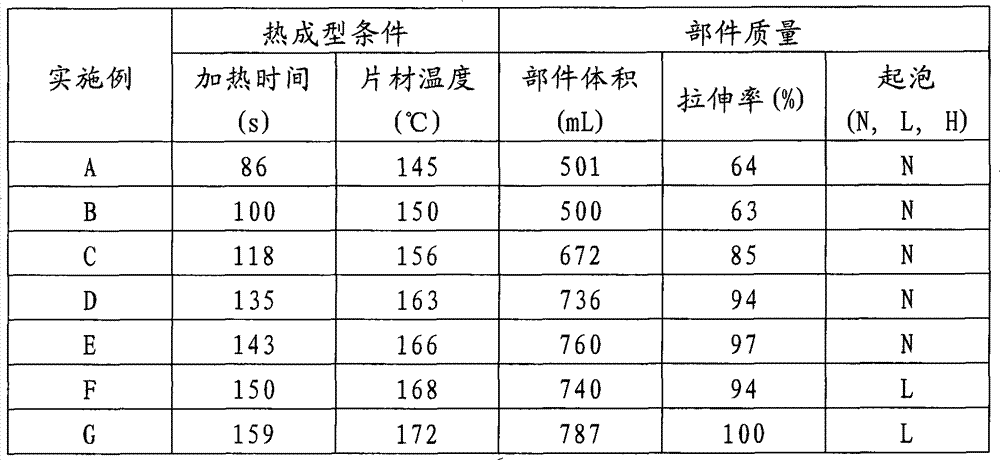
Embodiment 14
Use 3.5 inches single screw extrusion machine productions to contain the sheet material of polyester, described polyester made have 100 moles of % terephthalic acid residues, 80 moles of %1,4-cyclohexanedimethanol and 20 moles of %2,2,4,4-tetramethyl--1, the target of 3-tetramethylene diol residue is formed.Sheet material is extruded continuously, be calibrated to the thickness of 177 mils, then various sheet materials shearings are reached dimensional requirement.Detect logarithmic viscosity number and second-order transition temperature at a sheet material.The logarithmic viscosity number that records sheet material is 0.69dL/g.The second-order transition temperature that records sheet material is 106 ℃.Then with sheet material at 100% relative humidity and 25 ℃ conditioning fortnights down.Using the Brown thermoforming machine subsequently is in 2.5: 1 the former to stretch ratio with sheet heat forming.Thermoforming baking oven for heating device is set at 60/40/40% output, only uses top firing.In baking oven, keep the various times to measure sheet temperature to the influence of part quality sheet material, as shown in the table.Part quality is determined by the volume, calculating extensibility and the visual observations thermoforming parts that detect the thermoforming parts.Extensibility is by calculating divided by the maximum part volume (embodiment G) that reaches in this group experiment with piece volumes.Any foaming in the parts of visual observations thermoforming, foaming degree are rated nothing (N), low (L) or high (H).Following result shows that these second-order transition temperatures are 106 ℃ thermoplastic sheets thermoforming under the following conditions, this has at least 95% extensibility and not have the sheet material of foaming to confirm by not having before the thermoforming under the situation of dry sheet material in advance, generating.

Embodiment 15-Comparative Examples
Use 3.5 inches sheet materials that single screw extrusion machine production is made up of Kelvx 201.Kelvx is that a kind of 69.85%PCTG of containing is (from the Eastar of Eastman Chemcial Co., have 100 moles of % terephthalic acid residues, 62 moles of %1,4-cyclohexanedimethanol and 38 moles of % glycol residues), the blend of 30%PC (bisphenol-a polycarbonate) and 0.15%Weston 619 (stablizer that CromptonCorporation sells).Sheet material is extruded continuously, be calibrated to the thickness of 177 mils, then various sheet materials shearings are reached dimensional requirement.Detect second-order transition temperature at a sheet material, recording is 100 ℃.Then with sheet material at 50% relative humidity and 60 ℃ conditioning fortnights down.Using the Brown thermoforming machine subsequently is in 2.5: 1 the former to stretch ratio with sheet heat forming.Thermoforming baking oven for heating device is set at 70/60/60% output, only uses top firing.In baking oven, keep the various times to measure sheet temperature to the influence of part quality sheet material, as shown in the table.Part quality is determined by the volume, calculating extensibility and the visual observations thermoforming parts that detect the thermoforming parts.Extensibility is by calculating divided by the maximum part volume (embodiment E) that reaches in this group experiment with piece volumes.Any foaming in the parts of visual observations thermoforming, foaming degree are rated nothing (N), low (L) or high (H).Following result shows that these second-order transition temperatures are 100 ℃ thermoplastic sheets thermoforming under the following conditions, this has at least 95% extensibility and not have the sheet material of foaming to confirm by not having before the thermoforming under the situation of dry sheet material in advance, generating.
Embodiment 16-Comparative Examples
Use 3.5 inches sheet materials that single screw extrusion machine production is made up of Kelvx 201.Sheet material is extruded continuously, be calibrated to the thickness of 177 mils, then various sheet materials shearings are reached dimensional requirement.Detect second-order transition temperature at a sheet material, recording is 100 ℃.Then with sheet material at 100% relative humidity and 25 ℃ conditioning fortnights down.Using the Brown thermoforming machine subsequently is in 2.5: 1 the former to stretch ratio with sheet heat forming.Thermoforming baking oven for heating device is set at 60/40/40% output, only uses top firing.In baking oven, keep the various times to measure sheet temperature to the influence of part quality sheet material, as shown in the table.Part quality is determined by the volume, calculating extensibility and the visual observations thermoforming parts that detect the thermoforming parts.Extensibility is by calculating divided by the maximum part volume (embodiment H) that reaches in this group experiment with piece volumes.Any foaming in the parts of visual observations thermoforming, foaming degree are rated nothing (N), low (L) or high (H).Following result shows that these second-order transition temperatures are 100 ℃ thermoplastic sheets thermoforming under the following conditions, this has at least 95% extensibility and not have the sheet material of foaming to confirm by not having before the thermoforming under the situation of dry sheet material in advance, generating.
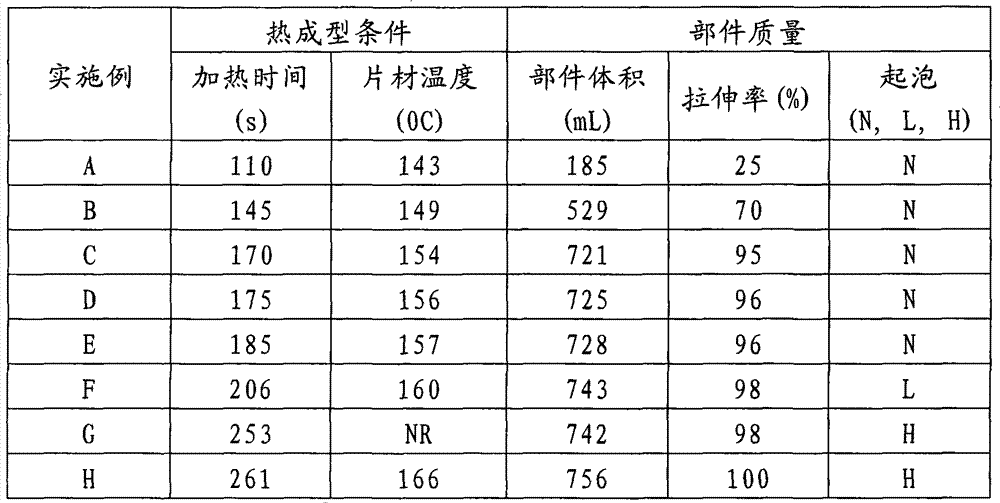
NR=does not obtain
Embodiment 17-Comparative Examples
The sheet material that uses 3.5 inches single screw extrusion machine productions to be formed by PCTG 25976 (the 1,4 cyclohexane dimethanol residue of 100 moles of % terephthalic acid residues, 62 moles of % and the glycol residue of 38 moles of %).Sheet material is extruded continuously, be calibrated to the thickness of 118 mils, then various sheet materials shearings are reached dimensional requirement.Detect second-order transition temperature at a sheet material, recording is 87 ℃.Then with sheet material in 50% relative humidity and 60 ℃ conditioning four stars phases down.Recording water-content is 0.17 weight %.Using the Brown thermoforming machine subsequently is in 2.5: 1 the former to stretch ratio with sheet heat forming.Thermoforming baking oven for heating device is set at 70/60/60% output, only uses top firing.In baking oven, keep the various times to measure sheet temperature to the influence of part quality sheet material, as shown in the table.Part quality is determined by the volume, calculating extensibility and the visual observations thermoforming parts that detect the thermoforming parts.Extensibility is by calculating divided by the maximum part volume (embodiment A) that reaches in this group experiment with piece volumes.Any foaming in the parts of visual observations thermoforming, foaming degree are rated nothing (N), low (L) or high (H).Following result shows that these second-order transition temperatures are 87 ℃ thermoplastic sheets thermoforming under the following conditions, this is by not having before the thermoforming under the situation of dry sheet material in advance, generating to have greater than 95% extensibility and not have the sheet material of foaming to confirm.

Embodiment 18-Comparative Examples
Use 1.25 inches single screw extrusion machine productions by the TeijinL-1250 polycarbonate (a kind of bisphenol-a polycarbonate) of 20 weight % but, the PCTG 25976 of 79.85 weight % and the miscible blends that 0.15 weight %Weston 619 forms.The sheet material that uses 3.5 inches single screw extrusion machine productions to be formed by this blend then.Sheet material is extruded continuously, be calibrated to the thickness of 118 mils, then various sheet materials shearings are reached dimensional requirement.Detect second-order transition temperature at a sheet material, recording is 94 ℃.Then with sheet material in 50% relative humidity and 60 ℃ conditioning four stars phases down.Recording water-content is 0.25 weight %.Using the Brown thermoforming machine subsequently is in 2.5: 1 the former to stretch ratio with sheet heat forming.Thermoforming baking oven for heating device is set at 70/60/60% output, only uses top firing.In baking oven, keep the various times to measure sheet temperature to the influence of part quality sheet material, as shown in the table.Part quality is determined by the volume, calculating extensibility and the visual observations thermoforming parts that detect the thermoforming parts.Extensibility is by calculating divided by the maximum part volume (embodiment A) that reaches in this group experiment with piece volumes.Any foaming in the parts of visual observations thermoforming, foaming degree are rated nothing (N), low (L) or high (H).Following result shows that these second-order transition temperatures are 94 ℃ thermoplastic sheets thermoforming under the following conditions, this is by not having before the thermoforming under the situation of dry sheet material in advance, generating to have greater than 95% extensibility and not have the sheet material of foaming to confirm.
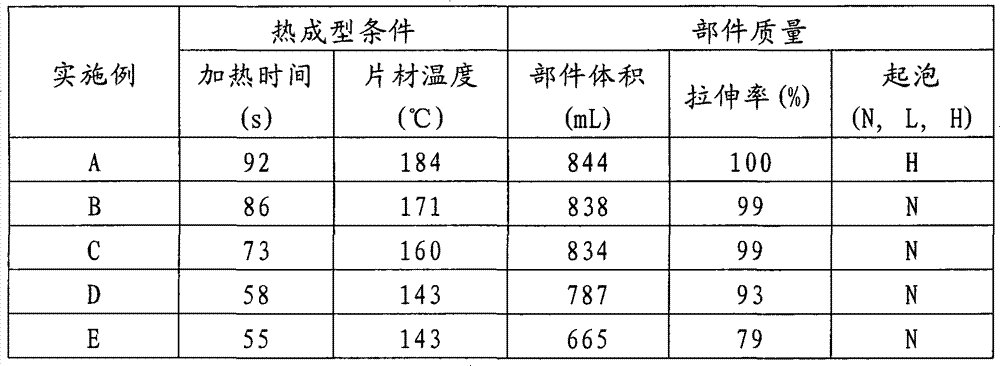
Embodiment 19-Comparative Examples
But use 1.25 inches single screw extrusion machine productions by the TeijinL-1250 polycarbonate of 30 weight %, the PCTG 25976 of 69.85 weight % and the miscible blends that 0.15 weight %Weston 619 forms.The sheet material that uses 3.5 inches single screw extrusion machine productions to be formed by this blend then.Sheet material is extruded continuously, be calibrated to the thickness of 118 mils, then various sheet materials shearings are reached dimensional requirement.Detect second-order transition temperature at a sheet material, recording is 99 ℃.Then with sheet material in 50% relative humidity and 60 ℃ conditioning four stars phases down.Recording water-content is 0.25 weight %.Using the Brown thermoforming machine subsequently is in 2.5: 1 the former to stretch ratio with sheet heat forming.Thermoforming baking oven for heating device is set at 70/60/60% output, only uses top firing.In baking oven, keep the various times to measure sheet temperature to the influence of part quality sheet material, as shown in the table.Part quality is determined by the volume, calculating extensibility and the visual observations thermoforming parts that detect the thermoforming parts.Extensibility is by calculating divided by the maximum part volume (embodiment A) that reaches in this group experiment with piece volumes.Any foaming in the parts of visual observations thermoforming, foaming degree are rated nothing (N), low (L) or high (H).Following result shows that these second-order transition temperatures are 99 ℃ thermoplastic sheets thermoforming under the following conditions, this is by not having before the thermoforming under the situation of dry sheet material in advance, generating to have greater than 95% extensibility and not have the sheet material of foaming to confirm.

NA=does not obtain.Null value represents not form because sheet material does not enter mould sheet material (seemingly because too cold).
Embodiment 20-Comparative Examples
But use 1.25 inches single screw extrusion machine productions by the TeijinL-1250 polycarbonate of 40 weight %, the PCTG 25976 of 59.85 weight % and the miscible blends that 0.15 weight %Weston 619 forms.The sheet material that uses 3.5 inches single screw extrusion machine productions to be formed by this blend then.Sheet material is extruded continuously, be calibrated to the thickness of 118 mils, then various sheet materials shearings are reached dimensional requirement.Detect second-order transition temperature at a sheet material, recording is 105 ℃.Then with sheet material in 50% relative humidity and 60 ℃ conditioning four stars phases down.Recording water-content is 0.265 weight %.Using the Brown thermoforming machine subsequently is in 2.5: 1 the former to stretch ratio with sheet heat forming.Thermoforming baking oven for heating device is set at 70/60/60% output, only uses top firing.In baking oven, keep the various times to measure sheet temperature to the influence of part quality sheet material, as shown in the table.Part quality is determined by the volume, calculating extensibility and the visual observations thermoforming parts that detect the thermoforming parts.Extensibility is by calculating divided by the maximum part volume (embodiment 8A-8E) that reaches in this group experiment with piece volumes.Any foaming in the parts of visual observations thermoforming, foaming degree are rated nothing (N), low (L) or high (H).Following result shows that these second-order transition temperatures are 105 ℃ thermoplastic sheets thermoforming under the following conditions, this is by not having before the thermoforming under the situation of dry sheet material in advance, generating to have greater than 95% extensibility and not have the sheet material of foaming to confirm.

Embodiment 21-Comparative Examples
But use 1.25 inches single screw extrusion machine productions by the TeijinL-1250 polycarbonate of 50 weight %, the PCTG 25976 of 49.85 weight % and the miscible blends that 0.15 weight %Weston 619 forms.Sheet material is extruded continuously, be calibrated to the thickness of 118 mils, then various sheet materials shearings are reached dimensional requirement.Detect second-order transition temperature at a sheet material, recording is 111 ℃.Then with sheet material in 50% relative humidity and 60 ℃ conditioning four stars phases down.Recording water-content is 0.225 weight %.Using the Brown thermoforming machine subsequently is in 2.5: 1 the former to stretch ratio with sheet heat forming.Thermoforming baking oven for heating device is set at 70/60/60% output, only uses top firing.In baking oven, keep the various times to measure sheet temperature to the influence of part quality sheet material, as shown in the table.Part quality is determined by the volume, calculating extensibility and the visual observations thermoforming parts that detect the thermoforming parts.Extensibility by with piece volumes divided by the maximum part volume (embodiment A-D) calculate that in this group experiment, reaches.Any foaming in the parts of visual observations thermoforming, foaming degree are rated nothing (N), low (L) or high (H).Following result shows that these second-order transition temperatures are 111 ℃ thermoplastic sheets thermoforming under the following conditions, this is by not having before the thermoforming under the situation of dry sheet material in advance, generating to have greater than 95% extensibility and not have the sheet material of foaming to confirm.
NA=does not obtain.Null value represents not form because sheet material does not enter mould sheet material (seemingly because too cold).
Embodiment 22-Comparative Examples
But use 1.25 inches single screw extrusion machine productions by the TeijinL-1250 polycarbonate of 60 weight %, the PCTG 25976 of 39.85 weight % and the miscible blends that 0.15 weight %Weston 619 forms.The sheet material that uses 3.5 inches single screw extrusion machine productions to be formed by this blend then.Sheet material is extruded continuously, be calibrated to the thickness of 118 mils, then various sheet materials shearings are reached dimensional requirement.Detect second-order transition temperature at a sheet material, recording is 117 ℃.Then with sheet material in 50% relative humidity and 60 ℃ conditioning four stars phases down.Recording water-content is 0.215 weight %.Using the Brown thermoforming machine subsequently is in 2.5: 1 the former to stretch ratio with sheet heat forming.Thermoforming baking oven for heating device is set at 70/60/60% output, only uses top firing.In baking oven, keep the various times to measure sheet temperature to the influence of part quality sheet material, as shown in the table.Part quality is determined by the volume, calculating extensibility and the visual observations thermoforming parts that detect the thermoforming parts.Extensibility is by calculating divided by the maximum part volume (embodiment A) that reaches in this group experiment with piece volumes.Any foaming in the parts of visual observations thermoforming, foaming degree are rated nothing (N), low (L) or high (H).Following result shows that these second-order transition temperatures are that 117 ℃ thermoplastic sheets under the following conditions can not thermoforming, this does not confirm by having before the thermoforming under the situation of dry sheet material in advance, can not generate to have greater than 95% extensibility and the sheet material that do not have to bubble.

Embodiment 23-Comparative Examples
But use 1.25 inches single screw extrusion machine productions by the TeijinL-1250 polycarbonate of 65 weight %, the PCTG 25976 of 34.85 weight % and the miscible blends that 0.15 weight %Weston 619 forms.The sheet material that uses 3.5 inches single screw extrusion machine productions to be formed by this blend then.Sheet material is extruded continuously, be calibrated to the thickness of 118 mils, then various sheet materials shearings are reached dimensional requirement.Detect second-order transition temperature at a sheet material, recording is 120 ℃.Then with sheet material in 50% relative humidity and 60 ℃ conditioning four stars phases down.Recording water-content is 0.23 weight %.Using the Brown thermoforming machine subsequently is in 2.5 21 the former to stretch ratio with sheet heat forming.Thermoforming baking oven for heating device is set at 70/60/60% output, only uses top firing.In baking oven, keep the various times to measure sheet temperature to the influence of part quality sheet material, as shown in the table.Part quality is determined by the volume, calculating extensibility and the visual observations thermoforming parts that detect the thermoforming parts.Extensibility is by calculating divided by the maximum part volume (embodiment A) that reaches in this group experiment with piece volumes.Any foaming in the parts of visual observations thermoforming, foaming degree are rated nothing (N), low (L) or high (H).Following result shows that these second-order transition temperatures are that 120 ℃ thermoplastic sheets under the following conditions can not thermoforming, this does not confirm by having before the thermoforming under the situation of dry sheet material in advance, can not generate to have greater than 95% extensibility and the sheet material that do not have to bubble.

Embodiment 24-Comparative Examples
But use 1.25 inches single screw extrusion machine productions by the TeijinL-1250 polycarbonate of 70 weight %, the PCTG 25976 of 29.85 weight % and the miscible blends that 0.15 weight %Weston 619 forms.The sheet material that uses 3.5 inches single screw extrusion machine productions to be formed by this blend then.Sheet material is extruded continuously, be calibrated to the thickness of 118 mils, then various sheet materials shearings are reached dimensional requirement.Detect second-order transition temperature at a sheet material, recording is 123 ℃.Then with sheet material in 50% relative humidity and 60 ℃ conditioning four stars phases down.Recording water-content is 0.205 weight %.Using the Brown thermoforming machine subsequently is in 2.5: 1 the former to stretch ratio with sheet heat forming.Thermoforming baking oven for heating device is set at 70/60/60% output, only uses top firing.In baking oven, keep the various times to measure sheet temperature to the influence of part quality sheet material, as shown in the table.Part quality is determined by the volume, calculating extensibility and the visual observations thermoforming parts that detect the thermoforming parts.Extensibility is by calculating divided by the maximum part volume (embodiment A and B) that reaches in this group experiment with piece volumes.Any foaming in the parts of visual observations thermoforming, foaming degree are rated nothing (N), low (L) or high (H).Following result shows that these second-order transition temperatures are that 123 ℃ thermoplastic sheets under the following conditions can not thermoforming, this does not confirm by having before the thermoforming under the situation of dry sheet material in advance, can not generate to have greater than 95% extensibility and the sheet material that do not have to bubble.
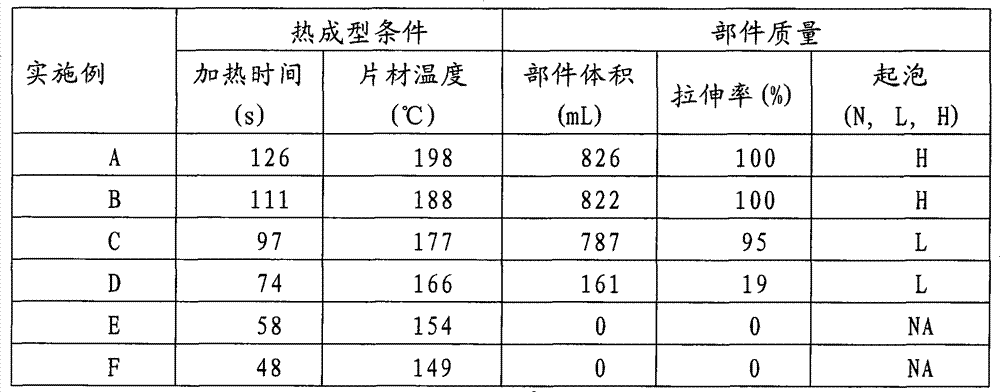
NA=does not obtain.Null value represents not form because sheet material does not enter mould sheet material (seemingly because too cold).
Embodiment 25-Comparative Examples
Use 3.5 inches sheet materials that single screw extrusion machine production is made up of Teijin L-1250 polycarbonate.Sheet material is extruded continuously, be calibrated to the thickness of 118 mils, then various sheet materials shearings are reached dimensional requirement.Detect second-order transition temperature at a sheet material, recording is 149 ℃.Then with sheet material in 50% relative humidity and 60 ℃ conditioning four stars phases down.Recording water-content is 0.16 weight %.Using the Brown thermoforming machine subsequently is in 2.5: 1 the former to stretch ratio with sheet heat forming.Thermoforming baking oven for heating device is set at 70/60/60% output, only uses top firing.In baking oven, keep the various times to measure sheet temperature to the influence of part quality sheet material, as shown in the table.Part quality is determined by the volume, calculating extensibility and the visual observations thermoforming parts that detect the thermoforming parts.Extensibility is by calculating divided by the maximum part volume (embodiment A) that reaches in this group experiment with piece volumes.Any foaming in the parts of visual observations thermoforming, foaming degree are rated nothing (N), low (L) or high (H).Following result shows that these second-order transition temperatures are that 149 ℃ thermoplastic sheets under the following conditions can not thermoforming, this does not confirm by having before the thermoforming under the situation of dry sheet material in advance, can not generate to have greater than 95% extensibility and the sheet material that do not have to bubble.
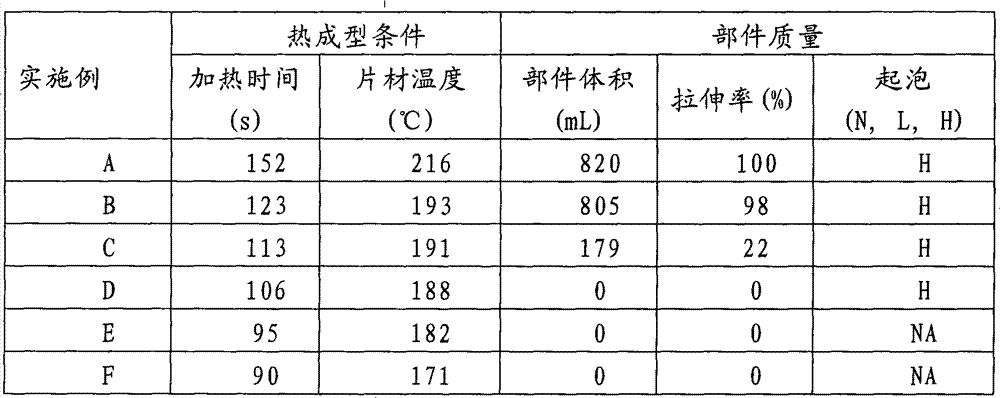
NA=does not obtain.Null value represents not form because sheet material does not enter mould sheet material (seemingly because too cold).
Embodiment 26
This embodiment illustrates the preparation of the polyester that comprises at least a thermo-stabilizer, their reaction product and their mixture, causes the raising of polyester fondant stability in the course of processing.
Various polyester according to the following stated method from 100mol% dimethyl terephthalate (DMT) (DMT), 1,4 cyclohexane dimethanol (CHDM) and 2,2,4,4-tetramethyl--1,3-tetramethylene glycol (TMCD) preparation.The mol% of the TMCD of the experiment usefulness of present embodiment is listed in the table below in 12, and wherein the glycol surplus is CHDM.DMT buys from Cape Industries, and CHDM (minimum concentration 98%) and TMCD (minimum concentration 98%) are obtained by Eastman Chemical Company.Tin compound is cacodyl oxide base tin (from Strem Chemical Co. or Gelest, Inc. obtains) or three-2 ethyl hexanoic acid butyl tin (obtaining from Aldrich or Arkema).Phosphorus compound is Triphenyl phosphate (TPP, from Aldrich (98%) or FERRO, Corp. obtains).Unless explanation is below arranged in addition, the source of phosphorus is that the remainder with polyester reagent adds in advance.The cis/trans ratio of CHDM is as previously discussed, and the cis/trans ratio of TMCD is listed in the table 12.
Table 12
The composition of the polyester of embodiment 26 and logarithmic viscosity number
| Embodiment | Melt IV (dL/g) | TMCD (mol%) | TMCD % cis | Sn (ppm) | P (ppm) theoretical value/observed value | The actual wt ratio of Sn/P | Final Pz temperature (℃) |
| A | 0.605 | 44.8 | 50.0 | 205 1 | Do not have | * | 290 |
| B | 0.583 | 44.4 | 51.9 | 201 1 | Do not have | * | 290 |
| C | 0.578 | 43.9 | 50.7 | 199 1 | Do not have | * | 290 |
| D | 0.607 | 44.9 | 50.5 | 199 2 | Do not have | * | 290 |
| E | 0.437 | 44.5 | 52.0 | 200 2 | Do not have | * | 290 |
| F | 0.292 | 44.8 | 51.9 | 190 2 | 34/34 | 5.6 | 290 |
| G | 0.240 | 43.6 | 52.8 | 206 1 | 34/37 | 5.6 | 290 |
| H | 0.213 | 43.2 | 53.7 | 192 2 | 34/49 | 3.9 | 290 |
| I | 0.585 | 45.1 | 50.2 | 191 2 | 10/11 | 17.4 | 290 |
| J | 0.580 | 45.1 | 50.5 | 192 1 | 10/11 | 17.5 | 290 |
| K | 0.541 | 44.0 | 52.3 | 202 2 | 19/20 | 10.1 | 290 |
| L | 0.595 | 45.3 | 50.6 | 198 2 | 20/20 | 9.9 | 290 |
| M | 0.632 | 45.6 | 49.0 | 203 2 | 20/22 | 9.2 | 265 |
| N | 0.577 | 46.2 | 50.1 | 196 2 | 30/26 | 7.5 | 265 |
| O | 0.608 | 46.0 | 49.6 | 190 1 | 20/19 | 10.0 | 265 |
| P | 0.517 | 45.2 | 49.4 | 100 2 | 10/10 | 10.0 | 265 |
| Q | 0.602 | 46.1 | 49.2 | 102 2 | 10/10 | 10.2 | 265 |
| R | 0.740 | 19.0 | 51.7 | 190 2 | 20/18 | 10.6 | 275 |
1 three-2 ethyl hexanoic acid butyl tin is as the source of tin
2 cacodyl oxide base tin are as the source of tin
Data in the table 13 show, if identical condition on use and pilot scale or the technical scale, then the stability of the polymer melt of comparative example A-D is unacceptable.On the contrary, the stable suitable method of amplifying in proportion of melt of experiment output that has suitable tin/phosphorus ratio.
Table 13
The performance of the polyester of embodiment 26
| Embodiment | L* | a* | b* | Melt liquid level stability | The polymer color observations | % foam in polyester | The vision scoring of polyester |
| A | 82.50 | -0.89 | 4.66 | 4 | Yellowing | 34% | 4 |
| B | 79.74 | -0.75 | 4.89 | 4 | Yellowing | 21% | 4 |
| C | 78.64 | -0.39 | 6.83 | 4 | Pale brown look | 37% | 4 |
| D | 85.44 | -1.45 | 4.07 | 3 | Light yellow | 27% | 4 |
| E | 86.19 | -1.04 | 3.94 | 3 | Good color: not yellowing | 35% | 4 |
| F | 89.17 | -0.78 | 2.07 | 1 | Good color: not yellowing | 12% | 1 |
| G | 88.96 | -1.00 | 3.76 | 1 | Light yellow | 9% | 1 |
| H | 88.92 | -0.64 | 2.12 | 1 | Good color: not yellowing | 9% | 1 |
| I | 80.92 | -1.02 | 3.22 | 2 | Good color: not yellowing | 20% | 3 |
| J | 82.10 | -1.67 | 3.69 | 2 | Good color: not yellowing | 22% | 3 |
| K | 85.74 | -0.81 | 2.46 | 1 | NM | NM | NM |
| L | 82.51 | -1.03 | 2.56 | 1 | Good color: not yellowing | 15% | 2 |
| M | 85.54 | -1.07 | 2.06 | 1 | Good color: not yellowing | 22% | 3 |
| N | 84.54 | -0.71 | 1.07 | 1 | Good color: not yellowing | 14% | 2 |
| O | 85.03 | -0.82 | 1.17 | 1 | Light yellow | 14% | 3 |
| P | 85.02 | -0.87 | 1.59 | 1 | Light yellow | 17% | 2 |
| Q | 82.49 | -0.86 | 1.09 | 1 | Good color: not yellowing | 17% | 2 |
| R | 85.27 | -1.74 | 4.40 | 1 | Light yellow | 24% | 4 |
| S | NA | NA | NA | NA | NA | 35% | NA |
| T | NA | NA | NA | NA | NA | 9% | NA |
NM=does not measure
List in melt liquid level (level) stability in the table 13 based on following yardstick:
| 1 stable melt liquid level, the limited gas of emitting is similar to excess diol wherein and boils the conventional polyester fallen at leisure |
| 2 compare metastable melt liquid level with above 1, but extra space/bubble is arranged. |
| Unsettled melt liquid level in 3 vacuum tightnesss, the foaming of severe and foaming causes high void volume (increasing the bubble of melt cumulative volume), the unsettled gas of emitting, melt liquid level springs up-only by means of the adjusting of stir speed (S.S.) or more than the liquid level of melt, have agitator to press and broken this foam prevents from overflowing from flask.Too unstable so that can't amplify in proportion credibly. |
| Very unsettled melt liquid level in 4 vacuum tightnesss, excessive foaming and foaming causes high void volume (increasing the bubble of melt cumulative volume), the unsettled gas of emitting, melt liquid level spring up-overflow from flask and frequently melt/foam is pushed in the gas space in the vacuum system.Can not finish experiment (for this liquid level stabilizing, can't finish greater than 50% repeated experiments round) frequently. |
The vision of listing in the table 13 is marked based on following yardstick:
| Scoring | Explain |
| 1 | Bubble seldom: can see through molten polymer and see |
| 2 | Rare bubble: have enough bubbles to hinder and see through the polymkeric substance observation, but be not enough to increase sharp polymer volume |
| 3 | A lot of bubbles: the volume of polymkeric substance is subjected to |
| 4 | Very close foam: the volume of polymkeric substance is subjected to the violent influence of a lot of bubbles |
Embodiment 26S and embodiment 26T are the comparative examples.Embodiment 26S represent according to the similar mode of following examples 29A prepare but do not have the polyester of phosphorus type thermo-stabilizer, it has the IV of 0.54dL/g and contains the 100mol% terephthalic acid residue, 43.8mol%TMCD residue and 56.2 moles of %CHDM acid residues.These polyester prepare under 290 ℃ final precision work actuator temperature as the source (Sn=216ppm) of tin catalyst by using three-2 ethyl hexanoic acid butyl tin, and have colour L*=60.97, b*=9.02, and a*=-0.89.Embodiment 26T represents to contain the 65mol% terephthalic acid residue, 35mol% m-phthalic acid residue, and 100mol% 1, the commodity Kelvx polymkeric substance of 4-cyclohexanedimethanol residue.
The polyester of present embodiment is to prepare in the 500ml round-bottomed flask that agitator and polymkeric substance head are housed, and this polymkeric substance head allows nitrogen purging simultaneously and vacuumizes, when needed.Starting material are weighed to join and carry out 0.4 mole of experiment (polymer repeat unit=274 grams/mole) in the flask: 0.400 mole DMT (77.6 gram), 0.224 the CHDM (32.3 gram) of mole and 0.256 mole TMCD (36.8 restrain) and 0.112g three-2 ethyl hexanoic acid butyl tin or 0.0314g cacodyl oxide base tin (as listed in the table 12), making is having about 200ppm metallic tin in final polymkeric substance, but therefore makes improvements for other aimed concn such as 100ppm Sn.Therefore the amount of TMCD and CHDM improves the polyester with production example 26, and wherein target TMCD concentration is 20 moles of %.
Glycol/sour ratio is 1.2/1, and wherein excessive is that 2%CHDM and 20% excessive remainder are TMCD.This catalyzer is weighed and joins in the flask, as solid or liquid.Triphenyl phosphate is weighed as solid according to the amount of listing in table 12 for each experiment and joins in the flask.The tetramethyl ammonium hydroxide (TMAH) of 100ppm (0.0109g is as liquid) is used for the preparation of embodiment 26N.
Setting point and data gathering can become more convenient by the Camile program control system.In case reactant fusing, start stir and according to following in corresponding Camile order the increasing like that at leisure of appointment (stir speed (S.S.)).Along with the passing of experimental period, the temperature of reactor also little by little raises.
This transesterify and polycondensation are carried out in same 500ml flask.The blade of agitator is moved upwards up to the top of melt, constrain foam layer in the course of processing of the polyester of embodiment 26A and embodiment 26B.In being listed in the table below by the temperature/pressure of Camile software control/stir speed (S.S.) order for each embodiment.The final polymerization temperature of the experiment of present embodiment (Pz temperature) is to be listed in the table 12 from 265 ℃ to 290 ℃.
The Camile order of embodiment 26A-embodiment 26L
| Stage | Time (minute) | Temperature (℃) | Vacuum (holder) | Stir speed (S.S.) (RPM) |
| 1 | 3 | 200 | 760 | 0 |
| 2 | 0.1 | 200 | 760 | 25 |
| 3 | 2 | 200 | 760 | 25 |
| 4 | 0.1 | 200 | 760 | 100 |
| 5 | 1 | 200 | 760 | 100 |
| 6 | 0.1 | 200 | 760 | 200 |
| 7 | 90 | 200 | 760 | 200 |
| 8 | 0.1 | 210 | 760 | 200 |
| 9 | 120 | 210 | 760 | 200 |
| 10 | 5 | 245 | 760 | 50 |
| 11 | 5 | 245 | 760 | 50 |
| 12 | 30 | 265 | 760 | 50 |
| 13 | 3 | 265 | 90 | 50 |
| 14 | 110 | 290 | 90 | 50 |
| 15 | 5 | 290 | 6 | 25 |
| 16 | 110 | 290 | 6 | 25 |
| 17 | 2 | 290 | 400 | 0 |
| 18 | 1 | 300 | 760 | 0 |
The Camile order of embodiment 26M-embodiment 260
| Stage | Time (minute) | Temperature, ℃ | Vacuum (holder) | Stir (RPM) |
| 1 | 3 | 200 | 760 | 0 |
| 2 | 0.1 | 200 | 760 | 25 |
| 3 | 2 | 200 | 760 | 25 |
| 4 | 0.1 | 200 | 760 | 100 |
| 5 | 1 | 200 | 760 | 100 |
| 6 | 0.1 | 200 | 760 | 200 |
| 7 | 90 | 200 | 760 | 200 |
| 8 | 0.1 | 210 | 760 | 200 |
| 9 | 120 | 210 | 760 | 200 |
| 10 | 5 | 245 | 760 | 50 |
| 11 | 3 | 245 | 375 | 50 |
| 12 | 30 | 245 | 375 | 50 |
| 13 | 3 | 250 | 20 | 50 |
| 14 | 30 | 250 | 20 | 50 |
| 15 | 3 | 255 | 5 | 25 |
| 16 | 110 | 255 | 5 | 25 |
| 17 | 3 | 265 | 1 | 25 |
| 18 | 110 | 265 | 1 | 25 |
| 19 | 2 | 265 | 400 | 0 |
| 20 | 1 | 265 | 760 | 0 |
The Camile order of embodiment 26P
The order of viscosity limitation, rough vacuum
| Stage | Time (minute) | Temperature, ℃ | Vacuum (holder) | Stir speed (S.S.) (RPM) |
| 1 | 3 | 200 | 760 | 0 |
| 2 | 0.1 | 200 | 760 | 25 |
| 3 | 2 | 200 | 760 | 25 |
| 4 | 0.1 | 200 | 760 | 100 |
| 5 | 1 | 200 | 760 | 100 |
| 6 | 0.1 | 200 | 760 | 200 |
| 7 | 90 | 200 | 760 | 200 |
| 8 | 0.1 | 210 | 760 | 200 |
| 9 | 120 | 210 | 760 | 200 |
| 10 | 5 | 245 | 760 | 50 |
| 11 | 3 | 245 | 375 | 50 |
| 12 | 30 | 245 | 375 | 50 |
| 13 | 3 | 250 | 20 | 50 |
| 14 | 30 | 250 | 20 | 50 |
| 15 | 3 | 255 | 5 | 25 |
| 16 | 110 | 255 | 5 | 25 |
| 17 | 3 | 265 | 0.2 | 25 |
| 18 | 110 | 265 | 0.2 | 25 |
| 19 | 2 | 265 | 400 | 0 |
| 20 | 1 | 265 | 760 | 0 |
The Camile order of embodiment 26Q
The order of viscosity limitation, rough vacuum
| Stage | Time (minute) | Temperature, ℃ | Vacuum (holder) | Stir (RPM) |
| 1 | 3 | 200 | 760 | 0 |
| 2 | 0.1 | 200 | 760 | 25 |
| 3 | 2 | 200 | 760 | 25 |
| 4 | 0.1 | 200 | 760 | 100 |
| 5 | 1 | 200 | 760 | 100 |
| 6 | 0.1 | 200 | 760 | 200 |
| 7 | 90 | 200 | 760 | 200 |
| 8 | 0.1 | 210 | 760 | 200 |
| 9 | 120 | 210 | 760 | 200 |
| 10 | 5 | 245 | 760 | 50 |
| 11 | 3 | 245 | 375 | 50 |
| 12 | 30 | 245 | 375 | 50 |
| 13 | 3 | 250 | 20 | 50 |
| 14 | 30 | 250 | 20 | 50 |
| 15 | 3 | 255 | 3 | 25 |
| 16 | 110 | 255 | 3 | 25 |
| 17 | 3 | 265 | 0.2 | 25 |
| 18 | 110 | 265 | 0.2 | 25 |
| 19 | 2 | 265 | 400 | 0 |
| 20 | 1 | 265 | 760 | 0 |
The Camile order of embodiment 26R
| Stage | Time (minute) | Temperature, ℃ | Vacuum (holder) | Stir speed (S.S.) (RPM) |
| 1 | 3 | 200 | 760 | 0 |
| 2 | 0.1 | 200 | 760 | 25 |
| 3 | 2 | 200 | 760 | 25 |
| 4 | 0.1 | 200 | 760 | 100 |
| 5 | 1 | 200 | 760 | 100 |
| 6 | 0.1 | 200 | 760 | 200 |
| 7 | 90 | 200 | 760 | 200 |
| 8 | 0.1 | 210 | 760 | 200 |
| 9 | 120 | 245 | 760 | 100 |
| 10 | 5 | 260 | 760 | 50 |
| 11 | 3 | 260 | 375 | 50 |
| 12 | 30 | 260 | 375 | 50 |
| 13 | 3 | 260 | 20 | 50 |
| 14 | 30 | 260 | 20 | 50 |
| 15 | 3 | 265 | 5 | 25 |
| 16 | 110 | 265 | 5 | 25 |
| 17 | 3 | 275 | 1 | 25 |
| 18 | 110 | 275 | 1 | 25 |
| 19 | 2 | 275 | 400 | 0 |
| 20 | 1 | 275 | 760 | 0 |
Embodiment 27
This embodiment illustrates by using the processing condition different with embodiment 26, prepares the polyester that comprises at least a thermo-stabilizer, their reaction product and their mixture, causes polyester fondant stable raising in the course of processing.
Various polyester method as described below is from 100mol%DMT, and CHDM and TMCD prepare.The mol% of the TMCD of the experiment usefulness of present embodiment is listed in the table below in 14, and wherein the glycol surplus is CHDM.DMT, CHDM and TMCD have the source identical with embodiment 26.This catalyzer is cacodyl oxide base tin (Strem Chemical Co., Batch B4058112), three-2 ethyl hexanoic acid butyl tin (Aldrich, Batch 06423CD, or Arkema), or dibutyltin oxide (Arkema).Thermo-stabilizer is Triphenyl phosphate, also with embodiment 26 in identical source.Unless explanation is below arranged in addition, the source of phosphorus is that the remainder with polyester reagent adds in advance.The cis/trans ratio of CHDM is as previously discussed, and the cis/trans ratio of TMCD is listed in the table 14.The polyester of embodiment 27A and embodiment 27E is not to use the TPP preparation.
Table 14
The composition of the polyester of embodiment 27 and logarithmic viscosity number
| Embodiment | Melt IV (dL/g) | TMCD (mol%) | The TMCD% cis | Sn (ppm) | P (ppm) theory/measure | The actual wt ratio of Sn/P | Final Pz temperature (℃) |
| A | 0.548 | 46.3 | 50.1 | 190 3 | Do not have | * | 290 |
| B | 0.696 | 45.3 | 49.3 | 193 2 | 10/9 | 21.4 | 275 |
| C | 0.597 | 45.1 | 50.4 | 199 2 | 20/18 | 11.1 | 275 |
| D | 0.547 | 45.6 | 50.4 | 195 2 | 30/27 | 7.2 | 275 |
| E | 0.714 | 45.4 | 49.9 | 198 2 | Do not have | * | 265 |
| F | 0.731 | 44.5 | 48.0 | 188 2 | 30/25 | 7.5 | 265 |
| G | 0.727 | 44.7 | 48.5 | 203 2 | 30/26 | 7.8 | 265 |
| H | 0.645 | 44.0 | 51.0 | 55 2 | 7.5/8 | 6.9 | 265 |
| I | 0.605 | 43.3 | 48.6 | 55 2 | 7.5/8 | 6.9 | 265 |
| J | 0.711 | 46.1 | 48.6 | 196 2 | 20/17 | 11.5 | 275 |
| K | 0.721 | 45.8 | 48.8 | 193 2 | 20/17 | 11.4 | 275 |
1 three-2 ethyl hexanoic acid butyl tin is as the source of tin
2 cacodyl oxide base tin are as the source of tin
3 dibutyltin oxides are as the source of tin
Data show in the table 15, and the stability of polymer melt can be passed through to improve processing condition, as the final polymerization temperature of following report, and the vacuum rate that in reactor, produces, time under vacuum etc. strengthens.Melt liquid level stability in table 15 and vision scoring are based on disclosed yardstick among the embodiment 26.
Table 15
The performance of the polyester of embodiment 27
| Embodiment | L* | a* | b* | Melt liquid level stability | The polymer color observations | % foam in the polyester | The vision scoring of polyester |
| A | 83.55 | -0.93 | 2.44 | 2 | Light yellow | 30% | 4 |
| B | 84.39 | -1.48 | 3.89 | 1 | Good color: not yellowing | 29% | 4 |
| C | 84.46 | -0.98 | 1.82 | 1 | Light yellow | 21% | 2 |
| D | 86.30 | -0.75 | 1.27 | 1 | Good color: not yellowing | 17% | 2 |
| E | 85.60 | -1.20 | 2.68 | 3 | Yellow | 38% | 4 |
| F | 83.88 | -0.97 | 1.64 | 1 | Light yellow | 12% | 1 |
| G | 85.76 | -0.92 | 2.03 | 1 | Light yellow | 12% | 2 |
| H | 84.40 | -0.98 | 1.61 | 1 | Good color: not yellowing | NM | 1 |
| I | 84.88 | -0.63 | 0.99 | 1 | Light yellow | 11% | 1 |
| J | 85.01 | -1.02 | 1.77 | 1 | Light yellow | 18% | 3 |
| K | 84.13 | -0.93 | 1.56 | 1 | Light yellow | 25% | 4 |
NM=does not measure
Embodiment 27A
The DMT (77.6 gram) that in the 500ml round-bottomed flask, adds 0.4 mole, 0.224 mole CHDM (32.3 gram), the dibutyltin oxide of 0.256 mole TMCD (36.8 gram) and 0.0460 gram.This flask is equipped with the stainless steel agitator and allows nitrogen purging simultaneously and the polymkeric substance head of vacuum ability.Flask immersed in 200 ℃ the Belmont metal bath and stirring under the 25RPM till the content fusing.Stir speed (S.S.) brings up to 200RPM and these conditions kept 3 hours and 15 minutes.Temperature is brought up to 220 ℃ and these conditions and was kept other 30 minutes.Temperature was brought up to 290 ℃ through 20 minutes.After obtaining 290 ℃, this pressure is through being reduced to 0.3 set(ting)value (SP) in 15 minutes from normal atmosphere.Along with viscosity increases, stir speed (S.S.) is reduced to minimum 15RPM.Measured minimum vacuum tightness reading is that 0.70 (even SP is 0.3) and the total time under vacuum are 30 minutes.
The remainder of the polyester of present embodiment is to prepare in the 500ml round-bottomed flask that agitator and polymkeric substance head are housed, and this polymkeric substance head allows nitrogen purging simultaneously and vacuumizes, when needed.Starting material are weighed to join and carry out 0.4 mole of experiment (polymer repeat unit=274 grams/mole) in the flask: 0.400 mole DMT (77.6 gram), 0.224 the CHDM (32.3 gram) of mole and 0.256 mole TMCD (36.8 restrain) and 0.112g three-2 ethyl hexanoic acid butyl tin, 0.0314g cacodyl oxide base tin, or the dibutyltin oxide of 0.0460g (as listed in the table 14).These numerical value can be estimated to reach the aimed concn of 200ppm Sn in final polymkeric substance and therefore regulate for other aimed concn.The actual tin concentration of each polyester is listed in the table 14 in the present embodiment.
Glycol/sour ratio in only two experiments in the present embodiment is 1.2/1, and wherein excessive is that 2%CHDM and 20% excessive remainder are TMCD.The glycol of embodiment 27H/sour ratio is 1.1/1, and wherein that excessive is TMCD.The glycol of embodiment 27I/sour ratio is 1.05/1, and wherein that excessive is TMCD.This catalyzer is weighed and joins in the flask, as solid or liquid.Triphenyl phosphate is weighed as solid according to the amount of listing in table 14 and joins in the flask.TPP in embodiment 27K adds from methanol solution subsequently.
Setting point and data gathering can become more convenient by the Camile program control system.In case reactant fusing, start stir and according to following in corresponding Camile order the increasing like that at leisure of appointment (stir speed (S.S.)).Along with the passing of experimental period, the temperature of reactor also little by little raises.
This transesterify and polycondensation are carried out in same 500ml flask.In being listed in the table below by the temperature/pressure of Camile software control/stir speed (S.S.) order for each embodiment.The final polymerization temperature of the experiment of present embodiment (Pz temperature) is to be listed in the table 14 from 265 ℃ to 290 ℃.
The Camile order of embodiment 27B and embodiment 27D
| Stage | Time (minute) | Temperature, ℃ | Vacuum tightness (holder) | Stir (RPM) |
| 1 | 3 | 200 | 760 | 0 |
| 2 | 0.1 | 200 | 760 | 25 |
| 3 | 2 | 200 | 760 | 25 |
| 4 | 0.1 | 200 | 760 | 100 |
| 5 | 1 | 200 | 760 | 100 |
| 6 | 0.1 | 200 | 760 | 200 |
| 7 | 90 | 200 | 760 | 200 |
| 8 | 0.1 | 210 | 760 | 200 |
| 9 | 120 | 210 | 760 | 200 |
| 10 | 5 | 245 | 760 | 50 |
| 11 | 32 | 250 | 375 | 50 |
| 12 | 30 | 255 | 375 | 50 |
| 13 | 3 | 255 | 50 | 50 |
| 14 | 30 | 260 | 50 | 50 |
| 15 | 3 | 265 | 15 | 25 |
| 16 | 110 | 265 | 15 | 25 |
| 17 | 3 | 270 | 2 | 25 |
| 18 | 110 | 275 | 2 | 25 |
| 19 | 2 | 275 | 400 | 0 |
| 20 | 1 | 275 | 760 | 0 |
The Camile order of embodiment 27E
| Stage | Time (minute) | Temperature, ℃ | Vacuum tightness (holder) | Stir (RPM) |
| 1 | 3 | 200 | 760 | 0 |
| 2 | 0.1 | 200 | 760 | 25 |
| 3 | 2 | 200 | 760 | 25 |
| 4 | 0.1 | 200 | 760 | 100 |
| 5 | 1 | 200 | 760 | 100 |
| 6 | 0.1 | 200 | 760 | 200 |
| 7 | 90 | 200 | 760 | 200 |
| 8 | 0.1 | 210 | 760 | 200 |
| 9 | 120 | 210 | 760 | 200 |
| 10 | 5 | 245 | 760 | 50 |
| 11 | 3 | 245 | 375 | 50 |
| 12 | 30 | 245 | 375 | 50 |
| 13 | 3 | 250 | 20 | 50 |
| 14 | 30 | 250 | 20 | 50 |
| 15 | 3 | 255 | 5 | 25 |
| 16 | 110 | 255 | 5 | 25 |
| 17 | 3 | 265 | 1 | 25 |
| 18 | 110 | 265 | 1 | 25 |
| 19 | 2 | 265 | 400 | 0 |
| 20 | 1 | 265 | 760 | 0 |
The Camile order of embodiment 27F and embodiment 27G
The order of viscosity limitation, rough vacuum
| Stage | Time (minute) | Temperature, ℃ | Vacuum tightness (holder) | Stir (RPM) |
| 1 | 3 | 200 | 760 | 0 |
| 2 | 0.1 | 200 | 760 | 25 |
| 3 | 2 | 200 | 760 | 25 |
| 4 | 0.1 | 200 | 760 | 100 |
| 5 | 1 | 200 | 760 | 100 |
| 6 | 0.1 | 200 | 760 | 200 |
| 7 | 90 | 200 | 760 | 200 |
| 8 | 0.1 | 210 | 760 | 200 |
| 9 | 120 | 210 | 760 | 200 |
| 10 | 5 | 245 | 760 | 50 |
| 11 | 3 | 245 | 375 | 50 |
| 12 | 30 | 245 | 375 | 50 |
| 13 | 3 | 250 | 20 | 50 |
| 14 | 30 | 250 | 20 | 50 |
| 15 | 3 | 255 | 5 | 25 |
| 16 | 110 | 255 | 5 | 25 |
| 17 | 3 | 265 | 0.2 | 25 |
| 18 | 110 | 265 | 0.2 | 25 |
| 19 | 2 | 265 | 400 | 0 |
| 20 | 1 | 265 | 760 | 0 |
The Camile order of embodiment 27H and embodiment 27I
The order of viscosity limitation, rough vacuum
| Stage | Time (minute) | Temperature, ℃ | Vacuum tightness (holder) | Stir (RPM) |
| 1 | 3 | 200 | 760 | 0 |
| 2 | 0.1 | 200 | 760 | 25 |
| 3 | 2 | 200 | 760 | 25 |
| 4 | 0.1 | 200 | 760 | 100 |
| 5 | 1 | 200 | 760 | 100 |
| 6 | 0.1 | 200 | 760 | 200 |
| 7 | 90 | 200 | 760 | 200 |
| 8 | 0.1 | 210 | 760 | 200 |
| 9 | 120 | 210 | 760 | 200 |
| 10 | 5 | 245 | 760 | 50 |
| 11 | 3 | 245 | 375 | 50 |
| 12 | 30 | 245 | 375 | 50 |
| 13 | 3 | 250 | 20 | 50 |
| 14 | 30 | 250 | 20 | 50 |
| 15 | 3 | 255 | 3 | 25 |
| 16 | 110 | 255 | 3 | 25 |
| 17 | 3 | 265 | 1 | 25 |
| 18 | 110 | 265 | 1 | 25 |
| 19 | 2 | 265 | 400 | 0 |
| 20 | 1 | 265 | 760 | 0 |
The Camile order of embodiment 27J and embodiment 27K
| Stage | Time (minute) | Temperature, ℃ | Vacuum tightness (holder) | Stir (RPM) |
| 1 | 3 | 200 | 760 | 0 |
| 2 | 0.1 | 200 | 760 | 25 |
| 3 | 2 | 200 | 760 | 25 |
| 4 | 0.1 | 200 | 760 | 100 |
| 5 | 1 | 200 | 760 | 100 |
| 6 | 0.1 | 200 | 760 | 200 |
| 7 | 90 | 200 | 760 | 200 |
| 8 | 0.1 | 210 | 760 | 200 |
| 9 | 120 | 210 | 760 | 200 |
| 10 | 5 | 245 | 760 | 50 |
| 11 | 3 | 245 | 375 | 50 |
| 12 | 30 | 245 | 375 | 50 |
| 13 | 3 | 250 | 20 | 50 |
| 14 | 30 | 250 | 20 | 50 |
| 15 | 3 | 260 | 5 | 25 |
| 16 | 110 | 260 | 5 | 25 |
| 17 | 3 | 275 | 1 | 25 |
| 18 | 110 | 275 | 1 | 25 |
| 19 | 2 | 275 | 400 | 0 |
| 20 | 1 | 275 | 760 | 0 |
Embodiment 28
Present embodiment illustrates and adopts the different thermo-stabilizers to prepare the method for polyester and shown that they are for the influence of the stability of polyester fondant in the course of processing.
CHDM and the TMCD preparation from 100mol%DMT and different concns as described below of various polyester.The mol% of the TMCD of the experiment usefulness of present embodiment is listed in the table below in 16, and wherein the glycol surplus is CHDM.DMT, CHDM with TMCD is and embodiment 26 identical sources.This catalyzer is cacodyl oxide base tin (Strem Chemical Co., Batch B4058112), or three-2 ethyl hexanoic acid butyl tin (Aldrich, Batch 06423CD).Merpol A (the octanol phosphate mixture of DuPont company) is specified and be selected to thermo-stabilizer in table 16, triethyl phosphate (Aldrich), Irgafos 168 (three (2,4-, two-tert-butyl-phenyl) phosphoric acid ester, CibaSpecialty Chemicals), Doverphos 9228 (CAS# 154862-43-8, two (2,4-dicumylphenyl) pentaerythritol diphosphites, Dover), Weston 619g (CAS#85190-63-2,2-propyl alcohol, 1,1 '; 1 "-nitrilo three (nitrilotris)-, with two (the octadecane oxygen bases)-2 of 3,9-, 4,8,10-, four oxa-s-3, the undecanoic mixture of 9-two phospha spiral shells [5.5], GESC), triphenylphosphine oxidation thing (Aldrich), Triphenyl phosphate (Aldrich or FERRO), NaH
2PO
4(Aldrich), Zn
3(PO
4)
2And H (Aldrich),
3PO
4(Aldrich).Unless explanation is arranged in table 16 in addition, the source of phosphorus is that the remainder with polyester reagent adds in advance.The cis/trans ratio of CHDM is as previously discussed, and the cis/trans ratio of TMCD is listed in the table 16.
Table 16
The composition of the polyester of embodiment 22 and logarithmic viscosity number
| Embodiment | Melt IV (dL/g) | TMCD (mole%) | TMCD % cis | Sn (ppm) | P (ppm) theory/measure | The actual wt ratio of Sn/P | Final Pz Temp (℃) |
| A | 0.564 | 45.7 | 49.7 | 211 2 | 28/26 | 8.1 | 265 |
| B | 0.167 | 29.2 | 58.2 | 218 2 | 28/39 | 5.6 | 265 |
| C | 0.647 | 45.2 | 49.2 | 195 2 | 20/19 | 10.3 | 265 |
| D | 0.674 | 46.3 | 48.7 | 196 2 | 20/18 | 10.9 | 265 |
| E | 0.700 | 45.6 | 49.4 | 195 2 | 20/0 | * | 265 |
| F | 0.738 | 45.9 | 49.0 | 214 2 | 20/8 | 26.8 | 265 |
| G | 0.672 | 46.4 | 49.7 | 192 2 | 20/11 | 17.5 | 265 |
| H | 0.714 | 46.0 | 48.5 | 189 2 | 20/7 | 27.0 | 265 |
| I | 0.73 | 42.3 | 45.1 | 212 1 | 0 | * | 265 |
| J | 0.58 | 44.4 | 44.5 | 209 1 | 28/27 | 7.7 | 265 |
| K | 0.53 | 43.4 | 45.0 | 213 1 | 28/28 | 7.6 | 265 |
| L | 0.69 | 44.3 | 44.4 | 209 1 | 28/20 | 10.5 | 265 |
| M | 0.61 | 43.7 | 45.4 | 211 1 | 28/25 | 8.4 | 265 |
| N | 0.76 | 43.9 | 44.4 | 200 1 | 28/20 | 10.0 | 265 |
| O | 0.66 | 44.6 | 44.3 | 58 1 | 0 | * | 265 |
| P | 0.6 | 42.4 | 44.7 | 60 1 | 7/7 | 8.6 | 265 |
| Q | 0.5 | 42.9 | 45.4 | 57 1 | 7/7 | 8.1 | 265 |
| R | 0.51 | 43.8 | 45.1 | 52 1 | 200/55 4 | 0.9 | 265 |
| S | 0.64 | 44.0 | 44.4 | 58 1 | 200/71 4 | 0.8 | 265 |
1 three-2 ethyl hexanoic acid butyl tin is as the source of tin
2 cacodyl oxide base tin are as the source of tin
3 dibutyltin oxides are as the source of tin
4 existence owing to insoluble substance, polymkeric substance is muddy
Data presentation in the table 17 stability of source polymer melt during as thermo-stabilizer that adopts different phosphorus.Data presentation, phosphoric acid ester provides stable melt and acceptable polyester product with the phosphorus compound that can be hydrolyzed into phosphoric acid ester.Melt liquid level stability in table 17 and vision scoring are based on disclosed yardstick among the embodiment 26.
Table 17
The performance of the polyester of embodiment 28
| Embodiment | L* | a* | b* | The phosphorus source | Melt liquid level stability | The polymer color observations | % foam in the polyester | The vision scoring of polyester |
| A | 83.8 7 | -1.0 9 | 1.6 1 | Merpol A | 1 | NM | NM | NM |
| B | NM | NM | NM | H 3PO 4 | 1 | Good colourity: not yellowing | 7% | 1 |
| C | 84.8 4 | -0.9 4 | 1.4 0 | Merpol A | 1 | Good colourity: not yellowing | 22% | 3 |
| D | 85.8 6 | -0.6 9 | 1.0 7 | Behind EE, add Merpol A | 1 | Light yellow | 21% | 3 |
| E | 83.7 7 | -1.1 2 | 1.9 1 | Triethyl phosphate | 2 | Light yellow | 25% | 4 |
| F | 84.0 5 | -2.0 6 | 8.6 6 | Triethyl phosphate | 2 | General pale brown look | 22% | 4 |
| G | 77.6 3 | -0.8 2 | 3.3 3 | Irgafos 168 | 3 | NM | NM | NM |
| H | 78.6 8 | -0.8 3 | 3.3 4 | Behind EE, add Irgafos 168 | 3 | General pale brown look | 24% | 4 |
| I | NM | NM | NM | Do not have | NN | Light yellow | 26% | 4 |
| J | NM | NM | NM | Doverphos 9228 | NN | Good colourity: not yellowing | 21% | 3 |
| K | NM | NM | NM | Doverphos 9228 | NN | NM | NM | NM |
| L | NM | NM | NM | Weston 619g | NN | Good colourity: not yellowing | 21% | 4 |
| M | NM | NM | NM | Triphenylphosphate | NN | Light yellow | 14% | 2 |
| N | NM | NM | NM | Triphenylphosphine oxidation thing | NN | Light yellow | 23% | 3 |
| O | NM | NM | NM | Do not have | NN | Light yellow | 19% | 2 |
| P | NM | NM | NM | Triphenylphosphate | NN | NM | NM | NM |
| Q | NM | NM | NM | Triphenylphosphate | NN | Good colourity: not yellowing | 10% | 1 |
The EE=transesterify; NM=does not measure; NN=is record not
The sample of embodiment R is muddy, so the vision scoring may be influenced
Embodiment 28A-embodiment 28H
These polyester manufacture are as follows.With 77.6g (0.4mol) dimethyl terephthalate (DMT), 32.3g (0.224mol) 1,4 cyclohexane dimethanol, 36.8g (0.256mol) 2,2,4,4-tetramethyl--1, the mixture of 3-tetramethylene glycol joins nitrogen ingress pipe is housed, in the 500ml flask of metal agitator and short distillation column.Catalyzer also is added in the reaction flask.Amount and the type of catalyzer are at length listed in the table 16.Phosphorus compound also is added in the reaction flask.The theory of the phosphorus compound of each experiment and the amount of measurement are listed in the table 16 in detail in the present embodiment.Flask is placed the Wu Deshi metal bath that is heated to 200 ℃ already.Temperature/pressure/stir speed (S.S.) order for each experiment is listed in following table by the Camile software control.In some cases, (embodiment 28D and embodiment 28H) adds phosphorus additive after transesterify when indicating.This is corresponding to the end in stage 9 in corresponding Camile order.
Embodiment 28I-embodiment 28S
These polyester manufacture are as follows.With 77.6g (0.4mol) dimethyl terephthalate (DMT), 33.31g (0.231mol) 1,4 cyclohexane dimethanol, 35.91g (0.249mol) 2,2,4,4-tetramethyl--1, the mixture of 3-tetramethylene glycol joins nitrogen ingress pipe is housed, in the 500ml flask of metal agitator and short distillation column.Catalyzer also is added in the reaction flask.Amount and the type of catalyzer are at length listed in the table 16.The source of phosphorus is joined flask according to the amount weighing of listing in the table 16, in this table, comprise the theory of each experiment and the content of the phosphorus compound of measurement.Flask is placed the Wu Deshi metal bath that is heated to 200 ℃ already.Temperature/pressure/stir speed (S.S.) order for each embodiment is listed in following table by the Camile software control.
The glycol of whole experiments in the present embodiment/sour ratio is 1.2/1, and wherein excessive is that 2%CHDM and 20% excessive remainder are TMCD.This catalyzer is weighed and joins in the flask, as solid or liquid.
Setting point and data gathering can become more convenient by the Camile program control system.In case reactant fusing, start stir and according to following in corresponding Camile order the increasing like that at leisure of appointment (stir speed (S.S.)).Along with the passing of experimental period, the temperature of reactor little by little raises.
In being listed in the table below by the temperature/pressure/stir speed (S.S.) of Camile software control for each embodiment.The final polymerization temperature of the experiment of present embodiment (Pz temperature) is 265 ℃.
The Camile order of embodiment 28A and embodiment 28B
The order of viscosity limitation
| Stage | Time (minute) | Temperature, ℃ | Vacuum tightness (holder) | Stir (RPM) |
| 1 | 3 | 200 | 760 | 0 |
| 2 | 0.1 | 200 | 760 | 25 |
| 3 | 2 | 200 | 760 | 25 |
| 4 | 0.1 | 200 | 760 | 100 |
| 5 | 1 | 200 | 760 | 100 |
| 6 | 0.1 | 200 | 760 | 200 |
| 7 | 90 | 200 | 760 | 200 |
| 8 | 0.1 | 210 | 760 | 200 |
| 9 | 120 | 210 | 760 | 200 |
| 10 | 0.1 | 220 | 760 | 200 |
| 11 | 30 | 220 | 760 | 200 |
| 12 | 5 | 245 | 760 | 50 |
| 13 | 3 | 245 | 375 | 50 |
| 14 | 30 | 245 | 375 | 50 |
| 15 | 3 | 250 | 20 | 50 |
| 16 | 30 | 250 | 20 | 50 |
| 17 | 3 | 255 | 3 | 25 |
| 18 | 110 | 255 | 3 | 25 |
| 19 | 3 | 265 | 1 | 25 |
| 20 | 110 | 265 | 1 | 25 |
The Camile order of embodiment 28C-embodiment 28S
The order of viscosity limitation, rough vacuum
| Stage | Time (minute) | Temperature, ℃ | Vacuum tightness (holder) | Stir (RPM) |
| 1 | 3 | 200 | 760 | 0 |
| 2 | 0.1 | 200 | 760 | 25 |
| 3 | 2 | 200 | 760 | 25 |
| 4 | 0.1 | 200 | 760 | 100 |
| 5 | 1 | 200 | 760 | 100 |
| 6 | 0.1 | 200 | 760 | 200 |
| 7 | 90 | 200 | 760 | 200 |
| 8 | 0.1 | 210 | 760 | 200 |
| 9 | 120 | 210 | 760 | 200 |
| 10 | 5 | 245 | 760 | 50 |
| 11 | 3 | 245 | 375 | 50 |
| 12 | 30 | 245 | 375 | 50 |
| 13 | 3 | 250 | 20 | 50 |
| 14 | 30 | 250 | 20 | 50 |
| 15 | 3 | 255 | 3 | 25 |
| 16 | 110 | 255 | 3 | 25 |
| 17 | 3 | 265 | 1 | 25 |
| 18 | 110 | 265 | 1 | 25 |
| 19 | 2 | 265 | 400 | 0 |
| 20 | 1 | 265 | 760 | 0 |
Embodiment 29
This embodiment illustrates and comprises at least a thermo-stabilizer, and the preparation of polyester on the pilot plant scale of their reaction product and their mixture causes the raising of polyester fondant stability in the course of processing.
Various polyester are as described below from 100mol%DMT, CHDM and TMCD preparation.The mol% of the TMCD of the experiment usefulness of present embodiment is listed in the table below in 18, and wherein the glycol surplus is CHDM.DMT, CHDM with TMCD is and embodiment 26 identical sources.Catalyzer is cacodyl oxide base tin (Strem Chemical Co., Batch B4058112), or three-2 ethyl hexanoic acid butyl tin (Aldrich, Batch 06423CD).Thermo-stabilizer be Triphenyl phosphate (TPP) (Aldrich).Unless explanation is below arranged in addition, the source of phosphorus is that the remainder with polyester reagent adds in advance.The cis/trans ratio of CHDM as previously discussed, and the cis/trans ratio of TMCD is listed in the table 18.
Table 18
The composition of the polyester of embodiment 29 and logarithmic viscosity number
| Embodiment | Melt IV (dL/g) | TMCD (mol%) | The TMCD% cis | Sn (ppm) | P (ppm) theory | L* | a* | b* |
| A | 0.553 | 46.1 | 45.8 | 228 2 | 300 | 80.50 | -1.51 | 4.27 |
| B | 0.620 | 46.0 | 46.0 | 204 1 | 100 | 83.42 | -1.18 | 4.92 |
| C | 0.613 | 45.1 | 46.3 | 193 1 | 100 | 77.60 | -1.80 | 4.85 |
| D | 0.624 | 45.4 | 46.2 | 209 2 | 100 | 79.69 | -1.71 | 6.45 |
1 three-2 ethyl hexanoic acid butyl tin is as the source of tin
2 cacodyl oxide base tin are as the source of tin
Embodiment 29A
84.96 pound (198.83 gram-mol) dimethyl terephthalate (DMT), 35.38 pound (111.54 grams-mol) 1, the 4-cyclohexanedimethanol, 40.30 pound (127.06 grams-mol) 2,2,4,4-tetramethyl--1,3-tetramethylene glycol are together as the cacodyl oxide base tin of the 200ppm of tin catalyst with react in the presence of 300ppm Triphenyl phosphate (16.35 gram).Be reflected in 74 gallons of stainless steel pressure containers that condensation tower, vacuum system and HELICONE type agitator are housed and under nitrogen purging, carry out.Agitator turns round under 25RPM, and reaction mixture temperature is brought up to 250 ℃ and pressure and brought up to 20psig.Reaction mixture kept 2 hours under 250 ℃ and 20psig pressure.This pressure is reduced to 0psig with 3psig/ minute speed then.Agitator speed is lowered to 15RPM then, and the temperature of reaction mixture is brought up to 270 ℃ and pressure then and is reduced to≤1-mm Hg.Reaction mixture 270 ℃ and≤kept 3.75 hours under the pressure of the Hg of 1mm.The pressure of container uses nitrogen to bring up to 1 normal atmosphere then.Molten polymer uses extrusion die to extrude from pressurized vessel then.The polymerised unit shape thing of extruding is stretched and cools off by cooling bath, and this strand shape thing is by pelletizing after this.The polymkeric substance of making pellet has 0.553 logarithmic viscosity number.The NMR analysis revealed, polymkeric substance contains 53.9mol%1,4-cyclohexanedimethanol structure division and 46.1mol%2,2,4,4-tetramethyl--1,3-tetramethylene diol structure part.Polymkeric substance has following colour: L*=80.50, a*=-1.51, and b*=4.27.
Embodiment 29B-embodiment 29D has disclosed composition in table 13 according to preparing with the similar mode of embodiment 29A.
Embodiment 29E represents to have the IV of 0.73dL/g from the PCTGEastar DN001 of Eastman Chemical Company acquisition, and nominal consists of the 100mol% terephthalic acid residue, 62mol%CHDM residue and 38mol% glycol residue.Embodiment 29F represents that nominal consists of 100mol% dihydroxyphenyl propane residue and 100mol% diphenyl carbonate residue from the polycarbonate Makrolon 2608 of Bayer acquisition.Embodiment 29G represents Eastman ChemicalCompany polyester, and nominal consists of the 100mol% terephthalic acid residue, 55mol%CHDM residue and 45mol%TMCD residue.Embodiment 29H represents that nominal consists of the 100mol% terephthalic acid, 31mol% cyclohexanedimethanol (CHDM) and 69mol% ethylene glycol from the PETG Eastar 6763 of Eastman Chemical Company acquisition.
Embodiment 29I
The polyester of embodiment 29I is the blend of 10 kinds of different polyester, prepares by following mode separately.84.96 (dimethyl terephthalate (DMT) of 198.83 grams-mol) is in the presence of the tin catalyst (as three-thylhexoic acid butyl tin) of 200ppm and 50.45-51.46-pound (159.06-162.24 gram-mol for pound, depend on batch of material) 1,4-cyclohexanedimethanol and 24.22-31.53-pound (76.36-99.41 gram-mol, also depend on batch of material) 2,2,4,4-tetramethyl--1,3-tetramethylene glycol reacts.Be reflected at and under nitrogen purging, carry out in 74 gallons of stainless steel pressure containers that condensation tower, vacuum system and HELICONE type agitator are housed, obtain glycol/dimethyl terephthalate (DMT) molar ratio of 1.2/1-1.3/1.Agitator turns round under 25RPM, and reaction mixture temperature is brought up to 250 ℃ and pressure and brought up to 20psig.Reaction mixture kept 2 hours under 250 ℃ and 20psig pressure.This pressure is reduced to 0psig with 3psig/ minute speed then.Agitator speed is lowered to 15RPM then, and the temperature of reaction mixture is brought up to 260-270 ℃ and pressure then and is reduced to 90mm Hg.Reaction mixture kept 1 hour with 90-mm Hg pressure at 260-270 ℃.The temperature of reaction mixture is brought up to 275-290 ℃ and this pressure then and is reduced to≤1mm Hg.Reaction mixture 275-290 ℃ and≤keep 1.5-3 hour to finish polycondensation phase under the 1mmHg.The pressure of pressurized vessel uses nitrogen to bring up to 1 normal atmosphere then.Molten polymer is expressed in the cooling bath from pressurized vessel then.The polymkeric substance of cool off, extruding is by the screen cloth of levigate back by 6-mm.
Use above-described program to prepare ten kinds of independent batch of materials.Following table comprises that the NMR that obtains for 10 batch of materials forms IV value, and colour.Final polyester blend has the IV of 0.63dL/g, the target of 100mol% terephthalic acid residue and 20mol%TMCD residue and 80mol%CHDM residue.
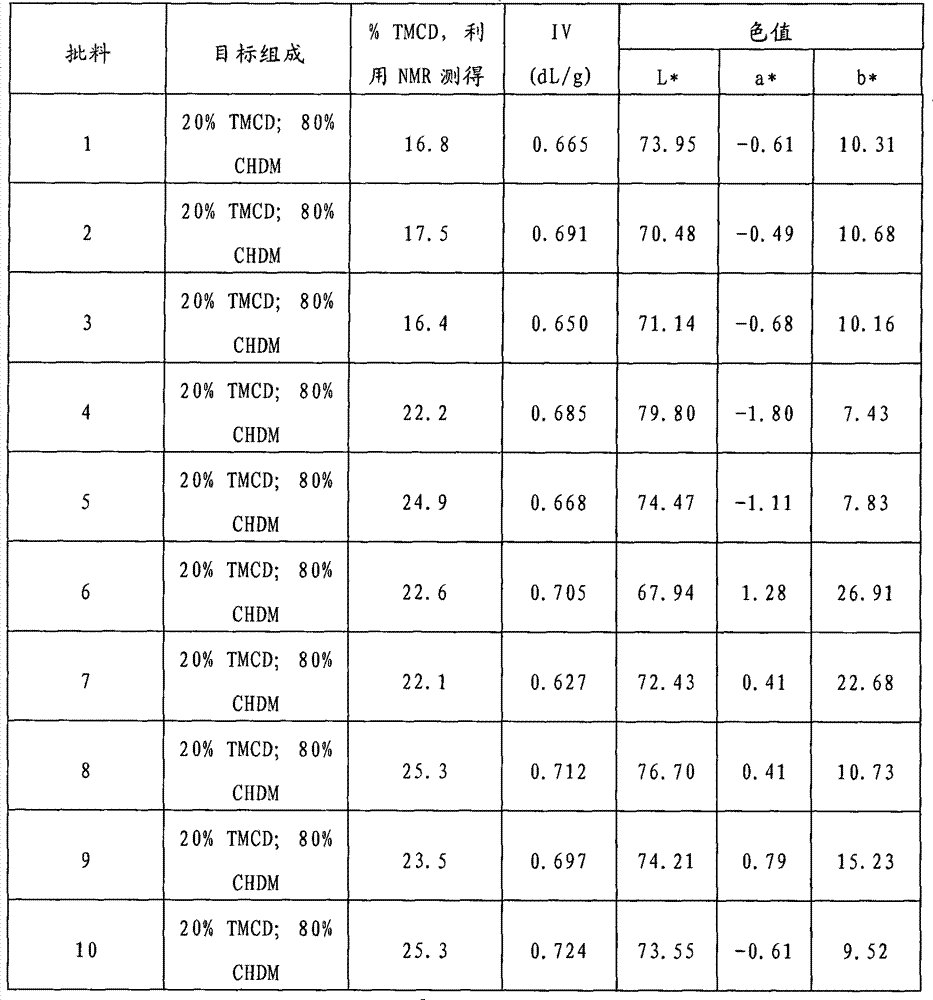
Sheet material (4 inches * 4 inches * 1/8 inch thickness) is from the polyester manufacture of table 18 in Toyo 110 injection press.Join the pellet of each polyester in the press and be heated to the temperature of report in the table 19.Molten polymer residence time in machine barrel before injection also is reported in the table 19.In case this part is cooling fully, and it is carried out visual analysis and is recorded in the splay mark that produces in the injection moulding process.
Data presentation in the table 19 influence that produces for splay mark in the injection moulding sheet material of being made by the polyester in the table 18 of injecting condition.
Table 19
Splay mark in the moulding part that the polyester of embodiment 29 is made produces
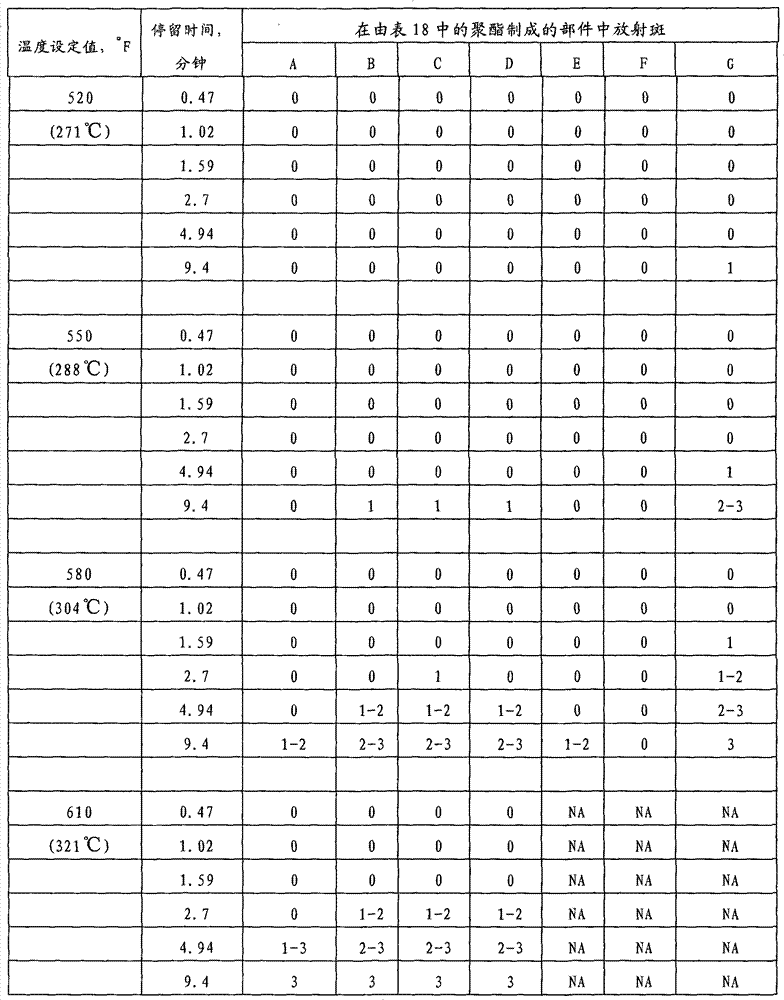
Splay mark grading: do not have (0) slight (1), medium (2), serious (3); NA=does not obtain
Data presentation in the table 20 quality of the film made by the polyester in the table 18.
Polymkeric substance is by using general spiro rod 1.5 " the Killion forcing machine extrudes.Polymkeric substance is extruded under the temperature of 572 ℉ (300 ℃) and 527 ℉ (275 ℃).Following forcing machine condition is used for each polymkeric substance extruding under 572 ℉:
| Sample | Zone temperatures | Die head temperature | The Die-head connecting sleeve temperature | The clamping ring temperature | Melt temperature | Pressure (PSI) | Screw speed (RPM) | Chill roll speed (RPM) |
| 1 | 572 | 572 | 572 | 572 | 612 | 1200 | 70 | 4.3 |
| 2 | 572 | 572 | 572 | 572 | 619 | 1450 | 35 | 2.2 |
| 3 | 572 | 572 | 572 | 572 | 618 | 2500 | 105 | 7.2 |
Following forcing machine condition is used for each polymkeric substance extruding under 527 ℉:
| Sample | Zone temperatures | Die head temperature | The Die-head connecting sleeve temperature | The clamping ring temperature | Melt temperature | Pressure (PSI) | Screw speed (RPM) | Chill roll speed (RPM) |
| 1 | 527 | 527 | 527 | 527 | 569 | 1600 | 70 | 4.2 |
| 2 | 527 | 527 | 527 | 527 | 565 | 900 | 35 | 2.3 |
| 3 | 527 | 527 | 527 | 527 | 571 | 2200 | 105 | 7.2 |
Table 20
The quality of the film that the polyester of embodiment 29 is made
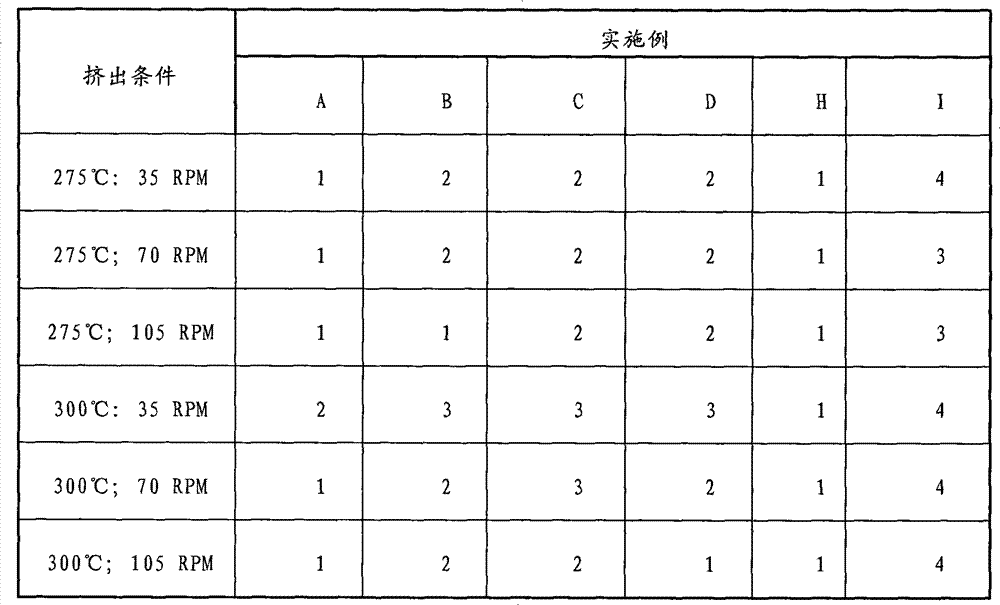
| The grading main points | Scoring |
| Good film quality; Do not observe the visible bubble when leaving die head or in melt material ridge: good film is difficult in and visually detects bubble. | 1 |
| Good film quality; The accidental bubble of observing when leaving die head; Bubble in film visually detects easily but is rare. | 2 |
| Medium film quality; See bubble when leaving die lip easily and in finished film clearly. | 3 |
| The film quality of non-constant; Tangible bubble in melt material ridge and when leaving die lip; The color of non-constant. | 4 |
The contrast of the data from above related work embodiment can be clear that, with regard to regard at least a in the middle of foaming in polyester manufacture and the system of processing, splay mark, color form, foam, emit gas and unsettled melt liquid level, polyester of the present invention is better than being purchased polyester.
The present invention at length is described with reference to disclosed embodiment here, but is understandable that within the spirit and scope of the present invention and can carries out changes and improvements.
Claims (1)
Applications Claiming Priority (69)
| Application Number | Priority Date | Filing Date | Title |
|---|---|---|---|
| US73145405P | 2005-10-28 | 2005-10-28 | |
| US73138905P | 2005-10-28 | 2005-10-28 | |
| US60/731,454 | 2005-10-28 | ||
| US60/731,389 | 2005-10-28 | ||
| US73886905P | 2005-11-22 | 2005-11-22 | |
| US73905805P | 2005-11-22 | 2005-11-22 | |
| US60/739,058 | 2005-11-22 | ||
| US60/738,869 | 2005-11-22 | ||
| US75069205P | 2005-12-15 | 2005-12-15 | |
| US75069305P | 2005-12-15 | 2005-12-15 | |
| US75054705P | 2005-12-15 | 2005-12-15 | |
| US75068205P | 2005-12-15 | 2005-12-15 | |
| US60/750,682 | 2005-12-15 | ||
| US60/750,693 | 2005-12-15 | ||
| US60/750,692 | 2005-12-15 | ||
| US60/750,547 | 2005-12-15 | ||
| US11/390,722 | 2006-03-28 | ||
| US11/390,858 | 2006-03-28 | ||
| US11/390,563 US7902320B2 (en) | 2005-06-17 | 2006-03-28 | Graphic art films comprising polyester compositions formed from 2,2,4,4-tetramethyl-1,3-cyclobutanediol and 1,4-cyclohexanedimethanol |
| US11/390,811 | 2006-03-28 | ||
| US11/391,137 | 2006-03-28 | ||
| US11/390,630 | 2006-03-28 | ||
| US11/390,908 | 2006-03-28 | ||
| US11/390,773 | 2006-03-28 | ||
| US60/786,571 | 2006-03-28 | ||
| US60/786,547 | 2006-03-28 | ||
| US11/390,671 | 2006-03-28 | ||
| US11/390,629 US7803439B2 (en) | 2005-06-17 | 2006-03-28 | Blood therapy containers comprising polyester compositions formed from 2,2,4,4-tetramethyl-1,3-cyclobutanediol and 1,4-cyclohexanedimethanol |
| US11/390,836 | 2006-03-28 | ||
| US11/391,571 | 2006-03-28 | ||
| US11/390,864 | 2006-03-28 | ||
| US11/390,672 | 2006-03-28 | ||
| US60/786,572 | 2006-03-28 | ||
| US11/391,576 | 2006-03-28 | ||
| US11/390,629 | 2006-03-28 | ||
| US11/390,846 | 2006-03-28 | ||
| US11/390,794 | 2006-03-28 | ||
| US11/390,883 | 2006-03-28 | ||
| US11/391,485 | 2006-03-28 | ||
| US11/390,853 | 2006-03-28 | ||
| US11/390,563 | 2006-03-28 | ||
| US11/390,655 | 2006-03-28 | ||
| US11/390,847 | 2006-03-28 | ||
| US11/391,565 | 2006-03-28 | ||
| US11/390,752 | 2006-03-28 | ||
| US11/390,809 | 2006-03-28 | ||
| US11/390,955 | 2006-03-28 | ||
| US11/390,793 | 2006-03-28 | ||
| US11/390,814 | 2006-03-28 | ||
| US11/390,812 | 2006-03-28 | ||
| US11/390,826 | 2006-03-28 | ||
| US11/391,063 | 2006-03-28 | ||
| US11/391,659 | 2006-03-28 | ||
| US11/390,882 | 2006-03-28 | ||
| US11/390,631 | 2006-03-28 | ||
| US11/390,865 | 2006-03-28 | ||
| US11/391,156 | 2006-03-28 | ||
| US11/391,495 | 2006-03-28 | ||
| US11/390,654 | 2006-03-28 | ||
| US60/786,598 | 2006-03-28 | ||
| US11/390,750 | 2006-03-28 | ||
| US11/391,125 | 2006-03-28 | ||
| US11/391,642 | 2006-03-28 | ||
| US11/390,827 | 2006-03-28 | ||
| US11/390,751 | 2006-03-28 | ||
| US11/391,124 | 2006-03-28 | ||
| US60/786,596 | 2006-03-28 | ||
| US11/391,505 | 2006-03-28 | ||
| PCT/US2006/041917 WO2007053434A1 (en) | 2005-10-28 | 2006-10-27 | Polyester compositions which comprise cyclobutanediol and certain thermal stabilizers, and/or reaction products thereof |
Publications (2)
| Publication Number | Publication Date |
|---|---|
| CN101296992A CN101296992A (en) | 2008-10-29 |
| CN101296992B true CN101296992B (en) | 2013-08-07 |
Family
ID=36691484
Family Applications (2)
| Application Number | Title | Priority Date | Filing Date |
|---|---|---|---|
| CN2006800401246A Active CN101296992B (en) | 2005-10-28 | 2006-10-27 | Polyester compositions containing cyclobutanediol and certain heat stabilizers and/or their reaction products |
| CN2006800404333A Active CN101300285B (en) | 2005-10-28 | 2006-10-27 | Polyester compositions containing cyclobutanediol having high glass transition temperature and articles made therefrom |
Family Applications After (1)
| Application Number | Title | Priority Date | Filing Date |
|---|---|---|---|
| CN2006800404333A Active CN101300285B (en) | 2005-10-28 | 2006-10-27 | Polyester compositions containing cyclobutanediol having high glass transition temperature and articles made therefrom |
Country Status (8)
| Country | Link |
|---|---|
| US (1) | US20070105993A1 (en) |
| EP (2) | EP1940909B1 (en) |
| JP (1) | JP2009513237A (en) |
| CN (2) | CN101296992B (en) |
| AT (1) | ATE444981T1 (en) |
| BR (2) | BRPI0617941A2 (en) |
| DE (1) | DE602006009691D1 (en) |
| WO (1) | WO2007050118A1 (en) |
Cited By (1)
| Publication number | Priority date | Publication date | Assignee | Title |
|---|---|---|---|---|
| US12037521B2 (en) | 2018-12-06 | 2024-07-16 | Eastman Chemical (China) Co., Ltd. | Adhesive compositions with polyesters comprising 2,2,4,4-tetraalkyl-1,3-cyclobutanediol and methods of making the same |
Families Citing this family (14)
| Publication number | Priority date | Publication date | Assignee | Title |
|---|---|---|---|---|
| US9598533B2 (en) | 2005-11-22 | 2017-03-21 | Eastman Chemical Company | Polyester compositions containing cyclobutanediol having a certain combination of inherent viscosity and moderate glass transition temperature and articles made therefrom |
| US9169388B2 (en) | 2006-03-28 | 2015-10-27 | Eastman Chemical Company | Polyester compositions which comprise cyclobutanediol and certain thermal stabilizers, and/or reaction products thereof |
| US7753518B2 (en) * | 2007-03-08 | 2010-07-13 | Okia Optical Co., Ltd | Eyeglasses and eyeglass frames comprising glycol modified copolyesters |
| WO2009012190A1 (en) * | 2007-07-15 | 2009-01-22 | Yin Wang | Wood-drying solar greenhouse |
| US9062197B2 (en) * | 2009-03-27 | 2015-06-23 | Eastman Chemical Company | Polyester blends |
| US8669314B2 (en) | 2012-02-03 | 2014-03-11 | Sabic Innovative Plastics Ip B.V. | Hydrolytic stability in polycarbonate compositions |
| US20130217830A1 (en) | 2012-02-16 | 2013-08-22 | Eastman Chemical Company | Clear Semi-Crystalline Articles with Improved Heat Resistance |
| US9273206B2 (en) | 2012-07-09 | 2016-03-01 | Eastman Chemical Company | Ternary blends of terephthalate or isophthalate polyesters containing EG, CHDM and TMCD |
| US11629224B2 (en) | 2017-07-20 | 2023-04-18 | Eastman Chemical Company | Polymer compositions comprising crystalline polymers and a stabilizer composition |
| CN111094421A (en) * | 2017-07-20 | 2020-05-01 | 伊士曼化工公司 | Polymer compositions with improved thermal stability, color and/or flow properties |
| CN107604379B (en) * | 2017-09-25 | 2024-11-08 | 典石科技(常州)有限公司 | A SPE membrane electrode and its preparation process |
| CN113316613A (en) | 2019-01-18 | 2021-08-27 | 伊士曼化工公司 | Polymer compositions with improved weatherability |
| CN114206979B (en) * | 2019-07-31 | 2023-10-24 | 伊士曼(中国)投资管理有限公司 | Polyester articles with improved hard coating |
| CN111100449A (en) * | 2019-12-03 | 2020-05-05 | 天津金发新材料有限公司 | Polyamide composition and preparation method thereof |
Citations (4)
| Publication number | Priority date | Publication date | Assignee | Title |
|---|---|---|---|---|
| US5705575A (en) * | 1995-05-31 | 1998-01-06 | Shell Oil Company | Copolyester composition |
| US5942585A (en) * | 1996-12-28 | 1999-08-24 | Eastman Chemical Company | Polycarbonate and polyester blends |
| US6011124A (en) * | 1996-12-28 | 2000-01-04 | Eastman Chemical Company | Blends of bisphenol a polycarbonate and polyesters |
| US6043322A (en) * | 1996-12-28 | 2000-03-28 | Eastman Chemical Company | Clear polycarbonate and polyester blends |
Family Cites Families (120)
| Publication number | Priority date | Publication date | Assignee | Title |
|---|---|---|---|---|
| BE592181A (en) * | 1955-12-22 | |||
| BE570531A (en) | 1957-08-22 | |||
| US3030335A (en) * | 1959-01-02 | 1962-04-17 | Gen Electric | Aromatic polycarbonate reaction products |
| FR1278284A (en) * | 1959-12-18 | 1961-12-08 | Kodak Pathe | New polymers derived from 2, 2, 4, 4-tetraalkyl-1, 3-cyclobutanediols and their industrial applications |
| FR83790E (en) * | 1959-12-18 | 1964-10-09 | Kodak Pathe | New polymers derived from 2, 2, 4, 4-tetraalkyl-1, 3-cyclobutanediols and their industrial applications |
| US3313777A (en) * | 1959-12-18 | 1967-04-11 | Eastman Kodak Co | Linear polyesters and polyester-amides from 2, 2, 4, 4-tetraalkyl-1, 3-cyclobutanediols |
| US3207814A (en) | 1961-01-03 | 1965-09-21 | Gen Electric | Carbonate-polyester copolymer resinous compositions |
| US3091600A (en) * | 1961-01-05 | 1963-05-28 | Eastman Kodak Co | Linear aromatic acid copolyesters modified with dimer glycols having 36 carbons |
| GB951818A (en) * | 1961-08-18 | 1964-03-11 | Kunoshima Kagaku Kogyo Kabushi | Polyester moulding materials |
| US3317466A (en) * | 1961-09-14 | 1967-05-02 | Eastman Kodak Co | Three-dimensional polycyclic bisphenol polycarbonates and polyesters |
| US3544514A (en) * | 1965-01-15 | 1970-12-01 | Bayer Ag | Process for the production of thermoplastic polycarbonates |
| US3541059A (en) * | 1967-04-19 | 1970-11-17 | Calgon C0Rp | Novel reaction products of glycidyl esters and alkali metal sulfite or bisulfite,and polymers thereof |
| US3502620A (en) * | 1967-05-11 | 1970-03-24 | Eastman Kodak Co | Branched polyesters containing terminal carboxyl groups |
| US3546177A (en) * | 1968-03-07 | 1970-12-08 | Eastman Kodak Co | Polyesters containing sterically hindered trialkyl phosphates |
| UST873016I4 (en) * | 1969-11-28 | 1970-04-28 | Defensive publication | |
| BE794938A (en) | 1972-02-02 | 1973-08-02 | Eastman Kodak Co | NEW PROCESS FOR PREPARING COPOLYESTERS AND APPLICATIONS |
| US3915913A (en) * | 1972-08-15 | 1975-10-28 | Eastman Kodak Co | Hot melt polymer blends |
| US3799953A (en) * | 1972-09-01 | 1974-03-26 | Bayer Ag | 1,4-bis(4,'4''-dihydroxy-triphenylmethyl)benzene |
| US3907754A (en) * | 1974-06-19 | 1975-09-23 | Eastman Kodak Co | Process and catalyst-inhibitor system for preparing synthetic linear polyester |
| US4056504A (en) * | 1974-08-16 | 1977-11-01 | Bayer Aktiengesellschaft | Polycarbonate molding compositions |
| US3962189A (en) * | 1974-11-01 | 1976-06-08 | Eastman Kodak Company | Process and catalyst-inhibitor systems for preparing synthetic linear polyesters |
| US4185009A (en) * | 1975-01-03 | 1980-01-22 | Bayer Aktiengesellschaft | Branched, high-molecular weight thermoplastic polycarbonates |
| US4001184A (en) * | 1975-03-31 | 1977-01-04 | General Electric Company | Process for preparing a branched polycarbonate |
| US4010145A (en) * | 1975-05-12 | 1977-03-01 | Eastman Kodak Company | Process and catalyst inhibitor systems for preparing synthetic linear polyesters |
| US4046933A (en) * | 1975-09-16 | 1977-09-06 | Ppg Industries, Inc. | Laminated window structure and its method of fabrication |
| US4156069A (en) | 1976-04-02 | 1979-05-22 | Allied Chemical Corporation | Bisphenol-A/terephthalate/carbonate melt processable copolymers |
| US4084889A (en) * | 1976-07-28 | 1978-04-18 | Vischer Optics, Inc. | Eyeglass frame |
| US4391954A (en) * | 1976-12-14 | 1983-07-05 | General Electric Company | Thermoplastic molding composition |
| US4125572A (en) * | 1976-12-14 | 1978-11-14 | General Electric Company | Thermoplastic molding composition |
| US4188314A (en) * | 1976-12-14 | 1980-02-12 | General Electric Company | Shaped article obtained from a carbonate-polyester composition |
| DE2842004A1 (en) * | 1978-09-27 | 1980-04-10 | Bayer Ag | METHOD FOR PRODUCING MODIFIED POLYCARBONATE MOLDS |
| US4194038A (en) | 1979-01-25 | 1980-03-18 | Allied Chemical Corporation | Poly(ester-carbonates) from dicarboxylic acid chlorides |
| EP0078609B1 (en) * | 1980-04-30 | 1987-05-06 | Imperial Chemical Industries Plc | 3-hydroxybutyric acid polymers |
| US4430484A (en) | 1981-01-14 | 1984-02-07 | General Electric Company | Polyester-carbonate resin blends |
| US4356299A (en) * | 1982-02-04 | 1982-10-26 | Rohm And Haas Company | Catalyst system for a polyethylene terephthalate polycondensation |
| US4384106A (en) * | 1982-03-09 | 1983-05-17 | Owens-Illinois, Inc. | Copolyesters |
| US4424140A (en) * | 1982-06-03 | 1984-01-03 | Union Carbide Corporation | Stabilization of polycondensation catalysts |
| US4431793A (en) * | 1982-06-09 | 1984-02-14 | General Electric Company | Aromatic polycarbonate end capped with branched chain alkyl acyl halide or acid |
| US4786692A (en) * | 1982-12-20 | 1988-11-22 | General Electric Company | High strength, reduced heat distortion temperature thermoplastic composition |
| US4469861A (en) * | 1982-12-27 | 1984-09-04 | General Electric Company | Polycarbonate composition from branched chain dihydric phenol |
| US4465820A (en) | 1983-06-03 | 1984-08-14 | General Electric Company | Copolyestercarbonates |
| US4452933A (en) | 1983-06-09 | 1984-06-05 | General Electric Company | Stabilized polyester-polycarbonate blends and stabilization process therefor |
| US4426512A (en) * | 1983-06-09 | 1984-01-17 | Eastman Kodak Company | Polyester containers having improved gas barrier properties |
| US4480086A (en) * | 1983-09-09 | 1984-10-30 | Eastman Kodak Company | Radiation-resistant copolyesters |
| US4939186A (en) * | 1984-02-10 | 1990-07-03 | General Electric Company | Enhancing color stability to sterilizing radiation of polymer compositions |
| US4587437A (en) * | 1984-03-19 | 1986-05-06 | Rockwell International Corporation | Coupling/decoupling capacitor multiplier |
| AU603076B2 (en) * | 1985-12-09 | 1990-11-08 | W.R. Grace & Co.-Conn. | Polymeric products and their manufacture |
| JPH0741907B2 (en) * | 1986-12-27 | 1995-05-10 | 三菱瓦斯化学株式会社 | Multi-layer container |
| SE8702840D0 (en) * | 1987-07-10 | 1987-07-10 | Plm Ab | BARRIERFORSTERKNING |
| US4749773A (en) * | 1987-07-27 | 1988-06-07 | Eastman Kodak Company | Condensation polymers containing methine ultraviolet radiation-absorbing residues and shaped articles produced therefrom |
| JP2608429B2 (en) * | 1987-11-09 | 1997-05-07 | 東レ・ダウコーニング・シリコーン株式会社 | Pattern forming material and pattern forming method |
| US4882412A (en) * | 1987-11-30 | 1989-11-21 | Eastman Kodak Company | Polyester polymer containing the residue of the UV absorbing benzopyran compound and shaped articles produced therefrom |
| US4981898A (en) | 1987-12-31 | 1991-01-01 | General Electric Company | Polycarbonate-polyester blends |
| US4826903A (en) * | 1988-02-22 | 1989-05-02 | Eastman Kodak Company | Condensation polymer containing the residue of an acyloxystyrl compound and shaped articles produced therefrom |
| US4892923A (en) * | 1988-02-22 | 1990-01-09 | Eastman Kodak Company | Polyester compositions containing the residue of a naphthopyran compound and shaped articles produced therefrom |
| US4976057A (en) * | 1988-07-21 | 1990-12-11 | Bianchi Dennis R | Simulated neon sign |
| US4845188A (en) * | 1988-08-19 | 1989-07-04 | Eastman Kodak Company | Condensation polymers containing methine ultraviolet radiation-absorbing residues and shaped articles produced therefrom |
| US4937134A (en) * | 1989-04-17 | 1990-06-26 | The Dow Chemical Company | Elastomeric optical interference films |
| US5326584A (en) * | 1989-04-24 | 1994-07-05 | Drexel University | Biocompatible, surface modified materials and method of making the same |
| US5191038A (en) * | 1989-06-01 | 1993-03-02 | General Electric Company | Preparation of branched polycarbonate composition from cyclic aromatic polycarbonate oligomer, polyhydric phenol and polycarbonate |
| US5224958A (en) * | 1990-05-04 | 1993-07-06 | The Research Foundation Of State University Of New York | Silicone elastomer line prosthetic devices and methods of manufacture |
| US5017680A (en) * | 1990-07-03 | 1991-05-21 | Eastman Kodak Company | Process and catalyst-inhibitor systems for preparing poly(ethylene terephthalate) |
| US5486562A (en) * | 1990-07-12 | 1996-01-23 | General Electric Company | Modifications of poly(alkylene cyclohexanedicarboxylate) blends |
| AU649710B2 (en) * | 1990-09-11 | 1994-06-02 | Mitsubishi Gas Chemical Company, Inc. | Polyamide resin composition and film therefrom |
| US5104450A (en) * | 1990-09-26 | 1992-04-14 | Eastman Kodak Company | Formulations of cellulose esters with arylene-bis(diaryl phosphate)s |
| US5219510A (en) * | 1990-09-26 | 1993-06-15 | Eastman Kodak Company | Method of manufacture of cellulose ester film |
| DE4036359A1 (en) * | 1990-11-15 | 1992-05-21 | Hoechst Ag | METHOD FOR PREVENTING THE PROCESSING OF A PLASTIC MOLD AT THE PROCESSING TEMPERATURE |
| US5292783A (en) * | 1990-11-30 | 1994-03-08 | Eastman Kodak Company | Aliphatic-aromatic copolyesters and cellulose ester/polymer blends |
| US5118760A (en) * | 1990-12-26 | 1992-06-02 | Eastman Kodak Company | Impact resistant polymer blends |
| US5142088A (en) * | 1991-01-28 | 1992-08-25 | General Electric Company | Preparation of branched polycarbonates and chloroformates, and intermediates therefor |
| US5434227A (en) * | 1991-05-08 | 1995-07-18 | Daicel Chemical Industries, Ltd. | Process for producing polycarbonate |
| US5310787A (en) * | 1991-06-04 | 1994-05-10 | Du Pont-Mitsui Polychemicals Co., Ltd. | Polyester packaging material |
| EP0535930B1 (en) * | 1991-10-04 | 1997-01-02 | Oki Electric Industry Co., Ltd. | Thermoreversible recording material, thermoreversible recording medium and recording method |
| JP2797804B2 (en) * | 1992-01-09 | 1998-09-17 | 日本電気株式会社 | Backlight and liquid crystal display |
| JPH05247325A (en) * | 1992-02-27 | 1993-09-24 | Toray Ind Inc | Polyester resin composition for heat-resistant tableware |
| US5207967A (en) * | 1992-03-02 | 1993-05-04 | Eastman Kodak Company | Multicomponent polyester/polycarbonate blends with improved impact strength and processability |
| US5288764A (en) * | 1993-01-29 | 1994-02-22 | Amoco Corporation | Increased throughput in foaming and other melt fabrication of polyester |
| US5494992A (en) * | 1993-01-29 | 1996-02-27 | Daicel Chemical Industries, Ltd. | (Co)polycarbonate and process for producing the same |
| US5372879A (en) * | 1993-02-22 | 1994-12-13 | Teijin Limited | Biaxially oriented polyester film |
| CN1099044A (en) * | 1993-04-16 | 1995-02-22 | 大世吕化学工业株式会社 | The preparation method of (being total to) polycarbonate |
| US5372864A (en) * | 1993-09-03 | 1994-12-13 | Eastman Chemical Company | Toners for polyesters |
| IL110514A0 (en) | 1993-10-04 | 1994-10-21 | Eastman Chem Co | Concentrates for improving polyester compositions and a method for preparing such compositions |
| US5354791A (en) * | 1993-10-19 | 1994-10-11 | General Electric Company | Epoxy-functional polyester, polycarbonate with metal phosphate |
| DE69529032T2 (en) * | 1994-08-25 | 2003-05-08 | Kyodo Printing Co., Ltd. | Copolyester resin, polymer mixture and packaging material made of it |
| US5498668A (en) * | 1994-10-31 | 1996-03-12 | Eastman Chemical Company | Blends of certain polyesters with acrylics |
| US5696176A (en) | 1995-09-22 | 1997-12-09 | Eastman Chemical Company | Foamable polyester compositions having a low level of unreacted branching agent |
| US5608031A (en) * | 1995-11-30 | 1997-03-04 | Eastman Chemical Company | Polyesters modified with 1,4-cyclohexaned imethanol having high clarity prepared utilizing an antimony containing catalyst/stabilizer system |
| TW381104B (en) * | 1996-02-20 | 2000-02-01 | Eastman Chem Co | Process for preparing copolyesters of terephthalic acid, ethylene glycol, and 1,4-cyclohexanedimethanol |
| JP3745776B2 (en) * | 1996-04-05 | 2006-02-15 | 帝人株式会社 | Ethylene terephthalate / ethylene-2,6-naphthalenedicarboxylate copolymer for bottles |
| DE19620420A1 (en) * | 1996-05-21 | 1997-11-27 | Basf Ag | High-performance plastic cutlery, especially chopsticks |
| US5977347A (en) * | 1996-07-30 | 1999-11-02 | Daicel Chemical Industries, Ltd. | Cellulose acetate propionate |
| JPH1046021A (en) * | 1996-08-07 | 1998-02-17 | Nippon G Ii Plast Kk | Tableware excellent in detergent resistance |
| US5989663A (en) * | 1996-12-30 | 1999-11-23 | Eastman Chemical Company | Blow-molding polyesters from terephthalic acid, 2, 2, 4, 4-tetramethyl-1,3-cyclobutanediol, and ethylene glycol |
| DE19727709A1 (en) * | 1997-06-30 | 1999-01-07 | Bayer Ag | Process for the production of branched polycarbonates |
| FR2766964B1 (en) * | 1997-07-29 | 1999-10-29 | Pixtech Sa | METHOD FOR VACUUM ASSEMBLY OF A FLAT VISUALIZATION SCREEN |
| US5907026A (en) * | 1997-08-27 | 1999-05-25 | General Electric Company | Polycarbonate compositions comprising polyester resins and ultraviolet light absorbers |
| JP3445151B2 (en) * | 1998-05-28 | 2003-09-08 | 帝人株式会社 | Tableware |
| AR017749A1 (en) * | 1998-06-15 | 2001-10-24 | Eastman Chem Co | STRUCTURE OF MULTIPLE STRATES |
| US5962625A (en) * | 1998-06-24 | 1999-10-05 | Eastman Chemical Company | High clarity polyester containing sub-visual antimony phosphate derivatives particles |
| US6211309B1 (en) * | 1998-06-29 | 2001-04-03 | Basf Corporation | Water-dispersable materials |
| US6120889A (en) * | 1999-06-03 | 2000-09-19 | Eastman Chemical Company | Low melt viscosity amorphous copolyesters with enhanced glass transition temperatures |
| US7176252B2 (en) * | 1999-07-29 | 2007-02-13 | Dover Chemical Corporation | Solid melt blended phosphite composites |
| US6352783B1 (en) * | 1999-12-13 | 2002-03-05 | Eastman Kodak Company | Copolyester containing 4,4'-biphenyldicarboxylic acid, 1,4-cyclohexanedimethanol and an ultraviolet light absorbing compound and articles made therefrom |
| US6225436B1 (en) * | 2000-04-07 | 2001-05-01 | The Dow Chemical Company | Polycarbonate preparation process |
| US6593425B2 (en) * | 2000-05-31 | 2003-07-15 | General Electric Company | Data storage media containing transparent polycarbonate blends |
| US6458915B1 (en) * | 2000-10-13 | 2002-10-01 | Eastman Chemical Company | Process for producing poly(1,4-cyclohexylenedimethylene 1,4-cyclohexanedicarboxylate) and the reactor grade polyester therefrom |
| US6448334B1 (en) * | 2000-12-19 | 2002-09-10 | General Electric Company | Translucent polycarbonate composition, method for preparation thereof, and articles derived therefrom |
| US6635698B2 (en) * | 2000-12-22 | 2003-10-21 | General Electric Company | Flame retardant polycarbonate polyester composition |
| US6323304B1 (en) * | 2001-01-12 | 2001-11-27 | General Electric Company | Melt polycarbonate catalyst systems |
| SE523615C2 (en) * | 2001-10-25 | 2004-05-04 | Sandvik Ab | Rotary tool for chip separating machining with coupling device with conical support surfaces |
| US6504002B1 (en) * | 2001-12-21 | 2003-01-07 | General Electric Company | Process for the production of branched melt polycarbonate by late addition of fries-inducing catalyst |
| US20030195295A1 (en) * | 2002-04-16 | 2003-10-16 | General Electric Company | Miscible blends of polyesters and polycarbonates with good thermal characteristics, and related processes and articles |
| EP1557439B1 (en) * | 2002-10-31 | 2008-04-30 | Mitsubishi Chemical Corporation | Polyester resin, polyester resin composition, sheet or film obtained therefrom and hollow molded container |
| KR101050982B1 (en) * | 2003-06-17 | 2011-07-21 | 테이진 카세이 가부시키가이샤 | Direct Backlit Liquid Crystal Display and Light Diffusion Plate |
| US20050010017A1 (en) * | 2003-07-11 | 2005-01-13 | Blakely Dale Milton | Addition of UV inhibitors to pet process for maximum yield |
| US7235623B2 (en) * | 2003-11-26 | 2007-06-26 | Eastman Chemical Company | Polyester compositions for calendering |
| US20060094858A1 (en) * | 2004-10-28 | 2006-05-04 | Turner Sam R | Novel copolyester compositions with improved impact strength at low temperatures |
| US7582690B2 (en) * | 2004-11-19 | 2009-09-01 | Eastman Chemical Company | Stabilized aliphatic polyester compositions |
| US20060270773A1 (en) * | 2005-05-26 | 2006-11-30 | Hale Wesley R | Polyester-polycarbonate blends for diffuser sheets with improved luminance |
| US20060270806A1 (en) * | 2005-05-26 | 2006-11-30 | Hale Wesley R | Miscible high Tg polyester/polymer blend compositions and films formed therefrom |
-
2006
- 2006-03-30 EP EP06749318A patent/EP1940909B1/en not_active Not-in-force
- 2006-03-30 JP JP2008537683A patent/JP2009513237A/en active Pending
- 2006-03-30 AT AT06749318T patent/ATE444981T1/en not_active IP Right Cessation
- 2006-03-30 WO PCT/US2006/012627 patent/WO2007050118A1/en not_active Ceased
- 2006-03-30 DE DE602006009691T patent/DE602006009691D1/en active Active
- 2006-03-30 EP EP09012590A patent/EP2156935A3/en not_active Ceased
- 2006-10-27 BR BRPI0617941-0A patent/BRPI0617941A2/en not_active IP Right Cessation
- 2006-10-27 CN CN2006800401246A patent/CN101296992B/en active Active
- 2006-10-27 BR BRPI0617940-1A patent/BRPI0617940A2/en not_active IP Right Cessation
- 2006-10-27 US US11/588,883 patent/US20070105993A1/en not_active Abandoned
- 2006-10-27 CN CN2006800404333A patent/CN101300285B/en active Active
Patent Citations (4)
| Publication number | Priority date | Publication date | Assignee | Title |
|---|---|---|---|---|
| US5705575A (en) * | 1995-05-31 | 1998-01-06 | Shell Oil Company | Copolyester composition |
| US5942585A (en) * | 1996-12-28 | 1999-08-24 | Eastman Chemical Company | Polycarbonate and polyester blends |
| US6011124A (en) * | 1996-12-28 | 2000-01-04 | Eastman Chemical Company | Blends of bisphenol a polycarbonate and polyesters |
| US6043322A (en) * | 1996-12-28 | 2000-03-28 | Eastman Chemical Company | Clear polycarbonate and polyester blends |
Cited By (3)
| Publication number | Priority date | Publication date | Assignee | Title |
|---|---|---|---|---|
| US12037521B2 (en) | 2018-12-06 | 2024-07-16 | Eastman Chemical (China) Co., Ltd. | Adhesive compositions with polyesters comprising 2,2,4,4-tetraalkyl-1,3-cyclobutanediol and methods of making the same |
| US12065592B2 (en) | 2018-12-06 | 2024-08-20 | Eastman Chemical (China) Co., Ltd. | Adhesive compositions with polyesters comprising 2,2,4,4-tetraalkyl-1,3-cyclobutanediol |
| US12359106B2 (en) | 2018-12-06 | 2025-07-15 | Eastman Chemical (China) Co., Ltd. | Adhesive compositions including 1,4-cyclohexanedimethanol and methods of making the same |
Also Published As
| Publication number | Publication date |
|---|---|
| EP1940909B1 (en) | 2009-10-07 |
| US20070105993A1 (en) | 2007-05-10 |
| BRPI0617940A2 (en) | 2010-03-30 |
| JP2009513237A (en) | 2009-04-02 |
| WO2007050118A1 (en) | 2007-05-03 |
| ATE444981T1 (en) | 2009-10-15 |
| EP2156935A3 (en) | 2010-07-28 |
| EP2156935A2 (en) | 2010-02-24 |
| CN101300285A (en) | 2008-11-05 |
| EP1940909A1 (en) | 2008-07-09 |
| DE602006009691D1 (en) | 2009-11-19 |
| BRPI0617941A2 (en) | 2010-03-30 |
| CN101296992A (en) | 2008-10-29 |
| CN101300285B (en) | 2012-11-21 |
Similar Documents
| Publication | Publication Date | Title |
|---|---|---|
| JP6325991B2 (en) | Polyester composition comprising cyclobutanediol and certain heat stabilizers and / or reaction products thereof | |
| US8507638B2 (en) | Polyester compositions containing cyclobutanediol having a certain combination of inherent viscosity and moderate glass transition temperature and articles made therefrom | |
| US20070106054A1 (en) | Polyester compositions containing cyclobutanediol having a certain combination of inherent viscosity and high glass transition temperature and articles made therefrom | |
| CN101296992B (en) | Polyester compositions containing cyclobutanediol and certain heat stabilizers and/or their reaction products | |
| US9765203B2 (en) | Polyester compositions which comprise cyclobutanediol and certain thermal stabilizers, and/or reaction products thereof | |
| US10017606B2 (en) | Polyester compositions containing cyclobutanediol having a certain combination of inherent viscosity and moderate glass transition temperature and articles made therefrom | |
| US20100298523A1 (en) | Polyester Compositions Which Comprise Cyclobutanediol and at Least One Phosphorus Compound | |
| US20100184940A1 (en) | Polyester Compositions Which Comprise Cyclobutanediol and Certain Thermal Stabilizers, and/or Reaction Products Thereof | |
| US8193302B2 (en) | Polyester compositions which comprise cyclobutanediol and certain phosphate thermal stabilizers, and/or reaction products thereof | |
| WO2007123631A1 (en) | Polyester compositions which comprise cyclobutanediol and at least one phosphorus compound | |
| CN101346427A (en) | Polyester compositions containing cyclobutanediol and at least one phosphorus compound | |
| EP2333001B1 (en) | Compositions of polyesters with a high glass transition temperature which comprise 2,2,4,4-tetramethyl-1,3-cyclobutanediol and certain thermal stabilizers and articles thereof | |
| CN101646711A (en) | Polyester compositions |
Legal Events
| Date | Code | Title | Description |
|---|---|---|---|
| C06 | Publication | ||
| PB01 | Publication | ||
| C10 | Entry into substantive examination | ||
| SE01 | Entry into force of request for substantive examination | ||
| C14 | Grant of patent or utility model | ||
| GR01 | Patent grant |