CN101287739B - Novel fluorine-containing spiroacetal compound and method of producing the same - Google Patents
Novel fluorine-containing spiroacetal compound and method of producing the same Download PDFInfo
- Publication number
- CN101287739B CN101287739B CN2006800380184A CN200680038018A CN101287739B CN 101287739 B CN101287739 B CN 101287739B CN 2006800380184 A CN2006800380184 A CN 2006800380184A CN 200680038018 A CN200680038018 A CN 200680038018A CN 101287739 B CN101287739 B CN 101287739B
- Authority
- CN
- China
- Prior art keywords
- perfluor
- compound
- formula
- fluorine
- expression
- Prior art date
- Legal status (The legal status is an assumption and is not a legal conclusion. Google has not performed a legal analysis and makes no representation as to the accuracy of the status listed.)
- Expired - Fee Related
Links
- 0 *=C(C1(C(O*O2)=*)C2=*)O*OC1=* Chemical compound *=C(C1(C(O*O2)=*)C2=*)O*OC1=* 0.000 description 11
Classifications
-
- C—CHEMISTRY; METALLURGY
- C07—ORGANIC CHEMISTRY
- C07D—HETEROCYCLIC COMPOUNDS
- C07D493/00—Heterocyclic compounds containing oxygen atoms as the only ring hetero atoms in the condensed system
- C07D493/02—Heterocyclic compounds containing oxygen atoms as the only ring hetero atoms in the condensed system in which the condensed system contains two hetero rings
- C07D493/10—Spiro-condensed systems
Landscapes
- Chemical & Material Sciences (AREA)
- Organic Chemistry (AREA)
- Organic Low-Molecular-Weight Compounds And Preparation Thereof (AREA)
Abstract
一种由以下式(A)表示的含氟螺缩醛化合物:其中X表示>C(CF3)(Y)或>C=CF2,其中Y表示-CF2OCOR1、-COOR2、-COF或-CH2OR3,R1表示含有至少一个氟原子的烷基或环烷基,R2表示氢原子、碱金属、碱土金属、烷基或环烷基,并且R3表示氢原子或酰基;其中R1的烷基或环烷基可以具有除氟原子以外的取代基,R2的烷基或环烷基可以具有取代基;并且R3的酰基可以具有取代基。A fluorinated spiroacetal compound represented by the following formula (A): Where X represents >C( CF3 )(Y) or >C= CF2 , where Y represents -CF2OCOR1 , -COOR2 , -COF or -CH2OR3 , R1 represents an alkyl or cycloalkyl group containing at least one fluorine atom, R2 represents a hydrogen atom, alkali metal, alkaline earth metal, alkyl or cycloalkyl group, and R3 represents a hydrogen atom or acyl group; wherein the alkyl or cycloalkyl group of R1 may have substituents other than fluorine atoms, the alkyl or cycloalkyl group of R2 may have substituents; and the acyl group of R3 may have substituents.
Description
技术领域technical field
本发明涉及一种双官能含氟螺缩醛化合物,该化合物可以用作含氟聚合物的原料单体,所述含氟聚合物具有例如耐化学性、耐气候性、疏水/疏油性、低的分子间作用、低折射率以及高透射率的特性。本发明同样提供了一种制备该化合物的方法。 The present invention relates to a bifunctional fluorine-containing spiroacetal compound that can be used as a raw material monomer for fluoropolymers having, for example, chemical resistance, weather resistance, hydrophobicity/oleophobicity, low The intermolecular interaction, low refractive index and high transmittance characteristics. The present invention also provides a method for preparing the compound. the
背景技术Background technique
已知双官能酯化合物、酰卤、以及醇化合物可以用作制备缩合聚合物的单体组分。近期,人们将注意力集中在氟化合物特性上,例如耐化学性、耐气候性、疏水/疏油性、低的分子间作用、低折射率以及高透射率,因此,极大地促进了含氟聚合物的发展。 It is known that difunctional ester compounds, acid halides, and alcohol compounds can be used as monomer components for the preparation of condensation polymers. Recently, attention has been focused on fluorochemical properties such as chemical resistance, weather resistance, hydrophobic/oleophobic properties, low intermolecular interactions, low refractive index, and high transmittance, thus greatly promoting fluoropolymerization. development of things. the
例如,在WO03/099907 A1及其所引用的参考文献中表述了用于光学波导管的缩聚型含氟聚合物实例。同样,在WO03/037838 A1、JP-A-5-70522(“JP-A”是指未审查的公开的日本专利申请)、以及其中所引用的参考文献中,描述了可以用于光学材料(例如光学纤维)的通过含氟ω-烯基乙烯基醚的环化聚合而获得的聚合物。此外,众所周知,如美国专利Nos.3,978,030和4,399,264所述的全氟间二氧杂环戊烯(perfluorodioxol)化合物的均聚物以及该全氟间二氧杂环戊烯化合物和四氟乙烯等的共聚物形成无定形聚合物,并且这些物质可以用于相同的用途。 Examples of condensation-type fluoropolymers for optical waveguides are described, for example, in WO 03/099907 A1 and references cited therein. Also, in WO03/037838 A1, JP-A-5-70522 ("JP-A" refers to unexamined published Japanese patent application), and references cited therein, it is described that can be used in optical materials ( Such as optical fibers) polymers obtained by cyclopolymerization of fluorine-containing ω-alkenyl vinyl ethers. In addition, homopolymers of perfluorodioxol compounds as described in U.S. Patent Nos. 3,978,030 and 4,399,264 and combinations of the perfluorodioxol compounds with tetrafluoroethylene and the like are well known. Copolymers form amorphous polymers, and these can be used for the same purpose. the
另一方面,例如,在WO02/004397中,描述了含氟双官能化合物及其制备方法。 On the other hand, for example, in WO02/004397, fluorine-containing bifunctional compounds and methods for their preparation are described. the
然而,上述参考文献中均没有描述本发明的含氟螺缩醛化合物及其制备方法。 However, none of the above references describes the fluorine-containing spiroacetal compound of the present invention and the preparation method thereof. the
发明内容Contents of the invention
本发明的发明人研究了常规聚合物的结构和性能,发现在聚合物主链 中引入环状结构和醚键可以赋予聚合物某些性能,例如为无定形以及高的玻璃化转变温度(Tg)。经过进一步的研究,本发明的发明人实现了在其环状结构部分中具有醚键(缩醛键)的螺环化合物的开发。 The inventors of the present invention have studied the structure and performance of conventional polymers, and found that introducing ring structures and ether linkages in the polymer backbone can give polymers certain properties, such as being amorphous and high glass transition temperature (Tg ). After further studies, the inventors of the present invention achieved the development of a spiro compound having an ether bond (acetal bond) in its cyclic structural part. the
本发明提供了: The present invention provides:
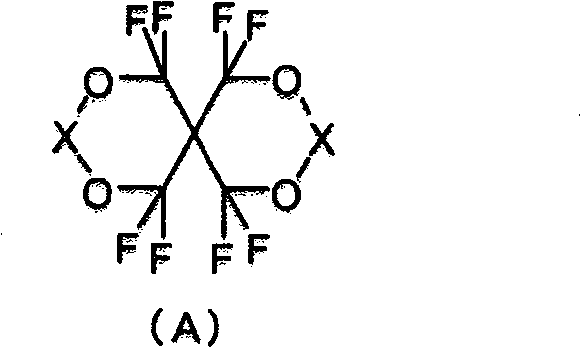
(1)由以下式(A)表示的含氟螺缩醛化合物: (1) Fluorine-containing spiroacetal compounds represented by the following formula (A):
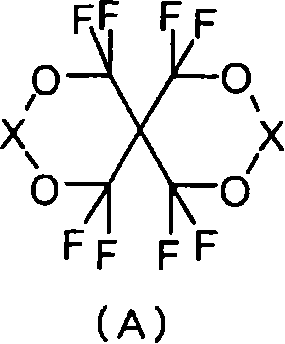
其中X表示>C(CF3)(Y)或>C=CF2,其中Y表示-CF2OCOR1、-COOR2、-COF或-CH2OR3,R1表示含有至少一个氟原子的烷基或环烷基,R2表示氢原子、碱金属、碱土金属、烷基或环烷基,并且R3表示氢原子或酰基;其中R1的烷基或环烷基可以具有除氟原子以外的取代基;R2的烷基或环烷基可以具有取代基;并且R3的酰基可以具有取代基。 wherein X represents >C(CF 3 )(Y) or >C=CF 2 , wherein Y represents -CF 2 OCOR 1 , -COOR 2 , -COF or -CH 2 OR 3 , and R 1 represents a compound containing at least one fluorine atom Alkyl or cycloalkyl, R 2 represents a hydrogen atom, alkali metal, alkaline earth metal, alkyl or cycloalkyl, and R 3 represents a hydrogen atom or an acyl group; wherein the alkyl or cycloalkyl of R 1 can have a fluorine atom Other substituents; R 2 alkyl or cycloalkyl may have a substituent; and R 3 acyl may have a substituent.
(2)如(1)中所述的含氟螺缩醛化合物,其中由式(A)表示的化合物是由以下式(I)、(II)、(III)、以及(IV)中任意一个所表示的化合物: (2) The fluorine-containing spiroacetal compound as described in (1), wherein the compound represented by the formula (A) is any one of the following formulas (I), (II), (III), and (IV) Represented compound:

其中R1表示具有至少一个氟原子的烷基或环烷基,R2表示氢原子、碱金属、碱土金属、烷基或环烷基,其中R1的烷基或环烷基可以具有除氟原 子以外的取代基,并且R2的烷基或环烷基可以具有取代基。 Wherein R 1 represents an alkyl or cycloalkyl group with at least one fluorine atom, R 2 represents a hydrogen atom, an alkali metal, an alkaline earth metal, an alkyl group or a cycloalkyl group, wherein the alkyl group or cycloalkyl group of R 1 may have the ability to remove fluorine A substituent other than an atom, and the alkyl or cycloalkyl group of R 2 may have a substituent.
(3)如(1)或(2)中所述的含氟螺缩醛化合物,其中R1表示全氟烷基。 (3) The fluorine-containing spiroacetal compound as described in (1) or (2), wherein R 1 represents a perfluoroalkyl group.
(4)如(1)或(2)中所述的含氟螺缩醛化合物,其中,在式(A)中,R3表示氢原子或-COC(R4)=CH2,其中R4表示氢原子、氟原子、甲基或三氟甲基。 (4) The fluorine-containing spiroacetal compound as described in (1) or (2), wherein, in formula (A), R 3 represents a hydrogen atom or -COC(R 4 )=CH 2 , wherein R 4 represents a hydrogen atom, a fluorine atom, a methyl group or a trifluoromethyl group.
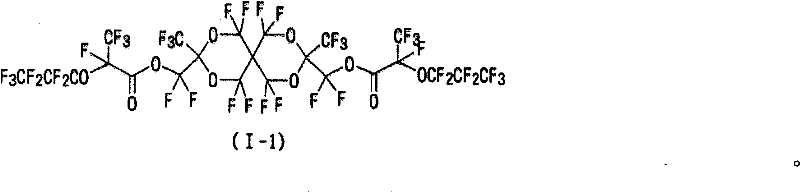
(5)由式(I-1)表示的全氟酯化合物。 (5) A perfluoroester compound represented by formula (I-1). the

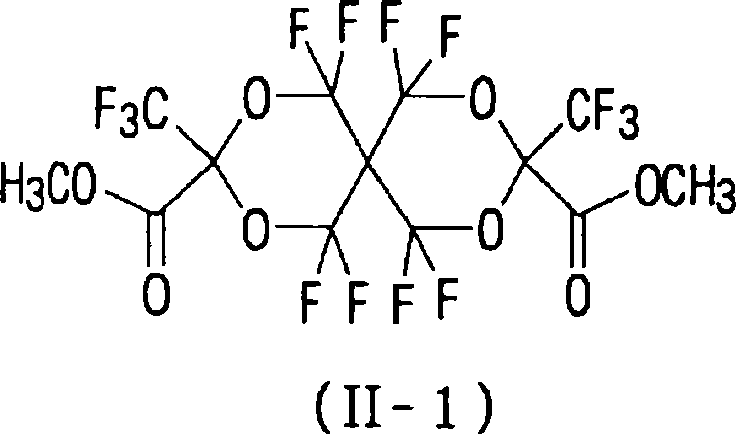
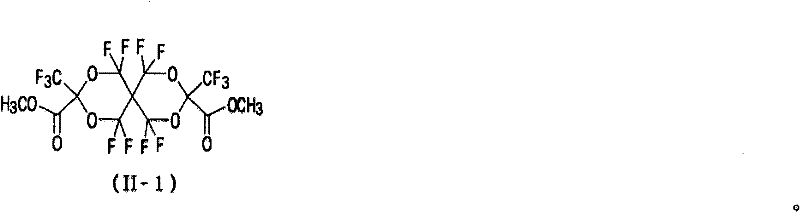
(6)由式(II-1)表示的甲基酯化合物。 (6) A methyl ester compound represented by formula (II-1). the
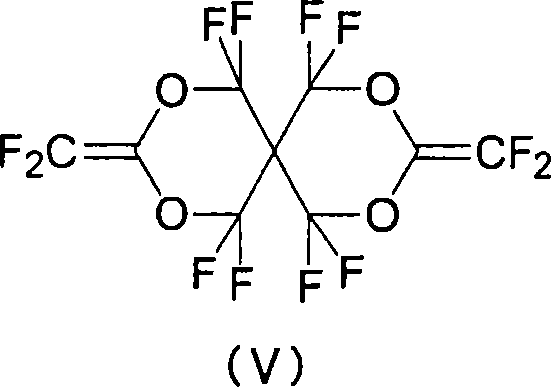
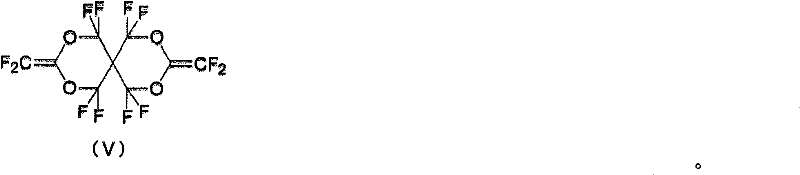
(7)由式(V)表示的全氟二烯化合物。 (7) A perfluorodiene compound represented by formula (V). the

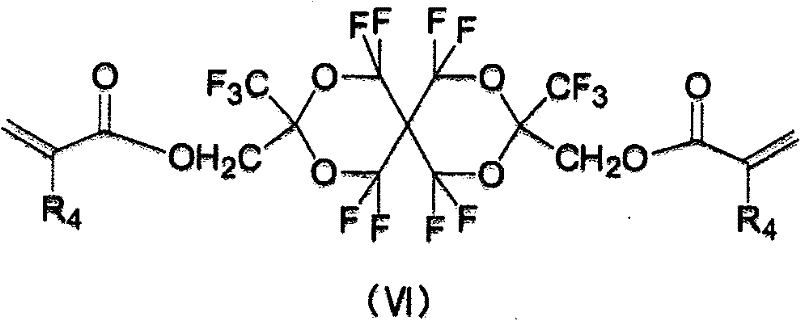
(8)由以下式(VI)表示的含氟二丙烯酸酯化合物: (8) Fluorine-containing diacrylate compounds represented by the following formula (VI):
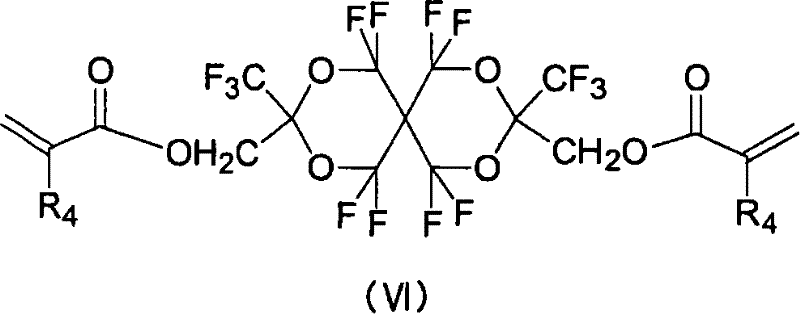
其中R4表示氢原子、氟原子、甲基或三氟甲基。 Wherein R 4 represents a hydrogen atom, a fluorine atom, a methyl group or a trifluoromethyl group.
(9)一种制备由以下式(A)表示的含氟螺缩醛化合物的方法,该方法包括氟化由酰氧基丙酮(acyloxyacetone)或丙酮酸酯与季戊四醇反应而获得的螺缩醛化合物的步骤; (9) A method for producing a fluorine-containing spiroacetal compound represented by the following formula (A), the method comprising fluorinating a spiroacetal compound obtained by reacting acyloxyacetone or pyruvate with pentaerythritol A step of;

其中X表示>C(CF3)(Y)或>C=CF2,其中Y表示-CF2OCOR1、-COOR2、-COF、或-CH2OR3,R1表示含有至少一个氟原子的烷基或环烷基,R2表示氢原子、碱金属、碱土金属、烷基或环烷基,并且R3表示氢原子或酰基;其中R1的烷基或环烷基可以具有除氟原子以外的取代基;R2的烷基或环烷基可以具有取代基;并且R3的酰基可以具有取代基。 Where X means >C(CF 3 )(Y) or >C=CF 2 , where Y means -CF 2 OCOR 1 , -COOR 2 , -COF, or -CH 2 OR 3 , and R 1 means it contains at least one fluorine atom An alkyl or cycloalkyl group, R 2 represents a hydrogen atom, an alkali metal, an alkaline earth metal, an alkyl or a cycloalkyl group, and R 3 represents a hydrogen atom or an acyl group; wherein the alkyl or cycloalkyl group of R 1 can have A substituent other than an atom; the alkyl or cycloalkyl group of R 2 may have a substituent; and the acyl group of R 3 may have a substituent.
(10)一种制备由上述式(A)表示的含氟螺缩醛化合物的方法,该方法包括氟化由酰氧基丙酮与季戊四醇反应而获得的螺缩醛化合物的步骤。 (10) A method of producing a fluorine-containing spiroacetal compound represented by the above formula (A), the method comprising the step of fluorinating a spiroacetal compound obtained by reacting an acyloxyacetone with pentaerythritol. the
(11)如(9)和(10)中所述的方法,其中由上述式(A)表示的含氟螺缩醛化合物是以上(2)至(8)中任意一项中所述的化合物。 (11) The method as described in (9) and (10), wherein the fluorine-containing spiroacetal compound represented by the above formula (A) is the compound described in any one of the above (2) to (8) . the
本发明提供了一种新型双官能含氟螺缩醛化合物,其可以由价格低廉的原料制备而不使用复杂过程,并且通过它的聚合可以形成具有优异性能的聚合物(例如耐化学性、耐气候性、疏水和疏油性、低的分子间作用、低折射率、高透射率的性能)。进一步地,本发明提供了一种制备上述双官能含氟螺缩醛化合物的方法。 The present invention provides a novel bifunctional fluorine-containing spiroacetal compound, which can be prepared from inexpensive raw materials without using complicated processes, and through its polymerization can form polymers with excellent properties (such as chemical resistance, Weatherability, hydrophobicity and oleophobicity, low intermolecular interaction, low refractive index, high transmittance performance). Further, the present invention provides a method for preparing the above bifunctional fluorine-containing spiroacetal compound. the
从以下说明中,可以更充分地表现本发明的其它和进一步的特征及优点。 Other and further features and advantages of the invention will appear more fully from the following description. the
具体实施方式Detailed ways
下文中将详细解释本发明的化合物。 Hereinafter, the compounds of the present invention will be explained in detail. the
在本发明的式(A)中,X表示>C(CF3)(Y)或>C=CF2,这里,Y表示-CF2OCOR1、-COOR2、-COF、或-CH2OR3,其中R1表示含有至少一个氟原子的烷基或环烷基,R2表示氢原子、碱金属、碱土金属、烷基或环烷基,并且R3表示氢原子或 酰基。 In the formula (A) of the present invention, X represents >C(CF 3 )(Y) or >C=CF 2 , where Y represents -CF 2 OCOR 1 , -COOR 2 , -COF, or -CH 2 OR 3 , wherein R 1 represents an alkyl or cycloalkyl group containing at least one fluorine atom, R 2 represents a hydrogen atom, an alkali metal, an alkaline earth metal, an alkyl group or a cycloalkyl group, and R 3 represents a hydrogen atom or an acyl group.
上述R1的烷基优选具有1至20个碳原子,更优选2至10个碳原子,并且可以为直链或支链的,并且进一步地,其可以具有取代基。 The above-mentioned alkyl group of R 1 preferably has 1 to 20 carbon atoms, more preferably 2 to 10 carbon atoms, and may be linear or branched, and further, it may have a substituent.
上述R1的环烷基优选具有3至20个碳原子,更优选5至10个碳原子,并且进一步地,其可以具有取代基。R1优选为上述烷基。 The cycloalkyl group of R 1 above preferably has 3 to 20 carbon atoms, more preferably 5 to 10 carbon atoms, and further, it may have a substituent. R 1 is preferably the above-mentioned alkyl group.
上述烷基或环烷基上的取代基的实例除了一个或多个氟原子之外,还包括随后解释的关于R2的取代基。尤其是,上述烷基可以具有醚键,并且当环烷基上取代有烷基时,该烷基可以具有醚键。作为具有醚键的烷基,可以提及被烷氧基、链烯氧基、环烷氧基或芳氧基取代的烷基。 Examples of the substituents on the above-mentioned alkyl or cycloalkyl include, in addition to one or more fluorine atoms, substituents explained later for R 2 . In particular, the above-mentioned alkyl group may have an ether bond, and when the cycloalkyl group is substituted with an alkyl group, the alkyl group may have an ether bond. As the alkyl group having an ether bond, an alkyl group substituted by an alkoxy group, an alkenyloxy group, a cycloalkoxy group or an aryloxy group may be mentioned.
R1优选为全氟烷基或全氟环烷基,更优选全氟烷基。具体实例包括全氟甲基、全氟乙基、全氟丙基、全氟异丙基、全氟丁基、全氟戊基、全氟己基、全氟(1-甲基-2-氧戊基)、全氟(1,4-二甲基-2,5-二氧辛基)、全氟环己基、全氟庚基、全氟辛基、全氟癸基、全氟十一烷基、以及全氟十二烷基。本发明并不限于这些实例。 R 1 is preferably perfluoroalkyl or perfluorocycloalkyl, more preferably perfluoroalkyl. Specific examples include perfluoromethyl, perfluoroethyl, perfluoropropyl, perfluoroisopropyl, perfluorobutyl, perfluoropentyl, perfluorohexyl, perfluoro(1-methyl-2-oxopentyl) base), perfluoro(1,4-dimethyl-2,5-dioxoctyl), perfluorocyclohexyl, perfluoroheptyl, perfluorooctyl, perfluorodecyl, perfluoroundecyl , and perfluorododecyl. The present invention is not limited to these examples.
在式(A)中,R2表示氢原子、碱金属、碱土金属、烷基或环烷基。R2的烷基优选具有1至20个碳原子,并且更优选1至10个碳原子,并且可以为直链或支链,并且其可以具有取代基。R2的环烷基优选具有3至20个碳原子,并且更优选5至10个碳原子,并且也可以具有取代基。R2烷基和环烷基的实例包括甲基、乙基、丙基、异丙基、丁基、戊基、环戊基、己基、环己基、辛基、以及癸基。这些烷基和环烷基可以具有取代基。 In formula (A), R 2 represents a hydrogen atom, an alkali metal, an alkaline earth metal, an alkyl group or a cycloalkyl group. The alkyl group of R 2 preferably has 1 to 20 carbon atoms, and more preferably 1 to 10 carbon atoms, and may be linear or branched, and it may have a substituent. The cycloalkyl group for R 2 preferably has 3 to 20 carbon atoms, and more preferably 5 to 10 carbon atoms, and may also have a substituent. Examples of R alkyl and cycloalkyl include methyl, ethyl, propyl, isopropyl, butyl, pentyl, cyclopentyl, hexyl, cyclohexyl, octyl, and decyl. These alkyl groups and cycloalkyl groups may have substituents.
R2的烷基或环烷基可以具有的取代基的实例包括:卤原子(例如,氟原子、氯原子、溴原子、以及碘原子)、碳原子数为20或更低的烷基(例如,甲基和乙基)、碳原子数为20或更低的烯基(例如,乙烯基和烯丙基)、碳原子数为20或更低的环烷基(例如,环戊基、环己基)、碳原子数为20或更低的环烯基(例如,环己烯基)、碳原子数为30或更低的芳基(例如,苯基和萘基)、氰基、羧基、碳原子数为20或更低的烷氧羰基(例如,甲氧羰基)、碳原子数为30或更低的芳氧羰基(例如,苯氧羰基)、氨基甲酰基(例如,氨基甲酰基、N-苯氨羰基、以及N,N-二甲基氨基甲酰基)、碳原子数为20或更低的烷基羰基(例如,乙酰基),碳原子数为30或更低的芳基羰基(例如,苯甲酰基)、硝基、氨基(例如,氨基、二甲氨基、苯胺基)、碳原子数 为20或更低的酰氨基(例如,乙酰氨基和乙氧羰基氨基)、亚磺酰氨基(例如,甲基亚磺酰氨基)、亚氨(imido group)(例如,琥珀酰亚胺基和苯二甲酰亚氨基)、亚氨基(imino group)(例如,亚苄基氨基)、羟基、碳原子数为20或更低的烷氧基(例如,甲氧基)、碳原子数为30或更低的芳氧基(例如,苯氧基)、碳原子数为20或更低的酰氧基(例如,乙酰氧基)、碳原子数为20或更低的烷基磺酰氧基(例如,甲基磺酰氧基)、碳原子数为30或更低的芳基磺酰氧基(例如,苯基磺酰氧基)、磺基、氨磺酰基(例如,氨磺酰基和N-苯氨基磺酰基)、碳原子数为20或更低的烷硫基(例如,甲硫基)、碳原子数为30或更低的芳硫基(例如,苯硫基)、碳原子数为20或更低的烷基磺酰基(例如,甲磺酰基)、碳原子数为30或更低的芳基磺酰基(例如,苯磺酰基)、以及杂环基。取代基可以被进一步取代。当存在多个取代基时,它们可以相同或不同。同样,这些取代基可以彼此结合以形成环。此外,取代基中的烷基可以在所需要的位置形成不饱和键。 Examples of substituents that the alkyl or cycloalkyl group of R 2 may have include halogen atoms (for example, fluorine atoms, chlorine atoms, bromine atoms, and iodine atoms), alkyl groups having 20 or less carbon atoms (for example, , methyl and ethyl), alkenyl groups with 20 or fewer carbon atoms (e.g., vinyl and allyl), cycloalkyl groups with 20 or fewer carbon atoms (e.g., cyclopentyl, cyclo hexyl), cycloalkenyl having 20 or less carbon atoms (for example, cyclohexenyl), aryl having 30 or less carbon atoms (for example, phenyl and naphthyl), cyano, carboxyl, An alkoxycarbonyl group having 20 or less carbon atoms (for example, methoxycarbonyl group), an aryloxycarbonyl group having 30 or less carbon atoms (for example, phenoxycarbonyl group), a carbamoyl group (for example, carbamoyl group, N-phenylaminocarbonyl, and N,N-dimethylcarbamoyl), alkylcarbonyl having 20 or less carbon atoms (for example, acetyl), arylcarbonyl having 30 or less carbon atoms (e.g., benzoyl), nitro, amino (e.g., amino, dimethylamino, anilino), amido groups having 20 or fewer carbon atoms (e.g., acetamido and ethoxycarbonylamino), sulfinyl Amylamino (e.g., methylsulfonamido), imido group (e.g., succinimidyl and phthalimido), imino group (e.g., benzylideneamino) , hydroxy, alkoxy having 20 or less carbon atoms (for example, methoxy), aryloxy having 30 or less carbon atoms (for example, phenoxy), having 20 or less carbon atoms Low acyloxy group (for example, acetoxy group), alkylsulfonyloxy group with 20 or less carbon atoms (for example, methylsulfonyloxy group), aryl group with 30 or less carbon atoms Sulfonyloxy (e.g., phenylsulfonyloxy), sulfo, sulfamoyl (e.g., sulfamoyl and N-phenylaminosulfonyl), alkylthio having 20 or less carbon atoms (e.g. , methylthio), arylthio with 30 or less carbon atoms (for example, phenylthio), alkylsulfonyl with 20 or less carbon atoms (for example, methylsulfonyl), carbon number An arylsulfonyl group (for example, benzenesulfonyl group) of 30 or less, and a heterocyclic group. Substituents can be further substituted. When there are multiple substituents, they may be the same or different. Also, these substituents may combine with each other to form a ring. In addition, the alkyl group in the substituent can form an unsaturated bond at a desired position.
在由R2表示的烷基和环烷基中,优选烷基,更优选甲基和乙基,并且尤其优选甲基。 Among the alkyl and cycloalkyl groups represented by R 2 , an alkyl group is preferable, a methyl group and an ethyl group are more preferable, and a methyl group is especially preferable.
由R2表示的碱金属和碱土金属的实例包括锂、钠、钾、铷、铯、镁、钙、锶、以及钡。优选钠和钾,并且更优选钾。 Examples of the alkali metal and alkaline earth metal represented by R 2 include lithium, sodium, potassium, rubidium, cesium, magnesium, calcium, strontium, and barium. Sodium and potassium are preferred, and potassium is more preferred.
在式(A)中,R3表示氢原子或酰基。酰基优选为具有1至20个碳原子的酰基(例如,甲酰基、乙酰基、丁酰基、硬脂酰基、苯甲酰基、环己酰基、丙烯酰基、甲基丙烯酰基、异巴豆酰基、以及油酰基(oleyl)),并且酰基可以具有取代基。该取代基的实例包括有关上述R2所说明的那些取代基。上述酰基优选为烯酰基(alkenoyl)(优选具有乙烯基末端的烯酰基)或羟基烷酰基,更优选具有乙烯基末端的烯酰基,仍然更优选可以具有取代基的丙烯酰基或甲基丙烯酰基,最优选-CO(R4)=CH2,其中R4表示氢原子、甲基、或三氟甲基。R4优选为氢原子或甲基,更优选为氢原子。 In formula (A), R 3 represents a hydrogen atom or an acyl group. The acyl group is preferably an acyl group having 1 to 20 carbon atoms (for example, formyl, acetyl, butyryl, stearyl, benzoyl, cyclohexanoyl, acryloyl, methacryloyl, isocrotonyl, and oleyl acyl group (oleyl)), and the acyl group may have a substituent. Examples of the substituent include those described above for R 2 . The above-mentioned acyl group is preferably an alkenoyl group (preferably an alkenoyl group having a vinyl terminal) or a hydroxyalkanoyl group, more preferably an alkenoyl group having a vinyl terminal, still more preferably an acryloyl group or a methacryloyl group which may have a substituent, Most preferably -CO(R 4 )=CH 2 , wherein R 4 represents a hydrogen atom, a methyl group, or a trifluoromethyl group. R 4 is preferably a hydrogen atom or a methyl group, more preferably a hydrogen atom.
由式(A)表示的化合物优选是由上述式(I)、(II)、(III)、以及(IV)中任意一个所表示的化合物,或者是由上述式(V)表示的化合物,或者是由上述式(VI)表示的化合物。这些化合物中的基团与式(A)中所解释的相应基团相同,并且它们的优选范围也与式(A)中所解释的相同。 The compound represented by formula (A) is preferably a compound represented by any one of the above-mentioned formulas (I), (II), (III), and (IV), or a compound represented by the above-mentioned formula (V), or is a compound represented by the above formula (VI). The groups in these compounds are the same as the corresponding groups explained in formula (A), and their preferred ranges are also the same as explained in formula (A). the
由式(I)表示的化合物优选为由上述式(I-1)表示的化合物,并且由式 (II)表示的化合物优选为由上述式(II-1)表示的化合物。 The compound represented by formula (I) is preferably a compound represented by the above-mentioned formula (I-1), and the compound represented by the formula (II) is preferably a compound represented by the above-mentioned formula (II-1). the
以下将显示由式(A)表示的化合物的具体实例,然而本发明并不仅限于这些化合物。 Specific examples of the compound represented by the formula (A) will be shown below, however, the present invention is not limited to these compounds. the

(I-1)R1=CF(CF3)OCF2CF2CF3 (I-1)R 1 =CF(CF 3 )OCF 2 CF 2 CF 3
(I-2)R1=全氟甲基 (I-2) R 1 = perfluoromethyl
(I-3)R1=全氟乙基 (I-3) R 1 = perfluoroethyl
(I-4)R1=全氟丙基 (I-4) R 1 = perfluoropropyl
(I-5)R1=全氟异丙基 (I-5) R 1 = perfluoroisopropyl
(I-6)R1=全氟丁基 (I-6) R 1 = perfluorobutyl
(I-7)R1=全氟戊基 (I-7) R 1 = perfluoropentyl
(I-8)R1=全氟己基 (I-8) R 1 = perfluorohexyl
(I-9)R1=全氟(1-甲基-2-氧丁基) (I-9) R 1 = perfluoro(1-methyl-2-oxobutyl)
(I-10)R1=全氟(1,4-二甲基-2,5-二氧辛基) (I-10) R 1 =perfluoro(1,4-dimethyl-2,5-dioxoctyl)
(I-11)R1=全氟环己基 (I-11) R 1 = perfluorocyclohexyl
(I-12)R1=全氟庚基 (I-12) R 1 = perfluoroheptyl
(I-13)R1=全氟辛基 (I-13) R 1 = perfluorooctyl
(I-14)R1=全氟癸基 (I-14) R 1 = perfluorodecyl
(I-1 5)R1=全氟十一烷基 (I-1 5) R 1 = perfluoroundecyl
(I-16)R1=全氟十二烷基 (I-16) R 1 = perfluorododecyl
(I-17)R1=全氟(1-甲基-2-氧己基) (I-17) R 1 =perfluoro(1-methyl-2-oxohexyl)
(I-18)R1=全氟环戊基 (I-18) R 1 = perfluorocyclopentyl
(II-1)R2=CH3 (II-1) R 2 =CH 3
(II-2)R2=K (II-2) R 2 =K
(II-3)R2=C2H5 (II-3) R 2 =C 2 H 5
(II-4)R2=环己基 (II-4) R2 = Cyclohexyl
(II-5)R2=Na (II-5) R 2 =Na

(VI-1)R4=H (VI-1) R 4 =H
(VI-2)R4=F (VI-2) R 4 =F
(VI-3)R4=CH3 (VI-3) R 4 =CH 3
(VI-4)R4=CF3 (VI-4)R 4 =CF 3
以下将说明由本发明式(A)表示的含氟螺缩醛化合物的制备方法。 The production method of the fluorine-containing spiroacetal compound represented by the formula (A) of the present invention will be explained below. the
由上述式(A)表示的含氟螺缩醛化合物可以通过多个步骤来制备,所述步骤包括氟化由酰氧基丙酮或丙酮酸酯与季戊四醇反应而获得的螺缩醛化合物的步骤。 The fluorine-containing spiroacetal compound represented by the above formula (A) can be produced through a plurality of steps including a step of fluorinating a spiroacetal compound obtained by reacting acyloxyacetone or pyruvate with pentaerythritol. the
例如,如以下方案(I)所示,可以使用羟丙酮1或丙酮酸酯4作为起始材料来制备由式(A)表示的含氟螺缩醛化合物。 For example, as shown in the following scheme (I), the fluorine-containing spiroacetal compound represented by formula (A) can be prepared using hydroxyacetone 1 or pyruvate 4 as a starting material. the
在以下方案(I)中,本发明的制备方法至少包括氟化由酰氧基丙酮2或丙酮酸酯4与季戊四醇反应而获得的螺缩醛3或5,从而获得含氟化合物(I)或6的步骤。在这些步骤中,本发明的制备方法优选包括多个步骤,所述步骤包括氟化由酰氧基丙酮与季戊四醇反应而获得的螺缩醛化合物的步 骤。 In the following scheme (I), the preparation method of the present invention at least includes fluorination of spiro acetal 3 or 5 obtained by reacting acyloxyacetone 2 or pyruvate 4 with pentaerythritol, thereby obtaining fluorine-containing compound (I) or 6 steps. Among these steps, the production method of the present invention preferably includes a plurality of steps including a step of fluorinating a spiroacetal compound obtained by reacting acyloxyacetone with pentaerythritol. the
以下将说明在以下方案中所描述化合物的取代基。 The substituents of the compounds described in the following schemes are illustrated below. the
在以下反应方案中,R11表示烷基或环烷基,其可以具有氟原子或R2中所说明的取代基。R12表示烷基或环烷基,其可以具有氟原子或R2中所说明的取代基。R12优选为烷基。Rf12表示通过用一个或多个氟原子取代R12中的至少一个氢原子而获得的烷基或环烷基。X1是卤原子。 In the following reaction schemes, R 11 represents an alkyl or cycloalkyl group, which may have a fluorine atom or a substituent described in R 2 . R 12 represents an alkyl or cycloalkyl group, which may have a fluorine atom or a substituent as described in R 2 . R 12 is preferably an alkyl group. Rf 12 represents an alkyl or cycloalkyl group obtained by substituting at least one hydrogen atom in R 12 with one or more fluorine atoms. X 1 is a halogen atom.
R1和R2具有如式(A)中所定义的相同含义,R4具有如式(VI)中所定义的相同含义,并且其优选范围同样与这些基团描述的相同。 R 1 and R 2 have the same meaning as defined in formula (A), R 4 has the same meaning as defined in formula (VI), and the preferred ranges thereof are also the same as described for these groups.
以下将进一步说明上述基团。 The above groups will be further explained below. the
R11的烷基优选为具有1至20个碳原子的直链或支链烷基,优选具有2至10个碳原子,并且R11的环烷基优选为具有3至20个碳原子的环烷基,优选具有5至10个碳原子的环烷基。这些基团(取代基)可以具有上述取代基。R11的烷基可以在其烷基链中含有醚键,并且这种烷基同样是优选的。作为上述烷基可以具有的取代基,优选卤原子,例如氟、氯、溴以及碘原子。在由R11表示的环烷基中,环烷基上的取代基优选为被卤原子取代的取代烷基,或者为在其烷基链中可以具有醚键的烷基。R11优选烷基而不是环烷基。 The alkyl group of R is preferably a linear or branched chain alkyl group having 1 to 20 carbon atoms, preferably 2 to 10 carbon atoms, and the cycloalkyl group of R is preferably a ring having 3 to 20 carbon atoms Alkyl, preferably cycloalkyl having 5 to 10 carbon atoms. These groups (substituents) may have the above substituents. The alkyl group of R 11 may contain ether linkages in its alkyl chain, and such alkyl groups are also preferred. As the substituent which the above-mentioned alkyl group may have, a halogen atom such as a fluorine, chlorine, bromine, and iodine atom is preferable. In the cycloalkyl group represented by R 11 , the substituent on the cycloalkyl group is preferably a substituted alkyl group substituted with a halogen atom, or an alkyl group which may have an ether bond in its alkyl chain. R 11 is preferably alkyl rather than cycloalkyl.
R11可以为不含有氟原子的烷基或环烷基,例如甲基、乙基、丙基、环戊基或环己基。然而,R11优选为含有氟原子的烷基或环烷基,并且更优选为能使化合物3中氟原子含量为30质量%或更高的含氟原子的烷基或含氟原子的环烷基。这种烷基和环烷基的实例包括全氟乙基、全氟丙基、全氟异丙基、全氟丁基、全氟戊基、全氟己基、全氟(1-甲基-2-氧戊基)、全氟(1,4-二甲基-2,5-二氧辛基)、全氟环己基、全氟庚基、全氟辛基、全氟癸基、全氟十一烷基、全氟十二烷基、2H-四氢乙基、4H-八氟丁基、6H-十二氟己基、以及8H-十六氟辛基。 R 11 may be an alkyl or cycloalkyl group not containing a fluorine atom, such as methyl, ethyl, propyl, cyclopentyl or cyclohexyl. However, R is preferably an alkyl or cycloalkyl group containing a fluorine atom, and is more preferably an alkyl group or cycloalkane containing a fluorine atom that enables the fluorine atom content in compound 3 to be 30% by mass or higher base. Examples of such alkyl and cycloalkyl groups include perfluoroethyl, perfluoropropyl, perfluoroisopropyl, perfluorobutyl, perfluoropentyl, perfluorohexyl, perfluoro(1-methyl-2 -Oxypentyl), perfluoro(1,4-dimethyl-2,5-dioxoctyl), perfluorocyclohexyl, perfluoroheptyl, perfluorooctyl, perfluorodecyl, perfluorodeca Monoalkyl, perfluorododecyl, 2H-tetrahydroethyl, 4H-octafluorobutyl, 6H-dodecafluorohexyl, and 8H-hexadecafluorooctyl.
X1表示卤原子,例如氟原子、氯原子、溴原子、以及碘原子,并且优选氟原子或氯原子。 X 1 represents a halogen atom such as a fluorine atom, a chlorine atom, a bromine atom, and an iodine atom, and preferably a fluorine atom or a chlorine atom.
R12优选是如R11中所说明的烷基或环烷基,并且同样优选是如R11中所描述的烷基和环烷基。 R 12 is preferably an alkyl or cycloalkyl group as described for R 11 , and is likewise preferably an alkyl group and a cycloalkyl group as described for R 11 .
R12优选为烷基,更优选为具有氟原子的烷基,尤其优选为含有氟原子 以使化合物5中氟含量为30质量%或更高的烷基。这种烷基的实例包括1H,1H-五氟丙基、1H,1H-七氟丁基、1H,1H,2H,2H-九氟己基、1H,1H,2H,2H,3H,3H-九氟己基、1H,1H,2H,2H-十三氟辛基、1H,1H,2H,2H,3H,3H-十三氟壬基、1H,1H,2H,2H-十七氟癸基、2,5-二甲基-3,6-二氧-1H,1H-十七氟壬基、5-甲基-1H,1H,2H,2H-十一氟己基、7-甲基-1H,1H,2H,2H-十五氟辛基、1H,1H,3H-四氟丙基、1H,1H,5H-八氟戊基、1H,1H,7H-十二氟己基、1H,1H,9H-十六氟壬基,2H-六氟-2-丙基、以及1H,1H,3H-六氟丁基。 R12 is preferably an alkyl group, more preferably an alkyl group having a fluorine atom, and especially preferably an alkyl group containing a fluorine atom such that the fluorine content in compound 5 is 30% by mass or higher. Examples of such alkyl groups include 1H, 1H-pentafluoropropyl, 1H, 1H-heptafluorobutyl, 1H, 1H, 2H, 2H-nonafluorohexyl, 1H, 1H, 2H, 2H, 3H, 3H-nine Fluorohexyl, 1H, 1H, 2H, 2H-Tridecafluorooctyl, 1H, 1H, 2H, 2H, 3H, 3H-Tridecafluorononyl, 1H, 1H, 2H, 2H-Heptadecafluorodecyl, 2 , 5-Dimethyl-3,6-dioxo-1H, 1H-heptadecafluorononyl, 5-methyl-1H, 1H, 2H, 2H-undecafluorohexyl, 7-methyl-1H, 1H , 2H, 2H-pentadecafluorooctyl, 1H, 1H, 3H-tetrafluoropropyl, 1H, 1H, 5H-octafluoropentyl, 1H, 1H, 7H-dodecafluorohexyl, 1H, 1H, 9H- Hexadecafluorononyl, 2H-hexafluoro-2-propyl, and 1H, 1H, 3H-hexafluorobutyl.
Rf12优选为通过用氟原子取代R12中全部氢原子而获得的全氟烷基。 Rf 12 is preferably a perfluoroalkyl group obtained by substituting all hydrogen atoms in R 12 with fluorine atoms.
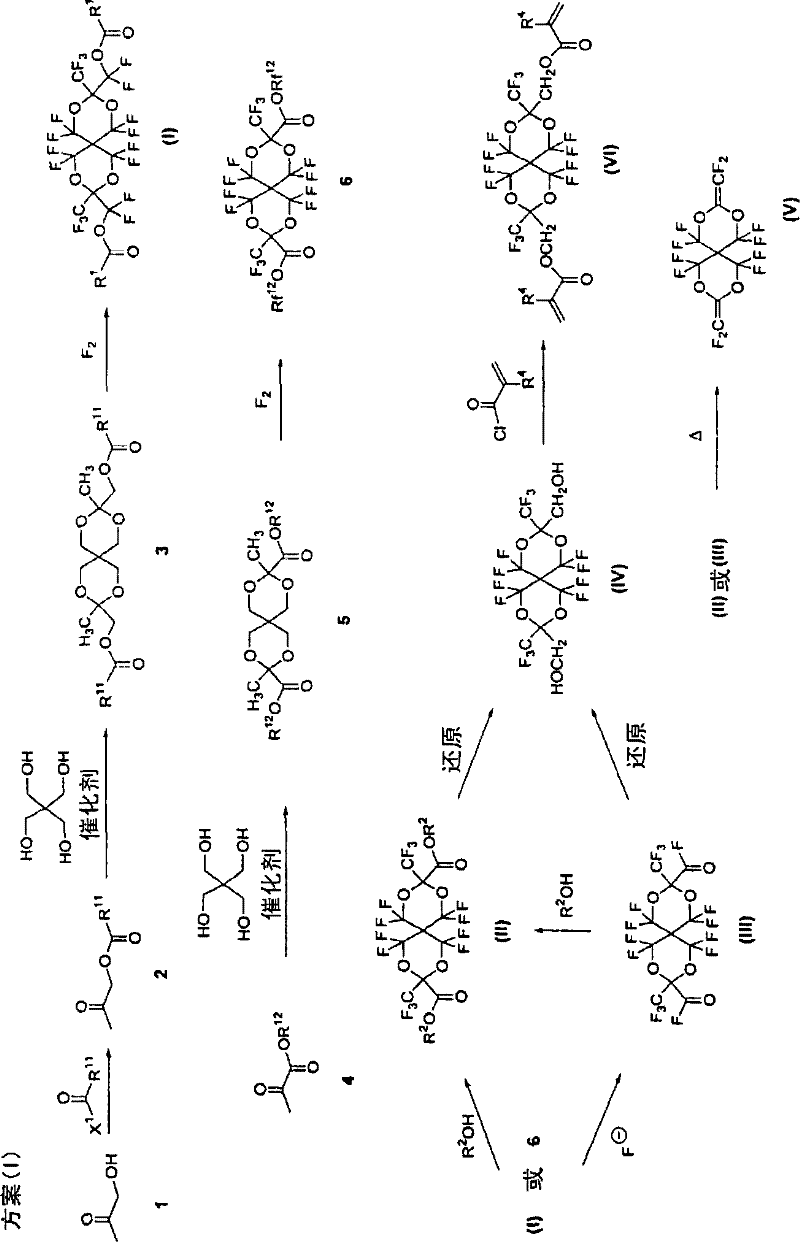
以下将参照上述方案(I)进一步说明该制备方法。 The preparation method will be further described below with reference to the above scheme (I). the
优选以上述化合物2表示酰氧基丙酮,并且其可以通过例如羟丙酮1和羧酸卤化物之间的反应来获得。另一方面,优选以上述化合物4来表示丙酮酸酯,并且其可以商购得到或者其可以容易地通过酯化丙酮酸来合成。 The acyloxyacetone is preferably represented by the above compound 2, and can be obtained by, for example, a reaction between hydroxyacetone 1 and a carboxylic acid halide. On the other hand, pyruvate is preferably represented by the above compound 4, and it is commercially available or it can be easily synthesized by esterifying pyruvate. the
在本发明中,由上述式(A)表示的含氟螺缩醛化合物可以由多个步骤来制备,所述步骤包括使酰氧基丙酮(化合物2)或丙酮酸酯(化合物4)与季戊四醇反应的步骤,更具体地说,使这些化合物进行脱水缩合,从而合成螺缩醛化合物(化合物3或5),然后氟化由此获得的螺缩醛化合物(化合物3或5)。 In the present invention, the fluorine-containing spiroacetal compound represented by the above-mentioned formula (A) can be prepared by a plurality of steps including making acyloxyacetone (compound 2) or pyruvate (compound 4) and pentaerythritol The reaction step, more specifically, is to subject these compounds to dehydration condensation to synthesize a spiroacetal compound (compound 3 or 5), and then to fluorinate the thus obtained spiroacetal compound (compound 3 or 5). the
这里,由式(I)表示的化合物可以通过从上述反应方案中的化合物2获得化合物3(在上述反应方案中,化合物2由化合物1合成)并且对化合物3进行氟化来合成。 Here, the compound represented by formula (I) can be synthesized by obtaining compound 3 from compound 2 in the above reaction scheme (compound 2 is synthesized from compound 1 in the above reaction scheme) and fluorinating compound 3. the
由式(II)表示的化合物可以通过使由此获得的式(I)表示的化合物与R2OH反应,或者通过使化合物6(化合物6可以通过从化合物4获得化合物5并且氟化化合物5来获得)与R2OH反应来合成。进一步地,由式(II)表示的化合物同样可以通过使式(I)表示的化合物或化合物6与F-离子反应,并且使由此得到的由式(III)表示的化合物与R2OH反应来获得。在获得其中R2为氢原子、碱金属或碱土金属的式(II)表示的化合物的情形中,这种式(II)表示的化合物也可以通过水解其中R2为烷基或环烷基的式(II)表示的化合物或通过水解式(III)表示的化合物来合成。 The compound represented by formula (II) can be obtained by reacting the compound represented by formula (I) thus obtained with R 2 OH, or by making compound 6 (compound 6 can be obtained by obtaining compound 5 from compound 4 and fluorinating compound 5) obtained) by reacting with R 2 OH. Further, the compound represented by formula (II) can also be obtained by reacting the compound represented by formula (I) or compound 6 with F - ion, and reacting the compound represented by formula (III) thus obtained with R 2 OH to get. In the case of obtaining a compound represented by formula (II) wherein R 2 is a hydrogen atom, an alkali metal or an alkaline earth metal, the compound represented by this formula (II) can also be obtained by hydrolyzing a compound represented by R 2 which is an alkyl or cycloalkyl group. The compound represented by formula (II) may be synthesized by hydrolyzing the compound represented by formula (III).
如上所述,由式(III)表示的化合物可以通过使式(I)表示的化合物或化合物6与F-离子反应来合成。尽管在上述反应方案中没有显示,但是通过热分解式(I)表示的化合物或化合物6来合成式(III)表示的化合物同样也是本发明的一个优选具体实施方案。 As described above, the compound represented by formula (III) can be synthesized by reacting the compound represented by formula (I) or compound 6 with F - ions. Although not shown in the above reaction scheme, synthesizing the compound represented by formula (III) by thermally decomposing the compound represented by formula (I) or compound 6 is also a preferred embodiment of the present invention.
由式(IV)表示的化合物可以通过还原由此获得的式(II)或式(III)表示的化合物来合成。 The compound represented by formula (IV) can be synthesized by reducing the compound represented by formula (II) or formula (III) thus obtained. the
由式(V)表示的化合物可以通过热分解由此获得的式(II)或式(III)表示的化合物来合成。 The compound represented by formula (V) can be synthesized by thermally decomposing the compound represented by formula (II) or formula (III) thus obtained. the
由其中X为>C(CF3)(Y),Y为CH2OR3,并且R3为酰基的式(A)表示的化合物可以通过酰化式(IV)表示的化合物来合成。酰化剂可以选自具有相应 酰基部分的酰卤或有机酸酐,并且同样优选使用有机酸。在上述反应方案中,在这些化合物中,式(VI)表示的化合物称为典型化合物。也就是说,如随后将说明的那样,式(VI)表示化合物的酰化剂尤其优选为由Cl-COC(R4)=CH2表示的丙烯酸衍生物。 The compound represented by the formula (A) wherein X is >C(CF 3 )(Y), Y is CH 2 OR 3 , and R 3 is an acyl group can be synthesized by acylation of the compound represented by the formula (IV). The acylating agent may be selected from acid halides or organic acid anhydrides having the corresponding acyl moiety, and organic acids are also preferably used. In the above reaction scheme, among these compounds, the compound represented by the formula (VI) is referred to as a typical compound. That is, as will be explained later, the acylating agent of the compound represented by the formula (VI) is particularly preferably an acrylic acid derivative represented by Cl-COC(R 4 )=CH 2 .
以下将详细说明上述方案(I)中的每一步骤。 Each step in the above scheme (I) will be described in detail below. the
通过羟丙酮1和羧酸卤化物之间的反应转化为酰氧基丙酮(化合物2)的过程可以在例如″Dai-4-Han,Jikken Kagaku Koza 22,Yuki-Gosei IV,-San/Amino san/Peptide-(4th edition,Courses in Experimental Chemistry 22,Organic Synthesis IV,-Acids/Amino acids/Peptides-)″,The Chemical Societyof Japan,Maruzen,pp 50-51中所描述的通常条件下进行。 The process of conversion to acyloxyacetone (compound 2) by the reaction between hydroxyacetone 1 and carboxylic acid halide can be described, for example, in "Dai-4-Han, Jikken Kagaku Koza 22, Yuki-Gosei IV, -San/Amino san /Peptide-(4th edition, Courses in Experimental Chemistry 22, Organic Synthesis IV, -Acids/Amino acids/Peptides-)", The Chemical Society of Japan, Maruzen, under the usual conditions described in pp 50-51. the
从化合物2或4以及季戊四醇获得螺缩醛3或5的合成可以根据例如J.Org.Chem.,26,2515(1961),Tetrahedoron,60,4789(2004),以及Chem Ber,61,790(1928)中所描述的方法来进行。 The synthesis of spiroacetal 3 or 5 obtained from compound 2 or 4 and pentaerythritol can be based on, for example, J.Org.Chem., 26, 2515 (1961), Tetrahedoron, 60, 4789 (2004), and Chem Ber, 61, 790 ( 1928) by the method described. the
具体地,化合物2或4以及季戊四醇经历脱水缩合反应。至于该脱水反应,可以使用任何方法,只要其能除去或分离反应条件下产生的水。然而,优选使用在酸催化剂存在下通过共沸蒸馏而除去水的方法,或者使用在脱水剂存在下进行反应的方法。 Specifically, compound 2 or 4 and pentaerythritol undergo a dehydration condensation reaction. As for the dehydration reaction, any method may be used as long as it can remove or separate water generated under the reaction conditions. However, it is preferable to use a method of removing water by azeotropic distillation in the presence of an acid catalyst, or use a method of performing a reaction in the presence of a dehydrating agent. the
此时,相对于化合物2或4的量,所使用季戊四醇的量优选为0.1至5当量,更优选0.2至1当量,并且尤其优选0.3至0.6当量。 At this time, the amount of pentaerythritol used is preferably 0.1 to 5 equivalents, more preferably 0.2 to 1 equivalent, and particularly preferably 0.3 to 0.6 equivalents, relative to the amount of Compound 2 or 4. the
酸催化剂的实例包括氯化氢、溴化氢、硫酸、磷酸、氯化铵、磺酸化合物(例如,甲磺酸、苯磺酸、对甲苯磺酸(一水合物))、羧酸化合物(例如,乙酸、丙酸、丁酸、己二酸、以及苯甲酸)、各种路易斯酸(例如,三氟化硼乙醚、氯化铝、以及锆氧化物)、以及各种固体酸催化剂(例如,Nafion 

当通过共沸蒸馏除去水时,优选使用Dean-Stark分水器(trap)。同时,当通过脱水剂除去水时,脱水剂实例包括硫酸镁、硫酸钠、沸石、以及分子筛。优选脱水剂的使用量大于足以能保留反应中所生成水的脱水剂量。 脱水剂可以用在反应体系中,或者用在反应体系之外,例如,将脱水剂保持在回流管中。 When removing water by azeotropic distillation, a Dean-Stark trap is preferably used. Meanwhile, when water is removed by a dehydrating agent, examples of the dehydrating agent include magnesium sulfate, sodium sulfate, zeolite, and molecular sieves. Preferably, the dehydrating agent is used in an amount greater than that sufficient to retain the water formed during the reaction. The dehydrating agent can be used in the reaction system, or used outside the reaction system, for example, keeping the dehydrating agent in the return line. the
反应可以不在溶剂中或在溶剂中进行。可以使用的溶剂的实例包括苯、甲苯、二甲苯、石油醚、N,N-二甲基甲酰胺、N,N-二乙基乙酰胺、1-甲基-2-吡咯烷酮、1,3-二甲基-2-咪唑啉酮、二甲亚砜(DMSO)、环丁砜、四氯化碳、氯仿、己烷、庚烷、以及环己烷,以及这些溶剂的混合物。在这些溶剂中,更优选甲苯。溶剂的质量优选为化合物2或4质量的1至100倍并且更优选为2至50倍。反应温度优选为0至200℃并且更优选为50至120℃。反应时间取决于所使用酸的种类和量、溶剂种类、以及反应温度。通过控制这些因素,反应通常在12小时并且优选6小时内进行。 The reaction can be performed without or in a solvent. Examples of usable solvents include benzene, toluene, xylene, petroleum ether, N,N-dimethylformamide, N,N-diethylacetamide, 1-methyl-2-pyrrolidone, 1,3- Dimethyl-2-imidazolinone, dimethylsulfoxide (DMSO), sulfolane, carbon tetrachloride, chloroform, hexane, heptane, and cyclohexane, and mixtures of these solvents. Among these solvents, toluene is more preferred. The mass of the solvent is preferably 1 to 100 times and more preferably 2 to 50 times the mass of Compound 2 or 4. The reaction temperature is preferably 0 to 200°C and more preferably 50 to 120°C. The reaction time depends on the kind and amount of acid used, the kind of solvent, and the reaction temperature. By controlling these factors, the reaction is usually carried out within 12 hours and preferably within 6 hours. the
作为将化合物3转变为式(I)表示的化合物或将化合物5转变为化合物6的氟化反应,已知可以使用利用三氟化钴的方法、电解氟化法,使用氟气以直接在液相中进行氟化的方法(以下称为“液相直接氟化法”)等。这些方法都可以用于本发明。在根据使用三氟化钴的方法或电解氟化法的氟化反应中,存在有关主链异构化反应和分割或再化合反应上升的问题,因此难以获得高纯度的所需化合物。因此在本发明中更优选使用液相直接氟化法。 As the fluorination reaction for converting compound 3 into a compound represented by formula (I) or converting compound 5 into compound 6, it is known that a method using cobalt trifluoride, an electrolytic fluorination method, and using fluorine gas to directly dissolve in a liquid In-phase fluorination method (hereinafter referred to as "liquid phase direct fluorination method") and the like. All of these methods can be used in the present invention. In the fluorination reaction according to the method using cobalt trifluoride or the electrolytic fluorination method, there are problems related to main chain isomerization reaction and fragmentation or recombination reaction rising, so it is difficult to obtain a desired compound with high purity. Therefore, it is more preferable to use the liquid phase direct fluorination method in the present invention. the
可以用例如美国专利No.5,093,432和WO00/56694中所描述的相同方法来进行根据液相直接氟化法的氟化反应。 The fluorination reaction according to the liquid phase direct fluorination method can be carried out by the same method as described in, for example, US Patent No. 5,093,432 and WO 00/56694. the
可以通过使R2OH(R2表示烷基或环烷基)表示的醇与式(I)表示的化合物或化合物6反应,来进行从式(I)表示的化合物或化合物6向式(II)表示的化合物的转化,尤其是向R2为烷基或环烷基的式(II)表示的化合物的转化。反应温度优选为-20至100℃并且更优选为0至50℃。在该反应中,可以使用溶剂,或者该反应可以在无溶剂条件下进行。同时,该反应也可以在碱的存在下,或在没有碱的存在下进行。 The compound or compound 6 represented by formula (I) can be converted to formula (II) by making the alcohol represented by R OH (R 2 represent alkyl or cycloalkyl) react with the compound represented by formula (I) or compound 6. ) conversion of the compound represented, especially to the conversion of the compound represented by the formula (II) in which R is an alkyl or cycloalkyl group. The reaction temperature is preferably -20 to 100°C and more preferably 0 to 50°C. In this reaction, a solvent may be used, or the reaction may be performed without a solvent. Meanwhile, this reaction can also be carried out in the presence of a base, or in the absence of a base.
可以使用的溶剂的实例包括二氯甲烷、氯仿、四氯化碳、二乙醚、四氢呋喃、丙酮、乙酸乙酯、己烷、甲苯、二甲苯、乙腈、用于上述液相氟化反应的溶剂{例如,全氟烷烃化合物(商品名:FC-72,由Sumitomo 3M Ltd.制造)、全氟醚化合物(商品名:FC-75、FC-77,由Sumitomo 3M Ltd.制造)、全氟聚醚化合物(商标:Krytox,由DuPont制造;商标:Fomblin,由AUSIMONT制造;商标:Galden,由AUSIMONT制造;商品名:Demnam, 由Daikin Industries,Ltd.制造)、氯氟烃化合物(例如,CFC-11以及CFC-113)、氯氟聚醚化合物、全氟三烷基胺化合物、以及惰性流体(商标:Fluorinert,由Sumitomo 3M Ltd.制造)}、以及这些溶剂的混合物。溶剂质量优选为式(I)表示的化合物或化合物6质量的1至100倍,并且更优选为2至50倍。 Examples of usable solvents include dichloromethane, chloroform, carbon tetrachloride, diethyl ether, tetrahydrofuran, acetone, ethyl acetate, hexane, toluene, xylene, acetonitrile, solvents used in the above-mentioned liquid-phase fluorination reaction{ For example, perfluoroalkane compound (trade name: FC-72, manufactured by Sumitomo 3M Ltd.), perfluoroether compound (trade name: FC-75, FC-77, manufactured by Sumitomo 3M Ltd.), perfluoropolyether Compounds (Trademark: Krytox, manufactured by DuPont; Trademark: Fomblin, manufactured by AUSIMONT; Trademark: Galden, manufactured by AUSIMONT; Trade name: Demnam, manufactured by Daikin Industries, Ltd.), chlorofluorocarbon compounds (for example, CFC-11 and CFC-113), chlorofluoropolyether compounds, perfluorotrialkylamine compounds, and inert fluids (trademark: Fluorinert, manufactured by Sumitomo 3M Ltd.)}, and mixtures of these solvents. The mass of the solvent is preferably 1 to 100 times the mass of the compound represented by formula (I) or Compound 6, and more preferably 2 to 50 times. the
可以使用的碱的实例包括有机碱,例如吡啶、三乙胺、和N,N-二异丙基乙胺,以及无机碱,例如氢氧化钠、氢氧化钾、碳酸钾、碳酸钠、碳酸氢钠、和碳酸氢钾。同时,可以使用碱金属氟化物,例如氟化钠、氟化钾、或氟化铯作为氟化氢捕集剂。 Examples of bases that can be used include organic bases such as pyridine, triethylamine, and N,N-diisopropylethylamine, and inorganic bases such as sodium hydroxide, potassium hydroxide, potassium carbonate, sodium carbonate, bicarbonate Sodium, and Potassium Bicarbonate. Meanwhile, an alkali metal fluoride such as sodium fluoride, potassium fluoride, or cesium fluoride may be used as a hydrogen fluoride trapping agent. the
相对于式(I)表示的化合物或化合物6的量,用于本发明的碱的量优选为0.5至10当量并且更优选为1至3当量。 The amount of the base used in the present invention is preferably 0.5 to 10 equivalents and more preferably 1 to 3 equivalents relative to the amount of the compound represented by formula (I) or Compound 6. the
尽管对于R2OH的量没有特别的限制,但是为了使反应完全,对于式(I)表示的化合物或化合物6的量,R2OH的量优选为4当量或更高并且更优选为4至20当量。 Although there is no particular limitation on the amount of R 2 OH, in order to complete the reaction, the amount of R 2 OH is preferably 4 equivalents or more and more preferably 4 to 20 equiv.
R2为氢原子、碱金属、或碱土金属的式(II)表示的化合物可以容易地通过(碱)水解式(I)表示的化合物、化合物6、以及R2为烷基或环烷基的式(II)表示的化合物中的任意一种来获得。 R 2 is a hydrogen atom, an alkali metal, or a compound represented by the formula (II) of an alkaline earth metal can easily pass through (alkali) hydrolysis of the compound represented by the formula (I), compound 6, and R 2 is an alkyl or cycloalkyl group Any one of the compounds represented by formula (II) can be obtained.
可以通过热分解将式(I)表示的化合物或化合物6转变为式(III)表示的化合物。该热分解优选在碱金属氟化物,例如氟化钠、氟化钾或氟化铯的存在下进行。对于式(I)表示的化合物或化合物6的量,所使用碱金属氟化物的量优选为0.01至5当量并且更优选为0.1至1当量。反应温度优选为50至300℃并且更优选为100至250℃。该反应可以在气相中进行也可以在液相中进行。在液相反应的情形中,可以使用任何溶剂而没有特别的限制,只要其与式(I)表示的化合物或化合物6以及产物相容。例如,可以使用如上所述的全氟聚醚化合物或氯氟聚醚化合物。然而,考虑到需要从产物中分离溶剂,优选在没有溶剂的存在下进行反应。 The compound represented by formula (I) or compound 6 can be converted into the compound represented by formula (III) by thermal decomposition. The thermal decomposition is preferably carried out in the presence of alkali metal fluorides, such as sodium fluoride, potassium fluoride or cesium fluoride. The amount of the alkali metal fluoride used is preferably 0.01 to 5 equivalents and more preferably 0.1 to 1 equivalent with respect to the amount of the compound represented by formula (I) or Compound 6 . The reaction temperature is preferably 50 to 300°C and more preferably 100 to 250°C. The reaction can be carried out in gas phase or in liquid phase. In the case of a liquid phase reaction, any solvent may be used without particular limitation as long as it is compatible with the compound represented by formula (I) or compound 6 and the product. For example, perfluoropolyether compounds or chlorofluoropolyether compounds as described above can be used. However, in view of the need to separate the solvent from the product, it is preferable to conduct the reaction in the absence of a solvent. the
可以在将式(I)表示的化合物转化为式(II)表示的化合物的相同条件下将式(III)表示的化合物转化为式(II)表示的化合物。 The compound represented by formula (III) can be converted into the compound represented by formula (II) under the same conditions as the compound represented by formula (I) is converted into the compound represented by formula (II). the
可以通过还原反应将式(II)或(III)表示的化合物转化为式(IV)表示的化合物。对于该还原反应,可以使用例如在″Dai-4-Han,Jikken Kagaku Koza 26,Yuki-Gosei VIII,-Husei-Gosei/Kangen/To/Hyosiki-Kagobutu-(4th edition, Courses in Experimental Chemistry 26,Organic Synthesis VIII,-Asymmetricsynthesis/Reduction/Saccharide/Labeled compound-)″,The Chemical Societyof Japan,Maruzen,pp.159-266中所描述的任意各种还原方法。还原方法的优选实例包括使用金属氢络合物,例如硼氢化钠、氢化铝锂、以及双(2-甲氧基乙氧基)氢化铝钠(商品名:Red-Al,Vitride)的方法(参见,例如,如J.Am.Chem.Soc.,116,4135(1994),J.Org.Chem.,26,2943(1961),J.Org Chem.,41,1470(1976),以及J.Am.Chem.Soc.,115,8954(1993)的参考文献),以及通过使用氢/过渡金属催化剂的催化还原的方法(参见,例如,美国专利No.2,666,797)。 The compound represented by formula (II) or (III) can be converted into the compound represented by formula (IV) by a reduction reaction. For this reduction reaction, for example, in "Dai-4-Han, Jikken Kagaku Koza 26, Yuki-Gosei VIII, -Husei-Gosei/Kangen/To/Hyosiki-Kagobutu-(4th edition, Courses in Experimental Chemistry 26, Organic Synthesis VIII, -Asymmetric synthesis/Reduction/Saccharide/Labeled compound-)", any of the various reduction methods described in The Chemical Society of Japan, Maruzen, pp.159-266. Preferable examples of the reduction method include a method using a metal hydride complex such as sodium borohydride, lithium aluminum hydride, and sodium bis(2-methoxyethoxy)aluminum hydride (trade name: Red-Al, Vitride) ( See, for example, as J.Am.Chem.Soc., 116, 4135 (1994), J.Org.Chem., 26, 2943 (1961), J.Org Chem., 41, 1470 (1976), and J. . Am. Chem. Soc., 115, 8954 (1993) reference), and methods by catalytic reduction using hydrogen/transition metal catalysts (see, eg, US Patent No. 2,666,797). the
式(V)表示的化合物可以通过热分解式(II)表示的化合物(其中R2优选为碱金属或碱土金属,更优选为钠或钾)或式(III)表示的化合物来获得。对于热分解的条件,可以参照例如Organic Chemistry,4,Vol.10b,Part 1,p.703,J.Fluorine.Chem,94,65(1999),J.Fluorine.Chem.,123,43(2003),J.Org.Chem.,34,1841(1969),J.Org.Chem.,51,326(1986)等的方法。 The compound represented by formula (V) can be obtained by thermally decomposing the compound represented by formula (II) (where R is preferably an alkali metal or alkaline earth metal, more preferably sodium or potassium) or a compound represented by formula (III). For thermal decomposition conditions, reference can be made to, for example, Organic Chemistry, 4, Vol.10b, Part 1, p.703, J.Fluorine.Chem, 94, 65 (1999), J.Fluorine.Chem., 123, 43 (2003 ), J.Org.Chem., 34, 1841 (1969), J.Org.Chem., 51, 326 (1986) and the like.
式(IV)表示的化合物可以通过用丙烯酸衍生物对其进行酯化而转化为式(VI)表示的化合物。丙烯酸衍生物可以选自CH2=CH(R4)CO2H表示的羧酸、CH2=CH(R4)COX1表示的酰卤(其中X1是卤原子,例如氟原子、氯原子、溴原子或碘原子,优选氯原子,并且R4与式(VI)中的定义相同)、或者[(CH2=CH(R4)CO)2]O(R4与式(VI)中的定义相同)表示的酸酐。与式(IV)表示的化合物的酯化可以在例如″Dai-4-Han,Jikken Kagaku Koza 22,Yuki-GoseiIV,San/Amino-san/Peptide(4th Edition,Courses in Experimental Chemistry 22,Organic Synthesis IV,-Acids/Amino acids/Peptides)″,pp 43-53(由TheChemical Society of Japan,Maruzen Co.,Ltd.编辑)中所描述的一般条件下进行。 The compound represented by formula (IV) can be converted into the compound represented by formula (VI) by esterifying it with an acrylic acid derivative. Acrylic acid derivatives can be selected from carboxylic acids represented by CH 2 ═CH(R 4 )CO 2 H, acid halides represented by CH 2 ═CH(R 4 )COX 1 (wherein X 1 is a halogen atom, such as a fluorine atom, a chlorine atom , a bromine atom or an iodine atom, preferably a chlorine atom, and R 4 is the same as defined in formula (VI), or [(CH 2 ═CH(R 4 )CO) 2 ]O(R 4 is the same as in formula (VI) The same definition of ) represents an anhydride. Esterification with a compound represented by formula (IV) can be performed, for example, in "Dai-4-Han, Jikken Kagaku Koza 22, Yuki-GoseiIV, San/Amino-san/Peptide (4th Edition, Courses in Experimental Chemistry 22, Organic Synthesis IV , -Acids/Amino acids/Peptides)", pp 43-53 (edited by The Chemical Society of Japan, Maruzen Co., Ltd.) under the general conditions described.
聚酯可以通过式(II)表示的双官能酯或式(III)表示的酰基氟与多官能醇或酚(例如,根据本发明式(IV)表示的双官能醇、乙二醇、1,3-丙二醇、双酚、对苯二酚)的缩合-聚合来制备。可以根据例如″Dai-4-Han,Jikken KagakuKoza 28,Kobunshi Gosei(4th Edition,Courses in Experimental Chemistry 28,Polymer Synthesis)″,The Chemical Society of Japan,Maruzen,pp.217-23 中所描述的方法来进行聚酯的制备。 Polyester can be represented by difunctional ester represented by formula (II) or acid fluoride represented by formula (III) and multifunctional alcohol or phenol (for example, according to the difunctional alcohol represented by formula (IV) of the present invention, ethylene glycol, 1, 3-propanediol, bisphenol, hydroquinone) condensation-polymerization to prepare. It can be obtained according to the method described in, for example, "Dai-4-Han, Jikken KagakuKoza 28, Kobunshi Gosei (4th Edition, Courses in Experimental Chemistry 28, Polymer Synthesis)", The Chemical Society of Japan, Maruzen, pp.217-23 Preparation of polyester is performed. the
同时,根据本发明的式(II)表示的双官能酯或式(III)表示的酰基氟可以与多官能胺或苯胺(例如,乙二胺、1,3-二氨基丙烷、双(4-氨基苯基)醚、以及4,4′-二氨基二苯甲烷)进行缩合-聚合,从而制备聚酰胺。可以根据例如″Dai-4-Han,Jikken Kagaku Koza 28,Kobunshi Gosei(4th Edition,Courses inExperimental Chemistry 28,Polymer Synthesis)″,The Chemical Society ofJapan,Maruzen,pp.260-277中所描述的方法来进行聚酰胺的制备。 Meanwhile, the difunctional ester represented by formula (II) or the acid fluoride represented by formula (III) according to the present invention can be combined with polyfunctional amine or aniline (for example, ethylenediamine, 1,3-diaminopropane, bis(4- aminophenyl) ether, and 4,4'-diaminodiphenylmethane) to conduct condensation-polymerization to prepare polyamide. Can be carried out according to the method described in, for example, "Dai-4-Han, Jikken Kagaku Koza 28, Kobunshi Gosei (4th Edition, Courses in Experimental Chemistry 28, Polymer Synthesis)", The Chemical Society of Japan, Maruzen, pp.260-277 Preparation of polyamides. the
进一步地,根据本发明的式(IV)表示的双官能醇可以与多官能团亲电子试剂(例如,1,2-二溴乙烷、1,3-二溴丙烷、4,4′-二氯二苯甲酮、4,4′-二氟二苯甲酮、以及双(4-氯苯基)砜)发生缩合-聚合,从而制备聚醚。可以根据例如″Dai-4-Han,Jikken Kagaku Koza 2 8,Kobunshi Gosei(4th Edition,Coursesin Experimental Chemistry 28,Polymer Synthesis)″,The Chemical Society ofJapan,Maruzen,p.185中所描述的芳香族亲核取代聚合的条件来进行聚醚的制备。 Further, the bifunctional alcohol represented by the formula (IV) according to the present invention can be combined with a polyfunctional electrophile (for example, 1,2-dibromoethane, 1,3-dibromopropane, 4,4'-dichloro Benzophenone, 4,4'-difluorobenzophenone, and bis(4-chlorophenyl)sulfone) undergo condensation-polymerization to prepare polyethers. Aromatic nucleophilicity as described in, for example, "Dai-4-Han, Jikken Kagaku Koza 28, Kobunshi Gosei (4th Edition, Coursesin Experimental Chemistry 28, Polymer Synthesis)", The Chemical Society of Japan, Maruzen, p.185 The conditions of the polymerization are substituted for the preparation of the polyether. the
用这种方法获得的聚酯、聚酰胺、聚醚等具有高的氟含量,并且对含氟聚合物而言它们具有特殊的特性,例如高透射率、低折射率、以及疏水/疏油性。 Polyesters, polyamides, polyethers, etc. obtained in this way have high fluorine content, and they have special characteristics for fluoropolymers, such as high transmittance, low refractive index, and hydrophobic/oleophobic properties. the
根据以下实施例将更详细地描述本发明,然而本发明并不仅限于此。 The present invention will be described in more detail based on the following examples, but the present invention is not limited thereto. the
实施例 Example
实施例1 Example 1
以下将说明制备式(A)表示化合物的具体实施例。 Specific examples for producing the compound represented by formula (A) will be described below. the
根据以下方案,制备式(I-1)、(II-1)、(III)、(IV)或(V)表示的化合物,以及式(II-2)或(VI-1)表示的化合物。 Compounds represented by formula (I-1), (II-1), (III), (IV) or (V), and compounds represented by formula (II-2) or (VI-1) are prepared according to the following schemes. the

化合物2-1的制备 Preparation of Compound 2-1
在室温(25℃)下,将十一氟(2-甲基-3-氧己酸)氟化物(10g)滴加到含有羟丙酮(7.4g)和吡啶(8.1ml)的乙酸乙酯溶液(100ml)中。在室温下搅拌该混合物2小时之后,将该反应溶液倒入稀盐酸水溶液中。在分馏该反应溶液之后,先用水然后再用饱和盐水洗涤有机相并且用硫酸镁干燥。用柱色谱法(展开剂:乙酸乙酯/己烷)纯化浓缩的残余物,从而获得化合物2-1(10.2g,产率88%)。 At room temperature (25°C), undecadecafluoro(2-methyl-3-oxohexanoic acid) fluoride (10 g) was added dropwise to an ethyl acetate solution containing hydroxyacetone (7.4 g) and pyridine (8.1 ml) (100ml). After stirring the mixture at room temperature for 2 hours, the reaction solution was poured into dilute aqueous hydrochloric acid. After the reaction solution was fractionally distilled, the organic phase was washed with water and then with saturated brine and dried over magnesium sulfate. The concentrated residue was purified by column chromatography (developing solvent: ethyl acetate/hexane), thereby obtaining Compound 2-1 (10.2 g, yield 88%). the
1H NMR(CDCl3)δ 2.22(s,3H),4.85(d,J=16.2Hz,1H),4.96(d,J=16.2Hz,1H) 1 H NMR (CDCl 3 )δ 2.22(s, 3H), 4.85(d, J=16.2Hz, 1H), 4.96(d, J=16.2Hz, 1H)
19F NMR(CDCl3)δ-80.3(1F),-81.8(3F),-82.5(3F),-86.7(1F),-130.2(2F),-132.8(1F) 19 F NMR (CDCl 3 ) δ-80.3(1F), -81.8(3F), -82.5(3F), -86.7(1F), -130.2(2F), -132.8(1F)
化合物3-1的制备 Preparation of compound 3-1
将化合物2-1(9.9g)、季戊四醇(1.74g)、对甲苯磺酸一水合物(0.25g)、以及甲苯(50ml)脱水回流4小时。用碳酸氢钠水溶液、水、以及饱和盐水洗涤该反应溶液,然后用硫酸钠干燥。用柱色谱法纯化浓缩的残余物(展开剂:乙酸乙酯/己烷),从而获得化合物3-1(5.9g,产率53%)。 Compound 2-1 (9.9 g), pentaerythritol (1.74 g), p-toluenesulfonic acid monohydrate (0.25 g), and toluene (50 ml) were dehydrated and refluxed for 4 hours. The reaction solution was washed with aqueous sodium bicarbonate solution, water, and saturated brine, and then dried over sodium sulfate. The concentrated residue was purified by column chromatography (developing solvent: ethyl acetate/hexane), thereby obtaining Compound 3-1 (5.9 g, yield 53%). the
1H NMR(CDCl3)δ 1.41(s,3H),3.64至3.85(m,4H),4.31(d,J=11.1Hz,1H),4.48(d,J=11.1Hz,1H) 1 H NMR (CDCl 3 ) δ 1.41(s, 3H), 3.64 to 3.85(m, 4H), 4.31(d, J=11.1Hz, 1H), 4.48(d, J=11.1Hz, 1H)
19F NMR(CDCl3)δ-80.2(1F),-81.7(3F),-82.5(3F),-86.8(1F),-130.1(2F),-132.3(1F) 19 F NMR (CDCl 3 ) δ-80.2(1F), -81.7(3F), -82.5(3F), -86.8(1F), -130.1(2F), -132.3(1F)
式(I-1)表示的化合物的制备 The preparation of the compound represented by formula (I-1)
在300ml Teflon(商标)容器(该容器配备有原料供应口、氟供应口、氦气供应口、以及通过用干冰冷却的回流塔与氟捕集器相连的排放口)中装入180ml FC-72,并且在20℃的内部温度下以50ml/min的流速吹入氦气30分钟。随后,以100ml/min的流速吹入20%F2/N2气体30分钟。保持氟的流速不变,分别以6.2ml/h的流速将化合物3-1(4.25g)的FC-72溶液(13.5ml)以及六氟苯(1g)的FC-72溶液(5ml)加入该混合物中。进一步地,以100ml/min的流速吹入20%F2/N2气体30分钟,并且以200ml/min的流速吹入氦气30 分钟。常压下浓缩FC-72,然后进一步减压浓缩,从而获得几乎为单一产物的式(I-1)表示的化合物(5.1g,粗产率88%)(油状物质)。 Charge 180 ml of FC-72 in a 300 ml Teflon (trademark) container (the container is equipped with a raw material supply port, a fluorine supply port, a helium gas supply port, and a discharge port connected to a fluorine trap through a reflux column cooled with dry ice) , and helium gas was blown in at a flow rate of 50 ml/min for 30 minutes at an internal temperature of 20°C. Subsequently, 20% F 2 /N 2 gas was blown in at a flow rate of 100 ml/min for 30 minutes. Keeping the flow rate of fluorine constant, the FC-72 solution (13.5ml) of compound 3-1 (4.25g) and the FC-72 solution (5ml) of hexafluorobenzene (1g) were added to the in the mixture. Further, 20% F 2 /N 2 gas was blown in at a flow rate of 100 ml/min for 30 minutes, and helium gas was blown in at a flow rate of 200 ml/min for 30 minutes. FC-72 was concentrated under normal pressure and then further concentrated under reduced pressure to obtain almost a single product of the compound represented by formula (I-1) (5.1 g, crude yield 88%) (oily substance).
19F NMR(CDCl3)δ-60.6至64.4(m,8F),-76.7(s,6F),-79.8至-80.0(m,1F),-80.3至-80.6(m,1F),82.0(m,6F),82.1(s,6F),-83.4至-83.8(m,4F),-86.7(bs,1F),-86.9(bs,1F),-130.2(s,4F),-132.0(s,1F),-132.1(s,1F)式(III)和(II-1)表示的化合物的制备 19 F NMR (CDCl 3 ) δ -60.6 to 64.4 (m, 8F), -76.7 (s, 6F), -79.8 to -80.0 (m, 1F), -80.3 to -80.6 (m, 1F), 82.0 ( m, 6F), 82.1 (s, 6F), -83.4 to -83.8 (m, 4F), -86.7 (bs, 1F), -86.9 (bs, 1F), -130.2 (s, 4F), -132.0 ( s, 1F), the preparation of the compound represented by -132.1 (s, 1F) formula (III) and (II-1)
在100至120℃下将上述获得的式(I-1)表示的化合物(5.1g)和氟化钠(0.06g)搅拌24小时。此时,用装备有水冷型冷凝器的反应器回流低沸点产物。通过减压蒸馏获得式(III)表示的化合物(0.5g,产率:22%)。 The compound represented by the formula (I-1) obtained above (5.1 g) and sodium fluoride (0.06 g) were stirred at 100 to 120° C. for 24 hours. At this time, the low-boiling point product was refluxed with a reactor equipped with a water-cooled condenser. The compound represented by formula (III) was obtained by distillation under reduced pressure (0.5 g, yield: 22%). the
同样,向蒸馏残余物中加入甲醇(20ml)并且在室温下搅拌该混合物3小时。将反应溶液倒入乙酸乙酯/碳酸氢钠溶液中。先用水然后再用饱和盐水洗涤有机相并且用硫酸镁干燥。用柱色谱法(展开剂乙酸乙酯/己烷)纯化浓缩的残余物,从而获得式(II-1)表示的化合物(1.2g,产率:51%)。 Also, methanol (20 ml) was added to the distillation residue and the mixture was stirred at room temperature for 3 hours. The reaction solution was poured into ethyl acetate/sodium bicarbonate solution. The organic phase was washed with water and then with saturated brine and dried over magnesium sulfate. The concentrated residue was purified by column chromatography (developing solvent ethyl acetate/hexane), thereby obtaining a compound represented by formula (II-1) (1.2 g, yield: 51%). the
式(III):19F NMR(CDCl3)δ30.2至30.3(m,2F),-62.8至-64.2(m,4F),-70.6至-71.8(m,4F),-80.9至-81.0(m,6F),熔点:26至28℃,沸点:135℃ Formula (III): 19 F NMR (CDCl 3 ) δ30.2 to 30.3 (m, 2F), -62.8 to -64.2 (m, 4F), -70.6 to -71.8 (m, 4F), -80.9 to -81.0 (m, 6F), melting point: 26 to 28°C, boiling point: 135°C
式(II-1):1H NMR(CDCl3)δ3.99(s,3H) Formula (II-1): 1 H NMR (CDCl 3 ) δ3.99 (s, 3H)
19F NMR(CDCl3)δ-62.5至-63.8(m,4F),-69.9至-71.3(m,4F),-81.2(s,3F),-81.4(s,3F),熔点:48至55℃ 19 F NMR (CDCl 3 ) δ-62.5 to -63.8 (m, 4F), -69.9 to -71.3 (m, 4F), -81.2 (s, 3F), -81.4 (s, 3F), melting point: 48 to 55°C
式(IV)表示的化合物的制备 The preparation of the compound represented by formula (IV)
5℃下将氢化铝锂(0.038g)加入到式(II-1)表示的化合物(0.28g)的二乙醚(10ml)溶液中。在室温下搅拌该混合物4小时。然后,向反应溶液中逐渐加入稀盐酸水溶液。用乙酸乙酯萃取所得溶液,并且先用水再用饱和盐水洗涤有机相,然后用硫酸镁干燥。用柱色谱法纯化浓缩的残余物(展开剂:乙酸乙酯/己烷),从而获得式(IV)表示的化合物(0.2g,产率:80%)。 Lithium aluminum hydride (0.038 g) was added to a solution of the compound represented by formula (II-1) (0.28 g) in diethyl ether (10 ml) at 5°C. The mixture was stirred at room temperature for 4 hours. Then, dilute aqueous hydrochloric acid was gradually added to the reaction solution. The resulting solution was extracted with ethyl acetate, and the organic phase was washed with water and then with saturated brine, and then dried over magnesium sulfate. The concentrated residue was purified by column chromatography (developing solvent: ethyl acetate/hexane), thereby obtaining a compound represented by formula (IV) (0.2 g, yield: 80%). the
1H NMR(CDCl3)δ2.20(bs,1H),4.21(bs,2H), 1 H NMR (CDCl 3 ) δ 2.20 (bs, 1H), 4.21 (bs, 2H),
19F NMR(CDCl3)δ-56.2to-58.6(m,4F),-66.0to-67.3(m,4F),80.9至81.0(m,6F), 19 F NMR (CDCl 3 ) δ-56.2to-58.6(m, 4F), -66.0to-67.3(m, 4F), 80.9 to 81.0(m, 6F),
熔点:106至108℃ Melting point: 106 to 108°C
化合物(VI-I)的制备 Preparation of compound (VI-I)
向式(IV)表示的化合物(3.7g)溶于1-甲基-2-吡咯烷酮所形成的溶液(30ml)中加入碳酸钾(4.8g),进一步地,逐渐滴加氯丙烯酸(2.4ml)。在室温下搅拌该反应溶液3小时,然后将该反应溶液倒入乙酸乙酯(150ml)/稀盐酸(150ml)中。用碳酸氢钠水溶液、水、以及饱和盐水洗涤有机层,并且用硫酸镁干燥。用柱色谱法(展开剂:乙酸乙酯/己烷=1/5)纯化浓缩的残余物,从而产生化合物(VI-I)(3.5g,产率:78%)。 Add potassium carbonate (4.8g) to the solution (30ml) formed by dissolving the compound (3.7g) represented by formula (IV) in 1-methyl-2-pyrrolidone, further, gradually add chloroacrylic acid (2.4ml) dropwise . The reaction solution was stirred at room temperature for 3 hours, and then the reaction solution was poured into ethyl acetate (150 ml)/diluted hydrochloric acid (150 ml). The organic layer was washed with aqueous sodium bicarbonate solution, water, and saturated brine, and dried over magnesium sulfate. The concentrated residue was purified by column chromatography (developing solvent: ethyl acetate/hexane=1/5), thereby yielding compound (VI-I) (3.5 g, yield: 78%). the
1H NMR(CDCl3)δ4.75(s,4H),5.98(dd,J=10.5Hz,1.2Hz,2H),6.16(dd,J=17.1Hz,10.5Hz,2H),651(dd,J=17.1Hz,1.2Hz,2H) 1 H NMR (CDCl 3 ) δ4.75(s, 4H), 5.98(dd, J=10.5Hz, 1.2Hz, 2H), 6.16(dd, J=17.1Hz, 10.5Hz, 2H), 651(dd, J=17.1Hz, 1.2Hz, 2H)
19F NMR(CDCl3)δ-57.0至-58.3(m,4F),-66.1 to-67.0(m,4F),-81.2(s,3F),-81.3(s,3F) 19 F NMR (CDCl 3 ) δ-57.0 to -58.3 (m, 4F), -66.1 to-67.0 (m, 4F), -81.2 (s, 3F), -81.3 (s, 3F)
熔点:34至35℃ Melting point: 34 to 35°C
式(V)表示的化合物的制备 The preparation of the compound represented by formula (V)
在室温下,向式(II-1)表示的化合物溶于甲醇(200ml)/水(40ml)所获得的溶液中滴加10ml 8N氢氧化钾水溶液。在室温下搅拌该反应溶液2小时,并且减压蒸馏出溶剂。向浓缩的残余物中加入30ml水,并且进一步地,滴加浓盐酸水溶液直到pH试纸显示酸性。通过过滤回收沉淀的白色晶体,然后将其分散于水(30ml)中,并且滴加1N氢氧化钾水溶液以将pH调节至8。减压浓缩反应溶液,并且用真空泵在100℃下充分干燥残余物,从而获得化合物(II-2)(16.5g,产率:93%)。在280℃下减压(4mmHg)热分解由此获得的化合物(II-2),并且在-78℃下用捕集器收集挥发性组分。减压蒸馏由此获得的液体,从而获得式(V)表示的化合物(0.98g,产率:74%)。 To a solution obtained by dissolving the compound represented by the formula (II-1) in methanol (200 ml)/water (40 ml) was added dropwise 10 ml of an 8N aqueous potassium hydroxide solution at room temperature. The reaction solution was stirred at room temperature for 2 hours, and the solvent was distilled off under reduced pressure. To the concentrated residue was added 30 ml of water, and further, concentrated aqueous hydrochloric acid was added dropwise until pH paper showed acidity. Precipitated white crystals were recovered by filtration, then dispersed in water (30 ml), and 1N aqueous potassium hydroxide solution was added dropwise to adjust pH to 8. The reaction solution was concentrated under reduced pressure, and the residue was sufficiently dried with a vacuum pump at 100° C., thereby obtaining Compound (II-2) (16.5 g, yield: 93%). Compound (II-2) thus obtained was thermally decomposed at 280°C under reduced pressure (4 mmHg), and volatile components were collected with a trap at -78°C. The liquid thus obtained was distilled under reduced pressure to obtain a compound represented by formula (V) (0.98 g, yield: 74%). the
19F NMR(CDCl3)δ-70.7(s,8F),-111.2(s,4F);b.p.55℃(20mmHg) 19 F NMR(CDCl 3 )δ-70.7(s, 8F), -111.2(s, 4F); bp55℃(20mmHg)
参考实施例1 Reference Example 1
将化合物(VI-1)(2g)以及Irgacure 907(商品名,由Ciba-Geigy AG制造的光聚合引发剂)(0.1g)溶于甲基乙基酮中,从而制备30质量%的溶液,并且 用孔径为0.25μm的聚四氟乙烯过滤器过滤该溶液。用绕线棒涂布器将由此制备的可固化树脂组合物施加在PET基片上。将该溶液干燥(室温下30分钟以及120℃下2分钟),然后氮保护气氛中用紫外灯照射该形成的涂层(500mJ,两次),并且进一步在120℃下加热2分钟,从而产生透明的固化树脂涂布薄膜。 Compound (VI-1) (2 g) and Irgacure 907 (trade name, photopolymerization initiator manufactured by Ciba-Geigy AG) (0.1 g) were dissolved in methyl ethyl ketone to prepare a 30% by mass solution, And filter the solution with a polytetrafluoroethylene filter with a pore size of 0.25 μm. The curable resin composition thus prepared was applied on a PET substrate with a wire bar coater. The solution was dried (30 minutes at room temperature and 2 minutes at 120° C.), and then the formed coating was irradiated with a UV lamp (500 mJ, twice) in a nitrogen atmosphere, and further heated at 120° C. for 2 minutes, resulting in Transparent cured resin coated film. the
进一步地,除了用等摩尔量的化合物(VII)或化合物(VIII)代替化合物(VI-1)之外,用与上述相同的方法形成固化树脂涂布薄膜。 Further, a cured resin coating film was formed in the same manner as above except that compound (VII) or compound (VIII) was replaced by an equimolar amount of compound (VI-1). the
由此制备的化合物(VI-1)、(VII)、以及(VIII)的固化树脂涂布薄膜由无定形聚合物组成。 The cured resin-coated films of compounds (VI-1), (VII), and (VIII) thus prepared consisted of amorphous polymers. the
评价这些薄膜的铅笔硬度、折射率、粘着性、以及接触角,以下表1显示了结果。 These films were evaluated for pencil hardness, refractive index, tackiness, and contact angle, and the results are shown in Table 1 below. the
根据以下方法来进行评价。 Evaluation was performed according to the following method. the
铅笔硬度:根据JIS K5400进行测量 Pencil hardness: measured according to JIS K5400
折射率:用阿贝折射计(由ATAGO CO.,LTD.制造)测量。 Refractive index: Measured with an Abbe refractometer (manufactured by ATAGO CO., LTD.). the
粘着性:根据JIS K5400进行剥离试验。(○没有剥落,△剥落小于5%,×剥落5%或更高) Adhesiveness: A peel test was performed according to JIS K5400. (○ No peeling, △ peeling less than 5%, × peeling 5% or more)
接触角:用接触角测量仪(由Kyowa Interface Science Co.,Ltd.制造)测量与纯水的接触角。 Contact angle: The contact angle with pure water was measured with a contact angle meter (manufactured by Kyowa Interface Science Co., Ltd.). the
耐化学性:在薄膜表面滴上0.5ml量的5%氢氧化钠水溶液。在将该薄膜放置12小时之后,擦拭薄膜表面。观察此后薄膜表面的外观。(○无变化,△观察到轻微改变,×观察到显著变化) Chemical resistance: 0.5 ml of 5% sodium hydroxide aqueous solution was dropped on the surface of the film. After the film was left for 12 hours, the surface of the film was wiped. The appearance of the film surface thereafter was observed. (○No change, △Slight change observed, ×Significant change observed)
表1 Table 1
双官能丙烯酸酯固化涂布薄膜的性能评价 Performance evaluation of bifunctional acrylate cured coating film
[0175] 从以上表1可知,使用化合物(VII)的聚合物(其是比较实施例)显示出高折射率、不良的疏水性(由极小的接触角表示)、以及不充分的耐化学性。使用化合物(VIII)的聚合物(其也是比较实施例)显示出不充分的粘着性。相反,使用本发明化合物(VI-1)的聚合物在铅笔硬度、折射率、粘着性、接触角、以及耐化学性方面全都是优异的。 As can be seen from Table 1 above, the polymer using compound (VII), which is a comparative example, exhibits a high refractive index, poor hydrophobicity (represented by a very small contact angle), and insufficient chemical resistance sex. The polymer using compound (VIII), which is also a comparative example, showed insufficient tackiness. In contrast, the polymer using the compound (VI-1) of the present invention was all excellent in pencil hardness, refractive index, adhesiveness, contact angle, and chemical resistance.
参考实施例2 Reference Example 2
通过氮气鼓泡使0.5g式(V)表示的化合物与6ml全氟过氧化苯甲酰的混合物充分脱氧,并且在30℃密闭状态下使其保持原样放置3天。通过过滤回收产物固体,用丙酮洗涤然后干燥,从而获得白色聚合物(0.2g,m.p.300℃或更高)。当用FALEX磨损试验机(由Falex Corporation制造)测量针磨损量时(条件:80℃,2501b,1小时),观察到使用含有1质量%该白色聚合物的酯油与不加入上述聚合物的情形相比,磨损量显著降低。 A mixture of 0.5 g of the compound represented by the formula (V) and 6 ml of perfluorobenzoyl peroxide was sufficiently deoxygenated by bubbling nitrogen gas, and left as it was in a sealed state at 30° C. for 3 days. The product solid was recovered by filtration, washed with acetone and dried to obtain a white polymer (0.2 g, m.p. 300°C or higher). When the amount of needle wear was measured with a FALEX wear tester (manufactured by Falex Corporation) (conditions: 80°C, 2501b, 1 hour), it was observed Compared with the case, the amount of wear is significantly reduced. the
工业实用性 Industrial applicability
本发明的化合物中的每一个都能用作含氟聚合物的原料单体,或者用作这种单体的前驱体,其中所述含氟聚合物具有例如耐化学性、耐气候性、疏水/疏油性、低的分子间作用趋势、低折射率、以及高透射率的特性。 Each of the compounds of the present invention can be used as a raw material monomer for a fluoropolymer having, for example, chemical resistance, weather resistance, hydrophobicity, or as a precursor of such a monomer. / Oleophobicity, low intermolecular interaction tendency, low refractive index, and high transmittance characteristics. the
进一步地,根据本发明的制备方法,可以以高产率制备各自具有螺缩醛结构的含氟化合物。 Further, according to the production method of the present invention, fluorine-containing compounds each having a spiroacetal structure can be produced in high yield. the
此外,根据本发明的制备方法,可以由价格较低廉的原料轻易地制备上述具有螺缩醛结构的含氟化合物而无需使用复杂的工序。 In addition, according to the preparation method of the present invention, the above-mentioned fluorine-containing compound having a spiroacetal structure can be easily prepared from relatively inexpensive raw materials without using complicated procedures. the
式(A)表示的含氟螺缩醛化合物的聚合物具有优异的耐化学性、耐气候性、以及光学性质,并且可以用于各种用途,例如光学波导管。 The polymer of the fluorine-containing spiroacetal compound represented by formula (A) has excellent chemical resistance, weather resistance, and optical properties, and can be used in various applications such as optical waveguides. the
以上结合目前的具体实施方案描述了本发明,除非另有说明,否则本发明不限于说明书中的任何细节,而应当在权利要求所阐述的精神和范围之内广泛地理解本发明。 The present invention has been described above in conjunction with the current specific embodiments. Unless otherwise stated, the present invention is not limited to any details in the description, but should be broadly understood within the spirit and scope of the claims. the
Claims (7)

Applications Claiming Priority (3)
| Application Number | Priority Date | Filing Date | Title |
|---|---|---|---|
| JP296817/2005 | 2005-10-11 | ||
| JP2005296817 | 2005-10-11 | ||
| PCT/JP2006/320516 WO2007043672A1 (en) | 2005-10-11 | 2006-10-10 | Novel fluorine-containing spiroacetal compound and method of producing the same |
Publications (2)
| Publication Number | Publication Date |
|---|---|
| CN101287739A CN101287739A (en) | 2008-10-15 |
| CN101287739B true CN101287739B (en) | 2011-05-25 |
Family
ID=37942893
Family Applications (1)
| Application Number | Title | Priority Date | Filing Date |
|---|---|---|---|
| CN2006800380184A Expired - Fee Related CN101287739B (en) | 2005-10-11 | 2006-10-10 | Novel fluorine-containing spiroacetal compound and method of producing the same |
Country Status (4)
| Country | Link |
|---|---|
| US (1) | US7919637B2 (en) |
| EP (1) | EP1943255A4 (en) |
| CN (1) | CN101287739B (en) |
| WO (1) | WO2007043672A1 (en) |
Families Citing this family (3)
| Publication number | Priority date | Publication date | Assignee | Title |
|---|---|---|---|---|
| JP5297655B2 (en) | 2007-01-16 | 2013-09-25 | 富士フイルム株式会社 | New fluoropolymer |
| KR20120130755A (en) * | 2010-02-05 | 2012-12-03 | 아사히 가라스 가부시키가이샤 | Curable fluorinated resin composition |
| CN108299374B (en) * | 2018-03-07 | 2020-01-03 | 博容新材料(深圳)有限公司 | Fluorination process of perfluoro compound containing 1, 3-dioxolane ester or 1, 3-dioxane ester |
Citations (1)
| Publication number | Priority date | Publication date | Assignee | Title |
|---|---|---|---|---|
| US4304767A (en) * | 1980-05-15 | 1981-12-08 | Sri International | Polymers of di- (and higher functionality) ketene acetals and polyols |
Family Cites Families (9)
| Publication number | Priority date | Publication date | Assignee | Title |
|---|---|---|---|---|
| US3978030A (en) * | 1973-08-01 | 1976-08-31 | E. I. Du Pont De Nemours And Company | Polymers of fluorinated dioxoles |
| US4399264A (en) | 1981-11-19 | 1983-08-16 | E. I. Du Pont De Nemours & Co. | Perfluorodioxole and its polymers |
| JPS5978193A (en) | 1982-10-28 | 1984-05-04 | Nippon Kayaku Co Ltd | Ethylenically unsaturated compounds and their production method |
| JPS60142990A (en) | 1983-12-28 | 1985-07-29 | Koei Chem Co Ltd | Novel acrylate and methacrylate esters |
| JPS63295630A (en) | 1987-05-27 | 1988-12-02 | Asahi Glass Co Ltd | Method for producing fluorine-containing polyether-ester alternating copolymer |
| JPH0570522A (en) | 1991-09-13 | 1993-03-23 | Daikin Ind Ltd | Fluorine-containing polymer |
| JP5076269B2 (en) | 2000-07-11 | 2012-11-21 | 旭硝子株式会社 | Method for producing fluorine-containing compound |
| DE60232984D1 (en) | 2001-10-31 | 2009-08-27 | Asahi Glass Co Ltd | FLUOROUS DIEN COMPOUNDS, FLUOROLPOLYMERS AND METHOD FOR THE PRODUCTION OF THE COMPOUNDS AND POLYMERS |
| CA2487649C (en) | 2002-05-28 | 2009-09-01 | National Research Council Of Canada | Techniques for the preparation of highly fluorinated polyethers |
-
2006
- 2006-10-10 WO PCT/JP2006/320516 patent/WO2007043672A1/en not_active Ceased
- 2006-10-10 US US12/089,593 patent/US7919637B2/en not_active Expired - Fee Related
- 2006-10-10 EP EP06811788A patent/EP1943255A4/en not_active Withdrawn
- 2006-10-10 CN CN2006800380184A patent/CN101287739B/en not_active Expired - Fee Related
Patent Citations (1)
| Publication number | Priority date | Publication date | Assignee | Title |
|---|---|---|---|---|
| US4304767A (en) * | 1980-05-15 | 1981-12-08 | Sri International | Polymers of di- (and higher functionality) ketene acetals and polyols |
Also Published As
| Publication number | Publication date |
|---|---|
| CN101287739A (en) | 2008-10-15 |
| EP1943255A4 (en) | 2011-11-02 |
| EP1943255A1 (en) | 2008-07-16 |
| US20090149664A1 (en) | 2009-06-11 |
| WO2007043672A9 (en) | 2007-06-07 |
| WO2007043672A1 (en) | 2007-04-19 |
| US7919637B2 (en) | 2011-04-05 |
Similar Documents
| Publication | Publication Date | Title |
|---|---|---|
| JP5249760B2 (en) | Adamantane structure-containing polymerizable compound, method for producing the same, and resin composition | |
| JP5789545B2 (en) | Fluorine-containing compound, liquid repellent treatment agent, and cured film | |
| JP2008195929A (en) | NOVEL FLUORINE-CONTAINING POLYMER AND METHOD FOR PRODUCING FLUORINE-CONTAINING POLYMER | |
| KR100912325B1 (en) | Perfluoroadamantyl acrylic acid esters and intermediates thereof | |
| JP4968263B2 (en) | Fluorine-containing compound and fluorine-containing polymer | |
| JP5110944B2 (en) | Novel crosslinkable ether-based fluorine-containing compound and method for producing the same | |
| CN1819987A (en) | Novel polymerizable acrylate compound containing hexafluorocarbinol group and polymer made therefrom | |
| CN101287739B (en) | Novel fluorine-containing spiroacetal compound and method of producing the same | |
| JP5026040B2 (en) | Novel fluorine-containing spirocyclic acetal compound and method for producing the same | |
| US6911513B2 (en) | Fluorinated diene compound and fluoropolymer, and methods for their production | |
| JP2008280294A (en) | Method for producing polyfunctional fluorinated alcohols, polyfunctional fluorinated polymerizable compound, and antireflection film, antireflection film and image display device using the same | |
| KR101367641B1 (en) | Multi-functional acrylate compound containing perfluoropolyether with poor hydrocarbon and the preparation method thereof | |
| CN100412072C (en) | Fluorine-containing dioxolane compounds and novel fluorine-containing polymers | |
| JP2008260869A (en) | Novel fluorine-containing ether compounds | |
| JP4774815B2 (en) | Fluorine-containing norbornenyl ester compound and polymer thereof | |
| JP5403484B2 (en) | Novel epoxy acrylate compound having anthracene dimer skeleton and process for producing the same | |
| JP6893443B2 (en) | Fullerene derivatives and lubricants | |
| JPWO2008007594A1 (en) | Fluorinated compound having highly fluorinated norbornane structure, fluorinated polymer, and production method | |
| JP2008174464A (en) | Process for producing fluorine-containing ether compound and novel fluorine-containing ether compound | |
| JP5109163B2 (en) | Novel fluorine-containing compound, fluorine-containing polymer, and production method thereof | |
| WO2024018942A1 (en) | Method for producing olefin-modified fluorine-containing compound, and composition containing said compound | |
| JP2004115454A (en) | Fluorine-containing allyl ether compound |
Legal Events
| Date | Code | Title | Description |
|---|---|---|---|
| C06 | Publication | ||
| PB01 | Publication | ||
| C10 | Entry into substantive examination | ||
| SE01 | Entry into force of request for substantive examination | ||
| C14 | Grant of patent or utility model | ||
| GR01 | Patent grant | ||
| C17 | Cessation of patent right | ||
| CF01 | Termination of patent right due to non-payment of annual fee |
Granted publication date: 20110525 Termination date: 20131010 |