CN101283553A - Systems and methods for forward link-only messages - Google Patents
Systems and methods for forward link-only messages Download PDFInfo
- Publication number
- CN101283553A CN101283553A CNA2006800348460A CN200680034846A CN101283553A CN 101283553 A CN101283553 A CN 101283553A CN A2006800348460 A CNA2006800348460 A CN A2006800348460A CN 200680034846 A CN200680034846 A CN 200680034846A CN 101283553 A CN101283553 A CN 101283553A
- Authority
- CN
- China
- Prior art keywords
- channel
- flo
- data
- stream
- field
- Prior art date
- Legal status (The legal status is an assumption and is not a legal conclusion. Google has not performed a legal analysis and makes no representation as to the accuracy of the status listed.)
- Pending
Links
Images


Classifications
-
- H—ELECTRICITY
- H04—ELECTRIC COMMUNICATION TECHNIQUE
- H04L—TRANSMISSION OF DIGITAL INFORMATION, e.g. TELEGRAPHIC COMMUNICATION
- H04L1/00—Arrangements for detecting or preventing errors in the information received
- H04L1/0001—Systems modifying transmission characteristics according to link quality, e.g. power backoff
- H04L1/0002—Systems modifying transmission characteristics according to link quality, e.g. power backoff by adapting the transmission rate
-
- H—ELECTRICITY
- H04—ELECTRIC COMMUNICATION TECHNIQUE
- H04L—TRANSMISSION OF DIGITAL INFORMATION, e.g. TELEGRAPHIC COMMUNICATION
- H04L1/00—Arrangements for detecting or preventing errors in the information received
- H04L1/0001—Systems modifying transmission characteristics according to link quality, e.g. power backoff
- H04L1/0015—Systems modifying transmission characteristics according to link quality, e.g. power backoff characterised by the adaptation strategy
- H04L1/0017—Systems modifying transmission characteristics according to link quality, e.g. power backoff characterised by the adaptation strategy where the mode-switching is based on Quality of Service requirement
-
- H—ELECTRICITY
- H04—ELECTRIC COMMUNICATION TECHNIQUE
- H04L—TRANSMISSION OF DIGITAL INFORMATION, e.g. TELEGRAPHIC COMMUNICATION
- H04L1/00—Arrangements for detecting or preventing errors in the information received
- H04L1/004—Arrangements for detecting or preventing errors in the information received by using forward error control
- H04L1/0075—Transmission of coding parameters to receiver
-
- H—ELECTRICITY
- H04—ELECTRIC COMMUNICATION TECHNIQUE
- H04L—TRANSMISSION OF DIGITAL INFORMATION, e.g. TELEGRAPHIC COMMUNICATION
- H04L27/00—Modulated-carrier systems
- H04L27/26—Systems using multi-frequency codes
- H04L27/2601—Multicarrier modulation systems
- H04L27/2647—Arrangements specific to the receiver only
-
- H—ELECTRICITY
- H04—ELECTRIC COMMUNICATION TECHNIQUE
- H04L—TRANSMISSION OF DIGITAL INFORMATION, e.g. TELEGRAPHIC COMMUNICATION
- H04L5/00—Arrangements affording multiple use of the transmission path
- H04L5/003—Arrangements for allocating sub-channels of the transmission path
- H04L5/0048—Allocation of pilot signals, i.e. of signals known to the receiver
-
- H—ELECTRICITY
- H04—ELECTRIC COMMUNICATION TECHNIQUE
- H04L—TRANSMISSION OF DIGITAL INFORMATION, e.g. TELEGRAPHIC COMMUNICATION
- H04L69/00—Network arrangements, protocols or services independent of the application payload and not provided for in the other groups of this subclass
- H04L69/30—Definitions, standards or architectural aspects of layered protocol stacks
- H04L69/32—Architecture of open systems interconnection [OSI] 7-layer type protocol stacks, e.g. the interfaces between the data link level and the physical level
-
- H—ELECTRICITY
- H04—ELECTRIC COMMUNICATION TECHNIQUE
- H04W—WIRELESS COMMUNICATION NETWORKS
- H04W72/00—Local resource management
- H04W72/30—Resource management for broadcast services
-
- H—ELECTRICITY
- H04—ELECTRIC COMMUNICATION TECHNIQUE
- H04L—TRANSMISSION OF DIGITAL INFORMATION, e.g. TELEGRAPHIC COMMUNICATION
- H04L1/00—Arrangements for detecting or preventing errors in the information received
- H04L1/004—Arrangements for detecting or preventing errors in the information received by using forward error control
- H04L1/0041—Arrangements at the transmitter end
-
- H—ELECTRICITY
- H04—ELECTRIC COMMUNICATION TECHNIQUE
- H04L—TRANSMISSION OF DIGITAL INFORMATION, e.g. TELEGRAPHIC COMMUNICATION
- H04L27/00—Modulated-carrier systems
- H04L27/26—Systems using multi-frequency codes
- H04L27/2601—Multicarrier modulation systems
- H04L27/2602—Signal structure
- H04L27/261—Details of reference signals
- H04L27/2613—Structure of the reference signals
-
- H—ELECTRICITY
- H04—ELECTRIC COMMUNICATION TECHNIQUE
- H04L—TRANSMISSION OF DIGITAL INFORMATION, e.g. TELEGRAPHIC COMMUNICATION
- H04L27/00—Modulated-carrier systems
- H04L27/26—Systems using multi-frequency codes
- H04L27/2601—Multicarrier modulation systems
- H04L27/2647—Arrangements specific to the receiver only
- H04L27/2655—Synchronisation arrangements
- H04L27/2662—Symbol synchronisation
-
- H—ELECTRICITY
- H04—ELECTRIC COMMUNICATION TECHNIQUE
- H04L—TRANSMISSION OF DIGITAL INFORMATION, e.g. TELEGRAPHIC COMMUNICATION
- H04L5/00—Arrangements affording multiple use of the transmission path
- H04L5/0001—Arrangements for dividing the transmission path
- H04L5/0003—Two-dimensional division
- H04L5/0005—Time-frequency
- H04L5/0007—Time-frequency the frequencies being orthogonal, e.g. OFDM(A) or DMT
-
- H—ELECTRICITY
- H04—ELECTRIC COMMUNICATION TECHNIQUE
- H04W—WIRELESS COMMUNICATION NETWORKS
- H04W48/00—Access restriction; Network selection; Access point selection
- H04W48/08—Access restriction or access information delivery, e.g. discovery data delivery
-
- H—ELECTRICITY
- H04—ELECTRIC COMMUNICATION TECHNIQUE
- H04W—WIRELESS COMMUNICATION NETWORKS
- H04W80/00—Wireless network protocols or protocol adaptations to wireless operation
-
- H—ELECTRICITY
- H04—ELECTRIC COMMUNICATION TECHNIQUE
- H04W—WIRELESS COMMUNICATION NETWORKS
- H04W88/00—Devices specially adapted for wireless communication networks, e.g. terminals, base stations or access point devices
- H04W88/02—Terminal devices
-
- H—ELECTRICITY
- H04—ELECTRIC COMMUNICATION TECHNIQUE
- H04W—WIRELESS COMMUNICATION NETWORKS
- H04W92/00—Interfaces specially adapted for wireless communication networks
- H04W92/04—Interfaces between hierarchically different network devices
- H04W92/10—Interfaces between hierarchically different network devices between terminal device and access point, i.e. wireless air interface
Landscapes
- Engineering & Computer Science (AREA)
- Signal Processing (AREA)
- Computer Networks & Wireless Communication (AREA)
- Quality & Reliability (AREA)
- Computer Security & Cryptography (AREA)
- Mobile Radio Communication Systems (AREA)
- Communication Control (AREA)
- Time-Division Multiplex Systems (AREA)
- Radio Relay Systems (AREA)
Abstract
本发明提供用于处理仅有前向链路(FLO)消息的系统和方法。用于处理仅有前向链路(FLO)无线消息的装置包括接收FLO消息和处理所述FLO消息,所述FLO消息包含标头、8位FLO信息块字段、7位FLO计数、RF信道识别符、传输模式指示符、外码速率和流识别符。
The present invention provides systems and methods for handling forward link only (FLO) messages. Means for processing a forward link only (FLO) wireless message includes receiving a FLO message comprising a header, an 8-bit FLO information block field, a 7-bit FLO count, an RF channel identification, and processing the FLO message. indicator, transmission mode indicator, outer code rate and stream identifier.
Description
在35U.S.C.§119下主张优先权Claiming priority under 35 U.S.C. §119
本专利申请案主张基于2005年7月27日申请的题为“FLO Air Interface”的第60/703,315号临时申请案之优先权,所述临时申请案转让给本发明的受让人,且因此特意以引用的方式并入本文中。This patent application claims priority based on Provisional Application No. 60/703,315, filed July 27, 2005, entitled "FLO Air Interface," which is assigned to the assignee of the present invention, and therefore It is expressly incorporated herein by reference.
技术领域technical field
本技术大体上涉及通信系统和方法,且更确切地说,涉及用于仅有前向链路无线系统的系统和方法。The present technology relates generally to communication systems and methods, and more particularly to systems and methods for forward link only wireless systems.
背景技术Background technique
仅有前向链路(FLO)是一群带动产业发展的无线提供商开发出来的数字无线技术。FLO技术使用编码和交错方面的进步来实现实时内容流和其它数据服务两者的高质量接收。FLO技术可提供稳固的移动性能和较高的容量,而不会危及功率消耗。所述技术还通过大幅减少需要部署的发射器的数目来减少传递多媒体内容的网络成本。此外,基于FLO技术的多媒体多播补充了无线操作者的蜂窝式网络数据和语音服务,从而将内容传递给在3G网络上使用的相同蜂窝式手机。Forward Link Only (FLO) is a digital wireless technology developed by a group of wireless providers driving the industry. FLO technology uses advances in coding and interleaving to enable high quality reception of both real-time content streams and other data services. FLO technology provides solid mobile performance and high capacity without compromising power consumption. The techniques also reduce the network cost of delivering multimedia content by drastically reducing the number of transmitters that need to be deployed. In addition, multimedia multicasting based on FLO technology complements wireless operators' cellular network data and voice services, delivering content to the same cellular handsets used on 3G networks.
已经将FLO无线系统设计成除非实时服务之外还向移动用户广播实时音频和视频信号。使用高高的功率发射器来实行相应的FLO传输,以确保给定地理区域中的广泛覆盖面积。此外,常见的是在大多数市场中部署3到4个发射器,以确保FLO信号到达给定市场中相当大部分的人群。在FLO数据包的获取过程期间,进行若干确定和计算,以确定相应无线接收器的例如频率偏移等方面。鉴于支持多媒体数据获取的FLO广播的性质,对此类数据和相关联的开销信息的高效处理极为重要。举例来说,当确定频率偏移或其它参数时,需要复杂的处理和确定,其中使用相位和相关联的角度的确定来促进数据的FLO发射和接收。The FLO wireless system has been designed to broadcast real-time audio and video signals to mobile users in addition to real-time services. Corresponding FLO transmissions are carried out using high power transmitters to ensure wide coverage in a given geographic area. Furthermore, it is common to deploy 3 to 4 transmitters in most markets to ensure that the FLO signal reaches a substantial portion of the population in a given market. During the acquisition process of the FLO data packets, several determinations and calculations are made to determine aspects such as frequency offset of the corresponding wireless receiver. Given the nature of FLO broadcasts that support multimedia data acquisition, efficient handling of such data and associated overhead information is extremely important. For example, when determining frequency offset or other parameters, complex processing and determinations are required, wherein determination of phase and associated angles are used to facilitate FLO transmission and reception of data.
将无线通信系统(例如FLO)设计成在移动环境下工作,其中预计用具有相当大的能量、路径增益和路径延迟的信道抽头的数目表示的信道特征会在一段时间内相当显著地变化。在OFDM系统中,接收器中的定时同步区块通过适当地选择OFDM符号边界以使FFT窗口中所捕获的能量最大,来响应信道分布的变化。当发生此类定时校正时,重要的是信道估计算法在计算将用于对给定OFDM符号进行解调的信道估计时考虑定时校正,。在一些实施方案中,还使用信道估计来确定对需要应用于未来符号的符号边界的定时调整,因而导致已经引入的定时校正与将针对未来符号而确定的定时校正之间微妙的相互影响。此外,对信道估计区块来说常见的是处理来自多个OFDM符号的导频观测值,以便产生具有较好的噪音平均且还解决较长信道延迟扩展的信道估计。当对来自多个OFDM符号的导频观测值一起进行处理以产生信道估计时,重要的是在下面的OFDM符号关于符号定时而对齐。Wireless communication systems such as FLO are designed to operate in a mobile environment where the channel characteristics, expressed as the number of channel taps with considerable energy, path gain and path delay, are expected to vary quite significantly over a period of time. In an OFDM system, the timing synchronization block in the receiver responds to changes in the channel profile by choosing OFDM symbol boundaries appropriately to maximize the energy captured in the FFT window. When such timing corrections occur, it is important that the channel estimation algorithm takes the timing corrections into account when computing the channel estimate that will be used to demodulate a given OFDM symbol. In some embodiments, the channel estimate is also used to determine timing adjustments to symbol boundaries that need to be applied to future symbols, thus resulting in subtle interplay between timing corrections already introduced and timing corrections to be determined for future symbols. Furthermore, it is common for the channel estimation block to process pilot observations from multiple OFDM symbols in order to produce a channel estimate that has better noise averaging and also accounts for longer channel delay spread. When processing pilot observations from multiple OFDM symbols together to produce a channel estimate, it is important that the underlying OFDM symbols are aligned with respect to symbol timing.
发明内容Contents of the invention
下文呈现对各种实施例的简要概述,以便提供对所述实施例的一些方面的基本理解。此概述并非广泛综述。此概述无意标示关键/重要元件或划定本文所揭示的实施例的范围。此概述的唯一目的是以简化形式呈现一些概念,作为稍后呈现的更加详细的描述内容的序言。A brief overview of various embodiments is presented below in order to provide a basic understanding of some aspects of the described embodiments. This overview is not an extensive overview. This summary is not intended to identify key/critical elements or to delineate the scope of the embodiments disclosed herein. The sole purpose of this overview is to present some concepts in a simplified form as a prelude to the more detailed description that is presented later.
提供用于处理仅有前向链路无线信号的系统和方法,所述处理涉及处理来自所述FLO信号的FLO消息,所述FLO消息包含标头、8位FLO信息块字段、7位FLO计数、RF信道识别符、传输模式指示符、外码速率和流识别符。Systems and methods are provided for processing a forward link only wireless signal, the processing involving processing a FLO message from the FLO signal, the FLO message comprising a header, an 8-bit FLO information block field, a 7-bit FLO count , RF channel identifier, transmission mode indicator, outer code rate and stream identifier.
为了实现前述和相关目的,本文结合以下描述内容和附图来描述某些说明性实施例。这些方面指示可实践所述实施例的各种方式,所有所述方式都希望被涵盖。To the accomplishment of the foregoing and related ends, certain illustrative embodiments are described herein, taken in conjunction with the following description and accompanying drawings. These aspects are indicative of various ways in which the described embodiments may be practiced, all of which are intended to be covered.
附图说明Description of drawings
图1说明根据实施例的用于仅有前向链路网络的无线网络系统。Figure 1 illustrates a wireless network system for a forward link-only network, according to an embodiment.
图2是说明根据实施例的结构参考模型的图。FIG. 2 is a diagram illustrating a structural reference model according to an embodiment.
图3是说明根据实施例的系统的分层结构的图。FIG. 3 is a diagram illustrating a hierarchical structure of a system according to an embodiment.
图4是说明根据实施例的物理层的图。FIG. 4 is a diagram illustrating a physical layer according to an embodiment.
图5是说明根据实施例的物理层超帧结构的图。FIG. 5 is a diagram illustrating a physical layer superframe structure according to an embodiment.
图6是说明展示根据实施例的层中的每一者的协议族的图。Figure 6 is a diagram illustrating a protocol family showing each of the layers according to an embodiment.
图7是说明根据实施例的数据流ID的结构的图。FIG. 7 is a diagram illustrating the structure of a stream ID according to an embodiment.
图8是说明无线系统的实例用户装置的图。8 is a diagram illustrating an example user device of a wireless system.
图9是说明无线系统的实例基站的图。9 is a diagram illustrating an example base station of a wireless system.
具体实施方式Detailed ways
如本申请案中所使用,术语“组件”、“网络”、“系统”等意在指代与计算机有关的实体,其为硬件、硬件与软件的组合、软件或执行中的软件。举例来说,组件可以是(但不限于)在处理器上运行的进程、处理器、对象、可执行文件、执行线程、程序和/或计算机。作为说明,在通信装置上运行的应用程序和所述装置两者都可以是组件。一个或一个以上组件可驻存在进程和/或执行线程内,且组件可定位在一个计算机上且/或分布在两个或两个以上计算机之间。而且,这些组件可从上面存储有各种数据结构的各种计算机可读媒体开始执行。所述组件可通过本地和/或远程进程通信,例如根据具有一个或一个以上数据包(例如,来自与本地系统中、分布式系统中和/或越过例如因特网的有线或无线网络的另一组件互动的一个组件的数据)的信号。As used in this application, the terms "component," "network," "system," etc., are intended to refer to a computer-related entity, be it hardware, a combination of hardware and software, software, or software in execution. By way of example, a component can be, but is not limited to being, a process running on a processor, a processor, an object, an executable, a thread of execution, a program, and/or a computer. As an illustration, both an application running on a communication device and the device may be a component. One or more components can reside within a process and/or thread of execution and a component can be localized on one computer and/or distributed between two or more computers. Also, these components can execute from various computer readable media having various data structures stored thereon. The components may communicate through local and/or remote processes, such as by having one or more data packets (e.g., from another component in a local system, in a distributed system, and/or across a wired or wireless network such as the Internet) Interaction of a component's data) signal.
在一个实施例中,FLO技术是针对移动多媒体环境而设计的,且显示出适合在蜂窝式手机上使用的性能特征。图1说明根据实施例的用于仅有前向链路网络的无线网络系统100。系统100包含一个或一个以上发射器110,其通过无线网络112与一个或一个以上接收器120通信。接收器120实质上可包含任何类型的通信装置,例如手机、计算机、个人助理、手持式或膝上型装置等。使用接收器120的多个部分来对符号子集130和例如多媒体数据的其它数据进行解码。符号子集130一般在正交频分多路复用(OFDM)网络中传输,所述网络使用仅有前向链路(FLO)协议来进行多媒体数据传送。信道估计通常是基于插入频域中且插入相应的OFDM符号中的均匀间隔的导频音调的。导频以8个载波间隔开,且导频载波的数目设置为212。In one embodiment, FLO technology is designed for the mobile multimedia environment and exhibits performance characteristics suitable for use on cellular handsets. FIG. 1 illustrates a
在一个实施例中,FLO系统对若干服务进行多播。服务是一个或一个以上独立数据分量的聚集。服务的每个独立数据分量被称为数据流。举例来说,数据流可以是服务的视频分量、音频分量、文本或信令分量。In one embodiment, the FLO system multicasts several services. A service is an aggregation of one or more independent data components. Each individual data component of a service is called a data stream. By way of example, a data stream may be a video component, an audio component, a text or a signaling component of a service.
在一个实施例中,基于服务的覆盖范围将其分类成两种类型:广域服务和局域服务。局域服务是供在一个大城市地区内接收的多播。相反,广域服务是一个或一个以上大城市地区中的多播。In one embodiment, services are classified into two types based on their coverage: wide area services and local area services. Local area services are multicasts intended for reception within a metropolitan area. In contrast, a wide area service is multicast in one or more metropolitan areas.
在一个或一个以上逻辑信道上运载FLO服务。这些逻辑信道被称为多播逻辑信道或MLC。在一个实施例中,可将MLC分成最多三个逻辑子信道。这些逻辑子信道被称为流。每个数据流在单个流中运载。FLO services are carried on one or more logical channels. These logical channels are called Multicast Logical Channels or MLCs. In one embodiment, the MLC can be divided into up to three logical sub-channels. These logical subchannels are called flows. Each stream of data is carried in a single stream.
一般来说,FLO技术利用正交频分多路复用(OFDM),所述正交频分多路复用(OFDM)也由数字音频广播(DAB)、陆地数字视频广播(DVB-T)和陆地综合服务数字广播(ISDB-T)利用。一般来说,OFDM技术可实现较高的频谱效率,同时有效地满足大型小区SFN中的移动性要求。而且,OFDM可用合适长度的循环前缀;添加到符号前面的保护间隔(其为数据符号的最后部分的拷贝)来处理来自多个发射器的长延迟,以便促进正交性并减轻载波间干扰。只要此间隔的长度大于最大信道延迟,就会消除先前符号的反射并保全正交性。In general, FLO technology utilizes Orthogonal Frequency Division Multiplexing (OFDM), which is also used by Digital Audio Broadcasting (DAB), Digital Video Broadcasting Terrestrial (DVB-T) and Terrestrial Integrated Services Digital Broadcasting (ISDB-T) utilization. In general, OFDM technology can achieve high spectral efficiency while effectively meeting the mobility requirements in large cell SFNs. Also, OFDM can handle long delays from multiple transmitters with a cyclic prefix of appropriate length; a guard interval added in front of a symbol (which is a copy of the last part of the data symbol) in order to facilitate orthogonality and mitigate inter-carrier interference. As long as the length of this interval is greater than the maximum channel delay, reflections from previous symbols are eliminated and orthogonality is preserved.
图2是说明根据实施例的结构参考模型的图。参考模型由以下功能单元组成:FLO装置202和FLO网络204。所述参考模型包含位于FLO装置与FLO网络之间的空中接口206。从这个参考模型的角度来看,FLO网络由多个发射器组成。在FLO系统中,大城市地区内的发射器发射相同的波形。术语局域用来指示此类发射器。一个或一个以上大城市地区中的对相同广域服务进行多播的发射器构成广域。因此,广域由一个或一个以上局域组成,其中不同局域中的发射器对不同的局域服务进行多播。因此,不是所有广域发射器的发射波形都是相同的。最后,不同广域中的发射器也发射不同波形,因为它们对不同的广域和局域服务进行多播。FIG. 2 is a diagram illustrating a structural reference model according to an embodiment. The reference model consists of the following functional units:
对空中接口进行分层,其中针对每个层定义所述接口。图3是说明根据实施例的FLO系统的分层结构300的图。所述层是:The air interface is layered, where the interface is defined for each layer. FIG. 3 is a diagram illustrating a layered structure 300 of a FLO system, according to an embodiment. The layers are:
·上层302:“上”协议层提供多个功能,其中包含压缩多媒体内容、控制对多媒体内容的存取和对控制信息进行格式化。• Upper Layer 302: The "upper" protocol layer provides functions including compressing multimedia content, controlling access to multimedia content, and formatting control information.
·控制层304:网络使用此层来散布信息以促进FLO系统中的装置操作。装置使用控制层来维持其控制信息与网络中的控制信息的同步。• Control Layer 304: This layer is used by the network to disseminate information to facilitate device operation in the FLO system. A device uses the control layer to maintain synchronization of its control information with that in the network.
·流层306:流层用于在逐MLC基础上将上层数据流绑定到流。流层与空中接口分层结构中的控制层位于同一等级。• Stream layer 306: The stream layer is used to bind upper layer data streams to streams on a MLC-by-MLC basis. The flow layer is at the same level as the control layer in the air interface hierarchy.
·MAC层308:此层对属于与MLC相关联的不同媒体流的包进行多路复用。MAC(媒体存取控制)层定义用于通过物理层接收和发射的程序。• MAC layer 308: This layer multiplexes packets belonging to different media streams associated with the MLC. The MAC (Media Access Control) layer defines procedures for reception and transmission through the physical layer.
·物理层310:物理层为前向链路提供信道结构、频率、功率输出、调制和编码规范。• Physical layer 310: The physical layer provides channel structure, frequency, power output, modulation and coding specifications for the forward link.
物理层定义图4中根据实施例所展示的FLO物理层信道和分级结构。FLO物理层400信道402包括TDM导频406、OIS 408、FDM导频410和数据412。TDM导频信道包括组成信道(component channel)TDM导频1414、TDM导频2416、过渡导频信道418、WIC 420、LIC 422和定位导频/保留符号424。OIS 408包括广域OIS 426和局域OIS 428。FDM导频410包括广域FDM导频430和局域FDM导频432。数据412包括广域数据434和局域数据436。The physical layer defines the FLO physical layer channels and hierarchy shown in FIG. 4 according to an embodiment. FLO
FLO系统中所发射的信号被组织成超帧。在一个实施例中,每个超帧具有1秒的持续时间。在一个实施例中,每个超帧包括1200个OFDM符号。Signals transmitted in a FLO system are organized into superframes. In one embodiment, each superframe has a duration of 1 second. In one embodiment, each superframe includes 1200 OFDM symbols.
术语广域指代一组发射相同波形且具有覆盖一个或一个以上大城市地区的覆盖区的发射器。术语局域指代一组发射相同波形且覆盖区比广域小的发射器。The term wide area refers to a group of transmitters emitting the same waveform and having a coverage area covering one or more metropolitan areas. The term local area refers to a group of transmitters that emit the same waveform and cover a smaller area than wide area.
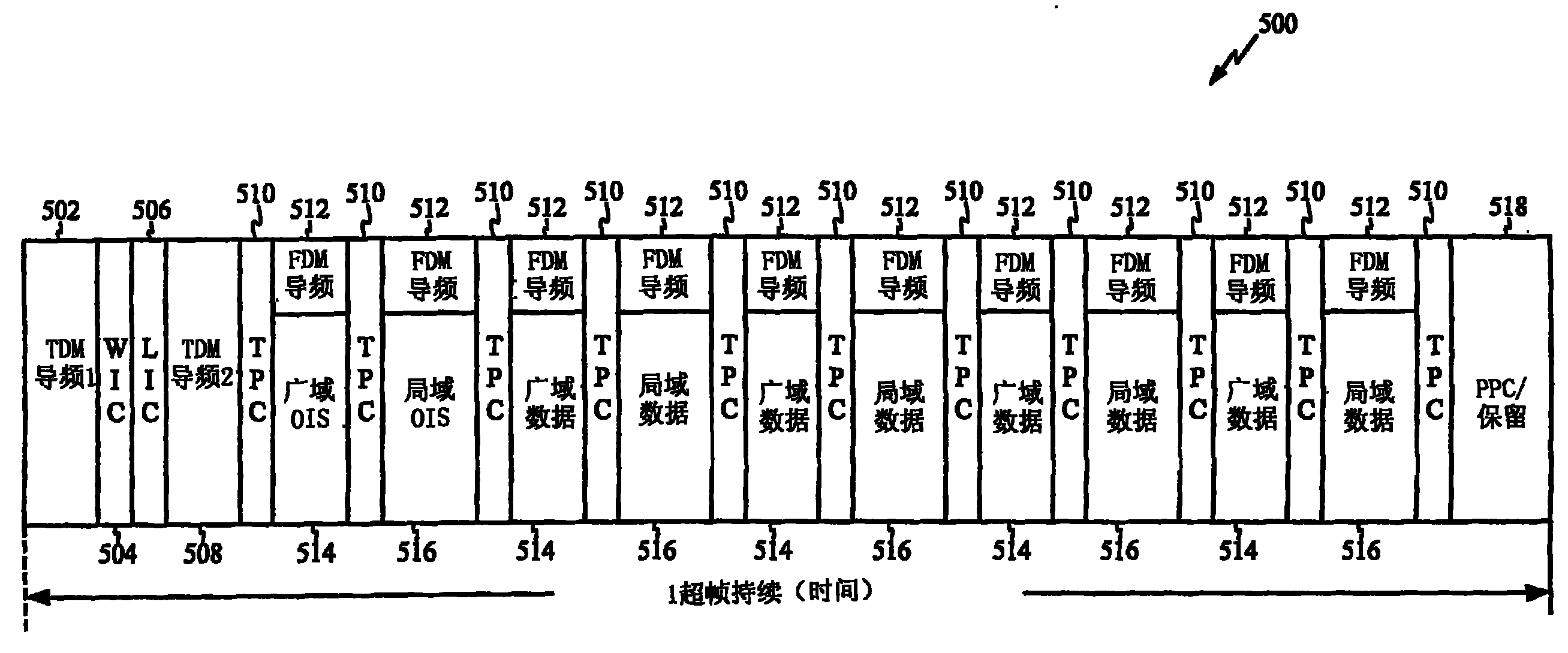
图5是说明根据实施例的FLO物理层超帧结构500的图。图5展示各种物理层信道之间的一般关系(不按比例)。FIG. 5 is a diagram illustrating a FLO physical
在一个实施例中,超帧等于1200个OFDM符号,具有一秒的持续时间。FLO物理层使用4K模式(产生4096个子载波的变换大小),从而提供优于8K模式的移动性能,同时保持足够长的保护间隔,其在相当大的SFN小区中有用。可通过经优化的导频和交错器结构设计来实现快速信道获取。并入FLO空中接口中的交错方案有助于时间分集。导频结构和交错器设计使信道利用优化,同时不会使用户受到长获取时间的困扰。In one embodiment, a superframe is equal to 1200 OFDM symbols and has a duration of one second. The FLO physical layer uses 4K mode (resulting in a transform size of 4096 subcarriers), thereby providing better mobility performance than 8K mode while maintaining a guard interval long enough to be useful in relatively large SFN cells. Fast channel acquisition can be achieved through optimized pilot and interleaver structure design. An interleaving scheme incorporated into the FLO air interface facilitates time diversity. The pilot structure and interleaver design optimize channel utilization without subjecting users to long acquisition times.
在一个实施例中,每个超帧由每MHz分配带宽200个OFDM符号组成(针对6MHz为1200个符号),且每个符号都含有有效子载波的七个交错。每个交错在频率上均匀分布,使得其在可用带宽内实现完整的频率分集。将这些交错指配给根据所使用的实际交错的持续时间和数目而变化的逻辑信道。这在任何给定数据源所实现的时间分集方面提供灵活性。可向较低数据速率的信道指配较少交错以改进时间分集,而较高数据速率的信道利用较多交错,以使无线电的接通时间减到最小并减少功率消耗。In one embodiment, each superframe consists of 200 OFDM symbols per MHz of allocated bandwidth (1200 symbols for 6MHz), and each symbol contains seven interlaces of active subcarriers. Each interlace is evenly distributed in frequency such that it achieves complete frequency diversity within the available bandwidth. These interlaces are assigned to logical channels that vary according to the duration and number of actual interlaces used. This provides flexibility in the time diversity achieved by any given data source. Lower data rate channels may be assigned less interleaving to improve time diversity, while higher data rate channels utilize more interleaving to minimize radio on-time and reduce power consumption.
较低和较高数据速率信道两者的获取时间通常相同。因此,可在不损及获取时间的情况下维持频率和时间分集。最常见的是,使用FLO逻辑信道来以可变速率运载实时(现场流(live streaming))内容,以便用可变速率编解码器(压缩器和解压缩器合二为一)获得可能的统计多路复用增益。每个逻辑信道可具有不同的编码速率和调制,以支持不同应用的各种可靠性和服务质量要求。FLO多路复用方案使得装置接收器能够对其感兴趣的单个逻辑信道的内容进行解调,以使功率消耗减到最小。移动装置可同时对多个逻辑信道进行解调,以使视频和相关联的音频能够在不同信道上发送。The acquisition time is usually the same for both lower and higher data rate channels. Thus, frequency and time diversity can be maintained without compromising acquisition time. Most commonly, FLO logical channels are used to carry real-time (live streaming) content at variable rates in order to obtain the statistical diversity possible with variable rate codecs (compressor and decompressor combined). multiplexing gain. Each logical channel can have a different coding rate and modulation to support various reliability and quality of service requirements for different applications. The FLO multiplexing scheme enables a device receiver to demodulate the content of a single logical channel of interest to it to minimize power consumption. A mobile device can demodulate multiple logical channels simultaneously so that video and associated audio can be sent on different channels.
还可使用误差校正和编码技术。一般来说,FLO并入有涡轮内码(turbo inner code)和Reed Solomon(RS)外码。通常,涡轮码包含有循环冗余校验(CRC)。无需针对正确接收到的数据计算RS码,这在有利的信号条件下会导致额外的功率节省。另一方面是,将FLO空中接口设计成支持5、6、7和8MHz的频率带宽。可用单个射频信道来实现非常理想的服务提供。Error correction and encoding techniques may also be used. Generally speaking, FLO incorporates turbo inner code (turbo inner code) and Reed Solomon (RS) outer code. Typically, turbo codes include a cyclic redundancy check (CRC). No RS code needs to be calculated for correctly received data, which leads to additional power savings under favorable signal conditions. On the other hand, the FLO air interface is designed to support frequency bandwidths of 5, 6, 7 and 8 MHz. Highly desirable service provisioning can be achieved with a single radio frequency channel.
在图中前四个OFDM符号期间,六个TDM导频信道中的四个连续出现,即TDM导频1502、广域识别信道(WIC)504、局域识别信道(LIC)506和TDM导频2508。FDM导频信道与开销信息符号(OIS)信道和数据信道频分多路复用。过渡导频信道(TPC)510与OIS和数据信道时分多路复用,持续一个超帧。定位导频信道(PPC)518或2、6、10或14个保留OFDM符号出现在所述超帧的结尾处。为了支持广域和局域服务的传输:During the first four OFDM symbols in the figure, four of the six TDM pilot channels occur consecutively, namely TDM pilot 1502, wide area identification channel (WIC) 504, local area identification channel (LIC) 506, and TDM pilot 2508. The FDM pilot channel is frequency division multiplexed with an overhead information symbol (OIS) channel and a data channel. A transition pilot channel (TPC) 510 is time multiplexed with OIS and data channels for one superframe. A positioning pilot channel (PPC) 518 or 2, 6, 10 or 14 reserved OFDM symbols occurs at the end of the superframe. To support the transport of wide area and local area services:
将OIS信道分成广域OIS信道和局域OIS信道,其在OIS信道内时分多路复用。The OIS channel is divided into a wide area OIS channel and a local area OIS channel, which are time division multiplexed within the OIS channel.
将FDM导频信道512分成广域FDM导频信道514和局域FDM导频信道516,其在FDM导频信道内时分多路复用。The
将数据信道分成广域数据信道和局域数据信道,其在数据信道内时分多路复用。The data channel is divided into a wide area data channel and a local area data channel, which are time division multiplexed within the data channel.
在特定广域中多播的广域服务在广域数据信道中传输,而在特定局域中多播的局域服务在局域数据信道中传输。A wide area service multicast in a specific wide area is transmitted in the wide area data channel, and a local area service multicast in a specific local area is transmitted in the local data channel.
通用术语“实体”用来指代FLO装置或FLO网络。一个实施例包含以下类型的接口:The generic term "entity" is used to refer to either a FLO device or a FLO network. One embodiment includes the following types of interfaces:
·标头和消息,其用于在一个实体中执行的协议与在另一实体中执行的同一协议之间通信。• Headers and messages for communication between a protocol implemented in one entity and the same protocol implemented in another entity.
·命令,由协议用来从同一FLO网络或装置内的另一协议获得服务。• Commands , used by a protocol to obtain services from another protocol within the same FLO network or device.
·指示,由下层协议用来传达关于事件的发生的信息。任何较高层协议都可注册以接收这些指示。同一层协议也可注册以接收指示,但只在一个方向上。• Indications , used by lower layer protocols to convey information about the occurrence of an event. Any higher layer protocol can register to receive these indications. Protocols at the same layer can also register to receive indications, but only in one direction.
·公开数据,用于以受控方式在协议之间共享信息。公开数据在同一层中的协议之间共享,并且在不同层中的协议之间共享。· Public data for sharing information between protocols in a controlled manner. Public data is shared between protocols in the same layer, and between protocols in different layers.
指示始终以过去式书写,因为其宣告已经发生的事件。标头和消息绑定在所有实施方案上。将指示和公开数据用作进行清楚且精确的说明的手段。FLO装置和FLO网络在选择显示出相同行为的不同实施方案时可以是兼容的。Directives are always written in the past tense because they announce an event that has already happened. Headers and message bindings are on all implementations. Instructions and disclosure data are used as a means of making a clear and precise statement. FLO devices and FLO networks can be compatible in choosing different implementations that exhibit the same behavior.
图6说明展示根据实施例的层中的每一者的协议族600。将控制信息602展示为从上层协议/应用协议604传送到控制层606。控制层包含控制协议608。上层协议/应用协议604与流层610介接。流层包含流协议612。控制层606与MAC层614介接,且流层610与MAC层614介接。FIG. 6 illustrates a
MAC层614包含控制信道616、OIS信道618和数据信道620。控制信道616、OIS信道618和数据信道620使用MAC协议。MAC层614与FLO物理层622介接。
FLO网络所提供的服务由上层所提供的多播数据流(简称为数据流)组成。控制层的作用是向装置提供接收特定数据流所需的信息。在一个实施例中,每个数据流通过唯一的被称为数据流ID 700的20位识别符而寻址。数据流ID包括两个部分:FlowID_bits_4_thru_19 702和FlowID_bits_0_thru_3 704。图7中展示根据实施例的数据流ID的结构。The services provided by the FLO network are composed of multicast data streams (abbreviated as data streams) provided by the upper layer. The role of the control layer is to provide the device with the information it needs to receive a particular data stream. In one embodiment, each data stream is addressed by a unique 20-bit identifier called a
通过逻辑信道来运载数据流。这些逻辑信道被称为多播逻辑信道或MLC。Data streams are carried over logical channels. These logical channels are called Multicast Logical Channels or MLCs.
网络的控制层散布装置在FLO系统中操作所需的信息(被称为控制信息)。装置的控制层接收此信息,并使其控制信息与网络中的控制信息维持同步。控制层将最新的信息提供给其它协议实体。控制层维持三个类别的信息:The control layer of the network disseminates the information (referred to as control information) required by the device to operate in the FLO system. The device's control layer receives this information and keeps its control information synchronized with that in the network. The control layer provides the latest information to other protocol entities. The control plane maintains three categories of information:
·数据流描述信息:此包含数据流到MLC的映射以及数据流配置参数。· Data flow description information: This includes the mapping of data flow to MLC and data flow configuration parameters.
·射频信道信息:此包含在FLO网络中使用的射频信道。• RF Channel Information: This contains the RF channels used in the FLO network.
·邻区列表信息:此包含相邻广域和局域的列表。• Neighbor List Information: This contains a list of neighbor wide and local areas.
控制层将上述类别的每一者中的信息作为两个逻辑上分离的类(即,频段0和频段1)来维持和散布。这种分离允许网络将对控制信息的更新定位到特定的频段。这允许FLO装置处理并利用独立于其它频段的一个频段中的信息。控制层功能由控制协议实施。The control layer maintains and disseminates information in each of the above categories as two logically separate classes (ie,
控制协议应将控制协议包标头设置为如表1所示。The control protocol should set the control protocol packet header as shown in Table 1.
表1 Table 1
Fillfill
控制信道MAC协议标头的填充字段。此字段将针对控制协议封装体(Control protocolcapsule)中的第一CPP而存在,且应被设置成零。否则,应省略此字段。在一个实施例中,控制信道MAC协议用控制信道MAC层封装体标头对此字段进行重写。Padding field of the control channel MAC protocol header. This field shall be present for the first CPP in the Control protocol capsule and shall be set to zero. Otherwise, this field should be omitted. In one embodiment, the Control Channel MAC protocol overwrites this field with a Control Channel MAC layer capsule header.
Message Type IDMessage Type ID
消息类型识别符。应基于此消息运载的信息的类型来设置所述消息类型识别符。表2中列出有效值。Message type identifier. The message type identifier should be set based on the type of information carried by this message. Valid values are listed in Table 2.
表2 Table 2
Bin IDBin ID
此对应于网络向之指配CPP有效负载中所运载的消息的两个逻辑控制协议频段中的一者。网络应将此字段设置为CPP中所运载的内容的频段识别符(0或1)。如果MessageTypeID字段是0x03(填充消息),那么可向此字段指配任何值,且装置忽略此字段。This corresponds to one of two Logical Control Protocol bands to which the network assigns the messages carried in the CPP payload. The network shall set this field to the band identifier (0 or 1) of the content carried in the CPP. If the MessageTypeID field is 0x03 (padding message), any value may be assigned to this field and is ignored by the device.
CPP NumberCPP Number
指配给与此频段的MessageTypeID所识别的控制协议信息相关联的CPP的唯一编号。网络应将其值设置为在从0到TotalCPPCount-1的范围内。The unique number assigned to the CPP associated with the control protocol message identified by the MessageTypeID for this band. The network should set its value in the range from 0 to TotalCPPCount-1.
Total CPP CountTotal CPP Count
与此频段的MessageTypeID所识别的控制协议信息相关联的CPP的总数。网络应将此字段设置为运载MessageTypeID的消息的CPP的总数。The total number of CPPs associated with control protocol messages identified by the MessageTypeID for this band. Networks shall set this field to the total number of CPPs for messages carrying MessageTypeID.
Num Pad BytesNum Pad Bytes
此CPP中所包含的填补字节的数目。网络应将此字段设置为填补字节的数目。The number of padding bytes contained in this CPP. Networks should set this field to the number of padding bytes.
表3中展示数据流描述消息。The data flow description messages are shown in Table 3.
表3 table 3
表4中展示其余字段的FlowCount具体值。Table 4 shows the FlowCount specific values of the remaining fields.
表4 Table 4
Flow Blob LengthFlow Blob Length
FlowBlob(数据流信息块)字段的长度。网络应将此字段设置为此消息中所包含的FlowBlob字段的以位的整数数目计的大小。The length of the FlowBlob (data flow information block) field. Networks shall set this field to the size in bits of the FlowBlob field contained in this message.
Flow CountFlow Count
CPP中所运载的数据流的数目。网络应将此字段设置为数据流描述消息CPP中紧随此字段之后的数据流的数目。The number of data streams carried in the CPP. The network shall set this field to the number of the data flow immediately following this field in the data flow description message CPP.
Reserved 0Reserved 0
应将此字段设置为0。This field should be set to 0.
Flow ID_bits_4_thru_19_Same As BeforeFlow ID_bits_4_thru_19_Same As Before
指示此数据流的FlowID_bits_4_thru_19字段是否与前一数据流相同的旗标。网络针对数据流描述消息CPP中的第一数据流应将此字段设置为“0”。否则,如果CPP中所描述的数据流与前一数据流具有相同的FlowID_bits_4_thru_19,那么应将此字段设置为“1”。Flag indicating whether the FlowID_bits_4_thru_19 field of this flow is the same as the previous flow. The network shall set this field to "0" for the first data flow in the data flow description message CPP. Otherwise, if the data flow described in the CPP has the same FlowID_bits_4_thru_19 as the previous data flow, then this field shall be set to "1".
FlowID_bits_4_thru_19FlowID_bits_4_thru_19
此字段含有数据流的识别符(数据流ID)的上16个位(位4到19)。如果将FlowID_bits_4_thru_19_SameAsBefore字段设置为“1”,那么网络应省略此字段。否则,应将此字段设置为数据流ID的上16个位。This field contains the upper 16 bits (
FlowID_bits_0_thru_3FlowID_bits_0_thru_3
网络应将此字段设置为数据流ID的下4个位。Networks should set this field to the next 4 bits of the Stream ID.
RF Channel IDRF Channel ID
运载数据流的RF信道的识别符。在RF信道描述消息中运载RFChannelID的细节。The identifier of the RF channel carrying the data stream. The details of the RFChannelID are carried in the RF Channel Description message.
MLC ID Same As BeforeMLC ID Same As Before
指示此数据流的MLCID是否与前一数据流相同的旗标。网络针对数据流描述消息CPP中的第一数据流应将此字段设置为“0”。否则,如果此数据流与前一数据流具有相同的MLC ID,那么应将此字段设置为“1”。Flag indicating whether this stream has the same MLCID as the previous stream. The network shall set this field to "0" for the first data flow in the data flow description message CPP. Otherwise, if this data flow has the same MLC ID as the previous data flow, then this field shall be set to "1".
MLC_IDMLC_ID
如果将MLCIDSameAsBefore字段设置为“1”,那么网络应省略此字段。否则,此字段应含有MLC的唯一识别符。If the MLCIDSameAsBefore field is set to "1", the network shall omit this field. Otherwise, this field shall contain the unique identifier of the MLC.
Transmit ModeTransmit Mode
运载此数据流的MLC所使用的传输模式。如果将MLCIDSameAsBefore字段设置为“1”,那么网络应省略此字段,否则,网络应将此字段设置为用于传输MLC的物理层模式。The transport mode used by the MLC carrying this stream. If the MLCIDSameAsBefore field is set to "1", then the network shall omit this field, otherwise, the network shall set this field to the physical layer mode used to transport MLC.
Outer Code RateOuter Code Rate
运载此数据流的MLC的外码速率。如果将MLCIDSameAsBefore字段设置为“1”,那么网络将省略此字段,否则,网络应将此字段设置为应用于MLC的外码速率。表5中列出OuterCodeRate字段的值。The outer code rate of the MLC carrying this stream. If the MLCIDSameAsBefore field is set to "1", the network shall omit this field, otherwise, the network shall set this field to the outer code rate applied to the MLC. Table 5 lists the value of the OuterCodeRate field.

表5 table 5
Flow BlobFlow Blobs
此字段运载上层所使用的数据流信息。网络应根据上层的要求来设置此字段。This field carries the data flow information used by the upper layer. The network should set this field according to the requirements of the upper layer.
Stream IDStream ID
此2位字段是流识别符。网络应将StreamID字段设置为表6中所指定的值。This 2-bit field is the stream identifier. The network shall set the StreamID field to the value specified in Table 6.

表6Table 6
Stream Residual Error ProcessingStream Residual Error Processing
此字段指定装置处的流层残余误差处理。网络应根据表7中列出的值来设置此字段。This field specifies the flow layer residual error handling at the device. Networks should set this field according to the values listed in Table 7.

表7Table 7
Stream Uses Both ComponentsStream Uses Both Components
此字段指定流是含有增强分量和基本分量两者还是只含有基本分量。如果流只含有基本分量,那么网络应将此字段设置为“0”。如果流含有基本分量和增强分量两者,那么网络应将此字段设置为“1”。如果此流所属的MLC使用非分层传输模式,那么网络可将此字段设置为任何值,且装置忽略此字段。This field specifies whether the stream contains both enhancement and base components or only base components. The network shall set this field to "0" if the stream contains only elementary components. The network shall set this field to "1" if the stream contains both base and enhancement components. If the MLC to which this flow belongs uses non-hierarchical transport mode, then the network may set this field to any value and the device ignores this field.
ReservedReserved
添加此可变长度字段以使得数据流描述消息八位位组地对齐。应将此字段设置为0。This variable length field is added to make the Data Flow Description message octet aligned. This field should be set to 0.
RF信道描述消息运载对用于运载FLO服务的RF载波的描述。所述消息应具有表8所示的格式。The RF Channel Description message carries a description of the RF carrier used to carry the FLO service. The message shall have the format shown in Table 8.
表8Table 8
表9展示以下LOI记录的LOICount具体值。Table 9 shows the specific values of LOICount for the following LOI records.
表9Table 9
表10展示以下三个字段的RFChannelCount具体值。Table 10 shows the specific values of RFChannelCount for the following three fields.
表10Table 10
CPPHeaderCPPHeader
CPP标头。CPP header.
LOI CountLOI Count
此消息中所包含的本地运算基础结构(Local Operational Infrastructure)记录的数目。网络应将此字段设置为消息中所包含的LOI记录的数目。The number of Local Operational Infrastructure records included in this message. The network shall set this field to the number of LOI records contained in the message.
LOI IDLOI ID
此字段含有与此LOI记录相关联的局域基础结构识别符的ID。网络应将此字段设置为指配给局域基础结构的识别符。This field contains the ID of the local infrastructure identifier associated with this LOI record. Networks should set this field to the identifier assigned to the local infrastructure.
RF Channel CountRF Channel Count
网络应将此字段设置为RF信道描述消息CPP中紧随此字段之后的RF信道的数目。The network shall set this field to the number of the RF channel immediately following this field in the RF Channel Description message CPP.
RF Channel IDRF Channel ID
网络应将此字段设置为与此记录中所包含的Frequency和ChannelPlan字段值的组合相关联的数字识别符。Networks shall set this field to the numeric identifier associated with the combination of the Frequency and ChannelPlan field values contained in this record.
FrequencyFrequency
网络应将此字段设置为从470MHz(信道14到69的FCC广播TV分配的开始)到载波中心频率的以50KHz为单位的频率偏移量。这通过以下等式来计算:
Channel PlanChannel Plan
网络应将此字段设置为发射器所使用的信道规划(或信道带宽)。表11中列出此字段的值。The network should set this field to the channel plan (or channel bandwidth) used by the transmitter. The values for this field are listed in Table 11.
表11Table 11
ReservedReserved
添加此字段以使得RF信道描述消息八位位组地对齐。网络应将此字段中的位设置为“0”。This field is added to make the RF Channel Description message octet aligned. The network shall set the bits in this field to '0'.
邻区列表描述消息运载给定LOI的相邻LOI的基础结构参数。所包含的基础结构参数是频率、广域微分算子(WID)和对应的局域微分算子(LID)。所述消息应具有表12所示的格式。The Neighbor List Description message carries the infrastructure parameters of the neighboring LOIs of a given LOI. The included infrastructure parameters are frequency, wide-area differential operator (WID) and corresponding local area differential operator (LID). The message shall have the format shown in Table 12.
表12Table 12
表13展示以下LOI记录的LOICount具体值。Table 13 shows the specific values of LOICount for the following LOI records.
表13Table 13
表14展示以下频率记录的FrequencyCount具体值。Table 14 shows the specific values of FrequencyCount for the following frequency records.
表14Table 14
表15展示以下WID记录的WIDCount具体值。Table 15 shows the specific values of WIDCount for the following WID records.
表15Table 15
表16展示以下字段的LIDCount具体值。Table 16 shows the specific values of LIDCount for the following fields.
表16Table 16
CPP HeaderCPP Header
CPP标头。CPP header.
LOI CountLOI Count
此消息中所包含的本地运算基础结构记录的数目。网络应将此字段设置为所述消息中所包含的LOI记录的数目。The number of local computing infrastructure records contained in this message. The network shall set this field to the number of LOI records contained in the message.
LOI IDLOI ID
此字段含有与此LOI记录相关联的局域基础结构识别符的ID。网络应将此字段设置为指配给局域基础结构的识别符。This field contains the ID of the local infrastructure identifier associated with this LOI record. Networks should set this field to the identifier assigned to the local infrastructure.
Frequency CountFrequency Count
LOI记录中所包含的频率的数目。网络应将此字段设置为LOI记录中所包含的频率记录的数目。The number of frequencies contained in the LOI record. The network shall set this field to the number of frequency records contained in the LOI record.
FrequencyFrequency
此字段含有从470MHz(信道14到69的FCC广播TV分配的开始)到中心频率的以50kHz为单位的频率偏移量。This field contains the frequency offset in units of 50 kHz from 470 MHz (the start of the FCC broadcast TV allocation for channels 14 to 69) to the center frequency.
Channel PlanChannel Plan
此字段含有针对局域传输使用的信道规划。This field contains the channel plan used for local area transmissions.
WID CountWID Count
网络应将此字段设置为紧随此字段之后的WID记录的数目。Networks shall set this field to the number of WID records immediately following this field.
WIDWID
网络应将此字段设置为与此广域相关联的广域微分算子。Networks should set this field to the wide-area differential operator associated with this wide-area.
LID CountLID Count
网络应将此字段设置为紧随此字段之后的LID记录的数目。Networks shall set this field to the number of LID records immediately following this field.
LIDLIDs
网络应将此字段设置为与此局域相关联的局域微分算子。Networks should set this field to the local differential operator associated with this local.
ReservedReserved
这是经添加以使得邻区列表描述消息八位位组地对齐的可变长度字段。网络应将此字段中的位设置为“0”。This is a variable length field that is added to make the Neighbor List Description message octet-aligned. The network shall set the bits in this field to '0'.
表17展示填充消息。在已包含了运载控制信息的所有控制协议消息之后,用填充消息来填充控制协议封装体有效负载的未使用部分。填充消息不属于任何频段。因此,此消息的CPP标头中的BinID字段被包含在内但不使用。在一个实施例中,网络将此字段中的所有FillerOctets位设置为成“0”。Table 17 shows the padding messages. After all control protocol messages carrying control information have been contained, the unused portion of the control protocol capsule payload is filled with padding messages. The filler message does not belong to any band. Therefore, the BinID field in the CPP header of this message is included but not used. In one embodiment, the network sets all FillerOctets bits in this field to "0".
表17Table 17
网络中的控制协议应添加足够的填补八位位组以填充CPP的任何未占用部分。表18中展示PadByte的格式。Control protocols in the network should add enough padding octets to fill any unoccupied portion of the CPP. The format of PadByte is shown in Table 18.
表18Table 18
如图6所示,流层驻存在FLO协议堆栈中的MAC层与上/应用层之间。在一个或一个以上数据流中运载来自上层的数据。流层为去往和来自上层的数据流提供对FLO空中接口协议堆栈的接入。数据流可由一个分量(被称为基本分量)或两个分量(被称为基本分量和增强分量)组成。当数据流具有两个分量时,增强分量与基本分量紧密耦合。举例来说,两个分量使用同一数据流ID进行寻址、被传递到装置中的同一上层实体并在流层中接受同一延迟和误差处理。As shown in Figure 6, the flow layer resides between the MAC layer and the upper/application layer in the FLO protocol stack. Carry data from upper layers in one or more data streams. The stream layer provides access to the FLO air interface protocol stack for data streams to and from upper layers. A data stream can consist of one component (called a base component) or two components (called a base component and an enhancement component). When a data stream has two components, the enhancement component is tightly coupled to the base component. For example, both components are addressed using the same stream ID, delivered to the same upper layer entity in the device and receive the same delay and error handling in the stream layer.
根据一个实施例,流层的主要功能是对去往/来自单个MLC的多达三个数据流进行多路复用/解多路复用。According to one embodiment, the main function of the stream layer is to multiplex/demultiplex up to three data streams to/from a single MLC.
流协议提供流层的功能性。流协议对进入单个MLC的上层数据流进行多路复用。这些上层数据流被作为MLC中的“流”输送。将多达三个流(被称为流0、流1和流2)多路复用到一个MLC中。如果存在要针对流1和/或流2发送的数据流数据(flow data),那么MLC中始终存在流0。换句话说,如果不存在要针对所述流中的任何一者发送的数据流数据,那么不发送流0。The stream protocol provides the functionality of the stream layer. The streaming protocol multiplexes upper layer data streams into a single MLC. These upper layer data streams are transported as "streams" in the MLC. Multiplexes up to three streams (referred to as
上层数据流可由基本分量和增强分量组成。如果两个分量都存在,那么由同一流来运载所述两个分量。即使在相关联的MLC被配置用于分层传输模式时,流0也只运载基本分量。另外两个流(流1和流2)可运载基本分量和增强分量两者。当流运载增强分量时,要求所述数据流的上层与基本分量和增强分量的大小完全匹配。The upper layer data stream may consist of base components and enhancement components. If both components are present, then the two components are carried by the same stream.
流协议支持两种接口模式:The streaming protocol supports two interface modes:
八位位组数据流模式,其中网络中的流协议从上层接收八位位组流,且装置中的对等协议传递八位位组流。An octet stream mode where a stream protocol in the network receives the octet stream from upper layers and a peer protocol in the device passes the octet stream.
透明或块数据流模式,其中网络中的流协议接收大小固定的八位位组块的流,且装置中的对等协议将这些大小固定的八位位组块传递到上层。Transparent or block data streaming mode, where the streaming protocol in the network receives the stream in fixed size octet chunks and the peer protocol in the device passes these fixed size octet chunks to upper layers.
流协议提供TransparentModeFlag属性,以便为每个上层数据流选择接口模式。当将此属性设置为“1”时,流协议接收固定的122个八位位组块的流,所述块中的每一者由单独的物理层包运载。这允许上层对下FLO协议层处的包边界的可见性。只针对流1和流2支持这种透明或块数据流模式(也被称为面向块的模式)。The stream protocol provides the TransparentModeFlag attribute to select the interface mode for each upper layer data stream. When this attribute is set to "1," the streaming protocol receives a stream of fixed 122-octet blocks, each of which is carried by a separate physical layer packet. This allows upper layers visibility of packet boundaries at lower FLO protocol layers. This transparent or block dataflow mode (also known as block-oriented mode) is only supported for
如果针对一个数据流将TransparentModelFlag属性设置为“0”,那么流协议将来自上层数据流的数据作为八位位组流来处理。如果上层与下层包的形成无关,那么这种接口是合适的。流0始终使用这种八位位组数据流模式(也被称为八位位组导向的模式)。流1和流2使用两种模式(块数据流模式或八位位组数据流模式)中的任一者。If the TransparentModelFlag attribute is set to "0" for a stream, the stream protocol handles data from the upper layer stream as an octet stream. This interface is suitable if the upper layer has nothing to do with the formation of lower layer packets.
流协议提供接口以使用ResidualErrorProcessing属性来指定对上层数据流的流层残余误差处理。这种选择应用于数据流的基本分量和增强分量(当存在时)两者。选择包含:The stream protocol provides an interface to use the ResidualErrorProcessing attribute to specify the stream layer residual error processing for the upper layer data stream. This selection applies to both the base component and the enhancement component (when present) of the data stream. Choose to include:
无(None)-指定由流运载的数据流将在不经额外处理的情况下被传递到上层实体。将包中接收到的数据流的含有误差的八位位组传递到上层实体。None - specifies that the data stream carried by the flow will be passed to the upper entity without additional processing. Passes the error-containing octets of the received data stream in packets to the upper-layer entity.
丢弃(Drop)-指定包中接收到的数据流的含有误差的八位位组将被废除。Drop - Specifies that octets containing errors in the received stream of packets are to be discarded.
流协议提供接口以指定对上层数据流的延迟限制。依据三个属性来指定延迟限制,所述三个属性即DelayConstraintType、DelayConstraintValue和StreamElasticity:Streaming protocols provide interfaces to specify latency constraints on upper-layer data streams. Delay constraints are specified in terms of three attributes, DelayConstraintType, DelayConstraintValue, and StreamElasticity:
·DelayConstraintType指定数据流的延迟限制类型。这个选择应用于数据流的基本分量和增强分量(当存在时)两者。选择包含:• DelayConstraintType specifies the delay constraint type for the data stream. This selection applies to both the base component and the enhancement component (when present) of the data stream. Choose to include:
实时(RealTime)-指定数据流被延迟了恒定值。Real Time (RealTime) - Specifies that the data stream is delayed by a constant value.
最大延迟(MaxDelay)-指定数据流具有最大延迟限制。Maximum Delay (MaxDelay) - Specifies that the data flow has a maximum delay limit.
无(None)-指定只有在额外MLC带宽可用时才发送数据流。None (None) - specifies that the traffic is only sent when additional MLC bandwidth is available.
·DelayConstraintValue指定当DelayConstraintType是RealTime或MaxDelay时上层数据流的延迟限制的值。• DelayConstraintValue specifies the value of the delay constraint of the upper layer data stream when DelayConstraintType is RealTime or MaxDelay.
·StreamElasticity指定当无法满足延迟限制时如何处理数据流。这个选择应用于数据流的基本分量和增强分量(当存在时)两者。选择包含:· StreamElasticity specifies how to handle data streams when latency constraints cannot be met. This selection applies to both the base component and the enhancement component (when present) of the data stream. Choose to include:
灵活(Elastic)-指定来源在收到请求时降低数据速率。Elastic—Specifies that the origin reduces the data rate when requested.
丢弃(Drop)-指定数据流八位位组可丢弃。Drop - Specifies that stream octets can be dropped.
分段(Fragment)-指定八位位组的全部或一部分可延迟。Fragment - Specifies that all or part of an octet may be deferrable.
本文献假定针对每个有效数据信道MLC,网络中存在此协议的一个实例。在装置中,针对所述装置正在解码的每个MLC,存在此协议的一个实例。This document assumes that for each active data channel MLC, one instance of this protocol exists in the network. In a device, there is one instance of this protocol for each MLC that the device is decoding.
此协议在两种状态中的一者下操作:This protocol operates in one of two states:
·非现用状态:在此状态下,协议等待激活命令。· Inactive state : In this state, the protocol waits for an activation command.
·现用状态:在此状态下,网络中的协议对至多达三个数据流进行分包、对这些包进行多路复用以便在相关联的MLC中传输并将其发送到MAC层。装置中的协议从MAC层接收流层包、处理残余传输误差并将所得的八位位组或八位位组块数据流传递到上层。• Active state : In this state, the protocol in the network packetizes up to three data streams, multiplexes the packets for transport in the associated MLC and sends them to the MAC layer. The protocol in the device receives stream layer packets from the MAC layer, processes residual transmission errors and passes the resulting octet or octet block data stream to upper layers.
流层提供以下功能:The stream layer provides the following functionality:
·提供用以将上层数据流绑定到MLC中的流的接口。每个MLC可支持三个独立的数据流。• Provides an interface to bind upper layer data flows to flows in the MLC. Each MLC can support three independent data streams.
·将来自上层的至多达三个数据流多路复用到一个MLC中。• Multiplexing of up to three data streams from upper layers into one MLC.
·调节上层数据流的延迟限制。· Adjust the delay limit of the upper layer data flow.
·规定对上层数据流的残余误差处理。• Specifies residual error handling for upper layer data streams.
·规定对上层数据流的基本分量和增强分量的独立处理。• Specifies independent processing of the base and enhancement components of the upper layer data stream.
MAC层定义广域和局域OIS信道、广域和局域控制信道和数据信道的操作。MAC层还对MLC进行多路复用以便在FLO网络处传输,并在FLO装置处对其进行解多路复用。MAC层包含以下三个协议:The MAC layer defines the operation of wide and local OIS channels, wide and local control channels and data channels. The MAC layer also multiplexes MLCs for transmission at the FLO network and demultiplexes them at the FLO device. The MAC layer consists of the following three protocols:
·OIS信道MAC协议:此协议含有指导FLO网络如何建立在OIS信道中传输的消息和FLO装置如何接收并处理这些消息的规则。· OIS Channel MAC Protocol : This protocol contains the rules that instruct the FLO network how to set up the messages transmitted in the OIS channel and how the FLO devices receive and process these messages.
·数据信道MAC协议:此协议含有指导FLO网络如何建立MAC层包以在广域和局域数据信道上传输运载服务的数据和FLO装置如何接收并处理这些包的规则。• Data Channel MAC Protocol : This protocol contains rules that instruct the FLO network on how to build MAC layer packets to transmit service-carrying data over wide and local area data channels and how the FLO devices receive and process these packets.
·控制信道MAC协议:此协议含有指导FLO网络如何建立MAC层包以在广域和局域控制信道上传输FLO控制信息和FLO装置如何接收并处理这些包的规则。• Control Channel MAC Protocol : This protocol contains rules that instruct the FLO network how to build MAC layer packets to transmit FLO control information on the wide and local control channels and how the FLO devices receive and process these packets.
在MAC层处定义数据信道和控制信道。在物理层处,在同一数据信道上运载这两种信道类型。Data channels and control channels are defined at the MAC layer. At the physical layer, both channel types are carried on the same data channel.
在被称为MAC协议封装体的实体中封装一个超帧的MLC的内容。在MAC层包中运载MAC协议封装体。一个MAC层包的大小是122个八位位组,且一个MAC层包形成一个物理层包(PLP)的有效负载。The contents of a superframe's MLC are encapsulated in an entity called a MAC protocol capsule. The MAC protocol capsule is carried in the MAC layer packet. The size of one MAC layer packet is 122 octets, and one MAC layer packet forms the payload of one physical layer packet (PLP).
物理层的传输单位是物理层包。物理层包的长度为1000个位。一个物理层包运载一个MAC层包。The transmission unit of the physical layer is the physical layer packet. The length of the physical layer packet is 1000 bits. One physical layer packet carries one MAC layer packet.
FLO物理层由以下子信道(sub-channel)组成:The FLO physical layer consists of the following sub-channels:
·TDM导频信道。• TDM pilot channel.
·广域OIS信道。· Wide area OIS channel.
·局域OIS信道。• Local OIS channel.
·广域FDM导频信道。• Wide-area FDM pilot channel.
·局域FDM导频信道。• Local FDM pilot channel.
·广域数据信道。• Wide area data channel.
·局域数据信道。· Local data channel.
TDM导频信道包括以下组成信道:TDM导频1、TDM导频2、过渡导频信道、WIC、LIC和定位导频/保留符号。The TDM Pilot Channel includes the following constituent channels:
TDM导频1信道应横跨一个OFDM符号。所述TDM导频1信道应在超帧中的OFDM符号索引0处传输。OFDM符号索引0标志新超帧的开始。FLO装置可使用所述OFDM符号索引0来确定粗略的OFDM符号定时、超帧边界和载波频率偏移量。The
广域识别信道(WIC)应横跨一个OFDM符号。所述广域识别信道应在超帧中的OFDM符号索引1处传输。OFDM符号索引1紧随TDM导频1OFDM符号之后。这是用来将广域微分算子信息传达给FLO接收器的开销信道。使用对应于广域的4位广域微分算子来对广域(包含局域信道,但不包含TDM导频1信道和PPC)内的所有发射波形进行扰频。对于超帧中的WIC OFDM符号,应只分配1个时隙。所述经分配的时隙应使用1000位固定图案作为输入,其中将每个位都设置为零。The Wide Area Identification Channel (WIC) shall span one OFDM symbol. The wide area identification channel shall be transmitted at
局域识别信道(LIC)应横跨一个OFDM符号。所述局域识别信道应在超帧中的OFDM符号索引2处传输。OFDM符号索引2紧随WIC信道OFDM符号之后。这是用来将局域微分算子信息传达给FLO接收器的开销信道。结合广域微分算子使用对应于局域的4位局域微分算子来对所有局域发射波形进行扰频。The Local Area Identification Channel (LIC) shall span one OFDM symbol. The local area identification channel shall be transmitted at
对于超帧中的LIC OFDM符号,应只分配单个时隙。所分配的时隙应使用1000位固定图案作为输入。应将这些位设置为零。For LIC OFDM symbols in a superframe, only a single slot shall be allocated. The allocated slots shall use a fixed pattern of 1000 bits as input. These bits should be set to zero.
TDM导频2信道应横跨一个OFDM符号。所述TDM导频2信道应在超帧中的OFDM符号索引3处传输。OFDM符号索引3紧随LIC OFDM符号之后。OFDM符号索引3可用于FLO接收器中精确的OFDM符号定时校正。The
对于每个超帧中的TDM导频2OFDM符号,应只分配4个时隙。每个所分配的时隙应使用1000位固定图案作为输入,其中将每个位都设置为零。For
过渡导频信道由2个子信道组成:广域过渡导频信道(WTPC)和局域过渡导频信道(LTPC)。位于广域OIS和广域数据信道侧面的TPC被称为WTPC。位于局域OIS和局域数据信道的侧面的TPC被称为LTPC。在一个超帧中,WTPC在除WIC(广域数据和广域OIS信道)以外的每个广域信道传输的任一侧上横跨1个OFDM符号。LTPC在除LIC(局域数据和局域OIS信道)以外的每个局域信道传输的任一侧上横跨1个OFDM符号。TPC OFDM符号具有双重用途:允许局域与广域信道之间的边界处的信道估计,并且有助于每个帧中的第一广域(或局域)MLC的定时同步。在一个超帧中,TPC横跨20个OFDM符号,所述符号在WTPC与LTPC之间均等地划分。The Transition Pilot Channel consists of 2 sub-channels: Wide Area Transition Pilot Channel (WTPC) and Local Area Transition Pilot Channel (LTPC). The TPC flanking the wide area OIS and wide area data channel is called WTPC. The TPC flanking the local OIS and local data channels is called LTPC. In one superframe, the WTPC spans 1 OFDM symbol on either side of each wide area channel transmission except WIC (wide area data and wide area OIS channels). LTPC spans 1 OFDM symbol on either side of each local channel transmission except LIC (local data and local OIS channels). TPC OFDM symbols serve a dual purpose: to allow channel estimation at the boundary between local and wide area channels, and to facilitate timing synchronization of the first wide area (or local) MLC in each frame. In one superframe, TPC spans 20 OFDM symbols, which are equally divided between WTPC and LTPC.
在一个实施例中,存在LTPC和WTPC传输恰好紧跟在彼此之后发生的九个实例,以及只传输这些信道中的一者的两个实例。在TDM导频2信道之后只传输WTPC,且在定位导频信道(PPC)/保留OFDM符号之前只传输LTPC。In one embodiment, there are nine instances where LTPC and WTPC transmissions occur immediately after each other, and two instances where only one of these channels is transmitted. Only WTPC is transmitted after the
假设:assumptions:
P是PPC/保留OFDM符号中的OFDM符号的数目。P is the number of OFDM symbols in the PPC/reserved OFDM symbols.
W是一个帧中与广域数据信道相关联的OFDM符号的数目。W is the number of OFDM symbols associated with the wide area data channel in one frame.
L是一个帧中与局域数据信道相关联的OFDM符号的数目。L is the number of OFDM symbols associated with the local area data channel in a frame.
F是一个帧中OFDM符号的数目。F is the number of OFDM symbols in a frame.
P的值应为2、6、10或14。一个帧中的数据信道OFDM符号的数目应为F-4。一个超帧中的TPC OFDM符号的确切位置应如表19中所指定。The value of P should be 2, 6, 10 or 14. The number of data channel OFDM symbols in one frame shall be F-4. The exact location of TPC OFDM symbols within a superframe shall be as specified in Table 19.
表19超帧中的TPC位置索引Table 19 TPC position index in superframe
TPC OFDM符号中的所有时隙都使用1000位固定图案作为输入,其中将每个位都设置为零。All slots in a TPC OFDM symbol use a fixed pattern of 1000 bits as input, where every bit is set to zero.
在一个实施例中,FLO装置可自主地或结合GPS信号来使用定位导频信道(PPC)以确定其地理位置。In one embodiment, a FLO device may use a positioning pilot channel (PPC), either autonomously or in conjunction with GPS signals, to determine its geographic location.
使用广域OIS信道来传达关于当前超帧中与广域数据信道相关联的有效MLC的开销信息,例如其经排定的传输时间和时隙分配。在一个实施例中,在每个超帧中,广域OIS信道横跨五个OFDM符号间隔。The wide area OIS channel is used to convey overhead information about the active MLCs associated with the wide area data channel in the current superframe, such as their scheduled transmission times and slot allocations. In one embodiment, the wide area OIS channel spans five OFDM symbol intervals in each superframe.
使用局域OIS信道来传达关于当前超帧中与局域数据信道相关联的有效MLC的开销信息,例如其经排定的传输时间和时隙分配。在一个实施例中,在每个超帧中,局域OIS信道横跨五个OFDM符号间隔。The local OIS channel is used to convey overhead information about the active MLCs associated with the local data channel in the current superframe, such as their scheduled transmission times and slot allocations. In one embodiment, the local OIS channel spans five OFDM symbol intervals in each superframe.
结合广域数据信道或广域OIS信道来传输广域FDM导频信道。广域FDM导频信道运载可由FLO装置用来进行广域信道估计和其它功能的固定位图案。The wide-area FDM pilot channel is transmitted in conjunction with the wide-area data channel or the wide-area OIS channel. The wide-area FDM pilot channel carries a fixed bit pattern that can be used by the FLO device for wide-area channel estimation and other functions.
对于广域FDM导频信道,应在每个OFDM符号期间分配单个时隙,其运载广域数据信道或广域OIS信道。所分配的时隙应使用1000位固定图案作为输入。应将这些位设置为零。For the wide-area FDM pilot channel, a single time slot should be allocated during each OFDM symbol, which carries either the wide-area data channel or the wide-area OIS channel. The allocated slots shall use a fixed pattern of 1000 bits as input. These bits should be set to zero.
结合局域数据信道或局域OIS信道来传输局域FDM导频信道。局域FDM导频信道运载可由FLO装置用来进行局域信道估计和其它功能的固定位图案。A local FDM pilot channel is transmitted in conjunction with a local data channel or a local OIS channel. The local FDM pilot channel carries a fixed bit pattern that can be used by the FLO device for local channel estimation and other functions.
对于局域FDM导频信道,应在每个OFDM符号期间分配单个时隙,其运载局域数据信道或局域OIS信道。所分配的时隙应使用1000位固定图案作为输入。应将这些位设置为零。For a local FDM pilot channel, a single time slot should be allocated during each OFDM symbol, which carries either a local data channel or a local OIS channel. The allocated slots shall use a fixed pattern of 1000 bits as input. These bits should be set to zero.
使用广域数据信道来运载意图用于广域多播的物理层包。广域数据信道的物理层包可与在广域中传输的有效MLC中的任一者相关联。The wide area data channel is used to carry physical layer packets intended for wide area multicast. A physical layer packet of a wide area data channel may be associated with any of the active MLCs transmitted in the wide area.
对于常规调制(QPSK和16-QAM),在将物理层包存储在数据槽缓冲器(data slotbuffer)中之前对所述物理层包进行涡轮编码和位交错。对于分层调制,在将基本分量物理层包和增强分量物理层包多路复用到数据槽缓冲器中之前,独立地对所述物理层包进行涡轮编码和位交错。For conventional modulations (QPSK and 16-QAM), the PHY packets are turbo-encoded and bit-interleaved before being stored in a data slot buffer. For layered modulation, base and enhanced component PHY packets are independently turbo-encoded and bit-interleaved before being multiplexed into the data slot buffer.
使用局域数据信道来运载意图用于局域多播的物理层包。局域数据信道的物理层包可与在局域中传输的有效MLC中的任一者相关联。The local data channel is used to carry physical layer packets intended for local multicast. A physical layer packet of a local area data channel may be associated with any of the active MLCs transmitted in the local area.
对于常规调制(QPSK和16-QAM),在将物理层包存储在数据槽缓冲器中之前对所述物理层包进行涡轮编码和位交错。对于分层调制,在将基本分量物理层包和增强分量物理层包多路复用到数据槽缓冲器中之前,独立地对所述物理层包进行涡轮编码和位交错。For conventional modulations (QPSK and 16-QAM), the PHY packets are turbo encoded and bit interleaved before being stored in the data slot buffer. For layered modulation, base and enhanced component PHY packets are independently turbo-encoded and bit-interleaved before being multiplexed into the data slot buffer.
图8是根据本文所陈述的一个或一个以上方面在无线通信环境中使用的用户装置800的说明。用户装置800包括接收器802,其(例如)从接收天线(未图示)接收信号,并对接收到的信号执行典型动作(例如,滤波、放大、降频转换等),并对经调节的信号进行数字化,以便获得样本。接收器802可以是非线性接收器。解调器804可对接收到的导频符号进行解调,并将其提供到处理器806以用于信道估计。提供FLO信道组件810以如先前所述那样处理FLO信号。这可包含数字流处理和/或定位位置计算等处理。处理器806可以是:专用于分析接收器802接收到的信息和/或产生供发射器816发射的信息的处理器、控制用户装置800的一个或一个以上组件的处理器,和/或既分析接收器802接收到的信息、产生供发射器816发射的信息,又控制用户装置800的一个或一个以上组件的处理器。8 is an illustration of a
用户装置800可额外地包括存储器808,存储器808可操作地耦合到处理器806,并存储与无线网络数据处理有关的信息。将了解,本文中描述的数据存储(例如,存储器)组件可以是易失性存储器或非易失性存储器,或者可包含易失性和非易失性存储器两者。作为说明而非限制,非易失性存储器可包含只读存储器(ROM)、可编程ROM(PROM)、电可编程ROM(EPROM)、电可擦除ROM(EEPROM)或快闪存储器。易失性存储器可包含随机存取存储器(RAM),其充当外部高速缓冲存储器。作为说明而非限制,RAM以许多形式可用,例如同步RAM(SRAM)、动态RAM(DRAM)、同步DRAM(SDRAM)、双数据速率SDRAM(DDR SDRAM)、增强SDRAM(ESDRAM)、同步链路DRAM(SLDRAM)和直接内存总线式RAM(direct Rambus RAM,DRRAM)。标的系统和方法的存储器808意在包括(但不限于)这些和其它任何合适类型的存储器。用户装置800进一步包括用于处理FLO数据的后台监视器814、符号调制器814和发射经调制信号的发射器816。
图9说明实例系统900,其包括基站902,所述基站902具有通过多个接收天线906从一个或一个以上用户装置904接收信号的接收器910,以及通过发射天线908向一个或一个以上用户装置904发射的发射器924。接收器910可从接收天线906接收信息,并且可操作地与对接收到的信息进行解调的解调器912相关联。通过处理器914来分析经解调的符号,所述处理器914与上文所述的处理器相似,并且耦合到存储器916,存储器916存储与无线数据处理有关的信息。处理器914进一步耦合到FLO信道918组件,这有助于处理与一个或一个以上相应用户装置904相关联的FLO信息。9 illustrates an example system 900 that includes a base station 902 having a receiver 910 that receives signals from one or more user devices 904 through a plurality of receive antennas 906, and transmits signals to one or more user devices through a transmit antenna 908. 904 emits a transmitter 924 . Receiver 910 can receive information from receive antenna 906 and is operatively associated with demodulator 912 that demodulates received information. The demodulated symbols are analyzed by a processor 914, similar to the processors described above, and coupled to a memory 916, which stores information related to wireless data processing. Processor 914 is further coupled to a FLO channel 918 component, which facilitates processing of FLO information associated with one or more respective user devices 904 .
调制器922可对信号进行多路复用,以便发射器924通过发射天线908向用户装置904发射所述信号。FLO信道组件918可将与用于与用户装置904通信的给定传输流的经更新的数据流有关的信息附加到信号,可将所述信号传输到用户装置504以提供对新的最佳信道已经被识别和确认的指示。Modulator 922 may multiplex the signals for transmitter 924 to transmit the signals to user device 904 via transmit antenna 908 . FLO channel component 918 can append information about the updated data stream for a given transport stream used to communicate with user device 904 to a signal that can be transmitted to
上文已经描述的内容包含示范性实施例。当然,不可能为了描述实施例而描述组件或方法的每个可以想到的组合,但所属领域的技术人员可认识到,许多进一步的组合和变更是可能的。因此,希望这些实施例涵盖属于所附权利要求的精神和范围的所有此类改变、修改和变化。此外,就术语“包含”在具体实施方式或权利要求书中的使用而言,希望此术语以类似于术语“包括”的方式,像“包括”在用作权利要求书中的过渡词时被解释的那样包含在内。What has been described above comprises exemplary embodiments. It is, of course, not possible to describe every conceivable combination of components or methodologies for purposes of describing the embodiments, but those skilled in the art may recognize that many further combinations and permutations are possible. Accordingly, these embodiments are intended to embrace all such alterations, modifications and variations that fall within the spirit and scope of the appended claims. Furthermore, to the extent that the term "comprises" is used in the detailed description or in the claims, it is intended that the term be used in a manner similar to the term "comprises," as "comprises" is used as a transition word in the claims. Included as explained.
Claims (1)
Applications Claiming Priority (2)
| Application Number | Priority Date | Filing Date | Title |
|---|---|---|---|
| US70331505P | 2005-07-27 | 2005-07-27 | |
| US60/703,315 | 2005-07-27 |
Publications (1)
| Publication Number | Publication Date |
|---|---|
| CN101283553A true CN101283553A (en) | 2008-10-08 |
Family
ID=37496435
Family Applications (4)
| Application Number | Title | Priority Date | Filing Date |
|---|---|---|---|
| CNA2006800348460A Pending CN101283553A (en) | 2005-07-27 | 2006-07-27 | Systems and methods for forward link-only messages |
| CNA2006800350244A Pending CN101273582A (en) | 2005-07-27 | 2006-07-27 | Systems and methods for forward link-only protocol family |
| CN2010105360946A Expired - Fee Related CN101989892B (en) | 2005-07-27 | 2006-07-27 | System and method for forward link physical layer |
| CN2006800349548A Expired - Fee Related CN101292471B (en) | 2005-07-27 | 2006-07-27 | System and method for forward link only physical layer |
Family Applications After (3)
| Application Number | Title | Priority Date | Filing Date |
|---|---|---|---|
| CNA2006800350244A Pending CN101273582A (en) | 2005-07-27 | 2006-07-27 | Systems and methods for forward link-only protocol family |
| CN2010105360946A Expired - Fee Related CN101989892B (en) | 2005-07-27 | 2006-07-27 | System and method for forward link physical layer |
| CN2006800349548A Expired - Fee Related CN101292471B (en) | 2005-07-27 | 2006-07-27 | System and method for forward link only physical layer |
Country Status (8)
| Country | Link |
|---|---|
| US (3) | US8130778B2 (en) |
| EP (3) | EP1913738A2 (en) |
| JP (5) | JP4870762B2 (en) |
| KR (3) | KR100934076B1 (en) |
| CN (4) | CN101283553A (en) |
| AT (1) | ATE466424T1 (en) |
| DE (1) | DE602006013995D1 (en) |
| WO (3) | WO2007014360A2 (en) |
Cited By (1)
| Publication number | Priority date | Publication date | Assignee | Title |
|---|---|---|---|---|
| CN109922537A (en) * | 2019-03-29 | 2019-06-21 | 广州邦讯信息系统有限公司 | Data link layer and its implementation applied to wireless communication |
Families Citing this family (37)
| Publication number | Priority date | Publication date | Assignee | Title |
|---|---|---|---|---|
| US20040172084A1 (en) * | 2003-02-03 | 2004-09-02 | Knudson Mark B. | Method and apparatus for treatment of gastro-esophageal reflux disease (GERD) |
| US8509051B2 (en) | 2003-09-02 | 2013-08-13 | Qualcomm Incorporated | Multiplexing and transmission of multiple data streams in a wireless multi-carrier communication system |
| US7221680B2 (en) | 2003-09-02 | 2007-05-22 | Qualcomm Incorporated | Multiplexing and transmission of multiple data streams in a wireless multi-carrier communication system |
| US8599764B2 (en) | 2003-09-02 | 2013-12-03 | Qualcomm Incorporated | Transmission of overhead information for reception of multiple data streams |
| US8477809B2 (en) | 2003-09-02 | 2013-07-02 | Qualcomm Incorporated | Systems and methods for generalized slot-to-interlace mapping |
| US8526412B2 (en) | 2003-10-24 | 2013-09-03 | Qualcomm Incorporated | Frequency division multiplexing of multiple data streams in a wireless multi-carrier communication system |
| US7813383B2 (en) * | 2005-03-10 | 2010-10-12 | Qualcomm Incorporated | Method for transmission of time division multiplexed pilot symbols to aid channel estimation, time synchronization, and AGC bootstrapping in a multicast wireless system |
| CN101283553A (en) * | 2005-07-27 | 2008-10-08 | 高通股份有限公司 | Systems and methods for forward link-only messages |
| US7706288B2 (en) | 2005-09-27 | 2010-04-27 | Qualcomm Incorporated | RF channel switching in broadcast OFDM systems |
| US20080020751A1 (en) * | 2005-09-27 | 2008-01-24 | Qualcomm Incorporated | Channel monitoring methods in a wireless broadcast system |
| US9554319B2 (en) | 2005-09-27 | 2017-01-24 | Qualcomm Incorporated | Channel handoff methods in wireless broadcast systems |
| US7706328B2 (en) | 2006-01-04 | 2010-04-27 | Qualcomm Incorporated | Methods and apparatus for position location in a wireless network |
| US7782806B2 (en) * | 2006-03-09 | 2010-08-24 | Qualcomm Incorporated | Timing synchronization and channel estimation at a transition between local and wide area waveforms using a designated TDM pilot |
| US20080176546A1 (en) * | 2007-01-23 | 2008-07-24 | Qualcomm Incorporated | Application programming interface (api) for a receiver in a wireless communications device |
| US8645976B2 (en) * | 2007-05-03 | 2014-02-04 | Qualcomm Incorporated | Application programming interface (API) for restoring a default scan list in a wireless communications receiver |
| US20090019460A1 (en) * | 2007-05-03 | 2009-01-15 | Qualcomm Incorporated | Application programming interface (api) for handling errors in packets received by a wireless communications receiver |
| US8799402B2 (en) * | 2007-06-29 | 2014-08-05 | Qualcomm Incorporated | Content sharing via mobile broadcast system and method |
| US8102756B2 (en) * | 2007-07-25 | 2012-01-24 | Qualcomm Incorporated | Method and apparatus for initial acquisition of signaling parameters for a wireless communications network |
| US20090028100A1 (en) * | 2007-07-25 | 2009-01-29 | Qualcomm Incorporated | Methods and apparatus for transmitter identification in a wireless network |
| BRPI0814591B1 (en) * | 2007-07-26 | 2020-05-19 | Qualcomm Inc | transmitting or receiving device, method for interleaving partition on transmitting or receiving device and computer readable memory |
| JP5042355B2 (en) * | 2007-10-03 | 2012-10-03 | エルジー エレクトロニクス インコーポレイティド | Transmission optimization method for broadcast and multicast services |
| US8230462B2 (en) * | 2008-01-23 | 2012-07-24 | Newport Media, Inc. | Fast channel switching for encrypted mobile multimedia multicast system |
| US7940865B2 (en) * | 2008-04-04 | 2011-05-10 | Newport Media, Inc. | Re-acquisition of symbol index in the presence of sleep timer errors for mobile multimedia multicast systems |
| US7907637B2 (en) * | 2008-04-04 | 2011-03-15 | Newport Media, Inc. | Fast acquisition in mobile multimedia multicast systems |
| US9083474B2 (en) * | 2008-04-25 | 2015-07-14 | Qualcomm Incorporated | Multimedia broadcast forwarding systems and methods |
| US8638810B2 (en) * | 2008-04-25 | 2014-01-28 | Qualcomm Incorporated | Multiradio-database systems and methods |
| US20090274099A1 (en) * | 2008-05-02 | 2009-11-05 | Qualcomm Incorporated | Methods and apparatus for communicating transmitter information in a communication network |
| US7782903B2 (en) * | 2008-05-14 | 2010-08-24 | Newport Media, Inc. | Hardware accelerated protocol stack |
| US20110037590A1 (en) * | 2009-08-12 | 2011-02-17 | Qualcomm Incorporated | System and apparatus for delivering emergency alert messages as a service content in a broadcast network |
| US20110085499A1 (en) * | 2009-09-09 | 2011-04-14 | Qualcomm Incorporated | System and method for the simultaneous transmission and reception of flo and fio-ev data |
| US20110069657A1 (en) * | 2009-09-09 | 2011-03-24 | Qualcomm Incorporated | System and method for the simultaneous transmission and reception of flo and flo-ev data over a multi-frequency network |
| LT2486039T (en) | 2009-10-07 | 2016-10-10 | Sloan Kettering Institute For Cancer Research | Purine derivatives useful as hsp90 inhibitors |
| US9036567B2 (en) * | 2010-02-03 | 2015-05-19 | Qualcomm Incorporated | Logical channel mapping for increased utilization of transmission resources |
| CN102413468B (en) * | 2011-11-14 | 2014-04-02 | 工业和信息化部电信传输研究所 | Method for avoiding network congestion in 802.11 authentication or association process |
| US9647863B2 (en) * | 2012-02-27 | 2017-05-09 | Intel Corporation | Techniques to manage dwell times for pilot rotation |
| JP5660736B2 (en) * | 2012-06-19 | 2015-01-28 | ビッグローブ株式会社 | Grouping system |
| WO2017166246A1 (en) * | 2016-03-31 | 2017-10-05 | Lenovo Innovations Limited (Hong Kong) | Interlace determination for device |
Family Cites Families (35)
| Publication number | Priority date | Publication date | Assignee | Title |
|---|---|---|---|---|
| US4858112A (en) | 1985-12-17 | 1989-08-15 | General Electric Company | Interface comprising message and protocol processors for interfacing digital data with a bus network |
| JP3393417B2 (en) * | 1993-12-22 | 2003-04-07 | ソニー株式会社 | Positioning system |
| JPH1066039A (en) * | 1996-08-23 | 1998-03-06 | Sony Corp | Communication method, transmitting device, transmitting method, receiving device, and receiving method |
| JP2772292B2 (en) | 1996-12-16 | 1998-07-02 | 株式会社次世代デジタルテレビジョン放送システム研究所 | OFDM transmission system and transceiver |
| JP3822997B2 (en) * | 1998-03-19 | 2006-09-20 | 株式会社日立製作所 | Broadcast information distribution system |
| CN1081416C (en) * | 1999-01-04 | 2002-03-20 | 北京邮电大学 | Frame structure suitable for wide-band code division multiple access signal transmission |
| US6606311B1 (en) * | 1999-04-20 | 2003-08-12 | Nortel Networks Limited | QoS framework for CDMA 2000 |
| US6519461B1 (en) | 1999-10-29 | 2003-02-11 | Telefonaktiebolaget Lm Ericsson (Publ) | Channel-type switching from a common channel to a dedicated channel based on common channel load |
| JP4337228B2 (en) * | 2000-04-13 | 2009-09-30 | ソニー株式会社 | OFDM receiving apparatus and method |
| US7349425B2 (en) * | 2001-03-28 | 2008-03-25 | Qualcomm Incorporated | Method and apparatus for overhead messaging in a wireless communication system |
| US20030016702A1 (en) | 2001-03-30 | 2003-01-23 | Bender Paul E. | Method and system for maximizing standby time in monitoring a control channel |
| US7027523B2 (en) * | 2001-06-22 | 2006-04-11 | Qualcomm Incorporated | Method and apparatus for transmitting data in a time division duplexed (TDD) communication system |
| US6697417B2 (en) * | 2001-07-27 | 2004-02-24 | Qualcomm, Inc | System and method of estimating earliest arrival of CDMA forward and reverse link signals |
| US8126127B2 (en) * | 2002-01-16 | 2012-02-28 | Qualcomm Incorporated | Method and apparatus for provision of broadcast service information |
| KR100958519B1 (en) * | 2002-08-14 | 2010-05-17 | 엘지전자 주식회사 | Multimedia service reception and transmission method in mobile communication system |
| US6879682B1 (en) | 2002-09-26 | 2005-04-12 | Bellsouth Intellectual Property Corporation | AIN to ISDN message mapping for intelligent peripheral service enhancement |
| JP2004297117A (en) * | 2003-03-25 | 2004-10-21 | Kyocera Corp | Wireless communication system, wireless terminal in wireless communication system, moving image data distribution server, and wireless communication method |
| RU2006104121A (en) * | 2003-07-11 | 2006-07-10 | Квэлкомм Инкорпорейтед (US) | DYNAMIC JOINT USE OF A DIRECT LINK FOR A WIRELESS COMMUNICATION SYSTEM |
| US20060114836A1 (en) * | 2004-08-20 | 2006-06-01 | Sofie Pollin | Method for operating a combined multimedia -telecom system |
| US8477809B2 (en) * | 2003-09-02 | 2013-07-02 | Qualcomm Incorporated | Systems and methods for generalized slot-to-interlace mapping |
| US7221680B2 (en) | 2003-09-02 | 2007-05-22 | Qualcomm Incorporated | Multiplexing and transmission of multiple data streams in a wireless multi-carrier communication system |
| US20050063298A1 (en) * | 2003-09-02 | 2005-03-24 | Qualcomm Incorporated | Synchronization in a broadcast OFDM system using time division multiplexed pilots |
| US8437347B2 (en) * | 2003-10-14 | 2013-05-07 | Qualcomm Incorporated | Scalable encoding for multicast broadcast multimedia service |
| EP1678906A1 (en) | 2003-10-24 | 2006-07-12 | QUALCOMM Incorporated | Frequency division multiplexing of multiple data streams in a wireless multi-carrier communication system |
| US7366462B2 (en) * | 2003-10-24 | 2008-04-29 | Qualcomm Incorporated | Method and apparatus for seamlessly switching reception between multimedia streams in a wireless communication system |
| US7660275B2 (en) | 2003-10-24 | 2010-02-09 | Qualcomm Incorporated | Local and wide-area transmissions in a wireless broadcast network |
| BRPI0415856A (en) | 2003-10-24 | 2007-01-09 | Qualcomm Inc | overhead information transmission to receive multiple data streams |
| CA2519127A1 (en) * | 2003-12-08 | 2005-06-16 | Samsung Electronics Co., Ltd. | Method and system for generating plcm for bcmcs in a mobile communication system |
| RU2375822C2 (en) | 2004-07-29 | 2009-12-10 | Квэлкомм Инкорпорейтед | System and method for time separation |
| US7817983B2 (en) * | 2005-03-14 | 2010-10-19 | Qualcomm Incorporated | Method and apparatus for monitoring usage patterns of a wireless device |
| US8842666B2 (en) * | 2005-05-13 | 2014-09-23 | Qualcomm Incorporated | Methods and apparatus for packetization of content for transmission over a network |
| US20060262806A1 (en) * | 2005-05-19 | 2006-11-23 | Imed Bouazizi | System and method for data delivery |
| CN101283553A (en) * | 2005-07-27 | 2008-10-08 | 高通股份有限公司 | Systems and methods for forward link-only messages |
| US20080176546A1 (en) * | 2007-01-23 | 2008-07-24 | Qualcomm Incorporated | Application programming interface (api) for a receiver in a wireless communications device |
| US8645976B2 (en) * | 2007-05-03 | 2014-02-04 | Qualcomm Incorporated | Application programming interface (API) for restoring a default scan list in a wireless communications receiver |
-
2006
- 2006-07-27 CN CNA2006800348460A patent/CN101283553A/en active Pending
- 2006-07-27 KR KR1020087004617A patent/KR100934076B1/en not_active Expired - Fee Related
- 2006-07-27 US US11/495,324 patent/US8130778B2/en not_active Expired - Fee Related
- 2006-07-27 WO PCT/US2006/029621 patent/WO2007014360A2/en not_active Ceased
- 2006-07-27 CN CNA2006800350244A patent/CN101273582A/en active Pending
- 2006-07-27 EP EP06788920A patent/EP1913738A2/en not_active Withdrawn
- 2006-07-27 CN CN2010105360946A patent/CN101989892B/en not_active Expired - Fee Related
- 2006-07-27 EP EP06788922A patent/EP1913740A2/en not_active Withdrawn
- 2006-07-27 JP JP2008524240A patent/JP4870762B2/en not_active Expired - Fee Related
- 2006-07-27 JP JP2008524239A patent/JP4885957B2/en not_active Expired - Fee Related
- 2006-07-27 CN CN2006800349548A patent/CN101292471B/en not_active Expired - Fee Related
- 2006-07-27 KR KR1020087004619A patent/KR100959485B1/en not_active Expired - Fee Related
- 2006-07-27 US US11/495,480 patent/US7720027B2/en not_active Expired - Fee Related
- 2006-07-27 AT AT06788921T patent/ATE466424T1/en not_active IP Right Cessation
- 2006-07-27 DE DE602006013995T patent/DE602006013995D1/en active Active
- 2006-07-27 US US11/495,267 patent/US8170059B2/en not_active Expired - Fee Related
- 2006-07-27 EP EP06788921A patent/EP1913739B1/en not_active Not-in-force
- 2006-07-27 WO PCT/US2006/029622 patent/WO2007014361A2/en not_active Ceased
- 2006-07-27 WO PCT/US2006/029620 patent/WO2007014359A2/en not_active Ceased
- 2006-07-27 KR KR1020087004614A patent/KR100959486B1/en not_active Expired - Fee Related
- 2006-07-27 JP JP2008524241A patent/JP4870763B2/en not_active Expired - Fee Related
-
2011
- 2011-02-07 JP JP2011023966A patent/JP5290335B2/en not_active Expired - Fee Related
- 2011-08-12 JP JP2011176784A patent/JP5275420B2/en not_active Expired - Fee Related
Cited By (2)
| Publication number | Priority date | Publication date | Assignee | Title |
|---|---|---|---|---|
| CN109922537A (en) * | 2019-03-29 | 2019-06-21 | 广州邦讯信息系统有限公司 | Data link layer and its implementation applied to wireless communication |
| CN109922537B (en) * | 2019-03-29 | 2024-03-15 | 广州邦讯信息系统有限公司 | Wireless module and implementation method thereof |
Also Published As
Similar Documents
| Publication | Publication Date | Title |
|---|---|---|
| CN101292471B (en) | System and method for forward link only physical layer | |
| US11323490B2 (en) | Broadcast signal transmission device, broadcast signal receiving device, broadcast signal transmission method and broadcast signal receiving method | |
| EP3063943B1 (en) | Apparatus for transmitting and method for transmitting broadcast signals | |
| EP3185506A1 (en) | Broadcast signal transmitting method, broadcast signal transmitting device, broadcast signal receiving method, and broadcast signal receiving device | |
| EP3148196A1 (en) | Broadcast signal transmitting/receiving method and device | |
| EP3190764A1 (en) | Broadcast signal transmission device, broadcast signal reception device, broadcast signal transmission method and broadcast signal reception method | |
| KR101841947B1 (en) | Broadcasting transmitting apparatus, method for operating broadcasting transmitting apparatus, broadcasting receiving apparatus, and method for operating broadcasting receiving apparatus |
Legal Events
| Date | Code | Title | Description |
|---|---|---|---|
| C06 | Publication | ||
| PB01 | Publication | ||
| C10 | Entry into substantive examination | ||
| SE01 | Entry into force of request for substantive examination | ||
| AD01 | Patent right deemed abandoned |
Effective date of abandoning: 20081008 |
|
| C20 | Patent right or utility model deemed to be abandoned or is abandoned |