CN101218817A - recording and reproducing device - Google Patents
recording and reproducing device Download PDFInfo
- Publication number
- CN101218817A CN101218817A CNA2006800245835A CN200680024583A CN101218817A CN 101218817 A CN101218817 A CN 101218817A CN A2006800245835 A CNA2006800245835 A CN A2006800245835A CN 200680024583 A CN200680024583 A CN 200680024583A CN 101218817 A CN101218817 A CN 101218817A
- Authority
- CN
- China
- Prior art keywords
- trick play
- program
- unit
- java program
- interval processing
- Prior art date
- Legal status (The legal status is an assumption and is not a legal conclusion. Google has not performed a legal analysis and makes no representation as to the accuracy of the status listed.)
- Pending
Links
Images


Classifications
-
- H—ELECTRICITY
- H04—ELECTRIC COMMUNICATION TECHNIQUE
- H04N—PICTORIAL COMMUNICATION, e.g. TELEVISION
- H04N5/00—Details of television systems
- H04N5/76—Television signal recording
- H04N5/78—Television signal recording using magnetic recording
- H04N5/782—Television signal recording using magnetic recording on tape
- H04N5/783—Adaptations for reproducing at a rate different from the recording rate
-
- H—ELECTRICITY
- H04—ELECTRIC COMMUNICATION TECHNIQUE
- H04N—PICTORIAL COMMUNICATION, e.g. TELEVISION
- H04N5/00—Details of television systems
- H04N5/76—Television signal recording
-
- G—PHYSICS
- G06—COMPUTING OR CALCULATING; COUNTING
- G06F—ELECTRIC DIGITAL DATA PROCESSING
- G06F15/00—Digital computers in general; Data processing equipment in general
- G06F15/16—Combinations of two or more digital computers each having at least an arithmetic unit, a program unit and a register, e.g. for a simultaneous processing of several programs
-
- H—ELECTRICITY
- H04—ELECTRIC COMMUNICATION TECHNIQUE
- H04N—PICTORIAL COMMUNICATION, e.g. TELEVISION
- H04N21/00—Selective content distribution, e.g. interactive television or video on demand [VOD]
- H04N21/40—Client devices specifically adapted for the reception of or interaction with content, e.g. set-top-box [STB]; Operations thereof
- H04N21/43—Processing of content or additional data, e.g. demultiplexing additional data from a digital video stream; Elementary client operations, e.g. monitoring of home network or synchronising decoder's clock; Client middleware
- H04N21/432—Content retrieval operation from a local storage medium, e.g. hard-disk
- H04N21/4325—Content retrieval operation from a local storage medium, e.g. hard-disk by playing back content from the storage medium
-
- H—ELECTRICITY
- H04—ELECTRIC COMMUNICATION TECHNIQUE
- H04N—PICTORIAL COMMUNICATION, e.g. TELEVISION
- H04N21/00—Selective content distribution, e.g. interactive television or video on demand [VOD]
- H04N21/40—Client devices specifically adapted for the reception of or interaction with content, e.g. set-top-box [STB]; Operations thereof
- H04N21/43—Processing of content or additional data, e.g. demultiplexing additional data from a digital video stream; Elementary client operations, e.g. monitoring of home network or synchronising decoder's clock; Client middleware
- H04N21/443—OS processes, e.g. booting an STB, implementing a Java virtual machine in an STB or power management in an STB
-
- H—ELECTRICITY
- H04—ELECTRIC COMMUNICATION TECHNIQUE
- H04N—PICTORIAL COMMUNICATION, e.g. TELEVISION
- H04N21/00—Selective content distribution, e.g. interactive television or video on demand [VOD]
- H04N21/80—Generation or processing of content or additional data by content creator independently of the distribution process; Content per se
- H04N21/81—Monomedia components thereof
- H04N21/8166—Monomedia components thereof involving executable data, e.g. software
-
- H—ELECTRICITY
- H04—ELECTRIC COMMUNICATION TECHNIQUE
- H04N—PICTORIAL COMMUNICATION, e.g. TELEVISION
- H04N5/00—Details of television systems
- H04N5/76—Television signal recording
- H04N5/78—Television signal recording using magnetic recording
- H04N5/782—Television signal recording using magnetic recording on tape
-
- H—ELECTRICITY
- H04—ELECTRIC COMMUNICATION TECHNIQUE
- H04N—PICTORIAL COMMUNICATION, e.g. TELEVISION
- H04N5/00—Details of television systems
- H04N5/76—Television signal recording
- H04N5/91—Television signal processing therefor
- H04N5/93—Regeneration of the television signal or of selected parts thereof
-
- H—ELECTRICITY
- H04—ELECTRIC COMMUNICATION TECHNIQUE
- H04N—PICTORIAL COMMUNICATION, e.g. TELEVISION
- H04N9/00—Details of colour television systems
- H04N9/79—Processing of colour television signals in connection with recording
- H04N9/80—Transformation of the television signal for recording, e.g. modulation, frequency changing; Inverse transformation for playback
- H04N9/804—Transformation of the television signal for recording, e.g. modulation, frequency changing; Inverse transformation for playback involving pulse code modulation of the colour picture signal components
- H04N9/8042—Transformation of the television signal for recording, e.g. modulation, frequency changing; Inverse transformation for playback involving pulse code modulation of the colour picture signal components involving data reduction
- H04N9/8045—Transformation of the television signal for recording, e.g. modulation, frequency changing; Inverse transformation for playback involving pulse code modulation of the colour picture signal components involving data reduction using predictive coding
Landscapes
- Engineering & Computer Science (AREA)
- Multimedia (AREA)
- Signal Processing (AREA)
- Software Systems (AREA)
- General Engineering & Computer Science (AREA)
- Databases & Information Systems (AREA)
- Theoretical Computer Science (AREA)
- Computer Hardware Design (AREA)
- General Physics & Mathematics (AREA)
- Physics & Mathematics (AREA)
- Television Signal Processing For Recording (AREA)
- Signal Processing For Digital Recording And Reproducing (AREA)
- Indexing, Searching, Synchronizing, And The Amount Of Synchronization Travel Of Record Carriers (AREA)
Abstract
一种记录和再现装置将当前正被执行的程序转换到暂停状态,或将由应用程序进行的图形绘制的模式暂时转换到不可见模式,以便用特技播放功能以与正常再现速度不同的再现速度来再现所记录的视频,从而即便在应用程序执行耗时处理的情况下,也可以防止该程序的非预期行为。
A recording and playback device switches a currently executing program to a paused state or temporarily switches a graphics drawing mode performed by an application to an invisible mode so as to reproduce the recorded video at a playback speed different from the normal playback speed using a special effects playback function, thereby preventing the program from behaving unexpectedly even when the application is performing time-consuming processing.
Description
技术领域technical field
本发明涉及一种累积内容并对所累积的内容进行再现的记录和再现装置。本发明尤其涉及:一种用于接收包括由视频、音频及诸如程序这样的数据组成的内容的广播波,并用于累积视频、音频和数据的设置,所述视频、音频以数据相互间同步而被多路复用到广播波中并被进行传输;以及一种用于在保持视频、音频和诸如程序这样的数据之间同步的同时对内容执行诸如快进、倒退这样的特技播放(trickplay)的设置。The present invention relates to a recording and reproducing apparatus that accumulates content and reproduces the accumulated content. In particular, the present invention relates to: an arrangement for receiving broadcast waves including content composed of video, audio and data such as programs, and for accumulating video, audio and data synchronized with each other with data is multiplexed into a broadcast wave and transmitted; and a method for performing trick play such as fast forward and rewind on content while maintaining synchronization between video, audio and data such as programs setting.
背景技术Background technique
从广播站发送的广播波中包括各种内容。除了在一般电视节目中使用的视频和音频之外,还有在内容中包括数据的情况。有几种发送数据的方法,其能够被粗略地分成按照发生的顺序(chronologically)发送数据的方法和以每个设定的间隔(per set interval)重复发送数据的方法。在前一种按照发生的顺序发送数据的方法中,例如,按顺序发送在一段时间上连续的数据。这种方法适合在长时间段中发送大量数据,但是其缺点是,在发送的时间不能被接收的数据就不能被再次接收了。另一方面,在后一个以设定的间隔重复地发送数据的方法中,在固定时间段内相同的数据被重复地发送任意次。这个方法的优点在于,在发送相同数据的时间段内,能够接收任何一条重复发送的数据,并且因而接收的时间不受限制。Various contents are included in broadcast waves transmitted from broadcast stations. In addition to video and audio used in general television programs, there are cases where data is included in the content. There are several methods of transmitting data, which can be roughly classified into a method of transmitting data chronologically and a method of repeatedly transmitting data every set interval (per set interval). In the former method of sending data in order of occurrence, for example, data that is continuous over a period of time is sent in order. This method is suitable for sending large amounts of data over a long period of time, but has the disadvantage that data that cannot be received at the time of sending cannot be received again. On the other hand, in the latter method of repeatedly transmitting data at set intervals, the same data is repeatedly transmitted any number of times within a fixed period of time. The advantage of this method is that within the time period of sending the same data, any piece of repeatedly sent data can be received, and thus the receiving time is not limited.
由BML所代表的数据广播和通过DSM-CC数据传送带进行文件发送都是该方法的例子。接收者什么时候会选择频道并开始接收是未知的,尤其是在广播中。在按照发生的顺序发送数据的方法中,当接收动作的开始落在发送的时间之后并且因此获取数据的动作也落在该时间之后时,该数据不能被重新获取。因此,当在广播波中与视频和音频一起发送诸如应用程序这样的数据时,以每个设定的间隔重复地发送数据的方法是合适的。Data broadcasting represented by BML and file transmission by DSM-CC data carousels are examples of this method. When a receiver will select a channel and start receiving is unknown, especially in broadcasting. In the method of sending data in order of occurrence, when the start of the receiving action falls after the time of sending and thus the action of acquiring data also falls after that time, the data cannot be re-acquired. Therefore, when data such as an application program is transmitted together with video and audio in a broadcast wave, a method of repeatedly transmitting data at every set interval is suitable.
目前,已经开发出如在上述方法中所用到的用于接收包括视频、音频和应用程序的广播波并与视频和音频同步执行该应用程序的规范,并处于运行过程中。可以接收所发送的应用程序,将应用程序加载到终端,并通过执行该应用程序实现各种附加功能,而不是仅仅观看视频和音频。Currently, a specification for receiving a broadcast wave including video, audio, and an application program and executing the application program in synchronization with the video and audio, as used in the above method, has been developed and is in operation. It is possible to receive the transmitted application program, load the application program to the terminal, and realize various additional functions by executing the application program instead of just watching video and audio.
这种发送应用程序并将应用程序加载到终端的方法也称为“下载”。例如,在欧洲已经提出称为Digital Video Broadcasting-Multimedia Home Platform(DVB-MHP)ETSIES201812 v1.1.1(2003-12)的规范,并且已经根据该规范开始运行。此外,在美国正在开发Open Cable Application Platform(OCAP)OC-SP-OCAP1.0I14-050119规范,其在有线广播环境中提供了相同的框架,并且也开始实际的运行。在这些规范中,应用程序是用Java语言编写的。在终端提供用于调谐、图形显示等的各种应用编程接口(API),并且通过调用这些API,Java应用程序能够控制这些功能。This method of sending the application and loading the application to the terminal is also called "downloading". For example, a specification called Digital Video Broadcasting-Multimedia Home Platform (DVB-MHP) ETSIES201812 v1.1.1 (2003-12) has been proposed in Europe, and operation has been started according to the specification. In addition, the Open Cable Application Platform (OCAP) OC-SP-OCAP1.0I14-050119 specification is being developed in the United States, which provides the same framework in the cable broadcasting environment, and actual operation has also started. In these specifications, applications are written in the Java language. Various application programming interfaces (APIs) for tuning, graphic display, etc. are provided at the terminal, and by calling these APIs, Java applications can control these functions.
此外,在北美,正在开发OCAP-DVROC-SP-OCAP-DVR-I01-040524规范,其目的在于为OCAP规范添加用于记录和再现内容的功能。利用该规范,作为有线电视广播发送的互相同步执行的视频、音频和Java应用程序被记录为内容,而且,以与被记录的内容被直接从广播波中再现相同的方式进行再现。以与直接从广播波中再现相同的方式,与视频和音频同步地再现该应用程序。Also, in North America, the OCAP-DVROC-SP-OCAP-DVR-I01-040524 specification is being developed with the purpose of adding functions for recording and reproducing content to the OCAP specification. With this specification, video, audio, and Java applications executed in synchronization with each other transmitted as cable TV broadcasting are recorded as content, and are reproduced in the same manner as recorded content is reproduced directly from broadcast waves. The application is reproduced in synchronization with video and audio in the same manner as reproduction directly from broadcast waves.
此外,利用OCAP-DVR,通过在高速可随机存取存储介质(诸如硬盘、半导体存储器等)上记录广播内容,实现了内容的特技播放。这里,特技播放指以任意速度、从任意位置等等来再现内容的功能,诸如快进、倒退、慢动作、暂停、跳过等。利用OCAP-DVR,从广播波载入到终端的应用程序能够控制内容的记录和特技播放。换句话说,在终端提供了用于进行记录和特技播放的API,并且Java应用程序通过调用这些API来控制每个功能。Furthermore, with the OCAP-DVR, trick play of content is realized by recording broadcast content on a high-speed random-access storage medium such as a hard disk, semiconductor memory, and the like. Here, trick play refers to a function of reproducing content at an arbitrary speed, from an arbitrary position, and the like, such as fast forward, rewind, slow motion, pause, skip, and the like. With OCAP-DVR, applications loaded from the broadcast stream to the terminal can control the recording and trick-play of content. In other words, APIs for recording and trick-play are provided at the terminal, and Java applications control each function by calling these APIs.
一般,为了与视频和音频一起同步地执行应用程序,将用于进行同步的控制信息预先多路复用到广播波中。根据同步控制信息,应用程序一个接一个地执行和终止。因此,可以切换到要为视频和音频的特定场景而执行的合适的应用程序。Generally, in order to execute an application program in synchronization with video and audio, control information for synchronization is multiplexed into broadcast waves in advance. According to the synchronous control information, the application programs are executed and terminated one by one. Therefore, it is possible to switch to an appropriate application to be performed for a specific scene of video and audio.
此外,根据OCAP-DVR规范等,在使用特技播放功能对记录的内容进行再现期间,终端需要与视频和音频的再现同步地执行应用程序。例如,在终端快进内容的情况下,在根据内容的再现速度的适当时机,需要执行应用程序的开始/终止处理以及由应用程序进行的图形绘制处理等。Furthermore, according to the OCAP-DVR specification and the like, during reproduction of recorded content using a trick play function, the terminal needs to execute an application in synchronization with the reproduction of video and audio. For example, when the terminal fast-forwards content, it is necessary to execute application start/termination processing, graphics drawing processing by the application, and the like at appropriate timing according to the playback speed of the content.
如上所述,根据OCAP-DVR规范等,在使用特技播放功能对记录的内容进行再现期间,终端需要与视频和音频的再现同步地执行应用程序。As described above, according to the OCAP-DVR specification and the like, during reproduction of recorded content using a trick play function, a terminal needs to execute an application in synchronization with reproduction of video and audio.
但是,在一些情况下,终端难于与所记录的内容的视频和音频的特技播放同步地执行应用程序。例如,在终端快进所记录的内容的情况下,通常难于在根据视频和音频的再现速度的适当时机,执行应用程序的开始/终止处理以及由应用程序进行的图形绘制处理等。典型地,应用程序包括这种待执行的耗时的处理。附带地,在低处理速度的终端上执行应用程序的情况下,例如应用程序的开始/终止处理以及由应用程序进行的图形绘制处理会被延迟,这将触发应用程序的非预期行为。However, in some cases, it is difficult for the terminal to execute the application in synchronization with the trick play of the video and audio of the recorded content. For example, in the case of a terminal fast-forwarding recorded content, it is generally difficult to perform application start/termination processing, graphics drawing processing by the application, and the like at appropriate timing according to the reproduction speed of video and audio. Typically, applications include such time-consuming processing to be performed. Incidentally, in the case of executing an application program on a terminal with a low processing speed, for example, start/termination processing of the application program and graphics drawing processing by the application program are delayed, which triggers unexpected behavior of the application program.
为了解决上述问题,本发明的一个目的是提供一种记录和再现装置,其即便在终端需要与使用特技播放功能再现已记录内容的视频和音频同步地执行应用程序情况下,也能控制该应用程序的非预期行为。In order to solve the above-mentioned problems, an object of the present invention is to provide a recording and reproducing apparatus that can control an application even when the terminal needs to execute the application in synchronization with reproducing video and audio of recorded content using a trick play function. Unexpected behavior of the program.
发明内容Contents of the invention
为了实现上述目的,本发明的记录和再现装置包括:内容再现单元,其再现存储介质上记录的内容;程序执行单元,其执行程序并控制程序的状态;内容再现速度改变单元,其基于从处于执行状态的程序发出的指令,改变内容的再现速度;特技播放检测单元,其检测下列各项之一:再现速度被从正常再现速度转换到与正常再现速度不同的再现速度,以及再现速度被从与正常再现速度不同的再现速度转换到正常再现速度;以及特技播放处理单元,其基于特技播放检测单元的检测,命令程序执行单元改变程序的状态,并且所述程序执行单元控制程序的状态,从而将该程序的状态转换到由所述特技播放处理单元命令的状态。In order to achieve the above objects, the recording and reproducing apparatus of the present invention includes: a content reproducing unit that reproduces content recorded on a storage medium; a program executing unit that executes the program and controls the state of the program; a content reproducing speed changing unit based on an instruction issued by the program in the execution state to change the reproduction speed of the content; a trick play detection unit that detects one of the following: the reproduction speed is switched from the normal reproduction speed to a reproduction speed different from the normal reproduction speed, and the reproduction speed is changed from a reproduction speed different from the normal reproduction speed is switched to the normal reproduction speed; and a trick play processing unit which, based on the detection of the trick play detection unit, instructs the program execution unit to change the state of the program, and the program execution unit controls the state of the program so that The state of the program is transitioned to the state commanded by the trick-play processing unit.
例如,当特技播放检测单元检测到再现速度已经被从正常再现速度转换到不同的再现速度时,特技播放处理单元命令程序执行单元将处于执行状态的程序的状态改变到暂停状态,程序执行单元暂停该程序的执行,从而将该程序的状态转换到暂停状态。For example, when the trick play detection unit detects that the reproduction speed has been switched from the normal reproduction speed to a different reproduction speed, the trick play processing unit instructs the program execution unit to change the state of the program in the execution state to a suspended state, and the program execution unit suspends The execution of the program, thereby transitioning the state of the program to the suspended state.
如上所述,当终端正在使用特技播放功能再现记录的内容时,应用程序被转换到暂停状态。因此,可以控制应用程序的非预期行为。还可以减少对半导体存储器或由硬盘、蓝光光盘(BD)、数字通用盘(DVD)、安全数字(SD)存储卡等表示的类似物的高负荷存取,并减少特别是在快进和倒退期间这种存储介质的损耗。As described above, when the terminal is reproducing recorded content using the trick play function, the application is transitioned to the paused state. Therefore, unintended behavior of the application can be controlled. It is also possible to reduce high-load access to semiconductor memories or the like represented by hard disks, Blu-ray Discs (BD), Digital Versatile Discs (DVD), Secure Digital (SD) memory cards, etc., and reduce During the wear and tear of this storage medium.
当特技播放检测单元检测到再现速度已经被从不同的再现速度转换到正常再现速度时,特技播放处理单元可以命令程序执行单元来将程序的状态从暂停状态改变到执行状态,程序执行单元可以恢复该程序的执行,从而该程序的状态被转换到执行状态。When the trick-play detection unit detects that the reproduction speed has been switched from a different reproduction speed to a normal reproduction speed, the trick-play processing unit may instruct the program execution unit to change the state of the program from a suspended state to an execution state, and the program execution unit may resume The execution of the program whereby the state of the program is transitioned to the executing state.
特技播放处理单元可以命令程序执行单元仅改变特定程序的状态,该特定程序是从多个程序中识别出来的。The trick-play processing unit may instruct the program execution unit to change the state of only a specific program, which is identified from the plurality of programs.
可以基于被多路复用到内容中的信息来对特定程序进行识别。Specific programs can be identified based on information multiplexed into the content.
可以基于多个程序中的特权程序先前注册的信息来对指定程序进行识别。The specified program may be identified based on information previously registered by a privileged program of the plurality of programs.
此外,为了实现上述目的,本发明的记录和再现装置包括:内容再现单元,其再现在存储介质上记录的内容;程序执行单元,其执行程序并控制程序的状态;图形显示单元,其控制可见模式和不可见模式之间的图形模式,所述图形由程序执行单元执行的程序绘制;内容再现速度改变单元,其基于所述程序发出的指令改变内容的再现速度;特技播放检测单元,其检测下列各项之一:再现速度被从正常再现速度转换到与正常再现速度不同的再现速度,以及再现速度被从与正常再现速度不同的再现速度转换到正常再现速度;以及特技播放处理单元,其基于特技播放检测单元的检测,命令图形显示单元改变图形的模式。Furthermore, in order to achieve the above objects, the recording and reproducing apparatus of the present invention includes: a content reproducing unit that reproduces content recorded on a storage medium; a program executing unit that executes the program and controls the state of the program; a graphic display unit that controls the visible A graphics mode between mode and invisible mode, the graphics are drawn by a program executed by a program execution unit; a content reproduction speed changing unit, which changes the reproduction speed of content based on an instruction issued by the program; a trick play detection unit, which detects one of the following: the reproduction speed is switched from the normal reproduction speed to a reproduction speed different from the normal reproduction speed, and the reproduction speed is switched from the reproduction speed different from the normal reproduction speed to the normal reproduction speed; and the trick play processing unit whose Based on the detection by the trick-play detection unit, the graphic display unit is commanded to change the mode of the graphic.
例如,当特技播放检测单元检测到再现速度已经被从正常再现速度转换到不同的再现速度时,特技播放处理单元命令图形显示单元将图形的模式从可见模式改变到不可见模式。For example, when the trick play detection unit detects that the reproduction speed has been switched from the normal reproduction speed to a different reproduction speed, the trick play processing unit instructs the graphics display unit to change the mode of the graphics from the visible mode to the invisible mode.
如上所述,当终端正在使用特技播放功能再现记录的内容时,暂时停用应用程序的图形绘制。因此,可以控制应用程序的非预期行为。还可以减少对半导体存储器或由硬盘、蓝光光盘(BD)、数字通用盘(DVD)、安全数字(SD)存储卡等表示的类似物的高负荷存取,并减少特别是在内容快进和倒退期间这种存储介质的损耗。As described above, when the terminal is reproducing recorded content using the trick play function, graphics drawing of the application is temporarily disabled. Therefore, unintended behavior of the application can be controlled. It is also possible to reduce high-load access to semiconductor memories or the like represented by hard disks, Blu-ray Discs (BD), Digital Versatile Discs (DVD), Secure Digital (SD) memory cards, etc. Loss of this storage medium during fallback.
当特技播放检测单元检测到再现速度已经被从不同的再现速度转换到正常再现速度时,特技播放处理单元可以命令图形显示单元将图形的模式从不可见模式改变到可见模式。When the trick-play detection unit detects that the reproduction speed has been switched from a different reproduction speed to a normal reproduction speed, the trick-play processing unit may instruct the graphics display unit to change the mode of the graphics from the invisible mode to the visible mode.
特技播放处理单元可以命令图形显示单元仅改变由从多个程序中识别出的特定程序绘制的图形的模式。The trick-play processing unit may instruct the graphics display unit to change only the mode of graphics drawn by a specific program identified from among the plurality of programs.
可以基于被多路复用到内容中的信息来对特定程序进行识别。Specific programs can be identified based on information multiplexed into the content.
可以基于多个程序中的特权程序先前注册的信息来对指定程序进行识别。The specified program may be identified based on information previously registered by a privileged program of the plurality of programs.
所述内容和程序可以是在广播波中包含的以及在存储介质上记录的信息。The contents and programs may be information contained in broadcast waves and recorded on storage media.
应注意的是,不仅可以将本发明实现为上述的记录和再现装置,而且可以将其实现为记录和再现方法、该方法的程序以及存储所述程序的存储介质。It should be noted that the present invention can be realized not only as the recording and reproducing apparatus described above but also as a recording and reproducing method, a program of the method, and a storage medium storing the program.
作为本申请的技术背景的进一步的信息,2005年7月6日提交的美国临时申请No.60/696503的公开内容,包括说明书、附图和权利要求书,被通过引用将其全部内容并入本文。As further information on the technical background of this application, the disclosure of U.S. Provisional Application No. 60/696,503, filed July 6, 2005, including specification, drawings and claims, is incorporated by reference in its entirety This article.
附图说明Description of drawings
从下面结合示出了本发明的特定实施例的附图进行的说明中,本发明的这些和其它目的、优点和特性将变得显而易见。附图中:These and other objects, advantages and characteristics of the present invention will become apparent from the following description taken in conjunction with the accompanying drawings showing specific embodiments of the invention. In the attached picture:
图1是根据本发明的广播系统的结构图;Fig. 1 is a structural diagram of a broadcasting system according to the present invention;
图2示出了在根据本发明的有线电视系统中,怎样使用在广播站端系统和终端装置之间的通信中使用的频带的一个例子;2 shows an example of how to use a frequency band used in communication between a broadcast station side system and a terminal device in a cable TV system according to the present invention;
图3示出了在根据本发明的有线电视系统中,怎样使用在广播站端系统和终端装置之间的通信中使用的频带的一个例子;3 shows an example of how to use a frequency band used in communication between a broadcast station side system and a terminal device in a cable television system according to the present invention;
图4示出了在根据本发明的有线电视系统中,怎样使用在广播站端系统和终端装置之间的通信中使用的频带的一个例子;4 shows an example of how to use a frequency band used in communication between a broadcast station side system and a terminal device in a cable TV system according to the present invention;
图5是由MPEG-2规范所预定义的TS分组的结构图;Figure 5 is a structural diagram of TS packets predefined by the MPEG-2 specification;
图6是MPEG-2传输流(transport stream)的示意图;Fig. 6 is the schematic diagram of MPEG-2 transport flow (transport stream);
图7示出了当在TS分组中携带由MPEG-2规范所预定义的PES分组时的分区(division)的例子;FIG. 7 shows an example of a division (division) when a PES packet predefined by the MPEG-2 specification is carried in a TS packet;
图8示出了当在TS分组中携带由MPEG-2规范所预定义的MPEG-2分段(section)时的分区的例子;FIG. 8 shows an example of a partition when carrying an MPEG-2 section (section) predefined by the MPEG-2 specification in a TS packet;
图9是由MPEG-2规范所预定义的MPEG-2分段的结构图;Figure 9 is a structural diagram of the MPEG-2 segment predefined by the MPEG-2 specification;
图10示出了使用由MPEG-2规范所预定义的MPEG-2分段的例子;Figure 10 shows an example of using MPEG-2 segments predefined by the MPEG-2 specification;
图11示出了使用由MPEG-2规范所预定义的PMT的例子;Figure 11 shows an example of using the PMT predefined by the MPEG-2 specification;
图12示出了使用由MPEG-2规范所预定义的PAT的例子;Figure 12 shows an example of using PAT predefined by the MPEG-2 specification;
图13示出了根据本发明的广播记录和再现装置的硬件结构的结构例子;FIG. 13 shows a structural example of a hardware structure of a broadcast recording and reproducing apparatus according to the present invention;
图14示出了根据本发明的终端装置1200的硬件结构中的输入单元1310的前面板的例子;FIG. 14 shows an example of the front panel of the input unit 1310 in the hardware structure of the
图15示出了在根据本发明的记录和再现装置中,在记录时的设备连接的例子;FIG. 15 shows an example of device connection at the time of recording in the recording and reproducing apparatus according to the present invention;
图16示出了在根据本发明的记录和再现装置中,在再现时的设备连接的例子;FIG. 16 shows an example of device connection at the time of reproduction in the recording and reproducing apparatus according to the present invention;
图17示出了在根据本发明的终端装置中存储的程序的结构;Fig. 17 shows the structure of the program stored in the terminal device according to the present invention;
图18示出了根据本发明的终端装置所执行的EPG的例子;FIG. 18 shows an example of an EPG executed by a terminal device according to the present invention;
图19示出了根据本发明的终端装置所执行的EPG的例子;FIG. 19 shows an example of an EPG executed by a terminal device according to the present invention;
图20示出了在根据本发明的第二存储单元中存储的信息的例子;FIG. 20 shows an example of information stored in a second storage unit according to the present invention;
图21示出了根据本发明的记录信息管理表的例子;FIG. 21 shows an example of a record information management table according to the present invention;
图22是示出根据本发明在DVB-MHP标准中规定的AIT的细节的示意图;22 is a schematic diagram showing details of AIT specified in the DVB-MHP standard according to the present invention;
图23是示出根据本发明以DSM-CC格式发送的文件系统的示意图;23 is a schematic diagram showing a file system transmitted in DSM-CC format according to the present invention;
图24示出了在根据本发明的记录和再现装置中,在记录时的设备连接的例子;FIG. 24 shows an example of device connection at the time of recording in the recording and reproducing apparatus according to the present invention;
图25示出了在根据本发明的记录和再现装置中,在再现时的设备连接的例子;FIG. 25 shows an example of device connection at the time of reproduction in the recording and reproducing apparatus according to the present invention;
图26示出了根据本发明的记录信息管理表的例子;Fig. 26 shows an example of a record information management table according to the present invention;
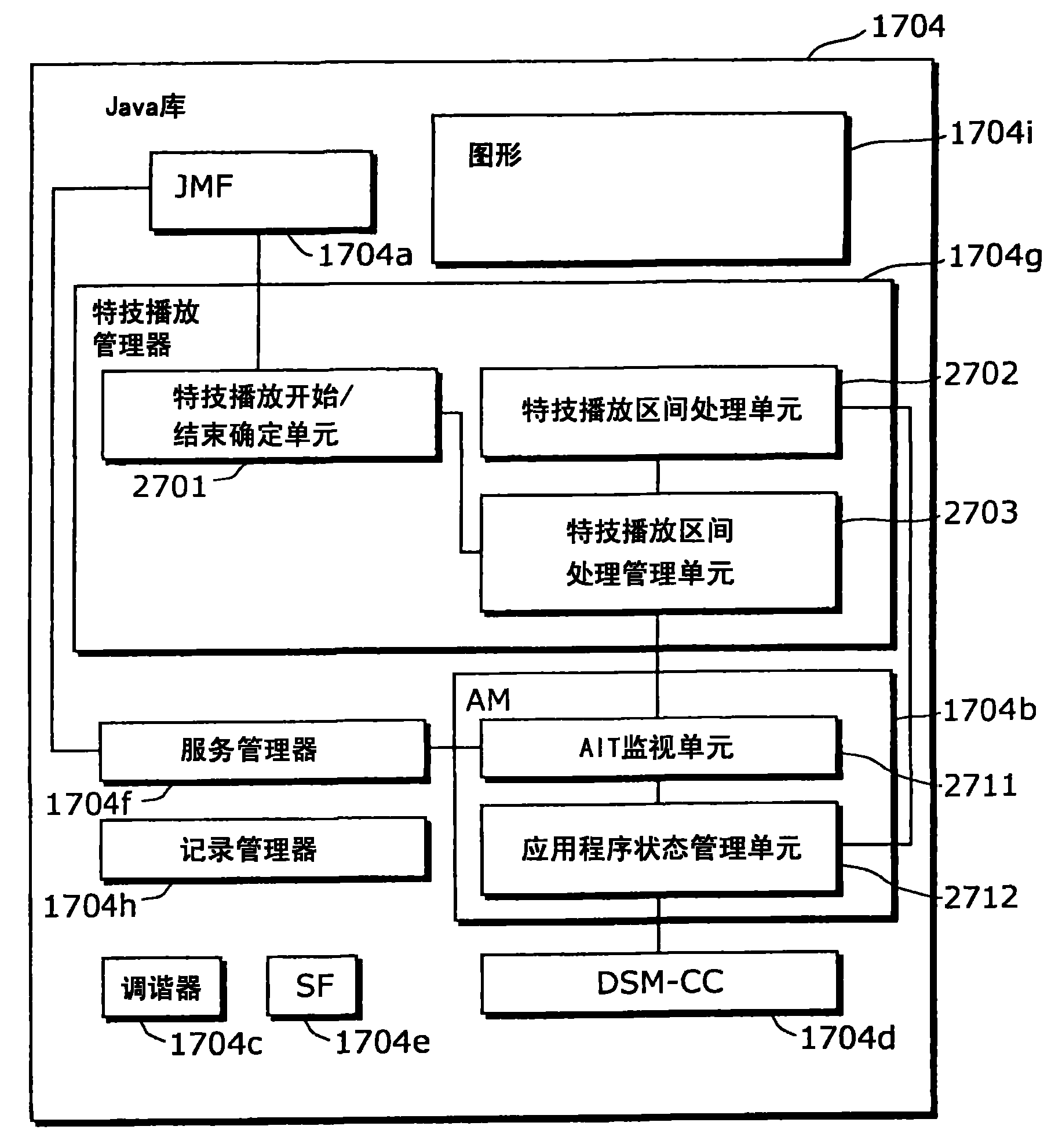
图27示出了根据本发明的特技播放管理器和AM的结构的例子;Fig. 27 shows the example of the structure of trick play manager and AM according to the present invention;
图28A是示出根据本发明的用于扩展DVB-MHP标准的AIT的细节的示意图;28A is a schematic diagram showing details of an AIT for extending the DVB-MHP standard according to the present invention;
图28B是示出根据本发明的用于扩展DVB-MHP标准的AIT的细节的示意图;28B is a schematic diagram showing details of an AIT for extending the DVB-MHP standard according to the present invention;
图29是根据本发明在再现服务时的流程图;Fig. 29 is a flow chart when reproducing a service according to the present invention;
图30是根据本发明在改变服务的再现速度时的流程图;FIG. 30 is a flow chart when changing the reproduction speed of a service according to the present invention;
图31是根据本发明在更新AIT时的流程图;Fig. 31 is a flow chart when updating AIT according to the present invention;
图32示出了根据本发明的特技播放管理器和AM的结构的例子;Fig. 32 has shown the example of the structure of trick-play manager and AM according to the present invention;
图33是根据本发明在Java程序更新暂停标志时的流程图;Fig. 33 is a flowchart according to the present invention when the Java program updates the pause flag;
图34是根据本发明在再现服务时的流程图;Fig. 34 is a flow chart when reproducing a service according to the present invention;
图35示出了根据本发明的特技播放管理器和其它的结构的例子;Fig. 35 shows the example according to trick-play manager of the present invention and other structures;
图36A是示出根据本发明的用于扩展DVB-MHP标准的AIT的细节的示意图;36A is a schematic diagram showing details of an AIT for extending the DVB-MHP standard according to the present invention;
图36B是示出根据本发明的用于扩展DVB-MHP标准的AIT的细节的示意图;36B is a schematic diagram showing details of an AIT for extending the DVB-MHP standard according to the present invention;
图37是根据本发明在改变服务的再现速度时的流程图;FIG. 37 is a flow chart when changing the reproduction speed of a service according to the present invention;
图38是根据本发明在更新AIT时的流程图;Fig. 38 is a flow chart when updating AIT according to the present invention;
图39示出了根据本发明的特技播放管理器和其它的结构的例子;Figure 39 shows an example of a trick play manager and other structures according to the present invention;
图40是根据本发明在Java程序更新不可见标志时的流程图;Fig. 40 is a flowchart according to the present invention when a Java program updates an invisible sign;
图41是示出了根据本发明的特技播放区间处理信息的细节的示意图;以及41 is a schematic diagram showing details of trick play interval processing information according to the present invention; and
图42是示出了根据本发明的特技播放区间处理信息的细节的示意图。Fig. 42 is a diagram showing details of trick play interval processing information according to the present invention.
具体实施方式Detailed ways
第一发明是一种记录广播波并再现所记录的广播波的记录和再现装置,所述装置包括:特技播放开始/结束确定单元,其确定从所记录的广播波的正常再现转换到特技播放或者从特技播放返回到正常再现;特技播放区间处理管理单元,其在特技播放区间中识别应被转换到暂停状态的程序或者应从暂停状态返回的程序;以及特技播放区间处理单元,其请求将程序转换到暂停状态或者将程序从暂停状态返回,其中,所述特技播放开始/结束确定单元向特技播放区间处理管理单元通知从正常再现到特技播放的转换或者从特技播放到正常再现的返回,以及所述特技播放区间处理管理单元向特技播放区间处理单元通知应被转换到暂停状态的程序或应从暂停状态返回的程序。The first invention is a recording and reproducing apparatus that records broadcast waves and reproduces recorded broadcast waves, the apparatus including: a trick play start/end determination unit that determines transition from normal reproduction of recorded broadcast waves to trick play or return from trick play to normal reproduction; a trick play interval processing management unit that identifies a program that should be shifted to a paused state or a program that should return from a paused state in a trick play interval; and a trick play interval processing unit that requests that the program be Transition to a pause state or return the program from the pause state, wherein the trick play start/end determination unit notifies the trick play interval processing management unit of transition from normal reproduction to trick play or return from trick play to normal reproduction, and The trick-play interval processing management unit notifies the trick-play interval processing unit of a program that should be transitioned to a paused state or a program that should be returned from the paused state.
第二发明是一种记录广播波并再现所记录的广播波的记录和再现装置,所述装置包括:特技播放开始/结束确定单元,其确定从所记录的广播波的正常再现转换到特技播放或者从特技播放返回到正常再现;特技播放区间处理管理单元,其在特技播放区间中识别应被转换到不可见模式的程序或者应从不可见模式返回的程序;以及特技播放区间处理单元,其请求将程序转换到不可见模式或者将程序从不可见模式返回,其中,所述特技播放开始/结束确定单元向特技播放区间处理管理单元通知从正常再现到特技播放的转换或者从特技播放到正常再现的返回,以及所述特技播放区间处理管理单元向特技播放区间处理单元通知应被转换到不可见模式的程序或应从不可见模式返回的程序。The second invention is a recording and reproducing apparatus that records broadcast waves and reproduces recorded broadcast waves, the apparatus including: a trick play start/end determination unit that determines transition from normal reproduction of recorded broadcast waves to trick play or return to normal reproduction from trick play; a trick play interval processing management unit that identifies a program that should be converted to an invisible mode or a program that should return from an invisible mode in a trick play interval; and a trick play interval processing unit that requests transitioning the program to or returning the program from the invisible mode, wherein the trick play start/end determination unit notifies the trick play interval processing management unit of transition from normal reproduction to trick play or from trick play to normal reproduction return, and the trick play interval processing management unit notifies the trick play interval processing unit of the program that should be switched to the invisible mode or the program that should return from the invisible mode.
第三发明是一种记录广播波并再现所记录的广播波的记录和再现方法,所述方法包括:特技播放开始/结束确定步骤,用于确定从所记录的广播波的正常再现转换到特技播放或者从特技播放返回到正常再现;特技播放区间处理管理步骤,用于在特技播放区间中识别应被转换到暂停状态的程序或者应从暂停状态返回的程序;以及特技播放区间处理步骤,用于请求将程序转换到暂停状态或者将程序从暂停状态返回,其中,在所述特技播放开始/结束确定步骤中,向所述特技播放区间处理管理步骤通知从正常再现到特技播放的转换或者从特技播放到正常再现的返回,以及在所述特技播放区间处理管理步骤中,向特技播放区间处理步骤通知应被转换到暂停状态的程序或应从暂停状态返回的程序。A third invention is a recording and reproducing method of recording broadcast waves and reproducing the recorded broadcast waves, the method comprising: a trick play start/end determination step for determining a transition from normal reproduction of the recorded broadcast waves to a trick Playing or returning to normal reproduction from trick play; a trick play interval processing management step for identifying a program in the trick play interval that should be transferred to a paused state or a program that should return from the paused state; and a trick play interval processing step for requesting to transition the program to a paused state or to return the program from the paused state, wherein, in the trick play start/end determination step, the trick play section processing management step is notified of the transition from normal reproduction to trick play or from the trick play Returning from playing to normal reproduction, and in the trick play section processing management step, notifying the trick play section processing step of a program that should be transitioned to a paused state or a program that should be returned from the paused state.
第四发明是一种记录广播波并再现所记录的广播波的记录和再现方法,所述方法包括:特技播放开始/结束确定步骤,用于确定从所记录的广播波的正常再现转换到特技播放或者从特技播放返回到正常再现;特技播放区间处理管理步骤,用于在特技播放区间中识别应被转换到不可见模式的程序或者应从不可见模式返回的程序;以及特技播放区间处理步骤,用于请求将程序转换到不可见模式或者将程序从不可见模式返回,其中,在所述特技播放开始/结束确定步骤中,向特技播放区间处理管理步骤通知从正常再现到特技播放的转换或者从特技播放到正常再现的返回,以及在所述特技播放区间处理管理步骤中,向特技播放区间处理步骤通知应被转换到不可见模式的程序或应从不可见模式返回的程序。A fourth invention is a recording and reproducing method of recording a broadcast wave and reproducing the recorded broadcast wave, the method comprising: a trick play start/end determination step for determining a transition from normal reproduction of the recorded broadcast wave to a trick play Playing or returning to normal reproduction from trick play; a trick play interval processing management step for identifying in the trick play interval a program that should be converted to an invisible mode or a program that should return from the invisible mode; and a trick play interval processing step, For requesting to switch the program to or return the program from the invisible mode, wherein, in the trick play start/end determination step, the trick play section processing management step is notified of the switch from normal reproduction to trick play or Returning from trick play to normal reproduction, and in the trick play section processing management step, notifying the trick play section processing step of a program that should be switched to the invisible mode or a program that should be returned from the invisible mode.
(第一实施例)(first embodiment)
以下,参照附图描述根据本发明第一实施例的装置和方法。本发明目的在于记录和再现以任意介质发送和接收的内容;然而,在本实施例中,将有线电视广播系统作为例子描述。在该有线电视广播系统中,广播记录和再现装置(记录和再现装置)通常被称为终端装置。Hereinafter, an apparatus and method according to a first embodiment of the present invention will be described with reference to the accompanying drawings. The present invention aims at recording and reproducing content transmitted and received in an arbitrary medium; however, in this embodiment, a cable TV broadcasting system is described as an example. In this cable TV broadcasting system, a broadcast recording and reproducing device (recording and reproducing device) is generally called a terminal device.
图1是示出组成广播系统的装置的关系的框图;该广播系统由广播站端系统101(头端)和三个终端装置即终端装置A111、终端装置B112和终端装置C113组成。该有线系统中广播站端系统和每个终端装置之间的耦合121是诸如同轴电缆、光纤电缆等的有线耦合。在图1中,一个广播站端系统与三个终端装置耦合,但是终端装置的数量是任意的。1 is a block diagram showing the relationship of devices constituting a broadcasting system; the broadcasting system is composed of a broadcasting station end system 101 (head end) and three terminal devices, terminal device A111, terminal device B112 and terminal device C113. The
广播站端系统101将诸如视频/音频/数据广播数据这样的信息以广播信号发送到多个终端装置。使用由该广播系统的运行规范、该广播系统运行的地区/国家的法律等所设定的频带内的频率发送广播信号。The broadcast
利用本实施例中的有线系统,针对每一数据细节和传输方向(入站、出站)划分了在广播信号传输中使用的频带,并且对其进行分配。图2是指示频带划分的一个例子的图表。频带被粗略地划分成两种类型:带外(缩写OOB)和带内。5MHz到130MHz被分配为OOB,并主要用于广播站端系统101与终端装置A111、终端装置B112和终端装置C113之间的入站/出站数据交换。130MHz到864MHz被分配为带内,并主要用于仅出站的包括视频/音频的广播频道。QPSK调制格式用于OOB,QAM64或QAM256调制格式用于带内。调制格式技术是公知的并且与本发明的关系不大,因此省略了对其的详细说明。With the cable system in this embodiment, frequency bands used in broadcast signal transmission are divided and allocated for each data detail and transmission direction (inbound, outbound). FIG. 2 is a diagram indicating an example of frequency band division. Frequency bands are roughly divided into two types: out-of-band (abbreviated OOB) and in-band. 5 MHz to 130 MHz are allocated as OOB, and are mainly used for inbound/outbound data exchange between the broadcast
图3是更详细地使用OOB频带的一个例子。70MHz到74MHz被用于从广播站端系统101的出站数据发送,并且所有的终端装置A111、终端装置B112和终端装置C113从广播站端系统101接收相同的数据。另一方面,10.0MHz到10.1MHz被用于从终端装置A111到广播站端系统101的入站数据发送;10.1MHz到10.2MHz被用于从终端装置B112到广播站端系统101的入站数据发送;10.2MHz到10.3MHz被用于从终端装置C113到广播站端系统101的入站数据发送。这样,可以从每个终端装置A111、B112和C113向广播站端系统101独立地发送唯一数据。Figure 3 is an example of using the OOB band in more detail. 70 MHz to 74 MHz are used for outbound data transmission from the broadcast
图4是使用带内频带的一个例子。150MHz到156MHz和156Mhz到162MHz被分别分配给电视频道1和电视频道2,并且此后,以6MHz的间隔分配电视频道。从310MHz开始以1MHz为单位分配无线电频道。这些频道中每一个可以用作模拟广播或数字广播。基于MPEG-2规范,以TS分组格式发送数字广播,并且除了音频和视频之外,也可以发送诸如数据广播数据和用于配置EPG的电视节目组织信息这样的各种数据。Figure 4 is an example of using an in-band frequency band. 150MHz to 156MHz and 156Mhz to 162MHz are allocated to
广播站端系统101使用上述频带向终端装置发送合适的广播信号,并且因此具有QPSK调制单元、QAM调制单元等。此外,广播站端系统101具有QPSK解调器,用于从终端装置接收数据。而且,广播站端系统101可以被认为具有与调制单元和解调单元有关的各种设备。然而,本发明主要涉及终端装置,因此省略了对其的详细说明。The broadcast
同时,终端装置A111、B112和C113每一个都具有QAM解调单元和QPSK解调单元,以便接收和再现来自广播站端系统101的广播信号。此外,每个终端装置都具有QPSK调制单元,以便向广播站端系统101发送该装置唯一的数据。在本发明中,终端装置是广播记录和再现装置(记录和再现装置),并且后面将描述详细结构。Meanwhile, the terminal apparatuses A111, B112, and C113 each have a QAM demodulation unit and a QPSK demodulation unit in order to receive and reproduce broadcast signals from the broadcast
广播站端系统101对MPEG-2传输流进行调制,并在广播信号内传送该流。终端装置接收广播信号,解调并再现MPEG-2传输流,从传输流中提取必要信息,并使用所提取的信息。为了描述该终端装置中存在的设备功能和连接结构,首先以简单的方式描述MPEG-2传输流的结构。The broadcast
图5示出了TS分组的结构。TS分组500具有188字节的长度,并且由报头(header)501、自适应字段502和有效负载503组成。报头501保存TS分组的控制信息。报头具有4字节的长度,并且具有如504所示的结构。在报头501中,有一个字段被标为“分组ID(PacketID)”(下文中称为PID),TS分组是通过该PID的值来标识的。自适应字段502保存诸如时间信息这样的附加信息。自适应字段502不是必须存在,而且在多种情况下自适应字段502不存在。有效负载503保存TS分组中携带的信息,例如视频、音频和数据广播数据。Fig. 5 shows the structure of a TS packet. The
图6是MPEG-2传输流的示意图。TS分组在有效负载中保存各种信息,诸如视频、音频、用于数据广播的数据等。TS分组601和TS分组603均在报头中保存PID100,并且在有效负载中保存关于视频1的信息。TS分组602和TS分组605均在报头中保存PID200,并且在有效负载中保存关于数据1的信息。TS分组604在报头中保存PID300,并且在有效负载中保存关于音频1的信息。对在有效负载中保存各种类型数据的TS分组进行混合,并将这些分组作为序列顺次发送,这被称为多路复用。MPEG-2传输流600是TS分组601到605被多路复用的结构的一个例子。Fig. 6 is a schematic diagram of an MPEG-2 transport stream. TS packets hold various information such as video, audio, data for data broadcasting, etc. in the payload. Both
PID相同的TS分组保存相同类型的信息。因此,终端装置通过接收被多路复用的TS分组并针对每个PID提取TS分组所保存的信息,来再现视频和音频、并再现诸如电视节目组织信息这样的数据。在图6中,TS分组601和TS分组603每个都携带关于视频1的信息,而TS分组602和TS分组605每个都携带关于数据1的信息。TS packets with the same PID store the same type of information. Therefore, the terminal device reproduces video and audio, and reproduces data such as television program organization information by receiving multiplexed TS packets and extracting information held by the TS packets for each PID. In FIG. 6 ,
这里,给出关于在有效负载中包含的每种数据类型的格式的描述。视频和音频由被称为分组基本流(Packetized Elementary Stream,PES)分组的格式来表示。PES分组包括一天中指定小时的视频信息或音频信息,并且通过接收PES分组,广播记录和再现装置能够将包含在该PES分组中的视频和音频信息输出到屏幕或扬声器。广播站不间断地发送PES分组,因此广播记录和再现装置可以不间断地连续再现视频和音频。当实际上发送PES分组时,在PES分组的大小大于一个TS分组的有效负载的情况下,该PES分组被划分并存储在多个TS分组的有效负载中。图7示出了当携带PES分组时分区的例子。PES分组701太大以致于不能在单个TS分组的有效负载中存储和发送,因此PES分组701被划分成PES分组分区A702a、PES分组分区B702b,PES分组分区C702c,并且被携带在PID相同的三个TS分组703到705中。实际上,视频和音频均是作为基本流(ES)获得的,而基本流是通过连接在多个PES分组的有效负载中包含的数据而获得的。该基本流的格式是数字化的视频和音频,诸如由MPEG-2视频标准、MPEG-1和2音频标准等所定义的。Here, a description is given about the format of each data type contained in the payload. Video and audio are represented by a format called Packetized Elementary Stream (PES) packets. The PES packet includes video information or audio information for a specified hour of the day, and by receiving the PES packet, the broadcast recording and reproducing apparatus can output the video and audio information contained in the PES packet to a screen or a speaker. Broadcasting stations transmit PES packets without interruption, so broadcast recording and reproducing apparatuses can continuously reproduce video and audio without interruption. When the PES packet is actually transmitted, in the case where the size of the PES packet is larger than the payload of one TS packet, the PES packet is divided and stored in the payload of a plurality of TS packets. Fig. 7 shows an example of partitioning when carrying PES packets. PES packet 701 is too large to be stored and transmitted in the payload of a single TS packet, so PES packet 701 is divided into PES packet partition A 702a, PES packet partition B 702b, PES packet partition C 702c, and is carried in three TS packets with the same PID. TS packets 703 to 705. Actually, both video and audio are obtained as elementary streams (ES), and elementary streams are obtained by concatenating data contained in the payloads of a plurality of PES packets. The format of the elementary stream is digitized video and audio, such as defined by the MPEG-2 video standard, the MPEG-1 and 2 audio standard, and the like.
另一方面,诸如电视节目组织信息这样的信息和用于数据广播的数据是使用称为MPEG-2分段的格式表示的。当实际上发送MPEG-2分段时,在MPEG-2分段的大小大于一个TS分组的有效负载的情况下,该MPEG-2分段被划分并存储在多个TS分组的有效负载中。图8示出了当携带MPEG-2分段时分区的例子。由于MPEG-2分段801太大以致于不能在单个TS分组的有效负载中存储和发送,MPEG-2分段801被划分成分段分区A802a、分段分区B802b、分段分区C802c,并且被携带在PID相同的三个TS分组803到805中。On the other hand, information such as television program organization information and data for data broadcasting are represented using a format called MPEG-2 section. When an MPEG-2 segment is actually transmitted, in the case where the size of the MPEG-2 segment is larger than the payload of one TS packet, the MPEG-2 segment is divided and stored in the payload of a plurality of TS packets. Fig. 8 shows an example of partitioning when MPEG-2 segments are carried. Since MPEG-2 segment 801 is too large to be stored and transmitted in the payload of a single TS packet, MPEG-2 segment 801 is divided into segment partition A 802a, segment partition B 802b, segment partition C 802c, and is carried Among the three TS packets 803 to 805 with the same PID.
图9表示MPEG-2分段的结构。MPEG-2分段900由报头901和有效负载902构成。报头901保存MPEG-2分段的控制信息。该结构由报头结构903表示。有效负载902保存MPEG-2分段900所携带的数据。在报头结构903中出现的table_id表示MPEG-2分段的类型,并且table_id_extension是扩展标识符,用于进一步区分具有相同table_id的多个MPEG-2分段。作为使用MPEG-2分段的例子,在图10中示出了发送电视节目组织信息的情况。在该例子中,如行1004中所示,对广播信号进行解调所必需的信息被表示在报头结构903中table_id为64的MPEG-2分段中,并且该MPEG-2分段进一步在分配有PID16的TS分组中携带。Fig. 9 shows the structure of an MPEG-2 section. An MPEG-2
在MPEG-2分段的情况下,不存在PES格式。由于这个原因,基本流(ES)是由MPEG-2传输流内相同PID标识的TS分组的有效负载的连接。例如,在图8中,其中MPEG-2分段801被划分和携带的TS分组803到805都由PID200来标识。可以说它们是携带MPEG-2分段801的ES。In the case of MPEG-2 segments, there is no PES format. For this reason, an elementary stream (ES) is a concatenation of payloads of TS packets identified by the same PID within an MPEG-2 transport stream. For example, in FIG. 8 , TS packets 803 to 805 in which the MPEG-2 section 801 is divided and carried are all identified by PID200. Lets say they are ESs carrying MPEG-2 Segment 801 .
称为节目的概念还存在于MPEG-2传输流中。节目被表示为ES的集合,并被用于希望一起处理多个ES的情况。当使用节目时,可以一起处理视频/音频以及伴随的数据广播数据。例如,在同时处理要再现的视频/音频的情况下,通过将视频ES和音频ES组合为节目,广播记录和再现装置应将这两个ES同时再现为一个电视节目。A concept called a program also exists in the MPEG-2 transport stream. A program is represented as a collection of ESs and is used when it is desired to process multiple ESs together. When using programs, video/audio and accompanying data broadcast data can be processed together. For example, in the case of simultaneously processing video/audio to be reproduced, by combining a video ES and an audio ES into a program, a broadcast recording and reproducing apparatus should simultaneously reproduce the two ESs as one TV program.
为了表示节目,在MPEG-2中使用了被称为节目映射表(PMT)和节目关联表(PAT)的两个表。详细描述可以在ISO/IEC13818-1规范“MPEG-2系统”中找到。下文简述了PMT和PAT。To represent programs, two tables called Program Mapping Table (PMT) and Program Association Table (PAT) are used in MPEG-2. A detailed description can be found in the ISO/IEC13818-1 specification "MPEG-2 Systems". PMT and PAT are briefly described below.
PMT是包含在MPEG-2传输流中的一个表,有多少个节目,就有多少个PMT。PMT被构造为一个MPEG-2分段,并且其table_id为2。PMT保存用于标识该节目的节目号和该节目的附加信息,以及关于属于该节目的ES的信息。在图11给出了PMT的例子。1100是节目号。在相同传输流中节目号被唯一地分配给节目,并且被用于标识PMT。行1111到1114表示关于各个ES的信息。列1101示出了ES的类型,其中指定了“视频”、“音频”、“数据”等。列1102示出了组成每一ES的TS分组的PID。列1103示出了关于该ES的附加信息。例如,在行1111中示出的ES是音频ES,并被携带在PID为5011的TS分组中。PMT is a table included in the MPEG-2 transport stream. There are as many PMTs as there are programs. PMT is structured as an MPEG-2 section, and its table_id is 2. The PMT holds a program number for identifying the program and additional information of the program, and information on ESs belonging to the program. An example of PMT is given in Figure 11. 1100 is the program number. A program number is uniquely assigned to a program within the same transport stream, and is used to identify a PMT.
PAT是一个表,在MPEG-2传输流中只存在一个PAT。PAT被构造为一个MPEG-2分段,其table_id为0并且被携带在PID为0的TS分组中。PAT保存用于标识MPEG-2传输流的transport_stream_id、和关于所有表示MPEG-2传输流中存在的节目的PMT的信息。在图12中给出了PAT的例子。1200是transport_stream_id。transport_stream_id用于标识MPEG-2传输流。行1211到1213表示关于节目的信息。列1201示出了节目号。列1202示出了携带与相应节目相对应的PMT的TS分组的PID。例如,行1211中示出的节目的PMT的节目号为101,并且相应的PMT被携带在PID为501的TS分组中。PAT is a table, and only one PAT exists in an MPEG-2 transport stream. PAT is structured as an MPEG-2 section whose table_id is 0 and is carried in TS packets with PID 0. The PAT holds transport_stream_id for identifying an MPEG-2 transport stream, and information on all PMTs representing programs existing in the MPEG-2 transport stream. An example of PAT is given in FIG. 12 . 1200 is transport_stream_id. transport_stream_id is used to identify an MPEG-2 transport stream.
在终端装置再现某个节目的情况下,终端装置使用PAT和PMT并识别组成该节目的视频和音频,并再现该视频和音频。例如,对于携带图12中的PAT和图11中的PMT的MPEG-2传输流,在属于节目号为101的节目的视频和音频被再现的情况下,进行下面的过程。首先,从PID为“0”的TS分组中获取作为table_id为“0”的MPEG-2分段传送的PAT。搜索该PAT以寻找节目号为“101”的节目,并且获得了行1211。从行1211,获得了携带节目号为“101”的节目的PMT的TS分组的PID为“501”。接下来,从PID为“501”的TS分组中获取作为table_id为“2”的MPEG-2分段携带的PMT。从该PMT中获得行1111(音频ES信息)和行1112(视频ES信息)。从行1111获得了携带音频ES的TS分组的PID“5011”。此外,从行1112获得了携带音频ES的TS分组的PID“5012”。接下来,从PID为“5011”的TS分组中获取音频PES分组,从PID为“5012”的TS分组中获取视频PES分组。通过这个过程,可以获得要再现的视频和音频ES分组,并且能够再现在这些分组中携带的视频和音频。In the case where a terminal device reproduces a certain program, the terminal device uses PAT and PMT and recognizes video and audio making up the program, and reproduces the video and audio. For example, for an MPEG-2 transport stream carrying PAT in FIG. 12 and PMT in FIG. 11, in the case where video and audio belonging to a program with
需要注意的是,有些情况下MPEG-2传输流会被加扰。这是被称为条件接入系统的设置。例如,通过对携带某视频/音频的PES分组进行加扰,仅仅那些能对其进行解扰的指定观看者能够观看该视频和音频。为了解扰并观看该视频和音频,观看者必需使用被称为解扰器的设备对它们进行解扰。例如,在OCAP兼容的终端装置中,使用了具有内部解扰器的卡形适配器。有线电视运营商向每个观看者分发被设置为能够对指定节目进行解扰的适配器,并且观看者将该适配器插入终端装置中。当这样做时,适配器基于诸如解扰密钥和每个合约持有者的合约信息这样的解扰信息来对指定节目进行解扰。解扰的方法、获取解扰密钥的方法等取决于适配器,对本发明的实现没有影响。It should be noted that in some cases the MPEG-2 Transport Stream will be scrambled. This is a setup known as a conditional access system. For example, by scrambling a PES packet carrying a certain video/audio, only those designated viewers who can descramble it can watch the video and audio. In order to descramble and watch the video and audio, viewers must descramble them using a device called a descrambler. For example, in an OCAP-compatible terminal device, a card adapter with an internal descrambler is used. The cable TV operator distributes to each viewer an adapter set to be able to descramble a designated program, and the viewer inserts the adapter into a terminal device. When doing so, the adapter descrambles the specified program based on descrambling information such as a descrambling key and contract information for each contract holder. The method of descrambling, the method of obtaining the descrambling key, etc. depend on the adapter, and have no influence on the realization of the present invention.
至此,已经给出关于MPEG-2规范的简单描述;在下文中,将给出术语的详细定义。在本发明中,存在两种类型的术语“program”。一种是出现在MPEG-2规范中的“program(节目)”,而另一种是指CPU执行的代码集合“program(程序)”。由于前者与运行规章中所用的术语“服务”同义,因此在下文中,为了避免混淆,将前者称为“服务”,而将后者简单地称为“程序”。此外,关于后者,具体用Java(TM)语言编写的“程序”被称为“Java程序”。So far, a brief description about the MPEG-2 specification has been given; hereinafter, detailed definitions of terms will be given. In the present invention, there are two types of term "program". One is "program" appearing in the MPEG-2 specification, and the other refers to a collection of codes "program" executed by the CPU. Since the former is synonymous with the term "service" used in the operating regulations, hereinafter, to avoid confusion, the former will be referred to as "service" and the latter will simply be referred to as "program". Also, regarding the latter, a "program" specifically written in the Java(TM) language is referred to as a "Java program".
根据本发明,已经给出关于在MPEG-2规范中规定的几种一般信息的描述。下文中,将详细描述在本实施例中使用的广播记录和再现终端。According to the present invention, a description has been given about several kinds of general information specified in the MPEG-2 specification. Hereinafter, the broadcast recording and reproducing terminal used in this embodiment will be described in detail.
图13是示出根据本实施例的广播记录和再现装置的通用硬件结构的框图;换句话说,是图1中示出的终端装置111、112和113的特定内部结构。1300是广播记录和再现装置,其包括:调谐器1301;TS解码器(TS解复用器)1302;AV解码器1303;扬声器1304;显示器1305;CPU1306;第二存储单元1307;主存储单元1308;ROM1309;输入单元1310;适配器1311;AV编码器1312;复用器(MPEG-2传输流复用器等)1313;以及图形平面(graphics plane)1314。注意本实施例是通过扩展由OCAP-DVR规范实现的广播记录和再现终端而获得的,并且基本硬件结构几乎与由OCAP-DVR规范所要求的相同。FIG. 13 is a block diagram showing the general hardware structure of the broadcast recording and reproducing apparatus according to the present embodiment; in other words, the specific internal structure of the
调谐器1301是根据诸如由CPU1306指定的频率这样的调谐信息来对从广播站端系统101调制并传送的广播信号进行解调的设备。这里,调谐信息是其中可以指定频率、调制格式等的信息。作为调谐器1301的解调结果而获得的MPEG-2传输流经过具有解扰功能的适配器1311,被发送到TS解码器1302。The
TS解码器1302是具有如下功能的设备:基于由CPU1306规定的PID、分段过滤条件等,从MPEG-2传输流中分离出遵从于指定条件的PES分组和MPEG-2分段。在接收到广播波并且再现服务而无需记录的情况下,适配器1311输出的MPEG-2传输流被输入到TS解码器1302中。另一方面,在再现记录在第二存储单元1307中的服务的情况下,第二存储单元1307输出的MPEG-2传输流被输入到TS解码器1302中。接收哪个输入是由CPU1306控制的。
TS解码器1302分离出的视频和音频的PES分组被输出到AV解码器1303。此外,TS解码器1302分离出的MPEG-2分段被通过直接存储器存取(DMA)传送到主存储单元1308,并由CPU1306执行的程序使用。The video and audio PES packets separated by the
AV解码器1303是具有对编码的视频ES和音频ES进行解码功能的设备。AV解码器从携带发自TS解码器的音频和视频信息的PES分组中获取该ES,并对该ES进行解码。通过AV解码器1303执行的解码而获得的音频信号和视频信号在服务再现时被输出到扬声器1304和显示器1305,而服务记录时被输出到AV编码器1312。采用哪个输出路线是由CPU1306根据来自用户的指令来控制的。The
扬声器1304再现从AV解码器1303输出的音频。The speaker 1304 reproduces audio output from the
显示器1305再现从AV解码器1303输出的视频,并在图形平面1314上显示由CPU绘制的图形。The
CPU1306执行在广播记录和再现装置中运行的程序。CPU1306执行包含在ROM1309中的程序。或者,CPU1306执行从广播信号或网络下载并保存在主存储单元1308中的程序。或者,CPU1306执行从广播信号或网络下载并保存在第二存储单元1307中的程序。根据所执行的程序的指令,控制调谐器1301、TS解码器1302、AV解码器1303、扬声器1304、显示器1305、第二存储单元1307、主存储单元1308、ROM1309、输入单元1310、适配器1311、AV编码器1312、复用器1313和图形平面1314。此外,CPU1306通过不仅与在终端装置1300内存在的设备进行通信而且与适配器1311内的设备进行通信,能够控制适配器1311。CPU 1306 executes programs running in the broadcast recording and reproducing apparatus. CPU 1306 executes programs contained in ROM 1309 . Alternatively, the CPU 1306 executes a program downloaded from a broadcast signal or the network and stored in the
第二存储单元1307是存储装置,即使中断向设备供电,其存储也不会被删除。第二存储单元1307被构造为这样的设备,即使当切断终端装置1300的电源时也不删除信息;例如,诸如FLASH-ROM这样的非易失性存储器、硬盘驱动器(HDD)、诸如CD-R和DVD-R这样的可重写介质。第二存储单元1307基于来自CPU1306的指令来保存信息。The second storage unit 1307 is a storage device whose storage is not deleted even if the power supply to the device is interrupted. The second storage unit 1307 is configured as a device that does not delete information even when the power of the terminal device 1300 is turned off; for example, a nonvolatile memory such as FLASH-ROM, a hard disk drive (HDD), and rewritable media like DVD-R. The second storage unit 1307 saves information based on instructions from the CPU 1306 .
主存储单元1308是具有根据来自CPU1306、支持DMA传送的设备等的指令来临时保存信息的功能的设备,并且被构造为RAM等。The
ROM1309是不可重写存储设备,更具体地说,被构造为ROM、CD-ROM、DVD等。CPU1306执行的程序被存储在ROM1309中。The ROM 1309 is a non-rewritable storage device, and more specifically, is configured as a ROM, CD-ROM, DVD, or the like. Programs executed by CPU 1306 are stored in ROM 1309 .
更具体地说,输入单元1310被构造为前面板或遥控接收器,并接受来自用户的输入。图14是输入单元1310被构造为前面板的情况的例子。前面板1400具有7个按钮:光标上按钮1401、光标下按钮1402、光标左按钮1403、光标右按钮1404、OK按钮1405、取消按钮1406、EPG按钮1407和模式切换按钮1408。当用户按下按钮时,所按下的按钮的标识符被通知给CPU1306。More specifically, the input unit 1310 is configured as a front panel or a remote control receiver, and accepts an input from a user. FIG. 14 is an example of a case where the input unit 1310 is configured as a front panel. The
适配器1311是用于对在带内频率范围中携带的加扰的MPEG-2传输流进行解扰的设备,并且包括一个或多个解扰器。由调谐器1301a输出的MPEG-2传输流被输入到适配器1311,并且对具有由CPU1306指定的PID的TS分组进行解扰。适配器1311将解扰后的MPEG-2传输流输出到TS解码器1302。
此外,适配器1311也对在OOB频率范围内发送的数据进行格式转换。在OOB中发送的信息以QPSK调制格式进行调制。关于出站传输,QPSK解调器1301b对从广播站端系统101发送的出站信号进行解调,并将生成的比特流输入到适配器1311中。适配器1311从包含在该比特流中的各种信息中提取由CPU1306指定的信息,并将该信息转换成能够被CPU1306中运行的程序解释的格式,并将其提供给CPU1306。另一方面,关于入站传输,CPU1306将要发送给广播站端系统101的信息输入到适配器1311中。适配器1311将从CPU1306输入的信息转换成能够被广播站端系统101解释的格式,并将其输入到QPSK调制器1301c。QPSK调制器1301c对从适配器1311输入的信息进行QPSK调制,并且将其发送到广播站端系统101。In addition, the
用于美国有线系统中的CableCARD(以前称为部署点(POD)),可以作为适配器1311的特定例子给出。A CableCARD (formerly known as Point of Deployment (POD)), used in the US Cable system, can be given as a specific example of
AV编码器1312将AV解码器1303解码的音频信号编码成MPEG音频格式的音频,并将视频信号编码成MPEG视频格式的视频。AV编码器1312将编码的视频和音频输出到复用器1313。The
复用器1313是具有将从AV编码器1312输入的视频和音频多路复用到MPEG-2传输流中的功能的设备。The
图形平面1314是具有暂时保存由CPU绘制的图形的功能的设备。在图形平面1314上绘制的图形与从AV解码器1303输出的视频融合,并显示在显示器1305上,这是根据来自CPU的将图形传输给显示器1305的指令而进行的。The graphics plane 1314 is a device having a function of temporarily saving graphics drawn by the CPU. Graphics drawn on the graphics plane 1314 are merged with video output from the
下面详细描述其中上述广播记录和再现装置将在广播波中包含的服务记录到第二存储单元1307的操作,以及其中该广播记录和再现装置连续地从第二存储单元1307读出服务并对其进行再现的操作。The following describes in detail the operation in which the above-mentioned broadcast recording and reproducing apparatus records the service contained in the broadcast wave to the second storage unit 1307, and in which the broadcast recording and reproducing apparatus continuously reads out the service from the second storage unit 1307 and converts it to the second storage unit 1307. Perform the reproduction operation.
首先,描述其中将在广播波中包含的服务记录到第二存储单元1307的操作。First, an operation in which a service contained in a broadcast wave is recorded to the second storage unit 1307 is described.
图15示出了表示在对服务进行记录期间每个设备的物理连接顺序、处理细节、和输入/输出数据格式的概念图。1500是终端装置,其具有:调谐器1301;适配器1311;解扰器1501;TS解码器1302;PID过滤器1502;分段过滤器1503;AV解码器1303;主存储单元1308;AV编码器1312;复用器1313;和记录区1504。图15中,与图13中的参考数字相同的组成单元具有相同的功能,因此省略了说明。FIG. 15 shows a conceptual diagram representing the physical connection sequence of each device, processing details, and input/output data formats during recording of a service. 1500 is a terminal device having: a
首先,调谐器1301根据由CPU1306指定的调谐信息来对广播波进行调谐。这里,调谐信息是其中可以指定频率、调制格式等的信息。调谐器1301对广播波进行解调并将MPEG-2传输流输入到适配器1311中。First,
适配器1311中包括的解扰器1501基于每个观看者的条件接入信息对MPEG-2传输流进行解扰。解扰后的MPEG-2传输流被输入到TS解码器中。The
在TS解码器1302中存在处理MPEG-2传输流的两种设备:PID过滤器1502和分段过滤器1503。In the
PID过滤器1502从输入的MPEG-2传输流中提取具有CPU1306指定的PID的TS分组,然后提取存在于有效负载中的PES分组和MPEG-2分段。例如,在CPU1306已经指示进行提取PID=100的TS分组的PID过滤的情况下,当图6中的MPEG-2传输流被输入时,分组601和603被提取,然后被连接起来,这样就重新构造了视频1的PES分组。或者,在CPU1306已经指示进行提取PID=200的TS分组的PID过滤的情况下,当图6中的MPEG-2传输流被输入时,分组602和605被提取,然后被连接起来,这样就重新构造了数据1的MPEG-2分段。The
分段过滤器1503从输入的MPEG-2分段中提取符合由CPU1306指定的分段过滤条件的MPEG-2分段,将该MPEG-2分段以DMA传送到主存储单元1308。例如,假定CPU1306为分段过滤器1503指定了提取PID=200的TS分组的PID过滤,和提取table_id为64的分段的分段过滤。如之前提到的,在重新构造了数据1的MPEG-2分段之后,分段过滤器1503仅从那些MPEG-2分段中提取table_id为64的分段,并将其以DMA传送到主存储单元1308。The
输入到主存储单元1308中的MPEG-2分段被输入到复用器1313。The MPEG-2 sections input into the
TS解码器1302提取的视频PES分组和音频PES分组被输入到AV解码器1303。The video PES packets and audio PES packets extracted by the
AV解码器对视频PES分组进行解码以将其转换为视频,并将该视频输入到AV编码器1312中。AV解码器也对音频PES分组进行解码以将其转换为音频,并将该音频输入到AV编码器1312中。The AV decoder decodes the video PES packets to convert them into video, and inputs the video into the
AV编码器1312将视频转换成MPEG视频并将其输入到复用器1313中。AV编码器1312也将音频转换成MPEG音频并将其输入到复用器1313中。The
复用器1313把从AV编码器输入的MPEG视频和MPEG音频多路复用到从主存储单元1308输入的MPEG-2分段中,并因此生成MPEG-2传输流。所生成的MPEG-2传输流被记录到记录区1504中。The
记录区1504由第二存储单元1307的全部或部分、或另一个记录区组成,并存储构成一个服务的MPEG-2传输流。The
接下来,将描述其中连续从第二存储单元1307读出服务并进行再现的操作。Next, an operation in which services are continuously read out from the second storage unit 1307 and reproduced will be described.
图16示出了表示在对服务进行记录期间每个设备的物理连接顺序、处理细节和输入/输出数据格式的概念图。1600是终端装置,其具有:记录区1504;TS解码器1302;PID过滤器1502;分段过滤器1503;AV解码器1303;扬声器1304;显示器1305;主存储单元1308。在图16中,与图13中的参考数字相同的组成单元具有相同的功能,因此省略了说明。FIG. 16 shows a conceptual diagram representing the physical connection sequence of each device, processing details, and input/output data formats during recording of a service. 1600 is a terminal device having: a
把在图15描述的过程中记录在记录区1504中的MPEG-2传输流输入到TS解码器1302中。The MPEG-2 transport stream recorded in the
然后,TS解码器1302内的PID过滤器1502提取出具有由CPU1306指定的PID的视频PES和音频PES。所提取的PES分组被输入到AV解码器1303中。或者,TS解码器1302内的PID过滤器1502和分段过滤器1503提取出具有由CPU1306指定的PID和table_id的MPEG-2分段。所提取出的MPEG-2分段被以DMA传送到主存储单元1308中。Then, the
输入到AV解码器1303中的视频PES和音频PES被解码并输出为音频信号和视频信号。之后,该音频信号和视频信号被输入到显示器1305和扬声器1304,从而再现该音频和视频。The video PES and audio PES input into the
输入到主存储单元1308中的MPEG-2分段被适当输入到CPU1306中。The MPEG-2 segments input into the
至此,已经描述了关于本发明的硬件结构的一个例子。在下文中,将描述本发明的主要功能,即,通过Java程序对服务记录进行控制和对服务的特技播放进行控制。So far, an example of the hardware configuration related to the present invention has been described. Hereinafter, the main functions of the present invention, ie, the control of service recording and the control of trick play of services by Java programs, will be described.
本发明中的服务记录是指,将包含在该服务中的视频、音频、Java程序、Java程序的同步信息等记录到诸如硬盘、蓝光光盘(BD)、数字通用盘(DVD)、安全数字(SD)存储卡这样的记录介质中。服务再现是指,基于同步信息来再现和执行记录在记录介质中的视频、音频和Java程序。要求所记录的服务的再现结果几乎等同于当接收到广播波时就直接再现该服务的结果。Service recording in the present invention refers to recording video, audio, Java programs, synchronization information of Java programs, etc. included in the service to such as hard disk, Blu-ray Disc (BD), Digital Versatile Disk (DVD), Secure Digital ( SD) memory card and other recording media. Service reproduction refers to reproducing and executing video, audio, and Java programs recorded in a recording medium based on synchronization information. The reproduction result of the recorded service is required to be almost equivalent to that of directly reproducing the service when a broadcast wave is received.
图17是用于记录和再现服务所必需的程序的结构图,并且是记录在ROM1309中的软件。FIG. 17 is a structural diagram of programs necessary for recording and reproducing services, and is software recorded in the ROM 1309 .
程序1700包括OS1701、EPG1702、Java VM1703和Java库1704,这些都是子程序。
OS1701是操作系统;Linux、Windows等是其例子。OS1701包括:内核1701a,用于执行其它子程序,诸如EPG1702和Java VM1703;以及库1701b,子程序使用该库来控制终端装置1300的组成单元。内核1701a是公知技术,因此省略了详细说明。
库1701b提供例如用于控制调谐器的调谐功能。库1701b从另一个子程序接收其中可以指定频率和调制格式等的调谐信息,并将该信息提供给调谐器1301。调谐器1301基于所提供的调谐信息执行解调处理,并能够将解调的MPEG-2传输流传递到TS解码器1302。结果,其它子程序能够通过库1701b来控制调谐器1301。The
此外,库1701b提供用于唯一地标识频道的频道信息。图20中示出了频道信息的例子。频道信息被使用OOB或带内频率范围来发送,由适配器1311转换成图表格式,并被存储在库可以访问的临时存储单元中。列2001示出了频道标识符,并且例如相当于由SCTE65数字有线电视的带外传送的服务信息所定义的source_ID。列2002示出了频道名,并相当于来自同一个SCTE65标准的source_name等。列2003是调谐信息,是被提供给调谐器1301的其中可以指定频率、传输速率、调制格式等的信息。列2004示出了标识PMT的节目号。例如,行2011是一组服务信息,包括频道标识符“1”、频道名“频道1”、调谐信息中的频率“150MHz…”、以及节目号“101”。Also, the
Java VM1703是Java虚拟机,其顺序地分析和执行用Java(TM)语言编写的程序。用Java语言编写的程序被编译成不依赖于硬件的中间代码,称为字节码。Java虚拟机是执行该字节码的解释器。JavaVM1703执行用Java语言编写的Java库1704。在诸如“Java语言规范”(ISBN0-201-63451-1)和“Java虚拟机规范”(ISBN0-201-63451-X)等这样的出版物中,详细说明了Java语言和Java VM。此外,通过Java本地接口(JNI),可以调用其它不用Java语言编写的子程序或被其调用。关于JNI的细节可以在“Java本地接口”这本书等中找到。The
Java库1704是用Java语言编写的库,并由Java程序调用以便控制广播记录和再现装置的功能。然而,有一些情况下必须要使用以非Java语言编写的子程序,诸如OS1701的库1701b。Java程序可以通过调用Java库1704所提供的Java应用编程接口(API)来使用由Java库1704提供的功能。The
调谐器1704c是一个Java库,用于控制广播记录和再现终端中的带内接收调谐器1301a。当Java程序将调谐信息传递到调谐器1704c时,调谐器1704c使用该信息来调用库1701b的调谐功能,结果,可以控制广播记录和再现终端的带内接收调谐器1301a的操作。这里,调谐信息是其中可以指定频率、调制格式等的信息。The
SF1704e是一个Java库,用于控制广播记录和再现终端的PID过滤器1502和分段过滤器1503的功能。当Java程序将诸如PID、table_id这样的过滤条件传递到SF1704e时,SF1704e基于这些条件,使用库1701b的功能等,以控制PID过滤器1502和分段过滤器1503,获取满足预期过滤条件的MPEG-2分段,并将该MPEG-2分段传递给设置所述过滤条件的Java程序。SF1704e is a Java library for controlling the functions of the
DSM-CC 1704d是一个Java库,用于访问DSM-CC对象传送带的文件系统。DSM-CC对象传送带被包括在SF1704e获取的MPEG-2分段中。DSM-CC是由ISO/IEC13818-6标准定义的,并且是使用MPEG-2分段来携带任意文件的机制。通过使用该机制,可以从广播站向终端发送文件。基于Java程序等指定的文件标识符等,DCM-CC1704d使用SF1704e并获得MPEG-2分段,取出基于ISO/IEC13818-6标准的文件,并将该文件输出到主存储单元1308。实现DSM-CC的详细方法与本发明无关,因此省略了细节。DSM-
AM1704b是一个应用程序管理器,其提供用于管理包含在服务中的Java应用程序的执行和终止的功能。AM1704b提取被多路复用到指定的MPEG-2传输流的指定的频道中的Java程序,并根据单独复用的同步信息来使所提取的Java程序被执行或终止。Java程序的Java类文件以前述的DSM-CC的格式被多路复用到MPEG-2传输流中。此外,Java程序的同步信息被以称为AIT的格式多路复用到MPEG-2传输流中。AIT是应用程序信息表(Application InformationTable)的首字母缩写,如在DVB-MHP规范(ETSITS 101812 DVB-MHP规范V1.0.2)的第10节中所定义的,并且AIT是table_id为“0x74”的MPEG-2分段。AM1704b is an application manager that provides functions for managing the execution and termination of Java applications contained in the service. The AM1704b extracts a Java program multiplexed into a specified channel of a specified MPEG-2 transport stream, and causes the extracted Java program to be executed or terminated according to the individually multiplexed synchronization information. The Java class file of the Java program is multiplexed into the MPEG-2 transport stream in the aforementioned DSM-CC format. In addition, the synchronization information of the Java program is multiplexed into the MPEG-2 transport stream in a format called AIT. AIT is an acronym for Application Information Table, as defined in
图27中示出了AM1704b的详细结构。AM1704b被构造为AIT监视单元2711和应用程序状态管理单元2712。The detailed structure of AM1704b is shown in FIG. 27 . The AM1704b is configured as an
AIT监视单元2711接收MPEG-2传输流和频道标识符作为输入以监视AIT的更新状态,并且如果AIT被更新,则向应用程序状态管理单元2712和特技播放区间处理管理单元2703通知更新后的AIT。首先,JMF1704b使用指定的频道标识符作为关键字,在库1701b中搜索频道信息,并找到节目号。接下来,使用SF1704e等,从MPEG-2传输流中获取PAT。然后,从PMT的信息中获取与所获得的节目号相对应的PMT的PID。再次使用SF1704e,获取实际的PMT。所获取的PMT是如图11所示的格式,并已经写有流类型为“数据”且补充信息为“AIT”的基本流的PID。此外,当向SF1701e提供现在所获得的AIT的PID以及table_id“0x74”作为过滤条件时,获得了实际的AIT。The
图22是示意性地示出AIT信息的例子的图表。AIT版本号2200表示该AIT的版本。AIT的版本越高,AIT越新。相同AIT版本的AIT被重复接收,但AM1704b并不分析与已分析过的AIT具有相同AIT版本的AIT,而是仅分析比已分析过的AIT更新的AIT并执行相应的处理。列2201示出了该Java程序的标识符。列2202示出了该Java程序的控制信息。作为控制信息,有“自动启动(autostart)”、“呈现(present)”、“关闭(kill)”等;“自动启动”表示终端装置1300立即自动执行该Java程序,“呈现”表示不进行自动执行,而“关闭”表示停止该Java程序。列2203是DSM-CC标识符,用于提取包括DSM-CC格式的Java程序的PID。列2204是该Java程序的程序名。FIG. 22 is a diagram schematically showing an example of AIT information. The
列2205是与每个Java程序相对应的暂停标志。所述暂停标志是指示在特技播放期间是否暂停对应的Java程序的标志。暂停标志为值“真(true)”表示在特技播放模式中暂停对应的Java程序,然后,当特技播放模式被取消以返回到正常再现模式时,恢复被暂停的Java程序的执行。暂停标志为值“假(false)”表示即便在特技播放模式中也继续执行而不暂停对应的Java程序。在图22中,由于与Java程序标识符“301”相对应的Java程序“/a/TopXlet”具有其暂停标志值“真”,因此在特技播放期间暂停该Java程序。
行2211、2212、2213和2214是一组Java程序信息。在行2211中定义的Java程序是包括Java程序标识符“301”、控制信息“自动启动”、DSM-CC标识符“1”、程序名“a/TopXlet”和暂停标志“真”的组。类似地,在行2212中定义的Java程序是包括Java程序标识符“302”、控制信息“呈现”、DSM-CC标识符“1”、程序名“b/GameXlet”和暂停标志“假”的组。这里,在行2211、2212和2214中定义的三个Java程序具有相同的DSM-CC标识符。这表明这三个Java程序被包括在一个以DSM-CC格式编码的文件系统中。这里,为每一Java程序规定了五种信息,但是实际上,定义了更多种信息。在DVB-MHP规范中可以找到详细说明。
应用程序状态管理单元2712通过接受来自特技播放区间处理单元2702的请求或通过分析从AIT监视单元2711传递来的更新后的AIT的细节来管理Java程序执行状态。The application
首先,在下文中描述当从AIT监视单元2711传递AIT时的应用程序状态管理单元2712的操作。First, the operation of the application
应用程序状态管理单元2712找到AIT内具有“自动启动”的Java程序,并提取相对应的DSM-CC标识符和Java程序名。参见图22,应用程序状态管理单元2712从行2211提取Java程序,并获取DSM-CC标识符“1”和Java程序名“a/TopXlet”。接下来,应用程序状态管理单元2712使用从AIT获取的DSM-CC标识符,以便从PMT获取以DSM-CC格式存储该Java程序的TS分组的PID。特别地,从PMT获取符合补充信息中的DSM-CC标识符并具有流类型“数据”的基本流的PID。这里假定DSM-CC标识符是“1”,且PMT和图11中的PMT一样,则行1114的基本流符合上述基本流,并获取了PID“5014”。The application
应用程序状态管理单元2712向SF1704e指定了分段过滤器条件和携带嵌入有DSM-CC格式数据的MPEG-2分段的TS分组的PID。这里,给出PID“5014”。结果,应用程序状态管理单元2712根据DSM-CC格式使用DSM-CC1704d来重建文件系统,并将该文件系统保存到主存储单元1308中。下文中,把从MPEG-2传输流中的TS分组取得诸如文件系统这样的数据并将该数据保存到诸如主存储单元1308和第二存储单元1307这样的存储装置中称为下载。The application
图23是下载的文件系统的例子。在该图中,圆形表示目录,方形表示文件。2301是根目录,2302是目录“a”,2303是目录“b”,2304是文件“TopXlet.class”,2305是文件“GameXlet.class”,2306是目录“z”,2307是文件“MusicXlet.class”,2308是文件“StudyXlet.class”。Fig. 23 is an example of a downloaded file system. In this diagram, circles represent directories and squares represent files. 2301 is the root directory, 2302 is the directory "a", 2303 is the directory "b", 2304 is the file "TopXlet.class", 2305 is the file "GameXlet.class", 2306 is the directory "z", 2307 is the file "MusicXlet. class", 2308 is the file "StudyXlet.class".
接下来,从下载到主存储单元1308中的文件系统中,应用程序状态管理单元2712把要执行的Java程序传递给JavaVM1703。这里,当要执行的Java程序名是“a/TopXlet”时,文件“a/TopXlet.class”是要执行的文件,其中将“.class”附加到该Java程序名的末尾。“/”是目录和文件名分隔符,参照图23,文件2304是应该被执行的Java程序。接下来,应用程序状态管理单元2712将文件2304传递给JavaVM1703,该文件作为Java程序而在Java VM上执行。在指定了控制信息“关闭”的情况下,该Java程序被终止。Next, from the file system downloaded into the
每次接收到具有新AIT版本的AIT时,应用程序状态管理单元2712分析该AIT并改变Java程序的执行状态。Each time an AIT with a new AIT version is received, the application
接下来,在下文中将描述当特技播放区间处理单元2702请求改变Java程序的状态时,应用程序状态管理单元2712的操作。Next, the operation of the application
应用程序状态管理单元2712提供暂停与指定的Java程序标识符相对应的Java程序的功能和恢复所暂停Java程序的功能,作为管理Java程序执行状态的功能。更具体地,应用程序状态管理单元2712提供了用于暂停Java程序的方法“pause(int appID)”,并提供了用于再次执行所暂停的Java程序的方法“resume(int appID)”。这里,appID是Java程序标识符。当特技播放区间处理单元2702调用pause方法时,应用程序状态管理单元2712暂停与作为参数而指定的Java程序标识符相对应的Java程序。例如,如果调用了pause(503),则应用程序状态管理单元2712暂停与Java程序标识符“503”相对应的Java程序。当特技播放区间处理单元2702调用resume方法时,应用程序状态管理单元2712恢复与作为参数而制定的Java程序标识符相对应的Java程序。例如,如果调用了resume(503),则应用程序状态管理单元2712恢复与Java程序标识符“503”相对应的Java程序。The application
JMF1704a对包含在服务中的视频和音频的再现进行控制。更具体地说,JMF1704a向AV解码器输入被多路复用到指定的MPEG-2传输流中的指定的频道中的视频ES和音频ES,以便进行再现。在从接收到的广播波直接对服务进行再现的情况下,命令再现从适配器1311输出的MPEG-2传输流。另一方面,在对曾经存储在第二存储单元1307中的服务进行再现的情况下,命令再现从第二存储单元1307内的记录区1504输出的MPEG-2传输流。JMF1704a controls reproduction of video and audio included in the service. More specifically, the
首先,JMF1704a用指定的频道标识符作为关键字在库1701b中搜索频道信息,并获得节目号。接着,使用SF1704e等,从MPEG-2传输流中获取PAT。然后,从PMT的信息中得到与所获得的节目号相对应的PMT的PID。再次使用SF1704e,获取实际的PMT。所获取的PMT是图11所示的格式,并且写有流类型为“视频”和“音频”的基本流的PID。当JMF1704a将这些PID设置给TS解码器1302的PID过滤器1502时,通过AV解码器1303对用这些PID进行多路复用的视频ES和音频ES进行再现,如图15和图16所示。First, the
这里,在JMF1704a接收已经被记录在第二存储单元中的MPEG-2传输流作为输入的情况下,JMF1704a能够通过改变从第二存储单元1307的存储区1607读取MPEG-2传输流的速度和位置来改变视频和音频的再现速度。因此,诸如快进和跳过这样的特技播放成为了可能。例如,如果以正常速度两倍的速度读出MPEG-2传输流,则也用两倍的速度对视频和音频进行再现。此外,如果读出MPEG-2传输流而同时仅跳过特定时间间隔,则对视频和音频进行再现同时跳过该特定时间间隔。通过使用库1701b的功能,JMF1704a控制第二存储单元1307,并且改变MPEG-2传输流中的读取速度和读取位置。由于平滑地且高标准地执行这种特技播放的方法偏离了本发明的范围,因此省略了对其的说明。Here, in the case where the
为了让Java程序指示特技播放,JMF1704a向Java程序提供了诸如setRate(float factor)这样的API。当为参数factor设置1.0时,执行正常速度再现,而当设置2.0时,将以两倍速度执行特技播放。此外,在Java程序通过API命令进行特技播放的情况下,JMF1704a将特技播放指令之前的再现速度和该指令之后的再现速度传递给特技播放管理器1704g的特技播放开始/结束确定单元2701。In order to let the Java program instruct the trick play, JMF1704a provides such APIs as setRate(float factor) to the Java program. When 1.0 is set for the parameter factor, normal speed reproduction is performed, while when 2.0 is set, trick play is performed at double speed. Also, in the case of a Java program performing trick play through an API command, the
以频道标识符、起始时间和结束时间作为输入,仅针对服务的指定的起始时间和结束时间之间的时间段,记录管理器1704h将服务记录在第二存储单元1307中。例如,如果EPG1702指定频道标识符、起始时间和结束时间,则记录管理器1704h等待(stand by),直到起始时间为止。在此之后,当到达起始时间时,其开始记录指定的服务,并且当到达结束时间时,其停止记录。下面对其进行详细描述。Taking the channel identifier, start time and end time as input, the
在记录起始时间,记录管理器1704h首先在第二存储单元1307内保留一块记录区1504,用于把从该起始时间到指定的结束时间的MPEG-2传输流记录在第二存储单元1307中。为保留的记录区提供媒体标识符。接着,用频道标识符作为关键字,记录管理器1704h从库1701b保存的频道信息中得到与该频道标识符相对应的调谐信息。之后,当记录管理器1704h向调谐器1704c提供该调谐信息时,调谐器1704c开始调谐。这里,调谐信息是其中可以指定频率、调制格式等的信息。然后,如图15所示,MPEG-2传输流经由适配器1311输入到TS解码器中。At the recording start time, the
同时,使用SF1704e,记录管理器1704h从通过调谐得到的MPEG-2传输流中获取PAT。此外,它搜索库1701b以寻找与指定的频道标识符相对应的节目号,并且搜索PAT以寻找与所获得的节目号相对应的PMT的PID。之后,使用SF1704e,记录管理器1704h获取实际的PMT,以获得组成所指定的频道的ES的所有PID。记录管理器1704h将所获得的PID设置给TS解码器的PID过滤器1502。此外,通过库1701b设置每个硬件组成单元的输出目的地,以便接着进行把包括在广播波中的服务记录到第二存储单元1307中的操作。然后,根据图15中描述的流程,把组成所期望的频道的所有ES记录到保留的记录区1504中。Meanwhile, using SF1704e, the
之后,当到达指定的结束时间时,记录管理器1704h停止调谐器1704c的调谐操作,并且使得能够结束把MPEG-2传输流写入记录区1504中。此外,创建如图21所示的记录信息管理表作为先前被记录的MPEG-2传输流的管理信息。After that, when the specified end time is reached, the
图21是用于对被记录在第二存储单元1307的记录区1504等内的记录信息进行管理的记录信息管理表的例子。用图表格式对记录信息进行记录。列2101示出了记录标识符。列2102示出了频道标识符。列2103示出了节目号。列2104示出了各个服务的记录起始时间,而列2105示出了服务的记录结束时间。列2106示出了对被记录为服务的MPEG-2传输流进行标识的媒体标识符。行2111和2112的每一行是包括每个记录标识符、频道标识符、节目号、起始时间、结束时间和媒体标识符的一个组。例如,行2111示出记录标识符为“000”、频道标识符为“2”、节目号为“102”、起始时间为“2005/03/30 11:00”、结束时间为“2005/03/30 12:00”,并且媒体标识符为“TS_001”。FIG. 21 is an example of a record information management table for managing record information recorded in the
服务管理器1704f对已经记录在第二存储单元1307中的MPEG-2传输流内的服务、或者从适配器1311输入的MPEG-2传输流内的服务的再现进行管理。The
下面,描述在管理对于已记录到第二存储单元1307中的MPEG-2传输流所包含的服务进行的再现的情况下的操作。这相当于对已记录的服务进行再现。在这种情况下,服务管理器1704f把记录标识符作为输入。将要再现已记录在第二存储单元1307中并由该记录标识符标识的服务。Next, the operation in the case of managing the reproduction of the service contained in the MPEG-2 transport stream recorded in the second storage unit 1307 will be described. This is equivalent to reproducing the recorded service. In this case, the
首先,参考记录管理器1704h创建的记录信息管理表,服务管理器1704f利用所指定的记录标识符,获得将要被再现的服务的频道标识符和媒体标识符。然后,通过库1701b,服务管理器1704f命令第二存储单元1307向TS解码器1302输出由所获得的媒体标识符标识的MPEG-2传输流。此外,通过库1701b,服务管理器1704f为每个硬件组成单元设置输出目的地,以便经过图16中示出的路径。之后,向JMF1704a提供第二存储单元1307作为MPEG-2传输流的位置,并且提供要被再现的服务的频道标识符。然后,通过上述操作,JMF1704a开始对被多路复用到从第二存储单元1307输出的MPEG-2传输流中的音频和视频进行再现。First, referring to the recording information management table created by the
之后,向AM1704b提供第二存储单元1307作为MPEG-2传输流的位置,并且提供要被再现的服务的频道标识符。然后,根据被多路复用到从第二存储单元1307输出的MPEG-2传输流中的AIT,AM1704b开始执行和终止被多路复用到从第二存储单元1307输出的MPEG-2传输流中的Java程序。之后,继续对上述服务进行再现,直到从第二存储单元1307输出的MPEG-2传输流结束为止。After that, the second storage unit 1307 is provided to the
另一方面,下面描述了管理对于从适配器1311输入的MPEG-2传输流内的服务进行的再现的情况。这相当于直接从广播波对服务进行再现。在这种情况下,服务管理器1704f将待再现的服务的频道标识符作为输入。On the other hand, the following describes the case of managing reproduction of services within the MPEG-2 transport stream input from the
通过库1701b,服务管理器1704h命令向TS解码器1302输出从图15的适配器1311输出的MPEG-2传输流。此外,通过库1701b,服务管理器1704f设置每个硬件组成单元的输出目的地,以便经过图16中示出的路径。首先,使用频道标识符作为关键字,服务管理器1704f从由库1701b保存的频道信息中获得与该频道标识符相对应的调谐信息。之后,当向调谐器1704c给出调谐信息时,调谐器1704c开始调谐。这里,调谐信息是其中可以指定频率、调制格式等的信息。之后,向JMF1704a提供适配器1311作为MPEG-2传输流的位置,并且提供要被再现的服务的频道标识符。然后,通过上述操作,JMF1704a开始对被多路复用到从适配器1311输出的MPEG-2传输流中的音频和视频进行再现。The
此外,还将适配器1311提供给AM1704b作为MPEG-2传输流的位置,并提供将被再现的服务的频道标识符。然后,根据被多路复用到从适配器1311输出的MPEG-2传输流中AIT,AM1704b开始执行和终止被多路复用到从第二存储单元1307输出的MPEG-2传输流中的Java程序。此后,继续服务的再现,直到从第二存储单元1307输出的MPEG-2传输流结束为止。In addition, the
图形1704i通过库1701b提供了在图形平面1314上绘制包括在服务中的Java程序命令要绘制的图形的功能。这是由Java抽象窗口工具包(AWT)函数所实现的。把在图形平面1314上绘制的图形传输给显示器1305并在其上根据由CPU命令的适当频率进行显示。The
特技播放管理器1704g监视当前正被再现的服务的特技播放状态,并根据状态的改变命令AM1704b控制在该服务中包括的Java程序。The trick-
图27示出了特技播放管理器1704g的具体结构。Fig. 27 shows the specific structure of the
特技播放开始/结束确定单元2701确定诸如快进、倒退、慢速回放或暂停这样的特技播放的开始和结束。在JMF1704a响应于来自Java程序的请求而改变了MPEG-2传输流的读取速度的情况下,JMF1704a向特技播放开始/结束确定单元2701通知改变前的读取速度和改变后的读取速度。在已将读取速度从1.0倍速度改变到高于或低于1.0倍速度的速度的情况下,特技播放开始/结束确定单元2701确定特技播放的开始,而在已将读取速度从高于或低于1.0倍速度的速度改变到1.0倍速度的情况下,其确定特技播放的结束。例如,如果MPEG-2传输流的读取速度已经被从1.0倍速度改变到了2.0倍速度,则特技播放开始/结束确定单元2701确定特技播放已经开始。相反,如果MPEG-2传输流的读取速度已经被从2.0倍速度改变到了1.0倍速度,则特技播放开始/结束确定单元2701确定特技播放已经结束。如果确定结果是特技播放的开始或结束,则特技播放开始/结束确定单元2701将确定结果传递给特技播放区间处理管理单元2703。The trick play start/
基于特技播放开始/结束确定单元2701所做出的确定结果或由AIT监视单元2711所通知的更新的AIT,特技播放区间处理管理单元2703命令特技播放区间处理单元2702执行Java程序的特技播放开始/结束处理。更具体地,特技播放区间处理管理单元2703将待处理的Java程序标识符和特技播放标志值传递给特技播放区间处理单元2702以执行处理。Based on the determination result made by the trick play start/
首先,下面描述基于特技播放开始/结束确定单元2701所做出的确定结果,特技播放区间处理管理单元2703命令特技播放区间处理单元2702对Java程序执行特技播放开始/结束处理的情况。First, the following describes a case where trick play interval
特技播放区间处理管理单元2703在其自身中具有缓冲器,用以暂时存储特技播放区间处理信息,所述特技播放区间处理信息是一个数据列表,诸如标志。The trick-play interval
当被告知了来自特技播放开始/结束确定单元2701的确定结果时,特技播放区间处理管理单元2703首先参考其自身中保存的特技播放区间处理信息,指定与待处理的Java程序相对应的Java程序标识符。When notified of the determination result from the trick play start/
图41示出了在特技播放区间处理管理单元2703中保存的特技播放区间处理信息的例子。在图41中,列2201、2204、2205和4101分别示出了Java程序标识符、对应的程序名、暂停标志和特技播放标志。FIG. 41 shows an example of trick-play interval processing information held in the trick-play interval
特技播放标志是指示在该时间点上MPEG-2传输流的再现是否处于特技播放模式中的标志。特技播放标志值“开(on)”表示在该时间点上再现处于特技播放模式中,而特技播放标志值“关(off)”表示在该时间点上再现没有处于特技播放模式中。基于从特技播放开始/结束确定单元2701通知的结果,更新特技播放标志。更具体地,当特技播放开始/结束确定单元2701确定特技播放已经开始时,将特技播放标志值更新到“开”,而当其确定特技播放已经结束时,将特技播放标志值更新到“关”。The trick play flag is a flag indicating whether or not the reproduction of the MPEG-2 transport stream is in trick play mode at this point of time. A trick play flag value of "on" indicates that reproduction is in trick play mode at that point in time, and a trick play flag value of "off" indicates that reproduction is not in trick play mode at that point in time. Based on the result notified from the trick-play start/
暂停标志是指示在特技播放操作期间是否要暂停对应的Java程序的标志。暂停标志值为“真”表示在特技播放期间将要暂停对应的Java程序。例如,参考图41,由于与Java程序标识符“301”相对应的Java程序“/a/TopXlet”具有其暂停标志值“真”,因此该Java程序在特技播放期间被暂停。The pause flag is a flag indicating whether the corresponding Java program is to be paused during the trick-play operation. A pause flag value of "true" indicates that the corresponding Java program will be paused during trick play. For example, referring to FIG. 41, since the Java program "/a/TopXlet" corresponding to the Java program identifier "301" has its suspend flag value "true", the Java program is suspended during trick play.
基于上述暂停标志,特技播放区间处理管理单元2703指定一个Java程序标识符以将其传递给特技播放区间处理单元2702。更具体地,特技播放区间处理管理单元2703将设置了暂停标志值“真”的Java程序标识符与特技播放标志值一起传递给特技播放区间处理单元2702。例如,参考本文中的图41,暂停标志值为“真”的Java程序标识符是“301”。在特技播放开始/结束确定单元2701确定特技播放已经开始的情况下,特技播放区间处理管理单元2703将指示特技播放已经开始的结果(即,特技播放标志值“开”)以及Java程序标识符一起传递给特技播放区间处理单元2702,并命令特技播放区间处理单元2702执行处理以暂停与该Java程序标识符相对应的Java程序。在特技播放开始/结束确定单元2701确定特技播放已经结束的情况下,特技播放区间处理管理单元2703将指示特技播放已经结束的结果(即,特技播放标志值“关”)以及Java程序标识符一起传递给特技播放区间处理单元2702,并命令特技播放区间处理单元2702执行处理以恢复已被暂停的、并与该Java程序标识符相对应的Java程序。Based on the above pause flag, the trick play interval
接下来,下面描述基于从AIT监视单元2711通知的更新的AIT,特技播放区间处理管理单元2703命令特技播放区间处理单元2702对Java程序执行特技播放开始/结束处理的情况。Next, the following describes a case where the trick play interval
图28A或图28B示出了从AM1704b的AIT监视单元2711通知的AIT的例子。每当更新AIT时,AIT监视单元2711向特技播放区间处理管理单元2703通知更新后的AIT。首先,为了确定是否已经改变了暂停标志值,特技播放区间处理管理单元2703在更新前把在该时间点上包括暂停标志值的特技播放区间处理信息保存到缓冲器中。接下来,特技播放区间处理管理单元2703分析被通知的AIT,并更新在特技播放区间处理管理单元2703内保存的特技播放区间处理信息中与每个Java程序相对应的暂停标志。例如,在AIT监视单元2711检测到图28A中所示的AIT之后,图28B中所示的AIT也被检测到的情况下,把在特技播放区间处理管理单元2703内保存的特技播放区间处理信息中的Java程序标识符“301”相对应的暂停标志值从“真”更新为“假”。FIG. 28A or FIG. 28B shows an example of AIT notified from the
当特技播放区间处理信息被更新时,特技播放区间处理管理单元2703将保存在缓冲器中的暂停标志值和在特技播放区间处理信息中的暂停标志值进行比较,并确定具有由更新改变的暂停标志值的Java程序。如果暂停标志值没有被改变,则不进行任何动作。如果暂停标志值已经被改变,则特技播放区间处理管理单元2703保存被改变的值,随后基于特技播放区间处理信息中的特技播放标志,确定特技播放在当前是否处于进行中。如果特技播放标志值是“关”,即特技播放在当前没有处于进行中,则不进行任何动作。如果特技播放标志值是“开”,即特技播放在当前处于进行中,则特技播放区间处理管理单元2703确定暂停标志值是已被从“真”改变到了“假”,还是已被从“假”改变到了“真”。When the trick play interval processing information is updated, the trick play interval
在前一种情况下,即在暂停标志值已被从“真”改变到了“假”的情况下,特技播放区间处理管理单元2703将指示特技播放已经结束的结果(即,特技播放标志值“关”)以及与该暂停标志相对应的Java程序标识符传递给特技播放区间处理单元2702,并命令特技播放区间处理单元2702执行处理以恢复已被暂停的、并与该Java程序标识符相对应的Java程序。In the former case, that is, in the case where the value of the pause flag has been changed from "true" to "false", the trick play interval
在后一种情况下,即在暂停标志值已被从“假”改变到了“真”的情况下,特技播放区间处理管理单元2703将指示特技播放已经开始的结果(即,特技播放标志值“开”)以及与该暂停标志相对应的Java程序标识符传递给特技播放区间处理单元2702,并命令特技播放区间处理单元2702执行处理以暂停与该Java程序标识符相对应的Java程序。In the latter case, that is, in the case where the pause flag value has been changed from "false" to "true", the trick play interval
特技播放区间处理单元2702从特技播放区间处理管理单元2703接收将被处理的Java程序标识符和特技播放标志值,并执行适合于与该Java程序标识符相对应的Java程序的处理。如果特技播放标志值是“开”,则特技播放区间处理单元2702使用该Java程序标识符作为参数,调用由应用程序状态管理单元2712提供的pause方法,并命令暂停与该Java程序标识符相对应的Java程序。相反,如果特技播放标志值是“关”,则特技播放区间处理单元2702使用该Java程序标识符作为参数,调用由应用程序状态管理单元2712提供的resume方法,并命令恢复与该Java程序标识符相对应的Java程序。The trick play
例如,参考图41,在特技播放区间处理管理单元2703将Java程序标识符“301”和特技播放标志值“开”传递给特技播放区间处理单元2702的情况下,特技播放区间处理单元2702使用Java程序标识符“301”作为参数,调用由AM1704b中的应用程序状态管理单元2712所提供的pause方法,并命令暂停与Java程序标识符“301”相对应的Java程序“/a/TopXlet”,以便暂停与Java程序标识符“301”相对应的Java程序“/a/TopXlet”。在特技播放区间处理管理单元2703将Java程序标识符“301”和特技播放标志值“关”传递给特技播放区间处理单元2702的情况下,特技播放区间处理单元2702使用Java程序标识符“301”作为参数,调用由AM1704b中的应用程序状态管理单元2712所提供的resume方法,并命令恢复与Java程序标识符“301”相对应的Java程序“/a/TopXlet”,以便恢复与Java程序标识符“301”相对应的Java程序“/a/TopXlet”。For example, referring to FIG. 41, when the trick play interval
EPG1702是电子节目指南,并且是使用户选择要进行记录和再现的电视节目的功能。通过接收广播波进行的正常再现偏离了本发明的范围,因此省略了说明。
在记录电视节目的情况下,EPG1702显示被广播的电视节目的列表,并且使用户选择期望的电视节目。图19是使得能够选择要进行记录的电视节目的屏幕显示的例子。在表格中显示了时间1901以及频道1902和1903,并且可以检查每个时间上的每个可记录频道的电视节目。用户可以使用在终端装置1300的输入单元1310中包括的光标上、下、右、左按钮1401至1404,在屏幕中移动焦点1911。此外,当按下OK按钮1405时,当前高亮显示的电视节目被选择进行记录。EPG1702从库中获取电视节目的频道标识符,并且当用户选择了要记录的电视节目时,向记录管理器1704h通知该电视节目的频道标识符、起始时间和结束时间。基于该信息,服务管理器1704h把该电视节目记录到第二存储单元1307中。In the case of recording a TV program, the
另一方面,在对已记录的电视节目进行再现的情况下,EPG1702显示已记录的电视节目的列表,并且使用户选择期望的电视节目。图18是用于使得能够选择已记录的电视节目的屏幕显示的例子。列出了在那个时间点上所有存储在第二存储单元1307中的电视节目。用户可以使用在终端装置1300的输入单元1310中包括的光标上和下按钮1401和1402,在屏幕内移动焦点1801。此外,当按下OK按钮1405时,当前高亮显示的电视节目被选择进行再现。EPG1702从记录管理器1704h获取电视节目的记录标识符,并且当用户选择了要再现的电视节目时,向服务管理器1704f通知该电视节目的记录标识符。基于该信息,服务管理器1704f从第二存储单元1307中读出该电视节目并对其进行再现。On the other hand, in the case of reproducing recorded TV programs,
下面,将使用流程图描述具有上述结构的本实施例的典型操作。Next, a typical operation of the present embodiment having the above-described structure will be described using a flowchart.
图29是示出再现第二存储单元1307中记录的MPEG-2传输流内的服务的情况的流程图。FIG. 29 is a flowchart showing a case of reproducing a service within an MPEG-2 transport stream recorded in the second storage unit 1307.
首先,用户命令EPG1702再现MPEG-2传输流中的服务(S2901)。因此,向服务管理器1704f给出要求再现在第二存储单元1307中记录的MPEG-2传输流内的服务的指令、以及标识该服务的记录标识符。接下来,服务管理器1704f命令JMF1704a再现第二存储单元1307中记录的MPEG-2传输流内的视频和音频,JMF1704a开始再现该视频和音频(S2902)。此外,由于服务管理器1704f命令AM1704b检测第二存储单元1307中记录的MPEG-2传输流内的AIT,因此AM1704b的AIT监视单元2711开始检测AIT(S2903)。First, the user instructs the
这里,如果检测到更新的AIT,则基于AIT中的控制信息来控制相应的Java程序(S2904)。对于在AIT中指定有控制信息“自动启动”的Java程序,AM1704b的应用程序状态管理单元2712启动该Java程序(S2905)。而对于在AIT中指定有控制信息“关闭”的Java程序,AM1704b的应用程序状态管理单元2712终止该Java程序(S2906)。接下来,AM1704b的AIT监视单元2711向特技播放管理器1704g中的特技播放区间处理管理单元2703通知更新后的AIT(S2907)。Here, if an updated AIT is detected, the corresponding Java program is controlled based on the control information in the AIT (S2904). For the Java program to which the control information "autostart" is specified in the AIT, the application
图28A和28B均示出了AIT的例子。每次更新AIT时,AIT监视单元2711向特技播放区间处理管理单元2703通知更新后的AIT。特技播放区间处理管理单元2703分析通知的AIT,并更新在特技播放区间处理管理单元2703内保存的特技播放区间处理信息中与每个Java程序相对应的暂停标志。例如,在AIT监视单元2711检测到图28A中所示的AIT之后,图28B中所示的AIT也被检测到的情况下,把在特技播放区间处理管理单元2703内保存的特技播放区间处理信息中与Java程序标识符“301”相对应的暂停标志从“真”更新为“假”。28A and 28B both show examples of AIT. Every time the AIT is updated, the
随后,取决于特技播放区间处理管理单元2703内保存的特技播放区间处理信息的更新,特技播放管理器1704g执行处理(S2908)。稍后将对该处理进行说明。在此之后,处理过程返回到AIT监视单元2711的AIT检测(S2903)。Subsequently, the
如果没有检测到更新的AIT,则判断Java程序是否命令进行特技播放(S2909)。这里,如果Java程序使用factor“2.0”调用setRate( ),更具体地,如果其命令进行特技播放,JMF1704a将从第二存储单元1307读取MPEG-2传输流的速度设置为正常速度的两倍(S2910)。如果没有命令进行特技播放,则处理过程返回到AIT监视单元2711的AIT检测(S2903)。接下来,JMF1704a向特技播放管理器1704g中的特技播放开始/结束确定单元2701通知速度改变前和改变后的MPEG-2传输流的读取速度值(S2911)。If no updated AIT is detected, it is judged whether the Java program commands trick play (S2909). Here, if the Java program calls setRate( ) with factor "2.0", more specifically, if it commands trick play, the
随后,取决于MPEG-2传输流的再现速度的改变,特技播放管理器1704g执行处理(S2912)。稍后将该处理进行说明。在此之后,处理过程返回到AIT监视单元2711的AIT检测(S2903)。Subsequently, depending on the change in the reproduction speed of the MPEG-2 transport stream, the
图30是示出了特技播放管理器1704g取决于MPEG-2传输流的再现速度的改变而执行的处理流程的流程图。FIG. 30 is a flowchart showing the flow of processing executed by the
在Java程序调用setRate( )以改变MPEG-2传输流的再现速度的情况下,当JMF1704a向特技播放管理器1704g中的特技播放开始/结束确定单元2701通知改变前和改变后的再现速度时,特技播放开始/结束确定单元2701首先确定改变前的再现速度是否为“1.0”(S3001)。如果改变前的再现速度是“1.0”,则特技播放开始/结束确定单元2701进一步确定改变后的再现速度是否为“1.0”(S3002),并且如果改变后的再现速度不是“1.0”,则其确定特技播放已经开始。然后,它将它的确定结果传递给特技播放区间处理管理单元2703。如果改变后的再现速度是“1.0”,则不进行任何动作。In the case where the Java program calls setRate( ) to change the reproduction speed of the MPEG-2 transport stream, when the
一旦接收到指示特技播放已经开始的结果,特技播放区间处理管理单元2703确定在其自身保存的特技播放区间处理信息中是否存在具有暂停标志值“真”的Java程序标识符(S3003)。这里参见图41,具有暂停标志值“真”的Java程序标识符是“301”。特技播放区间处理管理单元2703向特技播放区间处理单元2702传递指示特技播放已经开始的结果(即,特技播放标志值“开”)以及该Java程序标识符,并命令特技播放区间处理单元2702执行处理以暂停与该Java程序标识符相对应的Java程序(S3004)。特技播放区间处理单元2702使用Java程序标识符“301”作为参数,调用由AM1704b中的应用程序状态管理单元2712提供的pause方法,并命令暂停与该Java程序标识符相对应的Java程序(S3005)。Upon receiving the result indicating that trick play has started, the trick play interval
如果改变前的再现速度不是“1.0”,则特技播放开始/结束确定单元2701进一步确定改变后的再现速度是否为“1.0”(S3006),并且如果改变后的再现速度是“1.0”,则其确定特技播放已经结束。然后,它将它的确定结果传递给特技播放区间处理管理单元2703。如果改变后的再现速度不是“1.0”,则不进行任何动作。If the reproduction speed before the change is not "1.0", the trick play start/
一旦接收到指示特技播放已经结束的结果,特技播放区间处理管理单元2703确定在其自身保存的特技播放区间处理信息中是否存在具有暂停标志值“真”的Java程序标识符(S3007)。这里参见图41,具有暂停标志值“真”的Java程序标识符是“301”。特技播放区间处理管理单元2703向特技播放区间处理单元2702传递指示特技播放已经结束的结果(即,特技播放标志值“关”)以及该Java程序标识符,并命令特技播放区间处理单元2702执行处理以恢复已被暂停的、并与该Java程序标识符相对应的Java程序(S3008)。特技播放区间处理单元2702使用Java程序标识符“301”作为参数,调用由AM1704b中的应用程序状态管理单元2712提供的resume方法,并命令恢复已被暂停的、并与该Java程序标识符相对应的Java程序(S3009)。Upon receiving the result indicating that the trick play has ended, the trick play interval
图31是示出了特技播放管理器1704g取决于特技播放区间处理管理单元2703中保存的特技播放区间处理信息的更新而执行的处理流程的流程图。31 is a flowchart showing the flow of processing executed by the
在检测到更新的AIT的情况下,当更新特技播放区间处理管理单元2703中保存的特技播放区间处理信息时,特技播放区间处理管理单元2703确定是否已经改变了与任何Java程序相对应的暂停标志值(S3101)。这里,为了确定是否已经改变了暂停标志值,特技播放区间处理管理单元2703在更新前将在该时间点上包括暂停标志值的特技播放区间处理信息保存到缓冲器中。特技播放区间处理管理单元2703将保存在缓冲器中的暂停标志值和特技播放区间处理信息中包括的暂停标志值进行比较,并基于更新前和更新后的值,确定暂停标志值是否已经被改变。如果暂停标志值没有被改变,则不进行任何动作。如果暂停标志值已经被改变,则特技播放区间处理管理单元2703保存该被改变的值(S3102),然后基于特技播放区间处理信息中的特技播放标志,确定特技播放在当前是否处于进行中(S3103)。In the case where an updated AIT is detected, when updating the trick play interval processing information held in the trick play interval
如果特技播放标志值是“关”,即特技播放在当前没有处于进行中,则不进行任何动作。如果特技播放标志值是“开”,即特技播放在当前处于进行中,则特技播放区间处理管理单元2703确定暂停标志值是已被从“真”改变到了“假”,还是已被从“假”改变到了“真”(S3104)。在后一种情况下,即在暂停标志值已被从“假”改变到了“真”的情况下,特技播放区间处理管理单元2703将指示特技播放已经开始的结果(即,特技播放标志值“开”)以及与该暂停标志相对应的Java程序标识符传递给特技播放区间处理单元2702,并命令特技播放区间处理单元2702执行处理以暂停与该Java程序标识符相对应的Java程序(S3105)。特技播放区间处理单元2702使用Java程序标识符“301”作为参数,调用由AM1704b中的应用程序状态管理单元2712提供的pause方法,并命令暂停与该Java程序标识符相对应的Java程序(S3106)。If the value of the trick play flag is "off", that is, the trick play is not currently in progress, then no action is performed. If the trick play flag value is "on", that is, trick play is currently in progress, then the trick play interval
在前一种情况下,即在暂停标志值已被从“真”改变到了“假”的情况下,特技播放区间处理管理单元2703将指示特技播放已经结束的结果(即,特技播放标志值“关”)以及与该暂停标志相对应的Java程序标识符传递给特技播放区间处理单元2702,并命令特技播放区间处理单元2702执行处理以恢复已被暂停的、并与该Java程序标识符相对应的Java程序(S3107)。特技播放区间处理单元2702使用Java程序标识符“301”作为参数,调用由AM1704b中的应用程序状态管理单元2712提供的resume方法,并命令恢复已被暂停的、并与该Java程序标识符相对应的Java程序(S3108)。In the former case, that is, in the case where the value of the pause flag has been changed from "true" to "false", the trick play interval
如上所述,根据第一实施例,在特技播放期间将设置了暂停标志的Java程序转换到暂停状态,因此可以防止在特技播放期间该Java程序的非预期行为。As described above, according to the first embodiment, the Java program for which the pause flag is set is shifted to the paused state during trick play, so that unexpected behavior of the Java program during trick play can be prevented.
(第二实施例)(second embodiment)
以下,参照附图描述根据本发明第二实施例的装置和方法。Hereinafter, an apparatus and method according to a second embodiment of the present invention will be described with reference to the accompanying drawings.
由于在第二实施例中使用的硬件结构等与本发明第一实施例中的那些相同,因此这里再次使用图1至图16。由于在这些图示中的组成单元的功能与第一实施例中相同名称和相同参考号的组成单元一样,因此不再重复说明。Since the hardware structure and the like used in the second embodiment are the same as those in the first embodiment of the present invention, FIGS. 1 to 16 are used here again. Since the functions of the constituent elements in these illustrations are the same as those of the first embodiment with the same names and the same reference numbers, the description thereof will not be repeated.
第二实施例的软件结构和图17中所示的相同。由于除AM1704b和特技播放管理器1704g之外的组成单元的功能与第一实施例的软件结构中的相同名称和相同参考号的组成单元一样,因此不再重复说明。由于在第二实施例中使用的各种数据格式与图20到图22和图41中所示的那些一样,因此不再重复说明。The software structure of the second embodiment is the same as that shown in FIG. 17 . Since the functions of the constituent units other than the
图32示出了Java库1704中的AM1704b和特技播放管理器1704g的具体结构。FIG. 32 shows the specific structure of AM1704b and
AM1704b由AIT监视单元2711和应用程序状态管理单元2712组成。由于应用程序状态管理单元2712的功能和第一实施例中的相同,因此不再重复说明。The AM1704b is composed of an
使用MPEG-2传输流和频道标识符作为输入,AIT监视单元2711监视AIT更新状态,这和在第一实施例中的相同。在第一实施例中,如果AIT被更新,则向特技播放区间处理管理单元2703和应用程序状态管理单元2712通知更新后的AIT。但是,在本实施例中,仅向应用程序状态管理单元2712通知更新后的AIT。除了没有向特技播放区间处理管理单元2703通知更新后的AIT的操作之外,本实施例中的AIT监视单元2711的操作与第一实施例中的AIT监视单元2711的操作相同。Using the MPEG-2 transport stream and the channel identifier as input, the
特技播放管理器1704g包括特技播放开始/结束确定单元2701、特技播放区间处理单元2702、特技播放区间处理管理单元2703和特技播放区间处理信息注册特权确定单元3201。由于特技播放开始/结束确定单元2701和特技播放区间处理单元2702的相应功能均和第一实施例中的相同,因此不再重复说明。The
如同在第一实施例中一样,特技播放区间处理管理单元2703保存其中描述了每个Java程序的特技播放开始/结束处理的特技播放区间处理信息,并基于该特技播放区间处理信息,命令特技播放区间处理单元2702为适当的Java程序执行特技播放开始/结束处理。在第一实施例中,如果AIT被更新,则从AIT监视单元2711通知更新后的AIT,并基于该AIT,更新在保存的特技播放区间处理信息中的暂停标志。但是在本实施例中,即便AIT被更新,也不会从AIT监视单元2711通知更新后的AIT。特技播放区间处理管理单元2703提供方法“setPausingFlag(int appID,Boolean pausingFlag)”作为JavaAPI,其以暂停标志值作为参数。As in the first embodiment, the trick play interval
这里,参数appID是要设置暂停标志值的Java程序标识符,而参数pausingFlag是暂停标志值。当Java程序调用setPausingFlag方法时,更新在保存的特技播放区间处理信息中的暂停标志。例如,setPausingFlag(301,true)被Java程序调用,则与具有Java程序标识符“301”的Java程序相对应的暂停标志被设置为“真”。另一方面,setPausingFlag(301,false)被Java程序调用,则与具有Java程序标识符“301”的Java程序相对应的暂停标志被设置为“假”。Here, the parameter appID is the Java program identifier whose pause flag value is to be set, and the parameter pausingFlag is the pause flag value. When the Java program calls the setPausingFlag method, the pause flag in the stored trick play interval processing information is updated. For example, if setPausingFlag(301, true) is called by a Java program, the pause flag corresponding to the Java program having the Java program identifier "301" is set to "true". On the other hand, if setPausingFlag(301, false) is called by the Java program, the pause flag corresponding to the Java program having the Java program identifier "301" is set to "false".
当setPausingFlag方法被调用时,特技播放区间处理管理单元2703首先将调用者Java程序的Java程序标识符传递给特技播放区间处理信息注册特权确定单元3201,以便确定调用者Java程序是否具有特权,即更新暂停标志的许可。特技播放区间处理信息注册特权确定单元3201返回其确定结果,即其标识符被传递的Java程序是否具有更新该暂停标志的特权。When the setPausingFlag method is called, the trick play interval
如果从特技播放区间处理信息注册特权确定单元3201发送的确定结果指示调用者Java程序不具有更新暂停标志的特权,则特技播放区间处理管理单元2703返回该事实给调用者Java程序。另一方面,如果确定结果指示调用者Java程序具有更新暂停标志的特权,特技播放区间处理管理单元2703将在该时间点上的包括暂停标志值的特技播放区间处理信息保存在缓冲器上,并向其设置由Java程序指定的暂停标志值。接下来,特技播放区间处理管理单元2703确定与该Java程序相对应的暂停标志值是否已被改变。特技播放区间处理管理单元2703将保存在缓冲器中的暂停标志值和在特技播放区间处理信息中包括的暂停标志值进行比较,并确定具有由更新改变的暂停标志值的Java程序。如果暂停标志值没有被改变,则不进行任何动作。如果暂停标志值已经被改变,则特技播放区间处理管理单元2703保存被改变的值,随后基于特技播放区间处理信息中的特技播放标志,确定特技播放在当前是否处于进行中。如果特技播放标志值是“关”,即特技播放在当前没有处于进行中,则不进行任何动作。如果特技播放标志值是“开”,即特技播放在当前处于进行中,则特技播放区间处理管理单元2703确定暂停标志值是已被从“真”改变到了“假”,还是已被从“假”改变到了“真”。If the determination result sent from the trick-play interval processing information registration
在前一种情况下,即在暂停标志值已被从“真”改变到了“假”的情况下,特技播放区间处理管理单元2703将指示特技播放已经结束的结果(即,特技播放标志值“关”)以及与该暂停标志相对应的Java程序标识符传递给特技播放区间处理单元2702,并命令特技播放区间处理单元2702执行处理以恢复已被暂停的、并与该Java程序标识符相对应的Java程序。In the former case, that is, in the case where the value of the pause flag has been changed from "true" to "false", the trick play interval
在后一种情况下,即在暂停标志值已被从“假”改变到了“真”的情况下,特技播放区间处理管理单元2703将指示特技播放已经开始的结果(即,特技播放标志值“开”)以及与该暂停标志相对应的Java程序标识符传递给特技播放区间处理单元2702,并命令特技播放区间处理单元2702执行处理以暂停与该Java程序标识符相对应的Java程序。In the latter case, that is, in the case where the pause flag value has been changed from "false" to "true", the trick play interval
特技播放区间处理信息注册特权确定单元3201确定与该指定的Java程序标识符相对应的Java程序是否具有更新特技播放区间处理信息中的暂停标志的特权。当接收到从特技播放区间处理管理单元2703传递的Java程序标识符时,特技播放区间处理信息注册特权确定单元3201确定与该Java程序标识符相对应的Java程序是否具有更新特技播放区间处理信息中的暂停标志的许可,然后,如果其具有许可,则允许特技播放区间处理管理单元2703更新特技播放区间处理信息中的暂停标志。The trick play interval processing information registration
这里,可以使用例如OCAP规范中的MonitorAppPermission等,来设置该特权,即更新特技播放区间处理信息中的暂停标志的许可。这是一个方法,其中,也将许可描述文件存储在Java程序所存储的目录中,并在在许可描述文件中包括对Java程序允许的特权列表。例如,如果一个Java程序的应用程序名是在名为ocap.applicationname.perm的文件中以诸如<ocap:monitorliplicationname=″setPausingFlag″value=true></ocap:monitorapplication>这样的格式描述的,则用这种应用程序名标识的Java程序可以具有更新特技播放区间处理信息中的暂停标志的特权。Here, the privilege, that is, the permission to update the pause flag in the trick-play interval processing information, can be set by using, for example, MonitorAppPermission in the OCAP specification. This is a method in which a license description file is also stored in the directory where the Java program is stored, and a list of privileges permitted to the Java program is included in the license description file. For example, if the application name of a Java program is described in a format such as <ocap:monitoriplicationname="setPausingFlag"value=true></ocap:monitorapplication> in a file named ocap.applicationname.perm, use The Java program identified by the application program name may have the privilege of updating the pause flag in the trick play interval processing information.
首先,Java程序调用由特技播放管理器1704g中的特技播放区间处理管理单元2703所提供的setPausingFlag方法,并请求设置特技播放区间处理信息中的暂停标志值。特技播放区间处理管理单元2703把与调用setPausingFlag方法的Java程序相对应的Java程序标识符传递给特技播放区间处理信息注册特权确定单元3201,以便确定该Java程序是否具有更新暂停标志的特权。这里,如果该Java程序没有更新暂停标志的特权,则特技播放区间处理信息注册特权确定单元3201将该事实返回给特技播放区间处理管理单元2703,并结束处理过程。如果该Java程序具有更新暂停标志的特权,则特技播放区间处理信息注册特权确定单元3201将该事实返回给特技播放区间处理管理单元2703。First, the Java program calls the setPausingFlag method provided by the trick play interval
下面使用流程图来描述具有上述结构的本实施例中的典型操作。Typical operations in the present embodiment having the above-described structure are described below using flowcharts.
图33的流程图示出了Java程序命令特技播放管理器1704g更新特技播放区间处理信息中的暂停标志的情况。The flowchart of FIG. 33 shows the case where the Java program instructs the
首先,Java程序调用特技播放管理器1704g中的特技播放区间处理管理单元2703提供的setPausingFlag方法,并请求设置特技播放区间处理信息中的暂停标志(S3301)。特技播放区间处理管理单元2703将与调用setPausingFlag方法的Java程序相对应的Java程序标识符传递给特技播放区间处理信息注册特权确定单元3201,以确定该Java程序是否具有更新暂停标志的特权(S3302)。这里,如果该Java程序没有更新暂停标志的特权,则特技播放区间处理信息注册特权确定单元3201将该事实返回给特技播放区间处理管理单元2703,并结束处理过程。如果该Java程序具有更新暂停标志的特权,则特技播放区间处理信息注册特权确定单元3201将该事实返回给特技播放区间处理管理单元2703,并设置由该Java程序指定的暂停标志值(S3303)。这里,特技播放区间处理管理单元2703确定与该Java程序相对应的暂停标志值是否已经被改变(S3304)。这里,为了确定是否已经改变了该暂停标志值,特技播放区间处理管理单元2703在更新前将在该时间点上的包括暂停标志值的特技播放区间处理信息保存到缓冲器中。特技播放区间处理管理单元2703将保存在缓冲器中的暂停标志值和在特技播放区间处理信息中包括的暂停标志值进行比较,并基于更新前和更新后的值,确定该暂停标志值是否已经被改变。First, the Java program calls the setPausingFlag method provided by the trick play interval
这里,如果暂停标志值没有被改变,则不进行任何动作。如果暂停标志值已经被改变,则特技播放区间处理管理单元2703保存该被改变的值(S3305),然后基于特技播放区间处理信息中的特技播放标志,确定特技播放在当前是否处于进行中(S3306)。如果特技播放标志值是“关”,即特技播放在当前没有处于进行中,则不进行任何动作。如果特技播放标志值是“开”,即特技播放在当前处于进行中,则特技播放区间处理管理单元2703确定该暂停标志值是已被从“真”改变到了“假”,还是已被从“假”改变到了“真”(S3307)。在后一种情况下,即在该暂停标志值已被从“假”改变到了“真”的情况下,特技播放区间处理管理单元2703将指示特技播放已经开始的结果(即,特技播放标志值“开”)以及与该暂停标志相对应的Java程序标识符传递给特技播放区间处理单元2702,并命令特技播放区间处理单元2702执行处理以暂停与该Java程序标识符相对应的Java程序(S3308)。特技播放区间处理单元2702使用Java程序标识符“301”作为参数,调用由AM1704b中的应用程序状态管理单元2712所提供的pause方法,并命令暂停与该Java程序标识符相对应的Java程序(S3309)。Here, if the suspend flag value has not been changed, no action is taken. If the value of the pause flag has been changed, the trick play interval
在前一种情况下,即在该暂停标志值已被从“真”改变到了“假”的情况下,特技播放区间处理管理单元2703将指示特技播放已经结束的结果(即,特技播放标志值“关”)以及与该暂停标志相对应的Java程序标识符传递给特技播放区间处理单元2702,并命令特技播放区间处理单元2702执行处理以恢复已被暂停的、并与该Java程序标识符相对应的Java程序(S3310)。特技播放区间处理单元2702使用Java程序标识符“301”作为参数,调用由AM1704b中的应用程序状态管理单元2712所提供的resume方法,并命令恢复已被暂停的、并与该Java程序标识符相对应的Java程序(S3311)。In the former case, that is, when the pause flag value has been changed from "true" to "false", the trick play interval
图34的流程图示出了再现在第二存储单元1307中记录的MPEG-2传输流内的服务的情况。The flowchart of FIG. 34 shows the case of reproducing the service in the MPEG-2 transport stream recorded in the second storage unit 1307.
首先,用户命令EPG1702再现MPEG-2传输流内的服务(S3401)。因此,向服务管理器1704f给出要求再现在第二存储单元1307中记录的MPEG-2传输流内的服务的指令、以及标识该服务的记录标识符。接下来,服务管理器1704f命令JMF1704a再现第二存储单元1307中记录的MPEG-2传输流内的视频和音频,JMF1704a开始再现该视频和音频(S3402)。此外,由于服务管理器1704f命令AM1704b检测在第二存储单元1307中记录的MPEG-2传输流内的AIT,因此AM1704b的AIT监视单元2711开始检测AIT(S3403)。First, the user instructs the
这里,如果检测到更新的AIT,则基于AIT中的控制信息来控制相应的Java程序(S3404)。对于在AIT中指定有控制信息“自动启动”的Java程序,AM1704b的应用程序状态管理单元2712启动该Java程序(S3405)。而对于在AIT中指定有控制信息“关闭”的Java程序,AM1704b的应用程序状态管理单元2712终止该Java程序(S3406)。此后,处理过程返回到AIT监视单元2711的AIT检测(S3403)。Here, if an updated AIT is detected, the corresponding Java program is controlled based on the control information in the AIT (S3404). For the Java program to which the control information "autostart" is specified in the AIT, the application
如果没有检测到更新的AIT,则判断Java程序是否命令进行特技播放(S3407)。这里,如果Java程序使用factor“2.0”调用setRate( ),更具体地,如果其命令进行特技播放,则JMF1704a将把从第二存储单元1307读取MPEG-2传输流的速度设置为正常速度的两倍(S3408)。如果命令了进行特技播放,则处理过程返回到AIT监视单元2711的AIT检测(S3403)。接下来,JMF1704a向特技播放管理器1704g中的特技播放开始/结束确定单元2701通知速度改变前和改变后的MPEG-2传输流的读取速度值。If no updated AIT is detected, it is judged whether the Java program commands trick play (S3407). Here, if the Java program calls setRate( ) with factor "2.0", more specifically, if it commands trick play, the
随后,取决于MPEG-2传输流的再现速度的改变,特技播放管理器1704g执行处理(S3410)。由于该处理与在第一实施例中的相同,因此不再参照图30重复说明。在此之后,处理过程返回到AIT监视单元2711的AIT检测(S3403)。Subsequently, depending on the change in the reproduction speed of the MPEG-2 transport stream, the
如上所述,根据第二实施例,在特技播放期间将设置了暂停标志的Java程序转换到暂停状态,因此可以防止在特技播放期间该Java程序的非预期行为。此外,由于Java程序设置了暂停标志,因此相较于由AIT来控制暂停标志,可以更灵活地控制暂停标志。As described above, according to the second embodiment, the Java program for which the pause flag is set is transitioned to the paused state during trick play, so that unexpected behavior of the Java program during trick play can be prevented. In addition, since the Java program sets the pause flag, the pause flag can be controlled more flexibly than the AIT controlling the pause flag.
(第三实施例)(third embodiment)
以下,参照附图描述根据本发明第三实施例的装置和方法。Hereinafter, an apparatus and method according to a third embodiment of the present invention will be described with reference to the accompanying drawings.
由于在第三实施例中使用的硬件结构等与本发明第一实施例中的那些相同,因此这里再次使用图1至图16。由于在这些图示中的组成单元的功能与第一实施例中相同名称和相同参考号的组成单元一样,因此不再重复说明。Since the hardware configuration and the like used in the third embodiment are the same as those in the first embodiment of the present invention, FIGS. 1 to 16 are used here again. Since the functions of the constituent elements in these illustrations are the same as those of the first embodiment with the same names and the same reference numbers, the description thereof will not be repeated.
第三实施例的软件结构和图17中所示的相同。由于除AM1704b、特技播放管理器1704g和图形1704i之外的组成单元的功能与第一实施例的软件结构中的相同名称和相同参考号的组成单元一样,因此不再重复说明。由于在第三实施例中使用的各种数据格式与图20到图21(除了图22和图41之外)中所示的那些相同,因此不再重复说明。The software structure of the third embodiment is the same as that shown in FIG. 17 . Since the functions of constituent units other than
图35示出了Java库1704中的AM1704b、特技播放管理器1704g和图形1704i的具体结构。FIG. 35 shows the specific structure of AM1704b,
和第一实施例中的一样,AM1704b由AIT监视单元2711和应用程序状态管理单元2712组成。由于AIT监视单元2711的功能和第一实施例中的相同,因此不再重复说明。As in the first embodiment, the
在第一实施例中,应用程序状态管理单元通过接受来自特技播放区间处理单元2702的请求或者通过分析从AIT监视单元2711传递的更新后的AIT的细节,来管理Java程序执行状态。但是在本实施例中,仅通过分析从AIT监视单元2711传递的更新后的AIT的细节,来管理Java程序执行状态。除了没有接受来自特技播放区间处理单元2702的请求的操作之外,本实施例中AIT监视单元2712的操作与第一实施例中AIT监视单元2712的操作相同。In the first embodiment, the application state management unit manages the Java program execution state by accepting a request from the trick play
特技播放管理器1704g包括特技播放开始/结束确定单元2701、特技播放区间处理单元2702、特技播放区间处理管理单元2703。由于特技播放开始/结束确定单元2701的功能和第一实施例中的相同,因此不再重复说明。The
基于特技播放开始/结束确定单元2701所做出的确定结果、或由AIT监视单元2711通知的更新后的AIT,特技播放区间处理管理单元2703命令特技播放区间处理单元2702对Java程序执行特技播放开始/结束处理。更具体地,特技播放区间处理管理单元2703将待处理的Java程序标识符和特技播放标志值传递给特技播放区间处理单元2702以使其对它们执行处理。Based on the determination result made by the trick play start/
首先,下面描述基于特技播放开始/结束确定单元2701所做出的确定结果,特技播放区间处理管理单元2703命令特技播放区间处理单元2702对Java程序执行特技播放开始/结束处理的情况。First, the following describes a case where trick play interval
当被告知来自特技播放开始/结束确定单元2701的确定结果时,特技播放区间处理管理单元2703首先参考其自身中保存的特技播放区间处理信息,标识出与待处理的Java程序相对应的Java程序标识符。When notified of the determination result from the trick play start/
图42示出了在特技播放区间处理管理单元2703中保存的特技播放区间处理信息的例子。在图42中,列2201、2204、2205和4101分别示出了Java程序标识符、相应的程序名、不可见标志和特技播放标志。FIG. 42 shows an example of trick-play interval processing information held in the trick-play interval
和第一实施例中的相同,特技播放标志是指示在该时间点上MPEG-2传输流的再现是否处于特技播放模式中的标志。As in the first embodiment, the trick play flag is a flag indicating whether the reproduction of the MPEG-2 transport stream is in the trick play mode at that point of time.
不可见标志是指示在特技播放期间是否隐藏由Java程序绘制的图形的标志。不可见标志值为“真”表示在特技播放模式中隐藏由相应的Java程序绘制的图形,随后,当取消特技播放以返回到正常再现模式时,再次显示隐藏的、由该Java程序绘制的图形。不可见标志值为“假”表示即便在特技播放模式中也继续显示由相应的Java程序绘制的图形而不进行隐藏。例如,参考图42,由于与Java程序标识符“301”相对应的Java程序“/a/TopXlet”具有其不可见标志值“真”,因此在特技播放期间隐藏由该Java程序绘制的图形。The invisible flag is a flag indicating whether to hide graphics drawn by the Java program during trick play. An invisible flag value of "true" indicates that the graphics drawn by the corresponding Java program are hidden in the trick play mode, and subsequently, when the trick play is canceled to return to the normal reproduction mode, the hidden graphics drawn by the Java program are displayed again . The value of the invisible flag being "false" indicates that the graphic drawn by the corresponding Java program continues to be displayed without hiding even in the trick play mode. For example, referring to FIG. 42, since the Java program "/a/TopXlet" corresponding to the Java program identifier "301" has its invisible flag value "true", graphics drawn by the Java program are hidden during trick play.
基于上述不可见标志,特技播放区间处理管理单元2703指定Java程序标识符以传递给特技播放区间处理单元2702。更具体地,特技播放区间处理管理单元2703将具有设置了不可见标志值“真”的Java程序标识符与特技播放标志值一起传递给特技播放区间处理单元2702。例如,这里参考图42,具有不可见标志值“真”的Java程序标识符是“301”。在特技播放开始/结束确定单元2701确定特技播放已经开始的情况下,特技播放区间处理管理单元2703将指示特技播放已经开始的结果(即,特技播放标志值“开”)以及该Java程序标识符一起传递给特技播放区间处理单元2702,并命令特技播放区间处理单元2702执行处理以隐藏由该Java程序绘制的图形。在特技播放终止的情况下,特技播放区间处理管理单元2703将指示特技播放已经结束的结果(即,特技播放标志值“关”)以及该Java程序标识符一起传递给特技播放区间处理单元2702,并命令特技播放区间处理单元2702执行处理以再次显示由该Java程序绘制的图形。Based on the above invisible flag, the trick play interval
接下来,下面描述基于从AIT监视单元2711通知的更新后的AIT,特技播放区间处理管理单元2703命令特技播放区间处理单元2702对Java程序执行特技播放开始/结束处理的情况。Next, the following describes a case where the trick play interval
图36A和图36B均示出了从AM1704b的AIT监视单元2711通知的AIT的例子。由于图36A和36B中的Java程序标识符2201、控制信息2202、DSM-CC标识符2203和程序名2204与图22中的AIT中的那些相同,因此不再重复说明。列3605示出了与各个Java程序相对应的不可见标志。36A and 36B each show an example of AIT notified from the
每当AIT被更新时,AIT监视单元2711向特技播放区间处理管理单元2703通知更新后的AIT。首先,为了确定是否已经改变了不可见标志值,特技播放区间处理管理单元2703在更新前将在该时间点上的包括不可见标志值的特技播放区间处理信息保存到缓冲器中。接下来,特技播放区间处理管理单元2703分析通知的AIT,并更新在其自身中保存的特技播放区间处理信息中与每个Java程序相对应的不可见标志。例如,在AIT监视单元2711检测到图36A中所示的AIT之后,图36B中所示的AIT也被检测到的情况下,把在特技播放区间处理管理单元2703内保存的特技播放区间处理信息中的与每个Java程序标识符“301”相对应的不可见标志从“真”更新为“假”。Every time the AIT is updated, the
当特技播放区间处理信息被更新时,特技播放区间处理管理单元2703将保存在缓冲器中的不可见标志值和在特技播放区间处理信息中的不可见标志值进行比较,并确定具有由更新改变的不可见标志值的Java程序。这里,如果不可见标志值没有被改变,则不进行任何动作。如果不可见标志值已经被改变,则特技播放区间处理管理单元2703保存被改变的值,随后基于特技播放区间处理信息中的特技播放标志,确定特技播放在当前是否处于进行中。如果特技播放标志值是“关”,即特技播放在当前没有处于进行中,则不进行任何动作。如果特技播放标志值是“开”,即特技播放在当前处于进行中,则特技播放区间处理管理单元2703确定不可见标志值是已被从“真”改变到了“假”,还是已被从“假”改变到了“真”。When the trick play interval processing information is updated, the trick play interval
在前一种情况下,即在不可见标志值已被从“真”改变到了“假”的情况下,特技播放区间处理管理单元2703将指示特技播放已经结束的结果(即,特技播放标志值“关”)以及与该不可见标志相对应的Java程序标识符传递给特技播放区间处理单元2702,并命令特技播放区间处理单元2702执行处理以显示由与该Java程序标识符相对应的Java程序绘制的图形。In the former case, that is, when the invisible flag value has been changed from "true" to "false", the trick play interval
在后一种情况下,即在不可见标志值已被从“假”改变到了“真”的情况下,特技播放区间处理管理单元2703将指示特技播放已经开始的结果(即,特技播放标志值“开”)以及与该不可见标志相对应的Java程序标识符传递给特技播放区间处理单元2702,并命令特技播放区间处理单元2702执行处理以隐藏由与该Java程序标识符相对应的Java程序绘制的图形。In the latter case, that is, when the invisible flag value has been changed from "false" to "true", the trick-play interval
特技播放区间处理单元2702从特技播放区间处理管理单元2703接收将被处理的Java程序标识符和特技播放标志值,并执行适合于与该Java程序标识符相对应的Java程序的处理。如果特技播放标志值是“开”,则特技播放区间处理单元2702使用该Java程序标识符作为参数,调用由图形平面过滤单元3502提供的方法“invalidate(intappID)”,并命令隐藏由与该Java程序标识符相对应的Java程序在图形平面1314上绘制的图形。这里,参数appID是Java程序标识符。例如,如果invalidate(301)被调用,则隐藏由与Java程序标识符“301”相对应的Java程序在图形平面1314上绘制的图形。另一方面,如果特技播放标志值是“关”,则特技播放区间处理单元2702使用该Java程序标识符作为参数,调用由图形平面过滤单元3502提供的方法“validate(int appID)”,并命令再次显示由与该Java程序标识符相对应的Java程序在图形平面1314上绘制的图形。The trick play
这里,参数appID是Java程序标识符。例如,如果validate(301)被调用,则再次显示由与Java程序标识符“301”相对应的Java程序在图形平面1314上绘制的图形。Here, the parameter appID is a Java program identifier. For example, if validate(301) is called, the graphics drawn on the graphics plane 1314 by the Java program corresponding to the Java program identifier "301" are displayed again.
例如,参考图42,在特技播放区间处理管理单元2703将Java程序标识符“301”和特技播放标志值“开”传递给特技播放区间处理单元2702的情况下,特技播放区间处理单元2702调用invalidate(301),以便隐藏由与Java程序标识符“301”相对应的Java程序绘制的图形,并命令使得由该Java程序在图形平面1314上进行的图形绘制无效(invalidate)。在特技播放区间处理管理单元2703将Java程序标识符“301”和特技播放标志值“关”传递给特技播放区间处理单元2702的情况下,特技播放区间处理单元2702调用validate(301),以便再次显示由与Java程序标识符“301”相对应的Java程序绘制的图形,并命令使得由该Java程序在图形平面1314上进行的图形绘制有效(validate)。For example, referring to FIG. 42, when the trick play interval
图形1704i由图形平面绘制单元3501和图形平面过滤单元3502组成。The
图形平面绘制单元3501具有通过库1701b在图形平面1314上绘制Java程序命令要绘制的图形的功能。这是通过Java抽象窗口工具包(AWT)函数来实现的。根据来自CPU1306的指令,在图形平面1314上绘制的图形被传输给显示器1305并在其上用适当的频率进行显示。The graphics
图形平面过滤单元3502提供了使得由与从特技播放区间处理单元2702传递的Java程序标识符相对应的Java程序在图形平面1314上进行的图形绘制无效或有效的功能。The graphics
更具体地,图形平面过滤单元3502从显示器1305上删除由指定的Java程序绘制的图形的显示。当特技播放区间处理单元2702使用Java程序标识符作为参数调用invalidate方法时,图形平面过滤单元3502使得由与该Java程序标识符相对应的Java程序在图形平面1314上进行的图形绘制无效。当特技播放区间处理单元2702使用Java程序标识符作为参数调用validate方法时,图形平面过滤单元3502使得由与该Java程序标识符相对应的Java程序在图形平面1314上进行的图形绘制有效。由于由指定的Java程序在图形平面1314上进行的图形绘制在特技播放期间无效、而在正常再现期间有效,因此根据来自特技播放区间处理单元2702的指令,在特技播放期间从显示器1305上隐藏由该Java程序命令进行绘制的图形。More specifically, graphics
由于在再现在第二存储单元1307中记录的MPEG-2传输流内的服务的情况下的处理流程和第一实施例中图29的流程图中所示的情况相同,因此这里也引用图29,并且不再重复说明。Since the processing flow in the case of reproducing the service in the MPEG-2 transport stream recorded in the second storage unit 1307 is the same as that shown in the flowchart of FIG. 29 in the first embodiment, FIG. 29 is also referred to here. , and will not repeat the description.
图37的流程图示出了特技播放管理器1704g取决于MPEG-2传输流的再现速度的改变而执行的处理流程。The flowchart of Fig. 37 shows the flow of processing executed by the
在Java程序调用setRate( )以改变MPEG-2传输流的再现速度的情况下,当JMF1704a向特技播放管理器1704g中的特技播放开始/结束确定单元2701通知改变前和改变后的再现速度时,特技播放开始/结束确定单元2701首先确定改变前的再现速度是否为“1.0”(S3701)。如果改变前的再现速度是“1.0”,则特技播放开始/结束确定单元2701进一步确定改变后的再现速度是否为“1.0”(S3702),并且如果改变后的再现速度不是“1.0”,则确定特技播放已经开始。然后,它将它的确定结果传递给特技播放区间处理管理单元2703。如果改变后的再现速度是“1.0”,则不进行任何动作。In the case where the Java program calls setRate( ) to change the reproduction speed of the MPEG-2 transport stream, when the
一旦接收到指示特技播放已经开始的结果,特技播放区间处理管理单元2703确定在其自身保存的特技播放区间处理信息中是否存在具有不可见标志值“真”的Java程序标识符(S3703)。这里参见图42,具有不可见标志值“真”的Java程序标识符是“301”。特技播放区间处理管理单元2703向特技播放区间处理单元2702传递指示特技播放已经开始的结果(即,特技播放标志值“开”)以及该Java程序标识符,并命令特技播放区间处理单元2702执行处理以隐藏由该Java程序绘制的图形(S3704)。特技播放区间处理单元2702使用该Java程序标识符作为参数,调用由图形平面过滤单元3502提供的invalidate万法,并命令使得由该Java程序在图形平面1314上进行的图形绘制无效(S3705)。Upon receiving the result indicating that trick play has started, the trick play interval
如果改变前的再现速度不是“1.0”,则特技播放开始/结束确定单元2701进一步确定改变后的再现速度是否为“1.0”(S3706),并且如果改变后的再现速度是“1.0”,则其确定特技播放已经结束。然后,它将它的确定结果传递给特技播放区间处理管理单元2703。如果改变后的再现速度不是“1.0”,则不进行任何动作。If the reproduction speed before the change is not "1.0", the trick play start/
一旦接收到指示特技播放已经结束的结果,特技播放区间处理管理单元2703确定在其自身保存的特技播放区间处理信息中是否存在具有不可见标志值“真”的Java程序标识符(S3707)。这里参见图42,具有不可见标志值“真”的Java程序标识符是“301”。特技播放区间处理管理单元2703向特技播放区间处理单元2702传递指示特技播放已经结束的结果(即,特技播放标志值“关”)以及该Java程序标识符,并命令特技播放区间处理单元2702执行处理以再次显示由该Java程序绘制的图形(S3708)。特技播放区间处理单元2702使用该Java程序标识符作为参数,调用由图形平面过滤单元3502提供的validate方法,并命令使得由该Java程序在图形平面1314上进行的图形绘制再次有效(S3709)。Upon receiving the result indicating that the trick play has ended, the trick play interval
图38的流程图示出了特技播放管理器1704g取决于在特技播放区间处理管理单元2703中保存的特技播放区间处理信息的更新而执行的处理流程。The flowchart of FIG. 38 shows the flow of processing executed by the
图36A和36B均示出了从AM1704b的AIT监视单元2711通知的AIT的例子。由于图36A和图36B中的Java程序标识符2201、控制信息2202、DSM-CC标识符2203和程序名2204与图22内的AIT中的那些相同,因此不再重复说明。列3605示出了与各个Java程序相对应的不可见标志。不可见标志是指示在特技播放期间是否隐藏由Java程序绘制的图形的标志。不可见标志值为“真”表示在特技播放期间隐藏由Java程序绘制的图形。例如,参考图36A,由于与Java程序标识符“301”相对应的Java程序“/a/TopXlet”具有其不可见标志值“真”,因此在特技播放期间隐藏由该Java程序绘制的图形。36A and 36B each show an example of AIT notified from the
每当AIT被更新时,AIT监视单元2711向特技播放区间处理管理单元2703通知更新后的AIT。特技播放区间处理管理单元2703分析通知的AIT,并更新在特技播放区间处理管理单元2703内保存的特技播放区间处理信息中与每个Java程序相对应的不可见标志。例如,在AIT监视单元2711检测到图36A中所示的AIT之后,图36B中所示的AIT也被检测到的情况下,把在特技播放区间处理管理单元2703内保存的特技播放区间处理信息中与每个Java程序标识符“301”相对应的不可见标志值从“真”更新为“假”。Every time the AIT is updated, the
在检测到AIT被从图36A更新到图36B的情况下,当特技播放区间处理管理单元2703中保存的特技播放区间处理信息被更新时,特技播放区间处理管理单元2703确定是否已经改变了不可见标志值(S3801)。这里,为了确定是否已经改变了不可见标志值,特技播放区间处理管理单元2703在更新前将在该时间点上的包括不可见标志值的特技播放区间处理信息保存到缓冲器中。特技播放区间处理管理单元2703将保存在缓冲器中的不可见标志值和在特技播放区间处理信息中包括的不可见标志值进行比较,并基于更新前和更新后的值,确定不可见标志值是否已经被改变。如果不可见标志值没有被改变,则不进行任何动作。如果不可见标志值已经被改变,则特技播放区间处理管理单元2703保存该被改变的值(S3802),然后基于特技播放区间处理信息中的特技播放标志,确定特技播放在当前是否处于进行中(S3803)。In the case where it is detected that the AIT is updated from FIG. 36A to FIG. 36B, when the trick play interval processing information held in the trick play interval
如果特技播放标志值是“关”,即特技播放在当前没有处于进行中,则不进行任何动作。如果特技播放标志值是“开”,即特技播放在当前处于进行中,则特技播放区间处理管理单元2703确定不可见标志值是已被从“真”改变到了“假”,还是已被从“假”改变到了“真”(S3804)。在后一种情况下,即在不可见标志值已被从“假”改变到了“真”的情况下,特技播放区间处理管理单元2703将指示特技播放已经开始的结果(即,特技播放标志值“开”)以及与该不可见标志相对应的Java程序标识符传递给特技播放区间处理单元2702,并命令特技播放区间处理单元2702执行处理以隐藏由与该Java程序标识符相对应的Java程序绘制的图形(S3805)。特技播放区间处理单元2702使用该Java程序标识符作为参数,调用由图形平面过滤单元3502提供的invalidate方法,并命令使得由该Java程序在图形平面1314上进行的图形绘制无效(S3806)。If the value of the trick play flag is "off", that is, the trick play is not currently in progress, then no action is performed. If the trick play flag value is "on", that is, trick play is currently in progress, then the trick play interval
在前一种情况下,即在不可见标志值已被从“真”改变到了“假”的情况下,特技播放区间处理管理单元2703将指示特技播放已经结束的结果(即,特技播放标志值“关”)以及与该不可见标志相对应的Java程序标识符传递给特技播放区间处理单元2702,并命令特技播放区间处理单元2702执行处理以再次显示由与该Java程序标识符相对应的Java程序绘制的图形(S3807)。特技播放区间处理单元2702使用该Java程序标识符作为参数,调用由图形平面过滤单元3502提供的validate方法,并命令使得由该Java程序在图形平面1314上进行的图形绘制再次有效(S3808)。In the former case, that is, when the invisible flag value has been changed from "true" to "false", the trick play interval
如上所述,根据第三实施例,在设置了不可见标志时,在特技播放期间隐藏了由Java程序绘制的图形,因此可以防止特技播放期间所绘制图形的变形。As described above, according to the third embodiment, when the invisible flag is set, graphics drawn by the Java program are hidden during trick play, so that deformation of graphics drawn during trick play can be prevented.
(第四实施例)(fourth embodiment)
以下,参照附图描述根据本发明第四实施例的装置和方法。Hereinafter, an apparatus and method according to a fourth embodiment of the present invention will be described with reference to the accompanying drawings.
由于在第四实施例中使用的硬件结构等与本发明第一实施例中的那些相同,因此这里再次使用图1至图16。由于在这些图示中的组成单元的功能与第一实施例中相同名称和相同参考号的组成单元一样,因此不再重复说明。Since the hardware structure and the like used in the fourth embodiment are the same as those in the first embodiment of the present invention, FIGS. 1 to 16 are used here again. Since the functions of the constituent elements in these illustrations are the same as those of the first embodiment with the same names and the same reference numbers, the description thereof will not be repeated.
第四实施例的软件结构和图17中所示的相同。由于除AM1704b和特技播放管理器1704g之外的组成单元的功能与第三实施例的软件结构中的相同名称和相同参考号的组成单元一样,因此不再重复说明。由于在第四实施例中使用的各种数据格式与图20到图21、图36A、图36B和图42中所示的那些相同,因此不再重复说明。The software structure of the fourth embodiment is the same as that shown in FIG. 17 . Since the functions of the constituent units other than the
图39示出了Java库1704中的AM1704b和特技播放管理器1704g的具体结构。FIG. 39 shows the specific structure of AM1704b and
和第一实施例中的一样,AM1704b由AIT监视单元2711和应用程序状态管理单元2712组成。由于AIT监视单元2711的功能和第二实施例中的相同,因此不再重复说明。由于应用程序状态管理单元2712的功能与第三实施例中的相同,因此不再重复说明。As in the first embodiment, the
特技播放管理器1704g包括特技播放开始/结束确定单元2701、特技播放区间处理单元2702、特技播放区间处理管理单元2703和特技播放区间处理信息注册特权确定单元3201。由于特技播放开始/结束确定单元2701和特技播放区间处理单元2702的功能分别和第三实施例中的相同,因此不再重复说明。The
如同在第三实施例中一样,特技播放区间处理管理单元2703保存其中描述了Java程序的特技播放开始/结束处理的特技播放区间处理信息,并且还基于该特技播放区间处理信息,命令特技播放区间处理单元2702执行特技播放开始/结束处理。在第三实施例中,如果AIT被更新,则从AIT监视单元2711通知更新后的AIT,并基于该AIT,更新在保存的特技播放区间处理信息中的不可见标志。但是在本实施例中,即便AIT被更新,也不会从AIT监视单元2711通知更新后的AIT。特技播放区间处理管理单元2703提供了方法“setInvisibleFlag(int appID,Boolean invisibleFlag)”作为JavaAPI,其具有不可见标志值作为参数。As in the third embodiment, the trick play interval
这里,参数appID是要用不可见标志值设置的Java程序标识符,而参数invisibleFlag是不可见标志值。当Java程序调用setInvisibleFlag方法时,更新在保存的特技播放区间处理信息中的不可见标志。例如,setInvisibleFlag(301,true)被Java程序调用,则与具有Java程序标识符“301”的Java程序相对应的不可见标志被设置为“真”。另一方面,setInvisibleFlag(301,false)被Java程序调用,则与具有Java程序标识符“301”的Java程序相对应的不可见标志被设置为“假”。Here, the parameter appID is the Java program identifier to be set with the invisible flag value, and the parameter invisibleFlag is the invisible flag value. When the Java program calls the setInvisibleFlag method, the invisible flag in the saved trick play interval processing information is updated. For example, if setInvisibleFlag(301, true) is called by a Java program, the invisible flag corresponding to the Java program with the Java program identifier "301" is set to "true". On the other hand, if setInvisibleFlag(301, false) is called by the Java program, the invisible flag corresponding to the Java program having the Java program identifier "301" is set to "false".
当setInvisibleFlag方法被调用时,特技播放区间处理管理单元2703将调用者Java程序的标识符传递给特技播放区间处理信息注册特权确定单元3201,以便确定调用者Java程序是否具有特权,即更新不可见标志的许可。特技播放区间处理信息注册特权确定单元3201返回其确定结果,即其标识符被传递的Java程序是否具有更新该不可见标志的特权。When the setInvisibleFlag method is called, the trick play interval
如果从特技播放区间处理信息注册特权确定单元3201发送的确定结果指示调用者Java程序不具有更新不可见标志的特权,则特技播放区间处理管理单元2703返回该事实给调用者Java程序。另一方面,如果确定结果指示调用者Java程序具有更新不可见标志的特权,则特技播放区间处理管理单元2703将在该时间点上的包括不可见标志值的特技播放区间处理信息保存在缓冲器上,并向其设置由该Java程序指定的不可见标志值。接下来,特技播放区间处理管理单元2703确定与该Java程序相对应的不可见标志值是否已被改变。特技播放区间处理管理单元2703将保存在缓冲器中的不可见标志值和在特技播放区间处理信息中包括的不可见标志值进行比较,并基于更新前和更新后的值,确定该不可见标志值是否已被改变。这里,如果不可见标志值没有被改变,则不进行任何动作。如果不可见标志值已经被改变,则特技播放区间处理管理单元2703保存被改变的值,随后基于特技播放区间处理信息中的特技播放标志,确定特技播放在当前是否处于进行中。如果特技播放标志值是“关”,即特技播放在当前没有处于进行中,则不进行任何动作。如果特技播放标志值是“开”,即特技播放在当前处于进行中,则特技播放区间处理管理单元2703确定不可见标志值是已被从“真”改变到了“假”,还是已被从“假”改变到了“真”。If the determination result sent from the trick-play interval processing information registration
在前一种情况下,即在不可见标志值已被从“真”改变到了“假”的情况下,特技播放区间处理管理单元2703将指示特技播放已经结束的结果(即,特技播放标志值“关”)以及与该不可见标志相对应的Java程序标识符传递给特技播放区间处理单元2702,并命令特技播放区间处理单元2702执行处理以再次显示由与该Java程序标识符相对应的Java程序绘制的图形。In the former case, that is, when the invisible flag value has been changed from "true" to "false", the trick play interval
在后一种情况下,即在不可见标志值已被从“假”改变到了“真”的情况下,特技播放区间处理管理单元2703将指示特技播放已经开始的结果(即,特技播放标志值“开”)以及与该不可见标志相对应的Java程序标识符传递给特技播放区间处理单元2702,并命令特技播放区间处理单元2702执行处理以隐藏由与该Java程序标识符相对应的Java程序绘制的图形。In the latter case, that is, when the invisible flag value has been changed from "false" to "true", the trick-play interval
特技播放区间处理信息注册特权确定单元3201确定与该指定的Java程序标识符相对应的Java程序是否具有更新特技播放区间处理信息中的不可见标志的特权。当接收到从特技播放区间处理管理单元2703传递的Java程序标识符时,特技播放区间处理信息注册特权确定单元3201确定与该Java程序标识符相对应的Java程序是否具有更新特技播放区间处理信息中的不可见标志的许可,然后,如果其具有许可,则允许特技播放区间处理管理单元2703更新特技播放区间处理信息中的不可见标志。The trick play interval processing information registration
这里,可以使用例如OCAP规范中的MonitorAppPermission等来设置特权,即更新特技播放区间处理信息中的不可见标志的许可。这是一个方法,其中,也将许可描述文件存储在Java程序所存储的目录中,并在许可描述文件中包括对该Java程序允许的特权列表。例如,如果一个Java程序的应用程序名是在名为ocap.applicationname.perm的文件中以诸如<ocap:monitorapplicationname=″setInvisibleFlag″value=true></ocap:monitorapplication>这样的格式描述的,则用这种应用程序名标识的Java程序可以具有更新特技播放区间处理信息中的不可见标志的特权。Here, for example, the MonitorAppPermission in the OCAP specification can be used to set the privilege, that is, the permission to update the invisible flag in the trick-play interval processing information. This is a method in which a license description file is also stored in the directory where the Java program is stored, and a list of privileges permitted to the Java program is included in the license description file. For example, if the application name of a Java program is described in a format such as <ocap:monitorapplicationname="setInvisibleFlag"value=true></ocap:monitorapplication> in a file named ocap.applicationname.perm, use The Java program identified by the application program name may have the privilege to update the invisible flag in the trick play interval processing information.
首先,Java程序调用由特技播放管理器1704g中的特技播放区间处理管理单元2703提供的setInvisibleFlag方法,并请求设置特技播放区间处理信息中的不可见标志值。特技播放区间处理管理单元2703将与调用setInvisibleFlag方法的Java程序相对应的Java程序标识符传递给特技播放区间处理信息注册特权确定单元3201,以便确定该Java程序是否具有更新不可见标志的特权。这里,如果该Java程序没有更新不可见标志的特权,则特技播放区间处理信息注册特权确定单元3201将该事实返回给特技播放区间处理管理单元2703,并结束处理过程。如果该Java程序具有更新不可见标志的特权,则特技播放区间处理信息注册特权确定单元3201将该事实返回给特技播放区间处理管理单元2703。First, the Java program calls the setInvisibleFlag method provided by the trick play interval
下面使用流程图来描述具有上述结构的本实施例中的典型处理。Typical processing in the present embodiment having the above-described structure is described below using a flowchart.
图40的流程图示出了Java程序命令特技播放管理器1704g更新特技播放区间处理信息中的不可见标志的情况。The flowchart of FIG. 40 shows the case where the Java program instructs the
首先,Java程序调用由特技播放管理器1704g中的特技播放区间处理管理单元2703提供的setInvisibleFlag方法,并请求设置特技播放区间处理信息中的不可见标志(S4001)。特技播放区间处理管理单元2703将与调用setInvisibleFlag方法的Java程序相对应的Java程序标识符传递给特技播放区间处理信息注册特权确定单元3201,并确定该Java程序是否具有更新不可见标志的特权(S4002)。这里,如果该Java程序没有更新不可见标志的特权,则特技播放区间处理信息注册特权确定单元3201将该事实返回给特技播放区间处理管理单元2703,并结束处理过程。如果该Java程序具有更新不可见标志的特权,则特技播放区间处理信息注册特权确定单元3201将该事实返回给特技播放区间处理管理单元2703,并设置由该Java程序指定的不可见标志值(S4303)。First, the Java program calls the setInvisibleFlag method provided by the trick play interval
这里,特技播放区间处理管理单元2703确定与该Java程序相对应的不可见标志值是否已经改变(S4004)。这里,为了确定是否已经改变了该不可见标志值,特技播放区间处理管理单元2703在更新前将在该时间点上的包括不可见标志值的特技播放区间处理信息保存到缓冲器中。特技播放区间处理管理单元2703将保存在缓冲器中的不可见标志值和在特技播放区间处理信息中包括的不可见标志值进行比较,并基于更新前和更新后的值,确定该不可见标志值是否已经被改变。这里,如果不可见标志值没有被改变,则不进行任何动作。如果不可见标志值已经被改变,则特技播放区间处理管理单元2703保存该被改变的值(S4005),然后基于特技播放区间处理信息中的特技播放标志,确定特技播放在当前是否处于进行中(S4006)。Here, the trick-play interval
如果特技播放标志值是“关”,即特技播放在当前没有处于进行中,则不进行任何动作。如果特技播放标志值是“开”,即特技播放在当前处于进行中,则特技播放区间处理管理单元2703确定不可见标志值是已被从“真”改变到了“假”,还是已被从“假”改变到了“真”(S4007)。在后一种情况下,即在不可见标志值已被从“假”改变到了“真”的情况下,特技播放区间处理管理单元2703将指示特技播放已经开始的结果(即,特技播放标志值“开”)以及与该不可见标志相对应的Java程序标识符传递给特技播放区间处理单元2702,并命令特技播放区间处理单元2702执行处理以隐藏由与该Java程序标识符相对应的Java程序绘制的图形(S4008)。特技播放区间处理单元2702使用该Java程序标识符作为参数,调用由图形平面过滤单元3502提供的invalidate方法,并命令使得由该Java程序在图形平面1314上进行的图形绘制无效(S4009)。If the value of the trick play flag is "off", that is, the trick play is not currently in progress, then no action is performed. If the trick play flag value is "on", that is, trick play is currently in progress, then the trick play interval
在前一种情况下,即在不可见标志值已被从“真”改变到了“假”的情况下,特技播放区间处理管理单元2703将指示特技播放已经结束的结果(即,特技播放标志值“关”)以及与该不可见标志相对应的Java程序标识符传递给特技播放区间处理单元2702,并命令特技播放区间处理单元2702执行处理以再次显示由与该Java程序标识符相对应的Java程序绘制的图形(S4010)。特技播放区间处理单元2702使用该Java程序标识符作为参数,调用由图形平面过滤单元3502提供的validate方法,并命令使得由该Java程序在图形平面1314上进行的图形绘制再次有效(S4011)。In the former case, that is, when the invisible flag value has been changed from "true" to "false", the trick play interval
由于在再现在第二存储单元1307中记录的MPEG-2传输流内的服务的情况下的处理流程和图34的流程图中所示的情况相同,因此这里再次引用图34,并且不再重复说明。由于特技播放管理器1704g取决于MPEG-2传输流的再现速度的改变而执行的处理流程与第三实施例中的相同,因此不再引用图37重复说明。Since the processing flow in the case of reproducing the service in the MPEG-2 transport stream recorded in the second storage unit 1307 is the same as that shown in the flowchart of FIG. 34, FIG. 34 is referred to again here and will not be repeated. illustrate. Since the flow of processing executed by the
如上所述,根据第四实施例,在设置了不可见标志时,在特技播放期间隐藏了由Java程序绘制的图形,因此可以防止在特技播放期间所绘制图形的变形。此外,由于Java程序设置了不可见标志,因此相较于由AIT来控制不可见标志,可以更灵活地控制不可见标志。As described above, according to the fourth embodiment, when the invisible flag is set, graphics drawn by the Java program are hidden during trick play, so deformation of graphics drawn during trick play can be prevented. In addition, since the Java program sets the invisible flag, the invisible flag can be controlled more flexibly than the AIT controlling the invisible flag.
上述一些实施例示出了本发明的实施示例,但是只要可实现本发明的目的,也可以实施其它实施例。Some of the embodiments described above show implementation examples of the present invention, but other embodiments can also be implemented as long as the object of the present invention can be achieved.
在这些实施例中,示出了用于有线系统的结构,但是可以独立于广播系统的类型来应用本发明。例如,可以容易地将本发明应用于卫星系统、地面波系统或使用IP网络的电视节目分发系统。此外,因为本发明与各个广播系统之间的差异没有直接关系,因此本发明可以被应用于任意传输介质而与广播系统无关。不管系统是有线或无线系统,都可以应用本发明。In these embodiments, configurations for cable systems are shown, but the present invention can be applied independently of the type of broadcasting system. For example, the present invention can be easily applied to a satellite system, a terrestrial wave system, or a television program distribution system using an IP network. Furthermore, since the present invention is not directly related to differences between respective broadcasting systems, the present invention can be applied to any transmission medium regardless of broadcasting systems. The present invention can be applied regardless of whether the system is a wired or wireless system.
AV解码器不必同时对视频和音频进行解码。即使AV解码器被构造为分离的视频和音频解码器,也能够实施本发明。此外,AV解码器可以具有针对诸如隐藏式字幕(closed captioning)等的数据的解码功能而无需任何干预。由AV解码器解码的音频信号和视频信号可以在任何阶段被加扰直到被存储在记录区1504中为止。An AV decoder does not have to decode video and audio at the same time. The present invention can be implemented even if the AV decoder is constructed as separate video and audio decoders. Also, the AV decoder can have a decoding function for data such as closed captioning without any intervention. The audio signal and video signal decoded by the AV decoder may be scrambled at any stage until stored in the
在这些实施例中,给出了一个例子,其中引入了用来控制条件接入系统的适配器,但是该适配器对本发明的实现并不总是必要的。该适配器可以是任何格式,没有该适配器的结构也是可以的。在这种情况下,在图15中,来自调谐器的MPEG-2传输流被直接输入到TS解码器中。本发明也可以应用于这种情况。此外,由适配器来解扰MPEG-2传输流并不是必须要在TS解码器之前执行。很容易可以实施的一种结构是,其中适配器在任意位置并被用于对MPEG-2传输流进行解扰,并且本发明也可应用于这种情况。In these embodiments, an example is given in which an adapter for controlling the conditional access system is introduced, but this adapter is not always necessary for the realization of the present invention. The adapter can be in any format, and structures without the adapter are also possible. In this case, in Fig. 15, the MPEG-2 transport stream from the tuner is directly input into the TS decoder. The present invention can also be applied to this case. Furthermore, the descrambling of the MPEG-2 transport stream by the adapter does not have to be performed before the TS decoder. A configuration where the adapter is at an arbitrary location and is used for descrambling the MPEG-2 transport stream is easily implemented, and the invention is also applicable in this case.
关于AV编码器将音频和视频信号编码成的编码格式,可接受任意格式。不管什么编码格式,都可应用本发明。Regarding the encoding format into which the AV encoder encodes audio and video signals, any format is acceptable. The present invention can be applied regardless of the encoding format.
复用器的多路复用格式也可以是任意格式。不管什么多路复用格式,都可应用本发明。The multiplexing format of the multiplexer can also be any format. The present invention is applicable regardless of the multiplexing format.
显示器和扬声器可以被包含在广播记录和再现装置中,或者外部的显示器和扬声器可以被连接到广播记录和再现装置。不管显示器和扬声器的位置和数量如何,都可应用本发明。A display and a speaker may be included in the broadcast recording and reproducing apparatus, or an external display and speaker may be connected to the broadcast recording and reproducing apparatus. The present invention is applicable regardless of the positions and numbers of displays and speakers.
即使CPU本身是执行多处理的系统(所述处理是TS解码、AV解码、AV编码以及多路复用的全部或某些),也可以实施本发明。The present invention can be implemented even if the CPU itself is a system that performs multiprocessing, which is all or some of TS decoding, AV decoding, AV encoding, and multiplexing.
作为记录服务的格式,MPEG-2传输流也可以在从调谐器输出之后被直接记录到记录区中,而不经过TS解码器;或者,通过安装用来转换MPEG-2传输流的格式的转换器,可以转换来自调谐器的MPEG-2传输流的格式,并将其记录到记录区中。不管什么服务记录方法,都可以实施本发明。As a format for recording services, MPEG-2 transport stream can also be recorded directly into the recording area after output from the tuner without passing through a TS decoder; or, by installing a conversion for converting the format of the MPEG-2 transport stream converter that converts the format of the MPEG-2 transport stream from the tuner and records it in the recording area. The present invention can be implemented regardless of the service recording method.
某些Java虚拟机将字节码转换为可由CPU解释的可执行形式,并将结果传递给CPU,由该CPU来执行;本发明也可应用于这种情况。Certain Java virtual machines convert bytecode into an executable form that can be interpreted by the CPU and pass the result to the CPU for execution; the present invention can also be applied in this case.
上述实施例描述了一种关于AIT的实施方法,其中从带内获得传输流;然而,用于查询AM应执行的Java程序的方法并不仅仅依赖于该AIT。在假定由美国有线系统使用的OCAP中,使用了XAIT,其在如图3所示的OOB中具有Java程序的注册参考信息。此外,可以考虑到诸如启动在ROM中被预记录的程序、启动被下载并被记录在第二存储单元中的程序等的方法。The above embodiments describe an implementation method with respect to the AIT in which the transport stream is obtained in-band; however, the method for querying the Java program that the AM should execute does not depend solely on the AIT. In OCAP assumed to be used by the American cable system, XAIT, which has registration reference information of Java programs in OOB as shown in FIG. 3, is used. Furthermore, methods such as starting a program pre-recorded in the ROM, starting a program downloaded and recorded in the second storage unit, etc. can be considered.
尽管上面只详述了本发明的某些示例性实施例,但是本领域的技术人员很容易理解,在没有本质上偏离本发明的新颖启示和优点的情况下,示例性实施例中可以有很多变型。因此,所有这样的变型都是要被包括在本发明的范围之内。Although only certain exemplary embodiments of the present invention have been described in detail above, it will be readily understood by those skilled in the art that many of the exemplary embodiments may be incorporated without materially departing from the novel teachings and advantages of the present invention. transform. Accordingly, all such modifications are intended to be included within the scope of this invention.
工业实用性Industrial Applicability
根据本发明的记录和再现装置以及记录和再现方法,在终端使用特技播放功能来再现所记录的内容的情况下,即便应用程序在执行耗时处理,或者即便应用程序正在低处理能力的终端上被执行,也可将该应用程序转换到暂停状态,或将由该应用程序进行的图形绘制暂时取消。因此,可以控制该应用程序的非预期行为。此外,特别是在快进和倒退期间,可以减少对半导体存储器或由硬盘、蓝光光盘(BD)、数字通用盘(DVD)、安全数字(SD)存储卡等表示的类似物的高负荷存取,从而减少这样的存储介质的损耗。因此,本发明非常可能被特别用于涉及广播记录和再现装置的消费电子产业。例如,本发明可应用于有线STB、数字电视等。此外,本发明也可应用于具有广播接收功能的诸如移动电话设备等的设备。According to the recording and reproducing apparatus and recording and reproducing method of the present invention, in the case where the terminal uses the trick play function to reproduce the recorded content, even if the application program is performing time-consuming processing, or even if the application program is running on a terminal with low processing capability is executed, the application can also be transitioned to the suspended state, or graphics drawing by the application can be temporarily canceled. Therefore, unintended behavior of the application can be controlled. Furthermore, particularly during fast forward and rewind, high load access to semiconductor memory or the like represented by hard disks, Blu-ray Discs (BD), Digital Versatile Disks (DVD), Secure Digital (SD) memory cards, etc. can be reduced , thereby reducing the loss of such a storage medium. Therefore, the present invention is highly likely to be used particularly in the consumer electronics industry involving broadcast recording and reproducing devices. For example, the present invention is applicable to cable STBs, digital televisions, and the like. Furthermore, the present invention is also applicable to devices such as mobile phone devices having a broadcast receiving function.
Claims (13)
Applications Claiming Priority (2)
| Application Number | Priority Date | Filing Date | Title |
|---|---|---|---|
| US69650305P | 2005-07-06 | 2005-07-06 | |
| US60/696,503 | 2005-07-06 |
Publications (1)
| Publication Number | Publication Date |
|---|---|
| CN101218817A true CN101218817A (en) | 2008-07-09 |
Family
ID=37074810
Family Applications (1)
| Application Number | Title | Priority Date | Filing Date |
|---|---|---|---|
| CNA2006800245835A Pending CN101218817A (en) | 2005-07-06 | 2006-07-05 | recording and reproducing device |
Country Status (8)
| Country | Link |
|---|---|
| US (1) | US20070022208A1 (en) |
| EP (1) | EP1900203A1 (en) |
| JP (1) | JP2008545284A (en) |
| KR (1) | KR20080027821A (en) |
| CN (1) | CN101218817A (en) |
| BR (1) | BRPI0614065A2 (en) |
| CA (1) | CA2614217A1 (en) |
| WO (1) | WO2007004744A1 (en) |
Families Citing this family (15)
| Publication number | Priority date | Publication date | Assignee | Title |
|---|---|---|---|---|
| US7577397B2 (en) * | 2005-10-27 | 2009-08-18 | International Business Machines Corporation | System and method for reducing data loss over radio frequencies to roving digital receivers |
| US7803998B2 (en) * | 2005-12-21 | 2010-09-28 | Pioneer Hi-Bred International, Inc. | Methods and compositions for modifying flower development |
| US8428443B2 (en) * | 2007-03-12 | 2013-04-23 | At&T Intellectual Property I, L.P. | Systems and methods of providing modified media content |
| JP5211569B2 (en) * | 2007-07-26 | 2013-06-12 | ソニー株式会社 | Content reproduction apparatus, content reproduction method, and program |
| JP5282383B2 (en) * | 2007-09-06 | 2013-09-04 | ソニー株式会社 | Content reproduction apparatus, content reproduction method, program, and content reproduction system |
| US8687938B2 (en) * | 2008-03-31 | 2014-04-01 | Panasonic Corporation | Video recording system, video recording apparatus, and video recording method |
| US8055784B2 (en) * | 2008-07-07 | 2011-11-08 | Disney Enterprises, Inc. | Content navigation module for managing delivery of content to computing devices and method therefor |
| KR101530195B1 (en) * | 2008-12-03 | 2015-06-29 | 엘지전자 주식회사 | Display apparatus and a method for supplying data broadcasting |
| CN102595196A (en) * | 2012-01-12 | 2012-07-18 | 华为技术有限公司 | Method and device for receiving application data |
| JP5912175B2 (en) * | 2012-08-21 | 2016-04-27 | ソニー株式会社 | Information processing apparatus, information processing method, program, and server apparatus |
| US9542211B2 (en) * | 2014-03-26 | 2017-01-10 | Intel Corporation | Co-designed dynamic language accelerator for a processor |
| JP6455212B2 (en) * | 2015-02-19 | 2019-01-23 | アイコム株式会社 | Wireless communication system, wireless device, wireless communication method, packet generation method, and data reproduction method from packet |
| JP6507704B2 (en) * | 2015-02-19 | 2019-05-08 | アイコム株式会社 | Wireless communication system, wireless device, wireless communication method, packet generation method and data recovery method from packet |
| JP6418000B2 (en) * | 2015-02-19 | 2018-11-07 | アイコム株式会社 | Wireless communication system, wireless device, wireless communication method, packet generation method, and data reproduction method from packet |
| TWI569638B (en) * | 2015-03-10 | 2017-02-01 | 晨星半導體股份有限公司 | Managing method and managing device and non-transitory computer readable medium for tv content sharing network |
Family Cites Families (12)
| Publication number | Priority date | Publication date | Assignee | Title |
|---|---|---|---|---|
| US6570728B2 (en) * | 1992-12-28 | 2003-05-27 | Sony Corporation | Tape cassette including memory unit storing reproduction control instructions |
| US6622171B2 (en) * | 1998-09-15 | 2003-09-16 | Microsoft Corporation | Multimedia timeline modification in networked client/server systems |
| JP2000358217A (en) * | 1999-06-14 | 2000-12-26 | Matsushita Electric Ind Co Ltd | Digital broadcasting system and digital video recording / reproducing device |
| US20030037330A1 (en) * | 2001-08-20 | 2003-02-20 | General Instrument Corporation | Methods and apparatus for the display of advertising material during personal versatile recorder trick play modes |
| EP1286349A1 (en) * | 2001-08-21 | 2003-02-26 | Canal+ Technologies Société Anonyme | File and content management |
| US7657152B2 (en) * | 2002-05-28 | 2010-02-02 | Panasonic Corporation | Broadcast playback and/or recording apparatus |
| ES2277150T3 (en) * | 2002-10-10 | 2007-07-01 | Koninklijke Philips Electronics N.V. | TRICATED REPRODUCTION OF INTERACTIVE TELEVISION DIGITAL INTERFACE. |
| US20040210949A1 (en) * | 2003-04-21 | 2004-10-21 | Matsushita Electric Industrial Co., Ltd. | Data reception and playback apparatus, data reception and playback method, and data reception and playback processing program |
| US8484308B2 (en) * | 2004-07-02 | 2013-07-09 | MatrixStream Technologies, Inc. | System and method for transferring content via a network |
| US7664872B2 (en) * | 2005-01-05 | 2010-02-16 | Divx, Inc. | Media transfer protocol |
| CA2594982A1 (en) * | 2005-02-10 | 2006-08-17 | Matsushita Electric Industrial Co., Ltd. | Broadcast recording apparatus |
| EP2106135A3 (en) * | 2005-05-18 | 2009-12-30 | Panasonic Corporation | Content reproduction apparatus |
-
2006
- 2006-07-05 CN CNA2006800245835A patent/CN101218817A/en active Pending
- 2006-07-05 WO PCT/JP2006/313805 patent/WO2007004744A1/en not_active Ceased
- 2006-07-05 EP EP06780976A patent/EP1900203A1/en not_active Withdrawn
- 2006-07-05 US US11/428,631 patent/US20070022208A1/en not_active Abandoned
- 2006-07-05 CA CA002614217A patent/CA2614217A1/en not_active Abandoned
- 2006-07-05 KR KR1020087000308A patent/KR20080027821A/en not_active Withdrawn
- 2006-07-05 JP JP2007558383A patent/JP2008545284A/en not_active Withdrawn
- 2006-07-05 BR BRPI0614065-3A patent/BRPI0614065A2/en not_active Application Discontinuation
Also Published As
| Publication number | Publication date |
|---|---|
| WO2007004744A1 (en) | 2007-01-11 |
| CA2614217A1 (en) | 2007-01-11 |
| EP1900203A1 (en) | 2008-03-19 |
| KR20080027821A (en) | 2008-03-28 |
| JP2008545284A (en) | 2008-12-11 |
| US20070022208A1 (en) | 2007-01-25 |
| BRPI0614065A2 (en) | 2011-03-09 |
Similar Documents
| Publication | Publication Date | Title |
|---|---|---|
| CN101917580B (en) | content reproduction device | |
| US8745632B2 (en) | Broadcast receiving terminal and program execution method for resource reservation | |
| KR20080015087A (en) | Broadcast recording and reproducing apparatus and method | |
| CN101218817A (en) | recording and reproducing device | |
| CN101341744A (en) | Recording device with remaining capacity detection unit | |
| CN101208750B (en) | Recording and reproducing apparatus and recording and reproducing method | |
| CA2631541A1 (en) | Content management system | |
| KR20080015096A (en) | Record and playback device | |
| CN101194508A (en) | recording and reproducing device | |
| MX2007016502A (en) | Recording and reproduction apparatus. | |
| MX2007013537A (en) | Broadcast recording and reproduction apparatus and method thereof. | |
| MX2007013880A (en) | Recording and reproduction apparatus. | |
| JP2006345505A (en) | Broadcast storage terminal | |
| MX2007013061A (en) | Content reproduction apparatus. |
Legal Events
| Date | Code | Title | Description |
|---|---|---|---|
| C06 | Publication | ||
| PB01 | Publication | ||
| C10 | Entry into substantive examination | ||
| SE01 | Entry into force of request for substantive examination | ||
| AD01 | Patent right deemed abandoned |
Effective date of abandoning: 20080709 |
|
| C20 | Patent right or utility model deemed to be abandoned or is abandoned |