CN1011780B - Process for producing phenoxyacetic acid derivatives - Google Patents
Process for producing phenoxyacetic acid derivativesInfo
- Publication number
- CN1011780B CN1011780B CN87105501A CN87105501A CN1011780B CN 1011780 B CN1011780 B CN 1011780B CN 87105501 A CN87105501 A CN 87105501A CN 87105501 A CN87105501 A CN 87105501A CN 1011780 B CN1011780 B CN 1011780B
- Authority
- CN
- China
- Prior art keywords
- group
- phenyl
- phenylene
- mixture
- atom
- Prior art date
- Legal status (The legal status is an assumption and is not a legal conclusion. Google has not performed a legal analysis and makes no representation as to the accuracy of the status listed.)
- Expired
Links
Classifications
-
- C—CHEMISTRY; METALLURGY
- C07—ORGANIC CHEMISTRY
- C07C—ACYCLIC OR CARBOCYCLIC COMPOUNDS
- C07C311/00—Amides of sulfonic acids, i.e. compounds having singly-bound oxygen atoms of sulfo groups replaced by nitrogen atoms, not being part of nitro or nitroso groups
- C07C311/15—Sulfonamides having sulfur atoms of sulfonamide groups bound to carbon atoms of six-membered aromatic rings
-
- C—CHEMISTRY; METALLURGY
- C07—ORGANIC CHEMISTRY
- C07C—ACYCLIC OR CARBOCYCLIC COMPOUNDS
- C07C311/00—Amides of sulfonic acids, i.e. compounds having singly-bound oxygen atoms of sulfo groups replaced by nitrogen atoms, not being part of nitro or nitroso groups
- C07C311/01—Sulfonamides having sulfur atoms of sulfonamide groups bound to acyclic carbon atoms
- C07C311/02—Sulfonamides having sulfur atoms of sulfonamide groups bound to acyclic carbon atoms of an acyclic saturated carbon skeleton
- C07C311/03—Sulfonamides having sulfur atoms of sulfonamide groups bound to acyclic carbon atoms of an acyclic saturated carbon skeleton having the nitrogen atoms of the sulfonamide groups bound to hydrogen atoms or to acyclic carbon atoms
- C07C311/06—Sulfonamides having sulfur atoms of sulfonamide groups bound to acyclic carbon atoms of an acyclic saturated carbon skeleton having the nitrogen atoms of the sulfonamide groups bound to hydrogen atoms or to acyclic carbon atoms to acyclic carbon atoms of hydrocarbon radicals substituted by carboxyl groups
Landscapes
- Chemical & Material Sciences (AREA)
- Organic Chemistry (AREA)
- Organic Low-Molecular-Weight Compounds And Preparation Thereof (AREA)
- Acyclic And Carbocyclic Compounds In Medicinal Compositions (AREA)
- Steroid Compounds (AREA)
- Macromonomer-Based Addition Polymer (AREA)
- Agricultural Chemicals And Associated Chemicals (AREA)
- Addition Polymer Or Copolymer, Post-Treatments, Or Chemical Modifications (AREA)
- Pharmaceuticals Containing Other Organic And Inorganic Compounds (AREA)
Abstract
Description
本发明涉及新的苯氧基乙酸化合物及其制备方法,更具体地讲,本发明涉及结构式为:The present invention relates to new phenoxyacetic acid compound and preparation method thereof, more specifically, the present invention relates to structural formula as:
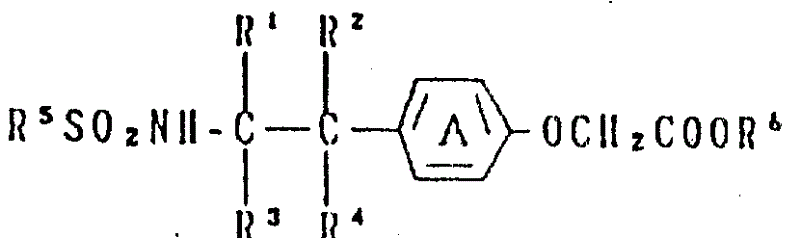
的苯氧基乙酸化合物或其盐,其中环A为亚苯基或含有1至2个选自低级烷基、低级烷氧基团和卤素原子的取代基的一种亚苯基;R1、R2、R3和R4中的1个或2个基团为低级烷基,而其它的基团为氢原子;R5为苯基基团或含有1至3个选自低级烷基、卤素原子、低级烷氧基、三卤甲基和硝基的取代基的苯基;且-COOR6为羧基或受保护的羧基。A phenoxyacetic acid compound or a salt thereof, wherein ring A is a phenylene group or a phenylene group containing 1 to 2 substituents selected from lower alkyl groups, lower alkoxy groups and halogen atoms; R 1 , One or two groups in R 2 , R 3 and R 4 are lower alkyl groups, while the other groups are hydrogen atoms; R 5 is a phenyl group or contains 1 to 3 selected from lower alkyl groups, Phenyl as a substituent of halogen atom, lower alkoxy, trihalomethyl and nitro; and -COOR 6 is carboxyl or protected carboxyl.
此苯氧基乙酸化合物(Ⅰ)显示有效的血小板聚集-抑制活性,且对血栓形成疾病的治疗和/或预防是有用的。This phenoxyacetic acid compound (I) exhibits potent platelet aggregation-inhibiting activity, and is useful for the treatment and/or prevention of thrombotic diseases.
本发明的化合物的实例为结构式为(Ⅰ)的那些化合物,其中环A为亚苯基或含有1至2个选自1至4个碳原子的烷基如甲基、乙基、丙基或丁基,1至3个碳原子的烷氧基如甲氧基、乙氧基或丙氧基和一种卤素原子如氯、溴或氟;R1至R4中的1个或2个基团为1至4个碳原子的烷基基团如甲基、乙基、丙基或丁基,而R1至R4中的其它基团为氢原子;R5为苯基或含有1至3个选自包含1至3个碳原子的烷基如甲基、乙基或丙基,卤素原子如氟、氯或溴,1至3个碳原子的烷氧基如甲氧基、乙氧基或丙氧基,三卤甲基基团如三氟甲基和硝基的取代基的苯基;且-COOR6为可用保护基团如1至3个碳 原子的烷基基团(例如,甲基、乙基或丙基)选择性地保护的羧基或7至13个碳原子的被取代的或未被取代的苯基-烷基(例如,苄基、对-甲氧基苄基、对-硝基苄基或二苯甲基)。Examples of compounds of the present invention are those compounds of formula (I), wherein ring A is phenylene or alkyl containing 1 to 2 selected from 1 to 4 carbon atoms such as methyl, ethyl, propyl or Butyl, an alkoxy group of 1 to 3 carbon atoms such as methoxy, ethoxy or propoxy and a halogen atom such as chlorine, bromine or fluorine; 1 or 2 of R 1 to R 4 The group is an alkyl group of 1 to 4 carbon atoms such as methyl, ethyl, propyl or butyl, and the other groups in R1 to R4 are hydrogen atoms; R5 is phenyl or contains 1 to 3 selected from alkyl groups containing 1 to 3 carbon atoms such as methyl, ethyl or propyl, halogen atoms such as fluorine, chlorine or bromine, alkoxy groups of 1 to 3 carbon atoms such as methoxy, ethoxy phenyl or propoxy, trihalomethyl groups such as trifluoromethyl and nitro as substituents; and -COOR 6 is an available protecting group such as an alkyl group of 1 to 3 carbon atoms (e.g. , methyl, ethyl or propyl) optionally protected carboxyl or substituted or unsubstituted phenyl-alkyl groups of 7 to 13 carbon atoms (for example, benzyl, p-methoxybenzyl , p-nitrobenzyl or benzhydryl).
其中,本发明的化合物的较好的实例为结构式为(Ⅰ)的那些化合物,其中环A为亚苯基或含有1至2个选自1至3个碳原子的烷基、卤素原子和1至3个碳原子的烷氧基的取代基的亚苯基;R1至R4中的1个或2个基团为1至4个碳原子的烷基,而R1至R4中的其它基团为氢原子;R5为苯基或含有1至3个选自1至3个碳原子的烷基、卤素原子、1至3个碳原子的烷氧基、三卤甲基和硝基的取代基的苯基;且-COOR6为游离的羧基或用1至3个碳原子的烷基保护的羧基。本发明的化合物的另一个较好的实例为结构式为(Ⅰ)的那些化合物,其中环A为亚苯基或用卤素原子取代的一个亚苯基;R1至R4中的一个为1至4个碳原子的烷基,而R1至R4中的其它基团为氢原子;R5为苯基基团或用1至3个碳原子的烷基取代的苯基、卤素原子、三卤甲基或硝基;且-COOR6为游离的羧基或用1至3个碳原子的烷基保护的一种羧基。本发明的化合物的其它较好的实例为结构式为(Ⅰ)的那些化合物,其中环A为亚苯基或用氟原子或氯原子取代的一种亚苯基;R1至R4中的一个为甲基或乙基,而其它基团为氢原子;R5为苯基或用甲基取代的苯基氯原子、溴原子、三氟甲基或硝基;且-COOR6为游离的羧基或用1至3个碳原子的烷基保护的羧基。Among them, preferred examples of the compounds of the present invention are those compounds of the formula (I), wherein ring A is phenylene or contains 1 to 2 alkyl groups selected from 1 to 3 carbon atoms, halogen atoms and 1 phenylene as a substituent of an alkoxy group of 3 carbon atoms; 1 or 2 of R 1 to R 4 are alkyl groups of 1 to 4 carbon atoms, and R 1 to R 4 Other groups are hydrogen atoms; R is phenyl or contains 1 to 3 alkyl groups selected from 1 to 3 carbon atoms, halogen atoms, alkoxy groups from 1 to 3 carbon atoms, trihalomethyl and nitric acid and -COOR 6 is a free carboxyl group or a carboxyl group protected with an alkyl group of 1 to 3 carbon atoms. Another preferred example of the compounds of the present invention are those compounds of formula (I), wherein ring A is phenylene or a phenylene substituted with a halogen atom; one of R1 to R4 is 1 to An alkyl group of 4 carbon atoms, while other groups in R1 to R4 are hydrogen atoms; R5 is a phenyl group or a phenyl group substituted with an alkyl group of 1 to 3 carbon atoms, a halogen atom, three halomethyl or nitro; and -COOR 6 is a free carboxyl group or a carboxyl group protected with an alkyl group of 1 to 3 carbon atoms. Other preferred examples of the compounds of the present invention are those compounds of formula (I), wherein ring A is phenylene or a phenylene substituted with fluorine or chlorine atoms; one of R1 to R4 is methyl or ethyl, while other groups are hydrogen atoms; R is phenyl or phenyl chlorine atom, bromine atom, trifluoromethyl or nitro substituted with methyl; and -COOR is free carboxyl Or a carboxyl group protected with an alkyl group of 1 to 3 carbon atoms.
当由于存在着1个或2个不对称碳原子,本发明的化合物(Ⅰ)可能以2个旋光异构体的形式或以2个立体异构体或4个旋光异构体的形式存在时,本发明包括其范围中的这些异构体中的任何一个和它们的一种混合物。When the compound (I) of the present invention may exist in the form of 2 optical isomers or in the form of 2 stereoisomers or 4 optical isomers due to the presence of 1 or 2 asymmetric carbon atoms , the present invention includes within its scope any one of these isomers and a mixture thereof.
根据本发明,化合物(Ⅰ)或其一种盐可用下列步骤或几步骤制备:According to the present invention, compound (I) or a salt thereof can be prepared by the following steps or steps:
ⅰ)将结构式为:i) Change the formula to:

的一种酚化合物或其一种盐,其中环A、R1、R2、R3、R4和R5如上定义,与结构式为:A phenolic compound or a salt thereof, wherein ring A, R 1 , R 2 , R 3 , R 4 and R 5 are as defined above, and the structural formula is:
一种乙酸衍生物,其中X1为一种反应,残基且-COOR61为羧基或受保护的羧基进行缩合,A derivative of acetic acid, wherein X 1 is a reaction residue and -COOR 61 is a carboxyl group or a protected carboxyl group for condensation,
ⅱ)当-COOR61为一种受保护的羧基时,从那里选择性地去除所述的保护基团,且ii) when -COOR 61 is a protected carboxyl group, selectively removing said protecting group therefrom, and
ⅲ)如果需要的话,进一步将此产物转化为其一种盐。iii) Further converting the product to a salt thereof, if desired.
另一方面,化合物(Ⅰ)或其一种盐可用下列步骤或几步骤制备:On the other hand, compound (I) or a salt thereof can be prepared by the following steps or steps:
ⅰ)将结构式为:i) Change the formula to:

的一种苯氧基乙酸衍生物或其一种盐,其中Y为氨基、受保护的氨基或一种反应残基,且环A、R1、R2、R3、R4和-COOR61如上面定义,与结构式为:A phenoxyacetic acid derivative or a salt thereof, wherein Y is amino, protected amino or a reactive residue, and ring A, R 1 , R 2 , R 3 , R 4 and -COOR 61 As defined above, and the structural formula is:
的一种苯磺酸化合物,其中Z为羟基基团或当Y为氨基基团或一个受保护的氨基基团时为一种反应残基,或当Y为一种反应残基时Z为氨基基团,且R5如上定义进行缩合,A benzenesulfonic acid compound wherein Z is a hydroxyl group or a reactive residue when Y is an amino group or a protected amino group, or Z is an amino group when Y is a reactive residue group, and R 5 is condensed as defined above,
ⅱ)当-COOR61为一种受保护的羧基基团和/或Y为一种受保护的氨基基团时,选择性地从中去除所述的保护基团或几个基团,且ii) when -COOR 61 is a protected carboxyl group and/or Y is a protected amino group, selectively removing said protecting group or groups therefrom, and
ⅲ)如果需要的话,进一步将此产物转化为其一种盐。iii) Further converting the product to a salt thereof, if desired.
任何保护基团,这些保护基团可以通过一种常用的方法如水解、酸处理和还原作用易于去除,可被用来保护起始化合物(Ⅲ)和(Ⅳ)的羧基。这种保护基团(例如,基团R61)的实例包括,例如,一种低级烷基基团如甲基、乙基、丙基或丁基,和一种被取代的或未被取代的苯基-低级烷基基团如苄基、对-甲氧基苄基、对-硝基苄基或二苯甲基,反应残基X1和Y或Z的实例包括一种卤素原子如氯、溴或碘,一种低级烷基磺酰氧基基团如甲磺酰氧基,一种被取代或未被取代的苯基-磺酰氧基基团如苯碘酰氧基或对-甲苯磺酰氧基等。Any protecting group which can be easily removed by a usual method such as hydrolysis, acid treatment and reduction can be used to protect the carboxyl groups of the starting compounds (III) and (IV). Examples of such protecting groups (for example, group R 61 ) include, for example, a lower alkyl group such as methyl, ethyl, propyl or butyl, and a substituted or unsubstituted Phenyl-lower alkyl groups such as benzyl, p-methoxybenzyl, p-nitrobenzyl or benzhydryl, examples of reactive residues X and Y or Z include a halogen atom such as chlorine , bromine or iodine, a lower alkylsulfonyloxy group such as methanesulfonyloxy, a substituted or unsubstituted phenyl-sulfonyloxy group such as phenyliodyloxy or p- Tosyloxy, etc.
起始化合物(Ⅱ)和(Ⅲ)的缩合可在一种惰性溶剂中快速进行。丙酮、氯仿、低级链烷醇、二氯甲烷、四氢呋喃、二甲基亚砜、二甲基甲酰胺和它们的一种混合物适合于作为这种(惰性)溶剂。在进行这种反应中,酚化合物(Ⅱ)可以其一种盐如一种碱金属盐、一种碱土金属盐等的形式应用。最好在一种酸性接受体如一种碱金属碳酸盐、一种碱金属氧化物、一种碱金属碳酸氢盐和一种有机胺(例如,三乙胺)存在下进行反应。最好在20至100℃温度下进行反应。The condensation of starting compounds (II) and (III) can be carried out rapidly in an inert solvent. Acetone, chloroform, lower alkanols, methylene chloride, tetrahydrofuran, dimethylsulfoxide, dimethylformamide and a mixture thereof are suitable as such (inert) solvents. In carrying out this reaction, the phenol compound (II) may be used in the form of a salt thereof such as an alkali metal salt, an alkaline earth metal salt and the like. The reaction is preferably carried out in the presence of an acid acceptor such as an alkali metal carbonate, an alkali metal oxide, an alkali metal bicarbonate and an organic amine (eg, triethylamine). The reaction is preferably carried out at a temperature of 20 to 100°C.
起始化合物(Ⅳ)和(Ⅴ)的缩合可在一种酸性接受体存在下、在一种溶剂中或无溶剂时进行。此酸性接受体的实例包括一种碱金属碳酸氢盐、一种碱金属碳酸盐、一种碱土金属碳酸盐、一种有机碱如吡啶、三甲胺或三乙胺。乙醚、苯、二氯甲烷、二噁烷、乙醇、甲醇、水和它们的一种混合物适合于作为溶剂。其中Y为氨基基团的化合物(Ⅳ)可以一种有机的或无机的酸加成盐如氢氯化物、氢溴化物、甲磺酸盐、草酸盐等的形式用于反应;或者,其中Y为一种受保护的氨基和/或-COOR61为游离的羧基的化合物(Ⅳ)可以一种盐如一种碱金属盐或一种碱土金属盐的形式用于反应。并且,当Y为一种受保护的氨基基团时,一种低级链烷醇基如乙酰基或丙酰基或一种芳烷氧基羰基(aralkyloxycarbonyl)如苄氧基羰基最合适用于所述的氨基基团的保护基团。最好在50至150℃温度下进行该上述反应。The condensation of starting compounds (IV) and (V) can be carried out in the presence of an acid acceptor, in a solvent or without a solvent. Examples of the acid acceptor include an alkali metal bicarbonate, an alkali metal carbonate, an alkaline earth metal carbonate, an organic base such as pyridine, trimethylamine or triethylamine. Diethyl ether, benzene, dichloromethane, dioxane, ethanol, methanol, water and a mixture thereof are suitable as solvents. The compound (IV) wherein Y is an amino group can be used for the reaction in the form of an organic or inorganic acid addition salt such as hydrochloride, hydrobromide, methanesulfonate, oxalate, etc.; or, wherein The compound (IV) wherein Y is a protected amino group and/or -COOR 61 is a free carboxyl group may be used in the reaction in the form of a salt such as an alkali metal salt or an alkaline earth metal salt. Also, when Y is a protected amino group, a lower alkanol group such as acetyl or propionyl or an aralkyloxycarbonyl group such as benzyloxycarbonyl is most suitable for said A protecting group for the amino group. It is preferable to carry out the above reaction at a temperature of 50 to 150°C.
当-COOR61为该受保护的羧基基团和/或Y为一种受保护的氨基基团时,然后选择性地移去所述的保护基团可通过一种惯用的方法如水解、溶剂分解、酸处理或还原进行。When -COOR 61 is the protected carboxyl group and/or Y is a protected amino group, then selectively removing said protecting group can be done by a conventional method such as hydrolysis, solvent Decomposition, acid treatment or reduction is carried out.
由于本发明的上述全部反应可在无外消旋作用情况下进行,因此,通过将化合物(Ⅱ)或(Ⅳ)的旋光异构体用作为起始化合物,可容易得到一种旋光体形式的化合物。Since all the above-mentioned reactions of the present invention can be carried out without racemization, by using the optical isomer of compound (II) or (IV) as a starting compound, it is easy to obtain a compound in the form of an optical isomer compound.
化合物(Ⅰ)可以游离的形式或以其一种盐的形式用于药物应用。药物应用的化合物(Ⅰ)的合适的盐包括,例如,其药物学上可接受的盐如碱金属盐(例如,钠盐或钾盐)、碱土金属盐(例如,钙盐或镁盐),重金属盐(例如,锌盐)、铵盐,有机胺盐(例如,三 乙胺盐、吡啶盐或乙醇胺盐)、碱性氨基酸盐(例如,赖氨酸盐精氨酸盐或组氨酸盐)等。这些盐可通过用化学计算的等摩尔量的相应的有机或无机碱处理化合物(Ⅰ)得到。Compound (I) can be used in pharmaceutical applications in free form or in the form of a salt thereof. Suitable salts of Compound (I) for pharmaceutical use include, for example, pharmaceutically acceptable salts thereof such as alkali metal salts (for example, sodium salts or potassium salts), alkaline earth metal salts (for example, calcium salts or magnesium salts), Heavy metal salts (e.g. zinc salts), ammonium salts, organic amine salts (e.g. ethylamine, pyridinium, or ethanolamine), basic amino acid salts (for example, lysine, arginine, or histidine), etc. These salts can be obtained by treating the compound (I) with a stoichiometric equimolar amount of the corresponding organic or inorganic base.
化合物(Ⅰ)和其一种盐可口服或非经肠道药用,且也可以含有与适合于口服或非经肠道药用的药物赋形剂混合的同样的化合物的一种药物制剂的形式运用。此药物制剂可为固体形式如片剂、胶囊剂或栓剂或液体形式如溶液、悬浮液或乳状液。并且,当非经肠道药用时,此药物制剂也可以注射液的形式运用。Compound (I) and a salt thereof can be administered orally or parenterally, and can also contain the same compound in admixture with pharmaceutical excipients suitable for oral or parenterally. form use. Such pharmaceutical preparations may be in solid form such as tablets, capsules or suppositories or in liquid form such as solutions, suspensions or emulsions. Moreover, when parenterally administered, the pharmaceutical preparation can also be used in the form of injection.
如前文所述,本发明的化合物(Ⅰ)和其一种盐显示有效的血小板聚集-抑制活性,且对各种血栓形成或栓塞如脑血栓形成、冠动脉血栓形成、肺动脉血栓形成、肺动脉栓塞、周围Y脉管的栓塞、血栓性脉管炎等的治疗、改善和/或预防是有用的。例如,当在玻璃器内测定一种测试化合物的胶原-诱发的血小板聚集-抑制活性时,本发明的(+)-4-[2-(4-氯苯基)磺酰氨基-1-甲基乙基]苯氧基乙酸显示出其血小板聚集-抑制活性约为在日本专利公报(已审查)第35910号/1982中所揭示的4-(2-苯磺酰氨基乙基)苯氧基乙酸的4倍。并且,化合物(Ⅰ)和其一种盐为低毒性的,而且用作为一种药物显示一种高度安全性。As mentioned above, the compound (I) of the present invention and a salt thereof exhibit potent platelet aggregation-inhibitory activity, and are effective against various thrombosis or embolism such as cerebral thrombosis, coronary artery thrombosis, pulmonary artery thrombosis, pulmonary embolism , peripheral Y vessel embolism, thromboangiitis, etc., are useful for treatment, improvement and/or prevention. For example, (+)-4-[2-(4-chlorophenyl)sulfonylamino-1-methyl Ethyl]phenoxyacetic acid exhibits platelet aggregation-inhibitory activity about that of 4-(2-benzenesulfonylaminoethyl)phenoxy 4 times that of acetic acid. Also, the compound (I) and a salt thereof are of low toxicity and show a high safety when used as a medicine.
伴随着,本发明的起始化合物(Ⅱ)可(以通过下述来)制备,例如,通过将结构式为:Concomitantly, the starting compound (II) of the present invention can be prepared (by following methods), for example, by formulating:

的一种化合物,其中R7为羟基或受保护的羟基,且环A、R1、R2、R3和R4如上定义,与结构式为:A compound of wherein R 7 is hydroxyl or protected hydroxyl, and ring A, R 1 , R 2 , R 3 and R 4 are as defined above, and the structural formula is:
的一种苯磺酰卤化物的衍生物,其中R5如上定义,且X2为一种卤素原子,在一种碱金属碳酸或有机胺存在下、在一种溶剂中(进行)反 应,而且如果需要的话,从上面所得到的产物中去除保护基团。另一方面,起始化合物(Ⅱ),其中R2和R4之一为一种低级烷基,而另一为氢原子,且R1和R3为氢原子可(以通过下列方法来)制备,即通过将结构式为:A benzenesulfonyl halide derivative of wherein R5 is as defined above and X2 is a halogen atom reacted in a solvent in the presence of an alkali metal carbonic acid or an organic amine, and The protecting group was removed from the product obtained above if necessary. On the other hand, the starting compound (II), wherein one of R 2 and R 4 is a lower alkyl group, and the other is a hydrogen atom, and R 1 and R 3 are hydrogen atoms may (by the following method) Preparation, i.e. by converting the formula to:

的化合物,其中环A和R7如上定义,与化合物(Ⅶ),在一种碱金属碳酸盐存在下、在一种溶剂中(进行)反应,将此产物与一种低级烷基镁卤化物反应,得到结构式为:The compound, wherein ring A and R7 are as defined above, is reacted with compound (VII) in the presence of an alkali metal carbonate in a solvent, and the product is halogenated with a lower alkylmagnesium reaction, the structural formula is obtained:

的一种化合物,其中环A、R2、R4、R5和R7如上定义,在钯碳存在下,使化合物(Ⅸ)催化氢化(作用),且如需要的话,进一步从中去除保护基团。另一方面,起始化合物(Ⅳ)可(以通过下述)制备,例如,通过将结构式为:A compound wherein ring A, R 2 , R 4 , R 5 and R 7 are as defined above, compound (IX) is subjected to catalytic hydrogenation (action) in the presence of palladium on carbon, and if necessary, further removal of the protecting group therefrom group. On the other hand, the starting compound (IV) can be prepared (as follows), for example, by formulating:
的一种化合物,其中Y1为氨基基团、一种受保护的氨基基团或一种反应剩余物,且环A、R1、R2、R3和R4如上定义,与化合物(Ⅲ),A compound of wherein Y 1 is an amino group, a protected amino group or a reaction residue, and ring A, R 1 , R 2 , R 3 and R 4 are as defined above, and compound (Ⅲ ),
在一种酸性接受体存在下、在一种溶剂中(进行)反应,且如果需要的话,用一种惯用的方法从此产物中去除保护基团。The reaction is carried out in the presence of an acidic acceptor in a solvent and, if necessary, the protecting group is removed from the product by a conventional method.
试验1test 1
对胶原-诱发的血小板聚集作用的影响(在体内)Effect on collagen-induced platelet aggregation (in vivo)
将9份体积收集自一个健康的人在血液与1份体积的3.13%(重量/体积)柠檬酸三钠溶液混合,且将此混合物进行离心,以得到作为上层清液的富含血小板血浆(“PRP”)。进一步将底层进行离心,得到作为上层清液的贫含血小板血浆(“PPP”)。PRP用PPP稀释,因此血小板数量约为4×105细胞/立方毫米。将25微升含有等摩尔量的碳酸氢钠的一种测试化合物溶液加至200微升所述的经稀释的PRP中。在37℃下,搅拌此混合物2分钟后,向那里加入一种胶原溶液[25-29微克/毫升溶液:生物化学学、生物物理学杂志,186,254(1969)]以诱发血小板聚集。通过鲍恩(Born)方法[自然,194,927(1962)]检查血小板聚集的程度,同时测试该待试化合物的血小板聚集-抑制活性。该测试化合物的血小板聚集-抑制活性以IC50来表示,即,诱发胶原-诱发的血小板聚集的50%抑制所需要的该测试化合物的浓度所需要。该结果在下列表1中显示。9 volumes of blood collected from a healthy person were mixed with 1 volume of 3.13% (w/v) trisodium citrate solution, and this mixture was centrifuged to obtain platelet-rich plasma as a supernatant ( "PRP"). The bottom layer was further centrifuged to obtain platelet-poor plasma ("PPP") as the supernatant. PRP is diluted with PPP, so the number of platelets is about 4×10 5 cells/mm3. 25 µl of a solution of a test compound containing an equimolar amount of sodium bicarbonate was added to 200 µl of the diluted PRP. After stirring the mixture for 2 minutes at 37°C, a collagen solution [25-29 µg/ml solution: Journal of Biochemistry, Biophysics, 186 , 254 (1969)] was added thereto to induce platelet aggregation. The degree of platelet aggregation was examined by Born's method [Nature, 194 , 927 (1962)], and the platelet aggregation-inhibiting activity of the test compound was tested. The platelet aggregation-inhibitory activity of the test compound is expressed as IC50 , ie, the concentration of the test compound required to induce 50% inhibition of collagen-induced platelet aggregation. The results are shown in Table 1 below.
表1Table 1
胶原-诱发的血小板聚集-抑制活性(在体内)Collagen-induced platelet aggregation-inhibitory activity (in vivo)
测试化合物*) IC50(微克/毫升)Test compound*) IC 50 (µg/ml)
(本发明的化合物)(compound of the present invention)
化合物1 0.7Compound 1 0.7
化合物2 0.5Compound 2 0.5
化合物3 0.5Compound 3 0.5
已知化合物 2Known Compound 2
*)注:每个测试化合物的化学名称:*) Note: Chemical name of each test compound:
化合物1:(±)-4-[2-(4-氯苯基)磺酰基氨基丙基]苯氧基乙酸Compound 1: (±)-4-[2-(4-Chlorophenyl)sulfonylaminopropyl]phenoxyacetic acid
化合物2:(±)-4-[2-(4-氯苯基)磺酰基氨基-1-甲基乙基]苯氧基乙酸Compound 2: (±)-4-[2-(4-chlorophenyl)sulfonylamino-1-methylethyl]phenoxyacetic acid
化合物3:(±)-4-[2-(4-溴苯基)磺酰基氨基-1-甲基乙基]苯氧基乙酸Compound 3: (±)-4-[2-(4-bromophenyl)sulfonylamino-1-methylethyl]phenoxyacetic acid
已知物合物:4-(2-苯磺酰基氨基乙基)苯氧基乙酸Known compounds: 4-(2-Benzenesulfonylaminoethyl)phenoxyacetic acid
(在日本专利公报(已审查)第35910号1982中揭示的化物)(Compound disclosed in Japanese Patent Gazette (Examined) No. 35910 1982)
试验2test 2
对廿碳四烯酸-诱发的肺动脉栓塞的影响(在体内)Effects on eicosadonic acid-induced pulmonary embolism (in vivo)
给雄小鼠(ddy male mice)(5个周龄,每组10个鼠)口服一种测试化合物(悬浮或溶解在一种碳酸氢钠和0.25%羧基甲基纤维素的水溶液中),通宵禁食。3小时后,将廿碳四烯酸(125毫克/2.5毫升1%NaHCO3溶液+7.5毫升0.9%含水氯化钠/千克)注射至鼠的尾部静脉中,以诱发肺动脉栓塞,且将此鼠的运动活性的复原时间(分)(例如,从廿碳四烯酸的注射期间至此鼠从呼吸困难复原并开始移动的时间)与一对照组的鼠比较,给此对照组的鼠施用0.25%CMC水溶液,以代替测试化合物溶液。用一种最小的有效剂量,即与对照比较缩短复原时间至少15%所需的剂量,测试每个测试化合物对廿碳四烯酸-诱发的肺动脉栓塞的抑制作用。该结果在下列表2中显示。A test compound (suspended or dissolved in an aqueous solution of sodium bicarbonate and 0.25% carboxymethylcellulose) was orally administered to male mice (5 weeks old, 10 mice per group) overnight fasting. Three hours later, eicosatetraenoic acid (125 mg/2.5 ml 1% NaHCO 3 solution + 7.5 ml 0.9% aqueous NaCl/kg) was injected into the tail vein of the rat to induce pulmonary embolism, and the rat was The recovery time (minutes) of locomotor activity (for example, the time from the injection period of eicosadonic acid to the time when the rat recovered from dyspnea and started to move) was compared with that of a control group of rats administered 0.25% CMC in water instead of the test compound solution. Each test compound was tested for inhibition of eicosadonic acid-induced pulmonary embolism at a minimum effective dose, ie, the dose required to shorten recovery time by at least 15% compared to control. The results are shown in Table 2 below.
表2Table 2
对廿碳四烯酸-诱发的肺动脉栓塞的抑制作用Inhibitory effect on eicosadonic acid-induced pulmonary embolism
测试化合物*) 最小有效剂量(毫克/千克)Test compound*) Minimum effective dose (mg/kg)
(本发明的化合物)(compound of the present invention)
化合物1 1.0Compound 1 1.0
化合物2 0.3Compound 2 0.3
化合物3 0.1Compound 3 0.1
化合物4 0.1Compound 4 0.1
化合物5 0.03Compound 5 0.03
已知化合物 30Known compounds 30
*)注:每个测试化合物的化学名称*) Note: Chemical name of each test compound
化合物4:(±)-4-(2-苯磺酰氨基-1-甲基乙基)-2-氟苯氧基乙酸Compound 4: (±)-4-(2-Benzenesulfonylamino-1-methylethyl)-2-fluorophenoxyacetic acid
化合物5:(±)-4-[2-(4-氯苯基)磺酰基氨基-1-甲基乙基]-2-氟苯氧基乙酸Compound 5: (±)-4-[2-(4-chlorophenyl)sulfonylamino-1-methylethyl]-2-fluorophenoxyacetic acid
化合物1~3和已知的化合物如试验1中所述。Compounds 1-3 and known compounds are as described in Experiment 1.
试验3Test 3
对流血时间的影响(在体内)Effect on bleeding time (in vivo)
给雄小鼠(5周龄,每组10个鼠)口服一种测试化合物(悬浮或溶解在一种0.25%羧基甲基纤维素水溶液中),通宵禁食。3小时后,在乙醚麻醉下切去尾端(约2毫米),并立即将所述的尾端浸在生理盐水(37℃)中。将用药组的鼠的流血时间(秒)与对照组的鼠的比较,给此对照组的鼠施用0.25% CMC水溶液,代替测试化合物溶液。通过一种最小的有效剂量,例如,与对照组相比诱发流血时间至少延长50%所需的剂量,测试每个测试化合物对流血时间的延长影响。Male mice (5 weeks old, 10 mice per group) were orally administered a test compound (suspended or dissolved in a 0.25% carboxymethylcellulose aqueous solution) and fasted overnight. After 3 hours, the tail end (about 2 mm) was cut off under ether anesthesia, and said tail end was immediately immersed in physiological saline (37°C). The bleeding time (seconds) of the rats of the drug group was compared with the rats of the control group, and the rats of the control group were administered with 0.25% CMC aqueous solution instead of the test compound solution. Each test compound is tested for its effect on prolongation of bleeding time by a minimal effective dose, eg, the dose required to induce at least a 50% prolongation of bleeding time compared to a control.
[结果][result]
在上述试验中,在试验1中所提及的化合物1、2和3的最小有效剂量分别为3毫克/千克、10毫克/千克和10毫克/千克,而日本专利公报(已审查)第35910号/1982中所揭示的4-(2-苯磺酰氨基乙基)苯氧基乙酸的最小有效剂量为30毫克/千克。In the above tests, the minimum effective doses of compounds 1, 2 and 3 mentioned in Test 1 were 3 mg/kg, 10 mg/kg and 10 mg/kg, respectively, while Japanese Patent Publication (Examined) No. 35910 The minimum effective dose of 4-(2-benzenesulfonylaminoethyl)phenoxyacetic acid disclosed in No./1982 is 30 mg/kg.
实施例1Example 1
(1)将4.74克1-苯磺酰基氨基-2-(4-苯氧基苯基)-2-丙醇溶解在 100毫升四氢呋喃和20毫升水的一种混合物中,并向其中加入4.29克乙二酸。在氢气气氛(3.5个原子)下,40-50℃时,在10%钯碳存在下通宵使此混合物催化氢化。反应之后,滤去催化剂。在减压下蒸发此滤液。向剩余物中加入乙酸乙酯,并依次用一种碳酸氢钠水溶液和一种氯化钠的饱和水溶液洗涤。使乙酸乙酯溶液干燥,并在减压下蒸发。从乙酸乙酯和正己烷的一种混合物中重结晶剩余物,从而得到2.96克为无色针状结晶体的4-(1-甲基-2-苯磺酰基氨基乙基)苯酚。(1) Dissolve 4.74 g of 1-benzenesulfonylamino-2-(4-phenoxyphenyl)-2-propanol in 100 ml of tetrahydrofuran and a mixture of 20 ml of water, and 4.29 g of oxalic acid was added thereto. The mixture was catalytically hydrogenated in the presence of 10% palladium on carbon overnight at 40-50°C under an atmosphere of hydrogen (3.5 atoms). After the reaction, the catalyst was filtered off. The filtrate was evaporated under reduced pressure. Ethyl acetate was added to the residue, and washed successively with an aqueous sodium bicarbonate solution and a saturated aqueous solution of sodium chloride. The ethyl acetate solution was dried and evaporated under reduced pressure. The residue was recrystallized from a mixture of ethyl acetate and n-hexane, whereby 2.96 g of 4-(1-methyl-2-benzenesulfonylaminoethyl)phenol were obtained as colorless needles.
产率:85%Yield: 85%
熔点:162.5-164℃Melting point: 162.5-164°C
(2)将2.96克上面得到的产物溶解在25毫升丙酮中。向其中加入1.54克碳酸钾和1.87克溴乙酸乙酯,并在室温下搅拌此混合物6.5小时。再向其中加入0.57克碳酸钾和0.68克溴乙酸乙酯,并搅拌过夜。反应之后,在减压下蒸发丙酮,并用乙酸乙酯萃取剩余物。用水和一种氯化钠的饱和水溶液洗涤此萃取液,并干燥。在减压下蒸发此乙酸乙酯萃取液,且剩余物通过柱层析(溶剂;甲苯,和甲苯∶乙酸乙酯=20∶1及10∶1)纯化,从而得到2.04克为无色油状物的4-(1-甲基-2-苯磺酰基氨基乙基)苯氧基乙酸乙酯。(2) 2.96 g of the product obtained above was dissolved in 25 ml of acetone. Thereto were added 1.54 g of potassium carbonate and 1.87 g of ethyl bromoacetate, and the mixture was stirred at room temperature for 6.5 hours. Thereto were added 0.57 g of potassium carbonate and 0.68 g of ethyl bromoacetate and stirred overnight. After the reaction, acetone was evaporated under reduced pressure, and the residue was extracted with ethyl acetate. The extract was washed with water and a saturated aqueous solution of sodium chloride, and dried. The ethyl acetate extract was evaporated under reduced pressure, and the residue was purified by column chromatography (solvent; toluene, and toluene:ethyl acetate = 20:1 and 10:1), thereby obtaining 2.04 g as a colorless oil 4-(1-Methyl-2-benzenesulfonylaminoethyl)phenoxyethyl acetate.
产率:53%Yield: 53%
Mass(m/e):377(M+)Mass (m/e): 377 (M + )
IRνneat max(cm-1):3300,1750IRν neat max (cm -1 ): 3300, 1750
NMR(CDCl3,δ):1.19(3H,t,J=7Hz),1.30(3H,d,J=7Hz),2.6-3.3(3H,m),4.28(2H,q,J=7Hz),4.59(2H,s),6.7-7.9(9H,m)NMR (CDCl 3 , δ): 1.19 (3H, t, J = 7Hz), 1.30 (3H, d, J = 7Hz), 2.6-3.3 (3H, m), 4.28 (2H, q, J = 7Hz), 4.59 (2H, s), 6.7-7.9 (9H, m)
(3)将1.55克上面得到的产物溶解在16毫升乙醇中。向其中加入6.2毫升一种1克当量/升的氢氧化钠水溶液,并在室温下搅拌此混合物2小时。在减压下蒸发此混合物,且将剩余物溶解在6毫升水中,并通过装满一种非离子型的吸附树脂柱(由三菱化学工业股份有限公司制造,商标为“HP-20”,以后称作为“HP-20”)。用水洗涤此柱,并用一种50%的甲醇水溶液洗提。收集含有所希望的产物的级分,并蒸发以去除溶剂。将异丙醇加至剩余物中,从而得到1.3克为无色粉末的4-(1-甲基-2-苯磺酰基氨基乙基)苯氧基乙酸钠。(3) 1.55 g of the product obtained above was dissolved in 16 ml of ethanol. Thereto was added 6.2 ml of a 1 gN/L aqueous sodium hydroxide solution, and the mixture was stirred at room temperature for 2 hours. The mixture was evaporated under reduced pressure, and the residue was dissolved in 6 ml of water, and passed through a column packed with a nonionic adsorption resin (manufactured by Mitsubishi Chemical Industries, Ltd., under the trademark "HP-20", hereafter known as "HP-20"). The cartridge was washed with water and eluted with a 50% aqueous methanol solution. Fractions containing the desired product were collected and evaporated to remove solvent. Isopropanol was added to the residue, whereby 1.3 g of sodium 4-(1-methyl-2-benzenesulfonylaminoethyl)phenoxyacetate was obtained as a colorless powder.
产率:74%Yield: 74%
熔点:180℃Melting point: 180°C
Mass(m/e):394(M++Na),372(M++H)Mass (m/e): 394 (M + +Na), 372 (M + +H)
IRνnujol max(cm-1):3280IRν nujol max (cm −1 ): 3280
NMR(D2O,δ):1.11(3H,d,J=7Hz),2.6-3.1(3H,m),4.43(2H,s),6.7-7.1(4H,m),7.4-7.8(5H,m)NMR ( D2O , δ): 1.11 (3H, d, J=7Hz), 2.6-3.1 (3H, m), 4.43 (2H, s), 6.7-7.1 (4H, m), 7.4-7.8 (5H ,m)
游离的羧酸:无色焦糖Free carboxylic acid: colorless caramel
Mass(m/e):349(M+),179Mass (m/e): 349 (M + ), 179
IRCHCl max3(cm-1):1740IR CHCl max 3 (cm −1 ): 1740
NMR(CDCl3,δ):1.19(3H,d,J=6.5Hz),2.86-3.29(3H,m),4.63(2H,s),6.67-7.83(9H,m)。NMR (CDCl 3 , δ): 1.19 (3H, d, J = 6.5 Hz), 2.86-3.29 (3H, m), 4.63 (2H, s), 6.67-7.83 (9H, m).
实施例2Example 2
(1)将11.13克dl-4-(2-氨基丙基)苯酚氢溴化物加至3.18克碳酸钠、100毫升乙酸乙酯和100毫升水的一种混合物中。在搅拌下,在0-5℃下将在50毫升乙酸乙酯中的(9.71克苯磺酰氯)的一种溶液和在30毫升水中的3.18克碳酸钠的一种溶液滴加至所述的混合物中。在10℃下搅拌此混合物0.5小时后,用10%的盐酸中和此混合物。从中分离有机层,并且用氯仿萃取水层。混合上面得到的有机层和氯仿萃取液,并在减压下蒸发此混合物以去除溶剂。从正己烷中重结晶剩余物,从而得到7.48克为无色三棱镜体的dl-4-(2-苯磺酰基氨基丙基)苯酚。(1) 11.13 g of dl-4-(2-aminopropyl)phenol hydrobromide were added to a mixture of 3.18 g of sodium carbonate, 100 ml of ethyl acetate and 100 ml of water. Under stirring, a solution of (9.71 g of benzenesulfonyl chloride) in 50 ml of ethyl acetate and a solution of 3.18 g of sodium carbonate in 30 ml of water were added dropwise to the in the mixture. After stirring the mixture at 10°C for 0.5 hour, the mixture was neutralized with 10% hydrochloric acid. The organic layer was separated therefrom, and the aqueous layer was extracted with chloroform. The organic layer obtained above and the chloroform extract were mixed, and the mixture was evaporated under reduced pressure to remove the solvent. The residue was recrystallized from n-hexane, whereby 7.48 g of dl-4-(2-benzenesulfonylaminopropyl)phenol were obtained as colorless prisms.
产率:86%Yield: 86%
熔点:97-99℃Melting point: 97-99°C
Mass(m/e):291(M+)Mass (m/e): 291 (M + )
IRνnujol max(cm-1):3480,3440,3340,3300IRν nujol max (cm -1 ): 3480, 3440, 3340, 3300
NMR(CDCl3+D2O,δ):1.08(3H,d,J=6Hz),2.59(2H,d,J=6Hz),3.23-3.72(1H,m),6.67(2H,d,J=9Hz),6.84(2H,d,J=9Hz),7.3-7.57(3H,m),7.6-7.8(2H,m)NMR (CDCl 3 +D 2 O, δ): 1.08 (3H, d, J = 6Hz), 2.59 (2H, d, J = 6Hz), 3.23-3.72 (1H, m), 6.67 (2H, d, J =9Hz), 6.84 (2H, d, J=9Hz), 7.3-7.57 (3H, m), 7.6-7.8 (2H, m)
(2)将7.4克上面得到的产物和3.51克碳酸钾加至140毫升丙酮中。向其中加入在10毫升丙酮中的4.66克溴乙酸乙酯的一种溶液,并在室温下搅拌此溶液18小时。反应之后,在减压下将此溶液浓缩至体积约为50毫升,用10%的乙醇盐酸中和,并用氯仿萃取。在减压下蒸发此氯仿萃取液,且剩余物通过硅胶柱层析(溶剂;氯仿∶甲醇=50∶1和20∶1)纯化,从而得到8.50克为无色油状物的dl-4-(2-苯磺酰基氨基丙基)苯氧基乙酸乙酯。(2) 7.4 g of the product obtained above and 3.51 g of potassium carbonate were added to 140 ml of acetone. A solution of 4.66 g of ethyl bromoacetate in 10 ml of acetone was added thereto, and the solution was stirred at room temperature for 18 hours. After the reaction, the solution was concentrated to a volume of about 50 ml under reduced pressure, neutralized with 10% ethanol hydrochloric acid, and extracted with chloroform. The chloroform extract was evaporated under reduced pressure, and the residue was purified by silica gel column chromatography (solvent; chloroform:methanol = 50:1 and 20:1), whereby 8.50 g of dl-4-( 2-Benzenesulfonylaminopropyl) ethyl phenoxyacetate.
产率:88.5%Yield: 88.5%
Mass(m/e):377(M+)Mass (m/e): 377 (M + )
IRνneat max(cm-1):3270,1745IRν neat max (cm -1 ): 3270, 1745
(3)将8.5克上面得到的产物加至100毫升的一种10%的氢氧化钠水溶液中。在100℃下搅拌此溶液5分钟,且在室温下搅拌此溶液0.5小时,然后用浓盐酸调节PH值至3。用氯仿萃取此溶液。干燥萃取液,并在减压下蒸发,从而得到6.88克为无色粉末的dl-4-(2-苯磺酰基氨基丙基)苯氧基乙酸。(3) 8.5 g of the product obtained above was added to 100 ml of a 10% aqueous sodium hydroxide solution. The solution was stirred at 100°C for 5 minutes and at room temperature for 0.5 hours, then the pH was adjusted to 3 with concentrated hydrochloric acid. The solution was extracted with chloroform. The extract was dried and evaporated under reduced pressure to obtain 6.88 g of dl-4-(2-benzenesulfonylaminopropyl)phenoxyacetic acid as a colorless powder.
产率:87%Yield: 87%
熔点:131-132℃(从丙酮和正己烷的混合物中重结晶)Melting point: 131-132°C (recrystallized from a mixture of acetone and n-hexane)
Mass(m/e):349(M+)Mass (m/e): 349 (M + )
IRνnujol max(cm-1):3285,1730IRν nujol max (cm −1 ): 3285, 1730
NMR(CDCl3+D2O,δ):1.06(3H,d,J=7Hz),2.61(2H,d,J=7Hz),3.20-3.75(1H,m),4.55(2H,s),6.77(2H,d,J=9Hz),6.93(2H,d,J=9Hz),7.22-7.60(3H,m),7.63-7.82(2H,m)NMR (CDCl 3 +D 2 O, δ): 1.06 (3H, d, J = 7Hz), 2.61 (2H, d, J = 7Hz), 3.20-3.75 (1H, m), 4.55 (2H, s), 6.77 (2H, d, J = 9Hz), 6.93 (2H, d, J = 9Hz), 7.22-7.60 (3H, m), 7.63-7.82 (2H, m)
钠盐:无色粉末(从乙醇中重结晶)Sodium salt: colorless powder (recrystallized from ethanol)
熔点:192-194℃Melting point: 192-194°C
Mass(m/e):394(M++Na),372(M++H)Mass (m/e): 394 (M + +Na), 372 (M + +H)
IRνnujol max(cm-1):3290,1615IRν nujol max (cm −1 ): 3290, 1615
NMR(DMSO-d6,δ):0.85(3H,d,J=6.5Hz),2.24-2.70(2H,m),3.04-3.54(1H,m),3.40(1H,s),4.10(2H,s),6.70(2H,d,J=9Hz),6.88(2H,d,J=9Hz),7.40-7.90(5H,m)NMR (DMSO-d 6 , δ): 0.85 (3H, d, J=6.5Hz), 2.24-2.70 (2H, m), 3.04-3.54 (1H, m), 3.40 (1H, s), 4.10 (2H , s), 6.70 (2H, d, J = 9Hz), 6.88 (2H, d, J = 9Hz), 7.40-7.90 (5H, m)
实施例3Example 3
(1)将5.043克(R)-1-(4-甲氧基苯基)-2-氨基丙烷和8.40克碳酸氢钠加至50毫升二氯甲烷和50毫升水的一种混合物中。在5至10℃下,将在二氯甲烷中的4.86克苯磺酰氯的一种溶液滴加至此混合物中,并在室温下搅拌2小时。反应之后,从中分离二氯甲烷层,并用二氯甲烷萃取水层。混合二氯甲烷溶液,干燥,且在减压下蒸发。剩余物通过硅胶柱层析(溶剂;氯仿,且氯仿∶甲醇=50∶1)纯化,并从异丙基醚和甲醇的一种混合物中重结晶,从而得到6.76克为无色三棱形体的(R)-1-(4-甲氧基苯基)-2-苯磺酰基氨基丙烷。(1) 5.043 g of (R)-1-(4-methoxyphenyl)-2-aminopropane and 8.40 g of sodium bicarbonate were added to a mixture of 50 ml of methylene chloride and 50 ml of water. A solution of 4.86 g of benzenesulfonyl chloride in dichloromethane was added dropwise to the mixture at 5 to 10°C, and stirred at room temperature for 2 hours. After the reaction, the dichloromethane layer was separated therefrom, and the aqueous layer was extracted with dichloromethane. The dichloromethane solutions were combined, dried, and evaporated under reduced pressure. The residue was purified by silica gel column chromatography (solvent; chloroform, and chloroform:methanol = 50:1), and recrystallized from a mixture of isopropyl ether and methanol, thereby obtaining 6.76 g of prism as colorless prisms. (R)-1-(4-Methoxyphenyl)-2-benzenesulfonylaminopropane.
产率:88.6%Yield: 88.6%
熔点:75-75.50℃Melting point: 75-75.50°C
〔α〕20 D-18.84°(C=1.072,甲醇)[α] 20 D -18.84° (C=1.072, methanol)
(2)将在20毫升二氯甲烷中的14.3克三溴化硼的一种溶液滴加至120毫升含有6.10克上面得到的产物的二氯甲烷中。所述的滴加的添加是在氩气氛中、在-78℃下进行的。让此溶液在室温下静止1.5小时之后,在冷却下,向其中加入20毫升水。从中分离此二氯甲烷层,用一种氯化钠的饱和水溶液洗涤,干燥,并在减压下蒸发。剩余物从氯仿和异丙醚的一种混合物中重结晶。从而得到5.59克为无色片状体的(R)-4-(2-苯磺酰基氨基丙基)苯酚。(2) A solution of 14.3 g of boron tribromide in 20 ml of dichloromethane was added dropwise to 120 ml of dichloromethane containing 6.10 g of the product obtained above. The dropwise addition was performed at -78°C in an argon atmosphere. After allowing the solution to stand at room temperature for 1.5 hours, 20 ml of water was added thereto under cooling. The dichloromethane layer was separated therefrom, washed with a saturated aqueous solution of sodium chloride, dried, and evaporated under reduced pressure. The residue was recrystallized from a mixture of chloroform and isopropyl ether. Thus, 5.59 g of (R)-4-(2-benzenesulfonylaminopropyl)phenol were obtained as colorless plates.
产率:96.1%Yield: 96.1%
熔点:92-92.50℃Melting point: 92-92.50°C
〔α〕20 D-22.50°(C=1.00,甲醇)[α] 20 D -22.50° (C=1.00, Methanol)
(3)将5.24克上面得到的产物、3.31克溴乙酸乙酯和2.49克碳酸钾加至150毫升丙酮中,并在室温下搅拌此溶液19小时。再向其中加入0.6克溴乙酸乙酯。搅拌8小时之后,滤去有机物,并在减压下蒸发滤液。剩余物通过硅胶柱层析(溶剂;氯仿∶甲醇=100∶1纯化,并从氯仿和异丙醚的一种混合物中重结晶,从而得到5.05克为无色针状结晶体的(R)-4-(2-苯磺酰基氨基丙基)苯氧基乙酸乙酯。(3) 5.24 g of the product obtained above, 3.31 g of ethyl bromoacetate and 2.49 g of potassium carbonate were added to 150 ml of acetone, and the solution was stirred at room temperature for 19 hours. 0.6 g of ethyl bromoacetate was further added thereto. After stirring for 8 hours, the organics were filtered off and the filtrate was evaporated under reduced pressure. The residue was purified by silica gel column chromatography (solvent; chloroform:methanol = 100:1, and recrystallized from a mixture of chloroform and isopropyl ether to obtain 5.05 g of (R)-4 as colorless needle crystals. - Ethyl (2-benzenesulfonylaminopropyl)phenoxyacetate.
产率:74.3%Yield: 74.3%
熔点:108.5-109℃Melting point: 108.5-109°C
〔α〕20 D-11.03°(C=1.015,甲醇)[α] 20 D -11.03° (C=1.015, Methanol)
IRνnujol max(cm-1):3300,1750IRν nujol max (cm -1 ): 3300, 1750
Mass(m/e):377(M+)Mass (m/e): 377 (M + )
(4)将4.68克上面得到的产物溶解在1克氢氧化钠、80毫升四氢呋喃和10毫升水的一种混合物中。在室温下搅拌此混合物15小时。反应之后,在减压下蒸发四氢呋喃。剩余物用10%的盐酸酸化,并用氯仿萃取。用一种氯化钠的饱和水溶液洗涤,干燥,并在减压下蒸发。从异丙醚和二氯甲烷的一种混合物中重结晶剩余物,从而得到4.2克为无色针状结晶体的(R)-4-(2-苯磺酰基氨基丙基)苯氧基乙酸。(4) 4.68 g of the product obtained above was dissolved in a mixture of 1 g of sodium hydroxide, 80 ml of tetrahydrofuran and 10 ml of water. The mixture was stirred at room temperature for 15 hours. After the reaction, tetrahydrofuran was evaporated under reduced pressure. The residue was acidified with 10% hydrochloric acid, and extracted with chloroform. It was washed with a saturated aqueous solution of sodium chloride, dried and evaporated under reduced pressure. The residue was recrystallized from a mixture of isopropyl ether and methylene chloride, whereby 4.2 g of (R)-4-(2-benzenesulfonylaminopropyl)phenoxyacetic acid were obtained as colorless needles.
产率:97%Yield: 97%
熔点:92-93℃Melting point: 92-93°C
〔α〕20 D-12.01°(C=1.074,甲醇)[α] 20 D -12.01° (C=1.074, methanol)
IRνnujol max(cm-1):3315,3215,1740,1705IRν nujol max (cm -1 ): 3315, 3215, 1740, 1705
此产物的质谱和核磁共振数据与在实施例2-(3)中得到的产物的一样。The mass spectrum and NMR data of this product were the same as those of the product obtained in Example 2-(3).
钠盐:无色粉末(从乙醇中重结晶)Sodium salt: colorless powder (recrystallized from ethanol)
熔点:193-196℃Melting point: 193-196°C
〔α〕20 D-15.41°(C=1.012,甲醇)[α] 20 D -15.41° (C=1.012, Methanol)
实施例4Example 4
(1)用与实施例3-(1)中所述的相同的方法处理(S)-1-(4-甲氧基苯基)-2-氨基丙烷,从而得到(S)-1-(4-甲氧基苯基)-2-苯磺酰基氨基丙烷。(1) Treat (S)-1-(4-methoxyphenyl)-2-aminopropane in the same manner as described in Example 3-(1), thereby obtaining (S)-1-( 4-methoxyphenyl)-2-benzenesulfonylaminopropane.
产率:94.2%Yield: 94.2%
熔点:74.5-76℃Melting point: 74.5-76°C
〔α〕20 D+18.60°(C=1.00,甲醇)[α] 20 D +18.60° (C=1.00, Methanol)
(2)用与实施例3-(2)中所述的相同的方法处理上面得到的产物,从而得到(S)-4-(2-苯磺酰基氨基丙基)苯酚。(2) The product obtained above was treated in the same manner as described in Example 3-(2), whereby (S)-4-(2-benzenesulfonylaminopropyl)phenol was obtained.
产率:90.2%Yield: 90.2%
熔点:92-94℃Melting point: 92-94°C
〔α〕20 D+22.00°(C=1.00,甲醇)[α] 20 D +22.00° (C=1.00, Methanol)
(3)用与实施例3-(3)中所述的相同的方法处理上面得到的产物,从而得到(S)-4-(2-苯磺酰基氨基丙基)苯氧基乙酸乙酯。(3) The product obtained above was treated in the same manner as described in Example 3-(3), whereby ethyl (S)-4-(2-benzenesulfonylaminopropyl)phenoxyacetate was obtained.
产率:75%Yield: 75%
熔点:109-110.5℃Melting point: 109-110.5°C
〔α〕20 D+10.50°(C=1.00,甲醇)[α] 20 D +10.50° (C=1.00, Methanol)
(4)用与实施例3-(4)中所述的相同的方法处理上面得到的产物,从而得到(S)-4-(2-苯磺酰基氨基丙基)苯氧基乙酸。(4) The product obtained above was treated in the same manner as described in Example 3-(4), whereby (S)-4-(2-benzenesulfonylaminopropyl)phenoxyacetic acid was obtained.
产率:99%Yield: 99%
熔点:89-91℃Melting point: 89-91°C
〔α〕20 D+11.90°(C=1.008,甲醇)[α] 20 D +11.90° (C=1.008, Methanol)
IRνnujol max(cm-1):3315,3215,1740,1705IRν nujol max (cm -1 ): 3315, 3215, 1740, 1705
此产物的质谱和核磁共振数据与在实施例2-(3)中得到的产物的一样。The mass spectrum and NMR data of this product were the same as those of the product obtained in Example 2-(3).
钠盐:无色粉末(从乙醇中重结晶)Sodium salt: colorless powder (recrystallized from ethanol)
熔点:192-195℃Melting point: 192-195°C
〔α〕20 D+15.13°(C=1.004,甲醇)[α] 20 D +15.13° (C=1.004, Methanol)
实施例5Example 5
(1)在室温下,搅拌2.32克(±)-4-(2-氨基丙基)苯酚的氢溴化物、4.2克碳酸氢钠、50毫升水、100毫升乙酸乙酯和2.06克甲氧基苯基磺酰氯的一种混合物3小时。反应之后,从中分离乙酸乙酯层,干燥,并蒸发以去除溶剂,从而得2.4克为棕色油状物的(±)-4-[2-(4-甲氧基苯基)磺酰基氨基丙基)苯酚。(1) At room temperature, stir 2.32 g of (±)-4-(2-aminopropyl)phenol hydrobromide, 4.2 g of sodium bicarbonate, 50 ml of water, 100 ml of ethyl acetate and 2.06 g of methoxy One mixture of phenylsulfonyl chloride for 3 hours. After the reaction, the ethyl acetate layer was separated therefrom, dried, and evaporated to remove the solvent, thereby obtaining 2.4 g of (±)-4-[2-(4-methoxyphenyl)sulfonylaminopropyl )phenol.
产率:75%Yield: 75%
熔点:119-120.5℃(从正己烷中重结晶)Melting point: 119-120.5°C (recrystallized from n-hexane)
IRνnujol max(cm-1):3420,3260IRν nujol max (cm -1 ): 3420, 3260
(2)在室温下,搅拌2.37克上面得到的产物、1.21克溴乙酸甲酯、1克碳酸钾和30毫升丙酮的混合物24小时。反应之后,蒸去丙酮。将水加至剩余物中,并用乙酸乙酯萃取此混合物。在减压下蒸发萃取液以去除乙酸乙酯。将所得到的作为粗产物的(±)-4-[2-(4-甲氧基苯基)磺酰基氨基丙基]苯氧基乙酸甲酯溶解在30毫升甲醇中,并向其中加入15毫升的一种10%的氢氧化钠水溶液。让此混合物在室温下静止1小时。然后,此混合物用10%的盐酸酸化,并用氯仿萃取。干燥萃取液,并蒸发以去除溶剂。剩余物通过硅胶柱层析(溶剂∶氯仿,且氯仿∶甲醇=19∶1)纯化,从而得到2.01克为油状物的(±)-4-[2-(4-甲氧基苯基)磺酰基氨基丙基]苯氧基乙酸。(2) A mixture of 2.37 g of the product obtained above, 1.21 g of methyl bromoacetate, 1 g of potassium carbonate and 30 ml of acetone was stirred at room temperature for 24 hours. After the reaction, acetone was distilled off. Water was added to the residue, and the mixture was extracted with ethyl acetate. The extract was evaporated under reduced pressure to remove ethyl acetate. The obtained (±)-4-[2-(4-methoxyphenyl)sulfonylaminopropyl]phenoxyacetic acid methyl ester as a crude product was dissolved in 30 ml of methanol, and 15 mL of a 10% aqueous sodium hydroxide solution. The mixture was allowed to stand at room temperature for 1 hour. Then, the mixture was acidified with 10% hydrochloric acid, and extracted with chloroform. The extract was dried and evaporated to remove solvent. The residue was purified by silica gel column chromatography (solvent: chloroform, and chloroform:methanol = 19:1) to obtain 2.01 g of (±)-4-[2-(4-methoxyphenyl)sulfonate as an oily substance Acylaminopropyl]phenoxyacetic acid.
产率:77%Yield: 77%
Mass(m/e):379(M+)Mass (m/e): 379 (M + )
IRνCHCl max3(cm-1):3680,1738IRν CHCl max 3 (cm −1 ): 3680, 1738
NMR(CDCl3,δ):1.06(3H,d,J=7.3Hz),2.58(2H,d,J=6.6Hz),3.83(3H,s),3.2-3.6(1H,m),4.60(2H,s),6.6-7.0(6H,m),7.61(2H,d,J=9Hz)NMR (CDCl 3 , δ): 1.06 (3H, d, J = 7.3Hz), 2.58 (2H, d, J = 6.6Hz), 3.83 (3H, s), 3.2-3.6 (1H, m), 4.60 ( 2H, s), 6.6-7.0 (6H, m), 7.61 (2H, d, J=9Hz)
(3)将1.7克上面得到的产物溶解在10毫升甲醇中,并向其中加入5毫升一种1克当量/升的氢氧化钠水溶液。蒸发此溶液以去除溶剂。将剩余物溶解在10毫升水中,通过柱层析纯化,并从异丙醇和水的一种混合物中重结晶,从而得到1.43克为无色颗粒的(±)-4-[2-(4-甲氧基苯基)磺酰基氨基丙基]苯氧基乙酸钠。(3) 1.7 g of the product obtained above was dissolved in 10 ml of methanol, and 5 ml of a 1 gN/l aqueous sodium hydroxide solution was added thereto. The solution was evaporated to remove solvent. The residue was dissolved in 10 ml of water, purified by column chromatography and recrystallized from a mixture of isopropanol and water to obtain 1.43 g of (±)-4-[2-(4- Sodium methoxyphenyl)sulfonylaminopropyl]phenoxyacetate.
熔点:177-179℃Melting point: 177-179°C
Mass(m/e):424(M++Na),402(M++H)Mass (m/e): 424 (M + +Na), 402 (M + +H)
NMR(D2O,δ):1.14(3H,t,J=6Hz),2.38(1H,d,d,J=14Hz,J=9Hz),2.62(1H,d,d,J=14Hz,J=5.5Hz),3.1-3.5(1H,m),3.84(3H,s),4.39(2H,s),6.62(2H,d,J=9Hz),6.85(2H,d,J=8Hz),6.86(2H,d,J=9Hz),7.44(2H,d,J=8Hz)NMR ( D2O , δ): 1.14 (3H, t, J = 6Hz), 2.38 (1H, d, d, J = 14Hz, J = 9Hz), 2.62 (1H, d, d, J = 14Hz, J = 5.5Hz), 3.1-3.5 (1H, m), 3.84 (3H, s), 4.39 (2H, s), 6.62 (2H, d, J = 9Hz), 6.85 (2H, d, J = 8Hz), 6.86 (2H, d, J = 9Hz), 7.44 (2H, d, J = 8Hz)
实施例6Example 6
(1)在室温下,搅拌2.69克(±)-1-(4-甲氧基苯基)-2-氨基丁烷、6.3克碳酸氢钠、60毫升水、120毫升乙酸乙酯和2.65克苯磺酰基氯的一种混合物3小时。反应之后,从中分离乙酸乙酯层,干燥,并在减压下蒸发。将因此得到的油性的剩余物溶解在50毫升二氯甲烷中。在-50至-60℃下,向其中滴加在10毫升二氯甲烷中的9.02克三溴化硼的一种溶液。在室温下,搅拌此混合物2小时。反应之后,冷却此混合物,用水分解过量的三溴化硼,并向其中加入50毫升氯仿。从中分离有机层,干燥,并蒸发以去除溶剂。剩余物通过硅胶柱层析(溶剂;乙酸乙酯∶正己烷=1∶9至1∶3)纯化,从而得到3.70克为淡黄色油状物的(±)-4-(2-苯磺酰基氨基丁基)苯酚。(1) At room temperature, stir 2.69 g of (±)-1-(4-methoxyphenyl)-2-aminobutane, 6.3 g of sodium bicarbonate, 60 ml of water, 120 ml of ethyl acetate and 2.65 g One mixture of benzenesulfonyl chloride for 3 hours. After the reaction, the ethyl acetate layer was separated therefrom, dried, and evaporated under reduced pressure. The oily residue thus obtained was dissolved in 50 ml of dichloromethane. Thereto was added dropwise a solution of 9.02 g of boron tribromide in 10 ml of methylene chloride at -50 to -60°C. The mixture was stirred at room temperature for 2 hours. After the reaction, the mixture was cooled, excess boron tribromide was decomposed with water, and 50 ml of chloroform was added thereto. The organic layer was separated therefrom, dried, and evaporated to remove the solvent. The residue was purified by silica gel column chromatography (solvent; ethyl acetate:n-hexane = 1:9 to 1:3) to obtain 3.70 g of (±)-4-(2-benzenesulfonylamino Butyl)phenol.
产率:81%Yield: 81%
Mass(m/e):305(M+)Mass (m/e): 305 (M + )
IRνCHCl max3(cm-1):3600,3380,1608IRν CHCl max 3 (cm −1 ): 3600, 3380, 1608
(2)用与实施例5-(2)中所述的相同的方法处理上面得到的产物,以得到作为油状物的(±)-4-(2-苯磺酰基氨基丁基)苯氧基乙酸。(2) The product obtained above was treated in the same manner as described in Example 5-(2) to obtain (±)-4-(2-benzenesulfonylaminobutyl)phenoxy as an oily substance acetic acid.
产率:68%Yield: 68%
IRνCHCl max3(cm-1):3380,1738IRν CHCl max 3 (cm −1 ): 3380, 1738
实施例7至20Examples 7 to 20
(1)用与实施例5-(1)或6-(1)中所述的相同的方法处理相应的起始化合物,以得到如表3中所示的化合物[在下列表中,(+)和(-)表示所得到的每个化合物的旋光性]。(1) The corresponding starting compounds were treated in the same manner as described in Example 5-(1) or 6-(1) to obtain compounds as shown in Table 3 [in the following table, (+) and (-) indicate the optical activity of each compound obtained].
表3table 3

(第1部分)(在实施例7、9和10中,环A=对一亚苯基基团,R1=H,R2=H,R7=OH,且在实施例8和11至19中,R7=OCH3)(Part 1) (In Examples 7, 9 and 10, ring A = p-phenylene group, R 1 = H, R 2 = H, R 7 = OH, and in Examples 8 and 11 to 19, R 7 =OCH 3 )

(第2部分)(环A=亚苯基基团,R1=H,R7=OCH3)(Part 2) (Ring A = phenylene group, R 1 = H, R 7 = OCH 3 )
实施例 化合物(Ⅱ)Example Compound (Ⅱ)
编号 R5R3R2产率No. R 5 R 3 R 2 Yield
and 熔点and melting point
R4 R 4
20 H CH387%20 H CH 3 87%
135-136℃135-136°C
(2)用与实施例5-(2)中所述的相同的方法处理相应的起始化合物,从而得到如表4中所示的化合物。(2) The corresponding starting compounds were treated in the same manner as described in Example 5-(2), whereby the compounds shown in Table 4 were obtained.
表4Table 4

(第1部分)(环A=亚苯基基团,R1=H,R2=H,R6=H)(Part 1) (Ring A = phenylene group, R 1 = H, R 2 = H, R 6 = H)
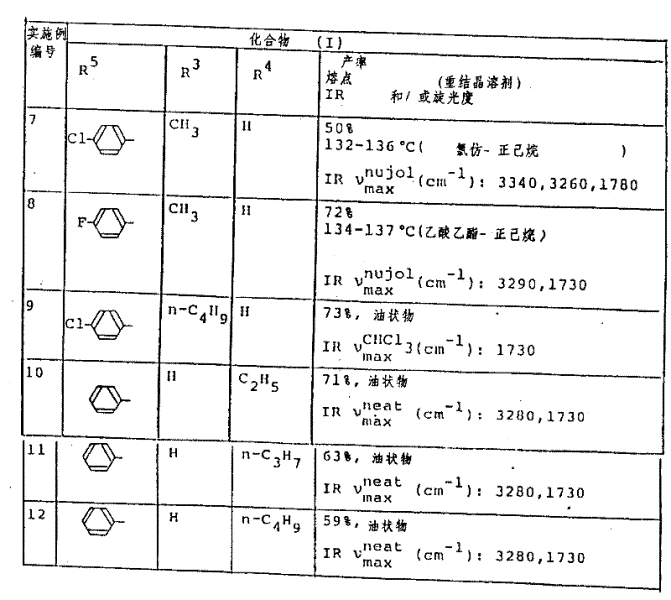

(第2部分)(环A=亚苯基基团,R1=H,R6=H)(Part 2) (Ring A = phenylene group, R 1 = H, R 6 = H)
实施例 化合物(Ⅰ)Example Compound (I)
编号 产率No. Yield
R5R3R2IRR 5 R 3 R 2 IR
和and
R4 R 4
20 H CH394%,油状物20 H CH 3 94%, oil
IRνnujol max(cm-1):1738IRν nujol max (cm −1 ): 1738
实施例9的化合物的钠盐:熔点为187-188℃。Sodium salt of the compound of Example 9: melting point 187-188°C.
实施例21Example 21
在室温下,搅拌4.72克(±)-4-(2-苯氧基羰基氨基-1-甲基乙基)苯酚、2.53克溴乙酸甲酯、50毫升丙酮和3.43克碳酸钾的一种混合物过夜。反应之后,蒸发此混合物,以去除丙酮,并将水加至剩余物中。用氯仿萃取此含水混合物,然后干燥萃取液,并在减压下蒸发,从而得到5.68克为油状物的(±)-4-(2-苯氧基羰基氨基-1-甲基乙基)苯氧基乙酸甲酯。A mixture of 4.72 g of (±)-4-(2-phenoxycarbonylamino-1-methylethyl)phenol, 2.53 g of methyl bromoacetate, 50 mL of acetone and 3.43 g of potassium carbonate was stirred at room temperature overnight. After the reaction, the mixture was evaporated to remove acetone, and water was added to the residue. The aqueous mixture was extracted with chloroform, and the extract was dried and evaporated under reduced pressure to obtain 5.68 g of (±)-4-(2-phenoxycarbonylamino-1-methylethyl)benzene as an oil. Methyl oxyacetate.
产率:96%Yield: 96%
Mass(m/e):357(M+)Mass (m/e): 357 (M + )
IRνneat max(cm-1):3200-3500,1755,1712IRν neat max (cm -1 ): 3200-3500, 1755, 1712
(2)将5.36克此产物溶解在60毫升甲醇中,并向其中加入2毫升浓盐酸。在大气压下,在室温下,在0.6克10%的钯碳存在下使混合物产生催化氢化。反应之后,滤去催化剂,并在减压下,蒸发此滤液。从异丙醇和乙醚的一种混合物中重结晶剩余物,从而得到3.06克为无色晶体的(±)-4-(2-氨基-1-甲基乙基)苯氧基乙酸甲酯的氢氯化物。(2) 5.36 g of this product was dissolved in 60 ml of methanol, and 2 ml of concentrated hydrochloric acid was added thereto. The mixture was subjected to catalytic hydrogenation at room temperature in the presence of 0.6 g of 10% palladium on carbon at atmospheric pressure. After the reaction, the catalyst was filtered off, and the filtrate was evaporated under reduced pressure. Recrystallization of the residue from a mixture of isopropanol and diethyl ether afforded 3.06 g of hydrogen (±)-methyl 4-(2-amino-1-methylethyl)phenoxyacetate as colorless crystals. chloride.
产率:79%Yield: 79%
熔点:99-104℃Melting point: 99-104°C
Mass(m/e):223(M+)Mass (m/e): 223 (M + )
IRνnujol max(cm-1):2400-2800,1732IRν nujol max (cm -1 ): 2400-2800, 1732
(3)在5至10℃温度下,搅拌1.82克上面得到的产物、50毫升乙酸乙酯、1.76克碳酸氢钠、30毫升水和1.53克2,4,6-三甲基苯基磺酰氯的一种混合物2.5小时。反应之后,从中分离乙酸乙酯层,干燥,并在减压下蒸发。将所得到的作为粗产物的(±)-4-[2-(2,4,6-三甲基苯基)磺酰基氨基-1-甲基乙基)苯氧基乙酸甲酯溶解在20毫升甲醇中,并向其中加入8毫升的一种1克当量/升的氢氧化钠水溶液。让此混合物静止1小时。然后,蒸发此混合物以去除甲醇,用5%的盐酸中和,并用氯仿萃取。干燥此氯仿萃取液,并蒸发以去除溶剂,从而得到1.6克为粘性油的(±)-4-[2-(2,4,6-三甲基苯基)磺酰基氨基-1-甲基乙基]苯氧基乙酸。(3) Stir 1.82 g of the product obtained above, 50 ml of ethyl acetate, 1.76 g of sodium bicarbonate, 30 ml of water and 1.53 g of 2,4,6-trimethylphenylsulfonyl chloride at a temperature of 5 to 10°C of a mixture for 2.5 hours. After the reaction, the ethyl acetate layer was separated therefrom, dried, and evaporated under reduced pressure. The obtained (±)-methyl 4-[2-(2,4,6-trimethylphenyl)sulfonylamino-1-methylethyl)phenoxyacetate as a crude product was dissolved in 20 mL of methanol, and 8 mL of a 1 g eq/L aqueous sodium hydroxide solution was added thereto. Let this mixture stand for 1 hour. Then, the mixture was evaporated to remove methanol, neutralized with 5% hydrochloric acid, and extracted with chloroform. The chloroform extract was dried and evaporated to remove the solvent to give 1.6 g of (±)-4-[2-(2,4,6-trimethylphenyl)sulfonylamino-1-methyl as a viscous oil. Ethyl]phenoxyacetic acid.
产率:59%Yield: 59%
Mass(m/e):391(M+)Mass (m/e): 391 (M + )
IRνCHCl max3(cm-1):1735,1600IRν CHCl max 3 (cm −1 ): 1735, 1600
H1-NMR(CDCl3,δ):1.17(3H,d,J=6.4Hz),2.30(3H,s),2.48(6H,s),2.6-3.2(3H,m),4.65(2H,s),6.80(2H,d,J=9Hz),6.91(2H,s),6.98(2H,d,J=9Hz)H 1 -NMR (CDCl 3 , δ): 1.17 (3H, d, J=6.4Hz), 2.30 (3H, s), 2.48 (6H, s), 2.6-3.2 (3H, m), 4.65 (2H, s), 6.80 (2H, d, J=9Hz), 6.91 (2H, s), 6.98 (2H, d, J=9Hz)
实施例22至24Examples 22 to 24
(1)用与实施例21-(1)和(2)中所述的相同的方法处理相应的起始化合物,以得到如表5中所示的化合物。(1) The corresponding starting compounds were treated in the same manner as described in Example 21-(1) and (2) to obtain the compounds shown in Table 5.
表5table 5
(环A=亚苯基基团,R1=H,R2=H,R61=CH3,Y1=NHCOOCH2-

实施例 化合物(Ⅳ)Example Compound (Ⅳ)
编号 产率No. Yield
R3R4熔点R 3 R 4 melting point
22 CH3H 81%22 CH 3 H 81%
123.5-125℃(氢氯化物)123.5-125°C (hydrochloride)
23 C2H5H 60%23 C 2 H 5 H 60%
138-139℃(氢氯化物)138-139°C (hydrochloride)
24 H C2H559%24 HC 2 H 5 59%
98-100℃(草酸盐)98-100°C (oxalate)
(2)用与实施例21-(3)中所述的相同的方法处理相应的起始化合物,以得到如表6中所示的化合物。(2) The corresponding starting compounds were treated in the same manner as described in Example 21-(3) to obtain the compounds shown in Table 6.

(环A=亚苯基基团,R1=H,R2=H,R6=H,R61=H,Y=NH2)(Ring A = phenylene group, R 1 = H, R 2 = H, R 6 = H, R 61 = H, Y = NH 2 )

实施例22的化合物的钠盐:熔点为216℃-219.5℃Sodium salt of the compound of Example 22: melting point is 216°C-219.5°C
实施例25至33Examples 25 to 33
用与实施例21中所述的相同的方法处理相应的起始化合物,以得到如表7中所示的化合物。The corresponding starting compounds were treated in the same manner as described in Example 21 to give the compounds shown in Table 7.
表7Table 7

(第1部分)(part 1)
(环A=亚苯基基团,R1=H,R2=H,R6=H,Y1=NHCOOCH2 
实施例 化合物(Ⅰ)Example Compound (I)
编号 产率No. Yield
R5R3R4熔点 (重结晶溶剂)R 5 R 3 R 4 melting point (recrystallization solvent)
IR 和/或旋光度IR and/or optical rotation

(第2部分)(R1=H,R2=CH3,R4=H,R7=OCH3)(Part 2) (R 1 =H, R 2 =CH 3 , R 4 =H, R 7 =OCH 3 )
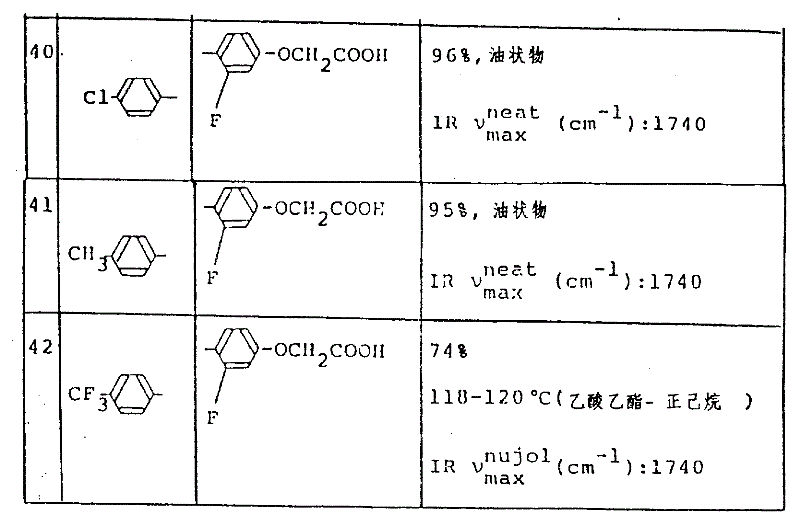
钠盐的性质:Properties of sodium salt:
实施例25:熔点为226-228.5℃Example 25: The melting point is 226-228.5°C
实施例26:熔点为127-131℃(分解)Example 26: Melting point is 127-131°C (decomposition)
实施例32:熔点为206-207℃Example 32: The melting point is 206-207°C
实施例33:熔点为226.5-229℃Example 33: The melting point is 226.5-229°C
实施例43Example 43
在室温下,搅拌1.56克(±)-4-(2-氨基丙基)苯氧基乙酸甲酯氢氯化物、48毫升乙酸乙酯、2.07克碳酸钾、16毫升水和1.6克4-硝基苯基磺酰氯的一种混合物过夜。从中分离乙酸乙酯层,干燥,并在减压下蒸发以去除溶剂。从乙酸乙酯和正己烷的一种混合物中重结晶剩余物,从而得到2.14克为淡黄色三棱形体的(±)-4-[2-(4-硝基本基)磺酰基氨基丙基]苯氧基乙酸甲酯。At room temperature, stir 1.56 g (±)-methyl 4-(2-aminopropyl)phenoxyacetate hydrochloride, 48 mL ethyl acetate, 2.07 g potassium carbonate, 16 mL water and 1.6 g 4-nitrate A mixture of phenylsulfonyl chloride overnight. The ethyl acetate layer was separated therefrom, dried, and evaporated under reduced pressure to remove the solvent. The residue was recrystallized from a mixture of ethyl acetate and n-hexane, whereby 2.14 g of (±)-4-[2-(4-nitroyl)sulfonylaminopropyl] were obtained as pale yellow triangular prisms Methyl phenoxyacetate.
产率:87%Yield: 87%
熔点:127.5-128℃Melting point: 127.5-128°C
Mass(m/e):408(M+)Mass (m/e): 408 (M + )
IRνnujol max(cm-1):3320,3280,1740IRν nujol max (cm -1 ): 3320, 3280, 1740
NMR(CDCl3,δ):1.21(3H,d,J=6.4Hz),2.5-2.7(2H,m),3.3-3.7(1H,m),3.81(3H,s),4.58(2H,s),6.67(2H,d,J=8.3Hz),6.91(2H,d,J=8.3Hz),7.78(2H,d,J=8.7Hz),8.22(2H,d,J=8.7Hz)NMR (CDCl 3 , δ): 1.21 (3H, d, J=6.4Hz), 2.5-2.7 (2H, m), 3.3-3.7 (1H, m), 3.81 (3H, s), 4.58 (2H, s ), 6.67 (2H, d, J = 8.3Hz), 6.91 (2H, d, J = 8.3Hz), 7.78 (2H, d, J = 8.7Hz), 8.22 (2H, d, J = 8.7Hz)
实施例44至51Examples 44 to 51
用与实施例43中所述的相同的方法处理相应的起始化合物,以得到如表8中所示的化合物。The corresponding starting compounds were treated in the same manner as described in Example 43 to give the compounds shown in Table 8.
表8Table 8

(环A=亚苯基基团,R1=H,R2=H,R6=CH3,R61=CH3,Y=NH2)(Ring A = phenylene group, R 1 = H, R 2 = H, R 6 = CH 3 , R 61 = CH 3 , Y = NH 2 )
实施例52Example 52
将23.1克(±)-4-(2-乙酰基氨基-1-甲基乙基)苯酚溶解在400毫升丙酮中,并向其中加入19.9克溴乙酸甲酯和18克碳酸钾,且搅拌此混合物过夜。再向其中加入7.96克溴乙酸甲酯和7.2克碳酸钾,并搅拌此混合物3天。反应之后,在减压下蒸发此混合物,并将水加至剩余物中。然后,用乙酸乙酯萃取此剩余物,用一种氯化钠的饱和水溶液洗涤,干燥,并浓缩至干燥,从而到31.6克为黄色油状物的(±)-4-(2-乙酰基氨基-1-甲基乙基),苯氧基乙酸甲酯。23.1 g of (±)-4-(2-acetylamino-1-methylethyl) phenol was dissolved in 400 ml of acetone, and 19.9 g of methyl bromoacetate and 18 g of potassium carbonate were added thereto, and the mixture was stirred The mixture was left overnight. Thereto were added 7.96 g of methyl bromoacetate and 7.2 g of potassium carbonate, and the mixture was stirred for 3 days. After the reaction, the mixture was evaporated under reduced pressure, and water was added to the residue. Then, the residue was extracted with ethyl acetate, washed with a saturated aqueous solution of sodium chloride, dried, and concentrated to dryness to obtain 31.6 g of (±)-4-(2-acetylamino -1-methylethyl), methyl phenoxyacetate.
Mass(m/e):265(M+)Mass (m/e): 265 (M + )
IRνnujol max(cm-1):3310,1760,1650IRν nujol max (cm -1 ): 3310, 1760, 1650
(2)将上面得到的产物溶解在200毫升的6克当量/升盐酸中,并回流此溶液7.5小时。反应之后,蒸去溶剂,并用四氢呋喃对剩余物结晶,从而得到19克为无色固体的(±)-4-(2-氨基-1-甲基乙基)苯氧基乙酸。(2) The product obtained above was dissolved in 200 ml of 6 gN/L hydrochloric acid, and the solution was refluxed for 7.5 hours. After the reaction, the solvent was distilled off, and the residue was crystallized from tetrahydrofuran to obtain 19 g of (±)-4-(2-amino-1-methylethyl)phenoxyacetic acid as a colorless solid.
熔点:220.5-223℃(分解)Melting point: 220.5-223°C (decomposition)
Mass(m/e):209(M+),179Mass (m/e): 209 (M + ), 179
IRνnujol max(cm-1):1730IRν nujol max (cm −1 ): 1730
(3)在80℃下,搅拌2.95克上面得到的产物、3.65克碳酸钾、30毫升水和2.45克4-氟苯基磺酰氯的一种混合物2小时。冷却以后,用6克当量/升的盐酸将此混合物的pH值调节至1,并用乙酸乙酯萃取。浓缩此萃取液至干燥,并用一种1克当量/升的氢氧化钠水溶液处理所得到的作为剩余物的(±)-4-(2-(4-氟苯基),磺酰基氨基-1-甲基乙基)苯氧基乙酸,以将它转化为钠盐。然后,所述的钠盐通过装满HP-20的柱层析纯化,从而得到2.82克为粉末的(±)-4-[2-(4-氟苯基)磺酰基氨基-1-甲基乙基)苯氧基乙酸钠。(3) A mixture of 2.95 g of the product obtained above, 3.65 g of potassium carbonate, 30 ml of water and 2.45 g of 4-fluorophenylsulfonyl chloride was stirred at 80°C for 2 hours. After cooling, the pH of the mixture was adjusted to 1 with 6 gN/L hydrochloric acid, and extracted with ethyl acetate. The extract was concentrated to dryness, and the resulting (±)-4-(2-(4-fluorophenyl),sulfonylamino-1 -methylethyl)phenoxyacetic acid to convert it to the sodium salt. Then, the sodium salt was purified by column chromatography packed with HP-20 to obtain 2.82 g of (±)-4-[2-(4-fluorophenyl)sulfonylamino-1-methyl ethyl) sodium phenoxyacetate.
产率:60%Yield: 60%
熔点:213~214.5℃(无色的三棱形体,从水和异丙醇的一种混合物中重结晶)Melting point: 213-214.5°C (colorless triangular shape, recrystallized from a mixture of water and isopropanol)
(4)将1.95克上面得到的产物溶解在30毫升水中,并用10%的盐酸调节pH值至1。用氯仿萃取此混合物。干燥此氯仿萃取液,并蒸发以去除溶剂。从乙酸乙酯和正己烷的一种混合物中重结晶因此得到的剩余物,从而得到1.65克为无色三棱形体的(±)-4-[2-(4-氟苯基)磺酰基氨基-1-甲基乙基)苯氧基乙酸。(4) 1.95 g of the product obtained above was dissolved in 30 ml of water, and the pH was adjusted to 1 with 10% hydrochloric acid. The mixture was extracted with chloroform. The chloroform extract was dried and evaporated to remove the solvent. The residue thus obtained was recrystallized from a mixture of ethyl acetate and n-hexane to obtain 1.65 g of (±)-4-[2-(4-fluorophenyl)sulfonylamino as a colorless prism -1-methylethyl)phenoxyacetic acid.
产率:90%Yield: 90%
熔点:111.5-114℃Melting point: 111.5-114°C
H1-NMR(CDCl3,δ):1.19(3H,d,J=6.2Hz),2.6-3.3(3H,m),4.63(2H,s),6.6-7.3(7H,m),7.6-7.9(2H,m)H 1 -NMR (CDCl 3 , δ): 1.19 (3H, d, J=6.2Hz), 2.6-3.3 (3H, m), 4.63 (2H, s), 6.6-7.3 (7H, m), 7.6- 7.9 (2H, m)
IRνnujol max(cm-1):3300,1740IRν nujol max (cm -1 ): 3300, 1740
Mass(m/e):367(M+)Mass (m/e): 367 (M + )
实施例53至55Examples 53 to 55
用与实施例52中所述的相同的方法处理相应的起始化合物,以得到如表9中所示的化合物。The corresponding starting compounds were treated in the same manner as described in Example 52 to give the compounds shown in Table 9.
表9Table 9
(环A=亚苯基基团,R1=H,R2=H,R6=H,Y1=NHCOOH3)(Ring A = phenylene group, R 1 = H, R 2 = H, R 6 = H, Y 1 = NHCOOH 3 )
实施例56Example 56
在80℃下,搅拌2.95克(±)-4-(2-氨基-1-甲基乙基)苯氧基乙酸氢氯化物、3.82克碳酸钠、30毫升水和3.1克2,5-二氯苯基磺酰氯的一种混合物3小时。用与实施例43中所述的相同的方法处理,从而得到(±)-4-[2-2,5-二氯苯基)磺酰基氨基-1-甲基乙基]苯氧基乙酸。At 80°C, stir 2.95 g of (±)-4-(2-amino-1-methylethyl)phenoxyacetic acid hydrochloride, 3.82 g of sodium carbonate, 30 ml of water and 3.1 g of 2,5-di One mixture of chlorophenylsulfonyl chloride for 3 hours. It was treated in the same manner as described in Example 43, whereby (±)-4-[2-2,5-dichlorophenyl)sulfonylamino-1-methylethyl]phenoxyacetic acid was obtained.
熔点:111.5-116.5℃(分解)(从乙酸乙酯和正己烷的一种混合物中重结晶)Melting point: 111.5-116.5°C (decomposition) (recrystallization from a mixture of ethyl acetate and n-hexane)
IRνnujol max(cm-1):3320,1740,1710IRν nujol max (cm −1 ): 3320, 1740, 1710
H1-NMR(CDCl3,δ):1.20(3H,d,J=6.4Hz),2.7-3.3(3H,m),4.65(2H,s),4.95(1H,m),6.82(2H,d,J=9Hz),7.04(2H,d,J=9Hz),7.3-7.5(2H,m),7.9-8.1(1H,m)H 1 -NMR (CDCl 3 , δ): 1.20 (3H, d, J=6.4Hz), 2.7-3.3 (3H, m), 4.65 (2H, s), 4.95 (1H, m), 6.82 (2H, d, J=9Hz), 7.04 (2H, d, J=9Hz), 7.3-7.5 (2H, m), 7.9-8.1 (1H, m)
实施例57Example 57
(1)将1.98克(±)-4-(2-氨基-2-甲基丙基)苯酚草酸酯悬浮在40毫升二氯甲烷中,并向其中加入6.27克三乙胺和6.5克4-氯苯基磺酰氯。回流此悬浮液5小时。反应之后,蒸去溶剂。将剩余物溶解在50毫升甲醇中,向其中加入35毫升的一种10%的氢氧化钠水溶液,并回流此溶液40分钟。蒸发此反应溶液以除去溶剂,用10%的盐酸酸式化,并用乙酸乙酯萃取。依次用水、一种稀的碳酸氢钠水溶液和一种氯化钠的饱和水溶液洗涤萃取液。然后,干燥此萃取液,并蒸发。因此所得到的剩余物通过硅胶柱层析(溶剂;氯仿,和氯仿∶甲醇=50∶1)纯化,并从乙酸乙酯和正己烷的一种混合物中重结晶,从而得到1.40克为淡黄色三棱形体的4-[2-(4-氯苯基)磺酰基氨基-2-乙基丙基]苯酚。(1) Suspend 1.98 g of (±)-4-(2-amino-2-methylpropyl)phenol oxalate in 40 ml of dichloromethane, and add 6.27 g of triethylamine and 6.5 g of 4 - Chlorophenylsulfonyl chloride. The suspension was refluxed for 5 hours. After the reaction, the solvent was distilled off. The residue was dissolved in 50 ml of methanol, 35 ml of a 10% aqueous sodium hydroxide solution was added thereto, and the solution was refluxed for 40 minutes. The reaction solution was evaporated to remove the solvent, acidified with 10% hydrochloric acid, and extracted with ethyl acetate. The extract was washed successively with water, a dilute aqueous sodium bicarbonate solution and a saturated aqueous solution of sodium chloride. Then, the extract was dried and evaporated. The residue thus obtained was purified by silica gel column chromatography (solvent; chloroform, and chloroform:methanol = 50:1), and recrystallized from a mixture of ethyl acetate and n-hexane to obtain 1.40 g of 4-[2-(4-Chlorophenyl)sulfonylamino-2-ethylpropyl]phenol in triangular form.
产率:53%Yield: 53%
熔点:131.5-133.5℃Melting point: 131.5-133.5°C
Mass(m/e):339(M+)Mass (m/e): 339 (M + )
IRνnujol max(cm-1):3450,3310IRν nujol max (cm -1 ): 3450, 3310
(2)将1.50克上面得到的产物溶解在20毫升丙酮中,并向其中加入0.91克碳酸钾。在室温下,在搅拌下向其中加入在20毫升丙酮中的0.84克溴乙酸甲酯的一种溶液,并搅拌此混合物24小时。蒸发此反应混合物以去除溶剂,并将剩余物溶解在乙酸乙酯和水的一种混合物中。用水和一种氯化钠的饱和水溶液洗涤此乙酸乙酯溶液,干燥,且然后蒸发以去除溶剂。然后,从乙酸乙酯和正己烷的一种混合物中重结晶所得到的剩余物,从而得到1.70克淡黄色三棱形体的4-[2-(4-氯苯基)磺酰基氨-2-甲基丙基]苯氧基乙酸甲酯。(2) 1.50 g of the product obtained above was dissolved in 20 ml of acetone, and 0.91 g of potassium carbonate was added thereto. A solution of 0.84 g of methyl bromoacetate in 20 ml of acetone was added thereto with stirring at room temperature, and the mixture was stirred for 24 hours. The reaction mixture was evaporated to remove the solvent, and the residue was dissolved in a mixture of ethyl acetate and water. The ethyl acetate solution was washed with water and a saturated aqueous solution of sodium chloride, dried, and then evaporated to remove the solvent. Then, the obtained residue was recrystallized from a mixture of ethyl acetate and n-hexane to obtain 1.70 g of 4-[2-(4-chlorophenyl)sulfonylamino-2- Methylpropyl]phenoxyacetate.
产率:94%Yield: 94%
熔点:133-135℃Melting point: 133-135°C
Mass(m/e):411(M+)Mass (m/e): 411 (M + )
IRνnujol max(cm-1):3270,1750,1230IRν nujol max (cm -1 ): 3270, 1750, 1230
H1-NMR(CDCl3,δ):1.16(6H,s),2.78(2H,s),3.81(3H,s),4.52(1H,s),4.63(2H,s),6.85(2H,d,J=8.8Hz),7.15(2H,d,J=8.8Hz),7.41(2H,d,J=9Hz),7.75(2H,d,J=9Hz)H 1 -NMR (CDCl 3 , δ): 1.16 (6H, s), 2.78 (2H, s), 3.81 (3H, s), 4.52 (1H, s), 4.63 (2H, s), 6.85 (2H, s), d, J=8.8Hz), 7.15 (2H, d, J=8.8Hz), 7.41 (2H, d, J=9Hz), 7.75 (2H, d, J=9Hz)
(3)用与实施例21中所述的相同的方法处理上面得到的产物,以得到4-[2-(4-氯苯基)磺酰基氨基-2-甲基丙基)苯氧基乙酸。(3) The product obtained above was treated in the same manner as described in Example 21 to give 4-[2-(4-chlorophenyl)sulfonylamino-2-methylpropyl)phenoxyacetic acid .
熔点:177-178℃(从乙酸乙酯和正己烷的一种混合物中重结晶)Melting point: 177-178°C (recrystallized from a mixture of ethyl acetate and n-hexane)
IRνnujol max(cm-1):3300,1730,1710IRν nujol max (cm -1 ): 3300, 1730, 1710
H1-NMR(CDCl3+DMSO-d6,δ):1.13(6H,s),2.79(2H,s),4.58(2H,s),5.67(1H,s),6.81(2H,d,J=8.8Hz),7.16(2H,d,J=8.8Hz),7.3-7.8(4H,m)H 1 -NMR (CDCl 3 +DMSO-d 6 , δ): 1.13 (6H, s), 2.79 (2H, s), 4.58 (2H, s), 5.67 (1H, s), 6.81 (2H, d, J=8.8Hz), 7.16 (2H, d, J=8.8Hz), 7.3-7.8 (4H, m)
实施例58至60Examples 58 to 60
用与实施例52-(1)和(2)中所述的相同的方法处理相应的起始化合物。所产生的游离的羧酸与甲醇反应,以得到其相应的甲酯,然后用与实施例21-(3)中所述的相同的方法处理它。从而得到如表10中所示的化合物。The corresponding starting compounds were treated in the same manner as described in Example 52-(1) and (2). The resulting free carboxylic acid was reacted with methanol to obtain its corresponding methyl ester, which was then treated in the same manner as described in Example 21-(3). Thus the compounds shown in Table 10 were obtained.
表10Table 10
(第1部分)(环A=亚苯基基团,R1=H,R2=H,R6=H,Y1=NHCOCH3)(Part 1) (Ring A = phenylene group, R 1 = H, R 2 = H, R 6 = H, Y 1 = NHCOCH 3 )

(第2部分)R1=H,R2=H,R3=H,R4=H,R7=OH,Y=NHCOCH3)(Part 2) R 1 =H, R 2 =H, R 3 =H, R 4 =H, R 7 =OH, Y = NHCOCH 3 )
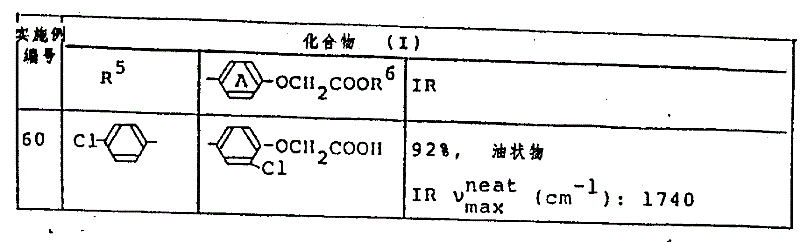
实施例61Example 61
(1)将6.76克(±)-1-(4-苯氧基-3-甲氧基苯基)-2-氨基丙烷溶解在120毫升乙酸乙酯中,并向其中加入在60毫升水中的6.9克碳酸钠的一种溶液。向其中滴加入在60毫升乙酸乙酯中的4.42克苯磺酰氯的一种溶液,并搅拌此混合物45分钟。分离乙酸乙酯层,干燥,并蒸发以去除溶剂,故得到7.24克为淡黄色油状物的(±)-1-(4-苯氧基-3-甲氧基苯基)-2-苯磺酰基氨基丙烷。(1) 6.76 g of (±)-1-(4-phenoxy-3-methoxyphenyl)-2-aminopropane was dissolved in 120 ml of ethyl acetate, and 60 ml of water was added thereto A solution of 6.9 g of sodium carbonate. A solution of 4.42 g of benzenesulfonyl chloride in 60 ml of ethyl acetate was added dropwise thereto, and the mixture was stirred for 45 minutes. The ethyl acetate layer was separated, dried, and evaporated to remove the solvent, giving 7.24 g of (±)-1-(4-phenoxy-3-methoxyphenyl)-2-benzenesulfonate as a pale yellow oil Acylaminopropane.
(2)将7.16克上面得到的产物溶解在200毫升四氢呋喃中,并在大气压下,在室温下,在3克湿的-10%的钯碳存在下催化氢化。反应之后,滤去催化剂,并蒸发滤液以去除溶剂。将剩余的黄色油状物溶解在60毫升丙酮中,并向其中加入3.61克碳酸钾和在60毫升丙酮中的2.66克溴乙酸甲酯的一种溶液。搅拌此混合物过夜。反应之后,蒸去丙酮,并将水加至剩余物中。用乙酸乙酯萃取此混合物。用一种氯化钠的饱和水溶液洗涤乙酸乙酯萃取液,干燥且,蒸发以去除溶剂。将剩余的黄色油状物溶解在35毫升甲醇中,向其中加入35毫升的一种1克当量/升的氢氧化钠水溶液,并搅拌此混合物1小时。反应之后,在减压下蒸发甲醇。剩余物用盐酸酸化,并用氯仿萃取。干燥萃取液,并在减压下蒸发以去除溶剂。然后,剩余物通过硅胶柱层析(溶剂;氯仿∶甲醇=1000∶1,100∶1,10∶1)纯化,从而得到4.06克为油状物的(±)-2-甲氧基-4-(2-苯磺酰基氨基丙基)苯氧基乙酸。(2) 7.16 g of the product obtained above was dissolved in 200 ml of tetrahydrofuran and catalytically hydrogenated in the presence of 3 g of wet -10% palladium carbon at room temperature under atmospheric pressure. After the reaction, the catalyst was filtered off, and the filtrate was evaporated to remove the solvent. The remaining yellow oil was dissolved in 60 ml of acetone, and a solution of 3.61 g of potassium carbonate and 2.66 g of methyl bromoacetate in 60 ml of acetone was added thereto. This mixture was stirred overnight. After the reaction, acetone was distilled off, and water was added to the residue. This mixture was extracted with ethyl acetate. The ethyl acetate extract was washed with a saturated aqueous solution of sodium chloride, dried and evaporated to remove the solvent. The remaining yellow oil was dissolved in 35 ml of methanol, 35 ml of a 1 gN/L aqueous sodium hydroxide solution was added thereto, and the mixture was stirred for 1 hour. After the reaction, methanol was evaporated under reduced pressure. The residue was acidified with hydrochloric acid, and extracted with chloroform. The extract was dried and evaporated under reduced pressure to remove the solvent. Then, the residue was purified by silica gel column chromatography (solvent; chloroform:methanol=1000:1, 100:1, 10:1) to obtain 4.06 g of (±)-2-methoxy-4- (2-Benzenesulfonylaminopropyl)phenoxyacetic acid.
产率:62%Yield: 62%
Mass(m/e):379(M+)Mass (m/e): 379 (M + )
IRνCHCl max3(cm-1):1730IRν CHCl max 3 (cm −1 ): 1730
实施例62Example 62
(1)用与实施例61-(1)中所述的相同的方法处理(±)-1-(4-甲氧基-3-甲基苯基)-2-氨基丙烷和苯磺酰氯,以得到(±)-1-(4-甲氧基-3-甲基苯基)-2-苯磺酰基氨基丙烷。(1) (±)-1-(4-methoxy-3-methylphenyl)-2-aminopropane and benzenesulfonyl chloride were treated in the same manner as described in Example 61-(1), to obtain (±)-1-(4-methoxy-3-methylphenyl)-2-benzenesulfonylaminopropane.
(2)将11.48上面得到的产物溶解在300毫升二氯甲烷中,并在-60℃下冷却。在搅拌下向其中加入29.7克三溴化硼,在室温下搅拌此混合物1小时。冷却此反应混合物,用水分解,并用氯仿萃取。干燥之后,蒸发萃取液以去除溶剂。将剩余的棕色的油状物溶解在320毫升丙酮中,并向其中加入10.7克碳酸钾和7.89克溴乙酸甲酯。搅拌此混合物过夜。反应之后,蒸去丙酮,并将水加至剩余物中。用乙酸乙酯萃取此混合物。用一种氯化钠的饱和水溶液洗涤乙酸乙酯萃取液,干燥,并蒸发以去除溶剂。将剩余物溶解在甲醇中,向其中加入一种1克当量/升的氢氧化钠水溶液,并搅拌此混合物1小时。反应之后,蒸去甲醇,且剩余物通过硅胶柱层析(溶剂;氯仿∶甲醇=1000∶1,100∶1,10∶1)纯化,从而得到13.5克为油状物的(±)-2-甲基-4-(2-苯磺酰基氨基丙基)苯氧基乙酸。(2) The product obtained above in 11.48 was dissolved in 300 ml of methylene chloride and cooled at -60°C. Thereto was added 29.7 g of boron tribromide with stirring, and the mixture was stirred at room temperature for 1 hour. The reaction mixture was cooled, decomposed with water, and extracted with chloroform. After drying, the extract was evaporated to remove the solvent. The remaining brown oil was dissolved in 320 ml of acetone, and 10.7 g of potassium carbonate and 7.89 g of methyl bromoacetate were added thereto. This mixture was stirred overnight. After the reaction, acetone was distilled off, and water was added to the residue. This mixture was extracted with ethyl acetate. The ethyl acetate extract was washed with a saturated aqueous solution of sodium chloride, dried, and evaporated to remove the solvent. The residue was dissolved in methanol, a 1 gN/L aqueous sodium hydroxide solution was added thereto, and the mixture was stirred for 1 hour. After the reaction, methanol was distilled off, and the residue was purified by silica gel column chromatography (solvent; chloroform:methanol = 1000:1, 100:1, 10:1), thereby obtaining 13.5 g of (±)-2- Methyl-4-(2-benzenesulfonylaminopropyl)phenoxyacetic acid.
产率:72%Yield: 72%
Mass(m/e):363(M+)Mass (m/e): 363 (M + )
IRνCHCl max3(cm-1):1730IRν CHCl max 3 (cm −1 ): 1730
实施例63至67Examples 63 to 67
用与实施例62中所述的相同的方法处理相应的起始化合物,以得到如表11中所示的化合物。The corresponding starting compounds were treated in the same manner as described in Example 62 to give the compounds shown in Table 11.
表11Table 11
(R1=CH3,R2=H,R3=H,R4=H,R7=OCH3)(R 1 =CH 3 , R 2 =H, R 3 =H, R 4 =H, R 7 =OCH 3 )
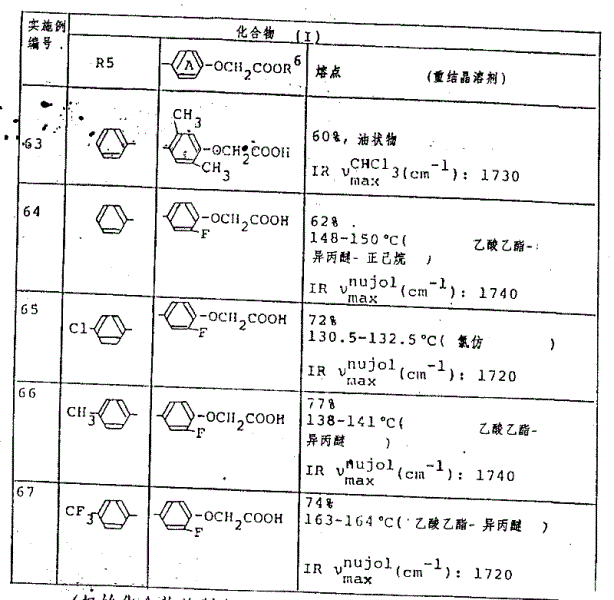
(起始化合物的制备)(Preparation of starting compounds)
制备1preparation 1
(1)将78克1-(4-苯氧基苯基)-2-氯乙酮和63克六胺溶解在2.2升氯仿中,并在室温下搅拌此混合物过夜。将此混合物浓缩至体积为1.1升,并回流3小时。冷却之后,通过过滤收集所沉淀的晶体,洗涤,且然后干燥,将因此所得到的无色晶体加入750毫升乙醇和120毫升浓盐酸的一种混合物中,并回流混合物50分钟。冷却之后,通过 过滤收集所沉淀的晶体,洗涤,且然后干燥。得到55.6克为无色晶体的2-氨基-1-(4-苯氧基苯基)乙酮。(1) 78 g of 1-(4-phenoxyphenyl)-2-chloroethanone and 63 g of hexamine were dissolved in 2.2 liters of chloroform, and the mixture was stirred overnight at room temperature. The mixture was concentrated to a volume of 1.1 L and refluxed for 3 hours. After cooling, the precipitated crystals were collected by filtration, washed, and then dried, and the colorless crystals thus obtained were added to a mixture of 750 ml of ethanol and 120 ml of concentrated hydrochloric acid, and the mixture was refluxed for 50 minutes. After cooling, through Precipitated crystals were collected by filtration, washed, and then dried. 55.6 g of 2-amino-1-(4-phenoxyphenyl)ethanone were obtained as colorless crystals.
产率:67%Yield: 67%
熔点:225℃(分解)Melting point: 225°C (decomposition)
(2)将1.11克上面得到的产物溶解在10毫升四氢呋喃和5毫升水的一种混合物中。向其滴加在10毫升水中的1.11克碳酸钾的一种溶液和在10毫升四氢呋喃中的1.41克苯磺酰氯。在室温下搅拌此混合物1.5小时,并用乙酸乙酯萃取。用水洗涤乙酸乙酯萃取液,干燥,并蒸发以去除溶剂。从乙酸乙酯中重结晶剩余物,从而得到为无色针状结晶体的2-苯磺酰基氨基-1-(4-苯氧基苯基)乙酮。(2) 1.11 g of the product obtained above was dissolved in a mixture of 10 ml of tetrahydrofuran and 5 ml of water. A solution of 1.11 g of potassium carbonate in 10 ml of water and 1.41 g of benzenesulfonyl chloride in 10 ml of tetrahydrofuran were added dropwise thereto. The mixture was stirred at room temperature for 1.5 hours, and extracted with ethyl acetate. The ethyl acetate extract was washed with water, dried, and evaporated to remove the solvent. The residue was recrystallized from ethyl acetate to give 2-benzenesulfonylamino-1-(4-phenoxyphenyl)ethanone as colorless needles.
产率:89%Yield: 89%
熔点:148-149℃Melting point: 148-149°C
(3)将4.37克镁悬浮在180毫升经干燥的乙醚中,并向其中加入4滴1,2-二溴乙烷。在室温下搅拌此混合物30分钟之后,向其中滴加在50毫升乙醚中的18.3克甲基碘的一种溶液。在搅拌和冷却下将在150毫升四氢呋喃中的7.6克2-苯磺酰基氨基-1-(4-苯氧基苯基)乙酮的一种溶液滴加至所述的混合物中。在室温下搅拌此混合物过夜,且然后回流2小时。冷却之后,将一种稀的氯化铵水溶液加至此混合物中,并用乙酸乙酯萃取此混合物。用水洗涤萃取液,干燥,并在减压下蒸发。剩余物通过硅胶柱层析(溶剂;氯仿,且氯仿∶甲醇=50∶1)纯化,并从乙酸乙酯和正己熔的一种混合物中重结晶,从而得到4.92克为无色晶体的1-苯磺酰基氨基-2-(4-苯氧基苯基)-2-丙醇。(3) 4.37 g of magnesium was suspended in 180 ml of dried ether, and 4 drops of 1,2-dibromoethane were added thereto. After stirring the mixture at room temperature for 30 minutes, a solution of 18.3 g of methyl iodide in 50 ml of ether was added dropwise thereto. A solution of 7.6 g of 2-benzenesulfonylamino-1-(4-phenoxyphenyl)ethanone in 150 ml of tetrahydrofuran was added dropwise to the mixture with stirring and cooling. The mixture was stirred overnight at room temperature, and then refluxed for 2 hours. After cooling, a dilute aqueous ammonium chloride solution was added to the mixture, and the mixture was extracted with ethyl acetate. The extract was washed with water, dried and evaporated under reduced pressure. The residue was purified by silica gel column chromatography (solvent; chloroform, and chloroform:methanol = 50:1), and recrystallized from a mixture of ethyl acetate and n-hexane, whereby 4.92 g of 1- Benzenesulfonylamino-2-(4-phenoxyphenyl)-2-propanol.
产率:62%Yield: 62%
熔点:150-151℃Melting point: 150-151°C
制备2preparation 2
将6.78克1-(4-苯氧基-3-甲氧基苯基)-1-硝基丙烷的一种四氢呋喃溶液滴加至在四氢呋喃中的2.15克氢化锂铝的一种悬浮液中。在室温下搅拌此混合物,且然后回流。反应之后,用冰水分解过量的氢化锂铝,滤去无机物。洗涤滤液,干燥,且然后浓缩至干燥。得到6克为淡黄色粘性油的1-(4-苯氧基-3-甲氧基苯基)-2-氨基丙烷。A tetrahydrofuran solution of 6.78 g of 1-(4-phenoxy-3-methoxyphenyl)-1-nitropropane was added dropwise to a suspension of 2.15 g of lithium aluminum hydride in tetrahydrofuran. The mixture was stirred at room temperature, and then refluxed. After the reaction, the excess lithium aluminum hydride was decomposed with ice water, and the inorganic matter was filtered off. The filtrate was washed, dried, and then concentrated to dryness. 6 g of 1-(4-phenoxy-3-methoxyphenyl)-2-aminopropane were obtained as a pale yellow viscous oil.
产率:97%Yield: 97%
制备3preparation 3
(1)将5.25克叔丁氧化钾的一种二甲氧基乙烷滴加至含有3.93克2-氟-4-甲氧基乙酰苯和4.57克对-甲苯磺酰基甲基异氰化物的一种二甲氧基乙烷中。所述的滴加的添加在低于10℃的温度下进行。反应之后,将此混合物加至冰水中,并用乙醚萃取。洗涤萃取液,干燥,并浓缩干燥。剩余物通过硅胶柱层析纯化,从而得到3.83克为无色油状物的2-(2-氟-4-甲氧基苯基)-2-甲基乙烷腈。(1) Add 5.25 grams of potassium tert-butoxide in a dimethoxyethane dropwise to a solution containing 3.93 grams of 2-fluoro-4-methoxyacetophenone and 4.57 grams of p-toluenesulfonylmethyl isocyanide in a dimethoxyethane. The dropwise addition is performed at a temperature lower than 10°C. After the reaction, the mixture was added to ice water, and extracted with ether. The extract was washed, dried, and concentrated to dryness. The residue was purified by silica gel column chromatography to obtain 3.83 g of 2-(2-fluoro-4-methoxyphenyl)-2-methylethanenitrile as a colorless oil.
产率:83%Yield: 83%
IRνneat max(cm-1):2250IRν neat max (cm -1 ): 2250
(2)将15毫升阮内镍加至5.05克上面得到的产物的一种乙醇溶液中,并在温度40至50℃下向其中滴加30克一水合肼。反应之后,滤去催化剂,并蒸发滤液。将剩余物加至15%的甲醇盐酸中,并蒸发此混合物以除去溶剂。从甲醇和异丙酯的一种混合物中重结晶剩余物,从而得到4.23克为无色晶体的1-氨基-2-(2-氟-4-甲氧基苯基)丙烷氢氯化物。(2) 15 ml of Raney nickel was added to an ethanol solution of 5.05 g of the product obtained above, and 30 g of hydrazine monohydrate was added dropwise thereto at a temperature of 40 to 50°C. After the reaction, the catalyst was filtered off, and the filtrate was evaporated. The residue was added to 15% methanolic hydrochloric acid, and the mixture was evaporated to remove the solvent. The residue was recrystallized from a mixture of methanol and isopropyl ester, whereby 4.23 g of 1-amino-2-(2-fluoro-4-methoxyphenyl)propane hydrochloride were obtained as colorless crystals.
产率:75%Yield: 75%
熔点:147-149℃Melting point: 147-149°C
制备4preparation 4
用与制备3中所述的相同的方法处理相应的起始化合物,以得到1-氨基-2-(3-氟-4-甲氧基苯基)丙烷。The corresponding starting compound was treated in the same manner as described in Preparation 3 to give 1-amino-2-(3-fluoro-4-methoxyphenyl)propane.
产率:99%Yield: 99%
IRνneat max(cm-1):3270IRν neat max (cm -1 ): 3270
制备5Preparation 5
(1)将504毫克60%的氢化钠加至四氢呋喃中,并在氩气氛下向其中加入2.47克三乙基膦酰基乙酸酯的一种溶液中。在室温下搅拌此混合物。然后,向其中加入在四氢呋喃中的1.85克3-氯-4-甲氧基乙酰苯酮的一种溶液,并在室温下搅拌此混合物。反应之后,将水加至此混合物中,从中分离有机层。用乙酸乙酯萃取水层。混合有机层,并蒸发以去除溶剂。剩余物通过硅胶柱层析纯化,从而得到1.47克3-(3-氯-4-甲氧基苯基)异氯特尼酸乙酯[3-(3-chloro-4-methoxy-phenyl)isochrotonate]和0.18克3-(3-氯-4-甲氧基苯基)氯特尼酸乙酯。(1) 504 mg of 60% sodium hydride was added to tetrahydrofuran, and thereto was added 2.47 g of a solution of triethylphosphonoacetate under an argon atmosphere. The mixture was stirred at room temperature. Then, a solution of 1.85 g of 3-chloro-4-methoxyacetophenone in tetrahydrofuran was added thereto, and the mixture was stirred at room temperature. After the reaction, water was added to the mixture, and the organic layer was separated therefrom. The aqueous layer was extracted with ethyl acetate. The organic layers were combined and evaporated to remove solvent. The residue was purified by silica gel column chromatography to obtain 1.47 g of ethyl 3-(3-chloro-4-methoxyphenyl)isochrotonate [3-(3-chloro-4-methoxy-phenyl)isochrotonate ] and 0.18 g of ethyl 3-(3-chloro-4-methoxyphenyl)clotnicate.
3-(3-氯-4-甲氧基苯基)异氯特尼酸乙酯:3-(3-Chloro-4-methoxyphenyl)isoclothenic acid ethyl ester:
产率:57.7%Yield: 57.7%
熔点:67-68℃Melting point: 67-68°C
IRνnujol max(cm-1):1700IRν nujol max (cm −1 ): 1700
3-(3-氯-4-甲氧基苯基)氯特尼酸乙酯:3-(3-Chloro-4-methoxyphenyl) ethyl chlortenate:
产率:7.1%Yield: 7.1%
油状物Oil
IRνneat max(cm-1):1710IRν neat max (cm -1 ): 1710
(2)0.3克10%的钯碳加至含有1.41克3-(3-氯-4-甲氧基苯基)异氯特尼酸乙酯的一种乙酸溶液中,并在大气压下,在室温下催化氢化此混合物。反应之后,滤去催化剂,并浓缩滤液。将甲醇和一种氢氧化钠的水溶液加至剩余物中,并搅拌此混合物。然后,蒸去溶剂,并且剩余物用盐酸酸式化。用乙酸乙酯萃取含水混合物。用水洗涤萃取液,干燥,且然后浓缩至干燥。剩余物通过硅胶柱层析纯化,并从正己烷中重结晶,从而得到807毫克为无色油状物的3-(3-氯-4-甲氧基苯基)丁酸。(2) 0.3 gram of 10% palladium carbon is added to a kind of acetic acid solution containing 1.41 gram of 3-(3-chloro-4-methoxyphenyl) ethyl isochloride, and under atmospheric pressure, in The mixture was catalytically hydrogenated at room temperature. After the reaction, the catalyst was filtered off, and the filtrate was concentrated. Methanol and an aqueous solution of sodium hydroxide were added to the residue, and the mixture was stirred. Then, the solvent was distilled off, and the residue was acidified with hydrochloric acid. The aqueous mixture was extracted with ethyl acetate. The extract was washed with water, dried, and then concentrated to dryness. The residue was purified by silica gel column chromatography and recrystallized from n-hexane to obtain 3-(3-chloro-4-methoxyphenyl)butanoic acid (807 mg) as a colorless oil.
产率:64%Yield: 64%
熔点:73.5-75℃Melting point: 73.5-75°C
(3)在室温下搅拌在甲苯中的12.23克上而得到的产物、6.49克三乙胺和17.66克二苯基磷酰基叠氮化物,且然后回流。向其中加入11.58克苄醇,并再回流此混合物。将乙酸乙酯加至此反应混合物中,并洗涤所述的混合物,干燥且然后浓缩至干燥。从而得到17.85克为油状物的1-苯氧基羰基氨基-2-(3-氯-4-甲氧基苯基)丙烷。(3) The product obtained on 12.23 g of toluene, 6.49 g of triethylamine and 17.66 g of diphenylphosphoryl azide were stirred at room temperature, and then refluxed. 11.58 g of benzyl alcohol was added thereto, and the mixture was refluxed again. Ethyl acetate was added to the reaction mixture, and the mixture was washed, dried and then concentrated to dryness. Thus, 17.85 g of 1-phenoxycarbonylamino-2-(3-chloro-4-methoxyphenyl)propane were obtained as an oil.
产率:100%Yield: 100%
(4)将33毫升一种25%的氢溴酸-乙酸的水溶液滴加至含有16.42克上面得到的产物的一种乙酸溶液中。搅拌此混合物之后,向其中 加入乙醚,且通过过滤收集所沉淀的晶体。从而得到10.33克1-氨基-2-(3-氯-4-甲氧基苯基)丙烷氢溴化物。(4) 33 ml of a 25% aqueous solution of hydrobromic acid-acetic acid was added dropwise to an acetic acid solution containing 16.42 g of the product obtained above. After stirring the mixture, add the Diethyl ether was added, and the precipitated crystals were collected by filtration. Thus, 10.33 g of 1-amino-2-(3-chloro-4-methoxyphenyl)propane hydrobromide were obtained.
产率:78%Yield: 78%
熔点:163.5-165℃Melting point: 163.5-165°C
制备6Preparation 6
在室温下搅拌4.64克(±)-4-(2-氨基-1-甲基乙基)苯酚氢溴化物、100毫升乙酸乙酯、6.92克碳酸钾、40毫升水和3.75克苯氧基羰酰氯的一种混合物过夜。反应之后,从中分离乙酸乙酯层,洗涤,干燥,且然后在减压下蒸发以去除溶剂。得到4.82克为淡黄色油状物的(±)-4-(2-苯氧基羰基氨基-1-甲基乙基)苯酚。Stir 4.64 g of (±)-4-(2-amino-1-methylethyl)phenol hydrobromide, 100 mL of ethyl acetate, 6.92 g of potassium carbonate, 40 mL of water, and 3.75 g of phenoxycarbonyl a mixture of acid chlorides overnight. After the reaction, the ethyl acetate layer was separated therefrom, washed, dried, and then evaporated under reduced pressure to remove the solvent. 4.82 g of (±)-4-(2-phenoxycarbonylamino-1-methylethyl)phenol were obtained as a pale yellow oil.
产率:85%Yield: 85%
Mass(m/e):285(M+)Mass (m/e): 285 (M + )
IRνneat max(cm-1):3350,1690IRν neat max (cm -1 ): 3350, 1690
制备7至9Preparations 7 to 9
用与制备6中所述的相同的方法处理相应的起始化合物,以得到如表12中所示的化合物。The corresponding starting compounds were treated in the same manner as described in Preparation 6 to give the compounds shown in Table 12.
表12Table 12

(R1=H,R2=H,环A=亚苯基基团,Y1=NHCOOCH2 )(R 1 = H, R 2 = H, ring A = phenylene group, Y 1 = NHCOOCH 2 )
制备 化合物(Ⅹ)Preparation Compound (Ⅹ)
编号 产率No. Yield
R3R4熔点R 3 R 4 melting point
7 CH3H 91%7 CH 3 H 91%
油状物Oil
8 C2H5H 85%8 C 2 H 5 H 85%
126-128℃126-128°C
9 H C2H590%9 HC 2 H 5 90%
油状物Oil
制备10Prepare 10
(1)用氯仿和一种碳酸氢钠的水溶液的一种混合物中和4.19克1-氨基-2-(2-氟-4-甲氧基苯基)丙烷氢氯化物。从中分离氯仿层,并浓缩至干燥。将氢溴酸加至剩余物中,并回流此混合物。然后,蒸发此反应混合物,并从异丙醇和异丙醚的一种混合物中重结晶剩余物。得到4.53克3-氟-4-(2-氨基-1-甲基乙基)苯酚氢溴化物。(1) 4.19 g of 1-amino-2-(2-fluoro-4-methoxyphenyl)propane hydrochloride were neutralized with a mixture of chloroform and an aqueous solution of sodium bicarbonate. The chloroform layer was separated therefrom, and concentrated to dryness. Hydrobromic acid was added to the residue, and the mixture was refluxed. Then, the reaction mixture was evaporated and the residue was recrystallized from a mixture of isopropanol and isopropyl ether. 4.53 g of 3-fluoro-4-(2-amino-1-methylethyl)phenol hydrobromide were obtained.
产率:95%Yield: 95%
熔点:182-183.5℃Melting point: 182-183.5°C
(2)将2.9克苯氧基羰酰氯加至在含有碳酸氢钠的乙酸乙酯-水中的4.47克上而得到的产物的一种溶液中,并在室温下搅拌此混合物1小时。反应之后,从中分离乙酸乙酯层,洗涤,并干燥。然后,浓缩乙酸乙酯层至干燥,从而得到5.82克为油状物的3-氟-4-(2-苯氧基羰基氨基-1-甲基乙基)苯酚。(2) 2.9 g of phenoxycarbonyl chloride was added to a solution of the product obtained on 4.47 g of ethyl acetate-water containing sodium bicarbonate, and the mixture was stirred at room temperature for 1 hour. After the reaction, the ethyl acetate layer was separated therefrom, washed, and dried. Then, the ethyl acetate layer was concentrated to dryness, whereby 5.82 g of 3-fluoro-4-(2-phenoxycarbonylamino-1-methylethyl)phenol was obtained as an oil.
产率:100%Yield: 100%
IRνneat max(cm-1):3330,1690IRν neat max (cm -1 ): 3330, 1690
制备11Preparation 11
用与制备10中所述的相同的方法处理1-氨基-2-(3-氟-4-甲氧基苯基)丙烷氢氯化物,以得到为无色油状物的2-氟-4-(2-苯氧基羰基氨基-1-甲基乙基)苯酚。1-Amino-2-(3-fluoro-4-methoxyphenyl)propane hydrochloride was treated in the same manner as described in Preparation 10 to give 2-fluoro-4- (2-Phenoxycarbonylamino-1-methylethyl)phenol.
产率:100%Yield: 100%
IRνneat max(cm-1):3350,1670IRν neat max (cm -1 ): 3350, 1670
制备12Preparation 12
(1)在搅拌下,在5至10℃下冷却19.8(±)-1-氨基-2-(4-甲氧基苯基)丙烷、200毫升乙酸乙酯、200毫升水和84克碳酸氢钠,并在同样的温度下向其中滴加入在100毫升乙酸乙酯中的18.8克乙酰氯。反应之后,从中分离乙酸乙酯层,洗涤,干燥,且燃后在减压下浓缩至干燥,从而得到24.8克为油状物的(±)-1-乙酰基氨基-2-(4-甲氧基苯基)丙烷。(1) Cool 19.8 (±)-1-amino-2-(4-methoxyphenyl)propane, 200 ml of ethyl acetate, 200 ml of water and 84 g of bicarbonate at 5 to 10°C under stirring Sodium, and 18.8 g of acetyl chloride in 100 ml of ethyl acetate were added dropwise thereto at the same temperature. After the reaction, the ethyl acetate layer was separated therefrom, washed, dried, and concentrated to dryness under reduced pressure after burning to obtain 24.8 g of (±)-1-acetylamino-2-(4-methoxy phenyl) propane.
Mass(m/e):207(M+)Mass (m/e): 207 (M + )
IRνneat max(cm-1):3290,1650IRν neat max (cm -1 ): 3290, 1650
(2)将上面得到的产物溶解在750毫升二氯甲烷中。冷却至-60℃,在搅拌下,在同样温度下,在1.5小时内向其中滴加69克三溴化硼的一种二氯甲烷溶液。在室温下搅拌此混合物后,再将所述的混合物冷却至-50至-60℃,将水和二氯甲烷加至此混合物中。然后,从中分离有机层,并用一种碳酸氢钠的水溶液和一种氯化钠的饱和水溶液洗涤。混合水层,用一种碳酸氢钠的水溶液中和,并在减压下蒸发。用乙酸乙酯萃取所产生的油性剩余物。干燥萃取液,并在减压下蒸发,从而得到23.1克为油状物的(±)-4-(2-乙酰基氨基-1-甲基乙基)苯酚。(2) The product obtained above was dissolved in 750 ml of methylene chloride. After cooling to -60°C, a dichloromethane solution of 69 g of boron tribromide was added dropwise thereto at the same temperature with stirring over a period of 1.5 hours. After stirring the mixture at room temperature, the mixture was cooled to -50 to -60°C, and water and dichloromethane were added to the mixture. Then, the organic layer was separated therefrom, and washed with an aqueous solution of sodium bicarbonate and a saturated aqueous solution of sodium chloride. The combined aqueous layers were neutralized with an aqueous solution of sodium bicarbonate and evaporated under reduced pressure. The resulting oily residue was extracted with ethyl acetate. The extract was dried and evaporated under reduced pressure to obtain 23.1 g of (±)-4-(2-acetylamino-1-methylethyl)phenol as an oil.
产率:100%Yield: 100%
Mass(m/e):193(M+)Mass (m/e): 193 (M + )
IRνneat max(cm-1):3290,3020,1655IRν neat max (cm -1 ): 3290, 3020, 1655
制备13至15Prepare 13 to 15
用与制备12中所述的相同的方法处理相应的起始化合物,以得到表13中所示的化合物。The corresponding starting compounds were treated in the same manner as described in Preparation 12 to give the compounds shown in Table 13.
表13Table 13

(R1=H,R3=H,R4=H,Y1=NHCOCH3)(R 1 =H, R 3 =H, R 4 =H, Y 1 =NHCOCH 3 )

Claims (11)


Applications Claiming Priority (4)
| Application Number | Priority Date | Filing Date | Title |
|---|---|---|---|
| JP18469386 | 1986-08-06 | ||
| JP184,693/86 | 1986-08-06 | ||
| JP26,858/87 | 1987-02-06 | ||
| JP2685887 | 1987-02-06 |
Publications (2)
| Publication Number | Publication Date |
|---|---|
| CN87105501A CN87105501A (en) | 1988-02-17 |
| CN1011780B true CN1011780B (en) | 1991-02-27 |
Family
ID=26364708
Family Applications (1)
| Application Number | Title | Priority Date | Filing Date |
|---|---|---|---|
| CN87105501A Expired CN1011780B (en) | 1986-08-06 | 1987-08-06 | Process for producing phenoxyacetic acid derivatives |
Country Status (20)
| Country | Link |
|---|---|
| US (1) | US4866196A (en) |
| EP (1) | EP0255728B1 (en) |
| KR (1) | KR910007942B1 (en) |
| CN (1) | CN1011780B (en) |
| AT (1) | ATE69807T1 (en) |
| AU (1) | AU597707B2 (en) |
| CA (1) | CA1277675C (en) |
| DE (1) | DE3774795D1 (en) |
| DK (1) | DK408987A (en) |
| ES (1) | ES2038630T3 (en) |
| FI (1) | FI87769C (en) |
| GR (1) | GR3003215T3 (en) |
| HK (1) | HK42193A (en) |
| HU (1) | HU200442B (en) |
| IL (1) | IL83230A (en) |
| MY (1) | MY101801A (en) |
| NO (1) | NO166938C (en) |
| PH (1) | PH24750A (en) |
| PT (1) | PT85502B (en) |
| SG (1) | SG15593G (en) |
Families Citing this family (19)
| Publication number | Priority date | Publication date | Assignee | Title |
|---|---|---|---|---|
| DE3642105A1 (en) * | 1986-12-10 | 1988-06-16 | Bayer Ag | SUBSTITUTED AMINOMETHYL-5,6,7,8-TETRAHYDRONAPHTYL-OXYACETIC ACIDS, NEW INTERMEDIATE PRODUCTS, PROCESS FOR THEIR PRODUCTION AND THEIR USE IN MEDICINAL PRODUCTS |
| GB8708233D0 (en) * | 1987-04-07 | 1987-05-13 | Smith Kline French Lab | Pharmaceutically active compounds |
| DE68909958D1 (en) * | 1988-01-19 | 1993-11-25 | Tanabe Seiyaku Co | Phenoxyacetic acid derivatives, their preparation, pharmaceutical compositions containing them and their use. |
| JPH068274B2 (en) * | 1988-01-19 | 1994-02-02 | 田辺製薬株式会社 | Phenoxyacetic acid derivative |
| JPH068275B2 (en) * | 1988-02-04 | 1994-02-02 | 田辺製薬株式会社 | Phenoxyacetic acid derivative |
| DE3821540A1 (en) * | 1988-06-25 | 1989-12-28 | Boehringer Mannheim Gmbh | NEW SULFONAMIDES, METHOD FOR THE PRODUCTION THEREOF AND MEDICAL PRODUCTS CONTAINING SULFONAMIDES |
| US5280043A (en) * | 1988-10-10 | 1994-01-18 | Smith Kline & French Laboratories Ltd. | Sulphonamido containing phenylalkanoic acids as thromboxane A2 antagonists |
| JPH02169562A (en) * | 1988-12-22 | 1990-06-29 | Tanabe Seiyaku Co Ltd | Glycine derivative and production thereof |
| US5084466A (en) * | 1989-01-31 | 1992-01-28 | Hoffmann-La Roche Inc. | Novel carboxamide pyridine compounds which have useful pharmaceutical utility |
| US5256812A (en) * | 1989-01-31 | 1993-10-26 | Hoffmann-La Roche Inc. | Carboxamides and sulfonamides |
| FR2645537B1 (en) * | 1989-04-05 | 1994-03-04 | Fabre Medicament Pierre | NOVEL SULFONAMIDES DERIVED FROM BENZOCYCLIC OR BENZOHETEROCYCLIC ACIDS, THEIR PREPARATION AND THEIR THERAPEUTIC APPLICATION |
| DE3942923A1 (en) * | 1989-12-23 | 1991-06-27 | Boehringer Mannheim Gmbh | NEW PHENOXYALKYL CARBONIC ACID AMIDES, METHOD FOR THE PRODUCTION THEREOF AND MEDICINAL PRODUCTS CONTAINING THESE COMPOUNDS |
| US5179105A (en) * | 1990-10-16 | 1993-01-12 | Terumo Kabushiki Kaisha | Phenoxyacetic acid compounds, method for production thereof, and pharmaceutical preparations containing same |
| DE4037174A1 (en) * | 1990-11-22 | 1992-05-27 | Boehringer Mannheim Gmbh | NEW SULPHONAMIDES, METHOD FOR THE PRODUCTION THEREOF AND MEDICINAL PRODUCTS CONTAINING THESE COMPOUNDS |
| JPH05125038A (en) * | 1991-03-07 | 1993-05-21 | Tanabe Seiyaku Co Ltd | Phenyloxyalkanoic acid derivative and process for producing the same |
| US5360909A (en) * | 1992-03-23 | 1994-11-01 | Terumo Kabushiki Kaisha | Phenoxyacetic acid compounds and medical preparations containing them |
| GB9220137D0 (en) * | 1992-09-23 | 1992-11-04 | Pfizer Ltd | Therapeutic agents |
| GB9702194D0 (en) * | 1997-02-04 | 1997-03-26 | Lilly Co Eli | Sulphonide derivatives |
| CN107501136B (en) * | 2017-09-19 | 2019-05-28 | 西南大学 | A method of it prepares together with diaryl methylamines |
Family Cites Families (5)
| Publication number | Priority date | Publication date | Assignee | Title |
|---|---|---|---|---|
| DE2809377A1 (en) * | 1978-03-04 | 1979-09-13 | Boehringer Mannheim Gmbh | PHENOXYALKYL CARBONIC ACID DERIVATIVES, METHOD FOR THE PRODUCTION THEREOF, AND MEDICINAL PRODUCTS CONTAINING THESE COMPOUNDS |
| DE3000377A1 (en) * | 1980-01-07 | 1981-07-09 | Boehringer Mannheim Gmbh, 6800 Mannheim | NEW SULPHONAMIDES, METHOD FOR THE PRODUCTION THEREOF AND MEDICINAL PRODUCTS CONTAINING THESE COMPOUNDS |
| EP0194548A3 (en) * | 1985-03-12 | 1988-08-17 | Dr. Karl Thomae GmbH | Sulfonylaminoethyl compounds, medicines containing these compounds and process for their preparation |
| DE3535167A1 (en) * | 1985-10-02 | 1987-04-09 | Boehringer Mannheim Gmbh | NEW SULFONYL-PHENYL (ALKYL) AMINES, METHOD FOR THEIR PRODUCTION AND MEDICINAL PRODUCTS |
| DE3610643A1 (en) * | 1986-03-29 | 1987-10-01 | Boehringer Mannheim Gmbh | NEW PHENOXYALKYL CARBONIC ACID DERIVATIVES, METHOD FOR THE PRODUCTION THEREOF AND MEDICINAL PRODUCTS CONTAINING THESE COMPOUNDS |
-
1987
- 1987-07-17 IL IL83230A patent/IL83230A/en not_active IP Right Cessation
- 1987-07-29 PH PH35597A patent/PH24750A/en unknown
- 1987-07-31 CA CA000543552A patent/CA1277675C/en not_active Expired - Lifetime
- 1987-08-03 MY MYPI87001198A patent/MY101801A/en unknown
- 1987-08-05 AU AU76596/87A patent/AU597707B2/en not_active Ceased
- 1987-08-05 DK DK408987A patent/DK408987A/en not_active Application Discontinuation
- 1987-08-05 HU HU873579A patent/HU200442B/en not_active IP Right Cessation
- 1987-08-05 KR KR1019870008601A patent/KR910007942B1/en not_active Expired
- 1987-08-05 NO NO873272A patent/NO166938C/en unknown
- 1987-08-06 AT AT87111402T patent/ATE69807T1/en not_active IP Right Cessation
- 1987-08-06 DE DE8787111402T patent/DE3774795D1/en not_active Expired - Lifetime
- 1987-08-06 CN CN87105501A patent/CN1011780B/en not_active Expired
- 1987-08-06 ES ES198787111402T patent/ES2038630T3/en not_active Expired - Lifetime
- 1987-08-06 FI FI873413A patent/FI87769C/en not_active IP Right Cessation
- 1987-08-06 EP EP87111402A patent/EP0255728B1/en not_active Expired - Lifetime
- 1987-08-06 PT PT85502A patent/PT85502B/en not_active IP Right Cessation
-
1988
- 1988-01-04 US US07/141,403 patent/US4866196A/en not_active Expired - Fee Related
-
1991
- 1991-11-28 GR GR91401688T patent/GR3003215T3/en unknown
-
1993
- 1993-02-11 SG SG155/93A patent/SG15593G/en unknown
- 1993-04-29 HK HK421/93A patent/HK42193A/en unknown
Also Published As
| Publication number | Publication date |
|---|---|
| HU200442B (en) | 1990-06-28 |
| DE3774795D1 (en) | 1992-01-09 |
| DK408987D0 (en) | 1987-08-05 |
| FI873413L (en) | 1988-02-07 |
| CA1277675C (en) | 1990-12-11 |
| HK42193A (en) | 1993-05-07 |
| ES2038630T3 (en) | 1993-08-01 |
| EP0255728A3 (en) | 1989-05-10 |
| KR910007942B1 (en) | 1991-10-04 |
| DK408987A (en) | 1988-02-07 |
| NO873272L (en) | 1988-02-08 |
| KR880002819A (en) | 1988-05-11 |
| CN87105501A (en) | 1988-02-17 |
| FI87769C (en) | 1993-02-25 |
| HUT45230A (en) | 1988-06-28 |
| AU597707B2 (en) | 1990-06-07 |
| AU7659687A (en) | 1988-02-11 |
| US4866196A (en) | 1989-09-12 |
| EP0255728A2 (en) | 1988-02-10 |
| NO873272D0 (en) | 1987-08-05 |
| PT85502A (en) | 1987-09-01 |
| NO166938C (en) | 1991-09-18 |
| PT85502B (en) | 1990-06-29 |
| ATE69807T1 (en) | 1991-12-15 |
| FI873413A0 (en) | 1987-08-06 |
| PH24750A (en) | 1990-10-01 |
| SG15593G (en) | 1993-04-16 |
| FI87769B (en) | 1992-11-13 |
| EP0255728B1 (en) | 1991-11-27 |
| MY101801A (en) | 1992-01-31 |
| IL83230A0 (en) | 1987-12-31 |
| GR3003215T3 (en) | 1993-02-17 |
| IL83230A (en) | 1992-06-21 |
| NO166938B (en) | 1991-06-10 |
Similar Documents
| Publication | Publication Date | Title |
|---|---|---|
| CN1024667C (en) | Preparation method of substituted aminomethyltetralin and substituted aminomethylhydrobenzopyran and salt thereof | |
| CN1011780B (en) | Process for producing phenoxyacetic acid derivatives | |
| CN1030251C (en) | Substituted 4-(quinoline-2-yl-methoxy) phenylacetic acid derivatives | |
| CN1079468A (en) | sulfonamide endothelin antagonist | |
| CN1671659A (en) | Novel substituted indoles | |
| CN1795174A (en) | Novel substituted 3-thioindoles | |
| CN1087086A (en) | Thiazolylvinylphenyl Derivatives | |
| CN1060841A (en) | Quinazoline derivant and preparation method thereof | |
| CN1061963A (en) | Be used as the croak pyridine class of the 4-replacement of medicine | |
| CN1909902A (en) | Triazole, oxadiazole and thiadiazole derivatives as PPAR modulators for the treatment of diabetes | |
| CN1032751C (en) | thiazolidine compounds, their preparation and their therapeutic use | |
| CN1138037A (en) | Adhesion receptor antagonists | |
| CN1416424A (en) | Substituted 3-phenyl-5-alkoxi-1,3,4-oxdiazol-2-one and use thereof for inhibiting hormone-sensitive lipase | |
| CN1516695A (en) | Arylsulfonamides as antiviral agents | |
| CN1745065A (en) | 4-Oxo-3-(1-oxo-1H-isoquinolin-2-ylacetamido)-pentanoate and amide derivatives and their activity as caspase inhibitors use | |
| HK1042691A1 (en) | Sulfonamide hydroxamates | |
| CN1103534A (en) | Compound with antipsychotic effect | |
| CN1100425A (en) | Thiazolopyrimidine derivatives | |
| CN1522253A (en) | Novel heterocyclic derivatives and their medical uses | |
| CN1708491A (en) | N-benzodioxolyl, N-benzodioxanyl and N-benzodioxepinyl arylcarbonxamide derivatives, and pharmaceutical compositions comprising them | |
| CN1023938C (en) | The preparation method of tetrahydronaphthalene derivative | |
| CN1049662A (en) | Coumarin derivatives and their preparation and application in the treatment of cerebrovascular disorders | |
| CN1218467A (en) | Sulphur derivatives comprising amide bond, method for preparing same, use thereof as drugs, and pharmaceutical compositions containing such derivatives | |
| CN1638766A (en) | Use of substituted 3-phenyl-5-alkoxy-1,3,4-oxdiazole-2-one for producing medicaments that inhibit pancreatic lipase | |
| CN1323289A (en) | Aminoalcohol derivatives and their use as beta 3 adrenergic agonists |
Legal Events
| Date | Code | Title | Description |
|---|---|---|---|
| C06 | Publication | ||
| PB01 | Publication | ||
| C10 | Entry into substantive examination | ||
| SE01 | Entry into force of request for substantive examination | ||
| C13 | Decision | ||
| GR02 | Examined patent application | ||
| C14 | Grant of patent or utility model | ||
| GR01 | Patent grant |