CN101163489A - Compositions comprising immunomodulatory compounds and methods of use thereof for the treatment and management of pulmonary hypertension - Google Patents
Compositions comprising immunomodulatory compounds and methods of use thereof for the treatment and management of pulmonary hypertension Download PDFInfo
- Publication number
- CN101163489A CN101163489A CNA2005800206287A CN200580020628A CN101163489A CN 101163489 A CN101163489 A CN 101163489A CN A2005800206287 A CNA2005800206287 A CN A2005800206287A CN 200580020628 A CN200580020628 A CN 200580020628A CN 101163489 A CN101163489 A CN 101163489A
- Authority
- CN
- China
- Prior art keywords
- alkyl
- immunomodulatory compound
- active agent
- pulmonary hypertension
- carbon atoms
- Prior art date
- Legal status (The legal status is an assumption and is not a legal conclusion. Google has not performed a legal analysis and makes no representation as to the accuracy of the status listed.)
- Pending
Links
Classifications
-
- A—HUMAN NECESSITIES
- A61—MEDICAL OR VETERINARY SCIENCE; HYGIENE
- A61K—PREPARATIONS FOR MEDICAL, DENTAL OR TOILETRY PURPOSES
- A61K31/00—Medicinal preparations containing organic active ingredients
- A61K31/33—Heterocyclic compounds
- A61K31/395—Heterocyclic compounds having nitrogen as a ring hetero atom, e.g. guanethidine or rifamycins
- A61K31/55—Heterocyclic compounds having nitrogen as a ring hetero atom, e.g. guanethidine or rifamycins having seven-membered rings, e.g. azelastine, pentylenetetrazole
- A61K31/554—Heterocyclic compounds having nitrogen as a ring hetero atom, e.g. guanethidine or rifamycins having seven-membered rings, e.g. azelastine, pentylenetetrazole having at least one nitrogen and one sulfur as ring hetero atoms, e.g. clothiapine, diltiazem
-
- A—HUMAN NECESSITIES
- A61—MEDICAL OR VETERINARY SCIENCE; HYGIENE
- A61K—PREPARATIONS FOR MEDICAL, DENTAL OR TOILETRY PURPOSES
- A61K31/00—Medicinal preparations containing organic active ingredients
- A61K31/33—Heterocyclic compounds
- A61K31/335—Heterocyclic compounds having oxygen as the only ring hetero atom, e.g. fungichromin
- A61K31/365—Lactones
- A61K31/366—Lactones having six-membered rings, e.g. delta-lactones
-
- A—HUMAN NECESSITIES
- A61—MEDICAL OR VETERINARY SCIENCE; HYGIENE
- A61K—PREPARATIONS FOR MEDICAL, DENTAL OR TOILETRY PURPOSES
- A61K31/00—Medicinal preparations containing organic active ingredients
- A61K31/33—Heterocyclic compounds
- A61K31/395—Heterocyclic compounds having nitrogen as a ring hetero atom, e.g. guanethidine or rifamycins
- A61K31/435—Heterocyclic compounds having nitrogen as a ring hetero atom, e.g. guanethidine or rifamycins having six-membered rings with one nitrogen as the only ring hetero atom
- A61K31/44—Non condensed pyridines; Hydrogenated derivatives thereof
- A61K31/445—Non condensed piperidines, e.g. piperocaine
- A61K31/4523—Non condensed piperidines, e.g. piperocaine containing further heterocyclic ring systems
- A61K31/454—Non condensed piperidines, e.g. piperocaine containing further heterocyclic ring systems containing a five-membered ring with nitrogen as a ring hetero atom, e.g. pimozide, domperidone
-
- A—HUMAN NECESSITIES
- A61—MEDICAL OR VETERINARY SCIENCE; HYGIENE
- A61K—PREPARATIONS FOR MEDICAL, DENTAL OR TOILETRY PURPOSES
- A61K31/00—Medicinal preparations containing organic active ingredients
- A61K31/33—Heterocyclic compounds
- A61K31/395—Heterocyclic compounds having nitrogen as a ring hetero atom, e.g. guanethidine or rifamycins
- A61K31/495—Heterocyclic compounds having nitrogen as a ring hetero atom, e.g. guanethidine or rifamycins having six-membered rings with two or more nitrogen atoms as the only ring heteroatoms, e.g. piperazine or tetrazines
- A61K31/505—Pyrimidines; Hydrogenated pyrimidines, e.g. trimethoprim
- A61K31/519—Pyrimidines; Hydrogenated pyrimidines, e.g. trimethoprim ortho- or peri-condensed with heterocyclic rings
-
- A—HUMAN NECESSITIES
- A61—MEDICAL OR VETERINARY SCIENCE; HYGIENE
- A61K—PREPARATIONS FOR MEDICAL, DENTAL OR TOILETRY PURPOSES
- A61K31/00—Medicinal preparations containing organic active ingredients
- A61K31/70—Carbohydrates; Sugars; Derivatives thereof
- A61K31/7042—Compounds having saccharide radicals and heterocyclic rings
- A61K31/7048—Compounds having saccharide radicals and heterocyclic rings having oxygen as a ring hetero atom, e.g. leucoglucosan, hesperidin, erythromycin, nystatin, digitoxin or digoxin
-
- A—HUMAN NECESSITIES
- A61—MEDICAL OR VETERINARY SCIENCE; HYGIENE
- A61P—SPECIFIC THERAPEUTIC ACTIVITY OF CHEMICAL COMPOUNDS OR MEDICINAL PREPARATIONS
- A61P11/00—Drugs for disorders of the respiratory system
-
- A—HUMAN NECESSITIES
- A61—MEDICAL OR VETERINARY SCIENCE; HYGIENE
- A61P—SPECIFIC THERAPEUTIC ACTIVITY OF CHEMICAL COMPOUNDS OR MEDICINAL PREPARATIONS
- A61P25/00—Drugs for disorders of the nervous system
- A61P25/30—Drugs for disorders of the nervous system for treating abuse or dependence
-
- A—HUMAN NECESSITIES
- A61—MEDICAL OR VETERINARY SCIENCE; HYGIENE
- A61P—SPECIFIC THERAPEUTIC ACTIVITY OF CHEMICAL COMPOUNDS OR MEDICINAL PREPARATIONS
- A61P31/00—Antiinfectives, i.e. antibiotics, antiseptics, chemotherapeutics
- A61P31/12—Antivirals
- A61P31/14—Antivirals for RNA viruses
- A61P31/18—Antivirals for RNA viruses for HIV
-
- A—HUMAN NECESSITIES
- A61—MEDICAL OR VETERINARY SCIENCE; HYGIENE
- A61P—SPECIFIC THERAPEUTIC ACTIVITY OF CHEMICAL COMPOUNDS OR MEDICINAL PREPARATIONS
- A61P33/00—Antiparasitic agents
- A61P33/10—Anthelmintics
- A61P33/12—Schistosomicides
-
- A—HUMAN NECESSITIES
- A61—MEDICAL OR VETERINARY SCIENCE; HYGIENE
- A61P—SPECIFIC THERAPEUTIC ACTIVITY OF CHEMICAL COMPOUNDS OR MEDICINAL PREPARATIONS
- A61P37/00—Drugs for immunological or allergic disorders
- A61P37/02—Immunomodulators
-
- A—HUMAN NECESSITIES
- A61—MEDICAL OR VETERINARY SCIENCE; HYGIENE
- A61P—SPECIFIC THERAPEUTIC ACTIVITY OF CHEMICAL COMPOUNDS OR MEDICINAL PREPARATIONS
- A61P7/00—Drugs for disorders of the blood or the extracellular fluid
-
- A—HUMAN NECESSITIES
- A61—MEDICAL OR VETERINARY SCIENCE; HYGIENE
- A61P—SPECIFIC THERAPEUTIC ACTIVITY OF CHEMICAL COMPOUNDS OR MEDICINAL PREPARATIONS
- A61P7/00—Drugs for disorders of the blood or the extracellular fluid
- A61P7/02—Antithrombotic agents; Anticoagulants; Platelet aggregation inhibitors
-
- A—HUMAN NECESSITIES
- A61—MEDICAL OR VETERINARY SCIENCE; HYGIENE
- A61P—SPECIFIC THERAPEUTIC ACTIVITY OF CHEMICAL COMPOUNDS OR MEDICINAL PREPARATIONS
- A61P9/00—Drugs for disorders of the cardiovascular system
-
- A—HUMAN NECESSITIES
- A61—MEDICAL OR VETERINARY SCIENCE; HYGIENE
- A61P—SPECIFIC THERAPEUTIC ACTIVITY OF CHEMICAL COMPOUNDS OR MEDICINAL PREPARATIONS
- A61P9/00—Drugs for disorders of the cardiovascular system
- A61P9/04—Inotropic agents, i.e. stimulants of cardiac contraction; Drugs for heart failure
-
- A—HUMAN NECESSITIES
- A61—MEDICAL OR VETERINARY SCIENCE; HYGIENE
- A61P—SPECIFIC THERAPEUTIC ACTIVITY OF CHEMICAL COMPOUNDS OR MEDICINAL PREPARATIONS
- A61P9/00—Drugs for disorders of the cardiovascular system
- A61P9/12—Antihypertensives
Landscapes
- Health & Medical Sciences (AREA)
- Life Sciences & Earth Sciences (AREA)
- Veterinary Medicine (AREA)
- Chemical & Material Sciences (AREA)
- Public Health (AREA)
- Medicinal Chemistry (AREA)
- General Health & Medical Sciences (AREA)
- Animal Behavior & Ethology (AREA)
- Pharmacology & Pharmacy (AREA)
- Epidemiology (AREA)
- Chemical Kinetics & Catalysis (AREA)
- Organic Chemistry (AREA)
- Nuclear Medicine, Radiotherapy & Molecular Imaging (AREA)
- General Chemical & Material Sciences (AREA)
- Engineering & Computer Science (AREA)
- Bioinformatics & Cheminformatics (AREA)
- Cardiology (AREA)
- Heart & Thoracic Surgery (AREA)
- Molecular Biology (AREA)
- Diabetes (AREA)
- Immunology (AREA)
- Tropical Medicine & Parasitology (AREA)
- Hematology (AREA)
- Virology (AREA)
- Communicable Diseases (AREA)
- Oncology (AREA)
- Hospice & Palliative Care (AREA)
- Addiction (AREA)
- Psychiatry (AREA)
- Biomedical Technology (AREA)
- Neurology (AREA)
- Neurosurgery (AREA)
- AIDS & HIV (AREA)
- Pulmonology (AREA)
- Pharmaceuticals Containing Other Organic And Inorganic Compounds (AREA)
- Plural Heterocyclic Compounds (AREA)
- Medicines That Contain Protein Lipid Enzymes And Other Medicines (AREA)
Abstract
Methods of treating, preventing and managing pulmonary hypertension are disclosed. Specific methods encompass the administration of an immunomodulatory compound, or a pharmaceutically acceptable salt, solvate (e.g., hydrate), stereoisomer, clathrate, or prodrug thereof, alone or in combination with a second active agent, surgery and/or lung transplantation. Specific second active agents are capable of reducing pulmonary artery pressure. Pharmaceutical compositions, single unit dosage forms, and kits suitable for use in methods of the invention are also disclosed.
Description
1. Field of the invention
The present invention relates to methods of treating, preventing and managing pulmonary hypertension comprising administering an immunomodulatory compound alone or in combination with known therapies. The invention also relates to pharmaceutical compositions and dosage regimens. In particular, the invention encompasses the use of immunomodulatory compounds in combination with surgery, transplantation therapy, and/or other standard therapies for treating pulmonary hypertension.
2. Background of the invention
Pathology of PH
Pulmonary hypertension ("PH") refers to a condition characterized by a sustained rise in pulmonary arterial pressure. L.J. Rubin, The New England Journal of Medicine, 336 (2): 111, 1997. PH originates from various etiologies and therefore it is useful to classify the disease. Rich, Advances in pulmonary hypertension, 1 (1): 3,2002. The World Health Organization (WHO) groups pulmonary hypertension into groups according to known etiologies and defines primary pulmonary hypertension as a separate entity of unknown etiology (supra). In addition, after the New York Heart Association (NYHA) functionally classified the disease, the WHO studied the functional classification of heart disease so that patients could be compared according to their clinical severity (supra). The functional classifications are listed in table 1 below.
TABLE 1 WHO functional Classification of Pulmonary Hypertension (PH)
| Class I | Patients had PH but had no physical activity restrictions. |
| Class II | The patient suffers from PH, slightly limiting physical activity. |
| Class III | Patients with PH had significantly restricted physical activity. |
| Class IV | The patient suffered from PH, was unable to perform any physical activity, and was asymptomatic. |
Pulmonary Hypertension (PH) is divided into primary and secondary forms. Rich, Advances in pulmony Hypertension, 1 (1): 3,2002. Primary Pulmonary Hypertension (PPH) is a disease of unknown etiology, while Secondary Pulmonary Hypertension (SPH) is caused by either an intrinsic solid disease of the lung or an extrinsic disease of the lung (supra). PPH is divided histopathologically into three, the arteriogenic plexus disease, recurrent thromboembolism and the venous occlusive disease (supra). Patients with PPH are further divided into sporadic and familial (supra, page 4). About 12% of PPH patients are reported to have familial PPH (supra). However, this may underestimate the true prevalence of familial PPH, as it may cross generations (ibid). Recently, it has been reported that the PPH-1 gene appears in about half of patients with familial PPH. Deng, Am J Respir Crit careed, 161: 1055-1059, 2000. It was reported that 25% of patients with sporadic PPH tested positive for the PPH-1 gene (see above).
In SPH, the mechanism is often multifactorial depending on the underlying cause. Rich, Advances in pulmony Hypertension, 1 (1): 4,2002. Heart disease, lung disorders, and combinations thereof are the most common causes of SPH (supra). Patients with pulmonary hypertension associated with collagen vascular disease have clinical features of both entities (supra). Most commonly, collagen vascular disease has been present for many years before the onset of PH, but sometimes the opposite (supra).
Innate systemic intrapulmonary bypass may cause PH, which may be associated with increased blood flow and blood pressure delivery to the pulmonary circulation (supra). The association between liver disease and PH may be associated with portal hypertension (supra). It is not completely clear why portal hypertension produces PH (see above).
The presence of the HIV virus may cause PH, possibly by activating cytokine or growth factor channels (ibid). Several drugs and toxins have also been associated with the development of PH, although the causal relationship is uncertain (supra). The strongest relationship between drug uptake and PH evolution has been studied with fenfluramine (supra). Although the syndrome cannot be distinguished from PPH, studies have shown that this patient is more susceptible and has a poorer prognosis (supra) than a similar PPH patient. This may be the cause of pulmonary vascular disease due to the unique molecular pathway triggered by fenfluramine (supra).
Persistent pulmonary hypertension in newborns is different from congenital abnormalities of the heart and pulmonary vasculature, but is similar to PPH and is generally more responsive to acute and chronic vasodilatory therapy. Rich, Advances in pulmony Hypertension, 1 (1): 5,2002.
In other patients, PH is caused by pulmonary venous hypertension (ibid), the pathophysiology and clinical course of which is markedly different from pulmonary arterial hypertension. End-of-seat breathing and nocturnal paroxysmal dyspnea are characteristic features that may cause dyspnea (supra). These patients often have a history of chronic congestive heart failure and/or recurrent pulmonary edema that becomes illegible when right ventricular failure occurs (supra).
PH is also associated with respiratory disorders and/or hypoxemia, including chronic obstructive pulmonary disease, interstitial lung disease, sleep disordered breathing, alveolar hypoventilation, chronic altitude disease, neonatal lung disease, and alveolar-capillary dysplasia (supra). Although hypoxemia may be present in all forms of PH, it is characteristic of these conditions (ibid). These patients often have difficulty breathing at rest and with minimal activity, and have only a weak clinical PH profile (supra).
The PH may result from chronic thrombotic or thrombotic diseases such as sickle cell disease, other coagulative diseases, chronic thromboembolism, connective tissue disease, lupus, and schistosomiasis. Rich, advanced plasma Hypertension, 1 (1): 5-6, 2002. These patients often show clinical signs and symptoms that are indistinguishable from pulmonary hypertension (ibid).
Inflammatory diseases such as schistosomiasis, sarcoidosis and pulmonary capillary hemangiomas directly affect the pulmonary vasculature and can also contribute to PH. Rich, Advances in pulmony Hypertension, 1 (1): 6,2002. Schistosomiasis is probably the most common cause of PH worldwide, despite the fact that it has never been seen in europe and america (ibid). Sarcoidosis can greatly destroy the pulmonary parenchyma and the pulmonary vascular bed and cause PH only by lung destruction and consequent hypoxemia (ibid). Patients may also develop PH due to the pulmonary circulation associated with the fleshy process (supra). Pulmonary capillary hemangiomas are a very rare disease involving the pulmonary capillary bed that occurs at different stages (supra), often associated with frequent hemoptysis, severe PH and a progressive fatal process within a short period of time (supra).
Common PH symptoms reported in national vision surveys include dyspnea, fatigue, weakness, chest pain, recurrent fainting, seizures, mild headaches, neurological deficit, leg edema, and palpitations. Rich, Annals of Internal Medicine, 107; 217, 1987; the Merck Manual, 595 (17 th edition, 1999). In the pulmonary arterioles, patients with PH experience vascular intimal hyperplasia and consequent narrowing of the blood vessels (see above). In further cases, medial (smooth muscle) hypertrophy and areas of hyperplasia, irreversible mesh damage and necrotic arteries (supra) occur.
The pathophysiology of PH is poorly understood. Irritation of the endothelium, such as hormonal or mechanical effects, is thought to result in vascular scarring, endothelial dysfunction, and proliferation of the inner and middle layers. The Merck Manual 1703 (17 th edition, 1999).
Loss of pulmonary vasodilatory nerves and excess vasoconstrictive nerves may both play a role in PH (supra). Increased expression of potent vasoconstricting neuroendothelin-1 (ET-1) was found in the muscular pulmonary artery and reticular lesions of patients with PH. Chantick, Advances in pulmony Hypertension, 1 (1): 14, 2002. In addition, Prostacyclin (PGI) in pulmonary arteries in the lungs of patients with PH has been reported2) Expression of synthase and endothelial nitric oxide synthase (eNOS) is reduced. Rubin, Clinics in Chest Medicine,22(3): 2001. this reduced expression is thought to trigger key changes in the pulmonary endothelium at severe PH (supra). PGI2And reduced Nitric Oxide (NO) levels are also causally related to increased pulmonary vasoconstriction, as well as progressive structural changes in the pulmonary arteries, growth of vascular smooth muscle cells, and increased endothelial apoptosis due to loss of NO-protection of endothelial cells (ibid). These effects are important in the pathogenesis and progression of PH (supra).
Recent PH studies have shown that abnormal endothelial cells play a major role in the initiation and development of PH. Rubin, Clinics in Chest Medicine, 22(3), 2001. It was demonstrated that endothelial cells overgrowing at severe PH annihilate blood vessels and disrupt lung circulation, suggesting that somatic mutations in angiogenesis-or apoptosis-related genes such as transforming growth factor beta (TGF- β) receptor 2 may underlie endothelial cell proliferation in PPH patients (ibid). The loss of these important cellular growth mechanisms allows for clonal expansion of endothelial cells from a single cell with selective growth benefits (supra). On the other hand, proliferating endothelial cells in SPH patients are considered polygonal (supra). From this finding, it is known that local vascular factors, such as increased shear stress, rather than mutations, play an important role in initiating endothelial cell proliferation (ibid). In PPH and SPH, it is presumed that the pulmonary vascular bed contains progenitor-like cells with an abnormal growth regulating ability (supra). The major difference in pathogenesis between primary and secondary lung endothelial cell proliferation is likely to be the primary mechanism associated with endothelial progenitor recruitment (supra). In PPH, endothelial cells proliferate from a mutated single cell, whereas in SPH several progenitor-like cells are activated (supra).
PH treatment
Existing PH treatments depend on the stage and mechanism of the disease. Commonly used PH treatments include anticoagulation, oxygenating, conventional vasodilator therapy, transplantation, and surgery.
Several studies have shown that survival is increased when patients are treated with anticoagulants, regardless of the histopathological subtype. Rubin et al, The New England Journal of Medicine, 336 (2); 115, 1997. Warfarin was used to maintain the international normalized ratio at 1.5 to 2 times the control value, as long as there were no contraindications against the coagulation. Tapson, Advances in pulmony Hypertension, 1 (1): 16, 2002.
Digoxin is used to prevent and treat SPH-related upper ventricular arrhythmias and patients with left ventricular failure. However, no randomized controlled clinical trials were performed to confirm the effectiveness of this strategy in PPH patients. Tapson, Advances in pulmony Hypertension, 1 (1): 16, 2002. Diuretics are reported to be useful in reducing excessive preload in right ventricular failure patients. Rubin et al, The New England Journal of Medicine, 336 (2); 115, 1997. Oxygenations may be used in patients with blood oxygenation induced by rest or exercise (supra) and in patients with blood oxygenation induced by v.f. tapson, advanced in pulmony Hypertension, 1 (1): 16, 2002.
For patients who do not respond to drug treatment, an atrial septal ostomy or a lung transplantation is performed. The Merck Manual 1704 (17 th edition, 1999), L.J.Rubin, Advances in Pulmony Hypertension, 1 (1): 16 and 19, 2002. Atrioventricular arteriostomies tend to act as a graft bridge (supra). However, there has been little extensive research on interatrial septostomy (ibid). The availability of lung organ transplantation is also limited (supra, page 19). In addition, long-term complications after transplantation, such as chronic rejection and opportunistic infections, also prevent its long-term effectiveness in many patients (ibid).
Current drugs used to treat PH include calcium channel blockers and pulmonary vasodilators. The Merck Manual 1704 (17 th edition, 1999), V.F. Tapson, Advances in Pulmony Hypertension, 1 (1): 16, 2002. Calcium channel blockers are the most widely used drugs for treating PH. Studies have shown that this drug improves PPH patients by 20-30%. The New England journal of Medicine, 336 (2); 114, 1997.
The vasodilators currently available are compounds of formula IThe alcohol of the preceding list (EPO, Floran)®) Treprostinil (Remodulin)®) And bosentan (Tracleer)®). Tapson, Advances in pulmony hypertension, 1 (1): 16, 2002; chantick, Advances in pulmony hypertension, 1 (1): 14-15, 2002. More recently bosentan has been approved for initial PH treatment in patients with NYHA class III and IV symptoms. The inner layer cell active agent is reported to improve the motor ability and has application prospect in interrupting or reversing the stimulation of pulmonary vessels. However, the use of vasodilators is controversial in patients with undiminished pulmonary artery pressure and increased cardiac output leading to a dramatic decrease in vascular resistance. Rubin et al, The New England Journal of medicine, 336 (2); 114, 1997. Thus, there remains a need for a safe and effective method of treating and controlling PH.
2.3. Immunomodulatory compounds
A group of compounds selected for their ability to potently inhibit TNF- α production by LPS-stimulated PBMCs has been investigated. L.g.corral, et al, ann.rheum.dis.58: (supplI) 1107-. These compounds are referred to as IMiDsTM(Celgene Corporation) or immunosuppressive drugs which not only strongly inhibit TNF- α production but also significantly inhibit LPS-induced monocyte IL1 β and IL12 production. LPS-induced IL6 was also induced by IMiDsTMSuppression, although only partially. These compounds are potent stimulators of LPS-induced IL10 and can increase IL10 levels by 200-300% (supra).
3. Summary of the invention
The invention encompasses methods of treating or preventing pulmonary hypertension ("PH") comprising administering to a patient in need thereof a therapeutically or prophylactically effective amount of an immunomodulatory compound, or a pharmaceutically acceptable salt, solvate (e.g., hydrate), stereoisomer, clathrate, or prodrug thereof. The invention also encompasses methods of controlling PH (e.g., prolonging their time to remission) comprising administering to a patient in need of such control a therapeutically or prophylactically effective amount of an immunomodulatory compound, or a pharmaceutically acceptable salt, solvate (e.g., hydrate), stereoisomer, clathrate, or prodrug thereof.
One embodiment of the invention encompasses the use of one or more immunomodulatory compounds alone or in combination with conventional therapies for treating, preventing or controlling PH, such as, but not limited to, anticoagulants, diuretics, cardiac glycosides, calcium channel blockers, vasodilators, prostacyclin analogs, endothelin antagonists, phosphodiesterase inhibitors, endopeptidase inhibitors, lipid lowering agents, thromboxane inhibitors, surgery and lung transplantation.
The invention also encompasses pharmaceutical compositions, single unit dosage forms, and kits comprising an immunomodulatory compound, or a pharmaceutically acceptable salt, solvate (e.g., hydrate), stereoisomer, clathrate, or prodrug thereof, and optionally a second agent useful for treating, preventing, and/or controlling PH.
4. Detailed description of the invention
A first embodiment of the invention encompasses methods of treating, managing or preventing PH, which comprise administering to a patient in need of such treatment, prevention or management a therapeutically or prophylactically effective amount of an immunomodulatory compound, or a pharmaceutically acceptable salt, solvate (e.g., hydrate), stereoisomer, clathrate, or prodrug thereof.
The terms "pulmonary hypertension", "PH" and "PH and related disorders" as used herein, unless otherwise indicated, include, but are not limited to: primary Pulmonary Hypertension (PPH), Secondary Pulmonary Hypertension (SPH), familial PPH, sporadic PPH, anterior capillary pulmonary hypertension, Pulmonary Arterial Hypertension (PAH), pulmonary arterial hypertension, idiopathic pulmonary hypertension, thrombotic pulmonary arterial disease (TPA), plexogenic pulmonary arterial disease, functional class I-IV pulmonary hypertension, and pulmonary hypertension related to, associated with, or subject to: left ventricular abnormalities, mitral valve disease, constrictive pericarditis, aortic stenosis, cardiomyopathy, mediastinal fibrosis, pulmonary venous malformation drainage, pulmonary vein occlusive disease, collagen vascular disease, congenital heart disease, HIV viral infection, drugs and toxins such as fenfluramine, congenital heart disease, pulmonary venous hypertension, chronic obstructive pulmonary disease, interstitial lung disease, sleep disordered breathing, alveolar hypoventilation, chronic altitude disease, neonatal lung disease, alveolar-capillary dysplasia, sickle cell disease, other diseases of coagulation, chronic thromboembolism, connective tissue disease, lupus, schistosomiasis, sarcoidosis or pulmonary capillary hemangioma.
Another embodiment of the invention encompasses methods of treating, preventing and/or managing PH, which comprise administering to a patient in need of such treatment, prevention and/or management a therapeutically or prophylactically effective amount of an immunomodulatory compound, or a pharmaceutically acceptable salt, solvate (e.g., hydrate), stereoisomer, clathrate, or prodrug thereof, and a therapeutically or prophylactically effective amount of a second active agent.
Examples of second active agents include, but are not limited to, anticoagulants, diuretics, cardiac glycosides, calcium channel blockers, vasodilators, prostacyclin analogs, endothelin antagonists, phosphodiesterase inhibitors, endopeptidase inhibitors, lipid lowering agents, thromboxane inhibitors, and other agents described, for example, in Physician's Desk Reference 2003. The second active agent can be a macromolecule (e.g., a protein) or a small molecule (e.g., a synthetic inorganic, organometallic, or organic molecule). Specific examples of the second active agent include, but are not limited to, amlodipine, diltiazem, nifedipine, adenosine, epoprostenol (Floran)®) Treprostinil (Remodulin)®) Bosentan (Tracleer)®) Rodenticide, digoxin, nitric oxide, L-arginine, iloprost, betaprost, and sildenafil (Viagra)®)。
Another embodiment of the invention encompasses a method of reversing, reducing or avoiding an adverse effect associated with administration of a treatment for the treatment of PH, which comprises administering to a patient in need thereof a therapeutically or prophylactically effective amount of an immunomodulatory compound, or a pharmaceutically acceptable salt, solvate (e.g., hydrate), stereoisomer, clathrate, or prodrug thereof, and optionally a second active agent.
Procedures such as lung transplantation may be necessary to treat patients with PH who do not respond to drug treatment. It is believed that the combined use of immunomodulatory compounds and lung transplantation is particularly beneficial in patients with PH. It is believed that immunomodulatory compounds may act in combination with transplantation therapy to reduce complications such as chronic rejection and opportunistic infections associated with transplantation. Accordingly, the invention encompasses methods of treating or controlling PH comprising administering to a patient (e.g., a human) an immunomodulatory compound, or a pharmaceutically acceptable salt, solvate (e.g., hydrate), stereoisomer, clathrate, or prodrug thereof prior to, during, or after transplantation therapy.
Another embodiment of the invention encompasses pharmaceutical compositions for use in the methods of the invention. Particular compositions include an immunomodulatory compound, or a pharmaceutically acceptable salt, solvate (e.g., hydrate), stereoisomer, clathrate, or prodrug thereof, and optionally a second active agent.
The invention also encompasses single unit dosage forms comprising an immunomodulatory compound, or a pharmaceutically acceptable salt, solvate (e.g., hydrate), stereoisomer, clathrate, or prodrug thereof.
The invention also encompasses kits comprising an immunomodulatory compound, or a pharmaceutically acceptable salt, solvate (e.g., hydrate), stereoisomer, clathrate, or prodrug thereof, and a second active agent. For example, a kit may contain a compound of the invention and a calcium channel blocker, vasodilator, prostacyclin analog, endothelin antagonist, phosphodiesterase inhibitor, endopeptidase inhibitor, lipid lowering agent, thromboxane inhibitor or other agent useful in treating a patient with PH.
4.1. Immunomodulatory compounds
The compounds of the present invention may be purchased commercially or prepared according to the methods described in this patent or in the patent publications disclosed herein. In addition, optically pure compounds can be asymmetrically synthesized or resolved using known resolving agents or chiral columns, as well as other standard organic chemical synthesis techniques. The compounds for use in the present invention may include immunomodulatory compounds, which may be racemic, stereomerically enriched or stereomerically pure, or pharmaceutically acceptable salts, solvates, stereoisomers and prodrugs thereof.
Preferred compounds for use in the present invention are small organic molecules having a molecular weight of less than 1,000g/mol and are not proteins, oligopeptides, oligonucleotides, oligosaccharides or other macromolecules.
As used herein, unless otherwise indicated, the terms "immunomodulatory compounds" and "IMiDsTM"(Celgene Corp.) includes small organic molecules that significantly inhibit TNF- α, LPS-induced monocyte IL1 β and IL12 and partially inhibit IL6 production. Specific immunomodulatory compounds are described below.
TNF- α is an inflammatory cytokine produced by macrophages and monocytes during acute inflammation. TNF- α causes a diverse range of signaling events within the cell. Without being limited by theory, one biological effect of the immunomodulatory compounds of the invention is to decrease synthesis of TNF- α. Immunomodulatory compounds of the invention can enhance the degradation of TNF- α mRNA.
Furthermore, without being limited by theory, immunomodulatory compounds used herein may also be potent co-stimulators of T cells and can significantly increase cell proliferation in a dose-dependent manner. Immunomodulatory compounds of the invention have greater co-stimulatory effects on the CD8+ T cell subpopulation as compared to the CD4+ T cell subpopulation. In addition, the compounds of the present invention preferably have anti-inflammatory properties and are effective in co-stimulating T cells. Furthermore, without being limited by theory, immunomodulatory compounds used herein may act indirectly through activation of cytokines and directly on natural killer ("NK") cells, and enhance the ability of NK cells to produce beneficial cytokines, such as, but not limited to, IFN- γ.
Specific examples of immunomodulatory compounds include, but are not limited to: cyano and carboxyl derivatives of substituted styrenes, such as those disclosed in U.S. Pat. No. 5,929,117; 1-oxo-2- (2, 6-dioxo-3-fluoropiperidin-3-yl) isoindoline and 1, 3-dioxo-2- (2, 6-dioxo-3-fluoropiperidin-3-yl) isoindoline, such as those described in U.S. Pat. nos. 5,874,448 and 5,955,476; tetrasubstituted 2- (2, 6-dioxopiperidin-3-yl) -1-oxoisoindolines, which are described in U.S. Pat. No. 5,798,368; 1-oxo and 1, 3-dioxo-2- (2, 6-dioxopiperidin-3-yl) isoindolines (e.g., 4-methyl derivatives of thalidomide), including, but not limited to, those disclosed in U.S. Pat. Nos. 5,635,517, 6,476,052, 6,555,554, and 6,403,613; 1-oxo and 1, 3-dioxoisoindolines substituted at the 4-or 5-position of the indoline ring (e.g., 4- (4-amino-1, 3-dioxoisoindolin-2-yl) -4-carbamoylbutyric acid), described in U.S. Pat. No. 6,380,239; isoindolin-1-ones and isoindoline-1, 3-diones substituted at the 2-position with a 2, 6-dioxo-3-hydroxypiperidin-5-yl group (e.g., 2- (2, 6-dioxo-3-hydroxy-5-fluoropiperidin-5-yl) -4-aminoisoindolin-1-one), which are described in U.S. Pat. No. 6,458,810; a class of non-polypeptide cyclic amides disclosed in U.S. Pat. nos. 5,698,579 and 5,877,200; amino thalidomide and analogs, hydrolysates, metabolites, derivatives and precursors of amino thalidomide, as well as substituted 2- (2, 6-dioxopiperidin-3-yl) phthalimides and substituted 2- (2, 6-dioxopiperidin-3-yl) -1-oxoisoindoles, such as those described in U.S. Pat. Nos. 6,281,230 and 6,316,471; and isoindole-imide compounds such as those described in U.S. patent application 09/972,487 (filed on 5/10/2001), U.S. patent application 10/032,286 (filed on 21/12/2001), and international application PCT/US01/50401 (international publication No. WO 02/059106). Each of the patents and patent applications listed herein is incorporated by reference in its entirety. Immunomodulatory compounds do not include thalidomide.
Other specific immunomodulatory compounds of the invention include, but are not limited to, 1-oxo-and 1, 3 dioxo-2- (2, 6 dioxopiperidin-3-yl) isoindolines substituted with amino in the benzo ring, as described in U.S. Pat. No. 5,635,517, which is incorporated herein by reference. These compounds have structure I:

wherein one of X and Y is C ═ O, and the other of X and Y is C ═ O or CH2,R2Is hydrogen or lower alkyl, especially methyl. Specific immunomodulatory compounds include, but are not limited to:
1-oxo-2- (2, 6-dioxopiperidin-3-yl) -4-aminoisoindoline;
1-oxo-2- (2, 6-dioxopiperidin-3-yl) -5-aminoisoindoline;
1-oxo-2- (2, 6-dioxopiperidin-3-yl) -6-aminoisoindoline;
1-oxo-2- (2, 6-dioxopiperidin-3-yl) -7-aminoisoindoline;
1, 3-dioxo-2- (2, 6-dioxopiperidin-3-yl) -4-aminoisoindoline; and
1, 3-dioxo-2- (2, 6-dioxopiperidin-3-yl) -5-aminoisoindoline.
Other specific immunomodulatory compounds of the invention belong to a class of substituted 2- (2, 6-dioxopiperidin-3-yl) phthalimides and substituted 2- (2, 6-dioxopiperidin-3-yl) -1-oxoisoindoles, such as those described in U.S. Pat. Nos. 6,281,230, 6,316,471, 6,335,349 and 6,476,052, and International patent application PCT/US97/13375 (International publication No. WO 98/03502), each of which is incorporated herein by reference. Representative compounds have the formula:

wherein:
one of X and Y is C ═ O, and the other of X and Y is C ═ O or CH2;
(i)R1、R2、R3And R4Each independently of the other, halogen, alkyl having 1 to 4 carbon atoms or alkoxy having 1 to 4 carbon atoms, or (ii) R1、R2、R3And R4One is-NHR5And R is1、R2、R3And R4The remainder of (A) is hydrogen;
R5is hydrogen or alkyl having 1 to 8 carbon atoms;
R6is hydrogen, alkyl containing 1 to 8 carbon atoms, benzyl or halogen;
provided that if X and Y are C ═ O and (i) R1、R2、R3And R4Are both fluorine or (ii) R1、R2、R3Or R4One is amino, then R6Is not hydrogen.
Representative of this class of compounds have the formula:

wherein R is1Is hydrogen or methyl. In a separate embodiment, the present invention encompasses the use of enantiomerically pure forms of these compounds (e.g., the optically pure (R) or (S) enantiomer).
Other specific immunomodulatory compounds of the invention belong to the class of isoindole-imides and are disclosed in U.S. patent application publication Nos. 2003/0096841 and 2003/0045552 and International patent application No. PCT/US01/50401 (International publication No. WO 02/059106), each of which is incorporated herein by reference. Representative compounds have formula II:
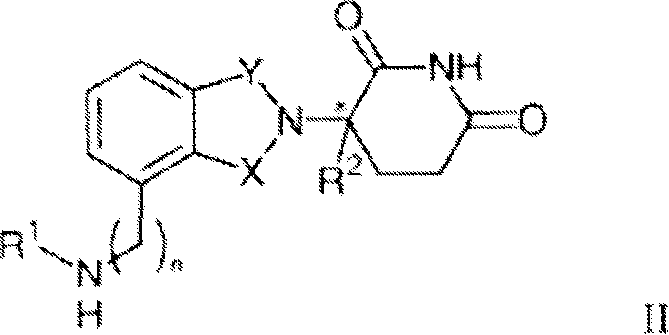
and pharmaceutically acceptable salts, hydrates, solvates, inclusions, enantiomers, diastereomers, racemates, and mixtures of stereoisomers thereof, wherein:
one of X and Y is C ═ O, and the other is CH2Or C ═ O;
R1is H, (C)1-C8) Alkyl, (C)3-C7) Cycloalkyl group, (C)2-C8) Alkenyl, (C)2-C8) Alkynyl, benzyl, aryl, (C)0-C4) Alkyl radical- (C)1-C6) Heterocycloalkyl group, (C)0-C4) Alkyl radical- (C)2-C5) Heteroaryl, C (O) R3、C(S)R3、C(O)OR4、(C1-C8) alkyl-N (R)6)2、(C1-C8) alkyl-OR5、(C1-C8) alkyl-C (O) OR5、C(O)NHR3、C(S)NHR3、C(O)NR3R3′、C(S)NR3R3' or (C)1-C8) alkyl-O (CO) R5;
R2Is H, F, benzyl, (C)1-C8) Alkyl, (C)2-C8) Alkenyl or (C)2-C8) An alkynyl group;
R3and R3' independently is (C)1-C8) Alkyl, (C)3-C7) Cycloalkyl group, (C)2-C8) Alkenyl, (C)2-C8) Alkynyl, benzyl, aryl, (C)0-C4) Alkyl radical- (C)1-C6) Heterocycloalkyl group, (C)0-C4) Alkyl radical- (C)2-C8) Heteroaryl, (C)0-C8) alkyl-N (R)6)2、(C1-C8) alkyl-OR5、(C1-C8) alkyl-C (O) OR5、(C1-C8) alkyl-O (CO) R5OR C (O) OR5;
R4Is (C)1-C8) Alkyl, (C)2-C8) Alkenyl, (C)2-C8) Alkynyl, (C)1-C4) alkyl-OR5Benzyl, aryl, (C)0-C4) Alkyl radical- (C)1-C6) Heterocycloalkyl or (C)0-C4) Alkyl radical- (C)2-C5) A heteroaryl group;
R5is (C)1-C8) Alkyl, (C)2-C8) Alkenyl, (C)2-C8) Alkynyl, benzyl, aryl or (C)2-C8) A heteroaryl group;
R6independently at each occurrence, H, (C)1-C8) Alkyl, (C)2-C8) Alkenyl, (C)2-C8) Alkynyl, benzyl, aryl, (C)2-C5) Heteroaryl or (C)0-C8) alkyl-C (O) O-R5Or R is6Groups may be joined together to form a heterocycloalkyl group;
n is 0 or 1; and
*represents a chiral carbon center.
In specific compounds of formula II, R is when n is 01Is (C)3-C7) Cycloalkyl group, (C)2-C8) Alkenyl, (C)2-C8) Alkynyl, benzyl, aryl, (C)0-C4) Alkyl radical- (C)1-C6) Heterocycloalkyl group, (C)0-C4) Alkyl radical- (C)2-C5) Heteroaryl, C (O) R3、C(O)OR4、(C1-C8) alkyl-N (R)6)2、(C1-C8) alkyl-OR5、(C1-C8) alkyl-C (O) OR5、C(S)NHR3Or (C)1-C8) alkyl-O (CO) R5;
R2Is H or (C)1-C8) An alkyl group; and
R3is (C)1-C8) Alkyl, (C)3-C7) Cycloalkyl group, (C)2-C8) Alkenyl, (C)2-C8) Alkynyl, benzyl, aryl, (C)0-C4) Alkyl radical- (C)1-C6) Heterocycloalkyl group, (C)0-C4) Alkyl radical- (C)2-C5) Heteroaryl, (C)5-C8) alkyl-N (R)6)2;(C0-C8) alkyl-NH-C (O) O-R5;(C1-C8) alkyl-OR5、(C1-C8) alkyl-C (O) OR5、(C1-C8) alkyl-O (CO) R5OR C (O) OR5(ii) a And other variations having the same definition.
In other specific compounds of formula II, R2Is H or (C)1-C4) An alkyl group.
In other specific compounds of formula II, R1Is (C)1-C8) Alkyl or benzyl.
In other specific compounds of formula II, R1Is H, (C)1-C8) Alkyl, benzyl, CH2OCH3、CH2CH2OCH3Or is or
In another embodiment of the compounds of formula II, R1Is that

Wherein Q is O or S, R7Each occurrence is independently H, (C)1-C8) Alkyl, (C)3-C7) Cycloalkyl group, (C)2-C8) Alkenyl, (C)2-C8) Alkynyl, benzyl, aryl, halogen, (C)0-C4) Alkyl radical- (C)1-C6) Heterocycloalkyl group, (C)0-C4) Alkyl radical- (C)2-C5) Heteroaryl, (C)0-C8) alkyl-N (R)6)2、(C1-C8) alkyl-OR5、(C1-C8) alkyl-C (O) OR5、(C1-C8) alkyl-O (CO) R5OR C (O) OR5Or adjacent R7May together form an alkyl or aryl bicyclic ring.
In other specific compounds of formula II, R1Is C (O) R3。
In other specific compounds of formula II, R3Is (C)0-C4) Alkyl radical- (C)2-C5) Heteroaryl, (C)1-C8) Alkyl, aryl or (C)0-C4) alkyl-OR5。
In other specific compounds of formula II, heteroaryl is pyridyl, furyl, or thienyl.
In other specific compounds of formula II, R1Is C (O) OR4。
In other specific compounds of formula II, H of C (O) NHC (O) may be replaced by (C)1-C4) Alkyl, aryl or benzyl.
Other examples of such compounds include, but are not limited to: [2- (2, 6-dioxo-piperidin-3-yl) -1, 3-dioxo-2, 3-dihydro-1H-isoindol-4-ylmethyl ] -amide; (2- (2, 6-dioxo-piperidin-3-yl) -1, 3-dioxo-2, 3-dihydro-1H-isoindol-4-ylmethyl) -carbamic acid tert-butyl ester; 4- (aminomethyl) -2- (2, 6-dioxo (3-piperidyl)) -isoindoline-1, 3-dione; n- (2- (2, 6-dioxo-piperidin-3-yl) -1, 3-dioxo-2, 3-dihydro-1H-isoindol-4-ylmethyl) -acetamide; n- { (2- (2, 6-dioxo (3-piperidinyl) -1, 3-dioxoisoindolin-4-yl) methyl) cyclopropyl-carboxamide; 2-chloro-N- { (2- (2, 6-dioxo (3-piperidyl)) -1, 3-dioxoisoindolin-4-yl) methyl } acetamide; n- (2- (2, 6-dioxo (3-piperidyl)) -1, 3-dioxoisoindolin-4-yl) -3-pyridylcarboxamide; 3- { 1-oxo-4- (benzylamino) isoindolin-2-yl } piperidine-2, 6-dione; 2- (2, 6-dioxo (3-piperidyl)) -4- (benzylamino) isoindoline-1, 3-dione; n- { (2- (2, 6-dioxo (3-piperidyl)) -1, 3-dioxoisoindolin-4-yl) methyl } propionamide; n- { (2- (2, 6-dioxo (3-piperidyl)) -1, 3-dioxoisoindolin-4-yl) methyl } -3-pyridylcarboxamide; n- { (2- (2, 6-dioxo (3-piperidyl)) -1, 3-dioxoisoindolin-4-yl) methyl } heptanamide; n- { (2- (2, 6-dioxo (3-piperidyl)) -1, 3-dioxoisoindolin-4-yl) methyl } -2-furanyl carboxamide; methyl { N- (2- (2, 6-dioxo (3-piperidyl)) -1, 3-dioxoisoindolin-4-yl) carbamoyl } acetate; n- (2- (2, 6-dioxo (3-piperidyl)) -1, 3-dioxoisoindolin-4-yl) pentanamide; n- (2- (2, 6-dioxo (3-piperidyl)) -1, 3-dioxoisoindolin-4-yl) -2-thienylcarboxamide; n- { [2- (2, 6-dioxo (3-piperidyl)) -1, 3-dioxoisoindolin-4-yl ] methyl } (butylamino) carboxamide; n- { [2- (2, 6-dioxo (3-piperidyl)) -1, 3-dioxoisoindolin-4-yl ] methyl } (octylamino) carboxamide; and N- { [2- (2, 6-dioxo (3-piperidyl)) -1, 3-dioxoisoindolin-4-yl ] methyl } (benzylamino) carboxamide.
Other specific immunomodulatory compounds of the invention belong to the isoindole-imides and are disclosed in U.S. patent application 2002/0045643, international publication WO 98/54170, and U.S. patent 6,395,754, all of which are incorporated herein by reference. Representative compounds have formula III:

and pharmaceutically acceptable salts, hydrates, solvates, inclusions, enantiomers, diastereomers, racemates, and mixtures of stereoisomers thereof, wherein:
one of X and Y is C ═ O, and the other is CH2Or C ═ O;
r is H or CH2OCOR′;
(i)R1、R2、R3Or R4Each independently of the other, halogen, alkyl having 1 to 4 carbon atoms or alkoxy having 1 to 4 carbon atoms, or (ii) R1、R2、R3Or R4One of which is nitro or-NHR5And R is1、R2、R3And R4The remainder of (A) is hydrogen;
R5is hydrogen or alkyl having 1 to 8 carbon atoms;
R6is hydrogen, alkyl having 1 to 8 carbon atoms, benzo, chloro or fluoro;
r' is R7-CHR10-N(R8R9);
R7Is m-or p-phenylene or- (C)nH2n) -, where n is 0 to 4;
R8and R9Independently of one another, hydrogen or alkyl having 1 to 8 carbon atoms, or R8And R9Together being tetramethylene, pentamethylene, hexamethylene or-CH2CH2X1CH2CH2-, wherein X1is-O-, -S-or-NH-;
R10is hydrogen, alkyl of 8 carbon atoms or phenyl; and
*represents a chiral carbon center.
Other representative compounds have the formula:

wherein:
one of X and Y is C ═ O, and the other of X and Y is C ═ O or CH2;
(i)R1、R2、R3Or R4Each independently of the other, halogen, alkyl having 1 to 4 carbon atoms or alkoxy having 1 to 4 carbon atoms, or (ii) R1、R2、R3Or R4One is-NHR5And R is1、R2、R3And R4The remainder of (A) is hydrogen;
R5is hydrogen or alkyl having 1 to 8 carbon atoms;
R6is hydrogen, alkyl having 1 to 8 carbon atoms, benzo, chloro or fluoro;
R7is m-or p-phenylene or- (C)nH2n) -, where n is 0 to 4;
R8and R9Independently of one another, hydrogen or alkyl having 1 to 8 carbon atoms, or R8And R9Together being tetramethylene, pentamethylene, hexamethylene or-CH2CH2X1CH2CH2-, wherein X1is-O-, -S-or-NH-;
R10is hydrogen, alkyl of up to 8 carbon atoms or phenyl.
Other representative compounds have the formula:

wherein,
one of X and Y is C ═ O, and the other of X and Y is C ═ O or CH2;
R1、R2、R3And R4Each independently of the other, halogen, alkyl having 1 to 4 carbon atoms or alkoxy having 1 to 4 carbon atoms, or (ii) R1、R2、R3And R4One is nitro or protected amino, and R1、R2、R3And R4The remainder of (A) is hydrogen; and
R6is hydrogen, alkyl having 1 to 8 carbon atoms, benzo, chloro or fluoro;
other representative compounds have the formula:

wherein:
one of X and Y is C ═ O, and the other of X and Y is C ═ O or CH2;
(i)R1、R2、R3Or R4Each independently of the other, halogen, alkyl having 1 to 4 carbon atoms or alkoxy having 1 to 4 carbon atoms, or (ii) R1、R2、R3Or R4One is-NHR5And R is1、R2、R3And R4The remainder of (A) is hydrogen;
R5is hydrogen, alkyl having 1 to 8 carbon atoms or CO-R7-CH(R10)NR8R9Wherein R is7、R8、R9And R10Each as defined above; and
R6is an alkane having 1 to 8 carbon atomsPhenyl, chloro or fluoro;
specific examples of the compounds have the following formula:
wherein:
one of X and Y is C ═ O, and the other of X and Y is C ═ O or CH2;
R6Is hydrogen, alkyl having 1 to 8 carbon atoms, benzyl, chlorine or fluorine;
R7is m-or p-phenylene or- (C)nH2n) -, where n is 0 to 4;
R8and R9Independently of one another, hydrogen or alkyl having 1 to 8 carbon atoms, or R8And R9Together being tetramethylene, pentamethylene, hexamethylene or-CH2CH2X1CH2CH2-, wherein X1is-O-, -S-or-NH-; and
R10is hydrogen, alkyl of 1 to 8 carbon atoms or phenyl.
The most preferred immunomodulatory compounds of the invention are 4- (amino) -2- (2, 6-dioxo (3-piperidyl)) -isoindoline-1, 3-dione and 3- (4-amino-1-oxo-1, 3-dihydro-isoindol-2-yl) -piperidine-2, 6-dione. Such compounds can be obtained by standard synthetic methods (see, e.g., U.S. patent No. 5,635,517, which is incorporated herein by reference). This compound is available from Celgene corporation (warrenn, NJ). 4- (amino) -2- (2, 6-dioxo (3-piperidyl)) -isoindoline-1, 3-dione has the following chemical structure:
the compound 3- (4-amino-1-oxo-1, 3-dihydro-isoindol-2-yl) -piperidine-2, 6-dione has the following chemical structure:
in another embodiment, specific immunomodulatory compounds of the invention include polymorphic forms of 3- (4-amino-1-oxo-1, 3-dihydro-isoindol-2-yl) -piperidine-2, 6-dione, such as forms A, B, C, D, E, F, G and H disclosed in U.S. provisional application 60/499,723, filed on 9/4/2003 and U.S. non-provisional application 10/934,863, filed on 9/3/2004, both of which are incorporated herein by reference. For example, form a of 3- (4-amino-1-oxo-1, 3-dihydro-isoindol-2-yl) -piperidine-2, 6-dione is a non-solvated crystalline, which can be obtained from a non-aqueous solvent system. The X-ray powder diffraction pattern of form a comprises distinct peaks at about 8, 14.5, 16, 17.5, 20.5, 24, and 26 degrees 2 Θ, with a differential scanning calorimetry maximum melting temperature of about 270 ℃. Form a is weakly or non-hygroscopic and is the thermodynamically most stable anhydrous polymorph of 3- (4-amino-1-oxo-1, 3-dihydro-isoindol-2-yl) -piperidine-2, 6-dione to date.
Form B of 3- (4-amino-1-oxo-1, 3-dihydro-isoindol-2-yl) -piperidine-2, 6-dione is a hemihydrate crystalline, which can be obtained from a variety of solvent systems, including but not limited to hexane, toluene, and water. The X-ray powder diffraction pattern for form B contained distinct peaks at about 16, 18, 22, and 27 degrees 2 theta, with the DSC curve showing endotherms at about 146 and 268 ℃, and dehydration and melting as confirmed by hot-stage microscopy experiments. Interconversion studies have shown that form B converts to form E in aqueous solvent systems and to other forms in acetone and other anhydrous systems.
Form C of 3- (4-amino-1-oxo-1, 3-dihydro-isoindol-2-yl) -piperidine-2, 6-dione is a semi-solvated crystalline, which can be obtained from a solvent such as, but not limited to, acetone. Form C has an X-ray powder diffraction pattern comprising distinct peaks at about 15.5 and 25 degrees 2-theta with a differential scanning calorimetry maximum melting temperature of about 269 ℃. Form C is not hygroscopic below about 85% RH, but can be converted to form B at high relative humidity.
Form D of 3- (4-amino-1-oxo-1, 3-dihydro-isoindol-2-yl) -piperidine-2, 6-dione is a crystalline solvated polymorph prepared from a mixture of acetonitrile and water. Form D has an X-ray powder diffraction pattern comprising distinct peaks at about 27 and 28 degrees 2 Θ and a differential scanning calorimetry maximum melting temperature of about 270 ℃. Form D is weakly or non-hygroscopic, but generally converts to form B when under pressure at high relative humidity.
Form E of 3- (4-amino-1-oxo-1, 3-dihydro-isoindol-2-yl) -piperidine-2, 6-dione is a dihydrate crystal, which can be obtained by slurrying 3- (4-amino-1-oxo-1, 3-dihydro-isoindol-2-yl) -piperidine-2, 6-dione in water, and slowly evaporating 3- (4-amino-1-oxo-1, 3-dihydro-isoindol-2-yl) -piperidine-2, 6-dione in a solvent system of acetone: water of about 9: 1. Form E has an X-ray powder diffraction pattern comprising distinct peaks at about 20, 24.5, and 29 degrees 2 Θ and a differential scanning calorimetry maximum melting temperature of about 269 ℃. Form E can be converted to form C in an acetone solvent system and form G in a THF solvent system. Form E is the most stable form in aqueous solvent systems. The anti-dissolution experiment for form E showed that form E was converted to form B when heated at about 125 ℃ for about 5 minutes. Form B converts to form F upon heating at 175 ℃ for about 5 minutes.
Form F of 3- (4-amino-1-oxo-1, 3-dihydro-isoindol-2-yl) -piperidine-2, 6-dione is a non-solvated crystalline material, which can be obtained by dehydrating form E. The X-ray powder diffraction pattern for form F contains significant peaks at about 19, 19.5, and 25 degrees 2 Θ, with a differential scanning calorimetry maximum melting temperature of about 269 ℃.
Form G of 3- (4-amino-1-oxo-1, 3-dihydro-isoindol-2-yl) -piperidine-2, 6-dione is a non-solvated crystalline material that can be obtained from a slurry of forms B and E in a solvent such as, but not limited to, Tetrahydrofuran (THF). The X-ray powder diffraction pattern of form G contains significant peaks at about 21, 23, and 24.5 degrees 2 Θ, with a differential scanning calorimetry maximum melting temperature of about 267 ℃.
Form H of 3- (4-amino-1-oxo-1, 3-dihydro-isoindol-2-yl) -piperidine-2, 6-dione is a partially hydrated (about 0.25mol) crystal, which can be obtained by exposing form E to 0% relative humidity. The X-ray powder diffraction pattern of form H contains significant peaks at about 15, 26, and 31 degrees 2 Θ, with a differential scanning calorimetry maximum melting temperature of about 269 ℃.
Other specific immunomodulatory compounds of the invention include, but are not limited to, 1-oxo-2- (2, 6-dioxo-3-fluoropiperidin-3-yl) isoindoline and 1, 3-dioxo-2- (2, 6-dioxo-3-fluoropiperidin-3-yl) isoindoline, such as those described in U.S. Pat. Nos. 5,874,448 and 5,955,476, which are incorporated herein by reference. Representative compounds have the formula:

wherein Y is oxygen or H2And are and
R1、R2、R3and R4Each independently hydrogen, halogen, alkyl having 1 to 4 carbon atoms, alkoxy having 1 to 4 carbon atoms, or amino.
Other specific immunomodulatory compounds of the invention include, but are not limited to: tetrasubstituted 2- (2, 6-dioxopiperidin-3-yl) -1-oxoisoindolines, which are described in U.S. Pat. No. 5,798,368, which is incorporated herein by reference. Representative compounds have the formula:

wherein R is1、R2、R3And R4Each independently a halogen, an alkyl group having 1 to 4 carbon atoms, or an alkoxy group having 1 to 4 carbon atoms.
Other specific immunomodulatory compounds of the invention include, but are not limited to, 1-oxo and 1, 3 dioxo-2- (2, 6 dioxopiperidin-3-yl) isoindolines, which are disclosed in U.S. Pat. No. 6,403,613, which is incorporated herein by reference. Representative compounds have the formula:

wherein
Y is oxygen or H2,
R1And R2One of which is halogen, alkyl, alkoxy, alkylamino, dialkylamino, cyano or carbamoyl, R1And R2Wherein the other is independently hydrogen, halogen, alkyl, alkoxy, alkylamino, dialkylamino, cyano or carbamoyl, and
R3is hydrogen, alkyl or benzyl.
Specific examples of such compounds have the formula:

wherein R is1And R2One of halogen, alkyl having 1 to 4 carbon atoms, alkoxy having 1 to 4 carbon atoms, dialkylamino (wherein each alkyl has 1 to 4 carbon atoms), cyano or carbamoyl,
R1and R2One is independently hydrogen, halogen, alkyl having 1 to 4 carbon atoms, alkoxy having 1 to 4 carbon atoms, alkylamino (wherein the alkyl has 1 to 4 carbon atoms), dialkylamino (wherein each alkyl has 1 to 4 carbon atoms), cyano or carbamoyl, and
R3is hydrogen, alkyl having 1 to 4 carbon atoms or benzyl. Specific examples include, but are not limited to, 1-oxo-2 (2, 6-dioxopiperidin-3-yl) -4-methylisoindoline.
Other representative compounds have the formula:
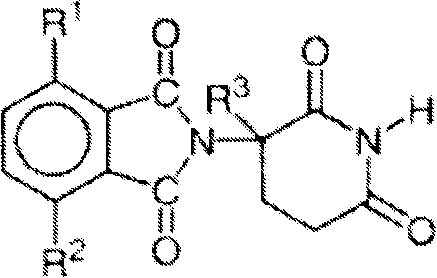
wherein R is1And R2One of halogen, alkyl having 1 to 4 carbon atoms, alkoxy having 1 to 4 carbon atoms, dialkylamino (wherein each alkyl has 1 to 4 carbon atoms), cyano or carbamoyl,
R1and R2One is independently hydrogen, halogen, alkyl having 1 to 4 carbon atoms, alkoxy having 1 to 4 carbon atoms, alkylamino (wherein the alkyl has 1 to 4 carbon atoms), dialkylamino (wherein each alkyl has 1 to 4 carbon atoms), cyano or carbamoyl, and
R3is hydrogen, alkyl having 1 to 4 carbon atoms or benzyl.
Specific compounds include, but are not limited to, 1-oxo-2- (2, 6-dioxopiperidin-3-yl) -4-methylisoindoline.
Other specific immunomodulatory compounds of the invention include, but are not limited to, 1-oxo and 1, 3-dioxoisoindolines substituted at the 4-or 5-position of the indoline ring, described in U.S. patent 6,380,239 and co-pending U.S. application 10/900,270 filed on 7/28/2004, which is incorporated herein by reference. Representative compounds have the formula:
wherein, is represented as C*Form a chiral centre (when n is different from 0 and R1And R2When not identical); x1And X2One of which is amino, nitro, alkyl having 1 to 6 carbon atoms or NH-Z, and X1Or X2The other is hydrogen; r1And R2Each independently is hydroxy or NH-Z; r3Is hydrogen, alkyl containing 1 to 6 carbon atoms, halogen or haloalkyl; z is hydrogen, aryl, alkyl containing 1 to 6 carbon atoms, formyl or acyl containing 1 to 6 carbon atoms; and n has a value of 0, 1 or 2; provided that if X is1Is amino and n is 1 or 2, then R1And R2Are not hydroxyl; and salts thereof.
Other representative compounds have the formula:

wherein when n is not 0 and R1And R2When not identical, is represented as C*The carbon atom of (a) constitutes a chiral center; x1And X2One of which is amino, nitro, alkyl having 1 to 6 carbon atoms or NH-Z, and X1Or X2The other is hydrogen; r1And R2Each independently is hydroxy or NH-Z; r3Is alkyl containing 1-6 carbon atoms, halogen or hydrogen; z is hydrogen, aryl or alkyl or acyl containing 1 to 6 carbon atoms; and n has a value of 0, 1 or 2.
Specific examples include, but are not limited to, 2- (4-amino-1-oxo-1, 3-dihydro-isoindol-2-yl) -4-carbamoyl-butyric acid and 4- (4-amino-1-oxo-1, 3-dihydro-isoindol-2-yl) -4-carbamoyl-butyric acid, respectively, having the following structures, and pharmaceutically acceptable salts, solvates, prodrugs, and stereoisomers thereof:
representative other compounds have the formula:
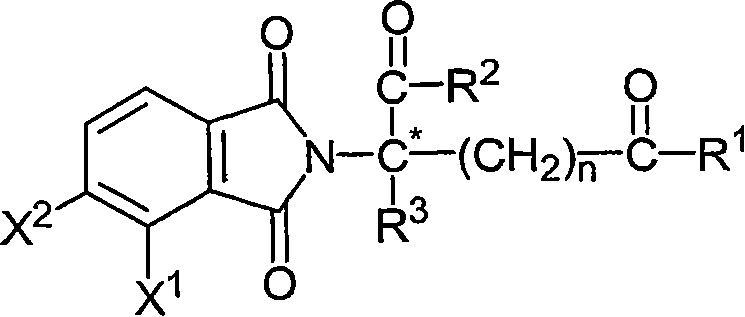
wherein, is represented as C*Form a chiral centre (when n is different from 0 and R1And R2When not identical); x1And X2One of which is amino, nitro, alkyl of 1 to 6 carbon atoms or NH-Z, X1Or X2Is hydrogen; r1And R2Each independently is hydroxy or NH-Z; r3Is alkyl of 1 to 6 carbon atoms, halogen or hydrogen; z is hydrogen, aryl or alkyl or acyl of 1-6 carbon atoms; and n has a value of 0, 1 or 2; and salts thereof.
Specific examples include, but are not limited to, 4-carbamoyl-4- {4- [ (furan-2-yl-methyl) -amino ] -1, 3-dioxo-1, 3-dihydro-isoindol-2-yl } -butyric acid, 4-carbamoyl-2- {4- [ (furan-2-yl-methyl) -amino ] -1, 3-dioxo-1, 3-dihydro-isoindol-2-yl } -butyric acid, 2- {4- [ (furan-2-yl-methyl) -amino ] -1, 3-dioxo-1, 3-dihydro-isoindol-2-yl } -4-phenylcarbamoyl-butyric acid having the following structure, and 2- {4- [ (furan-2-yl-methyl) -amino ] -1, 3-dioxo-1, 3-dihydro-isoindol-2-yl } -glutaric acid, and pharmaceutically acceptable salts, solvates, prodrugs, and stereoisomers thereof:
other specific examples of the compound have the following formula:
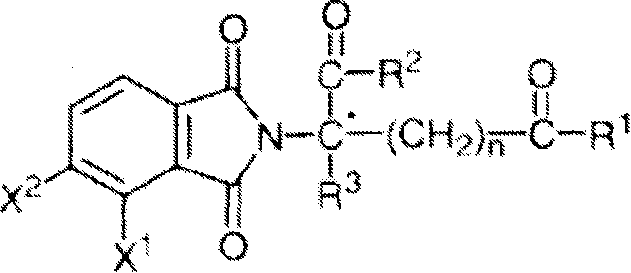
wherein, X1And X2One is nitro or NH-Z, and X1Or X2The other of (a) is hydrogen;
R1and R2Each independently is hydroxy or NH-Z;
R3is alkyl containing 1-6 carbon atoms, halogen or hydrogen;
z is hydrogen, phenyl, acyl containing 1 to 6 carbon atoms or alkyl containing 1 to 6 carbon atoms; and
n has a value of 0, 1 or 2;
provided that if X is1And X2One is nitro and n is 1 or 2, then R1And R2Is not a hydroxyl group; and
if-COR2And- (CH)2)nCOR1Is different, then is represented as C*The carbon atom(s) constituting the chiral center. Other representative compounds have the formula:
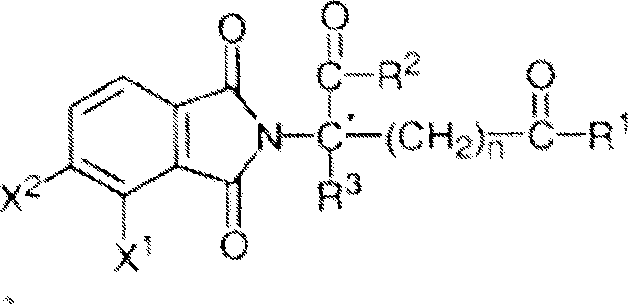
wherein, X1And X2One is an alkyl group containing 1 to 6 carbon atoms;
R1and R2Each independently is hydroxy or NH-Z;
R3is an alkane having 1 to 6 carbon atomsAlkyl, halogen or hydrogen;
z is hydrogen, phenyl, acyl containing 1 to 6 carbon atoms or alkyl containing 1 to 6 carbon atoms; and
n has a value of 0, 1 or 2; and
if-COR2And- (CH)2)nCOR1Is different, then is represented as C*The carbon atom(s) constituting the chiral center.
Other specific immunomodulatory compounds of the invention include, but are not limited to: isoindolin-1-ones and isoindolin-1, 3-diones substituted at the 2-position with a 2, 6-dioxo-3-hydroxypiperidin-5-yl group, which are described in U.S. Pat. No. 6,458,810, which is incorporated herein by reference. Representative compounds have the formula:

wherein:
by using*The carbon atoms represented constitute the chiral center;
x is-C (O) -or-CH2-;
R1Is alkyl having 1 to 8 carbon atoms or-NHR3;
R2Is hydrogen, alkyl having 1 to 8 carbon atoms or halogen; and
R3is hydrogen;
alkyl having 1 to 8 carbon atoms, unsubstituted or substituted with alkoxy having 1 to 8 carbon atoms, halogen, amino or alkylamino having 1 to 4 carbon atoms;
cycloalkyl groups containing 3 to 18 carbon atoms;
phenyl, unsubstituted or substituted by alkyl having 1 to 8 carbon atoms, alkoxy having 1 to 8 carbon atoms, halogen, amino or alkylamino having 1 to 4 carbon atoms;
benzyl, unsubstituted or substituted by alkyl having 1 to 8 carbon atoms, alkoxy having 1 to 8 carbon atoms, halogen, amino or alkylamino having 1 to 4 carbon atoms, or-COR4Wherein
R4Is a hydrogen atom, and is,
alkyl having 1 to 8 carbon atoms, unsubstituted or substituted by alkoxy having 1 to 8 carbon atoms, halogen, amino or alkylamino having 1 to 4 carbon atoms,
cycloalkyl groups having 3 to 18 carbon atoms,
phenyl, unsubstituted or substituted by alkyl having 1 to 8 carbon atoms, alkoxy having 1 to 8 carbon atoms, halogen, amino or alkylamino having 1 to 4 carbon atoms, or
Benzyl, unsubstituted or substituted by alkyl having 1 to 8 carbon atoms, alkoxy having 1 to 8 carbon atoms, halogen, amino or alkylamino having 1 to 4 carbon atoms.
The compounds of the present invention may be commercially available or prepared according to the methods described in the patents or patent applications disclosed in this specification. In addition, optically pure compounds can be asymmetrically synthesized or resolved using known resolving agents or chiral columns, as well as other standard organic chemical synthesis techniques.
The term "pharmaceutically acceptable salts" as used herein, unless otherwise indicated, includes non-toxic acid and base addition salts of the compounds to which the term refers. Acceptable non-toxic acid addition salts include those derived from organic and inorganic acids or bases known in the art, including, for example, hydrochloric, hydrobromic, phosphoric, sulfuric, methanesulfonic, acetic, tartaric, lactic, succinic, citric, malic, maleic, sorbic, aconitic, salicylic, phthalic, embolic (embonic acid), heptanoic, and the like.
Naturally occurring acidic compounds are capable of forming salts with various pharmaceutically acceptable bases. The bases which can be used for the preparation of pharmaceutically acceptable base addition salts of such acidic compounds are those which form non-toxic base addition salts, that is, salts containing pharmacologically acceptable cations, such as, but not limited to, alkali metal or alkaline earth metal salts, especially calcium, magnesium, sodium, potassium salts. Suitable organic bases include, but are not limited to, N-dibenzylethylenediamine, chloroprocaine, choline, diethanolamine, ethylenediamine, meglumine (N-methylglucamine), lysine, and procaine.
The term "solvate" as used herein, unless otherwise specified, refers to a compound of the invention or a salt thereof, and also includes stoichiometric or non-stoichiometric amounts of solvents bound by non-covalent intermolecular forces. If the solvent is water, then the solvate is a hydrate.
As used herein, and unless otherwise indicated, the term "prodrug" refers to a derivative of a compound that hydrolyzes, oxidizes, or otherwise reacts under biological conditions (in vitro or in vivo) to provide the compound. Examples of prodrugs include, but are not limited to, derivatives of immunomodulatory compounds of the invention comprising biohydrolyzable moieties such as biohydrolyzable amides, biohydrolyzable esters, biohydrolyzable carbamates, biohydrolyzable carbonates, biohydrolyzable ureides, and biohydrolyzable phosphate analogs. Other examples of prodrugs include those containing-NO, -NO2-ONO or-ONO2Derivatives of some of the immunomodulatory compounds of the invention. Prodrugs can generally be prepared by well-known methods, such as those described in Burger's Medicinal Chemistry and drug discovery, 172-178, 949-982 (edited E.Wolff, 5 th edition 1995) and Design of Prodrugs (H.Bundgaand, Ed. Elselvier, New York 1985).
As used herein, unless otherwise indicated, the terms "biohydrolyzable amide", "biohydrolyzable ester", "biohydrolyzable carbamate", "biohydrolyzable carbonate", "biohydrolyzable ureide", "biohydrolyzable phosphate" refer to an amide, ester, carbamate, carbonate, ureide, or phosphate, respectively, of a compound having the following properties: 1) does not interfere with the biological activity of the compound, but may confer advantageous properties to the compound in vivo, such as absorption, duration of action or onset of action; or 2) is biologically inactive, but is converted in vivo to a biologically active compound. Examples of biohydrolyzable esters include, but are not limited to, lower alkyl esters, lower acyloxyalkyl esters (e.g., acetoxymethyl, acetoxyethyl, aminocarbonyloxymethyl, pivaloyloxymethyl, and pivaloyloxyethyl esters), lactonyl esters (e.g., phthalidyl and thiophthalidyl esters), lower alkoxyacyloxyalkyl esters (e.g., methoxycarbonyloxymethyl, ethoxycarbonyloxyethyl, and isopropoxycarbonyloxyethyl esters), alkoxyalkyl esters, choline esters, and acylaminoalkyl esters (e.g., acetamidomethyl esters). Examples of biohydrolyzable amides include, but are not limited to, lower alkyl amides, alpha-amino acid amides, alkoxyacyl amides, and alkylaminoalkylcarbonyl amides. Examples of biohydrolyzable carbamates include, but are not limited to, lower alkylamines, substituted ethylenediamines, amino acids, hydroxyalkylamines, heterocyclic and heteroaromatic amines, and polyether amines.
The term "stereoisomer" as used herein, unless otherwise indicated, includes all enantiomerically/stereomerically pure and enantiomerically/stereomerically enriched compounds of the present invention.
As used herein, unless otherwise indicated, the term "stereomerically pure" or "enantiomerically pure" means that a compound includes one stereoisomer and is substantially free of the opposite stereoisomer or enantiomer of the compound. For example, a compound is stereoisomerically or enantiomerically pure when it contains 80%, 90%, or 95% or more of one stereoisomer and 20%, 10%, or 5% or less of the opposite stereoisomer. In certain instances, when a compound of the invention is about 80% ee (enantiomeric excess) or greater, preferably equal to or greater than 90% ee, and more preferably 95% ee relative to a particular chiral center, then the compound is considered optically active or stereoisomerically/enantiomerically pure (i.e., substantially R-form or substantially S-form) relative to the chiral center.
As used herein, unless otherwise indicated, the term "stereomerically enriched" or "enantiomerically enriched" includes racemic as well as other mixtures of stereoisomers of the compounds of the invention (e.g., R/S ═ 30/70, 35/65, 40/60, 45/55, 55/45, 60/40, 65/35, and 70/30). Various immunomodulatory compounds of the invention contain one or more chiral centers and may exist as racemic or diastereomeric mixtures of enantiomers. The invention includes the use of stereomerically pure forms of such compounds as well as the use of mixtures of those forms. For example, mixtures containing equal or unequal amounts of enantiomers of particular immunomodulatory compounds of the invention may be used in methods and compositions of the invention. These isomers can be asymmetrically synthesized or resolved using standard techniques such as chiral columns or chiral resolving agents. See, for example: jacques, j. et al, entiinoers, Racemates and solutions (Wiley-Interscience, new york, 1981); wilen, s.h. et al, Tetrahedron 33: 2725 (1977); eliel, E.L., Stereochemistry of Carbon Compounds (McGraw-Hill, NY, 1962); and Wilen, S.H., Tables of solving Agents and Optical solutions, p.268 (eds. E.L.Eliel, Univ.of Notre Dame Press, Notre Dame, IN, 1972).
It should be noted that if there is a difference between the structure shown and the name of the structure, the structure shown should be the subject of the difference. Furthermore, if the stereochemistry of a structure or a portion of a structure is not indicated with, for example, bold or dashed lines, the structure or portion of the structure is to be understood as encompassing all stereoisomers of it.
4.2. A second active agent
One or more second active agents may be used in combination with an immunomodulatory compound in methods and compositions of the invention. In preferred embodiments, the second active agent is capable of reducing pulmonary artery pressure or vascular resistance, inhibiting thrombosis or thromboembolism, or ensuring patient compliance. Examples of such second active agents include, but are not limited to, anticoagulants, diuretics, cardiac glycosides, calcium channel blockers, vasodilators, prostacyclin analogs, endothelin antagonists, phosphodiesterase inhibitors (e.g., PDE V inhibitors), endopeptidase inhibitors, lipid lowering agents, thromboxane inhibitors, and other known therapeutic agents that lower pulmonary artery pressure.
A particular second active agent is an anticoagulant agent that may be used to treat patients with PH at increased risk of developing thrombosis and thromboembolism. A particular anticoagulant is warfarin (Coumadin)®)。
Other second active agents include diuretics, cardiac glycosides, and oxygen. Digoxin treatment is used to enhance right ventricular function in right ventricular failure patients. Diuretics are used to control peripheral edema. Oxygen supplementation may be used in patients with resting or exercise-induced hypoxemia.
Calcium channel blockers such as diltiazem and nifedipine may also be used as secondary active agents, particularly in vasoreactive patients catheterized in the right ventricle. These drugs are thought to act on vascular smooth muscle, thereby increasing pulmonary vascular resistance and decreasing pulmonary artery pressure. Tapson, Advances in pulmony Hyperension, 1 (1): 16-17, 2002.
Other second active agents include vasodilators, especially for patients with NYHA type III and IV who have right ventricular failure who are unresponsive or intolerant to calcium channel blockers. Examples of vasodilators include, but are not limited to, prostacyclins (e.g., prostaglandin I)2(PGI2) Epoprostenol (EPO, Floran)®) Treprostinil (Remodulin)®) And Nitric Oxide (NO).
The other second active agent is an endothelin antagonist. An example is bosentan (Tracleer)®) It competitively binds to endothelin-1 (ET-1) receptors, lowering pulmonary artery pressure.
Specific second active agents useful in the present invention include, but are not limited to, amlodipine, nifedipine, diltiazem, epoprostenol (Floran)®) Treprostinil (Remodulin)®) Bosentan (Tracleer)®) Prostacyclin, warfarin (Coumadin)®) Tadalafil (Cialis)®) Simvastatin (Zocor)®) Oomatrala (Vanlev)®) Irbesartan (Avapro)®) Pravastatin (pravastatin)®) Digoxin, nitric oxide, L-arginine, iloprost, betaprost, and sildenafil (Viagra)®)。
4.3. Treatment and control method
The methods of the invention include methods for preventing, treating and/or controlling various types of PH. As used herein, unless otherwise indicated, the term "preventing" includes, but is not limited to, inhibiting or avoiding one or more symptoms associated with PH. Symptoms associated with PH include, but are not limited to, dyspnea, fatigue, weakness, chest pain, recurrent fainting, seizures, mild headaches, neurological deficit, leg edema, and palpitations. As used herein, unless otherwise indicated, the term "treatment" refers to administration of the composition after the onset of PH symptoms, whereas "prevention" refers to administration prior to the onset of symptoms, particularly to patients at risk of developing PH. As used herein, unless otherwise indicated, the term "controlling" includes preventing PH recurrence in a patient who has had PH, and/or prolonging the time a patient who has had PH is in remission.
The invention includes methods of treating or controlling patients who have previously received PH therapy as well as patients who have not previously received PH therapy. Because patients with PH have different clinical manifestations and various clinical outcomes, it is preferable to treat patients according to the severity and stage of the disease. The methods and compositions of the present invention may be used in patients with various stages or types of PH, including but not limited to primary PH, secondary PH, and NYHA or WHO functional class I-IV.
The invention encompasses methods comprising administering to a patient (e.g., a human) suffering from or at risk of developing PH an immunomodulatory compound, or a pharmaceutically acceptable salt, solvate (e.g., hydrate), stereoisomer, clathrate, or prodrug thereof. A particular patient population includes young women, since pH affects most young women of reproductive age, but is typically present in women between 50 and 60 years of age. Patients with familial PH history are also preferred candidates for preventive regimens.
In one embodiment of the invention, the immunomodulatory compound is administered in a single or divided daily dose of about 0.1 to about 2,000 mg/day, about 0.1 to about 1,000 mg/day, about 0.1 to about 500 mg/day, about 0.1 to about 250 mg/day, or about 1 to about 100 mg/day. In another embodiment of the invention, an immunomodulatory compound is administered alone at about 1 to about 20 mg/day, e.g., about 1 mg/day, about 2 mg/day, about 3 mg/day, about 4 mg/day, about 5 mg/day, about 6 mg/day, about 7 mg/day, about 8 mg/day, about 9 mg/day, about 10 mg/day, about 11 mg/day, about 12 mg/day, about 13 mg/day, about 14 mg/day, about 15 mg/day, about 16 mg/day, about 17 mg/day, about 18 mg/day, about 19 mg/day, or about 20 mg/day. In particular embodiments, 4- (amino) -2- (2, 6-dioxo (3-piperidyl)) -isoindoline-1, 3-dione is administered in an amount of about 0.1 to about 1mg per day, or about 5mg every other day. In another embodiment, 3- (4-amino-1-oxo-1, 3-dihydro-isoindol-2-yl) -piperidine-2, 6-dione is administered in an amount of about 5 to about 25mg per day, or about 10 to about 50mg every other day.
4.3.1. Combination therapy with a second active agent
Particular methods of the invention comprise administering 1) an immunomodulatory compound, or a pharmaceutically acceptable salt, solvate (e.g., hydrate), stereoisomer, clathrate, or prodrug thereof, and 2) a second active agent. Disclosed herein are examples of immunomodulatory compounds (see, e.g., section 4.1) and examples of second active agents (see, e.g., section 4.2).
Administration of the immunomodulatory compound and the second active agent to the patient can be simultaneous or sequential, by the same or different routes of administration. The suitability of a particular route of administration for a particular active agent will depend on the active agent itself (e.g., whether it can be administered orally without breaking down before entering the bloodstream) and the disease being treated. The preferred route of administration of the immunomodulatory compounds is orally. Another preferred route of administration of the selective cytokine inhibitory drugs is parenteral, particularly for patients in the pre-transplant phase or patients in the late PH phase. Preferred routes of administration for the second active agents of the invention are known to those of ordinary skill in the art. See, for example, the Physicians' Desk Reference (57 th edition, 2003).
The specific amount of the second active agent will depend upon the specific active agent used, the type of pH being treated or controlled, the severity and stage of the pH, and the amount of immunomodulatory compound and, optionally, additional active agents concurrently administered to the patient. In a particular embodiment of the invention, the second active agent is amlodipine, diltiazem, nifedipine, prostacyclin, epoprostenol (Floran)®) Treprostinil (Remodulin)®) Bosentan (Tracleer)®) Warfarin (Cournadin)®) Tadalafil (Cialis)®) Simvastatin (Zocor)®) Oomatrala (Vanlev)®) Irbesartan (Avapro)®) Pravastatin (pravastatin)®) Digoxin, nitric oxide, L-arginine, iloprost, betaprost, or sildenafil (Viagra)®)。
In one embodiment of the invention, the immunomodulatory compound is administered with a second active agent commonly used to treat PH to reduce the duration of treatment. In particular embodiments, about 5 to about 20 mg/day of 3- (4-amino-1-oxo-1, 3-dihydro-isoindol-2-yl) -piperidine-2, 6-dione and an amount of the second active agent that can be determined by one of skill in the art according to professional judgment is administered beginning at week 1. Beginning at weeks 5,9, 13, and 17, administration of the second active agent is decreased in increments of 25% of the starting dose of the second active agent. Starting at week 17, if the patient's symptoms have not worsened, then the dose of the second active agent is 0 mg/day. If the patient's symptoms worsen, the amount of the second active agent may be increased to stabilize the patient.
In one embodiment of the invention, the second active agent is administered parenterally, orally or by inhalation. For example, epoprostenol (Floran) is administered by continuous IV infusion through a permanently indwelling central venous catheter®). The initial dose was about 2-4ng/kg/min, depending on the initial response under close observation with the ICU in place with a right ventricular float catheter. Subsequently, the dose was determined from outpatient analysis, and some patients could exceed 40ng/kg/min after one year of treatment. Iloprost is preferably administered by inhalation. Betaprost is preferably administered orally.
In another embodiment of the invention, treprostinil (Remodulin) is administered by continuous subcutaneous infusion®) The initial dose was about 1.25 ng/kg/min. Subsequent doses may be increased by about 1.25ng/kg/min for four weeks per week, followed by 2.5ng/kg/min per week. Preferably, the dose does not exceed about 40 ng/kg/min.
In another embodiment of the invention bosentan (Tracleer) is administered orally®) The starting dose was about 62.5mg twice a day for four weeks, then about 125mg twice a day.
4.3.2 use with surgery or transplantation
The invention encompasses methods of treating or controlling PH comprising administering an immunomodulatory compound, or a pharmaceutically acceptable salt, solvate (e.g., hydrate), stereoisomer, clathrate, or prodrug thereof, and surgery or transplantation therapy. As described elsewhere, treatment of PH varies depending on the stage and mechanism of the disease. An atrial septostomy or lung transplant may be necessary for patients with PH who do not respond to drug treatment. The use of immunomodulatory compounds in combination with atrial septal ostomy or lung transplantation is considered to be of unexpected benefit. In addition, immunomodulatory compounds have been shown to provide additive or synergistic immunomodulatory activity when administered before, during, or after surgery or transplantation therapy in patients with PH. For example, immunomodulatory compounds can reduce complications associated with conventional therapies.
4.4. Pharmaceutical compositions and single unit dosage forms
The pharmaceutical compositions may be formulated for use in a single unit dosage form. Pharmaceutical compositions and dosage forms of the invention comprise an immunomodulatory compound, or a pharmaceutically acceptable salt, solvate (e.g., hydrate), stereoisomer, clathrate, or prodrug thereof. The pharmaceutical compositions and dosage forms of the present invention may also comprise one or more excipients.
The pharmaceutical compositions and dosage forms of the present invention may also comprise one or more additional active agents. Accordingly, the pharmaceutical compositions and dosage forms of the invention comprise an active agent (e.g., an immunomodulatory compound, or a pharmaceutically acceptable salt, solvate (e.g., hydrate), stereoisomer, clathrate, or prodrug thereof, and a second active agent) disclosed herein. Examples of optional additional active agents are disclosed herein (see, e.g., section 4.2).
The single unit dosage forms of the invention are suitable for oral, mucosal (e.g., nasal, sublingual, vaginal, buccal or rectal), parenteral (e.g., subcutaneous, intravenous, bolus injection, intramuscular or intraarterial), transdermal or transdermal administration to a patient. Examples of dosage forms include, but are not limited to: tablets, such as fast dissolving tablets; a caplet; capsules, such as soft elastic gelatin capsules; a cachet; keeping in mouth; a lozenge; a band agent such as a quick-dissolving band in an oral liquid; a dispersant; suppositories; powder preparation; aerosols (e.g., nasal sprays or inhalants); gelling agent; liquid dosage forms suitable for oral or transmucosal administration to a patient, including suspensions (e.g., aqueous or non-aqueous liquid suspensions, oil-in-water emulsions, or water-in-oil liquid emulsions), solutions, and elixirs; a liquid dosage form suitable for parenteral administration to a patient; and sterile solids (e.g., crystalline or amorphous solids) that can be reconstituted to provide liquid dosage forms suitable for parenteral administration to a patient.
The composition, shape and type of the dosage form of the present invention will typically vary depending on its use. For example, a dosage form for the acute treatment of a disease may contain an amount of one or more active agents that is greater than the amount contained in a dosage form for the chronic treatment of the same disease. Similarly, a parenteral dosage form will contain less of the one or more active agents than an oral dosage form used to treat the same disease. The manner in which these particular dosage forms of the invention are contained, as well as other manners, will be readily apparent to those skilled in the art. See, e.g., Remington's Pharmaceutical Sciences, 18 th edition, MackPublishing, Easton PA (1990).
Typical pharmaceutical compositions and dosage forms contain one or more excipients. Suitable excipients are well known to those of ordinary skill in the pharmaceutical arts, and non-limiting examples of suitable excipients are provided in the present specification. Whether a particular excipient is suitable for incorporation into a pharmaceutical composition or dosage form depends on a variety of factors well known in the art, including, but not limited to, the route by which the dosage form is administered to a patient. For example, oral dosage forms (e.g., tablets) may contain excipients that are not suitable for use in parenteral dosage forms. The suitability of a particular excipient may depend on the particular active agent in the dosage form. For example, some excipients (e.g., lactose), or when exposed to water, may accelerate the decomposition of some active agents. Active agents containing primary or secondary amines are particularly sensitive to this accelerated decomposition. Thus, the invention includes pharmaceutical compositions and dosage forms that contain little, if any, lactose or other mono-or disaccharides. As used herein, the term "lactose-free" means that the amount of lactose, if any, is insufficient to substantially accelerate the rate of degradation of the active agent.
The lactose-free compositions of the invention may contain excipients well known in the art, listed, for example, in U.S. pharmacopeia (USP)25-NF20 (2002). Typically, lactose-free compositions contain pharmaceutically compatible and pharmaceutically acceptable amounts of active agent, binder/filler and lubricant. Preferably, the lactose-free dosage form contains the active agent, microcrystalline cellulose, pregelatinized starch, and magnesium stearate.
The present invention also includes anhydrous pharmaceutical compositions and dosage forms containing the active agent, as water promotes the degradation of certain compounds. For example, the addition of water (e.g., 5%) is widely accepted in the pharmaceutical arts as a means of simulating long-term storage in order to determine properties of the formulation over time, such as shelf life or stability. See, e.g., Jens t. carstensen, Drug Stability: principles & Practice, second edition, Marcel Dekker, NY, NY, 1995, pages 379-80. In fact, water and heat will accelerate the decomposition of some compounds. Thus, the effect of water on the formulation is very significant, as moisture and/or humidity is often encountered during manufacture, handling, packaging, storage, shipment, and use of the formulation.
The anhydrous pharmaceutical compositions and dosage forms of the invention can be manufactured with anhydrous or low moisture content ingredients and under low humidity conditions. Pharmaceutical compositions and dosage forms comprising lactose and at least one active agent comprising a primary or secondary amine are preferably anhydrous if substantial contact with moisture and/or humidity is expected during manufacture, packaging, and/or storage.
Anhydrous pharmaceutical compositions should be prepared and stored in a manner that maintains their anhydrous nature. Accordingly, anhydrous compositions are preferably packaged with materials known to prevent exposure to water, so that they can be packaged in a suitable kit. Examples of suitable packaging include, but are not limited to, sealed films, plastics, unit dose containers (e.g., vials), blister packs, and strip packs.
The invention also includes pharmaceutical compositions and dosage forms comprising one or more compounds that reduce the rate of decomposition of an active agent. Such compounds are referred to herein as "stabilizers" and include, but are not limited to, antioxidants (such as ascorbic acid), pH buffers, or salt buffers.
As with the amount and type of excipient, the type and amount of a particular active agent in a dosage form may vary depending on a variety of factors, including, but not limited to, the route of administration to the patient. However, a typical dosage form of the invention comprises from about 0.10 to about 150mg of an immunomodulatory compound, or a pharmaceutically acceptable salt, solvate (e.g., hydrate), stereoisomer, inclusion, or prodrug thereof. Typical dosage forms comprise about 0.1, 1,2, 5, 7.5, 10, 12.5, 15, 17.5, 20, 25, 50, 100, 150, or 200mg of an immunomodulatory compound, or a pharmaceutically acceptable salt, solvate (e.g., hydrate), stereoisomer, clathrate, or prodrug thereof. In particular embodiments, preferred dosage forms include about 1,2, 5, 10, 25, or 50mg of 4- (amino) -2- (2, 6-dioxo (3-piperidyl)) -isoindoline-1, 3-dione. In particular embodiments, preferred dosage forms include about 5, 10, 25 or 50mg of 3- (4-amino-1-oxo-1, 3-dihydro-isoindol-2-yl) -piperidine-2, 6-dione. Certain dosage forms also contain, for example, from about 1 to about 1000mg, from about 5 to about 500mg, from about 10 to about 350mg, from about 50 to about 200mg of the second active agent. The specific amount of the second active agent will, of course, depend upon the specific active agent used, the type of pH being treated or controlled, and the amounts of the selective cytokine inhibitory drug and any optional additional active agents concurrently administered to the patient.
4.4.1 oral dosage forms
Pharmaceutical compositions of the invention suitable for oral administration may be formulated in discrete dosage forms such as, but not limited to, tablets (e.g., chewable and fast dissolving tablets), caplets, capsules (e.g., soft elastic gelatin capsules), liquids (e.g., flavored syrups), and strips (e.g., fast dissolving strips). These dosage forms contain a predetermined amount of active agent and may be prepared by pharmaceutical methods well known to those of ordinary skill in the art. See Remington's pharmaceutical Sciences, 18 th edition, Mack Publishing, Easton PA (1990).
Typical oral dosage forms are prepared by intimately mixing the active agent with at least one excipient according to conventional pharmaceutical compounding techniques. Excipients may take a wide variety of forms depending on the form of preparation desired for administration. For example, excipients suitable for use in oral liquid or aerosol dosage forms include, but are not limited to, water, glycols, oils, alcohols, flavoring agents, preservatives, and coloring agents. Examples of excipients suitable for use in solid oral dosage forms (e.g., powders, tablets, capsules, and caplets) include, but are not limited to, starches, sugars, microcrystalline cellulose, diluents, granulating agents, lubricants, binders, and disintegrating agents.
Because of their ease of administration, tablets and capsules represent the most advantageous oral unit dosage form. Pharmaceutical compositions and dosage forms are generally prepared by: the active agent is intimately mixed with a liquid carrier, a well-dispersed solid carrier, or both, and the dosage form is then coated, if necessary, by standard aqueous or non-hydrated techniques.
For example, tablets may be made by compression or compression molding. Compressed tablets may be prepared by compressing in a suitable machine the active agent in a free-flowing form, for example, as a powder or granules, optionally mixed with excipients. Compression molded tablets may be prepared by compression molding in a suitable machine a mixture of the powdered compound moistened with an inert liquid diluent.
Examples of excipients that may be used in the oral dosage forms of the present invention include, but are not limited to, binders, fillers, disintegrants, and lubricants. Binders suitable for use in pharmaceutical compositions and dosage forms include, but are not limited to, corn starch, potato starch or other starches, gelatin, natural and synthetic gums such as acacia, sodium alginate, alginic acid, other alginates, powdered tragacanth, guar gum, cellulose and its derivatives (e.g., ethyl cellulose, cellulose acetate, carboxymethylcellulose calcium, carboxymethylcellulose sodium), polyvinylpyrrolidone, methyl cellulose, pregelatinized starch, hydroxypropyl methylcellulose (e.g., nos. 2208, 2906, 2910), microcrystalline cellulose, and mixtures thereof.
Suitable forms of microcrystalline cellulose include, but are not limited to, the materials sold as AVICEL-PH-101, AVICEL-PH-103, AVICEL RC-581, AVICEL-PH-105 (available from FMC Corporation, American Viscose Division, Avicel Sales, Marcus Hook, Pa.), and mixtures thereof. One specific binder is a mixture of microcrystalline cellulose and sodium carboxymethylcellulose sold as AVICELRC-581. Suitable anhydrous or low moisture excipients or additives include AVICEL-PH-103TMAnd Starch 1500 LM.
Examples of fillers suitable for use in the pharmaceutical compositions and dosage forms of the present invention include, but are not limited to, talc, calcium carbonate (e.g., granules or powder), microcrystalline cellulose, cellulose powder, dextrates (dextrates), kaolin, mannitol, silicic acid, sorbitol, starch, pregelatinized starch, and mixtures thereof. The binder or filler in the pharmaceutical compositions of the present invention is present in an amount of about 50% to about 99% by weight of the pharmaceutical composition or dosage form.
Disintegrants are used in the compositions of the invention to provide tablets that disintegrate upon exposure to an aqueous environment. Tablets containing too much disintegrant may disintegrate in storage, while tablets containing too little may not disintegrate at the desired rate or under the desired conditions. Thus, a sufficient amount of disintegrant that does not significantly alter the release of the active agent, either too much or too little, should be used to form the solid oral dosage form of the present invention. The amount of disintegrant used varies with the type of formulation and is readily determined by one skilled in the art. Typical pharmaceutical compositions contain from about 0.5% to about 15% by weight of disintegrant, preferably from about 1% to about 5% by weight of disintegrant.
Disintegrants that can be used in the pharmaceutical compositions and dosage forms of the invention include, but are not limited to, agar-agar, alginic acid, calcium carbonate, microcrystalline cellulose, croscarmellose sodium, crospovidone, polacrilin potassium, sodium starch glycolate, potato or sweet potato starch, other starches, pregelatinized starch, other starches, clays, other alginates, other celluloses, gums, and mixtures thereof.
Lubricants useful in the pharmaceutical compositions and dosage forms of the present invention include, but are not limited to, calcium stearate, magnesium stearate, mineral oil, light mineral oil, glycerol, sorbitol, mannitol, polyethylene glycol, other glycols, stearic acid, sodium lauryl sulfate, talc, hydrogenated vegetable oils (e.g., peanut oil, cottonseed oil, sunflower oil, sesame oil, olive oil, corn oil, and soybean oil), zinc stearate, ethyl oleate, ethyl laurate, agar, and mixtures thereof. Other lubricants include, for example, syloid silica gel (AEROSIL200, manufactured by W.R. Grace Co. of Baltimore, MD), solidified aerosol of synthetic silica (sold by Degussa Co. of Plano, TX), CAB-O-SIL (a sintered silica product sold by Cabot Co. of Boston, MA), and mixtures thereof. Lubricants, if used at all, are generally used in amounts less than about 1% by weight of the pharmaceutical composition or dosage form into which they are incorporated.
Preferred solid oral dosage forms of the invention comprise an immunomodulatory compound, anhydrous lactose, microcrystalline cellulose, polyvinylpyrrolidone, stearic acid, colloidal anhydrous silicon dioxide, and gelatin.
4.4.2 fast-Release dosage forms
The single unit dosage forms of the present invention may be fast-release dosage forms such as, but not limited to, fast-dissolving tablets, tapes, transdermal agents, suspensions, and liquid dosage forms. The dosage form may provide immediate or rapid release of one or more active agents. For example, a fast dissolving tablet or tape may simply be inserted into a patient's mouth and readily dissolved in the oral fluid to achieve the desired therapeutic effect. The fast-release dosage forms of the present invention can rapidly disintegrate in the mouth to form a suspension of particles and release their contents so as not to interfere with the normal biological activity of the active agent.
The immediate release dosage forms may be prepared by pharmaceutical methods well known to those skilled in the art. Examples include, but are not limited to, those described in Remington's Pharmaceutical Sciences, 18 th edition, MackPublishing, Easton PA (1990); pharmacopoeia No.23, chapter 1216 (1995); and those described in U.S. Pat. Nos. 3,962,417, 4,613,497, 4,940,588, 5,055,306, 5,178,878, 5,225,197, 5,464,632, and 6,024,981, which are incorporated herein by reference. For example, coatings that dissolve rapidly may be used to provide faster release of the active agent. The amount of the coating agent and the coating thickness may vary depending on the type of the preparation, but can be easily determined by those skilled in the art. The type and thickness of the coating can be readily determined by those skilled in the art based on such characteristics as the desired blood level of active agent, the rate of release, the solubility of active agent, the desired properties of the dosage form, etc., if faster release of active agent is desired.
4.4.3 sustained Release dosage forms
The active agents of the present invention may be administered by controlled release devices or delivery devices known to those skilled in the art. Examples include, but are not limited to, those described in the following patents: U.S. Pat. nos. 3,845,770, 3,916,899, 3,536,809, 3,598,123, 4,008,719, 5,674,533, 5,059,595, 5,591,767, 5,120,548, 5,073,543, 5,639,476, 5,354,556, and 5,733,566, each of which is incorporated herein by reference. Such dosage forms may be used to provide sustained or controlled release of one or more active agents by using, for example, hydroxypropylmethyl cellulose, other polymer matrices, gels, permeable membranes, isotonic systems, multilayer coatings, microparticles, liposomes, microspheres, or combinations thereof to produce desired release profiles in varying proportions. Suitable controlled release formulations include those described herein, which are well known to those skilled in the art and are readily selected for use with the active agents of the present invention. Thus, the present invention encompasses single unit dosage forms suitable for controlled release and for oral administration, including but not limited to tablets, capsules, gelcaps, and caplets.
All controlled release drug products share the following common objectives: improving the therapeutic effect of the drug over that achieved by its uncontrolled products. Ideally, the use of optimally designed controlled release formulations in medical treatment is characterized by: the disease is cured or controlled in the shortest time with the least amount of medicine. Advantages of controlled release formulations include prolonged drug activity, reduced dosing frequency and improved patient compliance. In addition, controlled release formulations may be used to affect the time at which the effect begins or other characteristics, such as blood levels of the drug, and thereby affect the incidence of side effects (e.g., adverse side effects).
Most controlled release formulations are designed to initially release an amount of drug (active agent) that immediately produces the desired therapeutic effect, and gradually and continuously release amounts of other drugs to maintain that level of therapeutic or prophylactic effect over an extended period of time. In order to maintain a constant level of drug in the body, the drug must be released from the dosage form at a rate that will compensate for the amount of drug that is metabolized and excreted from the body. Controlled release of the active agent can be stimulated by a variety of conditions, including but not limited to pH, temperature, enzymes, water, or other physiological conditions or compounds.
4.4.4 parenteral dosage forms
Parenteral dosage forms can be administered to a patient by a variety of routes including, but not limited to, subcutaneous, intravenous (including bolus injection), intramuscular, and intraarterial routes. Since their administration typically bypasses patients' natural defenses against contaminants, parenteral dosage forms are preferably sterile or capable of being sterilized prior to administration to a patient. Examples of parenteral dosage forms include, but are not limited to, injectable solutions, dry products that can be dissolved or suspended in a pharmaceutically acceptable carrier for injection, injectable suspensions, and emulsions.
Suitable carriers that can be used to provide the parenteral dosage forms of the invention are well known to those skilled in the art. Examples include, but are not limited to: USP water for injection; aqueous carriers such as, but not limited to, sodium chloride injection, ringer's injection, dextrose and sodium chloride injection, and lactated ringer's injection; water-miscible carriers such as, but not limited to, ethanol, polyethylene glycol, and polypropylene glycol; and non-aqueous vehicles such as, but not limited to, corn oil, cottonseed oil, peanut oil, sesame oil, ethyl oleate, isopropyl myristate, and benzyl benzoate.
Compounds that increase the solubility of one or more of the active agents disclosed herein may also be incorporated into the parenteral dosage forms of the invention. For example, cyclodextrins and derivatives thereof can be used to increase the solubility of immunomodulatory compounds. See, for example, U.S. Pat. No. 5,134,127, which is incorporated herein by reference.
4.4.5 topical and transmucosal dosage forms
Topical and transmucosal administration forms of the present invention include, but are not limited to, sprays, aerosols, solutions, emulsions, suspensions, or other forms known to those skilled in the art. See, e.g., Remington's Pharmaceutical Sciences, 16 th and 18 th editions, Mack Publishing, Easton PA (1980& 1990); and Introduction to Pharmaceutical DosageFormns, 4 th edition, Lea & Febiger, Philadelphia (1985). Dosage forms suitable for treating mucosal tissue in the oral cavity can be formulated as mouthwashes or as oral gels.
Suitable excipients (e.g., carriers and diluents) and other materials that may be used in the preparation of the topical and transmucosal dosage forms of the present invention are well known to those skilled in the art of pharmacy and depend on the particular tissue to which a given pharmaceutical composition or dosage form is to be administered. In fact, typical excipients include, but are not limited to, water, acetone, ethanol, ethylene glycol, propylene glycol, butane-1, 3-diol, isopropyl myristate, isopropyl palmitate, mineral oil, and mixtures thereof to form a non-toxic and pharmaceutically acceptable solution, emulsion, or gel. Moisturizers or humectants can also be added to pharmaceutical compositions and dosage forms, if desired. Examples of such other ingredients are well known in the art. See, e.g., Remington's Pharmaceutical Sciences, 16 th and 18 th edition, Mack Publishing, Easton PA (1980& 1990).
The pH of the pharmaceutical composition or dosage form may also be adjusted to enhance delivery of one or more active agents. Similarly, the polarity of the solvent vehicle, its ionic strength, or tonicity can be adjusted to enhance delivery. Compounds such as stearates can also be added to pharmaceutical compositions or dosage forms to advantageously alter the hydrophilicity or lipophilicity of one or more active agents to enhance delivery. In this regard, stearates can serve as lipid carriers, emulsifiers or surfactants, as well as delivery or penetration enhancers for the formulation. Different salts, hydrates or solvates of the active agent may also be used to adjust the properties of the resulting composition.
4.4.6 kits
It is generally preferred that the active agents of the invention are not administered at the same time or by the same route of administration. Thus, the present invention includes kits that, when used by medical personnel, can simplify the administration of an appropriate amount of an active agent to a patient.
Typical kits of the invention comprise an immunomodulatory compound or a pharmaceutically acceptable salt thereofA salt, solvate (e.g., hydrate), stereoisomer, clathrate, or prodrug. The kit of the invention may also contain additional active agents such as amlodipine, diltiazem, nifedipine, adenosine, epoprostenol (Floran)®) Treprostinil (Remodulin)®) Bosentan (Tracleer)®) Rodenticide (Coumadin)®) Tadalafil (Cialis)®) Simvastatin (Zocor)®) Oomatrala (Vanlev)®) Irbesartan (Avapro)®) Pravastatin (pravastatin)®) Digoxin, nitric oxide, L-arginine, iloprost, betaprost, and sildenafil (Viagra)®) Or a combination thereof. Examples of additional active agents include, but are not limited to, those described (see, e.g., section 4.2).
The kit of the invention may also comprise a device for administering the active agent. Examples of such devices include, but are not limited to, syringes, drip bags, patches, and inhalers.
The kits of the invention may also comprise a pharmaceutically acceptable carrier that can be used to administer one or more active agents. For example, if the active agent is in solid form and must be formulated for parenteral administration, the kit may comprise a sealed container containing a suitable carrier in which the active agent can be dissolved to form a sterile, particle-free solution suitable for parenteral administration. Examples of pharmaceutically acceptable carriers include, but are not limited to: USP water for injection; aqueous carriers such as, but not limited to, sodium chloride injection, ringer's injection, dextrose and sodium chloride injection, and lactated ringer's injection; water-miscible carriers such as, but not limited to, ethanol, polyethylene glycol, and polypropylene glycol; and non-aqueous vehicles such as, but not limited to, corn oil, cottonseed oil, peanut oil, sesame oil, ethyl oleate, isopropyl myristate, and benzyl benzoate.
5. Examples of the embodiments
The following studies are intended to illustrate the present invention, but not to limit the scope of the present invention.
5.1. Pharmacological testing
A series of non-clinical pharmacological and toxicological studies were conducted to support the clinical value of immunomodulatory compounds in human individuals. Unless otherwise indicated, these studies were performed according to the requirements of the internationally recognized guidelines for study design and met good laboratory quality management practice (GLP).
The pharmacological profile of 3- (4-amino-1-oxo-1, 3-dihydro-isoindol-2-yl) -piperidine-2, 6-dione was characterized in vitro studies, including comparison with the activity of thalidomide. Studies have determined the effect of 3- (4-amino-1-oxo-1, 3-dihydro-isoindol-2-yl) -piperidine-2, 6-dione or thalidomide on the production of various cytokines.
The inhibitory effect of 3- (4-amino-1-oxo-1, 3-dihydro-isoindol-2-yl) -piperidine-2, 6-dione or thalidomide on TNF-. alpha.production by human PBMC and human whole blood after LPS-stimulation was determined in vitro (Muller et al, bioorg. Med. chem. Lett.9: 1625-and 1630, 1999). IC inhibition of TNF-alpha production by 3- (4-amino-1-oxo-1, 3-dihydro-isoindol-2-yl) -piperidine-2, 6-dione after LPS-stimulation of PBMC and human whole blood50100nM (25.9ng/mL) and 480nM (103.6ng/mL), respectively. While thalidomide inhibits TNF- α production by PBMC after LPS-stimulation50194 μ M (50.2 μ g/ml).
In vitro studies have shown that 3- (4-amino-1-oxo-1, 3-dihydro-isoindol-2-yl) -piperidine-2, 6-dione has a pharmacological activity profile similar to that of thalidomide, but is 50-2,000 times stronger. The pharmacological effects of 3- (4-amino-1-oxo-1, 3-dihydro-isoindol-2-yl) -piperidine-2, 6-dione derive from its action as an inhibitor of receptor-induced nutritional signaling (e.g., IGF-1, VEGF, cyclooxygenase-2) cellular responses and other activities. Thus, 3- (4-amino-1-oxo-1, 3-dihydro-isoindol-2-yl) -piperidine-2, 6-dione inhibits the production of inflammatory cytokines, down-regulates adhesion molecules and apoptosis-inhibiting proteins (e.g., cFLIP, cIAP), increases sensitivity to death receptor-induced programmed cell death and inhibits angiogenic responses.
Clinical trials in patients with PH
Clinical trial 1
4- (amino) -2- (2, 6-dioxo (3-piperidyl)) -isoindoline-1, 3-dione is administered to a patient with pH in an amount of about 0.1 to about 1 mg/day for three months. The trials were randomized, double-blind and placebo-controlled. In total 20 patients were involved, 10 received the compound of the invention and 10 received a placebo. The patient exhibited stable continuous administration of prostacyclin and pulmonary systolic blood pressure of greater than 70 mmHg. The patient was given 0.1mg at the start of the trial and then increased to 0.5mg at weeks 2 and 3 with a maximum dose of 1mg over a period from week 4 to three months. Right ventricular intubation was performed at baseline and 3 months. Patients were routinely monitored monthly. Neurological examinations were performed at baseline, 1,2 and 3 months. Patients were monitored for sedation and peripheral neuropathy at baseline, 1,2, and 3 months. ANC was monitored at 1,2 and 3 months.
Clinical trial 2
In one embodiment of the invention, 3- (4-amino-1-oxo-1, 3-dihydro-isoindol-2-yl) -piperidine-2, 6-dione is administered in single or divided doses, at daily doses of about 1 to about 100 mg/day. In another embodiment of the invention, 3- (4-amino-1-oxo-1, 3-dihydro-isoindol-2-yl) -piperidine-2, 6-dione is administered alone in an amount of about 1 to about 20 mg/day. The compounds were administered to patients with PH for 12 weeks and then analyzed for decreased walking distance, dyspnea grade, functional classification, pulmonary hemodynamic response. The first trial involved 32 PH patients. At the start of the trial, the patients all belong to the newly revised new york heart association functional classification III. Patients are maximally treated with conventional therapies and are in a stable state, including calcium channel antagonists and diuretics. Two thirds of patients received 5mg of 3- (4-amino-1-oxo-1, 3-dihydro-isoindol-2-yl) -piperidine-2, 6-dione for 4 weeks, then 10mg of the compound for 8 weeks. One third of the patients received placebo. The primary effect endpoint event was a 6 minute walk distance. Patients receiving the compounds of the invention walk on average 70 meters after 12 weeks, while placebo patients walk less distance. Furthermore, treated patients were improved in dyspnea grade and functional classification compared to placebo patients. Pulmonary hemodynamic measurements demonstrated a decrease in pulmonary arterial pressure and pulmonary vascular resistance and an increase in cardiac output 12 weeks after treatment, compared to the worsening of pulmonary hemodynamics in placebo patients. All these changes were highly significant in the treated patients compared to placebo.
Extension test
Based on the results of trial 2 above, an extended clinical trial was performed with 213 PH patients for at least 16 weeks. PH patients of WHO functional class III or IV were tested. 213 patients received either 5mg or 10mg of 3- (4-amino-1-oxo-1, 3-dihydro-isoindol-2-yl) -piperidine-2, 6-dione or placebo at a ratio of 1: 1. The primary effect endpoint event, i.e., 6 minute walk distance, was analyzed at week 16. The treated patient walked 36.4 more meters at week 16 compared to 44.2 meters for the treatment effect, while the distance walked was reduced by 7.8 meters for the placebo group. Death, premature discontinuation of drug at the time of the trial, hospitalization for PH exacerbation, or use of epoprostenol were defined as clinical exacerbations, with 37% of placebo-treated patients experiencing clinical exacerbations, and only 11% of patients treated with the compounds of the invention. The functional classification of the treated patients was significantly improved over placebo patients.
The embodiments of the invention described herein are intended to be merely illustrative of the scope of the invention. The full scope of the invention is better understood with reference to the appended claims.
Claims (22)
1. A method of treating, preventing or managing pulmonary hypertension, which comprises administering to a patient in need of such treatment, prevention or management a therapeutically or prophylactically effective amount of an immunomodulatory compound, or a pharmaceutically acceptable salt, solvate, or stereoisomer thereof.
2. The method of claim 1, further comprising administering to the patient a therapeutically or prophylactically effective amount of a second active agent.
3. The method of claim 2, wherein the second active agent is capable of reducing pulmonary artery pressure or reducing symptoms of pulmonary hypertension.
4. The method of claim 2, wherein the second active agent is an anticoagulant, diuretic, cardiac glycoside, calcium channel blocker, vasodilator, prostacyclin analog, endothelin antagonist, phosphodiesterase inhibitor, endopeptidase inhibitor, lipid lowering agent, or thromboxane inhibitor.
5. The method of claim 2, wherein the second active agent is amlodipine, diltiazem, nifedipine, epoprostenol, treprostinil, bosentan, warfarin, tadalafil, simvastatin, omatra, irbesartan, pravastatin, digoxin, nitric oxide, L-arginine, iloprost, betaprost, or sildenafil.
6. The method of claim 1, wherein the pulmonary hypertension is primary pulmonary hypertension or secondary pulmonary hypertension.
7. The method of claim 1, wherein the pulmonary hypertension is functional classification I, II, III, or IV pulmonary hypertension.
8. The method of claim 1, wherein the immunomodulatory compound is enantiomerically pure.
9. The method of claim 1, wherein the immunomodulatory compound is 4- (amino) -2- (2, 6-dioxo (3-piperidyl)) -isoindoline-1, 3-dione.
10. The method of claim 9, wherein the immunomodulatory compound is enantiomerically pure.
11. A method according to claim 1, wherein the immunomodulatory compound is 3- (4-amino-1-oxo-1, 3-dihydro-isoindol-2-yl) -piperidine-2, 6-dione.
12. The method of claim 11, wherein the immunomodulatory compound is enantiomerically pure.
13. The method of claim 1, wherein the immunomodulatory compound is of formula (I):

wherein one of X and Y is C ═ O, and the other of X and Y is C ═ O or CH2And R2Is hydrogen or lower alkyl.
14. The method of claim 13, wherein the immunomodulatory compound is enantiomerically pure.
15. The method of claim 1, wherein the immunomodulatory compound is of formula (II):

wherein:
one of X and Y is C ═ O, and the other is CH2Or C ═ O;
R1is H, (C)1-C8) Alkyl, (C)3-C7) Cycloalkyl group, (C)2-C8) Alkenyl, (C)2-C8) Alkynyl, benzyl, aryl, (C)0-C4) Alkyl radical- (C)1-C6) Heterocycloalkyl radicals、(C0-C4) Alkyl radical- (C)2-C5) Heteroaryl, C (O) R3、C(S)R3、C(O)OR4、(C1-C8) alkyl-N (R)6)2、(C1-C8) alkyl-OR5、(C1-C8) alkyl-C (O) OR5、C(O)NHR3、C(S)NHR3、C(O)NR3R3′、C(S)NR3R3' or (C)1-C8) alkyl-O (CO) R5;
R2Is H, F, benzyl, (C)1-C8) Alkyl, (C)2-C8) Alkenyl or (C)2-C8) An alkynyl group;
R3and R3' independently is (C)1-C8) Alkyl, (C)3-C7) Cycloalkyl group, (C)2-C8) Alkenyl, (C)2-C8) Alkynyl, benzyl, aryl, (C)0-C4) Alkyl radical- (C)1-C6) Heterocycloalkyl group, (C)0-C4) Alkyl radical- (C)2-C8) Heteroaryl, (C)0-C8) alkyl-N (R)6)2、(C1-C8) alkyl-OR5、(C1-C8) alkyl-C (O) OR5、(C1-C8) alkyl-O (CO) R5OR C (O) OR5;
R4Is (C)1-C8) Alkyl, (C)2-C8) Alkenyl, (C)2-C8) Alkynyl, (C)1-C4) alkyl-OR5Benzyl, aryl, (C)0-C4) Alkyl radical- (C)1-C6) Heterocycloalkyl or (C)0-C4) Alkyl radical- (C)2-C5) A heteroaryl group;
R5is (C)1-C8) Alkyl, (C)2-C8) Alkenyl, (C)2-C8) Alkynyl, benzyl, aryl or (C)2-C8) A heteroaryl group;
R6independently at each occurrence, H, (C)1-C8) Alkyl, (C)2-C8) Alkenyl, (C)2-C8) Alkynyl, benzyl, aryl, (C)2-C5) Heteroaryl or (C)0-C8) alkyl-C (O) O-R5Or R is6Groups may be joined together to form a heterocycloalkyl group;
n is 0 or 1; and
*represents a chiral carbon center.
16. The method of claim 15, wherein the immunomodulatory compound is enantiomerically pure.
17. The method of claim 1, wherein the immunomodulatory compound is a cyano or carboxy derivative of substituted styrene, 1-oxo-2- (2, 6-dioxo-3-fluoropiperidin-3-yl) isoindoline, 1, 3-dioxo-2- (2, 6-dioxo-3-fluoropiperidin-3-yl) isoindoline, or tetra-substituted 2- (2, 6-dioxopiperidin-3-yl) -1-oxoisoindoline.
18. The method of claim 17, wherein the immunomodulatory compound is enantiomerically pure.
19. A method of treating or managing pulmonary hypertension, which comprises administering to a patient in need of such treatment or management a therapeutically or prophylactically effective amount of an immunomodulatory compound, or a pharmaceutically acceptable salt, solvate, or stereoisomer thereof, before, during, or after surgery.
20. A pharmaceutical composition comprising an immunomodulatory compound, or a pharmaceutically acceptable salt, solvate, or stereoisomer thereof, and a second active agent capable of lowering pulmonary arterial pressure or reducing a symptom of pulmonary hypertension.
21. The pharmaceutical composition of claim 20, wherein the second active agent is an anticoagulant, diuretic, cardiac glycoside, calcium channel blocker, vasodilator, prostacyclin analog, endothelin antagonist, phosphodiesterase inhibitor, endopeptidase inhibitor, lipid lowering agent, or thromboxane inhibitor.
22. The pharmaceutical composition of claim 20, wherein the second active agent is amlodipine, diltiazem, nifedipine, epoprostenol, treprostinil, bosentan, warfarin, tadalafil, simvastatin, omatra, irbesartan, pravastatin, digoxin, nitric oxide, L-arginine, iloprost, betaprost, or sildenafil.
Applications Claiming Priority (2)
| Application Number | Priority Date | Filing Date | Title |
|---|---|---|---|
| US56517204P | 2004-04-23 | 2004-04-23 | |
| US60/565,172 | 2004-04-23 |
Publications (1)
| Publication Number | Publication Date |
|---|---|
| CN101163489A true CN101163489A (en) | 2008-04-16 |
Family
ID=35242217
Family Applications (1)
| Application Number | Title | Priority Date | Filing Date |
|---|---|---|---|
| CNA2005800206287A Pending CN101163489A (en) | 2004-04-23 | 2005-04-21 | Compositions comprising immunomodulatory compounds and methods of use thereof for the treatment and management of pulmonary hypertension |
Country Status (12)
| Country | Link |
|---|---|
| US (1) | US20050239842A1 (en) |
| EP (1) | EP1755600A2 (en) |
| JP (1) | JP2007533761A (en) |
| KR (1) | KR20070010184A (en) |
| CN (1) | CN101163489A (en) |
| AU (1) | AU2005237490A1 (en) |
| BR (1) | BRPI0510110A (en) |
| CA (1) | CA2563810A1 (en) |
| IL (1) | IL178786A0 (en) |
| MX (1) | MXPA06012278A (en) |
| WO (1) | WO2005105088A2 (en) |
| ZA (1) | ZA200609226B (en) |
Cited By (1)
| Publication number | Priority date | Publication date | Assignee | Title |
|---|---|---|---|---|
| US9101620B2 (en) | 2009-11-02 | 2015-08-11 | Nanjing Cavendish Bio-Engineering Technology Co., Ltd. | Polymorph of 3-(substituteddihydroisoindolinone-2-yl)-2,6-dioxopiperidine, and pharmaceutical compositions thereof |
Families Citing this family (31)
| Publication number | Priority date | Publication date | Assignee | Title |
|---|---|---|---|---|
| HU228769B1 (en) | 1996-07-24 | 2013-05-28 | Celgene Corp | Substituted 2(2,6-dioxopiperidin-3-yl)phthalimides and -1-oxoisoindolines and their use for production of pharmaceutical compositions for mammals to reduce the level of tnf-alpha |
| US20050100529A1 (en) * | 2003-11-06 | 2005-05-12 | Zeldis Jerome B. | Methods of using and compositions comprising immunomodulatory compounds for the treatment and management of asbestos-related diseases and disorders |
| US20070066512A1 (en) * | 2005-09-12 | 2007-03-22 | Dominique Verhelle | Methods and compositions using immunomodulatory compounds for the treatment of disorders associated with low plasma leptin levels |
| WO2007087575A2 (en) * | 2006-01-24 | 2007-08-02 | University Of Chicago | Compositions and methods for treating pulmonary hypertension |
| US8747897B2 (en) * | 2006-04-27 | 2014-06-10 | Supernus Pharmaceuticals, Inc. | Osmotic drug delivery system |
| US8877780B2 (en) | 2006-08-30 | 2014-11-04 | Celgene Corporation | 5-substituted isoindoline compounds |
| HUE035389T2 (en) | 2006-09-26 | 2018-05-02 | Celgene Corp | 5-substituted quinazolinone derivatives as anti-cancer agents |
| CA2674367A1 (en) * | 2007-01-03 | 2008-07-17 | Glenn V. Cornett | Cicletanine and pkc inhibitors in the treatment of pulmonary and cardiac disorders |
| NZ584425A (en) | 2007-09-26 | 2012-03-30 | Celgene Corp | 6-, 7-, or 8-substituted quinazolinone derivatives and compositions comprising and methods of using the same |
| MX2010005009A (en) * | 2007-11-08 | 2010-05-27 | Celgene Corp | Use of immunomodulatory compounds for the treatment of disorders associated with endothelial dysfunction. |
| US20090298882A1 (en) * | 2008-05-13 | 2009-12-03 | Muller George W | Thioxoisoindoline compounds and compositions comprising and methods of using the same |
| US8110578B2 (en) | 2008-10-27 | 2012-02-07 | Signal Pharmaceuticals, Llc | Pyrazino[2,3-b]pyrazine mTOR kinase inhibitors for oncology indications and diseases associated with the mTOR/PI3K/Akt pathway |
| SI2358697T1 (en) | 2008-10-29 | 2016-02-29 | Celgene Corporation | Isoindoline compounds for use in the treatment of cancer. |
| WO2010093434A1 (en) | 2009-02-11 | 2010-08-19 | Celgene Corporation | Isotopologues of lenalidomide |
| HUE043862T2 (en) | 2009-05-19 | 2021-12-28 | Celgene Corp | Preparations containing 4-amino-2- (2,6-dioxopiperidin-3-yl) isoindoline-1,3-dione |
| CN101580501B (en) | 2009-06-01 | 2011-03-09 | 南京卡文迪许生物工程技术有限公司 | Synthesis method and intermediate of 3-(substituted dihydroisoindolinone-2-yl)-2,6-piperidinedione |
| BR112012015129A2 (en) | 2009-12-22 | 2019-09-24 | Celgene Corp | "compound, pharmaceutical composition and method for treating, controlling or preventing a disease or disorder" |
| SG10202012179RA (en) | 2010-02-11 | 2021-01-28 | Celgene Corp | Arylmethoxy isoindoline derivatives and compositions comprising and methods of using the same |
| US8853175B2 (en) | 2011-01-10 | 2014-10-07 | Celgene Corporation | Phenethylsulfone isoindoline derivatives and their use |
| PL2683708T3 (en) | 2011-03-11 | 2018-03-30 | Celgene Corporation | Solid forms of 3-(5-amino-2-methyl-4-oxo-4h-quinazolin-3-yl)-piperidine-2,6-dione, and their pharmaceutical compositions and uses |
| WO2012135299A1 (en) | 2011-03-28 | 2012-10-04 | Deuteria Pharmaceuticals Inc | 2',6'-dioxo-3'-deutero-piperdin-3-yl-isoindoline compounds |
| WO2012177678A2 (en) | 2011-06-22 | 2012-12-27 | Celgene Corporation | Isotopologues of pomalidomide |
| CN105142615A (en) | 2011-09-14 | 2015-12-09 | 细胞基因公司 | Cyclopropanecarboxylic acid {2-[(1S)-1-(3-ethoxy-4-methoxy-phenyl)-2-methanesulfonyl-ethyl]-3-oxo-2,3- Preparations of Dihydro-1H-isoindol-4-yl}-amides Cell Genomics, Inc. State of Incorporation: Delaware |
| SMT202000339T1 (en) | 2011-12-27 | 2020-07-08 | Amgen Europe Gmbh | Formulations of (+)-2-[1-(3-ethoxy-4-methoxy-phenyl)-2-methanesulfonyl-ethyl]-4-acetyl aminoisoindoline-1,3-dione |
| HRP20190398T1 (en) | 2012-08-09 | 2019-05-17 | Celgene Corporation | SOLID FORM (S) -3- (4 - ((4-MORPHOLINOMETHYL BENZYL) OXY) -1-OXOISOINDOLIN-2-IL) PIPERIDINE-2,6-DION HYDROCHLORIDE |
| JP6359563B2 (en) | 2013-01-14 | 2018-07-18 | デュートルクス・リミテッド・ライアビリティ・カンパニーDeuteRx, LLC | 3- (5-substituted-4-oxoquinazolin-3 (4H) -yl) -3-deuteropiperidine-2,6-dione derivatives |
| WO2014116573A1 (en) | 2013-01-22 | 2014-07-31 | Celgene Corporation | Processes for the preparation of isotopologues of 3-(4-((4-(morpholinomethyl)benzyl)oxy)-1-oxoisoindolin-2-yl)piperidine-2,6-dione and pharmaceutically acceptable salts thereof |
| EP2764866A1 (en) | 2013-02-07 | 2014-08-13 | IP Gesellschaft für Management mbH | Inhibitors of nedd8-activating enzyme |
| UA117141C2 (en) | 2013-10-08 | 2018-06-25 | Селджин Корпорейшн | COMPOSITIONS (S) -3- (4 - ((4- (MORPHOLINOMETHYL) BENZYL) OXY) -1-OXOISOINDOLIN-2-IL) PIPERIDINE-2,6-DIONE |
| WO2015108889A1 (en) | 2014-01-15 | 2015-07-23 | Celgene Corporation | Formulations of 3-(5-amino-2-methyl-4-oxo-4h-quinazolin-3-yl)-piperidine-2,6-dione |
| KR101815474B1 (en) | 2015-08-28 | 2018-01-05 | 이채원 | A construction finishing materals contained rice hulls and rice bran |
Family Cites Families (41)
| Publication number | Priority date | Publication date | Assignee | Title |
|---|---|---|---|---|
| US4537966A (en) * | 1983-12-22 | 1985-08-27 | Pennwalt Corporation | 1-(Aminobenzoyl)-1H-indazol-3-ols |
| AU1531492A (en) * | 1991-02-14 | 1992-09-15 | Rockefeller University, The | Method for controlling abnormal concentration tnf alpha in human tissues |
| US20010056114A1 (en) * | 2000-11-01 | 2001-12-27 | D'amato Robert | Methods for the inhibition of angiogenesis with 3-amino thalidomide |
| US5629327A (en) * | 1993-03-01 | 1997-05-13 | Childrens Hospital Medical Center Corp. | Methods and compositions for inhibition of angiogenesis |
| US6228879B1 (en) * | 1997-10-16 | 2001-05-08 | The Children's Medical Center | Methods and compositions for inhibition of angiogenesis |
| US5698579A (en) * | 1993-07-02 | 1997-12-16 | Celgene Corporation | Cyclic amides |
| HU228769B1 (en) * | 1996-07-24 | 2013-05-28 | Celgene Corp | Substituted 2(2,6-dioxopiperidin-3-yl)phthalimides and -1-oxoisoindolines and their use for production of pharmaceutical compositions for mammals to reduce the level of tnf-alpha |
| US5798368A (en) * | 1996-08-22 | 1998-08-25 | Celgene Corporation | Tetrasubstituted 2-(2,6-dioxopiperidin-3-yl)-1-oxoisoindolines and method of reducing TNFα levels |
| US6281230B1 (en) * | 1996-07-24 | 2001-08-28 | Celgene Corporation | Isoindolines, method of use, and pharmaceutical compositions |
| US5635517B1 (en) * | 1996-07-24 | 1999-06-29 | Celgene Corp | Method of reducing TNFalpha levels with amino substituted 2-(2,6-dioxopiperidin-3-YL)-1-oxo-and 1,3-dioxoisoindolines |
| EP0918746B1 (en) * | 1996-08-12 | 2003-04-09 | Celgene Corporation | Immunotherapeutic agents and their use in the reduction of cytokine levels |
| ES2253787T3 (en) * | 1996-11-05 | 2006-06-01 | The Children's Medical Center Corporation | COMPOSITIONS FOR INHIBITION OF ANGIOGENESIS THAT INCLUDE TALIDOMIDE AND AN NSAID. |
| US5874448A (en) * | 1997-11-18 | 1999-02-23 | Celgene Corporation | Substituted 2-(2,6 dioxo-3-fluoropiperidin-3-yl)-isoindolines and method of reducing TNFα levels |
| US5955476A (en) * | 1997-11-18 | 1999-09-21 | Celgene Corporation | Substituted 2-(2,6-dioxo-3-fluoropiperidin-3-yl)-isoindolines and method of reducing inflammatory cytokine levels |
| BR9908811A (en) * | 1998-03-16 | 2000-12-05 | Celgene Corp | Compound, pharmaceutical composition and its use in the treatment of mammals |
| US6180597B1 (en) * | 1998-03-19 | 2001-01-30 | Brigham And Women's Hospital, Inc. | Upregulation of Type III endothelial cell nitric oxide synthase by rho GTPase function inhibitors |
| US6673828B1 (en) * | 1998-05-11 | 2004-01-06 | Children's Medical Center Corporation | Analogs of 2-Phthalimidinoglutaric acid |
| ES2250121T3 (en) * | 1999-03-18 | 2006-04-16 | Celgene Corporation | 1-OXO- AND 1,3-DIOXOISOINDOLINAS AND ITS EMPLOYMENT IN PHARMACEUTICAL COMPOSITIONS FOR THE REDUCTION OF LEVELS OF INFLAMMATORY CITOCINES. |
| US7182953B2 (en) * | 1999-12-15 | 2007-02-27 | Celgene Corporation | Methods and compositions for the prevention and treatment of atherosclerosis restenosis and related disorders |
| TR200402292T4 (en) * | 2000-01-31 | 2004-12-21 | Pfizer Products Inc. | Pyrimidine carboxamides as inhibitors of PDE4 isozymes. |
| WO2001060362A1 (en) * | 2000-02-18 | 2001-08-23 | Takeda Chemical Industries, Ltd. | TNF-α INHIBITORS |
| KR20030003708A (en) * | 2000-03-31 | 2003-01-10 | 셀진 코포레이션 | Inhibition of cyclooxygenase-2 activity |
| US6458810B1 (en) * | 2000-11-14 | 2002-10-01 | George Muller | Pharmaceutically active isoindoline derivatives |
| CA2430669C (en) * | 2000-11-30 | 2011-06-14 | The Children's Medical Center Corporation | Synthesis of 3-amino-thalidomide and its enantiomers |
| US20030045552A1 (en) * | 2000-12-27 | 2003-03-06 | Robarge Michael J. | Isoindole-imide compounds, compositions, and uses thereof |
| US7091353B2 (en) * | 2000-12-27 | 2006-08-15 | Celgene Corporation | Isoindole-imide compounds, compositions, and uses thereof |
| JP4361273B2 (en) * | 2001-02-27 | 2009-11-11 | アメリカ合衆国 | Thalidomide analogs as potential angiogenesis inhibitors |
| AU2002323063B2 (en) * | 2001-08-06 | 2007-11-08 | Entremed, Inc. | Synthesis and anti-tumor activity of nitrogen substituted thalidomide analogs |
| US7498171B2 (en) * | 2002-04-12 | 2009-03-03 | Anthrogenesis Corporation | Modulation of stem and progenitor cell differentiation, assays, and uses thereof |
| US7968569B2 (en) * | 2002-05-17 | 2011-06-28 | Celgene Corporation | Methods for treatment of multiple myeloma using 3-(4-amino-1-oxo-1,3-dihydro-isoindol-2-yl)-piperidine-2,6-dione |
| US7189740B2 (en) * | 2002-10-15 | 2007-03-13 | Celgene Corporation | Methods of using 3-(4-amino-oxo-1,3-dihydro-isoindol-2-yl)-piperidine-2,6-dione for the treatment and management of myelodysplastic syndromes |
| US20050203142A1 (en) * | 2002-10-24 | 2005-09-15 | Zeldis Jerome B. | Methods of using and compositions comprising immunomodulatory compounds for treatment, modification and management of pain |
| US20040091455A1 (en) * | 2002-10-31 | 2004-05-13 | Zeldis Jerome B. | Methods of using and compositions comprising immunomodulatory compounds for treatment and management of macular degeneration |
| US7563810B2 (en) * | 2002-11-06 | 2009-07-21 | Celgene Corporation | Methods of using 3-(4-amino-1-oxo-1,3-dihydroisoindol-2-yl)-piperidine-2,6-dione for the treatment and management of myeloproliferative diseases |
| US20040175382A1 (en) * | 2003-03-06 | 2004-09-09 | Schafer Peter H. | Methods of using and compositions comprising selective cytokine inhibitory drugs for the treatment and management of disorders of the central nervous system |
| UA83504C2 (en) * | 2003-09-04 | 2008-07-25 | Селджин Корпорейшн | Polymorphic forms of 3-(4-amino-1-oxo-1,3 dihydro-isoindol-2-yl)-piperidine-2,6-dione |
| US20050100529A1 (en) * | 2003-11-06 | 2005-05-12 | Zeldis Jerome B. | Methods of using and compositions comprising immunomodulatory compounds for the treatment and management of asbestos-related diseases and disorders |
| CN101966183A (en) * | 2003-12-02 | 2011-02-09 | 细胞基因公司 | Methods and compositions for the treatment and management of hemoglobinopathy and anemia |
| US20050143344A1 (en) * | 2003-12-30 | 2005-06-30 | Zeldis Jerome B. | Methods and compositions using immunomodulatory compounds for the treatment and management of central nervous system disorders or diseases |
| MXPA06010699A (en) * | 2004-03-22 | 2006-12-15 | Celgene Corp | Methods of using and compositions comprising immunomodulatory compounds for the treatment and management of skin diseases or disorders. |
| US20050222209A1 (en) * | 2004-04-01 | 2005-10-06 | Zeldis Jerome B | Methods and compositions for the treatment, prevention or management of dysfunctional sleep and dysfunctional sleep associated with disease |
-
2005
- 2005-04-21 EP EP05738786A patent/EP1755600A2/en active Pending
- 2005-04-21 MX MXPA06012278A patent/MXPA06012278A/en unknown
- 2005-04-21 BR BRPI0510110-7A patent/BRPI0510110A/en not_active IP Right Cessation
- 2005-04-21 AU AU2005237490A patent/AU2005237490A1/en not_active Abandoned
- 2005-04-21 CA CA002563810A patent/CA2563810A1/en not_active Abandoned
- 2005-04-21 WO PCT/US2005/013598 patent/WO2005105088A2/en not_active Ceased
- 2005-04-21 JP JP2007509625A patent/JP2007533761A/en not_active Abandoned
- 2005-04-21 US US11/111,188 patent/US20050239842A1/en not_active Abandoned
- 2005-04-21 ZA ZA200609226A patent/ZA200609226B/en unknown
- 2005-04-21 KR KR1020067024523A patent/KR20070010184A/en not_active Withdrawn
- 2005-04-21 CN CNA2005800206287A patent/CN101163489A/en active Pending
-
2006
- 2006-10-22 IL IL178786A patent/IL178786A0/en unknown
Cited By (1)
| Publication number | Priority date | Publication date | Assignee | Title |
|---|---|---|---|---|
| US9101620B2 (en) | 2009-11-02 | 2015-08-11 | Nanjing Cavendish Bio-Engineering Technology Co., Ltd. | Polymorph of 3-(substituteddihydroisoindolinone-2-yl)-2,6-dioxopiperidine, and pharmaceutical compositions thereof |
Also Published As
| Publication number | Publication date |
|---|---|
| IL178786A0 (en) | 2007-05-15 |
| JP2007533761A (en) | 2007-11-22 |
| WO2005105088A3 (en) | 2007-04-19 |
| WO2005105088A2 (en) | 2005-11-10 |
| CA2563810A1 (en) | 2005-11-10 |
| MXPA06012278A (en) | 2007-01-31 |
| ZA200609226B (en) | 2008-06-25 |
| AU2005237490A1 (en) | 2005-11-10 |
| KR20070010184A (en) | 2007-01-22 |
| EP1755600A2 (en) | 2007-02-28 |
| US20050239842A1 (en) | 2005-10-27 |
| BRPI0510110A (en) | 2007-09-25 |
Similar Documents
| Publication | Publication Date | Title |
|---|---|---|
| CN101163489A (en) | Compositions comprising immunomodulatory compounds and methods of use thereof for the treatment and management of pulmonary hypertension | |
| US20060154880A1 (en) | Methods and compositions using immunomodulatory compounds for treatment and management of parasitic diseases | |
| EP1827431A1 (en) | Methods and compositions using immunomodulatory compounds for treatment and management of central nervous system injury | |
| JP2007509931A (en) | Compositions and methods for treating macular degeneration | |
| WO2006060507A9 (en) | Compositions comprising immunomodulatory compounds and the use thereof for the treatment of immunodeficiency disorders | |
| US20050239867A1 (en) | Methods of using and compositions comprising PDE4 modulators for the treatment and management of pulmonary hypertension | |
| CN101111235A (en) | Compositions containing PDE4 modulators and their use in the treatment or prevention of airway inflammation | |
| US20050239719A1 (en) | Methods of using and compositions comprising thalidomide for the treatment and management of pulmonary hypertension | |
| JP2009507836A (en) | Methods for using immunomodulatory compounds for the treatment of disorders associated with low plasma leptin levels and compositions using the same | |
| JP2011503062A (en) | Use of immunomodulatory compounds for the treatment of disorders associated with endothelial dysfunction | |
| US20080027113A1 (en) | Methods of Using and Compositions Comprising Immunomodulatory Compounds for Treatment and Management of Macular Degeneration | |
| HK1103657A (en) | Methods of using and compositions comprising thalidomide for the treatment and management of pulmonary hypertension | |
| HK1103989A (en) | Methods of using and compositions comprising pde4 modulators for the treatment and management of pulmonary hypertension | |
| HK1112197A (en) | Compositions comprising pde4 modulators and their use for the treatment or prevention of airway inflammation |
Legal Events
| Date | Code | Title | Description |
|---|---|---|---|
| C06 | Publication | ||
| PB01 | Publication | ||
| C10 | Entry into substantive examination | ||
| SE01 | Entry into force of request for substantive examination | ||
| C02 | Deemed withdrawal of patent application after publication (patent law 2001) | ||
| WD01 | Invention patent application deemed withdrawn after publication |
Open date: 20080416 |