CN101137651A - pyridazinone compounds - Google Patents
pyridazinone compounds Download PDFInfo
- Publication number
- CN101137651A CN101137651A CNA2005800430935A CN200580043093A CN101137651A CN 101137651 A CN101137651 A CN 101137651A CN A2005800430935 A CNA2005800430935 A CN A2005800430935A CN 200580043093 A CN200580043093 A CN 200580043093A CN 101137651 A CN101137651 A CN 101137651A
- Authority
- CN
- China
- Prior art keywords
- alkyl
- compound
- nhc
- aryl
- heterocyclyl
- Prior art date
- Legal status (The legal status is an assumption and is not a legal conclusion. Google has not performed a legal analysis and makes no representation as to the accuracy of the status listed.)
- Pending
Links
Classifications
-
- C—CHEMISTRY; METALLURGY
- C07—ORGANIC CHEMISTRY
- C07D—HETEROCYCLIC COMPOUNDS
- C07D417/00—Heterocyclic compounds containing two or more hetero rings, at least one ring having nitrogen and sulfur atoms as the only ring hetero atoms, not provided for by group C07D415/00
- C07D417/02—Heterocyclic compounds containing two or more hetero rings, at least one ring having nitrogen and sulfur atoms as the only ring hetero atoms, not provided for by group C07D415/00 containing two hetero rings
- C07D417/04—Heterocyclic compounds containing two or more hetero rings, at least one ring having nitrogen and sulfur atoms as the only ring hetero atoms, not provided for by group C07D415/00 containing two hetero rings directly linked by a ring-member-to-ring-member bond
-
- A—HUMAN NECESSITIES
- A61—MEDICAL OR VETERINARY SCIENCE; HYGIENE
- A61P—SPECIFIC THERAPEUTIC ACTIVITY OF CHEMICAL COMPOUNDS OR MEDICINAL PREPARATIONS
- A61P31/00—Antiinfectives, i.e. antibiotics, antiseptics, chemotherapeutics
- A61P31/12—Antivirals
-
- A—HUMAN NECESSITIES
- A61—MEDICAL OR VETERINARY SCIENCE; HYGIENE
- A61P—SPECIFIC THERAPEUTIC ACTIVITY OF CHEMICAL COMPOUNDS OR MEDICINAL PREPARATIONS
- A61P31/00—Antiinfectives, i.e. antibiotics, antiseptics, chemotherapeutics
- A61P31/12—Antivirals
- A61P31/14—Antivirals for RNA viruses
-
- C—CHEMISTRY; METALLURGY
- C07—ORGANIC CHEMISTRY
- C07D—HETEROCYCLIC COMPOUNDS
- C07D417/00—Heterocyclic compounds containing two or more hetero rings, at least one ring having nitrogen and sulfur atoms as the only ring hetero atoms, not provided for by group C07D415/00
- C07D417/14—Heterocyclic compounds containing two or more hetero rings, at least one ring having nitrogen and sulfur atoms as the only ring hetero atoms, not provided for by group C07D415/00 containing three or more hetero rings
-
- C—CHEMISTRY; METALLURGY
- C07—ORGANIC CHEMISTRY
- C07D—HETEROCYCLIC COMPOUNDS
- C07D513/00—Heterocyclic compounds containing in the condensed system at least one hetero ring having nitrogen and sulfur atoms as the only ring hetero atoms, not provided for in groups C07D463/00, C07D477/00 or C07D499/00 - C07D507/00
- C07D513/02—Heterocyclic compounds containing in the condensed system at least one hetero ring having nitrogen and sulfur atoms as the only ring hetero atoms, not provided for in groups C07D463/00, C07D477/00 or C07D499/00 - C07D507/00 in which the condensed system contains two hetero rings
- C07D513/04—Ortho-condensed systems
Landscapes
- Chemical & Material Sciences (AREA)
- Organic Chemistry (AREA)
- Health & Medical Sciences (AREA)
- Life Sciences & Earth Sciences (AREA)
- Virology (AREA)
- Nuclear Medicine, Radiotherapy & Molecular Imaging (AREA)
- Pharmacology & Pharmacy (AREA)
- Chemical Kinetics & Catalysis (AREA)
- General Chemical & Material Sciences (AREA)
- Medicinal Chemistry (AREA)
- Communicable Diseases (AREA)
- Veterinary Medicine (AREA)
- Oncology (AREA)
- Animal Behavior & Ethology (AREA)
- General Health & Medical Sciences (AREA)
- Public Health (AREA)
- Molecular Biology (AREA)
- Pharmaceuticals Containing Other Organic And Inorganic Compounds (AREA)
- Nitrogen And Oxygen Or Sulfur-Condensed Heterocyclic Ring Systems (AREA)
- Medicines That Contain Protein Lipid Enzymes And Other Medicines (AREA)
- Plural Heterocyclic Compounds (AREA)
Abstract
本发明涉及可用来治疗丙肝病毒感染的哒嗪酮化合物以及包含该化合物的药物组合物。The present invention relates to a pyridazinone compound that can be used to treat hepatitis C virus infection and a pharmaceutical composition containing the compound.
Description
发明领域field of invention
本发明涉及可用于治疗丙肝病毒感染的哒嗪酮化合物及含有这些化合物的药物组合物。The present invention relates to pyridazinone compounds useful for treating hepatitis C virus infection and pharmaceutical compositions containing these compounds.
发明背景Background of the invention
丙肝是全世界的重大健康问题。世界卫生组织估计一亿七千万人是丙肝病毒(HCV)的长期携带者,其中单在美国就有四百万携带者。在美国,HCV感染占慢性肝病的40%,HCV疾病是肝移植的最常见原因。HCV感染导致慢性感染,受感染的人约70%将发展成为肝慢性组织学改变(慢性肝炎),有10-40%发生硬化的危险性,估计有4%发生肝细胞癌的终生危险。CDC估计,在美国每年有35,000HCV感染的新病例,约一万人的死亡归因于HCV疾病。Hepatitis C is a major health problem worldwide. The World Health Organization estimates that 170 million people are chronic carriers of hepatitis C virus (HCV), including 4 million carriers in the United States alone. In the United States, HCV infection accounts for 40% of chronic liver disease, and HCV disease is the most common reason for liver transplantation. HCV infection leads to chronic infection, and about 70% of infected people will develop chronic histological changes of the liver (chronic hepatitis), with a 10-40% risk of cirrhosis and an estimated 4% lifetime risk of hepatocellular carcinoma. The CDC estimates that there are 35,000 new cases of HCV infection and approximately 10,000 deaths each year in the United States attributable to HCV disease.
现有的护理标准是聚乙二醇化的干扰素/利巴韦林(ribavirin)组合,费用约为31,000美元/年。这些药物的剂量问题和副作用难以对付,使它们在几乎一半的确诊患者中不能应用。聚乙二醇化的干扰素治疗伴有危险的流感样症状、过敏、注意力不能集中、自杀倾向以及白细胞减少。利巴韦林伴有溶血性贫血和新生儿缺陷。The current standard of care is the pegylated interferon/ribavirin combination, which costs about $31,000/year. Dosing issues and side effects of these drugs are difficult to manage, making them unusable in almost half of patients diagnosed. Pegylated interferon therapy is associated with dangerous flu-like symptoms, hypersensitivity, inability to concentrate, suicidal tendencies, and leukopenia. Ribavirin is associated with hemolytic anemia and neonatal defects.
对该标准疗法的总体应答较低,约1/3的患者没有应答。在那些有应答的人之中,很大一部分在完成6-12个月的治疗之后6个月内复发。因此,对于进行治疗的所有患者,长期应答率只有约50%。由于目前的抗-HCV药物疗法的应答率相当低,并具有显著的副作用,以及慢性HCV感染的长期不良影响,使得人们一直需要一种改进的治疗方法。治疗RNA病毒疾病如HCV的抗病毒药物很少,并且如上所述经常伴有多种不良作用。虽然在有些情况下,有可以减轻疾病症状的药物,但有效抑制存在的病毒复制的药物很少。RNA病毒疾病,包括但不限于丙肝病毒的慢性感染,其重要性和其流行性以及当前可用的抗病毒药物的有限的数量和有效性,造成对治疗这些疾病的新药物的迫切和持续的需求。The overall response to this standard of care is low, with approximately 1/3 of patients not responding. Of those who respond, a significant proportion relapse within 6 months of completing 6-12 months of treatment. Thus, the long-term response rate is only about 50% for all patients treated. Due to the relatively low response rates and significant side effects of current anti-HCV drug therapies, as well as the long-term adverse effects of chronic HCV infection, there is a continuing need for improved treatments. Antiviral drugs for the treatment of RNA viral diseases such as HCV are few and often associated with multiple adverse effects as mentioned above. Although in some cases there are drugs that can reduce the symptoms of the disease, few are effective at inhibiting the replication of the virus that is present. The importance and prevalence of chronic infection of RNA viral diseases, including but not limited to hepatitis C virus, and the limited number and effectiveness of currently available antiviral drugs create an urgent and continuing need for new drugs to treat these diseases .
发明概述Summary of the invention
本发明描述了一种新型哒嗪酮化合物,其药学上可接受的前药,药物活性代谢物,药学上可接受的盐及其药学上可接受的溶剂合物,它们可用于在需要的患者中治疗或预防丙肝病毒感染,包括给予患者治疗或预防有效量的哒嗪酮化合物。The present invention describes novel pyridazinone compounds, pharmaceutically acceptable prodrugs, pharmaceutically active metabolites, pharmaceutically acceptable salts and pharmaceutically acceptable solvates thereof, which are useful in patients in need thereof In the treatment or prevention of hepatitis C virus infection, comprising administering to the patient a treatment or prevention effective amount of a pyridazinone compound.
在总体方面,本发明涉及式I的化合物或其药学上可接受的盐,水合物,互变异构体或立体异构体:In a general aspect, the present invention relates to a compound of formula I, or a pharmaceutically acceptable salt, hydrate, tautomer or stereoisomer thereof:

其中in
R1和R2独立为H、烷基、环烷基、芳基或杂环基,R and R are independently H, alkyl, cycloalkyl, aryl , or heterocyclyl,
环A是5元或6元芳基或杂环基,Ring A is a 5-membered or 6-membered aryl or heterocyclic group,
其中上述烷基、芳基、环烷基或杂环基部分任选地由1-3个选自下组的取代基所取代:Wherein the above-mentioned alkyl, aryl, cycloalkyl or heterocyclyl moieties are optionally substituted by 1-3 substituents selected from the group consisting of:
烷酰基、alkanoyl,
烷基胺、Alkylamine,
氨基、Amino,
芳基、环烷基、杂环基、Aryl, cycloalkyl, heterocyclyl,
C1-C6烷基、C1-C6卤代烷基、C1-C6羟基烷基、C1-C6烷氧基、C1-C6烷基胺、C1-C6二烷基胺、C2-C6链烯基或C2-C6炔基,其中各取代基可插有(interrupted by)一个或多个杂原子,C 1 -C 6 alkyl, C 1 -C 6 haloalkyl, C 1 -C 6 hydroxyalkyl, C 1 -C 6 alkoxy, C 1 -C 6 alkylamine, C 1 -C 6 dioxane Base amine, C 2 -C 6 alkenyl or C 2 -C 6 alkynyl, wherein each substituent can be inserted (interrupted by) one or more heteroatoms,
羧基、carboxyl,
氰基、cyano,
卤素、halogen,
羟基、hydroxyl,
硝基、nitro,
-N=N-NH2、-N=N-NH 2 ,
-C(O)2-(C1-C6烷基)、-C(O)2-(芳基)、-C(O)2-(环烷基)、-C(O)2-(杂环基)、-O-(C1-C6卤代烷基)、-O-(C1-C6烷基)芳基、-O-(C1-C6烷基)环烷基、-O-(C1-C6烷基)杂环基、-O-(C1-C6烷基)氨基、-O-(C1-C6烷基)烷基氨基、-O-(C1-C6烷基)二烷基氨基、-O-(C1-C6烷基)-C(O)OH、-O-(C1-C6烷基)-C(O)-O-(C1-C6烷基)、-O-(C1-C6烷基)-C(O)NH2、-O-(C1-C6烷基)-C(O)NH-(C1-C6烷基)、-O-(C1-C6烷基)-C(O)N-(C1-C6烷基)二烷基、-O-(C1-C6烷基)-C(O)-杂环基、-O-芳基、-O-杂环基、-NHC(O)-(C1-C6烷基)、-NHC(O)-(C1-C6亚烷基)、-NHC(O)-(芳基)、-NHC(O)-(环烷基)、-NHC(O)-(杂环基)、-NHC(O)-(C1-C6烷基)芳基、-NHC(O)-(C1-C6烷基)环烷基、-NHC(O)-(C1-C6烷基)杂环基、-NHC(O)-(C1-C6烷基)氨基、-NHC(O)-(C1-C6烷基)烷基胺、-NHC(O)-(C1-C6烷基)二烷基胺、-NHC(O)-(C1-C6烷基)C(O)氨基、-NHC(O)-(C1-C6烷基)C(O)烷基胺、-NHC(O)-(C1-C6烷基)C(O)二烷基胺、-NHC(O)-(C1-C6烷基)N(H)-(C1-C6烷基)C(O)2-(C1-C6烷基)、-NHC(O)-(C1-C6烷基)S(O)2(C1-C6烷基)、-NHC(O)-(C1-C6烷基)-S-(杂环基)、-NHS(O)2-(C1-C6烷基)、-NHS(O)2-(芳基)、-NHS(O)2-(环烷基)、-NHS(O)2-(杂环基)、-NHS(O)(C1-C6烷基)、-NHS(O)(芳基)、-NHS(O)(环烷基)、-NHS(O)(杂环基)、-NHS(C1-C6烷基)、-NHS(芳基)、-NHS(环烷基)、-NH-S-(杂环基),-C(O) 2 -(C 1 -C 6 alkyl), -C(O) 2 -(aryl), -C(O) 2 -(cycloalkyl), -C(O) 2 -( heterocyclyl), -O-(C 1 -C 6 haloalkyl), -O-(C 1 -C 6 alkyl)aryl, -O-(C 1 -C 6 alkyl)cycloalkyl, - O-(C 1 -C 6 alkyl)heterocyclyl, -O-(C 1 -C 6 alkyl)amino, -O-(C 1 -C 6 alkyl)alkylamino, -O-(C 1 -C 6 alkyl)dialkylamino, -O-(C 1 -C 6 alkyl)-C(O)OH, -O-(C 1 -C 6 alkyl)-C(O)-O -(C 1 -C 6 alkyl), -O-(C 1 -C 6 alkyl)-C(O)NH 2 , -O-(C 1 -C 6 alkyl)-C(O)NH- (C 1 -C 6 alkyl), -O-(C 1 -C 6 alkyl)-C(O)N-(C 1 -C 6 alkyl) dialkyl, -O-(C 1 -C 6 alkyl)-C(O)-heterocyclyl, -O-aryl, -O-heterocyclyl, -NHC(O)-(C 1 -C 6 alkyl), -NHC(O)-( C 1 -C 6 alkylene), -NHC(O)-(aryl), -NHC(O)-(cycloalkyl), -NHC(O)-(heterocyclyl), -NHC(O) -(C 1 -C 6 alkyl)aryl, -NHC(O)-(C 1 -C 6 alkyl)cycloalkyl, -NHC(O)-(C 1 -C 6 alkyl)heterocyclyl , -NHC(O)-(C 1 -C 6 alkyl)amino, -NHC(O)-(C 1 -C 6 alkyl)alkylamine, -NHC(O)-(C 1 -C 6 alkane base) dialkylamine, -NHC(O)-(C 1 -C 6 alkyl)C(O)amino, -NHC(O)-(C 1 -C 6 alkyl)C(O)alkylamine , -NHC(O)-(C 1 -C 6 alkyl)C(O)dialkylamine, -NHC(O)-(C 1 -C 6 alkyl)N(H)-(C 1 -C 6 alkyl)C(O) 2 -(C 1 -C 6 alkyl), -NHC(O)-(C 1 -C 6 alkyl)S(O) 2 (C 1 -C 6 alkyl), -NHC(O)-(C 1 -C 6 alkyl)-S-(heterocyclyl), -NHS(O) 2 -(C 1 -C 6 alkyl), -NHS(O) 2 -(aryl radical), -NHS(O) 2 -(cycloalkyl), -NHS(O) 2 -(heterocyclyl), -NHS(O)(C 1 -C 6 alkyl), -NHS(O)( aryl), -NHS(O)(cycloalkyl), -NHS(O)(heterocyclyl), -NHS(C 1 -C 6 alkyl), -NHS(aryl), -NHS(cycloalkane base), -NH-S-(heterocyclyl),
其中上述各取代基还可任选地进一步被1-5个选自下组的取代基所取代:Wherein each of the above-mentioned substituents can optionally be further substituted by 1-5 substituents selected from the following group:
氨基、Amino,
氰基、cyano,
卤素、halogen,
硝基、nitro,
C1-C6烷基胺、C1-C6二烷基胺、和C 1 -C 6 alkylamines, C 1 -C 6 dialkylamines, and
C1-C6烷基、C1-C6烷氧基、C1-C6链烯基、C1-C6羟基和C1-C6羟基烷基,它们各自任选地被卤素取代。C 1 -C 6 alkyl, C 1 -C 6 alkoxy, C 1 -C 6 alkenyl, C 1 -C 6 hydroxy and C 1 -C 6 hydroxyalkyl, each optionally substituted by halogen .
在一个方面,本发明的化合物涉及式I的化合物,其中R1选自C1-C6烷基、芳基和具有1-3个N,O或S原子的杂环基。In one aspect, the compounds of the invention relate to compounds of formula I, wherein R 1 is selected from C 1 -C 6 alkyl, aryl and heterocyclyl having 1-3 N, O or S atoms.
在另一个实施方式中,本发明涉及式I的化合物,其中R1选自下组:In another embodiment, the present invention relates to compounds of formula I, wherein R is selected from the group consisting of:

在另一个实施方式中,本发明涉及式I的化合物,其中R2选自C1-C6烷基(任选地被C6-C10芳基或C3-C8环烷基取代),和具有1-3个N、O或S原子的C3-C9杂环基以及C6-C10芳基。所述芳基、环烷基和杂环基任选地进一步被C1-C6烷基或卤素取代。在一个具体实施方式中,R2选自下组:In another embodiment, the present invention relates to compounds of formula I, wherein R is selected from C 1 -C 6 alkyl (optionally substituted by C 6 -C 10 aryl or C 3 -C 8 cycloalkyl) , and a C 3 -C 9 heterocyclic group and a C 6 -C 10 aryl group having 1-3 N, O or S atoms. The aryl, cycloalkyl and heterocyclyl are optionally further substituted with C 1 -C 6 alkyl or halogen. In a specific embodiment, R is selected from the group consisting of:

在本发明的一个方面,式I的环A是5-或6-元芳基或杂环基,任选地被烷基、-卤素、-OH、-O-烷基、-OCHR3C(O)O-烷基、-OCHR3C(O)NR4R5、-NHR4、-NR4C(O)-芳基或-NO2取代,其中R3、R4和R5独立为-H或C1-C6烷基,或者R4和R5与它们所连接的N原子一起形成5元或6元杂环,该杂环任选地被-NH2取代。在一个具体实施方式中,环A以及与环A稠合的环,选自下组:In one aspect of the invention, ring A of formula I is a 5- or 6-membered aryl or heterocyclyl, optionally replaced by alkyl, -halogen, -OH, -O-alkyl, -OCHR 3 C( O)O-alkyl, -OCHR 3 C(O)NR 4 R 5 , -NHR 4 , -NR 4 C(O)-aryl or -NO 2 substituted, wherein R 3 , R 4 and R 5 are independently -H or C 1 -C 6 alkyl, or R 4 and R 5 together with the N atoms they are attached to form a 5-membered or 6-membered heterocyclic ring, which is optionally substituted by -NH 2 . In a specific embodiment, Ring A and rings fused to Ring A are selected from the group consisting of:

在另一个实施方式中,本发明涉及选自以下的式I的化合物:In another embodiment, the present invention relates to compounds of formula I selected from:
其中R1和R2与上述定义相同,R6选自:Wherein R 1 and R 2 are the same as defined above, R 6 is selected from:
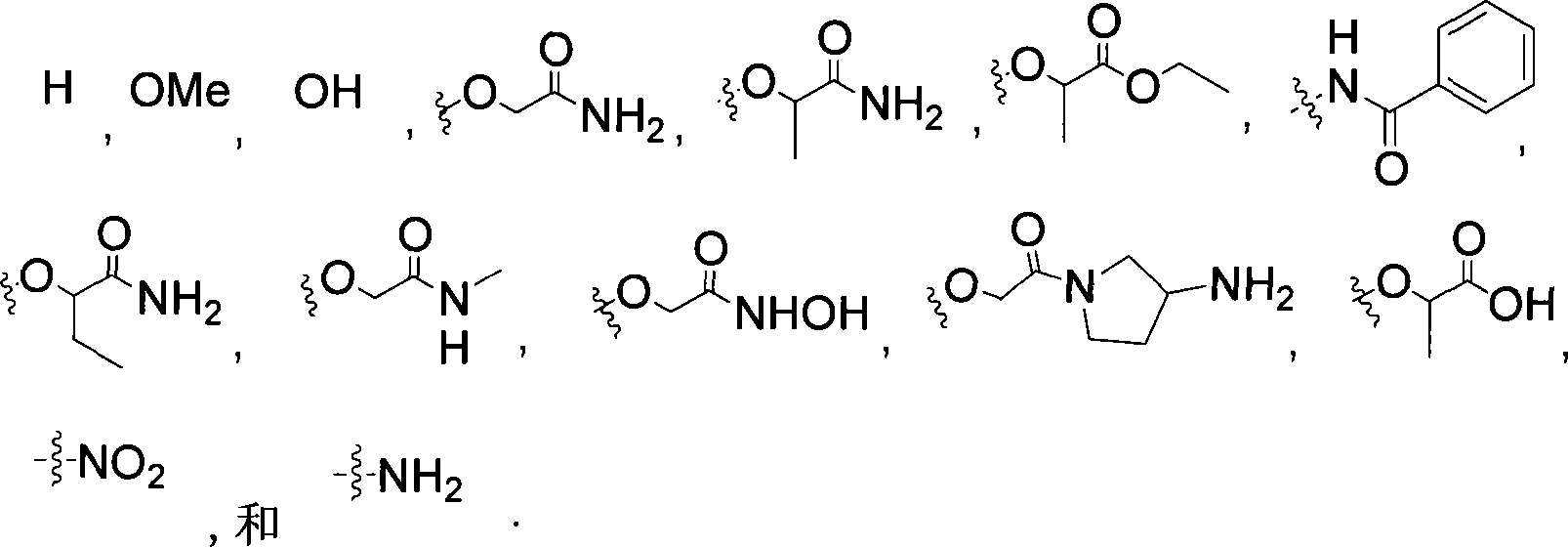
在一个优选实施方式中,本发明涉及式I的化合物,其中R1选自:In a preferred embodiment, the present invention relates to compounds of formula I, wherein R is selected from:

在另一个优选实施方式中,本发明涉及式I的化合物,其中R2选自:In another preferred embodiment, the present invention relates to compounds of formula I, wherein R is selected from:
在另一个优选实施方式中,本发明涉及选自以下的式I的化合物:In another preferred embodiment, the present invention relates to compounds of formula I selected from:

其中R1和R2与上述定义相同,R7选自:Wherein R 1 and R 2 are the same as defined above, R 7 is selected from:

在一个具体实施方式中,本发明的化合物选自:In a specific embodiment, the compound of the invention is selected from:

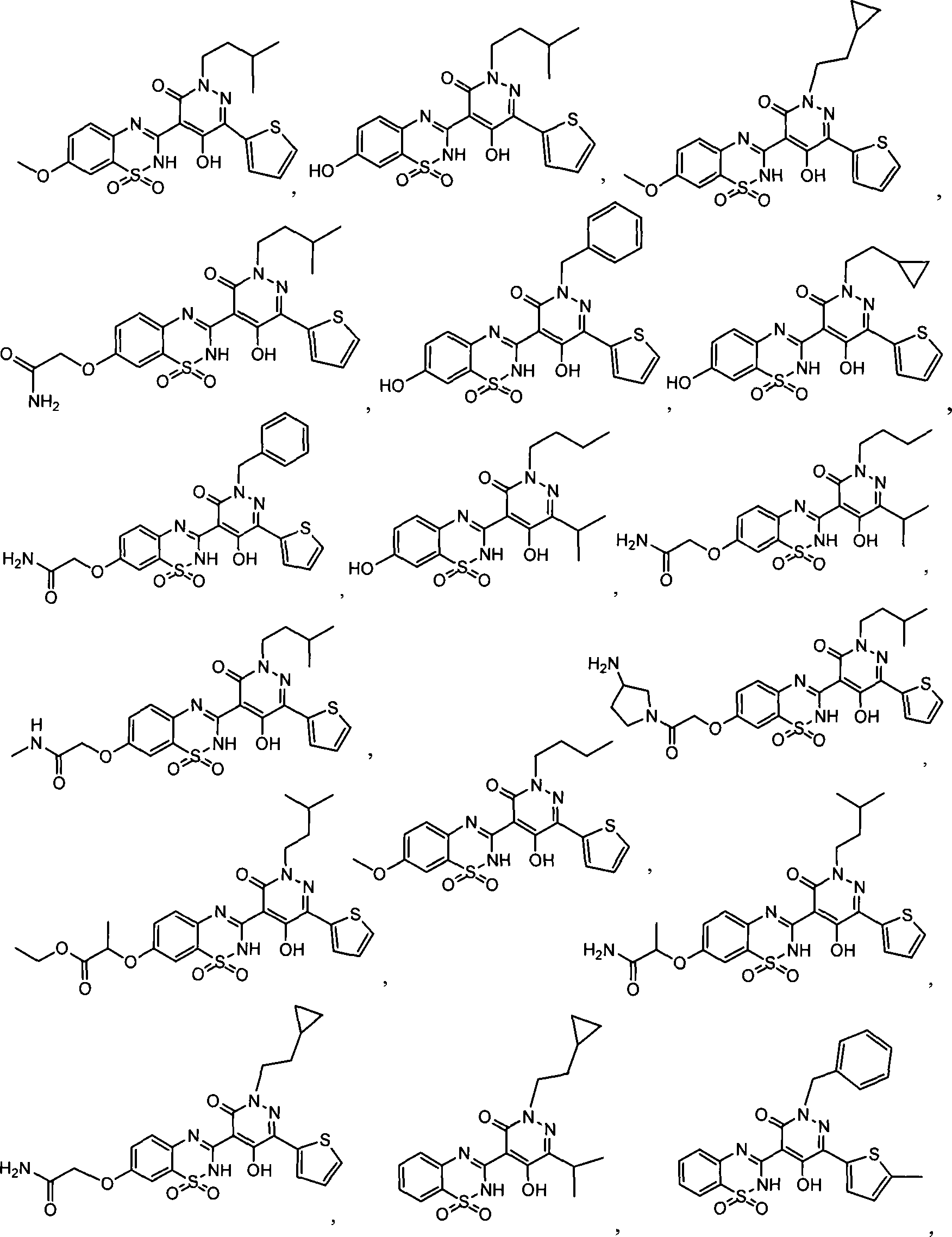
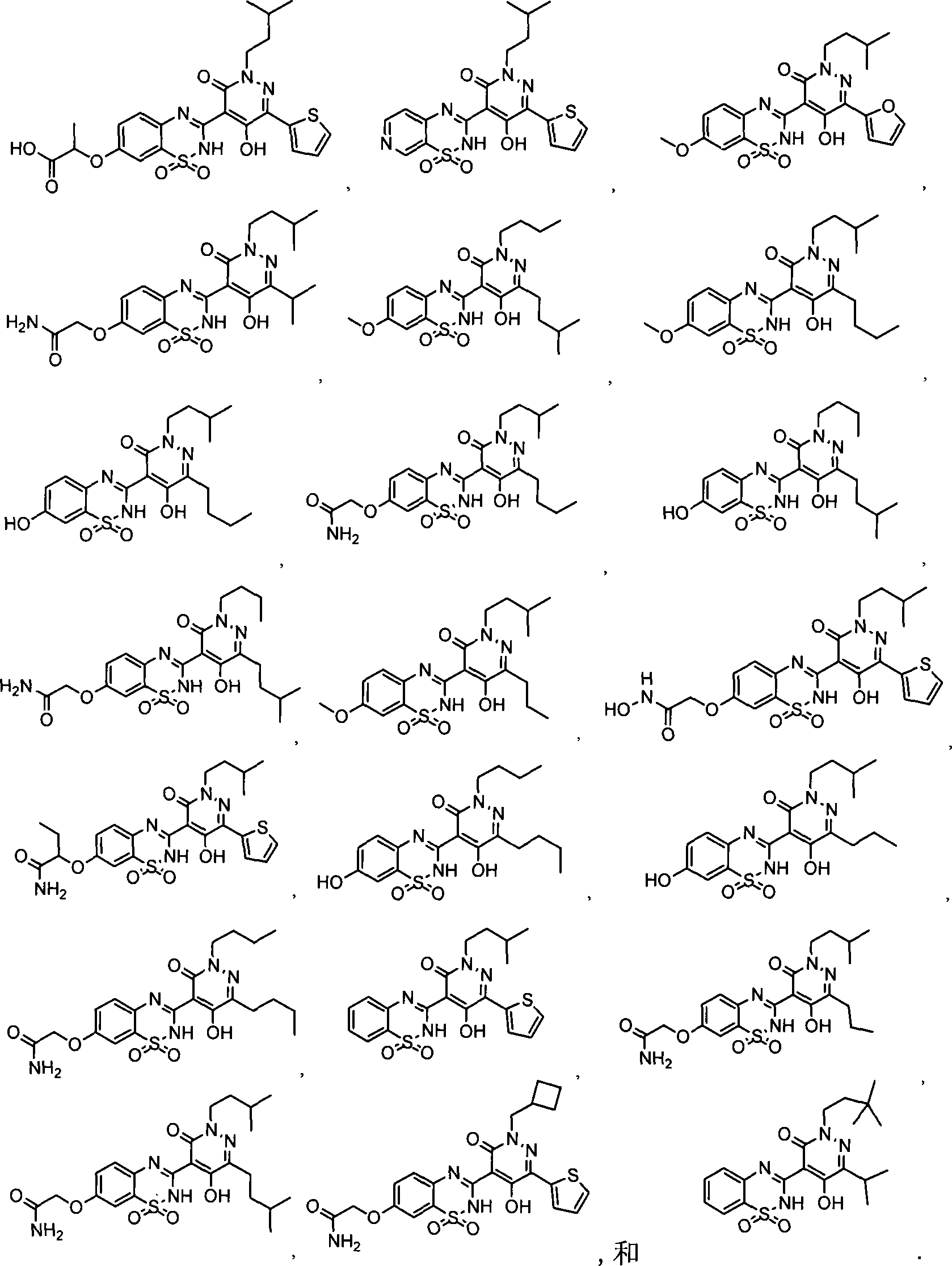
在一个更优选的实施方式中,本发明涉及式I的化合物,其中R2选自:In a more preferred embodiment, the present invention relates to compounds of formula I, wherein R is selected from:

在另一个更优选的实施方式中,本发明涉及式II的化合物:In another more preferred embodiment, the present invention relates to compounds of formula II:

其中R1和R2与上述定义相同,R7选自:Wherein R 1 and R 2 are the same as defined above, R 7 is selected from:
本发明还涉及式I的化合物、前药或代谢物的药学上可接受的前药,药物活性代谢物,药学上可接受的盐以及药学上可接受的溶剂合物。还描述了制造式I的化合物的有利方法。The present invention also relates to pharmaceutically acceptable prodrugs, pharmaceutically active metabolites, pharmaceutically acceptable salts and pharmaceutically acceptable solvates of compounds of formula I, prodrugs or metabolites. Advantageous methods for the manufacture of compounds of formula I are also described.
在一个方面,本发明包括用于在有此需要的哺乳动物(优选是需要治疗的人类)中治疗或预防丙肝病毒感染的方法,包括给予患者治疗或预防有效量的式I的化合物。在一个实施方式中,本发明包括通过给予有此需要的患者治疗或预防有效量的式I的化合物(是HCV NS5B聚合酶抑制剂)来治疗或预防丙肝病毒感染的方法。In one aspect, the invention includes a method for treating or preventing hepatitis C virus infection in a mammal in need thereof, preferably a human in need thereof, comprising administering to the patient a therapeutically or prophylactically effective amount of a compound of formula I. In one embodiment, the present invention includes a method of treating or preventing hepatitis C virus infection by administering to a patient in need thereof a therapeutically or prophylactically effective amount of a compound of formula I which is an HCV NS5B polymerase inhibitor.
在另一方面,本发明包括用于在有此需要的患者中治疗或预防丙肝病毒感染的方法,包括给予患者治疗或预防有效量的式I的化合物和药学上可接受的赋形剂、运载体或载体。In another aspect, the present invention includes a method for treating or preventing hepatitis C virus infection in a patient in need thereof, comprising administering to the patient a compound of formula I effective for treatment or prevention and a pharmaceutically acceptable excipient, which carrier or carrier.
在另一方面,本发明包括用于在有此需要的患者中治疗或预防丙肝病毒感染的方法,包括给予患者治疗或预防有效量的式I的化合物和另外的治疗剂,优选另外的抗病毒剂或免疫调节剂。In another aspect, the present invention includes a method for treating or preventing hepatitis C virus infection in a patient in need thereof, comprising administering to the patient a therapeutically or prophylactically effective amount of a compound of formula I and an additional therapeutic agent, preferably an additional antiviral agent Toxins or immunomodulators.
发明详述和优选实施方式DETAILED DESCRIPTION OF THE INVENTION AND PREFERRED EMBODIMENTS
当下列术语在本文使用时,它们如下所定义:When the following terms are used herein, they are defined as follows:
其中使用的术语“包含”“具有”和“包括”,表达开放,非限制性的意思。The terms "comprising", "having" and "including" are used in an open, non-limiting sense.
在本文中,除非另有说明,术语“烷基”包括具有直链、支链或环状部分(包括稠合和桥接的双环以及螺环部分)或前述部分的组合的饱和一价烃基。对于含有环状部分的烷基,该基团必需含有至少3个碳原子。As used herein, unless otherwise stated, the term "alkyl" includes saturated monovalent hydrocarbon groups having linear, branched or cyclic moieties (including fused and bridged bicyclic and spiro moieties) or combinations of the foregoing. For alkyl groups containing cyclic moieties, the group must contain at least 3 carbon atoms.
在本文中,除非另有说明,术语“链烯基”包括具有至少一个碳-碳双键的烷基部分,其中烷基如上所定义,包括所述链烯基部分的E和Z异构体。As used herein, unless otherwise stated, the term "alkenyl" includes an alkyl moiety having at least one carbon-carbon double bond, wherein alkyl is as defined above, including E and Z isomers of said alkenyl moiety .
在本文中,除非另有说明,术语“炔基”包括具有至少一个碳-碳三键的烷基部分,其中烷基如上所定义。As used herein, unless otherwise stated, the term "alkynyl" includes alkyl moieties having at least one carbon-carbon triple bond, wherein alkyl is as defined above.
在本文中,除非另有说明,术语“烷氧基”,包括O-烷基,其中烷基如上所定义。As used herein, unless otherwise stated, the term "alkoxy" includes O-alkyl, wherein alkyl is as defined above.
术语“Me”指甲基,“Et”指乙基,“Ac”指乙酰基。The term "Me" means methyl, "Et" means ethyl, and "Ac" means acetyl.
在本文中,除非另有说明,术语“环烷基”指非芳族、饱和或部分饱和的,单环或稠合的,螺或非稠合的双环或三环的本文所述的烃类,该烃类共含有3-10个碳原子,优选5-8个环碳原子。示例性环烷基包括3-7个、优选3-6个碳原子的单环,如环丙基,环丁基,环戊基,环己基,环庚基等。环烷基的说明性例子来自,但不限于,下列基团:As used herein, unless otherwise stated, the term "cycloalkyl" refers to non-aromatic, saturated or partially saturated, monocyclic or fused, spiro or non-fused bicyclic or tricyclic hydrocarbons described herein , the hydrocarbons contain a total of 3-10 carbon atoms, preferably 5-8 ring carbon atoms. Exemplary cycloalkyl groups include monocyclic rings of 3-7, preferably 3-6 carbon atoms, such as cyclopropyl, cyclobutyl, cyclopentyl, cyclohexyl, cycloheptyl and the like. Illustrative examples of cycloalkyl groups are derived from, but are not limited to, the following groups:
本文使用的术语“芳基”,除非另有说明,包括通过除去芳烃中的一个氢得到的有机基团,如苯基或萘基。As used herein, unless otherwise stated, the term "aryl" includes organic radicals obtained by removing one hydrogen from an arene, such as phenyl or naphthyl.
本文使用的术语“杂环或杂环基”除非另作说明,包括含有1-4个各自选自O、S和N的杂原子的芳族(如杂芳基)和非芳族杂环基团,其中每个杂环基团的环体系中有4-10个原子,条件是,所述基团的环不含有两个相邻的O原子。非芳杂环基团包括环体系中仅有3个原子的基团,但芳族杂环基团在其环体系中必须有至少5个原子。杂环基团包括苯并稠合环体系。4元杂环基团的例子是氮杂环丁基(衍生自氮杂环丁烷)。5元杂环基团的例子是噻唑基,10元杂环基团的例子是喹啉基。非芳族杂环基团的例子是吡咯烷基、四氢呋喃基、二氢呋喃基、四氢噻吩基、四氢吡喃基、二氢吡喃基、四氢硫代吡喃基、哌啶子基、吗啉代、硫代吗啉代、噻噁烷基、哌嗪基、氮杂环丁基、氧杂环丁基、硫杂环丁基、高哌啶基、氧杂环庚基、硫杂环庚基、氧杂吖庚因基(oxazepinyl)、二氮杂基、硫杂吖庚因基(thiazepinyl)、1,2,3,6-四氢吡啶基、2-吡咯烷基、3-吡咯烷基、二氢吲哚基、2H-吡喃基、4H-吡喃基、二噁烷基、1,3-二氧戊环基、吡唑啉基、二硫杂烷基、二硫杂戊环基、二氢吡喃基、二氢噻吩基、二氢呋喃基、吡唑烷基、咪唑啉基、咪唑烷基、3-氮杂双环[3.1.0]己基、3-氮杂双环[4.1.0]庚基、3H-吲哚基和喹嗪基。芳杂环基团的例子是吡啶基、咪唑基、嘧啶基、吡唑基、三唑基、吡嗪基、四唑基、呋喃基、噻吩基、异噁唑基、噻唑基、噁唑基、异噻唑基、吡咯基、喹啉基、异喹啉基、吲哚基、苯并咪唑基、苯并呋喃基、肉啉基、吲唑基、中氮茚基、酞嗪基、哒嗪基、三嗪基、异吲哚基、蝶啶基、嘌呤基、噁二唑基、噻二唑基、呋咱基、苯并呋咱基(benzofurazanyl)、苯并噻吩基、苯并噻唑基、苯并噁唑基、喹唑啉基、喹喔啉基、1,5-二氮杂萘基和呋喃并吡啶基(furopyridinyl)。衍生自上列基团的前述基团可为C-连接的或N-连接的。例如,衍生自吡咯的基团可为吡咯-1-基(N-连接的)或吡咯-3-基(C-连接的)。此外,衍生自咪唑的基团可为咪唑-1-基(N-连接的)或咪唑-3-基(C-连接的)。每个4-10元杂环在任何环中的碳、硫或氮原子上可任选地被1-2个氧代所取代。2个环中碳原子被氧代取代的杂环基团的例子是1,1-二氧代-硫代吗啉基。其它示例性的4-10元杂环来自,但不限于,下列分子:As used herein, the term "heterocycle or heterocyclyl" unless otherwise stated, includes aromatic (eg heteroaryl) and non-aromatic heterocyclic radicals containing 1 to 4 heteroatoms each selected from O, S and N Groups wherein each heterocyclic group has 4-10 atoms in the ring system, provided that the ring of said group does not contain two adjacent O atoms. Non-aromatic heterocyclic groups include groups having only 3 atoms in the ring system, but aromatic heterocyclic groups must have at least 5 atoms in their ring system. Heterocyclic groups include benzofused ring systems. An example of a 4 membered heterocyclic group is azetidinyl (derived from azetidine). An example of a 5-membered heterocyclic group is thiazolyl, and an example of a 10-membered heterocyclic group is quinolinyl. Examples of non-aromatic heterocyclic groups are pyrrolidinyl, tetrahydrofuryl, dihydrofuryl, tetrahydrothiophenyl, tetrahydropyranyl, dihydropyranyl, tetrahydrothiopyranyl, piperidinyl morpholino, thiomorpholino, thioxanyl, piperazinyl, azetidinyl, oxetanyl, thietanyl, homopiperidyl, oxepyl, Thiepanyl, oxazepinyl, diazepinyl, thiazepinyl, 1,2,3,6-tetrahydropyridyl, 2-pyrrolidinyl , 3-pyrrolidinyl, indolinyl, 2H-pyranyl, 4H-pyranyl, dioxanyl, 1,3-dioxolanyl, pyrazolinyl, dithialkyl , dithiolanyl, dihydropyranyl, dihydrothienyl, dihydrofuryl, pyrazolidinyl, imidazolinyl, imidazolidinyl, 3-azabicyclo[3.1.0]hexyl, 3 - azabicyclo[4.1.0]heptyl, 3H-indolyl and quinozinyl. Examples of aromatic heterocyclic groups are pyridyl, imidazolyl, pyrimidinyl, pyrazolyl, triazolyl, pyrazinyl, tetrazolyl, furyl, thienyl, isoxazolyl, thiazolyl, oxazolyl , Isothiazolyl, Pyrrolyl, Quinolinyl, Isoquinolyl, Indolyl, Benzimidazolyl, Benzofuryl, Cinnolinyl, Indazolyl, Indolizyl, Phthalazinyl, Pyridazine Base, triazinyl, isoindolyl, pteridinyl, purinyl, oxadiazolyl, thiadiazolyl, furazanyl, benzofurazanyl (benzofurazanyl), benzothienyl, benzothiazolyl , benzoxazolyl, quinazolinyl, quinoxalinyl, 1,5-diazanaphthyl and furopyridinyl (furopyridinyl). The foregoing groups derived from the groups listed above may be C-attached or N-attached. For example, a group derived from pyrrole may be pyrrol-1-yl (N-attached) or pyrrol-3-yl (C-attached). Furthermore, a group derived from imidazole may be imidazol-1-yl (N-attached) or imidazol-3-yl (C-attached). Each 4-10 membered heterocycle is optionally substituted with 1-2 oxo on any ring carbon, sulfur or nitrogen atom. An example of a heterocyclic group in which two ring carbon atoms are substituted by oxo is 1,1-dioxo-thiomorpholinyl. Other exemplary 4-10 membered heterocycles are derived from, but are not limited to, the following molecules:


和and
术语“免疫调节剂”指能通过刺激或抑制来改变正常或异常的免疫系统的天然或合成产品。The term "immunomodulator" refers to natural or synthetic products that alter the normal or abnormal immune system by stimulation or suppression.
术语“预防”指本发明的化合物或组合物预防被诊断出患有疾病或具有患有疾病危险的病人的疾病的能力。该术语也涵盖了预防已经具有这类疾病症状的病人疾病进一步发展。The term "prevention" refers to the ability of a compound or composition of the invention to prevent a disease in a patient diagnosed with or at risk of having a disease. The term also covers the prevention of further disease progression in patients already having symptoms of such disease.
术语“病人”或“对象”表示动物(如牛、马、羊、猪、鸡、火鸡、鹌鹑、猫、狗、小鼠、大鼠、兔、豚鼠等)或哺乳动物,包括杂交和转基因动物和哺乳动物。在治疗或预防HCV感染中,术语“病人”或“对象”优选地表示猴子或人,最好是人。在一个特定的实施方案中,病人或对象被丙肝病毒感染或暴露于丙肝病毒。在特定的实施方案中,病人是婴孩(0-2岁)、儿童(2-17岁)、青春期(12-17岁)、成人(18岁及以上)或老人(70岁及以上)的病人。另外,病人包括免疫受损的(immunocompromised)病人,如HIV阳性病人、癌症病人、经受免疫疗法或化疗的病人。在特定的实施方案中,病人是健康个体,即没有显示出其它病毒感染的症状。The term "patient" or "subject" means an animal (such as cattle, horses, sheep, pigs, chickens, turkeys, quails, cats, dogs, mice, rats, rabbits, guinea pigs, etc.) or mammals, including hybrids and transgenic animals and mammals. In the treatment or prevention of HCV infection, the term "patient" or "subject" preferably means a monkey or a human, most preferably a human. In a specific embodiment, the patient or subject is infected with or exposed to hepatitis C virus. In specific embodiments, the patient is an infant (0-2 years), a child (2-17 years), an adolescent (12-17 years), an adult (18 years and over) or a geriatric (70 years and over) patient . Additionally, patients include immunocompromised patients, such as HIV positive patients, cancer patients, patients undergoing immunotherapy or chemotherapy. In a specific embodiment, a patient is a healthy individual, ie, does not display symptoms of other viral infections.
术语“治疗有效量”指足以能治疗或预防病毒疾病,延缓与病毒感染有关的症状或病毒引起的疾病,或使其最小化,或者治愈或缓解疾病或感染或其病因的本发明化合物的用量。特别是,治疗有效量表示体内足以产生治疗益处的量。与一定量本发明化合物的使用有关,该术语优选地涵盖改进总的疗效,减少或避免疾病的症状或病因,或者增加另一种治疗剂的治疗效应或与另一种治疗剂产生协同作用的无毒性的用量。The term "therapeutically effective amount" refers to an amount of a compound of the present invention sufficient to treat or prevent a viral disease, delay or minimize symptoms associated with a viral infection or virus-induced disease, or cure or alleviate a disease or infection or its cause . In particular, a therapeutically effective amount means an amount in vivo sufficient to produce a therapeutic benefit. In connection with the use of a certain amount of a compound of the invention, the term preferably covers improving the overall therapeutic effect, reducing or avoiding the symptoms or causes of the disease, or increasing the therapeutic effect of another therapeutic agent or producing a synergistic effect with another therapeutic agent. Non-toxic amounts.
术语“预防有效量”指本发明的化合物或其它活性组分足以预防感染、病毒感染的复发或传播的用量。预防有效量可指足以预防原发性感染或感染的复发或传播或与感染有关的疾病的量。与一定量的本发明化合物的使用有关,该术语优选地涵盖改进总的预防,或者增加另一种预防剂或治疗剂的预防效应或与另一种预防剂或治疗剂产生协同作用的无毒性的用量。The term "prophylactically effective amount" refers to an amount of a compound of the present invention or other active ingredient sufficient to prevent infection, recurrence or spread of viral infection. A prophylactically effective amount may refer to an amount sufficient to prevent a primary infection or the recurrence or spread of an infection or a disease associated with an infection. In relation to the use of a certain amount of a compound of the present invention, the term preferably covers non-toxic effects that improve the overall prophylaxis, or increase the prophylactic effect of another prophylactic or therapeutic agent or produce a synergistic effect with another prophylactic or therapeutic agent dosage.
术语“组合”指同时或相继使用一种以上的预防剂和/或治疗剂,使其各自产生的作用为加合的或协同的。The term "combination" refers to the simultaneous or sequential use of more than one prophylactic and/or therapeutic agent so that their respective effects are additive or synergistic.
术语“治疗”指:The term "treatment" means:
(i)预防疾病、失调或病情在偏向于可能发生该疾病、失调或病情、但尚没有诊断出已患有的动物中发生;(i) preventing a disease, disorder or condition from occurring in animals that are predisposed to develop the disease, disorder or condition but have not been diagnosed with it;
(ii)抑制疾病、失调或病情,即阻止其发展;和(ii) inhibit the disease, disorder or condition, i.e. prevent its development; and
(iii)缓解疾病、失调或病情,即,使疾病、失调和/或病情消退。(iii) Alleviating a disease, disorder or condition, ie causing regression of the disease, disorder and/or condition.
术语“α”和“β”指图示的化学结构中不对称碳原子上的取代基的特定立体化学构型。The terms "α" and "β" refer to the specific stereochemical configuration of substituents on asymmetric carbon atoms in the illustrated chemical structures.
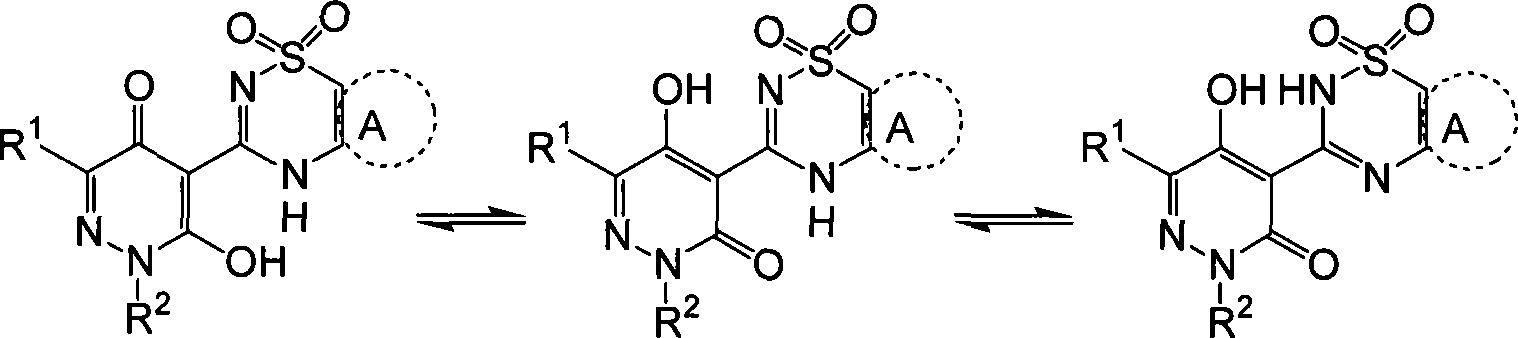
本发明化合物可显示出互变现象。虽然式I不能显示出所有可能的互变形式,应当明白,式I趋向于代表所示的化合物所有的互变形式,不仅仅限于图示的结构式。为了说明,不限制互变体的范围,式I的化合物可能以下列形式存在:Compounds of the invention may exhibit tautoconversion. While Formula I cannot show all possible tautomeric forms, it should be understood that Formula I is intended to represent all tautomeric forms of the compounds shown and is not limited to the structural formulas shown. To illustrate, without limiting the scope of tautomerism, compounds of formula I may exist in the following forms:
一些本发明的化合物可能存在单一的立体异构体(即基本上不含其它立体异构体)、消旋体和/或对映异构体和/或非对映异构体的混合物。所有的这类单一立体异构体、消旋体和其混合物都在本发明的范围里。优选的是,光学活性的本发明化合物以光学纯形式使用。Some of the compounds of the present invention may exist as single stereoisomers (ie, substantially free of other stereoisomers), racemates and/or mixtures of enantiomers and/or diastereomers. All such single stereoisomers, racemates and mixtures thereof are within the scope of the present invention. Preferably, the optically active compounds of the invention are used in optically pure form.
所属技术领域的技术人员都知道,有一个手性中心(即,一个不对称碳原子)的光学纯化合物是主要由两个可能的对映异构体中的一个构成的(即为对映异构体纯的),有一个以上手性中心的光学纯的化合物同时是非对映体纯的和对映体纯的化合物。优选的是,所用的本发明化合物为至少90%光学纯的,即它含有至少90%单一异构体(80%对映体过量(“e.e.”)或非对映体过量(“d.e.”))的形式,更佳的是至少95%单一异构体(90%e.e.或d.e.),更佳的是至少97.5%单一异构体(95%e.e.或d.e.)),最佳是至少99%的单一异构体(98%e.e.或d.e.)。Those skilled in the art know that optically pure compounds having a chiral center (i.e., an asymmetric carbon atom) consist primarily of one of two possible enantiomers (i.e., enantiomers). Conformational pure), optically pure compounds with more than one chiral center are both diastereomeric and enantiomerically pure compounds. Preferably, the compound of the invention employed is at least 90% optically pure, i.e. it contains at least 90% of a single isomer (80% enantiomeric excess ("e.e.") or diastereomeric excess ("d.e.") ), more preferably at least 95% of a single isomer (90% e.e. or d.e.), more preferably at least 97.5% of a single isomer (95% e.e. or d.e.)), most preferably at least 99% of Single isomer (98% e.e. or d.e.).
另外,式I趋向于包括所示结构的溶剂化形式和非溶剂化形式。例如,式I包括水合和非水合形式的化合物结构。溶剂合物的其它例子包括与异丙醇、乙醇、甲醇、DMSO、乙酸乙酯、乙酸或乙醇胺组合的结构。Additionally, Formula I is intended to include both solvated and unsolvated forms of the structures shown. For example, Formula I includes both hydrated and non-hydrated forms of compound structures. Other examples of solvates include structures in combination with isopropanol, ethanol, methanol, DMSO, ethyl acetate, acetic acid, or ethanolamine.
除了式I化合物外,本发明还包括这类化合物和代谢物的药学上可接受的前药、药物活性代谢物和药学上可接受的盐。In addition to the compounds of formula I, the present invention also includes pharmaceutically acceptable prodrugs, pharmaceutically active metabolites and pharmaceutically acceptable salts of such compounds and metabolites.
“药学上可接受的前药”是在展示其生理效应前,在生理条件下可被转化、或被溶剂分解为特定化合物或这类化合物的药学上可接受的盐的化合物。典型的是,配制前药的目的是改善化学稳定性、改善病人可接受性和顺应性、改善生物利用度、延长作用时间、改善器官的选择性、改善制剂(如提高水溶性)和/或降低副作用(如毒性)。用现有技术中已知的方法,如Burger′s MedicinalChemistry and Drug Chemistry,1,172-178,949-982(1995)容易地从式I化合物中制备前药。也可参见Bertolini等,J.Med.Chem.,40,2011-2016(1997);Shan等,J.Pharm.Sci.,86(7),765-767;Bagshawe,Drug Dev.Res.,34,220-230(1995);Bodor,Advances in Drug Res.,13,224-331(1984);Bundgaard,前药的设计(Design of Prodrugs)(Elsevier Press1985);Larsen,前药的设计和应用,药物设计和开发(Design and Application of Prodrugs,Drug Design andDevelopment)(Krogsgaard-Larsen等,主编,Harwood Academic Publishers,1991);Dear等,J.Chromatogr.B,748,281-293(2000);Spraul等,J.Pharmaceutical & Biomedical Analysis,10,601-605(1992);以及Prox等,Xenobiol.,3,103-112(1992)揭示的方法。A "pharmaceutically acceptable prodrug" is a compound that can be converted, or solvolyzed, under physiological conditions into the specified compound or a pharmaceutically acceptable salt of such a compound before exhibiting its physiological effect. Typically, prodrugs are formulated to improve chemical stability, improve patient acceptability and compliance, improve bioavailability, prolong duration of action, improve organ selectivity, improve formulation (e.g., increase water solubility), and/or Reduce side effects (such as toxicity). Prodrugs are readily prepared from compounds of formula I by methods known in the art, such as Burger's Medicinal Chemistry and Drug Chemistry, 1, 172-178, 949-982 (1995). See also Bertolini et al., J. Med. Chem., 40, 2011-2016 (1997); Shan et al., J. Pharm. Sci., 86(7), 765-767; Bagshawe, Drug Dev. Res., 34 , 220-230(1995); Bodor, Advances in Drug Res., 13, 224-331(1984); Bundgaard, The Design of Prodrugs (Design of Prodrugs) (Elsevier Press1985); Larsen, The Design and Application of Prodrugs, Drug Design and Development (Design and Application of Prodrugs, Drug Design and Development) (Krogsgaard-Larsen et al., editors, Harwood Academic Publishers, 1991); Dear et al., J.Chromatogr.B, 748, 281-293 (2000); Spraul et al. , J.Pharmaceutical & Biomedical Analysis, 10, 601-605 (1992); and the method disclosed by Prox et al., Xenobiol., 3, 103-112 (1992).
“药物活性代谢物”表示一种特定的化合物或其盐在体内通过代谢后产生的药理活性产物。进入体内后,大多数药物是化学反应的底物,这些反应会改变其物理性质和生物效应。这些代谢转变常常会影响式I化合物的极性,改变药物在体内的分布和排泄方式。但是,在一些情况下,药物的代谢对于治疗效应来说是需要的。例如,抗代谢类的抗癌药在其转运到癌细胞后必须转化成它们的活性形式。"Pharmaceutically active metabolite" refers to a pharmacologically active product produced after metabolism of a specific compound or its salt in the body. Once inside the body, most drugs are substrates for chemical reactions that alter their physical properties and biological effects. These metabolic changes often affect the polarity of the compound of formula I, changing the distribution and excretion of the drug in the body. However, in some cases, metabolism of the drug is required for therapeutic effect. For example, anti-cancer drugs of the antimetabolite class must be converted into their active forms after their transport into cancer cells.
由于大多数药物进行一些种类的代谢转化,在药物代谢中起作用的生化反应可能很多且是不同的。药物代谢的主要位点是肝脏,但其它器官也会参与。Since most drugs undergo some sort of metabolic transformation, the biochemical reactions at play in drug metabolism can be numerous and varied. The primary site of drug metabolism is the liver, but other organs are also involved.
这些转化的许多特征中的一个特征是代谢产物或“代谢物”比母体药物的极性更大,但极性药物有时也会得到极性更小的产品。具有高的脂/水分配系数的物质很容易地通过膜,也能容易地从管状尿道通过肾小管细胞扩散返回进入血浆。因此,这类物质趋向于有低的肾廓清率,在体内持续时间长。若药物被代谢成极性更大的化合物,其分配系数更低,它的管内再吸收会大大减少。此外,在近肾小管里和在肝实质细胞中对阳离子和阴离子特定的分泌机制对高极性物质起作用。One of the many hallmarks of these transformations is that metabolites, or "metabolites," are more polar than the parent drug, but polar drugs sometimes also give less polar products. Substances with a high lipid/water partition coefficient readily pass through the membrane and also readily diffuse from the tubular urethra through the tubular cells back into the plasma. Thus, such substances tend to have low renal clearance and long persistence in the body. If the drug is metabolized to a more polar compound with a lower partition coefficient, its intraductal reabsorption is greatly reduced. In addition, specific secretion mechanisms for cations and anions in proximal tubules and in hepatic parenchymal cells act on highly polar substances.
作为特定的例子,非那西丁(acetophenetidin)和乙酰苯胺(acetanilide)都是温和的止痛剂和退热剂,但是在体内转化为极性更大、更为有效的代谢物,对-羟基乙酰苯胺(对乙酰氨基酚,acetaminophen),这在当今被广泛使用。当对人给予一剂乙酰苯胺时,血浆中相继出现代谢物的峰值和消失(decay)。第一小时中,乙酰苯胺为主要的血浆成份。第二小时中,随着乙酰苯胺的水平降落,代谢物对乙酰氨基酚浓度达到峰值。最终,数小时后,主要的血浆组分是惰性的进一步的代谢物,它可从体内排泄出去。这样,一种或多种代谢物的血药水平,以及药物本身的血药水平可能在药理学上是很重要的。As specific examples, acetophenetidin and acetanilide are both mild analgesics and antipyretics, but are converted in the body to the more polar and more potent metabolite, p-hydroxyacetyl Aniline (acetaminophen, acetaminophen), which is widely used today. When a dose of acetanilide is administered to humans, there is a sequential peak and decay of metabolites in plasma. During the first hour, acetanilide was the main plasma component. During the second hour, the concentration of the metabolite acetaminophen peaked as the level of acetanilide decreased. Ultimately, after several hours, the main plasma component is the inert further metabolites, which are excreted from the body. Thus, blood levels of one or more metabolites, as well as blood levels of the drug itself, may be pharmacologically important.
“药学上可接受的盐”指保留了特定化合物游离酸和碱的生物效应且不是生物学或其它方面不利的盐。本发明的化合物可能具有足够的酸性、足够的碱性或两者兼具的官能团,因此,可与许多无机或有机碱、无机酸和有机酸反应,形成药学上可接受的盐。药学上可接受的盐的例子包括使本发明化合物与无机酸或有机酸或无机碱反应制备的盐,如硫酸盐、焦硫酸盐、硫酸氢盐、亚硫酸盐、亚硫酸氢盐、磷酸盐、磷酸一氢盐、磷酸二氢盐、偏磷酸盐、焦磷酸盐、氯化物、溴化物、碘化物、乙酸盐、丙酸盐、癸酸盐、辛酸盐、丙烯酸盐、甲酸盐、异丁酸盐、己酸盐、庚酸盐、丙炔酸盐、草酸盐、丙二酸盐、琥珀酸盐、辛二酸盐、癸二酸盐、富马酸盐、马来酸盐、丁炔-1,4-二酸盐、己炔-1,6-二酸盐、苯甲酸盐、氯苯甲酸盐、甲基苯甲酸盐、二硝基苯甲酸盐、羟基苯甲酸盐、甲氧基苯甲酸盐、邻苯二甲酸盐、磺酸盐、二甲苯磺酸盐、苯基乙酸盐、苯基丙酸盐、苯基丁酸盐、柠檬酸盐、乳酸盐、γ-羟基丁酸盐、乙醇酸盐、酒石酸盐、甲磺酸盐、丙磺酸盐、萘-1-磺酸盐、萘-2-磺酸盐和扁桃酸盐。"Pharmaceutically acceptable salts" refers to salts that retain the biological effects of the free acids and bases of the specified compound and are not biologically or otherwise unfavorable. The compounds of the present invention may have functional groups sufficiently acidic, sufficiently basic, or both, to react with many inorganic or organic bases, inorganic acids, and organic acids to form pharmaceutically acceptable salts. Examples of pharmaceutically acceptable salts include salts prepared by reacting the compound of the present invention with an inorganic acid or an organic acid or an inorganic base, such as sulfate, pyrosulfate, bisulfate, sulfite, bisulfite, phosphate , monohydrogen phosphate, dihydrogen phosphate, metaphosphate, pyrophosphate, chloride, bromide, iodide, acetate, propionate, caprate, caprylate, acrylate, formate , isobutyrate, caproate, heptanoate, propiolate, oxalate, malonate, succinate, suberate, sebacate, fumarate, maleate salt, butyne-1,4-dioate, hexyne-1,6-dioate, benzoate, chlorobenzoate, methylbenzoate, dinitrobenzoate, Paraben, Methoxybenzoate, Phthalate, Sulfonate, Xylene Sulfonate, Phenylacetate, Phenylpropionate, Phenylbutyrate, Lemon salt, lactate, gamma-hydroxybutyrate, glycolate, tartrate, methanesulfonate, propanesulfonate, naphthalene-1-sulfonate, naphthalene-2-sulfonate and mandelate .
若发明化合物是碱,所需的药学上可接受的盐可通过现有技术中任何合适的方法制备,例如,用无机酸,如盐酸、氢溴酸、硫酸、硝酸、磷酸等,或用有机酸,如乙酸、马来酸、琥珀酸、扁桃酸、富马酸、丙二酸、丙酮酸、草酸、乙醇酸、水杨酸,吡喃糖苷酸(pyranosidyl acid),如葡糖醛酸或半乳糖醛酸,α-羟基酸,如柠檬酸或酒石酸,氨基酸,如天门冬氨酸或谷氨酸,芳族酸,如苯甲酸或肉桂酸,磺酸,如对甲苯磺酸或乙磺酸等处理游离碱来制备。If the compound of the invention is a base, the desired pharmaceutically acceptable salt can be prepared by any suitable method in the art, for example, with inorganic acids such as hydrochloric acid, hydrobromic acid, sulfuric acid, nitric acid, phosphoric acid, etc., or with organic Acids such as acetic acid, maleic acid, succinic acid, mandelic acid, fumaric acid, malonic acid, pyruvic acid, oxalic acid, glycolic acid, salicylic acid, pyranosidyl acids such as glucuronic acid or Galacturonic acid, alpha-hydroxy acids such as citric acid or tartaric acid, amino acids such as aspartic acid or glutamic acid, aromatic acids such as benzoic acid or cinnamic acid, sulfonic acids such as p-toluenesulfonic acid or ethanesulfonic acid It can be prepared by treating free base with acid etc.
若本发明化合物是一种酸,所需的药学上可接受的盐可通过任何合适的方法,例如用无机或有机碱处理游离酸制备,所述的碱例如为胺(伯、仲或叔),碱金属氢氧化物或碱土金属氢氧化物等。合适盐的例子包括衍生自氨基酸,如甘氨酸和精氨酸,氨,伯、仲或叔胺以及环胺,如哌啶、吗啉和哌嗪的有机盐,和衍生自钠、钙、钾、镁、锰、铁、铜、锌、铝和锂的无机盐。When the compound of the invention is an acid, the desired pharmaceutically acceptable salt can be prepared by any suitable method, for example by treating the free acid with an inorganic or organic base, such as an amine (primary, secondary or tertiary). , alkali metal hydroxide or alkaline earth metal hydroxide, etc. Examples of suitable salts include organic salts derived from amino acids such as glycine and arginine, ammonia, primary, secondary or tertiary amines and cyclic amines such as piperidine, morpholine and piperazine, and those derived from sodium, calcium, potassium, Inorganic salts of magnesium, manganese, iron, copper, zinc, aluminum and lithium.
对于固体试剂,所属技术领域的技术人员知道本发明的化合物和盐可存在不同的晶体或多形态形式,所有这些都在本发明和特定结构式的范围里。For solid reagents, those skilled in the art know that the compounds and salts of the invention may exist in different crystalline or polymorphic forms, all of which are within the scope of the invention and the specific formulae.
治疗和预防丙肝病毒感染的方法Methods of treating and preventing hepatitis C virus infection
本发明提供了在有此需要的病人中治疗或预防丙肝病毒感染的方法。The present invention provides methods of treating or preventing hepatitis C virus infection in a patient in need thereof.
本发明进一步提供了向治疗和/或预防丙肝病毒感染的病人的血流中引入治疗有效量的式I化合物或这类化合物的组合的方法。The present invention further provides a method of introducing a therapeutically effective amount of a compound of formula I or a combination of such compounds into the bloodstream of a patient for the treatment and/or prevention of hepatitis C virus infection.
本发明的式I化合物或其药学上可接受的盐、溶剂合物或水合物在急性或慢性治疗或预防感染中的预防或治疗剂量大小会随感染的性质和严重程度、给予活性组分的途径而改变。剂量,有时是给药频率也会根据被治疗的感染、个体病人的年龄、体重和反应而改变。合适的剂量方案可由所述领域的人员考虑这些因素而容易地决定。The preventive or therapeutic dose of the compound of formula I of the present invention or its pharmaceutically acceptable salt, solvate or hydrate in the acute or chronic treatment or prevention of infection will vary with the nature and severity of the infection, the dose of the active ingredient path changes. Dosage, and sometimes frequency of administration, will also vary depending on the infection being treated, the age, weight and response of the individual patient. Suitable dosage regimens can be readily determined by those in the art taking these factors into consideration.
本发明的方法特别适合于人类患者。具体来说,本发明的方法和剂量可用于免疫损伤病人,包括,但不限于,癌症病人、HIV感染病人和患有免疫退化疾病的病人。此外,这些方法可用于目前处于好转状态的免疫损伤病人。本发明的方法和剂量也可用于经受其它抗病毒治疗的病人。本发明的预防方法特别可用于处于病毒感染危险中的病人。这些病人包括,但不限于,健康护理工作人员,如,医生、护士、收容所护理人员;军事人员;教师;育儿工作者;旅行或居住在外国,特别是第三世界的病人,包括社会救助工作者,传教士和外交使节。最后,这些方法和组合物包括对难控制的病人或对治疗产生耐药性,如对逆转转录酶抑制剂、蛋白酶抑制剂等产生耐药性的病人的治疗。The methods of the invention are particularly suitable for human patients. In particular, the methods and dosages of the invention are useful in immunocompromised patients, including, but not limited to, cancer patients, HIV-infected patients, and patients with immunodegenerative diseases. In addition, these methods can be used in immunocompromised patients who are currently in remission. The methods and dosages of the invention may also be used in patients undergoing other antiviral therapies. The prophylactic method of the present invention is particularly useful for patients at risk of viral infection. These patients include, but are not limited to, health care workers such as doctors, nurses, hospice care workers; military personnel; teachers; child care workers; patients traveling or living in foreign countries, especially third world, including social assistance Workers, missionaries and diplomatic envoys. Finally, the methods and compositions include the treatment of refractory patients or patients who have developed resistance to therapy, such as reverse transcriptase inhibitors, protease inhibitors, and the like.
剂量dose
通过在细胞培养或试验动物中的标准药物过程来测定本发明化合物的毒性和效应,如测定LD50(50%种群死亡的剂量)和ED50(对50%种群治疗有效的剂量)。毒性和治疗效应的剂量比为治疗指数,表示为LD50/ED50。Toxicity and effects of compounds of the invention are determined by standard pharmaceutical procedures in cell culture or experimental animals, eg, determining the LD50 (the dose lethal to 50% of the population) and the ED50 (the dose therapeutically effective in 50% of the population). The dose ratio between toxic and therapeutic effects is the therapeutic index and is expressed as LD50 / ED50 .
从细胞培养分析和动物研究中得到的数据可用来决定用于人体的化合物的剂量。这类化合物的剂量优选的在包括几乎没有或没有毒性的ED50的分布浓度范围里。可以根据使用的剂型和给药途径在此范围里改变剂量。对于用于本发明方法的任何化合物,治疗有效剂量可从细胞培养分析中最初估算。可在动物模型中配制剂量以得到包括细胞培养中测定的IC50(即达到症状最大抑制的一半的试验化合物的浓度)的循环血药分布浓度(circulating plasma concertration)范围;或者,在动物模型中调配式I化合物的剂量,得到化合物的分布的循环血药浓度范围,使其与得到应答的固定大小所需的浓度一一对应。这类信息可以更准确地决定对人体有用的剂量。血药水平可通过,例如高效液相色谱进行测定。Data obtained from cell culture assays and animal studies can be used in determining the dose of the compound for use in humans. The dosage of such compounds lies preferably within a range of distributed concentrations that include the ED50 with little or no toxicity. The dosage may vary within this range depending upon the dosage form employed and the route of administration. For any compound used in the methods of the invention, the therapeutically effective dose can be estimated initially from cell culture assays. A dose can be formulated in animal models to achieve a circulating plasma concentration range that includes the IC50 (i.e., the concentration of test compound that achieves a half-maximal inhibition of symptoms) determined in cell culture; alternatively, in animal models Doses of compounds of formula I are formulated to obtain a distribution of circulating plasma concentration ranges of the compounds that correspond one-to-one to the concentrations required to obtain a fixed magnitude of response. Such information allows for more accurate determination of useful doses in humans. Blood levels can be determined, for example, by high performance liquid chromatography.
本发明的方案和组合物在给人体使用前优选地先对所需的治疗或预防活性进行体外试验,然后再进行体内试验。例如,体外分析可用来决定给予特定的治疗方案是否是需要的,体外分析包括体外细胞培养分析,其中对式I化合物有反应的细胞被暴露于配体,并通过合适的技术测量应答的大小。然后根据式I化合物效能和式I化合物前药的转化程度来评估式I化合物。用于本发明的化合物可在给人体试验前用合适的动物模型进行试验,所述的动物模型包括,但不限于,大鼠、小鼠、鸡、牛、猴子、兔子、仓鼠等。然后化合物可用于合适的临床试验。The regimens and compositions of the present invention are preferably tested in vitro for desired therapeutic or prophylactic activity and then in vivo before administration to humans. For example, in vitro assays, including in vitro cell culture assays, in which cells responsive to a compound of formula I are exposed to the ligand and the magnitude of the response is measured by a suitable technique, can be used to determine whether administration of a particular treatment regimen is warranted. Compounds of Formula I are then evaluated based on their potency and the degree of conversion of their prodrugs. The compounds used in the present invention can be tested with appropriate animal models, including, but not limited to, rats, mice, chickens, cows, monkeys, rabbits, hamsters, etc., before being tested on humans. The compounds can then be used in appropriate clinical trials.
本发明式I化合物或其药学上可接受的盐、溶剂合物或水合物的前药在急性或慢性治疗或预防感染或疾病的预防剂量或治疗剂量的大小会随感染的性质和严重程度、活性组分的给药途径等而改变。剂量,可能是给药频率也会随被治疗的感染、病人的年龄、体重和反应而改变。所属领域的技术人员可考虑这类因素容易地选择合适的剂量方案。在一个实施方案中,给予的剂量根据使用的特定化合物和病人的体重和病情而定。剂量也可根据不同的特定式I化合物而不同;合适的剂量可根据前述的体外测试基础和在动物研究的基础上来预测,结果在所述的系统或参照本文所引用的内容测量时显示出在较低浓度下有效的这些式I化合物可用较小的剂量。一般来说,每天的剂量范围为约0.001-100毫克/千克,优选的是约1-25毫克/千克,更好的是约5-15毫克/千克。对于治疗被丙肝病毒感染的人,使用约0.1-15毫克/天,每天分1-4次给药,优选的是100毫克/天到12克/天,最好是100-800毫克/天。The prodrug of the compound of formula I of the present invention or its pharmaceutically acceptable salt, solvate or hydrate in the acute or chronic treatment or prevention of infection or disease prophylactic dose or therapeutic dose will vary with the nature and severity of the infection, The route of administration of the active ingredient and the like may vary. Dosage, and possibly frequency of administration, will also vary with the infection being treated, the age, weight and response of the patient. Those skilled in the art can readily select an appropriate dosage regimen taking such factors into consideration. In one embodiment, the dosage administered will depend on the particular compound employed and the weight and condition of the patient. The dosage may also vary according to the particular compound of formula I; suitable dosages may be predicted on the basis of the aforementioned in vitro tests and on the basis of animal studies, the results shown in the described system or when measured with reference to the content cited herein. Those compounds of formula I which are effective at lower concentrations may be used in smaller doses. Generally, the daily dosage range is about 0.001-100 mg/kg, preferably about 1-25 mg/kg, more preferably about 5-15 mg/kg. For the treatment of persons infected with hepatitis C virus, about 0.1-15 mg/day is used in 1-4 divided doses per day, preferably 100 mg/day to 12 g/day, most preferably 100-800 mg/day.
另外,推荐的每日剂量可在一段时间里单剂给予或其它治疗剂组合给予。在一个实施方案中,每日剂量为单剂量或等分的剂量。在一个相关的实施方案中,推荐的每日剂量可每周给药一次,每周给药两次、每周给药三次、每周给药四次或每周给药五次。Alternatively, the recommended daily dosage may be administered as a single dose or in combination with other therapeutic agents over a period of time. In one embodiment, the daily dose is a single dose or divided doses. In a related embodiment, the recommended daily dosage may be administered once a week, twice a week, three times a week, four times a week, or five times a week.
在一个实施方案中,本发明的化合物在病人体内全身分布给药。在相关的实施方案中,这样给予本发明的化合物,使其在体内产生全身作用。In one embodiment, the compounds of the invention are administered for systemic distribution in a patient. In a related embodiment, the compounds of the invention are administered such that they produce systemic effects in vivo.
在另一个实施方案中,本发明的化合物通过以下方式给药:口服、粘膜(包括舌下、颊部、直肠、鼻或阴道)给药、非胃肠道(包括皮下、肌内、推注(bolusinjection)、动脉内或静脉内)给药、透皮给药或局部给药。在一个特定实施方案中,本发明的化合物通过粘膜(包括舌下、颊部、直肠、鼻或阴道)给药,非胃肠道(包括包括皮下、肌内、静脉推注、动脉内或静脉内)给药,透皮给药,或局部给药。在进一步的特定实施方案中,本发明的化合物通过口服给药。在进一步的特定实施方案中,本发明的化合物不经过口服给药。In another embodiment, the compounds of this invention are administered orally, mucosal (including sublingual, buccal, rectal, nasal or vaginal), parenteral (including subcutaneous, intramuscular, bolus injection) (bolus injection), intraarterial or intravenous), transdermal or topical administration. In a particular embodiment, the compounds of the invention are administered mucosally (including sublingually, buccally, rectally, nasally or vaginally), parenterally (including subcutaneously, intramuscularly, intravenous bolus injection, intraarterially or intravenously). Intra) administration, transdermal administration, or topical administration. In a further specific embodiment, the compounds of the invention are administered orally. In a further specific embodiment, the compounds of the invention are not administered orally.
正如所属技术领域的技术人员所了解的那样,对于不同的感染可采用不同的治疗有效量。类似地,足以治疗或预防这类感染、但不足以引起或足以减少与常规治疗有关的不利作用的量也涵盖在上述的剂量范围和给药频率方案里。Different therapeutically effective amounts may be used for different infections, as will be appreciated by those skilled in the art. Similarly, amounts sufficient to treat or prevent such infections, but insufficient to cause or reduce adverse effects associated with conventional therapy, are also encompassed within the dosage ranges and frequency regimens described above.
组合疗法combination therapy
本发明的特定方法进一步包括给予另外的治疗剂(即,非本发明化合物的治疗剂)。在本发明特定的实施方案中,本发明化合物可与至少一种其它治疗剂组合使用。所述治疗剂包括,但不限于,抗生素、止吐药、抗抑郁剂和抗真菌剂、抗炎剂、抗病毒剂、抗癌药、免疫调节剂、α-干扰素、β-干扰素、利巴韦林、烷基化剂、激素、细胞因子或Toll受体样调节剂(toll receptor-like modulator)。在本发明的一个实施方式中,包括给予具有HCV特异性或显示出抗-HCV活性的另外的治疗剂。Certain methods of the invention further include administering an additional therapeutic agent (ie, a therapeutic agent other than a compound of the invention). In a particular embodiment of the invention, the compounds of the invention may be used in combination with at least one other therapeutic agent. Such therapeutic agents include, but are not limited to, antibiotics, antiemetics, antidepressants and antifungals, antiinflammatory agents, antiviral agents, anticancer agents, immunomodulators, alpha-interferon, beta-interferon, Ribavirin, alkylating agents, hormones, cytokines, or toll receptor-like modulators. In one embodiment of the invention, administration of an additional therapeutic agent that is specific for HCV or exhibits anti-HCV activity is included.
本发明的式I化合物可与抗生素组合给药或配制。例如,它们可与大环内酯类(如,妥布霉素(Tobi))、头孢菌素(如,头孢氨苄(Keflex)、头孢拉定(Velose)、头孢呋辛(Ceftin)、头孢丙烯(Cefzil)、头孢克洛(Ceclor)、头孢克肟(Suprax)或头孢羟氨苄(Durice))、克红霉素(如,克拉霉素(Biaxin))、红霉素(如,红霉素(EMycin))、青霉素(如,青霉素V(V-CillinK或PenVeeK))或是喹喏酮(quinolone)(如,氧氟沙星(Floxin)、环丙沙星(Cipro)或诺氟沙星(Noroxin))、氨基糖苷类抗生素(如,安普霉素、阿贝卡星、班贝霉素、布替罗星、地贝卡星、新霉素、十一烯酸酯(盐)、奈替米星、巴龙霉素、核糖霉素、西索米星和大观霉素)、氨苯吡啶酮(amphenicol)抗生素(如,叠氮氯霉素、氯霉素、氟苯尼考和甲砜霉素)、安莎霉素抗生素(如,利福米特和利福平)、碳头孢烯(如,氯碳头孢)、碳青霉烯(如,比阿培南和亚胺培南)、头孢菌素(如,头孢克洛、头孢羟氨苄、头孢孟多、头孢曲秦、头孢西酮、头孢唑兰、头孢咪唑、头孢匹胺和头孢匹罗)、头霉素类(如,头孢拉宗、头孢美唑和头孢米诺)、单菌霉素类(如,氨曲南、卡芦莫南和替吉莫南)、氧头孢烯类(如,氟氧头孢和拉氧头孢)、青霉素类(如,氮脒青霉素、匹伏氮脒青霉素(amdinocillinpivoxil)、阿莫西林、巴氨西林、苄基青霉素酸、苄基青霉素钠、依匹西林、芬贝西林、氟氯西林、培那西林、喷沙西林氢碘化物、苄胺青霉素(penicillin o-benethamine)、青霉素O、青霉素V、苄星青霉素V、哈胺青霉素V、青呱环素和phencihicillinpotassium)、林可酰胺(如,克林霉素和林可霉素)、安福霉素、杆菌肽、卷曲霉素、多粘菌素E、持久霉素、恩维霉素、四环素类(如,阿呱环素、金霉素、氯莫环素和地美环素)、2、4-二氨基吡啶类(如,溴莫普林)、硝基呋喃类(如,左呋喃他酮和呋唑氯铵)、喹诺酮类和其类似物(如,西诺沙星、克林沙星、氟甲喹和格帕沙星)、磺胺类(如,乙酰磺胺甲氧吡嗪、苄磺胺、诺丙磺胺、酞磺醋胺、磺胺柯定和磺胺西汀)、砜类(如,地百里砜、葡砜钠和苯丙砜)、环丝氨酸、莫匹罗星和马铃薯球蛋白。The compounds of formula I according to the invention may be administered or formulated in combination with antibiotics. For example, they can be combined with macrolides (e.g., tobramycin (Tobi (R )), cephalosporins (e.g., cephalexin (Keflex (R )), cephradine (Velose (R ), cefuroxime (Ceftin( R )), Cefprozil (Cefzil( R) ), Cefaclor (Ceclor( R )), Cefixime (Suprax (R ) or Cefadroxil (Durice( R )), Clarithromycin (eg, Clarithromycin (Biaxin (R )), Erythromycin (e.g., erythromycin (EMycin( R )), penicillin (e.g., penicillin V (V-CillinK (R ) or PenVeeK( R )) or quinolone (e.g., ofloxacin (Floxin( R )), cyclic Profloxacin ( Cipro ) or norfloxacin ( Noroxin )), aminoglycoside antibiotics (eg, apramycin, arbekacin, bambemycin, butirocin, dibekacin, Neomycin, undecylenate (salt), netilmicin, paromomycin, ribomycin, sisomicin, and spectinomycin), amphenicol antibiotics (eg, azide Chloramphenicol, chloramphenicol, florfenicol, and thiamphenicol), ansamycin antibiotics (eg, riformide and rifampicin), carbacephems (eg, clocarbef), carbapenems Mycelenes (eg, biapenem and imipenem), cephalosporins (eg, cefaclor, cefadroxil, cefamandole, ceftriaxone, cefazirone, cefzoram, cefmidazole, cephalosporin Piramycin and cefpirome), cephamycins (eg, cefbuperazone, cefmetazole, and cefminox), monobactamycins (eg, aztreonam, calumonam, and tigemonam) , Oxycephems (e.g., Fluoxyceph and Latamoxef), Penicillins (e.g., Amdinocillin Pivoxil, Amdinocillin Pivoxil, Amoxicillin, Bahamicillin, Benzylpenicillin, benzylpenicillin sodium, epicillin, fenbecillin, flucloxacillin, penacillin, penicillin hydroiodide, penicillin o-benethamine, penicillin O, penicillin V, benzathine penicillin V, ha Ampicillin V, penicillin, and phencihicillinpotassium), lincosamides (eg, clindamycin, lincomycin), amphomycin, bacitracin, capreomycin, polymyxin E, duramycin, Envinomycin, tetracyclines (eg, aguacycline, chlortetracycline, clomocycline, and demeclocycline), 2,4-diaminopyridines (eg, bromoprim), nitrofurans quinolones and their analogs (e.g., cinoxacin, clinfloxacin, flumequine, and grepafloxacin), sulfonamides (e.g., acesulfame Oxypyrazine, benzsulfonamide, norprosulfonamide, thalisulfonamide, sulfacodine, and sulfoxetine), sulfones (eg, dithyrone, sulfone sodium, and phenylprosulfone), cycloserine, mupirol Star and potato globulin.
本发明的式I化合物也可与止吐剂组合给药或配制。合适的止吐剂包括,但不限于:甲氧氯普胺、多潘立酮、丙氯拉嗪、异丙嗪、盐酸氯丙嗪、曲美苄胺、昂丹司琼、格拉司琼、羟嗪、乙酰亮氨酸单乙醇胺、阿立必利、阿扎司琼、苯喹胺、氨醇醋茶碱、溴必利、布克力嗪、氯波必利、赛克力嗪、茶苯海明、地芬尼多、多拉司琼、美克洛嗪、美沙拉妥、美托呱丙嗪、大麻隆、氮羟呱丙嗪、匹呱马嗪、东莨菪碱、舒必利、四氢大麻酚、硫乙拉嗪、氨砜拉嗪、托烷司琼和它们的混合物。The compounds of formula I according to the invention may also be administered or formulated in combination with antiemetics. Suitable antiemetics include, but are not limited to: metoclopramide, domperidone, prochlorperazine, promethazine, chlorpromazine hydrochloride, trimebenzine, ondansetron, granisetron, hydroxyzine, Acetylleucine monoethanolamine, aripride, azasetron, benzquilamine, acetophylline, bromopride, bucristine, clobopride, cyclizine, dimenhydrinate , Diphenidol, Dolasetron, Meclizine, Mesaladol, Metopipalazine, Nabilone, Azopromazine, Pimamazine, Scopolamine, Sulpiride, THC, Thiol Diethylperazine, dapsoneperazine, tropisetron, and mixtures thereof.
本发明的式I化合物可与抗抑郁药组合给药或配制。合适的抗抑郁药包括,但不限于:苯奈达林、卡罗沙酮、西酞普兰、二甲沙生、芬咖明、吲达品、盐酸茚洛秦、奈福泮、诺米芬辛、羟色氨酸、奥昔呱汀、帕罗西汀、舍曲林、硫西新、氯呱三唑酮、苯酰甲苄肼、异丙氯肼、异丙烟肼、异卡波肼、尼亚拉胺、奥他莫辛、苯乙肼、可替宁、罗利普令、咯利普兰、马普替林、美曲吲哚、米安色林、mirtazepine、阿地唑仑、阿米替林、氧阿米替林、阿莫沙平、布替林、氯米帕明、地美替林、地昔帕明、二苯西平、二甲他林、度琉平、多塞平、三氟丙嗪、丙米嗪、丙米嗪N-氧化物、伊普吲哚、洛非帕明、美利曲辛、美他帕明、去甲替林、诺昔替林、奥匹呱醇、苯噻啶、丙吡西平、普罗替林、奎纽帕明、噻奈普汀、曲米帕明、阿屈非尼、贝那替秦、安非他酮、布他西丁、地奥沙屈、度洛西汀、依托呱酮、非巴氨酯、非莫西汀、芬戊二醇、氟西汀、氟伏沙明、血卟啉、金丝桃素、左法呱酯、美地沙明、米那普仑、苯哒吗啉、吗氯贝胺、奈法唑酮、奥沙氟生、吡贝拉林、普罗林坦、吡琥胺酯、利坦色林、罗克吲哚、氯化铷、舒必利、坦度螺酮、托扎啉酮、托芬那辛、甲苯噁酮、反苯环丙胺、L-色氨酸、文拉法辛、维洛沙秦和齐美定。The compounds of formula I according to the invention may be administered or formulated in combination with antidepressants. Suitable antidepressants include, but are not limited to: Benedarine, Caroxadone, Citalopram, Dimethoxan, Fencamamine, Indapine, Indolozine, Nefopam, Nomifene Octin, hydroxytryptophan, oxyguatine, paroxetine, sertraline, thioxixin, chloroquine triazolone, benzoyl procarbazine, isoprochlorhydrazine, iproniazid, isocarboxazid, nitric acid Ilamide, otamoxine, phenelzine, cotinine, rolipram, rolipram, maprotiline, metrindole, mianserin, mirtazepine, aldizolam, ami Tripline, Oxyamitriptyline, Amoxapine, Butiline, Clomipramine, Demetriptyline, Desipramine, Dibenzazepine, Dimethaline, Dulupine, Doxepin, Triflupromazine, imipramine, imipramine N-oxide, iprindole, lofepramine, melitracen, metapramine, nortriptyline, noxitriptyline, olpiguat Alcohol, phenthiazine, disopyrzepine, protriptyline, quinupramin, tianeptine, trimipramine, atrafenib, benatizine, bupropion, butaxetine, diazepam Oxadryl, duloxetine, etokalone, febabamate, femoxetine, fenpentyl glycol, fluoxetine, fluvoxamine, hematoporphyrin, hypericin, levoguatate , medesamine, milnacipran, phendamorph, moclobemide, nefazodone, oxafluxan, pibelarine, prolintan, pyrisuxamide, ritanserin, Roxindole, rubidium chloride, sulpiride, tandospirone, tozalinone, tolfenasine, tolphenoxone, tranylcypromine, L-tryptophan, venlafaxine, viloxazine And Qi Meiding.
本发明的式I化合物可与抗真菌剂组合给药或配制。合适的抗真菌剂包括,但不限于:两性霉素B、伊曲康唑、酮康唑、氟康唑、intrathecal、氟胞嘧啶、咪康唑、布康唑、克霉唑、制霉菌素、特康唑、噻康唑、环吡酮、益康唑、碘氯苯炔醚、萘替芬、特比萘芬、十一烯酸酯(盐)和灰黄霉素。The compounds of formula I according to the invention may be administered or formulated in combination with antifungal agents. Suitable antifungal agents include, but are not limited to: amphotericin B, itraconazole, ketoconazole, fluconazole, intrathecal, flucytosine, miconazole, butoconazole, clotrimazole, nystatin , terconazole, tioconazole, ciclopirox, econazole, iodochlorophenyne ether, naftifine, terbinafine, undecylenate (salt) and griseofulvin.
本发明的式I化合物可与抗炎剂组合给药或配制。有用的抗炎剂包括,但不限于:非甾体类抗炎药,如水杨酸、乙酰水杨酸、水杨酸甲酯、二氟尼柳、双水杨酯、奥沙拉秦、柳氮磺吡啶、对乙酰氨基酚、吲哚美辛、舒林酸、依托度酸、甲芬那酸、甲氯灭酸钠、托美丁、酮咯酸、双氯非那胺、布洛芬、萘普生、萘普生钠、非诺洛芬、酮洛芬、氟吡洛芬、奥沙普秦、吡罗昔康、美洛昔康、安吡昔康、屈恶昔康、pivoxicam、替诺昔康、萘丁美酮、保泰松、羟布宗、安替比林、氨基比林、阿扎丙宗和尼美舒利;白三烯拮抗剂,包括,但不限于:齐留通、金硫葡糖、金硫丁二钠和金诺芬;甾体类,包括但不限于:阿氯米松二丙酸酯、安西奈德、倍氯米松二丙酸酯、倍他米松、倍他米松苯甲酸酯、倍他米松二丙酸酯、倍他米松磷酸钠、倍他米松戊酸酯、氯倍他索二丙酸酯、氯可托龙三甲基乙酸酯、氢可的松、氢可的松衍生物、地奈德、去羟米松、地塞米松、氟尼缩松、flucoxinolide、氟氢缩松、氯氟松、甲羟松、甲泼尼龙、乙酸甲泼尼龙、甲泼尼龙琥珀酸钠、莫米松糠酸酯、帕拉米松乙酸酯、泼尼松龙、泼尼松龙乙酸酯、泼尼松龙磷酸钠、泼尼松龙tebuatate、泼尼松、曲安西龙、曲安奈德、曲安西龙二乙酸酯和己曲安奈德;以及其它的抗炎药,包括,但不限于:甲氨蝶呤、秋水仙碱、别嘌醇、丙磺舒、磺吡酮和苯溴马隆。Compounds of formula I according to the invention may be administered or formulated in combination with anti-inflammatory agents. Useful anti-inflammatory agents include, but are not limited to: NSAIDs such as salicylic acid, acetylsalicylic acid, methyl salicylate, diflunisal, salsalate, olsalazine, sulfasalazine Sulpyridine, acetaminophen, indomethacin, sulindac, etodolac, mefenamic acid, meclofenac sodium, tolmetin, ketorolac, diclofenamide, ibuprofen, Naproxen, naproxen sodium, fenoprofen, ketoprofen, flurbiprofen, oxaprozin, piroxicam, meloxicam, ampiraxicam, droxicam, pivoxicam, tenoxan Oxicam, nabumetone, phenylbutazone, oxybuzone, antipyrine, aminopyrine, azapropazone, and nimesulide; leukotriene antagonists including, but not limited to: zileuton , aurothioglucose, aurothione disodium and auranofin; steroids, including but not limited to: aclomethasone dipropionate, amcinonide, beclomethasone dipropionate, betamethasone, betamethasone Tamethasone benzoate, betamethasone dipropionate, betamethasone sodium phosphate, betamethasone valerate, clobetasol dipropionate, chlorcotorolone trimethyl acetate, hydrocortisone Dexazone, Hydrocortisone Derivatives, Desonide, Dexamethasone, Dexamethasone, Flunisolide, Flucoxinolide, Fludrosolone, Clofloxone, Medrison, Methylprednisolone, Methylprednisolone Acetate , methylprednisolone sodium succinate, mometasone furoate, paramethasone acetate, prednisolone, prednisolone acetate, prednisolone sodium phosphate, prednisolone tebuatate, prednisone , triamcinolone, triamcinolone acetonide, triamcinolone diacetate, and hextriamcinolone acetonide; and other anti-inflammatory drugs, including, but not limited to: methotrexate, colchicine, allopurinol, probenecid , sulfinpyrazone and benzbromarone.
本发明的式I化合物可与另一种抗病毒剂组合给药或配制。有用的抗病毒剂包括,但不限于,蛋白酶抑制剂,核苷逆转录酶抑制剂、非核苷逆转录酶抑制剂和核苷类似物。抗病毒剂包括,但不限于,齐多夫定、无环鸟苷、更昔洛韦、阿糖腺苷、碘苷、曲氟尿苷、levovirin、三氮唑核苷(viramidine)和利巴韦林、以及膦甲酸、金刚烷胺、金刚乙胺、沙奎那韦、茚地那韦、安泼那韦、洛匹那韦、利托那韦、α-干扰素;β-干扰素;阿德福韦、抗来呋定、思替卡韦(entecavir)、普来可那立(pleconaril)。The compounds of formula I according to the invention may be administered or formulated in combination with another antiviral agent. Useful antiviral agents include, but are not limited to, protease inhibitors, nucleoside reverse transcriptase inhibitors, non-nucleoside reverse transcriptase inhibitors, and nucleoside analogs. Antiviral agents include, but are not limited to, zidovudine, acyclovir, ganciclovir, vidarabine, iodinidine, trifluridine, levovirin, viramidine, and ribavirin Virin, and foscarnet, amantadine, rimantadine, saquinavir, indinavir, amprenavir, lopinavir, ritonavir, alpha-interferon; beta-interferon; Adefovir, Anti-Levodine, Entecavir, Pleconaril.
本发明的式I化合物可与免疫调节剂组合给药或配制。免疫调节剂包括,但不限于,甲氨蝶呤、来氟米特、环磷酰胺、环孢素A、麦考酚酸吗乙酯、雷伯霉素(西罗莫司)、咪唑立宾、抗氧禁胍菌素(deoxyspergualin)、布喹那、malononitriloamindes(如,来氟米特)、T细胞受体调节剂和细胞因子受体调节剂、肽模拟物和抗体(如,人的、人化的、嵌合、单克隆、多克隆、Fvs、ScFvs、Fab或F(ab)2片段或表位结合片段)、核酸分子(如,反义核酸分子和三螺旋体)、小分子、有机化合物和无机化合物。T细胞受体调节剂的例子包括,但不限于:抗-T细胞受体抗体(如,抗-CD4抗体(如,cM-T412(Boeringer)、IDEC-CE9.1(IDEC和SKB)、mAB4162W94、Orthoclone和OKTcdr4a(Janssen-Cilag))、抗-CD3抗体(如,Nuvion(ProductDesignLabs)、OKT3(Johnson&Johnson)、或Rituxan(IDEC))、anti-CD5抗体(如,抗-CD5蓖麻蛋白连接的免疫结合物)、抗-CD7抗体(如,CHH-380(Novartis))、抗-CD8抗体、抗-CD40配合物单克隆抗体(如,IDEC-131(IDEC))、抗-CD52抗体(如,CAMPATH1H(Ilex))、抗-CD2抗体、抗-CD1la抗体(如,Xanelim(Genentech))、和抗-B7抗体(如,IDEC-114(IDEC))、CTLA4-免疫球蛋白和Toll受体样(TLR)调节剂。细胞因子受体调节剂的例子包括,但不限于:可溶的细胞因子受体(如,细胞外域的TNFα受体或其片段、细胞外域IL-1β受体或其片段、和细胞外域IL-6受体或其片段)、细胞因子或其片段、(如,白介素(IL)-2、IL-3、IL-4、IL-5、IL-6、IL-7、IL-8、IL-9、IL-10、IL-11、IL-12、IL-15、TNF-α、干扰素(IFN)-α、IFN-β、IFN-γ、和GM-CSF)、抗细胞因子受体抗体(如,抗-IFN受体抗体、抗-IL-2受体抗体(如,Zenapax(ProteinDesignLabs))、抗-IL-4受体抗体、抗-IL-6受体抗体、抗-IL-10受体抗体、和抗-IL-12受体抗体)、抗-细胞因子抗体(如,抗-IFN抗体、抗-TNFα抗体、抗-IL-1β抗体、抗-IL-6抗体、抗-IL-8抗体(如,ABX-IL-8(Abgenix))、和抗-IL-12抗体)。The compounds of formula I of the present invention may be administered or formulated in combination with immunomodulators. Immunomodulators include, but are not limited to, methotrexate, leflunomide, cyclophosphamide, cyclosporine A, mycophenolate mofetil, rapamycin (sirolimus), mizoribine , deoxyspergualin, buquinal, malononitriloamides (eg, leflunomide), T cell receptor modulators and cytokine receptor modulators, peptide mimetics and antibodies (eg, human, Humanized, chimeric, monoclonal, polyclonal, Fvs, ScFvs, Fab or F(ab)2 fragments or epitope-binding fragments), nucleic acid molecules (e.g., antisense nucleic acid molecules and triplexes), small molecules, organic compounds and inorganic compounds. Examples of T cell receptor modulators include, but are not limited to: anti-T cell receptor antibodies (e.g., anti-CD4 antibodies (e.g., cM-T412 (Boeringer), IDEC-CE9.1(R) (IDEC and SKB), mAB4162W94, Orthoclone and OKTcdr4a (Janssen-Cilag)), anti-CD3 antibodies (eg, Nuvion (ProductDesignLabs), OKT3 (Johnson & Johnson), or Rituxan (IDEC)), anti-CD5 antibodies (eg, anti-CD5 ricin-linked immunoconjugates), anti-CD7 antibodies (eg, CHH-380 (Novartis)), anti-CD8 antibodies, anti-CD40 complex monoclonal antibodies (eg, IDEC-131 (IDEC)), anti-CD52 antibodies ( For example, CAMPATH1H (Ilex)), anti-CD2 antibody, anti-CD11a antibody (e.g., Xanelim (Genentech)), and anti-B7 antibody (e.g., IDEC-114 (IDEC)), CTLA4-immunoglobulin and Toll receptor Body-like (TLR) modulators. Examples of cytokine receptor modulators include, but are not limited to: soluble cytokine receptors (e.g., extracellular domain TNFα receptors or fragments thereof, extracellular domain IL-1β receptors or fragments thereof, and extracellular domain IL-6 receptor or fragments thereof), cytokines or fragments thereof, (e.g., interleukin (IL)-2, IL-3, IL-4, IL-5, IL-6, IL- 7. IL-8, IL-9, IL-10, IL-11, IL-12, IL-15, TNF-α, Interferon (IFN)-α, IFN-β, IFN-γ, and GM-CSF ), anti-cytokine receptor antibodies (eg, anti-IFN receptor antibodies, anti-IL-2 receptor antibodies (eg, Zenapax (ProteinDesignLabs)), anti-IL-4 receptor antibodies, anti-IL-6 receptor antibodies antibody, anti-IL-10 receptor antibody, and anti-IL-12 receptor antibody), anti-cytokine antibodies (eg, anti-IFN antibody, anti-TNFα antibody, anti-IL-1β antibody, anti- IL-6 antibody, anti-IL-8 antibody (eg, ABX-IL-8 (Abgenix)), and anti-IL-12 antibody).
本发明的式I化合物可与抑制病毒酶的试剂组合给药或配制,所述的试剂包括,但不限于:HCV蛋白酶的抑制剂,如BILN2061和NS5b聚合酶的抑制剂,如NM107和其前体药物NM283(Idenix Pharmaceuticals,Inc.,美国马里兰州Cambridge)。The compounds of formula I of the present invention may be administered or formulated in combination with agents that inhibit viral enzymes, including, but not limited to: inhibitors of HCV protease, such as BILN2061 and inhibitors of NS5b polymerase, such as NM107 and its predecessors The body drug NM283 (Idenix Pharmaceuticals, Inc., Cambridge, Maryland, USA).
本发明的式I化合物可与如Wu,Curr Drug Targets Infect Disord.2003;3(3):207-19所述的抑制HCV聚合酶的药剂组合给药或配制,或与如Bretner M,等Nucleosides Nucleotides Nucleic Acids.2003;22(5-8):1531所述的抑制病毒螺旋化功能的试剂组合,或与如Zhang X.IDrugs.2002;5(2):154-8所述的HCV特定靶向物的抑制剂组合给药或配制。The compound of formula I of the present invention can be administered or formulated in combination with agents that inhibit HCV polymerase as described in Wu, Curr Drug Targets Infect Disord.2003; 3(3):207-19, or with Nucleosides such as Bretner M, etc. Nucleotides Nucleic Acids.2003; 22 (5-8): 1531, the combination of reagents that inhibit virus helical function, or with the HCV specific target as described in Zhang X.IDrugs.2002; 5 (2): 154-8 Combination administration or formulation of inhibitors of drugs.
本发明的式I化合物可与抑制病毒复制的药剂组合给药或配制。The compounds of formula I of the present invention may be administered or formulated in combination with agents that inhibit viral replication.
本发明的式I化合物可与细胞因子组合给药或配制。细胞因子的例子包括,但不限于,白介素-2(IL-2)、白介素-3(IL-3)、白介素-4(IL-4)、白介素-5(IL-5)、白介素-6(IL-6)、白介素-7(IL-7)、白介素-9(IL-9)、白介素-10(IL-10)、白介素-12(IL-12)、白介素15(IL-15)、白介素18(IL-18)、来自血小板的生长因子(PDGF)、促红细胞生成素(Epo)、表皮细胞生长因子(EGF)、成纤维细胞生长因子(FGF)、粒细胞巨噬细胞刺激因子(GM-CSF)、粒细胞集群刺激因子(G-CSF)、巨噬细胞集群刺激因子(M-CSF)、泌乳刺激素和干扰素(IFN)、如,IFN-α和IFN-γ)。The compounds of formula I according to the invention may be administered or formulated in combination with cytokines. Examples of cytokines include, but are not limited to, interleukin-2 (IL-2), interleukin-3 (IL-3), interleukin-4 (IL-4), interleukin-5 (IL-5), interleukin-6 ( IL-6), interleukin-7 (IL-7), interleukin-9 (IL-9), interleukin-10 (IL-10), interleukin-12 (IL-12), interleukin 15 (IL-15), interleukin 18 (IL-18), platelet-derived growth factor (PDGF), erythropoietin (Epo), epidermal growth factor (EGF), fibroblast growth factor (FGF), granulocyte macrophage stimulating factor (GM -CSF), granulocyte colony stimulating factor (G-CSF), macrophage colony stimulating factor (M-CSF), prolactin and interferon (IFN), eg, IFN-α and IFN-γ).
本发明的式I化合物可与激素组合给药或配制。激素的例子包括,但不限于,黄体化激素释放激素(LHRH)、生长激素(GH)、生长激素释放激素、ACTH、生长激素抑制素、生长激素、生长调节素、甲状旁腺素、下丘脑释放因子、胰岛素、胰增血糖素、脑啡肽、抗利尿激素、降血钙素、肝素、低分子量肝素、类肝素、合成和天然的阿片、胰岛素甲状腺刺激激素和内啡肽。The compounds of formula I according to the invention may be administered or formulated in combination with hormones. Examples of hormones include, but are not limited to, luteinizing hormone releasing hormone (LHRH), growth hormone (GH), growth hormone releasing hormone, ACTH, somatostatin, growth hormone, somatomodulin, parathyroid hormone, hypothalamus Release factor, insulin, glucagon, enkephalins, vasopressin, calcitonin, heparin, low molecular weight heparin, heparanoids, synthetic and natural opiates, insulin thyroid stimulating hormone, and endorphins.
本发明的式I化合物可与包括,但不限于,干扰素β-1a、干扰素β-1b的β-干扰素组合给药或配制。The compounds of formula I of the present invention may be administered or formulated in combination with beta-interferons including, but not limited to, interferon beta-1a, interferon beta-1b.
本发明的式I化合物可与包括,但不限于,干扰素α-1、干扰素α-2a(roferon)、干扰素α-2b、内含子、Peg-内含子、Pegasys、同义干扰素(ingergen)和albuferon的α-干扰素组合给药或配制。The compounds of formula I of the present invention can be combined with including, but not limited to, interferon alpha-1, interferon alpha-2a (roferon), interferon alpha-2b, intron, Peg-intron, Pegasys, synonymous interferon Ingergen and albuferon's alpha-interferon are administered or formulated in combination.
本发明的式I化合物可与吸收增加剂组合给药或配制,所述的吸收增加剂特别是以淋巴系统为靶向的,包括,但不限于,甘胆酸钠;癸酸钠;N-月桂酰基-β-D-麦芽吡喃糖苷;EDTA;混合的胶束;和Muranishi Crit.Rev.Ther.DrugCarrier Syst.,7-1-33所报告的物质,该文献全文并入本文供参考。也可使用其它已知的吸收增加剂。这样,本发明也涵盖了包含一种或多种本发明的式I化合物和一种或多种吸收增加剂的药物组合物。Compounds of formula I of the present invention may be administered or formulated in combination with absorption-enhancing agents, particularly those targeting the lymphatic system, including, but not limited to, sodium glycocholate; sodium caprate; N- Lauroyl-β-D-maltopyranoside; EDTA; mixed micelles; and substances reported by Muranishi Crit. Rev. Ther. Drug Carrier Syst., 7-1-33, which is incorporated herein by reference in its entirety. Other known absorption enhancers can also be used. Thus, the invention also encompasses pharmaceutical compositions comprising one or more compounds of formula I according to the invention and one or more absorption enhancers.
本发明式I化合物可与烷基化剂组合给药或配制。烷基化剂的例子包括,但不限于,氮芥,氮丙啶,甲基蜜胺,磺酸烷基酯,亚硝基脲,三氮烯、二氯甲基二乙胺(mechlorethamine)、环磷酰胺、异环磷酰胺、美法仑(melphalan)、苯丁酸氮芥、四氮六甲圜(hexamethylmelaine)、三胺硫磷、白消安、卡氯芥、链脲菌素、氮烯唑胺和替莫唑胺。The compounds of formula I according to the invention may be administered or formulated in combination with alkylating agents. Examples of alkylating agents include, but are not limited to, nitrogen mustards, aziridine, methylmelamine, alkyl sulfonates, nitrosoureas, triazenes, mechlorethamine, Cyclophosphamide, ifosfamide, melphalan, chlorambucil, hexamethylmelaine, triamidophos, busulfan, carmustine, streptozotocin, nitrocarbazine Zolamide and Temozolomide.
本发明的化合物和其它治疗剂可有加合作用,更优选是协同作用。在优选的实施方案中,含有本发明化合物的组合物可与另一种治疗剂同时给药,所述的另一种治疗剂可为该组合物的一部分或来自与含有本发明化合物的组合物不同的组合物。在另一个实施方案中,在给予另一种治疗剂之前或之后给予本发明的化合物。在一个独立的实施方案中,对以前或目前不使用另一种治疗剂,特别是抗病毒剂治疗的病人给予本发明的化合物。Compounds of the invention and other therapeutic agents may act additively, more preferably synergistically. In a preferred embodiment, a composition containing a compound of the invention is administered concurrently with another therapeutic agent which may be part of the composition or derived from a composition containing a compound of the invention. different compositions. In another embodiment, the compound of the invention is administered before or after another therapeutic agent is administered. In a separate embodiment, a compound of the invention is administered to a patient who has not been previously or currently treated with another therapeutic agent, especially an antiviral agent.
在一个实施方案中,本发明的方法包括给予一种或多种本发明的式I化合物,不再给予另外的治疗剂。In one embodiment, the methods of the invention comprise administering one or more compounds of formula I of the invention without the administration of an additional therapeutic agent.
药物组合物和剂型Pharmaceutical Compositions and Dosage Forms
包含本发明的式I化合物或其药学上可接受的盐,或其水合物的药物组合物和单剂剂型也在本发明的范围里。本发明的剂型适合口服、粘膜给药(包括舌下、颊部、直肠、鼻或阴道给药)、非胃肠道或局部给药。本发明的药物组合物和剂型通常还包含一种或多种药学上可接受的赋形剂。无菌剂型也在本发明的范围里。Pharmaceutical compositions and unit dosage forms comprising a compound of formula I of the present invention, or a pharmaceutically acceptable salt thereof, or a hydrate thereof, are also within the scope of the present invention. The dosage forms of the present invention are suitable for oral, mucosal (including sublingual, buccal, rectal, nasal or vaginal), parenteral or topical administration. Pharmaceutical compositions and dosage forms of the invention typically also comprise one or more pharmaceutically acceptable excipients. Sterile dosage forms are also within the scope of the invention.
在一个可选的实施方案中,其中的药物组合物包括本发明的式I化合物或其药学上可接受的盐或水合物,以及至少一种另外的治疗剂。另外的治疗剂的例子包括,但不限于,上述物质。In an alternative embodiment, the pharmaceutical composition therein comprises a compound of formula I of the present invention, or a pharmaceutically acceptable salt or hydrate thereof, and at least one additional therapeutic agent. Examples of additional therapeutic agents include, but are not limited to, those mentioned above.
本发明剂型的组合物、形状和类型通常随其应用而改变。例如,用于一种疾病或相关疾病的急性治疗的剂型可含有比慢性治疗相同疾病所用量更大的一种或多种活性组份。类似地,非胃肠道剂型可含有比用于治疗相同疾病或失调的口服剂型更少量的一种或多种活性组份。所属技术领域的人员可以很显而易见地了解这些和涵盖于本发明的特定剂型来实施的其它方式。参见,例如,Remington’s Pharmaceutical Science,第18版,Mack Publishing,美国宾夕法尼亚Eston(1990)。剂型的例子包括,但不限于,片剂、囊片;诸如软弹性明胶胶囊的胶囊;扁胶剂(cachets);片剂(troche);锭剂;分散剂;栓剂;软膏剂;泥敷剂(poutices);糊剂;粉剂;敷料;霜剂;膏药;溶液剂;贴剂;气雾剂(如鼻喷雾剂或吸入剂);凝胶;适合对病人口服或粘膜给药的液体剂型,包括悬浮剂(如,水性或非水性液体悬浮剂、水包油乳剂或油包水液体乳剂),溶液和酏剂;适合对病人非胃肠道给药的液体剂型;和可用来重新构成适合对病人非胃肠道给药液体剂型的无菌固体(如,结晶或无定形固体)。The composition, shape and type of dosage forms of the invention will generally vary with their use. For example, a dosage form used for the acute treatment of a disease or related diseases may contain greater amounts of one or more active ingredients than used for the chronic treatment of the same disease. Similarly, a parenteral dosage form may contain smaller amounts of one or more active ingredients than an oral dosage form used to treat the same disease or disorder. These and other ways of implementing the particular dosage forms encompassed by the invention will be readily apparent to those skilled in the art. See, e.g., Remington's Pharmaceutical Science, 18th ed., Mack Publishing, Eston, PA, USA (1990). Examples of dosage forms include, but are not limited to, tablets, caplets; capsules such as soft elastic gelatin capsules; cachets; troches; lozenges; dispersions; suppositories; ointments; poultices (poutices); pastes; powders; dressings; creams; plasters; solutions; patches; aerosols (such as nasal sprays or inhalants); gels; liquid dosage forms suitable for oral or mucosal administration to patients, These include suspensions (e.g., aqueous or nonaqueous liquid suspensions, oil-in-water emulsions, or water-in-oil liquid emulsions), solutions, and elixirs; liquid dosage forms suitable for parenteral administration to a patient; Sterile solids (eg, crystalline or amorphous solids) in liquid dosage forms for parenteral administration to a patient.
典型的药物组合物和剂型包括一种或多种载体、赋形剂或稀释剂。合适的赋形剂是药学领域中公知的,本文提供了合适的赋形剂的非限定性例子。一种特定的赋形剂是否合适掺入药物组合物或剂型取决于该技术领域公知的各种因素,包括,但不限于,对病人给药的途径。例如,诸如片剂的口服剂型可含有不适合非胃肠道剂型的赋形剂。特定赋形剂的适宜性也根据剂型中的具体活性成分而定。Typical pharmaceutical compositions and dosage forms include one or more carriers, excipients or diluents. Suitable excipients are well known in the art of pharmacy, non-limiting examples of suitable excipients are provided herein. Whether a particular excipient is suitable for incorporation into a pharmaceutical composition or dosage form depends on various factors well known in the art, including, but not limited to, the route of administration to a patient. For example, oral dosage forms such as tablets may contain excipients which are not suitable for parenteral dosage forms. The suitability of a particular excipient also depends on the particular active ingredient in the dosage form.
本发明进一步涵盖包含活性组份的无水药物组合物和剂型,因为水会加速某些化合物的降解。例如,加入水(如5%的水)是药学领域中普遍接受的,它可作为模拟长期存放的手段来测定诸如制剂在一段时间里的贮存寿命或稳定性。例如参见Carstensen,Drug Stability:Principles & Practice,第2版,Marcel Dekker,美国纽约州纽约,1995,第379-80页。实际上,水和热量会加速一些化合物的分解。因此,由于在制造、处理、包装、贮存、运输和使用制剂时一般会遇到潮气和/或湿气,水对制剂的作用是极为巨大的。The invention further encompasses anhydrous pharmaceutical compositions and dosage forms comprising active ingredients, since water can hasten the degradation of some compounds. For example, the addition of water (eg, 5% water) is generally accepted in the pharmaceutical arts as a means of simulating long-term storage to determine, for example, the shelf-life or stability of a formulation over a period of time. See, eg, Carstensen, Drug Stability: Principles & Practice, 2nd ed., Marcel Dekker, New York, NY, USA, 1995, pp. 379-80. In fact, water and heat accelerate the decomposition of some compounds. Thus, the effect of water on formulations is dramatic due to the moisture and/or moisture typically encountered during manufacture, handling, packaging, storage, shipping and use of formulations.
本发明的无水药物组合物和剂型可使用无水或低湿度的组份和低湿度或低潮湿的条件进行制备。Anhydrous pharmaceutical compositions and dosage forms of the invention can be prepared using anhydrous or low humidity ingredients and low humidity or low humidity conditions.
可制备无水药物组合物并贮存使其无水性质得以维持。因此,无水组合物优选地使用已知的防水材料进行包装,使它们能包在合适规定的试剂盒中。合适的包装的例子包括,但不限于,密封箔、塑料、单位剂型容器(如小药水瓶)、浮泡包装和带包装。Anhydrous pharmaceutical compositions can be prepared and stored such that their anhydrous properties are maintained. Accordingly, anhydrous compositions are preferably packaged using known water-resistant materials such that they can be included in suitably prescribed kits. Examples of suitable packaging include, but are not limited to, hermetically sealed foils, plastics, unit dosage containers (eg, vials), blister packs, and tape packs.
本发明还包括包含一种或多种减少活性组份分解速率的化合物的药物组合物和剂型。这类化合物(下面称为稳定剂)包括,但不限于,抗氧化剂(如抗坏血酸)、pH缓冲剂或盐缓冲剂。The invention also includes pharmaceutical compositions and dosage forms comprising one or more compounds that reduce the rate at which the active ingredient will decompose. Such compounds (hereinafter referred to as stabilizers) include, but are not limited to, antioxidants (such as ascorbic acid), pH buffers or salt buffers.
与赋形剂的量和类型类似,剂型中活性组份的量和具体的类型可根据各种因素,如,但不限于,对病人给药途径的不同而改变。但是,本发明典型的剂型包含0.1-1500毫克/单位的本发明式I化合物或其药学上可接受的盐或水合物,以提供每天约0.01到200毫克/千克的剂量。Like the amount and type of excipients, the amount and specific type of active ingredient in a dosage form may vary according to various factors such as, but not limited to, the route of administration to the patient. However, typical dosage forms of the invention comprise 0.1-1500 mg/unit of a compound of formula I of the invention, or a pharmaceutically acceptable salt or hydrate thereof, to provide a dosage of about 0.01 to 200 mg/kg per day.
口服剂型Oral dosage form
适合口服给药的本发明的药物组合物可为不连续的剂型,如,但不限于,片剂(如可咀嚼片剂)、囊片、胶囊和液体(如调味的糖浆剂)。这类剂型含有预定量的活性组份,可用药学领域公知的方法制备。一般参见Remington’sPharmaceutical Sciences,第18版,Mack Publishing,美国宾夕法尼亚州Easton(1990)。Pharmaceutical compositions of the present invention suitable for oral administration may be in discrete dosage forms such as, but not limited to, tablets (eg, chewable tablets), caplets, capsules, and liquids (eg, flavored syrups). Such dosage forms contain predetermined amounts of active ingredients and may be prepared by methods well known in the art of pharmacy. See generally Remington's Pharmaceutical Sciences, 18th ed., Mack Publishing, Easton, PA, USA (1990).
通过以下步骤制备本发明典型的口服剂型:使活性组份与根据常规药物复合技术中的至少一种赋形剂密切混合。根据给药的剂型来选取各种形式的赋形剂。例如,适合用于口服液体或气雾剂的赋形剂包括,但不限于,水、多元醇、油、醇、调味剂、防腐剂和着色剂。适合用于固体口服剂型(如粉末、片剂、胶囊和囊片)的赋形剂例子包括,但不限于,淀粉、糖、微晶纤维素、稀释剂、成粒剂、润滑剂、粘合剂和崩解剂。Typical oral dosage forms of this invention are prepared by intimately admixing the active ingredient with at least one excipient according to conventional pharmaceutical compounding techniques. Various forms of excipients are selected according to the dosage form for administration. For example, suitable excipients for oral liquid or aerosol formulations include, but are not limited to, water, polyols, oils, alcohols, flavoring agents, preservatives and coloring agents. Examples of excipients suitable for solid oral dosage forms such as powders, tablets, capsules and caplets include, but are not limited to, starches, sugars, microcrystalline cellulose, diluents, granulating agents, lubricants, binders agents and disintegrants.
由于片剂和胶囊剂易于给药,它们代表了口服剂型中最好的剂型,其中使用了固体赋形剂。需要时,片剂可用标准的水性或非水性技术进行包衣。该剂型可用药学中的任何方法进行制备。一般来说,制备药物组合物和剂型,使活性组份与液体载体、细分散固体载体或这两种载体均匀密切地混合,之后根据需要对产品进行成形,将其制成所需的形状。Because of their ease of administration, tablets and capsules represent the best oral dosage forms in which a solid excipient is used. Tablets may be coated, if desired, by standard aqueous or non-aqueous techniques. The dosage form can be prepared by any method in pharmacy. In general, pharmaceutical compositions and dosage forms are prepared by uniformly and intimately admixing the active ingredient with liquid carriers, finely divided solid carriers or both, and then, if necessary, shaping the product to bring it into the desired shape.
例如,片剂可通过压制或模压来制备。压制的片剂可通过在合适的机器中压制任选地与赋形剂混合的自由流动形式的活性组份,如粉末或颗粒来制备。模压的片剂可通过在合适的机器中对惰性液体赋形剂湿润的粉末化的化合物的混合物进行模压而制得。For example, a tablet may be prepared by compression or molding. Compressed tablets may be prepared by compressing in a suitable machine the active ingredient in a free-flowing form such as a powder or granules, optionally mixed with an excipient. Molded tablets may be made by molding in a suitable machine a mixture of the powdered compound moistened with an inert liquid excipient.
可用于本发明口服剂型的赋形剂的例子包括,但不限于,粘合剂、填充剂、崩解剂和润滑剂。适合用于药物组合物和剂型的粘合剂包括,但不限于,玉米淀粉、土豆淀粉或其它淀粉、明胶、天然和合成的胶(诸如阿拉伯胶、藻酸钠、藻酸、其它藻酸盐、粉末化黄芪胶、瓜耳胶)、纤维素和它的衍生物(如乙基纤维素、乙酸纤维素、羧甲基纤维素钙、羧甲基纤维素钠)、聚乙烯基吡咯烷酮、甲基纤维素、预明胶化的淀粉、羟丙基甲基纤维素(如,第2208、2906、2910号)、微晶纤维素和其混合物。Examples of excipients that can be used in oral dosage forms of the present invention include, but are not limited to, binders, fillers, disintegrants and lubricants. Binders suitable for use in pharmaceutical compositions and dosage forms include, but are not limited to, corn starch, potato starch or other starches, gelatin, natural and synthetic gums such as acacia, sodium alginate, alginic acid, other alginate salts , powdered tragacanth, guar gum), cellulose and its derivatives (such as ethyl cellulose, cellulose acetate, calcium carboxymethyl cellulose, sodium carboxymethyl cellulose), polyvinylpyrrolidone, methyl cellulose, pregelatinized starch, hydroxypropyl methylcellulose (eg, Nos. 2208, 2906, 2910), microcrystalline cellulose, and mixtures thereof.
适合用于本文的药物组合物和剂型中的填充剂包括,但不限于,滑石粉、碳酸钙(如颗粒或粉末)、微晶纤维素、粉末化的纤维素、葡萄糖结合剂、高岭土、甘露醇、硅酸、山梨醇、淀粉、预明胶化的淀粉和它们的混合物。本发明药物组合物中粘合剂或填充剂通常占药物组合物或剂型的约50-99重量%。Bulking agents suitable for use in the pharmaceutical compositions and dosage forms herein include, but are not limited to, talc, calcium carbonate (eg, granules or powder), microcrystalline cellulose, powdered cellulose, dextrose, kaolin, manna alcohol, silicic acid, sorbitol, starch, pregelatinized starch and mixtures thereof. The binder or filler in the pharmaceutical composition of the present invention generally accounts for about 50-99% by weight of the pharmaceutical composition or dosage form.
微晶纤维素的合适类型包括,但不限于,商品名AVICEL-PH-101,AVICEL-PH-103 AVICEL RC-581,AVICEL-PH-105(购自FMC Corporation,American Viscose Division,Avicel销售部,美国宾夕法尼亚Marcus Hook),和它们的混合物。特定的粘合剂是微晶纤维素和羧甲基纤维素的混合物,商品名为AVICEL RC-581。合适的无水或低水分的赋形剂或添加剂包括AVICEL-PH-103TM和Starch1500LM。Suitable types of microcrystalline cellulose include, but are not limited to, the trade names AVICEL-PH-101, AVICEL-PH-103 AVICEL RC-581, AVICEL-PH-105 (available from FMC Corporation, American Viscose Division, Avicel Sales Division, Marcus Hook, Pennsylvania, USA), and mixtures thereof. A particular binder is a mixture of microcrystalline cellulose and carboxymethyl cellulose available under the trade name AVICEL RC-581. Suitable anhydrous or low moisture excipients or additives include AVICEL-PH-103 ™ and Starch 1500LM.
用于本发明组合物的崩解剂使片剂在暴露于水环境时崩解。含有过多崩解剂的片剂会在贮存时崩解,而含有过少崩解剂的片剂不能以所需的速率崩解或不能在所需的条件下崩解。这样,制备本发明的固体口服剂型所用的崩解剂既不能太多也不能太少,其用量不应显著改变活性组份的释放。崩解剂的用量可随制剂的类型而改变,这对于所述领域的普通技术人员来说是显而易见的。通常药物组合物包含约0.5-15重量%崩解剂,优选约1-5重量%的崩解剂。The disintegrant used in the composition of the present invention causes the tablet to disintegrate when exposed to an aqueous environment. A tablet with too much disintegrant will disintegrate on storage, while a tablet with too little disintegrant will not disintegrate at the desired rate or under the desired conditions. Thus, neither too much nor too little disintegrant should be used in preparing the solid oral dosage forms of the present invention, and the amount should not significantly alter the release of the active ingredient. The amount of disintegrant used may vary with the type of formulation, as will be apparent to those of ordinary skill in the art. Typically the pharmaceutical composition comprises about 0.5-15% by weight of disintegrant, preferably about 1-5% by weight of disintegrant.
可用于本发明药物组合物和剂型的崩解剂包括,但不限于,琼脂-琼脂、藻酸、碳酸钙、微晶纤维素、交联羧甲基纤维素钠(croscarmellose sodium)、交联聚维酮(crospovidone)、polacrillin potassium、淀粉乙醇酸钠、土豆淀粉或木薯淀粉、预明胶化的淀粉、其它淀粉、粘土、其它藻胶、其它纤维素、树胶和它们的混合物。Disintegrants that may be used in the pharmaceutical compositions and dosage forms of the present invention include, but are not limited to, agar-agar, alginic acid, calcium carbonate, microcrystalline cellulose, croscarmellose sodium, cross-linked poly Crospovidone, polacrillin potassium, sodium starch glycolate, potato or tapioca starch, pregelatinized starch, other starches, clays, other algins, other celluloses, gums and mixtures thereof.
可用于本发明的药物组合物和剂型的润滑剂包括,但不限于,硬脂酸钙、硬脂酸镁、矿物油、轻质矿物油、甘油、山梨醇、甘露醇、聚乙二醇、其它多元醇、硬脂酸、月桂基硫酸钠、滑石粉、氢化植物油(如花生油、棉籽油、葵花油、芝麻油、橄榄油、玉米油和豆油)、硬脂酸锌、油酸乙酯、月桂酸乙酯、琼脂和它们的混合物。另外的润滑剂包括,例如,硅酸盐硅胶(AEROSIL200,由W.R.Grace Co.制造,美国马里兰州Baltimore)、合成二氧化硅的凝结气雾胶(由美国TX,Plano的Degussa Co出售.)、CAB-O-SIL(热解法二氧化硅产品,由美国MA,Boston的Cabot Co.出售)、和它们的混合物。若需要使用时,润滑剂的用量约低于药物组合物或剂型的1重量%。Lubricants that can be used in the pharmaceutical compositions and dosage forms of the present invention include, but are not limited to, calcium stearate, magnesium stearate, mineral oil, light mineral oil, glycerin, sorbitol, mannitol, polyethylene glycol, Other polyols, stearic acid, sodium lauryl sulfate, talc, hydrogenated vegetable oils (such as peanut oil, cottonseed oil, sunflower oil, sesame oil, olive oil, corn oil, and soybean oil), zinc stearate, ethyl oleate, lauryl Ethyl acetate, agar and their mixtures. Additional lubricants include, for example, silicate silica gel (AEROSIL 200, manufactured by W.R. Grace Co., Baltimore, MD, USA), condensation aerosol gels of synthetic silica (sold by Degussa Co., Plano, TX, USA.), CAB-O-SIL (a fumed silica product sold by Cabot Co. of Boston, MA, USA), and mixtures thereof. When used, the lubricant is used in an amount of less than about 1% by weight of the pharmaceutical composition or dosage form.
缓释剂型sustained release dosage form
可通过控制释方式或通过本释放领域普通技术人员公知的输递设备给予本发明的活性组份。例子可参见,但不限于,美国专利3,845,770;3,916,899;3,536,809;3,598,123;和4,008,719,5,674,533,5,059,595,5,591,767,5,120,548,5,073,543,5,639,476,5,354,556,和5,733,566,这些专利都参考结合入本文。这类剂型通过使用各种比例的下列物质而缓释或控释一种或多种活性组份,所述的物质是例如,羟丙基甲基纤维素、其它的聚合物基质、凝胶、可渗透膜、渗透系统、多层包衣、微粒、脂质体、微球或其组合,从而得到所需的释放曲线。为了使用本发明的活性组份,可以容易地选择本文所述的本领域普通技术人员公知的合适的控释制剂。因此本发明涵盖了适合口服给药的单位剂型,包括,但不限于,适合控释的片剂、胶囊、凝胶胶囊(gelcaps)和囊片(caplets)。The active ingredients of the present invention may be administered by controlled release means or by delivery devices well known to those of ordinary skill in the art of delivery.例子可参见,但不限于,美国专利3,845,770;3,916,899;3,536,809;3,598,123;和4,008,719,5,674,533,5,059,595,5,591,767,5,120,548,5,073,543,5,639,476,5,354,556,和5,733,566,这些专利都参考结合入本文。 Such dosage forms provide sustained or controlled release of one or more active ingredients by the use of substances in various proportions, for example, hydroxypropylmethylcellulose, other polymer matrices, gels, Permeable membranes, osmotic systems, multi-layer coatings, microparticles, liposomes, microspheres or combinations thereof to obtain the desired release profile. For use with the active ingredients of the present invention, suitable controlled release formulations known to those of ordinary skill in the art described herein can be readily selected. The invention thus encompasses unit dosage forms suitable for oral administration including, but not limited to, tablets, capsules, gelcaps and caplets suitable for controlled release.
所有的控释药品的一般目的是使其药物疗效相对于非控释的对映药物获得提高。理想的是,在药物治疗中使用最佳设计的控释制剂的特征在于在最短的时间里使用来治愈或控制病情的药物用量最少。控释制剂的优点包括药物的活性延长、给药频率减小、病人的顺应性增加。另外,控释制剂可用来影响作用的时间或其它特性,如药物的血药水平,并因此影响共同发生的副作用(例如,不利反应)。The general purpose of all controlled-release drug products is to obtain an increase in the efficacy of the drug relative to the non-controlled-release counterpart. Ideally, the use of an optimally designed controlled-release formulation in drug therapy is characterized by the least amount of drug used to cure or manage a condition for the shortest period of time. Advantages of controlled release formulations include prolonged activity of the drug, less frequent dosing, and increased patient compliance. In addition, controlled-release formulations can be used to affect the timing or other characteristics of action, such as blood levels of the drug, and thus affect co-occurring side effects (eg, adverse reactions).
大多数控释制剂被设计成开始释放一定量的药物(活性组份)以迅速产生所需的治疗作用,然后逐渐和持续地释放其它量的药物以在一段延长的时间里维持治疗或预防作用的水平。为了在体内维持该稳定的血药水平,药物必须以代替被代谢和排泄的药物的速率从剂型中释放。通过各种条件,包括,但不限于,pH、温度、酶、水或其它生理条件或化合物可刺激活性组份的控释。Most controlled-release formulations are designed to initially release a certain amount of drug (active ingredient) to rapidly produce the desired therapeutic effect, followed by gradual and sustained release of other amounts of drug to maintain the therapeutic or prophylactic effect over an extended period of time level. In order to maintain this steady blood drug level in vivo, the drug must be released from the dosage form at a rate that replaces the drug being metabolized and excreted. Controlled-release of the active ingredient can be stimulated by various conditions including, but not limited to, pH, temperature, enzymes, water, or other physiological conditions or compounds.
非胃肠道剂型Parenteral Dosage Forms
非胃肠道剂型可通过各种途径给药,包括但不限于,皮下给药、静脉内(包括推注)给药、肌内给药和动脉内给药。由于它们的给药通常绕过病人对污染物的天然防御,非胃肠道剂型优选的是无菌的,或在给予病人前能进行消毒。非胃肠道剂型的例子包括,但不限于,备用的注射液、准备溶于或悬浮于供注射的药学上可接受的赋形剂的无水和/或冻干产品(可重建的粉末)、注射用悬浮液和乳剂。Parenteral dosage forms can be administered by various routes including, but not limited to, subcutaneous, intravenous (including bolus injection), intramuscular, and intraarterial. Since their administration usually bypasses patients' natural defenses against contaminants, parenteral dosage forms are preferably sterile, or capable of being sterilized prior to administration to a patient. Examples of parenteral dosage forms include, but are not limited to, ready-to-use injection solutions, anhydrous and/or lyophilized products (reconstitutable powders) ready to be dissolved or suspended in pharmaceutically acceptable excipients for injection , Suspensions and Emulsions for Injection.
用于本发明非胃肠道剂型的合适的赋形剂是该领域技术人员公知的。例子包括,但不限于,注射用水USP;水性赋形剂,例如,但不限于,氯化钠注射液、Ringer注射液、右旋糖注射液、右旋糖和氯化钠注射液、以及乳酸化的Ringer注射液;可与水混溶的赋形剂是例如,但不限于,乙醇、聚乙二醇和聚丙二醇;非水性赋形剂是例如,但不限于,玉米油、棉籽油、花生油、芝麻油、油酸乙酯、肉豆蔻酸异丙酯和苯甲酸苄酯。Suitable excipients for parenteral dosage forms of the invention are well known to those skilled in the art. Examples include, but are not limited to, Water for Injection USP; aqueous vehicles such as, but not limited to, Sodium Chloride Injection, Ringer Injection, Dextrose Injection, Dextrose and Sodium Chloride Injection, and Lactic Acid The Ringer injection that can be mixed with water; Excipients that can be miscible with water are such as, but not limited to, ethanol, polyethylene glycol and polypropylene glycol; Non-aqueous excipients are such as, but not limited to, corn oil, cottonseed oil, peanut oil , Sesame Oil, Ethyl Oleate, Isopropyl Myristate, and Benzyl Benzoate.
也可将能增加本文揭示的一种或多种活性组分的溶解度的化合物掺入本发明的非胃肠道剂型中。Compounds that increase the solubility of one or more of the active ingredients disclosed herein can also be incorporated into the parenteral dosage forms of the invention.
透皮剂型transdermal dosage form
透皮剂型包括“贮库型”或“基质型”贴剂,它可用于皮肤并施用一段时间,让所需量的活性组分渗透。Transdermal dosage forms include "reservoir" or "matrix" patches, which are applied to the skin and applied for a period of time to allow penetration of the active ingredient in the desired amount.
可用来提供本发明的透皮和局部剂型的合适的赋形剂(如载体和稀释剂)和其它材料是药学领域中的技术人员公知的,可根据给予药物组合物或剂型的特定组织而定。典型的赋形剂包括,但不限于,水、丙酮、乙醇、乙二醇、丙二醇、丁-1,3-二醇、肉豆蔻酸异丙酯、棕榈酸异丙酯、矿物油和它们的混合物。Suitable excipients (such as carriers and diluents) and other materials that may be used to provide transdermal and topical dosage forms of the invention are well known to those skilled in the pharmaceutical arts and may depend on the particular tissue to which the pharmaceutical composition or dosage form is administered. . Typical excipients include, but are not limited to, water, acetone, ethanol, ethylene glycol, propylene glycol, butane-1,3-diol, isopropyl myristate, isopropyl palmitate, mineral oil, and their mixture.
根据被处理的特定组织,在用本发明的活性组分处理前、同时或之后可使用另外的组分。例如,可使用渗透增强剂帮助活性组分向组织渗透。合适的渗透增强剂包括,但不限于:丙酮;各种醇,如乙醇、油醇和四氢呋喃;烷基亚砜,如二甲亚砜;二甲基乙酰胺;二甲基甲酰胺;聚乙二醇;吡咯烷酮类,如聚乙烯吡咯烷酮;科利当(Kollidon)级(吡维酮、聚维酮);脲和各种水溶或水不溶的糖酯,如Tween80(聚山梨醇酯80)和Span60(山梨糖单硬脂酸酯)。Depending on the particular tissue being treated, additional ingredients may be used before, concurrently with or after treatment with the active ingredients of the invention. For example, penetration enhancers can be used to aid in the penetration of the active ingredient into the tissue. Suitable penetration enhancers include, but are not limited to: acetone; various alcohols, such as ethanol, oleyl alcohol, and tetrahydrofuran; alkylsulfoxides, such as dimethylsulfoxide; dimethylacetamide; dimethylformamide; polyethylene glycol Alcohols; pyrrolidones such as polyvinylpyrrolidone; Kollidon grades (pyvidone, povidone); urea and various water-soluble or water-insoluble sugar esters such as Tween80 (polysorbate 80) and Span60 (Sorbitan Monostearate).
可以调节药物组合物或剂型的pH值或给予药物组合物或剂型的组织的pH值来改善一种或多种活性组分的输递。类似地,可以调节溶剂载体的极性、它的离子强度或张力来改善输递。硬脂酸盐之类的化合物也可加到药物组合物或剂型中,以有利地改变一种或多种活性组分的亲水性或亲脂性来改进输递。就此而言,硬脂酸盐可作为制剂的脂质赋形剂,作为乳化剂或表面活性剂,并可作为输递增强剂或渗透增强剂。可使用活性组分的不同的盐、水合物或溶剂合物来进一步调节所得组合物的性质。The pH of the pharmaceutical composition or dosage form, or of the tissue to which the pharmaceutical composition or dosage form is administered, can be adjusted to improve delivery of one or more active ingredients. Similarly, the polarity of a solvent carrier, its ionic strength or tonicity can be adjusted to improve delivery. Compounds such as stearates can also be added to pharmaceutical compositions or dosage forms to advantageously alter the hydrophilicity or lipophilicity of one or more active ingredients so as to improve delivery. In this regard, stearates can serve as a lipid excipient for the formulation, as an emulsifying agent or surfactant, and as a delivery-enhancing or penetration-enhancing agent. Different salts, hydrates or solvates of the active ingredients can be used to further adjust the properties of the resulting composition.
局部剂型topical dosage form
本发明的局部剂型包括,但不限于,霜剂、洗液、膏剂、凝胶、溶液、乳剂、悬浮剂或该领域技术人员公知的其它剂型。例如参见Remington′sPharmaceutical Sciences,第18版,Mack Publishing,美国宾夕法尼亚Easton(1990);和Introduction to Pharmaceutical Dosage Forms,第4版,Lea&Febiger,美国费城(1985)。Topical dosage forms of the present invention include, but are not limited to, creams, lotions, ointments, gels, solutions, emulsions, suspensions, or other dosage forms known to those skilled in the art. See, eg, Remington's Pharmaceutical Sciences, 18th ed., Mack Publishing, Easton, PA, USA (1990); and Introduction to Pharmaceutical Dosage Forms, 4th ed., Lea & Febiger, Philadelphia, USA (1985).
本发明所涵盖的可用来提供透皮和局部剂型的合适的赋形剂(例如载体和稀释剂)和其它材料是药学领域技术人员众所周知的,根据药物组合物或剂型给予的特定组织而定。典型的赋形剂包括,但不限于,水、丙酮、乙醇、乙二醇、丙二醇、1,3-丁二醇、肉豆蔻酸异丙酯、棕榈酸异丙酯、矿物油和其它的混合物。Suitable excipients (such as carriers and diluents) and other materials useful in providing transdermal and topical dosage forms encompassed by the invention are well known to those skilled in the pharmaceutical arts and depend on the particular tissue to which the pharmaceutical composition or dosage form is administered. Typical excipients include, but are not limited to, water, acetone, ethanol, ethylene glycol, propylene glycol, 1,3-butanediol, isopropyl myristate, isopropyl palmitate, mineral oil, and other mixtures .
根据被处理的特定组织,在用本发明活性组分处理前、同时或之后可使用另外的组分。例如,可使用渗透增强剂帮助活性组分向组织递送。合适的渗透增强剂包括,但不限于:丙酮;各种醇,如乙醇、油醇和四氢呋喃;烷基亚砜,如二甲亚砜;二甲基乙酰胺;二甲基甲酰胺;聚乙二醇;吡咯烷酮类,如聚乙烯吡咯烷酮;科利当(Kollidon)级(吡维酮、聚维酮);脲和各种水溶性或非水溶性的糖酯,如Tween80(聚山梨醇酯80)和Span60(山梨糖单硬脂酸酯)。Depending on the particular tissue being treated, additional ingredients may be used before, simultaneously with or after treatment with the active ingredients of the invention. For example, penetration enhancers can be used to aid in the delivery of the active ingredient to the tissue. Suitable penetration enhancers include, but are not limited to: acetone; various alcohols, such as ethanol, oleyl alcohol, and tetrahydrofuran; alkylsulfoxides, such as dimethylsulfoxide; dimethylacetamide; dimethylformamide; polyethylene glycol Alcohols; pyrrolidones such as polyvinylpyrrolidone; Kollidon grades (pyvidone, povidone); urea and various water-soluble or water-insoluble sugar esters such as Tween 80 (polysorbate 80) and Span60 (Sorbitan Monostearate).
粘膜剂型mucosal dosage form
本发明的粘膜剂型包括,但不限于,眼溶液,喷雾剂和气溶胶,或本领域技术人员已知的其它形式。例如可参见Remington′s Pharmaceutical Sciences,第18版,Mack Publishing,美国宾夕法尼亚Easton(1990);和Introduction toPharmaceutical Dosage Forms,第4版,Lea & Febiger,美国费城(1985)。适合用来治疗口腔内粘膜组织的剂型可配制成口腔洗液或口腔凝胶。在一个实施方案中,气溶胶包含载体。在另一个实施方案中,气溶胶不含载体。Mucosal dosage forms of the present invention include, but are not limited to, ophthalmic solutions, sprays and aerosols, or other forms known to those skilled in the art. See, for example, Remington's Pharmaceutical Sciences, 18th ed., Mack Publishing, Easton, PA, USA (1990); and Introduction to Pharmaceutical Dosage Forms, 4th ed., Lea & Febiger, Philadelphia, USA (1985). Dosage forms suitable for treating mucosal tissues within the oral cavity may be formulated as mouthwashes or oral gels. In one embodiment, the aerosol comprises a carrier. In another embodiment, the aerosol is carrier-free.
本发明的式I的化合物也可通过吸入直接对肺部给药。对于吸入给药,式I化合物可通过许多不同的设备对肺部进行常规的输递。例如,定量剂量吸入器(“MDI”)使用含有合适的低沸点的推进剂的小罐直接将式I的化合物输递到肺部,所述的推进剂是如,二氯二氟甲烷、三氯氟甲烷、二氯四氟乙烷、二氧化碳或其它合适的其它气体。MDI设备可从许多供货商处购得,如3M Corporation,Aventis,Boehringer Ingleheim,Forest Laboratories,Glaxo-Wellcome,ScheringPlough和Vectura。The compounds of formula I according to the invention can also be administered directly to the lungs by inhalation. For administration by inhalation, compounds of formula I are conventionally delivered to the lungs by a number of different devices. For example, metered dose inhalers ("MDIs") deliver compounds of formula I directly to the lungs using small canisters containing a suitable low boiling point propellant such as dichlorodifluoromethane, tris Chlorofluoromethane, dichlorotetrafluoroethane, carbon dioxide or other suitable other gases. MDI equipment is commercially available from a number of suppliers such as 3M Corporation, Aventis, Boehringer Ingleheim, Forest Laboratories, Glaxo-Wellcome, ScheringPlough and Vectura.
或者,可使用干粉吸入器(DPI)对肺部给予式I的化合物(例如参见Raleigh等,Proc.Amer.Assoc.Cancer Research Annual Meeting,1999,40,397,该文献参考结合入本文)。DPI设备通常使用诸如气体爆发机制在容器中产生干粉的烟雾,该烟雾然后可为病人吸入。DPI设备也是本领域中众所周知的,可从许多供货商处购得,包括,如,Fisons,Glaxo-Wellcome,Inhale Therapeutic Systems,MLLaboratories,Qdose和Vectura。受欢迎的变体是多剂量DPI(″MDDPI″)系统,它准许输递一种以上的治疗药剂。MDDPI设备可购自例如AstraZeneca,GlaxoWellcome,IVAX,Schering Plough,SkyePharma和Vectura。例如,用于吸入器或吹药器的明胶胶囊和装药筒可配制成含有化合物和用于这些系统的合适的粉末基底(如乳糖或淀粉)的粉末混合物。Alternatively, compounds of formula I may be administered pulmonaryly using a dry powder inhaler (DPI) (see for example Raleigh et al., Proc. Amer. Assoc. Cancer Research Annual Meeting, 1999, 40, 397, which is incorporated herein by reference). DPI devices typically use a mechanism such as a gas burst to generate an aerosol of the dry powder in a container, which can then be inhaled by the patient. DPI devices are also well known in the art and are commercially available from a number of suppliers including, e.g., Fisons, Glaxo-Wellcome, Inhale Therapeutic Systems, ML Laboratories, Qdose, and Vectura. A popular variant is the multiple dose DPI ("MDDPI") system, which permits the delivery of more than one therapeutic agent. MDDPI devices are commercially available from eg AstraZeneca, GlaxoWellcome, IVAX, Schering Plow, SkyePharma and Vectura. For example, gelatin capsules and cartridges for use in an inhaler or insufflator may be formulated containing a powder mix of the compound and a suitable powder base such as lactose or starch for use in these systems.
用来将式I的化合物输递到肺部的另一种设备是液体喷雾设备,例如Aradigm Corporation出产的设备。液体喷雾设备使用极小的喷嘴使液体药物制剂气溶胶化,然后可直接吸入肺部。Another device for delivering compounds of formula I to the lungs is a liquid spray device, such as that manufactured by Aradigm Corporation. Liquid spray devices use tiny nozzles to aerosolize liquid drug formulations, which can then be inhaled directly into the lungs.
在一个实施方案中,施用喷雾装置将式I的化合物输递到肺部。通过使用,例如超声波能量形成能容易吸入的细小颗粒,喷雾器由液体药物制剂制造气溶胶。(例如参见Verschoyle等,British J.Cancer,1999,80,Suppl2,96,该文献参考结合入本文。)喷雾器的例子包括Sheffield/Systemic Pulmonary Delivery Ltd.(参见,Armer等,美国专利第5,954,047号;van der Linden等,美国专利第5,950,619号;van der Linden等,美国专利第5,970,974号,参考结合入本文);Aventis和Batelle Pulmonary Therapeutics提供的设备。In one embodiment, a nebulizer is administered to deliver a compound of Formula I to the lungs. Nebulizers create aerosols from liquid drug formulations by using, for example, ultrasonic energy to form fine particles that can be easily inhaled. (See, e.g., Verschoyle et al., British J. Cancer, 1999, 80, Suppl 2, 96, which is incorporated herein by reference.) Examples of nebulizers include Sheffield/Systemic Pulmonary Delivery Ltd. (See, Armer et al., U.S. Patent No. 5,954,047; van der Linden et al., U.S. Patent No. 5,950,619; van der Linden et al., U.S. Patent No. 5,970,974, incorporated herein by reference); devices provided by Aventis and Batelle Pulmonary Therapeutics.
在一个实施方案中,使用电流体力学(“EHD”)气溶胶装置向肺部输递式I的化合物。EHD气溶胶装置使用电能使气溶胶液体药物溶液或悬浮液气溶胶化(例如参见Noakes等,美国专利第4,765,539号;Coffee,美国专利第4,962,885号;Coffee,PCT申请,WO94/12285;Coffee,PCT申请,WO94/14543;Coffee,PCT申请,WO95/26234,Coffee,PCT申请,WO95/26235,Coffee,PCT申请,WO95/32807,这些文献参考结合入本文)。当使用EHD气溶胶设备向肺部输递该药物时,式I的化合物制剂的电化学性质可能是最优化的重要参数,这类最优化可由本领域的技术人员依常规进行。EHD气溶胶装置可比现有的肺部输递技术更有效地向肺部输递药物。其它的肺内输递式I化合物是本领域技术人员公知的,也在本发明的范围里。In one embodiment, a compound of Formula I is delivered to the lungs using an electrohydrodynamic ("EHD") aerosol device. EHD aerosol devices use electrical energy to aerosolize an aerosolized liquid drug solution or suspension (see, for example, Noakes et al., U.S. Patent No. 4,765,539; Coffee, U.S. Patent No. 4,962,885; Coffee, PCT Application, WO 94/12285; Coffee, PCT Application, WO 94/14543; Coffee, PCT Application, WO 95/26234, Coffee, PCT Application, WO 95/26235, Coffee, PCT Application, WO 95/32807, which are incorporated herein by reference). When using an EHD aerosol device to deliver the drug to the lungs, the electrochemical properties of the formulation of the compound of formula I may be an important parameter for optimization, and such optimization can be routinely performed by those skilled in the art. EHD aerosol devices can deliver drugs to the lungs more efficiently than existing pulmonary delivery technologies. Other intrapulmonary delivery of compounds of formula I are known to those skilled in the art and are within the scope of the present invention.
适合用喷雾器和液体喷雾设备和EHD气溶胶设备使用的液体药物制剂通常包括式I化合物和药学上可接受的载体。优选的是,药学上可接受的载体是诸如醇、水、聚乙二醇或全氟化碳的液体。任选的是,可加入另一种材料来改变式I化合物溶液或悬浮液的气溶胶性质。优选的是,该材料是诸如醇、多元醇、聚多元醇或脂肪酸的液体。配制适合用于气溶胶设备的液体药物溶液或悬浮液的其它方法是该技术领域中公知的(例如参见Biesalski,美国专利第5,112,598号;Biesalski,第5,556,611号,这些专利参考结合入本文)。式I化合物也可配制成直肠组合物或阴道组合物,如栓剂或滞留灌肠剂,例如可含有诸如可可油或其它甘油酯的常规栓剂基质。Liquid pharmaceutical formulations suitable for use with nebulizers and liquid spray devices and EHD aerosol devices generally comprise a compound of formula I and a pharmaceutically acceptable carrier. Preferably, the pharmaceutically acceptable carrier is a liquid such as alcohol, water, polyethylene glycol or perfluorocarbon. Optionally, another material may be added to modify the aerosol properties of a solution or suspension of a compound of formula I. Preferably, the material is a liquid such as an alcohol, polyol, polypolyol or fatty acid. Other methods of formulating liquid drug solutions or suspensions suitable for use in aerosol devices are known in the art (see, for example, Biesalski, U.S. Patent No. 5,112,598; Biesalski, No. 5,556,611, which patents are incorporated herein by reference). The compounds of formula I may also be formulated in rectal or vaginal compositions such as suppositories or retention enemas, eg, containing conventional suppository bases such as cocoa butter or other glycerides.
除了前述的制剂外,式I的化合物也可配制成长效制剂。这类长期作用的制剂可通过(例如皮下或肌内)植入药或通过肌内注射药。这样,化合物可用合适的聚合物材料或疏水材料(例如,在可接受的油中的乳剂)或离子交换树脂配制,或者作为微溶的衍生物,例如作为微溶的盐。In addition to the aforementioned formulations, the compounds of formula I can also be formulated as long-acting formulations. Such long acting formulations may be administered by implantation (eg subcutaneously or intramuscularly) or by intramuscular injection. Thus, the compounds may be formulated with suitable polymeric or hydrophobic materials (eg, as emulsions in acceptable oils) or ion exchange resins, or as sparingly soluble derivatives, eg, as sparingly soluble salts.
或者,可使用其它的药物输递系统。脂质体和乳剂是可用来输递式I的化合物的公知的输递赋形剂的例子。可使用诸如二甲亚砜的某些有机溶剂,但是该溶剂通常会有较大的毒性。式I的化合物也可在控释系统中输递。在一个实施方案中,可使用泵(Sefton,CRC Crit.Ref Biomed Eng,1987,14,201;Buchwald等,Surgery,1980,88,507;Saudek等,N.Engl.J.Med.,1989,321,574)。在另一个实施方案中,可使用聚合物材料(参见Medical Applications of Controlled Release,Langer和Wise(编辑),CRC Pres.,Boca Raton,Fla.(1974);Controlled DrugBioavailability,Drug Product Design and Performance,Smolen和Ball(编辑),Wiley,N.Y.(1984);Ranger和Peppas,J.Macromol.Sci.Rev.Macromol.Chem.,1983,23,61;也可参见Levy等,Science,1985,228,190;During等,Ann.Neurol.,1989,25,351;Howard等,1989,J.Neurosurg.71,105)。在另一个实施方案中,控释系统可置于本发明化合物的靶向物的附近,如肺部,这样就只需要全身剂量的一部分(例如参见Goodson,Medical Applications of ControlledRelease,同上,第2卷,115页(1984))。可也使用其它的控释系统(例如参见Langer,Science,1990,249,1527)。Alternatively, other drug delivery systems can be used. Liposomes and emulsions are examples of well-known delivery vehicles that can be used to deliver compounds of formula I. Certain organic solvents such as dimethyl sulfoxide can be used, but are generally quite toxic. Compounds of formula I can also be delivered in a controlled release system. In one embodiment, pumps can be used (Sefton, CRC Crit. Ref Biomed Eng, 1987, 14, 201; Buchwald et al., Surgery, 1980, 88, 507; Saudek et al., N. Engl. J. Med., 1989, 321,574). In another embodiment, polymeric materials can be used (see Medical Applications of Controlled Release, Langer and Wise (eds.), CRC Press., Boca Raton, Fla. (1974); Controlled Drug Bioavailability, Drug Product Design and Performance, Smolen and Ball (eds.), Wiley, N.Y. (1984); Ranger and Peppas, J. Macromol. Sci. Rev. Macromol. Chem., 1983, 23, 61; see also Levy et al., Science, 1985, 228, 190; During et al. , Ann. Neurol., 1989, 25, 351; Howard et al., 1989, J. Neurosurg. 71, 105). In another embodiment, a controlled release system can be placed in the vicinity of the target of the compound of the invention, such as the lungs, so that only a fraction of the systemic dose is required (see, e.g., Goodson, Medical Applications of Controlled Release, supra, Vol. 2 , pp. 115 (1984)). Other controlled release systems may also be used (see eg Langer, Science, 1990, 249, 1527).
合适的赋形剂(如载体和稀释剂)和可用来提供本发明的粘膜剂型的其它材料是药学领域技术人员众所周知的,可以根据组合物或剂型给予的特定位点或方法而定。典型的赋形剂包括,但不限于,水、乙醇、乙二醇、丙二醇、1,3-丁二醇,肉豆蔻酸异丙酯、棕榈酸异丙酯、矿物油和它们的混合物,所述的赋形剂是无毒的且药学上可接受的。这类另外的组分例子是本领域众所周知的。例如参见,Remington′s Pharmaceutical Sciences,第18版,Mack Publishing,美国宾夕法尼亚Easton(1990)。Suitable excipients (such as carriers and diluents) and other materials that may be used to provide mucosal dosage forms of the invention are well known to those skilled in the pharmaceutical arts and may depend on the particular site or method of administration of the composition or dosage form. Typical excipients include, but are not limited to, water, ethanol, ethylene glycol, propylene glycol, 1,3-butanediol, isopropyl myristate, isopropyl palmitate, mineral oil, and mixtures thereof, all The excipients described above are non-toxic and pharmaceutically acceptable. Examples of such additional components are well known in the art. See, eg, Remington's Pharmaceutical Sciences, 18th ed., Mack Publishing, Easton, PA, USA (1990).
也可调节药物组合物或剂型的pH值或给予药物组合物或剂型的组织的pH值来改善一种或多种活性组分的输递。类似地,可以调节溶剂载体的极性、溶剂载体的离子强度或张力以改善输递。也可将硬脂酸盐之类的化合物加到药物组合物或剂型中以有利地改变一种或多种活性组分的亲水性或亲脂性,从而改善输递。就此而言,硬脂酸盐可作为制剂的液体赋形剂、作为乳化剂或表面活性剂,并作为输递增强剂或渗透增强剂。可使用活性组分的不同的盐、水合物或溶剂合物来进一步调节所得组合物的性质。The pH of the pharmaceutical composition or dosage form, or of the tissue to which the pharmaceutical composition or dosage form is administered, can also be adjusted to improve delivery of one or more active ingredients. Similarly, the polarity of the solvent carrier, the ionic strength or tonicity of the solvent carrier can be adjusted to improve delivery. Compounds such as stearates can also be added to pharmaceutical compositions or dosage forms to advantageously alter the hydrophilicity or lipophilicity of one or more active ingredients so as to improve delivery. In this regard, stearates can serve as liquid excipients for the formulations, as emulsifying agents or surfactants, and as delivery-enhancing or penetration-enhancing agents. Different salts, hydrates or solvates of the active ingredients can be used to further adjust the properties of the resulting composition.
试剂盒Reagent test kit
本发明提供了包括一个或多个容器的药物包装或试剂盒,所述的容器包含用于治疗或预防丙肝病毒感染的式I的化合物。在其它实施方案中,本发明提供了包括一个或多个容器的药物包装或试剂盒,所述的容器包含用于治疗或预防丙肝病毒感染的式I化合物,所述药物包装或试剂盒还包括一种或多种容器,这些容器包含另外的治疗剂,包括,但不限于上述上文所述的药物,特别是抗病毒剂,干扰素,抑制病毒酶的试剂,或抑制病毒复制的试剂,优选的另外的治疗剂有HCV特异性或显示出抗HCV活性。The present invention provides a pharmaceutical pack or kit comprising one or more containers comprising a compound of formula I for use in the treatment or prevention of hepatitis C virus infection. In other embodiments, the present invention provides a pharmaceutical pack or kit comprising one or more containers, said container comprising a compound of formula I for treating or preventing hepatitis C virus infection, said pharmaceutical pack or kit further comprising one or more containers containing additional therapeutic agents, including, but not limited to, the drugs described above, in particular antiviral agents, interferons, agents that inhibit viral enzymes, or agents that inhibit viral replication, Preferred additional therapeutic agents are HCV specific or exhibit activity against HCV.
本发明还提供了包括一个或多个容器的药物包装或试剂盒,所述的容器包含一种或多种本发明的药物组合物。这些容器任选地具有由政府机构规定的药品或生物制品生产、使用或销售所需形式的告示,该告示显示人类使用的所述药品或生物制品的制造、使用或销售已获得政府机构许可。The invention also provides a pharmaceutical pack or kit comprising one or more containers comprising one or more pharmaceutical compositions of the invention. These containers optionally have a notice in the form required for the manufacture, use or sale of a drug or biological product prescribed by a governmental agency indicating that the manufacture, use or sale of said drug or biological product for human use has been licensed by the governmental agency.
本发明的试剂可用下述反应途径和合成流程,使用可容易获得的起始物质和该技术领域已知的常规技术进行制备。可通过本技术技术人员显而易见的改良,如通过合适地保护干扰基团、通过使用本技术领域公知的其它合适的试剂,或通过对反应条件进行常规的改良可以成功地合成本发明未例举的化合物。或者,本文所述的或本领域技术人员普遍了解的其它反应也可用于制备本发明的其它化合物。The reagents of the present invention can be prepared using the following reaction pathways and synthetic schemes using readily available starting materials and conventional techniques known in the art. The non-exemplified compounds of the present invention can be successfully synthesized by modifications obvious to those skilled in the art, such as by properly protecting interfering groups, by using other suitable reagents known in the art, or by routinely modifying the reaction conditions. compound. Alternatively, other reactions described herein or generally known to those skilled in the art may be used to prepare other compounds of the invention.
化合物的制备Compound preparation
在下述合成流程中,除非特别指出,所有的温度为摄氏度,所有的份数和百分数是以重量为基础的。试剂和溶剂可购自如Aldrich Chemical Company的供应商,除非特别指出,所述的试剂可直接使用而无需进一步纯化。四氢呋喃(THF)和N,N-二甲基甲酰胺(DMF)购自Aldrich,它们在安全密闭的瓶子中并可直接使用。In the following synthetic schemes, all temperatures are in degrees Celsius and all parts and percentages are by weight unless otherwise indicated. Reagents and solvents were commercially available from suppliers such as Aldrich Chemical Company, and unless otherwise noted, the reagents were used without further purification. Tetrahydrofuran (THF) and N,N-dimethylformamide (DMF) were purchased from Aldrich in safety-sealed bottles and used directly.
一般在正压力的氩气或氮气和环境温度(除非特定指出)、在无水溶剂中进行下列反应。烘箱干燥和/或加热干燥玻璃器皿。反应用TLC和/或LC-MS分析,通过起始材料的消耗来判断反应的终止。分析用的薄层色谱(TLC)在预先涂覆有硅胶60F254 0.25毫米板(EM Science)的玻璃板上进行,用UV光(254nm)显象,并且/或者与市售的醇制磷钼酸一起加热显像。制备薄层色谱(TLC)在预先涂敷硅胶60F254 0.5毫米铝板(20×20厘米,购自Thmson Instrument Company)上进行,用UV光(254nm)显象。The following reactions were generally carried out in anhydrous solvents under positive pressure of argon or nitrogen and ambient temperature (unless otherwise specified). Oven dry and/or heat dry glassware. Reactions were analyzed by TLC and/or LC-MS and termination was judged by consumption of starting material. Analytical thin-layer chromatography (TLC) was performed on glass plates pre-coated with silica gel 60F 254 0.25 mm plates (EM Science), visualized with UV light (254 nm) and/or with commercially available alcoholic molybdenum phospho The acid is heated together for imaging. Preparative thin layer chromatography (TLC) was performed on silica gel 60F 254 0.5 mm aluminum plates (20 x 20 cm, purchased from Thmson Instrument Company) precoated with silica gel and visualized with UV light (254 nm).
除非特别指出,一般进行以下的后处理:用反应溶剂或萃取溶剂使反应体积加倍,然后使用萃取体积的25%体积的指定的水性溶液进行洗涤。用无水Na2SO4和/或Mg2SO4干燥产品溶液,然后过滤并在旋转蒸发仪上减压蒸发溶剂,溶剂可真空除去。使用230-400目硅胶在正压下进行柱层析。Unless otherwise specified, the following workup was generally performed: the reaction volume was doubled with the reaction solvent or extraction solvent, followed by washing with 25% by volume of the extraction volume of the indicated aqueous solution. Dry the product solution over anhydrous Na2SO4 and/or Mg2SO4 , then filter and evaporate the solvent under reduced pressure on a rotary evaporator, which can be removed in vacuo. Column chromatography was performed under positive pressure using 230-400 mesh silica gel.
使用Varian Mercury-VX400仪、在400MHz下操作记录1H-NMR光谱和13C-NMR。NMR光谱从CDCl3溶液(单位ppm)中得到,在适当的情况下,用氯仿作为参比的标准物(氢谱为7.27ppm,碳谱为77.00ppm),CD3OD(氢谱为3.4和4.8ppm,碳谱为49.3ppm),DMSO-d6(氢谱为2.49ppm),或内标的四甲基甲硅烷(0.00ppm)。其它的NMR溶剂可按需使用。若有峰多重性时,使用下列缩写:s(单峰),d(双峰),t(三重峰),q(四重峰),m(多重峰),br(加宽的峰),dd(成对的双峰),dt(成对的三重峰)。偶合常数记录的单位为赫兹(Hz)。 1 H-NMR spectra and 13 C-NMR were recorded using a Varian Mercury-VX400 instrument operating at 400 MHz. NMR spectra were obtained from CDCl3 solution (in ppm), where appropriate, using chloroform as a reference standard (7.27ppm for hydrogen spectrum, 77.00ppm for carbon spectrum), CD3OD (3.4 and 4.8ppm, carbon spectrum is 49.3ppm), DMSO-d 6 (hydrogen spectrum is 2.49ppm), or internal standard tetramethylsilane (0.00ppm). Other NMR solvents were used as needed. Where there is peak multiplicity, the following abbreviations are used: s (singlet), d (doublet), t (triplet), q (quartet), m (multiplet), br (broadened peak), dd (paired doublet), dt (paired triplet). Coupling constants are reported in Hertz (Hz).
质谱记录为(+)-ES或APCI(+)LC/MS,由安那迪斯药品股份有限公司的分析化学部(Analytical Chemistry Department of Anadys Pharmaceuticals,Inc)进行。Mass spectra were recorded as (+)-ES or APCI(+)LC/MS performed by the Analytical Chemistry Department of Anadys Pharmaceuticals, Inc.
所述的合成途径和实验过程使用许多常见的化学缩写,THF(四氢呋喃),DMF(N,N-二甲基甲酰胺),EtOAc(乙酸乙酯),DMSO(二甲亚砜),ACN(乙腈),EtOH(乙醇),EDC(盐酸1-(3-二甲基氨基丙基)-3-乙基碳二亚胺),HATU(六氟磷酸O-(7-氮杂苯并三唑-1-基)-1,1,3,3-四甲基脲鎓),TFA(三氟乙酸),DIEA(二异丙基乙胺),BOC(叔丁氧基羰基),LDA(二异丙基氨化锂),KotBu(叔丁醇钾),NaOAc(乙酸钠),NaOEt(乙醇钠),Py(吡啶),DBU(1,8-二氮杂双环[5.4.0]十一-7-烯),HBTU(六氟磷酸邻苯并三唑-1-基-N,N,N’,N’-四甲基脲鎓),TEA(三乙胺),MeCN(乙腈),MeOH(甲醇),DCM(二氯甲烷),DMA(二甲基乙酰胺),DCC(N,N’-二环己基碳二亚胺),HPLC(高压液相色谱),TLC(薄层色谱)等。The synthetic pathways and experimental procedures described use many common chemical abbreviations, THF (tetrahydrofuran), DMF (N,N-dimethylformamide), EtOAc (ethyl acetate), DMSO (dimethyl sulfoxide), ACN ( Acetonitrile), EtOH (ethanol), EDC (1-(3-dimethylaminopropyl)-3-ethylcarbodiimide hydrochloride), HATU (O-(7-azabenzotriazole hexafluorophosphate) -1-yl)-1,1,3,3-tetramethyluronium), TFA (trifluoroacetic acid), DIEA (diisopropylethylamine), BOC (tert-butoxycarbonyl), LDA (di Lithium isopropylamide), KotBu (potassium tert-butoxide), NaOAc (sodium acetate), NaOEt (sodium ethoxide), Py (pyridine), DBU (1,8-diazabicyclo[5.4.0]undeca -7-ene), HBTU (o-benzotriazol-1-yl-N, N, N', N'-tetramethyluronium hexafluorophosphate), TEA (triethylamine), MeCN (acetonitrile), MeOH (methanol), DCM (dichloromethane), DMA (dimethylacetamide), DCC (N, N'-dicyclohexylcarbodiimide), HPLC (high pressure liquid chromatography), TLC (thin layer chromatography )wait.
方法1至6提供可用于制备表1所列化合物的大体步骤。Methods 1 to 6 provide general procedures that can be used to prepare the compounds listed in Table 1 .
方法1:方案1提供用于制备式I化合物的大体步骤。Method 1: Scheme 1 provides the general procedure for the preparation of compounds of formula I.
方案1plan 1
在一个典型的合成路线中,α-酮-酯1可用肼2处理来形成腙3。例如参见J.Heterocyclic Chem.,26(3),619-24(1989);欧洲专利申请331061(1989年9月);J.Chem Soc.Perkin Trans.1:Organic and Bio-Organic Chem.(1972-1999),(10),2721-8(1988)。In a typical synthetic route, α-keto-ester 1 can be treated with hydrazine 2 to form hydrazone 3. See, for example, J.Heterocyclic Chem., 26(3), 619-24 (1989); European Patent Application 331061 (September 1989); J.Chem Soc. Perkin Trans. 1: Organic and Bio-Organic Chem. (1972 -1999), (10), 2721-8 (1988).
混合关键中间产物3和4,然后不用溶剂在140-200℃温度范围下熔融(melt),这样可得到所需的目标分子5。The desired target molecule 5 can be obtained by mixing the key intermediates 3 and 4 and then melting without solvent at a temperature range of 140-200°C.
实施例1-1:方案1a描述了化合物5a的合成。 Example 1-1 : Scheme 1a describes the synthesis of compound 5a.
方案1aOption 1a
在这个具体实施例中,α-酮-酯1a(2.02克,12.3毫摩尔)与草酸正丁肼(2a)(3.3克,18.5毫摩尔)、CH3CO2Na(1.5克,18.5毫摩尔)和40毫升MeOH混合。混合物回流加热1.5小时。对反应混合物进行LC-MS分析,证实反应完成。滤出无机固体并用MeOH(20毫升×2)洗涤。滤液在减压真空下进行浓缩。然后使用乙酸乙酯(30毫升×3)和H2O(20毫升)进行液-液萃取。浓缩有机层,残留物在硅胶上通过闪式色谱法进行纯化,从而获得所需要的黄色油状纯产物(3a)(1.91克,66%分离产率),该产物为Z型和E型异构体的混合物。LC-MS(ESI+):m/e=235.1[M+1]+(精确质谱:234.14)。1H NMR(400MHz,CDCl3):δ7.22-7.51(m,5H),3.81(s,3H,65%),3.79(s,3H,35%),3.55(t,2H,65%,J=7.2Hz),3.43(t,2H,35%,J=7.4Hz),1.62-1.70(m,2H,65%),1.49-1.57(m,2H,35%),1.38-1.47(m,2H,65%),1.24-1.35(m,2H,35%),0.97(t,3H,65%,J=7.4Hz),0.91(t,3H,35%,J=7.4Hz)。In this particular example, α-keto-ester 1a (2.02 g, 12.3 mmol) was mixed with n-butylhydrazine oxalate (2a) (3.3 g, 18.5 mmol), CH 3 CO 2 Na (1.5 g, 18.5 mmol) ) and 40 ml of MeOH were mixed. The mixture was heated at reflux for 1.5 hours. LC-MS analysis of the reaction mixture confirmed completion of the reaction. The inorganic solid was filtered off and washed with MeOH (20 mL x 2). The filtrate was concentrated under reduced vacuum. Liquid-liquid extraction was then performed using ethyl acetate (30 mL×3) and H 2 O (20 mL). The organic layer was concentrated and the residue was purified by flash chromatography on silica gel to give the desired pure product (3a) (1.91 g, 66% isolated yield) as a yellow oil as Z and E isomers body mixture. LC-MS (ESI + ): m/e = 235.1 [M+1] + (exact mass: 234.14). 1 H NMR (400MHz, CDCl 3 ): δ7.22-7.51 (m, 5H), 3.81 (s, 3H, 65%), 3.79 (s, 3H, 35%), 3.55 (t, 2H, 65%), J=7.2Hz), 3.43(t, 2H, 35%, J=7.4Hz), 1.62-1.70(m, 2H, 65%), 1.49-1.57(m, 2H, 35%), 1.38-1.47(m , 2H, 65%), 1.24-1.35 (m, 2H, 35%), 0.97 (t, 3H, 65%, J=7.4Hz), 0.91 (t, 3H, 35%, J=7.4Hz).
该步骤的反应条件在美国专利第6,355,796号中有所描述,其中酮与羟胺反应。The reaction conditions for this step are described in US Patent No. 6,355,796, in which a ketone is reacted with hydroxylamine.
化合物4a(894.2毫克,3毫摩尔)与上述化合物3a(702.9毫克,3毫摩尔)混合。固体混合物在N2下于160℃下搅拌加热6小时。LC-MS显示其为不完全反应。同温度下再持续加热3小时,并未提高转化率。粗物质使用高效液体色谱纯化,使用ACN和水的梯度液纯化,得到所需的纯产物(5a)(73.8毫克)。4a的一些起始原料(213.4mg)经高效液体色谱纯化回收。LC-MS(ESI+):m/e=455.3[M+1]+(精确质谱:454.13);1H NMR(400MHz,CDCl3):δ7.77-7.79(m,2H),7.45-7.47(m,3H),7.38(d,1H,J=2.4Hz),7.23(d,1H,J=8.8Hz),7.19(dd,1H,J1=9.2Hz,J2=2.4Hz),4.27(t,2H,J=7.4Hz),3.88(s,3H),1.82-1.89(m,2H),1.38-1.47(m,2H),0.99(t,3H,J=7.4Hz)。Compound 4a (894.2 mg, 3 mmol) was mixed with the above compound 3a (702.9 mg, 3 mmol). The solid mixture was stirred and heated at 160 °C for 6 h under N2 . LC-MS showed it was an incomplete reaction. Continued heating at the same temperature for another 3 hours did not increase the conversion rate. The crude material was purified using high performance liquid chromatography using a gradient of ACN and water to give the desired pure product (5a) (73.8 mg). Some starting material (213.4 mg) of 4a was recovered by HPLC purification. LC-MS (ESI + ): m/e=455.3[M+1] + (accurate mass spectrum: 454.13); 1 H NMR (400MHz, CDCl 3 ): δ7.77-7.79 (m, 2H), 7.45-7.47 (m, 3H), 7.38 (d, 1H, J=2.4Hz), 7.23 (d, 1H, J=8.8Hz), 7.19 (dd, 1H, J1 =9.2Hz, J2 =2.4Hz), 4.27 (t, 2H, J=7.4Hz), 3.88(s, 3H), 1.82-1.89(m, 2H), 1.38-1.47(m, 2H), 0.99(t, 3H, J=7.4Hz).
方法2:方案2提供用于制备式I化合物的大体步骤。Method 2: Scheme 2 provides the general procedure for the preparation of compounds of formula I.
方案2Scenario 2
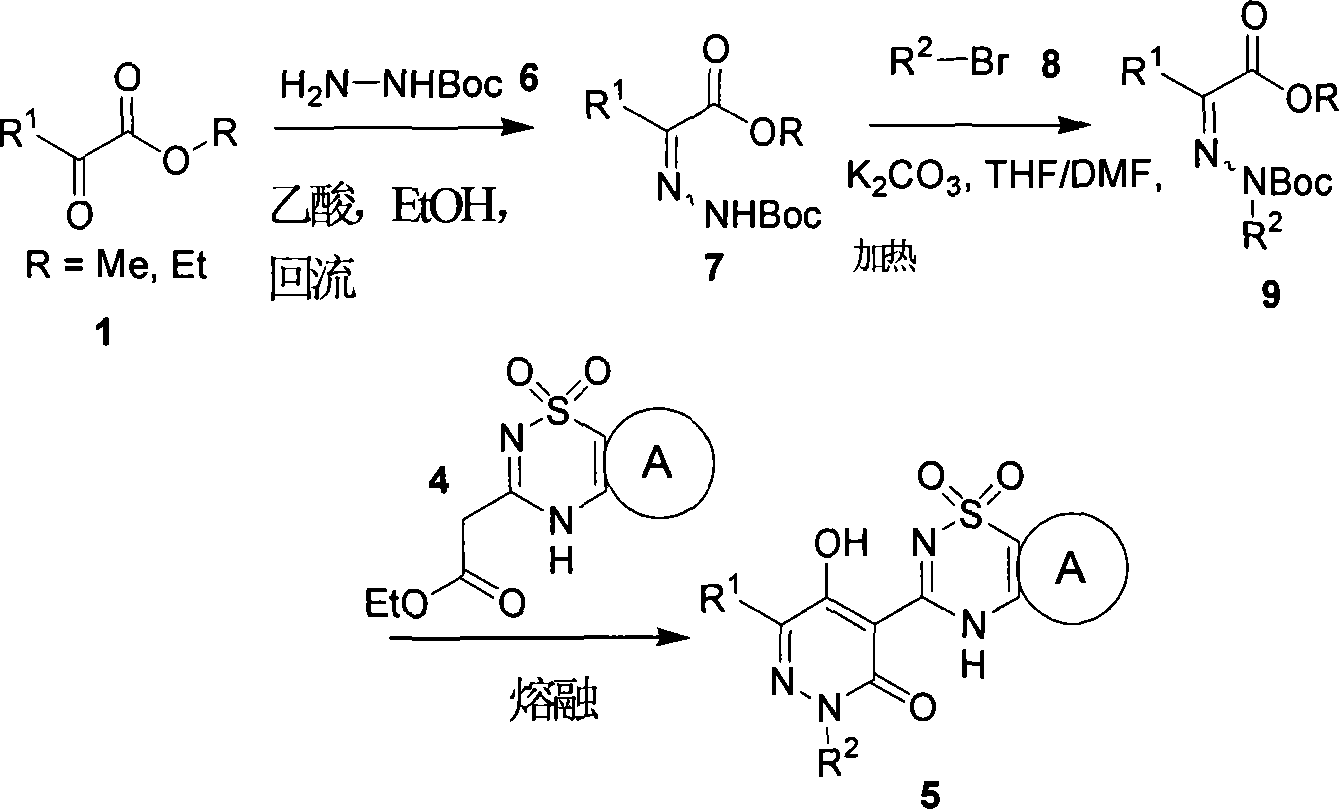
在一个典型合成路线中,在乙酸存在下,在乙醇中回流,用肼基甲酸叔丁酯(6)处理α-酮-酯1,从而获得腙7。在碱存在下,通过用溴化物8处理,使得腙7进一步烷基化,形成关键中间产物9。参见Lawton等,J.Chem.Soc.PerkinTrans.1,885-897(1987)。混合中间产物9和4,然后在140-200℃温度范围下熔融,得到环化产物5。In a typical synthetic route, hydrazone 7 is obtained by treating α-keto-ester 1 with tert-butyl carbazate (6) in the presence of acetic acid at reflux in ethanol. Hydrazone 7 was further alkylated by treatment with bromide 8 in the presence of base to form key intermediate 9. See Lawton et al., J. Chem. Soc. Perkin Trans. 1, 885-897 (1987). Intermediates 9 and 4 were mixed and then melted at a temperature range of 140-200°C to give cyclized product 5.
实施例2-1:方案2a描述了化合物5b的合成。 Example 2-1 : Scheme 2a describes the synthesis of compound 5b.
方案2aOption 2a
在这个实施例中,α-酮-酯(1b)(1.0克,5.61毫摩尔)与肼基甲酸叔丁酯(6)(742毫克,5.61毫摩尔)、150微升乙酸和15毫升乙醇混合。混合物在60℃下加热3小时。LC-MS结果证实反应完成,产物(7a)包括E型和Z型异构体。当置于室温下时,溶液有白色晶体沉淀。倾析出上层溶液,剩余晶体在减压下干燥以获得所需的纯产物(7a),该产物将在下步中直接使用。LC-MS(ESI+):m/e=293.2[M+1]+(精确质谱:292.14)。In this example, α-keto-ester (1b) (1.0 g, 5.61 mmol) was mixed with tert-butyl carbazate (6) (742 mg, 5.61 mmol), 150 μl acetic acid and 15 ml ethanol . The mixture was heated at 60°C for 3 hours. LC-MS results confirmed the completion of the reaction, and the product (7a) included E and Z isomers. When left at room temperature, the solution precipitated as white crystals. The upper solution was decanted, and the remaining crystals were dried under reduced pressure to obtain the desired pure product (7a), which was used directly in the next step. LC-MS (ESI + ): m/e = 293.2 [M+1] + (exact mass: 292.14).
腙7a(949.8毫克,3.24毫摩尔)与异戊基溴(8a)(390微升,3.24毫摩尔)、K2CO3(2.2克,16.2毫摩尔)、DMF(3毫升)和THF(3毫升)混合。混合物在80℃下搅拌17小时。滤出无机固体并用THF洗涤。浓缩滤液,残留物在硅胶上用闪式色谱法纯化,以37.5%的分离产率得到440毫克的所需产物9a。LC-MS(ESI+):m/e=363.2[M+1]+(精确质谱:362.22)。Hydrazone 7a (949.8 mg, 3.24 mmol) was mixed with isoamyl bromide (8a) (390 μl, 3.24 mmol), K 2 CO 3 (2.2 g, 16.2 mmol), DMF (3 mL) and THF (3 ml) mixed. The mixture was stirred at 80°C for 17 hours. The inorganic solid was filtered off and washed with THF. The filtrate was concentrated and the residue was purified by flash chromatography on silica gel to afford 440 mg of the desired product 9a in 37.5% isolated yield. LC-MS (ESI + ): m/e = 363.2 [M+1] + (exact mass: 362.22).
化合物9a(285.1毫克,0.787毫摩尔)与化合物4a(235毫克,0.787毫摩尔)混合。固体混合物在氮气下于160℃加热7小时。粗物质用闪式色谱法纯化,使用乙酸乙酯和己烷梯度液,得到所需的黄色油状纯产物5b(17.1毫克)。LC-MS(APCI+):m/e=469.2[M+1]+(精确质谱:468.13)。1H NMR(400MHz,CDCl3):7.80-7.82(m,2H),7.47-7.50(m,3H),7.41(d,1H,J=2.8Hz),7.27(d,1H,J=8.8Hz),7.22(1H,dd,J1=9.0Hz,J2=2.6Hz),4.32(t,2H,J=7.2Hz),3.91(s,3H),1.76-1.81(m,2H),1.66-1.76(m,1H),1.03(d,6H,J=6.8Hz)。Compound 9a (285.1 mg, 0.787 mmol) was mixed with compound 4a (235 mg, 0.787 mmol). The solid mixture was heated at 160°C under nitrogen for 7 hours. The crude material was purified by flash chromatography using a gradient of ethyl acetate and hexanes to give the desired pure product 5b (17.1 mg) as a yellow oil. LC-MS (APCI + ): m/e = 469.2 [M+1] + (accurate mass: 468.13). 1 H NMR (400MHz, CDCl3): 7.80-7.82(m, 2H), 7.47-7.50(m, 3H), 7.41(d, 1H, J=2.8Hz), 7.27(d, 1H, J=8.8Hz) , 7.22(1H, dd, J 1 =9.0Hz, J 2 =2.6Hz), 4.32(t, 2H, J=7.2Hz), 3.91(s, 3H), 1.76-1.81(m, 2H), 1.66- 1.76 (m, 1H), 1.03 (d, 6H, J=6.8Hz).
实施例2-2:方案2b描述了化合物5c和5d的合成。 Example 2-2 : Scheme 2b describes the synthesis of compounds 5c and 5d.
方案2bOption 2b
2-(2-环丙基-乙基)-5-羟基-4-(7-甲氧基-1,1-二氧代-1,2-二氢-1λ 6 -苯并 [1,2,4]噻二嗪-3基)-6-噻吩-2-基-2H-哒嗪-3-酮(5c) 2-(2-cyclopropyl-ethyl)-5-hydroxy-4-(7-methoxy-1,1-dioxo-1,2-dihydro-1λ 6 -benzo [ 1,2 ,4] Thiadiazin-3-yl)-6-thiophen-2-yl-2H-pyridazin-3-one (5c)
在这个具体实施例中,化合物9b用与化合物9a相同的方式制备。化合物9b(654.2毫克)与化合物4a(533.8毫克)混合,并在不含溶剂的情况下在氮气气氛下、于160℃下加热1小时,然后在185℃下加热3小时。粗产物在硅胶上用闪式色谱法、以乙酸乙酯和己烷(0-100%乙酸乙酯的己烷溶液)梯度液纯化,获得所需产物5c(86.5毫克),分离产率10.2%。1H NMR(400MHz,CDCl3):δ7.98(d,1H,J=3.2Hz),7.44(d,1H,J=4.8Hz),7.41(d,1H J=2.4Hz),7.19-7.26(m,2H),7.13(t,1H,J=4.4Hz),4.36(t,2H,J=7.0Hz),3.90(s,3H),1.78(q,2H,J=7.0Hz),0.72-0.80(m,1H),0.47-0.51(m,2H),0.065-0.102(m,2H);LC-MS(ESI+):m/e=473.1[M+1]+(精确质谱:472.09)。In this particular example, compound 9b was prepared in the same manner as compound 9a. Compound 9b (654.2 mg) was mixed with compound 4a (533.8 mg) and heated at 160° C. for 1 hour and then at 185° C. for 3 hours under nitrogen atmosphere without solvent. The crude product was purified by flash chromatography on silica gel with a gradient of ethyl acetate and hexanes (0-100% ethyl acetate in hexanes) to afford the desired product 5c (86.5 mg) in 10.2% isolated yield. 1 H NMR (400MHz, CDCl 3 ): δ7.98(d, 1H, J=3.2Hz), 7.44(d, 1H, J=4.8Hz), 7.41(d, 1H, J=2.4Hz), 7.19-7.26 (m, 2H), 7.13(t, 1H, J=4.4Hz), 4.36(t, 2H, J=7.0Hz), 3.90(s, 3H), 1.78(q, 2H, J=7.0Hz), 0.72 -0.80 (m, 1H), 0.47-0.51 (m, 2H), 0.065-0.102 (m, 2H); LC-MS (ESI + ): m/e=473.1[M+1] + (accurate mass spectrum: 472.09 ).
2-(2-环丙基-乙基)-5-羟基-4-(7-羟基-1,1-二氧代-1,2-二氢-1λ 6 -苯并[1,2,4] 噻二嗪-3-基)-6-噻吩-2-基-2H-哒嗪-3-酮(5d) 2-(2-cyclopropyl-ethyl)-5-hydroxy-4-(7-hydroxy-1,1-dioxo-1,2-dihydro-1λ 6 -benzo[1,2,4 ] thiadiazin-3-yl)-6-thiophen-2-yl-2H-pyridazin-3-one (5d)
将化合物9b(203毫克)与化合物4b(131.2毫克)混合,并于N2气氛下、在不使用溶剂的情况下,在160℃下加热4小时。粗产物在硅胶上用闪式色谱法纯化,使用乙酸乙酯和己烷(0-100%乙酸乙酯的己烷溶液)的梯度液纯化,以4.3%的分离产率得到所需产物5d(9.11毫克),回收起始原料9b(115.8毫克)。1HNMR(400MHz,DMSO-d6):δ10.40(s,br,1H),7.91(d,1H,J=3.6Hz),7.68(d,1H,J=4.8Hz),7.52(d,1H J=9.2Hz),7.14-7.17(m,3H),4.23(t,2H,J=7.0Hz),1.69(q,2H,J=7.0Hz),0.70-0.80(m,1H),0.38-0.44(m,2H),0.02-0.06(m,2H);LC-MS(ESI+):m/e=459.25[M+1]+(精确质谱:458.07)。Compound 9b (203 mg) was mixed with compound 4b (131.2 mg) and heated at 160 °C for 4 h under N2 atmosphere without solvent. The crude product was purified by flash chromatography on silica gel using a gradient of ethyl acetate and hexane (0-100% ethyl acetate in hexane) to give the desired product 5d in 4.3% isolated yield (9.11 mg), the starting material 9b (115.8 mg) was recovered. 1 HNMR (400MHz, DMSO-d 6 ): δ10.40(s, br, 1H), 7.91(d, 1H, J=3.6Hz), 7.68(d, 1H, J=4.8Hz), 7.52(d, 1H J=9.2Hz), 7.14-7.17(m, 3H), 4.23(t, 2H, J=7.0Hz), 1.69(q, 2H, J=7.0Hz), 0.70-0.80(m, 1H), 0.38 -0.44 (m, 2H), 0.02-0.06 (m, 2H); LC-MS (ESI + ): m/e = 459.25 [M+1] + (exact mass: 458.07).
下面的式I化合物,除使用适当的起始原料外,以同方法2所述的步骤类似Following formula I compound, except using suitable starting material, with the step described in method 2 similar 的方式制备。way of preparation.
2-{3-[5-羟基-2-(3-甲基-丁基)-3-氧代-6-噻吩-2-基-2,3-二氢-哒嗪-4基]-1,1-2-{3-[5-Hydroxy-2-(3-methyl-butyl)-3-oxo-6-thiophen-2-yl-2,3-dihydro-pyridazin-4yl]-1 ,1- 二氧代-1,2-二氢-1λDioxo-1,2-dihydro-1λ 66 -苯并[1,2,4]噻二嗪-7-基氧基}-乙酰胺:-Benzo[1,2,4]thiadiazin-7-yloxy}-acetamide:
1H NMR(400MHz,CD3OD):δ7.96(m,1H),7.30-7.44(m,4H),7.06-7.08(m,1H),4.58(s,br,2H),4.10-4.26(m,2H),1.62-1.78(m,3H),1.01(d,6H,J=6.0Hz);LC-MS(ESI+):m/e=518.3[M+1]+(精确质谱:517.11)。 1 H NMR (400MHz, CD 3 OD): δ7.96(m, 1H), 7.30-7.44(m, 4H), 7.06-7.08(m, 1H), 4.58(s, br, 2H), 4.10-4.26 (m, 2H), 1.62-1.78 (m, 3H), 1.01 (d, 6H, J=6.0Hz); LC-MS (ESI + ): m/e=518.3[M+1] + (accurate mass spectrum: 517.11).
2-(2-环丙基-乙基)-5-羟基-4-(7-甲氧基-1,1-二氧代-1,2-二氢-1λ2-(2-cyclopropyl-ethyl)-5-hydroxy-4-(7-methoxy-1,1-dioxo-1,2-dihydro-1λ 66 -苯并- Benzo [1,2,4]噻二嗪-3-基)-6-噻吩-2-基-2H-哒嗪-3-酮:[1,2,4]thiadiazin-3-yl)-6-thiophen-2-yl-2H-pyridazin-3-one:
1H NMR(400MHz,CDCl3):δ7.98(d,1H,J=3.2Hz),7.44(d,1H,J=4.8Hz),7.41(d,1H J=2.4Hz),7.19-7.26(m,2H),7.13(t,1H,J=4.4Hz),4.36(t,2H,J=7.0Hz),3.90(s,3H),1.78(q,2H,J=7.0Hz),0.72-0.80(m,1H),0.47-0.51(m,2H),0.065-0.102(m,2H);LC-MS(ESI+):m/e=473.1[M+1]+(精确质谱:472.09)。 1 H NMR (400MHz, CDCl 3 ): δ7.98(d, 1H, J=3.2Hz), 7.44(d, 1H, J=4.8Hz), 7.41(d, 1H, J=2.4Hz), 7.19-7.26 (m, 2H), 7.13(t, 1H, J=4.4Hz), 4.36(t, 2H, J=7.0Hz), 3.90(s, 3H), 1.78(q, 2H, J=7.0Hz), 0.72 -0.80 (m, 1H), 0.47-0.51 (m, 2H), 0.065-0.102 (m, 2H); LC-MS (ESI + ): m/e=473.1[M+1] + (accurate mass spectrum: 472.09 ).
2-(2-环丙基-乙基)-5-羟基-4-(7-羟基-1,1-二氧代-1,2-二氢-1λ2-(2-cyclopropyl-ethyl)-5-hydroxy-4-(7-hydroxy-1,1-dioxo-1,2-dihydro-1λ 66 -苯并[1,2,4]-Benzo[1,2,4] 噻二嗪-3-基)-6-噻吩-2-基-2H-哒嗪-3-酮:Thiadiazin-3-yl)-6-thiophen-2-yl-2H-pyridazin-3-one:
1H NMR(400MHz,DMSO-d6):δ10.40(s,br,1H),7.91(d,1H,J=3.6Hz),7.68(d,1H,J=4.8Hz),7.52(d,1H J=9.2Hz),7.14-7.17(m,3H),4.23(t,2H,J=7.0Hz),1.69(q,2H,J=7.0Hz),0.70-0.80(m,1H),0.38-0.44(m,2H),0.02-0.06(m,2H);LC-MS(ESI+):m/e=459.25[M+1]+(精确质谱:458.07)。 1 H NMR (400MHz, DMSO-d 6 ): δ10.40(s, br, 1H), 7.91(d, 1H, J=3.6Hz), 7.68(d, 1H, J=4.8Hz), 7.52(d , 1H J=9.2Hz), 7.14-7.17(m, 3H), 4.23(t, 2H, J=7.0Hz), 1.69(q, 2H, J=7.0Hz), 0.70-0.80(m, 1H), 0.38-0.44 (m, 2H), 0.02-0.06 (m, 2H); LC-MS (ESI + ): m/e = 459.25 [M+1] + (exact mass: 458.07).
2-苄基-5-羟基-4-(7-甲氧基-1,1-二氧代-1,2-二氢-1λ2-Benzyl-5-hydroxy-4-(7-methoxy-1,1-dioxo-1,2-dihydro-1λ 66 -苯并[1,2,4]噻二嗪-3--Benzo[1,2,4]thiadiazine-3-
1H NMR(400MHz,CDCl3):δ7.99-8.02(m,1H),7.40-7.45(m,2H),7.26-7.38(m,4H),7.16-7.24(m,3H),7.13-7.15(m,1H),5.42(s,2H),3.91(s,3H);LC-MS(ESI+):m/e=495.1[M+1]+(精确质谱:494.07)。 1 H NMR (400MHz, CDCl 3 ): δ7.99-8.02 (m, 1H), 7.40-7.45 (m, 2H), 7.26-7.38 (m, 4H), 7.16-7.24 (m, 3H), 7.13- 7.15 (m, 1H), 5.42 (s, 2H), 3.91 (s, 3H); LC-MS (ESI + ): m/e = 495.1 [M+1] + (exact mass: 494.07).
2-苄基-5-羟基-4-(7-羟基-1,1-二氧代-1,2-二氢-1λ2-Benzyl-5-hydroxy-4-(7-hydroxy-1,1-dioxo-1,2-dihydro-1λ 66 -苯并[1,2,4]噻二嗪-3--Benzo[1,2,4]thiadiazine-3- 基)-6-噻吩-2-基-2H-哒嗪-3-酮:Base)-6-thiophen-2-yl-2H-pyridazin-3-one:
1H NMR(400MHz,DMSO-d6):δ7.90(dd,1H,J1=4.0Hz,J2=1.2Hz),7.66(m,1H),7.45(d,1H,J=9.2Hz),7.24-7.38(m,5H),7.10-7.16(m,3H),5.32(s,2H);LC-MS(ESI+):m/e=481.0[M+1]+(精确质谱:480.06)。 1 H NMR (400MHz, DMSO-d 6 ): δ7.90 (dd, 1H, J 1 = 4.0Hz, J 2 = 1.2Hz), 7.66 (m, 1H), 7.45 (d, 1H, J = 9.2Hz ), 7.24-7.38 (m, 5H), 7.10-7.16 (m, 3H), 5.32 (s, 2H); LC-MS (ESI + ): m/e=481.0[M+1] + (accurate mass spectrum: 480.06).
2-[3-(2-苄基-5-羟基-3-氧代-6-噻吩-2-基-2,3-二氢-哒嗪-4-基)-1,1-二氧代2-[3-(2-Benzyl-5-hydroxy-3-oxo-6-thiophen-2-yl-2,3-dihydro-pyridazin-4-yl)-1,1-dioxo -1,2-二氢-1λ-1,2-Dihydro-1λ 66 -苯并[1,2,4]噻二嗪-7-基氧基]-乙酰胺:-Benzo[1,2,4]thiadiazin-7-yloxy]-acetamide:
1H NMR(400MHz,DMSO-d6):δ7.90(dd,1H,J1=3.6Hz,J2=0.8Hz),7.67(d,1H,J=5.2Hz),7.61(s,br,1H),7.57(d,1H,J=8.8Hz),7.25-7.41(m,6H),7.15(dd,1H,J1=4.4Hz,J2=3.6Hz),5.33(s,2H),4.56(s,2H);LC-MS(ESI+):m/e=538.1[M+1]+(精确质谱:537.08)。 1 H NMR (400 MHz, DMSO-d 6 ): δ7.90 (dd, 1H, J 1 =3.6 Hz, J 2 =0.8 Hz), 7.67 (d, 1H, J = 5.2 Hz), 7.61 (s, br , 1H), 7.57(d, 1H, J=8.8Hz), 7.25-7.41(m, 6H), 7.15(dd, 1H, J1 =4.4Hz, J2 =3.6Hz), 5.33(s, 2H) , 4.56 (s, 2H); LC-MS (ESI + ): m/e = 538.1 [M+1] + (exact mass: 537.08).
2-(2-氯-6-氟-苄基)-5-羟基-4-(7-甲氧基-1,1-二氧代-1,2-二氢-1λ2-(2-Chloro-6-fluoro-benzyl)-5-hydroxy-4-(7-methoxy-1,1-dioxo-1,2-dihydro-1λ 66 -苯并- Benzo [1,2,4]噻二嗪-3-基)-6-噻吩-2-基-2H-哒嗪-3-酮[1,2,4]thiadiazin-3-yl)-6-thiophen-2-yl-2H-pyridazin-3-one
1H NMR(400MHz,CDCl3):δ7.85-7.90(m,1H),7.18-7.44(m,5H),7.03-7.12(m,3H),5.58(s,2H),3.91(s,3H);LC-MS(ESI+):m/e=547.2[M+1]+(精确质谱:546.02)。 1 H NMR (400MHz, CDCl 3 ): δ7.85-7.90(m, 1H), 7.18-7.44(m, 5H), 7.03-7.12(m, 3H), 5.58(s, 2H), 3.91(s, 3H); LC-MS (ESI + ): m/e = 547.2 [M+1] + (exact mass: 546.02).
2-(2-氯-6-氟-苄基)-5-羟基-4-(7-羟基-1,1-二氧代-1,2-二氢-1λ2-(2-Chloro-6-fluoro-benzyl)-5-hydroxy-4-(7-hydroxy-1,1-dioxo-1,2-dihydro-1λ 66 -苯并[1,2,4]-Benzo[1,2,4] 噻二嗪-3-基)-6-噻吩-2-基-2H-哒嗪-3-酮Thiadiazin-3-yl)-6-thiophen-2-yl-2H-pyridazin-3-one
1H NMR(400MHz,DMSO-d6):δ10.2(s,br,1H),7.70(d,1H,J=3.2Hz),7.53(d,1H,J=4.4Hz),7.41-7.46(m,1H),7.37(d,2H,J=8Hz),7.27(t,1H,J=8Hz),7.04-7.10(m,3H),5.38(s,2H);LC-MS(ESI+):m/e=533.04[M+1]+(精确质谱:532.01)。 1 H NMR (400MHz, DMSO-d 6 ): δ10.2 (s, br, 1H), 7.70 (d, 1H, J=3.2Hz), 7.53 (d, 1H, J=4.4Hz), 7.41-7.46 (m, 1H), 7.37(d, 2H, J=8Hz), 7.27(t, 1H, J=8Hz), 7.04-7.10(m, 3H), 5.38(s, 2H); LC-MS (ESI + ): m/e = 533.04 [M+1] + (exact mass: 532.01).
5-羟基-4-(7-甲氧基-1,1-二氧代-1,2-二氢-1λ5-Hydroxy-4-(7-methoxy-1,1-dioxo-1,2-dihydro-1λ 66 -苯并[1,2,4]噻二嗪-3--Benzo[1,2,4]thiadiazine-3- 基)-2-(3-甲基-丁基)-6-(1-甲基-1H-吡咯-2-基)-2H-哒嗪-3-酮。yl)-2-(3-methyl-butyl)-6-(1-methyl-1H-pyrrol-2-yl)-2H-pyridazin-3-one.
LC-MS(ESI+):m/e=472.30[M+1]+(精确质谱:471.16);1H NMR(400MHz,CDCl3):δ7.42(d,1H,J=2.8Hz),7.27(m,1H),7.21(m,1H),6.92(dd,1H,J=3.6,2.0Hz),6.81(t,1H,J=2.0Hz),6.26(m,1H),4.28(m,2H),3.92(s,3H),3.84(s,3H),1.75(m,3H),1.01(d,6H,J=6.4Hz)。LC-MS (ESI + ): m/e=472.30[M+1] + (accurate mass spectrum: 471.16); 1 H NMR (400MHz, CDCl 3 ): δ7.42 (d, 1H, J=2.8Hz), 7.27(m, 1H), 7.21(m, 1H), 6.92(dd, 1H, J=3.6, 2.0Hz), 6.81(t, 1H, J=2.0Hz), 6.26(m, 1H), 4.28(m , 2H), 3.92 (s, 3H), 3.84 (s, 3H), 1.75 (m, 3H), 1.01 (d, 6H, J=6.4Hz).
方法3:方案3提供用来制备式I化合物的大体步骤。Method 3: Scheme 3 provides the general procedure used to prepare compounds of formula I.
方案3Option 3
在方案3所示的合成路线中,腙3可用羧酸10处理、或用原位激活的10处理(加入例如HBTU,HATU,DCC等活化剂)、或通过酰基氯中间产物或其它本领域已知的酰胺偶联方法,来形成关键中间产物11。例如参见Lawton等,J.Chem.Soc.Perkin Trans.1,885-897(1987)。通过使用碱(例如但不限于:NaOEt、KOtBu、KOH、NaH或LDA)进行分子内环化,化合物11可转化为标题化合物5。In the synthetic route shown in Scheme 3, hydrazone 3 can be treated with carboxylic acid 10, or with in situ activated 10 (addition of activators such as HBTU, HATU, DCC, etc.), or through acid chloride intermediates or other compounds known in the art. The well-known amide coupling method was used to form the key intermediate 11. See, eg, Lawton et al., J. Chem. Soc. Perkin Trans. 1, 885-897 (1987). Compound 11 can be converted to the title compound 5 by intramolecular cyclization using a base such as but not limited to: NaOEt, KOtBu, KOH, NaH or LDA.
实施例3-1:方案3a描述了化合物5e、5f和5g的合成。 Example 3-1 : Scheme 3a describes the synthesis of compounds 5e, 5f and 5g.
方案3aOption 3a

2-(丁基-亚肼基)-3-甲基-丁酸乙酯(3b): 2-(Butyl-hydrazono)-3-methyl-butyric acid ethyl ester (3b):
向3-甲基-2-氧代-丁酸乙酯(1c)(1.88克,13.04毫摩尔)在45毫升CHCl3的溶液中,加入丁基肼草酸盐(2.11克,11.85毫摩尔),然后加入NaOAc(1.94克,23.4毫摩尔)和MgSO4(1.43克,11.88毫摩尔)。混合物在氮气气氛下加热回流并搅拌3.5小时。冷却后,滤出固体,在减压真空下浓缩滤液。残留物先通过乙酸乙酯(50毫升×3)和H2O(20毫升)之间萃取提纯。减压浓缩有机层,并在高真空下干燥过夜,以85.4%的产率得到2.17g粗产物(3b),它为E型和Z型异构体的混合物。该粗产物直接用于下步,无须进一步纯化。LC-MS(ESI+):m/e=215.4[M+1]+,237.1[M+Na]+(精确质谱:214.17)。To a solution of ethyl 3-methyl-2-oxo-butanoate (1c) (1.88 g, 13.04 mmol) in 45 mL of CHCl3 was added butylhydrazine oxalate (2.11 g, 11.85 mmol) , then NaOAc (1.94 g, 23.4 mmol) and MgSO4 (1.43 g, 11.88 mmol) were added. The mixture was heated to reflux and stirred under nitrogen atmosphere for 3.5 hours. After cooling, the solid was filtered off and the filtrate was concentrated under reduced vacuum. The residue was first purified by extraction between ethyl acetate (50 mL×3) and H 2 O (20 mL). The organic layer was concentrated under reduced pressure and dried under high vacuum overnight to afford 2.17 g of crude product (3b) in 85.4% yield as a mixture of E and Z isomers. The crude product was used directly in the next step without further purification. LC-MS (ESI + ): m/e = 215.4 [M+1] + , 237.1 [M+Na] + (exact mass: 214.17).
2-{丁基-[2-(7-甲氧基-1,1-二氧代-1,4-二氢-116-苯并[1,2,4]噻二嗪-3-基)-乙 酰基]-亚肼基}-3-甲基-丁酸乙酯(11a): 2-{butyl-[2-(7-methoxy-1,1-dioxo-1,4-dihydro-116-benzo[1,2,4]thiadiazin-3-yl) -Acetyl ]-hydrazono}-3-methyl-butyric acid ethyl ester (11a):
向2-(丁基-亚肼基)-3-甲基-丁酸乙酯(3b)(79毫克,0.37毫摩尔)和(1,1-二氧代-1,4-二氢-116-苯并[1,2,4]噻二嗪-3-基)-乙酸(10a)(100毫克)在0.4毫升无水DMF和2毫升无水二氯甲烷中的溶液中加入1,3-二环己基碳二亚胺(DCC)(76.3毫克)在0.4毫升二氯甲烷中的溶液,混合物在室温下搅拌过夜。滤出固体并在减压下浓缩滤液,加入H2O(10毫升),用乙酸乙酯(20毫升×3)萃取。粗产物在硅胶上通过闪式色谱法进行纯化,从而获得所需产物(11a)(102.8毫克)和进一步的环化产物(5e)(9.5毫克),总产率为65.7%。LC-MS(ESI+):m/e=467.0[M+1]+(精确质谱:466.19)。2-(Butyl-hydrazono)-3-methyl-butanoic acid ethyl ester (3b) (79 mg, 0.37 mmol) and (1,1-dioxo-1,4-dihydro-116 -Benzo[1,2,4]thiadiazin-3-yl)-acetic acid (10a) (100 mg) was added to a solution in 0.4 mL of anhydrous DMF and 2 mL of anhydrous dichloromethane to add 1,3- Dicyclohexylcarbodiimide (DCC) (76.3 mg) was dissolved in 0.4 mL of dichloromethane, and the mixture was stirred overnight at room temperature. The solid was filtered off and the filtrate was concentrated under reduced pressure, H 2 O (10 mL) was added and extracted with ethyl acetate (20 mL×3). The crude product was purified by flash chromatography on silica gel to afford the desired product (11a) (102.8 mg) and the further cyclized product (5e) (9.5 mg) in an overall yield of 65.7%. LC-MS (ESI + ): m/e = 467.0 [M+1] + (exact mass: 466.19).
2-丁基-5-羟基-6-异丙基-4-(7-甲氧基-1,1-二氧代-1,2-二氢-1λ 6 -苯并[1,2,4] 噻二嗪-3-基)-2H-哒嗪-3-酮(5e): 2-Butyl-5-hydroxy-6-isopropyl-4-(7-methoxy-1,1-dioxo-1,2-dihydro-1λ 6 -benzo[1,2,4 ] thiadiazin-3-yl)-2H-pyridazin-3-one (5e):
向2-{丁基-[2-(7-甲氧基-1,1-二氧代-1,4-二氢-116-苯并[1,2,4]噻二嗪-3-基)-乙酰基]-亚肼基}-3-甲基-丁酸乙酯(11a)(68.9毫克,148微摩尔)在1.1毫升叔丁醇的溶液中,加入1.0M KOtBu在叔丁醇(370微升,370微摩尔)中的溶液,得到的混合物室温下振摇2小时。反应混合物用1.0M HCl水溶液(370微升)淬灭,加入3毫升盐水,用二氯甲烷(5毫升×2)和乙酸乙酯(5毫升×3)萃取,用MgSO4干燥,过滤,真空浓缩,并在硅胶上经闪式色谱法进一步纯化,从而得到所需产物(5e)(37.1毫克),产率为59.6%。该产品经多批制备,分离产率范围为59%-81%。LC-MS(ESI+):m/e=421.1[M+1]+(精确质谱:420.15)。1H NMR(400MHz,CDCl3):δ7.39-7.40(m,1H),7.17-7.26(m,2H),4.19(t,2H,J=7.2Hz),3.90(s,3H),3.32(m,J=6.8Hz,1H),1.80(m,2H,J=7.6Hz),1.40(m,2H,J=7.6Hz),1.27(d,6H,J=6.8Hz),0.99(t,3H,J=7.4Hz)。To 2-{butyl-[2-(7-methoxy-1,1-dioxo-1,4-dihydro-116-benzo[1,2,4]thiadiazin-3-yl )-acetyl]-hydrazono}-3-methyl-butyric acid ethyl ester (11a) (68.9 mg, 148 μmol) in 1.1 mL of tert-butanol was added with 1.0 M KOtBu in tert-butyl Alcohol (370 μl, 370 μmol) and the resulting mixture was shaken at room temperature for 2 hours. The reaction mixture was quenched with 1.0M aqueous HCl (370 μL), added 3 mL of brine, extracted with dichloromethane ( 5 mL×2) and ethyl acetate (5 mL×3), dried over MgSO, filtered, and vacuum Concentration and further purification by flash chromatography on silica gel afforded the desired product (5e) (37.1 mg) in 59.6% yield. The product was prepared in multiple batches with isolated yields ranging from 59% to 81%. LC-MS (ESI + ): m/e = 421.1 [M+1] + (exact mass: 420.15). 1 H NMR (400MHz, CDCl 3 ): δ7.39-7.40(m, 1H), 7.17-7.26(m, 2H), 4.19(t, 2H, J=7.2Hz), 3.90(s, 3H), 3.32 (m, J=6.8Hz, 1H), 1.80(m, 2H, J=7.6Hz), 1.40(m, 2H, J=7.6Hz), 1.27(d, 6H, J=6.8Hz), 0.99(t , 3H, J=7.4Hz).
2-丁基-5-羟基-4-(7-羟基-1,1-二氧代-1,2-二氢-1λ 6 -苯并[1,2,4]噻二嗪-3- 基)-6-异丙基-2H-哒嗪-3-酮(5f): 2-Butyl-5-hydroxy-4-(7-hydroxy-1,1-dioxo-1,2-dihydro-1λ 6 -benzo[1,2,4]thiadiazin-3- yl )-6-isopropyl-2H-pyridazin-3-one (5f):
将2-丁基-5-羟基-6-异丙基-4-(7-甲氧基-1,1-二氧代-1,2-二氢-1λ6-苯并[1,2,4]噻二嗪-3-基)-2H-哒嗪-3-酮(5e)(56毫克)溶解在3毫升二氯甲烷中。加入BBr3(466微升,1.0M二氯甲烷溶液),混合物在室温下搅拌1.5小时。LC-MS结果显示反应未结束。加入BBr3(0.5毫升,1.0M),反应混合物继续在室温下振摇过夜。LC-MS证实反应接近结束。反应混合物倒至冰上(10毫升),用CHCl3(20毫升×3)萃取。有机层用MgSO4干燥,过滤,进行减压浓缩,并进一步在硅胶上通过闪式色谱法纯化,从而获得所需产物(5f)(42.2毫克),产率78.0%。1HNMR(400MHz,CDCl3):δ7.46(d,1H,J=2.8Hz),7.16-7.26(m,2H),4.20(t,2H,J=7.2Hz),3.34(m,J=6.8Hz,1H),1.81(m,2H),1.41(m,2H),1.29(d,6H,J=6.8Hz),1.00(t,3H,J=7.4Hz);LC-MS(ESI+):m/e=407.1[M+1]+(精确质谱:406.13)。2-Butyl-5-hydroxy-6-isopropyl-4-(7-methoxy-1,1-dioxo-1,2-dihydro-1λ6-benzo[1,2,4 ]Thiadiazin-3-yl)-2H-pyridazin-3-one (5e) (56 mg) was dissolved in 3 mL of dichloromethane. BBr3 (466 μL, 1.0 M solution in dichloromethane) was added, and the mixture was stirred at room temperature for 1.5 hours. LC-MS results showed that the reaction was not completed. BBr3 (0.5 mL, 1.0 M) was added and the reaction mixture was continued to shake at room temperature overnight. LC-MS confirmed that the reaction was nearly complete. The reaction mixture was poured onto ice (10 mL), extracted with CHCl 3 (20 mL×3). The organic layer was dried over MgSO4 , filtered, concentrated under reduced pressure and further purified by flash chromatography on silica gel to obtain the desired product (5f) (42.2 mg) in 78.0% yield. 1 HNMR (400MHz, CDCl 3 ): δ7.46(d, 1H, J=2.8Hz), 7.16-7.26(m, 2H), 4.20(t, 2H, J=7.2Hz), 3.34(m, J= 6.8Hz, 1H), 1.81(m, 2H), 1.41(m, 2H), 1.29(d, 6H, J=6.8Hz), 1.00(t, 3H, J=7.4Hz); LC-MS (ESI + ): m/e = 407.1 [M+1] + (exact mass: 406.13).
2-[3-(2-丁基-5-羟基-6-异丙基-3-氧代-2,3-二氢-哒嗪-4-基)-1,1-二氧代-1,2- 二氢-1λ 6 -苯并[1,2,4]噻二嗪-7-基氧基]-乙酰胺(5g): 2-[3-(2-Butyl-5-hydroxy-6-isopropyl-3-oxo-2,3-dihydro-pyridazin-4-yl)-1,1-dioxo-1 , 2- Dihydro-1λ 6 -benzo[1,2,4]thiadiazin-7-yloxy]-acetamide (5 g):
向2-丁基-5-羟基-4-(7-羟基-1,1-二氧代-1,2-二氢-1λ6-苯并[1,2,4]噻二嗪-3-基)-6-异丙基-2H-哒嗪-3-酮(5f)(38.7毫克,95.2微摩尔)的无水DMF(4毫升)溶液中,加入2-溴代-乙酰胺(14.5毫克,104.7毫摩尔),而后加入K2CO3(39.5毫克,285.6毫摩尔)。混合产物于80℃加热搅拌过夜。反应混合物进行减压真空浓缩,残余物在硅胶上通过闪式色谱法纯化,从而获得所需产物(5g)(21.7毫克),产率49.2%。1H NMR(400MHz,DMSO-d6):δ7.63-7.66(m,1H),7.62(br,1H),7.40(br,1H),7.34-7.39(m,2H),4.58(s,2H),4.10(m,2H),3.23(m,1H,J=6.8Hz),1.72(m,2H,J=7.2Hz),1.32(m,2H,J=7.2Hz),1.21(d,6H,J=6.4Hz),0.91(t,3H,J=7.2Hz);LC-MS(ESI+):m/e=464.1[M+1]+(精确质谱:463.15)。To 2-butyl-5-hydroxyl-4-(7-hydroxyl-1,1-dioxo-1,2-dihydro-1λ6-benzo[1,2,4]thiadiazin-3-yl )-6-isopropyl-2H-pyridazin-3-one (5f) (38.7 mg, 95.2 micromole) in anhydrous DMF (4 ml) solution, was added 2-bromo-acetamide (14.5 mg, 104.7 mmol), followed by the addition of K 2 CO 3 (39.5 mg, 285.6 mmol). The mixed product was heated and stirred overnight at 80°C. The reaction mixture was concentrated in vacuo under reduced pressure and the residue was purified by flash chromatography on silica gel to obtain the desired product (5 g) (21.7 mg) in 49.2% yield. 1 H NMR (400MHz, DMSO-d 6 ): δ7.63-7.66(m, 1H), 7.62(br, 1H), 7.40(br, 1H), 7.34-7.39(m, 2H), 4.58(s, 2H), 4.10(m, 2H), 3.23(m, 1H, J=6.8Hz), 1.72(m, 2H, J=7.2Hz), 1.32(m, 2H, J=7.2Hz), 1.21(d, 6H, J = 6.4 Hz), 0.91 (t, 3H, J = 7.2 Hz); LC-MS (ESI + ): m/e = 464.1 [M+1] + (exact mass: 463.15).
实施例3-2:方案3b描述化合物5j和5k的合成。 Example 3-2 : Scheme 3b describes the synthesis of compounds 5j and 5k.
方案3bOption 3b
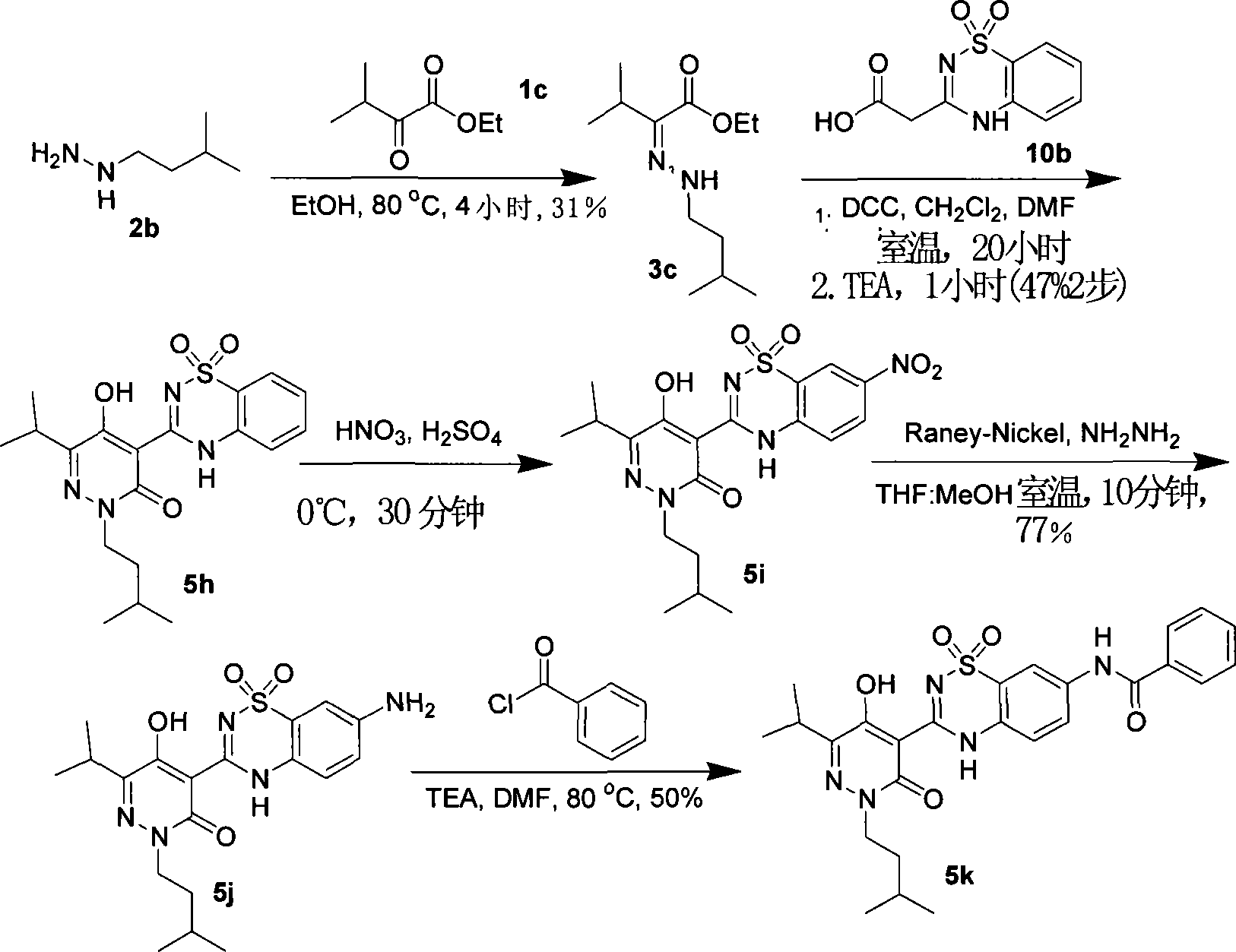
3-甲基-2-[(3-甲基-丁基)-亚肼基]-丁酸乙酯(3c): 3-Methyl-2-[(3-methyl-butyl)-hydrazono]-butyric acid ethyl ester (3c):
向2b(2.00克,10.4毫摩尔)的乙醇(55毫升)溶液中,加入3-甲基-2-氧代丁酸乙酯(1c)(1.7毫升,1.1毫摩尔)。溶液在80℃下加热4小时,冷却至室温,并在真空下浓缩。将粗混合物溶解于H2O(100毫升)中,并用乙酸乙酯(100毫升)萃取。有机层用MgSO4干燥,并真空浓缩。粗混合物在硅胶上通过闪式色谱法纯化(0-6%乙酸乙酯/己烷),从而获得3c(1.0克,43%),为澄清油状物。LC-MS(ESI+)m/e229[M+H]+(精确质谱:228.18)。To a solution of 2b (2.00 g, 10.4 mmol) in ethanol (55 mL) was added ethyl 3-methyl-2-oxobutanoate (1c) (1.7 mL, 1.1 mmol). The solution was heated at 80°C for 4 hours, cooled to room temperature, and concentrated under vacuum. The crude mixture was dissolved in H2O (100 mL) and extracted with ethyl acetate (100 mL). The organic layer was dried over MgSO 4 and concentrated in vacuo. The crude mixture was purified by flash chromatography on silica gel (0-6% ethyl acetate/hexanes) to afford 3c (1.0 g, 43%) as a clear oil. LC-MS (ESI + ) m/e 229 [M+H] + (exact mass: 228.18).
4-(1,1-二氧代-1,4-二氢-1λ 6 -苯并[1,2,4]噻二嗪-3-基)-5-羟基-6-异丙基 -2-(3-甲基-丁基)-1,6-二氢-2H-哒嗪-3-酮(5h):4- (1,1-dioxo-1,4-dihydro-1λ 6 -benzo[1,2,4]thiadiazin-3-yl)-5-hydroxyl-6-isopropyl -2 -(3-Methyl-butyl)-1,6-dihydro-2H-pyridazin-3-one (5h):
将N,N’-二环己基碳二亚胺(0.447克,2.17毫摩尔),化合物10b(0.520克,2.17毫摩尔)和3c(0.494克,2.17毫摩尔)溶解于CH2Cl2(12毫升)和DMF(2毫升)。室温下搅拌过夜后,向溶液中加入三乙胺(0.95毫升,6.83毫摩尔)。室温下搅拌90分钟后,将反应混合物过滤,并真空浓缩。反应混合物在硅胶上通过闪式色谱法纯化(0-5%MeOH/CH2Cl2),从而获得白色固体5h(0.413克,47%)。1HNMR(400MHz,D6-DMSO)δ9.91(br s,1H),7.90(d,J=10Hz,1H),7.75(t,J=8Hz,1H),7.63(d,J=10Hz,1H),7.54(t,J=10Hz,1H),4.14(m,2H),3.32(t,J=8Hz,2H),1.65-1.55(m,2H),1.15(d,J=8Hz,6H),0.87(d,J=6.4Hz,6H)。MS(ESI+)m/e405[M+H]+。N,N'-dicyclohexylcarbodiimide (0.447 g, 2.17 mmol), compound 10b (0.520 g, 2.17 mmol) and 3c (0.494 g, 2.17 mmol) were dissolved in CH 2 Cl 2 (12 mL) and DMF (2 mL). After stirring overnight at room temperature, triethylamine (0.95 mL, 6.83 mmol) was added to the solution. After stirring at room temperature for 90 minutes, the reaction mixture was filtered and concentrated in vacuo. The reaction mixture was purified by flash chromatography on silica gel (0-5% MeOH/ CH2Cl2 ) to afford 5h as a white solid (0.413 g, 47%). 1 HNMR (400MHz, D 6 -DMSO) δ9.91(br s, 1H), 7.90(d, J=10Hz, 1H), 7.75(t, J=8Hz, 1H), 7.63(d, J=10Hz, 1H), 7.54(t, J=10Hz, 1H), 4.14(m, 2H), 3.32(t, J=8Hz, 2H), 1.65-1.55(m, 2H), 1.15(d, J=8Hz, 6H ), 0.87 (d, J=6.4Hz, 6H). MS (ESI + ) m/e 405 [M+H] + .
5-羟基-6-异丙基-2-(3-甲基-丁基)-4-(7-硝基-1,1-二氧代-1,4-二氢-1λ 6 -苯并 [1,2,4]噻二嗪-3-基)-2H-哒嗪-3-酮(5i): 5-Hydroxy-6-isopropyl-2-(3-methyl-butyl)-4-(7-nitro-1,1-dioxo-1,4-dihydro-1λ 6 -benzo [1,2,4]thiadiazin-3-yl)-2H-pyridazin-3-one (5i):
在冰浴冷却的、5h(0.097克,0.025毫摩尔)的浓H2SO4(0.65毫升)溶液中,加入浓HNO3(0.10毫升)。0℃下搅拌30分钟后,反应混合物倒在碎冰上(1.5克)。过滤收集所得的沉淀物,从而获得5i(0.091克,85%),呈黄色固体。1HNMR(400MHz,D6-DMSO)δ13.90(s,1H),8.57(d,J=2.8Hz,1H),8.49(dd,J=9.2,2.8Hz,1H),7.82(d,J=8.8Hz,1H),4.11(t,J=6.8Hz,2H),3.23(m,2H),1.61(m,2H),1.21(d,J=8Hz,6H),0.93(d,J=8Hz,6H)。MS(ESI+)m/e450[M+H]+。To an ice-bath-cooled, 5h (0.097 g, 0.025 mmol) solution of concentrated H2SO4 (0.65 mL) was added concentrated HNO3 (0.10 mL). After stirring at 0°C for 30 minutes, the reaction mixture was poured onto crushed ice (1.5 g). The resulting precipitate was collected by filtration to afford 5i (0.091 g, 85%) as a yellow solid. 1 HNMR (400MHz, D 6 -DMSO) δ13.90(s, 1H), 8.57(d, J=2.8Hz, 1H), 8.49(dd, J=9.2, 2.8Hz, 1H), 7.82(d, J =8.8Hz, 1H), 4.11(t, J=6.8Hz, 2H), 3.23(m, 2H), 1.61(m, 2H), 1.21(d, J=8Hz, 6H), 0.93(d, J= 8Hz, 6H). MS (ESI + ) m/e 450 [M+H] + .
4-(7-氨基-1,1-二氧代-1,4-二氢-1λ 6 -苯并[1,2,4]噻二嗪-3-基)-5-羟基-6-异 丙基-2-(3-甲基-丁基)-2H-哒嗪-3-酮(5j): 4-(7-Amino-1,1-dioxo-1,4-dihydro-1λ 6 -benzo[1,2,4]thiadiazin-3-yl)-5-hydroxy-6-iso Propyl-2-(3-methyl-butyl)-2H-pyridazin-3-one (5j):
向5i(0.100克,0.22毫摩尔)于甲醇(5毫升)和THF(5毫升)的溶液中,加入阮内镍(Raney-Nickel)(0.6毫升,50%的在H2O中的浆液),而后加入无水NH2NH2(0.3毫升,9.56毫摩尔)。反应混合物在室温下搅拌15分钟,使用0.2微米PTFE膜的注射过滤器过滤,并真空浓缩。粗混合物在硅胶上,通过闪式色谱法纯化,用0-3%甲醇/CH2Cl2洗脱,获得红色固体5j(0.072克,77%)。1H NMR(400MHz,D6-DMSO)δ7.0(br s,1H),6.93(s,1H),6.79(d,J=2.8Hz,1H),6.76(d,J=2.4Hz),5.33(brs,2H),3.86(t,J=6.8Hz,2H),3.22(m,1H),1.52(m,3H),1.08(d,J=7.2Hz,6H),0.90(d,J=6.4Hz,6H)。MS(ESI+)m/e420[M+H]+。To a solution of 5i (0.100 g, 0.22 mmol) in methanol (5 mL) and THF (5 mL) was added Raney-Nickel (0.6 mL, 50% slurry in H2O ) , then anhydrous NH2NH2 (0.3 mL, 9.56 mmol) was added. The reaction mixture was stirred at room temperature for 15 minutes, filtered using a 0.2 micron PTFE membrane syringe filter, and concentrated in vacuo. The crude mixture was purified by flash chromatography on silica gel, eluting with 0-3% methanol/ CH2Cl2 , to afford 5j as a red solid (0.072 g, 77%). 1 H NMR (400MHz, D 6 -DMSO) δ7.0(br s, 1H), 6.93(s, 1H), 6.79(d, J=2.8Hz, 1H), 6.76(d, J=2.4Hz), 5.33(brs, 2H), 3.86(t, J=6.8Hz, 2H), 3.22(m, 1H), 1.52(m, 3H), 1.08(d, J=7.2Hz, 6H), 0.90(d, J = 6.4Hz, 6H). MS (ESI + ) m/e 420 [M+H] + .
N-{3-[5-羟基-6-异丙基-2-(3-甲基-丁基)-3-氧代-2,3-二氢-哒嗪-4-基]-1,1-二 氧代-1,4-二氢-1λ 6 -苯并[1,2,4]噻二嗪-7-基}-苯甲酰胺(5k): N-{3-[5-hydroxy-6-isopropyl-2-(3-methyl-butyl)-3-oxo-2,3-dihydro-pyridazin-4-yl]-1, 1- dioxo -1,4-dihydro-1λ 6 -benzo[1,2,4]thiadiazin-7-yl}-benzamide (5k):
向5j(0.048克,0.11毫摩尔)和4-二甲基氨基吡啶(0.0014克,0.011毫摩尔)的DMF溶液中,加入三乙胺(18微升,0.125毫摩尔)然后加入苯甲酰氯(16微升,0.137毫摩尔)。反应混合物在80℃下搅拌4小时,并冷却至室温。反应混合物用饱和NaHCO3(1毫升)处理,并用乙酸乙酯(3毫升)萃取二次。合并后的有机层用盐水(1毫升)洗涤,经MgSO4干燥,并真空浓缩。用硅胶(0-40%乙酸乙酯/己烷),通过闪式色谱法纯化粗混合物,从而获得黄色固体5k(0.030克,50%)。1HNMR(400MHz,D6-DMSO)δ10.63(br s),8.45(d,J=2.4Hz,1H),8.09(dd,J=8.8,2Hz,1H),8.97(d,J=7.2Hz,2H),7.67(d,J=9.2Hz,1H),7.60(d,J=7.2Hz,1H),7.54(t,J=7.2Hz,2H),4.13(d,J=6.8Hz,2H),3.25(m,1H),1.63(m,3H),1.22(d,J=6.8Hz,6H),0.93(d,J=6.4Hz,6H)。LC-MS(ESI+)m/e524[M+H]+。To a solution of 5j (0.048 g, 0.11 mmol) and 4-dimethylaminopyridine (0.0014 g, 0.011 mmol) in DMF was added triethylamine (18 μl, 0.125 mmol) followed by benzoyl chloride ( 16 μl, 0.137 mmol). The reaction mixture was stirred at 80°C for 4 hours and cooled to room temperature. The reaction mixture was treated with saturated NaHCO3 (1 mL) and extracted twice with ethyl acetate (3 mL). The combined organic layers were washed with brine (1 mL), dried over MgSO4 , and concentrated in vacuo. The crude mixture was purified by flash chromatography on silica gel (0-40% ethyl acetate/hexanes) to afford 5k as a yellow solid (0.030 g, 50%). 1 HNMR (400MHz, D 6 -DMSO) δ10.63(br s), 8.45(d, J=2.4Hz, 1H), 8.09(dd, J=8.8, 2Hz, 1H), 8.97(d, J=7.2 Hz, 2H), 7.67(d, J=9.2Hz, 1H), 7.60(d, J=7.2Hz, 1H), 7.54(t, J=7.2Hz, 2H), 4.13(d, J=6.8Hz, 2H), 3.25 (m, 1H), 1.63 (m, 3H), 1.22 (d, J=6.8Hz, 6H), 0.93 (d, J=6.4Hz, 6H). LC-MS (ESI + ) m/e 524 [M+H] + .
将化合物5j同磺酰氯反应,苯胺(5j)可以很容易地衍生形成磺酰胺。它也可经与活化的烷基溴或烷基氯反应进行烷基化。此外,使用本领域已知的方法,苯胺5j可与醛类反应通过还原胺化形成仲苯胺。Aniline (5j) can be readily derivatized to form sulfonamide by reacting compound 5j with sulfonyl chloride. It can also be alkylated by reaction with activated alkyl bromides or alkyl chlorides. Additionally, aniline 5j can be reacted with aldehydes to form secondary anilines via reductive amination using methods known in the art.
使用方法3也制出下式I的化合物Using method 3 also produces the following compound of formula I
2-丁基-5-羟基-6-(2-羟基-1,1-二甲基-乙基)-4-(7-甲氧基-1,1-二氧代-1,2-二2-Butyl-5-hydroxy-6-(2-hydroxy-1,1-dimethyl-ethyl)-4-(7-methoxy-1,1-dioxo-1,2-di 氢-1λHydrogen-1λ 66 -苯并[1,2,4]噻二嗪-3-基)-2H-哒嗪-3-酮-Benzo[1,2,4]thiadiazin-3-yl)-2H-pyridazin-3-one
1H NMR(400MHz,CDCl3):δ7.38-7.41(m,1H),7.18-7.25(m,2H),4.18(t,2H,J=6.8Hz),3.90(s,3H),3.84(s,2H),1.76-1.85(m,2H),1.41(s,6H),1.33-1.44(m,2H),1.00(t,3H,J=7.2Hz);LC-MS(ESI+):m/e=451.0[M+1]+(精确质谱:450.16)。 1 H NMR (400MHz, CDCl 3 ): δ7.38-7.41(m, 1H), 7.18-7.25(m, 2H), 4.18(t, 2H, J=6.8Hz), 3.90(s, 3H), 3.84 (s, 2H), 1.76-1.85 (m, 2H), 1.41 (s, 6H), 1.33-1.44 (m, 2H), 1.00 (t, 3H, J=7.2Hz); LC-MS (ESI + ) : m/e = 451.0 [M+1] + (accurate mass spectrum: 450.16).
2-{3-[5-羟基-2-(3-甲基-丁基)-3-氧代-6-噻吩-2-基-2,3-二氢-哒嗪-4-基]-1,1-2-{3-[5-Hydroxy-2-(3-methyl-butyl)-3-oxo-6-thiophen-2-yl-2,3-dihydro-pyridazin-4-yl]- 1,1- 二氧代-1,2-二氢-1λ6-苯并[1,2,4]噻二嗪-7-基氧基}-N-甲基-乙酰胺Dioxo-1,2-dihydro-1λ6-benzo[1,2,4]thiadiazin-7-yloxy}-N-methyl-acetamide
1H NMR(400MHz,CDCl3):δ7.99(d,1H,J=4Hz),7.43-7.50(m,2H),7.32(d,1H,J=9.2Hz),7.22-7.28(m,1H),7.14(t,1H,J=4.6Hz),6.53(s,br,1H),4.58(s,2H),4.30(t,2H,J=7.2Hz),2.96(d,3H,J=4.8Hz),1.68-1.80(m,3H),1.03(d,6H,J=6Hz);LC-MS(ESI+):m/e=532.18[M+1]+(精确质谱:531.12)。 1 H NMR (400MHz, CDCl 3 ): δ7.99(d, 1H, J=4Hz), 7.43-7.50(m, 2H), 7.32(d, 1H, J=9.2Hz), 7.22-7.28(m, 1H), 7.14(t, 1H, J=4.6Hz), 6.53(s, br, 1H), 4.58(s, 2H), 4.30(t, 2H, J=7.2Hz), 2.96(d, 3H, J =4.8Hz), 1.68-1.80 (m, 3H), 1.03 (d, 6H, J=6Hz); LC-MS (ESI + ): m/e=532.18[M+1] + (exact mass spectrum: 531.12) .
4-{7-[2-(3-氨基-吡咯烷-1-基)-2-氧代-乙氧基]-1,1-二氧代-1,2-二氢-1λ4-{7-[2-(3-Amino-pyrrolidin-1-yl)-2-oxo-ethoxy]-1,1-dioxo-1,2-dihydro-1λ 66 -苯-benzene 并[1,2,4]噻二嗪-3-基}-5-羟基-2-(3-甲基-丁基)-6-噻吩-2-基-2H-哒嗪-3-酮And[1,2,4]thiadiazin-3-yl}-5-hydroxy-2-(3-methyl-butyl)-6-thiophen-2-yl-2H-pyridazin-3-one
1H NMR(400MHz,CD3OD):δ7.93(d,1H,J=3.6Hz),7.50(d,1H,J=5.2Hz),7.42-7.46(m,1H),7.36-7.41(m,2H),7.09(dd,1H,J1=5.0Hz,J2=4Hz),4.89(s,2H,61%),4.86(s,2H,39%),4.26(t,2H,J=7.2Hz),3.94-4.01(m,1H),3.74-3.86(m,2H),3.64-3.73(m,2H),2.51(m,1H,61%,J=6.2Hz),2.38(m,1H,39%,J=6.4Hz),2.19-2.27(m,1H,61%),2.06-2.14(m,1H,39%),1.64-1.79(m,3H),1.02(d,6H,J=6.4Hz);LC-MS(ESI+):m/e=587.3[M+1]+(精确质谱:586.17)。 1 H NMR (400MHz, CD 3 OD): δ7.93 (d, 1H, J=3.6Hz), 7.50 (d, 1H, J=5.2Hz), 7.42-7.46 (m, 1H), 7.36-7.41( m, 2H), 7.09 (dd, 1H, J1 = 5.0Hz, J2 = 4Hz), 4.89 (s, 2H, 61%), 4.86 (s, 2H, 39%), 4.26 (t, 2H, J =7.2Hz), 3.94-4.01(m, 1H), 3.74-3.86(m, 2H), 3.64-3.73(m, 2H), 2.51(m, 1H, 61%, J=6.2Hz), 2.38(m , 1H, 39%, J=6.4Hz), 2.19-2.27(m, 1H, 61%), 2.06-2.14(m, 1H, 39%), 1.64-1.79(m, 3H), 1.02(d, 6H , J = 6.4 Hz); LC-MS (ESI + ): m/e = 587.3 [M+1] + (exact mass: 586.17).
[4-羟基-5-(7-甲氧基-1,1-二氧代-1,2-二氢-1λ[4-Hydroxy-5-(7-methoxy-1,1-dioxo-1,2-dihydro-1λ 66 -苯并[1,2,4]噻二嗪-3--Benzo[1,2,4]thiadiazine-3- 基)-1-(3-甲基-丁基)-6-氧代-1,6-二氢-哒嗪-3-基]-苯基-乙腈Base)-1-(3-methyl-butyl)-6-oxo-1,6-dihydro-pyridazin-3-yl]-phenyl-acetonitrile
1H NMR(400MHz,DMSO-d6):δ12.20(s,1H),10.28(s,1H),7.23-7.36(m,8H),4.04(t,2H,J=7.6Hz),3.84(s,3H),3.60(s,1H),1.57-1.71(m,3H),0.89(d,6H,J=6.4Hz);LC-MS(ESI+):m/e=508.4[M+1]+(精确质谱:507.16)。 1 H NMR (400MHz, DMSO-d 6 ): δ12.20(s, 1H), 10.28(s, 1H), 7.23-7.36(m, 8H), 4.04(t, 2H, J=7.6Hz), 3.84 (s, 3H), 3.60 (s, 1H), 1.57-1.71 (m, 3H), 0.89 (d, 6H, J=6.4Hz); LC-MS (ESI + ): m/e=508.4 [M+ 1] + (accurate mass spectrum: 507.16).
2-{3-[5-羟基-2-(3-甲基-丁基)-3-氧代-6-噻吩-2-基-2,3-二氢-哒嗪-4-基]-1,1-2-{3-[5-Hydroxy-2-(3-methyl-butyl)-3-oxo-6-thiophen-2-yl-2,3-dihydro-pyridazin-4-yl]- 1,1- 二氧代-1,2-二氢-1λDioxo-1,2-dihydro-1λ 66 -苯并[1,2,4]噻二嗪-7-基氧基}-丙酸乙酯-Benzo[1,2,4]thiadiazin-7-yloxy}-propionic acid ethyl ester
1H NMR(400MHz,CDCl3):δ7.98(d,1H,J=3.6Hz),7.45(d,1H,J=4.8Hz),7.34(s,br,1H),7.24-7.27(m,2H),7.13(t,1H,J=4.40Hz),4.83(q,1H,J=6.7Hz),4.21-4.30(m,4H),1.77(q,2H,J=7.2Hz),1.67(d,3H,J=6.8Hz),1.64-1.72(m,3H),1.30(t,3H,J=7.2Hz),1.02(d,6H,J=6.4Hz);LC-MS(ESI+):m/e=561.33[M+1]+(精确质谱:560.14)。 1 H NMR (400MHz, CDCl 3 ): δ7.98(d, 1H, J=3.6Hz), 7.45(d, 1H, J=4.8Hz), 7.34(s, br, 1H), 7.24-7.27(m , 2H), 7.13(t, 1H, J=4.40Hz), 4.83(q, 1H, J=6.7Hz), 4.21-4.30(m, 4H), 1.77(q, 2H, J=7.2Hz), 1.67 (d, 3H, J=6.8Hz), 1.64-1.72(m, 3H), 1.30(t, 3H, J=7.2Hz), 1.02(d, 6H, J=6.4Hz); LC-MS (ESI + ): m/e = 561.33 [M+1] + (exact mass: 560.14).
2-{3-[5-羟基-2-(3-甲基-丁基)-3-氧代-6-噻吩-2-基-2,3-二氢-哒嗪-4-基]-1,1-2-{3-[5-Hydroxy-2-(3-methyl-butyl)-3-oxo-6-thiophen-2-yl-2,3-dihydro-pyridazin-4-yl]- 1,1- 二氧代-1,2-二氢-1λDioxo-1,2-dihydro-1λ 66 -苯并[1,2,4]噻二嗪-7-基氧基}-丙酰胺-Benzo[1,2,4]thiadiazin-7-yloxy}-propionamide
1H NMR(400MHz,DMSO-d6):δ7.90(d,1H,J=3.6Hz),7.61-7.69(m,3H),7.28-7.34(m,3H),7.16(dd,1H,J1=5.0Hz,J2=3.8Hz),4.78(q,1H,J=6.4Hz),4.17(t,2H,J=7.0Hz),1.60-1.70(m,3H),1.47(d,3H,J=6.4Hz),0.95(d,6H,J=6.4Hz);LC-MS(ESI+):m/e=532.14[M+1]+(精确质谱:531.12)。 1 H NMR (400MHz, DMSO-d 6 ): δ7.90(d, 1H, J=3.6Hz), 7.61-7.69(m, 3H), 7.28-7.34(m, 3H), 7.16(dd, 1H, J 1 =5.0Hz, J 2 =3.8Hz), 4.78(q, 1H, J=6.4Hz), 4.17(t, 2H, J=7.0Hz), 1.60-1.70(m, 3H), 1.47(d, 3H, J = 6.4 Hz), 0.95 (d, 6H, J = 6.4 Hz); LC-MS (ESI + ): m/e = 532.14 [M+1] + (exact mass: 531.12).
2-{3-[5-羟基-2-(3-甲基-丁基)-3-氧代-6-噻吩-2-基-2,3-二氢-哒嗪-4-基]-1,1-2-{3-[5-Hydroxy-2-(3-methyl-butyl)-3-oxo-6-thiophen-2-yl-2,3-dihydro-pyridazin-4-yl]- 1,1- 二氧代-1,2-二氢-1λDioxo-1,2-dihydro-1λ 66 -苯并[1,2,4]噻二嗪-7-基氧基}-丙酸-Benzo[1,2,4]thiadiazin-7-yloxy}-propionic acid
1H NMR(400MHz,DMSO-d6):δ7.90(dd,1H,J1=3.6Hz,J2=1.2Hz),7.67(dd,1H,J1=5.2Hz,J2=1.0Hz),7.59(d,1H,J=9.2Hz),7.31(dd,1H,J1=9.2Hz,J2=3.0Hz),7.22(d,1H,J=2.8Hz),7.16(dd,1H,J1=5.0Hz,J2=3.8Hz),5.05(q,1H,J=6.8Hz),4.16(t,2H,J=7.0Hz),1.58-1.70(m,3H),1.53(d,3H,J=6.8Hz),0.95(d,6H,J=6.4Hz);LC-MS(ESI+):m/e=533.3[M+1]+(精确质谱:532.11)。 1 H NMR (400 MHz, DMSO-d 6 ): δ7.90 (dd, 1H, J 1 =3.6 Hz, J 2 =1.2 Hz), 7.67 (dd, 1H, J 1 =5.2 Hz, J 2 =1.0 Hz ), 7.59 (d, 1H, J=9.2Hz), 7.31 (dd, 1H, J 1 =9.2Hz, J2=3.0Hz), 7.22 (d, 1H, J=2.8Hz), 7.16 (dd, 1H, J 1 =5.0Hz, J 2 =3.8Hz), 5.05(q, 1H, J=6.8Hz), 4.16(t, 2H, J=7.0Hz), 1.58-1.70(m, 3H), 1.53(d, 3H, J = 6.8 Hz), 0.95 (d, 6H, J = 6.4 Hz); LC-MS (ESI + ): m/e = 533.3 [M+1] + (exact mass: 532.11).
4-(1,1-二氧代-1,2-二氢-1λ6-苯并[1,2,4]噻二嗪-3-基)-5-羟基-6-异丙基4-(1,1-dioxo-1,2-dihydro-1λ6-benzo[1,2,4]thiadiazin-3-yl)-5-hydroxy-6-isopropyl -2-(3-甲基-丁基)-2H-哒嗪-3-酮-2-(3-Methyl-butyl)-2H-pyridazin-3-one
1H NMR(400MHz,CDCl3):δ7.98(d,1H,J=8.0Hz),7.63(t,1H,J=7.2Hz),7.47(t,1H,J=7.8Hz),7.30(d,1H,J=8.0Hz),4.22(t,2H,J=7.4Hz),3.33(m,1H,J=6.8Hz),1.60-1.74(m,3H),1.28(d,6H,J=6.4Hz),1.01(d,6H,J=6.0Hz);LC-MS(ESI+):m/e=405.4[M+1]+(精确质谱:404.15)。 1 H NMR (400MHz, CDCl 3 ): δ7.98(d, 1H, J=8.0Hz), 7.63(t, 1H, J=7.2Hz), 7.47(t, 1H, J=7.8Hz), 7.30( d, 1H, J=8.0Hz), 4.22(t, 2H, J=7.4Hz), 3.33(m, 1H, J=6.8Hz), 1.60-1.74(m, 3H), 1.28(d, 6H, J = 6.4 Hz), 1.01 (d, 6H, J = 6.0 Hz); LC-MS (ESI + ): m/e = 405.4 [M+1] + (exact mass: 404.15).
5-羟基-6-异丙基-4-(7-甲氧基-1,1-二氧代-1,2-二氢-1λ5-Hydroxy-6-isopropyl-4-(7-methoxy-1,1-dioxo-1,2-dihydro-1λ 66 -苯并[1,2,4]噻二嗪-Benzo[1,2,4]thiadiazine -3-基)-2-(3-甲基-丁基)-2H-哒嗪-3-酮-3-yl)-2-(3-methyl-butyl)-2H-pyridazin-3-one
1H NMR(400MHz,CDCl3):δ7.43(d,1H,J=2.4Hz),7.21-7.29(m,2H),4.24(t,2H,J=7.2Hz),3.93(s,3H),3.35(m,1H,J=6.9Hz),1.62-1.76(m,3H),1.31(d,6H,J=6.8Hz),1.03(d,6H,J=6.4Hz);LC-MS(ESI+):m/e=435.3[M+1]+(精确质谱:434.16)。 1 H NMR (400MHz, CDCl 3 ): δ7.43(d, 1H, J=2.4Hz), 7.21-7.29(m, 2H), 4.24(t, 2H, J=7.2Hz), 3.93(s, 3H ), 3.35(m, 1H, J=6.9Hz), 1.62-1.76(m, 3H), 1.31(d, 6H, J=6.8Hz), 1.03(d, 6H, J=6.4Hz); LC-MS (ESI + ): m/e = 435.3 [M+1] + (exact mass: 434.16).
5-羟基-4-(7-羟基-1,1-二氧代-1,2-二氢-1λ5-hydroxy-4-(7-hydroxy-1,1-dioxo-1,2-dihydro-1λ 66 -苯并[1,2,4]噻二嗪-3-基)-6-异-Benzo[1,2,4]thiadiazin-3-yl)-6-iso 丙基-2-(3-甲基-丁基)-2H-哒嗪-3-酮Propyl-2-(3-methyl-butyl)-2H-pyridazin-3-one
1H NMR(400MHz,CDCl3):δ7.47(d,1H,J=2.4Hz),7.16-7.23(m,2H),6.81(s,br,1H),4.22(t,2H,J=7.0Hz),3.33(m,1H,J=6.8Hz),1.60-1.74(m,3H),1.29(d,6H,J=6.8Hz),1.00(d,6H,J=6.4Hz);LC-MS(ESI+):m/e=421.3[M+1]+(精确质谱:420.15)。 1 H NMR (400MHz, CDCl 3 ): δ7.47(d, 1H, J=2.4Hz), 7.16-7.23(m, 2H), 6.81(s, br, 1H), 4.22(t, 2H, J= 7.0Hz), 3.33(m, 1H, J=6.8Hz), 1.60-1.74(m, 3H), 1.29(d, 6H, J=6.8Hz), 1.00(d, 6H, J=6.4Hz); LC - MS (ESI + ): m/e = 421.3 [M+1] + (exact mass: 420.15).
2-{3-[5-羟基-6-异丙基-2-(3-甲基-丁基)-3-氧代-2,3-二氢-哒嗪-4-基]-1,1-二2-{3-[5-Hydroxy-6-isopropyl-2-(3-methyl-butyl)-3-oxo-2,3-dihydro-pyridazin-4-yl]-1, 1-two 氧代-1,2-二氢-1λOxo-1,2-dihydro-1λ 66 -苯并[1,2,4]噻二嗪-7-基氧基}-乙酰胺-Benzo[1,2,4]thiadiazin-7-yloxy}-acetamide
1H NMR(400MHz,CDCl3):δ7.46(d,1H,J=2.4Hz),7.30(d,1H,J=8.8Hz),7.23-7.25(m,1H),6.45(s,br,1H),5.70(s,br,1H),4.57(s,2H),4.21(t,2H,J=7.2Hz),3.32(m,1H,J=6.8Hz),1.63-1.73(m,3H),1.27(d,6H,J=6.8Hz),1.00(d,6H,J=6.4Hz);LC-MS(ESI+):m/e=478.1[M+1]+(精确质谱:477.17)。 1 H NMR (400MHz, CDCl 3 ): δ7.46(d, 1H, J=2.4Hz), 7.30(d, 1H, J=8.8Hz), 7.23-7.25(m, 1H), 6.45(s, br , 1H), 5.70(s, br, 1H), 4.57(s, 2H), 4.21(t, 2H, J=7.2Hz), 3.32(m, 1H, J=6.8Hz), 1.63-1.73(m, 3H), 1.27(d, 6H, J=6.8Hz), 1.00(d, 6H, J=6.4Hz); LC-MS (ESI + ): m/e=478.1[M+1] + (accurate mass spectrum: 477.17).
5-羟基-4-(7-甲氧基-1,1-二氧代-1,2-二氢-1λ5-Hydroxy-4-(7-methoxy-1,1-dioxo-1,2-dihydro-1λ 66 -苯并[1,2,4]噻二嗪-3--Benzo[1,2,4]thiadiazine-3- 基)-2-(3-甲基-丁基)-6-(1-甲基-1H-吲哚-3-基)-2H-哒嗪-3-酮Base)-2-(3-methyl-butyl)-6-(1-methyl-1H-indol-3-yl)-2H-pyridazin-3-one
1H NMR(400MHz,DMSO-d6):δ8.27(d,1H,J=7.6Hz),8.21(s,br,1H),7.49(d,1H,J=9.2Hz),7.38(d,1H,J=8.4Hz),7.19-7.29(m,3H),7.14(t,1H,J=7.4Hz),4.30(t,2H,J=7.0Hz),3.85(s,br,6H),1.66-1.80(m,3H),0.97(d,6H,J=6.4Hz);LC-MS(ESI+):m/e=522.37[M+1]+(精确质谱:521.17)。 1 H NMR (400MHz, DMSO-d 6 ): δ8.27(d, 1H, J=7.6Hz), 8.21(s, br, 1H), 7.49(d, 1H, J=9.2Hz), 7.38(d , 1H, J=8.4Hz), 7.19-7.29(m, 3H), 7.14(t, 1H, J=7.4Hz), 4.30(t, 2H, J=7.0Hz), 3.85(s, br, 6H) , 1.66-1.80 (m, 3H), 0.97 (d, 6H, J = 6.4 Hz); LC-MS (ESI + ): m/e = 522.37 [M+1] + (exact mass: 521.17).
2-苄基-4-(1,1-二氧代-1,2-二氢-1λ2-Benzyl-4-(1,1-dioxo-1,2-dihydro-1λ 66 -苯并[1,2,4]噻二嗪-3-基)-5-羟基-6-异-Benzo[1,2,4]thiadiazin-3-yl)-5-hydroxy-6-iso 丙基-2H-哒嗪-3-酮Propyl-2H-pyridazin-3-one
1H NMR(400MHz,CDCl3):δ7.96-7.98(m,1H),7.61-7.65(m,1H),7.47(dt,1H,J1=7.6Hz,J2=1.2Hz),7.28-7.41(m,6H),5.36(s,2H),3.34(m,1H,J=6.8Hz),1.30(d,6H,J=7.2Hz);LC-MS(ESI+):m/e=425.7[M+1]+(精确质谱:424.12)。 1 H NMR (400MHz, CDCl 3 ): δ7.96-7.98 (m, 1H), 7.61-7.65 (m, 1H), 7.47 (dt, 1H, J 1 =7.6Hz, J 2 =1.2Hz), 7.28 -7.41(m, 6H), 5.36(s, 2H), 3.34(m, 1H, J=6.8Hz), 1.30(d, 6H, J=7.2Hz); LC-MS(ESI + ): m/e =425.7[M+1] + (exact mass spectrum: 424.12).
2-{3-[5-羟基-2-(3-甲基-丁基)-3-氧代-6-噻吩-2-基-2,3-二氢-哒嗪-4-基]1-,1-2-{3-[5-Hydroxy-2-(3-methyl-butyl)-3-oxo-6-thiophen-2-yl-2,3-dihydro-pyridazin-4-yl]1 -,1- 二氧代-1,2-二氢-1λDioxo-1,2-dihydro-1λ 66 -苯并[1,2,4]噻二嗪-7-基氧基}-丁酰胺-Benzo[1,2,4]thiadiazin-7-yloxy}-butanamide
1H NMR(400MHz,CDCl3):δ7.94-7.96(m,1H),7.47(d,1H,J=2.8Hz),7.42(dd,1H,J1=5.0Hz,J2=1.0Hz),7.27(d,1H,J=9.2Hz),7.20-7.23(m,1H),7.11(dd,1H,J1=5.0Hz,J2=3.8Hz),6.25(s,br,1H),5.58(s,br,1H),4.58(t,1H,J=5.6Hz),4.26(t,2H,J=7.6Hz),1.98-2.06(m,2H),1.62-1.77(m,3H),1.05(t,3H,J=7.2Hz),1.00(d,6H,J=6.4Hz);LC-MS(ESI+):m/e=546.9[M+1]+(精确质谱:545.14)。 1 H NMR (400MHz, CDCl 3 ): δ7.94-7.96 (m, 1H), 7.47 (d, 1H, J=2.8Hz), 7.42 (dd, 1H, J 1 =5.0Hz, J 2 =1.0Hz ), 7.27(d, 1H, J=9.2Hz), 7.20-7.23(m, 1H), 7.11(dd, 1H, J1 =5.0Hz, J2 =3.8Hz), 6.25(s, br, 1H) , 5.58(s, br, 1H), 4.58(t, 1H, J=5.6Hz), 4.26(t, 2H, J=7.6Hz), 1.98-2.06(m, 2H), 1.62-1.77(m, 3H ), 1.05(t, 3H, J=7.2Hz), 1.00(d, 6H, J=6.4Hz); LC-MS (ESI + ): m/e=546.9[M+1] + (accurate mass spectrum: 545.14 ).
N-羟基-2-{3-[5-羟基-2-(3-甲基-丁基)-3-氧代-6-噻吩-2-基-2,3-二氢-哒嗪-4-N-Hydroxy-2-{3-[5-hydroxy-2-(3-methyl-butyl)-3-oxo-6-thiophen-2-yl-2,3-dihydro-pyridazine-4 - 基]-1,1-二氧代-1,2-二氢-1λbase]-1,1-dioxo-1,2-dihydro-1λ 66 -苯并[1,2,4]噻二嗪-7-基氧基}-乙酰胺-Benzo[1,2,4]thiadiazin-7-yloxy}-acetamide
1H NMR(400MHz,CD3OD):δ7.96(d,1H,J=2.8Hz),7.39(d,1H,J=5.2Hz),7.28-7.33(m,3H),7.05(t,1H,J=4.2Hz),4.62(s,br,2H),4.13(t,2H,J=6.8Hz),1.64-1.73(m,3H),1.00(d,6H,J=6.4Hz);LC-MS(ESI+):m/e=533.8[M+1]+(精确质谱:533.10)。 1 H NMR (400MHz, CD 3 OD): δ7.96(d, 1H, J=2.8Hz), 7.39(d, 1H, J=5.2Hz), 7.28-7.33(m, 3H), 7.05(t, 1H, J=4.2Hz), 4.62(s, br, 2H), 4.13(t, 2H, J=6.8Hz), 1.64-1.73(m, 3H), 1.00(d, 6H, J=6.4Hz); LC-MS (ESI + ): m/e = 533.8 [M+1] + (exact mass: 533.10).
2-[3-(2-环丁基甲基-5-羟基-3-氧代-6-噻吩-2-基-2,3-二氢-哒嗪-4-基)-1,1-二2-[3-(2-Cyclobutylmethyl-5-hydroxy-3-oxo-6-thiophen-2-yl-2,3-dihydro-pyridazin-4-yl)-1,1-di 氧代-1,2-二氢-1λOxo-1,2-dihydro-1λ 66 -苯并[1,2,4]噻二嗪-7-基氧基]-乙酰胺-Benzo[1,2,4]thiadiazin-7-yloxy]-acetamide
1H NMR(400MHz,CDCl3):δ7.99(dd,1H,J1=3.6Hz,J2=1.2Hz),7.49(d,1H,J=2.4Hz),7.46(dd,1H,J1=5.0Hz,J2=1.0Hz),7.28-7.33(m,2H),7.15(dd,1H,J1=5.0Hz,J2=3.8Hz),6.45(s,br,1H),5.65(s,br,1H),4.59(s,2H),4.30(d,2H,J=7.2Hz),2.92(m,1H,J=7.2Hz),2.10-2.18(m,2H),1.90-2.02(m,4H);LC-MS(ESI+):m/e=516.27[M+1]+(精确质谱:515.09)。 1 H NMR (400MHz, CDCl 3 ): δ7.99 (dd, 1H, J 1 = 3.6Hz, J 2 = 1.2Hz), 7.49 (d, 1H, J = 2.4Hz), 7.46 (dd, 1H, J 1 = 5.0Hz, J2 = 1.0Hz), 7.28-7.33 (m, 2H), 7.15 (dd, 1H, J1 = 5.0Hz, J2 = 3.8Hz), 6.45 (s, br, 1H), 5.65 (s, br, 1H), 4.59(s, 2H), 4.30(d, 2H, J=7.2Hz), 2.92(m, 1H, J=7.2Hz), 2.10-2.18(m, 2H), 1.90- 2.02 (m, 4H); LC-MS (ESI + ): m/e = 516.27 [M+1] + (exact mass: 515.09).
2-{3-[2-(2-环丙基-乙基)-5-羟基-3-氧代-6-噻吩-2-基-2,3-二氢-哒嗪-4-2-{3-[2-(2-Cyclopropyl-ethyl)-5-hydroxy-3-oxo-6-thiophen-2-yl-2,3-dihydro-pyridazine-4- 基]-1,1-二氧代-1,2-二氢-1λbase]-1,1-dioxo-1,2-dihydro-1λ 66 -苯并[1,2,4]噻二嗪-7-基氧基}-乙酰胺-Benzo[1,2,4]thiadiazin-7-yloxy}-acetamide
LC-MS(ESI+):m/e=516.0[M+1]+(精确质谱:515.09);1H NMR(400MHz,DMSO-d6):δ7.90(d,1H,J=3.6Hz),7.67(d,1H,J=5.2Hz),7.62(s,br,1H),7.58-7.61(m,1H),7.40(s,br,1H),7.32-7.38(m,2H),7.16(dd,1H,J1=4.8Hz,J2=3.6Hz),4.57(s,2H),4.22(t,2H),1.69(q,2H,J=7.2Hz),0.70-0.80(m,1H),0.38-0.43(m,2H),0.04(q,2H,J=5.2Hz)。LC-MS (ESI + ): m/e=516.0[M+1] + (accurate mass spectrum: 515.09); 1 H NMR (400MHz, DMSO-d 6 ): δ7.90(d, 1H, J=3.6Hz ), 7.67(d, 1H, J=5.2Hz), 7.62(s, br, 1H), 7.58-7.61(m, 1H), 7.40(s, br, 1H), 7.32-7.38(m, 2H), 7.16(dd, 1H, J1 =4.8Hz, J2 =3.6Hz), 4.57(s, 2H), 4.22(t, 2H), 1.69(q, 2H, J=7.2Hz), 0.70-0.80(m , 1H), 0.38-0.43 (m, 2H), 0.04 (q, 2H, J=5.2Hz).
2-环丁基甲基-4-(1,1-二氧代-1,2-二氢-1λ 6 -苯并[1,2,4]噻二嗪-3-基)-5-羟基 -6-异丙基-2H-哒嗪-3-酮。 2-Cyclobutylmethyl-4-(1,1-dioxo-1,2-dihydro-1λ 6 -benzo[1,2,4]thiadiazin-3-yl)-5-hydroxyl -6 - Isopropyl-2H-pyridazin-3-one .
LC-MS(ESI+):m/e=403.39[M+1]+(精确质谱:402.14);1H NMR(400MHz,CDCl3):δ7.98(dd,1H,J1=7.2Hz,J2=0.8Hz),7.62-7.66(m,1H),7.46-7.50(m,1H),7.28(d,1H,J=8.4Hz),4.22(d,2H,J=7.6Hz),3.33(m,1H,J=6.8Hz),2.86(m,1H,J=7.6Hz),2.05-2.11(m,2H),1.86-2.00(m,4H),1.28(d,6H,J=6.8Hz)。LC-MS (ESI + ): m/e=403.39[M+1] + (accurate mass spectrum: 402.14); 1 H NMR (400MHz, CDCl 3 ): δ7.98 (dd, 1H, J 1 =7.2Hz, J2 =0.8Hz), 7.62-7.66(m, 1H), 7.46-7.50(m, 1H), 7.28(d, 1H, J=8.4Hz), 4.22(d, 2H, J=7.6Hz), 3.33 (m, 1H, J=6.8Hz), 2.86(m, 1H, J=7.6Hz), 2.05-2.11(m, 2H), 1.86-2.00(m, 4H), 1.28(d, 6H, J=6.8 Hz).
6-丁基-5-羟基-4-(7-甲氧基-1,1-二氧代-1,2-二氢-1λ 6 -苯并[1,2,4]噻二嗪-3- 基)-2-(3-甲基-丁基)-2H-哒嗪-3-酮。 6-Butyl-5-hydroxy-4-(7-methoxy-1,1-dioxo-1,2-dihydro-1λ 6 -benzo[1,2,4]thiadiazine-3 -yl )-2-(3-methyl-butyl)-2H-pyridazin-3-one .
LC-MS(ESI+):m/e=449.20[M+1]+(精确质谱:448.18);1H NMR(400MHz,CDCl3):δ7.40(d,1H,J=2.8Hz),7.23(d,1H,J=8.4Hz),7.19(dd,1H,J=8.4,2.8Hz),4.20(t,2H,J=7.2Hz),3.90(s,3H),2.74(t,2H,J=7.6Hz),1.68(m,5H),1.41(m,2H),1.00(d,6H,6.0Hz),0.98(t,3H,J=7.2Hz)。LC-MS (ESI + ): m/e=449.20[M+1] + (accurate mass spectrum: 448.18); 1 H NMR (400MHz, CDCl 3 ): δ7.40 (d, 1H, J=2.8Hz), 7.23(d, 1H, J=8.4Hz), 7.19(dd, 1H, J=8.4, 2.8Hz), 4.20(t, 2H, J=7.2Hz), 3.90(s, 3H), 2.74(t, 2H , J=7.6Hz), 1.68(m, 5H), 1.41(m, 2H), 1.00(d, 6H, 6.0Hz), 0.98(t, 3H, J=7.2Hz).
6-丁基-5-羟基-4-(7-羟基-1,1-二氧代-1,2-二氢-1λ 6 -苯并[1,2,4]噻二嗪-3-基)-2-(3-甲基-丁基)-2H-哒嗪-3-酮。 6-Butyl-5-hydroxy-4-(7-hydroxy-1,1-dioxo-1,2-dihydro-1λ 6 -benzo[1,2,4]thiadiazin-3 - yl )-2-(3-Methyl-butyl)-2H-pyridazin-3-one .
LC-MS(ESI+):m/e=435.2[M+1]+(精确质谱:434.16);1H NMR(400MHz,CDCl3):δ7.46(d,1H,J=2.8Hz),7.21(d,1H,J=8.8Hz),7.16(dd,1H,J=8.8,2.8Hz),6.83(加宽峰s,1H),4.20(t,2H,J=6.8Hz),2.75(t,2H,J=7.2Hz),1.69(m,5H),1.42(m,2H),1.00(d,6H,6.0Hz),0.98(t,3H,J=7.2Hz)。LC-MS (ESI + ): m/e=435.2[M+1] + (accurate mass spectrum: 434.16); 1 H NMR (400MHz, CDCl 3 ): δ7.46 (d, 1H, J=2.8Hz), 7.21 (d, 1H, J = 8.8Hz), 7.16 (dd, 1H, J = 8.8, 2.8Hz), 6.83 (broadened peak s, 1H), 4.20 (t, 2H, J = 6.8Hz), 2.75 ( t, 2H, J=7.2Hz), 1.69(m, 5H), 1.42(m, 2H), 1.00(d, 6H, 6.0Hz), 0.98(t, 3H, J=7.2Hz).
2-{3-[6-丁基-5-羟基-2-(3-甲基-丁基)-3-氧代-2,3-二氢-哒嗪-4-基]-1,1-二氧 代-1,2-二氢-1λ 6 -苯并[1,2,4]噻二嗪-7-基氧基}-乙酰胺。 2-{3-[6-Butyl-5-hydroxy-2-(3-methyl-butyl)-3-oxo-2,3-dihydro-pyridazin-4-yl]-1,1 -Dioxo -1,2-dihydro-1λ 6 -benzo[1,2,4]thiadiazin-7-yloxy}-acetamide .
LC-MS(ESI+):m/e=492.24[M+1]+(精确质谱:491.18);1H NMR(400MHz,CDCl3):δ7.43(d,1H,J=2.4Hz),7.29(d,1H,J=8.8Hz),7.24(dd,1H,J=8.8,2.4Hz),4.54(s,2H),4.16(t,2H,J=7.6Hz),2.71(t,2H,J=7.2Hz),1.64(m,5H),1.38(m,2H),0.96(d,6H,7.2Hz),0.94(t,3H,J=7.6Hz)。LC-MS (ESI + ): m/e=492.24[M+1] + (accurate mass spectrum: 491.18); 1 H NMR (400MHz, CDCl 3 ): δ7.43 (d, 1H, J=2.4Hz), 7.29(d, 1H, J=8.8Hz), 7.24(dd, 1H, J=8.8, 2.4Hz), 4.54(s, 2H), 4.16(t, 2H, J=7.6Hz), 2.71(t, 2H , J=7.2Hz), 1.64(m, 5H), 1.38(m, 2H), 0.96(d, 6H, 7.2Hz), 0.94(t, 3H, J=7.6Hz).
2-丁基-5-羟基-4-(7-甲氧基-1,1-二氧代-1,2-二氢-1λ 6 -苯并[1,2,4]噻二嗪-3- 基)-6-(3-甲基-丁基)-2H-哒嗪-3-酮。 2-Butyl-5-hydroxy-4-(7-methoxy-1,1-dioxo-1,2-dihydro-1λ 6 -benzo[1,2,4]thiadiazine-3 -yl )-6-(3-methyl-butyl)-2H-pyridazin-3-one .
LC-MS(ESI+):m/e=449.23[M+1]+(精确质谱:448.18);1H NMR(400MHz,CDCl3):δ7.40(d,1H,J=2.4Hz),7.23(d,1H,J=8.8Hz),7.19(dd,1H,J=8.8,2.4Hz),4.18(t,2H,J=7.6Hz),3.90(s,3H),2.74(m,2H),1.80(m,2H),1.62(m,1H),1.58(m,2H),1.40(m,2H),1.00(t,3H,J=7.2Hz),0.98(d,6H,J=6.4Hz)。LC-MS (ESI + ): m/e=449.23[M+1] + (accurate mass spectrum: 448.18); 1 H NMR (400MHz, CDCl 3 ): δ7.40 (d, 1H, J=2.4Hz), 7.23(d, 1H, J=8.8Hz), 7.19(dd, 1H, J=8.8, 2.4Hz), 4.18(t, 2H, J=7.6Hz), 3.90(s, 3H), 2.74(m, 2H ), 1.80(m, 2H), 1.62(m, 1H), 1.58(m, 2H), 1.40(m, 2H), 1.00(t, 3H, J=7.2Hz), 0.98(d, 6H, J= 6.4Hz).
2-丁基-5-羟基-4-(7-羟基-1,1-二氧代-1,2-二氢-1λ 6 -苯并[1,2,4]噻二嗪-3- 基)-6-(3-甲基-丁基)-2H-哒嗪-3-酮。 2-Butyl-5-hydroxy-4-(7-hydroxy-1,1-dioxo-1,2-dihydro-1λ 6 -benzo[1,2,4]thiadiazin-3- yl )-6-(3-methyl-butyl)-2H-pyridazin-3-one .
LC-MS(ESI+):m/e=435.24[M+1]+(精确质谱:434.16);1H NMR(400MHz,CDCl3):δ7.46(d,1H,J=2.8Hz),7.20(d,1H,J=8.8Hz),7.16(dd,1H,J=8.8,2.8Hz),6.80(加宽峰s,1H),4.18(t,2H,J=7.6Hz),2.76(m,2H),1.80(m,2H),1.64(m,1H),1.58(m,2H),1.40(m,2H),1.00(t,3H,J=7.2Hz),0.98(d,6H,J=6.4Hz)。LC-MS (ESI + ): m/e=435.24[M+1] + (accurate mass spectrum: 434.16); 1 H NMR (400MHz, CDCl 3 ): δ7.46 (d, 1H, J=2.8Hz), 7.20 (d, 1H, J = 8.8Hz), 7.16 (dd, 1H, J = 8.8, 2.8Hz), 6.80 (broadened peak s, 1H), 4.18 (t, 2H, J = 7.6Hz), 2.76 ( m, 2H), 1.80(m, 2H), 1.64(m, 1H), 1.58(m, 2H), 1.40(m, 2H), 1.00(t, 3H, J=7.2Hz), 0.98(d, 6H , J=6.4Hz).
2-{3-[2-丁基-5-羟基-6-(3-甲基-丁基)-3-氧代-2,3-二氢-哒嗪-4-基]-1,1-二氧 代-1,2-二氢-1λ 6 -苯并[1,2,4]噻二嗪-7-基氧基}-乙酰胺。 2-{3-[2-Butyl-5-hydroxy-6-(3-methyl-butyl)-3-oxo-2,3-dihydro-pyridazin-4-yl]-1,1 -Dioxo -1,2-dihydro-1λ 6 -benzo[1,2,4]thiadiazin-7-yloxy}-acetamide .
LC-MS(ESI+):m/e=492.25[M+1]+(精确质谱:491.18);1H NMR(400MHz,CDCl3):δ7.47(d,1H,J=2.8Hz),7.29(d,1H,J=9.2Hz),7.24(dd,1H,J=9.2,2.8Hz),6.46(加宽峰s,1H),5.67(加宽峰s,1H),4.58(s,2H),4.18(t,2H,J=7.2Hz),2.75(m,2H),1.80(m,2H),1.62(m,1H),1.58(m,2H),1.40(m,2H),1.01(t,3H,J=7.2Hz),0.98(d,6H,J=6.4Hz)。LC-MS (ESI + ): m/e=492.25[M+1] + (accurate mass spectrum: 491.18); 1 H NMR (400MHz, CDCl 3 ): δ7.47 (d, 1H, J=2.8Hz), 7.29 (d, 1H, J=9.2Hz), 7.24 (dd, 1H, J=9.2, 2.8Hz), 6.46 (broadened peak s, 1H), 5.67 (broadened peak s, 1H), 4.58 (s, 2H), 4.18(t, 2H, J=7.2Hz), 2.75(m, 2H), 1.80(m, 2H), 1.62(m, 1H), 1.58(m, 2H), 1.40(m, 2H), 1.01 (t, 3H, J = 7.2 Hz), 0.98 (d, 6H, J = 6.4 Hz).
2,6-二丁基-5-羟基-4-(7-甲氧基-1,1-二氧代-1,2-二氢-1λ 6 -苯并[1,2,4]噻二 嗪-3-基)-2H-哒嗪-3-酮。 2,6-Dibutyl-5-hydroxy-4-(7-methoxy-1,1-dioxo-1,2-dihydro-1λ 6 -benzo[1,2,4]thiadi azin-3-yl)-2H-pyridazin-3-one .
LC-MS(ESI+):m/e=435.31[M+1]+(精确质谱:434.16);1H NMR(400MHz,CDCl3):δ7.40(d,1H,J=2.4Hz),7.22(d,1H,J=8.8Hz),7.19(dd,1H,J=8.8,2.4Hz),4.18(t,2H,J=7.6Hz),3.90(s,3H),2.74(t,2H,J=8.0Hz),1.80(m,2H),1.68(m,2H),1.41(m,4H),0.99(t,3H,J=7.2Hz),0.98(t,3H,J=7.2Hz)。LC-MS (ESI + ): m/e=435.31[M+1] + (accurate mass spectrum: 434.16); 1 H NMR (400MHz, CDCl 3 ): δ7.40 (d, 1H, J=2.4Hz), 7.22(d, 1H, J=8.8Hz), 7.19(dd, 1H, J=8.8, 2.4Hz), 4.18(t, 2H, J=7.6Hz), 3.90(s, 3H), 2.74(t, 2H , J=8.0Hz), 1.80(m, 2H), 1.68(m, 2H), 1.41(m, 4H), 0.99(t, 3H, J=7.2Hz), 0.98(t, 3H, J=7.2Hz ).
2,6-二丁基-5-羟基-4-(7-羟基-1,1-二氧代-1,2-二氢-1λ 6 -苯并[1,2,4]噻二嗪 -3-基)-2H-哒嗪-3-酮。 2,6-Dibutyl-5-hydroxy-4-(7-hydroxy-1,1-dioxo-1,2-dihydro-1λ 6 -benzo[1,2,4 ] thiadiazine- 3-yl)-2H-pyridazin-3-one .
LC-MS(ESI+):m/e=421.04[M+1]+(精确质谱:420.15);1H NMR(400MHz,CDCl3):δ7.46(d,1H,J=2.4Hz),7.20(d,1H,J=8.8Hz),7.16(dd,1H,J=8.8,2.4Hz),6.90(加宽峰s,1H),4.18(t,2H,J=7.2Hz),2.75(t,2H,J=8.0Hz),1.80(m,2H),1.68(m,2H),1.41(m,4H),0.99(t,3H,J=7.2Hz),0.98(t,3H,J=7.2Hz)。LC-MS (ESI + ): m/e=421.04[M+1] + (accurate mass spectrum: 420.15); 1 H NMR (400MHz, CDCl 3 ): δ7.46 (d, 1H, J=2.4Hz), 7.20 (d, 1H, J = 8.8Hz), 7.16 (dd, 1H, J = 8.8, 2.4Hz), 6.90 (broadened peak s, 1H), 4.18 (t, 2H, J = 7.2Hz), 2.75 ( t, 2H, J=8.0Hz), 1.80(m, 2H), 1.68(m, 2H), 1.41(m, 4H), 0.99(t, 3H, J=7.2Hz), 0.98(t, 3H, J = 7.2Hz).
2-[3-(2,6-二丁基-5-羟基-3-氧代-2,3-二氢-哒嗪-4-基)-1,1-二氧代-1,2-二氢-1 λ 6 -苯并[1,2,4]噻二嗪-7-基氧基]-乙酰胺。 2-[3-(2,6-Dibutyl-5-hydroxy-3-oxo-2,3-dihydro-pyridazin-4-yl)-1,1-dioxo-1,2- Dihydro- 1λ 6 -benzo[1,2,4]thiadiazin-7-yloxy]-acetamide .
LC-MS(ESI+):m/e=478.17[M+1]+(精确质谱:477.17);1H NMR(400MHz,CDCl3):δ7.47(d,1H,J=2.4Hz),7.29(d,1H,J=8.8Hz),7.25(dd,1H,J=8.8,2.4Hz),6.47(加宽峰s,1H),5.77(加宽峰s,1H),4.58(s,2H),4.18(t,2H,J=7.2Hz),2.75(t,2H,J=7.6Hz),1.80(m,2H),1.68(m,2H),1.41(m,4H),0.99(t,3H,J=7.2Hz),0.98(t,3H,J=7.2Hz)。LC-MS (ESI + ): m/e=478.17[M+1] + (accurate mass spectrum: 477.17); 1 H NMR (400MHz, CDCl 3 ): δ7.47 (d, 1H, J=2.4Hz), 7.29 (d, 1H, J=8.8Hz), 7.25 (dd, 1H, J=8.8, 2.4Hz), 6.47 (broadened peak s, 1H), 5.77 (broadened peak s, 1H), 4.58 (s, 2H), 4.18(t, 2H, J=7.2Hz), 2.75(t, 2H, J=7.6Hz), 1.80(m, 2H), 1.68(m, 2H), 1.41(m, 4H), 0.99( t, 3H, J = 7.2 Hz), 0.98 (t, 3H, J = 7.2 Hz).
5-羟基-4-(7-甲氧基-1,1-二氧代-1,2-二氢-1λ 6 -苯并[1,2,4]噻二嗪-3- 基)-2-(3-甲基-丁基)-6-丙基-2H-哒嗪-3-酮。 5-Hydroxy-4-(7-methoxy-1,1-dioxo-1,2-dihydro-1λ 6 -benzo[1,2,4]thiadiazin-3- yl)-2 -(3-Methyl-butyl)-6-propyl-2H-pyridazin-3-one .
LC-MS(ESI+):m/e=435.31[M+1]+(精确质谱:434.16);1H NMR(400MHz,CDCl3):δ7.40(d,1H,J=2.4Hz),7.23(d,1H,J=8.8Hz),7.19(dd,1H,J=8.8,2.4Hz),4.20(t,2H,J=7.6Hz),3.90(s,3H),2.72(t,2H,J=7.6Hz),1.72(m,5H),1.01(t,3H,J=7.2Hz),0.99(d,6H,J=6.0Hz)。LC-MS (ESI + ): m/e=435.31[M+1] + (accurate mass spectrum: 434.16); 1 H NMR (400MHz, CDCl 3 ): δ7.40 (d, 1H, J=2.4Hz), 7.23(d, 1H, J=8.8Hz), 7.19(dd, 1H, J=8.8, 2.4Hz), 4.20(t, 2H, J=7.6Hz), 3.90(s, 3H), 2.72(t, 2H , J=7.6Hz), 1.72 (m, 5H), 1.01 (t, 3H, J=7.2Hz), 0.99 (d, 6H, J=6.0Hz).
5-羟基-4-(7-羟基-1,1-二氧代-1,2-二氢-1λ 6 -苯并[1,2,4]噻二嗪-3-基)-2-(3- 甲基-丁基)-6-丙基-2H-哒嗪-3-酮。 5-hydroxyl-4-(7-hydroxyl-1,1-dioxo-1,2-dihydro-1λ 6 -benzo[1,2,4]thiadiazin-3-yl)-2-( 3- methyl-butyl)-6-propyl-2H-pyridazin-3-one .
LC-MS(ESI+):m/e=421.04[M+1]+(精确质谱:420.15);1H NMR(400MHz,CDCl3):δ7.47(d,1H,J=2.4Hz),7.22(d,1H,J=8.8Hz),7.17(dd,1H,J=8.8,2.4Hz),4.20(t,2H,J=7.6Hz),2.73(t,2H,J=7.6Hz),1.72(m,5H),1.02(t,3H,J=7.2Hz),1.00(d,6H,J=6.4Hz)。LC-MS (ESI + ): m/e=421.04[M+1] + (accurate mass spectrum: 420.15); 1 H NMR (400MHz, CDCl 3 ): δ7.47 (d, 1H, J=2.4Hz), 7.22(d, 1H, J=8.8Hz), 7.17(dd, 1H, J=8.8, 2.4Hz), 4.20(t, 2H, J=7.6Hz), 2.73(t, 2H, J=7.6Hz), 1.72 (m, 5H), 1.02 (t, 3H, J=7.2Hz), 1.00 (d, 6H, J=6.4Hz).
2-{3-[5-羟基-2-(3-甲基-丁基)-3-氧代-6-丙基-2,3-二氢-哒嗪-4-基]-1,1-二氧 代-1,2-二氢-1λ 6 -苯并[1,2,4]噻二嗪-7-基氧基}-乙酰胺。 2-{3-[5-Hydroxy-2-(3-methyl-butyl)-3-oxo-6-propyl-2,3-dihydro-pyridazin-4-yl]-1,1 -Dioxo -1,2-dihydro-1λ 6 -benzo[1,2,4]thiadiazin-7-yloxy}-acetamide .
LC-MS(ESI+):m/e=478.19[M+1]+(精确质谱:477.17);1uH NMR(400MHz,DMSO):δ7.66(d,1H,J=8.8Hz),7.62(加宽峰s,1H),7.40(加宽峰s,1H),7.38(d,1H,J=3.2Hz),7.35(m,1H),4.58(s,2H),4.12(t,2H,J=6.8Hz),2.64(t,2H,J=7.6Hz),1.65(m,4H),1.61(m,1H),0.94(t,3H,J=7.2Hz),0.92(d,6H,J=6.4Hz)。LC-MS (ESI + ): m/e=478.19[M+1] + (accurate mass spectrum: 477.17); 1 uH NMR (400MHz, DMSO): δ7.66 (d, 1H, J=8.8Hz), 7.62 (broadened peak s, 1H), 7.40 (broadened peak s, 1H), 7.38(d, 1H, J=3.2Hz), 7.35(m, 1H), 4.58(s, 2H), 4.12(t, 2H , J=6.8Hz), 2.64(t, 2H, J=7.6Hz), 1.65(m, 4H), 1.61(m, 1H), 0.94(t, 3H, J=7.2Hz), 0.92(d, 6H , J=6.4Hz).
5-羟基-4-(7-甲氧基-1,1-二氧代-1,2-二氢-1λ 6 -苯并[1,2,4]噻二嗪-3-基)-26- 双-(3-甲基-丁基)-2H-哒嗪-3-酮。 5-Hydroxy-4-(7-methoxy-1,1-dioxo-1,2-dihydro-1λ 6 -benzo[1,2,4]thiadiazin-3-yl)-26 - Bis-(3-methyl-butyl)-2H-pyridazin-3-one .
LC-MS(ESI+):m/e=463.23[M+1]+(精确质谱:462.19);1H NMR(400MHz,CDCl3):δ7.40(d,1H,J=2.8Hz),7.24(d,1H,J=8.4Hz),7.19(dd,1H,J=8.4,2.8Hz),4.19(t,2H,J=7.6Hz),3.90(s,3H),2.75(m,2H),1.74-1.55(m,6H),1.00(d,6H,J=6.4Hz),0.98(d,6H,J=6.4Hz)。LC-MS (ESI + ): m/e=463.23[M+1] + (accurate mass spectrum: 462.19); 1 H NMR (400MHz, CDCl 3 ): δ7.40 (d, 1H, J=2.8Hz), 7.24(d, 1H, J=8.4Hz), 7.19(dd, 1H, J=8.4, 2.8Hz), 4.19(t, 2H, J=7.6Hz), 3.90(s, 3H), 2.75(m, 2H ), 1.74-1.55 (m, 6H), 1.00 (d, 6H, J=6.4Hz), 0.98 (d, 6H, J=6.4Hz).
5-羟基-4-(7-羟基-1,1-二氧代-1,2-二氢-1λ 6 -苯并[1,2,4]噻二嗪-3-基)-2,6-双 -(3-甲基-丁基)-2H-哒嗪-3-酮。 5-Hydroxy-4-(7-hydroxy-1,1-dioxo-1,2-dihydro-1λ 6 -benzo[1,2,4]thiadiazin-3-yl)-2,6 - Bis- (3-methyl-butyl)-2H-pyridazin-3-one .
LC-MS(ESI+):m/e=449.18[M+1]+(精确质谱:448.18);1H NMR(400MHz,CDCl3):δ7.47(d,1H,J=2.4Hz),7.21(d,1H,J=8.8Hz),7.17(dd,1H,J=8.8,2.4Hz),6.90(s,1H),4.20(t,2H,J=7.6Hz),2.75(m,2H),1.74-1.54(m,6H),1.00(d,6H,J=6.4Hz),0.98(d,6H,J=6.4Hz)。LC-MS (ESI + ): m/e=449.18[M+1] + (accurate mass spectrum: 448.18); 1 H NMR (400MHz, CDCl 3 ): δ7.47 (d, 1H, J=2.4Hz), 7.21(d, 1H, J=8.8Hz), 7.17(dd, 1H, J=8.8, 2.4Hz), 6.90(s, 1H), 4.20(t, 2H, J=7.6Hz), 2.75(m, 2H ), 1.74-1.54 (m, 6H), 1.00 (d, 6H, J=6.4Hz), 0.98 (d, 6H, J=6.4Hz).
2-{3-[5-羟基-2,6-双-(3-甲基-丁基)-3-氧代-2,3-二氢-哒嗪-4-基]-1,1-二氧代 -1,2-二氢-1λ 6 -苯并[1,2,4]噻二嗪-7-基氧基}-乙酰胺。 2-{3-[5-Hydroxy-2,6-bis-(3-methyl-butyl)-3-oxo-2,3-dihydro-pyridazin-4-yl]-1,1- Dioxo -1,2-dihydro-1λ 6 -benzo[1,2,4]thiadiazin-7-yloxy}-acetamide .
LC-MS(ESI+):m/e=506.24[M+1]+(精确质谱:505.20);1H NMR(400MHz,CDCl3):δ7.46(d,1H,J=2.4Hz),7.30(d,1H,J=9.2Hz),7.17(dd,1H,J=8.8,2.4Hz),6.47(s,1H),5.75(s,1H),4.58(s,2H),4.20(t,2H,J=7.6Hz),2.75(m,2H),1.74-1.54(m,6H),1.00(d,6H,J=6.4Hz),0.98(d,6H,J=6.4Hz)。LC-MS (ESI + ): m/e=506.24[M+1] + (accurate mass spectrum: 505.20); 1 H NMR (400MHz, CDCl 3 ): δ7.46 (d, 1H, J=2.4Hz), 7.30(d, 1H, J=9.2Hz), 7.17(dd, 1H, J=8.8, 2.4Hz), 6.47(s, 1H), 5.75(s, 1H), 4.58(s, 2H), 4.20(t , 2H, J=7.6Hz), 2.75(m, 2H), 1.74-1.54(m, 6H), 1.00(d, 6H, J=6.4Hz), 0.98(d, 6H, J=6.4Hz).
6-呋喃-2-基-5-羟基-4-(7-甲氧基-1,1-二氧代-1,2-二氢-1λ 6 -苯并[1,2,4]噻二 嗪-3-基)-2-(3-甲基-丁基)-2H-哒嗪-3-酮。 6-furan-2-yl-5-hydroxy-4-(7-methoxy-1,1-dioxo-1,2-dihydro-1λ 6 -benzo[1,2,4]thiadi azin-3-yl)-2-(3-methyl-butyl)-2H-pyridazin-3-one .
LC-MS(ESI+):m/e=459.3[M+1]+(精确质谱:458.13);1H NMR(400MHz,CDCl3):δ7.62(dd,1H,J=2.0,0.8Hz),7.41(d,1H,J=2.4Hz),7.33(dd,1H,J=3.6,0.8Hz),7.27(d,1H,J=8.8Hz),7.22(dd,1H,J=8.8,3.2Hz),6.58(dd,1H,J=3.6,2.0Hz),4.33(t,2H,J=7.6Hz),3.91(s,3H),1.78(m,2H),1.71(m,1H),1.02(d,6H,J=6.4Hz)。LC-MS (ESI + ): m/e=459.3[M+1] + (accurate mass spectrum: 458.13); 1 H NMR (400MHz, CDCl 3 ): δ7.62 (dd, 1H, J=2.0, 0.8Hz ), 7.41 (d, 1H, J=2.4Hz), 7.33 (dd, 1H, J=3.6, 0.8Hz), 7.27 (d, 1H, J=8.8Hz), 7.22 (dd, 1H, J=8.8, 3.2Hz), 6.58(dd, 1H, J=3.6, 2.0Hz), 4.33(t, 2H, J=7.6Hz), 3.91(s, 3H), 1.78(m, 2H), 1.71(m, 1H) , 1.02 (d, 6H, J=6.4Hz).
2-(3,3-二甲基-丁基)-4-(1,1-二氧代-1,2-二氢-1λ 6 -苯并[1,2,4]噻二嗪-3- 基)-5-羟基-6-异丙基-2H-哒嗪-3-酮。 2-(3,3-Dimethyl-butyl)-4-(1,1-dioxo-1,2-dihydro-1λ 6 -benzo[1,2,4]thiadiazine-3 -yl )-5-hydroxy-6-isopropyl-2H-pyridazin-3-one .
LC-MS(ESI+):m/e=419.20[M+1]+(精确质谱:418.17);1H NMR(400MHz,CDCl3):δ7.97(m,1H),7.63(m,1H),7.48(m,1H),7.31(d,1H,J=8.0Hz),4.21(m,2H),3.33(m,1H),1.71(m,2H),1.28(d,6H,J=6.8Hz),1.03(s,9H)。LC-MS (ESI + ): m/e=419.20[M+1] + (accurate mass spectrum: 418.17); 1 H NMR (400MHz, CDCl 3 ): δ7.97 (m, 1H), 7.63 (m, 1H ), 7.48(m, 1H), 7.31(d, 1H, J=8.0Hz), 4.21(m, 2H), 3.33(m, 1H), 1.71(m, 2H), 1.28(d, 6H, J= 6.8Hz), 1.03(s, 9H).
2-(2-环丙基乙基)-4-(1,1-二氧代-1,2-二氢-1λ2-(2-Cyclopropylethyl)-4-(1,1-dioxo-1,2-dihydro-1λ 66 -苯并[1,2,4]噻二嗪-3-基)-5--Benzo[1,2,4]thiadiazin-3-yl)-5- 羟基-6-异丙基-2H-哒嗪-3-酮Hydroxy-6-isopropyl-2H-pyridazin-3-one
LC-MS(ESI+):403.38[M+H]+。1H-NMR(400MHz,CDCl3,ppm):7.95(dd,1H,J=8.0,1.4Hz);7.63(t,1H,J=7.8Hz);7.47(t,1H,J=7.6Hz);7.29(d,1H,J=8.2Hz);4.29(t,2H,J=7.0Hz);3.33(septet,1H,J=6.8Hz);1.73(q,2H,J=7.0Hz);1.27(d,6H,J=6.6Hz);0.73(m,1H);0.46(m,2H)0.05(q,2H,J=5.3Hz)。LC-MS (ESI + ): 403.38 [M+H] + . 1 H-NMR (400MHz, CDCl 3 , ppm): 7.95(dd, 1H, J=8.0, 1.4Hz); 7.63(t, 1H, J=7.8Hz); 7.47(t, 1H, J=7.6Hz) ; 7.29 (d, 1H, J = 8.2Hz); 4.29 (t, 2H, J = 7.0Hz); 3.33 (septet, 1H, J = 6.8Hz); 1.73 (q, 2H, J = 7.0Hz); 1.27 (d, 6H, J = 6.6 Hz); 0.73 (m, 1H); 0.46 (m, 2H) 0.05 (q, 2H, J = 5.3 Hz).
6-叔丁基-2-(3,3-二甲基-丁基)-5-羟基-4-(7-甲氧基-1,1-二氧代-1,2-二氢-1 λ 6 -苯并[1,2,4]噻二嗪-3-基)-2H-哒嗪-3-酮。 6-tert-butyl-2-(3,3-dimethyl-butyl)-5-hydroxy-4-(7-methoxy-1,1-dioxo-1,2-dihydro-1 λ 6 -Benzo[1,2,4]thiadiazin-3-yl)-2H-pyridazin-3-one .
LC-MS(ESI+):m/e=463.90[M+1]+(精确质谱:462.19);1H NMR(400MHz,CDCl3):δ7.40(d,1H,J=2.87Hz),7.25(m,1H),7.19(dd,1H,J=8.8,2.8Hz),4.20(m,2H),3.90(s,3H),1.72(m,2H),1.41(s,9H),1.02(s,9H)。LC-MS (ESI + ): m/e=463.90[M+1] + (accurate mass spectrum: 462.19); 1 H NMR (400MHz, CDCl 3 ): δ7.40 (d, 1H, J=2.87Hz), 7.25(m, 1H), 7.19(dd, 1H, J=8.8, 2.8Hz), 4.20(m, 2H), 3.90(s, 3H), 1.72(m, 2H), 1.41(s, 9H), 1.02 (s, 9H).
3-[1-(3,3-二甲基-丁基)-4-羟基-5-(7-甲氧基-1,1-二氧代-1,2-二氢代-1,λ3-[1-(3,3-Dimethyl-butyl)-4-hydroxy-5-(7-methoxy-1,1-dioxo-1,2-dihydro-1,λ 66 -苯并- Benzo [1,2,4]噻二嗪-3-基)-6-氧代-1,6-二氢-哒嗪-3-基]-丙腈。[1,2,4]Thiadiazin-3-yl)-6-oxo-1,6-dihydro-pyridazin-3-yl]-propionitrile.
LC-MS(ESI+):m/e=460.17[M+1]+(精确质谱:459.16);1H NMR(400MHz,DMSO-d6):δ7.24(d,1H,J=8.8Hz),7.15(dd,1H,J=8.8,2.8Hz),7.12(d,1H,J=2.8Hz),3.91(m,2H),3.81(s,3H),2.77(m,4H),1.55(m,2H),0.93(s,9H)。LC-MS (ESI + ): m/e=460.17[M+1] + (accurate mass spectrum: 459.16); 1 H NMR (400MHz, DMSO-d 6 ): δ7.24(d, 1H, J=8.8Hz ), 7.15(dd, 1H, J=8.8, 2.8Hz), 7.12(d, 1H, J=2.8Hz), 3.91(m, 2H), 3.81(s, 3H), 2.77(m, 4H), 1.55 (m, 2H), 0.93 (s, 9H).
2-(3,3-二甲基-丁基)-5-羟基-4-(7-甲氧基-1,1-二氧代-1,2-二氢-1λ2-(3,3-Dimethyl-butyl)-5-hydroxy-4-(7-methoxy-1,1-dioxo-1,2-dihydro-1λ 66 -苯并- Benzo [1,2,4]噻二嗪-3-基)-6-噻吩-2-基-2H-哒嗪-3-酮。[1,2,4]Thiadiazin-3-yl)-6-thiophen-2-yl-2H-pyridazin-3-one.
LC-MS(ESI+):m/e=489.10[M+1]+(精确质谱:488.12);1H NMR(400MHz,CDCl3):δ7.99(dd,1H,J=4.0,0.8Hz),7.45(dd,1H,J=5.2,0.8Hz),7.41(d,1H,J=2.4Hz),7.28(1H,d,J=9.2Hz),7.21(dd,1H,J=9.2,2.8Hz),7.14(dd,1H,J=5.6,4.0Hz),4.29(m,2H),3.91(s,3H),1.77(m,2H),1.05(s,9H)。LC-MS (ESI + ): m/e=489.10[M+1] + (accurate mass spectrum: 488.12); 1 H NMR (400MHz, CDCl 3 ): δ7.99 (dd, 1H, J=4.0, 0.8Hz ), 7.45(dd, 1H, J=5.2, 0.8Hz), 7.41(d, 1H, J=2.4Hz), 7.28(1H, d, J=9.2Hz), 7.21(dd, 1H, J=9.2, 2.8 Hz), 7.14 (dd, 1H, J=5.6, 4.0 Hz), 4.29 (m, 2H), 3.91 (s, 3H), 1.77 (m, 2H), 1.05 (s, 9H).
2-{3-[2-(3,3-二甲基-丁基)-5-羟基-3-氧代-6-噻吩-2-基-2,3-二氢-哒嗪-4-2-{3-[2-(3,3-Dimethyl-butyl)-5-hydroxy-3-oxo-6-thiophen-2-yl-2,3-dihydro-pyridazine-4- 基]-1,1-二氧代-1,2-二氢-1λbase]-1,1-dioxo-1,2-dihydro-1λ 66 -苯并[1,2,4]噻二嗪-7-基氧基}-乙酰胺。-Benzo[1,2,4]thiadiazin-7-yloxy}-acetamide.
LC-MS(ESI+):m/e=532.16[M+1]+(精确质谱:531.12);1H NMR(400MHz,DMSO-d6):δ7.90(d,1H,J=3.2Hz),7.64(d,1H,J=4.8Hz),7.61(加宽峰s,1H),7.57(d,1H,J=9.2Hz),7.40(加宽峰s,1H),7.33(m,2H),7.15(dd,1H,J=4.8,3.6Hz),4.56(s,2H),4.14(m,2H),1.67(m,2H),0.97(s,9H)。LC-MS (ESI + ): m/e=532.16[M+1] + (accurate mass spectrum: 531.12); 1 H NMR (400MHz, DMSO-d 6 ): δ7.90(d, 1H, J=3.2Hz ), 7.64 (d, 1H, J=4.8Hz), 7.61 (broadened peak s, 1H), 7.57 (d, 1H, J=9.2Hz), 7.40 (broadened peak s, 1H), 7.33 (m, 2H), 7.15 (dd, 1H, J=4.8, 3.6 Hz), 4.56 (s, 2H), 4.14 (m, 2H), 1.67 (m, 2H), 0.97 (s, 9H).
2-{3-[2-(3,3-二甲基-丁基)-5-羟基-6-(5-甲基-噻吩-2-基)-3-氧代-2,3-二氢-哒2-{3-[2-(3,3-Dimethyl-butyl)-5-hydroxy-6-(5-methyl-thiophen-2-yl)-3-oxo-2,3-di hydrogen-da 嗪-4-基]-1,1-二氧代-1,2-二氢-1λOxyzin-4-yl]-1,1-dioxo-1,2-dihydro-1λ 66 -苯并[1,2,4]噻二嗪-7-基氧基}-乙酰胺。-Benzo[1,2,4]thiadiazin-7-yloxy}-acetamide.
LC-MS(ESI+):m/e=546.25[M+1]+(精确质谱:545.14);1H NMR(400MHz,DMSO-d6):δ7.70(d,1H,J=2.8Hz),7.61(s,1H),7.54(d,1H,J=9.2Hz),7.32(dd,1H,J=8.8,2.4Hz),7.30(s,1H),6.82(d,1H,J=2.4Hz),4.55(s,2H),4.10(m,2H),2.47(s,3H),1.65(m,2H),0.97(s,9H)。LC-MS (ESI + ): m/e=546.25[M+1] + (accurate mass spectrum: 545.14); 1 H NMR (400MHz, DMSO-d6): δ7.70 (d, 1H, J=2.8Hz) , 7.61(s, 1H), 7.54(d, 1H, J=9.2Hz), 7.32(dd, 1H, J=8.8, 2.4Hz), 7.30(s, 1H), 6.82(d, 1H, J=2.4 Hz), 4.55 (s, 2H), 4.10 (m, 2H), 2.47 (s, 3H), 1.65 (m, 2H), 0.97 (s, 9H).
2-苄基-4-(1,1-二氧代-1,2-二氢-1λ2-Benzyl-4-(1,1-dioxo-1,2-dihydro-1λ 66 -苯并[1,2,4]噻二嗪-3-基)-5-羟基-6-(5--Benzo[1,2,4]thiadiazin-3-yl)-5-hydroxyl-6-(5- 甲基-噻吩-2-基)-2H-哒嗪-3-酮Methyl-thiophen-2-yl)-2H-pyridazin-3-one
1H NMR(400MHz,CDCl3):14.06(s,1H),7.99(d,1H,J=7.6Hz),7.81(d,1H,J=4Hz),7.64(t,1H,J=7.8Hz),7.50(m,3H),7.38(m,4H),6.80(d,1H,J=3.6Hz),5.41(s,2H),2.57(s,3H);LC-MS(ESI+):m/e=479.1[M+1]+。 1 H NMR (400MHz, CDCl 3 ): 14.06(s, 1H), 7.99(d, 1H, J=7.6Hz), 7.81(d, 1H, J=4Hz), 7.64(t, 1H, J=7.8Hz ), 7.50(m, 3H), 7.38(m, 4H), 6.80(d, 1H, J=3.6Hz), 5.41(s, 2H), 2.57(s, 3H); LC-MS (ESI + ): m/e=479.1[M+1] + .
2-{3-[2-(2-环丙基-乙基)-5-羟基-6-(5-甲基-噻吩-2-基)-3-氧代-2,3-二氢-哒2-{3-[2-(2-cyclopropyl-ethyl)-5-hydroxy-6-(5-methyl-thiophen-2-yl)-3-oxo-2,3-dihydro- clatter 嗪-4-基]-1,1-二氧代-1,2-二氢-1λOxyzin-4-yl]-1,1-dioxo-1,2-dihydro-1λ 66 -苯并[1,2,4]噻二嗪-7-基氧基}-乙酰胺-Benzo[1,2,4]thiadiazin-7-yloxy}-acetamide
LC-MS(ESI+):m/e530.9[M+1]+;1H NMR(DMSO-d6):7.72(d,1H,J=3.2Hz),7.62(s,br,1H),7.61(d,1H,J=9.2Hz),7.40(s,br,1H),7,33-7.37(m,2H),6.84(dd,1H,J1=3.6Hz,J2=0.8Hz),4.57(s,2H),4.20(t,2H,J=7.0Hz),2.47(s,3H),1.67(q,2H,J=6.9Hz),0.68-0.79(m,1H),0.38-0.43(m,2H),0.03(q,2H,J=4.8Hz)。LC-MS (ESI + ): m/e530.9[M+1] + ; 1H NMR (DMSO-d6): 7.72 (d, 1H, J=3.2Hz), 7.62 (s, br, 1H), 7.61 (d, 1H, J=9.2Hz), 7.40(s, br, 1H), 7, 33-7.37(m, 2H), 6.84(dd, 1H, J1=3.6Hz, J2=0.8Hz), 4.57( s, 2H), 4.20(t, 2H, J=7.0Hz), 2.47(s, 3H), 1.67(q, 2H, J=6.9Hz), 0.68-0.79(m, 1H), 0.38-0.43(m , 2H), 0.03 (q, 2H, J=4.8Hz).
2-{3-[2-环丁基甲基-5-羟基-6-(5-甲基-噻吩-2-基)-3-氧代-2,3-二氢-哒嗪-4-2-{3-[2-Cyclobutylmethyl-5-hydroxy-6-(5-methyl-thiophen-2-yl)-3-oxo-2,3-dihydro-pyridazine-4- 基]-1,1-二氧代-1,2-二氢-1λbase]-1,1-dioxo-1,2-dihydro-1λ 66 -苯并[1,2,4]噻二嗪-7-基氧基}-乙酰胺-Benzo[1,2,4]thiadiazin-7-yloxy}-acetamide
LC-MS(ESI+):m/e530.8[M+1]+;1H NMR(DMSO-d6,ppm):7.71(d,1H,J=3.6Hz),7.62(s,br,1H),7.60(d,1H,J=8.8Hz),7.40(s,br,1H),7.32-7.38(m,2H),6.83-6.85(m,1H),4.57(s,2H),4.15(d,2H,J=7.6Hz),2.71-2.84(m,1H),2.47(s,3H),1.98-2.06(m,2H),1.81-1.92(m,4H)。LC-MS (ESI + ): m/e530.8[M+1] + ; 1 H NMR (DMSO-d 6 , ppm): 7.71 (d, 1H, J=3.6Hz), 7.62 (s, br, 1H), 7.60(d, 1H, J=8.8Hz), 7.40(s, br, 1H), 7.32-7.38(m, 2H), 6.83-6.85(m, 1H), 4.57(s, 2H), 4.15 (d, 2H, J=7.6Hz), 2.71-2.84(m, 1H), 2.47(s, 3H), 1.98-2.06(m, 2H), 1.81-1.92(m, 4H).
6-叔丁基-2-(3,3-二甲基-丁基)-5-羟基-4-(7-羟基-1,1-二氧代-1,2-二氢-1λ6-tert-butyl-2-(3,3-dimethyl-butyl)-5-hydroxy-4-(7-hydroxy-1,1-dioxo-1,2-dihydro-1λ 66 -- 苯并[1,2,4]噻二嗪-3-基)-2H-哒嗪-3-酮。Benzo[1,2,4]thiadiazin-3-yl)-2H-pyridazin-3-one.
LC-MS(ESI+):m/e=449.20[M+1]+(精确质谱:448.18);1H NMR(400MHz,CDCl3):δ7.46(d,1H,J=2.8Hz),7.24(d,1H,J=8.8Hz),7.17(dd,1H,J=8.8,2.8Hz),6.44(br,s,1H),4.21(m,2H),3.90(s,3H),1.72(m,2H),1.42(s,9H),1.02(s,9H)。LC-MS (ESI + ): m/e=449.20[M+1] + (accurate mass spectrum: 448.18); 1 H NMR (400MHz, CDCl 3 ): δ7.46 (d, 1H, J=2.8Hz), 7.24(d, 1H, J=8.8Hz), 7.17(dd, 1H, J=8.8, 2.8Hz), 6.44(br, s, 1H), 4.21(m, 2H), 3.90(s, 3H), 1.72 (m, 2H), 1.42(s, 9H), 1.02(s, 9H).
2-{3-[6-叔丁基-2-(3,3-二甲基-丁基)-5-羟基-3-氧代-2,3-二氢-哒嗪-4-2-{3-[6-tert-butyl-2-(3,3-dimethyl-butyl)-5-hydroxy-3-oxo-2,3-dihydro-pyridazine-4- 基]-1,1-二氧代-1,2-二氢-1λbase]-1,1-dioxo-1,2-dihydro-1λ 66 -苯并[1,2,4]噻二嗪-7-基氧基}-乙酰胺。-Benzo[1,2,4]thiadiazin-7-yloxy}-acetamide.
LC-MS(ESI+):m/e=506.9[M+1]+(精确质谱:505.20);1H NMR(400MHz,DMSO-d6):δ7.67(d,1H,J=8.8Hz),7.62(br,s,1H),7.40(br,s,1H),7.37(dd,1H,J=8.8,2.8Hz),7.35(m,1H),4.58(s,2H),4.13(m,2H),1.65(m,2H),1.37(s,9H),0.95(s,9H)。LC-MS (ESI + ): m/e=506.9[M+1] + (accurate mass spectrum: 505.20); 1 H NMR (400MHz, DMSO-d 6 ): δ7.67(d, 1H, J=8.8Hz ), 7.62(br, s, 1H), 7.40(br, s, 1H), 7.37(dd, 1H, J=8.8, 2.8Hz), 7.35(m, 1H), 4.58(s, 2H), 4.13( m, 2H), 1.65 (m, 2H), 1.37 (s, 9H), 0.95 (s, 9H).
方法4:方案4提供用于制备式I化合物的大体步骤。Method 4: Scheme 4 provides a general procedure for the preparation of compounds of formula I.
方案4Option 4

总步骤中,α-酮酸酯类与肼类反应形成腙,然后用乙基丙二酰氯(ethylmalonyl chloride)处理,而后用碱处理以产生环化的哒嗪酮(13)中间产物。然后在加热条件下,该中间产物在有溶剂或无溶剂条件下同邻-氨基磺酰胺(14)混合,从而得到所需的式I化合物(5)。In the general procedure, α-ketoesters are reacted with hydrazines to form hydrazones, followed by treatment with ethylmalonyl chloride, followed by base treatment to yield the cyclized pyridazinone (13) intermediate. This intermediate product is then mixed with ortho-sulfamic acid amide (14) with or without solvent under heating conditions to obtain the desired compound (5) of formula I.
实施例4-1:方案4a描述了4-(1,1-二氧代-1,2-二氢-1λ6-吡啶并[4,3-e][1,2,4]噻二嗪-3-基)-5-羟基-2-(3-甲基-丁基)-6-噻吩-2-基-2H-哒嗪-3-酮(5l)的合成。 Example 4-1 : Scheme 4a describes 4-(1,1-dioxo-1,2-dihydro-1λ 6 -pyrido[4,3-e][1,2,4]thiadiazine Synthesis of -3-yl)-5-hydroxy-2-(3-methyl-butyl)-6-thiophen-2-yl-2H-pyridazin-3-one (51).
方案4aOption 4a

[(3-甲基-丁基)-亚肼基]-噻吩-2-基-乙酸乙酯(3d): [(3-Methyl-butyl)-hydrazono]-thiophen-2-yl-ethyl acetate (3d):
向氧代-噻吩-2-基-乙酸乙酯(1d)(3.97克,21.6毫摩尔)的无水乙醇(100毫升)溶液中,加入(3-甲基-丁基)-肼(2b)(2.0克,19.6毫摩尔)。混合物在氮气气氛、80℃下搅拌2-25小时。反应混合物进行减压浓缩,剩余物在硅胶上通过闪式色谱法纯化,从而获得所需产物(3d)(2.48克),该产物直接用于下一步骤中。LC-MS(ESI+):m/e269.2[M+1]+,537.4[2M+1]+,559.0[2M+Na]+(精确质谱:268.12)。To a solution of oxo-thiophen-2-yl-acetate ethyl ester (1d) (3.97 g, 21.6 mmol) in absolute ethanol (100 mL) was added (3-methyl-butyl)-hydrazine (2b) (2.0 g, 19.6 mmol). The mixture was stirred at 80°C under nitrogen atmosphere for 2-25 hours. The reaction mixture was concentrated under reduced pressure and the residue was purified by flash chromatography on silica gel to afford the desired product (3d) (2.48 g), which was used directly in the next step. LC-MS (ESI + ): m/e 269.2[M+1] + , 537.4[2M+1] + , 559.0[2M+Na] + (accurate mass: 268.12).
[(2-乙氧基羰基-乙酰基)-(3-甲基-丁基)-亚肼基]-噻吩-2-基-乙酸乙酯(12a)。 [(2-Ethoxycarbonyl-acetyl)-(3-methyl-butyl)-hydrazono]-thiophen-2-yl-acetic acid ethyl ester (12a).
在0℃和氮气气氛下,向[(3-甲基-丁基)-亚肼基]-噻吩-2-基-乙酸乙酯(3d)(400毫克,1.49毫摩尔)的无水DMF(8毫升)溶液中加入NaH(Aldrich)(60%矿物油中保存,78毫克,1.94毫摩尔),所得悬着液搅拌20分钟。加入乙基丙二酰氯(Ethyl malonyl chloride)(Alfa Aesar)(317微升,2.24毫摩尔)。反应混合物0℃下搅拌1小时,并加H2O淬灭,用乙酸乙酯(50毫升×2)萃取。合并后的有机层经盐水洗涤、MgSO4干燥后,进行减压浓缩,残余物在硅胶上通过闪式色谱法纯化,从而获得所需产物(12a)(380毫克,67%),该产物为E/Z异构体混合物。LC-MS(ESI+):m/e383.4[M+1]+(精确质谱:382.16);1H NMR(400MHz,CDCl3):δ7.40(dd,1H,J=4.8,0.8Hz),7.16(m,1H),7.04(dd,1H,J=5.6,4.0Hz),4.45(q,2H,J=7.2Hz),4.20(m,2H),3.86(m,2H),3.71(s,2H),1.57(m,1H),1.50(m,2H),1.43(t,3H,J=7.2Hz),1.26(t,3H,J=7.2Hz),0.92(d,6H,J=6.4Hz)。[(3-Methyl-butyl)-hydrazono]-thiophen-2-yl-acetic acid ethyl ester (3d) (400 mg, 1.49 mmol) in anhydrous DMF ( 8 mL) was added NaH (Aldrich) (stored in 60% mineral oil, 78 mg, 1.94 mmol), and the resulting suspension was stirred for 20 min. Ethyl malonyl chloride (Alfa Aesar) (317 μL, 2.24 mmol) was added. The reaction mixture was stirred at 0°C for 1 hour, quenched with H 2 O, and extracted with ethyl acetate (50 mL×2). The combined organic layers were washed with brine, dried over MgSO 4 , concentrated under reduced pressure, and the residue was purified by flash chromatography on silica gel to obtain the desired product (12a) (380 mg, 67%) as E/Z isomer mixture. LC-MS (ESI + ): m/e383.4[M+1] + (accurate mass spectrum: 382.16); 1 H NMR (400MHz, CDCl 3 ): δ7.40 (dd, 1H, J=4.8, 0.8Hz ), 7.16(m, 1H), 7.04(dd, 1H, J=5.6, 4.0Hz), 4.45(q, 2H, J=7.2Hz), 4.20(m, 2H), 3.86(m, 2H), 3.71 (s, 2H), 1.57(m, 1H), 1.50(m, 2H), 1.43(t, 3H, J=7.2Hz), 1.26(t, 3H, J=7.2Hz), 0.92(d, 6H, J=6.4Hz).
5-羟基-2-(3-甲基-丁基)-3-氧代-6-噻吩-2-基-2,3-二氢-哒嗪-4-羧酸乙酯(13a)。 5-Hydroxy-2-(3-methyl-butyl)-3-oxo-6-thiophen-2-yl-2,3-dihydro-pyridazine-4-carboxylic acid ethyl ester (13a).
在室温下,向[(2-乙氧羰基-乙酰基)-(3-甲基-丁基)-亚肼基]-噻吩-2-基-乙酸乙酯(12a)(380毫克,1.0毫摩尔)的乙醇(6毫升)溶液中,加入乙醇钠(Aldrich)(乙醇中21重量%的乙醇溶液,0.4毫升,1.1毫摩尔),所得混合物搅拌30分钟。缓慢加入盐酸水溶液(5%,0.75毫升),而后用H2O/乙酸乙酯液-液萃取。合并后的有机层用盐水洗涤,经MgSO4干燥,并进行减压浓缩,残余物在硅胶上通过闪式色谱法纯化,从而获得所需黄色固体产物(13a)(280毫克,83%)。LC-MS(ESI+):m/e=337.30[M+1]+(精确质谱:336.11);1H NMR(400MHz,CDCl3):δ7.89(dd,1H,J=3.6,1.2Hz),7.39(dd,1H,J=5.2,1.2Hz),7.10(dd,1H,J=5.2,3.6Hz),4.53(q,2H,J=7.2Hz),4.22(m,2H),1.73(m,2H),1.68(m,1H),1.50(t,3H,J=7.2Hz),0.99(d,6H,J=6.4Hz)。[(2-Ethoxycarbonyl-acetyl)-(3-methyl-butyl)-hydrazono]-thiophen-2-yl-acetic acid ethyl ester (12a) (380 mg, 1.0 mg mol) in ethanol (6 mL) was added sodium ethoxide (Aldrich) (21 wt% ethanol solution in ethanol, 0.4 mL, 1.1 mmol), and the resulting mixture was stirred for 30 minutes. Aqueous hydrochloric acid (5%, 0.75 mL) was added slowly, followed by liquid-liquid extraction with H2O/ethyl acetate. The combined organic layers were washed with brine, dried over MgSO 4 and concentrated under reduced pressure, the residue was purified by flash chromatography on silica gel to obtain the desired product (13a) as a yellow solid (280 mg, 83%). LC-MS (ESI + ): m/e=337.30[M+1] + (accurate mass spectrum: 336.11); 1 H NMR (400MHz, CDCl 3 ): δ7.89 (dd, 1H, J=3.6, 1.2Hz ), 7.39(dd, 1H, J=5.2, 1.2Hz), 7.10(dd, 1H, J=5.2, 3.6Hz), 4.53(q, 2H, J=7.2Hz), 4.22(m, 2H), 1.73 (m, 2H), 1.68 (m, 1H), 1.50 (t, 3H, J=7.2Hz), 0.99 (d, 6H, J=6.4Hz).
4-(1,1-二氧代-1,2-二氢-1λ 6 -吡啶并[4,3-e][1,2,4]噻二嗪-3-基)-5-羟基-2-(3- 甲基-丁基)-6-噻吩-2-基-2H-哒嗪-3-酮(5l)。 4-(1,1-dioxo-1,2-dihydro-1λ 6 -pyrido[4,3-e][1,2,4]thiadiazin-3-yl)-5-hydroxy- 2-(3- Methyl-butyl)-6-thiophen-2-yl-2H-pyridazin-3-one (51).
在氮气气氛下,将5-羟基-2-(3-甲基-丁基)-3-氧代-6-噻吩-2-基-2,3-二氢-哒嗪-4-羧酸乙酯(13a)(153毫克,0.46毫摩尔)和4-氨基-3-吡啶磺酰胺(14a)(80毫克,0.46毫摩尔)溶解在N-甲基吡咯烷酮(NMP)(2毫升)中并在180℃下搅拌30分钟。反应混合物冷却至室温,然后使用乙酸乙酯和H2O进行液-液萃取。合并后的有机层用盐水洗涤,经MgSO4干燥,并进行减压浓缩,残余物在硅胶上通过闪式色谱法纯化,然后通过高效液体色谱纯化,获得黄色固体标题化合物(5l)(5毫克,5%)。LC-MS(ESI+):m/e=446.08[M+1]+(精确质谱:445.09);1H NMR(400MHz,DMSO-d6):δ9.00(s,1H),8.64(d,1H,J=6.0Hz),7.89(dd,1H,J=3.6,1.2Hz),7.56(dd,1H,J=5.2,1.2Hz),7.49(d,1H,J=6.0Hz),7.10(dd,1H,J=5.2,3.6Hz),4.06(t,2H,J=6.8Hz),1.62(m,3H),0.93(d,6H,J=6.4Hz)。Under nitrogen atmosphere, 5-hydroxy-2-(3-methyl-butyl)-3-oxo-6-thiophen-2-yl-2,3-dihydro-pyridazine-4-carboxylic acid ethyl Ester (13a) (153 mg, 0.46 mmol) and 4-amino-3-pyridinesulfonamide (14a) (80 mg, 0.46 mmol) were dissolved in N-methylpyrrolidone (NMP) (2 mL) and dissolved in Stir at 180°C for 30 minutes. The reaction mixture was cooled to room temperature, then subjected to liquid-liquid extraction with ethyl acetate and H2O. The combined organic layers were washed with brine, dried over MgSO 4 and concentrated under reduced pressure, the residue was purified by flash chromatography on silica gel followed by high performance liquid chromatography to give the title compound (5l) as a yellow solid (5 mg , 5%). LC-MS (ESI + ): m/e=446.08[M+1] + (accurate mass spectrum: 445.09); 1 H NMR (400MHz, DMSO-d 6 ): δ9.00(s, 1H), 8.64(d , 1H, J=6.0Hz), 7.89 (dd, 1H, J=3.6, 1.2Hz), 7.56 (dd, 1H, J=5.2, 1.2Hz), 7.49 (d, 1H, J=6.0Hz), 7.10 (dd, 1H, J=5.2, 3.6Hz), 4.06(t, 2H, J=6.8Hz), 1.62(m, 3H), 0.93(d, 6H, J=6.4Hz).
含有其它6元芳香杂环类化合物替代上述化合物(5l???)的吡啶环的式I化合物也可用此方法以类似方式制备。Compounds of formula I containing other 6-membered aromatic heterocyclic compounds instead of the pyridine ring of the above-mentioned compound (5l???) can also be prepared in a similar manner by this method.
下列式I化合物除了使用适当的起始原料外,用同方法4中所述步骤类似的方法制备。The following compounds of formula I were prepared in a manner similar to that described in Method 4, except that appropriate starting materials were used.
5-羟基-4-(7-甲氧基-1,1-二氧代-1,2-二氢-1λ 6 -苯并[1,2,4]噻二嗪-3- 基)-2-(3-甲基-丁基)-6-(3-甲基-噻吩-2-基)-2H-哒嗪-3-酮。 5-Hydroxy-4-(7-methoxy-1,1-dioxo-1,2-dihydro-1λ 6 -benzo[1,2,4]thiadiazin-3- yl)-2 -(3-Methyl-butyl)-6-(3-methyl-thiophen-2-yl)-2H-pyridazin-3-one .
1H NMR:(DMSO-d6,400MHz)δ7.39(d,1H,J=5.1Hz),7.24(d,1H,J=9.0Hz),7.15(dd,1H,J=9.0,2.7Hz),7.11(d,1H,J=2.7Hz),6.89(d,1H,J=5.IHz),4.02-3.97(m,2H),3.81(s,3H),2.40(s,3H),1.62-1.59(m,4H),0.93(d,6H,J=6.2Hz);LC-MS(ESI+):m/e489.13[M+H]+。 1 H NMR: (DMSO-d 6 , 400MHz) δ7.39(d, 1H, J=5.1Hz), 7.24(d, 1H, J=9.0Hz), 7.15(dd, 1H, J=9.0, 2.7Hz ), 7.11(d, 1H, J=2.7Hz), 6.89(d, 1H, J=5.1Hz), 4.02-3.97(m, 2H), 3.81(s, 3H), 2.40(s, 3H), 1.62-1.59 (m, 4H), 0.93 (d, 6H, J = 6.2 Hz); LC-MS (ESI + ): m/e 489.13 [M+H] + .
2-{3-[5-羟基-2-(3-甲基-丁基)-6-(3-甲基-噻吩-2-基)-3-氧代-2,3-二氢-哒嗪 -4-基]-1,1-二氧代-1,2-二氢-1λ 6 -苯并[1,2,4]噻二嗪-7-基氧基}-乙酰胺。 2-{3-[5-Hydroxy-2-(3-methyl-butyl)-6-(3-methyl-thiophen-2-yl)-3-oxo-2,3-dihydro-pyridyl Oxazin -4-yl]-1,1-dioxo-1,2-dihydro-1λ 6 -benzo[1,2,4]thiadiazin-7-yloxy}-acetamide .
1H NMR:(DMSO-d6,400MHz)δ7.60(s,1H),7.49(d,1H,J=5.1Hz),7.42(d,1H,J=9.0Hz),7.38(s,1H),7.28-7.22(m,2H),6.95(d,1H,J=5.1Hz),4.52(s,2H),4.07-4.06(m,2H),2.37(s,3H),1.65-1.60(m,4H),0.84(d,6H,J=6.6Hz);LC-MS(ESI+):m/e532.15[M+H]+。 1 H NMR: (DMSO-d 6 , 400MHz) δ7.60(s, 1H), 7.49(d, 1H, J=5.1Hz), 7.42(d, 1H, J=9.0Hz), 7.38(s, 1H ), 7.28-7.22 (m, 2H), 6.95 (d, 1H, J=5.1Hz), 4.52 (s, 2H), 4.07-4.06 (m, 2H), 2.37 (s, 3H), 1.65-1.60 ( m, 4H), 0.84 (d, 6H, J = 6.6 Hz); LC-MS (ESI + ): m/e 532.15 [M+H] + .
5-羟基-4-(7-甲氧基-1,1-二氧代-1,2-二氢-1λ5-Hydroxy-4-(7-methoxy-1,1-dioxo-1,2-dihydro-1λ 66 -苯并[1,2,4]噻二嗪-3--Benzo[1,2,4]thiadiazine-3- 基)-2-(3-甲基-丁基)-6-噻唑-2-基-2H-哒嗪-3-酮Base)-2-(3-methyl-butyl)-6-thiazol-2-yl-2H-pyridazin-3-one
LC-MS(ESI+):m/e=476[M+H]+(精确质谱:475.10);1H NMR(400MHz,CDCl3)δ8.06-8.10(m,1H),7.57-7.61(m,1H),7.40-7.43(m,1H),7.21-7.29(m,2H),4.40(t,2H,J=7.6Hz),3.92(s,3H),1.70-1.84(m,3H),1.03(d,6H,J=6.8Hz)。LC-MS (ESI + ): m/e=476[M+H] + (accurate mass spectrum: 475.10); 1 H NMR (400MHz, CDCl 3 ) δ8.06-8.10 (m, 1H), 7.57-7.61( m, 1H), 7.40-7.43(m, 1H), 7.21-7.29(m, 2H), 4.40(t, 2H, J=7.6Hz), 3.92(s, 3H), 1.70-1.84(m, 3H) , 1.03 (d, 6H, J=6.8Hz).
方法5:方案5描述了式I化合物的合成。Method 5: Scheme 5 describes the synthesis of compounds of formula I.
方案5Option 5
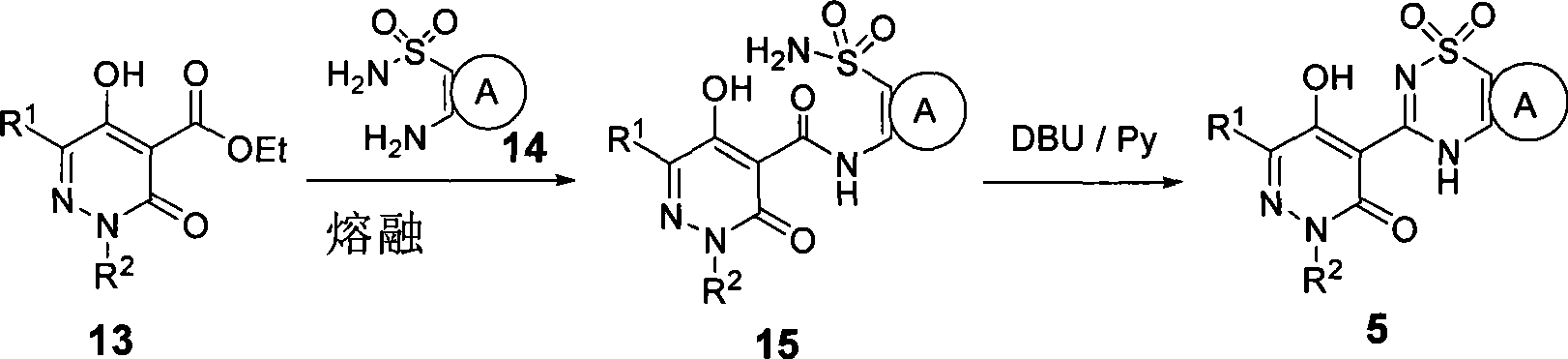
在总步骤中,化合物13与化合物14混合,160℃-170℃、无溶剂条件下加热,从而获得酰胺15。在吡啶存在下,在140℃-160℃的加热条件下,在密封管中用1,8-二氮杂双环[5,4,0]十一-7-烯(DBU)处理化合物15,从而获得所需产物(5)。In the overall procedure, compound 13 is mixed with compound 14 and heated at 160°C-170°C without solvent to obtain amide 15. Compound 15 was treated with 1,8-diazabicyclo[5,4,0]undec-7-ene (DBU) in a sealed tube under heating at 140°C-160°C in the presence of pyridine, thereby The desired product (5) is obtained.
实施例5-1:方案5a描述了化合物5m的合成。 Example 5-1 : Scheme 5a describes the synthesis of compound 5m.

5-羟基-2-(3-甲基-丁基)-3-氧代-6-噻吩-2-基-2,3-二氢-哒嗪-4-羧酸(5-氯-2- 氨磺酰-噻吩-3-基)-酰胺(15a) 5-Hydroxy-2-(3-methyl-butyl)-3-oxo-6-thiophen-2-yl-2,3-dihydro-pyridazine-4-carboxylic acid (5-chloro-2- Sulfamoyl-thiophen-3-yl)-amide (15a)
用方法4制得的酯(13a)(86毫克,0.26毫摩尔)与3-氨基-5-氯-噻吩-2-磺酸酰胺(14b)(54毫克,0.26毫摩尔)在反应瓶中混合,在160℃的预热的油浴中搅拌10分钟,获得相应的暗黄色固体5-羟基-2-(3-甲基-丁基)-3-氧代-6-噻吩-2-基-2,3-二氢-哒嗪-4-羧酸(5-氯-2-氨磺酰-噻吩-3-基)-酰胺(15a),在下一步继续使用无须进一步纯化。LC-MS(ESI+):m/e=503.09[M+1]+(精确质谱:502.02)。Ester (13a) (86 mg, 0.26 mmol) prepared by Method 4 was mixed with 3-amino-5-chloro-thiophene-2-sulfonic acid amide (14b) (54 mg, 0.26 mmol) in a reaction flask , stirred in a preheated oil bath at 160°C for 10 minutes to obtain the corresponding dark yellow solid 5-hydroxy-2-(3-methyl-butyl)-3-oxo-6-thiophen-2-yl- 2,3-Dihydro-pyridazine-4-carboxylic acid (5-chloro-2-sulfamoyl-thiophen-3-yl)-amide (15a) was carried on to the next step without further purification. LC-MS (ESI + ): m/e = 503.09 [M+1] + (exact mass: 502.02).
4-(2-氯-7,7-二氧代-4,7-二氢-1,7λ 6 -二硫杂(dithia)-4,6-二氮杂-茚-5-基)-5-羟 基-2-(3-甲基-丁基)-6-噻吩-2-基-2H-哒嗪-3-酮(5m)。 4-(2-Chloro-7,7-dioxo-4,7-dihydro-1,7λ 6 -dithia (dithia)-4,6-diaza-inden-5-yl)-5 -Hydroxy -2-(3-methyl-butyl)-6-thiophen-2-yl-2H-pyridazin-3-one (5m).
向密闭管中的酰胺中间体(15a)(54毫克,0.11毫摩尔)的无水吡啶(1.5毫升)溶液中加入1,8-二氮杂双环[5,4,0]十一碳-7-烯(DBU)(20微升),然后在140℃(油浴温度)下搅拌24小时。反应混合物冷却至室温,并将溶剂在真空下除去,而后残余物在高真空中进一步干燥2小时。使用己烷和乙酸乙酯,在硅胶上对粗产物进行闪式色谱法纯化,从而获得黄色固体所需产物(5m)(8.0毫克,15%)。LC-MS(ESI+):m/e=485.21[M+1]+(精确质谱:484.01);1H NMR(400MHz,DMSO-d6):δ7.86(dd,1H,J=3.2,1.2Hz),7.52(dd,1H,J=5.2,0.8Hz),7.46(s,1H),7.07(dd,1H,J=5.2,3.2Hz),4.03(m,2H),1.60(m,3H),0.93(d,6H,J=6.4Hz)。To a solution of amide intermediate (15a) (54 mg, 0.11 mmol) in dry pyridine (1.5 mL) in a closed tube was added 1,8-diazabicyclo[5,4,0]undec-7 -ene (DBU) (20 μl), then stirred at 140° C. (oil bath temperature) for 24 hours. The reaction mixture was cooled to room temperature, and the solvent was removed under vacuum, and the residue was further dried under high vacuum for 2 hours. The crude product was purified by flash chromatography on silica gel using hexanes and ethyl acetate to afford the desired product (5m) (8.0 mg, 15%) as a yellow solid. LC-MS (ESI + ): m/e=485.21[M+1] + (accurate mass spectrum: 484.01); 1 H NMR (400MHz, DMSO-d 6 ): δ7.86 (dd, 1H, J=3.2, 1.2Hz), 7.52(dd, 1H, J=5.2, 0.8Hz), 7.46(s, 1H), 7.07(dd, 1H, J=5.2, 3.2Hz), 4.03(m, 2H), 1.60(m, 3H), 0.93 (d, 6H, J=6.4Hz).
含有以5元芳香杂环类作为A环代替实施例5-1中所示的噻吩的式I化合物,也可用与方法5相似的方式合成。The compound of formula I containing a 5-membered aromatic heterocycle as ring A instead of thiophene shown in Example 5-1 can also be synthesized in a similar manner to Method 5.
方案6-11描述了所标明的中间体的合成路线。Schemes 6-11 describe the synthetic routes to the indicated intermediates.
方案6描述了中间体2的合成。Scheme 6 describes the synthesis of intermediate 2.
方案6Option 6

在方案6所示的典型合成路线中,在K2CO3的存在下,溴化物8可同肼基甲酸叔丁酯6加热反应形成叔丁氧羰基保护的肼1,该法使用下述文献中的步骤:Huck等,Synlett,2001(9),1467-1469(2001)和Tetrahedron Letters,40(18),3543-3546(1999)。叔丁氧羰基可通过用TFA或HCl处理除去,从而得到肼2的TFA或HCl盐。In the typical synthetic route shown in Scheme 6, in the presence of K 2 CO 3 , bromide 8 can react with tert-butyl carbazate 6 by heating to form tert-butoxycarbonyl-protected hydrazine 1, using the following literature Procedure in: Huck et al., Synlett, 2001(9), 1467-1469 (2001) and Tetrahedron Letters, 40(18), 3543-3546 (1999). The tert-butoxycarbonyl group can be removed by treatment with TFA or HCl to give hydrazine 2 as the TFA or HCl salt.
实施例6-1:方案6a描述了环丁基甲基-肼三氟乙酸盐的合成。 Example 6-1 : Scheme 6a describes the synthesis of cyclobutylmethyl-hydrazine trifluoroacetate.
方案6aOption 6a

在这个具体的实施例中,在Cs2CO3(12克,36.24毫摩尔)的存在下,在40毫升DMF中,溴化物8b(2.39克,18.1毫摩尔)与肼基甲酸叔丁酯6(3.24克,21.74毫摩尔)在80℃反应过夜。质谱证实形成了所需产物(1a),剩余很少的初始原料。冷却反应混合物后,滤出固体物。滤液真空浓缩,使用0-50%乙酸乙酯的己烷溶液梯度洗脱液,使粗残余物进一步于硅胶上通过闪式色谱法进行纯化。以22.5%的分离产率获得所需的纯产物(1a)(669.1毫克)。LC-MS:(ESI+):m/e=201[M+1]+,223.2[M+Na]+,400.7[2M+1]+,423.5[2M+Na]+(精确质谱:200.15)。In this particular example, bromide 8b (2.39 g, 18.1 mmol) was combined with tert-butyl carbazate 6 in 40 mL of DMF in the presence of Cs2CO3 (12 g, 36.24 mmol) (3.24 g, 21.74 mmol) was reacted overnight at 80°C. Mass spectroscopy confirmed the formation of the desired product (1a), with little starting material remaining. After cooling the reaction mixture, the solid was filtered off. The filtrate was concentrated in vacuo and the crude residue was further purified by flash chromatography on silica gel using a gradient eluent of 0-50% ethyl acetate in hexanes. The desired pure product (1a) (669.1 mg) was obtained in an isolated yield of 22.5%. LC-MS: (ESI + ): m/e=201[M+1] + , 223.2[M+Na]+, 400.7[2M+1]+, 423.5[2M+Na]+ (accurate mass spectrum: 200.15) .
用10毫升20%TFA的二氯甲烷溶液处理化合物1a(306毫克),反应混合物在室温下搅拌4.5小时。LC-MS结果证实了所需的产物。反应混合物进行减压浓缩,并在高真空下干燥过夜,从而获得黄色油状的所需产物2c的TFA盐,在下一步中直接使用。LC-MS:(ESI+):m/e=201.4[2M+1]+(精确质谱:100.15)。Compound 1a (306 mg) was treated with 10 mL of 20% TFA in dichloromethane and the reaction mixture was stirred at room temperature for 4.5 hours. LC-MS results confirmed the desired product. The reaction mixture was concentrated under reduced pressure and dried under high vacuum overnight to afford the TFA salt of the desired product 2c as a yellow oil, which was used directly in the next step. LC-MS: (ESI + ): m/e = 201.4 [2M+1] + (exact mass: 100.15).
方案7描述了中间产物2的合成。Scheme 7 describes the synthesis of intermediate 2.
方案7Option 7
在回流条件下,在乙醇中用过量一水合肼处理溴化物8,从而获得所需的肼2.Bromide 8 was treated with excess hydrazine monohydrate in ethanol under reflux conditions to afford the desired hydrazine 2.
实施例7-1:方案7a描述了3-甲基-丁基-肼(2)的合成。 Example 7-1 : Scheme 7a describes the synthesis of 3-methyl-butyl-hydrazine (2).
方案7aOption 7a
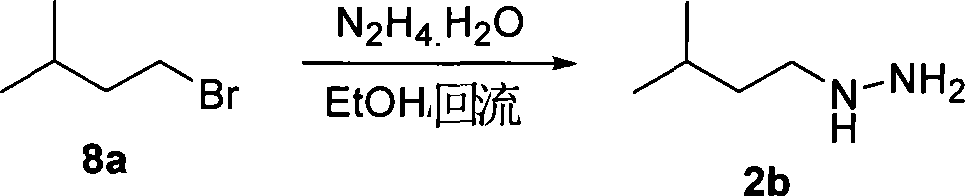
(3-甲基-丁基)-肼(2b): (3-Methyl-butyl)-hydrazine (2b):
在氮气气氛下,向一水合肼(Aldrich)(40毫升)的乙醇(250毫升)溶液中,快速加入1-溴-3-甲基-丁烷(8a)(Aldrich)(15.1克,100毫摩尔),所得混合物回流24小时。混合物冷却至室温,并进行减压浓缩。残余物溶解在H2O(40毫升)/DCM(200毫升)中,加入固体K2CO3使水层饱和。将两层分离,水层用DCM(2×100毫升)萃取。合并后的有机层经K2CO3干燥,然后进行减压浓缩,从而获得无色油状所需产物(2b)(7.0克,70%)。1H NMR(400MHz,CDCl3):δ2.80(m,2H),1.65(m,1H),1.41(m,2H),0.93(d,6H,J=6.4Hz)。To a solution of hydrazine monohydrate (Aldrich) (40 mL) in ethanol (250 mL) was rapidly added 1-bromo-3-methyl-butane (8a) (Aldrich) (15.1 g, 100 mL) under a nitrogen atmosphere. mol), the resulting mixture was refluxed for 24 hours. The mixture was cooled to room temperature, and concentrated under reduced pressure. The residue was dissolved in H2O (40 mL ) /DCM (200 mL), and solid K2CO3 was added to saturate the aqueous layer. The two layers were separated and the aqueous layer was extracted with DCM (2 x 100 mL). The combined organic layers were dried over K2CO3 and concentrated under reduced pressure to obtain the desired product (2b) (7.0 g, 70%) as a colorless oil. 1 H NMR (400 MHz, CDCl 3 ): δ 2.80 (m, 2H), 1.65 (m, 1H), 1.41 (m, 2H), 0.93 (d, 6H, J=6.4 Hz).
实施例7-2:合成环丁基甲基-肼(2c): Embodiment 7-2 : Synthesis of cyclobutylmethyl-hydrazine (2c):
环丁基甲基-肼(2c): Cyclobutylmethyl-hydrazine (2c):
通过类似的合成路线,从溴代环丁基甲烷可制取环丁基甲基-肼(2c)。LC-MS:(ESI+):m/e=201.4[2M+1]+(精确质谱:100.10);1H NMR(400MHz,CDCl3):δ3.06(s,br,3H),2.81(d,2H,J=7.6Hz),2.47-2.54(m,1H),2.05-2.13(m,2H),1.83-1.97(m,2H),1.66-1.75(m,2H)。Cyclobutylmethyl-hydrazine (2c) can be prepared from bromocyclobutylmethane by a similar synthetic route. LC-MS: (ESI + ): m/e=201.4[2M+1]+ (accurate mass spectrum: 100.10); 1 H NMR (400MHz, CDCl 3 ): δ3.06(s, br, 3H), 2.81( d, 2H, J=7.6Hz), 2.47-2.54 (m, 1H), 2.05-2.13 (m, 2H), 1.83-1.97 (m, 2H), 1.66-1.75 (m, 2H).
方案8描述了草酸肼6的合成。Scheme 8 describes the synthesis of hydrazine oxalate 6.
方案8Option 8
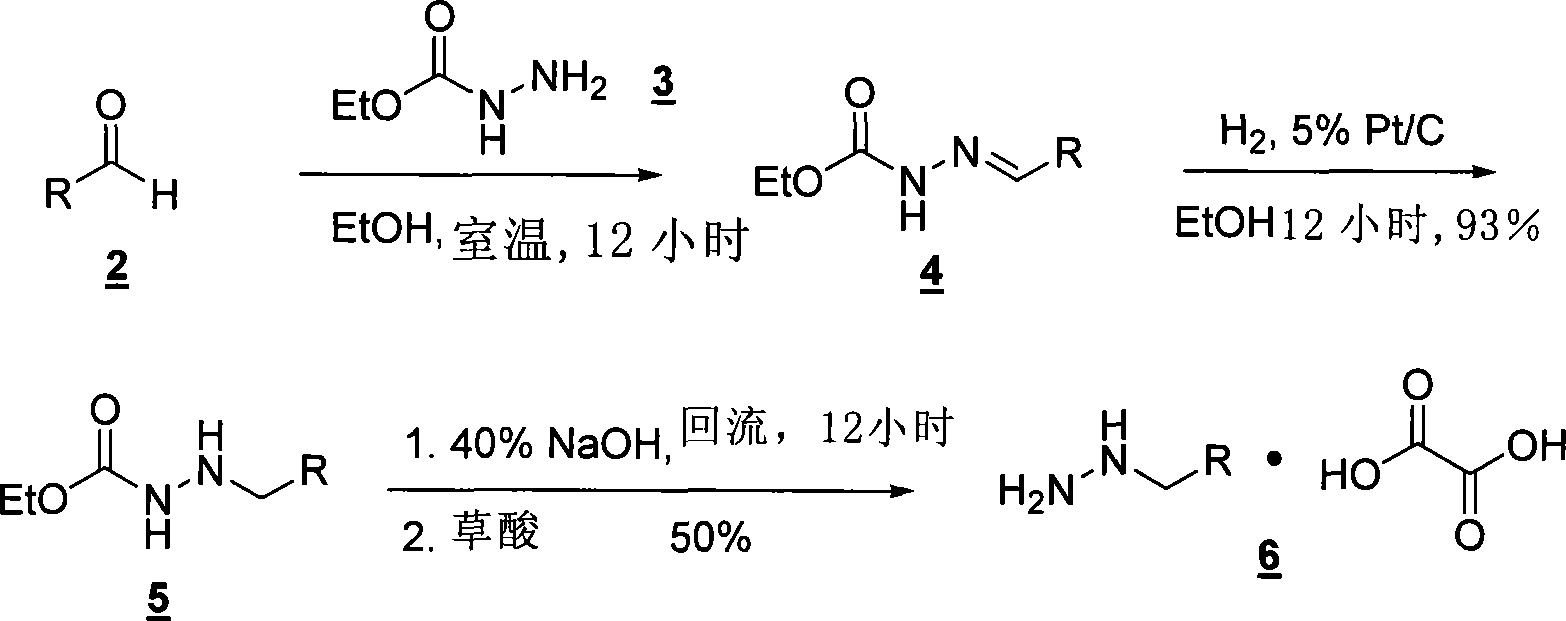
在总体步骤中,醛2可与化合物3进行还原胺化得到化合物4,化合物4能被还原成化合物5。化合物5可用NaOH处理,然后使用草酸酸化以得到所需的草酸肼(6)。In the overall procedure, aldehyde 2 can be reductively aminated with compound 3 to give compound 4, which can be reduced to compound 5. Compound 5 can be treated with NaOH followed by acidification with oxalic acid to give the desired hydrazine oxalate (6).
实施例8-1:方案8a描述了2-环丙基乙基-肼草酸盐(6a)的合成。 Example 8-1 : Scheme 8a describes the synthesis of 2-cyclopropylethyl-hydrazine oxalate (6a).
方案8aOption 8a

N’-(2-环丙亚乙基)肼羧酸乙酯(4a): Ethyl N'-(2-cyclopropylethylene)hydrazinecarboxylate (4a):
将草酰氯(4.7毫升,54.3毫摩尔)溶解在120毫升CH2Cl2中,所得溶液冷却至-78℃。逐滴加入二甲亚砜(7.7毫升,0.109摩尔),反应混合物在-78℃下搅拌10分钟。将2-环丙基乙醇(7)(4.25克,49.3毫摩尔)溶解在10毫升CH2Cl2中并一次性加至反应物中。搅拌1小时后,加入三乙胺(34.7毫升,0.25摩尔),然后使反应物升温至室温。非均相的混合物在CH2Cl2和水之间分离,用CH2Cl2萃取2次。合并有机层,用盐水洗涤,以MgSO4干燥,并过滤。在填满碎冰的旋转蒸发仪浴中,将所得的2-环丙基乙醛溶液真空浓缩至约50毫升。由于醛具挥发性,将其作为粗混合物使用,并不作进一步提纯。Oxalyl chloride (4.7 mL, 54.3 mmol) was dissolved in 120 mL CH2Cl2 , and the resulting solution was cooled to -78°C. Dimethylsulfoxide (7.7 mL, 0.109 mol) was added dropwise, and the reaction mixture was stirred at -78°C for 10 minutes. 2-Cyclopropylethanol (7) (4.25 g, 49.3 mmol) was dissolved in 10 mL CH2Cl2 and added to the reaction in one portion . After stirring for 1 hour, triethylamine (34.7 mL, 0.25 mol) was added and the reaction was allowed to warm to room temperature. The heterogeneous mixture was partitioned between CH2Cl2 and water, extracted twice with CH2Cl2 . The organic layers were combined, washed with brine, dried over MgSO4 , and filtered. The resulting 2-cyclopropylacetaldehyde solution was concentrated in vacuo to about 50 mL in a rotary evaporator bath filled with crushed ice. Due to the volatility of the aldehyde, it was used as a crude mixture without further purification.
2-环丙基乙醛用50毫升乙醇稀释。加入肼基甲酸乙酯(5.14克,49.3毫摩尔),室温下搅拌溶液12小时,所得物真空浓缩,粗产物用闪式柱色谱(0-5%甲醇的CH2Cl2溶液)纯化,从而得到7.1g(85%)无色结晶固体腙(4a)。1H-NMR(400MHz,CDCl3):8.21(br s,1H);7.21(s,1H);4.23(m,2H);2.17(t,3H,J=5.9Hz),1.06(m,2H);0.80(m,1H);0.1(d,2H);0.48(m,2H);0.13(m,2H)ppm。2-Cyclopropylacetaldehyde was diluted with 50 ml of ethanol. Ethyl carbazate (5.14 g, 49.3 mmol) was added, the solution was stirred at room temperature for 12 h, the resultant was concentrated in vacuo, and the crude product was purified by flash column chromatography (0-5% methanol in CH2Cl2 ) to obtain 7.1 g (85%) of hydrazone (4a) were obtained as a colorless crystalline solid. 1 H-NMR (400MHz, CDCl 3 ): 8.21(br s, 1H); 7.21(s, 1H); 4.23(m, 2H); 2.17(t, 3H, J=5.9Hz), 1.06(m, 2H ); 0.80 (m, 1H); 0.1 (d, 2H); 0.48 (m, 2H); 0.13 (m, 2H) ppm.
N’-(2-环丙基乙基)肼羧酸乙酯(5a): Ethyl N'-(2-cyclopropylethyl)hydrazinecarboxylate (5a):
将N’-(2-环丙基亚乙基)肼羧酸乙酯(4a)(1.5克,8.9毫摩尔)溶解于35毫升乙醇中,向该溶液中加入5%Pt/C(0.2克,0.9摩尔)。将烧瓶中气体抽成真空,并用H2置换三次。在较小的H2正压力下,在室温下搅拌溶液12小时,所得物通过中性氧化铝过滤并浓缩,从而得到1.4g(93%)澄清无色液体所需产物(5a)。1H-NMR(400MHz,CDCl3):4.18(q,2H,J=7.0Hz);3.00(t,2H,J=7.0Hz),1.42(q,2H,J=7.0Hz);1.29(t,3H,J=7.2Hz);0.73(m,1H);0.1(d,2H);0.47(m,2H);0.08(m,2H)ppm。Ethyl N'-(2-cyclopropylethylene)hydrazinecarboxylate (4a) (1.5 g, 8.9 mmol) was dissolved in 35 mL of ethanol, and 5% Pt/C (0.2 g , 0.9 mol). The atmosphere in the flask was evacuated and replaced three times with H2. The solution was stirred at room temperature for 12 h under a small positive pressure of H2 , the resultant was filtered through neutral alumina and concentrated to afford 1.4 g (93%) of the desired product (5a) as a clear colorless liquid. 1 H-NMR (400MHz, CDCl 3 ): 4.18(q, 2H, J=7.0Hz); 3.00(t, 2H, J=7.0Hz), 1.42(q, 2H, J=7.0Hz); 1.29(t , 3H, J=7.2Hz); 0.73 (m, 1H); 0.1 (d, 2H); 0.47 (m, 2H); 0.08 (m, 2H) ppm.
2-环丙基乙基-肼草酸盐(6a): 2-Cyclopropylethyl-hydrazine oxalate (6a):
将N’-(2-环丙基乙基)肼羧酸乙酯(5a)(2.2克,12.6毫摩尔)悬浮在7毫升40%的NaOH水溶液中。两相混合物于120℃下加热12小时,然后将其冷却至室温,并在饱和食盐水和CH2Cl2之间分配。除去有机层,用MgSO4干燥,并过滤。将草酸(1.1克,12.6毫摩尔)加入滤液,12小时后将其过滤并真空干燥,产得1.7g(50%)白色粉末状草酸盐(6a)。1H-NMR(400MHz,D2O):3.13(t,2H,J=7.2Hz);1.46(q,2H,J=7.2Hz);0.61(m,1H);0.1(d,2H);0.39(m,2H);0.01(m,2H)ppm。Ethyl N'-(2-cyclopropylethyl)hydrazinecarboxylate (5a) (2.2 g, 12.6 mmol) was suspended in 7 mL of 40% aqueous NaOH. The biphasic mixture was heated at 120°C for 12 hours, then it was cooled to room temperature and partitioned between saturated brine and CH2Cl2 . The organic layer was removed, dried over MgSO4 , and filtered. Oxalic acid (1.1 g, 12.6 mmol) was added to the filtrate which was filtered and dried in vacuo after 12 hours to yield 1.7 g (50%) of the oxalate salt (6a) as a white powder. 1 H-NMR (400MHz, D 2 O): 3.13(t, 2H, J=7.2Hz); 1.46(q, 2H, J=7.2Hz); 0.61(m, 1H); 0.1(d, 2H); 0.39 (m, 2H); 0.01 (m, 2H) ppm.
实施例8-2:合成3-甲基丁基肼草酸盐(6b)。 Example 8-2 : Synthesis of 3-methylbutylhydrazine oxalate (6b).
使用类似的合成路线,从异戊醛和肼基甲酸乙酯开始,制备3-甲基丁基肼的草酸盐(6b)。1H-NMR(400MHz,D2O):3.09(t,2H,J=8.0Hz);1.58(m,1H);1.47(m,2H);0.84(d,6H,J=6.3Hz)ppm。Using a similar synthetic route, starting from isovaleraldehyde and ethyl carbazate, the oxalate salt of 3-methylbutylhydrazine (6b) was prepared. 1 H-NMR (400MHz, D 2 O): 3.09 (t, 2H, J = 8.0Hz); 1.58 (m, 1H); 1.47 (m, 2H); 0.84 (d, 6H, J = 6.3Hz) ppm .
实施例8-3:合成(3,3-二甲基-丁基)-肼草酸盐(6c)。 Example 8-3 : Synthesis of (3,3-dimethyl-butyl)-hydrazine oxalate (6c).
使用同样的合成路线,还制备了(3,3-二甲基-丁基)-肼草酸盐(6c)。1HNMR(400MHz,D2O):δ3.08(m,2H),1.47(m,2H),0.85(s,9H)ppm。Using the same synthetic route, (3,3-dimethyl-butyl)-hydrazine oxalate (6c) was also prepared. 1 H NMR (400 MHz, D 2 O): δ 3.08 (m, 2H), 1.47 (m, 2H), 0.85 (s, 9H) ppm.
方案9描述了中间产物9,4a,10a,10b和4b的合成。Scheme 9 describes the synthesis of intermediates 9, 4a, 10a, 10b and 4b.
方案9Option 9

7-甲氧基-1,1-二氧代-1,4-二氢-2H-1λ7-methoxy-1,1-dioxo-1,4-dihydro-2H-1λ 66 -苯并[1,2,4]噻二嗪-3-酮(8)-Benzo[1,2,4]thiadiazin-3-one (8)
将氯磺酰异氰酸酯(17毫升,195毫摩尔)溶于150毫升硝基乙烷中,并冷却至-40℃。在进行搅拌的同时,将4-甲氧基苯胺(7)(20克,162毫摩尔)在100毫升硝基乙烷中的溶液用滴液漏斗(dropper funnel)逐滴加入。加完之后,再将反应物搅拌5分钟,加入氯化铝(25克,195毫摩尔)。混合物快速加热至110℃,并搅拌20分钟。将粗产物倾倒于冰上,抽滤收集沉淀物,用冷水洗涤并真空干燥,得到35克紫色粉末所需产物(8),产率95%。1H NMR(400MHz,DMSO-d6):δ11.05(s,1H),7.2(m,3H),3.78(s,3H),3.6(br,1H)。Chlorosulfonyl isocyanate (17 mL, 195 mmol) was dissolved in 150 mL of nitroethane and cooled to -40°C. While stirring, a solution of 4-methoxyaniline (7) (20 g, 162 mmol) in 100 mL of nitroethane was added dropwise using a dropper funnel. After the addition was complete, the reaction was stirred for an additional 5 minutes and aluminum chloride (25 g, 195 mmol) was added. The mixture was rapidly heated to 110°C and stirred for 20 minutes. The crude product was poured onto ice, and the precipitate was collected by suction filtration, washed with cold water and dried in vacuo to obtain 35 g of the desired product (8) as a purple powder with a yield of 95%. 1 H NMR (400 MHz, DMSO-d 6 ): δ 11.05 (s, 1H), 7.2 (m, 3H), 3.78 (s, 3H), 3.6 (br, 1H).
2-氨基-5-甲氧基-苯磺酰胺(9) 2-Amino-5-methoxy-benzenesulfonamide (9)
将8(15克,65.7毫摩尔)的溶液溶解在140毫升50%硫酸中。然后溶液于130℃加热6小时。然后溶液倾倒于冰上,并在0℃下,通过加入饱和氢氧化钠水溶液进行中和。然后混合物用乙酸乙酯萃取。有机相用盐水洗涤,并用硫酸镁干燥,过滤并真空干燥,从而制得8.1g棕色固体所需产物(9),产率60%。步骤可参见下列文献:Girard,Y,等,J.Chem.Soc.Perkin Trans1,1043-1047(1979)。1H NMR(400MHz,DMSO-d6):δ7.19(s,2H),7.07(d,1H,J=2.8Hz),6.90(dd,1H,J1=8.8Hz,J2=2.8Hz),6.73(d,1H,J=8.8Hz),5.40(s,2H),3.65(s,3H)。A solution of 8 (15 g, 65.7 mmol) was dissolved in 140 mL of 50% sulfuric acid. The solution was then heated at 130°C for 6 hours. The solution was then poured onto ice and neutralized by adding saturated aqueous sodium hydroxide solution at 0°C. Then the mixture was extracted with ethyl acetate. The organic phase was washed with brine and dried over magnesium sulfate, filtered and dried in vacuo to afford 8.1 g of the desired product (9) as a brown solid in 60% yield. The procedure can be referred to the following literature: Girard, Y, et al., J. Chem. Soc. Perkin Trans 1, 1043-1047 (1979). 1 H NMR (400 MHz, DMSO-d 6 ): δ7.19 (s, 2H), 7.07 (d, 1H, J=2.8Hz), 6.90 (dd, 1H, J1=8.8Hz, J2=2.8Hz), 6.73 (d, 1H, J=8.8Hz), 5.40 (s, 2H), 3.65 (s, 3H).
N-(4-甲氧基-2-氨磺酰-苯基)-丙酰胺酸乙酯(10) N-(4-Methoxy-2-sulfamoyl-phenyl)-propionamic acid ethyl ester (10)
将9(8.0克,40毫摩尔)在丙二酸二乙酯(14.1克,82毫摩尔)中的净相悬浮液于160℃下加热60分钟,然后冷却至室温。混合物在己烷内研磨并滗析2次。然后混合物在乙醚中研磨并滗析2次。对剩余固体进行真空干燥,得到8.8g棕色固体所需产物(10),产率70%。1H NMR(400MHz,DMSO-d6):δ9.39(s,1H),7.72(d,1H,J=8.8Hz),7.46(s,2H),7.34(m,1H),7.16(m,1H),4.10(m,2H),3.78(s,3H),3.54(s,2H),1.95(m,3H)。A neat suspension of 9 (8.0 g, 40 mmol) in diethyl malonate (14.1 g, 82 mmol) was heated at 160°C for 60 min and then cooled to room temperature. The mixture was triturated in hexane and decanted twice. The mixture was then triturated in ether and decanted twice. The remaining solid was vacuum dried to afford 8.8 g of the desired product (10) as a brown solid, 70% yield. 1 H NMR (400MHz, DMSO-d 6 ): δ9.39(s, 1H), 7.72(d, 1H, J=8.8Hz), 7.46(s, 2H), 7.34(m, 1H), 7.16(m , 1H), 4.10 (m, 2H), 3.78 (s, 3H), 3.54 (s, 2H), 1.95 (m, 3H).
(7-甲氧基-1,1-二氧代-1,4-二氢-1λ(7-methoxy-1,1-dioxo-1,4-dihydro-1λ 66 -苯并[1,2,4]噻二嗪-3-基)-乙酸乙酯(4a)-Benzo[1,2,4]thiadiazin-3-yl)-ethyl acetate (4a)
将10的混合物(8.0克,28毫摩尔)在磷酰氯(150毫升,1.64摩尔)的混合物加热回流2.5小时,然后冷却至室温并真空浓缩。残余物溶解于乙酸乙酯,并用饱和碳酸氢钠水溶液中和。有机相用2N盐酸洗涤,然后用盐水洗涤,硫酸镁干燥,过滤并真空浓缩。然后将固体产物于乙醚中研碎,得到6.6g棕色固体所需产物(4a),产率79%。参见国际专利申请PCT/US03/16374中所述步骤。1HNMR(400MHz,DMSO-d6):δ12.20(s,1H),7.27(m,2H),7.20(s,1H),4.14(q,2H,J=7.2Hz),3.73(s,3H),3.66(s,2H),1.21(t,3H,J=7.6Hz);LC-MS(ESI+):m/e=299.1[M+1]+。A mixture of 10 (8.0 g, 28 mmol) in phosphorus oxychloride (150 mL, 1.64 mol) was heated at reflux for 2.5 hours, then cooled to room temperature and concentrated in vacuo. The residue was dissolved in ethyl acetate, and neutralized with saturated aqueous sodium bicarbonate. The organic phase was washed with 2N hydrochloric acid, then brine, dried over magnesium sulfate, filtered and concentrated in vacuo. The solid product was then triturated in diethyl ether to afford 6.6 g of the desired product (4a) as a brown solid, yield 79%. See the procedure described in International Patent Application PCT/US03/16374. 1HNMR (400MHz, DMSO-d 6 ): δ12.20(s, 1H), 7.27(m, 2H), 7.20(s, 1H), 4.14(q, 2H, J=7.2Hz), 3.73(s, 3H ), 3.66 (s, 2H), 1.21 (t, 3H, J = 7.6 Hz); LC-MS (ESI + ): m/e = 299.1 [M+1] + .
(7-甲氧基-1,1-二氧代-1,4-二氢-116-苯并[1,2,4]噻二嗪-3-基)-乙酸(10a): (7-Methoxy-1,1-dioxo-1,4-dihydro-116-benzo[1,2,4]thiadiazin-3-yl)-acetic acid (10a):
向(7-甲氧基-1,1-二氧代-1,4-二氢-1λ6-苯并[1,2,4]噻二嗪-3-基)-乙酸乙酯(4a)(1.0克,3.35毫摩尔)在5毫升THF及1毫升DMF的浆液中,加入10毫升6.0M的HCl水溶液,反应混合物在室温下振摇2天或一周。反应混合物用盐水稀释、过滤、洗涤并收集固体,该固体在高真空下进一步干燥过夜,从而获得705.4毫克所需产物,为首批产物(10a)。滤液用乙酸乙酯萃取3次。有机层用MgSO4干燥,将其过滤、减压浓缩并在高真空下进一步干燥过夜,获得第二批所需产物(10a)(185.2毫克)。总共获得890.6毫克的化合物10a中,产率为98.4%。该产物直接用于下一步,无须进一步纯化。该反应较大规模重复多次后,产率呈85-98%不等。To (7-methoxy-1,1-dioxo-1,4-dihydro-1λ6-benzo[1,2,4]thiadiazin-3-yl)-acetic acid ethyl ester (4a) ( 1.0 g, 3.35 mmol) in 5 ml THF and 1 ml DMF slurry, 10 ml 6.0 M HCl aqueous solution was added, and the reaction mixture was shaken at room temperature for 2 days or a week. The reaction mixture was diluted with brine, filtered, washed and the solid collected which was further dried under high vacuum overnight to afford 705.4 mg of the desired product as the first crop (10a). The filtrate was extracted 3 times with ethyl acetate. The organic layer was dried over MgSO4 , which was filtered, concentrated under reduced pressure and further dried under high vacuum overnight to obtain a second crop of desired product (10a) (185.2 mg). A total of 890.6 mg of compound 10a was obtained with a yield of 98.4%. The product was used directly in the next step without further purification. The reaction was repeated several times on a larger scale with yields ranging from 85-98%.
(7-羟基-1,1-二氧代-1,4-二氢-1λ 6 -苯并[1,2,4]噻二嗪-3-基)-乙酸(10c): (7-Hydroxy-1,1-dioxo-1,4-dihydro-1λ 6 -benzo[1,2,4]thiadiazin-3-yl)-acetic acid (10c):
在0℃下,在5分钟内向化合物4a(1克,3.7毫摩尔)的二氯甲烷(23毫升)溶液中逐滴加入1.0M的BBr3的二氯甲烷溶液。反应混合物在0℃至室温下搅拌过夜。LC-MS结果证实反应结束。反应混合物倾倒于50毫升冰上,并用乙酸乙酯(150毫升×3)萃取。合并后的有机层用MgSO4干燥,过滤,减压浓缩并进一步于高真空下干燥,从而制得826.8毫克棕色泡沫状的所需产物(10c),产率87.2%。该粗产物直接用于下步,无须纯化。LC-MS:(ESI+)m/e=257.10[M+1]+(精确质谱:256.02)。To a solution of compound 4a (1 g, 3.7 mmol) in dichloromethane (23 mL) was added a 1.0 M solution of BBr3 in dichloromethane dropwise at 0 °C over 5 min. The reaction mixture was stirred overnight at 0°C to room temperature. LC-MS results confirmed the end of the reaction. The reaction mixture was poured onto 50 mL of ice, and extracted with ethyl acetate (150 mL×3). The combined organic layers were dried over MgSO4 , filtered, concentrated under reduced pressure and further dried under high vacuum to afford 826.8 mg of the desired product (10c) as a brown foam in 87.2% yield. The crude product was used directly in the next step without purification. LC-MS: (ESI + ) m/e = 257.10 [M+1] + (exact mass: 256.02).
在一个独立实验中,将上述反应进行较大规模的重复,其中使用了1.5g(5.03毫摩尔)的初始物4a,得到起始原料10c,后者直接转化为化合物4b。In a separate experiment, the above reaction was repeated on a larger scale using 1.5 g (5.03 mmol) of starting material 4a to give starting material 10c which was directly converted to compound 4b.
(7-羟基-1,1-二氧代-1,4-二氢-1λ 6 -苯并[1,2,4]噻二嗪-3-基)-乙酸乙酯(4b): (7-Hydroxy-1,1-dioxo-1,4-dihydro-1λ 6 -benzo[1,2,4]thiadiazin-3-yl)-acetic acid ethyl ester (4b):
将乙醇(15毫升)和150微升H2SO4(浓)加至化合物10c(5.03毫摩尔),混合物在80℃下搅拌加热45分钟。溶剂部分减压蒸发至原体积的一半。加入乙酸乙酯(30毫升),得到的混合物用水(15毫升×3)通过萃取洗涤。水层用乙酸乙酯(60毫升)反萃取一次,合并后的有机层用无水MgSO4干燥,过滤,浓缩,从而获得所需产物(4b)(1.11克),为灰色固体。该粗产物无须进一步纯化直接用于下步。LC-MS:(ESI+)m/e=285.10[M+1]+(精确质谱:284.05)。Ethanol (15 mL) and 150 μL H 2 SO 4 (conc.) were added to compound 10c (5.03 mmol), and the mixture was stirred and heated at 80° C. for 45 minutes. The solvent part was evaporated under reduced pressure to half the original volume. Ethyl acetate (30 mL) was added, and the resulting mixture was washed with water (15 mL x 3) by extraction. The aqueous layer was back extracted once with ethyl acetate (60 mL) and the combined organic layers were dried over anhydrous MgSO4 , filtered and concentrated to give the desired product (4b) (1.11 g) as a gray solid. The crude product was used directly in the next step without further purification. LC-MS: (ESI + ) m/e = 285.10 [M+1] + (exact mass: 284.05).
方案10描述了中间体10b的合成。Scheme 10 describes the synthesis of intermediate 10b.
方案10Scheme 10

N-(2-氨磺酰-苯基)-丙酰胺酸乙酯(12): N-(2-sulfamoyl-phenyl)-propionamic acid ethyl ester (12):
2-氨基苯磺酰胺(11)(10.0克,58.1毫摩尔)的丙二酸二乙酯(diethylmalonte)(18.1毫升)的悬浮液加热至160℃。反应混合物经加热变得均匀,160℃下持续搅拌6小时。冷却至室温后,向反应混合物中加入乙醚(150毫升)而引起沉淀。真空过滤收集沉淀物,从而得到紫色固体12(5.0克,30%)。1HNMR(400MHz,D6-DMSO)δ9.57(s,1H),7.99(d,J=8Hz,1H),7.84(dd,J=8,1Hz,1H),7.58(td,J=8,1Hz,1H),7.53(s,2H),7.31(td,J=8,1Hz,1H),4.14(dt,J=7.2,7.2Hz,2H),3.60(s,2H),1.22(t,J=7.2H,3H)。MS(ESI+)m/e537[M+H]+.A suspension of 2-aminobenzenesulfonamide (11) (10.0 g, 58.1 mmol) in diethylmalonte (18.1 mL) was heated to 160°C. The reaction mixture was heated to become homogeneous and stirring was continued at 160°C for 6 hours. After cooling to room temperature, diethyl ether (150 mL) was added to the reaction mixture to cause precipitation. The precipitate was collected by vacuum filtration to give 12 as a purple solid (5.0 g, 30%). 1 HNMR (400MHz, D 6 -DMSO) δ9.57(s, 1H), 7.99(d, J=8Hz, 1H), 7.84(dd, J=8, 1Hz, 1H), 7.58(td, J=8 , 1Hz, 1H), 7.53(s, 2H), 7.31(td, J=8, 1Hz, 1H), 4.14(dt, J=7.2, 7.2Hz, 2H), 3.60(s, 2H), 1.22(t , J=7.2H, 3H). MS(ESI + )m/e537[M+H] + .
(1,1-二氧代-1,4-二氢-1λ 6 -苯并[1,2,4]噻二嗪-3-基)-乙酸乙酯(4c): (1,1-Dioxo-1,4-dihydro-1λ 6 -benzo[1,2,4]thiadiazin-3-yl)-acetic acid ethyl ester (4c):
将12(2.50克,8.73毫摩尔)与磷酰氯(50毫升)的混合物加热回流6小时,冷却至室温,并真空浓缩。残余物溶解于乙酸乙酯(200毫升)中并用饱和Na2CO3(100毫升)萃取。有机层用1N HCl(50毫升),用MgSO4干燥,并真空浓缩得到黄色固体4c(1.99克,85%)。1H NMR(400MHz,D6-DMSO),δ12.22(s,1H),7.79(d,J=12Hz,1H),7.67(t,J=10Hz,1H),7.45(t,J=8Hz,1H),7.30(d,J=8Hz,1H),4.15(dt,J=7.2,7.2Hz,2H),3.69(s,2H),1.21(t,J=7.2Hz,3H)。A mixture of 12 (2.50 g, 8.73 mmol) and phosphorus oxychloride (50 mL) was heated at reflux for 6 hours, cooled to room temperature, and concentrated in vacuo. The residue was dissolved in ethyl acetate (200 mL) and extracted with saturated Na2CO3 (100 mL) . The organic layer was dried with 1N HCl (50 mL), MgSO 4 , and concentrated in vacuo to give 4c as a yellow solid (1.99 g, 85%). 1 H NMR (400MHz, D 6 -DMSO), δ12.22(s, 1H), 7.79(d, J=12Hz, 1H), 7.67(t, J=10Hz, 1H), 7.45(t, J=8Hz , 1H), 7.30 (d, J = 8Hz, 1H), 4.15 (dt, J = 7.2, 7.2Hz, 2H), 3.69 (s, 2H), 1.21 (t, J = 7.2Hz, 3H).
(1,1-二氧代-1,4-二氢-1λ 6 -苯并[1,2,4]噻二嗪-3-基)-乙酸(10b): (1,1-dioxo-1,4-dihydro-1λ 6 -benzo[1,2,4]thiadiazin-3-yl)-acetic acid (10b):
将4c(1.98克,7.36毫摩尔)在THF(10毫升)和6N HCl(20毫升)中的溶液于室温下搅拌2天。向溶液中加入氯仿(20毫升),强烈搅拌15分钟后出现沉淀。沉淀物通过真空过滤收集,从而得到黄色固体10b(1.50克,85%)。1H NMR(400MHz,D6-DMSO)δ12.25(s,1H),7.78(d,J=8Hz,1H),7.66(td,J=8,1Hz,1H),7.44(td,J=8,1Hz,1H),7.32(d,J=8Hz,1H),3.70(br s,1H),3.58(s,2H)。A solution of 4c (1.98 g, 7.36 mmol) in THF (10 mL) and 6N HCl (20 mL) was stirred at room temperature for 2 days. Chloroform (20 mL) was added to the solution and after vigorous stirring for 15 minutes a precipitate appeared. The precipitate was collected by vacuum filtration to give 10b as a yellow solid (1.50 g, 85%). 1 H NMR (400MHz, D 6 -DMSO) δ12.25(s, 1H), 7.78(d, J=8Hz, 1H), 7.66(td, J=8, 1Hz, 1H), 7.44(td, J= 8, 1Hz, 1H), 7.32 (d, J = 8Hz, 1H), 3.70 (br s, 1H), 3.58 (s, 2H).
方案11描述了中间产物14b的合成。Scheme 11 describes the synthesis of intermediate 14b.
方案11Scheme 11

中间产物14b以下文中类似的方式制备:Hansen,J.B.等J.Med.Chem.2002,45,4171-4187。Intermediate 14b was prepared in a similar manner as in: Hansen, J.B. et al. J. Med. Chem. 2002, 45, 4171-4187.
3-氨基-5-氯-噻吩-2-磺酰胺(14b): 3-Amino-5-chloro-thiophene-2-sulfonamide (14b):
1H NMR(400MHz,DMSO-d6)δ7.32(br s,2H),6.58(s,1H),5.93(br s,2H)。LC-MS(ESI+):m/e=213.20[M+H]+。 1 H NMR (400 MHz, DMSO-d6) δ 7.32 (br s, 2H), 6.58 (s, 1H), 5.93 (br s, 2H). LC-MS (ESI + ): m/e = 213.20 [M+H] + .
相应的14b的HCl盐(盐酸3-氨基-5-氯-噻吩-2-磺酰胺)是一种盐酸盐,也用相同文献中的方法制备。The corresponding HCl salt of 14b (3-amino-5-chloro-thiophene-2-sulfonamide hydrochloride), a hydrochloride, was also prepared by the same literature procedure.
生物试验biological test
式I的化合物抑制HCV复制的能力可用以下体外实验证明。The ability of compounds of formula I to inhibit HCV replication can be demonstrated in the following in vitro experiments.
NS5B聚合酶抑制试验NS5B polymerase inhibition assay
化合物就HCV聚合酶的抑制性进行试验。分析使用96-孔的抗生物素蛋白链菌素涂布的FlashPlate,50nM酶,0.5μCi的[α-33P]GTP,0.63μM GTP,在20mMTris-HCl中的250nM5’生物素酰化寡糖(rG13)/聚rC,pH=7.5,5mM MgCl2,20mMNaCl,5mM二硫苏糖醇和0.1g/L BSA。反应在28℃下进行75分钟后通过抽吸终止,清洗板数次。洗涤后,结合的放射性通过Microbeta闪烁计数器计数。Compounds were tested for inhibition of HCV polymerase. Assay using 96-well streptavidin-coated FlashPlate, 50 nM enzyme, 0.5 μCi of [α- 33 P]GTP, 0.63 μM GTP, 250 nM 5' biotinylated oligosaccharides in 20 mM Tris-HCl (rG 13 )/poly-rC, pH=7.5, 5 mM MgCl 2 , 20 mM NaCl, 5 mM dithiothreitol and 0.1 g/L BSA. The reaction was stopped by aspiration after 75 minutes at 28°C, and the plate was washed several times. After washing, bound radioactivity was counted by Microbeta scintillation counter.
式I化合物的试验结果(IC50值)概括于表1,其中++表示NS5B聚合酶抑制,其IC50值小于10μM,+表示IC50值在10μM至50μM之间,“未测定”表示IC50值未测得。The test results (IC50 values) of the compounds of formula I are summarized in Table 1, wherein ++ means NS5B polymerase inhibition, and its IC50 value is less than 10 μ M, + means that the IC 50 value is between 10 μ M and 50 μ M, and "not determined" means the IC 50 value Not measured.
表1中每种化合物的测定量对应于预测量。The measured amount of each compound in Table 1 corresponds to the pre-measured amount.
HCV复制子分析(复制子EC50(μM))HCV Replicon Analysis (Replicon EC 50 (μM))
细胞系: cell line :
含有HCV双顺反子复制子的人肝细胞Huh7细胞来自德国美因滋大学的Ralf Bartenschlager。这些细胞在G418-遗传霉素(G418-Geneticin)选择下维持,当80-90%融合时传代。Human hepatocyte Huh7 cells containing the HCV bicistronic replicon were obtained from Ralf Bartenschlager, University of Mainz, Germany. These cells were maintained under G418-Geneticin selection and passaged when 80-90% confluent.
该Huh7细胞系含有一个自主复制的RNA元件(复制子),整合了复制所需的并是细胞内复制子存活所依赖的非结构性HCV元件。化合物对任一HCV关键功能的抑制,会导致复制子拷贝数的损失。The Huh7 cell line contains an autonomously replicating RNA element (replicon) that integrates nonstructural HCV elements required for replication and dependent on the survival of the replicon within the cell. Inhibition of any key HCV function by the compound results in a loss of replicon copy number.
通过制备足够的含Huh7细胞的96-孔平板进行分析。其中,以4500细胞/孔接种、于200μl最终培养基中。而后,加入化合物前,将细胞置于37℃、5%CO2和95%的湿度下,培养24小时。Analysis was performed by preparing sufficient 96-well plates containing Huh7 cells. Among them, 4500 cells/well were inoculated in 200 μl final medium. Then, the cells were incubated at 37° C., 5% CO 2 and 95% humidity for 24 hours before compound addition.
进行八点半对数浓度应答试验(eight point half-log concentration responseassays)来测定式I化合物抑制HCV复制子复制的效力/EC50。本试验系统可接受的DMSO最终百分数为0.5%。化合物以适当形式稀释于培养基中,每孔加入50微升每种药物的稀释液。而后将细胞置于37℃、5%CO2和95%湿度下与化合物一起培养3天。Eight point half-log concentration response assays were performed to determine the potency/EC50 of compounds of formula I to inhibit HCV replicon replication. The acceptable final percentage of DMSO for this test system is 0.5%. Compounds were diluted in culture medium in appropriate form, and 50 microliters of each drug dilution was added to each well. Cells were then incubated with compounds for 3 days at 37°C, 5% CO 2 and 95% humidity.
RNA的定量通过来自genospectra的bDNA(分支DNA)技术,使用NS3作为RNA病毒标记物,及磷酸甘油醛脱氢酶(GAPDH)作为细胞RNA标记物。细胞毒性用GAPDH测量(gauged)。RNA was quantified by bDNA (branched DNA) technology from genospectra using NS3 as RNA viral marker and glyceraldehyde phosphate dehydrogenase (GAPDH) as cellular RNA marker. Cytotoxicity was gauged with GAPDH.
曝光72小时后,丢弃试验平板中的培养基,通过加入150微升裂解混合物(Genospectra)、于53℃下培养45分钟裂解单细胞层。培养后,彻底混合各溶菌产物,将各溶菌产物5微升(NS3探针)或10微升(GAPDH探针)转入俘获(capture)平板并用bDNA试验分析。After 72 hours of exposure, the medium in the assay plate was discarded and the monolayer was lysed by adding 150 microliters of lysis mix (Genospectra) and incubating at 53°C for 45 minutes. After incubation, each lysate was mixed thoroughly and 5 microliters (NS3 probe) or 10 microliters (GAPDH probe) of each lysate was transferred to a capture plate and analyzed by bDNA assay.
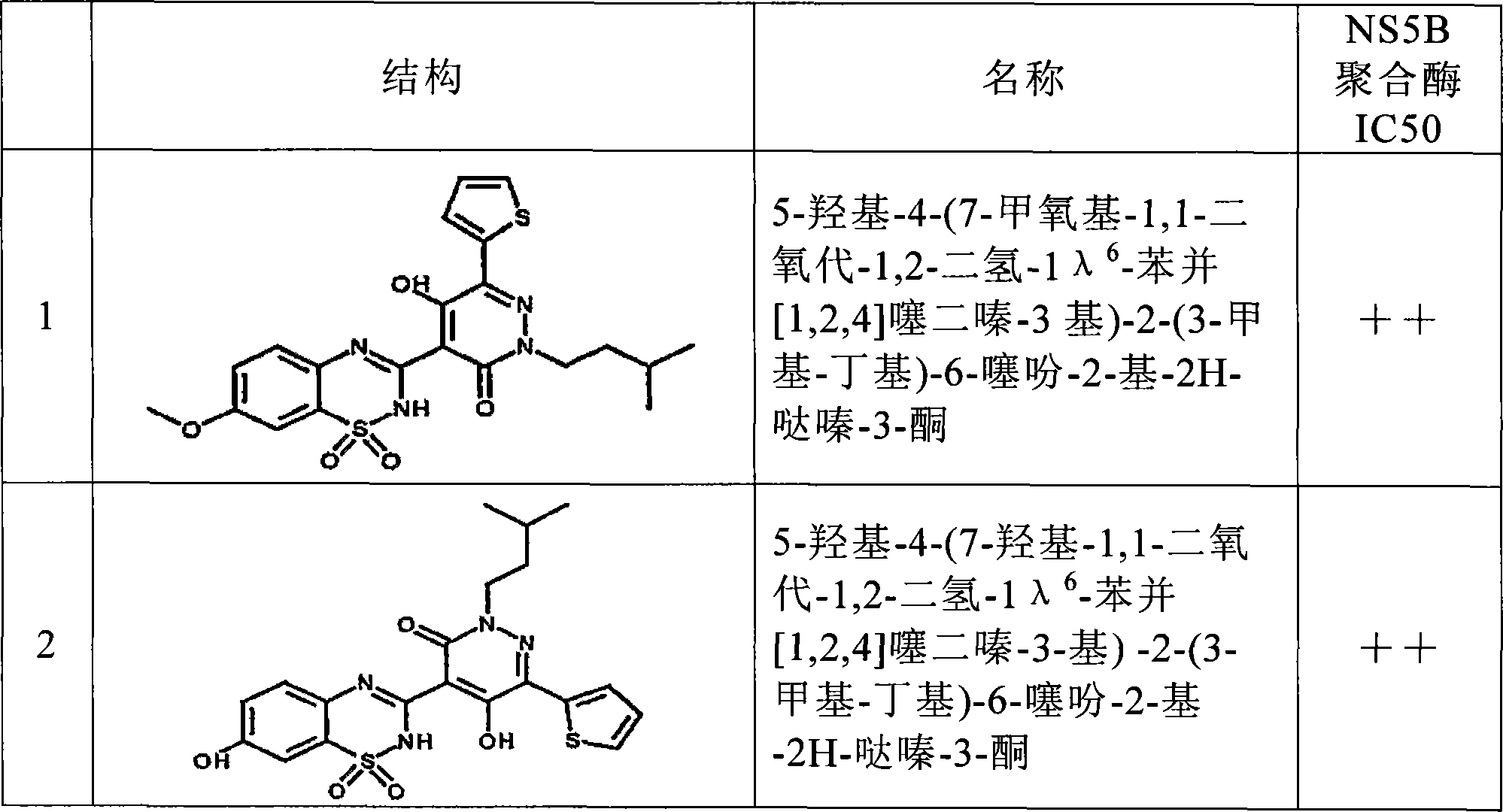


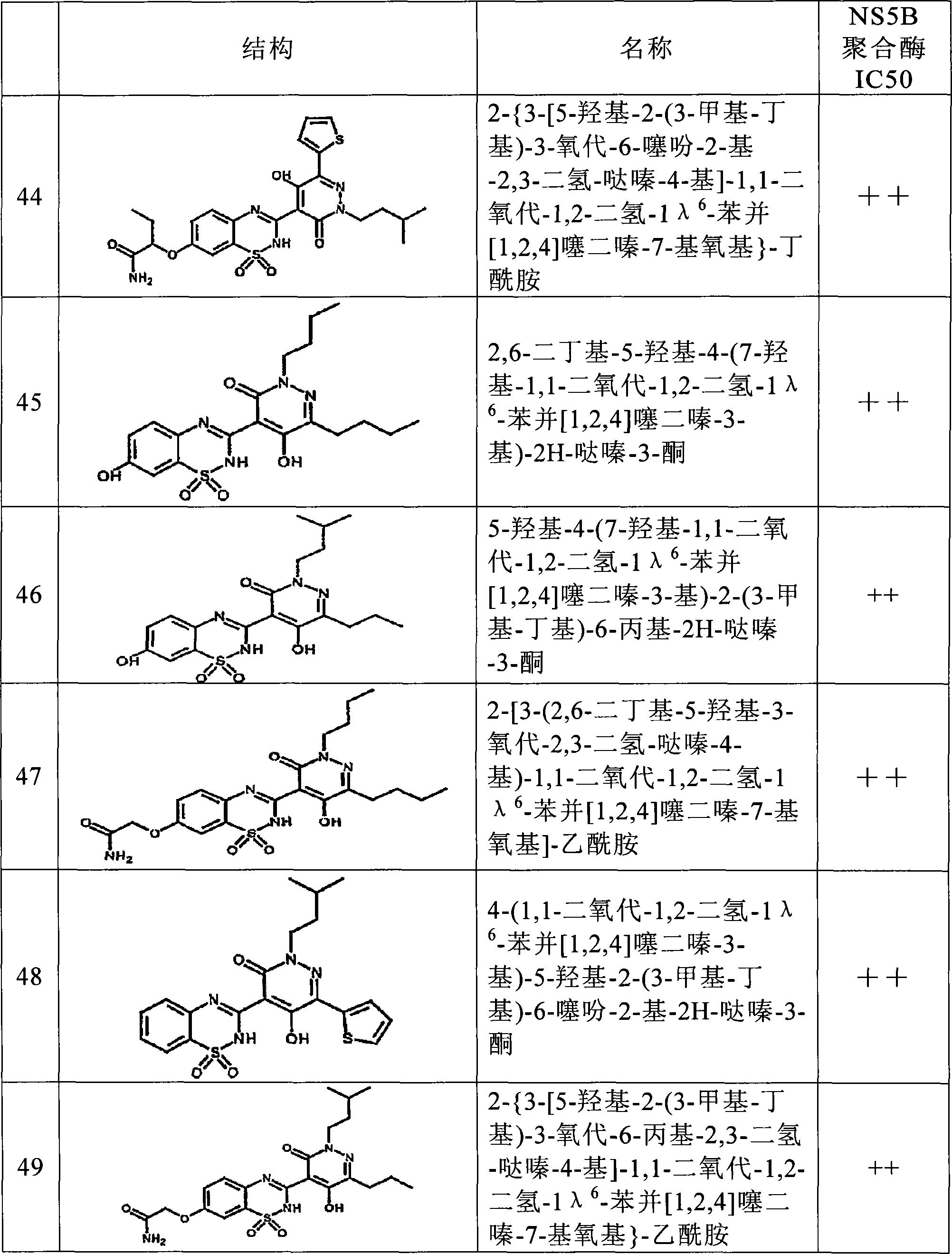


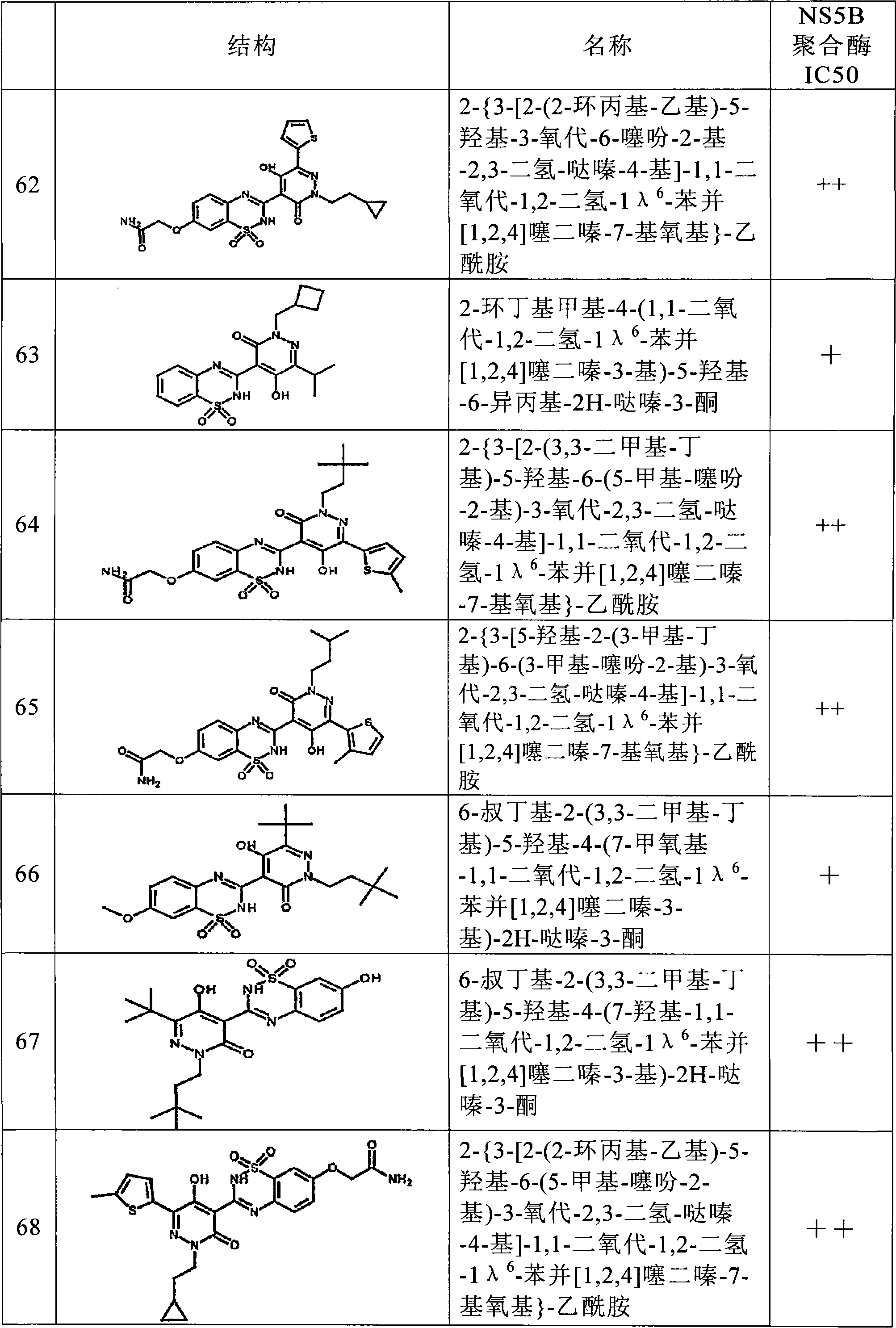
Claims (16)
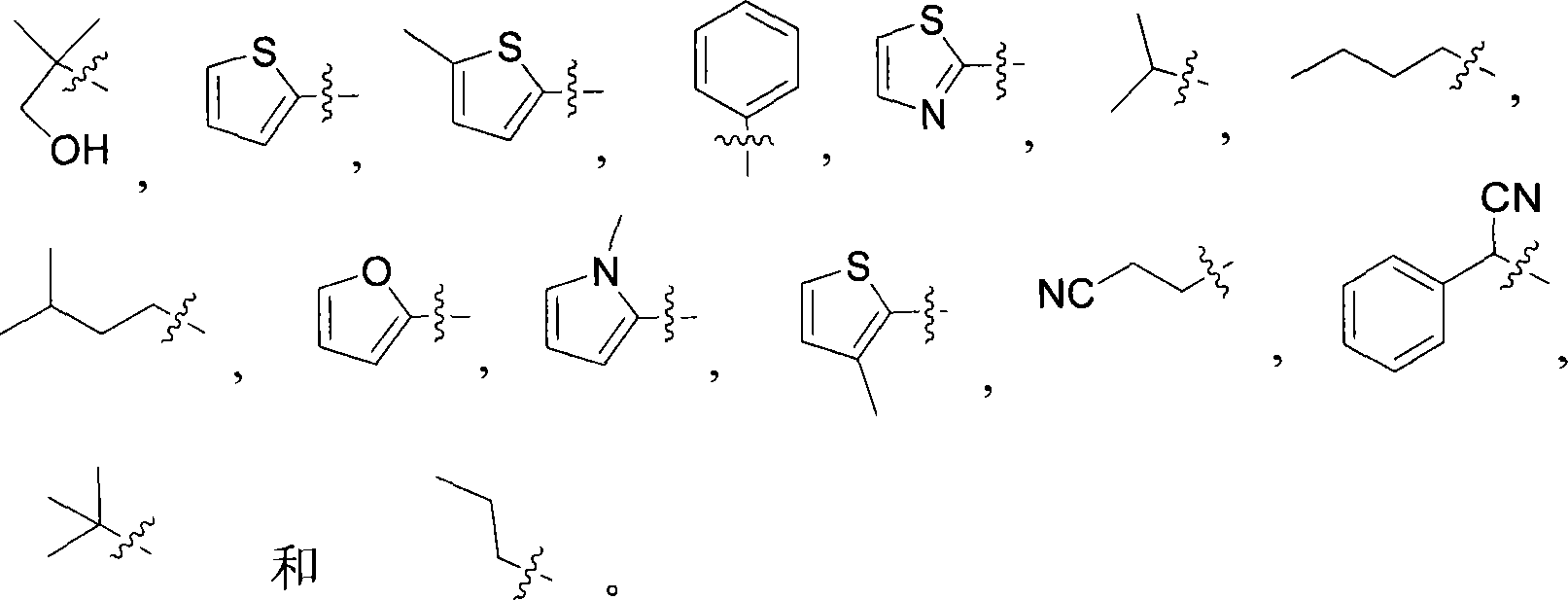
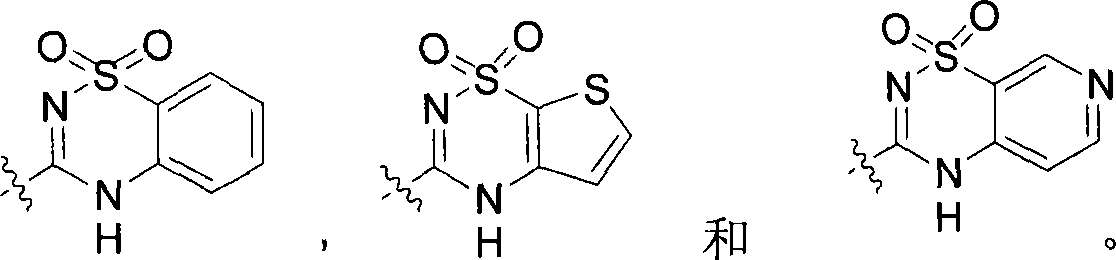

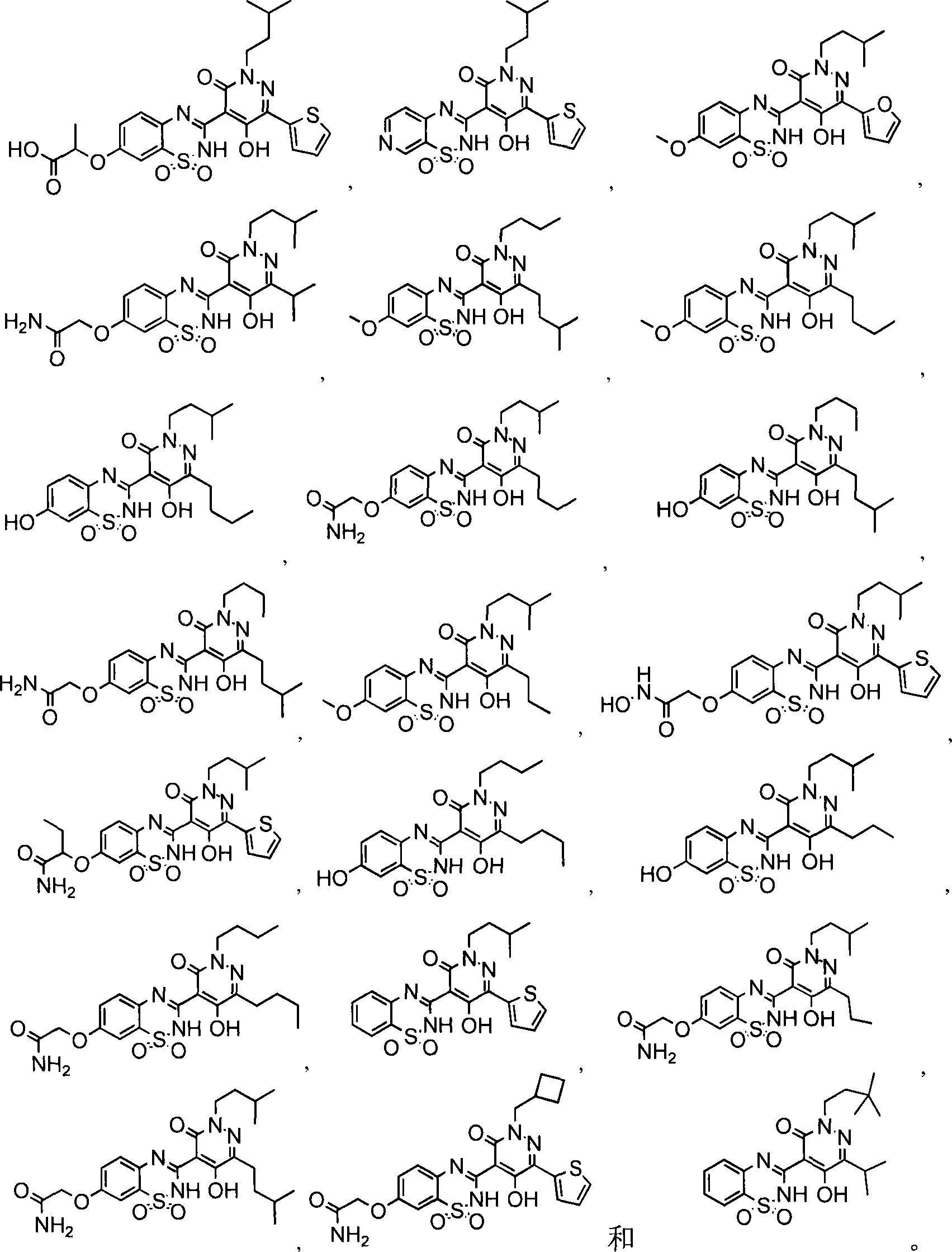
Applications Claiming Priority (2)
| Application Number | Priority Date | Filing Date | Title |
|---|---|---|---|
| US63661604P | 2004-12-17 | 2004-12-17 | |
| US60/636,616 | 2004-12-17 |
Publications (1)
| Publication Number | Publication Date |
|---|---|
| CN101137651A true CN101137651A (en) | 2008-03-05 |
Family
ID=36588590
Family Applications (1)
| Application Number | Title | Priority Date | Filing Date |
|---|---|---|---|
| CNA2005800430935A Pending CN101137651A (en) | 2004-12-17 | 2005-12-16 | pyridazinone compounds |
Country Status (21)
| Country | Link |
|---|---|
| US (1) | US7425552B2 (en) |
| EP (1) | EP1824847A2 (en) |
| JP (1) | JP2008526687A (en) |
| KR (1) | KR20070100743A (en) |
| CN (1) | CN101137651A (en) |
| AP (1) | AP2007004040A0 (en) |
| AR (1) | AR054214A1 (en) |
| AU (1) | AU2005316396A1 (en) |
| CA (1) | CA2589527A1 (en) |
| CR (1) | CR9204A (en) |
| EA (1) | EA200701297A1 (en) |
| GT (1) | GT200500373A (en) |
| IL (1) | IL183510A0 (en) |
| MX (1) | MX2007007264A (en) |
| NO (1) | NO20073105L (en) |
| PA (1) | PA8657001A1 (en) |
| PE (1) | PE20060871A1 (en) |
| SV (1) | SV2006002347A (en) |
| TW (1) | TW200635596A (en) |
| UY (1) | UY29266A1 (en) |
| WO (1) | WO2006066079A2 (en) |
Cited By (2)
| Publication number | Priority date | Publication date | Assignee | Title |
|---|---|---|---|---|
| CN102316871B (en) * | 2008-06-10 | 2014-06-04 | 安那迪斯药品股份有限公司 | [1,2,4]thiadiazine 1,1-dioxide compounds |
| CN105999097A (en) * | 2016-07-08 | 2016-10-12 | 王恩禄 | Traditional Chinese medicine composition for treating hepatitis B |
Families Citing this family (30)
| Publication number | Priority date | Publication date | Assignee | Title |
|---|---|---|---|---|
| GT200500373A (en) | 2004-12-17 | 2006-10-02 | PIRIDAZINONES COMPOUNDS | |
| PT1928454E (en) | 2005-05-10 | 2014-12-04 | Intermune Inc | Pyridone derivatives for modulating stress-activated protein kinase system |
| CN102584649A (en) | 2006-06-22 | 2012-07-18 | 安那迪斯药品股份有限公司 | Pyrro[1,2-b]pyridazinone compounds |
| WO2008051637A2 (en) * | 2006-06-22 | 2008-05-02 | Anadys Pharmaceuticals, Inc. | Pyridazinone compounds |
| TW200840572A (en) | 2006-12-12 | 2008-10-16 | Anadys Pharmaceuticals Inc | 5,6-dihydro-1H-pyridin-2-one compounds |
| US20080214529A1 (en) * | 2006-12-12 | 2008-09-04 | Frank Ruebsam | SATURATED FUSED [1,2-b]PYRIDAZINONE COMPOUNDS |
| US20080188466A1 (en) * | 2006-12-21 | 2008-08-07 | Anadys Pharmaceuticals, Inc. | Pyridazinone compounds |
| US20080275032A1 (en) * | 2006-12-29 | 2008-11-06 | Yuefen Zhou | Pyridazinone compounds |
| US20080227774A1 (en) * | 2007-03-15 | 2008-09-18 | Frank Ruebsam | 5,5-disubstituted-indolizinone compounds |
| UA100120C2 (en) * | 2007-04-03 | 2012-11-26 | Анадис Фармасьютикалз, Инк. | 5,6-dihydro-1h-pyridin-2-one compounds |
| NZ580917A (en) | 2007-05-04 | 2012-06-29 | Vertex Pharma | Combinations of protease inhibitors such as VX-950 and polymerase inhibitors for the treatment of HCV infection |
| WO2008144500A2 (en) * | 2007-05-17 | 2008-11-27 | Anadys Pharmaceuticals, Inc. | 1-methyl-benzo[1,2,4]thiadiazine, 1-oxide derivatives |
| ITMI20071012A1 (en) * | 2007-05-18 | 2008-11-19 | St Microelectronics Srl | MEMORY DEVICE IMPROVED AT FAST PROGRAMMING |
| US7834009B2 (en) * | 2007-08-27 | 2010-11-16 | Anadys Pharmaceuticals, Inc. | 4-hydroxy-5,6-dihydro-1H-pyridin-2-one compounds |
| EP2296653B1 (en) | 2008-06-03 | 2016-01-27 | Intermune, Inc. | Compounds and methods for treating inflammatory and fibrotic disorders |
| WO2010042834A1 (en) | 2008-10-09 | 2010-04-15 | Anadys Pharmaceuticals, Inc. | A method of inhibiting hepatitis c virus by combination of a 5,6-dihydro-1h-pyridin-2-one and one or more additional antiviral compounds |
| TW201026675A (en) * | 2008-10-09 | 2010-07-16 | Anadys Pharmaceuticals Inc | 5,6-dihydro-1H-pyridin-2-one compounds |
| WO2010082050A1 (en) | 2009-01-16 | 2010-07-22 | Istituto Di Ricerche Di Biologia Molecolare P. Angeletti S.P.A. | Macrocyclic and 7-aminoalkyl-substituted benzoxazocines for treatment of hepatitis c infections |
| WO2011045271A1 (en) | 2009-10-15 | 2011-04-21 | Bayer Cropscience Ag | Herbicidally active, heterocyclyl-substituted pyridazinones |
| BR112012009796A2 (en) | 2009-10-28 | 2020-08-18 | Anadys Pharmaceuticals, Inc. | compound, methods for treating or preventing hepatitis c virus infections in a mammal in need of these uses of compound and pharmaceutical composition. |
| BR112012014729A2 (en) | 2009-12-18 | 2016-03-29 | Boehringer Ingelheim Int | hcv combination therapy |
| WO2012158271A1 (en) | 2011-04-06 | 2012-11-22 | Anadys Pharmaceuticals, Inc. | Bridged polycyclic compounds as antiviral agents |
| AR092742A1 (en) | 2012-10-02 | 2015-04-29 | Intermune Inc | ANTIFIBROTIC PYRIDINONES |
| WO2014121416A1 (en) | 2013-02-07 | 2014-08-14 | Merck Sharp & Dohme Corp. | Tetracyclic heterocycle compounds and methods of use thereof for the treatment of hepatitis c |
| WO2014121418A1 (en) | 2013-02-07 | 2014-08-14 | Merck Sharp & Dohme Corp. | Tetracyclic heterocycle compounds and methods of use thereof for the treatment of hepatitis c |
| WO2014121417A1 (en) | 2013-02-07 | 2014-08-14 | Merck Sharp & Dohme Corp. | Tetracyclic heterocycle compounds and methods of use thereof for the treatment of hepatitis c |
| WO2015153683A1 (en) | 2014-04-02 | 2015-10-08 | Intermune, Inc. | Anti-fibrotic pyridinones |
| ES2886441T3 (en) * | 2014-04-29 | 2021-12-20 | Fmc Corp | Pyridazinone herbicides |
| JP6428951B2 (en) * | 2015-12-07 | 2018-11-28 | Dic株式会社 | Method for producing polymerizable compound |
| WO2020247366A1 (en) * | 2019-06-05 | 2020-12-10 | University Of Georgia Research Foundation | Compositions and methods for preventing or treating human immunodeficiency virus associated pulmonary arterial hypertension |
Family Cites Families (12)
| Publication number | Priority date | Publication date | Assignee | Title |
|---|---|---|---|---|
| NZ504021A (en) * | 1997-10-17 | 2003-04-29 | Systemic Pulmonary Delivery Lt | Method and apparatus for delivering aerosolized medication having air discharged through air tube directly into plume of aerosolized medication |
| EP1292310A1 (en) | 2000-05-10 | 2003-03-19 | SmithKline Beecham Corporation | Novel anti-infectives |
| US20060003346A1 (en) | 2000-08-11 | 2006-01-05 | Ashok Amin | Method for treating hepatitis |
| AR036081A1 (en) | 2001-06-07 | 2004-08-11 | Smithkline Beecham Corp | COMPOSITE OF 1,2-DIHYDROQUINOLINE, ITS USE TO PREPARE A PHARMACEUTICAL COMPOSITION, METHODS TO PREPARE IT AND N-RENTED 2-AMINOBENZOIC ACID OF UTILITY AS INTERMEDIARY IN SUCH METHODS |
| AU2002365198A1 (en) | 2001-10-30 | 2003-07-30 | Smithkline Beecham Corporation | Novel anti-infectives |
| US7601709B2 (en) | 2003-02-07 | 2009-10-13 | Enanta Pharmaceuticals, Inc. | Macrocyclic hepatitis C serine protease inhibitors |
| US7439246B2 (en) | 2004-06-28 | 2008-10-21 | Bristol-Myers Squibb Company | Fused heterocyclic kinase inhibitors |
| SG137868A1 (en) | 2004-08-23 | 2007-12-28 | Hoffmann La Roche | Heterocyclic antiviral compounds |
| GT200500373A (en) | 2004-12-17 | 2006-10-02 | PIRIDAZINONES COMPOUNDS | |
| AU2006240730A1 (en) | 2005-04-21 | 2006-11-02 | Nippon Shinyaku Co., Ltd. | Phthalazinone derivative and pharmaceutical comprising the same |
| BRPI0611388A2 (en) | 2005-05-04 | 2010-09-08 | Hoffmann La Roche | heterocyclic antiviral compounds, their use and pharmaceutical composition |
| CN102584649A (en) | 2006-06-22 | 2012-07-18 | 安那迪斯药品股份有限公司 | Pyrro[1,2-b]pyridazinone compounds |
-
2005
- 2005-12-16 GT GT200500373A patent/GT200500373A/en unknown
- 2005-12-16 JP JP2007546930A patent/JP2008526687A/en active Pending
- 2005-12-16 AP AP2007004040A patent/AP2007004040A0/en unknown
- 2005-12-16 EA EA200701297A patent/EA200701297A1/en unknown
- 2005-12-16 KR KR1020077016317A patent/KR20070100743A/en not_active Withdrawn
- 2005-12-16 MX MX2007007264A patent/MX2007007264A/en not_active Application Discontinuation
- 2005-12-16 EP EP05854333A patent/EP1824847A2/en not_active Withdrawn
- 2005-12-16 AR AR20050105305A patent/AR054214A1/en not_active Application Discontinuation
- 2005-12-16 CN CNA2005800430935A patent/CN101137651A/en active Pending
- 2005-12-16 AU AU2005316396A patent/AU2005316396A1/en not_active Abandoned
- 2005-12-16 TW TW094144751A patent/TW200635596A/en unknown
- 2005-12-16 US US11/304,902 patent/US7425552B2/en not_active Expired - Fee Related
- 2005-12-16 CA CA002589527A patent/CA2589527A1/en not_active Abandoned
- 2005-12-16 WO PCT/US2005/045588 patent/WO2006066079A2/en not_active Ceased
- 2005-12-19 SV SV2005002347A patent/SV2006002347A/en unknown
- 2005-12-19 PA PA20058657001A patent/PA8657001A1/en unknown
- 2005-12-20 UY UY29266A patent/UY29266A1/en not_active Application Discontinuation
-
2006
- 2006-01-03 PE PE2006000033A patent/PE20060871A1/en not_active Application Discontinuation
-
2007
- 2007-05-29 IL IL183510A patent/IL183510A0/en unknown
- 2007-06-18 NO NO20073105A patent/NO20073105L/en not_active Application Discontinuation
- 2007-06-22 CR CR9204A patent/CR9204A/en not_active Application Discontinuation
Cited By (2)
| Publication number | Priority date | Publication date | Assignee | Title |
|---|---|---|---|---|
| CN102316871B (en) * | 2008-06-10 | 2014-06-04 | 安那迪斯药品股份有限公司 | [1,2,4]thiadiazine 1,1-dioxide compounds |
| CN105999097A (en) * | 2016-07-08 | 2016-10-12 | 王恩禄 | Traditional Chinese medicine composition for treating hepatitis B |
Also Published As
| Publication number | Publication date |
|---|---|
| US20060189602A1 (en) | 2006-08-24 |
| PA8657001A1 (en) | 2006-08-03 |
| AP2007004040A0 (en) | 2007-06-30 |
| EP1824847A2 (en) | 2007-08-29 |
| PE20060871A1 (en) | 2006-09-04 |
| TW200635596A (en) | 2006-10-16 |
| UY29266A1 (en) | 2006-07-31 |
| JP2008526687A (en) | 2008-07-24 |
| MX2007007264A (en) | 2007-08-14 |
| NO20073105L (en) | 2007-09-13 |
| KR20070100743A (en) | 2007-10-11 |
| WO2006066079A3 (en) | 2006-12-14 |
| AU2005316396A1 (en) | 2006-06-22 |
| SV2006002347A (en) | 2006-08-25 |
| GT200500373A (en) | 2006-10-02 |
| AR054214A1 (en) | 2007-06-13 |
| EA200701297A1 (en) | 2007-12-28 |
| US7425552B2 (en) | 2008-09-16 |
| CR9204A (en) | 2007-09-06 |
| WO2006066079A2 (en) | 2006-06-22 |
| CA2589527A1 (en) | 2006-06-22 |
| IL183510A0 (en) | 2007-09-20 |
Similar Documents
| Publication | Publication Date | Title |
|---|---|---|
| CN101137651A (en) | pyridazinone compounds | |
| CN101501039B (en) | Pyrrolo[1,2-b]pyridazinone compounds | |
| JP5934403B2 (en) | 5,6-dihydro-1H-pyridin-2-one compound | |
| CN101516192B (en) | Prodrugs of 5-amino-3- (3' -deoxy-beta-D-ribofuranosyl) -thiazolo [4,5-D ] pyrimidine-2, 7-dione | |
| US20080275032A1 (en) | Pyridazinone compounds | |
| CN102316871B (en) | [1,2,4]thiadiazine 1,1-dioxide compounds | |
| CN102176912B (en) | 5,6-dihydro-1H-pyridin-2-one compounds | |
| AU2007260827B2 (en) | Pyrro[1,2-b]pyridazinone compounds | |
| HK1201822B (en) | Process for the preparation of 5,6-dihydro-1h-pyridin-2-one compounds | |
| HK1130781A (en) | Pyrro [1,2-b] pyridazinone compounds | |
| HK1130781B (en) | Pyrro [1,2-b] pyridazinone compounds | |
| HK1161684B (en) | 5,6-dihydro-1h-pyridin-2-one compounds |
Legal Events
| Date | Code | Title | Description |
|---|---|---|---|
| C06 | Publication | ||
| PB01 | Publication | ||
| C10 | Entry into substantive examination | ||
| SE01 | Entry into force of request for substantive examination | ||
| C02 | Deemed withdrawal of patent application after publication (patent law 2001) | ||
| WD01 | Invention patent application deemed withdrawn after publication |
Open date: 20080305 |