CN101124235B - Olefin polymerization catalyst system and method of using same - Google Patents
Olefin polymerization catalyst system and method of using same Download PDFInfo
- Publication number
- CN101124235B CN101124235B CN2005800250909A CN200580025090A CN101124235B CN 101124235 B CN101124235 B CN 101124235B CN 2005800250909 A CN2005800250909 A CN 2005800250909A CN 200580025090 A CN200580025090 A CN 200580025090A CN 101124235 B CN101124235 B CN 101124235B
- Authority
- CN
- China
- Prior art keywords
- propylene
- polymer
- polymerization
- reactor
- catalyst
- Prior art date
- Legal status (The legal status is an assumption and is not a legal conclusion. Google has not performed a legal analysis and makes no representation as to the accuracy of the status listed.)
- Expired - Fee Related
Links
Classifications
-
- C—CHEMISTRY; METALLURGY
- C07—ORGANIC CHEMISTRY
- C07F—ACYCLIC, CARBOCYCLIC OR HETEROCYCLIC COMPOUNDS CONTAINING ELEMENTS OTHER THAN CARBON, HYDROGEN, HALOGEN, OXYGEN, NITROGEN, SULFUR, SELENIUM OR TELLURIUM
- C07F17/00—Metallocenes
-
- C—CHEMISTRY; METALLURGY
- C08—ORGANIC MACROMOLECULAR COMPOUNDS; THEIR PREPARATION OR CHEMICAL WORKING-UP; COMPOSITIONS BASED THEREON
- C08F—MACROMOLECULAR COMPOUNDS OBTAINED BY REACTIONS ONLY INVOLVING CARBON-TO-CARBON UNSATURATED BONDS
- C08F10/00—Homopolymers and copolymers of unsaturated aliphatic hydrocarbons having only one carbon-to-carbon double bond
-
- C—CHEMISTRY; METALLURGY
- C08—ORGANIC MACROMOLECULAR COMPOUNDS; THEIR PREPARATION OR CHEMICAL WORKING-UP; COMPOSITIONS BASED THEREON
- C08F—MACROMOLECULAR COMPOUNDS OBTAINED BY REACTIONS ONLY INVOLVING CARBON-TO-CARBON UNSATURATED BONDS
- C08F10/00—Homopolymers and copolymers of unsaturated aliphatic hydrocarbons having only one carbon-to-carbon double bond
- C08F10/04—Monomers containing three or four carbon atoms
- C08F10/06—Propene
-
- C—CHEMISTRY; METALLURGY
- C08—ORGANIC MACROMOLECULAR COMPOUNDS; THEIR PREPARATION OR CHEMICAL WORKING-UP; COMPOSITIONS BASED THEREON
- C08F—MACROMOLECULAR COMPOUNDS OBTAINED BY REACTIONS ONLY INVOLVING CARBON-TO-CARBON UNSATURATED BONDS
- C08F2/00—Processes of polymerisation
- C08F2/04—Polymerisation in solution
- C08F2/06—Organic solvent
-
- C—CHEMISTRY; METALLURGY
- C08—ORGANIC MACROMOLECULAR COMPOUNDS; THEIR PREPARATION OR CHEMICAL WORKING-UP; COMPOSITIONS BASED THEREON
- C08F—MACROMOLECULAR COMPOUNDS OBTAINED BY REACTIONS ONLY INVOLVING CARBON-TO-CARBON UNSATURATED BONDS
- C08F4/00—Polymerisation catalysts
- C08F4/42—Metals; Metal hydrides; Metallo-organic compounds; Use thereof as catalyst precursors
- C08F4/44—Metals; Metal hydrides; Metallo-organic compounds; Use thereof as catalyst precursors selected from light metals, zinc, cadmium, mercury, copper, silver, gold, boron, gallium, indium, thallium, rare earths or actinides
- C08F4/60—Metals; Metal hydrides; Metallo-organic compounds; Use thereof as catalyst precursors selected from light metals, zinc, cadmium, mercury, copper, silver, gold, boron, gallium, indium, thallium, rare earths or actinides together with refractory metals, iron group metals, platinum group metals, manganese, rhenium technetium or compounds thereof
- C08F4/62—Refractory metals or compounds thereof
- C08F4/64—Titanium, zirconium, hafnium or compounds thereof
-
- C—CHEMISTRY; METALLURGY
- C08—ORGANIC MACROMOLECULAR COMPOUNDS; THEIR PREPARATION OR CHEMICAL WORKING-UP; COMPOSITIONS BASED THEREON
- C08F—MACROMOLECULAR COMPOUNDS OBTAINED BY REACTIONS ONLY INVOLVING CARBON-TO-CARBON UNSATURATED BONDS
- C08F110/00—Homopolymers of unsaturated aliphatic hydrocarbons having only one carbon-to-carbon double bond
- C08F110/04—Monomers containing three or four carbon atoms
- C08F110/06—Propene
-
- C—CHEMISTRY; METALLURGY
- C08—ORGANIC MACROMOLECULAR COMPOUNDS; THEIR PREPARATION OR CHEMICAL WORKING-UP; COMPOSITIONS BASED THEREON
- C08F—MACROMOLECULAR COMPOUNDS OBTAINED BY REACTIONS ONLY INVOLVING CARBON-TO-CARBON UNSATURATED BONDS
- C08F210/00—Copolymers of unsaturated aliphatic hydrocarbons having only one carbon-to-carbon double bond
- C08F210/04—Monomers containing three or four carbon atoms
- C08F210/06—Propene
-
- C—CHEMISTRY; METALLURGY
- C08—ORGANIC MACROMOLECULAR COMPOUNDS; THEIR PREPARATION OR CHEMICAL WORKING-UP; COMPOSITIONS BASED THEREON
- C08F—MACROMOLECULAR COMPOUNDS OBTAINED BY REACTIONS ONLY INVOLVING CARBON-TO-CARBON UNSATURATED BONDS
- C08F4/00—Polymerisation catalysts
- C08F4/42—Metals; Metal hydrides; Metallo-organic compounds; Use thereof as catalyst precursors
- C08F4/44—Metals; Metal hydrides; Metallo-organic compounds; Use thereof as catalyst precursors selected from light metals, zinc, cadmium, mercury, copper, silver, gold, boron, gallium, indium, thallium, rare earths or actinides
- C08F4/60—Metals; Metal hydrides; Metallo-organic compounds; Use thereof as catalyst precursors selected from light metals, zinc, cadmium, mercury, copper, silver, gold, boron, gallium, indium, thallium, rare earths or actinides together with refractory metals, iron group metals, platinum group metals, manganese, rhenium technetium or compounds thereof
- C08F4/62—Refractory metals or compounds thereof
- C08F4/64—Titanium, zirconium, hafnium or compounds thereof
- C08F4/659—Component covered by group C08F4/64 containing a transition metal-carbon bond
- C08F4/65912—Component covered by group C08F4/64 containing a transition metal-carbon bond in combination with an organoaluminium compound
-
- Y—GENERAL TAGGING OF NEW TECHNOLOGICAL DEVELOPMENTS; GENERAL TAGGING OF CROSS-SECTIONAL TECHNOLOGIES SPANNING OVER SEVERAL SECTIONS OF THE IPC; TECHNICAL SUBJECTS COVERED BY FORMER USPC CROSS-REFERENCE ART COLLECTIONS [XRACs] AND DIGESTS
- Y02—TECHNOLOGIES OR APPLICATIONS FOR MITIGATION OR ADAPTATION AGAINST CLIMATE CHANGE
- Y02P—CLIMATE CHANGE MITIGATION TECHNOLOGIES IN THE PRODUCTION OR PROCESSING OF GOODS
- Y02P20/00—Technologies relating to chemical industry
- Y02P20/50—Improvements relating to the production of bulk chemicals
- Y02P20/54—Improvements relating to the production of bulk chemicals using solvents, e.g. supercritical solvents or ionic liquids
-
- Y—GENERAL TAGGING OF NEW TECHNOLOGICAL DEVELOPMENTS; GENERAL TAGGING OF CROSS-SECTIONAL TECHNOLOGIES SPANNING OVER SEVERAL SECTIONS OF THE IPC; TECHNICAL SUBJECTS COVERED BY FORMER USPC CROSS-REFERENCE ART COLLECTIONS [XRACs] AND DIGESTS
- Y10—TECHNICAL SUBJECTS COVERED BY FORMER USPC
- Y10S—TECHNICAL SUBJECTS COVERED BY FORMER USPC CROSS-REFERENCE ART COLLECTIONS [XRACs] AND DIGESTS
- Y10S526/00—Synthetic resins or natural rubbers -- part of the class 520 series
- Y10S526/943—Polymerization with metallocene catalysts
Landscapes
- Chemical & Material Sciences (AREA)
- Organic Chemistry (AREA)
- Health & Medical Sciences (AREA)
- Chemical Kinetics & Catalysis (AREA)
- Medicinal Chemistry (AREA)
- Polymers & Plastics (AREA)
- Engineering & Computer Science (AREA)
- Materials Engineering (AREA)
- Transition And Organic Metals Composition Catalysts For Addition Polymerization (AREA)
- Polymerisation Methods In General (AREA)
- Catalysts (AREA)
- Organic Low-Molecular-Weight Compounds And Preparation Thereof (AREA)
- Addition Polymer Or Copolymer, Post-Treatments, Or Chemical Modifications (AREA)
Abstract
Description
发明领域field of invention
本发明涉及新型过渡金属化合物以及使用这些过渡金属化合物聚合或低聚不饱和单体的方法和由此制备的聚合物或低聚物。The present invention relates to novel transition metal compounds and processes for polymerizing or oligomerizing unsaturated monomers using these transition metal compounds and the polymers or oligomers prepared therefrom.
发明背景Background of the invention
有各种方法和催化剂用于不饱和单体的均聚或共聚,尤其烯烃的聚合。对于许多应用来说,希望聚烯烃具有高重均分子量,同时具有相对窄的分子量分布。已经有人使用手性双茚基金属茂催化剂来制备高度结晶全同立构聚丙烯和丙烯与其它单体的共聚物(Resconi,L.Chem.Rev.2000,100,1253)。还已经制备了非手性金属茂催化剂,获得了无规立构聚丙烯和共聚物(Resconi,L.,Metallocene BasedPolyolefins,Eds.J.Schiers,W.Kaminsky;Wiley;NY,2000;467)。虽然,具有在这些极端之间运行的手性催化剂,获得了结晶度低于高结晶度、但超过无定形的聚丙烯,通常这些手性催化剂提供了低分子量聚合物。使用这些体系由丙烯和其它单体制备的共聚物的情况也是这样。There are various methods and catalysts for the homopolymerization or copolymerization of unsaturated monomers, especially olefins. For many applications, it is desirable for polyolefins to have a high weight average molecular weight while having a relatively narrow molecular weight distribution. Chiral bis-indenyl metallocene catalysts have been used to prepare highly crystalline isotactic polypropylene and copolymers of propylene with other monomers (Resconi, L. Chem. Rev. 2000, 100, 1253). Achiral metallocene catalysts have also been prepared, resulting in atactic polypropylene and copolymers (Resconi, L., Metallocene Based Polyolefins, Eds. J. Schiers, W. Kaminsky; Wiley; NY, 2000; 467). Although, with chiral catalysts operating between these extremes, less crystalline than highly crystalline, but more than amorphous polypropylenes are obtained, generally these chiral catalysts provide low molecular weight polymers. The same is true for copolymers prepared from propylene and other monomers using these systems.
US6,051,522描述了作为用于烯烃聚合的催化剂的桥连手性金属茂。WO2002/01745,US2002/0004575A1,WO2002/083753A1和US6,525,157披露了使用手性金属茂rac-Me2Si(1-茚基)2HfMe2和电离活化剂制备在丙烯序列内含有立构规整度的丙烯/乙烯共聚物的方法。US6,057,408披露了使用手性双茚基金属茂制备在丙烯序列中具有高结晶度的高分子量丙烯/乙烯共聚物的方法。获得最高分子量共聚物的催化剂是rac-Me2Si(2-Me-4-(1-萘基)-1-茚基)2ZrCl2。US 6,051,522 describes bridged chiral metallocenes as catalysts for the polymerization of olefins. WO2002/01745, US2002/0004575A1, WO2002/ 083753A1 and US6,525,157 disclose the use of chiral metallocenes rac- Me2Si (1-indenyl) 2HfMe2 and ionizing activators to prepare method of propylene/ethylene copolymers. US 6,057,408 discloses the preparation of high molecular weight propylene/ethylene copolymers with high crystallinity in the propylene sequence using chiral bis-indenyl metallocenes. The catalyst for obtaining the highest molecular weight copolymer is rac-Me 2 Si(2-Me-4-(1-naphthyl)-1-indenyl) 2 ZrCl 2 .
S.Collins及其同事报道了(Organometallics 1992,11,2115)5,6-位上的取代基对系列手性乙烯桥连金属茂rac-(CH2CH2)(5,6-X2-1-茚基)2ZrCl2,溶液乙烯和丙烯聚合的效应的研究。比较X=H和X=Me,在聚乙烯(X=H,Mn=145Kg/mol;X=Me,Mn=127Kg/mol)和聚丙烯(X=H,Mn=15.7Kg/mol;X=Me,Mn=16Kg/mol)的制备中发现了类似的分子量。同样,在US5,455,365中,披露了在5和6位上含有甲基的手性双茚基金属茂和在5或6位上含有苯基的金属茂。在液体丙烯中在70℃下的聚合获得了适中结晶的聚丙烯,如由132-147℃的聚合物熔点所证明的。这些材料的分子量(Mw)是100-200Kg/mol。使用rac-Me2Si(2,5,6-Me3-1-茚基)ZrCl2/MAO的丙烯与乙烯的共聚获得了2.8wt%乙烯、97.2wt%丙烯共聚物,其具有如由特性粘度从155mL/g(Mw=143Kg/mol)下降到98mL/g(Mw没有记录)所证明的显著更低的分子量。该共聚还导致了熔点从132℃下降到123℃。S. Collins and colleagues reported (Organometallics 1992, 11, 2115) a series of chiral ethylene-bridged metallocenes rac-(CH 2 CH 2 )(5,6-X 2 - 1-Indenyl) 2 ZrCl 2 , Effect of Solution Polymerization of Ethylene and Propylene. Comparing X=H and X=Me, in polyethylene (X=H, Mn=145Kg/mol; X=Me, Mn=127Kg/mol) and polypropylene (X=H, Mn=15.7Kg/mol; X= Similar molecular weights were found in the preparation of Me, Mn = 16 Kg/mol). Likewise, in US 5,455,365, chiral bisindenyl metallocenes containing methyl groups at the 5 and 6 positions and metallocenes containing phenyl groups at the 5 or 6 positions are disclosed. Polymerization in liquid propylene at 70°C gave moderately crystalline polypropylene as evidenced by a polymer melting point of 132-147°C. The molecular weight (Mw) of these materials is 100-200 Kg/mol. Copolymerization of propylene with ethylene using rac- Me2Si (2,5,6- Me3-1 -indenyl) ZrCl2 /MAO yielded a 2.8 wt% ethylene, 97.2 wt% propylene copolymer with properties such as Significantly lower molecular weight as evidenced by viscosity drop from 155 mL/g (Mw = 143 Kg/mol) to 98 mL/g (Mw not recorded). The copolymerization also resulted in a drop in the melting point from 132°C to 123°C.
在US6,084,115中,公开了含有在5和6位上连接的环状四甲基化环己基环的手性双茚基金属茂。据报道,该金属茂rac-Me2Si(5,6,7,8-四氢-2,5,5,8,8-五甲基-苯并[f]茚基)2Zr(1,4-二苯基丁二烯)为+2氧化态。丙烯聚合特性在链烷烃溶液(24wt%丙烯)中在一定氢分压下在70℃下报道。所获得的分子量是大约60Kg/mol,聚合物熔点是144.8-147℃。这些分子量低于在5和6位上具有H的类似配合物,rac-Me2Si(2-Me-1-茚基)Zr(1,4-二苯基丁二烯),Mw=79Kg/mol。用这两种催化剂的乙烯/辛烯聚合中发现了类似的结果。没有报道不含H2的溶液聚合。在该专利中还检验了担载催化剂,然而宽分子量分布(>3.5)使得在催化剂之间比较变得困难。这些结果表明,在5和6位上具有庞大基团的催化剂预计不具有分子量优点。因此,前面的这些取代不能获得有意义的聚合物分子量增加。In US 6,084,115 chiral bisindenyl metallocenes containing a cyclic tetramethylated cyclohexyl ring attached at the 5 and 6 positions are disclosed. It is reported that the metallocene rac-Me 2 Si(5,6,7,8-tetrahydro-2,5,5,8,8-pentamethyl-benzo[f]indenyl) 2 Zr(1, 4-diphenylbutadiene) in the +2 oxidation state. Propylene polymerization properties are reported at 70°C under certain hydrogen partial pressures in paraffinic solution (24 wt% propylene). The molecular weight obtained was about 60 Kg/mol and the melting point of the polymer was 144.8-147°C. These molecular weights are lower than similar complexes with H in the 5 and 6 positions, rac-Me 2 Si(2-Me-1-indenyl)Zr(1,4-diphenylbutadiene), Mw=79Kg/ mol. Similar results were found for ethylene/octene polymerizations with these two catalysts. Solution polymerization without H2 has not been reported. Supported catalysts were also examined in this patent, however the broad molecular weight distribution (>3.5) made comparison between catalysts difficult. These results suggest that catalysts with bulky groups at the 5 and 6 positions are not expected to have molecular weight advantages. Therefore, these preceding substitutions do not result in a meaningful increase in polymer molecular weight.
WO 2004/050724公开了丁烯用甲基铝氧烷和二氯·二甲基甲硅烷基双[2-甲基-5,6-(四甲基环三亚甲基)茚基]合锆的聚合,还描述了具有环状六元环的某些茚基型化合物;然而,WO 2004/050724不能在较高温度下获得高分子量。WO 2004/050724 discloses the synthesis of butene with methylaluminoxane and dichlorodimethylsilylbis[2-methyl-5,6-(tetramethylcyclotrimethylene)indenyl]zirconium polymerisation, certain indenyl-type compounds with cyclic six-membered rings have also been described; however, WO 2004/050724 cannot obtain high molecular weights at higher temperatures.
因此,本领域对于能够提供具有高分子量以及良好结晶度的聚合物、优选在比其它催化剂体系更高温度和生产率下制备的催化剂体系存在着需求。Accordingly, there is a need in the art for catalyst systems that can provide polymers with high molecular weight and good crystallinity, preferably prepared at higher temperatures and productivity than other catalyst systems.
US6,479,424公开了用于生产丙烯聚合物的非桥连物质二氯·双(2-(3,5-二叔丁基苯基)-5,5,8,8-四甲基-5,6,7,8-四氢苯并(f)茚基)合铪,二氯·双(2-(3,5-二叔丁基苯基)-5,5,8,8-四甲基-5,6,7,8-四氢苯并(f)茚基)合锆,二氯·双(2-(4-叔丁基苯基)-5,5,8,8-四甲基-5,6,7,8-四氢苯并(f)茚基)合铪和二氯·双(2-(4-叔丁基苯基)-5,5,8,8-四甲基-5,6,7,8-四氢苯并(f)茚基)合锆的制备。US6,479,424 discloses a non-bridged substance dichlorobis(2-(3,5-di-tert-butylphenyl)-5,5,8,8-tetramethyl-5, 6,7,8-tetrahydrobenzo(f)indenyl)hafnium, dichlorobis(2-(3,5-di-tert-butylphenyl)-5,5,8,8-tetramethyl -5,6,7,8-tetrahydrobenzo(f)indenyl)zirconium, dichlorobis(2-(4-tert-butylphenyl)-5,5,8,8-tetramethyl -5,6,7,8-tetrahydrobenzo(f)indenyl)hafnium and dichlorobis(2-(4-tert-butylphenyl)-5,5,8,8-tetramethyl - Preparation of 5,6,7,8-tetrahydrobenzo(f)indenyl)zirconium.
其它有意义的参考文献包括:1)US 6,034,022(尤其实施例17);2)US6,268,444(尤其实施例2);3)US6,469,188;和4)EP 1 138687(尤其实施例8和9)。Other interesting references include: 1) US 6,034,022 (especially Example 17); 2) US 6,268,444 (especially Example 2); 3) US 6,469,188; and 4) EP 1 138687 (especially Examples 8 and 9 ).
此外,本领域需要提供在较高温度下,优选用溶液聚合方法,制备具有较高分子量的丙烯型聚合物的方法。同样,本领域也需要提供在较高温度下用采用非配位阴离子活化剂的溶液方法制备具有较高分子量的丙烯型聚合物的方法,其中原料中的丙烯浓度是较低的。Furthermore, there is a need in the art to provide a method for preparing propylene-based polymers with higher molecular weights at higher temperatures, preferably by solution polymerization. Likewise, there is a need in the art to provide a method for the preparation of higher molecular weight propylene-based polymers at higher temperatures by a solution process using a non-coordinating anionic activator, wherein the propylene concentration in the feedstock is lower.
发明概述Summary of the invention
本发明涉及用通式1表示的过渡金属催化剂化合物:The present invention relates to transition metal catalyst compounds represented by general formula 1:

其中in
M是选自周期表4族中的过渡金属;M is a transition metal selected from Group 4 of the Periodic Table;
各R1独立地选自氢、烃基、取代烃基和官能团,任何两个R1基团可以连在一起;Each R is independently selected from hydrogen, hydrocarbyl, substituted hydrocarbyl and functional groups, and any two R groups can be linked together;
各R2独立地选自甲基、乙基、丙基、丁基、戊基、己基和它们的异构体,前提是当R3和R6和/或R12和R15一起形成5碳环时,那么各R2独立地选自乙基、丙基、丁基、戊基、己基和它们的异构体;Each R2 is independently selected from methyl, ethyl, propyl, butyl, pentyl, hexyl and their isomers, provided that when R3 and R6 and/or R12 and R15 together form 5 carbon ring, then each R is independently selected from ethyl, propyl, butyl, pentyl, hexyl and their isomers;
R3是碳或硅;R 3 is carbon or silicon;
R4是氢、烃基、取代烃基或官能团;R 4 is hydrogen, hydrocarbyl, substituted hydrocarbyl or functional group;
a是0、1或2;a is 0, 1 or 2;
R5是氢、烃基、取代烃基或官能团,R4和R5可以连在一起形成环,并且R5和R3可以连在一起形成环; R5 is hydrogen, hydrocarbon group, substituted hydrocarbon group or functional group, R4 and R5 can be linked together to form a ring, and R5 and R3 can be linked together to form a ring;
b是0、1或2;b is 0, 1 or 2;
R6是碳或硅;R4和R6可以连在一起形成环;R 6 is carbon or silicon; R 4 and R 6 can be linked together to form a ring;
各R7是氢;each R is hydrogen;
各R8独立地选自氢、甲基、乙基、丙基、丁基、戊基、己基和它们的异构体;each R is independently selected from hydrogen, methyl, ethyl, propyl, butyl, pentyl, hexyl, and isomers thereof;
各R9独立地选自氢、烃基、取代烃基和官能团;两个R9基团可以连在一起形成环,R9和R8可以连在一起形成环,R9和R16可以连在一起形成环,R9和R11可以连在一起形成环;Each R9 is independently selected from hydrogen, hydrocarbon group, substituted hydrocarbon group and functional group; two R9 groups can be linked together to form a ring, R9 and R8 can be linked together to form a ring, R9 and R16 can be linked together Form a ring, R 9 and R 11 can be linked together to form a ring;
c是0、1或2;c is 0, 1 or 2;
R10是-M2(R16)h-,其中M2是B、Al、N、P、Si或Ge,h是1-2的整数,使得M2的化合价被满足,R16是氢、烃基、取代烃基或官能团,两个R16基团可以连在一起形成环;R 10 is -M 2 (R 16 ) h -, wherein M 2 is B, Al, N, P, Si or Ge, h is an integer of 1-2, so that the valence of M 2 is satisfied, R 16 is hydrogen, Hydrocarbyl, substituted hydrocarbyl or functional group, two R 16 groups can be linked together to form a ring;
d是0、1或2;d is 0, 1 or 2;
各R11独立地选自氢、烃基、取代烃基和官能团,两个R11基团可以连在一起形成环,R11和R8可以连在一起形成环,R11和R16可以连在一起形成环;Each R 11 is independently selected from hydrogen, hydrocarbyl, substituted hydrocarbyl and functional groups, two R 11 groups can be linked together to form a ring, R 11 and R 8 can be linked together to form a ring, R 11 and R 16 can be linked together form a ring;
e是0、1或2;e is 0, 1 or 2;
其中c、d和e的总和是1、2或3;where the sum of c, d and e is 1, 2 or 3;
R12是碳或硅;R 12 is carbon or silicon;
R13是氢、烃基、取代烃基或官能团,R13和R14可以连在一起形成环,以及当g是0时,R13和R15可以连在一起形成环;R 13 is hydrogen, hydrocarbyl, substituted hydrocarbyl or functional group, R 13 and R 14 may be joined together to form a ring, and when g is 0, R 13 and R 15 may be joined together to form a ring;
f是0、1或2;f is 0, 1 or 2;
R14是氢、烃基、取代烃基或官能团,以及当f是0时,R14和R12可以连在一起形成环;R 14 is hydrogen, hydrocarbyl, substituted hydrocarbyl or functional group, and when f is 0, R 14 and R 12 may be linked together to form a ring;
g是0、1或2;和g is 0, 1 or 2; and
R15是碳或硅;R 15 is carbon or silicon;
前提是如果两个R1基团连在一起,那么在M是Zr时它们不形成丁二烯基团。Provided that if two R groups are joined together, they do not form a butadiene group when M is Zr.
本发明进一步涉及使用任选与活化剂结合的以上组分聚合不饱和单体的方法。The present invention further relates to a process for polymerizing unsaturated monomers using the above components, optionally in combination with an activator.
详述detail
本发明涉及一类新型催化剂化合物,它们可以与一种或多种活化剂结合以聚合任何不饱和单体。This invention relates to a novel class of catalyst compounds which can be combined with one or more activators to polymerize any unsaturated monomer.
对于本发明和所附权利要求书来说,当提到聚合物包括单体时,存在于聚合物中的单体为单体的聚合形式。对于本发明和所附权利要求书来说,当提到聚合物包括烯烃时,存在于聚合物中的烯烃是烯烃的聚合形式。在本说明书中,过渡金属催化剂化合物可以被描述为催化剂前体、前催化剂化合物、过渡金属配合物或催化剂化合物,这些术语可以互换使用。催化剂体系是过渡金属催化剂化合物和活化剂的结合物。活化剂也可互换地被称为助催化剂。另外,反应器是发生化学反应的任何容器。For purposes of this invention and the appended claims, when a polymer is referred to as comprising a monomer, the monomer present in the polymer is the polymerized form of the monomer. For purposes of this invention and the appended claims, when it is mentioned that a polymer comprises an olefin, the olefin present in the polymer is the polymerized form of the olefin. In this specification, transition metal catalyst compounds may be described as catalyst precursors, procatalyst compounds, transition metal complexes or catalyst compounds, and these terms are used interchangeably. The catalyst system is a combination of a transition metal catalyst compound and an activator. Activators are also interchangeably referred to as co-catalysts. Additionally, a reactor is any vessel in which a chemical reaction takes place.
这里所使用的周期表族的编号方案是如在CHEMICAL ANDENGINEERING NEWS,63(5),27(1985)中所述的新表示法。The numbering scheme for the periodic table family used here is the new notation as described in CHEMICAL AND ENGINEERING NEWS, 63(5), 27 (1985).
此外,对于本发明来说,Me是甲基,Ph是苯基,Et是乙基,Pr是丙基,iPr是异丙基,n-Pr是正丙基,Bu是丁基,iBu是异丁基,tBu是叔丁基,p-tBu是对-叔丁基,Ph是苯基,TMS是三甲基甲硅烷基。Also, for purposes of this invention, Me is methyl, Ph is phenyl, Et is ethyl, Pr is propyl, iPr is isopropyl, n-Pr is n-propyl, Bu is butyl, iBu is isobutyl group, tBu is tert-butyl, p-tBu is p-tert-butyl, Ph is phenyl, TMS is trimethylsilyl.
本发明涉及使用含有特定取代的茚基配体的手性金属茂(例如用以上通式1表示的那些)与活化剂和任选的其它助催化剂的结合物以溶液、淤浆或气相方法制备聚烯烃的方法。在本发明的一个实施方案中,制备聚α-烯烃。在另一个实施方案中,制备基本上不含二烯的烯烃共聚物。在本发明的一个优选实施方案中,制备具有中等结晶度和高分子量的聚丙烯(中等结晶度被定义为具有如由下述DSC工序测定的15-35%的结晶度,而高分子量被定义为如使用聚苯乙烯标准通过GPC测定的高于100,000的Mw)。此类聚合物优选用于诸如增塑剂和润滑剂配制料、热熔型粘合剂应用、涂料、密封、绝缘、模塑组合物或隔音材料之类的应用。本发明的另一个优选实施方案是制备如在WO2002/01745、US 2002/0004575 A1、WO2002/083753A1、US 6525157B2中所述的在丙烯序列内含有立构规整度的丙烯/乙烯共聚物。此类丙烯/乙烯共聚物可用作热塑性弹性体,抗冲改性剂,热塑性聚烯烃中的增容剂,弹性纤维和薄膜,动态硫化性合金,固化性弹性体,粘合剂,PVC替代物和粘度改性剂。还有,此类共聚物与聚丙烯的共混物经过取向获得了显著提高的弹性回复和拉伸强度。包括用通式1表示的金属茂、活化剂和任选的其它助催化剂的优选催化剂体系尤其适合于在工业上有效的温度下制备高分子量的聚烯烃。The present invention relates to the preparation in solution, slurry or gas phase processes using chiral metallocenes containing specific substituted indenyl ligands, such as those represented by general formula 1 above, in combination with activators and optionally other cocatalysts Polyolefin method. In one embodiment of the invention, polyalphaolefins are prepared. In another embodiment, an olefin copolymer is prepared that is substantially free of diene. In a preferred embodiment of the present invention, a polypropylene having medium crystallinity and high molecular weight is produced (medium crystallinity is defined as having a crystallinity of 15-35% as determined by the DSC procedure described below, while high molecular weight is defined as is a Mw above 100,000 as determined by GPC using polystyrene standards). Such polymers are preferably used in applications such as plasticizer and lubricant formulations, hot melt adhesive applications, coatings, sealing, insulation, molding compositions or sound insulation materials. Another preferred embodiment of the present invention is the preparation of propylene/ethylene copolymers containing tacticity within the propylene sequence as described in WO2002/01745, US 2002/0004575 A1, WO2002/083753A1, US 6525157B2. Such propylene/ethylene copolymers are useful as thermoplastic elastomers, impact modifiers, compatibilizers in thermoplastic polyolefins, elastic fibers and films, dynamically vulcanizable alloys, curable elastomers, adhesives, PVC replacements and viscosity modifiers. Also, blends of such copolymers with polypropylene achieve significantly improved elastic recovery and tensile strength upon orientation. Preferred catalyst systems comprising a metallocene represented by Formula 1, an activator and optionally other cocatalysts are especially suitable for the production of high molecular weight polyolefins at commercially effective temperatures.
使用TA Instruments 2920型机器获得差示扫描量热(DSC)示踪数据。将重约7-10mg的样品在铝样品盘内密封。通过首先将样品冷却到-50℃,然后以10℃/min的速度逐渐加热到200℃来记录DSC数据。在进行第二个冷却-加热周期之前,将样品在200℃下保持5分钟。记录第一和第二周期热事件。测定熔融曲线下面积,用于测定熔化热和结晶度。采用式[曲线下面积(J/g)/B(J/g)]*100来计算结晶度,其中B是主单体组分的均聚物的熔化热。这些B值由John Wiley and Sons出版的“聚合物手册”,第四版,New York 1999获得。使用189J/g(B)的值作为聚丙烯的熔化热。Differential scanning calorimetry (DSC) trace data were obtained using a TA Instruments model 2920 machine. Samples weighing approximately 7-10 mg were sealed in aluminum sample pans. DSC data were recorded by first cooling the sample to -50°C and then gradually heating to 200°C at a rate of 10°C/min. The samples were held at 200°C for 5 minutes before a second cooling-heating cycle was performed. Record the first and second cycle thermal events. Determination of the area under the melting curve, used to determine the heat of fusion and degree of crystallinity. The degree of crystallinity was calculated using the formula [area under the curve (J/g)/B(J/g)]*100, where B is the heat of fusion of the homopolymer of the main monomer component. These B values are obtained from "The Polymer Handbook", Fourth Edition, John Wiley and Sons, New York 1999. A value of 189 J/g (B) was used as the heat of fusion for polypropylene.
本发明进一步涉及制备不饱和单体例如极性单体和/或烯烃的低聚物和/或聚合物的方法,包括让(如本文所述的)过渡金属化合物和任选的活化剂与单体接触。本发明还涉及使用在通式1中表示的含有特定取代茚基配体的金属茂制备烯烃聚合物和共聚物的方法:The present invention further relates to a process for preparing oligomers and/or polymers of unsaturated monomers, such as polar monomers and/or olefins, comprising combining a transition metal compound (as described herein) and an optional activator with a mono physical contact. The present invention also relates to a process for the preparation of olefin polymers and copolymers using metallocenes containing specific substituted indenyl ligands represented in general formula 1:
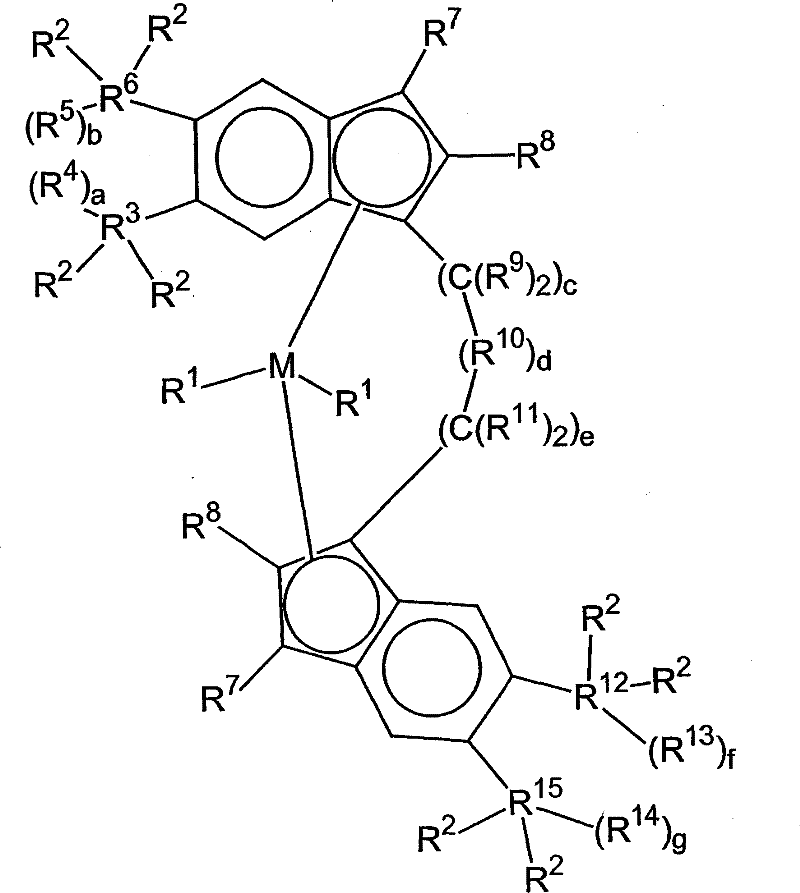
其中:in:
M是选自周期表4族中的过渡金属,优选Zr或Hf,最优选Hf;M is a transition metal selected from Group 4 of the Periodic Table, preferably Zr or Hf, most preferably Hf;
各R1独立地选自氢、烃基、取代烃基和官能团,优选地,R1是氢、烃或卤离子(halide),优选,R1是氢负离子(hydride),还更优选R1选自甲基、乙基、三甲基甲硅烷基甲基、三甲基甲硅烷基、苯基、萘基、烯丙基和苄基;还更优选,R1是甲基,并且R1可以连接,以及R1基团可以是相同或不同的;Each R 1 is independently selected from hydrogen, hydrocarbyl, substituted hydrocarbyl and functional groups, preferably, R 1 is hydrogen, hydrocarbon or halide, preferably, R 1 is a hydride ion (hydride), still more preferably R 1 is selected from Methyl, ethyl, trimethylsilylmethyl, trimethylsilyl, phenyl, naphthyl, allyl, and benzyl; still more preferably, R is methyl, and R can be attached , and the R groups can be the same or different;
各R2独立地选自甲基、乙基、丙基、丁基、戊基、己基和它们的异构体,前提是当R3和R6和/或R12和R15一起形成5碳环时,那么各R2独立地选自乙基、丙基、丁基、戊基、己基和它们的异构体,优选地,R2是甲基、乙基或丙基,更优选地,R2是甲基,R2基团可以是相同或不同的;Each R2 is independently selected from methyl, ethyl, propyl, butyl, pentyl, hexyl and their isomers, provided that when R3 and R6 and/or R12 and R15 together form 5 carbon ring, then each R is independently selected from ethyl, propyl, butyl, pentyl, hexyl and their isomers, preferably, R is methyl, ethyl or propyl, more preferably, R 2 is methyl, and the R 2 groups can be the same or different;
R3是碳或硅;R 3 is carbon or silicon;
R4是氢、烃基、取代烃基或官能团,R 4 is hydrogen, hydrocarbyl, substituted hydrocarbyl or functional group,
优选地,R4是CH2,R4和R5可以连在一起形成环,和/或R4和R6可以连在一起形成环;Preferably, R 4 is CH 2 , R 4 and R 5 can be linked together to form a ring, and/or R 4 and R 6 can be linked together to form a ring;
a是等于0、1或2的整数;a is an integer equal to 0, 1 or 2;
R5是氢、烃基、取代烃基或官能团,优选地,R5是CH2,R5和R3可以连在一起形成环;R 5 is hydrogen, a hydrocarbon group, a substituted hydrocarbon group or a functional group, preferably, R 5 is CH 2 , and R 5 and R 3 can be linked together to form a ring;
b是等于0、1或2的整数;b is an integer equal to 0, 1 or 2;
R6是碳或硅;R 6 is carbon or silicon;
各R7是氢;each R is hydrogen;
各R8独立地选自氢、甲基、乙基、丙基、丁基、戊基、己基和它们的异构体,优选地,R8是氢、甲基、乙基或丙基,更优选,R8是氢或甲基,R8基团可以是相同或不同的;Each R is independently selected from hydrogen, methyl, ethyl, propyl, butyl, pentyl, hexyl and their isomers, preferably, R is hydrogen, methyl, ethyl or propyl, more Preferably, R 8 is hydrogen or methyl, and the R 8 groups can be the same or different;
各R9独立地选自氢、烃基、取代烃基和官能团,优选地,R9是氢、甲基、乙基、丙基或苯基,更优选,R9是氢,R9基团可以是相同或不同的;任何两个R9基团可以连在一起形成环,R9和R8可以连在一起形成环,R9和R16可以连在一起形成环,R9和R11可以连在一起形成环;Each R 9 is independently selected from hydrogen, hydrocarbyl, substituted hydrocarbyl and functional groups, preferably, R 9 is hydrogen, methyl, ethyl, propyl or phenyl, more preferably, R 9 is hydrogen, R 9 groups can be The same or different; any two R 9 groups can be linked together to form a ring, R 9 and R 8 can be linked together to form a ring, R 9 and R 16 can be linked together to form a ring, R 9 and R 11 can be linked together together to form a ring;
R10是-M2(R16)h-,其中M2是B、Al、N、P、Si或Ge,h是1-2的整数,使得M2的化合价被满足,R16是氢、烃基、取代烃基或官能团,优选芳烃,各R16基团可以是相同或不同的,任何两个R16基团可以连在一起形成环,优选地,R10是SiMe2,Si(CH2)2,Si(CH2)3,SiPh2,Si(联苯基)1,Si(联苯基)2,Si(邻甲苯基)2,更优选,R10是SiMe2或SiPh2;R 10 is -M 2 (R 16 ) h -, wherein M 2 is B, Al, N, P, Si or Ge, h is an integer of 1-2, so that the valence of M 2 is satisfied, R 16 is hydrogen, Hydrocarbon group, substituted hydrocarbon group or functional group, preferably aromatic hydrocarbon, each R 16 group can be the same or different, any two R 16 groups can be linked together to form a ring, preferably, R 10 is SiMe 2 , Si(CH 2 ) 2 , Si(CH 2 ) 3 , SiPh 2 , Si(biphenyl) 1 , Si(biphenyl) 2 , Si(o-tolyl) 2 , more preferably, R 10 is SiMe 2 or SiPh 2 ;
各R11独立地选自氢、烃基、取代烃基和官能团,优选地,R11是氢、甲基、乙基、丙基或苯基,更优选,R11是氢,R11基团可以是相同或不同的,两个R11基团可以连在一起形成环,R11和R8可以连在一起形成环,R11和R16可以连在一起形成环;Each R 11 is independently selected from hydrogen, hydrocarbyl, substituted hydrocarbyl and functional groups, preferably, R 11 is hydrogen, methyl, ethyl, propyl or phenyl, more preferably, R 11 is hydrogen, R 11 groups can be The same or different, two R 11 groups can be linked together to form a ring, R 11 and R 8 can be linked together to form a ring, R 11 and R 16 can be linked together to form a ring;
c是0、1或2的整数;c is an integer of 0, 1 or 2;
d是0、1或2的整数;d is an integer of 0, 1 or 2;
e是0、1或2的整数;e is an integer of 0, 1 or 2;
其中c、d和e的总和是1、2或3,优选地,c、d和e的总和是1或2,更优选,c、d和e的总和是1;wherein the sum of c, d and e is 1, 2 or 3, preferably the sum of c, d and e is 1 or 2, more preferably the sum of c, d and e is 1;
R12是碳或硅;R 12 is carbon or silicon;
R13是氢、烃基、取代烃基或官能团,优选CH2,R13和R14可以连在一起形成环,以及当g是0时,R13和R15可以连在一起形成环;R 13 is hydrogen, hydrocarbyl, substituted hydrocarbyl or functional group, preferably CH 2 , R 13 and R 14 can be linked together to form a ring, and when g is 0, R 13 and R 15 can be linked together to form a ring;
R14是氢、烃基、取代烃基或官能团,优选CH2,以及当f是0时,R14和R12可以连在一起形成环;R 14 is hydrogen, hydrocarbyl, substituted hydrocarbyl or functional group, preferably CH 2 , and when f is 0, R 14 and R 12 can be linked together to form a ring;
R15是碳或硅;R 15 is carbon or silicon;
f是0、1或2的整数;f is an integer of 0, 1 or 2;
g是0、1或2的整数;g is an integer of 0, 1 or 2;
前提是如果两个R1基团连在一起,那么在M是Zr时它们不形成丁二烯基团。Provided that if two R groups are joined together, they do not form a butadiene group when M is Zr.
在一个优选实施方案中,R3和R6不形成5碳环。在一个替代实施方案中,和/或R12和R15不形成5碳环。在一个替代实施方案中,R3和R6和R12和R15不形成5碳环。In a preferred embodiment, R and R do not form a 5-carbon ring. In an alternative embodiment, and/or R 12 and R 15 do not form a 5-carbon ring. In an alternative embodiment, R 3 and R 6 and R 12 and R 15 do not form a 5-carbon ring.
在一个优选实施方案中,当M是Zr时,R3和R6不形成5碳环。在一个替代实施方案中,当M是Zr时,和/或R12和R15不形成5碳环。在一个替代实施方案中,当M是Zr时,R3和R6和R12和R15不形成5碳环。In a preferred embodiment , when M is Zr, R and R do not form a 5-carbon ring. In an alternative embodiment, when M is Zr, and/or R 12 and R 15 do not form a 5-carbon ring. In an alternative embodiment, when M is Zr, R and R and R and R do not form a 5 - carbon ring.
在一个优选实施方案中,当M是Hf时,R3和R6形成5碳环且连接于该5碳环的至少一个R2基团不是甲基,优选地,至少两个R2基团不是甲基,优选地,至少三个R2基团不是甲基,优选地,连接于该5碳环的所有四个R2基团不是甲基。In a preferred embodiment, when M is Hf, R and R form a 5-carbon ring and at least one R group attached to the 5- carbon ring is not methyl, preferably at least two R groups is not methyl, preferably at least three R2 groups are not methyl, preferably all four R2 groups attached to the 5-carbon ring are not methyl.
在一个替代实施方案中,当M是Hf时,R12和R15形成5碳环。且连接于该5碳环的至少一个R2基团不是甲基,优选至少两个R2基团不是甲基,优选地,至少三个R2基团不是甲基,优选地,连接于该5碳环的所有四个R2基团不是甲基。In an alternative embodiment, when M is Hf, R 12 and R 15 form a 5-carbon ring. and at least one R2 group attached to the 5-carbon ring is not methyl, preferably at least two R2 groups are not methyl, preferably at least three R2 groups are not methyl, preferably, attached to the All four R2 groups of the 5-carbon ring are not methyl.
在另一个优选实施方案中,M是Hf,两个R1基团都是甲基。In another preferred embodiment, M is Hf and both R groups are methyl.
取代烃基团(也称为取代烃基)是其中至少一个烃氢原子已经被至少一个杂原子或含杂原子的基团取代的基团。A substituted hydrocarbon group (also called a substituted hydrocarbyl group) is a group in which at least one hydrocarbon hydrogen atom has been replaced by at least one heteroatom or heteroatom-containing group.
在整个文件中,术语“烃基团”有时与“烃基”互换使用。对于本公开来说,“烃基”包括含有碳、氢和任选的硅原子,优选1-100个碳原子、氢和任选的硅的基团。这些基团可以是线性的、支化的或环状的,包括多环。这些基团可以是饱和的、部分不饱和的或完全不饱和的,并且当为环状时,可以是芳族或非芳族的。Throughout this document, the term "hydrocarbyl" is sometimes used interchangeably with "hydrocarbyl". For purposes of this disclosure, "hydrocarbyl" includes groups containing carbon, hydrogen and optionally silicon atoms, preferably 1 to 100 carbon atoms, hydrogen and optionally silicon. These groups can be linear, branched or cyclic, including polycyclic. These groups may be saturated, partially or fully unsaturated, and when cyclic, aromatic or nonaromatic.
烃基可以是芳烃。芳烃是取代或未取代芳族烃。芳烃可以是单环、多环、烃集合环或稠环体系。芳烃可以是取代或未取代的。取代烃基可以是含有官能团的芳烃。这样,取代烃基可以是杂环、多杂环、杂环集合环或稠合杂环体系。The hydrocarbyl group may be an aromatic hydrocarbon. Aromatics are substituted or unsubstituted aromatic hydrocarbons. Aromatics may be monocyclic, polycyclic, hydrocarbon-collected rings or fused ring systems. Arenes may be substituted or unsubstituted. The substituted hydrocarbyl group may be an aromatic hydrocarbon containing a functional group. Thus, the substituted hydrocarbyl group can be a heterocycle, polyheterocycle, heterocyclic ring collection or a fused heterocyclic ring system.
在一些实施方案中,烃基选自甲基、乙基、丙基、丁基、戊基、己基、庚基、辛基、壬基、癸基、十一烷基、十二烷基、十三烷基、十四烷基、十五烷基、十六烷基、十七烷基、十八烷基、十九烷基、二十烷基、二十一烷基、二十二烷基、二十三烷基、二十四烷基、二十五烷基、二十六烷基、二十七烷基、二十八烷基、二十九烷基、三十烷基、乙烯基、丙烯基、丁烯基、戊烯基、己烯基、庚烯基、辛烯基、壬烯基、癸烯基、十一碳烯基、十二碳烯基、十三碳烯基、十四碳烯基、十五碳烯基、十六碳烯基、十七碳烯基、十八碳烯基、十九碳烯基、二十碳烯基、二十一碳烯基、二十二碳烯基、二十三碳烯基、二十四碳烯基、二十五碳烯基、二十六碳烯基、二十七碳烯基、二十八碳烯基、二十九碳烯基、三十碳烯基、丙炔基、丁炔基、戊炔基、己炔基、庚炔基、辛炔基、壬炔基、癸炔基、十一碳炔基、十二碳炔基、十三碳炔基、十四碳炔基、十五碳炔基、十六碳炔基、十七碳炔基、十八碳炔基、十九碳炔基、二十碳炔基、二十一碳炔基、二十二碳炔基、二十三碳炔基、二十四碳炔基、二十五碳炔基、二十六碳炔基、二十七碳炔基、二十八碳炔基、二十九碳炔基或三十碳炔基异构体。对于本公开来说,当列举一个基团时,它表示该基团类型和当该基团类型进行以上定义的取代时所形成的所有其它基团。所列举的烷基、烯基和炔基包括所有异构体,包括适当情况下的环状异构体,例如,丁基包括正丁基、2-甲基丙基、1-甲基丙基、叔丁基和环丁基(和类似取代的环丙基);戊基包括正戊基、环戊基、1-甲基丁基、2-甲基丁基、3-甲基丁基、1-乙基丙基和新戊基(和类似取代的环丁基和环丙基);丁烯基包括1-丁烯基、2-丁烯基、3-丁烯基、1-甲基-1-丙烯基、1-甲基-2-丙烯基、2-甲基-1-丙烯基和2-甲基-2-丙烯基(以及环丁烯基和环丙烯基)的E和Z形式。具有取代的环状化合物包括所有异构体形式,例如,甲基苯基包括邻甲基苯基,间甲基苯基和对甲基苯基;二甲基苯基包括2,3-二甲基苯基,2,4-二甲基苯基,2,5-二甲基苯基,2,6-二甲基苯基,3,4-二甲基苯基和3,5-二甲基苯基。In some embodiments, the hydrocarbyl group is selected from methyl, ethyl, propyl, butyl, pentyl, hexyl, heptyl, octyl, nonyl, decyl, undecyl, dodecyl, tridecyl Alkyl, Tetradecyl, Pentadecyl, Hexadecyl, Heptadecyl, Octadecyl, Nonadecyl, Eicosyl, Icodecyl, Docosyl, Tricosyl, tetracosyl, pentadecyl, hexacyl, heptacyl, octadecyl, nonacosyl, triaconyl, vinyl, propenyl, butenyl, pentenyl, hexenyl, heptenyl, octenyl, nonenyl, decenyl, undecenyl, dodecenyl, tridecenyl, deca Tetradecenyl, Pentadecenyl, Hexadecenyl, Heptadecenyl, Octadecenyl, Nonadecenyl, Eicosenyl, Hexadecenyl, Twenty Dicarbenyl, Tricocenyl, Tetradecenyl, Pentadecenyl, Hexadecenyl, Heptadecenyl, Octacenyl, Twenty-nine Carbenyl, triadecenyl, propynyl, butynyl, pentynyl, hexynyl, heptynyl, octynyl, nonynyl, decynyl, undecynyl, dodecynyl Carbaynyl, tridecynyl, tetradecynyl, pentadecynyl, hexadecynyl, heptadecynyl, octadecynyl, nonadecynyl, eicosynyl radical, hexacynyl, dococynyl, tritricosynyl, tetradecynyl, pentadecynyl, hexacynyl, heptacynyl , octacosynyl, nonacosynyl or tricosaynyl isomers. For purposes of this disclosure, when a group is recited, it means that group type and all other groups formed when that group type is substituted as defined above. The recitations of alkyl, alkenyl and alkynyl include all isomers, including cyclic isomers where appropriate, e.g., butyl includes n-butyl, 2-methylpropyl, 1-methylpropyl , tert-butyl, and cyclobutyl (and similarly substituted cyclopropyl); pentyl includes n-pentyl, cyclopentyl, 1-methylbutyl, 2-methylbutyl, 3-methylbutyl, 1-ethylpropyl and neopentyl (and similarly substituted cyclobutyl and cyclopropyl); butenyl includes 1-butenyl, 2-butenyl, 3-butenyl, 1-methyl - E and Z for 1-propenyl, 1-methyl-2-propenyl, 2-methyl-1-propenyl and 2-methyl-2-propenyl (and cyclobutenyl and cyclopropenyl) form. Cyclic compounds with substitutions include all isomeric forms, for example, methylphenyl includes o-methylphenyl, m-methylphenyl and p-methylphenyl; dimethylphenyl includes 2,3-dimethylphenyl phenyl, 2,4-dimethylphenyl, 2,5-dimethylphenyl, 2,6-dimethylphenyl, 3,4-dimethylphenyl and 3,5-dimethylphenyl phenyl.
官能团是单独或通过共价键或其它相互作用例如离子、范德华力或氢键键合连接于其它元素的周期表1-17族的杂原子。官能团的实例包括氟、氯、溴、碘、羧酸、酰卤、羧酸酯、羧酸盐、羧酸酐、醛和它们的硫属元素(14族)类似物,醇和酚,醚,过氧化物和氢过氧化物,羧酰胺,酰肼和酰亚胺,脒和酰胺的其它氮类似物,腈,胺和亚胺,偶氮,硝基,其它氮化合物,硫酸类,硒酸类,硫醇类,硫化物,亚砜类,砜类,膦类,磷酸酯类,其它磷化合物,硅烷类,硼烷类,硼酸酯类,铝烷类,铝酸酯类。官能团还可以广义地包括有机聚合物载体或无机载体材料例如氧化铝和硅石。A functional group is a heteroatom of Groups 1-17 of the Periodic Table, alone or linked to another element by a covalent bond or other interaction such as ionic, van der Waals or hydrogen bonding. Examples of functional groups include fluorine, chlorine, bromine, iodine, carboxylic acids, acid halides, carboxylates, carboxylates, carboxylic anhydrides, aldehydes and their chalcogen (group 14) analogs, alcohols and phenols, ethers, peroxides compounds and hydroperoxides, carboxamides, hydrazides and imides, amidines and other nitrogen analogues of amides, nitriles, amines and imines, azo, nitro, other nitrogen compounds, sulfuric acids, selenic acids, Mercaptans, sulfides, sulfoxides, sulfones, phosphines, phosphates, other phosphorus compounds, silanes, boranes, borates, alanes, aluminates. Functional groups can also broadly include organic polymeric supports or inorganic support materials such as alumina and silica.
在一个优选实施方案中,这里使用的催化剂化合物可以用通式2表示:In a preferred embodiment, the catalyst compound used here can be represented by general formula 2:
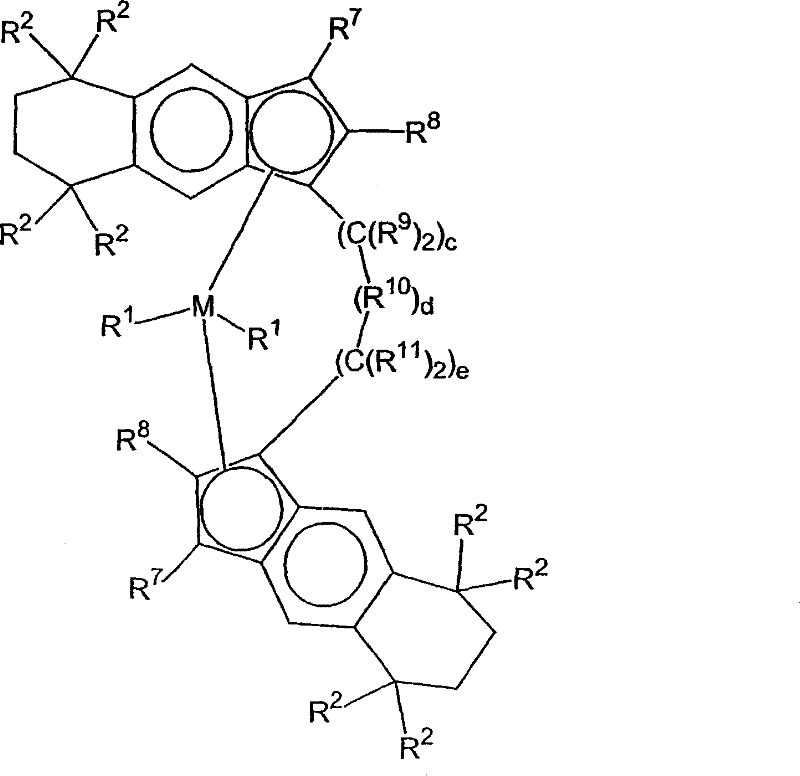
其中:in:
M是选自周期表4族中的过渡金属,优选Zr或Hf,最优选Hf;M is a transition metal selected from Group 4 of the Periodic Table, preferably Zr or Hf, most preferably Hf;
各R1独立地选自氢、烃基、取代烃基和官能团,优选地,R1是氢、烃或卤离子,更优选,R1是氢负离子、甲基、乙基、三甲基甲硅烷基甲基、三甲基甲硅烷基、苯基、萘基、烯丙基或苄基,还更优选,R1是甲基,两个R1基团可以是相同或不同的,两个R1可以连接;Each R is independently selected from hydrogen, hydrocarbyl, substituted hydrocarbyl and functional groups, preferably, R is hydrogen, hydrocarbon or halide, more preferably, R is hydride, methyl, ethyl, trimethylsilyl Methyl, trimethylsilyl, phenyl, naphthyl, allyl or benzyl, still more preferably, R is methyl, two R groups can be the same or different, two R can connect;
各R2独立地选自甲基、乙基、丙基、丁基、戊基、己基和它们的异构体,前提是当R3和R6和/或R12和R15一起形成5碳环时,那么各R2独立地选自乙基、丙基、丁基、戊基、己基和它们的异构体,优选地,R2是甲基、乙基或丙基,更优选地,R2是甲基,并且R2基团可以是相同或不同的;Each R2 is independently selected from methyl, ethyl, propyl, butyl, pentyl, hexyl and their isomers, provided that when R3 and R6 and/or R12 and R15 together form 5 carbon ring, then each R is independently selected from ethyl, propyl, butyl, pentyl, hexyl and their isomers, preferably, R is methyl, ethyl or propyl, more preferably, R 2 is methyl, and the R 2 groups may be the same or different;
各R7是氢;each R is hydrogen;
各R8独立地选自氢、甲基、乙基、丙基、丁基、戊基、己基和它们的异构体,优选地,R8是氢、甲基、乙基或丙基,更优选,R8是氢或甲基,R8基团可以是相同或不同的;Each R is independently selected from hydrogen, methyl, ethyl, propyl, butyl, pentyl, hexyl and their isomers, preferably, R is hydrogen, methyl, ethyl or propyl, more Preferably, R 8 is hydrogen or methyl, and the R 8 groups can be the same or different;
各R9独立地选自氢、烃基、取代烃基和官能团,优选地,R9是氢、甲基、乙基、丙基或苯基,更优选,R9是氢,R9基团可以是相同或不同的,任何两个R9基团可以连在一起形成环,R9和R8可以连在一起形成环,R9和R11可以连在一起形成环;Each R 9 is independently selected from hydrogen, hydrocarbyl, substituted hydrocarbyl and functional groups, preferably, R 9 is hydrogen, methyl, ethyl, propyl or phenyl, more preferably, R 9 is hydrogen, R 9 groups can be The same or different, any two R9 groups can be linked together to form a ring, R9 and R8 can be linked together to form a ring, R9 and R11 can be linked together to form a ring;
R10是-M2(R16)h-,其中M2是B、Al、N、P、Si或Ge,h是1-2的整数,使得M2的化合价被满足,R16是氢、烃基、取代烃基或官能团,优选芳烃,各R16基团可以是相同或不同的,任何两个R16基团可以连在一起形成环,优选地,R10是SiMe2,Si(CH2)2,Si(CH2)3,SiPh2,Si(联苯基)1,Si(联苯基)2,Si(邻甲苯基)2,更优选,R10是SiMe2或SiPh2;R 10 is -M 2 (R 16 ) h -, wherein M 2 is B, Al, N, P, Si or Ge, h is an integer of 1-2, so that the valence of M 2 is satisfied, R 16 is hydrogen, Hydrocarbon group, substituted hydrocarbon group or functional group, preferably aromatic hydrocarbon, each R 16 group can be the same or different, any two R 16 groups can be linked together to form a ring, preferably, R 10 is SiMe 2 , Si(CH 2 ) 2 , Si(CH 2 ) 3 , SiPh 2 , Si(biphenyl) 1 , Si(biphenyl) 2 , Si(o-tolyl) 2 , more preferably, R 10 is SiMe 2 or SiPh 2 ;
各R11独立地选自氢、烃基、取代烃基和官能团,优选地,R11是氢、甲基、乙基、丙基或苯基,更优选,R11是氢,R11基团可以是相同或不同的,R11基团可以连在一起形成环,R11和R8可以连在一起形成环;Each R 11 is independently selected from hydrogen, hydrocarbyl, substituted hydrocarbyl and functional groups, preferably, R 11 is hydrogen, methyl, ethyl, propyl or phenyl, more preferably, R 11 is hydrogen, R 11 groups can be The same or different, R 11 groups can be linked together to form a ring, R 11 and R 8 can be linked together to form a ring;
c是0、1或2的整数;c is an integer of 0, 1 or 2;
d是0、1或2的整数;d is an integer of 0, 1 or 2;
e是0、1或2的整数;e is an integer of 0, 1 or 2;
c、d和e的总和是1、2或3,优选地,c、d和e的总和是1或2,更优选,c、d和e的总和是1;The sum of c, d and e is 1, 2 or 3, preferably the sum of c, d and e is 1 or 2, more preferably the sum of c, d and e is 1;
前提是如果两个R1基团连在一起,那么在M是Zr时它们不形成丁二烯基团。Provided that if two R groups are joined together, they do not form a butadiene group when M is Zr.
在一个替代实施方案中,当M是Hf时,连接于6碳环的至少一个R2基团不是甲基,优选至少两个R2基团不是甲基,优选地,至少三个R2基团不是甲基,优选地,连接于6碳环的所有四个R2基团不是甲基。In an alternative embodiment, when M is Hf, at least one R2 group attached to the 6-carbon ring is not methyl, preferably at least two R2 groups are not methyl, preferably at least three R2 groups group is not methyl, preferably all four R groups attached to the 6-carbon ring are not methyl.
在另一个优选实施方案中,M是Hf,两个R1基团都是甲基。In another preferred embodiment, M is Hf and both R groups are methyl.
在一个优选实施方案中,这里使用的催化剂化合物用通式3表示:In a preferred embodiment, the catalyst compound used here is represented by the general formula 3:
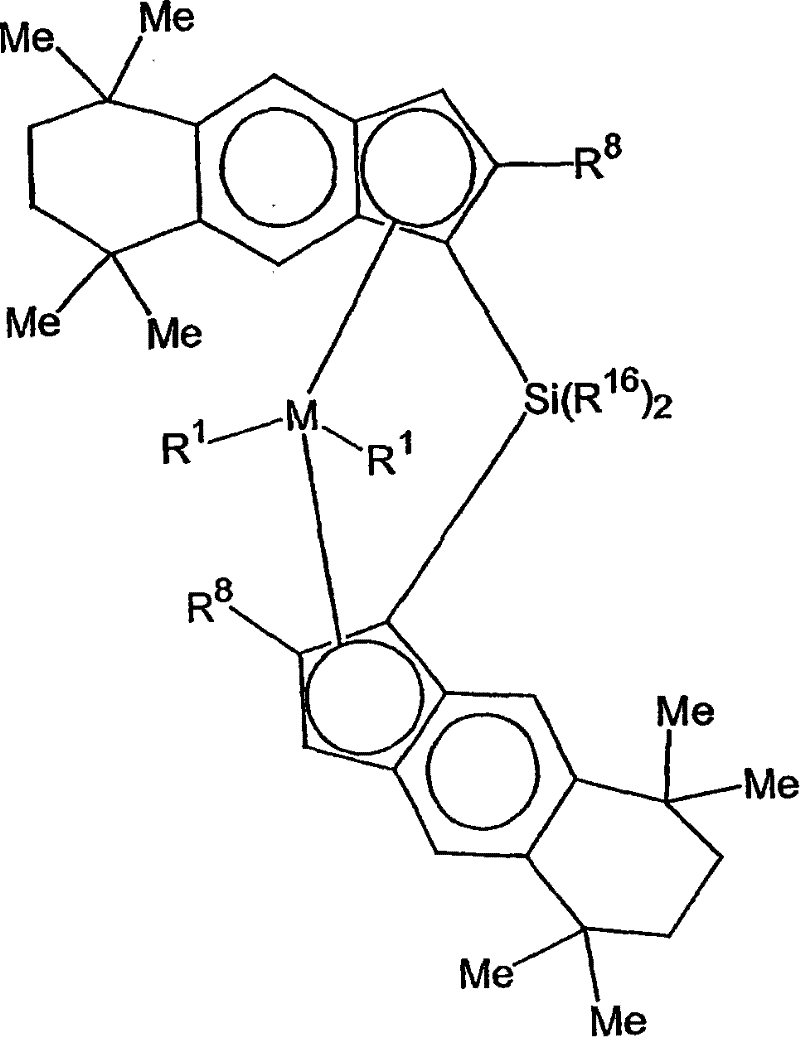
其中:in:
M是选自周期表4族中的过渡金属,优选Zr或Hf,最优选Hf;M is a transition metal selected from Group 4 of the Periodic Table, preferably Zr or Hf, most preferably Hf;
各R1独立地选自氢、烃基、取代烃基和官能团,优选地,R1是氢、烃或卤离子,更优选,R1是氢负离子、甲基、乙基、三甲基甲硅烷基甲基、三甲基甲硅烷基、苯基、萘基、烯丙基或苄基,还更优选,R1是甲基,两个R1基团可以是相同或不同的,两个R1可以连接,前提是如果两个R1连接,那么当M是Zr时,它们不形成丁二烯基团;Each R is independently selected from hydrogen, hydrocarbyl, substituted hydrocarbyl and functional groups, preferably, R is hydrogen, hydrocarbon or halide, more preferably, R is hydride, methyl, ethyl, trimethylsilyl Methyl, trimethylsilyl, phenyl, naphthyl, allyl or benzyl, still more preferably, R is methyl, two R groups can be the same or different, two R can be attached provided that if two R1 are attached then when M is Zr they do not form a butadiene group;
Me是甲基;Me is methyl;
各R8独立地选自氢、烃基、取代烃基和官能团,优选地,R8是氢、甲基、乙基或丙基,更优选,R8是氢或甲基,并且R8基团可以是相同或不同的;和Each R is independently selected from hydrogen, hydrocarbyl, substituted hydrocarbyl and functional groups, preferably, R is hydrogen, methyl, ethyl or propyl, more preferably, R is hydrogen or methyl, and the R groups can be are the same or different; and
各R16可以是相同或不同的,并且R16基团可以连在一起形成环,优选地,各R16独立地是甲基、乙基、苯基、联苯基、邻甲苯基或芳烃,优选地,R16是甲基、乙基、苯基或芳烃。Each R 16 may be the same or different, and the R 16 groups may be linked together to form a ring, preferably, each R 16 is independently methyl, ethyl, phenyl, biphenyl, o-tolyl or an aromatic hydrocarbon, Preferably, R 16 is methyl, ethyl, phenyl or arene.
在任何以上通式的任何一个优选实施方案中,R8不是苯基和/或取代苯基。In any one preferred embodiment of any of the above general formulas, R is not phenyl and/or substituted phenyl.
在另一个优选实施方案中,如果两个R1基团连接,那么当M是Ti时它们不形成丁二烯基团。In another preferred embodiment, if two R groups are linked, they do not form a butadiene group when M is Ti.
在另一个优选实施方案中,如果两个R1基团连接,那么当M是Hf时它们不形成丁二烯基团。In another preferred embodiment, if two R groups are linked, they do not form a butadiene group when M is Hf.
在一个优选实施方案中,这里使用的催化剂化合物用以下化学式表示:In a preferred embodiment, the catalyst compound used herein is represented by the following chemical formula:

其中Me是甲基,Hf是铪,Ph是苯基,和Si是硅。where Me is methyl, Hf is hafnium, Ph is phenyl, and Si is silicon.
在另一个实施方案中,本发明的催化剂化合物以+4形式氧化态存在。在另一个实施方案中,本发明的催化剂化合物不以+2形式氧化态存在。这里使用的形式氧化态的命名法在下文中有详细描述:Hegedus,L.S.Transition Metals in the Synthesis of Complex OrganicMolecules,第二版,University Science Press,1999,Sausalito,CA.和Collman,J.P.等人,Principles and Applications ofOrganotransition Metal Chemistry,University Science Press,1987,Sausalito,CA。In another embodiment, the catalyst compound of the present invention exists in the +4 form oxidation state. In another embodiment, the catalyst compounds of the present invention do not exist in the +2 form oxidation state. The nomenclature of the formal oxidation states used here is described in detail in Hegedus, L.S. Transition Metals in the Synthesis of Complex Organic Molecules, 2nd ed., University Science Press, 1999, Sausalito, CA. and Collman, J.P. et al., Principles and Applications of Organotransition Metal Chemistry, University Science Press, 1987, Sausalito, CA.
在另一个优选实施方案中,这里所述的催化剂化合物可以与其它聚合和/或低聚催化剂结合使用。在一个优选实施方案中,这些催化剂化合物与在任何以下参考文献及其引用的参考文献中所述的催化剂化合物结合使用:In another preferred embodiment, the catalyst compounds described herein may be used in combination with other polymerization and/or oligomerization catalysts. In a preferred embodiment, these catalyst compounds are used in combination with catalyst compounds described in any of the following references and references cited therein:
Hlatky,G.G.Chem.Rev.2000,100,1347;Alt,H.;Koppl,A.Chem.Rev.2000,100,1205;Resconi,L.;Cavallo,L.;Fait,A.;Piermontesi,F.Chem.Rev.2000,100,1253;Bryntzinger,H.H.等人,Angew.Chem.Int.Ed.Engl.1995,34,1143;Ittel,S.D.;Johnson,L.K.;Brookhart,M.Chem.Rev.2000,100,1169;Gibson,V.C.;Spitzmesser,S.K.Chem.Rev.2003,103,283.;Skupinska,J.Chem.Rev.1991,91,613;Carter,A.等人,Chem.Commun.2002,858;McGuinness,D.S.等人,J.Am.Chem.Soc.2003,125,5272;McGuiness,D.S.Chem.Commun.2003,334。Hlatky, G.G.Chem.Rev.2000, 100, 1347; Alt, H.; Koppl, A.Chem.Rev.2000, 100, 1205; Resconi, L.; Cavallo, L.; Fait, A.; .Chem.Rev.2000, 100, 1253; Bryntzinger, H.H. et al., Angew.Chem.Int.Ed.Engl.1995, 34, 1143; Ittel, S.D.; Johnson, L.K.; Brookhart, M.Chem.Rev.2000 , 100, 1169; Gibson, V.C.; Spitzmesser, S.K.Chem.Rev.2003, 103, 283.; Skupinska, J.Chem.Rev.1991, 91, 613; Carter, A. et al., Chem.Commun.2002, 858; McGuinness, D.S. et al., J. Am. Chem. Soc. 2003, 125, 5272; McGuinness, D. S. Chem. Commun. 2003, 334.
用于催化剂化合物的活化剂和活化方法Activators and activation methods for catalyst compounds
根据本发明的桥连金属茂化合物可以按足以允许配位或阳离子聚合的任何方式活化,以用于聚合催化。当一个配体能够被夺取和另一个允许插入不饱和单体或者同样可被夺取,以便用允许插入不饱和单体的配体(不稳定配体)例如烷基、甲硅烷基或氢负离子置换时,这能够实现以用于配位聚合。配位聚合领域的常规活化剂是适合的,它们通常包括路易斯酸例如铝氧烷化合物,以及夺取一个配体,以便将桥连金属茂金属中心电离为阳离子并且提供抗衡非配位离子的电离阴离子前体化合物。The bridged metallocene compounds according to the invention may be activated for polymerization catalysis in any manner sufficient to permit coordination or cationic polymerization. When one ligand can be abstracted and another allows the insertion of an unsaturated monomer or can also be abstracted for replacement with a ligand that allows the insertion of an unsaturated monomer (labile ligand) such as an alkyl, silyl or hydride ion This can be achieved for coordination polymerization when . Conventional activators in the field of coordination polymerization are suitable, and they generally include Lewis acids such as alumoxane compounds, and ionizing anions that abstract a ligand in order to ionize the bridging metallocene metal center into a cation and provide a counter non-coordinating ion precursor compound.
烷基铝氧烷和改性烷基铝氧烷适合作为催化剂活化剂,尤其作为其中R1=卤离子或其它官能团的本发明金属化合物的活化剂。烷基铝氧烷和改性烷基铝氧烷也适合作为其中R1=烃基或取代烃基的本发明金属化合物的催化剂。在一个实施方案中,采用一种或多种铝氧烷作为本发明的催化剂组合物中的活化剂。铝氧烷(alumoxane),有时在本领域中被称为铝氧烷(aluminoxane),一般是含有-Al(R)-O-亚单元的低聚化合物,其中R是烷基。铝氧烷的例子包括甲基铝氧烷(MAO),改性甲基铝氧烷(MMAO),乙基铝氧烷和异丁基铝氧烷。烷基铝氧烷和改性烷基铝氧烷适合作为催化剂活化剂,尤其当可夺取的配体是卤离子时。还可以使用不同铝氧烷和改性铝氧烷的混合物。关于进一步的说明,参见US专利Nos.4,665,208,4,952,540,5,041,584,5,091,352,5,206,199,5,204,419,4,874,734,4,924,018,4,908,463,4,968,827,5,329,032,5,248,801,5,235,081,5,157,137,5,103,031,EP 0 561 476A1,EP 0 279 586B1,EP 0 516476A,EP 0 594 218A1以及WO 94/10180。Alkylaluminoxanes and modified alkylaluminoxanes are suitable as catalyst activators, especially as activators for metal compounds according to the invention in which R 1 =halide ion or other functional group. Alkylaluminoxanes and modified alkylaluminoxanes are also suitable as catalysts for metal compounds according to the invention in which R 1 =hydrocarbyl or substituted hydrocarbyl. In one embodiment, one or more aluminoxanes are employed as activators in the catalyst compositions of the present invention. Alumoxanes, sometimes referred to in the art as aluminoxanes, are generally oligomeric compounds containing -Al(R)-O- subunits, where R is an alkyl group. Examples of alumoxanes include methylalumoxane (MAO), modified methylalumoxane (MMAO), ethylalumoxane and isobutylalumoxane. Alkylaluminoxanes and modified alkylaluminoxanes are suitable as catalyst activators, especially when the abstractable ligand is a halide ion. Mixtures of different alumoxanes and modified alumoxanes can also be used.关于进一步的说明,参见US专利Nos.4,665,208,4,952,540,5,041,584,5,091,352,5,206,199,5,204,419,4,874,734,4,924,018,4,908,463,4,968,827,5,329,032,5,248,801,5,235,081,5,157,137,5,103,031,EP 0 561 476A1,EP 0 279 586B1, EP 0 516 476A, EP 0 594 218A1 and WO 94/10180.
当活化剂是铝氧烷(改性或非改性)时,一些实施方案选择相对于催化剂前体(每一金属催化位点)的最大量的活化剂,为5000倍摩尔过量的Al/M。最小活化剂与催化剂前体的摩尔比通常为1∶1。When the activator is an aluminoxane (modified or not), some embodiments select a 5000-fold molar excess of Al/M relative to the maximum amount of activator relative to the catalyst precursor (per metal catalytic site) . The minimum molar ratio of activator to catalyst precursor is usually 1:1.
铝氧烷可以通过相应的三烷基铝化合物的水解来制备。MMAO可以通过三甲基铝和更高级三烷基铝化合物如三异丁基铝的水解来制备。MMAO通常在脂族溶剂中具有更高的溶解度和在贮存过程中更稳定。有许多种制备铝氧烷和改性铝氧烷的方法,它们的非限制性实例描述在U.S.专利Nos.4,665,208,4,952,540,5,091,352,5,206,199,5,204,419,4,874,734,4,924,018,4,908,463,4,968,827,5,308,815,5,329,032,5,248,801,5,235,081,5,157,137,5,103,031,5,391,793,5,391,529,5,693,838,5,731,253,5,731,451,5,744,656,5,847,177,5,854,166,5,856,256和5,939,346;欧洲公开EP 0 561 476,EP 0 279 586,EP 0 594 218和EP-B1-0 586 665;以及PCT公开WO 94/10180和WO99/15534中,所有这些专利在此全面引入供参考。可以优选使用视觉透明的甲基铝氧烷。可以过滤浑浊或胶化铝氧烷,以形成透明溶液,或者可以从浑浊溶液中滗析出透明铝氧烷。另一优选铝氧烷是3A型改性甲基铝氧烷(MMAO)助催化剂(以3A型改性甲基铝氧烷的商品名从AkzoChemicals,Inc.商购,受专利号US 5,041,584的保护)。Aluminoxanes can be prepared by hydrolysis of the corresponding trialkylaluminum compounds. MMAO can be prepared by hydrolysis of trimethylaluminum and higher trialkylaluminum compounds such as triisobutylaluminum. MMAO generally has higher solubility in aliphatic solvents and is more stable during storage. There are many methods of preparing aluminoxanes and modified alumoxanes, non-limiting examples of which are described in U.S. Patent Nos. 5,248,801,5,235,081,5,157,137,5,103,031,5,391,793,5,391,529,5,693,838,5,731,253,5,731,451,5,744,656,5,847,177,5,854,166,5,856,256和5,939,346;欧洲公开EP 0 561 476,EP 0 279 586,EP 0 594 218和EP-B1-0 586 665; and PCT publications WO 94/10180 and WO 99/15534, all of which are fully incorporated herein by reference. Visually transparent methylaluminoxane may preferably be used. The cloudy or gelled aluminoxane can be filtered to form a clear solution, or the clear aluminoxane can be decanted from the cloudy solution. Another preferred aluminoxane is Modified Methylalumoxane (MMAO) Cocatalyst Type 3A (commercially available from Akzo Chemicals, Inc. under the trade name Modified Methylalumoxane Type 3A, protected by Patent No. US 5,041,584 ).
可以用作活化剂(或清除剂)的烷基铝或有机铝化合物的例子包括三甲基铝,三乙基铝,三异丁基铝,三正己基铝,三正辛基铝等。Examples of alkylaluminum or organoaluminum compounds that can be used as activators (or scavengers) include trimethylaluminum, triethylaluminum, triisobutylaluminum, tri-n-hexylaluminum, tri-n-octylaluminum and the like.
使用中性或离子型的电离或化学计量活化剂(stoichiometricactivator),如四(五氟苯基)硼三正丁基铵,三全氟苯基硼准金属前体或三全氟萘基硼准金属前体,多卤化杂硼烷阴离子(WO98/43983),硼酸(US专利No.5,942,459)或它们的组合是在本发明的范围内的。中性或离子活化剂单独使用或与铝氧烷或改性铝氧烷活化剂结合使用也在本发明范围内。Use a neutral or ionic ionizing or stoichiometric activator (stoichiometric activator), such as tetrakis (pentafluorophenyl) boron tri-n-butyl ammonium, tris perfluorophenyl boron metalloid precursor or tris perfluoronaphthyl boron quasi Metal precursors, polyhalogenated borane anions (WO98/43983), boronic acid (US Patent No. 5,942,459) or combinations thereof are within the scope of the present invention. It is also within the scope of the invention to use neutral or ionic activators alone or in combination with alumoxane or modified alumoxane activators.
中性化学计量活化剂的实例包括三取代硼、碲、铝、镓和铟或它们的混合物。三个取代基可以各自独立选自烷基,链烯基,卤素,取代烷基,芳基,卤化芳基,烷氧基和卤离子。优选,该三个基团独立选自卤素,单或多环(包括卤代)芳基,烷基和链烯基化合物以及它们的混合物,优选的是具有1-20个碳原子的链烯基,具有1-20个碳原子的烷基,具有1-20个碳原子的烷氧基和具有3-20个碳原子的芳基(包括取代芳基)。更优选的是,该三个基团是具有1-4个碳原子的烷基,苯基,萘基或它们的混合物。还更优选的是,该三个基团是卤化,优选氟化芳基。最优选的是,中性化学计量活化剂是三全氟苯基硼或三全氟萘基硼。Examples of neutral stoichiometric activators include trisubstituted boron, tellurium, aluminum, gallium and indium or mixtures thereof. The three substituents may each be independently selected from alkyl, alkenyl, halogen, substituted alkyl, aryl, halogenated aryl, alkoxy and halide. Preferably, the three groups are independently selected from halogen, mono- or polycyclic (including halogenated) aryl, alkyl and alkenyl compounds and mixtures thereof, preferably alkenyl having 1-20 carbon atoms , an alkyl group having 1-20 carbon atoms, an alkoxy group having 1-20 carbon atoms, and an aryl group (including substituted aryl groups) having 3-20 carbon atoms. More preferably, the three groups are alkyl having 1-4 carbon atoms, phenyl, naphthyl or mixtures thereof. Still more preferably, the three groups are halogenated, preferably fluorinated aryl groups. Most preferably, the neutral stoichiometric activator is trisperfluorophenyl boron or trisperfluoronaphthyl boron.
离子化学计量活化剂化合物可以含有活性质子,或与该电离化合物的剩余离子缔合、但不配位于或仅松弛地配位于该电离化合物的剩余离子的一些其它阳离子。这些化合物和类似化合物描述在欧洲公开EP-A-0 570 982,EP-A-0 520 732,EP-A-0 495 375,EP-B1-0 500 944,EP-A-0 277 003和EP-A-0 277 004,US专利Nos.5,153,157,5,198,401,5,066,741,5,206,197,5,241,025,5,384,299和5,502,124以及1994年8月3日提出的US专利申请序号08/285,380中;所有这些专利在此全面引入供参考。An ionic stoichiometric activator compound may contain an active proton, or some other cation that is associated with, but not coordinated or only loosely coordinated to, the remaining ion of the ionizing compound. These and similar compounds are described in European publications EP-A-0 570 982, EP-A-0 520 732, EP-A-0 495 375, EP-B1-0 500 944, EP-A-0 277 003 and EP - A-0 277 004, US Patent Nos. 5,153,157, 5,198,401, 5,066,741, 5,206,197, 5,241,025, 5,384,299 and 5,502,124, and US Patent Application Serial No. 08/285,380, filed August 3, 1994; refer to.
优选的活化剂包括阳离子和阴离子组分,并且可以用下式表示:Preferred activators include cationic and anionic components and can be represented by the formula:
(St+)u(NCAv-)w (S t+ ) u (NCA v- ) w
St+是具有电荷t+的阳离子组分,S t+ is a cationic component with charge t+,
NCAv-是具有电荷v-的非配位阴离子,NCA v- is a non-coordinating anion with charge v-,
t是1-3的整数,t is an integer of 1-3,
v是1-3的整数,v is an integer of 1-3,
u和v受关系式:(u)×(t)=(v)×(w)的限制。u and v are bounded by the relation: (u)*(t)=(v)*(w).
阳离子组分(St+)可以包括布朗斯台德酸例如能够质子化或夺取类似金属茂或含15族原子的过渡金属催化剂前体中的结构部分例如烷基或芳基,获得阳离子过渡金属物种的质子或质子化路易斯碱或可还原的路易斯酸。The cationic component (S t+ ) may include a Bronsted acid such as is capable of protonating or abstracting a moiety such as an alkyl or aryl group in a similar metallocene or transition metal catalyst precursor containing a Group 15 atom to obtain a cationic transition metal species proton or protonated Lewis base or reducible Lewis acid.
在一个优选实施方案中,活化剂包括阳离子和阴离子组分,并且可以用下式表示:In a preferred embodiment, the activator includes cationic and anionic components and can be represented by the following formula:
(LB-Ht+)u(NCAv-)w (LB-H t+ ) u (NCA v- ) w
其中LB是中性路易斯碱;Wherein LB is a neutral Lewis base;
H是氢;H is hydrogen;
NCAv-是具有电荷v-的非配位阴离子,NCA v- is a non-coordinating anion with charge v-,
t是1-3的整数,t is an integer of 1-3,
v是1-3的整数,v is an integer of 1-3,
u和v受关系式:(u)×(t)=(v)×(w)的限制。u and v are bounded by the relation: (u)*(t)=(v)*(w).
活化阳离子(St+)可以是布朗斯台德酸(LB-Ht+),它能够将质子给予过渡金属催化前体,获得过渡金属阳离子,包括铵,氧鎓,鏻,甲硅烷鎓和它们的混合物,优选甲胺、苯胺、二甲胺、二乙胺、N-甲基苯胺、二苯胺、三甲胺、三乙胺、N,N-二甲基苯胺、甲基二苯基胺、吡啶、对-溴-N,N-二甲基苯胺和对-硝基-N,N-二甲基苯胺的铵;由三乙基膦,三苯基膦和二苯基膦获得的鏻;由醚如二甲醚,二乙醚,四氢呋喃和二噁烷获得的氧鎓;由硫醚,如二乙基硫醚和四氢噻吩获得的锍,以及它们的混合物。The activating cation (S t+ ) can be a Bronsted acid (LB-H t+ ), which is capable of donating a proton to a transition metal catalytic precursor to obtain a transition metal cation, including ammonium, oxonium, phosphonium, silylium and their Mixtures, preferably methylamine, aniline, dimethylamine, diethylamine, N-methylaniline, diphenylamine, trimethylamine, triethylamine, N,N-dimethylaniline, methyldiphenylamine, pyridine, Ammoniums of p-bromo-N,N-dimethylaniline and p-nitro-N,N-dimethylaniline; phosphoniums obtained from triethylphosphine, triphenylphosphine and diphenylphosphine; from ethers Oxoniums such as dimethyl ether, diethyl ether, tetrahydrofuran and dioxane; sulfoniums obtained from sulfides such as diethyl sulfide and tetrahydrothiophene, and mixtures thereof.
活化阳离子(St+)还可以是夺取结构部分,如银,碳鎓(carbonium),
阴离子组分(NCAv-)包括具有通式(Tx+Qy)v-的那些,其中x是1-3的整数;y是2-6的整数;y-x=v;T是选自元素周期表的13或15族中的元素,优选硼或铝;和Q独立是氢负离子,桥连或非桥连二烷基氨基,卤离子,烷氧基,芳氧基,烃基,取代烃基,卤烃基(halocarbyl),取代卤烃基和卤素取代烃基基团,所述Q具有至多20个碳原子,前提是Q是卤离子的情况不超过一次。优选,各Q是具有1-20个碳原子的氟化烃基;更优选各Q是氟化芳基,和最优选各Q是五氟芳基。适合的(NCAv-)的实例还包括如在U.S.专利No.5,447,895中公开的二硼化合物,该专利在此全面引入供参考。适合的阴离子的另一实例是具有三个邻位取代的氟芳基配体和一个炔配体的硼酸根。适合的阴离子的另一例子是含有携带极性取代基例如胺、醚、甲硅烷基和它们的衍生物的氟芳基的硼酸根。Anionic components (NCA v- ) include those having the general formula (T x + Q y ) v- , wherein x is an integer from 1 to 3; y is an integer from 2 to 6; yx=v; T is selected from the period of elements An element in Group 13 or 15 of the Table, preferably boron or aluminum; and Q independently are a hydride, bridged or non-bridged dialkylamino, halide, alkoxy, aryloxy, hydrocarbyl, substituted hydrocarbyl, halogen Halocarbyl, substituted halocarbyl and halosubstituted hydrocarbyl groups, wherein Q has up to 20 carbon atoms, provided that Q is a halo ion not more than once. Preferably, each Q is a fluorinated hydrocarbon group having 1-20 carbon atoms; more preferably each Q is a fluorinated aryl group, and most preferably each Q is a pentafluoroaryl group. Examples of suitable (NCA v- ) also include diboron compounds as disclosed in US Patent No. 5,447,895, which is hereby incorporated by reference in its entirety. Another example of a suitable anion is borate with three ortho-substituted fluoroaryl ligands and one alkyne ligand. Another example of a suitable anion is borate containing fluoroaryl groups bearing polar substituents such as amines, ethers, silyl groups and derivatives thereof.
其它适合的阴离子在本领域中是已知的,并且适合在本发明的催化剂中使用。尤其参见专利US 5,278,119,WO2002102857,WO2002051884,WO200218452,WO2000037513,WO2000029454,WO2000004058,WO9964476,WO2003049856,WO2003051892,WO2003040070,WO2003000740,WO2002036639,WO2002000738,WO2002000666,WO2001081435,WO2001042249,WO2000004059。还参见S.H.Strauss的评论文章,“The Search for Larger and MoreWeakly Coordinating Anions”,Chem.Rev.,93,927-942(1993)和C.A.Reed,“Carboranes:A New Class of Weakly CoordinatingAnions for Strong Electrophiles,Oxidants and Superacids”,Acc.Chem.Res.,31,133-139(1998)。Other suitable anions are known in the art and are suitable for use in the catalysts of the present invention.尤其参见专利US 5,278,119,WO2002102857,WO2002051884,WO200218452,WO2000037513,WO2000029454,WO2000004058,WO9964476,WO2003049856,WO2003051892,WO2003040070,WO2003000740,WO2002036639,WO2002000738,WO2002000666,WO2001081435,WO2001042249,WO2000004059。 See also review articles by S.H. Strauss, "The Search for Larger and More Weakly Coordinating Anions", Chem. Rev., 93, 927-942 (1993) and C.A. Reed, "Carboranes: A New Class of Weakly Coordinating Anions for Strong Electrophiles, Oxidants and Superacids", Acc. Chem. Res., 31, 133-139 (1998).
可以在本发明的改进催化剂的制备中用作活化助催化剂的硼化合物的示例而非限制性实例是三取代的铵盐,例如:四苯基硼酸三甲基铵,四苯基硼酸三乙基铵,四苯基硼酸三丙基铵,四苯基硼酸三(正丁基)铵,四苯基硼酸三(叔丁基)铵,四苯基硼酸N,N-二甲基苯胺鎓,四苯基硼酸N,N-二乙基苯胺鎓,四苯基硼酸N,N-二甲基-(2,4,6-三甲基苯胺鎓),四(五氟苯基)硼酸三甲基铵,四(五氟苯基)硼酸三乙基铵,四(五氟苯基)硼酸三丙基铵,四(五氟苯基)硼酸三(正丁基)铵,四(五氟苯基)硼酸三(仲丁基)铵,四(五氟苯基)硼酸N,N-二甲基苯胺鎓,四(五氟苯基)硼酸N,N-二乙基苯胺鎓,四(五氟苯基)硼酸N,N-二甲基-(2,4,6-三甲基苯胺鎓),四(七氟萘基)硼酸三甲基铵,四(七氟萘基)硼酸三乙基铵,四(七氟萘基)硼酸三丙基铵,四(七氟萘基)硼酸三(正丁基)铵,四(七氟萘基)硼酸三(仲丁基)铵,四(七氟萘基)硼酸N,N-二甲基苯胺鎓,四(七氟萘基)硼酸N,N-二乙基苯胺鎓,(2-全氟联苯基)3(全氟苯基炔基)硼酸三甲基铵,(2-全氟联苯基)3(全氟苯基炔基)硼酸三乙基铵,(2-全氟联苯基)3(全氟苯基炔基)硼酸三丙基铵,(2-全氟联苯基)3(全氟苯基炔基)硼酸三(正丁基)铵,(2-全氟联苯基)3(全氟苯基炔基)硼酸三(仲丁基)铵,(2-全氟联苯基)3(全氟苯基炔基)硼酸N,N-二甲基苯胺鎓,(2-全氟联苯基)3(全氟苯基炔基)硼酸N,N-二乙基苯胺鎓,四-(2,3,4,6-四氟苯基)硼酸三甲基铵,四-(2,3,4,6-四氟苯基)硼酸三乙基铵,四-(2,3,4,6-四氟苯基)硼酸三丙基铵,四-(2,3,4,6-四氟苯基)硼酸三(正丁基)铵,四-(2,3,4,6-四氟苯基)硼酸二甲基(叔丁基)铵,四-(2,3,4,6-四氟苯基)硼酸N,N-二甲基苯胺鎓,四-(2,3,4,6-四氟苯基)硼酸N,N-二乙基苯胺鎓,四-(2,3,4,6-四氟苯基)硼酸N,N-二甲基-(2,4,6-三甲基苯胺鎓);二烷基铵盐,例如:四(五氟苯基)硼酸二-(异丙基)铵,和四(五氟苯基)硼酸二环己基铵;和其它三取代鏻盐,例如四(五氟苯基)硼酸三苯基鏻,四(五氟苯基)硼酸三(邻甲苯基)鏻和四(五氟苯基)硼酸三(2,6-二甲基苯基)鏻;非布朗斯台德酸例如四(五氟苯基)硼酸三苯基碳鎓,四(七氟萘基)硼酸三苯基碳鎓,(2-全氟联苯基)3(全氟苯基炔基)硼酸三苯基碳鎓,三全氟苯基硼烷和三全氟萘基硼烷。Illustrative, non-limiting examples of boron compounds that can be used as activating cocatalysts in the preparation of the improved catalysts of the present invention are trisubstituted ammonium salts such as: trimethylammonium tetraphenylborate, triethyltetraphenylborate Ammonium, tripropylammonium tetraphenylborate, tri(n-butyl)ammonium tetraphenylborate, tri(tert-butyl)ammonium tetraphenylborate, N, N-dimethylanilinium tetraphenylborate, tetraphenylborate N, N-diethylanilinium phenyl borate, N, N-dimethyl-(2,4,6-trimethylanilinium) tetraphenyl borate, trimethyl tetrakis(pentafluorophenyl) borate Ammonium, triethylammonium tetrakis(pentafluorophenyl)borate, tripropylammonium tetrakis(pentafluorophenyl)borate, tri(n-butyl)ammonium tetrakis(pentafluorophenyl)borate, tetrakis(pentafluorophenyl)borate ) Tris(sec-butyl)ammonium borate, N,N-dimethylanilinium tetrakis(pentafluorophenyl)borate, N,N-diethylanilinium tetrakis(pentafluorophenyl)borate, tetrakis(pentafluorophenyl)borate N,N-diethylanilinium, tetrakis(pentafluorophenyl) N, N-dimethyl-(2,4,6-trimethylanilinium) phenyl) borate, trimethylammonium tetrakis (heptafluoronaphthyl) borate, triethyl tetrakis (heptafluoronaphthyl) borate Ammonium, tripropylammonium tetrakis(heptafluoronaphthyl)borate, tri(n-butyl)ammonium tetrakis(heptafluoronaphthyl)borate, tri(sec-butyl)ammonium tetrakis(heptafluoronaphthyl)borate, tetrakis(heptafluoronaphthyl)borate N, N-dimethylanilinium fluoronaphthyl) borate, N, N-diethylanilinium tetrakis (heptafluoronaphthyl) borate, (2-perfluorobiphenyl) 3 (perfluorophenylalkynyl )trimethylammonium borate, (2-perfluorobiphenyl) 3 (perfluorophenylalkynyl)boronic acid triethylammonium, (2-perfluorobiphenyl) 3 (perfluorophenylalkynyl)boronic acid Tripropylammonium, (2-perfluorobiphenyl) 3 (perfluorophenylalkynyl) tri(n-butyl)ammonium borate, (2-perfluorobiphenyl) 3 (perfluorophenylalkynyl) Tris(sec-butyl)ammonium borate, (2-perfluorobiphenyl) 3 (perfluorophenylalkynyl) borate N,N-dimethylanilinium borate, (2-perfluorobiphenyl) 3 (perfluorobiphenyl) 3 (perfluorobiphenyl) N, N-diethylanilinium fluorophenylalkynyl) borate, trimethylammonium tetrakis-(2,3,4,6-tetrafluorophenyl) borate, tetrakis-(2,3,4,6- Triethylammonium tetrafluorophenyl) borate, tripropylammonium tetrakis-(2,3,4,6-tetrafluorophenyl) borate, tetra-(2,3,4,6-tetrafluorophenyl) borate Tri(n-butyl)ammonium, tetrakis-(2,3,4,6-tetrafluorophenyl) dimethyl(tert-butyl)ammonium, tetrakis-(2,3,4,6-tetrafluorophenyl) ) borate N,N-dimethylanilinium, tetrakis-(2,3,4,6-tetrafluorophenyl) borate N,N-diethylanilinium, tetrakis-(2,3,4,6- N,N-dimethyl-(2,4,6-trimethylanilinium) tetrafluorophenyl) borate; dialkylammonium salts, e.g. di-(isopropyl tetrakis(pentafluorophenyl) borate ) ammonium, and dicyclohexylammonium tetrakis(pentafluorophenyl)borate; and other trisubstituted phosphonium salts, such as triphenylphosphonium tetrakis(pentafluorophenyl)borate, tris(o-toluene)tetrakis(pentafluorophenyl)borate base) phosphonium and tris(2,6-dimethylphenyl)phosphonium tetrakis(pentafluorophenyl)borate; non-Bronsted acids such as triphenylcarbenium tetrakis(pentafluorophenyl)borate, tetrakis(7- fluoronaphthyl) boron triphenylcarbenium acid, triphenylcarbenium (2-perfluorobiphenyl) 3 (perfluorophenylalkynyl)borate, triperfluorophenylborane and triperfluoronaphthylborane.
最优选的是,离子化学计量活化剂是四(全氟苯基)硼酸N,N-二甲基苯胺鎓和/或四(全氟苯基)硼酸三苯基碳鎓。Most preferably, the ionic stoichiometric activator is N,N-dimethylanilinium tetrakis(perfluorophenyl)borate and/or triphenylcarbenium tetrakis(perfluorophenyl)borate.
在一个实施方案中,使用不含活性质子、但能够产生类似金属茂催化剂阳离子和它们的非配位阴离子的电离离子化合物的活化方法也被考虑在内,并且在EP-A-0 426 637,EP-A-0 573 403和US专利No.5,387,568中有述,这些专利在此全面引入供参考。In one embodiment, activation methods using ionizing ionic compounds that do not contain active protons but are capable of generating similar metallocene catalyst cations and their non-coordinating anions are also contemplated, and in EP-A-0 426 637, Described in EP-A-0 573 403 and US Patent No. 5,387,568, which are hereby fully incorporated by reference.
术语“非配位阴离子”(NCA)是指不配位于所述阳离子或仅微弱地配位于所述阳离子,从而保持非常容易被中性路易斯碱置换的阴离子。“相容的”非配位阴离子是在初始形成的配合物分解时不降级为中性的那些。根据本发明使用的非配位阴离子是相容的,在平衡其离子电荷的意义上稳定该金属阳离子,然而在聚合过程中又十分容易被烯属或炔属不饱和单体所置换的那些非配位阴离子。这些类型的助催化剂有时使用三异丁基铝或三辛基铝作为清除剂。The term "non-coordinating anion" (NCA) refers to an anion that does not coordinate to the cation or only weakly coordinates to the cation, thereby remaining very easily displaced by a neutral Lewis base. "Compatible" non-coordinating anions are those that do not degrade to neutrality upon decomposition of the initially formed complex. The non-coordinating anions used according to the invention are compatible, stabilizing the metal cation in the sense of balancing its ionic charge, however, those non-coordinating anions which are quite easily displaced by ethylenically or acetylenically unsaturated monomers during polymerization. Coordinating anions. These types of cocatalysts sometimes use triisobutylaluminum or trioctylaluminum as a scavenger.
本发明方法还可以使用起初为中性路易斯酸,但在与本发明化合物反应时形成阳离子金属配合物和非配位阴离子、或两性离子配合物的助催化剂化合物或活化剂化合物。例如,三(五氟苯基)硼或铝用于夺取烃基或氢负离子配体,以获得本发明阳离子金属配合物并稳定非配位阴离子,关于类似4族金属茂化合物的说明,参见EP-A-0 427697和EP-A-0 520 732。还有,参见EP-A-0 495 375的方法和化合物。关于使用类似4族化合物形成两性离子配合物,参见US专利5,624,878;5,486,632;和5,527,929。The method of the invention may also employ cocatalyst or activator compounds that are initially neutral Lewis acids, but form cationic metal complexes and noncoordinating anions, or zwitterionic complexes upon reaction with the compounds of the invention. For example, tris(pentafluorophenyl)boron or aluminum are used to abstract hydrocarbyl or hydride ligands to obtain cationic metal complexes of the present invention and to stabilize non-coordinating anions. For descriptions of similar group 4 metallocene compounds, see EP- A-0 427697 and EP-A-0 520 732. Also, see the methods and compounds of EP-A-0 495 375. See US Patents 5,624,878; 5,486,632; and 5,527,929 for formation of zwitterionic complexes using similar Group 4 compounds.
其它中性路易斯酸在本领域中是已知的,并且适合于夺取阴离子配体。尤其参见E.Y.-X.Chen和TJ.Marks的评论文章,“Cocatalystsfor Metal-Catalyzed Olefin Polymerization:Activators,Activation Processes,and Structure-Activity Relationships”,Chem.Rev.,100,1391-1434(2000)。Other neutral Lewis acids are known in the art and are suitable for abstracting anionic ligands. See especially the review article by E.Y.-X. Chen and TJ. Marks, "Cocatalysts for Metal-Catalyzed Olefin Polymerization: Activators, Activation Processes, and Structure-Activity Relationships", Chem. Rev., 100, 1391-1434 (2000).
当R1是官能团配体例如氯离子、氨基或烷氧基配体,以及该官能团配体不能用电离阴离子前体化合物独立电离夺取时,这些官能团配体可通过已知的与有机金属化合物例如氢化锂或氢化铝或烷基锂或烷基铝、烷基铝氧烷、格利雅试剂等的烷基化反应来转化。关于描述了在添加活化非配位阴离子前体化合物之前或期间烷基铝化合物与类似二卤代金属茂化合物的反应的类似方法,参见EP-A-0 500 944,EP-A1-0 570 982和EP-A1-0 612768。When R 1 is a functional group ligand such as chloride ion, amino or alkoxy ligand, and the functional group ligand cannot be ionized independently by the ionizing anion precursor compound For example, the alkylation reaction of lithium hydride or aluminum hydride or alkyl lithium or alkyl aluminum, alkyl aluminoxane, Grignard reagent, etc. can be converted. For similar processes describing the reaction of alkylaluminum compounds with analogous dihalogenated metallocene compounds before or during the addition of activating non-coordinating anion precursor compounds, see EP-A-0 500 944, EP-A1-0 570 982 and EP-A1-0612768.
当非配位阴离子前体的阳离子是布朗斯台德酸例如质子或质子化路易斯碱(不包括水)或可还原的路易斯酸例如二茂铁鎓或银阳离子,或碱金属或碱土金属阳离子例如钠、镁或锂的那些阳离子时,催化剂前体与活化剂的摩尔比可以是任何比率。所述活化剂化合物的组合也可用于活化。例如,三(全氟苯基)硼可以与甲基铝氧烷一起使用。When the cation of the non-coordinating anion precursor is a Bronsted acid such as a proton or a protonated Lewis base (excluding water) or a reducible Lewis acid such as ferrocenium or a silver cation, or an alkali metal or alkaline earth metal cation such as As with those cations of sodium, magnesium or lithium, the molar ratio of catalyst precursor to activator can be any ratio. Combinations of such activator compounds may also be used for activation. For example, tris(perfluorophenyl)boron can be used with methylaluminoxane.
一般,结合的金属化合物和活化剂以大约1000∶1到大约0.5∶1的比率结合。在一个优选实施方案中,金属化合物和活化剂以大约300∶1到大约1∶1,优选大约150∶1到大约1∶1的比率结合;对于硼烷、硼酸酯、铝酸酯等,该比率优选是大约1∶1到大约10∶1,对于烷基铝化合物(例如二乙基氯化铝与水结合),该比率优选是大约0.5∶1到大约10∶1。Typically, the combined metal compound and activator are combined in a ratio of about 1000:1 to about 0.5:1. In a preferred embodiment, the metal compound and activator are combined in a ratio of about 300:1 to about 1:1, preferably about 150:1 to about 1:1; for boranes, borates, aluminates, etc., The ratio is preferably about 1:1 to about 10:1, and for alkylaluminum compounds such as diethylaluminum chloride in combination with water, the ratio is preferably about 0.5:1 to about 10:1.
在一个优选实施方案中,第一催化剂与第二或其它催化剂的比率是5∶95到95∶5,优选25∶75到75∶25,还更优选40∶60到60∶40。In a preferred embodiment, the ratio of the first catalyst to the second or other catalyst is from 5:95 to 95:5, preferably from 25:75 to 75:25, still more preferably from 40:60 to 60:40.
在另一个实施方案中,这里所使用的活化剂不是铝氧烷。或者,这里使用的催化剂体系包括低于0.1wt%的铝氧烷。In another embodiment, the activator used herein is not an aluminoxane. Alternatively, the catalyst system used herein includes less than 0.1 wt% aluminoxane.
在另一个实施方案中,本发明的催化剂组合物包括载体材料或担体。例如,一种或多种催化剂组分和/或一种或多种活化剂可以沉积在一种或多种载体或担体上,与一种或多种载体或担体接触,与一种或多种载体或担体一起汽化,结合于一种或多种载体或担体,引入到一种或多种载体或担体内,在一种或多种载体或担体内或在一种或多种载体或担体上吸附或吸收。In another embodiment, the catalyst composition of the present invention includes a support material or support. For example, one or more catalyst components and/or one or more activators may be deposited on one or more supports or supports, contacted with one or more supports or supports, contacted with one or more Vaporized together, bound to, incorporated into, within or on one or more carriers or supports Adsorption or absorption.
载体材料可以是任何常规载体材料。优选地,载体材料是多孔载体材料,例如滑石、无机氧化物和无机氯化物。其它载体材料包括树脂载体材料如聚苯乙烯,官能化或交联有机载体,如聚苯乙烯,二乙烯基苯,聚烯烃或聚合物,沸石,粘土,或任何其它有机或无机载体材料等,或它们的混合物。The carrier material can be any conventional carrier material. Preferably, the support material is a porous support material such as talc, inorganic oxides and inorganic chlorides. Other support materials include resinous support materials such as polystyrene, functionalized or crosslinked organic supports such as polystyrene, divinylbenzene, polyolefins or polymers, zeolites, clays, or any other organic or inorganic support materials, etc., or their mixtures.
优选的载体材料是无机氧化物,包括那些2、3、4、5、13或14族金属氧化物。优选的载体包括硅石(脱水或未脱水),热解法硅石,氧化铝(WO 99/60033),硅石-氧化铝和它们的混合物。其它有用的载体包括氧化镁,二氧化钛,氧化锆,氯化镁(US专利No.5,965,477),蒙脱石(欧洲专利EP-B1 0 511 665),页状硅酸盐,沸石,滑石,粘土(US专利No.6,034,187)等。还有,可以使用这些载体材料的组合,例如硅石-铬,硅石-氧化铝,硅石-二氧化钛等。其它载体材料可以包括在EP 0 767 184 B1中所述的那些多孔丙烯酸系聚合物,该专利在此引入供参考。另外的载体材料包括如在WO 99/47598中所述的纳米复合材料,如在WO 99/48605中所述的气溶胶,如在U.S.专利No.5,972,510中所述的球粒和如在WO 99/50311中所述的聚合物珠粒,所述专利在此全面引入供参考。Preferred support materials are inorganic oxides, including those of Group 2, 3, 4, 5, 13 or 14 metal oxides. Preferred supports include silica (dehydrated or not), fumed silica, alumina (WO 99/60033), silica-alumina and mixtures thereof. Other useful supports include magnesia, titania, zirconia, magnesium chloride (US Patent No. 5,965,477), montmorillonite (European Patent EP-B1 0 511 665), phyllosilicates, zeolites, talc, clay (US Patent No. 6,034,187) and so on. Also, combinations of these support materials can be used, such as silica-chromium, silica-alumina, silica-titania, and the like. Other support materials may include those porous acrylic polymers described in EP 0 767 184 B1, which is hereby incorporated by reference. Additional carrier materials include nanocomposites as described in WO 99/47598, aerosols as described in WO 99/48605, pellets as described in U.S. Patent No. 5,972,510 and /50311, which is hereby incorporated by reference in its entirety.
优选的是,载体材料、最优选无机氧化物具有大约10到大约700m2/g的表面积,大约0.1到大约4.0cc/g的孔体积和大约5到大约500μm的平均粒度。更优选,载体材料的表面积为大约50到大约500m2/g,孔体积为大约0.5到大约3.5cc/g和平均粒度为大约10到大约200μm。最优选,载体材料的表面积为大约100到大约400m2/g,孔体积为大约0.8到大约3.0cc/g和平均粒度为大约5到大约100μm。本发明的载体的平均孔径一般是在

单体monomer
在一个优选实施方案中,本发明的过渡金属化合物用于聚合或低聚任何一种或多种不饱和单体。优选的单体包括C2-C100烯烃,优选C2-C60烯烃,优选C2-C40烯烃,优选C2-C20烯烃,优选C2-C12烯烃。在一些实施方案中,优选的单体包括线性、支化或环状α-烯烃,优选C2-C100α-烯烃,优选C2-C60α-烯烃,优选C2-C40α-烯烃,优选C2-C20α-烯烃,优选C2-C12α-烯烃。优选的烯烃单体可以是乙烯,丙烯,丁烯,戊烯,己烯,庚烯,辛烯,壬烯,癸烯,十二碳烯,4-甲基-戊烯-1,3-甲基戊烯-1,3,5,5-三甲基己烯-1和5-乙基-1-壬烯中的一种或多种。In a preferred embodiment, the transition metal compounds of the present invention are used to polymerize or oligomerize any one or more unsaturated monomers. Preferred monomers include C 2 -C 100 olefins, preferably C 2 -C 60 olefins, preferably C 2 -C 40 olefins, preferably C 2 -C 20 olefins, preferably C 2 -C 12 olefins. In some embodiments, preferred monomers include linear, branched or cyclic α-olefins, preferably C 2 -C 100 α-olefins, preferably C 2 -C 60 α-olefins, preferably C 2 -C 40 α-olefins, preferably C 2 -C 40 α-olefins, Olefins, preferably C 2 -C 20 α-olefins, preferably C 2 -C 12 α-olefins. Preferred olefin monomers may be ethylene, propylene, butene, pentene, hexene, heptene, octene, nonene, decene, dodecene, 4-methyl-pentene-1,3-methan One or more of pentene-1,3,5,5-trimethylhexene-1 and 5-ethyl-1-nonene.
在另一个实施方案中,这里生产的聚合物是能够通过立体有择和非立体有择催化剂的任何一种聚合的一种或多种线性或支化C3-C30前手性α-烯烃或者含有C5-C30环的烯烃或者它们的组合的共聚物。本文所使用的前手性是指当使用立体有择催化剂聚合时有利于形成全同立构或间同立构聚合物的单体。In another embodiment, the polymer produced herein is one or more linear or branched C3 - C30 prochiral alpha-olefins capable of being polymerized by any one of stereospecific and non-stereospecific catalysts Or copolymers of olefins containing C 5 -C 30 rings or combinations thereof. As used herein, prochiral refers to monomers that favor the formation of isotactic or syndiotactic polymers when polymerized using stereospecific catalysts.
优选的单体还可以包括含有至多30个碳原子的含芳族基团的单体。适合的含芳族基团的单体包括至少一芳族结构,优选1-3个芳族结构,更优选苯基、茚基、芴基或萘基结构部分。含芳族基团的单体进一步包括至少一可聚合双键,使得在聚合之后,芳族结构侧挂于聚合物骨架。含芳族基团的单体可以进一步被一个或多个烃基取代,包括、但不限于C1-C10烷基。另外,两个相邻取代可以连接成环结构。优选的含芳族基团的单体含有附于可聚合烯属结构部分的至少一芳族结构。尤其优选的芳族单体包括苯乙烯、α-甲基苯乙烯、对烷基苯乙烯类、乙烯基甲苯类、乙烯基萘、烯丙基苯和茚,尤其苯乙烯、对甲基苯乙烯、4-苯基-1-丁烯和烯丙基苯。Preferred monomers may also include aromatic group-containing monomers containing up to 30 carbon atoms. Suitable aromatic group-containing monomers include at least one aromatic structure, preferably 1-3 aromatic structures, more preferably phenyl, indenyl, fluorenyl or naphthyl moieties. The aromatic group-containing monomer further includes at least one polymerizable double bond such that after polymerization, the aromatic structure is pendant from the polymer backbone. The aromatic group-containing monomer may be further substituted with one or more hydrocarbyl groups, including, but not limited to, C 1 -C 10 alkyl groups. In addition, two adjacent substitutions can be linked to form a ring structure. Preferred aromatic group-containing monomers contain at least one aromatic structure attached to a polymerizable ethylenic moiety. Particularly preferred aromatic monomers include styrene, alpha-methylstyrene, p-alkylstyrenes, vinyltoluenes, vinylnaphthalene, allylbenzene and indene, especially styrene, p-methylstyrene , 4-phenyl-1-butene and allylbenzene.
含有非芳族环基的单体在这里也是有用的。这些单体可以含有至多30个碳原子。适合的含非芳族环基的单体优选具有在环状结构上侧挂或者属于环状结构的一部分的至少一个可聚合烯属基团。该环状结构还可以进一步被一个或多个烃基,比如、但不限于C1-C10烷基取代。优选的含非芳族环基的单体包括乙烯基环己烷,乙烯基环己烯,乙烯基降冰片烯,乙叉基降冰片烯,环戊二烯,环戊烯,环己烯,环丁烯,乙烯基金刚烷等。Monomers containing non-aromatic ring groups are also useful herein. These monomers may contain up to 30 carbon atoms. Suitable non-aromatic ring group-containing monomers preferably have at least one polymerizable ethylenic group pendant from or part of the ring structure. The ring structure may be further substituted by one or more hydrocarbon groups, such as, but not limited to, C 1 -C 10 alkyl groups. Preferred non-aromatic ring group-containing monomers include vinyl cyclohexane, vinyl cyclohexene, vinyl norbornene, ethylidene norbornene, cyclopentadiene, cyclopentene, cyclohexene, Cyclobutene, vinyl adamantane, etc.
可用于本发明的优选的二烯烃单体包括具有至少两个不饱和键的任何烃结构,优选C4-C30,其中不饱和键的至少一个(通常两个)易于通过立体有择或非立体有择催化剂引入到聚合物中。进一步优选的是,二烯烃单体从α,ω-二烯单体(即二乙烯基单体)中选择。更优选地,二烯烃单体是线性二乙烯基单体,最优选含有4-30个碳原子的那些。优选的二烯的实例包括丁二烯,戊二烯,己二烯,庚二烯,辛二烯,壬二烯,癸二烯,十一碳二烯,十二碳二烯,十三碳二烯,十四碳二烯,十五碳二烯,十六碳二烯,十七碳二烯,十八碳二烯,十九碳二烯,二十碳二烯,二十一碳二烯,二十二碳二烯,二十三碳二烯,二十四碳二烯,二十五碳二烯,二十六碳二烯,二十七碳二烯,二十八碳二烯,二十九碳二烯,三十碳二烯,尤其优选的二烯包括1,6-庚二烯,1,7-辛二烯,1,8-壬二烯,1,9-癸二烯,1,10-十一碳二烯,1,11-十二碳二烯,1,12-十三碳二烯,1,13-十四碳二烯,以及低分子量聚丁二烯(Mw低于1000g/mol)。优选的环状二烯包括在各个环位置有或无取代的环戊二烯,乙烯基降冰片烯,降冰片二烯,乙叉基降冰片烯,二乙烯基苯,二环戊二烯或含有更高级环的二烯烃。Preferred diene monomers useful in the present invention include any hydrocarbon structure, preferably C 4 -C 30 , having at least two unsaturated bonds, wherein at least one (usually two) of the unsaturated bonds are readily Stereospecific catalysts are incorporated into polymers. It is further preferred that the diene monomer is selected from α,ω-diene monomers (ie divinyl monomers). More preferably, the diene monomers are linear divinyl monomers, most preferably those containing 4 to 30 carbon atoms. Examples of preferred dienes include butadiene, pentadiene, hexadiene, heptadiene, octadiene, nonadiene, decadiene, undecadiene, dodecadiene, tridecene Diene, Tetradecadiene, Pentadecadiene, Hexadecadiene, Heptadecadiene, Octadecadiene, Nonadecadiene, Eicosadiene, Hexadecadiene ene, docosadiene, tricosadiene, tetradecadiene, pentadecadiene, hexadecadiene, heptacosadiene, octadecadiene , nonacosadiene, tridecadiene, particularly preferred dienes include 1,6-heptadiene, 1,7-octadiene, 1,8-nonadiene, 1,9-decadiene ene, 1,10-undecadiene, 1,11-dodecadiene, 1,12-tridecadiene, 1,13-tetradecadiene, and low molecular weight polybutadiene ( Mw below 1000 g/mol). Preferred cyclic dienes include cyclopentadiene, vinyl norbornene, norbornadiene, ethylidene norbornene, divinylbenzene, dicyclopentadiene or Dienes containing higher rings.
可用于本发明的优选的极性不饱和单体的非限制性实例包括6-硝基-1-己烯,N-甲基烯丙基胺,N-烯丙基环戊基胺,N-烯丙基-己胺,甲基乙烯基酮,乙基乙烯基酮,5-己烯-2-酮,2-乙酰基-5-降冰片烯,7-顺式甲氧基甲基-5-降冰片烯-2-酮,丙烯醛,2,2-二甲基-4-戊烯醛,十一碳烯醛,2,4-二甲基-2,6-庚二烯醛,丙烯酸,乙烯基乙酸,4-戊烯酸,2,2-二甲基-4-戊烯酸,6-庚烯酸,反式-2,4-戊二烯酸,2,6-庚二烯酸,九氟-1-己烯,烯丙醇,7-辛烯-1,2-二醇,2-甲基-3-丁烯-1-醇,5-降冰片烯-2-腈,5-降冰片烯-2-甲醛,5-降冰片烯-2-羧酸,顺式-5-降冰片烯-内-2,3-二羧酸,5-降冰片烯-2,2,-二甲醇,顺式-5-降冰片烯-内-2,3-二羧酸酐,5-降冰片烯-2-内-3-内-二甲醇,5-降冰片烯-2-内-3-外-二甲醇,5-降冰片烯-2-甲醇,5-降冰片烯-2-醇,5-降冰片烯-2-基乙酸酯,1-[2-(5-降冰片烯-2-基)乙基]-3,5,7,9,11,13,15-七环戊基五环[9.5.1.13,9.15,15.17,13]八硅氧烷,2-苯甲酰基-5-降冰片烯,烯丙基1,1,2,2,-四氟乙基醚,丙烯醛二甲基缩醛,一氧化丁二烯,1,2-环氧基-7-辛烯,1,2-环氧基-9-癸烯,1,2-环氧基-5-己烯,2-甲基-2-乙烯基环氧乙烷,烯丙基缩水甘油醚,2,5-二氢呋喃,2-环戊烯-1-酮乙二醇缩酮,烯丙基二硫化物,丙烯酸乙酯,丙烯酸甲酯。本领域技术人员会认识到,在聚合方法中使用极性单体需要使用路易斯酸助催化剂,例如烷基铝化合物或用于进行聚合的替代保护方法(Boffa,L.S.;Novak,B.M.Chem.Rev.2000,1479和其中引用的参考文献)。Non-limiting examples of preferred polar unsaturated monomers useful in the present invention include 6-nitro-1-hexene, N-methallylamine, N-allylcyclopentylamine, N- Allyl-hexylamine, methyl vinyl ketone, ethyl vinyl ketone, 5-hexen-2-one, 2-acetyl-5-norbornene, 7-cis-methoxymethyl-5 -Norbornen-2-one, acrolein, 2,2-dimethyl-4-pentenal, undecenal, 2,4-dimethyl-2,6-heptadienal, acrylic acid , vinyl acetic acid, 4-pentenoic acid, 2,2-dimethyl-4-pentenoic acid, 6-heptenoic acid, trans-2,4-pentadienoic acid, 2,6-heptadiene acid, nonafluoro-1-hexene, allyl alcohol, 7-octene-1,2-diol, 2-methyl-3-buten-1-ol, 5-norbornene-2-carbonitrile, 5-norbornene-2-carbaldehyde, 5-norbornene-2-carboxylic acid, cis-5-norbornene-endo-2,3-dicarboxylic acid, 5-norbornene-2,2, -dimethanol, cis-5-norbornene-endo-2,3-dicarboxylic anhydride, 5-norbornene-2-endo-3-dimethanol, 5-norbornene-2-endo- 3-exo-dimethanol, 5-norbornene-2-methanol, 5-norbornen-2-ol, 5-norbornen-2-yl acetate, 1-[2-(5-norbornene En- 2 -yl)ethyl] -3,5,7,9,11,13,15-heptacyclopentylpentacyclo[9.5.1.13,9.15,15.17,13 ] octasil Oxane, 2-benzoyl-5-norbornene, allyl 1,1,2,2,-tetrafluoroethyl ether, acrolein dimethyl acetal, butadiene monoxide, 1,2 - Epoxy-7-octene, 1,2-epoxy-9-decene, 1,2-epoxy-5-hexene, 2-methyl-2-vinyloxirane, Allyl glycidyl ether, 2,5-dihydrofuran, 2-cyclopenten-1-one ethylene glycol ketal, allyl disulfide, ethyl acrylate, methyl acrylate. Those skilled in the art will recognize that the use of polar monomers in polymerization processes requires the use of Lewis acid cocatalysts, such as aluminum alkyl compounds, or alternative protection methods for conducting polymerization (Boffa, LS; Novak, BMChem. Rev. 2000 , 1479 and references cited therein).
对于本发明和所附权利要求书来说,术语低聚物是指具有2-75个单体单元的组合物,术语聚合物是指具有76或更多个单体单元的组合物。单体单元被定义为初始对应于在低聚或聚合反应中使用的烯烃的低聚物或聚合物的单元。例如,聚乙烯的单体单元是乙烯。For purposes of this invention and the appended claims, the term oligomer refers to compositions having 2-75 monomer units and the term polymer refers to compositions having 76 or more monomer units. A monomeric unit is defined as a unit that initially corresponds to an oligomer or polymer of an olefin used in an oligomerization or polymerization reaction. For example, the monomer unit of polyethylene is ethylene.
在这里的一个实施方案中,本文所述的方法用于制备以上列举的任何单体的低聚物。优选的低聚物包括任何C2-C20烯烃,优选C2-C12α-烯烃的低聚物,最优选制备包括乙烯、丙烯和/或丁烯的低聚物。用于该低聚方法的优选原料是α-烯烃乙烯。但其它α-烯烃,包括、但不限于丙烯和1-丁烯,也可以单独或与乙烯结合使用。优选的α-烯烃包括任何C2-C40α-烯烃,优选C2-C20α-烯烃,优选任何C2-C12α-烯烃,优选乙烯、丙烯和丁烯,最优选乙烯。在这里所述的方法中可以使用二烯,优选α,ω-二烯单独或与单-α-烯烃结合使用。In one embodiment herein, the methods described herein are used to prepare oligomers of any of the monomers listed above. Preferred oligomers include oligomers of any C2 - C20 olefin, preferably C2 - C12 alpha-olefin, most preferably oligomers comprising ethylene, propylene and/or butene are prepared. A preferred starting material for the oligomerization process is the alpha-olefin ethylene. However, other alpha-olefins, including but not limited to propylene and 1-butene, may also be used alone or in combination with ethylene. Preferred α-olefins include any C 2 -C 40 α-olefin, preferably C 2 -C 20 α-olefin, preferably any C 2 -C 12 α-olefin, preferably ethylene, propylene and butene, most preferably ethylene. Dienes, preferably α,ω-dienes alone or in combination with mono-α-olefins, can be used in the processes described herein.
聚合方法aggregation method
优选的聚合是在充分混合的连续进料聚合反应器中进行的单段、稳态的聚合。该聚合可以在溶液中进行,但还能够使用满足单段聚合和连续进料反应器的要求的其它聚合工序,例如气相或淤浆聚合。所述方法可以被描述为连续、非间歇方法,在其稳态操作中,可以作为例证的是单位时间所制备的聚合物的量基本上等于单位时间从反应容器中排出的聚合物的量。所谓“基本上等于”是指这样的量,单位时间制备的聚合物和单位时间排出的聚合物的相互的比率是0.9∶1;或0.95∶1;或0.97∶1;或1∶1。在这种反应器内,优选具有基本上均匀的单体分布。同时,聚合在基本上单一步骤或阶段或单一反应器中完成,与多段或多个反应器(两个或更多)相反。其中每个反应器是以上描述的反应器的多个反应器在此也是有用的。The preferred polymerization is a single stage, steady state polymerization carried out in a well mixed continuous feed polymerization reactor. The polymerisation can be carried out in solution but other polymerisation procedures meeting the requirements of single stage polymerisation and continuous feed reactors can also be used, such as gas phase or slurry polymerisation. The process can be described as a continuous, non-batch process, in its steady state operation, as can be exemplified in that the amount of polymer produced per unit time is substantially equal to the amount of polymer withdrawn from the reaction vessel per unit time. By "substantially equal to" is meant such an amount that the ratio of polymer produced per unit time to polymer discharged per unit time is 0.9:1; or 0.95:1; or 0.97:1; or 1:1. Within such a reactor it is preferred to have a substantially uniform monomer distribution. Also, polymerization is accomplished in essentially a single step or stage or single reactor, as opposed to multiple stages or multiple reactors (two or more). Multiple reactors where each reactor is a reactor as described above are also useful herein.
优选的使用本文所述的聚合催化剂制备聚合物的方法包括以下步骤:a)将溶剂和一组预定比例的单体进给到聚合反应器中,b)将可溶性金属茂催化剂加入到所述反应器中,c)在溶液中聚合该组单体,形成含有聚合物的流出物,其中第一和第二组单体选自丙烯、乙烯、α-烯烃、非共轭二烯。同样,聚合物可以通过在添加金属茂催化剂的串联连接的至少两个连续流搅拌釜反应器(CFSTR)设备组中的溶液聚合来制备。每一个反应器应该能够独立地进给单体和溶剂。为了除去起催化剂毒物作用的极性化合物,理想地用本领域已知的分子筛、氧化铝床或其它吸收剂纯化所有溶剂和单体进料。反应器的除热是用本领域公知的方法例如自动制冷、进料预冷却(绝热反应器)、冷却盘管、或这些技术的各种组合来进行的。用预冷却进料的绝热反应器是优选的。压力优选足以在反应器温度下将反应器内容物保持在溶液中。聚合可以在-20℃或更低到200℃或更高,优选0-160℃的温度下进行。最优选地,聚合在55-140℃的范围内进行。每一反应器的停留时间保持在1-180分钟,优选5-30分钟。反应器流出物中的聚合物浓度保持在1-20wt%和更优选3-12wt%的范围内。总聚合速率通过催化剂和单体进料速率来设定。聚合物组成通过调节反应器的单体进料速率来控制。聚合物分子量通过选择反应器温度(MW随温度升高而降低)、单体浓度(MW随单体浓度增加而提高)和任选添加链转移剂例如氢气来设定。聚合物产物通常可以通过用非溶剂例如异丙醇、丙酮或正丁醇凝聚而从流出物中回收,或者聚合物可以通过用热或蒸汽汽提溶剂或其它介质来回收。一种或多种常规添加剂例如抗氧化剂能够在回收工序期间引入到聚合物中。有用的抗氧化剂包括苯基-β-萘基胺,二叔丁基氢醌,磷酸三苯酯,庚基化二苯基胺,2,2’-亚甲基-双(4-甲基-6-叔丁基)苯酚和2,2,4-三甲基-6-苯基-1,2-二氢喹啉。A preferred method of preparing a polymer using the polymerization catalysts described herein comprises the steps of: a) feeding a solvent and a set of monomers in predetermined proportions to a polymerization reactor, b) adding a soluble metallocene catalyst to the reaction c) polymerizing the group of monomers in solution to form a polymer-containing effluent, wherein the first and second group of monomers are selected from the group consisting of propylene, ethylene, alpha-olefins, non-conjugated dienes. Likewise, the polymer can be prepared by solution polymerization in a train of at least two Continuous Flow Stirred Tank Reactor (CFSTR) equipment connected in series with the addition of a metallocene catalyst. Each reactor should be able to feed monomer and solvent independently. To remove polar compounds that act as catalyst poisons, all solvent and monomer feeds are desirably purified with molecular sieves, alumina beds, or other absorbents known in the art. Reactor heat removal is performed by methods known in the art such as autorefrigeration, feed precooling (adiabatic reactors), cooling coils, or various combinations of these techniques. An adiabatic reactor with precooled feed is preferred. The pressure is preferably sufficient to keep the reactor contents in solution at the reactor temperature. Polymerization can be carried out at a temperature of -20°C or lower to 200°C or higher, preferably 0 to 160°C. Most preferably, the polymerization is carried out in the range of 55-140°C. The residence time of each reactor is maintained at 1-180 minutes, preferably 5-30 minutes. The polymer concentration in the reactor effluent is maintained in the range of 1-20 wt% and more preferably 3-12 wt%. The overall polymerization rate is set by the catalyst and monomer feed rates. Polymer composition was controlled by adjusting the monomer feed rate to the reactor. Polymer molecular weight is set by choice of reactor temperature (MW decreases with increasing temperature), monomer concentration (MW increases with increasing monomer concentration), and optional addition of a chain transfer agent such as hydrogen. Polymer product can typically be recovered from the effluent by coagulation with a non-solvent such as isopropanol, acetone, or n-butanol, or the polymer can be recovered by stripping the solvent or other medium with heat or steam. One or more conventional additives such as antioxidants can be incorporated into the polymer during the recycling process. Useful antioxidants include phenyl-β-naphthylamine, di-tert-butylhydroquinone, triphenylphosphate, heptylated diphenylamine, 2,2'-methylene-bis(4-methyl-6- tert-butyl)phenol and 2,2,4-trimethyl-6-phenyl-1,2-dihydroquinoline.
聚合可以通过本领域已知的任何聚合工序来进行,然而,在一个优选实施方案中,聚合在各组分完全处于溶液中的条件下以溶液聚合进行。这些聚合条件通过选择足够量的两种聚合组分所共有的溶剂作为聚合介质在适合的反应条件下(包括温度和压力)来获得,使得聚合物混合物的所有组分保持在溶液中。可用于本发明的溶剂包括烃类例如脂族、脂环族和芳族烃类。优选的溶剂是C12或更低级直链或支链饱和烃类以及C5-C9饱和脂环族或芳族烃类。此类溶剂或反应介质的实例是己烷,丁烷,戊烷,庚烷,环戊烷,环己烷,环庚烷,甲基环戊烷,甲基环己烷,异辛烷,苯,甲苯,二甲苯,其中己烷是优选的。Polymerization can be carried out by any polymerization procedure known in the art, however, in a preferred embodiment, the polymerization is carried out as a solution polymerization with the components completely in solution. These polymerization conditions are obtained by selecting a sufficient amount of a solvent common to both polymerization components as the polymerization medium under suitable reaction conditions (including temperature and pressure) such that all components of the polymer mixture remain in solution. Solvents useful in the present invention include hydrocarbons such as aliphatic, cycloaliphatic and aromatic hydrocarbons. Preferred solvents are C12 or lower linear or branched saturated hydrocarbons and C5-C9 saturated alicyclic or aromatic hydrocarbons. Examples of such solvents or reaction media are hexane, butane, pentane, heptane, cyclopentane, cyclohexane, cycloheptane, methylcyclopentane, methylcyclohexane, isooctane, benzene , toluene, xylene, of which hexane is preferred.
通常,让一种或多种过渡金属化合物、一种或多种活化剂和一种或多种单体接触,形成聚合物。各种组分可以在溶液、本体、气体或淤浆聚合方法或它们的组合中,优选溶液相或本体相聚合方法中接触。Generally, the polymer is formed by contacting one or more transition metal compounds, one or more activators, and one or more monomers. The various components may be contacted in solution, bulk, gas or slurry polymerization processes or combinations thereof, preferably in solution phase or bulk phase polymerization processes.
一般,过渡金属化合物和活化剂以大约1∶10,000到大约1∶1的比率结合,在其它实施方案中,结合的过渡金属化合物和活化剂以1∶1到100∶1的比率合并。当使用铝氧烷或烷基铝活化剂时,结合的前催化剂与活化剂摩尔比是1∶5000到10∶1,或者1∶1000到10∶1;或者1∶500到2∶1;或1∶300到1∶1。当使用电离活化剂时,结合的前催化剂与活化剂摩尔比是10∶1到1∶10;5∶1到1∶5;2∶1到1∶2;或1.2∶1到1∶1。可以使用多种活化剂,包括使用铝氧烷或烷基铝与电离活化剂的混合物。Typically, the transition metal compound and activator are combined in a ratio of about 1:10,000 to about 1:1, and in other embodiments, the combined transition metal compound and activator are combined in a ratio of 1:1 to 100:1. When an aluminoxane or alkylaluminum activator is used, the combined procatalyst to activator molar ratio is 1:5000 to 10:1, or 1:1000 to 10:1; or 1:500 to 2:1; or 1:300 to 1:1. When an ionizing activator is used, the combined procatalyst to activator molar ratio is 10:1 to 1:10; 5:1 to 1:5; 2:1 to 1:2; or 1.2:1 to 1:1. A variety of activators can be used, including the use of aluminoxanes or mixtures of aluminum alkyls with ionizing activators.
在本发明中可以使用串联或并联的一个或多个反应器。催化剂组分和活化剂可以作为溶液或淤浆或者单独输送到反应器中,刚好在反应器之前在管道内(in-line)活化,或者预先活化并且作为活化溶液或淤浆泵抽到反应器中。优选的操作是在管道内活化的两种溶液。聚合在单一反应器操作中进行(其中将单体、共聚单体、催化剂/活化剂、清除剂和任选的改性剂连续加入到单一反应器),或者在串联反应器操作中进行(其中将以上组分加入到串联连接的两个或多个反应器的每一个中)。催化剂组分可以加入到串联的第一个反应器中。催化剂组分还可以加入到两个反应器中,其中一种组分加入到第一反应中,另一种组分加入到其它反应器中。One or more reactors in series or in parallel may be used in the present invention. Catalyst components and activators can be delivered to the reactor as a solution or slurry or separately, activated in-line just prior to the reactor, or pre-activated and pumped to the reactor as an activated solution or slurry middle. The preferred operation is two solutions activated in the pipeline. Polymerization is carried out in single reactor operation (wherein monomer, comonomer, catalyst/activator, scavenger and optional modifier are added continuously to a single reactor), or in series reactor operation (wherein The above components are added to each of two or more reactors connected in series). Catalyst components can be fed to the first reactor in series. The catalyst components can also be fed into two reactors, with one component being fed into the first reaction and the other being fed into the other reactor.
采用本发明的催化剂由常规溶液方法或通过将乙烯气体引入到采用α-烯烃或环烯烃或它们与其它单体(可聚合或不能聚合)的混合物作为催化剂悬浮液悬浮于其中的聚合稀释剂的淤浆中,可以制备高分子量和低结晶度的乙烯-α-乙烯(包括乙烯-环烯烃和乙烯-α-烯烃-二烯烃)聚合物。典型乙烯压力是10-1000psig(69-6895kPa),聚合稀释剂温度一般是-10℃到160℃。该方法可以在搅拌釜反应器或管式反应器,或者串联或并联运行的一个以上的反应器中进行。关于通常工艺条件,参见US专利5,001,205的一般性公开。所有文件的关于聚合方法、离子活化剂和有用的清除化合物的描述引入供参考。Using the catalyst of the present invention by the conventional solution method or by introducing ethylene gas into the polymerization diluent using α-olefin or cycloolefin or their mixture with other monomers (polymerizable or non-polymerizable) as catalyst suspension suspended therein In the slurry, high molecular weight and low crystallinity ethylene-α-ethylene (including ethylene-cycloolefin and ethylene-α-olefin-diene) polymers can be produced. Typical ethylene pressures are 10-1000 psig (69-6895 kPa), and polymerization diluent temperatures are generally -10°C to 160°C. The process can be carried out in stirred tank reactors or tubular reactors, or in more than one reactor operating in series or in parallel. See the general disclosure of US Patent 5,001,205 for typical process conditions. All documents are incorporated by reference for their descriptions of polymerization methods, ionic activators and useful scavenging compounds.
气相聚合gas phase polymerization
本文所述的催化剂化合物可以在气相聚合方法中使用。一般,在用于制备聚合物的气相流化床方法中,含有一种或多种单体的气流在催化剂的存在下在反应条件下通过流化床连续循环。该气流从流化床中排出,并再循环回到反应器中。同时,从反应器中排出聚合物产物,并且添加新鲜单体,以代替聚合的单体(例如参阅US专利Nos.4,543,399,4,588,790,5,028,670,5,317,036,5,352,749,5,405,922,5,436,304,5,453,471,5,462,999,5,616,661和5,668,228,所有这些专利在此引入供参考)。在气相方法中的反应器压力可以在大约10psig(69kPa)到大约500psig(3448kPa),优选在大约100psig(690kPa)到大约500psig(3448kPa),优选在大约200psig(1379kPa)到大约400psig(2759kPa)的范围内,更优选在大约250psig(1724kPa)到大约350psig(2414kPa)的范围内变化。气相方法中的反应器温度可以在大约30℃到大约120℃,优选大约60℃到大约115℃,更优选在大约70℃到110℃的范围内,和最优选在大约70℃到大约95℃的范围内。在另一个实施方案中,当需要高密度聚乙烯时,那么反应器温度通常是70-105℃。The catalyst compounds described herein can be used in gas phase polymerization processes. Generally, in a gas-phase fluidized bed process for the preparation of polymers, a gaseous stream containing one or more monomers is continuously circulated through a fluidized bed under reaction conditions in the presence of a catalyst. This gas stream is withdrawn from the fluidized bed and recycled back to the reactor. Simultaneously, polymer product is withdrawn from the reactor and fresh monomer is added to replace polymerized monomer (see for example US Patent Nos. 5,668,228, all of which are hereby incorporated by reference). The reactor pressure in the gas phase process can be from about 10 psig (69 kPa) to about 500 psig (3448 kPa), preferably from about 100 psig (690 kPa) to about 500 psig (3448 kPa), preferably from about 200 psig (1379 kPa) to about 400 psig (2759 kPa) range, more preferably from about 250 psig (1724 kPa) to about 350 psig (2414 kPa). Reactor temperatures in the gas phase process may range from about 30°C to about 120°C, preferably from about 60°C to about 115°C, more preferably from about 70°C to 110°C, and most preferably from about 70°C to about 95°C In the range. In another embodiment, when high density polyethylene is desired, then the reactor temperature is typically 70-105°C.
催化剂或催化剂体系在气相体系中的生产率受主要单体的分压的影响。主要单体乙烯或丙烯,优选乙烯的优选摩尔百分率是大约25到90mol%,共聚单体分压是在大约138kPa到大约517kPa,优选大约517kPa到大约2069kPa的范围内,它们是气相聚合方法中的典型条件。还有,在一些体系中,共聚单体的存在能够提高生产率。The productivity of a catalyst or catalyst system in a gas phase system is influenced by the partial pressure of the main monomer. The main monomer ethylene or propylene, preferably the preferred mole percent of ethylene is about 25 to 90 mol%, and the comonomer partial pressure is in the range of about 138 kPa to about 517 kPa, preferably about 517 kPa to about 2069 kPa, which are in the gas phase polymerization process typical conditions. Also, in some systems, the presence of comonomers can increase productivity.
在一个优选实施方案中,用于本发明的反应器能够生产出大于500lbs/hr(227kg/hr)到大约200,000lbs/hr(90,900kg/hr)或更多,优选大于1000lbs/hr(455kg/hr),更优选大于10,000lbs(4540kg/hr),还更优选大于25,000lbs(11,300kg/hr),还更优选大于35,000lbs/hr(15,900kg/hr),进一步更优选大于50,000lbs/hr(22,700kg/hr)和优选大于65,000lbs/hr(29,000kg/hr)到大于100,000lbs/hr(45,500kg/hr),最优选大于100,000lbs/hr(45,500kg/hr)的聚合物。In a preferred embodiment, the reactor used in the present invention is capable of producing from greater than 500 lbs/hr (227 kg/hr) to about 200,000 lbs/hr (90,900 kg/hr) or more, preferably greater than 1000 lbs/hr (455 kg/hr) hr), more preferably greater than 10,000 lbs (4540 kg/hr), still more preferably greater than 25,000 lbs (11,300 kg/hr), still more preferably greater than 35,000 lbs/hr (15,900 kg/hr), still more preferably greater than 50,000 lbs/hr (22,700 kg/hr) and preferably greater than 65,000 lbs/hr (29,000 kg/hr) to greater than 100,000 lbs/hr (45,500 kg/hr), most preferably greater than 100,000 lbs/hr (45,500 kg/hr).
本发明的方法所考虑的其它气相方法包括在US专利Nos.5,627,242,5,665,818和5,677,375,以及欧洲专利公开EP-A-0794 200,EP-A-0 802 202和EP-B-634 421中所述的那些,所有这些专利在此全面引入供参考。Other gas phase processes contemplated by the method of the present invention include those described in US Patent Nos. 5,627,242, 5,665,818 and 5,677,375, and European Patent Publications EP-A-0794 200, EP-A-0 802 202 and EP-B-634 421 of those patents, all of which are hereby incorporated by reference in their entirety.
在另一个优选实施方案中,催化剂体系是液体形式,并且被引入到气相反应器内的树脂颗粒贫乏区。关于如何将液体催化剂体系引入到流化床聚合的颗粒贫乏区的信息,请参阅US5,693,727,该专利在此引入供参考。In another preferred embodiment, the catalyst system is in liquid form and is introduced into the resin particle depleted zone within the gas phase reactor. For information on how to introduce a liquid catalyst system into the particle-poor region of fluidized bed polymerization, see US 5,693,727, which is hereby incorporated by reference.
淤浆相聚合slurry phase polymerization
本文所述的催化剂化合物可以在淤浆相聚合方法中使用。淤浆聚合方法一般在1到大约50个大气压(15psi到735psi,103kPa到5068kPa)或更高的压力和0℃到大约120℃的温度下操作。在淤浆聚合中,在添加了单体和共聚单体与催化剂的液体聚合稀释介质中形成固体颗粒聚合物的悬浮液。从反应器中间歇或连续排出包含稀释剂的悬浮液,其中从聚合物中分离出挥发性组分,并且将该挥发性组分任选在蒸馏之后,再循环到反应器中。在聚合介质中使用的液体稀释剂一般是具有3-7个碳原子的链烷烃,优选支化链烷烃。所用介质应该在聚合条件下是液体,并且是相对惰性的。当使用丙烷介质时,所述方法必须在反应稀释剂临界温度和压力以上操作。优选,使用己烷或异丁烷介质。The catalyst compounds described herein can be used in slurry phase polymerization processes. Slurry polymerization processes generally operate at pressures of 1 to about 50 atmospheres (15 psi to 735 psi, 103 kPa to 5068 kPa) or higher and temperatures from 0°C to about 120°C. In slurry polymerization, a suspension of solid particulate polymer is formed in a liquid polymerization diluent medium to which monomer and comonomer and catalyst are added. The diluent-containing suspension is withdrawn intermittently or continuously from the reactor, the volatile components being separated off from the polymer, and recycled, optionally after distillation, to the reactor. The liquid diluents used in the polymerization medium are generally paraffins, preferably branched paraffins, having 3 to 7 carbon atoms. The medium employed should be liquid under the conditions of polymerization and relatively inert. When a propane medium is used, the process must be operated above the critical temperature and pressure of the reaction diluent. Preferably, a hexane or isobutane medium is used.
在一个实施方案中,可用于本发明的优选聚合技术被称为颗粒形成聚合,或其中温度保持在聚合物进入溶液的温度以下的淤浆方法。这种技术在本领域中是公知的,并且例如在US专利No.3,248,179中有述(该专利在此全面引入供参考)。颗粒形成方法的优选温度是在大约85℃到大约110℃的范围内。用于淤浆方法的两种优选聚合方法是使用环路反应器的那些和利用串联、并联或它们的组合的多个搅拌反应器的那些。淤浆方法的非限制性实例包括连续环路或搅拌釜方法。还有,淤浆方法的其它实例在US专利No.4,613,484中有述(该专利在此全面引入供参考)。In one embodiment, the preferred polymerization technique useful in the present invention is known as particle forming polymerization, or a slurry process in which the temperature is maintained below the temperature at which the polymer goes into solution. Such techniques are well known in the art and are described, for example, in US Patent No. 3,248,179 (which is hereby incorporated by reference in its entirety). The preferred temperature for the particle formation process is in the range of about 85°C to about 110°C. Two preferred polymerization methods for slurry processes are those using loop reactors and those utilizing multiple stirred reactors in series, parallel or combinations thereof. Non-limiting examples of slurry processes include continuous loop or stirred tank processes. Also, other examples of slurry processes are described in US Patent No. 4,613,484 (which patent is hereby incorporated by reference in its entirety).
在另一个实施方案中,淤浆方法在环路反应器中连续进行。催化剂(作为在异丁烷中的淤浆或作为干燥、自由流动的粉末)规律地注入到反应器环路中,该反应器环路本身填充了生长聚合物颗粒在含有单体和共聚单体的异丁烷稀释剂中的循环淤浆。任选地,可以添加作为分子量控制剂的氢气。取决于所需的聚合物熔融特性,反应器保持在3620kPa到4309kPa的压力和大约60℃到大约104℃的温度下。反应热通过环路壁除去,因为大部分的反应器为双夹套管的形式。让淤浆按规律的间隔或连续从反应器排出到按序的加热低压闪蒸容器、转筒干燥机和氮气吹洗塔,用于除去异丁烷稀释剂和所有未反应的单体和共聚单体。然后对所得到的不含烃的粉末进行配混,用于各种应用。In another embodiment, the slurry process is carried out continuously in a loop reactor. The catalyst (either as a slurry in isobutane or as a dry, free-flowing powder) is regularly injected into the reactor loop, which itself is filled with growing polymer particles in a mixture containing monomer and comonomer. circulating slurry in isobutane diluent. Optionally, hydrogen can be added as a molecular weight control agent. The reactor is maintained at a pressure of 3620 kPa to 4309 kPa and a temperature of about 60°C to about 104°C, depending on the desired polymer melting characteristics. The heat of reaction is removed through the loop walls, since most reactors are in the form of double-jacketed tubes. The slurry is discharged from the reactor at regular intervals or continuously to a sequential heated low pressure flash vessel, tumble dryer and nitrogen purge column for removal of isobutane diluent and any unreacted monomer and copolymerization monomer. The resulting hydrocarbon-free powder is then compounded for various applications.
在另一个实施方案中,在本发明的淤浆方法中使用的反应器和本发明的方法生产出大于2000lbs/hr(907kg/hr),更优选大于5000lbs/hr(2268kg/kr),最优选大于10,000lbs/hr(4540kg/hr)的聚合物。在另一个实施方案中,在本发明的方法中使用的淤浆反应器生产出大于15,000lbs/hr(6804kg/hr),优选大于25,000lbs/hr(11,340kg/hr)到100,000lbs/hr(45,500kg/hr)的聚合物。In another embodiment, the reactor used in the slurry process of the present invention and the process of the present invention produce greater than 2000 lbs/hr (907 kg/hr), more preferably greater than 5000 lbs/hr (2268 kg/kr), most preferably Polymers greater than 10,000 lbs/hr (4540 kg/hr). In another embodiment, the slurry reactor used in the process of the present invention produces greater than 15,000 lbs/hr (6804 kg/hr), preferably greater than 25,000 lbs/hr (11,340 kg/hr) to 100,000 lbs/hr ( 45,500kg/hr) of polymer.
在另一个实施方案中,在本发明的淤浆方法中,总反应器压力是400psig(2758kPa)到800psig(5516kPa),优选450psig(3103kPa)到大约700psig(4827kPa),更优选500psig(3448kPa)到大约650psig(4482kPa),最优选大约525psig(3620kPa)到625psig(4309kPa)。In another embodiment, in the slurry process of the present invention, the total reactor pressure is 400 psig (2758 kPa) to 800 psig (5516 kPa), preferably 450 psig (3103 kPa) to about 700 psig (4827 kPa), more preferably 500 psig (3448 kPa) to About 650 psig (4482 kPa), most preferably about 525 psig (3620 kPa) to 625 psig (4309 kPa).
在又一个实施方案中,在本发明的淤浆方法中,主要单体在反应器液体介质中的浓度为大约1到10wt%,优选大约2到大约7wt%,更优选大约2.5到大约6wt%,最优选大约3到大约6wt%。In yet another embodiment, in the slurry process of the present invention, the concentration of the primary monomer in the reactor liquid medium is from about 1 to 10 wt%, preferably from about 2 to about 7 wt%, more preferably from about 2.5 to about 6 wt% , most preferably from about 3 to about 6 wt%.
本发明的另一种方法是其中该方法(优选淤浆或气相方法)在没有或基本没有任何清除剂,如三乙基铝、三甲基铝、三异丁基铝和三正己基铝以及氯化二乙基铝、二丁基锌等的情况下操作的方法。该方法描述在PCT公开WO 96/08520及US专利No.5,712,352中,所述专利在此全面引入供参考。Another method of the present invention is wherein the method (preferably a slurry or gas phase method) is carried out without or substantially without any scavengers such as triethylaluminum, trimethylaluminum, triisobutylaluminum and tri-n-hexylaluminum and A method of operating in the case of diethylaluminum chloride, dibutylzinc, etc. This method is described in PCT Publication WO 96/08520 and US Patent No. 5,712,352, which are hereby fully incorporated by reference.
在另一个实施方案中,所述方法在清除剂的情况下运行。典型的清除剂包括三甲基铝,三异丁基铝和过量的铝氧烷或改性铝氧烷。In another embodiment, the method is run with a scavenger. Typical scavengers include trimethylaluminum, triisobutylaluminum and excess alumoxane or modified alumoxane.
均相或溶液相聚合homogeneous or solution phase polymerization
本文所述的催化剂可以有利地用于均相和/或溶液方法。通常,这包括在连续反应器中的聚合,其中将所形成的聚合物以及所供给的起始单体和催化剂材料搅拌,以减小或避免浓度梯度。适合的方法在聚合物的熔点以上在高压1-3000巴(10-30,000MPa)下操作,其中单体用作稀释剂,或者使用溶剂进行溶液聚合。The catalysts described herein can be advantageously used in homogeneous and/or solution processes. Typically, this involves polymerization in a continuous reactor where the polymer formed and the feeds of starting monomer and catalyst material are agitated to reduce or avoid concentration gradients. Suitable processes operate above the melting point of the polymer at high pressures 1-3000 bar (10-30,000 MPa), with monomers used as diluents, or with solvents for solution polymerization.
反应器中的温度控制通过用反应器冷却平衡聚合热来获得,其中反应器冷却包括用反应器夹套或冷却盘管冷却反应器内容物、自冷却、预冷却进料、液体介质(稀释剂、单体或溶剂)或所有三种的结合物的蒸发。还可以使用用预冷却进料的绝热反应器。反应器温度取决于所使用的催化剂。一般,反应器温度优选可以为大约0℃到大约160℃,更优选大约10℃到大约140℃,最优选大约40℃到大约120℃。在串联操作中,第二反应器温度优选高于第一反应器温度。在并联反应器操作中,两个反应器的温度是独立的。压力可以为大约1mmHg到2500巴(25,000MPa),优选0.1巴到1600巴(1-16,000MPa),最优选1.0巴到500巴(10-5000MPa)。Temperature control in the reactor is obtained by equilibrating the heat of polymerization with reactor cooling including cooling of the reactor contents with reactor jacket or cooling coils, self-cooling, pre-cooling feed, liquid medium (diluent , monomer or solvent) or a combination of all three. It is also possible to use an adiabatic reactor with a precooled feed. The reactor temperature depends on the catalyst used. In general, the reactor temperature may preferably range from about 0°C to about 160°C, more preferably from about 10°C to about 140°C, and most preferably from about 40°C to about 120°C. In series operation, the second reactor temperature is preferably higher than the first reactor temperature. In parallel reactor operation, the temperatures of the two reactors are independent. The pressure may be from about 1 mmHg to 2500 bar (25,000 MPa), preferably from 0.1 bar to 1600 bar (1-16,000 MPa), most preferably from 1.0 bar to 500 bar (10-5000 MPa).
这些方法的每一种还可以在单一反应器、并联或串联反应器构型中使用。液体方法包括让烯烃单体与上述催化剂体系在适合的稀释剂或溶剂中接触,让所述单体反应足够时间,以形成所需聚合物。烃溶剂是适合的,包括脂族和芳族。链烷烃,例如己烷、戊烷、异戊烷和辛烷是优选的。Each of these methods can also be used in single reactor, parallel or series reactor configurations. Liquid methods involve contacting olefin monomers with the catalyst system described above in a suitable diluent or solvent and allowing the monomers to react for a time sufficient to form the desired polymer. Hydrocarbon solvents are suitable, both aliphatic and aromatic. Paraffins such as hexane, pentane, isopentane and octane are preferred.
所述方法可以在连续搅拌釜反应器、间歇反应器或活塞流反应器、或者串联或并联运行的一个以上的反应器中进行。这些反应器可以具有或没有内部冷却,单体进料可以冷冻或不冷冻。关于通常工艺条件,参见US专利5,001,205的一般性公开。还参见国际申请WO 96/33227和WO 97/22639。The process can be carried out in a continuous stirred tank reactor, a batch reactor or a plug flow reactor, or more than one reactor operated in series or in parallel. These reactors may or may not have internal cooling, and the monomer feed may or may not be refrigerated. See the general disclosure of US Patent 5,001,205 for typical process conditions. See also International Applications WO 96/33227 and WO 97/22639.
在一个特别优选的实施方案中,使用连续溶液聚合方法与本发明的催化剂化合物(优选二甲基二甲基甲硅烷基双(2-(甲基)-5,5,8,8-四甲基-5,6,7,8-四氢苯并(f)茚基)合铪,二甲基·二苯基甲硅烷基双(2-(甲基)-5,5,8,8-四甲基-5,6,7,8-四氢苯并(f)茚基)合铪,二甲基二苯基甲硅烷基双(5,5,8,8-四甲基-5,6,7,8-四氢苯并(f)茚基)合铪,二氯·二苯基甲硅烷基双(2-(甲基)-5,5,8,8-四甲基-5,6,7,8-四氢苯并(f)茚基)合锆,和二甲基·环丙基甲硅烷基双(2-(甲基)-5,5,8,8-四甲基-5,6,7,8-四氢苯并(f)茚基)合铪)中的一种或多种,以制备乙烯/辛烯或乙烯/丙烯的共聚物,或乙烯/丙烯/二烯的三元共聚物,优选丙烯和1-20wt%乙烯的共聚物。(所谓连续是指运行(或意图运行)没有间断或停止的系统。例如,生产聚合物的连续方法是将反应剂连续引入到一个或多个反应器中并且连续排出聚合物产物的方法。)有机铝化合物(即,三正辛基铝)可以作为清除剂加入引入到聚合方法中之前的单体原料流中。为了生产更高结晶性的聚合物,催化剂优选与四(五氟苯基)硼酸二甲基苯胺鎓结合使用。优选地,溶液聚合在单一或任选两个串联连接的连续搅拌釜反应器中进行,其中使用己烷作为溶剂。另外,可以添加甲苯以便提高助催化剂的溶解度。将所述进料转移到第一反应器中,其中放热聚合反应在大约50℃到大约220℃的反应温度下绝热进行。还可以将氢气作为另一分子量调节剂加入到反应器中。如果需要,然后将聚合物产物转移到第二反应器中,该第二反应器也在大约50℃到200℃的温度下绝热操作。可以将附加单体、溶剂、金属茂催化剂和活化剂进给到第二反应器中。离开第二反应器的聚合物含量优选是8-22wt%。换热器然后将聚合物溶液加热到大约220℃的温度。然后将聚合物溶液引入到最低临界溶解温度(LCST)液-液相分离器中,其使该聚合物溶液分离为两个液相-一个上部贫相和一个下部富含聚合物的相。上部贫相含有大约70wt%的溶剂,而下部富含聚合物的相含有大约30wt%的聚合物。聚合物溶液然后进入在大约150℃的温度和4-10barg(400-1000Pa)的压力下运行的低压分离容器,并且闪蒸下部富含聚合物的相,以除去挥发物和增加聚合物含量至大约76wt%。闪蒸容器底部的齿轮泵驱动富含聚合物的溶液进入List脱挥发分装置内。将挤出机偶联于List脱挥发分装置的端部,从而将聚合物材料转移到齿轮泵,其推动该聚合物材料通过过滤网组合。然后,将聚合物切割为粒料并进给到水浴中。旋转式干燥器干燥聚合物粒料,该聚合物粒料具有低于大约0.5wt%的最终溶剂含量。In a particularly preferred embodiment, a continuous solution polymerization process is used with a catalyst compound of the invention (preferably dimethyldimethylsilylbis(2-(methyl)-5,5,8,8-tetramethyl Base-5,6,7,8-tetrahydrobenzo(f)indenyl)hafnium, dimethyl·diphenylsilylbis(2-(methyl)-5,5,8,8- Tetramethyl-5,6,7,8-tetrahydrobenzo(f)indenyl) hafnium, dimethyldiphenylsilylbis(5,5,8,8-tetramethyl-5, 6,7,8-Tetrahydrobenzo(f)indenyl)hafnium, dichlorodiphenylsilylbis(2-(methyl)-5,5,8,8-tetramethyl-5 , 6,7,8-tetrahydrobenzo(f)indenyl)zirconium, and dimethylcyclopropylsilylbis(2-(methyl)-5,5,8,8-tetramethyl base-5,6,7,8-tetrahydrobenzo(f)indenyl) hafnium) to prepare ethylene/octene or ethylene/propylene copolymers, or ethylene/propylene/ Terpolymers of dienes, preferably copolymers of propylene and 1-20 wt% ethylene. (By continuous it is meant a system that operates (or is intended to operate) without interruption or cessation. For example, a continuous process for the production of polymers is one in which reactants are continuously introduced into one or more reactors and polymer product is continuously withdrawn.) An organoaluminum compound (ie, tri-n-octylaluminum) may be added as a scavenger to the monomer feed stream prior to introduction into the polymerization process. To produce more crystalline polymers, the catalyst is preferably used in combination with dimethylanilinium tetrakis(pentafluorophenyl)borate. Preferably, the solution polymerization is carried out in a single or optionally two continuous stirred tank reactors connected in series using hexane as solvent. Additionally, toluene may be added to increase the solubility of the cocatalyst. The feed is transferred to a first reactor where the exothermic polymerization reaction is carried out adiabatically at a reaction temperature of about 50°C to about 220°C. Hydrogen can also be added to the reactor as a further molecular weight regulator. The polymer product is then transferred, if desired, to a second reactor, which is also operated adiabatically at a temperature of about 50°C to 200°C. Additional monomer, solvent, metallocene catalyst and activator can be fed into the second reactor. The polymer content leaving the second reactor is preferably 8-22 wt%. The heat exchanger then heats the polymer solution to a temperature of approximately 220°C. The polymer solution is then introduced into a minimum critical solution temperature (LCST) liquid-liquid phase separator, which separates the polymer solution into two liquid phases - an upper lean phase and a lower polymer rich phase. The upper lean phase contained approximately 70 wt% solvent, while the lower polymer-rich phase contained approximately 30 wt% polymer. The polymer solution then enters a low pressure separation vessel operating at a temperature of approximately 150°C and a pressure of 4-10 barg (400-1000 Pa), and the lower polymer-rich phase is flashed to remove volatiles and increase the polymer content to About 76% by weight. A gear pump at the bottom of the flash vessel drives the polymer-rich solution into the List devolatilizer. An extruder was coupled to the end of the List devolatilizer, transferring the polymer material to a gear pump, which pushed the polymer material through the screen pack. The polymer was then cut into pellets and fed into a water bath. The rotary dryer dries the polymer pellets having a final solvent content of less than about 0.5 wt%.
在一个优选实施方案中,单体(优选丙烯)以基于进料重量的≤50wt%,优选5-40wt%,优选5-30wt%,优选5-25wt%的量存在于进给到反应器的进料中。优选地,单体与溶剂(例如丁烷、异丁烯、戊烷、己烷、辛烷等,优选己烷)刚好在进入反应器之前合并。在一个优选实施方案中,以引入到反应器中的单体的重量为基准计,催化剂体系将至少20wt%,优选至少30wt%,优选至少35wt%,优选至少40wt%,优选至少50wt%的单体转化为聚合物。在一个优选实施方案中,以引入到反应器中的丙烯的重量为基准计,催化剂体系将至少20wt%,优选至少30wt%,优选至少35wt%,优选至少40wt%,优选至少50wt%的丙烯转化为聚丙烯。In a preferred embodiment, the monomer (preferably propylene) is present in the feed to the reactor in an amount ≤ 50 wt%, preferably 5-40 wt%, preferably 5-30 wt%, preferably 5-25 wt%, based on the weight of the feed In feed. Preferably, the monomer is combined with the solvent (eg butane, isobutene, pentane, hexane, octane, etc., preferably hexane) just before entering the reactor. In a preferred embodiment, the catalyst system comprises at least 20 wt%, preferably at least 30 wt%, preferably at least 35 wt%, preferably at least 40 wt%, preferably at least 50 wt% monomer body into a polymer. In a preferred embodiment, the catalyst system converts at least 20 wt%, preferably at least 30 wt%, preferably at least 35 wt%, preferably at least 40 wt%, preferably at least 50 wt% of propylene, based on the weight of propylene introduced into the reactor for polypropylene.
聚合物polymer
在一个优选实施方案中,这里所述的方法可以用于生产均聚物或共聚物。(对于本发明和所附权利要求书来说,共聚物可以包括两种、三种、四种或更多种不同单体单元。)这里生产的优选的聚合物包括任何以上单体的均聚物或共聚物。在一个优选实施方案中,聚合物是任何C2-C12α-烯烃的均聚物。优选地,聚合物是乙烯的均聚物或丙烯的均聚物。在另一个实施方案中,聚合物是包括乙烯和一种或多种任何以上列举的单体的共聚物。在另一个实施方案中,聚合物是包括丙烯和一种或多种任何以上列举的单体的共聚物。在另一个优选实施方案中,共聚物包括一种或多种二烯烃共聚单体,优选一种或多种C2-C40二烯烃。In a preferred embodiment, the methods described herein can be used to produce homopolymers or copolymers. (For purposes of this invention and the appended claims, a copolymer may comprise two, three, four or more different monomer units.) Preferred polymers produced herein include homopolymerization of any of the above monomers. compounds or copolymers. In a preferred embodiment, the polymer is a homopolymer of any C 2 -C 12 alpha-olefin. Preferably, the polymer is a homopolymer of ethylene or a homopolymer of propylene. In another embodiment, the polymer is a copolymer comprising ethylene and one or more of any of the monomers listed above. In another embodiment, the polymer is a copolymer comprising propylene and one or more of any of the monomers listed above. In another preferred embodiment, the copolymer comprises one or more diene comonomers, preferably one or more C2 - C40 dienes.
除了以上具体描述的那些以外的其它烯属不饱和单体,例如苯乙烯,烷基取代苯乙烯,异丁烯和其它双取代的烯烃,乙叉基降冰片烯,降冰片二烯,二环戊二烯和其它烯属不饱和单体,包括其它环状烯烃,例如环戊烯,降冰片烯,烷基取代降冰片烯和能够配位聚合的含乙烯基的极性单体,可以使用根据本发明的催化剂聚合。例如,参阅US专利Nos.5,635,573,5,763,556和WO 99/30822。另外,至多1000个单体单元或更多的α-烯属大分子单体也可以通过共聚引入,获得含支化的烯烃聚合物。Other ethylenically unsaturated monomers other than those specifically described above, such as styrene, alkyl-substituted styrenes, isobutylene and other disubstituted alkenes, ethylidene norbornene, norbornadiene, dicyclopentadiene Olefinic and other ethylenically unsaturated monomers, including other cyclic olefins such as cyclopentene, norbornene, alkyl-substituted norbornene and vinyl-containing polar monomers capable of coordination polymerization, can be used according to this Invented catalyst polymerization. See, for example, US Patent Nos. 5,635,573, 5,763,556 and WO 99/30822. In addition, alpha-olefinic macromonomers of up to 1000 monomer units or more can also be introduced by copolymerization to obtain branched olefin-containing polymers.
乙烯聚合物vinyl polymer
线性聚乙烯,包括高和超过分子量聚乙烯,包括均聚物和乙烯与其它α-烯烃单体、α-烯属和/或非共轭二烯烃,例如C3-C20烯烃,二烯烃或环烯烃的共聚物,可以通过在低压(通常<50巴)和40-250℃的典型温度下将乙烯和任选的一种或多种其它单体加入到具有用溶剂例如己烷或甲苯制成淤浆的本发明催化剂的反应容器内来制备。聚合热通常通过冷却来去除。气相聚合例如可以在2000-3000kPa和60-160℃下操作的连续流化床气相反应器中使用反应改性剂氢气(100-200PPM)、C4-C8共聚单体原料流(0.5-1.2mol%)和C2原料流(25-35mol%)进行。参见US专利Nos.4,543,399,4,588,790,5,028,670,5,405,922和5,462,999,所有这些专利为了US专利实施的目的引入供参考。Linear polyethylene, including high and super molecular weight polyethylene, including homopolymers and ethylene with other α-olefin monomers, α-olefinic and/or non-conjugated dienes, such as C 3 -C 20 olefins, dienes or Copolymers of cyclic olefins can be prepared by adding ethylene and optionally one or more other monomers to a solvent with a solvent such as hexane or toluene at low pressure (usually <50 bar) and a typical temperature of 40-250°C. It is prepared in a reaction vessel of the catalyst of the present invention which is slurried. The heat of polymerization is usually removed by cooling. Gas phase polymerization, for example, can be performed in a continuous fluidized bed gas phase reactor operating at 2000-3000 kPa and 60-160 °C using reaction modifier hydrogen (100-200 PPM), C4 - C8 comonomer feed stream (0.5-1.2 mol%) and C2 feedstock stream (25-35mol%). See US Patent Nos. 4,543,399, 4,588,790, 5,028,670, 5,405,922 and 5,462,999, all of which are incorporated by reference for purposes of US patent practice.
在另一个优选实施方案中,这里生产的聚合物是乙烯和一种或多种C3-C20线性、支化或环状单体,优选一种或多种C3-C12线性、支化或环状α-烯烃的共聚物。优选地,这里生产的聚合物是乙烯与丙烯、丁烯、戊烯、己烯、庚烯、辛烯、壬烯、癸烯、十二碳烯、4-甲基-戊烯-1、3-甲基戊烯-1和3,5,5-三甲基己烯-1中的一种或多种的共聚物。In another preferred embodiment, the polymer produced here is ethylene and one or more C 3 -C 20 linear, branched or cyclic monomers, preferably one or more C 3 -C 12 linear, branched Copolymers of alkylated or cyclic α-olefins. Preferably, the polymers produced here are ethylene with propylene, butene, pentene, hexene, heptene, octene, nonene, decene, dodecene, 4-methyl-pentene-1, 3 - a copolymer of one or more of methylpentene-1 and 3,5,5-trimethylhexene-1.
高分子量和低结晶度的乙烯-α-烯烃(包括乙烯-环烯烃和乙烯-α-烯烃-二烯烃)弹性体可以采用本发明的催化剂经传统溶液聚合方法制备,或者通过将乙烯气体引入到采用α-烯烃或环烯烃或它们与其它单体(可聚合和不可聚合)的混合物作为聚合稀释剂、本发明催化剂悬浮于其中的淤浆中来制备。典型乙烯压力是10-1000psig(69-6895kPa),聚合稀释剂温度通常是40-160℃。所述方法可以在一个搅拌釜反应器或一个以上的串联或并联运行的反应器中进行。关于通常工艺条件,参见US专利No.5,001,205的一般性公开。还参阅国际申请WO96/33227和WO97/22639。所有文件的关于聚合方法、金属茂选择和有用的清除化合物的描述引入供参考。Ethylene-α-olefins (including ethylene-cycloolefins and ethylene-α-olefins-dienes) elastomers with high molecular weight and low crystallinity can be prepared by conventional solution polymerization using the catalyst of the present invention, or by introducing ethylene gas into Preparation using alpha-olefins or cyclic olefins or their mixtures with other monomers (polymerizable and non-polymerizable) as polymerization diluent in a slurry in which the catalyst of the invention is suspended. Typical ethylene pressures are 10-1000 psig (69-6895 kPa), and polymerization diluent temperatures are typically 40-160°C. The process can be carried out in one stirred tank reactor or more than one reactor operated in series or in parallel. See the general disclosure of US Patent No. 5,001,205 for typical process conditions. See also International Applications WO96/33227 and WO97/22639. All documents are incorporated by reference for their descriptions of polymerization methods, metallocene choices, and useful scavenging compounds.
丙烯共聚物Propylene Copolymer
在另一个优选实施方案中,这里生产的聚合物是丙烯和一种或多种C2或C4到C20线性、支化或环状单体,优选一种或多种C2或C4到C20线性、支化或环状α-烯烃的共聚物。优选地,这里生产的聚合物是丙烯与乙烯、丁烯、戊烯、己烯、庚烯、辛烯、壬烯、癸烯、十二碳烯、4-甲基-戊烯-1、3-甲基戊烯-1和3,5,5-三甲基己烯-1中的一种或多种的共聚物。In another preferred embodiment, the polymer produced here is propylene and one or more C2 or C4 to C20 linear, branched or cyclic monomers, preferably one or more C2 or C4 Copolymers to C20 linear, branched or cyclic alpha-olefins. Preferably, the polymers produced here are propylene with ethylene, butene, pentene, hexene, heptene, octene, nonene, decene, dodecene, 4-methyl-pentene-1, 3 - a copolymer of one or more of methylpentene-1 and 3,5,5-trimethylhexene-1.
在另一个优选实施方案中,这里生产的聚合物是丙烯和乙烯以及任选的一种或多种C4到C20线性、支化或环状单体,优选一种或多种C2或C4到C20线性、支化或环状α-烯烃的共聚物。In another preferred embodiment, the polymers produced here are propylene and ethylene and optionally one or more C4 to C20 linear, branched or cyclic monomers, preferably one or more C2 or Copolymers of C 4 to C 20 linear, branched or cyclic α-olefins.
在另一个优选实施方案中,这里生产的聚合物是丙烯和乙烯的共聚物,该共聚物包括下限为3wt%或5wt%或6wt%或8wt%或10wt%到上限为20wt%或25wt%乙烯衍生的单元,和下限为75wt%或80wt%到上限为95wt%或94wt%或92wt%或90wt%丙烯衍生的单元,所述wt%以丙烯-和乙烯-衍生的单元的总重量为基准计。在这些范围内,这些共聚物如由差示扫描量热法(DSC)测定的具有适度的结晶度,并且格外柔软,同时还基本保持拉伸强度和弹性。在乙烯组分低于以上共聚物的界限时,此类聚合物一般是结晶的,类似于结晶全同立构聚丙烯,并且虽然具有优异的拉伸强度,但它们不具有有利的柔软性和弹性。在乙烯组分高于以上共聚物组分的界限时,共聚物是基本上无定形的。聚合物的乙烯组成如下测定。在大约150℃或更高的温度下压制薄而均匀的膜,然后固定在Perkin Elmer PE1760红外分光光度计上。记录从600cm-1到4000cm-1的样品的全部光谱,乙烯的单体重量百分率可以根据以下方程式计算:乙烯wt%=82.585-111.987X+30.045X2,其中X是在1155cm-1下的峰高和在722cm-1或732cm-1(无论哪一个更高)下的峰高的比率。In another preferred embodiment, the polymer produced here is a copolymer of propylene and ethylene comprising a lower limit of 3wt% or 5wt% or 6wt% or 8wt% or 10wt% to an upper limit of 20wt% or 25wt% ethylene Derived units, and a lower limit of 75 wt% or 80 wt% to an upper limit of 95 wt% or 94 wt% or 92 wt% or 90 wt% of propylene-derived units, said wt% being based on the combined weight of propylene- and ethylene-derived units . Within these ranges, the copolymers have moderate crystallinity as determined by differential scanning calorimetry (DSC) and are exceptionally soft while also substantially maintaining tensile strength and elasticity. When the ethylene component is below the limit for the above copolymers, such polymers are generally crystalline, similar to crystalline isotactic polypropylene, and although they have excellent tensile strength, they do not have the favorable softness and elasticity. When the ethylene component is above the above limit for the copolymer component, the copolymer is substantially amorphous. The ethylene composition of the polymer was determined as follows. Thin, uniform films were pressed at approximately 150°C or higher and then mounted on a Perkin Elmer PE1760 infrared spectrophotometer. Record the entire spectrum of the sample from 600cm -1 to 4000cm -1 , and the monomer weight percent of ethylene can be calculated according to the following equation: ethylene wt%=82.585-111.987X+ 30.045X2 , where X is the peak at 1155cm -1 Ratio of height to peak height at 722 cm -1 or 732 cm -1 , whichever is higher.
在一个实施方案中,聚合物是具有窄组成分布的无规丙烯共聚物。该共聚物被描述为无规的,因为对于包括丙烯、共聚单体和任选的二烯的聚合物,共聚单体残基的数目和分布与单体的无规统计学聚合一致。在立构嵌段结构中,彼此相邻的任何一类嵌段单体残基的数目高于由具有类似组成的无规共聚物中的统计学分布预期的数目。具有立构嵌段结构的历史乙烯-丙烯共聚物的乙烯残基的分布与这些嵌段结构一致,而非在该聚合物中的单体残基的无规统计学分布。In one embodiment the polymer is a random propylene copolymer with a narrow composition distribution. The copolymer is described as random because, for a polymer comprising propylene, comonomer, and optionally diene, the number and distribution of comonomer residues is consistent with random statistical polymerization of the monomers. In a stereoblock structure, the number of residues of any one type of block monomer adjacent to each other is higher than would be expected from a statistical distribution in random copolymers of similar composition. Historical ethylene-propylene copolymers with stereoblock structures have had a distribution of ethylene residues consistent with these block structures rather than a random statistical distribution of monomer residues in the polymer.
在各种实施方案中,共聚物的特征包括一些或全部的以下特性,其中从所列举的任何上限到所列举的任何下限的范围被考虑在内:In various embodiments, the copolymers are characterized as including some or all of the following properties, wherein ranges from any recited upper limit to any recited lower limit are contemplated:
(i)上限低于110℃,或低于90℃,或低于80℃,或低于70℃到下限高于25℃,或高于35℃,或高于40℃,或高于45℃的熔点;(i) The upper limit is lower than 110°C, or lower than 90°C, or lower than 80°C, or lower than 70°C to the lower limit higher than 25°C, or higher than 35°C, or higher than 40°C, or higher than 45°C melting point;
(ii)下限高于1.0焦/克(J/g),或高于1.5J/g,或高于4.0J/g,或高于6.0J/g,或高于7.0J/g到上限低于125J/g,或低于100J/g,或低于75J/g,或低于60J/g,或低于50J/g,或低于40J/g,或低于30J/g的熔化热;(ii) The lower limit is higher than 1.0 joules per gram (J/g), or higher than 1.5 J/g, or higher than 4.0 J/g, or higher than 6.0 J/g, or higher than 7.0 J/g to the upper limit A heat of fusion at 125 J/g, or less than 100 J/g, or less than 75 J/g, or less than 60 J/g, or less than 50 J/g, or less than 40 J/g, or less than 30 J/g;
(iii)如由C-13核磁共振(C13NMR)测定的高于75%,或高于80%,或高于85%,或高于90%的三单元组立构规整度;(iii) triad tacticity as determined by C-13 nuclear magnetic resonance (C13 NMR) of greater than 75%, or greater than 80%, or greater than 85%, or greater than 90%;
(iv)下限4或5或6到上限8或10或12的立构规整度指数m/r;(iv) tacticity index m/r from a lower limit of 4 or 5 or 6 to an upper limit of 8 or 10 or 12;
(v)使得至少Xwt%的共聚物可溶于以8℃的增量在己烷中进行的热分馏的两个相邻温度级分中的分子间立构规整度,其中X是75,或80,或85,或90,或95,或97,或99;(v) an intermolecular tacticity such that at least X wt % of the copolymer is soluble in two adjacent temperature fractions of thermal fractionation in hexane in increments of 8°C, where X is 75, or 80, or 85, or 90, or 95, or 97, or 99;
(vi)低于1.5,或低于1.3,或低于1.0,或低于0.8的竞聚率乘积r1r2;(vi) a reactivity ratio product r 1 r 2 lower than 1.5, or lower than 1.3, or lower than 1.0, or lower than 0.8;
(vii)下限1.5或1.8到上限40或20或10或5或3的分子量分布Mw/Mn;(vii) molecular weight distribution Mw/Mn from a lower limit of 1.5 or 1.8 to an upper limit of 40 or 20 or 10 or 5 or 3;
(viii)15,000-5,000,000的分子量;(viii) molecular weight of 15,000-5,000,000;
(ix)低于30%,或低于20%,或低于10%,或低于8%,或低于5%的如本文所定义的弹性;和/或(ix) an elasticity as defined herein of less than 30%, or less than 20%, or less than 10%, or less than 8%, or less than 5%; and/or
(x)高于0.5MPa,或高于0.8MPa,或高于1.0MPa,或高于2.0MPa的500%拉伸模量。(x) 500% tensile modulus higher than 0.5 MPa, or higher than 0.8 MPa, or higher than 1.0 MPa, or higher than 2.0 MPa.
熔点、结晶度(%)和熔化热Melting point, crystallinity (%) and heat of fusion
熔点(第二熔融)、结晶度(%)和熔化热根据以下DSC工序测定:使用TA Instruments 2920型机器获得差示扫描量热(DSC)示踪数据。将重约7-10mg的样品在铝样品盘内密封。通过首先将样品冷却到-50℃,然后以10℃/min的速率逐渐加热到200℃来记录DSC数据。在进行第二个冷却-加热周期之前,将样品在200℃下保持5分钟。记录第一和第二周期热事件。测定熔融曲线下面积,用于测定熔化热和结晶度。采用式[曲线下面积(J/g)/B(J/g)]*100来计算结晶度(%),其中B是主单体组分的均聚物的熔化热。这些B值由John Wiley and Sons出版的“Polymer Handbook”,第四版,New York 1999获得。使用189J/g(B)的值作为聚丙烯的熔化热。Melting point (second melting), crystallinity (%) and heat of fusion were determined according to the following DSC procedure: Differential Scanning Calorimetry (DSC) trace data were obtained using a TA Instruments model 2920 machine. Samples weighing approximately 7-10 mg were sealed in aluminum sample pans. DSC data were recorded by first cooling the sample to -50°C and then gradually heating to 200°C at a rate of 10°C/min. The samples were held at 200°C for 5 minutes before a second cooling-heating cycle was performed. Record the first and second cycle thermal events. Determination of the area under the melting curve, used to determine the heat of fusion and degree of crystallinity. The crystallinity (%) was calculated using the formula [area under the curve (J/g)/B (J/g)]*100, where B is the heat of fusion of the homopolymer of the main monomer component. These B-values were obtained from "Polymer Handbook", Fourth Edition, John Wiley and Sons, New York 1999. A value of 189 J/g (B) was used as the heat of fusion for polypropylene.
三单元组立构规整度Triad tacticity
说明本发明的实施方案的丙烯单元的立构规整度的辅助程序是使用三单元组立构规整度。聚合物的三单元组立构规整度是三个相邻丙烯单元的序列(由头-尾键合组成的链)的相对立构规整度,表示为m和r序列的二元组合。对于本发明的共聚物,它通常表示为规定的立构规整度的单元数与共聚物中的所有丙烯三单元组的比率。An auxiliary procedure to account for the tacticity of the propylene units of embodiments of the present invention is to use triad tacticity. The triad tacticity of a polymer is the relative tacticity of a sequence of three adjacent propylene units (a chain consisting of head-to-tail linkages), expressed as a binary combination of m and r sequences. For the copolymers of the present invention, it is generally expressed as the ratio of the number of units of specified tacticity to all propylene triads in the copolymer.
丙烯共聚物的三单元组立构规整度(mm分数)可以由丙烯共聚物的13C NMR谱和下式来测定:The triad tacticity (mm fraction) of the propylene copolymer can be determined from the 13 C NMR spectrum of the propylene copolymer and the following formula:

其中PPP(mm),PPP(mr)和PPP(rr)表示由头-尾键合组成的以下三个丙烯单元链中的第二单元的甲基获得的峰面积:where PPP(mm), PPP(mr) and PPP(rr) represent the peak areas obtained for the methyl group of the second unit in the following three propylene unit chains consisting of head-to-tail linkages:

测定丙烯共聚物的13C NMR谱,三单元组立构规整度如在US专利No.5,504,172及其中的参考文献所述测定。本发明的实施方案的丙烯共聚物具有高于75%,或高于80%,或高于82%,或高于85%,或高于90%的如由13C NMR测定的三种丙烯单元的mm三单元组立构规整度。The 13C NMR spectrum and triad tacticity of the propylene copolymers were determined as described in US Patent No. 5,504,172 and references therein. The propylene copolymers of embodiments of the present invention have more than 75%, or more than 80%, or more than 82%, or more than 85%, or more than 90% of the three propylene units as determined by 13C NMR mm Triad tacticity.
立构规整度指数tacticity index
立构规整度指数,这里表示为“m/r”,通过13C核磁共振(NMR)测定。立构规整度指数m/r如在H.N.Cheng,Macromolecules,17,1950(1984)中所规定的那样计算。符号“m”或“r”描述了成对的邻接丙烯基团的立体化学性,“m”是指内消旋,而“r”是指外消旋。1.0的m/r比率通常描述了间同立构聚合物,而2.0的m/r比率描述了无规立构材料。全同立构材料理论上可以具有接近无限大的比率,许多副产物无规立构聚合物具有获得大于50的比率的充分的全同立构含量。本发明的实施方案的共聚物可以具有下限4或6到上限8或12的立构规整度指数(m/r)。The tacticity index, expressed here as "m/r", is determined by13C nuclear magnetic resonance (NMR). The tacticity index m/r is calculated as specified in HN Cheng, Macromolecules, 17, 1950 (1984). The symbols "m" or "r" describe the stereochemistry of pairs of adjacent propylene groups, "m" meaning meso and "r" meaning racemic. An m/r ratio of 1.0 generally describes a syndiotactic polymer, while an m/r ratio of 2.0 describes an atactic material. Isotactic materials can theoretically have ratios approaching infinity, and many by-product atactic polymers have sufficient isotactic content to obtain ratios greater than 50. The copolymer of the embodiment of the present invention may have a tacticity index (m/r) from a lower limit of 4 or 6 to an upper limit of 8 or 12.
分子间立构规整度intermolecular tacticity
分子结构:均匀分布:Molecular structure: uniform distribution:
均匀分布被定义为在共聚物的组成和聚合丙烯的立构规整度上的统计学无意义的分子间差别。对于具有均匀分布的共聚物,它必须满足两个独立试验的要求:(i)立构规整度的分子间分布;和(ii)以下所述的组成的分子间分布。这些试验分别是聚合的丙烯的立构规整度和共聚物的组成的统计学无意义的分子间差别的衡量标准。Uniform distribution is defined as statistically insignificant intermolecular differences in the composition of the copolymer and in the tacticity of the polymerized propylene. For a copolymer to have a uniform distribution, it must satisfy the requirements of two separate tests: (i) the intermolecular distribution of tacticity; and (ii) the intermolecular distribution of composition as described below. These tests are measures of the tacticity of the polymerized propylene and statistically insignificant intermolecular differences in the composition of the copolymer, respectively.
立构规整度的分子间分布:Intermolecular distribution of tacticity:
所生产的优选聚合物在不同链(分子间)之间聚合丙烯的立构规整度无统计学意义的分子间差别。这通过在系列缓慢升高的温度下控制通常在单一溶剂中的溶解的热分馏来确定。典型的溶剂是饱和烃,例如己烷或庚烷。这些控制的溶解程序通常用于分离由于全同立构丙烯序列的差异而具有不同结晶度的类似聚合物,如在Macromolecules,第26卷,第2064页(1993)中的文章所指出的。The preferred polymers produced have no statistically significant intermolecular differences in the tacticity of the polymerized propylene between the different chains (intermolecular). This is determined by controlled thermal fractionation of solutions, usually in a single solvent, over a series of slowly increasing temperatures. Typical solvents are saturated hydrocarbons such as hexane or heptane. These controlled dissolution procedures are commonly used to separate similar polymers with different degrees of crystallinity due to differences in isotactic propylene sequences, as indicated in the article in Macromolecules, Vol. 26, p. 2064 (1993).
在本发明的实施方案中,至少75w%,或至少80wt%,或至少85wt%,或至少90wt%,或至少95wt%,或至少97wt%,或至少99wt%的聚合物可溶于单一温度级分,或两个相邻温度级分中,剩余部分的聚合物可溶于紧接着在先或在后温度级分中。这些百分率是例如在己烷中在23℃下开始的级分,后续级分是在23℃以上,大约8℃的增量。满足这种分级要求意味着聚合物具有聚合丙烯的立构规整度的统计学无意义的分子间差异。In an embodiment of the invention, at least 75wt%, or at least 80wt%, or at least 85wt%, or at least 90wt%, or at least 95wt%, or at least 97wt%, or at least 99wt% of the polymer is soluble in a single temperature stage fraction, or two adjacent temperature fractions, the remainder of the polymer is soluble in the immediately preceding or succeeding temperature fraction. These percentages are for example the fraction starting at 23°C in hexane, the subsequent fractions being above 23°C in increments of about 8°C. Meeting this fractional requirement means that the polymers have statistically insignificant intermolecular differences in the tacticity of the polymerized propylene.
组成的分子间分布:Intermolecular distribution of composition:
这里生产的优选聚合物具有组成的统计学无意义的分子间差别,该组成是不同链之间(分子间)丙烯与乙烯的比率。该组成分析通过用上述控制的热溶解工序所获得的聚合物级分的红外光谱法进行。The preferred polymers produced here have statistically insignificant intermolecular differences in composition, which is the ratio of propylene to ethylene between the different chains (intermolecular). The compositional analysis was carried out by infrared spectroscopy of the polymer fraction obtained using the controlled thermal dissolution procedure described above.
组成的统计学无意义的分子间差别的衡量标准是,这些级分的每一个的组成(wt%乙烯含量)为与整个聚合物的平均wt%乙烯含量差别小于1.5wt%(绝对)或小于1.0wt%(绝对)或小于0.8wt%(绝对)。满足这种分级要求意味着聚合物具有组成(它是丙烯与共聚单体(例如乙烯)的比率)的统计学无意义的分子间差别。A measure of statistically insignificant intermolecular differences in composition is that each of these fractions has a composition (wt% ethylene content) that differs from the average wt% ethylene content of the entire polymer by less than 1.5 wt% (absolute) or less than 1.0 wt% (absolute) or less than 0.8 wt% (absolute). Meeting this fractional requirement means that the polymers have statistically insignificant intermolecular differences in composition (which is the ratio of propylene to comonomer (eg ethylene)).
为了生产具有所需无规度和窄组成的共聚物,有益的是(1)使用仅允许第一和第二单体序列的单一统计学添加模式的单中心金属茂催化剂和(2)该共聚物在连续流搅拌釜聚合反应器中充分混合,其为基本上所有的共聚物的聚合物链提供仅一种聚合环境。To produce copolymers with the desired degree of randomness and narrow composition, it is beneficial to (1) use a single-site metallocene catalyst that allows only a single statistical addition pattern of the first and second monomer sequences and (2) the copolymerization The materials are thoroughly mixed in a continuous flow stirred tank polymerization reactor, which provides only one polymerization environment for substantially all of the polymer chains of the copolymer.
分子量和分子量分布Molecular Weight and Molecular Weight Distribution
使用含有填充了多孔珠粒的柱子、洗脱溶剂和检测器的仪器测定Mw、Mn、Mz和Mw/Mn,以便分离不同尺寸的聚合物分子。乙烯-丙烯共聚物的分子量通过凝胶渗透色谱法使用(1)装有差示折射指数(DRI)和粘度检测器以及18度角光散射检测器的Alliance 2000GPC3D或(2)装有DRI、粘度计和3度角光散射检测器的Polymer Labs 220GPC3D来测定。检测器使用聚苯乙烯标准样品校准,使用串联的三根PolymerLaboratories PC Gel mixed B LS柱子在1,2,4-三氯苯(135℃)中通过。由这些标准获得的聚苯乙烯保留体积与所测试的聚合物的保留体积的相互关系获得了该聚合物分子量。Mw, Mn, Mz, and Mw/Mn are determined using an instrument containing a column packed with porous beads, an elution solvent, and a detector to separate polymer molecules of different sizes. Molecular weights of ethylene-propylene copolymers were determined by gel permeation chromatography using (1) an Alliance 2000GPC3D equipped with a differential refractive index (DRI) and viscosity detector and an 18 degree angle light scattering detector or (2) equipped with DRI, viscosity Measured with a Polymer Labs 220GPC3D with a meter and a 3-degree light scattering detector. The detector was calibrated using a polystyrene standard sample, using three Polymer Laboratories PC Gel mixed B LS columns connected in series in 1,2,4-trichlorobenzene (135 °C). Correlation of the polystyrene retention volume obtained from these standards with that of the tested polymer yields the polymer molecular weight.
平均分子量M可以由以下表达式计算:The average molecular weight M can be calculated by the following expression:
其中Ni是具有分子量Mi的分子的数量。当n=0时,M是数均分子量Mn。当n=1时,M是重均分子量Mw。当n=2时,M是Z均分子量Mz。所需的MWD函数(例如Mw/Mn或Mz/Mw)是相应的M值的比率。M和MWD的测定在本领域中是已知的,例如在Slade,P.E.编辑,PolymerMolecular Weights Part II,Marcel Dekker,Inc.,NY,(1975)287-368;Rodriguez,F.,Principles of Polymer Systems,第3版,Hemisphere Pub.Corp.,NY,(1989)155-160;US专利No.4,540,753;Verstrate等人,Macromolecules,第21卷,(1988)3360;和其中引用的参考文献中有详细描述。where N i is the number of molecules with molecular weight Mi. When n=0, M is the number average molecular weight Mn. When n=1, M is the weight average molecular weight Mw. When n=2, M is the Z-average molecular weight Mz. The desired MWD function (eg Mw/Mn or Mz/Mw) is the ratio of the corresponding M values. Determination of M and MWD is known in the art, for example in Slade, PE ed., Polymer Molecular Weights Part II, Marcel Dekker, Inc., NY, (1975) 287-368; Rodriguez, F., Principles of Polymer Systems , 3rd Edition, Hemisphere Pub.Corp., NY, (1989) 155-160; US Patent No. 4,540,753; Verstrate et al., Macromolecules, Vol. 21, (1988) 3360; and references cited therein are detailed describe.
这里生产的优选聚合物具有上限为5,000,000g/mol,1,000,000g/mol或500,000g/mol和下限为10,000g/mol,20,000g/mol或80,000g/mol的重均分子量(Mw),以及下限为1.5、1.8或2.0到上限为40、20、10、5或4.5的分子量分布Mw/Mn(MWD),有时称为“多分散性指数”(PDI)。Preferred polymers produced here have a weight average molecular weight (Mw) with an upper limit of 5,000,000 g/mol, 1,000,000 g/mol or 500,000 g/mol and a lower limit of 10,000 g/mol, 20,000 g/mol or 80,000 g/mol, and a lower limit A molecular weight distribution, Mw/Mn (MWD), of 1.5, 1.8, or 2.0 up to an upper limit of 40, 20, 10, 5, or 4.5, is sometimes referred to as the "polydispersity index" (PDI).
在一个实施方案中,这里生产的聚合物具有≤100,≤75,≤60,或≤30的门尼粘度ML(1+4)@125℃。除非另有规定,这里使用的门尼粘度可以根据ASTM D1646作为ML(1+4)@125℃测定。In one embodiment, the polymers produced herein have a Mooney viscosity ML(1+4) @ 125°C of < 100, < 75, < 60, or < 30. Mooney viscosity as used herein may be determined according to ASTM D1646 as ML(1+4)@125°C unless otherwise specified.
弹性elasticity
弹性根据ASTM D790如在US 6,525,157的第17栏第19行到第49行中所述来测定。Elasticity is determined according to ASTM D790 as described in column 17, lines 19 to 49 of US 6,525,157.
拉伸模量Tensile modulus
如在US 6,525,157的第17栏第1到17行中所述使用哑铃型材在20英寸/分钟(51cm/min)下根据ASTM D638测定拉伸模量。Tensile modulus was determined according to ASTM D638 at 20 inches/minute (51 cm/min) using dumbbell profiles as described in US 6,525,157 at column 17, lines 1 to 17.
熔体指数melt index
在本发明的实施方案中,这里生产的聚合物具有≤20dg/min,≤7dg/min,≤5dg/min,或≤2dg/min,或<2dg/min的熔体指数(MI)。聚合物的熔体指数根据ASTM D1238(230℃,2.16kg)工序A测定。在该方法的这种变型中,收集并称重在试验期间挤出的一部分样品。这通常被称为试验工序的变型1。样品分析在190℃下进行,对样品预热1分钟以便在试验期间提供稳定温度。In embodiments of the invention, the polymers produced herein have a melt index (MI) < 20 dg/min, < 7 dg/min, < 5 dg/min, or < 2 dg/min, or < 2 dg/min. The melt index of the polymer was determined according to ASTM D1238 (230°C, 2.16kg) procedure A. In this variation of the method, a portion of the sample extruded during the test is collected and weighed. This is often referred to as variant 1 of the test procedure. Sample analysis was performed at 190°C, with the samples preheated for 1 minute to provide a stable temperature during the test.
丙烯插入的立体和区域误差:2,1和1,3插入Stereo- and regio-errors of propylene insertions: 2,1 and 1,3 insertions
在手性金属茂催化剂的存在下由≥3个碳原子的α-烯烃的聚合制备的聚烯烃中,除了通常的1,2-插入以外,还发生2,1-插入或1,3-插入,这样在烯烃聚合物分子中形成了反插入的单元例如2,1-插入或1,3-插入(参见Macromolecular Chemistry Rapid Communication,第8卷,第305页(1987),K.Soga,T.Shiono,S.Takemura和W.Kaminski)。因此,丙烯的插入可以发生少量的2,1(尾-尾)或1,3-插入(端-端)(end to end)。丙烯弹性体中的2,1-插入与所有丙烯插入的比例通过Tsutsui,T.等人,Polymer,1989,30,1350描述的方法来计算。1,3-插入的程度根据US 5,504,172中所述的工序来测定。在一个优选实施方案中,根据13C NMR测定,以在所有丙烯插入中丙烯单体的2,1-插入为基准计,这里生产的聚合物的反插入丙烯单元的比例高于0.5%,或高于0.6%;根据13C NMR测定,以丙烯单体的1,3-插入为基准计,该比例高于0.05%,或高于0.06%,或高于0.07%,或高于0.08%,或高于0.085%。In addition to the usual 1,2-insertion, 2,1-insertion or 1,3-insertion occurs in polyolefins prepared by the polymerization of α-olefins with ≥3 carbon atoms in the presence of a chiral metallocene catalyst , In the olefin polymer molecule, anti-inserted units such as 2,1-inserted or 1,3-inserted have been formed (seeing Macromolecular Chemistry Rapid Communication, volume 8, page 305 (1987), K.Soga, T. Shiono, S. Takemura and W. Kaminski). Therefore, insertion of propylene can occur as a small amount of 2,1 (tail-to-tail) or 1,3-insertion (end-to-end). The ratio of 2,1-insertions to all propylene insertions in the propylene elastomer was calculated by the method described by Tsutsui, T. et al., Polymer, 1989, 30, 1350. The extent of 1,3-insertion was determined according to the procedure described in US 5,504,172. In a preferred embodiment, the polymer produced here has a proportion of back-inserted propylene units of greater than 0.5%, based on 2,1-insertion of propylene monomers among all propylene insertions, as determined by 13 C NMR, or more than 0.6%; more than 0.05%, or more than 0.06%, or more than 0.07%, or more than 0.08%, based on 1,3-insertion of propylene monomers, as determined by 13 C NMR, or higher than 0.085%.
在一个优选实施方案中,这里生产的聚合物是丙烯和乙烯的无规共聚物,其具有根据差示扫描量热法(DSC)测定的低于50J/g的熔化热,低于5dg/min的熔体指数(MI),并且含有有规立构丙烯结晶度。优选地,聚合物是丙烯和至少一种选自乙烯、C4-C12α-烯烃和它们的组合中的共聚单体的无规共聚物,优选地,聚合物包括2-25wt%的聚合乙烯单元,以该聚合物的总重量为基准计。In a preferred embodiment, the polymer produced here is a random copolymer of propylene and ethylene having a heat of fusion of less than 50 J/g as determined by differential scanning calorimetry (DSC), less than 5 dg/min Melt index (MI), and contains stereoregular propylene crystallinity. Preferably, the polymer is a random copolymer of propylene and at least one comonomer selected from the group consisting of ethylene, C 4 -C 12 α-olefins and combinations thereof, preferably the polymer comprises 2 to 25% by weight of polymerized Ethylene units, based on the total weight of the polymer.
在另一个优选实施方案中,这里生产的聚合物包括:In another preferred embodiment, the polymers produced herein include:
40-95mol%,优选50-90mol%,优选60-80mol%的第一单体,40-95 mol%, preferably 50-90 mol%, preferably 60-80 mol% of the first monomer,
5-40mol%,优选10-60mol%,更优选20-40mol%的共聚单体,和5-40 mol%, preferably 10-60 mol%, more preferably 20-40 mol% comonomer, and
0-10mol%,优选0.5-5mol%,更优选1-3mol%的第三单体。0-10 mol%, preferably 0.5-5 mol%, more preferably 1-3 mol% of the third monomer.
优选地,第一单体包括任何C3-C8线性、支化或环状α-烯烃中的一种或多种,包括丙烯,丁烯(和它们的所有异构体),戊烯(和它的所有异构体),己烯(和它的所有异构体),庚烯(和它的所有异构体),和辛烯(和它的所有异构体)。优选的单体包括丙烯,1-丁烯,1-己烯,1-辛烯,环己烯,环辛烯,己二烯,环己二烯等。优选地,共聚单体包括任何C2-C40线性、支化或环状α-烯烃中的一种或多种(前提是如果存在乙烯,它的量为≤5mol%),包括乙烯,丙烯,丁烯,戊烯,己烯,庚烯,辛烯,壬烯,癸烯,十一碳烯,十二碳烯,十六碳烯,丁二烯,己二烯,庚二烯,戊二烯,辛二烯,壬二烯,癸二烯,十二碳二烯,苯乙烯,3,5,5-三甲基己烯-1,3-甲基戊烯-1,4-甲基戊烯-1,环戊二烯和环己烯。优选地,第三单体包括任何C2-C40线性、支化或环状α-烯烃中的一种或多种(前提是如果存在乙烯,它的量为≤5mol%),包括乙烯,丙烯,丁烯,戊烯,己烯,庚烯,辛烯,壬烯,癸烯,十一碳烯,十二碳烯,十六碳烯,丁二烯,己二烯,庚二烯,戊二烯,辛二烯,壬二烯,癸二烯,十二碳二烯,苯乙烯,3,5,5-三甲基己烯-1,3-甲基戊烯-1,4-甲基戊烯-1,环戊二烯和环己烯。在一个优选实施方案中,这里描述的共聚物包括至少50mol%的第一单体和至多50mol%的其它单体。Preferably, the first monomer comprises one or more of any C 3 -C 8 linear, branched or cyclic α-olefins, including propylene, butene (and all isomers thereof), pentene ( and all its isomers), hexene (and all its isomers), heptene (and all its isomers), and octene (and all its isomers). Preferred monomers include propylene, 1-butene, 1-hexene, 1-octene, cyclohexene, cyclooctene, hexadiene, cyclohexadiene, and the like. Preferably, the comonomer comprises one or more of any C2 - C40 linear, branched or cyclic alpha-olefin (provided that ethylene, if present, is present in an amount ≤ 5 mol%), including ethylene, propylene , butene, pentene, hexene, heptene, octene, nonene, decene, undecene, dodecene, hexadecene, butadiene, hexadiene, heptadiene, pentene Diene, octadiene, nonadiene, decadiene, dodecadiene, styrene, 3,5,5-trimethylhexene-1,3-methylpentene-1,4-methan pentene-1, cyclopentadiene and cyclohexene. Preferably, the third monomer comprises one or more of any C 2 -C 40 linear, branched or cyclic α-olefin (provided that ethylene, if present, is present in an amount ≤ 5 mol %), including ethylene, Propylene, butene, pentene, hexene, heptene, octene, nonene, decene, undecene, dodecene, hexadecene, butadiene, hexadiene, heptadiene, Pentadiene, octadiene, nonadiene, decadiene, dodecadiene, styrene, 3,5,5-trimethylhexene-1,3-methylpentene-1,4- Methylpentene-1, cyclopentadiene and cyclohexene. In a preferred embodiment, the copolymers described herein comprise at least 50 mole percent of the first monomer and up to 50 mole percent of other monomers.
在归因于这里生产的一些聚合物的性能的测量中,优选基本上不存在第二(secondary)或第三(tertiary)聚合物或形成共混物的聚合物。所谓“基本上不存在”是指低于10wt%,或低于5wt%,或低于2.5wt%,或低于1wt%,或0wt%。In a measure of the properties attributed to some of the polymers produced herein, it is preferred that secondary or tertiary polymers or blend-forming polymers are substantially absent. The so-called "substantially absent" means less than 10wt%, or less than 5wt%, or less than 2.5wt%, or less than 1wt%, or 0wt%.
共混物blend
如上所述,本发明的催化剂组合物可以用于配位聚合,或可以与其它已知的烯烃聚合催化剂化合物混合来制备聚合物共混物。通过选择单体、配位催化剂化合物的共混物,可以在类似于使用单独的催化剂组合物的聚合条件下制备聚合物共混物。因此可以获得具有增大的MWD的聚合物,这种增大的MWD可以带来可由用混合催化剂体系制备的聚合物获得的改进加工利益和其它传统利益。As noted above, the catalyst compositions of the present invention may be used in coordination polymerization, or may be mixed with other known olefin polymerization catalyst compounds to prepare polymer blends. By selecting a blend of monomeric, coordinating catalyst compounds, polymer blends can be prepared under polymerization conditions similar to those using the catalyst compositions alone. Polymers can thus be obtained with increased MWD which can lead to improved processing benefits and other traditional benefits that can be obtained from polymers prepared with mixed catalyst systems.
通常认为,就地共混提供了更均匀的产物,并且允许共混物可在一个步骤中制备。用于就地共混的混合催化剂体系的使用包括在同一反应器中合并一种以上的催化剂,以同时形成多种不同聚合物产品。该方法要求另外的催化剂合成,各种催化剂组分必须与它们的活性、它们在特定条件下产生的聚合物产物和它们对聚合条件改变的响应匹配。在一个优选实施方案中,这里生产的聚合物可以是由大量的丙烯与少量的乙烯或具有4-20个碳原子的其它α-烯烃组成的热塑性聚合物组合物。这些聚合物组合物包括线性、单一均匀大分子共聚物结构。这些聚合物具有归因于相邻的全同立构丙烯单元的有限的结晶度,并且具有25-110℃的熔点。它们优选通常在立构规整度和共聚单体组成上无任何显著的分子间不均一性。它们还在分子间组成分布上无任何显著不均一性。另外,这些热塑性聚合物组合物是柔软且有弹性的。It is generally believed that in-situ blending provides a more uniform product and allows the blend to be prepared in one step. The use of mixed catalyst systems for in-situ blending involves combining more than one catalyst in the same reactor to simultaneously form multiple different polymer products. This approach requires additional catalyst synthesis, and the various catalyst components must be matched for their activity, the polymer product they produce under specific conditions, and their response to changes in polymerization conditions. In a preferred embodiment, the polymer produced here may be a thermoplastic polymer composition consisting of a large amount of propylene with a small amount of ethylene or other alpha-olefins having 4-20 carbon atoms. These polymer compositions include linear, single uniform macromolecular copolymer structures. These polymers have limited crystallinity due to adjacent isotactic propylene units and have melting points of 25-110°C. They are preferably generally free from any significant intermolecular heterogeneity in tacticity and comonomer composition. They also do not have any significant heterogeneity in the intermolecular composition distribution. In addition, these thermoplastic polymer compositions are soft and elastic.
在包括、但不限于乙烯聚合物、乙烯共聚物、丙烯聚合物、其它聚合物和共混物的所有先前实施方案中,上述聚合物可以进一步包括至多16wt%,优选下限为0.00001wt%,优选下限为0.002wt%,优选下限为0.3wt%,优选0.5wt%,还更优选0.75wt%到上限为1.0wt%,上限为3wt%,和上限为7wt%和上限为15wt%的一种或多种二烯,以该组合物的总重量为基准计。所有这些百分率以共聚物的重量为基准以wt%计。二烯的存在与否通常可以通过本领域技术人员公知的红外技术来测定。二烯源包括加入到乙烯和丙烯的聚合中的二烯单体,或在催化剂中使用的二烯。用作共聚单体的非共轭二烯优选是直链烃二烯烃或环烯基取代的烯烃,具有6-15个碳原子,例如:(a)直链无环二烯,例如1,4-己二烯和1,6-辛二烯;(b)支链无环二烯,例如5-甲基-1,4-己二烯;3,7-二甲基-1,6-辛二烯;3,7-二甲基-1,7-辛二烯;和二氢-月桂烯与二氢-罗勒烯(ocinene)的混合异构体;(c)单环脂环族二烯,例如CID 1,3-环戊二烯,1,4-环己二烯;1,5-环辛二烯和1,5-环十二碳二烯;(d)多环脂环族稠合和桥连环二烯,例如四氢茚;降冰片二烯;甲基四氢茚;二环戊二烯(DCPD);双环-(2.2.1)-庚-2,5-二烯;链烯基-、烷叉基-、环烯基-和环烷叉基-降冰片烯类,例如5-亚甲基-2-降冰片烯(NM),5-丙烯基-2-降冰片烯,5-异丙叉基-2-降冰片烯,5-(4-环戊烯基)-2-降冰片烯,5-环己叉基-2-降冰片烯,和5-乙烯基-2-降冰片烯(VNB);(e)环烯基取代的烯烃,例如烯丙基环己烯,乙烯基环辛烯,烯丙基环癸烯,乙烯基环十二碳烯。在通常使用的非共轭二烯中,优选的二烯是二环戊二烯,1,4-己二烯,5-亚甲基-2-降冰片烯,5-乙叉基-2-降冰片烯,和四环(A-11,12)5,8-十二碳烯。尤其优选的二烯烃是5-乙叉基-2-降冰片烯(ENB),1,4-己二烯,二环戊二烯(DCPD)和5-乙烯基-2-降冰片烯(VNB)。In all previous embodiments including, but not limited to, ethylene polymers, ethylene copolymers, propylene polymers, other polymers and blends, the aforementioned polymers may further comprise up to 16 wt%, preferably a lower limit of 0.00001 wt%, preferably The lower limit is 0.002wt%, preferably the lower limit is 0.3wt%, preferably 0.5wt%, still more preferably 0.75wt% to an upper limit of 1.0wt%, an upper limit of 3wt%, and an upper limit of 7wt% and an upper limit of 15wt% or Various dienes, based on the total weight of the composition. All these percentages are in wt% based on the weight of the copolymer. The presence or absence of dienes can generally be determined by infrared techniques well known to those skilled in the art. Diene sources include diene monomers added to the polymerization of ethylene and propylene, or dienes used in catalysts. The non-conjugated dienes used as comonomers are preferably linear hydrocarbon dienes or cycloalkenyl-substituted alkenes, having 6 to 15 carbon atoms, for example: (a) linear acyclic dienes, such as 1,4 -hexadiene and 1,6-octadiene; (b) branched acyclic dienes such as 5-methyl-1,4-hexadiene; 3,7-dimethyl-1,6-octadiene Dienes; 3,7-dimethyl-1,7-octadiene; and mixed isomers of dihydro-myrcene and dihydro-ocinene; (c) monocyclic cycloaliphatic dienes , such as CID 1,3-cyclopentadiene, 1,4-cyclohexadiene; 1,5-cyclooctadiene and 1,5-cyclododecadiene; (d) polycyclic alicyclic condensed He and bridged cyclic dienes such as tetrahydroindene; norbornadiene; methyltetrahydroindene; dicyclopentadiene (DCPD); bicyclo-(2.2.1)-hepta-2,5-diene; Alkenyl-, alkylidene-, cycloalkenyl- and cycloalkylidene-norbornenes, e.g. 5-methylene-2-norbornene (NM), 5-propenyl-2-norbornene , 5-isopropylidene-2-norbornene, 5-(4-cyclopentenyl)-2-norbornene, 5-cyclohexylidene-2-norbornene, and 5-vinyl- 2-Norbornene (VNB); (e) Cycloalkenyl-substituted alkenes such as allylcyclohexene, vinylcyclooctene, allylcyclodecene, vinylcyclododecene. Among the commonly used non-conjugated dienes, the preferred dienes are dicyclopentadiene, 1,4-hexadiene, 5-methylene-2-norbornene, 5-ethylidene-2- norbornene, and tetracyclo(A-11,12)5,8-dodecene. Particularly preferred dienes are 5-ethylidene-2-norbornene (ENB), 1,4-hexadiene, dicyclopentadiene (DCPD) and 5-vinyl-2-norbornene (VNB ).
本发明所生产的任何聚合物或低聚物可以官能化。优选的官能团包括马来酸和马来酸酐。所谓官能化是指该聚合物与不饱和酸或酸酐接触。优选的不饱和酸或酸酐包括含有至少一个双键和至少一个羰基的任何不饱和有机化合物。代表性酸包括羧酸,酸酐,酯和它们的盐(金属和非金属的)。优选地,该有机化合物含有与羰基(-C=O)共轭的烯属不饱和键。实例包括马来酸,富马酸,丙烯酸,甲基丙烯酸,衣康酸,巴豆酸,α-甲基巴豆酸,和肉桂酸以及它们的酸酐、酯和盐衍生物。马来酸酐是尤其优选的。不饱和酸或酸酐优选以大约0.1wt%到大约10wt%,优选大约0.5wt%到大约7wt%,还更优选大约1wt%到大约4wt%的量存在,以烃树脂和不饱和酸或酸酐的重量为基准计。Any polymer or oligomer produced by the present invention can be functionalized. Preferred functional groups include maleic acid and maleic anhydride. By functionalization is meant that the polymer is contacted with an unsaturated acid or anhydride. Preferred unsaturated acids or anhydrides include any unsaturated organic compound containing at least one double bond and at least one carbonyl group. Representative acids include carboxylic acids, anhydrides, esters and their salts (metallic and non-metallic). Preferably, the organic compound contains an ethylenically unsaturated bond conjugated to a carbonyl group (-C=O). Examples include maleic acid, fumaric acid, acrylic acid, methacrylic acid, itaconic acid, crotonic acid, α-methyl crotonic acid, and cinnamic acid and their anhydride, ester, and salt derivatives. Maleic anhydride is especially preferred. The unsaturated acid or anhydride is preferably present in an amount of from about 0.1 wt. % to about 10 wt. %, preferably from about 0.5 wt. % to about 7 wt. %, still more preferably from about 1 wt. % to about 4 wt. The weight is based on the basis.
实施例Example
以下示出了本发明和对比金属茂C1-C5,Comp1-Comp5和活化剂A1-A3(其中Me是甲基,Ph是苯基)。给出了C1-C5的制备方法。金属茂Comp1-Comp3和活化剂A1、A3由商业来源获得。活化剂A2根据WO 2003049856制备。Inventive and comparative metallocenes C1-C5, Comp1-Comp5 and activators A1-A3 (where Me is methyl and Ph is phenyl) are shown below. The preparation methods of C1-C5 are given. Metallocenes Comp1-Comp3 and activators A1, A3 were obtained from commercial sources. Activator A2 was prepared according to WO 2003049856.
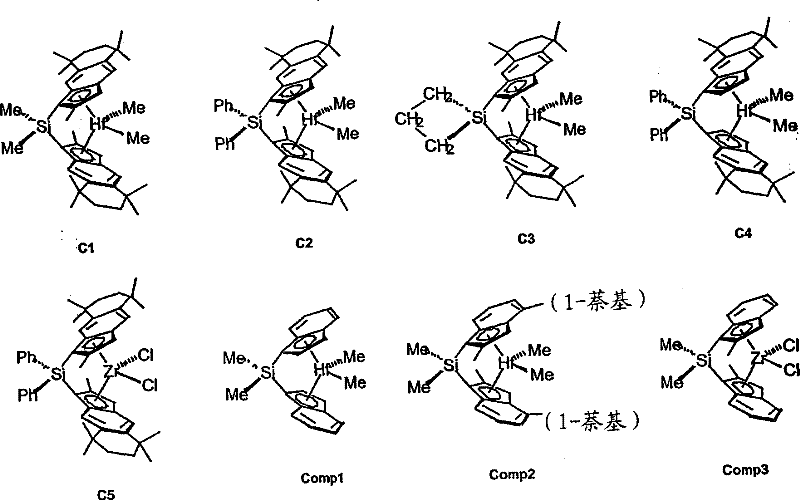

丙烯聚合物在实施例A、B和L中制备。使用在US6475391中公开的高通过量凝胶渗透色谱测量技术,以聚苯乙烯为标准,测定分子量(重均分子量(Mw)和数均分子量(Mn)以及多分散性指数(Mw/Mn))。如所指出的,热分析使用TA Instruments DSC(2920型)通过首先以10℃/min将样品从-50℃加热到220℃,在220℃下恒温10分钟,然后以10℃/min从150℃冷却到-100℃,最后再次以10℃/min加热到150℃来进行。报告第二次加热结果。Propylene polymers were prepared in Examples A, B and L. Molecular weights (weight average molecular weight (Mw) and number average molecular weight (Mn) and polydispersity index (Mw/Mn)) were determined using the high throughput gel permeation chromatography measurement technique disclosed in US6475391 against polystyrene standards . As indicated, thermal analysis was performed using a TA Instruments DSC (Model 2920) by first heating the sample from -50°C to 220°C at 10°C/min, holding at 220°C for 10 minutes, and then heating the sample from 150°C at 10°C/min. Cool to -100°C, and finally reheat to 150°C at 10°C/min. Report the second heating result.
在实施例C-K中制备的乙烯-丙烯共聚物的分子量通过凝胶渗透色谱法使用(1)装有差示折射指数(DRI)和粘度检测器以及18度角光散射检测器的用聚苯乙烯标准校准的Alliance 2000GPC3D或(2)装有DRI、粘度计和3度角光散射检测器的Polymer Labs 220GPC3D来测定。样品用串联的三根Polymer Laboratories PC Gel mixed B LS柱子在1,2,4-三氯苯(135℃)中通过。Molecular weights of the ethylene-propylene copolymers prepared in Examples C-K were determined by gel permeation chromatography using (1) polystyrene polystyrene equipped with differential refractive index (DRI) and viscosity detectors and an 18-degree light scattering detector. Standard calibrated Alliance 2000GPC3D or (2) Polymer Labs 220GPC3D equipped with DRI, viscometer and 3 degree light scattering detector. The sample was passed through three Polymer Laboratories PC Gel mixed B LS columns connected in series in 1,2,4-trichlorobenzene (135°C).
在实施例C-K中制备的乙烯-丙烯共聚物使用从美国PerkinElmer Instruments获得的附带软件的Pyris 1仪器进行热分析。熔化热(表中的ΔHfus)通过差示扫描量热法(DSC)用ASTM E-794-95工序来测定。所有测量对已经在200℃下模塑并且在室温下退火大约7天的样品在-100℃和+150℃之间的第一加热周期中进行。第一加热周期以20/min的温度上升速率进行。熔化热由在室温到105℃的范围内的峰曲线下的总面积测定。这里报道的熔融温度是由第二次熔融获得的峰熔融温度(除非另有规定)。对于显示了多峰熔融特性的聚合物,较高的熔融峰被视为主熔点。The ethylene-propylene copolymer prepared in Example CK was thermally analyzed using a Pyris 1 instrument with software obtained from PerkinElmer Instruments, USA. The heat of fusion (ΔH fus in the table) was determined by differential scanning calorimetry (DSC) using the ASTM E-794-95 procedure. All measurements were performed in a first heating cycle between -100°C and +150°C on samples that had been molded at 200°C and annealed at room temperature for approximately 7 days. The first heating cycle was performed at a temperature ramp rate of 20/min. The heat of fusion is determined from the total area under the peak curve in the range from room temperature to 105°C. The melting temperatures reported here are the peak melting temperatures obtained from the second melting (unless otherwise specified). For polymers exhibiting multimodal melting properties, the higher melting peak is considered the major melting point.
在实施例C-J中制备的乙烯-丙烯共聚物的组成用Perkin ElmerPE 1760FTIR分光光度计测量。在大约150℃或更高的温度下压制该共聚物的薄而均匀的膜,然后固定在分光光度计上。记录从600cm-1到4000cm-1的样品的全部光谱,乙烯的单体重量百分率可以根据以下方程式计算:乙烯wt%=82.585-111.987X+30.045X2,其中X是在1155cm-1处的峰高和在722cm-1或732cm-1(无论哪一个更高)处的峰高的比率。The composition of the ethylene-propylene copolymer prepared in Example CJ was measured with a Perkin Elmer PE 1760 FTIR spectrophotometer. Thin, uniform films of the copolymer are pressed at about 150°C or higher and then mounted on a spectrophotometer. Record the entire spectrum of the sample from 600cm -1 to 4000cm -1 , and the monomer weight percent of ethylene can be calculated according to the following equation: ethylene wt%=82.585-111.987X+ 30.045X2 , where X is the peak at 1155cm -1 The ratio of the height to the peak height at 722 cm -1 or 732 cm -1 , whichever is higher.
对于实施例K,使用有和没有质子去耦的13C NMR测量法来测定组成、丙烯三单元组立构规整度([mm])、区域误差含量、竞聚率乘积(r1r2)和m/r比率。测定这些值的方法可在以下文献中找到:Randall,J.Macromolecules 1978,11,33;Cozewith,C.Macromolecules1987,20,1237;Tsutsui,T.等人,Polymer,1989,30,1350;US5,504,172和其中的参考文献。For Example K, 13 C NMR measurements with and without proton decoupling were used to determine composition, propylene triad tacticity ([mm]), regio-error content, reactivity ratio product (r1r2) and m/ r ratio. Methods for determining these values can be found in the following documents: Randall, J. Macromolecules 1978, 11, 33; Cozewith, C. Macromolecules 1987, 20, 1237; Tsutsui, T. et al., Polymer, 1989, 30, 1350; US5, 504, 172 and references therein.
对于实施例K,将用于13C NMR光谱法的聚合物样品溶于d2-1,1,2,2-四氯乙烷中,使用75或100MHz的NMR光谱仪在125℃下对样品进行记录。聚合物共振峰以mmmm=21.8ppm为参照。在聚合物用NMR的表征中涉及的计算按照F.A.Bovey在“Polymer Conformationand Configuration”(Academic Press,New York 1969)中和J.Randall在“Polymer Sequence Determination,13C-NMR Method”(Academic Press,New York,1977)中的工作来进行。长度为2的亚甲基序列的百分率,%(CH2)2,如下计算:在14-18ppm之间的甲基碳的积分(它们在浓度上等于长度为2的序列中的亚甲基数)除以在45-49ppm之间的长度为1的亚甲基序列的积分和在14-18ppm之间的甲基碳的积分的总和,再乘以100。这是在2或2以上的序列中含有的亚甲基的量的最小计算值,因为大于2的亚甲基序列已经被排除。指配以H.N.Cheng和J.A.Ewen,Makromol.Chem.1989,190,1931为基础。For Example K, a polymer sample for 13 C NMR spectroscopy was dissolved in d 2 -1,1,2,2-tetrachloroethane, and the sample was analyzed at 125°C using a 75 or 100 MHz NMR spectrometer. Record. The polymer resonance peaks are referenced to mmmm = 21.8 ppm. Calculations involved in the characterization of polymers by NMR are according to FA Bovey in "Polymer Conformation and Configuration" (Academic Press, New York 1969) and J. Randall in "Polymer Sequence Determination, 13 C-NMR Method" (Academic Press, New York , 1977) to carry out the work in. The percentage of methylene sequences of length 2, %(CH 2 ) 2 , is calculated as follows: the integral of methyl carbons between 14-18 ppm (they are equal in concentration to the number of methylene groups in the sequence of length 2 ) divided by the sum of the integrals for methylene sequences of length 1 between 45-49 ppm and the integrals for methyl carbons between 14-18 ppm and multiplied by 100. This is the minimum calculated value for the amount of methylene groups contained in sequences of 2 or more, since methylene sequences larger than 2 have been excluded. The assignment is based on HN Cheng and JA Ewen, Makromol. Chem. 1989, 190, 1931.
催化剂合成实施例Catalyst Synthesis Example
5,6,7,8-四氢-2,5,5,8,8-五甲基-苯并[f]茚根据公开报告(WO99/46270)制备,并通过用溶于戊烷的丁基锂处理而转化为5,6,7,8-四氢-2,5,5,8,8-五甲基-苯并[f]茚基锂。5,6,7,8-Tetrahydro-2,5,5,8,8-pentamethyl-benzo[f]indene was prepared according to a published report (WO99/46270) and prepared by using butane in pentane Lithium base treatment and converted to 5,6,7,8-tetrahydro-2,5,5,8,8-pentamethyl-benzo[f]indenyllithium.
实施例1 rac-MeExample 1 rac-Me 22 Si(5,6,7,8-四氢-2,5,5,8,8-五甲基-苯并[f]Si(5,6,7,8-tetrahydro-2,5,5,8,8-pentamethyl-benzo[f] 茚基)indenyl) 22 HfMeHf 22 (C1)的制备Preparation of (C1)
实施例1a.MeExample 1a.Me 22 Si(5,6,7,8-四氢-2,5,5,8,8-五甲基-苯并[f]茚)Si(5,6,7,8-tetrahydro-2,5,5,8,8-pentamethyl-benzo[f]indene) 的制备preparation of
将主要为固体的5,6,7,8-四氢-2,5,5,8,8-五甲基-苯并[f]茚基锂(6g,24.4mmol)加入到Me2SiCl2(1.57g,12.2mmol)和乙醚(150mL)的冷(-30℃)溶液中。颜色变黄。搅拌过夜后,反应是不完全的。添加THF(大约1mL),将反应搅拌总共6天。再先后用多孔玻璃滤器和0.45μm acrodisc过滤溶液。通过氮气吹扫除去溶剂,然后将产物在真空中干燥。产量是6.31g。5,6,7,8-Tetrahydro - 2,5,5,8,8-pentamethyl-benzo[f]indenyllithium (6 g, 24.4 mmol), mainly solid, was added to Me2SiCl2 (1.57g, 12.2mmol) and diethyl ether (150mL) in a cold (-30°C) solution. The color turns yellow. After stirring overnight, the reaction was incomplete. THF (approximately 1 mL) was added and the reaction was stirred for a total of 6 days. The solution was then filtered through a fritted glass filter and then a 0.45 μm acrodisc. The solvent was removed by nitrogen purge and the product was dried in vacuo. Yield was 6.31 g.
实施例1b.rac-MeExample 1b.rac-Me 22 Si(5,6,7,8-四氢-2,5,5,8,8-五甲基-苯并[f]Si(5,6,7,8-tetrahydro-2,5,5,8,8-pentamethyl-benzo[f] 茚基)indenyl) 22 HfClHfCl 22 的制备preparation of
Me2Si(5,6,7,8-四氢-2,5,5,8,8-五甲基-苯并[f]茚)(6.31g,11.75mmol)和乙醚(325mL)的溶液用丁基锂在己烷中的1.6M溶液(14.7mL,23.52mmol)处理。颜色变为橙色。搅拌过夜后,将该淤浆冷却到-30℃(冷冻装置),然后快速搅拌,同时添加HfCl4(3.75g,11.7mmol)固体。颜色变为浓黄色。在搅拌大约1天后,将该混合物过滤,获得含有LiCl的产物。用CH2Cl2(总共750mL)反复萃取获得外消旋形式的产物。产量2.72g。Solution of Me2Si(5,6,7,8-tetrahydro-2,5,5,8,8-pentamethyl-benzo[f] indene ) (6.31 g, 11.75 mmol) and diethyl ether (325 mL) Treat with a 1.6M solution of butyllithium in hexanes (14.7 mL, 23.52 mmol). The color changes to orange. After stirring overnight, the slurry was cooled to -30°C (freezer), then stirred rapidly while HfCl4 (3.75 g, 11.7 mmol) was added as a solid. The color changed to rich yellow. After stirring for about 1 day, the mixture was filtered to obtain a LiCl-containing product. Repeated extraction with CH2Cl2 (total 750 mL) afforded the product in racemic form. Yield 2.72g.
实施例1c.rac-MeExample 1c.rac-Me 22 Si(5,6,7,8-四氢-2,5,5,8,8-五甲基-苯并[f]Si(5,6,7,8-tetrahydro-2,5,5,8,8-pentamethyl-benzo[f] 茚基)indenyl) 22 HfMeHf 22 (C1)的制备Preparation of (C1)
将MeMgBr在乙醚中的3.0M溶液(0.33mL,1mmol)和大约1mL乙醚加入到rac-Me2Si(5,6,7,8-四氢-2,5,5,8,8-五甲基-苯并[f]茚基)2HfCl2(0.288g,0.39mmol)和苯(50mL)的溶液中。将反应搅拌过夜,然后添加附加的格利雅试剂(0.5mL,1.5mmol)。将该混合物搅拌整个周末,然后加热到回流过夜。该混合物然后用Me3SiCl(0.2mL,1.57mmol)、1,2-二甲氧基乙烷(0.25mL,2.4mmol)处理,过滤,随后干燥。产量0.189g。A 3.0 M solution of MeMgBr in ether (0.33 mL, 1 mmol) and about 1 mL of ether were added to rac-Me 2 Si (5,6,7,8-tetrahydro-2,5,5,8,8-pentamethyl benzo[f]indenyl) 2 HfCl 2 (0.288 g, 0.39 mmol) and benzene (50 mL). The reaction was stirred overnight before additional Grignard reagent (0.5 mL, 1.5 mmol) was added. The mixture was stirred over weekend, then heated to reflux overnight. The mixture was then treated with Me3SiCl (0.2 mL, 1.57 mmol), 1,2-dimethoxyethane (0.25 mL, 2.4 mmol), filtered, and dried. Yield 0.189 g.
实施例2.rac-PhExample 2. rac-Ph 22 Si(5,6,7,8-四氢-2,5,5,8,8-五甲基-苯并[f]Si(5,6,7,8-tetrahydro-2,5,5,8,8-pentamethyl-benzo[f] 茚基)indenyl) 22 HfMeHf 22 (C2)的制备Preparation of (C2)
实施例2a.PhExample 2a.Ph 22 Si(5,6,7,8-四氢-2,5,5,8,8-五甲基-苯并[f]茚)Si(5,6,7,8-tetrahydro-2,5,5,8,8-pentamethyl-benzo[f]indene) 22 的制备preparation of
将5,6,7,8-四氢-2,5,5,8,8-五甲基-苯并[f]茚基锂(45.1g,183mmol)加入到Ph2Si(OSO2CF3)2(44.0g,91.6mmol)和乙醚(500mL)的溶液中。使用少量的乙醚冲洗含有锂试剂的烧瓶。在搅拌3天后,反应物用水(2×50mL)洗涤。乙醚层用MgSO4干燥,过滤,然后除去溶剂,获得白色固体产物。产量59.6g(其中0.6wt%是乙醚)。5,6,7,8-Tetrahydro - 2,5,5,8,8-pentamethyl-benzo[f]indenyllithium (45.1 g, 183 mmol) was added to Ph2Si ( OSO2CF3 ) 2 (44.0g, 91.6mmol) and diethyl ether (500mL). Rinse the flask containing the lithium reagent with a small amount of ether. After stirring for 3 days, the reaction was washed with water (2 x 50 mL). The ether layer was dried over MgSO4 , filtered, and the solvent was removed to give the product as a white solid. Yield 59.6 g (of which 0.6 wt% is diethyl ether).
实施例2b.PhExample 2b.Ph 22 Si(5,6,7,8-四氢-2,5,5,8,8-五甲基-苯并[f]茚Si(5,6,7,8-tetrahydro-2,5,5,8,8-pentamethyl-benzo[f]indene 基锂)base lithium) 22 ·OEt·OEt 22 的制备preparation of
将丁基锂在己烷中的1.6M溶液(112mL,179.2mmol)加入到溶于乙醚(1L)的Ph2Si(5,6,7,8-四氢-2,5,5,8,8-五甲基-苯并[f]茚)2(59.27g,89.7mmol)中。颜色由黄色变为红色。在将反应搅拌过夜后,用氮气吹扫除去溶剂。剩余固体用戊烷(200mL)制成淤浆,在多孔玻璃滤器上收集,然后用戊烷冲洗,直至固体为黄色粉末,然后干燥。产量63.85g。A 1.6M solution of butyllithium in hexanes (112 mL, 179.2 mmol) was added to Ph2Si (5,6,7,8-tetrahydro-2,5,5,8, 8-pentamethyl-benzo[f]indene) 2 (59.27g, 89.7mmol). The color changes from yellow to red. After the reaction was stirred overnight, the solvent was removed with a nitrogen purge. The remaining solid was slurried in pentane (200 mL), collected on a fritted glass filter and rinsed with pentane until the solid was a yellow powder, then dried. Yield 63.85g.
实施例2c.rac-PhExample 2c.rac-Ph 22 Si(5,6,7,8-四氢-2,5,5,8,8-五甲基-苯并[f]Si(5,6,7,8-tetrahydro-2,5,5,8,8-pentamethyl-benzo[f] 茚基)indenyl) 22 HfClHfCl 22 与LiCl的混合物的制备Preparation of mixture with LiCl
将由Ph2Si(5,6,7,8-四氢-2,5,5,8,8-五甲基-苯并[f]茚基锂)2·OEt2(10g,13.4mmol)和乙醚(500mL)制备的溶液冷却到-30℃,然后用HfCl4(4.17g,13.0mmol)处理。在搅拌2天后,将该黄色淤浆过滤,固体用乙醚(3×30mL)冲洗,然后干燥。产量5.22g。From Ph 2 Si(5,6,7,8-tetrahydro-2,5,5,8,8-pentamethyl-benzo[f]indenyl lithium) 2 ·OEt 2 (10 g, 13.4 mmol) and The solution prepared in diethyl ether (500 mL) was cooled to -30 °C and then treated with HfCl4 (4.17 g, 13.0 mmol). After stirring for 2 days, the yellow slurry was filtered and the solid was rinsed with ether (3 x 30 mL) and dried. Yield 5.22g.
实施例2d.rac-PhExample 2d.rac-Ph 22 Si(5,6,7,8-四氢-2,5,5,8,8-五甲基-苯并[f]Si(5,6,7,8-tetrahydro-2,5,5,8,8-pentamethyl-benzo[f] 茚基)indenyl) 22 HfMeHf 22 (C2)的制备Preparation of (C2)
将MeMgBr在乙醚中的3.0M溶液(2.6mL,7.8mmol)加入到由rac-Ph2Si(5,6,7,8-四氢-2,5,5,8,8-五甲基-苯并[f]茚基)2HfCl2(78wt%)与LiCl(22wt%)的混合物(2.58g混合物,2.01grac-Ph2Si(5,6,7,8-四氢-2,5,5,8,8-五甲基-苯并[f]茚基)2HfCl2,1.91mmol)和苯(200mL)制备的淤浆中。将反应搅拌2小时,然后过滤(0.45μm),用Me3SiCl(0.60mL,4.7mmol)处理。在搅拌过夜后,所得灰色混合物用1,4-二噁烷(1.7g,19.3mmol)处理。搅拌1小时后,将浑浊的混合物过滤(4-8μm),获得透明黄色滤液。除去苯,固体与甲苯(20mL)混合,然后干燥该混合物,除去过量1,4-二噁烷。固体用少量的戊烷(5mL)冲洗,在真空中干燥,获得浅黄色粉末状产物。产量1.31g。A 3.0 M solution of MeMgBr in diethyl ether (2.6 mL, 7.8 mmol) was added to A mixture of benzo[f]indenyl) 2 HfCl 2 (78 wt%) and LiCl (22 wt%) (2.58 g mixture, 2.01 grac-Ph 2 Si(5,6,7,8-tetrahydro-2,5, 5,8,8-Pentamethyl-benzo[f]indenyl) 2 HfCl 2 , 1.91 mmol) and benzene (200 mL). The reaction was stirred for 2 hours, then filtered (0.45 μm) and treated with Me3SiCl (0.60 mL, 4.7 mmol). After stirring overnight, the resulting gray mixture was treated with 1,4-dioxane (1.7 g, 19.3 mmol). After stirring for 1 hour, the cloudy mixture was filtered (4-8 μm) to obtain a clear yellow filtrate. The benzene was removed, the solid was mixed with toluene (20 mL), and the mixture was dried to remove excess 1,4-dioxane. The solid was rinsed with a small amount of pentane (5 mL) and dried in vacuo to obtain the product as a pale yellow powder. Yield 1.31 g.
实施例3.rac-(CHEmbodiment 3.rac-(CH 22 )) 33 Si(5,6,7,8-四氢-2,5,5,8,8-五甲基-苯并Si(5,6,7,8-tetrahydro-2,5,5,8,8-pentamethyl-benzo [f]茚基)[f]indenyl) 22 HfMeHf 22 (C3)的制备Preparation of (C3)
实施例3a.(CHExample 3a. (CH 22 )) 33 Si(5,6,7,8-四氢-2,5,5,8,8-五甲基-苯并[f]Si(5,6,7,8-tetrahydro-2,5,5,8,8-pentamethyl-benzo[f] 茚)indene) 22 的制备preparation of
将5,6,7,8-四氢-2,5,5,8,8-五甲基-苯并[f]茚基锂(5g,20.5mmol)加入到(CH2)3SiCl2(1.45g,10.3mmol)和乙醚(200mL)的溶液中。在搅拌过夜后,除去溶剂,固体用戊烷(3×50mL)萃取,过滤,然后在真空中干燥,获得白色固体。产量5.06g。5,6,7,8-Tetrahydro-2,5,5,8,8-pentamethyl-benzo[f]indenyl lithium (5 g, 20.5 mmol) was added to (CH 2 ) 3 SiCl 2 ( 1.45g, 10.3mmol) and diethyl ether (200mL). After stirring overnight, the solvent was removed and the solid was extracted with pentane (3 x 50 mL), filtered and dried in vacuo to give a white solid. Yield 5.06g.
实施例3b.(CHExample 3b. (CH 22 )) 33 Si(5,6,7,8-四氢-2,5,5,8,8-五甲基-苯并[f]Si(5,6,7,8-tetrahydro-2,5,5,8,8-pentamethyl-benzo[f] 茚基锂)indenyllithium) 22 ·Et·Et 22 O的制备Preparation of O
将丁基锂在己烷中的1.6M溶液(11.6mL,18.56mmol)加入在乙醚(100mL)中的(CH2)3Si(5,6,7,8-四氢-2,5,5,8,8-五甲基-苯并[f]茚)2(5.06g,9.29mmol)中。初始透明黄色溶液变为橙色淤浆。搅拌过夜后,将混合物过滤,浅黄色固体用戊烷(2×20mL)洗涤,然后干燥。产量4.28g。A 1.6M solution of butyllithium in hexanes (11.6 mL, 18.56 mmol) was added to ( CH2 ) 3Si (5,6,7,8-tetrahydro-2,5,5 , 8,8-pentamethyl-benzo[f]indene) 2 (5.06g, 9.29mmol). The initially clear yellow solution turned into an orange slurry. After stirring overnight, the mixture was filtered and the light yellow solid was washed with pentane (2 x 20 mL) and dried. Yield 4.28g.
实施例3c.rac-(CHEmbodiment 3c.rac-(CH 22 )) 33 Si(5,6,7,8-四氢-2,5,5,8,8-五甲基-苯并Si(5,6,7,8-tetrahydro-2,5,5,8,8-pentamethyl-benzo [f]茚基)[f]indenyl) 22 HfClHfCl 22 的制备preparation of
将HfCl4(2.17g,6.77mmol)加入到由(CH2)3Si(5,6,7,8-四氢-2,5,5,8,8-五甲基-苯并[f]茚基锂)2·Et2O(4.28g,6.77mmol)和乙醚(100mL)制备的淤浆中。颜色变为浓黄色。在搅拌过夜后,将该混合物过滤,固体用乙醚(2×20mL)冲洗,然后用戊烷(3×10mL)冲洗。固体干燥过夜。产量2.74g。HfCl 4 (2.17 g, 6.77 mmol) was added to (CH 2 ) 3 Si(5,6,7,8-tetrahydro-2,5,5,8,8-pentamethyl-benzo[f] Indenyllithium) 2 · Et 2 O (4.28 g, 6.77 mmol) and diethyl ether (100 mL) were slurried. The color changed to rich yellow. After stirring overnight, the mixture was filtered and the solid was rinsed with diethyl ether (2 x 20 mL) and then with pentane (3 x 10 mL). The solid dried overnight. Yield 2.74 g.
实施例3d.rac-(CHExample 3d.rac-(CH 22 )) 33 Si(5,6,7,8-四氢-2,5,5,8,8-五甲基-苯并Si(5,6,7,8-tetrahydro-2,5,5,8,8-pentamethyl-benzo [f]茚基)[f]indenyl) 22 HfMeHf 22 (C3)的制备Preparation of (C3)
将溴化甲基镁在乙醚中的3M溶液(2.75mL,8.25mmol)加入到rac-(CH2)3Si(5,6,7,8-四氢-2,5,5,8,8-五甲基-苯并[f]茚基)2HfCl2(2.05g,2.03mmol)和甲苯(100mL)的混合物中。搅拌过夜后,混合物用Me3SiCl(0.54mL,4.25mmol)处理,搅拌过夜,然后用1,4-二噁烷(1.91g,21.7mmol)处理。搅拌4小时后,将该混合物过滤,剩余固体用甲苯(5mL)进一步洗涤。对滤液进行干燥然后用戊烷(10mL)洗涤,随后干燥。产量1.1g。A 3M solution of methylmagnesium bromide in diethyl ether (2.75 mL, 8.25 mmol) was added to rac-(CH 2 ) 3 Si(5,6,7,8-tetrahydro-2,5,5,8,8 - in a mixture of pentamethyl-benzo[f]indenyl) 2 HfCl 2 (2.05 g, 2.03 mmol) and toluene (100 mL). After stirring overnight, the mixture was treated with Me3SiCl (0.54 mL, 4.25 mmol), stirred overnight, then 1,4-dioxane (1.91 g, 21.7 mmol). After stirring for 4 hours, the mixture was filtered and the remaining solid was further washed with toluene (5 mL). The filtrate was dried and washed with pentane (10 mL), then dried. Yield 1.1 g.
实施例4.rac-PhExample 4. rac-Ph 22 Si(5,6,7,8-四氢-5,5,8,8-四甲基-苯并[f]茚Si(5,6,7,8-tetrahydro-5,5,8,8-tetramethyl-benzo[f]indene 基)base) 22 HfMeHf 22 (C4)的制备Preparation of (C4)
实施例4a.5,6,7,8-四氢-5,5,8,8-四甲基-苯并[f]茚满-2-酮的Example 4a. 5,6,7,8-tetrahydro-5,5,8,8-tetramethyl-benzo[f]indan-2-one 制备preparation
在1L装配有机械搅拌器和250mL加料漏斗的三颈烧瓶内添加AlCl3(80.8g,0.606mol),再添加无水二氯甲烷(370mL)。将该淤浆冷却到-20℃并搅拌。然后在加料漏斗中添加(在反应过程中分两份)2-茚满酮(40.0g,0.303mol){注:Aldrich牌号的2-茚满酮用乙醚冲洗,以便除去褐色杂质},2,5-二氯-2,5-二甲基己烷(55.4g,0.303mol)和无水二氯甲烷(180mL)的溶液。在50分钟的过程中将该溶液滴入到冷的、搅拌的AlCl3淤浆中。在添加结束后搅拌2.5小时,之后添加2,5-二氯-2,5-二甲基己烷(13g,0.071mol)和无水二氯甲烷(42mL)的溶液。在搅拌另外1小时后,将反应混合物倒入冰(1L)中,用乙醚(500mL)处理。分离有机层,含水层用乙醚(2×200mL)萃取。合并的有机层用2.5M NaCl(aq)(3×75mL)洗涤,然后用水(25mL)洗涤,再用MgSO4干燥。将干燥的有机溶液过滤到3L烧瓶内,在溶液表面用氮气吹扫来缓慢除去溶剂。保留的固体用冷戊烷洗涤,通过过滤分离固体。从少量的含有产物的块状油性固体和杂质中手工分离产物,该产物为细的结晶材料。产量21g。In a 1 L three-necked flask equipped with a mechanical stirrer and a 250 mL addition funnel was added AlCl 3 (80.8 g, 0.606 mol), followed by anhydrous dichloromethane (370 mL). The slurry was cooled to -20°C and stirred. Then add (in two parts during the reaction) 2-indanone (40.0g, 0.303mol) in the addition funnel {note: the 2-indanone of Aldrich brand is rinsed with ether to remove brown impurities}, 2, A solution of 5-dichloro-2,5-dimethylhexane (55.4 g, 0.303 mol) and anhydrous dichloromethane (180 mL). This solution was dropped into the cold, stirred AlCl3 slurry over the course of 50 minutes. Stirred for 2.5 hours after the addition was complete before adding a solution of 2,5-dichloro-2,5-dimethylhexane (13 g, 0.071 mol) and anhydrous dichloromethane (42 mL). After stirring for an additional 1 hour, the reaction mixture was poured into ice (1 L) and treated with diethyl ether (500 mL). The organic layer was separated and the aqueous layer was extracted with ether (2 x 200 mL). The combined organic layers were washed with 2.5M NaCl(aq) (3 x 75 mL), then water (25 mL), and dried over MgSO4 . The dry organic solution was filtered into a 3 L flask, and the solvent was slowly removed by sparging the surface of the solution with nitrogen. The retained solid was washed with cold pentane and the solid was isolated by filtration. The product was manually isolated as a fine crystalline material from a small amount of lumpy oily solid and impurities containing the product. Yield 21 g.
实施例4b.5,6,7,8-四氢-5,5,8,8-四甲基-苯并[f]茚满-2-对甲Example 4b. 5,6,7,8-tetrahydro-5,5,8,8-tetramethyl-benzo[f]indan-2-p-methyl 苯磺酰腙的制备Preparation of benzenesulfonylhydrazone
在500mL烧瓶内添加对甲苯磺酰肼(7.68g,41.3mmol),5,6,7,8-四氢-5,5,8,8-四甲基-苯并[f]茚满-2-酮(10.0g,1当量)和无水乙醚,然后在氮气下机械搅拌过夜。将淤浆过滤,用冷乙醚冲洗,然后干燥。产量13.85g。Into a 500 mL flask was added p-toluenesulfonyl hydrazide (7.68 g, 41.3 mmol), 5,6,7,8-tetrahydro-5,5,8,8-tetramethyl-benzo[f]indan-2 - Ketone (10.0 g, 1 equiv) and anhydrous diethyl ether, then mechanically stirred overnight under nitrogen. The slurry was filtered, rinsed with cold ether, and dried. Yield 13.85g.
实施例4c.5,6,7,8-四氢-5,5,8,8-四甲基-苯并[f]茚和Example 4c. 5,6,7,8-tetrahydro-5,5,8,8-tetramethyl-benzo[f]indene and 5,6,7,8-四氢-5,5,8,8-四甲基-苯并[f]茚基锂·0.83DME的制备Preparation of 5,6,7,8-tetrahydro-5,5,8,8-tetramethyl-benzo[f]indenyl lithium·0.83DME
在1L烧瓶内先后添加5,6,7,8-四氢-5,5,8,8-四甲基-苯并[f]茚满-2-对甲苯磺酰腙(13.85g,33.7mmol),无水1,2-二甲氧基乙烷(500mL)(1,2-二甲氧基乙烷=DME)和1.77M BuLi(在己烷中)(38mL,2当量)。颜色变暗。该混合物在回流下加热60分钟,然后冷却到室温过夜。将在浅紫红色溶液中的所形成的淤浆(白色沉淀物)的一部分过滤,从滤液中除去1,2-二甲氧基乙烷,在用戊烷反复洗涤后,留下带有痕量紫色的白色固体状产物5,6,7,8-四氢-5,5,8,8-四甲基-苯并[f]茚基锂·0.83DME。产量1.76g。5,6,7,8-tetrahydro-5,5,8,8-tetramethyl-benzo[f]indane-2-p-toluenesulfonylhydrazone (13.85g, 33.7mmol ), anhydrous 1,2-dimethoxyethane (500 mL) (1,2-dimethoxyethane=DME) and 1.77M BuLi (in hexane) (38 mL, 2 equiv). The color darkens. The mixture was heated at reflux for 60 minutes, then cooled to room temperature overnight. A portion of the resulting slurry (white precipitate) in a purplish red solution was filtered, and 1,2-dimethoxyethane was removed from the filtrate, which, after repeated washing with pentane, left traces of The product 5,6,7,8-tetrahydro-5,5,8,8-tetramethyl-benzo[f]indenyllithium·0.83DME was measured as a purple white solid. Yield 1.76g.
剩余的溶液用水(20mL)骤冷,然后用4M NaCl(3×100mL)洗涤。然后用MgSO4干燥有机层,随后浓缩为褐色固体。产量5.5g。该产物通过使用真空泵在75℃下升华来进一步提纯。获得了4.1g白色固体状的5,6,7,8-四氢-5,5,8,8-四甲基-苯并[f]茚。The remaining solution was quenched with water (20 mL), then washed with 4M NaCl (3 x 100 mL). The organic layer was then dried over MgSO4 and concentrated to a brown solid. Yield 5.5g. The product was further purified by sublimation at 75°C using a vacuum pump. 4.1 g of 5,6,7,8-tetrahydro-5,5,8,8-tetramethyl-benzo[f]indene were obtained as a white solid.
实施例4d.5,6,7,8-四氢-5,5,8,8-四甲基-苯并[f]茚的制备Preparation of Example 4d.5,6,7,8-tetrahydro-5,5,8,8-tetramethyl-benzo[f]indene
在1L烧瓶内先后添加5,6,7,8-四氢-5,5,8,8-四甲基-苯并[f]茚满-2-对甲苯磺酰腙(12.81g,31.2mmol),无水1,2-二甲氧基乙烷(500mL)和1.64M BuLi(在己烷中)(38mL,2当量)。颜色变暗。将该混合物在回流下加热75分钟,然后冷却到室温过夜。该混合物用水(20mL)处理,然后用4M NaCl(3×100mL)洗涤。然后用MgSO4干燥有机层,随后浓缩为褐色固体。产量7.23g。该产物通过升华进一步提纯。5,6,7,8-tetrahydro-5,5,8,8-tetramethyl-benzo[f]indane-2-p-toluenesulfonylhydrazone (12.81g, 31.2mmol ), anhydrous 1,2-dimethoxyethane (500 mL) and 1.64M BuLi in hexane (38 mL, 2 equiv). The color darkens. The mixture was heated at reflux for 75 minutes, then cooled to room temperature overnight. The mixture was treated with water (20 mL) and washed with 4M NaCl (3 x 100 mL). The organic layer was then dried over MgSO4 and concentrated to a brown solid. Yield 7.23 g. The product was further purified by sublimation.
实施例4e.PhExample 4e.Ph 22 Si(5,6,7,8-四氢-5,5,8,8-四甲基-苯并[f]茚)Si(5,6,7,8-tetrahydro-5,5,8,8-tetramethyl-benzo[f]indene) 22 的制备preparation of
5,6,7,8-四氢-5,5,8,8-四甲基-苯并[f]茚基锂·0.83DME(1.76g,5.73mmol)和乙醚(50mL)的搅拌淤浆用Ph2Si(OSO2CF3)2(1.39g,1/2当量)和乙醚(60mL)处理。在搅拌2小时后,混合物用2M NaCl(3×10mL)处理,用MgSO4干燥,然后浓缩为固体。产量1.76g。Stirred slurry of 5,6,7,8-tetrahydro-5,5,8,8-tetramethyl-benzo[f]indenyl lithium 0.83 DME (1.76 g, 5.73 mmol) and diethyl ether (50 mL) Treat with Ph2Si ( OSO2CF3 ) 2 (1.39 g, 1/2 equiv) and diethyl ether (60 mL). After stirring for 2 h, the mixture was treated with 2M NaCl (3 x 10 mL), dried over MgSO4 , and concentrated to a solid. Yield 1.76g.
实施例4f.rac-PhExample 4f.rac-Ph 22 Si(5,6,7,8-四氢-5,5,8,8-四甲基-苯并[f]Si(5,6,7,8-tetrahydro-5,5,8,8-tetramethyl-benzo[f] 茚基)indenyl) 22 HfClHfCl 22 的制备preparation of
Ph2Si(5,6,7,8-四氢-5,5,8,8-四甲基-苯并[f]茚)2(1.76g,2.78mmol)和乙醚(40mL)用1.77M BuLi(在己烷中)(3.2mL,5.66mmol)处理,搅拌过夜。添加另外1.77M BuLi(在己烷中)(0.35mL,0.62mmol)。该混合物用1.0M Me3SnCl(5.8mL,5.8mmol)处理,然后过滤,除去LiCl。在真空中除去乙醚,将玻璃状固体溶于甲苯中,过滤(0.45μm)到HfCl4(0.89g,2.78mmol)和甲苯(20mL)的淤浆上。颜色变红。1H NMR显示了宽共振和外消旋金属茂的清楚形状。过滤,去除甲苯,在乙醚中结晶的尝试没有成功。脱除乙醚,然后用戊烷(5×10mL)洗涤,以除去杂质。然后将该材料溶解在苯(25mL)中,过滤,在真空中干燥。产量554mg。Ph 2 Si(5,6,7,8-tetrahydro-5,5,8,8-tetramethyl-benzo[f]indene) 2 (1.76g, 2.78mmol) and ether (40mL) in 1.77M Treat with BuLi (in hexanes) (3.2 mL, 5.66 mmol) and stir overnight. An additional 1.77M BuLi in hexanes (0.35 mL, 0.62 mmol) was added. The mixture was treated with 1.0M Me3SnCl (5.8 mL, 5.8 mmol), then filtered to remove LiCl. The ether was removed in vacuo and the glassy solid was dissolved in toluene and filtered (0.45 μm) onto a slurry of HfCl 4 (0.89 g, 2.78 mmol) and toluene (20 mL). The color turns red. 1 H NMR showed broad resonances and a clear shape of the racemic metallocene. Filtration to remove toluene, attempts to crystallize in ether were unsuccessful. Ether was stripped and then washed with pentane (5 x 10 mL) to remove impurities. This material was then dissolved in benzene (25 mL), filtered and dried in vacuo. Yield 554mg.
实施例4g.rac-PhExample 4g.rac-Ph 22 Si(5,6,7,8-四氢-5,5,8,8-四甲基-苯并[f]Si(5,6,7,8-tetrahydro-5,5,8,8-tetramethyl-benzo[f] 茚基)indenyl) 22 HfMeHf 22 (C4)的制备Preparation of (C4)
将MeMgBr在乙醚中的3.0M溶液(1.15mL,3.45mmol)加入到rac-Ph2Si(5,6,7,8-四氢-5,5,8,8-四甲基-苯并[f]茚基)2HfCl2(0.5g,0.568mmol)和甲苯(50mL)的溶液中。将反应物搅拌过夜,然后加热到75℃,保持2小时,然后冷却到室温,然后用Me3SiCl(0.30mL,2.36mmol)处理。在搅拌过夜后,该混合物用1,4-二噁烷(0.77g,8.74mmol)处理。搅拌4小时后,将该混合物过滤,然后用甲苯(2×50mL)洗涤固体。除去溶剂,将残留物溶于戊烷中,过滤(0.45μm)。除去戊烷,获得玻璃状固体rac-Ph2Si(5,6,7,8-四氢-5,5,8,8-四甲基-苯并[f]茚基)2HfMe2。产量0.27g。A 3.0 M solution of MeMgBr in diethyl ether (1.15 mL, 3.45 mmol) was added to rac-Ph 2 Si (5,6,7,8-tetrahydro-5,5,8,8-tetramethyl-benzo[ f] indenyl) 2 HfCl 2 (0.5 g, 0.568 mmol) and toluene (50 mL). The reaction was stirred overnight, then heated to 75 °C for 2 hours, then cooled to room temperature, then treated with Me3SiCl (0.30 mL, 2.36 mmol). After stirring overnight, the mixture was treated with 1,4-dioxane (0.77 g, 8.74 mmol). After stirring for 4 hours, the mixture was filtered and the solid was washed with toluene (2 x 50 mL). The solvent was removed and the residue was dissolved in pentane and filtered (0.45 μm). Removal of the pentane afforded rac- Ph2Si (5,6,7,8-tetrahydro-5,5,8,8-tetramethyl-benzo[f]indenyl) 2HfMe2 as a glassy solid . Yield 0.27 g.
实施例5.rac-PhExample 5. rac-Ph 22 Si(5,6,7,8-四氢-2,5,5,8,8-五甲基-苯并[f]Si(5,6,7,8-tetrahydro-2,5,5,8,8-pentamethyl-benzo[f] 茚基)indenyl) 22 ZrClZrCl 22 (C5)MAO/硅石催化剂的制备Preparation of (C5)MAO/Silica Catalyst
实施例5a.rac-PhExample 5a.rac-Ph 22 Si(5,6,7,8-四氢-2,5,5,8,8-五甲基-苯并[f]Si(5,6,7,8-tetrahydro-2,5,5,8,8-pentamethyl-benzo[f] 茚基)indenyl) 22 ZrClZrCl 22 (C5)的制备Preparation of (C5)
向冷(-30℃)Ph2Si(5,6,7,8-四氢-2,5,5,8,8-五甲基-苯并[f]茚基锂)2(2g,3mmol)和乙醚(100mL)的淤浆中添加ZrCl4(0.7g,3mmol),该混合物变得均匀,然后观察到了沉淀。在搅拌过夜后,除去溶剂,混合物用戊烷(12×20mL)洗涤。外消旋异构体与盐一起保留在多孔玻璃滤器上。产量0.88g(大约71wt%金属茂)。该混合物的样品(0.2g)用CH2Cl2萃取,获得不含盐的金属茂。Cooling (-30°C) Ph 2 Si (5,6,7,8-tetrahydro-2,5,5,8,8-pentamethyl-benzo[f]indenyllithium) 2 (2g, 3mmol ) and diethyl ether (100 mL) was added ZrCl 4 (0.7 g, 3 mmol), the mixture became homogeneous and then a precipitate was observed. After stirring overnight, the solvent was removed and the mixture was washed with pentane (12 x 20 mL). The racemic isomer was retained on the fritted glass filter together with the salt. Yield 0.88 g (ca. 71 wt% metallocene). A sample (0.2 g) of this mixture was extracted with CH2Cl2 to obtain the metallocene without salt.
实施例5b.担载于硅石上的rac-PhExample 5b. rac-Ph supported on silica 22 Si(5,6,7,8-四氢Si(5,6,7,8-tetrahydro -2,5,5,8,8-五甲基-苯并[f]茚基)-2,5,5,8,8-pentamethyl-benzo[f]indenyl) 22 ZrClZrCl 22 和MAO的制备and the preparation of MAO
将30wt%MAO甲苯溶液(983mg,16.2mmol)和甲苯(10mL)的混合物加入到rac-Ph2Si(5,6,7,8-四氢-2,5,5,8,8-五甲基-苯并[f]茚基)2ZrCl2(15.7mg,0.0191mmol)和甲苯(5mL)的混合物中。将该绿色溶液加入到硅石(1.01g)中。颜色变红。在搅拌15分钟后,将混合物过滤。将担载的催化剂在真空中干燥过夜。A mixture of 30 wt% MAO solution in toluene (983 mg, 16.2 mmol) and toluene (10 mL) was added to rac-Ph 2 Si (5,6,7,8-tetrahydro-2,5,5,8,8-pentamethyl In a mixture of benzo[f]indenyl) 2 ZrCl 2 (15.7 mg, 0.0191 mmol) and toluene (5 mL). The green solution was added to silica (1.01 g). The color turns red. After stirring for 15 minutes, the mixture was filtered. The supported catalyst was dried overnight in vacuo.
聚合实施例Polymerization Example
实施例A1-A66.半间歇丙烯聚合Examples A1-A66. Semi-batch propylene polymerization
在内衬有玻璃试验管的高压釜中(反应器的内部体积=23.5mL)进行聚合。在高压釜内添加AlOCt3的1mM己烷溶液(0.1mL,1μmol),己烷(用量参见表1),PhNMe2H+B(C6F5)4 -的200μM甲苯溶液(0.1mL,0.02μmol),在表中所示的温度下用丙烯加压。然后,将催化剂的200μM溶液(0.1mL,0.02μmol)加入到高压釜中。在聚合过程中让丙烯流入到高压釜内。通过将O2/Ar气体混合物加入到管内来停止聚合。然后使反应器放空和冷却。在真空中除去溶剂后,分离出聚合物。聚合数据报告于表1-3中。The polymerization was carried out in an autoclave lined with a glass test tube (internal volume of the reactor = 23.5 mL). In the autoclave, add AlOCt 3 in 1 mM hexane solution (0.1 mL, 1 μmol), hexane (see Table 1 for dosage), PhNMe 2 H + B(C 6 F 5 ) 4 - in 200 μM toluene solution (0.1 mL, 0.02 μmol), pressurized with propylene at the temperature indicated in the table. Then, a 200 μM solution of the catalyst (0.1 mL, 0.02 μmol) was added to the autoclave. Propylene was allowed to flow into the autoclave during the polymerization. Polymerization was stopped by adding an O2 /Ar gas mixture to the tube. The reactor was then vented and cooled. After removing the solvent in vacuo, the polymer was isolated. Aggregated data are reported in Tables 1-3.
实施例B1-B67.间歇丙烯聚合Examples B1-B67. Batch Propylene Polymerization
聚合在氮气手套箱的惰性气氛中在装配有机械搅拌器、温度控制用外部加热器、隔膜入口和氮气、乙烯和丙烯的调节供给装置的玻璃衬里的22.5mL反应器内进行。将反应器干燥,在115℃下脱气5小时,然后在室温下用氮气吹扫另外5小时。最后用50psig的丙烯气体吹扫。在室温下添加己烷、清除剂(2μmol三正辛基铝)和丙烯。在800rpm下搅拌的同时将反应器加热到工艺温度。在工艺条件下注入活化剂和催化剂,各20μmol,在0.1mL甲苯中。反应进行预定时间(43秒,除非另有规定),在结束时,用5mol%氧(在氩气中)猝灭。然后冷却反应器,放空和通过真空离心反应混合物来回收聚合物。聚合数据报告于表4-6中。Polymerizations were performed in an inert atmosphere of a nitrogen glove box in a glass-lined 22.5 mL reactor equipped with a mechanical stirrer, external heater for temperature control, septum inlet and regulated supplies of nitrogen, ethylene and propylene. The reactor was dried, degassed at 115°C for 5 hours, and then purged with nitrogen for an additional 5 hours at room temperature. A final purge with propylene gas at 50 psig was used. Hexane, scavenger (2 μmol tri-n-octylaluminum) and propylene were added at room temperature. The reactor was heated to process temperature while stirring at 800 rpm. Inject activator and catalyst, 20 μmol each, in 0.1 mL toluene at process conditions. The reaction was run for the predetermined time (43 seconds, unless otherwise specified), and at the end, was quenched with 5 mol% oxygen (in argon). The reactor was then cooled, vented and the polymer recovered by vacuum centrifuging the reaction mixture. Aggregated data are reported in Tables 4-6.
表4中报告了既定反应温度的反应器中己烷和丙烯的量。The amounts of hexane and propylene in the reactor for a given reaction temperature are reported in Table 4.
实施例C-J.用于连续乙烯/丙烯共聚的通用工序Examples C-J. General Procedure for Continuous Ethylene/Propylene Copolymerization
聚合在980mL连续给料搅拌釜聚合反应器内进行。通过限制聚合反应器的流出量将反应器压力保持在320psi,用双三叶倾斜螺旋桨式搅拌器在大约550rpm下搅拌。以表7-14中所示的流量将反应器进料(己烷、乙烯、丙烯和三(正辛基)铝(TNOA)在烃中的溶液)连续进给到反应器中。这些进料在引入到反应器之前进行冷却以便保持聚合温度。通过将催化剂和活化剂在甲苯中混合所制备的催化剂溶液以表7a-14a中所示的流量独立地进给到反应器中。聚合是快速的,在稳态下4个停留时间后收集代表样品。将聚合物样品干燥,它们的质量用于计算聚合速率,与其它聚合物表征数据一起报告于表7b-14b中。Polymerization was carried out in a 980 mL continuous feeding stirred tank polymerization reactor. The reactor pressure was maintained at 320 psi by limiting the flow out of the polymerization reactor, with a double three-bladed pitched propeller agitator at approximately 550 rpm. The reactor feed (hexane, ethylene, propylene, and a solution of tri(n-octyl)aluminum (TNOA) in hydrocarbon) was continuously fed into the reactor at the flow rates shown in Tables 7-14. These feeds are cooled before being introduced into the reactor in order to maintain the polymerization temperature. Catalyst solutions prepared by mixing catalyst and activator in toluene were independently fed into the reactor at the flow rates shown in Tables 7a-14a. Polymerization was rapid and representative samples were collected after 4 residence times at steady state. Polymer samples were dried and their masses were used to calculate polymerization rates, reported in Tables 7b-14b along with other polymer characterization data.
实施例C1-C9.使用C1/A1共聚Examples C1-C9. Copolymerization using C1/A1
由C1(0.105g,1.41×10-4mol),A1(0.115g,1.43×10-4mol)和无水的脱氧甲苯(900mL)制备催化剂溶液。TNOA溶液是三(正辛基)铝(TNOA)在烃(3.155g庚烷,527.2g己烷)中的0.198wt%溶液。聚合条件和结果分别报告于表7a和7b中。A catalyst solution was prepared from C1 (0.105 g, 1.41×10 -4 mol), A1 (0.115 g, 1.43×10 -4 mol) and anhydrous deoxytoluene (900 mL). The TNOA solution is a 0.198 wt% solution of tri(n-octyl)aluminum (TNOA) in hydrocarbon (3.155 g heptane, 527.2 g hexane). Polymerization conditions and results are reported in Tables 7a and 7b, respectively.
实施例D1-D3.使用C2/A1共聚Examples D1-D3. Copolymerization using C2/A1
由C2(0.122g,1.41×10-4mol),A1(0.115g,1.43×10-4mol)和无水的脱氧甲苯(900mL)制备催化剂溶液。TNOA溶液是三(正辛基)铝(TNOA)在烃(3.155g庚烷,527.2g己烷)中的0.198wt%溶液。聚合条件和结果分别报告于表8a和8b中。A catalyst solution was prepared from C2 (0.122 g, 1.41 x 10 -4 mol), A1 (0.115 g, 1.43 x 10 -4 mol) and anhydrous deoxygenated toluene (900 mL). The TNOA solution is a 0.198 wt% solution of tri(n-octyl)aluminum (TNOA) in hydrocarbon (3.155 g heptane, 527.2 g hexane). Polymerization conditions and results are reported in Tables 8a and 8b, respectively.
实施例E1-E8.使用C2/A1共聚Examples E1-E8. Copolymerization using C2/A1
由C2(0.062g,7.1×10-5mol),A1(0.057g,7.1×10-5mol)和无水的脱氧甲苯(900mL)制备催化剂溶液。TNOA溶液是三(正辛基)铝(TNOA)在烃(3.155g庚烷,527.2g己烷)中的0.198wt%溶液。聚合条件和结果分别报告于表9a和9b中。A catalyst solution was prepared from C2 (0.062 g, 7.1 x 10 -5 mol), A1 (0.057 g, 7.1 x 10 -5 mol) and anhydrous deoxytoluene (900 mL). The TNOA solution is a 0.198 wt% solution of tri(n-octyl)aluminum (TNOA) in hydrocarbon (3.155 g heptane, 527.2 g hexane). Polymerization conditions and results are reported in Tables 9a and 9b, respectively.
实施例F1-F4.使用C1/A3共聚Examples F1-F4. Copolymerization using C1/A3
由C1(0.052g,7.0×10-5mol),A3(0.079g,6.9×10-5mol)和无水的脱氧甲苯(900mL)制备催化剂溶液。TNOA溶液是三(正辛基)铝(TNOA)在烃(3.155g庚烷,527.2g己烷)中的0.198wt%溶液。聚合条件和结果分别报告于表10a和10b中。A catalyst solution was prepared from C1 (0.052 g, 7.0×10 -5 mol), A3 (0.079 g, 6.9×10 -5 mol) and anhydrous deoxygenated toluene (900 mL). The TNOA solution is a 0.198 wt% solution of tri(n-octyl)aluminum (TNOA) in hydrocarbon (3.155 g heptane, 527.2 g hexane). Polymerization conditions and results are reported in Tables 10a and 10b, respectively.
实施例G1-G3.使用C1/A3共聚Examples G1-G3. Copolymerization using C1/A3
由C1(0.026g,3.5×10-5mol),A3(0.04g,3.5×10-5mol)和无水的脱氧甲苯(900mL)制备催化剂溶液。TNOA溶液是三(正辛基)铝(TNOA)在烃(3.155g庚烷,527.2g己烷)中的0.198wt%溶液。聚合条件和结果分别报告于表11a和11b中。A catalyst solution was prepared from C1 (0.026 g, 3.5×10 -5 mol), A3 (0.04 g, 3.5×10 -5 mol) and anhydrous deoxygenated toluene (900 mL). The TNOA solution is a 0.198 wt% solution of tri(n-octyl)aluminum (TNOA) in hydrocarbon (3.155 g heptane, 527.2 g hexane). Polymerization conditions and results are reported in Tables 11a and 11b, respectively.
实施例H1-H8.使用C2/A3共聚Examples H1-H8. Copolymerization using C2/A3
由C2(0.062g,7.1×10-5mol),A3(0.082g,7.2×10-5mol)和无水的脱氧甲苯(900mL)制备催化剂溶液。TNOA溶液是三(正辛基)铝(TNOA)在烃(3.155g庚烷,527.2g己烷)中的0.198wt%溶液。聚合条件和结果分别报告于表12a和12b中。A catalyst solution was prepared from C2 (0.062 g, 7.1 x 10 -5 mol), A3 (0.082 g, 7.2 x 10 -5 mol) and anhydrous deoxygenated toluene (900 mL). The TNOA solution is a 0.198 wt% solution of tri(n-octyl)aluminum (TNOA) in hydrocarbon (3.155 g heptane, 527.2 g hexane). Polymerization conditions and results are reported in Tables 12a and 12b, respectively.
实施例I1-I2.使用C4/A1共聚Examples I1-I2. Copolymerization using C4/A1
由C4(0.0574g,7.60×10-5mol),A1(0.06g,7.49×10-5mol)和无水的脱氧甲苯(900mL)制备催化剂溶液。烷基铝溶液由AlOct3(1.0515g)和无水的脱氧甲苯(800mL)制备。聚合条件和结果分别报告于表13a和13b中。A catalyst solution was prepared from C4 (0.0574 g, 7.60×10 −5 mol), A1 (0.06 g, 7.49×10 −5 mol) and anhydrous deoxytoluene (900 mL). An aluminum alkyl solution was prepared from AlOct3 (1.0515 g) and anhydrous deoxygenated toluene (800 mL). Polymerization conditions and results are reported in Tables 13a and 13b, respectively.
实施例I3.使用C4/A1共聚Example I3. Copolymerization using C4/A1
由C4(0.1g,1.32×10-4mol),A1(0.098g,1.22×10-4mol)和无水的脱氧甲苯(900mL)制备催化剂溶液。烷基铝溶液由AlOct3(1.0515g)和无水的脱氧甲苯(800mL)制备。聚合条件和结果分别报告于表13a和13b中。A catalyst solution was prepared from C4 (0.1 g, 1.32×10 -4 mol), A1 (0.098 g, 1.22×10 -4 mol) and anhydrous deoxygenated toluene (900 mL). An aluminum alkyl solution was prepared from AlOct3 (1.0515 g) and anhydrous deoxygenated toluene (800 mL). Polymerization conditions and results are reported in Tables 13a and 13b, respectively.
实施例J1.使用C3/A1共聚Example J1. Copolymerization using C3/A1
由C3(0.1g,1.15×10-4mol),A1(0.097g,1.21×10-4mol)和无水的脱氧甲苯(900mL)制备催化剂溶液。烷基铝溶液由AlOct3(1.0515g)和无水的脱氧甲苯(800mL)制备。聚合条件和结果分别报告于表14a和14b中报告。A catalyst solution was prepared from C3 (0.1 g, 1.15×10 -4 mol), A1 (0.097 g, 1.21×10 -4 mol) and anhydrous deoxygenated toluene (900 mL). An aluminum alkyl solution was prepared from AlOct3 (1.0515 g) and anhydrous deoxygenated toluene (800 mL). Polymerization conditions and results are reported in Tables 14a and 14b, respectively.
实施例J2-J4.使用C3/A1共聚Examples J2-J4. Copolymerization using C3/A1
由C3(0.138g,1.59×10-4mol),A1(0.097g,1.68×10-4mol)和无水的脱氧甲苯(900mL)制备催化剂溶液。烷基铝溶液由AlOct3(1.0515g)和无水的脱氧甲苯(800mL)制备。聚合条件和结果分别报告于表14a和14b中。A catalyst solution was prepared from C3 (0.138 g, 1.59×10 -4 mol), A1 (0.097 g, 1.68×10 -4 mol) and anhydrous deoxytoluene (900 mL). An aluminum alkyl solution was prepared from AlOct3 (1.0515 g) and anhydrous deoxygenated toluene (800 mL). Polymerization conditions and results are reported in Tables 14a and 14b, respectively.
实施例K1-K11.使用C2/A1的连续乙烯-丙烯共聚Examples K1-K11. Continuous ethylene-propylene copolymerization using C2/A1
聚合在用双三叶倾斜螺旋桨式搅拌器在700rpm下搅拌的27L连续进料搅拌釜聚合反应器中进行。反应器压力保持在1600psig,使得聚合区中的所有区域充满液体,并且在整个聚合过程中具有相同的组成。将己烷、乙烯、丙烯、0.3wt%三(正辛基)铝(TNOA)的己烷溶液连续进给到反应器中。单独地,将通过在无氧、无水甲苯(4L)中混合C2(1.35g,1.56mmol)和A1(1.5g,1.87mmol)所制备的催化剂溶液进给到反应器中。用于共聚的进料条件报告于表15a中。聚合在60-140℃的温度下进行。通过添加预冷却己烷除去聚合热。在稳态运行期间从反应器直接取少量聚合物样品并进行分析。聚合物生产量、催化剂效率和聚合物样品的性能报告于表15b中。在用水的己烷溶液骤冷聚合反应之后,通过两段溶剂去除方法来回收所生产的聚合物。首先,在最低临界溶解温度方法中除去70%溶剂,然后在LIST脱挥发分挤出机内除去剩余溶剂。让第一阶段中除去的溶剂通过填充了和Selexsorb CD分子筛的柱子,以便进行干燥,并且再循环回到反应器中。在第二阶段中除去的溶剂被排放。将聚合物加工成主轴大约1/8到1/4英寸的粒料。Polymerization was carried out in a 27 L continuous feed stirred tank polymerization reactor stirred with a double three-bladed pitched propeller stirrer at 700 rpm. Reactor pressure was maintained at 1600 psig such that all regions in the polymerization zone were liquid filled and had the same composition throughout the polymerization. Hexane, ethylene, propylene, 0.3 wt% tris(n-octyl)aluminum (TNOA) in hexane were continuously fed into the reactor. Separately, a catalyst solution prepared by mixing C2 (1.35 g, 1.56 mmol) and Al (1.5 g, 1.87 mmol) in oxygen-free, dry toluene (4 L) was fed into the reactor. Feed conditions for the copolymerization are reported in Table 15a. Polymerization is carried out at a temperature of 60-140°C. The heat of polymerization was removed by adding precooled hexane. A small sample of polymer was taken directly from the reactor during steady state operation and analyzed. Polymer production, catalyst efficiency and properties of the polymer samples are reported in Table 15b. After the polymerization reaction was quenched with water in hexane, the polymer produced was recovered by a two-stage solvent removal process. First, 70% of the solvent was removed in the LCT process, then the remaining solvent was removed in the LIST devolatilization extruder. Let the solvent removed in the first stage pass through the filled and Selexsorb CD molecular sieve columns for drying and recycling back to the reactor. The solvent removed in the second stage is discharged. The polymer is processed into pellets with a spindle approximately 1/8 to 1/4 inch.
实施例L1-L16.用担载催化剂的丙烯聚合Examples L1-L16. Polymerization of Propylene Using a Supported Catalyst
聚合在氮气手套箱的惰性气氛中在装配了机械搅拌器、温度控制用外部加热器、隔膜进口和氮气、氢气/氮气混合物(20/80)和丙烯的调节供给装置的干燥玻璃衬里的22.5mL反应器内进行。将该反应器干燥,然后添加氢气/氮气混合物(20H2∶80N2),然后添加丙烯、0.1MAlOct3和己烷。将该反应器加热到70℃,然后将梯度为0.69wt%的担载于硅石/MAO上的催化剂在甲苯中的淤浆注入到反应器。这些实验的进料条件报告于表16a中。在30分钟后停止聚合,然后用5mol%氧(在氩气中)猝灭。然后冷却反应器、放空并且通过真空离心反应混合物来回收聚合物。该聚合物用GPC(聚苯乙烯标准)表征。聚合数据报告于表16b中。Polymerization in an inert atmosphere of a nitrogen glove box in 22.5 mL of a dry glass lined equipped with a mechanical stirrer, external heater for temperature control, septum inlet and regulated supply of nitrogen, hydrogen/nitrogen mixture (20/80) and propylene within the reactor. The reactor was dried, then a hydrogen/nitrogen mixture ( 20H2 : 80N2 ) was added, followed by propylene, 0.1 M AlOct3 and hexanes. The reactor was heated to 70°C and a gradient of 0.69 wt% catalyst supported on silica/MAO in toluene was injected into the reactor. The feed conditions for these experiments are reported in Table 16a. The polymerization was stopped after 30 minutes and then quenched with 5 mol% oxygen (in argon). The reactor was then cooled, vented and the polymer recovered by vacuum centrifuging the reaction mixture. The polymer was characterized by GPC (polystyrene standard). Aggregation data are reported in Table 16b.
在连续溶液共聚中制备的EP共聚物的应力应变特性Stress-strain properties of EP copolymers prepared in continuous solution copolymerization
将在连续溶液聚合中制备的聚合物(≥72g)在Brabender强力混合机内在控制于180-220℃的温度下均化3分钟。使用高剪切辊式叶片来混合,将大约0.4g Irganox-1076(购自Novartis Corporation的抗氧化剂)加入到该共混物中。在混合结束后,排出混合物,在215℃下在6″×6″模具内压制3-5分钟,形成0.25″厚的衬垫。在此之后,将该衬垫冷却2.5分钟,退火40-48小时。由该衬垫切取所需哑铃形几何结构的试样,用Instron试验机评价,获得表17中所示的数据。根据ASTM D638测定杨氏模量、极限伸长率和极限拉伸强度,并记录根据ASTM D638进行的试验的在50%、100%、200%和500%时的模量数据。The polymers (>72 g) prepared in the continuous solution polymerization were homogenized in a Brabender intensive mixer at a temperature controlled at 180-220° C. for 3 minutes. Using a high shear roller blade for mixing, approximately 0.4 g of Irganox-1076 (an antioxidant available from Novartis Corporation) was added to the blend. After mixing is complete, the mixture is discharged and pressed in a 6" x 6" mold at 215°C for 3-5 minutes to form a 0.25" thick pad. After this, the pad is cooled for 2.5 minutes and annealed for 40-48 hours. Specimens of the desired dumbbell geometry were cut from the liner and evaluated on an Instron testing machine to obtain the data shown in Table 17. Young's modulus, ultimate elongation and ultimate tensile strength were determined according to ASTM D638 , and record the modulus data at 50%, 100%, 200%, and 500% for tests conducted according to ASTM D638.
在连续溶液共聚中制备的EP共聚物的组成分布测定Determination of Composition Distribution of EP Copolymers Prepared in Continuous Solution Copolymerization
如下所述测定上述聚合物的组成分布。将大约30g的第二聚合物组分切割为边长大约1/8″的小立方体。将它与50mg的Irganox 1076(购自Ciba-Geigy Corporation的抗氧化剂)一起引入到用螺帽密封的厚壁玻璃瓶内。然后,将425mL的己烷(主要是正和异-异构体的混合物)加入到该瓶的内容物中,将密封的瓶在大约23℃下保持24小时。在此之后,将溶液滗析,残留物用另外的己烷处理另外24小时。在此之后,将两种己烷溶液合并、蒸发,获得在23℃下可溶的聚合物残留物。向该残留物中添加足够的己烷,以便使体积达到425mL,将该瓶在带盖的循环水浴中在大约31℃下保持24小时。滗析可溶性聚合物,添加附加量的己烷,在大约31℃下保持另外24小时,之后滗析。这样,获得了在40、48、55和62℃下可溶的第二聚合物组分的级分,其中各段之间具有大约8℃的温度增加。此外,对于约60℃以上的所有温度来说,可以允许温度增高到95℃(如果使用庚烷代替己烷作为溶剂的话)。将可溶性聚合物干燥,称重并通过上述IR技术分析组成(wt%乙烯含量)。在相邻温度增加中获得的可溶性级分是在以上说明书中的相邻级分。结果报告于表18中。The composition distribution of the above-mentioned polymers was determined as described below. About 30 g of the second polymer component was cut into small cubes about 1/8" on a side. It was introduced together with 50 mg of Irganox 1076 (an antioxidant available from Ciba-Geigy Corporation) into a thick 425 mL of hexane (mainly a mixture of normal and iso-isomers) was added to the contents of the bottle, and the sealed bottle was kept at about 23° C. for 24 hours. After this, The solution was decanted and the residue was treated with additional hexane for an additional 24 hours. After this time, the two hexane solutions were combined and evaporated to obtain a polymer residue soluble at 23 °C. To this residue was added Enough hexane to bring the volume to 425 mL, keep the bottle at about 31°C for 24 hours in a covered circulating water bath. Decant the soluble polymer, add additional amount of hexane, and keep at about 31°C for additional After 24 hours, decant. In this way, fractions of the second polymer component soluble at 40, 48, 55 and 62° C. were obtained, with a temperature increase of about 8° C. between the segments. In addition, for For all temperatures above about 60°C, an increase in temperature up to 95°C is allowed (if heptane is used instead of hexane as solvent). The soluble polymer is dried, weighed and analyzed for composition (wt% ethylene content) by the IR technique described above ). The soluble fraction obtained in the adjacent temperature increase is the adjacent fraction in the above specification. The results are reported in Table 18.
表1.实施例A.单体进料条件a Table 1. Example A. Monomer feed conditions a
a在聚合开始时高压釜内的试剂总量。 a Total amount of reagents in the autoclave at the start of the polymerization.
表2.实施例A1-A66.半间歇丙烯聚合数据Table 2. Examples A1-A66. Semi-batch propylene polymerization data
表3.实施例A.半间歇丙烯聚合数据的总结Table 3. Example A. Summary of semi-batch propylene polymerization data
表4.实施例B.间歇丙烯聚合的单体进料条件Table 4. Example B. Monomer feed conditions for batch propylene polymerization
表5.实施例B1-B87.间歇丙烯聚合数据Table 5. Examples B1-B87. Batch Propylene Polymerization Data
表6.实施例B.间歇丙烯聚合数据的总结Table 6. Example B. Summary of batch propylene polymerization data
表7A.实施例C1-C9.使用C1/A1的共聚的进料条件Table 7A. Examples C1-C9. Feed conditions for copolymerization using C1/A1
实施例7b.实施例C1-C9.使用C1/A1的共聚的聚合结果Example 7b. Examples C1-C9. Polymerization results for copolymerization using C1/A1
a溶剂中的聚合物浓度。b熔化热。 a Polymer concentration in solvent. b heat of fusion.
表8A.实施例D1-D3.使用C2/A1的共聚的进料条件Table 8A. Examples D1-D3. Feed conditions for copolymerization using C2/A1
实施例8b.实施例D1-D3.使用C2/A1的共聚的聚合结果Example 8b. Examples D1-D3. Polymerization Results of Copolymerization Using C2/A1
a溶剂中的聚合物浓度。b熔化热。 a Polymer concentration in solvent. b heat of fusion.
表9A.实施例E1-E8.使用C2/A1的共聚的进料条件Table 9A. Examples E1-E8. Feed conditions for copolymerization using C2/A1
实施例9b.实施例E1-E8.使用C2/A1的共聚的聚合结果Example 9b. Examples E1-E8. Polymerization results using the copolymerization of C2/A1
a溶剂中的聚合物浓度。b熔化热。 a Polymer concentration in solvent. b heat of fusion.
表10A.实施例F1-F4.使用C1/A3的共聚的进料条件Table 10A. Examples F1-F4. Feed conditions for copolymerization using C1/A3
实施例10B.实施例F1-F4.使用C1/A3的共聚的聚合结果Example 10B. Examples F1-F4. Polymerization Results for Copolymerization Using C1/A3
a溶剂中的聚合物浓度。熔化热。 a Polymer concentration in solvent. heat of fusion.
表11A.实施例G1-G3.使用C1/A3的共聚的进料条件Table 11A. Examples G1-G3. Feed conditions for copolymerization using C1/A3
实施例11b.实施例G1-G3.使用C1/A3的共聚的聚合结果Example 11b. Examples G1-G3. Polymerization Results of Copolymerization Using C1/A3
a溶剂中的聚合物浓度。b熔化热。 a Polymer concentration in solvent. b heat of fusion.
表12A.实施例H1-H8.使用C2/A3的共聚的进料条件Table 12A. Examples H1-H8. Feed conditions for copolymerization using C2/A3
实施例12b.实施例H1-H8.使用C2/A3的共聚的聚合结果Example 12b. Examples H1-H8. Polymerization results for copolymerization using C2/A3
a溶剂中的聚合物浓度。b熔化热。 a Polymer concentration in solvent. b heat of fusion.
表13a.使用C4/A1的共聚的进料条件Table 13a. Feed conditions for copolymerization using C4/Al
实施例13b.实施例I1-I3.使用C4/A1的共聚的聚合结果Example 13b. Examples I1-I3. Polymerization results for copolymerization using C4/A1
a溶剂中的聚合物浓度。b熔化热。 a Polymer concentration in solvent. b heat of fusion.
表14a.实施例J1-J4.使用C3/A1的共聚的进料条件Table 14a. Examples J1-J4. Feed conditions for copolymerization using C3/A1
实施例14b.实施例J1-J4.使用C3/A1的共聚的聚合结果Example 14b. Examples J1-J4. Polymerization Results for Copolymerization Using C3/A1
a溶剂中的聚合物浓度。b熔化热。 a Polymer concentration in solvent. b heat of fusion.
表15a.实施例K1-K11.使用C2/A1的连续乙烯-丙烯共聚的进料条件Table 15a. Examples K1-K11. Feed conditions for continuous ethylene-propylene copolymerization using C2/A1
表15b.实施例K1-K11.使用C2/A1的连续乙烯-丙烯共聚的聚合结果Table 15b. Examples K1-K11. Polymerization results for continuous ethylene-propylene copolymerization using C2/A1


a由13C{1H}NMR测量法测定。b使用光散射检测器测定。c使用差示折射指数检测器测定。 a Determined by 13 C{ 1 H} NMR measurements. b Measured using a light scattering detector. c Measured using a differential refractive index detector.
表16a.担载的丙烯聚合的进料条件Table 16a. Feed conditions for supported propylene polymerization
表16b.担载的丙烯聚合数据Table 16b. Supported Propylene Polymerization Data
表17.在连续溶液共聚中制备的EP共聚物的应力应变特性Table 17. Stress-strain properties of EP copolymers prepared in continuous solution copolymerization
表18.在连续溶液共聚中制备的EP共聚物的组成分布测定Table 18. Determination of composition distribution of EP copolymers prepared in continuous solution copolymerization
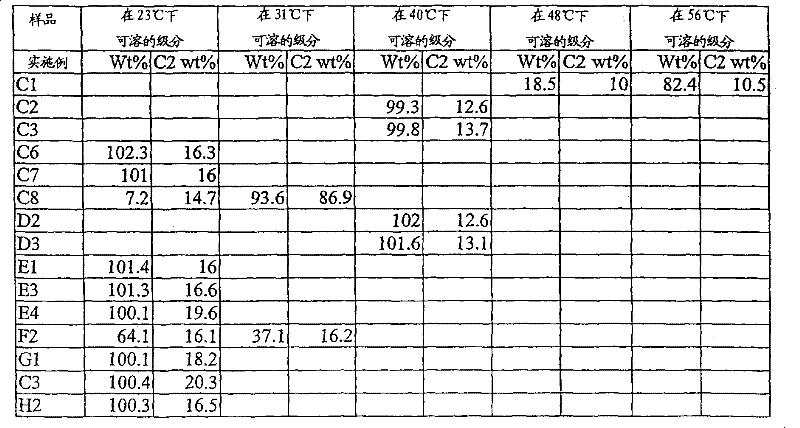
本文所述的全部文件在此引入供参考,包括优先权文件和/或试验工序。从以上一般说明和具体实施方案可以看出,虽然举例说明和描述了本发明的几种形式,但可以在不偏离本发明的精神和范围的情况下做出许多改变。因此,本发明不限于以上的具体实施方案。All documents described herein are hereby incorporated by reference, including priority documents and/or test procedures. From the foregoing general description and specific embodiments it will be seen that, while several forms of the invention have been illustrated and described, many changes can be made without departing from the spirit and scope of the invention. Accordingly, the present invention is not limited to the above specific embodiments.
Claims (3)

Applications Claiming Priority (3)
| Application Number | Priority Date | Filing Date | Title |
|---|---|---|---|
| US58646504P | 2004-07-08 | 2004-07-08 | |
| US60/586,465 | 2004-07-08 | ||
| PCT/US2005/024708 WO2006010139A2 (en) | 2004-07-08 | 2005-07-08 | Olefin polymerization catalyst system and process for use thereof |
Publications (2)
| Publication Number | Publication Date |
|---|---|
| CN101124235A CN101124235A (en) | 2008-02-13 |
| CN101124235B true CN101124235B (en) | 2010-12-15 |
Family
ID=34956137
Family Applications (2)
| Application Number | Title | Priority Date | Filing Date |
|---|---|---|---|
| CN2005800297572A Expired - Fee Related CN101010705B (en) | 2004-07-08 | 2005-07-08 | Polymer production at supercritical conditions |
| CN2005800250909A Expired - Fee Related CN101124235B (en) | 2004-07-08 | 2005-07-08 | Olefin polymerization catalyst system and method of using same |
Family Applications Before (1)
| Application Number | Title | Priority Date | Filing Date |
|---|---|---|---|
| CN2005800297572A Expired - Fee Related CN101010705B (en) | 2004-07-08 | 2005-07-08 | Polymer production at supercritical conditions |
Country Status (9)
| Country | Link |
|---|---|
| US (2) | US7601666B2 (en) |
| EP (2) | EP1774485B1 (en) |
| JP (2) | JP4988568B2 (en) |
| KR (1) | KR20070039930A (en) |
| CN (2) | CN101010705B (en) |
| BR (1) | BRPI0513057A (en) |
| CA (1) | CA2576840A1 (en) |
| DE (1) | DE602005010255D1 (en) |
| WO (2) | WO2006010139A2 (en) |
Cited By (1)
| Publication number | Priority date | Publication date | Assignee | Title |
|---|---|---|---|---|
| WO2022228260A1 (en) | 2021-04-25 | 2022-11-03 | 中国石油化工股份有限公司 | Propylene-based copolymer, preparation method therefor and use thereof, and polypropylene composition containing same |
Families Citing this family (120)
| Publication number | Priority date | Publication date | Assignee | Title |
|---|---|---|---|---|
| GB0205455D0 (en) | 2002-03-07 | 2002-04-24 | Molecular Sensing Plc | Nucleic acid probes, their synthesis and use |
| US20080153997A1 (en) * | 2006-12-20 | 2008-06-26 | Exxonmobil Research And Engineering | Polymer production at supercritical conditions |
| AU2003291627A1 (en) * | 2002-09-20 | 2004-04-08 | Exxonmobil Chemical Patents Inc. | Supercritical polymerization process and polymers produced therefrom |
| US7807769B2 (en) * | 2002-09-20 | 2010-10-05 | Exxonmobil Chemical Patents Inc. | Isotactic polypropylene produced from supercritical polymerization process |
| US8008412B2 (en) * | 2002-09-20 | 2011-08-30 | Exxonmobil Chemical Patents Inc. | Polymer production at supersolution conditions |
| US6877246B1 (en) * | 2003-12-30 | 2005-04-12 | Kimberly-Clark Worldwide, Inc. | Through-air dryer assembly |
| CN101010705B (en) * | 2004-07-08 | 2011-03-23 | 埃克森美孚化学专利公司 | Polymer production at supercritical conditions |
| US8022142B2 (en) * | 2008-12-15 | 2011-09-20 | Exxonmobil Chemical Patents Inc. | Thermoplastic olefin compositions |
| WO2007124486A2 (en) * | 2006-04-21 | 2007-11-01 | Childrens Hospital Los Angeles | Bmp4 inhibitors |
| EP1921200A3 (en) * | 2006-11-08 | 2010-07-21 | LG Electronics Inc. | Exhaust structure for clothes dryer in apartment building |
| US8242237B2 (en) * | 2006-12-20 | 2012-08-14 | Exxonmobil Chemical Patents Inc. | Phase separator and monomer recycle for supercritical polymerization process |
| CN101563374B (en) * | 2006-12-20 | 2012-09-05 | 埃克森美孚化学专利公司 | Phase separator and monomer recycle for supercritical polymerization process |
| US8143352B2 (en) * | 2006-12-20 | 2012-03-27 | Exxonmobil Research And Engineering Company | Process for fluid phase in-line blending of polymers |
| US7872086B2 (en) | 2008-01-17 | 2011-01-18 | Tonen Chemical Corporation | Polymeric material and its manufacture and use |
| US8080610B2 (en) | 2007-03-06 | 2011-12-20 | Exxonmobil Research And Engineering Company | Monomer recycle process for fluid phase in-line blending of polymers |
| EP2160419B1 (en) * | 2007-06-04 | 2013-11-13 | ExxonMobil Chemical Patents Inc. | Super-solution homogeneous propylene polymerization |
| EP2201042B1 (en) * | 2007-09-13 | 2012-06-27 | ExxonMobil Research and Engineering Company | In-line blending of plasticizers with a base polymer |
| EP2195349B1 (en) * | 2007-09-13 | 2012-07-11 | ExxonMobil Research and Engineering Company | In-line process for producing plasticized polymers and plasticized polymer blends |
| US7868104B2 (en) * | 2007-10-26 | 2011-01-11 | Exxonmobil Chemical Patents Inc. | Crystallizable propylene copolymers |
| EP2070953A1 (en) | 2007-12-11 | 2009-06-17 | Total Petrochemicals Research Feluy | Activating supports based on phosphonium complexes |
| US8436114B2 (en) | 2010-10-21 | 2013-05-07 | Exxonmobil Chemical Patents Inc. | Polyethylene and process for production thereof |
| US8431661B2 (en) | 2010-10-21 | 2013-04-30 | Exxonmobil Chemical Patents Inc. | Polyethylene and process for production thereof |
| EP2231772B1 (en) * | 2007-12-20 | 2014-04-16 | ExxonMobil Research and Engineering Company | Polypropylene ethylene-propylene copolymer blends and in-line process to produce them |
| US7994237B2 (en) * | 2007-12-20 | 2011-08-09 | Exxonmobil Research And Engineering Company | In-line process to produce pellet-stable polyolefins |
| US7910679B2 (en) * | 2007-12-20 | 2011-03-22 | Exxonmobil Research And Engineering Company | Bulk homogeneous polymerization process for ethylene propylene copolymers |
| US8318875B2 (en) * | 2008-01-18 | 2012-11-27 | Exxonmobil Chemical Patents Inc. | Super-solution homogeneous propylene polymerization and polypropylenes made therefrom |
| US8067512B2 (en) * | 2008-04-10 | 2011-11-29 | Exxonmobil Research And Engineering Company | Monomer/solvent separation and recycle process for propylene containing polymers |
| US7939610B2 (en) | 2008-05-22 | 2011-05-10 | Exxonmobil Research And Engineering Company | Polymerization processes for broadened molecular weight distribution |
| US8580902B2 (en) | 2008-08-01 | 2013-11-12 | Exxonmobil Chemical Patents Inc. | Catalyst system, process for olefin polymerization, and polymer compositions produced therefrom |
| US8399586B2 (en) | 2008-09-05 | 2013-03-19 | Exxonmobil Research And Engineering Company | Process for feeding ethylene to polymerization reactors |
| US9168718B2 (en) * | 2009-04-21 | 2015-10-27 | Exxonmobil Chemical Patents Inc. | Method for producing temperature resistant nonwovens |
| US9498932B2 (en) | 2008-09-30 | 2016-11-22 | Exxonmobil Chemical Patents Inc. | Multi-layered meltblown composite and methods for making same |
| US8664129B2 (en) | 2008-11-14 | 2014-03-04 | Exxonmobil Chemical Patents Inc. | Extensible nonwoven facing layer for elastic multilayer fabrics |
| US8710148B2 (en) | 2011-12-02 | 2014-04-29 | Exxonmobil Chemical Patents Inc. | Polymer compositions and nonwoven compositions prepared therefrom |
| US10161063B2 (en) | 2008-09-30 | 2018-12-25 | Exxonmobil Chemical Patents Inc. | Polyolefin-based elastic meltblown fabrics |
| CN101721277A (en) * | 2008-10-22 | 2010-06-09 | 3M创新有限公司 | Medical tape and medical product prepared by same |
| ES2546088T4 (en) | 2009-02-27 | 2015-10-15 | Exxonmobil Chemical Patents Inc. | Biaxially elastic nonwoven laminates with inelastic zones |
| JP5625056B2 (en) | 2009-07-16 | 2014-11-12 | ダウ グローバル テクノロジーズ エルエルシー | Polymerization process for olefinic polymers |
| US8602103B2 (en) * | 2009-11-24 | 2013-12-10 | Conocophillips Company | Generation of fluid for hydrocarbon recovery |
| US8668975B2 (en) | 2009-11-24 | 2014-03-11 | Exxonmobil Chemical Patents Inc. | Fabric with discrete elastic and plastic regions and method for making same |
| EP2536784B2 (en) | 2010-02-19 | 2020-11-25 | ExxonMobil Chemical Patents Inc. | Elastomeric polymer blends and processes for their production |
| CN102892441A (en) * | 2010-06-18 | 2013-01-23 | 科洛普拉斯特公司 | permeable pressure sensitive adhesive |
| DE102011105918A1 (en) | 2010-06-29 | 2012-01-05 | Sumitomo Chemical Company, Limited | Transition metal compound and catalyst for olefin polymerization |
| ES2975195T3 (en) * | 2010-10-21 | 2024-07-03 | Univation Tech Llc | Polyethylene and process for its production |
| US20120123374A1 (en) | 2010-11-09 | 2012-05-17 | Richeson Galen C | Meltblown Nonwoven Compositions and Methods for Making Them |
| JP5722456B2 (en) | 2010-11-09 | 2015-05-20 | エクソンモービル ケミカル パテンツ インコーポレイテッド | Bicomponent fibers and methods for making them |
| EP2495264B1 (en) * | 2011-03-04 | 2013-05-08 | Borealis AG | Exterior automotive article with reduced paintability failure |
| WO2012134688A1 (en) | 2011-03-30 | 2012-10-04 | Exxonmobil Chemical Patents Inc. | Polyalphaolefins by oligomerization and isomerization |
| US8658556B2 (en) | 2011-06-08 | 2014-02-25 | Exxonmobil Chemical Patents Inc. | Catalyst systems comprising multiple non-coordinating anion activators and methods for polymerization therewith |
| WO2012170202A2 (en) * | 2011-06-08 | 2012-12-13 | Exxonmobil Chemical Patents Inc. | Catalyst systems comprising multiple non-coordinating anion activators and methods for polymerization therewith |
| US9260635B2 (en) | 2011-06-17 | 2016-02-16 | Exxonmobil Chemical Patents Inc. | Polyolefin adhesive compositions and methods for preparing the same |
| ES2854943T3 (en) | 2011-06-17 | 2021-09-23 | Exxonmobil Chemical Patents Inc | Cooling and pelletizing process for semi-crystalline polymers |
| EP2723927B1 (en) | 2011-06-21 | 2016-11-23 | ExxonMobil Chemical Patents Inc. | Elastic nonwoven materials comprising propylene-based and ethylene-based polymers |
| US10059081B2 (en) | 2011-12-22 | 2018-08-28 | Exxonmobil Chemical Patents Inc. | Fibers and nonwoven materials prepared therefrom |
| CN104245744B (en) | 2012-03-09 | 2016-10-12 | 埃克森美孚化学专利公司 | Polyolefin adhesive compositions and preparation method thereof |
| US9238763B2 (en) | 2013-10-18 | 2016-01-19 | Exxonmobil Chemical Patents Inc. | Tackified polyolefin adhesive compositions |
| CN103665217B (en) * | 2012-09-21 | 2016-02-24 | 中国石油化工股份有限公司 | A kind of continuous polymerization method |
| WO2014047538A1 (en) * | 2012-09-24 | 2014-03-27 | Exxonmobil Chemical Patents Inc. | Production of vinyl terminated polyethylene using supported catalyst system |
| US9434795B2 (en) | 2012-09-24 | 2016-09-06 | Exxonmobil Chemical Patents Inc. | Production of vinyl terminated polyethylene using supported catalyst system |
| CN104661751B (en) * | 2012-09-24 | 2017-02-22 | 埃克森美孚化学专利公司 | Production of vinyl terminated polyethylene |
| WO2014070655A1 (en) * | 2012-10-31 | 2014-05-08 | Exxonmobil Chemical Patents Inc. | Supported metallocene catalyst systems and methods of preparation thereof |
| JP6142085B2 (en) | 2013-06-18 | 2017-06-07 | エクソンモービル ケミカル パテンツ インコーポレイテッド | Fibers and nonwoven materials prepared therefrom |
| JP6091709B2 (en) | 2013-06-18 | 2017-03-08 | エクソンモービル ケミカル パテンツ インコーポレイテッド | Fibers and nonwoven materials prepared therefrom |
| CN105358589B (en) * | 2013-07-17 | 2018-07-03 | 埃克森美孚化学专利公司 | Metallocene and by its derivative carbon monoxide-olefin polymeric |
| WO2015009473A1 (en) | 2013-07-17 | 2015-01-22 | Exxonmobil Chemical Patents Inc. | Cyclopropyl substituted metallocene catalysts |
| US9553867B2 (en) * | 2013-08-01 | 2017-01-24 | Bitglass, Inc. | Secure application access system |
| US9376518B2 (en) | 2013-08-28 | 2016-06-28 | Exxonmobil Chemical Patents Inc. | Racemo selective metallation process |
| CN107603517B (en) | 2013-10-18 | 2019-11-19 | 埃克森美孚化学专利公司 | The polyolefin adhesive compositions of high polymer load capacity |
| US20160362510A1 (en) | 2014-02-11 | 2016-12-15 | Univation Technologies, Llc | Method to prepare ethylene copolymers |
| EP3124505B1 (en) * | 2014-03-28 | 2025-03-19 | Mitsui Chemicals, Inc. | Ethylene/alpha-olefin copolymer and lubricating oil |
| US10336921B2 (en) | 2014-04-22 | 2019-07-02 | Exxonmobil Chemical Patents Inc. | Adhesive compositions for nonwoven applications |
| WO2015164017A1 (en) | 2014-04-22 | 2015-10-29 | Exxonmobil Chemical Patents Inc. | Hydrocarbon tackifiers for adhesive compositions |
| US10106676B2 (en) | 2014-06-10 | 2018-10-23 | Exxonmobil Chemical Patents Inc. | Propylene-based polymers having improved stability and methods for producing the same |
| CN106604960B (en) | 2014-09-05 | 2020-12-29 | 埃克森美孚化学专利公司 | Polymer compositions and nonwovens made therefrom |
| US10428210B2 (en) | 2014-10-29 | 2019-10-01 | Exxonmobil Chemical Patents Inc. | Polyolefin adhesive compositions for elastic applications |
| ES2625621T3 (en) | 2014-12-04 | 2017-07-20 | Exxonmobil Chemical Patents Inc. | Multimodal polymer blend, melt application adhesive comprising the same and use thereof |
| WO2016099605A1 (en) | 2014-12-19 | 2016-06-23 | Exxonmobil Chemical Patents Inc. | Heat-activated fabrics made from blends containing propylene-based polymers |
| US9909038B2 (en) | 2014-12-19 | 2018-03-06 | Exxonmobil Chemical Patents Inc. | Adhesive compositions made from propylene-based polymers for elastic attachments |
| CN107109158B (en) | 2015-01-14 | 2019-11-12 | 埃克森美孚化学专利公司 | Binder compositions made from propylene-based polymers and crystalline C2/C3 homopolymers |
| CN105047295A (en) * | 2015-07-02 | 2015-11-11 | 傅宇晓 | Cable for acid/alkali-resistant industry |
| WO2018022263A1 (en) | 2016-07-29 | 2018-02-01 | Exxonmobil Chemical Patents Inc. | Polymerization processes using high molecular weight polyhydric quenching agents |
| CN106845796B (en) * | 2016-12-28 | 2018-04-13 | 中南大学 | One kind is hydrocracked flow product quality on-line prediction method |
| JP6921563B2 (en) * | 2017-03-07 | 2021-08-18 | 出光興産株式会社 | Method for Producing Transition Metal Compounds and Olefin Polymers |
| US11001657B2 (en) | 2017-10-25 | 2021-05-11 | Exxonmobil Chemical Patents Inc. | Unbridged indacenyl metallocenes |
| CN111225927A (en) * | 2017-10-25 | 2020-06-02 | 埃克森美孚化学专利公司 | Unbridged indacenyl metallocenes |
| WO2019240896A1 (en) | 2018-06-15 | 2019-12-19 | Exxonmobil Chemical Patents Inc. | Process for producing polymers |
| WO2020046581A1 (en) | 2018-08-30 | 2020-03-05 | Exxonmobil Chemical Patents Inc. | Bicomponent polymeric fibers |
| WO2020123973A1 (en) * | 2018-12-14 | 2020-06-18 | Dow Global Technologies Llc | Solution polymerization process |
| WO2020131311A1 (en) | 2018-12-18 | 2020-06-25 | Exxonmobil Research And Engineering Company | Modified asphalts and methods for producing the same |
| WO2020247192A1 (en) | 2019-05-24 | 2020-12-10 | Eastman Chemical Company | Recycle content cracked effluent |
| CN113993977B (en) | 2019-05-24 | 2024-09-13 | 伊士曼化工公司 | A small amount of pyrolysis oil is mixed into the liquid stream entering the gas cracker for processing |
| US12497467B2 (en) | 2019-05-24 | 2025-12-16 | Exxon Mobil Product Solutions Company | Recycle content cellulose ester |
| CN114174375B (en) | 2019-07-29 | 2025-01-28 | 伊士曼化工公司 | Recycled content cyclobutanediol polyester |
| WO2021021847A1 (en) | 2019-07-29 | 2021-02-04 | Eastman Chemical Company | Recycle content (c4)alkanal |
| US12466902B2 (en) | 2019-08-02 | 2025-11-11 | Exxonmobil Chemical Patents Inc. | Non-coordinating anion type activators for use with polyolefin polymerization catalysts |
| US11472828B2 (en) | 2019-10-11 | 2022-10-18 | Exxonmobil Chemical Patents Inc. | Indacene based metallocene catalysts useful in the production of propylene polymers |
| US11945998B2 (en) | 2019-10-31 | 2024-04-02 | Eastman Chemical Company | Processes and systems for making recycle content hydrocarbons |
| KR20220091549A (en) | 2019-10-31 | 2022-06-30 | 이스트만 케미칼 컴파니 | Pyrolysis method and system for recycled waste |
| US11939534B2 (en) | 2019-11-07 | 2024-03-26 | Eastman Chemical Company | Recycle content alpha olefins and fatty alcohols |
| WO2021092309A1 (en) | 2019-11-07 | 2021-05-14 | Eastman Chemical Company | Recycle content propanol |
| CN119080582A (en) | 2019-11-07 | 2024-12-06 | 伊士曼化工公司 | Recycled content Oxo alcohols and Oxo plasticizers |
| US12104121B2 (en) | 2019-11-07 | 2024-10-01 | Eastman Chemical Company | Recycle content mixed esters and solvents |
| US20230348634A1 (en) * | 2020-02-11 | 2023-11-02 | Exxonmobil Chemical Patents Inc. | Propylene Polymers Obtained Using Transition Metal Bis(Phenolate) Catalyst Complexes and Homogeneous Process for Production Thereof |
| KR102778932B1 (en) * | 2020-05-22 | 2025-03-07 | 가부시끼가이샤 구레하 | Method for producing polyarylene sulfide |
| CN113046130B (en) * | 2021-04-16 | 2023-04-04 | 华东理工大学 | PAO base oil with narrow distribution, low viscosity and high viscosity index and preparation method thereof |
| CN113337311A (en) * | 2021-04-16 | 2021-09-03 | 华东理工大学 | Ultra-high viscosity index poly-alpha-olefin base oil and preparation method and application thereof |
| CN115232236B (en) * | 2021-04-25 | 2024-05-07 | 中国石油化工股份有限公司 | Propylene-based copolymer, preparation method and application thereof, and polypropylene composition |
| CN117337323A (en) * | 2021-07-20 | 2024-01-02 | 三井化学株式会社 | Viscosity regulator for lubricating oil and lubricating oil composition for working oil |
| US12195674B2 (en) | 2021-09-21 | 2025-01-14 | Eastman Chemical Company | Using spent caustic solution from pygas treatment to neutralize halogens from liquified waste plastic |
| KR20230069618A (en) * | 2021-11-12 | 2023-05-19 | 주식회사 에스피씨아이 | Metallocene compound for polymerization of ultra-high molecular weight polyolefin and method for producing ultra-high molecular weight polyolefin polymer using the same |
| CN116284530B (en) * | 2023-03-17 | 2024-06-07 | 山东京博中聚新材料有限公司 | A preparation method and application of butyl rubber |
| WO2024242933A1 (en) | 2023-05-23 | 2024-11-28 | ExxonMobil Technology and Engineering Company | Catalysts and polymerizations for improved polyolefins |
| WO2024242936A1 (en) | 2023-05-23 | 2024-11-28 | ExxonMobil Technology and Engineering Company | Catalysts and polymerizations for improved polyolefins |
| CN121420003A (en) | 2023-05-23 | 2026-01-27 | 埃克森美孚技术与工程公司 | Catalysts, polyethylene, its polymerization and its membranes |
| WO2024242929A1 (en) | 2023-05-23 | 2024-11-28 | ExxonMobil Technology and Engineering Company | Low density polethylenes, films thereof, and methods and catalysts for production thereof |
| WO2024242932A1 (en) | 2023-05-23 | 2024-11-28 | ExxonMobil Technology and Engineering Company | Polethylenes, catalysts for their polymerization, and films thereof |
| CN121464161A (en) | 2023-05-23 | 2026-02-03 | 埃克森美孚技术与工程公司 | Polyethylene with improved processability and films thereof |
| WO2026024926A1 (en) * | 2024-07-25 | 2026-01-29 | ExxonMobil Technology and Engineering Company | Metallocene catalyst compounds for producing polyolefins |
| CN119467169B (en) * | 2024-11-22 | 2026-01-23 | 中国船舶集团有限公司第七一一研究所 | Marine methanol fuel regulation and control system and method |
| CN119795714B (en) * | 2024-12-18 | 2025-10-17 | 黄山永新股份有限公司 | A polyethylene film with a stable friction coefficient and its preparation method and application |
Citations (8)
| Publication number | Priority date | Publication date | Assignee | Title |
|---|---|---|---|---|
| DE19823168A1 (en) * | 1998-05-23 | 1999-11-25 | Aventis Res & Tech Gmbh & Co | Metallocene catalyst system used in (co)polyolefin production |
| WO2000012565A1 (en) * | 1998-08-26 | 2000-03-09 | Exxon Chemical Patents Inc. | Highly active supported catalyst compositions |
| WO2000026266A1 (en) * | 1998-11-02 | 2000-05-11 | Exxon Chemical Patents Inc. | Supported ionic catalyst compositions |
| WO2000025916A1 (en) * | 1998-11-02 | 2000-05-11 | Exxon Chemical Patents Inc. | Polymeric supported catalysts |
| US6084115A (en) * | 1998-03-11 | 2000-07-04 | The Dow Chemical Company | Diene complexes of group 4 metals and process of preparation |
| WO2002044260A2 (en) * | 2000-11-30 | 2002-06-06 | Exxonmobil Chemical Patents Inc. | Polypropylene for precision injection molding applications |
| US6576306B2 (en) * | 1996-09-04 | 2003-06-10 | Exxonmobil Chemical Patents Inc. | Propylene polymers for films |
| WO2004050724A1 (en) * | 2002-12-04 | 2004-06-17 | Basell Polyolefine Gmbh | Process for preparing 1-butene polymers |
Family Cites Families (122)
| Publication number | Priority date | Publication date | Assignee | Title |
|---|---|---|---|---|
| BE420895A (en) | 1936-02-04 | 1900-01-01 | ||
| US2852501A (en) | 1954-10-05 | 1958-09-16 | Monsanto Chemicals | Polymerization of ethylene |
| US3725378A (en) | 1958-12-17 | 1973-04-03 | Monsanto Co | Polymerization of ethylene |
| US3294772A (en) | 1963-06-17 | 1966-12-27 | Phillips Petroleum Co | Supercritical polymerization |
| US4153774A (en) | 1976-02-17 | 1979-05-08 | Basf Aktiengesellschaft | Manufacture of high pressure polyethylene |
| US4135044A (en) | 1977-08-08 | 1979-01-16 | Exxon Research & Engineering Co. | Process for achieving high conversions in the production of polyethylene |
| US5324800A (en) | 1983-06-06 | 1994-06-28 | Exxon Chemical Patents Inc. | Process and catalyst for polyolefin density and molecular weight control |
| ZA844157B (en) | 1983-06-06 | 1986-01-29 | Exxon Research Engineering Co | Process and catalyst for polyolefin density and molecular weight control |
| US4530914A (en) | 1983-06-06 | 1985-07-23 | Exxon Research & Engineering Co. | Process and catalyst for producing polyethylene having a broad molecular weight distribution |
| IN172494B (en) | 1986-12-19 | 1993-09-04 | Exxon Chemical Patents Inc | |
| EP0239843B1 (en) | 1986-03-24 | 1990-10-24 | Siemens Aktiengesellschaft | Sintered nuclear-fuel body, and method of manufacturing it |
| DE3615563A1 (en) | 1986-05-09 | 1987-11-12 | Basf Ag | METHOD FOR PRODUCING COPOLYMERISATES OF ETHYLENE WITH VINYL ESTERS IN A TUBE REACTOR AT PRESSURES ABOVE 500 BAR |
| US4740550A (en) | 1986-06-18 | 1988-04-26 | Shell Oil Company | Multistage copolymerization process |
| US5543394A (en) | 1986-07-01 | 1996-08-06 | Genetics Institute, Inc. | Bone morphogenetic protein 5(BMP-5) compositions |
| US5084534A (en) | 1987-06-04 | 1992-01-28 | Exxon Chemical Patents, Inc. | High pressure, high temperature polymerization of ethylene |
| CA1284549C (en) | 1986-09-26 | 1991-05-28 | Fathi David Hussein | Process for the polymerization of propylene |
| US5408017A (en) | 1987-01-30 | 1995-04-18 | Exxon Chemical Patents Inc. | High temperature polymerization process using ionic catalysts to produce polyolefins |
| US5096867A (en) | 1990-06-04 | 1992-03-17 | Exxon Chemical Patents Inc. | Monocyclopentadienyl transition metal olefin polymerization catalysts |
| DE3743321A1 (en) | 1987-12-21 | 1989-06-29 | Hoechst Ag | 1-OLEFIN POLYMER WAX AND METHOD FOR THE PRODUCTION THEREOF |
| JPH0216916A (en) | 1988-07-01 | 1990-01-19 | Iseki & Co Ltd | Regular combine harvester |
| US5382630A (en) | 1988-09-30 | 1995-01-17 | Exxon Chemical Patents Inc. | Linear ethylene interpolymer blends of interpolymers having narrow molecular weight and composition distribution |
| US5382631A (en) | 1988-09-30 | 1995-01-17 | Exxon Chemical Patents Inc. | Linear ethylene interpolymer blends of interpolymers having narrow molecular weight and composition distributions |
| DE3904468A1 (en) | 1989-02-15 | 1990-08-16 | Hoechst Ag | POLYPROPYLENE WAX AND METHOD FOR THE PRODUCTION THEREOF |
| DE3929693A1 (en) | 1989-09-07 | 1991-03-14 | Hoechst Ag | METHOD FOR PRODUCING A POLYOLEFIN WAX |
| US5504169A (en) | 1989-09-13 | 1996-04-02 | Exxon Chemical Patents Inc. | Process for producing amorphous poly-α-olefins with a monocyclopentadienyl transition metal catalyst system |
| US5026798A (en) | 1989-09-13 | 1991-06-25 | Exxon Chemical Patents Inc. | Process for producing crystalline poly-α-olefins with a monocyclopentadienyl transition metal catalyst system |
| US5036034A (en) * | 1989-10-10 | 1991-07-30 | Fina Technology, Inc. | Catalyst for producing hemiisotactic polypropylene |
| US5324799A (en) | 1990-03-06 | 1994-06-28 | Akihiro Yano | Polyethylene and process of production thereof |
| AU7875791A (en) | 1990-05-07 | 1991-11-27 | Exxon Chemical Patents Inc. | Unsaturated alpha-olefin copolymers and method for preparation thereof |
| US5272236A (en) | 1991-10-15 | 1993-12-21 | The Dow Chemical Company | Elastic substantially linear olefin polymers |
| DE4030379A1 (en) | 1990-09-26 | 1992-04-02 | Basf Ag | POLYMER WAXES OF PROPYLENE WITH HIGH HARDNESS AND CRYSTAL INITY |
| FI89929C (en) | 1990-12-28 | 1993-12-10 | Neste Oy | Process for homo- or copolymerization of ethylene |
| FI86867C (en) | 1990-12-28 | 1992-10-26 | Neste Oy | FLERSTEGSPROCESS FOR FRAMSTAELLNING AV POLYETEN |
| IT1246614B (en) | 1991-06-03 | 1994-11-24 | Himont Inc | PROCEDURE FOR THE GAS PHASE POLYMERIZATION OF OLEFINS |
| DE4130299A1 (en) | 1991-09-12 | 1993-03-18 | Basf Ag | METHOD FOR PRODUCING HIGH PRESSURE POLYPROPYLENE |
| JPH0625357A (en) | 1991-10-23 | 1994-02-01 | Mitsui Toatsu Chem Inc | Novel propylene-based copolymer and method for producing the same |
| TW309523B (en) * | 1991-11-30 | 1997-07-01 | Hoechst Ag | |
| GB9125934D0 (en) | 1991-12-05 | 1992-02-05 | Exxon Chemical Patents Inc | Process for polymerising olefinic feeds under pressure |
| EP0552945B1 (en) * | 1992-01-23 | 1997-05-07 | Mitsui Petrochemical Industries, Ltd. | Process for the preparation of polyolefin |
| TW285680B (en) | 1992-03-31 | 1996-09-11 | Hoechst Ag | |
| DE59305691D1 (en) | 1992-05-26 | 1997-04-17 | Hoechst Ag | Process for the production of polyolefin waxes |
| TW294669B (en) | 1992-06-27 | 1997-01-01 | Hoechst Ag | |
| ATE165832T1 (en) | 1992-08-03 | 1998-05-15 | Targor Gmbh | METHOD FOR PRODUCING AN OLEFIN POLYMER USING METALLOCENES WITH SPECIFICALLY SUBSTITUTED INDENYL LIGANDS |
| TW303368B (en) | 1992-08-08 | 1997-04-21 | Hoechst Ag | |
| EP0667359B1 (en) | 1992-10-28 | 2004-03-31 | Idemitsu Kosan Company Limited | Olefin copolymers and process for producing the same |
| US5332706A (en) | 1992-12-28 | 1994-07-26 | Mobil Oil Corporation | Process and a catalyst for preventing reactor fouling |
| EP0812854B2 (en) | 1993-06-07 | 2011-04-20 | Mitsui Chemicals, Inc. | Novel transition metal compound, olefin polymerization catalyst comprising said compound, process for olefin polymerization using said catalyst and propylene homo- and copolymer |
| JPH0790035A (en) | 1993-07-27 | 1995-04-04 | Ube Ind Ltd | Method for producing propylene block copolymer |
| DE4333128A1 (en) | 1993-09-29 | 1995-03-30 | Hoechst Ag | Process for the preparation of polyolefins |
| DE59409642D1 (en) | 1993-11-24 | 2001-03-01 | Targor Gmbh | Metallocenes, processes for their preparation and their use as catalysts |
| NO178790C (en) | 1993-12-13 | 1996-06-05 | Borealis Holding As | Process for preparing olefin polymers in an autoclave reactor |
| DE4406963A1 (en) | 1994-03-03 | 1995-09-07 | Basf Ag | Metallocene complexes with heterofunctional groups on the cyclopentadienyl system |
| EP0766704B1 (en) | 1994-06-24 | 1998-12-23 | Exxon Chemical Patents Inc. | Polymerization process and catalyst systems useful therein |
| US5552489A (en) | 1994-07-22 | 1996-09-03 | Exxon Chemical Patents Inc. | Tackifiers and a process to obtain tackifiers |
| US6300451B1 (en) | 1994-10-24 | 2001-10-09 | Exxon Chemical Patents Inc. | Long-chain branched polymers and their production |
| CA2162946C (en) | 1994-11-21 | 2004-01-06 | Kazuyuki Watanabe | Propylene block copolymer and process for producing the same |
| FI96216C (en) | 1994-12-16 | 1996-05-27 | Borealis Polymers Oy | Process for the production of polyethylene |
| TW383314B (en) | 1994-12-20 | 2000-03-01 | Mitsui Petrochemical Ind | Ethylene-alpha-olefin-nonconjugated polyene random copolymer, rubber composition, and process for preparing the random copolymer |
| US5880241A (en) | 1995-01-24 | 1999-03-09 | E. I. Du Pont De Nemours And Company | Olefin polymers |
| JPH08208535A (en) | 1995-02-03 | 1996-08-13 | Mitsui Toatsu Chem Inc | Method for producing alkylbenzene |
| FI951970L (en) | 1995-04-25 | 1996-10-26 | Borealis As | Olefin polymers containing polar groups and a method for their preparation |
| US6143682A (en) | 1995-06-07 | 2000-11-07 | Exxon Chemical Patents Inc. | Bimetallocyclic transition metal catalyst systems |
| US5882750A (en) | 1995-07-03 | 1999-03-16 | Mobil Oil Corporation | Single reactor bimodal HMW-HDPE film resin with improved bubble stability |
| SE504455C2 (en) | 1995-07-10 | 1997-02-17 | Borealis Polymers Oy | Cable sheath composition, its use and methods for its manufacture |
| FI954475L (en) | 1995-09-21 | 1997-03-22 | Borealis As | Olefin polymers containing polar groups and a method for their preparation |
| EP0854887B1 (en) | 1995-10-10 | 2000-01-12 | Borealis A/S | Process for making propylene homo or copolymers |
| FI105820B (en) | 1995-10-10 | 2000-10-13 | Borealis Tech Oy | Process for the preparation of homopolymers or copolymers of propylene |
| CN1117770C (en) | 1995-10-14 | 2003-08-13 | 巴塞尔聚烯烃股份有限公司 | Process for preparing ethylene copolymers under high pressure |
| DE19544828A1 (en) * | 1995-12-01 | 1997-06-05 | Hoechst Ag | High molecular copolymers |
| IT1283630B1 (en) | 1996-05-09 | 1998-04-23 | Enichem Spa | PROCESS FOR THE PREPARATION OF EP (D) M ELASTOMERIC COPOLYMERS |
| FI102476B (en) | 1996-05-31 | 1998-12-15 | Borealis As | New transition metal complexes and process for making them |
| HU223533B1 (en) | 1996-06-17 | 2004-08-30 | Exxonmobil Chemical Patents Inc. | Mixed transition metal catalyst systems for olefin polymerization |
| CN1125829C (en) | 1996-06-17 | 2003-10-29 | 埃克森美孚化学专利公司 | Boosted Polymerization Using Transition Metal Catalyst Systems |
| WO1998006727A1 (en) * | 1996-08-08 | 1998-02-19 | The Dow Chemical Company | 3-heteroatom substituted cyclopentadienyl-containing metal complexes and olefin polymerization process |
| US6583227B2 (en) * | 1996-09-04 | 2003-06-24 | Exxonmobil Chemical Patents Inc. | Propylene polymers for films |
| CA2263081A1 (en) | 1996-09-24 | 1998-04-02 | Exxon Chemical Patents, Inc. | Improved method for preparing supported metallocene catalyst systems |
| JP3421202B2 (en) | 1996-10-09 | 2003-06-30 | 三菱化学株式会社 | Propylene polymerization method and propylene polymer obtained using the same |
| JP2001503276A (en) | 1996-11-07 | 2001-03-13 | オゥクラホゥマ、メディカル、リサーチ、ファウンデイシャン | Breast cancer susceptibility diagnostic assay |
| DE19648895A1 (en) | 1996-11-26 | 1998-05-28 | Clariant Gmbh | Polar modified polypropylene waxes |
| US6340652B1 (en) | 1996-12-09 | 2002-01-22 | Mitsubishi Chemical Corporation | Catalysts for polymerization of α-olefins, process for producing α-olefin polymers, novel transition metal compounds and catalyst components for polymerization of α-olefin |
| US5965756A (en) * | 1996-12-19 | 1999-10-12 | The Dow Chemical Company | Fused ring substituted indenyl metal complexes and polymerization process |
| WO1998033823A1 (en) | 1997-02-05 | 1998-08-06 | The Penn State Research Foundation | METAL CATALYZED SYNTHESIS OF HYPERBRANCHED ETHYLENE AND/OR α-OLEFIN POLYMERS |
| ES2181205T3 (en) | 1997-04-29 | 2003-02-16 | Dow Chemical Co | COPOLIMEROS AMORFOS DE PROPILENO-POLIENO AND ITS COMPOSITIONS. |
| US6160072A (en) | 1997-05-02 | 2000-12-12 | Ewen; John A. | Process for polymerizing tactioselective polyolefins in condensed phase using titanocenes |
| EP0987279B1 (en) | 1997-06-06 | 2006-08-30 | Idemitsu Kosan Co., Ltd. | Branched polypropylene |
| FI111847B (en) | 1997-06-24 | 2003-09-30 | Borealis Tech Oy | Process for preparing copolymers of propylene |
| FI972946A7 (en) | 1997-07-11 | 1999-01-12 | Borealis As | New metallocene compounds for the polymerization of ethylenically unsaturated monomers |
| US6525157B2 (en) * | 1997-08-12 | 2003-02-25 | Exxonmobile Chemical Patents Inc. | Propylene ethylene polymers |
| TW458993B (en) | 1997-09-04 | 2001-10-11 | Chisso Corp | Propylene copolymer and process for the production thereof |
| US6184327B1 (en) | 1997-12-10 | 2001-02-06 | Exxon Chemical Patents, Inc. | Elastomeric propylene polymers |
| CN1482168A (en) | 1997-12-19 | 2004-03-17 | Ethane polymer composition and polymerization of olefins | |
| DE19804970A1 (en) | 1998-02-07 | 1999-08-12 | Aventis Res & Tech Gmbh & Co | Catalyst system |
| DE19808253A1 (en) * | 1998-02-27 | 1999-09-02 | Aventis Res & Tech Gmbh & Co | Catalyst system, process for its preparation and its use for the polymerization of olefins |
| ATE293132T1 (en) | 1998-03-04 | 2005-04-15 | Exxonmobil Chem Patents Inc | NON-COORDINATING ANIONS FOR THE POLYMERIZATION OF OLEFINS |
| US6225285B1 (en) | 1998-03-11 | 2001-05-01 | Exelixis Pharmaceuticals, Inc. | Semaphorin K1 |
| EP1109843B1 (en) | 1998-07-25 | 2004-09-01 | BP Chemicals Limited | Alpha olefin-diene copolymers |
| JP5407099B2 (en) | 1998-08-26 | 2014-02-05 | エクソンモービル・ケミカル・パテンツ・インク | Branched polypropylene composition |
| US6002648A (en) | 1998-10-16 | 1999-12-14 | Western Atlas International, Inc. | Slotted cylinder marine siesmic method and source |
| US6158771A (en) | 1998-10-23 | 2000-12-12 | Hexcel Corporation | Honeycomb crash pad |
| US6479424B1 (en) * | 1998-12-14 | 2002-11-12 | Bp Corporation North America Inc. | Fluxional catalysts and related ligands containing bulky substituents |
| CN1234739C (en) | 1998-12-21 | 2006-01-04 | 埃克森化学专利公司 | Branched semi-crystalline ethylene-propylene compositions |
| CA2322496A1 (en) | 1999-01-08 | 2000-07-13 | Raisa L. Kravchenko | Ethylene copolymers with narrow composition distribution and high melting temperatures, and methods of production thereof |
| US6469188B1 (en) * | 1999-01-20 | 2002-10-22 | California Institute Of Technology | Catalyst system for the polymerization of alkenes to polyolefins |
| US6620896B1 (en) | 1999-02-23 | 2003-09-16 | Eastman Chemical Company | Mixed olefin polymerization catalysts, processes employing such catalysts, and polymers obtained therefrom |
| FI990948A0 (en) | 1999-04-27 | 1999-04-27 | Borealis As | Non-crosslinked polyethylene |
| EP1083183A1 (en) | 1999-09-10 | 2001-03-14 | Fina Research S.A. | Process for producing polyolefins |
| KR100746676B1 (en) | 1999-10-08 | 2007-08-06 | 미쓰이 가가쿠 가부시키가이샤 | Metallocene compound, method for producing metallocene compound, olefin polymerization catalyst, and method for producing polyolefin |
| US20020013440A1 (en) | 1999-12-10 | 2002-01-31 | Agarwal Pawan Kumar | Propylene diene copolymers |
| US6444833B1 (en) | 1999-12-15 | 2002-09-03 | Basell Technology Company Bv | Metallocene compounds, process for their preparation and their use in catalytic systems for the polymerization of olefins |
| DE60038900D1 (en) | 1999-12-20 | 2008-06-26 | Exxonmobil Chem Patents Inc | PROCESS FOR PREPARING POLYOLEFINS BY THE CONTRACTOR OF IONIC CATALYSTS |
| KR100374154B1 (en) | 2000-06-24 | 2003-02-26 | 장학선 | System for receiving and transmitting power signal and data signal |
| EP1195391A1 (en) | 2000-10-05 | 2002-04-10 | ATOFINA Research | Production of polypropylene |
| WO2002034795A1 (en) | 2000-10-25 | 2002-05-02 | Exxonmobil Chemical Company Inc. | Processes and apparatus for continuous solution polymerization |
| WO2002046246A2 (en) | 2000-12-04 | 2002-06-13 | Univaton Technologies, Llc | Polimerization process |
| EP1366098B1 (en) | 2000-12-20 | 2008-04-16 | Exxonmobil Chemical Patents Inc. | Olefin polymerization process to produce branched polymer compositions |
| WO2002083753A1 (en) | 2001-04-12 | 2002-10-24 | Exxonmobil Chemical Patents Inc. | Propylene ethylene copolymers |
| GB0111020D0 (en) | 2001-05-04 | 2001-06-27 | Borealis Tech Oy | Process |
| AU2003291627A1 (en) * | 2002-09-20 | 2004-04-08 | Exxonmobil Chemical Patents Inc. | Supercritical polymerization process and polymers produced therefrom |
| KR101113341B1 (en) * | 2002-10-15 | 2012-09-27 | 엑손모빌 케미칼 패턴츠 인코포레이티드 | Multiple catalyst system for olefin polymerization and polymers produced therefrom |
| WO2004037871A1 (en) | 2002-10-24 | 2004-05-06 | Exxonmobil Chemical Patents Inc. | Branched crystalline polypropylene |
| US7589160B2 (en) * | 2002-12-04 | 2009-09-15 | Basell Polyolefine Gmbh | Process for preparing 1-butene polymers |
| CN101010705B (en) * | 2004-07-08 | 2011-03-23 | 埃克森美孚化学专利公司 | Polymer production at supercritical conditions |
-
2005
- 2005-07-08 CN CN2005800297572A patent/CN101010705B/en not_active Expired - Fee Related
- 2005-07-08 DE DE602005010255T patent/DE602005010255D1/en not_active Expired - Lifetime
- 2005-07-08 CA CA002576840A patent/CA2576840A1/en not_active Abandoned
- 2005-07-08 JP JP2007520591A patent/JP4988568B2/en not_active Expired - Fee Related
- 2005-07-08 EP EP05769521.5A patent/EP1774485B1/en not_active Expired - Lifetime
- 2005-07-08 CN CN2005800250909A patent/CN101124235B/en not_active Expired - Fee Related
- 2005-07-08 BR BRPI0513057-3A patent/BRPI0513057A/en not_active IP Right Cessation
- 2005-07-08 EP EP05771412A patent/EP1765841B1/en not_active Expired - Lifetime
- 2005-07-08 KR KR1020077002106A patent/KR20070039930A/en not_active Ceased
- 2005-07-08 JP JP2007520528A patent/JP5268087B2/en not_active Expired - Fee Related
- 2005-07-08 US US11/178,147 patent/US7601666B2/en active Active
- 2005-07-08 WO PCT/US2005/024708 patent/WO2006010139A2/en not_active Ceased
- 2005-07-08 WO PCT/US2005/024240 patent/WO2006025949A2/en not_active Ceased
-
2006
- 2006-08-25 US US11/510,871 patent/US7279536B2/en not_active Expired - Lifetime
Patent Citations (10)
| Publication number | Priority date | Publication date | Assignee | Title |
|---|---|---|---|---|
| US6143686A (en) * | 1994-08-03 | 2000-11-07 | Exxon Chemical Patents, Inc. | Supported ionic catalyst compositions |
| US6576306B2 (en) * | 1996-09-04 | 2003-06-10 | Exxonmobil Chemical Patents Inc. | Propylene polymers for films |
| US6228795B1 (en) * | 1997-06-05 | 2001-05-08 | Exxon Chemical Patents, Inc. | Polymeric supported catalysts |
| US6084115A (en) * | 1998-03-11 | 2000-07-04 | The Dow Chemical Company | Diene complexes of group 4 metals and process of preparation |
| DE19823168A1 (en) * | 1998-05-23 | 1999-11-25 | Aventis Res & Tech Gmbh & Co | Metallocene catalyst system used in (co)polyolefin production |
| WO2000012565A1 (en) * | 1998-08-26 | 2000-03-09 | Exxon Chemical Patents Inc. | Highly active supported catalyst compositions |
| WO2000026266A1 (en) * | 1998-11-02 | 2000-05-11 | Exxon Chemical Patents Inc. | Supported ionic catalyst compositions |
| WO2000025916A1 (en) * | 1998-11-02 | 2000-05-11 | Exxon Chemical Patents Inc. | Polymeric supported catalysts |
| WO2002044260A2 (en) * | 2000-11-30 | 2002-06-06 | Exxonmobil Chemical Patents Inc. | Polypropylene for precision injection molding applications |
| WO2004050724A1 (en) * | 2002-12-04 | 2004-06-17 | Basell Polyolefine Gmbh | Process for preparing 1-butene polymers |
Cited By (1)
| Publication number | Priority date | Publication date | Assignee | Title |
|---|---|---|---|---|
| WO2022228260A1 (en) | 2021-04-25 | 2022-11-03 | 中国石油化工股份有限公司 | Propylene-based copolymer, preparation method therefor and use thereof, and polypropylene composition containing same |
Also Published As
| Publication number | Publication date |
|---|---|
| WO2006010139A3 (en) | 2006-03-16 |
| JP5268087B2 (en) | 2013-08-21 |
| WO2006010139A2 (en) | 2006-01-26 |
| US7601666B2 (en) | 2009-10-13 |
| EP1774485B1 (en) | 2016-05-04 |
| WO2006025949A3 (en) | 2006-08-31 |
| CN101124235A (en) | 2008-02-13 |
| CA2576840A1 (en) | 2006-03-09 |
| DE602005010255D1 (en) | 2008-11-20 |
| CN101010705A (en) | 2007-08-01 |
| KR20070039930A (en) | 2007-04-13 |
| BRPI0513057A (en) | 2008-04-22 |
| US7279536B2 (en) | 2007-10-09 |
| US20060293474A1 (en) | 2006-12-28 |
| CN101010705B (en) | 2011-03-23 |
| JP4988568B2 (en) | 2012-08-01 |
| WO2006025949A2 (en) | 2006-03-09 |
| EP1774485A2 (en) | 2007-04-18 |
| JP2008505932A (en) | 2008-02-28 |
| US20060009595A1 (en) | 2006-01-12 |
| JP2008506018A (en) | 2008-02-28 |
| EP1765841A2 (en) | 2007-03-28 |
| EP1765841B1 (en) | 2008-10-08 |
Similar Documents
| Publication | Publication Date | Title |
|---|---|---|
| CN101124235B (en) | Olefin polymerization catalyst system and method of using same | |
| JP5578473B2 (en) | Racemoselective synthesis of ansa-metallocene compounds, ansa-metallocene compounds, catalysts containing them, processes for producing olefin polymers by use of catalysts, and homopolymers and copolymers | |
| JP2994746B2 (en) | Monocyclopentadienyl transition metal olefin polymerization catalyst | |
| CN104411778B (en) | Polyalphaolefins prepared using modified Salan catalyst compounds | |
| RU2470035C2 (en) | Metallocene compounds, catalysts containing said compounds, method of producing olefin polymer using catalysts and olefin homo- and copolymers | |
| CN1095853C (en) | Copolymers of ethylene and homocarbon disubstituted olefins | |
| JP5252714B2 (en) | Process for producing propylene copolymers | |
| US9969827B2 (en) | Process for producing ethylene/α-olefin copolymer | |
| US7045583B2 (en) | Olefin polymerization catalyst system | |
| CN105143279B (en) | The manufacture method and catalyst for olefines polymerizing of olefin polymer | |
| CN105008408B (en) | METHOD FOR PRODUCING ETHYLENE/[alpha]-OLEFIN COPOLYMER | |
| US7297653B2 (en) | Fluorophenylborates and their use as activators in catalyst systems for olefin polymerization | |
| KR20010031368A (en) | Elastic polypropylenes and catalysts for their manufacture | |
| CN102666597A (en) | Catalyst compounds and use thereof | |
| CN102753584A (en) | Catalyst compounds and use thereof | |
| CN102597015A (en) | Catalyst compounds and use thereof | |
| CN1227255C (en) | Siloxy-substituted co-catalyst activators for olefin polymerization | |
| JP2019172794A (en) | Method for producing olefin polymer | |
| JP2024149437A (en) | New olefin polymerization catalysts | |
| JP2016050189A (en) | Metallocene compound, olefin polymerization catalyst prepared therefrom and method for producing olefin polymer using the same | |
| JP2015157925A (en) | Method of producing ethylenic polymer | |
| JP2014196496A (en) | Racemo-selective synthesis of ansa-metallocene compound, ansa-metallocene compound, catalyst containing the compound, process of producing olefin polymer by using the catalyst and homopolymer and copolymer |
Legal Events
| Date | Code | Title | Description |
|---|---|---|---|
| C06 | Publication | ||
| PB01 | Publication | ||
| C10 | Entry into substantive examination | ||
| SE01 | Entry into force of request for substantive examination | ||
| C14 | Grant of patent or utility model | ||
| GR01 | Patent grant | ||
| CF01 | Termination of patent right due to non-payment of annual fee |
Granted publication date: 20101215 Termination date: 20170708 |
|
| CF01 | Termination of patent right due to non-payment of annual fee |