CN101114988B - Flow Control Algorithm Based on Discontinuous Transmission Prediction for Adaptive Multi-Rate Service - Google Patents
Flow Control Algorithm Based on Discontinuous Transmission Prediction for Adaptive Multi-Rate Service Download PDFInfo
- Publication number
- CN101114988B CN101114988B CN2006100994826A CN200610099482A CN101114988B CN 101114988 B CN101114988 B CN 101114988B CN 2006100994826 A CN2006100994826 A CN 2006100994826A CN 200610099482 A CN200610099482 A CN 200610099482A CN 101114988 B CN101114988 B CN 101114988B
- Authority
- CN
- China
- Prior art keywords
- bandwidth
- discontinuous emission
- voice service
- speech business
- state
- Prior art date
- Legal status (The legal status is an assumption and is not a legal conclusion. Google has not performed a legal analysis and makes no representation as to the accuracy of the status listed.)
- Expired - Fee Related
Links
Images


Landscapes
- Data Exchanges In Wide-Area Networks (AREA)
Abstract
Description
技术领域technical field
本发明涉及宽带码分多址(Wideband Code Division Multiple Access)系统(以下简称WCDMA)RNC(无线网络控制器)网元的一种流控策略,以提高带宽利用率和系统性能。The invention relates to a flow control strategy of a Wideband Code Division Multiple Access (WCDMA) system (hereinafter referred to as WCDMA) RNC (Radio Network Controller) network element to improve bandwidth utilization and system performance.
背景技术Background technique
在WCDMA系统中,将业务类型划分成会话类业务、交互类业务、流业务和背景类业务,此4种类型具有不同的优先级。在实际的系统应用中,资源是受限的,如附图1所示的系统示意图,对于下行业务,在网元RNC和网元NodeB之间,通常采用租用E1线路的通信策略,由于经费的限制,租用的E1线路的数量是有所限制的,因此,当系统承载混合业务(4类业务)时,需要根据当前各类业务量的性质以及对QoS的需求,对有限的传输资源进行划分,以保证对通信质量要求高的业务性能。比如,首先分配会话类业务带宽,再分配流类业务带宽,最后分配交互类和背景类业务带宽。In the WCDMA system, the business types are divided into conversational business, interactive business, stream business and background business. These four types have different priorities. In actual system application, resources are limited. As shown in the schematic diagram of the system in Figure 1, for downlink services, the communication strategy of renting E1 lines is usually adopted between the network element RNC and the network element NodeB. The number of leased E1 lines is limited. Therefore, when the system carries mixed services (4 types of services), it is necessary to divide the limited transmission resources according to the nature of the current various types of traffic and the requirements for QoS. , in order to ensure the service performance that requires high communication quality. For example, the bandwidth for conversational services is allocated first, then the bandwidth for stream services is allocated, and finally the bandwidth for interactive and background services is allocated.
对于会话类业务,可以区分为固定bit速率和变bit速率(AMR)两类。当会话类业务采用AMR编码时,业务速率与系统的负荷以及发射功率有关,可以这么认定,当在一定周期内,平均速率比较低的时候,说明系统负荷比较高或者发射功率比较大,那么对于语音业务来说,就会采用比较低的编码速率,那么,可以预见,在下一个TTI内,也会采用比较低的编码速率。For conversational services, they can be divided into two types: fixed bit rate and variable bit rate (AMR). When conversational services adopt AMR coding, the service rate is related to the system load and transmission power. It can be determined that when the average rate is relatively low within a certain period, it means that the system load is relatively high or the transmission power is relatively large. For voice services, a relatively low coding rate will be adopted, so it can be predicted that a relatively low coding rate will also be adopted in the next TTI.
根据IEEE等国际组织研究结果表明,对于会话类业务,在通话期间内,大概有50%左右的静默期,在此期间,会话过程中无数据传送,其中概率称为话音激活因子Alfa。在会话过程中,根据激活因子Alfa在2个状态之间迁移,激活态和非激活态,状态迁移服从Markov随机过程,状态迁移如附图2所示。当话音被激活时,语音业务的速率由AMR编码决定。According to the research results of international organizations such as IEEE, for conversational services, there are about 50% silent periods during the conversation, during which no data is transmitted during the conversation, and the probability is called the voice activation factor Alfa. During the conversation, according to the activation factor Alfa, it migrates between two states, the active state and the inactive state. The state transition obeys the Markov random process, and the state transition is shown in Figure 2. When the voice is activated, the rate of the voice service is determined by the AMR code.
假设AMR语音业务在一定的统计周期内的平均bit速率为BitRatei,系统中的话音业务总量为N,如果不考虑话音的非连续发射分布特性,为了首先保证业务通信质量,那么,必须在总传输带宽资源W中划分出∑BitRatei优先保证语音业务,如果话音激活因子为Alfa,那么,从平均的角度来看,就会造成
发明内容Contents of the invention
针对现有技术存在的缺陷和不足,本发明的目的是提供一种能够提高WCDMA系统传输带宽的资源利用率和系统容量的基于非连续发射预测自适应多速率业务的流控算法。Aiming at the defects and deficiencies of the prior art, the purpose of the present invention is to provide a flow control algorithm based on discontinuous transmission prediction adaptive multi-rate services that can improve the resource utilization rate and system capacity of WCDMA system transmission bandwidth.
为达到上述目的,本发明采用以下技术方案:一种基于非连续发射预测自适应多速率业务的流控算法,包括如下步骤:In order to achieve the above object, the present invention adopts the following technical solutions: a flow control algorithm based on discontinuous transmission prediction adaptive multi-rate services, comprising the following steps:
步骤A,设置预测窗口和非连续发射比较门限;Step A, setting the prediction window and the discontinuous emission comparison threshold;
步骤B,统计语音业务在所述预测窗口内的非连续发射状态;Step B, counting the discontinuous transmission status of the voice service within the prediction window;
步骤C,根据统计纪录,计算所述预测窗口内的非连续发射状态的平均状态;该非连续发射状态的平均状态与所述非连续发射比较门限比较,判断语音业务的在下一个调度周期内是否有数据需要发送,若该非连续发射状态的平均状态小于所述非连续发射比较门限,则不为语音业务在下一个调度周期内分配带宽,若该非连续发射状态的平均状态大于或等于所述非连续发射比较门限,则为语音业务在下一个调度周期内分配带宽;Step C, according to the statistical record, calculate the average state of the discontinuous transmission state in the prediction window; compare the average state of the discontinuous transmission state with the discontinuous transmission comparison threshold, and judge whether the voice service is in the next scheduling period There is data to be sent, if the average state of the discontinuous transmission state is less than the discontinuous transmission comparison threshold, no bandwidth will be allocated for the voice service in the next scheduling period, if the average state of the discontinuous transmission state is greater than or equal to the If the discontinuous transmission comparison threshold is used, the voice service will be allocated bandwidth in the next scheduling cycle;
步骤D,在所述预测窗口内计算带宽;Step D, calculating the bandwidth within the prediction window;
步骤E,将所有的语音业务的带宽相加,得到语音业务在下一个调度周期内的语音业务分配总带宽;Step E, adding up the bandwidths of all voice services to obtain the voice service allocation total bandwidth of the voice services in the next scheduling period;
步骤F,如果所述语音业务分配总带宽大于传输带宽总量,那么下一个调度周期语音业务能够使用的带宽为传输带宽总量;如果所述语音业务分配总带宽小于传输带宽总量,那么下一个调度周期语音业务能够使用的带宽为语音业务分配总带宽,然后将剩余的传输带宽分配给其它类型的业务。Step F, if the total allocated bandwidth of the voice service is greater than the total transmission bandwidth, then the bandwidth that can be used by the voice service in the next scheduling cycle is the total transmission bandwidth; if the total bandwidth allocated to the voice service is less than the total transmission bandwidth, then the next The bandwidth that can be used by the voice service in one scheduling period allocates the total bandwidth for the voice service, and then allocates the remaining transmission bandwidth to other types of services.
采用本发明所述的方法,能有效解决WCDMA系统中在传输带宽资源有限情况下的话音业务流控策略,提高了系统传输带宽的资源利用率和系统的容量。The method of the invention can effectively solve the voice service flow control strategy in the case of limited transmission bandwidth resources in the WCDMA system, and improve the resource utilization rate of the system transmission bandwidth and the system capacity.
附图说明Description of drawings
图1无线通信系统示意图Figure 1 Schematic diagram of wireless communication system
图2状态迁移模型示意图Figure 2 Schematic diagram of the state transition model
图3Amr语音业务资源预测流程图Figure 3Amr Voice Service Resource Prediction Flowchart
具体实施方式Detailed ways
本发明针对背景技术指出的话音业务带宽资源浪费的情况,采用对多个AMR业务的用户下一个调度周期需求的带宽总量进行预测,以预测值作为资源申请量的流控策略,提高系统传输带宽的利用率,提高系统的容量。Aiming at the waste of voice service bandwidth resources pointed out in the background technology, the present invention adopts a flow control strategy that predicts the total amount of bandwidth required by users of multiple AMR services in the next scheduling period, and uses the predicted value as the amount of resource application to improve system transmission. The utilization rate of the bandwidth increases the capacity of the system.
下面结合附图3对本发明作进一步的详细描述:Below in conjunction with accompanying drawing 3 the present invention is described in further detail:
1)对于业务i,在调度周期k内,记录当前调度周期内非连续发射状态DtxState[k],如果当前周期内,业务i有数据发送,则DtxState[k]=1,否则为01) For service i, in the scheduling period k, record the discontinuous transmission state DtxState[k] in the current scheduling period, if there is data transmission for service i in the current period, then DtxState[k]=1, otherwise it is 0
2)在下一个调度周期到来前,所有业务向流控调度中心发送流控请求帧,帧中携带的信息为非连续发射状态序列DtxState[k],其中k=1,2,3,4…,T,其中T为统计周期,设置为152) Before the arrival of the next scheduling period, all services send a flow control request frame to the flow control scheduling center, and the information carried in the frame is a discontinuous transmission state sequence DtxState[k], where k=1, 2, 3, 4..., T, where T is the statistical period, set to 15
3)流控中心根据每个业务i发送来的流控请求帧中的非连续发射信息,计算每个业务i的窗口T内的平均非连续发射状态
4)如果MeanDtxStatei>=DtxThresHold,那么流控中心为业务i分配带宽资源BitRate,否则为04) If MeanDtxState i >=DtxThresHold, then the flow control center allocates bandwidth resource BitRate for service i, otherwise it is 0
5)计算带宽资源BitRate,计算流程为5) Calculate the bandwidth resource BitRate, the calculation process is
计算统计周期15个TTI内的带宽占用总量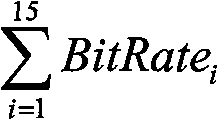
计算在15个TTI内,语音帧的个数
计算带宽资源 Computing Bandwidth Resources
6)流控中心将所有业务分配的带宽进行相加,得到一个话音业务分配总带宽WC,在下一个调度周期前,流控中心利用流控分配帧将WC发送给所有的业务6) The flow control center adds up the bandwidth allocated by all services to obtain a total voice service allocated bandwidth W C , and before the next scheduling cycle, the flow control center uses the flow control allocation frame to send W C to all services
7)对于每个业务i,在下一个调度周期中,如果有数据需要发送,只要WC>0,那么就发送相应的话音帧,并且WC=WC-MaxBitRate,直到WC为0(MaxBitRate为所有AMR业务预测带宽总和)7) For each service i, in the next scheduling cycle, if there is data to be sent, as long as W C > 0, then the corresponding voice frame is sent, and W C = W C -MaxBitRate, until W C is 0 (MaxBitRate sum of predicted bandwidths for all AMR traffic)
综上所述,本发明通过采用基于预测话音业务的非连续发射的流控方法,可以有效的利用WCDMA系统中有限的传输带宽资源,提高了系统地容量。To sum up, the present invention can effectively utilize the limited transmission bandwidth resource in the WCDMA system by adopting the flow control method based on the discontinuous transmission of the predicted voice service, and improves the system capacity.
Claims (1)
Priority Applications (1)
| Application Number | Priority Date | Filing Date | Title |
|---|---|---|---|
| CN2006100994826A CN101114988B (en) | 2006-07-24 | 2006-07-24 | Flow Control Algorithm Based on Discontinuous Transmission Prediction for Adaptive Multi-Rate Service |
Applications Claiming Priority (1)
| Application Number | Priority Date | Filing Date | Title |
|---|---|---|---|
| CN2006100994826A CN101114988B (en) | 2006-07-24 | 2006-07-24 | Flow Control Algorithm Based on Discontinuous Transmission Prediction for Adaptive Multi-Rate Service |
Publications (2)
| Publication Number | Publication Date |
|---|---|
| CN101114988A CN101114988A (en) | 2008-01-30 |
| CN101114988B true CN101114988B (en) | 2010-12-29 |
Family
ID=39023118
Family Applications (1)
| Application Number | Title | Priority Date | Filing Date |
|---|---|---|---|
| CN2006100994826A Expired - Fee Related CN101114988B (en) | 2006-07-24 | 2006-07-24 | Flow Control Algorithm Based on Discontinuous Transmission Prediction for Adaptive Multi-Rate Service |
Country Status (1)
| Country | Link |
|---|---|
| CN (1) | CN101114988B (en) |
Cited By (3)
| Publication number | Priority date | Publication date | Assignee | Title |
|---|---|---|---|---|
| US9019877B2 (en) | 2007-11-13 | 2015-04-28 | Blackberry Limited | Method and apparatus for state/mode transitioning |
| US9125208B2 (en) | 2008-11-10 | 2015-09-01 | Blackberry Limited | Method and apparatus of transition to a battery efficient state or configuration by indicating end of data transmission in long term evolution |
| US9467976B2 (en) | 2009-11-23 | 2016-10-11 | Blackberry Limited | Method and apparatus for state/mode transitioning |
Families Citing this family (6)
| Publication number | Priority date | Publication date | Assignee | Title |
|---|---|---|---|---|
| ES2377818T3 (en) | 2005-12-14 | 2012-04-02 | Research In Motion Limited | Method and apparatus for the control of radio resources directed to a user equipment in a UMTS network |
| US8644829B2 (en) | 2006-05-17 | 2014-02-04 | Blackberry Limited | Method and system for signaling release cause indication in a UMTS network |
| CN101355481B (en) * | 2008-09-23 | 2010-12-15 | 中国电信股份有限公司 | Method, platform and system for predicting digital user line access velocity |
| US20110122818A1 (en) | 2009-11-23 | 2011-05-26 | Research In Motion Limited | Method and apparatus for state/mode transitioning |
| US8983532B2 (en) | 2009-12-30 | 2015-03-17 | Blackberry Limited | Method and system for a wireless communication device to adopt varied functionalities based on different communication systems by specific protocol messages |
| CN102882804B (en) * | 2012-08-31 | 2015-12-16 | 北京讯鸟软件有限公司 | A kind of communication system of voice transfer bandwidth self-adaption and communication means |
Citations (3)
| Publication number | Priority date | Publication date | Assignee | Title |
|---|---|---|---|---|
| EP1416668A1 (en) * | 2002-11-04 | 2004-05-06 | Siemens Aktiengesellschaft | Method and apparatus for achieving an optimal response time in a telecommunication system |
| CN1604567A (en) * | 2003-10-01 | 2005-04-06 | 日本电气株式会社 | Data flow control system and method thereof |
| CN1728597A (en) * | 2004-07-28 | 2006-02-01 | 上海贝尔阿尔卡特股份有限公司 | Method and device for controlling flow rate in media access control layer of broadband CDMA system |
-
2006
- 2006-07-24 CN CN2006100994826A patent/CN101114988B/en not_active Expired - Fee Related
Patent Citations (3)
| Publication number | Priority date | Publication date | Assignee | Title |
|---|---|---|---|---|
| EP1416668A1 (en) * | 2002-11-04 | 2004-05-06 | Siemens Aktiengesellschaft | Method and apparatus for achieving an optimal response time in a telecommunication system |
| CN1604567A (en) * | 2003-10-01 | 2005-04-06 | 日本电气株式会社 | Data flow control system and method thereof |
| CN1728597A (en) * | 2004-07-28 | 2006-02-01 | 上海贝尔阿尔卡特股份有限公司 | Method and device for controlling flow rate in media access control layer of broadband CDMA system |
Non-Patent Citations (2)
| Title |
|---|
| 树涛,叶梧.ATM网络的ABR业务流量控制.华南理工大学学报28 10.2000,28(10),37-42. |
| 树涛,叶梧.ATM网络的ABR业务流量控制.华南理工大学学报28 10.2000,28(10),37-42. * |
Cited By (6)
| Publication number | Priority date | Publication date | Assignee | Title |
|---|---|---|---|---|
| US9019877B2 (en) | 2007-11-13 | 2015-04-28 | Blackberry Limited | Method and apparatus for state/mode transitioning |
| US9026153B2 (en) | 2007-11-13 | 2015-05-05 | Blackberry Limited | Method and apparatus for state/mode transitioning |
| US9037167B2 (en) | 2007-11-13 | 2015-05-19 | Blackberry Limited | Method and apparatus for state/mode transitioning |
| US9456436B2 (en) | 2007-11-13 | 2016-09-27 | Blackberry Limited | Method and apparatus for state/mode transitioning |
| US9125208B2 (en) | 2008-11-10 | 2015-09-01 | Blackberry Limited | Method and apparatus of transition to a battery efficient state or configuration by indicating end of data transmission in long term evolution |
| US9467976B2 (en) | 2009-11-23 | 2016-10-11 | Blackberry Limited | Method and apparatus for state/mode transitioning |
Also Published As
| Publication number | Publication date |
|---|---|
| CN101114988A (en) | 2008-01-30 |
Similar Documents
| Publication | Publication Date | Title |
|---|---|---|
| EP1692829B1 (en) | Quality of service scheduler for a wireless network | |
| CN103841052B (en) | A kind of bandwidth resource allocation System and method for | |
| US20070133407A1 (en) | Dynamic bandwidth allocation apparatus and method | |
| CN100454903C (en) | A method of flow control on IUB interface | |
| CN101184321A (en) | A method, system and device for adjusting user service quality | |
| CN106954232B (en) | Time delay optimized resource allocation method | |
| CN101114988B (en) | Flow Control Algorithm Based on Discontinuous Transmission Prediction for Adaptive Multi-Rate Service | |
| Korhonen et al. | Power-efficient streaming for mobile terminals | |
| CN101478486A (en) | Method, equipment and system for switch network data scheduling | |
| CN107204930B (en) | Token adding method and device | |
| CN102404778B (en) | Load estimation method | |
| CN101141158B (en) | Service types based power distribution method on reverse link power control channel | |
| CN101895960B (en) | Service admission control method and system | |
| CN102111888A (en) | Channel allocation method and device and system | |
| CN101090359B (en) | Flow Control Method Based on Discontinuous Transmission Prediction | |
| CN100459582C (en) | Group dispatching and channel distributing method for HSDPA system | |
| CN103152290B (en) | A kind of broadband multimedia satellite system Bandwidth Dynamic dispatching method | |
| CN102882804B (en) | A kind of communication system of voice transfer bandwidth self-adaption and communication means | |
| Kuo | Traffic scheduling for multimedia transmission over IEEE 802.11 e wireless LAN | |
| CN101965032B (en) | Access control method and device | |
| Guan et al. | Joint rate and BER scheduling resource allocation for wireless communication systems | |
| CN1996794A (en) | Uplink scheduling method for the media access control layer in the broadband code division multi-address system | |
| Lee et al. | Extended-rtPS+ considering characteristics of VoIP codecs in Mobile WiMAX | |
| CN102387551B (en) | Scheduling method | |
| CN100502585C (en) | Method for interface call admission control in communication system |
Legal Events
| Date | Code | Title | Description |
|---|---|---|---|
| C06 | Publication | ||
| PB01 | Publication | ||
| C10 | Entry into substantive examination | ||
| SE01 | Entry into force of request for substantive examination | ||
| C14 | Grant of patent or utility model | ||
| GR01 | Patent grant | ||
| CF01 | Termination of patent right due to non-payment of annual fee |
Granted publication date: 20101229 Termination date: 20150724 |
|
| EXPY | Termination of patent right or utility model |