CN101111047A - Method and system for communicating using a relay base station - Google Patents
Method and system for communicating using a relay base station Download PDFInfo
- Publication number
- CN101111047A CN101111047A CNA2006100994313A CN200610099431A CN101111047A CN 101111047 A CN101111047 A CN 101111047A CN A2006100994313 A CNA2006100994313 A CN A2006100994313A CN 200610099431 A CN200610099431 A CN 200610099431A CN 101111047 A CN101111047 A CN 101111047A
- Authority
- CN
- China
- Prior art keywords
- base station
- relay base
- relay
- terminal
- serving base
- Prior art date
- Legal status (The legal status is an assumption and is not a legal conclusion. Google has not performed a legal analysis and makes no representation as to the accuracy of the status listed.)
- Granted
Links
Images


Landscapes
- Mobile Radio Communication Systems (AREA)
Abstract
本发明公开了一种利用中继基站进行通信的方法,其特征在于,在无线通信网络中接入一个或多个级连的中继基站,与服务基站无线连接,当服务基站通过中继基站与用户终端通信时,执行步骤:服务基站或用户终端发送数据到所述中继基站;所述中继基站将服务基站发送的数据发送到用户终端,将用户终端发送的数据发送到服务基站。采用本发明方法,可降低基站的建设成本,并且提高无线通信系统布网的灵活性。
The invention discloses a communication method using a relay base station, which is characterized in that one or more cascaded relay base stations are connected to a wireless communication network, and wirelessly connected with a serving base station, when the serving base station passes through the relay base station When communicating with the user terminal, the steps are: the serving base station or the user terminal sends data to the relay base station; the relay base station sends the data sent by the serving base station to the user terminal, and sends the data sent by the user terminal to the serving base station. By adopting the method of the invention, the construction cost of the base station can be reduced, and the flexibility of network deployment of the wireless communication system can be improved.
Description
技术领域technical field
本发明涉及无线通信领域,尤其涉及一种利用中继基站进行通信的方法和含有中继基站的通信系统。The invention relates to the field of wireless communication, in particular to a communication method using a relay base station and a communication system including the relay base station.
背景技术Background technique
当前的无线蜂窝网络和无线城域网,如全球移动通信系统(Global SystemMobile,GSM)、通用移动通信系统(Universal Mobile TelecommunicationsSystem,UMTS)和无线城域网络(Worldwide Interoperability for MicrowaveAccess,WiMAX)等,是由许多实体、接口组成的复杂的系统。The current wireless cellular network and wireless metropolitan area network, such as Global System Mobile Communications (Global SystemMobile, GSM), Universal Mobile Telecommunications System (Universal Mobile Telecommunications System, UMTS) and Wireless Metropolitan Area Network (Worldwide Interoperability for MicrowaveAccess, WiMAX), etc., are A complex system composed of many entities and interfaces.
模拟蜂窝系统被称为第一代蜂窝通信系统。Analog cellular systems are known as first generation cellular communication systems.
参见图1,为现有技术中典型的无线蜂窝网络模型示意图。终端用户(如手机、PDA和笔记本电脑等)通过无线电空口与基站连接,基站通过线缆与连接服务网(Connection Service Network,CSN)连接,将数据传送到核心网络中。Referring to FIG. 1 , it is a schematic diagram of a typical wireless cellular network model in the prior art. End users (such as mobile phones, PDAs, and laptops) are connected to the base station through radio air interfaces, and the base station is connected to the Connection Service Network (CSN) through cables to transmit data to the core network.
当前应用的数字通信系统,如GSM、个人数字通信(Personal DigitalCommunication,PDC)、码分多址系统cdmaOne(IS-95)和时分多址系统US-TDMA(IS-136)是第二代通信系统,这些系统将无线语音通信用于主导市场中。GSM系统支持8个时隙的用户,每一个是200kHz无线电信道。它在蜂窝网和个人通信网(Personal Communication System,PCS)中被欧洲、亚洲、澳大利亚、南美和美国部分地区的服务提供商广泛应用。Currently applied digital communication systems, such as GSM, Personal Digital Communication (PDC), code division multiple access system cdmaOne (IS-95) and time division multiple access system US-TDMA (IS-136) are the second generation communication systems , these systems use wireless voice communication in the dominant market. The GSM system supports users in 8 time slots, each of which is a 200 kHz radio channel. It is widely used by service providers in Europe, Asia, Australia, South America and parts of the United States in cellular networks and personal communication systems (Personal Communication System, PCS).
由于第二代通信系统的处理能力受限,需要第三代通信系统来提供高比特率服务,用来收发高质量的图像和视频,第三代系统要求用于多媒体通信中。Due to the limited processing capability of the second-generation communication system, the third-generation communication system is required to provide high-bit-rate services for sending and receiving high-quality images and videos, and the third-generation system is required for multimedia communication.
UMTS网络和WiMAX系统是第三代移动技术。UMTS网络可以用高达2Mbps的速率传递数据。除了传递语音和数据,UMTS通过固定、无线和卫星系统,传递音频和视频到世界任何一个地方的无线设备上。UMTS networks and WiMAX systems are third generation mobile technologies. UMTS networks can deliver data at rates up to 2Mbps. In addition to delivering voice and data, UMTS delivers audio and video to wireless devices anywhere in the world through fixed, wireless and satellite systems.
基于IEEE802.16空口标准的WiMAX技术在宽带无线城域网中起重要作用。2005年11月,IEEE批准了802.16e对于802.16标准的修正,这个修正增加了对移动特性的支持,因此基于802.16e空口的WiMAX也具有了移动性。除了定义空口,WiMAX论坛也定义了端到端的移动WiMAX系统的必要网络结构。WiMAX technology based on IEEE802.16 air interface standard plays an important role in broadband wireless metropolitan area network. In November 2005, IEEE approved the 802.16e amendment to the 802.16 standard. This amendment adds support for mobility features, so WiMAX based on the 802.16e air interface also has mobility. In addition to defining the air interface, the WiMAX Forum also defines the necessary network structure for an end-to-end mobile WiMAX system.
参见图2,为现有技术中WiMAX网络参考模型。WiMAX网络由终端、接入服务网(Access Service Network,ASN)、连接服务网(Connectivity ServiceNetwork,CSN),还有一些接口组成。Referring to FIG. 2 , it is a WiMAX network reference model in the prior art. The WiMAX network consists of terminals, Access Service Network (ASN), Connectivity Service Network (CSN), and some interfaces.
ASN定义了一个逻辑边界,用一个比较便利的方式来描述功能模块的集合和与接入服务相对应的消息流。例如UMTS网络中的基站(NodeB)和无线网络控制器(RNC),GSM网络中的基站(BTS)和基站控制器(BSC)。ASN defines a logical boundary, and uses a more convenient way to describe the collection of functional modules and the message flow corresponding to the access service. For example, a base station (NodeB) and a radio network controller (RNC) in a UMTS network, and a base station (BTS) and a base station controller (BSC) in a GSM network.
CSN被定义为一组提供IP连接服务的网络功能。CSN可以由路由器、认证、授权和计费(Authentication,Authorization and Accounting,AAA)服务器、用户数据库和因特网网关等设备的网络元件组成。A CSN is defined as a set of network functions that provide IP connectivity services. CSN can be composed of network elements such as routers, authentication, authorization and accounting (Authentication, Authorization and Accounting, AAA) servers, user databases and Internet gateways.
从图1和图2中可以看出,ASN和用户终端之间的通信由基站转发,基站与ASN之间通过线缆连接,因此,在现有的无线蜂窝网络和无线城域网中建设基站主要有以下缺点:It can be seen from Figure 1 and Figure 2 that the communication between the ASN and the user terminal is forwarded by the base station, and the base station and the ASN are connected by a cable. Therefore, building a base station in the existing wireless cellular network and wireless metropolitan area network There are mainly the following disadvantages:
(1)搭建线缆成本高。由于通信负载非均匀分布(如城市、郊区和乡村通信负载分布不均匀),因此需要在负载较大的地区设置较多的基站,每个基站与ASN通过线缆连接,将会导致建站的线缆成本提高。(1) The cost of building cables is high. Due to the non-uniform distribution of communication loads (such as uneven distribution of communication loads in cities, suburbs, and rural areas), it is necessary to set up more base stations in areas with heavy loads. Cable costs increase.
(2)容错(Fault Tolerant)服务很难。为了保证用户业务的正常进行,每个基站都要进行容错设置,如通过冗余设备、backhaul回程、备份功率实现容错,容错设备的造价较高。因此,当负载大的地区需要搭建较多基站时,容错成本将十分昂贵。(2) Fault Tolerant (Fault Tolerant) service is difficult. In order to ensure the normal operation of user services, each base station must implement fault-tolerant settings, such as redundant equipment, backhaul, and backup power to achieve fault tolerance, and the cost of fault-tolerant equipment is relatively high. Therefore, when more base stations need to be built in areas with heavy loads, the cost of fault tolerance will be very expensive.
(3)布网不够灵活,不能保证用户业务的正常使用。由于基站的安装受地理、地势的影响,导致基站的覆盖范围会受到环境的影响,如建筑物的山谷地区、地下铁路和室内环境等原因造成覆盖空洞,导致该地区的用户无法正常使用无线业务。(3) The network deployment is not flexible enough to guarantee the normal use of user services. Because the installation of the base station is affected by geography and terrain, the coverage of the base station will be affected by the environment, such as the valley area of the building, the underground railway, and the indoor environment, resulting in coverage holes, resulting in users in this area being unable to use wireless services normally. .
本发明还涉及到网络结构的OSI模型以及WiMAX OFDMA帧结构,下面对这两项技术进行简单介绍。The present invention also relates to the OSI model of the network structure and the WiMAX OFDMA frame structure, and these two technologies are briefly introduced below.
参见图3,为现有蜂窝通信网络和无线城域网的OSI模型结构示意图。Referring to FIG. 3 , it is a schematic structural diagram of an OSI model of an existing cellular communication network and a wireless metropolitan area network.
为了描述数据在网络中的传递过程,定义了现有蜂窝网络和无线城域网络的开放系统互联(Open System Interconnect Reference Mode,OSI)模型。OSI模型结构通常也被称为协议栈结构。OSI模型定义了七层结构,用以描述各种应用是如何在可以互相通信的网络设备上工作的。这七层分别为物理层(PHY)、媒体接入控制层(MAC)、网络层(Network)、传输层(Transport)、会话层(Session)、描述层(Description)和应用层(Application),但是现在的网络中通常将这个模型简化为如图3所示的五层模型。In order to describe the transfer process of data in the network, the Open System Interconnect Reference Mode (OSI) model of the existing cellular network and wireless metropolitan area network is defined. The OSI model structure is also commonly referred to as the protocol stack structure. The OSI model defines a seven-layer structure to describe how various applications work on network devices that can communicate with each other. The seven layers are physical layer (PHY), media access control layer (MAC), network layer (Network), transport layer (Transport), session layer (Session), description layer (Description) and application layer (Application), However, in current networks, this model is usually simplified to a five-layer model as shown in Figure 3 .
层1是物理层,它定义了网络的物理和电子特性;层2是MAC层(或数据链路层),它定义了分享物理媒体的接入方式,包括数据连接和媒体接入等方面;层3是网络层,它提供通信开放系统以建立、保持和完成网络连接的方式,IP协议在这一层中,还有一些路由协议,所有的路由器都在这一层中;层4是传输层,TCP在这层中,这一层替换了会话层来保证数据的可靠性和集成性,这一层只需要软件操作;最后是应用层,在这里有最终的用户和最终的应用协议,例如telnet、ftp和mail。图3中,将网络层、传输层和应用层用上层(Upper Layer)表示。
如图3所示,终端(SS/MS)发送的数据包从应用层下来到达物理层,物理层通过空口R1与基站(BS)的物理层连接,通过MAC层进行媒体接入控制;基站通过线缆将数据传输到ASN-GW中;在ASN-GW中,数据再由物理层上升到高层中。As shown in Figure 3, the data packet sent by the terminal (SS/MS) reaches the physical layer from the application layer. The physical layer is connected to the physical layer of the base station (BS) through the air interface R1, and the media access control is performed through the MAC layer; The cable transmits the data to the ASN-GW; in the ASN-GW, the data rises from the physical layer to the upper layer.
参见图4,为现有技术中WiMAX OFDMA帧结构示意图。Referring to FIG. 4, it is a schematic diagram of a WiMAX OFDMA frame structure in the prior art.
IEEE 802.16标准支持时分双工(Time division duplex,TDD)、频分双工(Frequency division duplex,FDD)和半频分双工(H-FDD)模式,在TDD模式下点到多点(Point to Multipoint,PMP)的正交频分多址(Orthogonal FrequencyDivision Multiplexing Access,OFDMA)帧(frame)结构如图4所示。The IEEE 802.16 standard supports time division duplex (Time division duplex, TDD), frequency division duplex (Frequency division duplex, FDD) and half frequency division duplex (H-FDD) modes, point to multipoint (Point to multipoint) in TDD mode The Orthogonal Frequency Division Multiplexing Access (OFDMA) frame (frame) structure of Multipoint (PMP) is shown in FIG. 4 .
在WiMAX OFDMA帧中,每一个帧被分为上行和下行子帧,在每一个帧中,发收间隔(TTG)被插入到下行和上行之间,表示基站在发送和接收状态之间的转换;收发间隔(RTG)被插在每一个上行子帧之后,下一帧之前,表示基站在接收和发送状态之间的转换,同时用来避免上行和下行中的传输冲突。下行传输帧由前导(Preamble)开始,用于终端的初始同步,是帧中的第一个OFDMA符号;帧控制头(Frame Control Header,FCH)提供帧的配置信息,例如下行MAP(DL-MAP)长度、编码方式和可用子信道等;下行/上行MAP(DL/UL-MAP)给出了子信道分配和其它下行/上行子帧的控制信息;下行子帧中的突发(burst)用来给用户发送数据;上行子帧中的burst是由用户发送给基站的数据;上行确认(UL ACK)分配给终端用作对混合自动重复请求(Hybrid Automatic Repeat Request,HARQ)确认的反馈;上行链路质量反馈信息信道(UL CQICH)是终端用来反馈信道状况信息的;测距(Ranging)子信道分配给终端用来执行闭环时间、频率、能量,以及带宽调节。In a WiMAX OFDMA frame, each frame is divided into uplink and downlink subframes, and in each frame, a transmit-receive gap (TTG) is inserted between the downlink and uplink to indicate the transition between the base station’s sending and receiving states ; The Transceiver Gap (RTG) is inserted after each uplink subframe and before the next frame, indicating the transition between the receiving and sending states of the base station, and at the same time used to avoid transmission conflicts in uplink and downlink. The downlink transmission frame starts with the preamble (Preamble), which is used for initial synchronization of the terminal and is the first OFDMA symbol in the frame; the frame control header (Frame Control Header, FCH) provides frame configuration information, such as downlink MAP (DL-MAP ) length, encoding method and available sub-channels, etc.; the downlink/uplink MAP (DL/UL-MAP) provides sub-channel allocation and other downlink/uplink subframe control information; the burst in the downlink subframe (burst) uses To send data to the user; the burst in the uplink subframe is the data sent by the user to the base station; the uplink acknowledgment (UL ACK) is allocated to the terminal as a feedback for the Hybrid Automatic Repeat Request (HARQ) confirmation; the uplink The channel quality feedback information channel (UL CQICH) is used by the terminal to feed back channel status information; the ranging (Ranging) sub-channel is allocated to the terminal to perform closed-loop time, frequency, energy, and bandwidth adjustment.
发明内容Contents of the invention
本发明提供一种利用中继基站进行通信的方法,用以解决现有技术中无线通信系统基站建设成本高、布网不灵活的问题,以及用户终端和基站间的通信得不到有效保证得问题。The present invention provides a communication method using a relay base station, which is used to solve the problems of high construction cost and inflexible network deployment of wireless communication system base stations in the prior art, and the communication between user terminals and base stations cannot be effectively guaranteed. question.
本发明另提供一种含有中继基站的通信系统。The present invention further provides a communication system including a relay base station.
本发明方法包括步骤:The inventive method comprises steps:
在无线通信网络中接入一个或多个级连的中继基站,与服务基站和用户终端无线连接,服务基站通过中继基站与用户终端通信时,执行步骤:One or more cascaded relay base stations are connected to the wireless communication network, wirelessly connected with the serving base station and the user terminal, and when the serving base station communicates with the user terminal through the relay base station, the following steps are performed:
服务基站或用户终端发送数据到所述中继基站;The serving base station or the user terminal sends data to the relay base station;
所述中继基站将服务基站发送的数据发送到用户终端,将用户终端发送的数据发送到服务基站。The relay base station sends the data sent by the serving base station to the user terminal, and sends the data sent by the user terminal to the serving base station.
根据本发明的上述方法,所述中继基站从直接与服务基站连接的中继基站开始逐级接入网络。According to the above method of the present invention, the relay base station accesses the network step by step starting from the relay base station directly connected to the serving base station.
所述中继基站逐级接入网络,包括步骤:The relay base station accesses the network step by step, including the steps of:
所述中继基站与其上一级基站建立同步后,向其发起注册请求,携带自身标识;After the relay base station establishes synchronization with its upper-level base station, it initiates a registration request to it, carrying its own identity;
其上一级基站收到注册请求后记录所述中继基站的标识,并After receiving the registration request, the upper level base station records the identity of the relay base station, and
若收到注册请求的基站为服务基站,则向网络侧转发所述注册请求,对发起注册请求的中继基站进行注册;若收到注册请求的基站为中继基站,则通过至少一级中继基站将所述注册请求转发到服务基站,并由服务基站转发所述注册请求到网络侧,对发起注册请求的中继基站进行注册。If the base station that received the registration request is a serving base station, forward the registration request to the network side, and register the relay base station that initiated the registration request; if the base station that received the registration request is a relay base station, pass at least one intermediate The relay base station forwards the registration request to the serving base station, and the serving base station forwards the registration request to the network side, and registers the relay base station that initiated the registration request.
所述中继基站根据预设的频率列表扫描下行信道,与对应的服务基站或其上一级的中继基站建立同步。The relay base station scans downlink channels according to a preset frequency list, and establishes synchronization with the corresponding serving base station or its superior relay base station.
根据本发明的上述方法,服务基站向用户终端发送包含终端标识的下行数据时,将下行数据发送到与该终端标识对应的用户终端或中继基站;According to the above method of the present invention, when the serving base station sends the downlink data including the terminal identifier to the user terminal, the downlink data is sent to the user terminal or the relay base station corresponding to the terminal identifier;
所述中继基站根据该终端标识,通过至少一级中继基站将下行数据发送到对应的用户终端。The relay base station sends the downlink data to the corresponding user terminal through at least one level of relay base station according to the terminal identifier.
上述方法中,所述服务基站或中继基站通过查询其终端标识列表,将下行数据发送到对应的中继基站或用户终端。In the above method, the serving base station or relay base station sends downlink data to the corresponding relay base station or user terminal by querying its terminal identification list.
服务基站或中继基站的终端标识列表的建立过程为:The process of establishing the terminal identification list of the serving base station or relay base station is as follows:
所述服务基站或中继基站为其所辖的用户终端分配终端标识并记录在服务基站或中继基站的终端列表中;或The serving base station or relay base station assigns terminal identifiers to user terminals under its jurisdiction and records them in the terminal list of the serving base station or relay base station; or
接收其下级中继基站发送的终端标识,记录在其终端列表中,并与发送该终端标识的中继基站的标识相对应。Receive the terminal identification sent by its subordinate relay base station, record it in its terminal list, and correspond to the identification of the relay base station that sent the terminal identification.
当服务基站、中继基站或终端标识改变时,更新所述终端标识列表。When the identity of the serving base station, the relay base station or the terminal changes, the terminal identity list is updated.
根据本发明的上述方法,用户终端通过中继基站向服务基站发送上行数据时,管辖所述用户终端的中继基站接收该上行数据,并通过至少一级中继基站将该上行数据发送到服务基站。According to the above method of the present invention, when the user terminal sends uplink data to the serving base station through the relay base station, the relay base station in charge of the user terminal receives the uplink data, and sends the uplink data to the serving base station through at least one level of relay base station base station.
根据本发明的上述方法,当所述通信网络为蜂窝网络,并采用时分双工与半频分双工相结合的双工方式发送上/下行子帧时,执行步骤:According to the above method of the present invention, when the communication network is a cellular network, and a duplex mode combining time division duplex and half frequency division duplex is used to transmit the uplink/downlink subframe, the steps are:
在服务基站的帧头前导,服务基站发起和与其直接连接的中继基站的同步,并由该中继基站通过至少一级中继基站完成各中继基站与其下一级中继基站的同步;Before the frame header of the serving base station, the serving base station initiates synchronization with the relay base station directly connected to it, and the relay base station completes the synchronization between each relay base station and its next-level relay base station through at least one relay base station;
服务基站发送下行数据突发,并通过至少一级中继基站将其发送到对应的用户终端。The serving base station sends the downlink data burst, and sends it to the corresponding user terminal through at least one level of relay base station.
上述方法中,服务基站和中继基站发送长度固定的通信帧头完成与其下一级中继基站的同步。In the above method, the serving base station and the relay base station send a fixed-length communication frame header to complete synchronization with the relay base station at the next level.
上述方法中,在服务基站发送下行数据突发前,服务基站和各中继基站发起与各自所辖的用户终端的同步。In the above method, before the serving base station sends downlink data bursts, the serving base station and each relay base station initiate synchronization with the user terminals under their respective jurisdictions.
根据本发明的上述方法,当所述通信网络为蜂窝网络,并采用时分双工与半频分双工相结合的双工方式发送上/下行子帧时,执行步骤:According to the above method of the present invention, when the communication network is a cellular network, and a duplex mode combining time division duplex and half frequency division duplex is used to transmit the uplink/downlink subframe, the steps are:
在服务基站的帧头前导,服务基站发起和与其直接连接的中继基站的同步,并向其发送下行数据突发;Before the frame header of the serving base station, the serving base station initiates synchronization with the relay base station directly connected to it, and sends a downlink data burst to it;
与服务基站直接连接的中继基站发送帧头给其下一级中继基站进行同步,并向其发送下行数据突发。The relay base station directly connected to the serving base station sends a frame header to its next-level relay base station for synchronization, and sends downlink data bursts to it.
上述方法中,所述中继基站根据接收到的通信帧头计算与其所辖的用户终端进行同步的通信帧头。In the above method, the relay base station calculates the communication frame header for synchronization with the user terminal under its jurisdiction according to the received communication frame header.
本发明提供的通信系统,包括:The communication system provided by the present invention includes:
用户终端、接入服务网和连接服务网;所述接入服务网包括服务基站,还包括一个或多个级连的中继基站,与服务基站和用户终端无线连接;A user terminal, an access service network, and a connection service network; the access service network includes a serving base station, and also includes one or more cascaded relay base stations, which are wirelessly connected to the serving base station and the user terminal;
所述中继基站接收所述服务基站发送的下行数据,并发送到所述用户终端;或The relay base station receives the downlink data sent by the serving base station, and sends it to the user terminal; or
接收所述用户终端发送的上行数据,并发送到所述服务基站。receiving the uplink data sent by the user terminal, and sending it to the serving base station.
上述系统中,所述中继基站包括一终端标识存储单元,存储该中继基站为用户分配的终端标识,或/和与该中继基站的下一级中继基站标识对应的终端标识;In the above system, the relay base station includes a terminal identification storage unit, which stores the terminal identification assigned by the relay base station to the user, or/and the terminal identification corresponding to the next-level relay base station identification of the relay base station;
当所述中继基站接收到其下一级中继基站发起的网络接入注册请求后,在所述终端标识存储单元存储该下一级中继基站的标识;After the relay base station receives the network access registration request initiated by its next-level relay base station, store the identity of the next-level relay base station in the terminal identification storage unit;
当所述中继基站接收到其下一级中继基站发送的终端标识后,在所述终端标识存储单元存储该终端标识,并与发送该终端标识的中继基站的标识相对应;After the relay base station receives the terminal identifier sent by its next-level relay base station, store the terminal identifier in the terminal identifier storage unit, and correspond to the identifier of the relay base station that sent the terminal identifier;
当所述中继基站接收到包含终端标识的下行数据后,通过查询所述终端标识存储单元,将下行数据发送到对应的中继基站或对应的用户终端。After receiving the downlink data including the terminal identifier, the relay base station sends the downlink data to the corresponding relay base station or the corresponding user terminal by querying the terminal identifier storage unit.
所述中继基站包括一终端标识分配单元,根据用户终端的请求分配终端标识并存储到所述终端标识存储单元。The relay base station includes a terminal identification allocation unit, which allocates a terminal identification according to a user terminal's request and stores it in the terminal identification storage unit.
上述系统中,所述中继基站包括一频率扫描单元;In the above system, the relay base station includes a frequency scanning unit;
当所述中继基站接入网络时,所述频率扫描单元根据其中预设的频率列表扫描下行信道,并与相应的服务基站或其上一级中继基站建立同步。When the relay base station accesses the network, the frequency scanning unit scans the downlink channel according to the preset frequency list, and establishes synchronization with the corresponding serving base station or its superior relay base station.
上述系统中,所述服务基站包括一终端标识存储单元,存储该服务基站为用户终端分配的终端标识,或/和与该服务基站的下一级中继基站标识对应的终端标识;In the above system, the serving base station includes a terminal identification storage unit, which stores the terminal identification assigned by the serving base station to the user terminal, or/and the terminal identification corresponding to the next-level relay base station identification of the serving base station;
当服务基站接收到与其直接连接的中继基站发起的网络接入注册请求后,在所述终端标识存储单元存储该中继基站的标识;After the serving base station receives the network access registration request initiated by the relay base station directly connected to it, store the identifier of the relay base station in the terminal identifier storage unit;
当服务基站接收到与其直接连接的中继基站发送的终端标识后,在所述终端标识存储单元存储该终端标识,并与发送该终端标识的中继基站的标识相对应;After the serving base station receives the terminal identification sent by the relay base station directly connected to it, store the terminal identification in the terminal identification storage unit, and correspond to the identification of the relay base station sending the terminal identification;
当服务基站向用户终端发送包含终端标识的下行数据时,查询所述终端标识存储单元,将下行数据发送到对应的中继基站或对应的用户终端。When the serving base station sends downlink data including the terminal identifier to the user terminal, it queries the terminal identifier storage unit, and sends the downlink data to the corresponding relay base station or the corresponding user terminal.
上述系统中,所述服务基站和其下一级中继基站还各包括一资源分配单元;In the above system, the serving base station and its next-level relay base station each further include a resource allocation unit;
所述服务基站中的资源分配单元分别为其下一级中继基站和该服务基站所辖的用户终端分配通信资源;The resource allocation unit in the serving base station allocates communication resources to its next-level relay base station and user terminals under the jurisdiction of the serving base station;
所述中继基站中的资源分配单元分别为其下一级中继基站和该中继基站所管辖的用户终端分配通信资源。The resource allocation unit in the relay base station allocates communication resources to its subordinate relay base station and the user terminal under the jurisdiction of the relay base station respectively.
本发明的有益效果如下:The beneficial effects of the present invention are as follows:
(1)本发明是在现有通信系统中引入中继基站,从而降低基站的建设成本,并且提高布网的灵活性,有效保证用户终端和基站间的通信。(1) The present invention introduces a relay base station into the existing communication system, thereby reducing the construction cost of the base station, improving the flexibility of network deployment, and effectively ensuring the communication between the user terminal and the base station.
(2)本发明提供的含有中继基站的通信系统能够与现有蜂窝网络和无线城域网络系统相兼容。(2) The communication system including the relay base station provided by the present invention can be compatible with existing cellular network and wireless metropolitan area network system.
(3)本发明在现有通信系统中引入中继基站后,由于终端离中继基站的距离比普通基站近,比较可能形成直视信号,从而减小传输损耗,因此,能够减小终端发射功率,从而延长终端电池寿命。(3) After the present invention introduces the relay base station into the existing communication system, since the distance between the terminal and the relay base station is closer than that of the ordinary base station, it is more likely to form a direct-view signal, thereby reducing the transmission loss, therefore, it can reduce the transmission of the terminal. power, thus prolonging terminal battery life.
附图说明Description of drawings
图1为现有技术中典型的无线蜂窝网络模型示意图;Fig. 1 is a schematic diagram of a typical wireless cellular network model in the prior art;
图2为现有技术中WiMAX网络参考模型;FIG. 2 is a WiMAX network reference model in the prior art;
图3为现有蜂窝通信网络和无线城域网的OSI模型结构示意图;Fig. 3 is the OSI model structure schematic diagram of existing cellular communication network and wireless metropolitan area network;
图4为现有技术中WiMAX OFDMA帧结构示意图;FIG. 4 is a schematic diagram of a WiMAX OFDMA frame structure in the prior art;
图5为本发明引入中继基站的蜂窝网络系统结构示意图;FIG. 5 is a schematic structural diagram of a cellular network system in which a relay base station is introduced in the present invention;
图6为本发明引入中继基站的协议栈结构示意图;FIG. 6 is a schematic structural diagram of a protocol stack introduced into a relay base station in the present invention;
图7为本发明中继基站接入网络的过程示意图;FIG. 7 is a schematic diagram of a process of accessing a network by a relay base station according to the present invention;
图8为本发明RBS与ASN-GW数据传输方式示意图;FIG. 8 is a schematic diagram of the RBS and ASN-GW data transmission method of the present invention;
图9为本发明的通信系统中的中继基站结构示意图;FIG. 9 is a schematic structural diagram of a relay base station in the communication system of the present invention;
图10为本发明的通信系统中的服务基站结构示意图;FIG. 10 is a schematic structural diagram of a serving base station in the communication system of the present invention;
图11为本发明WiMAX系统引入中继基站的帧结构示意图之一;FIG. 11 is one of the frame structure schematic diagrams of introducing the relay base station into the WiMAX system of the present invention;
图12为本发明WiMAX系统引入中继基站的帧结构示意图之二;FIG. 12 is the second schematic diagram of the frame structure introduced into the relay base station in the WiMAX system of the present invention;
图13为本发明小区中一个服务基站带有6个中继基站的示意图。FIG. 13 is a schematic diagram of a serving base station with 6 relay base stations in a cell according to the present invention.
具体实施方式Detailed ways
本发明是在现有蜂窝通信系统中引入中继基站(Relay Base Station,RBS),从而降低基站的建设成本,并且提高布网的灵活性。The present invention introduces a relay base station (Relay Base Station, RBS) into the existing cellular communication system, thereby reducing the construction cost of the base station and improving the flexibility of network deployment.
中继基站的功能与普通基站(为了与传统的基站相区别,在此将传统的基站称为普通基站,以下同)的功能类似,不同之处在于中继基站通过无线接口与普通基站连接,并通过普通基站转发它与ASN-GW之间的数据。转发中继基站和ASN-GW之间数据通信的普通基站称为服务基站(Serving Base Station,SBS)。The function of the relay base station is similar to that of the ordinary base station (in order to distinguish it from the traditional base station, the traditional base station is called the ordinary base station, the same below), the difference is that the relay base station is connected to the ordinary base station through a wireless interface, And forward the data between it and the ASN-GW through the common base station. The ordinary base station that forwards the data communication between the relay base station and the ASN-GW is called the serving base station (Serving Base Station, SBS).
参见图5,为本发明引入中继基站的通信网络系统结构示意图。图5所示的通信网络可以是蜂窝网络系统或无线城域网系统,包括用户终端、接入服务网ASN和连接服务网CSN。其中,ASN包括服务基站和中继基站,服务基站与ASN-GW通过线缆连接,中继基站与用户终端和服务基站之间无线连接。系统支持多跳(multi-hop)的基站连接,即服务基站下连接有一级或级连多级中继基站,每级包含一个或多个中继基站。服务基站和中继基站与各自管辖区域内的用户终端无线连接。Referring to FIG. 5 , it is a schematic structural diagram of a communication network system in which a relay base station is introduced in the present invention. The communication network shown in FIG. 5 may be a cellular network system or a wireless metropolitan area network system, including user terminals, an access service network ASN and a connection service network CSN. Wherein, the ASN includes a serving base station and a relay base station, the serving base station is connected to the ASN-GW through a cable, and the relay base station is wirelessly connected to the user terminal and the serving base station. The system supports multi-hop base station connections, that is, there are one or more cascaded relay base stations connected under the serving base station, and each stage contains one or more relay base stations. The serving base station and the relay base station are wirelessly connected to user terminals within their respective jurisdictions.
上述系统适用于采用时分双工、频分双工以及半频分双工的方式通信。当采用频分双工方式时,服务基站和与其直接连接的中继基站间采用一专用的频带(文中所提到的频带,也可以是载频,以下同)进行通信。各基站(包括普通基站与中继基站)为终端提供服务时,可以采用相同的频带,也可以采用不同的频带,由运营商根据网络规划确定。The above-mentioned system is suitable for communication in the manner of time division duplex, frequency division duplex and half frequency division duplex. When frequency division duplexing is adopted, the serving base station and the relay base station directly connected to it use a dedicated frequency band (the frequency band mentioned in the text can also be a carrier frequency, the same below) for communication. When each base station (including common base stations and relay base stations) provides services for terminals, they may use the same frequency band or different frequency bands, which are determined by the operator according to network planning.
如果终端位于普通基站的覆盖范围内,则它与普通基站直接通信;如果终端在中继基站覆盖范围内,它与中继基站和普通基站的通信方式完全相同,只不过中继基站需要再与服务基站进行无线通信,通过服务基站与ASN-GW进行通信。If the terminal is within the coverage of a normal base station, it communicates directly with the normal base station; if the terminal is within the coverage of a relay base station, it communicates with the relay base station and the normal base station in exactly the same way, except that the relay base station needs to communicate with the normal base station The serving base station performs wireless communication, and communicates with the ASN-GW through the serving base station.
由于系统引入中继基站,需要对原有协议栈结构进行修改。Since the system introduces the relay base station, the original protocol stack structure needs to be modified.
参见图6,为本发明引入中继基站的协议栈结构示意图。此系统中将延用原IEEE 802.16协议中的终端,终端与基站或者中继基站之间的接口保持一致。服务基站与中继基站通过空口连接,并通过MAC层进行接入控制。服务基站和中继基站都包含了物理层和RBS-MAC层。服务基站和ASN-GW之间的接口和协议栈结构保持不变。Referring to FIG. 6 , it is a schematic structural diagram of a protocol stack of a relay base station introduced in the present invention. In this system, the terminal in the original IEEE 802.16 protocol will continue to be used, and the interface between the terminal and the base station or the relay base station will be consistent. The serving base station is connected to the relay base station through an air interface, and performs access control through the MAC layer. Both the serving base station and the relay base station include a physical layer and an RBS-MAC layer. The interface and protocol stack structure between the serving base station and the ASN-GW remain unchanged.
终端与中继基站的通信协议与现有协议相同。当用户终端与中继基站通信时,中继基站将数据通过空口传给服务基站,服务基站将中继基站和该服务基站自身的数据通过线缆传输给ASN-GW,再到核心网中进行下一步处理。The communication protocol between the terminal and the relay base station is the same as the existing protocol. When the user terminal communicates with the relay base station, the relay base station transmits the data to the serving base station through the air interface, and the serving base station transmits the data of the relay base station and the serving base station itself to the ASN-GW through the cable, and then transmits the data to the core network. Next step.
中继基站是新引入的设备,它通过无线链路经服务基站接入网络,其接入网络的过程如图7所示。The relay base station is a newly introduced device. It accesses the network through the serving base station through a wireless link. The process of accessing the network is shown in Figure 7.
参见图7,为本发明中继基站接入网络的过程示意图,具体步骤包括:Referring to Figure 7, it is a schematic diagram of the process of accessing the network by the relay base station of the present invention, and the specific steps include:
a、中继基站按照预先定义好的频率列表扫描下行信道,与相应的服务基站建立同步。a. The relay base station scans the downlink channel according to the predefined frequency list, and establishes synchronization with the corresponding serving base station.
中继基站通常应用一个或几个配置好的普通基站作为其服务基站,并将这些普通基站的无线电频率以频率列表形式保存。这些普通基站中预先给定一组操作参数,用于与中继基站建立连接。当中继基站按照频率列表扫描下行信道时,中继基站根据信道情况,选择一个基站作为其服务基站。The relay base station usually uses one or several configured common base stations as its serving base stations, and saves the radio frequencies of these common base stations in the form of a frequency list. A set of operating parameters are predetermined in these common base stations for establishing a connection with the relay base station. When the relay base station scans downlink channels according to the frequency list, the relay base station selects a base station as its serving base station according to channel conditions.
b、中继基站找到下行信道,并且在物理级上同步后,中继基站的MAC层寻找下行信道描述符(DL Channel Descriptor,DCD)和上行信道描述符(ULChannel Descriptor,UCD),用以获得调制参数和其它上下行参数,其中,FCH中分配的子信道是专门分配给该中继基站,用作该中继基站和服务基站之间的通信。b. After the relay base station finds the downlink channel and synchronizes on the physical level, the MAC layer of the relay base station searches for the downlink channel descriptor (DL Channel Descriptor, DCD) and the uplink channel descriptor (ULChannel Descriptor, UCD) to obtain Modulation parameters and other uplink and downlink parameters, wherein the subchannel allocated in the FCH is specially allocated to the relay base station for communication between the relay base station and the serving base station.
c、中继基站与服务基站的下行信道同步,并且获得一帧的DL/UL-MAP后,该中继基站开始进行初始Ranging。c. After the relay base station is synchronized with the downlink channel of the serving base station and obtains a frame of DL/UL-MAP, the relay base station starts initial Ranging.
初始Ranging的过程与普通终端的初始Ranging过程类似,需要说明的是,此过程中对中继基站调节的传输功率、时间纠正等参数只用于它与服务基站之间在特定频带上的连接,而不是用于它与终端之间的连接。The initial Ranging process is similar to the initial Ranging process of ordinary terminals. It should be noted that the parameters such as transmission power and time correction adjusted by the relay base station during this process are only used for the connection between it and the serving base station on a specific frequency band. rather than for the connection between it and the terminal.
d、当成功完成初始Ranging后,中继基站与服务基站进行基本能力协商。中继基站发送能力请求消息描述它所能支持的调制级别、编码方式/速率、和双工方式等,服务基站是否接受这个中继基站取决于中继基站的能力。d. After the initial Ranging is successfully completed, the relay base station performs basic capability negotiation with the serving base station. The relay base station sends a capability request message to describe the modulation level, coding mode/rate, and duplex mode it can support. Whether the serving base station accepts the relay base station depends on the capability of the relay base station.
e、中继基站获得授权和密钥交换,中继基站被要求进行周期性的鉴权和密钥交换。e. The relay base station obtains authorization and key exchange, and the relay base station is required to perform periodic authentication and key exchange.
f、在成功完成鉴权后,中继基站在网络中注册。f. After successfully completing the authentication, the relay base station registers in the network.
中继基站发送注册请求消息给服务基站,并在消息中说明其为中继基站。在中继基站发送给服务基站的注册请求消息中,需要加入如下内容,如下表1所示:The relay base station sends a registration request message to the serving base station, and specifies that it is a relay base station in the message. In the registration request message sent by the relay base station to the serving base station, the following content needs to be added, as shown in Table 1 below:
表1:Table 1:
服务基站记录中继基站的标识,以便创建和更新中继基站标识与终端标识ID的列表,然后,服务基站发送注册响应消息。中继基站标识是在网络规划初期分配给中继基站的。注册交换还包括中继基站所支持的IP版本、自动重传请求(Automatic Repeat Request,ARQ)参数、循环冗余校验CRC支持和流控制等。同时ASN-GW也记录中继基站的标识,用于控制基站之间的切换等。每一个ASN-GW可以管理多个基站(普通基站、服务基站和中继基站)。ASN-GW保留各基站的无线电频率,处理基站之间、基站与中继基站之间和中继基站之间的切换,执行对终端的寻呼、功率控制和拥塞控制等。The serving base station records the identifier of the relay base station, so as to create and update the list of relay base station identifiers and terminal identifier IDs, and then, the serving base station sends a registration response message. The relay base station identifier is assigned to the relay base station at the initial stage of network planning. The registration exchange also includes the IP version supported by the relay base station, automatic repeat request (Automatic Repeat Request, ARQ) parameters, cyclic redundancy check CRC support and flow control, etc. At the same time, the ASN-GW also records the identifier of the relay base station, which is used to control the switching between the base stations. Each ASN-GW can manage multiple base stations (ordinary base stations, serving base stations and relay base stations). ASN-GW reserves the radio frequency of each base station, handles handover between base stations, between base stations and relay base stations, and between relay base stations, and performs paging, power control, and congestion control for terminals.
g、中继基站启用动态主机配置协议(Dynamic Host Configuration Protocol,DHCP)获得IP地址和其它参数来建立IP连接,获取时间和传输操作参数;g. The relay base station enables the Dynamic Host Configuration Protocol (DHCP) to obtain an IP address and other parameters to establish an IP connection, obtain time and transmit operating parameters;
h、中继基站与服务基站产生连接;h. The relay base station is connected to the serving base station;
i、中继基站进行周期Ranging,此过程类似于终端与普通基站之间的周期Ranging,用来调节中继基站和服务基站之间通信的参数。i. The relay base station performs periodic Ranging. This process is similar to the periodic Ranging between the terminal and a common base station, and is used to adjust the communication parameters between the relay base station and the serving base station.
上述流程描述了与服务基站连接的中继基站的网络接入过程,当中继基站为多跳连接时,这些多跳连接的中继基站从与服务基站距离最近的一跳开始,逐级接入到网络,其网络接入过程与上述流程类似,区别在于,中继基站根据预设的扫描频率列表中扫描下行信道,与其上一跳中继基站同步,并向其发起注册请求;该中继基站收到注册请求后,记录发起注册请求的中继基站的标识,并将注册请求转发到其上一跳的中继基站,经过多跳转发后,将注册请求转发到服务基站,由服务基站将该注册请求发送到网络侧,对发起注册请求的中继基站进行鉴权注册处理。The above process describes the network access process of the relay base station connected to the serving base station. When the relay base station is connected by multiple hops, the relay base stations of these multi-hop connections start from the nearest hop to the serving base station and access step by step. To the network, its network access process is similar to the above process, the difference is that the relay base station scans the downlink channel according to the preset scanning frequency list, synchronizes with the previous hop relay base station, and initiates a registration request to it; the relay base station After receiving the registration request, the base station records the identity of the relay base station that initiated the registration request, and forwards the registration request to the previous hop relay base station. After multi-hop forwarding, the registration request is forwarded to the serving base station. The base station sends the registration request to the network side, and performs authentication and registration processing on the relay base station that initiated the registration request.
中继基站接入网络后,与服务基站直接连接的中继基站和服务基站之间的连接与数据传输由服务基站管理。多跳级连的中继基站中,上一跳的中继基站管理其下一跳中继基站的连接和数据传输。在网络规划初期,系统为中继基站分配与其所辖终端之间的数据传输频带,并可在之后的通信过程中根据负载需要灵活动态分配。中继基站与服务基站之间在不同时间使用不同频带进行通信(TDD时分双工模式),也可以在相同时间用不同频带通信(FDD频分双工模式)。After the relay base station is connected to the network, the connection and data transmission between the relay base station directly connected to the serving base station and the serving base station are managed by the serving base station. In the multi-hop cascaded relay base stations, the previous hop relay base station manages the connection and data transmission of its next-hop relay base station. In the early stage of network planning, the system allocates the data transmission frequency band between the relay base station and the terminals under its jurisdiction, and can flexibly and dynamically allocate it according to the load requirements in the subsequent communication process. The relay base station and the serving base station use different frequency bands for communication at different times (TDD time division duplex mode), and may also use different frequency bands for communication at the same time (FDD frequency division duplex mode).
中继基站在对终端传输下行/上行数据过程中,可以单独进行资源管理,对终端进行连接控制,而无需服务基站为中继基站覆盖范围内的终端提供网络接入。In the process of transmitting downlink/uplink data to the terminal, the relay base station can independently manage resources and control the connection of the terminal, without the need for the serving base station to provide network access for terminals within the coverage of the relay base station.
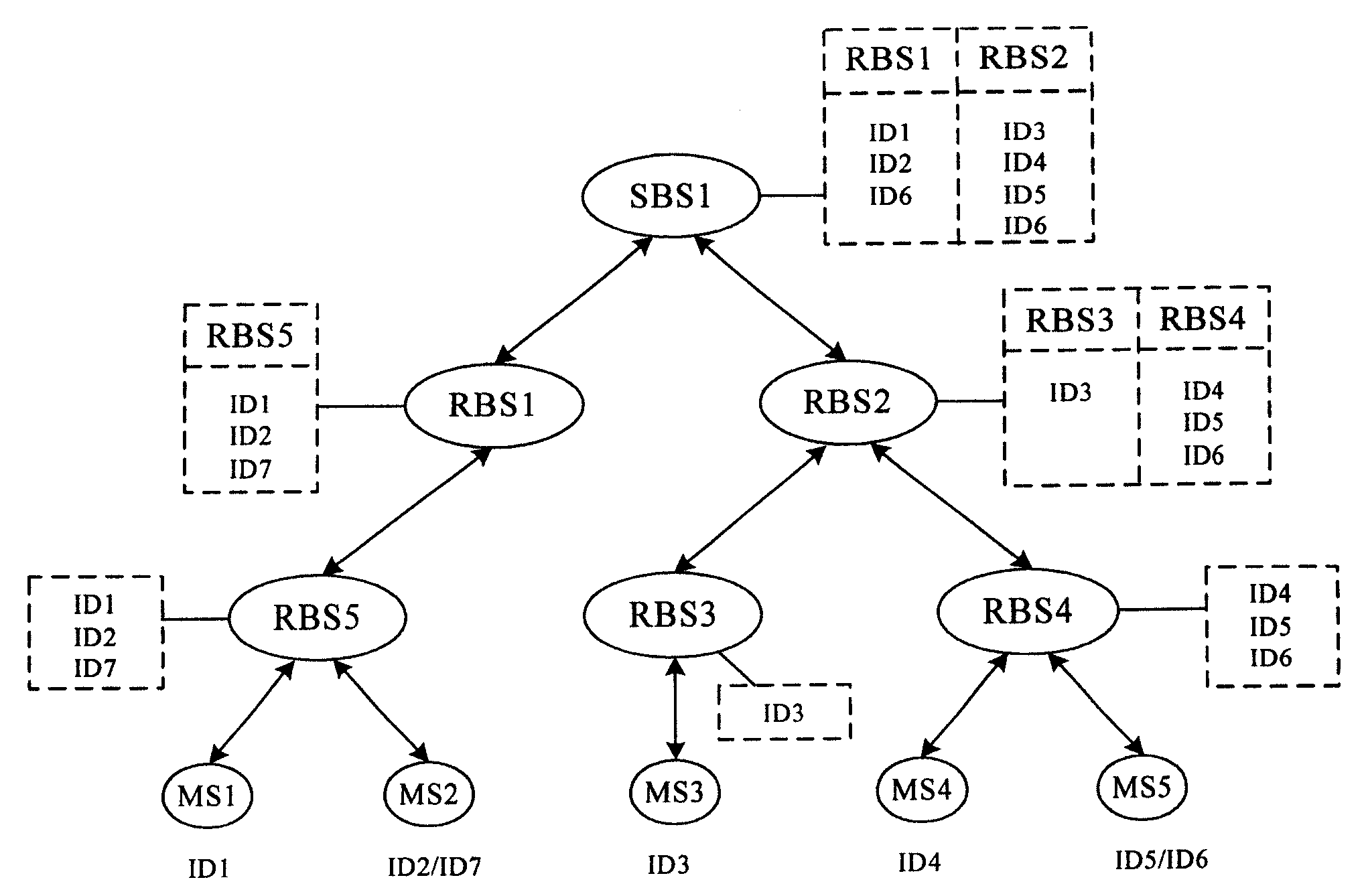
参见图8,为本发明中继基站与ASN-GW数据传输方式示意图。服务基站中存储并维护一个其管辖的所有中继基站(即下一跳的中继基站)的列表,列表中包含中继基站标识,并且列出每个中继基站标识所对应的终端标识,如业务流标识(SFID)或连接标识(CID)。业务流是在一个连接上的由媒体接入控制业务数据单元(Service Data Unit,SDU)组成的一个单向的流,并且提供了特殊的服务质量(Quality of Service,QoS),如延迟、抖动等。业务流标识唯一地标识了对一个终端和其所属基站的业务流,一个业务流至少有一个业务流标识。终端在空口建立连接时,也会收到基站或中继基站发给它的连接标识。因此每一个终端都会对应若干SFID和CID,因此,可以用SFID和CID唯一标识用户终端。当连接或者业务变化时,这些标识可能跟着变化。数据传输过程中将用这些标识来查找对应的终端。若中继基站还级连有下一跳中继基站,则该中继基站存储并维护其所管辖的下一跳中继基站的标识以及每个中继基站标识所对应的终端标识列表。服务基站和各中继基站中还保存该基站所辖的用户终端的终端标识。服务基站和中继基站依靠其各自存储并维护的终端标识列表,形成路由路径。Referring to FIG. 8 , it is a schematic diagram of a data transmission method between a relay base station and an ASN-GW according to the present invention. The serving base station stores and maintains a list of all relay base stations under its jurisdiction (that is, the next-hop relay base station), the list includes the relay base station identifier, and lists the terminal identifier corresponding to each relay base station identifier, Such as service flow identification (SFID) or connection identification (CID). A service flow is a unidirectional flow consisting of media access control service data units (Service Data Unit, SDU) on a connection, and provides special quality of service (Quality of Service, QoS), such as delay, jitter wait. The service flow identifier uniquely identifies the service flow for a terminal and the base station to which it belongs, and a service flow has at least one service flow identifier. When the terminal establishes a connection on the air interface, it will also receive the connection identifier sent to it by the base station or the relay base station. Therefore, each terminal corresponds to several SFIDs and CIDs, and therefore, the SFID and CID can be used to uniquely identify the user terminal. When connections or services change, these identifiers may change accordingly. During data transmission, these identifiers will be used to find the corresponding terminal. If the relay base station is also cascaded with a next-hop relay base station, the relay base station stores and maintains the identifiers of the next-hop relay base stations under its jurisdiction and a list of terminal identifiers corresponding to each relay base station identifier. The serving base station and each relay base station also store the terminal identifiers of the user terminals under the jurisdiction of the base station. The serving base station and the relay base station form a routing path based on their respective stored and maintained terminal identification lists.
上述终端列表中的中继基站标识,是在中继基站接入网络过程中记录的,列表中的终端标识则在用户终端建立连接或请求业务时,由管辖其的基站分配的。中继基站为终端请求的每条业务分配终端标识(ID),并逐级上报到服务基站。在服务基站和经过的每个中继基站,都要记录该ID,并与其保存的发送该业务请求的中继基站的标识相对应,由此建立路由关系,其具体过程包括步骤:The relay base station identifiers in the above terminal list are recorded when the relay base station accesses the network, and the terminal identifiers in the list are assigned by the base station in charge when the user terminal establishes a connection or requests a service. The relay base station assigns a terminal identifier (ID) to each service requested by the terminal, and reports it to the serving base station step by step. At the serving base station and each passing relay base station, the ID must be recorded and corresponded to the stored identifier of the relay base station that sent the service request, thereby establishing a routing relationship. The specific process includes steps:
1、某中继基站所辖的用户终端发起业务请求;1. A user terminal under the jurisdiction of a relay base station initiates a service request;
2、中继基站收到该业务请求,为用户请求的每条业务分别分配ID,并创建ID列表,并将分配的ID记录在列表中;2. The relay base station receives the service request, assigns an ID to each service requested by the user, creates an ID list, and records the assigned ID in the list;
3、该中继基站向其上一跳基站转发业务请求,携带分配的ID;3. The relay base station forwards the service request to its previous hop base station, carrying the assigned ID;
4、所述上一跳的基站收到转发的业务请求后,在其保存的中继基站标识中找到转发该业务请求的中继基站的标识,并在该标识下记录业务请求中携带的ID,形成中继基站标识与对应ID的列表;4. After receiving the forwarded service request, the last-hop base station finds the identifier of the relay base station that forwarded the service request in its saved relay base station identifier, and records the ID carried in the service request under the identifier , forming a list of relay base station identifiers and corresponding IDs;
若接收该业务请求的基站为服务基站,则服务基站还要将业务请求发送到系统网络侧,进行相关处理(处理过程不在本发明保护范围内);If the base station receiving the service request is the serving base station, the serving base station will also send the service request to the system network side for related processing (the processing process is not within the protection scope of the present invention);
若接收该业务请求的基站为中继基站,则中继基站还要将业务请求继续向其上一跳基站转发,其上一跳基站在其对应的中继基站标识中记录该业务请求所携带的ID,直到将业务请求转发到服务基站,由服务基站将业务请求发送到网络侧,执行相关处理。If the base station receiving the service request is a relay base station, the relay base station will continue to forward the service request to its previous hop base station, and the previous hop base station will record the information contained in the service request in its corresponding relay base station identifier. ID until the service request is forwarded to the serving base station, and the serving base station sends the service request to the network side to perform related processing.
当服务基站、中继基站或业务流、连接改变时,服务基站和所涉及到的各中继基站中的ID列表进行更新。When the serving base station, the relay base station, or the service flow or connection changes, the ID lists in the serving base station and the involved relay base stations are updated.
ASN-GW根据用户的业务请求,向用户终端发送包含终端标识的下行数据时,将依据上述终端标识分配流程中所创建的路由路径,将下行数据发送到对应的用户终端,其下行数据的传输过程包括步骤:When the ASN-GW sends downlink data containing the terminal identifier to the user terminal according to the user's service request, it will send the downlink data to the corresponding user terminal according to the routing path created in the above terminal identifier allocation process, and the transmission of the downlink data The process includes steps:
1、服务基站从ASN-GW接收到包含终端标识的下行数据后,根据下行数据的所包含的终端标识查询其保存的终端标识列表,从列表中查询到与该终端标识对应的中继基站标识,确定下一跳的中继基站,并向该中继基站发送该下行数据。1. After the serving base station receives the downlink data containing the terminal identifier from the ASN-GW, it queries the terminal identifier list it saves according to the terminal identifier included in the downlink data, and finds the relay base station identifier corresponding to the terminal identifier from the list , determine a next-hop relay base station, and send the downlink data to the relay base station.
若列表中的该终端标识未与任何中继基站标识对应,则表明该终端标识对应于服务基站所辖的用户,此时,服务基站将下行数据发送到对应的用户终端。If the terminal identifier in the list does not correspond to any relay base station identifier, it indicates that the terminal identifier corresponds to a user under the jurisdiction of the serving base station. At this time, the serving base station sends downlink data to the corresponding user terminal.
2、中继基站收到下行数据后,查询其终端标识列表,若该终端标识没有与其对应的中继基站的标识,表明该下行数据属于该中继基站所辖的用户,则该中继基站向该终端标识对应的用户终端发送该下行数据;2. After the relay base station receives the downlink data, it queries its terminal identification list. If the terminal identification does not have the identification of the corresponding relay base station, indicating that the downlink data belongs to the user under the jurisdiction of the relay base station, the relay base station sending the downlink data to the user terminal corresponding to the terminal identifier;
若查询到该终端标识对应的下一跳中继基站的标识,则向其发送该下行数据,并由该中继基站根据终端标识,将下行数据发送到其下一跳的中继基站,如此经过多跳转发后,将该下行数据转发到对应的用户终端。If the identification of the next-hop relay base station corresponding to the terminal identification is found, the downlink data is sent to it, and the relay base station sends the downlink data to the next-hop relay base station according to the terminal identification, so After multi-hop forwarding, the downlink data is forwarded to the corresponding user terminal.
例如,在如图8所示的数据传输过程中,ASN-GW要发送数据到ID6的终端上,服务基站SBS1收到包含ID6的数据后,查询其ID列表,发现ID6与其下一跳的中继基站标识RBSID2对应,则传送数据到中继基站RBS2;RBS2查询其ID列表,发现ID6与RBSID4对应,则将数据发到中继基站RBS4;RBS4收到数据后,查询其ID列表,发现ID6不与任何中继基站标识对应,则根据ID6将数据发送到对应的用户终端MS5。For example, in the data transmission process shown in Figure 8, the ASN-GW wants to send data to the terminal with ID6. After receiving the data containing ID6, the serving base station SBS1 queries its ID list and finds that ID6 and its next hop are in the middle The following base station identifies RBSID2, then transmits the data to the relay base station RBS2; RBS2 queries its ID list and finds that ID6 corresponds to RBSID4, then sends the data to the relay base station RBS4; after receiving the data, RBS4 queries its ID list and finds ID6 If it does not correspond to any relay base station identifier, then the data is sent to the corresponding user terminal MS5 according to ID6.
在本发明的通信系统中,当用户终端向服务基站发送上行数据时,其上行数据的传输流程具体步骤包括:In the communication system of the present invention, when the user terminal sends uplink data to the serving base station, the specific steps of its uplink data transmission process include:
1、某中继基站覆盖区内的用户终端发送上行数据;1. A user terminal within the coverage area of a relay base station sends uplink data;
2、该中继基站接收到上行数据后,向其上一跳基站(可能是服务基站,也可能是中继基站)发送上行数据。2. After receiving the uplink data, the relay base station sends the uplink data to its previous hop base station (which may be a serving base station or a relay base station).
该中继基站将收到的上行数据和该中继基站自身的数据一起发送到其上一跳的基站。由于每个中继基站唯一与一个上级基站连接,并且已分配与其上级基站通信的频带,该中继基站在分配的频带上与其上一级基站进行通信。The relay base station sends the received uplink data together with the relay base station's own data to its previous hop base station. Since each relay base station is uniquely connected to one upper-level base station and has allocated a frequency band for communication with its upper-level base station, the relay base station communicates with its upper-level base station on the allocated frequency band.
3、若接收到上行数据的基站为中继基站,则该中继基站继续向其上一跳基站转发该上行数据,直到转发到服务基站;3. If the base station receiving the uplink data is a relay base station, the relay base station continues to forward the uplink data to its previous hop base station until it is forwarded to the serving base station;
若接收到上行数据的基站为服务基站,则该服务基站通过线缆将上行数据转发到ASN-GW,并继续转发到核心网进行处理。If the base station receiving the uplink data is a serving base station, the serving base station forwards the uplink data to the ASN-GW through the cable, and then forwards the uplink data to the core network for processing.
本发明的通信系统中,由于引入中继基站,其下行/上行数据帧结构需要重新定义。下面以在WiMAX系统中,采用时分双工TDD与半频分双工H-FDD相结合的双工方式,点到多点PMP的OFDM帧结构为例,对下行/上行数据帧结构进行描述。In the communication system of the present invention, due to the introduction of the relay base station, its downlink/uplink data frame structure needs to be redefined. Taking the OFDM frame structure of point-to-multipoint PMP in the WiMAX system as an example, the downlink/uplink data frame structure is described below.
参见图9,为本发明WiMAX系统引入中继基站的帧结构示意图,具体为:Referring to FIG. 9, it is a schematic diagram of the frame structure of the relay base station introduced into the WiMAX system of the present invention, specifically:
服务基站和与其直接通信的中继基站之间的连接为第一跳,如SBS1和RBS1,SBS1和RBS2之间的连接。在第一跳内的服务基站的帧头前导所对应的时刻,服务基站在频带f0内发送帧头0x给其所辖中继基站(RBS1,RBS2)。每次帧同步时,服务基站发送的通信帧头0x的长度固定。该帧头0x包括前导(Preamble)、FCH、DL-MAP和UL-MAP,其中前导用于服务基站与它所带的中继基站之间的同步;FCH包含服务基站使用的在f0频带内的子信道信息,指明服务基站对中继基站突发的模式和下行突发的长度,以及DL-MAP的参数等信息,如,DL-MAP、UL-MAP、下行信道描述符DCD、上行信道描述符UCD和其它的广播消息用来描述帧中的内容;DL-MAP给出服务基站与中继基站(RBS1,RBS2)之间下行突发的参数以及包含的用户数据标识(用户数据标识中还包含终端标识)等,中继基站根据该信息判断相应突发中是否有属于自己的数据;UL-MAP给出中继基站到服务基站的上行突发参数,以及给它们分配的时频资源信息;第一跳的下行子帧的剩余部分由给中继基站的数据突发组成,每一个数据突发由整数个OFDMA符号组成,并且规定了在这个突发中传输的数据的编码算法、码率和调制级;第一跳的上行子帧包含给初始Ranging的基于竞争的区间和带宽分配,还有从不同中继基站收到的物理协议数据单元(PDUs)。The connection between the serving base station and the relay base station directly communicating with it is the first hop, such as the connection between SBS1 and RBS1, and between SBS1 and RBS2. At the moment corresponding to the frame header leader of the serving base station in the first hop, the serving base station sends the frame header 0x to the relay base stations (RBS1, RBS2) under its jurisdiction in the frequency band f0. In each frame synchronization, the length of the communication frame header 0x sent by the serving base station is fixed. The frame header 0x includes preamble (Preamble), FCH, DL-MAP and UL-MAP, wherein the preamble is used for synchronization between the serving base station and the relay base station it carries; FCH contains the frequency band f0 used by the serving base station Sub-channel information, indicating the burst mode of the serving base station to the relay base station, the length of the downlink burst, and the parameters of the DL-MAP, such as DL-MAP, UL-MAP, downlink channel descriptor DCD, and uplink channel description The character UCD and other broadcast messages are used to describe the content of the frame; DL-MAP gives the parameters of the downlink burst between the serving base station and the relay base station (RBS1, RBS2) and the contained user data identifier (the user data identifier also includes The relay base station judges whether there is its own data in the corresponding burst according to the information; UL-MAP provides the uplink burst parameters from the relay base station to the serving base station, as well as the time-frequency resource information allocated to them ; The remaining part of the downlink subframe of the first hop is composed of data bursts to the relay base station, each data burst is composed of an integer number of OFDMA symbols, and the encoding algorithm and code of the data transmitted in this burst are specified rate and modulation level; the uplink subframe of the first hop contains the contention-based range and bandwidth allocation for the initial Ranging, as well as physical protocol data units (PDUs) received from different relay base stations.
第一跳的中继基站和其它在它覆盖范围内的中继基站之间的连接,称为第二跳。如图9所示,在第二跳内,中继基站RBS2发送数据给RBS3。RBS2接收到SBS1发送的通信帧头0x后,在频带f2内发送帧头2x给RBS3,同样包含前导、FCH、DL-MAP和UL-MAP;FCH包含RBS2使用的在f2频带内的子信道信息,指明RBS2对RBS3突发的模式和下行突发的长度,以及DL-MAP的参数等信息;DL-MAP给出RBS2与RBS3之间下行突发的参数以及包含的用户数据标识等,RBS3根据该信息判断相应突发中是否有属于自己的数据;UL-MAP给出RBS3到RBS2的上行突发参数,以及给它分配的时频资源信息。第二跳的下行子帧的剩余部分由RBS2给RBS3的数据突发组成;第二跳的上行子帧包含从中继基站RBS3收到的协议数据单元(PDUs)。The connection between the relay base station of the first hop and other relay base stations within its coverage is called the second hop. As shown in FIG. 9, in the second hop, the relay base station RBS2 sends data to RBS3. After receiving the communication frame header 0x sent by SBS1, RBS2 sends the
图9中所标出的区间A,为服务基站和中继基站,以及中继基站之间的同步过程,这段区间又被分为接收和发送两部分。对于系统中的中继基站连接大于两跳的多跳情况,中继基站与其上一跳基站的通信过程与图中第一跳和第二跳过程类似,不同之处在于,该中继基站要根据其上一跳的基站在帧头部分的收发情况来确定自己的收发状态,即,如果上一跳基站是先收后发的顺序,那么该中继基站就是先发后收的顺序,以保证能够收到上一跳基站发给它的帧头。The interval A marked in FIG. 9 is the synchronization process between the serving base station, the relay base station, and the relay base station. This interval is divided into two parts: receiving and sending. For the multi-hop situation where the relay base station connection in the system is greater than two hops, the communication process between the relay base station and the previous hop base station is similar to the process of the first hop and the second hop in the figure, the difference is that the relay base station needs to According to the transmission and reception status of the base station of the previous hop in the frame header part, determine its own transmission and reception status, that is, if the base station of the previous hop is in the order of receiving first and then sending, then the relay base station is in the order of sending first and then receiving, so that Ensure that it can receive the frame header sent to it by the last hop base station.
之后,SBS1和RBS1,RBS2,RBS3同时发送帧头0~3给它们各自的终端,用于终端和各个基站之间的同步,基站与终端通信所使用的子信道信息和上/下行参数等。服务基站和中继基站在他们各自的频带(f1-fn)内向各自所辖的终端发送通信帧头(帧头0-n),包括前导、FCH、DL-MAP和UL-MAP,其中前导用于各个基站与它覆盖范围内的终端之间的同步,从而使得整个网络同步;FCH包含各个基站(服务基站、中继基站和普通基站)使用的在f~fn频带内的子信道信息,指明基站对终端突发的模式和下行突发的长度,以及DL-MAP的参数等信息;DL-MAP给出基站与终端之间下行突发的参数以及包含的用户数据标识等,终端根据该消息判断相应突发中是否有属于自己的数据;UL-MAP给出终端到基站的上行突发参数,以及给终端分配的时频资源信息。各个基站到终端的下行子帧的剩余部分由基站给终端的数据突发组成;终端到基站的上行子帧包含从终端收到的协议数据单元(PDUs)。Afterwards, SBS1, RBS1, RBS2, and RBS3 simultaneously send frame headers 0 to 3 to their respective terminals for synchronization between the terminal and each base station, subchannel information and uplink/downlink parameters used for communication between the base station and the terminal, etc. The serving base station and the relay base station send communication frame headers (frame headers 0-n) to the terminals under their respective frequency bands (f1-fn), including preamble, FCH, DL-MAP and UL-MAP, where the preamble uses It is based on the synchronization between each base station and the terminals within its coverage, so that the entire network is synchronized; FCH contains the subchannel information in the f~fn frequency band used by each base station (serving base station, relay base station and ordinary base station), indicating The mode of the base station's burst to the terminal, the length of the downlink burst, and the parameters of the DL-MAP; Judging whether there is own data in the corresponding burst; UL-MAP provides the uplink burst parameters from the terminal to the base station, and the time-frequency resource information allocated to the terminal. The remainder of each base station-to-device downlink subframe consists of data bursts from the base station to the terminal; the terminal-to-base station uplink subframe contains protocol data units (PDUs) received from the terminal.
中继基站向用户终端发送的帧头是由中继基站根据其与其它基站之间通信的帧头(~x)计算出来的,除了中继基站和服务基站之间的通信,其它时间都用作终端与中继基站之间的通信。中继基站和终端之间的通信是在中继基站接入网络时由系统分配给它的频带(f1-fn)上进行的,中继基站根据分配的频带自行产生发送给它覆盖区域内终端的管理信息(包含在帧头中)。The frame header sent by the relay base station to the user terminal is calculated by the relay base station according to the frame header (~x) of the communication between the relay base station and other base stations. Except for the communication between the relay base station and the serving base station, all other times use For communication between the terminal and the relay base station. The communication between the relay base station and the terminal is carried out on the frequency band (f1-fn) allocated by the system when the relay base station accesses the network, and the relay base station generates and sends to the terminals in its coverage area according to the allocated frequency band management information (included in the frame header).
服务基站与中继基站之间的数据通信将在服务基站的一部分频带(f0)上进行。该频带为服务基站与其所管辖的中继基站之间通信的专用频带,在这个频带内,中继基站作为服务基站的终端来与服务基站进行上行和下行的通信。服务基站分配给每一个中继基站的f0频带内的子信道是每一个帧头0x中,由服务基站分配给中继基站的,以用于上行和下行的数据传输,这种方式下,信道带宽是可以根据特定中继基站的需求而变化的,比较灵活,可以有效利用频谱资源。The data communication between the serving base station and the relay base station will be performed on a part of the frequency band (f0) of the serving base station. This frequency band is a dedicated frequency band for communication between the serving base station and the relay base station under its jurisdiction. In this frequency band, the relay base station, as a terminal of the serving base station, performs uplink and downlink communication with the serving base station. The sub-channels in the f0 frequency band assigned by the serving base station to each relay base station are allocated by the serving base station to the relay base station in each frame header 0x for uplink and downlink data transmission. In this way, the channel The bandwidth can be changed according to the requirements of a specific relay base station, which is relatively flexible and can effectively use spectrum resources.
由于各个中继基站采用HFDD双工模式,不能同时用不同的频率收发信息,因此,收发数据将在不同时间的不同频率上切换;终端将在不同频段上与不同的中继基站或普通基站连接进行通信。Since each relay base station adopts HFDD duplex mode, different frequencies cannot be used to send and receive information at the same time. Therefore, the sending and receiving data will be switched at different frequencies at different times; the terminal will be connected to different relay base stations or ordinary base stations in different frequency bands to communicate.
另一种在WiMAX系统引入中继基站,采用时分双工TDD与半频分双工H-FDD相结合的双工方式,点到多点PMP的OFDM的帧结构如图10所示。Another kind of relay base station is introduced into the WiMAX system, which adopts a duplex mode combining time division duplex TDD and half frequency division duplex H-FDD. The OFDM frame structure of point-to-multipoint PMP is shown in Figure 10.
参见图10,为本发明WiMAX系统引入中继基站的帧结构示意图,在这种帧结构中,服务基站和各中继基站同时向各自所辖的用户终端发送通信帧头,实现服务基站和其所辖用户终端间的同步和资源指配,以及各中继基站与其所辖用户终端间的同步和资源指配。之后,在服务基站的帧头前导所对应的时刻以及其后的一固定接收和发送区间内,服务基站向直接与其连接的中继基站发送基站间通信帧头和下行突发。在该固定接收和发送区间外(即服务基站的帧头及下行数据突发后),与服务基站直接连接的中继基站将帧头和下行突发发送到其下一跳中继基,并经过如此多跳发送后,最终将下行突发发送到对应的用户终端。这种将下行的帧头放在下行突发的前面的帧结构,可以避免服务基站不断地在不同频带之间的转换(这样服务基站只需要在两个频带中作一次转换)。Referring to FIG. 10 , it is a schematic diagram of the frame structure of the relay base station introduced into the WiMAX system of the present invention. In this frame structure, the serving base station and each relay base station send communication frame headers to the user terminals under their jurisdiction at the same time, so as to realize the communication between the serving base station and other relay base stations. Synchronization and resource assignment among user terminals under its jurisdiction, as well as synchronization and resource assignment between each relay base station and its user terminals under its jurisdiction. Afterwards, at the moment corresponding to the frame header leader of the serving base station and within a fixed receiving and sending interval thereafter, the serving base station sends the inter-base station communication frame header and downlink burst to the relay base station directly connected to it. Outside the fixed receiving and sending interval (that is, after the frame header and downlink data burst of the serving base station), the relay base station directly connected to the serving base station sends the frame header and downlink burst to its next-hop relay base, and After sending through so many hops, the downlink burst is finally sent to the corresponding user terminal. This frame structure in which the downlink frame header is placed in front of the downlink burst can prevent the serving base station from continuously switching between different frequency bands (so that the serving base station only needs to switch between two frequency bands once).
采用这种帧结构,每次基站间进行同步和资源指配所发送的的帧头~x长度是可变的,从而更有效的利用资源来进行数据传输。如果对某一个中继基站传输的数据多,则分配较多的时频资源,反之则分配较少的时频资源,不必固定中继基站与服务基站传输的上行和下行的区域。中继基站在基站的上/下行子帧中的发送和接收顺序可调换,可根据帧头中分配的时频资源,进行数据的发送或接收。但是,由于固定了中继基站的接收和发送区间,当中继基站没有接收或发送信息时,它也不得不在这种状态下尝试接收帧头,如果没有发送给它的帧头,它就与终端进行通信,同时等待下一个区间的到来,这样不但对系统造成延时,而且浪费系统资源。With this frame structure, the length of the frame header ˜x sent each time for synchronization and resource allocation between base stations is variable, so that resources are used more effectively for data transmission. If more data is transmitted to a certain relay base station, more time-frequency resources are allocated, otherwise, less time-frequency resources are allocated, and the uplink and downlink areas transmitted by the relay base station and the serving base station do not need to be fixed. The sending and receiving sequence of the relay base station in the uplink/downlink subframe of the base station can be switched, and data can be sent or received according to the time-frequency resources allocated in the frame header. However, due to the fixed receiving and sending intervals of the relay base station, when the relay base station does not receive or send information, it also has to try to receive the frame header in this state. If there is no frame header sent to it, it will communicate with the terminal Communicate while waiting for the arrival of the next interval, which not only causes delay to the system, but also wastes system resources.
如果系统为单跳的,这种帧结构与图9所示的帧结构没有很大区别,只不过改变了中继基站和服务基站通信的帧头位置;如果系统的跳数比较多,那么上行和下行将会被分成更多区域,降低每一跳传输的效率。如果中继基站在收发状态之间转换不是非常灵活,或者它可能在同一帧中接收很多发自基站的突发时,建议使用这种方法。If the system is single-hop, this frame structure is not much different from the frame structure shown in Figure 9, except that the position of the frame header of the communication between the relay base station and the serving base station is changed; if the system has more hops, then the uplink and downlink will be divided into more areas, reducing the efficiency of each hop transmission. This method is recommended if the relay base station is not very flexible in switching between transmit and receive states, or it may receive many bursts from the base station in the same frame.
本发明还提供了一种基于中继基站的无线通信系统,如图5所示。在本发明的系统中,需要对普通基站进行修改,增加其对中继基站的支持和对多个中继基站的集成。本发明的系统与现有的蜂窝网络或无线城域网相兼容。由于中继基站在为其覆盖范围内的终端提供服务的过程与普通基站是完全一致的,因此,对现有终端无需作任何改变。The present invention also provides a wireless communication system based on a relay base station, as shown in FIG. 5 . In the system of the present invention, it is necessary to modify the common base station to increase its support for the relay base station and the integration of multiple relay base stations. The system of the invention is compatible with the existing cellular network or wireless metropolitan area network. Since the process of the relay base station providing services to the terminals within its coverage area is exactly the same as that of the common base station, there is no need to make any changes to the existing terminals.
参见图11,为本发明的通信系统中的中继基站结构示意图。中继基站通过无线接口1与其上一跳基站(中继基站或服务基站)连接,通过无线接口2与其下一跳中继基站连接,通过无线接口3与用户终端连接。中继基站中包括普通基站的常规功能模块,用以完成用户终端的网络接入和控制等功能;还包括频率扫描单元、终端标识分配单元、终端标识存储单元和资源分配单元。Referring to FIG. 11 , it is a schematic structural diagram of a relay base station in the communication system of the present invention. The relay base station is connected to its previous hop base station (relay base station or serving base station) through
频率扫描单元中预设扫描频率表,表中存储有其上级的中继基站的扫描频率或服务基站的扫描频率,当该中继基站接入网络时,该中继基站的频率扫描单元根据其中的频率列表扫描下行信道,与对应的上一跳中继基站或服务基站建立同步。The scanning frequency table is preset in the frequency scanning unit, and the scanning frequency of its superior relay base station or the scanning frequency of the serving base station is stored in the table. When the relay base station accesses the network, the frequency scanning unit of the relay base station The frequency list scans the downlink channel, and establishes synchronization with the corresponding previous hop relay base station or serving base station.
终端标识分配单元与终端标识存储单元连接,根据中继基站所辖的用户终端的请求,分配终端标识并存储到终端标识存储单元。The terminal identifier distribution unit is connected to the terminal identifier storage unit, and according to the request of the user terminal under the jurisdiction of the relay base station, assigns the terminal identifier and stores it in the terminal identifier storage unit.
终端标识存储单元中还存储有该中继基站的下一跳中继基站的标识和该标识对应的终端标识。其中,下一跳中继基站的标识是在该下一跳中继基站接入网络过程中记录在其终端标识存储单元中的;终端标识是在用户请求业务或接入系统过程中,由中继基站分配的,并记录在其终端标识存储单元中。当中继基站接收到下行数据时,查询其终端标识存储单元,向对应的用户终端发送下行数据;或向对应的中继基站发送所述下行数据。The terminal identifier storage unit also stores the identifier of the next-hop relay base station of the relay base station and the terminal identifier corresponding to the identifier. Wherein, the identifier of the next-hop relay base station is recorded in its terminal identifier storage unit during the access process of the next-hop relay base station; It is assigned by the base station and recorded in its terminal identification storage unit. When the relay base station receives the downlink data, it queries its terminal identification storage unit, and sends the downlink data to the corresponding user terminal; or sends the downlink data to the corresponding relay base station.
中继基站的资源分配单元分别为其下一跳中继基站和该中继基站所管辖的用户终端分配通信资源。The resource allocation unit of the relay base station allocates communication resources to its next-hop relay base station and the user terminal under the jurisdiction of the relay base station respectively.
参见图12,为本发明的通信系统中的服务基站结构示意图。服务基站中包括基站的常规功能模块,用以完成用户终端的网络接入和控制等功能;还包括一个终端标识存储单元和资源分配单元。Referring to FIG. 12 , it is a schematic structural diagram of a serving base station in the communication system of the present invention. The serving base station includes regular functional modules of the base station to complete functions such as network access and control of the user terminal; it also includes a terminal identification storage unit and a resource allocation unit.
服务基站的终端标识存储单元存储有其下一跳中继基站的标识和对应的终端标识,还存储有该服务基站为所辖的用户终端分配的终端标识。当服务基站接收到与其直接连接的中继基站发起的网络接入注册请求时,在其终端标识存储单元存储该中继基站的标识;当服务基站接收到与其直接连接的中继基站发送或转发的业务请求或接入请求时,在其终端存储单元存储请求中携带的终端标识,并与发送或转发请求的中继基站的标识相对应;当服务基站向用户终端发送包含终端标识的下行数据时,查询其终端标识存储单元,并将下行数据发送到对应的用户终端或对应的中继基站。The terminal identification storage unit of the serving base station stores the identification of its next-hop relay base station and the corresponding terminal identification, and also stores the terminal identification assigned by the serving base station to the user terminal under its jurisdiction. When the serving base station receives the network access registration request initiated by the relay base station directly connected to it, it stores the identifier of the relay base station in its terminal identifier storage unit; When a service request or an access request is made, the terminal identification carried in the request is stored in its terminal storage unit, and corresponds to the identification of the relay base station that sends or forwards the request; when the serving base station sends downlink data containing the terminal identification to the user terminal , query its terminal identification storage unit, and send the downlink data to the corresponding user terminal or the corresponding relay base station.
服务基站中的所述资源分配单元分别为其下一跳中继基站和该服务基站所辖的用户终端分配通信资源。The resource allocation unit in the serving base station allocates communication resources to its next-hop relay base station and the user terminal under the jurisdiction of the serving base station.
服务基站中的资源分配单元为其所辖的用户终端分配的频带与中继基站中的资源分配单元为其所辖的用户终端分配的频带可以相同,也可以不同。The frequency band assigned by the resource allocation unit in the serving base station to the user terminals under its jurisdiction may be the same as or different from the frequency band allocated by the resource allocation unit in the relay base station to the user terminals under its jurisdiction.
本发明中,由于中继基站在为其辖终端提供服务的过程与普通基站是完全一致的,即终端将中继基站当作普通基站进行通信,因此,对现有终端无需作任何改变即可接入本发明的网络结构中。In the present invention, since the relay base station is completely consistent with the ordinary base station in the process of providing services for the terminals under its jurisdiction, that is, the terminal communicates with the relay base station as an ordinary base station, therefore, no need to make any changes to the existing terminal Access to the network structure of the present invention.
网络的结构可以模块化,并且可以灵活的应用于很多的可选的铺设方式中,例如可以用于从小型到大型的网络(稀疏到密集的无线电覆盖范围和容量);城市、郊区和乡村无线传输环境;可用于授权和非授权的频带;可以用于层次化的、平坦的和Mesh结构中。The structure of the network can be modularized and can be flexibly applied in many optional laying methods, such as small to large networks (sparse to dense radio coverage and capacity); urban, suburban and rural wireless Transmission environment; can be used in licensed and unlicensed frequency bands; can be used in hierarchical, flat and Mesh structures.
中继基站可以是固定、游牧或移动的;中继基站可以在不同的服务基站之间进行切换,类似于IEEE802.16中终端在不同基站之间的切换;中继基站的参数(如功率、速率和信干噪比等)可以根据环境和信道情况进行调节;中继基站的覆盖范围可以根据负载情况进行调节;系统可以根据需要分配一定的带宽给每一个中继基站;对于每一个服务基站可以携带的中继基站个数,取决于小区的频谱利用情况和负载的大小;如果中继基站的处理速度够快,它可以根据从服务基站(或者上一跳基站)收到的帧头,来管理它在这一帧中的数据传输,这样通信在一个帧里被管理,缩短多跳延迟。The relay base station can be fixed, nomadic or mobile; the relay base station can switch between different serving base stations, similar to the switching between different base stations for terminals in IEEE802.16; the parameters of the relay base station (such as power, rate and signal-to-interference-noise ratio, etc.) can be adjusted according to the environment and channel conditions; the coverage of the relay base station can be adjusted according to the load; the system can allocate a certain bandwidth to each relay base station according to needs; for each serving base station can The number of relay base stations carried depends on the spectrum utilization of the cell and the size of the load; if the processing speed of the relay base station is fast enough, it can be based on the frame header received from the serving base station (or the previous hop base station). Manage its data transmission in this frame, so that the communication is managed in one frame, shortening the multi-hop delay.
中继基站可以用于代替原有低速率、不可靠的连接,放置的位置比较灵活(不受地理、地势的影响),例如对建筑物阴影区和非覆盖地区的覆盖、室内环境的通信,如放置在小区边缘,可以增强对低信噪比地区的覆盖;由于无需线缆,中继基站的建设成本比普通基站低;基站和中继基站采用不同频段进行非集中管理,系统更加灵活,提高频谱效率(由于小区边缘终端与基站距离拉近,终端可以使用高阶调制);增加系统吞吐量和系统容量;减小终端发射功率,延长终端电池使用寿命。The relay base station can be used to replace the original low-speed, unreliable connection, and the location is more flexible (not affected by geography and terrain), such as coverage of shadowed areas and non-covered areas of buildings, communication in indoor environments, If it is placed on the edge of the cell, it can enhance the coverage of areas with low signal-to-noise ratio; since there is no need for cables, the construction cost of the relay base station is lower than that of ordinary base stations; the base station and the relay base station use different frequency bands for decentralized management, and the system is more flexible. Improve spectrum efficiency (due to the closer distance between cell edge terminals and base stations, terminals can use high-order modulation); increase system throughput and system capacity; reduce terminal transmit power and prolong terminal battery life.
下面以一个实例说明通信系统引入中继基站后,如何改善原有通信系统的性能。The following uses an example to illustrate how to improve the performance of the original communication system after introducing the relay base station into the communication system.
参见图13,为本发明小区中一个服务基站带有6个中继基站的示意图。Referring to FIG. 13 , it is a schematic diagram of a serving base station with 6 relay base stations in a cell according to the present invention.
每个中继基站所用的频带(f1-f6)是不同的,服务基站可以和每一个中继基站在频带f0上直接通信,从而使得中继基站可以和有线网络相连接。每一个中继基站的覆盖范围是相同的,加入中继基站后,服务基站和中继基站所覆盖范围是一个服务基站的
显然,本领域的技术人员可以对本发明进行各种改动和变型而不脱离本发明的精神和范围。这样,倘若本发明的这些修改和变型属于本发明权利要求及其等同技术的范围之内,则本发明也意图包含这些改动和变型在内。Obviously, those skilled in the art can make various changes and modifications to the present invention without departing from the spirit and scope of the present invention. Thus, if these modifications and variations of the present invention fall within the scope of the claims of the present invention and their equivalent technologies, the present invention also intends to include these modifications and variations.
Claims (20)
Priority Applications (1)
| Application Number | Priority Date | Filing Date | Title |
|---|---|---|---|
| CN2006100994313A CN101111047B (en) | 2006-07-18 | 2006-07-18 | Method and system for communication using relaying base station |
Applications Claiming Priority (1)
| Application Number | Priority Date | Filing Date | Title |
|---|---|---|---|
| CN2006100994313A CN101111047B (en) | 2006-07-18 | 2006-07-18 | Method and system for communication using relaying base station |
Publications (2)
| Publication Number | Publication Date |
|---|---|
| CN101111047A true CN101111047A (en) | 2008-01-23 |
| CN101111047B CN101111047B (en) | 2011-03-30 |
Family
ID=39042899
Family Applications (1)
| Application Number | Title | Priority Date | Filing Date |
|---|---|---|---|
| CN2006100994313A Expired - Fee Related CN101111047B (en) | 2006-07-18 | 2006-07-18 | Method and system for communication using relaying base station |
Country Status (1)
| Country | Link |
|---|---|
| CN (1) | CN101111047B (en) |
Cited By (23)
| Publication number | Priority date | Publication date | Assignee | Title |
|---|---|---|---|---|
| CN101610563B (en) * | 2008-06-20 | 2011-01-05 | 大唐移动通信设备有限公司 | Method for controlling admission of beehive network based on relay and beehive network system |
| CN102055579A (en) * | 2009-10-29 | 2011-05-11 | 财团法人工业技术研究院 | Wireless communication system, relay communication device thereof and wireless communication device |
| CN102123423A (en) * | 2011-03-25 | 2011-07-13 | 华为技术有限公司 | Communication method and base station |
| CN102148639A (en) * | 2010-02-10 | 2011-08-10 | 华为技术有限公司 | Data transmission method and system |
| CN102300340A (en) * | 2010-06-22 | 2011-12-28 | 中兴通讯股份有限公司 | Networking method and system for household base stations |
| CN102668465A (en) * | 2009-11-18 | 2012-09-12 | 日本电气株式会社 | Relay device, relay method, and program |
| CN101841934B (en) * | 2009-03-17 | 2012-11-21 | 电信科学技术研究院 | Method and device for transmitting information by using relay node |
| CN102868514A (en) * | 2012-08-30 | 2013-01-09 | 北京久华信信息技术有限公司 | Wireless transmission method for time division duplex (TDD) communication system |
| CN103828481A (en) * | 2013-11-30 | 2014-05-28 | 华为技术有限公司 | Data transmission device, communication system and communication method |
| US8824958B2 (en) | 2008-02-29 | 2014-09-02 | Nokia Siemens Networks Oy | Relay node connection management |
| CN102474734B (en) * | 2009-07-16 | 2015-11-25 | 瑞典爱立信有限公司 | The method controlled for repeater/relay and layout |
| CN106131923A (en) * | 2016-06-30 | 2016-11-16 | 厦门纵行信息科技有限公司 | A kind of network-building method mixing access module multihop network and Wireless Telecom Equipment |
| CN106470449A (en) * | 2015-08-14 | 2017-03-01 | 电信科学技术研究院 | A kind of data transmit-receive, trunking method, device and communication system |
| WO2017166148A1 (en) * | 2016-03-31 | 2017-10-05 | 华为技术有限公司 | Data transmission method and related device |
| WO2019136874A1 (en) * | 2018-01-09 | 2019-07-18 | Oppo广东移动通信有限公司 | Relay transmission method and relay node |
| WO2019136933A1 (en) * | 2018-01-09 | 2019-07-18 | Oppo广东移动通信有限公司 | Relay transmission method and relay node |
| CN111479270A (en) * | 2020-04-15 | 2020-07-31 | 青岛交互物联科技有限公司 | A method and device for two-way authentication of network access |
| CN111586800A (en) * | 2020-04-29 | 2020-08-25 | 广州技象科技有限公司 | UNB relay system and data interaction method |
| CN112770263A (en) * | 2020-12-15 | 2021-05-07 | 三叶草(绍兴)智能技术有限公司 | Indoor Lora communication system and method |
| CN114258118A (en) * | 2018-05-31 | 2022-03-29 | 阿里巴巴集团控股有限公司 | Communication method and device of terminal and base station |
| US20220417207A1 (en) * | 2013-04-29 | 2022-12-29 | Oceus Networks, Llc | Mobile cellular network backhaul |
| US12120533B2 (en) | 2012-08-24 | 2024-10-15 | Oceus Networks, Llc | Mobile cellular networks |
| US12167288B2 (en) | 2016-07-07 | 2024-12-10 | Oceus Networks, Llc | Network backhaul access |
Families Citing this family (1)
| Publication number | Priority date | Publication date | Assignee | Title |
|---|---|---|---|---|
| US11246031B2 (en) | 2018-08-15 | 2022-02-08 | Oceus Networks, Llc | Disguising UE communications in a cellular network |
Family Cites Families (2)
| Publication number | Priority date | Publication date | Assignee | Title |
|---|---|---|---|---|
| US5875179A (en) * | 1996-10-29 | 1999-02-23 | Proxim, Inc. | Method and apparatus for synchronized communication over wireless backbone architecture |
| CN100426877C (en) * | 2004-07-19 | 2008-10-15 | 华为技术有限公司 | Method of communication by bimode terminal |
-
2006
- 2006-07-18 CN CN2006100994313A patent/CN101111047B/en not_active Expired - Fee Related
Cited By (35)
| Publication number | Priority date | Publication date | Assignee | Title |
|---|---|---|---|---|
| CN102017672B (en) * | 2008-02-29 | 2014-10-15 | 诺基亚通信公司 | Relay node connection management |
| US8824958B2 (en) | 2008-02-29 | 2014-09-02 | Nokia Siemens Networks Oy | Relay node connection management |
| CN101610563B (en) * | 2008-06-20 | 2011-01-05 | 大唐移动通信设备有限公司 | Method for controlling admission of beehive network based on relay and beehive network system |
| CN101841934B (en) * | 2009-03-17 | 2012-11-21 | 电信科学技术研究院 | Method and device for transmitting information by using relay node |
| CN102474734B (en) * | 2009-07-16 | 2015-11-25 | 瑞典爱立信有限公司 | The method controlled for repeater/relay and layout |
| CN102055579A (en) * | 2009-10-29 | 2011-05-11 | 财团法人工业技术研究院 | Wireless communication system, relay communication device thereof and wireless communication device |
| CN102668465A (en) * | 2009-11-18 | 2012-09-12 | 日本电气株式会社 | Relay device, relay method, and program |
| CN102668465B (en) * | 2009-11-18 | 2015-04-22 | 日本电气株式会社 | Relay device and relay method |
| CN102148639B (en) * | 2010-02-10 | 2014-08-06 | 华为技术有限公司 | Data transmission method and system |
| US8665776B2 (en) | 2010-02-10 | 2014-03-04 | Huawei Technologies Co., Ltd. | Method and system for data transmission |
| CN102148639A (en) * | 2010-02-10 | 2011-08-10 | 华为技术有限公司 | Data transmission method and system |
| CN102300340A (en) * | 2010-06-22 | 2011-12-28 | 中兴通讯股份有限公司 | Networking method and system for household base stations |
| CN102123423A (en) * | 2011-03-25 | 2011-07-13 | 华为技术有限公司 | Communication method and base station |
| US12120533B2 (en) | 2012-08-24 | 2024-10-15 | Oceus Networks, Llc | Mobile cellular networks |
| CN102868514A (en) * | 2012-08-30 | 2013-01-09 | 北京久华信信息技术有限公司 | Wireless transmission method for time division duplex (TDD) communication system |
| CN102868514B (en) * | 2012-08-30 | 2015-09-16 | 北京久华信信息技术有限公司 | A kind of tdd communication systems radio transmitting method |
| US20220417207A1 (en) * | 2013-04-29 | 2022-12-29 | Oceus Networks, Llc | Mobile cellular network backhaul |
| US11991143B2 (en) * | 2013-04-29 | 2024-05-21 | Oceus Networks, Llc | Mobile cellular network backhaul |
| CN103828481A (en) * | 2013-11-30 | 2014-05-28 | 华为技术有限公司 | Data transmission device, communication system and communication method |
| CN106470449A (en) * | 2015-08-14 | 2017-03-01 | 电信科学技术研究院 | A kind of data transmit-receive, trunking method, device and communication system |
| WO2017166148A1 (en) * | 2016-03-31 | 2017-10-05 | 华为技术有限公司 | Data transmission method and related device |
| CN106131923A (en) * | 2016-06-30 | 2016-11-16 | 厦门纵行信息科技有限公司 | A kind of network-building method mixing access module multihop network and Wireless Telecom Equipment |
| CN106131923B (en) * | 2016-06-30 | 2020-03-27 | 厦门纵行信息科技有限公司 | Networking method of multi-hop network in hybrid access mode and wireless communication equipment |
| US12167288B2 (en) | 2016-07-07 | 2024-12-10 | Oceus Networks, Llc | Network backhaul access |
| US11844010B2 (en) | 2018-01-09 | 2023-12-12 | Guangdong Oppo Mobile Telecommunications Corp., Ltd. | Relay transmission method and relay node |
| US11510129B2 (en) | 2018-01-09 | 2022-11-22 | Guangdong Oppo Mobile Telecommunications Corp., Ltd. | Relay transmission method and relay node |
| CN111836338A (en) * | 2018-01-09 | 2020-10-27 | Oppo广东移动通信有限公司 | Method and relay node for relay transmission |
| WO2019136933A1 (en) * | 2018-01-09 | 2019-07-18 | Oppo广东移动通信有限公司 | Relay transmission method and relay node |
| WO2019136874A1 (en) * | 2018-01-09 | 2019-07-18 | Oppo广东移动通信有限公司 | Relay transmission method and relay node |
| CN114258118A (en) * | 2018-05-31 | 2022-03-29 | 阿里巴巴集团控股有限公司 | Communication method and device of terminal and base station |
| CN114258118B (en) * | 2018-05-31 | 2023-11-03 | 阿里巴巴集团控股有限公司 | Communication method and device for terminal and base station |
| CN111479270B (en) * | 2020-04-15 | 2021-10-12 | 青岛交互物联科技有限公司 | Network access bidirectional authentication method and device |
| CN111479270A (en) * | 2020-04-15 | 2020-07-31 | 青岛交互物联科技有限公司 | A method and device for two-way authentication of network access |
| CN111586800A (en) * | 2020-04-29 | 2020-08-25 | 广州技象科技有限公司 | UNB relay system and data interaction method |
| CN112770263A (en) * | 2020-12-15 | 2021-05-07 | 三叶草(绍兴)智能技术有限公司 | Indoor Lora communication system and method |
Also Published As
| Publication number | Publication date |
|---|---|
| CN101111047B (en) | 2011-03-30 |
Similar Documents
| Publication | Publication Date | Title |
|---|---|---|
| CN101111047B (en) | Method and system for communication using relaying base station | |
| JP7087089B2 (en) | Methods and Devices for Triggering Transmission Carrier Selection in Wireless Communities | |
| US10548024B2 (en) | Cloud communication center system and method for processing data in a cloud communication system | |
| JP6669853B2 (en) | Method and apparatus for reporting buffer status in D2D communication system | |
| CN102883440B (en) | A wireless broadband communication method, device and system | |
| CN102655682B (en) | A method, system and device for transmitting data by means of carrier aggregation | |
| CN101166055B (en) | Multi-hop relay method and multi-hop relay system | |
| JP7648644B2 (en) | Communication control method, base station and system | |
| KR102196939B1 (en) | Appartus and method for data synchronization in cloud cell communication system | |
| CN114982202B (en) | Dynamic switching between multicast and unicast for NR multicast services | |
| CN105637920A (en) | Device and method for transmitting/receiving signal in mobile communication system supporting carrier | |
| CN111937428B (en) | Apparatus and method for measurement in wireless communication system | |
| CN101843136A (en) | Resource allocation | |
| KR20150018300A (en) | Method and apparatus of transmitting data in heterogeneous network wireless communication system | |
| CN116232408A (en) | Relay method, method for generating routing table, device, device, and storage medium | |
| CN110062435A (en) | User equipment, cellular base station and its method for being connected to WLAN | |
| EP2375809A1 (en) | Method and device for users' uplink and downlink unsynchronized switching | |
| WO2020083039A1 (en) | Method and apparatus for use in wireless communication node | |
| CN1765096B (en) | Wireless Telephone Networks with Multicarrier Packet Data Transmission | |
| KR101407280B1 (en) | Method for data transmission based on relay mobile communication system and equipment thereof | |
| CN103874135B (en) | The methods, devices and systems of radio communication | |
| JP2025131726A (en) | Communication control method, user device, processor, base station, and mobile communication system | |
| WO2023015454A1 (en) | Path establishment method, selection method and apparatus, terminal device, and storage medium | |
| CN116548012A (en) | Data transmission method and device | |
| TW201110762A (en) | Methods and apparatus for providing a fast and power efficient multicast scheme |
Legal Events
| Date | Code | Title | Description |
|---|---|---|---|
| C06 | Publication | ||
| PB01 | Publication | ||
| C10 | Entry into substantive examination | ||
| SE01 | Entry into force of request for substantive examination | ||
| C14 | Grant of patent or utility model | ||
| GR01 | Patent grant | ||
| ASS | Succession or assignment of patent right |
Owner name: TINNO MOBILE TECHNOLOGY CORP. Free format text: FORMER OWNER: HUAWEI TECHNOLOGY CO., LTD. Effective date: 20140604 |
|
| C41 | Transfer of patent application or patent right or utility model | ||
| COR | Change of bibliographic data |
Free format text: CORRECT: ADDRESS; FROM: 518129 SHENZHEN, GUANGDONG PROVINCE TO: 518053 SHENZHEN, GUANGDONG PROVINCE |
|
| TR01 | Transfer of patent right |
Effective date of registration: 20140604 Address after: 4, A, building 518053, building H-3, East China Town, 1, Xiangshan East Street, Shenzhen, Guangdong, Nanshan District Patentee after: SHENZHEN TINNO MOBILE TECHNOLOGY CO., LTD. Address before: 518129 Bantian HUAWEI headquarters office building, Longgang District, Guangdong, Shenzhen Patentee before: Huawei Technologies Co., Ltd. |
|
| CP03 | Change of name, title or address | ||
| CP03 | Change of name, title or address |
Address after: 518000 Nanshan District, Xiangshan East Street, 1, Shenzhen, Guangdong, 4 floor, H-3 building, east industrial area, overseas Chinese town, A Patentee after: Shenzhen tinno Mobile Technology Co Ltd Address before: 518053 Nanshan District, Xiangshan East Street, 1, Shenzhen, Guangdong, 4 floor, H-3 building, east industrial area, overseas Chinese town, A Patentee before: SHENZHEN TINNO MOBILE TECHNOLOGY CO., LTD. |
|
| CF01 | Termination of patent right due to non-payment of annual fee |
Granted publication date: 20110330 Termination date: 20190718 |
|
| CF01 | Termination of patent right due to non-payment of annual fee |