CN101061224B - Aspergillus niger promoter for expressing genes in host cells - Google Patents
Aspergillus niger promoter for expressing genes in host cells Download PDFInfo
- Publication number
- CN101061224B CN101061224B CN2004800444435A CN200480044443A CN101061224B CN 101061224 B CN101061224 B CN 101061224B CN 2004800444435 A CN2004800444435 A CN 2004800444435A CN 200480044443 A CN200480044443 A CN 200480044443A CN 101061224 B CN101061224 B CN 101061224B
- Authority
- CN
- China
- Prior art keywords
- promotor
- seq
- promoter
- sequence
- nucleotide sequence
- Prior art date
- Legal status (The legal status is an assumption and is not a legal conclusion. Google has not performed a legal analysis and makes no representation as to the accuracy of the status listed.)
- Expired - Fee Related
Links
Images


Classifications
-
- C—CHEMISTRY; METALLURGY
- C07—ORGANIC CHEMISTRY
- C07K—PEPTIDES
- C07K14/00—Peptides having more than 20 amino acids; Gastrins; Somatostatins; Melanotropins; Derivatives thereof
- C07K14/37—Peptides having more than 20 amino acids; Gastrins; Somatostatins; Melanotropins; Derivatives thereof from fungi
- C07K14/38—Peptides having more than 20 amino acids; Gastrins; Somatostatins; Melanotropins; Derivatives thereof from fungi from Aspergillus
Landscapes
- Chemical & Material Sciences (AREA)
- Organic Chemistry (AREA)
- Health & Medical Sciences (AREA)
- Life Sciences & Earth Sciences (AREA)
- Biophysics (AREA)
- Biochemistry (AREA)
- Gastroenterology & Hepatology (AREA)
- General Health & Medical Sciences (AREA)
- Genetics & Genomics (AREA)
- Medicinal Chemistry (AREA)
- Molecular Biology (AREA)
- Proteomics, Peptides & Aminoacids (AREA)
- Mycology (AREA)
- Micro-Organisms Or Cultivation Processes Thereof (AREA)
- Enzymes And Modification Thereof (AREA)
Abstract
本发明涉及分离的启动子序列,尤其是在本文中称为A4-L或A4的、从黑曲霉(Aspergillus niger)分离的启动子以及包括它们的DNA构建物和载体。
This invention relates to isolated promoter sequences, particularly promoters referred to herein as A4-L or A4, isolated from Aspergillus niger, and DNA constructs and vectors comprising them.
Description
发明背景Background of the Invention
发明领域field of invention
本发明涉及分离的启动子以及涉及包括所述启动子的核酸构建物和载体。本发明也涉及在宿主细胞中表达目标编码序列的方法。The present invention relates to isolated promoters and to nucleic acid constructs and vectors comprising said promoters. The present invention also relates to methods for expressing a coding sequence of interest in a host cell.
相关技术领域的描述Description of the related technical field
分子生物技术是基于研究人员这样的能力的学科,即将遗传信息的特定单元从一个生物体转移到另一个生物体的能力,其目标是产生商业化相应量的有用产物。这个克隆过程的目标之一是获得克隆基因的最大表达。通过构建适于用在宿主细胞中的表达载体,进行由基因编码的产物的重组产生,在所述宿主细胞中,编码期望产物的核酸被置于启动子的表达调控下。通过多种技术例如转化,将表达载体引入宿主细胞中,然后,通过在合适的条件下培养转化的细胞,获得期望产物的产生,所述条件对于包括在所述表达载体内的启动子起作用是必要的。Molecular biotechnology is the discipline based on the researcher's ability to transfer specific units of genetic information from one organism to another with the goal of producing commercially relevant quantities of useful products. One of the goals of this cloning process is to obtain maximal expression of the cloned gene. Recombinant production of the product encoded by the gene is performed by constructing an expression vector suitable for use in a host cell in which the nucleic acid encoding the desired product is placed under the expression control of a promoter. The expression vector is introduced into the host cell by various techniques such as transformation, and then, the production of the desired product is obtained by culturing the transformed cell under suitable conditions that act on the promoter included in the expression vector necessary.
尽管众多启动子在本领域中是已知的,仍存在对调控异源基因和编码序列表达的新启动子的需求。本发明描述了用于在宿主细胞例如细菌和真菌细胞中表达基因的新启动子。Although numerous promoters are known in the art, there remains a need for new promoters that regulate the expression of heterologous genes and coding sequences. The present invention describes novel promoters for expressing genes in host cells such as bacterial and fungal cells.
发明概述Summary of the invention
本发明涉及分离的启动子序列、构建物、载体和宿主细胞,其包含一种或一种以上可操纵性连接至异源编码序列的启动子序列。The present invention relates to isolated promoter sequences, constructs, vectors and host cells comprising one or more promoter sequences operably linked to a heterologous coding sequence.
本发明还涉及分离的启动子序列,选自下列:The present invention also relates to an isolated promoter sequence selected from the group consisting of:
a)SEQ ID NO:1;a) SEQ ID NO: 1;
(b)保持启动子活性的SEQ ID NO:1的子序列;(b) a subsequence of SEQ ID NO:1 that maintains promoter activity;
(c)保持启动子活性的SEQ ID NO:2的子序列;(c) a subsequence of SEQ ID NO:2 that maintains promoter activity;
(d)核酸序列,其作为启动子起作用以及在中度、高度或非常高度的严格条件下与SEQ ID NO:1、SEQ ID NO:2或它们的子序列杂交;(d) a nucleic acid sequence that functions as a promoter and hybridizes to SEQ ID NO: 1, SEQ ID NO: 2 or their subsequences under moderate, high or very high stringency conditions;
(e)包括SEQ ID NO:2或它的子序列的杂合启动子序列;(e) a hybrid promoter sequence comprising SEQ ID NO: 2 or a subsequence thereof;
(f)包括SEQ ID NO:2的串联启动子序列;和(f) a tandem promoter sequence comprising SEQ ID NO: 2; and
(g)包含母启动子的缺失、取代或插入的变异启动子序列,其中所述母启动子是SEQ ID NO:1或SEQ ID NO:2。(g) A variant promoter sequence comprising a deletion, substitution or insertion of a parent promoter, wherein said parent promoter is SEQ ID NO: 1 or SEQ ID NO: 2.
附图简述Brief description of the drawings
图1示出黑曲霉(Aspergillus niger)A4长启动子(A4-L启动子)(SEQ ID NO:1)的DNA序列、黑曲霉(Aspergillus niger)A4启动子(SEQID NO:2)的DNA序列和黑曲霉(Aspergillus niger)A4-5’启动子(SEQ IDNO:3)的DNA序列。Fig. 1 shows the DNA sequence of Aspergillus niger (Aspergillus niger) A4 long promoter (A4-L promoter) (SEQ ID NO:1), the DNA sequence of Aspergillus niger (Aspergillus niger) A4 promoter (SEQID NO:2) and the DNA sequence of the Aspergillus niger (Aspergillus niger) A4-5' promoter (SEQ ID NO: 3).
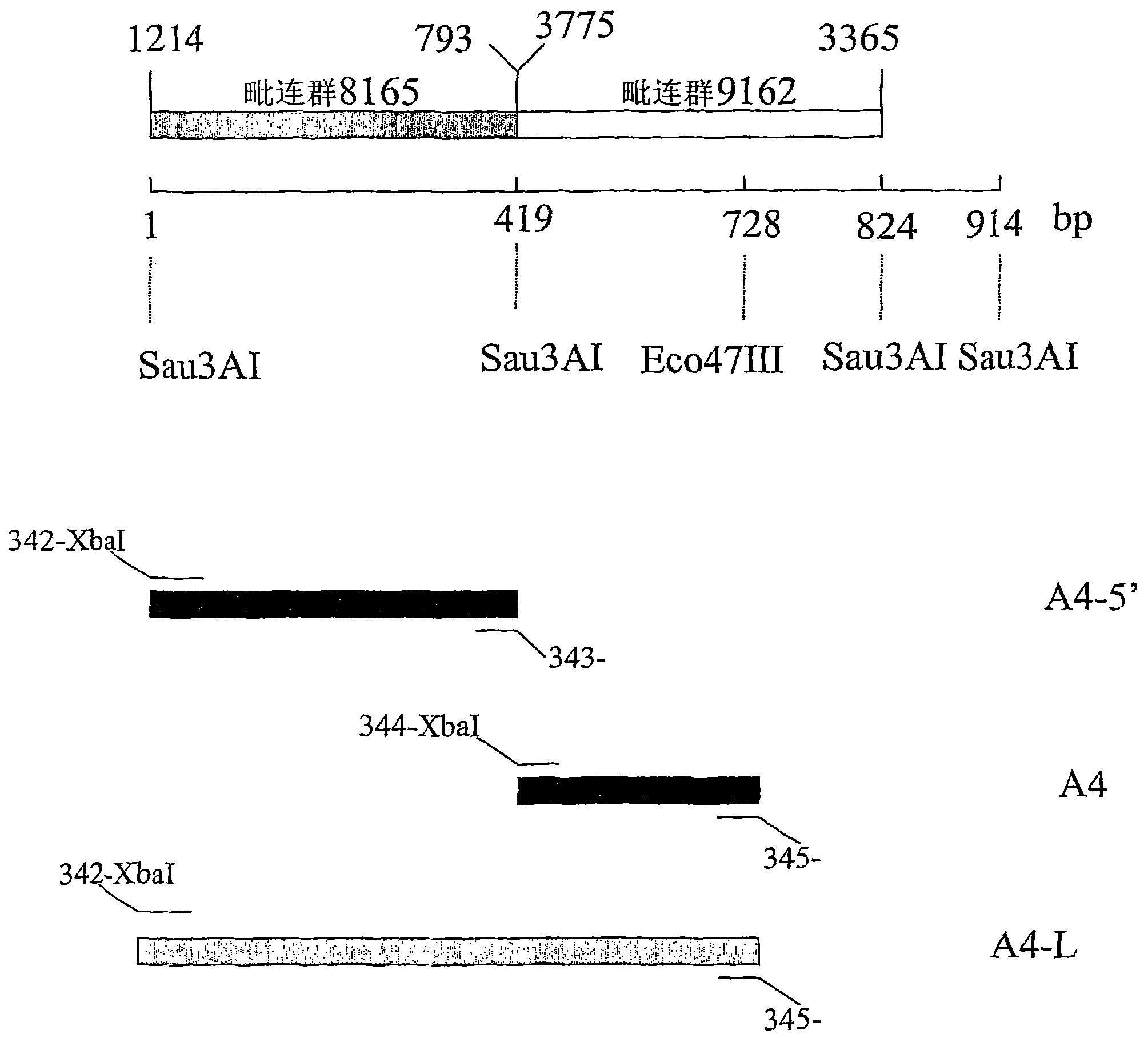
图2是A4-L启动子的图解,其包含两个邻接区(contiguousregions),毗连群(contig)8165和毗连群9162,其通过ERGO数据库检索和BLAST数据库检索获得。这些邻接区位于曲霉属(Aspergillus)染色体的不同区。毗连群8165为3988bp,而毗连群9162为8140bp。A4-L启动子的起始419bp被发现为从毗连群8165的1214bp至793bp(本文中称为A4-5’启动子),(SEQ ID NO:3)。A4-L启动子的第二部分(bp420至bp 829)(本文中称为A4启动子(SEQ ID NO:2))位于毗连群9162的3775至3365bp。用于制备两种截短的片段(A4(SEQ ID NO:2)和A4-5’(SEQ ID NO:3))的限制性位点被示出。Figure 2 is a diagram of the A4-L promoter, which contains two contiguous regions, contig 8165 and contig 9162, which were obtained by ERGO database search and BLAST database search. These contiguous regions are located in different regions of the Aspergillus chromosome. Contig 8165 is 3988bp, while contig 9162 is 8140bp. The initial 419 bp of the A4-L promoter was found from 1214 bp to 793 bp of contig 8165 (referred to herein as the A4-5' promoter), (SEQ ID NO: 3). The second part (bp420 to bp 829) of the A4-L promoter (referred to herein as the A4 promoter (SEQ ID NO: 2)) is located at 3775 to 3365 bp of contig 9162. The restriction sites used to make the two truncated fragments (A4 (SEQ ID NO: 2) and A4-5' (SEQ ID NO: 3)) are shown.
图3表示pSEGCT11AG8载体,其包括:Figure 3 shows the pSEGCT11AG8 vector comprising:
来源于密苏里游动放线菌(Actinoplanes missouriensis)的葡糖异构酶启动子,Glucose isomerase promoter derived from Actinoplanes missouriensis,
变铅青链霉菌(S.lividans)纤维素酶celA的信号序列,The signal sequence of Streptomyces lividans (S.lividans) cellulase celA,
编码来自放线菌(Actinomyces)种的纤维素酶11AG8基因的多核苷酸,a polynucleotide encoding a cellulase 11AG8 gene from Actinomyces species,
纤维素酶11AG3终止子序列。Cellulase 11AG3 terminator sequence.
图4A-B提供了由葡糖异构酶(GIT)启动子、celA信号序列、11AG8成熟纤维素酶序列和11AG3终止子组成的表达盒的DNA序列(SEQ ID NO:4)(图4A),以及CelA-11AG8的蛋白序列(SEQ ID NO:5)(图4B)。在图4A中,celA信号序列加下划线,而11AG3终止子序列为斜体。Figure 4A-B provides the DNA sequence (SEQ ID NO: 4) of the expression cassette consisting of the glucose isomerase (GIT) promoter, celA signal sequence, 11AG8 mature cellulase sequence and 11AG3 terminator (Figure 4A) , and the protein sequence (SEQ ID NO: 5) of CelA-11AG8 (Fig. 4B). In Figure 4A, the celA signal sequence is underlined, while the 11AG3 terminator sequence is italicized.
图5显示了在变铅青链霉菌(S.lividans)TK23宿主细胞中以11AG8的相对活性百分数(%)表示的启动子强度比较。11AG8代表用具有GI启动子的载体(pSEQCT11AG8)转化的宿主细胞,2-7表示用具有A4-5’启动子的载体(pA411AG8-2)转化的宿主细胞,4-7表示用具有A4启动子的载体(pA411AG8-4)转化的宿主细胞,以及5-3表示用具有A4-L启动子的载体(pA411AG8-5)转化的宿主细胞。Figure 5 shows a comparison of promoter strength expressed as relative activity percentage (%) of 11AG8 in S. lividans TK23 host cells. 11AG8 represents the host cell transformed with the vector (pSEQCT11AG8) with the GI promoter, 2-7 represents the host cell transformed with the vector (pA411AG8-2) with the A4-5' promoter, and 4-7 represents the transformed host cell with the A4 promoter 5-3 represents a host cell transformed with a vector (pA411AG8-5) having an A4-L promoter.
图6A说明了在用包含GI启动子的载体或包含A4启动子的载体转化的变铅青链霉菌(S.lividans)TK23细胞中细胞干重的比较。Figure 6A illustrates a comparison of dry cell weight in S. lividans TK23 cells transformed with a vector comprising the GI promoter or a vector comprising the A4 promoter.
图6B说明了在用包含GI启动子的载体或包含A4启动子的载体转化的变铅青链霉菌(S.lividans)TK23细胞中11AG8活性的比较。Figure 6B illustrates a comparison of 11AG8 activity in S. lividans TK23 cells transformed with a vector comprising the GI promoter or a vector comprising the A4 promoter.
图7A-B示出了本发明的具有GI启动子的pSEG69B4载体和具有A4启动子(SEQ ID NO:2)的pSEA469B4T载体。Figure 7A-B shows the pSEG69B4 vector with the GI promoter and the pSEA469B4T vector with the A4 promoter (SEQ ID NO: 2) of the present invention.
发明详述Detailed description of the invention
定义definition
除非本文另外定义,本文中使用的所有技术和科学术语都具有本发明所属的技术领域的普通技术人员通常所理解的相同含义。Singleton,et al,DICTIONARY OF MICROBIOLOGY ANDMOLECULAR BIOLOGY,2D ED.,John Wiley and Sons,New York(1994),和Hale & Marham,THE HARPER COLLINS DICTIONARY OFBIOLOGY,Harper Perennial,NY(1991)为本领域普通技术人员提供了许多本发明中使用的术语的通用诠释。尽管与本发明所描述的那些类似或等价的任何方法和材料都可以被用在本发明的实践或测试中,但优选的方法和材料被描述。Unless defined otherwise herein, all technical and scientific terms used herein have the same meaning as commonly understood by one of ordinary skill in the art to which this invention belongs. Singleton, et al, DICTIONARY OF MICROBIOLOGY ANDMOLECULAR BIOLOGY, 2D ED., John Wiley and Sons, New York (1994), and Hale & Marham, THE HARPER COLLINS DICTIONARY OFBIOLOGY, Harper Perennial, NY (1991) are of ordinary skill in the art A general explanation of many of the terms used in this disclosure is provided. Although any methods and materials similar or equivalent to those described herein can be used in the practice or testing of the present invention, the preferred methods and materials are described.
在本文中所参考的所有专利和出版物,包括所有在此类专利和出版物中公开的序列,被明确引入作为参考。All patents and publications referred to herein, including all sequences disclosed in such patents and publications, are expressly incorporated by reference.
数字范围包括限定该范围的数在内。除非另外指出,分别地,核酸以5′至3′的方向从左到右书写;氨基酸序列以氨基端至羧基端的方向从左到右书写。Numerical ranges are inclusive of the numbers defining the range. Unless otherwise indicated, nucleic acids are written left to right in 5' to 3' orientation; amino acid sequences are written left to right in amino to carboxy orientation, respectively.
本文中所提供的标题不是对本发明的各个方面或实施方式的限制,所述方面或实施方式可以通过整体参考说明书而获得。因此,通过整体参考说明书,下面即将定义的术语被更充分地定义。The headings provided herein are not limitations of the various aspects or embodiments of the invention that can be obtained by reference to the specification as a whole. Accordingly, the terms defined immediately below are more fully defined by reference to the Specification as a whole.
术语“启动子(promoter)”在本文中被定义为结合RNA聚合酶和引导该聚合酶至目标编码序列的正确的下游转录起始位点而引起转录的DNA序列。该术语“启动子”也被理解为包括在转录成mRNA后用于翻译的5’非编码区(在启动子和翻译起始位点之间)和顺式作用转录调控元件,例如增强子。在优选的实施方式中,启动子将在链霉菌属(Streptomyces)中有效表达目标编码区。The term "promoter" is defined herein as a DNA sequence that binds RNA polymerase and directs the polymerase to the correct downstream transcription initiation site of a coding sequence of interest causing transcription. The term "promoter" is also understood to include the 5' non-coding region (between the promoter and the translation initiation site) and cis-acting transcriptional regulatory elements, such as enhancers, which are used for translation after transcription into mRNA. In preferred embodiments, the promoter will efficiently express the coding region of interest in Streptomyces.
术语“变异启动子(variant promoter)”在本文中被定义为具有核酸序列的启动子,所述核酸序列在母启动子中的一个或一个以上核苷酸中包括取代、缺失和/或插入,其中变异启动子比相应的母启动子具有更高或更低的启动子活性。术语“变异启动子”包括天然变体和体外产生的变体。The term "variant promoter" is defined herein as a promoter having a nucleic acid sequence comprising substitutions, deletions and/or insertions in one or more nucleotides in the parent promoter, Wherein the variant promoter has higher or lower promoter activity than the corresponding parent promoter. The term "variant promoter" includes natural variants and variants produced in vitro.
如此处所定义,术语“杂合启动子(hybrid promoter)”指2种或2种以上的启动子的部分,它们被融合在一起,产生这样的序列,该序列是两种或两种以上启动子的融合并具有导致目标编码序列转录的启动子活性。As defined herein, the term "hybrid promoter" refers to portions of 2 or more promoters that have been fused together to produce a sequence that is the result of two or more promoters fusion with promoter activity leading to transcription of the coding sequence of interest.
术语“串联启动子(tandem promoter)”在本文中被定义为两种或两种以上的启动子,每一种可操纵性连接到目标编码序列。The term "tandem promoter" is defined herein as two or more promoters, each operably linked to a coding sequence of interest.
如此处所定义,术语“分离的(isolated)”是指化合物、蛋白质、细胞、核酸序列或氨基酸,从与其天然相关的至少一种组分中移出。As defined herein, the term "isolated" refers to a compound, protein, cell, nucleic acid sequence or amino acid that is removed from at least one component with which it is naturally associated.
术语“目标编码序列(coding sequence of interest)”在本文中被定义为当置于合适的调控序列包括启动子的调控之下被转录成mRNA的核酸序列,该mRNA被翻译成多肽。目标编码序列可以包括cDNA、基因组DNA、合成DNA和重组DNA。目标编码序列一般通过正位于RNA的3’端的开放阅读框上游的ATG起始密码子来确定。The term "coding sequence of interest" is defined herein as a nucleic acid sequence that is transcribed into mRNA, which is translated into a polypeptide, when placed under the control of appropriate regulatory sequences, including a promoter. A coding sequence of interest can include cDNA, genomic DNA, synthetic DNA, and recombinant DNA. The coding sequence of interest is generally identified by the ATG start codon located just upstream of the open reading frame at the 3' end of the RNA.
术语“异源的(heterologous)”一般是指多核苷酸或多肽在宿主细胞中不是天然发生。就编码序列而言,例如“异源编码序列”,该术语“异源的”是指包括在本发明之内的启动子在天然宿主细胞中不是天然地与该编码序列可操纵性连接。The term "heterologous" generally means that the polynucleotide or polypeptide does not naturally occur in the host cell. With respect to a coding sequence, such as a "heterologous coding sequence", the term "heterologous" means that a promoter encompassed by the present invention is not naturally operably linked to the coding sequence in the native host cell.
术语“可操纵性连接(operably linked)”指并列(juxtaposition),其中元件处于使它们功能性相关的排列之中。例如,如果启动子调控目标编码序列的转录,则启动子可操纵性连接至目标编码序列。The term "operably linked" refers to a juxtaposition wherein elements are in an arrangement such that they are functionally related. For example, a promoter is operably linked to a coding sequence of interest if the promoter regulates the transcription of the coding sequence of interest.
术语“核酸序列(nucleic acid sequence)”包括DNA、RNA、它们的单链或双链形式和修饰形式。术语“核酸序列”和“多核苷酸(polynucleotide)”在本文中可以互换使用。The term "nucleic acid sequence" includes DNA, RNA, single- or double-stranded forms and modified forms thereof. The terms "nucleic acid sequence" and "polynucleotide" are used interchangeably herein.
如在此处所使用,术语“DNA构建物(DNA construct)”是指核酸序列,其包括至少两个DNA多核苷酸片段。As used herein, the term "DNA construct" refers to a nucleic acid sequence comprising at least two DNA polynucleotide segments.
如在此处所使用,术语“报道基因(report gene)”是指核苷酸序列,其能够在细胞中表达,并且其中该报道基因的表达赋予容易检测和测定含有已表达基因的细胞的能力。As used herein, the term "report gene" refers to a nucleotide sequence that is capable of being expressed in a cell, and wherein expression of the reporter gene confers the ability to readily detect and assay cells containing the expressed gene.
术语“信号序列(signal sequence)”或“信号肽(signal peptide)”是指在蛋白质的N端部分的氨基酸序列,其帮助该蛋白质的成熟形式分泌出细胞。胞外蛋白的成熟形式缺乏信号序列,该信号序列在分泌过程中被切割。The term "signal sequence" or "signal peptide" refers to the amino acid sequence in the N-terminal portion of a protein that facilitates secretion of the mature form of the protein from the cell. The mature form of the extracellular protein lacks a signal sequence that is cleaved during secretion.
术语“载体”在本文中被定义为多核苷酸,其被设计以携带将被引入一种或一种以上细胞类型的核酸序列。载体包括克隆载体、表达载体、穿梭载体、质粒、噬菌体或病毒颗粒、DNA构建物、表达盒和类似载体。典型的表达载体,其也包括质粒,包括调节序列例如启动子、信号序列、目标基因和转录终止子。The term "vector" is defined herein as a polynucleotide designed to carry a nucleic acid sequence to be introduced into one or more cell types. Vectors include cloning vectors, expression vectors, shuttle vectors, plasmids, phage or viral particles, DNA constructs, expression cassettes and the like. A typical expression vector, which also includes a plasmid, includes regulatory sequences such as a promoter, signal sequence, gene of interest, and transcription terminator.
如本文所使用,“多肽(polypeptide)”、“肽(peptide)”和“蛋白质(protein)”被互换使用并且包括指代氨基酸残基的聚合物。该术语适用于氨基酸聚合物,其中一个或一个以上氨基酸残基是相应于天然存在的氨基酸的人工化学类似物,以及适用于天然存在的氨基酸聚合物。该术语还适用于包含使得多肽保持功能性的保守氨基酸取代的聚合物。As used herein, "polypeptide", "peptide" and "protein" are used interchangeably and include reference to a polymer of amino acid residues. The term applies to amino acid polymers in which one or more amino acid residues are artificial chemical analogs corresponding to a naturally occurring amino acid, as well as to naturally occurring amino acid polymers. The term also applies to polymers comprising conservative amino acid substitutions such that the polypeptide remains functional.
“宿主细胞(host cell)”是指能够作为本发明的载体的宿主和表达媒介起作用的细胞。在本发明的一些实施方式中,“宿主细胞”是指细菌和真菌细胞。"Host cell" refers to a cell that can function as a host and an expression medium of the vector of the present invention. In some embodiments of the invention, "host cells" refer to bacterial and fungal cells.
“转化(transformation)”是指将DNA导入有机体,使得该DNA以染色体外元件或染色体整合体的形式被保持。"Transformation" refers to the introduction of DNA into an organism such that the DNA is maintained as an extrachromosomal element or chromosomal integrant.
优选实施方式preferred embodiment
A.启动子A. Promoter
在一个优选的实施方式中,启动子具有SEQ ID NO:1的核苷酸1-914的核酸序列或它的子序列。该子序列将保留启动子活性并优选包含至少约100个核苷酸、至少约200个核苷酸;至少约250个核苷酸;至少约300个核苷酸;至少约400个核苷酸;至少约350个核苷酸;至少约450个核苷酸;至少约500个核苷酸;至少约550个核苷酸和至少约600个核苷酸。In a preferred embodiment, the promoter has the nucleic acid sequence of nucleotides 1-914 of SEQ ID NO: 1 or its subsequence. The subsequence will retain promoter activity and preferably comprise at least about 100 nucleotides, at least about 200 nucleotides; at least about 250 nucleotides; at least about 300 nucleotides; at least about 400 nucleotides at least about 350 nucleotides; at least about 450 nucleotides; at least about 500 nucleotides; at least about 550 nucleotides and at least about 600 nucleotides.
在另一个优选的实施方式中,启动子具有SEQ ID NO:2的核苷酸1-365的核酸序列或它的子序列。该子序列将保留启动子活性并优选包含至少约100个核苷酸、至少约150个核苷酸;至少约200个核苷酸;至少约250个核苷酸;至少约300个核苷酸;至少约350个核苷酸和至少约360个核苷酸。In another preferred embodiment, the promoter has the nucleic acid sequence of nucleotides 1-365 of SEQ ID NO: 2 or its subsequence. The subsequence will retain promoter activity and preferably comprise at least about 100 nucleotides, at least about 150 nucleotides; at least about 200 nucleotides; at least about 250 nucleotides; at least about 300 nucleotides ; at least about 350 nucleotides and at least about 360 nucleotides.
启动子还可以是杂合启动子,包括本发明的一种或一种以上启动子的一部分;本发明一种启动子的一部分和另一种启动子的一部分。在一些优选的实施方式中,杂合启动子将包括SEQ ID NO:2的子序列,具有SEQ ID NO:2的至少约100个核苷酸、至少约150个核苷酸;至少约200个核苷酸;至少约250个核苷酸;至少约300个核苷酸和至少约350个核苷酸。The promoter may also be a hybrid promoter comprising a portion of one or more promoters of the invention; a portion of one promoter of the invention and a portion of another promoter. In some preferred embodiments, the hybrid promoter will comprise a subsequence of SEQ ID NO: 2, having at least about 100 nucleotides, at least about 150 nucleotides; at least about 200 nucleotides of SEQ ID NO: 2 Nucleotides; at least about 250 nucleotides; at least about 300 nucleotides and at least about 350 nucleotides.
杂合启动子的其它启动子可以是在宿主细胞中显示出启动子活性的任何启动子,并包括突变启动子、截短的启动子和可以是或可以不是天然于宿主细胞的类似启动子。其它启动子的例子,其在本发明的杂合启动子中可以是有用的,包括真菌和细菌启动子。一些具体的非限制性例子包括aprE启动子或突变aprE启动子(WO 01/51643);弗氏链霉菌(Streptomyces fradiae)氨基糖苷3’-磷酸转移酶基因的aph启动子;黑曲霉葡糖淀粉酶(glaA)启动子;密苏里游动放线菌的葡糖异构酶(GI)启动子和衍生的GI(GIT)启动子(美国专利6,562,612和EPA351029);来自变铅青链霉菌的葡糖异构酶(GI)启动子(SEQ ID NO:1)、短野生型GI启动子(SEQ ID NO:33)、1.5GI启动子(SEQ ID NO:31)、1.20GI启动子(SEQ ID NO:32)、或任何变异GI启动子(SEQ ID NOs:9-28),如在WO 03/089621中公开的;来自丝状真菌的cbh1、cbh2、egl1和egl2启动子,尤其是瑞氏木霉(Thrichoderma reesei)纤维二糖水解酶启动子(Genebank Accession NO.D86235);lacZ和tac启动子(Bagdasarion et al.,1983,Gene 26:273-282);ermE启动子(Ward et al.,1986,MoI.Gen.Genet.203:468-478和Schmitt-John et al.,1992,ApplMicrobiol.Biotechnol.36:493-498);以及枯草杆菌(Bacillus subtilis)噬菌体
在一些优选的实施方式中,杂合启动子将包括SEQ ID NO:2的子序列和GI启动子或变异GI启动子的一部分。在其它实施方式中,杂合启动子将包括SEQ ID NO:2的子序列和从链霉菌某些种,尤其是变铅青链霉菌菌株的基因获得的天然启动子。In some preferred embodiments, the hybrid promoter will comprise a subsequence of SEQ ID NO: 2 and a portion of a GI promoter or a variant GI promoter. In other embodiments, the hybrid promoter will include the subsequence of SEQ ID NO: 2 and a native promoter obtained from a gene of a Streptomyces species, especially a strain of Streptomyces lividans.
启动子还可以是串联启动子,其包括两个或两个以上启动子。在一些实施方式中,串联启动子将包括SEQ ID NO:2或它的子序列的启动子以及一个或一个以上其它启动子,例如那些在上面杂合启动子中讨论的启动子。The promoter can also be a tandem promoter, which includes two or more promoters. In some embodiments, a tandem promoter will include the promoter of SEQ ID NO: 2 or a subsequence thereof and one or more other promoters, such as those discussed above under Hybrid promoters.
尽管其它启动子,包括杂合启动子和串联启动子,在宿主细胞中可以对于目标编码序列是天然的,但本发明所包括的启动子在宿主细胞中对于编码序列是非天然的。While other promoters, including hybrid and tandem promoters, may be native to the coding sequence of interest in the host cell, promoters contemplated by the present invention are non-native to the coding sequence in the host cell.
在一些实施方式中,启动子是具有序列SEQ ID NO:1、SEQ IDNO:2或它们的子序列的母启动子的变异启动子。变异启动子将包括在SEQ ID NO:1、SEQ ID NO:2或它们的子序列的核苷酸序列中的一种或一种以上(例如,1、2、3或4)变化,该变化是缺失、取代或插入,其中该变体具有启动子活性。在优选的实施方式中,变异启动子将包括与母启动子的一种变化。获得变异启动子的方法在本领域中是熟知的,并且包括在多种严格条件下将核酸序列和SEQ ID NO:1或SEQ ID NO:2杂交;定点突变;用PCR扩增消化;和DNA改组(Carteret al.,1985 NAR 13:4431-4443;Wells et al.,1986,Phil.Trans.R.Soc.Lond.317:415-423和Zoller et al.,1982 NAR 10:6487-6500)。In some embodiments, the promoter is a variant promoter of the parent promoter having the sequence SEQ ID NO: 1, SEQ ID NO: 2, or a subsequence thereof. A variant promoter will include one or more (for example, 1, 2, 3 or 4) changes in the nucleotide sequence of SEQ ID NO: 1, SEQ ID NO: 2 or their subsequences, which change is a deletion, substitution or insertion, wherein the variant has promoter activity. In preferred embodiments, the variant promoter will comprise a change from the parent promoter. Methods for obtaining variant promoters are well known in the art, and include hybridization of a nucleic acid sequence to SEQ ID NO: 1 or SEQ ID NO: 2 under various stringent conditions; site-directed mutagenesis; digestion with PCR amplification; and DNA Reorganization (Carter et al., 1985 NAR 13:4431-4443; Wells et al., 1986, Phil. Trans. R. Soc. Lond. 317:415-423 and Zoller et al., 1982 NAR 10:6487-6500) .
杂合启动子、串联启动子、变异启动子、SEQ ID NO:1或SEQID NO:2的子序列的启动子、或者与SEQ ID NO:1或SEQ ID NO:2杂交的核酸序列,将具有SEQ ID NO:1或SEQ ID NO:2启动子的启动子活性的至少约20%、至少约30%、至少约40%、至少约50%、至少约60%、至少约80%和至少约100%。在一些实施方式中,启动子活性将更大,例如约100%以上、约150%以上、约200%以上和约250%以上。A hybrid promoter, a tandem promoter, a variant promoter, a promoter of a subsequence of SEQ ID NO: 1 or SEQ ID NO: 2, or a nucleic acid sequence that hybridizes to SEQ ID NO: 1 or SEQ ID NO: 2 will have At least about 20%, at least about 30%, at least about 40%, at least about 50%, at least about 60%, at least about 80%, and at least about 100%. In some embodiments, the promoter activity will be greater, eg, about 100% or more, about 150% or more, about 200% or more, and about 250% or more.
在一些实施方式中,启动子将包括在中度、高度或非常高度的严格条件下与SEQ ID NO:1、SEQ ID NO:2或它们的子序列杂交的核酸序列。In some embodiments, the promoter will include a nucleic acid sequence that hybridizes to SEQ ID NO: 1, SEQ ID NO: 2, or subsequences thereof under conditions of moderate, high, or very high stringency.
在优选的实施方式中,杂交被用于分析给定的DNA片段是否对应于本文中描述的启动子DNA序列并因此落入本发明的范围内。Sambrook et al.,MOLECULAR CLONING:A LABORATORYMANUAL(2nd Ed.,1989 Cold Spring Harbor,NY)描述了一般的杂交方法。In a preferred embodiment, hybridization is used to analyze whether a given DNA fragment corresponds to the promoter DNA sequence described herein and thus falls within the scope of the present invention. Sambrook et al., MOLECULAR CLONING: A LABORATORYMANUAL ( 2nd Ed., 1989 Cold Spring Harbor, NY) describe general hybridization methods.
“杂交条件(hybridization conditions)”是指在其下杂交被测定的条件的“严格(stringency)”程度。杂交条件可以基于核酸结合复合物的解链温度(Tm),正如在Berger and Kimmel(1987,Guide to Molecular CloningTechniques,METHODS IN ENZYMOLOGY,Vol 152,Academic Press,San Diego CA)中所教导。杂交条件也可以基于在杂交后所采用的洗涤条件,如本领域所知。"Hybridization conditions" refers to the degree of "stringency" of the conditions under which hybridization is determined. Hybridization conditions can be based on the melting temperature (Tm) of the nucleic acid binding complex as taught in Berger and Kimmel (1987, Guide to Molecular Cloning Techniques, METHODS IN ENZYMOLOGY, Vol 152, Academic Press, San Diego CA). Hybridization conditions can also be based on the wash conditions employed after hybridization, as known in the art.
“低度严格(Low-stringency)”条件是指用0.2×SSC/0.1%SDS的溶液在20℃下洗涤15分钟。“中度严格(medium-stringency)”条件是指用0.2×SSC/0.1%SDS的溶液在37℃下洗涤30分钟。“高度严格(high-stringency)”条件是指用0.2×SSC/0.1%SDS的溶液在37℃下洗涤45分钟。“极高度严格条件(very high-stringency)”条件是指用0.2×SSC/0.1%SDS的溶液在37℃下洗涤60分钟。"Low-stringency" conditions refer to washing with a solution of 0.2×SSC/0.1% SDS at 20° C. for 15 minutes. "Medium-stringency" conditions refer to washing with a solution of 0.2 x SSC/0.1% SDS at 37°C for 30 minutes. "High-stringency" conditions refer to washing with a solution of 0.2 x SSC/0.1% SDS at 37°C for 45 minutes. "Very high-stringency" conditions refer to washing with a solution of 0.2×SSC/0.1% SDS at 37° C. for 60 minutes.
本发明的另一方面是使用基于核酸结合复合物的解链温度(Tm)的杂交条件,如在Berger and Kimmel(1987,Guide to Molecular CloningTechniques,METHODS IN ENZYMOLOGY,Vol.152,Academic Press,San Diego,Calif.)中所教导。“极高严格条件”典型在约Tm-5℃(探针的Tm之下5℃)下进行;“高严格条件”典型在Tm下约5℃-10℃进行;“中度严格条件”在Tm下约10℃-20℃进行;以及“低严格条件”在Tm下约20℃-25℃进行。Another aspect of the invention is the use of hybridization conditions based on the melting temperature (Tm) of the nucleic acid binding complex as described in Berger and Kimmel (1987, Guide to Molecular Cloning Techniques, METHODS IN ENZYMOLOGY, Vol. 152, Academic Press, San Diego , Calif.). "Extremely stringent conditions" are typically performed at about Tm-5°C (5°C below the Tm of the probe); "high stringent conditions" are typically performed at about 5°C-10°C at the Tm; performed at a Tm of about 10°C-20°C; and "low stringency conditions" performed at a Tm of about 20°C-25°C.
杂交试验基本上如下:根据制造商的说明,通过用适宜的限制性酶消化,例如EcoR I、Hind III、Bam HI、Cla I、Kpn I、Mlu I、Spe I、Bgl II、Nco I、Xba I、Xho I和Xma I(由New England Biolabs,Inc.,Beverly,MA and Boehringer Mannheim供应),使来自特定靶源的基因组DNA片段化。然后,通过琼脂糖凝胶(例如,0.8%琼脂糖)对样品进行电泳,使得DNA片段的分离根据大小而显现。DNA片段通常通过溴化乙啶染色而显色。可以在蒸馏水中简单地漂洗该凝胶,随后在合适的溶液(例如,诸如0.25M HCl)中脱嘌呤,伴随缓慢摇动,之后缓慢摇动下变性30分钟(例如在0.4M NaOH中)。可以包括复性步骤,其中该凝胶被置于1.5M HCl,1M Tris,pH 7.0中30分钟,伴随温和摇动。然后,DNA被转移至合适的带正电荷的膜上,例如,Maximum Strength NytranPlus膜(Schleicher & Schuell,Keene,N.H.),使用转移液(例如,诸如6×SSC(900mM NaCl,90mM柠檬酸三钠))。一旦转移完成,通常在约2小时之后,该膜在例如2×SSC(2×SSC=300mM NaCl,30mM柠檬酸三钠)中漂洗并在室温下风干。然后,该膜应该在合适的预杂交溶液(例如,诸如每100mL中含有下列物质的水溶液:20-50mL甲酰胺、25mL20×SSPE(1×SSPE=0.18M NaCl,1mM EDTA,10mM NaH2PO4,pH7.7)、2.5mL 20%SDS和1mL 10mg/mL已剪切的鲱精DNA)中预杂交(大约2小时或更长)。正如对于本领域普通技术人员将是已知的,预杂交溶液中的甲酰胺的量可以根据由常规方法得到的反应的性质而变化。因此,就鉴定杂交分子而言,较低的甲酰胺量可以导致比使用较高的甲酰胺量的相同步骤更完全的杂交。另一方面,使用更多甲酰胺,则可以更容易地通过视觉鉴定强杂交带。Hybridization assays are essentially as follows: according to the manufacturer's instructions, by digestion with appropriate restriction enzymes, such as EcoR I, Hind III, Bam HI, Cla I, Kpn I, Mlu I, Spe I, Bgl II, Nco I, Xba I, Xho I and Xma I (supplied by New England Biolabs, Inc., Beverly, MA and Boehringer Mannheim), fragment genomic DNA from specific target sources. The samples are then electrophoresed through an agarose gel (eg, 0.8% agarose) so that the separation of DNA fragments is visualized according to size. DNA fragments are usually visualized by ethidium bromide staining. The gel can be rinsed briefly in distilled water, followed by depurination in a suitable solution (eg, such as 0.25M HCl) with slow shaking, followed by denaturation (eg, in 0.4M NaOH) with gentle shaking for 30 minutes. A refolding step may be included where the gel is placed in 1.5M HCl, 1M Tris, pH 7.0 for 30 minutes with gentle shaking. The DNA is then transferred to a suitable positively charged membrane, e.g., Maximum Strength NytranPlus membrane (Schleicher & Schuell, Keene, NH), using a transfer buffer (e.g., such as 6×SSC (900 mM NaCl, 90 mM trisodium citrate )). Once the transfer is complete, typically after about 2 hours, the membrane is rinsed in eg 2 x SSC (2 x SSC = 300 mM NaCl, 30 mM trisodium citrate) and air dried at room temperature. The membrane should then be dissolved in a suitable prehybridization solution (eg, such as an aqueous solution containing the following per 100 mL: 20-50 mL formamide, 25
从图1中的序列获得的长度通常为50和500个碱基之间的DNA探针应该通过琼脂糖凝胶电泳分离,片段从凝胶切除,并从切断的琼脂糖回收。对于更详细的步骤,参见Sambrook,见上。然后,该纯化的DNA片段被标记(使用,例如Megaprime标记系统,根据制造商的说明),以掺入P32到DNA中。该标记的探针通过加热至95℃5分钟而变性,并立即加入到膜和预杂交溶液。该杂交反应应该进行一段合适的时间并在合适的条件下,例如37℃18小时,伴随轻微摇动或旋转。漂洗(例如,在2×SSC/0.3%SDS中)该膜,然后在合适的洗涤液中在轻微搅拌下洗涤。该期望的严格条件将是在其下洗涤该膜(滤纸)的条件的反映。DNA probes obtained from the sequences in Figure 1, typically between 50 and 500 bases in length, should be separated by agarose gel electrophoresis, the fragments excised from the gel, and recovered from the cleaved agarose. For more detailed steps, see Sambrook, supra. This purified DNA fragment is then labeled (using, eg, the Megaprime labeling system, according to the manufacturer's instructions) for incorporation of P32 into the DNA. The labeled probes were denatured by heating to 95°C for 5 minutes and immediately added to the membrane and prehybridization solution. The hybridization reaction should be performed for a suitable period of time and under suitable conditions, eg 18 hours at 37°C, with gentle shaking or rotation. The membrane is rinsed (eg, in 2 x SSC/0.3% SDS) and then washed in a suitable wash solution with gentle agitation. The desired stringency conditions will be a reflection of the conditions under which the membrane (filter paper) is washed.
在一个优选的实施方式中,核酸序列将是SEQ ID NO:2的序列,并且杂交严格条件是高的。In a preferred embodiment, the nucleic acid sequence will be the sequence of SEQ ID NO: 2, and the hybridization stringency conditions are high.
在其它实施方式中,根据本发明的启动子将是与SEQ ID NO:1或SEQ ID NO:2具有至少80%、至少85%、至少90%、至少95%、至少96%、至少97%、至少98%和至少99%的序列同一性的子序列。In other embodiments, the promoter according to the invention will be at least 80%, at least 85%, at least 90%, at least 95%, at least 96%, at least 97% identical to SEQ ID NO: 1 or SEQ ID NO: 2 , subsequences of at least 98% and at least 99% sequence identity.
在两个核酸序列或多肽的背景下,术语“同一性(identity)”是指当比对以获得最大对应值时两个序列中相同的核苷酸或氨基酸残基,如同使用下列的“序列比较算法”之一所测量。例如通过Smith & Waterman,Adv.Appl.Math.2:482(1981)的局部同源性算法;Needleman & Wunsch,J.Mol.Biol.48:443(1970)的同源性比对算法;通过Pearson & Lipman,Proc.Nat’l Acad.Sci USA 85:2444(1988)的相似性检索方法;通过这些算法的计算机执行(GAP、BESTFIT、FASTA和TFASTA,在WisconsinGenetics Software Package,Genetics Computer Group,575 Science Dr.,Madison,WI中);或通过肉眼观察,序列比较的最佳比对可以被进行。[0053]适于确定序列相似性的算法的例子是BLAST算法,其被描述于Altschul,et al,J.Mol.Biol.215:403-410(1990)。进行BLAST分析的软件通过万维网(www)ncbi.nlm.nih.gov上可得的National Center forBiotechnology Information是公众可得的。BLAST算法执行两个序列之间相似性的统计分析(参见,例如Karlin & Altschul,Proc.Nat′l.Acad.Sci.USA 90:5873-5787(1993))。In the context of two nucleic acid sequences or polypeptides, the term "identity" refers to the nucleotide or amino acid residues in the two sequences that are the same when aligned for maximum correspondence, as if using the following "sequence Measured by one of the comparison algorithms. For example, by the local homology algorithm of Smith & Waterman, Adv.Appl.Math.2: 482 (1981); the homology comparison algorithm of Needleman & Wunsch, J.Mol.Biol.48: 443 (1970); by Pearson & Lipman, Proc. Nat'l Acad. Sci USA 85:2444 (1988) Similarity retrieval methods; by computer implementation of these algorithms (GAP, BESTFIT, FASTA and TFASTA, in Wisconsin Genetics Software Package, Genetics Computer Group, 575 Science Dr., Madison, WI); or by visual inspection, optimal alignment of sequence comparisons can be made. [0053] An example of an algorithm suitable for determining sequence similarity is the BLAST algorithm, which is described in Altschul, et al, J. Mol. Biol. 215:403-410 (1990). Software for performing BLAST analyzes is publicly available through the National Center for Biotechnology Information available on the World Wide Web (www) ncbi.nlm.nih.gov. The BLAST algorithm performs a statistical analysis of the similarity between two sequences (see, eg, Karlin & Altschul, Proc. Nat'l. Acad. Sci. USA 90:5873-5787 (1993)).
B.目标编码序列B. Coding sequence of interest
本发明包括的启动子被可操纵性连接至目标编码序列。由该编码序列编码的多肽可以是酶、激素、生长因子、抗生素或它的部分、受体或其部分、报告基因或其它二级代谢物。Promoters encompassed by the invention are operably linked to a coding sequence of interest. The polypeptide encoded by the coding sequence may be an enzyme, hormone, growth factor, antibiotic or portion thereof, receptor or portion thereof, reporter gene or other secondary metabolite.
在一些实施方式中,酶是纤维素酶、半纤维酶、木聚糖酶、淀粉酶、葡糖淀粉酶、角质酶、肌醇六磷酸酶、漆酶、脂肪酶、蛋白酶、异构酶、酯酶和来源于细菌或真菌的类似酶。In some embodiments, the enzyme is a cellulase, hemicellulase, xylanase, amylase, glucoamylase, cutinase, phytase, laccase, lipase, protease, isomerase, Esterases and similar enzymes of bacterial or fungal origin.
在一些特别优选的实施方式中,酶是纤维素酶。纤维素酶是水解纤维素中β-D-糖苷键的酶。传统上将纤维素分解酶分成主要的三类:内切葡聚糖酶、外切葡聚糖酶或纤维二糖水解酶和β-葡糖苷酶(Knowles,J.et al.,TIBTECH 5:255-261(1987))。许多纤维素酶已经描述在科学文献中,它们的例子包括:来自瑞氏木霉的纤维素酶:Shoemaker,S.et al.,Bio/Technology,1:691-696,1983,其公开了CBHI;Teeri,T.et al.,Gene,51:43-52,1987,其公开了CBHII;Penttila,M.et al.,Gene,45:253-263,1986,其公开了EGI;Saloheimo,M.et al.,Gene,63:11-22,1988,其公开了EGII;Okada,M.et al.,Appl.Environ.Microbiol.,64:555-563,1988,其公开了EGIII;Saloheimo,M.et al.,Eur.J.Biochem.,249:584-591,1997,其公开了EGIV;和Saloheimo,A.et al.,Molecular Microbiology,13:219-228,1994,其公开了EGV。来自木霉属以外的物种的外切纤维二糖水解酶和内切葡聚糖酶也已经被描述,例如Ooi等人,1990,其公开了编码由棘孢曲酶(Aspergillus aculeatus)产生的内切葡聚糖酶F1-CMC的cDNA序列;Kawaguchi T et al.,1996,其公开了编码来自棘孢曲酶的β-葡糖苷酶1的cDNA的克隆和测序;Sakamoto et al.,1995,其公开了编码来自白曲酶(Aspergillus kawachii)IFO 4308的内切葡聚糖酶CMCase-1的cDNA序列;和Saarilahti et al,1990,其公开了来自胡萝卜欧文菌(Erwinia carotovara)的内切葡聚糖酶。In some particularly preferred embodiments, the enzyme is a cellulase. Cellulases are enzymes that hydrolyze β-D-glycosidic bonds in cellulose. Cellulolytic enzymes have traditionally been divided into three main classes: endoglucanases, exoglucanases or cellobiohydrolases, and β-glucosidases (Knowles, J. et al., TIBTECH 5: 255-261 (1987)). Many cellulases have been described in the scientific literature, examples of which include: Cellulase from Trichoderma reesei: Shoemaker, S. et al., Bio/Technology, 1:691-696, 1983, which discloses CBHI ; Teeri, T.et al., Gene, 51:43-52,1987, which disclosed CBHII; Penttila, M.et al., Gene, 45:253-263,1986, which disclosed EGI; Saloheimo, M .et al., Gene, 63:11-22,1988, which disclosed EGII; Okada, M.et al., Appl.Environ.Microbiol., 64:555-563,1988, which disclosed EGIII; Saloheimo, M. et al., Eur. J. Biochem., 249:584-591, 1997, which discloses EGIV; and Saloheimo, A. et al., Molecular Microbiology, 13:219-228, 1994, which discloses EGV . Exo-cellobiohydrolases and endoglucanases from species other than Trichoderma have also been described, e.g. Ooi et al., 1990, which discloses encoding endoglucanases produced by Aspergillus aculeatus. The cDNA sequence of the glucanase F1-CMC; Kawaguchi T et al., 1996, which discloses the cloning and sequencing of the cDNA encoding β-
在一个特别优选的实施方式中,将由本发明的启动子表达的纤维素酶是在美国专利6,287,839和美国专利6,562,612中公开的纤维素酶。特别优选的纤维素酶是包含SEQ ID NO:1的氨基酸序列的纤维素酶、其片段或衍生物,所述片段或其衍生物具有纤维素水解活性并具有与美国专利6,562,612的SEQ ID NO:1的活性部分70%以上的序列同一性。In a particularly preferred embodiment, the cellulase to be expressed by the promoter of the present invention is the cellulase disclosed in US Patent 6,287,839 and US Patent 6,562,612. A particularly preferred cellulase is a cellulase comprising the amino acid sequence of SEQ ID NO: 1, a fragment or a derivative thereof having cellulolytic activity and having the same SEQ ID NO as in US Patent 6,562,612: The active part of 1 has more than 70% sequence identity.
在其它特别优选的实施方式中,酶是蛋白酶,例如丝氨酸蛋白酶、金属蛋白酶、巯基蛋白酶或酸性蛋白酶。在一些实施方式中,蛋白酶将是丝氨酸蛋白酶(例如枯草杆菌蛋白酶)。丝氨酸蛋白酶在本领域中是熟知的,并可以参考Markland,et al.(1983)Honne-Seyler′s ZPhysiol.Chem 364:1537-1540;Drenth,J.et al.(1972)Eur.J.Biochem.26:177-181;美国专利4,760,025(RE 34,606)、5,182,204和6,312,936以及EP 0 323,299)。测量蛋白水解活性的方法公开在K.M.Kalisz,″Microbial Proteinases″ADVANCES IN BIOCHEMICALENGINEERING AND BIOTECHNOLOGY,A.Fiecht Ed.1988中。In other particularly preferred embodiments, the enzyme is a protease, such as a serine protease, a metalloprotease, a thiol protease or an acid protease. In some embodiments, the protease will be a serine protease (eg, subtilisin). Serine proteases are well known in the art and reference can be made to Markland, et al. (1983) Honne-Seyler's Z Physiol. Chem 364:1537-1540; Drenth, J. et al. (1972) Eur. J. Biochem .26:177-181; US Patents 4,760,025 (RE 34,606), 5,182,204 and 6,312,936 and
在一些实施方式中,激素是促卵泡激素、黄体生成素、促肾上腺皮质激素释放因子、促生长素抑制素、促性腺素、血管升压素、催产素、红细胞生成素、胰岛素和类似激素。In some embodiments, the hormone is follicle stimulating hormone, luteinizing hormone, corticotropin releasing factor, somatostatin, gonadotropin, vasopressin, oxytocin, erythropoietin, insulin, and the like.
在一些实施方式中,生长因子,其是结合细胞表面上的受体的蛋白质,所述结合的初步结果是激活细胞增殖和/或分化,包括血小板衍生生长因子、表皮生长因子、神经生长因子、成纤维细胞生长因子、胰岛素样生长因子、转化生长因子和类似生长因子。In some embodiments, growth factors, which are proteins that bind to receptors on the surface of cells with the primary result of activation of cell proliferation and/or differentiation, include platelet-derived growth factor, epidermal growth factor, nerve growth factor, Fibroblast growth factor, insulin-like growth factor, transforming growth factor and similar growth factors.
在一些实施方式中,生长因子是细胞因子。细胞因子包括但不限于集落刺激因子、白介素(IL-1(α和β)、IL-2至IL-13)和干扰素(α、β和γ)。In some embodiments, the growth factor is a cytokine. Cytokines include, but are not limited to, colony stimulating factors, interleukins (IL-1 (alpha and beta), IL-2 to IL-13) and interferons (alpha, beta and gamma).
在一些实施方式中,抗体包括但不限于来自任何物种的免疫球蛋白,从该物种期望产生巨大的量。特别优选的是,抗体是人抗体。免疫球蛋白可以来自任何类,即G、A、M、E或D。In some embodiments, antibodies include, but are not limited to, immunoglobulins from any species from which it is expected to be produced in substantial quantities. It is particularly preferred that the antibody is a human antibody. Immunoglobulins can be from any class, ie G, A, M, E or D.
编码序列对于宿主细胞可以是天然的或异源的。此外,编码序列可以编码全长蛋白,例如纤维素酶或截短形式的全长蛋白质。本发明并不限于特定的编码序列,而是包括许多编码序列,其可操纵性连接至本发明的启动子。The coding sequence may be native or heterologous to the host cell. In addition, the coding sequence may encode a full-length protein, such as a cellulase or a truncated form of a full-length protein. The present invention is not limited to a particular coding sequence, but includes many coding sequences, which are operably linked to the promoters of the present invention.
C.信号序列C. Signal sequence
在一些实施方式中,特别是当目标编码序列编码胞外酶,例如纤维素酶、蛋白酶或淀粉降解酶时,信号序列可以连接至编码序列的N端部分。该信号可以用于帮助DNA序列的分泌。信号序列对于宿主生物体可以是内源的或外源的。信号序列可以是与编码多肽正常相关的序列。在一些实施方式中,信号序列包括来自链霉菌属纤维素酶基因的信号序列。在一个实施方式中,优选的信号序列是变铅青链霉菌纤维素酶celA(Bently et al.,(2002)Nature 417:141-147)。然而,本领域普通技术人员知道许多信号肽,这些信号肽可以取决于将在宿主生物体中表达和分泌的蛋白而被使用。In some embodiments, particularly when the coding sequence of interest encodes an extracellular enzyme, such as a cellulase, protease or starch degrading enzyme, a signal sequence may be linked to the N-terminal portion of the coding sequence. This signal can be used to facilitate the secretion of the DNA sequence. Signal sequences may be endogenous or exogenous to the host organism. A signal sequence may be a sequence normally associated with an encoded polypeptide. In some embodiments, the signal sequence comprises a signal sequence from a Streptomyces cellulase gene. In one embodiment, the preferred signal sequence is the S. lividans cellulase celA (Bently et al., (2002) Nature 417:141-147). However, many signal peptides are known to those of ordinary skill in the art, which may be used depending on the protein to be expressed and secreted in the host organism.
D.DNA构建物和载体D. DNA constructs and vectors
包括目标编码区的本发明的核酸构建物可以通过已建立的标准方法被合成性地制备,例如Beaucage and Caruthers,(1981)TetrahedronLetters 22:1859-1869描述的亚磷酰胺方法,或Matthes et al.,(1984)EMBO Journal 3:801-805描述的方法。核酸构建物可以是混合的合成来源和基因组来源,并可以通过连接合成或基因组DNA的片段而制备。核酸构建物还可以使用特异引物通过聚合酶链式反应而制备,例如在美国专利4,683,202或Saiki et al.,Science 239(1988),487-491中所描述。A nucleic acid construct of the invention comprising a coding region of interest can be prepared synthetically by established standard methods, such as the phosphoramidite method described by Beaucage and Caruthers, (1981) Tetrahedron Letters 22: 1859-1869, or by Matthes et al. , (1984) EMBO Journal 3:801-805 describes the method. Nucleic acid constructs can be of mixed synthetic and genomic origin and can be prepared by ligating fragments of synthetic or genomic DNA. Nucleic acid constructs can also be prepared by polymerase chain reaction using specific primers, such as described in US Pat. No. 4,683,202 or Saiki et al., Science 239 (1988), 487-491.
本发明的DNA构建物可以被插入载体中,例如表达载体。适于在真菌、酵母和细菌中克隆、转化和表达多肽的多种载体为本领域普通技术人员所知。典型地,载体或表达盒将包含本发明的启动子、任选的信号序列、目标编码区和终止子序列。在优选的实施方式中,载体将包括一个或一个以上克隆位点,其位于信号序列和终止子序列之间。The DNA constructs of the invention can be inserted into vectors, such as expression vectors. A variety of vectors suitable for cloning, transformation and expression of polypeptides in fungi, yeast and bacteria are known to those of ordinary skill in the art. Typically, the vector or expression cassette will comprise a promoter of the invention, an optional signal sequence, a coding region of interest and a terminator sequence. In preferred embodiments, the vector will include one or more cloning sites located between the signal sequence and the terminator sequence.
在一些优选的实施方式中,当纤维素酶基因被转移进链霉菌属宿主细胞中时,转化包括使用这样的载体:其包含本发明的启动子、编码来自链霉菌属纤维素酶基因——优选变铅青链霉菌纤维素酶基因——的信号序列的核酸、和编码细菌纤维素酶的多核苷酸,特别是来自链霉菌属菌株的纤维素酶基因,最优选变铅青链霉菌纤维素酶基因。信号序列还可以来源于链霉菌属菌株的其它信号序列,特别在变铅青链霉菌中。In some preferred embodiments, when the cellulase gene is transferred into a Streptomyces host cell, transformation comprises the use of a vector comprising a promoter of the invention encoding a cellulase gene from Streptomyces— Preferred are nucleic acids of the signal sequence of the Streptomyces lividans cellulase gene, and polynucleotides encoding bacterial cellulases, particularly cellulase genes from strains of the genus Streptomyces, most preferably Streptomyces lividans fibers Sulfase gene. The signal sequence may also be derived from other signal sequences of Streptomyces strains, particularly in S. lividans.
可用在本发明的实践中的示例性载体包括pSEGCT、pSEGCT11AG8和pSEACT。此类载体的构建物在本领域中是熟知的,并可以参考美国专利6,287,839;美国专利6,562,612和国际公布WO02/50245。pSEGCT的构建包括使用两种质粒,描述在Ward et al.,(1986)Mol.Gen.Genet.203:468-478中的pIJ486和描述在Yanisch-Perron et al.,(1985)Gene 33:103-119中的pIJ488。此外,参考Hopwood et al.,(1983)J.Gen.Microbiol.129:2257-2260。可以使用的其它载体包括如在实施例中描述的pSEG69B4和pSEA469B4T。Exemplary vectors that can be used in the practice of the invention include pSEGCT, pSEGCT11AG8 and pSEACT. The construction of such vectors is well known in the art and reference can be made to US Patent 6,287,839; US Patent 6,562,612 and International Publication WO02/50245. Construction of pSEGCT involved the use of two plasmids, pIJ486 described in Ward et al., (1986) Mol. Gen. Genet. 203:468-478 and pIJ486 described in Yanisch-Perron et al., (1985) Gene 33:103 pIJ488 in -119. Also, see Hopwood et al., (1983) J. Gen. Microbiol. 129:2257-2260. Other vectors that can be used include pSEG69B4 and pSEA469B4T as described in the Examples.
E.转化E. Transformation
本发明的载体被转化进宿主细胞中。通用的转化技术在本领域中是已知的(Ausubel et al.,1994,CURRENT PROTOCOLS INMOLECULAR BIOLOGY和Campbell et al.,1989 Curr.Genet16:53-56)。这些通用技术的一些包括,但不限于,使用颗粒或基因枪(biolistics)、在转化之前丝状真菌细胞壁的透化处理(例如,利用高浓度的碱,如0.05M至0.4M CaCl2或乙酸锂)、原生质体融合、电穿孔、或土壤杆菌介导的转化(美国专利6,255,115),而用聚乙二醇和CaCl2处理原生质体或原生质球被描述在Campbell,et al.,(1989)Curr.Genet.16:53-56,1989和Penttila,M.et al.,(1988)Gene,63:11-22中。The vectors of the present invention are transformed into host cells. General transformation techniques are known in the art (Ausubel et al., 1994, CURRENT PROTOCOLS INMOLECULAR BIOLOGY and Campbell et al., 1989 Curr. Genet 16:53-56). Some of these general techniques include, but are not limited to, the use of particles or biolistics, permeabilization of filamentous fungal cell walls prior to transformation (e.g., with high concentrations of base, such as 0.05M to 0.4M CaCl or acetic acid lithium), protoplast fusion, electroporation, or Agrobacterium-mediated transformation (US Patent 6,255,115), while treatment of protoplasts or spheroplasts with polyethylene glycol and CaCl was described in Campbell, et al., (1989) Curr . Genet. 16:53-56, 1989 and Penttila, M. et al., (1988) Gene, 63:11-22.
细菌的转化和表达方法被公开在Brigidi,DeRossi,Bertarini,Riccardi and Matteuzzi,(1990),FEMS Microbiol.Lett.55:135-138中。蛋白酶缺失杆菌菌株的优选的通用转化和表达步骤在Ferrari et al.,美国专利5,264,366中提供。Bacterial transformation and expression methods are disclosed in Brigidi, DeRossi, Bertarini, Riccardi and Matteuzzi, (1990), FEMS Microbiol. Lett. 55:135-138. Preferred general transformation and expression procedures for protease-deficient Bacillus strains are provided in Ferrari et al., U.S. Patent No. 5,264,366.
在链霉菌属中的转化和表达可以在Hopwood et al.,GENETICMANIPULATION OF STREPTOMYCES:A LABORATORY MANUAL,(1985)John Innis Foundation,Norwich UK中找到。Transformation and expression in Streptomyces can be found in Hopwood et al., GENETIC MANIPULATION OF STREPTOMYCES: A LABORATORY MANUAL, (1985) John Innis Foundation, Norwich UK.
在其它实施方式中,在曲酶属和木霉属中的转化和表达例如被描述在美国专利5,364,770;美国专利6,022,725;和Nevalainen et al.,1992,The Molecular Biology of Trichoderma and its Application to theExpression of Both Homologous and Heterologous Genes,inMOLECULAR INDUSTRIAL MYCOLOGY,Eds.Leon and Berka,Marcel Dekker,Inc.pp.129-148中。In other embodiments, transformation and expression in Aspergillus and Trichoderma are described, for example, in U.S. Patent 5,364,770; U.S. Patent 6,022,725; and Nevalainen et al., 1992, The Molecular Biology of Trichoderma and its Application to the Expression of Both Homologous and Heterologous Genes, in MOLECULAR INDUSTRIAL MYCOLOGY, Eds. Leon and Berka, Marcel Dekker, Inc.pp.129-148.
F.宿主细胞F. Host cells
可以根据本发明使用的宿主细胞包括细菌和真菌细胞。优选的真菌细胞包括丝状真菌细胞例如曲霉属和木霉属细胞。优选的细菌宿主细胞包括杆菌、分枝杆菌属(Mycobacterium)、放线菌属和链霉菌属细胞。特别优选的宿主细胞包括大肠杆菌(E.coli)、枯草杆菌、地衣杆菌(B.licheniformis)、缓慢芽孢杆菌(B.lentus)、短杆菌(B.brevis)、嗜热脂肪芽孢杆菌(B.stearothermophilus)、嗜碱芽孢杆菌(B.alkalophilus)、解淀粉芽孢杆菌(B.amyloliquefaciens)、凝结芽孢杆菌(B.coagulans)、环状芽孢杆菌(B.circulans)、B.lautus、巨大芽孢杆菌(B.megatherium)和结核芽孢杆菌(B.thuringiensis)。特别优选的宿主细胞还包括链霉菌属例如灰色链霉菌(S.griseus)、变铅青链霉菌、天蓝色链霉菌(S.coelicolor)和阿维链霉菌(S.avermitilis)。在特别优选的实施方式中,宿主细胞是变铅青链霉菌菌株并且最优选菌株TK23和/或TK21。Host cells that can be used in accordance with the present invention include bacterial and fungal cells. Preferred fungal cells include filamentous fungal cells such as Aspergillus and Trichoderma cells. Preferred bacterial host cells include Bacillus, Mycobacterium, Actinomyces, and Streptomyces cells. Particularly preferred host cells include Escherichia coli (E.coli), Bacillus subtilis, Bacillus licheniformis (B.licheniformis), Bacillus lentus (B.lentus), Brevibacterium (B.brevis), Bacillus stearothermophilus (B. stearothermophilus), B.alkalophilus, B.amyloliquefaciens, B.coagulans, B.circulans, B.lautus, Bacillus megaterium ( B. megatherium) and B. tuberculosis (B. thuringiensis). Particularly preferred host cells also include Streptomyces species such as S. griseus, S. lividans, S. coelicolor and S. avermitilis. In a particularly preferred embodiment, the host cell is a strain of Streptomyces lividans and most preferably strains TK23 and/or TK21.
G.细胞培养G. Cell culture
宿主细胞和转化的细胞可以在常规营养培养基中培养。该转化的宿主细胞的培养基可以被修饰成适于活化启动子和选择转化体。具体的培养条件,例如温度、pH和类似条件,可以是用于经选择以进行表达的宿主细胞的那些条件,并且对于本领域普通技术人员而言是明显的。此外,优选的培养条件可以在科学文献例如Sambrook,(1982),见上;Kieser,T,MJ.Bibb,MJ.Buttner,KF Chater,and D.A.Hopwood(2000)PRACTICAL STREPTOMYCES GENETICS.John InnesFoundation,Norwich UK;Harwood,et al.,(1990)MOLECULARBIOLOGICAL METHODS FOR BACILLUS,John Wiley和/或从American Type Culture Collection(ATCC;“http://www.atcc.org/”)中找到。真菌宿主细胞的稳定转化体,例如木霉细胞,通常可以通过它们的更快的生长速率或在固体培养基上形成具有平整的而非粗糙的轮廓的圆形克隆而区别于非稳定转化体。Host cells and transformed cells can be cultured in conventional nutrient media. The culture medium of the transformed host cell can be modified for activation of the promoter and selection of transformants. Specific culture conditions, such as temperature, pH, and the like, may be those for the host cells selected for expression and will be apparent to those of ordinary skill in the art. Furthermore, preferred culture conditions can be found in scientific literature such as Sambrook, (1982), supra; Kieser, T, MJ. Bibb, MJ. Buttner, KF Chater, and D.A. Hopwood (2000) PRACTICAL STREPTOMYCES GENETICS. John Innes Foundation, Norwich UK ; Harwood, et al., (1990) MOLECULAR BIOLOGICAL METHODS FOR BACILLUS, John Wiley and/or from the American Type Culture Collection (ATCC; "http://www.atcc.org/"). Stable transformants of fungal host cells, such as Trichoderma cells, can often be distinguished from non-stable transformants by their faster growth rates or the formation of round colonies on solid media with a flat rather than rough outline.
G.表达的多肽的回收G. Recovery of Expressed Polypeptides
由转化的宿主细胞产生的多肽可以通过常规步骤从培养基中回收,该常规步骤包括:通过离心或过滤从培养基分离出宿主细胞,或者如果必要,破裂细胞并从细胞部分和残骸移出上清。通常,在澄清后,利用盐例如硫酸铵,沉淀上清或滤液的蛋白质组分。然后,该沉淀的蛋白被溶解并可以通过多个层析步骤纯化,例如离子交换层析、凝胶过滤层析、亲合层析和其它本领域公认的步骤。在一些优选的实施方式中,对于纤维素酶的产生而言,优选的是,在碱性条件下,使用含有纤维素基能量来源的培养基培养该宿主细胞。Polypeptides produced by transformed host cells can be recovered from the culture medium by conventional procedures including: separating the host cells from the culture medium by centrifugation or filtration, or, if necessary, disrupting the cells and removing the supernatant from the cell fraction and debris . Typically, after clarification, the protein components of the supernatant or filtrate are precipitated using a salt such as ammonium sulfate. The precipitated protein is then solubilized and can be purified by various chromatographic steps such as ion exchange chromatography, gel filtration chromatography, affinity chromatography and other art recognized steps. In some preferred embodiments, for the production of cellulase enzymes, it is preferred that the host cell is cultured under alkaline conditions using a medium containing a cellulose-based energy source.
为进一步阐述本发明及其优点,给出下面的具体实施例,并应当理解,它们被提供以阐述本发明而不应该以任何方式被解释成限制其范围。To further illustrate the invention and its advantages, the following specific examples are given with the understanding that they are provided to illustrate the invention and should not be construed in any way to limit its scope.
实施例Example
实施例1Example 1
来自黑曲酶染色体DNA的A4-L启动子和A4启动子的分离和测序Isolation and sequencing of A4-L promoter and A4 promoter from chromosomal DNA of Aspergillus niger
黑曲酶染色体DNA的分离——根据USP 6,399,329描述的步骤分离来自黑曲酶的基因组DNA。分离来自黑曲酶菌株的基因组DNA。在CSL培养基(Dum-Coleman et al.,(1991)Bio/Technology 9:976-981)中使该真菌细胞生长2至4天。通过Miracloth(Calbiochem)过滤收获菌丝体。根据真菌基因组DNA纯化步骤(Hynes et al.,(1983)Mol.Cell Biol3:1430-1439),通过重复的酚/氯仿萃取从细胞中提取基因组DNA。Isolation of Aspergillus niger Chromosomal DNA - Genomic DNA from Aspergillus niger was isolated according to the procedure described in USP 6,399,329. Genomic DNA from Aspergillus niger strains was isolated. The fungal cells were grown for 2 to 4 days in CSL medium (Dum-Coleman et al., (1991) Bio/Technology 9:976-981). Mycelium was harvested by filtration through Miracloth (Calbiochem). Genomic DNA was extracted from cells by repeated phenol/chloroform extractions according to the fungal genomic DNA purification procedure (Hynes et al., (1983) Mol. Cell Biol 3: 1430-1439).
染色体DNA的限制性消化——用Sau3AIII消化染色体DNA不同的时间段,并且将消化的DNA在琼脂糖凝胶上跑胶。从凝胶回收400bp至1.2kb的片段并用于连接。Restriction Digest of Chromosomal DNA - Chromosomal DNA was digested with Sau3AIII for different periods of time and the digested DNA was run on an agarose gel. Fragments ranging from 400 bp to 1.2 kb were recovered from the gel and used for ligation.
连接和转化——消化的染色体DNA被连接至用BamHI消化的载体pIJ2587。该载体由M.Bibb从The John Innes Center,Norwich,England提供,并被公开在van Wezel G.P.et al.,(2000)J.Mol.Microbiol.Biotechnol.(2000)4:551-556中。该载体用BamHI消化并且该连接混合物被转化进变铅青链霉菌TK23原生质体。通过加入在P缓冲液中的400μg/ml裂解酶并于30℃温育达到90分钟,从已生长的菌丝体制备该原生质体。P缓冲液将300μl 0.5%KH2PO4、3ml 3.7%CaCL2·H2O、和3ml 5.7%TES缓冲液,pH 7.2包括进24ml Po缓冲液。Po缓冲液在800ml H2O中包含103g蔗糖、0.25g K2SO4、2g MgCl2·H2O和2ml痕量元素。通过Mira Cloth过滤从菌丝体分离原生质体,并通过在50ml离心管中在3000rpm下离心而进一步浓缩。50μl在P缓冲液中的原生质体与DNA和200μl T缓冲液(2.5ml 10.3%的蔗糖、7.5ml H2O、20μl痕量元素、100μl 2.5%K2SO4、550μl 1M Tris-马来酸,pH 8.0,220μl 5MCaCL2和3.6ml PEG1000)混合,并铺板于R5选择平板上(R5平板,1升:206g蔗糖、0.5g K2SO4、20.24g MgCL2、20g葡萄糖、0.2g Difco酪蛋白氨基酸、10g Difco酵母提取物和11.46g TES、4g L-Asp、4ml痕量元素和44g Difco琼脂,在800ml H2O中。在高压灭菌后,20ml5%K2HPO4和8ml 5M CaCL2·2H2O和14ml 1N NaOH被加入,达到最终的1升。在20小时之后,将一层硫链丝菌肽(50μg/ml的终浓度)铺板于该平板上面并在30℃下温育3天(Kieser,T,MJ.Bibb,MJ.Buttner,KP Chater,and D.A.Hopwood(2000)PRACTICAL STREPTOMYCESGENETICS.John Junes Foundation,Norwich UK)。红色克隆表示启动子活性,而无启动子活性的克隆或无插入载体的克隆不显红色。Ligation and Transformation - Digested chromosomal DNA was ligated into vector pIJ2587 digested with BamHI. This vector was provided by M. Bibb from The John Innes Center, Norwich, England and is disclosed in van Wezel GP et al., (2000) J. Mol. Microbiol. Biotechnol. (2000) 4:551-556. The vector was digested with BamHI and the ligation mixture was transformed into S. lividans TK23 protoplasts. The protoplasts were prepared from grown mycelia by adding 400 μg/ml lyase in P buffer and incubating at 30°C for up to 90 minutes. P buffer 300 μl 0.5% KH 2 PO 4 , 3 ml 3.7% CaCL 2 ·H 2 O, and 3 ml 5.7% TES buffer, pH 7.2 were included in 24 ml Po buffer. Po buffer contained 103 g sucrose, 0.25 g K 2 SO 4 , 2 g MgCl 2 ·H 2 O and 2 ml trace elements in 800 ml H 2 O. Protoplasts were isolated from mycelia by filtration through Mira Cloth and further concentrated by centrifugation at 3000 rpm in 50 ml centrifuge tubes. 50 μl protoplasts with DNA in P buffer and 200 μl T buffer (2.5 ml 10.3% sucrose, 7.5 ml H 2 O, 20 μl trace elements, 100 μl 2.5% K 2 SO 4 , 550 μl 1M Tris-maleic acid , pH 8.0, 220μl 5MCaCL 2 and 3.6ml PEG1000) mixed, and plated on R5 selection plate (R5 plate, 1 liter: 206g sucrose, 0.5g K 2 SO 4 , 20.24g MgCL 2 , 20g glucose, 0.2g Difco phenol Proteoamino acids, 10 g Difco yeast extract and 11.46 g TES, 4 g L-Asp, 4 ml trace elements and 44 g Difco agar in 800 ml H 2 O. After autoclaving, 20
来自变铅青链霉菌的质粒的分离和启动子的鉴定——选择生长在该平板上的红色克隆并根据制造商提供的步骤用Qiagen离心柱分离DNA,除了在加入P2缓冲液之前,将400ug/ml裂解酶加入P1缓冲液并于37℃温育30分钟。将质粒DNA转化入E.coli Top10感受态细胞(Invitrogen)。然后,根据制造商的指示用Qiagen离心柱分离质粒。提交该DNA,用于采用redD引物(#147-RedDseq3:AATATGTTGATTTCCATAAATTCCTC)(SEQ ID NO:6)的DNA测序。Isolation of plasmids and identification of promoters from Streptomyces lividans - Red clones grown on this plate were selected and DNA was isolated using Qiagen spin columns according to the manufacturer's protocol except that 400ug of /ml lyase was added to P1 buffer and incubated at 37°C for 30 minutes. The plasmid DNA was transformed into E. coli Top10 competent cells (Invitrogen). Plasmids were then isolated using Qiagen spin columns according to the manufacturer's instructions. This DNA was submitted for DNA sequencing using redD primer (#147-RedDseq3: AATATGTTGATTTCCATAAATTCCTC) (SEQ ID NO: 6).
redD引物,与无启动子的redD基因的起始部分配对,并向克隆的启动子区阅读。从测序反应获得A4-L序列(SEQ ID NO:1)。A4启动子的同源性检索——对比ERGO数据库,检索A4-L启动子序列(SEQ ID NO:1)。所述启动子区(914bp)的克隆序列包含两个邻接区:毗连群8165和毗连群9162,其位于曲霉属染色体的不同区(图2)。毗连群8165为3988bp,而毗连群9162为8140bp。A4-L启动子的起始419bp位于从毗连群9162的1214bp至793bp,而A4-L启动子的第二部分(bp 420至bp 829)位于毗连群9162的3775至3365bp。两段DNA的每一段在末端都包含Sau3A位点。这意味着由于克隆步骤,两个序列被连接在一起。在序列对比中存在微小的差异。The redD primer pairs with the beginning of the promoterless redD gene and reads into the cloned promoter region. The A4-L sequence (SEQ ID NO: 1) was obtained from the sequencing reaction. Homology search for the A4 promoter - search for the A4-L promoter sequence (SEQ ID NO: 1) against the ERGO database. The cloned sequence of the promoter region (914 bp) contains two contiguous regions: contig 8165 and contig 9162, which are located in different regions of the Aspergillus chromosome (Figure 2). Contig 8165 is 3988bp, while contig 9162 is 8140bp. The initial 419 bp of the A4-L promoter is located from 1214 bp to 793 bp from contig 9162, while the second part of the A4-L promoter (bp 420 to bp 829) is located from 3775 to 3365 bp of contig 9162. Each of the two pieces of DNA contains a Sau3A site at the end. This means that the two sequences are joined together due to the cloning step. Minor differences exist in the sequence alignment.
对两个毗连群进行BLASTX搜索。对于毗连群8165中的DNA,同源性搜索显示出与来自构巢曲酶(Aspergillus nidulans)Fungal GeneticStock Center(FGSC)A4的假拟蛋白AN4214.2(登记号EZZ59313)具有59%同一性和67%的阳性率。毗连群9162中的A4-L启动子区也使用BLASTX进行搜索。该DNA区与来自构巢曲酶FGSC A4(登记号EAA60986)的假拟蛋白AN4908具有77%同一性和91%的阳性率。在两种情况下,启动子区的DNA片段以假拟蛋白的编码区相反的方向前进。A BLASTX search was performed on both contigs. For the DNA in contig 8165, a homology search revealed 59% identity and 67% identity to the hypothetical protein AN4214.2 (Accession No. EZZ59313) from Aspergillus nidulans Fungal Genetic Stock Center (FGSC) A4. % positive rate. The A4-L promoter region in contig 9162 was also searched using BLASTX. This DNA region has 77% identity and 91% positive rate with the hypothetical protein AN4908 from Aspergillus nidulans FGSC A4 (Accession No. EAA60986). In both cases, the DNA segment of the promoter region went in the opposite direction to the coding region of the hypothetical protein.
实施例2Example 2
含有启动子的质粒和载体的构建Construction of plasmids and vectors containing promoters
本实施例描述了构建包含A4-L启动子的不同区的质粒,以确定所述区的活性和强度以及确定哪一段负责A4-L启动子活性。A4-L启动子的5’区被称为A4-5’,而A4-L启动子的3’区被称为A4。This example describes the construction of plasmids containing different regions of the A4-L promoter to determine the activity and strength of the regions and to determine which segment is responsible for A4-L promoter activity. The 5' region of the A4-L promoter is called A4-5', and the 3' region of the A4-L promoter is called A4.
如在美国专利6,562,612的实施例6中描述的含有GI启动子的pSEGCT11AG8载体被用于这些试验中,并可参考图3和图4。包含A4(SEQ ID NO:2)、A4-5’(SEQ ID NO:3)和A4-L(SEQ ID NO:1)启动子的DNA片段在XbaI和Eco47III位点被克隆进pSEGCT11AG8载体,取代GI启动子。得到的质粒包括紧接在启动子下游的11AG8基因。The pSEGCT11AG8 vector containing the GI promoter as described in Example 6 of US Pat. No. 6,562,612 was used in these experiments and see FIGS. 3 and 4 . The DNA fragment comprising A4 (SEQ ID NO: 2), A4-5' (SEQ ID NO: 3) and A4-L (SEQ ID NO: 1) promoter was cloned into the pSEGCT11AG8 vector at the XbaI and Eco47III sites, replacing GI promoter. The resulting plasmid included the 11AG8 gene immediately downstream of the promoter.
为制备A4-5’启动子构建物,使用下面的两个引物:To make the A4-5' promoter construct, the following two primers were used:
342(A4a-5’XbaI):342 (A4a-5'XbaI):
GGTCTAGAAAACACCACCCAGCTCGCTG(SEQ ID NO:7)和GGTCTAGAAAACACCACCCAGCTCGCTG (SEQ ID NO: 7) and
343(A4a-3’Eco47III):343 (A4a-3'Eco47III):
GGAGCGCTCCCAAAGCCCATGGTTACCTCCGGGATCGGGAGTTTGGAGCGCTCCCAAAAGCCCATGGTTACCTCCGGGATCGGGAGTTT
GCTCCGCTAG(SEQ ID NO:8)。GCTCCGCTAG (SEQ ID NO: 8).
为制备A4启动子构建物,使用下面的两个引物:To make the A4 promoter construct, use the following two primers:
344(A4b-5’XbaI):344 (A4b-5'XbaI):
GGTCTAGAGATCGAACTTCATGTTCGAGTTC(SEQ ID NO:9)和GGTCTAGAGATCGAACTTCATGTTCGAGTTC (SEQ ID NO: 9) and
345(A4b-3’Eco47III):345 (A4b-3'Eco47III):
GGAGCGCTCCCAAAGCCCATGGTTACCTCCGGGGGTCTGTCTCTGGGAGCGCTCCCAAAAGCCCATGGTTACCTCCGGGGGTCTGTCTCTG
CACGATGCC(SEQ ID NO:10)CACGATGCC (SEQ ID NO: 10)
为制备A4-L启动子构建物,使用引物342(SEQ ID NO:7)和345(SEQ ID NO:10)。该构建物含有724个核苷酸而不是914bp。全长启动子的824至914bp的3’区(图2)不被包括在内。To make the A4-L promoter construct, primers 342 (SEQ ID NO: 7) and 345 (SEQ ID NO: 10) were used. This construct contains 724 nucleotides instead of 914 bp. The 3' region from 824 to 914 bp of the full-length promoter (Fig. 2) was not included.
含A4的载体被称为pA4-11AG8-4,含A4-L的载体被称为pA4-11AG8-5,以及含A4-5’的载体被称为pA4-11AG8-2。The A4-containing vector was designated pA4-11AG8-4, the A4-L-containing vector was designated pA4-11AG8-5, and the A4-5'-containing vector was designated pA4-11AG8-2.
用上面描述的A4、A4-5’和A4-L载体转化变铅青链霉菌细胞。具有功能性启动子并因此在选择板上呈红色的被选择的克隆在50ug/ml硫链丝菌肽的存在下,于30℃在摇瓶中,在TS中生长三天。然后,将细胞转移至无抗生素的培养基中并继续生长另外的三天。取样,用于11AG8酶活测定。S. lividans cells were transformed with the A4, A4-5' and A4-L vectors described above. Selected clones with a functional promoter and thus red color on the selection plate were grown in TS for three days at 30° C. in shake flasks in the presence of 50 ug/ml thiostrepton. Cells were then transferred to antibiotic-free medium and continued to grow for an additional three days. Samples were taken for 11AG8 enzyme activity determination.
TS=16g Difco胰蛋白胨,4g Difco大豆胨,20g酪蛋白(hydolysate)sigm和50g K2HPO4,共1升。在高压灭菌之后,加入50%过滤灭菌的葡萄糖,至终浓度为1.5%。TS = 16g Difco tryptone, 4g Difco soytone, 20g hydolysate sigm and 50g K2HPO4 for 1 liter. After autoclaving, 50% filter-sterilized dextrose was added to a final concentration of 1.5%.
在Monarch测定仪(Instrumentation Laboratory Company,MA)上测定11AG8纤维素酶。从每一摇瓶中取出1ml样品,并在14,000rpm下离心。上清部分被用于酶测定。上样至不同孔中,并且在30℃下温育1分钟之后,底物和样品混合并每10秒钟监测反应,持续15个不同的时间点。测量OD405,并在与已知浓度的酶标比较之后换算成每毫升单位数(单位/ml)。通过将酶活除以细胞干重,计算比活(U/mg/ml)。使用11AG8作为100%活性来计算样品的相对活性。11AG8 cellulase was assayed on a Monarch assay (Instrumentation Laboratory Company, MA). A 1 ml sample was removed from each shake flask and centrifuged at 14,000 rpm. Supernatant fractions were used for enzyme assays. After loading the samples into different wells and incubating for 1 min at 30°C, the substrate and samples were mixed and the reaction was monitored every 10 sec for 15 different time points. OD405 was measured and converted to units per milliliter (unit/ml) after comparison with known concentrations of enzyme labels. Specific activity (U/mg/ml) was calculated by dividing enzyme activity by dry cell weight. The relative activity of the samples was calculated using 11AG8 as 100% activity.
详细的测定如下:稀释缓冲液:pH 8.0和0.2um过滤灭菌的100mM磷酸钠被用于稀释样品和底物。稀释缓冲液如下制备:混合800ml去离子水中的12g NaH2PO4,用6N NaOH调节pH至pH 8.0,调至1.0L终体积,然后0.2um过滤灭菌。底物:邻硝基苯基D-纤维二糖苷(o-NPC)(Sigma N-4764),500mg瓶,储存在-20℃冷冻装置中。补充4.167mg/ml缓冲液/底物溶液,用于Monarch舟皿(boat):向500mg瓶的o-NPC底物加入10ml缓冲液。溶解该溶液并转移至200ml瓶。这被重复2次(每次10ml),以冲洗该瓶。加入90ml缓冲液,使底物的终浓度为120ml缓冲液中500mg。将1.2ml试样置于15ml锥形管中并在-20℃冷冻。如果需要,用15ml管,融化并加满,使Monarch舟皿重新充满。标准物:使用4种标准物,其具有来自之前定量的发酵样品的不同浓度的11AG8酶,18.90U/ml、55.88U/ml、99.09U/ml和157.38U/ml。The detailed assay is as follows: Dilution buffer: 100 mM sodium phosphate pH 8.0 and 0.2um filter sterilized were used to dilute samples and substrates. Dilution buffer was prepared by mixing 12g NaH2PO4 in 800ml deionized water, adjusting the pH to pH 8.0 with 6N NaOH, bringing to a final volume of 1.0L, and then 0.2um filter sterilized. Substrate: o-nitrophenyl D-cellobioside (o-NPC) (Sigma N-4764), 500 mg vial, stored in a -20°C freezer. Supplement 4.167 mg/ml buffer/substrate solution for Monarch boats: Add 10 ml buffer to 500 mg bottle of o-NPC substrate. The solution was dissolved and transferred to a 200ml bottle. This was repeated 2 times (10ml each) to rinse the bottle. 90 ml of buffer was added to give a final concentration of substrate of 500 mg in 120 ml of buffer. A 1.2ml sample was placed in a 15ml conical tube and frozen at -20°C. Refill Monarch boats with 15ml tubes, thawed and topped up if needed. Standards: 4 standards were used with different concentrations of 11AG8 enzyme from previously quantified fermentation samples, 18.90 U/ml, 55.88 U/ml, 99.09 U/ml and 157.38 U/ml.
如上所述的摇瓶试验的结果表明,相比于具有GI启动子,具有A4启动子的相对纤维素酶11AG8活性百分数高2倍(图5)。The results of the shake flask assay as described above showed that the relative cellulase 11AG8 activity percentage was 2-fold higher with the A4 promoter than with the GI promoter (Figure 5).
此外,发酵培养转化的培养物。在多个时间点,移出发酵肉汤样品,用于分析。图6A示出了用含有GI启动子的载体转化的细胞的细胞干重和用含有A4启动子的载体(pA4-11AG8-4)转化的细胞的细胞干重。图6B阐明,在用含有A4启动子的载体(pA4-11AG8-4)转化的细胞中产生的11AG8是含有GI启动子的载体(pSEQCT11AG8)中产生的11AG8的两倍。In addition, the transformed culture is cultured by fermentation. At various time points, fermentation broth samples were removed for analysis. Figure 6A shows the dry cell weight of cells transformed with a vector containing the GI promoter and cells transformed with a vector containing the A4 promoter (pA4-11AG8-4). Figure 6B illustrates that twice as much 11AG8 was produced in cells transformed with the vector containing the A4 promoter (pA4-11AG8-4) than in the vector containing the GI promoter (pSEQCT11AG8).
实施例3Example 3
蛋白酶在具有含A4启动子的载体的变铅青链霉菌中的产生Protease production in Streptomyces lividans with A4 promoter-containing vector
本实施例描述了这样的实验,该实验被进行以测定变铅青链霉菌的蛋白酶产生,所述变铅青链霉菌用含有可操纵性连接至编码纤维单孢菌属(Cellulomonas)69B4蛋白酶的基因——称为asp——的A4启动子或GI启动子的载体转化。包含GI启动子并在这些实验期间被开发的质粒被称为“pSEG69B4”。包含A4启动子并在这些实验期间被开发的质粒被称为“pSEA69B4T”(或“pSEA469B4CT”)(图7A-B)。This example describes an experiment performed to determine protease production by Streptomyces lividans with a protein containing a protein operably linked to the protease encoding Cellulomonas (Cellulomonas) 69B4. Vector transformation of the A4 promoter or the GI promoter of the gene - called asp. The plasmid containing the GI promoter and developed during these experiments was called "pSEG69B4". The plasmid containing the A4 promoter and developed during these experiments was called "pSEA69B4T" (or "pSEA469B4CT") (Fig. 7A-B).
下面的序列(SEQ ID NO:11)是来自纤维单孢菌属菌株69B4(DSM 16035)的成熟蛋白酶的氨基酸序列。The following sequence (SEQ ID NO: 11) is the amino acid sequence of the mature protease from Cellulomonas strain 69B4 (DSM 16035).
FDVIGGNAYT IGGRSRCSIG FAVNGGFITA GHCGRTGATTFDVIGGNAYT IGGRRSRCSIG FAVNGGFITA GHCGRTGATT
ANPTGTFAGS SFPGNDYAFV RTGAGVNLLA QVNNYSGGRVANPTGTFAGS SFPGNDYAFV RTGAGVNLLA QVNNYSGGRV
QVAGHTAAPV GSAVCRSGST TGWHCGTITA LNSSVTYPEGQVAGHTAAPV GSAVCRSGST TGWHCGTITA LNSSVTYPEG
TVRGLIRTTV CAEPGDSGGS LLAGNQAQGV TSGGSGNCRTTVRGLIRTTV CAEPGDSGGS LLAGNQAQGV TSGGSGNCRT
GGTTFFQPVN PILQAYGLRM ITTDSGSSP(SEQ ID NO:11)GGTTFFQPVN PILQAYGLRM ITTDSGSSP (SEQ ID NO: 11)
下面的序列(SEQ ID NO:12)是来自纤维单孢菌属菌株69B4(DSM 16035)的蛋白酶的信号肽的氨基酸序列。The following sequence (SEQ ID NO: 12) is the amino acid sequence of the signal peptide of the protease from Cellulomonas strain 69B4 (DSM 16035).
MTPRTVTRAL AVATAAATLL AGGMAAQA(SEQ ID NO:12)MTPRTVTRAL AVATAAATLL AGGMAAQA (SEQ ID NO: 12)
pSEG69B4和pSEA469B4T质粒的构建利用了pSEGCT(参见,WO 02/50245和美国专利6,562,612)。对于pSEG69B4,葡糖异构酶启动子被可操作性连接至编码69B4蛋白酶的结构基因(SEQ ID NO:11),以驱动该蛋白酶的表达。作为Xbal-BamHI片段,通过融合PCR技术,构建GI启动子和69B4信号序列、N端前序列和成熟序列之间的融合。该片段被连接至用Xbal和BamHI消化的质粒pSEGCT,得到质粒pSEG69B4。对于pSEA469B4T,本发明包括的A4启动子(SEQ ID NO:2)被可操纵性连接至编码69B4蛋白酶的结构基因(SEQ ID NO:11),以驱动该蛋白酶的表达。作为Xbal-BamHI片段,通过融合PCR技术,构建A4启动子和变铅青链霉菌的CelA信号序列、N端前序列和成熟序列之间的融合。该片段被连接至用Xbal和BamHI消化的质粒pSEA4CT,得到质粒pSEA69B4T。Construction of the pSEG69B4 and pSEA469B4T plasmids utilized pSEGCT (see, WO 02/50245 and US Patent 6,562,612). For pSEG69B4, the glucose isomerase promoter is operably linked to the structural gene encoding the 69B4 protease (SEQ ID NO: 11) to drive expression of the protease. As the Xbal-BamHI fragment, the fusion between GI promoter and 69B4 signal sequence, N-terminal pre-sequence and mature sequence was constructed by fusion PCR technique. This fragment was ligated into plasmid pSEGCT digested with Xbal and BamHI, resulting in plasmid pSEG69B4. For pSEA469B4T, the A4 promoter (SEQ ID NO: 2) included in the present invention is operably linked to the structural gene (SEQ ID NO: 11) encoding the 69B4 protease to drive the expression of the protease. As the Xbal-BamHI fragment, the fusion between the A4 promoter and the CelA signal sequence, N-terminal pre-sequence and mature sequence of Streptomyces lividans was constructed by fusion PCR technology. This fragment was ligated into plasmid pSEA4CT digested with Xbal and BamHI, resulting in plasmid pSEA69B4T.
在这些实验中,用上述的任一载体转化宿主变铅青链霉菌TK23。转化技术为Hopwood,et al,GENETIC MANIPULATION OFSTREPTOMYCES,A LABORATORY MANUAL.The John InnesFoundation,Norwich,United Kingdom(1985)中描述的原生质体法。[0100]扩增转化的培养物,以提供两种发酵培养物。在多个时间点,发酵肉汤的样品被移出,用于分析。为了本实验的目的,脱脂奶粉法被用于确认成功克隆。30μl摇瓶上清以穿刺孔在脱脂奶琼脂板中打点,并在37℃下温育。在温育过夜后肉眼观察该温育板的晕圈的存在。为了本实验的目的,同样分析样品的蛋白酶活性和分子量(SDS-PAGE)。在发酵试验结束时,通过SDS-PAGE观察全长蛋白酶。In these experiments, the host S. lividans TK23 was transformed with any of the vectors described above. The transformation technique was the protoplast method described in Hopwood, et al, GENETIC MANIPULATION OFSTREPTOMYCES, A LABORATORY MANUAL. The John Innes Foundation, Norwich, United Kingdom (1985). [0100] The transformed culture is expanded to provide two fermentation cultures. At various time points, samples of the fermentation broth were removed for analysis. For the purpose of this experiment, the non-fat dry milk method was used to confirm successful cloning. 30 [mu]l of shake flask supernatant was spotted on skim milk agar plates by punching wells and incubated at 37[deg.]C. The incubation plates were visually inspected for the presence of halos after overnight incubation. For the purpose of this experiment, samples were also analyzed for protease activity and molecular weight (SDS-PAGE). At the end of the fermentation experiment, the full-length protease was visualized by SDS-PAGE.
如下测定发酵肉汤样品:取出10μl稀释的上清,并加入到190μlAAPF底物溶液中(浓度1mg/ml,在0.1M Tris/0.005%Tween,pH 8.6中)。Fermentation broth samples were assayed as follows: 10 μl diluted supernatant was removed and added to 190 μl AAPF substrate solution (
监测由于对硝基苯胺的释放导致410nm下的吸光度增加速率(25°)。使用pSEG69B4T质粒得到的3个克隆(X、Y、W)的发酵肉汤的测定结果示于下面的表2中。The rate of increase in absorbance at 410 nm (25°) due to the release of p-nitroaniline was monitored. The assay results of the fermentation broths of the 3 clones (X, Y, W) obtained using the pSEG69B4T plasmid are shown in Table 2 below.
表2-使用pSEG69B4的3个克隆的结果
使用pSEA69B4T质粒得到的2个克隆(C1和C2)的发酵肉汤的测定结果示于下面的表3中。The assay results of the fermentation broths of 2 clones (C1 and C2) obtained using the pSEA69B4T plasmid are shown in Table 3 below.
表3-使用pSEA69B4T的2个克隆的结果
因此,这些结果表明,使用两种表达载体,编码具有蛋白水解活性的多肽的多核苷酸在变铅青链霉菌中表达。然而,使用pSEA69B4T的蛋白水解多肽的活性显著大于使用pSEG69B4的活性,其中pSEA69B4T包括本发明的A4启动子,pSEG69B4包含GI启动子,这表明A4启动子强于GI启动子。These results therefore demonstrate that polynucleotides encoding polypeptides having proteolytic activity are expressed in S. lividans using two expression vectors. However, the activity of proteolytic polypeptide using pSEA69B4T was significantly greater than that using pSEG69B4, wherein pSEA69B4T included the A4 promoter of the present invention, and pSEG69B4 included the GI promoter, indicating that the A4 promoter was stronger than the GI promoter.
Claims (22)
Applications Claiming Priority (1)
| Application Number | Priority Date | Filing Date | Title |
|---|---|---|---|
| PCT/US2004/038787 WO2006054997A1 (en) | 2004-11-18 | 2004-11-18 | Aspergillus niger promoter for expressing genes in host cells |
Publications (2)
| Publication Number | Publication Date |
|---|---|
| CN101061224A CN101061224A (en) | 2007-10-24 |
| CN101061224B true CN101061224B (en) | 2011-11-02 |
Family
ID=34959537
Family Applications (1)
| Application Number | Title | Priority Date | Filing Date |
|---|---|---|---|
| CN2004800444435A Expired - Fee Related CN101061224B (en) | 2004-11-18 | 2004-11-18 | Aspergillus niger promoter for expressing genes in host cells |
Country Status (4)
| Country | Link |
|---|---|
| EP (1) | EP1819818B1 (en) |
| CN (1) | CN101061224B (en) |
| DK (1) | DK1819818T3 (en) |
| WO (1) | WO2006054997A1 (en) |
Families Citing this family (5)
| Publication number | Priority date | Publication date | Assignee | Title |
|---|---|---|---|---|
| CA2691109A1 (en) * | 2007-06-18 | 2008-12-24 | Kai Bao | Tat signal peptides for producing proteins in prokaryotes |
| US7618801B2 (en) | 2007-10-30 | 2009-11-17 | Danison US Inc. | Streptomyces protease |
| CA2719314A1 (en) | 2008-03-28 | 2009-10-01 | Danisco Us Inc. | Method for amplifying locus in bacterial cell |
| WO2012075151A2 (en) * | 2010-11-30 | 2012-06-07 | Novozymes, Inc. | Promoters for expressing genes in a fungal cell |
| CN103421794B (en) * | 2013-08-08 | 2014-07-02 | 华南理工大学 | A kind of Aspergillus niger constitutive expression element, expression vector, recombinant Aspergillus niger and its construction method and application |
Citations (2)
| Publication number | Priority date | Publication date | Assignee | Title |
|---|---|---|---|---|
| WO2002038588A2 (en) * | 2000-11-07 | 2002-05-16 | North Carolina State University | Putrescine-n-methyltransferase promoter |
| CN1366045A (en) * | 2001-01-16 | 2002-08-28 | 中国科学院遗传研究所 | Inducible promoter of fungus |
Family Cites Families (2)
| Publication number | Priority date | Publication date | Assignee | Title |
|---|---|---|---|---|
| JP3372087B2 (en) * | 1993-08-27 | 2003-01-27 | 大関株式会社 | Novel promoter of Aspergillus fungi |
| AU2433700A (en) | 1998-12-23 | 2000-07-31 | Bodie, Elizabeth Ann | Detergent compositions comprising phenol oxidizing enzymes |
-
2004
- 2004-11-18 CN CN2004800444435A patent/CN101061224B/en not_active Expired - Fee Related
- 2004-11-18 EP EP04811495A patent/EP1819818B1/en not_active Expired - Lifetime
- 2004-11-18 DK DK04811495.3T patent/DK1819818T3/en active
- 2004-11-18 WO PCT/US2004/038787 patent/WO2006054997A1/en not_active Ceased
Patent Citations (2)
| Publication number | Priority date | Publication date | Assignee | Title |
|---|---|---|---|---|
| WO2002038588A2 (en) * | 2000-11-07 | 2002-05-16 | North Carolina State University | Putrescine-n-methyltransferase promoter |
| CN1366045A (en) * | 2001-01-16 | 2002-08-28 | 中国科学院遗传研究所 | Inducible promoter of fungus |
Non-Patent Citations (4)
| Title |
|---|
| XINMEI L.Cloning and characterization of three Aspergillus nigerpromoters.GENE163 1.1995,163(1),127-131. |
| XINMEI L.Cloning and characterization of three Aspergillus nigerpromoters.GENE163 1.1995,163(1),127-131. * |
| 罗新梅, 陈宏.黑曲霉(Aspergillus niger)启动子的克隆及其序列特征.遗传学报26 4.1999,26(4),摘要5-7行,431页图2. |
| 罗新梅, 陈宏.黑曲霉(Aspergillus niger)启动子的克隆及其序列特征.遗传学报26 4.1999,26(4),摘要5-7行,431页图2. * |
Also Published As
| Publication number | Publication date |
|---|---|
| CN101061224A (en) | 2007-10-24 |
| EP1819818B1 (en) | 2013-02-20 |
| DK1819818T3 (en) | 2013-05-06 |
| WO2006054997A1 (en) | 2006-05-26 |
| EP1819818A1 (en) | 2007-08-22 |
Similar Documents
| Publication | Publication Date | Title |
|---|---|---|
| US8008042B2 (en) | Aspergillus niger promoter for expressing genes in host cells | |
| US20140329309A1 (en) | Ribosomal Promoters for Production in Microorganisms | |
| CN105586355B (en) | Method for producing polypeptides in enzyme-deficient mutants of fusarium venenatum | |
| JP7285780B2 (en) | Production of proteins in filamentous fungal cells in the absence of inducing substrates | |
| JP7103948B2 (en) | Genetically engineered ribosome promoter for protein production in microorganisms | |
| JP2014236730A (en) | Novel expression-regulating sequence and expression products in the field of filamentous fungi | |
| JP2011517943A (en) | Filamentous fungi with inactivated protease genes for the production of modified proteins | |
| CN107250365A (en) | Enhanced protein expression | |
| Page et al. | Effect of signal peptide alterations and replacement on export of xylanase A in Streptomyces lividans | |
| CN101061224B (en) | Aspergillus niger promoter for expressing genes in host cells | |
| Park et al. | Expression and high-level secretion of Trichoderma reesei endoglucanase I in Yarrowia lipolytica | |
| US8044192B2 (en) | Trichoderma promoter | |
| Bergquist et al. | Recombinant enzymes from thermophilic micro-organisms expressed in fungal hosts | |
| DK2451954T3 (en) | Modified promoter | |
| US20120149064A1 (en) | Filamentous Fungi With Impaired PTRB Activity For Altered Protein Production | |
| WO1998023764A1 (en) | Truncated cbh i promoter from trichoderma reesei and use thereof | |
| EP2245164A1 (en) | Multiple promoter platform for protein production | |
| JP7685012B2 (en) | Erythritol assimilation-deficient mutant Trichoderma sp. and method for producing target substance using the same | |
| CN116574162B (en) | Trichoderma reesei transcription activator Xyr mutant and application thereof in improving cellulase and xylanase yields | |
| CN121065185A (en) | Promoter derived from bacillus subtilis, transformation thereof and application of promoter in efficient expression of carboxypeptidase | |
| CN115851693A (en) | Glucose isomerase mutant and its Bacillus licheniformis engineering bacteria with high glucose isomerase production and application | |
| JP2004129576A (en) | Production method of hyperthermostable endoglucanase | |
| HK1145341B (en) | Trichoderma promoter |
Legal Events
| Date | Code | Title | Description |
|---|---|---|---|
| C06 | Publication | ||
| PB01 | Publication | ||
| C10 | Entry into substantive examination | ||
| SE01 | Entry into force of request for substantive examination | ||
| C14 | Grant of patent or utility model | ||
| GR01 | Patent grant | ||
| CF01 | Termination of patent right due to non-payment of annual fee | ||
| CF01 | Termination of patent right due to non-payment of annual fee |
Granted publication date: 20111102 |