CN101061159A - Method of preparing polycarbonate resin - Google Patents
Method of preparing polycarbonate resin Download PDFInfo
- Publication number
- CN101061159A CN101061159A CNA2006800012021A CN200680001202A CN101061159A CN 101061159 A CN101061159 A CN 101061159A CN A2006800012021 A CNA2006800012021 A CN A2006800012021A CN 200680001202 A CN200680001202 A CN 200680001202A CN 101061159 A CN101061159 A CN 101061159A
- Authority
- CN
- China
- Prior art keywords
- polycarbonate resin
- groups
- polycarbonate
- reaction
- carbon atoms
- Prior art date
- Legal status (The legal status is an assumption and is not a legal conclusion. Google has not performed a legal analysis and makes no representation as to the accuracy of the status listed.)
- Granted
Links
Images

Classifications
-
- C—CHEMISTRY; METALLURGY
- C08—ORGANIC MACROMOLECULAR COMPOUNDS; THEIR PREPARATION OR CHEMICAL WORKING-UP; COMPOSITIONS BASED THEREON
- C08G—MACROMOLECULAR COMPOUNDS OBTAINED OTHERWISE THAN BY REACTIONS ONLY INVOLVING UNSATURATED CARBON-TO-CARBON BONDS
- C08G64/00—Macromolecular compounds obtained by reactions forming a carbonic ester link in the main chain of the macromolecule
- C08G64/04—Aromatic polycarbonates
- C08G64/06—Aromatic polycarbonates not containing aliphatic unsaturation
- C08G64/14—Aromatic polycarbonates not containing aliphatic unsaturation containing a chain-terminating or -crosslinking agent
-
- C—CHEMISTRY; METALLURGY
- C08—ORGANIC MACROMOLECULAR COMPOUNDS; THEIR PREPARATION OR CHEMICAL WORKING-UP; COMPOSITIONS BASED THEREON
- C08G—MACROMOLECULAR COMPOUNDS OBTAINED OTHERWISE THAN BY REACTIONS ONLY INVOLVING UNSATURATED CARBON-TO-CARBON BONDS
- C08G64/00—Macromolecular compounds obtained by reactions forming a carbonic ester link in the main chain of the macromolecule
- C08G64/20—General preparatory processes
-
- C—CHEMISTRY; METALLURGY
- C08—ORGANIC MACROMOLECULAR COMPOUNDS; THEIR PREPARATION OR CHEMICAL WORKING-UP; COMPOSITIONS BASED THEREON
- C08G—MACROMOLECULAR COMPOUNDS OBTAINED OTHERWISE THAN BY REACTIONS ONLY INVOLVING UNSATURATED CARBON-TO-CARBON BONDS
- C08G64/00—Macromolecular compounds obtained by reactions forming a carbonic ester link in the main chain of the macromolecule
- C08G64/20—General preparatory processes
- C08G64/22—General preparatory processes using carbonyl halides
- C08G64/24—General preparatory processes using carbonyl halides and phenols
-
- C—CHEMISTRY; METALLURGY
- C08—ORGANIC MACROMOLECULAR COMPOUNDS; THEIR PREPARATION OR CHEMICAL WORKING-UP; COMPOSITIONS BASED THEREON
- C08G—MACROMOLECULAR COMPOUNDS OBTAINED OTHERWISE THAN BY REACTIONS ONLY INVOLVING UNSATURATED CARBON-TO-CARBON BONDS
- C08G64/00—Macromolecular compounds obtained by reactions forming a carbonic ester link in the main chain of the macromolecule
- C08G64/20—General preparatory processes
- C08G64/30—General preparatory processes using carbonates
- C08G64/307—General preparatory processes using carbonates and phenols
-
- C—CHEMISTRY; METALLURGY
- C08—ORGANIC MACROMOLECULAR COMPOUNDS; THEIR PREPARATION OR CHEMICAL WORKING-UP; COMPOSITIONS BASED THEREON
- C08G—MACROMOLECULAR COMPOUNDS OBTAINED OTHERWISE THAN BY REACTIONS ONLY INVOLVING UNSATURATED CARBON-TO-CARBON BONDS
- C08G64/00—Macromolecular compounds obtained by reactions forming a carbonic ester link in the main chain of the macromolecule
- C08G64/42—Chemical after-treatment
Landscapes
- Chemical & Material Sciences (AREA)
- Health & Medical Sciences (AREA)
- Chemical Kinetics & Catalysis (AREA)
- Medicinal Chemistry (AREA)
- Polymers & Plastics (AREA)
- Organic Chemistry (AREA)
- General Chemical & Material Sciences (AREA)
- Polyesters Or Polycarbonates (AREA)
Abstract
Description
技术领域technical field
本发明涉及一种制备聚碳酸酯树脂的方法,更具体地说,本发明涉及一种通过使端基与端基终止剂反应消除聚碳酸酯的端基——羟基的反应性而提高聚碳酸酯的热稳定性的方法。The present invention relates to a kind of method for preparing polycarbonate resin, more particularly, the present invention relates to a kind of end group that eliminates polycarbonate by reacting with end group stopper agent-the reactivity of hydroxyl group and improve polycarbonate Methods of thermal stability of esters.
背景技术Background technique
聚碳酸酯通过主要原料芳族二羟基化合物与光气或芳族碳酸酯化合物之间的缩合反应而制得。然而,当其端基的反应性没有在聚碳酸酯树脂的制备过程中或该制备的最后阶段被消除时,在高温下处理聚碳酸酯树脂时由于分子量降低会出现物理性质退化和褪色。Polycarbonate is produced by the condensation reaction between the main raw material aromatic dihydroxy compound and phosgene or aromatic carbonate compound. However, when the reactivity of the terminal groups thereof is not eliminated during the preparation of the polycarbonate resin or at the final stage of the preparation, physical property degradation and discoloration occur due to molecular weight reduction when the polycarbonate resin is processed at high temperature.
有一种常规的方法,该方法在聚碳酸酯树脂的制备过程中加入低分子量烷基苯酚以提高该树脂的热稳定性。美国专利号4,269,964披露了一种方法,该方法在聚碳酸酯的制备中包括的界面聚合反应过程中使聚碳酸酯的生长链末端的反应基团与作为端基终止剂的烷基苯酚反应,以提高对例如聚碳酸酯接触高温水汽时发生的水解的热稳定性。但是,当将该方法用于高温、低压反应条件下的非光气过程时,由于用作端基终止剂的烷基苯酚的沸点在该反应条件下非常低,所以通过蒸发作用除去了大量烷基苯酚。因此,不得不使用比消除所述端基的反应性所需的更大量的端基终止剂,并且不得不回收蒸发的未反应烷基苯酚。There is a conventional method of adding low-molecular-weight alkylphenols during the preparation of polycarbonate resins to improve the thermal stability of the resins. U.S. Patent No. 4,269,964 discloses a method of reacting reactive groups at the ends of growing chains of polycarbonates with alkylphenols as end-terminators during interfacial polymerization involved in the preparation of polycarbonates, To improve thermal stability against hydrolysis that occurs, for example, when polycarbonate is exposed to high temperature water vapor. However, when this method is applied to a non-phosgene process under high-temperature, low-pressure reaction conditions, since the boiling point of the alkylphenols used as end-terminating agents is very low under these reaction conditions, a large amount of alkanes are removed by evaporation. base phenol. Consequently, a larger amount of endstopper than required to eliminate the reactivity of the endgroups has to be used, and evaporated unreacted alkylphenol has to be recovered.
在美国专利6,620,902中,聚碳酸酯端基的反应性通过在高温后处理的过程中加入低分子量芳族羟基化合物而被消除。该反应在防止低分子量芳族羟基化合物蒸发的压力下进行。然而,尽管当该反应在一定压力下进行时,可以在某种程度上减小低分子量芳族羟基化合物的蒸发,但也不易于除去反应副产物,从而难于消除端基的反应性。In US Patent 6,620,902, the reactivity of polycarbonate end groups is eliminated by adding low molecular weight aromatic hydroxy compounds during high temperature post-treatment. The reaction is carried out under pressure to prevent evaporation of the low molecular weight aromatic hydroxy compound. However, although the evaporation of the low-molecular-weight aromatic hydroxyl compound can be reduced to some extent when the reaction is carried out under a certain pressure, it is not easy to remove the reaction by-products, making it difficult to eliminate the reactivity of the terminal group.
美国专利6,500,914披露了一种使用高沸点的芳族碳酸酯化合物作为端基终止剂消除聚碳酸酯端基的反应性的方法。由于所用的端基终止剂在高温、减压条件下不蒸发,所以非常易于消除聚碳酸酯端基的反应性。但是,由于使用光气作为原料,所以合成所用的端基终止剂的过程非常危险,因此增加了生产成本。此外,该端基终止剂的成本较高。US Patent No. 6,500,914 discloses a method for eliminating the reactivity of polycarbonate end groups using a high-boiling aromatic carbonate compound as an end-terminating agent. Since the end terminator used does not evaporate under high temperature and reduced pressure conditions, it is very easy to eliminate the reactivity of polycarbonate end groups. However, since phosgene is used as a raw material, the process of synthesizing the end terminator used is very dangerous, thus increasing the production cost. In addition, the cost of the terminal terminator is relatively high.
因此,需要一种即使在高温和减压条件下使用相对较便宜、易于制备的端基终止剂也能有效消除聚碳酸酯树脂端基的反应性以提高聚碳酸酯树脂的热稳定性的方法。Therefore, there is a need for a method that can effectively eliminate the reactivity of polycarbonate resin end groups to improve the thermal stability of polycarbonate resins even under high temperature and reduced pressure conditions using a relatively cheap and easy-to-prepare end-group terminator .
发明内容Contents of the invention
技术方案Technical solutions
本发明提供了一种使用低成本、易于合成的端基终止剂制备具有改善热稳定性的聚碳酸酯树脂的方法,其中该端基终止剂的化学结构与聚碳酸酯的化学结构非常相似,因此可以保持聚碳酸酯树脂的初始物理性质。The present invention provides a method for preparing polycarbonate resins with improved thermal stability using a low-cost, easily synthesized end-terminator whose chemical structure is very similar to that of polycarbonate, Therefore, the original physical properties of the polycarbonate resin can be maintained.
本发明提供了一种使用上述方法制备的聚碳酸酯树脂。The invention provides a polycarbonate resin prepared by the above method.
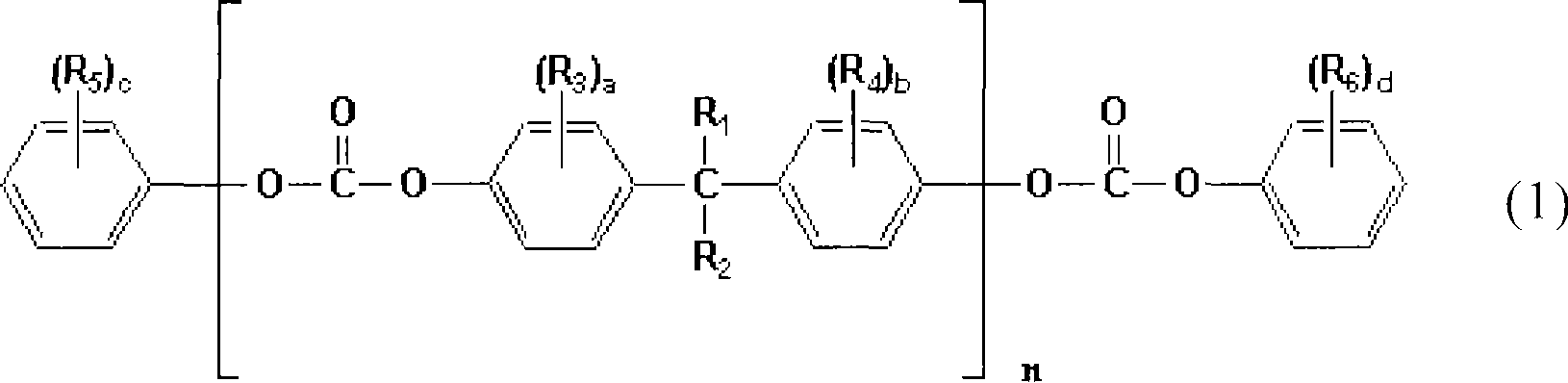
根据本发明的一个技术方案,提供了一种制备封端的聚碳酸酯树脂的方法,该方法包括:在常温和常压下混合具有羟基端基的聚碳酸酯和下列化学式(1)表示的化合物,以获得其混合物;以及在250~320℃和减压下使该混合物进行熔体反应(melt reaction),以降低聚碳酸酯树脂的羟基端基的最终浓度:According to a technical scheme of the present invention, a kind of method of preparing end-capped polycarbonate resin is provided, the method comprises: mixing the polycarbonate with hydroxyl end group and the compound represented by following chemical formula (1) under normal temperature and normal pressure , to obtain a mixture thereof; and subjecting the mixture to a melt reaction (melt reaction) at 250 to 320° C. under reduced pressure to reduce the final concentration of hydroxyl end groups of the polycarbonate resin:

其中,n=1~10;R1、R2、R3、R4、R5和R6各自独立地选自氢、卤素原子、具有1~18个碳原子的烷基、具有1~18个碳原子的烷氧基、具有6~18个碳原子的芳基、具有7~18个碳原子的araryl基、和具有7~18个碳原子的芳基烷氧基;a和b为0~4的整数,以及c和d为0~5的整数。Wherein, n=1~10; R 1 , R 2 , R 3 , R 4 , R 5 and R 6 are each independently selected from hydrogen, halogen atoms, alkyl groups with 1 to 18 carbon atoms, alkyl groups with 1 to 18 Alkoxyl groups having 6 to 18 carbon atoms, aryl groups having 6 to 18 carbon atoms, araryl groups having 7 to 18 carbon atoms, and arylalkoxy groups having 7 to 18 carbon atoms; a and b are 0 an integer of ∼4, and c and d are integers of 0∼5.
所述熔体反应在5~500mmHg的减压下进行。The melt reaction is carried out under a reduced pressure of 5-500 mmHg.
相对于1摩尔聚碳酸酯,所述化学式(1)表示的化合物的量可以在0.5~20摩尔的范围内。The amount of the compound represented by the chemical formula (1) may be in a range of 0.5 to 20 moles relative to 1 mole of polycarbonate.
聚碳酸酯树脂的羟基端基的最终浓度可以在聚碳酸酯树脂的全部端基的0~25.0mol%的范围内。The final concentration of hydroxyl end groups of the polycarbonate resin may be in the range of 0 to 25.0 mol% of all end groups of the polycarbonate resin.
根据本发明的另一个技术方案,提供了一种使用上述方法制备的聚碳酸酯树脂。According to another technical solution of the present invention, a polycarbonate resin prepared by the above method is provided.
聚碳酸酯树脂的羟基端基的最终浓度可以在聚碳酸酯树脂的全部端基的0~25.0mol%的范围内。The final concentration of hydroxyl end groups of the polycarbonate resin may be in the range of 0 to 25.0 mol% of all end groups of the polycarbonate resin.
有益效果Beneficial effect
本发明中的端基终止剂远比用于提高热稳定性的常规方法中所用的端基终止剂更便宜且更易于合成,从而可以以低成本显著提高聚碳酸酯树脂的热稳定性。另外,由于该端基终止剂的化学结构几乎与聚碳酸酯的化学结构相同,所以可以保持聚碳酸酯树脂的物理性质与提高热稳定性之前一样。The terminal terminator in the present invention is much cheaper and easier to synthesize than the terminal terminator used in conventional methods for improving thermal stability, so that the thermal stability of polycarbonate resin can be significantly improved at low cost. In addition, since the chemical structure of the end terminator is almost the same as that of polycarbonate, it is possible to maintain the physical properties of the polycarbonate resin as before improving thermal stability.
附图说明Description of drawings
参考附图,通过详细描述其例证性实施方式,本发明的上述及其它特征和优点将变得更显而易见,其中:The above and other features and advantages of the present invention will become more apparent by describing in detail illustrative embodiments thereof, with reference to the accompanying drawings, in which:
图1为示出在根据本发明提高聚碳酸酯树脂的热稳定性前和后,峰值高度根据末端-OH基团的组成变化的13C-NMR图。FIG. 1 is a 13 C-NMR chart showing changes in peak height according to the composition of terminal -OH groups before and after improving the thermal stability of a polycarbonate resin according to the present invention.
具体实施方式Detailed ways
下文,参考附图,将对本发明进行详细的描述。Hereinafter, the present invention will be described in detail with reference to the accompanying drawings.
可以通过任何方法,如界面聚合、熔体聚合、固相聚合等,使用二烷基(芳基)碳酸酯和芳族羟基化合物而制备根据本发明的具有改善热稳定性的聚碳酸酯树脂。The polycarbonate resin having improved thermal stability according to the present invention can be prepared by any method such as interfacial polymerization, melt polymerization, solid state polymerization, etc., using a dialkyl(aryl)carbonate and an aromatic hydroxy compound.
二烷基(芳基)碳酸酯的例子包括碳酸二苯酯、碳酸二氯苯酯、碳酸间甲苯酯、碳酸二萘酯、碳酸二甲酯、碳酸二环己酯、其混合物等。Examples of dialkyl (aryl) carbonates include diphenyl carbonate, dichlorophenyl carbonate, m-cresyl carbonate, dinaphthyl carbonate, dimethyl carbonate, dicyclohexyl carbonate, mixtures thereof, and the like.
芳族羟基化合物的例子包括双(4-羟基苯基)-甲烷、2,2-双(4-羟基苯基)丙烷、2,2-双(4-羟基-3,5-二溴苯基)丙烷、1,4-二羟基-3-甲基苯、双(4-羟基苯基)硫化物、其混合物等。Examples of aromatic hydroxy compounds include bis(4-hydroxyphenyl)-methane, 2,2-bis(4-hydroxyphenyl)propane, 2,2-bis(4-hydroxy-3,5-dibromophenyl) ) propane, 1,4-dihydroxy-3-methylbenzene, bis(4-hydroxyphenyl)sulfide, mixtures thereof, and the like.
根据本发明的具有改善热稳定性的聚碳酸酯树脂可以具有任何分子量和任何形状,例如粉末状、颗粒状等。但是,25.1mol%或更多的聚碳酸酯树脂的端基由羟基组成。The polycarbonate resin with improved thermal stability according to the present invention may have any molecular weight and any shape, such as powdery, granular, and the like. However, 25.1 mol% or more of the terminal groups of the polycarbonate resin consisted of hydroxyl groups.
在本发明中,使用具有下列化学式(1)表示的化学结构且包括与聚碳酸酯树脂相同的重复单元的化合物作为端基终止剂。In the present invention, a compound having a chemical structure represented by the following chemical formula (1) and including the same repeating unit as the polycarbonate resin is used as the terminal terminator.
其中,n=1~10;R1、R2、R3、R4、R5和R6各自独立地选自氢、卤素原子、具有1~18个碳原子的烷基、具有1~18个碳原子的烷氧基、具有6~18个芳基的芳基、具有7~18个碳原子的araryl基、和具有7~18个碳原子的芳基烷氧基;a和b为0~4的整数,以及c和d为0~5的整数。Wherein, n=1~10; R 1 , R 2 , R 3 , R 4 , R 5 and R 6 are each independently selected from hydrogen, halogen atoms, alkyl groups with 1 to 18 carbon atoms, alkyl groups with 1 to 18 An alkoxy group having 6 to 18 carbon atoms, an aryl group having 6 to 18 aryl groups, an araryl group having 7 to 18 carbon atoms, and an arylalkoxy group having 7 to 18 carbon atoms; a and b are 0 an integer of ∼4, and c and d are integers of 0∼5.
上述化学式(1)表示的化合物通过使如芳族二羟基化合物、芳族碳酸酯等的原料在100~300℃、优选在150~270℃的温度和减压下以熔融态反应30分钟至1小时而制备。如果该反应温度低于100℃,则该反应不能进行。如果该反应温度高于300℃,则合成的端基终止剂会热分解。如果该反应时间短于30分钟,则该反应不能充分进行。如果该反应时间超过1小时,则端基终止剂会具有过大的分子量。The compound represented by the above chemical formula (1) is reacted in a molten state for 30 minutes to 1 hours to prepare. If the reaction temperature is lower than 100°C, the reaction cannot proceed. If the reaction temperature is higher than 300° C., the synthesized end terminator is thermally decomposed. If the reaction time is shorter than 30 minutes, the reaction does not proceed sufficiently. If the reaction time exceeds 1 hour, the end terminator will have an excessively large molecular weight.
所述反应压力可以在5~500mmHg、优选在100~300mmHg的范围内。如果该压力小于5mmHg,则原料会蒸发。如果该压力超过500mmHg,则作为反应副产物生成的苯酚会残留并引起褪色,而且该反应不能充分进行。The reaction pressure may be in the range of 5-500 mmHg, preferably in the range of 100-300 mmHg. If the pressure is less than 5mmHg, the raw material will evaporate. If the pressure exceeds 500 mmHg, phenol produced as a by-product of the reaction remains and causes discoloration, and the reaction does not proceed sufficiently.
在常温和常压下将具有化学式(1)表示的化学结构的端基终止剂和具有羟基端基的聚碳酸酯树脂以固态充分地混合后,使该混合物在200~350℃、优选在250~320℃的温度和减压下以熔融态反应20分钟至1小时。如果该反应温度低于200℃,则反应会进行得过慢。如果该反应温度高于350℃,则在该反应过程中会发生热分解。如果该反应时间短于20分钟,则该反应不能充分进行。如果该反应时间长于1小时,则聚碳酸酯的分子量会过度增加。After the terminal terminator having the chemical structure represented by the chemical formula (1) and the polycarbonate resin having hydroxyl end groups are fully mixed in the solid state under normal temperature and pressure, the mixture is heated at 200 to 350° C., preferably at 250° C. Reaction in the molten state at a temperature of ~320°C and reduced pressure for 20 minutes to 1 hour. If the reaction temperature is lower than 200°C, the reaction will proceed too slowly. If the reaction temperature is higher than 350°C, thermal decomposition occurs during the reaction. If the reaction time is shorter than 20 minutes, the reaction does not proceed sufficiently. If the reaction time is longer than 1 hour, the molecular weight of polycarbonate will increase excessively.
所述反应压力可以在0.1~500mmHg、优选在5~100mmHg的范围内。如果该压力超过500mmHg,则会存在反应副产物苯酚残留的可能性。如果该压力超过500mmHg,则不易于除去反应副产物且降低了末端羟基的浓度。The reaction pressure may be in the range of 0.1-500 mmHg, preferably in the range of 5-100 mmHg. If the pressure exceeds 500 mmHg, there is a possibility that phenol, a reaction by-product, remains. If the pressure exceeds 500 mmHg, it is not easy to remove reaction by-products and the concentration of terminal hydroxyl groups decreases.
如果所述反应温度低于200℃,则熔融不完全。如果该反应温度高于350℃,则制得的聚碳酸酯树脂会热分解,而因此具有较小的分子量并在物理性质上劣化。If the reaction temperature is lower than 200°C, melting is not complete. If the reaction temperature is higher than 350° C., the polycarbonate resin produced is thermally decomposed and thus has a smaller molecular weight and deteriorates in physical properties.
端基终止剂——化学式(1)表示的化合物能够通过聚碳酸酯树脂的末端碳酸酯基团与末端羟基的酯交换反应而降低聚碳酸酯树脂的末端羟基的浓度。末端羟基的最终浓度可以在全部端基的0~25mol%、优选0~15mol%的范围内。如果末端羟基的最终浓度大于25.0mol%,则热稳定性上的提高是微不足道的。Terminal terminator—the compound represented by the chemical formula (1) can reduce the concentration of the terminal hydroxyl group of the polycarbonate resin through the transesterification reaction between the terminal carbonate group and the terminal hydroxyl group of the polycarbonate resin. The final concentration of terminal hydroxyl groups may be in the range of 0 to 25 mol%, preferably 0 to 15 mol%, of the total terminal groups. If the final concentration of terminal hydroxyl groups is greater than 25.0 mol%, the improvement in thermal stability is insignificant.
可以使用的反应器的例子包括排气单或双螺杆挤压机和薄膜反应器或蒸发器等。当反应化合物的熔融粘度较低时,可以使用普通的釜式反应器。Examples of reactors that can be used include vented single or twin screw extruders and thin film reactors or evaporators and the like. Conventional tank reactors can be used when the melt viscosity of the reacting compounds is low.
下文,参考下述实施例,将对本发明进行更详细的描述。下述实施例仅用于例证性目的,而不意于限制本发明的范围。Hereinafter, the present invention will be described in more detail with reference to the following examples. The following examples are for illustrative purposes only and are not intended to limit the scope of the present invention.
合成例Synthesis example
为了合成下列化学式(2)表示的端基终止剂,将22.4g碳酸二苯酯、18.2g双酚A、和相对于双酚A浓度的0.0001mol%的乙酸钠放入100-mL玻璃反应器中,并在搅拌的同时在250℃下反应1小时。该反应器的内压力为250mmHg。在该反应完成后,将温度降至室温,并加入100mL二氯甲烷,从而完全溶解反应产物。加入100mL甲醇,从而得到沉淀。该沉淀物使用滤纸进行过滤,并干燥,从而得到粉末状的端基终止剂。通过NMR分析确认,成功合成了化学式(2)表示的端基终止剂。In order to synthesize a terminal terminator represented by the following chemical formula (2), 22.4 g of diphenyl carbonate, 18.2 g of bisphenol A, and sodium acetate of 0.0001 mol% relative to the concentration of bisphenol A were put into a 100-mL glass reactor , and reacted at 250 °C for 1 hour while stirring. The internal pressure of the reactor was 250 mmHg. After the reaction was completed, the temperature was lowered to room temperature, and 100 mL of dichloromethane was added, thereby completely dissolving the reaction product. 100 mL of methanol was added, resulting in a precipitate. This precipitate was filtered using filter paper, and dried to obtain a powdery terminal terminator. It was confirmed by NMR analysis that the terminal terminator represented by the chemical formula (2) was successfully synthesized.

实施例Example
将通过熔体聚合反应和固相聚合反应制备的数均分子量为15,930g/mol的粉末状聚碳酸酯与1.09g化学式(2)表示的端基终止剂(在合成例中制备的端基终止剂)以固态混合,并注入设定在280℃下的模具型反应器(mold-type reactor)中。The number-average molecular weight prepared by melt polymerization and solid-state polymerization is 15,930g/mol powdered polycarbonate and 1.09g of chemical formula (2) represents the end group terminator (end group termination prepared in the synthesis example agent) was mixed in a solid state and injected into a mold-type reactor set at 280°C.
密封该反应器的模具后,在使用高速搅拌机搅拌所述反应物的同时引发所述反应。该模具的内压力保持在50mmHg。经过1小时后,将该压力返回至常压。冷却所得到的熔融态聚碳酸酯树脂,从而得到具有改善热稳定性的固态聚碳酸酯树脂。After sealing the mold of the reactor, the reaction was initiated while stirring the reactants using a high-speed mixer. The internal pressure of the mold was maintained at 50 mmHg. After 1 hour, the pressure was returned to normal pressure. The resulting molten polycarbonate resin is cooled to obtain a solid polycarbonate resin having improved thermal stability.
使用NMR分析聚碳酸酯树脂端基的组成。在反应前,全部端基的74mol%为羟基。然而,在反应后,羟基的百分率降到了4.7mol%。在300℃、常压下的烘箱中热稳定性测试的结果为:经过10分钟后,没有经历热稳定性改善的样品褪色了。然而,与端基终止剂反应的样品即使经过30分钟后也没有褪色。在280℃和常压下的烘箱中观察分子量变化的结果为:没有经历热稳定性改善的样品的分子量降低了3.8%,而与端基终止剂反应的样品的分子量只降低了0.8%。The composition of the end groups of the polycarbonate resin was analyzed using NMR. Before the reaction, 74 mol% of all end groups were hydroxyl groups. However, after the reaction, the percentage of hydroxyl groups dropped to 4.7 mol%. As a result of the heat stability test in an oven at 300° C. under normal pressure, after 10 minutes, the samples that did not experience improvement in heat stability faded. However, the sample reacted with the end terminator did not fade even after 30 minutes had elapsed. The results of observing molecular weight changes in an oven at 280°C and normal pressure were: the molecular weight of the sample that did not undergo thermal stability improvement decreased by 3.8%, while the molecular weight of the sample reacted with the end-terminator only decreased by 0.8%.
如上所述,本发明中的端基终止剂远比用于提高热稳定性的常规方法中所用的端基终止剂更便宜且更易于合成,从而可以以低成本显著提高聚碳酸酯树脂的热稳定性。另外,由于该端基终止剂的化学结构几乎与聚碳酸酯的化学结构相同,所以可以保持聚碳酸酯树脂的物理性质与提高热稳定性之前一样。As described above, the end terminator in the present invention is far cheaper and easier to synthesize than the end terminator used in conventional methods for improving thermal stability, so that the thermal stability of polycarbonate resin can be significantly improved at low cost. stability. In addition, since the chemical structure of the end terminator is almost the same as that of polycarbonate, it is possible to maintain the physical properties of the polycarbonate resin as before improving thermal stability.
尽管参考其例证性实施方式已对本发明进行了具体说明和描述,但本领域的技术人员应该理解,在不偏离如下述权利要求书所限定的本发明的实质和范围的情况下,可以对本发明进行形式和细节上的多种变化。While the invention has been particularly illustrated and described with reference to its illustrative embodiments, it will be understood by those skilled in the art that the invention may be modified without departing from the spirit and scope of the invention as defined by the following claims. Various variations in form and detail are made.
工业实用性Industrial Applicability
根据本发明,提供了一种使用低成本、易于合成的端基终止剂制备具有改善热稳定性的聚碳酸酯树脂的方法,其中该端基终止剂的化学结构与聚碳酸酯的化学结构非常相似,因此可以保持聚碳酸酯树脂的初始物理性质。According to the present invention, there is provided a method for preparing polycarbonate resins with improved thermal stability using a low-cost, easily synthesized end-termination agent whose chemical structure is very similar to that of polycarbonate Similar, so the original physical properties of the polycarbonate resin can be maintained.
Claims (6)
Applications Claiming Priority (4)
| Application Number | Priority Date | Filing Date | Title |
|---|---|---|---|
| KR1020050018844 | 2005-03-07 | ||
| KR1020050018844A KR100713099B1 (en) | 2005-03-07 | 2005-03-07 | Method of producing polycarbonate resin |
| KR10-2005-0018844 | 2005-03-07 | ||
| PCT/KR2006/000756 WO2006095982A1 (en) | 2005-03-07 | 2006-03-06 | Method of preparing polycarbonate resin |
Publications (2)
| Publication Number | Publication Date |
|---|---|
| CN101061159A true CN101061159A (en) | 2007-10-24 |
| CN101061159B CN101061159B (en) | 2010-09-08 |
Family
ID=36944942
Family Applications (1)
| Application Number | Title | Priority Date | Filing Date |
|---|---|---|---|
| CN2006800012021A Active CN101061159B (en) | 2005-03-07 | 2006-03-06 | Method for preparing polycarbonate resin |
Country Status (8)
| Country | Link |
|---|---|
| US (1) | US7495065B2 (en) |
| EP (1) | EP1856180B1 (en) |
| JP (1) | JP4624424B2 (en) |
| KR (1) | KR100713099B1 (en) |
| CN (1) | CN101061159B (en) |
| ES (1) | ES2373677T3 (en) |
| TW (1) | TWI316949B (en) |
| WO (1) | WO2006095982A1 (en) |
Cited By (1)
| Publication number | Priority date | Publication date | Assignee | Title |
|---|---|---|---|---|
| CN110461904A (en) * | 2017-03-31 | 2019-11-15 | 出光兴产株式会社 | Method for producing thermoplastic resin |
Families Citing this family (8)
| Publication number | Priority date | Publication date | Assignee | Title |
|---|---|---|---|---|
| KR100713099B1 (en) | 2005-03-07 | 2007-05-02 | 주식회사 엘지화학 | Method of producing polycarbonate resin |
| JP5359014B2 (en) * | 2008-04-28 | 2013-12-04 | 三菱瓦斯化学株式会社 | Polycarbonate resin with ultraviolet absorbing ability |
| JP6466074B2 (en) * | 2014-03-13 | 2019-02-06 | 国立研究開発法人産業技術総合研究所 | Cathode active material for sodium ion secondary battery |
| CN107207720A (en) * | 2015-02-17 | 2017-09-26 | 沙特基础工业全球技术有限公司 | The method of melt polycarbonate is quenched |
| CN108884217A (en) | 2016-04-28 | 2018-11-23 | 沙特基础工业全球技术有限公司 | Poly- (ester-carbonic ester), the product formed by it and preparation method |
| EP3350247B1 (en) | 2016-04-28 | 2019-02-13 | SABIC Global Technologies B.V. | Poly(ester-carbonate) copolymers, articles formed therefrom, and methods of manufacture |
| WO2017187424A1 (en) | 2016-04-28 | 2017-11-02 | Sabic Global Technologies B.V. | Poly(ester-carbonate) copolymers, articles formed therefrom, and methods of manufacture |
| CN108883581B (en) | 2016-04-28 | 2019-11-12 | 沙特基础工业全球技术有限公司 | Laser weldable compositions, articles formed therefrom, and methods of manufacture |
Family Cites Families (18)
| Publication number | Priority date | Publication date | Assignee | Title |
|---|---|---|---|---|
| DE2842005A1 (en) * | 1978-09-27 | 1980-04-10 | Bayer Ag | POLYCARBONATES WITH ALKYLPHENYL END GROUPS, THEIR PRODUCTION AND THEIR USE |
| US5034496A (en) * | 1987-04-15 | 1991-07-23 | The Dow Chemical Company | Polycarbonate compositions |
| JPH0727662B2 (en) * | 1987-08-27 | 1995-03-29 | 出光石油化学株式会社 | Optical disc substrate |
| JPS6456728U (en) | 1987-10-02 | 1989-04-10 | ||
| US4994594A (en) * | 1988-02-29 | 1991-02-19 | General Electric Company | Oligomeric carbonate chainstoppers |
| DE68928766T2 (en) * | 1988-09-22 | 1999-03-25 | Ge Plastics Japan Ltd., Tokio/Tokyo | Process for the production of polycarbonates |
| US4886875A (en) * | 1988-12-07 | 1989-12-12 | E. I. Du Pont De Nemours And Company | End-capping of polyarylate carboxyl acid ends by use of aromatic carbonates |
| EP0460206A1 (en) * | 1989-12-22 | 1991-12-11 | General Electric Company | Polyestercarbonate composition |
| JP3218100B2 (en) * | 1992-10-19 | 2001-10-15 | 三井化学株式会社 | Aromatic polycarbonate |
| EP1048684A4 (en) * | 1998-01-13 | 2002-06-26 | Idemitsu Petrochemical Co | Process for producing polycarbonate and optical-disk substrate |
| KR100773607B1 (en) * | 2000-12-28 | 2007-11-05 | 제너럴 일렉트릭 캄파니 | Method of producing polycarbonate |
| JP3791347B2 (en) * | 2001-04-27 | 2006-06-28 | 三菱化学株式会社 | Method for producing aromatic polycarbonate |
| JP4606660B2 (en) | 2001-07-17 | 2011-01-05 | Sabicイノベーティブプラスチックスジャパン合同会社 | Polycarbonate production method and polycarbonate production apparatus |
| JP4025083B2 (en) * | 2002-02-04 | 2007-12-19 | 出光興産株式会社 | Linear polycarbonate |
| US6706846B2 (en) * | 2001-10-10 | 2004-03-16 | General Electric Company | Method for end-capping polycarbonate resins and composition for use in same |
| US6500914B1 (en) * | 2001-10-10 | 2002-12-31 | General Electric Company | Method for end-capping polycarbonate resins and composition for use in same |
| EP1436342B1 (en) * | 2001-10-10 | 2006-07-19 | General Electric Company | Method for end-capping polycarbonate resins |
| KR100713099B1 (en) | 2005-03-07 | 2007-05-02 | 주식회사 엘지화학 | Method of producing polycarbonate resin |
-
2005
- 2005-03-07 KR KR1020050018844A patent/KR100713099B1/en not_active Expired - Fee Related
-
2006
- 2006-03-06 CN CN2006800012021A patent/CN101061159B/en active Active
- 2006-03-06 WO PCT/KR2006/000756 patent/WO2006095982A1/en not_active Ceased
- 2006-03-06 JP JP2007540272A patent/JP4624424B2/en not_active Expired - Fee Related
- 2006-03-06 US US11/368,568 patent/US7495065B2/en active Active
- 2006-03-06 EP EP06716206A patent/EP1856180B1/en active Active
- 2006-03-06 ES ES06716206T patent/ES2373677T3/en active Active
- 2006-03-07 TW TW095107561A patent/TWI316949B/en not_active IP Right Cessation
Cited By (2)
| Publication number | Priority date | Publication date | Assignee | Title |
|---|---|---|---|---|
| CN110461904A (en) * | 2017-03-31 | 2019-11-15 | 出光兴产株式会社 | Method for producing thermoplastic resin |
| CN110461904B (en) * | 2017-03-31 | 2022-06-28 | 出光兴产株式会社 | Manufacturing method of thermoplastic resin |
Also Published As
| Publication number | Publication date |
|---|---|
| WO2006095982A1 (en) | 2006-09-14 |
| TWI316949B (en) | 2009-11-11 |
| CN101061159B (en) | 2010-09-08 |
| US20060199940A1 (en) | 2006-09-07 |
| ES2373677T3 (en) | 2012-02-07 |
| JP4624424B2 (en) | 2011-02-02 |
| EP1856180A1 (en) | 2007-11-21 |
| EP1856180A4 (en) | 2009-02-25 |
| US7495065B2 (en) | 2009-02-24 |
| EP1856180B1 (en) | 2011-09-14 |
| TW200631988A (en) | 2006-09-16 |
| KR100713099B1 (en) | 2007-05-02 |
| JP2008519136A (en) | 2008-06-05 |
| KR20060097326A (en) | 2006-09-14 |
Similar Documents
| Publication | Publication Date | Title |
|---|---|---|
| CN105899607B (en) | Poly carbonate resin composition | |
| EP1581579B1 (en) | Method of polycarbonate preparation | |
| CN1285641C (en) | Solid state polymerization preparation method of polycarbonate | |
| EP1448661B1 (en) | Reduction of reaction by-products in polycarbonate resins | |
| JP2674813B2 (en) | Method for producing polycarbonate | |
| CN104837890B (en) | Manufacture method through the aromatic polycarbonate resin that macromolecule quantifies | |
| CN1777632A (en) | branched polyphosphonate | |
| CN109776783B (en) | Preparation method of weather-resistant and solvent-resistant copolymerized polycarbonate | |
| CN1666004A (en) | Method for preparing high molecular weight polycarbonate | |
| CN101061159A (en) | Method of preparing polycarbonate resin | |
| JP2628905B2 (en) | Method for producing polycarbonate | |
| CN1077205A (en) | combination | |
| TWI776900B (en) | Aromatic polycarbonate oligomer solid body | |
| KR20130104317A (en) | Polycarbonate-polysiloxane copolymer and method for preparing the same | |
| CN1826368A (en) | Process for preparing branched polycarbonate | |
| US20140187736A1 (en) | Branched Polycarbonate and Method for Preparing the Same | |
| CN1163538C (en) | Method for preparing polycarbonate with improved crystallinity | |
| KR100888621B1 (en) | Terminal Blocked Polycarbonate Resin and Manufacturing Method Thereof | |
| CN1231518C (en) | A kind of method for preparing polycarbonate from diphenol and diaryl carbonate | |
| EP4194510A1 (en) | Polycarbonate compound composition and method for preparing same | |
| CN116635451A (en) | Polycarbonate and its preparation method | |
| KR101499246B1 (en) | Highly branched polycarbonate resin and method for preparing the same | |
| JPH0625401A (en) | Film for printed circuit | |
| CN102224184A (en) | Process for preparing linear polycarbonate with improved impact properties | |
| TW201728615A (en) | Copolycarbonate and composition comprising the same |
Legal Events
| Date | Code | Title | Description |
|---|---|---|---|
| C06 | Publication | ||
| PB01 | Publication | ||
| C10 | Entry into substantive examination | ||
| SE01 | Entry into force of request for substantive examination | ||
| C14 | Grant of patent or utility model | ||
| GR01 | Patent grant |