CN101042737B - A smart card and method for creating applications and inserting objects into the smart card - Google Patents
A smart card and method for creating applications and inserting objects into the smart card Download PDFInfo
- Publication number
- CN101042737B CN101042737B CN2006100251363A CN200610025136A CN101042737B CN 101042737 B CN101042737 B CN 101042737B CN 2006100251363 A CN2006100251363 A CN 2006100251363A CN 200610025136 A CN200610025136 A CN 200610025136A CN 101042737 B CN101042737 B CN 101042737B
- Authority
- CN
- China
- Prior art keywords
- data
- smart card
- container
- application
- key
- Prior art date
- Legal status (The legal status is an assumption and is not a legal conclusion. Google has not performed a legal analysis and makes no representation as to the accuracy of the status listed.)
- Active
Links
Images


Landscapes
- Storage Device Security (AREA)
Abstract
本发明提供了一种向智能卡中创建应用的方法,所述智能卡采用容器和对象的方式存储数据,包括:根据指令报文数据进行容器认证步骤;如果认证通过,则在容器内创建应用类入口;从指令报文中解析出对象标识,判断是否与当前应用类入口的应用类标识相同;如果匹配,则将当前解析的对象插入到当前应用类入口的对象列表中,并存储该对象。本发明所述的向智能卡中创建应用的流程可以适用于各种行业,提供了一种通用的创建流程。智能卡的发行过程中只需要进行一次开发即可,各种行业应用都可以采用本发明所述的创建应用的方法,向智能卡中创建应用,即本发明可以很方便的实现向智能卡中创建多应用。

The present invention provides a method for creating an application in a smart card. The smart card stores data in the form of containers and objects, including: performing container authentication steps according to instruction message data; if the authentication is passed, creating an application class entry in the container ; Parse the object ID from the instruction message, and judge whether it is the same as the application class ID of the current application class entry; if they match, insert the currently parsed object into the object list of the current application class entry, and store the object. The flow of creating applications in the smart card described in the present invention can be applied to various industries and provides a general creation flow. In the issuance process of the smart card, only one development is required, and various industry applications can use the method for creating applications described in the present invention to create applications in the smart card, that is, the present invention can easily realize the creation of multiple applications in the smart card. .
Description
技术领域technical field
本发明涉及一种数据存储及信息处理领域,特别是涉及一种智能卡及向智能卡中创建应用、插入对象的方法。The invention relates to the field of data storage and information processing, in particular to a smart card and a method for creating applications and inserting objects into the smart card.
背景技术Background technique
由于现有的磁条卡存在安全性差等缺陷,所以国内外各银行都在逐步采用智能卡(CPU卡)来代替磁条卡,并单独或联合行业用户发行了大量的智能卡。一般而言,智能卡是一个包含嵌入集成电路(IC)的塑料卡片,集成电路内包含一个微型的中央处理器(CPU)、ROM、RAM及其它附属外围电路,该集成电路具有和计算机类似的能力,例如:运行程序,处理输入和输出数据。当使用上述CPU卡的时候,需要由外部提供电源及其它接口设备。Because existing magnetic stripe cards have defects such as poor security, banks at home and abroad are gradually adopting smart cards (CPU cards) to replace magnetic stripe cards, and have issued a large number of smart cards individually or jointly with industry users. Generally speaking, a smart card is a plastic card containing an embedded integrated circuit (IC), which contains a tiny central processing unit (CPU), ROM, RAM and other peripheral circuits. The integrated circuit has capabilities similar to those of a computer. , for example: running programs, processing input and output data. When using the above-mentioned CPU card, it is necessary to provide power and other interface devices from the outside.
为了规范从磁条卡向IC卡(通常指CPU卡)的迁移过程,三大国际卡组织Europay、MasterCard、Visa共同制订了基于IC卡的金融支付应用标准,简称EMV规范。所谓EMV迁移是指,按照EMV规范,在发卡、收单、信息转接、业务处理、相关产品认证等各个环节从磁条卡向IC卡迁移。In order to standardize the migration process from magnetic stripe cards to IC cards (usually referred to as CPU cards), the three major international card organizations Europay, MasterCard, and Visa jointly formulated IC card-based financial payment application standards, referred to as EMV specifications. The so-called EMV migration refers to the migration from magnetic stripe cards to IC cards in various links such as card issuance, receipt, information transfer, business processing, and related product certification in accordance with EMV specifications.
为了迅速适应国际化竞争的需要,尽快提高自身竞争力,国内银行卡EMV迁移正在逐步实施中,在不远的将来,CPU卡将成为大多数人随身携带的智能卡。发卡行通常都比较积极的拓展自己智能卡的功能,如何将发卡行的这种需求和行业用户的项目结合就是非常重要的课题。In order to quickly adapt to the needs of international competition and improve their own competitiveness as soon as possible, the EMV migration of domestic bank cards is being gradually implemented. In the near future, CPU cards will become smart cards that most people carry with them. Issuing banks are usually more active in expanding the functions of their smart cards. How to combine the needs of card issuing banks with the projects of industry users is a very important issue.
国际标准化组织规定的ISO7816第1~7部分规定了一组覆盖CPU卡各个方面的标准。ISO7816包括:物理特性(第1部分)、尺寸和触点位置(第2部分)、电子信号和传输协议(第3部分)、行业间交换指令(第4部分)、应用程序标识符(第5部分)、行业间数据元素(第6部分)和行业间SCQL指令(第7部分)。
对于CPU卡来说,实现CPU卡的多应用是一个迫切的发展方向,所谓多应用是指在同一张智能卡上存在多个应用,如金融钱包、加油钱包、考勤门禁等,通常这些应用在逻辑上分别处于不同的应用区。实现CPU卡多应用必须主要考虑以下三部分内容:应用数据在智能卡上的存储机制;应用数据如何存取卡上数据;智能卡如何配合实际的应用实现具体的应用流程。For the CPU card, it is an urgent development direction to realize the multi-application of the CPU card. The so-called multi-application refers to the existence of multiple applications on the same smart card, such as financial wallets, fuel wallets, and attendance control. are in different application areas. To realize multi-application of CPU card, the following three parts must be considered: the storage mechanism of application data on the smart card; how to access the data on the card by application data;
现有的普通IC卡操作系统遵循基于ISO7816标准的目录和文件方式,实现应用数据在智能卡上的存储机制,如图1所示。The existing common IC card operating system follows the directory and file method based on the ISO7816 standard to realize the storage mechanism of application data on the smart card, as shown in Figure 1 .
现有的IC卡中采用目录和文件的方式进行应用数据的存储,即现有的基本都是面向文件系统的智能卡。所述文件数据的存储过程类似普通软盘等的存储机制,只不过现在常用的CPU卡的容量仅仅为8K或者16K字节,容量较小而已。并且,现在常用的CPU卡在操作文件时,存在以下限制:Existing IC cards store application data in the form of directories and files, that is, existing smart cards are basically file system-oriented. The storage process of the file data is similar to the storage mechanism of ordinary floppy disks, etc., except that the capacity of the commonly used CPU card is only 8K or 16K bytes, which is relatively small. Moreover, when the commonly used CPU is stuck in operating files, there are the following limitations:
1、CPU卡创建一个文件时必须先声明创建的文件的类型以及创建文件的空间大小;并且,确定后文件的长度就是固定、不能改变的了,从而导致以前申请的空间无法再次使用。1. When the CPU card creates a file, it must first declare the type of the file to be created and the size of the file to be created; and, after confirmation, the length of the file is fixed and cannot be changed, so that the previously applied space cannot be used again.
2、CPU卡创建完一个文件后不可以删除。(测试发卡的时候可以例外,但此时删除的是MF,即删除智能卡中的所有文件和目录)2. After the CPU card creates a file, it cannot be deleted. (Exceptions can be made when testing card issuance, but at this time, MF is deleted, that is, all files and directories in the smart card are deleted)
3、CPU卡文件类型只有很少几种,即文件类型是固定的。3. There are only a few types of CPU card files, that is, the file types are fixed.
4、CPU卡创建文件、写文件必须通过向智能卡发送报文的方式进行,并且每次写的字节数一般不能超过256字节,处理过程复杂。4. The CPU card must create and write files by sending messages to the smart card, and the number of bytes written each time generally cannot exceed 256 bytes, and the processing process is complicated.
参照图1,现在常用的CPU卡一般包括主文件MF、专用文件DF以及基本数据文件MF等文件类型。卡的专用文件(DF,Dedicated File)与基本数据文件(EF)呈树状结构,每个专用文件是其下属基本数据文件的入口点。Referring to Fig. 1, the commonly used CPU cards generally include file types such as main file MF, special file DF, and basic data file MF. The card's dedicated file (DF, Dedicated File) and the basic data file (EF) are in a tree structure, and each dedicated file is the entry point of its subordinate basic data file.
所述主文件MF(Master File)即根目录,是智能卡文件系统的根,相当于DOS的根目录,每张卡有且只有一个MF文件。当然,不同智能卡厂商的MF的创建方式是不同的。主要有两种方式:在智能卡个人化过程中由发卡方创建,如明华、德生智能卡;或者,厂商提供智能卡的时候已经创建,发卡方不能再创建,如握奇智能卡。The main file MF (Master File) is the root directory, which is the root of the smart card file system, equivalent to the root directory of DOS, and each card has and only one MF file. Of course, the MF creation methods of different smart card manufacturers are different. There are two main ways: the card issuer creates it during the personalization process of the smart card, such as Minghua and Desheng smart cards; or, the smart card has been created when the manufacturer provides the smart card, and the card issuer cannot create it again, such as the Watchdata smart card.
所述DF(Dedicated File)文件相当于DOS的子目录。所述DF文件又可以进一步分为DDF和ADF,一般将包含下级目录的DF称之为DDF,不包含下级目录的称之为ADF。The DF (Dedicated File) file is equivalent to a subdirectory of DOS. The DF files can be further divided into DDF and ADF. Generally, a DF containing a lower-level directory is called a DDF, and a DF that does not include a lower-level directory is called an ADF.
对于现有IC卡多应用的实现是通过创建多个ADF(即创建多个目录)达到的。每个ADF代表一个应用。每个ADF下有相应的文件,相应的文件中存放相应的数据。The realization of multiple applications of existing IC cards is achieved by creating multiple ADFs (that is, creating multiple directories). Each ADF represents an application. There are corresponding files under each ADF, and corresponding data are stored in the corresponding files.
ISO7816标准也定义了一些针对文件系统的存取指令,如读二进制文件、写二进制文件等,现有的IC卡操作系统基本上都采用7816里定义的机制,另外再加入自定义的或行业应用的特殊指令来实现。The ISO7816 standard also defines some access commands for the file system, such as reading binary files, writing binary files, etc. The existing IC card operating systems basically use the mechanism defined in 7816, and add custom or industry applications special instructions to implement.
例如,CPU卡有这么一个指令:SELECT MF,这个指令表示进入智能卡的根目录,但由于CPU卡的操作系统比较简单,它处理不了这种纯粹字符的东西,向智能卡发送指令的时候必须把指令转换成十六进制的格式:转换成智能卡的指令格式是:00 A4 00 00 02 3F 00。For example, the CPU card has such an instruction: SELECT MF, this instruction means to enter the root directory of the smart card, but because the operating system of the CPU card is relatively simple, it cannot handle such pure character things, and the instruction must be sent to the smart card. Converted to hexadecimal format: the command format converted to smart card is: 00 A4 00 00 02 3F 00.
由于ISO7816标准仅仅规定了一些简单的存取指令,对于不同的应用则需要加入自定义的或行业应用的特殊指令来实现,所以,智能卡如何配合具体的应用的实现流程是无法统一的,例如,人民银行定义了实现消费和圈存的指令、中石化定义了灰锁的加锁解扣指令、劳动部定义了自己的实现老保和社保的指令等等。不同的行业应用根据自身需要,设置不同的文件结构、长度等进行存储,设置不同的专用指令来实现不同的应用流程。Since the ISO7816 standard only stipulates some simple access instructions, for different applications, it is necessary to add custom or special instructions for industry applications. Therefore, the implementation process of how smart cards cooperate with specific applications cannot be unified. For example, The People's Bank of China has defined the instructions for realizing consumption and loading, Sinopec has defined the instructions for unlocking and unlocking gray locks, and the Ministry of Labor has defined its own instructions for realizing old-age insurance and social security, etc. Different industry applications set different file structures and lengths for storage according to their own needs, and set different special instructions to achieve different application processes.
总之,现有的CPU卡的存储机制导致下述的几个问题:In a word, the storage mechanism of the existing CPU card causes the following problems:
由于创建一个文件时必须先声明创建的文件的类型以及创建文件的空间大小;并且,确定后文件的类型、长度就是固定的,且不可以删除,从而导致以前申请过的空间无法再次使用。When creating a file, you must first declare the type of the file to be created and the size of the file to be created; and, after confirmation, the type and length of the file are fixed and cannot be deleted, so the previously applied space cannot be used again.
由于不同行业应用发行CPU卡时都需要进行相应的开发过程,使得该CPU卡可以执行本行业或企业的专用指令、流程。本行业或者其他行业的新应用希望共同使用该CPU卡(即向该CPU卡中创建新应用)时,但是由于该CPU卡无法执行其特殊指令、流程,则不得不重新开发一个新卡,一方面导致开发成本极高,并且后续升级或业务整合的难以实现;另一方面又导致不同的应用需要使用不同的CPU卡,给消费者以及服务提供商带来不便。也就是说,现有技术向智能卡中创建应用的过程必须包括一个针对卡本身的开发过程,而且无法方便的向该智能卡中创建另一个应用,因为需要针对该新应用重新进行开发过程。Due to the corresponding development process is required when issuing CPU cards for different industries, so that the CPU cards can execute the special instructions and processes of the industry or enterprise. When new applications in this industry or other industries want to use the CPU card together (that is, create a new application in the CPU card), but because the CPU card cannot execute its special instructions and processes, a new card has to be redeveloped. On the one hand, it leads to extremely high development costs, and it is difficult to realize subsequent upgrades or business integration; on the other hand, different applications need to use different CPU cards, which brings inconvenience to consumers and service providers. That is to say, the process of creating an application in the smart card in the prior art must include a development process for the card itself, and it is impossible to conveniently create another application in the smart card, because the development process needs to be re-developed for the new application.
并且由于各行业的应用具有独特的特点,自定义了各种不同的应用指令和流程,而现有的智能卡无法适应各行业不同的具体应用流程,所以带来智能卡多应用实现中的困难。And because the applications of each industry have unique characteristics, various application instructions and processes are customized, and the existing smart cards cannot adapt to the different specific application processes of each industry, so it brings difficulties in the realization of smart card multi-applications.
现有技术中智能卡应用的开发主要是某个公司私有的开发行为。虽然所有智能卡看起来很像,但是每个智能卡的操作系统软件都是不尽相同的,在设计应用的接口上存在差异。这意味着如果A公司制造了一种智能卡,B公司也制造了一种智能卡,在这两种卡上构建相同的应用存在很大的不确定性,甚至不可能完成。这就导致智能卡的应用开发被限制在一个相对较小的圈子里,很难实现和推动智能卡的多应用。The development of smart card applications in the prior art is mainly a private development behavior of a certain company. Although all smart cards look alike, the operating system software of each smart card is different, and there are differences in the interface of the design application. This means that if Company A manufactures a smart card and Company B also manufactures a smart card, building the same application on both cards is highly uncertain and even impossible. This causes the application development of the smart card to be limited in a relatively small circle, it is difficult to realize and promote the multi-application of the smart card.
由于现有技术无法制定出一套能够满足各行业对CPU卡应用的指令或流程,使得开发成本极高,并且后续升级或业务整合的难以实现。行业应用提供方单独发卡或为了某种原因和银行联合发卡,也迫切需要一个通用的规范来指导,以减少后续升级或业务整合时带来的风险和代价。Because the existing technology cannot formulate a set of instructions or procedures that can meet the application of CPU cards in various industries, the development cost is extremely high, and subsequent upgrades or business integration are difficult to achieve. Industry application providers who issue cards independently or jointly issue cards with banks for some reason also urgently need a general specification to guide, so as to reduce the risks and costs brought about by subsequent upgrades or business integration.
发明内容Contents of the invention
鉴于上述问题,本发明的目的是提供一种公共的开放的智能卡平台,以便:减小或消除发卡行在业务开拓时的技术障碍,快速推动对智能卡多应用市场的开发;满足行业应用的特点和需求,保护各行业应用的独立性和私密性;并相互兼容多个应用开发商的应用。In view of the above-mentioned problems, the purpose of the present invention is to provide a public open smart card platform, so as to: reduce or eliminate the technical barriers of card issuing banks in business development, quickly promote the development of smart card multi-application market; meet the characteristics of industry applications and requirements, protect the independence and privacy of applications in various industries; and are compatible with applications from multiple application developers.
为解决上述技术问题,本发明的目的是通过以下技术方案实现的:In order to solve the problems of the technologies described above, the purpose of the present invention is achieved through the following technical solutions:
一种向智能卡中创建应用的方法,所述智能卡采用容器和对象的方式存储数据,包括:根据指令报文数据进行容器认证步骤;如果认证通过,则在容器内创建应用类入口;从指令报文中解析出对象标识,判断是否与当前应用类入口的应用类标识相同;如果匹配,则将当前解析的对象插入到当前应用类入口的对象列表中,并存储该对象。A method for creating an application in a smart card, wherein the smart card stores data in the form of a container and an object, including: performing a container authentication step according to instruction message data; if the authentication is passed, creating an application class entry in the container; The object ID is parsed out in the article, and it is judged whether it is the same as the application class ID of the current application class entry; if it matches, the currently parsed object is inserted into the object list of the current application class entry, and the object is stored.
优选的,所述的向智能卡中创建应用的方法,还包括,如果所述对象标识与当前应用类入口的应用类标识相同,则解析出对象属性,并判断该对象属性是否和指令报文的参数中设定的需要插入的对象的类型匹配。优选的,如果所述当前解析的对象为密钥对象,则解析属性的后续字节,并根据密钥的算法计算密钥的长度。优选的,所述的向智能卡中创建应用的方法,还包括:解析对象的内容,分析并保存存取条件列表ACL以及数据项。优选的,如果前解析的对象为密钥对象,则记录对象的引用条件、计数器及更新条件到当前应用类入口的状态机描述列表中。优选的,如果在解析对象内容时出现数据域内容不正确的情况,则释放为该对象申请的临时空间,并恢复卡片数据至插入该对象前的状态。优选的,所述插入的对象包括用于实现一定应用指令功能的APDU对象。Preferably, the method for creating an application in a smart card further includes, if the object identifier is the same as the application class identifier of the current application class entry, parsing out the object attribute, and judging whether the object attribute is consistent with the instruction message The type of the object to be inserted set in the parameter matches. Preferably, if the currently parsed object is a key object, parse subsequent bytes of the attribute, and calculate the length of the key according to the key algorithm. Preferably, the method for creating an application in the smart card further includes: analyzing the content of the object, analyzing and saving the access condition list ACL and data items. Preferably, if the previously parsed object is a key object, record the reference condition, counter and update condition of the object into the state machine description list of the current application class entry. Preferably, if the content of the data field is incorrect when parsing the content of the object, release the temporary space applied for the object, and restore the card data to the state before inserting the object. Preferably, the inserted object includes an APDU object for realizing certain application instruction functions.
优选的,所述的向智能卡中创建应用的方法,还可以包括,如果卡读取设备选择离开容器或进行重新认证,则释放当前的应用类入口。Preferably, the method for creating an application in a smart card may further include releasing the current application entry if the card reading device chooses to leave the container or perform re-authentication.
本发明还公开了一种向智能卡中插入对象的方法,所述智能卡采用容器和对象的方式存储数据,包括以下步骤:根据指令报文数据进行容器认证步骤;如果认证通过,则选择指定的应用类入口;从指令报文中解析出对象标识,判断是否与当前应用类入口的应用类标识相同;如果匹配,则将当前解析的对象插入到当前应用类入口的对象列表中,并存储该对象。The invention also discloses a method for inserting an object into a smart card. The smart card stores data in the form of a container and an object. Class entry; parse the object ID from the instruction message, and judge whether it is the same as the application class ID of the current application class entry; if it matches, insert the currently parsed object into the object list of the current application class entry, and store the object .
本发明还提供了一种数据处理装置,特别是智能卡,包括:微处理器、非易失性存储器以及操作系统;所述操作系统将数据按照容器和对象的方式存储在非易失性存储器中,存储在至少一个容器中,每个容器内包含至少一个应用的对象集合;所述操作系统设置容器的操作接口,以实现通用的针对对象的操作。The present invention also provides a data processing device, especially a smart card, including: a microprocessor, a nonvolatile memory, and an operating system; the operating system stores data in the nonvolatile memory in the form of containers and objects , stored in at least one container, and each container contains at least one application object set; the operating system sets the operation interface of the container to implement general object-oriented operations.
本发明还提供了一种实现智能卡多应用的方法,包括:设置至少一个容器;将数据按照容器和对象的方式存储,每个容器内包含至少一个应用的对象集合;设置容器的操作接口,以实现通用的针对对象的操作。优选的,根据数据的特性,将数据分别存储为数据对象、计算对象、密钥对象及应用协议数据单元APDU对象;所述数据对象用于存储应用数据,所述计算对象用于存储敏感数据,所述密钥对象用于存储应用的密钥数据;所述APDU对象用于存储实现特定功能的指令序列数据。The present invention also provides a method for realizing multiple applications of smart cards, including: setting at least one container; storing data in the form of containers and objects, each container containing at least one application object set; setting the operation interface of the container to Implements common object-oriented operations. Preferably, according to the characteristics of the data, the data are respectively stored as data objects, calculation objects, key objects and application protocol data unit APDU objects; the data objects are used to store application data, and the calculation objects are used to store sensitive data, The key object is used to store application key data; the APDU object is used to store instruction sequence data for implementing specific functions.
与现有技术相比,从上述技术方案可以得出,本发明具有以下优点:Compared with prior art, can draw from above-mentioned technical scheme, the present invention has the following advantages:
由于本发明所述智能卡采用容器、对象的概念对应用数据进行存储,并在容器端提供通用的针对对象的操作,而将多应用的本身的安全机制和应用流程完全交给外部处理,达到了最大的通用性,这是采用ISO7816文件系统的规范难以做到的。所述通用性体现在,采用本发明所述智能卡的数据存储方法,只需要针对该智能卡进行一次开发即可,以后的个人化过程以及使用流程都可以采用通用流程实现,而不需要由于某个具体应用的特殊需要或者特殊指令对该智能卡进行重新开发的过程。Since the smart card of the present invention uses the concepts of container and object to store application data, and provides general object-oriented operations on the container side, the security mechanism and application process of the multi-application itself are completely handed over to external processing, achieving Maximum versatility, which is difficult to achieve with the specification of the ISO7816 file system. The versatility is reflected in that, adopting the data storage method of the smart card of the present invention, it only needs to be developed once for the smart card, and the subsequent personalization process and use process can be realized by using the general process, without the need for a certain The process of redeveloping the smart card according to the special needs of specific applications or special instructions.
采用对象的概念解决应用数据存储问题,并且提供标准的接口来实现对象的插入和存取操作,所以本发明对应用数据的具体格式没有限制,由应用本身自行定义和设定,从而同时解决了数据的存取问题;优选的,本发明还可以采用与传统方式一致的安全报文机制来保证系统和数据安全。The concept of objects is used to solve the problem of application data storage, and a standard interface is provided to realize the insertion and access operations of objects, so the present invention has no restrictions on the specific format of application data, which is defined and set by the application itself, thereby solving the problem at the same time Data access problem; preferably, the present invention can also adopt a security message mechanism consistent with traditional methods to ensure system and data security.
由于本发明采用了容器和对象的数据存储方式,所以本发明所述智能卡还可以具体将某个单独的应用作为容器,在该应用下面创建更多的子应用,从而可以实现多个微应用。Since the present invention adopts the data storage method of container and object, the smart card of the present invention can also specifically use a single application as a container, and create more sub-applications under the application, so as to realize multiple micro-applications.
本发明所述的向智能卡中创建应用的流程可以适用于各种行业,提供了一种通用的创建流程。智能卡的发行过程中只需要进行一次开发即可,各种行业应用都可以采用本发明所述的创建应用的方法,向智能卡中创建应用,即本发明可以很方便的实现向智能卡中创建多应用。The process of creating applications in the smart card described in the present invention can be applied to various industries, and provides a general creation process. In the issuing process of the smart card, only one development is required, and various industry applications can use the method for creating applications described in the present invention to create applications in the smart card, that is, the present invention can easily realize the creation of multiple applications in the smart card. .
为了配合应用流程的实现,本发明采用APDU对象来实现以前定义专用的指令的功能,将解决这个问题的主动权从智能卡交到应用一方,可以由应用具体设计相应的对象,只要插入容器就可以了。容器处理APDU对象类似一个钩子,当发现卡读取设备发来的指令不是标准的指令,则查看当前的APDU对象列表,如果某个对象符合处理请求则调用处理,即可实现以前定义专用指令的功能。In order to cooperate with the realization of the application flow, the present invention uses the APDU object to realize the function of the previously defined special instruction, and the initiative to solve this problem is handed over to the application side from the smart card, and the corresponding object can be specifically designed by the application, as long as it is inserted into the container. up. Container processing APDU objects is similar to a hook. When it is found that the instruction sent by the card reading device is not a standard instruction, it will check the current APDU object list. If an object meets the processing request, it will call the processing, which can realize the previously defined special instruction. Function.
由于APDU对象的采用,使得本发明的存取对象的流程可以适用于各种行业的具体应用流程。一般的读取、引用对象等流程是统一的,而且执行特殊指令的流程也是统一的:先引用相应的APDU对象,然后由该APDU对象控制流程完成特殊的指令功能。Due to the adoption of the APDU object, the process of accessing the object in the present invention can be applied to specific application processes in various industries. The general process of reading and referencing objects is unified, and the process of executing special instructions is also unified: first reference the corresponding APDU object, and then the APDU object controls the process to complete the special instruction function.
由于解决了数据的存储问题和存取问题,而且将应用流程的处理也交到实际应用去处理,本发明就可以提供统一的多应用平台。IC卡产业链的所有厂商都将可以开发出通用的、互相兼容的产品,降低成本,并推动整个产业的发展。Since the problem of data storage and access is solved, and the processing of the application process is handed over to the actual application for processing, the present invention can provide a unified multi-application platform. All manufacturers in the IC card industry chain will be able to develop common and compatible products, reduce costs, and promote the development of the entire industry.
一个开放的、可互操作的多应用智能卡平台给不同的机构都将带来益处,例如,持卡人、商户、发卡方、收单方、系统集成商、智能卡供应商和卡读取设备供应商等。对发卡方而言,可以提供共同的平台供商业合作伙伴使用,给持卡人提供便利,保持其忠诚度,提高使用本行卡的积极性;对持卡人而言,可以很容易的、及时的获得发卡方提供的各种服务,随时能了解自己的积分额或VIP等级等信息;对商户、收单方、系统集成商、智能卡供应商和卡读取设备供应商而言,可以通过公共的平台和POS系统为各种应用服务,比如可以在持卡人的卡上轻松加入自己的积分系统,而无需任何投资。An open, interoperable, multi-application smart card platform will benefit organizations such as cardholders, merchants, issuers, acquirers, system integrators, smart card suppliers and card reading equipment suppliers wait. For card issuers, it can provide a common platform for business partners to use, provide convenience for cardholders, maintain their loyalty, and increase enthusiasm for using the bank's cards; for cardholders, it can be easily and timely To obtain various services provided by the card issuer, you can know your points or VIP level and other information at any time; for merchants, acquirers, system integrators, smart card suppliers and card reading equipment suppliers, you can use public The platform and POS system serve various applications, such as the ability to easily add one's own point system on the cardholder's card without any investment.
由于本发明所述智能卡具有统一的接口,所以系统集成商、机具供应商都可以开发标准的产品,避免对某个具体的项目开发产品而增加开发成本,而发卡者也可以降低系统的兼容风险,并保持足够的开放性,确保后续业务能及时更新到智能卡和相关环节,保护投资收益。Since the smart card of the present invention has a unified interface, system integrators and equipment suppliers can develop standard products to avoid increasing development costs for a specific project, and card issuers can also reduce system compatibility risks. And maintain enough openness to ensure that follow-up business can be updated to smart cards and related links in time to protect investment income.
附图说明Description of drawings
下面结合附图和具体实施方式对本发明作进一步详细的说明。The present invention will be further described in detail below in conjunction with the accompanying drawings and specific embodiments.
图1是基于ISO7816标准的目录和文件的智能卡数据存储方式示意图;Figure 1 is a schematic diagram of a smart card data storage method based on ISO7816 standard directories and files;
图2是智能卡的应用的装置框图;Fig. 2 is the device block diagram of the application of smart card;
图3是实现APDU对象的信息流程图;Fig. 3 is the information flowchart of realizing APDU object;
图4是实现APDU对象的系统结构图;Fig. 4 is the system structural diagram that realizes APDU object;
图5是智能卡中数据存储的容器和对象的概念图;Fig. 5 is a conceptual diagram of containers and objects of data storage in a smart card;
图6是智能卡中数据存储的容器中不同类型的对象之间的关系图;Fig. 6 is a relationship diagram between different types of objects in the container of data storage in the smart card;
图7是容器认证流程的步骤图;Figure 7 is a step diagram of the container authentication process;
图8是插入对象的处理流程的步骤图;Fig. 8 is a step diagram of the processing flow of inserting an object;
图9是存取对象的处理流程的步骤图;Fig. 9 is a step diagram of a process flow for accessing an object;
图10是引用对象的处理流程的步骤图;Fig. 10 is a step diagram of the process flow of referencing an object;
图11是删除对象的处理流程的步骤图;Fig. 11 is a step diagram of the processing flow of deleting an object;
图12是读取对象的处理流程的步骤图;Fig. 12 is a step diagram of the processing flow of reading an object;
图13是更新对象的处理流程的步骤图;Fig. 13 is a step diagram of a processing flow for updating an object;
图14是对象加值的处理流程的步骤图;Fig. 14 is a step diagram of the processing flow of object value addition;
图15是对象减值的处理流程的步骤图;Fig. 15 is a step diagram of the processing flow of object depreciation;
图16是解锁容器认证密钥的处理流程的步骤图。FIG. 16 is a step diagram of a process flow for unlocking a container authentication key.
具体实施方式Detailed ways
本发明中所述应用(Application)一般是指智能卡和卡读取设备(CardAcceptance Device,CAD)之间的应用协议以及相关的数据。一个典型的智能卡设备一般包括一个8或16位的运行在3.7MHz的微处理器,带有1K的RAM和多于16K的非易失性存储器(可编程只读存储器或者闪存)。智能卡可以分为可接触和非可接触。可接触智能卡通过读卡器和智能卡的8个触点物理接触来通讯并工作,而非可接触智能卡依靠在小于2英尺的一般距离之内的射频信号通讯。Application (Application) described in the present invention generally refers to the application protocol and related data between the smart card and the card reading device (CardAcceptance Device, CAD). A typical smart card device generally includes an 8 or 16-bit microprocessor running at 3.7MHz, with 1K of RAM and more than 16K of non-volatile memory (programmable read-only memory or flash memory). Smart cards can be classified as contact and non-contact. Contactable smart cards communicate and work through physical contact between the reader and the smart card's 8 contacts, while non-contact smart cards rely on radio frequency signals to communicate within a typical distance of less than 2 feet.
本发明所述的典型的智能卡的应用并不是孤立的,而是包含智能卡、卡读取设备以及后端应用程序。参照图2,智能卡的应用的装置框图。The application of the typical smart card described in the present invention is not isolated, but includes smart card, card reading device and back-end application program. Referring to FIG. 2 , a device block diagram of a smart card application.
智能卡插入可以与另一台计算机相连的卡读取设备,从而实现数据传输和处理。卡读取设备又可称作终端、读卡器或者接口设备(IFD)。上述卡读取设备都具有向智能卡提供电源和建立数据传输连接的基本功能。The smart card is inserted into a card reading device that can be connected to another computer, allowing data transfer and processing. A card reading device may also be called a terminal, a card reader or an interface device (IFD). The above-mentioned card reading devices all have the basic functions of providing power to the smart card and establishing a data transmission connection.
所述后端应用程序可以提供支持卡上APDU对象(或者称为小应用程序)的服务。例如,一个后端应用程序可以提供安全系统和卡上的证书的连接,提供强大的安全性。在一个电子付款系统中,后端应用程序可以提供信用卡访问其他付款信息的服务。所述APDU是指应用协议数据单元(Application ProtocolData Unit)。所述APDU对象类似JAVA小程序,包括能够实现一定功能的指令集合。The backend application may provide services supporting APDU objects (or called applets) on the card. For example, a backend application could provide a secure system with a certificate on the card to connect, providing strong security. In an electronic payment system, the back-end application may provide credit card access to other payment information services. The APDU refers to an application protocol data unit (Application Protocol Data Unit). The APDU object is similar to a JAVA applet, including a set of instructions capable of realizing certain functions.
卡读取设备端主应用程序存在于一个例如个人计算机这样的台式机、电子付款终端、手机或者一个安全子系统中。所述卡读取设备主应用程序处理智能卡、APDU对象和供应商的后端应用程序之间的通讯。The main application program on the card reading device side exists in a desktop such as a personal computer, an electronic payment terminal, a mobile phone, or a security subsystem. The card reader main application handles the communication between the smart card, APDU objects and the provider's backend application.
卡读取设备(CAD)是处于主应用程序和智能卡设备之间的接口设备。所述卡读取设备CAD为智能卡提供电力,以及与该智能卡进行电子或者射频通信。所述卡读取设备CAD可能是一个使用串行端口附于台式计算机的读卡器,或者可能被整合到其他终端内,例如饭店或者加油站内的电子付款终端。该接口设备从主应用程序到智能卡转送应用协议数据单元(Application ProtocolData Unit,简称APDU)指令,并且从智能卡向主应用程序转送响应。当然,某些卡读取设备CAD还可以有用于输入个人识别号码的键盘,设置还有显示屏。A card reader device (CAD) is an interface device between the host application and the smart card device. The card reading device CAD provides power to, and electronic or radio frequency communication with, the smart card. The card reading device CAD may be a card reader attached to a desktop computer using a serial port, or may be integrated into other terminals, such as electronic payment terminals in restaurants or gas stations. The interface device forwards an application protocol data unit (Application Protocol Data Unit, APDU for short) command from the main application program to the smart card, and forwards a response from the smart card to the main application program. Of course, some card reading devices CAD may also have a keypad for entering a PIN, set up and a display screen.
本发明所述智能卡中优选存在一个或多个能够实现一定指令功能的APDU对象,还需要存在支持软件,例如,智能卡的操作系统等。由于本发明所述智能卡可以存储APDU对象,使用APDU对象可以模拟任何已知的或可能的指令,则必须有相应的虚拟机和指令系统支持,即本发明所述智能卡还可以包括相应的虚拟机和指令系统,用以保证指令的执行。The smart card of the present invention preferably has one or more APDU objects capable of realizing certain command functions, and also needs to have supporting software, for example, an operating system of the smart card. Because the smart card of the present invention can store APDU objects, any known or possible instructions can be simulated by using the APDU objects, then there must be corresponding virtual machines and instruction system support, that is, the smart cards of the present invention can also include corresponding virtual machines And instruction system to ensure the execution of instructions.
参照图3,是实现APDU对象的信息流程图;参照图4,是实现APDU对象的系统结构图。Referring to Figure 3, it is an information flow chart for realizing APDU objects; referring to Figure 4, it is a system structure diagram for realizing APDU objects.
APDU对象是一个预定义的程序,通过CLA和INS与卡读取设备(CAD)发出的APDU命令建立关联。当容器内存在某个APDU对象,且卡读取设备CAD发出的APDU命令的CLA、INS字节与该APDU对象关联的CLA、INS相同,则该程序就会被执行,从而完成特定的应用功能。The APDU object is a pre-defined program associated with the APDU command issued by the card reading device (CAD) through the CLA and INS. When there is an APDU object in the container, and the CLA and INS bytes of the APDU command issued by the card reading device CAD are the same as the CLA and INS bytes associated with the APDU object, the program will be executed to complete the specific application function .
要实现APDU对象,则需要设置相应的指令系统和虚拟机进行支持,引用APDU对象,其内容(用高级语言编写的程序)将被编译成一串指令序列,程序的执行其实就是对应的指令序列在机器码上执行,将APDU对象的程序编译成指令序列是一个转换过程,将人类容易理解的语言转换成机器容易理解的语言。为了提高运行效率,转换(编译)过程可以在卡片外部实现,下载到卡片上的是转换后的指令序列。To realize the APDU object, you need to set up the corresponding instruction system and virtual machine to support it. When the APDU object is referenced, its content (program written in a high-level language) will be compiled into a series of instruction sequences. The execution of the program is actually the corresponding instruction sequence in Executed on machine code, compiling the APDU object program into an instruction sequence is a transformation process, converting the language that is easy for humans to understand into the language that is easy for machines to understand. In order to improve operating efficiency, the conversion (compilation) process can be implemented outside the card, and the converted instruction sequence is downloaded to the card.
对APDU对象的引用其实就是执行相应的指令序列,指令序列里的每一条指令又叫微指令。实际中,不同的芯片可能具有不同的机器结构和指令集,将微指令定义的功能在具体的芯片平台上实现必须将其再次翻译称该芯片平台的专用的指令,这个翻译的机制和方法就称之为虚拟机。The reference to the APDU object is actually to execute the corresponding instruction sequence, and each instruction in the instruction sequence is also called a microinstruction. In practice, different chips may have different machine structures and instruction sets. To implement the functions defined by microinstructions on a specific chip platform, they must be translated again into special instructions for the chip platform. The mechanism and method of this translation is Call it a virtual machine.
参照图3可知,由于设置了实现APDU对象的指令系统,所以编译后的APDU对象(微指令序列)可以在任何芯片平台上运行,因为其指令系统与具体的芯片平台无关。图4示出了实现APDU对象的系统结构图。虚拟机定义微指令的翻译规则和过程,包括如何存取操作数等、如何维护指令栈、指令寄存器及符号表。不同的芯片实现APDU对象的虚拟机是相同的。Referring to Fig. 3, it can be seen that since the command system for realizing the APDU object is set, the compiled APDU object (microinstruction sequence) can run on any chip platform, because its command system has nothing to do with the specific chip platform. Figure 4 shows a system structure diagram for realizing APDU objects. The virtual machine defines the translation rules and processes of microinstructions, including how to access operands, how to maintain instruction stacks, instruction registers, and symbol tables. Different chips implement the same virtual machine for the APDU object.
实现APDU对象的指令系统可以根据实际数据处理过程的需要进行设定。当然,一般指令系统可以设定加指令、减指令、乘指令、除指令、比较指令、条件转移指令、左位移指令、右位移指令、压栈指令、出栈指令、存操作数等,本发明对此并不加以限定。The command system for realizing the APDU object can be set according to the needs of the actual data processing process. Of course, the general instruction system can be set to add instructions, subtract instructions, multiply instructions, divide instructions, compare instructions, conditional transfer instructions, left shift instructions, right shift instructions, push instructions, pop instructions, store operands, etc., the present invention This is not limited.
参照图5,首先对智能卡中数据存储的容器和对象的概念进行详述。Referring to FIG. 5 , first, the concepts of data storage containers and objects in the smart card are described in detail.
容器在现实环境中,有许多物体可以参照,比如办公室、城市、村庄和社会等,其中包含了许多其它的、各种各样的东西,被容器包容的称之为对象。对象在容器内有一定的关联,也可能没有,但是容器内的对象需要共同遵守容器的规则。In the real environment, there are many objects that can be referred to by containers, such as offices, cities, villages, and societies, etc., which contain many other and various things, which are called objects contained by containers. Objects in the container may or may not be related to a certain extent, but the objects in the container need to abide by the rules of the container together.
对于智能卡来说,智能卡本身其实就是一个容器,主文件(MF,Master File)包含了卡上所有的应用对象,MF下的DF又是一个子容器,包含了应用具体的数据或者密钥。容器就是一组提供一系列服务的管理器,只要符合容器的服务要求(规范)容器就可以允许使用范围内的管理服务(针对对象的操作)。智能卡上的一个DF,以唯一的应用标识符(AID)标识,在支付系统环境(PSE)里可以标识成一个应用。For a smart card, the smart card itself is actually a container. The master file (MF, Master File) contains all the application objects on the card, and the DF under the MF is a sub-container that contains application-specific data or keys. A container is a group of managers that provide a series of services. As long as it meets the service requirements (specifications) of the container, the container can allow the use of management services (object-oriented operations) within the scope. A DF on a smart card is identified by a unique application identifier (AID), and can be identified as an application in the payment system environment (PSE).
本发明的核心之一就在于是采用了容器和对象的数据存储架构,并在容器端提供通用的插入和引用对象的操作,用以达到通用平台的目的;而将多应用的本身的安全机制和应用流程完全交给外部处理,达到了最大的通用性,这是采用ISO7816文件系统的规范难以做到的。One of the cores of the present invention is that it adopts the data storage architecture of containers and objects, and provides general operations of inserting and referencing objects on the container side to achieve the purpose of a general platform; And the application process is completely handed over to the outside to achieve the greatest versatility, which is difficult to achieve with the ISO7816 file system specification.
由于不同的数据涉及的操作、操作条件以及安全程度是不尽相同的,因此为了使容器提供的基本通用操作更好的满足各种数据,本发明所述智能卡根据不同的数据类型,分别存储成不同类型的对象。例如,可以定义以下四类对象:数据对象、计算对象、密钥对象和APDU对象。参照图6,是不同类型对象之间的关系图。Since different data involves different operations, operating conditions, and security levels, in order to make the basic general operations provided by the container better meet various data, the smart card according to the present invention stores data in different types according to different data types. different types of objects. For example, the following four types of objects may be defined: data objects, calculation objects, key objects, and APDU objects. Referring to FIG. 6 , it is a relationship diagram between different types of objects.
数据对象是用来存储具体应用数据的,一个应用可以有多个数据对象。所有应用数据都必须对应到相应的对象上,一个数据对象可以包含一个或多个应用数据项,不同的数据项采用TLV结构封装,每个数据项的存取条件(AC,Access Condition)都可以单独定义。所述TLV是一种结构形式,其中T=TAG:标识;L=LENTGTH:长度;V=value:值。当然,具体数据项也可以采用其他可以变长度的结构体,但是所述TLV结构使用起来非常方便,创建时,定义一段结构体大小加上可变长数据长度的空间给它即可;释放时,直接把整个结构体释放掉就可以了;所述释放是指将整个结构占用的空间释放,故本发明采用数据对象的形式可以重复使用申请过的空间。Data objects are used to store specific application data, and an application can have multiple data objects. All application data must correspond to corresponding objects. A data object can contain one or more application data items. Different data items are encapsulated in TLV structure. The access condition (AC, Access Condition) of each data item can be defined separately. The TLV is a structural form, where T=TAG: tag; L=LENTGTH: length; V=value: value. Of course, specific data items can also use other variable-length structures, but the TLV structure is very convenient to use. When creating, just define a section of structure size plus a variable-length data length space for it; when releasing , directly releasing the entire structure; the release refers to releasing the space occupied by the entire structure, so the present invention can reuse the applied space in the form of data objects.
计算对象是一种特殊的数据对象,用来存储特殊的敏感数据,比如忠诚项目里的积分值等,一个计算对象只能存储一个敏感数据项。计算对象的其他设置与数据对象相同。A calculation object is a special data object used to store special sensitive data, such as points in loyalty programs, etc. A calculation object can only store one sensitive data item. Other settings of calculation objects are the same as data objects.
密钥对象存储应用安全控制的密钥,一个密钥对应一个密钥对象,密钥对象用来保护数据对象。一个密钥对象只能存储一个密钥,密钥本身的使用也可以指定其它的密钥对象来保护。所述密钥对象可以采用单倍长和双倍长对称密钥,也支持非对称密钥。通过密钥对象,可以实现外部认证或线路保护等安全机制。The key object stores the key of the application security control, a key corresponds to a key object, and the key object is used to protect the data object. A key object can only store one key, and the use of the key itself can also be protected by specifying other key objects. The key object can adopt single-length and double-length symmetric keys, and also supports asymmetric keys. Security mechanisms such as external authentication or line protection can be implemented through key objects.
APDU对象类似JAVA小程序,包括能够实现一定功能的指令集合,它可以应用自定义的接口,微处理器负责将卡读取设备发来的APDU指令转接到对应的APDU对象,由它来执行具体的动作。APDU对象类似一个钩子函数,当进入容器内指定的应用,一旦发出APDU对象定义的APDU指令时,容器将控制权交给APDU对象,由它解释这条指令。通过相应的虚拟机和指令系统支持,APDU对象可以模拟任何已知的或可能的指令,从而达到较高的通用性。The APDU object is similar to a JAVA applet, including a set of instructions that can realize certain functions. It can apply a custom interface. The microprocessor is responsible for transferring the APDU instructions sent by the card reading device to the corresponding APDU object for execution. specific actions. The APDU object is similar to a hook function. When entering the specified application in the container, once the APDU instruction defined by the APDU object is issued, the container will hand over the control to the APDU object, and it will interpret the instruction. Through corresponding virtual machine and instruction system support, APDU object can simulate any known or possible instruction, so as to achieve higher versatility.
由于智能卡大多数情况下是由主应用的发行者拥有,所述多应用容器可以设置一个控制密钥用以控制应用的增加和删除。各应用内的对象则可以由自定义的安全策略控制,即应用本身的安全机制、应用流程交给外部进行处理,进一步提高行业应用的通用性。Since the smart card is mostly owned by the issuer of the main application, the multi-application container can set a control key to control the addition and deletion of applications. The objects in each application can be controlled by a self-defined security policy, that is, the security mechanism and application process of the application itself are handed over to the outside for processing, further improving the versatility of industry applications.
所有的数据对象都可能受密钥对象保护,密钥对象也可能受其它密钥对象保护,但是APDU对象不受密钥对象保护,因为所述APDU对象用来模拟一个通用接口。当APDU对象的内部处理引用到数据对象或密钥对象时,和外部引用的条件是一样的,即需要满足不同对象各自的存取条件(AC)。All data objects may be protected by key objects, and key objects may be protected by other key objects, but APDU objects are not protected by key objects, because the APDU objects are used to simulate a common interface. When the internal processing of an APDU object refers to a data object or a key object, the conditions for external references are the same, that is, the respective access conditions (AC) of different objects need to be met.
当两台计算机彼此进行通信时,它们之间交换的是根据一系列协议构造的数据包。类似地,智能卡也使用自己的数据包---称作APDU(ApplicationProtocol Data Unit,应用协议数据单元)与卡读取设备进行对话。一个APDU数据包包含一条指令或响应信息。智能卡的通信采用的是主从模式,而智能卡永远扮演从动的角色;换句话说,智能卡总是在等待来自卡读取设备的命令APDU。随后,智能卡执行APDU规定的动作,并以一个应答APDU向卡读取设备做出回答,即智能卡与卡读取设备之间互相交换命令APDU和应答APDU。When two computers communicate with each other, they exchange data packets structured according to a series of protocols. Similarly, smart cards use their own data packets called APDUs (Application Protocol Data Units) to talk to card reading devices. An APDU packet contains a command or response message. The communication of the smart card adopts the master-slave mode, and the smart card always acts as a slave; in other words, the smart card is always waiting for the command APDU from the card reading device. Subsequently, the smart card executes the action specified by the APDU, and responds to the card reading device with a response APDU, that is, the smart card and the card reading device exchange command APDUs and response APDUs.
下表分别详述命令APDU和应答APDU的格式。The following table details the format of the Command APDU and Response APDU respectively.
表1:命令APDU和应答APDU的格式Table 1: Format of Command APDU and Response APDU

上表中所述命令APDU的标题头对被选指令进行编码,它包括4个字段:类(CLA)、指令(INS)、和参数1和2(P1和P2),其中每个字段包含一个字节。The header of the command APDU described in the above table encodes the selected instruction, which includes 4 fields: class (CLA), instruction (INS), and
CLA:类字节,该字节用来表示指令的类别;CLA: class byte, which is used to indicate the category of the instruction;
INS:指令字节,该字节表示指令代码;INS: instruction byte, which represents the instruction code;
P1-P2:参数字节,该字节对命令APDU提供进一步说明。P1-P2: Parameter bytes, which provide further instructions for the command APDU.
上表中所述命令APDU的主体部分包括三个字段,其中,Lc表示命令APDU的数据字段的字节数;Le表示以下应答APDU的数据字段希望的字节数。The main part of the command APDU in the above table includes three fields, where Lc represents the number of bytes in the data field of the command APDU; Le represents the desired number of bytes in the data field of the following response APDU.
上表中所述应答APDU的尾部的状态字节SW1和SW2表示命令APDU在智能卡中的处理状态。The status bytes SW1 and SW2 at the end of the response APDU in the above table indicate the processing status of the command APDU in the smart card.
下面对本发明所述智能卡在与卡读取设备进行APDU交互时使用的数据元进行描述,其长度以字节为单位。The following describes the data elements used by the smart card of the present invention when it interacts with the card reading device through APDUs, and its length is in bytes.
容器至少包括两个数据元:容器实现版本和容器唯一性标识,当然,所述容器还可以包括其他的数据元,例如下面所示:The container includes at least two data elements: the container implementation version and the unique identifier of the container. Of course, the container can also include other data elements, such as the following:
表2:容器数据元Table 2: Container Data Elements
表3:对象包含的数据元Table 3: Data elements contained in the object
表3描述了对象可能包括的一些数据元。其中对象标识用于唯一的标识容器内的一个对象,由于容器内可能容纳了多个应用,每个应用都定义个多个对象,这就要求对象标识必须能区别不同的应用和相同应用内的不同对象。Table 3 describes some of the data elements that an object may contain. Among them, the object identifier is used to uniquely identify an object in the container. Since multiple applications may be accommodated in the container, each application defines multiple objects, which requires that the object identifier must be able to distinguish between different applications and the same application. different objects.
在ISO7816里,标识一个应用使用称为AID的定义方法,AID的长度可以是从5到16字节;ASN.1(Abstract Syntax Notation 1)标准定义了一种通用的对象标识方法OID,具体定义和编码格式请参阅X.208。OID的长度没有限制,OID的格式是按照树状的规则定义的,每一层都由ISO或其它国际组织定义。OID存储时有特殊的压缩存储格式,可以节省很多空间。所以,在这里优选采用OID来标识容器内的对象。下面的例子是部分OID定义及存储格式:In ISO7816, a definition method called AID is used to identify an application, and the length of AID can be from 5 to 16 bytes; the ASN.1 (Abstract Syntax Notation 1) standard defines a general object identification method OID, specifically defined and encoding format please refer to X.208. There is no limit to the length of the OID, and the format of the OID is defined according to tree rules, and each layer is defined by ISO or other international organizations. There is a special compressed storage format for OID storage, which can save a lot of space. Therefore, OID is preferably used here to identify objects in the container. The following example is part of the OID definition and storage format:
表4:OID格式及存储示例Table 4: OID format and storage example
采用OID类型作为对象标识(OUID),OUID可以分为两部分:末位域标识对象在本应用内的编号(OSN),前边所有的域标识对象所属的应用类(OAID)。在一个容器内使用OAID来唯一的标识一个应用类,OSN的取值范围限制为1~254,也就是一个容器内的应用最多可有254个对象。例如:The OID type is used as the object identifier (OUID), and the OUID can be divided into two parts: the number (OSN) of the last domain identification object in this application, and the application class (OAID) to which all the previous domain identification objects belong. An OAID is used in a container to uniquely identify an application class, and the value range of the OSN is limited to 1 to 254, that is, an application in a container can have a maximum of 254 objects. For example:

对象数据元中的对象属性可以用两个字节定义,分别定义对象的类型和属性,下面详述。The object attribute in the object data element can be defined by two bytes, respectively defining the type and attribute of the object, which will be described in detail below.
表5:对象属性第一字节定义Table 5: Definition of the first byte of object attributes

第一字节位8、7标识了一个对象的类型,如果是数据对象、计算对象或APDU对象,剩余位和第二字节均保留使用。Bits 8 and 7 of the first byte identify the type of an object. If it is a data object, computing object or APDU object, the remaining bits and the second byte are reserved for use.
如果是密钥对象,则第一字节的剩余位,用于定义密钥对象的用途。如果是密钥对象,则第二字节用于定义密钥的属性。表5示出了定义的一些具体情况:If it is a key object, the remaining bits of the first byte define the purpose of the key object. If it is a key object, the second byte is used to define the properties of the key. Table 5 shows some details of the definitions:
表6:对象属性第二字节定义Table 6: Object attribute second byte definition

每个在容器内的数据对象可以通过APDU被外部引用,密钥对象可以被数据对象或其它密钥对象引用,APDU对象可以被外部调用;对象间的引用仅限于容器内的同一应用,即对象都具有相同的OAID,所述OAID用来标识对象所属的应用类;所有的对象也可以被删除,引用或删除的前提定义为使用条件(AC,Access Condition)。Each data object in the container can be externally referenced through APDU, the key object can be referenced by the data object or other key objects, and the APDU object can be called externally; the reference between objects is limited to the same application in the container, that is, the object All have the same OAID, and the OAID is used to identify the application class to which the object belongs; all objects can also be deleted, and the premise of referencing or deleting is defined as the use condition (AC, Access Condition).
基于对象的操作可以有两类:引用(Reference)和删除(Delete)。There are two types of object-based operations: Reference and Delete.
数据对象的引用条件没有意义,对象只是一个数据项的集合,并且所有数据项都分别有自己的AC。APDU对象的引用条件也没有意义。The reference condition of the data object has no meaning, the object is just a collection of data items, and all data items have their own AC respectively. The reference condition of the APDU object is also meaningless.
密钥对象的引用操作根据密钥的用途和属性解释,如果是PIN,则解释为校验口令,如果是外部认证密钥,则解释为使用外部认证;如果是加密密钥则解释称线路保护密钥,由密钥属性决定保护方式,如果是属性定义为MAC KEY,是明文加MAC的保护方式,如果属性定义为ENC &MAC KEY,则为密文加MAC的保护方式;下表是当引用到一个密钥对象时的动作解释。The reference operation of the key object is interpreted according to the purpose and attribute of the key. If it is a PIN, it is interpreted as verifying the password. If it is an external authentication key, it is interpreted as using external authentication; if it is an encryption key, it is interpreted as line protection. Key, the protection method is determined by the key attribute. If the attribute is defined as MAC KEY, it is the protection method of plaintext plus MAC. If the attribute is defined as ENC &MAC KEY, it is the protection method of ciphertext plus MAC; the following table is when quoting Interpretation of actions when a key object is encountered.
表7:密钥对象的动作解释Table 7: Action Explanation for Key Objects

对象的使用条件(AC)可以定义为一个字节,取值为0~255。根据基于对象的操作,每个对象有两个AC,第一字节定义为引用条件(Reference AC,RAC),第二字节定义为删除条件(Delete AC,DAC),AC的定义如下表所示:The usage condition (AC) of the object can be defined as a byte, and the value is 0-255. According to object-based operations, each object has two ACs. The first byte is defined as the reference condition (Reference AC, RAC), and the second byte is defined as the deletion condition (Delete AC, DAC). The definition of AC is as shown in the table below Show:
表8:对象AC的定义Table 8: Definition of Object AC
当AC取值为0时,表示无条件,即任何条件都可以访问;如果为255,则表示为禁止;其它则指向某个对象,由该对象的属性定义来决定访问的条件。When the value of AC is 0, it means unconditional, that is, any condition can be accessed; if it is 255, it means forbidden; other points point to an object, and the access condition is determined by the attribute definition of the object.
对象的内容可以分为两部分结构,一部分定义对象内部存储的数据项的属性,一部分是数据项本身。数据项的属性是指数据元的存取条件,多个数据项的存取条件组成一个列表。即对象的内容由数据项使用条件列表(ACL)与数据项本身组成。使用条件列表(ACL)的格式可以采用类似EMV规范里的DOL的概念,由一组标签(Tag)和存取条件(AC)组成,格式是一个Tag后紧跟此Tag定义的数据元的AC。为了减少ACL的长度以及增强易用性,建议将具有相同AC的数据项用一个模板来包装,模板内的所有数据项都将继承模板的AC。The content of the object can be divided into two parts, one part defines the attributes of the data items stored inside the object, and the other part is the data item itself. The attribute of the data item refers to the access condition of the data element, and the access conditions of multiple data items form a list. That is, the content of the object is composed of the data item use condition list (ACL) and the data item itself. The format of the use condition list (ACL) can adopt a concept similar to the DOL in the EMV specification. It consists of a set of tags (Tag) and access conditions (AC). The format is a Tag followed by AC of the data element defined by this Tag. . In order to reduce the length of the ACL and enhance the usability, it is recommended that data items with the same AC be packaged with a template, and all data items in the template will inherit the AC of the template.
下面描述基于数据项的操作和使用条件:The following describes the operation and usage conditions based on the data item:
在数据对象内,数据项的操作通常是读(Read)和写(Update),对于特殊的数据项,比如金额或点券等敏感信息,出于安全的考虑,允许的操作是递增(Increase)和递减(Decrease);对于密钥对象的数据项,允许的操作只有写(Update);而对于APDU对象,优选的,不允许进行操作。In the data object, the operation of data items is usually read (Read) and write (Update). For special data items, such as sensitive information such as amount or coupons, for security reasons, the allowed operation is increment (Increase) and Decrease; for the data item of the key object, the only allowed operation is to write (Update); and for the APDU object, preferably, no operation is allowed.
数据项使用条件可以定义为两个字节,对于数据对象,第一字节定义为读条件或递增条件,第二字节定义为写条件或递减条件;对于密钥对象,第一字节定义为密钥的错误使用保护计数器,高半字节为最大值,低半字节为初始值,第二字节定义为写条件。The usage condition of a data item can be defined as two bytes. For a data object, the first byte is defined as a read condition or an increment condition, and the second byte is defined as a write condition or a decrement condition; for a key object, the first byte defines a A protection counter is used for key errors, the upper nibble is the maximum value, the lower nibble is the initial value, and the second byte defines the write condition.
所有的数据项都可以用TLV结构表示,一个对象内不允许出现相同标签的数据项,不同的对象的数据项可以采用相同的标签。All data items can be represented by TLV structure. Data items with the same label are not allowed to appear in an object, and data items of different objects can use the same label.
下面描述容器和应用类的创建和选择机制:The following describes the creation and selection mechanism of containers and application classes:
由于本发明是针对多应用而设计的,可以涵盖开放平台和非开放平台,所以容器的创建这里不作要求和描述,即对此不进行限定。Since the present invention is designed for multiple applications and can cover open platforms and non-open platforms, the creation of containers is not required and described here, that is, it is not limited.
容器作为多应用的载体,当卡读取设备发出SELECT命令选择容器后,智能卡需要返回容器本身的一些信息和公共信息,需要返回的容器信息见下表:The container is the carrier of multiple applications. When the card reading device sends a SELECT command to select the container, the smart card needs to return some information and public information of the container itself. The container information that needs to be returned is shown in the following table:
表9:SELECT命令后需要返回的容器信息Table 9: Container information to be returned after the SELECT command
公共信息可以保存在一个公共信息对象中,当卡读取设备选择容器后,智能卡检查容器内如果存在这个对象,则把它的数据项附加在容器信息后返回。公共信息对象的创建是在创建容器时一起创建的,如何创建及写入信息本发明不进行限定。当然,优选的,可以将持卡人的信息作为公共信息对象内容的一部分。The public information can be stored in a public information object. When the card reading device selects a container, the smart card checks if the object exists in the container, and returns its data item after adding the container information. The creation of the public information object is created when the container is created, how to create and write the information is not limited in the present invention. Of course, preferably, the cardholder's information can be used as a part of the content of the public information object.
容器的认证可以是外部认证,也可以是PIN认证,一旦完成容器的认证过程,容器就允许进入创建对象的状态。The authentication of the container can be external authentication or PIN authentication. Once the authentication process of the container is completed, the container is allowed to enter the state of creating the object.
应用类的创建必须在完成容器的认证后才可以使用Insert Object命令创建,一个应用类可以创建多达254个对象,插入的对象的OID的OAID必须是认证时使用的OAID。The creation of the application class must be done after the authentication of the container can be created using the Insert Object command. An application class can create up to 254 objects, and the OAID of the OID of the inserted object must be the OAID used for authentication.
当卡读取设备发出本发明定义的应用类选择命令后,相应的应用类被选中,并根据当前应用类的密钥对象的设置复位容器的状态机。When the card reading device issues the application class selection command defined in the present invention, the corresponding application class is selected, and the state machine of the container is reset according to the setting of the key object of the current application class.
创造性的提出采用容器和对象的概念存储多应用数据之后,本发明还需要解决应用流程中如何实现对智能卡上的对象数据的存取。下面主要详细介绍涉及容器的认证、插入对象和存取对象的流程步骤。其中,有可能涉及到采用状态字表示的结果,下表描述了优选使用的状态字及其含义。After creatively proposing the concept of container and object to store multi-application data, the present invention also needs to solve how to realize the access to the object data on the smart card in the application process. The following mainly introduces the process steps of container authentication, object insertion and object access in detail. Among them, it may involve the result represented by the status word, and the following table describes the preferably used status word and its meaning.
表10:优选使用的状态字及其含义Table 10: Preferred used status words and their meanings
参照图7,下面详细介绍容器的认证流程步骤。Referring to FIG. 7 , the steps of the container authentication process will be described in detail below.
容器的认证流程即获取访问权限(GET ACCESS RIGHT)的过程,容器认证可以采用PIN认证或者外部认证方式。取得容器的认证以获取插入对象的权限,可以在认证的同时创建该应用类,也可以选择以前创建的应用类以添加对象。但是经过认证获取的访问权限,当遇到下列任何一种情况时,这种权限将立即失效:The container authentication process is the process of obtaining access rights (GET ACCESS RIGHT). Container authentication can use PIN authentication or external authentication. Obtain the authentication of the container to obtain the permission to insert objects. You can create the application class while authenticating, or you can select a previously created application class to add objects. However, the access rights obtained through authentication will become invalid immediately when encountering any of the following situations:
□□卡读取设备发出了一个SELECT CLASS命令□□The card reader issued a SELECT CLASS command
□□卡读取设备发出了GET ACCESS RIGHT命令□□The card reading device issued the GET ACCESS RIGHT command
□□卡读取设备退出容器□□ Card reader exits container
通过容器的认证流程之后就可以将对象插入到容器内,容器的认证流程步骤一般可以包括以下步骤:Objects can be inserted into the container after passing the container's authentication process. The steps of the container's authentication process generally include the following steps:
步骤1:根据P1判断是认证还是操作,如果是操作则转入步骤4。Step 1: Judging whether it is authentication or operation according to P1, if it is operation, go to
步骤2:根据P1判断认证模式,如果是创建模式则转入步骤4,否则转步骤3。Step 2: Determine the authentication mode according to P1, if it is the creation mode, go to
步骤3:当前认证模式为添加模式,在容器内搜索指定的应用类,如果找到转步骤4,否则报引用数据未找到(6A88)。Step 3: The current authentication mode is the add mode, search for the specified application class in the container, if found, go to
步骤4:根据容器内的特征信息,判断认证的具体方法,如果是PIN认证则转到步骤5,否则转到步骤6。Step 4: According to the feature information in the container, determine the specific method of authentication, if it is PIN authentication, go to step 5, otherwise go to step 6.
步骤5:如果是PIN认证模式,则校验容器PIN,首先判别PIN是否锁定,如果锁定则终止并返回0x6983;否则比较校验值和对象内存储的值作比较,如果不同,则将错误计数器减1,返回0x6Cxx,xx为剩余的可尝试次数;如果错误计数器为0,则表示该PIN已锁定;如果校验成功则恢复PIN的错误计数器为初始值,转到步骤9。Step 5: If it is PIN authentication mode, verify the container PIN, first determine whether the PIN is locked, if it is locked, terminate and return 0x6983; otherwise, compare the verification value with the value stored in the object, and if they are different, set the error counter Subtract 1, return 0x6Cxx, xx is the remaining number of attempts; if the error counter is 0, it means that the PIN is locked; if the verification is successful, restore the PIN error counter to the initial value, and go to step 9.
步骤6:首先判别容器认证密钥是否锁定,如果锁定则终止并返回0x6983;否则继续解析输入的OAID,如果其长度不足8字节,则后补0xFF直到补齐8字节,之后用作分散因子;如果OAID长度大于8字节,则取其最右8字节作为分散因子。用分散因子分散容器主控密钥得到应用类控制密钥,分散方式详见《中国金融集成电路卡规范-电子钱包电子存折应用规范》即可。Step 6: First determine whether the container authentication key is locked, if it is locked, terminate and return 0x6983; otherwise, continue to parse the input OAID, if its length is less than 8 bytes, then add 0xFF until 8 bytes are filled, and then use it as a scatter factor; if the length of OAID is greater than 8 bytes, take the rightmost 8 bytes as the dispersion factor. Use the dispersal factor to disperse the master control key of the container to obtain the application control key. For details of the dispersal method, please refer to the "China Financial Integrated Circuit Card Specification-Electronic Wallet Electronic Passbook Application Specification".
步骤7:利用相同的分散方法,用智能卡唯一性标识将应用类控制密钥分散,得到认证过程密钥。Step 7: use the same dispersal method to disperse the application class control key with the unique identifier of the smart card to obtain the authentication process key.
步骤8:检查卡读取设备是否取过随机数,如果随机数有效则用该随机数作为输入,用认证过程密钥将其加密得到认证密文,和输入的密文比较,如果不一致则认证过程失败,将错误计数器减1,返回0x6Cxx,xx为剩余的可尝试次数;如果错误计数器为0,则表示该密钥已锁定;如果认证成功恢复认证密钥的错误计数器为初始值转步骤9。Step 8: Check whether the card reading device has taken a random number. If the random number is valid, use the random number as input, encrypt it with the authentication process key to obtain the authentication ciphertext, compare it with the input ciphertext, and authenticate if it is inconsistent If the process fails, decrement the error counter by 1 and return 0x6Cxx, where xx is the remaining number of attempts; if the error counter is 0, it means that the key is locked; if the authentication succeeds, restore the error counter of the authentication key to the initial value and go to step 9 .
步骤9:判断是认证还是认证开关操作,如果是认证转步骤10,如果是认证开关操作转步骤11。Step 9: Judging whether it is authentication or authentication switch operation, if it is authentication, go to step 10, if it is authentication switch operation, go to step 11.
步骤10:根据P1的设置,在容器内创建新的应用类入口或选择指定的应用类入口,且在容器内并设置认证成功标志。Step 10: According to the setting of P1, create a new application class entry in the container or select a specified application class entry, and set the authentication success flag in the container.
步骤11:根据P1的设置,激活或关闭容器认证功能。Step 11: Activate or deactivate the container authentication function according to the setting of P1.
参照图8,下面详述插入对象Insert Object的处理流程。所述插入对象的过程是指对象的创建过程,在创建对象的过程中将同时进行容器管理。Referring to FIG. 8, the processing flow of the Insert Object will be described in detail below. The process of inserting an object refers to the process of creating an object, and container management will be performed during the process of creating an object.
步骤1:检查P2是否为0x00;同时检查P1是否是指定范围内的值,如果有一项不满足则终止并返回6B00;Step 1: Check whether P2 is 0x00; at the same time check whether P1 is a value within the specified range, if one item is not satisfied, terminate and return 6B00;
步骤2:检查内部状态,确认是否成功完成认证过程,如果完成则允许插入对象,否则终止并返回安全条件不满足代码6982。Step 2: Check the internal state to confirm whether the authentication process is successfully completed, and if it is completed, the object is allowed to be inserted, otherwise terminate and return security condition not
步骤3:从数据内解析出对象标识OUID,检查是否具有和当前应用类入口相同的OAID,如果不满足则终止并返回数据域不正确代码6A80。Step 3: Parse the object identifier OUID from the data, check whether it has the same OAID as the current application class entry, if not, terminate and return the data domain incorrect code 6A80.
如果满足,则解析出对象属性Attrib和对象存取条件OAC。分析对象属性是否和P1参数里设定的插入对象的类型匹配,如果不满足则终止并返回数据域不正确6A80,否则继续分析,如果是密钥对象则解析属性的后续字节,并根据密钥的算法计算密钥的长度。If it is satisfied, the object attribute Attrib and the object access condition OAC are parsed out. Analyze whether the object attribute matches the type of the inserted object set in the P1 parameter, if not, terminate and return the data field is incorrect 6A80, otherwise continue the analysis, if it is a key object, analyze the subsequent bytes of the attribute, and according to the key object The algorithm of the key calculates the length of the key.
如果属性满足,则解析对象的内容,首先分析并保存存取条件列表ACL,在识别数据项内容时逐项在ACL里检索,如果定义了数据项的AC,则记录该数据项的AC到对象的ACL列表;如果在ACL里定义的标签是一个应用定义的模板,则模板内的所有数据项继承模板的AC;如果在ACL里没有定义数据项的AC,则设置缺省值0x00FF,表示读写权限为自由;如果是密钥对象,则记录对象的引用条件、计数器及更新条件到当前应用类入口的状态机描述列表中。If the attribute is satisfied, then analyze the content of the object, first analyze and save the access condition list ACL, and search in the ACL item by item when identifying the content of the data item, if the AC of the data item is defined, record the AC of the data item to the object ACL list; if the tag defined in the ACL is an application-defined template, all data items in the template inherit the AC of the template; if the AC of the data item is not defined in the ACL, the default value is set to 0x00FF, indicating read The write permission is free; if it is a key object, record the reference conditions, counters and update conditions of the object in the state machine description list of the current application class entry.
如果在解析对象内容时出现数据域内容不正确的情况,应终止并返回6A80,智能卡必须释放所有为该对象申请的临时空间,其它状态应恢复到插入该对象前的状态。If the content of the data field is incorrect when parsing the content of the object, it should terminate and return to 6A80, the smart card must release all the temporary space applied for the object, and other states should be restored to the state before the object was inserted.
步骤4:将当前解析的对象插入当前应用类入口的对象列表中。Step 4: Insert the currently parsed object into the object list of the current application class entry.
如果认证过程成功后,没有一个该应用类的对象插入到容器内,当卡读取设备选择离开容器或用另一个应用类的OAID进行认证时,当前的应用类入口应该释放。If no object of the application class is inserted into the container after the authentication process is successful, the current application class entry shall be released when the card reader chooses to leave the container or authenticate with another application class's OAID.
参照图9,下面详述对象的存取Access Object处理流程。Referring to Fig. 9, the processing flow of Access Object is described in detail below.
对象的存取过程实际是对应用数据的存取,也可能是执行某个特定的功能,基于对象的操作可以至少包括两类:引用(Reference)和删除(Delete)。所述对象的存取Access Object处理流程可以包括以下步骤:The object access process is actually access to application data, and may also perform a specific function. Object-based operations can include at least two types: reference (Reference) and delete (Delete). The access Access Object processing flow of described object can comprise the following steps:
步骤1:检查P1、P2的值以及合法性,如果P2不为0x00或P1的值位8没置位,则终止并返回6B00。同时分析P1的值,进而确定具体的操作类型。Step 1: Check the values of P1 and P2 and their legality. If P2 is not 0x00 or bit 8 of P1 is not set, terminate and return 6B00. At the same time, the value of P1 is analyzed to determine the specific operation type.
步骤2:解析输入的对象OUID,确认和当前应用类入口具有相同的OAID,如果不满足则终止并返回数据域不正确代码6A80。Step 2: Analyze the input object OUID, confirm that it has the same OAID as the current application class entry, if not, terminate and return the data domain incorrect code 6A80.
在当前应用类入口对象列表里检索该对象,如果没找到,则终止并返回6A88。Retrieve the object in the current application class entry object list, if not found, terminate and return to 6A88.
步骤3:根据步骤1分析得到的操作类型,分别进入对应的操作流程。Step 3: Enter the corresponding operation process according to the operation type analyzed in
下面分别对具体的操作流程进行详述:引用(Reference)过程流程、删除(Delete)过程流程、读取(Read)过程流程、更新(Update)过程流程、加值(Increase)过程流程、减值(Decrease)过程流程以及Unblock CAK处理流程。The specific operation flow is described in detail below: reference (Reference) process flow, delete (Delete) process flow, read (Read) process flow, update (Update) process flow, value-added (Increase) process flow, decrement (Decrease) process flow and Unblock CAK processing flow.
(1)参照图10,详细描述引用(Reference)过程的流程步骤:(1) With reference to Figure 10, describe in detail the process steps of the reference (Reference) process:
步骤4:将指令的数据域内容分解并检查数据域长度Lc和数据域是否匹配,以及数据域内部的结构是否正确。如果不正确返回数据域长度不正确代码6700。Step 4: Decompose the content of the data field of the instruction and check whether the length Lc of the data field matches the data field, and whether the internal structure of the data field is correct. If the data field length is incorrect, code 6700 is returned.
步骤5:检查当前对象是否允许引用,如果不能引用则终止并返回6985。Step 5: Check whether the current object allows reference, if not, terminate and
根据对象的属性确定当前的引用操作是否合法,如果不正确返回使用条件不满足代码6985。Determine whether the current reference operation is legal according to the properties of the object, and return
步骤6:如果当前对象为PIN密钥对象且P1指明是校验口令,则进入校验口令过程,首先判别此密钥对象是否锁定,如果锁定则终止并返回0x6983;否则比较校验值和对象内存储的值作比较,如果不同,则将错误计数器减1,返回0x6Cxx,xx为剩余的可尝试次数;如果错误计数器为0,则表示该密钥已锁定。Step 6: If the current object is a PIN key object and P1 indicates that it is a verification password, then enter the verification password process, first determine whether the key object is locked, if it is locked, terminate and return 0x6983; otherwise compare the verification value with the object If it is different, the error counter is decremented by 1, and 0x6Cxx is returned, where xx is the remaining number of attempts; if the error counter is 0, it means that the key is locked.
步骤7:如果当前对象为PUK密钥对象且P1指明是PIN解锁,则进入PIN解锁过程,首先判别此密钥对象是否锁定,如果锁定则终止并返回0x6983;否则继续检查目标对象是否为PIN对象,如果不是则终止并返回使用条件不满足6985,如果目标对象是PIN密钥对象则继续检查该对象是否已经锁定,如果没有锁定则终止并返回安全状态不满足6982,否则就比较校验值和PUK对象内存储的值,如果相同则将目标PIN对象解锁,并设置其错误计数器为该密钥对象允许的最大值,如果不同,则将PUK密钥对象的错误计数器减1,返回0x6Cxx,xx为剩余的可尝试次数;如果错误计数器为0,则将该密钥设置锁定标记。Step 7: If the current object is a PUK key object and P1 indicates that it is PIN unlocking, then enter the PIN unlocking process, first determine whether the key object is locked, if it is locked, terminate and return 0x6983; otherwise continue to check whether the target object is a PIN object , if not, terminate and return 6985 if the use condition is not satisfied, if the target object is a PIN key object, continue to check whether the object is locked, if not, terminate and return the security status is not satisfied 6982, otherwise compare the check value and If the value stored in the PUK object is the same, the target PIN object will be unlocked, and its error counter will be set to the maximum value allowed by the key object. If it is different, the error counter of the PUK key object will be decremented by 1, and 0x6Cxx, xx will be returned is the number of attempts remaining; if the error counter is 0, set the lock flag for this key.
步骤8:如果当前对象为密钥对象,当密钥属性是允许外部认证且P1指明是外部认证,则进入外部认证过程,首先判别此密钥对象是否锁定,如果锁定则终止并返回0x6983;Step 8: If the current object is a key object, when the key attribute is to allow external authentication and P1 indicates that it is external authentication, then enter the external authentication process, first determine whether the key object is locked, if it is locked, terminate and return 0x6983;
如果没有锁定,则检查卡读取设备是否取过随机数,如果随机数有效则用该随机数作为输入,用对象内的密钥将其加密得到认证密文,和输入的密文比较,如果不一致则认证过程失败。If it is not locked, check whether the card reading device has taken a random number. If the random number is valid, use the random number as input, encrypt it with the key in the object to obtain the authentication ciphertext, and compare it with the input ciphertext. If Otherwise, the authentication process fails.
如果密钥类型为非对称密钥,则按密钥属性里指明的方法补齐数据后处理。If the key type is an asymmetric key, complete the data according to the method specified in the key attribute and then process it.
步骤9:如果当前对象为密钥对象,当密钥属性是允许内部认证且P1指明是内部认证,则进入内部认证过程,首先判别此密钥对象是否锁定,如果锁定则终止并返回0x6983;Step 9: If the current object is a key object, when the key attribute is to allow internal authentication and P1 indicates that it is internal authentication, enter the internal authentication process, first determine whether the key object is locked, if it is locked, terminate and return 0x6983;
如果没有锁定,则将输入数据作为输入,用对象内的密钥将其加密得到密文并返回。If not locked, takes the input data as input, encrypts it with the key inside the object to get the ciphertext and returns.
如果密钥类型为非对称密钥,则按密钥属性里指明的方法补齐数据后处理。If the key type is an asymmetric key, complete the data according to the method specified in the key attribute and then process it.
步骤10:如果当前对象为密钥对象,当密钥属性标是允许计算签名且P1指明是计算签名,则进入计算签名过程,首先判别此密钥对象是否锁定,如果锁定则终止并返回0x6983;Step 10: If the current object is a key object, when the key attribute is marked to allow signature calculation and P1 indicates that it is a calculation signature, then enter the calculation signature process, first determine whether the key object is locked, if it is locked, terminate and return 0x6983;
如果没有锁定,则检查卡内是否设置或计算Hash值,如果没有报6985,否则将Hash值按密钥属性里指明的算法补齐到密钥模长计算签名。If it is not locked, check whether the Hash value is set or calculated in the card, if not,
步骤11:如果当前对象为密钥对象,当密钥属性是允许校验签名且P1指明是校验签名,则进入校验签名过程,首先判别此密钥对象是否锁定,如果锁定则终止并返回0x6983;Step 11: If the current object is a key object, when the key attribute is allowed to verify the signature and P1 indicates that it is a verification signature, then enter the verification signature process, first determine whether the key object is locked, if it is locked, terminate and return 0x6983;
检查卡内是否设置或计算Hash值,如果没有报6985,否则将输入的签名数据解开,解析出Hash值,和卡内的Hash值比较,比较结果一致返回9000,否则返回9xxx。Check whether the Hash value is set or calculated in the card, if not reported 6985, otherwise, unlock the input signature data, parse out the Hash value, compare with the Hash value in the card, return 9000 if the comparison result is consistent, otherwise return 9xxx.
(2)参照图11,详细描述删除(Delete)过程的流程步骤:(2) With reference to Figure 11, describe in detail the process steps of the delete (Delete) process:
步骤12:检查LC及数据的长度,如果不匹配则终止并返回6700。Step 12: Check the length of LC and data, if not match, terminate and return 6700.
步骤13:检查当前应用类的状态机,如果对象的删除条件满足,则将对象释放,并更新与此对象相关的列表。Step 13: Check the state machine of the current application class, if the deletion condition of the object is satisfied, release the object, and update the list related to this object.
(3)参照图12,详细描述读取(Read)过程的流程步骤:(3) With reference to Fig. 12, describe the flow process step of reading (Read) process in detail:
步骤14:检查LC及数据的长度,如果不匹配则终止并返回6700。检查当前对象的属性是否为普通的数据对象,如果是计算对象或密钥对象,则终止并返回6985。Step 14: Check the length of LC and data, if not match, terminate and return 6700. Check whether the property of the current object is an ordinary data object, if it is a calculation object or a key object, terminate and
步骤15:根据读取数据项列表(DOL),逐项检查当前应用类的状态机,如果数据项的读取条件满足,则将该数据项的内容读出并保存到一个列表,直到所有数据项处理完成。如果有一项的读取条件不满足,则终止并返回6985。数据项的内容读取完成后,返回读取的数据项内容列表。Step 15: According to the read data item list (DOL), check the state machine of the current application class item by item, if the read condition of the data item is met, read the content of the data item and save it in a list until all data items Item processing is complete. If the read condition of one item is not satisfied, terminate and
(4)参照图13,详细描述更新(Update)过程流程:(4) With reference to Figure 13, describe in detail the update (Update) process flow:
步骤16:检查LC及数据的长度,如果不匹配则终止并返回6700。检查当前对象的属性是否为普通的数据对象,如果是计算对象或密钥对象,则终止并返回6985。Step 16: Check the length of LC and data, if not match, terminate and return 6700. Check whether the property of the current object is an ordinary data object, if it is a calculation object or a key object, terminate and
步骤17:根据更新数据项列表(DOL),逐项检查当前应用类的状态机,如果所有数据项的更新条件都满足,则将该数据项的内容更新。如果有一项的读取条件不满足,则终止并返回6985,智能卡必须确保没有一项数据被更新。Step 17: Check the state machine of the current application class item by item according to the update data item list (DOL), and update the content of the data item if the update conditions of all data items are satisfied. If the read condition of one item is not satisfied, then terminate and return 6985, the smart card must ensure that no item of data is updated.
(5)参照图14,详细描述加值(Increase)过程流程:(5) With reference to Figure 14, describe in detail the value-added (Increase) process flow:
步骤18:检查LC及数据的长度,如果不匹配则终止并返回6700。检查当前对象的属性是否为计算对象,如果不是则终止并返回6985。Step 18: Check the length of LC and data, if not match, terminate and return 6700. Check if the current object's property is a computed object, if not terminate and
步骤19:检查当前应用类的状态机,如果数据项的加值条件满足,则将该数据项的内容更新,否则终止并返回6985,Step 19: Check the state machine of the current application class, if the value-adding condition of the data item is satisfied, update the content of the data item, otherwise terminate and return 6985,
(6)参照图15,详细描述减值(Decrease)过程流程:(6) Referring to Figure 15, describe in detail the process flow of Decrease:
步骤20:检查LC及数据的长度,如果不匹配则终止并返回6700。检查当前对象的属性是否为计算对象,如果不是则终止并返回6985。Step 20: Check the length of LC and data, if not match, terminate and return 6700. Check if the current object's property is a computed object, if not terminate and
步骤21:检查当前应用类的状态机,如果数据项的减值条件满足,则将该数据项的内容更新,否则终止并返回6985,Step 21: Check the state machine of the current application class, if the depreciation condition of the data item is satisfied, update the content of the data item, otherwise terminate and return 6985,
(7)参照图16,详细描述Unblock CAK解锁处理流程:(7) Referring to Figure 16, describe the Unblock CAK unlocking process in detail:
UnBlock CAK解锁处理流程可以用来解锁容器认证密钥,所述密钥可以是PIN密钥或是认证密钥。所述解锁处理流程优选的可以包括以下步骤:The UnBlock CAK unlocking process can be used to unlock the container authentication key, which can be a PIN key or an authentication key. The unlocking process flow may preferably include the following steps:
步骤1:检查LC及数据的长度,如果不匹配则终止并返回6700。Step 1: Check the length of LC and data, if not match, terminate and return 6700.
步骤2:判断当前容器的认证模式,并判断指令里指明的模式是否正确,如果不正确,终止并返回安全条件不满足代码;否则继续,如果是PIN认证模式,转步骤3;如果是外部认证模式转步骤6。Step 2: Determine the authentication mode of the current container, and determine whether the mode specified in the command is correct, if not, terminate and return the security condition does not meet the code; otherwise continue, if it is PIN authentication mode, go to
步骤3:判断具体的操作类型,如果是解锁PIN,则转步骤4;如果是修改PIN,则转步骤5。Step 3: Determine the specific operation type. If it is to unlock the PIN, go to
步骤4:首先判别用于容器认证的PIN密钥是否锁定,如果没有锁定则终止并返回0x6985;Step 4: first determine whether the PIN key used for container authentication is locked, if not, terminate and return 0x6985;
否则继续判断用于容器认证的PUK密钥是否锁定,如果锁定则终止并返回0x6983;Otherwise, continue to judge whether the PUK key used for container authentication is locked, and if it is locked, terminate and return 0x6983;
否则比较校验值和保存PUK的值作比较,如果不同,则将PUK错误计数器减1,返回0x6Cxx,xx为剩余的可尝试次数;如果错误计数器为0,则表示PUK密钥已锁定。如果校验成功则44将容器认证PIN的错误计数器恢复为初始值,同时恢复PUK密钥的错误计数器为初始值并结束指令流程。Otherwise, compare the check value with the saved PUK value. If they are different, decrement the PUK error counter by 1 and return 0x6Cxx, where xx is the remaining number of attempts; if the error counter is 0, it means that the PUK key is locked. If the verification is successful, then 44 restores the error counter of the container authentication PIN to the initial value, and simultaneously restores the error counter of the PUK key to the initial value and ends the instruction process.
步骤5:首先判别用于容器认证的PIN密钥是否锁定,如果锁定则终止并返回0x6983;Step 5: first determine whether the PIN key used for container authentication is locked, if locked, terminate and return 0x6983;
否则比较校验值和保存的PIN值作比较,如果不同,则将PIN错误计数器减1,返回0x6Cxx,xx为剩余的可尝试次数;如果错误计数器为0,则表示PIN密钥已锁定。如果校验成功则更新PIN的值,恢复PIN的错误计数器为初始值并结束指令流程。Otherwise, compare the check value with the saved PIN value. If they are different, decrement the PIN error counter by 1 and return 0x6Cxx, where xx is the remaining number of attempts; if the error counter is 0, it means that the PIN key is locked. If the verification is successful, the value of the PIN is updated, the error counter of the PIN is restored to the initial value and the instruction flow is ended.
步骤6:首先判别容器认证密钥是否锁定,如果没有锁定则终止并返回0x6985;Step 6: first determine whether the container authentication key is locked, if not, terminate and return 0x6985;
否则继续判断解锁容器认证密钥的密钥是否锁定,如果锁定则终止并返回0x6983;解析输入的OAID并检查长度,如果不足8字节,则后补0xFF直到补齐8字节,之后用作分散因子;如果OAID长度大于8字节,则取其最右8字节作为分散因子。用分散因子分散用于解锁容器认证密钥的解锁密钥,得到应用类解锁密钥,分散方式可以详见《中国金融集成电路卡规范-电子钱包电子存折应用规范》。Otherwise, continue to judge whether the key for unlocking the container authentication key is locked. If it is locked, terminate and return 0x6983; parse the input OAID and check the length. If it is less than 8 bytes, add 0xFF until 8 bytes are filled, and then use it as Dispersion factor; if the length of OAID is greater than 8 bytes, take the rightmost 8 bytes as the dispersion factor. Use the dispersal factor to disperse the unlocking key used to unlock the container authentication key to obtain the application unlocking key. The dispersal method can be found in the "China Financial Integrated Circuit Card Specification-Electronic Wallet Electronic Passbook Application Specification" for details.
利用相同的分散方法,用智能卡唯一性标识将应用类解锁密钥分散,得到解锁过程密钥。Using the same dispersal method, the application-class unlocking key is dispersed with the unique identifier of the smart card to obtain the unlocking process key.
检查卡读取设备是否取过随机数,如果随机数有效则用该随机数作为输入,用解锁过程密钥将其加密得到认证密文,和输入的密文比较,如果不一致则解锁过程失败,将解锁密钥的错误计数器减1,返回0x6Cxx,xx为剩余的可尝试次数;如果错误计数器为0,则表示该密钥已锁定;如果比较结果一致则将容器认证密钥的错误计数器恢复为初始值,同时恢复解锁密钥的错误计数器为初始值并结束指令流程。Check whether the card reading device has taken a random number. If the random number is valid, use the random number as input, encrypt it with the unlocking process key to obtain the authentication ciphertext, and compare it with the input ciphertext. If they are inconsistent, the unlocking process fails. Decrease the error counter of the unlock key by 1 and return 0x6Cxx, where xx is the remaining number of attempts; if the error counter is 0, it means that the key is locked; if the comparison results are consistent, restore the error counter of the container authentication key to At the same time, restore the error counter of the unlock key to the initial value and end the instruction process.
由于本发明所述智能卡上可以存在多个应用,则为了独立地管理容器内的不同应用类,每一个应用类优选的应该放在一个单独的区间。亦即在应用类之间应该设计一道“防火墙”以防止跨过应用类进行非法访问。Since multiple applications can exist on the smart card of the present invention, in order to independently manage different application classes in the container, each application class should preferably be placed in a separate section. That is to say, a "firewall" should be designed between application classes to prevent illegal access across application classes.
为了实现密钥功能的独立性,优选的,用于一种特定功能的加密/解密密钥不能被任何其他功能所使用,包括保存在IC卡中的密钥和用来产生、派生、传输这些密钥的密钥。In order to achieve the independence of the key function, preferably, the encryption/decryption key used for a specific function cannot be used by any other function, including the key stored in the IC card and used to generate, derive, and transmit these The key of the key.
安全报文传送的目的是保证数据的可靠性、完整性和对发送方的认证。数据完整性和对发送方的认证可以通过使用MAC来实现。数据的可靠性可以通过对数据域的加密来得到保证。The purpose of secure message transmission is to ensure data reliability, integrity and authentication of the sender. Data integrity and authentication of the sender can be achieved by using MAC. Data reliability can be guaranteed by encrypting the data field.
实现上述的安全报文传送的具体方式可以参见下述实例。For a specific manner of implementing the above-mentioned secure message transmission, reference may be made to the following examples.
例如,采用APDU报文进行传送,当CLA字节的第二个半字节等于十六进制数字“4”时,表明对发送方命令数据要采用安全报文传送。当使用安全报文传送时,命令数据域中的数据用TLV结构标识,格式可以采用“OUID+命令关联数据+MAC”。为保证命令中明文数据的保密性,可以将数据加密。加密时包含加密数据的标签和长度,在APDU加密数据中不包括OUID和读写数据时的DOL。For example, if the APDU message is used for transmission, when the second nibble of the CLA byte is equal to the hexadecimal number "4", it indicates that the command data of the sender shall be transmitted by a secure message. When using secure message transmission, the data in the command data field is identified by the TLV structure, and the format can be "OUID+command associated data+MAC". To ensure the confidentiality of the plaintext data in the command, the data can be encrypted. The tag and length of the encrypted data are included during encryption, and the OUID and DOL when reading and writing data are not included in the APDU encrypted data.
在执行安全报文前从智能卡取得的随机数前两个字节定义为ICVprefix,将ICVprefix用指定数据补齐为8字节作为计算MAC得ICV。The first two bytes of the random number obtained from the smart card before executing the security message are defined as ICVprefix, and the ICVprefix is filled with specified data to 8 bytes as the ICV for calculating the MAC.
ICVprefix=智能卡随机数前两个字节ICVprefix = the first two bytes of the smart card random number
ICV=ICVprefix+“0F 00 00 00 00 F0”ICV=ICVprefix+“0F 00 00 00 00 F0”
如果连续进行安全报文传输,则将ICVprefix作为整数值加1后的值做为新得ICVprefix,重新补齐后做为新得ICV参与安全报文MAC得计算,如此类推。如果在连续的安全报文之间有使用随机数的命令、发出选择容器命令或选择应用类命令出现,则前面取得的随机数失效,卡读取设备必须重新取智能卡随机数以计算ICVprefix。MAC的计算数据从CLA字节开始到数据域结束。If the security message is transmitted continuously, the ICVprefix is taken as an integer value plus 1 as the new ICVprefix, and the newly completed ICV is used as the new ICV to participate in the MAC calculation of the security message, and so on. If there is a random number command, a container selection command or an application selection command between consecutive security messages, the previously obtained random number is invalid, and the card reading device must re-take the smart card random number to calculate the ICVprefix. The calculation data of MAC starts from the CLA byte to the end of the data field.
下面通过一个咖啡店对顾客发行积分卡的具体实施例对本发明的思想进行详细说明。The idea of the present invention will be described in detail below through a specific embodiment in which a coffee shop issues loyalty cards to customers.
某咖啡店准备对顾客发行积分卡,以便在激烈的市场竞争中保持顾客的忠诚度,计划将对持积分卡的顾客实行一定的优惠和赠送,但这些优惠计划是可变的,也可能针对不同的顾客群实施不同的优惠计划。对智能卡的要求是智能卡上要记录顾客的积分值、VIP级别和身份识别信息,可以在发卡后安全的修改相关内容。A coffee shop plans to issue loyalty cards to customers in order to maintain customer loyalty in the fierce market competition. It plans to implement certain discounts and gifts for customers who hold loyalty cards, but these preferential plans are variable and may also be aimed at Different customer groups implement different preferential plans. The requirement for the smart card is that the customer's point value, VIP level and identification information should be recorded on the smart card, and the relevant content can be safely modified after the card is issued.
根据积分计划需求,可以做如下设计:According to the requirements of the points plan, the following design can be made:
表11:发行积分卡的初始化信息Table 11: Initialization information for issuing point cards

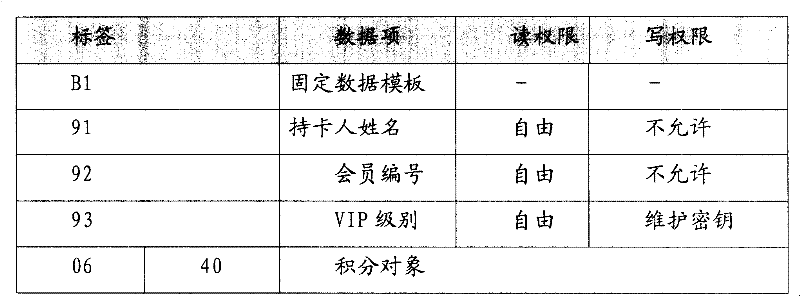
所需要发行的智能卡设计完成之后,就可以开始智能卡个人化过程。所述个人化阶段主要是将应用对象插入到容器中,如何在智能卡上创建容器这里不做描述,在个人化时,根据实际的商业营运模式,可能是单独发卡,也可能是在合作伙伴的卡上添加本积分计划。After the design of the smart card to be issued is complete, the smart card personalization process can begin. The personalization stage is mainly to insert the application object into the container. How to create the container on the smart card will not be described here. During the personalization, depending on the actual business operation model, the card may be issued separately or in the partner’s Add this points program to the card.
假定所述需要个人化的智能卡采用以下的APDU命令编码Assume that the smart card that needs to be personalized adopts the following APDU command encoding
表12:预置的APDU命令编码Table 12: Preset APDU command encoding
所述智能卡个人化过程可以包括以下步骤,其中命令部分采用上表进行代替对应示出。The smart card personalization process may include the following steps, wherein the above table is used to replace the corresponding commands for the command part.
步骤1:选择容器,得到容器的认证信息Step 1: Select the container and get the authentication information of the container
To Card:00 A4 04 00 10“CUP CONTAINER001”To Card: 00 A4 04 00 10 "CUP CONTAINER001"
From Card:From Card:
70 1D 5F01 01 40 5F02 08 11 22 33 44 55 66 77 88 5F03 01 00 5F0470 1D 5F01 01 40 5F02 08 11 22 33 44 55 66 77 88 5F03 01 00 5F04
02 FF FE 5F05 02 A0 0002 FF FE 5F05 02 A0 00
在此假定容器的认证功能为激活状态,认证模式为PIN认证;同时已经获知容器的剩余空间以及容器的版本号等信息。It is assumed here that the authentication function of the container is activated, and the authentication mode is PIN authentication; at the same time, information such as the remaining space of the container and the version number of the container have been known.
步骤2:认证容器Step 2: Authenticate Container
To Card:To Card:
80 46 01 00 1D 61 11 4F 05 46 01 00 00 01 50 08“QQ咖啡店”57 0880 46 01 00 1D 61 11 4F 05 46 01 00 00 01 50 08 "QQ Coffee Shop" 57 08
26 12 34 56 FF FF FF FF26 12 34 56 FF FF FF FF
From Card:90 00From Card: 90 00
根据第1步得到的信息,用容器的PIN对容器进行认证并创建本应用类,假设容器PIN的值为“123456”。According to the information obtained in
在该步骤中,如果是外部认证模式,则首先从智能卡取随机数,将用认证密钥加密随机数后的认证数据替换上面的认证数据;如果第一步标明容器认证功能为关闭,则可以跳过这一步。In this step, if it is an external authentication mode, first take a random number from the smart card, and replace the above authentication data with the authentication data encrypted by the authentication key; if the first step indicates that the container authentication function is off, you can Skip this step.
步骤3:插入应用对象Step 3: Insert application object
首先需要插入所有应用密钥到容器中:First you need to insert all application keys into the container:
To Card:To Card:
80 40 80 00 2E 7A 2C 51 06 46 01 00 00 01 01 52 03 80 69 0080 40 80 00
53 02 00 01 7B 19 54 03 55 FF 02 55 12 00 00 DropKey53 02 00 01 7B 19 54 03 55 FF 02 55 12 00 00 DropKey
From Card:90 00From Card: 90 00
To Card:To Card:
80 40 80 00 2E 7A 2C 51 06 46 01 00 00 01 02 52 03 80 89 0080 40 80 00
53 02 00 01 7B 19 54 03 55 FF 02 55 12 00 00 MtKey53 02 00 01 7B 19 54 03 55 FF 02 55 12 00 00 MtKey
From Card:90 00From Card: 90 00
To Card:To Card:
80 40 80 00 2E 7A 2C 51 06 46 01 00 00 01 03 52 03 80 89 0080 40 80 00
53 02 00 01 7B 19 54 03 55 FF 02 55 12 00 00 IncKey53 02 00 01 7B 19 54 03 55 FF 02 55 12 00 00 IncKey
From Card:90 00From Card: 90 00
To Card:To Card:
80 40 80 00 2E 7A 2C 51 06 46 01 00 00 01 04 52 03 80 89 0080 40 80 00
53 02 00 01 7B 19 54 03 55 FF 02 55 12 00 00 DecKey53 02 00 01 7B 19 54 03 55 FF 02 55 12 00 00 DecKey
From Card:90 00From Card: 90 00
需要注意的是,如果需要密文安装密钥,则首先必须安装一个传输密钥,再将所有准备密文安装的密钥的属性和ACL列表用Insert object指令写入容器后,用Access object以密文的方式将密钥值导入容器。It should be noted that if you need a ciphertext installation key, you must first install a transfer key, and then use the Insert object command to write the attributes and ACL lists of all keys to be ciphertext installation into the container, and then use the Access object to Import the key value into the container in the form of ciphertext.
再插入应用的数据对象:Then insert the data object of the application:
To Card:To Card:
80 40 00 00 2C 7A 2A 51 06 46 01 00 00 01 05 52 01 0080 40 00 00
53 02 00 01 7B 19 54 06 B1 00 FF 93 00 02 B1 0C 91 05“Tiger”92 0353 02 00 01 7B 19 54 06 B1 00 FF 93 00 02 B1 0C 91 05 "Tiger" 92 03
39 35 38 93 01 0139 35 38 93 01 01
From Card:90 00From Card: 90 00
To Card:80 40 40 00 1E 7A 1C 51 06 46 01 00 00 01 06 52 01 40 53 02To Card: 80 40 40 00
00 01 7B 0B 54 03 56 03 04 56 04 00 00 00 0000 01 7B 0B 54 03 56 03 04 56 04 00 00 00 00
From Card:90 00From Card: 90 00
至此,积分应用的个人化工作就完成了。At this point, the personalization of the points application is completed.
积分智能卡的个人化完成之后,下面对积分应用的使用示例进行详细介绍:After the personalization of the loyalty smart card is completed, the usage example of the loyalty application is introduced in detail below:
根据实际的业务需求,积分应用的使用示例包括两方面,一方面是查询积分和个人信息,另一方面是增减积分值。According to the actual business needs, the use example of points application includes two aspects, one is to query points and personal information, and the other is to increase or decrease the value of points.
假设,我们已经预定义了一些算法和数据代码,如下表所述,Assume, we have predefined some algorithms and data codes as described in the table below,
表13:预置的算法和数据代码Table 13: Preset algorithms and data codes
□□查询积分和个人信息□□Query points and personal information
查询个人信息:Query personal information:
To Card:80 A4 00 00 05 46 01 00 00 01To Card: 80 A4 00 00 05 46 01 00 00 01
From Card:90 00From Card: 90 00
To Card:To Card:
80 42 B0 00 0D 51 06 46 01 00 00 01 05 58 03 91 92 9380 42 B0 00 0D 51 06 46 01 00 00 01 05 58 03 91 92 93
From Card:“Tiger”39 35 38 01From Card: "Tiger" 39 35 38 01
查询积分:Query Points:
To Card:80 A4 00 00 05 46 01 00 00 01To Card: 80 A4 00 00 05 46 01 00 00 01
From Card:90 00From Card: 90 00
To Card:80 42 B0 00 0B 51 06 46 01 00 00 01 06 58 01 56To Card: 80 42 B0 00 0B 51 06 46 01 00 00 01 06 58 01 56
From Card:00 00 00 00From Card: 00 00 00 00
□□增减积分值□□Increase or decrease points
增加1000点积分:Add 1000 points:
To Card:80 A4 00 00 05 46 01 00 00 01To Card: 80 A4 00 00 05 46 01 00 00 01
From Card:90 00From Card: 90 00
To Card:00 84 00 00 08To Card: 00 84 00 00 08
From Card:F2 87 AA 3D 93 6A C1 8F 90 00From Card: F2 87 AA 3D 93 6A C1 8F 90 00
To Card:84 42 C0 00 1B 51 06 46 01 00 00 01 05 58 01 93To Card: 84 42 C0 00 1B 51 06 46 01 00 00 01 05 58 01 93
57 08 EncValue 59 04 Mac57 08 EncValue 59 04 Mac
From Card:90 00From Card: 90 00
EncValue=Fenc(IncKey,“00 00 03 E8”)EncValue = Fenc(IncKey,"00 00 03 E8")
MD=Fpad(“84 42 D0 00 1B 51 06 46 01 00 00 01 06 58 01 56 57 08”EncValue)MD=Fpad("84 42 D0 00 1B 51 06 46 01 00 00 01 06 58 01 56 57 08" EncValue)
ICVprefix=“B0 01”ICVprefix="B0 01"
ICV=ICVprefix+“0F 00 00 00 00 F0”ICV=ICVprefix+“0F 00 00 00 00 F0”
Mac=Fmac(IncKey,ICV,MD)Mac = Fmac(IncKey, ICV, MD)
扣减500点积分:Deduct 500 points:
To Card:84 42 E0 00 1B 51 06 46 01 00 00 01 06 58 01 56To Card: 84 42 E0 00 1B 51 06 46 01 00 00 01 06 58 01 56
57 08 EncValue 59 04 Mac57 08 EncValue 59 04 Mac
From Card:90 00From Card: 90 00
EncValue=Fenc(DecKey,“00 00 01 F4”)EncValue = Fenc(DecKey,"00 00 01 F4")
MD=Fpad(84 42 E0 00 1B 51 06 46 01 00 00 01 06 58 01 56 57 08EncValue)MD=Fpad(84 42 E0 00 1B 51 06 46 01 00 00 01 06 58 01 56 57 08EncValue)
ICVprefix++ICVprefix++
ICV=ICVprefix+“0F 00 00 00 00 F0”ICV=ICVprefix+“0F 00 00 00 00 F0”
Mac=Fmac(DecKey,ICV,MD)Mac = Fmac(DecKey, ICV, MD)
□□修改VIP等级□□Modify VIP level
To Card:80 A4 00 00 05 46 01 00 00 01To Card: 80 A4 00 00 05 46 01 00 00 01
From Card:90 00From Card: 90 00
To Card:00 84 00 00 08To Card: 00 84 00 00 08
From Card:B0 01 0E 6F 1E 76 5E 60 90 00From Card: B0 01 0E 6F 1E 76 5E 60 90 00
To Card:84 42 D0 00 1B 51 06 46 01 00 00 01 06 58 01 56To Card: 84 42 D0 00 1B 51 06 46 01 00 00 01 06 58 01 56
57 08 EncValue 59 04 Mac57 08 EncValue 59 04 Mac
From Card:90 00From Card: 90 00
EncValue=Fenc(MtKey,“02”)EncValue = Fenc(MtKey,"02")
MD=Fpad(“84 42 C0 00 1B 51 06 46 01 00 00 01 05 58 01 93 57 08”EncValue)MD=Fpad("84 42 C0 00 1B 51 06 46 01 00 00 01 05 58 01 93 57 08" EncValue)
ICVprefix=“F287”ICVprefix="F287"
ICV=ICVprefix+“0F 00 00 00 00 F0”ICV=ICVprefix+“0F 00 00 00 00 F0”
Mac=Fmac(MtKey,ICV,MD)Mac = Fmac(MtKey, ICV, MD)
在积分应用使用一段时间后,可能要添加新的对象来支撑新的业务需求,这其实就是对已发行应用的修改或维护。下面对可能发生的积分计划变更的流程进行说明:After the points application has been used for a period of time, new objects may need to be added to support new business requirements, which is actually the modification or maintenance of the released application. The process for possible points program changes is described below:
□□删除对象□□Delete object
删除对象的权限可以由应用类自己控制,所以无需对容器进行认证,只要符合对象的删除条件,就可以将指定的对象删除。The authority to delete an object can be controlled by the application class itself, so there is no need to authenticate the container, as long as the object's deletion conditions are met, the specified object can be deleted.
□□添加对象□□Add object
添加对象必须完成对容器的认证,过程和个人化相同。Adding objects must complete the authentication of the container, the process is the same as personalization.
□□修改对象□□Modify object
由于对象创建后只能修改数据项的内容,无法添加数据项或修改数据项的属性,如果应用必须修改对象的内容,则必须首先删除该对象,然后再重新创建该对象。Since the content of the data item can only be modified after the object is created, the data item cannot be added or the attributes of the data item can be modified. If the application must modify the content of the object, it must first delete the object and then recreate the object.
以上对本发明所提供的一种智能卡及向智能卡中创建应用、插入对象的方法进行了详细介绍,本文中应用了具体个例对本发明的原理及实施方式进行了阐述,以上实施例的说明只是用于帮助理解本发明的方法及其核心思想;同时,对于本领域的一般技术人员,依据本发明的思想,在具体实施方式及应用范围上均会有改变之处,综上所述,本说明书内容不应理解为对本发明的限制。Above, a kind of smart card provided by the present invention and the method for creating applications and inserting objects into the smart card have been introduced in detail. In this paper, specific examples are used to illustrate the principle and implementation of the present invention. The description of the above embodiments is only used To help understand the method of the present invention and its core idea; at the same time, for those of ordinary skill in the art, according to the idea of the present invention, there will be changes in the specific implementation and scope of application. In summary, this specification The content should not be construed as a limitation of the invention.
Claims (11)
Priority Applications (1)
| Application Number | Priority Date | Filing Date | Title |
|---|---|---|---|
| CN2006100251363A CN101042737B (en) | 2006-03-24 | 2006-03-24 | A smart card and method for creating applications and inserting objects into the smart card |
Applications Claiming Priority (1)
| Application Number | Priority Date | Filing Date | Title |
|---|---|---|---|
| CN2006100251363A CN101042737B (en) | 2006-03-24 | 2006-03-24 | A smart card and method for creating applications and inserting objects into the smart card |
Publications (2)
| Publication Number | Publication Date |
|---|---|
| CN101042737A CN101042737A (en) | 2007-09-26 |
| CN101042737B true CN101042737B (en) | 2011-05-25 |
Family
ID=38808238
Family Applications (1)
| Application Number | Title | Priority Date | Filing Date |
|---|---|---|---|
| CN2006100251363A Active CN101042737B (en) | 2006-03-24 | 2006-03-24 | A smart card and method for creating applications and inserting objects into the smart card |
Country Status (1)
| Country | Link |
|---|---|
| CN (1) | CN101042737B (en) |
Families Citing this family (13)
| Publication number | Priority date | Publication date | Assignee | Title |
|---|---|---|---|---|
| CN101751258B (en) * | 2009-12-30 | 2013-06-26 | 大唐微电子技术有限公司 | Intelligent card and developing method, system and deployment method for intelligent card application |
| CN101834849B (en) * | 2010-03-26 | 2013-04-10 | 深圳市国民电子商务有限公司 | Intelligent card and ADF (Authentication Data Function) cascading application method thereof |
| CN102521551B (en) * | 2011-12-23 | 2014-08-20 | 大唐微电子技术有限公司 | Personalized IC (integrated circuit) card issuing device and method |
| CN103368735B (en) * | 2012-04-06 | 2018-05-04 | 中兴通讯股份有限公司 | Using authentication method, the device and system of access smart card |
| CN102663473B (en) * | 2012-04-25 | 2014-10-08 | 山东神思电子技术股份有限公司 | Method for realizing chip operating system (COS) safety mechanism of intelligent card |
| CN106157028B (en) * | 2015-04-15 | 2021-03-26 | 航天信息股份有限公司 | Financial IC card multi-time card issuing system and method based on trusted platform |
| EP3082034A1 (en) * | 2015-04-17 | 2016-10-19 | Gemalto Sa | Method for modifying the execution of a platform-independent method of an integrated circuit card |
| CN105550604B (en) * | 2015-12-02 | 2018-07-06 | 恒宝股份有限公司 | A kind of data encapsulation method and device |
| CN107590149B (en) * | 2016-07-07 | 2021-01-08 | 北京数码视讯科技股份有限公司 | File directory creation method and device in smart card |
| CN107862358B (en) * | 2017-10-31 | 2020-10-30 | 深圳瑞柏科技有限公司 | Method and device for comprehensively issuing smart card |
| CN108880792B (en) * | 2018-05-31 | 2021-03-26 | 北京智芯微电子科技有限公司 | Method and device for realizing application interface of national secret intelligent password key |
| CN110008183B (en) * | 2019-04-09 | 2020-12-18 | 成都三零嘉微电子有限公司 | File searching method of intelligent card file system |
| CN115017926A (en) * | 2022-05-31 | 2022-09-06 | 中国银行股份有限公司 | A simulation method and device for an integrated circuit card, electronic equipment, and storage medium |
Citations (4)
| Publication number | Priority date | Publication date | Assignee | Title |
|---|---|---|---|---|
| US4882474A (en) * | 1986-05-16 | 1989-11-21 | American Telephone And Telegraph Company | Security file system and method for securing data in a portable data carrier |
| CN1120202A (en) * | 1993-12-14 | 1996-04-10 | 美国电报电话公司 | Method and system for mediating transactions that use portable smart cards |
| CN1236462A (en) * | 1997-09-19 | 1999-11-24 | 施蓝姆伯格工业公司 | Smart card and its application selection method |
| CN1537270A (en) * | 2001-08-02 | 2004-10-13 | 圣地斯克公司 | Detachable computer with large-capacity memory |
-
2006
- 2006-03-24 CN CN2006100251363A patent/CN101042737B/en active Active
Patent Citations (4)
| Publication number | Priority date | Publication date | Assignee | Title |
|---|---|---|---|---|
| US4882474A (en) * | 1986-05-16 | 1989-11-21 | American Telephone And Telegraph Company | Security file system and method for securing data in a portable data carrier |
| CN1120202A (en) * | 1993-12-14 | 1996-04-10 | 美国电报电话公司 | Method and system for mediating transactions that use portable smart cards |
| CN1236462A (en) * | 1997-09-19 | 1999-11-24 | 施蓝姆伯格工业公司 | Smart card and its application selection method |
| CN1537270A (en) * | 2001-08-02 | 2004-10-13 | 圣地斯克公司 | Detachable computer with large-capacity memory |
Also Published As
| Publication number | Publication date |
|---|---|
| CN101042737A (en) | 2007-09-26 |
Similar Documents
| Publication | Publication Date | Title |
|---|---|---|
| CN100590590C (en) | Data exchange system comprising a portable data processing unit | |
| US8862052B2 (en) | NFC mobile communication device and NFC reader | |
| US8789146B2 (en) | Dual interface device for access control and a method therefor | |
| US8196131B1 (en) | Payment application lifecycle management in a contactless smart card | |
| CN101965597B (en) | Method and device for installing and retrieving linked MIFARE applications | |
| JP4348190B2 (en) | Smart card system | |
| CN101042737B (en) | A smart card and method for creating applications and inserting objects into the smart card | |
| CN105391840A (en) | automatic purposed-application creation | |
| WO2013155562A1 (en) | Nfc card lock | |
| WO2009147548A2 (en) | Method for storing nfc applications in a secure memory device | |
| US20030154375A1 (en) | Universal crypto-adaptor system for supporting multiple APIs and multiple smart cards | |
| CN101042738B (en) | A method and data processing device for realizing smart card multi-application | |
| CN100438409C (en) | Intelligent card with financial-transaction message processing ability and its method | |
| CN101896916A (en) | Interaction between secure and non-secure environments | |
| CN101866411B (en) | Security certification and encryption method and system of multi-application noncontact-type CPU card | |
| CN103544114B (en) | Based on many M1 card control system and the control method thereof of single CPU card | |
| WO2007119594A1 (en) | Secure device and read/write device | |
| CN201742425U (en) | Non-contact type CPU card multi-application security authentication and encryption system | |
| Hassler | Java Card for e-payment Applications | |
| Kose et al. | A Secure design on MIFARE Classic Cards for Ensuring Contactless Payment and Control Services | |
| CN102542226A (en) | Secure access implementation method applying terminal access intelligent card | |
| CN2929835Y (en) | Intelligent card with financial trade message processing property | |
| Shepherd et al. | Isolated hardware execution platforms | |
| Kose et al. | ADVANCES IN CYBER-PHYSICAL SYSTEMS Vol. 7, Num. 1, 2022 A SECURE DESIGN ON MIFARE CLASSIC CARDS FOR ENSURING CONTACTLESS PAYMENT AND CONTROL SERVICES | |
| Schwarzhoff et al. | Government Smart Card Interoperability Specification |
Legal Events
| Date | Code | Title | Description |
|---|---|---|---|
| C06 | Publication | ||
| PB01 | Publication | ||
| C10 | Entry into substantive examination | ||
| SE01 | Entry into force of request for substantive examination | ||
| C14 | Grant of patent or utility model | ||
| GR01 | Patent grant |