Illuminating light wireless communication system
Technical Field
The invention relates to the technical field of communication, in particular to an illuminating light wireless communication system.
Background
There are three main types of existing wireless communication:
one is radio wave communication, which has been widely used as a signal carrier for wireless communication for a long time. The disadvantages are that:
1. radio wave communication has strong electromagnetic interference, so the frequency spectrum is regulated by the government;
2. the wireless bandwidth is low, and the available frequency resources are few;
3. the radio wave is open in space and can penetrate through the wall generally, so that the safety and confidentiality are poor;
4. the electromagnetic wave has biological electromagnetic effect and has certain influence on human health;
another is laser wireless communication, and the disadvantages are:
1. due to the transmission characteristics of the atmosphere (absorption, reflection, scattering, and scintillation caused by the atmosphere), especially the influence of background radiation, it is generally not suitable to use laser in the visible band;
2. in indoor application, the safety problem of human bodies needs to be considered when the laser is used, mainly the damage to human eyes is avoided, the point laser safety standard is set according to the total emission power in the table 1, and the indoor laser hardly has a good power precalculated value;
3. the technology is complex and the cost is high.
| Categories |
650nm (visible light) |
880nm (Infrared) |
1310nm (Infrared) |
1550nm (Infrared) |
| Class 1 |
~0.2mW |
~0.5mW |
~8.8mW |
~10mW |
| Class 2 |
0.2~1mW |
- |
- |
- |
| Class 3A |
1~5mW |
0.5~2.5mW |
8.8~45mW |
10~50mW |
| Class 3B |
5~500mW |
2.5~500mW |
45~500mW |
50~500mW |
TABLE 1
The other is infrared light wireless communication, which mainly comprises an infrared light LED transmitter and an infrared light receiver.
The disadvantages of infrared light wireless communication are: infrared light is in the invisible band and cannot be applied as an illumination light source.
Light generated by a Light Emitting Diode (LED) is generally monochromatic or colored, and although a lamp made of the LED has many advantages of compactness, reliability, long life, low voltage, energy saving, no pollution, etc., it is generally used only for instrument indication, etc., and rarely used for daily life illumination, and for general illumination, a white light source is required. Furthermore, although LED lamps can be used for wireless transmission, they are hardly used in actual production life because they are colored lights and cause visual pollution.
It can be seen that how to make the illumination light a carrier for wireless communication is still blank at present.
Disclosure of Invention
In view of the above, the present invention provides an illumination light wireless communication system, which can make illumination light be used as both the light source for optical wireless communication and the light source for illumination.
Therefore, the technical scheme of the invention is realized as follows:
an illuminating light wireless communication system for illumination and communication with a remote communication device, the system comprising an illuminating communication apparatus, an illuminating communication terminal and a communication terminal, wherein,
the illumination communication device is used for receiving a source signal from a remote communication device; converting the received information source signal into an optical signal, and performing wireless transmission in an optical signal mode, or receiving the optical signal, converting the received optical signal into an electric signal, and transmitting the electric signal to remote communication equipment; wherein one or both of the optical signals received or transmitted by the illumination communication device are illumination light;
the lighting communication terminal is used for converting the received optical signal into an electric signal and then transmitting the electric signal to the communication terminal, or converting an electric signal to be sent from the communication terminal into an optical signal and then wirelessly transmitting the optical signal to the lighting communication device;
and the communication terminal is used for receiving the electric signal from the illumination communication terminal, carrying out corresponding processing or sending the processed electric signal to the illumination communication terminal.
Preferably, the lighting communication device comprises a light emitter, a light receiver, an interface receiving unit and an interface sending unit, wherein,
the interface receiving unit is used for receiving a signal source signal from the remote communication equipment, converting the signal into a signal which can be identified by the optical transmitter and transmitting the signal to the optical transmitter;
the optical transmitter is used for converting the received signal into an optical signal and carrying out wireless transmission in the optical signal mode;
the optical receiver is used for receiving optical signals from the lighting communication terminal, converting the received optical signals into electric signals and transmitting the electric signals to the interface sending unit;
and the interface sending unit is used for transmitting the received signal to the remote communication equipment.
Preferably, the lighting communication terminal comprises a light emitter, an electric demodulator, an electric modulator and a light receiver,
the optical receiver is used for converting the received optical signal into an electric signal and then transmitting the electric signal to the electric demodulator;
the electric demodulator is used for demodulating the received signal and transmitting the demodulated signal to the communication terminal;
the electrical modulator is used for modulating the signal from the communication terminal and then sending the signal to the light emitter;
and the optical transmitter is used for converting the received signal from the electrical modulator into an optical signal and carrying out wireless transmission in the optical signal mode.
Preferably, the lighting communication device comprises a light emitter, a light receiver, an interface receiving unit, an interface transmitting unit, an electrical modulator and an electrical demodulator, wherein,
the interface receiving unit is used for receiving the information source signal from the remote communication equipment, converting the signal into a signal which can be identified by the electric demodulator and then transmitting the signal to the electric demodulator;
the electric demodulator is used for demodulating the received signal and transmitting the demodulated signal to the optical transmitter;
the optical transmitter is used for converting the received signal into an optical signal and carrying out wireless transmission in the optical signal mode;
the optical receiver is used for receiving an optical signal from the lighting communication terminal, converting the received optical signal into an electric signal and transmitting the electric signal to the electric modulator;
the electrical modulator is used for modulating the received signal and then transmitting the modulated signal to the interface transmitting unit;
and the interface sending unit is used for transmitting the received signal to the remote communication equipment.
Preferably, the lighting communication terminal comprises a light emitter and a light receiver,
the optical receiver is used for converting the received optical signal into an electric signal and transmitting the electric signal to the communication terminal;
the optical transmitter is used for converting the received signal from the communication terminal into an optical signal and performing wireless transmission in the optical signal mode.
Preferably, the light emitter is a light emitter based on a light emitting diode, LED, or an array of LEDs.
Preferably, the LED or LED array based light emitter comprises at least a driving circuit and an LED or LED array; wherein,
the driving circuit is used for driving signals and providing direct current bias for the LED or the LED array;
and the LED or the LED array is used for carrying out light intensity modulation according to the input signal and carrying out wireless transmission through the optical signal.
Preferably, the LED or LED array based optical transmitter further comprises a filter, wherein the filter is configured to filter noise outside the signal and transmit the filtered signal to the driving circuit.
Preferably, the LED or LED array is an infrared LED or LED array, or an illuminating LED or LED array;
when the LED or LED array is an illuminating LED or LED array, the LED or LED array is further used for illumination.
Preferably, the optical receiver includes a driving circuit, a photodetector, a filter,
the driving circuit is used for driving the light detector and providing direct current bias for the light detector; the optical detector receives an optical signal under the drive of the drive circuit, converts the received optical signal into an electric signal and transmits the electric signal to the filter; the filter is used for filtering noise outside the signal and transmitting the filtered signal to the electric demodulator;
the light detector is an infrared light detector or an illumination light detector.
Preferably, the illumination light detector is a photodiode or a solar panel;
when the optical signal is illumination light, the photosensitive diode is an illumination light photosensitive diode, and the wavelength range of the illumination light is 380-780 nm;
when the optical signal is infrared light, the photosensitive diode is an infrared light photosensitive diode.
Preferably, the remote communication device comprises a core processing unit, an electrical modulator, an interface transmitting unit and an interface receiving unit,
the core processing unit is used for receiving or generating an information source signal and sending the information source signal to the electric modulator, or used for processing the signal from the electric modulator;
the electrical modulator is used for modulating the signal from the core processing unit and then sending the signal to the interface sending unit;
the interface sending unit is used for transmitting the received signal to the lighting communication device;
the interface receiving unit is used for transmitting the signals from the lighting communication device to the electric demodulator;
and the electric demodulator is used for demodulating the received signal and transmitting the demodulated signal to the core processing unit.
Preferably, the interface receiving unit is a wired interface receiving unit, and the interface transmitting unit is a wired interface transmitting unit; or, the interface receiving unit is a wireless interface receiving unit, and the interface transmitting unit is a wireless interface transmitting unit.
Preferably, the core processing unit is a computer, or a mobile phone, or a fixed telephone, or a fax machine, or a PDA, or a network television.
Preferably, the electrical modulator is an electrical modulator based on orthogonal frequency division multiplexing, OFDM, technology, or an electrical modulator based on spread spectrum technology, or an ethernet physical layer electrical modulator;
the electric demodulator is an electric demodulator based on OFDM technology, or an electric demodulator based on spread spectrum technology, or an Ethernet physical layer electric demodulator.
Preferably, the electrical modulator based on the OFDM technology comprises a channel coding unit, a symbol mapping unit, an OFDM modulator; the system comprises a channel coding unit, a symbol mapping unit, an OFDM modulator and a signal decoding unit, wherein the channel coding unit is used for receiving a signal to be sent and carrying out channel coding processing on the signal, the symbol mapping unit is used for carrying out digital modulation constellation symbol mapping processing on the signal subjected to channel coding, and the OFDM modulator is used for carrying out OFDM modulation processing on the symbol subjected to symbol mapping;
the electro-modulator based on the OFDM technology comprises a channel decoding unit, a symbol de-mapping unit and an OFDM demodulator, wherein the OFDM demodulator is used for carrying out OFDM demodulation processing on received signals, the symbol de-mapping unit is used for carrying out constellation diagram symbol de-mapping processing of digital modulation on the signals after the OFDM demodulation, and the channel decoding unit is used for carrying out channel decoding processing on the received signals.
Preferably, the electrical modulator based on the OFDM technology is a digital subscriber line xDSL electrical modulator, or a Cable electrical modulator, or a power line communication PLC electrical modulator;
the electrolytic modulator based on the OFDM technology is an xDSL electric demodulator, a Cable electric demodulator or a PLC electrolytic modulator.
Preferably, the electrical modulator and the electrical demodulator based on the spread spectrum technology are as follows: an electrical modulator and an electrical demodulator based on a direct sequence spread spectrum DS technology, or based on a frequency modulation FH technology, or based on a time hopping TH technology, or based on a Chirp technology.
Preferably, when the interface receiving unit is a wired interface receiving unit and the interface transmitting unit is a wired interface transmitting unit, the lighting communication device and the remote communication device are directly connected by a wired cable, and the wired cable is a telephone line, a CATV cable, an ethernet line, or a power line.
Preferably, the lighting communication terminal is located inside the communication terminal or outside the communication terminal;
when the lighting communication terminal is located outside the communication terminal, wired or wireless transmission is performed between one lighting communication terminal and one or more communication terminals.
Preferably, the communication terminal is a computer, or a mobile phone, or a fax machine, or a fixed phone, or a PDA, or a network television.
The illumination light wireless communication system of the invention can be used for enabling the light emitted by the illumination communication device and/or the illumination communication terminal to be used as an optical wireless communication light source and also be used as an illumination light source, thereby realizing the purpose that the illumination light is used as the optical wireless communication light source and also is used as the illumination light source, and overcoming the prejudice that the illumination light used by people is not used as a wireless communication carrier. Compared with the conventional wireless communication method, the method has the following advantages:
compared with the existing radio wave communication, the method has the following advantages:
1. the wireless electromagnetic interference is avoided, the frequency spectrum is not regulated by the government, and the electromagnetic influence on electronic instruments is avoided;
2. available spectrum width and bandwidth height;
3. the lighting light can not penetrate through the wall generally, so that the safety and the confidentiality are stronger;
4. no biological electromagnetic effect.
Compared with the existing laser wireless communication, the method has the following advantages:
1. the illuminating light LED for generating illuminating light belongs to a large-angle emitter, and because the illuminating light LED is not a point light source, the area of imaging on the retina is large, the energy is dispersed, the use is safer, even the high-power output is realized;
2. the output energy can be simply increased to the indoor illumination level by using the array consisting of a plurality of illumination light LEDs;
3. because the illumination light LED is safe to human eyes, the LED can be used for indoor optical communication, the indoor working environment is more stable than the outdoor working environment, and a device for dealing with severe weather conditions and background radiation is not needed, so the LED has the advantages of simple technology and low cost.
Compared with the existing infrared light wireless communication, the infrared light wireless communication system has the following advantages:
with illumination LED technology, visible light, i.e. illumination, flashes at a rate that cannot be sensed by the human eye to transmit data, thus allowing existing lighting infrastructure to be used, with only minor modifications, such as replacing the incandescent light source with an illumination LED, to ensure both optical wireless communication and to meet the lighting needs.
In addition, when the electric modem adopts an Orthogonal Frequency Division Multiplexing (OFDM) technology, the multi-path interference and time delay expansion of an optical wireless channel and a wired cable channel can be effectively avoided, and the modulation rate of the illuminating light LED is improved.
Furthermore, the ground light detector can be realized by a solar cell panel, so that the visible light signal modulated by information, namely the illumination light signal can be converted into a telecommunication number, and the illumination light can be used for supplying power to the equipment where the ground light detector is positioned.
Based on the characteristics, the invention is not only suitable for indoor use, but also suitable for outdoor use.
Drawings
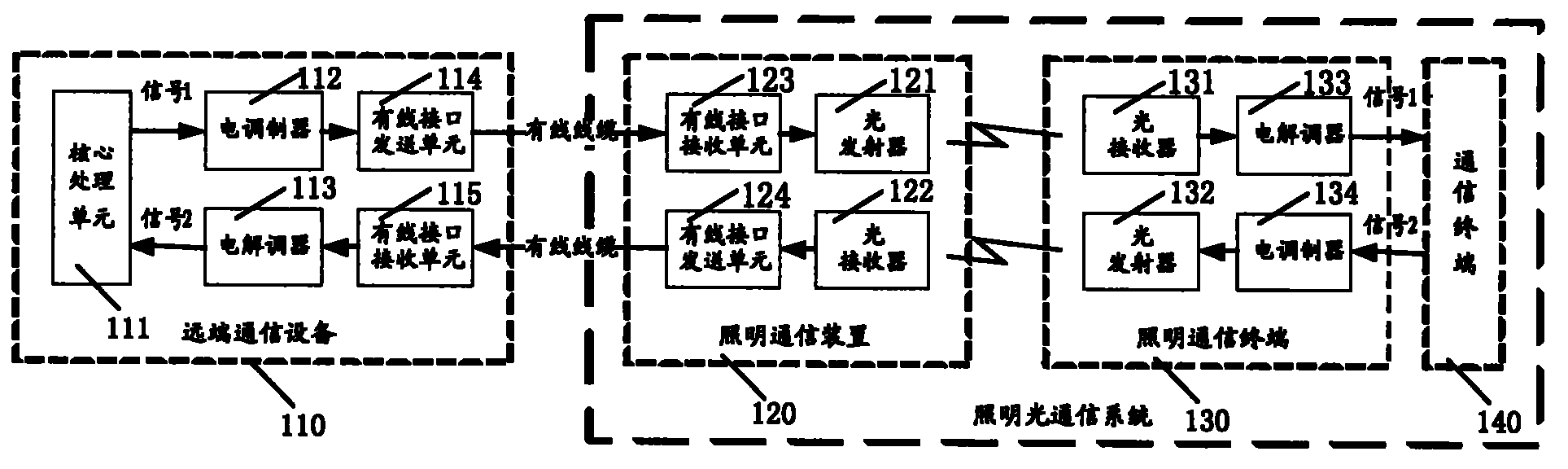
Fig. 1 is a schematic structural diagram of an illuminating light wireless communication system according to an embodiment of the present invention;
fig. 2a is a functional block diagram of a structure of an illumination light wireless communication system according to a first embodiment of the present invention;
fig. 2b is a functional block diagram of the structure of an illumination light wireless communication system according to a second embodiment of the present invention;
fig. 2c is a functional block diagram of the structure of an illumination light wireless communication system according to a third embodiment of the present invention;
fig. 2d is a functional block diagram of the structure of an illumination light wireless communication system according to a fourth embodiment of the present invention;
FIG. 3 is a functional block diagram of a light emitter;
FIG. 4 is an example of an illumination light LED drive circuit;
FIG. 5 is a functional block diagram of the principle of an optical receiver;
fig. 6 is a functional block diagram of the principle of an electrical modulator based on OFDM technology;
FIG. 7 is a functional block diagram of a schematic of an electro-modulator based on OFDM technology;
FIG. 8 is a functional block diagram of the OFDM modulator of FIG. 6;
FIG. 9 is a functional block diagram of the OFDM demodulator of FIG. 7;
FIG. 10 is a functional block diagram of the principle of an electrical modulator based on direct sequence spread spectrum (DS) technology;
FIG. 11 is a functional block diagram of the principle of an electrolytic conditioner based on DS technology;
fig. 12 is a functional block diagram of the principle of an electrical modulator based on frequency modulated spread spectrum (FH) technology;
fig. 13 is a functional block diagram of the principle of an electrolytic conditioner based on FH technology.
Detailed Description
The invention is described in further detail below with reference to the figures and specific embodiments.
Fig. 1 is a schematic structural diagram of an illumination light wireless communication system according to an embodiment of the present invention. The illumination communication equipment receives the source signal of the far-end communication equipment, and performs wireless communication with the communication terminal in a light mode, and meanwhile, the illumination communication equipment can be used as a light source for wireless communication and can also be used for illumination as the light emitted or received by the illumination communication equipment is illumination light.
Fig. 2a is a functional block diagram of a structure of an illumination light wireless communication system according to a first embodiment of the present invention. Referring to fig. 1 and 2a, the illuminating light wireless communication system is used for illumination and communication with a remote communication device 110. The system comprises a lighting communication device 120, a lighting communication terminal 130 and a communication terminal 140, wherein the lighting communication device 120 is used for receiving a source signal from a remote communication device 110 through a wired cable; converting the received signal source signal into an optical signal and performing wireless transmission in the form of an optical signal, or receiving the optical signal, converting the received optical signal into an electrical signal and transmitting the electrical signal to the remote communication device 110 through a wired cable; one or both of the light signals received or transmitted by the illumination communication device 120 are illumination light, and the flickering speed of the illumination light cannot be perceived by human eyes; the lighting communication terminal 130 is configured to convert the received optical signal into an electrical signal and transmit the electrical signal to the communication terminal 140, or convert an electrical signal to be transmitted from the communication terminal 140 into an optical signal and wirelessly transmit the optical signal to the lighting communication device 120; the communication terminal 140 is configured to receive the electrical signal from the lighting communication terminal 130, perform corresponding processing, or send the processed electrical signal to the lighting communication terminal 130. Thus, the light emitted by the illumination communication device 120 can be used as both an optical wireless communication light source and a light source for illumination.
That is, if the direction of the lighting communication device 120 to the communication terminal 140 is defined as down; if the direction from the communication terminal 140 to the lighting communication device 120 is uplink, at least one line in the uplink and the downlink may use the lighting light for wireless transmission, and of course, the uplink and the downlink may use the lighting light for transmission. Thus, light emitted or received by the lighting communication device 120 can be used as both a light source for optical wireless communication and a light source for illumination. The illumination communication device 120 can modulate and wirelessly transmit the source signal by using a flash method such as an outdoor large display screen, an illumination device, a signal lamp, and a car headlight equipped with an illumination light LED, and the illumination communication terminal 130 receives light by using a light sensor such as a photodiode and obtains information. White light, i.e., illumination light, can flash at a rate that cannot be sensed by the human eye to transmit data, thus allowing existing lighting infrastructure to be used with only minor modifications, such as replacing incandescent light sources with illumination LEDs, to ensure both optical wireless communication and to meet lighting needs. Of course, the illumination light may be used to transmit data in a shading manner. The illumination light LEDs referred to herein may also be referred to as white light LEDs or white LEDs.
In fig. 1, the lighting communication terminal 130 is located inside the communication terminal 140, but the lighting communication terminal 130 may also be located outside the communication terminal 140, so that the lighting communication terminal 130 and the communication terminal 140 exist independently, and in this case, one lighting communication terminal 130 may provide services for one or more communication terminals 140, that is, in this case, one lighting communication terminal 130 may perform wired or wireless transmission with one or more communication terminals 140.
Referring to fig. 2a, the lighting communication device 120 includes a light emitter 121, a light receiver 122, a wired interface receiving unit 123 and a wired interface transmitting unit 124, where the wired interface receiving unit 123 converts a source signal from the remote communication device 110 into a signal that can be identified by the light emitter 121 through a wired cable and transmits the signal to the light emitter 121, and the light emitter 121 is configured to convert the received source signal into a light signal and perform wireless transmission in the form of the light signal; the optical receiver 122 is configured to receive an optical signal from the lighting communication terminal 130, convert the received optical signal into an electrical signal, transmit the electrical signal to the wired interface transmitting unit 124, and transmit the received signal to the remote communication device 110 through the wired cable by the wired interface transmitting unit 124.
Referring to fig. 2a, the lighting communication terminal 130 includes an optical receiver 131, an optical transmitter 132, an electrical demodulator 133 and an electrical modulator 134, wherein the optical receiver 131 is configured to convert a received optical signal into an electrical signal and transmit the electrical signal to the electrical demodulator 133; the electric demodulator 133 is configured to demodulate the received signal and transmit the demodulated signal to the communication terminal 140; the electrical modulator 134 is configured to modulate a signal from the communication terminal 140 and send the modulated signal to the optical transmitter 132; the optical transmitter 132 is used to convert the received signal from the electrical modulator 134 into an optical signal for wireless transmission.
Referring to fig. 2a, the remote communication device 110 includes a core processing unit 111, an electrical modulator 112, an electrical demodulator 113, a wired interface transmitting unit 114 and a wired interface receiving unit 115, where the core processing unit 111 is configured to receive or generate a source signal and transmit the source signal to the electrical modulator 112, or process a signal from the electrical demodulator 113, the electrical modulator 112 is configured to modulate the signal from the core processing unit 111 and transmit the modulated signal to the wired interface transmitting unit 114, and the wired interface transmitting unit 114 transmits the received signal to the lighting communication apparatus 120 through a wired cable; the wired interface receiving unit 115 transmits the signal received from the lighting communication device 120 to the electrical demodulator 113 through the wired cable, and the electrical demodulator 113 demodulates the received signal and transmits the demodulated signal to the core processing unit 111.
Referring to fig. 2b, it is a functional block diagram of a structure of an illuminating light wireless communication system according to a second embodiment of the present invention, and the difference from the embodiment shown in fig. 2a is: in fig. 2a, the transmission between the remote communication device 110 and the lighting communication apparatus 120 is implemented by a wired cable, in fig. 2b, the transmission between the remote communication device 110 and the lighting communication apparatus 120 is implemented by a wireless cable, and the rest is the same as the embodiment shown in fig. 2 a. That is, if all the interface units are classified into two categories, i.e. an interface transmitting unit and an interface receiving unit, in fig. 2a, the interface transmitting unit and the interface receiving unit are respectively a wired interface transmitting unit and a wired interface receiving unit, in fig. 2b, the interface transmitting unit and the interface receiving unit are respectively a wireless interface transmitting unit and a wireless interface receiving unit, and the rest of the same parts are not described again.
Referring to fig. 2c, it is a functional block diagram of a structure of an illuminating light wireless communication system according to a third embodiment of the present invention, and the difference from the embodiment shown in fig. 2a is: the electrical demodulator and the electrical modulator in the lighting communication terminal 130 are moved into the communication lighting device 120, and at this time, the internal structures and the operations of the communication lighting device 120 and the lighting communication terminal 130 are completed as follows:
the lighting communication device 120 includes a light emitter 121, a light receiver 122, a wired interface receiving unit 123, a wired interface transmitting unit 124, an electrical modulator 126, and an electrical demodulator 125. The wired interface receiving unit 123 is configured to receive a source signal from the remote communication device 110, convert the source signal into a signal that can be recognized by the electrical demodulator 125, and transmit the signal to the electrical demodulator 125; the electrical demodulator 125 demodulates the received signal and transmits the demodulated signal to the optical transmitter 121; the optical transmitter 121 converts the received signal into an optical signal and performs wireless transmission in the form of the optical signal. The optical receiver 122 receives an optical signal from the lighting communication terminal, converts the received optical signal into an electrical signal, and transmits the electrical signal to the electrical modulator 126; the electrical modulator 126 modulates the received signal and sends the modulated signal to the wired interface sending unit 124; the received signal is transmitted to the remote communication device 110 by the wired interface transmission unit 124.
The illumination communication terminal 130 includes therein a light emitter 132 and a light receiver 131. The optical receiver 131 converts the received optical signal into an electrical signal and transmits the electrical signal to the communication terminal 140; the optical transmitter 132 converts the received signal from the communication terminal 140 into an optical signal, and performs wireless transmission by means of the optical signal.
Referring to fig. 2d, it is a functional block diagram of a structure of an illuminating light wireless communication system according to a fourth embodiment of the present invention, which is different from the embodiment shown in fig. 2 c: in fig. 2c, the transmission between the remote communication device 110 and the lighting communication apparatus 120 is implemented by a wired cable, in fig. 2d, the transmission between the remote communication device 110 and the lighting communication apparatus 120 is implemented by a wireless cable, and the rest is the same as the embodiment shown in fig. 2 c. That is, in fig. 2c, the interface transmitting unit and the interface receiving unit are a wired interface transmitting unit and a wired interface receiving unit, respectively, and in fig. 2d, the interface transmitting unit and the interface receiving unit are a wireless interface transmitting unit and a wireless interface receiving unit, respectively.
All the wired interface receiving units are mainly composed of an impedance matching circuit and a preamplifier, wherein the impedance matching circuit is used for impedance conversion and adaptation between the internal communication unit and the wired cable, and the preamplifier is used for pre-amplifying signals. All the wireless interface receiving units are mainly composed of a receiving antenna and a wireless receiver and used for receiving processing of wireless signals, such as low-noise amplification and down-conversion processing.
Similarly, all the above wired interface transmission units are mainly composed of an impedance matching circuit and a power amplifier, the impedance matching circuit is used for performing impedance transformation and adaptation between the internal communication unit and the wired cable, and the power amplifier is used for performing power amplification processing on signals. All the wireless interface sending units mainly comprise a sending antenna and a wireless transmitter and are used for carrying out sending up-conversion processing and power amplification processing on wireless signals.
Referring to fig. 2 a-2 d, all light emitters in the figures, which are substantially identical, are light emitters based on LEDs or LED arrays, and referring to fig. 3, the light emitters comprise a filter 310, a driving circuit 320, and LEDs or LED arrays 330. The filter 310 is used for filtering out noise outside the signal; the driving circuit 320 is used for receiving the output signal of the filter, generating a forward current through the component, and providing a direct current bias for the LED or the LED array 330; the LED or LED array 330 is used for light intensity modulation according to an input signal and wireless transmission through an optical signal. Of course, it is also true that the filter 310 is not included in the optical transmitter, and only that it will interfere, and the effect will be poor.
If the optical wireless communication system adopts a frequency division duplex mode (FDD), one of the light emitter in the illumination communication terminal and the light emitter in the illumination communication device is an illumination light emitter, and the other one is an infrared light emitter; if the optical wireless communication system adopts a Time Division Duplex (TDD) mode, both of the light emitters in the illumination communication terminal and the illumination communication device of the present invention may be illumination light emitters, or one of them may be an illumination light emitter and the other may be an infrared light emitter. The difference between infrared light emitters and illumination light emitters is mainly the use of different LEDs, infrared light emitters using infrared LEDs and illumination light emitters using illumination light LEDs or illumination light LED arrays, i.e. for illumination light LEDs or illumination light LED arrays, not only for the transmission of data in the form of light, but also for illumination.
The wavelength range of visible light emitted by the illumination light LED (or the illumination light LED array) is 380 nm-780 nm, and the input Modulation signal causes the on-current of the illumination light LED to change, so that direct light Intensity Modulation is performed (Intensity Modulation).
The primary goal of the illumination LED (or illumination LED array) driver circuit is to generate a forward current through the component, which can be achieved using a constant voltage or constant current source.
Fig. 4(a) is a solution with the lowest cost, which connects the illumination light LED in series with a ballast Resistor (RB), and adds a constant voltage source to both ends of the circuit. The ballast resistor limits the passing current, and the nonlinear V-I curve of the illumination light LED also causes the current stabilizing capability of the method to be very poor; furthermore, the current of the illumination light LED changes whenever there is any variation in the applied voltage or forward Voltage (VF) of the illumination light LED, and such extreme changes in the current of the illumination light LED affect the display brightness, which is unacceptable for many applications.
Fig. 4(b) is a more desirable solution, which is implemented by means of a constant current source. Specifically, the voltage across the current sensing resistor is directly regulated, and the current passing through the illumination light LED is determined by the reference voltage value supplied by the power supply and the current sensing resistance value. Most displays require multiple illumination LEDs, and to flexibly drive the multiple illumination LEDs, all illumination LEDs should be connected in series to ensure that the current of each illumination LED is the same. To drive the illumination LEDs in parallel, each must be connected in series with a ballast resistor to avoid differences in current through them, but these resistors also waste power and reduce circuit efficiency. The method can avoid current variation caused by forward voltage change of the illumination light LED, and can provide controllable constant display brightness by using controllable constant forward current. The constant current source is very simple to generate, and the controller does not need to stabilize the output voltage of the power supply.
Fig. 4(a) and 4(b) are only two specific embodiments, and other implementations may be adopted in practical operation, but in any case, the implementation is realized by applying a constant voltage source or a constant current source.
Referring to fig. 2 a-2 d, which are actually the same for all light receivers, and to fig. 5, the light receiver includes a driver circuit 510, a light detector 520 and a filter 530. The optical detector 520 receives the optical signal under the driving of the driving circuit 510, converts the received optical signal into an electrical signal, and transmits the electrical signal to the filter 530; the filter 530 serves to filter out signal-external noise and transmits the filtered signal to the electrical demodulator. Of course, it is also true that the filter 530 is not included in the optical receiver, but only that it will interfere, and the effect will be poor.
Similarly, if the optical wireless communication system adopts FDD, one of the illumination communication terminal and the optical receiver in the illumination communication device of the present invention is an illumination optical receiver, and the other is an infrared optical receiver; if the optical wireless communication system adopts the TDD scheme, both the illumination communication terminal and the optical receiver of the illumination communication device of the present invention may be the illumination light receiver, or one of them may be the illumination light receiver and the other may be the infrared light receiver. The difference between the infrared light receiver and the illumination light receiver is mainly that the adopted photosensitive diodes are different, the infrared light receiver adopts the infrared photosensitive diode, and the illumination light receiver adopts the illumination light photosensitive diode (or called white light photosensitive diode).
The white light photosensitive diode converts the visible light signal modulated by information, namely the illumination light signal, and the signal with the wavelength range of 380 nm-780 nm into an electric signal by utilizing a Direct Detection (Direct Detection) technology, and the white light photosensitive diode is equivalent to a detector in an electric communication system.
In addition, the optical detector can also be realized by a solar cell panel, and the solar cell panel can convert visible light signals modulated by information, namely signals with the wavelength range of 380 nm-780 nm, into electric signals and can also utilize the light energy of visible light, namely illumination light energy, to supply power for the equipment where the visible light signals are positioned.
It should be noted that, for the uplink and downlink transmission, at least one line must use the illumination light emitter to realize the illumination function while transmitting data, that is, at least one of the light emitter 121 and the light emitter 132 uses the illumination light emitter, and correspondingly, the light receiver 122 and the light receiver 131 are matched with each other.
Referring to fig. 2a to 2d, all the electrical modulators and electrical demodulators in the figures are the same in practice, and may be electrical modulators and electrical demodulators based on Orthogonal Frequency Division Multiplexing (OFDM) technology, electrical modulators and electrical demodulators based on spread spectrum technology, and electrical modulators and electrical demodulators based on the ethernet physical layer. Of course, the practical application is not limited to this, and this is only a few examples.
Reference is made to fig. 6 and 7, which are functional block diagrams of the principles of an electrical modulator and an electrical demodulator, respectively, based on OFDM technology.
Referring to fig. 6, the electrical modulator based on the OFDM technique includes a channel coding unit 610, a symbol mapping unit 620, and an OFDM modulator 630; the channel coding unit 610 is configured to receive a signal to be transmitted and perform channel coding processing on the signal, and then the symbol mapping unit 620 performs constellation symbol mapping processing of digital modulation on the signal subjected to channel coding, and the OFDM modulator 630 is configured to perform OFDM modulation processing on the symbol subjected to symbol mapping.
Referring to fig. 7, the OFDM technology based demodulator includes a channel decoding unit 730, a symbol demapping unit 720 and an OFDM demodulator 710, where the OFDM demodulator 710 is configured to perform OFDM demodulation processing on a received signal, the symbol demapping unit 720 is configured to perform constellation symbol demapping processing on a digitally modulated signal, and the channel decoding unit 730 is configured to perform channel decoding processing on the received signal.
When the lighting communication device 120 and the remote communication equipment 110 are connected by using a wired cable, and an electrical modulator and an electrical demodulator based on the OFDM technology are adopted, if the wired cable is a telephone line, a digital subscriber line (xDSL) electrical modulator and an electrical demodulator are adopted; if the Cable is a Cable television (CATV) Cable, a Cable electric modulator and an electrolytic modulator are adopted; if the wired cable is a power line, a Power Line Communication (PLC) electric modulator and an electric modulator are adopted. When the electrical modulator and the electrolytic modulator based on the OFDM technology are adopted, the method has the advantages that: (1) the frequency spectrum utilization rate is high, and theoretically, the limit of Shannon information theory can be reached; (2) intersymbol interference (ISI) can be effectively overcome; (3) the OFDM technology divides the frequency selective fading channel into a plurality of parallel related flat fading channels, so that the system performance requirement can be met by adopting a simple channel equalization technology without adopting a complex self-adaptive equalization technology; (4) resisting noise interference, wherein OFDM overcomes channel noise interference through sub-channel allocation; (5) is suitable for high-speed data transmission. Therefore, the multi-path interference can be resisted, the time delay expansion of an optical wireless channel and a wired cable channel is avoided, and the modulation rate of the illumination light LED is improved.
When the lighting communication device 120 and the far-end communication device 110 are connected by a wired cable, and an electrical modulator based on Spread Spectrum technology are adopted, the electrical modulator and the electrical modulator of the far-end communication device may be based on Direct Sequence Spread Spectrum (DS) technology, may be based on Frequency modulation (FH) technology, or may be based on Time Hopping (TH) technology, Chirp (Chirp) technology, or the like. When the electric modulator and the electrolytic modulator based on the spread spectrum technology are adopted, the method has the advantages that: (1) the spectrum density is low, and the electromagnetic interference to other systems is small; (2) the anti-interference performance is strong, and the error rate is low; (3) the information confidentiality is realized; (4) code division multiple access can be implemented.
An electrical modulator and an electrical demodulator based on OFDM technology are briefly described below.
Fig. 8 is a functional block diagram of the principle of the OFDM modulator in fig. 6, in which binary information of communication data is channel coded, and then is first digitally modulated and converted in serial-parallel (or first converted in serial-parallel and then digitally modulated), so as to be converted into M-channel parallel-transmitted data sequences { x (k) }, where k is 0, 1. An Inverse Fast Fourier Transform (IFFT) unit converts it into a time-domain sequence { x (N) }, N0, 1. Then adding a cyclic prefix CP, and sending the sequence to a power amplifier after parallel-serial conversion.
Fig. 9 is a functional block diagram of the OFDM demodulator in fig. 7, in which a preamplifier of a received signal amplifies the received signal, and after removing a cyclic prefix and performing serial-to-parallel conversion, the signal is represented as { y (N) }, N is 0, 1,. N-1, and N is the number of subcarriers. Then, a Fast Fourier Transform (FFT) operation is performed to obtain a frequency domain signal { y (k) }, k 0, 1. Then, digital demodulation and parallel-serial conversion (or parallel-serial conversion and digital demodulation) are carried out, and binary information of communication data is obtained after channel decoding.
An introduction is made below to an electrical modulator and an electrical demodulator based on spread spectrum technology.
Reference is made to fig. 10 and 11, which are functional block diagrams of the principles of an electrical modulator and an electrical modulator, respectively, based on DS technology.
Referring to fig. 10, a modulator based on DS technique (in this way, the spectrum is spread by directly modulating with a high-rate spreading code sequence): the binary information carrying the coexisting negotiation signaling input by the transmitting end is modulated by the spreading code sequence generated by the spreading code generator after channel coding so as to widen the frequency spectrum of the signal, and the signal is transmitted after being modulated by the digital modulator. The spreading code sequence may employ a pseudo-random code (PN code) sequence that has superior auto-and cross-correlation properties.
Referring to fig. 11, a demodulator based on DS technique: the broadband information signal containing noise received at the receiving end is firstly subjected to digital demodulation, then is subjected to spread spectrum demodulation through a locally generated spread spectrum code sequence which is the same as that of the transmitting end, and then is subjected to narrow band filter and channel decoding to recover binary information carrying the coexisting negotiation signaling.
Reference is made to fig. 12 and 13, which are functional block diagrams of the principles of an electrical modulator and an electrical modulator, respectively, based on FH technology.
Referring to fig. 12, a modulator based on FH technique: binary information carrying coexisting negotiation signaling input by a transmitting end is subjected to channel coding and then modulated by a digital modulator, and then the digital modulator and the output frequency of a frequency synthesizer controlled by a spreading code sequence generated by a spreading code generator are subjected to frequency mixing to widen the frequency spectrum of a signal and then the signal is transmitted. The spreading code sequence may employ a pseudo-random code (PN code) sequence that has superior auto-and cross-correlation properties.
Referring to fig. 13, the electrolytic conditioner based on FH technique: the broadband information signal containing noise received at the receiving end is firstly subjected to digital demodulation, then the output of a digital demodulation unit is mixed with the output frequency of a frequency synthesizer controlled by a locally generated spreading code sequence which is the same as that of the transmitting end, and then the binary information carrying the coexistence negotiation signaling is recovered through channel decoding.
The above-mentioned communication terminal includes, but is not limited to, a computer, a mobile phone, a fax machine, a telephone, a PDA, a web tv, etc., and the remote communication device includes, but is not limited to, a computer, a mobile phone, a fax machine, a telephone, a PDA, a web tv, etc., wherein the remote communication device and the communication terminal may be the same device or different devices.
It can be seen from the above implementation scheme that the present invention is particularly suitable for the following application scenarios besides home application: in places with strong electromagnetic interference; some places which are not suitable for wiring, such as ancient buildings with commemorative significance, factories and workshops with high danger; in the occasions with high wiring cost and high construction difficulty or difficult examination and approval by municipal departments, such as buildings on two sides of a road; temporary locations such as exhibition halls, short-term rented business offices; some occasions with mobility, such as trading halls using laptops, etc. Therefore, the method is suitable for both indoor and outdoor.
The foregoing is only a preferred embodiment of the present invention, and it should be noted that, for those skilled in the art, various modifications and decorations can be made without departing from the principle of the present invention, and these modifications and decorations should also be regarded as the protection scope of the present invention.