CN101016441B - Pressure-sensitive adhesive tape or sheet, and method for producing the same - Google Patents
Pressure-sensitive adhesive tape or sheet, and method for producing the same Download PDFInfo
- Publication number
- CN101016441B CN101016441B CN2007100058888A CN200710005888A CN101016441B CN 101016441 B CN101016441 B CN 101016441B CN 2007100058888 A CN2007100058888 A CN 2007100058888A CN 200710005888 A CN200710005888 A CN 200710005888A CN 101016441 B CN101016441 B CN 101016441B
- Authority
- CN
- China
- Prior art keywords
- pressure
- sensitive adhesive
- adhesive layer
- substrate
- film
- Prior art date
- Legal status (The legal status is an assumption and is not a legal conclusion. Google has not performed a legal analysis and makes no representation as to the accuracy of the status listed.)
- Expired - Fee Related
Links
Images


Classifications
-
- C—CHEMISTRY; METALLURGY
- C09—DYES; PAINTS; POLISHES; NATURAL RESINS; ADHESIVES; COMPOSITIONS NOT OTHERWISE PROVIDED FOR; APPLICATIONS OF MATERIALS NOT OTHERWISE PROVIDED FOR
- C09J—ADHESIVES; NON-MECHANICAL ASPECTS OF ADHESIVE PROCESSES IN GENERAL; ADHESIVE PROCESSES NOT PROVIDED FOR ELSEWHERE; USE OF MATERIALS AS ADHESIVES
- C09J7/00—Adhesives in the form of films or foils
- C09J7/40—Adhesives in the form of films or foils characterised by release liners
- C09J7/403—Adhesives in the form of films or foils characterised by release liners characterised by the structure of the release feature
-
- C—CHEMISTRY; METALLURGY
- C09—DYES; PAINTS; POLISHES; NATURAL RESINS; ADHESIVES; COMPOSITIONS NOT OTHERWISE PROVIDED FOR; APPLICATIONS OF MATERIALS NOT OTHERWISE PROVIDED FOR
- C09J—ADHESIVES; NON-MECHANICAL ASPECTS OF ADHESIVE PROCESSES IN GENERAL; ADHESIVE PROCESSES NOT PROVIDED FOR ELSEWHERE; USE OF MATERIALS AS ADHESIVES
- C09J7/00—Adhesives in the form of films or foils
- C09J7/30—Adhesives in the form of films or foils characterised by the adhesive composition
- C09J7/38—Pressure-sensitive adhesives [PSA]
-
- C—CHEMISTRY; METALLURGY
- C09—DYES; PAINTS; POLISHES; NATURAL RESINS; ADHESIVES; COMPOSITIONS NOT OTHERWISE PROVIDED FOR; APPLICATIONS OF MATERIALS NOT OTHERWISE PROVIDED FOR
- C09J—ADHESIVES; NON-MECHANICAL ASPECTS OF ADHESIVE PROCESSES IN GENERAL; ADHESIVE PROCESSES NOT PROVIDED FOR ELSEWHERE; USE OF MATERIALS AS ADHESIVES
- C09J2301/00—Additional features of adhesives in the form of films or foils
- C09J2301/10—Additional features of adhesives in the form of films or foils characterized by the structural features of the adhesive tape or sheet
- C09J2301/18—Additional features of adhesives in the form of films or foils characterized by the structural features of the adhesive tape or sheet characterized by perforations in the adhesive tape
-
- C—CHEMISTRY; METALLURGY
- C09—DYES; PAINTS; POLISHES; NATURAL RESINS; ADHESIVES; COMPOSITIONS NOT OTHERWISE PROVIDED FOR; APPLICATIONS OF MATERIALS NOT OTHERWISE PROVIDED FOR
- C09J—ADHESIVES; NON-MECHANICAL ASPECTS OF ADHESIVE PROCESSES IN GENERAL; ADHESIVE PROCESSES NOT PROVIDED FOR ELSEWHERE; USE OF MATERIALS AS ADHESIVES
- C09J2301/00—Additional features of adhesives in the form of films or foils
- C09J2301/20—Additional features of adhesives in the form of films or foils characterized by the structural features of the adhesive itself
- C09J2301/206—Additional features of adhesives in the form of films or foils characterized by the structural features of the adhesive itself the adhesive layer comprising non-adhesive protrusions
-
- C—CHEMISTRY; METALLURGY
- C09—DYES; PAINTS; POLISHES; NATURAL RESINS; ADHESIVES; COMPOSITIONS NOT OTHERWISE PROVIDED FOR; APPLICATIONS OF MATERIALS NOT OTHERWISE PROVIDED FOR
- C09J—ADHESIVES; NON-MECHANICAL ASPECTS OF ADHESIVE PROCESSES IN GENERAL; ADHESIVE PROCESSES NOT PROVIDED FOR ELSEWHERE; USE OF MATERIALS AS ADHESIVES
- C09J2301/00—Additional features of adhesives in the form of films or foils
- C09J2301/30—Additional features of adhesives in the form of films or foils characterized by the chemical, physicochemical or physical properties of the adhesive or the carrier
- C09J2301/302—Additional features of adhesives in the form of films or foils characterized by the chemical, physicochemical or physical properties of the adhesive or the carrier the adhesive being pressure-sensitive, i.e. tacky at temperatures inferior to 30°C
-
- Y—GENERAL TAGGING OF NEW TECHNOLOGICAL DEVELOPMENTS; GENERAL TAGGING OF CROSS-SECTIONAL TECHNOLOGIES SPANNING OVER SEVERAL SECTIONS OF THE IPC; TECHNICAL SUBJECTS COVERED BY FORMER USPC CROSS-REFERENCE ART COLLECTIONS [XRACs] AND DIGESTS
- Y10—TECHNICAL SUBJECTS COVERED BY FORMER USPC
- Y10T—TECHNICAL SUBJECTS COVERED BY FORMER US CLASSIFICATION
- Y10T428/00—Stock material or miscellaneous articles
- Y10T428/14—Layer or component removable to expose adhesive
-
- Y—GENERAL TAGGING OF NEW TECHNOLOGICAL DEVELOPMENTS; GENERAL TAGGING OF CROSS-SECTIONAL TECHNOLOGIES SPANNING OVER SEVERAL SECTIONS OF THE IPC; TECHNICAL SUBJECTS COVERED BY FORMER USPC CROSS-REFERENCE ART COLLECTIONS [XRACs] AND DIGESTS
- Y10—TECHNICAL SUBJECTS COVERED BY FORMER USPC
- Y10T—TECHNICAL SUBJECTS COVERED BY FORMER US CLASSIFICATION
- Y10T428/00—Stock material or miscellaneous articles
- Y10T428/14—Layer or component removable to expose adhesive
- Y10T428/1405—Capsule or particulate matter containing [e.g., sphere, flake, microballoon, etc.]
-
- Y—GENERAL TAGGING OF NEW TECHNOLOGICAL DEVELOPMENTS; GENERAL TAGGING OF CROSS-SECTIONAL TECHNOLOGIES SPANNING OVER SEVERAL SECTIONS OF THE IPC; TECHNICAL SUBJECTS COVERED BY FORMER USPC CROSS-REFERENCE ART COLLECTIONS [XRACs] AND DIGESTS
- Y10—TECHNICAL SUBJECTS COVERED BY FORMER USPC
- Y10T—TECHNICAL SUBJECTS COVERED BY FORMER US CLASSIFICATION
- Y10T428/00—Stock material or miscellaneous articles
- Y10T428/14—Layer or component removable to expose adhesive
- Y10T428/1471—Protective layer
-
- Y—GENERAL TAGGING OF NEW TECHNOLOGICAL DEVELOPMENTS; GENERAL TAGGING OF CROSS-SECTIONAL TECHNOLOGIES SPANNING OVER SEVERAL SECTIONS OF THE IPC; TECHNICAL SUBJECTS COVERED BY FORMER USPC CROSS-REFERENCE ART COLLECTIONS [XRACs] AND DIGESTS
- Y10—TECHNICAL SUBJECTS COVERED BY FORMER USPC
- Y10T—TECHNICAL SUBJECTS COVERED BY FORMER US CLASSIFICATION
- Y10T428/00—Stock material or miscellaneous articles
- Y10T428/14—Layer or component removable to expose adhesive
- Y10T428/1476—Release layer
-
- Y—GENERAL TAGGING OF NEW TECHNOLOGICAL DEVELOPMENTS; GENERAL TAGGING OF CROSS-SECTIONAL TECHNOLOGIES SPANNING OVER SEVERAL SECTIONS OF THE IPC; TECHNICAL SUBJECTS COVERED BY FORMER USPC CROSS-REFERENCE ART COLLECTIONS [XRACs] AND DIGESTS
- Y10—TECHNICAL SUBJECTS COVERED BY FORMER USPC
- Y10T—TECHNICAL SUBJECTS COVERED BY FORMER US CLASSIFICATION
- Y10T428/00—Stock material or miscellaneous articles
- Y10T428/14—Layer or component removable to expose adhesive
- Y10T428/1486—Ornamental, decorative, pattern, or indicia
-
- Y—GENERAL TAGGING OF NEW TECHNOLOGICAL DEVELOPMENTS; GENERAL TAGGING OF CROSS-SECTIONAL TECHNOLOGIES SPANNING OVER SEVERAL SECTIONS OF THE IPC; TECHNICAL SUBJECTS COVERED BY FORMER USPC CROSS-REFERENCE ART COLLECTIONS [XRACs] AND DIGESTS
- Y10—TECHNICAL SUBJECTS COVERED BY FORMER USPC
- Y10T—TECHNICAL SUBJECTS COVERED BY FORMER US CLASSIFICATION
- Y10T428/00—Stock material or miscellaneous articles
- Y10T428/24—Structurally defined web or sheet [e.g., overall dimension, etc.]
- Y10T428/24008—Structurally defined web or sheet [e.g., overall dimension, etc.] including fastener for attaching to external surface
-
- Y—GENERAL TAGGING OF NEW TECHNOLOGICAL DEVELOPMENTS; GENERAL TAGGING OF CROSS-SECTIONAL TECHNOLOGIES SPANNING OVER SEVERAL SECTIONS OF THE IPC; TECHNICAL SUBJECTS COVERED BY FORMER USPC CROSS-REFERENCE ART COLLECTIONS [XRACs] AND DIGESTS
- Y10—TECHNICAL SUBJECTS COVERED BY FORMER USPC
- Y10T—TECHNICAL SUBJECTS COVERED BY FORMER US CLASSIFICATION
- Y10T428/00—Stock material or miscellaneous articles
- Y10T428/24—Structurally defined web or sheet [e.g., overall dimension, etc.]
- Y10T428/24174—Structurally defined web or sheet [e.g., overall dimension, etc.] including sheet or component perpendicular to plane of web or sheet
-
- Y—GENERAL TAGGING OF NEW TECHNOLOGICAL DEVELOPMENTS; GENERAL TAGGING OF CROSS-SECTIONAL TECHNOLOGIES SPANNING OVER SEVERAL SECTIONS OF THE IPC; TECHNICAL SUBJECTS COVERED BY FORMER USPC CROSS-REFERENCE ART COLLECTIONS [XRACs] AND DIGESTS
- Y10—TECHNICAL SUBJECTS COVERED BY FORMER USPC
- Y10T—TECHNICAL SUBJECTS COVERED BY FORMER US CLASSIFICATION
- Y10T428/00—Stock material or miscellaneous articles
- Y10T428/24—Structurally defined web or sheet [e.g., overall dimension, etc.]
- Y10T428/24174—Structurally defined web or sheet [e.g., overall dimension, etc.] including sheet or component perpendicular to plane of web or sheet
- Y10T428/24182—Inward from edge of web or sheet
-
- Y—GENERAL TAGGING OF NEW TECHNOLOGICAL DEVELOPMENTS; GENERAL TAGGING OF CROSS-SECTIONAL TECHNOLOGIES SPANNING OVER SEVERAL SECTIONS OF THE IPC; TECHNICAL SUBJECTS COVERED BY FORMER USPC CROSS-REFERENCE ART COLLECTIONS [XRACs] AND DIGESTS
- Y10—TECHNICAL SUBJECTS COVERED BY FORMER USPC
- Y10T—TECHNICAL SUBJECTS COVERED BY FORMER US CLASSIFICATION
- Y10T428/00—Stock material or miscellaneous articles
- Y10T428/24—Structurally defined web or sheet [e.g., overall dimension, etc.]
- Y10T428/24273—Structurally defined web or sheet [e.g., overall dimension, etc.] including aperture
- Y10T428/24322—Composite web or sheet
-
- Y—GENERAL TAGGING OF NEW TECHNOLOGICAL DEVELOPMENTS; GENERAL TAGGING OF CROSS-SECTIONAL TECHNOLOGIES SPANNING OVER SEVERAL SECTIONS OF THE IPC; TECHNICAL SUBJECTS COVERED BY FORMER USPC CROSS-REFERENCE ART COLLECTIONS [XRACs] AND DIGESTS
- Y10—TECHNICAL SUBJECTS COVERED BY FORMER USPC
- Y10T—TECHNICAL SUBJECTS COVERED BY FORMER US CLASSIFICATION
- Y10T428/00—Stock material or miscellaneous articles
- Y10T428/24—Structurally defined web or sheet [e.g., overall dimension, etc.]
- Y10T428/24802—Discontinuous or differential coating, impregnation or bond [e.g., artwork, printing, retouched photograph, etc.]
-
- Y—GENERAL TAGGING OF NEW TECHNOLOGICAL DEVELOPMENTS; GENERAL TAGGING OF CROSS-SECTIONAL TECHNOLOGIES SPANNING OVER SEVERAL SECTIONS OF THE IPC; TECHNICAL SUBJECTS COVERED BY FORMER USPC CROSS-REFERENCE ART COLLECTIONS [XRACs] AND DIGESTS
- Y10—TECHNICAL SUBJECTS COVERED BY FORMER USPC
- Y10T—TECHNICAL SUBJECTS COVERED BY FORMER US CLASSIFICATION
- Y10T428/00—Stock material or miscellaneous articles
- Y10T428/28—Web or sheet containing structurally defined element or component and having an adhesive outermost layer
- Y10T428/2848—Three or more layers
Landscapes
- Chemical & Material Sciences (AREA)
- Organic Chemistry (AREA)
- Adhesive Tapes (AREA)
- Adhesives Or Adhesive Processes (AREA)
Abstract
一种压敏胶带或胶片,其具有形成于载体(support)至少一个表面上的压敏胶层,其中形成于载体至少一个表面上的压敏胶层的表面部分地具有凸出的纤维点。凸出的纤维点优选为从压敏胶层的表面突起的凸出纤维点。所述压敏胶带或胶片利于固定地板材料。该压敏胶带或胶片是通过植绒法(flocking method)制备的,该方法包括在位于载体至少一个表面上的压敏胶层的表面上植绒,进而在压敏胶层的部分表面中形成凸出的纤维点。A pressure-sensitive adhesive tape or film having a pressure-sensitive adhesive layer formed on at least one surface of a support, wherein the surface of the pressure-sensitive adhesive layer formed on at least one surface of the support partially has protruding fiber dots. The raised fiber dots are preferably raised fiber dots protruding from the surface of the pressure-sensitive adhesive layer. The pressure sensitive tape or film facilitates securing the flooring material. The pressure-sensitive adhesive tape or film is prepared by a flocking method (flocking method), which includes flocking on the surface of a pressure-sensitive adhesive layer located on at least one surface of a carrier, and then forming in a part of the surface of the pressure-sensitive adhesive layer Protruding fiber points.
Description
本申请是申请日为2004年4月26日,申请号为200410038452.5,题为“压敏胶带或胶片及其制备方法”申请的分案申请。This application is a divisional application with the filing date of April 26, 2004, the application number of 200410038452.5, and the title of "Pressure-sensitive adhesive tape or film and its preparation method".
技术领域technical field
本发明涉及一种压敏胶带或胶片及其制备方法。更准确地,本发明涉及一种在粘附被粘物时具有良好的再加工性(reworkability)和重新定位性(repositionability)的压敏胶带或胶片及其制备方法。The invention relates to a pressure-sensitive adhesive tape or film and a preparation method thereof. More precisely, the present invention relates to a pressure-sensitive adhesive tape or film having good reworkability and repositionability when adhering an adherend and a method for producing the same.
本发明还涉及用于制备压敏胶带或胶片的可剥离基材,该压敏胶带或胶片在粘附被粘物时具有良好的再加工性和重新定位性,涉及利用该可剥离基材制备的压敏胶带或胶片及其制备方法。The present invention also relates to a peelable substrate for making a pressure sensitive tape or film having good reworkability and repositionability when adhering to an adherend, and to making use of the peelable substrate Pressure-sensitive adhesive tape or film and method for its preparation.
背景技术Background technique
当施用于各种被粘物时,压敏胶带或胶片必须容易和牢固地粘附在被粘物的预定位置。为此,压敏胶带或胶片需要具有良好的再加工性(其可临时地固定在被粘物上并可以重新附着在被粘物上)和良好的重新定位性(其可以重新定位在被粘物上)。例如,有关将压敏胶带或胶片施用于预定位置的操作,可以提及的实例之一是将地板材料粘附在地板基底上。在将地板材料粘附在地板基底上的操作中,地板材料必须嵌入到地板基底的预定区域。为此,地板材料在嵌入地板基底预定区域之后,必须沿着地板基底移动较长的距离。在该操作中,如果使用具有常规压敏胶的压敏胶层的压敏胶带或胶片时,则地板材料在嵌入地板基底预定区域之后不能沿着地板基底移动,这是由于压敏胶的自粘性(tackiness)和初始粘附性(initial adhesiveness)。为了解决该问题,已经提出多种方法。一种方法是利用这样的压敏胶带或胶片,其压敏粘附力已通过水或有机溶剂暂时地降低,或者在压敏胶层表面与被粘物之间的界面中放置水溶胀的吸水聚合物颗粒(见专利参考1);另一种方法是采用压敏胶层如此特殊设计的压敏胶带或胶片,使其表面具有凹凸不平的结构,进而降低其初始粘着面积(见专利参考2);再一种方法是利用压敏胶层配置有非粘性固体物质凸起的压敏胶带或胶片,进而控制其初始粘附力(见专利参考3)。When applied to various adherends, the pressure-sensitive tape or film must easily and firmly adhere to the intended position of the adherend. To this end, the pressure sensitive tape or film needs to have good reworkability (it can be temporarily fixed on the adherend and can be reattached to the adherend) and good repositionability (it can be repositioned on the adherend). things). For example, as regards the operation of applying pressure-sensitive tapes or films to predetermined positions, one of the examples that may be mentioned is the adhesion of flooring materials to a floor substrate. In the operation of adhering the flooring material to the flooring substrate, the flooring material must be embedded in a predetermined area of the flooring substrate. For this reason, the flooring material has to be moved a long distance along the floor substrate after being embedded in a predetermined area of the floor substrate. In this operation, if a pressure-sensitive tape or film with a pressure-sensitive adhesive layer of a conventional pressure-sensitive adhesive is used, the floor material cannot move along the floor substrate after being embedded in a predetermined area of the floor substrate due to the self-destructive properties of the pressure-sensitive adhesive. Tackiness and initial adhesiveness. In order to solve this problem, various methods have been proposed. One method is to use such a pressure-sensitive adhesive tape or film whose pressure-sensitive adhesive force has been temporarily reduced by water or an organic solvent, or to place a water-swellable absorbent in the interface between the surface of the pressure-sensitive adhesive layer and the adherend. Polymer particles (see patent reference 1); another method is to use a pressure-sensitive adhesive layer so specially designed pressure-sensitive tape or film that the surface has an uneven structure, thereby reducing its initial adhesion area (see patent reference 2 ); Another method is to use a pressure-sensitive adhesive layer configured with a pressure-sensitive adhesive tape or film with non-adhesive solid substance protrusions to control its initial adhesion (see patent reference 3).
[专利参考1]日本专利3296769[Patent Reference 1] Japanese Patent 3296769
[专利参考2]JP-A-2002-121503[Patent Reference 2] JP-A-2002-121503
[专利参考3]JP-A-7-310057[Patent Reference 3] JP-A-7-310057
在压敏胶层表面与被粘物之间的界面中放置水溶胀的吸水聚合物颗粒的方法中,例如参见日本专利3296769,使用了水。然而,由于水本质上妨碍粘附,所以从粘附可靠性的观点来看采用水是不可取的。In the method of placing water-swellable water-absorbent polymer particles in the interface between the surface of the pressure-sensitive adhesive layer and the adherend, see, for example, Japanese Patent No. 3296769, water is used. However, since water essentially hinders adhesion, it is not preferable to use water from the viewpoint of adhesion reliability.
在采用压敏胶层是特殊设计的使其表面具有凹凸不平的结构进而降低其初始粘着面积的压敏胶带或胶片的方法中,例如参见JP-A-2002-121503(本文所用术语″JP-A″是指″未审查但已公开的日本专利申请″),压敏胶带或胶片的表面具有存在于其上的压敏胶层。因此,在该方法中,自临时固定位置的可更改位置的宽度受到限制,压敏胶带或胶片的重新定位性难以令人满意。In the method of using a pressure-sensitive adhesive tape or film in which the pressure-sensitive adhesive layer is specially designed so that its surface has an uneven structure to reduce its initial adhesion area, see, for example, JP-A-2002-121503 (the term "JP- A" means "unexamined but published Japanese patent application"), the surface of the pressure-sensitive adhesive tape or film has a pressure-sensitive adhesive layer present thereon. Therefore, in this method, the width of the changeable position from the temporarily fixed position is limited, and the repositionability of the pressure-sensitive tape or film is not satisfactory.
在采用压敏胶层配置有非粘性固体物质凸起进而控制其初始粘附力的压敏胶带或胶片的方法中,例如参见JP-A-7-310057,非粘性固体物质只是附着在压敏胶层的表面,且其结构得不到控制。因此,为了制备具有良好重新定位性的压敏胶带或胶片,向其中施用的非粘性物质的量不可避免地增加,然而,这从胶带或胶片的压敏粘附特性的观点来看是不可取的。In the method of using a pressure-sensitive adhesive tape or film with a pressure-sensitive adhesive layer provided with protrusions of a non-adhesive solid substance to control its initial adhesion, see, for example, JP-A-7-310057, the non-adhesive solid substance is only attached to the pressure-sensitive The surface of the bondline, and its structure cannot be controlled. Therefore, in order to prepare a pressure-sensitive tape or film having good repositionability, the amount of a non-adhesive substance applied thereto inevitably increases, however, this is not desirable from the viewpoint of pressure-sensitive adhesive properties of the tape or film of.
发明内容Contents of the invention
因此,本发明的目的是提供一种具有良好的再加工性和重新定位性的压敏胶带或胶片,并提供一种制备它的方法。It is therefore an object of the present invention to provide a pressure-sensitive adhesive tape or film having good reworkability and repositionability, and to provide a process for its preparation.
本发明的另一目的是提供一种用于固定地板材料的压敏胶带或胶片,并提供制备它的方法。Another object of the present invention is to provide a pressure-sensitive adhesive tape or film for fixing flooring materials and to provide a method for its preparation.
因而,本发明的再一目的是提供一种用于制备具有良好再加工性和重新定位性的压敏胶带或胶片的可剥离基材,提供采用该可剥离基材得到的压敏胶带或胶片,并提供制备它的方法。Therefore, a further object of the present invention is to provide a peelable substrate for preparing a pressure-sensitive tape or film having good reworkability and repositionability, and to provide a pressure-sensitive tape or film obtained by using the peelable substrate , and a method for preparing it is provided.
本发明的又一目的是提供一种用于制备固定地板材料所用的压敏胶带或胶片的可剥离基材,提供采用该可剥离基材得到的压敏胶带或胶片,并提供制备它的方法。Yet another object of the present invention is to provide a peelable substrate for the preparation of a pressure-sensitive adhesive tape or film for fixing flooring materials, to provide a pressure-sensitive adhesive tape or film obtained using the peelable substrate, and to provide a process for its preparation .
本发明人通过勤恳的研究实现了上述目的,结果发现,如果在压敏胶带或胶片的压敏胶层的表面中提供特殊的纤维结构部分,则胶带或胶片可以很好地临时固定在被粘物上,并且可以在将其粘附在被粘物预定位置时重新附着在被粘物上。此外,它还可以容易地重新定位在被粘物上。本发明是基于这些发现完成的。The present inventors have achieved the above objects through diligent research and found that if a special fiber structure part is provided in the surface of the pressure-sensitive adhesive layer of the pressure-sensitive tape or film, the tape or film can be temporarily fixed well on the surface to be adhered. on the adherend, and can be reattached to the adherend when it is adhered to the predetermined position of the adherend. In addition, it can be easily repositioned on the adherend. The present invention was accomplished based on these findings.
具体地,本发明为具有压敏胶层的压敏胶带或胶片,所述压敏胶层形成于其载体(support)的至少一个表面上,其中位于载体至少一个表面上的压敏胶层的表面部分地具有凸出的纤维点。Specifically, the present invention is a pressure-sensitive adhesive tape or film having a pressure-sensitive adhesive layer formed on at least one surface of its support, wherein the pressure-sensitive adhesive layer on at least one surface of the support The surface partly has raised fiber points.
优选凸出的纤维点是从压敏胶层的表面突起的凸出的纤维点。压敏胶层的凸出纤维点的表面可以用隔离衬(releasable liner)保护,该隔离衬在其表面对应于压敏胶层的凸出纤维点的位置具有凹进(特别是穿孔)。所提供的压敏胶层表面的凸出纤维点整体上可以具有预定的图案。Preferably the raised fiber dots are raised fiber dots protruding from the surface of the pressure sensitive adhesive layer. The surface of the raised fiber dots of the pressure-sensitive adhesive layer can be protected with a releasable liner having recesses (in particular perforations) on its surface at positions corresponding to the raised fiber dots of the pressure-sensitive adhesive layer. The protruding fiber dots on the surface of the provided pressure-sensitive adhesive layer may have a predetermined pattern as a whole.
在本发明中,优选载体是用于压敏胶带或胶片的基材,压敏胶层形成于基材的两个表面上,凸出的纤维点形成于位于基材一个表面上的压敏胶层的表面中。还优选压敏胶层的表面中提供有凸出纤维点的区域,其与压敏胶层的全部表面积的比例为0.001~20%。构成凸出点的纤维的长度可以为0.1~5mm,其厚度可为0.1~20旦尼尔(denier)。In the present invention, it is preferable that the carrier is a substrate for a pressure-sensitive adhesive tape or film, the pressure-sensitive adhesive layer is formed on both surfaces of the substrate, and the protruding fiber dots are formed on the pressure-sensitive adhesive on one surface of the substrate. on the surface of the layer. It is also preferred that the surface of the pressure-sensitive adhesive layer is provided with a region of protruding fiber dots in a ratio of 0.001 to 20% to the entire surface area of the pressure-sensitive adhesive layer. The fiber constituting the protruding point may have a length of 0.1-5 mm and a thickness of 0.1-20 denier.
优选压敏胶带或胶片用于固定地板材料。Preferably pressure sensitive tape or film is used to secure the flooring material.
本发明还提供一种制备压敏胶带或胶片的方法,该方法包括根据植绒法(flocking method),在位于载体至少一个表面上的压敏胶层的表面植绒,以在压敏胶层的表面部分地形成凸出的纤维点。在该制备方法中,优选将带孔的隔离衬放置在压敏胶层的表面,并在该条件下将压敏胶层的表面植绒,进而在压敏胶层表面对应于隔离衬孔的位置形成所需的凸出纤维点。The present invention also provides a method for preparing a pressure-sensitive adhesive tape or film, the method comprising flocking the surface of a pressure-sensitive adhesive layer positioned on at least one surface of a carrier according to a flocking method, so as to form a flock on the pressure-sensitive adhesive layer Protruding fiber spots are partially formed on the surface. In this preparation method, preferably the release liner with holes is placed on the surface of the pressure-sensitive adhesive layer, and under this condition the surface of the pressure-sensitive adhesive layer is flocked, and then the surface of the pressure-sensitive adhesive layer corresponds to the hole of the release liner. position to form the desired raised fiber point.
为了实现上述目的,本发明人还进行了研究,结果发现,如果在压敏胶带或胶片的压敏胶层的表面提供特定的纤维结构部分,则胶带或胶片可以很好地临时固定在被粘物上,并且可以在将其粘附在被粘物预定位置时,重新附着在被粘物上。此外,它还可以容易地重新定位在被粘物上。另外,本发明人还发现,压敏胶带或胶片(其压敏胶层表面具有特定的纤维结构部分)可利用具有特定结构的可剥离基材容易地制备。本发明是基于这些发现完成的。In order to achieve the above objects, the present inventors have also conducted research and found that if a specific fiber structure part is provided on the surface of the pressure-sensitive adhesive layer of the pressure-sensitive tape or film, the tape or film can be temporarily fixed on the surface to be adhered well. and can be reattached to the adherend when it is adhered to the predetermined position of the adherend. In addition, it can be easily repositioned on the adherend. In addition, the present inventors also found that a pressure-sensitive adhesive tape or film having a specific fibrous structure portion on the surface of the pressure-sensitive adhesive layer can be easily produced using a peelable substrate having a specific structure. The present invention was accomplished based on these findings.
具体地,本发明提供一种可剥离的基材,其至少一个表面是与压敏胶面相对的隔离面(release face)并具有孔,其中孔的周围区域变厚,同时使膨胀仅仅朝向一个面的方向。Specifically, the present invention provides a peelable substrate, at least one surface of which is a release face opposite to the pressure-sensitive adhesive surface and has a hole, wherein the surrounding area of the hole is thickened while allowing expansion only toward one side. face direction.
优选可剥离基材是由塑料基材形成的。还优选孔是通过基材的穿孔形成的。穿孔温度可以低于塑料基材的熔点并且不低于(熔点-30℃)的温度。Preferably the peelable substrate is formed from a plastic substrate. It is also preferred that the pores are formed by perforation of the substrate. The piercing temperature may be a temperature lower than the melting point of the plastic substrate and not lower than (melting point - 30° C.).
该类型的可剥离基材可用于制备这样的压敏胶带或胶片:其包括载体,形成于载体至少一个表面上的压敏胶层,及部分形成于载体至少一个表面上的压敏胶层表面中的凸出的纤维点,而且优选所述的孔在压敏胶层的表面中与将要形成的凸出纤维点相对应的位置形成。This type of peelable substrate can be used to prepare such a pressure-sensitive adhesive tape or film: it includes a carrier, a pressure-sensitive adhesive layer formed on at least one surface of the carrier, and a surface of the pressure-sensitive adhesive layer partially formed on at least one surface of the carrier The protruding fiber dots in the pressure-sensitive adhesive layer, and preferably, the hole is formed at a position corresponding to the protruding fiber dots to be formed in the surface of the pressure-sensitive adhesive layer.
本发明还提供这样的压敏胶带或胶片:其具有形成于其载体至少一个表面上的压敏胶层,并且具有部分形成于载体至少一个表面上的压敏胶层表面中的凸出的纤维点,其通过使用所述的可剥离基材制备的。优选压敏胶带或胶片的凸出纤维点是从压敏胶层表面突起的凸出的纤维点。还优选压敏胶层表面的凸出纤维点如此设计,使得其整体上具有预定的图案。The present invention also provides a pressure-sensitive adhesive tape or film having a pressure-sensitive adhesive layer formed on at least one surface of a carrier thereof, and having protruding fibers partially formed in the surface of the pressure-sensitive adhesive layer on at least one surface of the carrier Dots, which are prepared by using the peelable substrate. Preferably, the raised fibrous dots of the pressure sensitive tape or film are raised fibrous dots protruding from the surface of the pressure sensitive adhesive layer. It is also preferable that the protruding fiber dots on the surface of the pressure-sensitive adhesive layer are designed so that they have a predetermined pattern as a whole.
本发明还提供一种制备压敏胶带或胶片的方法,该方法包括将可剥离的基材以如此的方式放置在压敏胶层上,使得其不具有膨胀部分的平坦面与压敏胶层的表面接触,及在该条件下将压敏胶层的表面植绒,进而在压敏胶层表面对应于可剥离基材孔的位置形成所需的凸出的纤维点。The present invention also provides a method of preparing a pressure-sensitive adhesive tape or film, the method comprising placing a releasable substrate on a pressure-sensitive adhesive layer in such a manner that its flat side without swelling is in contact with the pressure-sensitive adhesive layer The surface of the pressure-sensitive adhesive layer is in contact with the surface, and under this condition, the surface of the pressure-sensitive adhesive layer is flocked, and then the required protruding fiber points are formed on the surface of the pressure-sensitive adhesive layer corresponding to the holes of the peelable substrate.
附图说明Description of drawings
图1A和1B是本发明的压敏胶带或胶片实例之一的局部示意图。图1A是从其顶部观察的压敏胶带或胶片的平面示意图;及图1B是图1A沿X-Y线的截面示意图。1A and 1B are partial schematic views of one example of the pressure-sensitive adhesive tape or film of the present invention. FIG. 1A is a schematic plan view of the pressure-sensitive adhesive tape or film viewed from its top; and FIG. 1B is a schematic cross-sectional view of FIG. 1A along line X-Y.
图2是基于示出形成于压敏胶层表面的凸出纤维点轮廓的照片的图像,其是从压敏胶层顶部观察得到的。FIG. 2 is an image based on a photograph showing the outline of protruding fiber dots formed on the surface of the pressure-sensitive adhesive layer, as viewed from the top of the pressure-sensitive adhesive layer.
图3是基于示出形成于压敏胶层表面的一个凸出纤维点轮廓的照片的图像,其是图2的凸出纤维点的基本部分的放大图。FIG. 3 is an image based on a photograph showing the outline of one protruding fiber dot formed on the surface of the pressure-sensitive adhesive layer, which is an enlarged view of an essential part of the protruding fiber dot of FIG. 2 .
图4是基于示出形成于压敏胶层表面的凸出纤维点轮廓的照片的图像,其是从压敏胶层顶部观察得到的。FIG. 4 is an image based on a photograph showing the outline of protruding fiber dots formed on the surface of the pressure-sensitive adhesive layer, as viewed from the top of the pressure-sensitive adhesive layer.
图5是基于示出形成于压敏胶层表面的一个凸出纤维点轮廓的照片的图像,其是图4的凸出纤维点的基本部分的放大图。5 is an image based on a photograph showing the outline of one protruding fiber dot formed on the surface of the pressure-sensitive adhesive layer, which is an enlarged view of an essential part of the protruding fiber dot of FIG. 4 .
图6是基于示出形成于压敏胶层表面的凸出纤维点轮廓的照片的图像,其是从压敏胶层顶部观察得到的。FIG. 6 is an image based on a photograph showing the outline of protruding fiber dots formed on the surface of the pressure-sensitive adhesive layer, as viewed from the top of the pressure-sensitive adhesive layer.
图7是基于示出形成于压敏胶层表面的一个凸出纤维点轮廓的照片的图像,其是图6的凸出纤维点的基本部分的放大图。7 is an image based on a photograph showing the outline of one protruding fiber dot formed on the surface of the pressure-sensitive adhesive layer, which is an enlarged view of an essential part of the protruding fiber dot of FIG. 6 .
图8是其压敏胶层表面之一具有凸出纤维点且盘绕成卷的压敏胶带(卷)的示意图。Fig. 8 is a schematic diagram of a pressure sensitive adhesive tape (roll) having raised fiber dots on one of the surfaces of the pressure sensitive adhesive layer and coiled into a roll.
图9A和9B各自为本发明可剥离基材的实例之一的示意图。图9A是基材的截面图,图9B是其从顶面观察的平面图,其中孔周围的区域向该顶面一侧膨胀。9A and 9B are each a schematic view of one of the examples of the peelable substrate of the present invention. Fig. 9A is a cross-sectional view of the substrate, and Fig. 9B is a plan view thereof viewed from the top surface, in which the area around the hole is expanded toward the top surface side.
图10是穿孔工艺中在穿孔周围形成的熔环(molten ring)的截面示意图。10 is a schematic cross-sectional view of a molten ring formed around a perforation during the perforation process.
图11是基于示出熔环轮廓的照片的图像,所述熔环形成于具有外围变厚孔的可剥离基材的孔周围区域,其是从基材顶部观察得到的。Figure 11 is an image based on a photograph showing the outline of a melt ring formed in the area around the hole of a peelable substrate with peripheral thickened holes, as viewed from the top of the substrate.
图12是基于示出熔环轮廓的照片的图像,所述熔环形成于图11的具有外围变厚孔的可剥离基材的孔周围区域,其是图11从熔环顶部观察的局部放大图。Figure 12 is an image based on a photograph showing the outline of the melt ring formed in the region around the hole of the peelable substrate with peripheral thickened holes of Figure 11, which is a partial enlargement of Figure 11 viewed from the top of the melt ring picture.
图13是基于示出熔环轮廓的照片的图像,所述熔环形成于图11的具有外围变厚孔的可剥离基材的孔周围区域,其是图11从熔环侧面观察的局部放大图。Figure 13 is an image based on a photograph showing the outline of the melt ring formed in the region around the hole of the peelable substrate with peripheral thickened holes of Figure 11, which is a partial enlargement of Figure 11 viewed from the side of the melt ring picture.
图14A和14B是本发明的压敏胶带或胶片实例之一的局部示意图,图14A是从其顶部观察的压敏胶带或胶片的平面示意图,图14B是图14A沿X′-Y′线的截面示意图。14A and 14B are partial schematic diagrams of one of the pressure-sensitive adhesive tape or film examples of the present invention, and FIG. 14A is a plan view of the pressure-sensitive adhesive tape or film viewed from its top, and FIG. 14B is a view along the X'-Y' line of FIG. Sectional schematic.
图15是其压敏胶层表面之一具有凸出纤维点且盘绕成卷的压敏胶带(卷)的示意图。Figure 15 is a schematic diagram of a pressure sensitive adhesive tape (roll) having raised fiber dots on one of the surfaces of the pressure sensitive adhesive layer and coiled into a roll.
图16是穿孔的隔离衬的示意图。Figure 16 is a schematic illustration of a perforated release liner.
图17是其压敏胶层之一的表面具有凸出的纤维点的压敏胶片的截面示意图。Fig. 17 is a schematic cross-sectional view of a pressure-sensitive adhesive sheet having protruding fiber dots on the surface of one of the pressure-sensitive adhesive layers.
图18是在每个穿孔周围均形成熔环的穿孔的可剥离基材的示意图。18 is a schematic illustration of a perforated peelable substrate forming a fused ring around each perforation.
图19是其压敏胶层之一的表面中有凸出纤维点的双面压敏胶片的截面示意图。Figure 19 is a schematic cross-sectional view of a double-sided pressure-sensitive film having raised fiber dots in the surface of one of its pressure-sensitive adhesive layers.
附图标记说明Explanation of reference signs
1 压敏胶带或胶片1 pressure sensitive tape or film
1a 压敏胶带卷1a Roll of pressure sensitive tape
2 压敏胶层2 pressure sensitive adhesive layer
2a 压敏胶层2的表面2a The surface of the pressure-sensitive adhesive layer 2
3 用于压敏胶带或胶片的基材(基材)3 Substrates (substrates) for pressure-sensitive tapes or films
4 隔离衬4 release liner
4a 隔离衬中的穿孔4a Perforations in Release Liners
5 凸出的纤维点5 protruding fiber points
6 可剥离基材6 Peelable substrate
7 隔离面7 isolation surface
8 孔8 holes
8a 孔8的周围8a around hole 8
9 膨胀的斜坡(swollen hill)9 Expansive slope (swollen hill)
10 变厚的壁(thickened wall)10 thickened wall
11 塑料的可剥离基材11 Peelable substrate for plastic
12 隔离面12 isolation surface
13 穿孔13 perforation
13a 穿孔13的周围13a Around the
14 熔环14 melting ring
15 压敏胶带或胶片15 pressure sensitive tape or film
15a 压敏胶层15a Pressure sensitive adhesive layer
15a1 压敏胶层15a的表面15a1 The surface of the pressure-
15b 用于压敏胶带或胶片的基材15b Substrates for pressure-sensitive tapes or films
16 带孔的可剥离基材16 Peelable substrate with holes
16a 穿孔的可剥离基材的穿孔16a Perforations of perforated peelable substrates
16a1 穿孔16a的周围16a1 Around the
16b 膨胀的斜坡16b Expansive slope
16c 变厚的壁16c thickened wall
17 凸出的纤维点17 Protruding fiber points
18 压敏胶带卷18 rolls of pressure sensitive tape
19 穿孔的隔离衬19 Perforated release liner
19a 穿孔19a Perforation
20 双面压敏胶片20 double sided pressure sensitive film
20a 隔离衬20a Release liner
20b 压敏胶层20b pressure sensitive adhesive layer
20c 基材20c Substrate
20d 其表面具有凸出纤维点的压敏胶层20d A pressure-sensitive adhesive layer with protruding fibrous dots on its surface
20e 穿孔的隔离衬20e Perforated release liner
20f 隔离衬20e的穿孔20f Perforation of
20g 压敏胶层的表面20d中的凸出纤维点20g Protruding fiber points in the
21 穿孔的隔离衬21 Perforated release liner
21a 穿孔21a Perforation
21b 熔环21b Fused ring
22 双面压敏胶片22 double sided pressure sensitive film
22a 隔离衬22a Release liner
22b 压敏胶层22b pressure sensitive adhesive layer
22c 基材22c Substrate
22d 其表面具有凸出纤维点的压敏胶层22d A pressure-sensitive adhesive layer with protruding fibrous dots on its surface
22e 穿孔的隔离衬22e Perforated release liner
22f 隔离衬22e的穿孔22f Perforation of
22g 压敏胶层22d的表面中的凸出纤维点22g Protruding fiber spots in the surface of the pressure sensitive
22h 穿孔22f周围的熔环22h Melt ring around
具体实施方式Detailed ways
(凸出的纤维点)(protruding fiber points)
在本发明的压敏胶带或胶片中,凸出的纤维点部分地形成于压敏胶层的表面中,该压敏胶层形成于其载体的至少一个表面上。重要的是,凸出的纤维点如此设计,是使得具有凸出纤维点的压敏胶带或胶片可以通过它们临时地粘附在被粘物上,并且可在接续的施压之后牢固地粘附在被粘物上。对凸出的纤维点没有特别的限定,只要它们是点状的突起并且是由纤维形成的。例如,它们包括从压敏胶层的表面突起的凸出纤维点,及纤维团以点状提供在压敏胶层表面上的凸出纤维点。凸出的纤维点可以全部具有完全一致的结构,也可以具有组合在一起的不同结构。In the pressure-sensitive adhesive tape or film of the present invention, the protruding fiber dots are partially formed in the surface of the pressure-sensitive adhesive layer formed on at least one surface of its carrier. It is important that the raised fiber dots are designed in such a way that a pressure sensitive tape or film with raised fiber dots can be temporarily adhered to the adherend via them and can be firmly adhered after subsequent application of pressure on the adherend. The protruding fiber dots are not particularly limited as long as they are dot-like protrusions and are formed of fibers. For example, they include protruding fiber dots protruding from the surface of the pressure-sensitive adhesive layer, and protruding fiber dots in which clusters of fibers are provided in dots on the surface of the pressure-sensitive adhesive layer. The raised fiber dots can all have identical structures, or they can have different structures grouped together.
一个凸出的纤维点通常由许多纤维构成。对构成一个凸出纤维点的纤维的数目和密度没有特殊的限定,并且可以依据本发明的压敏胶带或胶片所需的再加工性和重新定位性,以及压敏胶带或胶片所要粘附的被粘物的类型而定。A protruding fiber point is usually composed of many fibers. The number and density of fibers constituting a protruding fiber point are not particularly limited, and may depend on the desired reworkability and repositionability of the pressure-sensitive tape or film of the present invention, and the desired adhesion of the pressure-sensitive tape or film. Depends on the type of adherend.
优选凸出的纤维点是从压敏胶层表面突起的凸出的纤维点。Preferably, the raised fibrous dots are raised fibrous dots protruding from the surface of the pressure sensitive adhesive layer.
图1A和1B是本发明的压敏胶带或胶片实例之一的局部示意图。图1A是从其顶部观察的压敏胶带或胶片的平面示意图;图1B是图1A沿X-Y线的截面示意图。在图1A和1B中,1为压敏胶带或胶片;2为压敏胶层;2a为压敏胶层2的表面;3为压敏胶带或胶片的基材(这在下文可简称为″基材″);4为隔离衬;4a为隔离衬4的穿孔;5为凸出的纤维点。压敏胶带或胶片1是这样构成的:压敏胶层2形成于充当载体的基材3的一个表面上,且压敏胶层2用隔离衬4保护。在压敏胶层2的表面2a中,凸出的纤维点5作为凸出的纤维点提供于与隔离衬4的穿孔4a相对应的位置。在图1A和1B中,凸出的纤维点5如此定位,使得它们整体上形成多重线(multiple line)。相邻线间的距离(相邻线的中部间的距离)为10mm,且一条线中凸出的纤维点间的距离(相邻凸出纤维点中部间的距离)为10mm。关于压敏胶层表面中一个凸出纤维点的外形,该部分几乎是圆形的,其半径约0.5mm(面积约0.8mm2)。凸出纤维点的相邻线如此设计,使得一条线中的凸出纤维点在对应于另一条线中相邻凸出纤维点的中部位置形成。1A and 1B are partial schematic views of one example of the pressure-sensitive adhesive tape or film of the present invention. FIG. 1A is a schematic plan view of the pressure-sensitive adhesive tape or film viewed from its top; FIG. 1B is a schematic cross-sectional view of FIG. 1A along the XY line. In Fig. 1A and 1B, 1 is pressure-sensitive adhesive tape or film; 2 is pressure-sensitive adhesive layer; 2a is the surface of pressure-sensitive adhesive layer 2; Substrate "); 4 is the release liner; 4a is the perforation of the
图2至图7是基于示出形成于压敏胶层表面的凸出纤维点轮廓的照片的图像。图2是基于示出形成于压敏胶层表面的凸出纤维点轮廓的图像,其是在压敏胶层的顶部观察得到的。图3是基于示出形成于压敏胶层表面的凸出纤维点轮廓的图像,其是图2的凸出纤维点的基本部分的放大图。图4是基于示出形成于压敏胶层表面的凸出纤维点轮廓的照片的图像,其是从压敏胶层顶部观察得到的。图5是基于示出形成于压敏胶层表面的凸出纤维点轮廓的照片的图像,其是图4的凸出纤维点的基本部分的放大图。图6是基于示出形成于压敏胶层表面的凸出纤维点轮廓的照片的图像,其是从压敏胶层顶部观察得到的。图7是基于示出形成于压敏胶层表面的凸出纤维点轮廓的照片的图像,其是图6的凸出纤维点的基本部分的放大图。2 to 7 are images based on photographs showing the outline of protruding fiber dots formed on the surface of the pressure-sensitive adhesive layer. FIG. 2 is based on an image showing the outline of protruding fiber dots formed on the surface of the pressure sensitive adhesive layer, which is observed on top of the pressure sensitive adhesive layer. FIG. 3 is an enlarged view of an essential portion of the protruding fiber dots of FIG. 2 based on an image showing the outline of the protruding fiber dots formed on the surface of the pressure-sensitive adhesive layer. FIG. 4 is an image based on a photograph showing the outline of protruding fiber dots formed on the surface of the pressure-sensitive adhesive layer, as viewed from the top of the pressure-sensitive adhesive layer. 5 is an image based on a photograph showing the outline of the protruding fiber dots formed on the surface of the pressure-sensitive adhesive layer, which is an enlarged view of an essential part of the protruding fiber dots of FIG. 4 . FIG. 6 is an image based on a photograph showing the outline of protruding fiber dots formed on the surface of the pressure-sensitive adhesive layer, as viewed from the top of the pressure-sensitive adhesive layer. FIG. 7 is an image based on a photograph showing the outline of protruding fiber dots formed on the surface of the pressure-sensitive adhesive layer, which is an enlarged view of an essential part of the protruding fiber dots of FIG. 6 .
图2至图7的图像基于以50~175倍的放大倍数拍摄的照片,采用数字显微镜VH-6200(商品名Keyence)。The images in FIGS. 2 to 7 are based on photographs taken at a magnification of 50 to 175 times, using a digital microscope VH-6200 (trade name Keyence).
关于凸出纤维点的结构,可以提及的实例包括(1)每根纤维的一端粘附并固定在压敏胶层表面而另一端未固定(保持自由),且纤维几乎是以I-形从压敏胶层的表面突起的结构(见图1B和图14B);(2)每根纤维的中部粘附并固定压敏胶层的表面而其两端未固定(保持自由),且纤维几乎是以V-形从压敏胶层的表面突起的结构;(3)每个纤维的两端均粘附并固定在压敏胶层的表面而其中部未固定(保持自由),且纤维几乎是以反转U-形从压敏胶层的表面突起的结构;以及纤维几乎是以W-形、M-形、N-形或O-形从压敏胶层的表面突起的其它结构;及其组合。对于凸出纤维点的结构,优选上述的结构(1),其中纤维几乎是以I-形从压敏胶层的表面突起的。当然,在凸出的纤维点中,纤维可以I-形从压敏胶带或胶片的压敏胶层表面直线形地突起,或者可以整体上以任何其它形式,V字形、波浪形或环形从表面突起。Regarding the structure of the protruding fiber dots, examples that can be mentioned include (1) one end of each fiber is adhered and fixed on the surface of the pressure-sensitive adhesive layer and the other end is not fixed (kept free), and the fiber is almost in an I-shape Structures protruding from the surface of the pressure-sensitive adhesive layer (see Figure 1B and Figure 14B); (2) the middle of each fiber adheres and fixes the surface of the pressure-sensitive adhesive layer while its two ends are not fixed (keep free), and the fibers A structure protruding from the surface of the pressure-sensitive adhesive layer almost in a V-shape; (3) both ends of each fiber are adhered and fixed on the surface of the pressure-sensitive adhesive layer while the middle is not fixed (kept free), and the fiber A structure protruding from the surface of the pressure-sensitive adhesive layer almost in an inverted U-shape; and other structures in which fibers protrude from the surface of the pressure-sensitive adhesive layer almost in a W-shape, M-shape, N-shape or O-shape ; and combinations thereof. As the structure of protruding fiber dots, the above-mentioned structure (1) in which the fibers protrude from the surface of the pressure-sensitive adhesive layer almost in an I-shape is preferable. Of course, in the protruding fiber point, the fiber can protrude linearly from the surface of the pressure-sensitive adhesive layer of the pressure-sensitive tape or film in an I-shape, or can be in any other form as a whole, V-shaped, wavy or ring-shaped from the surface. protrusion.
凸出的纤维点部分地形成于压敏胶层的表面中。在该方法中,就其总体外形而言,对部分地形成于压敏胶层表面的凸出纤维点没有特殊的限制。凸出纤维点的总体外形可以根据本发明的压敏胶带或胶片所需的再加工性和重新定位性以及压敏胶带或胶片所要粘附的被粘物的类型而适当地确定,并且可以设计成例如具有预定的图案。Protruding fiber dots are partially formed in the surface of the pressure-sensitive adhesive layer. In this method, the protruding fiber dots partially formed on the surface of the pressure-sensitive adhesive layer are not particularly limited in terms of their overall shape. The overall shape of the protruding fiber points can be appropriately determined according to the required reworkability and repositionability of the pressure-sensitive tape or film of the present invention and the type of adherend to which the pressure-sensitive tape or film is to be adhered, and can be designed Formed, for example, with a predetermined pattern.
例如,当凸出的纤维点总体上形成具有图1A或图14A中的图案外形时,换言之,当它们设计成总体上具有多重线时,则相邻线间的距离可以为例如1~100mm(优选为3~50mm,更优选为5~40mm)左右。一条线中相邻的凸出纤维点间的距离可以为例如1~100mm(优选为3~50mm,更优选为5~40mm)左右。对相邻线中凸出纤维点的位置关系也没有特殊的限制,且凸出点可如此定位,使得它们总体上形成栅格状图案,或可以总体上随机定位。For example, when the protruding fiber points are generally formed with the pattern profile in Figure 1A or Figure 14A, in other words, when they are designed to have multiple lines as a whole, the distance between adjacent lines can be, for example, 1 to 100mm ( Preferably it is about 3 to 50 mm, more preferably about 5 to 40 mm). The distance between adjacent protruding fiber points in one line may be, for example, about 1 to 100 mm (preferably 3 to 50 mm, more preferably 5 to 40 mm). There is also no particular limitation on the positional relationship of the protruding fiber points in adjacent lines, and the protruding points may be positioned such that they generally form a grid-like pattern, or may be positioned generally randomly.
对压敏胶层表面上一个凸出纤维点的外形也没有特别的限定定。例如,其可以是近乎圆形的或近乎多边形的,或可以具有不规则的形状。对形成于压敏胶层表面的凸出纤维点的数目也没有特别的限定。There is also no particular limitation on the shape of a protruding fiber point on the surface of the pressure-sensitive adhesive layer. For example, it may be nearly circular or nearly polygonal, or may have an irregular shape. There is also no particular limitation on the number of protruding fiber dots formed on the surface of the pressure-sensitive adhesive layer.
对压敏胶层表面中提供凸出纤维点处的总面积(这相当于所有凸出纤维点的面积)也没有特别的限定。例如,其可以为整个压敏胶层表面的0.001~20%(优选为0.005~15%,更优选为0.01~10%)。如果压敏胶层表面中的所有凸出纤维点的面积小于压敏胶层总面积的0.001%,则不能充分地降低压敏胶层的初始粘附力,因而具有这种压敏胶层的压敏胶带或胶片的再加工性和重新定位性较差。另一方面,如果压敏胶层表面中的所有凸出纤维点的面积大于压敏胶层总面积的20%,则压敏胶带或胶片的再加工性和重新定位性会良好,但胶带或胶片对被粘物的粘附力会降低。There is also no particular limitation on the total area where the protruding fiber points are provided on the surface of the pressure-sensitive adhesive layer (this corresponds to the area of all the protruding fiber points). For example, it may be 0.001-20% (preferably 0.005-15%, more preferably 0.01-10%) of the entire surface of the pressure-sensitive adhesive layer. If the area of all the protruding fiber points in the surface of the pressure-sensitive adhesive layer is less than 0.001% of the total area of the pressure-sensitive adhesive layer, the initial adhesion of the pressure-sensitive adhesive layer cannot be sufficiently reduced, thus having such a pressure-sensitive adhesive layer Pressure sensitive tape or film is poorly reworkable and repositionable. On the other hand, if the area of all the protruding fiber dots in the surface of the pressure-sensitive adhesive layer is greater than 20% of the total area of the pressure-sensitive adhesive layer, the reworkability and repositionability of the pressure-sensitive tape or film will be good, but the tape or The adhesion of the film to the adherend will be reduced.
对每个凸出纤维点的面积没有特别的限定。例如,其可以为0.1~10mm2(优选为0.3~5mm2,更优选为0.5~3mm2)左右。然而,该面积不受上述范围的限制,其可以小于0.1mm2也可以大于10mm2。The area of each protruding fiber point is not particularly limited. For example, it may be around 0.1 to 10 mm 2 (preferably 0.3 to 5 mm 2 , more preferably 0.5 to 3 mm 2 ). However, the area is not limited to the above range, and it may be smaller than 0.1 mm 2 or larger than 10 mm 2 .
例如,当很多凸出的纤维点以各凸出点的面积为0.1~10mm2的方式提供时,则相邻凸出纤维点间距离最短的可以为例如1~100mm(优选为3~50mm,更优选为5~40mm)左右。For example, when a lot of protruding fiber points are provided in such a way that the area of each protruding point is 0.1-10mm, then the shortest distance between adjacent protruding fiber points can be, for example, 1-100mm (preferably 3-50mm, More preferably, it is about 5 to 40 mm).
对构成凸出点的纤维没有特别的限定,其可以是任何的天然纤维,半合成纤维或合成纤维。更具体地,纤维的实例包括棉纤维、人造丝纤维、聚酰胺纤维[例如,脂肪族聚酰胺纤维、芳族聚酰胺纤维(芳香族聚酰胺纤维)]、聚酯纤维(例如商品名Tetron)、聚丙烯腈纤维、碳纤维(碳基纤维)、丙烯酸纤维、聚乙烯醇纤维(维尼纶纤维)、聚乙烯纤维、聚酰亚胺纤维、聚烯烃纤维、有机硅纤维、含氟纤维(氟树脂纤维)。对于本发明中所用的纤维,优选棉纤维、人造丝纤维、聚酰胺纤维、聚酯纤维。There is no particular limitation on the fibers constituting the protruding points, which may be any natural fibers, semi-synthetic fibers or synthetic fibers. More specifically, examples of fibers include cotton fibers, rayon fibers, polyamide fibers [e.g., aliphatic polyamide fibers, aramid fibers (aromatic polyamide fibers)], polyester fibers (e.g., trade name Tetron) , polyacrylonitrile fiber, carbon fiber (carbon-based fiber), acrylic fiber, polyvinyl alcohol fiber (vinylon fiber), polyethylene fiber, polyimide fiber, polyolefin fiber, silicone fiber, fluorine-containing fiber (fluororesin fiber). As the fibers used in the present invention, cotton fibers, rayon fibers, polyamide fibers, polyester fibers are preferable.
本发明中可以单独或混合使用一种或多种不同类型的纤维。One or more different types of fibers may be used alone or in combination in the present invention.
本发明中优选使用短纤维。长纤维不可取,因为它们降低本发明的压敏胶带或胶片对被粘物的粘附力。具体地,纤维的长度优选为0.1~5mm(更优选为0.3~5mm,甚至更优选为0.3~2mm)左右。如果纤维太短,则施加在压敏胶带或胶片上以将其压敏胶层固定在被粘物上的压力可能降低。然而,这是不可取的,因为压敏胶带或胶片的再加工性和重新定位性在这种情况下会不良。另外,太短的短纤维难于制备因而是昂贵的。因此,从经济角度来看,采用太短的纤维是不可取的。Short fibers are preferably used in the present invention. Long fibers are not preferable because they reduce the adhesion of the pressure sensitive tape or film of the present invention to the adherend. Specifically, the length of the fibers is preferably around 0.1 to 5 mm (more preferably 0.3 to 5 mm, even more preferably 0.3 to 2 mm). If the fibers are too short, the pressure applied to the pressure sensitive tape or film to secure its pressure sensitive adhesive layer to the adherend may be reduced. However, this is not advisable as the reworkability and repositionability of the pressure sensitive tape or film would be poor in this case. Additionally, staple fibers that are too short are difficult to produce and thus expensive. Therefore, from an economic point of view, it is not advisable to use fibers that are too short.
对纤维的厚度没有特别的限定。例如,其可以为0.1~20旦尼尔(优选为0.5~15旦尼尔,更优选1~6旦尼尔)。如果太厚,则纤维是不可取的,因为它们不柔软,所以需要高压力以将采用它们的压敏胶层粘附在被粘物上。另一方面,太薄的纤维也是不可取的,因为它们不能有效地降低采用它们的压敏胶层对被粘物的初始粘附力,且采用它们的压敏胶带或胶片的再加工性和重新定位性会因此而变差。The thickness of the fibers is not particularly limited. For example, it may be 0.1 to 20 denier (preferably 0.5 to 15 denier, more preferably 1 to 6 denier). If too thick, fibers are undesirable because they are not flexible and high pressure is required to adhere the pressure sensitive adhesive layer employing them to the adherend. On the other hand, fibers that are too thin are not desirable, because they cannot effectively reduce the initial adhesion of the pressure-sensitive adhesive layer to the adherend using them, and the reworkability and flexibility of the pressure-sensitive tape or film using them Repositionability will be worsened as a result.
对形成凸出的纤维点(特别是突起的纤维点)的方法没有特别的限定。为此,优选采用例如植绒技术(特别是静电植绒技术)。根据静电植绒法,压敏胶层的表面可以沿向上、向下或侧向方向中的任何方向植绒。当根据植绒法在压敏胶层表面的预定位置植绒以形成凸出的纤维点时,优选使用具有孔的可剥离基材(特别是隔离膜),所述孔的位置对应于压敏胶层表面中将要形成凸出的纤维点的位置。There is no particular limitation on the method of forming protruding fiber dots (especially protruding fiber dots). For this purpose, for example flocking technology (in particular electrostatic flocking technology) is preferably used. According to the electrostatic flocking method, the surface of the pressure-sensitive adhesive layer may be flocked in any of upward, downward or sideways directions. When flocking at predetermined positions on the surface of the pressure-sensitive adhesive layer according to the flocking method to form protruding fiber dots, it is preferred to use a peelable substrate (especially a release film) with holes corresponding to the position of the pressure-sensitive adhesive layer. The location in the bondline surface where raised fiber spots are to be formed.
(压敏胶层)(pressure sensitive adhesive layer)
对形成压敏胶层的压敏胶没有特别的限定,其可以是任何已知的压敏胶。例如,其包括橡胶压敏胶、丙烯酸压敏胶、聚酯压敏胶、氨基甲酸乙酯压敏胶、聚酰胺压敏胶、环氧压敏胶、乙烯基烷基醚压敏胶、有机硅压敏胶、含氟压敏胶。压敏胶可以是热熔的压敏胶。本发明中,可以单独或混合使用一种或多种这类压敏胶。压敏胶可以是任何形式的乳液压敏胶、溶液压敏胶、低聚物压敏胶或固体压敏胶。The pressure-sensitive adhesive forming the pressure-sensitive adhesive layer is not particularly limited, and it may be any known pressure-sensitive adhesive. For example, it includes rubber pressure sensitive adhesive, acrylic pressure sensitive adhesive, polyester pressure sensitive adhesive, urethane pressure sensitive adhesive, polyamide pressure sensitive adhesive, epoxy pressure sensitive adhesive, vinyl alkyl ether pressure sensitive adhesive, organic Silicone pressure-sensitive adhesive, fluorine-containing pressure-sensitive adhesive. The pressure sensitive adhesive may be a hot melt pressure sensitive adhesive. In the present invention, one or more such pressure-sensitive adhesives may be used alone or in combination. The pressure sensitive adhesive can be any form of emulsion pressure sensitive adhesive, solution pressure sensitive adhesive, oligomer pressure sensitive adhesive or solid pressure sensitive adhesive.
除了充当其压敏胶组分(基础聚合物)的聚合物组分之外,压敏胶可以包含任何添加剂,例如交联剂(如聚异氰酸酯基交联剂、烷基醚化的三聚氰胺化合物基交联剂),增粘剂(如松香衍生物树脂、聚萜烯树脂、石油树脂、酚醛树脂),增塑剂,填料,抗老化剂等,这取决于压敏胶的类型。压敏胶在压敏胶层的形成中交联时,可以采用任何方法,其实例包括在加热下进行的热交联,通过暴露于紫外线而进行的紫外线交联(UV交联),通过暴露于电子束而进行的电子束交联(EB交联),或者在室温下进行的自发地熟化压敏胶的自然熟化。In addition to the polymer component serving as its pressure-sensitive adhesive component (base polymer), the pressure-sensitive adhesive may contain any additives, such as cross-linking agents (such as polyisocyanate-based cross-linking agents, alkyl etherified melamine compound-based crosslinking agent), tackifier (such as rosin derivative resin, polyterpene resin, petroleum resin, phenolic resin), plasticizer, filler, anti-aging agent, etc., depending on the type of pressure-sensitive adhesive. When the pressure-sensitive adhesive is cross-linked in the formation of the pressure-sensitive adhesive layer, any method may be used, and examples thereof include thermal cross-linking by heating, ultraviolet cross-linking by exposure to ultraviolet rays (UV cross-linking), by exposing Electron beam crosslinking (EB crosslinking) by electron beams, or natural curing of pressure sensitive adhesives at room temperature.
对于压敏胶,优选橡胶压敏胶,作为它的基础聚合物,其包括任何的天然橡胶或各种合成橡胶(如聚异戊二烯橡胶、苯乙烯-丁二烯橡胶、苯乙烯-异戊二烯-苯乙烯嵌段共聚物橡胶、苯乙烯-丁二烯-苯乙烯嵌段共聚物橡胶、再生橡胶、丁基橡胶、聚异丁烯);及丙烯酸压敏胶,作为它的基础聚合物,其包括任何源于一种或多种(甲基)丙烯酸烷基酯单体的丙烯酸类聚合物(均聚物或共聚物)。For pressure-sensitive adhesives, preferably rubber pressure-sensitive adhesives, as its base polymer, it includes any natural rubber or various synthetic rubbers (such as polyisoprene rubber, styrene-butadiene rubber, styrene-iso Pentadiene-styrene block copolymer rubber, styrene-butadiene-styrene block copolymer rubber, recycled rubber, butyl rubber, polyisobutylene); and acrylic pressure-sensitive adhesives as its base polymers , which includes any acrylic polymer (homopolymer or copolymer) derived from one or more alkyl (meth)acrylate monomers.
用于丙烯酸压敏胶的(甲基)丙烯酸烷基酯的实例为(甲基)丙烯酸C1-20烷基酯,例如(甲基)丙烯酸甲酯、(甲基)丙烯酸乙酯、(甲基)丙烯酸丙酯、(甲基)丙烯酸异丙酯、(甲基)丙烯酸丁酯、(甲基)丙烯酸异丁酯、(甲基)丙烯酸仲丁酯、(甲基)丙烯酸叔丁酯、(甲基)丙烯酸戊酯、(甲基)丙烯酸己酯、(甲基)丙烯酸庚酯、(甲基)丙烯酸辛酯、(甲基)丙烯酸2-乙基己酯、(甲基)丙烯酸异辛酯、(甲基)丙烯酸壬酯、(甲基)丙烯酸异壬酯、(甲基)丙烯酸癸酯、(甲基)丙烯酸异癸酯、(甲基)丙烯酸十一烷基酯、(甲基)丙烯酸十二烷基酯、(甲基)丙烯酸十三烷基酯、(甲基)丙烯酸十四烷基酯、(甲基)丙烯酸十五烷基酯、(甲基)丙烯酸十六烷基酯、(甲基)丙烯酸十七烷基酯、(甲基)丙烯酸十八烷基酯、(甲基)丙烯酸十九烷基酯、(甲基)丙烯酸二十烷基酯[优选(甲基)丙烯酸C4-18(直链或支链的)烷基酯]。这些(甲基)丙烯酸烷基酯可以根据所要制备的压敏胶的所需的胶粘性而适当地选取。在本发明中,可以单独或混合使用一种或多种这类(甲基)丙烯酸烷基酯。Examples of alkyl (meth)acrylates for acrylic pressure sensitive adhesives are C 1-20 alkyl (meth)acrylates such as methyl (meth)acrylate, ethyl (meth)acrylate, (meth)acrylate base) propyl acrylate, isopropyl (meth)acrylate, butyl (meth)acrylate, isobutyl (meth)acrylate, sec-butyl (meth)acrylate, tert-butyl (meth)acrylate, Amyl (meth)acrylate, Hexyl (meth)acrylate, Heptyl (meth)acrylate, Octyl (meth)acrylate, 2-Ethylhexyl (meth)acrylate, Iso(meth)acrylate Octyl, nonyl (meth)acrylate, isononyl (meth)acrylate, decyl (meth)acrylate, isodecyl (meth)acrylate, undecyl (meth)acrylate, (meth)acrylate base) dodecyl acrylate, tridecyl (meth)acrylate, tetradecyl (meth)acrylate, pentadecyl (meth)acrylate, hexadecyl (meth)acrylate base ester, heptadecyl (meth)acrylate, stearyl (meth)acrylate, nonadecyl (meth)acrylate, eicosyl (meth)acrylate [preferably (meth)acrylate base) C 4-18 (linear or branched) alkyl acrylate]. These alkyl (meth)acrylates can be appropriately selected according to the desired adhesiveness of the pressure-sensitive adhesive to be prepared. In the present invention, one or more such alkyl (meth)acrylates may be used alone or in combination.
在丙烯酸压敏胶中,(甲基)丙烯酸烷基酯可以任选与其它任何可与(甲基)丙烯酸烷基酯共聚的单体(共聚单体)共聚。共聚单体的实例包括含羧基的单体及其酸酐,如(甲基)丙烯酸、衣康酸、马来酸、富马酸、巴豆酸、异巴豆酸;含磺酸基的单体,如乙烯基磺酸钠;芳族乙烯基化合物,如苯乙烯、取代的苯乙烯;含氰基的单体,如丙烯腈;烯烃,如乙烯、丙烯、丁二烯;乙烯基酯,如乙酸乙烯酯;氯乙烯;含酰胺基的单体,如丙烯酰胺、甲基丙烯酰胺、N-乙烯基吡咯烷酮、N,N-二甲基(甲基)丙烯酰胺;含羟基的单体,如(甲基)丙烯酸羟烷基酯、二甲基丙烯酸甘油酯;含氨基的单体,如(甲基)丙烯酸氨基乙酯、(甲基)丙烯酰基吗啉;含亚氨基的单体,如环己基马来酰亚胺、异丙基马来酰亚胺;含环氧基的单体,如(甲基)丙烯酸缩水甘油酯、(甲基)丙烯酸甲基缩水甘油酯;含异氰酸根的单体,如异氰酸2-甲基丙烯酰氧基乙基酯。共聚单体还包括多官能团的共聚单体(多官能团单体),如三甘醇二(甲基)丙烯酸酯、二甘醇二(甲基)丙烯酸酯、乙二醇二(甲基)丙烯酸酯、四甘醇二(甲基)丙烯酸酯、新戊二醇二(甲基)丙烯酸酯、1,6-己二醇二(甲基)丙烯酸酯、三羟甲基丙烷三(甲基)丙烯酸酯、季戊四醇三(甲基)丙烯酸酯、二季戊四醇六(甲基)丙烯酸酯、二乙烯基苯。在本发明中,可以单独或混合使用这些共聚单体中的一种或多种。In acrylic pressure sensitive adhesives, the alkyl (meth)acrylate may optionally be copolymerized with any other monomer (comonomer) which is copolymerizable with the alkyl (meth)acrylate. Examples of comonomers include carboxyl group-containing monomers and their anhydrides, such as (meth)acrylic acid, itaconic acid, maleic acid, fumaric acid, crotonic acid, isocrotonic acid; sulfonic acid group-containing monomers, such as Sodium vinyl sulfonate; aromatic vinyl compounds such as styrene, substituted styrenes; cyano-containing monomers such as acrylonitrile; olefins such as ethylene, propylene, butadiene; vinyl esters such as vinyl acetate Ester; Vinyl chloride; Amide-containing monomers, such as acrylamide, methacrylamide, N-vinylpyrrolidone, N, N-dimethyl (meth)acrylamide; Hydroxyl-containing monomers, such as (form Base) hydroxyalkyl acrylate, glycerol dimethacrylate; amino-containing monomers, such as (meth)aminoethyl acrylate, (meth)acryloyl morpholine; imino-containing monomers, such as cyclohexyl Maleimide, isopropylmaleimide; monomers containing epoxy groups, such as glycidyl (meth)acrylate, methylglycidyl (meth)acrylate; monomers containing isocyanate body, such as 2-methacryloyloxyethyl isocyanate. Comonomers also include multifunctional comonomers (multifunctional monomers), such as triethylene glycol di(meth)acrylate, diethylene glycol di(meth)acrylate, ethylene glycol di(meth)acrylic acid ester, tetraethylene glycol di(meth)acrylate, neopentyl glycol di(meth)acrylate, 1,6-hexanediol di(meth)acrylate, trimethylolpropane tri(meth)acrylate Acrylates, pentaerythritol tri(meth)acrylate, dipentaerythritol hexa(meth)acrylate, divinylbenzene. In the present invention, one or more of these comonomers may be used alone or in combination.
为了形成压敏胶层,可以采用任何已知或常规的方法。例如,当制备具有基材的基材-支撑的压敏胶带或胶片时,压敏胶可以涂布在充当载体的基材(压敏胶带或胶片的基材)上(涂布法);或者首先将压敏胶涂布在隔离膜如隔离衬上,在其上形成压敏胶层,然后将压敏胶层转移至基材上(转移法)。另一方面,当制备没有基材的无基材压敏胶带或胶片时,压敏胶可以涂布在充当胶带或胶片载体的隔离衬的隔离面上(涂布法)。For forming the pressure-sensitive adhesive layer, any known or conventional method can be used. For example, when preparing a substrate-supported pressure-sensitive tape or film having a substrate, the pressure-sensitive adhesive may be coated on a substrate (the substrate of the pressure-sensitive tape or film) serving as a carrier (coating method); or First, the pressure-sensitive adhesive is coated on a release film such as a release liner to form a pressure-sensitive adhesive layer thereon, and then the pressure-sensitive adhesive layer is transferred to a substrate (transfer method). On the other hand, when preparing a substrate-less pressure-sensitive tape or film without a substrate, the pressure-sensitive adhesive can be coated on the release side as a release liner for the tape or film carrier (coating method).
对压敏胶层的厚度没有特别的限定。其可以为例如1~1000μm(优选为10~500μm)左右。The thickness of the pressure-sensitive adhesive layer is not particularly limited. It may be, for example, about 1 to 1000 μm (preferably 10 to 500 μm).
(载体)(carrier)
现将说明压敏胶层的载体。当压敏胶带或胶片是基材-支撑的、在基材的一面或两面具有压敏胶层的胶带或胶片时,其可以具有基材(用于压敏胶带或胶片)。另一方面,当压敏胶带或胶片是无基材的双面压敏胶带或胶片时,可以使用隔离衬(隔离物)。在基材-支撑的单面压敏胶或双面压敏胶带或胶片中,充当载体的基材的一面或两面涂有压敏胶层,且凸出的纤维点部分地形成于压敏胶层的表面,该压敏胶层形成于基材的一面或两面,且压敏胶层的表面可以用基材背面的其上提供有隔离衬的隔离面保护。另一方面,在无基材的双面压敏胶带或胶片中,隔离衬充当压敏胶层的载体,且凸出的纤维点部分地形成于压敏胶层的一面或两面。充当载体的隔离衬的作用是支撑压敏胶层并保护压敏胶层的表面,直到压敏胶带或胶片被使用为止。The carrier of the pressure-sensitive adhesive layer will now be explained. When the pressure sensitive tape or film is a substrate-supported tape or film having a pressure sensitive adhesive layer on one or both sides of the substrate, it may have a substrate (for a pressure sensitive tape or film). On the other hand, when the pressure-sensitive tape or film is a substrate-less double-sided pressure-sensitive tape or film, a release liner (spacer) may be used. In a substrate-supported single-sided or double-sided pressure-sensitive adhesive tape or film, one or both sides of the substrate serving as a carrier are coated with a pressure-sensitive adhesive layer, and the raised fiber dots are partially formed on the pressure-sensitive adhesive The surface of the layer, the pressure-sensitive adhesive layer is formed on one or both sides of the substrate, and the surface of the pressure-sensitive adhesive layer can be protected by a release surface provided with a release liner on the back of the substrate. On the other hand, in the double-sided pressure-sensitive tape or film without a substrate, the release liner serves as a carrier for the pressure-sensitive adhesive layer, and the raised fiber dots are partially formed on one or both sides of the pressure-sensitive adhesive layer. The function of the release liner as a carrier is to support the pressure sensitive adhesive layer and protect the surface of the pressure sensitive adhesive layer until the pressure sensitive tape or film is used.
(基材)(Substrate)
对于(用于压敏胶带或胶片的)基材,可以使用任何适宜的薄的叶状体,例如,塑料基材,如塑料薄膜或薄片;金属基材,如金属箔、金属板;纸制的纸基材(如无木材纸、日本纸、牛皮纸、玻璃纸、合成纸、顶面涂布纸);纤维基材,如纤维、非织造纤维、网状物;橡胶基材,如橡胶片;泡沫材料,如泡沫片。基材可以是单层的或多层的。例如,基材可以具有塑料基材与任何其它基材(如纸基材)以层压或共挤出方式制成的多层(两或三层)结构。For substrates (for pressure-sensitive tapes or films) any suitable thin fronds can be used, for example, plastic substrates, such as plastic film or sheet; metal substrates, such as metal foil, metal plate; paper Paper substrates (such as wood-free paper, Japanese paper, kraft paper, cellophane, synthetic paper, top-coated paper); fibrous substrates, such as fibers, non-woven fibers, nets; rubber substrates, such as rubber sheets; Foam materials, such as foam sheets. The substrate can be monolayer or multilayer. For example, the substrate may have a multi-layer (two- or three-layer) structure in which a plastic substrate is laminated or coextruded with any other substrate such as a paper substrate.
对于基材,优选塑料薄膜和薄片。塑料薄膜和薄片的材料(塑料材料)的实例包括源于α-烯烃单体的烯烃树脂,如聚乙烯(PE)、聚丙烯(PP)、乙烯-丙烯共聚物、乙烯-乙酸乙烯酯共聚物(EVA);聚酯树脂,如聚对苯二甲酸乙二醇酯(PET)、聚萘二甲酸乙二醇酯(PEN)、聚对苯二甲酸丁二醇酯(PBT);聚氯乙烯(PVC);乙酸乙烯酯树脂;聚苯硫醚(PPS);酰胺树脂,如聚酰胺(尼龙)、完全芳香性聚酰胺(芳族聚酰胺);聚酰亚胺树脂;聚醚-醚酮(PEEK)。在本发明中,可以单独或混合使用这些塑料材料中的两种或多种。塑料薄膜或薄片可以是非定向的,也可以是一维或二维定向的。As the substrate, plastic films and sheets are preferred. Examples of materials (plastic materials) for plastic films and sheets include olefin resins derived from α-olefin monomers such as polyethylene (PE), polypropylene (PP), ethylene-propylene copolymers, ethylene-vinyl acetate copolymers (EVA); polyester resins such as polyethylene terephthalate (PET), polyethylene naphthalate (PEN), polybutylene terephthalate (PBT); polyvinyl chloride (PVC); vinyl acetate resins; polyphenylene sulfide (PPS); amide resins such as polyamides (nylons), fully aromatic polyamides (aromatic polyamides); polyimide resins; polyether-ether ketones (PEEK). In the present invention, two or more of these plastic materials may be used alone or in combination. Plastic films or sheets can be non-oriented or oriented in one or two dimensions.
如果需要,基材可以包含多种添加剂,例如无机填料(如氧化钛、氧化锌),抗老化剂(如胺型抗老化剂、喹啉型抗老化剂、氢醌型抗老化剂、酚型抗老化剂、含磷抗老化剂、亚磷酸盐型抗老化剂),抗氧剂,UV吸收剂(如水杨酸衍生物、二苯甲酮型UV吸收剂、苯并三唑型UV吸收剂、位阻胺型UV吸收剂),润滑剂,增塑剂,着色剂(如颜料、染料)。If necessary, the substrate can contain a variety of additives, such as inorganic fillers (such as titanium oxide, zinc oxide), anti-aging agents (such as amine type anti-aging agents, quinoline type anti-aging agents, hydroquinone type anti-aging agents, phenolic type anti-aging agent, phosphorus anti-aging agent, phosphite type anti-aging agent), antioxidant, UV absorber (such as salicylic acid derivatives, benzophenone type UV absorber, benzotriazole type UV absorber , hindered amine UV absorber), lubricants, plasticizers, colorants (such as pigments, dyes).
基材的一面或两面可以通过物理处理方法如电晕处理或等离子体处理法,或者化学处理方法如底涂法适当地处理,以便提高其对将要形成于基材上的压敏胶层的粘附力。One or both sides of the substrate may be suitably treated by physical treatment such as corona treatment or plasma treatment, or chemical treatment such as priming, in order to improve its adhesion to the pressure sensitive adhesive layer to be formed on the substrate. Attachment.
基材的厚度可以为例如10~300μm,优选为30~200μm左右。The thickness of the substrate may be, for example, 10 to 300 μm, preferably about 30 to 200 μm.
(隔离衬)(isolation lining)
对于隔离衬,例如,可以使用涂有隔离剂以在其至少一面形成隔离剂层的基材,以及由含氟聚合物(如聚四氟乙烯、聚氯三氟乙烯、聚氟乙烯、聚偏二氟乙烯、四氟乙烯-六氟丙烯共聚物、氯氟乙烯-偏二氟乙烯共聚物)形成的低粘性基材,及由非极性聚合物(如聚乙烯、聚丙烯等烯烃树脂)形成的低粘性基材。For the release liner, for example, a base material coated with a release agent to form a release agent layer on at least one side thereof, and a base material made of a fluoropolymer (such as polytetrafluoroethylene, polychlorotrifluoroethylene, polyvinyl fluoride, polyvinylidene, etc.) can be used. Difluoroethylene, tetrafluoroethylene-hexafluoropropylene copolymer, chlorofluoroethylene-vinylidene fluoride copolymer), and non-polar polymers (such as polyethylene, polypropylene and other olefin resins) Formed low tack substrate.
对于隔离衬,例如,优选那些通过用隔离剂层涂布隔离衬基材的至少一个表面而形成的隔离衬。隔离衬基材的实例包括塑料基材薄膜(合成树脂膜)如聚酯薄膜(如聚对苯二甲酸乙二醇酯薄膜),烯烃树脂薄膜(如聚乙烯薄膜、聚丙烯薄膜),聚氯乙烯薄膜,聚酰亚胺薄膜,聚酰胺薄膜(如尼龙薄膜);纸(如无木材纸、日本纸、牛皮纸、玻璃纸、合成纸、顶面涂布纸);以及通过层压或共挤出制成的它们的多层复合物(两层或三层复合物)。As the release liner, for example, those formed by coating at least one surface of a release liner base material with a release agent layer are preferred. Examples of release liner base materials include plastic base films (synthetic resin films) such as polyester films (e.g. polyethylene terephthalate film), olefin resin films (e.g. polyethylene film, polypropylene film), polychlorinated Vinyl film, polyimide film, polyamide film (such as nylon film); paper (such as wood-free paper, Japanese paper, kraft paper, cellophane, synthetic paper, top-coated paper); and by lamination or coextrusion Their multilayer composites (two-layer or three-layer composites) are made.
对形成隔离剂层的隔离剂没有特别的限定。例如,它可以包括有机硅型隔离剂、含氟隔离剂、长链烷基型隔离剂。在本发明中,可以单独或混合使用一种或多种这类隔离剂。The release agent forming the release agent layer is not particularly limited. For example, it may include silicone type release agents, fluorine-containing release agents, long chain alkyl type release agents. In the present invention, one or more such release agents may be used alone or in combination.
对于隔离剂,出于可剥离性和成本考虑,优选有机硅型隔离剂。它可选自公知的以聚硅氧烷聚合物为其基本组分的聚硅氧烷型隔离剂(有机硅型隔离剂)。在这种有机硅型隔离剂中,更优选历经加成反应的聚硅氧烷型隔离剂。加成反应性聚硅氧烷型隔离剂可以通过加成反应交联而熟化(熟化反应),进而形成隔离膜,且薄膜具有良好的可剥离性。As for the release agent, a silicone type release agent is preferred in terms of peelability and cost. It may be selected from known polysiloxane type release agents (silicone type release agents) having a polysiloxane polymer as an essential component. Among such silicone-type release agents, polysiloxane-type release agents that undergo an addition reaction are more preferred. The addition-reactive polysiloxane-type release agent can be cured by addition reaction crosslinking (curing reaction), thereby forming a release film, and the film has good peelability.
可用于本发明的加成反应性聚硅氧烷型隔离剂可以是聚硅氧烷型隔离剂组合物,该组合物包含分子中具有至少两个与含Si-H键的基团反应的基团(具体地,该反应性基团包括链烯基如乙烯基或己烯基;″与含Si-H键的基团反应的基团″在下文中可以简称为″链烯基″)的聚硅氧烷聚合物,及分子中具有至少两个键结在硅原子上的氢原子的聚硅氧烷聚合物(特别是分子中具有至少两个带有Si-H键的硅原子的聚硅氧烷聚合物)。术语″Si-H键″是指″硅原子(Si)与氢原子(H)之间的化学键″。The addition-reactive polysiloxane-type release agent that can be used in the present invention may be a polysiloxane-type release agent composition comprising at least two groups in the molecule that react with Si-H bond-containing groups. (Specifically, the reactive group includes alkenyl such as vinyl or hexenyl; "group reactive with Si-H bond-containing group" may be referred to simply as "alkenyl" hereinafter) Silicone polymers, and polysiloxane polymers with at least two hydrogen atoms bonded to silicon atoms in the molecule (especially polysilicon with at least two silicon atoms with Si-H bonds in the molecule oxane polymers). The term "Si-H bond" means "a chemical bond between a silicon atom (Si) and a hydrogen atom (H)".
在具有至少两个链烯基的聚硅氧烷聚合物中,形成主链或骨架结构的聚硅氧烷聚合物的实例包括聚烷基烷基硅氧烷聚合物,如聚二甲基硅氧烷聚合物、聚二乙基硅氧烷聚合物、聚甲基乙基硅氧烷聚合物;聚烷基芳基硅氧烷聚合物;以及多种含硅单体的共聚物[例如,聚(二甲基硅氧烷-二甲基硅氧烷)]。其中,优选聚二甲基硅氧烷聚合物。Among polysiloxane polymers having at least two alkenyl groups, examples of polysiloxane polymers forming the main chain or skeleton structure include polyalkylalkylsiloxane polymers such as polydimethylsiloxane Oxane polymers, polydiethylsiloxane polymers, polymethylethylsiloxane polymers; polyalkylarylsiloxane polymers; and copolymers of various silicon-containing monomers [eg, poly(dimethylsiloxane-dimethylsiloxane)]. Among them, polydimethylsiloxane polymers are preferable.
另一方面,在分子中具有至少两个带有Si-H键的硅原子的聚硅氧烷聚合物中,具有Si-H键的硅原子可以位于聚合物的主链上或侧链上,换言之,它可以位于主链的构成单元中,或可以位于侧链的构成单元中。对形成Si-H键的硅原子(与氢原子成键的硅原子)的数目没有特别的限定,只要它至少为2个。On the other hand, in polysiloxane polymers having at least two silicon atoms with Si-H bonds in the molecule, the silicon atoms with Si-H bonds can be located on the main chain or on the side chains of the polymer, In other words, it may be located in the constituent unit of the main chain, or may be located in the constituent unit of the side chain. The number of silicon atoms forming Si-H bonds (silicon atoms bonded to hydrogen atoms) is not particularly limited as long as it is at least two.
对于分子中具有至少两个带有Si-H键的硅原子的聚硅氧烷聚合物,优选那些分子中具有至少两个-Si(R)(H)O-(其中R为烃基)单体单元的聚硅氧烷聚合物,更优选聚二甲基氢硅氧烷聚合物[例如,聚(二甲基硅氧烷-甲基硅氧烷)]。For polysiloxane polymers having at least two silicon atoms with Si-H bonds in the molecule, those having at least two -Si(R)(H)O- (where R is a hydrocarbyl) monomer in the molecule are preferred units of polysiloxane polymers, more preferably polydimethylhydrogensiloxane polymers [eg, poly(dimethylsiloxane-methylsiloxane)].
在聚硅氧烷隔离剂中,分子中具有至少两个带有Si-H键的硅原子的聚硅氧烷聚合物充当交联剂。In polysiloxane release agents, polysiloxane polymers with at least two silicon atoms with Si-H bonds in the molecule act as crosslinkers.
对分子中具有至少两个带有Si-H键的硅原子的聚硅氧烷聚合物的量没有特别的限定。例如,优选如此控制,使得在分子中具有至少两个带有Si-H键的硅原子的聚硅氧烷聚合物中Si-H键的硅原子的摩尔数(在下文中称之为″摩尔数(X)″)与在具有至少两个链烯基的聚硅氧烷聚合物中链烯基的摩尔数(在下文中称之为″摩尔数(Y)″)的比例满足摩尔数(X)>摩尔数(Y)。然而,摩尔数(X)/摩尔数(Y)的比例可以为0.8~3.0(优选为1.1~1.8)左右。There is no particular limitation on the amount of the polysiloxane polymer having at least two silicon atoms with Si-H bonds in the molecule. For example, it is preferable to control such that the number of moles of silicon atoms of Si-H bonds in the polysiloxane polymer having at least two silicon atoms with Si-H bonds in the molecule (hereinafter referred to as "the number of moles") (X)") to the mole number of alkenyl groups in the polysiloxane polymer having at least two alkenyl groups (hereinafter referred to as "mole number (Y)") satisfies the mole number (X) > Number of moles (Y). However, the ratio of the number of moles (X)/the number of moles (Y) may be about 0.8 to 3.0 (preferably 1.1 to 1.8).
当分子中具有至少两个链烯基的聚硅氧烷聚合物通过分子中具有至少两个带有Si-H键的硅原子的聚硅氧烷聚合物(交联剂)的作用而熟化时,可以使用催化剂。对于催化剂,例如,优选铂催化剂(如铂颗粒,铂化合物如氯铂酸或其衍生物)。对催化剂的用量没有特别的限定。例如,其可以为0.1~1000ppm(优选为1~100ppm),相对于分子中具有至少两个链烯基的聚硅氧烷聚合物。When the polysiloxane polymer having at least two alkenyl groups in the molecule is cured by the action of the polysiloxane polymer (crosslinking agent) having at least two silicon atoms with Si-H bonds in the molecule , a catalyst can be used. As the catalyst, for example, platinum catalysts (such as platinum particles, platinum compounds such as chloroplatinic acid or derivatives thereof) are preferable. The amount of the catalyst used is not particularly limited. For example, it may be 0.1 to 1000 ppm (preferably 1 to 100 ppm) relative to the polysiloxane polymer having at least two alkenyl groups in the molecule.
对于用于本发明的聚硅氧烷型隔离剂,优选聚二甲基硅氧烷隔离剂,其包括分子中具有至少两个乙烯基作为链烯基的聚二甲基硅氧烷聚合物,及分子中具有至少两个-Si(R)(H)O-(其中R为烃基)单体单元的聚二甲基氢硅氧烷聚合物。For the polysiloxane-type release agent used in the present invention, polydimethylsiloxane release agents are preferred, which include polydimethylsiloxane polymers having at least two vinyl groups as alkenyl groups in the molecule, And a polydimethylhydrogensiloxane polymer having at least two -Si(R)(H)O- (wherein R is a hydrocarbon group) monomer units in the molecule.
聚硅氧烷隔离剂可以通过混合上述构成组分(如分子中具有至少两个链烯基的聚二甲基硅氧烷聚合物,分子中具有至少两个带有Si-H键的硅原子的聚硅氧烷聚合物,以及任选的催化剂和各种添加剂)任选于有机溶剂中来制备。在聚硅氧烷隔离剂中,聚合物组分如聚硅氧烷聚合物可以溶解于有机溶剂。如果需要,聚硅氧烷隔离剂可以包含公知或常规的添加剂(如填料,抗静电剂,抗氧剂,UV吸收剂,增塑剂,着色剂(如染料、颜料))。The polysiloxane release agent can be obtained by mixing the above constituents (such as a polydimethylsiloxane polymer with at least two alkenyl groups in the molecule, and at least two silicon atoms with Si-H bonds in the molecule. Polysiloxane polymer, and optional catalyst and various additives) are optionally prepared in an organic solvent. In the silicone release agent, a polymer component such as a silicone polymer can be dissolved in an organic solvent. If necessary, the polysiloxane release agent may contain known or conventional additives (such as fillers, antistatic agents, antioxidants, UV absorbers, plasticizers, colorants (such as dyes, pigments)).
一些这类聚硅氧烷隔离剂可以从市场上购得,例如,TPR6600(商品名,产自GE Toshiba Silicone),KS-778(商品名,产自Shin-etsu Chemical),及KS-837(商品名,产自Shin-etsu Chemical)。Some of these polysiloxane release agents are commercially available, for example, TPR6600 (trade name, manufactured by GE Toshiba Silicone), KS-778 (trade name, manufactured by Shin-etsu Chemical), and KS-837 ( Trade name, manufactured by Shin-etsu Chemical).
隔离层可以如此形成:将隔离剂涂布在隔离衬基材的预定面(至少一个表面)上,然后加热,使之干燥和熟化。在干燥和熟化的加热步骤中,可以使用任何已知或常规的加热方法(如利用热空气干燥器)。当使用加成反应性聚硅氧烷隔离剂时,其可以涂布在隔离衬基材的预定面上,然后通过加成反应干燥和熟化,得到隔离膜,且如此形成的薄膜具有良好的可剥离性。The release layer can be formed by coating a release agent on a predetermined surface (at least one surface) of a release liner substrate, followed by heating, drying and curing. In the heating step of drying and aging, any known or conventional heating method (such as using a hot air drier) can be used. When an addition-reactive polysiloxane release agent is used, it can be coated on a predetermined surface of a release liner substrate, and then dried and cured by an addition reaction to obtain a release film, and the film thus formed has good resiliency. Stripping.
重要的是要适当地控制隔离剂的量。如果隔离剂的用量太小,则剥离力(剥离所需的力)增加,实用中就会出问题;另一方面,如果用量太大,则太昂贵,因此不经济。适宜的隔离剂量(按其固含量计)可以根据所用隔离剂的类型来确定,并且其可以为例如0.01~5g/m2(优选为0.05~3g/m2,更优选0.2~1g/m2)左右。It is important to properly control the amount of release agent. If the amount of release agent used is too small, the peeling force (force required for peeling) increases, causing problems in practical use; on the other hand, if the amount used is too large, it becomes too expensive and thus uneconomical. A suitable release dose (in terms of its solid content) can be determined according to the type of release agent used, and it can be, for example, 0.01 to 5 g/m 2 (preferably 0.05 to 3 g/m 2 , more preferably 0.2 to 1 g/m 2 )about.
对隔离衬的厚度,隔离衬基材的厚度和隔离层的厚度没有特别的限定,并且可以根据本发明的压敏胶带或胶片的压敏胶层上要形成的凸出纤维点的外形和图案而适当地确定。The thickness of the release liner, the thickness of the release liner base material and the thickness of the release layer are not particularly limited, and can be formed according to the shape and pattern of the protruding fiber points on the pressure-sensitive adhesive tape of the present invention or the pressure-sensitive adhesive layer of the film. And properly determined.
具体地,当隔离衬用于保护其上具有突起的纤维苏刺(sots)的压敏胶层表面时,优选隔离衬在对应于压敏胶层表面中所形成的凸出纤维点的位置具有凹进(孔或凹陷)。特别优选图1A和1B所示的隔离衬,其在对应于压敏胶层表面中所形成的凸出纤维点的位置具有孔(尤其是穿孔)。具有该类型孔的隔离衬保护凸出的纤维点,使纤维不倒下,因此,优选隔离衬孔(特别是穿孔)周围区域的厚度等于或大于突起的纤维苏刺的高度。Specifically, when the release liner is used to protect the surface of the pressure-sensitive adhesive layer having raised fiber thorns (sots) thereon, it is preferred that the release liner has a Recess (hole or depression). Particular preference is given to the release liner shown in FIGS. 1A and 1B , which has holes (in particular perforations) at positions corresponding to the raised fiber spots formed in the surface of the pressure-sensitive adhesive layer. A release liner with holes of this type protects the protruding fiber points from falling over, therefore it is preferred that the thickness of the area around the release liner holes (especially perforations) is equal to or greater than the height of the raised fiber burrs.
为了在隔离衬中形成凹进(特别是孔),可以使用很多方法。例如,一种方法是利用已知或常规的凹进模型[特别是具有不同形状的突起结构及与该突起结构相对应的凹进结构的穿孔器];另一方法是利用热或光(采用加热头,卤素灯,氙灯,闪光灯,激光等形成穿孔);再一方法是利用模具(特别是具有突起点的模具)成型。In order to form recesses (especially holes) in the release liner, many methods can be used. For example, one method is to use known or conventional concave patterns [in particular, perforators with protruding structures of different shapes and corresponding concave structures to the protruding structures]; another method is to use heat or light (using Heating heads, halogen lamps, xenon lamps, flash lamps, lasers, etc. to form perforations); another method is to use molds (especially molds with protruding points) for molding.
(压敏胶带或胶片)(pressure sensitive tape or film)
压敏胶带或胶片包括,例如,(1)基材支撑的双面压敏胶带或胶片,其中压敏胶层形成于充当载体的基材的两面,凸出的纤维点部分地形成于基材至少一个表面上的压敏胶层的表面中;(2)基材支撑的单面压敏胶带或胶片,其中压敏胶层形成于充当载体的基材的一面,凸出的纤维点部分地形成于压敏胶层的表面中;及(3)无基材的双面压敏胶带或胶片,其中压敏胶层在其至少一个表面中部分地具有凸出的纤维点,且压敏胶层的两面用一种或两种隔离衬保护。Pressure-sensitive tapes or films include, for example, (1) substrate-supported double-sided pressure-sensitive tapes or films in which pressure-sensitive adhesive layers are formed on both sides of a substrate serving as a carrier, and protruding fiber dots are partially formed on the substrate In the surface of the pressure-sensitive adhesive layer on at least one surface; (2) a single-sided pressure-sensitive adhesive tape or film supported by a substrate, wherein the pressure-sensitive adhesive layer is formed on one side of the substrate serving as a carrier, and the raised fiber dots are partly Formed in the surface of the pressure-sensitive adhesive layer; and (3) a double-sided pressure-sensitive adhesive tape or film without a substrate, wherein the pressure-sensitive adhesive layer partially has raised fiber dots in at least one surface thereof, and the pressure-sensitive adhesive Both sides of the layer are protected by one or two release liners.
压敏胶带或胶片可以是单面的压敏胶带或胶片,其中仅一个表面为压敏胶;或者可以是双面的压敏胶带或胶片,其中两面均为压敏胶。在双面压敏胶带或胶片中,凸出的纤维点可以形成于一个或两个压敏胶表面中。The pressure sensitive tape or film may be a single sided pressure sensitive tape or film in which only one surface is pressure sensitive, or a double sided pressure sensitive tape or film in which both sides are pressure sensitive. In double-sided pressure sensitive tapes or films, raised fiber dots can be formed in one or both pressure sensitive adhesive surfaces.
压敏胶带或胶片可以盘绕成圈或成卷,例如,如图8所示;或者压敏胶片可以为单层或堆叠在一起的多层。图8给出了压敏胶带卷的示意图。其中,压敏胶带在一个压敏胶层表面具有凸出的纤维点,并且盘绕成卷。在图8中,1a为压敏胶带卷;且2,3,4,4a和5的意义同上。在图8中,虚线圆中的图为局部放大的压敏胶带截面图。The pressure sensitive tape or film can be coiled or rolled, for example, as shown in Figure 8; or the pressure sensitive film can be a single layer or multiple layers stacked together. Figure 8 shows a schematic of a roll of pressure sensitive tape. Wherein, the pressure-sensitive adhesive tape has protruding fiber points on the surface of a pressure-sensitive adhesive layer, and is wound into a roll. In Fig. 8, 1a is a pressure sensitive tape roll; and 2, 3, 4, 4a and 5 have the same meanings as above. In FIG. 8 , the figure in the dotted circle is a partially enlarged cross-sectional view of the pressure-sensitive adhesive tape.
大意是,压敏胶带或胶片在其载体的至少一个表面上的压敏胶层表面中部分地具有凸出的纤维点。因此,当其施用于被粘物,使得其上具有凸出纤维点的压敏胶层表面与被粘物接触并对其施加小的载荷时,可以将其临时地粘附在被粘物上。在其重新加工或重新定位于被粘物上之后,如果对其施加大的载荷,则其可以牢固地粘附在被粘物上。对临时粘附所用的载荷没有特别的限定,其可以根据凸出纤维点的高度以及用于凸出点的纤维材料的厚度和类型而适当地确定。具体地,就在压敏胶带或胶片临时粘附在被粘物上之后的粘附力水平,可以根据胶带或胶片中所形成的凸出纤维点而控制在所需的水平。The effect is that the pressure-sensitive adhesive tape or film partially has raised fiber spots in the surface of the pressure-sensitive adhesive layer on at least one surface of its carrier. Therefore, when it is applied to an adherend so that the surface of the pressure-sensitive adhesive layer having protruding fiber points thereon is in contact with the adherend and a small load is applied thereto, it can be temporarily adhered to the adherend . After it is reworked or repositioned on the adherend, if a large load is applied to it, it can be firmly adhered to the adherend. The load used for the temporary adhesion is not particularly limited, and may be appropriately determined according to the height of the protruding fiber point and the thickness and type of the fiber material used for the protruding point. Specifically, the adhesive force level just after the pressure-sensitive tape or film is temporarily adhered to the adherend can be controlled to a desired level according to the protruding fiber dots formed in the tape or film.
本发明的压敏胶带或胶片可以通过在基材至少一个表面上的压敏胶层表面的预定位置形成凸出的纤维点来制备。具体地,根据植绒法,将基材至少一个表面上的压敏胶层表面在其预定的位置植绒,在压敏胶层的部分表面形成所需的凸出纤维点,从而可以制得其压敏胶层表面部分具有凸出纤维点的压敏胶带或胶片。对于压敏胶层的植绒,特别优选静电植绒方式。The pressure-sensitive adhesive tape or film of the present invention can be prepared by forming protruding fiber dots at predetermined positions on the surface of the pressure-sensitive adhesive layer on at least one surface of a substrate. Specifically, according to the flocking method, the surface of the pressure-sensitive adhesive layer on at least one surface of the substrate is flocked at its predetermined position, and the required protruding fiber points are formed on a part of the surface of the pressure-sensitive adhesive layer, so that the A pressure-sensitive adhesive tape or film with protruding fiber dots on the surface of the pressure-sensitive adhesive layer. For the flocking of the pressure-sensitive adhesive layer, electrostatic flocking is particularly preferred.
现将描述静电植绒法。例如,将具有需要植绒的压敏胶层的被粘物设置为一个电极的反电极,并对其施加高压直流电,同时在两电极之间施加絮状物(纤维),藉此,该絮状物因库仑力的作用而沿电力线散布,进而撞到要植绒的被粘物的表面(压敏胶层的表面)上。按照该方法,压敏胶层的表面可以被植绒。对静电植绒法没有具体的规定,其可以是任何已知的静电植绒法。该方法可以沿向上、向下或侧向中的任意方向植绒被粘物,例如参见″Principle and Practice of Electrostatic Flocking″,Fibers,Vol.34,No.6(1982-6)。The electrostatic flocking method will now be described. For example, the adherend with the pressure-sensitive adhesive layer that needs to be flocked is set as the counter electrode of an electrode, and a high-voltage direct current is applied to it, and a floc (fiber) is applied between the two electrodes at the same time, whereby the floc Due to the effect of Coulomb force, the object spreads along the electric line, and then hits the surface of the adherend (the surface of the pressure-sensitive adhesive layer) to be flocked. According to this method, the surface of the pressure-sensitive adhesive layer can be flocked. There is no specific regulation on the electrostatic flocking method, which may be any known electrostatic flocking method. The method can flock the adherend in any direction up, down or sideways, for example see "Principle and Practice of Electrostatic Flocking", Fibers, Vol.34, No.6(1982-6).
为了利用植绒法(特别是静电植绒法)在压敏胶层表面的预定位置形成凸出的纤维点,优选使用其至少一个表面为隔离面且具有孔的可剥离基材(其在下文中被称之为″有孔的可剥离基材″)。如果使用这种有孔的可剥离基材,则可以在压敏胶层表面对应于基材孔的位置形成所需的凸出纤维点。具体地,在将其附着在有孔的可剥离基材的隔离面的同时,对压敏胶层的表面进行植绒(特别是静电植绒),藉此处理压敏胶层表面对应于有孔的可剥离基材孔的位置,使之具有所需的凸出纤维点。具体地,重要的是有孔的可剥离基材需要在对应于压敏胶层表面打算要形成凸出纤维点的预定位置处具有孔。In order to utilize the flocking method (particularly the electrostatic flocking method) to form protruding fiber points at predetermined positions on the surface of the pressure-sensitive adhesive layer, it is preferable to use a peelable substrate (which is hereinafter referred to as a peelable substrate) that has at least one surface as an isolation surface and has holes. referred to as "apertured peelable substrate"). If such a porous substrate is used, desired protruding fiber points can be formed on the surface of the pressure-sensitive adhesive layer at positions corresponding to the pores of the substrate. Specifically, flocking (especially electrostatic flocking) is performed on the surface of the pressure-sensitive adhesive layer while it is attached to the release surface of the porous peelable substrate, thereby treating the surface of the pressure-sensitive adhesive layer corresponding to the Pores The strippable substrate holes are positioned so that they have the desired raised fiber points. In particular, it is important that the porous peelable substrate needs to have holes at predetermined positions corresponding to the surface of the pressure-sensitive adhesive layer where the raised fiber spots are intended to be formed.
(可剥离基材)(peelable substrate)
对有孔的可剥离基材没有特别的限定,只要其至少一个表面相对于压敏胶层的压敏胶面为隔离面,并具有通过其间的孔。优选基材如此设计,使得孔的周围区域变厚,同时使膨胀仅朝向一个面的方向。具体地,优选有孔的可剥离基材这样设计,使得其至少一个表面相对于压敏胶层的压敏胶面为隔离面,且孔的周围区域变厚,同时使膨胀仅朝向一个面的方向。该优选类型的基材在下文中可以称之为″周围变厚的有孔可剥离基材″。当有孔的可剥离基材中的孔周围区域以该方式变厚,并且使用该类型的基材时,所需的凸出纤维点可能易于在压敏胶层表面的预定位置形成,同时受到基材的有效保护。There is no particular limitation on the porous peelable substrate, as long as at least one surface thereof is a separate surface with respect to the pressure-sensitive adhesive side of the pressure-sensitive adhesive layer, and has holes therethrough. Preferably, the substrate is designed in such a way that the area around the hole becomes thicker, while at the same time the expansion is only in the direction of one face. Specifically, it is preferable that the peelable substrate with holes is designed such that at least one surface thereof is an isolation surface with respect to the pressure-sensitive adhesive surface of the pressure-sensitive adhesive layer, and the surrounding area of the hole is thickened, and the swelling is only directed toward one side. direction. This preferred type of substrate may hereinafter be referred to as a "thickened peripheral apertured peelable substrate". When the area around the hole in the porous peelable substrate is thickened in this way, and when this type of substrate is used, the desired raised fiber points may be easily formed at the predetermined position on the surface of the pressure-sensitive adhesive layer, while being subjected to Effective protection of substrates.
本发明的周围变厚的有孔可剥离基材如此设计,使得其至少一个表面相对于压敏胶层的压敏胶面为隔离面并具有通过其间的孔,且如上述那样,使得孔的周围区域变厚,同时使膨胀仅朝向一个面的方向。具体地,周围变厚的有孔可剥离基材具有孔,且在其一个面中,孔的周围区域膨胀形成膨胀的斜坡,同时其另一面为不膨胀而且平坦的隔离面(平坦隔离面),如图9A和9B所示。图9A和9B各自为本发明的可剥离基材实例之一的示意图。图9A是基材的截面图,图9B是从孔周围膨胀的基材的顶面观察的平面图。在图9A和9B中,6为可剥离基材;7为隔离面;8为孔;8a为孔8的周围区域;9为膨胀的斜坡;10为变厚的壁。在图9A和9B的可剥离的基材6中,一个表面为平坦的隔离面7且具有通过其间的孔8,孔8的周围区域8a向隔离面7的背面膨胀,形成膨胀的斜坡9,结果它形成了仅向一个面的方向膨胀的变厚的壁10。The peripherally thickened porous peelable substrate of the present invention is designed such that at least one surface thereof is a separate surface with respect to the pressure-sensitive adhesive side of the pressure-sensitive adhesive layer and has a hole therethrough, and as described above, such that the hole Thicken the surrounding area while keeping the expansion in the direction of only one face. Specifically, a peripherally thickened apertured peelable substrate has apertures and in one face the surrounding area of the aperture expands to form a ramp of expansion, while the other face is a non-expanding and flat release face (flat release face) , as shown in Figures 9A and 9B. 9A and 9B are each a schematic view of one of the examples of the peelable substrate of the present invention. Figure 9A is a cross-sectional view of the substrate and Figure 9B is a plan view from the top surface of the expanded substrate around the holes. In Figures 9A and 9B, 6 is the peelable substrate; 7 is the isolation surface; 8 is the hole; 8a is the area around the hole 8; 9 is the slope of expansion; In the peelable substrate 6 of Figures 9A and 9B, one surface is a flat release surface 7 and has a hole 8 passing therethrough, the surrounding area 8a of the hole 8 expands towards the back of the release surface 7, forming an expanded slope 9, As a result it forms a thickened wall 10 that expands only in the direction of one face.
对于有孔的可剥离基材,如上述的周围变厚的有孔可剥离基材,例如可以使用其至少一个表面上涂有隔离剂并形成隔离剂层的基材,以及由含氟聚合物(如聚四氟乙烯、聚氯三氟乙烯、聚氟乙烯、聚偏二氟乙烯、四氟乙烯-六氟丙烯共聚物、氯氟乙烯-偏二氟乙烯共聚物)形成的低粘性基材,及由非极性聚合物(如聚乙烯、聚丙烯等烯烃树脂)形成的基材。For a porous peelable substrate, such as the above-mentioned porous peelable substrate thickened around, for example, a substrate coated with a release agent on at least one surface and forming a release agent layer, and a substrate made of a fluoropolymer (such as polytetrafluoroethylene, polychlorotrifluoroethylene, polyvinyl fluoride, polyvinylidene fluoride, tetrafluoroethylene-hexafluoropropylene copolymer, chlorofluorovinyl-vinylidene fluoride copolymer) , and substrates formed of non-polar polymers (such as polyethylene, polypropylene and other olefin resins).
对于有孔的可剥离基材,例如,优选那些在可剥离基材的至少一个表面上涂有隔离剂层的基材。该基材的实例包括塑料基材(合成树脂基材)如聚酯薄膜(如聚对苯二甲酸乙二醇酯薄膜),烯烃树脂薄膜(如聚乙烯薄膜、聚丙烯薄膜),聚氯乙烯薄膜,聚酰亚胺薄膜,聚酰胺薄膜(如尼龙薄膜);纸(如无木材纸、日本纸、牛皮纸、玻璃纸、合成纸、顶面涂布纸);以及通过层压或共挤出制备的它们的多层复合物(两层或三层复合物)。For porous releasable substrates, for example, those having a release agent layer coated on at least one surface of the releasable substrate are preferred. Examples of the substrate include plastic substrates (synthetic resin substrates) such as polyester films (e.g. polyethylene terephthalate film), olefin resin films (e.g. polyethylene film, polypropylene film), polyvinyl chloride Films, polyimide films, polyamide films (such as nylon films); paper (such as wood-free paper, Japanese paper, kraft paper, cellophane, synthetic paper, top-coated paper); and prepared by lamination or coextrusion their multilayer composites (two- or three-layer composites).
对形成隔离剂层的隔离剂没有特别的限定。例如,其包括有机硅型隔离剂,含氟隔离剂,长链烷基型隔离剂。在本发明中,可以单独或混合使用一种或多种这类隔离剂。The release agent forming the release agent layer is not particularly limited. For example, it includes silicone-type release agents, fluorine-containing release agents, and long-chain alkyl-type release agents. In the present invention, one or more such release agents may be used alone or in combination.
对于隔离剂,考虑到它的可剥离性和成本,优选有机硅型隔离剂。它可以选自已知的以聚硅氧烷聚合物为其主要组分的聚硅氧烷型隔离剂(有机硅型隔离剂)。在这种有机硅型隔离剂中,更优选历经加成反应的聚硅氧烷型隔离剂。加成反应性聚硅氧烷型隔离剂可以通过加成反应交联而熟化(熟化反应),进而形成隔离膜,且该薄膜具有良好的可剥离性。对于可用于本发明的加成反应性聚硅氧烷型隔离剂,可以提及上述的用于隔离衬的有机硅型隔离剂。具体地,其实例之一是上述的聚硅氧烷型隔离剂组合物,该组合物包括分子中具有至少两个链烯基(作为与含Si-H键的基团反应的基团)的聚硅氧烷聚合物,及分子中具有至少两个与硅原子成键的氢原子的聚硅氧烷聚合物(特别是分子中具有至少两个带有Si-H键的硅原子的聚硅氧烷聚合物)。As for the release agent, a silicone type release agent is preferable in consideration of its peelability and cost. It may be selected from known polysiloxane type release agents (silicone type release agents) having a polysiloxane polymer as a main component. Among such silicone-type release agents, polysiloxane-type release agents that undergo an addition reaction are more preferred. The addition-reactive polysiloxane-type release agent can be cured by addition reaction crosslinking (curing reaction), thereby forming a release film, and the film has good peelability. As the addition-reactive polysiloxane-type release agent usable in the present invention, the aforementioned silicone-type release agents for release liners may be mentioned. Specifically, one of its examples is the above-mentioned polysiloxane-type release agent composition comprising a compound having at least two alkenyl groups (as groups reactive with Si-H bond-containing groups) in the molecule. Polysiloxane polymers, and polysiloxane polymers having at least two hydrogen atoms bonded to silicon atoms in the molecule (especially polysiloxane polymers having at least two silicon atoms with Si-H bonds in the molecule oxane polymers).
对分子中具有至少两个带有Si-H键的硅原子的聚硅氧烷聚合物的量没有特别的限定。例如,其可以落入上述隔离衬中的聚硅氧烷聚合物的量的范围。当分子中具有至少两个链烯基的聚硅氧烷聚合物通过分子中具有至少两个带有Si-H键的硅原子的聚硅氧烷聚合物(交联剂)的作用而熟化时,可以如上述隔离衬那样使用催化剂。对于催化剂的量没有特别的限定,其可以选自如上述隔离衬那样的范围。There is no particular limitation on the amount of the polysiloxane polymer having at least two silicon atoms with Si-H bonds in the molecule. For example, it may fall within the ranges described above for the amount of polysiloxane polymer in the release liner. When the polysiloxane polymer having at least two alkenyl groups in the molecule is cured by the action of the polysiloxane polymer (crosslinking agent) having at least two silicon atoms with Si-H bonds in the molecule , the catalyst can be used as in the above release liner. There is no particular limitation on the amount of the catalyst, which can be selected from the range as the above-mentioned release liner.
对于本发明中所用的聚硅氧烷型隔离剂,优选聚二甲基硅氧烷隔离剂,如上述的隔离衬中一样,其包含分子中具有至少两个乙烯基作为链烯基的聚二甲基硅氧烷聚合物,及分子中具有至少两个-Si(R)(H)O-(其中R为烃基)单体单元的聚二甲基氢硅氧烷聚合物。For the polysiloxane-type release agent used in the present invention, polydimethylsiloxane release agent is preferred, as in the above-mentioned release liner, which contains polydimethicone having at least two vinyl groups as alkenyl groups in the molecule. Methylsiloxane polymers, and polydimethylhydrogensiloxane polymers with at least two -Si(R)(H)O- (wherein R is a hydrocarbon group) monomer units in the molecule.
聚硅氧烷隔离剂可按与上述隔离衬相同的方式制备。在聚硅氧烷隔离剂中,可将聚合物组分如聚硅氧烷聚合物溶解于有机溶剂中。如果需要,聚硅氧烷隔离剂可以包含已知或常规的添加剂(如填料,抗静电剂,抗氧剂,UV吸收剂,增塑剂,着色剂(如染料、颜料))。The silicone release agent can be prepared in the same manner as the release liner described above. In the silicone release agent, a polymer component such as a silicone polymer may be dissolved in an organic solvent. If desired, the silicone release agent may contain known or conventional additives (such as fillers, antistatic agents, antioxidants, UV absorbers, plasticizers, colorants (such as dyes, pigments)).
同上述的隔离衬一样,本发明中也可以使用商用的聚硅氧烷隔离剂。As with the release liners described above, commercial silicone release agents can also be used in the present invention.
有孔的可剥离基材(如周围变厚的有孔可剥离基材)的隔离剂层可按与上述隔离衬相同的方式形成。同上述的隔离衬一样,隔离剂层可按任何已知或常规的加热方法(如采用热空气干燥器的方法)形成。重要的是要适当地控制隔离剂的量。关于适宜的隔离剂的量,可以提及与前述隔离衬相同的量。如果隔离剂的用量太小,则剥离力(剥离所需的力)增加,实用中就成问题;另一方面,如果用量太大,则昂贵且不经济。The release agent layer of a porous release substrate such as a porous release substrate thickened around can be formed in the same manner as the release liner described above. As with the release liner described above, the release agent layer can be formed by any known or conventional heating method (eg, using a hot air drier). It is important to properly control the amount of release agent. As for the suitable amount of the release agent, the same amount as the aforementioned release liner can be mentioned. If the amount of the release agent is too small, the peeling force (force required for peeling) increases, which is a practical problem; on the other hand, if the amount is too large, it is expensive and uneconomical.
对有孔的可剥离基材如周围变厚的有孔可剥离基材的厚度,单独基材的厚度及隔离层的厚度没有特别的限定,其可根据本发明的压敏胶带或胶片的压敏胶层上要形成的凸出纤维点的外形和图案而适当地确定。The thickness of the porous peelable substrate such as the porous peelable substrate that becomes thicker around, the thickness of the separate substrate and the thickness of the release layer are not particularly limited, and it can be determined according to the pressure of the pressure-sensitive adhesive tape or film of the present invention. The shape and pattern of the protruding fiber dots to be formed on the sensitive adhesive layer are appropriately determined.
有孔的可剥离基材如周围变厚的有孔可剥离基材具有孔。该孔用于形成压敏胶层表面中的凸出的纤维点。因此,重要的是形成这些孔的位置要对应于压敏胶层表面需要形成凸出纤维点的位置。因此,如果使用有孔的可剥离基材,则可以在压敏胶层表面对应于有孔的可剥离基材孔的位置形成所需的凸出纤维点。因此,根据可剥离基材中孔形成的位置,以及孔的尺寸和数目,可以控制压敏胶层表面中形成凸出纤维点的位置,以及要形成的凸出纤维点的尺寸和数目。Apertured release substrates, such as apertured release substrates thickened around, have apertures. The holes are used to form raised fibrous dots in the surface of the pressure sensitive adhesive layer. Therefore, it is important that the positions where these holes are formed correspond to the positions on the surface of the pressure-sensitive adhesive layer where the raised fiber dots need to be formed. Therefore, if a porous peelable substrate is used, desired protruding fiber points can be formed on the surface of the pressure-sensitive adhesive layer at positions corresponding to the holes of the porous peelable substrate. Therefore, depending on the position where the hole is formed in the peelable substrate, and the size and number of the hole, the position where the protruding fiber dot is formed in the surface of the pressure-sensitive adhesive layer, and the size and number of the protruding fiber dot to be formed can be controlled.
此外,对于有孔可剥离基材类的周围变厚的有孔可剥离基材而言,重要的是孔的周围区域变厚,同时使膨胀仅朝向一个面的方向。大意是,孔的周围区域沿一个方向变厚,则形成于压敏胶层表面的凸出纤维点可因而受到可剥离基材的有效保护。具体地,由于孔的周围区域变厚,形成凸出点的纤维可以受到可剥离基材的有效保护,即使它们是长纤维。因此,可以用长纤维形成凸出点。在这方面,组成相同的纤维越长越便宜。因此,在本发明中,所用纤维的成本可以降低,而且,更多种类的纤维可以用于本发明中。In addition, for porous peelable substrates such as porous peelable substrates whose periphery is thickened, it is important that the region around the holes be thickened while expanding only in the direction of one surface. In general, the area around the hole becomes thicker in one direction, and the protruding fiber points formed on the surface of the pressure-sensitive adhesive layer can thus be effectively protected by the peelable substrate. Specifically, since the surrounding area of the hole becomes thicker, the fibers forming the protruding points can be effectively protected by the strippable substrate even if they are long fibers. Therefore, long fibers can be used to form protruding points. In this regard, longer fibers of the same composition are cheaper. Therefore, in the present invention, the cost of the fibers used can be reduced, and more kinds of fibers can be used in the present invention.
当相同长度的纤维处于本发明的孔中时,它们是可以相比的。由于在本发明的可剥离基材中,孔的周围区域变厚,所以构成孔中凸出点的纤维相对于纤维固定于其上的压敏胶层表面可以更垂直地直立(或突起),而且它们可以更有效地得到可剥离基材的保护,同时保持更垂直的直立状态。因此,当利用相同长度的纤维,对使用周围变厚的有孔可剥离基材的压敏胶层表面或者使用孔的周围区域未变厚的有孔可剥离基材的压敏胶层表面进行植绒时,采用前面的周围变厚的有孔可剥离基材制备的压敏胶带或胶片可较采用后面的基材制备的压敏胶带或胶片具有更好的再加工性和重新定位性。为了具有纤维凸出点的压敏胶带或胶片的再加工性和重新定位性更好,优选压敏胶层表面中凸出点的纤维与其表面相适合,以便相对于压敏胶层表面尽可能垂直地升起(挺立)。When fibers of the same length are in the pores of the present invention, they are comparable. Since in the peelable base material of the present invention, the surrounding area of the hole becomes thicker, the fibers constituting the protruding points in the holes can stand upright (or protrude) more vertically with respect to the surface of the pressure-sensitive adhesive layer on which the fibers are fixed, And they can be more effectively protected by the peelable substrate while maintaining a more vertical upright position. Therefore, when using fibers of the same length, the surface of the pressure-sensitive adhesive layer using a perforated releasable substrate thickened around or using a perforated releasable substrate that is not thickened in the surrounding area of the hole is tested. When flocked, a pressure sensitive tape or film made with a front peripherally thickened perforated release substrate can be more reworkable and repositionable than a pressure sensitive tape or film made with a back substrate. In order to have better reworkability and repositionability of the pressure-sensitive adhesive tape or film having fiber protruding points, it is preferable that the fibers of the protruding points in the surface of the pressure-sensitive adhesive layer are compatible with its surface so that it is as possible relative to the surface of the pressure-sensitive adhesive layer. To rise (stand upright) vertically.
而且,在周围变厚的有孔可剥离基材中,由于仅仅是孔的周围区域变厚,所以可剥离基材本身的厚度(基材的厚度,不包括孔及其周围区域)不大,因而周围变厚的有孔可剥离基材可以保持柔软。因此,可以很好地处理周围变厚的有孔可剥离基材。另外,由于孔周围区域仅朝一个面的方向膨胀,所以另一表面可以是不膨胀的平坦的隔离面,其相对于压敏胶层的压敏胶面可以更有效地用作隔离面。当周围变厚的有孔可剥离基材的两面均为隔离面时,则孔周围区域仅向任一面的方向膨胀;当周围变厚的有孔可剥离基材只有一面为隔离面时,则孔周围区域仅向不是隔离面的一面方向膨胀。Moreover, in the porous peelable substrate whose periphery becomes thicker, since only the surrounding area of the hole is thickened, the thickness of the peelable substrate itself (thickness of the substrate, excluding the hole and its surrounding area) is not large, Thus, the surrounding thickened porous release substrate can remain flexible. As a result, porous peelable substrates that become thicker around can be handled well. In addition, since the area around the holes expands only toward one side, the other surface can be a non-expanded flat release surface, which can be more effectively used as a release surface than the pressure-sensitive adhesive surface of the pressure-sensitive adhesive layer. When both sides of the porous peelable substrate that becomes thick around are isolation surfaces, the area around the hole only expands in the direction of either side; The area around the hole expands only towards the side that is not the isolation side.
在周围变厚的有孔可剥离基材中,对孔周围区域的变厚壁的厚度没有特别的限定,但优选其等于或大于压敏胶层表面中要形成的凸出纤维点的高度。具体地,当凸出点的纤维垂直于其所粘附的压敏胶层表面挺立时,优选孔周围区域的变厚壁的厚度等于或大于垂直挺立的纤维凸出点的高度(即纤维的长度)。具体地,在周围变厚的有孔可剥离基材中,孔周围区域的变厚壁的厚度可以为基材未变厚位置的厚度的1.5~6倍(优选为2~4倍)。In the peripherally thickened porous peelable substrate, the thickness of the thickened wall in the area around the hole is not particularly limited, but it is preferably equal to or greater than the height of the protruding fiber dots to be formed in the surface of the pressure-sensitive adhesive layer. Specifically, when the fiber of the protruding point stands vertically to the surface of the pressure-sensitive adhesive layer to which it is adhered, the thickness of the thickened wall in the area around the hole is preferably equal to or greater than the height of the vertically standing fiber protruding point (i.e. the height of the fiber) length). Specifically, in a perforated peelable substrate with a thickened periphery, the thickness of the thickened wall in the region around the hole may be 1.5 to 6 times (preferably 2 to 4 times) the thickness of the non-thickened portion of the substrate.
在周围变厚的有孔可剥离基材中,对孔周围区域的变厚面积的范围没有特别的限定。例如,当孔为圆形,且在周围变厚的有孔可剥离基材表面具有0.8mm的直径时,孔的周围区域(变厚区)自孔的边缘计可以为0.01~0.5mm(优选为0.03~0.1mm)。In the peripheral thickened apertured peelable substrate, the range of the thickened area in the area around the apertures is not particularly limited. For example, when the hole is circular and the surface of the porous peelable substrate thickened around has a diameter of 0.8 mm, the area around the hole (thickened region) may be 0.01 to 0.5 mm from the edge of the hole (preferably 0.03 ~ 0.1mm).
为了在有孔的可剥离基材中成孔,可以如前述在隔离衬中形成凹进一样,采用多种方法。例如,一种方法包括用已知或常规的穿孔机[特别是具有不同形状的突起结构及与之对应的凹进结构的穿孔器]进行穿孔;另一种方法包括通过热或光进行穿孔(如采用加热头、卤素灯、氙灯、闪光灯、激光等);再一方法包括用模具进行成型(如具有突起的模具)。根据穿孔方法(如采用穿孔器的穿孔,或者通过热或光的穿孔),可以将没有孔的可剥离基材穿孔,得到有孔的可剥离基材(多孔的可剥离基材)。对于没孔的可剥离基材(可剥离基材尚未穿孔因而没有孔),可以使用已知的隔离衬,如前文中所述的隔离衬。To form the apertures in the apertured release substrate, a variety of methods can be used, as described above for forming the recesses in the release liner. For example, one method includes perforating with a known or conventional perforator [especially a perforator having protruding structures of different shapes and corresponding concave structures]; another method includes perforating by heat or light ( Such as using a heating head, a halogen lamp, a xenon lamp, a flash lamp, a laser, etc.); another method includes molding with a mold (such as a mold with protrusions). According to the perforation method (such as perforation with a perforator, or perforation by heat or light), a release substrate without pores can be perforated to obtain a release substrate with pores (porous release substrate). For non-porous release substrates (the release substrate has not been perforated and thus has no pores), known release liners, such as those described hereinbefore, can be used.
为了在可剥离基材中成孔,进而得到有孔的可剥离基材,优选根据下述观点选择穿孔方法:该方法便宜;要成孔的位置容易改变和控制;可以使用已知的隔离衬制备有孔的可剥离基材。特别地,当根据该穿孔方法,对塑料可剥离基材(如塑料隔离衬)进行穿孔以在其中形成穿孔时,穿孔及其周围的膨胀区域容易在基材中形成。因此,为了形成穿孔以制备周围变厚的有孔可剥离基材,优选穿孔方法。具体地,塑料可剥离基材在低于塑料基材熔点但不低于(熔点-30℃)的温度[优选不高于(熔点-3℃)且不低于(熔点-20℃)的温度,更优选不高于(熔点-5℃)且不低于(熔点-15℃)的温度]下进行穿孔,由此在穿孔方向上并沿着所形成的穿孔形成毛口(熔环),参见图10,而且熔环可以充当穿孔周围的膨胀壁。图10是穿孔工艺中所形成的穿孔周围的熔环的截面示意图。在图10中,11是塑料可剥离基材;12是隔离面;13是穿孔;13a是穿孔的周围区域;14是熔环。In order to form holes in the peelable substrate, and then obtain a porous peelable substrate, the perforation method is preferably selected from the following points of view: the method is cheap; the position to be formed is easy to change and control; a known release liner can be used A porous peelable substrate is prepared. In particular, when a plastic peelable substrate such as a plastic release liner is perforated to form a perforation therein according to the perforation method, the perforation and its surrounding swelling region are easily formed in the substrate. Therefore, in order to form perforations to produce a perforated peelable substrate thickened all around, a perforation method is preferred. Specifically, the plastic peelable substrate is at a temperature lower than the melting point of the plastic substrate but not lower than (melting point-30°C) [preferably not higher than (melting point-3°C) and not lower than (melting point-20°C) temperature , more preferably at a temperature not higher than (melting point - 5°C) and not lower than (melting point - 15°C)], whereby burrs (melt rings) are formed in the perforation direction and along the formed perforation, See Figure 10, and the fusion ring can act as an expanding wall around the perforation. FIG. 10 is a schematic cross-sectional view of a melting ring around a perforation formed in a perforation process. In Fig. 10, 11 is the plastic peelable substrate; 12 is the isolation surface; 13 is the perforation; 13a is the surrounding area of the perforation; 14 is the melting ring.
图11~13是基于示出熔环轮廓的照片的图像,所述熔环形成于周围变厚的有孔可剥离基材中的孔周围区域。图11是基于示出熔环轮廓的照片的图像,所述熔环形成于周围变厚的有孔可剥离基材中的孔周围区域,其是从基材顶部观察而得到的图像。图12是图11的基于示出熔环轮廓的照片的图像,所述熔环形成于周围变厚的有孔可剥离基材中的孔周围区域,其是从熔环顶部观察而得到的图11的局部放大图。图13是图11的基于示出熔环轮廓的照片的图像,所述熔环形成于周围变厚的有孔可剥离基材中的孔周围区域,其是从熔环侧面观察而得到的图11的局部放大图。图11~13中的周围变厚的有孔可剥离基材是通过对双面隔离处理的、厚度为38μm的聚对苯二甲酸乙二醇酯薄膜进行穿孔而制备的,而且,其中的熔环形成于每个穿孔的周围。在具有这些图像的周围变厚的有孔可剥离基材中,每个穿孔的直径为约0.8mm,熔环的高度为约80μm。11-13 are images based on photographs showing the outline of a melt ring formed in the area around the aperture in a peripherally thickened apertured peelable substrate. Figure 11 is an image based on a photograph showing the outline of a melt ring formed in the area around the hole in a thickened-around apertured peelable substrate, viewed from the top of the substrate. 12 is an image of FIG. 11 based on a photograph showing the outline of a melt ring formed in the region around the hole in a thickened-peripheral apertured peelable substrate, viewed from the top of the
熔环的高度(膨胀边缘的高度)一般相当于未穿孔的原始塑料基材的厚度(即没有熔环处的基材厚度)的0.5~5倍(优选为1~3倍)。The height of the melted ring (the height of the expanded edge) generally corresponds to 0.5-5 times (preferably 1-3 times) the thickness of the unperforated original plastic substrate (ie, the thickness of the substrate without the melted ring).
举例来说,对于有孔的可剥离基材如本发明的周围变厚的有孔可剥离基材,可以使用上文中提及的那些有孔的隔离衬(特别是具有穿孔的隔离衬)。总之,优选塑料制成的有孔(特别是具有穿孔)的隔离衬(隔离膜)。For example, for apertured release substrates such as the thickened peripheral apertured release substrates of the present invention, apertured release liners such as those mentioned above (especially release liners having perforations) can be used. In general, perforated (in particular perforated) release liners (separator membranes) made of plastic are preferred.
在利用有孔的可剥离基材制备其压敏胶层表面部分具有凸出纤维点的压敏胶带或胶片的方法中,可以通过控制可剥离基材中的成孔位置及孔的尺寸和数目,进而控制压敏胶层表面中要形成凸出纤维点的位置及凸出纤维点的尺寸和数目。In the method for preparing a pressure-sensitive adhesive tape or film having protruding fiber dots on the surface of a pressure-sensitive adhesive layer by using a porous peelable substrate, the position of the holes and the size and number of the holes in the peelable substrate can be controlled. , and then control the position and the size and number of the protruding fiber points to be formed on the surface of the pressure-sensitive adhesive layer.
如上所述,本发明的有孔的可剥离基材(特别是周围变厚的有孔可剥离基材)可用于在压敏胶带或胶片的压敏胶层表面中部分地形成突起的纤维点(特别是凸出的纤维点)。对于利用有孔的可剥离基材,在压敏胶带或胶片的压敏胶层表面中部分地形成凸出的纤维点,特别优选上述的植绒法(尤其是静电植绒法)。具体地,将周围变厚的有孔可剥离基材以这样的方式粘附在压敏胶层上,使得基材的没有膨胀斜坡的平坦的隔离面(平坦隔离面)朝向压敏胶层的表面,并在该条件下对压敏胶层的表面进行植绒(特别是静电植绒),藉此可以在压敏胶层表面对应于周围变厚的有孔可剥离基材孔的位置形成所需的凸出纤维点。因此,如上所述,重要的是周围变厚的有孔可剥离基材在对应于压敏胶层表面要形成凸出纤维点的预定位置处具有孔(在其周围区域,每个孔都被增厚的斜坡所环绕)。As mentioned above, the porous peelable substrate of the present invention (especially the peripheral thickened porous peelable substrate) can be used to partially form raised fiber dots in the surface of the pressure sensitive adhesive layer of the pressure sensitive tape or film. (especially protruding fiber points). For partially forming protruding fiber dots in the surface of the pressure-sensitive adhesive layer of a pressure-sensitive adhesive tape or film using a perforated releasable substrate, the above-mentioned flocking methods (especially electrostatic flocking methods) are particularly preferred. Specifically, a porous peelable substrate thickened all around is adhered to the pressure-sensitive adhesive layer in such a way that the flat release surface (flat release surface) of the substrate without expansion slope faces the pressure-sensitive adhesive layer. surface, and under this condition, the surface of the pressure-sensitive adhesive layer is flocked (especially electrostatic flocking), thereby forming a Desired protruding fiber points. Therefore, as mentioned above, it is important that the perforated peelable substrate thickened around has holes at predetermined positions corresponding to the points where the protruding fibers are to be formed on the surface of the pressure-sensitive adhesive layer (in its surrounding area, each hole is covered with Surrounded by thickened slopes).
当压敏胶层用无孔的隔离衬保护时,隔离衬剥离,且有孔的可剥离基材如周围变厚的有孔可剥离基材粘附在压敏胶层的表面(当有孔的可剥离基材为周围变厚的有孔可剥离基材时,它粘附于其上,使得基材的平坦隔离面朝向压敏胶层的表面),其后,在该条件下对压敏胶层的表面进行植绒,藉此可以在压敏胶层表面的预定位置(对应于有孔的可剥离基材的孔)形成所需的凸出纤维点。When the pressure-sensitive adhesive layer is protected with a non-porous release liner, the release liner is peeled off, and a perforated release substrate such as a perforated release substrate that becomes thicker around is adhered to the surface of the pressure-sensitive adhesive layer (when there are holes When the peelable substrate is a porous peelable substrate thickened around, it is adhered to it so that the flat release surface of the substrate faces the surface of the pressure-sensitive adhesive layer), thereafter, under this condition, the pressure The surface of the adhesive layer is flocked, whereby desired protruding fiber points can be formed at predetermined positions on the surface of the pressure-sensitive adhesive layer (corresponding to the holes of the peelable substrate having holes).
形成凸出的纤维点之后,可以剥离有孔的可剥离基材(如周围变厚的有孔可剥离基材),但是优选基材原封不动地留在那里充当隔离衬。因此,例如,制备其压敏胶层表面部分具有凸出纤维点的压敏胶带或胶片的优选方法之一包括将有孔的可剥离基材(特别是周围变厚的有孔可剥离基材)施加在压敏胶层的表面上,然后在该条件下对压敏胶层的表面进行植绒,进而在压敏胶层表面对应于有孔的可剥离基材孔的位置形成所需的凸出的纤维点。After the raised fibrous dots are formed, the apertured release substrate (eg, a peripherally thickened apertured release substrate) can be peeled off, but preferably the substrate is left intact to act as a release liner. Thus, for example, one of the preferred methods of preparing a pressure-sensitive tape or film having raised fibrous dots in the surface portion of the pressure-sensitive adhesive layer involves incorporating an apertured release substrate (especially an apertured release substrate thickened around ) is applied on the surface of the pressure-sensitive adhesive layer, and then the surface of the pressure-sensitive adhesive layer is flocked under this condition, and then the required Protruding fiber points.
在形成凸出的纤维点之后剥离有孔的可剥离基材时,其中形成有凸出纤维点的压敏胶层表面可以用具有凹进的隔离衬(尤其是在对应于压敏胶层表面中所形成的凸出纤维点的位置具有凹进的隔离衬)保护。When the peelable substrate having holes is peeled off after the raised fiber points are formed, the surface of the pressure-sensitive adhesive layer on which the raised fiber points are formed can be used The position of the protruding fiber point formed in has a recessed release liner) protection.
图14A和14B各自示出了本发明的压敏胶带或胶片实例之一,其压敏胶层的表面中具有凸出的纤维点,且是利用周围变厚的有孔可剥离基材通过植绒法制备的。图14A和14B是本发明的压敏胶带或胶片实例之一的局部示意图,且图14A是压敏胶带或胶片从其顶部观察的平面图,而图14B则是图14A沿线X′-Y′的截面示意图。在图14A和14B中,15为压敏胶带或胶片;15a为压敏胶层;15a1为压敏胶层15a的表面;15b为压敏胶带或胶片的基材(其在下文中简称为″基材″);16为周围变厚的有孔可剥离基材;16a为周围变厚的有孔可剥离基材16的穿孔;16a1为穿孔16a的周围区域;16b为膨胀的斜坡;16c为变厚的壁;17为纤维的突起部分。压敏胶带或胶片15的构成如下:压敏胶层15a形成于充当载体的基材15b的一个表面上;将周围变厚的有孔可剥离基材16层压在压敏胶层15a上;及压敏胶层15a的表面15a1具有凸出的纤维点17,一种在其对应于周围变厚的有孔可剥离基材16的穿孔16a的位置形成的凸出的纤维点。14A and 14B each show one of the examples of the pressure-sensitive adhesive tape or film of the present invention, which has raised fiber dots in the surface of the pressure-sensitive adhesive layer, and is implanted by using a surrounding thickened porous peelable substrate. Prepared by velvet method. 14A and 14B are partial schematic diagrams of one of the examples of the pressure-sensitive adhesive tape or film of the present invention, and FIG. 14A is a plan view of the pressure-sensitive adhesive tape or film viewed from its top, and FIG. 14B is a view along the line X'-Y' of FIG. Sectional schematic. 14A and 14B, 15 is a pressure-sensitive adhesive tape or film; 15a is a pressure-sensitive adhesive layer; 15a1 is the surface of the pressure-
在图14A中,凸出的纤维点17这样定位,使得它们整体上形成图1A所示的多重线。相邻线间的距离(相邻线的中部间的距离)为10mm,同一条线中凸出纤维点间的距离(相邻凸出纤维点中部间的距离)为10mm。关于压敏胶层表面中一个凸出纤维点的外形,该部分近乎圆形,半径约0.5mm(面积约0.8mm2)。凸出纤维点的相邻线这样设计,使得一条线中的凸出纤维点在对应于另一条线中相邻凸出纤维点的中部的位置形成。In FIG. 14A, the raised fiber points 17 are positioned such that they collectively form the multiplicity shown in FIG. 1A. The distance between adjacent lines (the distance between the middle parts of adjacent lines) is 10 mm, and the distance between the protruding fiber points in the same line (the distance between the middle parts of adjacent protruding fiber points) is 10 mm. Regarding the shape of a protruding fiber spot on the surface of the pressure-sensitive adhesive layer, this part is nearly circular with a radius of about 0.5 mm (area of about 0.8 mm 2 ). Adjacent lines of projecting fiber points are designed such that projecting fiber points in one line are formed at positions corresponding to the middle of adjacent projecting fiber points in the other line.
这种利用周围变厚的有孔可剥离基材制备的压敏胶带或胶片可按与上述相同的方式盘绕成圈或成卷,例如参见图15;或者压敏胶片可以为单层或堆叠在一起的多层。图15给出了压敏胶带卷的示意图。其中,压敏胶带在其压敏胶层的一个表面具有凸出的纤维点,并且被盘绕成卷。在图15中,18是压敏胶带卷;15a,15b,16,16a和17的意义同上。在图15中,虚线圆中的图为压敏胶带截面的局部放大图。在这种利用周围变厚的有孔可剥离基材制备的压敏胶带或胶片中,周围变厚的有孔可剥离基材可以原封不动地留下,以便用作隔离衬,进而保护压敏胶层的压敏胶面及形成于压敏胶面中的凸出纤维点。另外,即使在凸出点中的纤维垂直地挺立(垂直隆起)时,周围变厚的有孔可剥离基材也可以有效地保护纤维,同时使它们按原样保持垂直挺立或隆起。因此,在利用周围变厚的有孔可剥离基材制备的压敏胶带或胶片中,周围变厚的有孔可剥离基材可以直接充当隔离衬,且这种其中具有可剥离基材的压敏胶带或胶片可以盘绕成圈或成卷。Such pressure sensitive tapes or films made using perforated release substrates thickened all around can be wound into loops or rolls in the same manner as above, see for example Figure 15; or the pressure sensitive films can be single layered or stacked on Multiple layers together. Figure 15 shows a schematic of a roll of pressure sensitive tape. Among them, the pressure-sensitive adhesive tape has protruding fiber points on one surface of its pressure-sensitive adhesive layer, and is wound into a roll. In Fig. 15, 18 is a pressure sensitive tape roll; 15a, 15b, 16, 16a and 17 have the same meaning as above. In FIG. 15 , the figure in the dotted circle is a partial enlarged view of the cross-section of the pressure-sensitive adhesive tape. In such pressure sensitive tapes or films made with a thickened perforated release backing, the thickened perforated release backing can be left intact to serve as a release liner to protect the pressure sensitive adhesive. The pressure-sensitive adhesive surface of the sensitive adhesive layer and the protruding fiber points formed in the pressure-sensitive adhesive surface. Additionally, even when the fibers in the protruding points stand vertically (vertical bulge), the surrounding thickened porous peelable substrate can effectively protect the fibers while allowing them to stand vertically or bulge as they are. Therefore, in a pressure-sensitive tape or film prepared using a perforated release substrate thickened all around, the perforated release substrate thickened all around can directly serve as a release liner, and such a pressure-sensitive adhesive tape having a releasable substrate therein Sensitive tape or film can be coiled or rolled.
本发明的压敏胶带或胶片具有部分形成于压敏胶层表面的凸出的纤维点。因此,如上所述,其可以通过施加小的载荷而应用于被粘物并暂时的粘附于其上。临时粘附的胶带或胶片可以被很容易地返工或重新定位。换言之,本发明的压敏胶带或胶片具有良好的再加工性和重新定位性。The pressure-sensitive adhesive tape or film of the present invention has protruding fiber dots partially formed on the surface of the pressure-sensitive adhesive layer. Therefore, as described above, it can be applied to an adherend and temporarily adhered thereto by applying a small load. Temporarily attached tape or film can be easily reworked or repositioned. In other words, the pressure sensitive tape or film of the present invention has good reworkability and repositionability.
因此,本发明的压敏胶带或胶片适于那些临时粘附后需要返工或重新定位的场合。具体地,这种压敏胶带或胶片特别适于地板材料的固定(作为铺地的压敏胶带或胶片)。当该压敏胶带或胶片用于固定地板材料时,优选基材支撑的双面压敏胶带或胶片,其在基材的两面都有压敏胶层,并且在基材一个表面上的压敏胶层表面中部分地具有凸出的纤维点[换言之,基材支撑的双面压敏胶带或胶片在基材的一个表面上具有压敏胶层,压敏胶层具有部分形成于其表面上的凸出的纤维点(具有凸出纤维点的压敏胶层),并且在基材的另一表面上具有压敏胶层,该压敏胶层的表面上没有凸出的纤维点(没有凸出纤维点的压敏胶层)]。Therefore, the pressure sensitive tape or film of the present invention is suitable for those occasions where rework or repositioning is required after temporary adhesion. In particular, such pressure-sensitive tapes or films are particularly suitable for the fixing of floor materials (as pressure-sensitive tapes or films for floor coverings). When the pressure-sensitive tape or film is used for fixing flooring materials, it is preferably a substrate-supported double-sided pressure-sensitive tape or film, which has a pressure-sensitive adhesive layer on both sides of the substrate and a pressure-sensitive adhesive layer on one surface of the substrate. Having raised fibrous dots partially in the surface of the adhesive layer [in other words, a substrate-supported double-sided pressure-sensitive tape or film having a pressure-sensitive adhesive layer on one surface of the substrate with the pressure-sensitive adhesive layer partially formed on its surface protruding fiber points (pressure-sensitive adhesive layer with protruding fiber points), and on the other surface of the substrate, there is a pressure-sensitive adhesive layer without protruding fiber points on the surface of the pressure-sensitive adhesive layer (without pressure-sensitive adhesive layer with protruding fiber dots)].
对利用本发明的压敏胶带或胶片将地板材料粘附在地板基底上的方法没有特别的限定。例如,优选下列方法。There is no particular limitation on the method of adhering flooring materials to a flooring substrate using the pressure-sensitive tape or film of the present invention. For example, the following methods are preferred.
<将地板材料粘附在地板基底上的方法><Method of Adhering Floor Material to Floor Substrate>
作为压敏胶带或胶片的实例,可以使用基材支撑的双面压敏胶带或胶片,其在基材的一个表面上形成有凸出纤维点的压敏胶层,而在基材的另一表面上具有无凸出纤维点的压敏胶层。这适于以这样的方式安装地板材料:使其没有凸出纤维点的压敏胶层上的压敏胶面朝向地板材料,然后将如此处理的地板材料嵌入地板基底的预定区域,其上形成有凸出纤维点的压敏胶层的压敏胶面临时地粘附在地板基底上。这样,将地板材料移动至地板基底的预定区域,然后有力地施压,进而通过其间的压敏胶带或胶片粘附在地板基底上。As an example of a pressure-sensitive tape or film, a substrate-supported double-sided pressure-sensitive tape or film having a pressure-sensitive adhesive layer formed with protruding fiber dots on one surface of the substrate and a pressure-sensitive adhesive layer on the other surface of the substrate can be used. A pressure sensitive adhesive layer with no protruding fibrous dots on the surface. This is suitable for installing the flooring material in such a way that the pressure-sensitive adhesive side on the pressure-sensitive adhesive layer without protruding fiber points is facing the flooring material, and then embedding the flooring material thus treated in the predetermined area of the flooring substrate, on which The pressure sensitive adhesive side of the pressure sensitive adhesive layer having raised fiber dots is temporarily adhered to the flooring substrate. In this way, the floor material is moved to a predetermined area of the floor substrate, and then strongly pressed, and then adhered to the floor substrate through the pressure-sensitive adhesive tape or film therebetween.
本发明的压敏胶带或胶片具有良好的再加工性和重新定位性。因此,本发明的压敏胶带或胶片适用于地板材料的固定。The pressure sensitive tape or film of the present invention has good reworkability and repositionability. Therefore, the pressure-sensitive adhesive tape or film of the present invention is suitable for fixing flooring materials.
当使用本发明的可剥离基材时,可以制备具有良好的再加工性和重新定位性的压敏胶带或胶片。具体地,利用本发明的可剥离基材制备的压敏胶带或胶片特别适用于地板材料的固定。When using the releasable substrate of the present invention, pressure sensitive tapes or films having good reworkability and repositionability can be prepared. In particular, pressure-sensitive adhesive tapes or films prepared using the peelable substrate of the present invention are particularly suitable for fixing flooring materials.
现将参照下面的实施例更详细地描述本发明,然而这些实施例不应限制本发明。在下面的实施例和对比例中,样品在植绒箱(尺寸:沿线路(line)流向的长度2.5m×宽度1.3m×高度1.4m)中植绒,植绒箱装有线路,荷负电的长板(long sheet)在线路上从其一侧运动到另一侧,同时喷射引入植绒箱中的荷正电的纤维。具体地,将其上施加有30kV电压的纤维从一个形成于植绒箱中的上部孔(upper hole)喷射到植绒箱中,在长板以5米/分钟的线速度于线路上运动的同时,要植绒的面朝上,其被喷射的纤维静电植绒。The present invention will now be described in more detail with reference to the following examples, however, these examples should not limit the invention. In the following examples and comparative examples, the samples are flocked in a flocking box (size: length 2.5m x width 1.3m x height 1.4m along the flow direction of the line), and the flocking box is equipped with lines and negatively charged A long sheet is moved from one side of it to the other on a line while spraying the positively charged fibers introduced into the flocking box. Specifically, the fiber that is applied with 30kV voltage on it is sprayed into the flocking box from an upper hole (upper hole) formed in the flocking box, and the long board moves on the line at a line speed of 5 m/min. At the same time, the side to be flocked faces upwards, and its sprayed fibers are electrostatically flocked.
实施例1Example 1
将1重量%聚二甲基硅氧烷型有机硅隔离剂的庚烷溶液(商品名KS-778,产自Shin-etsu Chemical)涂布在聚酯薄膜(商品名Lumirror#38,产自Toray,厚度38μm)的两面,然后在120℃干燥2分钟,制得隔离衬(隔离纸-其在下文中可以称之为″隔离衬A1″)。在该隔离衬A1中,有机硅隔离剂的量为0.05g/m2。A heptane solution of 1% by weight polydimethylsiloxane-type silicone release agent (trade name KS-778, manufactured by Shin-etsu Chemical) was coated on a polyester film (trade name Lumirror #38, manufactured by Toray , thickness 38 μm), and then dried at 120° C. for 2 minutes to prepare a release liner (release paper—which may be referred to as “release liner A1” hereinafter). In this release liner A1, the amount of the silicone release agent was 0.05 g/m 2 .
利用其凸起和凹进被设计成可以形成面积为0.8mm2、间隔为10mm的穿孔的穿孔器(300-W实验室压花机,产自Yuri Roll),将隔离衬A1穿孔,使之具有图16所示的穿孔图案。如此处理之后的隔离衬A1在下文中称之为″穿孔的隔离衬A1″。在穿孔的隔离衬A1中,每个穿孔的平均穿孔面积为0.8mm2,所有穿孔的全部穿孔面积为隔离衬总表面积的0.8%。图16为穿孔的隔离衬的示意图。在图16中,19为穿孔的隔离衬,19a为穿孔。Release liner A1 was perforated using a perforator (300-W laboratory embosser from Yuri Roll) whose protrusions and recesses were designed to form perforations with an area of 0.8 mm 2 and an interval of 10 mm, so that With the perforation pattern shown in Figure 16. The release liner A1 thus treated is hereinafter referred to as "perforated release liner A1". In perforated release liner A1, the average perforation area per perforation was 0.8 mm 2 and the total perforation area of all perforations was 0.8% of the total surface area of the release liner. Figure 16 is a schematic illustration of a perforated release liner. In Fig. 16, 19 is a perforated release liner, and 19a is a perforation.
另一方面,将1重量%聚二甲基硅氧烷型有机硅隔离剂的庚烷溶液(商品名TPR6600,产自GE Toshiba Silicone)涂布在聚乙烯-层压的牛皮纸上,制得隔离衬(其在下文中可以称之为″隔离衬B1″)。然后用丙烯酸压敏胶(其包含丙烯酸丁酯-丙烯酸共聚物作为基础聚合物)隔离衬B1的隔离面,形成干燥厚度(dry thickness)为20μm的压敏胶层(其在下文中可以称之为″压敏胶层A1″)。将聚酯非织造纤维(其在下文中可以称之为″基材A1″)粘附在压敏胶层A1的表面上,然后用丙烯酸压敏胶(其包含丙烯酸丁酯-丙烯酸共聚物作为基础聚合物)涂布基材A1(聚酯非织造纤维)的表面,以在其上面形成干燥厚度为20μm的压敏胶层(其在下文中可以称之为″压敏胶层B1″)。下一步,将穿孔的隔离衬A1粘附在压敏胶层B1的表面上。之后,利用聚酰胺纤维(厚度,1.5旦尼尔;长度,0.3mm),对其穿孔隔离衬A1的表面进行静电植绒,藉此将该聚酰胺纤维植入到压敏胶层B1中对应于穿孔的隔离衬A1的穿孔的位置。结果,该方法给出其一个压敏胶层表面具有凸出纤维点的双面压敏胶片,参见图17(其在下文中可以称之为″双面压敏胶片A1″)。具体地,该双面压敏胶片A1的层结构为″隔离衬B1/压敏胶层A1/基材A1/其表面具有凸出纤维点的压敏胶层B1/穿孔的隔离衬A1″。On the other hand, a heptane solution of a polydimethylsiloxane-type silicone release agent (trade name TPR6600, manufactured by GE Toshiba Silicone) at 1% by weight was coated on polyethylene-laminated kraft paper to obtain a release liner (which may be referred to as "release liner B1" hereinafter). Then use acrylic pressure-sensitive adhesive (which contains butyl acrylate-acrylic acid copolymer as base polymer) to release the release surface of liner B1 to form a pressure-sensitive adhesive layer with a dry thickness of 20 μm (which may be referred to as "Pressure-sensitive adhesive layer A1"). A polyester nonwoven fiber (which may be referred to as "substrate A1" hereinafter) is adhered on the surface of the pressure-sensitive adhesive layer A1, and then an acrylic pressure-sensitive adhesive (which contains butyl acrylate-acrylic acid copolymer as a base polymer) to coat the surface of the substrate A1 (polyester nonwoven fiber) to form thereon a pressure-sensitive adhesive layer (which may hereinafter be referred to as "pressure-sensitive adhesive layer B1") having a dry thickness of 20 μm. Next, the perforated release liner A1 is adhered on the surface of the pressure-sensitive adhesive layer B1. Afterwards, using polyamide fibers (thickness, 1.5 denier; length, 0.3 mm), the surface of the perforated release liner A1 was electrostatically flocked, thereby implanting the polyamide fibers into the pressure-sensitive adhesive layer B1 corresponding to At the position of the perforation of the perforated release liner A1. As a result, this method gives a double-sided pressure-sensitive film having protruding fiber dots on the surface of one pressure-sensitive adhesive layer, see FIG. 17 (which may be referred to as "double-sided pressure-sensitive film A1" hereinafter). Specifically, the layer structure of the double-sided pressure-sensitive film A1 is "release liner B1/pressure-sensitive adhesive layer A1/substrate A1/pressure-sensitive adhesive layer B1 with protruding fiber dots on its surface/perforated release liner A1".
图17是其一个压敏胶层表面具有凸出纤维点的双面压敏胶片的截面示意图。在图17中,20为双面压敏胶片;20a为隔离衬;20b为压敏胶层;20c为基材;20d为其表面具有凸出纤维点的压敏胶层;20e为穿孔的隔离衬;20f为隔离衬20e的穿孔;20g为压敏胶层的表面20d中凸出纤维点。Fig. 17 is a schematic cross-sectional view of a double-sided pressure-sensitive film having protruding fiber dots on the surface of one pressure-sensitive adhesive layer. In Fig. 17, 20 is a double-sided pressure-sensitive film; 20a is a release liner; 20b is a pressure-sensitive adhesive layer; 20c is a substrate; 20d is a pressure-sensitive adhesive layer with protruding fiber points on its surface; 20e is a perforated isolation Lining; 20f is the perforation of the
实施例2Example 2
8.0重量%聚二甲基硅氧烷型有机硅隔离剂的庚烷溶液(商品名KS-837,产自Shin-etsu Chemical)涂布在聚乙烯薄膜(商品名NSO,产自OhkuraIndustry,厚度60μm)的两个表面上,然后在120℃干燥2分钟,制得隔离衬(隔离纸-其在下文中可以称之为″隔离衬A2″)。在该隔离衬A2中,有机硅隔离剂的量为0.6g/m2。8.0% by weight of a heptane solution of polydimethylsiloxane type silicone release agent (trade name KS-837, produced by Shin-etsu Chemical) was coated on a polyethylene film (trade name NSO, produced by Ohkura Industry, thickness 60 μm ), and then dried at 120° C. for 2 minutes to prepare a release liner (release paper—which may be referred to as “release liner A2” hereinafter). In this release liner A2, the amount of the silicone release agent was 0.6 g/m 2 .
利用与实施例1相同的穿孔器,只是将该穿孔器的凸起和凹进设计成可以形成面积为1mm2、间隔为5mm的穿孔,将隔离衬A2穿孔,使之具有如实施例1一样的穿孔图案。如此处理的隔离衬A2在下文中可以称之为″穿孔的隔离衬A2″。在穿孔的隔离衬A2中,每个穿孔的平均穿孔面积为1.0mm2,且所有穿孔的总穿孔面积为隔离衬的总表面积的4%。Using the same perforator as in Example 1, except that the protrusions and recesses of the perforator are designed to form perforations with an area of 1 mm 2 and an interval of 5 mm, the release liner A2 is perforated to have the same properties as in Example 1. perforated pattern. Release liner A2 thus treated may be referred to as "perforated release liner A2" hereinafter. In perforated release liner A2, the average perforation area per perforation was 1.0 mm 2 and the total perforation area of all perforations was 4% of the total surface area of the release liner.
另一方面,将1重量%聚二甲基硅氧烷型有机硅隔离剂的庚烷溶液(商品名TPR6600,产自GE Toshiba Silicone)涂布在聚乙烯层压的牛皮纸上,制得隔离衬(其在下文中可以称之为″隔离衬B2″)。然后将隔离衬B2的隔离面涂以橡胶压敏胶(其包含天然橡胶和苯乙烯-丁二烯橡胶,天然橡胶/苯乙烯-丁二烯橡胶的比例=50/50重量),以在其上形成干燥厚度为20μm的压敏胶层(其在下文中可以称之为″压敏胶层A2″)。将聚酯非织造纤维(其在下文中可以称之为″基材A2″)粘附在压敏胶层A2的表面上,然后将基材A2(聚酯非织造纤维)的表面涂以橡胶压敏胶(其包含天然橡胶和苯乙烯-丁二烯橡胶,天然橡胶/苯乙烯-丁二烯橡胶的比例=50/50重量),以在其上形成干燥厚度为20μm的压敏胶层(其在下文中可以称之为″压敏胶层B2″)。下一步,将穿孔的隔离衬A2粘附在压敏胶层B2的表面上。其后,利用棉纤维(厚度,1.5旦尼尔;长度,1.0mm),对其穿孔隔离衬A2的表面进行静电植绒,藉此将棉纤维植入到压敏胶层B2中对应于穿孔的隔离衬A2的穿孔的位置。结果如实施例1一样,该方法给出其一个压敏胶层表面具有凸出纤维点的双面压敏胶片(其在下文中可以称之为″双面压敏胶片A2″)。具体地,该双面压敏胶片A2的层结构为″隔离衬B2/压敏胶层A2/基材A2/其表面具有凸出纤维点的压敏胶层B2/穿孔的隔离衬A2″。On the other hand, a heptane solution of a polydimethylsiloxane-type silicone release agent of 1% by weight (trade name TPR6600, manufactured by GE Toshiba Silicone) was coated on polyethylene-laminated kraft paper to prepare a release liner. (It may be referred to as "release liner B2" hereinafter). Then the release surface of release liner B2 is coated with rubber pressure-sensitive adhesive (it contains natural rubber and styrene-butadiene rubber, the ratio of natural rubber/styrene-butadiene rubber=50/50 weight), so that A pressure-sensitive adhesive layer (which may be referred to as "pressure-sensitive adhesive layer A2" hereinafter) having a dry thickness of 20 μm was formed on it. A polyester nonwoven fiber (which may be referred to as "substrate A2" hereinafter) is adhered on the surface of the pressure-sensitive adhesive layer A2, and then the surface of the substrate A2 (polyester nonwoven fiber) is coated with a rubber pressure Sensitive adhesive (it comprises natural rubber and styrene-butadiene rubber, the ratio of natural rubber/styrene-butadiene rubber=50/50 weight), to form thereon the pressure-sensitive adhesive layer ( It may be referred to as "pressure-sensitive adhesive layer B2" hereinafter). Next, the perforated release liner A2 is adhered on the surface of the pressure-sensitive adhesive layer B2. Thereafter, using cotton fibers (thickness, 1.5 denier; length, 1.0 mm), the surface of its perforated release liner A2 was electrostatically flocked, thereby implanting the cotton fibers into the pressure-sensitive adhesive layer B2 corresponding to the perforation The position of the perforation of the release liner A2. As a result, as in Example 1, this method gave a double-sided pressure-sensitive film having protruding fiber dots on the surface of one pressure-sensitive adhesive layer (which may hereinafter be referred to as "double-sided pressure-sensitive film A2"). Specifically, the layer structure of the double-sided pressure-sensitive film A2 is "release liner B2/pressure-sensitive adhesive layer A2/substrate A2/pressure-sensitive adhesive layer B2 with protruding fiber dots on its surface/perforated release liner A2".
实施例3Example 3
将1重量%聚二甲基硅氧烷型有机硅隔离剂的庚烷溶液(商品名KS-778,产自Shin-etsu Chemical)涂布在聚酯薄膜(商品名Lumirror#38,产自Toray,厚度38μm)的两个表面上,然后在120℃干燥2分钟,制得隔离衬(隔离纸-其在下文中可以称之为″隔离衬A3″)。在该隔离衬A3中,有机硅隔离剂的量为0.1g/m2。A heptane solution of 1% by weight polydimethylsiloxane-type silicone release agent (trade name KS-778, manufactured by Shin-etsu Chemical) was coated on a polyester film (trade name Lumirror #38, manufactured by Toray , thickness 38 μm) on both surfaces, and then dried at 120° C. for 2 minutes to prepare a release liner (release paper—which may hereinafter be referred to as “release liner A3”). In this release liner A3, the amount of the silicone release agent was 0.1 g/m 2 .
利用与实施例1相同的穿孔器,只是将该穿孔器的凸起和凹进设计成可以形成面积为1.5mm2、间隔为20mm的穿孔,将隔离衬A3穿孔,使之具有如实施例1一样的穿孔图案。如此处理的隔离衬A3在下文中可以称之为″穿孔的隔离衬A3″。在穿孔的隔离衬A3中,每个穿孔的平均穿孔面积为1.5mm2,且所有穿孔的总穿孔面积为隔离衬的总表面积的0.4%。Using the same perforator as in Example 1, except that the protrusions and recesses of the perforator are designed to form perforations with an area of 1.5 mm 2 and an interval of 20 mm, the release liner A3 is perforated so that it has the same structure as in Example 1. Same perforation pattern. The release liner A3 thus treated may be referred to as "perforated release liner A3" hereinafter. In perforated release liner A3, the average perforation area per perforation was 1.5 mm 2 and the total perforation area of all perforations was 0.4% of the total surface area of the release liner.
另一方面,将2重量%聚二甲基硅氧烷型有机硅隔离剂的庚烷溶液(商品名TPR6600,产自GE Toshiba Silicone)涂布在聚乙烯层压的牛皮纸上,制得隔离衬(其在下文中可以称之为″隔离衬B3″)。然后将隔离衬B3的隔离面涂以丙烯酸压敏胶(其包含丙烯酸丁酯-丙烯酸共聚物作为基础聚合物),以在其上形成干燥厚度为20μm的压敏胶层(其在下文中可以称之为″压敏胶层A3″)。将聚酯非织造纤维(其在下文中可以称之为″基材A3″)粘附在压敏胶层A3的表面上,然后将基材A3(聚酯非织造纤维)的表面涂以丙烯酸压敏胶(其包含丙烯酸丁酯-丙烯酸共聚物作为基础聚合物),以在其上形成干燥厚度为20μm的压敏胶层(其在下文中可以称之为″压敏胶层B3″)。下一步,将穿孔的隔离衬A3粘附在压敏胶层B3的表面上。其后,利用聚酰胺纤维(厚度,1.5旦尼尔;长度,1.0mm),对其穿孔的隔离衬A3的表面进行静电植绒,藉此将聚酰胺纤维植入到压敏胶层B3中对应于穿孔的隔离衬A3的穿孔的位置。结果如实施例1一样,该方法给出其一个压敏胶层表面具有凸出纤维点的双面压敏胶片(其在下文中可以称之为″双面压敏胶片A3″)。具体地,该双面压敏胶片A3的层结构为″隔离衬B3/压敏胶层A3/基材A3/表面具有凸出纤维点的压敏胶层B3/穿孔的隔离衬A3″。On the other hand, a heptane solution of a polydimethylsiloxane-type silicone release agent (trade name TPR6600, manufactured by GE Toshiba Silicone) at 2% by weight was coated on polyethylene-laminated kraft paper to prepare a release liner. (It may be referred to as "release liner B3" hereinafter). Then, the release surface of the release liner B3 was coated with an acrylic pressure-sensitive adhesive (which contained butyl acrylate-acrylic acid copolymer as a base polymer) to form a pressure-sensitive adhesive layer with a dry thickness of 20 μm thereon (which may hereinafter be referred to as It is called "pressure-sensitive adhesive layer A3"). A polyester nonwoven fiber (which may be referred to as "substrate A3" hereinafter) is adhered on the surface of the pressure-sensitive adhesive layer A3, and then the surface of the substrate A3 (polyester nonwoven fiber) is coated with acrylic pressure. A sensitive adhesive (which contains a butyl acrylate-acrylic acid copolymer as a base polymer) to form thereon a pressure-sensitive adhesive layer (which may hereinafter be referred to as "pressure-sensitive adhesive layer B3") having a dry thickness of 20 μm. Next, the perforated release liner A3 is adhered on the surface of the pressure-sensitive adhesive layer B3. Thereafter, using polyamide fibers (thickness, 1.5 denier; length, 1.0 mm), electrostatic flocking was performed on the surface of its perforated release liner A3, whereby the polyamide fibers were embedded in the pressure-sensitive adhesive layer B3 The location of the perforations corresponds to the perforated release liner A3. As a result, as in Example 1, this method gave a double-sided pressure-sensitive film having protruding fiber dots on the surface of one pressure-sensitive adhesive layer (which may hereinafter be referred to as "double-sided pressure-sensitive film A3"). Specifically, the layer structure of the double-sided pressure-sensitive film A3 is "release liner B3/pressure-sensitive adhesive layer A3/substrate A3/pressure-sensitive adhesive layer B3 with protruding fiber dots on the surface/perforated release liner A3".
对比例1Comparative example 1
按与实施例1相同的方式制备双面压敏胶片(其在下文中可以称之为″双面压敏胶片C1″),只是隔离衬未穿孔且压敏胶层未植绒。因此,双面压敏胶片C1的层结构为″隔离衬B1/压敏胶层A1/基材A1/压敏胶层B1/隔离衬A1″。A double-sided pressure-sensitive film (which may be referred to as "double-sided pressure-sensitive film C1" hereinafter) was prepared in the same manner as in Example 1 except that the release liner was not perforated and the pressure-sensitive adhesive layer was not flocked. Therefore, the layer structure of the double-sided pressure-sensitive film C1 is "release liner B1/pressure-sensitive adhesive layer A1/substrate A1/pressure-sensitive adhesive layer B1/release liner A1".
(评价)(evaluate)
从得自实施例和对比例的双面压敏胶片(双面压敏胶片A1~A3,及双面压敏胶片C1)中,剥离穿孔的隔离衬A1~A3(实施例1~3)或隔离衬A1(对比例1)。将胶片临时粘附在丙烯酸类板(acrylic plate)上,在另一隔离衬一侧施加25g/22.5cm2的载荷。然后将胶片从其临时粘附的位置移动6mm,之后将其用力地压在丙烯酸类板上。根据其是否容易移动,评价胶片的重新定位性。From the double-sided pressure-sensitive films obtained in Examples and Comparative Examples (double-sided pressure-sensitive films A1-A3, and double-sided pressure-sensitive film C1), the perforated release liners A1-A3 (Examples 1-3) or Release Liner A1 (Comparative Example 1). The film was temporarily adhered to an acrylic plate, and a load of 25 g/22.5 cm 2 was applied on the other side of the release liner. The film was then moved 6mm from where it was temporarily attached, after which it was pressed firmly against the acrylic plate. The repositionability of the film was evaluated according to whether it moved easily.
临时粘附之后,将胶片在室温(23℃)下原封不动地保持24小时,然后用Tensilon张力试验仪测量其对丙烯酸类板的粘附力。根据如此测得的胶片的粘附力与对比例1的胶片的粘附力的比例,评价其表面具有凸出纤维点的压敏胶层的粘附力。After temporary adhesion, the film was left intact at room temperature (23° C.) for 24 hours, and then its adhesion to an acrylic plate was measured with a Tensilon tensile tester. The adhesion of the pressure-sensitive adhesive layer having protruding fiber dots on its surface was evaluated based on the ratio of the adhesion of the film thus measured to that of the film of Comparative Example 1.
试验数据示于表1的″重新定位性″和″粘附力恢复率(%)″栏中。The test data are shown in Table 1 in the columns of "repositionability" and "adhesion recovery rate (%)".
表1Table 1
表1证实,实施例的压敏胶片(压敏胶层的表面中具有凸出的纤维点)在临时粘附后容易移动,且在强有力地粘附在被粘物上之后,其粘附力高。Table 1 demonstrates that the pressure-sensitive adhesive sheets of Examples (with protruding fiber dots in the surface of the pressure-sensitive adhesive layer) are easily moved after being temporarily adhered, and after being strongly adhered to an adherend, their adhesion Lego.
实施例4Example 4
将1重量%聚二甲基硅氧烷型有机硅隔离剂的庚烷溶液(商品名KS-778,产自Shin-etsu Chemical)涂布在聚酯薄膜(商品名Lumirror#75,产自Toray,厚度75μm)的两个表面上,然后在120℃干燥2分钟,制得可剥离的基材(隔离纸-其在下文中可以称之为″可剥离的基材A4″)。在该可剥离的基材A4中,有机硅隔离剂的量为0.05g/m2。A heptane solution of 1% by weight polydimethylsiloxane-type silicone release agent (trade name KS-778, manufactured by Shin-etsu Chemical) was coated on a polyester film (trade name Lumirror #75, manufactured by Toray , thickness 75 μm) on both surfaces, and then dried at 120° C. for 2 minutes to prepare a peelable substrate (release paper—which may hereinafter be referred to as “peelable substrate A4”). In this peelable substrate A4, the amount of the silicone release agent was 0.05 g/m 2 .
利用穿孔器(商品名HEM1,产自Yuri Roll-其为300-W型实验室压花机),将该穿孔器的凸起和凹进设计成可以形成面积为0.8mm2、间隔为10mm的穿孔,将可剥离基材A4穿孔,使之具有图18的穿孔图案。如此处理的可剥离的基材A4在下文中可以称之为″穿孔的可剥离基材A4″。在穿孔的可剥离基材A4中,每个穿孔的平均穿孔面积为0.8mm2,且所有穿孔的总穿孔面积为基材总表面积的0.8%。在每个穿孔的周围形成熔环,如图10或图11~13中所示,且熔环的高度为300μm。图18是其中每个穿孔周围均形成熔环的穿孔的可剥离基材的示意图。在图18中,21为穿孔的可剥离基材;21a为穿孔;及21b为熔环。Using a perforator (trade name HEM1, manufactured by Yuri Roll—it is a 300-W laboratory embossing machine), the protrusions and recesses of the perforator are designed to form 0.8mm 2 area and 10mm intervals. Perforation, the peelable substrate A4 is perforated so that it has the perforation pattern of FIG. 18 . The peelable substrate A4 thus treated may hereinafter be referred to as "perforated peelable substrate A4". In the perforated peelable substrate A4, the average perforation area per perforation was 0.8 mm 2 and the total perforation area of all perforations was 0.8% of the total surface area of the substrate. A melting ring is formed around each perforation, as shown in FIG. 10 or FIGS. 11-13 , and the height of the melting ring is 300 μm. 18 is a schematic illustration of a perforated peelable substrate in which a fused ring is formed around each perforation. In Fig. 18, 21 is a perforated peelable substrate; 21a is a perforation; and 21b is a fusion ring.
另一方面,将1重量%聚二甲基硅氧烷型有机硅隔离剂的庚烷溶液(商品名TPR6600,产自GE Toshiba Silicone)涂布在聚乙烯层压的牛皮纸上,制得隔离衬(其在下文中可以称之为″隔离衬B4″)。然后将隔离衬B4的隔离面涂以丙烯酸压敏胶(其包含丙烯酸丁酯-丙烯酸共聚物作为基础聚合物),以在其上面形成干燥厚度为20μm的压敏胶层(其在下文中可以称之为″压敏胶层B4a″)。将聚酯非织造纤维(其在下文中可以称之为″基材B4″)粘附在压敏胶层B4a的表面上,然后将基材B4(聚酯非织造纤维)的表面涂以丙烯酸压敏胶(其包含丙烯酸丁酯-丙烯酸共聚物作为基础聚合物),以在其上面形成干燥厚度为20μm的压敏胶层(其在下文中可以称之为″压敏胶层B4b″)。下一步,按此方法将穿孔的可剥离基材A4粘附在压敏胶层B4b的表面上,使其没有熔环的平坦的隔离面可与压敏胶层B4b的表面接触。其后,利用聚酰胺纤维(厚度,1.5旦尼尔;长度,0.3mm),对其穿孔的可剥离基材4A的表面进行静电植绒,藉此将聚酰胺纤维植入到压敏胶层B4b中对应于穿孔的可剥离基材A4的穿孔的位置。结果,该方法给出其一个压敏胶层表面中具有凸出纤维点的双面压敏胶片(其在下文中可以称之为″双面压敏胶片B4″),参见图19。具体地,该双面压敏胶片B4的层结构为″隔离衬B4/压敏胶层B4a/基材B4/表面具有凸出纤维点的压敏胶层B4b/穿孔的可剥离基材A4″。On the other hand, a heptane solution of a polydimethylsiloxane-type silicone release agent of 1% by weight (trade name TPR6600, manufactured by GE Toshiba Silicone) was coated on polyethylene-laminated kraft paper to prepare a release liner. (It may be referred to as "release liner B4" hereinafter). Then, the release surface of the release liner B4 was coated with an acrylic pressure-sensitive adhesive (which contained butyl acrylate-acrylic acid copolymer as a base polymer) to form a pressure-sensitive adhesive layer with a dry thickness of 20 μm thereon (which may hereinafter be referred to as It is called "pressure-sensitive adhesive layer B4a"). A polyester nonwoven fiber (which may be referred to as "substrate B4" hereinafter) is adhered on the surface of the pressure-sensitive adhesive layer B4a, and then the surface of the substrate B4 (polyester nonwoven fiber) is coated with an acrylic pressure A sensitive adhesive (which contains butyl acrylate-acrylic acid copolymer as a base polymer) to form thereon a pressure-sensitive adhesive layer having a dry thickness of 20 μm (which may be referred to as “pressure-sensitive adhesive layer B4b” hereinafter). Next, the perforated releasable substrate A4 is adhered on the surface of the pressure-sensitive adhesive layer B4b in such a way that its flat release surface without melting rings can contact the surface of the pressure-sensitive adhesive layer B4b. Thereafter, using polyamide fibers (thickness, 1.5 denier; length, 0.3mm), electrostatic flocking was carried out on the surface of its perforated peelable substrate 4A, whereby the polyamide fibers were implanted into the pressure-sensitive adhesive layer The locations of the perforations in B4b correspond to the perforations of the perforated peelable substrate A4. As a result, this method gives a double-sided pressure-sensitive film (which may hereinafter be referred to as "double-sided pressure-sensitive film B4") having protruding fiber dots in the surface of one pressure-sensitive adhesive layer thereof, see FIG. 19 . Specifically, the layer structure of the double-sided pressure-sensitive film B4 is "release liner B4/pressure-sensitive adhesive layer B4a/substrate B4/pressure-sensitive adhesive layer B4b with protruding fiber points on the surface/perforated peelable substrate A4" .
图19是其一个压敏胶层表面具有凸出纤维点的双面压敏胶片的截面示意图。在图19中,22为双面压敏胶片;22a为隔离衬;22b为压敏胶层;22c为基材;22d为其表面具有凸出纤维点的压敏胶层;22e为穿孔的隔离衬;22f为隔离衬22e的穿孔;22g为压敏胶层22d的表面中的凸出的纤维点;22h为穿孔22f周围的熔环。Fig. 19 is a schematic cross-sectional view of a double-sided pressure-sensitive film having protruding fiber dots on the surface of one pressure-sensitive adhesive layer. In Fig. 19, 22 is a double-sided pressure-sensitive film; 22a is a release liner; 22b is a pressure-sensitive adhesive layer; 22c is a substrate; 22d is a pressure-sensitive adhesive layer with protruding fiber points on its surface; 22e is a
实施例5Example 5
将8.0重量%聚二甲基硅氧烷型有机硅隔离剂的庚烷溶液(商品名KS-837,产自Shin-etsu Chemical)涂布在聚乙烯薄膜(商品名NSO,产自Ohkura Industry,厚度60μm)的两个表面上,然后在120℃干燥2分钟,制得可剥离的基材(隔离纸-其在下文中可以称之为″可剥离的基材A5″)。在该可剥离的基材A5中,有机硅隔离剂的量为0.6g/m2。A heptane solution of 8.0% by weight of a polydimethylsiloxane-type silicone release agent (trade name KS-837, manufactured by Shin-etsu Chemical) was coated on a polyethylene film (trade name NSO, manufactured by Ohkura Industry, 60 μm in thickness), and then dried at 120° C. for 2 minutes to prepare a peelable substrate (release paper—which may be referred to as “peelable substrate A5” hereinafter). In this peelable substrate A5, the amount of the silicone release agent was 0.6 g/m 2 .
利用与实施例4相同的穿孔器,只是将该穿孔器的凸起和凹进设计成可以形成面积为1mm2、间隔为5mm的穿孔,将可剥离基材A5穿孔,使之具有与实施例4一样的穿孔图案。如此处理的可剥离基材A5在下文中可以称之为″穿孔的可剥离基材A5″。在穿孔的可剥离基材A5中,每个穿孔的平均穿孔面积为1.0mm2,且所有穿孔的总穿孔面积为基材总表面积的4%。如实施例4一样,在每个穿孔周围均形成熔环,且熔环的高度为500μm。Using the same perforator as in Example 4, except that the protrusions and recesses of the perforator are designed to form perforations with an area of 1 mm 2 and an interval of 5 mm, the peelable substrate A5 is perforated to have the same 4 same perforation pattern. The peelable substrate A5 thus treated may be referred to as "perforated peelable substrate A5" hereinafter. In the perforated peelable substrate A5, the average perforation area per perforation was 1.0 mm 2 and the total perforation area of all perforations was 4% of the total surface area of the substrate. As in Example 4, a molten ring was formed around each perforation, and the height of the molten ring was 500 μm.
另一方面,将1重量%聚二甲基硅氧烷型有机硅隔离剂的庚烷溶液(商品名TPR6600,产自GE Toshiba Silicone)涂布在聚乙烯层压的牛皮纸上,制得隔离衬(其在下文中可以称之为″隔离衬B5″)。然后将隔离衬B5的隔离面涂以橡胶压敏胶(其包含天然橡胶和苯乙烯-丁二烯橡胶,天然橡胶/苯乙烯-丁二烯橡胶的比例=50/50重量),以在其上面形成干燥厚度为20μm的压敏胶层(其在下文中可以称之为″压敏胶层B5a″)。将聚酯非织造纤维(其在下文中可以称之为″基材B5″)粘附在压敏胶层B5a的表面上,然后将基材B5(聚酯非织造纤维)的表面涂以橡胶压敏胶(其包含天然橡胶和苯乙烯-丁二烯橡胶,天然橡胶/苯乙烯-丁二烯橡胶的比例=50/50重量),以在其上面形成干燥厚度为20μm的压敏胶层(其在下文中可以称之为″压敏胶层B5b″)。下一步,将穿孔的隔离衬A5粘附在压敏胶层B5b的表面上,使得其没有熔环的平坦的隔离面可与压敏胶层B5b的表面接触。其后,利用棉纤维(厚度,1.5旦尼尔;长度,0.5mm),对其穿孔的隔离衬A5的表面进行静电植绒,藉此将棉纤维植入到压敏胶层B5b中对应于穿孔的隔离衬A5的穿孔的位置。结果如实施例4一样,该方法给出其一个压敏胶层表面具有凸出纤维点的双面压敏胶片(其在下文中可以称之为″双面压敏胶片B5″)。具体地,该双面压敏胶片B5的层结构为″隔离衬B5/压敏胶层B5a/基材B5/表面具有凸出纤维点的压敏胶层B5b/穿孔的可剥离基材A5″。On the other hand, a heptane solution of a polydimethylsiloxane-type silicone release agent of 1% by weight (trade name TPR6600, manufactured by GE Toshiba Silicone) was coated on polyethylene-laminated kraft paper to prepare a release liner. (It may be referred to as "release liner B5" hereinafter). Then the release surface of release liner B5 is coated with rubber pressure-sensitive adhesive (it contains natural rubber and styrene-butadiene rubber, the ratio of natural rubber/styrene-butadiene rubber=50/50 weight), so that A pressure-sensitive adhesive layer (which may hereinafter be referred to as "pressure-sensitive adhesive layer B5a") having a dry thickness of 20 µm was formed thereon. A polyester nonwoven fiber (which may be referred to as "substrate B5" hereinafter) is adhered on the surface of the pressure-sensitive adhesive layer B5a, and then the surface of the substrate B5 (polyester nonwoven fiber) is coated with a rubber press. Sensitive adhesive (it comprises natural rubber and styrene-butadiene rubber, the ratio of natural rubber/styrene-butadiene rubber=50/50 weight), to form a pressure-sensitive adhesive layer with a dry thickness of 20 μm on it ( It may be referred to as "pressure-sensitive adhesive layer B5b" hereinafter). In the next step, the perforated release liner A5 is adhered on the surface of the pressure-sensitive adhesive layer B5b so that its flat release face without melted rings can be in contact with the surface of the pressure-sensitive adhesive layer B5b. Thereafter, using cotton fibers (thickness, 1.5 denier; length, 0.5 mm), the surface of the perforated release liner A5 was electrostatically flocked, thereby implanting the cotton fibers into the pressure-sensitive adhesive layer B5b corresponding to The location of the perforations of the perforated release liner A5. As a result, as in Example 4, this method gave a double-sided pressure-sensitive film having protruding fiber dots on the surface of one pressure-sensitive adhesive layer (which may hereinafter be referred to as "double-sided pressure-sensitive film B5"). Specifically, the layer structure of the double-sided pressure-sensitive film B5 is "release liner B5/pressure-sensitive adhesive layer B5a/substrate B5/pressure-sensitive adhesive layer B5b with protruding fiber points on the surface/perforated peelable substrate A5" .
实施例6Example 6
将1重量%聚二甲基硅氧烷型有机硅隔离剂的庚烷溶液(商品名KS-778,产自Shin-etsu Chemical)涂布在聚酯薄膜(商品名Lumirror#100,产自Toray,厚度100μm)的两个表面上,然后在120℃干燥2分钟,制得可剥离的基材(隔离纸-其在下文中可以称之为″可剥离的基材A6″)。在该可剥离的基材A6中,有机硅隔离剂的量为0.1g/m2。A heptane solution of 1% by weight polydimethylsiloxane-type silicone release agent (trade name KS-778, manufactured by Shin-etsu Chemical) was coated on a polyester film (trade name Lumirror #100, manufactured by Toray , thickness 100 μm) on both surfaces, and then dried at 120° C. for 2 minutes to prepare a peelable substrate (release paper—which may hereinafter be referred to as “peelable substrate A6”). In this peelable substrate A6, the amount of the silicone release agent was 0.1 g/m 2 .
利用与实施例4相同的穿孔器,只是将该穿孔器的凸起和凹进设计成可以形成面积为1.5mm2、间隔为20mm的穿孔,将可剥离基材A6穿孔,使之具有与实施例4一样的穿孔图案。如此处理的可剥离基材A6在下文中可以称之为″穿孔的可剥离基材A6″。在穿孔的可剥离基材A6中,每个穿孔的平均穿孔面积为1.5mm2,且所有穿孔的总穿孔面积为基材总表面积的0.4%。如实施例4一样,在每个穿孔周围均形成熔环,且熔环的高度为1mm。Using the same perforator as in Example 4, except that the protrusions and recesses of the perforator are designed to form perforations with an area of 1.5mm 2 and an interval of 20mm, the peelable substrate A6 is perforated so that it has the same Same perforation pattern as Example 4. The peelable substrate A6 thus treated may be referred to as "perforated peelable substrate A6" hereinafter. In the perforated peelable substrate A6, the average perforation area per perforation was 1.5 mm 2 and the total perforation area of all perforations was 0.4% of the total surface area of the substrate. As in Example 4, a fused ring was formed around each perforation, and the height of the fused ring was 1 mm.
另一方面,将2重量%聚二甲基硅氧烷型有机硅隔离剂的庚烷溶液(商品名TPR6600,产自GE Toshiba Silicone)涂布在聚乙烯层压的牛皮纸上,制得隔离衬(其在下文中可以称之为″隔离衬B6″)。然后将隔离衬B6的隔离面涂以丙烯酸压敏胶(其包含丙烯酸丁酯-丙烯酸共聚物作为基础聚合物),以在其上形成干燥厚度为20μm的压敏胶层(其在下文中可以称之为″压敏胶层B6a″)。将聚酯非织造纤维(其在下文中可以称之为″基材B6″)粘附在压敏胶层B6a的表面,然后将基材B6(聚酯非织造纤维)的表面涂以丙烯酸压敏胶(其包含丙烯酸丁酯-丙烯酸共聚物作为基础聚合物),以在其上面形成干燥厚度为20μm的压敏胶层(其在下文中可以称之为″压敏胶层B6b″)。下一步,将穿孔的可剥离基材A6粘附在压敏胶层B6b的表面,使得其没有熔环的平坦的隔离面可与压敏胶层B6b的表面接触。其后,利用聚酰胺纤维(厚度,1.5旦尼尔;长度,1.0mm),对其穿孔的可剥离基材A6的表面实施静电植绒,藉此将聚酰胺纤维植入到压敏胶层B6b中对应于穿孔的可剥离基材A6的穿孔的位置。结果如实施例4一样,该方法给出其一个压敏胶层表面具有凸出纤维点的双面压敏胶片(其在下文中可以称之为″双面压敏胶片B6″)。具体地,该双面压敏胶片B6的层结构为″隔离衬B6/压敏胶层B6a/基材B6/表面具有凸出纤维点的压敏胶层B6b/穿孔的可剥离基材A6″。On the other hand, a heptane solution of a polydimethylsiloxane-type silicone release agent (trade name TPR6600, manufactured by GE Toshiba Silicone) at 2% by weight was coated on polyethylene-laminated kraft paper to prepare a release liner. (It may be referred to as "release liner B6" hereinafter). Then, the release surface of the release liner B6 was coated with an acrylic pressure-sensitive adhesive (which contained butyl acrylate-acrylic acid copolymer as a base polymer) to form a pressure-sensitive adhesive layer with a dry thickness of 20 μm thereon (which may hereinafter be referred to as It is called "pressure-sensitive adhesive layer B6a"). A polyester nonwoven fiber (which may be referred to as "substrate B6" hereinafter) is adhered to the surface of the pressure-sensitive adhesive layer B6a, and then the surface of the substrate B6 (polyester nonwoven fiber) is coated with an acrylic pressure-sensitive adhesive layer. (which contains a butyl acrylate-acrylic acid copolymer as a base polymer) to form thereon a pressure-sensitive adhesive layer (which may hereinafter be referred to as "pressure-sensitive adhesive layer B6b") having a dry thickness of 20 μm. In the next step, the perforated peelable substrate A6 is adhered to the surface of the pressure-sensitive adhesive layer B6b such that its flat release surface without melted rings can be in contact with the surface of the pressure-sensitive adhesive layer B6b. Thereafter, using polyamide fibers (thickness, 1.5 denier; length, 1.0 mm), electrostatic flocking was performed on the surface of the perforated peelable substrate A6, thereby implanting the polyamide fibers into the pressure-sensitive adhesive layer The locations of the perforations in B6b correspond to the perforations of the perforated peelable substrate A6. As a result, as in Example 4, this method gave a double-sided pressure-sensitive film having protruding fiber dots on the surface of one pressure-sensitive adhesive layer (which may hereinafter be referred to as "double-sided pressure-sensitive film B6"). Specifically, the layer structure of the double-sided pressure-sensitive film B6 is "release liner B6/pressure-sensitive adhesive layer B6a/substrate B6/pressure-sensitive adhesive layer B6b with protruding fiber points on the surface/perforated peelable substrate A6" .
对比例2Comparative example 2
按与实施例4相同的方式制备双面压敏胶片(其在下文中可以称之为″双面压敏胶片C2″),只是可剥离基材未穿孔,且压敏胶层未植绒。因此,该双面压敏胶片C2的层结构为″隔离衬B4/压敏胶层B4a/基材B4/压敏胶层B4b/可剥离的基材A4″。A double-sided pressure-sensitive film (which may hereinafter be referred to as "double-sided pressure-sensitive film C2") was prepared in the same manner as in Example 4, except that the peelable substrate was not perforated and the pressure-sensitive adhesive layer was not flocked. Therefore, the layer structure of the double-sided pressure-sensitive film C2 is "release liner B4/pressure-sensitive adhesive layer B4a/substrate B4/pressure-sensitive adhesive layer B4b/releasable substrate A4".
(评价)(evaluate)
从得自实施例和对比例的双面压敏胶片(双面压敏胶片B4~B6,及双面压敏胶片C2)中,剥离穿孔的可剥离基材A4~A6(实施例4~6)或可剥离基材A4(对比例2)。将胶片临时粘附在丙烯酸类板上,在另一隔离衬一侧施加25g/22.5cm2的载荷。然后将胶片从其临时粘附的位置移动6mm,之后将其用力地压在丙烯酸类板上。根据其是否容易移动,评价胶片的重新定位性。From the double-sided pressure-sensitive films obtained from Examples and Comparative Examples (double-sided pressure-sensitive films B4-B6, and double-sided pressure-sensitive film C2), the perforated releasable substrates A4-A6 (Examples 4-6 ) or peelable substrate A4 (comparative example 2). The film was temporarily adhered to the acrylic plate, and a load of 25g/ 22.5cm2 was applied on the other side of the release liner. The film was then moved 6mm from where it was temporarily attached, after which it was pressed firmly against the acrylic plate. The repositionability of the film was evaluated according to whether it moved easily.
临时粘附之后,将胶片在室温(23℃)下原封不动地保持24小时,然后用Tensilon张力试验仪测量其对丙烯酸类板的粘附力。根据如此测得的胶片的粘附力与对比例2的胶片的粘附力的比例,评价其表面具有凸出纤维点的压敏胶层的粘附力。After temporary adhesion, the film was left intact at room temperature (23° C.) for 24 hours, and then its adhesion to an acrylic plate was measured with a Tensilon tensile tester. The adhesion of the pressure-sensitive adhesive layer having protruding fiber dots on its surface was evaluated based on the ratio of the adhesion of the film thus measured to that of the film of Comparative Example 2.
试验数据示于表2的″重新定位性″和″粘附力恢复率(%)″栏中。The test data are shown in Table 2 in the columns of "repositionability" and "adhesion recovery rate (%)".
表2Table 2
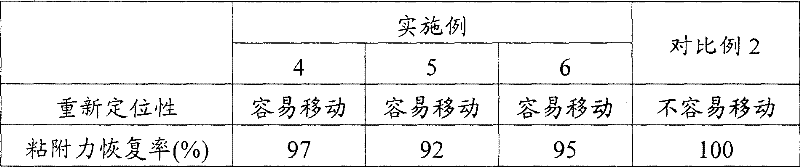
表2证实,实施例的压敏胶片(压敏胶层的表面中具有凸出的纤维点)在临时粘附后容易移动,且在强有力地粘附在被粘物上之后,其粘附力高。Table 2 confirms that the pressure-sensitive adhesive sheets of Examples (with protruding fiber dots in the surface of the pressure-sensitive adhesive layer) move easily after being temporarily adhered, and that after strongly adhering to an adherend, its adhesion Lego.
尽管已经参照其具体实施方案详述了本发明,但是本领域的技术人员显而易见的是,其中可以作出很多替换和修改而不脱离其构思和范围。Although the invention has been described in detail with reference to the specific embodiments thereof, it will be apparent to those skilled in the art that many substitutions and modifications can be made therein without departing from the spirit and scope thereof.
Claims (6)
Applications Claiming Priority (6)
| Application Number | Priority Date | Filing Date | Title |
|---|---|---|---|
| JP121637/03 | 2003-04-25 | ||
| JP2003121637 | 2003-04-25 | ||
| JP2003125043 | 2003-04-30 | ||
| JP125043/03 | 2003-04-30 | ||
| JP2004051509A JP4726420B2 (en) | 2003-04-25 | 2004-02-26 | Adhesive tape or sheet and method for producing the same |
| JP051509/04 | 2004-02-26 |
Related Parent Applications (1)
| Application Number | Title | Priority Date | Filing Date |
|---|---|---|---|
| CNB2004100384525A Division CN100334176C (en) | 2003-04-25 | 2004-04-26 | Pressure-sensitive adhesive tape or film and method for its preparation |
Publications (2)
| Publication Number | Publication Date |
|---|---|
| CN101016441A CN101016441A (en) | 2007-08-15 |
| CN101016441B true CN101016441B (en) | 2011-04-20 |
Family
ID=32966310
Family Applications (2)
| Application Number | Title | Priority Date | Filing Date |
|---|---|---|---|
| CN2007100058888A Expired - Fee Related CN101016441B (en) | 2003-04-25 | 2004-04-26 | Pressure-sensitive adhesive tape or sheet, and method for producing the same |
| CNB2004100384525A Expired - Fee Related CN100334176C (en) | 2003-04-25 | 2004-04-26 | Pressure-sensitive adhesive tape or film and method for its preparation |
Family Applications After (1)
| Application Number | Title | Priority Date | Filing Date |
|---|---|---|---|
| CNB2004100384525A Expired - Fee Related CN100334176C (en) | 2003-04-25 | 2004-04-26 | Pressure-sensitive adhesive tape or film and method for its preparation |
Country Status (5)
| Country | Link |
|---|---|
| US (3) | US7097892B2 (en) |
| EP (1) | EP1471126B1 (en) |
| JP (1) | JP4726420B2 (en) |
| CN (2) | CN101016441B (en) |
| DE (1) | DE602004007183T2 (en) |
Families Citing this family (50)
| Publication number | Priority date | Publication date | Assignee | Title |
|---|---|---|---|---|
| US7849612B2 (en) * | 1997-09-15 | 2010-12-14 | Merel Epstein | Orthotic device |
| JP4726421B2 (en) * | 2003-04-30 | 2011-07-20 | 日東電工株式会社 | Fiber convex structure transfer sheet |
| WO2006026734A2 (en) * | 2004-08-31 | 2006-03-09 | Obermeyer Henry K | High strength joining system for fiber reinforced composites |
| GB0426255D0 (en) * | 2004-11-30 | 2004-12-29 | Younger Skin Ltd | Improvements in and relating to products for skin treatment |
| KR100690357B1 (en) * | 2005-06-10 | 2007-03-09 | 유한회사 한국 타코닉 | Carrier tape for flexible printed wiring board mounting |
| JP2007031552A (en) * | 2005-07-26 | 2007-02-08 | Lintec Corp | Masking tape |
| US8336117B2 (en) * | 2005-10-19 | 2012-12-25 | Nike, Inc. | Article of apparel with material elements having a reversible structure |
| US8398306B2 (en) | 2005-11-07 | 2013-03-19 | Kraft Foods Global Brands Llc | Flexible package with internal, resealable closure feature |
| JP2007299906A (en) * | 2006-04-28 | 2007-11-15 | Nitto Denko Corp | An article comprising a sheet-like electromagnetic shielding structure. |
| US8021732B2 (en) * | 2006-11-03 | 2011-09-20 | Skinit, Inc. | Fishing lures and adhesive covers for same |
| EP2084663A4 (en) * | 2006-11-03 | 2013-01-16 | Skinit Inc | Order fulfillment and content management systems and methods |
| US8110268B2 (en) * | 2006-11-03 | 2012-02-07 | Skinit, Inc. | Adhesive cover for consumer devices |
| US8613992B2 (en) * | 2007-02-16 | 2013-12-24 | Fu Yi Hsu | Protective cover for electronic device |
| US9232808B2 (en) | 2007-06-29 | 2016-01-12 | Kraft Foods Group Brands Llc | Processed cheese without emulsifying salts |
| JP4870627B2 (en) * | 2007-08-06 | 2012-02-08 | 日東電工株式会社 | Optical waveguide film and manufacturing method thereof |
| WO2009034827A1 (en) * | 2007-09-11 | 2009-03-19 | Nitto Denko Corporation | Pressure-sensitive adhesive tape and process for producing the same |
| DE102007044322A1 (en) * | 2007-09-17 | 2009-03-19 | Tesa Ag | Double-sided adhesive tape for fastening protective fabrics |
| US9790343B2 (en) | 2008-06-12 | 2017-10-17 | Avery Dennison Corporation | Porous material and method for producing the same |
| US8309207B2 (en) * | 2009-02-05 | 2012-11-13 | Avery Dennison Corporation | Adhesive articles with improved air egress |
| US8522509B2 (en) * | 2009-03-09 | 2013-09-03 | Custom Building Products, Inc. | Mortarless tile installation system and method for installing tiles |
| US8302366B2 (en) * | 2009-03-09 | 2012-11-06 | Custom Building Products, Inc. | Mortarless tile installation system and method for installing tiles |
| US8490356B2 (en) | 2009-03-09 | 2013-07-23 | Custom Building Products, Inc. | Mortarless tile installation system and method for installing tiles |
| WO2010107543A2 (en) * | 2009-03-20 | 2010-09-23 | 3M Innovative Properties Company | Methods for preparing modified release liners and modified adhesive articles |
| NZ601823A (en) | 2010-02-26 | 2014-08-29 | Intercontinental Great Brands Llc | Package having an adhesive-based reclosable fastener and methods therefor |
| NZ591354A (en) | 2010-02-26 | 2012-09-28 | Kraft Foods Global Brands Llc | A low-tack, UV-cured pressure sensitive acrylic ester based adhesive for reclosable packaging |
| KR101387201B1 (en) * | 2011-04-05 | 2014-04-24 | 주식회사 엘지화학 | Swelling Tape for filling a gap |
| USD685998S1 (en) | 2012-02-29 | 2013-07-16 | Edward S. Robbins, III | Perforated stripping |
| USD683166S1 (en) * | 2012-02-29 | 2013-05-28 | Edward S. Robbins, III | Perforated stripping with header |
| USD702445S1 (en) * | 2012-05-11 | 2014-04-15 | Columbia Sportswear North America, Inc. | Printed cooling material |
| USD696522S1 (en) * | 2012-05-11 | 2013-12-31 | Columbia Sportswear North America, Inc. | Printed cooling material |
| EP3431271B1 (en) | 2012-08-21 | 2020-08-05 | Vertera Inc. | Method of forming porous polymeric particulates |
| DE102013000252A1 (en) * | 2013-01-09 | 2014-07-24 | Uzin Tyro Ag | Self-adhesive film for bonding a coating |
| JP6339387B2 (en) * | 2014-03-11 | 2018-06-06 | リンテック株式会社 | Cushion tape |
| USD784706S1 (en) * | 2014-06-02 | 2017-04-25 | Under Armour, Inc. | Textile article including a perforation pattern |
| DE102014111629A1 (en) * | 2014-08-14 | 2016-02-18 | Geting Solutions Gmbh | Material for covering adhesive surfaces |
| SE539943C2 (en) * | 2014-12-01 | 2018-02-06 | Sto Scandinavia Ab | Gas barrier for floors etc and method for providing the same |
| JP2016167952A (en) | 2015-03-10 | 2016-09-15 | 住友電装株式会社 | Electric wire exterior structure of wire harness |
| CN109072516B (en) | 2015-11-12 | 2022-01-25 | Pf非织造布有限公司 | Nonwoven with improved abrasion resistance and method of making same |
| US10875624B2 (en) * | 2016-01-17 | 2020-12-29 | Toyota Tsusho America, Inc. | Carbon flocked tape |
| JP6227820B1 (en) * | 2016-05-24 | 2017-11-08 | 日東電工株式会社 | Pressure adhesive type adhesive member |
| WO2018072138A1 (en) * | 2016-10-19 | 2018-04-26 | 宁德新能源科技有限公司 | Method for fabricating structural adhesive paper |
| CN108667958B (en) * | 2017-03-27 | 2020-05-26 | 蓝思科技股份有限公司 | Preparation method of transparent adhesive layer in frame hole area of mobile phone panel |
| JP7074405B2 (en) * | 2017-03-31 | 2022-05-24 | リンテック株式会社 | Adhesive sheet |
| JP2019052270A (en) * | 2017-09-19 | 2019-04-04 | 日東電工株式会社 | Adhesive tape with separator, manufacturing method of adhesive tape, and separator with through hole |
| GB2596515A (en) * | 2020-06-15 | 2022-01-05 | Stephen Boyce Gerard | Thermoplastic composite tape |
| CA3183866A1 (en) | 2021-02-02 | 2022-08-11 | Ashish Kumar | Gasket assemblies and related systems and methods |
| EP4384674A4 (en) * | 2021-08-13 | 2025-07-23 | Certainteed Gypsum Inc | PRESSURE-SENSITIVE ADHESIVE ACCESSORIES FOR BUILDING SURFACES |
| CN114192361B (en) * | 2022-01-22 | 2025-05-09 | 无锡百泰克生物技术有限公司 | Swab flocking device and swab blowing flocking process |
| WO2023137802A1 (en) * | 2022-01-22 | 2023-07-27 | 无锡百泰克生物技术有限公司 | Swab flocking device and swab blowing and flocking process |
| USD1099557S1 (en) | 2023-10-06 | 2025-10-28 | The Procter & Gamble Company | Rolled paper product |
Citations (6)
| Publication number | Priority date | Publication date | Assignee | Title |
|---|---|---|---|---|
| US3214502A (en) * | 1960-08-08 | 1965-10-26 | Kendall & Co | Method and apparatus for making adhesive tapes |
| US4201810A (en) * | 1977-08-24 | 1980-05-06 | Shigehiko Higashiguchi | Transferable flocked fiber design material |
| US5964252A (en) * | 1997-12-18 | 1999-10-12 | Morgan Adhesives Company | Adhesive closure system with an abridged release liner |
| US6045858A (en) * | 1997-08-04 | 2000-04-04 | Sumika Plastech Co., Ltd. | Film and process for producing the same |
| US6228485B1 (en) * | 1999-04-30 | 2001-05-08 | Flexipak Distributin, Llc | Venting tape |
| US6635334B1 (en) * | 2000-08-08 | 2003-10-21 | 3M Innovative Properties Company | Cloth-like polymeric films |
Family Cites Families (26)
| Publication number | Priority date | Publication date | Assignee | Title |
|---|---|---|---|---|
| US3741786A (en) * | 1971-05-28 | 1973-06-26 | Avery Products Corp | Transfer tape having non-contiguous pressure sensitive adhesive patterns |
| US3922410A (en) * | 1973-08-01 | 1975-11-25 | United Merchants & Mfg | Process for obtaining flocked fabrics and fabrics obtained therefrom |
| US3906578A (en) * | 1973-10-17 | 1975-09-23 | W Rene Huber | Lint remover having localized projections |
| DE2423284C2 (en) * | 1974-05-14 | 1982-04-01 | Basf Ag, 6700 Ludwigshafen | Process for flocking flat textile substrates |
| US4103053A (en) * | 1976-04-09 | 1978-07-25 | Myron Barehas | Pressure sensitive laminate and method of forming same |
| DE2703005C2 (en) * | 1977-01-26 | 1982-05-19 | Roland Dipl.-Kfm. 7022 Leinfelden-Echterdingen Belz | Toilet seat cover and process for their manufacture |
| JPS54163934A (en) * | 1978-06-17 | 1979-12-27 | Omikenshi Kk | Multicolor electric hair planting |
| US4246308A (en) * | 1979-03-21 | 1981-01-20 | Microfibres, Inc. | Curled flock fabric and method for making same |
| US4282278A (en) * | 1979-08-31 | 1981-08-04 | Shigehiko Higashiguchi | Transferable flocked fiber sticker material |
| US4417291A (en) * | 1979-12-26 | 1983-11-22 | Minnesota Mining And Manufacturing Company | Recording diskette having flocked-fiber wiping fabric |
| DE3021039A1 (en) * | 1980-06-03 | 1981-12-10 | Kufner Textilwerke KG, 8000 München | INSERTS FOR CLOTHING AND METHOD FOR THE PRODUCTION THEREOF |
| JPS6054858B2 (en) | 1980-10-09 | 1985-12-02 | 株式会社 東京宝来社 | Short fiber grafted wax pen |
| FR2557029B1 (en) * | 1983-12-23 | 1988-01-08 | Larque Hubert | BIND TO HEEL |
| US4734307A (en) * | 1984-12-14 | 1988-03-29 | Phillips Petroleum Company | Compositions with adhesion promotor and method for production of flocked articles |
| US4767398A (en) * | 1986-04-25 | 1988-08-30 | Chesebrough-Pond's Inc. | Swab applicator comprising a flock swab tip |
| EP0448955A3 (en) | 1990-02-21 | 1991-10-16 | Technostar Corp. | Layered structure for the transfer of a patterned layer of fibres by the application of pressure |
| US5508084A (en) * | 1991-08-28 | 1996-04-16 | Minnesota Mining And Manufacturing Company | Repositionable articles having a microstructured surface, kits for producing same, and methods of use |
| JPH06214502A (en) * | 1993-01-19 | 1994-08-05 | Fujii Sando Art Kiyoushitsu:Kk | Decal body and production of decal by decal body |
| JPH10292159A (en) * | 1997-04-21 | 1998-11-04 | Nichiban Co Ltd | Adhesive tape with release liner and production of release liner, and production of adhesive tape with release liner |
| FR2769541B1 (en) * | 1997-10-15 | 1999-12-03 | Enduction Et De Flockage Soc D | METHOD FOR PRINTING MULTI-COLORED PATTERNS ON A HIGH-FREQUENCY WELDABLE OR WELDABLE FLOCKE FILM, FILM OBTAINED BY THIS PROCESS, METHOD FOR APPLYING THIS FILM ON A MEDIUM TO BE DECORATED AND DECORATED MEDIUM OBTAINED BY THIS PROCESS |
| JPH11343726A (en) * | 1998-06-02 | 1999-12-14 | Sekisui Chem Co Ltd | Floor material fixing method |
| JP2000119609A (en) * | 1998-10-14 | 2000-04-25 | Sekisui Chem Co Ltd | Double-sided adhesive tape for fixing floor material and floor construction method using the same |
| JP2000230160A (en) * | 1999-02-15 | 2000-08-22 | Daikyo:Kk | Double-sided adhesive tape for sealing and packaging bag using the same |
| US20020098329A1 (en) * | 2000-10-10 | 2002-07-25 | Abrams L. Brown | Enhanced resolution multicolored flock transfer |
| US20020197431A1 (en) | 2001-06-26 | 2002-12-26 | Dobrin George Christopher | Sheet material having a fibrous and adhesive surface |
| JP4726421B2 (en) * | 2003-04-30 | 2011-07-20 | 日東電工株式会社 | Fiber convex structure transfer sheet |
-
2004
- 2004-02-26 JP JP2004051509A patent/JP4726420B2/en not_active Expired - Fee Related
- 2004-04-16 US US10/825,241 patent/US7097892B2/en not_active Expired - Fee Related
- 2004-04-22 DE DE602004007183T patent/DE602004007183T2/en not_active Expired - Fee Related
- 2004-04-22 EP EP04009572A patent/EP1471126B1/en not_active Expired - Lifetime
- 2004-04-26 CN CN2007100058888A patent/CN101016441B/en not_active Expired - Fee Related
- 2004-04-26 CN CNB2004100384525A patent/CN100334176C/en not_active Expired - Fee Related
-
2006
- 2006-06-27 US US11/475,078 patent/US7338685B2/en not_active Expired - Fee Related
-
2007
- 2007-11-14 US US11/939,747 patent/US20080113141A1/en not_active Abandoned
Patent Citations (6)
| Publication number | Priority date | Publication date | Assignee | Title |
|---|---|---|---|---|
| US3214502A (en) * | 1960-08-08 | 1965-10-26 | Kendall & Co | Method and apparatus for making adhesive tapes |
| US4201810A (en) * | 1977-08-24 | 1980-05-06 | Shigehiko Higashiguchi | Transferable flocked fiber design material |
| US6045858A (en) * | 1997-08-04 | 2000-04-04 | Sumika Plastech Co., Ltd. | Film and process for producing the same |
| US5964252A (en) * | 1997-12-18 | 1999-10-12 | Morgan Adhesives Company | Adhesive closure system with an abridged release liner |
| US6228485B1 (en) * | 1999-04-30 | 2001-05-08 | Flexipak Distributin, Llc | Venting tape |
| US6635334B1 (en) * | 2000-08-08 | 2003-10-21 | 3M Innovative Properties Company | Cloth-like polymeric films |
Non-Patent Citations (1)
| Title |
|---|
| 第4栏第57-61行. |
Also Published As
| Publication number | Publication date |
|---|---|
| DE602004007183D1 (en) | 2007-08-09 |
| CN100334176C (en) | 2007-08-29 |
| EP1471126A3 (en) | 2004-12-22 |
| JP2004346302A (en) | 2004-12-09 |
| US20060240209A1 (en) | 2006-10-26 |
| DE602004007183T2 (en) | 2007-10-11 |
| US20040213942A1 (en) | 2004-10-28 |
| CN1570003A (en) | 2005-01-26 |
| EP1471126A2 (en) | 2004-10-27 |
| CN101016441A (en) | 2007-08-15 |
| US20080113141A1 (en) | 2008-05-15 |
| EP1471126B1 (en) | 2007-06-27 |
| US7097892B2 (en) | 2006-08-29 |
| JP4726420B2 (en) | 2011-07-20 |
| US7338685B2 (en) | 2008-03-04 |
Similar Documents
| Publication | Publication Date | Title |
|---|---|---|
| CN101016441B (en) | Pressure-sensitive adhesive tape or sheet, and method for producing the same | |
| JP3522750B2 (en) | Embossed pressure-sensitive adhesive transfer tape | |
| EP1373424B1 (en) | Adhesive layers and release liners with pyramidal structures | |
| US6759110B1 (en) | Structured release liners with improved adhesion to adhesive articles | |
| JP3031696B2 (en) | Position-adjustable adhesive tape and method of manufacturing the same | |
| JP3542673B2 (en) | Heat-activatable adhesive articles | |
| US20040219336A1 (en) | Sheet for transfer formation of projected spots of fibers | |
| AU2001227295A1 (en) | Structured release liners with improved adhesion of adhesive articles | |
| WO2002034855A1 (en) | Fluid-activatable adhesive articles and methods | |
| WO1993003107A1 (en) | Structured flexible carrier web bearing a layer of silicone on predetermined surfaces | |
| JP2018065282A (en) | separator | |
| JP4825404B2 (en) | Adhesive sheet and method for producing the same | |
| JP4364662B2 (en) | Fiber convex structure transfer sheet | |
| JP4381057B2 (en) | Adhesive tape or sheet and method for producing the same | |
| JP4726417B2 (en) | Adhesive tape or sheet | |
| JP2006022181A (en) | Adhesive tape or sheet | |
| JP4780936B2 (en) | Adhesive tape or sheet and method for producing the same, fiber convex structure transfer sheet | |
| JP2005048070A (en) | Sheet for forming a fiber convex structure, an adhesive tape or sheet having a fiber convex structure using the sheet, and a method for producing the same |
Legal Events
| Date | Code | Title | Description |
|---|---|---|---|
| C06 | Publication | ||
| PB01 | Publication | ||
| C10 | Entry into substantive examination | ||
| SE01 | Entry into force of request for substantive examination | ||
| C14 | Grant of patent or utility model | ||
| GR01 | Patent grant | ||
| C17 | Cessation of patent right | ||
| CF01 | Termination of patent right due to non-payment of annual fee |
Granted publication date: 20110420 Termination date: 20130426 |