CN100550463C - Light-emitting devices with iridium complexes - Google Patents
Light-emitting devices with iridium complexes Download PDFInfo
- Publication number
- CN100550463C CN100550463C CNB200480033821XA CN200480033821A CN100550463C CN 100550463 C CN100550463 C CN 100550463C CN B200480033821X A CNB200480033821X A CN B200480033821XA CN 200480033821 A CN200480033821 A CN 200480033821A CN 100550463 C CN100550463 C CN 100550463C
- Authority
- CN
- China
- Prior art keywords
- light
- ligands
- dibenzoquinolines
- dibenzo
- emitting
- Prior art date
- Legal status (The legal status is an assumption and is not a legal conclusion. Google has not performed a legal analysis and makes no representation as to the accuracy of the status listed.)
- Expired - Lifetime
Links
Images

Classifications
-
- C—CHEMISTRY; METALLURGY
- C09—DYES; PAINTS; POLISHES; NATURAL RESINS; ADHESIVES; COMPOSITIONS NOT OTHERWISE PROVIDED FOR; APPLICATIONS OF MATERIALS NOT OTHERWISE PROVIDED FOR
- C09K—MATERIALS FOR MISCELLANEOUS APPLICATIONS, NOT PROVIDED FOR ELSEWHERE
- C09K11/00—Luminescent, e.g. electroluminescent, chemiluminescent materials
- C09K11/06—Luminescent, e.g. electroluminescent, chemiluminescent materials containing organic luminescent materials
-
- C—CHEMISTRY; METALLURGY
- C07—ORGANIC CHEMISTRY
- C07F—ACYCLIC, CARBOCYCLIC OR HETEROCYCLIC COMPOUNDS CONTAINING ELEMENTS OTHER THAN CARBON, HYDROGEN, HALOGEN, OXYGEN, NITROGEN, SULFUR, SELENIUM OR TELLURIUM
- C07F15/00—Compounds containing elements of Groups 8, 9, 10 or 18 of the Periodic Table
- C07F15/0006—Compounds containing elements of Groups 8, 9, 10 or 18 of the Periodic Table compounds of the platinum group
- C07F15/0033—Iridium compounds
-
- H—ELECTRICITY
- H10—SEMICONDUCTOR DEVICES; ELECTRIC SOLID-STATE DEVICES NOT OTHERWISE PROVIDED FOR
- H10K—ORGANIC ELECTRIC SOLID-STATE DEVICES
- H10K85/00—Organic materials used in the body or electrodes of devices covered by this subclass
- H10K85/30—Coordination compounds
- H10K85/341—Transition metal complexes, e.g. Ru(II)polypyridine complexes
- H10K85/342—Transition metal complexes, e.g. Ru(II)polypyridine complexes comprising iridium
-
- C—CHEMISTRY; METALLURGY
- C09—DYES; PAINTS; POLISHES; NATURAL RESINS; ADHESIVES; COMPOSITIONS NOT OTHERWISE PROVIDED FOR; APPLICATIONS OF MATERIALS NOT OTHERWISE PROVIDED FOR
- C09K—MATERIALS FOR MISCELLANEOUS APPLICATIONS, NOT PROVIDED FOR ELSEWHERE
- C09K2211/00—Chemical nature of organic luminescent or tenebrescent compounds
- C09K2211/10—Non-macromolecular compounds
- C09K2211/1018—Heterocyclic compounds
- C09K2211/1025—Heterocyclic compounds characterised by ligands
- C09K2211/1029—Heterocyclic compounds characterised by ligands containing one nitrogen atom as the heteroatom
-
- C—CHEMISTRY; METALLURGY
- C09—DYES; PAINTS; POLISHES; NATURAL RESINS; ADHESIVES; COMPOSITIONS NOT OTHERWISE PROVIDED FOR; APPLICATIONS OF MATERIALS NOT OTHERWISE PROVIDED FOR
- C09K—MATERIALS FOR MISCELLANEOUS APPLICATIONS, NOT PROVIDED FOR ELSEWHERE
- C09K2211/00—Chemical nature of organic luminescent or tenebrescent compounds
- C09K2211/18—Metal complexes
- C09K2211/185—Metal complexes of the platinum group, i.e. Os, Ir, Pt, Ru, Rh or Pd
-
- H—ELECTRICITY
- H10—SEMICONDUCTOR DEVICES; ELECTRIC SOLID-STATE DEVICES NOT OTHERWISE PROVIDED FOR
- H10K—ORGANIC ELECTRIC SOLID-STATE DEVICES
- H10K2101/00—Properties of the organic materials covered by group H10K85/00
- H10K2101/10—Triplet emission
-
- H—ELECTRICITY
- H10—SEMICONDUCTOR DEVICES; ELECTRIC SOLID-STATE DEVICES NOT OTHERWISE PROVIDED FOR
- H10K—ORGANIC ELECTRIC SOLID-STATE DEVICES
- H10K50/00—Organic light-emitting devices
- H10K50/10—OLEDs or polymer light-emitting diodes [PLED]
- H10K50/11—OLEDs or polymer light-emitting diodes [PLED] characterised by the electroluminescent [EL] layers
-
- H—ELECTRICITY
- H10—SEMICONDUCTOR DEVICES; ELECTRIC SOLID-STATE DEVICES NOT OTHERWISE PROVIDED FOR
- H10K—ORGANIC ELECTRIC SOLID-STATE DEVICES
- H10K50/00—Organic light-emitting devices
- H10K50/10—OLEDs or polymer light-emitting diodes [PLED]
- H10K50/11—OLEDs or polymer light-emitting diodes [PLED] characterised by the electroluminescent [EL] layers
- H10K50/125—OLEDs or polymer light-emitting diodes [PLED] characterised by the electroluminescent [EL] layers specially adapted for multicolour light emission, e.g. for emitting white light
Landscapes
- Chemical & Material Sciences (AREA)
- Organic Chemistry (AREA)
- Engineering & Computer Science (AREA)
- Materials Engineering (AREA)
- Crystallography & Structural Chemistry (AREA)
- Inorganic Chemistry (AREA)
- Electroluminescent Light Sources (AREA)
Abstract
Description
技术领域 technical field
本发明涉及发光设备,其包括至少基材,阳极,发光层和阴极。本发明也涉及铱配合物。The invention relates to a light emitting device comprising at least a substrate, an anode, a light emitting layer and a cathode. The invention also relates to iridium complexes.
背景技术 Background technique
电子激活显示系统是已知的并且扩展到基于各种原理的不同实施方案中。Electronically activated display systems are known and expanded into different embodiments based on various principles.
一种原理利用有机发光二极管,即所谓OLED,作为光源。有机发光二极管由数种功能层产生。“Philips Journal of Research,1998,51,467”包含了对OLED典型结构的说明。典型结构包括作为透明电极(阳极)的ITO(氧化锡铟)层,传导性聚合物层,电致发光层即具有发光材料的层,和由金属优选具有低功函的金属组成的电极(阴极)。这种结构施加到通常为玻璃的基材上。所产生的光通过该基材达到观察者。One principle utilizes organic light-emitting diodes, so-called OLEDs, as light sources. Organic light-emitting diodes are produced from several functional layers. "Philips Journal of Research, 1998, 51, 467" contains a description of the typical structure of OLEDs. A typical structure includes an ITO (Indium Tin Oxide) layer as a transparent electrode (anode), a conductive polymer layer, an electroluminescent layer, ie a layer with a light-emitting material, and an electrode composed of a metal preferably with a low work function (cathode). ). This structure is applied to a substrate, usually glass. The generated light passes through the substrate to the observer.
发光聚合物例如可用作发光材料。在电致发光层中的具有发光聚合物的OLED被称为聚合LED或PLED。Light-emitting polymers can be used, for example, as light-emitting materials. OLEDs with light emitting polymers in the electroluminescent layer are known as polymeric LEDs or PLEDs.
然而,OLED也可包含用作电致发光层中的发光材料的小发光分子。在电致发光层中具有小发光分子的OLED称作SMOLED(小分子有机发光二极管)。在这一实施方案中,发光材料通常嵌入包括空穴或电子传输材料的基体中。However, OLEDs can also comprise small light-emitting molecules used as light-emitting material in the electroluminescent layer. OLEDs with small light-emitting molecules in the electroluminescent layer are known as SMOLEDs (Small Molecule Organic Light Emitting Diodes). In this embodiment, the light emitting material is typically embedded in a matrix comprising a hole or electron transport material.
空穴和电子在电致发光层中相遇并重组。因此,该发光材料被直接激活或通过能量转移激活。在光发射的情况下该受激发的发光材料回到其基态。Holes and electrons meet and recombine in the electroluminescent layer. Thus, the luminescent material is activated directly or by energy transfer. In the event of light emission, the excited phosphor returns to its ground state.
铱配合物尤其适用作发光材料。通过改变该铱配合物中的配体产生蓝绿色至红色范围的颜色。Iridium complexes are particularly suitable as phosphors. Colors ranging from blue-green to red are produced by varying the ligands in this iridium complex.
人眼在555nm波长(绿光)处最为灵敏。在更长波长(红色)和更短波长(蓝色)的辐射处眼睛的灵敏度下降。眼睛对红光(650nm)的灵敏度仅为其对绿光(555nm)的灵敏度的十分之一。换言之,为获得与绿光的相同亮度,需要十倍的红光。The human eye is most sensitive at a wavelength of 555nm (green light). The eye's sensitivity decreases at longer wavelength (red) and shorter wavelength (blue) radiation. The eye is only one-tenth as sensitive to red light (650nm) as it is to green light (555nm). In other words, to obtain the same brightness as green light, ten times as much red light is required.
因此,为使用OLED作为白光源,理想的是使用在橙色光谱范围内发射的铱配合物,因为人眼在该处比在红色光谱范围内更加灵敏。Therefore, to use OLEDs as white light sources, it is desirable to use iridium complexes that emit in the orange spectral range, since the human eye is more sensitive there than in the red spectral range.
一直需要具有改进效率的新的电致发光化合物。There is a continuing need for new electroluminescent compounds with improved efficiencies.
发明内容 Contents of the invention
因此,本发明目的是提供一种发光设备,其在该发光层中包含改进的铱配合物。It was therefore an object of the present invention to provide a light-emitting device comprising an improved iridium complex in the light-emitting layer.
该目的通过这样的发光设备而实现,该设备包括至少基材,阳极,发光层和阴极,此处该发光层包含铱配合物IrL3,并且至少两个配体L是二苯并喹啉。This object is achieved by a light-emitting device comprising at least a substrate, an anode, a light-emitting layer and a cathode, the light-emitting layer here comprising the iridium complex IrL3 and at least two ligands L being dibenzoquinolines.
二苯并喹啉是具有良好配合性能的刚性大分子。具有至少两个二苯并喹啉的铱配合物是非常稳定的,使得其适用于发光设备的发光层中。Dibenzoquinolines are rigid macromolecules with good coordination properties. Iridium complexes with at least two dibenzoquinolines are very stable, making them suitable for use in light-emitting layers of light-emitting devices.
在从属权利要求中具有其它有利的实施方案。Further advantageous embodiments are found in the dependent claims.
而且,本发明还涉及铱配合物IrL3,其中至少两个配体L是二苯并喹啉。本发明尤其涉及铱配合物Ir(二苯并[f,h]喹啉)2(戊-2,4-二酮化物(dionate))和Ir(二苯并[f,h]喹啉)3。Furthermore, the present invention also relates to iridium complexes IrL 3 , in which at least two ligands L are dibenzoquinolines. In particular, the invention relates to the iridium complexes Ir(dibenzo[f,h]quinoline) 2 (penta-2,4-dionate) and Ir(dibenzo[f,h]quinoline) 3 .
附图说明 Description of drawings
参考下文所述的三幅附图和五个实施方案,将使本发明的这些和其它方面显而易见并且将得以阐明。These and other aspects of the invention will be apparent from and elucidated with reference to the three figures and five embodiments described hereinafter.
在该附图中:In this attached drawing:
图1显示了发光设备横截面,Figure 1 shows a cross-section of the light-emitting device,
图2和3显示了根据本发明的铱配合物的发光光谱。Figures 2 and 3 show the luminescence spectra of the iridium complexes according to the invention.
发光设备具有基材1以及置于其上的至少一个阳极2,发光层4和阴极6。为改进发光设备的效率,可如图1所示额外地在阳极2和发光层4之间具有空穴传输层3,以及阴极6和发光层4之间具有电子传输层5。The light-emitting device has a substrate 1 and at least one anode 2 , a light-emitting layer 4 and a cathode 6 arranged thereon. To improve the efficiency of the light-emitting device, it is possible additionally to have a hole-transport layer 3 between the anode 2 and the light-emitting layer 4 and an electron-transport layer 5 between the cathode 6 and the light-emitting layer 4 as shown in FIG. 1 .
基材1优选为透明玻璃板或透明塑料板。该塑料板可含有例如聚对苯二甲酸乙二酯。阳极2优选是透明的并且可含有例如p型掺杂的硅、掺杂铟的氧化锡(ITO)或掺杂锑的氧化锡(ATO)。阳极2理想地含有ITO。阳极2并未结构化,其具有扁平设计。阴极6可含有金属,例如铝、铜、银或金、合金或n型掺杂的硅。优选地,阴极6具有两个或多个传导层。尤其优选地,阴极6具有由碱土金属例如钙或钡、或由碱卤化物例如LiF或苯甲酸锂制成的第一层,和由铝制成的第二层。阴极6可以是结构化的并且例如具有许多传导性物质的平行条。备选地,阴极6可以不结构化并且可以具有扁平设计。The substrate 1 is preferably a transparent glass plate or a transparent plastic plate. The plastic sheet may contain, for example, polyethylene terephthalate. The anode 2 is preferably transparent and may contain, for example, p-doped silicon, indium-doped tin oxide (ITO) or antimony-doped tin oxide (ATO). Anode 2 ideally contains ITO. The anode 2 is not structured, it has a flat design. Cathode 6 may contain metals such as aluminum, copper, silver or gold, alloys or n-doped silicon. Preferably, cathode 6 has two or more conductive layers. Especially preferably, the cathode 6 has a first layer made of an alkaline earth metal such as calcium or barium, or an alkali halide such as LiF or lithium benzoate, and a second layer made of aluminum. The cathode 6 can be structured and have, for example, a number of parallel strips of conductive substance. Alternatively, the cathode 6 can be unstructured and can have a flat design.
阳极2与简化了空穴进入设备之中的注入和传输的第一空穴传输层3邻接。空穴传输层3的合适物质是例如三芳基胺、二芳基胺、三茋胺或聚亚乙基二氧基噻吩(PDOT)和聚(磺酸苯乙烯酯)的混合物。The anode 2 adjoins a first hole transport layer 3 which simplifies the injection and transport of holes into the device. Suitable substances for the hole-transport layer 3 are, for example, triarylamines, diarylamines, tristilbeneamines or mixtures of polyethylenedioxythiophene (PDOT) and poly(styrenesulfonate).
电子传输层5位于阴极6和发光层4之间,该电子传输层可具有三-(8-羟基喹啉)-铝(Alq3)、1,3,5-三-(1-苯基-1H-苯并咪唑-2-基)苯(TPBI)或低电子杂环例如1,3,4-噁二唑或1,2,4-三唑。The electron transport layer 5 is located between the cathode 6 and the light-emitting layer 4, and the electron transport layer may have tris-(8-hydroxyquinoline)-aluminum (Alq 3 ), 1,3,5-tris-(1-phenyl- 1H-benzimidazol-2-yl)benzene (TPBI) or a low-electron heterocycle such as 1,3,4-oxadiazole or 1,2,4-triazole.
该发光层4含有一个或多个新的铱配合物作为发光材料。The emitting layer 4 contains one or more novel iridium complexes as emitting material.
根据本发明的铱配合物IrL3是中性且非离子的。三个配体L中的至少两个是二苯并喹啉。备选地,所有的三个配体L都是二苯并喹啉。该配体L优选是完全相同的二苯并喹啉。然而,它们也可不同。The iridium complex IrL 3 according to the invention is neutral and nonionic. At least two of the three ligands L are dibenzoquinolines. Alternatively, all three ligands L are dibenzoquinolines. The ligands L are preferably identical dibenzoquinolines. However, they can also be different.
二苯并喹啉是两个另外的苯环稠合到其上的喹啉。合适的二苯并喹啉实例是二苯并[f,h]喹啉(dbzq),二苯并[c,f]喹啉,二苯并[c,d,e]喹啉或二苯并[f,g]喹啉。所有的这些二苯并喹啉都是具有良好配合性能的刚性大配体。Dibenzoquinolines are quinolines to which two additional benzene rings are fused. Examples of suitable dibenzoquinolines are dibenzo[f,h]quinoline (dbzq), dibenzo[c,f]quinoline, dibenzo[c,d,e]quinoline or dibenzo [f,g] Quinoline. All of these dibenzoquinolines are rigid macroligands with good complexing properties.
由于其空间排列,二苯并[f,h]喹啉是优选的配体。Due to its steric arrangement, dibenzo[f,h]quinoline is the preferred ligand.
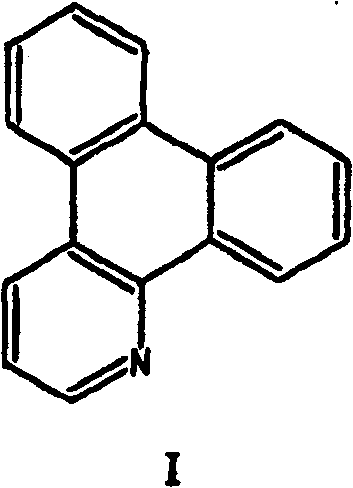
该二苯并喹啉还可具有其它取代基R。各环可具有影响该二苯并喹啉且进而影响随后的铱配合物的电子性能的一个或多个取代基R。The dibenzoquinoline may also have other substituents R. Each ring may have one or more substituents R which affect the electronic properties of the dibenzoquinoline and thus the subsequent iridium complex.

取代基R1、R2、R3等可例如含有直链或支链C1-C8烷基、C2-C6链烯基、C3-C8环烷基、C1-C6链炔基、芳基、杂环基、C1-C6杂环烷基、胺、磷酸基酯、膦基、膦氧化物基团、卤素、硫酸基、磺酸基、砜基、羧酸基、C2-C6烷氧基、磷酸基等。取代基R1、R2、R3等可以相同或不同。Substituents R 1 , R 2 , R 3 etc. may for example contain straight or branched C 1 -C 8 alkyl, C 2 -C 6 alkenyl, C 3 -C 8 cycloalkyl, C 1 -C 6 Alkynyl, aryl, heterocyclyl, C 1 -C 6 heterocycloalkyl, amine, phosphate, phosphine, phosphine oxide, halogen, sulfate, sulfonic, sulfone, carboxylic acid group, C 2 -C 6 alkoxy group, phosphoric acid group, etc. Substituents R 1 , R 2 , R 3 , etc. may be the same or different.
若该铱配合物包含两个二苯并喹啉作为配体L,则第三配体L优选为1.3-二酮衍生物阴离子:If the iridium complex comprises two dibenzoquinolines as ligands L, the third ligand L is preferably a 1.3-diketone derivative anion:
取代基R1和R2等可例如含有直链或支链C1-C8烷基、C2-C6链烯基、C3-C8环烷基、C1-C6链炔基、芳基、杂环基、C1-C6杂环烷基、胺、磷酸基、膦基、膦氧化物基团、卤素、硫酸基、磺酸基、砜基、羧酸基、C2-C6烷氧基、磷酸基等。取代基R1和R2等可以相同或不同。Substituents R 1 and R 2 etc. may for example contain straight or branched C 1 -C 8 alkyl, C 2 -C 6 alkenyl, C 3 -C 8 cycloalkyl, C 1 -C 6 alkynyl , aryl, heterocyclyl, C 1 -C 6 heterocycloalkyl, amine, phosphoric acid, phosphine, phosphine oxide, halogen, sulfuric acid, sulfonic acid, sulfone, carboxylic acid, C 2 -C 6 alkoxy, phosphoric acid, etc. The substituents R 1 and R 2 etc. may be the same or different.
优选第三配体L选自下列基团:戊-2,4-二酮化物(acac)、2,2,6,6-四甲基-3,5-庚二酮化物(thd)、7,7-二甲基-1,1,1,2,2,3,3-七氟-4,6-辛二酮化物(fod)、1,1,1,5,5,5-六氟戊-2,4-二酮化物(hfa)、4,4,4-三氟l-(2-噻吩基)丁-1,3-二酮化物(ttfa)、1,3-二苯基丙-1,3-二酮化物(dbm)、4,4,4-三氟-1-(2-萘基)丁-1,3-二酮化物(tfnb)和4,4,4-三氟-1-(1-萘基)丁-1,3-二酮化物。它们均为具有良好配合性能的公知配体。最优选戊-2,4-二酮化物(acac)。Preferably the third ligand L is selected from the group consisting of pentane-2,4-diketonate (acac), 2,2,6,6-tetramethyl-3,5-heptanedionate (thd), 7 , 7-dimethyl-1,1,1,2,2,3,3-heptafluoro-4,6-octanedionate (fod), 1,1,1,5,5,5-hexafluoro Penta-2,4-dioxide (hfa), 4,4,4-trifluorol-(2-thienyl)butan-1,3-diketide (ttfa), 1,3-diphenylpropane -1,3-diketonate (dbm), 4,4,4-trifluoro-1-(2-naphthyl)butan-1,3-diketonate (tfnb) and 4,4,4-trifluoro -1-(1-Naphthyl)butan-1,3-diketide. All of them are well-known ligands with good complexing properties. Most preferred is pentane-2,4-diketonate (acac).
Ir(二苯并[f,h]喹啉)2(戊-2,4-二酮化物)是优选的铱配合物。Ir(dibenzo[f,h]quinoline) 2 (penta-2,4-diketonate) is the preferred iridium complex.

Ir(二苯并[f,h]喹啉)3是另一优选的铱配合物。Ir(dibenzo[f,h]quinoline) 3 is another preferred iridium complex.

两种配合物发射出波长λ<600nm的光。配合物IV发出波长λmax为595nm的光(在甲基-THF中)而配合物III发出λmax为545nm的光(在甲基-THF中)。Both complexes emit light with wavelength λ<600nm. Complex IV emits light at a wavelength λ max of 595 nm (in methyl-THF) and complex III emits light at a wavelength λ max of 545 nm (in methyl-THF).
考虑到上述事实,人眼在555nm波长处最灵敏,在发光层4中具有配合物III和/或配合物IV的发光设备表现出有利的能量效率。Considering the above fact that the human eye is most sensitive at a wavelength of 555 nm, a light-emitting device having complex III and/or complex IV in the light-emitting layer 4 exhibits favorable energy efficiency.
令人惊喜的是,通过简单地改变配体,例如通过用戊-2,4-二酮化物替换二苯并[f,h]喹啉,就在发射光波长中获得了50nm的λmax漂移。Surprisingly, a λ max shift of 50 nm in the emission wavelength was obtained by simply changing the ligand, for example by replacing dibenzo[f,h]quinoline with pentane-2,4-diketonate .
还有利的是,考虑到它们的结构相似性,配合物III和IV也具有相似的物理性质,从而简化了根据本发明在发光层4中含有两种或多种铱配合物的发光设备的生产和操作。两种不同配合物之间不期望的化学相互作用如配体交换反应在此也没有影响。在发白光的设备的情况下这是尤其有利的,因为其中的发光层4包含数种发光物质,其以例如三原色发射。It is also advantageous that, given their structural similarity, complexes III and IV also have similar physical properties, which simplifies the production of light-emitting devices according to the invention containing two or more iridium complexes in the light-emitting layer 4 and operation. Undesired chemical interactions between two different complexes, such as ligand exchange reactions, also have no effect here. This is particularly advantageous in the case of white-emitting devices, since the luminescent layer 4 therein contains several luminescent substances which emit, for example, in three primary colors.
为产生根据本发明的具有三个二苯并喹啉作为配体L的配合物,用相应的二苯并喹啉在合适溶剂中转化铱盐如IrCl3或Ir(acac)3。To generate complexes according to the invention with three dibenzoquinolines as ligand L, an iridium salt such as IrCl 3 or Ir(acac) 3 is converted with the corresponding dibenzoquinoline in a suitable solvent.
Ir(dbzq)3的合成在所有路径中产生面式/经式异构体混合物。前缀“面式-”和“经式-”表示在具有不同配体的八面配位化合物中有三种完全相同的配体彼此紧密相邻。Synthesis of Ir(dbzq) 3 produced a mixture of fac/mer isomers in all pathways. The prefixes "face-" and "warp-" indicate that there are three identical ligands in close proximity to each other in an octahedral complex with different ligands.
在此情况下,虽然具有三个完全相同的二苯并喹啉作为配体L的配合物具有三个完全相同的配体,但每一个二苯并喹啉具有两个不同的配合部位:一个是通过氮将二苯并喹啉配位到该铱(III)阳离子,以及在芳环之一的C原子和该Ir(III)阳离子之间的共价键。这意味着反驳了仅是可形成N-Ir和C-Ir键的二苯并喹啉才能用作配体。In this case, although the complex with three identical dibenzoquinolines as ligand L has three identical ligands, each dibenzoquinoline has two different complexing sites: a is the coordination of the dibenzoquinoline to the iridium(III) cation via nitrogen, and the covalent bond between the C atom of one of the aromatic rings and the Ir(III) cation. This means refuting that only dibenzoquinolines that can form N-Ir and C-Ir bonds can be used as ligands.
从三个相同配合部位的紧密临近性来看,面式/经式异构存在于这些配合物内。Fa/mer isomerism exists within these complexes, as seen from the close proximity of the three identical complexing sites.
为产生根据本发明的具有两个二苯并喹啉作为配体L的配合物,首先基于IrCl3生成二氯桥联的二聚体(二苯并喹啉)2Ir(μ-Cl)2(二苯并喹啉)2。随后在碱存在下、用第三配体例如1,3-二酮衍生物如戊-2,4-二酮将二氯桥联的二聚体(二苯并喹啉)2Ir(μ-Cl)2(二苯并喹啉)2转化为所需铱配合物。To generate the complexes according to the invention with two dibenzoquinolines as ligand L, a dichloro-bridged dimer (dibenzoquinoline) 2 Ir(μ-Cl) 2 is first generated on the basis of IrCl 3 (Dibenzoquinoline) 2 . The dichloro-bridged dimer (dibenzoquinoline) 2 Ir(μ- Cl) 2 (dibenzoquinoline) 2 is converted to the desired iridium complex.
采用真空分离来获得根据本发明的铱配合物薄膜,其具有良好的电致发光性能。通过改变配体L或该二苯并喹啉中的取代基R,可精密地调整该发光物质的电致发光性能。Vacuum separation is used to obtain the iridium complex thin film according to the present invention, which has good electroluminescent properties. By changing the ligand L or the substituent R in the dibenzoquinoline, the electroluminescence performance of the luminescent substance can be precisely adjusted.
该铱配合物可独自使用(占该发光层4总重量的100%)或嵌入在发光层4中包括空穴或电子传输物质的基体中。铱配合物的数量优选>10%(占发光层4的总重量)。基体材料的选择取决于对铱配合物的要求。例如,该基体可包含4,4’,4”-三(N-咔唑基)三苯基胺(TCTA),2,9-二甲基-4,7-二苯基-1,10-菲咯啉(BCP)或1,3,5-三-(1-苯基-1H-苯并咪唑-2-基)苯(TPBI)。The iridium complex can be used alone (accounting for 100% of the total weight of the light-emitting layer 4 ) or embedded in a matrix in the light-emitting layer 4 including hole or electron transport substances. The amount of iridium complex is preferably >10% (based on the total weight of the emitting layer 4). The choice of matrix material depends on the requirements for the iridium complex. For example, the matrix may comprise 4,4',4"-tris(N-carbazolyl)triphenylamine (TCTA), 2,9-dimethyl-4,7-diphenyl-1,10- phenanthroline (BCP) or 1,3,5-tris-(1-phenyl-1H-benzimidazol-2-yl)benzene (TPBI).
以下实施方案是举例并且意在阐述本发明,但并非对其进行限制。The following embodiments are illustrative and intended to illustrate the invention, but not to limit it.
实施方案1Implementation 1
二氯桥联的二聚体(dbzq)2Ir(μ-Cl)2(dbzq)2的合成Synthesis of dichloro-bridged dimer (dbzq) 2 Ir(μ-Cl) 2 (dbzq) 2
将250mg的IrCl3·3H2O和407mg的二苯并[f,h]喹啉溶解于2-乙氧基乙醇(20ml)和水(7ml)的混合物并加热且回流24小时。冷却至室温后,所得的黄色沉淀被离心分离,用乙醇(60ml)和丙酮(60ml)冲洗并干燥。250 mg of IrCl 3 ·3H 2 O and 407 mg of dibenzo[f,h]quinoline were dissolved in a mixture of 2-ethoxyethanol (20 ml) and water (7 ml) and heated and refluxed for 24 hours. After cooling to room temperature, the resulting yellow precipitate was centrifuged, washed with ethanol (60ml) and acetone (60ml) and dried.
获得370mg(77%)的黄色粉末形式的二氯桥联的二聚体。370 mg (77%) of the dichloro-bridged dimer were obtained in the form of a yellow powder.
实施方案2Embodiment 2
起始于(dbzq)2Ir(μ-Cl)2(dbzq)2来合成Ir(dbzq)2(acac)。Ir(dbzq) 2 (acac) was synthesized starting from (dbzq) 2 Ir(μ-Cl) 2 (dbzq) 2 .
将(dbzq)2Ir(μ-Cl)2(dbzq)2与2.5当量的乙酰丙酮化物和400mg的碳酸钠在2-乙氧基乙醇中加热并回流20小时。所得的橙色沉淀被离心分离,用水、正己烷、二乙醚和乙醇冲洗。粗产品的产率为70-75%。(dbzq) 2 Ir(μ-Cl) 2 (dbzq) 2 was heated with 2.5 equivalents of acetylacetonate and 400 mg of sodium carbonate in 2-ethoxyethanol and refluxed for 20 hours. The resulting orange precipitate was centrifuged and washed with water, n-hexane, diethyl ether and ethanol. The yield of crude product was 70-75%.
通过柱色谱将粗产品在硅胶(CH2Cl2/正己烷/二乙醚)中清洗。The crude product was washed by column chromatography in silica gel (CH 2 Cl 2 /n-hexane/diethyl ether).
1H-NMR(CDC13):δ=1.80(s,6H,2CH3),5.29(s,1H,CH),6.33(d,J=7.3Hz,2H,CH arom.),6.97(t,2H,CH arom.),7.61(dd,J=7.7Hz,J=5.4Hz,2H,CHarom),7.66 to 7.72(m,4H,CH arom.),7.86(d,J=8.0Hz,2H,CH arom.),8.56 to 8.60(m,2H,CH arom.),8.64 to 8.67(m,2H,CH arom.),8.87 to 8.91(m,4H,CH arom.). 1 H-NMR (CDC1 3 ): δ=1.80 (s, 6H, 2CH 3 ), 5.29 (s, 1H, CH), 6.33 (d, J=7.3Hz, 2H, CH arom.), 6.97 (t, 2H, CH arom.), 7.61 (dd, J=7.7Hz, J=5.4Hz, 2H, CHarom), 7.66 to 7.72 (m, 4H, CH arom.), 7.86 (d, J=8.0Hz, 2H, CH arom.), 8.56 to 8.60 (m, 2H, CH arom.), 8.64 to 8.67 (m, 2H, CH arom.), 8.87 to 8.91 (m, 4H, CH arom.).
所得配合物Ir(dbzq)2(acac)发出波长λmax为545nm的光(在甲基THF中)。发射光谱示于图2。The resulting complex Ir(dbzq) 2 (acac) emits light at a wavelength λ max of 545 nm (in methyl THF). The emission spectrum is shown in Figure 2.
实施方案3Embodiment 3
Ir(dbzq)3的合成Synthesis of Ir(dbzq) 3
将53mg乙酰丙酮铱(III)和250mg二苯并[f,h]喹啉加入5ml脱气乙二醇。所得悬浮物被加热并回流60小时。冷却到室温之后,将反应混合物加入10ml的1N HCl。搅拌5分钟,滤出橙色的结晶沉淀,用5ml的1N HCl和水冲洗并干燥。53 mg of iridium(III) acetylacetonate and 250 mg of dibenzo[f,h]quinoline were added to 5 ml of degassed ethylene glycol. The resulting suspension was heated and refluxed for 60 hours. After cooling to room temperature, the reaction mixture was added to 10 ml of 1N HCl. After stirring for 5 minutes, the orange crystalline precipitate was filtered off, rinsed with 5 ml of 1N HCl and water and dried.
该产物溶解于二氯甲烷中,通过硅胶过滤并干燥。The product was dissolved in dichloromethane, filtered through silica gel and dried.
1H-NMR光谱显示该产品含有配合物的面式-和经式-异构体,此处经式-异构体的份额较大。 The 1 H-NMR spectrum shows that the product contains both fac- and meridian-isomers of the complex, where the meridian-isomer has a greater proportion.
该配合物中面式/经式-异构体混合物发出波长λmax为595nm的光(在甲基THF中)。发射光谱示于图3。The f/mer-isomer mixture in this complex emits light at a wavelength λ max of 595 nm (in methyl THF). The emission spectrum is shown in Figure 3.
实施方案4Embodiment 4
起始于Ir(dbzq)2(acac)来合成Ir(dbzq)3 Synthesis of Ir(dbzq) 3 starting from Ir(dbzq) 2 (acac)
将258mg的Ir(dbzq)2(acac)和119mg的二苯并[f,h]喹啉在5ml甘油中于220℃加热24小时。冷却到室温后,用水稀释该反应混合物,且将沉淀离心分离。用甲醇重复冲洗之后,在真空中干燥该沉淀。258 mg of Ir(dbzq) 2 (acac) and 119 mg of dibenzo[f,h]quinoline were heated in 5 ml of glycerol at 220° C. for 24 hours. After cooling to room temperature, the reaction mixture was diluted with water, and the precipitate was centrifuged. After repeated rinsing with methanol, the precipitate was dried in vacuo.
1H-NMR光谱也显示该产品含有配合物的面式-和经式-异构体,此处经式-异构体的份额较大。 The 1 H-NMR spectrum also shows that the product contains fa- and meridian-isomers of the complex, where the meridian-isomer has a greater proportion.
实施方案5Embodiment 5
用作阳极2的150nm厚的ITO层被施加到由玻璃制成的透明基材1。用作空穴传输层3的30nm厚的α-NPD层通过旋转涂覆而施加到阳极2。嵌入TCTA中的由Ir(dbzq)2(acac)制成的发光层4被施加到空穴传输层3。发光层4厚度为30nm。用作电子传输层5的40nm厚的TPBI层被施加到发光层4。将151nm厚的阴极6施加到该电子传输层5,该阴极包括1nm厚的苯甲酸锂第一层和150nm厚的铝第二层。A 150 nm thick ITO layer serving as anode 2 was applied to a transparent substrate 1 made of glass. A 30 nm thick layer of α-NPD serving as the hole transport layer 3 was applied to the anode 2 by spin coating. An emitting layer 4 made of Ir(dbzq) 2 (acac) embedded in TCTA is applied to the hole-transport layer 3 . The light emitting layer 4 has a thickness of 30 nm. A 40 nm thick layer of TPBI serving as electron transport layer 5 is applied to the light-emitting layer 4 . A 151 nm thick cathode 6 is applied to the electron transport layer 5, the cathode comprising a 1 nm thick lithium benzoate first layer and a 150 nm thick aluminum second layer.
Claims (7)
Applications Claiming Priority (2)
| Application Number | Priority Date | Filing Date | Title |
|---|---|---|---|
| EP03104258 | 2003-11-18 | ||
| EP03104258.3 | 2003-11-18 |
Publications (2)
| Publication Number | Publication Date |
|---|---|
| CN1882673A CN1882673A (en) | 2006-12-20 |
| CN100550463C true CN100550463C (en) | 2009-10-14 |
Family
ID=34610096
Family Applications (1)
| Application Number | Title | Priority Date | Filing Date |
|---|---|---|---|
| CNB200480033821XA Expired - Lifetime CN100550463C (en) | 2003-11-18 | 2004-11-08 | Light-emitting devices with iridium complexes |
Country Status (8)
| Country | Link |
|---|---|
| US (1) | US9157023B2 (en) |
| EP (1) | EP1687388B1 (en) |
| JP (1) | JP4644204B2 (en) |
| CN (1) | CN100550463C (en) |
| AT (1) | ATE369408T1 (en) |
| DE (1) | DE602004008104T2 (en) |
| TW (1) | TWI373280B (en) |
| WO (1) | WO2005049762A1 (en) |
Families Citing this family (17)
| Publication number | Priority date | Publication date | Assignee | Title |
|---|---|---|---|---|
| JP5048523B2 (en) * | 2005-02-23 | 2012-10-17 | コーニンクレッカ フィリップス エレクトロニクス エヌ ヴィ | Electroluminescent device containing iridium complex |
| JP4972938B2 (en) * | 2006-01-12 | 2012-07-11 | コニカミノルタホールディングス株式会社 | ORGANIC ELECTROLUMINESCENT ELEMENT MATERIAL, ORGANIC ELECTROLUMINESCENT ELEMENT, DISPLAY DEVICE AND LIGHTING DEVICE |
| KR101600624B1 (en) * | 2006-02-10 | 2016-03-21 | 유니버셜 디스플레이 코포레이션 | METAL COMPLEXES OF CYCLOMETALLATED IMIDAZO[1,2-f]PHENANTHRIDINE AND DIIMIDAZO[1,2-A:1',2'-C]QUINAZOLINE LIGANDS AND ISOELECTRONIC AND BENZANNULATED ANALOGS THEREOF |
| WO2008156879A1 (en) * | 2007-06-20 | 2008-12-24 | Universal Display Corporation | Blue phosphorescent imidazophenanthridine materials |
| JP5305637B2 (en) * | 2007-11-08 | 2013-10-02 | キヤノン株式会社 | Organometallic complex, organic light emitting device using the same, and display device |
| WO2009069535A1 (en) | 2007-11-30 | 2009-06-04 | Semiconductor Energy Laboratory Co., Ltd. | Light-emitting element, light-emitting device, and electronic device |
| KR101691610B1 (en) | 2008-02-12 | 2017-01-02 | 유디씨 아일랜드 리미티드 | Electroluminescent metal complexes with dibenzo[f,h]quinoxalines |
| US8753756B2 (en) * | 2009-06-30 | 2014-06-17 | Chien-Hong Cheng | Green phosphorescent iridium complexes, fabrication method thereof and organic light-emitting diodes comprising the same |
| JP4564588B1 (en) * | 2009-08-31 | 2010-10-20 | 富士フイルム株式会社 | Material for organic electroluminescence device and organic electroluminescence device |
| DE102010013495A1 (en) | 2010-03-31 | 2011-10-06 | Siemens Aktiengesellschaft | Dopant for a hole conductor layer for organic semiconductor devices and use thereof |
| WO2012122387A1 (en) * | 2011-03-10 | 2012-09-13 | Marshall Cox | Graphene electrodes for electronic devices |
| EP2802594B1 (en) | 2012-01-12 | 2017-04-19 | UDC Ireland Limited | Metal complexes with dibenzo[f,h]quinoxalines |
| CN103000816B (en) * | 2012-09-07 | 2017-12-26 | 天津工业大学 | A kind of organic luminescent device based on flexible carbon nano tube film |
| US9871208B2 (en) | 2014-02-26 | 2018-01-16 | Samsung Display Co., Ltd. | Condensed cyclic compound and organic light-emitting device including the same |
| JP6684085B2 (en) * | 2014-12-19 | 2020-04-22 | 株式会社半導体エネルギー研究所 | Organometallic complex, light emitting element, light emitting device, electronic device, and lighting device |
| KR102552271B1 (en) | 2017-10-27 | 2023-07-07 | 삼성디스플레이 주식회사 | Condensed compound and organic light emitting device comprising the same |
| CN112679549B (en) * | 2020-12-24 | 2022-09-20 | 玉林师范学院 | A kind of 8-hydroxyquinoline derivative iridium (III) complex and its preparation method and application |
Family Cites Families (15)
| Publication number | Priority date | Publication date | Assignee | Title |
|---|---|---|---|---|
| KR100946314B1 (en) * | 1999-12-01 | 2010-03-09 | 더 트러스티즈 오브 프린스턴 유니버시티 | Organic light emitting device comprising a phosphorescent organo metallic compound |
| JP3929690B2 (en) * | 1999-12-27 | 2007-06-13 | 富士フイルム株式会社 | Light emitting device material, light emitting device and novel iridium complex comprising orthometalated iridium complex |
| JP3929689B2 (en) * | 2000-03-28 | 2007-06-13 | 富士フイルム株式会社 | Highly efficient red light emitting device, light emitting device material comprising iridium complex and novel iridium complex |
| KR100686109B1 (en) * | 2001-03-29 | 2007-02-23 | 엘지전자 주식회사 | Iridium complex compound and organic light emitting device comprising the same |
| CN101355141B (en) * | 2001-06-15 | 2012-02-29 | 佳能株式会社 | organic electroluminescent element |
| TWI303533B (en) * | 2001-06-15 | 2008-11-21 | Oled T Ltd | Electroluminescent devices |
| JP2003007467A (en) * | 2001-06-19 | 2003-01-10 | Honda Motor Co Ltd | Organic electroluminescence device |
| KR100841850B1 (en) | 2001-08-09 | 2008-06-27 | 이데미쓰 고산 가부시키가이샤 | OLED display and driving method thereof |
| TWI314947B (en) * | 2002-04-24 | 2009-09-21 | Eastman Kodak Compan | Organic light emitting diode devices with improved operational stability |
| JP2004319438A (en) * | 2003-03-28 | 2004-11-11 | Konica Minolta Holdings Inc | Organic electroluminescent element, display device, lighting system, and rhodium complex compound |
| JP2005042106A (en) * | 2003-07-08 | 2005-02-17 | Univ Nihon | Method for producing aromatic-iridium complex-based phosphorescent material, aromatic-iridium complex-based phosphorescent material, and aromatic-iridium complex-based light-emitting device |
| DE10345572A1 (en) * | 2003-09-29 | 2005-05-19 | Covion Organic Semiconductors Gmbh | metal complexes |
| JP5048523B2 (en) | 2005-02-23 | 2012-10-17 | コーニンクレッカ フィリップス エレクトロニクス エヌ ヴィ | Electroluminescent device containing iridium complex |
| KR101600624B1 (en) | 2006-02-10 | 2016-03-21 | 유니버셜 디스플레이 코포레이션 | METAL COMPLEXES OF CYCLOMETALLATED IMIDAZO[1,2-f]PHENANTHRIDINE AND DIIMIDAZO[1,2-A:1',2'-C]QUINAZOLINE LIGANDS AND ISOELECTRONIC AND BENZANNULATED ANALOGS THEREOF |
| KR101691610B1 (en) | 2008-02-12 | 2017-01-02 | 유디씨 아일랜드 리미티드 | Electroluminescent metal complexes with dibenzo[f,h]quinoxalines |
-
2004
- 2004-11-08 CN CNB200480033821XA patent/CN100550463C/en not_active Expired - Lifetime
- 2004-11-08 DE DE602004008104T patent/DE602004008104T2/en not_active Expired - Lifetime
- 2004-11-08 EP EP04770383A patent/EP1687388B1/en not_active Expired - Lifetime
- 2004-11-08 WO PCT/IB2004/052328 patent/WO2005049762A1/en not_active Ceased
- 2004-11-08 AT AT04770383T patent/ATE369408T1/en not_active IP Right Cessation
- 2004-11-08 US US10/579,413 patent/US9157023B2/en active Active
- 2004-11-08 JP JP2006540684A patent/JP4644204B2/en not_active Expired - Lifetime
- 2004-11-15 TW TW093134936A patent/TWI373280B/en not_active IP Right Cessation
Non-Patent Citations (2)
| Title |
|---|
| Synthesis and characterization of phosphorescentcyclomentalated Iridium complexes. S.Lamansky 等.Inorganic Chemistry,Vol.40 . 2001 |
| Synthesis and characterization of phosphorescentcyclomentalated Iridium complexes. S.Lamansky 等.Inorganic Chemistry,Vol.40 . 2001 * |
Also Published As
| Publication number | Publication date |
|---|---|
| JP4644204B2 (en) | 2011-03-02 |
| TW200520612A (en) | 2005-06-16 |
| JP2007515058A (en) | 2007-06-07 |
| ATE369408T1 (en) | 2007-08-15 |
| CN1882673A (en) | 2006-12-20 |
| TWI373280B (en) | 2012-09-21 |
| US9157023B2 (en) | 2015-10-13 |
| WO2005049762A1 (en) | 2005-06-02 |
| DE602004008104D1 (en) | 2007-09-20 |
| US20080030125A1 (en) | 2008-02-07 |
| EP1687388A1 (en) | 2006-08-09 |
| DE602004008104T2 (en) | 2008-04-24 |
| EP1687388B1 (en) | 2007-08-08 |
Similar Documents
| Publication | Publication Date | Title |
|---|---|---|
| JP6266669B2 (en) | Phosphorescent heteroleptic phenylbenzimidazole dopant and novel synthesis method | |
| JP6219466B2 (en) | Phosphorescent substance | |
| JP6251299B2 (en) | Phosphorescent substance | |
| JP3965319B2 (en) | Organometallic light emitting material | |
| US7759490B2 (en) | Phosphorescent Osmium (II) complexes and uses thereof | |
| CN100550463C (en) | Light-emitting devices with iridium complexes | |
| CN108467414B (en) | Material for organic light emitting diode | |
| EP3081617A1 (en) | Blue emitter with high efficiency based on imidazo [1,2-f] phenanthridine iridium complexes | |
| KR20140104926A (en) | Phosphorescent compound | |
| KR101863375B1 (en) | Ion-pairing soft salts based on organometallic complexes and their applications in organic light emitting diodes | |
| CN107033190B (en) | One kind phosphorescent iridium complex of alkenyl containing dish and preparation method thereof and electroluminescent device | |
| CN101147272B (en) | Electroluminescent devices with iridium complexes | |
| CN101024658B (en) | Organometallic complex and organic electroluminescence device using the same | |
| US7601437B2 (en) | Organometallic compounds and display device employing the same | |
| JP2006104132A (en) | Organometallic complex, light emitting material, and light emitting element | |
| Mitsumori et al. | Synthesis, properties, and LED performance of highly luminescent metal complexes containing indolizino [3, 4, 5-ab] isoindoles | |
| Wang et al. | Synthesis, characterization, and application of a novel orange–red iridium (III) phosphor for solution-processed single emissive layer white organic light-emitting diodes | |
| CN104145002A (en) | Heteroleptic light-emiiting complexes | |
| CN116041397B (en) | Binuclear platinum complex luminescent materials and their applications | |
| JP2008500715A (en) | Metal complexes for light emitting devices | |
| JP2008500715A5 (en) | ||
| Ikawa | Development of Novel Phosphorescent Organoiridium (III) Complexes Applicable to Organic Light-emitting Diodes | |
| Ikawa | Development of Novel Phosphorescent Organoiridium (III) Complexe |
Legal Events
| Date | Code | Title | Description |
|---|---|---|---|
| C06 | Publication | ||
| PB01 | Publication | ||
| C10 | Entry into substantive examination | ||
| SE01 | Entry into force of request for substantive examination | ||
| C14 | Grant of patent or utility model | ||
| GR01 | Patent grant | ||
| CP01 | Change in the name or title of a patent holder | ||
| CP01 | Change in the name or title of a patent holder |
Address after: Holland Ian Deho Finn Patentee after: KONINKLIJKE PHILIPS N.V. Address before: Holland Ian Deho Finn Patentee before: Koninklijke Philips Electronics N.V. |
|
| TR01 | Transfer of patent right | ||
| TR01 | Transfer of patent right |
Effective date of registration: 20180614 Address after: Beijing City, Haidian District Qinghe Street No. 68 Huarun colorful city shopping center two 9 floor room 01 Patentee after: BEIJING XIAOMI MOBILE SOFTWARE Co.,Ltd. Address before: Holland Ian Deho Finn Patentee before: KONINKLIJKE PHILIPS N.V. |
|
| CX01 | Expiry of patent term | ||
| CX01 | Expiry of patent term |
Granted publication date: 20091014 |