CN100532421C - Novel phase change solvents - Google Patents
Novel phase change solvents Download PDFInfo
- Publication number
- CN100532421C CN100532421C CNB038183056A CN03818305A CN100532421C CN 100532421 C CN100532421 C CN 100532421C CN B038183056 A CNB038183056 A CN B038183056A CN 03818305 A CN03818305 A CN 03818305A CN 100532421 C CN100532421 C CN 100532421C
- Authority
- CN
- China
- Prior art keywords
- phase change
- solvent
- formula
- change solvent
- aliphatic
- Prior art date
- Legal status (The legal status is an assumption and is not a legal conclusion. Google has not performed a legal analysis and makes no representation as to the accuracy of the status listed.)
- Expired - Fee Related
Links
Images


Classifications
-
- C—CHEMISTRY; METALLURGY
- C08—ORGANIC MACROMOLECULAR COMPOUNDS; THEIR PREPARATION OR CHEMICAL WORKING-UP; COMPOSITIONS BASED THEREON
- C08G—MACROMOLECULAR COMPOUNDS OBTAINED OTHERWISE THAN BY REACTIONS ONLY INVOLVING UNSATURATED CARBON-TO-CARBON BONDS
- C08G64/00—Macromolecular compounds obtained by reactions forming a carbonic ester link in the main chain of the macromolecule
- C08G64/02—Aliphatic polycarbonates
- C08G64/0208—Aliphatic polycarbonates saturated
- C08G64/0216—Aliphatic polycarbonates saturated containing a chain-terminating or -crosslinking agent
-
- C—CHEMISTRY; METALLURGY
- C07—ORGANIC CHEMISTRY
- C07C—ACYCLIC OR CARBOCYCLIC COMPOUNDS
- C07C231/00—Preparation of carboxylic acid amides
- C07C231/02—Preparation of carboxylic acid amides from carboxylic acids or from esters, anhydrides, or halides thereof by reaction with ammonia or amines
-
- C—CHEMISTRY; METALLURGY
- C07—ORGANIC CHEMISTRY
- C07C—ACYCLIC OR CARBOCYCLIC COMPOUNDS
- C07C233/00—Carboxylic acid amides
- C07C233/01—Carboxylic acid amides having carbon atoms of carboxamide groups bound to hydrogen atoms or to acyclic carbon atoms
- C07C233/34—Carboxylic acid amides having carbon atoms of carboxamide groups bound to hydrogen atoms or to acyclic carbon atoms having the nitrogen atom of at least one of the carboxamide groups bound to a carbon atom of a hydrocarbon radical substituted by amino groups
- C07C233/35—Carboxylic acid amides having carbon atoms of carboxamide groups bound to hydrogen atoms or to acyclic carbon atoms having the nitrogen atom of at least one of the carboxamide groups bound to a carbon atom of a hydrocarbon radical substituted by amino groups with the substituted hydrocarbon radical bound to the nitrogen atom of the carboxamide group by an acyclic carbon atom
- C07C233/36—Carboxylic acid amides having carbon atoms of carboxamide groups bound to hydrogen atoms or to acyclic carbon atoms having the nitrogen atom of at least one of the carboxamide groups bound to a carbon atom of a hydrocarbon radical substituted by amino groups with the substituted hydrocarbon radical bound to the nitrogen atom of the carboxamide group by an acyclic carbon atom having the carbon atom of the carboxamide group bound to a hydrogen atom or to a carbon atom of an acyclic saturated carbon skeleton
-
- C—CHEMISTRY; METALLURGY
- C07—ORGANIC CHEMISTRY
- C07C—ACYCLIC OR CARBOCYCLIC COMPOUNDS
- C07C269/00—Preparation of derivatives of carbamic acid, i.e. compounds containing any of the groups, the nitrogen atom not being part of nitro or nitroso groups
- C07C269/02—Preparation of derivatives of carbamic acid, i.e. compounds containing any of the groups, the nitrogen atom not being part of nitro or nitroso groups from isocyanates with formation of carbamate groups
-
- C—CHEMISTRY; METALLURGY
- C07—ORGANIC CHEMISTRY
- C07C—ACYCLIC OR CARBOCYCLIC COMPOUNDS
- C07C271/00—Derivatives of carbamic acids, i.e. compounds containing any of the groups, the nitrogen atom not being part of nitro or nitroso groups
- C07C271/06—Esters of carbamic acids
- C07C271/08—Esters of carbamic acids having oxygen atoms of carbamate groups bound to acyclic carbon atoms
- C07C271/26—Esters of carbamic acids having oxygen atoms of carbamate groups bound to acyclic carbon atoms with the nitrogen atom of at least one of the carbamate groups bound to a carbon atom of a six-membered aromatic ring
- C07C271/28—Esters of carbamic acids having oxygen atoms of carbamate groups bound to acyclic carbon atoms with the nitrogen atom of at least one of the carbamate groups bound to a carbon atom of a six-membered aromatic ring to a carbon atom of a non-condensed six-membered aromatic ring
-
- C—CHEMISTRY; METALLURGY
- C07—ORGANIC CHEMISTRY
- C07C—ACYCLIC OR CARBOCYCLIC COMPOUNDS
- C07C41/00—Preparation of ethers; Preparation of compounds having groups, groups or groups
- C07C41/01—Preparation of ethers
- C07C41/16—Preparation of ethers by reaction of esters of mineral or organic acids with hydroxy or O-metal groups
-
- C—CHEMISTRY; METALLURGY
- C07—ORGANIC CHEMISTRY
- C07C—ACYCLIC OR CARBOCYCLIC COMPOUNDS
- C07C43/00—Ethers; Compounds having groups, groups or groups
- C07C43/02—Ethers
- C07C43/03—Ethers having all ether-oxygen atoms bound to acyclic carbon atoms
- C07C43/14—Unsaturated ethers
- C07C43/164—Unsaturated ethers containing six-membered aromatic rings
-
- C—CHEMISTRY; METALLURGY
- C07—ORGANIC CHEMISTRY
- C07C—ACYCLIC OR CARBOCYCLIC COMPOUNDS
- C07C67/00—Preparation of carboxylic acid esters
- C07C67/14—Preparation of carboxylic acid esters from carboxylic acid halides
-
- C—CHEMISTRY; METALLURGY
- C07—ORGANIC CHEMISTRY
- C07C—ACYCLIC OR CARBOCYCLIC COMPOUNDS
- C07C69/00—Esters of carboxylic acids; Esters of carbonic or haloformic acids
- C07C69/02—Esters of acyclic saturated monocarboxylic acids having the carboxyl group bound to an acyclic carbon atom or to hydrogen
- C07C69/22—Esters of acyclic saturated monocarboxylic acids having the carboxyl group bound to an acyclic carbon atom or to hydrogen having three or more carbon atoms in the acid moiety
- C07C69/28—Esters of acyclic saturated monocarboxylic acids having the carboxyl group bound to an acyclic carbon atom or to hydrogen having three or more carbon atoms in the acid moiety esterified with dihydroxylic compounds
-
- C—CHEMISTRY; METALLURGY
- C07—ORGANIC CHEMISTRY
- C07C—ACYCLIC OR CARBOCYCLIC COMPOUNDS
- C07C69/00—Esters of carboxylic acids; Esters of carbonic or haloformic acids
- C07C69/76—Esters of carboxylic acids having a carboxyl group bound to a carbon atom of a six-membered aromatic ring
-
- C—CHEMISTRY; METALLURGY
- C07—ORGANIC CHEMISTRY
- C07C—ACYCLIC OR CARBOCYCLIC COMPOUNDS
- C07C69/00—Esters of carboxylic acids; Esters of carbonic or haloformic acids
- C07C69/76—Esters of carboxylic acids having a carboxyl group bound to a carbon atom of a six-membered aromatic ring
- C07C69/80—Phthalic acid esters
- C07C69/82—Terephthalic acid esters
-
- C—CHEMISTRY; METALLURGY
- C08—ORGANIC MACROMOLECULAR COMPOUNDS; THEIR PREPARATION OR CHEMICAL WORKING-UP; COMPOSITIONS BASED THEREON
- C08G—MACROMOLECULAR COMPOUNDS OBTAINED OTHERWISE THAN BY REACTIONS ONLY INVOLVING UNSATURATED CARBON-TO-CARBON BONDS
- C08G18/00—Polymeric products of isocyanates or isothiocyanates
- C08G18/06—Polymeric products of isocyanates or isothiocyanates with compounds having active hydrogen
- C08G18/08—Processes
- C08G18/0838—Manufacture of polymers in the presence of non-reactive compounds
- C08G18/0842—Manufacture of polymers in the presence of non-reactive compounds in the presence of liquid diluents
- C08G18/0847—Manufacture of polymers in the presence of non-reactive compounds in the presence of liquid diluents in the presence of solvents for the polymers
- C08G18/0852—Manufacture of polymers in the presence of non-reactive compounds in the presence of liquid diluents in the presence of solvents for the polymers the solvents being organic
-
- C—CHEMISTRY; METALLURGY
- C08—ORGANIC MACROMOLECULAR COMPOUNDS; THEIR PREPARATION OR CHEMICAL WORKING-UP; COMPOSITIONS BASED THEREON
- C08G—MACROMOLECULAR COMPOUNDS OBTAINED OTHERWISE THAN BY REACTIONS ONLY INVOLVING UNSATURATED CARBON-TO-CARBON BONDS
- C08G18/00—Polymeric products of isocyanates or isothiocyanates
- C08G18/06—Polymeric products of isocyanates or isothiocyanates with compounds having active hydrogen
- C08G18/28—Polymeric products of isocyanates or isothiocyanates with compounds having active hydrogen characterised by the compounds used containing active hydrogen
- C08G18/2805—Compounds having only one group containing active hydrogen
- C08G18/2815—Monohydroxy compounds
- C08G18/282—Alkanols, cycloalkanols or arylalkanols including terpenealcohols
-
- C—CHEMISTRY; METALLURGY
- C08—ORGANIC MACROMOLECULAR COMPOUNDS; THEIR PREPARATION OR CHEMICAL WORKING-UP; COMPOSITIONS BASED THEREON
- C08G—MACROMOLECULAR COMPOUNDS OBTAINED OTHERWISE THAN BY REACTIONS ONLY INVOLVING UNSATURATED CARBON-TO-CARBON BONDS
- C08G18/00—Polymeric products of isocyanates or isothiocyanates
- C08G18/06—Polymeric products of isocyanates or isothiocyanates with compounds having active hydrogen
- C08G18/28—Polymeric products of isocyanates or isothiocyanates with compounds having active hydrogen characterised by the compounds used containing active hydrogen
- C08G18/30—Low-molecular-weight compounds
- C08G18/32—Polyhydroxy compounds; Polyamines; Hydroxyamines
- C08G18/3203—Polyhydroxy compounds
- C08G18/3206—Polyhydroxy compounds aliphatic
-
- C—CHEMISTRY; METALLURGY
- C08—ORGANIC MACROMOLECULAR COMPOUNDS; THEIR PREPARATION OR CHEMICAL WORKING-UP; COMPOSITIONS BASED THEREON
- C08G—MACROMOLECULAR COMPOUNDS OBTAINED OTHERWISE THAN BY REACTIONS ONLY INVOLVING UNSATURATED CARBON-TO-CARBON BONDS
- C08G63/00—Macromolecular compounds obtained by reactions forming a carboxylic ester link in the main chain of the macromolecule
- C08G63/02—Polyesters derived from hydroxycarboxylic acids or from polycarboxylic acids and polyhydroxy compounds
- C08G63/06—Polyesters derived from hydroxycarboxylic acids or from polycarboxylic acids and polyhydroxy compounds derived from hydroxycarboxylic acids
-
- C—CHEMISTRY; METALLURGY
- C08—ORGANIC MACROMOLECULAR COMPOUNDS; THEIR PREPARATION OR CHEMICAL WORKING-UP; COMPOSITIONS BASED THEREON
- C08G—MACROMOLECULAR COMPOUNDS OBTAINED OTHERWISE THAN BY REACTIONS ONLY INVOLVING UNSATURATED CARBON-TO-CARBON BONDS
- C08G63/00—Macromolecular compounds obtained by reactions forming a carboxylic ester link in the main chain of the macromolecule
- C08G63/02—Polyesters derived from hydroxycarboxylic acids or from polycarboxylic acids and polyhydroxy compounds
- C08G63/12—Polyesters derived from hydroxycarboxylic acids or from polycarboxylic acids and polyhydroxy compounds derived from polycarboxylic acids and polyhydroxy compounds
- C08G63/16—Dicarboxylic acids and dihydroxy compounds
- C08G63/18—Dicarboxylic acids and dihydroxy compounds the acids or hydroxy compounds containing carbocyclic rings
-
- C—CHEMISTRY; METALLURGY
- C08—ORGANIC MACROMOLECULAR COMPOUNDS; THEIR PREPARATION OR CHEMICAL WORKING-UP; COMPOSITIONS BASED THEREON
- C08G—MACROMOLECULAR COMPOUNDS OBTAINED OTHERWISE THAN BY REACTIONS ONLY INVOLVING UNSATURATED CARBON-TO-CARBON BONDS
- C08G64/00—Macromolecular compounds obtained by reactions forming a carbonic ester link in the main chain of the macromolecule
- C08G64/02—Aliphatic polycarbonates
- C08G64/0208—Aliphatic polycarbonates saturated
-
- C—CHEMISTRY; METALLURGY
- C08—ORGANIC MACROMOLECULAR COMPOUNDS; THEIR PREPARATION OR CHEMICAL WORKING-UP; COMPOSITIONS BASED THEREON
- C08G—MACROMOLECULAR COMPOUNDS OBTAINED OTHERWISE THAN BY REACTIONS ONLY INVOLVING UNSATURATED CARBON-TO-CARBON BONDS
- C08G64/00—Macromolecular compounds obtained by reactions forming a carbonic ester link in the main chain of the macromolecule
- C08G64/20—General preparatory processes
- C08G64/22—General preparatory processes using carbonyl halides
-
- C—CHEMISTRY; METALLURGY
- C08—ORGANIC MACROMOLECULAR COMPOUNDS; THEIR PREPARATION OR CHEMICAL WORKING-UP; COMPOSITIONS BASED THEREON
- C08G—MACROMOLECULAR COMPOUNDS OBTAINED OTHERWISE THAN BY REACTIONS ONLY INVOLVING UNSATURATED CARBON-TO-CARBON BONDS
- C08G69/00—Macromolecular compounds obtained by reactions forming a carboxylic amide link in the main chain of the macromolecule
- C08G69/02—Polyamides derived from amino-carboxylic acids or from polyamines and polycarboxylic acids
- C08G69/08—Polyamides derived from amino-carboxylic acids or from polyamines and polycarboxylic acids derived from amino-carboxylic acids
-
- C—CHEMISTRY; METALLURGY
- C08—ORGANIC MACROMOLECULAR COMPOUNDS; THEIR PREPARATION OR CHEMICAL WORKING-UP; COMPOSITIONS BASED THEREON
- C08G—MACROMOLECULAR COMPOUNDS OBTAINED OTHERWISE THAN BY REACTIONS ONLY INVOLVING UNSATURATED CARBON-TO-CARBON BONDS
- C08G69/00—Macromolecular compounds obtained by reactions forming a carboxylic amide link in the main chain of the macromolecule
- C08G69/02—Polyamides derived from amino-carboxylic acids or from polyamines and polycarboxylic acids
- C08G69/26—Polyamides derived from amino-carboxylic acids or from polyamines and polycarboxylic acids derived from polyamines and polycarboxylic acids
-
- C—CHEMISTRY; METALLURGY
- C08—ORGANIC MACROMOLECULAR COMPOUNDS; THEIR PREPARATION OR CHEMICAL WORKING-UP; COMPOSITIONS BASED THEREON
- C08G—MACROMOLECULAR COMPOUNDS OBTAINED OTHERWISE THAN BY REACTIONS ONLY INVOLVING UNSATURATED CARBON-TO-CARBON BONDS
- C08G71/00—Macromolecular compounds obtained by reactions forming a ureide or urethane link, otherwise, than from isocyanate radicals in the main chain of the macromolecule
-
- C—CHEMISTRY; METALLURGY
- C08—ORGANIC MACROMOLECULAR COMPOUNDS; THEIR PREPARATION OR CHEMICAL WORKING-UP; COMPOSITIONS BASED THEREON
- C08G—MACROMOLECULAR COMPOUNDS OBTAINED OTHERWISE THAN BY REACTIONS ONLY INVOLVING UNSATURATED CARBON-TO-CARBON BONDS
- C08G73/00—Macromolecular compounds obtained by reactions forming a linkage containing nitrogen with or without oxygen or carbon in the main chain of the macromolecule, not provided for in groups C08G12/00 - C08G71/00
- C08G73/06—Polycondensates having nitrogen-containing heterocyclic rings in the main chain of the macromolecule
- C08G73/10—Polyimides; Polyester-imides; Polyamide-imides; Polyamide acids or similar polyimide precursors
-
- C—CHEMISTRY; METALLURGY
- C08—ORGANIC MACROMOLECULAR COMPOUNDS; THEIR PREPARATION OR CHEMICAL WORKING-UP; COMPOSITIONS BASED THEREON
- C08K—Use of inorganic or non-macromolecular organic substances as compounding ingredients
- C08K5/00—Use of organic ingredients
- C08K5/0008—Organic ingredients according to more than one of the "one dot" groups of C08K5/01 - C08K5/59
- C08K5/0016—Plasticisers
-
- C—CHEMISTRY; METALLURGY
- C08—ORGANIC MACROMOLECULAR COMPOUNDS; THEIR PREPARATION OR CHEMICAL WORKING-UP; COMPOSITIONS BASED THEREON
- C08K—Use of inorganic or non-macromolecular organic substances as compounding ingredients
- C08K5/00—Use of organic ingredients
- C08K5/04—Oxygen-containing compounds
- C08K5/10—Esters; Ether-esters
-
- C—CHEMISTRY; METALLURGY
- C08—ORGANIC MACROMOLECULAR COMPOUNDS; THEIR PREPARATION OR CHEMICAL WORKING-UP; COMPOSITIONS BASED THEREON
- C08K—Use of inorganic or non-macromolecular organic substances as compounding ingredients
- C08K5/00—Use of organic ingredients
- C08K5/16—Nitrogen-containing compounds
- C08K5/20—Carboxylic acid amides
-
- C—CHEMISTRY; METALLURGY
- C08—ORGANIC MACROMOLECULAR COMPOUNDS; THEIR PREPARATION OR CHEMICAL WORKING-UP; COMPOSITIONS BASED THEREON
- C08K—Use of inorganic or non-macromolecular organic substances as compounding ingredients
- C08K5/00—Use of organic ingredients
- C08K5/16—Nitrogen-containing compounds
- C08K5/205—Compounds containing groups, e.g. carbamates
Landscapes
- Chemical & Material Sciences (AREA)
- Organic Chemistry (AREA)
- Chemical Kinetics & Catalysis (AREA)
- Health & Medical Sciences (AREA)
- Medicinal Chemistry (AREA)
- Polymers & Plastics (AREA)
- Engineering & Computer Science (AREA)
- Manufacturing & Machinery (AREA)
- Compositions Of Macromolecular Compounds (AREA)
- Organic Low-Molecular-Weight Compounds And Preparation Thereof (AREA)
- Stabilization Of Oscillater, Synchronisation, Frequency Synthesizers (AREA)
- Optical Fibers, Optical Fiber Cores, And Optical Fiber Bundles (AREA)
Abstract
Description
发明领域 field of invention
本发明涉及包含相变溶剂的共混热塑性聚合物组合物。在该溶剂的相变温度以上,相变溶剂使热塑性聚合物增溶或与之密切混合。在该溶剂的相变温度以下,相变溶剂使热塑性聚合物凝固或在热塑性聚合物基质里面结晶。该溶剂的相变行为在不显著危及聚合组合物的机械性能的情况下,产生显示具有降低的粘度和降低的加工温度的聚合组合物。本发明也涉及使用该相变溶剂来改善热塑性聚合物的可加工性的方法。The present invention relates to blended thermoplastic polymer compositions comprising a phase change solvent. Above the solvent's phase transition temperature, the phase change solvent solubilizes or intimately mixes with the thermoplastic polymer. Below the phase change temperature of the solvent, the phase change solvent solidifies or crystallizes the thermoplastic polymer within the thermoplastic polymer matrix. The phase change behavior of the solvent results in a polymeric composition exhibiting reduced viscosity and reduced processing temperature without significantly compromising the mechanical properties of the polymeric composition. The invention also relates to methods of using the phase change solvents to improve the processability of thermoplastic polymers.
发明背景Background of the invention
基于材料对热的反应,将塑料广泛分为两个主要种类:热塑性树脂和热固性树脂。热塑性树脂在加热时变软或熔融,并且象液体一样流动,而在冷却时凝固。在加热和冷却条件下的这些转变可重复多次而不会产生明显的降解。事实上,所有热塑性产品都是通过熔融热塑性化合物、造型熔化的可塑体和在保持该形状时冷却而制成的。相反,热固性树脂是凝固的、硬化的或在固定的模具中凝结。固化是不可逆过程,由此发生了永久的交联。因此一旦成型,热固性产品就不能再加热和重新成型了。Based on the material's response to heat, plastics are broadly divided into two main categories: thermoplastic resins and thermosetting resins. Thermoplastic resins soften or melt when heated, and flow like liquids, and solidify when cooled. These transitions under heating and cooling conditions can be repeated many times without significant degradation. Virtually all thermoplastic products are made by melting thermoplastic compounds, shaping the molten plastic and cooling while maintaining that shape. In contrast, thermoset resins set, harden, or set in a fixed mold. Curing is an irreversible process whereby permanent crosslinking occurs. So once formed, thermoset products cannot be reheated and reshaped.
工业上生产的大多数树脂是热塑性树脂。尽管市售许多不同化学种类的热塑性树脂,但是可将它们分成两个广泛的种类:非晶形的和结晶的。后者以熔点和凝固点为特征。非晶形树脂没有熔点,而是更适合用玻璃化转变温度Tg来解释。普通非晶形的热塑性树脂是聚苯乙烯、聚碳酸酯、聚异丁烯酸甲酯和聚氯乙烯。通常用熔融温度和玻璃化转变温度来描述结晶的或部分结晶的热塑性树脂。在这些材料的熔点以上对它们进行加工,然后冷却形成结晶域。实施例将包括聚乙烯、聚丙烯、聚对苯二甲酸乙二醇酯和尼龙。Most resins produced industrially are thermoplastic resins. Although many different chemical classes of thermoplastic resins are commercially available, they can be divided into two broad classes: amorphous and crystalline. The latter are characterized by melting and freezing points. Amorphous resins do not have a melting point, but are better explained by the glass transition temperature Tg. Common amorphous thermoplastic resins are polystyrene, polycarbonate, polymethylmethacrylate and polyvinyl chloride. Crystalline or partially crystalline thermoplastic resins are generally described in terms of melting temperature and glass transition temperature. These materials are processed above their melting point and then cooled to form crystalline domains. Examples would include polyethylene, polypropylene, polyethylene terephthalate, and nylon.
热塑性弹性体是含有一个或多个烯基芳烃基聚合物嵌段和一个或多个烯属聚合物嵌段的嵌段共聚物。嵌段共聚物在以下的意义上是弹性体:它们在烯基芳烃基嵌段的玻璃化转变温度(Tg)以下典型具有三维缠结(可供选择地称为“物理交联的”)结构,因此显示具有对外力响应的弹性记忆。嵌段共聚物在以下的意义上是热塑性树脂:它们在烯基芳烃基嵌段的玻璃化或结晶转变温度以上可变软或熔融、可被加工并且可被冷却/固化多次,而只有很少或没有物理性能(假定氧化降解的最小值)的改变。Thermoplastic elastomers are block copolymers containing one or more alkenyl arene-based polymer blocks and one or more olefinic polymer blocks. Block copolymers are elastomeric in the sense that they typically have a three-dimensional entangled (alternatively referred to as "physically crosslinked") structure below the glass transition temperature (Tg) of the alkenyl arene-based blocks , thus showing elastic memory in response to external forces. Block copolymers are thermoplastic resins in the sense that they are soft or meltable above the glass transition or crystallization transition temperature of the alkenyl arene-based block, can be processed and cooled/solidified multiple times with only a few Little or no change in physical properties (assuming minimal oxidative degradation).
使用热方法和机械方法将热塑性树脂制成有用的形状和制品,例如制造塑性产品、制品、膜、纤维或涂层。通常基于产品所期望的机械性能、热性能或视觉性能来选择特定的聚合物。对于一种特定的制造方法,例如挤出、吹膜、浇铸、涂层和模塑,典型选择的工艺变量(温度、流速、压力、废料、费用等)使得聚合物的流变学性能是适当的。然而,聚合物的选择和加工方法的选择是高度有关的。在某些情况下,聚合物可能会在升高的温度下降解,或高温时设备的可靠性无法接受。此外,某些聚合物的流变学性能可能致使某些工艺或加工条件不可能或不理想,这样会不考虑它们的机械性能而排除使用这些聚合物。Thermoplastic resins are formed into useful shapes and articles using thermal and mechanical methods, such as making plastic products, articles, films, fibers or coatings. A particular polymer is often selected based on the desired mechanical, thermal or visual properties of the product. For a particular manufacturing method, such as extrusion, blown film, casting, coating, and molding, the process variables (temperature, flow rate, pressure, scrap, cost, etc.) are typically selected such that the rheological properties of the polymer are appropriate. of. However, the choice of polymer and the choice of processing method are highly related. In some cases, polymers may degrade at elevated temperatures, or device reliability at elevated temperatures may be unacceptable. Furthermore, the rheological properties of certain polymers may render certain processes or processing conditions impossible or undesirable, which precludes the use of these polymers regardless of their mechanical properties.
经常通过向嵌段共聚物添加增塑剂或加工油来降低嵌段共聚物的粘度和改善它们的可加工性。也可添加其他聚合物来增容共混物和/或改善机械性能。包含嵌段共聚物的共混物报导性地描述于U.S.3,562,356、4,704,110、4,578,302、5,503,919、5,540,983、6,117,176和6,187,425。然而,添加增塑剂和/或加工油会降低嵌段共聚物组合物的机械性能。The viscosity of block copolymers and their processability are often improved by adding plasticizers or processing oils to the block copolymers. Other polymers may also be added to compatibilize the blend and/or improve mechanical properties. Blends comprising block copolymers are reported reported in U.S. 3,562,356, 4,704,110, 4,578,302, 5,503,919, 5,540,983, 6,117,176, and 6,187,425. However, the addition of plasticizers and/or processing oils reduces the mechanical properties of the block copolymer composition.
授予Coker的U.S.4,131,581涉及结晶溶剂,该溶剂用于必须能与降低粘度稀释剂混合的聚合物组分。授予Struglinski等人的U.S.5,945,485涉及粘度改性剂聚丁二烯聚合物,以及授予Silvi等人的U.S.5,633,319涉及增容的聚醚酰亚胺与液体结晶聚酯的共混物,可任选地与较小比例的非液体结晶的聚酯共混。U.S. 4,131,581 to Coker relates to crystallization solvents for polymer components which must be miscible with viscosity reducing diluents. U.S. 5,945,485 to Struglinski et al. relates to viscosity modifier polybutadiene polymers, and U.S. 5,633,319 to Silvi et al. relates to blends of compatibilized polyetherimides with liquid crystalline polyesters, optionally Blended with a minor proportion of non-liquid crystalline polyester.
本发明者在本文提供了相变溶剂,该相变溶剂在高温下能降低热塑性树脂的粘度用于加工,而不显著危及聚合物在使用温度时的机械强度。The inventors herein provide phase change solvents that are capable of reducing the viscosity of thermoplastic resins for processing at elevated temperatures without significantly compromising the mechanical strength of the polymer at use temperatures.
发明概述Summary of the invention
本发明涉及新型热塑性聚合物/相变溶剂共混的组合物,其中相变溶剂在40℃至250℃的温度范围内具有相变。热塑性聚合物选自嵌段共聚物、聚酯、聚酰胺、聚醚、聚氨酯、聚碳酸酯、乙烯基聚合物,以及它们的混合物。相变溶剂选自具有本文详述部分提供的通式(I)至(X)的物质。改善包含共混的聚合物与相变溶剂的热塑性聚合物的可加工性的方法是本发明的几个方面。The present invention relates to novel thermoplastic polymer/phase change solvent blend compositions, wherein the phase change solvent has a phase change in the temperature range from 40°C to 250°C. The thermoplastic polymer is selected from block copolymers, polyesters, polyamides, polyethers, polyurethanes, polycarbonates, vinyl polymers, and mixtures thereof. The phase change solvent is selected from materials having the general formulas (I) to (X) provided in the Detailed Description section herein. Methods of improving the processability of thermoplastic polymers comprising blended polymers and phase change solvents are aspects of the invention.
可用相变溶剂的分子特性来控制共混组合物的相变温度,例如单体结构、分子量、主链中的芳族和脂族碳含量等等。相变溶剂的剪切粘度和热塑性聚合物共混物的剪切粘度可在很宽的范围内变化,以获得适用于不同制造过程的剪切粘度。共混组合物显示具有低剪切粘度、低加工温度和良好的机械性能。可使用多种方法加工共混组合物,这些方法包括挤出法、喷射模塑法、熔体纺丝法、吹模法、印刷法、喷雾法、涂层法等等。The phase transition temperature of the blend composition can be controlled by the molecular properties of the phase change solvent, such as monomer structure, molecular weight, aromatic and aliphatic carbon content in the backbone, and the like. The shear viscosity of phase change solvents and thermoplastic polymer blends can be varied over a wide range to obtain shear viscosities suitable for different manufacturing processes. The blend compositions exhibit low shear viscosity, low processing temperature and good mechanical properties. The blended compositions can be processed using a variety of methods including extrusion, injection molding, melt spinning, blow molding, printing, spraying, coating, and the like.
本发明也提供了具有通式(I)、(II)或(IV-a)的新型相变溶剂,其中重复单元(Px)单体的碳数目与末端基团(Py)中碳的数目不相同;具有通式(V)、(VI)或(VII)的新型相变溶剂,其中重复单元(R”)单体的碳数目与末端基团(Py)中碳的数目不相同;以及具有通式(VIII)、(IX)或(X)的新型相变溶剂,它们具有重复的(W-R”)和反向重复的(W’-R”’),并且在重复的(R”)或反向重复的(R”’)中碳的数目与末端基团(Py)中碳的数目不相同。制备这种新型相变溶剂的方法也是本发明的几个方面。The present invention also provides novel phase change solvents having the general formula (I), (II) or (IV-a), wherein the number of carbons in the repeating unit (Px) monomer is related to the number of carbons in the terminal group ( Py ) Not identical; novel phase change solvents having general formula (V), (VI) or (VII), wherein the number of carbons in the repeating unit (R") monomer is different from the number of carbons in the terminal group (P y ); and novel phase change solvents of general formula (VIII), (IX) or (X) having repeating (WR") and reverse repeating (W'-R"'), and in repeating (R" ) or the inverted repeat (R"') is not the same as the number of carbons in the terminal group (P y ). The method of preparing this novel phase change solvent is also several aspects of the invention.
如本文和权利要求中所用的术语“一个”是指“一个或多个”。所有引用的文献的相关部分均引入本文以供参考;任何文献的引用并不可理解为是对其作为本发明的现有技术的认可。As used herein and in the claims, the term "a" means "one or more". All documents cited are, in relevant part, incorporated herein by reference; the citation of any document is not to be construed as an admission that it is prior art to the present invention.
附图简述Brief description of the drawings
图1是DSC热分析图,显示实施例1的相变溶剂的相变性能。y轴或纵坐标表示渐增的放热流。1 is a DSC thermogram showing the phase change performance of the phase change solvent of Example 1. The y-axis or ordinate represents increasing exothermic flow.
图2是DSC热分析图,显示实施例3的相变溶剂的相变性能。y轴或纵坐标表示渐增的放热流。2 is a DSC thermogram showing the phase change performance of the phase change solvent of Example 3. The y-axis or ordinate represents increasing exothermic flow.
图3是DSC热分析图,显示实施例7的相变溶剂的相变性能。y轴或纵坐标表示渐增的放热流。3 is a DSC thermogram showing the phase change performance of the phase change solvent of Example 7. The y-axis or ordinate represents increasing exothermic flow.
发明详述Detailed description of the invention
可用于本发明的相变溶剂在40℃至250℃、50℃至180℃或60℃至150℃的范围内至少具有一个相变温度。相变可能是结晶转变(一级转变)、玻璃化转变(二级转变)、液晶转变,或它们的组合。相变溶剂可具有一个或多个相变。这些相变的定义存在于Flory的Principles ofPolymer Chemistry,Cornell University Press(1953)和LiquidCrystals,Chandrasekhar Cambridge University Press,1992。可通过标准技术,例如差示扫描量热法(DSC)、差示热分析(DTA)等等来表征这些相变。The phase change solvents useful in the present invention have at least one phase change temperature in the range of 40°C to 250°C, 50°C to 180°C, or 60°C to 150°C. The phase transition may be a crystalline transition (first order transition), glass transition (second order transition), liquid crystal transition, or a combination thereof. Phase change solvents can have one or more phase changes. Definitions of these phase transitions exist in Flory's Principles of Polymer Chemistry, Cornell University Press (1953) and Liquid Crystals, Chandrasekhar Cambridge University Press, 1992. These phase transitions can be characterized by standard techniques such as differential scanning calorimetry (DSC), differential thermal analysis (DTA), and the like.
相变溶剂可以是具有一个或多个低相变温度的低分子量树脂或低聚物。此外,相变溶剂可具有与某些热塑性聚合物相似的结构,以便相变溶剂与热塑性聚合物密切混合。当与热塑性聚合物共混时,相变溶剂提供比不含该溶剂的聚合物更灵活的加工条件和/或在更宽的加工温度范围内的加工条件。相变溶剂也可在共混组合物的相变温度以下的温度范围内改善它们的机械性能,例如拉伸性能和弹性。The phase change solvent can be a low molecular weight resin or oligomer with one or more low phase change temperatures. In addition, the phase change solvent may have a similar structure to certain thermoplastic polymers so that the phase change solvent mixes intimately with the thermoplastic polymer. When blended with thermoplastic polymers, phase change solvents provide more flexible processing conditions and/or processing conditions over a wider range of processing temperatures than polymers without the solvent. The phase change solvent can also improve the mechanical properties of the blend compositions, such as tensile properties and elasticity, in the temperature range below their phase transition temperature.
本文所用术语“热塑性”是指可被熔融和再固化,而物理性能(假定氧化降解的最小值)只有很少改变或没有改变的任何物质。The term "thermoplastic" as used herein refers to any substance that can be melted and resolidified with little or no change in physical properties (assuming a minimum of oxidative degradation).
用于与热塑性聚合物共混的相变溶剂Phase change solvents for blending with thermoplastic polymers
在40℃至250℃的温度范围内具有相变的,用于与热塑性聚合物共混形成本发明共混组合物的相变溶剂具有如下结构之一:In the temperature range of 40°C to 250°C, the phase change solvent used for blending with the thermoplastic polymer to form the blend composition of the present invention has one of the following structures:
(I)R’-Py-(Q-Px)n-1-Q-Py-R(I)R'-P y -(QP x ) n-1 -QP y -R
(II)R’-Py-(Q-Px)n-R(II)R'-P y -(QP x ) n -R
(III)R’-(Q-Px)n-R(III)R'-(QP x ) n -R
(IV-a)R’-(Q-Px)n-1-Q-Py-R(IV-a)R'-(QP x ) n-1 -QP y -R
(IV-b)R’-(Q-Px)n-1-Q-R(IV-b)R'-(QP x ) n-1 -QR
(V)R’-Py-(W-R”)n-1-W-Py-R(V)R'-P y -(WR") n-1 -WP y -R
(VI)R’-Py-(W-R”)n-R(VI)R'-P y -(WR") n -R
(VII)R’-(W-R”)n-1-W-Py-R(VII)R'-(WR") n-1 -WP y -R
(VIII)R’-Py-(W-R”-W’-R”’)n-1-W-Py-R(VIII)R'-P y -(WR”-W’-R”’) n-1 -WP y -R
(IX)R’-Py-(W-R”-W’-R”’)n-R(IX)R'-P y -(WR"-W'-R"') n -R
(X)R’-(W-R”-W’-R”’)n-1-W-Py-R(X)R'-(WR”-W’-R”’) n-1 -WP y -R
对于化学式(I)-(IV-b),Q为取代的或未取代的双官能芳族部分。示例的Q基团为对苯二甲酸、萘二甲酸、苯酚、苯基或联苯,或它们的混合物。P为CH2;R和R’可以相同或不同,并且独立地选自H、CH3、COOH、CONHR1、CONR1R2、NHR3、NR3R4、羟基和C1-C30烷氧基;其中R1、R2、R3和R4独立地为H或直链或支链的C1-C30烷基;x为1至30的整数;y为1至30的整数;并且n为1至7的整数。Q可以在芳环上被一个或多个取代基取代,这些取代基选自H、C1-C30烷基、COOH、CONHR5、CONR5R6、NHR7、NR7R8、羟基、C1-C30烷氧基、SO3H和卤素;其中R5、R6、R7和R8独立地为H或直链或支链的C1-C30烷基。For formulas (I)-(IV-b), Q is a substituted or unsubstituted difunctional aromatic moiety. Exemplary Q groups are terephthalic acid, naphthalene dicarboxylic acid, phenol, phenyl or biphenyl, or mixtures thereof. P is CH 2 ; R and R' can be the same or different, and are independently selected from H, CH 3 , COOH, CONHR 1 , CONR 1 R 2 , NHR 3 , NR 3 R 4 , hydroxyl and C1-C30 alkoxy ; wherein R 1 , R 2 , R 3 and R 4 are independently H or linear or branched C1-C30 alkyl; x is an integer from 1 to 30; y is an integer from 1 to 30; and n is 1 Integers up to 7. Q can be substituted on the aromatic ring by one or more substituents selected from H, C1-C30 alkyl, COOH, CONHR 5 , CONR 5 R 6 , NHR 7 , NR 7 R 8 , hydroxyl, C1- C30 alkoxy, SO 3 H and halogen; wherein R 5 , R 6 , R 7 and R 8 are independently H or straight or branched C1-C30 alkyl.
具有式III的溶剂的实施例为:Examples of solvents having formula III are:

具有式(I)的溶剂的实施例如下:Examples of solvents having formula (I) are as follows:

对于化学式(V)-(VII),W选自-C(=O)-O-、-O-C(=O)-、-O-C(=O)-O-、-C(=O)-NH-、-NH-C(=O)-、酰亚胺、-O-、-NR9-C(=O)-O-和-NR9-C(=O)-NR10-,其中R9和R10独立地为H或直链或支链的C1-C30烷基;P为CH2;R和R’可以相同或不同,并且独立地选自H、CH3、COOH、CONHR1、CONR1R2、NHR3、NR3R4、羟基和C1-C30烷氧基;其中R1、R2、R3和R4独立地为H或直链或支链的C1-C30烷基;R”为直链或支链的C1-C30烷基;y为0至30的整数,优选1至30;并且n为1至7的整数。具有式(V)的溶剂的实施例如下。For formula (V)-(VII), W is selected from -C(=O)-O-, -OC(=O)-, -OC(=O)-O-, -C(=O)-NH- , -NH-C(=O)-, imide, -O-, -NR 9 -C(=O)-O- and -NR 9 -C(=O)-NR 10 -, wherein R 9 and R 10 is independently H or linear or branched C1-C30 alkyl; P is CH 2 ; R and R' can be the same or different, and are independently selected from H, CH 3 , COOH, CONHR 1 , CONR 1 R 2 , NHR 3 , NR 3 R 4 , hydroxyl and C1-C30 alkoxy; wherein R 1 , R 2 , R 3 and R 4 are independently H or linear or branched C1-C30 alkyl; R ” is a linear or branched C1-C30 alkyl group; y is an integer of 0 to 30, preferably 1 to 30; and n is an integer of 1 to 7. Examples of solvents having the formula (V) are as follows.
对于化学式(VIII)-(X),W和W’独立地选自-C(=O)-O-、-O-C(=O)-、-O-C(=O)-O-、-C(=O)-NH-、-NH-C(=O)-、酰亚胺、-O-、-NR9-C(=O)-O-、-O-C(=O)-NR9-、-NR9-C(=O)-NR10-和-NR10-C(=O)-NR9-;其中当W和W’相同时,R”和R”’是不同的;并且其中R9和R10独立地为H或直链或支链的C1-C30烷基;P为CH2;R和R’可以相同或不同,并且独立地选自H、CH3、COOH、CONHR1、CONR1R2、NHR3、NR3R4、羟基和C1-C30烷氧基;其中R1、R2、R3和R4独立地为H或直链或支链的C1-C30烷基;R”和R”’独立地为直链或支链的C1-C30烷基;y为0至30的整数,优选1-30;并且n为1至7的整数。具有式(I)-(X)的上述任何溶剂的混合与热塑性聚合物共混,也被本发明者所设想到。具有式(VIII)的溶剂的实施例如下,其中x’为1至30的整数。For formula (VIII)-(X), W and W' are independently selected from -C(=O)-O-, -OC(=O)-, -OC(=O)-O-, -C(= O)-NH-, -NH-C(=O)-, imide, -O-, -NR 9 -C(=O)-O-, -OC(=O)-NR 9 -, -NR 9 -C(=O)-NR 10 - and -NR 10 -C(=O)-NR 9 -; wherein R" and R"' are different when W and W' are the same; and wherein R 9 and R 10 is independently H or linear or branched C1-C30 alkyl; P is CH 2 ; R and R' can be the same or different, and are independently selected from H, CH3, COOH, CONHR 1 , CONR 1 R 2. NHR 3 , NR 3 R 4 , hydroxyl and C1-C30 alkoxy; wherein R 1 , R 2 , R 3 and R 4 are independently H or linear or branched C1-C30 alkyl; R” and R"' are independently linear or branched C1-C30 alkyl; y is an integer from 0 to 30, preferably 1-30; and n is an integer from 1 to 7. Combinations of any of the above solvents having formulas (I)-(X) for blending with thermoplastic polymers are also contemplated by the present inventors. Examples of solvents having formula (VIII), wherein x' is an integer from 1 to 30, are as follows.

本发明的相变溶剂具有的数均分子量为约150至约5000,约500至约3000,或约800至约2500。较高分子量的材料典型地显示具有较高的相变温度,这不会有效降低热塑性聚合物的加工温度和/或粘度。此外,较高分子量的材料可能不会有效增溶热塑性聚合物,即它们不会与聚合物密切混合。当与热塑性聚合物共混时,低分子量的材料更会象传统增塑剂、加工油或其他粘度助剂一样起作用。即它们会降低所得组合物的机械性能。The phase change solvents of the present invention have a number average molecular weight of from about 150 to about 5000, from about 500 to about 3000, or from about 800 to about 2500. Higher molecular weight materials typically exhibit higher phase transition temperatures, which do not effectively reduce the processing temperature and/or viscosity of the thermoplastic polymer. Also, higher molecular weight materials may not solubilize thermoplastic polymers effectively, ie they will not mix intimately with the polymer. When blended with thermoplastic polymers, the low molecular weight materials behave more like traditional plasticizers, processing oils or other viscosity aids. That is, they reduce the mechanical properties of the resulting composition.
具有式(I)-(IV-b)的相变溶剂的效力与AA比率有关,该比率定义如下:The effectiveness of phase change solvents having formulas (I)-(IV-b) is related to the AA ratio, which is defined as follows:
AA比率=C脂族/C芳族 AA Ratio = C Aliphatic /C Aromatic
其中C脂族是化学式中P单元的脂族碳数目(除了可能存在于取代基中的那些脂族碳),而C芳族是化学式中Q单元的芳族碳数目(除了可能存在于取代基中的任何芳族碳)。例如:where C aliphatic is the number of aliphatic carbons of the P unit in the formula (except those aliphatic carbons that may be present in substituents), and C aromatic is the number of aromatic carbons of the Q unit of the formula (except that may be present in substituents any aromatic carbon in ). For example:
C脂族=#Py基团*y+#重复单元*x+#R中C+#R’中C;和C aliphatic = #P ygroup *y+#repeating unit*x+C in #R+C in #R'; and
C芳族=n*6(如果Q单元是对苯二甲酸、酚或苯基),或C aromatic = n*6 (if the Q unit is terephthalic acid, phenol, or phenyl), or
C芳族=n*10(如果Q单元是萘二甲酸或联苯)。C aromatic = n*10 (if the Q unit is naphthalene dicarboxylic acid or biphenyl).
具有式(I)-(IV-b)的相变溶剂具有的AA比率为约0.25至约4、约1.0至约3.5、约1.5至2.7、或约2.0至约2.6。此外,在某些实施方案中,相变溶剂的AA比率可以与组合物中热塑性聚合物的AA比率基本相同。据发现,包含具有相似AA比率的相变溶剂和热塑性聚合物的组合物显示具有较好的机械性能。相变溶剂与热塑性聚合物之间AA比率差值的绝对值可小于约1.5、小于约1或小于约0.5。Phase change solvents having formulas (I)-(IV-b) have an AA ratio of about 0.25 to about 4, about 1.0 to about 3.5, about 1.5 to 2.7, or about 2.0 to about 2.6. Furthermore, in certain embodiments, the AA ratio of the phase change solvent can be substantially the same as the AA ratio of the thermoplastic polymer in the composition. It was found that compositions comprising phase change solvents and thermoplastic polymers with similar AA ratios exhibited better mechanical properties. The absolute value of the difference in AA ratio between the phase change solvent and the thermoplastic polymer can be less than about 1.5, less than about 1, or less than about 0.5.
具有式(V)-(X)的相变溶剂的效力同AP比率有关,该比率定义如下:The potency of phase change solvents having formulas (V)-(X) is related to the AP ratio, which is defined as follows:
AP比率=C脂族/极性基团的数目AP ratio = number of C aliphatic /polar groups
其中C脂族是化学式中P单元的脂族碳数目(除了可能存在于取代基中的那些脂族碳)加上R”+R”’中脂族碳的数目,并且极性基团的数目是W基团的数目加上W’基团的数目。W和W’如前文所定义。例如:where C aliphatic is the number of aliphatic carbons of the P unit in the formula (except those aliphatic carbons that may be present in substituents) plus the number of aliphatic carbons in R"+R"', and the number of polar groups is the number of W groups plus the number of W' groups. W and W' are as defined above. For example:
C脂族=#Py基团*y+#重复单元*#R”中C+#重复单元*#R”’中C+#R中C+#R’中C;和C aliphatic = #P y group * y + # repeat unit * C in #R" + # repeat unit * C in #R"' + C in #R + C in #R'; and
化学式(VI)和(IX)的极性基团数目=#W*n+#W’*n;或The number of polar groups of chemical formulas (VI) and (IX)=#W*n+#W'*n; or
化学式(V)、(VII)、(VIII)或(X)的极性基团数目=#W*(n-1)+#W’*(n-1)。The number of polar groups of formula (V), (VII), (VIII) or (X)=#W*(n-1)+#W'*(n-1).
具有式(V)-(X)的相变溶剂具有的AP比率为例如1至30、1至25、1至15、1至10或1至5。此外,在某些实施方案中,相变溶剂的AP比率可以与组合物中热塑性聚合物的AP比率基本相同。据发现,包含具有相似AP比率的相变溶剂和热塑性聚合物的组合物显示具有较低的剪切粘度。相变溶剂与热塑性聚合物之间AP比率差值的绝对值可小于约1.5、小于约1或小于约0.5。Phase change solvents having formulas (V)-(X) have AP ratios of, for example, 1-30, 1-25, 1-15, 1-10, or 1-5. Additionally, in certain embodiments, the AP ratio of the phase change solvent can be substantially the same as the AP ratio of the thermoplastic polymer in the composition. It was found that compositions comprising phase change solvents and thermoplastic polymers having similar AP ratios exhibited lower shear viscosities. The absolute value of the difference in AP ratio between the phase change solvent and the thermoplastic polymer can be less than about 1.5, less than about 1, or less than about 0.5.
符合结构(I)-(X)的溶剂的合成是基于缩合类型的聚合物化学。这些结构包括酰胺、碳酸盐、酯、酰亚胺、尿素和尿烷。普通的实施例是二元酰氯与二醇的反应。该反应产生聚酯,并且副产物是盐酸。可以通过过量使用其中一种反应物来控制低聚物的分子量,产生末端基团为过量单体末端基团的低分子量低聚物。此外,可以通过使用一种类型的单官能试剂来限制分子量和改变末端基团的官能度,该单官能试剂可以与由过量的双官能单体所得的末端基团反应。例如,如果过量使用二元酰氯,就可得到具有羧酸类末端基团的低聚物。对于相同的配方,如果加入与过量的酰氯末端基团等量的单官能醇,那么就可得到具有烷基链末端基团的低聚物,其中分子量和末端基团结构都被控制。The synthesis of solvents according to structures (I)-(X) is based on condensation-type polymer chemistry. These structures include amides, carbonates, esters, imides, ureas and urethanes. A common example is the reaction of dibasic acid chlorides with diols. This reaction produces polyester, and the by-product is hydrochloric acid. The molecular weight of the oligomer can be controlled by using one of the reactants in excess, resulting in a low molecular weight oligomer terminated with an excess of monomeric end groups. Furthermore, the molecular weight can be limited and the functionality of the end groups can be altered by using a type of monofunctional reagent that can react with end groups resulting from an excess of difunctional monomers. For example, if dibasic acid chlorides are used in excess, oligomers having carboxylic acid-like end groups can be obtained. For the same formulation, if an amount of monofunctional alcohol equal to the excess of acid chloride end groups is added, oligomers with alkyl chain end groups can be obtained where both molecular weight and end group structure are controlled.
符合结构(I)-(IV-b)的溶剂的合成是基于带有酰胺、碳酸盐、酯或醚键的芳族结构。可通过多种方法制备这些物质,这些方法包括羧酸、酰卤、酸酐或异氰酸酯与醇或胺的反应。The synthesis of solvents according to structures (I)-(IV-b) is based on aromatic structures bearing amide, carbonate, ester or ether linkages. These materials can be prepared by a variety of methods including the reaction of carboxylic acids, acid halides, anhydrides or isocyanates with alcohols or amines.
符合结构(V)至(X)的溶剂的合成是基于酰胺、碳酸盐、酯、醚、尿素或尿烷键。酰氯与醇或胺在室温下反应,而酸或酯直接与醇或胺的反应需要相当多的热量和/或催化剂添加物来进行。按照本发明的公开内容,这些反应条件是本领域的技术人员已知的。异氰酸酯与醇或胺的反应可在温和的条件下进行,并且可以通过添加催化剂来加速反应。The synthesis of solvents according to structures (V) to (X) is based on amide, carbonate, ester, ether, urea or urethane linkages. Acid chlorides react with alcohols or amines at room temperature, whereas reactions of acids or esters directly with alcohols or amines require considerable heat and/or catalyst additions to proceed. These reaction conditions are known to those skilled in the art in light of the present disclosure. The reaction of isocyanates with alcohols or amines can be carried out under mild conditions and can be accelerated by adding catalysts.
新型相变溶剂New Phase Change Solvent
本发明提供在40℃至250℃温度范围具有相变的新型相变溶剂。这种溶剂是包含符合通式(I)、(II)或(IV-a)的相变溶剂的组合物,其中Q、P、R和R’如前文所阐明;x和y独立地为1至30的整数,并且x≠y;当溶剂具有式(II)时,n为1至7的整数;并且当溶剂具有式(I)或(IV-a)时,n为2至8的整数。The present invention provides a novel phase change solvent having a phase change in the temperature range of 40°C to 250°C. This solvent is a composition comprising a phase change solvent according to general formula (I), (II) or (IV-a), wherein Q, P, R and R' are as previously set forth; x and y are independently 1 An integer to 30, and x≠y; when the solvent has formula (II), n is an integer from 1 to 7; and when the solvent has formula (I) or (IV-a), n is an integer from 2 to 8 .
制备这种符合如前面段落所阐明的化学式(I)或(II)的新相变溶剂的方法,包括化合A)含有y个碳的单官能脂族醇或单官能脂族胺;B)双官能芳族二元酸、双官能芳族酸盐、双官能芳族酯或双官能芳族异氰酸酯;和C)含有x个碳的双官能脂族二醇或双官能脂族二胺;以摩尔比A:B:C为2:n:n-1,其中2≤n≤8,并且在产生具有式(I)的相变溶剂的条件下;或以摩尔比A:B:C为1:n:n,其中1≤n≤7),并且在产生具有式(II)的相变溶剂的条件下。The method of preparing this new phase change solvent conforming to the chemical formula (I) or (II) as set forth in the preceding paragraphs, comprises compounding A) a monofunctional aliphatic alcohol or a monofunctional aliphatic amine containing y carbons; B) a bis A functional aromatic dibasic acid, a difunctional aromatic acid salt, a difunctional aromatic ester, or a difunctional aromatic isocyanate; and C) a difunctional aliphatic diol or a difunctional aliphatic diamine containing x carbons; in moles The ratio A:B:C is 2:n:n-1, where 2≤n≤8, and under conditions that produce a phase change solvent having formula (I); or in a molar ratio A:B:C of 1: n:n, where 1≦n≦7), and under conditions that produce a phase change solvent of formula (II).
制备符合如前文所阐明的化学式(I)或(IV-a)的新型相变溶剂的方法包括化合D)单官能脂族酸、单官能脂族酸盐、单官能脂族酯或单官能脂族异氰酸酯;E)双官能芳族二醇或双官能芳族二胺;和F)含有x个碳的双官能脂族二元酸、双官能脂族酸盐、双官能脂族酯或双官能脂族异氰酸酯;以摩尔比D:E:F为2:n:n-1,其中2≤n≤8,并且在产生具有式(I)的相变溶剂的条件下;或以摩尔比D:E:F为1:n:n-1,其中2≤n≤8,并且在产生具有式(IV-a)的相变溶剂的条件下。A method of preparing novel phase change solvents conforming to formula (I) or (IV-a) as set forth above comprises compounding D) monofunctional aliphatic acids, monofunctional aliphatic acid salts, monofunctional aliphatic esters or monofunctional lipids E) a difunctional aromatic diol or a difunctional aromatic diamine; and F) a difunctional aliphatic dibasic acid containing x carbons, a difunctional aliphatic acid salt, a difunctional aliphatic ester, or a difunctional Aliphatic isocyanate; in molar ratio D:E:F is 2:n:n-1, wherein 2≤n≤8, and under the condition that produces the phase change solvent with formula (I); Or in molar ratio D: E:F is 1:n:n-1, where 2≤n≤8, and under conditions that produce a phase change solvent having formula (IV-a).
另外的新型组合物包含具有式(V)、(VI)或(VII)的相变溶剂,其中W、P、R和R’如前文所阐明,R”为直链或支链的C1-C30烷基,并且R”≠Py;y为1至30的整数;当溶剂具有式(VI)时,n为1至7的整数;并且当溶剂具有式(V)或(VII)时,n为2至8的整数。Additional novel compositions comprise phase change solvents of formula (V), (VI) or (VII), wherein W, P, R and R' are as previously set forth and R" is a linear or branched C1-C30 Alkyl, and R"≠ Py ; y is an integer from 1 to 30; when the solvent has formula (VI), n is an integer from 1 to 7; and when the solvent has formula (V) or (VII), n is an integer from 2 to 8.
制备这种符合如前面段落所阐明的化学式(V)或(VI)的新型相变溶剂的方法包括化合A)含有y个碳的单官能脂族胺;B)双官能二异氰酸酯;和C)含有x个碳的脂族双官能二胺;以摩尔比A:B:C为2:n:n-1,其中2≤n≤8,并且在产生具有式(V)的相变溶剂的条件下;或以摩尔比A:B:C为1:n:n,其中1≤n≤7,并且在产生具有式(VI)的相变溶剂的条件下。A method of preparing this novel phase change solvent conforming to formula (V) or (VI) as set forth in the preceding paragraphs involves combining A) a monofunctional aliphatic amine containing y carbons; B) a difunctional diisocyanate; and C) An aliphatic difunctional diamine containing x carbons; in a molar ratio A:B:C of 2:n:n-1, where 2≤n≤8, and under conditions that produce a phase change solvent of formula (V) or in a molar ratio A:B:C of 1:n:n, where 1≤n≤7, and under conditions that produce a phase change solvent of formula (VI).
制备符合如前文所阐明的化学式(V)或(VII)的新型相变溶剂的方法包括化合D)含有y个碳的单官能脂族酸盐;E)双官能二醇;和F)光气;以摩尔比D:E:F为2:n:n-1,其中2≤n≤8,并且在产生具有式(V)的相变溶剂的条件下;或以摩尔比D:E:F为1:n:n-1,其中2≤n≤8),并且在产生具有式(VII)的相变溶剂的条件下。A method of preparing novel phase change solvents conforming to formula (V) or (VII) as set forth above includes combining D) monofunctional aliphatic acid salts containing y carbons; E) difunctional diols; and F) phosgene ; in molar ratio D:E:F is 2:n:n-1, wherein 2≤n≤8, and under the conditions that produce a phase change solvent with formula (V); or in molar ratio D:E:F is 1:n:n-1, where 2≤n≤8), and under conditions that produce a phase change solvent of formula (VII).
制备符合如前文所阐明的化学式(V)或(VII)的新型相变溶剂的方法包括化合G)含有y个碳的单官能脂族异氰酸酯;H)双官能二胺;和I)含有x个碳的双官能脂族二异氰酸酯;以摩尔比G:H:I为2:n:n-1,其中2≤n≤8,并且在产生具有式(V)的相变溶剂的条件下;或以摩尔比G:H:I为1:n:n-1,其中2≤n≤8,并且在产生具有式(VII)的相变溶剂的条件下。A method of preparing novel phase change solvents conforming to formula (V) or (VII) as set forth above comprises combining G) a monofunctional aliphatic isocyanate containing y carbons; H) a difunctional diamine; and I) a difunctional diamine containing x A carbon difunctional aliphatic diisocyanate; in a molar ratio G:H:I of 2:n:n-1, where 2≤n≤8, and under conditions that produce a phase change solvent of formula (V); or In a molar ratio G:H:I of 1:n:n-1, where 2≤n≤8, and under conditions that produce a phase change solvent of formula (VII).
制备符合如前文所阐明的化学式(V)或(VI)的新型相变溶剂的方法,包括化合J)含有y个碳的单官能脂族醇;K)光气;和L)含有x个碳的双官能脂族二醇;以摩尔比J:K:L为2:n:n-1,其中2≤n≤8,并且在产生具有式(V)的相变溶剂的条件下;或以摩尔比J:K:L为1:n:n,其中1≤n≤7,并且在产生具有式(VI)的相变溶剂的条件下。Process for the preparation of novel phase change solvents conforming to formula (V) or (VI) as set forth hereinbefore, comprising combining J) a monofunctional aliphatic alcohol containing y carbons; K) phosgene; and L) containing x carbons The difunctional aliphatic diol of; With molar ratio J:K:L being 2:n:n-1, wherein 2≤n≤8, and under the condition that produces the phase change solvent with formula (V); Or with The molar ratio J:K:L is 1:n:n, where 1≤n≤7, and under conditions that produce a phase change solvent of formula (VI).
本发明的另一种新型组合物包含符合通式(VIII)、(IX)或(X)的相变溶剂,其中W、W’、P、R、R’、R”和R”’如前文所阐明,并且当R″=Py时,R″′≠Py;当R″≠Py时,R″′可以与Py相同或不同;y为1至30的整数;当溶剂具有式(IX)时,n为1至7的整数;当溶剂具有式(VIII)或(X)时,n为2至8的整数。Another novel composition of the present invention comprises a phase change solvent according to the general formula (VIII), (IX) or (X), wherein W, W', P, R, R', R" and R"' are as before As stated, and when R"=Py, R"'≠Py; when R"≠Py, R"' may be the same as or different from Py; y is an integer from 1 to 30; when the solvent has the formula (IX) , n is an integer from 1 to 7; when the solvent has formula (VIII) or (X), n is an integer from 2 to 8.
制备符合如前面段落所阐明的化学式(VIII)或(IX)的新型相变溶剂的方法包括化合A)含有y个碳的单官能脂族醇或单官能脂族胺;B)双官能二元酸、双官能酸盐、双官能酯、双官能异氰酸酯或双官能光气;和C)含有x个碳的双官能脂族二醇或双官能脂族二胺;以摩尔比A:B:C为2:n:n-1,其中2n8,并且在产生具有式(VIII)的相变溶剂的条件下;或以摩尔比A:B:C为1:n:n,其中1≤n≤7,并且在产生具有式(IX)的相变溶剂的条件下A method of preparing novel phase change solvents conforming to formula (VIII) or (IX) as set forth in the preceding paragraphs involves compounding A) a monofunctional aliphatic alcohol or a monofunctional aliphatic amine containing y carbons; B) a difunctional binary acid, difunctional acid salt, difunctional ester, difunctional isocyanate, or difunctional phosgene; and C) a difunctional aliphatic diol or difunctional aliphatic diamine containing x carbons; in the molar ratio A:B:C Be 2:n:n-1, wherein 2n8, and under the condition that produces the phase change solvent with formula (VIII); Or be 1:n:n with molar ratio A:B:C, wherein 1≤n≤7 , and under conditions that produce a phase change solvent of formula (IX)
制备符合如前文所阐明的化学式(VIII)或(X)的新型相变溶剂的方法包括化合D)单官能脂族酸、单官能脂族酸盐、单官能脂族酯或单官能脂族异氰酸酯;E)双官能二醇或双官能二胺;和F)双官能脂族二元酸、双官能脂族酸盐、双官能脂族酯、双官能脂族异氰酸酯或光气;以摩尔比D:E:F为2:n:n-1,其中2≤n≤8,并且在产生具有式(VIII)的相变溶剂的条件下;或以摩尔比D:E:F为1:n:n-1,其中2≤n≤8,并且在产生具有式(X)的相变溶剂的条件下。A method of preparing novel phase change solvents conforming to formula (VIII) or (X) as set forth above includes compounding D) monofunctional aliphatic acids, monofunctional aliphatic acid salts, monofunctional aliphatic esters or monofunctional aliphatic isocyanates ; E) difunctional diol or difunctional diamine; and F) difunctional aliphatic dibasic acid, difunctional aliphatic acid salt, difunctional aliphatic ester, difunctional aliphatic isocyanate or phosgene; in molar ratio D :E:F is 2:n:n-1, wherein 2≤n≤8, and under conditions that produce a phase change solvent with formula (VIII); or in a molar ratio D:E:F of 1:n: n-1, where 2≤n≤8, and under conditions that produce a phase change solvent of formula (X).
具有的相变温度在40℃至250℃范围内的相变溶剂,当以20%溶剂和80%聚合物的量与热塑性聚合物共混时,共混物具有的剪切粘度小于不含相变溶剂的热塑性聚合物的剪切粘度的50%,并且具有的拉伸强度至少为不含相变溶剂的热塑性聚合物的拉伸强度的70%,这是本发明的一个方面。剪切粘度是在聚合物的软化点以上50°的温度下测定的,并且拉伸强度是在环境温度下测定的。A phase change solvent having a phase change temperature in the range of 40°C to 250°C, when blended with a thermoplastic polymer in an amount of 20% solvent and 80% polymer, the blend has a shear viscosity less than that without phase It is an aspect of the present invention that the thermoplastic polymer having a solvent change has a shear viscosity that is 50% of that and has a tensile strength that is at least 70% of that of a thermoplastic polymer that does not contain a phase change solvent. Shear viscosity is measured at a temperature 50° above the softening point of the polymer, and tensile strength is measured at ambient temperature.
用于与相变溶剂共混的热塑性聚合物Thermoplastic polymers for blending with phase change solvents
本发明用于与相变溶剂共混的热塑性聚合物选自嵌段共聚物、聚酯、聚酰胺、聚醚、聚氨酯、聚碳酸酯、乙烯基聚合物,以及它们的混合物。The thermoplastic polymer used in the present invention for blending with the phase change solvent is selected from block copolymers, polyesters, polyamides, polyethers, polyurethanes, polycarbonates, vinyl polymers, and mixtures thereof.
嵌段共聚物具有一个或多个烯基芳基聚合物嵌段和一个或多个烯属的聚合物嵌段。嵌段共聚物在以下的意义上是弹性体:它们在烯基芳烃基嵌段的玻璃化转变温度(Tg)以下典型具有三维缠结(可供选择地称为“物理交联的”)结构,因此显示具有对外力响应的弹性记忆。嵌段共聚物在以下的意义上是热塑性树脂:它们在烯基芳烃基嵌段的玻璃化或结晶转变温度以上可变软或熔融、可被加工并且冷却/固化多次而只有很少或没有物理性能(假定氧化降解的最小值)的改变。聚烯基芳基嵌段得自单体,例如苯乙烯、α-甲基苯乙烯、对甲基苯乙烯、其他烷基苯乙烯衍生物,或它们的混合物,或得自烯基芳基单体和短的C2-C6烯烃单体例如乙烯、丙烯、丁烯的共聚物;C2-C6双烯单体例如异戊二烯、丁二烯;或烯烃/双烯单体的混合物。烯属的嵌段可以是得自不饱和的或部分饱和的含有约4个至约6个碳的双烯单体的双烯聚合物。合适的双烯单体可以包括丁二烯、异戊二烯等等。烯属的嵌段也可以是得自含有约2个至约6个碳原子的直链或支链的烯烃单体的烯属聚合物。合适的烯烃单体可以包括乙烯、丙烯、丁烯等等。烯属的嵌段也可以包含上述单体的组合,例如乙烯/丙烯聚合物、乙烯/丁烯聚合物等等。Block copolymers have one or more alkenyl aryl polymer blocks and one or more ethylenic polymer blocks. Block copolymers are elastomeric in the sense that they typically have three-dimensional entanglements (alternatively referred to as "physically crosslinked") below the glass transition temperature ( Tg ) of the alkenyl arene-based blocks structure, thus displaying an elastic memory in response to external forces. Block copolymers are thermoplastic resins in the sense that they soften or melt above the glass transition or crystallization transition temperature of the alkenyl arene-based blocks, can be processed and cooled/solidified multiple times with little or no Changes in physical properties (assuming a minimum of oxidative degradation). Polyalkenyl aryl blocks are derived from monomers such as styrene, α-methylstyrene, p-methylstyrene, other alkylstyrene derivatives, or mixtures thereof, or from alkenyl aryl monomers Copolymers of bulk and short C2-C6 olefin monomers such as ethylene, propylene, butene; C2-C6 diene monomers such as isoprene, butadiene; or mixtures of olefin/diene monomers. The olefinic blocks may be diene polymers derived from unsaturated or partially saturated diene monomers containing from about 4 to about 6 carbons. Suitable diene monomers may include butadiene, isoprene, and the like. The olefinic blocks may also be olefinic polymers derived from linear or branched chain olefinic monomers containing from about 2 to about 6 carbon atoms. Suitable olefin monomers may include ethylene, propylene, butene, and the like. The ethylenic blocks may also comprise combinations of the above monomers, for example ethylene/propylene polymers, ethylene/butylene polymers, and the like.
聚酰胺常被称为尼龙,并且这两个术语已经变为同义的。商业上尼龙以数字体系命名,该体系指出单体单元中碳原子的数目。由氨基酸制成的尼龙用1个数字命名,例如尼龙6是聚(w-氨基己酸)的普通名称。由二元酸和二胺反应合成的尼龙用2个数字命名,第一个指二胺,且第二个指酸。例如,尼龙6-6是由己二胺和己二酸合成,而尼龙6-10是由己二胺和癸二酸制成。作为塑性制品和纤维的尼龙的性能以低温下的高强度、高弹性、高韧性和高抗研磨性的组合作为特征。这些材料是部分结晶的,熔点范围为150℃至250℃,并且玻璃化转变温度在60℃至70℃的范围内。优良的性能可保持到高达150℃的温度。大部分的尼龙用于家庭毛毯、衣着织物和工程用途例如轴承和齿轮。Polyamides are often referred to as nylons, and the two terms have become synonymous. Nylon is commercially named after a numerical system that indicates the number of carbon atoms in a monomeric unit. Nylons made from amino acids are named with 1 number, for example nylon 6 is the common name for poly(w-aminocaproic acid). The nylon synthesized by the reaction of dibasic acid and diamine is named with 2 numbers, the first refers to diamine, and the second refers to acid. For example, nylon 6-6 is synthesized from hexamethylenediamine and adipic acid, while nylon 6-10 is made from hexamethylenediamine and sebacic acid. The performance of nylon as a plastic article and fiber is characterized by a combination of high strength at low temperatures, high elasticity, high toughness and high abrasion resistance. These materials are partially crystalline, have melting points in the range of 150°C to 250°C, and glass transition temperatures in the range of 60°C to 70°C. Excellent performance can be maintained up to 150 ℃ temperature. Most nylons are used in household blankets, clothing fabrics and engineering applications such as bearings and gears.
聚氨酯典型地由二异氰酸酯和二醇的反应合成。由此反应所得的聚合物可用于例如泡沫、弹性体、纤维和涂层的产品。实际上,所有聚氨酯泡沫都是交联的,并且因此是热固性的,并且不在本发明的热塑性聚氨酯的范围内。聚氨酯弹性体以多步方法制成,此方法包括与二异氰酸酯反应生成预聚物的碱性中间体。然后预聚物与二胺、二元酸或氨基醇反应,生成具有硬嵌段和软嵌段的较大分子量的物质,如在上文嵌段共聚物部分所述。已知聚氨酯弹性体具有良好的弹性、抗研磨性、硬度和抗溶剂性。聚氨酯也常用作涂层,并且提供良好的抗溶剂性和抗研磨性。另外,这些物质可被制成具有良好弹性的纤维,用于织物、打褶裥织物和腰带。Polyurethanes are typically synthesized from the reaction of diisocyanates and diols. The polymers obtained from this reaction are useful in products such as foams, elastomers, fibers and coatings. Virtually all polyurethane foams are crosslinked, and thus thermoset, and are not within the scope of the thermoplastic polyurethanes of the present invention. Polyurethane elastomers are produced in a multi-step process that includes a basic intermediate that reacts with a diisocyanate to form a prepolymer. The prepolymer is then reacted with a diamine, diacid, or aminoalcohol to produce a higher molecular weight species with hard and soft blocks, as described above in the block copolymer section. Polyurethane elastomers are known to have good elasticity, abrasion resistance, hardness and solvent resistance. Polyurethanes are also commonly used as coatings and offer good solvent and abrasion resistance. In addition, these materials can be made into fibers with good elasticity for fabrics, pleated fabrics and belts.
聚酯由二元酸与二醇的反应制成。它们的合成技术与制造聚酰胺的相似,尽管反应的平衡较不利。然而,工业上改进了技术以避开许多平衡问题,例如进行酯交换反应。已知最普通的聚酯之一是聚对苯二甲酸乙二醇酯(PET),它是结晶的热塑性塑料,具有的熔点和玻璃化转变温度分别在240℃至260℃和70℃至80℃范围内。由于它们的出众强度、冲击强度和韧性,聚酯通常被制成纤维、薄膜和瓶子。聚酯纤维常与其他纤维共混,来制造具有较少褶皱并且易于洗涤的织物。聚酯绳常用于轮胎丝线。PET瓶子是软饮料的标准瓶,并且是这种材料的主要用途。Polyesters are made from the reaction of dibasic acids and diols. Their synthesis techniques are similar to those used to make polyamides, although the balance of reactions is less favorable. However, industry has improved techniques to circumvent many of the balance problems, such as performing transesterification reactions. One of the most common known polyesters is polyethylene terephthalate (PET), which is a crystalline thermoplastic with a melting point and glass transition temperature of 240°C to 260°C and 70°C to 80°C, respectively. ℃ range. Because of their exceptional strength, impact strength and toughness, polyesters are commonly made into fibers, films and bottles. Polyester fibers are often blended with other fibers to create fabrics that wrinkle less and are easier to wash. Polyester cords are often used for tire threads. PET bottles are the standard for soft drinks and are the primary use for this material.
聚醚是在链结构中由基团R-O-R-O组成的聚合物。它们常由环氧乙烷或三恶烷的开环聚合反应制成。得自三噁烷聚合反应的聚合物常被称为缩醛树脂,并且熔点典型在170℃至190℃范围内,具有高度(>75%)的结晶度。通常这些聚合物用作金属的直接代替物,因为它们的冲击强度、硬度、轻的重量和抗磨损性接近或胜过许多金属材料。那些得自环氧乙烷的聚合物也是高度结晶的,具有足够的机械性能,但也可是水溶性的。Polyethers are polymers consisting of groups R-O-R-O in a chain structure. They are often made by the ring-opening polymerization of ethylene oxide or trioxane. Polymers derived from the polymerization of trioxane are often referred to as acetal resins and have melting points typically in the range of 170°C to 190°C with a high degree (>75%) of crystallinity. Often these polymers are used as direct replacements for metals because their impact strength, hardness, light weight and wear resistance approach or exceed many metallic materials. Those polymers derived from ethylene oxide are also highly crystalline, have adequate mechanical properties, but are also water soluble.
聚碳酸酯典型地由光气和双酚A的反应合成,或通过在双酚A和碳酸二苯酯之间进行酯交换合成。聚碳酸酯是结晶的热塑性树脂,并且具有显著的机械性能例如冲击强度。它常用于注射铸模或挤出产品,例如电话部件、商业设备外壳、汽车尾灯透镜。Polycarbonates are typically synthesized from the reaction of phosgene and bisphenol A, or by transesterification between bisphenol A and diphenyl carbonate. Polycarbonate is a crystalline thermoplastic resin and has remarkable mechanical properties such as impact strength. It is commonly used in injection molded or extruded products such as telephone parts, commercial equipment housings, and automotive rear light lenses.
乙烯基聚合物是符合以下一般结构的一大类材料:Vinyl polymers are a large class of materials that conform to the following general structure:

其中R1、R2、R3、R4可以为例如H、卤素、芳族、脂族、酯、醚或羟基。典型地,R1、R2、R3为未取代的,并且R4被用作官能度。对于这种聚合物,取决于取代基,性能在这个类别的组分中变化很大。乙烯基类别中的聚合物,取决于取代基的选择,从弹性体到易碎固体(以及实际上它们之间的任何物质)可显示相差很大的不同性能。乙烯基聚合物的实施例是例如聚乙烯或聚丙烯;例如苯乙烯的例如聚苯乙烯、聚(α-甲基苯乙烯)或聚(叔丁基苯乙烯);例如丙烯酸的例如聚(异丁烯酸甲酯)、聚(丙烯酸丁酯);例如聚卤乙烯例如聚(氯乙烯)、聚(四氟乙烯)aka TEFLON或聚(1,1-二氯乙烯);聚(乙烯醇);或例如聚(乙酸乙烯酯)。Wherein R1, R2, R3, R4 can be, for example, H, halogen, aromatic, aliphatic, ester, ether or hydroxyl. Typically R1, R2, R3 are unsubstituted and R4 is used as functionality. For this polymer, depending on the substituents, properties vary widely among components of this class. Polymers in the vinyl class, depending on the choice of substituents, can exhibit widely varying properties from elastomers to brittle solids (and indeed everything in between). Examples of vinyl polymers are e.g. polyethylene or polypropylene; e.g. styrene such as polystyrene, poly(α-methylstyrene) or poly(tert-butylstyrene); e.g. acrylic such as poly(isobutylene methyl acrylate), poly(butyl acrylate); for example polyvinyl halides such as poly(vinyl chloride), poly(tetrafluoroethylene) aka TEFLON or poly(1,1-dichloroethylene); poly(vinyl alcohol); or For example poly(vinyl acetate).
热塑性聚合物/相变溶剂共混的组合物Thermoplastic polymer/phase change solvent blend composition
包含1%至99重量%的选自聚酯、聚酰胺、聚醚、聚氨酯、聚碳酸酯、乙烯基聚合物,以及它们的混合物的热塑性聚合物;和1%至70重量%的符合通式(I)、(II)、(III)、(IV-a)、(IV-b)或它们的混合物的相变溶剂的组合物,是本发明的一个实施方案。本发明的另一个实施方案是包含1%至99重量%的选自嵌段共聚物、聚酯、聚酰胺、聚醚、聚氨酯、聚碳酸酯、乙烯基聚合物,以及它们的混合物的热塑性聚合物;和1%至70重量%的符合通式(V)、(VI)、(VII)、(VIII)、(IX)、(X)或它们的混合物的相变溶剂的组合物。Comprising 1% to 99% by weight of a thermoplastic polymer selected from the group consisting of polyesters, polyamides, polyethers, polyurethanes, polycarbonates, vinyl polymers, and mixtures thereof; and 1% to 70% by weight of The composition of phase change solvents of (I), (II), (III), (IV-a), (IV-b) or mixtures thereof is an embodiment of the present invention. Another embodiment of the present invention is a thermoplastic polymer comprising 1% to 99% by weight selected from block copolymers, polyesters, polyamides, polyethers, polyurethanes, polycarbonates, vinyl polymers, and mixtures thereof and a composition of 1% to 70% by weight of a phase change solvent conforming to general formula (V), (VI), (VII), (VIII), (IX), (X) or mixtures thereof.
本发明的另一个实施方案是热塑性聚合物/相变溶剂共混的组合物,该组合物包含1%至99重量%的选自聚酯、聚酰胺、聚醚、聚氨酯、聚碳酸酯、乙烯基聚合物,以及它们的混合物的热塑性聚合物;和1%至70重量%的在40℃至250℃温度范围内具有相变的相变溶剂。对于此实施方案,当以20%溶剂和80%聚合物共混时,组合物具有的剪切粘度小于不含相变溶剂的热塑性聚合物的剪切粘度的50%,并且具有的拉伸强度至少是不含相变溶剂的热塑性聚合物的拉伸强度的70%。剪切粘度是在聚合物的软化点以上50°的温度下测定的,并且拉伸强度是在环境温度下测定的。本文所用的环境温度指的是约为室温,即20℃至25℃。对于本发明某些实施方案,与不含相变溶剂的热塑性聚合物的模数和延展相比,共混的组合物具有改善的模数或改善的延展。Another embodiment of the present invention is a thermoplastic polymer/phase change solvent blend composition comprising 1% to 99% by weight of a compound selected from the group consisting of polyester, polyamide, polyether, polyurethane, polycarbonate, ethylene Base polymers, and thermoplastic polymers of their mixtures; and 1% to 70% by weight of a phase change solvent having a phase change in the temperature range of 40°C to 250°C. For this embodiment, when blended at 20% solvent and 80% polymer, the composition has a shear viscosity less than 50% of the shear viscosity of the thermoplastic polymer without the phase change solvent and has a tensile strength of At least 70% of the tensile strength of the thermoplastic polymer without the phase change solvent. Shear viscosity is measured at a temperature 50° above the softening point of the polymer, and tensile strength is measured at ambient temperature. As used herein, ambient temperature refers to about room temperature, ie, 20°C to 25°C. For certain embodiments of the present invention, the blended composition has improved modulus or improved extension compared to the modulus and extension of the thermoplastic polymer without the phase change solvent.
在本发明的另一个实施方案中,相变溶剂存在于共混组合物中的量按所述共混组合物的重量计为约1%至约70重量%、约10%至约60重量%或约20%至约50重量%。In another embodiment of the present invention, the phase change solvent is present in the blend composition in an amount of about 1% to about 70% by weight, about 10% to about 60% by weight of the blend composition Or about 20% to about 50% by weight.
热塑性聚合物可以以达到期望的机械性能,例如拉伸、弹性和应力弛豫性能的有效量存在于共混的组合物中。热塑性聚合物可以以按所述组合物计约1%至约99重量%,约20%至约80重量%,或约30%至约70重量%的量存在于共混组合物中。The thermoplastic polymer can be present in the blended composition in an effective amount to achieve the desired mechanical properties, such as tensile, elastic and stress relaxation properties. The thermoplastic polymer can be present in the blend composition in an amount of about 1% to about 99%, about 20% to about 80%, or about 30% to about 70% by weight of the composition.
相变溶剂改变了热塑性聚合物的剪切粘度。在它的相变温度范围内,相变溶剂可导致聚合物的剪切粘度迅速改变。剪切粘度的改变致使可在比纯热塑性聚合物的典型熔融加工温度低得多的温度下加工共混的组合物。由于降低了加工温度,因此可使用具有较低热稳定性(例如聚乙烯等)和/或精致结构(例如无纺织网等)的基质。Phase change solvents alter the shear viscosity of thermoplastic polymers. Within its phase change temperature range, a phase change solvent can cause a rapid change in the shear viscosity of the polymer. The change in shear viscosity allows the blended composition to be processed at temperatures much lower than typical melt processing temperatures of pure thermoplastic polymers. Substrates with lower thermal stability (eg, polyethylene, etc.) and/or delicate structures (eg, nonwoven webs, etc.) can be used due to lower processing temperatures.
此外,相变溶剂可被用作热塑性聚合组合物中的剪切粘度改性剂,来获得大范围的粘度,使得组合物可适用于多种加工。由于在设备的加工温度下具有高粘度,以前认为不适合在低的剪切粘度和/或低温下操作进行加工,例如凹版印刷、柔性版印刷、喷墨印刷、喷雾、涂层等等的组合物,可以由本发明的方法进行加工。例如通常认为苯乙烯类嵌段共聚物组合物不适合进行低粘度加工。在本发明之前,用挥发性的溶剂和/或高温来降低不适合的聚合物的粘度。只有本发明提供了“较小挥发性的溶剂”(即不含挥发性溶剂)的组合物,它们可在设备的操作加工温度下,用于这些加工中。In addition, phase change solvents can be used as shear viscosity modifiers in thermoplastic polymeric compositions to achieve a wide range of viscosities, making the compositions suitable for a variety of processes. Previously considered unsuitable for processing at low shear viscosities and/or operating at low temperatures due to high viscosity at equipment processing temperatures, e.g. combinations of gravure printing, flexographic printing, inkjet printing, spraying, coating, etc. Objects can be processed by the method of the present invention. For example, styrenic block copolymer compositions are generally considered unsuitable for low viscosity processing. Prior to the present invention, volatile solvents and/or high temperatures were used to reduce the viscosity of unsuitable polymers. Only the present invention provides "less volatile solvent" (ie, no volatile solvent) compositions that can be used in these processes at the operating process temperatures of the equipment.
此外,只有本发明的相变溶剂在基本不危及聚合物的机械性能的情况下,改变热塑性聚合物的剪切粘度。众所周知,增塑剂、粘度改性剂和加工油可用于降低热塑性聚合物的粘度,并且改善其熔融加工性。然而,由于它们的低分子量和低至室温时它们的柔软性和/或流动性,这些试剂趋于降低聚合物的机械性能。相反,本发明的相变溶剂在室温下或低于室温时是固体状。因此,在一方面,它们在共混物中会象增强颗粒(即填充剂)一样起作用。此外,由于相变溶剂的化学结构和分子量,它们可与热塑性聚合物密切混合,并且作为增容剂起作用。当该溶剂凝固时,期望它们是相当均匀地分散在整个聚合物基质中。增强颗粒的均匀分散是必需的,因为这样可在这些结构中产生较少(对机械性能有害)的应力集中点。也期望增容作用会在共混组合物的相之间的接触面处产生降低的相尺寸和降低的应力集中。Furthermore, only the phase change solvents of the present invention change the shear viscosity of thermoplastic polymers without substantially compromising the mechanical properties of the polymers. It is well known that plasticizers, viscosity modifiers and processing oils can be used to reduce the viscosity and improve melt processability of thermoplastic polymers. However, due to their low molecular weight and their softness and/or flowability down to room temperature, these agents tend to reduce the mechanical properties of the polymer. In contrast, the phase change solvents of the present invention are solid at or below room temperature. Thus, in one aspect, they will act like reinforcing particles (ie, fillers) in the blend. Furthermore, due to their chemical structure and molecular weight, phase change solvents can mix intimately with thermoplastic polymers and act as compatibilizers. When the solvents solidify, they are expected to be fairly evenly dispersed throughout the polymer matrix. Uniform dispersion of the reinforcing particles is necessary as this creates fewer (detrimental to mechanical properties) stress concentration points in these structures. It is also expected that compatibilization will result in reduced phase size and reduced stress concentrations at the interface between the phases of the blend composition.
在共混聚合物的软化点以上50°的温度和1秒-1的剪切速率下测定组合物的剪切粘度,该值可为约0.1Pa-s至约10,000Pa-s。由于本发明的共混组合物提供了很宽范围的粘度,它们适合使用各种各样的方法进行加工。在某些可用于印刷或喷雾的实施方案中,本发明的组合物可具有的熔融粘度在约1Pa·s至约8000Pa·s、约5Pa·s至约5000Pa·s或约10Pa·s至约1000Pa·s的范围内变化。The shear viscosity of the composition, measured at a temperature of 50° above the softening point of the polymer blend and a shear rate of 1 sec -1 , can range from about 0.1 Pa-s to about 10,000 Pa-s. Because the blend compositions of the present invention offer a wide range of viscosities, they are suitable for processing using a wide variety of methods. In certain embodiments useful for printing or spraying, the compositions of the present invention may have a melt viscosity from about 1 Pa·s to about 8000 Pa·s, from about 5 Pa·s to about 5000 Pa·s, or from about 10 Pa·s to about Change within the range of 1000Pa·s.
由于相变溶剂降低了本发明组合物的剪切粘度,本发明的实施方案可在比不含溶剂的组合物对加工更有利的温度下加工。Because the phase change solvent lowers the shear viscosity of the compositions of the present invention, embodiments of the present invention can be processed at temperatures that are more favorable for processing than compositions without solvents.
本发明的一些实施方案可具有的30%应变的室温拉伸强度(或规一化负荷)至少为约10N/m,优选至少约30N/m,并且更优选至少约50N/m。在其他实施方案中,本发明的组合物可具有的200%应变的室温拉伸强度(或规一化负荷)至少为约100N/m,优选至少约120N/m,并且更优选至少约150N/m。在某些实施方案中,本发明的组合物可具有的室温拉伸强度在约10至约500N/m的范围内。在某些实施方案中,本发明的组合物在200%伸长可具有的室温应力弛豫在室温下少于约50%、少于约35%或少于约20%。Some embodiments of the present invention may have a room temperature tensile strength (or normalized load) at 30% strain of at least about 10 N/m, preferably at least about 30 N/m, and more preferably at least about 50 N/m. In other embodiments, compositions of the present invention may have a room temperature tensile strength (or normalized load) at 200% strain of at least about 100 N/m, preferably at least about 120 N/m, and more preferably at least about 150 N/m. m. In certain embodiments, compositions of the present invention may have a room temperature tensile strength in the range of about 10 to about 500 N/m. In certain embodiments, compositions of the present invention may have room temperature stress relaxation at 200% elongation of less than about 50%, less than about 35%, or less than about 20% at room temperature.
用干共混组合物的任选成分Optional ingredients used in dry blend compositions
多种加工油也可用于本发明的组合物,它们的量为约1%至约70重量%、约5%至约60重量%、约10%至约50重量%或约20%至约40重量%。示例的油包括矿物油或其他源于石油的油或蜡,例如石蜡油、环烷油、矿脂、微晶蜡、石蜡或异链烷烃蜡。合成蜡例如费-托蜡;天然蜡例如鲸蜡、巴西棕榈蜡、地蜡、蜂蜡、小烛树蜡、石蜡、纯地蜡、西班牙草蜡、小冠椰子蜡、列勒蜡(rezowax);并且其他已知矿腊和矿物蜡,也适用于本发明。烯属或双烯低聚物和低分子量聚合物也可用于本发明。低聚物可以是重均分子量在约350至约8000之间的聚丙烯、聚丁烯、氢化异戊二烯、氢化丁二烯等等。Various processing oils can also be used in the compositions of the present invention in amounts of about 1% to about 70%, about 5% to about 60%, about 10% to about 50%, or about 20% to about 40% by weight. weight%. Exemplary oils include mineral oil or other oils or waxes of petroleum origin, such as paraffinic, naphthenic, petrolatum, microcrystalline, paraffinic or isoparaffinic waxes. synthetic waxes such as Fischer-Tropsch wax; natural waxes such as spermaceti, carnauba wax, ozokerite, beeswax, candelilla wax, paraffin wax, ceresin wax, Spanish grass wax, coco wax, rezowax; And other known mineral waxes and mineral waxes are also suitable for the present invention. Olefinic or diene oligomers and low molecular weight polymers are also useful in this invention. The oligomer may be polypropylene, polybutene, hydrogenated isoprene, hydrogenated butadiene, etc. having a weight average molecular weight between about 350 and about 8,000.
多种成核剂可用于本发明的组合物。成核剂可诱导相变溶剂的相变。成核剂也可提高相变溶剂和/或组合物的结晶或固化速率。成核剂可以是无机的或聚合的。无机的成核剂可以是惰性颗粒,例如滑石、二氧化硅、碳黑、粘土、金属氧化物(例如TiO2)、金属碳酸盐(例如CaCO3),或它们的组合。在某些实施方案中,可掺入无机的成核剂的量为约0.1%至约2重量%。A wide variety of nucleating agents can be used in the compositions of the present invention. Nucleating agents can induce a phase change in a phase change solvent. Nucleating agents can also increase the rate of crystallization or solidification of the phase change solvent and/or composition. Nucleating agents can be inorganic or polymeric. Inorganic nucleating agents can be inert particles such as talc, silica, carbon black, clay, metal oxides (eg, TiO2 ), metal carbonates (eg, CaCO3 ), or combinations thereof. In certain embodiments, the inorganic nucleating agent may be incorporated in an amount from about 0.1% to about 2% by weight.
聚合的成核剂可以是高分子量聚合物。在某些实施方案中,聚合物成核剂可符合结构(I)-(X)之一,并且数均分子量大于约5000。在其他实施方案中,合适的聚合成核剂可符合结构(I)-(X)之一,同时y在8至30的范围内变化,并且n为7或更大。这些高分子量的聚合物不可用作相变溶剂,因为它们的相变温度可能接近或高于加工温度,使得它们在加工温度下保持固体。在某些实施方案中,聚合成核剂存在的量为约0.01重量%至约20重量%,优选约0.05重量%至约10重量%,并且更优选约0.1重量%至约2重量%。Polymeric nucleating agents can be high molecular weight polymers. In certain embodiments, the polymeric nucleating agent may conform to one of structures (I)-(X) and have a number average molecular weight greater than about 5000. In other embodiments, suitable polymeric nucleating agents may conform to one of structures (I)-(X), with y ranging from 8 to 30 and n being 7 or greater. These high molecular weight polymers are not useful as phase change solvents because their phase change temperature may be near or above the processing temperature, making them solid at the processing temperature. In certain embodiments, the polymeric nucleating agent is present in an amount from about 0.01% to about 20% by weight, preferably from about 0.05% to about 10% by weight, and more preferably from about 0.1% to about 2% by weight.
甚至在没有上文所公开的任选成核剂存在时,该相变溶剂也可显示具有“自成核”行为。即,在冷却时,较高分子量的相变溶剂的分子先结晶或固化,并且供作较低分子量的相变溶剂分子的核。Even in the absence of the optional nucleating agent disclosed above, the phase change solvent can exhibit "self-nucleating" behavior. That is, upon cooling, the molecules of the higher molecular weight phase change solvent crystallize or solidify first and serve as nuclei for the lower molecular weight phase change solvent molecules.
其他可掺入本发明组合物的添加剂包括稳定剂和/或抗氧化剂、染料、颜料、填充剂、防粘剂、阻燃剂等等。Other additives that may be incorporated into the compositions of the present invention include stabilizers and/or antioxidants, dyes, pigments, fillers, antiblocking agents, flame retardants, and the like.
热塑性聚合物/相变溶剂共混组合物的使用Use of thermoplastic polymer/phase change solvent blend compositions
本发明的共混组合物可通过多种方法进行加工,包括挤出法、喷射模塑法、溶体纺丝法、吹模法、印刷法、喷雾法、涂层法、纺丝法、浇铸法或吹塑薄膜法,等等。共混组合物可用作着色剂的递送媒介物,特别用于产生耐久颜色。共混聚合物可被用来粘附到织物,例如通过喷雾印刷或浸渍。The blend compositions of the present invention can be processed by a variety of methods including extrusion, injection molding, melt spinning, blow molding, printing, spraying, coating, spinning, casting Or blown film method, etc. The blended compositions are useful as delivery vehicles for colorants, especially for producing durable colours. Polymer blends can be used to adhere to fabrics, for example by spray printing or dipping.
传统的挤出方法产生聚合材料的片或条。典型地需要随后将聚合物的片或条切为所需的尺寸和/或形状,并且将切好的块连接到基质上。总之,上述方法包括多个步骤来获得最终的产品,并且产生许多废料。根据这些缺点,印刷或喷雾热塑性聚合物/相变溶剂共混组合物的能力是尤其有利的。印刷和喷雾方法能够将热塑性物质直接递送到基质上,因此避免多步加工的缺点。这些方法也能将热塑性聚合物/相变溶剂共混组合物仅递送至所需的目标区域,这样使产生的废料量减至最少。此外,这些方法能够在一个步骤提供变化量的共混组合物控制递送至不连续的区域,这很难(如果不是不可能)通过传统的挤出/成型方法完成。Traditional extrusion methods produce sheets or strips of polymeric material. It is typically necessary to subsequently cut the sheet or strip of polymer to the desired size and/or shape and attach the cut piece to the substrate. In summary, the above-mentioned method involves multiple steps to obtain the final product and generates a lot of waste. In light of these disadvantages, the ability to print or spray thermoplastic polymer/phase change solvent blend compositions is particularly advantageous. Printing and spraying methods enable the delivery of thermoplastics directly onto the substrate, thus avoiding the disadvantages of multi-step processing. These methods also enable the delivery of thermoplastic polymer/phase change solvent blend compositions only to desired target areas, thus minimizing the amount of waste generated. Furthermore, these methods are able to provide controlled delivery of variable amounts of blended compositions to discrete areas in one step, which is difficult, if not impossible, to accomplish by conventional extrusion/molding methods.
可将磁性颗粒加入本发明的共混组合物中或将相变溶剂加入磁性组合物中来降低粘度。磁性组合物可被用于基质来形成闭合或扣紧部件的成对/咬合部件,例如用于可再密封袋的闭合或扣紧部件例如“
为了这些用途中的任何一种的改善热塑性聚合物的可加工性的方法是本发明的一个方面。热塑性聚合物选自嵌段共聚物、聚酯、聚酰胺、聚醚、聚氨酯、聚碳酸酯、乙烯基聚合物以及它们的混合物。该方法包括共混约1%至99重量%的量的热塑性聚合物和1%至70重量%的量的相变溶剂来形成共混物,相变溶剂符合通式(V)、(VI)、(VII)、(VIII)、(IX)、(X)或它们的混合;其中相变溶剂在40℃至250℃的温度范围内具有相变,并且其中共混物的可加工性与聚合物的可加工性相比得到了提高。如上文所定义的改善热塑性聚合物(除了嵌段共聚物)的可加工性的方法,是本发明的一个方面,并且对于此实施方案,相变溶剂符合通式(I)、(II)、(III)、(IV-a)、(IV-b)或它们的混合。这些方法的产物也被本发明者设想作为他们发明的内容。A method of improving the processability of thermoplastic polymers for any of these uses is an aspect of the invention. The thermoplastic polymer is selected from block copolymers, polyesters, polyamides, polyethers, polyurethanes, polycarbonates, vinyl polymers and mixtures thereof. The method includes blending a thermoplastic polymer in an amount of about 1% to 99% by weight and a phase change solvent in an amount of 1% to 70% by weight to form a blend, the phase change solvent conforming to the general formula (V), (VI) , (VII), (VIII), (IX), (X) or mixtures thereof; wherein the phase change solvent has a phase change in the temperature range from 40°C to 250°C, and wherein the processability of the blend is related to the polymerization The processability of the material has been improved. A method of improving the processability of thermoplastic polymers, other than block copolymers, as defined above, is an aspect of the invention, and for this embodiment, the phase change solvent conforms to the general formula (I), (II), (III), (IV-a), (IV-b) or a mixture thereof. The products of these methods are also contemplated by the present inventors as the subject of their inventions.
本发明的共混组合物适用于其中使用热塑性聚合物的任何应用。按照本发明的公开内容,这些使用是本领域的技术人员熟知的。具体地讲,含有嵌段共聚物的共混组合物适用于一次性制品的弹性组分,例如带式或扣紧的尿布、训练裤、套穿尿布、成人失禁产品、绷带、包裹、伤口敷料、手术单等等。弹性组分可以是吸收制品的部分,例如腰带、腿箍、侧片、拉伸耳、顶片和外覆盖件,来提供顺应身体的作用、抑制作用或一次性制品被穿用时的其他作用。组合物也可用作可伸长的织成物或无纺织物,用于耐用制品、拉伸性衣服,包括运动衣、泳衣、短袜、内衣、医疗衣服或装置等等。The blend compositions of the present invention are suitable for any application in which thermoplastic polymers are used. These uses are well known to those skilled in the art in light of the present disclosure. In particular, blend compositions containing block copolymers are suitable for use in elastic components of disposable articles such as belted or fastened diapers, training pants, pull-on diapers, adult incontinence products, bandages, wraps, wound dressings , Surgical sheets and so on. The elastic component can be part of the absorbent article, such as the waistband, leg cuffs, side panels, stretch ears, topsheet, and outer cover, to provide body conforming, restraint, or other effects when the disposable article is worn. The compositions can also be used as extensible woven or nonwoven fabrics for durable articles, stretch garments, including sportswear, swimwear, socks, underwear, medical garments or devices, and the like.
本发明所提供的共混组合物可用于薄膜和层压材料。薄膜或层压材料可用于多种一次性产品,包括但不限于,一次性尿布、收缩包装(例如,食品包装、消费品包装、货盘和/或板条箱包装,等等)或袋子(杂货袋、食物保藏袋、三明治袋、可再密封的“
除非另外指明,本发明使用的所有百分比、比率和比例限定为按所述组合物的重量计。All percentages, ratios and proportions used herein are by weight of the composition unless otherwise specified.
测试方法Test Methods
A.差示扫描量热法(DSC)A. Differential Scanning Calorimetry (DSC)
DSC是熟知的热量度方法。这种方法能够测定材料的相变发生的温度范围。在此,相变温度可用于选择相变溶剂,以及用于使它们与包含它们的热塑性聚合物共混组合物的可加工性和机械性能相关联。DSC is a well known calorimetry method. This method enables the determination of the temperature range in which a material's phase transition occurs. Here, the phase change temperature can be used to select phase change solvents and to correlate them with the processability and mechanical properties of the thermoplastic polymer blend compositions containing them.
使用购自Mettler,Columbus,OH的Model 822 DSC或购自Perkin-Elmer,Shelton,CT的System 7 DSC进行测量。该仪器与用于控制加热/冷却速率和其他试验参数以及用于收集、计算和报告数据的计算机连接。测试过程通常参照ASTM D3418。步骤如下:Measurements were performed using a Model 822 DSC from Mettler, Columbus, OH or a
(1)依照生产商的说明校准仪器;(1) Calibrate the instrument according to the manufacturer's instructions;
(2)将样本材料(大约15mg放入铝盘,盖上内盖、将铝盘的边缘压在内盖上并且按照生产商的说明放入仪器;(2) Put the sample material (approximately 15 mg into the aluminum pan, cover the inner lid, press the edge of the aluminum pan on the inner lid and put it into the instrument according to the manufacturer's instructions;
(3)如果测试新的材料,可能必需进行一次或多次试扫描,来决定量度的合适温度范围,该范围应该在观测到转变的前后提供足够的基线;典型的温度扫描在要测试样本的最高相变温度以上-50℃至约50℃的范围内变化;对于本发明的相变溶剂,典型的DSC扫描在-50℃至200℃范围内变化;(3) If testing a new material, it may be necessary to perform one or more test scans to determine the appropriate temperature range for the measurement, which should provide an adequate baseline before and after the transition is observed; a typical temperature scan is at the above the maximum phase transition temperature ranging from -50°C to about 50°C; for the phase change solvents of the invention, typical DSC scans range from -50°C to 200°C;
(4)使仪器按下述程序工作:将样本温度设定到所需测试范围的下限;使温度在下限保持5分钟,然后以10℃/分钟的速率升高温度直达上限;使温度在上限保持5分钟,然后以10℃/分钟的速率将样本冷却到下限;使温度在下限保持5分钟,然后以10℃/分钟的速率加热样本,第二次加热扫描达到上限;(4) Make the instrument work according to the following procedures: set the sample temperature to the lower limit of the required test range; keep the temperature at the lower limit for 5 minutes, then increase the temperature at a rate of 10°C/min until it reaches the upper limit; keep the temperature at the upper limit Hold for 5 minutes, then cool the sample to the lower limit at a rate of 10°C/min; keep the temperature at the lower limit for 5 minutes, then heat the sample at a rate of 10°C/min, the second heating scan reaches the upper limit;
(5)开始试验并同时收集数据。(5) Start the experiment and collect data at the same time.
报告第二次加热扫描的结果(包括开始温度、峰值温度、相变热)。Report the results of the second heating scan (including onset temperature, peak temperature, heat of phase transition).
B.拉伸强度和断裂伸长B. Tensile strength and elongation at break
期望用这种方法测定的性能与本文提供的共混热塑性树脂/相变溶剂组合物的使用联系起来。这些性能与适用于例如吸收制品、薄膜、纤维或浇铸制品的塑性组分的材料的选择有关。Properties measured in this way are expected to correlate with the use of the blended thermoplastic resin/phase change solvent compositions provided herein. These properties are related to the choice of materials suitable for eg absorbent articles, films, fibers or plastic components of cast articles.
可使用购自Instron Engineering Corp.,Canton,MA或SINTECH-MTS Systems Corporation,Eden Prairie,MN的市售拉伸测试仪来进行该试验。使用购自Carver Inc,Wabash,IN液压机将这些材料压制成所需的厚度127μm(大约0.005")。取决于热塑性塑料,温度在175℃至275℃的范围内变化,压力在3113kN(7001bf)至44482kN(10,0001bf)的范围内变化。冷却后,将样本切为宽9.525mm(3/8")和长76mm(3")的条。The test can be performed using a commercially available tensile tester from Instron Engineering Corp., Canton, MA or SINTECH-MTS Systems Corporation, Eden Prairie, MN. These materials were pressed to the desired thickness of 127 µm (approximately 0.005") using hydraulic presses available from Carver Inc, Wabash, IN. Depending on the thermoplastic, temperatures ranged from 175°C to 275°C and pressures ranged from 3113kN (7001bf) to Variations in the range of 44482 kN (10,000 lbf). After cooling, the samples were cut into strips 9.525 mm (3/8") wide and 76 mm (3") long.
将该仪器与用于控制试验速度和其他试验参数以及用于收集、计算和报告数据的计算机连接。根据ASTM Method D882-97测定薄膜的拉伸应力-应变性能。在环境温度(约20℃至25℃)下测定这些拉伸性能。步骤如下:The instrument is connected to a computer for controlling test speed and other test parameters and for collecting, calculating and reporting data. The tensile stress-strain properties of the films were determined according to ASTM Method D882-97. These tensile properties were determined at ambient temperature (approximately 20°C to 25°C). Proceed as follows:
(1)选择用于测试的合适夹具和测力传感器;夹具应当足够宽以安装样本,典型地使用宽1"的夹具;选择测力传感器,使得测试样本的拉伸响应在测力传感器量程或所用加载范围的25%和75%之间,典型地使用500N的测力传感器;(1) Select an appropriate grip and load cell for the test; the grip should be wide enough to accommodate the sample, typically using a 1" wide grip; select the load cell so that the tensile response of the test sample is within the range of the load cell or Between 25% and 75% of the applied loading range, typically using a 500N load cell;
(2)依照生产商的说明校准仪器;(2) Calibrate the instrument according to the manufacturer's instructions;
(3)将标距长度设定为2.54cm(1");(3) Set the gauge length to 2.54cm (1");
(4)依照生产商的说明将样本置于夹具的平坦表面中;(4) Place the sample on the flat surface of the fixture according to the manufacturer's instructions;
(5)将十字头速度设定为2.54cm/分钟(1"/分钟)的恒速;(5) Set the crosshead speed to a constant speed of 2.54cm/min (1"/min);
(6)开始试验并同时收集数据;和(6) start the trial and collect data concurrently; and
(7)计算并且报告包括模量、断裂伸长和断裂负载的拉伸性能。报告三个样本的平均结果。(7) Calculate and report tensile properties including modulus, elongation at break, and load at break. The average result of three samples is reported.
本文所用术语“伸长百分比”是指用在具体条件下(例如,当样本材料在外加力作用下伸长)测定的样本长度除以样本材料在它的无形变状态的长度所得的比率,然后乘以100。因此,样本材料在它的无形变状态或未拉紧状态具有100%伸长。As used herein, the term "percent elongation" refers to the ratio obtained by dividing the length of a sample measured under specified conditions (e.g., when the sample material is elongated by an applied force) by the length of the sample material in its undeformed state, then Multiply by 100. Thus, the sample material has 100% elongation in its undeformed or untensioned state.
本文所用术语“应变百分比”是指在某种伸长状态下测定的样本材料的长度,与在它的无形变状态测定的长度的差,除以样本材料在其无形变状态下的长度,然后乘以100。因此,处于无形变状态或未拉紧状态的样本材料具有0%应变。As used herein, the term "percent strain" means the difference between the length of a sample material measured in a certain state of elongation and the length measured in its undistorted state, divided by the length of the sample material in its undistorted state, then Multiply by 100. Thus, a sample material in an undeformed or untensioned state has 0% strain.
本文所用术语“应力弛豫”或“力弛豫”是指在以特定的应变速率伸长样本材料至预定的长度之后遇到的峰载荷,与样本材料在那个长度保持特定的时间期间后测定的遗留载荷之间的载荷(即张力)的百分比损失。将应力弛豫表达为在样本材料的特定应变下,在特定的时间期间之后的初始载荷百分比损失。The term "stress relaxation" or "force relaxation" as used herein refers to the peak load encountered after elongating a sample material to a predetermined length at a specified strain rate, as measured after holding the sample material at that length for a specified period of time The percentage loss of load (i.e. tension) between residual loads. Stress relaxation is expressed as the percent loss of initial load after a specified period of time at a specified strain of the sample material.
C.分子量测定C. Molecular weight determination
通过分析化合物的NMR谱图估计数均分子量。通过甲基末端基团在1ppm的峰来确定它们的数量,而通过芳族在大约7ppm至8ppm的峰来确定它们的含量。通过亚甲基酯在大约4ppm至4.5ppm的峰来确定它们的数量,并且通过脂族亚甲基在约1.5ppm至2.5ppm的峰来确定它们的数量。本领域的技术人员将会辨认按照本发明的公开内容的其他基团的谱图。通过这些量化的数值来决定产物的结构,并且计算分子量。The number average molecular weight was estimated by analyzing the NMR spectrum of the compound. Their amount is determined by the peak of methyl end groups at 1 ppm, while their content is determined by the peak of aromatics at about 7 ppm to 8 ppm. Methylene esters are quantified by their peak at about 4 ppm to 4.5 ppm, and aliphatic methylene groups are quantified by their peak at about 1.5 ppm to 2.5 ppm. Those skilled in the art will recognize the spectra of other groups in accordance with the present disclosure. The structure of the product is determined from these quantitative values, and the molecular weight is calculated.
D.剪切粘度测试D. Shear viscosity test
可使用ARES聚合物溶融流变仪(由Rheometrics制造)以平行盘模式测定共混物的剪切粘度。除了本文所述的具体测试条件以外,通常依照生产商提供的操作手册进行样本处理和仪器操作。在本测试中,样本被置于两个直径为25mm的平行板之间,并且在平行板之间有1mm的间隙。通过将5g材料放置在2个PTFE(聚四氟乙烯)薄板之间,并且在175℃置于Carver压机下来准备好样本。将样本加热,并且将317kg(7001bs)的压力施加到材料上。使用厚1.2mm的金属垫片来控制厚度。一旦加过压,将样本从压机下移开,并且立即放在2个铝块(2.54cm(1")厚)之间来快速冷却样本。此加热过程除去了样本的热历史。The shear viscosity of the blend can be measured using an ARES Polymer Melt Rheometer (manufactured by Rheometrics) in parallel plate mode. In addition to the specific test conditions described herein, sample handling and instrument operation were generally performed in accordance with the manufacturer's manual. In this test, the sample is placed between two parallel plates with a diameter of 25 mm and a gap of 1 mm between the parallel plates. Samples were prepared by placing 5g of material between 2 sheets of PTFE (polytetrafluoroethylene) and placed down a Carver press at 175°C. The sample is heated and a pressure of 317 kg (700 lbs) is applied to the material. Use 1.2mm thick metal shims to control the thickness. Once overpressurized, the sample was removed from the press and immediately placed between 2 aluminum blocks (2.54 cm (1") thick) to rapidly cool the sample. This heating process removed the thermal history of the sample.
取决于材料,可在流变仪的稳态模式或动态模式下测定剪切粘度。在稳态模式下,仪器进行速率扫描,其中剪切速率从0.1s-1至100s-1上升,并且以规则的间隔(典型地每十剪切速率5个点)测定粘度(η)。Depending on the material, the shear viscosity can be determined in the steady state or dynamic mode of the rheometer. In steady state mode, the instrument performs a rate sweep in which the shear rate is ramped from 0.1 s -1 to 100 s -1 and the viscosity (η) is measured at regular intervals (typically 5 points per ten shear rates).
在动态模式下,复杂的剪切粘度η*在5%应变下以1s-1摆动测定。仪器在温度扫描模式下操作,其中温度在最高相变温度以上100℃至至少50℃的范围内,以5℃/分钟的速率上升。In dynamic mode, the complex shear viscosity η* is determined with a 1 s -1 swing at 5% strain. The instrument was operated in a temperature sweep mode in which the temperature was ramped at a rate of 5°C/minute in the range of 100°C above the maximum phase transition temperature to at least 50°C.
E.力或应力弛豫测试E. Force or Stress Relaxation Tests
由这种方法测定的性能可与穿着者从弹性组分掺入产物经历的力相联系。第一循环是预应变步骤,在此步骤模拟当最初为了将产物放到穿用者上或调整产物使其适合穿用者而拉伸产物时弹性组分经历的条件。第二循环测定由预应变步骤产生的弹力的减少(即应力弛豫)。The properties measured by this method can be related to the force experienced by the wearer from the incorporation of the elastic component into the product. The first cycle is a pre-strain step which simulates the conditions experienced by the elastic component when the product is initially stretched in order to place the product on the wearer or adjust the product to fit the wearer. The second cycle measures the reduction in spring force (ie stress relaxation) resulting from the pre-straining step.
仪器、样本制备和实验条件与上文测试方法A中的相同。步骤如下:Instrumentation, sample preparation and experimental conditions were the same as in Test Method A above. Proceed as follows:
(1)选择用于测试的合适的夹具和测力传感器;夹具应当足够宽以安装样本,典型地使用宽25.4mm(1”)的夹具;选择测力传感器,使得测试样本的拉伸响应在测力传感器量程或所用加载范围的25%和75%之间,典型地使用22.7kg(501b)的测力传感器;(1) Select an appropriate grip and load cell for the test; the grip should be wide enough to accommodate the sample, typically a 25.4mm (1") wide grip; select the load cell so that the tensile response of the test sample is Between 25% and 75% of the load cell capacity or the applied loading range, typically a 22.7kg (501b) load cell is used;
(2)依照生产商的说明校准仪器;(2) Calibrate the instrument according to the manufacturer's instructions;
(3)将标距长度设定为25.4mm(1")并且按照生产商的说明将样本放置在仪器中;(3) Set the gauge length to 25.4mm (1") and place the sample in the instrument according to the manufacturer's instructions;
(4)将十字头速度设定为0.254米/分钟(10"/分钟)的恒速;(4) Set the crosshead speed to a constant speed of 0.254 m/min (10"/min);
(5)将样本预加应变至500%应变,并且立即(即没有保持时间)恢复至0%应变;(5) Pre-strain the sample to 500% strain and immediately (ie, no hold time) return to 0% strain;
(6)重新夹紧预应变样本以除去任何驰豫部分并且保持2.54cm(1")的标距长度;(6) Re-clamp the pre-strained specimen to remove any relaxed portion and maintain a gauge length of 2.54 cm (1");
(7)开始支持载荷应力弛豫测试并且同时收集数据,支持载荷应力弛豫测试具有下述步骤:(7) Start the supporting load stress relaxation test and collect data at the same time, the supporting load stress relaxation test has the following steps:
a)以0.254米/分钟(10"/分钟)的速率达到200%应变;a) to 200% strain at a rate of 0.254 m/min (10"/min);
b)保持位置30秒;b) Hold the position for 30 seconds;
c)以0.254米/分钟(10"/分钟)的速率达到0%应变;和c) reach 0% strain at a rate of 0.254 m/min (10"/min); and
d)当百分比损失在初始载荷与步骤7(b)的时间t之间时,按下述计算200%应变下的应力弛豫:d) When the percent loss is between the initial load and time t of step 7(b), calculate the stress relaxation at 200% strain as follows:
报告三个样本的平均结果。按下述将在步骤7(a)的200%应变下的载荷规一化至85gsm:从拉伸曲线中得到的200%应变时的载荷除以样本的宽度,然后乘以规一化因子,如果样本测量单位为平方米,则该因子为85/(1/2*(样本实际重量/(样本宽度*样本标距长度))),或者,如果样本测量单位为英寸,则该因子为85/(1/2*(样本实际重量)/(6.47 x 10-4))。The average result of three samples is reported. The load at 200% strain in step 7(a) is normalized to 85 gsm as follows: The load at 200% strain obtained from the tensile curve is divided by the width of the specimen and multiplied by the normalization factor, The factor is 85/(1/2*(Sample Actual Weight/(Sample Width*Sample Gauge Length))) if the sample is measured in square meters, or 85 if the sample is measured in inches /(1/2*(actual sample weight)/(6.47 x 10 -4 )).
实施例 Example
实施例1Example 1
符合通式(I)的相变溶剂通过在反应烧瓶中由260g(2摩尔)辛醇与404g(2摩尔)对酞酰氯和202g(1摩尔)1,12-十二烷二醇在1500ml氯仿中化合制备。混合物在55℃反应20小时,期间不断搅拌和抽真空,真空用来除去反应生成的HCl气体。通过把混合物冷却至室温来停止反应。将所得反应混合物倒入大量甲醇中来沉淀产物。用过滤器收集沉淀物,用500ml甲醇冲洗3次,并在真空炉中于45℃干燥20小时。所得产物具有的数均分子量为约720,并且具有的AA比率为2.3。图1的DSC热分析图显示了实施例1的相变溶剂的相变。如图1所示,该相变溶剂显示具有在约60℃至约100℃的范围内的多重一级转变(此处以吸热峰显示),标志此相变溶剂在或低于约100℃易于结晶。Meet the phase change solvent of general formula (I) by in reaction flask by 260g (2 mole) octanol and 404g (2 mole) phthaloyl chloride and 202g (1 mole) 1,12-dodecanediol in 1500ml chloroform Chinese chemical preparation. The mixture was reacted at 55°C for 20 hours with constant stirring and vacuum, which was used to remove the HCl gas generated by the reaction. The reaction was stopped by cooling the mixture to room temperature. The resulting reaction mixture was poured into a large amount of methanol to precipitate the product. The precipitate was collected with a filter, rinsed 3 times with 500 ml of methanol, and dried in a vacuum oven at 45°C for 20 hours. The resulting product had a number average molecular weight of about 720 and had an AA ratio of 2.3. The DSC thermogram of FIG. 1 shows the phase change of the phase change solvent of Example 1. As shown in Figure 1, the phase change solvent exhibits multiple first-order transitions (shown here as endothermic peaks) in the range of about 60°C to about 100°C, indicating that this phase change solvent is prone to crystallization.
实施例2Example 2
符合通式(I)的相变溶剂在反应烧瓶中由260g(2摩尔)辛醇与502g(2摩尔)萘二酰氯和146g(1摩尔)1,8-辛二醇在1500ml氯仿中化合制备。反应条件和产物收集步骤与实施例1中的相同。所得产物具有的数均分子量为约770,并且具有的AA比率为约1.2。Meet the phase-change solvent of general formula (I) by 260g (2 moles) octanol and 502g (2 moles) naphthalene dichloride and 146g (1 mole) 1,8-octanediol in reaction flask and prepare by compounding in 1500ml chloroform . The reaction conditions and product collection steps were the same as those in Example 1. The resulting product had a number average molecular weight of about 770 and had an AA ratio of about 1.2.
实施例3Example 3
符合通式(II)的相变溶剂在反应烧瓶中由130g(1摩尔)辛醇与404g(2摩尔)对酞酰氯和404g(2摩尔)1,12-十二烷二醇在1200ml氯仿中化合制备。反应条件和产物收集步骤与实施例1中的相同。所得产物具有的数均分子量为约790,并且具有的AA比率为约2.7。图2是显示此实施例的溶剂的相变性能的DSC热分析图。Meet the phase change solvent of general formula (II) by 130g (1 mole) octanol and 404g (2 moles) terephthaloyl chloride and 404g (2 moles) 1,12-dodecanediol in 1200ml chloroform in reaction flask Compound preparation. The reaction conditions and product collection steps were the same as those in Example 1. The resulting product had a number average molecular weight of about 790 and had an AA ratio of about 2.7. Fig. 2 is a DSC thermogram showing the phase transition properties of the solvent of this example.
实施例4Example 4
符合通式(III)的相变溶剂在反应烧瓶中由130g(1摩尔)辛醇与404g(2摩尔)对酞酰氯在250ml氯仿中化合制备。混合物在55℃反应20小时,期间不断搅拌和抽真空,真空用来除去反应生成的HCl气体。通过把混合物冷却至室温来停止反应。通过在氯仿的沸点真空蒸馏浓缩所得产物,随后用250ml丙酮和2ml水进行稀释。搅拌4小时之后,过滤该溶液,并且在丙酮的沸点真空蒸馏进行浓缩,然后产物在真空条件下于45℃干燥20小时。所得产物具有的数均分子量为约280,并且具有的AA为1.3。The phase-change solvent conforming to the general formula (III) is prepared by combining 130 g (1 mole) of octanol and 404 g (2 moles) of terephthaloyl chloride in 250 ml of chloroform in a reaction flask. The mixture was reacted at 55°C for 20 hours with constant stirring and vacuum, which was used to remove the HCl gas generated by the reaction. The reaction was stopped by cooling the mixture to room temperature. The resulting product was concentrated by vacuum distillation at the boiling point of chloroform, followed by dilution with 250 ml of acetone and 2 ml of water. After stirring for 4 hours, the solution was filtered and concentrated by vacuum distillation at the boiling point of acetone, and the product was dried under vacuum at 45° C. for 20 hours. The resulting product had a number average molecular weight of about 280 and had an AA of 1.3.
实施例5Example 5
符合通式(I)的相变溶剂在反应烧瓶中由260g(2摩尔)辛醇与502g(2摩尔)萘二酰氯和202g(1摩尔)1,12-辛二醇在1500ml氯仿中化合制备。反应条件和产物收集步骤与实施例1中的相同。所得产物具有的数均分子量为约820,并且具有的AA比率为约1.4。Meet the phase change solvent of general formula (I) by 260g (2 moles) octanol and 502g (2 moles) naphthaloyl dichloride and 202g (1 mole) 1,12-octanediols in reaction flask and prepare by compounding in 1500ml chloroform . The reaction conditions and product collection steps were the same as those in Example 1. The resulting product had a number average molecular weight of about 820 and had an AA ratio of about 1.4.
实施例6Example 6
符合通式(II)的相变溶剂在反应烧瓶中由161g(1摩尔)辛醇与404g(2摩尔)1,12-十二烷二醇和195g(5摩尔)钾在1000ml的四氢呋喃中化合制备。搅拌24小时后,向混合物中加入346g(2摩尔)1,4-二氯二甲苯。将混合物在55℃反应20小时,期间不断搅拌。通过把混合物冷却至室温来停止反应。将所得混合物倒入大量的甲醇中来沉淀反应产物。用过滤器收集沉淀物,用500ml甲醇冲洗3次,并在真空条件下于45℃干燥20小时。所得产物具有的数均分子量为约720,并且具有的AA比率为2.7。The phase change solvent conforming to general formula (II) is prepared by compounding 161g (1 mole) octanol with 404g (2 moles) 1,12-dodecanediol and 195g (5 moles) potassium in 1000ml tetrahydrofuran in a reaction flask . After stirring for 24 hours, 346 g (2 moles) of 1,4-dichloroxylene were added to the mixture. The mixture was reacted at 55°C for 20 hours with constant stirring. The reaction was stopped by cooling the mixture to room temperature. The resulting mixture was poured into a large amount of methanol to precipitate the reaction product. The precipitate was collected with a filter, rinsed three times with 500 ml of methanol, and dried under vacuum at 45°C for 20 hours. The resulting product had a number average molecular weight of about 720 and had an AA ratio of 2.7.
实施例7Example 7
符合通式(III)的相变溶剂在反应烧瓶中由162.5g(1摩尔)辛酰氯与220g(2摩尔)对苯二酚在400ml氯仿中化合制备。混合物在55℃反应20小时,期间不断搅拌和抽真空,真空用来除去反应生成的HCl气体。通过冷却至室温来停止反应。通过在氯仿的沸点真空蒸馏进行浓缩所得产物,随后用250ml丙酮和2ml水进行稀释。搅拌4小时之后,过滤该混合物,并且在丙酮的沸点真空蒸馏进行浓缩,然后产物在真空条件下于45℃干燥20小时。用过滤器收集沉淀物,用500ml甲醇冲洗3次,并在真空条件下于45℃干燥20小时。所得产物具有的数均分子量为约240,并且具有的AA为1.3。图3是说明此实施例的溶剂的相变性能的DSC热分析图。The phase change solvent conforming to the general formula (III) is prepared by combining 162.5g (1 mole) of octanoyl chloride and 220g (2 moles) of hydroquinone in 400ml of chloroform in a reaction flask. The mixture was reacted at 55°C for 20 hours with constant stirring and vacuum, which was used to remove the HCl gas generated by the reaction. The reaction was stopped by cooling to room temperature. The resulting product was concentrated by vacuum distillation at the boiling point of chloroform, followed by dilution with 250 ml of acetone and 2 ml of water. After stirring for 4 hours, the mixture was filtered and concentrated by vacuum distillation at the boiling point of acetone, and the product was dried under vacuum at 45° C. for 20 hours. The precipitate was collected with a filter, rinsed three times with 500 ml of methanol, and dried under vacuum at 45°C for 20 hours. The resulting product had a number average molecular weight of about 240 and had an AA of 1.3. Fig. 3 is a DSC thermogram illustrating the phase transition properties of the solvent of this example.
实施例8Example 8
符合通式(I)的相变溶剂在反应烧瓶中由260g(1摩尔)辛醇与202g(2摩尔)对酞酰氯在400ml氯仿中化合制备。混合物在55℃反应20小时,期间不断搅拌和抽真空,真空用来除去反应生成的HCl气体。通过把混合物冷却至室温来停止反应。通过将混合物倒入大量的冷甲醇(0℃)中沉淀产物来收集所得的产物。用过滤器收集沉淀物,用500ml冷甲醇(0°)冲洗3次,并在真空条件下于25℃干燥20小时。所得的产物具有的数均分子量为约390,并且具有的AA比率为2.7。The phase change solvent conforming to the general formula (I) is prepared by combining 260g (1 mole) of octanol and 202g (2 moles) of terephthaloyl chloride in 400ml of chloroform in a reaction flask. The mixture was reacted at 55°C for 20 hours with constant stirring and vacuum, which was used to remove the HCl gas generated by the reaction. The reaction was stopped by cooling the mixture to room temperature. The resulting product was collected by pouring the mixture into a large volume of cold methanol (0° C.) to precipitate the product. The precipitate was collected by filter, rinsed 3 times with 500 ml of cold methanol (0°), and dried under vacuum at 25° C. for 20 hours. The resulting product had a number average molecular weight of about 390 and had an AA ratio of 2.7.
可供选择地,相变溶剂可通过使用2摩尔的C10-C16醇代替辛醇来制备。Alternatively, a phase change solvent can be prepared by using 2 moles of C10-C16 alcohol instead of octanol.
实施例9-20Example 9-20
通过在120℃混合和搅拌实施例1的相变溶剂和

可供选择地,通过在氯仿中混合所有组分(5g全部重量的组合物在45g氯仿中),然后搅拌2小时或搅拌至混合物显得均匀,来制备组合物。然后将混合物倒入

上述混合方法仅是示例性的。也可以使用采用批量搅拌器、螺旋挤出机等等的其他常规混合方法。The mixing methods described above are only exemplary. Other conventional mixing methods using batch mixers, screw extruders, etc. can also be used.
比较实施例1-2Comparative Examples 1-2
弹性体组合物(比较实施例1-2)是用


表1Table 1
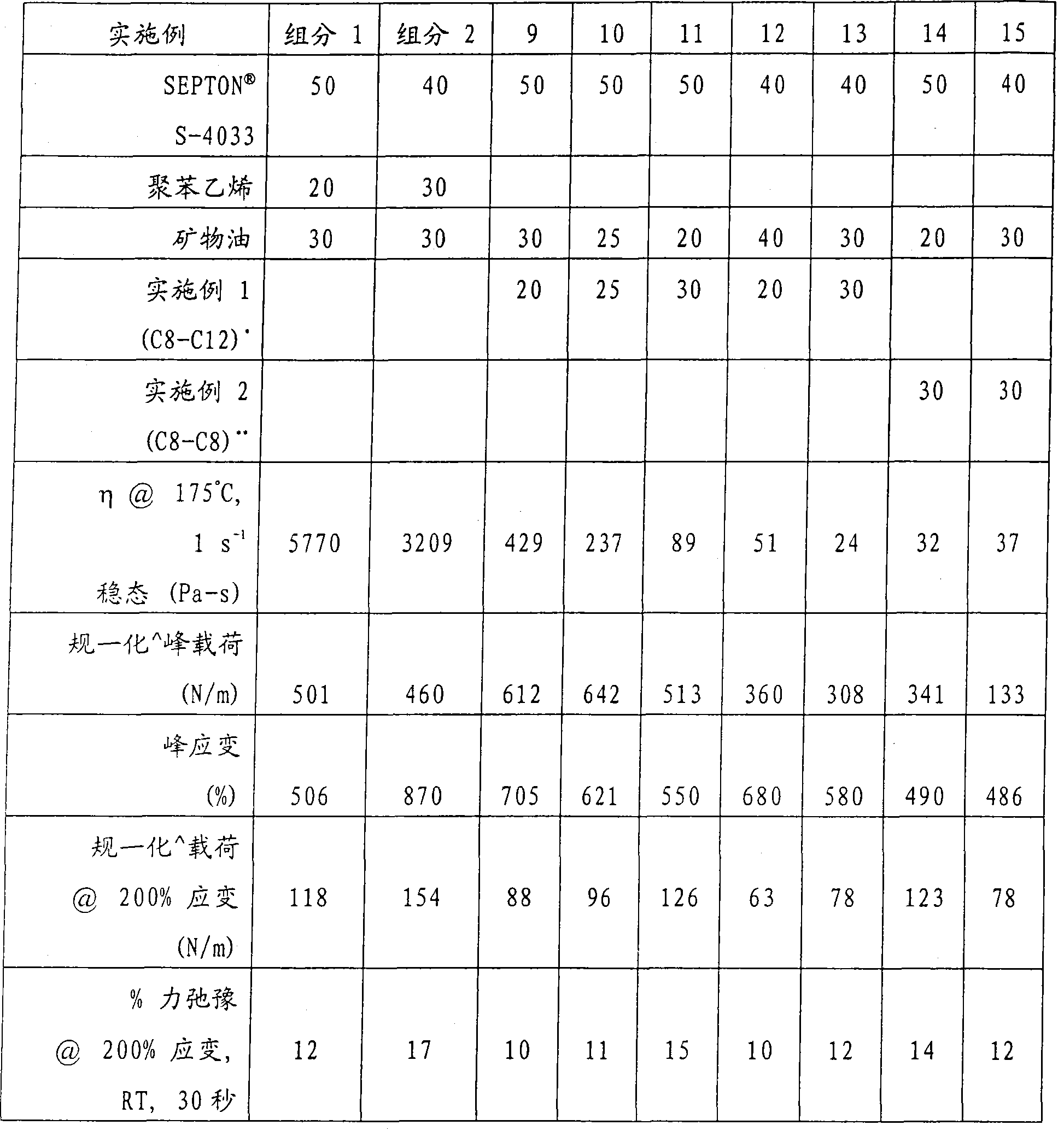
.(C8-C12)表示具有式(I)的相变溶剂,其中R、R’=H,y=8,x=12并且n=2。(C8-C12) represents a phase change solvent having the formula (I), wherein R, R'=H, y=8, x=12 and n=2 .
¨(C8-C8)表示具有式(I)的相变溶剂,其中R、R’=H,y=8,x=8并且n=2。¨(C8-C8) represents a phase change solvent having formula (I), wherein R, R'=H, y=8, x=8 and n=2.
^规一化至85gsm^Normalized to 85gsm
上述实施例显示,对于比较实施例1至2,掺入相变溶剂显著降低了剪切粘度,并且提供满意的弹性和拉伸性能。实施例9至15进一步显示,相变溶剂比矿物油更有效降低弹性体组合物的剪切粘度,而不会显著危及弹性和拉伸性能。在上述某些实施例中,可通过控制改善机械性能。The above examples show that, for Comparative Examples 1 to 2, the incorporation of a phase change solvent significantly reduces the shear viscosity and provides satisfactory elastic and tensile properties. Examples 9 to 15 further show that phase change solvents are more effective than mineral oil in reducing the shear viscosity of elastomeric compositions without significantly compromising the elastic and tensile properties. In some of the embodiments described above, mechanical properties can be improved through control.
表2Table 2

.(C8-C12)表示具有式(I)的相变溶剂,其中R、R’=H,y=8,x=12并且n=2。(C8-C12) represents a phase change solvent having the formula (I), wherein R, R'=H, y=8, x=12 and n=2 .
¨(C8-C8)表示具有式(I)的相变溶剂,其中R、R’=H,y=8,x=8并且n=2。¨(C8-C8) represents a phase change solvent having formula (I), wherein R, R'=H, y=8, x=8 and n=2.
^规一化至85gsm^Normalized to 85gsm
上述实施例甚至显示了包含相对熔融可流动和更可加工的聚苯乙烯TPE(例如
实施例21Example 21
通过打开内酯环的聚合反应制备符合一般结构(V)的相变溶剂。通过向包含100g己内酯的反应器添加0.1摩尔二异丙基氯化铝来进行己内酯的聚合,反应器在80℃加热24小时。通过从己烷沉淀来分离反应产物。通过克单体/摩尔引发剂的比例来确定分子量;理论分子量=100g/0.1摩尔=1000g/mol。Phase-change solvents conforming to general structure (V) are prepared by polymerization with lactone ring opening. Polymerization of caprolactone was carried out by adding 0.1 mole of diisopropylaluminum chloride to a reactor containing 100 g of caprolactone, which was heated at 80° C. for 24 hours. The reaction product was isolated by precipitation from hexane. The molecular weight is determined by the ratio of grams of monomer per mole of initiator; theoretical molecular weight = 100 g/0.1 mole = 1000 g/mol.
实施例22Example 22
通过按下述化合光气、二醇和醇来制备符合一般结构(V)的相变溶剂。在苯溶液中的光气(2摩尔)与202g(1摩尔)1,12-十二烷二醇和260g(2摩尔)辛醇化合。将此混合物在40℃加热24小时。通过从甲醇沉淀来分离反应产物。Phase change solvents conforming to general structure (V) are prepared by combining phosgene, diols and alcohols as follows. Phosgene (2 moles) in benzene solution was combined with 202 g (1 mole) of 1,12-dodecanediol and 260 g (2 moles) of octanol. This mixture was heated at 40°C for 24 hours. The reaction product was isolated by precipitation from methanol.
实施例23Example 23
通过按下述化合二胺、二元酰氯和酰氯来制备符合一般结构(X)的相变溶剂。1,6-己二胺(348g(3摩尔))与348g(2摩尔)1,6-己二酰氯和239g(1摩尔)1-癸酰氯在1000g苯和1000g吡啶混合物中化合。将此混合物在60℃加热24小时。通过从己烷沉淀来分离反应产物。Phase change solvents conforming to general structure (X) are prepared by combining diamines, dibasic acid chlorides, and acid chlorides as follows. 1,6-Hexanediamine (348 g (3 moles)) was combined with 348 g (2 moles) of 1,6-adipanoyl chloride and 239 g (1 mole) of 1-decanoyl chloride in a mixture of 1000 g of benzene and 1000 g of pyridine. This mixture was heated at 60°C for 24 hours. The reaction product was isolated by precipitation from hexane.
实施例24Example 24
通过按下述化合二异氰酸酯、二醇和醇来制备符合一般结构(VIII)的相变溶剂。甲苯二异氰酸酯348g(2摩尔)与202g(1摩尔)1,12-十二烷二醇和260g(2摩尔)辛醇化合。在60℃进行反应24小时。通过从甲醇沉淀来分离反应产物。Phase change solvents conforming to general structure (VIII) are prepared by combining diisocyanates, diols and alcohols as follows. 348 g (2 moles) of toluene diisocyanate were combined with 202 g (1 mole) of 1,12-dodecanediol and 260 g (2 moles) of octanol. The reaction was carried out at 60°C for 24 hours. The reaction product was isolated by precipitation from methanol.
实施例25Example 25
按下述生产包含聚对苯二甲酸乙二醇酯与20%实施例1的相变溶剂的共混组合物,即,该相变溶剂符合y=8,x=12和n=2,(akaC8-C12剂)的结构(I)。Cleartuf 8406(4.0g)(Shell Chemical Co.)与1.0gC8-C12低聚的对苯二酸酯溶剂化合,并且在275℃和44482N(10,0001bs的力)熔融加压5s。重复此过程至产生均匀的薄膜(大约1.02mm(0.040")厚),并且在视觉上是均匀的。A blend composition comprising polyethylene terephthalate and 20% of the phase change solvent of Example 1 was produced as follows, that is, the phase change solvent satisfies y=8, x=12 and n=2, ( akaC8-C12 agent) structure (I). Cleartuf 8406 (4.0 g) (Shell Chemical Co.) was solvated with 1.0 g of C8-C12 oligomeric terephthalate and melt pressurized at 275 °C and 44482 N (10,000 lbs force) for 5 s. This process was repeated until a uniform film (approximately 1.02mm (0.040") thick) was produced and was visually uniform.
实施例26Example 26
按下述生产包含聚酰胺与20%实施例1(C8-C12溶剂)的相变溶剂的共混组合物。尼龙6(4.0g)(Aldrich Chem Co.)与1.0g C8-C12低聚的对苯二酸酯溶剂化合,并且在275℃和44482N(10,0001bs的力)下熔融加压5s。重复此过程至产生均匀的薄膜(大约1.02mm(0.040")厚),并且在视觉上是均匀的。A blend composition comprising polyamide with 20% of the phase change solvent of Example 1 (C8-C12 solvent) was produced as follows. Nylon 6 (4.0 g) (Aldrich Chem Co.) was solvated with 1.0 g of C8-C12 oligomeric terephthalate and melt pressurized at 275 °C and 44482 N (10,000 lbs force) for 5 s. This process was repeated until a uniform film (approximately 1.02mm (0.040") thick) was produced and was visually uniform.
实施例27Example 27
按下述生产包含无规立构聚丙烯与16%实施例1(C8-C12溶剂)的相变溶剂的共混组合物。无规立构PP(4.2g)(P&G实验室)与0.8gC8-C12低聚的对苯二酸酯溶剂化合,并且在275℃和22241N(5,0001bs的力)下熔融加压5s。重复此过程至产生均匀的薄膜(大约1.02mm(0.040")厚),并且在视觉上是均匀的。A blend composition comprising atactic polypropylene with 16% of the phase change solvent of Example 1 (C8-C12 solvent) was produced as follows. Atactic PP (4.2 g) (P&G Laboratories) was solvated with 0.8 g of C8-C12 oligomeric terephthalate and melt pressurized at 275 °C and 22241 N (5,000 lbs force) for 5 s. This process was repeated until a uniform film (approximately 1.02mm (0.040") thick) was produced and was visually uniform.
实施例28Example 28
按下述生产包含无规立构聚丙烯与16%C18对苯二酸二烷基酯溶剂的共混组合物。无规立构PP(4.2g)(P&G实验室)与0.8g C18对苯二酸二烷基酯添加剂化合,并且在275℃和22241N(5,0001bs的力)下熔融加压5s。重复此过程至产生均匀的薄膜(大约1.02mm(0.040")厚),并且在视觉上是均匀的。A blend composition comprising atactic polypropylene and 16% C18 dialkyl terephthalate solvent was produced as follows. Atactic PP (4.2 g) (P&G Laboratories) was compounded with 0.8 g C18 dialkyl terephthalate additive and melt pressurized at 275 °C and 22241 N (5,000 lbs force) for 5 s. This process was repeated until a uniform film (approximately 1.02mm (0.040") thick) was produced and was visually uniform.
实施例29Example 29
生产包含4.0g无规立构聚丙烯与1.0g对苯二酸酯溶剂混合的共混组合物。然后不用纯材料所需的特殊设备或条件就能加工此混合物。可在230℃下将混合物成型、挤出或浇铸,而纯材料需要在280℃下进行。A blend composition comprising 4.0 g of atactic polypropylene mixed with 1.0 g of terephthalate solvent was produced. This mixture can then be processed without the special equipment or conditions required for the pure material. The mixture can be shaped, extruded or cast at 230°C, while the pure material needs to be done at 280°C.
实施例30Example 30
生产包含4.2g无规立构聚丙烯(分子量2,000,000)与0.8g对苯二酸酯溶剂混合的共混组合物。在275℃,混合物的粘度与纯材料比较减少到84分之一。该粘度的降低提供了与分子量为500,000的聚丙烯在相同粘度加工该制剂的能力。分子量为2,000,000的聚丙烯的机械性能基本上比分子量为500,000的PP更好。分子量为2,000,000的PP的应力弛豫是24%,而分子量为500,000的PP的应力弛豫是40%。A blend composition comprising 4.2 g of atactic polypropylene (molecular weight 2,000,000) mixed with 0.8 g of terephthalate solvent was produced. At 275°C, the viscosity of the mixture is reduced to 84 times that of the pure material. This reduction in viscosity provides the ability to process the formulation at the same viscosity as polypropylene with a molecular weight of 500,000. The mechanical properties of polypropylene with a molecular weight of 2,000,000 are substantially better than those of PP with a molecular weight of 500,000. The stress relaxation of PP with a molecular weight of 2,000,000 is 24%, while the stress relaxation of PP with a molecular weight of 500,000 is 40%.
表3提供了纯热塑性聚合物的剪切粘度分别与实施例27、28、25和26的共混组合物的粘度的比较。Table 3 provides a comparison of the shear viscosities of the neat thermoplastic polymers with the viscosities of the blend compositions of Examples 27, 28, 25 and 26, respectively.
表3table 3
纯聚合物的剪切粘度与共混组合物的粘度比较Shear Viscosities of Neat Polymers Compared to Blended Compositions
表3举例说明通过相变溶剂与引用的聚合物共混,剪切粘度分别降低至约80、10、14和3分之一。Table 3 illustrates that by blending a phase change solvent with the cited polymers, the shear viscosities are reduced by a factor of about 80, 10, 14, and 3, respectively.
尽管已说明和描述了本发明的具体实施方案,但对于本领域的那些技术人员显而易见的是,在不背离本发明的精神和保护范围的情况下可作出各种变化和修改。因此有意识地在附加的权利要求书中包括本发明范围内的所有这些变化和修改。While particular embodiments of the present invention have been illustrated and described, it would be obvious to those skilled in the art that various changes and modifications can be made without departing from the spirit and scope of the invention. It is therefore intended to cover in the appended claims all such changes and modifications that are within the scope of this invention.
Claims (4)

Applications Claiming Priority (2)
| Application Number | Priority Date | Filing Date | Title |
|---|---|---|---|
| US39996302P | 2002-07-31 | 2002-07-31 | |
| US60/399,963 | 2002-07-31 |
Publications (2)
| Publication Number | Publication Date |
|---|---|
| CN1777630A CN1777630A (en) | 2006-05-24 |
| CN100532421C true CN100532421C (en) | 2009-08-26 |
Family
ID=31188650
Family Applications (1)
| Application Number | Title | Priority Date | Filing Date |
|---|---|---|---|
| CNB038183056A Expired - Fee Related CN100532421C (en) | 2002-07-31 | 2003-07-14 | Novel phase change solvents |
Country Status (9)
| Country | Link |
|---|---|
| US (1) | US7524984B2 (en) |
| EP (2) | EP1562998B1 (en) |
| JP (1) | JP2005533905A (en) |
| CN (1) | CN100532421C (en) |
| AT (2) | ATE467653T1 (en) |
| AU (1) | AU2003253917A1 (en) |
| CA (1) | CA2489570C (en) |
| DE (2) | DE60332550D1 (en) |
| WO (1) | WO2004011523A2 (en) |
Families Citing this family (7)
| Publication number | Priority date | Publication date | Assignee | Title |
|---|---|---|---|---|
| CN101166780B (en) * | 2005-04-29 | 2012-06-20 | 宝洁公司 | Polymer film exhibiting anti-blocking properties and method of preparation |
| MX2007013445A (en) * | 2005-04-29 | 2008-01-18 | Procter & Gamble | Polymeric film exhibiting improved anti-blocking characteristics and process of making. |
| US8968265B2 (en) * | 2005-09-30 | 2015-03-03 | The Procter & Gamble Company | Absorbent article fastening device having stiffness changing characteristics |
| WO2018159828A1 (en) * | 2017-03-03 | 2018-09-07 | 日産化学株式会社 | Heat storage material comprising metal salt of cyanuric acid |
| CN108645890B (en) * | 2018-07-20 | 2023-09-19 | 四川建筑职业技术学院 | A testing device for testing the temperature regulation performance of phase change materials and its testing method |
| CN109942431A (en) * | 2019-04-02 | 2019-06-28 | 苏州湘园新材料股份有限公司 | A kind of aromatic diol class compound and preparation method thereof |
| WO2023119299A1 (en) * | 2021-12-22 | 2023-06-29 | Nostromo Ltd. | Nucleation agent |
Citations (10)
| Publication number | Priority date | Publication date | Assignee | Title |
|---|---|---|---|---|
| GB849086A (en) * | 1956-08-06 | 1960-09-21 | Pennsylvania Ind Chemical Corp | Mastic tile resin |
| US3852096A (en) * | 1972-02-25 | 1974-12-03 | Exxon Research Engineering Co | Process for fabricating an article from a multiphase copolymer composition |
| US3870841A (en) | 1972-10-02 | 1975-03-11 | Exxon Research Engineering Co | Flexible polymeric compositions comprising a normally plastic polymer sulfonated to about 0.2 to about 10 mole % sulfonate |
| US4745026A (en) * | 1986-03-03 | 1988-05-17 | Mitsubishi Paper Mills, Ltd. | Thermal delayed tack sheets |
| EP0277750A2 (en) * | 1987-01-26 | 1988-08-10 | Mitsui Petrochemical Industries, Ltd. | Ultrahigh-molecular-weight polyolefin composition and process for production thereof |
| US5389711A (en) | 1990-02-14 | 1995-02-14 | Shell Oil Company | Plasticisers for salt functionalized polyvinyl aromatics |
| WO2000011092A1 (en) * | 1998-08-20 | 2000-03-02 | Vantico Ag | Selective deposition modeling material |
| US6080480A (en) * | 1995-09-25 | 2000-06-27 | Toyo Ink Manufacturing Co., Ltd. | Delayed-tack adhesive composition |
| US6177508B1 (en) | 1998-07-06 | 2001-01-23 | Sanyo Chemical Industries, Ltd. | Polyurethane resin type composition for slush molding |
| EP1193284A1 (en) * | 2000-09-29 | 2002-04-03 | Ricoh Company | Heat-sensitive adhesive material,method of preparing same and method of using same |
Family Cites Families (59)
| Publication number | Priority date | Publication date | Assignee | Title |
|---|---|---|---|---|
| US849086A (en) * | 1906-05-16 | 1907-04-02 | William W Rosenfield | Phonograph. |
| US2075107A (en) * | 1931-12-10 | 1937-03-30 | Union Carbide & Carbon Corp | Mixed esters and process for making the same |
| GB568571A (en) * | 1941-09-19 | 1945-04-11 | Ici Ltd | Improved preparation of plasticised compositions comprising synthetic linear polyamides |
| US2453264A (en) * | 1944-09-28 | 1948-11-09 | Chessle E Rehberg | Cellulose ester or ether plasticized with ethyl alpha-carbethoxyethoxyethyl carbonate |
| US2777871A (en) * | 1952-08-05 | 1957-01-15 | Columbia Southern Chem Corp | Bis nu-substituted carbamic acid esters of polyhydric alcohols and process |
| NL301908A (en) * | 1962-12-22 | |||
| NL297228A (en) * | 1963-02-11 | |||
| US3459832A (en) * | 1965-09-24 | 1969-08-05 | Monsanto Co | Crystalline polystyrene having activity as a polymerization catalyst |
| DE1260132B (en) | 1966-07-27 | 1968-02-01 | Basf Ag | Process for the production of magnetogram carriers |
| GB1181807A (en) | 1966-10-18 | 1970-02-18 | Dunlop Co Ltd | Improvements in or relating to Adhesives, Metal Primers and Protective Coatings |
| GB1193627A (en) | 1966-10-18 | 1970-06-03 | Dunlop Co Ltd | Improvements in or relating to Adhesive Compositions. |
| GB1193626A (en) | 1966-10-18 | 1970-06-03 | Dunlop Co Ltd | Improvements in or relating to Adhesives and Sealants. |
| US4076678A (en) * | 1970-10-27 | 1978-02-28 | Ciba-Geigy Ag | Plasticized polymers of vinyl acetate |
| US3734891A (en) * | 1971-05-24 | 1973-05-22 | Fmc Corp | Transesterification catalysts for production of poly (c4 to c12 alkyleneterephthalate |
| BE787079A (en) * | 1971-08-03 | 1973-02-02 | Polymer Corp | CURING LIQUID COMPOSITION AND ITS APPLICATIONS TO COATING SURFACES |
| US3981838A (en) * | 1974-10-16 | 1976-09-21 | Standard Oil Company (Indiana) | Lubricant for polyvinyl chloride |
| JPS5950113B2 (en) * | 1975-11-05 | 1984-12-06 | 株式会社東芝 | semiconductor equipment |
| US4098751A (en) * | 1976-12-08 | 1978-07-04 | General Electric Company | Organic carbonate plasticized polycarbonate composition |
| US4131581A (en) * | 1976-12-13 | 1978-12-26 | E. I. Du Pont De Nemours And Company | Adhesive compositions consisting essentially of a vinyl alcohol polymer, a crystalline solvent and a viscosity reducing diluent |
| US4123413A (en) * | 1976-12-16 | 1978-10-31 | General Electric Company | Polycarbonate composition containing urethane plasticizer |
| US4146522A (en) * | 1977-02-04 | 1979-03-27 | Armstrong Cork Company | Smoke suppressant composition |
| US4210568A (en) * | 1978-04-20 | 1980-07-01 | Exxon Research & Engineering Co. | Plasticization of neutralized sulfonated elastomeric polymer with organic carbamates |
| US4325903A (en) | 1980-07-15 | 1982-04-20 | Celanese Corporation | Processing of melt processible liquid crystal polymer by control of thermal history |
| US4293473A (en) * | 1980-07-25 | 1981-10-06 | E. I. Du Pont De Nemours And Company | Polyvinyl alcohol - crystalline solvent system based compositions modified with ethylene polymer |
| DE3030014C2 (en) | 1980-08-08 | 1983-08-11 | Fa. Carl Freudenberg, 6940 Weinheim | Elastomer composition |
| US4500662A (en) * | 1981-04-03 | 1985-02-19 | The B. F. Goodrich Company | Polysubstituted α-aminoacetamides |
| US4442270A (en) * | 1981-06-29 | 1984-04-10 | Eastman Kodak Company | Thermosetting powder coating compositions |
| US4387214A (en) * | 1981-06-29 | 1983-06-07 | Eastman Kodak Company | Thermosetting powder coating compositions |
| US4618630A (en) * | 1984-08-27 | 1986-10-21 | The Dow Chemical Co. | Organic polymer composition containing an antistatic agent comprising a nonvolatile ionizable metal salt and a salt or ester of a carboxylic acid |
| US4578302A (en) * | 1985-06-27 | 1986-03-25 | National Starch And Chemical Corporation | Reinforced tape laminates |
| GB8531685D0 (en) * | 1985-12-23 | 1986-02-05 | Boc Group Plc | Liquid-vapour contact apparatus |
| US4704110A (en) * | 1986-06-20 | 1987-11-03 | National Starch And Chemical Corporation | Hot melt pressure sensitive positioning adhesives |
| JPS63227658A (en) | 1987-03-17 | 1988-09-21 | Mitsubishi Rayon Co Ltd | polyester resin composition |
| US5627229A (en) * | 1992-07-25 | 1997-05-06 | H.B. Fuller Licensing & Financing, Inc. | Hot melt adhesive having controlled property change |
| US5624986A (en) * | 1988-06-30 | 1997-04-29 | H. B. Fuller Licensing & Financing Inc. | Hot melt adhesive having controlled property change |
| US4882375A (en) * | 1988-09-01 | 1989-11-21 | General Electric Company | Polyesters with modified melt viscosity |
| JPH02189348A (en) | 1989-01-19 | 1990-07-25 | Kao Corp | Melt viscosity depressant for polyester resin |
| JPH02196844A (en) | 1989-01-25 | 1990-08-03 | Sanken Kako Kk | New plasticized polymer composition |
| JPH03229751A (en) * | 1990-02-02 | 1991-10-11 | Polyplastics Co | Polyester resin composition and molding |
| US6117176A (en) * | 1993-11-15 | 2000-09-12 | Applied Elastomerics, Inc. | Elastic-crystal gel |
| US5352531A (en) * | 1990-12-20 | 1994-10-04 | Ozko, Inc. | Coating solution for treating basement walls |
| US5310814A (en) * | 1991-03-15 | 1994-05-10 | Exxon Chemical Patents Inc. | Viscosity modifier polybutadiene polymers |
| JPH05125240A (en) | 1991-11-05 | 1993-05-21 | Sanken Kako Kk | Heat-resistant chlorinated vinyl resin composition |
| CA2112781A1 (en) * | 1993-01-13 | 1994-07-14 | Paul C. Yung | Blends of liquid crystalline polymers and poly(arylene sulfide)s having reduced viscosities |
| IT1272002B (en) * | 1993-03-10 | 1997-06-10 | Enichem Sintesi | VULCNIZABLE COMPOSITIONS OF NITRILE RUBBER. |
| US5342858A (en) * | 1993-06-30 | 1994-08-30 | The Procter & Gamble Company | Elastomeric adhesive foam |
| US5714254A (en) * | 1993-12-15 | 1998-02-03 | Exxon Chemical Patents Inc. | Low viscosity hot melt pressure sensitive adhesive compositions |
| DE69509958T2 (en) * | 1994-03-25 | 1999-10-14 | Shell Internationale Research Maatschappij B.V. | Conveyor belts derived from compositions based on block copolymers of vinyl aromatic monomer-conjugated diene |
| US5910527A (en) * | 1994-04-28 | 1999-06-08 | Ato Findley, Inc. | Hot melt adhesive having a high acid number for disposable soft goods |
| WO1996005253A1 (en) | 1994-08-15 | 1996-02-22 | Akzo Nobel Nv | Melt viscosity reduction of polycarbonate containing liquid crystalline block copolymer |
| US5853874A (en) * | 1994-11-28 | 1998-12-29 | Exxon Chemical Patents, Inc. | Low viscosity hot melt pressure sensitive ashesive compositions |
| US5633319A (en) * | 1996-01-16 | 1997-05-27 | General Electric Company | Compatibilized blends of polyetherimides and liquid crystalline polyesters |
| CA2202693A1 (en) * | 1996-04-19 | 1997-10-19 | Tsutomu Tomatsu | Thermoplastic resin compositions and temperature-dependent shape-transformable/fixable products making use of the same |
| US5939483A (en) * | 1996-07-12 | 1999-08-17 | H.B. Fuller Licensing & Financing, Inc. | Low application temperature hot melt with excellent heat and cold resistance |
| US6187425B1 (en) * | 1996-12-30 | 2001-02-13 | Kimberly-Clark Worldwide, Inc. | Elastic materials with improved performance at body temperature |
| WO1999050356A1 (en) | 1998-03-31 | 1999-10-07 | Daicel Chemical Industries, Ltd. | Thermoplastic resin composition, water-based composition, heat-sensitive pressure-sensitive adhesive, and heat-sensitive sheet |
| DE10064373A1 (en) * | 2000-12-21 | 2002-06-27 | Huels Troisdorf | Film containing plasticizer and amide wax, useful as an intermediate layer for laminated safety glass plates, is based on partially acetylated polyvinyl alcohol |
| US6703115B2 (en) * | 2001-05-01 | 2004-03-09 | Eastman Chemical Company | Multilayer films |
| JP2004020950A (en) * | 2002-06-17 | 2004-01-22 | Fuji Xerox Co Ltd | Image recording body and image display body using the same |
-
2003
- 2003-05-05 US US10/429,531 patent/US7524984B2/en not_active Expired - Fee Related
- 2003-07-14 AT AT03771618T patent/ATE467653T1/en not_active IP Right Cessation
- 2003-07-14 CA CA2489570A patent/CA2489570C/en not_active Expired - Fee Related
- 2003-07-14 DE DE60332550T patent/DE60332550D1/en not_active Expired - Lifetime
- 2003-07-14 DE DE60333317T patent/DE60333317D1/en not_active Expired - Lifetime
- 2003-07-14 AT AT07006488T patent/ATE473205T1/en not_active IP Right Cessation
- 2003-07-14 JP JP2004524609A patent/JP2005533905A/en not_active Withdrawn
- 2003-07-14 CN CNB038183056A patent/CN100532421C/en not_active Expired - Fee Related
- 2003-07-14 EP EP03771618A patent/EP1562998B1/en not_active Expired - Lifetime
- 2003-07-14 AU AU2003253917A patent/AU2003253917A1/en not_active Abandoned
- 2003-07-14 WO PCT/US2003/022036 patent/WO2004011523A2/en not_active Ceased
- 2003-07-14 EP EP07006488A patent/EP1832570B1/en not_active Expired - Lifetime
Patent Citations (10)
| Publication number | Priority date | Publication date | Assignee | Title |
|---|---|---|---|---|
| GB849086A (en) * | 1956-08-06 | 1960-09-21 | Pennsylvania Ind Chemical Corp | Mastic tile resin |
| US3852096A (en) * | 1972-02-25 | 1974-12-03 | Exxon Research Engineering Co | Process for fabricating an article from a multiphase copolymer composition |
| US3870841A (en) | 1972-10-02 | 1975-03-11 | Exxon Research Engineering Co | Flexible polymeric compositions comprising a normally plastic polymer sulfonated to about 0.2 to about 10 mole % sulfonate |
| US4745026A (en) * | 1986-03-03 | 1988-05-17 | Mitsubishi Paper Mills, Ltd. | Thermal delayed tack sheets |
| EP0277750A2 (en) * | 1987-01-26 | 1988-08-10 | Mitsui Petrochemical Industries, Ltd. | Ultrahigh-molecular-weight polyolefin composition and process for production thereof |
| US5389711A (en) | 1990-02-14 | 1995-02-14 | Shell Oil Company | Plasticisers for salt functionalized polyvinyl aromatics |
| US6080480A (en) * | 1995-09-25 | 2000-06-27 | Toyo Ink Manufacturing Co., Ltd. | Delayed-tack adhesive composition |
| US6177508B1 (en) | 1998-07-06 | 2001-01-23 | Sanyo Chemical Industries, Ltd. | Polyurethane resin type composition for slush molding |
| WO2000011092A1 (en) * | 1998-08-20 | 2000-03-02 | Vantico Ag | Selective deposition modeling material |
| EP1193284A1 (en) * | 2000-09-29 | 2002-04-03 | Ricoh Company | Heat-sensitive adhesive material,method of preparing same and method of using same |
Also Published As
| Publication number | Publication date |
|---|---|
| AU2003253917A8 (en) | 2004-02-16 |
| CA2489570A1 (en) | 2004-02-05 |
| WO2004011523A2 (en) | 2004-02-05 |
| US7524984B2 (en) | 2009-04-28 |
| ATE473205T1 (en) | 2010-07-15 |
| ATE467653T1 (en) | 2010-05-15 |
| CA2489570C (en) | 2010-12-21 |
| DE60333317D1 (en) | 2010-08-19 |
| US20040021130A1 (en) | 2004-02-05 |
| EP1832570A2 (en) | 2007-09-12 |
| EP1562998A2 (en) | 2005-08-17 |
| CN1777630A (en) | 2006-05-24 |
| EP1832570B1 (en) | 2010-07-07 |
| EP1832570A3 (en) | 2008-03-05 |
| JP2005533905A (en) | 2005-11-10 |
| EP1562998B1 (en) | 2010-05-12 |
| AU2003253917A1 (en) | 2004-02-16 |
| DE60332550D1 (en) | 2010-06-24 |
| WO2004011523A3 (en) | 2004-05-27 |
Similar Documents
| Publication | Publication Date | Title |
|---|---|---|
| CA2489571C (en) | Phase change solvents for thermoplastic polymers | |
| JPS5840977B2 (en) | Method for producing thermoplastic polyester copolymer elastomer | |
| CN109397810B (en) | All-biodegradable film with adjustable performance and preparation method thereof | |
| TW200900425A (en) | Process for the production of shape memory molded articles with a wide range of applications | |
| CN100532421C (en) | Novel phase change solvents | |
| US7459494B2 (en) | Phase change solvents for thermoplastic elastomers | |
| US7563838B2 (en) | Phase change solvents for thermoplastic polymers | |
| van der Schuur et al. | Structure-property relations of poly (propylene oxide) block copolymers with monodisperse and polydisperse crystallisable segments | |
| US12024613B2 (en) | Composition containing a polymer and an additive | |
| JPS5855166B2 (en) | Method for producing thermoplastic polyester copolymer | |
| JP4236770B2 (en) | Thermoplastic polyurethane | |
| JPH0578584B2 (en) | ||
| JP3746361B2 (en) | Biodegradable polylactic acid-aliphatic polyester polymer composition and molded article | |
| JP2005226057A (en) | Aliphatic polyester resin composition molded article | |
| JP3693486B2 (en) | Thermoplastic resin composition | |
| CN117683215A (en) | Polylactic acid resin composition, molded article and manufacturing method thereof | |
| WO2025205852A1 (en) | Aqueous dispersion composition | |
| JP2025139666A (en) | Polyester elastomer resin composition | |
| JP4905945B2 (en) | Thermoplastic elastomer composition | |
| JP2025154889A (en) | Method for producing aqueous dispersion composition | |
| JP2025154892A (en) | Aqueous dispersion composition | |
| JPH10219076A (en) | Polyester elastomer resin composition | |
| Gee | Thermoplastic Urethanes for Extrusion Injection and Blow Moulding and for Textile Coating | |
| JPH0623310B2 (en) | Polyester ester amide resin composition | |
| JPH10330605A (en) | Polyester resin composition |
Legal Events
| Date | Code | Title | Description |
|---|---|---|---|
| C06 | Publication | ||
| PB01 | Publication | ||
| C10 | Entry into substantive examination | ||
| SE01 | Entry into force of request for substantive examination | ||
| C14 | Grant of patent or utility model | ||
| GR01 | Patent grant | ||
| CF01 | Termination of patent right due to non-payment of annual fee | ||
| CF01 | Termination of patent right due to non-payment of annual fee |
Granted publication date: 20090826 Termination date: 20160714 |