CN100510081C - Insecticidal crystalline gene cry7Bal of Bacillus thuringiensis - Google Patents
Insecticidal crystalline gene cry7Bal of Bacillus thuringiensis Download PDFInfo
- Publication number
- CN100510081C CN100510081C CNB2005100195960A CN200510019596A CN100510081C CN 100510081 C CN100510081 C CN 100510081C CN B2005100195960 A CNB2005100195960 A CN B2005100195960A CN 200510019596 A CN200510019596 A CN 200510019596A CN 100510081 C CN100510081 C CN 100510081C
- Authority
- CN
- China
- Prior art keywords
- cry7ba1
- bacillus thuringiensis
- crystal protein
- insecticidal
- gene
- Prior art date
- Legal status (The legal status is an assumption and is not a legal conclusion. Google has not performed a legal analysis and makes no representation as to the accuracy of the status listed.)
- Expired - Fee Related
Links
- 230000000749 insecticidal effect Effects 0.000 title claims abstract description 81
- 108090000623 proteins and genes Proteins 0.000 title claims abstract description 53
- 229940097012 bacillus thuringiensis Drugs 0.000 title abstract description 53
- 241000193388 Bacillus thuringiensis Species 0.000 title abstract description 52
- 101710151559 Crystal protein Proteins 0.000 claims abstract description 72
- 125000003275 alpha amino acid group Chemical group 0.000 claims abstract description 17
- 239000002773 nucleotide Substances 0.000 claims description 5
- 125000003729 nucleotide group Chemical group 0.000 claims description 5
- 102000004169 proteins and genes Human genes 0.000 abstract description 29
- 238000010367 cloning Methods 0.000 abstract description 8
- 241000607479 Yersinia pestis Species 0.000 abstract description 7
- 244000005700 microbiome Species 0.000 abstract description 3
- 125000000539 amino acid group Chemical group 0.000 abstract description 2
- 238000002955 isolation Methods 0.000 abstract description 2
- 239000013604 expression vector Substances 0.000 abstract 1
- 230000001131 transforming effect Effects 0.000 abstract 1
- 235000018102 proteins Nutrition 0.000 description 24
- 238000000034 method Methods 0.000 description 22
- ULGZDMOVFRHVEP-RWJQBGPGSA-N Erythromycin Chemical compound O([C@@H]1[C@@H](C)C(=O)O[C@@H]([C@@]([C@H](O)[C@@H](C)C(=O)[C@H](C)C[C@@](C)(O)[C@H](O[C@H]2[C@@H]([C@H](C[C@@H](C)O2)N(C)C)O)[C@H]1C)(C)O)CC)[C@H]1C[C@@](C)(OC)[C@@H](O)[C@H](C)O1 ULGZDMOVFRHVEP-RWJQBGPGSA-N 0.000 description 20
- XLYOFNOQVPJJNP-UHFFFAOYSA-N water Chemical compound O XLYOFNOQVPJJNP-UHFFFAOYSA-N 0.000 description 20
- 239000002609 medium Substances 0.000 description 16
- 241000894006 Bacteria Species 0.000 description 15
- 239000013078 crystal Substances 0.000 description 15
- 239000012634 fragment Substances 0.000 description 15
- 108020004414 DNA Proteins 0.000 description 14
- 239000008367 deionised water Substances 0.000 description 13
- 229910021641 deionized water Inorganic materials 0.000 description 13
- 239000000047 product Substances 0.000 description 11
- 239000013598 vector Substances 0.000 description 11
- FAPWRFPIFSIZLT-UHFFFAOYSA-M Sodium chloride Chemical compound [Na+].[Cl-] FAPWRFPIFSIZLT-UHFFFAOYSA-M 0.000 description 10
- 229960003276 erythromycin Drugs 0.000 description 10
- 239000000203 mixture Substances 0.000 description 10
- 239000000243 solution Substances 0.000 description 9
- LFQSCWFLJHTTHZ-UHFFFAOYSA-N Ethanol Chemical compound CCO LFQSCWFLJHTTHZ-UHFFFAOYSA-N 0.000 description 8
- 238000012408 PCR amplification Methods 0.000 description 8
- 238000010276 construction Methods 0.000 description 8
- 238000001962 electrophoresis Methods 0.000 description 8
- 238000002415 sodium dodecyl sulfate polyacrylamide gel electrophoresis Methods 0.000 description 8
- 238000012546 transfer Methods 0.000 description 8
- 241000500437 Plutella xylostella Species 0.000 description 7
- 125000001429 N-terminal alpha-amino-acid group Chemical group 0.000 description 6
- 238000004166 bioassay Methods 0.000 description 6
- 238000006243 chemical reaction Methods 0.000 description 6
- 230000029087 digestion Effects 0.000 description 6
- 239000012160 loading buffer Substances 0.000 description 6
- 239000012528 membrane Substances 0.000 description 6
- 239000013612 plasmid Substances 0.000 description 6
- 238000012163 sequencing technique Methods 0.000 description 6
- 241000238631 Hexapoda Species 0.000 description 5
- 239000002917 insecticide Substances 0.000 description 5
- 229920001184 polypeptide Polymers 0.000 description 5
- 239000002244 precipitate Substances 0.000 description 5
- 102000004196 processed proteins & peptides Human genes 0.000 description 5
- 108090000765 processed proteins & peptides Proteins 0.000 description 5
- 239000011780 sodium chloride Substances 0.000 description 5
- 239000006228 supernatant Substances 0.000 description 5
- 108700003918 Bacillus Thuringiensis insecticidal crystal Proteins 0.000 description 4
- HEDRZPFGACZZDS-UHFFFAOYSA-N Chloroform Chemical compound ClC(Cl)Cl HEDRZPFGACZZDS-UHFFFAOYSA-N 0.000 description 4
- 108091026890 Coding region Proteins 0.000 description 4
- 230000001580 bacterial effect Effects 0.000 description 4
- 230000015572 biosynthetic process Effects 0.000 description 4
- PHTQWCKDNZKARW-UHFFFAOYSA-N isoamylol Chemical compound CC(C)CCO PHTQWCKDNZKARW-UHFFFAOYSA-N 0.000 description 4
- 239000013605 shuttle vector Substances 0.000 description 4
- 239000002689 soil Substances 0.000 description 4
- 108090000790 Enzymes Proteins 0.000 description 3
- 102000004190 Enzymes Human genes 0.000 description 3
- 241000588724 Escherichia coli Species 0.000 description 3
- 241000701533 Escherichia virus T4 Species 0.000 description 3
- 241000255777 Lepidoptera Species 0.000 description 3
- 238000012300 Sequence Analysis Methods 0.000 description 3
- 101710172711 Structural protein Proteins 0.000 description 3
- 238000004458 analytical method Methods 0.000 description 3
- 238000009835 boiling Methods 0.000 description 3
- 238000003776 cleavage reaction Methods 0.000 description 3
- 239000013599 cloning vector Substances 0.000 description 3
- 238000010586 diagram Methods 0.000 description 3
- 229940088598 enzyme Drugs 0.000 description 3
- 238000001976 enzyme digestion Methods 0.000 description 3
- 238000002474 experimental method Methods 0.000 description 3
- 238000010353 genetic engineering Methods 0.000 description 3
- 231100000086 high toxicity Toxicity 0.000 description 3
- 238000010369 molecular cloning Methods 0.000 description 3
- 230000000361 pesticidal effect Effects 0.000 description 3
- 238000002360 preparation method Methods 0.000 description 3
- 238000011160 research Methods 0.000 description 3
- 230000007017 scission Effects 0.000 description 3
- 238000012216 screening Methods 0.000 description 3
- 230000028070 sporulation Effects 0.000 description 3
- 241001071944 Cyta Species 0.000 description 2
- KCXVZYZYPLLWCC-UHFFFAOYSA-N EDTA Chemical compound OC(=O)CN(CC(O)=O)CCN(CC(O)=O)CC(O)=O KCXVZYZYPLLWCC-UHFFFAOYSA-N 0.000 description 2
- 241000588722 Escherichia Species 0.000 description 2
- 102000003960 Ligases Human genes 0.000 description 2
- 108090000364 Ligases Proteins 0.000 description 2
- 239000002033 PVDF binder Substances 0.000 description 2
- 239000001888 Peptone Substances 0.000 description 2
- 108010080698 Peptones Proteins 0.000 description 2
- 101710166062 Pesticidal crystal protein Cry1Ab Proteins 0.000 description 2
- 101710155760 Pesticidal crystal protein Cry7Ab Proteins 0.000 description 2
- ISWSIDIOOBJBQZ-UHFFFAOYSA-N Phenol Chemical compound OC1=CC=CC=C1 ISWSIDIOOBJBQZ-UHFFFAOYSA-N 0.000 description 2
- 239000007984 Tris EDTA buffer Substances 0.000 description 2
- 150000001413 amino acids Chemical class 0.000 description 2
- 238000000137 annealing Methods 0.000 description 2
- 230000005540 biological transmission Effects 0.000 description 2
- 230000003833 cell viability Effects 0.000 description 2
- 238000005119 centrifugation Methods 0.000 description 2
- 101150086784 cry gene Proteins 0.000 description 2
- 230000000694 effects Effects 0.000 description 2
- 210000002919 epithelial cell Anatomy 0.000 description 2
- 238000011081 inoculation Methods 0.000 description 2
- 239000013642 negative control Substances 0.000 description 2
- 235000019319 peptone Nutrition 0.000 description 2
- 229920002981 polyvinylidene fluoride Polymers 0.000 description 2
- 230000008569 process Effects 0.000 description 2
- 239000011535 reaction buffer Substances 0.000 description 2
- 241000894007 species Species 0.000 description 2
- 239000003053 toxin Substances 0.000 description 2
- 231100000765 toxin Toxicity 0.000 description 2
- 230000009261 transgenic effect Effects 0.000 description 2
- 238000013519 translation Methods 0.000 description 2
- 241000192125 Firmicutes Species 0.000 description 1
- WQZGKKKJIJFFOK-GASJEMHNSA-N Glucose Natural products OC[C@H]1OC(O)[C@H](O)[C@@H](O)[C@@H]1O WQZGKKKJIJFFOK-GASJEMHNSA-N 0.000 description 1
- 241000500891 Insecta Species 0.000 description 1
- 102000016943 Muramidase Human genes 0.000 description 1
- 108010014251 Muramidase Proteins 0.000 description 1
- 108010062010 N-Acetylmuramoyl-L-alanine Amidase Proteins 0.000 description 1
- 241000244206 Nematoda Species 0.000 description 1
- 241000242594 Platyhelminthes Species 0.000 description 1
- 229930006000 Sucrose Natural products 0.000 description 1
- CZMRCDWAGMRECN-UGDNZRGBSA-N Sucrose Chemical compound O[C@H]1[C@H](O)[C@@H](CO)O[C@@]1(CO)O[C@@H]1[C@H](O)[C@@H](O)[C@H](O)[C@@H](CO)O1 CZMRCDWAGMRECN-UGDNZRGBSA-N 0.000 description 1
- 108700005078 Synthetic Genes Proteins 0.000 description 1
- 239000007983 Tris buffer Substances 0.000 description 1
- 230000004913 activation Effects 0.000 description 1
- 238000003277 amino acid sequence analysis Methods 0.000 description 1
- 230000003321 amplification Effects 0.000 description 1
- 230000003698 anagen phase Effects 0.000 description 1
- 238000013459 approach Methods 0.000 description 1
- 230000004071 biological effect Effects 0.000 description 1
- 239000000872 buffer Substances 0.000 description 1
- 210000004899 c-terminal region Anatomy 0.000 description 1
- 229940041514 candida albicans extract Drugs 0.000 description 1
- 230000034303 cell budding Effects 0.000 description 1
- 238000011217 control strategy Methods 0.000 description 1
- 238000007796 conventional method Methods 0.000 description 1
- 238000011161 development Methods 0.000 description 1
- 230000018109 developmental process Effects 0.000 description 1
- 238000004090 dissolution Methods 0.000 description 1
- 229940079593 drug Drugs 0.000 description 1
- 239000003814 drug Substances 0.000 description 1
- 238000011156 evaluation Methods 0.000 description 1
- 239000000284 extract Substances 0.000 description 1
- 238000000605 extraction Methods 0.000 description 1
- 239000008103 glucose Substances 0.000 description 1
- 239000003292 glue Substances 0.000 description 1
- 230000012010 growth Effects 0.000 description 1
- 239000001963 growth medium Substances 0.000 description 1
- 238000010438 heat treatment Methods 0.000 description 1
- 238000003780 insertion Methods 0.000 description 1
- 230000037431 insertion Effects 0.000 description 1
- 238000007689 inspection Methods 0.000 description 1
- 230000003993 interaction Effects 0.000 description 1
- 229960000274 lysozyme Drugs 0.000 description 1
- 239000004325 lysozyme Substances 0.000 description 1
- 235000010335 lysozyme Nutrition 0.000 description 1
- 230000007246 mechanism Effects 0.000 description 1
- 230000000813 microbial effect Effects 0.000 description 1
- 238000007857 nested PCR Methods 0.000 description 1
- 238000003199 nucleic acid amplification method Methods 0.000 description 1
- 108020004707 nucleic acids Proteins 0.000 description 1
- 102000039446 nucleic acids Human genes 0.000 description 1
- 150000007523 nucleic acids Chemical class 0.000 description 1
- 238000011017 operating method Methods 0.000 description 1
- -1 pH 8.0) Substances 0.000 description 1
- 230000007170 pathology Effects 0.000 description 1
- 239000000575 pesticide Substances 0.000 description 1
- 239000011148 porous material Substances 0.000 description 1
- 238000011027 product recovery Methods 0.000 description 1
- 235000004252 protein component Nutrition 0.000 description 1
- 239000012460 protein solution Substances 0.000 description 1
- 238000011084 recovery Methods 0.000 description 1
- 108091008146 restriction endonucleases Proteins 0.000 description 1
- 238000001228 spectrum Methods 0.000 description 1
- 238000012289 standard assay Methods 0.000 description 1
- 238000010561 standard procedure Methods 0.000 description 1
- 239000005720 sucrose Substances 0.000 description 1
- 239000013589 supplement Substances 0.000 description 1
- 231100000331 toxic Toxicity 0.000 description 1
- 230000002588 toxic effect Effects 0.000 description 1
- 231100000419 toxicity Toxicity 0.000 description 1
- 230000001988 toxicity Effects 0.000 description 1
- 230000009466 transformation Effects 0.000 description 1
- LENZDBCJOHFCAS-UHFFFAOYSA-N tris Chemical compound OCC(N)(CO)CO LENZDBCJOHFCAS-UHFFFAOYSA-N 0.000 description 1
- 239000012138 yeast extract Substances 0.000 description 1
Images


Classifications
-
- C—CHEMISTRY; METALLURGY
- C07—ORGANIC CHEMISTRY
- C07K—PEPTIDES
- C07K14/00—Peptides having more than 20 amino acids; Gastrins; Somatostatins; Melanotropins; Derivatives thereof
- C07K14/195—Peptides having more than 20 amino acids; Gastrins; Somatostatins; Melanotropins; Derivatives thereof from bacteria
- C07K14/32—Peptides having more than 20 amino acids; Gastrins; Somatostatins; Melanotropins; Derivatives thereof from bacteria from Bacillus (G)
- C07K14/325—Bacillus thuringiensis crystal peptides, i.e. delta-endotoxins
-
- A—HUMAN NECESSITIES
- A01—AGRICULTURE; FORESTRY; ANIMAL HUSBANDRY; HUNTING; TRAPPING; FISHING
- A01N—PRESERVATION OF BODIES OF HUMANS OR ANIMALS OR PLANTS OR PARTS THEREOF; BIOCIDES, e.g. AS DISINFECTANTS, AS PESTICIDES OR AS HERBICIDES; PEST REPELLANTS OR ATTRACTANTS; PLANT GROWTH REGULATORS
- A01N63/00—Biocides, pest repellants or attractants, or plant growth regulators containing microorganisms, viruses, microbial fungi, animals or substances produced by, or obtained from, microorganisms, viruses, microbial fungi or animals, e.g. enzymes or fermentates
- A01N63/50—Isolated enzymes; Isolated proteins
Landscapes
- Life Sciences & Earth Sciences (AREA)
- Health & Medical Sciences (AREA)
- Chemical & Material Sciences (AREA)
- General Health & Medical Sciences (AREA)
- Proteomics, Peptides & Aminoacids (AREA)
- Zoology (AREA)
- Engineering & Computer Science (AREA)
- Organic Chemistry (AREA)
- Biophysics (AREA)
- Pest Control & Pesticides (AREA)
- Molecular Biology (AREA)
- Genetics & Genomics (AREA)
- Biochemistry (AREA)
- Gastroenterology & Hepatology (AREA)
- Agronomy & Crop Science (AREA)
- Biotechnology (AREA)
- Microbiology (AREA)
- Medicinal Chemistry (AREA)
- Plant Pathology (AREA)
- Virology (AREA)
- Crystallography & Structural Chemistry (AREA)
- Dentistry (AREA)
- Wood Science & Technology (AREA)
- Environmental Sciences (AREA)
- Micro-Organisms Or Cultivation Processes Thereof (AREA)
- Agricultural Chemicals And Associated Chemicals (AREA)
- Peptides Or Proteins (AREA)
Abstract
本发明公开了一种来自于苏云金芽胞杆菌杀虫晶体蛋白基因的分离、克隆及其应用。本发明从苏云金芽胞杆菌华中亚种YBt-978菌株中分离得到一个新的杀虫晶体蛋白基因cry7Ba1,该基因的编码产物为一种新的杀虫晶体蛋白Cry7Ba1,对鳞翅目昆虫具有杀虫活性。Cry7Ba1蛋白由1154个氨基酸残基组成,它与现有公开发表的蛋白质同源性不超过80%,并且在该蛋白靠近N-末端一半的氨基酸序列与现有公开发表蛋白质同源性不超过50%。本发明还公开了这种新的杀虫晶体蛋白基因序列,通过合适的表达载体转化微生物表达了该基因的编码产物Cry7Ba1蛋白,使之表现出对鳞翅目害虫的杀虫活性。The invention discloses the isolation, cloning and application of an insecticidal crystal protein gene from Bacillus thuringiensis. The present invention isolates a new insecticidal crystal protein gene cry7Ba1 from Bacillus thuringiensis subsp. Huazhong subsp. active. The Cry7Ba1 protein consists of 1154 amino acid residues, and its homology with existing published proteins does not exceed 80%, and the amino acid sequence near the N-terminal half of the protein does not exceed 50% homology with existing published proteins %. The invention also discloses the gene sequence of the new insecticidal crystal protein. The coded product Cry7Ba1 protein of the gene is expressed by transforming the microorganism with a suitable expression vector, so that it can exhibit the insecticidal activity to the lepidopteran pests.
Description
技术领域 technical field
本发明属微生物基因工程技术领域。具体地说,涉及一种来自于苏云金芽胞杆菌杀虫晶体蛋白基因的分离与克隆,与生物农药基因工程有关。The invention belongs to the technical field of microbial genetic engineering. Specifically, it relates to the isolation and cloning of an insecticidal crystal protein gene from Bacillus thuringiensis, which is related to the genetic engineering of biological pesticides.
背景技术 Background technique
苏云金芽胞杆菌(Bacillus thuringiensis)是一种杆状,革兰氏染色阳性反应,能形成内生芽胞的细菌,广泛存在于各种生态环境。在其芽胞期能形成而产生对昆虫具有特异毒性的由杀虫晶体蛋白(InsecticidalCrystal Proteins,ICPs)组成的伴胞晶体,对鳞翅目、双翅目、鞘翅目、膜翅目、同翅目等昆虫纲10个目500多种昆虫以及原生动物、线形动物门、扁形动物门中某些有害种类也有特异的生物活性(Schnepf H E,Crickmore N,Rie J V,Lereclus D,Baum J,Feitelson J,Zeigler D R,Dean D H.1998.Bacillus thuringiensis andits pesticidal crystal proteins.Microbiol MolBiolRev,62:775-806)。Bacillus thuringiensis is a rod-shaped, Gram-positive bacteria that can form endogenous spores and widely exists in various ecological environments. In the budding stage, it can form parasporal crystals composed of Insecticidal Crystal Proteins (ICPs) that are specifically toxic to insects. More than 500 kinds of insects in 10 orders of Insecta and some harmful species in protozoa, nematodes, and flatworms also have specific biological activities (Schnepf H E, Crickmore N, Rie J V, Lereclus D, Baum J, Feitelson J, Zeigler DR, Dean D H. 1998. Bacillus thuringiensis and its pesticidal crystal proteins. Microbiol Mol Biol Rev, 62: 775-806).
在苏云金芽胞杆菌野生菌株中广泛存在且一般含有多个编码杀虫晶体蛋白的基因。Schnepf等人于1981年从苏云金芽胞杆菌库斯塔克亚种HD1中克隆出第一个杀虫晶体蛋白基因,并于1985年根据DNA的碱基序列推导出第一个苏云金芽胞杆菌杀虫晶体蛋白的氨基酸序列(Schnepf HE,Wong HC,Whiteley HR.1985.The amino acid sequence of a crystal protein from Bacillus thuringiensis deduced from the DNA basesequence.J.Biol.Chem.260(10):6264-6272)。此后,新的杀虫晶体蛋白基因的一直成为苏云金芽胞杆菌研究领域中的热点,陆续有大量的杀虫晶体蛋白基因被鉴定和克隆测序。因此在1995年的无脊椎病理学会年会上成立了由Crickmore等学者组成的杀虫晶体蛋白基因命名委员会,并于1996年正式提出了苏云金芽胞杆菌杀虫晶体蛋白按氨基酸序列同源性进行分类的新的分类系统,规定了命名规则和分类原则。其规定:cry基因是来自苏云金芽胞杆菌编码伴胞晶体蛋白的杀虫基因或者与已知cry基因有明显的序列相似性的基因,cyt基因是编码具有溶细胞活性的伴胞晶体蛋白或与已知编码Cyt蛋白有明显的序列相似性的基因。根据全长基因推导的氨基酸序列的同源性分为四个等级。级与级之间的界限为同源性95%、78%和45%杀虫晶体蛋白基因的4级分类。截至2005年8月,苏云金芽胞杆菌杀虫晶体蛋白基因已累计达到48类319种(CrickmoreN,Zeigler DR,Feitelson J,Schnepf E,van Rie J,Lereclus D,Baum J,Dean DH.1998.Revision of the nomenclature for the Bacillus thuringiensis pesticidal crystal proteins.Microbiol.Mol.Biol.Rev.62:807-813;http://www.lifesci.sussex.ac.uk/home/Neil_Crickmore/Bt/index.html)。It is ubiquitous in wild strains of Bacillus thuringiensis and generally contains multiple genes encoding insecticidal crystal proteins. Schnepf et al. cloned the first insecticidal crystal protein gene from Bacillus thuringiensis subsp. Kustak HD1 in 1981, and deduced the first Bacillus thuringiensis insecticidal crystal in 1985 based on the base sequence of DNA Amino acid sequence of protein (Schnepf HE, Wong HC, Whiteley HR.1985. The amino acid sequence of a crystal protein from Bacillus thuringiensis deduced from the DNA basesequence. J. Biol. Chem. 260 (10): 6264-6272). Since then, the discovery of new insecticidal crystal protein genes has been a hot spot in the field of Bacillus thuringiensis research, and a large number of insecticidal crystal protein genes have been identified, cloned and sequenced. Therefore, at the annual meeting of the Society of Invertebrate Pathology in 1995, an insecticidal crystal protein gene nomenclature committee composed of Crickmore and other scholars was established, and in 1996, it was formally proposed that Bacillus thuringiensis insecticidal crystal proteins should be classified according to amino acid sequence homology The new classification system stipulates the naming rules and classification principles. It stipulates that the cry gene is an insecticidal gene encoding a parasporal crystal protein from Bacillus thuringiensis or a gene that has obvious sequence similarity with a known cry gene; Genes encoding Cyt proteins with significant sequence similarity are known. The homology of the amino acid sequence deduced from the full-length gene was divided into four grades. The boundaries between grades are 4 grade classifications of insecticidal crystal protein genes with 95%, 78% and 45% homology. As of August, 2005, the Bacillus thuringiensis insecticidal crystal protein gene has accumulatively reached 48 categories of 319 species (CrickmoreN, Zeigler DR, Feitelson J, Schnepf E, van Rie J, Lereclus D, Baum J, Dean DH.1998.Revision of the nomenclature for the Bacillus thuringiensis pesticidal crystal proteins. Microbiol. Mol. Biol. Rev. 62:807-813; http://www.lifesci.sussex.ac.uk/home/Neil_Crickmore/Bt/index.html ).
苏云金芽胞杆菌杀虫剂最初都是使用筛选的野生型菌株进行生产,随着分子生物学的发展,人们逐渐利用基因工程的手段对野生型菌株进行改造。同时人们不断将苏云金芽胞杆菌的杀虫晶体蛋白基因转入植物中,构建转基因植物,用于农业害虫的防治。Bacillus thuringiensis insecticides were initially produced using screened wild-type strains. With the development of molecular biology, people gradually used genetic engineering to transform wild-type strains. At the same time, people continue to transfer the insecticidal crystal protein gene of Bacillus thuringiensis into plants to construct transgenic plants for the control of agricultural pests.
然而,随着B.t杀虫剂应用的不断推广和使用强度的不断增强,目标害虫的抗性现象不断被科学家所发现。关于目标害虫对B.t杀虫剂的抗性机制,研究人员进行了深入研究。B.t的杀虫晶体蛋白需要经过晶体的溶解与原毒素的激活、毒素片段与中肠上皮细胞膜上受体的结合、在膜上的插入和孔的形成等过程才能产生杀虫效应。其中毒素片段与昆虫中肠上皮细胞膜上特异受体的识别和相互作用在很大程度上决定了杀虫晶体蛋白的活性谱和毒性大小,而昆虫对B.t杀虫剂的抗性的产生与受体的识别与结合密切相关。因此,新的尤其是新异的杀虫晶体蛋白基因的克隆和应用已经成为预防与控制目标害虫对B.t杀虫剂抗性的关键途径,是各种防治策略的核心内容。近年来,寻找与克隆新的杀虫晶体蛋白基因一直是苏云金芽胞杆菌研究领域中最活跃的部分之一。本发明的意义即在于此。我国,于1996年分离并鉴定出一株苏云金芽胞杆菌新亚种YBt-978菌株,鞭毛抗原血清型为H40,分类上定为华中亚种(Dai J et al.1996.Bacillusthuringiensi ssubspecies huazhongensis,serotype H40,isolated from soils in the People′s Republic of China.Letters in Applied Microbiology.22(1):42-45)。通过提取伴胞晶体蛋白并用于生物测定,发现该伴胞晶体蛋白对小菜蛾等昆虫具有高效杀虫活性。However, with the continuous promotion of the application of B.t insecticides and the continuous enhancement of the intensity of use, the resistance phenomenon of target pests has been continuously discovered by scientists. The mechanism of resistance of target pests to B.t insecticides has been intensively studied by the researchers. The insecticidal crystal protein of B.t needs processes such as dissolution of crystals, activation of protoxin, binding of toxin fragments to receptors on the midgut epithelial cell membrane, insertion on the membrane and formation of pores to produce insecticidal effects. Among them, the recognition and interaction between the toxin fragment and the specific receptor on the insect midgut epithelial cell membrane largely determines the activity spectrum and toxicity of the insecticidal crystal protein, and the resistance of insects to B. Body recognition and binding are closely related. Therefore, the cloning and application of new, especially novel insecticidal crystal protein genes has become a key way to prevent and control the resistance of target pests to B.t insecticides, and is the core content of various control strategies. In recent years, finding and cloning new insecticidal crystal protein genes has been one of the most active parts in the research field of Bacillus thuringiensis. Significance of the present invention just lies in this. In my country, a new strain of Bacillus thuringiensi ssubspecies huazhongnsis, serotype H40, was isolated and identified in 1996. , isolated from soils in the People's Republic of China. Letters in Applied Microbiology. 22(1): 42-45). By extracting the parasporal crystal protein and using it for biological assay, it is found that the parasporal crystal protein has high insecticidal activity on insects such as diamondback moth.
发明内容 Contents of the invention
本发明的目的在于从苏云金芽胞杆菌中分离并克隆具有高毒力杀虫晶体蛋白基因及其应用。The object of the present invention is to isolate and clone the insecticidal crystal protein gene with high toxicity from bacillus thuringiensis and its application.
本发明的技术路线如附图1所示。The technical route of the present invention is as shown in accompanying
为了实现上述目的,本发明从苏云金芽胞杆菌华中亚种(Bacillus thuringiensis subsp.huazhongensis,serotype H40)YBt-978菌株(菌株来源见:Dai J et al.1996.Bacillus thuringiensis subspecies huazhongensis,serotype H40,isolated from soils in the People′s Republic of China.Letters in Applied Microbiology.22(1):42-45)中分离到一个新的杀虫晶体蛋白基因cry7Ba1,其编码区由3465个碱基组成,具有序列表SEQ IDNO:1所示的核苷酸序列。本发明的cry7Ba1基因编码Cry7Ba1蛋白,它由1154个氨基酸残基组成,具有序列表SEQ ID NO:1所示的氨基酸序列。本发明的基因cry7Ba1在微生物中表达的Cry7Ba1蛋白,对鳞翅目昆虫具有杀虫活性。In order to achieve the above object, the present invention obtains from Bacillus thuringiensis subspecies huazhongnsis (Bacillus thuringiensis subsp.huazhongnsis, serotype H40) YBt-978 bacterial strain (bacterial strain source sees: Dai J et al.1996.Bacillus thuringiensis subspecies huazhongnsis, serotype H40, isolated from A new insecticidal crystal protein gene cry7Ba1 was isolated from soils in the People's Republic of China.Letters in Applied Microbiology.22(1):42-45. Its coding region consists of 3465 bases and has a sequence list The nucleotide sequence shown in SEQ ID NO:1. The cry7Ba1 gene of the present invention encodes the Cry7Ba1 protein, which consists of 1154 amino acid residues and has the amino acid sequence shown in the sequence table SEQ ID NO: 1. The Cry7Ba1 protein expressed by the gene cry7Bal of the present invention in microorganisms has insecticidal activity to Lepidoptera insects.
本发明的Cry7Ba1蛋白与所有公开发表的蛋白质的同源性最高的为58.2%,不超过80%。而且,在所有公开发表的蛋白质中,与本发明的Cry7Ba1蛋白的N-末端一半的部分序列(SEQ ID NO:1中1至658个氨基酸序列)同源性最高的为37.1%,不超过50%。The highest homology between the Cry7Ba1 protein of the present invention and all published proteins is 58.2%, but not more than 80%. Moreover, among all published proteins, the highest homology with the partial sequence (1 to 658 amino acid sequence in SEQ ID NO: 1) of the N-terminal half of the Cry7Ba1 protein of the present invention is 37.1%, no more than 50 %.
本发明提供的上述基因序列是一种具有杀虫活性的新的杀虫晶体蛋白基因,该基因可以应用于转化微生物和/或植物,使之表现出对鳞翅目害虫的杀虫活性,并克服、延缓害虫对基因工程杀虫菌剂和转基因植物的抗药性。The above-mentioned gene sequence provided by the present invention is a new insecticidal crystal protein gene with insecticidal activity, which can be applied to transform microorganisms and/or plants so that they can exhibit insecticidal activity against Lepidoptera pests, and Overcome and delay the resistance of pests to genetically engineered insecticides and transgenic plants.
更详细的技术方案由下列描述和实施例揭示:More detailed technical scheme is revealed by following description and embodiment:
需要说明的是,有关DNA的标准操作方法和所使用的药品均参考《分子克隆实验指南》所描述的内容(参见J.萨姆布鲁克等,2002,分子克隆实验指南,第三版,金冬雁等(译),科学出版社,北京)。另外,本发明所克隆的基因cry7Ba1的命名用斜体字表示;本发明的cry7Ba1基因编码Cry7Ba1蛋白的命名用正体字表示,这是本技术领域的命名的惯例。It should be noted that the standard operating methods for DNA and the drugs used refer to the content described in the "Molecular Cloning Experiment Guide" (see J. Sambrook et al., 2002, Molecular Cloning Experiment Guide, Third Edition, Jin Dongyan et al. (Translation), Science Press, Beijing). In addition, the nomenclature of the cloned gene cry7Ba1 in the present invention is indicated in italics; the nomenclature of the protein encoded by the cry7Ba1 gene of the present invention is expressed in italics, which is a naming convention in the technical field.
1、苏云金芽胞杆菌YBt-978中晶体蛋白Cry7Ba1的N-末端氨基酸序列的测序1. Sequencing of the N-terminal amino acid sequence of crystal protein Cry7Ba1 in Bacillus thuringiensis YBt-978
本发明以苏云金芽胞杆菌YBt-978作为杀虫晶体蛋白Cry7Ba1的来源菌株,该菌株是苏云金芽胞杆菌血清型H40的标准菌株,该菌株的来源见文献:Dai J et al.,Bacillus thuringiensis subspecies huazhongensis,serotype H40,isolated from soils in the People′s Republic of China.Letters in Applied Microbiology.22(1).1996.42-45。该菌株能形成典型的菱形晶体,主要的晶体蛋白成分Cry7Ba1的分子量约为130千道尔顿(kDa)。对Cry7Ba1的N-末端氨基酸序列的测序具体步骤如下:The present invention uses Bacillus thuringiensis YBt-978 as the source strain of the insecticidal crystal protein Cry7Ba1, which is a standard strain of Bacillus thuringiensis serotype H40. The source of the strain is found in the literature: Dai J et al., Bacillus thuringiensis subspecies huazhongnsis, serotype H40, isolated from soils in the People's Republic of China. Letters in Applied Microbiology. 22(1). 1996.42-45. The strain can form typical rhombohedral crystals, and the molecular weight of the main crystal protein component Cry7Ba1 is about 130 kilodaltons (kDa). The specific steps for sequencing the N-terminal amino acid sequence of Cry7Ba1 are as follows:
(1)菌株的培养和培养物的处理(1) Cultivation of bacterial strains and treatment of cultures
将苏云金芽胞杆菌YBt-978用接种环通过无菌操作接种于5mL的LB(1%的NaCl,1%的蛋白胨,0.5%的酵母抽提物,pH7.0),置于30℃、200rpm的摇床中培养过夜;然后通过无菌操作将350uL的培养物转移至35mL的ICPM(0.6%的蛋白胨,0.5%的葡萄糖,0.1%的CaCO3,0.1%MgSO4.7H2O,0.05%的KH2PO4,pH7.0)培养基中,置于30℃、200rpm的摇床中培养至芽胞和伴胞晶体完全脱落,将培养物收集,8000rpm离心1min,去掉上清;分别用0.5%NaCI溶液和灭菌去离子水将沉淀洗涤三遍。Bacillus thuringiensis YBt-978 was inoculated into 5 mL of LB (1% NaCl, 1% peptone, 0.5% yeast extract, pH 7.0) with an inoculation loop through aseptic operation, and placed in a 30°C, 200rpm Cultivate overnight in a shaker; then transfer 350uL of the culture to 35mL of ICPM (0.6% peptone, 0.5% glucose, 0.1% CaCO 3 , 0.1% MgSO 4 .7H 2 O, 0.05% KH 2 PO 4 , pH 7.0) culture medium, placed in a shaker at 30°C and 200 rpm until the spores and parasporal crystals completely fell off, collected the culture, centrifuged at 8000 rpm for 1 min, and removed the supernatant; The precipitate was washed three times with NaCl solution and sterile deionized water.
(2)晶体蛋白的SDS-PAGE电泳和转PVDF膜(2) SDS-PAGE electrophoresis of crystal protein and transfer to PVDF membrane
将洗涤后的沉淀按照沉淀∶去离子水=1∶5的体积比重新在去离子水中混匀,加入等体积的2×上样缓冲液,混匀后,沸水浴中处理3-5min,12000rpm离心5min,以上清液进行SDS-PAGE电泳。其中2×上样缓冲液的配方和SDS-PAGE电泳操作步骤均参见Laemmli描述的方法(Laemmli,UK.1970.Cleavage ofstructural proteins during the assembly of the head of bacteriophage T4.Nature(London)227:680-685)。Re-mix the washed precipitate in deionized water according to the volume ratio of precipitate: deionized water = 1:5, add an equal volume of 2× loading buffer, mix well, and treat in a boiling water bath for 3-5min, 12000rpm After centrifugation for 5 min, the supernatant was subjected to SDS-PAGE electrophoresis. The formula of 2× loading buffer and the steps of SDS-PAGE electrophoresis are all referred to the method described by Laemmli (Laemmli, UK.1970. Cleavage of structural proteins during the assembly of the head of bacteriophage T4. Nature (London) 227: 680- 685).
然后按照标准的方法(见文献:Cook RG.1994.Amino acid sequence analysis of blotted proteins,p,207-220.InB.S.DunBar(ed.),Protein Blotting:A practical approach.Oxford University Press,NewYork.),利用半湿型转膜仪(BIO-RED),将凝胶上的蛋白质样品转移到PVDF膜。Then according to the standard method (see literature: Cook RG.1994.Amino acid sequence analysis of blotting proteins, p, 207-220.InB.S.DunBar (ed.), Protein Blotting: A practical approach.Oxford University Press, NewYork .), transfer the protein sample on the gel to the PVDF membrane using a semi-wet transfer membrane apparatus (BIO-RED).
3)晶体蛋白N-末端氨基酸序列的测定3) Determination of N-terminal amino acid sequence of crystal protein
通过蛋白质N-末端氨基酸序列仪(型号:ABI491Protein Sequencer,ABI Procise)测N-末端氨基酸序列,测序结果为:N端-MDIRNQNKYEVVYPA-C端The N-terminal amino acid sequence was measured by a protein N-terminal amino acid sequencer (model: ABI491Protein Sequencer, ABI Procise), and the sequencing result was: N-terminal-MDIRNQNKYEVVYPA-C-terminal
2.杀虫晶体蛋白基因cry7Ba1的5’末端DNA片段序列的获得2. Acquisition of the 5' end DNA fragment sequence of insecticidal crystal protein gene cry7Ba1
采用接头连接PCR(Adaptor-ligation PCR)法进行扩增。其原理和步骤参见Slebert P.D.等人的描述(Slebert P D et al.1995.An improved PCR method for walking in uncloned genomic DNA.Nucleic AcidsResearch 23:1087-1088)。具体步骤如下:Adapter-ligation PCR (Adaptor-ligation PCR) method was used for amplification. The principle and steps are described by Slebert P.D. et al. (Slebert P D et al. 1995. An improved PCR method for walking in uncloned genomic DNA. Nucleic Acids Research 23: 1087-1088). Specific steps are as follows:
1)苏云金芽胞杆菌YBt-978总DNA的抽提1) Extraction of total DNA of Bacillus thuringiensis YBt-978
将苏云金芽胞杆菌YBt-978用接种环通过无菌操作接种于5mL的LB培养基中,置于30℃、200rpm的摇床中培养过夜;然后通过无菌操作将50μL的培养物转移至5mL的新鲜LB培养基中,同样条件培养至对数生长期;然后5000rpm,3min离心收集菌体,用STE1mL洗涤一次,加100μL溶液I和10μL溶菌酶(50mg/mL),37℃作用30min以上;加入200μL2%SDS于50℃—60℃水浴30min;加入200μL5mol/LNaCl混和,加入500μL苯酚/氯仿/异戊醇(按体积比:25∶24∶1),离心12000rpm,5min,吸取上清液,重复抽提1—2次;上层DNA溶液转移至Eppendorf管,加入等体积95%乙醇,室温静置5min后离心12000rpm,5min,沉淀用200μL70%乙醇洗涤一次,冷冻抽干后溶于50μL TE溶液中。Inoculate Bacillus thuringiensis YBt-978 in 5 mL of LB medium with an inoculation loop through aseptic operation, and culture it overnight in a shaker at 30°C and 200 rpm; then transfer 50 μL of the culture to a 5 mL medium through aseptic operation In fresh LB medium, cultivate to the logarithmic growth phase under the same conditions; then collect the bacteria by centrifugation at 5000rpm for 3min, wash once with 1mL of STE, add 100μL solution I and 10μL lysozyme (50mg/mL), and act at 37℃ for more than 30min; Put 200
2)总DNA的限制性内切酶酶切和接头的连接2) Restriction endonuclease digestion of total DNA and connection of adapters
(1)将事先准备好的苏云金芽胞杆菌的总DNA用HpaI酶于37℃酶切过夜(酶切体系为50μL,含有约1μg总DNA);(2)50μL酶切产物加入250μL苯酚∶氯仿∶异戊醇(体积比25∶24∶1),离心12000rpm,5min,将上层DNA溶液转移至Eppendorf管,加入等体积95%乙醇,室温静置5min后离心12000rpm,5min,沉淀用200μL70%乙醇洗涤一次,冷冻抽干后溶于50μL灭菌水中;(3)将接头长短链(50μM)(接头长链序列为:5’-GCTCGAGTCGACCGTGGTACGCGTGTGTGAGCTCCCGGGATCCGGT-3’;接头短链序列为:5’-ACCGGATC-NH2-3’)按等体积混合成为4μL溶液,70℃保温10min;(4)4μL的接头溶液(25μM),10μL总DNA酶切产物溶液(约含0.5μgDNA),8U T4连接酶,2μL T4连接酶Buffer,加水配为20μL体系,16℃连接12h;(5)连接体系于60℃加热5mins后可作为PCR扩增的模板使用;(1) Digest the pre-prepared total DNA of Bacillus thuringiensis with HpaI enzyme at 37°C overnight (the digestion system is 50 μL, containing about 1 μg of total DNA); (2) Add 250 μL of phenol:chloroform to 50 μL of the digested product: Isoamyl alcohol (volume ratio 25:24:1), centrifuge at 12000rpm for 5min, transfer the upper DNA solution to an Eppendorf tube, add an equal volume of 95% ethanol, let stand at room temperature for 5min, then centrifuge at 12000rpm for 5min, wash the precipitate with 200μL of 70% ethanol Once, freeze-dried and dissolved in 50 μL of sterilized water; (3) The length and short chain of the adapter (50 μM) (the sequence of the long chain of the adapter is: 5'-GCTCGAGTCGACCGTGGTACGCGTGTGTGAGCTCCCGGGATCCGGT-3'; the sequence of the short chain of the adapter is: 5'-ACCGGATC-NH 2-3 ') were mixed in equal volumes to form a 4 μL solution, and incubated at 70°C for 10 minutes; (4) 4 μL adapter solution (25 μM), 10 μL total DNA digestion product solution (containing about 0.5 μg DNA), 8 U T4 ligase, 2 μL T4 Ligase Buffer, add water to prepare 20 μL system, and ligate at 16°C for 12 hours; (5) The ligation system can be used as a template for PCR amplification after heating at 60°C for 5 minutes;
3)巢式PCR以及测序3) Nested PCR and sequencing
用上述的连接产物,进行两轮PCR扩增。Using the above ligation products, two rounds of PCR amplification were performed.
根据已测得的N-末端氨基酸序列,设计合成基因特异引物简称为130P1、130P2;同时根据接头长链序列,设计合成接头引物简称为AP1、AP2。各引物序列如下:According to the measured N-terminal amino acid sequence, the synthetic gene-specific primers were designed and referred to as 130P1 and 130P2 for short; at the same time, the synthetic linker primers were designed and referred to as AP1 and AP2 according to the long-chain sequence of the linker. The sequences of each primer are as follows:
130P1:5’-ATGGATATHMGNAATCARAAYAARTAYG-3’* 130P1: 5'-ATGGATATHMGNAATCARAAYAARTAYG-3' *
130P2:5’-AATAAATATGARGTWGTNTAYCCNGC-3’* 130P2: 5'-AATAAATATGARGTWGTNTAYCCNGC-3' *
AP1:5’-GCTCGAGTCGACCGTGGTA-3’AP1: 5'-GCTCGAGTCGACCGTGGTA-3'
AP2:5’-GTACGCGTGTGTGAGCTCC-3’AP2: 5'-GTACGCGTGTGTGAGCTCC-3'
(*H=A,C和T,;M=A和C,;N=A,G,C和T,;R=A和G,;Y=C和T,;W=A和T)( * H=A, C and T,; M=A and C,; N=A, G, C and T,; R=A and G,; Y=C and T,; W=A and T)
(A)第一轮PCR。25μL反应体系包含:2.5μL10×PCR反应缓冲液,1μL dNTP(各2.5mM),0.5μL接头引物AP1(20mM),0.5μL特异引物130P1(20mM),1μL模板(上述连接产物),0.5μLExTaq酶,加灭菌去离子水至25μL。PCR反应参数为:94℃,1min,1个循环;94℃,1min,52℃,1min,72℃,1.5min,25个循环;72℃,5min,1个循环。将第一轮PCR产物稀释50倍,作为第二轮PCR扩增模板。(A) First round of PCR. The 25 μL reaction system contains: 2.5 μL 10×PCR reaction buffer, 1 μL dNTP (2.5 mM each), 0.5 μL adapter primer AP1 (20 mM), 0.5 μL specific primer 130P1 (20 mM), 1 μL template (the above ligation product), 0.5 μL ExTaq enzyme , add sterilized deionized water to 25 μL. The PCR reaction parameters are: 94°C, 1min, 1 cycle; 94°C, 1min, 52°C, 1min, 72°C, 1.5min, 25 cycles; 72°C, 5min, 1 cycle. The first-round PCR product was diluted 50-fold and used as a template for the second-round PCR amplification.
(B)第二轮PCR。50μL反应体系包含:5μL10×PCR反应缓冲液,2μL dNTP(各2.5mM),1μL接头引物AP2(20mM),1μL特异引物130P2(20mM),1μL模板(第一轮PCR产物),1μLExTaq酶,加灭菌去离子水至50μL。PCR反应参数为:除退火温度为56℃,其与同上。(B) Second round of PCR. The 50 μL reaction system contains: 5 μL 10×PCR reaction buffer, 2 μL dNTPs (2.5 mM each), 1 μL adapter primer AP2 (20 mM), 1 μL specific primer 130P2 (20 mM), 1 μL template (the first round of PCR product), 1 μL ExTaq enzyme, plus Sterilize deionized water to 50 µL. The parameters of the PCR reaction are the same as above except that the annealing temperature is 56°C.
(C)第二轮PCR产物通过PCR产物回收试剂盒(购自Veta-Gene公司产品)纯化回收后连接到T-载体上,转化大肠杆菌E.DH5α。以AP2和130P2为引物,以单菌落菌体为模板,通过PCR扩增对转化子进行筛选,并对阳性转化子T-载体中的外源片段进行测序。测序结果为SEQ ID NO:1中第19至491个核苷酸之间的序列。(C) The second-round PCR product was purified and recovered by a PCR product recovery kit (purchased from Veta-Gene Company), and then ligated to a T-vector to transform Escherichia coli E.DH5α. With AP2 and 130P2 as primers and single colony as template, transformants were screened by PCR amplification, and the exogenous fragments in the T-vectors of positive transformants were sequenced. The sequencing result is the sequence between the 19th and 491st nucleotides in SEQ ID NO:1.
根据上述测序结果,设计了特异引物简称为130S1-2、130A1-2,用于后面所述的通过PCR筛选包含晶体蛋白基因的BAC基因组文库和各种阳性转化子的过程中,扩增产物大小为434bp。引物序列为:According to the above sequencing results, specific primers, referred to as 130S1-2 and 130A1-2 for short, were designed to be used in the process of screening the BAC genome library containing the crystal protein gene and various positive transformants by PCR as described later. It is 434bp. The primer sequences are:
130S1-2:TTCTAATACAACATCAAAGTATCCACTC130S1-2: TTCTAATACAACATCAAAGTTCACTC
130A1-2:GGTATCGTTCCAATACTAATTCTAAAC130A1-2: GGTATCGTTCCAATACTAATTCTAAAC
3.苏云金芽胞杆菌YBt-978的杀虫晶体蛋白基因cry7Ba1的克隆3. Cloning of insecticidal crystal protein gene cry7Ba1 of Bacillus thuringiensis YBt-978
1)苏云金芽胞杆菌YBt-978菌株基因组BAC文库的构建1) Construction of Bacillus thuringiensis YBt-978 strain genome BAC library
参照Luo和Wing(2003)的方法(参见:Luo and Wing.2003.An improved method for plant BAC libraryconstruction,p.3-19.In Grotewold,Erich,Plant functional genomic:methods and protocols.Scientific andmedical publishers,/Humana Press,Totowa,USA),利用BAC文库载体pBeloBAC11(参见图2所示)构建苏云金芽胞杆菌YBt-978菌株的基因组BAC文库。即:将苏云金芽胞杆菌YBt-978在LB培养基中生长到对数生长中期,10000rpm离心1分钟收集菌体于干净灭过菌的50ml离心管中;收集的菌体先加1ml TE缓冲液(1mM EDTA,10mMTris base,pH8.0))放到振荡器上轻轻震散,然后再加约40ml TE缓冲液静置5分钟后10000rpm离心1分钟收集菌体;将装有菌体的50ml离心管静置在50℃温水中,加入1.5ml的TE25S(0.3M蔗糖,25mM EDTA,25mM Tris Base,pH 8.0),混匀后再加入1.5ml温热的2%的胶(专门做包埋块的低熔点胶,称取0.1g溶于5ml TE25S中),用枪混匀后,逐一加到专门做包埋块的模子中,放于4℃冰箱中让包埋块冷凝。其余步骤,包括HindIII对包埋块中YBt-978基因组的部分酶切和酶切产物的回收、BAC文库载体pBeloBAC11的制备、酶切产物与载体的连接与转化DH10B、BAC文库质量检验,与Luo andWing(2003)报道的方法相同。Refer to the method of Luo and Wing (2003) (see: Luo and Wing. 2003. An improved method for plant BAC library construction, p.3-19. In Grotewold, Erich, Plant functional genomic: methods and protocols. Scientific and medical publishers, / Humana Press, Totowa, USA), utilized the BAC library vector pBeloBAC11 (shown in Figure 2) to construct the genome BAC library of Bacillus thuringiensis YBt-978 strain. That is: grow Bacillus thuringiensis YBt-978 in LB medium to mid-logarithmic growth, centrifuge at 10,000rpm for 1 minute to collect the bacteria in a clean and sterilized 50ml centrifuge tube; add 1ml of TE buffer ( 1mM EDTA, 10mMTris base, pH8.0)) put it on the shaker and shake it gently, then add about 40ml TE buffer and let it stand for 5 minutes, then centrifuge at 10000rpm for 1 minute to collect the bacteria; centrifuge the 50ml containing the bacteria Place the tube in warm water at 50°C, add 1.5ml of TE25S (0.3M sucrose, 25mM EDTA, 25mM Tris Base, pH 8.0), mix well, then add 1.5ml of warm 2% glue (specially used for embedding blocks) Weigh 0.1g and dissolve in 5ml TE25S), mix well with a gun, add them one by one to the mold specially made for embedding blocks, and put them in a 4°C refrigerator to allow the embedding blocks to condense. The remaining steps include HindIII's partial digestion of the YBt-978 genome in the embedding block and recovery of the digestion product, preparation of the BAC library vector pBeloBAC11, connection and transformation of the digestion product to the vector DH10B, quality inspection of the BAC library, and Luo andWing (2003) reported the same method.
2)BAC基因组文库的筛选和杀虫晶体蛋白基因cry7Ba1的克隆2) Screening of BAC genome library and cloning of insecticidal crystal protein gene cry7Ba1
(A)BAC基因组文库的筛选(A) Screening of BAC genomic library
以130S1和130A1为引物,以BAC文库单菌落菌体为模板进行PCR扩增。反应体系为25μL,配方同上述;反应条件中退火温度为55℃,其余同上述。筛选出阳性克隆子EMB0491。参照J.萨姆布鲁克等的方法(J.萨姆布鲁克等,2002,分子克隆实验指南,第三版,金冬雁等(译),科学出版社,北京),抽提EMB0491中重组质粒pBMB0491。酶切结果表明pBMB0491包含约60kb的YBt-978基因组片段。130S1 and 130A1 were used as primers, and the single colony of the BAC library was used as a template for PCR amplification. The reaction system is 25 μL, and the formula is the same as above; the annealing temperature in the reaction conditions is 55°C, and the rest are the same as above. The positive clone EMB0491 was screened out. Referring to the method of J. Sambrook et al. (J. Sambrook et al., 2002, Molecular Cloning Experiment Guide, Third Edition, Jin Dongyan et al. (translation), Science Press, Beijing), the recombinant plasmid pBMB0491 in EMB0491 was extracted. The results of enzyme digestion showed that pBMB0491 contained about 60kb of YBt-978 genome fragment.
(B)杀虫晶体蛋白基因cry7Ba1的获得(B) Acquisition of insecticidal crystal protein gene cry7Ba1
以HindIII对阳性克隆子中YBt-978基因组片段进行完全酶切,酶切产物与同样被HindIII完全酶切的克隆载体pUC18(见图3所示)连接,转化E.coli DH5α。同样以编号为130S1-2和130A1-2的因物为引物,以转化子单菌落菌体为模板进行PCR扩增,筛选出阳性转化子EMB0493。抽提EMB0493中重组质粒pBMB0492。酶切结果表明pBMB0492其中包含约16kb的YBt-978基因组片段。进一步分析表明杀虫晶体蛋白基因cry7Ba1位于5kbXhoI片段中。The YBt-978 genome fragment in the positive clone was completely digested with HindIII, and the digested product was connected with the cloning vector pUC18 (shown in Figure 3) that was also completely digested by HindIII, and transformed into E.coli DH5α. Similarly, the primers numbered 130S1-2 and 130A1-2 were used as primers, and the single colony of the transformant was used as a template for PCR amplification, and the positive transformant EMB0493 was screened out. The recombinant plasmid pBMB0492 in EMB0493 was extracted. The results of enzyme digestion showed that pBMB0492 contained about 16kb of YBt-978 genome fragment. Further analysis showed that the insecticidal crystal protein gene cry7Ba1 was located in the 5kb XhoI fragment.
(C)杀虫晶体蛋白基因cry7Ba1和杀虫晶体蛋白Cry7Ba1的序列分析(C) Sequence analysis of insecticidal crystal protein gene cry7Ba1 and insecticidal crystal protein Cry7Ba1
分析杀虫晶体蛋白基因cry7Ba1所在的5kbXhoI片段的核苷酸序列,得到5235bp序列,其中包括3465bp的编码,编码序列见SEQ ID NO:1。The nucleotide sequence of the 5kb XhoI fragment where the insecticidal crystal protein gene cry7Ba1 is located was analyzed, and a 5235bp sequence was obtained, including a 3465bp code. The code sequence is shown in SEQ ID NO: 1.
对此段编码序列可编码由1154个氨基酸组成的多肽,即杀虫晶体蛋白Cry7Ba1,推导其分子量为130558道尔顿(Da)。The coding sequence of this section can encode a polypeptide consisting of 1154 amino acids, that is, the insecticidal crystal protein Cry7Ba1, and its molecular weight is deduced to be 130558 Daltons (Da).
比较此多肽与其它已知的Cry与Cyt蛋白的氨基酸序列,在GenBank基因库中(http://www.ncbi.nlm.nih.gov/)进行搜索和比较,发现在现有公开发表的所有蛋白中,与杀虫晶体蛋白Cry7Ba1最相似的蛋白质为杀虫晶体蛋白Cry7Ab2(GenBank注册号:U04368)、Cry7Ab1(GenBank注册号:U04367)和Cry7Aa1(GenBank注册号:M64478),相似性分别达到了58.2%、57.9%、57.1%。其中,在N-末端一半的部分序列(SEQ ID NO:1中1至658个氨基酸序列)相似度很低,相似性分别为37.1%、37.0%、36.4%,这部分是杀虫的活性部分,也是表现杀虫活性的必需和充分部分(SchnepfH E,CrickmoreN,Rie J V,Lereclus D,Baum J,Feitelson J,Zeigler D R,Dean D H.1998.Bacillus thuringiensis and itspesticidal crystal proteins.Microbiol Mol BiolRev,62:775-806)。由此看出该杀虫基因确实为一个新的杀虫基因。因此该杀虫晶体蛋白基因被国际苏云金芽胞杆菌杀虫基因命名委员会命名为cry7Ba1,确定为cry7B基因的模式基因。另外,与这些已知蛋白在其C-末端一半的序列(SEQ ID NO:1中659至1154个氨基酸序列)非常相似,相似性分别达到了87.9%、86.9%、87.9%,这部分序列是形成伴胞晶体的功能结构域,与杀虫活性无关。Compare the amino acid sequences of this polypeptide with other known Cry and Cyt proteins, search and compare in the GenBank gene bank (http://www.ncbi.nlm.nih.gov/), and find all the existing publicly published Among the proteins, the most similar proteins to the insecticidal crystal protein Cry7Ba1 are the insecticidal crystal proteins Cry7Ab2 (GenBank registration number: U04368), Cry7Ab1 (GenBank registration number: U04367) and Cry7Aa1 (GenBank registration number: M64478), the similarity reached respectively 58.2%, 57.9%, 57.1%. Among them, the partial sequence in the N-terminal half (1 to 658 amino acid sequence in SEQ ID NO: 1) has very low similarity, the similarity is 37.1%, 37.0%, and 36.4%, respectively, and this part is the insecticidal active part , is also an essential and sufficient part of insecticidal activity (SchnepfH E, CrickmoreN, Rie J V, Lereclus D, Baum J, Feitelson J, Zeigler DR, Dean D H.1998.Bacillus thuringiensis and its pesticidal crystal proteins.Microbiol Mol BiolRev , 62:775-806). It can be seen that the insecticidal gene is indeed a new insecticidal gene. Therefore, the insecticidal crystal protein gene was named cry7Ba1 by the International Bacillus thuringiensis Insecticidal Gene Nomenclature Committee, and was determined as the model gene of the cry7B gene. In addition, it is very similar to the sequence of the C-terminal half of these known proteins (659 to 1154 amino acid sequences in SEQ ID NO: 1), the similarity reaches 87.9%, 86.9%, and 87.9%, respectively. This part of the sequence is Functional domains that form parasporal crystals, independent of insecticidal activity.
从以上序列分析可以看出,在现有所有公开的蛋白质中,与本发明的杀虫晶体蛋白Cry7Ba1同源性最高的为58.2%,不超过80%。当某个蛋白质的氨基酸序列与杀虫晶体蛋白Cry7Ba1的同源性超过80%时,则视为在本发明的杀虫晶体蛋白Cry7Ba1的覆盖范围之内。同样,在现有所有公开的蛋白质中,与本发明的杀虫晶体蛋白Cry7Ba1N-末端一半的部分序列(SEQ ID NO:1中1至658个氨基酸序列)同源性最高的为37.1%,不超过50%。当某个蛋白质的氨基酸序列与本发明的杀虫晶体蛋白Cry7Ba1的N-末端一半的部分序列(SEQ ID NO:1中1至658个氨基酸序列)同源性超过50%时,则视为在本发明的杀虫晶体蛋白Cry7Ba1的覆盖范围之内。From the above sequence analysis, it can be seen that among all the existing published proteins, the highest homology with the insecticidal crystal protein Cry7Ba1 of the present invention is 58.2%, not more than 80%. When the amino acid sequence of a certain protein has more than 80% homology with the insecticidal crystal protein Cry7Ba1, it is considered to be within the coverage of the insecticidal crystal protein Cry7Ba1 of the present invention. Similarly, among all existing published proteins, the highest homology with the partial sequence (1 to 658 amino acid sequence in SEQ ID NO: 1) of the N-terminal half of the insecticidal crystal protein Cry7Ba1 of the present invention is 37.1%. More than 50%. When the amino acid sequence of a protein is more than 50% homologous to the partial sequence (1 to 658 amino acid sequences in SEQ ID NO: 1) of the N-terminal half of the insecticidal crystal protein Cry7Ba1 of the present invention, it is considered to be in The insecticidal crystal protein Cry7Ba1 of the present invention is within the scope of coverage.
4.苏云金芽胞杆菌YBt-978的杀虫晶体蛋白Cry7Ba1的杀虫活性4. Insecticidal activity of insecticidal crystal protein Cry7Ba1 of Bacillus thuringiensis YBt-978
将cry7Ba1基因所在的5kbXhoI片段转载在大肠杆菌-苏云金芽胞杆菌穿梭载体pHT304(见图4,载体来源见:Arantes O and Lereclus D.1991.Construction of cIoning vectors for Bacillus thuringiensis.Gene108:115-119)上,获得重组质粒pBMB0495(见图5)。然后通过成熟的电转化方法(吴岚,孙明,喻子牛.利用苏云金芽胞杆菌转座子Tn4430构建含cry1Ac10基因的解离载体.微生物学报,2000,40:264-269)将其转移到苏云金芽胞杆菌无晶体突变CryB菌株中(菌株来源见:WuD,Federici BA.1993.A 20-kilodaltonprotein preserves cell viablility and promotes CytA crystal formation during sporulation in Bacillus thuringiensis.J.Bacteriol.,175:5276-5280),获得重组菌BMB0502。The 5kbXhoI fragment where the cry7Ba1 gene is located was reprinted on the Escherichia coli-Bacillus thuringiensis shuttle vector pHT304 (see Figure 4, see the source of the vector: Arantes O and Lereclus D.1991.Construction of cIoning vectors for Bacillus thuringiensis.Gene108:115-119) , to obtain the recombinant plasmid pBMB0495 (see Figure 5). Then it was transferred to the Bacillus thuringiensis in a crystal-free mutant CryB strain (for the source of the strain, see: WuD, Federici BA.1993. A 20-kilodalton protein preserves cell viability and promotes CytA crystal formation during sporulation in Bacillus thuringiensis. J. Bacteriol., 175: 5276-528) , to obtain the recombinant strain BMB0502.
(1)杀虫晶体蛋白Cry7Ba1的表达(1) Expression of insecticidal crystal protein Cry7Ba1
将BMB0502在LB培养基(需要时加入终浓度为20μg/mL的红霉素)中过夜活化后,转移至ICPM培养基(需要时加入终浓度为20μg/mL的红霉素)中,培养至芽胞完全成熟脱落,收集菌体,分别用0.5%NaCl和灭菌去离子水洗涤三遍后,按照菌体∶灭菌去离子水=1∶5的体积比重新混匀菌体,加入等体积的2×上样缓冲液,混匀后,沸水浴中处理3-5min,12000rpm离心5min,以上清液进行SDS-PAGE电泳。其中2×上样缓冲液的配方和SDS-PAGE电泳操作步骤均参见Laemmli描述的方法(Laemmli,UK.1970.Cleavage of structural proteins during the assembly of the head of bacteriophage T4.Nature(London)227:680-685)。如图6所示,BMB0502能形成和出发菌株YBt-978大小相同的130kDa晶体蛋白,而阴性对照BMB0503(只含有穿梭载体pHT304)无此对应条带。After BMB0502 was activated overnight in LB medium (if necessary, erythromycin at a final concentration of 20 μg/mL was added), it was transferred to ICPM medium (if necessary, erythromycin at a final concentration of 20 μg/mL was added), and cultured until The spores are fully mature and fall off, collect the bacteria, wash with 0.5% NaCl and sterilized deionized water three times respectively, mix the bacteria again according to the volume ratio of bacteria:sterilized deionized water=1:5, add an equal volume of 2× loading buffer solution, mixed well, treated in boiling water bath for 3-5min, centrifuged at 12000rpm for 5min, and the supernatant was subjected to SDS-PAGE electrophoresis. The formula of 2× loading buffer and the steps of SDS-PAGE electrophoresis are all referred to the method described by Laemmli (Laemmli, UK.1970. Cleavage of structural proteins during the assembly of the head of bacteriophage T4. Nature (London) 227: 680 -685). As shown in Figure 6, BMB0502 can form a 130kDa crystal protein with the same size as the starting strain YBt-978, while the negative control BMB0503 (containing only the shuttle vector pHT304) does not have this corresponding band.
(2)杀虫晶体蛋白Cry7Ba1形成的晶体形态(2) Crystal morphology of insecticidal crystal protein Cry7Ba1
将BMB0502在LB培养基(使用时加入终浓度为20μg/mL的红霉素)中过夜活化后,转移至ICPM培养基(该培养基成分及用量见前面“发明内容”所述,使用时加入终浓度为20μg/mL的红霉素)中,培养至芽胞即将成熟脱落的阶段,收集菌体,用灭菌去离子水洗涤一遍后,按照菌体∶灭菌去离子水=1∶5的体积比重新混匀菌体,制备透射电镜(TEM)样品,用Epon812包埋,超薄切片,于80kv进行透射观察拍照。BMB0502能形成双金字塔型的伴胞晶体,如图7所示。After BMB0502 was activated overnight in LB medium (erythromycin with a final concentration of 20 μg/mL was added during use), it was transferred to ICPM medium (the composition and dosage of the medium were described in the "Content of the Invention" above, and when used, add erythromycin with a final concentration of 20 μg/mL), cultivated to the stage where the spores were about to mature and fall off, collected the bacteria, washed once with sterilized deionized water, and prepared according to the ratio of bacteria:sterilized deionized water=1:5 Mix the bacteria again according to the volume ratio, prepare a transmission electron microscope (TEM) sample, embed it with Epon812, slice it ultra-thinly, and take pictures for transmission observation at 80kv. BMB0502 can form double-pyramidal companion crystals, as shown in Figure 7.
(3)杀虫晶体蛋白Cry7Ba1的杀虫效果评价(3) Evaluation of insecticidal effect of insecticidal crystal protein Cry7Ba1
以小菜蛾(Plutella xylostella)3龄幼虫为对象测定杀虫晶体蛋白Cry7Ba1的杀虫效果。将BMB0502在LB培养基(使用时加入终浓度为20μg/mL的红霉素)中过夜活化后,转移至ICPM培养基(该培养基的组分及用量参见前面“发明内容”中“菌株的培养和培养物的处理一节所述”使用时加入终浓度为20μg/mL的红霉素)中,培养至芽胞即将成熟脱落的阶段,收集菌体,用灭菌去离子水洗涤一遍后,获得伴胞晶体混合物,按照标准测定程序(参见:沈鞠群,王锦举,喻子牛.1990.苏云金杆菌制剂的标准化程序和方法.生物防治通报,(增刊):12-16)进行生物测定。每个样品的生物测定重复一次,计算出LC50。结果表明本发明的杀虫晶体蛋白Cry7Ba1对小菜蛾表现出很高的毒性(如表1所示),表明本发明克隆的Cry7Ba1蛋白对鳞翅目昆虫具有很高的杀虫活性。The insecticidal effect of insecticidal crystal protein Cry7Ba1 was determined on the 3rd instar larvae of diamondback moth (Plutella xylostella). After BMB0502 was activated overnight in LB medium (when using, erythromycin with a final concentration of 20 μg/mL was added), it was transferred to ICPM medium (for the components and dosage of the medium, please refer to the "Bacterial Strains" in the "Summary of the Invention" above). Cultivation and culture treatment as described in the section "When using, add erythromycin with a final concentration of 20 μg/mL), cultivate to the stage where the spores are about to mature and fall off, collect the bacteria, wash once with sterilized deionized water, The parasporal crystal mixture was obtained, and bioassays were performed according to standard assay procedures (see: Shen Juqun, Wang Jinju, Yu Ziniu. 1990. Standardized procedures and methods for Bacillus thuringiensis preparations. Biological Control Bulletin, (Supplement): 12-16). The bioassay was repeated for each sample and the LC50 was calculated. The results show that the insecticidal crystal protein Cry7Ba1 of the present invention exhibits high toxicity to Plutella xylostella (as shown in Table 1), indicating that the cloned Cry7Ba1 protein of the present invention has high insecticidal activity against Lepidoptera insects.
表1 本发明克隆的杀虫晶体蛋白Cry7Ba1对小菜蛾生物测定实验结果Table 1 The insecticidal crystal protein Cry7Ba1 cloned by the present invention is to the bioassay results of Plutella xylostella

附图说明 Description of drawings
序列表SEQ ID NO:1是本发明的基因序列和编码序列Sequence listing SEQ ID NO: 1 is the gene sequence and coding sequence of the present invention
图1:是本发明的技术流程图Fig. 1: is the technical flow chart of the present invention
图2:是本发明实施例中BAC载体pBleoBAC11构建图Figure 2: is the construction diagram of the BAC vector pBleoBAC11 in the embodiment of the present invention
图3:是本发明的构建的克隆载体pUC18构建图Figure 3: is the construction diagram of the constructed cloning vector pUC18 of the present invention
图4:是本发明实施例构建的穿梭载体构建图Figure 4: is the construction diagram of the shuttle carrier constructed by the embodiment of the present invention
图5:是本发明实施例构建的重组质粒pBMB0495Figure 5: is the recombinant plasmid pBMB0495 constructed in the embodiment of the present invention
图6:是本发明克隆的苏云金芽胞杆菌Cry7Ba1伴胞晶体蛋白SDS-PAGE电泳分析Figure 6: SDS-PAGE electrophoresis analysis of Bacillus thuringiensis Cry7Ba1 parasporal crystal protein cloned by the present invention
M:蛋白质分子量标准;M: protein molecular weight standard;
1:YBt-978菌株的伴胞晶体蛋白;1: Parasporal crystal protein of YBt-978 strain;
2:BMB0502菌株的伴胞晶体蛋白;2: Parasporal crystal protein of BMB0502 strain;
3:对照BMB0503菌株的处理。3: Treatment of the control BMB0503 strain.
图7:是本发明涉及的苏云金芽胞杆菌YBt-978和BMB0502菌株产生的伴胞晶体形态(内标尺为1μm)Figure 7: is the parasporal crystal morphology produced by Bacillus thuringiensis YBt-978 and BMB0502 strains involved in the present invention (internal scale is 1 μm)
A,B:YBt-978菌株的伴胞晶体形态;A, B: Parasporal crystal morphology of YBt-978 strain;
C,D:BMB0502菌株的伴胞晶体形态。C, D: Parasporal crystal morphology of BMB0502 strain.
具体实施方案 specific implementation plan
以下叙述是根据本发明实施方案的实施例。应该说明的是,本发明的实施例对于本发明只有说明作用,而没有限制作用。本发明中所涉及的各种实验操作,均为本领域的常规技术,文中没有特别说明的部分,本领域的普通技术人员可以参照本发明申请日之前的各种常用工具书、科技文献或相关的说明书、手册等加以实施。The following descriptions are examples according to embodiments of the present invention. It should be noted that the embodiments of the present invention are only illustrative but not limiting to the present invention. The various experimental operations involved in the present invention are all conventional techniques in the art. For the parts not specifically described in the text, those of ordinary skill in the art can refer to various commonly used reference books, scientific and technological documents or related documents before the filing date of the present invention. Instructions, manuals, etc. to be implemented.
实施例1 苏云金芽胞杆菌YBt-978的杀虫晶体蛋白基因cry7Ba1的克隆Example 1 Cloning of the insecticidal crystal protein gene cry7Ba1 of Bacillus thuringiensis YBt-978
参照Luo和Wing(2003)报道的方法(参见:Luo and Wing.2003.An improved method for plant BAClibrary construction,p.3-19.In Grotewold,Erich,Plantfunctional genomic:methods and protocols.Scientific andmedical publishers,/Humana Press,Totowa,USA),利用BAC文库载体pBeloBAC11构建苏云金芽胞杆菌YBt-978菌株(该菌株的来源见文献:DaiJ et al.1996.Bacillus thuringiensis subspecies huazhongensis,serotypeH40,isolated from soils in the People′s Republic of China.Letters in Applied Microbiology.22(1):42-45,根据中国专利法和实施细则的有关规定,本申请人已经提出自本专利申请日开始至20年内向公众发放该YBt-978菌株的证明)的基因组BAC文库。以编号为130S1-2和130A1-2引物为引物,以BAC文库单菌落菌体为模板进行PCR扩增。筛选出阳性克隆子EMB0491。以HindIII对阳性克隆子中YBt-978基因组片段进行完全酶切,酶切产物与同样被HindIII完全酶切的克隆载体pUC18连接,转化E.coli DH5α。同样以130S1-2和130A1-2为引物,以转化子单菌落菌体为模板进行PCR扩增,筛选出阳性转化子EMB0493。抽提EMB0493中重组质粒pBMB0492。酶切结果表明pBMB0492其中包含约16kb的YBt-978基因组片段。进一步分析表明杀虫晶体蛋白基因cry7Ba1位于5kbXhoI片段中。With reference to the method reported by Luo and Wing (2003) (see: Luo and Wing.2003.An improved method for plant BAClibrary construction, p.3-19.In Grotewold, Erich, Plantfunctional genomic: methods and protocols.Scientific and medical publishers, / Humana Press, Totowa, USA), using the BAC library vector pBeloBAC11 to construct the Bacillus thuringiensis YBt-978 strain (the source of the strain is found in the literature: DaiJ et al.1996. Bacillus thuringiensis subspecies huazhongnsis, serotype H40, isolated from soils in the People's Republic of China. Letters in Applied Microbiology.22(1): 42-45, according to the relevant provisions of the Chinese Patent Law and Implementation Rules, the applicant has proposed to release the YBt-978 to the public within 20 years from the date of application for this patent proof of strain) genomic BAC library. PCR amplification was carried out with primers numbered 130S1-2 and 130A1-2 as primers and BAC library single colony as template. The positive clone EMB0491 was screened out. The YBt-978 genome fragment in the positive clone was completely digested with HindIII, and the digested product was connected with the cloning vector pUC18 which was also completely digested by HindIII, and transformed into E.coli DH5α. Similarly, 130S1-2 and 130A1-2 were used as primers, and a single transformant colony was used as a template for PCR amplification, and a positive transformant EMB0493 was screened out. The recombinant plasmid pBMB0492 in EMB0493 was extracted. The results of enzyme digestion showed that pBMB0492 contained about 16kb of YBt-978 genome fragment. Further analysis showed that the insecticidal crystal protein gene cry7Ba1 was located in the 5kb XhoI fragment.
实施例2 苏云金芽胞杆菌YBT-978的杀虫晶体蛋白基因cry7Ba1的序列分析Example 2 Sequence analysis of the insecticidal crystal protein gene cry7Ba1 of Bacillus thuringiensis YBT-978
分析杀虫晶体蛋白基因cry7Ba1所在的5kb XhoI片段的核苷酸序列,得到5235bp序列,其中包括3465bp的编码,编码序列见SEQ ID NO:1。The nucleotide sequence of the 5kb XhoI fragment where the insecticidal crystal protein gene cry7Ba1 is located was analyzed to obtain a 5235bp sequence, including a 3465bp code. The code sequence is shown in SEQ ID NO:1.
对此段编码序列可编码由1154个氨基酸组成的多肽,推导其分子量为130558道尔顿(Da)。The coding sequence of this section can encode a polypeptide consisting of 1154 amino acids, and its molecular weight is deduced to be 130558 Daltons (Da).
比较此多肽与其它已知的Cry与Cyt蛋白的氨基酸序列,发现它与Cry7Ab2、Cry7Ab1、Cry7Aa1最相似,相似性分别达到了58.2%、57.9%、57.1%。其中,而N-末端一般的部分序列(SEQ ID NO:1中1至658个氨基酸序列)相似度很低,相似性分别为37.1%、37.0%、36.4%。由于与Cry7A杀虫晶体蛋白相似,此多肽已被杀虫晶体蛋白基因命名委员会建议命名为Cry7Ba1。Comparing the amino acid sequences of this polypeptide with other known Cry and Cyt proteins, it was found that it was most similar to Cry7Ab2, Cry7Ab1, and Cry7Aa1, with similarities reaching 58.2%, 57.9%, and 57.1%, respectively. Among them, the general partial sequence of the N-terminal (1 to 658 amino acid sequence in SEQ ID NO: 1) has very low similarity, the similarity is 37.1%, 37.0%, and 36.4%, respectively. Due to the similarity with Cry7A insecticidal crystal protein, this polypeptide has been suggested to be named Cry7Ba1 by the insecticidal crystal protein gene nomenclature committee.
实施例3 杀虫晶体蛋白基因cry7Ba1的表达Example 3 Expression of insecticidal crystal protein gene cry7Ba1
将cry7Ba1所在的5kbXhoI片段转载在大肠杆菌-苏云金芽胞杆菌穿梭载体pHT304(载体来源见:Arantes O and Lereclus D.1991.Construction of cloning vectors for Bacillus thuringiensis.Gene108:115-119)上,获得重组质粒pBMB0495。然后通过成熟的电转化方法(吴岚,孙明,喻子牛.利用苏云金芽胞杆菌转座子Tn4430构建含cry1Ac10基因的解离载体.微生物学报,2000,40:264-269)将其转移到苏云金芽胞杆菌无晶体突变株CryB菌株(菌株来源见:WuD and Federici BA.1993.A 20-kilodalton protein preservescell viablility and promotes CytA crystal formation during sporulation in Bacillus thuringiensis.J.Bacteriol.,175:5276-5280)中,获得重组菌命名为BMB0502。The 5kb XhoI fragment where cry7Ba1 is located was transferred to the Escherichia coli-Bacillus thuringiensis shuttle vector pHT304 (for the source of the vector, see: Arantes O and Lereclus D.1991. Construction of cloning vectors for Bacillus thuringiensis. Gene108: 115-119) to obtain the recombinant plasmid pBMB0495 . Then it was transferred to the Bacillus thuringiensis crystal formation during sporulation in Bacillus thuringiensis. CryB strain (see: WuD and Federici BA.1993. A 20-kilodalton protein preserves cell viability and promotes CytA crystal formation during sporulation in Bacillus thuringiensis. J. Bacteriol., 175: 5276-5) , the obtained recombinant strain was named BMB0502.
将上述命名为BMB0502重组菌在LB培养基(使用时加入终浓度为20μg/mL的红霉素)中过夜活化后,转移至ICPM培养基(使用时加入终浓度为20μg/mL的红霉素)中,培养至芽胞完全成熟脱落,收集菌体,分别用0.5%NaCl和灭菌去离子水洗涤三遍后,按照菌体∶灭菌去离子水=1∶5的体积比重新混匀菌体,加入等体积的2倍上样缓冲液,混匀后,沸水浴中处理3-5min,12000rpm离心5min,以上清液进行SDS-PAGE电泳。其中2×上样缓冲液的配方和SDS-PAGE电泳操作步骤均参见Laemmli描述的方法(Laemmli,UK.1970.Cleavage of structural proteins during the assembly of the head of bacteriophage T4.Nature(London)227:680-685)。如图6所示,BMB0502能形成和出发菌株YBt-978大小相同的130kDa晶体蛋白,而阴性对照BMB0503(只含有穿梭载体pHT304)无此对应条带。After the above-mentioned recombinant bacteria named BMB0502 were activated overnight in LB medium (adding erythromycin at a final concentration of 20 μg/mL when used), they were transferred to ICPM medium (adding erythromycin at a final concentration of 20 μg/mL when using ), cultivated until the spores were fully mature and fell off, collected the bacteria, washed three times with 0.5% NaCl and sterilized deionized water respectively, and remixed the bacteria according to the volume ratio of bacteria:sterilized deionized water=1:5 Add an equal volume of 2-fold loading buffer, mix well, treat in a boiling water bath for 3-5min, centrifuge at 12000rpm for 5min, and perform SDS-PAGE electrophoresis on the supernatant. The formula of 2× loading buffer and the steps of SDS-PAGE electrophoresis are all referred to the method described by Laemmli (Laemmli, UK.1970. Cleavage of structural proteins during the assembly of the head of bacteriophage T4. Nature (London) 227: 680 -685). As shown in Figure 6, BMB0502 can form a 130kDa crystal protein with the same size as the starting strain YBt-978, while the negative control BMB0503 (containing only the shuttle vector pHT304) does not have this corresponding band.
实施例4 杀虫晶体蛋白Cry7Ba1的杀虫效果Embodiment 4 The insecticidal effect of insecticidal crystal protein Cry7Ba1
以小菜蛾3龄幼虫为对象测定杀虫晶体蛋白Cry7Ba1的杀虫效果。将BMB0502在LB培养基(使用时加入终浓度为20μg/mL的红霉素)中过夜活化后,转移至ICPM培养基(使用时加入终浓度为20μg/mL的红霉素)中,培养至芽胞即将成熟脱落的阶段,收集菌体,用灭菌去离子水洗涤一遍后,获得伴胞晶体混合物,按照标准测定程序(见:沈鞠群,王锦举,喻子牛.苏云金杆菌制剂的标准化程序和方法.生物防治通报,1990,(增刊):12-16)进行生物测定。每个样品的生物测定重复一次,计算出LC50。结果表明杀虫晶体蛋白Cry7Ba1对小菜蛾表现出极高的毒性,说明Cry7Ba1蛋白溶液具有很高的鳞翅目杀虫活性,其实施效果参见表1所示。The insecticidal effect of insecticidal crystal protein Cry7Ba1 was determined on the third instar larvae of Plutella xylostella xylostella. After BMB0502 was activated overnight in LB medium (when using erythromycin at a final concentration of 20 μg/mL), it was transferred to ICPM medium (when using erythromycin at a final concentration of 20 μg/mL) and cultured until At the stage when the spores are about to mature and fall off, the thallus is collected, washed once with sterilized deionized water, and the parasporal crystal mixture is obtained, and according to the standard determination procedure (see: Shen Juqun, Wang Jinju, Yu Ziniu. Standardized procedure for Bacillus thuringiensis preparations) and Methods. Biological Control Bulletin, 1990, (Suppl): 12-16) for bioassays. The bioassay was repeated for each sample and the LC50 was calculated. The results showed that the insecticidal crystal protein Cry7Ba1 showed extremely high toxicity to Plutella xylostella, indicating that the Cry7Ba1 protein solution had a high lepidopteran insecticidal activity, and its implementation effect is shown in Table 1.
序列表sequence listing
SEQUENCE LISTINGSEQUENCE LISTING
<110>华中农业大学<110> Huazhong Agricultural University
<120>苏云金芽胞杆菌的杀虫晶体蛋白基因cry7Ba1<120>The insecticidal crystal protein gene cry7Ba1 of Bacillus thuringiensis
<130><130>
<141>2005-10-13<141>2005-10-13
<160>2<160>2
<170>PatentIn version 3.1<170>PatentIn version 3.1
<210>1<210>1
<211>3465<211>3465
<212>DNA<212>DNA
<213>苏云金芽胞杆菌(Bacillus thuringiensis)<213> Bacillus thuringiensis
<220><220>
<221>gene<221> gene
<222>(1)..(3465)<222>(1)..(3465)
<223><223>
<220><220>
<221>CDS<221> CDS
<222>(1)..(3465)<222>(1)..(3465)
<223><223>
<400>1<400>1
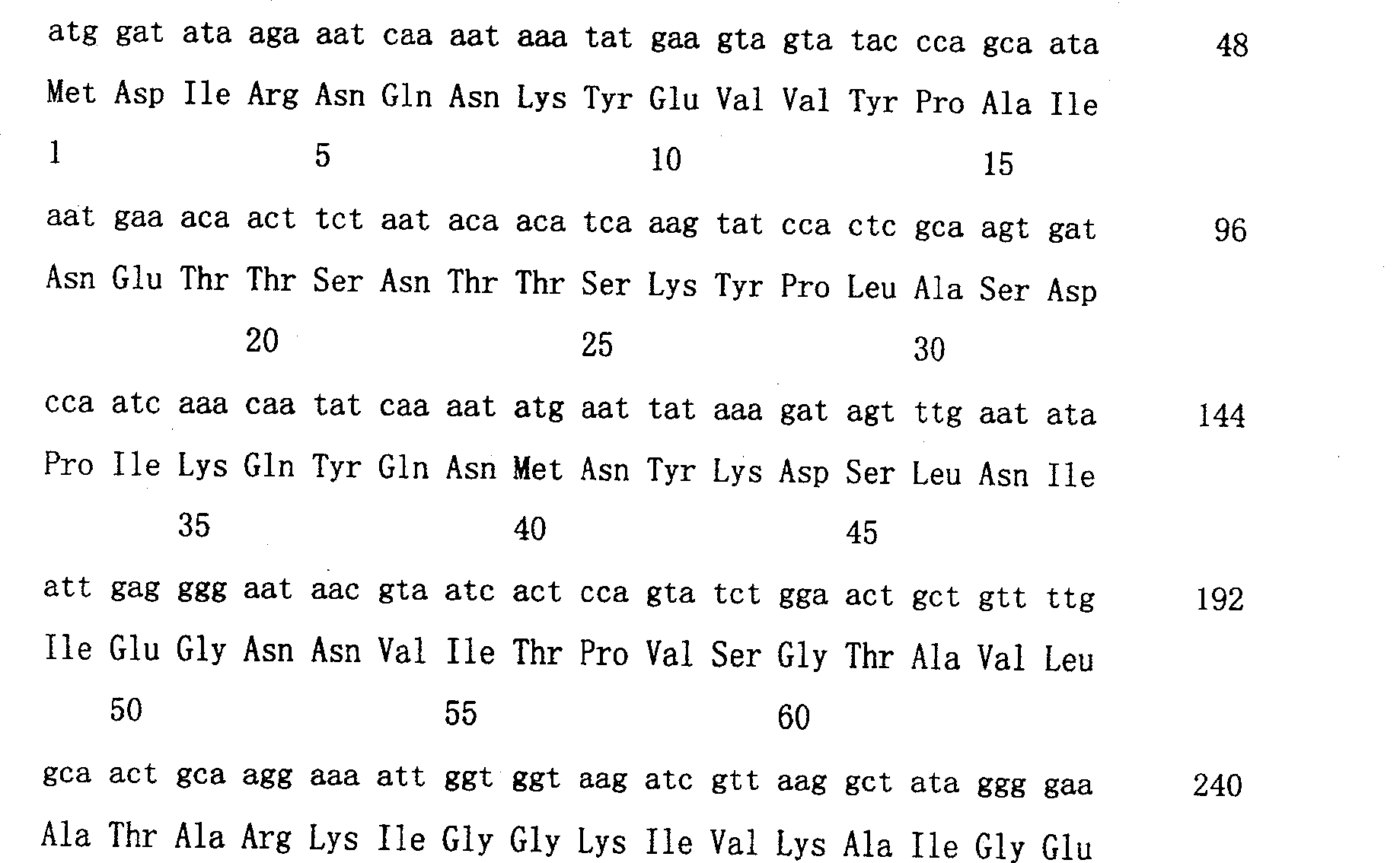
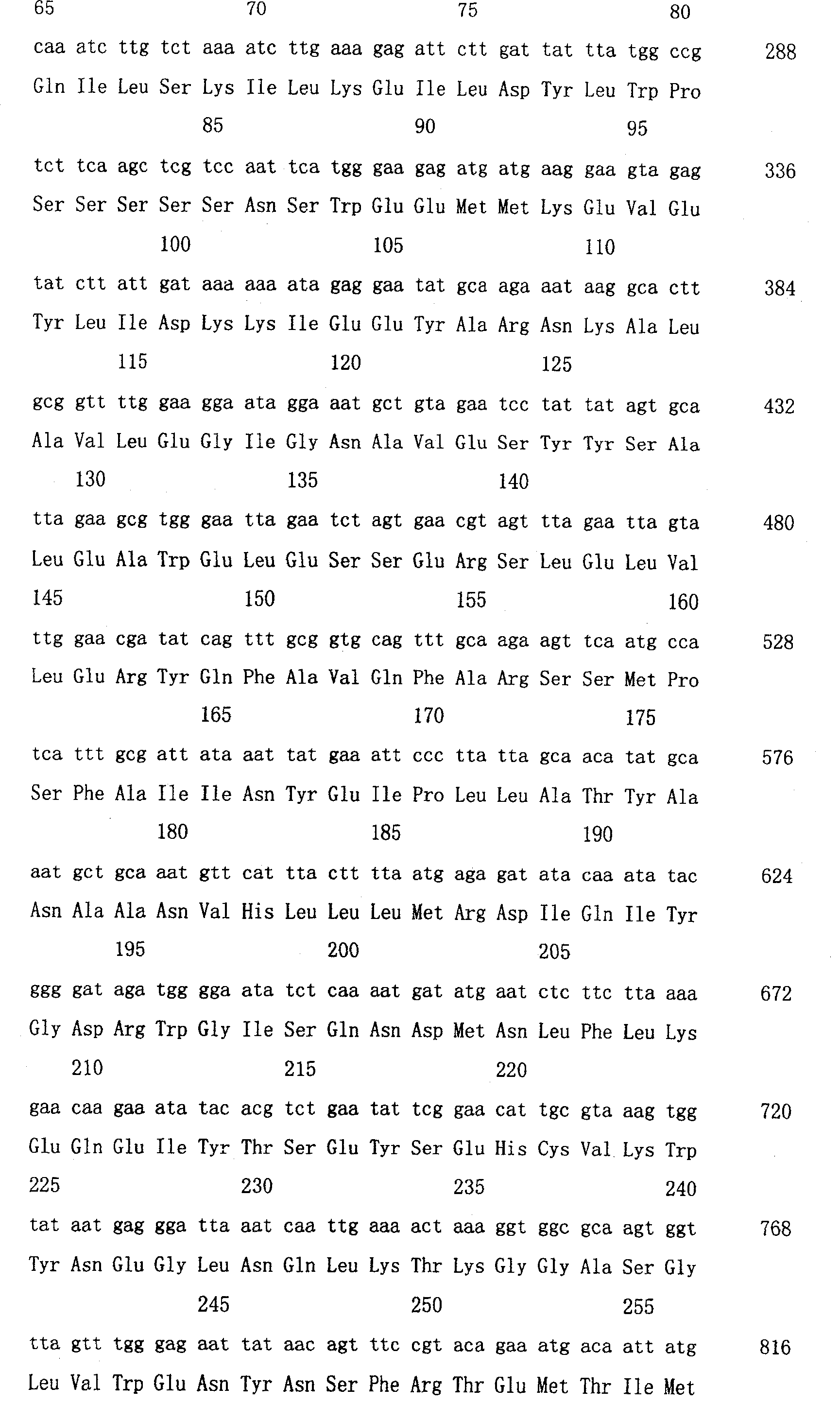
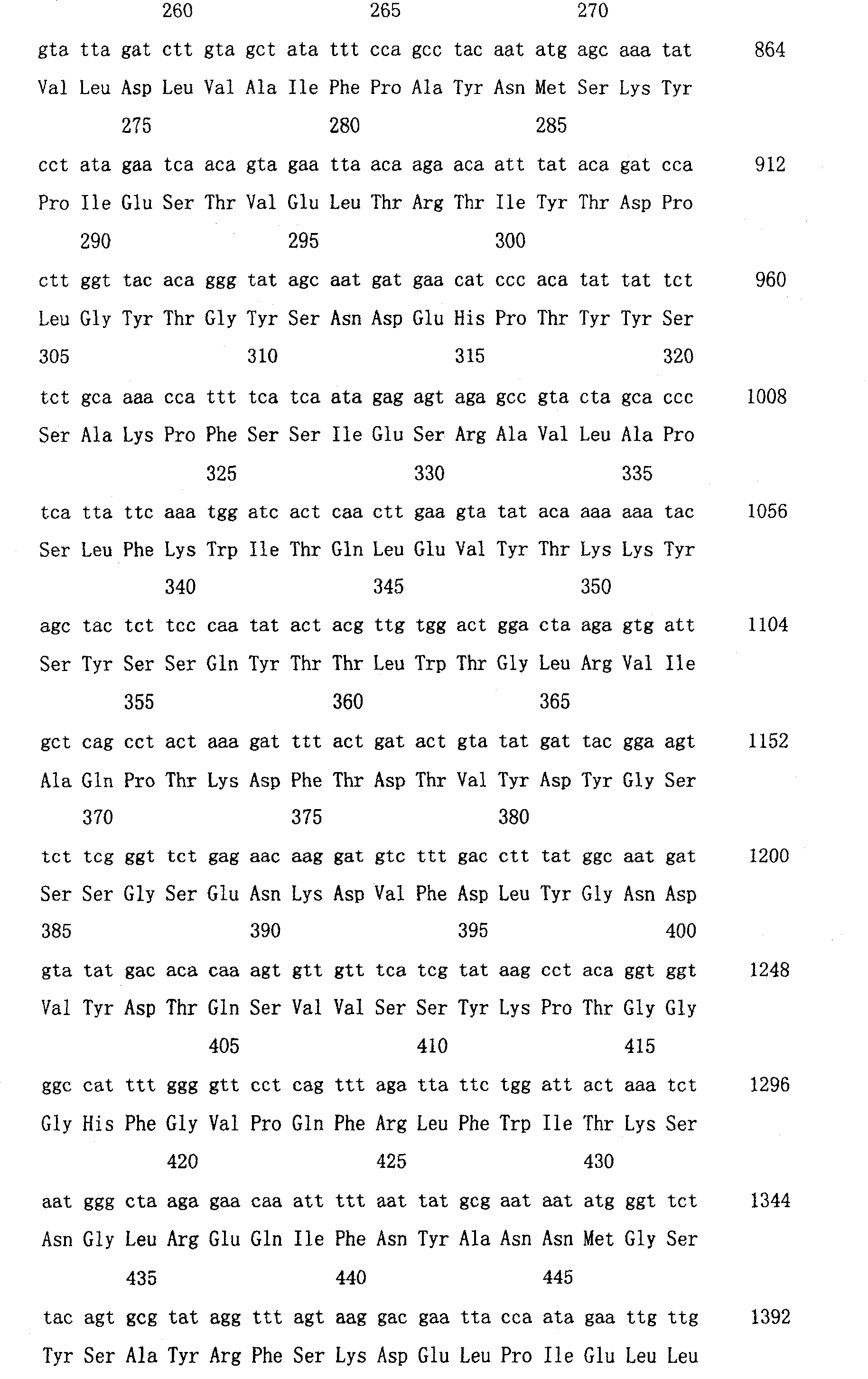
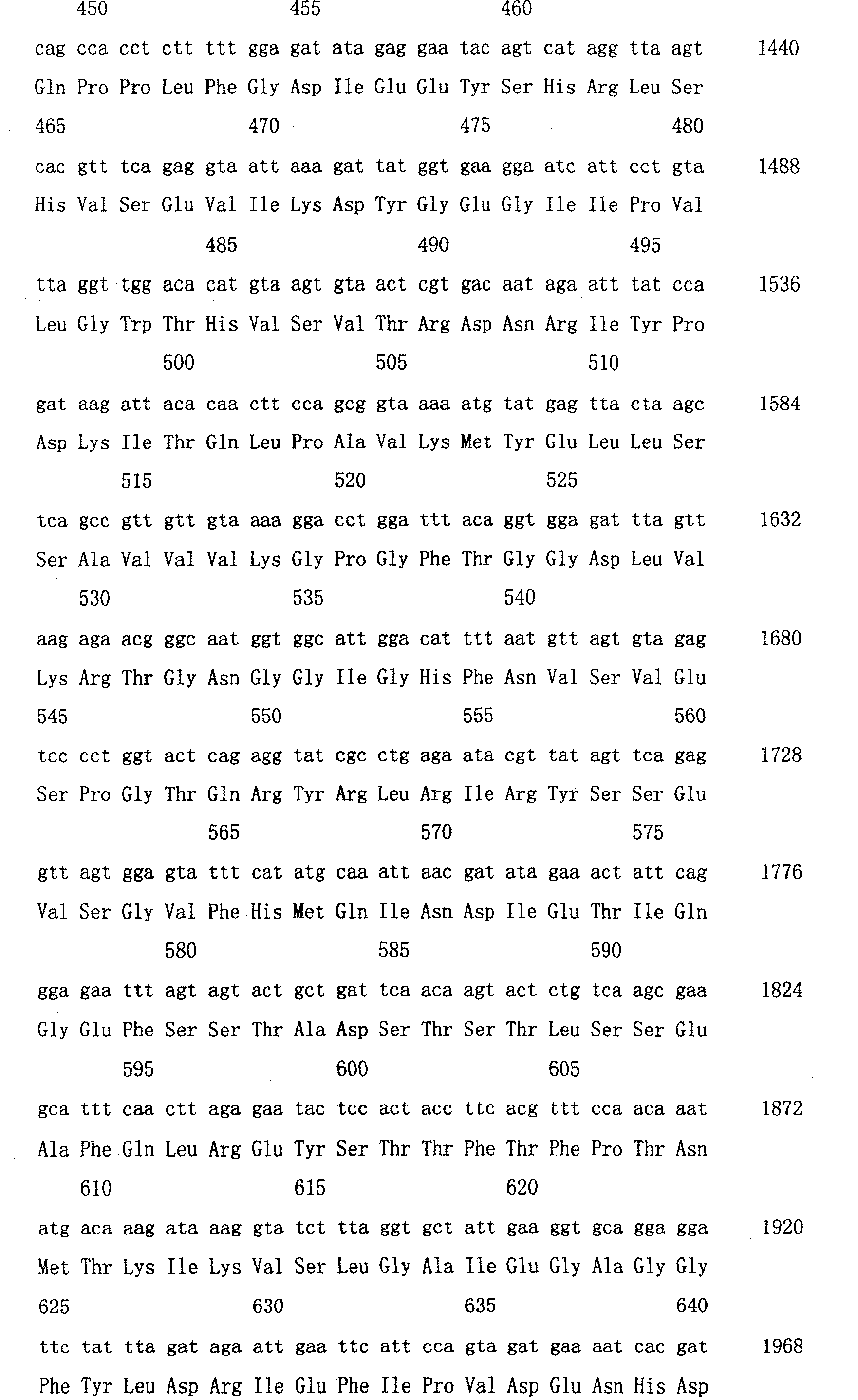
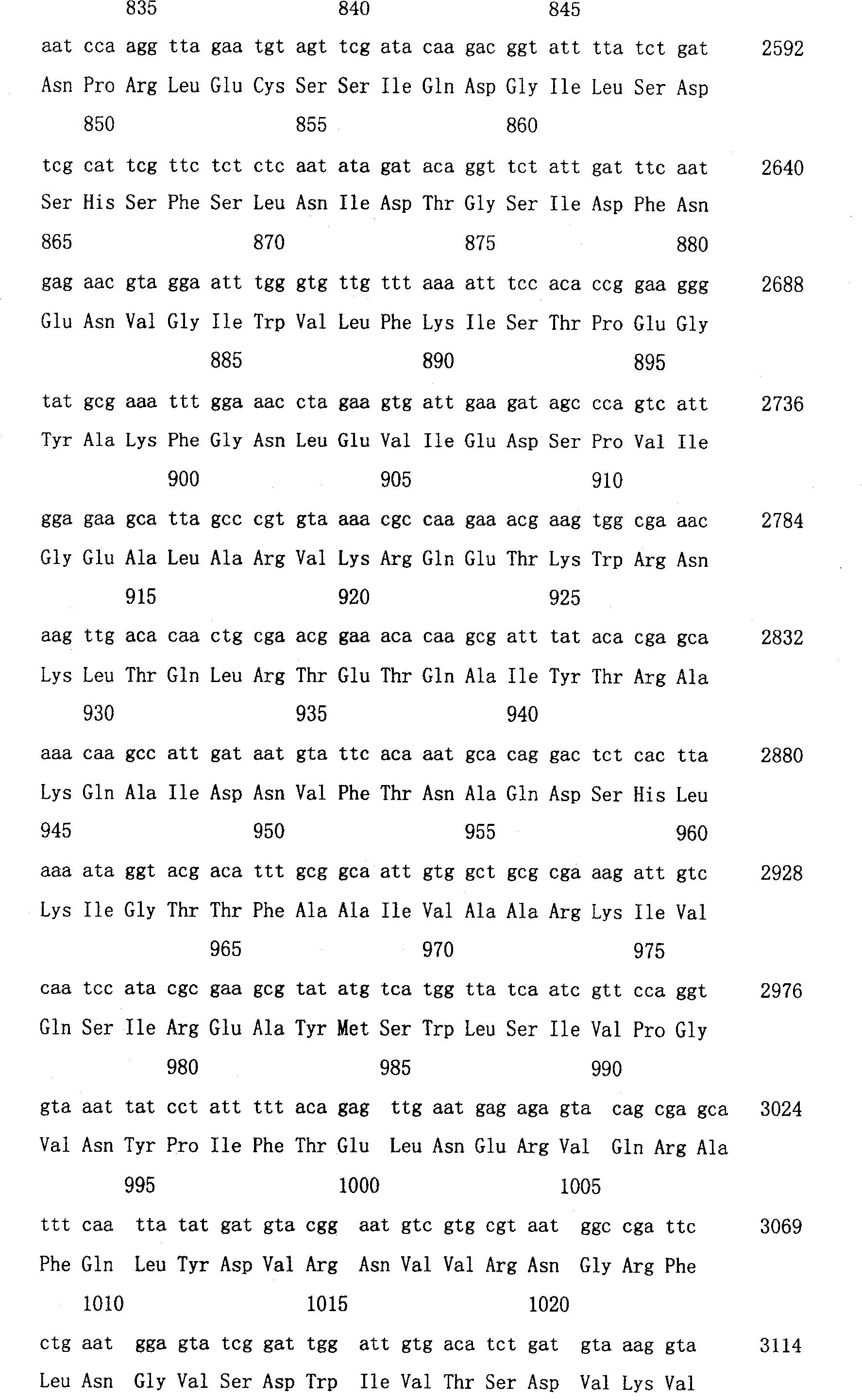
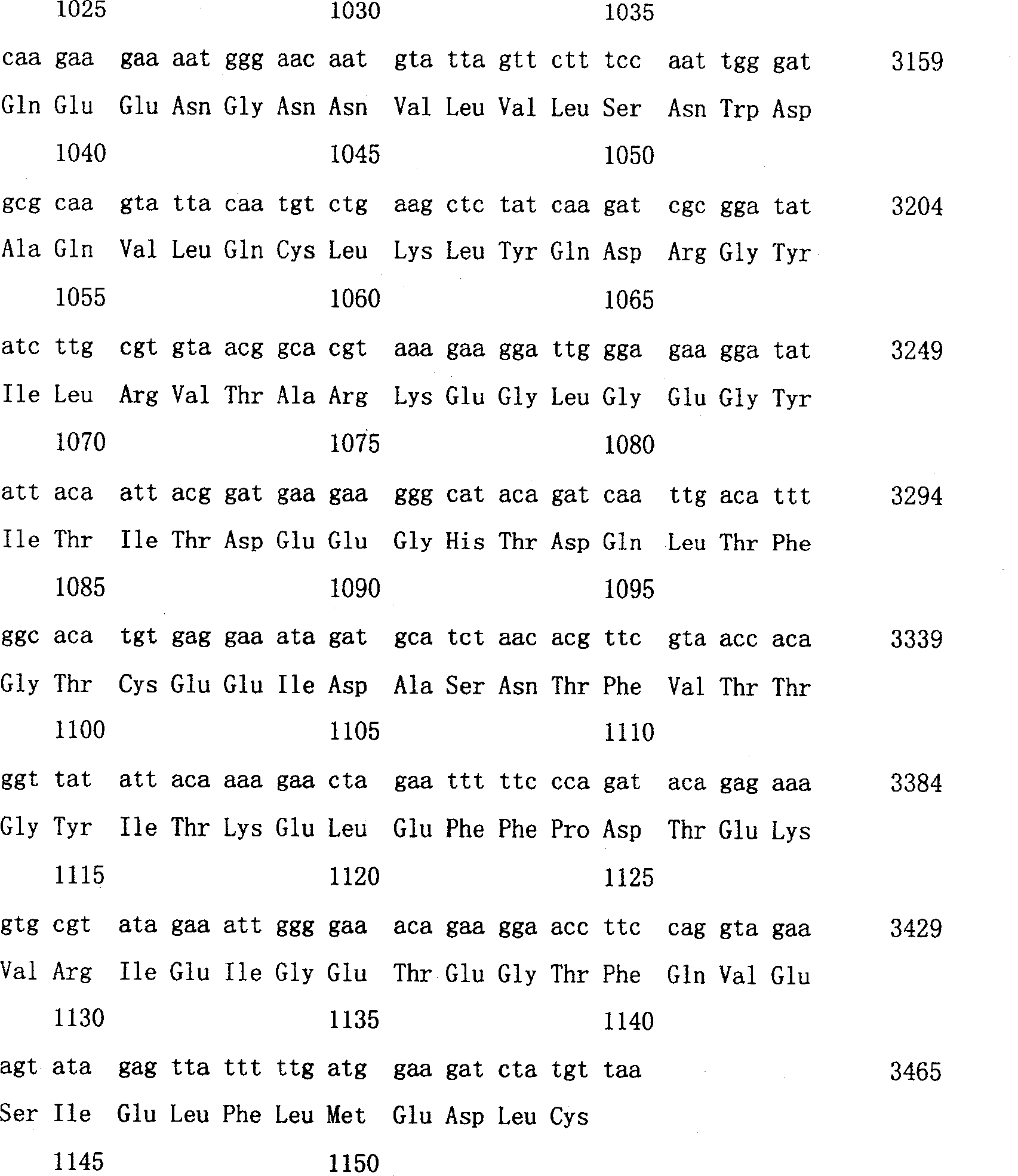
<210>2<210>2
<211>1154<211>1154
<212>PRT<212>PRT
<213>苏云金芽胞杆菌(Bacillus thuringiensis)<213> Bacillus thuringiensis
<400>2<400>2

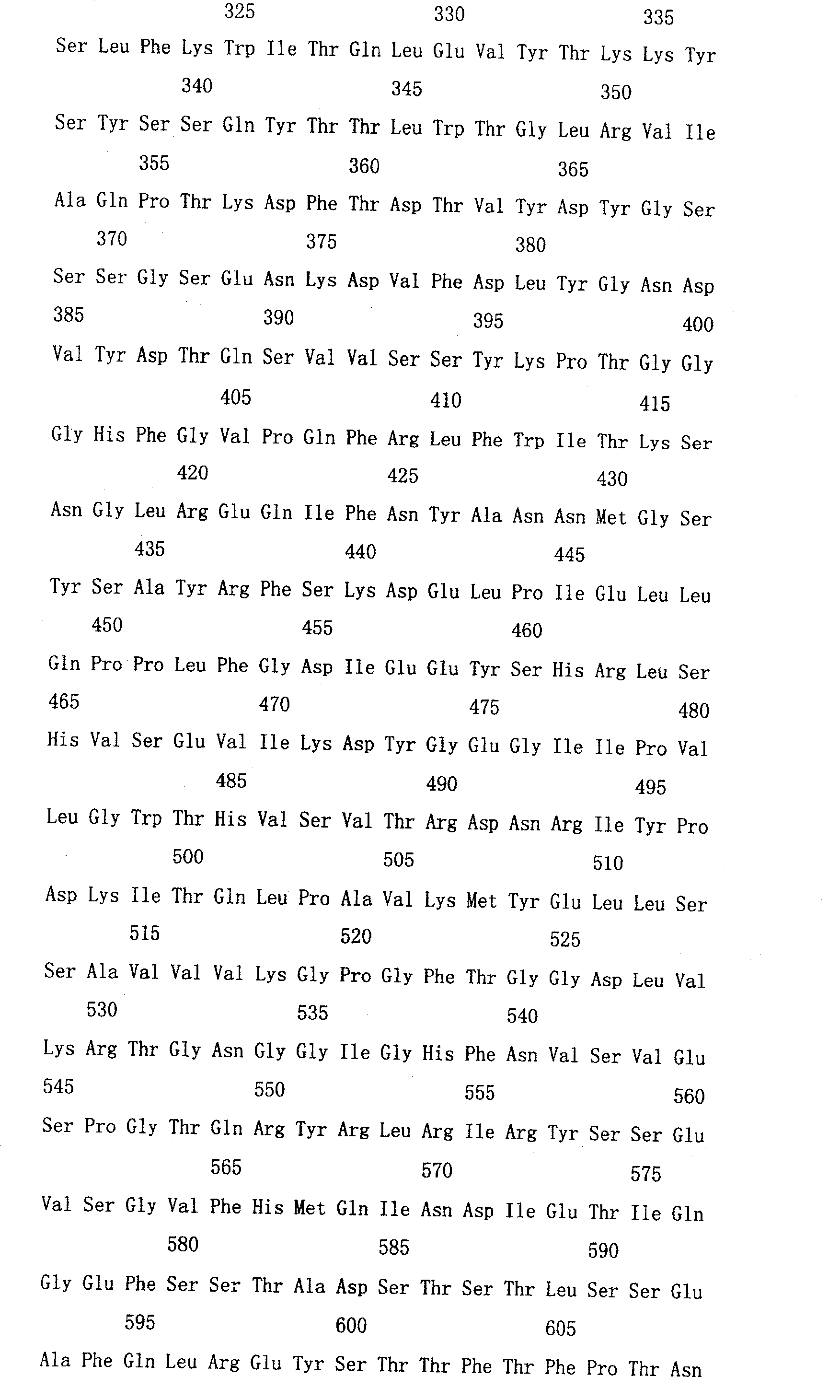
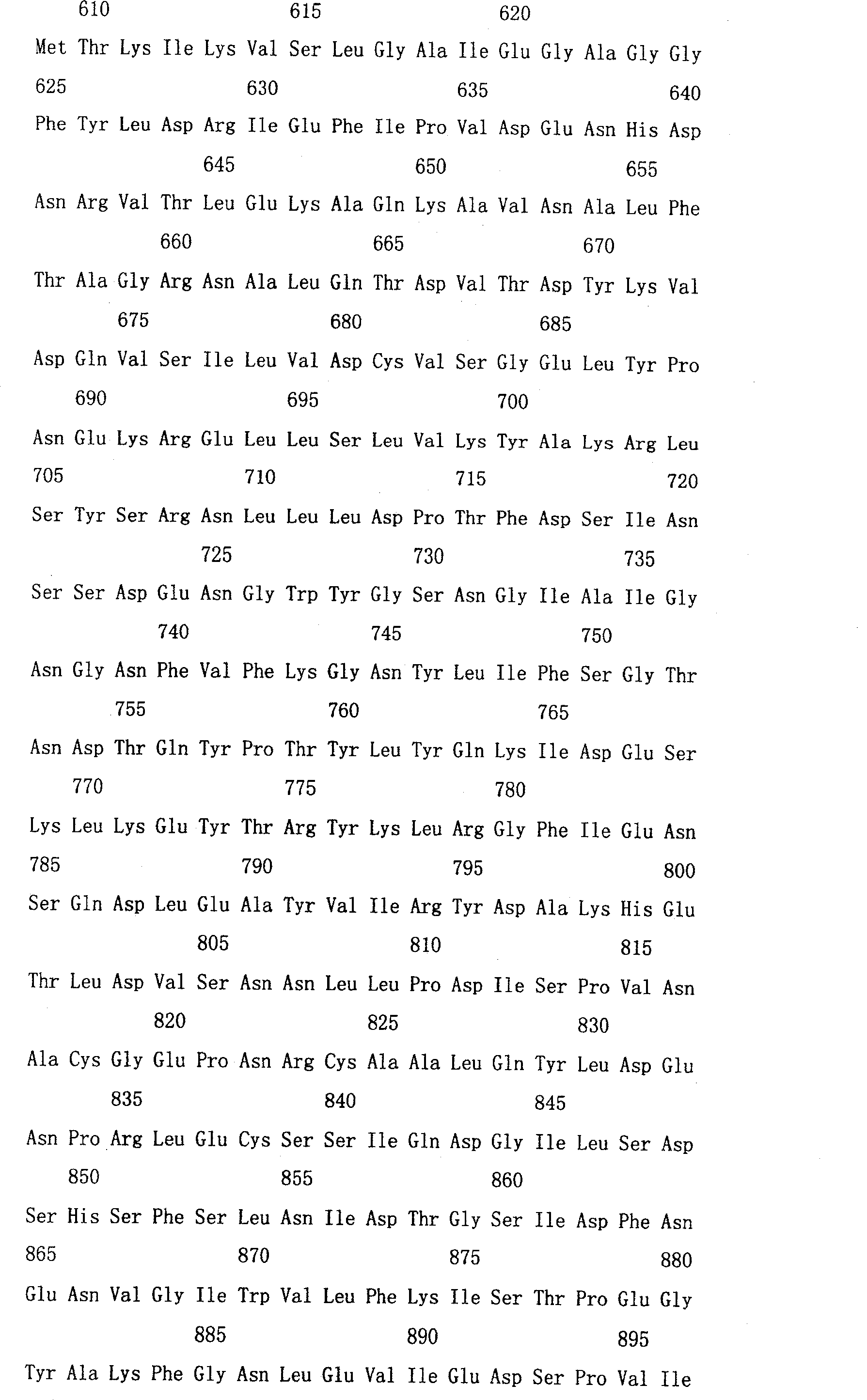

Claims (3)
Priority Applications (11)
| Application Number | Priority Date | Filing Date | Title |
|---|---|---|---|
| CNB2005100195960A CN100510081C (en) | 2005-10-17 | 2005-10-17 | Insecticidal crystalline gene cry7Bal of Bacillus thuringiensis |
| CA002624158A CA2624158A1 (en) | 2005-10-17 | 2006-10-17 | Gene cry7bal encoding an insecticidal crystal protein of bacillus thuringiensis |
| US12/089,992 US7838293B2 (en) | 2005-10-17 | 2006-10-17 | Gene Cry7ba1 encoding an insecticidal crystal protein of Bacillus thuringiensis |
| EP06791266A EP1937818A4 (en) | 2005-10-17 | 2006-10-17 | FOR AN INSECTICIDE CRYSTAL PROTEIN FROM BACILLUS THURINGIENSIS CODING GEN CRY7BAL |
| BRPI0617496-5A BRPI0617496A2 (en) | 2005-10-17 | 2006-10-17 | bacillus thuringiensis isolated crystal insecticidal protein gene, recombinant DNA construct, microorganism and bacillus thuringiensis crystal insecticidal protein |
| CN2006800386848A CN101292035B (en) | 2005-10-17 | 2006-10-17 | Gene cry7Bal encoding insect-killing crystal protein of Bacillus thuringiensis |
| MX2008004990A MX2008004990A (en) | 2005-10-17 | 2006-10-17 | Gene cry7bal encoding an insecticidal crystal protein of bacillus thuringiensis. |
| JP2008535871A JP2009511075A (en) | 2005-10-17 | 2006-10-17 | Gene cry7Ba1 encoding the insecticidal crystal protein of Bacillus thuringiensis |
| AU2006303767A AU2006303767A1 (en) | 2005-10-17 | 2006-10-17 | Gene cry7Ba1 encoding an insecticidal crystal protein of Bacillus thuringiensis |
| PCT/CN2006/002724 WO2007045160A1 (en) | 2005-10-17 | 2006-10-17 | Gene cry7bal encoding an insecticidal crystal protein of bacillus thuringiensis |
| ZA200802283A ZA200802283B (en) | 2005-10-17 | 2008-03-11 | Gene cry7Bal encoding an insecticidal crystal protein of Bacillus thuringiensis |
Applications Claiming Priority (1)
| Application Number | Priority Date | Filing Date | Title |
|---|---|---|---|
| CNB2005100195960A CN100510081C (en) | 2005-10-17 | 2005-10-17 | Insecticidal crystalline gene cry7Bal of Bacillus thuringiensis |
Publications (2)
| Publication Number | Publication Date |
|---|---|
| CN1952151A CN1952151A (en) | 2007-04-25 |
| CN100510081C true CN100510081C (en) | 2009-07-08 |
Family
ID=37962193
Family Applications (2)
| Application Number | Title | Priority Date | Filing Date |
|---|---|---|---|
| CNB2005100195960A Expired - Fee Related CN100510081C (en) | 2005-10-17 | 2005-10-17 | Insecticidal crystalline gene cry7Bal of Bacillus thuringiensis |
| CN2006800386848A Expired - Fee Related CN101292035B (en) | 2005-10-17 | 2006-10-17 | Gene cry7Bal encoding insect-killing crystal protein of Bacillus thuringiensis |
Family Applications After (1)
| Application Number | Title | Priority Date | Filing Date |
|---|---|---|---|
| CN2006800386848A Expired - Fee Related CN101292035B (en) | 2005-10-17 | 2006-10-17 | Gene cry7Bal encoding insect-killing crystal protein of Bacillus thuringiensis |
Country Status (10)
| Country | Link |
|---|---|
| US (1) | US7838293B2 (en) |
| EP (1) | EP1937818A4 (en) |
| JP (1) | JP2009511075A (en) |
| CN (2) | CN100510081C (en) |
| AU (1) | AU2006303767A1 (en) |
| BR (1) | BRPI0617496A2 (en) |
| CA (1) | CA2624158A1 (en) |
| MX (1) | MX2008004990A (en) |
| WO (1) | WO2007045160A1 (en) |
| ZA (1) | ZA200802283B (en) |
Cited By (1)
| Publication number | Priority date | Publication date | Assignee | Title |
|---|---|---|---|---|
| CN102329760A (en) * | 2011-10-19 | 2012-01-25 | 青岛农业大学 | New bacterial strain of Bacillus thuringiensis for killing grub pest and pest killing protein thereof |
Families Citing this family (11)
| Publication number | Priority date | Publication date | Assignee | Title |
|---|---|---|---|---|
| EP2455391A3 (en) * | 2006-06-15 | 2012-08-22 | Athenix Corporation | A family of pesticidal proteins and methods for their use |
| CN101492686B (en) * | 2009-01-09 | 2010-11-17 | 华中农业大学 | Bacillus thuringiensis nematocidal crystal protein gene cry1518-35 and its application |
| MX2011013674A (en) * | 2009-06-16 | 2012-01-20 | Dow Agrosciences Llc | Dig-5 insecticidal cry toxins. |
| CN102643773B (en) * | 2011-02-18 | 2013-10-16 | 华中农业大学 | Screening and identification of genetically engineered Bacillus thuringiensis YBT-881-L1 of overexpressed CodY protein |
| MX356526B (en) | 2012-03-09 | 2018-06-01 | Vestaron Corp | Toxic peptide production, peptide expression in plants and combinations of cysteine rich peptides. |
| US11692016B2 (en) | 2012-03-09 | 2023-07-04 | Vestaron Corporation | High gene expression yeast strain |
| CN103421098B (en) * | 2012-05-18 | 2015-02-25 | 华中农业大学 | Nematocide crystallin gene cry003-131 and application thereof |
| CN103421097B (en) * | 2012-05-18 | 2015-05-20 | 华中农业大学 | Nematocide crystallin gene cry003-148 and application thereof |
| US11535653B2 (en) | 2016-10-21 | 2022-12-27 | Vestaron Corporation | Cleavable peptides and insecticidal and nematicidal proteins comprising same |
| CN109929015B (en) * | 2019-04-17 | 2021-08-31 | 东北农业大学 | Bacillus thuringiensis insecticidal gene cry79Aa1, expressed protein and its application |
| CN111944027B (en) * | 2020-08-20 | 2021-11-30 | 中国农业科学院植物保护研究所 | Application of mclX gene in bacillus thuringiensis mother cell lysis |
Family Cites Families (7)
| Publication number | Priority date | Publication date | Assignee | Title |
|---|---|---|---|---|
| US5262324A (en) * | 1991-11-06 | 1993-11-16 | Mycogen Corporation | Coleopteran-active Bacillus thuringiensis isolates and genes encoding coleopteran-active toxins |
| GB9318207D0 (en) | 1993-09-02 | 1993-10-20 | Sandoz Ltd | Improvements in or relating to organic compounds |
| CN1160458C (en) * | 1998-12-03 | 2004-08-04 | 中山大学 | Bacillus thuringiensis molecular chaperone gene, carrier and bacterial strain containing the gene |
| CN1111600C (en) * | 1999-08-26 | 2003-06-18 | 中国科学院遗传研究所 | Insecticidal protein gene and application thereof |
| CN1152959C (en) * | 2000-08-25 | 2004-06-09 | 上海市农业科学院生物技术研究中心 | Fully synthetic insecticidal crystal protein gene of Bacillus thuringiensis |
| NZ570682A (en) * | 2003-02-20 | 2009-08-28 | Athenix Corp | AXMI-006 a delta-endotoxin gene and methods for its use as a pesticide |
| EP2455391A3 (en) * | 2006-06-15 | 2012-08-22 | Athenix Corporation | A family of pesticidal proteins and methods for their use |
-
2005
- 2005-10-17 CN CNB2005100195960A patent/CN100510081C/en not_active Expired - Fee Related
-
2006
- 2006-10-17 CN CN2006800386848A patent/CN101292035B/en not_active Expired - Fee Related
- 2006-10-17 JP JP2008535871A patent/JP2009511075A/en active Pending
- 2006-10-17 CA CA002624158A patent/CA2624158A1/en not_active Abandoned
- 2006-10-17 US US12/089,992 patent/US7838293B2/en active Active
- 2006-10-17 AU AU2006303767A patent/AU2006303767A1/en not_active Abandoned
- 2006-10-17 MX MX2008004990A patent/MX2008004990A/en unknown
- 2006-10-17 EP EP06791266A patent/EP1937818A4/en not_active Withdrawn
- 2006-10-17 BR BRPI0617496-5A patent/BRPI0617496A2/en not_active IP Right Cessation
- 2006-10-17 WO PCT/CN2006/002724 patent/WO2007045160A1/en not_active Ceased
-
2008
- 2008-03-11 ZA ZA200802283A patent/ZA200802283B/en unknown
Non-Patent Citations (1)
| Title |
|---|
| 苏云金芽胞杆菌营养期杀虫蛋白Vip与Cry蛋白的协同作用. 蔡启良,刘子铎,孙明,喻子牛.微生物学通报,第30卷第5期. 2003 * |
Cited By (1)
| Publication number | Priority date | Publication date | Assignee | Title |
|---|---|---|---|---|
| CN102329760A (en) * | 2011-10-19 | 2012-01-25 | 青岛农业大学 | New bacterial strain of Bacillus thuringiensis for killing grub pest and pest killing protein thereof |
Also Published As
| Publication number | Publication date |
|---|---|
| US7838293B2 (en) | 2010-11-23 |
| US20090130758A1 (en) | 2009-05-21 |
| JP2009511075A (en) | 2009-03-19 |
| MX2008004990A (en) | 2008-10-01 |
| WO2007045160A1 (en) | 2007-04-26 |
| CN101292035B (en) | 2011-05-18 |
| AU2006303767A1 (en) | 2007-04-26 |
| CA2624158A1 (en) | 2007-04-26 |
| EP1937818A1 (en) | 2008-07-02 |
| ZA200802283B (en) | 2009-03-25 |
| EP1937818A4 (en) | 2009-07-01 |
| CN1952151A (en) | 2007-04-25 |
| BRPI0617496A2 (en) | 2011-07-26 |
| CN101292035A (en) | 2008-10-22 |
Similar Documents
| Publication | Publication Date | Title |
|---|---|---|
| CN100510081C (en) | Insecticidal crystalline gene cry7Bal of Bacillus thuringiensis | |
| CN101492686A (en) | Bacillus thuringiensis nematocide crystal protein gene cry1518-35 and uses thereof | |
| Sampson et al. | Discovery of a novel insecticidal protein from Chromobacterium piscinae, with activity against Western Corn Rootworm, Diabrotica virgifera virgifera | |
| CN101755050A (en) | Insecticidal fungus engineering strain transformed by scorpion toxin gene and application thereof | |
| CN102559554B (en) | Bacillus thuringiensis cry1Ca gene, expressed protein and application of bacillus thuringiensis cry1Ca gene | |
| WO2009003412A1 (en) | Bacillus thuringiensis stain, cry8g genes, proteins, which are all highly toxic to order coleoptera insect pests, and uses thereof | |
| CN104611260B (en) | Thuringiensis LTS290, killing gene cry57Ab, expressing protein and its application | |
| CN101984045B (en) | Bacillus thuringiensis cry8Na1 gene, expressed protein and application thereof | |
| CN110093301B (en) | A kind of Bacillus thuringiensis and its application in controlling lepidopteran pests | |
| CN104673706B (en) | Thuringiensis FH21, killing gene, expressing protein and its application | |
| CN101717437B (en) | Bacillus thuringiensis Cry9E gene, protein and applications thereof | |
| Usta | Local isolate of Bacillus thuringiensis (Berliner, 1915)(Bacteria: Bacillaceae) from Cydalima perspectalis (Walker, 1859)(Lepidoptera: Crambidae: Spilomelinae) includes cry1, cry3 and cry4 genes and their insecticidal activities | |
| CN111235166B (en) | A Novel Inducible Expression of Cry2Ab Insecticidal Gene and Its Application | |
| WO2006053473A1 (en) | A bacillus thuringiensis and genes with high larvicidal activity to coleopterans | |
| CN111850009A (en) | A kind of Cry2Ab-2 insecticidal gene and its application | |
| EP3982729A1 (en) | Bacillus thuringiensis strain | |
| CN103421097B (en) | Nematocide crystallin gene cry003-148 and application thereof | |
| CN109929015A (en) | Thuringiensis killing gene cry79Aa1, expression albumen and its application | |
| CN101413007B (en) | Bacillus thuringiensis cry8Ⅰ gene, protein and application thereof highly effective against coleopteran pests | |
| Xie et al. | Characterization of a new highly toxic isolate of Bacillus thuringiensis from the diapausing larvae of silkworm and identification of cry1A 22 gene | |
| CN103333230A (en) | Bacillus thuringiensis gene cry1Da3 and applications thereof | |
| CN114907458A (en) | A Vip3A mutant protein with improved activity and its application | |
| CN103421098B (en) | Nematocide crystallin gene cry003-131 and application thereof | |
| CN101691572B (en) | Enhancing protein gene bell of Bacillus thuringiensis and application thereof | |
| OA20945A (en) | Bacillus thuringiensis strain |
Legal Events
| Date | Code | Title | Description |
|---|---|---|---|
| C06 | Publication | ||
| PB01 | Publication | ||
| C10 | Entry into substantive examination | ||
| SE01 | Entry into force of request for substantive examination | ||
| C14 | Grant of patent or utility model | ||
| GR01 | Patent grant | ||
| CF01 | Termination of patent right due to non-payment of annual fee |
Granted publication date: 20090708 Termination date: 20191017 |
|
| CF01 | Termination of patent right due to non-payment of annual fee |