CN100487025C - Linear polyamino and/or polyammonium polysiloxane copolymers II - Google Patents
Linear polyamino and/or polyammonium polysiloxane copolymers II Download PDFInfo
- Publication number
- CN100487025C CN100487025C CNB2003801082329A CN200380108232A CN100487025C CN 100487025 C CN100487025 C CN 100487025C CN B2003801082329 A CNB2003801082329 A CN B2003801082329A CN 200380108232 A CN200380108232 A CN 200380108232A CN 100487025 C CN100487025 C CN 100487025C
- Authority
- CN
- China
- Prior art keywords
- group
- groups
- linear
- compounds
- polysiloxane copolymer
- Prior art date
- Legal status (The legal status is an assumption and is not a legal conclusion. Google has not performed a legal analysis and makes no representation as to the accuracy of the status listed.)
- Expired - Lifetime
Links
Classifications
-
- D—TEXTILES; PAPER
- D06—TREATMENT OF TEXTILES OR THE LIKE; LAUNDERING; FLEXIBLE MATERIALS NOT OTHERWISE PROVIDED FOR
- D06M—TREATMENT, NOT PROVIDED FOR ELSEWHERE IN CLASS D06, OF FIBRES, THREADS, YARNS, FABRICS, FEATHERS OR FIBROUS GOODS MADE FROM SUCH MATERIALS
- D06M15/00—Treating fibres, threads, yarns, fabrics, or fibrous goods made from such materials, with macromolecular compounds; Such treatment combined with mechanical treatment
- D06M15/19—Treating fibres, threads, yarns, fabrics, or fibrous goods made from such materials, with macromolecular compounds; Such treatment combined with mechanical treatment with synthetic macromolecular compounds
- D06M15/37—Macromolecular compounds obtained otherwise than by reactions only involving carbon-to-carbon unsaturated bonds
- D06M15/643—Macromolecular compounds obtained otherwise than by reactions only involving carbon-to-carbon unsaturated bonds containing silicon in the main chain
-
- A—HUMAN NECESSITIES
- A61—MEDICAL OR VETERINARY SCIENCE; HYGIENE
- A61K—PREPARATIONS FOR MEDICAL, DENTAL OR TOILETRY PURPOSES
- A61K8/00—Cosmetics or similar toiletry preparations
- A61K8/18—Cosmetics or similar toiletry preparations characterised by the composition
- A61K8/72—Cosmetics or similar toiletry preparations characterised by the composition containing organic macromolecular compounds
- A61K8/84—Cosmetics or similar toiletry preparations characterised by the composition containing organic macromolecular compounds obtained by reactions otherwise than those involving only carbon-carbon unsaturated bonds
- A61K8/89—Polysiloxanes
- A61K8/896—Polysiloxanes containing atoms other than silicon, carbon, oxygen and hydrogen, e.g. dimethicone copolyol phosphate
- A61K8/898—Polysiloxanes containing atoms other than silicon, carbon, oxygen and hydrogen, e.g. dimethicone copolyol phosphate containing nitrogen, e.g. amodimethicone, trimethyl silyl amodimethicone or dimethicone propyl PG-betaine
-
- A—HUMAN NECESSITIES
- A61—MEDICAL OR VETERINARY SCIENCE; HYGIENE
- A61Q—SPECIFIC USE OF COSMETICS OR SIMILAR TOILETRY PREPARATIONS
- A61Q19/00—Preparations for care of the skin
-
- A—HUMAN NECESSITIES
- A61—MEDICAL OR VETERINARY SCIENCE; HYGIENE
- A61Q—SPECIFIC USE OF COSMETICS OR SIMILAR TOILETRY PREPARATIONS
- A61Q5/00—Preparations for care of the hair
-
- C—CHEMISTRY; METALLURGY
- C08—ORGANIC MACROMOLECULAR COMPOUNDS; THEIR PREPARATION OR CHEMICAL WORKING-UP; COMPOSITIONS BASED THEREON
- C08G—MACROMOLECULAR COMPOUNDS OBTAINED OTHERWISE THAN BY REACTIONS ONLY INVOLVING UNSATURATED CARBON-TO-CARBON BONDS
- C08G77/00—Macromolecular compounds obtained by reactions forming a linkage containing silicon with or without sulfur, nitrogen, oxygen or carbon in the main chain of the macromolecule
- C08G77/04—Polysiloxanes
- C08G77/38—Polysiloxanes modified by chemical after-treatment
- C08G77/382—Polysiloxanes modified by chemical after-treatment containing atoms other than carbon, hydrogen, oxygen or silicon
- C08G77/388—Polysiloxanes modified by chemical after-treatment containing atoms other than carbon, hydrogen, oxygen or silicon containing nitrogen
-
- C—CHEMISTRY; METALLURGY
- C08—ORGANIC MACROMOLECULAR COMPOUNDS; THEIR PREPARATION OR CHEMICAL WORKING-UP; COMPOSITIONS BASED THEREON
- C08G—MACROMOLECULAR COMPOUNDS OBTAINED OTHERWISE THAN BY REACTIONS ONLY INVOLVING UNSATURATED CARBON-TO-CARBON BONDS
- C08G77/00—Macromolecular compounds obtained by reactions forming a linkage containing silicon with or without sulfur, nitrogen, oxygen or carbon in the main chain of the macromolecule
- C08G77/42—Block-or graft-polymers containing polysiloxane sequences
- C08G77/452—Block-or graft-polymers containing polysiloxane sequences containing nitrogen-containing sequences
-
- C—CHEMISTRY; METALLURGY
- C11—ANIMAL OR VEGETABLE OILS, FATS, FATTY SUBSTANCES OR WAXES; FATTY ACIDS THEREFROM; DETERGENTS; CANDLES
- C11D—DETERGENT COMPOSITIONS; USE OF SINGLE SUBSTANCES AS DETERGENTS; SOAP OR SOAP-MAKING; RESIN SOAPS; RECOVERY OF GLYCEROL
- C11D3/00—Other compounding ingredients of detergent compositions covered in group C11D1/00
- C11D3/16—Organic compounds
- C11D3/37—Polymers
- C11D3/3703—Macromolecular compounds obtained otherwise than by reactions only involving carbon-to-carbon unsaturated bonds
- C11D3/373—Macromolecular compounds obtained otherwise than by reactions only involving carbon-to-carbon unsaturated bonds containing silicones
- C11D3/3742—Nitrogen containing silicones
-
- A—HUMAN NECESSITIES
- A61—MEDICAL OR VETERINARY SCIENCE; HYGIENE
- A61Q—SPECIFIC USE OF COSMETICS OR SIMILAR TOILETRY PREPARATIONS
- A61Q5/00—Preparations for care of the hair
- A61Q5/02—Preparations for cleaning the hair
Landscapes
- Chemical & Material Sciences (AREA)
- Health & Medical Sciences (AREA)
- Life Sciences & Earth Sciences (AREA)
- Chemical Kinetics & Catalysis (AREA)
- Organic Chemistry (AREA)
- Animal Behavior & Ethology (AREA)
- General Health & Medical Sciences (AREA)
- Public Health (AREA)
- Veterinary Medicine (AREA)
- Engineering & Computer Science (AREA)
- Polymers & Plastics (AREA)
- Medicinal Chemistry (AREA)
- Dermatology (AREA)
- Epidemiology (AREA)
- Birds (AREA)
- Textile Engineering (AREA)
- Oil, Petroleum & Natural Gas (AREA)
- Wood Science & Technology (AREA)
- General Chemical & Material Sciences (AREA)
- Silicon Polymers (AREA)
- Cosmetics (AREA)
- Detergent Compositions (AREA)
- Macromolecular Compounds Obtained By Forming Nitrogen-Containing Linkages In General (AREA)
- Treatments For Attaching Organic Compounds To Fibrous Goods (AREA)
- Polymers With Sulfur, Phosphorus Or Metals In The Main Chain (AREA)
- Compositions Of Macromolecular Compounds (AREA)
- Addition Polymer Or Copolymer, Post-Treatments, Or Chemical Modifications (AREA)
Abstract
Description
说明书:manual:
本发明涉及线性聚氨基-和/或聚铵-聚硅氧烷共聚物,特别是亲水性的聚季铵聚硅氧烷共聚物,和涉及它们作为洗涤稳定的亲水性柔软剂的应用。The present invention relates to linear polyamino- and/or polyammonium polysiloxane copolymers, in particular hydrophilic polyquaternium polysiloxane copolymers, and to their use as wash-stable hydrophilic softeners.
用作织物柔软剂的包含氨基基团的聚硅氧烷是已知的(EP441530)。引入作为侧链的通过环氧乙烷/环氧丙烷单元改性的氨基结构侧链产生了改进的效果(US 5,591,880,US 5,650,529)。这里环氧烷烃单元使得能够受控地调整亲水性/疏水性平衡。从合成的观点,缺点是难于酯化,其包括在合成战略中,即氨基醇与硅氧烷-连接的羧酸基团难于酯化,和,在柔软特性方面,产物通常的梳状结构。Polysiloxanes containing amino groups for use as fabric softeners are known (EP441530). The introduction of amino structural side chains modified by ethylene oxide/propylene oxide units as side chains leads to improved effects (US 5,591,880, US 5,650,529). The alkylene oxide units here enable a controlled adjustment of the hydrophilicity/hydrophobicity balance. Disadvantages from a synthetic point of view are difficult esterification, which is included in the synthetic strategy, ie the difficult esterification of aminoalcohols with siloxane-linked carboxylic acid groups, and, in terms of softness properties, the usual comb-like structure of the products.
为了除去这些缺点建议α,ω-环氧-改性的硅氧烷与α,ω-氨基官能化的环氧烷反应,并作为亲水性柔软剂使用这些产物(US5,807,956,US 5,981,681)。In order to remove these disadvantages it is proposed to react α,ω-epoxy-modified siloxanes with α,ω-amino-functionalized alkylene oxides and to use these products as hydrophilic softeners (US 5,807,956, US 5,981,681) .
为了改进直接性(Substan 
同样已经描述了严格梳状环氧烷改性的聚硅氧烷季铵化合物(US5,098,979)。梳状取代的聚醚硅氧烷的羟基基团和用表氯醇转化成相应的氯乙醇衍生物。这随后是用叔胺季铵化。因为该原因梳状取代的聚醚硅氧烷的羟基基团被另外用氯乙酸酯化。羰基活化使得最后的季铵化能够更容易地完成(US 5,153,294,US 5,166,297)。Strictly comb-like alkylene oxide-modified polysiloxane quats have likewise been described (US 5,098,979). Comb-substituted polyether siloxanes and their hydroxyl groups were converted to the corresponding chlorohydrin derivatives with epichlorohydrin. This is followed by quaternization with tertiary amines. For this reason the hydroxyl groups of the comb-substituted polyether siloxanes are additionally esterified with chloroacetate. Carbonyl activation allows for easier final quaternization (US 5,153,294, US 5,166,297).
US 6,242,554描述了α,ω-双官能硅氧烷衍生物,其每一个具有单独的季铵和环氧烷单元。这些材料的特征是与极性环境增强的兼容性。US 6,242,554 describes α,ω-difunctional siloxane derivatives each having separate quaternary ammonium and alkylene oxide units. These materials are characterized by enhanced compatibility with polar environments.
在酸存在的条件下α,ω-双环氧化合物与叔胺的反应产生了α,ω-二季铵硅氧烷,其可以用于护发目的(德国专利说明书37 19 086)。除了四烷基-取代的季铵结构,还要求保护芳族咪唑啉鎓衍生物。The reaction of α,ω-diepoxy compounds with tertiary amines in the presence of acids gives α,ω-diquaternary ammonium siloxanes, which can be used for hair care purposes (German Patent Specification 37 19 086). In addition to tetraalkyl-substituted quaternary ammonium structures, aromatic imidazolinium derivatives are also claimed.
在酸存在的条件下通过α,ω-双环氧化合物与二叔胺的反应以产生长链聚季铵聚硅氧烷可以取得化合物不再易于从头发中洗出的效果(EP 282720)。未揭示芳族季铵结构。这种物质的衍生物在US6,240,929中提到。在第一步中,为此目的,具有二个咪唑单元的二胺由咪唑和合适的双官能烷基化剂合成,并且这些二胺随后以与EP282720中的相似的方式转化成聚季铵聚硅氧烷。以这种方式制备的阳离子化合物据说具有与存在于化妆品制剂中的阴离子表面活性剂进一步增加的兼容性。The effect that the compounds are no longer easily washed out of the hair can be achieved by the reaction of α,ω-diepoxy compounds with di-tertiary amines in the presence of acids to produce long-chain polyquaternium polysiloxanes (EP 282720). Aromatic quaternary ammonium structures are not revealed. Derivatives of this material are mentioned in US 6,240,929. In a first step, for this purpose, diamines having two imidazole units are synthesized from imidazole and a suitable difunctional alkylating agent, and these diamines are subsequently converted into polyquaternium polysiloxanes in a similar manner as in EP282720 alkyl. Cationic compounds prepared in this way are said to have a further increased compatibility with anionic surfactants present in cosmetic preparations.
然而,关于被从头发中洗出的稳定性基本涉及水和非常柔和的,不刺激皮肤的表面活性剂的短期进攻,然而洗涤稳定的亲水性织物柔软剂必须抵抗浓表面活性剂溶液的进攻,该溶液具有高的脂肪和污垢溶解本领。进一复杂的因素是现代去垢剂包含强碱性络合剂,氧化漂白剂和络合酶系统,并且纤维经常在升温下成小时地暴露在它们的影响下。However, stability with respect to being washed out of the hair essentially involves short-term attack by water and very mild, non-irritating skin surfactants, whereas wash-stable hydrophilic fabric softeners must resist attack by concentrated surfactant solutions , the solution has high fat and dirt dissolving power. A further complicating factor is that modern detergents contain strong alkaline complexing agents, oxidative bleaches and complexing enzyme systems, and fibers are often exposed to their influence for hours at elevated temperatures.
WO 02/10259揭示了的聚季铵聚硅氧烷化合物,其中另外加入亲水性单元(EO单元),并且其中季铵单元对于亲水性单元的排列和顺序可以改变因此这样随后可能取得更好的亲水柔软性而未损失,在例如织物(棉花,聚酯)的直接性。WO 02/10259 discloses polyquaternary ammonium polysiloxane compounds in which additionally hydrophilic units (EO units) are added and wherein the arrangement and sequence of the quaternary ammonium units with respect to the hydrophilic units can be varied so that subsequently it is possible to obtain better Hydrophilic softness without loss of directness in e.g. fabrics (cotton, polyester).
在与聚二甲基硅氧烷的混合物中在使用相对大量的阳离子表面活性剂方面(WO 00/71806和WO 00/71807)或在使用阳离子多糖衍生物方面(J.V.Gruber等,Colloids and Surfaces B:Biointerfaces19(2002)127-135)指导了进一步改进与阴离子表面活性剂系统的兼容性和/或表面上的硅氧烷沉淀效率的方法。In mixtures with polydimethylsiloxanes in the use of relatively large amounts of cationic surfactants (WO 00/71806 and WO 00/71807) or in the use of cationic polysaccharide derivatives (J.V.Gruber et al., Colloids and Surfaces B : Biointerfaces 19 (2002) 127-135) guides methods to further improve the compatibility with anionic surfactant systems and/or the efficiency of siloxane precipitation on surfaces.
高电荷的,非常亲水性的合成聚阳离子型聚合物同样能够改进与阴离子表面活性剂系统的兼容性(US 6,211,139),或能够在阴离子表面活性剂溶液存在的条件下与纤维联合。在稍后列举的出版物中特别描述的化合物是聚咪唑啉鎓盐衍生物。Highly charged, very hydrophilic synthetic polycationic polymers are also capable of improving compatibility with anionic surfactant systems (US 6,211,139), or of being able to associate with fibers in the presence of anionic surfactant solutions. Compounds specifically described in publications cited later are polyimidazolinium salt derivatives.
在通常温度/或升温条件下在重复的洗衣操作过程中织物材料的初次整理甚至当所说的材料经过侵蚀性洗涤剂制剂的进攻后提出的建议中没有一个构成获得聚硅氧烷-作为介质的柔软性和显著的亲水性问题的令人满意的方案。None of the proposals made for the initial finishing of textile materials during repeated laundry operations at normal and/or elevated temperatures even when said materials have been attacked by aggressive detergent formulations constitutes the achievement of silicone-mediated Satisfactory solution to problems of softness and pronounced hydrophilicity.
在DE-OS 32 36 466中描述了根本不同的方法。OH-封端的硅氧烷与包含季铵结构的烷氧基硅烷的反应产生了活性中间体,其据说在纤维表面与合适的交联剂,例如三烷氧基硅烷交联以形成洗涤稳定的层。该方法的关键缺点是不能保证要求含水后处理浴的数小时稳定性并且在浴中甚至在织物整理前可能发生不能预见的交联反应。A fundamentally different approach is described in DE-OS 32 36 466. The reaction of OH-terminated siloxanes with alkoxysilanes containing quaternary ammonium structures produces reactive intermediates which are said to be crosslinked at the fiber surface with suitable crosslinkers, such as trialkoxysilanes, to form wash-stable layer. A key disadvantage of this method is that the hour-long stability required for aqueous aftertreatment baths is not guaranteed and unforeseen crosslinking reactions may occur in the bath even before the fabric is finished.
WO 02/10257揭示了包含季铵基团并由二胺,包含聚二有机硅氧烷基团的双环氧化合物,和二(卤代烷基)酯聚醚化合物合成的聚硅氧烷化合物。然而,作为它们制备的不可避免的结果,这些聚硅氧烷化合物包括某部分酯基团,其作为关键组成部分对于碱性条件下的水解特别敏感。并且,在其中描述的聚硅氧烷化合物中,柔软聚二有机硅氧烷嵌段和亲水性嵌段的比率是刚性的。因此,这些聚硅氧烷化合物的特性不能总根据特定的要求,例如,为了某种应用调整,这些聚硅氧烷化合物的亲水性并不总是令人满意,同时在其它的应用中希望柔软性或直接性。WO 02/10257 discloses polysiloxane compounds comprising quaternary ammonium groups and synthesized from diamines, diepoxy compounds comprising polydiorganosiloxane groups, and di(haloalkyl)ester polyether compounds. However, as an unavoidable consequence of their preparation, these polysiloxane compounds comprise a certain fraction of ester groups, which as a key constituent are particularly susceptible to hydrolysis under alkaline conditions. And, in the polysiloxane compound described therein, the ratio of the soft polydiorganosiloxane block and the hydrophilic block is rigid. Therefore, the properties of these polysiloxane compounds cannot always be adjusted according to specific requirements, for example, the hydrophilicity of these polysiloxane compounds is not always satisfactory for certain applications, while in other applications it is desired Tenderness or immediacy.
因此,引用的方案中没有一个教导怎样才可能取得在亲水性和直接性方面的增加同时保持柔软性,和特别地,这些特性怎样能够,对于特定的应用进行结合。Thus, none of the cited proposals teaches how it is possible to obtain increases in hydrophilicity and substantivity while maintaining softness, and in particular how these properties can be combined for a particular application.
因此本发明的目的是提供线性聚硅氧烷共聚物,它们的制备,和它们作为洗涤稳定的亲水性柔软剂的应用,该线性聚硅氧烷共聚物赋予织物相应的应用后硅氧烷典型的柔软性和显著的亲水性,同时特性模式在通常温度或升温条件下在重复的洗衣操作过程中即使暴露在洗涤剂制剂下也未丢失。本发明进一步的目的是提供这些线性聚硅氧烷共聚物在纤维和/或织物的洗涤后作为单独的柔软剂,和与基于非离子或基于阴离子/非离子表面活性剂的制剂一起作为洗涤中的柔软剂的应用。另外该线性聚硅氧烷共聚物应当预防或减少织物的皱折。本发明的最后目的是提供线性聚硅氧烷共聚物,其在柔软性,直接性,亲水性等方面的性能可以容易地根据各个应用调整。It is therefore an object of the present invention to provide linear polysiloxane copolymers, their preparation, and their use as wash-stable hydrophilic softeners, which impart the corresponding post-application silicone properties to fabrics. Typical softness and pronounced hydrophilicity, while the characteristic pattern is not lost even when exposed to detergent formulations during repeated laundry operations at normal or elevated temperatures. It is a further object of the present invention to provide these linear polysiloxane copolymers as individual softeners after laundering of fibers and/or fabrics, and as in-wash together with formulations based on nonionic or anionic/nonionic surfactants. application of softener. Additionally the linear polysiloxane copolymer should prevent or reduce wrinkling of the fabric. A final object of the present invention is to provide linear polysiloxane copolymers whose properties in terms of softness, substantivity, hydrophilicity, etc. can be easily adjusted for individual applications.
本发明因此提供了包含以下重复单元的线性聚氨基-和/或聚铵-聚硅氧烷共聚物The present invention thus provides linear polyamino- and/or polyammonium-polysiloxane copolymers comprising the repeating unit
-[Q-V]- (I)-[Q-V]- (I)
其中Q选自where Q is selected from
-NR-,-NR-,
-N+R2-,-N + R2- ,
具有下式的饱和或不饱和的二氨基-官能的杂环A saturated or unsaturated diamino-functional heterocycle having the formula
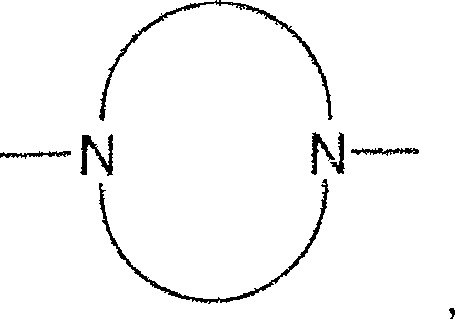


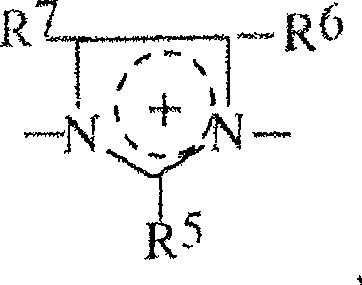
具有下式的芳族二氨基官能的杂环Aromatic diamino-functional heterocycles having the formula
具有下式的三价基团:A trivalent group having the formula:

具有下式的三价基团A trivalent group with the formula

其中在每一种情况下R是氢或一价有机基团,wherein in each case R is hydrogen or a monovalent organic group,
Q未连接到羰基碳原子上,Q is not attached to the carbonyl carbon atom,
V代表至少一个基团V1和至少一个基团V2 V represents at least one group V1 and at least one group V2
其中in
V2选自具有最高达1000个碳原子(不包括以下定义的聚硅氧烷基团Z2的碳原子)和任选包含一个或多个选自以下基团的二价的或三价的,直链的,环状的或分支的,饱和的,不饱和的或芳族的烃基: V is selected from divalent or trivalent compounds having up to 1000 carbon atoms (excluding the carbon atoms of the polysiloxane group Z as defined below) and optionally containing one or more groups selected from , linear, cyclic or branched, saturated, unsaturated or aromatic hydrocarbon groups:
-O-,-CONH-,-O-, -CONH-,
-CONR2-,其中R2是氢,具有最高达100个碳原子的一价的,直链的,环状的或分支的,饱和的,不饱和的或芳族的烃基,其可以包含一个或多个选自-O-,-NH-,-C(O)-和-C(S)-的基团,和任选地其可以被一个或多个选自以下的取代基取代:羟基基团,未取代的或取代的杂环基团,该杂环基团优选包含一个或多个氮原子,氨基,烷基氨基,二烷基氨基,铵,聚醚基团和聚醚酯基团,其中如果存在两个或多个基团-CONR2-,它们可以是相同或不同的, -CONR2- , wherein R2 is hydrogen, a monovalent, linear, cyclic or branched, saturated, unsaturated or aromatic hydrocarbon radical having up to 100 carbon atoms, which may contain one or more groups selected from -O-, -NH-, -C(O)- and -C(S)-, and optionally it may be substituted with one or more substituents selected from: hydroxyl groups, unsubstituted or substituted heterocyclic groups, which preferably contain one or more nitrogen atoms, amino groups, alkylamino groups, dialkylamino groups, ammonium groups, polyether groups and polyetherester groups group, wherein if there are two or more groups -CONR 2 -, they may be the same or different,
-C(O)-和-C(S)-,和-C(O)- and -C(S)-, and
基团V2任选地可以被一个或多个羟基基团取代,The group V can optionally be substituted by one or more hydroxyl groups,
和and
基团V2包含至少一个具有下式的基团-Z2-The group V 2 contains at least one group of the formula -Z 2 -

其中R1可以是相同的或不同的并选自C1-C22烷基,氟(C1-C10)烷基和C6-C10芳基,和n1=20-1000,wherein R 1 may be the same or different and is selected from C 1 -C 22 alkyl, fluoro(C 1 -C 10 ) alkyl and C 6 -C 10 aryl, and n 1 =20-1000,
V1选自具有最高达1000个碳原子的二价的或三价的,直链的,环状的或分支的,饱和的,不饱和的或芳族的烃基,其任选地可以包含一个或多个选自以下的基团V is selected from divalent or trivalent, linear, cyclic or branched, saturated, unsaturated or aromatic hydrocarbon radicals having up to 1000 carbon atoms, which optionally may contain a or more groups selected from the following
-O-,-CONH-,-O-, -CONH-,
-CONR2-,其中R2如以上所定义,对于基团V1和V2中的R2可以是相同的或不同的,-CONR 2 -, wherein R 2 is as defined above, R 2 in the groups V 1 and V 2 may be the same or different,
-C(O)-,-C(S)-和-Z1-,其中-Z1-是具有下式的基团-C(O)-, -C(S)- and -Z 1 -, wherein -Z 1 - is a group having the formula

其中R1如以上所定义,对于基团V1和V2中的R1可以是相同的或不同的,和wherein R 1 is as defined above, for groups V 1 and V 2 in R 1 may be the same or different, and
和n2=0-19,and n 2 =0-19,
和基团V1任选地可以被一个或多个羟基取代,and group V optionally may be substituted by one or more hydroxyl groups,
前提是The premise is
-基团V1不可以包含任何酯基-C(O)-O-和/或-O-C(O)-,- the group V may not contain any ester groups -C(O)-O- and/or -OC(O)-,
-三价基团Q和三价基团V1或V2在所述的聚硅氧烷共聚物的线性主链内彼此专门地(ausschlieβlich)饱和,- the trivalent group Q and the trivalent group V 1 or V 2 are mutually exclusively (ausschlieβlich) saturated within the linear main chain of the polysiloxane copolymer,
-所述的聚硅氧烷共聚物中的摩尔比- the molar ratio in the polysiloxane copolymer
V2/V1≠1,V 2 /V 1 ≠1,
和其中产生自铵基团的正电荷被有机或无机酸阴离子中和,and wherein the positive charge arising from the ammonium group is neutralized by an organic or inorganic acid anion,
和其酸加成盐。And its acid addition salt.
在本发明的一个优选的实施方案中Q选自In a preferred embodiment of the invention Q is selected from
-NR-,-NR-,
-N+R2-,-N + R2- ,
具有下式的饱和或不饱和的二氨基官能的杂环A saturated or unsaturated diamino-functional heterocycle having the formula


具有下式的芳族二氨基官能的杂环Aromatic diamino-functional heterocycles having the formula

其中R如以上所定义,和V1和V2是二价基团。wherein R is as defined above, and V and V are divalent groups.
在本发明的一个优选的实施方案中Q选自In a preferred embodiment of the invention Q is selected from
具有下式的氨基单元An amino unit with the formula

具有下式的铵单元Ammonium units with the formula
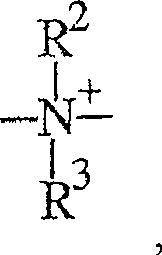
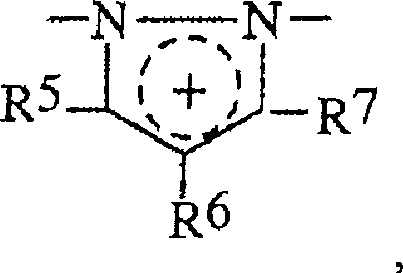
具有以下结构的季铵化咪唑单元A quaternized imidazole unit having the structure
具有以下结构的季铵化吡唑单元A quaternized pyrazole unit having the structure

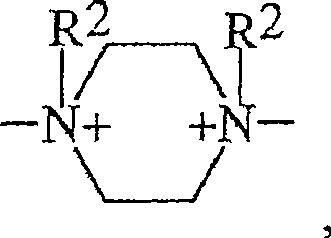
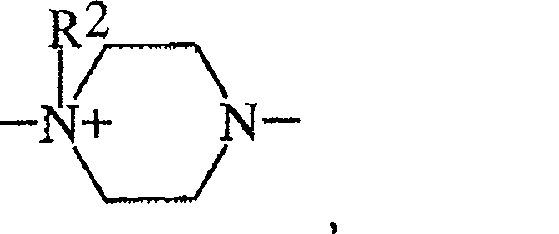
具有以下结构的双季铵化哌嗪单元Diquaternized piperazine units having the structure

具有以下结构的单季铵化哌嗪单元A monoquaternized piperazine unit having the structure
具有以下结构的单季铵化哌嗪单元A monoquaternized piperazine unit having the structure

具有以下结构的双季铵化单元A diquaternized unit with the structure

具有以下结构的单季铵化单元A single quaternized unit with the structure
具有以下结构的单季铵化单元A single quaternized unit with the structure
具有以下结构的双季铵化单元A diquaternized unit with the structure

具有以下结构的单季铵化单元A single quaternized unit with the structure

具有以下结构的单季铵化单元A single quaternized unit with the structure

其中in
t是2-10,t is 2-10,
R2如以上所定义,并且R2的定义可以与以上基团R2的定义相同或不同。R 2 is as defined above, and the definition of R 2 may be the same as or different from the definition of the group R 2 above.
R3具有R2的定义,R2和R3可以是相同的或不同的,或 R3 has the definition of R2 , R2 and R3 can be the same or different, or
R2和R3和带正电荷的氮原子一起形成五-到七-元的杂环,其任选地可以另外包含一个或多个氮,氧和/或硫原子,R 2 and R 3 and positively charged nitrogen atoms together form a five- to seven-membered heterocyclic ring, which optionally may additionally contain one or more nitrogen, oxygen and/or sulfur atoms,
R5,R6,R7可以是相同的或不同的并选自H,卤素,羟基基团,硝基基团,氰基基团,硫羟基团,羧基基团,烷基基团,一羟基烷基基团,多羟基烷基基团,硫烷基基团,氰基烷基基团,烷氧基基团,酰基基团,乙酰氧基基团,环烷基基团,芳基基团,烷基芳基基团,和类型-NHRW的基团,其中RW是H,烷基基团,一羟基烷基基团,多羟基烷基基团,乙酰基基团,脲基基团,和各自地相邻基团R5,R6和R7中的两个可以与使它们与杂环连接的碳原子形成芳族五-到七-元的环,和R 5 , R 6 , R 7 may be the same or different and are selected from H, halogen, hydroxyl group, nitro group, cyano group, thiol group, carboxyl group, alkyl group, a Hydroxyalkyl groups, polyhydroxyalkyl groups, sulfanyl groups, cyanoalkyl groups, alkoxy groups, acyl groups, acetoxy groups, cycloalkyl groups, aryl groups groups, alkylaryl groups, and groups of type-NHR W , where R W is H, alkyl groups, monohydroxyalkyl groups, polyhydroxyalkyl groups, acetyl groups, urea radical groups, and respectively adjacent groups R 5 , two of R 6 and R 7 may form an aromatic five- to seven-membered ring with the carbon atom connecting them to the heterocycle, and
R8具有R2的定义,R8和R2可以是相同的或不同的。 R8 has the definition of R2 , R8 and R2 may be the same or different.
在本发明的进一步优选的实施方案中V2是具有下式的基团In a further preferred embodiment of the invention V is a group with the formula
-V2*-Z2-V2*--V 2 *-Z 2 -V 2 *-
其中Z2如以上所定义,和V2*是具有最高达40个碳原子的二价直链环状或分支的,饱和的,不饱和的或芳族的烃基,其任选地可以包含一个或多个选自以下的基团:-O-,-CONH-,-CONR2-,其中R2如以上所定义,-C(O)-和-C(S)-,和基团V2*任选地可以被一个或多个羟基基团取代。wherein Z2 is as defined above, and V2 * is a divalent straight-chain cyclic or branched, saturated, unsaturated or aromatic hydrocarbon group having up to 40 carbon atoms, which optionally may contain a or more groups selected from: -O-, -CONH-, -CONR 2 -, wherein R 2 is as defined above, -C(O)- and -C(S)-, and the group V 2 *Optionally can be substituted with one or more hydroxyl groups.
优选V2和/或V2*不包含酯基-C(O)-O-和/或-O-C(O)-。Preferably V 2 and/or V 2 * does not contain ester groups -C(O)-O- and/or -OC(O)-.
在Q是具有下式的三价基团的情况下In case Q is a trivalent group having the formula
或

同样三价基团V1和/或V2不用于支化线性聚硅氧烷共聚物。Likewise trivalent groups V1 and/or V2 are not used for branched linear polysiloxane copolymers.
在以上提到的实施方案中,本发明的线性聚硅氧烷共聚物包含下面的重复单元:In the above mentioned embodiments, the linear polysiloxane copolymers of the present invention comprise the following repeating units:
-[V2*-Z2-V2*-Q]-和-[V1-Q]-。-[V 2 *-Z 2 -V 2 *-Q]- and -[V 1 -Q]-.
因此,重复单元-[V2*-Z2-V2*-Q]-与-[V1-Q]-的摩尔比对应比率V2/V1≠1。Thus, the molar ratio of the repeating units -[V 2 *-Z 2 -V 2 *-Q]- to -[V 1 -Q]- corresponds to the ratio V 2 /V 1 ≠1.
在这些摩尔比率的基础上,本发明的线性聚硅氧烷共聚物必须包括嵌段,该嵌段包含多于一个彼此连接的-[V1-Q]-单元。On the basis of these molar ratios, the linear polysiloxane copolymers according to the invention must comprise blocks comprising more than one -[V 1 -Q]- units linked to each other.
正如以下更深入地阐明有关本发明的制备本发明的线性聚硅氧烷共聚物的方法,似嵌段的序列(其包含多于一个彼此连接的-[V1-Q]-单元)并因此其中V2/V1是<1,规则地连接到V2-Q-单元上或不规则地连接到V2-Q-单元上,这取决于制备的模式。As explained in more detail below with respect to the process of the present invention for the preparation of the linear polysiloxane copolymers of the present invention, a block-like sequence (which comprises more than one -[V 1 -Q]-units linked to each other) and thus Where V 2 /V 1 is <1, regularly attached to V 2 -Q-units or irregularly attached to V 2 -Q-units, depending on the mode of preparation.
该意思如下:The meaning is as follows:
在规则连接的情况下,其中,例如,对应于基团-Q-[V1-Q]x-的预聚物与对应于V2的单体单元以摩尔比1:1反应,线性聚硅氧烷共聚物可以由如下代表:In the case of regular linkage, where, for example, a prepolymer corresponding to the group -Q-[ V1 -Q] x- reacts with a monomer unit corresponding to V2 in a molar ratio of 1:1, the linear polysilicon Oxyalkylene copolymers can be represented by:
-{V2-Q-[V1-Q]x-}-。-{V 2 -Q-[V 1 -Q] x -}-.
这里x优选可以是1.01-2000并且是平均值。由式-{V2-Q-[V1-Q]x-}-代表的线性聚硅氧烷共聚物特征在于它们基本不包含相互连接的-V2-Q-单元,或,换句话,两个-V2-Q-单元总是被至少一个-V1-Q-单元间断。Here x can preferably be 1.01-2000 and is an average value. Linear polysiloxane copolymers represented by the formula -{V 2 -Q-[V 1 -Q] x -}- are characterized in that they contain substantially no interconnected -V 2 -Q- units, or, in other words , two -V 2 -Q- units are always interrupted by at least one -V 1 -Q- unit.
如果V2/V1>1,那么上式中的x优选是大约0.001-0.99。在这种情况下线性聚硅氧烷共聚物包含至少一种相互连接的-V2-Q-单元,或,换句话,两个V1-Q-单元总是被至少一个V2-Q-单元间断。If V 2 /V 1 >1, x in the above formula is preferably about 0.001-0.99. In this case the linear polysiloxane copolymer comprises at least one interconnected -V 2 -Q- unit, or, in other words, two V 1 -Q- units are always surrounded by at least one V 2 -Q - Cell discontinuity.
在不规则连接的情况下,其中,例如,对应于Q单元的单体与对应于V1的单体单元和对应于V2的单体单元以比率Q/(V1+V2)等于1:1反应,其中V2/V1≠1,线性聚硅氧烷共聚物可以由如下代表:In the case of irregular linkage, where, for example, the monomer corresponding to the Q unit is equal to 1 with the monomer unit corresponding to V 1 and the monomer unit corresponding to V 2 in a ratio Q/(V 1 +V 2 ) :1 reaction, where V 2 /V 1 ≠ 1, the linear polysiloxane copolymer can be represented by:
-Q-(V1,V2)-,-Q-(V 1 , V 2 )-,
其中比率V2/V1≠1。在这种情况下基团V1和V2在共聚物链上随机分布。与通过规则连接制备的线性聚硅氧烷共聚物不同,该共聚物也可以包含相邻的-Q-V2-和/或-Q-V1-单元。where the ratio V 2 /V 1 ≠1. In this case the groups V1 and V2 are randomly distributed on the copolymer chain. Unlike linear polysiloxane copolymers which are prepared by regular linkages, the copolymers may also contain adjacent -QV 2 - and/or -QV 1 - units.
在本发明的进一步优选的实施方案中,基团V1选自具有最高达400个碳原子的二价,直链,环状或分支的,饱和的,不饱和的或芳族的烃基,其任选地可以包含一个或多个选自-O-,-CONH-,-CONR2-,其中R2如以上所定义,-C(O)-,-C(S)-和-Z1-的基团,其中-Z1-是具有下式的基团In a further preferred embodiment of the invention, the group V is selected from divalent, straight-chain, cyclic or branched, saturated, unsaturated or aromatic hydrocarbon radicals having up to 400 carbon atoms, which Optionally may contain one or more selected from -O-, -CONH-, -CONR 2 -, wherein R 2 is as defined above, -C(O)-, -C(S)- and -Z 1 - A group, wherein -Z 1 - is a group having the formula
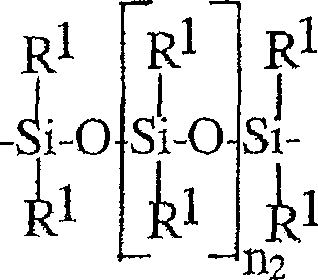
其中in
R1是C1-C3烷基,氟(C3-C6)烷基或C6芳基,n2如以上所定义。R 1 is C 1 -C 3 alkyl, fluoro(C 3 -C 6 ) alkyl or C 6 aryl, and n 2 is as defined above.
在本发明的进一步优选的实施方案中基团Q选自:In a further preferred embodiment of the invention the group Q is selected from:

具有以下结构的季铵化咪唑单元A quaternized imidazole unit having the structure
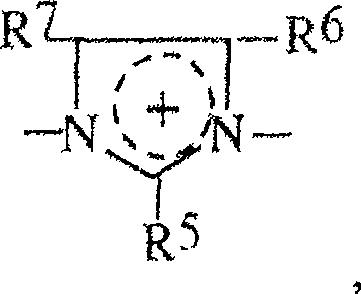
具有以下结构的季铵化吡唑单元A quaternized pyrazole unit having the structure

具有以下结构的双季铵化哌嗪单元Diquaternized piperazine units having the structure

具有以下结构的单季铵化哌嗪单元A monoquaternized piperazine unit having the structure

具有以下结构的单季铵化哌嗪单元A monoquaternized piperazine unit having the structure

具有以下结构的单季铵化单元A single quaternized unit with the structure

其中R2,R3,R4,R5,R6,R7和R8如以上所定义。wherein R 2 , R 3 , R 4 , R 5 , R 6 , R 7 and R 8 are as defined above.
在本发明的进一步优选的实施方案中,特别是在优选本发明的线性聚硅氧烷共聚物的增加的亲水性的应用中,摩尔比V2/V1符合关系In a further preferred embodiment of the invention, especially in applications where the increased hydrophilicity of the linear polysiloxane copolymers of the invention is preferred, the molar ratio V 2 /V 1 follows the relationship
V2/V1<1V 2 /V 1 <1
更优选符合关系more preferably conforms to the relationship
0.0005<V2/V1<0.9,0.0005<V 2 /V 1 <0.9,
非常优选符合关系Very preferred to match the relationship
0.005<V2/V1<0.8,0.005<V 2 /V 1 <0.8,
最优选符合关系The best fit relationship
0.01<V2/V1<0.5。0.01<V 2 /V 1 <0.5.
在本发明的进一步优选的实施方案中,特别是在优选本发明的线性聚硅氧烷共聚物的增加的柔软性和持久的直接性的应用中,例如在某种织物整理的情况下,摩尔比V2/V1符合关系In a further preferred embodiment of the invention, especially in applications where increased softness and permanent substantivity of the linear polysiloxane copolymers of the invention are preferred, for example in the case of certain textile finishing, the molar The ratio V 2 /V 1 conforms to the relationship
V2/V1>1,V 2 /V 1 >1,
更优选符合关系more preferably conforms to the relationship
1<V2/V1<1000,1<V 2 /V 1 <1000,
非常优选符合关系Very preferred to match the relationship
1.1<V2/V1<100,1.1<V 2 /V 1 <100,
最优选符合关系The best fit relationship
2<V2/V1<20。2<V 2 /V 1 <20.
优选:Preferred:
R1=C1-C18烷基,特别是甲基,乙基,全氟烷基亚乙基(Perfluoralkylethylen),例如三氟丙基和苯基。R 1 =C 1 -C 18 alkyl, especially methyl, ethyl, perfluoroalkylethylene, eg trifluoropropyl and phenyl.
n1=20-400,更优选20-300,特别优选20-200。在进一步优选的实施方案中,n1是20-50或80-200。数字n1是基团Z2中二有机甲硅烷氧基单元的平均聚合度。n 1 =20-400, more preferably 20-300, particularly preferably 20-200. In a further preferred embodiment n 1 is 20-50 or 80-200. The number n1 is the average degree of polymerization of the diorganosiloxy units in the group Z2 .
n2=0-15,更优选0-10,特别优选0-5,特别是0。数字n2是基团Z1中来自二有机甲硅烷氧基单元的Mn的平均聚合度。n 2 =0-15, more preferably 0-10, particularly preferably 0-5, especially 0. The number n2 is the average degree of polymerization of the Mn from the diorganosiloxy units in the group Z1 .
V2*=二价直链的,环状或分支的,饱和的,不饱和的C3-C16烃基或芳族C8-C20烃基,其任选地可以包含一个或多个选自-O-,-CONH-,-CONR2-,-C(O)-,-C(S)-的基团并可以被一个或多个OH基团取代,其中V 2 * = divalent linear, cyclic or branched, saturated, unsaturated C 3 -C 16 hydrocarbon group or aromatic C 8 -C 20 hydrocarbon group, which may optionally contain one or more -O-, -CONH-, -CONR 2 -, -C(O)-, -C(S)- and may be substituted by one or more OH groups, wherein
R2=氢,一价直链的,环状或分支的,饱和的,不饱和的C1-C16烃基或芳族C6-C16烃基,其可以包含一个或多个选自-O-,-NH-,-C(O)-和-C(S)-的基团并且任选地可以被一个或多个羟基基团取代,其中,如果存在两个或多个基团-NR2-,它们可以是相同的或不同的,R 2 = hydrogen, monovalent linear, cyclic or branched, saturated, unsaturated C 1 -C 16 hydrocarbon group or aromatic C 6 -C 16 hydrocarbon group, which may contain one or more selected from -O -, -NH-, -C(O)- and -C(S)- groups and optionally may be substituted by one or more hydroxyl groups, wherein, if two or more groups are present -NR 2 -, they can be the same or different,
Q=Q=

具有以下结构的季铵化咪唑单元A quaternized imidazole unit having the structure

具有以下结构的双季铵化哌嗪单元Diquaternized piperazine units having the structure
具有以下结构的单季铵化哌嗪单元A monoquaternized piperazine unit having the structure

具有以下结构的单季铵化哌嗪单元A monoquaternized piperazine unit having the structure

具有以下结构的单季铵化单元A single quaternized unit with the structure

其中R2,R3,R4,R5,R6,R7和R8如以上所定义。wherein R 2 , R 3 , R 4 , R 5 , R 6 , R 7 and R 8 are as defined above.
特别优选:Especially preferred:
V2*是具有最高达16个碳原子的二价直链的,环状或分支的,饱和的,不饱和的或芳族的烃基,其可以包含一个或多个选自-O-,-CONH-,-CONR2-,其中R2如以上所定义,-C(O)-和-C(S)-的基团,并可以被一个或多个羟基基团取代。更优选-V2*-选自具有下式的基团:V 2 * is a divalent straight-chain, cyclic or branched, saturated, unsaturated or aromatic hydrocarbon group having up to 16 carbon atoms, which may contain one or more selected from -O-,- CONH-, -CONR 2 -, wherein R 2 is as defined above, are groups of -C(O)- and -C(S)-, and may be substituted by one or more hydroxyl groups. More preferably -V 2 *- is selected from groups having the formula:
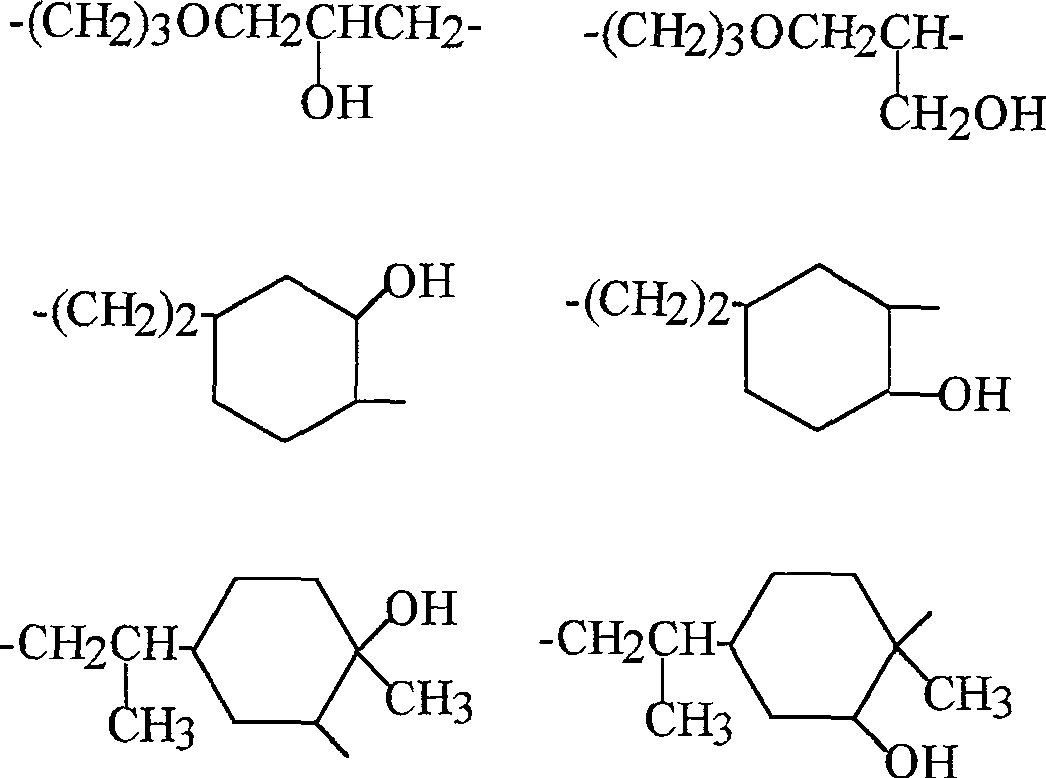
-(CH2)2-,-(CH2)3-,-(CH2)4-,-(CH2)5-,-(CH2)6-,-(CH 2 ) 2 -, -(CH 2 ) 3 -, -(CH 2 ) 4 -, -(CH 2 ) 5 -, -(CH 2 ) 6 -,
-CH=CHCH2-,-CH=CHCH2CH2-,-CH=CHCH 2 -, -CH=CHCH 2 CH 2 -,
-CH2CH2CH2OC(O)CH2-,-CH2CH2CH2OC(O)CH2CH2-, -CH2CH2CH2OC ( O ) CH2- , -CH2CH2CH2OC (O ) CH2CH2- ,
-CH=CHCH2OC(O)CH2-,-CH=CHCH2OC(O)CH2CH2-,-CH=CHCH 2 OC(O)CH 2 -, -CH=CHCH 2 OC(O)CH 2 CH 2 -,

其中v+w≥0,where v+w≥0,


-(CH2)3-,-(CH2)4-,-(CH2)5-,-(CH2)6-,-(CH 2 ) 3 -, -(CH 2 ) 4 -, -(CH 2 ) 5 -, -(CH 2 ) 6 -,
-CH=CHCH2-,-CH=CHCH2CH2-,-CH=CHCH 2 -, -CH=CHCH 2 CH 2 -,
-CH2CH2CH2OC(O)CH2-,-CH2CH2CH2OC(O)CH2CH2-, -CH2CH2CH2OC ( O ) CH2- , -CH2CH2CH2OC (O ) CH2CH2- ,
R2优选是: R2 is preferably:
氢,-CH3,-CH2CH3,-(CH2)2CH3,-(CH2)3CH3,-(CH2)5CH3,-CH2CH2OH,Hydrogen, -CH 3 , -CH 2 CH 3 , -(CH 2 ) 2 CH 3 , -(CH 2 ) 3 CH 3 , -(CH 2 ) 5 CH 3 , -CH 2 CH 2 OH,

其中in
R4=直链的,环状或分支的C1-C18烃基,其可以包含一个或多个选自-O-,-NH-,-C(O)-和-C(S)-的基团并可以被一个或多个OH基团取代,特别是未取代的C5-C17烃基,其衍生自相应的脂肪酸或其它可以追溯到羟基化的羧酸,特别是糖类羧酸的羟基化的C3-C17烃基,和非常特别地是R 4 = linear, cyclic or branched C 1 -C 18 hydrocarbon group, which may contain one or more selected from -O-, -NH-, -C(O)- and -C(S)- group and may be substituted by one or more OH groups, especially unsubstituted C 5 -C 17 hydrocarbon groups derived from the corresponding fatty acids or other carboxylic acids which can be traced back to hydroxylation, especially of sugar carboxylic acids Hydroxylated C 3 -C 17 hydrocarbyl, and very especially

进一步地,R2优选是:Further, R2 is preferably:


V2优选是 V2 is preferably
■-R9,其中R9是具有2-25个碳原子的二价的,饱和的或一-或多不饱和的,直链或分支的烃基,■-R 9 , wherein R 9 is a divalent, saturated or mono- or polyunsaturated, linear or branched hydrocarbon group having 2-25 carbon atoms,
■-(CH2)u-R10-(CH2)u-,其中R10是芳族基团,-(CH 2 ) u -R 10 -(CH 2 ) u -, wherein R 10 is an aromatic group,
■-[CH2CH2O]q-[CH2CH(CH3)O]r-CH2CH2-,-[ CH2CH2O ] q- [ CH2CH ( CH3 )O] r - CH2CH2- ,
■-CH(CH3)CH2O[CH2CH2O]q-[CH2CH(CH3)O]r-CH2CH(CH3)--CH(CH 3 )CH 2 O[CH 2 CH 2 O] q -[CH 2 CH(CH 3 )O] r -CH 2 CH(CH 3 )-
■-CH2CH(OH)CH2-, -CH2CH (OH) CH2- ,
■-CH2CH(OH)(CH2)2CH(OH)CH2-, -CH2CH (OH)( CH2 ) 2CH (OH) CH2- ,
■-CH2CH(OH)CH2OCH2CH(OH)CH2OCH2CH(OH)CH2-和-CH 2 CH(OH)CH 2 OCH 2 CH(OH)CH 2 OCH 2 CH(OH)CH 2 -and
■-CH2CH(OH)CH2O-[CH2CH2O]q-[CH2CH(CH3)O]r-CH2CH(OH)CH2--CH 2 CH(OH)CH 2 O-[CH 2 CH 2 O] q -[CH 2 CH(CH 3 )O] r -CH 2 CH(OH)CH 2 -
其中in
u是1-3,q和r是0-200,优选0-100,更优选0-70,和特别优选0-40,和u is 1-3, q and r are 0-200, preferably 0-100, more preferably 0-70, and particularly preferably 0-40, and
q+r>0。q+r>0.
V1优选的变换形式是The preferred transformation form of V 1 is
亚烷基,亚烯基,亚炔基和芳基单元,特别是具有结构-[CH2]o-的那些Alkylene, alkenylene, alkynylene and aryl units, especially those having the structure -[ CH2 ] o-
其中o=2-6,where o=2-6,
-CH2C≡CCH2-,-CH2CH=CHCH2-,-CH(CH3)CH2CH2-,-CH 2 C≡CCH 2 -, -CH 2 CH=CHCH 2 -, -CH(CH 3 )CH 2 CH 2 -,

聚环氧烷烃单元,特别是具有一-,二-或多羟基官能单元的以下结构的那些Polyalkylene oxide units, especially those having the following structure of mono-, di- or polyhydroxy functional units
-[CH2CH2O]q-[CH2CH(CH3)O]r-CH2CH2-,-[CH 2 CH 2 O] q -[CH 2 CH(CH 3 )O] r -CH 2 CH 2 -,
-CH(CH3)CH2O[CH2CH2O]q-[CH2CH(CH3)O]r-CH2CH(CH3)--CH(CH 3 )CH 2 O[CH 2 CH 2 O] q -[CH 2 CH(CH 3 )O] r -CH 2 CH(CH 3 )-
特别是具有以下结构的那些In particular those with the following structure
-CH2CH(OH)CH2-,-CH2CH(OH)(CH2)2CH(OH)CH2-, -CH2CH (OH) CH2- , -CH2CH (OH)( CH2 ) 2CH (OH) CH2- ,
-CH2CH(OH)CH2OCH2CH(OH)CH2OCH2CH(OH)CH2-, -CH2CH ( OH) CH2OCH2CH ( OH) CH2OCH2CH (OH) CH2- ,
-CH2CH(OH)CH2O-[CH2CH2O]q-[CH2CH(CH3)O]r-CH2CH(OH)CH2--CH 2 CH(OH)CH 2 O-[CH 2 CH 2 O] q -[CH 2 CH(CH 3 )O] r -CH 2 CH(OH)CH 2 -
其中in
q=0-200,q=0-200,
r=0-200r=0-200
优选q=1-50,特别2-50,更特别1-20,非常特别1-10,和1或2,r=0-100,特别0-50,更特别0-20,非常特别0-10,和0或1或2。Preferably q=1-50, particularly 2-50, more particularly 1-20, very particularly 1-10, and 1 or 2, r=0-100, particularly 0-50, more particularly 0-20, very particularly 0- 10, and 0 or 1 or 2.
本发明进一步提供了制备本发明的线性聚硅氧烷的方法,其中The present invention further provides a process for the preparation of the linear polysiloxanes of the present invention, wherein
a)至少一种选自二胺化合物和/或伯或仲一胺化合物的胺化合物与至少两种能够与胺化合物的氨基官能团反应的双官能有机化合物反应,选择有机化合物的摩尔比以便满足条件V2/V1≠1,a) at least one amine compound selected from diamine compounds and/or primary or secondary monoamine compounds is reacted with at least two difunctional organic compounds capable of reacting with the amino functional groups of the amine compounds, the molar ratio of the organic compounds being selected so as to satisfy the condition V 2 /V 1 ≠1,
b)至少两摩尔选自二胺化合物和/或伯或仲一胺化合物的胺化合物与一摩尔能够与胺化合物的氨基官能团反应的双官能有机化合物反应,以形成二胺化合物(单体),其随后与至少一种选自二胺化合物和/或伯或仲一胺化合物的胺化合物和与至少一种能够与胺化合物的氨基官能团反应的进一步的双官能有机化合物反应,b) reacting at least two moles of amine compounds selected from diamine compounds and/or primary or secondary monoamine compounds with one mole of difunctional organic compounds capable of reacting with the amino functional groups of the amine compounds to form diamine compounds (monomers), which is subsequently reacted with at least one amine compound selected from diamine compounds and/or primary or secondary monoamine compounds and with at least one further difunctional organic compound capable of reacting with the amino functional groups of the amine compound,
c)选自二胺化合物和/或伯或仲一胺化合物的胺化合物与能够与胺化合物的氨基官能团反应的双官能有机化合物反应,以形成二胺化合物(氨基封端的低聚物),其随后与至少一种能够与二胺化合物的氨基官能团反应的双官能有机化合物反应,c) an amine compound selected from diamine compounds and/or primary or secondary monoamine compounds is reacted with a bifunctional organic compound capable of reacting with the amino functional groups of the amine compound to form a diamine compound (amino-terminated oligomer), which Subsequent reaction with at least one difunctional organic compound capable of reacting with the amino functional groups of the diamine compound,
d)选自二胺化合物和/或伯或仲一胺化合物的胺化合物与能够与胺化合物的氨基官能团反应的双官能有机化合物反应,以形成能够与氨基官能团反应的双官能化合物(双官能低聚物),其随后与至少一种选自二胺化合物和/或伯或仲一胺化合物的胺化合物和与至少一种能够与氨基官能团反应的进一步的化合物反应,d) an amine compound selected from diamine compounds and/or primary or secondary monoamine compounds is reacted with a difunctional organic compound capable of reacting with the amino functional group of the amine compound to form a difunctional compound capable of reacting with the amino functional group (difunctional low polymer), which is subsequently reacted with at least one amine compound selected from diamine compounds and/or primary or secondary monoamine compounds and with at least one further compound capable of reacting with amino functional groups,
其中,任选地可以添加作为链终止剂的单官能,优选叔,一胺或合适的不能链增长的一胺和/或能够与氨基官能团反应的一官能化合物,并且在反应的最后阶段氨基官能团和能够与氨基官能团反应的官能团的化学计量总是大约1:1,并且其中任选存在的氨基官能团可以被质子化,烷基化或季铵化。Wherein, optionally a monofunctional, preferably tertiary, monoamine or a suitable monoamine which cannot be chain-extended and/or a monofunctional compound capable of reacting with the amino functional group can be added as a chain terminator, and in the final stage of the reaction the amino functional group The stoichiometry of the functional groups capable of reacting with the amino functions is always approximately 1:1, and where the optionally present amino functions can be protonated, alkylated or quaternized.
变换方法a),其中至少一种选自二胺化合物和/或伯或仲一胺化合物的二胺化合物与至少两种能够与胺化合物的氨基官能团反应的双官能有机化合物反应,选择有机化合物的摩尔比以便满足条件V2/V1≠1,因此,例如,可以用图描述如下:Transformation method a), wherein at least one diamine compound selected from diamine compounds and/or primary or secondary monoamine compounds is reacted with at least two difunctional organic compounds capable of reacting with the amino functional groups of the amine compounds, the selected organic compound The molar ratio is such that the condition V 2 /V 1 ≠ 1 is satisfied, so, for example, can be described graphically as follows:
-[N-N]-+-[V1]-+-[V2]-→-[Q-(V1,V2)]-或-[NN]-+-[V 1 ]-+-[V 2 ]-→-[Q-(V 1 , V 2 )]- or
-[N]-+-[V1]-+-[V2]-→-[Q-(V1,V2)]--[N]-+-[V 1 ]-+-[V 2 ]-→-[Q-(V 1 , V 2 )]-
其中-[N-N]-可以包括对应于Q的定义的环状二胺或包含V1的二胺-[N-V1-N]-或包含V2的二胺-[N-V2-N]-,例如,特别地,-[N-V2*-Z2-V2*-N]-,在每一种情况下后者产生了两个Q单元和/或一个V1和/或两个V2单元,其中-[V1]-和-[V2]-用来表示对应于重复单元V1和V2的单体,和-[N]-表示适合链增长的伯或仲一胺。where -[NN]- may comprise a cyclic diamine corresponding to the definition of Q or a diamine comprising V 1 -[NV 1- N]- or a diamine comprising V 2 -[NV 2 -N]-, e.g. , in particular, -[ NV2 * -Z2 - V2 *-N]-, the latter yielding in each case two Q cells and/or one V1 and/or two V2 cells, Wherein -[V 1 ]- and -[V 2 ]- are used to represent monomers corresponding to repeating units V 1 and V 2 , and -[N]- represents a primary or secondary monoamine suitable for chain extension.
在这种情况下至少一种更高烷基化胺单元或季铵单元Q由-[N-N]-和/或-[N]-单元形成,对于在聚合过程中形成的仲或叔胺基官能团,可以任选地在聚合后的单独步骤中被质子化或季铵化。优选形成季铵单元。In this case at least one higher alkylated amine unit or quaternary ammonium unit Q is formed from -[N-N]- and/or -[N]- units, for secondary or tertiary amine functional groups formed during the polymerization , can optionally be protonated or quaternized in a separate step after polymerization. Preference is given to the formation of quaternary ammonium units.
-[N-N]-优选的例子更详尽的描述如下:哌嗪和咪唑;优选的二胺单元-[N-V1-N]-包括,例如:聚亚甲基二胺,例如四甲基-六亚甲基二胺,α,ω-二氨基封端的聚醚,例如Jeffamine等。-[NN]- Preferred examples are described in more detail as follows: piperazine and imidazole; preferred diamine units -[NV 1 -N]- include, for example: polymethylenediamine, such as tetramethyl-hexamethylene Methyldiamine, α,ω-diamino-terminated polyethers, such as Jeffamine, etc.
优选的二胺单元-[N-V2*-Z2-V2*-N]-包括,例如,α,ω-二氢聚二烷基硅氧烷和烯丙基胺的反应产物。Preferred diamine units - [NV 2 *-Z 2 -V 2 *-N] - include, for example, the reaction product of α,ω-dihydropolydialkylsiloxane and allylamine.
-[N]-优选的例子更详尽的描述如下,例如,二甲基胺。- [N] - Preferred examples are described in more detail below, eg, dimethylamine.
优选使用二胺-[N-N]-本身。Preference is given to using the diamine -[N-N]- itself.
优选的-[V1]-单体包括,例如,表氯醇,双环氧化合物或双丙烯酸酯。也可以优选所述的-[V1]-单体混合物,例如表氯醇,双氯烷基酯或双环氧化合物的混合物反应。Preferred -[V 1 ]-monomers include, for example, epichlorohydrin, diepoxides or diacrylates. Preference is also given to reacting said -[V 1 ]-monomer mixtures, for example mixtures of epichlorohydrin, dichloroalkyl esters or diepoxides.
优选的-[V2]-单体是具有式-[V2*-Z2-V2*]-的单体,其中Z2是如以上所定义,和-[V2*]-代表对应于重复单元V2*的官能化基团。为形成V2重复单元优选的-[V2]-单体特别地是α,ω-双环氧封端的聚二烷基硅氧烷。Preferred -[V 2 ]-monomers are those having the formula -[V 2 *-Z 2 -V 2 *]-, wherein Z 2 is as defined above, and -[V 2 *]- represents the corresponding A functional group on the repeating unit V 2 *. Preferred —[V 2 ]-monomers for forming V 2 repeat units are in particular α,ω-diepoxy-terminated polydialkylsiloxanes.
变换方法b既可以用二胺-[N-N]-,也可以用合适的一胺-[N]-进行,并且可以例如用图代表如下:Transformation b can be carried out both with diamines -[N-N]- and with suitable monoamines -[N]- and can be represented graphically, for example, as follows:
变换方法b1)Transformation method b1)
步骤1):2-[N-N]-+-[V2]-或-[V1]-→-[N-N-V1-N-N]-或-[N-N-V2-N-N]-Step 1): 2-[NN]-+-[V 2 ]-or-[V 1 ]-→-[NNV 1 -NN]-or-[NNV 2 -NN]-
步骤2.1):-[N-N-V2-N-N]-+-[V1]-+-[N-N]-→,Step 2.1): -[NNV 2 -NN]-+-[V 1 ]-+-[NN]-→,
步骤2.2):-[N-N-V1-N-N]-+-[V2]-+-[N-N]-→,Step 2.2): -[NNV 1 -NN]-+-[V 2 ]-+-[NN]-→,
选择化学计量以便满足条件V2/V1<1:3。The stoichiometry is chosen so as to satisfy the condition V 2 /V 1 <1:3.
关于优选使用的单体单元-[N-N]-,-[V1]-和-[V2]-,在步骤a)所述的那些是适用的。With regard to the preferably used monomer units -[NN]-, -[V 1 ]- and -[V 2 ]-, those stated in step a) apply.
变换方法b2)Transformation method b2)
步骤1):2-[N]-+-[V2]-或-[V1]-→-[N-V1-N]-或-[N-V2-N]-Step 1): 2-[N]-+-[V 2 ]-or-[V 1 ]-→-[NV 1 -N]-or-[NV 2 -N]-
步骤2.1):-[N-V2-N]-+-[V1]-+-[N]-→,Step 2.1): -[NV 2 -N]-+-[V 1 ]-+-[N]-→,
步骤2.2):-[N-V1-N]-+-[V2]-+-[N]-→,Step 2.2): -[NV 1 -N]-+-[V 2 ]-+-[N]-→,
仅仅用伯或仲一胺化合物进行该变换方法是可能的,正如以上提到的,并且其中关于优选使用的单体单元-[N]-,-[V1]-和-[V2]-,在步骤a)所述的那些是适用的。It is possible to carry out the conversion process only with primary or secondary monoamine compounds, as mentioned above, and wherein with respect to the preferably used monomer units -[N]-, -[V 1 ]- and -[V 2 ]- , those described in step a) are applicable.
变换方法c)可以例如用图描述如下:Transformation method c) can for example be described graphically as follows:
变换方法c1)Transformation method c1)
步骤1):-[N-N]-+-[V1]-→-[N-N-(V1-N-N)x]-Step 1): -[NN]-+-[V 1 ]-→-[NN-(V 1 -NN) x ]-
步骤2):-[N-N-(V1-N-N)x]-+-[V2]-→Step 2): -[NN-(V 1 -NN) x ]-+-[V 2 ]-→
其中关于优选使用的单体单元-[N-N]-,-[V1]-和-[V2]-,在步骤a)所述的那些是适用的。Wherein with regard to the preferably used monomer units -[NN]-, -[V 1 ]- and -[V 2 ]-, those stated in step a) apply.
变换方法c2)Transformation method c2)
步骤1):-[N]-+-[V1]-→-[N-(V1-N)x]-Step 1): -[N]-+-[V 1 ]-→-[N-(V 1 -N) x ]-
步骤2):-[N-(V1-N)x]-+-[V2]-→Step 2): -[N-(V 1 -N) x ]-+-[V 2 ]-→
其中关于优选使用的单体单元-[N]-,-[V1]-和-[V2]-,在步骤a)所述的那些是适用的。Wherein with regard to the preferably used monomer units -[N]-, -[V 1 ]- and -[V 2 ]-, those stated in step a) apply.
变换方法d)可以例如用图描述如下:Transformation method d) can for example be described graphically as follows:
变换方法d1)Transformation method d1)
步骤1):-[V1]-+-[N-N]-→-[V1-(N-N-V1)x]-Step 1): -[V 1 ]-+-[NN]-→-[V 1 -(NNV 1 ) x ]-
步骤2):-[V1-(N-N-V1)x]-+-[V2]-+-[N]-或-[N-N]-→Step 2): -[V 1 -(NNV 1 ) x ]-+-[V 2 ]-+-[N]- or -[NN]-→
其中关于优选使用的单体单元-[N-N]-,-[V1]-和-[V2]-,在步骤a)所述的那些是适用的。Wherein with regard to the preferably used monomer units -[NN]-, -[V 1 ]- and -[V 2 ]-, those stated in step a) apply.
变换方法d2)Transformation method d2)
步骤1):-[V1]-+-[N]-→-[V1-(N-V1)x]-Step 1): -[V 1 ]-+-[N]-→-[V 1 -(NV 1 ) x ]-
步骤2):-[V1-(N-V1)x]-+-[V2]-+-[N]-或-[N-N]-→Step 2): -[V 1 -(NV 1 ) x ]-+-[V 2 ]-+-[N]- or -[NN]-→
其中关于优选使用的单体单元-[N]-,-[V1]-和-[V2]-,在步骤a)所述的那些是适用的。Wherein with regard to the preferably used monomer units -[N]-, -[V 1 ]- and -[V 2 ]-, those stated in step a) apply.
对于以上用图描述的所有变换方法,也可以使用一胺-[N]-和二胺-[N-N]-的混合物。For all transformations described above diagrammatically, it is also possible to use mixtures of monoamines-[N]- and diamines-[N-N]-.
特别优选的能够与氨基官能团反应的双官能化合物的官能团选自环氧基团和卤代烷基基团。Particularly preferred functional groups of difunctional compounds capable of reacting with amino functional groups are selected from epoxy groups and haloalkyl groups.
对于本发明的线性聚硅氧烷共聚物的合成优选的起始点是具有以下通式的α,ωSi-H官能化的硅氧烷A preferred starting point for the synthesis of the linear polysiloxane copolymers of the invention are α,ωSi-H functionalized siloxanes having the general formula

其中R1如以上所定义,和根据希望的重复单元V1或V2,n是n2或n1,其如以上多定义。当它们不能商购时,这些硅氧烷可以通过已知的方法,例如通过平衡化(equilibration)(Silicone,Chemie undTechnologie,Vulkan-Verlag,Essen 1989,82-84页)制备。wherein R 1 is as defined above, and n is n 2 or n 1 depending on the desired repeating unit V 1 or V 2 , which is as defined above. When they are not commercially available, these siloxanes can be prepared by known methods, for example by equilibration (Silicone, Chemie und Technologie, Vulkan-Verlag, Essen 1989, pp. 82-84).
结构单元V2*和Q的初始加入可以例如以两种方法进行。The initial addition of the structural units V 2 * and Q can be carried out, for example, in two ways.
一方面可以首先通过氢化硅烷化在α,ω位置上直接连接携带叔胺基官能团的不饱和结构,例如N,N-二甲基烯丙基胺到硅氧烷上。该操作是常识。(B.Marciniec,Comprehensive Handbook onHydrosilylation,Pergamon Press,Oxford 1992,122-124页)。On the one hand, an unsaturated structure carrying a tertiary amino functional group, such as N, N-dimethylallylamine, can be directly attached to the siloxane at the α, ω position by hydrosilylation. This operation is common sense. (B. Marciniec, Comprehensive Handbook on Hydrosilylation, Pergamon Press, Oxford 1992, pp. 122-124).
另一方面优选首先通过氢化硅烷化产生活性α,ω-官能化的中间体,其随后可以转化成α,ω-二叔胺基结构或直接转化成本发明的季铵结构。对于产生活性中间体合适的起始材料是例如卤代烯烃或炔烃,特别是烯丙基氯,烯丙基溴,氯丙炔和氯丁炔,不饱和的卤代羧酸酯,特别是氯乙酸烯丙基酯,氯乙酸炔丙基酯,3-氯丙酸烯丙基酯和3-氯丙酸炔丙基酯,和环氧官能的烯烃,例如乙烯基环己烯氧化物和烯丙基缩水甘油醚。用以上提到的物质组的代表氢化硅烷化的通常步骤同样是已知的(B.Marciniec,Comprehensive Handbook onHydrosilylation,Pergamon Press,Oxford 1992,116-121,127-130,134-137,151-155页)。On the other hand, preference is given to firstly producing active α,ω-functionalized intermediates by hydrosilylation, which can subsequently be converted into α,ω-ditertiary amino structures or directly into quaternary ammonium structures according to the invention. Suitable starting materials for the generation of reactive intermediates are, for example, halogenated alkenes or alkynes, especially allyl chloride, allyl bromide, chloropropyne and chlorobutyne, unsaturated halogenated carboxylates, especially Allyl chloroacetate, propargyl chloroacetate, allyl 3-chloropropionate and propargyl 3-chloropropionate, and epoxy-functional olefins such as vinylcyclohexene oxide and Allyl Glycidyl Ether. The usual steps of hydrosilylation with representatives of the above mentioned substance groups are likewise known (B. Marciniec, Comprehensive Handbook on Hydrosilylation, Pergamon Press, Oxford 1992, 116-121, 127-130, 134-137, 151-155 Page).
在随后的步骤中活性中间体之后可以与携带仲胺基官能团的化合物反应。合适的代表是N,N-二烷基胺,例如二甲基胺,二乙基胺,二丁基胺,二乙醇胺和N-甲基葡糖胺,环状仲胺,例如吗啉和哌啶,携带仲胺官能团的氨基酰胺,例如二亚乙基三胺或二亚丙基三胺与环内酯,例如γ-丁内酯,葡糖酸-δ-内酯和吡喃葡糖苷基阿拉伯酸内酯
作为在实施方式中优选使用的环氧化物衍生物的共同组分(Partner),特别合适的是所列的仲-叔二胺以及咪唑和吡唑。以此方式,烷基化可以区域选择性地并且没有另外花费地导向带有氢原子的氮原子。Particularly suitable as co-components of the epoxide derivatives used preferably in the embodiments are the listed secondary-tertiary diamines as well as imidazoles and pyrazoles. In this way, the alkylation can be directed regioselectively and without additional expense to nitrogen atoms bearing hydrogen atoms.
为了确保活性基团到叔胺基结构的定量转化,以1≤∑仲胺基官能团:活性基团≤10,优选1-3,特别]-2,非常特别1的比率使用二胺。任选地必须除去过量的胺。In order to ensure quantitative conversion of active groups into tertiary amino structures, diamines are used in a ratio of 1≦Σsecondary amino functional group:active group≦10, preferably 1-3, especially ]-2, very especially 1. Optionally excess amine must be removed.
以上描述的α,ω-二叔胺基硅氧烷与对应于V1的单体单元-[V1]-或与预聚物单元-[V1-(Q-V1)x]-的连接,导致了更高烷基化胺和/或季铵单元的形成,并可以以两种有利的方式再次发生。Linkage of the above-described α,ω-ditertiary aminosiloxanes to monomer units corresponding to V 1 -[V 1 ]- or to prepolymer units -[V 1 -(QV 1 ) x ]-, This leads to the formation of higher alkylated amine and/or quaternary ammonium units and can occur again in two advantageous ways.
一方面单独优选产生强亲水性的、聚季铵的、双官能的预缩合物-[V1-(Q-V1)x]-,其在合适的时间点与α,ω-二叔胺基硅氧烷结合并反应产生了聚季铵硅氧烷共聚物。On the one hand, strongly hydrophilic, polyquaternium, difunctional precondensates -[V 1 -(QV 1 ) x ]- are preferably produced alone, which at a suitable point in time combine with α,ω-ditertiary amino groups The siloxanes combine and react to produce polyquaternium siloxane copolymers.
链长不同的高电荷双官能预聚物-[V1-(Q-V1)x]-的制备在WO99/14300中通过实施例描述(实施例1-7,表11)。取决于V1和以Q为基础的胺的摩尔比可以生产氨基基团封端的预聚物或其它活性基团(例如环氧基团和/或卤代烷基基团)封端的预聚物。The preparation of highly charged bifunctional prepolymers -[V 1 -(QV 1 ) x ]- of different chain lengths is described by way of example in WO 99/14300 (Examples 1-7, Table 11). Depending on the molar ratio of V1 and Q-based amines it is possible to produce amino group terminated prepolymers or other reactive group (eg epoxy and/or haloalkyl groups) terminated prepolymers.
对于通过氨基基团封端的预聚物-[V1-(N-V1)x]-连接到具有α,ω-二叔胺基硅氧烷结构的胺官能团的情况,可以,例如,使用烷基化和/或季铵化双官能单体-[V1]-,其对应于重复单元V1和选自例如双环氧化合物,表氯醇和双卤代烷基化合物。在本文中没有必要提到不同的基团V1可以导致预聚物和导致预聚物和α,ω-二叔胺基硅氧烷结构间的相关连接。In the case of an amino group-terminated prepolymer -[V 1 -(NV 1 ) x ]- attached to an amine function with an α,ω-ditertiary aminosiloxane structure, it is possible, for example, to use an alkyl and/or quaternized difunctional monomer -[V 1 ]-, which corresponds to the repeating unit V 1 and is selected from, for example, diepoxides, epichlorohydrin and dihaloalkyl compounds. It is not necessary in this context to mention that different groups V 1 can lead to prepolymers and to the relative linkages between the prepolymers and the α,ω-di-tertiary aminosiloxane structures.
对于通过活性基团,例如封端的预聚物-[V1-(Q-V1)x]-的情况,直接连接到α,ω-二叔胺基硅氧烷结构的胺官能团上可以在没有进一步的连接体(Linker)的情况下进行,因为在预聚物合成中已经使用过量产生V1的组分。In the case of capped prepolymers -[V 1 -(QV 1 ) x ]- via reactive groups, direct attachment to the amine functionality of the α,ω-ditertiary aminosiloxane structure can be achieved without further This was done in the case of the linker (Linker) since an excess of the V1- generating component had been used in the prepolymer synthesis.
作为单独制备预缩合物-[V1-(Q-V1)x]-的另一选择,为加入到共聚物中高电荷嵌段可以平行构建。这意味着α,ω-二叔胺基硅氧烷与构建-[V1-(Q-V1)x]-的起始组分,即,例如,-[V1]-和具有以上提到的定义的一-或二胺-[N]-和/或-[N-N-]-一起预加入并反应。As an alternative to the separate preparation of the precondensate -[V 1 -(QV 1 ) x ]-, highly charged blocks can be constructed in parallel for incorporation into the copolymer. This means that the α,ω-di-tertiary aminosiloxane with the starting components for the construction of -[V 1 -(QV 1 ) x ]-, i.e., for example, -[V 1 ]- and having the above mentioned The defined mono- or diamines -[N]- and/or -[NN-]- are precharged together and reacted.
最后可以将具有长链硅氧烷单元Z2或短链硅氧烷单元Z1的α,ω-二叔胺基硅氧烷,和/或α,ω-双官能硅氧烷-[V2*-Z2-V2*]-或-[V1]-经过一段时间逐步计量加入到为构建-[V1-(Q-V1)x]-预加入的组分中,或,相反地,可以将这些组分逐步添加到α,ω-二叔胺基硅氧烷和/或α,ω-双官能硅氧烷中。Finally, α,ω-ditertiary aminosiloxanes with long-chain siloxane units Z 2 or short-chain siloxane units Z 1 , and/or α,ω-difunctional siloxanes-[V 2 *-Z 2 -V 2 *]- or -[V 1 ]- is metered in gradually over a period of time to the components pre-charged for the construction of -[V 1 -(QV 1 ) x ]-, or, conversely, These components can be added stepwise to the α,ω-di-tertiary aminosiloxane and/or the α,ω-difunctional siloxane.
通过氨基封端的预聚物,例如-[N-(V1-N)x]-的初始制备开启了直接与合适的活性中间体,例如环氧衍生物形成共聚物的可能性。The initial preparation by amino-terminated prepolymers such as -[N-(V 1 -N) x ]- opens the possibility to form copolymers directly with suitable reactive intermediates such as epoxy derivatives.
同样优选的是为构建-[V1-(Q-V1)x]-一起包括活性中间体和起始组分并之后使它们反应,It is also preferred to include reactive intermediates and starting components together for the construction of -[V 1 -(QV 1 ) x ]- and to react them afterwards,
最后为构建-[V1-(Q-V1)x]-,可以经过一段时间逐步计量加入活性中间体到预加入的组分中,或,相反地,逐步添加这些组分到活性中间体中。Finally, for the construction of -[V 1 -(QV 1 ) x ]-, it is possible to meter in the active intermediate stepwise over time to the pre-charged components or, conversely, to add these components stepwise to the active intermediate.
不管选择以上描述的反应途径的哪一种,和因此是否氨基单元首先封端硅氧烷或封端预聚物的密切相关的问题,选择整体的化学计量,使得氨基官能团的总和与它们反应的基团的比达到大约1:1。Regardless of which of the above-described reaction pathways is chosen, and thus the closely related question of whether the amino units end-cap the siloxane or the prepolymer first, the overall stoichiometry is chosen such that the sum of the amino-functional groups reacts with the The ratio of groups reaches approximately 1:1.
在本发明的上下文中,与该优选的整体化学计量不同是可能的。然而,在这种情况下,获得了其不再具有设想长度的产物,该长度具有高电荷的、亲水性嵌段-[V1-(Q-V1)x]-并且其另外留下过量未反应的起始组分。Deviations from this preferred overall stoichiometry are possible in the context of the present invention. In this case, however, a product is obtained which no longer has the envisioned length with a highly charged, hydrophilic block - [V 1 -(QV 1 ) x ] - and which additionally leaves excess unused starting components of the reaction.
除了以上处理的反应的整体化学计量外,为了形成产物的特性,选择形成重复单元V1的组分很重要。In addition to the overall stoichiometry of the reactions addressed above, the choice of components that form the repeating unit V is important for the properties of the resulting product.
亚烷基,亚烯基,亚炔基和芳基单元的加入优选从相应的卤化物,特别是氯化物和溴化物开始进行。作为例子的代表是1,6-二氯己烷,1,4-二氯丁(2-)烯,1,4-二氯丁(2-)炔和1,4-双(氯甲基)苯。The incorporation of alkylene, alkenylene, alkynylene and aryl units preferably takes place starting from the corresponding halides, especially chlorides and bromides. Representative as examples are 1,6-dichlorohexane, 1,4-dichlorobut(2-)ene, 1,4-dichlorobut(2-)yne and 1,4-bis(chloromethyl) benzene.
聚环氧烷单元同样可以通过α,ω-二卤代化合物加入。它们可以由具有以下通常组成的低聚和聚合环氧烷烃通过,例如,用SOCl2氯化羟基基团(Organikum,Organisch-chemisches Grundpraktikum,第17版,VEB Deutscher Verlag der Wissenschaften,柏林1988,189-190页)获得Polyalkylene oxide units can likewise be added via α,ω-dihalogenated compounds. They can be passed by oligomeric and polymeric alkylene oxides with the following general composition, for example, by chlorination of hydroxyl groups with SOCl 2 (Organikum, Organisch-chemisches Grundpraktikum, 17th edition, VEB Deutscher Verlag der Wissenschaften, Berlin 1988, 189- 190 pages) get
HO[CH2CH2O]q-[CH2CH(CH3)O]rHHO[CH 2 CH 2 O] q -[CH 2 CH(CH 3 )O] r H
其中q和r如以上所定义。wherein q and r are as defined above.
作为基团V1的一-,二-或多羟基官能单元可以从环氧化物衍生物开始加入。Mono-, di- or polyhydroxy functional units as group V 1 can be added starting from epoxide derivatives.
商业的例子是1-氯-2,3-环氧丙烷,甘油1,3-双缩水甘油醚和二甘醇二环氧甘油醚和新戊二醇二环氧甘油醚.Commercial examples are 1-chloro-2,3-propylene oxide, glycerol 1,3-diglycidyl ether and diethylene glycol diglycidyl ether and neopentyl glycol diglycidyl ether.
当不能商购时,理想的双环氧化合物可以,例如,通过相应的二醇与1-氯-2,3-环氧丙烷在碱性条件下反应合成.When not commercially available, ideal diepoxides can, for example, be synthesized by reacting the corresponding diols with 1-chloro-2,3-epoxypropane under basic conditions.
向具有V1的结构中加入硅氧烷链Z1是在本发明的范围内。这特别地产生了使用具有不同链长的硅氧烷链构建整个分子的可能性。优选的变换方法是向V1中加入具有链长范围n2=0-19,优选0-15,更优选0-10,特别0-5,更特别0的硅氧烷链Z1。加入的合适的起始材料的例子是相应的α,ω-双环氧化合物。It is within the scope of the invention to add a siloxane chain Z 1 to a structure with V 1 . This in particular opens up the possibility of using siloxane chains with different chain lengths to construct entire molecules. A preferred transformation is the addition to V 1 of siloxane chains Z 1 having a chain length in the range n 2 =0-19, preferably 0-15, more preferably 0-10, especially 0-5, more especially zero. Examples of suitable starting materials to be added are the corresponding α,ω-diepoxides.
在环氧化物与伯或仲胺反应的情况下应当注意对于叔胺基基团的烷基化每摩尔环氧化合物/叔胺添加一摩尔的H+。In the case of reaction of epoxides with primary or secondary amines it should be noted that one mole of H+ is added per mole of epoxy compound/tertiary amine for alkylation of tertiary amine groups.
为了形成重复单元-[V1-(Q-V1)x]-中的Q作为起始组分的合适的胺的选择同样在很大程度上决定了分子结构。二叔胺(对应于-[N-N]-),例如N,N,N′,N′-四甲基亚乙基二胺,N,N,N′,N′-四甲基四亚甲基二胺,N,N,N′,N′-四甲基六亚甲基二胺和N,N′-二甲基哌嗪的使用,导致了其中重复单元的每一个氮原子被季铵化的产物。The choice of suitable amines as starting components for the formation of Q in the repeat unit -[V 1 -(QV 1 ) x ]- likewise largely determines the molecular structure. Ditertiary amines (corresponding to -[NN]-), such as N,N,N',N'-tetramethylethylenediamine, N,N,N',N'-tetramethyltetramethylene The use of diamines, N,N,N',N'-tetramethylhexamethylenediamine and N,N'-dimethylpiperazine, results in the quaternization of each nitrogen atom of the repeating unit product of.
仲-叔二胺,例如N-甲基哌嗪的使用打开了通向-[V1-(Q-V1)x]-的途径,其中叔和季胺和铵结构,分别以1:1的比率存在。剩余叔胺基结构部分或完全的随后的季铵化代表了一种设定希望高密度的季铵基团的优选变换方法。相应的芳族胺咪唑和吡唑分别导致了具有离域电荷的产物。The use of secondary-tertiary diamines, such as N-methylpiperazine, opens access to -[V 1 -(QV 1 ) x ]-, where tertiary and quaternary amine and ammonium structures, respectively, in a 1:1 ratio exist. Partial or complete subsequent quaternization of the remaining tertiary amine moieties represents a preferred alternative to setting the desired high density of quaternary ammonium groups. The corresponding aromatic amines imidazole and pyrazole lead to products with delocalized charges, respectively.
当使用伯-叔二胺,例如,N,N-二甲基亚丙基二胺和1-(3-氨基丙基)咪唑时,特别是与双环氧化合物结合时,可以构建梳状结构,对于其在最后的烷基化中季铵化的程度是可选择的。原则上对于烷基化也可以设定平均每一个重复单元-[V1-(Q-V1)x]-少于一个季铵基团的季铵化程度。然而,优选每一个重复单元季铵化至少一个氮原子。Comb-like structures can be built when using primary-tertiary diamines such as N,N-dimethylpropylenediamine and 1-(3-aminopropyl)imidazole, especially in combination with diepoxides , is optional as to the extent of its quaternization in the final alkylation. In principle, it is also possible for the alkylation to provide a degree of quaternization of less than one quaternary ammonium group on average per repeat unit -[V 1 -(QV 1 ) x ]-. However, it is preferred to quaternize at least one nitrogen atom per repeat unit.
从二仲胺,例如哌嗪,N,N′-双(2-羟基乙基)-六亚甲基二胺和N,N′-双(2-羟基丙基)-六亚甲基二胺开始,原则上也可以合成具有平均含量少于一个季铵基团的重复单元-[V1-(Q-V1)x]-。在这种情况下二仲胺首先产生聚叔胺基-改性的硅氧烷共聚物或其它的预聚物,其在最后的反应中可以被完全或部分季铵化成-[V1-(Q-V1)x]-。然而,在该变换方法中,优选每一个重复单元季铵化至少一个氮原子。From secondary amines such as piperazine, N,N'-bis(2-hydroxyethyl)-hexamethylenediamine and N,N'-bis(2-hydroxypropyl)-hexamethylenediamine Initially, it is also possible in principle to synthesize repeat units -[V 1 -(QV 1 ) x ]- with an average content of less than one quaternary ammonium group. In this case the di-secondary amines first give rise to polytertiary amino-modified siloxane copolymers or other prepolymers, which can be fully or partially quaternized to -[V 1 -( QV 1 ) x ]-. However, in this transformation process it is preferred to quaternize at least one nitrogen atom per repeat unit.
合适的季铵化剂包括其为常识的物质,例如烷基卤,卤代羧酸酯,H+存在条件下的环氧化合物衍生物和硫酸二烷基酯,特别是硫酸二甲酯。Suitable quaternizing agents include those known substances such as alkyl halides, halogenated carboxylates, epoxide derivatives in the presence of H + and dialkyl sulfates, especially dimethyl sulfate.
不能商购的二仲胺的制备在一个优选的实施方案中进行,该实施方案通过以环氧化合物,例如环氧乙烷,环氧丙烷或异丙基缩水甘油醚的烷基化从相应的二伯胺,例如六亚甲基二胺开始,使用伯和仲胺的不同反应速率。The preparation of commercially unavailable di-secondary amines is carried out in a preferred embodiment by alkylation with epoxy compounds, such as ethylene oxide, propylene oxide or isopropyl glycidyl ether, from the corresponding Diprimary amines such as hexamethylenediamine start with different reaction rates for primary and secondary amines.
已经说明在本发明的范围内存在向结构V1中加入硅氧烷链Z1的可能性。合适的起始材料是,例如,活性中间体α,ω-二环氧化合物。It has been stated that within the scope of the present invention there is the possibility of adding a siloxane chain Z 1 to structure V 1 . Suitable starting materials are, for example, reactive intermediates α,ω-diepoxides.
作为中和产生自铵基团的正电荷的阴离子A-优选包括在季铵化中形成的离子,例如卤离子,特别是氯离子和溴离子,烷基硫酸根,特别是甲基硫酸根,羧酸根,特别是乙酸根,丙酸根,辛酸根,癸酸根,十二烷酸根,十四烷酸根,十六烷酸根,十八烷酸根和油酸根,和磺酸根,特别是甲苯磺酸根。然而,通过离子交换也可能加入其它阴离子。可以提到的例子包括有机阴离子,例如聚醚羧酸根和聚醚硫酸根。As anion A for neutralizing the positive charge arising from the ammonium group - preferably includes ions formed in quaternization, such as halides, especially chloride and bromide, alkylsulfates, especially methylsulfate, Carboxylate, especially acetate, propionate, octanoate, caprate, dodecanoate, myristate, hexadecanoate, octadecanoate and oleate, and sulfonate, especially toluenesulfonate. However, it is also possible to add other anions by ion exchange. Examples that may be mentioned include organic anions such as polyether carboxylates and polyether sulfates.
季铵化反应优选在水,极性有机溶剂或两以所述组分的混合物中进行。例如醇,特别是甲醇,乙醇,异丙醇和正丁醇,二醇,例如乙二醇,二甘醇,三甘醇,所说二醇的甲基,乙基和丁基醚,1,2-丙二醇和1,3-丙二醇,酮,例如丙酮和甲基乙基酮,酯,例如乙酸乙酯,乙酸丁酯和乙酸2-乙基己基酯,醚,例如四氢呋喃和硝基化合物,例如硝基甲烷是合适的。溶剂的选择基本受反应物的溶解性,目标反应温度和任选存在的干扰反应的活性控制。The quaternization reaction is preferably carried out in water, a polar organic solvent or a mixture of the two mentioned components. e.g. alcohols, especially methanol, ethanol, isopropanol and n-butanol, diols such as ethylene glycol, diethylene glycol, triethylene glycol, methyl, ethyl and butyl ethers of said glycols, 1,2 - Propylene glycol and 1,3-propanediol, ketones such as acetone and methyl ethyl ketone, esters such as ethyl acetate, butyl acetate and 2-ethylhexyl acetate, ethers such as tetrahydrofuran and nitro compounds such as nitric acid Methyl methane is suitable. The choice of solvent is essentially governed by the solubility of the reactants, the target reaction temperature and the activity of any interfering reactions that may exist.
反应在20℃-130℃,优选40℃-100℃的范围进行。The reaction is carried out in the range of 20°C-130°C, preferably 40°C-100°C.
为了避免形成不能完全溶解的胶状线性聚有机硅氧烷聚合物,设置摩尔质量的上限是有利的。In order to avoid the formation of colloidal linear polyorganosiloxane polymers which are not completely soluble, it is advantageous to set an upper limit on the molar mass.
通过链终止(该链终止在环氧化物和在反应体系中任选存在的任何醇和/或水之间的反应中产生)或通过另外使用叔胺,例如三烷基胺或单官能的对氨基-活性化合物设置摩尔质量的限制。By chain termination (which occurs in the reaction between the epoxide and any alcohol and/or water optionally present in the reaction system) or by the additional use of tertiary amines, such as trialkylamines or monofunctional p-amino groups -Active compounds set molar mass limits.
即,线性聚有机硅氧烷聚合物不仅可以包含从单体起始材料的反应中自然产生的端基而且可以包含来自单官能链终止剂,例如三烷基胺等的端基,和,例如由其产生的铵,氨基,醚或羟基的端基。That is, the linear polyorganosiloxane polymer may contain not only end groups naturally occurring from the reaction of monomeric starting materials but also end groups from monofunctional chain terminators such as trialkylamines and the like, and, for example Ammonium, amino, ether or hydroxyl end groups resulting therefrom.
本发明进一步分别提供了本发明的线性聚有机硅氧烷聚合物和通过本发明的方法获得的线性聚有机硅氧烷聚合物在化装品制剂,在洗衣剂中或对于表面处理的底材的应用。The invention further provides linear polyorganosiloxane polymers according to the invention and linear polyorganosiloxane polymers obtained by the process according to the invention in cosmetic formulations, in laundry detergents or for surface-treated substrates, respectively. application.
本发明的线性聚有机硅氧烷聚合物,其结合了硅氧烷结构的柔软特性和季铵基团在带负电荷的固体表面的吸收倾向,可以成功用于护肤和护发用的化装品制剂中,处理和整理硬表面的上光剂中,机器洗涤后干燥汽车和其它硬表面的制剂中,用于整理织物,织物纤维,纸,纸纤维,纸网,包括纤维,织物和纸的预处理和整理处理,化妆品和卫生碎片用是整理纸,特别是永久的亲水性柔软剂,用阴离子/非离子去垢剂洗涤织物后作为单独的柔软剂,和作为基于阴离子/非离子表面活性剂的织物洗涤制剂中的柔软剂,也可以作为熨烫助剂和作为预防和减少织物折痕的剂。本发明进一步提供了组合物,该组合物包含至少一种本发明的线性聚有机硅氧烷聚合物和至少一种进一步的用于该组合物的常用成分,例如化妆品组合物,洗衣剂组合物,上光剂,洗发剂,熨烫助剂和无折痕整理剂。The linear polyorganosiloxane polymers according to the invention, which combine the softening properties of the siloxane structure and the absorption tendency of the quaternary ammonium groups on negatively charged solid surfaces, can be successfully used in cosmetic formulations for skin and hair care , in polishes for the treatment and finishing of hard surfaces, in preparations for drying automobiles and other hard surfaces after machine washing, for finishing fabrics, fabric fibres, paper, paper fibres, paper webs, including pretreatment of fibres, fabrics and paper and finishing treatment, cosmetic and sanitary debris are used as finishing paper, especially permanent hydrophilic softener, as a sole softener after washing fabrics with anionic/nonionic detergents, and as anionic/nonionic surfactant-based It can also be used as a softener in fabric washing preparations, as an ironing aid and as an agent to prevent and reduce fabric creases. The invention further provides compositions comprising at least one linear polyorganosiloxane polymer according to the invention and at least one further customary ingredient for such compositions, for example cosmetic compositions, laundry detergent compositions , polish, shampoo, ironing aid and crease-free finish.
就光泽,定形(保持),身骨
实施例Example
实施例1Example 1
在室温下19.38g(0.225mol氨基基团)N,N,N′,N′-四甲基己烷二胺和12.14g(0.202mol)乙酸和30ml去离子水混合。在15分钟内向该溶液中滴加35.26g(0.202mol环氧基团)50%浓度的乙二醇二环氧甘油醚在乙二醇二甲基醚中的溶液。温度升到92℃。在20分钟反应后时间内形成了胶状块。向由150g(0.025mol环氧基团)具有以下结构的环氧硅氧烷19.38 g (0.225 mol of amino groups) of N,N,N',N'-tetramethylhexanediamine and 12.14 g (0.202 mol) of acetic acid were mixed with 30 ml of deionized water at room temperature. To this solution were added dropwise 35.26 g (0.202 mol of epoxy groups) of a 50% strength solution of ethylene glycol diglycidyl ether in ethylene glycol dimethyl ether within 15 minutes. The temperature rose to 92°C. A gelatinous mass formed within the 20 minute post reaction time. To the epoxy siloxane with the following structure from 150g (0.025mol epoxy group)
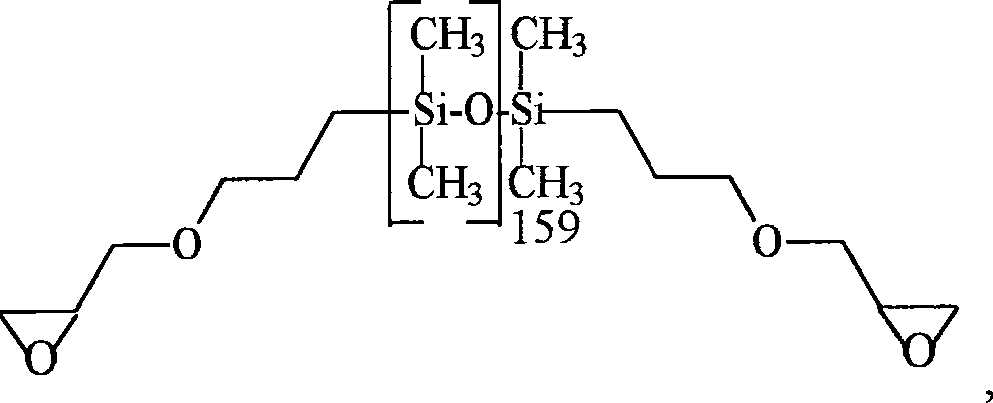
0.75g(0.0125mol)乙酸,2.5g(0.0125mol)十二烷酸,0.33g(0.0025mol;45%浓度的水溶液)三乙基胺和50ml 2-丙醇组成的混合物中添加该胶块。反应在90℃下进行16小时。随后在20hPa/80℃下汽提掉所有的挥发性组分。这产生了182g白色的蜡状固体材料。下式显示了定量组成:Add the gel to a mixture of 0.75g (0.0125mol) acetic acid, 2.5g (0.0125mol) dodecanoic acid, 0.33g (0.0025mol; 45% aqueous solution) triethylamine and 50ml 2-propanol. The reaction was carried out at 90°C for 16 hours. All volatile components are then stripped off at 20 hPa/80°C. This yielded 182g of white, waxy solid material. The following formula shows the quantitative composition:

对于该实施例比率V2/V1是大约0.058。The ratio V 2 /V 1 for this example is about 0.058.
实施例2Example 2
在室温下27.6g(0.255mol环氧基团)新戊基二环氧甘油醚和54.8g(0.0316mol环氧基团)具有以下结构的硅氧烷At room temperature 27.6 g (0.255 mol epoxy groups) of neopentyl diglycidyl ether and 54.8 g (0.0316 mol epoxy groups) of siloxane having the following structure

溶解于200ml 2-丙醇中。向该溶液中添加17.8g(0.142mol伯氨基基团)1-(3-氨基丙基)咪唑。在80℃下开环反应进行8小时。随后添加17.9g(0.142mol)硫酸二甲酯并且季铵化反应进行5小时。通过添加10ml水分解硫酸二甲酯的残余物。汽提掉在最高20hPa/60℃下沸腾的所有组分后,获得97.5g棕色,混浊产物。下式显示了定量组成:Dissolve in 200ml 2-propanol. To this solution was added 17.8 g (0.142 mol of primary amino groups) of 1-(3-aminopropyl)imidazole. The ring opening reaction was carried out at 80°C for 8 hours. Subsequently 17.9 g (0.142 mol) of dimethyl sulfate were added and the quaternization reaction was carried out for 5 hours. The residue of dimethyl sulfate was decomposed by adding 10 ml of water. After stripping off all components boiling up to 20 hPa/60° C., 97.5 g of a brown, cloudy product are obtained. The following formula shows the quantitative composition:

对于该实施例比率V2/V1是大约0.12。The ratio V 2 /V 1 for this example is about 0.12.
实施例3Example 3
在室温下9.67g(0.112mol氨基基团)N,N,N′,N′-四甲基己烷二胺,0.17g(0.0013mol)45%浓度的三甲基胺水溶液,11.35g(0.056mol)十二烷酸和3.4g(0.056mol)乙酸与6ml去离子水和124g 2-丙醇混合并且混合物加热到50℃。向清澈溶液中滴加86.85g(0.0124mol环氧基团)具有以下结构的环氧硅氧烷At room temperature 9.67g (0.112mol amino group) N, N, N', N'-tetramethylhexanediamine, 0.17g (0.0013mol) 45% concentration of trimethylamine aqueous solution, 11.35g (0.056 mol) dodecanoic acid and 3.4 g (0.056 mol) acetic acid were mixed with 6 ml deionized water and 124 g 2-propanol and the mixture was heated to 50°C. 86.85 g (0.0124 mol epoxy groups) of epoxy siloxane with the following structure was added dropwise to the clear solution

和18.28g(0.101环氧基团)具有以下结构的环氧硅氧烷and 18.28 g (0.101 epoxy groups) of epoxysiloxane with the structure
反应混合物被加热到84℃并在该温度下维持14.5小时。15分钟后,开始观察到混浊。反应结束后分开混合物。在20hPa/80℃下从混合物的一半中汽提掉所有挥发性组分。这产生了54g粘的、几乎为白色的块。在20hPa/25℃下从混合物的另一半中除去挥发性组分。这产生了58g浅黄色的、粘性油。下式显示了定量组成:The reaction mixture was heated to 84°C and maintained at this temperature for 14.5 hours. After 15 minutes, cloudiness started to be observed. After the reaction was complete the mixture was separated. All volatile components were stripped from one half of the mixture at 20 hPa/80°C. This yielded 54g of a sticky, almost white mass. Volatile components were removed from the other half of the mixture at 20 hPa/25°C. This yielded 58 g of a pale yellow, viscous oil. The following formula shows the quantitative composition:

对于该实施例比率V2/V1是大约0.058。The ratio V 2 /V 1 for this example is about 0.058.
Claims (15)




Applications Claiming Priority (2)
| Application Number | Priority Date | Filing Date | Title |
|---|---|---|---|
| DE10251524.7 | 2002-11-04 | ||
| DE10251524 | 2002-11-04 |
Publications (2)
| Publication Number | Publication Date |
|---|---|
| CN1735728A CN1735728A (en) | 2006-02-15 |
| CN100487025C true CN100487025C (en) | 2009-05-13 |
Family
ID=32308479
Family Applications (1)
| Application Number | Title | Priority Date | Filing Date |
|---|---|---|---|
| CNB2003801082329A Expired - Lifetime CN100487025C (en) | 2002-11-04 | 2003-10-31 | Linear polyamino and/or polyammonium polysiloxane copolymers II |
Country Status (12)
| Country | Link |
|---|---|
| US (1) | US7563856B2 (en) |
| EP (1) | EP1563136B1 (en) |
| JP (1) | JP2006505643A (en) |
| CN (1) | CN100487025C (en) |
| AT (1) | ATE395458T1 (en) |
| AU (1) | AU2003301831A1 (en) |
| BR (1) | BRPI0315973A8 (en) |
| CA (1) | CA2504981A1 (en) |
| DE (1) | DE50309853D1 (en) |
| ES (1) | ES2308036T3 (en) |
| MX (1) | MXPA05004751A (en) |
| WO (1) | WO2004042136A1 (en) |
Cited By (1)
| Publication number | Priority date | Publication date | Assignee | Title |
|---|---|---|---|---|
| CN105886148A (en) * | 2016-06-21 | 2016-08-24 | 南雄鼎成新材料科技有限公司 | Multifunctional car washing concentrate |
Families Citing this family (44)
| Publication number | Priority date | Publication date | Assignee | Title |
|---|---|---|---|---|
| MXPA05004762A (en) * | 2002-11-04 | 2005-08-03 | Ge Bayer Silicones Gmbh & Co | Linear polyamino and/or polyammonium polysiloxane copolymers i. |
| WO2004069137A2 (en) * | 2003-02-07 | 2004-08-19 | Ge Bayer Silicones Gmbh & Co. Kg | Use of polyamino and/or polyammonium-polysiloxane copolymers |
| DE102005014311A1 (en) * | 2005-03-30 | 2006-10-12 | Ge Bayer Silicones Gmbh & Co. Kg | Polyamino and / or polyammonium-polysiloxane-colpolymer compounds with comb-like arranged polyalkylenonide units |
| DE102005036602A1 (en) * | 2005-08-01 | 2007-02-08 | Ge Bayer Silicones Gmbh & Co. Kg | Polyammonium polysiloxane |
| DE102007012908A1 (en) | 2007-03-19 | 2008-09-25 | Momentive Performance Materials Gmbh | New polyamide-polysiloxane compounds |
| KR20090127950A (en) | 2007-04-11 | 2009-12-14 | 다우 코닝 코포레이션 | Silicone polyether block copolymers with endblocking organofunctional groups |
| WO2008138363A1 (en) * | 2007-05-10 | 2008-11-20 | Evonik Goldschmidt Gmbh | Nitrogen-containing polyether-polysiloxane block copolymers, process for preparing them and their use for enhancing the surface properties of fabrics and fibres |
| DE102007023869A1 (en) | 2007-05-21 | 2008-12-18 | Momentive Performance Materials Gmbh & Co. Kg | New polycarbonate and / or polyurethane polyorganosiloxane compounds |
| DE102007027027A1 (en) | 2007-06-08 | 2008-12-11 | Momentive Performance Materials Gmbh & Co. Kg | New polyurea- and/or polyurethane-polyorganosiloxane-compounds containing an amide structural unit and a polydiorganosiloxane unit useful e.g. to produce duromers, adhesives, primers for metal and plastic surfaces, polymer additives |
| DE102007044148A1 (en) * | 2007-09-15 | 2009-03-26 | Evonik Goldschmidt Gmbh | Novel siloxane-containing block copolymers, processes for their preparation and their use for lubricants |
| EP2203505B1 (en) * | 2007-09-25 | 2012-02-29 | Momentive Performance Materials Inc. | Method for altering the surface of a synthetic textile |
| US20090233836A1 (en) * | 2008-03-11 | 2009-09-17 | The Procter & Gamble Company | Perfuming method and product |
| DE102008013584A1 (en) | 2008-03-11 | 2009-09-17 | Momentive Performance Materials Gmbh | New polycarbonate-polyorganosiloxane and / or polyurethane-polyorganosiloxane compounds |
| DE102008014761A1 (en) * | 2008-03-18 | 2009-12-10 | Momentive Performance Materials Gmbh | Use of polyamino and / or polyammonium-polysiloxane copolymer compounds |
| DE102008001867A1 (en) * | 2008-05-19 | 2009-11-26 | Wacker Chemie Ag | Process for the preparation of quaternary ammonium organopolysiloxanes |
| US20110112328A1 (en) * | 2009-11-06 | 2011-05-12 | Drovetskaya Tatiana V | Difunctional, Amine-Based Surfactants, and Their Precursors, Preparation, Compositions and Use |
| BR112012018894A2 (en) * | 2010-01-29 | 2016-04-12 | Procter & Gamble | linear polydimethylsiloxane-polyether copolymers as amino and / or quaternary ammonium groups and use thereof |
| WO2011131668A1 (en) | 2010-04-19 | 2011-10-27 | Georg-August-Universität Göttingen Stiftung Öffentlichen Rechts | Polyorganosiloxane compounds for protecting wood against termites |
| WO2012058657A2 (en) * | 2010-10-29 | 2012-05-03 | Hardcoat Surfaces Llc | High hardness low surface energy coating |
| JP5986315B2 (en) * | 2012-07-27 | 2016-09-06 | ザ プロクター アンド ギャンブル カンパニー | Organopolysiloxane polymer |
| CN103396551B (en) * | 2012-09-14 | 2015-09-30 | 深圳市泰康新材料科技有限公司 | A kind of imidazolyl modified silicon oil and preparation and application thereof |
| US9198849B2 (en) | 2013-07-03 | 2015-12-01 | The Procter & Gamble Company | Shampoo composition comprising low viscosity emulsified silicone polymers |
| US10414873B2 (en) | 2013-07-29 | 2019-09-17 | The Procter & Gamble Company | Organopolysiloxane polymers |
| US10081910B2 (en) | 2013-07-29 | 2018-09-25 | The Procter & Gamble Company | Absorbent articles comprising organopolysiloxane conditioning polymers |
| US9580670B2 (en) | 2013-07-29 | 2017-02-28 | The Procter & Gamble Company | Consumer product compositions comprising organopolysiloxane conditioning polymers |
| US9611362B2 (en) | 2013-07-29 | 2017-04-04 | The Procter & Gamble Company | Cationic organopolysiloxanes |
| US9540489B2 (en) | 2013-07-29 | 2017-01-10 | The Procter & Gamble Company | Blocky cationic organopolysiloxane |
| US9701929B2 (en) | 2013-07-29 | 2017-07-11 | The Procter & Gamble Company | Consumer product compositions comprising organopolysiloxane emulsions |
| US9963470B2 (en) * | 2013-07-29 | 2018-05-08 | The Procter & Gamble Company | Branched blocky cationic organopolysiloxane |
| US9993418B2 (en) | 2013-07-29 | 2018-06-12 | The Procter & Gamble Company | Benefit agent emulsions and consumer products containing such emulsions |
| DE102013219046A1 (en) | 2013-09-23 | 2015-03-26 | Rudolf Gmbh | Polysiloxanes with quaternized heterocyclic groups |
| WO2015047786A1 (en) | 2013-09-27 | 2015-04-02 | The Procter & Gamble Company | Hair conditioning compositions comprising low viscosity emulsified silicone polymers |
| CN103709412B (en) * | 2013-12-27 | 2016-04-20 | 成都硅宝科技股份有限公司 | Hybrid organosilicon thermoplastic elastomer and preparation method thereof |
| CN104800102A (en) * | 2014-01-29 | 2015-07-29 | 道康宁公司 | Elastomer-containing cosmetic composition |
| JP2017014408A (en) | 2015-07-02 | 2017-01-19 | 信越化学工業株式会社 | Organopolysiloxane, hair cosmetic and method for producing the same |
| US10160834B2 (en) | 2016-07-13 | 2018-12-25 | Momentive Performance Materials Inc. | Low viscosity polyorganosiloxanes comprising quaternary ammonium groups, methods for the production and the use thereof |
| US10982051B2 (en) | 2017-06-05 | 2021-04-20 | Momentive Performance Materials Inc. | Aqueous compositions for hair treatment comprising polyorganosiloxanes with polyhydroxyaromatic moieties |
| US11179312B2 (en) | 2017-06-05 | 2021-11-23 | Momentive Performance Materials Inc. | Aqueous compositions for the treatment of hair |
| EP3501488B1 (en) | 2017-12-21 | 2021-04-14 | Momentive Performance Materials GmbH | Aqueous silicone polymer compositions |
| US20200163850A1 (en) | 2018-11-24 | 2020-05-28 | Momentive Performance Materials Gmbh | Use of polyhydroxyaromatic compounds for the treatment of fibrous amino acid based substrates |
| US11090255B2 (en) | 2018-12-04 | 2021-08-17 | Momentive Performance Materials Inc. | Use of polycarboxylic acid compounds for the treatment of fibrious amino acid based substrates, especially hair |
| US10617617B1 (en) | 2018-12-04 | 2020-04-14 | Momentive Performance Materials Inc. | Polycarboxylic acid compounds for the treatment of fibrious amino acid based substrates, especially hair |
| WO2025014642A2 (en) * | 2023-07-12 | 2025-01-16 | The Regents Of The University Of Colorado, A Body Corporate | Compositions, methods of making, and methods of using multi-functional antimicrobial polymers |
| CN118994594B (en) * | 2024-09-03 | 2025-05-16 | 宁波润禾高新材料科技股份有限公司 | Organosilicon softener material for towels, preparation method and application thereof |
Citations (2)
| Publication number | Priority date | Publication date | Assignee | Title |
|---|---|---|---|---|
| US4833225A (en) * | 1987-02-18 | 1989-05-23 | Th. Goldschdidt AG | Polyquaternary polysiloxane polymers, their synthesis and use in cosmetic preparations |
| US5807956A (en) * | 1996-03-04 | 1998-09-15 | Osi Specialties, Inc. | Silicone aminopolyalkyleneoxide block copolymers |
Family Cites Families (16)
| Publication number | Priority date | Publication date | Assignee | Title |
|---|---|---|---|---|
| LU84463A1 (en) * | 1982-11-10 | 1984-06-13 | Oreal | POLYQUATERNARY POLYSILOXANE POLYMERS |
| FR2777010B1 (en) * | 1998-04-01 | 2000-06-16 | Oreal | HETEROCYCLIC QUATERNARY POLYAMMONIUM SILICIATED POLYMERS AND THEIR USE IN COSMETIC COMPOSITIONS |
| JP2001158792A (en) * | 1999-12-03 | 2001-06-12 | Asahi Kasei Corp | Epoxy compound |
| US20090076238A1 (en) | 2000-07-27 | 2009-03-19 | Horst Lange | Mono-or Poly-Quarternary Polysiloxanes |
| DE10036699A1 (en) * | 2000-07-27 | 2002-02-07 | Wacker Chemie Gmbh | New amino-organosilicon compounds, useful as softener for polymer-based substrate, e.g. fibers, textile or hair, or water-proofing mineral surface, are prepared by reacting epoxy-substituted organosilicon compound with (poly)amine |
| US7041767B2 (en) * | 2000-07-27 | 2006-05-09 | Ge Bayer Silicones Gmbh & Co. Kg | Polysiloxane polymers, method for their production and the use thereof |
| EP1309649B1 (en) * | 2000-07-27 | 2004-07-07 | GE Bayer Silicones GmbH & Co. KG | Polyammonium-polysiloxane compounds, methods for the production and use thereof |
| US6903061B2 (en) * | 2000-08-28 | 2005-06-07 | The Procter & Gamble Company | Fabric care and perfume compositions and systems comprising cationic silicones and methods employing same |
| DE10051258A1 (en) * | 2000-10-16 | 2002-04-25 | Goldschmidt Rewo Gmbh & Co Kg | Washing agents having a softening effect contain at least one quaternary polysiloxane compound |
| JP4539805B2 (en) * | 2001-04-12 | 2010-09-08 | ライオン株式会社 | Topical preparation |
| JP2003002948A (en) * | 2001-06-20 | 2003-01-08 | Toray Ind Inc | Epoxy resin composition for repairing/reinforcing concrete structure and method for repairing/reinforcing using the composition |
| US6818610B2 (en) * | 2001-07-27 | 2004-11-16 | Procter & Gamble Company | Fabric care systems for providing anti-wrinkle benefits to fabric |
| CN1311003C (en) * | 2002-03-20 | 2007-04-18 | Ge拜尔硅股份有限公司 | Branched polyorganosiloxane polymers |
| JP3866676B2 (en) * | 2002-04-25 | 2007-01-10 | 三洋化成工業株式会社 | Grout composition |
| MXPA05004762A (en) * | 2002-11-04 | 2005-08-03 | Ge Bayer Silicones Gmbh & Co | Linear polyamino and/or polyammonium polysiloxane copolymers i. |
| DE102004002208B4 (en) * | 2004-01-15 | 2011-03-17 | Rudolf Gmbh & Co. Kg Chemische Fabrik | Preparations based on organopolysiloxane-polyammonium block copolymers and their use on textile substrates |
-
2003
- 2003-10-31 DE DE50309853T patent/DE50309853D1/en not_active Expired - Lifetime
- 2003-10-31 AT AT03810454T patent/ATE395458T1/en not_active IP Right Cessation
- 2003-10-31 CN CNB2003801082329A patent/CN100487025C/en not_active Expired - Lifetime
- 2003-10-31 MX MXPA05004751A patent/MXPA05004751A/en active IP Right Grant
- 2003-10-31 EP EP03810454A patent/EP1563136B1/en not_active Expired - Lifetime
- 2003-10-31 US US10/533,837 patent/US7563856B2/en not_active Expired - Lifetime
- 2003-10-31 WO PCT/EP2003/050773 patent/WO2004042136A1/en not_active Ceased
- 2003-10-31 ES ES03810454T patent/ES2308036T3/en not_active Expired - Lifetime
- 2003-10-31 BR BRPI0315973A patent/BRPI0315973A8/en not_active IP Right Cessation
- 2003-10-31 JP JP2004549174A patent/JP2006505643A/en active Pending
- 2003-10-31 CA CA002504981A patent/CA2504981A1/en not_active Abandoned
- 2003-10-31 AU AU2003301831A patent/AU2003301831A1/en not_active Abandoned
Patent Citations (2)
| Publication number | Priority date | Publication date | Assignee | Title |
|---|---|---|---|---|
| US4833225A (en) * | 1987-02-18 | 1989-05-23 | Th. Goldschdidt AG | Polyquaternary polysiloxane polymers, their synthesis and use in cosmetic preparations |
| US5807956A (en) * | 1996-03-04 | 1998-09-15 | Osi Specialties, Inc. | Silicone aminopolyalkyleneoxide block copolymers |
Cited By (1)
| Publication number | Priority date | Publication date | Assignee | Title |
|---|---|---|---|---|
| CN105886148A (en) * | 2016-06-21 | 2016-08-24 | 南雄鼎成新材料科技有限公司 | Multifunctional car washing concentrate |
Also Published As
| Publication number | Publication date |
|---|---|
| EP1563136B1 (en) | 2008-05-14 |
| CA2504981A1 (en) | 2004-05-21 |
| BR0315973B1 (en) | 2013-03-19 |
| ATE395458T1 (en) | 2008-05-15 |
| DE50309853D1 (en) | 2008-06-26 |
| US20060235181A1 (en) | 2006-10-19 |
| WO2004042136A1 (en) | 2004-05-21 |
| JP2006505643A (en) | 2006-02-16 |
| EP1563136A1 (en) | 2005-08-17 |
| US7563856B2 (en) | 2009-07-21 |
| CN1735728A (en) | 2006-02-15 |
| BR0315973A (en) | 2005-09-27 |
| ES2308036T3 (en) | 2008-12-01 |
| AU2003301831A1 (en) | 2004-06-07 |
| MXPA05004751A (en) | 2005-08-03 |
| BRPI0315973A8 (en) | 2018-05-15 |
Similar Documents
| Publication | Publication Date | Title |
|---|---|---|
| CN100487025C (en) | Linear polyamino and/or polyammonium polysiloxane copolymers II | |
| CN100457804C (en) | Linear polyamino- and/or polyammonium polysiloxane copolymer I | |
| JP4936631B2 (en) | Polyammonium-polysiloxane compounds, their production and use | |
| US8957009B2 (en) | Linear polydimethylsiloxane-polyether copolymers having amino and/or quaternary ammonium groups and use thereof | |
| JP4936632B2 (en) | Polysiloxane polymers, processes for their production and their use | |
| KR101232941B1 (en) | Reactive amino- and/or ammonium-polysiloxane compounds | |
| JP4801322B2 (en) | Branched polyorganosiloxane polymer | |
| CN1735729B (en) | Composition for surface treatment of substrates | |
| KR101331264B1 (en) | Polyammonium/polysiloxane copolymers | |
| JP5553505B2 (en) | Polyamino and / or polyammonium / polysiloxane copolymer compound in which polyalkylene oxide units are arranged in a comb shape | |
| CN102076771B (en) | Low viscosity, high molecular weight linear random block silicone polyoxyalkylene copolymer | |
| CN109476921B (en) | Low-viscosity polyorganosiloxanes comprising quaternary ammonium groups, method for the production thereof and use thereof | |
| CN102037180B (en) | Use of polyamino and/or polyammonium polysiloxane copolymer compounds | |
| HK1127950B (en) | Polyammonium/polysiloxane copolymers |
Legal Events
| Date | Code | Title | Description |
|---|---|---|---|
| C06 | Publication | ||
| PB01 | Publication | ||
| C10 | Entry into substantive examination | ||
| SE01 | Entry into force of request for substantive examination | ||
| C14 | Grant of patent or utility model | ||
| GR01 | Patent grant | ||
| CX01 | Expiry of patent term | ||
| CX01 | Expiry of patent term |
Granted publication date: 20090513 |