CN100453172C - High selectivity shell impregnated catalyst for vinyl acetate production - Google Patents
High selectivity shell impregnated catalyst for vinyl acetate production Download PDFInfo
- Publication number
- CN100453172C CN100453172C CNB038232200A CN03823220A CN100453172C CN 100453172 C CN100453172 C CN 100453172C CN B038232200 A CNB038232200 A CN B038232200A CN 03823220 A CN03823220 A CN 03823220A CN 100453172 C CN100453172 C CN 100453172C
- Authority
- CN
- China
- Prior art keywords
- catalyst
- solution
- water
- beads
- palladium
- Prior art date
- Legal status (The legal status is an assumption and is not a legal conclusion. Google has not performed a legal analysis and makes no representation as to the accuracy of the status listed.)
- Expired - Fee Related
Links
Classifications
-
- B—PERFORMING OPERATIONS; TRANSPORTING
- B01—PHYSICAL OR CHEMICAL PROCESSES OR APPARATUS IN GENERAL
- B01J—CHEMICAL OR PHYSICAL PROCESSES, e.g. CATALYSIS OR COLLOID CHEMISTRY; THEIR RELEVANT APPARATUS
- B01J23/00—Catalysts comprising metals or metal oxides or hydroxides, not provided for in group B01J21/00
- B01J23/38—Catalysts comprising metals or metal oxides or hydroxides, not provided for in group B01J21/00 of noble metals
- B01J23/54—Catalysts comprising metals or metal oxides or hydroxides, not provided for in group B01J21/00 of noble metals combined with metals, oxides or hydroxides provided for in groups B01J23/02 - B01J23/36
- B01J23/66—Silver or gold
-
- B—PERFORMING OPERATIONS; TRANSPORTING
- B01—PHYSICAL OR CHEMICAL PROCESSES OR APPARATUS IN GENERAL
- B01J—CHEMICAL OR PHYSICAL PROCESSES, e.g. CATALYSIS OR COLLOID CHEMISTRY; THEIR RELEVANT APPARATUS
- B01J23/00—Catalysts comprising metals or metal oxides or hydroxides, not provided for in group B01J21/00
- B01J23/02—Catalysts comprising metals or metal oxides or hydroxides, not provided for in group B01J21/00 of the alkali- or alkaline earth metals or beryllium
-
- B—PERFORMING OPERATIONS; TRANSPORTING
- B01—PHYSICAL OR CHEMICAL PROCESSES OR APPARATUS IN GENERAL
- B01J—CHEMICAL OR PHYSICAL PROCESSES, e.g. CATALYSIS OR COLLOID CHEMISTRY; THEIR RELEVANT APPARATUS
- B01J23/00—Catalysts comprising metals or metal oxides or hydroxides, not provided for in group B01J21/00
- B01J23/38—Catalysts comprising metals or metal oxides or hydroxides, not provided for in group B01J21/00 of noble metals
- B01J23/40—Catalysts comprising metals or metal oxides or hydroxides, not provided for in group B01J21/00 of noble metals of the platinum group metals
- B01J23/42—Platinum
-
- B—PERFORMING OPERATIONS; TRANSPORTING
- B01—PHYSICAL OR CHEMICAL PROCESSES OR APPARATUS IN GENERAL
- B01J—CHEMICAL OR PHYSICAL PROCESSES, e.g. CATALYSIS OR COLLOID CHEMISTRY; THEIR RELEVANT APPARATUS
- B01J23/00—Catalysts comprising metals or metal oxides or hydroxides, not provided for in group B01J21/00
- B01J23/38—Catalysts comprising metals or metal oxides or hydroxides, not provided for in group B01J21/00 of noble metals
- B01J23/40—Catalysts comprising metals or metal oxides or hydroxides, not provided for in group B01J21/00 of noble metals of the platinum group metals
- B01J23/44—Palladium
-
- B—PERFORMING OPERATIONS; TRANSPORTING
- B01—PHYSICAL OR CHEMICAL PROCESSES OR APPARATUS IN GENERAL
- B01J—CHEMICAL OR PHYSICAL PROCESSES, e.g. CATALYSIS OR COLLOID CHEMISTRY; THEIR RELEVANT APPARATUS
- B01J23/00—Catalysts comprising metals or metal oxides or hydroxides, not provided for in group B01J21/00
- B01J23/38—Catalysts comprising metals or metal oxides or hydroxides, not provided for in group B01J21/00 of noble metals
- B01J23/48—Silver or gold
- B01J23/52—Gold
-
- B—PERFORMING OPERATIONS; TRANSPORTING
- B01—PHYSICAL OR CHEMICAL PROCESSES OR APPARATUS IN GENERAL
- B01J—CHEMICAL OR PHYSICAL PROCESSES, e.g. CATALYSIS OR COLLOID CHEMISTRY; THEIR RELEVANT APPARATUS
- B01J23/00—Catalysts comprising metals or metal oxides or hydroxides, not provided for in group B01J21/00
- B01J23/38—Catalysts comprising metals or metal oxides or hydroxides, not provided for in group B01J21/00 of noble metals
- B01J23/54—Catalysts comprising metals or metal oxides or hydroxides, not provided for in group B01J21/00 of noble metals combined with metals, oxides or hydroxides provided for in groups B01J23/02 - B01J23/36
- B01J23/56—Platinum group metals
- B01J23/58—Platinum group metals with alkali- or alkaline earth metals
-
- B—PERFORMING OPERATIONS; TRANSPORTING
- B01—PHYSICAL OR CHEMICAL PROCESSES OR APPARATUS IN GENERAL
- B01J—CHEMICAL OR PHYSICAL PROCESSES, e.g. CATALYSIS OR COLLOID CHEMISTRY; THEIR RELEVANT APPARATUS
- B01J31/00—Catalysts comprising hydrides, coordination complexes or organic compounds
- B01J31/02—Catalysts comprising hydrides, coordination complexes or organic compounds containing organic compounds or metal hydrides
- B01J31/04—Catalysts comprising hydrides, coordination complexes or organic compounds containing organic compounds or metal hydrides containing carboxylic acids or their salts
-
- B—PERFORMING OPERATIONS; TRANSPORTING
- B01—PHYSICAL OR CHEMICAL PROCESSES OR APPARATUS IN GENERAL
- B01J—CHEMICAL OR PHYSICAL PROCESSES, e.g. CATALYSIS OR COLLOID CHEMISTRY; THEIR RELEVANT APPARATUS
- B01J37/00—Processes, in general, for preparing catalysts; Processes, in general, for activation of catalysts
- B01J37/02—Impregnation, coating or precipitation
- B01J37/0201—Impregnation
- B01J37/0203—Impregnation the impregnation liquid containing organic compounds
-
- B—PERFORMING OPERATIONS; TRANSPORTING
- B01—PHYSICAL OR CHEMICAL PROCESSES OR APPARATUS IN GENERAL
- B01J—CHEMICAL OR PHYSICAL PROCESSES, e.g. CATALYSIS OR COLLOID CHEMISTRY; THEIR RELEVANT APPARATUS
- B01J37/00—Processes, in general, for preparing catalysts; Processes, in general, for activation of catalysts
- B01J37/02—Impregnation, coating or precipitation
- B01J37/0201—Impregnation
- B01J37/0205—Impregnation in several steps
-
- B—PERFORMING OPERATIONS; TRANSPORTING
- B01—PHYSICAL OR CHEMICAL PROCESSES OR APPARATUS IN GENERAL
- B01J—CHEMICAL OR PHYSICAL PROCESSES, e.g. CATALYSIS OR COLLOID CHEMISTRY; THEIR RELEVANT APPARATUS
- B01J37/00—Processes, in general, for preparing catalysts; Processes, in general, for activation of catalysts
- B01J37/02—Impregnation, coating or precipitation
- B01J37/024—Multiple impregnation or coating
- B01J37/0242—Coating followed by impregnation
-
- B—PERFORMING OPERATIONS; TRANSPORTING
- B01—PHYSICAL OR CHEMICAL PROCESSES OR APPARATUS IN GENERAL
- B01J—CHEMICAL OR PHYSICAL PROCESSES, e.g. CATALYSIS OR COLLOID CHEMISTRY; THEIR RELEVANT APPARATUS
- B01J37/00—Processes, in general, for preparing catalysts; Processes, in general, for activation of catalysts
- B01J37/02—Impregnation, coating or precipitation
- B01J37/03—Precipitation; Co-precipitation
-
- B—PERFORMING OPERATIONS; TRANSPORTING
- B01—PHYSICAL OR CHEMICAL PROCESSES OR APPARATUS IN GENERAL
- B01J—CHEMICAL OR PHYSICAL PROCESSES, e.g. CATALYSIS OR COLLOID CHEMISTRY; THEIR RELEVANT APPARATUS
- B01J37/00—Processes, in general, for preparing catalysts; Processes, in general, for activation of catalysts
- B01J37/02—Impregnation, coating or precipitation
- B01J37/03—Precipitation; Co-precipitation
- B01J37/031—Precipitation
- B01J37/035—Precipitation on carriers
-
- B—PERFORMING OPERATIONS; TRANSPORTING
- B01—PHYSICAL OR CHEMICAL PROCESSES OR APPARATUS IN GENERAL
- B01J—CHEMICAL OR PHYSICAL PROCESSES, e.g. CATALYSIS OR COLLOID CHEMISTRY; THEIR RELEVANT APPARATUS
- B01J37/00—Processes, in general, for preparing catalysts; Processes, in general, for activation of catalysts
- B01J37/06—Washing
-
- B—PERFORMING OPERATIONS; TRANSPORTING
- B01—PHYSICAL OR CHEMICAL PROCESSES OR APPARATUS IN GENERAL
- B01J—CHEMICAL OR PHYSICAL PROCESSES, e.g. CATALYSIS OR COLLOID CHEMISTRY; THEIR RELEVANT APPARATUS
- B01J37/00—Processes, in general, for preparing catalysts; Processes, in general, for activation of catalysts
- B01J37/08—Heat treatment
-
- B—PERFORMING OPERATIONS; TRANSPORTING
- B01—PHYSICAL OR CHEMICAL PROCESSES OR APPARATUS IN GENERAL
- B01J—CHEMICAL OR PHYSICAL PROCESSES, e.g. CATALYSIS OR COLLOID CHEMISTRY; THEIR RELEVANT APPARATUS
- B01J37/00—Processes, in general, for preparing catalysts; Processes, in general, for activation of catalysts
- B01J37/16—Reducing
-
- B—PERFORMING OPERATIONS; TRANSPORTING
- B01—PHYSICAL OR CHEMICAL PROCESSES OR APPARATUS IN GENERAL
- B01J—CHEMICAL OR PHYSICAL PROCESSES, e.g. CATALYSIS OR COLLOID CHEMISTRY; THEIR RELEVANT APPARATUS
- B01J37/00—Processes, in general, for preparing catalysts; Processes, in general, for activation of catalysts
- B01J37/16—Reducing
- B01J37/18—Reducing with gases containing free hydrogen
-
- C—CHEMISTRY; METALLURGY
- C07—ORGANIC CHEMISTRY
- C07C—ACYCLIC OR CARBOCYCLIC COMPOUNDS
- C07C67/00—Preparation of carboxylic acid esters
- C07C67/04—Preparation of carboxylic acid esters by reacting carboxylic acids or symmetrical anhydrides onto unsaturated carbon-to-carbon bonds
- C07C67/05—Preparation of carboxylic acid esters by reacting carboxylic acids or symmetrical anhydrides onto unsaturated carbon-to-carbon bonds with oxidation
- C07C67/055—Preparation of carboxylic acid esters by reacting carboxylic acids or symmetrical anhydrides onto unsaturated carbon-to-carbon bonds with oxidation in the presence of platinum group metals or their compounds
-
- B—PERFORMING OPERATIONS; TRANSPORTING
- B01—PHYSICAL OR CHEMICAL PROCESSES OR APPARATUS IN GENERAL
- B01J—CHEMICAL OR PHYSICAL PROCESSES, e.g. CATALYSIS OR COLLOID CHEMISTRY; THEIR RELEVANT APPARATUS
- B01J21/00—Catalysts comprising the elements, oxides, or hydroxides of magnesium, boron, aluminium, carbon, silicon, titanium, zirconium, or hafnium
- B01J21/06—Silicon, titanium, zirconium or hafnium; Oxides or hydroxides thereof
- B01J21/08—Silica
Landscapes
- Chemical & Material Sciences (AREA)
- Organic Chemistry (AREA)
- Engineering & Computer Science (AREA)
- Materials Engineering (AREA)
- Chemical Kinetics & Catalysis (AREA)
- Physics & Mathematics (AREA)
- Thermal Sciences (AREA)
- Catalysts (AREA)
- Organic Low-Molecular-Weight Compounds And Preparation Thereof (AREA)
- Low-Molecular Organic Synthesis Reactions Using Catalysts (AREA)
Abstract
Pd-Au的壳式浸渍催化剂制备如下:通过用钯和金盐或酸的水溶液浸渍载体,然后用碱金属硅酸盐或氢氧化物固定剂将Pd和Au的水不溶性化合物沉淀到载体上,接着干燥其表面沉淀了Pd和Au化合物的载体直到所有的Pd和Au成分被还原为游离的金属态,然后用醋酸钾浸渍所述催化剂前体并且干燥。The Pd-Au shell impregnation catalyst is prepared as follows: a support is impregnated with an aqueous solution of palladium and gold salts or acids, and then water-insoluble compounds of Pd and Au are precipitated onto the support using an alkali metal silicate or hydroxide fixing agent, followed by drying the support with the Pd and Au compounds precipitated on its surface until all the Pd and Au components are reduced to the free metallic state, and then the catalyst precursor is impregnated with potassium acetate and dried.
Description
相关申请的交叉参考Cross References to Related Applications
本专利申请是同时待审的美国专利申请序列号10/174,642(2002年6月19日提出申请,其为2000年4月7日提出申请的美国专利申请序列号09/612,159(在2002年6月16日授权,专利号6,420,308)的连续申请)的部分连续申请。This patent application is co-pending U.S. Patent Application Serial No. 10/174,642 (filed June 19, 2002, which is U.S. Patent Application Serial No. 09/612,159 (filed June 19, 2002) Patent No. 6,420,308) granted on March 16, part of the continuation application).
关于联邦资助研究的声明Statement Regarding Federally Funded Research
非资助性项目。non-funded projects.
发明背景Background of the invention
1.发明领域1. Field of invention
本发明涉及具有独特性能的壳式Pd-Au催化剂及其制备方法,所述催化剂可有效催化烯烃(如乙烯)与链烷酸(如醋酸)以及氧气的气相反应,以高时空产率和比活度制备链烷酸链烯酯(如醋酸乙烯酯),其中链烯烃转化成链烷酸链烯酯(如将乙烯转化醋酸乙烯酯)具有高的选择性。The present invention relates to a shell-type Pd-Au catalyst with unique properties and a preparation method thereof, which can effectively catalyze the gas-phase reaction of olefins (such as ethylene) with alkanoic acids (such as acetic acid) and oxygen, with high space-time yield and ratio Activity to prepare alkenyl alkanoates (such as vinyl acetate), where the conversion of alkenes to alkenyl alkanoates (such as converting ethylene to vinyl acetate) has high selectivity.
2.相关领域的描述2. Description of related fields
醋酸乙烯酯(VA)是高需求量的用于制备聚(醋酸乙烯酯)的日用化学品。这种重要的聚合物及其衍生物可广泛用作粘合剂、油漆和其他涂料、薄膜和层压材料。现有技术已报道了许多用于制备VA的技术。一种主要技术是乙烯和醋酸及氧气的催化气相反应。今天,广泛用于这种反应的一类催化剂是如T.C.Bissot.的美国专利号4,048,096所述的表面壳浸渍催化剂。Vinyl acetate (VA) is a commodity chemical used in the production of poly(vinyl acetate) in high demand. This important polymer and its derivatives are widely used as adhesives, paints and other coatings, films and laminates. Prior Art Many techniques for the preparation of VA have been reported. A major technique is the catalytic gas phase reaction of ethylene with acetic acid and oxygen. Today, a class of catalysts widely used for this reaction are surface shell impregnated catalysts as described in US Pat. No. 4,048,096 to T. C. Bissot.
Bissot的美国专利号4,048,096公开了在150℃和120psig反应压力下测定的比活度至少为大约83克醋酸乙烯酯/克贵金属(Pd+Au)/小时的催化剂。所述催化剂由以下物质构成:(1)具有大约3至大约7mm颗粒直径和大约0.2至大约1.5ml/g的孔体积的催化剂载体颗粒,(2)分布在催化剂载体表层并且渗入载体中的深度小于大约0.5mm的钯和金,钯含量为大约1.5至大约5.0克/升催化剂,金含量为大约0.5至大约2.25克/升催化剂,和(3)大约5至大约60克/升催化剂的碱金属醋酸盐。钯是活性催化剂金属而金是助催化剂。US Patent No. 4,048,096 to Bissot discloses catalysts having a specific activity of at least about 83 grams vinyl acetate/gram noble metal (Pd+Au)/hour, measured at 150°C and 120 psig reaction pressure. The catalyst is composed of (1) catalyst support particles having a particle diameter of about 3 to about 7 mm and a pore volume of about 0.2 to about 1.5 ml/g, (2) distributed on the surface of the catalyst support and penetrated into the support to a depth Palladium and gold less than about 0.5mm, palladium content of about 1.5 to about 5.0 g/L catalyst, gold content of about 0.5 to about 2.25 g/L catalyst, and (3) base of about 5 to about 60 g/L catalyst metal acetates. Palladium is the active catalyst metal and gold is the promoter.
Bissot的′096号专利中的制备催化剂方法包括:(1)用水溶性钯和金化合物的水溶液浸渍催化剂载体,(2)通过使经浸渍的催化剂载体与能够跟水溶性钯和金化合物反应的化合物(优选硅酸钠)的溶液接触,形成钯和金的水不溶性化合物,从而将钯和金的水不溶性化合物沉淀到催化剂载体表面上,(3)用还原剂处理将钯和金的水不溶性化合物转变成在载体表面的钯和金金属,(4)用水洗所述催化剂,(5)干燥所述催化剂,(6)用碱金属醋酸盐促进剂(例如钾促进剂)浸渍所述催化剂,并且(7)干燥所述催化剂。The method of preparing the catalyst in the Bissot '096 patent involves: (1) impregnating the catalyst support with an aqueous solution of a water-soluble palladium and gold compound, (2) reacting the impregnated catalyst support with a compound capable of reacting with the water-soluble palladium and gold compound. (Preferably sodium silicate) solution contacts, forms the water-insoluble compound of palladium and gold, thereby the water-insoluble compound of palladium and gold is precipitated on the catalyst support surface, (3) treats the water-insoluble compound of palladium and gold with reducing agent converted to palladium and gold metals on the surface of the support, (4) washing the catalyst with water, (5) drying the catalyst, (6) impregnating the catalyst with an alkali metal acetate promoter (such as a potassium promoter), and (7) drying the catalyst.
与现有的Pd-Au的载体上的催化剂相比,Bissot的′096号专利公开的改进包括将催化剂吸附的钯和金分布在催化剂载体的表层,从载体表面深入的距离小于大约0.5毫米。用钯和金化合物的水溶液实施浸渍步骤并且溶液总体积为催化剂载体吸附能力的大约95%至大约100%。在Bissot的专利中,通过用碱金属硅酸盐溶液浸渍湿的催化剂载体实施沉淀步骤,碱金属硅酸盐的量使得在碱金属硅酸盐溶液与催化剂载体接触大约12至24小时后,所述溶液的pH为大约6.5至大约9.5。在Bissot的所有实施例中,通过与肼溶液反应将被沉淀的化合物还原成Pd和Au金属。The improvements disclosed in the Bissot '096 patent, compared to prior Pd-Au supported catalysts, include distributing catalyst-adsorbed palladium and gold on the surface of the catalyst support to a depth of less than about 0.5 millimeters from the surface of the support. The impregnation step is performed with an aqueous solution of palladium and gold compounds and the total volume of the solution is from about 95% to about 100% of the adsorption capacity of the catalyst support. In the Bissot patent, the precipitation step is carried out by impregnating the wet catalyst support with an alkali metal silicate solution in an amount such that after about 12 to 24 hours of contacting the alkali metal silicate solution with the catalyst support, the The pH of the solution is from about 6.5 to about 9.5. In all of Bissot's examples, the precipitated compounds were reduced to Pd and Au metals by reaction with hydrazine solution.
通过阅读Bissot的专利可明显地知道,在制备醋酸乙烯酯(VA)领域中主要关注改进催化剂的时空产率(STY)以及比活度(SA)。从Bissot描述了这种壳型催化剂以后,其他人一直试图改进催化剂的时空产率、比活度和/或其选择性。It is evident from reading the Bissot patent that in the field of vinyl acetate (VA) preparation the main focus is on improving the space-time yield (STY) and specific activity (SA) of the catalyst. Since Bissot described this shell-type catalyst, others have attempted to improve the catalyst's space-time yield, specific activity and/or its selectivity.
在美国专利号5,179,056、5,189,004和5,342,987中,W.J.Barley报道当Bissot型壳浸渍催化剂所含的基本为游离的钠时,则可改进其STY;基本为游离的钠可通过例如如下方式得到:按照′056号专利,由基本上游离的钠成分制备,或者如′004号专利一样其钠成分通过用水或钾促进剂的水溶液洗除,或者如′987号专利那样在制备的中间阶段用离子交换溶液洗涤催化剂。在所有上述专利中,例示的催化剂可用肼溶液还原。美国专利号5,693,586报道由全部是钾盐化合物的反应物制备的Bissot型壳浸渍催化剂具有改进的二氧化碳选择性。在这个专利中,所有催化剂的例子都在150℃下用乙烯还原。In U.S. Patent Nos. 5,179,056, 5,189,004, and 5,342,987, W.J. Barley reported that the STY of Bissot-type shell-impregnated catalysts can be improved when they contain substantially free sodium; substantially free sodium can be obtained, for example, according to ' The '056 patent, prepared from a substantially free sodium component, either by washing out the sodium component with water or an aqueous solution of potassium promoter as in the '004 patent, or by using an ion exchange solution in an intermediate stage of preparation as in the '987 patent Wash the catalyst. In all of the above patents, the exemplified catalysts can be reduced with a hydrazine solution. US Patent No. 5,693,586 reports improved carbon dioxide selectivity for Bissot-type shell impregnated catalysts prepared from reactants that are all potassium salt compounds. In this patent, all catalyst examples are reduced with ethylene at 150°C.
Barley等在美国专利号5,274,181中报道如果制备的Bissot型壳浸渍催化剂具有2.5g/L(0.33重量%)至6.1g/L(1.05重量%)的Pd装载量,Au与Pd的重量比为0.6至1.25,那么所述催化剂可具有改进的STY。该专利的所有催化剂的例子都通过与肼溶液的反应还原。Barley et al. reported in U.S. Patent No. 5,274,181 that if a Bissot-type shell impregnated catalyst was prepared with a Pd loading of 2.5 g/L (0.33 wt %) to 6.1 g/L (1.05 wt %), the weight ratio of Au to Pd was 0.6 to 1.25, then the catalyst may have an improved STY. All catalyst examples of this patent are reduced by reaction with hydrazine solution.
美国专利号5,567,839报道如果使用钡盐而不是硅酸钠将Pd和Au化合物沉淀到催化剂壳上,则所述Bissot型壳浸渍催化剂可具有改进的STY。该专利的所有催化剂例子都通过与肼溶液的反应还原。US Patent No. 5,567,839 reports that the Bissot-type shell-impregnated catalysts can have improved STY if barium salts are used instead of sodium silicate to precipitate Pd and Au compounds onto the catalyst shell. All catalyst examples of this patent are reduced by reaction with hydrazine solution.
钯-金催化剂在醋酸乙烯酯合成中的选择性也可受钯金属和金金属在多孔催化剂载体基材的外和/或内表面上分布的程度和均匀性影响,所述选择性例如在乙烯、乙酸和氧气相反应中的二氧化碳选择性和氧气转化率。The selectivity of palladium-gold catalysts in the synthesis of vinyl acetate, e.g., in ethylene , Carbon dioxide selectivity and oxygen conversion in the phase reaction of acetic acid and oxygen.
为了使钯和金金属在催化剂载体上均匀分布,可控制催化剂制备步骤和/或通过使用具有各种规定孔尺寸的载体基材。在美国专利号5,314,858和美国专利号5,332,710中公开了制备适于醋酸乙烯酯制备的高活性催化剂的特别有效的改进方法。这些参考专利描述了通过控制沉淀步骤改进钯和金在载体上的分布的方法,其中水溶性贵金属可作为水不溶性化合物固定在载体表面上。在美国专利号5,314,858中,固定贵金属到载体上由两个独立的沉淀阶段进行,以避免使用大大过量的固定剂。美国专利号5,332,710描述了至少在被浸渍的载体浸到反应溶液中开始沉淀期间可通过物理旋转被浸渍的催化剂载体固定所述贵金属。旋转浸渍法可产生金属沉淀在载体上的催化剂,据说所述金属可更均匀分布在载体表面的薄壳内。这些专利的催化剂例子都是在150℃下用乙烯还原的。Uniform distribution of the palladium and gold metals on the catalyst support can be achieved by controlling the catalyst preparation steps and/or by using support substrates with various defined pore sizes. Particularly efficient improved methods of preparing highly active catalysts suitable for vinyl acetate production are disclosed in US Patent No. 5,314,858 and US Patent No. 5,332,710. These referenced patents describe methods for improving the distribution of palladium and gold on supports by controlling the precipitation step, wherein the water-soluble noble metals can be immobilized on the support surface as water-insoluble compounds. In US Pat. No. 5,314,858, the immobilization of the noble metal to the support is carried out in two separate precipitation stages in order to avoid the use of a large excess of immobilizing agent. US Patent No. 5,332,710 describes that the noble metal can be immobilized by physical rotation of an impregnated catalyst support at least during the period in which the impregnated support is immersed in a reaction solution to initiate precipitation. The spin impregnation method produces catalysts with metals precipitated on the support, which are said to be more uniformly distributed within thin shells on the support surface. The catalyst examples of these patents were all reduced with ethylene at 150°C.
A.K.Khanmamedova的美国专利号6,420,308(Khanmamedova′308)表明各步骤的顺序很重要。在Bissot′096中,在还原后清洗催化剂而在Khanmamedova′308中,在还原前清洗所述催化剂,后者可获得更高的时空产率和更高的醋酸乙烯酯选择性。US Patent No. 6,420,308 to A.K. Khanmamedova (Khanmamedova '308) shows that the order of the steps is important. In Bissot '096 the catalyst was washed after reduction and in Khanmamedova '308 the catalyst was washed before reduction, which resulted in higher space-time yields and higher vinyl acetate selectivities.
尽管已经进行了这些改进,但是研制具有可进一步改进制备醋酸乙烯酯的综合性能的催化剂组合物仍是持续的需要。Despite these improvements, there remains a continuing need to develop catalyst compositions with further improved performance profiles for the production of vinyl acetate.
发明概述Summary of the invention
本发明涉及Pd-Au壳浸渍催化剂及其制备方法,所述催化剂可有效用于催化乙烯与乙酸及氧气的气相反应,以高时空产率、比活度制备醋酸乙烯酯并且对将乙烯转化成醋酸乙烯酯有高选择性。本发明使用了与Khanmamedova相同的步骤顺序,但是作出了某些改进:The invention relates to a Pd-Au shell impregnated catalyst and a preparation method thereof. The catalyst can be effectively used to catalyze the gas phase reaction of ethylene, acetic acid and oxygen, to prepare vinyl acetate with high space-time yield and specific activity and to convert ethylene into Vinyl acetate is highly selective. The present invention uses the same sequence of steps as Khanmamedova, but with some improvements:
1)钯与金的重量比为2∶8至8∶2,1) The weight ratio of palladium to gold is 2:8 to 8:2,
2)沉淀钯和金化合物至载体颗粒总孔体积的70至100%,2) Precipitating palladium and gold compounds to 70 to 100% of the total pore volume of the support particles,
3)沉淀剂过量1.1至2.2摩尔,3) Precipitating agent excess 1.1 to 2.2 moles,
4)与沉淀剂接触的时间为三小时至最高可达七十二小时,4) The time of contact with the precipitating agent is three hours to a maximum of seventy-two hours,
5)与沉淀剂在避光环境中接触,5) Contact with the precipitating agent in a light-proof environment,
6)使用粉状沉淀剂,6) Use powdery precipitant,
7)用水在50至80℃的温度下清洗被沉淀的载体,7) washing the precipitated carrier with water at a temperature of 50 to 80°C,
8)在氮气中还原催化剂前体,8) reduction of the catalyst precursor under nitrogen,
9)用5-12重量%的链烷酸钾浸渍,9) impregnation with 5-12% by weight of potassium alkanoate,
10)在氮气和95℃至150℃下最终干燥催化剂一小时至二十四小时。10) Final drying of the catalyst under nitrogen at 95°C to 150°C for one hour to twenty four hours.
制备以二氧化硅为载体的Pd-Au壳浸渍催化剂,其中Pd装载量为1.8至大约7.2g/L催化剂和Pd∶Au重量比为8∶2至2∶8的方法如下:用钯和金的盐或酸的水溶液浸渍载体,其中钯和金的盐或酸的水溶液优选为高纯四氯钯酸钾(99.99%)和四氯金酸三水合物(99.998%);然后优选在避光环境中,用碱金属硅酸盐或碱金属氢氧化物或其混合物的溶液或粉末作为沉淀剂或“固定”剂(优选用硅酸钠溶液作为沉淀剂),与被浸渍的载体反应三至七十二小时,从而将Pd和Au的水不溶性化合物沉淀或“固定”到载体表面,达到载体颗粒的总孔体积的70%至100%,沉淀剂或“固定”剂用量超出中和Pd和Au的盐所需理论用量1.1至2.2摩尔。固定剂过量的部分也取决于固定溶液的体积和载体的酸度。The preparation of silica-supported Pd-Au shell impregnated catalysts with a Pd loading of 1.8 to about 7.2 g/L catalyst and a Pd:Au weight ratio of 8:2 to 2:8 was as follows: The aqueous solution of salt or acid impregnates the carrier, wherein the aqueous solution of salt or acid of palladium and gold is preferably high-purity potassium tetrachloropalladate (99.99%) and tetrachloroauric acid trihydrate (99.998%); In the environment, a solution or powder of an alkali metal silicate or alkali metal hydroxide or a mixture thereof is used as a precipitating agent or a "fixing" agent (preferably a sodium silicate solution is used as a precipitating agent), and the impregnated support is reacted for three to three to Seventy-two hours, thereby precipitating or "fixing" the water-insoluble compounds of Pd and Au to the support surface to 70% to 100% of the total pore volume of the support particles, the amount of precipitating or "fixing" agent exceeding the neutralization of Pd and The theoretical amount required for the salt of Au is 1.1 to 2.2 moles. The excess of fixative also depends on the volume of the fixative solution and the acidity of the carrier.
用去离子水在50℃至80℃洗涤被浸渍的载体直到最终倾出物对硝酸银测试为负性,然后将其干燥除去水份。将表面沉淀了Pd和Au的化合物的干燥载体与乙烯、氮气或氢气在高于150℃的温度下反应,对于乙烯反应温度可高达310℃,对于氮气反应温度可高达500℃而对于氢气反应温度可高达299℃,优选乙烯在250℃至325℃,更优选在250℃至310℃下反应10分钟至一小时,优选氮气在300°至450℃下反应10分钟至一小时,而氢气在250°至299℃下反应10分钟至一小时,直至Pd和Au的所有成分基本上还原成其游离金属态,然后用达到被还原催化剂5至12重量%的醋酸钾浸渍所述载体。接着在空气或氮气中可在90-150℃下干燥所述催化剂一至二十四小时,优选在氮气中及在120℃下干燥一小时。The impregnated support was washed with deionized water at 50°C to 80°C until the final pour tested negative for silver nitrate, then it was dried to remove water. The dry carrier with the compound of Pd and Au precipitated on the surface is reacted with ethylene, nitrogen or hydrogen at a temperature higher than 150°C, for ethylene the reaction temperature can be as high as 310°C, for nitrogen the reaction temperature can be as high as 500°C and for hydrogen the reaction temperature It can be as high as 299°C, preferably ethylene is reacted at 250°C to 325°C, more preferably at 250°C to 310°C for 10 minutes to one hour, preferably nitrogen is reacted at 300° to 450°C for 10 minutes to one hour, and hydrogen is reacted at 250°C ° to 299° C. for 10 minutes to one hour until substantially all components of Pd and Au are reduced to their free metal states, and then impregnate the support with potassium acetate to achieve 5 to 12% by weight of the reduced catalyst. The catalyst may then be dried in air or nitrogen at 90-150°C for one to twenty-four hours, preferably in nitrogen at 120°C for one hour.
如上所述的催化剂的时空产率(STY)和比活度(SA)比其他在150℃下用乙烯或氢气还原的组成相同的催化剂高出大约20-30%。在140℃至160℃和4500/hr的气时空速下,当在获得至少600gVA/L催化剂/hr的STY的反应条件下操作时,所述催化剂可显示出90%或更高的醋酸乙烯酯选择性。此外,这种催化剂还具有长的使用寿命。The space-time yield (STY) and specific activity (SA) of the catalysts described above are about 20-30% higher than other catalysts of the same composition reduced with ethylene or hydrogen at 150°C. The catalyst may exhibit 90% or greater vinyl acetate at 140°C to 160°C and a gas hourly space velocity of 4500/hr when operated under reaction conditions to obtain an STY of at least 600 gVA/L catalyst/hr selective. In addition, this catalyst also has a long service life.
发明的详细描述Detailed description of the invention
本发明包括用于提高烯烃、链烷酸和含氧气体的气相反应以制备链烷酸链烯酯的催化剂。所述催化剂特别符合乙烯、乙酸和含氧气体的气相反应以制备醋酸乙烯酯的要求。The present invention includes catalysts for enhancing the gas phase reaction of olefins, alkanoic acids, and oxygen-containing gases to produce alkenyl alkanoates. The catalyst is particularly suitable for the gas phase reaction of ethylene, acetic acid and an oxygen-containing gas to produce vinyl acetate.
在催化气相反应的过程中,乙烯与乙酸和氧气在气相和在非均相Pd-Au壳式催化剂上放热反应,得到醋酸乙烯酯和水:In the catalytic gas phase reaction, ethylene reacts exothermically with acetic acid and oxygen in the gas phase and over a heterogeneous Pd-Au shell catalyst to give vinyl acetate and water:
CH2=CH2+CH3CO2H+1/2O2→CH3CO2CH=CH2+H2O, CH2 = CH2+ CH3CO2H +1/ 2O2 →CH3CO2CH = CH2 + H2O ,
ΔH=-178kJ/mol。ΔH = -178 kJ/mol.
醋酸乙烯酯的反应过程一般可在140-180℃、5-10个大气压(atm)下和~4500h-1的气时空速(GHSV)下操作。这将得到8-10%的乙烯转化率和15-40%的乙酸转化率。氧气转化率可高达90%,并且产率可高达99%和94%(分别基于乙酸和乙烯计算)。The reaction process of vinyl acetate can generally be operated at 140-180° C., 5-10 atmospheres (atm) and a gas hourly space velocity (GHSV) of ~4500 h −1 . This will give 8-10% conversion of ethylene and 15-40% conversion of acetic acid. The oxygen conversion can be as high as 90%, and the yield can be as high as 99% and 94% (based on acetic acid and ethylene, respectively).
反应温度可在140℃至200℃之间。通常优选的反应温度范围是140℃至180℃,最优选140-160℃。在温度低于140℃时,反应速率较低并且难于使乙酸保持气相。高于180℃时,对于指定的催化剂,可将越来越多的乙烯和乙酸原料转化成副产品。主要副产品为二氧化碳。通常,可形成大约1%或更少的其他副产品乙醛和醋酸乙酯。The reaction temperature may be between 140°C and 200°C. The generally preferred reaction temperature range is 140°C to 180°C, most preferably 140-160°C. At temperatures below 140°C, the reaction rate is low and it is difficult to keep the acetic acid in the gas phase. Above 180°C, for a given catalyst, more and more ethylene and acetic acid feedstocks can be converted to by-products. The main by-product is carbon dioxide. Typically, about 1% or less of other by-products acetaldehyde and ethyl acetate can be formed.
反应压力在70-200psig之间。工业设备使用的压力一般为100-150psig。更高的压力使得难以保持乙酸为气相而压力低于70psig使反应的STY大大降低。The reaction pressure is between 70-200 psig. The pressure used in industrial equipment is generally 100-150 psig. Higher pressures make it difficult to keep the acetic acid in the gas phase and pressures below 70 psig greatly reduce the STY of the reaction.
作为气时空速(GHSV)的反应气体总体积为每小时大约3000-5000STP升/升催化剂。更高的GHSV值得到较高的STY和SA值,同时不明显降低制备醋酸乙烯酯的选择性值。因此,优选较高的GHSV值如4500。反应气体的组成(单位为体积%)范围如下:乙烯为27-60%;惰性气体为15-55%;醋酸为12-17%;氧气为6-8%。所述反应在乙烯和醋酸大大过量下进行。这样做的主要原因是避免可能形成可燃的/爆炸的混合物。为了避免爆炸性混合物,不使用含量高于大约9%的氧气。优选范围分别是:乙烯为50-60%,惰性气体为20-50%,醋酸为12-15%;和氧气为6-7%。工业上,氧气通常用空气代替并且提高乙烯的进料百分比。The total volume of reactant gas as gas hourly space velocity (GHSV) is about 3000-5000 STP liter per hour per liter of catalyst. Higher GHSV values give higher STY and SA values without significantly reducing selectivity values for the production of vinyl acetate. Therefore, a higher GHSV value such as 4500 is preferred. The range of the composition of the reaction gas (unit is volume %) is as follows: ethylene is 27-60%; inert gas is 15-55%; acetic acid is 12-17%; oxygen is 6-8%. The reaction is carried out in large excesses of ethylene and acetic acid. The main reason for this is to avoid the possible formation of flammable/explosive mixtures. In order to avoid explosive mixtures, oxygen content above about 9% is not used. The preferred ranges are respectively: 50-60% for ethylene, 20-50% for inert gas, 12-15% for acetic acid; and 6-7% for oxygen. Industrially, oxygen is usually replaced with air and the feed percentage of ethylene is increased.
用于本发明催化剂制备方法中的载体颗粒为能被钯、金和钾促进剂浸渍的固体颗粒材料并且在用于制备链烷酸链烯酯如醋酸乙烯酯的条件下是惰性的。这种载体颗粒的实例有颗粒二氧化硅、氧化铝和二氧化硅-氧化铝。二氧化硅是优选的载体。所述载体优选具有100至800平方米/克的表面积。最优选载体材料的例子为具有5至6mm的平均直径,150至200平方米/克的表面积和0.6至0.7ml/g的孔体积的二氧化硅珠粒,如由Sud Chemie AG销售的″KA-160″。The support particles used in the catalyst preparation process of the present invention are solid particulate materials capable of being impregnated with palladium, gold and potassium promoters and are inert under the conditions used to prepare alkenyl alkanoates such as vinyl acetate. Examples of such carrier particles are particulate silica, alumina and silica-alumina. Silica is the preferred support. The support preferably has a surface area of 100 to 800 m2/g. An example of the most preferred support material is silica beads with an average diameter of 5 to 6 mm, a surface area of 150 to 200 m2/g and a pore volume of 0.6 to 0.7 ml/g, such as "KA" sold by Sud Chemie AG -160″.
用于本发明的方法中的水溶性钯和金化合物的水溶液可包括任何适用的钯或金化合物的水溶液,例如氯化钯(II)、四氯钯酸(II)碱土金属盐、硝酸钯(II)、硫酸钯(II)、氯化金(III)或金酸(III)(HAuCl4)。但是,较不优选含钠化合物而优选的化合物是四氯钯酸钾和四氯金酸。然后,为了获得高时空产率(STY)和比活度(SA)的催化剂,优选使用高纯度(也就是99.9+%的纯度,优选为99.99%)形式的这些优选化合物。因此,优选使用纯度为99.99%的四氯钯酸钾和纯度为99.998%的四氯金酸。The aqueous solution of water-soluble palladium and gold compound used in the method of the present invention may comprise any suitable aqueous solution of palladium or gold compound, for example palladium (II) chloride, tetrachloropalladate (II) alkaline earth metal salt, palladium nitrate ( II), palladium(II) sulfate, gold(III) chloride or gold(III) acid (HAuCl 4 ). However, sodium-containing compounds are less preferred and preferred compounds are potassium tetrachloropalladate and tetrachloroauric acid. However, in order to obtain catalysts of high space-time yield (STY) and specific activity (SA), it is preferred to use these preferred compounds in high purity (ie 99.9+% purity, preferably 99.99%) form. Therefore, it is preferable to use potassium tetrachloropalladate with a purity of 99.99% and tetrachloroauric acid with a purity of 99.998%.
Pd和Au化合物的用量使得最终催化剂的Pd装载量为大约1.8g/L至大约7.2g/L并且Pd与催化剂中装载的Au的重量比即Pd∶Au为8∶2至2∶8,优选为7∶3至4∶6,更优选为6∶4至5∶5。优选催化剂中Pd的装载量使得可提供具有如下性能的催化剂:在120psig的反应条件和大约140℃至大约160℃的温度范围下操作时,可提供具有大于200g VA/g Pd/hr的比活度和至少大约600gVA/L催化剂/hr的STY。用于获得必需STY值的催化剂的Pd装载量越低,对VA的转化选择性就越高,因此Pd装载量优选为3.0g/L至大约5.4g/L。The Pd and Au compounds are used in amounts such that the final catalyst has a Pd loading of about 1.8 g/L to about 7.2 g/L and a weight ratio of Pd to Au loaded in the catalyst, i.e., Pd:Au, of 8:2 to 2:8, preferably 7:3 to 4:6, more preferably 6:4 to 5:5. The Pd loading of the catalyst is preferably such that it provides a catalyst having a specific activity of greater than 200 gVA/g Pd/hr when operated at reaction conditions of 120 psig and a temperature range of about 140°C to about 160°C. degrees and an STY of at least about 600 gVA/L catalyst/hr. The lower the Pd loading of the catalyst used to obtain the necessary STY value, the higher the conversion selectivity to VA, so the Pd loading is preferably from 3.0 g/L to about 5.4 g/L.
用称为“旋转浸渍至开始润湿”的方法浸渍所述载体。浸渍溶液的体积优选为载体孔体积的70至100%(更优选为85至95%,最优选为大约90%)。在这个方法中,所述催化剂载体浸渍在Pd-Au的浸渍溶液中并且在用可溶性贵金属化合物浸渍载体的初始阶段在溶液中翻动或旋转被浸渍的载体。在溶液中旋转或翻动载体直至所有的溶液都被吸收了(这取决于被浸渍的Pd-Au溶液的体积)。在实验用量范围内,一般至少翻动3分钟,优选3-15分钟并且更优选3-5分钟。过度旋转可导致蒸发、水分损失和干燥,致使钯和金分布不均匀,特别是当浸渍溶液的体积为载体孔体积的90%或更低时更是如此。The support is impregnated by a method known as "spin impregnation to incipient wetness". The volume of the impregnation solution is preferably from 70 to 100% (more preferably from 85 to 95%, most preferably about 90%) of the pore volume of the support. In this method, the catalyst support is impregnated in an impregnation solution of Pd-Au and the impregnated support is turned or rotated in the solution at the initial stage of impregnating the support with a soluble noble metal compound. Swirl or tumble the support in the solution until all the solution is absorbed (depending on the volume of Pd-Au solution being impregnated). In the range of experimental use, generally at least 3 minutes of agitation, preferably 3-15 minutes and more preferably 3-5 minutes. Excessive rotation can lead to evaporation, water loss and drying, resulting in uneven distribution of palladium and gold, especially when the volume of the impregnation solution is 90% or less of the support pore volume.
可用任何型号的旋转或翻动装置,因为使用精确的装置不是关键的。但是,旋转运动的程度是关键的。旋转应足够快,这样所有被浸渍载体的表面尽可能迅速地与浸渍溶液均匀接触。旋转不应过快而致使载体颗粒发生实际磨损。通常,旋转程度应为大约1至30rpm并且甚至可更高,特别是在旋转开始时,这取决于实际使用的载体、载体量和被浸渍到载体中的贵金属量。使用的rpm是可变的并且同样取决于使用的装置、载体的大小和形状、载体的类型和金属装载量。Any type of rotating or flipping device can be used, as the exact device used is not critical. However, the degree of rotational motion is critical. The rotation should be fast enough so that all surfaces of the impregnated support come into uniform contact with the impregnation solution as rapidly as possible. The rotation should not be so fast that actual abrasion of the carrier particles occurs. Typically, the degree of rotation should be about 1 to 30 rpm and can be even higher, especially at the beginning of rotation, depending on the actual support used, the amount of support and the amount of precious metal impregnated into the support. The rpm used is variable and also depends on the device used, the size and shape of the carrier, the type of carrier and the metal loading.
用于本发明催化剂方法中的沉淀剂包括钠、锂和钾的硅酸盐、氢氧化物和氯化物。优选使用氯化钾、硅酸钠、氢氧化钠或氢氧化钾作为沉淀剂。沉淀剂优选使用含有过量1.1至2.2摩尔的沉淀剂的水溶液形式,超出量依赖于载体酸度和所用溶液的体积,优选过量1.2至2.1摩尔,更优选过量1.5摩尔。这种溶液的使用体积优选恰好足以淹没载体颗粒。将被浸渍的载体浸到固定溶液中并且使其在室温下保持完全淹没三小时至大约三天(大约72小时),优选15小时至3天,更优选1天(大约24小时)至3天,最优选3天,直至最终pH值为6.5-9.0。碱的确切用量、固定时间和最终pH值取决于载体酸度和贵金属的用量。Precipitating agents useful in the catalyst process of the present invention include sodium, lithium and potassium silicates, hydroxides and chlorides. Potassium chloride, sodium silicate, sodium hydroxide or potassium hydroxide is preferably used as precipitating agent. The precipitating agent is preferably used in the form of an aqueous solution containing an excess of 1.1 to 2.2 moles of the precipitating agent, the excess depends on the acidity of the carrier and the volume of the solution used, preferably an excess of 1.2 to 2.1 moles, more preferably an excess of 1.5 moles. The volume of such solution used is preferably just sufficient to submerge the carrier particles. The impregnated support is immersed in the fixative solution and kept completely submerged at room temperature for three hours to about three days (about 72 hours), preferably 15 hours to 3 days, more preferably 1 day (about 24 hours) to 3 days , most preferably for 3 days, until the final pH is 6.5-9.0. The exact amount of base used, the fixation time and the final pH depend on the acidity of the carrier and the amount of precious metal used.
虽然沉淀剂可为水溶液,它也可为粉末用于“干固定”技术以将钯和金化合物沉淀到载体表面上。可将粉末加到被浸渍的载体珠中或者可将被浸渍的载体珠加到粉末中。为了确保沉淀剂与水溶性钯和金化合物接触,可旋转或搅拌固体-固体混合物以均匀混合粉末和被浸渍的载体珠,使得水不溶的钯和金的化合物可沉淀到载体颗粒上。接触时间可与水溶液相同,也就是三小时至高达大约3天(~72小时),但是优选12至36小时,更优选大约24小时。While the precipitating agent can be an aqueous solution, it can also be a powder used in "dry fixation" techniques to precipitate palladium and gold compounds onto the support surface. The powder can be added to the impregnated carrier beads or the impregnated carrier beads can be added to the powder. To ensure that the precipitant contacts the water-soluble palladium and gold compounds, the solid-solid mixture can be swirled or stirred to uniformly mix the powder and impregnated support beads so that the water-insoluble palladium and gold compounds can precipitate onto the support particles. The contact time can be the same as for the aqueous solution, ie three hours up to about 3 days (-72 hours), but preferably 12 to 36 hours, more preferably about 24 hours.
固定步骤期间的反应可为光敏的。用于催化剂合成的金源,例如四氯金酸三水合物对光敏感并且分解形成另外的相。本发明不受理论限制或约束,但是也相信金和钯化合物在固定步骤中转变成了金和钯的氢氧化物,当还原这些氢氧化物时,可导致钯-金的相互作用,可能形成合金。在载体表面分离的氢氧化金和氢氧化钯可被还原形成惰性的金金属和极不活泼的钯金属。曝光可分解金和/或钯化合物并且可妨碍形成混合的氢氧化物。The reaction during the fixation step may be photosensitive. Gold sources used for catalyst synthesis, such as tetrachloroauric acid trihydrate, are light sensitive and decompose to form additional phases. The present invention is not to be limited or bound by theory, but it is also believed that the gold and palladium compounds are transformed into hydroxides of gold and palladium during the immobilization step, and that when these hydroxides are reduced, palladium-gold interactions can result, possibly forming alloy. Gold hydroxide and palladium hydroxide separated on the surface of the support can be reduced to form inert gold metal and extremely inactive palladium metal. Exposure can decompose gold and/or palladium compounds and can prevent the formation of mixed hydroxides.
在固定完成之后,可从固定溶液中取出被浸渍的载体珠并且用去离子(D.I.)水在50至80℃,优选在50至60℃下清洗。然后以分批或连续的方式进一步清洗。应该持续在50至80℃,优选在50至60℃下进一步清洗,直至在倾出的洗涤水中的氯离子含量约为50ppm,其中最终倾出的废水对硝酸银测试为负结果。在高于室温的温度下用水清洗不仅可以除去氯离子和钠离子,而且也可从孔中除去无定形二氧化硅。After fixation is complete, the impregnated support beads can be removed from the fixation solution and washed with deionized (D.I.) water at 50 to 80°C, preferably at 50 to 60°C. This is followed by further cleaning in a batch or continuous manner. Further washing at 50 to 80°C, preferably 50 to 60°C, should be continued until the chloride ion content in the decanted wash water is about 50 ppm, with the final decanted effluent testing negative for silver nitrate. Washing with water at temperatures above room temperature not only removes chloride and sodium ions but also removes amorphous silica from the pores.
清洗完成之后,将被浸渍的载体珠干燥,例如在90-150℃的强制通风烘箱中干燥。After washing is complete, the impregnated carrier beads are dried, for example, in a forced-air oven at 90-150°C.
本发明中使用的还原剂为乙烯、氮气或氢气,将被浸渍的载体暴露在这些气体中,同时对乙烯来说,温度要高于150℃并且可高达310℃,对氮气可高达500℃而对氢气可高达299℃,优选高于200℃并且更优选高于250℃,例如对乙烯为275°至310℃,对氮气为300°至450℃和对氢气为275°至299℃,最优选对乙烯为300℃,对氮气为450℃和对氢气为299℃,暴露时间足以使Pd和Au完全还原成它们的自由金属态。通常,还原反应不长于5小时,优选在乙烯中的还原短于1小时,优选在氮气中的还原为大约1小时,优选在氢气中的还原为大约10至30分钟。The reducing agent used in the present invention is ethylene, nitrogen or hydrogen, and the impregnated carrier is exposed to these gases, while for ethylene, the temperature is higher than 150°C and can be as high as 310°C, and as high as 500°C for nitrogen. Up to 299°C for hydrogen, preferably above 200°C and more preferably above 250°C, for example 275° to 310°C for ethylene, 300° to 450°C for nitrogen and 275° to 299°C for hydrogen, most preferably Exposure times of 300°C for ethylene, 450°C for nitrogen and 299°C for hydrogen were sufficient for complete reduction of Pd and Au to their free metallic states. Typically, the reduction is not longer than 5 hours, preferably less than 1 hour in ethylene, preferably about 1 hour in nitrogen, and preferably about 10 to 30 minutes in hydrogen.
为了使它们还原,可先将被浸渍的载体珠在气流例如氮气流中从室温加热至150℃。然后将被浸渍的载体保持在150℃的气流中0.5-1小时。在这个加热时间内,吸附的水被释放出来。然后,可将温度升高到299-300℃,优选以20-30°/min的速率上升。任选可将被浸渍的载体珠在299-300℃下保持10-30分钟。然后将催化剂珠暴露在还原气体中。如果还原气体为乙烯或氢气,可将一定体积的乙烯或氢气(优选1-5%体积)输入到气流中以形成还原气体混合物。In order to reduce them, the impregnated support beads can first be heated from room temperature to 150° C. in a gas flow, such as a nitrogen gas flow. The impregnated support is then kept in an air stream at 150°C for 0.5-1 hour. During this heating time, the adsorbed water is released. Then, the temperature can be increased to 299-300°C, preferably at a rate of 20-30°/min. Optionally, the impregnated support beads can be maintained at 299-300° C. for 10-30 minutes. The catalyst beads are then exposed to a reducing gas. If the reducing gas is ethylene or hydrogen, a volume of ethylene or hydrogen (preferably 1-5% by volume) can be fed into the gas stream to form the reducing gas mixture.
为了使它们还原,可将干燥的被浸渍载体珠直接放到300℃下含有乙烯-氮气气流混合物或299℃下含有氢气-氮气气流混合物或450℃下含有氮气气流混合物的加热器中。干燥的珠子不应在还原前暴露于湿气中。还原气流应足以将催化剂金属完全还原并且可在接触时间范围内变化。To reduce them, the dried impregnated support beads can be placed directly in a heater with a ethylene-nitrogen gas stream mixture at 300°C or a hydrogen-nitrogen gas stream mixture at 299°C or a nitrogen gas stream mixture at 450°C. Dried beads should not be exposed to moisture prior to reduction. The reducing gas flow should be sufficient to completely reduce the catalyst metal and can vary within the range of contact times.
在还原气或还原气混合物中还原大约10-15分钟至大约5小时之后,可将所述珠子在氮气中冷却回室温。较短的还原时间产生较高STY值的催化剂;因此优选大约15分钟至大约0.5小时的较短的还原时间。After reduction in the reducing gas or reducing gas mixture for about 10-15 minutes to about 5 hours, the beads can be cooled back to room temperature under nitrogen. Shorter reduction times yield catalysts with higher STY values; therefore shorter reduction times of about 15 minutes to about 0.5 hours are preferred.
用于本发明制备催化剂方法的钾促进剂可包括链烷酸钾和任何能在形成链烷酸链烯酯的反应(也就是,乙烯、链烷酸和含氧气体在催化剂存在下反应制备链烷酸链烯酯)中转变成链烷酸钾的钾化合物。优选醋酸钾作为促进剂并且优选添加用量占被还原催化剂重量的大约5-12重量%,优选6-10重量%,更优选6-8重量%。优选促进剂的使用形式为水溶液。优选通过前述的“旋转浸渍至开始润湿”的技术将促进剂放到被还原的浸渍载体珠子上。Potassium promoters used in the process for preparing catalysts of the present invention may include potassium alkanoate and any alkenyl alkanoate that can be used in the reaction to form alkenyl alkanoate (that is, the reaction of ethylene, alkanoic acid and oxygen-containing gas in the presence of the catalyst to produce chain Alkenyl alkanoates) are potassium compounds converted to potassium alkanoates. Potassium acetate is preferred as the promoter and is preferably added in an amount of about 5-12 wt%, preferably 6-10 wt%, more preferably 6-8 wt%, based on the weight of the reduced catalyst. Preferably, the accelerator is used in the form of an aqueous solution. The promoter is preferably placed on the reduced impregnated support beads by the aforementioned "spin dip to incipient wetness" technique.
最后,将所述催化剂在空气或氮气中(优选氮气)干燥以除去水分。在这个干燥过程中,可将催化剂从室温加热至90-150℃,更优选95-120℃。优选所述温度从室温上升至最终干燥温度的速率为20-30°/分钟。可将催化剂在最终干燥温度下干燥至少一小时并且可长达24小时。优选所述催化剂在氮气中和120℃下干燥一小时。Finally, the catalyst is dried in air or nitrogen, preferably nitrogen, to remove moisture. During this drying process, the catalyst may be heated from room temperature to 90-150°C, more preferably 95-120°C. Preferably the rate of temperature rise from room temperature to final drying temperature is 20-30°/min. The catalyst can be dried at the final drying temperature for at least one hour and up to 24 hours. Preferably the catalyst is dried under nitrogen at 120°C for one hour.
实施例Example
催化剂的制备Catalyst preparation
除非另有声明,否则在所有实施例中用于制备催化剂的原材料如下:Unless otherwise stated, the raw materials used to prepare the catalysts in all examples are as follows:
载体:KA-160;金:四氯金酸(III)三水合物;钯:四氯钯(II)酸钾或钠,99.99%;固定剂:无水硅酸钠;促进剂:醋酸钠;水:去离子水(D.I.),~18兆欧姆-cm电阻;还原剂:5%在氮气中的乙烯或5%在氮气的氢气,根据具体说明而定。 Carrier : KA-160; Gold : tetrachloroauric acid (III) trihydrate; palladium : potassium or sodium tetrachloropalladate (II), 99.99%; fixative : anhydrous sodium silicate; accelerator : sodium acetate; Water : deionized water (DI), ~18 megohm-cm resistance; reducing agent : 5% ethylene in nitrogen or 5% hydrogen in nitrogen, as specified.
通常,用于制备本发明催化剂的合成方法遵循同时待审的美国专利申请序列号09/612,159所公开的方法。通过以下实施例举例说明了对那篇申请公开的方法的某些改进和变化。In general, the synthetic methods used to prepare the catalysts of the present invention follow the methods disclosed in co-pending US Patent Application Serial No. 09/612,159. Certain modifications and variations on the methods disclosed in that application are illustrated by the following examples.
催化剂反应catalyst reaction
除非另有声明,否则在所有实施例中都使用如下反应器和催化剂条件:Unless otherwise stated, the following reactor and catalyst conditions were used in all examples:
反应器:reactor:
由Zeton Altamira建造的微量反应器装置可用于筛分催化剂并且设计用于中继操作。将气体通过Brooks质量流量计进料并且乙酸通过ISCO注射器泵进料。由人工操作控制。所述装置与在线GC连接。A microreactor unit built by Zeton Altamira can be used for sieving catalysts and is designed for relay operation. Gas was fed through a Brooks mass flow meter and acetic acid was fed through an ISCO syringe pump. Controlled by manual operation. The device was connected to an on-line GC.
使用直径为3/4英寸的反应管,因此可嵌入催化剂小球。催化剂装载量一般为2.5克,同时还填充了37.5克5-mm作为稀释剂的玻璃珠。所有催化剂都包括商品二氧化硅型载体KA-160(由Sud Chemie公司出售)。活性组分为钯。通常将另一种金属金和促进剂醋酸钾加到所述催化剂中。所述催化剂为壳型,其中金属位于直径5-mm的球体外面层深入球体0.10-0.15mm。A 3/4 inch diameter reaction tube was used so catalyst pellets could be embedded. The catalyst loading was typically 2.5 g, while also packed with 37.5 g of 5-mm glass beads as a diluent. All catalysts included the commercial silica type support KA-160 (sold by Sud Chemie). The active ingredient is palladium. Typically another metal, gold, and a promoter, potassium acetate, are added to the catalyst. The catalyst is a shell type in which the metal is located on the outer layer of a 5-mm diameter sphere 0.10-0.15 mm deep into the sphere.
温度:temperature:
反应在135至170℃间的三个不同温度下进行。对于本文报道的一些STY值来说,可基于数据点计算最小平方Arrhenius曲线并且确定140℃、150℃和160℃的STY值,在下表中报告结果。同样,可在三个温度下测定转化成醋酸乙烯酯(VA)的选择性,计算多项式曲线,确定140℃、150℃和160℃的选择性值并且在下表中报告结果。另外,报道了实际的温度、转化率和时空产率。主要副产品是二氧化碳。通常,可形成大约1%或更少的其他副产物乙醛和醋酸乙酯。The reaction was carried out at three different temperatures between 135 and 170°C. For some of the STY values reported herein, a least squares Arrhenius curve was calculated based on the data points and STY values for 140°C, 150°C and 160°C were determined, the results are reported in the table below. Likewise, the selectivity to vinyl acetate (VA) can be determined at three temperatures, a polynomial curve is calculated, selectivity values at 140°C, 150°C and 160°C are determined and the results are reported in the table below. In addition, actual temperatures, conversions and space-time yields are reported. The main by-product is carbon dioxide. Typically, about 1% or less of other by-products acetaldehyde and ethyl acetate may be formed.
压力:pressure:
如下表中报道,反应压力为120psig或50psig。一般地,工业设备中使用的压力为100-150psig。一些运行本发明催化剂的设备可在120psig的反应压力下运作。与在50psig的实验条件下相比,由于传质问题,高性能催化剂在120psig下效果更好。在后一系列的运行中,压力保持为50psig。发现催化剂在50psig压力下的STY约为在120psig下运行的一半。The reaction pressure was either 120 psig or 50 psig as reported in the table below. Typically, pressures of 100-150 psig are used in industrial equipment. Some equipment operating the catalysts of this invention can operate at reaction pressures of 120 psig. The high performance catalyst works better at 120 psig than at the experimental conditions of 50 psig due to mass transfer issues. During the latter series of runs, the pressure was maintained at 50 psig. The STY of the catalyst at 50 psig was found to be about half that of the run at 120 psig.
流速:Flow rate:
反应气体总体积(GHSV)保持为4,500STP升/升催化剂/小时。这些实施例中使用的初始体积%为:55%C2H4、26.0%He、12.5%乙酸和6.5%O2。在这些实施例中,氧气作为20%氧气-80%氦气的混合物输入。为了整体评价2.5克的珠子,流速为:乙烯179标准立方厘米(sccm)、20%O2 106sccm和乙酸40.75sccm。气体流速可通过0-500sccm的Brooks质量流量计控制和测量。The total reaction gas volume (GHSV) was maintained at 4,500 STP liters/liter catalyst/hour. The initial volume % used in these examples was: 55% C2H4 , 26.0% He, 12.5% acetic acid and 6.5 % O2 . In these examples, oxygen was input as a mixture of 20% oxygen-80% helium. For an overall evaluation of 2.5 grams of beads, the flow rates were: ethylene 179 standard cubic centimeters (sccm), 20% O2 106 seem, and acetic acid 40.75 seem. The gas flow rate can be controlled and measured by a Brooks mass flow meter from 0-500 sccm.
乙酸作为液体进料,流速可通过最小流速为0.1μl/min(液体)的ISCO泵控制。通过将乙酸液体与乙烯和O2/He一起通入150℃的混合三通进行蒸发。然后乙酸(蒸气)和其他气体在进入反应器之前在在线静态混合器中混合。Acetic acid was fed as a liquid and the flow rate could be controlled by an ISCO pump with a minimum flow rate of 0.1 μl/min (liquid). Evaporation was carried out by passing the acetic acid liquid through a mixing tee at 150°C along with ethylene and O2 /He. Acetic acid (vapor) and other gases are then mixed in an in-line static mixer before entering the reactor.
可燃性:Flammability:
乙烯和氧气化合物的可燃性界限取决于温度、压力和组成。它由其他组分如乙酸和氦气而变化。通常,反应器入口的氧气浓度≤9体积%,基于不含乙酸的混合物计算。可使用PLC计算机(利用来自质量流量计的电子输出)防止形成可燃的乙烯氧气混合物。The flammability limits of ethylene and oxygen compounds depend on temperature, pressure and composition. It varies by other components such as acetic acid and helium. Typically, the oxygen concentration at the reactor inlet is ≤ 9% by volume, calculated on a mixture free of acetic acid. Formation of flammable ethylene oxygen mixtures can be prevented using a PLC computer (using electronic output from a mass flow meter).
钯-金重量比Palladium-gold weight ratio
对照实施例1AComparative Example 1A
Pd∶AU=9∶1Pd:AU=9:1
1.浸渍步骤。1. Dipping step.
在室温下,通过初期润湿技术,用0.03240g HAuCl4 3H2O和0.51845g K2PdCl4在7.83ml去离子水中的溶液浸渍15g KA-160。将KA-160放到0.5升圆底烧瓶中。当倒入溶液淹没KA-160时,将烧瓶与旋转蒸发仪连接。然后旋转所述烧瓶1-10分钟直至全部溶液都被载体吸收为止。15 g of KA-160 were impregnated with a solution of 0.03240 g HAuCl 4 3H 2 O and 0.51845 g K 2 PdCl 4 in 7.83 ml deionized water by the incipient wetness technique at room temperature. Put KA-160 in a 0.5 liter round bottom flask. When pouring the solution to submerge the KA-160, connect the flask to a rotary evaporator. The flask was then swirled for 1-10 minutes until all the solution was absorbed by the carrier.
2.固定步骤。2. Fixing steps.
将0.32087g Na2SiO3溶于13.5ml去离子水中。通过倒入溶液淹没烧瓶中的珠子以使步骤1的被浸渍载体与固定溶液反应。旋转所述烧瓶10分钟,然后将样品传送到避光的橱柜中。使固定反应在室温下进行过夜(15-18小时)。Dissolve 0.32087 g of Na2SiO3 in 13.5 ml of deionized water. The impregnated support from step 1 was reacted with the fixative solution by pouring the solution over the beads in the flask. The flask was swirled for 10 minutes before transferring the sample to a dark cabinet. The fixation reaction was allowed to proceed overnight (15-18 hours) at room temperature.
3.洗涤步骤。3. Washing step.
然后从固定溶液中取出珠子并且分开地浸入50℃的1L水中。在洗涤时使用磁力搅拌器。第二天将洗涤水倾出并放入另一份1升的水。实施清洗/倾出程序总共2-5次以降低氯离子含量至大约50ppm,最终倾出液对硝酸银测试为负结果。The beads were then removed from the fixation solution and immersed separately in 1 L of water at 50°C. Use a magnetic stirrer while washing. Dump out the wash water and put in another 1 liter portion of water the next day. The wash/dump procedure was performed a total of 2-5 times to reduce the chloride ion level to approximately 50 ppm, the final decant tested negative for silver nitrate.
4.干燥步骤。4. Drying step.
然后在95℃的空气强制通风烘箱中干燥被浸渍载体十五小时。The impregnated support was then dried in a forced air oven at 95°C for fifteen hours.
5.还原步骤。5. Reduction step.
在用管式炉加热的玻璃或石英管中进行还原反应。在氮气流(速率300-330ml/min)中将被浸渍的载体从室温加热至150℃并保持一小时。所述珠子在氮气流中进一步加热至300℃并保持0.5小时。在加热期间,释放被吸附的水。然后,保持氮气流并且以300-330ml/min的流速通入5%体积乙烯在氮气中的混合物。在300℃还原5小时之后,关闭乙烯在氮气中的混合物进料只留下纯氮气流。然后在氮气下将所述珠子冷却至室温。The reduction reaction is carried out in a glass or quartz tube heated in a tube furnace. The impregnated support was heated from room temperature to 150° C. under nitrogen flow (rate 300-330 ml/min) for one hour. The beads were further heated to 300° C. for 0.5 hours under nitrogen flow. During heating, the adsorbed water is released. Then, the nitrogen flow was maintained and a mixture of 5% by volume ethylene in nitrogen was introduced at a flow rate of 300-330 ml/min. After 5 hours of reduction at 300°C, the ethylene in nitrogen feed was turned off leaving only the pure nitrogen flow. The beads were then cooled to room temperature under nitrogen.
6.增效步骤。6. Efficiency steps.
通过初始润湿技术用7重量%的醋酸钾增效被还原的浸渍载体。将珠子放入烧瓶中。The reduced impregnated support was synergized with 7 wt % potassium acetate by incipient wetness technique. Put the beads into the flask.
7.最终的干燥步骤。7. Final drying step.
将催化剂放进室温下的烘箱中。将温度升高到120℃。在氮气流中,将催化剂在120℃下干燥一小时。Place the catalyst in an oven at room temperature. The temperature was raised to 120°C. The catalyst was dried at 120° C. for one hour in a stream of nitrogen.
实施例1Example 1
Pd∶Au=8∶2Pd:Au=8:2
按照实施例1A的方法实施,不同之处在于:Implement according to the method for embodiment 1A, difference is:
1.浸渍步骤。1. Dipping step.
0.064807g HAuCl4.3H2O0.064807g HAuCl 4 .3H 2 O
0.460843g K2PdCl4 0.460843g K 2 PdCl 4
2.固定步骤。2. Fixing steps.
0.31869g Na2SiO3 0.31869g Na 2 SiO 3
实施例2Example 2
Pd∶Au=7∶3Pd:Au=7:3
按照实施例1A的方法实施,不同之处在于:Implement according to the method for embodiment 1A, difference is:
1.浸渍步骤。1. Dipping step.
0.09721g HAuCl4.3H2O0.09721g HAuCl 4 .3H 2 O
0.40322g K2PdCl4 0.40322g K 2 PdCl 4
2.固定步骤。2. Fixing steps.
0.3165g Na2SiO3 0.3165g Na 2 SiO 3
实施例3Example 3
Pd∶Au=6∶4Pd:Au=6:4
按照实施例1A的方法实施,不同之处在于:Implement according to the method for embodiment 1A, difference is:
1.浸渍步骤。1. Dipping step.
0.1296g HAuCl4.3H2O0.1296g HAuCl 4 .3H 2 O
0.3456g K2PdCl4 0.3456g K 2 PdCl 4
7.56g H2O7.56g H2O
15g KA-16015g KA-160
2.固定步骤。2. Fixing steps.
0.31425g Na2SiO3 0.31425g Na 2 SiO 3
13.03mL H2O13.03mL H2O
实施例4Example 4
Pd∶Au=5.5∶4.5Pd:Au=5.5:4.5
按照实施例1A的方法实施,不同之处在于:Implement according to the method for embodiment 1A, difference is:
1.浸渍步骤。1. Dipping step.
0.1713g HAuCl4.3H2O0.1713g HAuCl 4 .3H 2 O
0.3156g K2PdCl4 0.3156g K 2 PdCl 4
7.57g H2O7.57g H2O
14.9785g KA-16014.9785g KA-160
2.固定步骤。2. Fixing steps.
0.33675g Na2SiO3 0.33675g Na 2 SiO 3
13.03mL H2O13.03mL H2O
实施例5Example 5
Pd∶Au=5∶5Pd:Au=5:5
按照实施例1A的方法实施,不同之处在于:Implement according to the method for embodiment 1A, difference is:
1.浸渍步骤。1. Dipping step.
0.1620g HAuCl4.3H2O0.1620g HAuCl 4 .3H 2 O
0.2880g K2PdCl4 0.2880g K 2 PdCl 4
2.固定步骤。2. Fixing steps.
0.3121g Na2SiO3 0.3121g Na 2 SiO 3
实施例6Example 6
Pd∶Au=4∶6Pd:Au=4:6
按照实施例1A的方法实施,不同之处在于:Implement according to the method for embodiment 1A, difference is:
1.浸渍步骤。1. Dipping step.
0.19442g HAuCl4.3H2O0.19442g HAuCl 4 .3H 2 O
0.23042g K2PdCl4 0.23042g K 2 PdCl 4
2.固定步骤。2. Fixing steps.
0.309957g Na2SiO3 0.309957g Na 2 SiO 3
实施例7Example 7
Pd∶Au=2∶8Pd:Au=2:8
按照实施例1A的方法实施,不同之处在于:Implement according to the method for embodiment 1A, difference is:
1.浸渍步骤。1. Dipping step.
0.259228g HAuCl4.3H2O0.259228g HAuCl 4 .3H 2 O
0.115210g K2PdCl4 0.115210g K 2 PdCl 4
2.固定步骤。2. Fixing steps.
0.305599g Na2SiO3 0.305599g Na 2 SiO 3

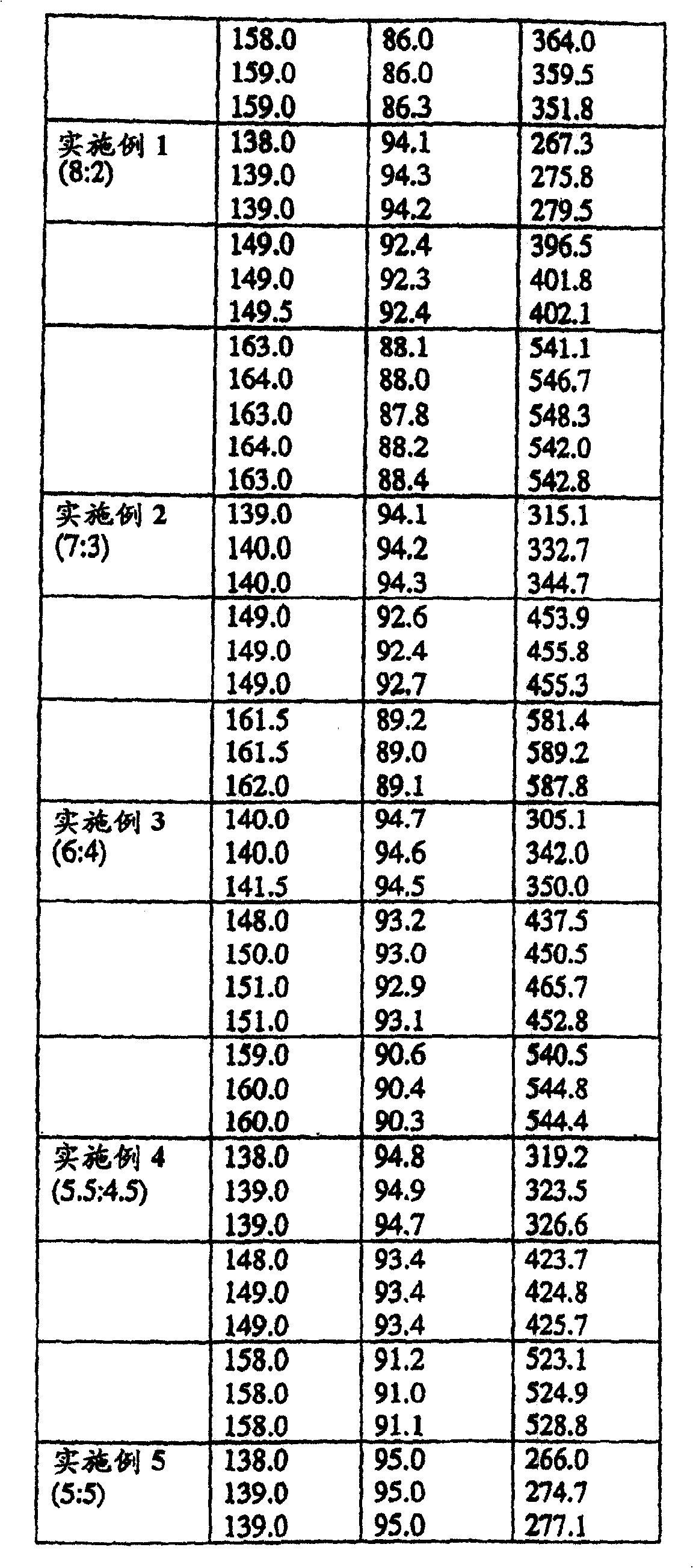

在如上所述的反应器条件下评估所述催化剂。表1显示了对VA的选择性和时空产率的结果。实施例3-7的催化剂(6∶4、5.5∶4.5、5∶5、4∶6、2∶8)比对照实施例1A和实施例1-2(9∶1、8∶2、7∶3)的催化剂选择性更好。这个数据举例说明了制备具有大约6∶4至大约2∶8的Pd∶Au重量比的催化剂的优点。实施例1-5(8∶2、7∶3、6∶4、5.5∶4.5、5∶5)的催化剂比对照实施例1A和实施例6-7(9∶1、4∶6、2∶8)的催化剂的时空产率更好。这个数据举例说明了制备具有大约8∶2至大约5∶5的Pd∶Au重量比的催化剂的优点。具有大约8∶2至大约2∶8,优选7∶3至大约4∶6,更优选6∶4至大约5∶5的Pd∶Au重量比的催化剂显示出可同时具有最佳的选择性和时空产率性能。The catalysts were evaluated under the reactor conditions described above. Table 1 shows the results for the selectivity and space-time yield to VA. The catalyst of embodiment 3-7 (6: 4,5.5: 4.5, 5: 5, 4: 6, 2: 8) compares comparative example 1A and embodiment 1-2 (9: 1, 8: 2, 7: 3) The catalyst selectivity is better. This data illustrates the advantage of preparing catalysts with a Pd:Au weight ratio of about 6:4 to about 2:8. The catalyst of embodiment 1-5 (8: 2,7: 3, 6: 4, 5.5: 4.5, 5: 5) compares comparative example 1A and embodiment 6-7 (9: 1, 4: 6, 2: 8) The space-time yield of the catalyst is better. This data illustrates the advantage of preparing catalysts with a Pd:Au weight ratio of about 8:2 to about 5:5. Catalysts having a Pd:Au weight ratio of about 8:2 to about 2:8, preferably 7:3 to about 4:6, more preferably 6:4 to about 5:5 have been shown to have the best selectivity and Space-time yield performance.
避光-实施例9和对照实施例9ADarkness-embodiment 9 and comparative example 9A
1.浸渍步骤。1. Dipping step.
在室温下,通过初期润湿技术,用0.2284g HAuCl4·3H2O和0.4208g K2PdCl4在9.28ml去离子水中的溶液浸渍20g KA-160。将KA-160置于0.5升圆底烧瓶中。当倒入溶液淹没KA-160时,将烧瓶与旋转蒸发仪连接。然后旋转所述烧瓶10分钟直至全部溶液都被载体吸收为止。此后,停止旋转并且使被浸渍载体静置至少1小时。期间塞住装有被浸渍载体的烧瓶以防止溶液从载体表面蒸发。20 g of KA-160 were impregnated with a solution of 0.2284 g HAuCl 4 ·3H 2 O and 0.4208 g K 2 PdCl 4 in 9.28 ml deionized water by the incipient wetness technique at room temperature. Place KA-160 in a 0.5 liter round bottom flask. When pouring the solution to submerge the KA-160, connect the flask to a rotary evaporator. The flask was then swirled for 10 minutes until all the solution was absorbed by the carrier. Thereafter, the rotation was stopped and the impregnated support was allowed to stand for at least 1 hour. The flask containing the impregnated support was stoppered during this time to prevent evaporation of the solution from the surface of the support.
2.固定步骤。2. Fixing steps.
实施例9:将0.44832g Na2SiO3溶于20ml去离子水中。通过倒入10ml固定溶液淹没烧瓶(烧瓶用铝箔遮盖)中的珠子以使步骤1的一半被浸渍载体与所述固定溶液反应。固定溶液仅仅淹没所述珠子。旋转被遮盖的烧瓶10分钟,然后将样品转移到用铝箔遮盖并密封的烧杯中。将烧杯置于避光的橱框中。使固定反应在室温下进行1天(~24小时)。Example 9: 0.44832g Na 2 SiO 3 was dissolved in 20ml deionized water. Half of the impregnated support from step 1 was reacted with the fixation solution by pouring 10 ml of fixation solution over the beads in the flask (the flask was covered with aluminum foil). The fixative solution just submerges the beads. The covered flask was swirled for 10 minutes before the sample was transferred to a beaker covered with aluminum foil and sealed. Place the beaker in a dark cabinet. The fixation reaction was allowed to proceed for 1 day (~24 hours) at room temperature.
实施例9A:通过倒入10ml固定溶液淹没珠子以使另一半步骤1的被浸渍载体与所述固定溶液反应。固定溶液仅仅淹没所述珠子。在室内光线下,旋转烧瓶10分钟,然后将样品转移到用玻璃遮盖的烧杯中。将被遮盖的烧瓶放在100瓦灯泡下。使固定反应在室温下进行1天(~24小时)。Example 9A: The other half of the impregnated support from step 1 was reacted with the fixation solution by pouring 10 ml of the fixation solution over the beads. The fixative solution just submerges the beads. Under room light, swirl the flask for 10 minutes, then transfer the sample to a glass-covered beaker. Place the covered flask under a 100 watt light bulb. The fixation reaction was allowed to proceed for 1 day (~24 hours) at room temperature.
3.洗涤步骤。3. Washing step.
然后从固定溶液中取出实施例9和实施例9A的珠子并且分开地浸入45-50℃的0.5L水中。在洗涤时使用磁力搅拌器。第二天将洗涤水倾出并放入另一份0.5升的水。对实施例9和实施例9A都实施清洗/倾出程序总共5次(最后一次使用1L水)以降低氯离子含量至大约50ppm,其中最终倾出液对硝酸银测试为负结果。The beads of Example 9 and Example 9A were then removed from the fixation solution and immersed separately in 0.5 L of water at 45-50°C. Use a magnetic stirrer while washing. The next day pour out the wash water and put in another 0.5 liter portion of water. Both Example 9 and Example 9A were subjected to a wash/dump procedure a total of 5 times (the last time using 1 L of water) to reduce the chloride ion content to approximately 50 ppm, with the final decant testing negative for silver nitrate.
4.干燥步骤。4. Drying step.
然后,实施例9和实施例9A的被浸渍载体在95℃的空气强制通风烘箱中都干燥十五小时。The impregnated supports of Example 9 and Example 9A were then dried in a forced air oven at 95°C for fifteen hours.
5.还原步骤。5. Reduction step.
在用管式炉加热的玻璃或石英管中分别对实施例9和实施例9A进行还原反应。在氮气流(速率300-330ml/min)中将被浸渍的载体从室温加热至150℃并保持一小时。所述珠子在氮气流中进一步加热至300℃并保持0.5小时。在加热期间,可释放被吸附的水。然后,保持氮气流并且以300-330ml/min的流速通入5%体积乙烯在氮气中的混合物。在300℃还原5小时之后,可关闭乙烯在氮气中的混合物的进料而留下纯氮气流。然后在氮气下将所述珠子冷却至室温。Reduction reactions were carried out on Examples 9 and 9A, respectively, in glass or quartz tubes heated in a tube furnace. The impregnated support was heated from room temperature to 150° C. under nitrogen flow (rate 300-330 ml/min) for one hour. The beads were further heated to 300° C. for 0.5 hours under nitrogen flow. During heating, adsorbed water can be released. Then, the nitrogen flow was maintained and a mixture of 5% by volume ethylene in nitrogen was introduced at a flow rate of 300-330 ml/min. After 5 hours of reduction at 300°C, the feed of the mixture of ethylene in nitrogen can be turned off leaving the flow of pure nitrogen. The beads were then cooled to room temperature under nitrogen.
6.增效步骤。6. Efficiency steps.
通过初始润湿技术用7重量%的醋酸钾(KOAc)分别增效实施例9和实施例9A的被还原的浸渍载体。将珠子放入烧瓶中。The reduced impregnated supports of Example 9 and Example 9A were synergized by incipient wetness technique with 7% by weight potassium acetate (KOAc), respectively. Put the beads into the flask.
7.最终的干燥步骤。7. Final drying step.
将实施例9和实施例9A的催化剂分别放进室温下的烘箱中。将温度升高到120℃。在氮气流中,将催化剂在120℃下干燥一小时。The catalysts of Example 9 and Example 9A were placed separately into ovens at room temperature. The temperature was raised to 120°C. The catalyst was dried at 120° C. for one hour in a stream of nitrogen.
在如上所述的反应器条件下评估所述实施例9(遮光)和对照实施例9A(曝光)的催化剂。表2显示了对VA的选择性和时空产率的结果。数据举例说明了在固定步骤中遮光环境下制备的催化剂的优点。与对照实施例9A的催化剂相比,实施例9的催化剂具有良好或更好的VA选择性和恒定更好的时空产率。The catalysts of Example 9 (dark) and Comparative Example 9A (exposed) were evaluated under the reactor conditions described above. Table 2 shows the results for the selectivity and space-time yield to VA. The data exemplifies the advantage of catalysts prepared in a darkened environment during the fixation step. The catalyst of Example 9 had good or better VA selectivity and a consistently better space-time yield than the catalyst of Comparative Example 9A.
实施例10-14和对照实施例10A和10BExamples 10-14 and Comparative Examples 10A and 10B
孔体积填充率Pore Volume Filling Ratio
实施例10-100%的孔填充率Example 10 - 100% Pore Filling
1.浸渍步骤。1. Dipping step.
在室温下,通过初期润湿技术,用0.1713g HAuCl4 3H2O和0.3156gK2PdCl4在8.7ml去离子水中的溶液浸渍14.9978g KA-160。将KA-160放入圆底烧瓶中。当倒入溶液淹没KA-160时,将烧瓶与旋转蒸发仪连接。旋转所述烧瓶5分钟。当停止旋转后,静置被浸渍的载体一小时。14.9978 g KA-160 was impregnated with a solution of 0.1713 g HAuCl 4 3H 2 O and 0.3156 g K 2 PdCl 4 in 8.7 ml deionized water by the incipient wetness technique at room temperature. Put KA-160 into a round bottom flask. When pouring the solution to submerge the KA-160, connect the flask to a rotary evaporator. The flask was swirled for 5 minutes. After stopping the rotation, the impregnated support was allowed to stand for one hour.
2.固定步骤。2. Fixing steps.
倒入Na2SiO3溶液(0.4035g溶于30mL水中),淹没珠子。旋转所述烧瓶10分钟。使所述溶液在室温下静置24小时。Pour Na 2 SiO 3 solution (0.4035 g dissolved in 30 mL water) to submerge the beads. The flask was swirled for 10 minutes. The solution was allowed to stand at room temperature for 24 hours.
3.洗涤步骤。3. Washing step.
将珠子浸入50℃的1L去离子水中。轻轻地搅拌珠子上的水层大约24小时。将洗涤水倾出并用另一份1升的D.I.水替换。重复这个程序总共洗涤三次。Immerse the beads in 1 L of deionized water at 50 °C. Gently agitate the aqueous layer on the beads for approximately 24 hours. Pour off the wash water and replace with another 1 liter portion of D.I. water. Repeat this procedure for a total of three washes.
4.还原步骤。4. Restoration step.
在用管式炉加热的玻璃或石英管中进行还原反应。在150℃的氮气流中加热珠子一小时,然后在300℃的氮气流中进一步加热30-40分钟并且在此温度下,在乙烯气流中还原一小时。然后在氮气下将所述珠子冷却至室温。The reduction reaction is carried out in a glass or quartz tube heated in a tube furnace. The beads were heated in a nitrogen flow at 150°C for one hour, then further heated in a nitrogen flow at 300°C for 30-40 minutes and at this temperature, reduced in an ethylene flow for one hour. The beads were then cooled to room temperature under nitrogen.
5.增效步骤。5. Efficiency steps.
通过初始润湿技术,用7重量%的醋酸钾增效被还原的样品。The reduced samples were synergized with 7 wt% potassium acetate by incipient wetness technique.
6.最终的干燥步骤。6. Final drying step.
将样品放进室温下的烘箱中。将温度升高到120℃。在氮气流中,将催化剂在120℃下干燥一小时。Place the sample in an oven at room temperature. The temperature was raised to 120°C. The catalyst was dried at 120° C. for one hour in a stream of nitrogen.
表3中显示了VA选择性和时空产率。The VA selectivities and space-time yields are shown in Table 3.
实施例11-95%孔填充率Example 11-95% Pore Filling Rate
按照实施例10的方法制备,不同之处在于:Prepare according to the method for embodiment 10, difference is:
0.2104g K2PdCl4 0.2104g K 2 PdCl 4
0.1142g HAuCl4.3H2O0.1142g HAuCl 4 .3H 2 O
5.51mL D.I.H2O5.51mL DIH2O
9.98g KA-1609.98g KA-160
在固定步骤之前不静置被浸渍的载体Do not rest impregnated support prior to fixation step
0.269g Na2SiO3,溶于30mL水中0.269g Na 2 SiO 3 , dissolved in 30mL water
当清洗后,将珠子在95℃的空气中干燥十五小时。When washed, the beads were dried in air at 95°C for fifteen hours.
表3显示了VA选择性和时空产率。Table 3 shows the VA selectivity and space-time yield.
实施例12-90%孔填充率(Al-2-26-2N2)Example 12-90% Pore Filling Ratio (Al-2-26-2N 2 )
按照实施例10的方法制备,不同之处在于:Prepare according to the method for embodiment 10, difference is:
0.4205g K2PdCl4 0.4205g K 2 PdCl 4
0.2290g HAuCl4·3H2O0.2290g HAuCl 4 3H 2 O
10.672mL D.I.H2O10.672mL DIH2O
20g KA-16020g KA-160
在表3中显示了VA选择性和时空产率。In Table 3 the VA selectivities and space-time yields are shown.
实施例13-85%孔填充率Example 13-85% Pore Filling Rate
按照实施例10的方法制备,不同之处在于:Prepare according to the method for embodiment 10, difference is:
0.2104g K2PdCl4 0.2104g K 2 PdCl 4
0.1142g HAuCl4·3H2O0.1142g HAuCl 4 3H 2 O
4.93mL D.I.H2O4.93mL DIH2O
9.96g KA-1609.96g KA-160
0.269g Na2SiO3,溶于20ml水中0.269g Na 2 SiO 3 , dissolved in 20ml water
当清洗后,将珠子在95℃的空气中干燥十五小时。When washed, the beads were dried in air at 95°C for fifteen hours.
在表3中显示了VA选择性和时空产率。In Table 3 the VA selectivities and space-time yields are shown.
实施例14-80%孔填充率Example 14-80% Pore Filling Rate
按照实施例10的方法制备,不同之处在于:Prepare according to the method for embodiment 10, difference is:
0.2104g K2PdCl4 0.2104g K 2 PdCl 4
0.1142g HAuCl4·3H2O0.1142g HAuCl 4 3H 2 O
4.64mL D.I.H2O4.64mL DIH2O
9.99g KA-1609.99g KA-160
0.269g Na2SiO3,溶于20ml水中0.269g Na 2 SiO 3 , dissolved in 20ml water
当清洗后,将珠子在95℃的空气中干燥十五小时。When washed, the beads were dried in air at 95°C for fifteen hours.
在表3中显示了VA选择性和时空产率。In Table 3 the VA selectivities and space-time yields are shown.
实施例15-70%孔填充率Example 15-70% Pore Filling Rate
按照实施例10的方法制备,不同之处在于:Prepare according to the method for embodiment 10, difference is:
0.2104g K2PdCl4 0.2104g K 2 PdCl 4
0.1142g HAuCl4·3H2O0.1142g HAuCl 4 3H 2 O
4.06mL D.I.H2O4.06mL DIH2O
10.0252g KA-16010.0252g KA-160
20mL由1.345g Na2SiO3溶于100mL水中制备的溶液20 mL of a solution prepared by dissolving 1.345 g of Na2SiO3 in 100 mL of water
用45-50℃的去离子水洗涤珠子。Wash the beads with deionized water at 45-50 °C.
清洗后,将珠子在95℃的空气中干燥十五小时。After washing, the beads were dried in air at 95°C for fifteen hours.
在表3中显示了VA选择性和时空产率。In Table 3 the VA selectivities and space-time yields are shown.
实施例10A-60%孔填充率Example 10A - 60% Pore Filling
按照实施例10的方法制备,不同之处在于:Prepare according to the method for embodiment 10, difference is:
0.2104g K2PdCl4 0.2104g K 2 PdCl 4
0.1142g HAuCl4·3H2O0.1142g HAuCl 4 3H 2 O
3.48mL D.I.H2O3.48mL DIH2O
10g KA-16010g KA-160
20mL由1.345g Na2SiO3溶于100mL水中制备的溶液20 mL of a solution prepared by dissolving 1.345 g of Na2SiO3 in 100 mL of water
用45-50℃的去离子水洗涤珠子。Wash the beads with deionized water at 45-50 °C.
清洗后,将珠子在95℃的空气中干燥十五小时。After washing, the beads were dried in air at 95°C for fifteen hours.
在表3中显示了VA选择性和时空产率。In Table 3 the VA selectivities and space-time yields are shown.
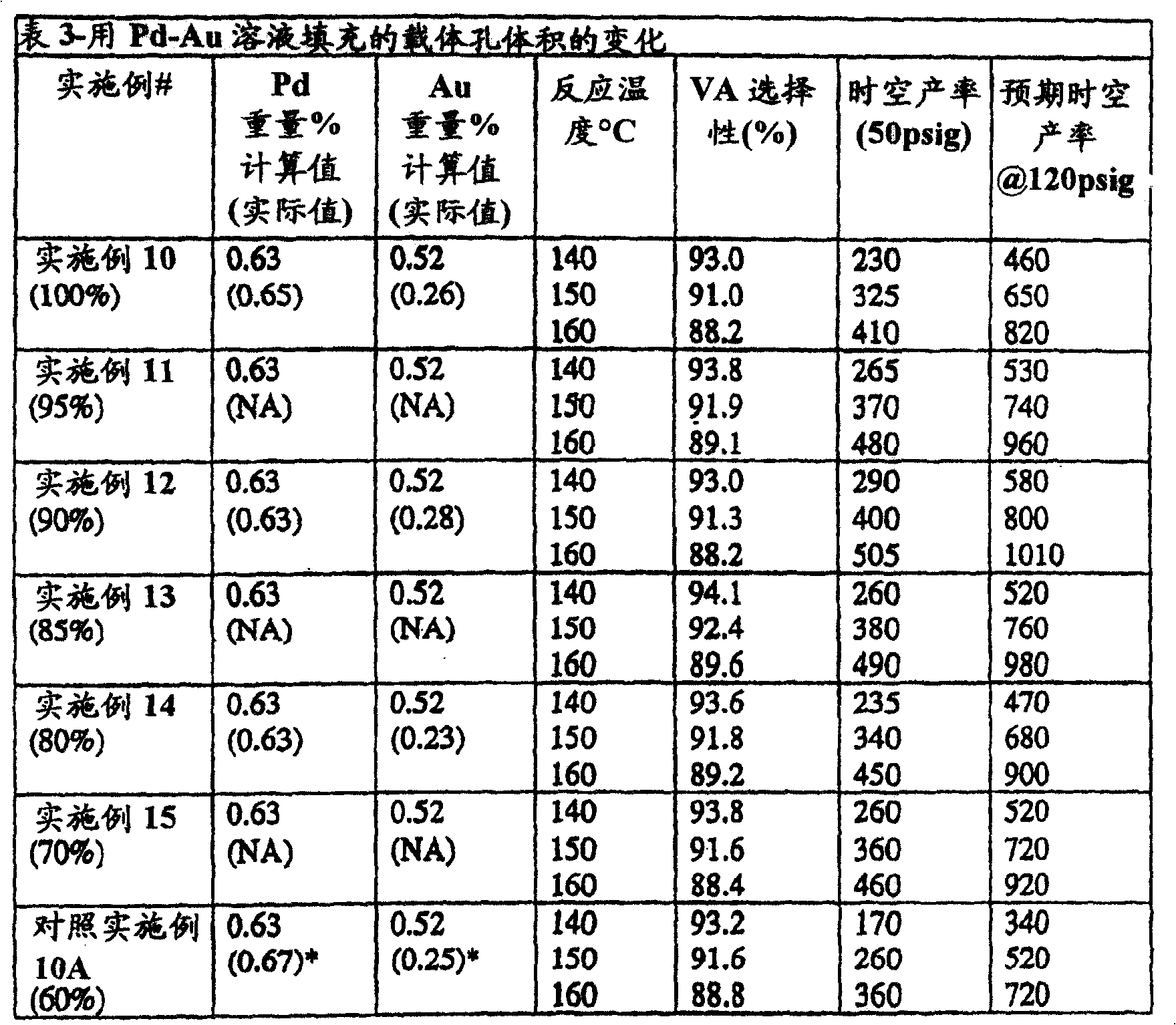
在如上所述的反应器条件下评估所述催化剂。表3显示了对VA的选择性和时空产率的结果。数据举例说明了由浸渍溶液填充70至100%的孔体积的催化剂的优点。与对照实施例10A的催化剂相比,实施例10-15的催化剂具有良好或更好的VA选择性和一致更好的时空产率。更优选85至95%的孔体积范围并且最优选大约90%的孔体积。The catalysts were evaluated under the reactor conditions described above. Table 3 shows the results for the selectivity and space-time yield to VA. The data illustrate the advantage of having catalysts filled from 70 to 100% of the pore volume by the impregnation solution. The catalysts of Examples 10-15 had good or better VA selectivities and consistently better space-time yields than the catalyst of Comparative Example 10A. A pore volume range of 85 to 95% is more preferred and a pore volume of about 90% is most preferred.
实施例16-18和对照实施例16AExamples 16-18 and Comparative Example 16A
固定剂的用量Amount of fixative
1.浸渍步骤。1. Dipping step.
在室温下,通过初期润湿技术,用0.571g HAuCl43H2O和1.051gK2PdCl4在29.6ml去离子水中的溶液浸渍50g KA-160。在0.5升圆底烧瓶中,倒入Pd-Au溶液淹没KA-160。在倒入溶液淹没KA-160之后,将烧瓶与旋转蒸发仪连接。然后非常缓慢地旋转所述烧瓶1小时。此后,停止旋转并且使被浸渍载体静置1小时。期间塞住装有被浸渍载体的烧瓶以防止溶液从载体表面蒸发。然后将样品分成5等份用于不同固定步骤的合成。50 g of KA-160 were impregnated with a solution of 0.571 g HAuCl 4 3H 2 O and 1.051 g K 2 PdCl 4 in 29.6 ml deionized water by the incipient wetness technique at room temperature. In a 0.5 L round bottom flask, pour the Pd-Au solution to submerge the KA-160. After pouring the solution to cover the KA-160, the flask was connected to a rotary evaporator. The flask was then swirled very slowly for 1 hour. Afterwards, the rotation was stopped and the impregnated support was allowed to stand for 1 hour. The flask containing the impregnated support was stoppered during this time to prevent evaporation of the solution from the surface of the support. The samples were then divided into 5 equal aliquots for the synthesis of different fixation steps.
2.固定步骤。2. Fixing steps.
将0.2241g Na2SiO3溶于7.5ml去离子水中。通过迅速地倒入固定溶液淹没珠子以使步骤1的被浸渍载体与固定溶液反应。固定溶液完全淹没所述珠子。使固定反应在室温下进行1天(~24小时)。Dissolve 0.2241 g of Na2SiO3 in 7.5 ml of deionized water. The impregnated support from step 1 was reacted with the fixation solution by quickly pouring the fixation solution over the beads. The fixation solution completely submerges the beads. The fixation reaction was allowed to proceed for 1 day (~24 hours) at room temperature.
3.洗涤步骤。3. Washing step.
然后从固定溶液中取出珠子并且浸入50℃的1L水中。轻轻地搅拌珠子上的水层过夜。第二天将洗涤水倾出并以另一份1升的水代替。实施清洗/倾出程序总共3次以降低氯离子含量至大约50ppm,其中最终倾出液对硝酸银测试为负结果。The beads were then removed from the fixation solution and immersed in 1 L of water at 50°C. Gently stir the aqueous layer on the beads overnight. The next day the wash water was poured out and replaced with another 1 liter portion of water. The wash/dump procedure was performed a total of 3 times to reduce the chloride ion level to approximately 50 ppm with the final decant testing negative for silver nitrate.
4.干燥步骤。4. Drying step.
然后在95℃的空气中干燥被浸渍的载体24小时。The impregnated support was then dried in air at 95°C for 24 hours.
5.还原步骤。5. Reduction step.
在用管式炉加热的玻璃或石英管中进行还原反应。在氮气流(速率300-330ml/min)中将被浸渍的载体从室温加热至150℃并保持一小时。所述珠子在氮气流中进一步加热至300℃并保持0.5小时。在此加热期间,释放出被吸附的水。然后,保持氮气流并且以300-330ml/min的流速通入5%体积乙烯在氮气中的混合物。在300℃还原1小时之后,可关闭乙烯流而留下纯氮气流。然后在氮气下将所述珠子冷却至室温。The reduction reaction is carried out in a glass or quartz tube heated in a tube furnace. The impregnated support was heated from room temperature to 150° C. under nitrogen flow (rate 300-330 ml/min) for one hour. The beads were further heated to 300° C. for 0.5 hours under nitrogen flow. During this heating, the adsorbed water is released. Then, the nitrogen flow was maintained and a mixture of 5% by volume ethylene in nitrogen was introduced at a flow rate of 300-330 ml/min. After 1 hour of reduction at 300°C, the flow of ethylene can be shut off leaving the flow of pure nitrogen. The beads were then cooled to room temperature under nitrogen.
6.增效步骤。6. Efficiency steps.
通过初始润湿技术,用7重量%的醋酸钾(KOAc)增效被还原的浸渍载体。将珠子放入烧瓶中。The reduced impregnated support was synergized with 7% by weight potassium acetate (KOAc) by incipient wetness technique. Put the beads into the flask.
7.最终的干燥步骤。7. Final drying step.
将所述催化剂在室温下干燥过夜,然后放进室温下的烘箱中。将温度增加到120℃。在氮气流中,将催化剂在120℃下干燥一小时。The catalyst was dried overnight at room temperature and then placed in an oven at room temperature. The temperature was increased to 120°C. The catalyst was dried at 120° C. for one hour in a stream of nitrogen.
实施例17和18和对照实施例16A Examples 17 and 18 and Comparative Example 16A
按照与实施例16相同的程序进行,不同之处在于在固定步骤中使用如下物质:The same procedure as in Example 16 was followed except that the following substances were used in the fixation step:
Na2SiO3:0.1943g D.I.水:7.5ml Na2SiO3 : 0.1943g DI water: 7.5ml
Na2SiO3:0.1644g D.I.水:7.5ml Na2SiO3 : 0.1644g DI water: 7.5ml
Na2SiO3:0.1195g D.I.水:7.5mlNa 2 SiO 3 : 0.1195g DI water: 7.5ml

在如上所述的反应器条件下评估所述催化剂。表4显示了对VA的选择性和时空产率的结果。数据举例说明了由至少过量1.1摩尔的沉淀剂或固定剂合成的催化剂的优点。与对照实施例16A的催化剂相比,实施例16-18的催化剂具有一致更好的时空产率。The catalysts were evaluated under the reactor conditions described above. Table 4 shows the results for the selectivity and space-time yield to VA. The data illustrate the advantage of catalysts synthesized with at least a 1.1 molar excess of precipitant or fixative. The catalysts of Examples 16-18 had consistently better space-time yields than the catalyst of Comparative Example 16A.
实施例19和20和对照实施例19A-19C Examples 19 and 20 and Comparative Examples 19A-19C
1.浸渍步骤。1. Dipping step.
在室温下(R.T.),通过初期润湿技术,用0.572g HAuCl4 3H2O和1.052g K2PdCl4在29.375ml去离子水中的溶液浸渍50g KA-160。在0.5升圆底烧瓶中,倒入Pd-Au溶液淹没KA-160。在倒入溶液淹没KA-160之后,将烧瓶与旋转蒸发仪连接。然后旋转所述烧瓶1小时。此后,停止旋转并且使被浸渍载体静置至少1小时。期间塞住装有被浸渍载体的烧瓶以防止溶液从载体表面蒸发。At room temperature (RT), 50 g of KA-160 was impregnated with a solution of 0.572 g HAuCl 4 3H 2 O and 1.052 g K 2 PdCl 4 in 29.375 ml deionized water by the incipient wetness technique. In a 0.5 L round bottom flask, pour the Pd-Au solution to submerge the KA-160. After pouring the solution to cover the KA-160, the flask was connected to a rotary evaporator. The flask was then swirled for 1 hour. Thereafter, the rotation was stopped and the impregnated support was allowed to stand for at least 1 hour. The flask containing the impregnated support was stoppered during this time to prevent evaporation of the solution from the surface of the support.
2.固定步骤。2. Fixing steps.
将0.30398g Na2SiO3溶于8.325ml去离子水中。通过迅速地倒入溶液淹没珠子以使五分之一的步骤1的被浸渍载体与固定溶液反应。固定溶液完全淹没所述珠子。最终pH为8.62。使固定反应在室温下进行1天(~24小时)。按照如下条件重复这个过程:Dissolve 0.30398 g of Na2SiO3 in 8.325 ml of deionized water. One-fifth of the impregnated support from Step 1 was reacted with the fixation solution by quickly pouring the solution over the beads. The fixation solution completely submerges the beads. The final pH was 8.62. The fixation reaction was allowed to proceed for 1 day (~24 hours) at room temperature. Repeat this process as follows:
Na2SiO3:0.32944g D.I.水:8.325ml 最终pH:8.99 Na2SiO3 : 0.32944g DI water: 8.325ml Final pH: 8.99
Na2SiO3:0.35939g D.I.水:8.325ml 最终pH:9.04 Na2SiO3 : 0.35939g DI water: 8.325ml Final pH: 9.04
Na2SiO3:0.38933g D.I.水:8.325ml 最终pH:9.32 Na2SiO3 : 0.38933g DI water: 8.325ml Final pH: 9.32
Na2SiO3:0.41929g D.I.水:8.325ml 最终pH:9.45 Na2SiO3 : 0.41929g DI water: 8.325ml Final pH: 9.45
3.洗涤步骤。3. Washing step.
对于实施例19和20,然后从固定溶液中取出珠子并且浸入室温下的0.5L水中。将珠子上的水层轻轻地搅拌过夜。第二天将洗涤水倾出并用另一份0.5升的水代替。实施这个清洗/倾出程序总共3次,然后用1L的水在50℃重复两次以降低氯离子含量至大约50ppm,其中最终倾出液对硝酸银测试为负结果。For Examples 19 and 20, the beads were then removed from the fixation solution and immersed in 0.5 L of water at room temperature. The aqueous layer on the beads was stirred gently overnight. The next day the wash water was poured out and replaced with another 0.5 liter portion of water. This wash/dump procedure was performed a total of 3 times and then repeated twice with 1 L of water at 50°C to reduce the chloride ion content to approximately 50 ppm with the final decant testing negative for silver nitrate.
对于对照实施例19A,然后从固定溶液中取出珠子并且浸入室温下的225mL水中。将珠子上的水层轻轻地搅拌过夜。第二天将洗涤水倾出并以另一份225mL的水代替。实施这个清洗/倾出程序总共3次,用1L的水在室温下重复一次,用2L的水在50℃重复一次以降低氯离子含量至大约50ppm,其中最终倾出液对硝酸银测试为负结果。For Comparative Example 19A, the beads were then removed from the fixation solution and immersed in 225 mL of water at room temperature. The aqueous layer on the beads was stirred gently overnight. The next day the wash water was decanted and replaced with another 225 mL portion of water. Perform this wash/dump procedure a total of 3 times, repeating once with 1 L of water at room temperature and once with 2 L of water at 50°C to reduce the chloride ion content to approximately 50 ppm, with the final decant testing negative for silver nitrate result.
对于对照实施例19B和19C,然后从固定溶液中取出珠子并且浸入室温下的225mL水中。将珠子上的水层轻轻地搅拌过夜。第二天将洗涤水倾出并以另一份225mL的水代替。实施这个清洗/倾出程序总共3次,用0.5L的水在室温下重复一次,用500mL的水在50℃重复三次并且用1L的水在50℃重复两次以降低氯离子含量至大约50ppm,其中最终倾出液对硝酸银测试为负结果。For Comparative Examples 19B and 19C, the beads were then removed from the fixation solution and immersed in 225 mL of water at room temperature. The aqueous layer on the beads was stirred gently overnight. The next day the wash water was decanted and replaced with another 225 mL portion of water. Perform this wash/dump procedure a total of 3 times, repeating once with 0.5 L of water at room temperature, three times with 500 mL of water at 50°C and twice with 1 L of water at 50°C to reduce the chloride ion content to approximately 50 ppm , where the final decant tested negative for silver nitrate.
4.干燥步骤。4. Drying step.
对于实施例19和20以及对照实施例19A,然后在95℃的空气中干燥被浸渍的载体9小时。For Examples 19 and 20 and Comparative Example 19A, the impregnated support was then dried in air at 95°C for 9 hours.
对于实施例19B和19C,然后在95℃的空气中干燥被浸渍的载体16小时。For Examples 19B and 19C, the impregnated support was then dried in air at 95°C for 16 hours.
5.还原步骤。5. Reduction step.
在用管式炉加热的玻璃或石英管中进行还原反应。在氮气流(速率300-330ml/min)中将被浸渍的载体从室温加热至150℃并保持半小时。所述珠子在氮气流中进一步加热至300℃并保持半小时。在加热期间,释放出被吸附的水。然后,保持氮气流并且以300-330ml/min的流速通入5%体积乙烯在氮气中的混合物。在300℃还原1小时之后,可将乙烯流关闭而留下纯氮气流。然后在氮气下将所述珠子冷却至室温。The reduction reaction is carried out in a glass or quartz tube heated in a tube furnace. The impregnated support was heated from room temperature to 150° C. under nitrogen flow (rate 300-330 ml/min) for half an hour. The beads were further heated to 300°C for half an hour under a nitrogen flow. During heating, the adsorbed water is released. Then, the nitrogen flow was maintained and a mixture of 5% by volume ethylene in nitrogen was introduced at a flow rate of 300-330 ml/min. After 1 hour of reduction at 300°C, the ethylene flow can be shut off leaving the pure nitrogen flow. The beads were then cooled to room temperature under nitrogen.
6.增效步骤。6. Efficiency steps.
通过初始润湿技术,用6-7重量%的醋酸钾(KOAc)增效被还原的浸渍载体。将珠子放入烧瓶中。The reduced impregnated support was synergized with 6-7% by weight potassium acetate (KOAc) by incipient wetness technique. Put the beads into the flask.
7.最终的干燥步骤。7. Final drying step.
对于实施例19和对照实施例19B和19C来说,将每种催化剂分别放进室温下的烘箱中。将温度升高到95℃。在空气流中,将催化剂在95℃下干燥十六小时。For Example 19 and Comparative Examples 19B and 19C, each catalyst was placed in a separate oven at room temperature. The temperature was raised to 95°C. The catalyst was dried at 95°C for sixteen hours in a stream of air.
对于实施例20和对照实施例19A来说,将每种催化剂分别放进室温下的烘箱中。将温度升高到75℃。在空气流中,将催化剂在75℃下干燥十六小时。For Example 20 and Comparative Example 19A, each catalyst was placed in a separate oven at room temperature. The temperature was raised to 75°C. The catalyst was dried at 75°C for sixteen hours in a stream of air.
在如上所述的反应器条件下评估所述催化剂。表5中显示了对VA的选择性和时空产率的结果。数据举例说明了由过量不超过2.2摩尔的沉淀或固定剂合成的催化剂的优点。与对照实施例19A-19C的催化剂相比,实施例19和20的催化剂具有良好的或更好的VA选择性和一致更好的时空产率。The catalysts were evaluated under the reactor conditions described above. The results for the selectivity to VA and the space-time yield are shown in Table 5. The data illustrate the advantages of catalysts synthesized from no more than 2.2 molar excess of either precipitation or fixative. The catalysts of Examples 19 and 20 had good or better VA selectivities and consistently better space-time yields than the catalysts of Comparative Examples 19A-19C.
实施例21-25 Examples 21-25
1.浸渍步骤。1. Dipping step.
在室温下(R.T.),通过初期润湿技术,用0.571g HAuCl4 3H2O和1.052g K2PdCl4在26.1ml去离子水中的溶液浸渍50g KA-160。将所述KA-160放入1升圆底烧瓶中。在倒入溶液淹没KA-160之后,将烧瓶与旋转蒸发仪连接。然后旋转所述烧瓶10分钟,直至所有的溶液被载体吸附。然后将77.7350g被浸渍的载体分成五等份。在五分钟内开始固定。At room temperature (RT), 50 g of KA-160 was impregnated with a solution of 0.571 g HAuCl 4 3H 2 O and 1.052 g K 2 PdCl 4 in 26.1 ml deionized water by the incipient wetness technique. The KA-160 was placed in a 1 liter round bottom flask. After pouring the solution to cover the KA-160, the flask was connected to a rotary evaporator. The flask was then swirled for 10 minutes until all the solution was absorbed by the carrier. 77.7350 g of the impregnated support was then divided into five equal portions. Start fixing in five minutes.
2.固定步骤。2. Fixing steps.
将0.3143gNa2SiO3溶于9ml去离子水中。通过将溶液倒在珠子上以使15.50g步骤1的被浸渍载体与固定溶液反应。所述溶液的体积约为珠子体积的一半。旋转混合物5分钟,然后放到烧杯中并且密封。使固定反应在室温下进行1天(~24小时)。按照如下条件重复这个过程:Dissolve 0.3143 g of Na2SiO3 in 9 ml of deionized water. 15.50 g of the impregnated support from step 1 was reacted with the immobilization solution by pouring the solution onto the beads. The volume of the solution is approximately half the volume of the beads. The mixture was swirled for 5 minutes, then placed into a beaker and sealed. The fixation reaction was allowed to proceed for 1 day (~24 hours) at room temperature. Repeat this process as follows:
Na2SiO3:0.2694g D.I.水:9ml Na2SiO3 : 0.2694g DI water: 9ml
Na2SiO3:0.224505g D.I.水:9ml Na2SiO3 : 0.224505g DI water: 9ml
Na2SiO3:0.19457g D.I.水:9ml Na2SiO3 : 0.19457g DI water: 9ml
Na2SiO3:0.1796g D.I.水:9ml Na2SiO3 : 0.1796g DI water: 9ml
3.洗涤步骤。3. Washing step.
然后从固定溶液中取出珠子并且浸入50℃的1L水中。将珠子上的水层轻轻地搅拌过夜。第二天将洗涤水倾出并用另一份1升的水代替。实施这个清洗/倾出程序总共3次以降低氯离子含量至大约50ppm,其中最终倾出液对硝酸银测试为负结果。The beads were then removed from the fixation solution and immersed in 1 L of water at 50°C. The aqueous layer on the beads was stirred gently overnight. The next day the wash water was poured out and replaced with another 1 liter portion of water. This wash/dump procedure was performed a total of 3 times to reduce the chloride ion level to approximately 50 ppm with the final decant testing negative for silver nitrate.
4.干燥步骤。4. Drying step.
然后在95℃的强制通风烘箱中干燥被浸渍的载体十五小时。The impregnated support was then dried in a forced air oven at 95°C for fifteen hours.
5.还原步骤。5. Reduction step.
在用管式炉加热的玻璃或石英管中进行还原反应。在氮气流(速率300-330ml/min)中将3.1g每种催化剂前体从室温加热至150℃并保持一小时。所述珠子在氮气流中进一步加热至300℃并保持半小时。在此加热期间,可释放出被吸附的水。然后,保持氮气流并且以300-330ml/min的流速通入5%体积乙烯在氮气中的混合物。在300℃还原1.5小时之后,可将5%的乙烯在氮气中的混合物关闭而留下纯氮气流。然后在氮气下将所述珠子冷却至室温。The reduction reaction is carried out in a glass or quartz tube heated in a tube furnace. 3.1 g of each catalyst precursor was heated from room temperature to 150° C. for one hour in a nitrogen flow (rate 300-330 ml/min). The beads were further heated to 300°C for half an hour in a nitrogen flow. During this heating, the adsorbed water can be released. Then, the nitrogen flow was maintained and a mixture of 5% by volume ethylene in nitrogen was introduced at a flow rate of 300-330 ml/min. After 1.5 hours of reduction at 300°C, the 5% ethylene in nitrogen mixture can be turned off leaving a flow of pure nitrogen. The beads were then cooled to room temperature under nitrogen.
6.增效步骤。6. Efficiency steps.
通过初始润湿技术,用6-7重量%的醋酸钾(KOAc)增效被还原的浸渍载体。将珠子放入烧瓶中。The reduced impregnated support was synergized with 6-7% by weight potassium acetate (KOAc) by incipient wetness technique. Put the beads into the flask.
7.最终的干燥步骤。7. Final drying step.
将所述催化剂放进室温下的烘箱中。将温度升高到120℃。在氮气流中,将催化剂在120℃下干燥一小时。The catalyst was placed in an oven at room temperature. The temperature was raised to 120°C. The catalyst was dried at 120° C. for one hour in a stream of nitrogen.

*对未增效样品进行-ICP分析。 * -ICP analysis performed on non-boosted samples.
在如上所述的反应器条件下评估所述催化剂。表6显示了对VA的选择性和时空产率的结果。数据举例说明了由过量1.5摩尔的沉淀剂或固定剂合成的催化剂(实施例23)的优点:当同时考虑VA选择性和时空产率时,实施例23具有最佳性能。The catalysts were evaluated under the reactor conditions described above. Table 6 shows the results for the selectivity and space-time yield to VA. The data illustrate the advantage of a catalyst synthesized from a 1.5 molar excess of precipitant or fixative (Example 23): Example 23 has the best performance when both VA selectivity and space-time yield are considered.
固定时间Fixed time
实施例26-29 Examples 26-29
3hrs v.15hrs3hrs v.15hrs
1.浸渍步骤。1. Dipping step.
在室温下(R.T.),通过初期润湿技术,用0.9136g HAuCl4 3H2O和1.6830g K2PdCl4在47ml去离子水中的溶液浸渍80.0675g KA-160。将KA-160放到1升圆底烧瓶中。在将溶液倒在KA-160上之后,将烧瓶与旋转蒸发仪连接。然后缓慢旋转所述烧瓶1小时直至全部溶液被载体吸附。此后,停止旋转并且使被浸渍载体静置至少1小时。期间塞住有被浸渍载体的烧瓶以防止溶液从载体表面蒸发。At room temperature (RT), 80.0675 g KA-160 was impregnated with a solution of 0.9136 g HAuCl 4 3H 2 O and 1.6830 g K 2 PdCl 4 in 47 ml deionized water by the incipient wetness technique. Place KA-160 in a 1 liter round bottom flask. After pouring the solution onto the KA-160, the flask was connected to a rotary evaporator. The flask was then swirled slowly for 1 hour until all the solution was absorbed by the support. Thereafter, the rotation was stopped and the impregnated support was allowed to stand for at least 1 hour. During this time the flask with the impregnated support was stoppered to prevent the solution from evaporating from the surface of the support.
2.固定步骤。2. Fixing steps.
实施例26:将0.2392g Na2SiO3溶于7.5ml去离子水中。通过倒入固定溶液淹没珠子以使八分之一的步骤1的被浸渍载体与固定溶液反应。将混合物放在烧杯内并且密封。使固定反应在室温下进行3小时。按照如下条件重复这个过程:Example 26: 0.2392g Na2SiO3 was dissolved in 7.5ml deionized water. One-eighth of the impregnated support from step 1 was reacted with the fixation solution by pouring the fixation solution over the beads. The mixture was placed in a beaker and sealed. The fixation reaction was allowed to proceed for 3 hours at room temperature. Repeat this process as follows:
实施例28:Na2SiO3:0.3288g D.I.水:7.5mlExample 28: Na 2 SiO 3 : 0.3288g DI water: 7.5ml
实施例27和29:与实施例26和28的过程相同,不同之处在于使固定反应在室温下进行15小时。Examples 27 and 29: The same procedure as in Examples 26 and 28, except that the fixation reaction was allowed to proceed at room temperature for 15 hours.
3.洗涤步骤。3. Washing step.
实施例26和28,然后从固定溶液中取出珠子并且浸入45-50℃的1L水中。将珠子上的水层轻轻地搅拌过夜。第二天将洗涤水倾出并用另一份1升的水代替。实施这个清洗/倾出程序总共4次以降低氯离子含量至大约50ppm,其中最终倾出液对硝酸银测试为负结果。Examples 26 and 28, the beads were then removed from the fixation solution and immersed in 1 L of water at 45-50°C. The aqueous layer on the beads was stirred gently overnight. The next day the wash water was poured out and replaced with another 1 liter portion of water. This wash/dump procedure was performed a total of 4 times to reduce the chloride ion level to approximately 50 ppm with the final decant testing negative for silver nitrate.
实施例27和29:按照与实施例26和28相同的程序进行,不同之处在于实施清洗/倾出步骤共3次。Examples 27 and 29: Follow the same procedure as Examples 26 and 28, except that the washing/decanting step is performed 3 times.
4.干燥步骤。4. Drying step.
然后在95℃的强制通风烘箱中干燥每个实施例的被浸渍载体过夜。The impregnated support for each example was then dried overnight in a forced air oven at 95°C.
5.还原步骤。5. Reduction step.
对于每个实施例,可在用管式炉加热的玻璃或石英管中进行还原反应。在氮气流(速率300-330ml/min)中将4.6g每种催化剂载体从室温加热至150℃并保持一小时。所述珠子在氮气流中进一步加热至300℃并保持0.5小时。保持氮气流并且以300-330ml/min的流速通入5%体积乙烯在氮气中的混合物。在还原1小时之后,可将5%的乙烯在氮气中的混合物关闭而留下纯氮气流。然后在氮气下将所述珠子冷却至室温。For each example, the reduction reaction can be performed in a glass or quartz tube heated in a tube furnace. 4.6 g of each catalyst support was heated from room temperature to 150° C. for one hour in a nitrogen flow (rate 300-330 ml/min). The beads were further heated to 300° C. for 0.5 hours under nitrogen flow. The nitrogen flow was maintained and a 5% volume mixture of ethylene in nitrogen was introduced at a flow rate of 300-330 ml/min. After 1 hour of reduction, the 5% ethylene in nitrogen mixture can be turned off leaving pure nitrogen flow. The beads were then cooled to room temperature under nitrogen.
6.增效步骤。6. Efficiency steps.
对于每个实施例,通过初始润湿技术,用6-7重量%的醋酸钾(KOAc)增效被还原的浸渍载体。将珠子放入烧瓶中。For each example, the reduced impregnated support was synergized with 6-7% by weight potassium acetate (KOAc) by incipient wetness technique. Put the beads into the flask.
7.最终的干燥步骤。7. Final drying step.
将每个实施例的催化剂分别放进室温下的烘箱中。将温度升高到120℃。在氮气流中,将催化剂在120℃下干燥七十分钟。The catalysts for each example were placed separately in an oven at room temperature. The temperature was raised to 120°C. The catalyst was dried at 120°C for seventy minutes in a nitrogen stream.

在如上所述的反应器条件下评估所述催化剂。表7显示了对VA的选择性和时空产率的结果。数据举例说明了具有至少三小时固定时间的催化剂的优点。实施例27和29的催化剂(十五小时)比实施例26和28的催化剂具有更好的时空产率。The catalysts were evaluated under the reactor conditions described above. Table 7 shows the results for the selectivity and space-time yield to VA. The data illustrate the advantage of having a catalyst with a fixed time of at least three hours. The catalysts of Examples 27 and 29 (fifteen hours) had better space-time yields than the catalysts of Examples 26 and 28.
实施例30-32Examples 30-32
1天v.2天v.3天1 day v.2 days v.3 days
1.浸渍步骤。1. Dipping step.
在室温下(R.T.),通过初期润湿技术,用0.6852g HAuCl4 3H2O和1.2622g K2PdCl4在36.3ml去离子水中的溶液浸渍60g KA-160。将KA-160放到1升圆底烧瓶中。在将溶液倒在KA-160上之后,将烧瓶与旋转蒸发仪连接。然后旋转所述烧瓶10分钟直至全部溶液被载体吸附。此后,停止旋转并且使被浸渍载体静置至少1小时。期间塞住有被浸渍载体的烧瓶以防止溶液从载体表面蒸发。At room temperature (RT), 60 g of KA-160 was impregnated with a solution of 0.6852 g HAuCl 4 3H 2 O and 1.2622 g K 2 PdCl 4 in 36.3 ml deionized water by the incipient wetness technique. Place KA-160 in a 1 liter round bottom flask. After pouring the solution onto the KA-160, the flask was connected to a rotary evaporator. The flask was then swirled for 10 minutes until all the solution was absorbed by the carrier. Thereafter, the rotation was stopped and the impregnated support was allowed to stand for at least 1 hour. During this time the flask with the impregnated support was stoppered to prevent the solution from evaporating from the surface of the support.
2.固定步骤。2. Fixing steps.
实施例30:将1.3897g Na2SiO3溶于120ml去离子水(pH=12.9)中。通过将六分之一的固定溶液倒在珠子上以使六分之一的步骤1的被浸渍载体与所述固定溶液反应。将所述混合物放到烧杯中并且密封。使固定反应在室温下进行24小时(pH=8.22)。按照如下条件重复这个过程:Example 30: 1.3897 g of Na 2 SiO 3 was dissolved in 120 ml of deionized water (pH=12.9). One-sixth of the impregnated support from step 1 was reacted with the fixation solution by pouring one-sixth of the fixation solution onto the beads. The mixture was placed in a beaker and sealed. The fixation reaction was allowed to proceed for 24 hours at room temperature (pH = 8.22). Repeat this process as follows:
实施例31:固定时间:48小时 pH=7.98Embodiment 31: Fixed time: 48 hours pH=7.98
实施例32:固定时间:72小时 pH=7.75Embodiment 32: Fixed time: 72 hours pH=7.75
3.洗涤步骤。3. Washing step.
实施例30:然后从固定溶液中取出珠子并且浸入40℃下的1L水中。将珠子上的水层轻轻地搅拌过夜。第二天将洗涤水倾出并用另一份1升的水代替。实施这个清洗/倾出程序总共三次以降低氯离子含量至大约50ppm,其中最终倾出液对硝酸银测试为负结果。Example 30: The beads were then removed from the fixation solution and immersed in 1 L of water at 40°C. The aqueous layer on the beads was stirred gently overnight. The next day the wash water was poured out and replaced with another 1 liter portion of water. This wash/dump procedure was performed a total of three times to reduce the chloride ion level to approximately 50 ppm, with the final decant testing negative for silver nitrate.
实施例31:按照与实施例30相同的方法进行,不同之处在于在40℃下实施清洗/倾出程序一次并且在50℃下实施两次。Example 31: The same procedure as Example 30 was followed except that the wash/decant procedure was performed once at 40°C and twice at 50°C.
实施例32:按照与实施例30相同的方法进行,不同之处在于在50℃下实施清洗/倾出程序两次。Example 32: The same procedure as Example 30 was followed except that the wash/decant procedure was performed twice at 50°C.
4.干燥步骤。4. Drying step.
对于每个实施例,然后在100℃的强制通风烘箱中干燥被浸渍载体十四小时。For each example, the impregnated support was then dried in a forced air oven at 100°C for fourteen hours.
5.还原步骤。5. Reduction step.
实施例30:在用管式炉加热的玻璃或石英管中进行还原反应。在氮气流(速率300-330ml/min)中将3.3g催化剂前体从室温加热至150℃并保持半小时。所述珠子在氮气流中进一步加热至300℃并保持二十分钟。保持氮气流并且以300-330ml/min的流速通入5%体积乙烯在氮气中的混合物。在还原5小时之后,可将5%的乙烯在氮气中的混合物关闭而留下纯氮气流。然后在氮气下将所述珠子冷却至室温。实施例31和32:按照与实施例30相同的方法进行,不同之处在于将珠子在氮气流中加热至300℃并保持二十五分钟。Example 30: Reduction in a glass or quartz tube heated in a tube furnace. 3.3 g of the catalyst precursor were heated from room temperature to 150° C. under nitrogen flow (rate 300-330 ml/min) and held for half an hour. The beads were further heated to 300°C for twenty minutes in a nitrogen flow. The nitrogen flow was maintained and a 5% volume mixture of ethylene in nitrogen was introduced at a flow rate of 300-330 ml/min. After 5 hours of reduction, the 5% ethylene in nitrogen mixture can be turned off leaving pure nitrogen flow. The beads were then cooled to room temperature under nitrogen. Examples 31 and 32: The same procedure as Example 30 was followed except that the beads were heated to 300° C. for twenty-five minutes in a nitrogen stream.
6.增效步骤。6. Efficiency steps.
对于每个实施例,通过初始润湿技术,用6-7重量%的醋酸钾(KOAc)增效被还原的浸渍载体。将珠子放入烧瓶中。For each example, the reduced impregnated support was synergized with 6-7% by weight potassium acetate (KOAc) by incipient wetness technique. Put the beads into the flask.
7.最终的干燥步骤。7. Final drying step.
实施例30:将催化剂分别放进室温下的烘箱中。将温度升高到120℃。在氮气流中,将催化剂在120℃下干燥一小时。Example 30: The catalysts were placed separately in an oven at room temperature. The temperature was raised to 120°C. The catalyst was dried at 120° C. for one hour in a stream of nitrogen.
实施例31和32:将催化剂分别放在室温下的烘箱中。将温度升至100℃。在100℃下的强制通风烘箱中干燥催化剂十四小时。Examples 31 and 32: The catalysts were placed separately in an oven at room temperature. The temperature was raised to 100°C. The catalyst was dried in a forced air oven at 100°C for fourteen hours.

在如上所述的反应器条件下评估所述催化剂。表8显示了对VA的选择性和时空产率的结果。数据举例说明了具有三天固定时间的催化剂的优点。与实施例30和31的催化剂相比,实施例32的催化剂(十五小时)具有良好或更好的VA选择性和一致更好的时空产率。实施例33和对照实施例33AThe catalysts were evaluated under the reactor conditions described above. Table 8 shows the results for the selectivity to VA and the space-time yield. The data illustrate the advantage of having a catalyst with a fixed time of three days. The catalyst of Example 32 (fifteen hours) had good or better VA selectivity and consistently better space-time yield than the catalysts of Examples 30 and 31. Example 33 and Comparative Example 33A
干混合dry mix
1.浸渍步骤。1. Dipping step.
在室温下(R.T.),通过初期润湿技术,用0.6852g HAuCl4 3H2O和1.2622g K2PdCl4在35.25ml去离子水中的溶液浸渍60g KA-160。将KA-160放到1升圆底烧瓶中。在将溶液倒在KA-160上之后,将烧瓶与旋转蒸发仪连接。然后旋转所述烧瓶十五分钟直至全部溶液被载体吸附。此后,停止旋转并且使被浸渍载体静置至少1小时。期间塞住有被浸渍载体的烧瓶以防止溶液从载体表面蒸发。At room temperature (RT), 60 g of KA-160 was impregnated with a solution of 0.6852 g HAuCl 4 3H 2 O and 1.2622 g K 2 PdCl 4 in 35.25 ml deionized water by the incipient wetness technique. Place KA-160 in a 1 liter round bottom flask. After pouring the solution onto the KA-160, the flask was connected to a rotary evaporator. The flask was then swirled for fifteen minutes until all the solution was absorbed by the carrier. Thereafter, the rotation was stopped and the impregnated support was allowed to stand for at least 1 hour. During this time the flask with the impregnated support was stoppered to prevent the solution from evaporating from the surface of the support.
2.固定步骤。2. Fixing steps.
实施例33:将0.2316g Na2SiO3溶于20ml去离子水中。通过倒入固定溶液淹没珠子以使六分之一的步骤1的被浸渍载体与固定溶液反应。将所述混合物放在烧杯中并且密封。使固定反应在室温下进行24小时。Example 33: 0.2316g Na2SiO3 was dissolved in 20ml deionized water. One-sixth of the impregnated support from step 1 was reacted with the fixation solution by pouring the fixation solution over the beads. The mixture was placed in a beaker and sealed. The fixation reaction was allowed to proceed at room temperature for 24 hours.
实施例33A:将0.2316gNa2SiO3粉末放到圆底烧瓶中。把六分之一的步骤1的被浸渍载体倒到粉末上。将所述混合物旋转20分钟。使固定反应在室温下进行24小时。Example 33A : 0.2316 g of Na2SiO3 powder was placed in a round bottom flask. Pour one-sixth of the impregnated support from step 1 onto the powder. The mixture was swirled for 20 minutes. The fixation reaction was allowed to proceed at room temperature for 24 hours.
3.洗涤步骤。3. Washing step.
对于每个实施例,然后从固定溶液中取出珠子并且浸入50℃下的1L水中。将珠子上的水层轻轻地搅拌过夜。第二天将洗涤水倾出并用另一份1升的水代替。实施这个清洗/倾出程序总共3次以降低氯离子含量至大约50ppm,其中最终倾出液对硝酸银测试为负结果。For each example, the beads were then removed from the fixation solution and immersed in 1 L of water at 50°C. The aqueous layer on the beads was stirred gently overnight. The next day the wash water was poured out and replaced with another 1 liter portion of water. This wash/dump procedure was performed a total of 3 times to reduce the chloride ion level to approximately 50 ppm with the final decant testing negative for silver nitrate.
4.干燥步骤。4. Drying step.
对于每个实施例,然后在95℃的强制通风烘箱中干燥每个实施例的被浸渍载体十七小时。For each example, the impregnated support for each example was then dried in a forced air oven at 95°C for seventeen hours.
5.还原步骤。5. Reduction step.
对于每个实施例,可在用管式炉加热的玻璃或石英管中进行还原反应。在氮气流(速率300-330ml/min)中将6.5g每种催化剂前体从室温加热至150℃并保持一小时。所述珠子在氮气流中进一步加热至300℃并保持半小时。保持氮气流并且以300-330ml/min的流速通入5%体积乙烯在氮气中的混合物。在还原1小时之后,可将5%的乙烯在氮气中的混合物关闭而留下纯氮气流。然后在氮气下将所述珠子冷却至室温。For each example, the reduction reaction can be performed in a glass or quartz tube heated in a tube furnace. 6.5 g of each catalyst precursor was heated from room temperature to 150° C. for one hour in a nitrogen flow (rate 300-330 ml/min). The beads were further heated to 300°C for half an hour under a nitrogen flow. The nitrogen flow was maintained and a 5% volume mixture of ethylene in nitrogen was introduced at a flow rate of 300-330 ml/min. After 1 hour of reduction, the 5% ethylene in nitrogen mixture can be turned off leaving pure nitrogen flow. The beads were then cooled to room temperature under nitrogen.
6.增效步骤。6. Efficiency steps.
对于每个实施例,通过初始润湿技术,用6-7重量%的醋酸钾(KOAc)增效被还原的浸渍载体。将珠子放入烧瓶中。For each example, the reduced impregnated support was synergized with 6-7% by weight potassium acetate (KOAc) by incipient wetness technique. Put the beads into the flask.
7.最终的干燥步骤。7. Final drying step.
将每个实施例的催化剂分别放进室温下的烘箱中。将温度升高到120℃。在氮气流中,将催化剂在120℃下干燥一小时。The catalysts for each example were placed separately in an oven at room temperature. The temperature was raised to 120°C. The catalyst was dried at 120° C. for one hour in a stream of nitrogen.

在如上所述的反应器条件下评估所述催化剂。表9显示了对VA的选择性和时空产率的结果。数据举例说明了用“干”或粉末沉淀或固定剂合成的催化剂优于用水溶液合成的催化剂。与对照实施例33A的催化剂相比,实施例33的催化剂具有良好的或更好的VA选择性以及一致更好的时空产率。The catalysts were evaluated under the reactor conditions described above. Table 9 shows the results for the selectivity and space-time yield to VA. The data illustrate that catalysts synthesized with "dry" or powder precipitates or fixatives are superior to catalysts synthesized with aqueous solutions. The catalyst of Example 33 had good or better VA selectivity and consistently better space-time yield than the catalyst of Comparative Example 33A.
在40-100℃下用水洗催化剂前体Wash the catalyst precursor with water at 40-100°C
实施例34-39和对照实施例34A和35AExamples 34-39 and Comparative Examples 34A and 35A
1.浸渍步骤。1. Dipping step.
在室温下(R.T.),通过初期润湿技术,用0.7999g HAuCl4 3H2O和1.4728g K2PdCl4在36.12ml去离子水中的溶液浸渍70g KA-160。将KA-160放到防UV光的圆底玻璃烧瓶中。在将溶液倒在KA-160上之后,将烧瓶与旋转蒸发仪连接。然后旋转所述烧瓶5分钟。At room temperature (RT), 70 g of KA-160 was impregnated with a solution of 0.7999 g HAuCl 4 3H 2 O and 1.4728 g K 2 PdCl 4 in 36.12 ml deionized water by the incipient wetness technique. Place KA-160 in a round bottom glass flask protected from UV light. After pouring the solution onto the KA-160, the flask was connected to a rotary evaporator. The flask was then swirled for 5 minutes.
2.固定步骤。2. Fixing steps.
将被浸渍的珠子转移到用铝箔遮盖以防UV的平底玻璃烧瓶中。将Na2SiO3固定溶液(1.5691g溶于52.5ml水中)倒在珠子上。使所述溶液在室温下旋转10分钟,然后放到暗室中过夜(15小时)。The impregnated beads were transferred to a flat-bottomed glass flask covered with aluminum foil to protect from UV. Na2SiO3 fixative solution (1.5691 g dissolved in 52.5 ml water) was poured over the beads. The solution was swirled at room temperature for 10 minutes and then placed in a dark room overnight (15 hours).
3.洗涤步骤。3. Washing step.
对照实施例34A:然后将珠子浸入室温下的1LD.I.水中。将珠子上的水层轻轻地搅拌大约24小时。将洗涤水倾出并用另一份1升的水代替。重复这个过程以完成总共四次清洗。Comparative Example 34A: The beads were then immersed in 1 LD.I. water at room temperature. The aqueous layer on the beads was stirred gently for approximately 24 hours. Pour off the wash water and replace with another 1 liter portion of water. Repeat this process for a total of four washes.
实施例34:按照与对照实施例34A相同的方法进行,不同之处在于在40℃下并且总共完成三次清洗。Example 34: The same method as Comparative Example 34A was followed except that it was at 40°C and a total of three washes were completed.
实施例35:按照与对照实施例34A相同的方法进行,不同之处在于在50℃下并且总共完成三次清洗。Example 35: The same procedure as Comparative Example 34A was followed except at 50°C and a total of three washes were performed.
实施例36:按照与对照实施例34A相同的方法进行,不同之处在于在60℃下并且总共完成三次清洗。Example 36: The same procedure as Comparative Example 34A was followed except at 60°C and a total of three washes were performed.
实施例37:按照与对照实施例34A相同的方法进行,不同之处在于在70℃下并且总共完成三次清洗。Example 37: Followed the same method as Comparative Example 34A, except at 70°C and a total of three washings were done.
实施例38:按照与对照实施例34A相同的方法进行,不同之处在于在80℃下并且总共完成三次清洗。Example 38: The same method as Comparative Example 34A was followed except that it was at 80° C. and a total of three washings were completed.
实施例35A:按照与对照实施例34A相同的方法进行,不同之处在于在100℃下并且总共完成三次清洗。Example 35A: The same procedure as Comparative Example 34A was followed except at 100°C and a total of three washes were performed.
4.干燥步骤。4. Drying step.
在95℃的强制通风烘箱中干燥所述珠子十五小时。The beads were dried in a forced air oven at 95°C for fifteen hours.
5.还原步骤。5. Reduction step.
对于每个实施例,可在用管式炉加热的玻璃或石英管中进行还原反应。在氮气流中和在150℃下加热所述珠子一小时,然后将所述珠子在氮气流中进一步加热至300℃,在该温度下,在氮气中保持半小时并且在乙烯/氮气流中保持一小时。然后在氮气下将所述珠子冷却至室温。For each example, the reduction reaction can be performed in a glass or quartz tube heated in a tube furnace. The beads were heated under nitrogen flow at 150°C for one hour, then the beads were further heated under nitrogen flow to 300°C, at which temperature they were kept under nitrogen for half an hour and under ethylene/nitrogen flow One hour. The beads were then cooled to room temperature under nitrogen.
6.增效步骤。6. Efficiency steps.
通过初始润湿技术,用7重量%的醋酸钾(0.1673g KOAc溶于1.4337mL去离子水中)增效被还原的样品。The reduced samples were augmented with 7 wt % potassium acetate (0.1673 g KOAc dissolved in 1.4337 mL deionized water) by incipient wetness technique.
7.最终的干燥步骤。7. Final drying step.
将催化剂分别放进室温下的烘箱中。将温度升高到120℃。在空气流中,将催化剂在120℃下干燥一小时。The catalysts were placed separately in an oven at room temperature. The temperature was raised to 120°C. The catalyst was dried at 120° C. for one hour in a stream of air.

在如上所述的反应器条件下评估所述催化剂。表10显示了对VA的选择性和时空产率的结果。数据举例说明了在50-80℃,优选在50-60℃下清洗的催化剂的优点。与实施例34A和35A的催化剂相比,实施例34-38的催化剂具有良好的或更好的VA选择性以及一致更好的时空产率。The catalysts were evaluated under the reactor conditions described above. Table 10 shows the results for the selectivity to VA and the space-time yield. The data illustrate the advantages of catalysts washed at 50-80°C, preferably at 50-60°C. The catalysts of Examples 34-38 had good or better VA selectivities and consistently better space-time yields than the catalysts of Examples 34A and 35A.
在氮气中还原Reduction in nitrogen
实施例39-42 Examples 39-42
1.浸渍步骤。1. Dipping step.
在室温下(R.T.),通过初期润湿技术,用0.3426g HAuCl4 3H2O和0.6312g K2PdCl4在15.66ml去离子水中的溶液浸渍30.044g KA-160。将KA-160放到0.5升圆底烧瓶中。在将溶液倒在KA-160上之后,将烧瓶与旋转蒸发仪连接。然后旋转所述烧瓶十分钟直至全部溶液被载体吸附。At room temperature (RT), 30.044 g KA-160 was impregnated with a solution of 0.3426 g HAuCl 4 3H 2 O and 0.6312 g K 2 PdCl 4 in 15.66 ml deionized water by the incipient wetness technique. Put KA-160 in a 0.5 liter round bottom flask. After pouring the solution onto the KA-160, the flask was connected to a rotary evaporator. The flask was then swirled for ten minutes until all the solution was absorbed by the carrier.
2.固定步骤。2. Fixing steps.
将0.6735g Na2SiO3溶于27ml去离子水中。通过将固定溶液倒在珠子上以使步骤1的被浸渍载体与固定溶液反应。将所述混合物放到烧杯中并且旋转十分钟。将所述烧杯放在暗室中。使固定反应在室温下进行24小时。Dissolve 0.6735 g of Na2SiO3 in 27 ml of deionized water. The impregnated support from Step 1 was reacted with the fixation solution by pouring the fixation solution over the beads. The mixture was placed in a beaker and swirled for ten minutes. Place the beaker in a dark room. The fixation reaction was allowed to proceed at room temperature for 24 hours.
3.洗涤步骤。3. Washing step.
然后从固定溶液中取出珠子并且浸入50℃下的1L水中。将珠子上的水层轻轻地搅拌过夜。第二天将洗涤水倾出并用另一份1升的水代替。实施这个清洗/倾出程序总共4次以降低氯离子含量至大约50ppm,其中最终倾出液对硝酸银测试为负结果。The beads were then removed from the fixation solution and immersed in 1 L of water at 50°C. The aqueous layer on the beads was stirred gently overnight. The next day the wash water was poured out and replaced with another 1 liter portion of water. This wash/dump procedure was performed a total of 4 times to reduce the chloride ion level to approximately 50 ppm with the final decant testing negative for silver nitrate.
4.干燥步骤。4. Drying step.
然后在95℃的强制通风烘箱中干燥被浸渍载体十五小时。The impregnated support was then dried in a forced air oven at 95°C for fifteen hours.
5.还原步骤。5. Reduction step.
实施例39:可在用管式炉加热的玻璃或石英管中进行还原反应。在氮气流(速率300-330ml/min)中将一份催化剂前体从室温加热至150℃并保持一小时。所述珠子在氮气流中进一步加热至300℃并保持一小时。在还原1小时之后,在氮气下将所述珠子冷却至室温。Example 39: The reduction reaction can be performed in a glass or quartz tube heated in a tube furnace. An aliquot of the catalyst precursor was heated from room temperature to 150° C. under nitrogen flow (rate 300-330 ml/min) for one hour. The beads were further heated to 300° C. for one hour under nitrogen flow. After 1 hour of reduction, the beads were cooled to room temperature under nitrogen.
实施例40:对另一份催化剂前体重复上述还原过程,不同之处在于在450℃下还原。Example 40: The above reduction procedure was repeated for another aliquot of catalyst precursor, except that the reduction was at 450°C.
实施例41:在氮气流(速率300-330ml/min)中将一份催化剂前体从室温加热至150℃并保持一小时。所述珠子在氮气流中进一步加热至300℃并保持半小时。然后,保持氮气流并且以300-330ml/min的流速通入5%体积氢气在氮气中的混合物。在299℃还原0.5小时之后,可将5%氢气在氮气中的混合物关闭而留下纯氮气流。然后在氮气下将所述珠子冷却至室温。Example 41: An aliquot of catalyst precursor was heated from room temperature to 150° C. for one hour in a nitrogen flow (rate 300-330 ml/min). The beads were further heated to 300°C for half an hour under a nitrogen flow. Then, the nitrogen flow was maintained and a 5% volume mixture of hydrogen in nitrogen was introduced at a flow rate of 300-330 ml/min. After 0.5 hours of reduction at 299°C, the 5% hydrogen in nitrogen mixture can be turned off leaving a flow of pure nitrogen. The beads were then cooled to room temperature under nitrogen.
6.增效步骤。6. Efficiency steps.
通过初始润湿技术,用6-7重量%的醋酸钾(KOAc)增效被还原的浸渍载体。将珠子放入烧瓶中。The reduced impregnated support was synergized with 6-7% by weight potassium acetate (KOAc) by incipient wetness technique. Put the beads into the flask.
7.最终的干燥步骤。7. Final drying step.
将催化剂分别放进室温下的烘箱中。将温度升高到120℃。在氮气流中,将催化剂在120℃下干燥一小时。The catalysts were placed separately in an oven at room temperature. The temperature was raised to 120°C. The catalyst was dried at 120° C. for one hour in a stream of nitrogen.
实施例42Example 42
1.浸渍步骤。1. Dipping step.
在室温下(R.T.),通过初期润湿技术,用0.571g HAuCl4 3H2O和1.052g K2PdCl4在26.1ml去离子水中的溶液浸渍50g KA-160。将KA-160放到0.5升圆底烧瓶中。在将溶液倒在KA-160上之后,将烧瓶与旋转蒸发仪连接。然后旋转所述烧瓶十分钟直至全部溶液被载体吸附。At room temperature (RT), 50 g of KA-160 was impregnated with a solution of 0.571 g HAuCl 4 3H 2 O and 1.052 g K 2 PdCl 4 in 26.1 ml deionized water by the incipient wetness technique. Put KA-160 in a 0.5 liter round bottom flask. After pouring the solution onto the KA-160, the flask was connected to a rotary evaporator. The flask was then swirled for ten minutes until all the solution was absorbed by the carrier.
2.固定步骤。2. Fixing steps.
将0.224505g Na2SiO3溶于9ml去离子水中。通过将固定溶液倒在珠子上以使步骤1的被浸渍载体与固定溶液反应。将所述混合物放到烧杯中并且旋转五分钟。将所述烧杯放在暗室中。使固定反应在室温下进行24小时。Dissolve 0.224505 g of Na2SiO3 in 9 ml of deionized water. The impregnated support from Step 1 was reacted with the fixation solution by pouring the fixation solution over the beads. The mixture was placed in a beaker and swirled for five minutes. Place the beaker in a dark room. The fixation reaction was allowed to proceed at room temperature for 24 hours.
3.洗涤步骤。3. Washing step.
然后从固定溶液中取出珠子并且浸入50℃下的1L水中。将珠子上的水层轻轻地搅拌过夜。第二天将洗涤水倾出并用另一份1升的水代替。实施这个清洗/倾出程序总共三次以降低氯离子含量至大约50ppm,其中最终倾出液对硝酸银测试为负结果。The beads were then removed from the fixation solution and immersed in 1 L of water at 50°C. The aqueous layer on the beads was stirred gently overnight. The next day the wash water was poured out and replaced with another 1 liter portion of water. This wash/dump procedure was performed a total of three times to reduce the chloride ion level to approximately 50 ppm, with the final decant testing negative for silver nitrate.
4.干燥步骤。4. Drying step.
然后在95℃的强制通风烘箱中干燥被浸渍载体十五小时。The impregnated support was then dried in a forced air oven at 95°C for fifteen hours.
5.还原步骤。5. Reduction step.
可在用管式炉加热的玻璃或石英管中进行还原反应。在氮气流(速率300-330ml/min)中将一份催化剂前体从室温加热至150℃并保持一小时。所述珠子在氮气流中进一步加热至300℃并保持半小时。然后,保持氮气流并且以300-330ml/min的流速通入5%体积乙烯在氮气中的混合物。在300℃还原1.5小时之后,可将5%乙烯在氮气中的混合物关闭而留下纯氮气流。然后在氮气下将所述珠子冷却至室温。The reduction can be performed in a glass or quartz tube heated in a tube furnace. An aliquot of the catalyst precursor was heated from room temperature to 150° C. under nitrogen flow (rate 300-330 ml/min) for one hour. The beads were further heated to 300°C for half an hour under a nitrogen flow. Then, the nitrogen flow was maintained and a mixture of 5% by volume ethylene in nitrogen was introduced at a flow rate of 300-330 ml/min. After 1.5 hours of reduction at 300°C, the mixture of 5% ethylene in nitrogen can be turned off leaving the flow of pure nitrogen. The beads were then cooled to room temperature under nitrogen.
6.增效步骤。6. Efficiency steps.
通过初始润湿技术,用6-7重量%的醋酸钾(KOAc)增效被还原的浸渍载体。将珠子放入烧瓶中。The reduced impregnated support was synergized with 6-7% by weight potassium acetate (KOAc) by incipient wetness technique. Put the beads into the flask.
7.最终的干燥步骤。7. Final drying step.
将催化剂分别放进室温下的烘箱中。将温度升高到120℃。在氮气流中,将催化剂在120℃下干燥一小时。The catalysts were placed separately in an oven at room temperature. The temperature was raised to 120°C. The catalyst was dried at 120° C. for one hour in a stream of nitrogen.

在如上所述的反应器条件下评估所述催化剂。表11显示了对VA的选择性和时空产率的结果。数据举例说明了用氮气还原的催化剂的优点。实施例39(氮气,300℃)的催化剂的VA的选择性和时空产率在实施例41和42(分别为:氢气,300℃和乙烯,300℃)的催化剂的之间。通过将氮气还原温度升高至450℃,实施例40的催化剂的VA的选择性和时空产率与对照实施例41和42(氢气,300℃)的催化剂相当或比其更高。The catalysts were evaluated under the reactor conditions described above. Table 11 shows the results for selectivity to VA and space-time yield. The data illustrate the advantages of the catalyst reduced with nitrogen. The VA selectivity and space-time yield of the catalyst of Example 39 (nitrogen, 300° C.) are between those of the catalysts of Examples 41 and 42 (hydrogen, 300° C. and ethylene, 300° C., respectively). By raising the nitrogen reduction temperature to 450°C, the selectivity and space-time yield of VA of the catalyst of Example 40 was comparable or higher than that of the catalysts of Comparative Examples 41 and 42 (hydrogen, 300°C).
促进剂的用量Accelerator dosage
实施例43-45和对照实施例39A和39B Examples 43-45 and Comparative Examples 39A and 39B
1.浸渍步骤。1. Dipping step.
在室温下(R.T.),通过初期润湿技术,用0.5714g HAuCl43H2O和1.052g K2PdCl4在26.1ml去离子水中的溶液浸渍50g KA-160。将KA-160放到圆底玻璃烧瓶中。在将溶液倒在KA-160上之后,将烧瓶与旋转蒸发仪连接。然后旋转所述烧瓶10分钟。At room temperature (RT), 50 g of KA-160 was impregnated with a solution of 0.5714 g HAuCl 4 3H 2 O and 1.052 g K 2 PdCl 4 in 26.1 ml deionized water by the incipient wetness technique. Put KA-160 into a round bottom glass flask. After pouring the solution onto the KA-160, the flask was connected to a rotary evaporator. The flask was then swirled for 10 minutes.
2.固定步骤。2. Fixing steps.
将被浸渍的珠子转移到有磁力搅拌的平底玻璃烧瓶中。将Na2SiO3(1.1208g溶于37.5ml水中)的固定溶液倒到珠子上。将所述烧瓶旋转10分钟,然后将所述样品转移到暗室中。使固定反应在室温下进行15小时。Transfer the impregnated beads to a flat-bottomed glass flask with magnetic stirring. A fixative solution of Na 2 SiO 3 (1.1208 g dissolved in 37.5 ml water) was poured onto the beads. The flask was swirled for 10 minutes before transferring the sample to a dark room. The fixation reaction was allowed to proceed at room temperature for 15 hours.
3.洗涤步骤。3. Washing step.
将珠子浸入50℃下的1L去离子水中。将珠子上的水层轻轻地搅拌大约24小时。将洗涤水倾出并用另一份1升的去离子水代替。实施这个清洗程序总共4次。Immerse the beads in 1 L of deionized water at 50 °C. The aqueous layer on the beads was stirred gently for approximately 24 hours. The wash water was decanted and replaced with another 1 liter aliquot of deionized water. Perform this cleaning procedure a total of 4 times.
4.干燥步骤。4. Drying step.
然后在95℃的强制通风烘箱中干燥被浸渍载体15小时。The impregnated support was then dried in a forced air oven at 95°C for 15 hours.
5.还原步骤。5. Reduction step.
可在用管式炉加热的玻璃或石英管中进行还原反应。在氮气流中将所述珠子在150℃下加热,随后将温度升高至300℃并在该温度下去氮气流中保持半小时。然后,保持氮气流并且以300-330ml/min的流速通入5%体积乙烯在氮气中的混合物。在还原一小时之后,可将5%乙烯在氮气中的混合物关闭而留下纯氮气流。然后在氮气下将所述珠子冷却至室温。The reduction can be performed in a glass or quartz tube heated in a tube furnace. The beads were heated at 150°C in a nitrogen flow, then the temperature was raised to 300°C and held at this temperature for half an hour under the nitrogen flow. Then, the nitrogen flow was maintained and a mixture of 5% by volume ethylene in nitrogen was introduced at a flow rate of 300-330 ml/min. After one hour of reduction, the 5% ethylene in nitrogen mixture can be turned off leaving pure nitrogen flow. The beads were then cooled to room temperature under nitrogen.
6.增效步骤。6. Efficiency steps.
通过初始润湿技术,用如下剂量的醋酸钾增效被还原的样品:The reduced samples were boosted by the incipient wetness technique with the following doses of potassium acetate:
实施例 被还原样品 KOAc H 2 O KOAc*重量% Example is reduced sample KOAc H 2 O KOAc*% by weight
43A 3.4768g 0.03476g 2.086g 143A 3.4768g 0.03476g 2.086g 1
44A 3.5837g 0.1075g 2.174g 344A 3.5837g 0.1075g 2.174g 3
43 3.3239g 0.166g 1.972g 543 3.3239g 0.166g 1.972g 5
44 2.7838g 0.167g 1.6517g 644 2.7838g 0.167g 1.6517g 6
45 2.7874g 0.195g 1.65g 745 2.7874g 0.195g 1.65g 7
46 2.8288g 0.2263g 1.6961g 846 2.8288g 0.2263g 1.6961g 8
47 2.7871g 0.2508g 1.6556g 947 2.7871g 0.2508g 1.6556g 9
48 2.7966g 0.2796g 1.6623g 1048 2.7966g 0.2796g 1.6623g 10
49 3.3580g 0.4029g 1.99g 1249 3.3580g 0.4029g 1.99g 12
*重量%仅基于被还原样品的重量计算 * wt% is calculated based on the weight of the reduced sample only
7.最终的干燥步骤。7. Final drying step.
将催化剂分别放进室温下的烘箱中。将温度升高到120℃。在氮气流中,将催化剂在120℃下干燥一小时。The catalysts were placed separately in an oven at room temperature. The temperature was raised to 120°C. The catalyst was dried at 120° C. for one hour in a stream of nitrogen.


在如上所述的反应器条件下评估所述催化剂。表12显示了对VA的选择性和时空产率的结果。数据举例说明了用大约5至大约12重量%,优选大约6至大约10重量%,更优选大约7至大约8重量%,的醋酸钠增效的催化剂的优点。实施例43-49的催化剂比对照实施例43A和44A的催化剂的VA的选择性和时空产率更好。The catalysts were evaluated under the reactor conditions described above. Table 12 shows the results for selectivity to VA and space-time yield. The data illustrate the advantages of a catalyst boosted with about 5 to about 12 wt%, preferably about 6 to about 10 wt%, more preferably about 7 to about 8 wt%, sodium acetate. The catalysts of Examples 43-49 had better VA selectivity and space-time yield than the catalysts of Comparative Examples 43A and 44A.
在Nin N 22 的最终干燥步骤final drying step
实施例50和对照实施例50AExample 50 and Comparative Example 50A
1.浸渍步骤。1. Dipping step.
在室温下(R.T.),通过初期润湿技术,用0.6852g HAuCl4 3H2O和1.2622g K2PdCl4在35.25ml去离子水中的溶液浸渍60g KA-160。将KA-160放到防UV光的圆底玻璃烧瓶中。在将溶液倒在KA-160上之后,将烧瓶与旋转蒸发仪连接。旋转所述烧瓶50分钟。停止旋转后,使被浸渍的载体静置一小时。At room temperature (RT), 60 g of KA-160 was impregnated with a solution of 0.6852 g HAuCl 4 3H 2 O and 1.2622 g K 2 PdCl 4 in 35.25 ml deionized water by the incipient wetness technique. Place KA-160 in a round bottom glass flask protected from UV light. After pouring the solution onto the KA-160, the flask was connected to a rotary evaporator. The flask was swirled for 50 minutes. After stopping the rotation, the impregnated support was allowed to stand for one hour.
2.固定步骤。2. Fixing steps.
将Na2SiO3的固定溶液(0.2316g溶于20ml水中)倒到六分之一的珠子上。使固定反应在室温下进行24小时。A fixative solution of Na2SiO3 (0.2316 g in 20 ml of water) was poured onto one sixth of the beads. The fixation reaction was allowed to proceed at room temperature for 24 hours.
3.洗涤步骤。3. Washing step.
通过将珠子浸入50℃下的1LD.I.水中以清洗。将珠子上的水层轻轻地搅拌大约24小时。将洗涤水倾出并用另一份1升的D.I.水代替。实施这个程序总共三次。Wash by immersing the beads in 1 LD.I. water at 50°C. The aqueous layer on the beads was stirred gently for approximately 24 hours. The wash water was decanted and replaced with another 1 liter portion of D.I. water. Perform this procedure a total of three times.
4.干燥步骤。4. Drying step.
然后在95℃的强制通风烘箱中干燥珠子17小时。The beads were then dried in a forced-air oven at 95°C for 17 hours.
5.还原步骤。5. Reduction step.
可在用管式炉加热的玻璃或石英管中进行还原反应。在氮气流中将所述珠子在150℃下加热1小时。所述珠子在氮气流中进一步加热至300℃并保持半小时。然后,保持氮气流并且以300-330ml/min的流速通入5%体积乙烯在氮气中的混合物。在还原一小时之后,可将5%乙烯在氮气中的混合物关闭而留下纯氮气流。然后在氮气下将所述珠子冷却至室温。The reduction can be performed in a glass or quartz tube heated in a tube furnace. The beads were heated at 150°C for 1 hour under nitrogen flow. The beads were further heated to 300°C for half an hour under a nitrogen flow. Then, the nitrogen flow was maintained and a mixture of 5% by volume ethylene in nitrogen was introduced at a flow rate of 300-330 ml/min. After one hour of reduction, the 5% ethylene in nitrogen mixture can be turned off leaving pure nitrogen flow. The beads were then cooled to room temperature under nitrogen.
6增效步骤。6 efficiency steps.
通过初始润湿技术,用7重量%的醋酸钾增效被还原的样品。The reduced samples were synergized with 7 wt% potassium acetate by incipient wetness technique.
7.最终的干燥步骤。7. Final drying step.
将催化剂分成两等份。Divide the catalyst into two equal portions.
实施例50A:将一份放进室温下的烘箱中。将温度升高到95℃。在强制通风烘箱中,将催化剂在95℃下干燥17小时。Example 50A: Place one portion in an oven at room temperature. The temperature was raised to 95°C. The catalyst was dried at 95°C for 17 hours in a forced air oven.
实施例50:将一份放进室温下的烘箱中。将温度升高到120℃。将催化剂在120℃下的氮气流中(35ml/min)干燥一小时。Example 50: Place one portion in an oven at room temperature. The temperature was raised to 120°C. The catalyst was dried under nitrogen flow (35 ml/min) at 120°C for one hour.

在如上所述的反应器条件下评估所述催化剂。表13显示了对VA的选择性和时空产率的结果。数据举例说明了用氮气而不是空气干燥的催化剂的优点。与对照实施例50A的催化剂比较,实施例50的催化剂具有良好的VA选择性和一致更好的时空产率。The catalysts were evaluated under the reactor conditions described above. Table 13 shows the results for the selectivity to VA and the space-time yield. The data exemplifies the advantages of catalysts dried with nitrogen rather than air. The catalyst of Example 50 had good VA selectivity and consistently better space-time yield compared to the catalyst of Comparative Example 50A.
Claims (13)
Priority Applications (1)
| Application Number | Priority Date | Filing Date | Title |
|---|---|---|---|
| CN201510134069.8A CN104826661A (en) | 2002-07-31 | 2003-07-29 | Highly selective shell impregnated catalyst for production of vinyl acetate |
Applications Claiming Priority (2)
| Application Number | Priority Date | Filing Date | Title |
|---|---|---|---|
| US10/210,294 | 2002-07-31 | ||
| US10/210,294 US6794332B2 (en) | 2000-07-07 | 2002-07-31 | Highly selective shell impregnated catalyst of improved space time yield for production of vinyl acetate |
Related Child Applications (2)
| Application Number | Title | Priority Date | Filing Date |
|---|---|---|---|
| CN201510134069.8A Division CN104826661A (en) | 2002-07-31 | 2003-07-29 | Highly selective shell impregnated catalyst for production of vinyl acetate |
| CNA2008102132014A Division CN101391215A (en) | 2002-07-31 | 2003-07-29 | Highly selective shell impregnated catalyst of improved space time yield for production of vinyl acetate |
Publications (2)
| Publication Number | Publication Date |
|---|---|
| CN1684763A CN1684763A (en) | 2005-10-19 |
| CN100453172C true CN100453172C (en) | 2009-01-21 |
Family
ID=31187273
Family Applications (3)
| Application Number | Title | Priority Date | Filing Date |
|---|---|---|---|
| CN201510134069.8A Pending CN104826661A (en) | 2002-07-31 | 2003-07-29 | Highly selective shell impregnated catalyst for production of vinyl acetate |
| CNA2008102132014A Pending CN101391215A (en) | 2002-07-31 | 2003-07-29 | Highly selective shell impregnated catalyst of improved space time yield for production of vinyl acetate |
| CNB038232200A Expired - Fee Related CN100453172C (en) | 2002-07-31 | 2003-07-29 | High selectivity shell impregnated catalyst for vinyl acetate production |
Family Applications Before (2)
| Application Number | Title | Priority Date | Filing Date |
|---|---|---|---|
| CN201510134069.8A Pending CN104826661A (en) | 2002-07-31 | 2003-07-29 | Highly selective shell impregnated catalyst for production of vinyl acetate |
| CNA2008102132014A Pending CN101391215A (en) | 2002-07-31 | 2003-07-29 | Highly selective shell impregnated catalyst of improved space time yield for production of vinyl acetate |
Country Status (8)
| Country | Link |
|---|---|
| US (1) | US6794332B2 (en) |
| EP (1) | EP1525051A4 (en) |
| JP (2) | JP4424945B2 (en) |
| KR (1) | KR100742853B1 (en) |
| CN (3) | CN104826661A (en) |
| AU (1) | AU2003257002A1 (en) |
| TW (1) | TWI250043B (en) |
| WO (1) | WO2004011137A1 (en) |
Cited By (1)
| Publication number | Priority date | Publication date | Assignee | Title |
|---|---|---|---|---|
| CN107847913A (en) * | 2015-07-22 | 2018-03-27 | 巴斯夫公司 | High geometric surface area catalysts for the production of vinyl acetate monomer |
Families Citing this family (21)
| Publication number | Priority date | Publication date | Assignee | Title |
|---|---|---|---|---|
| US6794332B2 (en) * | 2000-07-07 | 2004-09-21 | Saudi Basic Industries Corporation | Highly selective shell impregnated catalyst of improved space time yield for production of vinyl acetate |
| CA2448322A1 (en) * | 2001-03-30 | 2002-10-10 | Shell Internationale Research Maatschappij B.V. | Process for preparing a group viii-metal containing catalyst, use thereof for preparing an alkenyl carboxylate |
| JP4421201B2 (en) * | 2002-03-27 | 2010-02-24 | シエル・インターナシヨナル・リサーチ・マートスハツペイ・ベー・ヴエー | Method for preparing a catalyst, catalyst, and use of the catalyst |
| TW200539941A (en) * | 2003-12-19 | 2005-12-16 | Celanese Int Corp | Methods of making alkenyl alkanoates |
| JP4551109B2 (en) * | 2004-04-14 | 2010-09-22 | エヌ・イーケムキャット株式会社 | Catalyst production method |
| CA2586584C (en) * | 2004-12-20 | 2011-01-18 | Celanese International Corporation | Modified support materials for catalysts |
| US8227369B2 (en) * | 2005-05-25 | 2012-07-24 | Celanese International Corp. | Layered composition and processes for preparing and using the composition |
| US8168562B2 (en) * | 2006-02-02 | 2012-05-01 | Lyondell Chemical Technology, L.P. | Preparation of palladium-gold catalysts |
| US7534738B2 (en) | 2006-11-27 | 2009-05-19 | Nanostellar, Inc. | Engine exhaust catalysts containing palladium-gold |
| KR20080047950A (en) * | 2006-11-27 | 2008-05-30 | 나노스텔라 인코포레이티드 | Engine Exhaust Catalysts Containing Palladium-Gold |
| US7709414B2 (en) * | 2006-11-27 | 2010-05-04 | Nanostellar, Inc. | Engine exhaust catalysts containing palladium-gold |
| US8258070B2 (en) * | 2006-11-27 | 2012-09-04 | WGCH Technology Limited | Engine exhaust catalysts containing palladium-gold |
| GB2516380B (en) * | 2011-03-04 | 2015-11-18 | Johnson Matthey Plc | Catalyst and method of preparation |
| GB201110850D0 (en) * | 2011-03-04 | 2011-08-10 | Johnson Matthey Plc | Catalyst and mehtod of preparation |
| BR112015000030A2 (en) | 2012-07-02 | 2017-08-01 | Basf Corp | catalyst composite, and methods for making a catalyst composite and for producing a vinyl acetate monomer |
| CN104923219A (en) * | 2014-03-17 | 2015-09-23 | 中国石油化工股份有限公司 | Methyl glycolate catalyst prepared by hydrogenation of oxalate, and preparation method and use thereof |
| KR101766906B1 (en) | 2015-06-24 | 2017-08-09 | 한국화학연구원 | A manufacturing method for tubular catalytic system using anodic aluminium oxide |
| KR20180058135A (en) * | 2016-11-23 | 2018-05-31 | 희성금속 주식회사 | Preparation method of palladium catalyst and the palladium catalyst prepared thereby |
| US11207664B2 (en) * | 2017-07-28 | 2021-12-28 | Dow Global Technologies, Llc. | Heterogeneous catalyst |
| TW202204039A (en) * | 2020-06-11 | 2022-02-01 | 美商瑟蘭斯國際股份有限公司 | Methods of producing catalysts for vinyl acetate production |
| CN114160156B (en) * | 2021-11-16 | 2022-09-16 | 北京水木滨华科技有限公司 | Olefin oxygen acetylation catalyst, preparation method and application thereof |
Citations (3)
| Publication number | Priority date | Publication date | Assignee | Title |
|---|---|---|---|---|
| US5693586A (en) * | 1996-06-28 | 1997-12-02 | Hoechst Celanese Corporation | Palladium-gold catalyst for vinyl acetate production |
| US6350901B1 (en) * | 1998-08-11 | 2002-02-26 | Bp Chemicals Limited | Process for the production of vinyl acetate |
| US6420308B1 (en) * | 2000-07-07 | 2002-07-16 | Saudi Basic Industries Corp | Highly selective shell impregnated catalyst of improved space time yield for production of vinyl acetate |
Family Cites Families (17)
| Publication number | Priority date | Publication date | Assignee | Title |
|---|---|---|---|---|
| US4048096A (en) | 1976-04-12 | 1977-09-13 | E. I. Du Pont De Nemours And Company | Surface impregnated catalyst |
| JPS6483513A (en) * | 1987-09-24 | 1989-03-29 | Agency Ind Science Techn | Ultrafine gold particle immobilized alkaline earth metallic compound, production thereof, oxidation catalyst, reduction catalyst and combustible gas sensor element |
| US5179057A (en) * | 1991-05-06 | 1993-01-12 | Union Carbide Chemicals & Plastics Technology Corporation | Catalysts for alkenyl alkanoate production |
| US5274181A (en) | 1991-05-06 | 1993-12-28 | Bp Chemicals Limited | Catalysts and processes for the manufacture of vinyl acetate |
| US5342987A (en) | 1991-05-06 | 1994-08-30 | Union Carbide Chemicals & Plastics Technology Corporation | Alkenyl alkanoate production |
| US5179056A (en) | 1991-05-06 | 1993-01-12 | Union Carbide Chemicals & Plastics Technology Corporation | Production of alkenyl alkanoate catalysts |
| US5189004A (en) | 1991-11-18 | 1993-02-23 | Union Carbide Chemicals & Plastics Technology Corporation | Alkenyl alkanoate catalyst process |
| US5332710A (en) | 1992-10-14 | 1994-07-26 | Hoechst Celanese Corporation | Vinyl acetate catalyst preparation method |
| US5314858A (en) | 1992-10-14 | 1994-05-24 | Hoechst Celanese Corporation | Vinyl acetate catalyst preparation method |
| CA2135021A1 (en) | 1993-11-19 | 1995-05-20 | David J. Gulliver | Process for the preparation of catalysts for use in the production of vinyl acetate |
| DE19754992C2 (en) * | 1997-12-11 | 2000-03-23 | Celanese Chem Europe Gmbh | Catalyst, process for producing the catalyst and process for producing vinyl acetate using the catalyst |
| DE19754991C2 (en) * | 1997-12-11 | 2000-03-23 | Celanese Chem Europe Gmbh | Catalyst, process for producing the catalyst and process for producing vinyl acetate using the catalyst |
| DE19755023C2 (en) * | 1997-12-11 | 2000-03-09 | Celanese Chem Europe Gmbh | Catalyst and process for making vinyl acetate |
| ID26891A (en) * | 1998-06-02 | 2001-02-15 | Celanese Internasional Corp | VINYL ACETATE CATALYST CONSIST OF METAL AND GOLD PALLADIUMS MADE WITH AURATIC POTASSIUM |
| CA2389448A1 (en) * | 1999-11-17 | 2001-05-25 | Celanese International Corporation | Vinyl acetate catalyst comprising metallic palladium and gold and prepared utilizing sonication |
| GB0014583D0 (en) * | 2000-06-14 | 2000-08-09 | Bp Chem Int Ltd | Process |
| US6794332B2 (en) * | 2000-07-07 | 2004-09-21 | Saudi Basic Industries Corporation | Highly selective shell impregnated catalyst of improved space time yield for production of vinyl acetate |
-
2002
- 2002-07-31 US US10/210,294 patent/US6794332B2/en not_active Expired - Lifetime
-
2003
- 2003-07-28 TW TW092120530A patent/TWI250043B/en not_active IP Right Cessation
- 2003-07-29 WO PCT/US2003/023734 patent/WO2004011137A1/en not_active Ceased
- 2003-07-29 CN CN201510134069.8A patent/CN104826661A/en active Pending
- 2003-07-29 KR KR1020057001575A patent/KR100742853B1/en not_active Expired - Fee Related
- 2003-07-29 AU AU2003257002A patent/AU2003257002A1/en not_active Abandoned
- 2003-07-29 EP EP03772058A patent/EP1525051A4/en not_active Withdrawn
- 2003-07-29 CN CNA2008102132014A patent/CN101391215A/en active Pending
- 2003-07-29 CN CNB038232200A patent/CN100453172C/en not_active Expired - Fee Related
- 2003-07-30 JP JP2003310732A patent/JP4424945B2/en not_active Expired - Fee Related
-
2009
- 2009-04-15 JP JP2009098528A patent/JP5363175B2/en not_active Expired - Fee Related
Patent Citations (3)
| Publication number | Priority date | Publication date | Assignee | Title |
|---|---|---|---|---|
| US5693586A (en) * | 1996-06-28 | 1997-12-02 | Hoechst Celanese Corporation | Palladium-gold catalyst for vinyl acetate production |
| US6350901B1 (en) * | 1998-08-11 | 2002-02-26 | Bp Chemicals Limited | Process for the production of vinyl acetate |
| US6420308B1 (en) * | 2000-07-07 | 2002-07-16 | Saudi Basic Industries Corp | Highly selective shell impregnated catalyst of improved space time yield for production of vinyl acetate |
Cited By (1)
| Publication number | Priority date | Publication date | Assignee | Title |
|---|---|---|---|---|
| CN107847913A (en) * | 2015-07-22 | 2018-03-27 | 巴斯夫公司 | High geometric surface area catalysts for the production of vinyl acetate monomer |
Also Published As
| Publication number | Publication date |
|---|---|
| TW200407197A (en) | 2004-05-16 |
| EP1525051A1 (en) | 2005-04-27 |
| TWI250043B (en) | 2006-03-01 |
| JP5363175B2 (en) | 2013-12-11 |
| CN101391215A (en) | 2009-03-25 |
| KR20050026034A (en) | 2005-03-14 |
| US20030148883A1 (en) | 2003-08-07 |
| JP2009183945A (en) | 2009-08-20 |
| AU2003257002A1 (en) | 2004-02-16 |
| KR100742853B1 (en) | 2007-07-25 |
| WO2004011137A1 (en) | 2004-02-05 |
| CN1684763A (en) | 2005-10-19 |
| JP2004160450A (en) | 2004-06-10 |
| CN104826661A (en) | 2015-08-12 |
| JP4424945B2 (en) | 2010-03-03 |
| US6794332B2 (en) | 2004-09-21 |
| EP1525051A4 (en) | 2012-05-09 |
Similar Documents
| Publication | Publication Date | Title |
|---|---|---|
| CN100453172C (en) | High selectivity shell impregnated catalyst for vinyl acetate production | |
| TW527214B (en) | A process for producing a catalyst and a process for production of vinyl acetate | |
| US5347046A (en) | Catalyst and process for using same for the preparation of unsaturated carboxylic acid esters | |
| JP4491063B2 (en) | Catalysts and their use in the production of vinyl acetate | |
| RU2132230C1 (en) | Method of preparing catalyst for synthesis or vinyl acetate and method of preparing vinyl acetate | |
| JP4610736B2 (en) | Preparation method of vinyl acetate catalyst and production method using the catalyst | |
| JP5121089B2 (en) | Vinyl acetate catalyst containing metallic palladium, copper and gold and method for producing the same | |
| SA97180232B1 (en) | VINYL PALLADIUM GOLD ACETATE A gold palladium catalyst for the production of vinyl acetate | |
| SA93140255B1 (en) | Method for preparing vinyl acetate catalyst | |
| SA97180108B1 (en) | A two-step gold addition method for the preparation of a vinyl acetate catalyst | |
| CZ20013473A3 (en) | Catalysts for oxidation of ethylene and acetic acid in gaseous phase to vinyl acetate, process of their preparation and use | |
| SA98190674B1 (en) | Process for preparing vinyl acetate (ACETATE VINYL) using a catalyst comprising PALLADIUM, GOLD, and any specified third metal. | |
| JP2002516748A (en) | Vinyl acetate catalyst containing metal palladium, copper and gold and method for producing the same | |
| CZ20001577A3 (en) | Process for preparing vinyl acetate | |
| CZ333198A3 (en) | Process for preparing a catalyst for vinyl acetate synthesis | |
| TWI351983B (en) | ||
| CN112452341B (en) | Supported gold-nickel catalyst and preparation method thereof | |
| CN114160160A (en) | Ternary metal catalyst for synthesizing lower carboxylic acid alkenyl ester and preparation method and application thereof | |
| TW202545636A (en) | Method for manufacturing catalyst for vinyl acetate and method for manufacturing vinyl acetate. | |
| MXPA00011854A (en) | Vinyl acetate catalyst comprising metallic palladium and gold prepared with potassium aurate |
Legal Events
| Date | Code | Title | Description |
|---|---|---|---|
| C06 | Publication | ||
| PB01 | Publication | ||
| C10 | Entry into substantive examination | ||
| SE01 | Entry into force of request for substantive examination | ||
| C14 | Grant of patent or utility model | ||
| GR01 | Patent grant | ||
| CF01 | Termination of patent right due to non-payment of annual fee | ||
| CF01 | Termination of patent right due to non-payment of annual fee |
Granted publication date: 20090121 Termination date: 20180729 |