CN100435517C - Routing method and device in wireless AD-HOC network - Google Patents
Routing method and device in wireless AD-HOC network Download PDFInfo
- Publication number
- CN100435517C CN100435517C CNB03826546XA CN03826546A CN100435517C CN 100435517 C CN100435517 C CN 100435517C CN B03826546X A CNB03826546X A CN B03826546XA CN 03826546 A CN03826546 A CN 03826546A CN 100435517 C CN100435517 C CN 100435517C
- Authority
- CN
- China
- Prior art keywords
- node
- grouping
- mobile
- leader
- nodes
- Prior art date
- Legal status (The legal status is an assumption and is not a legal conclusion. Google has not performed a legal analysis and makes no representation as to the accuracy of the status listed.)
- Expired - Fee Related
Links
Images


Classifications
-
- H—ELECTRICITY
- H04—ELECTRIC COMMUNICATION TECHNIQUE
- H04W—WIRELESS COMMUNICATION NETWORKS
- H04W40/00—Communication routing or communication path finding
- H04W40/02—Communication route or path selection, e.g. power-based or shortest path routing
-
- H—ELECTRICITY
- H04—ELECTRIC COMMUNICATION TECHNIQUE
- H04L—TRANSMISSION OF DIGITAL INFORMATION, e.g. TELEGRAPHIC COMMUNICATION
- H04L45/00—Routing or path finding of packets in data switching networks
-
- H—ELECTRICITY
- H04—ELECTRIC COMMUNICATION TECHNIQUE
- H04W—WIRELESS COMMUNICATION NETWORKS
- H04W8/00—Network data management
- H04W8/02—Processing of mobility data, e.g. registration information at HLR [Home Location Register] or VLR [Visitor Location Register]; Transfer of mobility data, e.g. between HLR, VLR or external networks
-
- H—ELECTRICITY
- H04—ELECTRIC COMMUNICATION TECHNIQUE
- H04W—WIRELESS COMMUNICATION NETWORKS
- H04W40/00—Communication routing or communication path finding
- H04W40/02—Communication route or path selection, e.g. power-based or shortest path routing
- H04W40/18—Communication route or path selection, e.g. power-based or shortest path routing based on predicted events
-
- H—ELECTRICITY
- H04—ELECTRIC COMMUNICATION TECHNIQUE
- H04W—WIRELESS COMMUNICATION NETWORKS
- H04W40/00—Communication routing or communication path finding
- H04W40/02—Communication route or path selection, e.g. power-based or shortest path routing
- H04W40/20—Communication route or path selection, e.g. power-based or shortest path routing based on geographic position or location
-
- H—ELECTRICITY
- H04—ELECTRIC COMMUNICATION TECHNIQUE
- H04W—WIRELESS COMMUNICATION NETWORKS
- H04W40/00—Communication routing or communication path finding
- H04W40/24—Connectivity information management, e.g. connectivity discovery or connectivity update
- H04W40/32—Connectivity information management, e.g. connectivity discovery or connectivity update for defining a routing cluster membership
-
- H—ELECTRICITY
- H04—ELECTRIC COMMUNICATION TECHNIQUE
- H04W—WIRELESS COMMUNICATION NETWORKS
- H04W40/00—Communication routing or communication path finding
- H04W40/34—Modification of an existing route
- H04W40/38—Modification of an existing route adapting due to varying relative distances between nodes
-
- H—ELECTRICITY
- H04—ELECTRIC COMMUNICATION TECHNIQUE
- H04W—WIRELESS COMMUNICATION NETWORKS
- H04W8/00—Network data management
- H04W8/02—Processing of mobility data, e.g. registration information at HLR [Home Location Register] or VLR [Visitor Location Register]; Transfer of mobility data, e.g. between HLR, VLR or external networks
- H04W8/08—Mobility data transfer
-
- H—ELECTRICITY
- H04—ELECTRIC COMMUNICATION TECHNIQUE
- H04W—WIRELESS COMMUNICATION NETWORKS
- H04W84/00—Network topologies
- H04W84/18—Self-organising networks, e.g. ad-hoc networks or sensor networks
Landscapes
- Engineering & Computer Science (AREA)
- Computer Networks & Wireless Communication (AREA)
- Signal Processing (AREA)
- Databases & Information Systems (AREA)
- Mobile Radio Communication Systems (AREA)
- Data Exchanges In Wide-Area Networks (AREA)
Abstract
Description
技术领域 technical field
本发明涉及无线ad-hoc网络,且尤为具体地,涉及在无线ad-hoc网络中使用的高效路由技术。The present invention relates to wireless ad-hoc networks, and more particularly to efficient routing techniques for use in wireless ad-hoc networks.
背景技术 Background technique
无线ad-hoc网络,有时也称为移动ad-hoc网络(MANET),被公知包括一组通过无线链路连接的节点。ad-hoc网络的典型例子是无线传感器网络,其中节点是传感器,其用来收集环境数据并且将信息发送给计算节点,以用于进一步处理,或者发送给基站,以用于中继到有线网络。这样的网络可以配置在如下场合,例如,在危险的位置如受灾地区(如地震,火灾等)来辅助营救工作,在一些地区中用作矿产或者石油勘探,以及在战场上用作防御应用。Ad-hoc网络也可以在参加商务会议的人们中以短期网络的形式实现。Wireless ad-hoc networks, sometimes also referred to as mobile ad-hoc networks (MANETs), are known to comprise a group of nodes connected by wireless links. A typical example of an ad-hoc network is a wireless sensor network, where the nodes are sensors that collect environmental data and send the information to computing nodes for further processing, or to base stations for relaying to a wired network . Such a network can be deployed, for example, in dangerous locations such as disaster-stricken areas (such as earthquakes, fires, etc.) to assist rescue efforts, in some areas for mineral or oil exploration, and in battlefields for defense applications. Ad-hoc networking can also take place in the form of short-term networking among people attending business meetings.
由于节点是自由地随机移动,且任意地自组织在一起,所以ad-hoc网络的拓扑结构通常是动态的。因此,拓扑可以由下述因素确定,即节点的当前地理位置,和其它环境条件,以及节点具有的无线收发器的特性。所以拓扑可以由任意的图表来表示,在所述图表中,“节点”图形表示网络中的节点,“边”图形表示节点间的链路。The topology of an ad-hoc network is usually dynamic because nodes are free to move randomly and arbitrarily self-organized together. Thus, the topology may be determined by factors such as the current geographic location of the nodes, and other environmental conditions, as well as the characteristics of the wireless transceivers the nodes have. So a topology can be represented by any graph in which "node" graphs represent nodes in a network and "edge" graphs represent links between nodes.
Ad-hoc网络中的节点通常尝试通过中继分组来在彼此之间进行通信。然而,由于ad-hoc网络中的节点具有传输范围有限的特性,所以一个节点和另一个节点通过网络交换数据时通常需要多个网络“跳”。考虑到此种通信环境,所需解决的问题是,设计高效的路由协议来满足多种性能目标。Nodes in an Ad-hoc network typically attempt to communicate among each other by relaying packets. However, due to the limited transmission range of nodes in an ad-hoc network, exchanging data between one node and another across the network usually requires multiple network "hops". Considering this communication environment, the problem to be solved is to design efficient routing protocols to meet various performance objectives.
无线ad-hoc网络中的高效路由引起了很多挑战。一些被普遍研究的问题包括:(i)如何处理网络拓扑的频繁变化,该网络拓扑变化是由于用户的移动性,和/或障碍物或者信号衰落引起的无线链路故障引起的;(ii)如何维护两个通信节点间的长的多跳路径;以及(iii)如何减少希望传输的不同用户间的干扰,所述干扰是由于缺少集中控制而引起的。Efficient routing in wireless ad-hoc networks poses many challenges. Some commonly studied problems include: (i) how to deal with frequent changes in network topology due to user mobility, and/or wireless link failures caused by obstacles or signal fading; (ii) How to maintain long multi-hop paths between two communication nodes; and (iii) how to reduce interference between different users wishing to transmit, which is caused by the lack of centralized control.
高效路由协议需求的另外一个方向是由Gupta和Kumar的研究工作引入的,其集中在无线ad-hoc网络的容量上,请参考Piyush Gupta和P.R.Kumar在IEEE Transactions on Information Theory(IEEE信息理论学报),46(2):388-404,2000上发表的文章,“The Capacity ofWireless Networks”,该文所公开的内容在此引入以作参考。Gupta和Kumar首先指出利用任何静态ad-hoc无线网络可以达到的最大可能的传输容量的上限,然后例示了一个用于其容量接近于最佳值的随机网络的路由协议。尽管忽略了实际解决中会产生的很多问题,但是这个结论提供了关于所述问题的重要的理论见识。Another direction of the need for efficient routing protocols was introduced by the research work of Gupta and Kumar, which focuses on the capacity of wireless ad-hoc networks, please refer to Piyush Gupta and P.R.Kumar in IEEE Transactions on Information Theory (IEEE Information Theory Transactions) , 46(2):388-404, 2000, "The Capacity of Wireless Networks", the disclosure of which is incorporated herein by reference. Gupta and Kumar first show an upper bound on the maximum possible transmission capacity achievable with any static ad-hoc wireless network, and then illustrate a routing protocol for a random network whose capacity is close to the optimum. Although ignoring many problems that would arise in practical solutions, this conclusion provides important theoretical insights about the problem in question.
Gupta和Kumar指出,在一个静态ad-hoc网络中,每个节点的平均可用吞吐量下降为节点数n的均方根。同样地,总网络容量至多增长为
考虑到可用吞吐量上的限制,很自然地产生一个问题,即每个节点的平均吞吐量是否可以增长。业界讨论的解决该问题的方案存在有两种。Given the constraints on available throughput, the question naturally arises whether the average throughput per node can be increased. There are two solutions to this problem discussed in the industry.
第一种方案是在网络中增加只用来中继的节点。这增加了总网络容量,因此增加了每个发送节点的可用份额,请参考Gupta和Kumar的工作。但是,这种方案的主要缺点是,需要相当数量的中继节点。例如,在一个具有100个发送节点的网络中,至少需要4476个中继节点来使容量增长50%。The first solution is to add nodes that are only used for relaying in the network. This increases the total network capacity and thus the share available to each sending node, see the work of Gupta and Kumar. However, the main disadvantage of this scheme is that it requires a considerable number of relay nodes. For example, in a network with 100 sending nodes, at least 4476 relay nodes are needed to increase capacity by 50%.
第二种方案是增加移动性。在一个网络中,节点可以在一个圆盘上随机移动,使得它们的稳态分布是均匀分布,Grossglauser和Tse指出,对于每个发送节点-接收节点对而言,获得常数百分比(fraction)的总可用带宽是可能的,请参考Mathias Grossglauser和David Tse在Proceedings of IEEE Infocom“01,April 2002上发表的文章,“MobilityIncreases the Capacity of Ad-hoc Wireless Network”。该文所公开的内容在此引入,以作为参考。这个常数不依赖于发送节点-接收节点对的数目。The second option is to increase mobility. In a network where nodes can move randomly on a disk such that their steady-state distribution is uniform, Grossglauser and Tse pointed out that for each sending node-receiving node pair, a constant percentage (fraction) of the total Available bandwidth is possible, please refer to the article "Mobility Increases the Capacity of Ad-hoc Wireless Network" published by Mathias Grossglauser and David Tse in Proceedings of IEEE Infocom "01, April 2002". The disclosure of this article is incorporated herein, For reference, this constant does not depend on the number of sending node-receiving node pairs.
但是,如Grossglauser和Tse提到的,这样的方案不能对分组到达目的节点所花费的时间提供任何保证,或者对中间的中继节点需要的缓冲器的大小提供任何保证。总之,递送分组的时延可能是任意大。However, as mentioned by Grossglauser and Tse, such schemes do not provide any guarantees about the time it takes for a packet to reach the destination node, or about the size of the buffers required by intermediate relay nodes. In general, the delay in delivering packets can be arbitrarily large.
因此,仍然存在对高效的路由技术的需求,该路由技术能够满足与ad-hoc网络环境等相关联的性能目标。Accordingly, there remains a need for efficient routing techniques that can meet performance goals associated with ad-hoc network environments and the like.
发明内容 Contents of the invention
本发明提供了高效的路由技术,该路由技术满足与ad-hoc网络环境等相关联的性能目标。尤为具体地,本发明提供了一种路由方法,该路由方法被证明能提供高(例如,接近于最佳值)吞吐量和保证低时延。此外,本发明优选地考虑了同时具有静止节点和移动节点的网络。移动节点可以遵循一种特定的运动模型,在这里称为移动模型。然而,本发明不局限于移动性模型。The present invention provides efficient routing techniques that meet performance goals associated with ad-hoc network environments and the like. More specifically, the present invention provides a routing method that has been shown to provide high (eg, close to optimum) throughput and guaranteed low latency. Furthermore, the invention preferably takes into account networks with both stationary and mobile nodes. A mobile node can follow a specific movement model, referred to herein as a mobility model. However, the invention is not limited to mobility models.
依照本发明的一方面,在ad-hoc网络的节点中使用的一种技术,用来路由一个或者多个分组,该技术包括以下步骤/操作:(i)获取与ad-hoc网络中的一个或者多个其他节点相关联的移动性信息,该移动性信息涉及到与一个或者多个其它节点相关联的、相对于一个或者多个分组的目的地的方向;并且(ii)基于所述移动性信息,将所述一个或者多个分组路由到所述一个或者多个其他节点中的一个节点,以用来把该分组中继到目的节点。所述一个或者多个分组的源和/或目的节点可以是移动节点。一个或者多个分组的源和/或目的节点可以是静止节点。此外,中继所述一个或者多个分组的节点可以是移动节点或者静止节点。此外,一个节点可以有一个传递区域,和/或与此相关的传递截止点(deadline)。According to an aspect of the present invention, a technique used in a node of an ad-hoc network to route one or more packets includes the following steps/operations: (i) obtaining a link with one of the ad-hoc networks or mobility information associated with a plurality of other nodes, the mobility information relating to the direction associated with the one or more other nodes relative to the destination of the one or more packets; and (ii) based on the mobility routing the one or more packets to one of the one or more other nodes for relaying the packet to the destination node. The source and/or destination node of the one or more packets may be a mobile node. The source and/or destination nodes of one or more packets may be stationary nodes. Furthermore, the node relaying the one or more packets may be a mobile node or a stationary node. Additionally, a node can have a delivery region, and/or a delivery deadline associated therewith.
依据本发明的另一方面,用于在分布式网络中路由一个或者多个分组的一种技术,包括以下步骤/操作:(i)将所述分布式网络中的至少一部分静止节点集群成组,并且在每组中确定一个领导节点;(ii)将待发送到目的节点的一个或多个分组从源节点转发到组中的领导节点;(iii)经由所述分布式网络中的一个或者多个可用的移动中继节点来转发来自所述领导节点的所述一个或者多个分组;和(iv)将所述一个或多个分组从所述一个或者多个移动中继节点中的一个转发到至少一个其它组中的至少一个其它领导节点,以用来递送到所述目的节点。According to another aspect of the present invention, a technique for routing one or more packets in a distributed network includes the steps/operations of: (i) clustering at least a portion of stationary nodes in the distributed network into groups , and determine a leader node in each group; (ii) forward one or more packets to be sent to the destination node from the source node to the leader node in the group; (iii) via one of the distributed networks or a plurality of available mobile relay nodes to forward the one or more packets from the leader node; and (iv) forwarding the one or more packets from one of the one or more mobile relay nodes forwarded to at least one other leader node in at least one other group for delivery to the destination node.
此外,最初从源节点接收所述一个或者多个分组的领导节点存储该一个或者多个分组,直到一个移动中继节点位于该领导节点的给定邻近区域。最初从源节点接收所述一个或者多个分组的领导节点还存储该一个或者多个分组,直到一个移动中继节点被确定为沿朝向所述目的节点的方向移动。可以将所述一个或者多个分组从一个移动中继节点转发到另一个移动中继节点,使得每次转发后所述一个或者多个分组离所述目的节点越来越近。节点之间的分组转发可以依照不同的频率信道来实现,从而至少使得干扰最小化。Furthermore, the leader node that initially received the one or more packets from the source node stores the one or more packets until a mobile relay node is located within a given proximity of the leader node. The leader node that initially received the one or more packets from the source node also stores the one or more packets until a mobile relay node is determined to be moving in a direction towards the destination node. The one or more packets may be forwarded from one mobile relay node to another such that the one or more packets are closer to the destination node after each forwarding. Packet forwarding between nodes can be done on different frequency channels, at least to minimize interference.
再次,在所述分布式网络中具有m个移动节点和n个静止节点的情况下,本发明规定每个源节点可以获得平均吞吐量
本发明的这些和其它的目的,特征和优点通过下面实施例的详细描述将变得显而易见,将结合附图对其阅读。These and other objects, features and advantages of the present invention will become apparent from the following detailed description of the embodiments, which should be read in conjunction with the accompanying drawings.
附图说明 Description of drawings
图1是示出一个无线ad-hoc网络的方框图,在该无线ad-hoc网络中可以实现本发明的技术;Figure 1 is a block diagram illustrating a wireless ad-hoc network in which the techniques of the present invention can be implemented;
图2是示出一个可以被用来实现本发明的所有或者部分技术的计算系统或者设备的一个实施例的方框图;Figure 2 is a block diagram illustrating one embodiment of a computing system or device that may be used to implement all or part of the techniques of the present invention;
图3是根据本发明的一个实施例,示出分组的路由的方框图;Figure 3 is a block diagram illustrating routing of packets according to one embodiment of the present invention;
图4是根据本发明的一个实施例,示出用来路由分组的方法的流程图;和Figure 4 is a flow diagram illustrating a method for routing packets according to one embodiment of the present invention; and
图5是根据本发明的一个实施例,示出传递过程的示意图。Fig. 5 is a schematic diagram illustrating a transfer process according to an embodiment of the present invention.
具体实施方式 Detailed ways
下面的描述将使用一个示范性的ad-hoc网络结构来例示本发明。但是,应该理解的是,本发明并不局限于使用任何一种特定的ad-hoc网络结构。相反,本发明可广泛地应用于任何一种希望实现高效数据路由的网络结构。The following description will use an exemplary ad-hoc network structure to illustrate the present invention. However, it should be understood that the present invention is not limited to use with any particular ad-hoc network architecture. Rather, the present invention is broadly applicable to any network architecture where efficient data routing is desired.
首先,参考图1,示出了其中可以实现本发明的技术的一个无线ad-hoc网络的方框图。如图所示,无线ad-hoc网络100包括多个网络节点102-1到102-Z,所述多个网络节点通过无线链路连接。节点的数目Z取决于其中它们被配置的应用,所以本发明不局限于任何特定数目。First, referring to FIG. 1, there is shown a block diagram of a wireless ad-hoc network in which the techniques of the present invention may be implemented. As shown, the wireless ad-
虽然节点102-1到102-Z通常是自由随机移动且是任意自组织的,并且因此ad-hoc网络100的拓扑通常是动态的,但是,应该明白的是,根据本发明,在所述网络节点中,可以一些是移动的,一些是静止的(也就是,固定的或者不移动的)。Although the nodes 102-1 to 102-Z are generally free to move randomly and arbitrarily self-organized, and thus the topology of the ad-
此外,节点102-1到102-Z通过中继分组来彼此之间进行通信。但是,如上所述,因为ad-hoc网络中这些节点具有有限的传输范围的特性,一个节点和另外一个节点通过网络100交换数据时可能需要多个网络跳(在图1中被表示为104)。In addition, the nodes 102-1 to 102-Z communicate with each other by relaying packets. However, as mentioned above, because these nodes in the ad-hoc network have the characteristics of limited transmission range, a node and another node may need multiple network hops (represented as 104 in FIG. 1) when exchanging data through the
因此,如图1所示,节点102-1可以按照下述方式和节点102-Z通信,即,节点102-1经由无线链路将分组转发给节点102-3(第一跳),随后节点102-3经由无线链路将该分组转发给节点102-4(第二跳),随后节点102-4经由无线链路将该分组转发给节点102-Z(第三跳)。当然,取决于多种因素,经由具有更多或者更少跳数104的其它路由可以将分组从节点102-1转发给节点102-Z。还应该理解的是,出于清楚的目的,图1没有清楚地例示可以用来将分组从一个节点转发到另一个节点的所有可能的跳数排列。同样,应该明白的是,节点在其自身和其它节点之间可以有多个不同的无线链路。但是,一“跳”是指经由其一个无线链路将分组从一个节点转发到其它节点中的一个。在任何情况下,应该明白的是,本发明主要关注于网络中的路由的选择(也就是确定路由方案)。Therefore, as shown in Figure 1, node 102-1 can communicate with node 102-Z in the following manner, that is, node 102-1 forwards the packet to node 102-3 (first hop) via the wireless link, and then node 102-3 forwards the packet via the wireless link to node 102-4 (second hop), which in turn forwards the packet to node 102-Z (third hop) via the wireless link. Of course, packets may be forwarded from node 102-1 to node 102-Z via other routes with greater or fewer hop counts 104, depending on various factors. It should also be appreciated that, for the sake of clarity, FIG. 1 does not clearly illustrate all possible permutations of hops that may be used to forward packets from one node to another. Also, it should be understood that a node may have a number of different wireless links between itself and other nodes. However, a "hop" refers to forwarding a packet from one node to one of the other nodes via one of its wireless links. In any case, it should be appreciated that the present invention is primarily concerned with the selection of routes in a network (ie determining the routing scheme).
应该明白的是,网络100中的任意一个节点可用来作为计算节点,其中,可以按照某种方式对转发到其上的分组进行进一步处理。另外,节点102-Z,或者网络中基站106的范围内的任何一个其他接收节点,可以向基站106转发信息,以用于中继到有线网络108。有线网络108可以是专用数据网络、因特网等等。应该理解的是,出于清楚的目的,图1中仅仅例示一个基站和有线网络,但是,可以存在和一个或者多个附加的有线网络通信的一个或者多个附加基站。当然,还应该理解的是,网络108能被另外的无线网络替换。It should be appreciated that any node in
因此,当节点102-1到节点102-Z被配置在危险的或者敌意的环境下,以便收集环境中的数据时,所述节点收集的数据可以经由有线网络108被转发到远端位置,使得它能在没有危险或者非敌意(或者,至少危险或敌意更小)的环境中进行呈现和/或者分析。Therefore, when the nodes 102-1 to 102-Z are configured in a dangerous or hostile environment in order to collect data in the environment, the data collected by the nodes can be forwarded to a remote location via the
参考图2,示出一个可以被用来实现本发明的所有的或者部分技术的计算系统或者设备的一个实施例的方框图。具体而言,一个或者多个节点102-1到102-Z和/或者基站106可以实现这样的计算系统200来完成本发明的技术(但是,如同下面的说明,传感器可能不是基站必须的)。当然,应该理解的是,本发明不局限于任何特定的计算系统的实现。Referring to FIG. 2, a block diagram of one embodiment of a computing system or device that may be used to implement all or a portion of the techniques of the present invention is shown. In particular, one or more nodes 102-1 through 102-Z and/or
在这个例示性的实现中,处理器202用来实现本发明的至少一部分方法,它经由总线210或者其它可替换的连接结构,可操作地耦合到存储器204、传感器206和网络接口208。应该明白的是,此处使用的术语“处理器”趋向于包括任何一个处理设备,例如,包括中央处理单元(CPU)和/或其他处理电路(如,数字信号处理器(DSP),微处理器,等等)的设备。另外,应该理解的是,术语“处理器”可以指多于一个的处理设备,以及与所述处理设备相关的各种元件可以和其它处理设备共享。In this exemplary implementation,
此处使用的术语“存储器”趋向于包括存储器和其它与处理器或者CPU相关联的计算机可读介质,例如,随机存取存储器(RAM),只读存储器(ROM),固定存储介质(如,硬盘),可移动的存储介质(如,磁盘),闪存,等等。As used herein, the term "memory" is intended to include memory and other computer-readable media associated with a processor or CPU, for example, random access memory (RAM), read-only memory (ROM), fixed storage media (e.g., hard disk), removable storage media (eg, magnetic disk), flash memory, etc.
此外,此处使用的术语“传感器”趋向于包括,例如能够从其中配置计算系统200(例如,网络节点)的环境中收集数据的一个或者多个设备。传感器的例子可以是和无线通信设备相关联的接收器,其能够从其中部署它们的环境中收集数据。但是,应该理解的是,本发明不局限于任何一种特定的传感器。同样,基站通常没有传感器。Additionally, the term "sensor" as used herein is intended to include, for example, one or more devices capable of collecting data from the environment in which computing system 200 (eg, a network node) is deployed. Examples of sensors may be receivers associated with wireless communication devices capable of collecting data from the environment in which they are deployed. However, it should be understood that the present invention is not limited to any one particular sensor. Likewise, base stations typically have no sensors.
此外,此处使用的术语“网络接口”趋向于包括,例如能够允许计算系统200(例如,网络节点或者基站)和另一计算系统(例如,网络节点或者基站)通信的一个或者多个设备。因此,网络接口可以包括收发器,所述收发器被配置来经由合适的无线协议和另一计算系统(例如,网络节点或者基站)的收发器进行通信。无线传输协议的例子可以是蓝牙协议和IEEE801.11。但是,应该理解的是,本发明不局限于任何一个特定的通信协议。Additionally, the term "network interface" as used herein is intended to include, for example, one or more devices capable of allowing computing system 200 (eg, a network node or base station) to communicate with another computing system (eg, a network node or base station). Accordingly, a network interface may include a transceiver configured to communicate with a transceiver of another computing system (eg, a network node or base station) via a suitable wireless protocol. Examples of wireless transmission protocols may be the Bluetooth protocol and IEEE801.11. However, it should be understood that the present invention is not limited to any one particular communication protocol.
应该明白的是,虽然此处在网络通信系统的环境中描述了本发明,但是本发明的方法可以按照计算机可读介质形式分发,并且无论实际用来分发的信号承载介质的具体类型如何,本发明都可以被实现,并且实现它的优点。此处使用的术语“计算机可读介质”趋向于包括可记录类型的介质,例如软盘,硬盘,RAM,压缩光盘(CD)ROM等;和传输类型的介质,如数字和模拟通信链路,使用传输形式的有线和无线通信链路,例如射频和光传输等。计算机可读介质可以采用编码格式的形式,所述编码格式可以在特定的数据处理系统中来进行解码。It should be understood that although the present invention is described herein in the context of a network communication system, the methods of the present invention may be distributed on computer-readable media, and regardless of the specific type of signal-bearing media actually used for distribution, the present invention The invention can be practiced and its advantages realized. As used herein, the term "computer-readable medium" is intended to include recordable-type media, such as floppy disks, hard disks, RAM, compact disc (CD) ROM, etc.; and transmission-type media, such as digital and analog communication links, using Wired and wireless communication links in the form of transmissions, such as radio frequency and optical transmission. A computer-readable medium may take the form of an encoded format decodable in a particular data processing system.
因此,一个或者多个计算机程序,或者其软件部分,包括用来执行如此处所述的本发明方法的指令或者代码,它们被存储在一个或者多个相关的存储介质(例如,ROM,固定的或者可移动的存储设备)中,并且,当预备好使用时,其被整个或者部分地装入(例如,到RAM中)并且由处理器202执行。Accordingly, one or more computer programs, or software portions thereof, comprising instructions or codes for performing the inventive methods as described herein, are stored in one or more associated storage media (e.g., ROM, fixed or removable storage device) and, when ready for use, is loaded in whole or in part (eg, into RAM) and executed by
在任何情况中,应该明白的是,此处描述的和附图中示出的本发明的技术,可以以各种形式的硬件,软件,或者它们的组合来实现,例如,一个或者多个具有相关存储器的可被编程的通用数字计算机,特定用途集成电路,功能电路等。基于此处提供的本发明的技术,本领域的普通技术人员将能够想到本发明技术的其它实现。In any event, it should be understood that the techniques of the present invention described herein and illustrated in the accompanying drawings may be implemented in various forms of hardware, software, or combinations thereof, for example, one or more General-purpose digital computers with associated memory that can be programmed, application-specific integrated circuits, functional circuits, etc. Based on the inventive techniques presented herein, one of ordinary skill in the art will be able to envision other implementations of the inventive techniques.
为了方便参考,发明详述的剩下部分被分成以下部分:(1)引言;(2)模型和结果;(3)路由方法;(4)模型的概括;和(5)结果的暗示。For ease of reference, the remainder of the Detailed Description of the Invention is divided into the following sections: (1) Introduction; (2) Model and Results; (3) Routing Methods; (4) Summary of the Model; and (5) Implications of the Results.
1.引言1 Introduction
本发明解决了一个问题,即是否可以按照一种方式来使用移动性,使得不仅能够用于获得接近最佳值的吞吐量,而且能够用于同时提供低时延保证。此外,本发明考虑了既有静止节点又有动态节点的网络。移动节点可以遵循一种特定的运动模型,称为移动性模型(参考下面的部分2)。此外,本发明提供了路由方法。这种创造性的路由方法被证明提供了高吞吐量和低时延。The present invention addresses the question whether mobility can be used in such a way that it can be used not only to obtain near-optimal throughput, but also to provide low latency guarantees at the same time. Furthermore, the present invention contemplates networks with both stationary and dynamic nodes. A mobile node can follow a specific movement model, called a mobility model (see
应该明白的是,虽然在说明本发明的原理时对网络条件和情形做了各种简化假设,但是本发明不局限于这些假设。例如,在获得吞吐量的下限时经常做出的一个假设是,所有的节点随机均匀分布在网络中。同样地,发送节点-接收节点对也是随机选取地。实际上,假如所有的节点都想向一个接收节点发送分组,那么没有节点的接收能够多于带宽的1/nth,其中n是节点的数目。同样,假如大部分节点集中在一个小区域中,那么由于过多的干扰,所以一次它们中只有一个可以通信。It should be understood that although various simplifying assumptions of network conditions and scenarios have been made in explaining the principles of the present invention, the present invention is not limited by these assumptions. For example, an assumption often made when obtaining lower bounds on throughput is that all nodes are uniformly distributed in the network at random. Likewise, the sending node-receiving node pair is also randomly selected. In fact, if all nodes want to send packets to a receiving node, then no node can receive more than 1/ nth of the bandwidth, where n is the number of nodes. Also, if most of the nodes are concentrated in a small area, only one of them can communicate at a time due to too much interference.
2.模型和结果2. Model and Results
在本部分中,根据本发明,定义了模型并且陈述了模型的假设。In this section, the model is defined and the assumptions of the model are stated, according to the present invention.
2.1.网络模型2.1. Network Model
为了举例说明而考虑的ad-hoc网络包括n个静止节点和m个移动节点,它们都位于在单位圆盘区域(其半径为
2.2.移动性模型2.2. Mobility Model
许多移动性模型已经被业界用来评估节点的移动性对各种方法和协议性能的影响。其中最为广泛使用的是“random waypoint model(随机轨迹点模型)”,该模型在D.B.Johnson等在Mobile Computing,volume 353,Kluwer Academic Publishers,1996上的文章“DynamicSource Routing in Ad-hoc Wireless Network(Ad-hoc无线网络中的动态信源路由)”中进行了描述,该文公开的内容在此引入,作为参考。Many mobility models have been used by the industry to evaluate the impact of node mobility on the performance of various methods and protocols. Among them, the most widely used is "random waypoint model (random trajectory point model)", which is described in the article "DynamicSource Routing in Ad-hoc Wireless Network (Ad-hoc Wireless Network)" by D.B.Johnson et al. in Mobile Computing, volume 353, Kluwer Academic Publishers, 1996 -Dynamic Source Routing in Hoc Wireless Networks)", the disclosure of which is hereby incorporated by reference.
随机轨迹点模型:在这个模型中,节点选择在单位圆盘上随机均匀分布的一个目的节点,并且以速度v沿朝向目的节点方向移动。速度是从某一间隔(0,vmax)中均匀地选取的。在到达所述目的节点时,节点会停顿根据某个随机变量分布的一段时间,这个过程自行重复。Random trajectory point model: In this model, a node selects a destination node randomly and uniformly distributed on the unit disk, and moves towards the destination node at a speed v. The velocities are chosen uniformly from some interval (0, v max ). When reaching the destination node, the node will pause for a period of time distributed according to a random variable, and this process repeats itself.
其它模型包括随机Gauss-Markov模型和流体流动模型,其中Gauss-Markov模型在Proceedings of IEEE Infocom’99,1999上B.Liang等的文章“Predictive Distance-based Mobility Management for PCSNetworks,”中进行了描述,该文章公开的内容在此引入以作参考;流体流动模型在IEEE ICUPC,卷2,页803-807,1993上H.Xie等的文章“Mobility Models and Biased Sampling Problem”中进行了描述,该文章公开的内容在此引入以作参考。Other models include a random Gauss-Markov model and a fluid flow model, wherein the Gauss-Markov model is described in the article "Predictive Distance-based Mobility Management for PCSNetworks," by B.Liang et al. in Proceedings of IEEE Infocom'99, 1999, The disclosure of that article is hereby incorporated by reference; the fluid flow model is described in the article "Mobility Models and Biased Sampling Problem" by H. Xie et al., IEEE ICUPC, Vol. 2, pp. 803-807, 1993, which The disclosure is incorporated herein by reference.
本公开介绍了一种均匀移动性模型。这个移动性模型被用来呈现最优声明,但是,应该特别注意的是,本发明并不局限于这个移动性模型。也就是说,在没有这个模型的情况下,本发明的技术也适用。这个模型的优点在于易于分析处理。该模型的描述如下。This disclosure introduces a uniform mobility model. This mobility model is used to present the optimal statement, however, it should be particularly noted that the invention is not limited to this mobility model. That is, the technique of the present invention works without this model. The advantage of this model is that it is easy to analyze and deal with. The description of the model follows.
均匀移动性模型:在这个模型中,m个移动节点中的每一个都以速度v在单位圆盘内运动。在t=0时刻,这些节点的位置是均匀随机分布在这个圆盘中。而且,t=0时刻,m个节点的运动方向是相互独立的,并且等同分布,均匀分布在(0,2π)之间。Uniform mobility model: In this model, each of m mobile nodes moves within a unit disk with velocity v. At time t=0, the positions of these nodes are uniformly randomly distributed in this disk. Moreover, at time t=0, the motion directions of the m nodes are independent of each other and equally distributed, uniformly distributed between (0, 2π).
在后续的时间里,节点的行为如下。节点在(0,2π)中均匀地随机选择一个方向,并且以速度v沿该方向移动距离d,其中d是一个指数分布的随机变量,其均值为k。当节点到达距离d后,重复上述过程理。假如节点碰到圆盘的边缘,它会在边缘上被反射回。In the subsequent time, the behavior of the node is as follows. A node uniformly randomly chooses a direction in (0, 2π) and moves a distance d along that direction with velocity v, where d is an exponentially distributed random variable with mean k. When the node reaches the distance d, repeat the above process. If the node hits the edge of the disk, it will be reflected back on the edge.
有利地,如上所述的均匀移动性模型具有以下可证明的特性:Advantageously, the uniform mobility model as described above has the following provable properties:
1.给定一个时间t,移动节点的位置在t时刻的分布是相互独立的。1. Given a time t, the distribution of the mobile node's position at time t is independent of each other.
2.移动节点在圆盘上的稳态分布是均匀的。2. The steady-state distribution of mobile nodes on the disk is uniform.
3.取决于移动节点在圆盘上的位置,节点的方向被均匀分布在(0,2π)上。3. Depending on the position of the mobile node on the disk, the orientation of the node is uniformly distributed on (0, 2π).
2.3传输模型2.3 Transmission model
在时刻t,设定S1,S2,...,Sm为发送节点,其位置分别是X1,X2,...,Xm,R是接收节点,其位置是X0。假如Si使用功率Pi(t)来传输,R处接收的信号的强度是
则从Si到R的传输成功。Then the transmission from S i to R is successful.
常数β是传输信道的信噪比(SNR)。最大的可用带宽被表示为W。The constant β is the signal-to-noise ratio (SNR) of the transmission channel. The maximum available bandwidth is denoted as W.
2.4性能度量2.4 Performance Metrics
假设存在n个发送节点-目的节点对。具体而言,每个静止节点i将作为源节点(也称为发送节点),用于向某个的其他静止目的节点d(i)(也称为接收节点)传输。每个源节点均匀地随机选取它的目的节点。Assume that there are n sending node-destination node pairs. Specifically, each stationary node i will act as a source node (also called a sending node) for transmission to some other stationary destination node d(i) (also called a receiving node). Each source node selects its destination node uniformly at random.
调度策略γ用来选择哪个发送节点在t时刻发送数据,以及节点i的功率电平Pi(t)。给定一个调度和中继策略γ,可以论证:假如每个源节点能以速率λ(n)发送数据,那么策略γ将获得吞吐量λ(n)。Scheduling strategy γ is used to select which sending node to send data at time t, and the power level P i (t) of node i. Given a scheduling and relaying strategy γ, it can be argued that if each source node can send data at rate λ(n), then strategy γ will achieve throughput λ(n).
2.5预备知识2.5 Preliminary knowledge
直观地,假如节点S向距离d处的某个节点传输消息,那么由于无线传输的特性,这导致对距离S的距离为d范围内的所有节点产生干扰。因此,假如平均传输距离大约是d,那么至多只有n/d2个用户可以同时传输数据。Intuitively, if a node S transmits a message to a node at a distance d, then due to the characteristics of wireless transmission, this causes interference to all nodes within a distance d of S. Therefore, if the average transmission distance is about d, then at most n/d 2 users can transmit data at the same time.
这构成了Gupta和Kumar的研究结果(如上面引用的)的基础。因为源节点到目的节点间的路径长度平均为
获得每节点的Ω(1)平均吞吐量有着非常迫切的需求,并且意味着一系列情形。第一,这意味着每个节点必须在一个常数百分比的时间段内将分组发送到它的目的节点。第二,从源节点行进到目的节点的每个分组涉及最多为一常数数目的中继节点。Gupta和Kumar(如上面引用的)的想法是,每个节点在所有时间都向它的邻近节点转交分组。当移动节点靠近所述目的节点时,它将该分组转交给所述目的节点。应该注意的是,这不能对分组到达所述目的节点的时间需要多长提供保证。Obtaining Ω(1) average throughput per node is highly desirable and implies a range of scenarios. First, it means that each node must send packets to its destination node a constant percentage of the time. Second, each packet traveling from a source node to a destination node involves at most a constant number of relay nodes. The idea of Gupta and Kumar (as cited above) is that each node forwards packets to its neighbors at all times. When the mobile node approaches the destination node, it hands over the packet to the destination node. It should be noted that this does not provide a guarantee as to how long it will take for the packet to reach the destination node.
依据本发明,如同将要进行说明的,能够确保受限的时延和好的吞吐量。为了实现这点,需要保证一些条件。第一,为了保证好的时延,假设所述目的节点的位置是固定的。事实上,假如所述目的节点是移动节点时,除非作某些假设(将在下面描述),否则保证时延是不可能的。因此,假设所述源节点和所述目的节点是静止节点,它们使用移动节点作为中继节点,以便获得大于
第二,为了获得常数的每个发送节点的吞吐量,发送节点需要能在大多数所述时间内都传输数据。注意到,假如移动节点的数目是


第三,每个分组的中继节点数目不应该太大。为了实现这一点,采用节点的移动性模式。Third, the number of relay nodes for each group should not be too large. To achieve this, a mobility model of nodes is adopted.
最后,为了确保低时延,必须保证分组不会偏离路径。应该注意的是,在任何时间,中继节点将具有一些与不同目的节点对应的多个分组。假如途中它碰到另外一个中继节点,那么它必须向该中继节点转交其中一些分组。但是,由于它们作为最近的邻居(所以它们在通信范围内)的持续时间很短,所以它不能转交所有这些分组。因此,需要一个过程来决定哪些分组需要被传递出去。需要注意的是,假如不考虑时延的话,这就不构成问题。本发明提供了各种方法来处理和分析时延。Finally, to ensure low latency, it must be ensured that packets do not deviate from the path. It should be noted that at any time, a relay node will have multiple packets some corresponding to different destination nodes. If it encounters another relay node along the way, it must forward some of the packets to that relay node. However, it cannot forward all of these packets due to the short duration of their being nearest neighbors (so they are within communication range). Therefore, a process is required to determine which packets need to be passed on. It should be noted that this is not a problem if the delay is not considered. The present invention provides various methods to process and analyze delays.
最后,另外一个可能的模型是,其中移动节点被专用为中继节点,并且它们的路径和运动是由静止节点的需求指定的。但是,这给出了问题的不同认识,在这个例子中,它可以被模型化为一个网络流体问题。在本发明的均匀移动性模型中,移动节点可以对应于在汽车、飞机等里面行走的用户,他们有自己的运动模式。这些用户拥有移动设备,也可能使用其它静态设备。但是,很清楚,不能指望无线设备来专用于用户的运动。Finally, another possible model is one in which mobile nodes are dedicated as relay nodes and their paths and movements are specified by the needs of stationary nodes. However, this gives a different view of the problem, which in this example can be modeled as a network fluid problem. In the uniform mobility model of the present invention, mobile nodes can correspond to users walking in cars, airplanes, etc., and they have their own motion patterns. These users have mobile devices and may also use other static devices. However, it is clear that a wireless device cannot be expected to be dedicated to the user's motion.
2.6模型的假设条件2.6 Assumptions of the model
该模型假定以下假设成立:The model assumes the following assumptions hold:
1.静止节点的位置为其它节点所知。这是个合理的假设,因为这样的信息可以通过一些定位服务或者协议来获得(请参考,如Jinyang Li等的文章,A Sccalable Location Service for GeographicAd-hoc Routing,”ACM Mobicom 2000,所述公开在此引入作为参考),然后被存储在节点中。1. The position of the stationary node is known to other nodes. This is a reasonable assumption, since such information can be obtained through some location services or protocols (please refer to, for example, the article by Jinyang Li et al., A Sccalable Location Service for Geographic Ad-hoc Routing," ACM Mobicom 2000, described here introduced as a reference), and then stored in the node.
2.移动节点知道自身的移动方向,而且最多可以精确到几度。假如网络具有全球定位系统(GPS)支持,这很容易实现。即使GPS支持不可获得,移动节点也可以通过观测其碰到的最靠近自己的静止节点序列来探测自己的方向。探测附近的静止节点可以使用信号强度来实现。2. The mobile node knows its own moving direction, and it can be accurate to a few degrees at most. This is easily accomplished if the network has Global Positioning System (GPS) support. Even if GPS support is unavailable, a mobile node can detect its orientation by observing the sequence of stationary nodes it encounters closest to it. Detecting nearby stationary nodes can be done using signal strength.
3.移动节点知道在改变方向前将移动多远的距离。例如,在随机轨迹点模型中,这是正确的,而且在现实生活中,在节点知道其目的节点的情况下,这也是正确的。3. The mobile node knows how far it will travel before changing direction. For example, this is true in the random trajectory point model, and it is also true in real life where a node knows its destination node.
4.为了说明方便,假设在移动性模型中,κ是网络直径的数量级(order)。在下面的第四部分,这个假设被取消。4. For the convenience of illustration, assume that in the mobility model, κ is the order of the network diameter. In Section IV below, this assumption is dropped.
2.7主要的研究结果2.7 Main research findings
本发明例示性地考虑了满足以下条件的移动ad-hoc网络:The present invention illustratively considers a mobile ad-hoc network that satisfies the following conditions:
1.存在n个静止节点以及m个移动节点,其中n个静止节点均匀分布在圆盘中,m个移动节点根据均匀移动性模型在所述单位圆盘中移动。1. There are n stationary nodes and m mobile nodes, wherein n stationary nodes are uniformly distributed in the disk, and m mobile nodes move in the unit disk according to the uniform mobility model.
2.在静止节点中,根据均匀分布随机选取了n个发送节点-接收节点对。2. Among the stationary nodes, n sending node-receiving node pairs are randomly selected according to uniform distribution.
基于这些条件,本发明可以得出,存在一个常数c>0,使得每个发送节点能获得一个平均吞吐量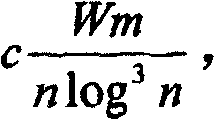

3.路由方法3. Routing method
本部分的下面描述对根据本发明的一个实施例的路由方法给出了说明,随后给出了具体细节和分析。更具普遍意义的模型将在下一部分进行分析。The following description of this part gives an explanation of the routing method according to an embodiment of the present invention, and then gives specific details and analysis. More general models will be analyzed in the next section.
3.1方法3.1 Method
现在,参考图3,示出了根据本发明的一个实施例,在一个无线ad-hoc网络中(例如,如图1中所示的无线ad-hoc网络100),将消息(例如,一个或者多个分组)从源节点S经由移动节点M1,M2,和M3路由到目的节点R的方框图。将在图4的环境中给出这个路由是怎么实现的总体描述。Now, referring to FIG. 3 , it is shown that in a wireless ad-hoc network (for example, the wireless ad-
现在,参考图4,示出了根据本发明用于路由分组的方法400的一个实施例的流程图。依照这个描述,需要返回去参考图3中的节点。但是,应该理解的是,所述有创造性的路由方法不局限于图3中示出的节点配置。相反,呈现图3中的节点配置是为了简化对本发明中路由方法的各个步骤的理解。当然,其它的节点配置(例如,具有更少的或者更多的节点)可以被用来实现本发明的原理。Referring now to FIG. 4 , there is shown a flowchart of one embodiment of a method 400 for routing packets in accordance with the present invention. Following this description, it is necessary to refer back to the nodes in Figure 3. However, it should be understood that the inventive routing method is not limited to the node configuration shown in FIG. 3 . On the contrary, the node configuration in Fig. 3 is presented to simplify the understanding of each step of the routing method in the present invention. Of course, other node configurations (eg, with fewer or more nodes) can be used to implement the principles of the invention.
如路由方法400中的步骤410所示,各个节点被分组成被称为群的多个小区域,并且在每个群中,由静止节点选出一个领导节点。尤为具体的,在每个大小为的区域中,所述静止节点选出一个本地领导节点。这个领导节点负责与移动节点交换在其区域中的静止节点的所有消息。需要注意的是,存在有m个本地领导节点。将在下面进一步描述集群。As shown in step 410 of routing method 400, individual nodes are grouped into small areas called clusters, and within each cluster, a leader node is elected by the stationary nodes. Specifically, in each size of In the area of , the static node elects a local leader node. This leader node is responsible for exchanging all messages of the stationary nodes in its area with the mobile node. Note that there are m local leader nodes. Clusters will be described further below.
在步骤420中,希望向目的节点R发送消息(例如,一个或者多个分组)的静止节点S1,首先将其消息转发给其领导节点(S)。S存储该消息并且等待一个移动节点(M1),其中M1要离S足够近(将在下面具体描述)并且正沿着接近R的方向移动。当这样的一个移动节点可得到时,S将该数据转交(转发)给M1。在这里,这被称为静止节点-到-移动节点阶段,并且将在下面对此进一步进行描述。In step 420, a stationary node S 1 wishing to send a message (eg, one or more packets) to a destination node R, first forwards its message to its leader node (S). S stores the message and waits for a mobile node (M 1 ), where M 1 is close enough to S (described in detail below) and is moving in a direction close to R. When such a mobile node is available, S hands over (forwards) the data to M 1 . This is referred to herein as the stationary node-to-mobile node phase, and will be described further below.
在步骤430中,移动节点相互间中继要发给R的分组(如,图3中所示,M1到M2到M3),使得所述分组越来越移近目的节点。在这里,这被称为移动节点-到-移动节点阶段,并且将在下面对此进一步进行描述。In step 430, the mobile nodes relay packets intended for R (eg, M 1 to M 2 to M 3 as shown in FIG. 3 ) among each other, so that the packets move closer and closer to the destination node. This is referred to herein as the mobile node-to-mobile node phase, and will be described further below.
在步骤440中,当承载所述分组的移动中继节点足够靠近目的节点时,该移动中继节点将所述分组传递(转发)给某个领导节点(未在图3中显示)。随后在领导节点间路由这些分组,以将其路由到正确的领导节点,该正确的领导节点接着将该分组传输给目的节点。在这里,这被称为静止节点-到-静止节点阶段,并且将在下面对此进一步进行描述。In step 440, when the mobile relay node carrying the packet is close enough to the destination node, the mobile relay node delivers (forwards) the packet to a leader node (not shown in FIG. 3 ). These packets are then routed among the leader nodes to route them to the correct leader node, which in turn transmits the packet to the destination node. This is referred to herein as the quiescent node-to-quiescent node phase, and will be described further below.
需要注意的是,在此方法中,各个不同阶段可以同时执行,也就是说,多个节点将多个消息从多个源节点转发到多个接收节点,由此允许用于不同转发的多个阶段同时发生。在这些不同阶段中使用的信号会相互干扰。因此,这些阶段中的每一个优选使用不同的频率信道,并且由此它们相互间不会干扰。尤为具体的,可以假设每个阶段的最大分配带宽为W/4。在整个方法中,可以假设所有的节点都以单位功率传输。可以证明,每个领导节点能获得吞吐量
3.2集群节点3.2 Cluster nodes
现在,进一步说明集群节点的步骤(例如,图4中的步骤410)。假如,m>n/(16log n),那么令m=n/(16log n)。考虑一个虚拟的栅格,它包括m个节点,其中相邻节点间的距离是

节点间的通信如下发生。在每个区域(群)中,只有领导节点负责与移动节点的通信。想要传输分组的静止节点首先将该分组发送给该静止节点所属集群的领导节点。然后在领导节点和移动节点之间路由该分组。最后,利用群内的本地路由,领导节点将该分组发送给目的节点。值得注意的是,如果领导节点的可用吞吐量是λ,那么使用任何一种直通共享方案,每个静止节点将获得吞吐量Ω(mλ/n)。Communication between nodes occurs as follows. In each area (group), only the leader node is responsible for communicating with the mobile nodes. A stationary node that wants to transmit a packet first sends the packet to the leader node of the cluster to which the stationary node belongs. The packet is then routed between the leader node and the mobile node. Finally, using the local routing within the group, the leader node sends the packet to the destination node. It is worth noting that if the available throughput of the leader node is λ, then using any kind of cut-through sharing scheme, each stationary node will get the throughput Ω(mλ/n).
3.3静止节点-到-移动节点阶段3.3 Stationary node-to-mobile node phase
在这个模式(例如,图4中的步骤420)中,静止节点首先将待递送的数据传递到移动节点。现在,参考图5,示出了将分组传递到移动节点的操作示意图。给定源节点S(其希望将数据传递到另外一个移动节点和目的节点R),考虑连接S和R的连线。令θ是SR的斜率(图5中θ=0)。令G(S,R)表示方向角之间的区域,其以S为原点,包含R。值得注意的是,选择角度
在第一步骤中,S处的节点把待传输的分组传递到某个移动节点M1,M1沿方向φ移动,其中
在这个阶段中存在两个问题:There are two problems at this stage:
1.以速率λ(n)传输分组的静止节点,能否找到沿合适方向运动的移动节点来足够频繁地以该速率传递数据。1. Can a stationary node transmitting packets at a rate λ(n) find a mobile node moving in the appropriate direction to deliver data at that rate frequently enough.
2.在找到这样的合适的移动节点之前,节点必须等待多久。2. How long a node has to wait before finding such a suitable mobile node.
本发明解决了这两个问题,如下所述。假如通信仅仅发生在作为发送节点的领导节点和作为接收节点的移动节点之间,那么,如果a>2,则存在以每个领导节点为中心,边长为
对于静止节点S,令N(s)表示以S为中心、边长为
尤为具体的,考虑一个静止节点S。如果T表示直到移动节点首次进入区域N(s)的时间,那么:More specifically, consider a stationary node S. If T denotes the time until the mobile node first enters area N(s), then:
上面的陈述证明存在一个常数百分比的时间,在该时间内,静止节点能向移动节点传输数据。无论来自其它静止节点的传输如何,从静止节点S到区域N(s)内的一个移动节点的传输总能成功。The above statement proves that there is a constant percentage of time during which a stationary node can transmit data to a mobile node. A transmission from a stationary node S to a mobile node within area N(s) always succeeds regardless of transmissions from other stationary nodes.
3.4移动节点-到-移动节点阶段3.4 Mobile Node-to-Mobile Node Phase
现在说明和分析从一个移动节点到另外一个节点的传递是如何发生的(例如图4种的步骤430)。主要的例示办法如下。首先,对于移动节点承载的每个数据分组,存在一个点,在该点之外,所述分组不能被传递到另一移动节点,并且该移动节点开始向远离目的节点的方向移动。这导致了传递区域的概念。本发明确保每个分组被传递到其传递区域中的另一个节点。第二,对于每个移动节点,在任何时刻,在它们的传递区域中都存在多个分组。本发明提供了一种机制,用来判断哪一个分组应该首先被传递等等。这个机制还使用了随机选择,使得可以证明它能提供时延保证。在下面图5的环境中示意性地描述传递过程。How the transfer from one mobile node to another takes place (eg, step 430 in FIG. 4 ) is now described and analyzed. The main instantiation methods are as follows. First, for each data packet carried by a mobile node, there is a point beyond which the packet cannot be delivered to another mobile node and the mobile node begins to move away from the destination node. This leads to the concept of a pass area. The invention ensures that each packet is delivered to another node in its delivery area. Second, for each mobile node, there are multiple packets in their delivery area at any time. The present invention provides a mechanism for determining which packet should be delivered first and so on. This mechanism also uses random selection, making it provable that it provides latency guarantees. The delivery process is schematically described in the context of Figure 5 below.
3.4.1传递3.4.1 Delivery
几何学:考虑图5,来自静止节点S的分组被传递给移动节点M1。现在,M1承载所述分组,直到M1到达处于射线R′A和RA′之间的一个区域。在这个区域中,M1试图把所述分组传递给另外一个移动节点M2,其中M2正在向R移动。这个区域被表示为传递区域。传递区域是如下定义的。线RA′垂直于线SR。线R′A平行于线A′R,并且穿过A。在图5中,传递区域由线段XX′表示。Geometry: Considering Figure 5, a packet from a stationary node S is delivered to a mobile node M1 . M1 now carries the packets until M1 reaches an area between rays R'A and RA'. In this area, M1 tries to deliver the packet to another mobile node M2 , which is moving towards R. This area is denoted as the transfer area. The delivery area is defined as follows. Line RA' is perpendicular to line SR. Line R'A is parallel to line A'R and passes through A. In Fig. 5, the transfer area is indicated by line segment XX'.
调度:为了处理不能在其传递区域中传输的分组,设定了一个截止点(deadline)。令X″表示线段XX′的中点。移动节点在线段XX′上均匀随机选择一个点。这个点被称为所述节点的截止点。需要随机选择来避免多个截止点集中在一起。在图5中,截止点由D表示。假如移动节点M1在到达截止点D之前(也就是,在X到D的区间里)不能把分组传递给另外一个节点,那么该分组就会被丢弃。Scheduling: A deadline is set for processing packets that cannot be transmitted in its delivery area. Let X" denote the midpoint of line segment XX'. A mobile node uniformly randomly selects a point on line segment XX'. This point is called the node's cutoff point. Random selection is required to avoid clustering of multiple cutoff points. In In Fig. 5, the cut-off point is represented by D. If the mobile node M 1 cannot deliver the packet to another node before reaching the cut-off point D (that is, in the interval from X to D), the packet will be discarded.
最后,值得注意的是,在任何给定时刻,都会有多个分组在其传递区域中,因此会彼此竞争来被传递给另外一个移动节点。根据最早期限优先(EDF)命令来解决各个分组之间的竞争。例如,分组P1的截止点是D1,分组P2的截止点是D2,假如它们中的任意一个可以被传递给移动节点M2,那么其截止点早的哪个分组就被先传递。Finally, it is worth noting that at any given moment, there will be multiple packets in its delivery area, and thus competing with each other to be delivered to another mobile node. Contention among the individual packets is resolved according to an Earliest Deadline First (EDF) order. For example, the cut-off point of packet P 1 is D 1 , and the cut-off point of packet P 2 is D 2 . If any one of them can be delivered to mobile node M 2 , the packet whose cut-off point is earlier will be delivered first.
整个过程会自行重复,直到移动节点距离目的节点的距离小于
应该注意的是:It should be noted that:
1.注意到所述过程是完全分布式的,也就是说两个移动节点之间的通信不会给来自其它移动节点的传输施加任何限制。1. Note that the process is fully distributed, that is, communication between two mobile nodes does not impose any restrictions on transmissions from other mobile nodes.
2.值得注意的是,角度
3.4.2对移动节点-到-移动节点阶段的分析3.4.2 Analysis of the mobile node-to-mobile node phase
如果分组被从一个移动节点Mi递送给一个移动节点Mj,使得在递送时所述分组处于传递模式中,并且它是在到达截止点之前被递送的,那么传递被认为是成功的。如下确定成功实现传递的条件:A delivery is considered successful if a packet is delivered from a mobile node Mi to a mobile node Mj such that the packet is in delivery mode at the time of delivery and it was delivered before reaching the cutoff point. The conditions for successful delivery are determined as follows:
设R是接收移动节点,M1,...,Mm是在圆盘中独立均匀分布的移动节点。假设M1试图和R通信。那么,在R处接收的来自M2,...,Mm的信号将干扰M1和R之间的通信。设Ij表示R处接收的来源于Mj的信号。为了确定M1和R之间成功传输的概率,总干扰I2+...+Im被限制。Let R be the receiving mobile node, and M 1 , ..., M m be independent and evenly distributed mobile nodes in the disk. Suppose M 1 tries to communicate with R. Then, signals from M2 ,..., Mm received at R will interfere with the communication between M1 and R. Let Ij denote the signal received at R originating from Mj . In order to determine the probability of a successful transmission between M 1 and R, the total interference I 2 +...+I m is bounded.
因此,假设m-1个均匀分布在一个圆盘上的移动节点都以单位功率传输。设R是圆盘内的一个点。那么,如果M在离点R的距离为
让r0表示距离
因此,假如λmm表示为移动节点-到-移动节点数据传输分配的带宽,那么:Therefore, if λ mm represents the bandwidth allocated for mobile node-to-mobile node data transmission, then:
1。在每个相遇期间被成功传输的期望数据至少是
2.让E表示事件,其中该事件指每个相遇至少有

现在考虑在t时间里移动节点M1具有的相遇数目。假设移动节点M1想给方向η上的目的节点传递数据。因此,M1将把分组传递给沿方向φ移动的某个其它节点Mj,其中
给定M1,假如满足以下条件则称移动节点Mi是有用的:Given M1, a mobile node M i is said to be useful if the following conditions are satisfied:
1.Mi沿方向φ移动,其中
2.Mi在[t0,t0+t]里的某个时间和M1相遇。2. M i meets M 1 at a certain time in [t 0 , t 0 +t].
设X(η,t)=|{i|i>0且Mi是有用的}|Let X(η,t)=|{i|i>0 and M i is useful}|
也就是说,X(η,t)是随机变量,它表示有用的移动节点的数量。That is, X(η, t) is a random variable that represents the number of useful mobile nodes.
现在来计算X(η,t)的期望值,并且一定要获得希望的结果。Now to calculate the expected value of X(η,t), and be sure to obtain the desired result.
设M0是一个移动节点,而X(η,t)如上面定义。那么,对于任意一个η∈(0,2π):则Let M 0 be a mobile node and X(η,t) as defined above. Then, for any η∈(0, 2π): Then
而且,对于任意一个常数k>0,假如
因此,假如X(t)表示一个移动节点M在时间t里传输的数据总量,那么假如
无论M试图传输的方向如何,这都成立。This holds regardless of the direction M is trying to transmit.
已经示出了一个移动节点能够传递给其它节点的数据的限制,下面将说明一个移动节点能从其它节点接收的数据的限制。这里允许限制一个分组因为没能在截止点前实现传递而被放弃的概率。Having shown the limitation of data that a mobile node can transmit to other nodes, the limitation of data that a mobile node can receive from other nodes will be described below. This allows limiting the probability that a packet will be discarded because it fails to achieve delivery before the cut-off point.
设D表示源节点到目的节点的最大距离。因此,


1.不同阶段的数目最多是
2.到达每个k阶的平均到达速率最大是nλ(n)。回想到,一个目的是为了限制移动节点接收的数据。因为存在n个移动节点,所以可期望的是,每个节点以大约nλ(n)/m的速率接收k阶的分组。但是,这不是非常准确。移动节点沿一个特定的方向移动并且位于一个特定的位置的事实,将影响移动节点接收k阶分组的速率。但是,速率被限制在6nλ(n)/m以下。基于本发明传递方法的特征,这个想法是,即使位于位置
现在考虑一个分组,所述分组处于距离d处的传递区域的截止点中。这个分组碰到它的截止点的概率受到下述限制。Consider now a packet that is in the cutoff of the delivery area at distance d. The probability that this group hits its cutoff is bounded as follows.
给定一个处于自己移交区域中的分组P,所述传递区域的截止点在距离d处,让H(d)表示其截止点快于P的截止点的数据的量,那么,
因此,存在一个常数c>0,使得假如
3.5静止节点-到-静止节点阶段3.5 Stationary Node-to-Stationary Node Phase
最后,应该注意的是,经过移动节点-到-移动节点阶段之后,分组距离目的领导节点的距离最长是
在每个时隙,选择
因为对于静止节点-到-静止节点阶段中的通信,每个领导节点可用的带宽是W/4,这将λ(n)限制为

4.模型概括4. Model summary
依照本发明,在这一部分中,提供了关于前面已定义模型的概括。In accordance with the present invention, in this section, an overview of the previously defined models is provided.
应当明白的是,移动节点可以是发送节点和/或接收节点。可以做一个关于模型的假设,即,移动节点有一个指定的静止节点,在该静止节点,它可以周期性地收集它的分组。如果情况是这样,那么就能获得时延保证。It should be appreciated that a mobile node may be a sending node and/or a receiving node. An assumption can be made about the model that a mobile node has a designated quiescent node where it periodically collects its packets. If this is the case, then latency guarantees are obtained.
还应该明白的是,依照本发明,移动节点和静止节点的角色可以互换。事实上,移动节点可以是源节点和目的节点,而静止节点可用于中继。相对于这些移动节点(例如,正在飞行的一架飞机用作一个节点),静止节点可以看成是“移动节点”。也就是说,从一个移动节点的角度看,一个静止节点可视为正在到处移动。因此,通过使用相对于最终目的节点(例如可以是作为节点的正在飞行的另外一架飞机)的其它静止节点的“移动性”信息,一个静止节点可以相应地做出转发决定(如上所述)。It should also be understood that the roles of mobile nodes and stationary nodes may be reversed in accordance with the present invention. In fact, mobile nodes can be source and destination nodes, while stationary nodes can be used for relaying. With respect to these mobile nodes (for example, an airplane in flight is used as a node), stationary nodes can be regarded as "mobile nodes". That is, from the perspective of a mobile node, a stationary node can be seen as moving around. Thus, by using the "mobility" information of other stationary nodes relative to the final destination node (which could be, for example, another aircraft in flight as a node), a stationary node can make forwarding decisions accordingly (as described above) .
此外,如果κ的值(在改变方向之前移动节点移动的距离)远小于网络的直径(d),那么可以做下面两件事:Furthermore, if the value of κ (the distance a mobile node travels before changing direction) is much smaller than the diameter (d) of the network, then two things can be done:
1.或者修改路由方法,使得不是使用移动节点从静止源节点S向静止接收节点R发送分组,而是选择中间节点S1,...,Sd/κ,使得分组首先被从S路由到S1,随后从S1路由到S2,等等。值得注意的是,网络的容量变得直接与κ成比例。因此,κ越小,网络的容量越小。1. Or modify the routing method so that instead of using a mobile node to send a packet from a stationary source node S to a stationary receiving node R, an intermediate node S 1 ,...,S d/κ is chosen so that the packet is first routed from S to S 1 , then routes from S 1 to S 2 , and so on. Notably, the capacity of the network becomes directly proportional to κ. Therefore, the smaller the κ, the smaller the capacity of the network.
2.或者,可以做下面的事情:如果它在那个方向上移动的距离或者超过κ或者大于两倍于距离目的节点的距离(如前面第3部分),那么将分组转交给一个移动节点。在第一种情况下,在κ/2和3κ/4之间随机设置截止点。应该注意的是,节点按照这种方式至少移动κ/2的距离,并且可以找到一个满足该特性的常数比例(>1/e)的移动节点。因此,至多存在1/κ这样的步骤。在第二种情况下,分析保持与第3部分中的分析相同,存在logn个这样的步骤。因此,得到数量级为Wm/(nlog2 n(log n+1/κ))的吞吐量。2. Alternatively, the following can be done: hand off the packet to a mobile node if it moves in that direction either by more than κ or more than twice the distance from the destination node (as in
最终,注意到,上面的结果可以扩展到下述情形:Finally, note that the above results can be extended to the following cases:
1.对于某些模型,在该模型中,静止节点的稳态分布是某种同分布,而不是均匀分布的特殊情况,所述结果同样成立。这里,同分布是指概率分布函数位于常数cmin和cmax之间的分布。1. For some models in which the steady-state distribution of stationary nodes is a special case of some kind of identical distribution, rather than a uniform distribution, the stated results also hold. Here, the same distribution refers to a distribution in which the probability distribution function is between the constants c min and c max .
2.同样地,移动节点的速度不必相同。如果它们的上限和下限分别为vmax和vmin,除了常数不同外,上面的分析都适用。2. Likewise, the speeds of the mobile nodes do not have to be the same. If their upper and lower bounds are v max and v min respectively, the above analysis applies except for the constants.
3.对于三维设置,也能得到这样的结果。3. For the three-dimensional setting, the same result can be obtained.
5.结果的暗示5. Implications for results
在这部分,提供了前面部分得到的结果的一些暗示。可以得出下面这些:In this section, some hints to the results obtained in the previous sections are provided. The following can be derived:
1.分组经历的时延与移动节点的速度成反比。1. The delay experienced by a packet is inversely proportional to the speed of the mobile node.
2.获得的吞吐量λ(n)与移动节点的速度无关。2. The obtained throughput λ(n) is independent of the speed of the mobile node.
3.上面,仅仅得到保证分组的丢失概率至多为0.5的λ(n)的限制。出现这个结果是因为每次传递时的丢失概率受限于1/2log m。应该注意的是,发生所述分组丢失是由于两件事情。第一,发生分组丢失是由于无线通信。为了处理这种情况,可以减少χ的值(也就是,两个节点仅在非常靠近时才通信)。第二,分组丢失还在当移动节点未能在到达截止点前将它的全部分组传递给恰当的移动节点并且因此不得不丢弃它们时发生。通过在马尔可夫(Markov)不等式的应用时选择一个较大的常数,可以解决这种情况。这使λ(n)的值减少了同样的常数(也就是,如果p是丢失概率,那么λ(n)∞p)。3. Above, only the constraint of λ(n) is obtained that guarantees the loss probability of a packet to be at most 0.5. This result occurs because the probability of loss on each pass is limited by 1/2 log m. It should be noted that the packet loss occurs due to two things. First, packet loss occurs due to wireless communication. To handle this situation, the value of χ can be reduced (that is, two nodes only communicate when they are very close). Second, packet loss also occurs when a mobile node fails to deliver all of its packets to the proper mobile node before reaching the cutoff point and thus has to discard them. This situation can be resolved by choosing a larger constant in the application of the Markov inequality. This reduces the value of λ(n) by the same constant (that is, if p is the loss probability, then λ(n)∞p).
4.可以在移动节点上得到预期的缓存区的占有值的限制。尤为具体的,通过应用Little法则(J.Little,“A Proof of the Queuing Formulal=λw,”Operations research,9:383-387,1961,其公开的内容在此引入作为参考),预期的缓存区中的数据的数量可以被限制为
因此,如同上面的详细讨论,本发明为ad-hoc网络提供了一种路由方法,其目的是为了获得接近最佳的容量,而同时保持低时延。这个方法利用了节点移动性模式来提供延时保证。而且,该方法得到的吞吐量仅仅按多对数因子偏离最佳值。Thus, as discussed in detail above, the present invention provides a routing method for ad-hoc networks in order to achieve near-optimal capacity while maintaining low latency. This approach utilizes node mobility patterns to provide latency guarantees. Moreover, the throughput achieved by this method deviates from the optimum only by a multi-log factor.
虽然此处结合附图描述了根据本发明的示例性实施例,但是应该理解的是,本发明不局限于那些精确的实施例,并且本领域的技术人员可以根据本发明做出各种其它的变化和修改而不会偏离本发明的范围或精神。Although exemplary embodiments according to the present invention are described herein with reference to the accompanying drawings, it should be understood that the present invention is not limited to those precise embodiments, and those skilled in the art can make various other embodiments based on the present invention. Variations and modifications are made without departing from the scope or spirit of the invention.
Claims (28)


Applications Claiming Priority (2)
| Application Number | Priority Date | Filing Date | Title |
|---|---|---|---|
| US10/402,760 | 2003-03-28 | ||
| US10/402,760 US7808939B2 (en) | 2003-03-28 | 2003-03-28 | Routing in wireless ad-hoc networks |
Publications (2)
| Publication Number | Publication Date |
|---|---|
| CN1771694A CN1771694A (en) | 2006-05-10 |
| CN100435517C true CN100435517C (en) | 2008-11-19 |
Family
ID=32989793
Family Applications (1)
| Application Number | Title | Priority Date | Filing Date |
|---|---|---|---|
| CNB03826546XA Expired - Fee Related CN100435517C (en) | 2003-03-28 | 2003-07-21 | Routing method and device in wireless AD-HOC network |
Country Status (8)
| Country | Link |
|---|---|
| US (1) | US7808939B2 (en) |
| EP (1) | EP1609269A1 (en) |
| JP (1) | JP4295225B2 (en) |
| KR (2) | KR20050118698A (en) |
| CN (1) | CN100435517C (en) |
| AU (1) | AU2003259183A1 (en) |
| TW (1) | TWI349459B (en) |
| WO (1) | WO2004098129A1 (en) |
Families Citing this family (52)
| Publication number | Priority date | Publication date | Assignee | Title |
|---|---|---|---|---|
| GB0220660D0 (en) * | 2002-09-05 | 2002-10-16 | Nokia Corp | Signal propogation delay routing |
| US7562123B2 (en) * | 2003-09-05 | 2009-07-14 | Palo Alto Research Center Incorporated | Systems and methods for distributed group formation and maintenance in geographically based networks |
| US7523220B2 (en) * | 2003-09-17 | 2009-04-21 | Microsoft Corporation | Metaspace: communication middleware for partially connected mobile ad hoc networks |
| US7506125B2 (en) * | 2003-09-29 | 2009-03-17 | Hitachi, Ltd. | Information terminals for receiving content with survival time and forwarding content to different information terminal after changing the survival time |
| US7720993B2 (en) * | 2003-12-17 | 2010-05-18 | Palo Alto Research Center Incorporated | Information driven routing in ad hoc sensor networks |
| GB0401760D0 (en) * | 2004-01-27 | 2004-03-03 | Univ Edinburgh | Mobile telephone network |
| JP4128149B2 (en) * | 2004-02-27 | 2008-07-30 | Kddi株式会社 | Wireless network system, relay terminal and program in the same system |
| DE102004021385A1 (en) * | 2004-04-30 | 2005-11-17 | Daimlerchrysler Ag | Data communication network with decentralized communication management |
| US7304976B2 (en) * | 2004-10-13 | 2007-12-04 | Virginia Tech Intellectual Properties, Inc. | Method and apparatus for control and routing of wireless sensor networks |
| JP4124196B2 (en) * | 2004-12-02 | 2008-07-23 | ソニー株式会社 | Network system, wireless communication apparatus, wireless communication method, and computer program |
| US9439126B2 (en) * | 2005-01-25 | 2016-09-06 | Sipco, Llc | Wireless network protocol system and methods |
| US7505751B1 (en) * | 2005-02-09 | 2009-03-17 | Autocell Laboratories, Inc. | Wireless mesh architecture |
| GB0502783D0 (en) * | 2005-02-10 | 2005-03-16 | Univ Edinburgh | Mobile ad-hoc network |
| US20060182126A1 (en) * | 2005-02-15 | 2006-08-17 | Matsushita Electric Industrial Co., Ltd. | Hybrid approach in design of networking strategies employing multi-hop and mobile infostation networks |
| KR100913894B1 (en) * | 2005-09-30 | 2009-08-26 | 삼성전자주식회사 | Efficient Routing Method in Wireless Mesh Network |
| CN101009926A (en) | 2005-10-17 | 2007-08-01 | 三星电子株式会社 | Apparatus and method for supporting handover in wireless access communication system |
| KR100824239B1 (en) | 2005-11-07 | 2008-04-24 | 삼성전자주식회사 | Apparatus and method for processing handover of mobile relay station in broadband wireless access communication system using multi-hop relay method |
| US8254301B2 (en) * | 2005-11-22 | 2012-08-28 | Telcordia Technologies, Inc. | Group-header based method to organize local peer group of vehicles for inter-vehicle communication |
| GB0608385D0 (en) * | 2006-04-27 | 2006-06-07 | Nokia Corp | Communications in relay networks |
| JP4908585B2 (en) * | 2006-05-24 | 2012-04-04 | フランス・テレコム | Processing for routing data packets in a mobile node network and associated terminals |
| US20080008137A1 (en) * | 2006-07-05 | 2008-01-10 | Motorola, Inc. | Method and system of communication among a plurality of mobile nodes |
| US8958743B2 (en) * | 2006-08-23 | 2015-02-17 | Google Inc. | Formation of wireless local area networks based on movement direction of nodes |
| US20080049689A1 (en) * | 2006-08-23 | 2008-02-28 | Motorola, Inc. | Tunneling data to multiple wireless networks from device without connectivity through employment of device with connectivity |
| US8135021B2 (en) * | 2006-09-28 | 2012-03-13 | Nokia Corporation | Routing in wireless ad-hoc networks |
| US20080101325A1 (en) * | 2006-10-31 | 2008-05-01 | Qi Bao | Wireless relay device deployment methods and apparatus |
| KR100826528B1 (en) | 2006-11-30 | 2008-04-30 | 한국전자통신연구원 | Matching System and Method for Preventing Data Loss between Low and Non-Low Power Networks |
| US7969928B2 (en) * | 2007-03-02 | 2011-06-28 | Motorola Solutions, Inc. | Method and apparatus for battery-aware dynamic bandwidth allocation for wireless sensor networks |
| US7801079B2 (en) * | 2007-03-02 | 2010-09-21 | Motorola, Inc. | Method and apparatus for battery-aware dynamic bandwidth allocation for groups of wireless sensor nodes in a wireless sensor network |
| CN100461735C (en) * | 2007-03-20 | 2009-02-11 | 哈尔滨工业大学 | A Path Selection Method Based on AOMDV Protocol in Wireless Sensor Networks |
| CN101287284B (en) * | 2007-04-13 | 2012-04-18 | 中兴通讯股份有限公司 | Method for apparatus to join wireless transmission network |
| JP2009005240A (en) * | 2007-06-25 | 2009-01-08 | Nec Tokin Corp | Radio network system and radio network communication method |
| CN101102181B (en) * | 2007-07-19 | 2010-09-29 | 武汉理工大学 | A method for realizing safe logout in Ad hoc network |
| US8028088B2 (en) * | 2007-09-12 | 2011-09-27 | Netsocket, Inc. | System and method for service assurance in IP networks |
| ATE476039T1 (en) * | 2007-11-27 | 2010-08-15 | Nokia Siemens Networks Gmbh | WIRELESS TELECOMMUNICATIONS SYSTEM WITH BASE STATION, RELAY NODES AND METHOD FOR GLOBAL SCHEDULING |
| CN101848557B (en) * | 2009-05-31 | 2012-05-16 | 北京航空航天大学 | A Method of Building a Mobile Scale-Free Self-Organizing Network Model |
| KR101754413B1 (en) * | 2009-07-08 | 2017-07-07 | 한국전자통신연구원 | Method for trsansmitting and receiving data in cooperative communication system, cooperative communication method |
| WO2011003458A1 (en) * | 2009-07-10 | 2011-01-13 | Nec Europe Ltd. | A system and a method for employing electronic devices to locate survivors in the event of catastrophic structure collapse |
| CN101795460B (en) * | 2009-12-23 | 2013-01-30 | 大连理工大学 | A Markovian Mobility Model Applicable to Ad Hoc Networks in Obstacle Environment |
| KR101150689B1 (en) * | 2010-06-04 | 2012-05-25 | 연세대학교 산학협력단 | Method and apparatus for generating random mobility pattern conversing the target point |
| US8686849B2 (en) * | 2010-08-10 | 2014-04-01 | Robert Bosch Gmbh | Method of alarm handling in wireless sensor networks |
| US8874366B2 (en) * | 2011-05-23 | 2014-10-28 | Microsoft Corporation | First waypoint distance |
| US20130094397A1 (en) * | 2011-10-15 | 2013-04-18 | Young Jin Kim | Method and apparatus for localized and scalable packet forwarding |
| US9202369B2 (en) | 2012-07-17 | 2015-12-01 | Robert Bosch Gmbh | Method for robust wireless monitoring and tracking of solar trackers in commercial solar power plants |
| US9202371B2 (en) | 2012-07-17 | 2015-12-01 | Robert Bosch Gmbh | Method for robust data collection schemes for large grid wireless networks |
| US9202370B2 (en) | 2012-07-17 | 2015-12-01 | Robert Bosch Gmbh | Method for robust wireless monitoring and tracking of solar trackers in commercial solar power plants |
| US8588871B1 (en) * | 2012-10-04 | 2013-11-19 | Google Inc. | Signal detect battery saver |
| CN103298009B (en) * | 2012-12-31 | 2016-03-02 | 南京理工大学 | The modeling of complicated wireless network control system and fault propagation method |
| KR102608190B1 (en) * | 2015-11-23 | 2023-12-01 | 한국전자통신연구원 | Routing apparatus and method for a mobile ad-hoc |
| CN107977788A (en) * | 2017-12-03 | 2018-05-01 | 淮阴工学院 | The WRSN charging schedule BAR_EDF algorithms calculated based on angle character |
| CA3107919A1 (en) | 2018-07-27 | 2020-01-30 | GoTenna, Inc. | Vinetm: zero-control routing using data packet inspection for wireless mesh networks |
| CN110717511A (en) * | 2019-09-04 | 2020-01-21 | 中国科学院国家空间科学中心 | A mobile ad hoc network node mobility classification method |
| US11304113B2 (en) | 2020-03-11 | 2022-04-12 | Dell Products, Lp | Systems and methods for communication network prioritization based on velocity of an information handling system |
Citations (3)
| Publication number | Priority date | Publication date | Assignee | Title |
|---|---|---|---|---|
| US20010002906A1 (en) * | 1999-12-06 | 2001-06-07 | Telefonaktiebolaget Lm Ericsson (Pub1) | Method and arrangement in a communication network |
| CN1358003A (en) * | 2000-11-16 | 2002-07-10 | 讯宝科技公司 | Symbiont techn in radio network |
| US20030060222A1 (en) * | 2001-09-25 | 2003-03-27 | Johan Rune | Network access point with auxiliary transceiver |
Family Cites Families (25)
| Publication number | Priority date | Publication date | Assignee | Title |
|---|---|---|---|---|
| US5412654A (en) | 1994-01-10 | 1995-05-02 | International Business Machines Corporation | Highly dynamic destination-sequenced destination vector routing for mobile computers |
| US5987011A (en) * | 1996-08-30 | 1999-11-16 | Chai-Keong Toh | Routing method for Ad-Hoc mobile networks |
| US6590928B1 (en) * | 1997-09-17 | 2003-07-08 | Telefonaktiebolaget Lm Ericsson (Publ) | Frequency hopping piconets in an uncoordinated wireless multi-user system |
| JPH11239176A (en) | 1998-02-20 | 1999-08-31 | Nippon Telegr & Teleph Corp <Ntt> | Ad-hoc network packet routing method |
| US6775255B1 (en) * | 1999-09-16 | 2004-08-10 | At&T Corp. | H.323 mobility architecture for terminal, user and service mobility |
| JP2001156787A (en) | 1999-11-10 | 2001-06-08 | Internatl Business Mach Corp <Ibm> | Wireless station retrieval method and device in wireless adhoc communication network |
| US6535498B1 (en) * | 1999-12-06 | 2003-03-18 | Telefonaktiebolaget Lm Ericsson (Publ) | Route updating in ad-hoc networks |
| US6751200B1 (en) * | 1999-12-06 | 2004-06-15 | Telefonaktiebolaget Lm Ericsson (Publ) | Route discovery based piconet forming |
| EP1107521A1 (en) * | 1999-12-06 | 2001-06-13 | Telefonaktiebolaget Lm Ericsson | Method, node and arrangement for routing in Bluetooth network |
| ATE290283T1 (en) * | 1999-12-06 | 2005-03-15 | Ericsson Telefon Ab L M | METHOD AND ARRANGEMENTS IN A TELECOMMUNICATIONS NETWORK |
| EP1107508A1 (en) * | 1999-12-06 | 2001-06-13 | Telefonaktiebolaget Lm Ericsson | System, method and computer program product for sending broadcast messages |
| US6704293B1 (en) * | 1999-12-06 | 2004-03-09 | Telefonaktiebolaget Lm Ericsson (Publ) | Broadcast as a triggering mechanism for route discovery in ad-hoc networks |
| US7039358B1 (en) * | 2000-01-10 | 2006-05-02 | Symbol Technologies, Inc. | Coexistence techniques in wireless networks |
| EP1134939A1 (en) * | 2000-03-14 | 2001-09-19 | Lucent Technologies Inc. | Location based routing for mobile ad-hoc networks |
| US6775258B1 (en) * | 2000-03-17 | 2004-08-10 | Nokia Corporation | Apparatus, and associated method, for routing packet data in an ad hoc, wireless communication system |
| US20020044549A1 (en) * | 2000-06-12 | 2002-04-18 | Per Johansson | Efficient scatternet forming |
| JP3432481B2 (en) | 2000-06-20 | 2003-08-04 | 沖電気工業株式会社 | Communication network system |
| US6834192B1 (en) * | 2000-07-03 | 2004-12-21 | Nokia Corporation | Method, and associated apparatus, for effectuating handover of communications in a bluetooth, or other, radio communication system |
| AU2001292853A1 (en) | 2000-09-20 | 2002-04-02 | Matsushita Industrial Communications Corp. Of Usa | Wireless internet system for the mobile environment |
| KR100555664B1 (en) * | 2001-01-08 | 2006-03-03 | 삼성전자주식회사 | Wireless communication device, wireless communication system using same and communication method thereof |
| WO2003017520A1 (en) * | 2001-08-14 | 2003-02-27 | Sarnoff Corporation | Method and apparatus for using wireless network enabled devices over existing wired telephone networks |
| JP4715066B2 (en) | 2001-09-06 | 2011-07-06 | ソニー株式会社 | Wireless communication system, mobile terminal, program, and data transfer method |
| US20030110291A1 (en) * | 2001-12-12 | 2003-06-12 | Nokia Corporation | Method and device for route searching in a bluetooth ad-hoc network |
| US6870846B2 (en) * | 2002-04-29 | 2005-03-22 | Harris Corporation | Hierarchical mobile ad-hoc network and methods for performing reactive routing therein using dynamic source routing (DSR) |
| US7027426B2 (en) * | 2002-08-05 | 2006-04-11 | Harris Corporation | Multi-channel mobile ad hoc network |
-
2003
- 2003-03-28 US US10/402,760 patent/US7808939B2/en not_active Expired - Lifetime
- 2003-07-21 WO PCT/US2003/022688 patent/WO2004098129A1/en not_active Ceased
- 2003-07-21 AU AU2003259183A patent/AU2003259183A1/en not_active Abandoned
- 2003-07-21 EP EP03816812A patent/EP1609269A1/en not_active Withdrawn
- 2003-07-21 CN CNB03826546XA patent/CN100435517C/en not_active Expired - Fee Related
- 2003-07-21 JP JP2004571425A patent/JP4295225B2/en not_active Expired - Fee Related
- 2003-07-21 KR KR1020057018332A patent/KR20050118698A/en not_active Withdrawn
- 2003-07-21 KR KR1020057018267A patent/KR101038025B1/en not_active Expired - Lifetime
-
2004
- 2004-03-19 TW TW093107440A patent/TWI349459B/en not_active IP Right Cessation
Patent Citations (3)
| Publication number | Priority date | Publication date | Assignee | Title |
|---|---|---|---|---|
| US20010002906A1 (en) * | 1999-12-06 | 2001-06-07 | Telefonaktiebolaget Lm Ericsson (Pub1) | Method and arrangement in a communication network |
| CN1358003A (en) * | 2000-11-16 | 2002-07-10 | 讯宝科技公司 | Symbiont techn in radio network |
| US20030060222A1 (en) * | 2001-09-25 | 2003-03-27 | Johan Rune | Network access point with auxiliary transceiver |
Also Published As
| Publication number | Publication date |
|---|---|
| AU2003259183A1 (en) | 2004-11-23 |
| KR101038025B1 (en) | 2011-05-31 |
| JP4295225B2 (en) | 2009-07-15 |
| US20040190476A1 (en) | 2004-09-30 |
| TWI349459B (en) | 2011-09-21 |
| JP2006514503A (en) | 2006-04-27 |
| KR20050118696A (en) | 2005-12-19 |
| KR20050118698A (en) | 2005-12-19 |
| WO2004098129A1 (en) | 2004-11-11 |
| US7808939B2 (en) | 2010-10-05 |
| EP1609269A1 (en) | 2005-12-28 |
| CN1771694A (en) | 2006-05-10 |
| TW200509717A (en) | 2005-03-01 |
Similar Documents
| Publication | Publication Date | Title |
|---|---|---|
| CN100435517C (en) | Routing method and device in wireless AD-HOC network | |
| Stojmenovic et al. | Loop-free hybrid single-path/flooding routing algorithms with guaranteed delivery for wireless networks | |
| Tilwari et al. | MCLMR: A multicriteria based multipath routing in the mobile ad hoc networks | |
| Liao et al. | GRID: A fully location-aware routing protocol for mobile ad hoc networks | |
| Boukerche | Performance evaluation of routing protocols for ad hoc wireless networks | |
| Hanzo et al. | A survey of QoS routing solutions for mobile ad hoc networks | |
| Sivakumar et al. | CEDAR: a core-extraction distributed ad hoc routing algorithm | |
| US7266085B2 (en) | Access and routing protocol for ad hoc network using synchronous collision resolution and node state dissemination | |
| Vahdat et al. | Epidemic routing for partially connected ad hoc networks | |
| Heissenbüttel et al. | Evaluating the limitations of and alternatives in beaconing | |
| CN105580437B (en) | Method for discovering routes in a wireless network to forward packets from a source node to a sink node | |
| Boukerche | A simulation based study of on-demand routing protocols for ad hoc wireless networks | |
| Shen et al. | A distributed three-hop routing protocol to increase the capacity of hybrid wireless networks | |
| Wang et al. | Delay-aware relay selection with heterogeneous communication range in VANETs | |
| Tickoo et al. | Route fragility: a novel metric for route selection in mobile ad hoc networks. | |
| Lee et al. | Network resource efficient routing in mobile ad hoc wireless networks | |
| Meghanathan | A location prediction-based reactive routing protocol to minimize the number of route discoveries and hop count per path in mobile ad hoc networks | |
| Mou et al. | A modified AODV routing protocol based on route stability in MANET | |
| Nithya et al. | Performance evaluation of dynamic zone radius estimation in ZRP for multihop adhoc networks | |
| Lim et al. | Landmark guided forwarding | |
| Ijaz | Trasmission Control Protocol (TCP) Performance Evaluation In Manet | |
| Repantis et al. | A Performance Comparison of Routing Protocols for Large-Scale Wireless Mobile Ad Hoc Networks | |
| Dhurandher et al. | Integration of Fixed and Mobile Infrastructure for Message Passing in Opportunistic Networks. | |
| Forero | Geometric Aspects and andom Delays in Probabilistic Broadcasting for Wireless Ad Hoc Networks | |
| Kumari et al. | An Approach to Utilize Location Information to Improve Performance of Routing Protocols for Ad Hoc Networks Establishment in VANET |
Legal Events
| Date | Code | Title | Description |
|---|---|---|---|
| C06 | Publication | ||
| PB01 | Publication | ||
| C10 | Entry into substantive examination | ||
| SE01 | Entry into force of request for substantive examination | ||
| C14 | Grant of patent or utility model | ||
| GR01 | Patent grant | ||
| CF01 | Termination of patent right due to non-payment of annual fee |
Granted publication date: 20081119 Termination date: 20180721 |
|
| CF01 | Termination of patent right due to non-payment of annual fee |