CN100425609C - N-Heteroaryl Nicotinamide Derivatives - Google Patents
N-Heteroaryl Nicotinamide Derivatives Download PDFInfo
- Publication number
- CN100425609C CN100425609C CNB028257928A CN02825792A CN100425609C CN 100425609 C CN100425609 C CN 100425609C CN B028257928 A CNB028257928 A CN B028257928A CN 02825792 A CN02825792 A CN 02825792A CN 100425609 C CN100425609 C CN 100425609C
- Authority
- CN
- China
- Prior art keywords
- group
- atom
- substituted
- unsubstituted
- compound
- Prior art date
- Legal status (The legal status is an assumption and is not a legal conclusion. Google has not performed a legal analysis and makes no representation as to the accuracy of the status listed.)
- Expired - Fee Related
Links
Landscapes
- Plural Heterocyclic Compounds (AREA)
- Agricultural Chemicals And Associated Chemicals (AREA)
Abstract
Description
技术领域 technical field
本发明涉及特定的N-杂芳基-4-(卤代烷基)烟酰胺衍生物、其盐以及含有该衍生物作为有效成分的农药。The present invention relates to specific N-heteroaryl-4-(haloalkyl)nicotinamide derivatives, salts thereof, and pesticides containing the derivatives as active ingredients.
另外,本发明还涉及上述的N-杂芳基-4-(卤代烷基)烟酰胺衍生物的制备方法及其中间体。In addition, the present invention also relates to the preparation method of the above-mentioned N-heteroaryl-4-(haloalkyl)nicotinamide derivative and its intermediate.
背景技术 Background technique
近年来,在市售的杀虫剂中,由于残留、蓄积、环境污染等问题而在使用上受到限制。而且,长时间使用相同的杀虫剂,会导致产生抗药性害虫的问题。因此,人们希望开发一种考虑到与市售杀虫剂的作用不同的,具有新的分子结构的杀虫剂。In recent years, commercially available insecticides have been restricted in use due to problems such as residues, accumulation, and environmental pollution. Also, using the same insecticide for a long period of time can lead to the problem of developing resistant pests. Therefore, development of an insecticide having a new molecular structure in consideration of actions different from those of commercially available insecticides has been desired.
过去,作为N-杂芳基-4-(三氟甲基)烟酰胺衍生物,例如,特开平10-195072号公报中记载了杂芳基为2-噻唑基或1,3,4-噻二唑基的化合物、以及含有这些化合物作为有效成分的有害动物防除剂。但是,这些化合物与本发明的杂芳基不同,而且其杀虫效果也不充分。In the past, as N-heteroaryl-4-(trifluoromethyl)nicotinamide derivatives, for example, it is described in JP-A-10-195072 that the heteroaryl group is 2-thiazolyl or 1,3,4-thiazolyl Oxadiazolyl compounds, and pest control agents containing these compounds as active ingredients. However, these compounds are different from the heteroaryl groups of the present invention, and their insecticidal effects are not sufficient.
另外,在3位上具有氰基、氨基甲酰基或羧基的4-三氟甲基吡啶,作为农药或医药的制备原料是很有用的,能够成为上述N-杂芳基-4-(三氟甲基)烟酰胺衍生物的制备中间体。In addition, 4-trifluoromethylpyridine having a cyano group, carbamoyl group or carboxyl group at the 3-position is very useful as a raw material for the preparation of pesticides or medicines, and can become the above-mentioned N-heteroaryl-4-(trifluoromethylpyridine) Intermediates for the preparation of methyl) nicotinamide derivatives.
作为该制备中间体的制备方法,过去已知有《药物化学杂志》(J.Med.Chem.)、1967年、第10卷、P.149-154;特开平6-321903号公报;特开平7-10841号公报;以及特开2000-38385号公报等。其中,在《药物化学杂志》(J.Med.Chem.)、1967年、第10卷、P.149-154中,记载了通过将3-氰基-4-三氟甲基吡啶中的氰基转变为四唑基来制备的脂肪分解抑制剂的制备中间体。另外,特开平6-321903号公报;特开平7-10841号公报;以及特开2000-38385号公报中记载了在3位上具有氰基或氨基甲酰基的4-三氟甲基吡啶是有害动物防除剂的制备中间体。As the preparation method of the preparation intermediate, "Journal of Medicinal Chemistry" (J.Med.Chem.), 1967, volume 10, P.149-154 was known in the past; Publication No. 7-10841; and Japanese Patent Application Publication No. 2000-38385, etc. Among them, in "Journal of Medicinal Chemistry" (J.Med.Chem.), 1967, Vol. 10, P.149-154, it is described that cyanide in 3-cyano-4-trifluoromethylpyridine The preparation intermediate of the lipolysis inhibitor prepared by converting the base into a tetrazole base. In addition, Japanese Patent Application Publication No. 6-321903; Japanese Patent Application Publication No. 7-10841; and Japanese Publication No. 2000-38385 describe that 4-trifluoromethylpyridine having a cyano group or a carbamoyl group at the 3-position is harmful Intermediates for the preparation of animal control agents.
然而,上述方法中具有工序步骤多、包含反应条件苛刻的工序的缺点,因此,人们希望开发出工业上更有利的制备方法。However, the above-mentioned method has disadvantages of many steps and steps involving severe reaction conditions. Therefore, development of an industrially more advantageous production method has been desired.
发明内容 Contents of the invention
本发明者们对于4-(卤代烷基)烟酰胺衍生物进行了反复精心的研究,结果发现,特定的N-杂芳基-4-(卤代烷基)烟酰胺衍生物对于各种有害昆虫具有极为优良的杀虫活性,至此便完成了本发明。The present inventors have carried out repeated careful research on 4-(haloalkyl) nicotinamide derivatives, and found that specific N-heteroaryl-4-(haloalkyl) nicotinamide derivatives have extremely good properties for various harmful insects. Excellent insecticidal activity has just completed the present invention so far.
另外,本发明者们还发现上述N-杂芳基-4-(卤代烷基)烟酰胺衍生物的新的制备方法,可以高收率、廉价且简便地制备作为制备中间体的在3位上具有氰基、氨基甲酰基或羧基的4-取代吡啶化合物,是一种工业上有利的方法,至此便完成了本发明。In addition, the present inventors have also discovered a new preparation method for the above-mentioned N-heteroaryl-4-(haloalkyl)nicotinamide derivatives, which can be prepared in a high yield, cheap and convenient manner as a preparation intermediate at the 3-position A 4-substituted pyridine compound having a cyano group, a carbamoyl group or a carboxyl group is an industrially advantageous method, and the present invention has been accomplished thus far.
本发明为由下述通式(I)表示的N-杂芳基-4-(卤代烷基)烟酰胺衍生物或其盐、以及含有该衍生物作为有效成分的农药。The present invention is an N-heteroaryl-4-(haloalkyl)nicotinamide derivative represented by the following general formula (I) or a salt thereof, and an agricultural chemical containing the derivative as an active ingredient.

[式中,R表示可被卤素原子取代的C1~C6烷基;[In the formula, R represents a C 1 -C 6 alkyl group that may be substituted by a halogen atom;
R1表示氢原子、可被取代的C1~C6烷基、C2~C6链烯基或酰基;R 1 represents a hydrogen atom, a C 1 -C 6 alkyl group, a C 2 -C 6 alkenyl group or an acyl group that may be substituted;
X表示由式C-R2表示的基团或氮原子;X represents a group or a nitrogen atom represented by formula CR 2 ;
R2和R3各自独立地表示氢原子、卤素原子、可被从下述取代基组A中选出的取代基取代的C1~C6烷基、C3~C7环烷基、C2~C6链烯基、C3~C7环烯基、甲酰基、由式CH=NOR4(式中,R4为氢原子或C1~C6烷基)表示的基团、氰基、可被从下述取代基组B中选出的取代基取代的苯基、可被从下述取代基组B中选出的取代基取代的5或6元杂环基(该杂环含有从氮原子、氧原子和硫原子中选出的相同或不同的1~3个杂原子。其中,氧原子和硫原子的个数为0或1个)、可被从下述取代基组A中选出的取代基取代的C1~C6烷氧基、C1~C6烷硫基或可被从下述取代基组B中选出的取代基取代的苯氧基;R 2 and R 3 each independently represent a hydrogen atom, a halogen atom, a C 1 -C 6 alkyl group, a C 3 -C 7 cycloalkyl group, a C 2 -C 6 alkenyl group, C 3 -C 7 cycloalkenyl group, formyl group, a group represented by the formula CH=NOR 4 (in the formula, R 4 is a hydrogen atom or a C 1 -C 6 alkyl group), cyanide group, a phenyl group which may be substituted by a substituent selected from the following substituent group B, a 5- or 6-membered heterocyclic group which may be substituted by a substituent selected from the following substituent group B (the heterocyclic Containing the same or different 1 to 3 heteroatoms selected from nitrogen atoms, oxygen atoms and sulfur atoms. Among them, the number of oxygen atoms and sulfur atoms is 0 or 1), which can be selected from the following substituent groups A C 1 -C 6 alkoxy group, a C 1 -C 6 alkylthio group substituted by a substituent selected in A, or a phenoxy group substituted by a substituent selected from the following substituent group B;
取代基组A为由卤素原子、C1~C6烷氧基、C1~C6烷硫基、氰基和苯基构成的组;Substituent group A is a group consisting of halogen atoms, C 1 -C 6 alkoxy groups, C 1 -C 6 alkylthio groups, cyano groups and phenyl groups;
取代基组B为由卤素原子、可被从上述取代基组A中选出的取代基取代的C1~C6烷基、可被从上述取代基组A中选出的取代基取代的C1~C6烷氧基、氰基和硝基构成的组]。The substituent group B is a halogen atom, a C 1 -C 6 alkyl group that may be substituted by a substituent selected from the above substituent group A, and C that may be substituted by a substituent selected from the above substituent group A. 1 to C 6 alkoxy group, cyano group and nitro group].
在本发明中,“C1~C6烷基”是指碳原子数1~6个的直链或支链烷基,可以为例如,甲基、乙基、丙基、异丙基、丁基、异丁基、仲丁基、叔丁基、戊基、2-甲基丁基、1-甲基戊基、新戊基、1-乙基丙基、己基、1-甲基戊基、3,3-二甲基丁基、2,2-二甲基丁基或1,1-二甲基丁基,优选为碳原子数1~4个的直链或支链烷基(C1~C4烷基),更优选为碳原子数1或2个的烷基(C1~C2烷基),进一步优选为甲基。In the present invention, "C 1 -C 6 alkyl" refers to a straight chain or branched chain alkyl group with 1 to 6 carbon atoms, which can be, for example, methyl, ethyl, propyl, isopropyl, butyl, Base, isobutyl, sec-butyl, tert-butyl, pentyl, 2-methylbutyl, 1-methylpentyl, neopentyl, 1-ethylpropyl, hexyl, 1-methylpentyl , 3,3-dimethylbutyl, 2,2-dimethylbutyl or 1,1-dimethylbutyl, preferably straight chain or branched chain alkyl (C 1 to C 4 alkyl), more preferably an alkyl group having 1 or 2 carbon atoms (C 1 to C 2 alkyl), and even more preferably a methyl group.
在本发明中,“卤素原子”是指例如氟原子、氯原子、溴原子或碘原子,优选为氟原子、氯原子或溴原子,在R2中,更优选为氯原子或溴原子,在其他的取代基中,更优选为氟原子或氯原子,在R3中,更优选为氯原子,在其他的取代基中为氟原子。In the present invention, "halogen atom" refers to, for example, a fluorine atom, a chlorine atom, a bromine atom or an iodine atom, preferably a fluorine atom, a chlorine atom or a bromine atom, and in R2 , more preferably a chlorine atom or a bromine atom, in Among other substituents, a fluorine atom or a chlorine atom is more preferable, a chlorine atom is more preferable in R 3 , and a fluorine atom is more preferable among other substituents.
在本发明中,“可被卤素原子取代的C1~C6烷基”是指可被1~5个相同或不同的上述“卤素原子”取代的上述“C1~C6烷基”,优选为可被1~3个氟原子取代的甲基,更优选为三氟甲基。In the present invention, "C 1 -C 6 alkyl that may be substituted by a halogen atom" refers to the above-mentioned "C 1 -C 6 alkyl" that may be substituted by 1 to 5 identical or different "halogen atoms" above, It is preferably a methyl group which may be substituted by 1 to 3 fluorine atoms, more preferably a trifluoromethyl group.
在本发明中,“C1~C6烷氧基”是指碳原子数1~6个的直链或支链烷氧基,可以为例如,甲氧基、乙氧基、异丙氧基、叔丁氧基或己氧基,优选为碳原子数1~4个的直链或支链烷氧基(C1~C4烷氧基),更优选为碳原子数1~3个的直链或支链烷氧基(C1~C3烷氧基),进一步优选为碳原子数1或2个的直链烷氧基(C1~C2烷氧基),特别优选为甲氧基。In the present invention, "C 1 -C 6 alkoxy" refers to a straight-chain or branched alkoxy group with 1-6 carbon atoms, which can be, for example, methoxy, ethoxy, isopropoxy , tert-butoxy or hexyloxy, preferably straight-chain or branched alkoxy (C 1 to C 4 alkoxy) with 1 to 4 carbon atoms, more preferably 1 to 3 carbon atoms Straight-chain or branched alkoxy (C 1 to C 3 alkoxy), more preferably straight-chain alkoxy with 1 or 2 carbon atoms (C 1 to C 2 alkoxy), particularly preferably methyl Oxygen.
在本发明中,“C1~C6烷硫基”是指碳原子数1~6个的直链或支链烷硫基,可以为例如,甲硫基、乙硫基、异丙硫基、叔丁硫基或己硫基,优选为碳原子数1~4个的直链或支链烷硫基(C1~C4烷硫基),进一步优选为碳原子数1~3个的直链或支链烷硫基(C1~C3烷硫基),更优选为碳原子数1或2个的直链烷硫基(C1~C2烷硫基),进一步优选为甲硫基。In the present invention, "C 1 -C 6 alkylthio" refers to a straight-chain or branched alkylthio group with 1-6 carbon atoms, which can be, for example, methylthio, ethylthio, isopropylthio , tert-butylthio or hexylthio, preferably straight-chain or branched alkylthio (C 1 to C 4 alkylthio) with 1 to 4 carbon atoms, more preferably 1 to 3 carbon atoms Straight-chain or branched alkylthio (C 1 -C 3 alkylthio), more preferably straight-chain alkylthio (C 1 -C 2 alkylthio) with 1 or 2 carbon atoms, more preferably methyl Sulfur base.
在本发明中,“可被从取代基组A中选出的取代基取代的C1~C6烷基”是指可以被从上述“卤素原子”、上述“C1~C6烷氧基”、上述“C1~C6烷硫基”、氰基和苯基构成的组中选出的相同或不同的1~5个取代基取代的上述“C1~C6烷基”,除了上述“C1~C6烷基”以外,还可以为例如,氟甲基、二氟甲基、三氟甲基、五氟乙基、氯甲基、溴甲基、碘甲基、甲氧基甲基、甲氧基乙基、甲氧基丙基、甲氧基丁基、甲氧基戊基、甲氧基己基、乙氧基甲基、乙氧基乙基、乙氧基丙基、异丙氧基甲基、异丙氧基乙基、叔丁氧基甲基、叔丁氧基乙基、己氧基己基、甲硫基甲基、甲硫基乙基、甲硫基丙基、甲硫基丁基、甲硫基戊基、甲硫基己基、乙硫基甲基、乙硫基乙基、乙硫基丙基、异丙硫基甲基、异丙硫基乙基、叔丁硫基甲基、氰基甲基、2-氰基乙基、3-氰基丙基、4-氰基丁基、5-氰基戊基、6-氰基己基、1-氰基乙基、1-氰基丙基、1-氰基异丙基或苄基,在R1中,优选为可被上述“C1~C4烷氧基”、“C1~C4烷硫基”或氰基取代的上述“C1~C4烷基”,更优选为可被上述“C1~C2烷氧基”、上述“C1~C2烷硫基”或氰基取代的上述“C1~C2烷基”,进一步优选为甲基、甲氧基甲基、乙氧基甲基或氰基甲基,在R2和R3中,优选为上述可被“C1~C4烷氧基”取代的上述“C1~C4烷基”,更优选为可被上述“C1~C3烷氧基”取代的上述“C1~C3烷基”,进一步优选为可被上述“C1~C2烷氧基”取代的上述“C1~C2烷基”,特别优选为甲基或甲氧基甲基,最优选为甲基,在其他的取代基中,优选为可以被从氟原子和氯原子构成的组中选出的相同或不同的1~3个取代基取代的上述“C1~C4烷基”,更优选为可被1~3个氟原子取代的上述“C1~C2烷基”,进一步优选为甲基或三氟甲基。In the present invention, "C 1 -C 6 alkyl that may be substituted by a substituent selected from substituent group A" means that it may be substituted by the above "halogen atom", the above "C 1 -C 6 alkoxy ”, the above-mentioned “C 1 -C 6 alkyl” substituted with the same or different 1-5 substituents selected from the group consisting of cyano and phenyl, except In addition to the above "C 1 -C 6 alkyl", for example, fluoromethyl, difluoromethyl, trifluoromethyl, pentafluoroethyl, chloromethyl, bromomethyl, iodomethyl, methoxy methoxymethyl, methoxyethyl, methoxypropyl, methoxybutyl, methoxypentyl, methoxyhexyl, ethoxymethyl, ethoxyethyl, ethoxypropyl , isopropoxymethyl, isopropoxyethyl, tert-butoxymethyl, tert-butoxyethyl, hexyloxyhexyl, methylthiomethyl, methylthioethyl, methylthiopropyl methylthiobutyl, methylthiopentyl, methylthiohexyl, ethylthiomethyl, ethylthioethyl, ethylthiopropyl, isopropylthiomethyl, isopropylthioethyl , tert-butylthiomethyl, cyanomethyl, 2-cyanoethyl, 3-cyanopropyl, 4-cyanobutyl, 5-cyanopentyl, 6-cyanohexyl, 1-cyano Ethyl, 1-cyanopropyl, 1-cyanoisopropyl or benzyl, in R 1 , preferably can be replaced by the above "C 1 ~ C 4 alkoxy", "C 1 ~ C 4 alk The above-mentioned "C 1 -C 4 alkyl" substituted by thio" or cyano, more preferably the above-mentioned "C 1 -C 2 alkoxy", the above-mentioned "C 1 -C 2 alkylthio" or cyano The substituted "C 1 -C 2 alkyl" above is more preferably methyl, methoxymethyl, ethoxymethyl or cyanomethyl, and among R 2 and R 3 , it is preferred that the above-mentioned " The above-mentioned "C 1 -C 4 alkyl" substituted by C 1 -C 4 alkoxy", more preferably the above-mentioned "C 1 -C 3 alkyl" which may be substituted by the above-mentioned "C 1 -C 3 alkoxy" , more preferably the above-mentioned "C 1 -C 2 alkyl" that may be substituted by the above-mentioned "C 1 -C 2 alkoxy", especially preferably methyl or methoxymethyl, most preferably methyl, among others Among the substituents, the above-mentioned "C 1 -C 4 alkyl" that can be substituted by the same or different 1 to 3 substituents selected from the group consisting of fluorine atoms and chlorine atoms is preferred, and more preferably the above-mentioned "C 1 -C 4 alkyl" that can be substituted by The above "C 1 -C 2 alkyl group" substituted with 1 to 3 fluorine atoms is more preferably methyl or trifluoromethyl.
在本发明中,“C2~C6链烯基”是指碳原子数2~6个的直链或支链链烯基,可以为例如,乙烯基、2-氯乙烯基、2-丙烯基、2-氯-2-丙烯基、3-氯-2-丙烯基、3、3-二氯-2-丙烯基、1-甲基-2-丙烯基、2-甲基-2-丙烯基、1-丁烯基、2-丁烯基、3-甲基-2-丁烯基、1-甲基-2-丁烯基、3-丁烯基、1-戊烯基、2-戊烯基、1-己烯基或5-己烯基,优选为碳原子数2~4个的直链或支链链烯基(C2~C4链烯基),更优选为碳原子数3或4个的直链或支链链烯基(C3~C4链烯基),进一步优选为2-丙烯基。In the present invention, "C 2 -C 6 alkenyl" refers to a straight chain or branched alkenyl group with 2 to 6 carbon atoms, which can be, for example, vinyl, 2-chlorovinyl, 2-propene Base, 2-chloro-2-propenyl, 3-chloro-2-propenyl, 3,3-dichloro-2-propenyl, 1-methyl-2-propenyl, 2-methyl-2-propenyl Base, 1-butenyl, 2-butenyl, 3-methyl-2-butenyl, 1-methyl-2-butenyl, 3-butenyl, 1-pentenyl, 2- Pentenyl, 1-hexenyl or 5-hexenyl, preferably straight-chain or branched alkenyl (C 2 -C 4 alkenyl) with 2 to 4 carbon atoms, more preferably carbon atoms 3 or 4 linear or branched alkenyl groups (C 3 -C 4 alkenyl groups), more preferably 2-propenyl groups.
在本发明中,作为“酰基”,可列举出:可被取代的烷基羰基(该取代基为例如卤素原子或低级烷氧基)、不饱和烷基羰基等脂肪族酰基、可被取代的芳基羰基(该取代基为例如卤素原子、低级烷基、低级烷氧基、硝基、低级烷氧基羰基或芳基)、可被取代的低级烷氧基羰基(该取代基为例如卤素原子或三低级烷基甲硅烷基)、链烯氧基羰基;可被取代的芳烷氧基羰基(该取代基可以为例如低级烷氧基或硝基)、可被取代的低级链烷烃磺酰基(该取代基可以为例如卤素原子或低级烷氧基)、可被取代的芳基磺酰基(该取代基可以为例如卤素原子、低级烷基、低级烷氧基、硝基、低级烷氧基羰基或芳基),优选为脂肪族酰基,更优选为C2~C5烷基羰基,进一步优选为乙酰基。In the present invention, examples of "acyl" include aliphatic acyl groups such as optionally substituted alkylcarbonyl (the substituent is, for example, a halogen atom or a lower alkoxy group), unsaturated alkylcarbonyl, and optionally substituted Arylcarbonyl (the substituent is, for example, a halogen atom, lower alkyl, lower alkoxy, nitro, lower alkoxycarbonyl or aryl), optionally substituted lower alkoxycarbonyl (the substituent is, for example, a halogen atom or tri-lower alkylsilyl), alkenyloxycarbonyl; optionally substituted aralkoxycarbonyl (the substituent may be, for example, lower alkoxy or nitro), optionally substituted lower alkanesulfonic Acyl (the substituent may be, for example, a halogen atom or a lower alkoxy group), optionally substituted arylsulfonyl (the substituent may be, for example, a halogen atom, lower alkyl, lower alkoxy, nitro, lower alkoxy carbonyl or aryl), preferably aliphatic acyl, more preferably C 2 -C 5 alkylcarbonyl, even more preferably acetyl.
在本发明中,“C3~C7环烷基”是指属于碳原子数3~7个的环状烷基的环丙基、环丁基、环戊基、环己基或环庚基,优选为碳原子数3~6个的环状烷基(C3~C6环烷基),更优选为碳原子数3~5个的环状烷基(C3~C5环烷基),进一步优选为环丙基。In the present invention, "C 3 -C 7 cycloalkyl" refers to cyclopropyl, cyclobutyl, cyclopentyl, cyclohexyl or cycloheptyl, which are cyclic alkyl groups with 3 to 7 carbon atoms, Preferably it is a cyclic alkyl group with 3 to 6 carbon atoms (C 3 to C 6 cycloalkyl group), more preferably a cyclic alkyl group with 3 to 5 carbon atoms (C 3 to C 5 cycloalkyl group) , more preferably cyclopropyl.
在本发明中,“C3~C7环烯基”是指碳原子数3~7个的环状链烯基,可以为例如环丙烯基、环丁烯基或环己烯基,优选为碳原子数3~6个的环状链烯基(C3~C6环烯基),更优选为环己烯基。In the present invention, "C 3 -C 7 cycloalkenyl" refers to a cyclic alkenyl group with 3 to 7 carbon atoms, such as cyclopropenyl, cyclobutenyl or cyclohexenyl, preferably The cyclic alkenyl group (C 3 -C 6 cycloalkenyl group) having 3 to 6 carbon atoms is more preferably a cyclohexenyl group.
在本发明中,“可被从取代基组A中选出的取代基取代的C1~C6烷氧基”是指可以被从上述“卤素原子”、上述“C1~C6烷氧基”、上述“C1~C6烷硫基”、氰基和苯基构成的组中选出的相同或不同的1~5个取代基取代的上述“C1~C6烷氧基”,除了上述“C1~C6烷氧基”以外,还可以为例如,氟甲氧基、二氟甲氧基、三氟甲氧基、五氟乙氧基、氯甲氧基、溴甲氧基、碘甲氧基、甲氧基甲氧基、甲氧基乙氧基、甲氧基丙氧基、甲氧基丁氧基、甲氧基戊氧基、甲氧基己氧基、乙氧基甲氧基、乙氧基乙氧基、乙氧基丙氧基、异丙氧基甲氧基、异丙氧基乙氧基、叔丁氧基甲氧基、叔丁氧基乙氧基、己氧基己氧基、甲硫基甲氧基、甲硫基乙氧基、甲硫基丙氧基、甲硫基丁氧基、甲硫基戊氧基、甲硫基己氧基、乙硫基甲氧基、乙硫基乙氧基、乙硫基丙氧基、异丙硫基甲氧基、异丙硫基乙氧基、叔丁硫基甲氧基、氰基甲氧基、2-氰基乙氧基、3-氰基丙氧基、4-氰基丁氧基、5-氰基戊氧基、6-氰基己氧基、1-氰基乙氧基、1-氰基丙氧基、1-氰基异丙氧基或苄氧基,优选为可被从氟原子和氯原子中选出的相同或不同的1~3个取代基取代的上述“C1~C4烷氧基”,更优选为可被1~3个氟原子取代的上述“C1~C2烷氧基”,进一步优选为甲氧基或三氟甲氧基。In the present invention, "C 1 -C 6 alkoxy that may be substituted by a substituent selected from substituent group A" means that it may be substituted by the above "halogen atom", the above "C 1 -C 6 alkoxy The above-mentioned "C 1 -C 6 alkoxy group" substituted with the same or different 1 to 5 substituents selected from the group consisting of "C 1-C 6 alkylthio group", the above-mentioned "C 1 -C 6 alkylthio group", cyano group and phenyl group , in addition to the above "C 1 -C 6 alkoxy", for example, fluoromethoxy, difluoromethoxy, trifluoromethoxy, pentafluoroethoxy, chloromethoxy, bromomethyl Oxy, iodomethoxy, methoxymethoxy, methoxyethoxy, methoxypropoxy, methoxybutoxy, methoxypentyloxy, methoxyhexyloxy, Ethoxymethoxy, ethoxyethoxy, ethoxypropoxy, isopropoxymethoxy, isopropoxyethoxy, tert-butoxymethoxy, tert-butoxyethyl Oxygen, Hexyloxyhexyloxy, Methylthiomethoxy, Methylthioethoxy, Methylthiopropoxy, Methylthiobutoxy, Methylthiopentyloxy, Methylthiohexyloxy group, ethylthiomethoxy, ethylthioethoxy, ethylthiopropoxy, isopropylthiomethoxy, isopropylthioethoxy, tert-butylthiomethoxy, cyanomethyl Oxygen, 2-cyanoethoxy, 3-cyanopropoxy, 4-cyanobutoxy, 5-cyanopentyloxy, 6-cyanohexyloxy, 1-cyanoethoxy , 1-cyanopropoxy, 1-cyanoisopropoxy or benzyloxy, preferably the above-mentioned " C 1 -C 4 alkoxy", more preferably the above-mentioned "C 1 -C 2 alkoxy" which may be substituted by 1 to 3 fluorine atoms, and more preferably methoxy or trifluoromethoxy.
在本发明中,“可被从取代基组B中选出的取代基取代的苯基”为可以被从上述“卤素原子”、上述“可被从取代基组A中选出的取代基取代的C1~C6烷基”、上述“可被从取代基组A中选出的取代基取代的C1~C6烷氧基”、氰基和硝基构成的组中选出的相同或不同的1~5个取代基取代的苯基,在R2中,优选为,可以被从氟原子、氯原子、可被取代的上述“C1~C4烷基”(该取代基为氟原子或氯原子)、可被取代的上述“C1~C4烷氧基”(该取代基为氟原子或氯原子)、氰基和硝基构成的组中选出的相同或不同的1~3个取代基取代的苯基,更优选为可以被从氟原子、氯原子、可被取代的上述“C1~C3烷基”(该取代基为氟原子)、可被取代的上述“C1~C2烷氧基”(该取代基为氟原子)、氰基和硝基构成的组中选出的相同或不同的1~3个取代基取代的苯基,进一步优选为苯基,在其他的取代基中,优选为可以被从氟原子、氯原子、溴原子、可被取代的上述「C1~C4烷基」(该取代基为氟原子或氯原子)、上述“C1~C4烷氧基”、氰基和硝基构成的组中选出的相同或不同的1~3个取代基取代的苯基,更优选为可以被从氟原子、氯原子、可被取代的上述“C1~C2烷基”(该取代基为氟原子)、上述“C1~C2烷氧基”、氰基和硝基构成的组中选出的相同或不同的1~3个取代基取代的苯基,进一步优选为苯基。In the present invention, "a phenyl group that may be substituted with a substituent selected from Substituent Group B" means that it may be substituted with the above-mentioned "halogen atom", the above-mentioned "substituent that may be selected from Substituent Group A" C 1 to C 6 alkyl", the above "C 1 to C 6 alkoxy which may be substituted by a substituent selected from substituent group A", the same selected from the group consisting of cyano and nitro Or a phenyl group substituted by 1 to 5 different substituents. In R 2 , it is preferably a fluorine atom, a chlorine atom, or the above-mentioned "C 1 -C 4 alkyl" that can be substituted (the substituent is fluorine atom or chlorine atom), the above-mentioned "C 1 -C 4 alkoxy group" which may be substituted (the substituent is fluorine atom or chlorine atom), the same or different ones selected from the group consisting of cyano group and nitro group A phenyl group substituted with 1 to 3 substituents is more preferably a fluorine atom, a chlorine atom, the above-mentioned "C 1 -C 3 alkyl" that may be substituted (the substituent is a fluorine atom), a substituted A phenyl group substituted with the same or different 1 to 3 substituents selected from the group consisting of the above "C 1 -C 2 alkoxy" (the substituent is a fluorine atom), cyano and nitro, more preferably Among other substituents, the phenyl group is preferably a fluorine atom, a chlorine atom, a bromine atom, the above-mentioned "C 1 -C 4 alkyl group" that may be substituted (the substituent is a fluorine atom or a chlorine atom), The phenyl group substituted with the same or different 1 to 3 substituents selected from the group consisting of the above-mentioned "C 1 -C 4 alkoxy", cyano and nitro, more preferably can be substituted by fluorine atom, chlorine atom , the same or selected from the group consisting of the aforementioned "C 1 -C 2 alkyl" that may be substituted (the substituent is a fluorine atom), the aforementioned "C 1 -C 2 alkoxy", cyano and nitro A phenyl group substituted with 1 to 3 different substituents, more preferably a phenyl group.
在本发明中,“5或6元杂环基(该杂环含有从氮原子、氧原子和硫原子构成的组中选出的相同或不同的1~3个杂原子。其中,氧原子和硫原子的个数为0或1个)”可以为例如,吡啶基、嘧啶基、哒嗪基、吡嗪基、三连氮基吡咯基、呋喃基、噻吩基、吡唑基、咪唑基、噁唑基、异噁唑基、噻唑基、异噻唑基、三唑基、噁二唑基或噻二唑基,优选为环中的杂原子为1~3个氮原子的5或6元杂环基{5或6元杂环基(该杂环含有1~3个氮原子)},更优选为吡啶基或吡唑基。In the present invention, "5 or 6-membered heterocyclic group (the heterocyclic ring contains 1 to 3 identical or different heteroatoms selected from the group consisting of nitrogen atom, oxygen atom and sulfur atom. Among them, oxygen atom and The number of sulfur atoms is 0 or 1)" can be, for example, pyridyl, pyrimidyl, pyridazinyl, pyrazinyl, triazinopyrrolyl, furyl, thienyl, pyrazolyl, imidazolyl, Oxazolyl, isoxazolyl, thiazolyl, isothiazolyl, triazolyl, oxadiazolyl or thiadiazolyl, preferably a 5- or 6-membered heteroatom with 1 to 3 nitrogen atoms in the ring Cyclic group {5 or 6-membered heterocyclic group (the heterocyclic ring contains 1 to 3 nitrogen atoms)}, more preferably pyridyl or pyrazolyl.
在本发明中,“可被从取代基组B中选出的取代基取代的5或6元杂环基(该杂环含有从氮原子、氧原子和硫原子构成的组中选出的相同或不同的1~3个杂原子。其中,氧原子和硫原子的个数为0或1个)”为,可以被从上述“卤素原子”、上述“可被从取代基组A中选出的取代基取代的C1~C6烷基”、上述“可被从取代基组A中选出的取代基取代的C1~C6烷氧基”、氰基或硝基构成的组中选出的相同或不同的1~4个取代基取代的上述“5或6元杂环基(该杂环含有从氮原子、氧原子和硫原子构成的组中选出的相同或不同的1~3个杂原子。其中,氧原子和硫原子的个数为0或1个)”,优选为可以被从氟原子、氯原子、可被取代的上述“C1~C4烷基”(该取代基为氟原子或氯原子)、可被取代的上述“C1~C4烷氧基”(该取代基为氟原子或氯原子)、氰基和硝基构成的组中选出的相同或不同的1~3个取代基取代的上述“5或6元杂环基(该杂环含有1~3个氮原子)”,更优选为可以被从氟原子、氯原子和C1~C3烷基构成的组中选出的相同或不同的1~2个取代基取代的、吡啶基或吡唑基,进一步优选为吡啶基或吡唑基。In the present invention, "a 5- or 6-membered heterocyclic group which may be substituted by a substituent selected from substituent group B (the heterocyclic ring contains the same or different 1 to 3 heteroatoms. Among them, the number of oxygen atoms and sulfur atoms is 0 or 1)" can be selected from the above-mentioned "halogen atom" and the above-mentioned "can be selected from substituent group A In the group consisting of C 1 -C 6 alkyl substituted by a substituent", the above-mentioned "C 1 -C 6 alkoxy which may be substituted by a substituent selected from substituent group A", cyano or nitro The above-mentioned "5 or 6-membered heterocyclic group substituted by the same or different 1 to 4 substituents (the heterocyclic ring contains the same or different 1 ~3 heteroatoms. Among them, the number of oxygen atoms and sulfur atoms is 0 or 1)", preferably the above-mentioned "C 1 ~C 4 alkyl" that can be substituted by fluorine atoms, chlorine atoms, or The substituent is selected from the group consisting of fluorine atom or chlorine atom), the above-mentioned "C 1 -C 4 alkoxy group" that can be substituted (the substituent is fluorine atom or chlorine atom), cyano group and nitro group The above-mentioned "5 or 6-membered heterocyclic group (the heterocyclic ring contains 1 to 3 nitrogen atoms)" substituted with 1 to 3 substituents that are the same or different, is more preferably a fluorine atom, a chlorine atom, and C 1 to Substituted by the same or different 1 to 2 substituents selected from the group consisting of C3 alkyl, pyridyl or pyrazolyl, more preferably pyridyl or pyrazolyl.
在本发明中,“可被从取代基组B中选出的取代基取代的苯氧基”是可以被从上述“卤素原子”、上述“可被从取代基组A中选出的取代基取代的C1~C6烷基”、上述“可被从取代基组A中选出的取代基取代的C1~C6烷氧基”、氰基和硝基构成的组中选出的相同或不同的1~5个取代基取代的苯氧基,优选为可以被从氟原子、氯原子、可被取代的上述“C1~C4烷基”(该取代基为氟原子或氯原子)、可被取代的上述“C1~C4烷氧基”(该取代基为氟原子或氯原子)、氰基和硝基构成的组中选出的相同或不同的1~3个取代基取代的苯氧基,更优选为可以被从氟原子、氯原子、可被取代的上述“C1~C3烷基”(该取代基为氟原子)、可被取代的上述“C1~C2烷氧基”(该取代基为氟原子)、氰基和硝基构成的组中选出的相同或不同的1~3个取代基取代的苯氧基,进一步优选为苯氧基。In the present invention, "phenoxy group which may be substituted with a substituent selected from substituent group B" is a substituent which may be selected from the above-mentioned "halogen atom", the above-mentioned "substituent group A which may be selected Substituted C 1 -C 6 alkyl", the above "C 1 -C 6 alkoxy which may be substituted by a substituent selected from Substituent Group A", selected from the group consisting of cyano and nitro The phenoxy group substituted by the same or different 1 to 5 substituents is preferably a fluorine atom, a chlorine atom, or the above-mentioned "C 1 -C 4 alkyl" that can be substituted (the substituent is a fluorine atom or a chlorine atom), the above-mentioned "C 1 -C 4 alkoxy group" that can be substituted (the substituent is a fluorine atom or a chlorine atom), the same or different 1 to 3 selected from the group consisting of a cyano group and a nitro group The phenoxy group substituted by a substituent is more preferably a fluorine atom, a chlorine atom, the above-mentioned "C 1 -C 3 alkyl" that may be substituted (the substituent is a fluorine atom), the above-mentioned "C" that may be substituted, 1 - C2 alkoxy" (the substituent is a fluorine atom), phenoxy substituted by the same or different 1-3 substituents selected from the group consisting of cyano and nitro, more preferably phenoxy base.
(1)在本发明中,R优选为三氟甲基。(1) In the present invention, R is preferably trifluoromethyl.
(2)在本发明中,R1优选为氢原子、可被取代的C1~C4烷基(取代基为C1~C4烷氧基、C1~C4烷硫基或氰基)、C3~C4链烯基或C2~C5烷基羰基,更优选为氢原子或可被取代的C1~C2烷基(该取代基为C1~C2烷氧基、C1~C2烷硫基或氰基),进一步优选为氢原子、甲基、甲氧基甲基、乙氧基甲基或氰基甲基,特别优选为氢原子。(2) In the present invention, R 1 is preferably a hydrogen atom, an optionally substituted C 1 -C 4 alkyl group (the substituent is a C 1 -C 4 alkoxy group, a C 1 -C 4 alkylthio group or a cyano group) ), C 3 to C 4 alkenyl or C 2 to C 5 alkylcarbonyl, more preferably a hydrogen atom or a C 1 to C 2 alkyl that may be substituted (the substituent is C 1 to C 2 alkoxy , C 1 -C 2 alkylthio or cyano), more preferably a hydrogen atom, methyl, methoxymethyl, ethoxymethyl or cyanomethyl, particularly preferably a hydrogen atom.
(3)在本发明中,X优选为由式C-R2表示的基团。(3) In the present invention, X is preferably a group represented by the formula CR 2 .
(4)在本发明中,R2优选为氢原子、氟原子、氯原子、溴原子、碘原子、可被取代的C1~C4烷基(取代基从氟原子、氯原子、C1~C4烷氧基和苯基构成的组中选出)、C3~C6环烷基、C2~C4链烯基、C3~C6环烯基、可被取代的苯基{取代基从氟原子、氯原子、可被取代的C1~C4烷基(取代基为氟原子或氯原子)、可被取代的C1~C4烷氧基(取代基为氟原子或氯原子)、氰基和硝基构成的组中选出}、可被取代的5或6元杂环基{该杂环含有1~3个氮原子;取代基从氟原子、氯原子、可被取代的C1~C4烷基(取代基为氟原子或氯原子)、可被取代的C1~C4烷氧基(取代基为氟原子或氯原子)、氰基和硝基构成的组中选出}、可被取代的C1~C4烷氧基(取代基从氟原子、氯原子、C1~C4烷氧基和苯基构成的组中选出)、C1~C4烷硫基或可被取代的苯氧基{取代基从氟原子、氯原子、可被取代的C1~C4烷基(取代基为氟原子或氯原子)、可被取代的C1~C4烷氧基(取代基为氟原子或氯原子)、氰基和硝基构成的组中选出},更优选为氢原子、氟原子、氯原子、溴原子、碘原子、可被取代的C1~C3烷基(该取代基为C1~C3烷氧基)、C3~C5环烷基、C3~C4链烯基、可被取代的苯基(取代基从氟原子、氯原子、可被氟原子取代的C1~C3烷基、可被氟原子取代的C1~C3烷氧基、氰基和硝基构成的组中选出)、可被取代的吡啶基(该取代基为从氟原子、氯原子和C1~C3烷基构成的组中选出的取代基)、可被取代的吡唑基(取代基从氟原子、氯原子和C1~C3烷基构成的组中选出)、可被氟原子取代的C1~C3烷氧基、C1~C3烷硫基或可被取代的苯氧基(取代基从氟原子、氯原子、可被氟原子取代的C1~C3烷基、可被氟原子取代的C1~C3烷氧基、氰基和硝基构成的组中选出),进一步优选为氢原子、氟原子、氯原子、溴原子、C1~C3烷基、环丙基、烯丙基、苯基、吡啶基、吡唑基、C1~C2烷氧基、C1~C2烷硫基或苯氧基,特别优选为氢原子、氯原子、溴原子、甲基、乙基或甲氧基。(4) In the present invention, R 2 is preferably a hydrogen atom, a fluorine atom, a chlorine atom, a bromine atom, an iodine atom, a C 1 -C 4 alkyl group that may be substituted (the substituent is selected from a fluorine atom, a chlorine atom, a C 1 ~C 4 alkoxy group and phenyl group), C 3 ~C 6 cycloalkyl, C 2 ~C 4 alkenyl, C 3 ~C 6 cycloalkenyl, phenyl that may be substituted {The substituent is from a fluorine atom, a chlorine atom, an optionally substituted C 1 to C 4 alkyl group (the substituent is a fluorine atom or a chlorine atom), an optionally substituted C 1 to C 4 alkoxy group (the substituent is a fluorine atom or chlorine atom), selected from the group consisting of cyano and nitro}, 5 or 6-membered heterocyclic group which may be substituted {the heterocyclic ring contains 1 to 3 nitrogen atoms; the substituent is selected from fluorine atom, chlorine atom, C 1 -C 4 alkyl groups that may be substituted (substituents are fluorine atoms or chlorine atoms), C 1 -C 4 alkoxy groups that may be substituted (substituents are fluorine atoms or chlorine atoms), cyano groups and nitro groups selected from the group consisting of}, C 1 ~C 4 alkoxy groups that may be substituted (the substituents are selected from the group consisting of fluorine atoms, chlorine atoms, C 1 ~C 4 alkoxy groups and phenyl groups), C 1 -C 4 alkylthio or phenoxy which may be substituted {substituents are from fluorine atom, chlorine atom, C 1 -C 4 alkyl which may be substituted (substituent is fluorine atom or chlorine atom), may be substituted selected from the group consisting of C 1 -C 4 alkoxy (substituent is fluorine atom or chlorine atom), cyano and nitro}, more preferably hydrogen atom, fluorine atom, chlorine atom, bromine atom, iodine atom , C 1 -C 3 alkyl that may be substituted (the substituent is C 1 -C 3 alkoxy), C 3 -C 5 cycloalkyl, C 3 -C 4 alkenyl, phenyl that may be substituted (The substituent is selected from the group consisting of fluorine atom, chlorine atom, C 1 -C 3 alkyl group which may be substituted by fluorine atom, C 1 -C 3 alkoxy group which may be substituted by fluorine atom, cyano group and nitro group out), pyridyl that may be substituted (the substituent is a substituent selected from the group consisting of fluorine atom, chlorine atom and C 1 ~C 3 alkyl), pyrazolyl that may be substituted (substituent is selected from selected from the group consisting of fluorine atom, chlorine atom and C 1 -C 3 alkyl group), C 1 -C 3 alkoxy group which may be substituted by fluorine atom, C 1 -C 3 alkylthio group or benzene which may be substituted Oxygen (substituents are selected from the group consisting of fluorine atom, chlorine atom, C 1 -C 3 alkyl group which may be substituted by fluorine atom, C 1 -C 3 alkoxy group which may be substituted by fluorine atom, cyano group and nitro group selected), more preferably hydrogen atom, fluorine atom, chlorine atom, bromine atom, C 1 -C 3 alkyl, cyclopropyl, allyl, phenyl, pyridyl, pyrazolyl, C 1 -C 2 The alkoxy group, C 1 -C 2 alkylthio group or phenoxy group is particularly preferably a hydrogen atom, chlorine atom, bromine atom, methyl group, ethyl group or methoxy group.
(5)在本发明中,R3优选为氢原子、氟原子、氯原子、溴原子、可被取代的C1~C4烷基(该取代基为C1~C4烷氧基)、C3~C6环烷基、甲酰基、由式CH=NOR4a(式中,R4a为氢原子或C1~C4烷基)表示的基团、氰基或可被取代的苯基{该取代基从氟原子、氯原子、溴原子、可被取代的C1~C4烷基(取代基为氟原子或氯原子)、C1~C4烷氧基、氰基和硝基构成的组中选出的相同或不同的1~3个取代基},更优选为,氢原子、氟原子、氯原子、可被取代的C1~C2烷基(取代基为C1~C2烷氧基)、C3~C5环烷基或可被取代的苯基{该取代基为从氟原子、氯原子、可被取代的C1~C2烷基(取代基为氟原子)、C1~C2烷氧基、氰基和硝基构成的组中选出的相同或不同的1~3个取代基},进一步优选为氢原子、氯原子、甲基、甲氧基甲基、环丙基或苯基,特别优选为氢原子或甲基。(5) In the present invention, R 3 is preferably a hydrogen atom, a fluorine atom, a chlorine atom, a bromine atom, a C 1 -C 4 alkyl group that may be substituted (the substituent is a C 1 -C 4 alkoxy group), C 3 -C 6 cycloalkyl, formyl, a group represented by the formula CH=NOR 4a (where R 4a is a hydrogen atom or a C 1 -C 4 alkyl), cyano or phenyl that may be substituted {The substituent is selected from fluorine atom, chlorine atom, bromine atom, optionally substituted C 1 -C 4 alkyl group (the substituent is fluorine atom or chlorine atom), C 1 -C 4 alkoxy group, cyano group and nitro group The same or different 1 to 3 substituents selected from the group consisting of}, more preferably, a hydrogen atom, a fluorine atom, a chlorine atom, a C 1 to C 2 alkyl group that may be substituted (the substituent is C 1 to C 2 alkoxy), C 3 to C 5 cycloalkyl or phenyl that may be substituted {the substituent is from a fluorine atom, a chlorine atom, a C 1 to C 2 alkyl that may be substituted (the substituent is fluorine atom), C 1 to C 2 alkoxy, cyano and nitro group consisting of the same or different 1 to 3 substituents}, more preferably hydrogen atom, chlorine atom, methyl, methoxy methyl, cyclopropyl or phenyl, particularly preferably a hydrogen atom or a methyl group.
本发明的4-(卤代烷基)烟酰胺衍生物优选为这样一种化合物,其中,The 4-(haloalkyl)nicotinamide derivative of the present invention is preferably a compound wherein,
(A1)R为三氟甲基,(A1) R is trifluoromethyl,
(A2)R1为氢原子、可被取代的C1~C4烷基(取代基为C1~C4烷氧基、C1~C4烷硫基或氰基)、C3~C4链烯基或C2~C5烷基羰基,(A2) R 1 is a hydrogen atom, C 1 to C 4 alkyl that may be substituted (the substituent is C 1 to C 4 alkoxy, C 1 to C 4 alkylthio or cyano), C 3 to C 4 alkenyl or C 2 ~C 5 alkylcarbonyl,
(A3)X为由式C-R2表示的基团,(A3) X is a group represented by formula CR 2 ,
(A4)R2为氢原子、氟原子、氯原子、溴原子、碘原子、可被取代的C1~C4烷基(取代基从氟原子、氯原子、C1~C4烷氧基和苯基构成的组中选出)、C3~C6环烷基、C2~C4链烯基、C3~C6环烯基、可被取代的苯基{取代基从氟原子、氯原子、可被取代的C1~C4烷基(取代基为氟原子或氯原子)、可被取代的C1~C4烷氧基(取代基为氟原子或氯原子)、氰基和硝基构成的组中选出}、可被取代的5或6元杂环基{该杂环含有1~3个氮原子;取代基从氟原子、氯原子、可被取代的C1~C4烷基(取代基为氟原子或氯原子)、可被取代的C1~C4烷氧基(取代基为氟原子或氯原子)、氰基和硝基构成的组中选出}、可被取代的C1~C4烷氧基(取代基从氟原子、氯原子、C1~C4烷氧基和苯基构成的组中选出)、C1~C4烷硫基或可被取代的苯氧基{取代基从氟原子、氯原子、可被取代的C1~C4烷基(取代基为氟原子或氯原子)、可被取代的C1~C4烷氧基(取代基为氟原子或氯原子)、氰基和硝基构成的组中选出},(A4) R 2 is a hydrogen atom, a fluorine atom, a chlorine atom, a bromine atom, an iodine atom, or a C 1 -C 4 alkyl group that may be substituted (the substituent is from a fluorine atom, a chlorine atom, a C 1 -C 4 alkoxy group and phenyl), C 3 to C 6 cycloalkyl, C 2 to C 4 alkenyl, C 3 to C 6 cycloalkenyl, phenyl which may be substituted {substituent from fluorine atom , chlorine atom, optionally substituted C 1 -C 4 alkyl group (substituent is fluorine atom or chlorine atom), optionally substituted C 1 -C 4 alkoxy group (substituent is fluorine atom or chlorine atom), cyanide selected from the group consisting of radical and nitro}, a 5 or 6-membered heterocyclic group that may be substituted {the heterocyclic ring contains 1 to 3 nitrogen atoms; the substituent is selected from a fluorine atom, a chlorine atom, a C 1 ~C 4 alkyl (substituent is fluorine atom or chlorine atom), C 1 ~C 4 alkoxy group that can be substituted (substituent is fluorine atom or chlorine atom), selected from the group consisting of cyano and nitro }, C 1 -C 4 alkoxy groups that may be substituted (substituents are selected from the group consisting of fluorine atoms, chlorine atoms, C 1 -C 4 alkoxy groups and phenyl groups), C 1 -C 4 alkoxy groups group or phenoxy group that may be substituted {substituents are from fluorine atom, chlorine atom, C 1 to C 4 alkyl that may be substituted (substituent is fluorine atom or chlorine atom), C 1 to C 4 that may be substituted selected from the group consisting of alkoxy (substituent is fluorine atom or chlorine atom), cyano and nitro},
(A5)R3为氢原子、氟原子、氯原子、溴原子、可被取代的C1~C4烷基(取代基为C1~C4烷氧基)、C3~C6环烷基、甲酰基、由式CH=NOR4a(式中,R4a为氢原子或C1~C4烷基)表示的基团、氰基或可被取代的苯基{取代基为从氟原子、氯原子、溴原子、可被取代的C1~C4烷基(该取代基为氟原子或氯原子)、C1~C4烷氧基、氰基和硝基构成的组中选出的相同或不同的1~3个取代基};(A5) R 3 is a hydrogen atom, a fluorine atom, a chlorine atom, a bromine atom, a C 1 to C 4 alkyl group that may be substituted (the substituent is a C 1 to C 4 alkoxy group), a C 3 to C 6 cycloalkane group, formyl group, group represented by the formula CH=NOR 4a (in the formula, R 4a is a hydrogen atom or a C 1 ~C 4 alkyl group), a cyano group or a phenyl group that may be substituted {substituents are from fluorine atoms , chlorine atom, bromine atom, optionally substituted C 1 -C 4 alkyl group (the substituent is fluorine atom or chlorine atom), C 1 -C 4 alkoxy group, cyano group and nitro group The same or different 1 to 3 substituents};
更优选为这样一种化合物,其中,More preferred is a compound wherein,
(b1)R为三氟甲基,(b1) R is trifluoromethyl,
(b2)R1为氢原子或可被取代的C1~C2烷基(该取代基为C1~C2烷氧基、C1~C2烷硫基或氰基),(b2) R 1 is a hydrogen atom or an optionally substituted C 1 -C 2 alkyl group (the substituent is a C 1 -C 2 alkoxy group, a C 1 -C 2 alkylthio group or a cyano group),
(b3)X为由式C-R2表示的基团,(b3) X is a group represented by formula CR 2 ,
(b4)R2为氢原子、氟原子、氯原子、溴原子、碘原子、可被取代的C1~C3烷基(该取代基为C1~C3烷氧基)、C3~C5环烷基、C3~C4链烯基、可被取代的苯基(取代基从氟原子、氯原子、可被氟原子取代的C1~C3烷基、可被氟原子取代的C1~C3烷氧基、氰基和硝基构成的组中选出)、可被取代的吡啶基(该取代基为从氟原子、氯原子和C1~C3烷基构成的组中选出的取代基)、可被取代的吡唑基(该取代基为从氟原子、氯原子和C1~C3烷基构成的组中选出的取代基)、可被氟原子取代的C1~C3烷氧基、C1~C3烷硫基或可被取代的苯氧基(取代基从氟原子、氯原子、可被氟原子取代的C1~C3烷基、可被氟原子取代的C1~C3烷氧基、氰基和硝基构成的组中选出),(b4) R 2 is a hydrogen atom, a fluorine atom, a chlorine atom, a bromine atom, an iodine atom, a C 1 to C 3 alkyl group that may be substituted (the substituent is a C 1 to C 3 alkoxy group), C 3 to C 5 cycloalkyl, C 3 ~ C 4 alkenyl, phenyl which may be substituted (substituents are from fluorine atom, chlorine atom, C 1 ~ C 3 alkyl which may be substituted by fluorine atom, which may be substituted by fluorine atom selected from the group consisting of C 1 ~C 3 alkoxy, cyano and nitro), pyridyl groups that may be substituted (the substituents are composed of fluorine atoms, chlorine atoms and C 1 ~C 3 alkyl groups Substituents selected from the group), pyrazolyl groups that may be substituted (the substituents are substituents selected from the group consisting of fluorine atoms, chlorine atoms and C 1 to C 3 alkyl groups), pyrazolyl groups that may be substituted by fluorine atoms Substituted C 1 -C 3 alkoxy, C 1 -C 3 alkylthio or phenoxy that may be substituted (substituents are from fluorine atom, chlorine atom, C 1 -C 3 alkyl that may be substituted by fluorine atom , selected from the group consisting of C 1 -C 3 alkoxy, cyano and nitro which may be substituted by fluorine atoms),
(b5)R3为氢原子、氟原子、氯原子、可被取代的C1~C2烷基(该取代基为C1~C2烷氧基)、C3~C5环烷基或可被取代的苯基{该取代基为从氟原子、氯原子、可被取代的C1~C2烷基(取代基为氟原子)、C1~C2烷氧基、氰基和硝基构成的组中选出的相同或不同的1~3个取代基};(b5) R 3 is a hydrogen atom, a fluorine atom, a chlorine atom, a C 1 -C 2 alkyl group that may be substituted (the substituent is a C 1 -C 2 alkoxy group), a C 3 -C 5 cycloalkyl group, or Phenyl that may be substituted {The substituent is from fluorine atom, chlorine atom, C 1 to C 2 alkyl that may be substituted (the substituent is fluorine atom), C 1 to C 2 alkoxy, cyano and nitrate The same or different 1 to 3 substituents selected from the group consisting of radicals};
进一步优选为这样一种化合物,其中,Further preferred is a compound wherein,
(C1)R为三氟甲基,(C1) R is trifluoromethyl,
(C2)R1为氢原子、甲基、甲氧基甲基、乙氧基甲基或氰基甲基,(C2) R 1 is a hydrogen atom, methyl, methoxymethyl, ethoxymethyl or cyanomethyl,
(C3)X为由式C-R2表示的基团,(C3)X is a group represented by formula CR 2 ,
(C4)R2为氢原子、氟原子、氯原子、溴原子、C1~C3烷基、环丙基、烯丙基、苯基、吡啶基、吡唑基、C1~C2烷氧基、C1~C2烷硫基或苯氧基,(C4) R 2 is a hydrogen atom, a fluorine atom, a chlorine atom, a bromine atom, a C 1 to C 3 alkyl group, a cyclopropyl group, an allyl group, a phenyl group, a pyridyl group, a pyrazolyl group, a C 1 to C 2 alkane group Oxygen, C 1 ~C 2 alkylthio or phenoxy,
(C5)R3为氢原子、氯原子、甲基、甲氧基甲基、环丙基或苯基;(C5) R 3 is a hydrogen atom, a chlorine atom, a methyl group, a methoxymethyl group, a cyclopropyl group or a phenyl group;
特别优选为这样一种化合物,其中,Particularly preferred is a compound wherein,
(D1)R为三氟甲基,(D1) R is trifluoromethyl,
(D2)R1为氢原子,(D2) R 1 is a hydrogen atom,
(D3)X为由式C-R2表示的基团,(D3) X is a group represented by formula CR 2 ,
(D4)R2为氢原子、氯原子、溴原子、甲基、乙基或甲氧基,(D4) R 2 is a hydrogen atom, a chlorine atom, a bromine atom, a methyl group, an ethyl group or a methoxy group,
(D5)R3为氢原子或甲基;(D5) R 3 is a hydrogen atom or a methyl group;
最优选为Most preferably
(e)N-(5-异噁唑基)-4-(三氟甲基)烟酰胺、(e) N-(5-isoxazolyl)-4-(trifluoromethyl)nicotinamide,
N-(3-甲基-5-异噁唑基)-4-(三氟甲基)烟酰胺、N-(3-methyl-5-isoxazolyl)-4-(trifluoromethyl)nicotinamide,
N-(4-氯-5-异噁唑基)-4-(三氟甲基)烟酰胺、N-(4-chloro-5-isoxazolyl)-4-(trifluoromethyl)nicotinamide,
N-(4-溴-5-异噁唑基)-4-(三氟甲基)烟酰胺、N-(4-bromo-5-isoxazolyl)-4-(trifluoromethyl)nicotinamide,
N-(4-甲基-5-异噁唑基)-4-(三氟甲基)烟酰胺、N-(4-methyl-5-isoxazolyl)-4-(trifluoromethyl)nicotinamide,
N-(4-乙基-5-异噁唑基)-4-(三氟甲基)烟酰胺,或N-(4-ethyl-5-isoxazolyl)-4-(trifluoromethyl)nicotinamide, or
N-(4-甲氧基-5-异噁唑基)-4-(三氟甲基)烟酰胺。N-(4-methoxy-5-isoxazolyl)-4-(trifluoromethyl)nicotinamide.
本发明的N-杂芳基-4-(卤代烷基)烟酰胺衍生物可以与酸性物质或碱性物质共同形成盐,例如,在分子中具有离解性的质子的情况,可以形成碱金属盐、碱土金属盐或铵盐,或者,与酸性物质形成的盐,例如,硫酸盐、盐酸盐、硝酸盐、磷酸盐等。当这些盐只要作为农业园艺用的杀虫剂使用时,包含在本发明中。The N-heteroaryl-4-(haloalkyl)nicotinamide derivatives of the present invention can form salts together with acidic substances or basic substances, for example, in the case of having dissociative protons in the molecule, they can form alkali metal salts, Alkaline earth metal salts or ammonium salts, or salts with acidic substances such as sulfates, hydrochlorides, nitrates, phosphates and the like. As long as these salts are used as agricultural and horticultural insecticides, they are included in the present invention.
在本发明中,“碱金属盐”可以为例如,钠盐、钾盐或锂盐,优选为钠盐或钾盐。In the present invention, "alkali metal salt" may be, for example, sodium salt, potassium salt or lithium salt, preferably sodium salt or potassium salt.
在本发明中,“碱土金属盐”可以为例如,钙盐或镁盐,优选为钙盐。In the present invention, "alkaline earth metal salt" may be, for example, calcium salt or magnesium salt, preferably calcium salt.
本发明的N-杂芳基-4-(卤代烷基)烟酰胺衍生物的溶剂合物(优选为水合物)也包含在本发明。The solvates (preferably hydrates) of the N-heteroaryl-4-(haloalkyl)nicotinamide derivatives of the present invention are also included in the present invention.
本发明的N-杂芳基-4-(卤代烷基)烟酰胺衍生物中,也可以是具有不对称碳原子的化合物,在该场合下,本发明中包含一种旋光体和数种旋光体按任意比例混合的混合物。The N-heteroaryl-4-(haloalkyl)nicotinamide derivative of the present invention may also be a compound having an asymmetric carbon atom. In this case, the present invention includes one kind of optical active body and several kinds of optical active bodies. A mixture mixed in any proportion.
本发明的代表性的化合物列举于下述表1和表2中,但本发明不受这些化合物的限定。Representative compounds of the present invention are listed in Table 1 and Table 2 below, but the present invention is not limited to these compounds.
在以下的表中,“Me”表示甲基,“Et”表示乙基,“Pr”表示丙基,“iPr”表示异丙基,“cPr”表示环丙基,“Bu”表示丁基,“Pent”表示戊基,“Hex”表示己基,“Ph”表示苯基,“4-CF3-Ph”表示4-三氟甲基苯基,“CHO”表示甲酰基,“Ac”表示乙酰基,“4-CF3-Py-3-y1”表示4-三氟甲基-3-吡啶基,“iBu”表示异丁基,“cBu”表示环丁基,“cPent”表示环戊基,“cHex-1-en-1-y1”表示1-环己烯基,“1-Pyza”表示1-吡唑基。In the following tables, "Me" means methyl, "Et" means ethyl, "Pr" means propyl, "iPr" means isopropyl, "cPr" means cyclopropyl, "Bu" means butyl, "Pent" means pentyl, "Hex" means hexyl, "Ph" means phenyl, "4-CF 3 -Ph" means 4-trifluoromethylphenyl, "CHO" means formyl, "Ac" means acetyl "4-CF 3 -Py-3-y1" means 4-trifluoromethyl-3-pyridyl, "iBu" means isobutyl, "cBu" means cyclobutyl, "cPent" means cyclopentyl , "cHex-1-en-1-y1" represents 1-cyclohexenyl, and "1-Pyza" represents 1-pyrazolyl.
(表1)(Table 1)


(表2)(Table 2)

上述的示例化合物中,优选的化合物为化合物编号1-1、1-2、1-3、1-5、1-16、1-17、1-18、1-19、1-20、1-21、1-25、1-36、1-37、1-38、1-39、1-40、1-41、1-42、1-43、1-47、1-49、1-51、1-53、1-55、1-56、1-57、1-58、1-59、1-60、1-61、1-62、1-63、1-64、1-65、1-66、1-67、1-68、1-69、1-70、1-71、1-72、1-73、1-74、1-75、1-76、1-77、1-78、1-79、1-80、1-81、1-82、1-83、1-84、1-85、1-86、1-87、1-88、1-89、1-90、1-91、1-92、1-93、1-94、1-95和2-2号的化合物,更优选为化合物编号1-1、1-2、1-20、1-21、1-37、1-38、1-39、1-40、1-41、1-42、1-43、1-53、1-57、1-60、1-61、1-62、1-64、1-65、1-66、1-67、1-68、1-69、1-70、1-71、1-77、1-78、1-79、1-80、1-81、1-82、1-86、1-89、1-90、1-92、1-93、1-94和2-2号的化合物,进一步优选为化合物编号1-1、1-2、1-20、1-21、1-38、1-39、1-40、1-42、1-62、1-64、1-65、1-67、1-77、1-93和1-94号的化合物,特别优选为化合物编号1-1、1-2、1-20、1-40、1-62、1-64和1-77号的化合物。Among the above exemplary compounds, preferred compounds are compound numbers 1-1, 1-2, 1-3, 1-5, 1-16, 1-17, 1-18, 1-19, 1-20, 1- 21, 1-25, 1-36, 1-37, 1-38, 1-39, 1-40, 1-41, 1-42, 1-43, 1-47, 1-49, 1-51, 1-53, 1-55, 1-56, 1-57, 1-58, 1-59, 1-60, 1-61, 1-62, 1-63, 1-64, 1-65, 1- 66, 1-67, 1-68, 1-69, 1-70, 1-71, 1-72, 1-73, 1-74, 1-75, 1-76, 1-77, 1-78, 1-79, 1-80, 1-81, 1-82, 1-83, 1-84, 1-85, 1-86, 1-87, 1-88, 1-89, 1-90, 1- 91, 1-92, 1-93, 1-94, 1-95 and 2-2 compounds, more preferably compound numbers 1-1, 1-2, 1-20, 1-21, 1-37, 1-38, 1-39, 1-40, 1-41, 1-42, 1-43, 1-53, 1-57, 1-60, 1-61, 1-62, 1-64, 1- 65, 1-66, 1-67, 1-68, 1-69, 1-70, 1-71, 1-77, 1-78, 1-79, 1-80, 1-81, 1-82, 1-86, 1-89, 1-90, 1-92, 1-93, 1-94 and 2-2 compounds, more preferably compound numbers 1-1, 1-2, 1-20, 1- Compound Nos. 21, 1-38, 1-39, 1-40, 1-42, 1-62, 1-64, 1-65, 1-67, 1-77, 1-93 and 1-94, especially Preferred are compounds Nos. 1-1, 1-2, 1-20, 1-40, 1-62, 1-64 and 1-77.
另外,本发明涉及一种用于制备由上述通式(I)In addition, the present invention relates to a method for preparing

[式中,R、X、R1和R3表示与上述相同的定义][wherein, R, X, R 1 and R 3 represent the same definition as above]
表示的N-杂芳基-4-(卤代烷基)烟酰胺衍生物或其盐的方法、以及作为化合物(I)的制备中间体的、由通式(VII)The method for the N-heteroaryl-4-(halogenated alkyl) nicotinamide derivative or its salt represented, and as the preparation intermediate of the compound (I), obtained by the general formula (VII)

[式中,R表示与上述相同的定义,[In the formula, R represents the same definition as above,
A表示氰基、氨基甲酰基或羧基]A represents cyano, carbamoyl or carboxyl]
表示的腈化合物或其盐,Represented nitrile compound or its salt,
其中,是使由通式(IV)Among them, is to make by general formula (IV)

[式中,R表示与上述相同的定义][wherein, R represents the same definition as above]
表示的的胺化合物与由通式(V)The amine compound represented by general formula (V)
Xa-CH=CH-CN (V)X a -CH=CH-CN (V)
[式中,Xa表示离去基团][wherein, X a represents a leaving group]
表示的丙烯腈化合物或者由通式(VI)The acrylonitrile compound represented or by general formula (VI)
(RaO)2CH-CH2-CN (VI)(R a O) 2 CH-CH 2 -CN (VI)
[式中,Ra表示氢原子或C1~C6烷基][wherein, R a represents a hydrogen atom or a C 1 -C 6 alkyl group]
表示的丙腈化合物反应,制备由通式(II)The propionitrile compound reaction of representation, preparation is by general formula (II)
[式中,R表示与上述相同的定义][wherein, R represents the same definition as above]
表示的腈化合物或其盐,进而向该腈化合物或其盐中加入碱,制备由通式(VII)The nitrile compound or its salt represented, and then add alkali in this nitrile compound or its salt, prepare by general formula (VII)
[式中,R表示与上述相同的定义,A表示氰基、氨基甲酰基或羧基][wherein, R represents the same definition as above, and A represents a cyano group, a carbamoyl group or a carboxyl group]
表示的在3位上具有氰基、氨基甲酰基或羧基的4-取代吡啶化合物,如果需要,可以向该4-取代吡啶化合物中加入酸或碱进行水解,由此制备由通式(VIII)The represented 4-substituted pyridine compound with cyano group, carbamoyl group or carboxyl group on the 3-position, if necessary, can add acid or alkali to hydrolyze in this 4-substituted pyridine compound, thus prepare by general formula (VIII)

[式中,R表示与上述相同的定义][wherein, R represents the same definition as above]
表示的羧酸化合物,进而使该羧酸化合物与卤化剂进行反应,制备由通式(IX)The carboxylic acid compound represented, and then make this carboxylic acid compound and halogenating agent react, prepare by general formula (IX)

[式中,R表示与上述相同的定义,Xb表示氯原子或溴原子][wherein, R represents the same definition as above, and X b represents a chlorine atom or a bromine atom]
表示的酰卤化合物,然后使该酰卤化合物与由通式(III)The acyl halide compound represented, then make this acyl halide compound and by general formula (III)

[式中,R、X、R1和R3表示与上述相同的定义][wherein, R, X, R 1 and R 3 represent the same definition as above]
表示的氨基化合物进行反应,进而可根据需要进行烷基化、链烯基化或酰基化,由此而制备。The indicated amino compound is reacted, and further, alkylation, alkenylation, or acylation can be carried out as needed, thereby producing it.
在本发明中,“离去基团”只要是具有脱离能力的官能团就没有特殊限定,可以为例如,卤素原子、C1~C6烷氧基、苯氧基或氰基,优选为氯原子、甲氧基或乙氧基,更优选为甲氧基。In the present invention, the "leaving group" is not particularly limited as long as it is a functional group capable of leaving, and may be, for example, a halogen atom, a C 1 -C 6 alkoxy group, a phenoxy group, or a cyano group, preferably a chlorine atom , methoxy or ethoxy, more preferably methoxy.
在本发明中,Ra优选为碳原子数1~3个的直链或支链烷基,更优选为甲基或乙基,进一步优选为甲基。In the present invention, R a is preferably a linear or branched alkyl group having 1 to 3 carbon atoms, more preferably a methyl group or an ethyl group, and even more preferably a methyl group.
本发明化合物(II)可以制成例如碱金属盐、碱土金属盐或铵盐。The compound (II) of the present invention can be prepared, for example, as an alkali metal salt, alkaline earth metal salt or ammonium salt.
本发明化合物(II)的溶剂合物(优选为水合物)也包含在本发明中。Solvates (preferably hydrates) of the compound (II) of the present invention are also included in the present invention.
在本发明中,化合物(II)、化合物(IV)、化合物(V)、化合物(VI)、化合物(VII)、化合物(VIII)和化合物(IX)中往往分别存在光学异构体,本发明的各化合物分别包含一种光学活性体和数种光学活性体的按任意比例混合的混合物。In the present invention, optical isomers often exist respectively in compound (II), compound (IV), compound (V), compound (VI), compound (VII), compound (VIII) and compound (IX), and the present invention Each compound of the present invention comprises one optically active substance and a mixture of several optically active substances in arbitrary proportions.
在本发明的制备方法中,化合物(IV)可以使用市售品,或者也可以按照公知的方法(例如,《四面体通讯》(Tetrahedron Letters),1989,30,6173-6176、美国专利U S 2198260、Arch.Pharm.,1984,317,156-162或《苏联科学院通讯,化学部分》(Izv.Akad.Nauk.SSSR.Ser.Khim.),1955,179中记载的方法)进行制备。In the preparation method of the present invention, compound (IV) can use commercially available products, or can also be according to known method (for example, " Tetrahedron Letters " (Tetrahedron Letters), 1989,30,6173-6176, U.S. Patent U S 2198260, Arch.Pharm., 1984, 317, 156-162 or the method recorded in "Communication of the Soviet Academy of Sciences, Chemistry Section" (Izv.Akad.Nauk.SSSR.Ser.Khim.), 1955, 179).
在本发明的制备方法中,化合物(V)可以使用市售品,或者也可以按照公知的方法(例如,X为烷氧基的情况,按照《美国化学会志》(J.Am.Chem,Soc.),1947,69,2660或《工业化学杂志(日)》,1970,73,1013中记载的方法。X为氯原子的情况,按照《有机化学杂志》(J.Org.Chem.),1964,29,1800-1808、《有机化学杂志》(J.Org.Chem.),1970,35,2133或Collect.Czech.Chem.Commun.,1983,48,89-95中记载的方法)进行制备。In the preparation method of the present invention, compound (V) can use commercially available products, or can also be according to known method (for example, the situation that X is alkoxy group, according to "Journal of American Chemical Society" (J.Am.Chem, Soc.), 1947,69,2660 or "Journal of Industrial Chemistry (day)", 1970,73, the method recorded in 1013. X is the situation of chlorine atom, according to "Journal of Organic Chemistry" (J.Org.Chem.) , 1964,29,1800-1808, "Journal of Organic Chemistry" (J.Org.Chem.), 1970,35,2133 or the method recorded in Collect.Czech.Chem.Commun., 1983,48,89-95) Prepare.
在本发明的制备方法中,化合物(VI)可以使用市售品,或者也可以按照公知的方法(例如,R1为丁氧基的情况,按照J.Chem.Soc.Chem.Commun.,1977,333中记载的方法)进行制备。In the preparation method of the present invention, compound (VI) can use commercially available products, or can also be according to known method (for example, the situation that R is butoxy group, according to J.Chem.Soc.Chem.Commun., 1977 , the method described in 333) for preparation.
本发明的N-杂芳基-4-(卤代烷基)烟酰胺衍生物,可以按照以下记载的工序A~C进行制备。The N-heteroaryl-4-(haloalkyl)nicotinamide derivative of the present invention can be prepared according to the following steps A to C.
(工序A)(Process A)

上式中,R、R1、X和R3表示与上述相同的定义,In the above formula, R, R 1 , X and R 3 represent the same definitions as above,
Y表示羟基或卤素原子(优选为氯原子),Y represents a hydroxyl group or a halogen atom (preferably a chlorine atom),
Z表示离去基团(优选为氯、溴、碘等卤素原子;三氯甲氧基等三卤代甲氧基;甲磺酰氧基、乙磺酰氧基等低级链烷烃磺酰氧基;三氟甲磺酰氧基、五氟乙磺酰氧基等卤代低级链烷烃磺酰氧基;或苯磺酰氧基、对甲苯磺酰氧基、对硝基苯磺酰氧基等芳基磺酰氧基基)。Z represents a leaving group (preferably halogen atoms such as chlorine, bromine, and iodine; trihalogenated methoxy groups such as trichloromethoxy; lower alkanesulfonyloxy groups such as methanesulfonyloxy and ethylsulfonyloxy) ; Trifluoromethanesulfonyloxy, pentafluoroethanesulfonyloxy and other halogenated lower alkanesulfonyloxy; or benzenesulfonyloxy, p-toluenesulfonyloxy, p-nitrobenzenesulfonyloxy, etc. arylsulfonyloxy).
(工序A-1)(Process A-1)
工序A-1是使由通式(X)表示的4-(卤代烷基)吡啶-3-羧酸或其酰卤化物与由通式(IIIa)表示的胺化合物或其盐进行反应,制备本发明化合物(Ia)的工序。Step A-1 is to make the 4-(haloalkyl)pyridine-3-carboxylic acid represented by the general formula (X) or its acid halide react with the amine compound represented by the general formula (IIIa) or its salt to prepare this Process for inventing compound (Ia).
(I)化合物(X)中的Y为羟基的情况,本工序是通过使化合物(X)在惰性溶剂中,在碱和缩合剂的存在下,与化合物(IIIa)进行反应来制备化合物(Ia)的工序。(I) In the case where Y in compound (X) is a hydroxyl group, this step is to prepare compound (Ia) by reacting compound (X) with compound (IIIa) in the presence of a base and a condensing agent in an inert solvent ) process.
在本工序中,所使用的碱只要是通常pH8以上的碱就没有特殊限定,可以为例如,氢氧化钠和氢氧化钾等碱金属的氢氧化物;氢氧化钙和氢氧化镁等碱土金属的氢氧化物;碳酸钠和碳酸钾等碱金属的碳酸盐类;碳酸氢钠和碳酸氢钾等碱金属的碳酸氢盐类;氢化钠和氢化钾等金属氢化物;甲醇钠、乙醇钠和叔丁醇钾等醇盐类;三乙胺、N,N-二甲基苯胺和吡啶等有机碱类;或者,甲基锂、丁基锂、甲基溴化镁、二异丙基酰胺锂等有机金属类等,优选为碱金属的碳酸盐类、碱金属的碳酸氢盐类或有机碱类,更优选为碳酸钠、碳酸钾、吡啶或三乙胺。In this step, the alkali used is not particularly limited as long as it is usually above pH 8, and may be, for example, hydroxides of alkali metals such as sodium hydroxide and potassium hydroxide; alkaline earth metals such as calcium hydroxide and magnesium hydroxide. Hydroxides of alkali metals such as sodium carbonate and potassium carbonate; bicarbonates of alkali metals such as sodium bicarbonate and potassium bicarbonate; metal hydrides such as sodium hydride and potassium hydride; sodium methoxide, sodium ethoxide and Alkoxides such as potassium tert-butoxide; organic bases such as triethylamine, N,N-dimethylaniline, and pyridine; or, methyllithium, butyllithium, methylmagnesium bromide, lithium diisopropylamide Such as organic metals, etc., preferably alkali metal carbonates, alkali metal bicarbonates or organic bases, more preferably sodium carbonate, potassium carbonate, pyridine or triethylamine.
所使用的碱的量,相对于化合物(X)1mol,通常为1.0~10.0mol,优选为1.0~5.0mol。The amount of the base to be used is usually 1.0 to 10.0 mol, preferably 1.0 to 5.0 mol, based on 1 mol of the compound (X).
所使用的缩合剂只要是具有缩合能力的试剂就没有特殊限定,可以为例如,氯甲酸甲酯和氯甲酸乙酯等氯甲酸C1~C4烷基酯、碘化2-氯-1-甲基吡啶等吡啶盐类;以及,二环己基碳化二亚胺等碳化二亚胺类,优选为吡啶盐类,更优选为碘化2-氯-1-甲基吡啶。The condensing agent used is not particularly limited as long as it is a reagent having condensation ability, for example, C 1 -C 4 alkyl chloroformates such as methyl chloroformate and ethyl chloroformate, 2-chloro-1-iodide Pyridinium salts such as picoline; and carbodiimides such as dicyclohexylcarbodiimide, preferably pyridinium salts, more preferably 2-chloro-1-picoline iodide.
所使用的缩合剂的量,相对于化合物(X)1mol,通常为1.0~5.0mol,优选为1.0~2.0mol。The amount of the condensing agent to be used is usually 1.0 to 5.0 mol, preferably 1.0 to 2.0 mol, based on 1 mol of the compound (X).
所使用的溶剂,只要是不阻碍反应并在一定程度上溶解起始物质的溶剂就没有特殊限定,可以为例如,乙醚、二甲氧基乙烷、四氢呋喃和二噁烷等醚类;苯、甲苯、二甲苯和氯苯等芳香族烃类;乙腈等腈类;N,N-二甲基甲酰胺、N,N-二甲基乙酰胺和N-甲基-2-吡咯烷酮等酰胺类;二甲亚砜和环丁砜等亚砜类;二氯甲烷和氯仿等卤代烃类;乙酸乙酯和丙酸乙酯等酯类;己烷、环己烷和庚烷等脂肪族烃类;吡啶和甲基吡啶等吡啶类;或者,它们的混合溶剂,优选为醚类、卤代烃类、酯类、脂肪族烃类或芳香族烃类,更优选为四氢呋喃、二氯甲烷、乙酸乙酯或甲苯。The solvent used is not particularly limited as long as it is a solvent that does not hinder the reaction and dissolves the starting material to a certain extent, and can be, for example, ethers such as ether, dimethoxyethane, tetrahydrofuran and dioxane; benzene, Aromatic hydrocarbons such as toluene, xylene and chlorobenzene; nitriles such as acetonitrile; amides such as N,N-dimethylformamide, N,N-dimethylacetamide and N-methyl-2-pyrrolidone; Sulfoxides such as dimethyl sulfoxide and sulfolane; halogenated hydrocarbons such as methylene chloride and chloroform; esters such as ethyl acetate and ethyl propionate; aliphatic hydrocarbons such as hexane, cyclohexane and heptane; pyridine and pyridines such as picoline; or, their mixed solvents are preferably ethers, halogenated hydrocarbons, esters, aliphatic hydrocarbons or aromatic hydrocarbons, more preferably tetrahydrofuran, dichloromethane, ethyl acetate or toluene.
所使用的溶剂的量,相对于化合物(X)1mol,通常为1.0~20升,优选为1.0~10升。The amount of the solvent to be used is usually 1.0 to 20 liters, preferably 1.0 to 10 liters relative to 1 mol of the compound (X).
反应温度根据原料化合物、反应试剂和溶剂等的不同而异,通常为-40℃~150℃,优选为0℃~100℃。The reaction temperature varies depending on the raw material compounds, reagents, solvents, etc., but is usually -40°C to 150°C, preferably 0°C to 100°C.
反应时间根据原料化合物、反应试剂、溶剂和反应温度等的不同而异,通常为6分钟~48小时,优选为10分钟~24小时。The reaction time varies depending on the raw material compounds, reagents, solvents, and reaction temperature, and is usually 6 minutes to 48 hours, preferably 10 minutes to 24 hours.
(II)化合物(X)中的Y为卤素原子的情况,本工序是使化合物(X)在惰性溶剂中、在碱存在下,与化合物(IIIa)进行反应,制备化合物(Ia)的工序。(II) When Y in compound (X) is a halogen atom, this step is a step of preparing compound (Ia) by reacting compound (X) with compound (IIIa) in an inert solvent in the presence of a base.
作为所使用的碱,只要是通常pH8以上的碱就没有特殊限定,可列举出例如,氢氧化钠和氢氧化钾等碱金属的氢氧化物;氢氧化钙和氢氧化镁等碱土金属的氢氧化物;碳酸钠和碳酸钾等碱金属的碳酸盐类;碳酸氢钠和碳酸氢钾等碱金属的碳酸氢盐类;氢化钠和氢化钾等金属氢化物;甲醇钠、乙醇钠和叔丁醇钾等醇盐类;三乙胺、N,N-二甲基苯胺和吡啶等有机碱类;或者,甲基锂、丁基锂、甲基溴化镁、二异丙基酰胺锂等有机金属类等,优选为碱金属的碳酸盐类、碱金属的碳酸氢盐类或有机碱类,更优选为碳酸钠、碳酸氢钠、吡啶或三乙胺。The base to be used is not particularly limited as long as it is usually a base with a pH of 8 or higher, and examples thereof include hydroxides of alkali metals such as sodium hydroxide and potassium hydroxide; hydrogen hydroxides of alkaline earth metals such as calcium hydroxide and magnesium hydroxide. Oxides; carbonates of alkali metals such as sodium carbonate and potassium carbonate; bicarbonates of alkali metals such as sodium bicarbonate and potassium bicarbonate; metal hydrides such as sodium hydride and potassium hydride; sodium methoxide, sodium ethoxide and tert-butyl Alkoxides such as potassium alkoxide; organic bases such as triethylamine, N,N-dimethylaniline and pyridine; or organic bases such as methyllithium, butyllithium, methylmagnesium bromide, lithium diisopropylamide, etc. Metals and the like are preferably alkali metal carbonates, alkali metal bicarbonates or organic bases, more preferably sodium carbonate, sodium bicarbonate, pyridine or triethylamine.
所使用的溶剂,只要是不阻碍反应并在一定程度上溶解起始物质的溶剂就没有特殊限定,可以例如,乙醚、二甲氧基乙烷、四氢呋喃和二噁烷等醚类;苯、甲苯、二甲苯和氯苯等芳香族烃类;乙腈等腈类;N,N-二甲基甲酰胺、N,N-二甲基乙酰胺和N-甲基-2-吡咯烷酮等酰胺类;二甲亚砜和环丁砜等亚砜类;二氯甲烷和氯仿等卤代烃类;乙酸乙酯和丙酸乙酯等酯类;己烷、环己烷和庚烷等脂肪族烃类;吡啶和甲基吡啶等吡啶类;或者,它们的混合溶剂,优选为醚类、卤代烃类、酯类、脂肪族烃类或芳香族烃类,更优选为四氢呋喃、乙酸乙酯或甲苯。另外,本工序也可以使用上述非水溶性溶剂和水进行2层体系的反应。The solvent used is not particularly limited as long as it is a solvent that does not hinder the reaction and dissolves the starting material to a certain extent, for example, ethers such as ether, dimethoxyethane, tetrahydrofuran and dioxane; Benzene, toluene , xylene and chlorobenzene and other aromatic hydrocarbons; acetonitrile and other nitriles; N, N-dimethylformamide, N, N-dimethylacetamide and N-methyl-2-pyrrolidone and other amides; Sulfoxides such as methyl sulfoxide and sulfolane; halogenated hydrocarbons such as methylene chloride and chloroform; esters such as ethyl acetate and ethyl propionate; aliphatic hydrocarbons such as hexane, cyclohexane and heptane; pyridine and Pyridines such as picoline; or their mixed solvents, preferably ethers, halogenated hydrocarbons, esters, aliphatic hydrocarbons or aromatic hydrocarbons, more preferably tetrahydrofuran, ethyl acetate or toluene. In addition, in this step, the reaction of a two-layer system may be performed using the above-mentioned water-insoluble solvent and water.
所使用的溶剂的量,相对于化合物(IIIa)1mol,通常为1.0~20升,优选为1.0~10升。The amount of the solvent to be used is usually 1.0 to 20 liters, preferably 1.0 to 10 liters relative to 1 mol of compound (IIIa).
反应温度根据原料化合物、反应试剂和溶剂等的不同而异,通常为-40℃~反应体系的回流温度,优选为0℃~100℃。The reaction temperature varies depending on the raw material compounds, reagents, and solvents, and is usually -40°C to the reflux temperature of the reaction system, preferably 0°C to 100°C.
反应时间根据原料化合物、反应试剂、溶剂和反应温度等的不同而异,通常为6分钟~48小时,优选为10分钟~24小时。The reaction time varies depending on the raw material compounds, reagents, solvents, and reaction temperature, and is usually 6 minutes to 48 hours, preferably 10 minutes to 24 hours.
本工序中使用的化合物(X)可以使用市售的羧酸,或者也可以按照常规方法将该羧酸转变成酰卤化物的方法或者按照后述的方法来制备。The compound (X) used in this step can use a commercially available carboxylic acid, or it can also be prepared by converting the carboxylic acid into an acid halide by a conventional method or by a method described below.
本工序中所使用的胺化合物(IIIa)可以使用市售品,或者也可以按照公知的方法来制备。例如,5-氨基异噁唑衍生物可以按照公知的方法,例如,Bull.Chem.Soc.Jpn.,1968年,41卷,267页、Chem.Pharm.Bull.,1966年,14卷,1277-1286页、Heterocycles,1991年,32卷,1153-1158页、J.Chem.Soc.Perkin Trans I,1984年,1079-1083页、或J.Heterocycl.Chem.1986年,23卷,1535-1538页中记载的方法进行制备。4-氨基-[1,2,4]噁二唑衍生物可以按照公知的方法,例如,《有机化学杂志》(J.Org.Chem.),1963年,28卷,1816-1821页、J.Prakt.Chem.,1971年,313卷,1065-1069页、美国专利US3917632、或《武田研究报(日)》,1971年,30卷,475-492页中记载的方法进行制备。The amine compound (IIIa) used in this step can use a commercial item, or can also prepare it by a well-known method. For example, 5-aminoisoxazole derivatives can be obtained according to known methods, for example, Bull.Chem.Soc.Jpn., 1968, volume 41, page 267, Chem.Pharm.Bull. -1286 pages, Heterocycles, 1991, Vol. 32, pp. 1153-1158, J.Chem.Soc.Perkin Trans I, 1984, pp. 1079-1083, or J.Heterocycle.Chem.1986, Vol. 23, 1535- The method described in page 1538 was prepared. 4-Amino-[1,2,4]oxadiazole derivatives can be obtained according to known methods, for example, "Journal of Organic Chemistry" (J.Org.Chem.), 1963, volume 28, pages 1816-1821, J .Prakt.Chem., 1971, volume 313, pages 1065-1069, US Patent No. 3917632, or "Takeda Research Report (Japan), 1971, volume 30, pages 475-492".
(工序A-2)(Process A-2)
工序A-2是使工序A-1中制备的化合物(Ia)在惰性溶剂中、在碱存在下,与由通式(XI)表示的化合物进行反应,制备本发明化合物(Ib)的工序。Step A-2 is a step for preparing the compound (Ib) of the present invention by reacting the compound (Ia) prepared in the step A-1 with the compound represented by the general formula (XI) in the presence of a base in an inert solvent.
本工序中所使用的化合物(XI)的量,相对于化合物(Ia)1mol,通常为1.0~20.0mol,优选为1.0~10.0mol。The amount of compound (XI) used in this step is usually 1.0 to 20.0 mol, preferably 1.0 to 10.0 mol relative to 1 mol of compound (Ia).
本工序中所使用的碱,只要是通常pH8以上的碱就没有特殊限定,可以为例如,氢氧化钠和氢氧化钾等碱金属的氢氧化物;氢氧化钙和氢氧化镁等碱土金属的氢氧化物;碳酸钠和碳酸钾等碱金属的碳酸盐类;碳酸氢钠和碳酸氢钾等碱金属的碳酸氢盐类;氢化钠和氢化钾等金属氢化物;甲醇钠、乙醇钠和叔丁醇钾等醇盐类;或者,三乙胺、N,N-二甲基苯胺和吡啶等有机碱类,优选为碱金属的碳酸盐、碱金属的碳酸氢盐、碱金属氢化物或有机盐类,更优选为碳酸钠、碳酸钾、碳酸氢钠、碳酸氢钾或氢化钠。The alkali used in this step is not particularly limited as long as it is usually more than pH 8, and may be, for example, hydroxides of alkali metals such as sodium hydroxide and potassium hydroxide; hydroxides of alkaline earth metals such as calcium hydroxide and magnesium hydroxide. Hydroxide; alkali metal carbonates such as sodium carbonate and potassium carbonate; alkali metal bicarbonates such as sodium bicarbonate and potassium bicarbonate; metal hydrides such as sodium hydride and potassium hydride; sodium methoxide, sodium ethoxide and tertiary Alkoxides such as potassium butoxide; Or organic bases such as triethylamine, N,N-dimethylaniline and pyridine, preferably alkali metal carbonates, alkali metal bicarbonates, alkali metal hydrides or Organic salts are more preferably sodium carbonate, potassium carbonate, sodium bicarbonate, potassium bicarbonate or sodium hydride.
所使用的碱的量,相对于化合物(Ia)1mol,通常为1.0~20.0mol,优选为1.0~10.0mol。The amount of the base to be used is usually 1.0 to 20.0 mol, preferably 1.0 to 10.0 mol, based on 1 mol of compound (Ia).
所使用的溶剂,只要是不阻碍反应并在一定程度上溶解起始物质的溶剂就没有特殊限定,可以为例如,乙醚、二甲氧基乙烷、四氢呋喃和二噁烷等醚类;苯、甲苯、二甲苯和氯苯等芳香族烃类;乙腈等腈类;N,N-二甲基甲酰胺、N,N-二甲基乙酰胺和N-甲基-2-吡咯烷酮等酰胺类;二甲亚砜和环丁砜等亚砜类;二氯甲烷和氯仿等卤代烃类;乙酸乙酯和丙酸乙酯等酯类;己烷、环己烷和庚烷等脂肪族烃类;吡啶和甲基吡啶等吡啶类;或者,它们的混合溶剂,优选为醚类、卤代烃类、酯类、脂肪族烃类或芳香族烃类,更优选为四氢呋喃、乙酸乙酯或甲苯。另外,本工序也可以使用上述非水溶性溶剂和水进行2层体系的反应。The solvent used is not particularly limited as long as it is a solvent that does not hinder the reaction and dissolves the starting material to a certain extent, and can be, for example, ethers such as ether, dimethoxyethane, tetrahydrofuran and dioxane; benzene, Aromatic hydrocarbons such as toluene, xylene and chlorobenzene; nitriles such as acetonitrile; amides such as N,N-dimethylformamide, N,N-dimethylacetamide and N-methyl-2-pyrrolidone; Sulfoxides such as dimethyl sulfoxide and sulfolane; halogenated hydrocarbons such as methylene chloride and chloroform; esters such as ethyl acetate and ethyl propionate; aliphatic hydrocarbons such as hexane, cyclohexane and heptane; pyridine and pyridines such as picoline; or, their mixed solvents are preferably ethers, halogenated hydrocarbons, esters, aliphatic hydrocarbons or aromatic hydrocarbons, more preferably tetrahydrofuran, ethyl acetate or toluene. In addition, in this step, the reaction of a two-layer system may be performed using the above-mentioned water-insoluble solvent and water.
所使用的溶剂的量,相对于化合物(Ia)1mol,通常为1.0~20升,优选为1.0~10升。The amount of the solvent to be used is usually 1.0 to 20 liters, preferably 1.0 to 10 liters relative to 1 mol of compound (Ia).
反应温度根据原料化合物、反应试剂和溶剂等的不同而异,通常为-40℃~反应体系的回流温度,优选为0~100℃。The reaction temperature varies depending on the raw material compounds, reagents, and solvents, and is usually -40°C to the reflux temperature of the reaction system, preferably 0 to 100°C.
反应时间根据原料化合物、反应试剂、溶剂和反应温度等的不同而异,通常为6分钟~48小时,优选为10分钟~24小时。The reaction time varies depending on the raw material compounds, reagents, solvents, and reaction temperature, and is usually 6 minutes to 48 hours, preferably 10 minutes to 24 hours.
(工序B)(Process B)

上式中,R、R1和R3表示与上述相同的定义,R2a表示卤素原子。In the above formula, R, R 1 and R 3 represent the same definition as above, and R 2a represents a halogen atom.
工序B是在化合物(I)中X为CH基的情况,使由通式(Ic)表示的5-异噁唑基-4-(卤代烷基)烟酰胺衍生物在惰性溶剂中与卤化剂进行反应,制备5-(4-卤代异噁唑基)-4-(卤代烷基)烟酰胺衍生物(Id)的工序。Step B is the case where X is a CH group in the compound (I), the 5-isoxazolyl-4-(haloalkyl)nicotinamide derivative represented by the general formula (Ic) is carried out with a halogenating agent in an inert solvent Reaction, the process of preparing 5-(4-haloisoxazolyl)-4-(haloalkyl)nicotinamide derivatives (Id).
本工序中所使用的卤化剂,只要是通常用于卤化反应的化合物就没有特殊限定,可以为例如,氯、溴、碘等的分子态卤素;磺酰氯等的磺酰氯类;N-氯代琥珀酰亚胺、N-溴代琥珀酰亚胺、三氯氰尿酸、1,3-二氯-5,5-二甲基乙内酰脲等的在氮原子上具有卤素原子的卤化剂;或者,亚氯酸钠、次氯酸钠、叔丁基次氯酸盐等的氯原子的氧化物,优选为氯、溴、次氯酸钠、磺酰氯或N-氯代琥珀酰亚胺。The halogenating agent used in this step is not particularly limited as long as it is a compound commonly used in halogenation reactions, and may be, for example, molecular halogens such as chlorine, bromine, and iodine; sulfuryl chlorides such as sulfuryl chloride; N-chloro Halogenating agents having a halogen atom on the nitrogen atom, such as succinimide, N-bromosuccinimide, trichlorocyanuric acid, 1,3-dichloro-5,5-dimethylhydantoin, etc.; Alternatively, chlorine atom oxides such as sodium chlorite, sodium hypochlorite, tert-butyl hypochlorite, etc. are preferably chlorine, bromine, sodium hypochlorite, sulfuryl chloride or N-chlorosuccinimide.
本工序中所使用的卤化剂的量,相对于化合物(Ic)1mol,通常为1.0~10.0mol,优选为1.0~5.0mol。The amount of the halogenating agent used in this step is usually 1.0 to 10.0 mol, preferably 1.0 to 5.0 mol, based on 1 mol of compound (Ic).
所使用的溶剂,只要是不阻碍反应并在一定程度上溶解起始物质的溶剂就没有特殊限定,可以为例如,乙醚、二甲氧基乙烷、四氢呋喃和二噁烷等醚类;苯、甲苯、二甲苯和氯苯等芳香族烃类;乙腈等腈类;N,N-二甲基甲酰胺、N,N-二甲基乙酰胺和N-甲基-2-吡咯烷酮等酰胺类;二甲亚砜和环丁砜等亚砜类;二氯甲烷和氯仿等卤代烃类;乙酸乙酯和丙酸乙酯等酯类;己烷、环己烷和庚烷等脂肪族烃类;吡啶和甲基吡啶等吡啶类;或者,它们的混合溶剂,优选为酯类、卤代烃类,更优选为二氯乙烷、乙酸乙酯。The solvent used is not particularly limited as long as it is a solvent that does not hinder the reaction and dissolves the starting material to a certain extent, and can be, for example, ethers such as ether, dimethoxyethane, tetrahydrofuran and dioxane; benzene, Aromatic hydrocarbons such as toluene, xylene and chlorobenzene; nitriles such as acetonitrile; amides such as N,N-dimethylformamide, N,N-dimethylacetamide and N-methyl-2-pyrrolidone; Sulfoxides such as dimethyl sulfoxide and sulfolane; halogenated hydrocarbons such as methylene chloride and chloroform; esters such as ethyl acetate and ethyl propionate; aliphatic hydrocarbons such as hexane, cyclohexane and heptane; pyridine and pyridines such as picoline; or, their mixed solvents are preferably esters and halogenated hydrocarbons, more preferably dichloroethane and ethyl acetate.
所使用的溶剂的量,相对于化合物(Ic)1mol,通常为1.0~20升,优选为1.0~10升。The amount of the solvent to be used is usually 1.0 to 20 liters, preferably 1.0 to 10 liters relative to 1 mol of the compound (Ic).
反应温度根据原料化合物、反应试剂和溶剂等的不同而异,通常为-40℃~150℃,优选为0~100℃。The reaction temperature varies depending on the raw material compounds, reagents, solvents, etc., but is usually -40°C to 150°C, preferably 0 to 100°C.
反应时间根据原料化合物、反应试剂、溶剂和反应温度等的不同而异,通常为6分钟~48小时,优选为10分钟~24小时。The reaction time varies depending on the raw material compounds, reagents, solvents, and reaction temperature, and is usually 6 minutes to 48 hours, preferably 10 minutes to 24 hours.
(工序C)(Process C)

上式中,R、R1、X和R4表示与上述相同的定义。In the above formula, R, R 1 , X and R 4 represent the same definitions as above.
工序C是在化合物(I)中R3为甲酰基的情况,使由通式(Ie)表示的5-异噁唑基-4-(卤代烷基)烟酰胺衍生物与由通式(XII)表示的羟胺化合物、其水合物或其盐进行反应,制备本发明的由通式(If)表示的肟化合物的工序。Step C is the case where R in compound (I) is a formyl group, and the 5 - isoxazolyl-4-(haloalkyl)nicotinamide derivative represented by the general formula (Ie) is combined with the general formula (XII) The step of preparing the oxime compound represented by the general formula (If) of the present invention by reacting the hydroxylamine compound, its hydrate or its salt.
本工序中所使用的化合物(XII)的量,相对于化合物(Ie),通常为1.0~20.0mol,优选为1.0~10mol。The amount of compound (XII) used in this step is usually 1.0 to 20.0 mol, preferably 1.0 to 10 mol, based on compound (Ie).
本工序可以在存在或不存在溶剂的条件下进行。This step can be performed in the presence or absence of a solvent.
所使用的溶剂,只要是不阻碍反应并在一定程度上溶解起始物质的溶剂就没有特殊限定,可以为例如,甲醇、乙醇和乙二醇等醇类;乙醚、二甲氧基乙烷、四氢呋喃和二噁烷等醚类;苯、甲苯、二甲苯和氯苯等芳香族烃类;乙腈等腈类;N,N-二甲基甲酰胺、N,N-二甲基乙酰胺和N-甲基-2-吡咯烷酮等酰胺类;二甲亚砜和环丁砜等亚砜类;二氯甲烷和氯仿等卤代烃类;乙酸乙酯和丙酸乙酯等酯类;己烷和环己烷等脂肪族烃类;吡啶和甲基吡啶等吡啶类;乙酸等脂肪族羧酸类;水;或者,它们的混合溶剂,优选为醇类或醚类,更优选为甲醇或乙醇。The solvent used is not particularly limited as long as it is a solvent that does not hinder the reaction and dissolves the starting material to a certain extent, and can be, for example, alcohols such as methanol, ethanol and ethylene glycol; ether, dimethoxyethane, Ethers such as tetrahydrofuran and dioxane; aromatic hydrocarbons such as benzene, toluene, xylene and chlorobenzene; nitriles such as acetonitrile; N,N-dimethylformamide, N,N-dimethylacetamide and N Amides such as methyl-2-pyrrolidone; sulfoxides such as dimethyl sulfoxide and sulfolane; halogenated hydrocarbons such as methylene chloride and chloroform; esters such as ethyl acetate and ethyl propionate; hexane and cyclohexane Aliphatic hydrocarbons such as alkanes; pyridines such as pyridine and picoline; aliphatic carboxylic acids such as acetic acid; water; or their mixed solvents, preferably alcohols or ethers, more preferably methanol or ethanol.
所使用的溶剂的量,相对于化合物(Ie)1mol,通常为0.1~20.0升,优选为1~10.0升。The amount of the solvent to be used is usually 0.1 to 20.0 liters, preferably 1 to 10.0 liters relative to 1 mol of the compound (Ie).
本工序可以在存在或不存在酸的条件下进行。This step can be carried out in the presence or absence of acid.
作为所使用的酸,只要是通常pH6以下的酸就没有特殊限定,可以为例如,盐酸、硫酸、高氯酸和硝酸等无机酸类;甲酸、乙酸和丙酸等羧酸类;甲磺酸和苯磺酸等磺酸类;吡啶的对甲苯磺酸盐等胺类的酸加成物,优选为羧酸类或磺酸类。The acid used is not particularly limited as long as it is generally below pH 6, and examples thereof include inorganic acids such as hydrochloric acid, sulfuric acid, perchloric acid, and nitric acid; carboxylic acids such as formic acid, acetic acid, and propionic acid; methanesulfonic acid and sulfonic acids such as benzenesulfonic acid; acid addition products of amines such as p-toluenesulfonate of pyridine, preferably carboxylic acids or sulfonic acids.
作为所使用的酸的量,相对于化合物(Ie)1mol,通常为0.01~100mol,优选为0.01~30mol。The amount of the acid to be used is usually 0.01 to 100 mol, preferably 0.01 to 30 mol with respect to 1 mol of the compound (Ie).
反应温度根据原料化合物、反应试剂、溶剂等的不同而异,通常为-10℃~反应体系的回流温度,优选为室温~反应体系的回流温度。The reaction temperature varies depending on the raw material compounds, reagents, solvents, etc., and is generally -10°C to the reflux temperature of the reaction system, preferably room temperature to the reflux temperature of the reaction system.
反应时间根据反应温度、原料化合物、反应试剂等的不同而异,通常为30分钟~48小时,优选为1~24小时。The reaction time varies depending on the reaction temperature, raw material compounds, reagents, etc., but is usually 30 minutes to 48 hours, preferably 1 to 24 hours.
上述反应工序结束后,各工序的目标化合物可以按照常规方法从反应混合物中回收。例如,可以通过将反应混合物适宜地中和,或者在存在不溶物的情况,用过滤法将其除去后,加入不与水混溶的有机溶剂,经水洗后,蒸馏除去溶剂而获得。获得的目标化合物可以根据需要,采用常规方法,例如重结晶、再沉淀或色谱法等进行精制。另外,各工序的目标化合物也可以不进行精制,直接用于后续的反应中。After the above reaction steps are completed, the target compound of each step can be recovered from the reaction mixture according to a conventional method. For example, it can be obtained by appropriately neutralizing the reaction mixture, or removing insoluble matter by filtration, adding a water-immiscible organic solvent, washing with water, and then distilling off the solvent. The obtained target compound can be purified by conventional methods, such as recrystallization, reprecipitation or chromatography, if necessary. In addition, the target compound in each step may be directly used in the subsequent reaction without purification.
本发明的N-杂芳基-4-(卤代烷基)烟酰胺衍生物在形成盐的酸成分的情况,盐可以通过例如将N-杂芳基-4-(卤代烷基)烟酰胺衍生物与碱在存在或不存在溶剂的条件下混合,然后蒸馏除去溶剂来制备。In the case of the acid component of the N-heteroaryl-4-(haloalkyl)nicotinamide derivative of the present invention, the salt can be obtained by, for example, combining the N-heteroaryl-4-(haloalkyl)nicotinamide derivative with The base is prepared by mixing in the presence or absence of a solvent, and distilling off the solvent.
所使用的碱,只要是通常pH8以上的碱就没有特殊限定,可以为例如,氢氧化钠、氢氧化钾等碱金属氢氧化物;碳酸钠、碳酸钾、碳酸铯等碱金属碳酸盐;甲醇钠、乙醇钠、叔丁醇钾等金属醇盐;乙酸钠、乙酸钾、甲酸钠、甲酸钾等有机酸的碱金属盐;氢化钠、氢化钾等碱金属氢化物;钠、钾等碱金属;三乙胺、三丁胺、二异丙基乙胺等脂肪族叔胺类;1,4-二氮杂双环[2.2.2]辛烷(DABCO)、1,8-二氮杂双环[5.4.0]十一碳-7-烯(DBU)等脂肪族环状叔胺类;吡啶、三甲基吡啶、4-(N,N-二甲基氨基)吡啶等吡啶类;酰胺锂、酰胺钠等的金属酰胺合物类;或者,丁基锂、仲丁基锂、二异丙基酰胺锂、双(三甲基甲硅烷基)酰胺钠、双(三甲基甲硅烷基)酰胺锂等有机金属碱类。The alkali used is not particularly limited as long as it is usually above pH 8, and can be, for example, alkali metal hydroxides such as sodium hydroxide and potassium hydroxide; alkali metal carbonates such as sodium carbonate, potassium carbonate, and cesium carbonate; Metal alkoxides such as sodium methoxide, sodium ethoxide, and potassium tert-butoxide; alkali metal salts of organic acids such as sodium acetate, potassium acetate, sodium formate, and potassium formate; alkali metal hydrides such as sodium hydride and potassium hydride; alkali metals such as sodium and potassium ; Triethylamine, tributylamine, diisopropylethylamine and other aliphatic tertiary amines; 1,4-diazabicyclo[2.2.2]octane (DABCO), 1,8-diazabicyclo[ 5.4.0] Undec-7-ene (DBU) and other aliphatic cyclic tertiary amines; pyridine, collidine, 4-(N,N-dimethylamino)pyridine and other pyridines; lithium amides, Metal amides such as sodium amide; or, butyllithium, sec-butyllithium, lithium diisopropylamide, sodium bis(trimethylsilyl)amide, bis(trimethylsilyl)amide Lithium and other organometallic bases.
作为所使用的溶剂,只要是不阻碍反应并在一定程度上溶解起始物质的溶剂就没有特殊限定,可以为例如,水;甲醇、乙醇、叔丁醇等醇类;丙酮、甲基异丁基酮等酮类;乙腈等腈类;乙酸乙酯等酯类;二氯甲烷、氯仿、二氯乙烷等卤代烃类;乙醚、四氢呋喃、二噁烷等醚类;甲苯等芳香族烃类;二甲基甲酰胺、二甲基乙酰胺等酰胺类;二甲亚砜等亚砜类等;或者,它们的混合溶剂。As the solvent used, as long as it does not hinder the reaction and dissolves the starting material to a certain extent, there is no special limitation, and it can be, for example, water; Alcohols such as methanol, ethanol, and tert-butanol; acetone, methyl isobutyl Ketones such as ketones; nitriles such as acetonitrile; esters such as ethyl acetate; halogenated hydrocarbons such as dichloromethane, chloroform, dichloroethane, etc.; ethers such as ether, tetrahydrofuran, dioxane, etc.; aromatic hydrocarbons such as toluene Classes; amides such as dimethylformamide and dimethylacetamide; sulfoxides such as dimethylsulfoxide; or their mixed solvents.
本发明的N-杂芳基-4-(卤代烷基)烟酰胺衍生物在成为盐的碱成分的情况,盐可以通过例如将N-杂芳基-4-(卤代烷基)烟酰胺衍生物与酸在存在或不存在溶剂的条件下混合,然后蒸馏除去溶剂来制备。When the N-heteroaryl-4-(haloalkyl)nicotinamide derivative of the present invention becomes the base component of the salt, the salt can be obtained by, for example, combining the N-heteroaryl-4-(haloalkyl)nicotinamide derivative with Acids are prepared by mixing in the presence or absence of a solvent and then distilling off the solvent.
所使用的酸,只要是通常pH6以下的酸就没有特殊限定,可以为例如,盐酸、氢溴酸、硫酸、硝酸、磷酸等的无机酸;或者,甲酸、乙酸、甲苯磺酸、草酸、苯甲酸等的有机酸。The acid used is not particularly limited as long as it is generally below pH 6, and may be, for example, inorganic acids such as hydrochloric acid, hydrobromic acid, sulfuric acid, nitric acid, phosphoric acid; or formic acid, acetic acid, toluenesulfonic acid, oxalic acid, benzene Organic acids such as formic acid.
作为所使用的溶剂,只要是不阻碍反应并在一定程度上溶解起始物质的溶剂就没有特殊限定,可以为例如,水;甲醇、乙醇、叔丁醇等醇类;丙酮、甲基异丁基酮等酮类;乙腈等腈类;乙酸乙酯等酯类;二氯甲烷、氯仿、二氯乙烷等卤代烃类;乙醚、四氢呋喃、二噁烷等醚类;甲苯等芳香族烃类;二甲基甲酰胺、二甲基乙酰胺等酰胺类;二甲亚砜等亚砜类等;或者,它们的混合溶剂。As the solvent used, as long as it does not hinder the reaction and dissolves the starting material to a certain extent, there is no special limitation, and it can be, for example, water; Alcohols such as methanol, ethanol, and tert-butanol; acetone, methyl isobutyl Ketones such as ketones; nitriles such as acetonitrile; esters such as ethyl acetate; halogenated hydrocarbons such as dichloromethane, chloroform, dichloroethane, etc.; ethers such as ether, tetrahydrofuran, dioxane, etc.; aromatic hydrocarbons such as toluene Classes; amides such as dimethylformamide and dimethylacetamide; sulfoxides such as dimethylsulfoxide; or their mixed solvents.
另外,作为上述工序A的起始原料的化合物(X),可以按照以下记载的工序D~H进行制备。In addition, the compound (X) which is a starting material of the said process A can be produced according to the following process D-H.
(工序D)(Process D)
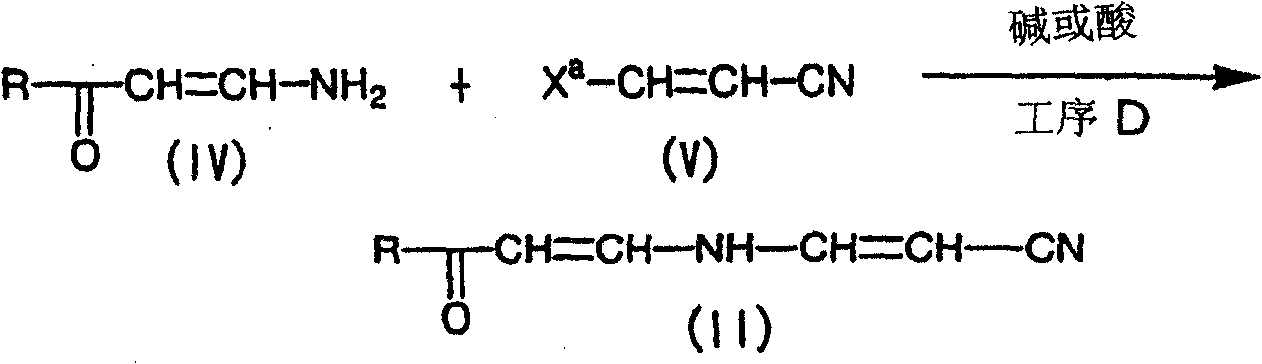
式中,R和Xa表示与上述相同的定义。In the formula, R and X a represent the same definitions as above.
本工序是通过使化合物(IV)在惰性溶剂中或在无溶剂的条件下、在碱或酸的存在下,与化合物(V)进行反应来制备化合物(II)的工序。This step is a step for preparing compound (II) by reacting compound (IV) with compound (V) in an inert solvent or in the absence of a solvent in the presence of a base or an acid.
本工序中所使用的化合物(V)的量,相对于化合物(IV)1mol,通常为1.0~10.0mol,优选为1.0~5mol。The amount of compound (V) used in this step is usually 1.0 to 10.0 mol, preferably 1.0 to 5 mol, based on 1 mol of compound (IV).
在本工序中使用碱的情况,所使用的碱,只要是通常pH8以上的碱就没有特殊限定,可以为例如,氢氧化钠和氢氧化钾等碱金属的氢氧化物;氢氧化钙和氢氧化镁等碱土金属的氢氧化物;碳酸钠和碳酸钾等碱金属的碳酸盐类;碳酸氢钠和碳酸氢钾等碱金属的碳酸氢盐类;钠和钾等碱金属类;氢化钠和氢化钾等金属氢化物;甲醇钠、乙醇钠和叔丁醇钾等醇盐类;三乙胺、N,N-二甲基苯胺和吡啶等有机碱类;或者,甲基锂、丁基锂、甲基溴化镁、二异丙基酰胺锂等有机金属类等,优选为碱金属的氢氧化物;金属氢化物或醇盐类,更优选为氢化钠或甲醇钠。In the case of using a base in this step, the base used is not particularly limited as long as it is usually a base with a pH of 8 or more, and may be, for example, hydroxides of alkali metals such as sodium hydroxide and potassium hydroxide; calcium hydroxide and hydrogen Hydroxides of alkaline earth metals such as magnesium oxide; carbonates of alkali metals such as sodium carbonate and potassium carbonate; bicarbonates of alkali metals such as sodium bicarbonate and potassium bicarbonate; alkali metals such as sodium and potassium; sodium hydride and Metal hydrides such as potassium hydride; alkoxides such as sodium methoxide, sodium ethoxide, and potassium tert-butoxide; organic bases such as triethylamine, N,N-dimethylaniline, and pyridine; or methyllithium, butyllithium , methylmagnesium bromide, lithium diisopropylamide and other organic metals, etc., preferably alkali metal hydroxides; metal hydrides or alkoxides, more preferably sodium hydride or sodium methoxide.
所使用的碱的量,相对于化合物(IV)1mol,通常为1.0~10.0mol,优选为1.0~5.0mol。The amount of the base to be used is usually 1.0 to 10.0 mol, preferably 1.0 to 5.0 mol, based on 1 mol of compound (IV).
在本工序中使用酸的情况,所使用的酸,只要是通常用于有机化学反应的酸就没有特殊限定,可以为例如,盐酸、硫酸、高氯酸和硝酸等无机酸类;甲酸、乙酸和三氟乙酸等羧酸类;甲磺酸、苯磺酸、对甲苯磺酸和三氟甲磺酸等磺酸类;吡啶·对甲苯磺酸盐等胺盐;磷酸、多磷酸等磷酸类;氯化铝、四氯化钛和三氟化硼·醚合物等路易斯酸类,优选为无机酸或磺酸类。In the case of using an acid in this step, the acid used is not particularly limited as long as it is an acid commonly used in organic chemical reactions, and may be, for example, inorganic acids such as hydrochloric acid, sulfuric acid, perchloric acid, and nitric acid; formic acid, acetic acid, etc. carboxylic acids such as trifluoroacetic acid; sulfonic acids such as methanesulfonic acid, benzenesulfonic acid, p-toluenesulfonic acid and trifluoromethanesulfonic acid; amine salts such as pyridine p-toluenesulfonate; phosphoric acid such as phosphoric acid and polyphosphoric acid Lewis acids such as aluminum chloride, titanium tetrachloride and boron trifluoride etherate, preferably inorganic acids or sulfonic acids.
所使用的酸的量,相对于化合物(IV)1mol,通常为1.0~10.0mol,优选为1.0~5.0mol。The amount of the acid to be used is usually 1.0 to 10.0 mol, preferably 1.0 to 5.0 mol, based on 1 mol of compound (IV).
在本工序中使用溶剂的情况,所使用的溶剂,只要是不阻碍反应并在一定程度上溶解起始物质的溶剂就没有特殊限定,可以为例如,甲醇、乙醇、丙醇和叔丁醇等醇类;乙醚、二甲氧基乙烷、四氢呋喃、二乙氧基甲烷和二噁烷等醚类;苯、甲苯、二甲苯和氯苯等芳香族烃类;乙腈等腈类;N,N-二甲基甲酰胺、N,N-二甲基乙酰胺和N-甲基-2-吡咯烷酮等酰胺类;二甲亚砜和环丁砜等亚砜类;二氯甲烷和氯仿等卤代烃类;乙酸乙酯和丙酸乙酯等酯类;己烷、环己烷和庚烷等脂肪族烃类;吡啶和甲基吡啶等吡啶类;或者,它们的混合溶剂,优选为醚类、芳香族烃类或酰胺类,更优选为二甲氧基乙烷、甲苯、N,N-二甲基甲酰胺、N,N-二甲基乙酰胺或1,3-二甲基-2-咪唑烷酮。In the case of using a solvent in this step, the solvent used is not particularly limited as long as it does not hinder the reaction and dissolves the starting material to a certain extent. For example, alcohols such as methanol, ethanol, propanol, and tert-butanol may be used. Ethers such as ether, dimethoxyethane, tetrahydrofuran, diethoxymethane and dioxane; aromatic hydrocarbons such as benzene, toluene, xylene and chlorobenzene; nitriles such as acetonitrile; N, N- Amides such as dimethylformamide, N,N-dimethylacetamide and N-methyl-2-pyrrolidone; sulfoxides such as dimethyl sulfoxide and sulfolane; halogenated hydrocarbons such as methylene chloride and chloroform; Esters such as ethyl acetate and ethyl propionate; Aliphatic hydrocarbons such as hexane, cyclohexane and heptane; Pyridines such as pyridine and picoline; or their mixed solvents, preferably ethers, aromatic Hydrocarbons or amides, more preferably dimethoxyethane, toluene, N,N-dimethylformamide, N,N-dimethylacetamide or 1,3-dimethyl-2-imidazolidine ketone.
所使用的溶剂的量,相对于化合物(IV)1mol,通常为1.0~20升,优选为1.0~10升。The amount of the solvent to be used is usually 1.0 to 20 liters, preferably 1.0 to 10 liters relative to 1 mol of compound (IV).
反应温度根据原料化合物、反应试剂和溶剂等的不同而异,通常为-40℃~150℃,优选为0~100℃。The reaction temperature varies depending on the raw material compounds, reagents, solvents, etc., but is usually -40°C to 150°C, preferably 0 to 100°C.
反应时间根据原料化合物、反应试剂、溶剂和反应温度等的不同而异,通常为6分钟~48小时,优选为10分钟~24小时。The reaction time varies depending on the raw material compounds, reagents, solvents, and reaction temperature, and is usually 6 minutes to 48 hours, preferably 10 minutes to 24 hours.
(工序E)(Process E)

式中,R和Ra表示与上述相同的定义。In the formula, R and R a represent the same definitions as above.
本工序是通过使化合物(IV)在惰性溶剂中或在无溶剂的条件下、在碱或酸的存在下,与化合物(VI)进行反应来制备化合物(II)的工序。This step is a step for preparing compound (II) by reacting compound (IV) with compound (VI) in an inert solvent or in the absence of a solvent in the presence of a base or an acid.
本工序中所使用的化合物(VI)的量,相对于化合物(IV)1mol,通常为1.0~10.0mol,优选为1.0~5.0mol。The amount of compound (VI) used in this step is usually 1.0 to 10.0 mol, preferably 1.0 to 5.0 mol, based on 1 mol of compound (IV).
在本工序中使用碱的情况,所使用的碱,只要是通常pH8以上的碱就没有特殊限定,可以为例如,氢氧化钠和氢氧化钾等碱金属的氢氧化物;氢氧化钙和氢氧化镁等碱土金属的氢氧化物;碳酸钠和碳酸钾等碱金属的碳酸盐类;碳酸氢钠和碳酸氢钾等碱金属的碳酸氢盐类;氢化钠和氢化钾等金属氢化物;甲醇钠、乙醇钠和叔丁醇钾等醇盐类;三乙胺、N,N-二甲基苯胺和吡啶等有机碱类;或者,甲基锂、丁基锂、甲基溴化镁、二异丙基酰胺锂等有机金属类等,优选为碱金属的氢氧化物、金属氢化物或醇盐类,更优选为氢化钠或甲醇钠。In the case of using a base in this step, the base used is not particularly limited as long as it is usually a base with a pH of 8 or more, and may be, for example, hydroxides of alkali metals such as sodium hydroxide and potassium hydroxide; calcium hydroxide and hydrogen Hydroxides of alkaline earth metals such as magnesium oxide; carbonates of alkali metals such as sodium carbonate and potassium carbonate; bicarbonates of alkali metals such as sodium bicarbonate and potassium bicarbonate; metal hydrides such as sodium hydride and potassium hydride; methanol alkoxides such as sodium, sodium ethoxide, and potassium tert-butoxide; organic bases such as triethylamine, N,N-dimethylaniline, and pyridine; or methyllithium, butyllithium, methylmagnesium bromide, di Organic metals such as lithium isopropylamide are preferably alkali metal hydroxides, metal hydrides or alkoxides, more preferably sodium hydride or sodium methoxide.
所使用的碱的量,相对于化合物(IV)1mol,通常为1.0~10.0mol,优选为1.0~5.0mol。The amount of the base to be used is usually 1.0 to 10.0 mol, preferably 1.0 to 5.0 mol, based on 1 mol of compound (IV).
在本工序中使用酸的情况,所使用的酸,只要是通常用于有机化学反应的酸就没有特殊限定,可以为例如,盐酸、硫酸、高氯酸和硝酸等无机酸类;甲酸、乙酸和三氟乙酸等羧酸类;甲磺酸、苯磺酸、对甲苯磺酸和三氟甲磺酸等磺酸类;吡啶·对甲苯磺酸盐等胺盐;磷酸、多磷酸等磷酸盐类;氯化铝、四氯化钛和三氟化硼·醚合物等路易斯酸类,优选为无机酸或磺酸类。In the case of using an acid in this step, the acid used is not particularly limited as long as it is an acid commonly used in organic chemical reactions, and may be, for example, inorganic acids such as hydrochloric acid, sulfuric acid, perchloric acid, and nitric acid; formic acid, acetic acid, etc. and trifluoroacetic acid and other carboxylic acids; methanesulfonic acid, benzenesulfonic acid, p-toluenesulfonic acid and trifluoromethanesulfonic acid and other sulfonic acids; pyridine · p-toluenesulfonate and other amine salts; phosphoric acid, polyphosphoric acid and other phosphates Lewis acids such as aluminum chloride, titanium tetrachloride and boron trifluoride etherate, preferably inorganic acids or sulfonic acids.
在本工序中使用溶剂的情况,所使用的溶剂,只要是不阻碍反应并在一定程度上溶解起始物质的溶剂就没有特殊限定,可以为例如,乙醚、二甲氧基乙烷、四氢呋喃、二乙氧基甲烷和二噁烷等醚类;苯、甲苯、二甲苯和氯苯等芳香族烃类;乙腈等腈类;N,N-二甲基甲酰胺、N,N-二甲基乙酰胺和N-甲基-2-吡咯烷酮等酰胺类;二甲亚砜和环丁砜等亚砜类;二氯甲烷和氯仿等卤代烃类;乙酸乙酯和丙酸乙酯等酯类;己烷、环己烷和庚烷等脂肪族烃类;吡啶和甲基吡啶等吡啶类;或者,它们的混合溶剂,优选为醚类、芳香族烃类或酰胺类,更优选为二甲氧基乙烷、甲苯或N,N-二甲基甲酰胺。In the case of using a solvent in this step, the solvent used is not particularly limited as long as it does not hinder the reaction and dissolves the starting material to a certain extent. For example, ether, dimethoxyethane, tetrahydrofuran, Ethers such as diethoxymethane and dioxane; aromatic hydrocarbons such as benzene, toluene, xylene and chlorobenzene; nitriles such as acetonitrile; N, N-dimethylformamide, N, N-dimethyl Amides such as acetamide and N-methyl-2-pyrrolidone; sulfoxides such as dimethyl sulfoxide and sulfolane; halogenated hydrocarbons such as methylene chloride and chloroform; esters such as ethyl acetate and ethyl propionate; Aliphatic hydrocarbons such as alkane, cyclohexane and heptane; pyridines such as pyridine and picoline; or their mixed solvents, preferably ethers, aromatic hydrocarbons or amides, more preferably dimethoxy Ethane, toluene or N,N-dimethylformamide.
所使用的溶剂的量,相对于化合物(IV)1mol,通常为1.0~20升,优选为1.0~10升。The amount of the solvent to be used is usually 1.0 to 20 liters, preferably 1.0 to 10 liters relative to 1 mol of compound (IV).
反应温度根据原料化合物、反应试剂和溶剂等的不同而异,通常为-40℃~150℃,优选为0~100℃。The reaction temperature varies depending on the raw material compounds, reagents, solvents, etc., but is usually -40°C to 150°C, preferably 0 to 100°C.
反应时间根据原料化合物、反应试剂、溶剂和反应温度等的不同而异,通常为6分钟~48小时,优选为10分钟~24小时。The reaction time varies depending on the raw material compounds, reagents, solvents, and reaction temperature, and is usually 6 minutes to 48 hours, preferably 10 minutes to 24 hours.
(工序F)(Process F)

式中,R和A表示与上述相同的定义。In the formula, R and A represent the same definitions as above.
本工序是通过在惰性溶剂中向化合物(II)中加入碱来制备化合物(VII)的工序。This step is a step for preparing compound (VII) by adding a base to compound (II) in an inert solvent.
在本工序中,所使用的碱,只要是通常pH8以上的碱就没有特殊限定,可以为例如,氢氧化钠和氢氧化钾等碱金属的氢氧化物;氢氧化钙和氢氧化镁等碱土金属的氢氧化物;碳酸钠和碳酸钾等碱金属的碳酸盐类;碳酸氢钠和碳酸氢钾等碱金属的碳酸氢盐类;氢化钠和氢化钾等金属氢化物;甲醇钠、乙醇钠和叔丁醇钾等醇盐类;三乙胺、N,N-二甲基苯胺和吡啶等有机碱类;或者,甲基锂、丁基锂、甲基溴化镁、二异丙基酰胺锂等有机金属类等,优选为碱金属的氢氧化物、碱金属的碳酸盐类、碱金属的碳酸氢盐类、金属氢化物或醇盐类,更优选为氢氧化钠、氢氧化钾、碳酸钠、碳酸钾、氢化钠或甲醇钠。In this step, the alkali used is not particularly limited as long as it is an alkali with a pH above 8, and may be, for example, hydroxides of alkali metals such as sodium hydroxide and potassium hydroxide; alkaline earths such as calcium hydroxide and magnesium hydroxide. Metal hydroxides; alkali metal carbonates such as sodium carbonate and potassium carbonate; alkali metal bicarbonates such as sodium bicarbonate and potassium bicarbonate; metal hydrides such as sodium hydride and potassium hydride; sodium methoxide and sodium ethoxide Alkoxides such as potassium and tert-butoxide; organic bases such as triethylamine, N,N-dimethylaniline and pyridine; or methyllithium, butyllithium, methylmagnesium bromide, diisopropylamide Organic metals such as lithium, etc., preferably alkali metal hydroxides, alkali metal carbonates, alkali metal bicarbonates, metal hydrides or alkoxides, more preferably sodium hydroxide, potassium hydroxide, Sodium carbonate, potassium carbonate, sodium hydride or sodium methoxide.
所使用的碱的量,相对于化合物(II)1mol,通常为1.0~10.0mol,优选为1.0~5.0mol。The amount of the base to be used is usually 1.0 to 10.0 mol, preferably 1.0 to 5.0 mol, based on 1 mol of compound (II).
所使用的溶剂,只要是不阻碍反应并在一定程度上溶解起始物质的溶剂就没有特殊限定,可以为例如,甲醇、乙醇、丙醇和叔丁醇等醇类;乙醚、二甲氧基乙烷、四氢呋喃、二乙氧基甲烷和二噁烷等醚类;苯、甲苯、二甲苯和氯苯等芳香族烃类;乙腈等腈类;N,N-二甲基甲酰胺、N,N-二甲基乙酰胺和N-甲基-2-吡咯烷酮等酰胺类;二甲亚砜和环丁砜等亚砜类;二氯甲烷和氯仿等卤代烃类;乙酸乙酯和丙酸乙酯等酯类;己烷、环己烷和庚烷等脂肪族烃类;吡啶和甲基吡啶等吡啶类;或者,它们的混合溶剂,优选为醇类、醚类、芳香族烃类或酰胺类,更优选为甲醇、乙醇、甲苯或N,N-二甲基甲酰胺。The solvent used is not particularly limited as long as it is a solvent that does not hinder the reaction and dissolves the starting material to a certain extent, and can be, for example, alcohols such as methanol, ethanol, propanol and tert-butanol; ether, dimethoxyethyl alcohol, etc. ethers such as alkanes, tetrahydrofuran, diethoxymethane and dioxane; aromatic hydrocarbons such as benzene, toluene, xylene and chlorobenzene; nitriles such as acetonitrile; N, N-dimethylformamide, N, N -amides such as dimethylacetamide and N-methyl-2-pyrrolidone; sulfoxides such as dimethyl sulfoxide and sulfolane; halogenated hydrocarbons such as methylene chloride and chloroform; ethyl acetate and ethyl propionate, etc. Esters; aliphatic hydrocarbons such as hexane, cyclohexane and heptane; pyridines such as pyridine and picoline; or their mixed solvents, preferably alcohols, ethers, aromatic hydrocarbons or amides, More preferred is methanol, ethanol, toluene or N,N-dimethylformamide.
所使用的溶剂的量,相对于化合物(II)1mol,通常为1.0~20升,优选为1.0~10升。The amount of the solvent to be used is usually 1.0 to 20 liters, preferably 1.0 to 10 liters relative to 1 mol of compound (II).
反应温度根据原料化合物、反应试剂和溶剂等的不同而异,通常为-40℃~150℃,优选为0~100℃。The reaction temperature varies depending on the raw material compounds, reagents, solvents, etc., but is usually -40°C to 150°C, preferably 0 to 100°C.
反应时间根据原料化合物、反应试剂、溶剂和反应温度等的不同而异,通常为6分钟~48小时,优选为10分钟~24小时。The reaction time varies depending on the raw material compounds, reagents, solvents, and reaction temperature, and is usually 6 minutes to 48 hours, preferably 10 minutes to 24 hours.
(工序G)(Process G)

式中,R表示与上述相同的定义,Aa表示氰基或氨基甲酰基。In the formula, R represents the same definition as above, and A a represents a cyano group or a carbamoyl group.
本工序是通过在溶剂中加入酸或碱使化合物(VII)中A为氰基或氨基甲酰基的化合物(VIIa)水解来制备化合物(VIII)的工序,可以在通常的水解条件下进行。This step is a step of preparing compound (VIII) by adding acid or base to a solvent to hydrolyze compound (VIIa) in which A is cyano or carbamoyl in compound (VII), and can be carried out under normal hydrolysis conditions.
在本工序中,所使用的酸,只要是通常用于水解的酸就没有特殊限定,可以为例如,盐酸和硫酸等无机酸,优选为盐酸或硫酸。In this step, the acid used is not particularly limited as long as it is an acid generally used for hydrolysis, and may be, for example, inorganic acids such as hydrochloric acid and sulfuric acid, preferably hydrochloric acid or sulfuric acid.
所使用的酸的量,相对于化合物(VIIa),通常为1当量~较大过剩的量。The amount of the acid to be used is usually 1 equivalent to a relatively large excess relative to the compound (VIIa).
在本工序中,所使用的碱,只要是通常用于水解的碱就没有特殊限定,可以为例如,氢氧化钠和氢氧化钾等碱金属的氢氧化物,优选为氢氧化钠或氢氧化钾。In this step, the alkali used is not particularly limited as long as it is an alkali commonly used for hydrolysis, and can be, for example, hydroxides of alkali metals such as sodium hydroxide and potassium hydroxide, preferably sodium hydroxide or potassium hydroxide. potassium.
所使用的碱的量,相对于化合物(VIIa),通常为1~20当量。The amount of the base to be used is usually 1 to 20 equivalents based on compound (VIIa).
所使用的溶剂,只要是通常用于水解的溶剂就没有特殊限定,可以为例如,水;甲醇、乙醇、丙醇和叔丁醇等醇类;乙醚、二甲氧基乙烷、四氢呋喃、二乙氧基甲烷和二噁烷等醚类;或者,它们的混合溶剂,优选为水。The solvent used is not particularly limited as long as it is a solvent commonly used for hydrolysis, and can be, for example, water; Alcohols such as methanol, ethanol, propanol and tert-butanol; Diethyl ether, dimethoxyethane, tetrahydrofuran, diethyl ether, etc. Ethers such as oxymethane and dioxane; or their mixed solvent, preferably water.
反应温度根据原料化合物、反应试剂和溶剂等的不同而异,通常为0℃~回流温度。The reaction temperature varies depending on the raw material compounds, reagents, solvents, etc., but is usually 0°C to reflux temperature.
反应时间根据原料化合物、反应试剂、溶剂和反应温度等的不同而异,通常为5分钟~48小时。The reaction time varies depending on the starting compound, reaction reagent, solvent, reaction temperature, etc., and is usually 5 minutes to 48 hours.
(工序H)(Process H)
式中,R表示与上述相同的定义。In the formula, R represents the same definition as above.
本工序是使化合物(VII)中A为羧基的化合物(VIII)在惰性溶剂中与卤化剂进行反应,制备化合物(IX)的方法。This step is a method for preparing compound (IX) by reacting compound (VIII) in which A is a carboxyl group in compound (VII) with a halogenating agent in an inert solvent.
本工序中所使用的卤化剂,只要是通常用于脱水并进行卤化反应的试剂就没有特殊限定,例如,亚硫酰氯和磺酰氯等卤化硫类;五氯化磷等卤化磷类;或者,碳酰氯、二碳酰氯、三碳酰氯和草酰氯等有机卤化物,优选为卤化硫黄类或有机卤化物,更优选为亚硫酰氯或磺酰氯。The halogenating agent used in this step is not particularly limited as long as it is a reagent commonly used for dehydration and halogenation reaction, for example, sulfur halides such as thionyl chloride and sulfuryl chloride; phosphorus halides such as phosphorus pentachloride; or, Organic halides such as carbonyl chloride, dicarbonyl chloride, tricarbonyl chloride and oxalyl chloride are preferably sulfur halides or organic halides, more preferably thionyl chloride or sulfuryl chloride.
所使用的溶剂,只要是不阻碍反应并在一定程度上溶解起始物质的溶剂就没有特殊限定,可以为例如,二甲基醚、叔丁基甲基醚、二甲氧基乙烷、四氢呋喃和二噁烷等醚类;苯、甲苯、二甲苯和氯苯等芳香族烃类;乙腈等腈类;N,N-二甲基酰胺、N,N-二甲基乙酰胺和N-甲基-2-吡咯烷酮等酰胺类;二氯甲烷和二氯乙烷等卤代烃类;乙酸乙酯和乙酸丙基等酯类;己烷、环己烷和庚烷等脂肪族烃类;吡啶和甲基吡啶等吡啶类;或者,它们的混合溶剂,优选为醚类、芳香族烃类、卤代烃类,更优选为甲苯、二甲苯、二氯乙烷。The solvent used is not particularly limited as long as it is a solvent that does not hinder the reaction and dissolves the starting material to a certain extent, and can be, for example, dimethyl ether, tert-butyl methyl ether, dimethoxyethane, tetrahydrofuran, and dimethoxylate. Ethers such as oxane; aromatic hydrocarbons such as benzene, toluene, xylene and chlorobenzene; nitriles such as acetonitrile; N, N-dimethylamide, N, N-dimethylacetamide and N-methyl- Amides such as 2-pyrrolidone; Halogenated hydrocarbons such as dichloromethane and dichloroethane; Esters such as ethyl acetate and propyl acetate; Aliphatic hydrocarbons such as hexane, cyclohexane and heptane; pyridines such as pyridine; or their mixed solvents are preferably ethers, aromatic hydrocarbons, halogenated hydrocarbons, more preferably toluene, xylene, and dichloroethane.
本工序中所使用的卤化剂的量,相对于化合物(VIII)1mol,通常为1.0~10.0mol,优选为1.0~5.0mol。The amount of the halogenating agent used in this step is usually 1.0 to 10.0 mol, preferably 1.0 to 5.0 mol, based on 1 mol of compound (VIII).
所使用的溶剂的量,相对于化合物(VIII)1mol,通常为0.1~20.0升,优选为0.5~10升。The amount of the solvent to be used is usually 0.1 to 20.0 liters, preferably 0.5 to 10 liters relative to 1 mol of compound (VIII).
反应温度根据原料化合物、反应试剂和溶剂等的不同而异,通常为-40℃~150℃,优选为0℃~溶剂的回流温度。The reaction temperature varies depending on the raw material compounds, reagents, solvents, etc., and is usually -40°C to 150°C, preferably 0°C to the reflux temperature of the solvent.
反应时间根据原料化合物、反应试剂、溶剂和反应温度等的不同而异,通常为6分钟~48小时,优选为10分钟~24小时。The reaction time varies depending on the raw material compounds, reagents, solvents, and reaction temperature, and is usually 6 minutes to 48 hours, preferably 10 minutes to 24 hours.
上述各反应结束后,各工序的目标化合物可以按照常规方法从反应混合物中回收。例如,可以通过将反应混合物适宜地中和,或者在存在不溶物的情况下用过滤法将其除去后,加入不与水混溶的有机溶剂,经水洗后,蒸馏除去溶剂而获得。获得的目标化合物可以根据需要,采用常规方法,例如重结晶、再沉淀或色谱法等进一步进行精制。另外,各工序的目标化合物也可以不进行精制,直接用于后续的反应工序中。After each of the above reactions is completed, the target compound of each step can be recovered from the reaction mixture according to a conventional method. For example, it can be obtained by appropriately neutralizing the reaction mixture, or removing insoluble matter by filtration when present, adding a water-immiscible organic solvent, washing with water, and then distilling off the solvent. The obtained target compound can be further purified by conventional methods, such as recrystallization, reprecipitation or chromatography, if necessary. In addition, the target compound in each step may be directly used in the subsequent reaction step without purification.
在将本发明化合物作为农药的有效成分使用时,本发明化合物也可以直接使用其本身,但也可以配合作为农药助剂而通常在制剂化时使用的载体、表面活性剂和其他助剂,制成各种形态的制剂,例如,乳剂、悬浮剂、粉剂、颗粒剂、片剂、可湿性粉剂、水溶剂、液剂、流动性剂、可湿性颗粒剂、气溶胶剂、膏剂、油剂和乳浊剂等。它们的配合比例,通常按有效成分为0.1~9.0质量份,农药助剂为10~99.9质量份。When the compound of the present invention is used as an active ingredient of a pesticide, the compound of the present invention can also be used directly by itself, but it can also be used in combination with carriers, surfactants and other adjuvants that are usually used in formulation as pesticide adjuvants to prepare Preparations in various forms, such as emulsions, suspensions, powders, granules, tablets, wettable powders, aqueous solutions, solutions, flowable agents, wettable granules, aerosols, ointments, oils and Opacifiers, etc. Their compounding ratio is usually 0.1-9.0 parts by mass for active ingredients and 10-99.9 parts by mass for pesticide adjuvants.
上述制剂化时所使用的载体,可以为例如,淀粉、活性炭、大豆粉、小麦粉、木粉、鱼粉、奶粉等的动植物性粉末、以及、滑石、高岭土、膨润土、碳酸钙、沸石、硅藻土、白炭黑、粘土、氧化铝等的矿物性粉末等固体载体;或者,水、异丙醇、乙二醇等的醇类、环己烷、丁酮等的酮类、二噁烷、四氢呋喃等的醚类、煤油、轻油等的脂肪族烃类、二甲苯、三甲苯、四甲苯、甲基萘、溶剂石脑油等的芳香族烃类、氯苯等的卤代烃类、二甲基乙酰胺等的酰胺类、脂肪酸的甘油酯等的酯类、乙腈等的腈类、以及二甲亚砜等的含硫化合物类等液体载体,优选为固体载体或液体载体。Carriers used in the formulation of the above can be, for example, animal and vegetable powders such as starch, activated carbon, soybean flour, wheat flour, wood flour, fish powder, and milk powder, and talc, kaolin, bentonite, calcium carbonate, zeolite, diatoms, etc. Solid carriers such as mineral powders such as soil, silica, clay, and alumina; or water, alcohols such as isopropanol and ethylene glycol, ketones such as cyclohexane and methyl ethyl ketone, dioxane, Ethers such as tetrahydrofuran, aliphatic hydrocarbons such as kerosene and light oil, aromatic hydrocarbons such as xylene, trimethylbenzene, tetramethylbenzene, methylnaphthalene, solvent naphtha, etc., halogenated hydrocarbons such as chlorobenzene, Liquid carriers such as amides such as dimethylacetamide, esters such as glycerides of fatty acids, nitriles such as acetonitrile, and sulfur-containing compounds such as dimethyl sulfoxide are preferably solid or liquid carriers.
所使用的表面活性剂,可以为例如,烷基苯磺酸金属盐、二萘基甲烷二磺酸金属盐、硫酸醇酯盐、烷基芳基磺酸盐、木质磺酸盐、聚氧乙二醇醚、聚氧乙烯烷基芳基醚或聚氧乙烯脱水山梨糖醇单烷基化物,优选为烷基苯磺酸金属盐、木质磺酸盐、聚氧乙烯烷基芳基醚或聚氧乙烯山梨糖醇酐单烷基化物。The surfactant used can be, for example, metal alkylbenzenesulfonate, metal dinaphthylmethanedisulfonate, alcohol sulfate ester salt, alkylarylsulfonate, lignosulfonate, polyoxyethylene Glycol ethers, polyoxyethylene alkylaryl ethers or polyoxyethylene sorbitan monoalkylates, preferably metal alkylbenzenesulfonates, lignosulfonates, polyoxyethylene alkylaryl ethers or polyoxyethylene alkylaryl ethers Oxyethylene sorbitan monoalkylate.
作为其他的助剂,例如,羧基二甲基纤维素、阿拉伯树胶、藻酸钠、黄原胶、瓜耳胶、黄耆胶和聚乙烯醇等的粘合剂或增粘剂;金属皂等的消泡剂;或者,脂肪酸、烷基磷酸盐、硅氧烷和石蜡等的物性改进剂、着色剂,优选为瓜耳胶或黄原胶。As other auxiliary agents, for example, binders or tackifiers such as carboxydimethylcellulose, gum arabic, sodium alginate, xanthan gum, guar gum, tragacanth gum, and polyvinyl alcohol; metal soaps, etc. Or, the physical property improver of fatty acid, alkyl phosphate, siloxane and paraffin etc., coloring agent, be preferably guar gum or xanthan gum.
这些制剂在实际使用时,可以直接使用,或者也可以用水等的稀释剂稀释至规定浓度后再使用。含有本发明化合物的各种制剂或其稀释剂的施用,可以是通常进行的施用方法,即,散布(例如,喷雾、雾化(misting)、雾化(atomizing)、散粉、散粒、水面施用、箱施用等)、土壤施用(例如,混入、灌注等)、表面施用(例如,涂布、粉衣、被覆等)、浸渍或毒饵等。另外,对于家畜,将上述有效成分混合到饲料中进行投喂,也可以防除在其排泄物中的害虫、特别是有害昆虫的发生、生育。或者,也可以采用所谓的超高浓度少量散布法进行施用。在该方法中,可以含有100%的有效成分。In actual use, these formulations may be used as they are, or may be diluted to a predetermined concentration with a diluent such as water before use. The application of various formulations containing the compounds of the present invention or their diluents can be the application methods usually carried out, that is, spreading (for example, spraying, atomizing (misting), atomizing (atomizing), loose powder, loose granules, water surface application , box application, etc.), soil application (eg, mixing, pouring, etc.), surface application (eg, coating, powder coating, covering, etc.), dipping or poison bait, etc. In addition, for domestic animals, the above-mentioned active ingredients are mixed into feed and fed to prevent pests in their excrement, especially the occurrence and growth of harmful insects. Alternatively, the so-called ultra-high-concentration small-spray method can also be used for application. In this method, 100% active ingredient may be contained.
本发明的农药施用时的有效成分浓度,通常为0.1~50000ppm,优选为1~10000ppm。但是,有效成分浓度可以根据制剂的形态和施用的方法、目的、时期、场所和有害生物的发生状况来适当地变更,例如,在水生有害生物的情况,将上述浓度的药液散布到发生场所,也可以进行防除,因此在水中的有效成分浓度比上述范围小。本发明的农药的使用量,在土壤混合处理的情况,例如,作为有效成分化合物,每10亩为0.1~5000g,优选为1~1000g。The active ingredient concentration at the time of application of the pesticide of the present invention is usually 0.1 to 50000 ppm, preferably 1 to 10000 ppm. However, the concentration of the active ingredient can be appropriately changed according to the form of the preparation and the method of application, purpose, period, place, and occurrence of pests. For example, in the case of aquatic pests, spraying the above-mentioned concentration of liquid medicine on the occurrence place , can also be controlled, so the concentration of active ingredients in water is smaller than the above range. The amount of the pesticide used in the present invention is, for example, 0.1 to 5000 g, preferably 1 to 1000 g, per 10 mu as the active ingredient compound in the case of soil mixing treatment.
应予说明,本发明化合物虽然在单独使用时不能说十分有效,但是也可以根据需要与肥料和其他的农药、例如杀虫剂、杀螨剂、杀线虫剂、杀菌剂、抗病毒剂、诱引剂、除草剂和植物调整剂等混用和并用,该场合下也显示出更为优良的效果。It should be noted that although the compound of the present invention cannot be said to be very effective when used alone, it can also be combined with fertilizers and other pesticides, such as insecticides, acaricides, nematocides, fungicides, antiviral agents, attractants, etc. Mixed use of primers, herbicides and plant regulators, etc., also shows better results in this case.
作为能够与本发明化合物混合来使用的其他的农药,可以为例如杀虫剂、杀螨剂、杀线虫剂、杀菌剂、抗病毒剂、诱引剂、除草剂和植物调整剂,优选为杀虫剂、杀螨剂、杀线虫剂、杀菌剂或除草剂。Other pesticides that can be used in admixture with the compound of the present invention include, for example, insecticides, acaricides, nematocides, fungicides, antiviral agents, attractants, herbicides, and plant regulators, preferably Insecticides, acaricides, nematicides, fungicides or herbicides.
所使用的杀虫剂,可以为例如,有机磷和氨基甲酸酯系杀虫剂、ピレスロイド系杀虫剂或其他的杀虫剂。The insecticides used may be, for example, organophosphorus and carbamate-based insecticides, pyresloyd-based insecticides, or other insecticides.
有机磷和氨基甲酸酯系杀虫剂,可以为例如,倍硫磷、杀螟松、二嗪农、毒死蜱、オキシデプホス、蚜灭多、フエントエ一ト、乐果、安果、马拉松、敌百虫、甲基乙拌磷、ホスメツト、敌敌畏【ジクロルホス】、高灭磷、EPBP、甲基一六○五、オキシジメトン甲基、乙硫磷、ジオキサベンゾホス、杀螟腈、异噁唑磷、打杀磷、伏杀磷、杀扑磷、スルプロホス、毒虫畏、テトラクロルビンホス、二甲基ビンホス、丙虫磷【プロパホス】、イソフエンホス、乙拌磷、プロフエノホス、ピラクロホス、モノクロトホス、谷硫磷、アルジカルブ、灭多虫、チオジカルブ、虫螨威、カルボスルフアン、ベンフラカルブ、フラチオカルブ、プロポキスル、フエノブカルブ、メトルカルブ、イソプロカルブ、西维因、ピリミカ一ブ、エチオフエンカルブ、除线磷、ピリミホス甲基、キナルホス、甲基氯蜱硫磷、プロチオホス、ナレツド、EPN、XMC、ベンダイオカルブ、オキサミル、アラニカルブ或クロル乙氧基ホス。Organophosphorus and carbamate-based insecticides can be, for example, fenthion, fenitrothion, diazinon, chlorpyrifos, oxidephoro, aphidol, feentoe, dimethoate, ango, marathon, trichlor Insect, Dichlorphos-Methyl, Horsemet, Dichlorvos [Jigroruhos], Permethrin, EPBP, Methyl 1605, Oxidimetn Methyl, Ethion, Giokisabenzophos, Cyclonil, Isoxazophos . Phosphorus, Aljicalbu, Methox, Chiojicalbu, Chestcarb, Calbosulphan, Benflacalbu, Phrachiocalbu, Propokisul, Ferenocalbu, Metrocalbu, Isoprocalbu, Carbaryl, Pirimicarbu, Etiofencalbu, Deline Phosphorus, Pirimihos Methyl, Kinaruphos, chlorpyrifos-methyl, prochiohos, nared, EPN, XMC, bendiocalbu, okisamil, aranicalbu, or croolethoxyhos.
ピレスロイド系杀虫剂,可以为例如,ペルメトリン、シペルメトリン、デルタメトリン、フエンバレレ一ト、フエンプロパトリン、除虫菊酯、丙烯除虫菊、テトラメトリン、レスメトリン、ジメスリン、プロパスリン、フエノトリン、プロトリン、フルバリネ一ト、シフルトリン、シ卤代トリン、フルシトリネ一ト、エトフエンプロツクス、环プロトリン、トラロメトリン、シラフルオフエン、テフルトリン、ビフエントリン或アクリナトリン。Pyresroid insecticides include, for example, Pelmetrin, Sipelmetrin, Deltametrin, Fernbaret, Fernpropatrin, Pyrethrin, Acrylpyrethrum, Tetrametrin, Resmetrin, Jimesurin, Propasrin, Fernotrin, Protrotrin, Flubarinet, Sifterin, Halogenated trine, fulcitrine, etofenprox, cycloprotorin, tralometrin, sirafulofene, teflutorin, biferentrin, or aclinatrin.
其他的杀虫剂,可以为例如,ジフルベンズロン、クロルフルアズロン、ヘキサフルムロン、トリフルムロン、テフルベンズロン、フルフエノクスロン、フル环クスロン、ブプロフエジン、ピリプロキシフエン、ルフエヌロン、シロマジン、メトプレン、硫丹、ジアフエンチウロン、イミダクロプリド、フイプロニル、苯氧基カルブ、巴丹、杀虫环、杀虫磺、テブフエノジド、クロルフエナピル、エマメクチンベンゾエ一ト、アセタミプリド、ニテンピラム、ピメトロジン、油酸钠、硫酸ニコチン、ロテノン、メタアルデヒド、マシン油、なたね油、BT剂或昆虫病原ウイルス等的微生物农药。Other insecticides can be, for example, jifulbenzron, crolfurazron, hekisafrumron, trifluoromron, teflubenzron, fulfenoxron, fulcycloxron, buprophagin, piriprokisifene, ruferolon, siromagine, mettoplen, endosulfan, diaphores Enchinolon, Imida Croprid, Phipronil, Phenoxy Calbum, Badan, Insecticide Cyclo, Insecticide Sulfonate, Tebufenozide, Crolfenapil, Emamecchin Benzoetto, Asetamiprid, Nitempiram, Pimetrodin, Sodium Oleate, Nicotin Sulphate, Rotenon, Metal Deteroxin , mashin oil, なたね oil, BT agent or microbial pesticides such as entomopathogenic ウイルス.
所使用的杀螨剂,可以为例如,乙酯杀螨醇、溴螨酯、开乐散、アミトラズ、プロパルギツト、ベンゾメ一ト、ヘキシチアゾツクス、フエンブタチンオキシド、ポリナクチン、灭螨猛、杀螨酯、テトラジホン、アバメクチン、ミルベメクチン、クロフエンテジン、ピリダベン、フエンピロキシメ一ト、テブフエンピラド、ピリミジフエン、フエノチオカルブ、ジエノクロル、エトキサブ一ル
所使用的杀线虫剂,可以为例如,フエナミホス、ホスチアゼ一ト、エトプロホス、甲基イソチオシアネ一ト、1,3-二氯丙烯或DCIP。The nematocide to be used may be, for example, Feenamihos, Horsezet, Etoprohouse, Methylisothiocyanet, 1,3-dichloropropene or DCIP.
所使用的杀菌剂,可以为例如,チオフアネ一ト甲基、苯菌灵、多菌灵、チアベンダゾ一ル、灭菌丹【フオルベツト】、チウラム、福美锌、代森锌、マンネブ、マンゼブ、ポリ氨基甲酸酯、イプロベンホス、エジフエンフオス、四氯苯酞、噻菌烯(噻菌灵)、稻瘟灵、氯タロニル、克菌丹(开普顿)、ポリオキシン、灭瘟素、春雷霉素、链霉素、バリダマイシン、三唑苯噻、咯喹酮、叶枯净、担菌宁、氟酰胺、ペン环ン、异菌脲、ヒメキサゾ一ル、甲霜林、トリフルミゾ一ル、トリホリン、トリアジメホン、ビテルタノ一ル、フエナリモル、プロピコナゾ一ル、シモキサニル、ポロクロラズ、ペフラゾエ一ト、ヘキサコナゾ一ル、ミクロブタニル、ジクロメジン、テクロフタラム、甲基代森锌、二噻农、ホセチル、ビンクロゾリン、プロシミドン、オキサジキシル、グアザチン、プロパモカルブ盐酸盐、フルアジナム、オキソリニツク酸、ヒドロキシイソキサゾ一ル、イミベンコナゾ一ル或メパニピリム。The fungicide used can be, for example, リリフアネト methyl, benomyl, carbendazim, チアベンダゾゾル, fungicide [Folbetsuto], チウラム, ziram, zineb, mannebu, manzeb, polyamino Formic acid esters, Iprobenhorse, Ejifenfos, tetrachlorophthalide, thiabendene (thiabendazole), rice blastazim, chlortalonil, captan (Capton), polyokishin, blasticidin, kasugamycin, streptomycin Triazolin, Baridamyshin, Triazolidine, Proxaquinone, Yekujing, Bactunin, Fluoramide, Pencycline, Iprodione, Himekisazur, Metalaxin, Trifulumizol, Trihorin, Triajimehon, Bittertano Fenarimol, Propiconazoil, Simokisanil, Porocrolasz, Pefurazoeitto, Hikisaconazoil, Microbutanil, Jicromethin, Tecroftaramu, Methylthinon, Dithianon, Hosecil, Bincrozolin, Proximidon, Okisajiksil, Gazacilbu, , fulu ajinam, okisolinic acid, hidrokishii sokisazuru, imibenkonazuru or mepanipirim.
所使用的除草剂,可以为例如,ジフルフエニカン、敌稗、二氯ピコ磷酸、麦草畏、ピコロラム、2,4-D、2,4-DB、2,4-DP、フルロキシピル、MCPA、MCPP、トリクロピル、ジクロホツプ-甲基、フエノキサプロツプ-乙基、フルアジホツプ-丁基、卤代キシホツプ-甲基、キザロホツプ-乙基、ノルフルラゾン、氯苯胺灵【クロルブロフアム】、デスメジフアム、苯敌草、プロフアム、草不绿、アセトクロル、去草胺、メタザクロル、メトラクロル、プレチラクロル、プロパクロル、オリザリン、トリフルラリン、アシフルオルフエン、ビフエノツクス、氟グリゴフエン、ホメサフエン、卤代サフエン、ラクトフエン、オキシフルオルフエン、クロルトルロン、ジウロン、フルオメツロン、イソプロツロン、リヌロン、メタベンズチアズロン、アロキシジム、クレトジム、シクロキシジム、セトキシジム、トラコキシジム、イマゼタピル、イマザメタベンズ、イマザピル、イマザキン、ブロモキシニル、敌草腈、イオキシニル、メフエナセツト、酰胺スルフロン、ベンスルフロン-甲基、クロリムロン-乙基、クロルスルフロン、シノスルフロン、メトスルフロン-甲基、ニコスルフロン、ピリミスルフロン、ピラゾスルフロン-乙基、チフエンスルフロン-甲基、トリアスルフロン、トリベヌロン-甲基、ブチレ一ト、シクロエ一ト、燕麦敌、EPTC、エスプロカルプ、禾大壮、プロスルホカルプ、ベンチオカルプ、トリアレ一ト、阿特拉津、シアナジン、西玛津、西草净、タ一ブトリン、タ一ブチラジン、ヘキサジノン、メタミトロン、メトリブジン、アミトリアゾ一ル、ベンフレセ一ト、ベンタゾン、シンメチリン、クロマゾン、クロピラリド、ジフエンゾクアツト、ジチオピル、エトフメセ一ト、フルオロクロリドン、グルホシネ一ト、グリホセ一ト、イソキサベン、ピリデ一ト、キンクロラツク、キンメタツク、スルホセ一ト或トリジフアン。The herbicide used may be, for example, jifulfenican, propanil, dichloropicophosphate, dicamba, picorolamu, 2,4-D, 2,4-DB, 2,4-DP, fulrokisipil, MCPA, MCPP, tricropil , Jicrohop-Methyl, Ferenokisaprotop-Ethyl, Florajihop-Butyl, Halogenated Kishihop-Methyl, Catarohop-Ethyl, Nolfulurazen, Chlorphenamine [Crolubropham], Desmejipham, Bendiquat, Profaam, Grass Green, Asetocrol, Detoxaamine, Metazacrol, Metrochrome, Plechiracrolol, Propacrol, Olizarin, Trifurlarin, Ashifurolfen, Biferotux, Fluogrigofen, Homesafefen, Halogenated Safen, Lactofen, Okifulolfen, Croltolfen, Chroltouron, Jirutsu Isoprotrulon, Liuron, Metabenzu Chiasron, Arokisimil, Cretosim, Sikrokisim, Setokisim, Trakokishim, Imazetapil, Imazametabenzu, Imazapil, Imazakin, Bromokinil, Dichonil, Iokisinil, Menofenacet, Ethyl-Sulphur, base, crolusulflon, sinosulflon, metosulflon-methyl, nicosulflon, pirimisulflon, pilasuresulflon-ethyl, trifensulflon-methyl, triasulflon, toribeuron-methyl, butcheret, cycroet, oat enemy , EPTC, エスプッロカルプ, He Dazhuang, Prosuru Hocalup, Benchio カルプ, トリアレゾト, Atrazine, Xianajin, Simazine, Xiguojing, タバブトリン, タブチラジン, ヘキサジノン, Metamitron, Metribujin, Amitriaゾ一ル, ベンフレセマト, ベンタゾン, シンメチチリン, Cromazon, Cropillarid, ジフエンゾクアツト, ジチオピル, Etoフメセット, フルオロロリドン, グルホゲシテット, グリホテチリン, Isoki Sanbe, Piridite, Kincrorac, Kinmettsuku, SulHoset Or trijifana.
本发明化合物对于例如半翅目害虫、鳞翅目害虫、鞘翅目害虫、双翅目害虫、膜翅目害虫、直翅目害虫、等翅目害虫、缨翅目害虫、叶螨类和植物寄生性线虫类显示出优良的防治效果。而且,本发明化合物对于其他有害动物、不快动物、卫生害虫和寄生虫也显示出优良的防治效果。The compounds of the present invention are effective against, for example, Hemiptera pests, Lepidoptera pests, Coleoptera pests, Diptera pests, Hymenoptera pests, Orthoptera pests, Isoptera pests, Thysanoptera pests, spider mites and plant parasites. Sexual nematodes showed excellent control effect. Furthermore, the compounds of the present invention also exhibit excellent control effects on other harmful animals, unpleasant animals, sanitary pests and parasites.
作为半翅目害虫,可列举出例如,ホソヘリカメムシ(Riptortus clavatus)、ミナミアオカメムシ(Nezara viridula)、メクラカメムシ类(Lygus sp.)、アメリカコバネナガカメムシ(Blissus leucpterus)、ナシグンバイ(Stephanitis nashi)等的カメムシ类(异翅类;Heteroptera)、ツマグロヨコバイ(Nephotettix cincticeps)、ヒメヨコバイ(Empoasca sp.,Erythroneura sp.,Circulifer sp.)等的ヨコバイ类、トビイロウンカ(Nilaparvatalugens)、セジロウンカ(Sogatella furcifera)、ヒメトビウンカ(Laodelphax striatellus)等的ウンカ类、Psylla sp.等的キジラミ类、タバココナジラミ(Bemisia tabaci)、酮シツコナジラミ(Trialeurodes vaporariorum)、等的コナジラミ类、ブドウネアブラムシ(Viteusvitifolii)、桃蚜(Myzus persicae)、リンゴアブラムシ(Aphis pomi)、ワタアブラムシ(Aphisgossypii)、Aphis fabae、ニセダイコンアブラムシ(Liphis erysimi)、ジヤガイモヒゲナガアブラムシ(Aulacorthum solani)、ムギミドリアブラムシ(Schizaphisgraminum)等的アブラムシ类、クワコナカイガラムシ(Pseudococcus comstocki)、ルビ一ロウムシ(Ceroplastesrubens)、サンホ一ゼカイガラムシ(Comstockaspis perniciosa)、ヤノエカイガラムシ(Unaspis yanoensis)等的カイガラムシ和サシガメ(Rhodnius sp.)。Pests of the order Hemiptera include, for example, Hosohelikamemushi (Riptortus clavatus), Minamia Okamemushi (Nezara viridula), Mekurakamemushi (Lygus sp.), Americana kobanenaga kamemushi (Blissus leucpterus), and Nasignbai (Stephanitis nashi)ヨコムシ class (Heteroptera), ツマグロヨコバイ (Nephotettix cincticeps), ヒメヨヨコバイ (Empoasca sp., Erythroneura sp., Circulifer sp.), etc. Unkas such as Laodelphax striatellus), kijiramis such as Psylla sp., タバココナジラミ (Bemisia tabaci), ketone シツコナジラミ (Trialeurodes vaporariorum), etc.リンゴアブラムシ(Aphis pomi)、ワタアブラムシ(Aphisgossypii)、Aphis fabae、ニセダイコンアブラムシ(Liphis erysimi)、ジヤガイモヒゲナガアブラムシ(Aulacorthum solani)、ムギミドリアブラムシ(Schizaphisgraminum)等的アブラムシ类、クワコナカイガラムシ(Pseudococcus comstocki) , ルビ一ロウムシ (Ceroplastesrubens), サンホ一ゼカイガガラムシ (Comstockaspis perniciosa), ヤノエカイガラムシ (Unaspis yanoensis) and サシガラムシ (Rhodnius sp.).
作为鳞翅目害虫,可列举出例如,チヤハマキ(Homonamagnanima)、コカクモンハマキ(Adoxophyesorana)、テングハマキ(Sparganothis pilleriana)、ナシヒメシンクイ(Grapholitha molesta)、マメシンクイガ(Leguminivora glycinivorella)、コドリンガ(Laspeyresia pomonella)、Eucosma sp.、Lobesiabotrana等的ハマキガ类、ブドウホソハマキ(Eupoecillia ambiguella)、等的ホソハマキガ类、Bambalina sp.等的ミノガ类、コクガ(Nemapogon granellus)、イガ(Tineapellionella)等的ヒロズコガ类、ギンモンハモグリガ(Lyonetiaprunifoliella)等的ハモグリガ类、キンモンホソガ(Phyllonorycter ringoniella)等的ホソガ类、ミカンハモグリガ(Phyllocnistis citrella)等的コハモグリガ类、コナガ(Plutella xylostella)、Prays citri等的スガ类、ブドウスカシバ(Nokonavegale)、Synanthedon sp.等的スカシバ类、ワタアカミムシ(Pectinophora gossypiella)、ジヤガイモガ(Phthorimaeaoperculella)、Stomopteryx sp.等的キバガ类、モモシンクイガ(Carposina niponensis)等的シンクイガ类、イラガ(Monema flavescens)等的イラガ类、ニカメイガ(Chilo suppressalis)、コブノメイガ(Cnaphalocrocis medinalis)、Ostrinia nubilalis、アワノメイガ(Ostrinia furnacalis)、ハイマダラノメイガ(Hellula undalis)ハチミツガ(Galleria mellonella)、Elasmopalpus lignosellus、Loxostege sticticalis等的メイガ类、モンシロチヨウ(Pieris rapae)等的シロチヨウ类、ヨモギエダシヤク(Ascotisselenaria)等的シヤクガ类、オビカレハ(Malacosomaneustria)等的カレハガ类、Manduca sexta等的スズメガ类、チヤドクガ(Euproctis pseudoconspersa)、マイマイガ(Lymantria dispar)等的ドクガ类、アメリカシロヒトリ(Hyphantria cunea)等的ヒトリガ类、タバコバツドワ一ム(Heliothis virescens)、ボ一ルワ一ム(Helicoverpa zea)、シロイチモジヨトウ(Spodoptera exigua)、オオタバコガ(Helicoverpa armigera)、ハスモンヨトウ(Spodoptera litura)、ヨトウガ(Mamestra brassicae)、タマナヤガ(Agrotis ipsilon)、アワヨトウ(Pseudaletia separata)和イラクサキンウワバ(Trichoplusia ni)等的ヤガ类。Examples of Lepidoptera pests include Chiyahamaki (Homonamagnanima), Kokakumonhamaki (Adoxophyesorana), Tinghamaki (Sparganothis pilleriana), Nashihimeshinkui (Grapholitha molesta), Mameschinkuiga (Leguminivora glycinivorella), Kodringa (Laspeyresia osma pomonella), and Codringa (Laspeyresia osma pomonella). Hamakiga such as budouhosohamaki (Eupoecillia ambiguella), Hosohamakiga such as Bambalina sp., Minoga such as Bambalina sp., Kokuga (Nemapogon granellus), Hirozu koga such as Iga (Tineapellionella), Hagriga such as Ginmon hamogriga (Lyonetia prunifoliella) Hosoga such as kinmonhosoga (Phyllonorycter ringoniella), kohamogriga such as Mikanhamogriga (Phyllocnistis citrella), suga such as Plutella xylostella, Prays citri, etc., skashiba such as Budoussukashiba (Nokonavegale), Synanthedon sp., etc.,ワタアカミムシ (Pectinophora gossypiella), ジヤガイモガ (Phthorimaeaoperculella), kibaga such as Stomopteryx sp., シンズイガ such as Momosin kuiga (Carposina niponensis), イラガ (Monema flavescens) and other イラガ, nika ocin meciga (Chilo suppressalis ガノイロ) 、Ostrinia nubilalis、アワノメイガ(Ostrinia furnacalis)、ハイマダラノメイガ(Hellula undalis)ハチミツガ(Galleria mellonella)、Elasmopalpus lignosellus、Loxostege sticticalis等的メイガ类、モンシロチヨウ(Pieris rapae)等的シロチヨウ类、ヨモギエダシヤク(Ascotisselenaria)等的Yakuga, Karehaga such as Obikareha (Malacosomaneustria), Suzumega such as Manduca sexta, Dokuga such as Euproctis pseudoconspersa, Maimaiga (Lymantria dispar), Wahitoriga such as America Shirohetori (Hyphantria cunea), Tabamu (バドム) Heliothis virescens), ボ一ルワ一ム(Helicoverpa zea), シロイチモジヨヨトウ(Spodoptera exigua), オオタバコガ(Helicoverpa armigera), ハスモンヨトウ(Spodoptera litura), ヨトウガ(Mamestra brassicae), ウ(Agrotis ipparetalto) and ウ(Awase ヨヨタ)イラクサキンウワバ (Trichoplusia ni) and other Yaga species.
作为鞘翅目害虫,可列举出例如,ドウガネブイブイ(Anomala cuprea)、マメコガネ(Popillia japonica)、ヒメコガネ(Anomala rufocuprea)、Eutheolarugiceps等的コガネムシ类、ワイヤ一ワ一ム(Agricotes sp.)、Conodeus sp.等的コメツキムシ类、ニジユウヤホシテントウ(Epilachnavigintioctopunctata)、インゲンテントウムシ(Epilachna varivestis)等的テントウムシ类、コクヌストモドキ(Tribolium castaneum)等的ゴミムシダマシ类、ゴマダラカミキリ(Anoplophoramalasiaca)、マツノマダラカミキリ(Monochamus alternatus)等的カミキリムシ类、インゲンマメゾウムシ(Acanthoscelides obtectus)、アズキゾウムシ(Callosobruchus chinensis)等的マメゾウムシ类、コロラドハムシ(Leptinotarsa decemlineata)、コ一ンル一トワ一ム(Diabrotica sp.)、イネドロオイムシ(Oulemaoryzae)、テンサイトビハムシ(Chaetocnema concinna)、Phaedon cochlearias、Oulema melanopus、Dicladispa armigera等的ハムシ类、Apion godmani等的ホソクチゾウムシ类、イネミズゾウムシ(Lissorhoptrus oryzophilus)、ワタミゾウムシ(Anthonomus grandis)等的ゾウムシ类、コクゾウムシ(Sitophilus zeamais)等的オサゾウムシ类、キクイムシ类、カツオブシムシ类和シバンムシ类。Examples of Coleopteran pests include Koganemsis such as Douganebuibui (Anomala cuprea), Mamekogane (Popillia japonica), Hemekogane (Anomala rufocuprea), Eutheolarugiceps, etc.コメツキムシ类、ニジユウヤホシテントウ(Epilachnavigintioctopunctata)、インゲンテントウムシ(Epilachna varivestis)等的テントウムシ类、コクヌストモドキ(Tribolium castaneum)等的ゴミムシダマシ类、ゴマダラカミキリ(Anoplophoramalasiaca)、マツノマダラカミキリ(Monochamus alternatus)等的カミキリムシ类、インゲンマメゾウムシ (Acanthoscelides obtectus), アズゾウムシ (Callosobruchus chinensis) and other マメゾウムシ (Leptinotarsa decemlineata), コンルルトワウム (Diabrotica sp.), Inedrobiochamushi (Oulemashimaoryzae) ), such as Phaedon cochlearias, Oulema melanopus, Dicladispa armigera, etc. Hamshi, Apion godmani, etc., ゛ゾウムゾウムシ, イネミズゾウムシ (Lissorhoptrus oryzophilus), ワタミゾウムシ (Anthonomus grandis), etc. , Kiquimushi, Katuobushhi and Sibanmushi.
作为双翅目害虫,可列举出例如,キリウジガガンボ(Tipula aino)、イネユスリカ(Chironomus oryzae)、イネシントメタマバエ(Orseolia oryzae)、チチユウカイミバエ(Ceratitis capitata)、イネミギワバエ(Hydrellia griseola)、オウトウシヨウジヨウバエ(Drosophila suzukii)、フリツツフライ(Oscinella frit)、イネカラバエ(Chlorops oryzae)、インゲンモグリバエ(Ophiomyia phaseoli)、マメハモグリバエ(Liriomyza trifolii)、アカザモグリハナバエ(Pegomya hyoscyami)、タネバエ(Delia platura)、ソルガムフライ(Atherigona soccata)、イエバエ(Musca domestica)、ウマバエ(Gastrophilus sp.)、サシバエ(Stomoxys sp.)、ネツタイシマカ(Aedes aegypti)、アカイエカ(Culex pipiens)、シナハマダラカ(Anopheles slnensis)及びコガタアカイエカ(Culex tritaeniorhynchus)。Examples of pests in the order of Diptera include Kiriyujigaganbo (Tipula aino), Ineyusrica (Chironomus oryzae), Ineshintometamabae (Orseolia oryzae), Chichuyukaimibae (Ceratitis capitata), Inemigiwabae (Hydrellia griseola), Autotouシヨウジヨウバエ(Drosophila suzukii), フリツツフライ(Oscinella frit), イネカラバエ(Chlorops oryzae), インゲンモグリバエ(Ophiomyia phaseoli), Mamemoha ヨバエ(Liriomyza trifolii), アカザモリハナバエ(Pegomya バ hyosplatcyami)ソルガムフライ(Atherigona soccata), イエバエ(Musca domestica), ウマバエ(Gastrophilus sp.), サシバエ(Stomoxys sp.), Netutaishimaka(Aedes aegypti), アカイエカ(Culex pipiens), シナハマダラカ(Anopheles slnensis) and びエカカガタアイカ.
作为膜翅目害虫,可列举出例如,クキバチ类(Cephus sp.)、カタビロコバチ(Harmolita sp.)、カブラハバチ(Athalia rosae)、スズメバチ(Vespa mandarina)和フアイア一アント类。Examples of Hymenoptera pests include kukibachi (Cephus sp.), catabirokobachi (Harmolita sp.), kabrahabachi (Athalia rosae), szumebachi (Vespa mandarina) and phaea-ant.
作为直翅目害虫,可列举出例如,チヤバネゴキブリ(Blattella germanica)、ワモンゴキブリ(Periplaneta americana)、ケラ(Gryllotalpaafricana)、バツタ(Locustamigratoriamigratoriodes)和Melanoplus sanguinipes。Examples of Orthoptera pests include Chiabanegokiburi (Blattella germanica), Wamongokiburi (Periplaneta americana), Kera (Gryllotalpa africana), Butta (Locustamigratoria migratiodes) and Melanoplus sanguinipes.
作为等翅目害虫,可列举出例如,ヤマトシロアリ(Reticulitermes speratus)、イエシロアリ(Coptotermes formosanus)和ダイコクシロアリ(Cryptotermes domestius)。Isoptera pests include, for example, Yamatoshiroari (Reticulitermes speratus), イイコキロアリ (Coptotermes formosanus) and Daikokushiroari (Cryptotermes domestius).
作为缨翅目害虫,可列举出例如,チヤノキイロアザミウマ(Scirtothrips dorsalis)、ミナミキイロアザミウマ(Thrips palmi)、クロトンアザミウマ(Heliothrips haemorrhoidalis)、ミカンキイロアザミウマ(Frankliniella occidentalis)和イネクダアザミウマ(Haplothripsaculeatus)。Examples of pests of the order Thysanoptera include Chanokiiroazamiuma (Scirtothrips dorsalis), Minamikiiroazamiuma (Thrips palmi), Crotonazamiuma (Heliothrips haemorrhoidalis), Mikankiiroazamiuma (Frankliniella occidentalis) and Inekudalezamiumaac (Haplothrips).
作为叶螨类,可列举出例如,ナミハダニ(Tetranychus urticae)、カンザワハダニ(Tetranychuskanzawai)、ミカンハダニ(Panonychus citri)、リンゴハダニ(Panonychus ulmi)、イエロ一マイト(Eotetranychus carpini)、テキサスシトラスマイト(Eotetranychus banksi)、ミカンサビダニ(Aculops pelekassi)、チヤノホコリダニ(polyphagotarsonemus latus)、ヒメハダニ(Brevipalpus sp.)、ロビンネダニ(Rhizoglyphus robini)和ケナガコナダニ(Tyrophagus putrescentiae)。Examples of spider mites include Namihadani (Tetranychus urticae), Kanzawahadani (Tetranychuskanzawai), Mikanhadni (Pannychus citri), Ringohadni (Pannychus ulmi), Eotetranychus carpini (Eotetranychus carpini), Tekisus シトラスマイト (Eotetranychus mika nbanksi),サビダニ (Aculops pelekassi), チヤノホコリダニ (polyphagotarsonemus latus), ヒメハダニ (Brevipalpus sp.), ロビンネダニ (Rhizoglyphus robini), and ケナガコナニ (Tyrophagus putrescentiae).
作为植物寄生性线虫类,可列举出例如,サツマイモネコブセンチユウ(Meloidogyne incognita)、ネグサレセンチユウ(Pratylenchus sp.)ダイズシストセンチユウ(Heterodera glycines)、イネシンガレセンチユウ(Aphelenchoides besseyi)和マツノザイセンチユウ(Bursaphelenchus lignicolus)。Examples of plant-parasitic nematodes include Sumaimonecobsenchuyu (Meloidogyne incognita), Negusaresenchus (Pratylenchus sp.), Daizushistosenchuyu (Heterodera glycines), Ineshingaresenchuyu (Aphelenchoides besseyi), and Matsunoザイセンチユウ (Bursaphelenchus lignicolus).
作为其他有害动物、不快动物、卫生害虫和寄生虫,可列举出例如,スクリミンゴガイ(Pomacea canaliculata)、ナメクジ(Incilaria sp.)、アフリカマイマイ(Achatina fulica)等の腹足網类(Gastropoda)、ダンゴムシ(Armadillidium sp.)、ワラジムシ、ムカデ等的等脚目类(Isopoda)、Liposcelis sp.等的チヤタテムシ类、Ctenolepisma sp.等的シミ类、Pulex sp.、Ctenocephalides sp.等的ノミ类、Trichodectes sp.等的ハジラミ类、Cimex sp.等的トコジラミ类、オウシマダニ(Boophilusmicroplus)、フタトゲチマダニ(Haemaphysalis longicornis)等的动物寄生性ダニ类和ヒヨウヒダニ类等。Examples of other harmful animals, unpleasant animals, hygienic pests, and parasites include gastropods such as Scrimingogai (Pomacea canaliculata), Namekuji (Incilaria sp.), Africa Maimai (Achatina fulica), etc. Dangomushi (Armadillidium sp.), Isopoda such as Warajimushi and Mukade, Chayatatemushi such as Liposcelis sp., Shimi such as Ctenolepisma sp., Nomi such as Pulex sp., Ctenocephalides sp., Trichodectes sp. Hajiramis such as ., Tokojiramis such as Cimex sp., Oushimadani (Boophilus microplus), Futatogechimadani (Haemaphysalis longicornis) and other animal parasitic danni and ヒヨウヒダニ, etc.
进而,本发明化合物对于对有机磷系化合物、氨基甲酸酯系化合物、合成ピレスロイド系化合物、アミドウレア系化合物或现有的杀虫剂具有抗药性的害虫也是有效的。Furthermore, the compound of the present invention is also effective against pests resistant to organophosphorus compounds, carbamate compounds, synthetic pyresoid compounds, amidourea compounds or existing insecticides.
具体实施方式 Detailed ways
以下列举出实施例、参考例、制剂例和试验例,具体地说明本发明化合物,但本发明不受它们的限定。Examples, reference examples, preparation examples, and test examples are given below to specifically illustrate the compounds of the present invention, but the present invention is not limited thereto.
(实施例1)(Example 1)
N-(3-甲基-5-异噁唑基)-4-(三氟甲基)烟酰胺(化合物编号1-2、工序A-1)N-(3-Methyl-5-isoxazolyl)-4-(trifluoromethyl)nicotinamide (Compound No. 1-2, Step A-1)

将5-氨基-3-甲基异噁唑(147mg,1.5mmol)溶解于二甲基甲酰胺(5ml)中,冰冷下,加入氢化钠(60%矿物油中,72mg,1.8mmol),接着加入4-三氟甲基烟酰氯(314mg,1.5mmol),在80℃下加热搅拌2小时。将反应液注入到冰水中,用乙酸乙酯萃取。有机层用饱和食盐水洗净后,用无水硫酸镁干燥。减压下蒸馏除去溶剂,获得的残渣用薄层色谱法(展开溶剂:乙酸乙酯/己烷=1/1)精制,得到标题化合物(181mg,收率44%)。5-Amino-3-methylisoxazole (147mg, 1.5mmol) was dissolved in dimethylformamide (5ml), and sodium hydride (60% in mineral oil, 72mg, 1.8mmol) was added under ice-cooling, followed by Add 4-trifluoromethylnicotinoyl chloride (314 mg, 1.5 mmol), and heat and stir at 80° C. for 2 hours. The reaction liquid was poured into ice water, and extracted with ethyl acetate. The organic layer was washed with saturated brine, and dried over anhydrous magnesium sulfate. The solvent was distilled off under reduced pressure, and the obtained residue was purified by thin-layer chromatography (developing solvent: ethyl acetate/hexane=1/1) to obtain the title compound (181 mg, yield 44%).
1H-NMR(CDCl3)δ(ppm):10.35(1H,brd.s),8.91(1H,s),8.88(1H,d,J=5.1Hz),7.66(1H,d,J=5.1Hz),6.41(1H,s),2.27(3H,s)。 1 H-NMR (CDCl 3 ) δ (ppm): 10.35 (1H, brd.s), 8.91 (1H, s), 8.88 (1H, d, J=5.1Hz), 7.66 (1H, d, J=5.1 Hz), 6.41 (1H, s), 2.27 (3H, s).
熔点:53-55℃。Melting point: 53-55°C.
(实施例2)(Example 2)
N-乙氧基甲基-N-(3-甲基-5-异噁唑基)-4-(三氟甲基)烟酰胺(化合物编号1-51、工序A-2)N-ethoxymethyl-N-(3-methyl-5-isoxazolyl)-4-(trifluoromethyl)nicotinamide (compound number 1-51, step A-2)

将实施例1中获得的N-(3-甲基-5-异噁唑基)-4-(三氟甲基)烟酰胺(化合物编号1-2、107.1mg,0.39mmol)溶解于二甲基甲酰胺(2ml)中,向该溶液中加入碳酸钾(81.4mg,0.59mmol)和溴乙腈(30μL,0.43mmol),在室温下搅拌2小时。将反应溶液注入到水中,用乙酸乙酯萃取,萃取液用盐水洗净后,用无水硫酸镁干燥,浓缩。残渣用薄层色谱法(展开溶剂:己烷/乙酸乙酯=1/1)精制,得到标题化合物(91.3mg,收率75%)。N-(3-methyl-5-isoxazolyl)-4-(trifluoromethyl)nicotinamide (compound number 1-2, 107.1 mg, 0.39 mmol) obtained in Example 1 was dissolved in dimethyl Dimethyl formamide (2 ml), potassium carbonate (81.4 mg, 0.59 mmol) and bromoacetonitrile (30 μL, 0.43 mmol) were added to the solution, and stirred at room temperature for 2 hours. The reaction solution was poured into water, extracted with ethyl acetate, and the extract was washed with brine, dried over anhydrous magnesium sulfate, and concentrated. The residue was purified by thin layer chromatography (developing solvent: hexane/ethyl acetate = 1/1) to obtain the title compound (91.3 mg, yield 75%).
1H-NMR(DMSO-d6)δ(ppm):8.93(1H,d,J=5.1Hz),8.85(1H,s),7.90(1H,d,J=5.1Hz),6.28(1H,s),5.22(2H,s),3.59(2H,q,J=7.0Hz),2.12(3H,s),1.11(3H,t,J=7.0Hz)。 1 H-NMR (DMSO-d 6 ) δ (ppm): 8.93 (1H, d, J=5.1Hz), 8.85 (1H, s), 7.90 (1H, d, J=5.1Hz), 6.28 (1H, s), 5.22 (2H, s), 3.59 (2H, q, J = 7.0 Hz), 2.12 (3H, s), 1.11 (3H, t, J = 7.0 Hz).
物性:油状物。Physical properties: oily substance.
(实施例3)(Example 3)
N-(4-氯-3-甲基-5-异噁唑基)-4-(三氟甲基)烟酰胺(化合物编号1-21、工序B)N-(4-Chloro-3-methyl-5-isoxazolyl)-4-(trifluoromethyl)nicotinamide (Compound No. 1-21, Step B)

向实施例1中获得的N-(3-甲基-5-异噁唑基)-4-(三氟甲基)烟酰胺(化合物编号1-2、101.7mg,0.37mmol)中,加入四氯化碳(2ml)和N-氯琥珀酰亚胺(64.6mg,0.48mmol),加热回流1.5小时。将反应溶液注入到水中,用乙酸乙酯萃取,萃取液用盐水洗净后,用无水硫酸镁干燥,浓缩。残渣用薄层色谱法(展开溶剂:己烷/乙酸乙酯=1/1)精制,得到标题化合物(69.3mg,收率61%)。To N-(3-methyl-5-isoxazolyl)-4-(trifluoromethyl)nicotinamide (compound number 1-2, 101.7 mg, 0.37 mmol) obtained in Example 1, four Carbon chloride (2ml) and N-chlorosuccinimide (64.6mg, 0.48mmol) were heated to reflux for 1.5 hours. The reaction solution was poured into water, extracted with ethyl acetate, and the extract was washed with brine, dried over anhydrous magnesium sulfate, and concentrated. The residue was purified by thin-layer chromatography (developing solvent: hexane/ethyl acetate = 1/1) to obtain the title compound (69.3 mg, yield 61%).
1H-NMR(CDCl3)δ(ppm):8.94(1H,s),8.92(1H,d,J=5.1Hz),8.41(1H,brd.s),7.67(1H,d,J=5.1Hz),2.29(3H,s)。 1 H-NMR (CDCl 3 ) δ (ppm): 8.94 (1H, s), 8.92 (1H, d, J = 5.1 Hz), 8.41 (1H, brd.s), 7.67 (1H, d, J = 5.1 Hz), 2.29 (3H, s).
熔点:153-156℃。Melting point: 153-156°C.
进而,以实施例1~3任一个为基准,制备以下的化合物。Furthermore, based on any one of Examples 1 to 3, the following compounds were prepared.
(实施例4)(Example 4)
N-(5-异噁唑基)-4-(三氟甲基)烟酰胺(化合物编号1-1)N-(5-isoxazolyl)-4-(trifluoromethyl)nicotinamide (compound number 1-1)
1H-NMR(CDCl3)δ(ppm):10.07(1H,brd.s),8.94(1H,s),8.91(1H,d,J=5.1Hz),8.19(1H,d,J=1.8Hz),7.56(1H,d,J=5.1Hz),6.56(1H,d,J=1.8Hz)。 1 H-NMR (CDCl 3 ) δ (ppm): 10.07 (1H, brd.s), 8.94 (1H, s), 8.91 (1H, d, J=5.1Hz), 8.19 (1H, d, J=1.8 Hz), 7.56 (1H, d, J = 5.1 Hz), 6.56 (1H, d, J = 1.8 Hz).
物性:非晶质。Physical properties: amorphous.
(实施例5)(Example 5)
N-(3-乙基-5-异噁唑基)-4-(三氟甲基)烟酰胺(化合物编号1-3)N-(3-Ethyl-5-isoxazolyl)-4-(trifluoromethyl)nicotinamide (compound number 1-3)
1H-NMR(CDCl3)δ(ppm):10.01(1H,brd.s),8.92(1H,s),8.90(1H,d,J=5.1Hz),7.68(1H,d,J=5.1Hz),6.45(1H,s),2.66(2H,q,J=7.7Hz),1.28(3H,t,J=7.7Hz)。 1 H-NMR (CDCl 3 ) δ (ppm): 10.01 (1H, brd.s), 8.92 (1H, s), 8.90 (1H, d, J=5.1Hz), 7.68 (1H, d, J=5.1 Hz), 6.45 (1H, s), 2.66 (2H, q, J=7.7Hz), 1.28 (3H, t, J=7.7Hz).
物性:油状物。Physical properties: oily substance.
(实施例6)(Example 6)
N-(3-异丙基-5-异噁唑基)-4-(三氟甲基)烟酰胺(化合物编号1-5)N-(3-isopropyl-5-isoxazolyl)-4-(trifluoromethyl)nicotinamide (compound number 1-5)
1H-NMR(CDCl3)δ(ppm):10.31(1H,brd.s),8.91(1H,s),8.89(1H,d,J=5.1Hz),7.67(1H,d,J=5.1Hz),6.46(1H,s),3.01(1H,m),1.29(6H,d,J=7.0Hz)。 1 H-NMR (CDCl 3 ) δ (ppm): 10.31 (1H, brd.s), 8.91 (1H, s), 8.89 (1H, d, J=5.1Hz), 7.67 (1H, d, J=5.1 Hz), 6.46 (1H, s), 3.01 (1H, m), 1.29 (6H, d, J=7.0Hz).
物性:油状物。Physical properties: oily substance.
(实施例7)(Example 7)
N-(3-甲酰基-5-异噁唑基)-4-(三氟甲基)烟酰胺(化合物编号1-16)N-(3-Formyl-5-isoxazolyl)-4-(trifluoromethyl)nicotinamide (Compound No. 1-16)
1H-NMR(CDCl3)δ(ppm):10.10(1H,s),8.98(1H,d,J=5.1Hz),8.97(1H,s),7.71(1H,d,J=5.1Hz),6.93(1H,s)。 1 H-NMR (CDCl 3 ) δ (ppm): 10.10 (1H, s), 8.98 (1H, d, J=5.1Hz), 8.97 (1H, s), 7.71 (1H, d, J=5.1Hz) , 6.93 (1H, s).
物性:非晶质。Physical properties: amorphous.
(实施例8)(Embodiment 8)
N-(3-肟基甲基-5-异噁唑基)-4-(三氟甲基)烟酰胺(化合物编号1-17)N-(3-oximinomethyl-5-isoxazolyl)-4-(trifluoromethyl)nicotinamide (compound number 1-17)
1H-NMR(CDCl3)δ(ppm):8.97(1H,d,J=5.1Hz),8.96(1H,s),8.08(1H,s),7.86(1H,d,J=5.1Hz),6.72(1H,s)。 1 H-NMR (CDCl 3 ) δ (ppm): 8.97 (1H, d, J=5.1Hz), 8.96 (1H, s), 8.08 (1H, s), 7.86 (1H, d, J=5.1Hz) , 6.72 (1H, s).
物性:非晶质。Physical properties: amorphous.
(实施例9)(Example 9)
N-(3-氰基-5-异噁唑基)-4-(三氟甲基)烟酰胺(化合物编号1-18)N-(3-cyano-5-isoxazolyl)-4-(trifluoromethyl)nicotinamide (compound number 1-18)
1H-NMR(CDCl3)δ(ppm):8.94(1H,d,J=5.1Hz),8.91(1H,s),7.73(1H,d,J=5.1Hz),6.90(1H,s)。 1 H-NMR (CDCl 3 ) δ (ppm): 8.94 (1H, d, J=5.1Hz), 8.91 (1H, s), 7.73 (1H, d, J=5.1Hz), 6.90 (1H, s) .
熔点:135-139℃。Melting point: 135-139°C.
(实施例10)(Example 10)
N-(3-甲氧基甲基-5-异噁唑基)-4-(三氟甲基)烟酰胺(化合物编号1-19)N-(3-methoxymethyl-5-isoxazolyl)-4-(trifluoromethyl)nicotinamide (compound number 1-19)
1H-NMR(CDCl3)δ(ppm):9.90(1H,brd.s),8.93(1H,s),8.92(1H,d,J=5.1Hz),7.69(1H,d,J=5.1Hz),6.60(1H,s),4.50(2H,s),3.42(3H,s)。 1 H-NMR (CDCl 3 ) δ (ppm): 9.90 (1H, brd.s), 8.93 (1H, s), 8.92 (1H, d, J=5.1Hz), 7.69 (1H, d, J=5.1 Hz), 6.60 (1H, s), 4.50 (2H, s), 3.42 (3H, s).
物性:非晶质。Physical properties: amorphous.
(实施例11)(Example 11)
N-(4-氯-5-异噁唑基)-4-(三氟甲基)烟酰胺(化合物编号1-20)N-(4-Chloro-5-isoxazolyl)-4-(trifluoromethyl)nicotinamide (Compound No. 1-20)
1H-NMR(CDCl3)δ(ppm):8.94(1H,s),8.91(1H,d,J=5.1Hz),8.27(1H,s),7.67(1H,d,J=5.1Hz)。 1 H-NMR (CDCl 3 ) δ (ppm): 8.94 (1H, s), 8.91 (1H, d, J=5.1Hz), 8.27 (1H, s), 7.67 (1H, d, J=5.1Hz) .
物性:油状物。Physical properties: oily substance.
(实施例12)(Example 12)
N-(4-氯-3-环丙基-5-异噁唑基)-4-(三氟甲基)烟酰胺(化合物编号1-25)N-(4-Chloro-3-cyclopropyl-5-isoxazolyl)-4-(trifluoromethyl)nicotinamide (Compound No. 1-25)
1H-NMR(CDCl3)δ(ppm):8.96(1H,brd.s),8.90-8.84(2H,m),7.65(1H,d,J=5.1Hz),1.94-1.80(1H,m),1.08-1.04(4H,m)。物性:非晶质。 1 H-NMR (CDCl 3 ) δ (ppm): 8.96 (1H, brd.s), 8.90-8.84 (2H, m), 7.65 (1H, d, J=5.1Hz), 1.94-1.80 (1H, m ), 1.08-1.04 (4H, m). Physical properties: amorphous.
(实施例13)(Example 13)
N-(4-氯-3-甲氧基甲基-5-异噁唑基)-4-(三氟甲基)烟酰胺(化合物编号1-37)N-(4-Chloro-3-methoxymethyl-5-isoxazolyl)-4-(trifluoromethyl)nicotinamide (Compound No. 1-37)
1H-NMR(CDCl3)δ(ppm):8.92(1H,s),8.91(1H,d,J=5.1hz),7.67(1H,d,J=5.1Hz),4.51(2H,s),3.42(3H,s)。 1 H-NMR (CDCl 3 ) δ (ppm): 8.92 (1H, s), 8.91 (1H, d, J=5.1hz), 7.67 (1H, d, J=5.1Hz), 4.51 (2H, s) , 3.42 (3H, s).
熔点:69-72℃。Melting point: 69-72°C.
(实施例14)(Example 14)
N-(4-溴-3-甲基-5-异噁唑基)-4-(三氟甲基)烟酰胺(化合物编号1-41)N-(4-Bromo-3-methyl-5-isoxazolyl)-4-(trifluoromethyl)nicotinamide (Compound No. 1-41)
1H-NMR(CDCl3)δ(ppm):8.92(1H,s),8.90(1H,d,J=5.1Hz),7.66(1H,d,J=5.1Hz),2.29(3H,s)。 1 H-NMR (CDCl 3 ) δ (ppm): 8.92 (1H, s), 8.90 (1H, d, J=5.1Hz), 7.66 (1H, d, J=5.1Hz), 2.29 (3H, s) .
熔点:165-166℃。Melting point: 165-166°C.
(实施例15)(Example 15)
N-(4-碘-3-甲基-5-异噁唑基)-4-(三氟甲基)烟酰胺(化合物编号1-43)N-(4-iodo-3-methyl-5-isoxazolyl)-4-(trifluoromethyl)nicotinamide (compound number 1-43)
1H-NMR(CDCl3)δ(ppm):8.97(1H,s),8.95(1H,d,J=5.1Hz),7.68(1H,d,J=5.1Hz),2.30(3H,s)。 1 H-NMR (CDCl 3 ) δ (ppm): 8.97 (1H, s), 8.95 (1H, d, J=5.1Hz), 7.68 (1H, d, J=5.1Hz), 2.30 (3H, s) .
熔点:198-201℃。Melting point: 198-201°C.
(实施例16)(Example 16)
N-甲基-N-(3-甲基-5-异噁唑基)-4-(三氟甲基)烟酰胺(化合物编号1-47)N-Methyl-N-(3-methyl-5-isoxazolyl)-4-(trifluoromethyl)nicotinamide (Compound No. 1-47)
1H-NMR(DMSO-d6)δ(ppm):8.92(1H,d,J=5.2Hz),8.85(1H,s),7.83(1H,d,J=5.2Hz),6.06(1H,brd.s),3.36(3H,s),2.12(3H,s)。 1 H-NMR (DMSO-d 6 ) δ (ppm): 8.92 (1H, d, J = 5.2Hz), 8.85 (1H, s), 7.83 (1H, d, J = 5.2Hz), 6.06 (1H, brd.s), 3.36(3H,s), 2.12(3H,s).
物性:油状物。Physical properties: oily substance.
(实施例17)(Example 17)
N-烯丙基-N-(5-异噁唑基)-4-(三氟甲基)烟酰胺(化合物编号1-48)N-allyl-N-(5-isoxazolyl)-4-(trifluoromethyl)nicotinamide (compound number 1-48)
1H-NMR(DMSO-d6)δ(ppm):8.89(1H,d,J=5.2Hz),8.78(1H,s),7.81(1H,d,J=5.2Hz),6.05(1H,s),5.95-5.80(1H,m),5.29-5.19(2H,m),4.44(2H,d,J=5.8Hz),2.08(3H,s)。 1 H-NMR (DMSO-d 6 ) δ (ppm): 8.89 (1H, d, J = 5.2Hz), 8.78 (1H, s), 7.81 (1H, d, J = 5.2Hz), 6.05 (1H, s), 5.95-5.80 (1H, m), 5.29-5.19 (2H, m), 4.44 (2H, d, J=5.8Hz), 2.08 (3H, s).
物性:油状物。Physical properties: oily substance.
(实施例18)(Example 18)
N-烯丙基-N-(3-甲基-5-异噁唑基)-4-(三氟甲基)烟酰胺(化合物编号1-49)N-allyl-N-(3-methyl-5-isoxazolyl)-4-(trifluoromethyl)nicotinamide (compound number 1-49)
1H-NMR(DMSO-d6)δ(ppm):8.89(1H,d,J=5.2Hz),8.78(1H,s),7.81(1H,d,J=5.2Hz),6.05(1H,s),5.95-5.80(1H,m),5.29-5.19(2H,m),4.44(2H,d,J=5.8Hz),2.08(3H,s)。 1 H-NMR (DMSO-d 6 ) δ (ppm): 8.89 (1H, d, J = 5.2Hz), 8.78 (1H, s), 7.81 (1H, d, J = 5.2Hz), 6.05 (1H, s), 5.95-5.80 (1H, m), 5.29-5.19 (2H, m), 4.44 (2H, d, J=5.8Hz), 2.08 (3H, s).
物性:油状物。Physical properties: oily substance.
(实施例19)(Example 19)
N-氰基甲基-N-(3-甲基-5-异噁唑基)-4-(三氟甲基)烟酰胺(化合物编号1-53)N-cyanomethyl-N-(3-methyl-5-isoxazolyl)-4-(trifluoromethyl)nicotinamide (compound number 1-53)
1H-NMR(DMSO-d6)δ(ppm):8.96(1H,d,J=5.1Hz),8.91(1H,s),7.92(1H,d,J=5.1Hz),6.24(1H,s),5.09(2H,s),2.11(3H,s)。 1 H-NMR (DMSO-d 6 ) δ (ppm): 8.96 (1H, d, J=5.1Hz), 8.91 (1H, s), 7.92 (1H, d, J=5.1Hz), 6.24 (1H, s), 5.09 (2H, s), 2.11 (3H, s).
物性:油状物。Physical properties: oily substance.
(实施例20)(Example 20)
N-(3-甲基-5-异噁唑基)-N-甲硫基甲基-4-(三氟甲基)烟酰胺(化合物编号1-55)N-(3-Methyl-5-isoxazolyl)-N-methylthiomethyl-4-(trifluoromethyl)nicotinamide (Compound No. 1-55)
1H-NMR(CDCl3)δ(ppm):8.82(1H,d,J=5.1Hz),8.63(1H,s),7.58(1H,d,J=5.1Hz),5.68(1H,s),5.05(2H,s),2.29(3H,s),2.16(3H,s)。 1 H-NMR (CDCl 3 ) δ (ppm): 8.82 (1H, d, J=5.1Hz), 8.63 (1H, s), 7.58 (1H, d, J=5.1Hz), 5.68 (1H, s) , 5.05 (2H, s), 2.29 (3H, s), 2.16 (3H, s).
物性:油状物。Physical properties: oily substance.
(实施例21)(Example 21)
N-(3-甲基-[1,2,4]噁二唑-5-基)-4-(三氟甲基)烟酰胺(化合物编号2-2)N-(3-Methyl-[1,2,4]oxadiazol-5-yl)-4-(trifluoromethyl)nicotinamide (Compound No. 2-2)
1H-NMR(DMSO-d6)δ(ppm):8.70-9.10(2H,brd.s),7.72(1H,brd.s),2.16(3H,brd.s)。 1 H-NMR (DMSO-d 6 ) δ (ppm): 8.70-9.10 (2H, brd.s), 7.72 (1H, brd.s), 2.16 (3H, brd.s).
物性:油状物。Physical properties: oily substance.
(实施例22)(Example 22)
N-(4-氯-3-氰基-5-异噁唑基)-4-(三氟甲基)烟酰胺(化合物编号1-36)N-(4-Chloro-3-cyano-5-isoxazolyl)-4-(trifluoromethyl)nicotinamide (Compound No. 1-36)
1H-NMR(CDCl3)δ(ppm):9.05-8.95(2H,m),7.71(1H,d,J=5.1Hz)。 1 H-NMR (CDCl 3 ) δ (ppm): 9.05-8.95 (2H, m), 7.71 (1H, d, J = 5.1 Hz).
物性:非晶质。Physical properties: amorphous.
(实施例23)(Example 23)
N-(4-氟-3-氰基-5-异噁唑基)-4-(三氟甲基)烟酰胺(化合物编号1-38)N-(4-fluoro-3-cyano-5-isoxazolyl)-4-(trifluoromethyl)nicotinamide (compound number 1-38)
1H-NMR(DMSO-d6)δ(ppm):11.98(1H,s),9.10-9.03(3H,m),7.95(1H,d,J=5.2Hz)。 1 H-NMR (DMSO-d 6 ) δ (ppm): 11.98 (1H, s), 9.10-9.03 (3H, m), 7.95 (1H, d, J=5.2Hz).
熔点:122-123℃。Melting point: 122-123°C.
(实施例24)(Example 24)
N-(4-溴-5-异噁唑基)-4-(三氟甲基)烟酰胺(化合物编号1-40)N-(4-Bromo-5-isoxazolyl)-4-(trifluoromethyl)nicotinamide (Compound No. 1-40)
1H-NMR(CDCl3)δ(ppm):8.96(1H,s),8.94(1H,d,J=5.1Hz),8.26(1H,s),8.16(1H,s),7.68(1H,d,J=5.1Hz)。 1 H-NMR (CDCl 3 ) δ (ppm): 8.96 (1H, s), 8.94 (1H, d, J=5.1Hz), 8.26 (1H, s), 8.16 (1H, s), 7.68 (1H, d, J = 5.1 Hz).
熔点:98-100℃。Melting point: 98-100°C.
(实施例25)(Example 25)
N-(4-碘-5-异噁唑基)-4-(三氟甲基)烟酰胺(化合物编号1-42)N-(4-iodo-5-isoxazolyl)-4-(trifluoromethyl)nicotinamide (compound number 1-42)
1H-NMR(CDCl3)δ(ppm):8.99-8.96(2H,m),8.24(1H,s),7.91(1H,brd.s),7.69(1H,d,J=5.5Hz)。 1 H-NMR (CDCl 3 ) δ (ppm): 8.99-8.96 (2H, m), 8.24 (1H, s), 7.91 (1H, brd.s), 7.69 (1H, d, J=5.5Hz).
熔点:176-178℃。Melting point: 176-178°C.
(实施例26)(Example 26)
N-(3-二乙氧基甲基-5-异噁唑基)-4-(三氟甲基)烟酰胺(化合物编号1-56)N-(3-diethoxymethyl-5-isoxazolyl)-4-(trifluoromethyl)nicotinamide (compound number 1-56)
1H-NMR(CDCl3)δ(ppm):9.80(1H,brd.s),8.91(1H,s),8.90(1H,d,J=5.1Hz),7.68(1H,d,J=5.1Hz),6.64(1H,s),5.55(1H,s),3.80-3.55(4H,m),1.25(6H,t,J=7.0Hz)。 1 H-NMR (CDCl 3 ) δ (ppm): 9.80 (1H, brd.s), 8.91 (1H, s), 8.90 (1H, d, J=5.1Hz), 7.68 (1H, d, J=5.1 Hz), 6.64 (1H, s), 5.55 (1H, s), 3.80-3.55 (4H, m), 1.25 (6H, t, J=7.0Hz).
物性:非晶质。Physical properties: amorphous.
(实施例27)(Example 27)
N-乙酰基-N-(3-甲基-5-异噁唑基)-4-(三氟甲基)烟酰胺(化合物编号1-57)N-Acetyl-N-(3-methyl-5-isoxazolyl)-4-(trifluoromethyl)nicotinamide (Compound No. 1-57)
1H-NMR(CDCl3)δ(ppm):8.85(1H,d,J=5.1Hz),8.75(1H,s),7.57(1H,d,J=5.1Hz),6.17(1H,s),2.35(3H,s),2.31(3H,s)。 1 H-NMR (CDCl 3 ) δ (ppm): 8.85 (1H, d, J=5.1Hz), 8.75 (1H, s), 7.57 (1H, d, J=5.1Hz), 6.17 (1H, s) , 2.35(3H,s), 2.31(3H,s).
物性:油状物。Physical properties: oily substance.
(实施例28)(Example 28)
N-(3-甲氧基亚氨基甲基-5-异噁唑基)-4-(三氟甲基)烟酰胺(化合物编号1-58)N-(3-methoxyiminomethyl-5-isoxazolyl)-4-(trifluoromethyl)nicotinamide (compound number 1-58)
1H-NMR(CDCl3)δ(ppm):8.84(1H,s),8.79(1H,d,J=5.1Hz),7.94(1H,s),7.66(1H,d,J=5.1Hz),6.81(1H,s),4.02(3H,s)。 1 H-NMR (CDCl 3 ) δ (ppm): 8.84 (1H, s), 8.79 (1H, d, J=5.1Hz), 7.94 (1H, s), 7.66 (1H, d, J=5.1Hz) , 6.81 (1H, s), 4.02 (3H, s).
熔点:140-144℃。Melting point: 140-144°C.
(实施例29)(Example 29)
N-(3-乙氧基羰基-5-异噁唑基)-4-(三氟甲基)烟酰胺(化合物编号1-59)N-(3-Ethoxycarbonyl-5-isoxazolyl)-4-(trifluoromethyl)nicotinamide (Compound No. 1-59)
1H-NMR(CDCl3)δ(ppm):8.94(1H,s),8.90(1H,d,J=5.1Hz),7.67(1H,d,J=5.1Hz),6.92(1H,s),4.43(2H,q,J=7.3Hz),1.41(3H,t,J=7.3Hz)。 1 H-NMR (CDCl 3 ) δ (ppm): 8.94 (1H, s), 8.90 (1H, d, J=5.1Hz), 7.67 (1H, d, J=5.1Hz), 6.92 (1H, s) , 4.43 (2H, q, J=7.3Hz), 1.41 (3H, t, J=7.3Hz).
物性:非晶质。Physical properties: amorphous.
(实施例30)(Example 30)
5-[N,N-双(4-三氟甲基烟酰基)]氨基异噁唑(化合物编号1-60)5-[N,N-bis(4-trifluoromethylnicotinoyl)]aminoisoxazole (Compound No. 1-60)
1H-NMR(DMSO-d6)δ(ppm):9.30(1H,s),9.14(1H,d,J=4.9Hz),9.01(2H,m),7.98(1H,d,J=5.2Hz),7.91(1H,d,J=5.2Hz),7.78(1H,d,J=10.2Hz),5.09(1H,t,J=9.9Hz)。 1 H-NMR (DMSO-d 6 ) δ (ppm): 9.30 (1H, s), 9.14 (1H, d, J = 4.9Hz), 9.01 (2H, m), 7.98 (1H, d, J = 5.2 Hz), 7.91 (1H, d, J = 5.2Hz), 7.78 (1H, d, J = 10.2Hz), 5.09 (1H, t, J = 9.9Hz).
物性:非晶质。Physical properties: amorphous.
(实施例31)(Example 31)
N-乙氧基甲基-N-(4-碘-5-异噁唑基)-4-(三氟甲基)烟酰胺(化合物编号1-61)N-Ethoxymethyl-N-(4-iodo-5-isoxazolyl)-4-(trifluoromethyl)nicotinamide (Compound No. 1-61)
1H-NMR(CDCl3)δ(ppm):8.79(1H,d,J=4.8Hz),8.66(1H,s),8.11(1H,s),7.57(1H,d,J=5.1Hz),5.38(2H,brd.s),3.79(2H,d,J=7.0Hz),1.24(3H,t,J=7.1Hz)。 1 H-NMR (CDCl 3 ) δ (ppm): 8.79 (1H, d, J = 4.8Hz), 8.66 (1H, s), 8.11 (1H, s), 7.57 (1H, d, J = 5.1Hz) , 5.38 (2H, brd.s), 3.79 (2H, d, J=7.0Hz), 1.24 (3H, t, J=7.1Hz).
熔点:114-116℃。Melting point: 114-116°C.
(实施例32)(Example 32)
N-(4-甲基-5-异噁唑基)-4-(三氟甲基)烟酰胺(化合物编号1-62)N-(4-Methyl-5-isoxazolyl)-4-(trifluoromethyl)nicotinamide (Compound No. 1-62)
1H-NMR(CDCl3)δ(ppm):11.52(1H,s),9.09(1H,s),9.02(1H,d,J=5.1Hz),8.49(1H,s),7.94(1H,d,J=5.1Hz),1.95(3H,s)。 1 H-NMR (CDCl 3 ) δ (ppm): 11.52 (1H, s), 9.09 (1H, s), 9.02 (1H, d, J=5.1Hz), 8.49 (1H, s), 7.94 (1H, d, J = 5.1 Hz), 1.95 (3H, s).
熔点:115-116℃。Melting point: 115-116°C.
(实施例33)(Example 33)
N-(3,4-二甲基-5-异噁唑基)-4-(三氟甲基)烟酰胺(化合物编号1-63)N-(3,4-Dimethyl-5-isoxazolyl)-4-(trifluoromethyl)nicotinamide (Compound No. 1-63)
1H-NMR(CDCl3)δ(ppm):9.43(1H,brd.s),8.88-8.79(2H,m),7.63(1H,d,J=5.1Hz),2.17(3H,s),1.95(3H,s)。 1 H-NMR (CDCl 3 ) δ (ppm): 9.43 (1H, brd.s), 8.88-8.79 (2H, m), 7.63 (1H, d, J=5.1Hz), 2.17 (3H, s), 1.95 (3H, s).
熔点:141-143℃。Melting point: 141-143°C.
(实施例34)(Example 34)
N-(4-乙基-5-异噁唑基)-4-(三氟甲基)烟酰胺(化合物编号1-64)N-(4-Ethyl-5-isoxazolyl)-4-(trifluoromethyl)nicotinamide (Compound No. 1-64)
1H-NMR(CDCl3)δ(ppm):8.91(1H,s),8.90(1H,d,J=5.1Hz),8.65(1H,brd.s),8.14(1H,s),7.66(1H,d,J=5.1Hz),2.50(2H,q,J=7.7Hz),1.21(3H,t,J=7.7Hz)。 1 H-NMR (CDCl 3 ) δ (ppm): 8.91 (1H, s), 8.90 (1H, d, J=5.1Hz), 8.65 (1H, brd.s), 8.14 (1H, s), 7.66 ( 1H, d, J = 5.1 Hz), 2.50 (2H, q, J = 7.7 Hz), 1.21 (3H, t, J = 7.7 Hz).
熔点:136-137℃。Melting point: 136-137°C.
(实施例35)(Example 35)
N-(4-丙基-5-异噁唑基)-4-(三氟甲基)烟酰胺(化合物编号1-65)N-(4-Propyl-5-isoxazolyl)-4-(trifluoromethyl)nicotinamide (Compound No. 1-65)
1H-NMR(CDCl3)δ(ppm):8.90(1H,s),8.88(1H,d,J=5.1Hz),8.11(1H,s),7.65(1H,d,J=5.1Hz),2.51-2.31(2H,m),1.65-1.54(2H,m),0.96(3H,t,J=7.3Hz)。 1 H-NMR (CDCl 3 ) δ (ppm): 8.90 (1H, s), 8.88 (1H, d, J=5.1Hz), 8.11 (1H, s), 7.65 (1H, d, J=5.1Hz) , 2.51-2.31 (2H, m), 1.65-1.54 (2H, m), 0.96 (3H, t, J=7.3Hz).
熔点:120-123℃。Melting point: 120-123°C.
(实施例36)(Example 36)
N-(4-异丙基-5-异噁唑基)-4-(三氟甲基)烟酰胺(化合物编号1-66)N-(4-isopropyl-5-isoxazolyl)-4-(trifluoromethyl)nicotinamide (compound number 1-66)
1H-NMR(CDCl3)δ(ppm):8.87(1H,s),8.85(1H,d,J=5.1),8.13(1H,s),7.64(1H,d,J=5.1Hz),3.00-2.93(1H,m),1.21(6H,d,J=7.0Hz)。 1 H-NMR (CDCl 3 ) δ (ppm): 8.87 (1H, s), 8.85 (1H, d, J = 5.1), 8.13 (1H, s), 7.64 (1H, d, J = 5.1 Hz), 3.00-2.93 (1H, m), 1.21 (6H, d, J=7.0Hz).
物性:油状物。Physical properties: oily substance.
(实施例37)(Example 37)
N-(4-环丙基-5-异噁唑基)-4-(三氟甲基)烟酰胺(化合物编号1-67)N-(4-Cyclopropyl-5-isoxazolyl)-4-(trifluoromethyl)nicotinamide (Compound No. 1-67)
1H-NMR(CDCl3)δ(ppm):8.93(1H,s),8.92(1H,d,J=5.1Hz),8.40(1H,brd.s),7.94(1H,s),7.67(1H,d,J=5.1Hz),1.88-1.55(1H,m),1.05-0.80(2H,m),0.65-0.45(2H,m)。 1 H-NMR (CDCl 3 ) δ (ppm): 8.93 (1H, s), 8.92 (1H, d, J=5.1Hz), 8.40 (1H, brd.s), 7.94 (1H, s), 7.67 ( 1H, d, J = 5.1 Hz), 1.88-1.55 (1H, m), 1.05-0.80 (2H, m), 0.65-0.45 (2H, m).
熔点:140-141℃。Melting point: 140-141°C.
(实施例38)(Example 38)
N-(4-烯丙基-5-异噁唑基)-4-(三氟甲基)烟酰胺(化合物编号1-68)N-(4-allyl-5-isoxazolyl)-4-(trifluoromethyl)nicotinamide (compound number 1-68)
1H-NMR(CDCl3)δ(ppm):8.93(1H,s),8.92(1H,d,J=5.1Hz),8.12(1H,s),7.67(1H,d,J=5.1Hz),6.05-5.75(1H,m),5.20-5.00(2H,m),3.26(2H,d,J=5.9Hz)。 1 H-NMR (CDCl 3 ) δ (ppm): 8.93 (1H, s), 8.92 (1H, d, J=5.1Hz), 8.12 (1H, s), 7.67 (1H, d, J=5.1Hz) , 6.05-5.75 (1H, m), 5.20-5.00 (2H, m), 3.26 (2H, d, J=5.9Hz).
熔点:93-97℃。Melting point: 93-97°C.
(实施例39)(Example 39)
N-(4-丁基-5-异噁唑基)-4-(三氟甲基)烟酰胺(化合物编号1-69)N-(4-Butyl-5-isoxazolyl)-4-(trifluoromethyl)nicotinamide (Compound No. 1-69)
1H-NMR(CDCl3)δ(ppm):9.02(1H,brd.s),8.89(1H,s),8.87(1H,d,J=5.1Hz),8.10(1H,s),7.65(1H,d,J=5.1Hz),2.45(2H,t,J=7.0Hz),1.65-1.20(4H,m),0.93(3H,t,J=7.0Hz)。 1 H-NMR (CDCl 3 ) δ (ppm): 9.02 (1H, brd.s), 8.89 (1H, s), 8.87 (1H, d, J=5.1Hz), 8.10 (1H, s), 7.65 ( 1H, d, J = 5.1 Hz), 2.45 (2H, t, J = 7.0 Hz), 1.65-1.20 (4H, m), 0.93 (3H, t, J = 7.0 Hz).
熔点:86-88℃。Melting point: 86-88°C.
(实施例40)(Example 40)
N-(4-异丁基-5-异噁唑基)-4-(三氟甲基)烟酰胺(化合物编号1-70)N-(4-isobutyl-5-isoxazolyl)-4-(trifluoromethyl)nicotinamide (compound number 1-70)
1H-NMR(CDCl3)δ(ppm):8.91(1H,s),8.90(1H,d,J=5.1Hz),8.71(1H,brd.s),8.10(1H,s),7.66(1H,d,J=5.1Hz),2.36(2H,d,J=7.0Hz),1.95-1.70(1H,m),0.93(6H,d,J=7.0Hz)。 1 H-NMR (CDCl 3 ) δ (ppm): 8.91 (1H, s), 8.90 (1H, d, J=5.1Hz), 8.71 (1H, brd.s), 8.10 (1H, s), 7.66 ( 1H, d, J=5.1 Hz), 2.36 (2H, d, J=7.0 Hz), 1.95-1.70 (1H, m), 0.93 (6H, d, J=7.0 Hz).
熔点:81-84℃。Melting point: 81-84°C.
(实施例41)(Example 41)
N-(4-环丁基-5-异噁唑基)-4-(三氟甲基)烟酰胺(化合物编号1-71)N-(4-Cyclobutyl-5-isoxazolyl)-4-(trifluoromethyl)nicotinamide (Compound No. 1-71)
1H-NMR(CDCl3)δ(ppm):9.10-8.60(3H,m),8.21(1H,s),7.65(1H,d,J=5.1Hz),3.60-3.30(1H,m),2.45-1.60(6H,m)。 1 H-NMR (CDCl 3 ) δ (ppm): 9.10-8.60 (3H, m), 8.21 (1H, s), 7.65 (1H, d, J=5.1Hz), 3.60-3.30 (1H, m), 2.45-1.60 (6H, m).
熔点:132-135℃。Melting point: 132-135°C.
(实施例42)(Example 42)
N-(4-环戊基-5-异噁唑基)-4-(三氟甲基)烟酰胺(化合物编号1-72)N-(4-cyclopentyl-5-isoxazolyl)-4-(trifluoromethyl)nicotinamide (compound number 1-72)
1H-NMR(CDCl3)δ(ppm):8.93(1H,s),8.92(1H,d,J=5.1),8.39(1H,brd.s),8.16(1H,s),7.68(1H,d,J=5.1Hz),3.10-2.80(1H,m),2.20-1.30(8H,m)。 1 H-NMR (CDCl 3 ) δ (ppm): 8.93 (1H, s), 8.92 (1H, d, J=5.1), 8.39 (1H, brd.s), 8.16 (1H, s), 7.68 (1H , d, J=5.1 Hz), 3.10-2.80 (1H, m), 2.20-1.30 (8H, m).
熔点:132-133℃。Melting point: 132-133°C.
(实施例43)(Example 43)
N-(4-己基-5-异噁唑基)-4-(三氟甲基)烟酰胺(化合物编号1-73)N-(4-Hexyl-5-isoxazolyl)-4-(trifluoromethyl)nicotinamide (Compound No. 1-73)
1H-NMR(CDCl3)δ(ppm):8.91(1H,s),8.89(1H,d,J=5.1Hz),8.12(1H,s),7.66(1H,d,J=5.1Hz),2.45(2H,brd.t,J=7.0Hz),1.70-1.15(8H,m),0.89(3H,t,J=7.0Hz)。 1 H-NMR (CDCl 3 ) δ (ppm): 8.91 (1H, s), 8.89 (1H, d, J=5.1Hz), 8.12 (1H, s), 7.66 (1H, d, J=5.1Hz) , 2.45 (2H, brd.t, J=7.0Hz), 1.70-1.15 (8H, m), 0.89 (3H, t, J=7.0Hz).
熔点:38-40℃。Melting point: 38-40°C.
(实施例44)(Example 44)
5-[N,N-双(4-三氟甲基烟酰基)]氨基-4-己基异噁唑(化合物编号1-74)5-[N,N-bis(4-trifluoromethylnicotinoyl)]amino-4-hexylisoxazole (Compound No. 1-74)
1H-NMR(CDCl3)δ(ppm):9.20-8.70(4H,m),7.95-7.50(3H,m),2.40-2.00(2H,m),1.70-1.10(8H,m),1.00-0.70(3H,m)。 1 H-NMR (CDCl 3 ) δ (ppm): 9.20-8.70 (4H, m), 7.95-7.50 (3H, m), 2.40-2.00 (2H, m), 1.70-1.10 (8H, m), 1.00 -0.70 (3H, m).
熔点:71-74℃。Melting point: 71-74°C.
(实施例45)(Example 45)
N-(4-苄基-5-异噁唑基)-4-(三氟甲基)烟酰胺(化合物编号1-75)N-(4-Benzyl-5-isoxazolyl)-4-(trifluoromethyl)nicotinamide (Compound No. 1-75)
1H-NMR(CDCl3)δ(ppm):8.77(1H,d,J=5.1Hz),8.56(1H,s),7.95(1H,s),7.59(1H,d,J=5.1Hz),7.40-7.05(5H,m),3.83(2H,s)。 1 H-NMR (CDCl 3 ) δ (ppm): 8.77 (1H, d, J=5.1Hz), 8.56 (1H, s), 7.95 (1H, s), 7.59 (1H, d, J=5.1Hz) , 7.40-7.05 (5H, m), 3.83 (2H, s).
物性:油状物。Physical properties: oily substance.
(实施例46)(Example 46)
N-(4-苯基乙基-5-异噁唑基)-4-(三氟甲基)烟酰胺(化合物编号1-76)N-(4-phenylethyl-5-isoxazolyl)-4-(trifluoromethyl)nicotinamide (compound number 1-76)
1H-NMR(CDCl3)δ(ppm):8.85(1H,d,J=5.1Hz),8.76(1H,s),8.64(1H,brd.s),7.94(1H,s),7.63(1H,d,J=5.1Hz),7.35-7.05(5H,m),2.95-2.65(4H,m)。 1 H-NMR (CDCl 3 ) δ (ppm): 8.85 (1H, d, J = 5.1 Hz), 8.76 (1H, s), 8.64 (1H, brd.s), 7.94 (1H, s), 7.63 ( 1H, d, J = 5.1 Hz), 7.35-7.05 (5H, m), 2.95-2.65 (4H, m).
物性:非晶质。Physical properties: amorphous.
(实施例47)(Example 47)
N-(4-甲氧基-5-异噁唑基)-4-(三氟甲基)烟酰胺(化合物编号1-77)N-(4-methoxy-5-isoxazolyl)-4-(trifluoromethyl)nicotinamide (compound number 1-77)
1H-NMR(DMSO-d6)δ(ppm):11.32(1H,s),9.04-9.00(2H,m),8.85(1H,s),7.94(1H,d,J=4.6Hz),3.82(3H,s)。 1 H-NMR (DMSO-d 6 ) δ (ppm): 11.32 (1H, s), 9.04-9.00 (2H, m), 8.85 (1H, s), 7.94 (1H, d, J=4.6Hz), 3.82 (3H, s).
熔点:123-125℃。Melting point: 123-125°C.
(实施例48)(Example 48)
N-(4-甲氧基-3-甲氧基甲基-5-异噁唑基)-4-(三氟甲基)烟酰胺(化合物编号1-78)N-(4-methoxy-3-methoxymethyl-5-isoxazolyl)-4-(trifluoromethyl)nicotinamide (Compound No. 1-78)
1H-NMR(CDCl3)δ(ppm):8.96-8.94(2H,m),7.84(1H,brd.s),7.67(1H,d,J=4.6Hz),4.50(2H,s),3.92(3H,s),3.41(3H,s)。 1 H-NMR (CDCl 3 ) δ (ppm): 8.96-8.94 (2H, m), 7.84 (1H, brd.s), 7.67 (1H, d, J=4.6Hz), 4.50 (2H, s), 3.92(3H,s), 3.41(3H,s).
熔点:144-146℃。Melting point: 144-146°C.
(实施例49)(Example 49)
N-(4-甲硫基-5-异噁唑基)-4-(三氟甲基)烟酰胺(化合物编号1-79)N-(4-Methylthio-5-isoxazolyl)-4-(trifluoromethyl)nicotinamide (Compound No. 1-79)
1H-NMR(CDCl3)δ(ppm):8.97-8.94(2H,m),8.25(1H,s),7.68(1H,d,J=5.5Hz),2.32(3H,s)。 1 H-NMR (CDCl 3 ) δ (ppm): 8.97-8.94 (2H, m), 8.25 (1H, s), 7.68 (1H, d, J=5.5Hz), 2.32 (3H, s).
熔点:127-129℃。Melting point: 127-129°C.
(实施例50)(Example 50)
5-[N,N-双(4-三氟甲基烟酰基)]氨基-4-甲硫基异噁唑(化合物编号1-80)5-[N,N-bis(4-trifluoromethylnicotinoyl)]amino-4-methylthioisoxazole (Compound No. 1-80)
1H-NMR(CDCl3)δ(ppm):8.93-8.89(4H,m),8.22(1H,s),7.65-7.62(2H,m),2.41(3H,s)。 1 H-NMR (CDCl 3 ) δ (ppm): 8.93-8.89 (4H, m), 8.22 (1H, s), 7.65-7.62 (2H, m), 2.41 (3H, s).
物性:非晶质。Physical properties: amorphous.
(实施例51)(Example 51)
N-(4-苯氧基-5-异噁唑基)-4-(三氟甲基)烟酰胺(化合物编号1-81)N-(4-phenoxy-5-isoxazolyl)-4-(trifluoromethyl)nicotinamide (compound number 1-81)
1H-NMR(CDCl3)δ(ppm):8.84(1H,d,J=5.5Hz),8.71(1H,s),8.26(1H,s),7.59(1H,d,J=5.5Hz),7.37-7.26(3H,m),7.15-7.08(2H,m),6.99(1H,brd.s)。 1 H-NMR (CDCl 3 ) δ (ppm): 8.84 (1H, d, J = 5.5Hz), 8.71 (1H, s), 8.26 (1H, s), 7.59 (1H, d, J = 5.5Hz) , 7.37-7.26 (3H, m), 7.15-7.08 (2H, m), 6.99 (1H, brd.s).
物性:油状物。Physical properties: oily substance.
(实施例52)(Example 52)
5-[N,N-双(4-三氟甲基烟酰基)]氨基-4-苯氧基异噁唑(化合物编号1-82)5-[N,N-bis(4-trifluoromethylnicotinoyl)]amino-4-phenoxyisoxazole (Compound No. 1-82)
1H-NMR(CDCl3)δ(ppm):8.91-8.84(4H,m),8.10(1H,s),7.62-7.60(2H,m),7.39-7.31(3H,m),7.21-7.14(1H,m),6.99-6.93(2H,m)。 1 H-NMR (CDCl 3 ) δ (ppm): 8.91-8.84 (4H, m), 8.10 (1H, s), 7.62-7.60 (2H, m), 7.39-7.31 (3H, m), 7.21-7.14 (1H, m), 6.99-6.93 (2H, m).
物性:油状物。Physical properties: oily substance.
(实施例53)(Example 53)
N-(4-苯基-5-异噁唑基)-4-(三氟甲基)烟酰胺(化合物编号1-83)N-(4-Phenyl-5-isoxazolyl)-4-(trifluoromethyl)nicotinamide (Compound No. 1-83)
1H-NMR(CDCl3)δ(ppm):8.90-8.87(2H,m),8.41(1H,s),8.21(1H,brd.s),7.63(1H,d,J=5.1Hz),7.48-7.36(5H,m)。 1 H-NMR (CDCl 3 ) δ (ppm): 8.90-8.87 (2H, m), 8.41 (1H, s), 8.21 (1H, brd.s), 7.63 (1H, d, J=5.1Hz), 7.48-7.36 (5H, m).
熔点:152-155℃。Melting point: 152-155°C.
(实施例54)(Example 54)
N-[4-(4-甲基苯基)-5-异噁唑基]-4-(三氟甲基)烟酰胺(化合物编号1-84)N-[4-(4-Methylphenyl)-5-isoxazolyl]-4-(trifluoromethyl)nicotinamide (Compound No. 1-84)
1H-NMR(CDCl3)δ(ppm):8.90-8.88(2H,m),8.39(1H,s),7.63(1H,d,J=4.9Hz),7.32-7.21(4H,m),2.37(3H,s)。 1 H-NMR (CDCl 3 ) δ (ppm): 8.90-8.88 (2H, m), 8.39 (1H, s), 7.63 (1H, d, J=4.9Hz), 7.32-7.21 (4H, m), 2.37 (3H, s).
熔点:155-157℃。Melting point: 155-157°C.
(实施例55)(Example 55)
N-[4-(4-甲氧基苯基)-5-异噁唑基]-4-(三氟甲基)烟酰胺(化合物编号1-85)N-[4-(4-Methoxyphenyl)-5-isoxazolyl]-4-(trifluoromethyl)nicotinamide (Compound No. 1-85)
1H-NMR(CDCl3)δ(ppm):8.90-8.89(2H,m),8.44(1H,brd.s),8.38(1H,s),7.64(1H,d,J=5.1Hz),7.36-7.31(2H,m),6.99-6.93(2H,m),3.83(3H,s)。 1 H-NMR (CDCl 3 ) δ (ppm): 8.90-8.89 (2H, m), 8.44 (1H, brd.s), 8.38 (1H, s), 7.64 (1H, d, J=5.1Hz), 7.36-7.31 (2H, m), 6.99-6.93 (2H, m), 3.83 (3H, s).
熔点:77-79℃。Melting point: 77-79°C.
(实施例56)(Example 56)
N-[4-(4-氯苯基)-5-异噁唑基]-4-(三氟甲基)烟酰胺(化合物编号1-86)N-[4-(4-Chlorophenyl)-5-isoxazolyl]-4-(trifluoromethyl)nicotinamide (Compound No. 1-86)
1H-NMR(CDCl3)δ(ppm):8.93-8.91(2H,m),8.63(1H,brd.s),8.42(1H,s),7.65(1H,d,J=4.9Hz),7.42-7.26(4H,m)。 1 H-NMR (CDCl 3 ) δ (ppm): 8.93-8.91 (2H, m), 8.63 (1H, brd.s), 8.42 (1H, s), 7.65 (1H, d, J=4.9Hz), 7.42-7.26 (4H, m).
熔点:166-168℃。Melting point: 166-168°C.
(实施例57)(Example 57)
N-[4-(4-三氟甲基苯基)-5-异噁唑基]-4-(三氟甲基)烟酰胺(化合物编号1-87)N-[4-(4-Trifluoromethylphenyl)-5-isoxazolyl]-4-(trifluoromethyl)nicotinamide (Compound No. 1-87)
1H-NMR(CDCl3)δ(ppm):8.95-8.92(2H,m),8.48(1H,s),7.71-7.65(3H,m),7.53(2H,d,J=8.4Hz)。 1 H-NMR (CDCl 3 ) δ (ppm): 8.95-8.92 (2H, m), 8.48 (1H, s), 7.71-7.65 (3H, m), 7.53 (2H, d, J=8.4Hz).
熔点:128-130℃。Melting point: 128-130°C.
(实施例58)(Example 58)
N-[4-(4-三氟甲氧基苯基)-5-异噁唑基]-4-(三氟甲基)烟酰胺(化合物编号1-88)N-[4-(4-Trifluoromethoxyphenyl)-5-isoxazolyl]-4-(trifluoromethyl)nicotinamide (Compound No. 1-88)
1H-NMR(CDCl3)δ(ppm):8.93-8.91(2H,m),8.42(1H,s),8.27(1H,brd.s),7.66(1H,d,J=5.5Hz),7.46-7.42(2H,m),7.30-7.26(2H,m)。 1 H-NMR (CDCl 3 ) δ (ppm): 8.93-8.91 (2H, m), 8.42 (1H, s), 8.27 (1H, brd.s), 7.66 (1H, d, J=5.5Hz), 7.46-7.42 (2H, m), 7.30-7.26 (2H, m).
熔点:161-163℃。Melting point: 161-163°C.
(实施例59)(Example 59)
N-[4-(3-吡啶基)-5-异噁唑基]-4-(三氟甲基)烟酰胺(化合物编号1-89)N-[4-(3-pyridyl)-5-isoxazolyl]-4-(trifluoromethyl)nicotinamide (Compound No. 1-89)
1H-NMR(CDCl3)δ(ppm):8.93-8.84(2H,m),8.57-8.56(1H,brd.s),8.43-8.39(2H,m),7.76-7.71(1H,m),7.62-7.60(1H,d,J=5.2Hz),7.36-7.31(1H,m)。 1 H-NMR (CDCl 3 ) δ (ppm): 8.93-8.84 (2H, m), 8.57-8.56 (1H, brd.s), 8.43-8.39 (2H, m), 7.76-7.71 (1H, m) , 7.62-7.60 (1H, d, J=5.2Hz), 7.36-7.31 (1H, m).
物性:非晶质。Physical properties: amorphous.
(实施例60)(Example 60)
N-(4-氯-3-甲氧基亚氨基甲基-5-异噁唑基)-4-(三氟甲基)烟酰胺(化合物编号1-90)N-(4-Chloro-3-methoxyiminomethyl-5-isoxazolyl)-4-(trifluoromethyl)nicotinamide (Compound No. 1-90)
1H-NMR(CDCl3)δ(ppm):8.94-8.88(2H,m),8.05(1H,s),7.65(1H,d,J=5.1Hz),4.05(3H,s)。 1 H-NMR (CDCl 3 ) δ (ppm): 8.94-8.88 (2H, m), 8.05 (1H, s), 7.65 (1H, d, J=5.1 Hz), 4.05 (3H, s).
物性:非晶质。Physical properties: amorphous.
(实施例61)(Example 61)
N-(3-甲基-4-苯基-5-异噁唑基)-4-(三氟甲基)烟酰胺(化合物编号1-91)N-(3-Methyl-4-phenyl-5-isoxazolyl)-4-(trifluoromethyl)nicotinamide (Compound No. 1-91)
1H-NMR(CDCl3)δ(ppm):8.87(1H,d,J=5.3Hz),8.78(1H,brds),8.04(1H,s),7.60(1H,d,J=5.3Hz),7.48-7.30(5H,m),2.29(3H,s)。 1 H-NMR (CDCl 3 ) δ (ppm): 8.87 (1H, d, J = 5.3Hz), 8.78 (1H, brds), 8.04 (1H, s), 7.60 (1H, d, J = 5.3Hz) , 7.48-7.30 (5H, m), 2.29 (3H, s).
熔点:155-157℃。Melting point: 155-157°C.
(实施例62)(Example 62)
N-[4-(环己-1-烯-1-基)-5-异噁唑基]-4-(三氟甲基)烟酰胺(化合物编号1-92)N-[4-(Cyclohex-1-en-1-yl)-5-isoxazolyl]-4-(trifluoromethyl)nicotinamide (Compound No. 1-92)
1H-NMR(CDCl3)δ(ppm):8.92(2H,brd m),8.20(2H,brd m),7.65(1H,d,J=4.6Hz),5.97-5.94(1H,m),2.24-2.16(4H,m),1.76-1.62(4H,m)。 1 H-NMR (CDCl 3 ) δ (ppm): 8.92 (2H, brd m), 8.20 (2H, brd m), 7.65 (1H, d, J=4.6Hz), 5.97-5.94 (1H, m), 2.24-2.16 (4H, m), 1.76-1.62 (4H, m).
熔点:161-163℃。Melting point: 161-163°C.
(实施例63)(Example 63)
N-(4-甲氧基甲基-5-异噁唑基)-4-(三氟甲基)烟酰胺(化合物编号1-93)N-(4-methoxymethyl-5-isoxazolyl)-4-(trifluoromethyl)nicotinamide (compound number 1-93)
1H-NMR(CDCl3)δ(ppm):8.99-8.95(2H,m),8.60(1H,s),8.22(1H,s),7.68(1H,d,J=4.9Hz),4.44(2H,s),3.40(3H,s)。 1 H-NMR (CDCl 3 ) δ (ppm): 8.99-8.95 (2H, m), 8.60 (1H, s), 8.22 (1H, s), 7.68 (1H, d, J=4.9Hz), 4.44 ( 2H, s), 3.40 (3H, s).
物性:非晶质。Physical properties: amorphous.
(实施例64)(Example 64)
N-[4-(1H-吡唑-1-基)-5-异噁唑基]-4-(三氟甲基)烟酰胺(化合物编号1-94)N-[4-(1H-pyrazol-1-yl)-5-isoxazolyl]-4-(trifluoromethyl)nicotinamide (Compound No. 1-94)
1H-NMR(CDCl3)δ(ppm):10.55(1H,brd s),9.06-8.06(2H,m),8.51(1H,s),7.74-7.65(3H,m)6.48-6.45(1H,m)。 1 H-NMR (CDCl 3 ) δ (ppm): 10.55 (1H, brd s), 9.06-8.06 (2H, m), 8.51 (1H, s), 7.74-7.65 (3H, m) 6.48-6.45 (1H , m).
物性:非晶质。Physical properties: amorphous.
(实施例65)(Example 65)
N-(4-环己基-5-异噁唑基)-4-(三氟甲基)烟酰胺(化合物编号1-95)N-(4-cyclohexyl-5-isoxazolyl)-4-(trifluoromethyl)nicotinamide (compound number 1-95)
1H-NMR(CDCl3)δ(ppm):8.93-8.91(2H,m),8.22(1H,brd.s),8.17(1H,s),7.66(1H,d,J=5.2Hz),2.66-2.52(1H,m),1.91-1.68(4H,m),1.43-1.22(6H,m)。 1 H-NMR (CDCl 3 ) δ (ppm): 8.93-8.91 (2H, m), 8.22 (1H, brd.s), 8.17 (1H, s), 7.66 (1H, d, J=5.2Hz), 2.66-2.52 (1H, m), 1.91-1.68 (4H, m), 1.43-1.22 (6H, m).
熔点:125-127℃。Melting point: 125-127°C.
(实施例66)(Example 66)
N-(4-氟-3-甲基-5-异噁唑基)-4-(三氟甲基)烟酰胺(化合物编号1-39)N-(4-fluoro-3-methyl-5-isoxazolyl)-4-(trifluoromethyl)nicotinamide (compound number 1-39)
1H-NMR(DMSO-d6)δ(ppm):11.90(1H,s),9.09(1H,s),9.03(1H,d,J=5.1Hz),7.95(1H,d,J=5.1Hz),2.30(3H,s)。 1 H-NMR (DMSO-d 6 ) δ (ppm): 11.90 (1H, s), 9.09 (1H, s), 9.03 (1H, d, J=5.1Hz), 7.95 (1H, d, J=5.1 Hz), 2.30 (3H, s).
熔点:122-124℃。Melting point: 122-124°C.
(参考例1)(reference example 1)
3-[(4,4,4-三氟-3-氧代-1-丁烯基)氨基]-2-丙烯腈(化合物IIa和IIb、工序D)3-[(4,4,4-Trifluoro-3-oxo-1-butenyl)amino]-2-acrylonitrile (compounds IIa and IIb, procedure D)

向烧瓶中加入氢化钠(60%矿物油中、400mg、10mmol),用己烷洗涤2次。向该烧瓶中加入N,N-二甲基甲酰胺(10ml),在冰冷下滴入由4-氨基-1,1,1-三氟-3-丁烯-2-酮(1.4g、10mmol)和3-甲氧基丙烯腈(830mg、10mmol)溶解于N,N-二甲基甲酰胺(5ml)中而形成的溶液。在室温下搅拌3小时后,将反应混合物注入到水(50ml)中。将该混合物在冰冷下用浓盐酸调整为酸性后,用乙酸乙酯萃取。将有机层合并,用饱和食盐水洗净,用硫酸镁干燥后,减压浓缩。获得的残渣用硅胶柱色谱法(展开溶剂:己烷/乙酸乙酯=3/1~1/1)精制,得到低极性的标题化合物(IIa)993mg(收率52.3%)和高极性的标题化合物(IIb)457mg(收率24.0%)。Sodium hydride (60% in mineral oil, 400 mg, 10 mmol) was added to the flask, and the flask was washed twice with hexane. N,N-dimethylformamide (10ml) was added to the flask, and 4-amino-1,1,1-trifluoro-3-butene-2-one (1.4g, 10mmol ) and 3-methoxyacrylonitrile (830 mg, 10 mmol) were dissolved in N,N-dimethylformamide (5 ml). After stirring at room temperature for 3 hours, the reaction mixture was poured into water (50 ml). The mixture was made acidic with concentrated hydrochloric acid under ice-cooling, and then extracted with ethyl acetate. The organic layers were combined, washed with saturated brine, dried over magnesium sulfate, and concentrated under reduced pressure. The obtained residue was purified by silica gel column chromatography (developing solvent: hexane/ethyl acetate = 3/1 to 1/1) to obtain 993 mg (yield 52.3%) of the title compound (IIa) with low polarity and high polarity The title compound (IIb) was 457 mg (yield 24.0%).
低极性化合物(IIa、2种几何异构体的混合物)(Rf=0.38;展开溶剂:己烷/乙酸乙酯=2/1)Low polar compound (IIa, mixture of 2 geometric isomers) (Rf=0.38; developing solvent: hexane/ethyl acetate=2/1)
1H-NMR谱(200MHz、CD3OD)δ(ppm) 1 H-NMR spectrum (200MHz, CD 3 OD) δ (ppm)
Ha:5.90(0.65H,d,J=13.2Hz);5.68(0.35H,d,J=8.1Hz)Ha: 5.90 (0.65H, d, J=13.2Hz); 5.68 (0.35H, d, J=8.1Hz)
Hb:7.93(0.65H,d,J=13.2Hz);7.43(0.35H,d,J=8.1Hz)Hb: 7.93 (0.65H, d, J=13.2Hz); 7.43 (0.35H, d, J=8.1Hz)
Hc:7.53(0.65H,d,J=13.9Hz);7.42(0.35H,d,J=13.9Hz)Hc: 7.53 (0.65H, d, J=13.9Hz); 7.42 (0.35H, d, J=13.9Hz)
Hd:5.44(0.35H,d,J=13.9Hz);5.00(0.65H,d,J=13.9Hz)Hd: 5.44 (0.35H, d, J=13.9Hz); 5.00 (0.65H, d, J=13.9Hz)
MS(EI):M/Z:190(M+),162,147,133,121。MS (EI): M/Z: 190 (M + ), 162, 147, 133, 121.
高极性化合物(IIb、2种几何异构体的混合物)(Rf=0.16;展开溶剂:己烷/乙酸乙酯=2/1)Highly polar compound (IIb, mixture of 2 geometric isomers) (Rf=0.16; developing solvent: hexane/ethyl acetate=2/1)
1H-NMR谱(200MHz、CD3OD)δ(ppm) 1 H-NMR spectrum (200MHz, CD 3 OD) δ (ppm)
Ha:6.11(0.5H,d,J=13.2Hz);5.78(0.5H,d,J=7.7Hz)Ha: 6.11 (0.5H, d, J=13.2Hz); 5.78 (0.5H, d, J=7.7Hz)
Hb:7.94(0.5H,d,J=13.2Hz);7.59(0.5H,d,J=7.7Hz)Hb: 7.94 (0.5H, d, J=13.2Hz); 7.59 (0.5H, d, J=7.7Hz)
Hc:7.32(0.5H,d,J=8.4Hz);7.24(0.5H,d,J=8.8Hz)Hc: 7.32 (0.5H, d, J=8.4Hz); 7.24 (0.5H, d, J=8.8Hz)
Hd:4.95(0.5H,d,J=8.4Hz);4.75(0.5H,d,J=8.8Hz)Hd: 4.95 (0.5H, d, J=8.4Hz); 4.75 (0.5H, d, J=8.8Hz)
MS(EI):M/Z:190(M+),151,129,121。MS (EI): M/Z: 190 (M + ), 151, 129, 121.
(参考例2)(reference example 2)
3-[(4,4,4-三氟-3-氧代-1-丁烯基)氨基]-2-丙烯腈(化合物IIa和IIb、工序D)3-[(4,4,4-Trifluoro-3-oxo-1-butenyl)amino]-2-acrylonitrile (compounds IIa and IIb, procedure D)
向烧瓶中加入氢化钠(60%矿物油中、400mg、10mmol),用己烷洗涤2次。向该烧瓶中加入1,2-二甲氧基乙烷(20ml),在冰冷下滴入由4-氨基-1,1,1-三氟-3-丁烯-2-酮(1.4g、10mmol)和3-甲氧基丙烯腈(830mg、10mmol)溶解于1,2-二甲氧基乙烷(5ml)中而形成的溶液。在室温下搅拌4小时后,将反应混合物注入到水(50ml)中。将该混合物在冰冷下用浓盐酸调整为酸性后,用乙酸乙酯萃取。将有机层合并,用饱和食盐水洗净,用硫酸镁干燥后,减压浓缩。获得的残渣用硅胶柱色谱法(展开溶剂:己烷/乙酸乙酯=3/1~1/1)精制,得到低极性的标题化合物(IIa)593mg(收率31.2%)和高极性的标题化合物(IIb)680mg(收率35.8%)。Sodium hydride (60% in mineral oil, 400 mg, 10 mmol) was added to the flask, and the flask was washed twice with hexane. 1,2-dimethoxyethane (20ml) was added to the flask, and 4-amino-1,1,1-trifluoro-3-buten-2-one (1.4g, 10 mmol) and 3-methoxyacrylonitrile (830 mg, 10 mmol) were dissolved in 1,2-dimethoxyethane (5 ml). After stirring at room temperature for 4 hours, the reaction mixture was poured into water (50 ml). The mixture was made acidic with concentrated hydrochloric acid under ice-cooling, and then extracted with ethyl acetate. The organic layers were combined, washed with saturated brine, dried over magnesium sulfate, and concentrated under reduced pressure. The obtained residue was purified by silica gel column chromatography (developing solvent: hexane/ethyl acetate = 3/1 to 1/1) to obtain 593 mg (yield 31.2%) of the title compound (IIa) with low polarity and high polarity 680 mg of the title compound (IIb) (yield 35.8%).
(参考例3)(reference example 3)
3-[(4,4,4-三氟-3-氧代-1-丁烯基)氨基]-2-丙烯腈(化合物IIa和IIb、工序D)3-[(4,4,4-Trifluoro-3-oxo-1-butenyl)amino]-2-acrylonitrile (compounds IIa and IIb, procedure D)
向烧瓶中加入氢化钠(60%矿物油中、4.00g、100mmol),用己烷洗涤2次。加入N,N-二甲基甲酰胺(100ml),在冰冷下滴入由4-氨基-1,1,1-三氟-3-丁烯-2-酮(13.9g、100mmol)和3-甲氧基丙烯腈(8.30g、100mmol)溶解于N,N-二甲基甲酰胺(50ml)中而形成的溶液。在室温下搅拌3小时后,将反应混合物注入到水(500ml)中。将该混合物在冰冷下用浓盐酸调整为酸性后,将析出物滤出后用冷水洗净,将得到的结晶减压干燥,获得作为混合物的化合物(IIa)和(IIb)8.20g(收率43.1%)。Sodium hydride (60% in mineral oil, 4.00 g, 100 mmol) was added to the flask, and the flask was washed twice with hexane. N,N-dimethylformamide (100ml) was added, and 4-amino-1,1,1-trifluoro-3-buten-2-one (13.9g, 100mmol) and 3- A solution obtained by dissolving methoxyacrylonitrile (8.30 g, 100 mmol) in N,N-dimethylformamide (50 ml). After stirring at room temperature for 3 hours, the reaction mixture was poured into water (500ml). After adjusting the mixture to acidity with concentrated hydrochloric acid under ice-cooling, the precipitate was filtered off and washed with cold water, and the obtained crystals were dried under reduced pressure to obtain 8.20 g of compounds (IIa) and (IIb) as a mixture (yield 43.1%).
(参考例4)(reference example 4)
3-[(4,4,4-三氟-3-氧代-1-丁烯基)氨基]-2-丙烯腈(化合物IIa和IIb、工序E)3-[(4,4,4-Trifluoro-3-oxo-1-butenyl)amino]-2-acrylonitrile (compounds IIa and IIb, procedure E)
向烧瓶中加入氢化钠(60%矿物油中、400mg、10mmol),用己烷洗涤2次。加入N,N-二甲基甲酰胺(15ml),在冰冷下滴入由4-氨基-1,1,1-三氟-3-丁烯-2-酮(1.4g、10mmol)和3,3-二甲氧基丙腈(1.15g、10mmol)溶解于N,N-二甲基甲酰胺(5ml)中而形成的溶液。在室温下搅拌4小时后,将反应混合物注入到水(50ml)中。将该混合物用浓盐酸调整为酸性后,用乙酸乙酯萃取。将有机层合并,用饱和食盐水洗净,用硫酸镁干燥后,减压浓缩。获得的残渣用硅胶柱色谱法(展开溶剂:己烷/乙酸乙酯=3/1~1/1)精制,得到低极性的标题化合物(IIa)251mg(收率13.2%)和高极性的标题化合物(IIb)372mg(收率19.8%)。Sodium hydride (60% in mineral oil, 400 mg, 10 mmol) was added to the flask, and the flask was washed twice with hexane. N,N-dimethylformamide (15ml) was added, and 4-amino-1,1,1-trifluoro-3-buten-2-one (1.4g, 10mmol) and 3 were added dropwise under ice cooling. A solution obtained by dissolving 3-dimethoxypropionitrile (1.15 g, 10 mmol) in N,N-dimethylformamide (5 ml). After stirring at room temperature for 4 hours, the reaction mixture was poured into water (50 ml). The mixture was made acidic with concentrated hydrochloric acid, and extracted with ethyl acetate. The organic layers were combined, washed with saturated brine, dried over magnesium sulfate, and concentrated under reduced pressure. The obtained residue was purified by silica gel column chromatography (developing solvent: hexane/ethyl acetate = 3/1 to 1/1) to obtain 251 mg (yield 13.2%) of the title compound (IIa) with low polarity and high polarity The title compound (IIb) was 372 mg (yield 19.8%).
(参考例5)(reference example 5)
3-氰基-4-三氟甲基吡啶(化合物VIIb、工序F)3-cyano-4-trifluoromethylpyridine (compound VIIb, step F)
在室温下,向28%甲醇钠(580mg、3.0mmol)中加入由3-[(4,4,4-三氟-3-氧代-1-丁烯基)氨基]-2-丙烯腈(IIa和IIb的混合物;380mg、2.0mmol)溶解于甲醇(5ml)中而形成的溶液,然后回流2小时。将反应液注入到水中,用乙酸乙酯萃取。将有机层合并,用饱和食盐水洗净,用硫酸镁干燥后,浓缩。获得的残渣用硅胶柱色谱法(展开溶剂:己烷/乙酸乙酯=3/1)精制,得到标题化合物195mg(收率56.5%)。To 28% sodium methoxide (580 mg, 3.0 mmol) was added 3-[(4,4,4-trifluoro-3-oxo-1-butenyl)amino]-2-acrylonitrile ( A mixture of Ha and lib; 380 mg, 2.0 mmol) was dissolved in methanol (5 ml) and refluxed for 2 hours. The reaction liquid was poured into water, and extracted with ethyl acetate. The organic layers were combined, washed with saturated brine, dried over magnesium sulfate, and concentrated. The obtained residue was purified by silica gel column chromatography (developing solvent: hexane/ethyl acetate = 3/1) to obtain 195 mg of the title compound (yield 56.5%).
1H-NMR谱(200MHz、CD3OD)δ(ppm)9.11(1H,s),9.03(1H,d,J=5.1Hz),7.72(1H,d,J=5.1Hz)。 1 H-NMR spectrum (200 MHz, CD 3 OD) δ (ppm) 9.11 (1H, s), 9.03 (1H, d, J=5.1 Hz), 7.72 (1H, d, J=5.1 Hz).
(参考例6)(reference example 6)
3-氰基-4-三氟甲基吡啶(化合物VIIb、工序F)3-cyano-4-trifluoromethylpyridine (compound VIIb, step F)
在室温下,向28%甲醇钠(290mg、1.5mmol)中加入由3-[(4,4,4-三氟-3-氧代-1-丁烯基)氨基]-2-丙烯腈(低极性化合物IIa;190mg、1.0mmol)溶解于甲醇(2ml)中而形成的溶液,然后回流2小时。将反应液注入到水中,用乙酸乙酯萃取。将有机层合并,用饱和食盐水洗净,用硫酸镁干燥后,浓缩。获得的残渣用薄层色谱法(展开溶剂:己烷/乙酸乙酯=3/1)精制,得到标题化合物71.0mg(收率41.5%)。To 28% sodium methoxide (290 mg, 1.5 mmol) was added 3-[(4,4,4-trifluoro-3-oxo-1-butenyl)amino]-2-acrylonitrile ( A solution of low polar compound IIa; 190 mg, 1.0 mmol) was dissolved in methanol (2 ml), and then refluxed for 2 hours. The reaction liquid was poured into water, and extracted with ethyl acetate. The organic layers were combined, washed with saturated brine, dried over magnesium sulfate, and concentrated. The obtained residue was purified by thin-layer chromatography (developing solvent: hexane/ethyl acetate = 3/1) to obtain 71.0 mg of the title compound (yield 41.5%).
(参考例7)(reference example 7)
3-氰基-4-三氟甲基吡啶(化合物VIIb、工序F)3-cyano-4-trifluoromethylpyridine (compound VIIb, step F)
在室温下,向28%甲醇钠(290mg、1.5mmol)中加入由3-[(4,4,4-三氟-3-氧代-1-丁烯基)氨基]-2-丙烯腈(高极性化合物IIb;190mg、1.0mmol)溶解于甲醇(2ml)中而形成的溶液,然后回流2小时。将反应液注入到水中,用乙酸乙酯萃取。将有机层合并,用饱和食盐水洗净,用硫酸镁干燥后,浓缩。获得的残渣用薄层色谱法(展开溶剂:己烷/乙酸乙酯=3/1)精制,得到标题化合物81.0mg(收率47.2%)。To 28% sodium methoxide (290 mg, 1.5 mmol) was added 3-[(4,4,4-trifluoro-3-oxo-1-butenyl)amino]-2-acrylonitrile ( A solution of highly polar compound IIb; 190 mg, 1.0 mmol) was dissolved in methanol (2 ml), and then refluxed for 2 hours. The reaction liquid was poured into water, and extracted with ethyl acetate. The organic layers were combined, washed with saturated brine, dried over magnesium sulfate, and concentrated. The obtained residue was purified by thin-layer chromatography (developing solvent: hexane/ethyl acetate = 3/1) to obtain 81.0 mg of the title compound (yield 47.2%).
(参考例8)(reference example 8)
4-三氟甲基烟酰胺(化合物VIIc、工序F)4-trifluoromethylnicotinamide (compound VIIc, step F)
将3-[(4,4,4-三氟-3-氧代-1-丁烯基)氨基]-2-丙烯腈(IIa和IIb的混合物;1.90g、10mmol)溶解于甲醇(15ml)中,加入氢氧化钠(600mg、15mmol),加热回流6小时。将反应液减压浓缩,获得的残渣用硅胶柱色谱法(展开溶剂:己烷/丙酮=1/1)精制,得到标题化合物1.25g(收率65.6%)。3-[(4,4,4-Trifluoro-3-oxo-1-butenyl)amino]-2-propenonitrile (mixture of IIa and lib; 1.90 g, 10 mmol) was dissolved in methanol (15 ml) In, sodium hydroxide (600mg, 15mmol) was added, and heated to reflux for 6 hours. The reaction solution was concentrated under reduced pressure, and the resulting residue was purified by silica gel column chromatography (developing solvent: hexane/acetone = 1/1) to obtain 1.25 g of the title compound (yield 65.6%).
1H-NMR谱(200MHz、DMSO-d6)δ(ppm)8.89(1H,d,J=5.1Hz),8.82(1H,s),8.18(1H,brs),7.85(1H,brs),7.81(1H,d,J=5.1Hz)。 1 H-NMR spectrum (200MHz, DMSO-d 6 ) δ (ppm) 8.89 (1H, d, J = 5.1Hz), 8.82 (1H, s), 8.18 (1H, brs), 7.85 (1H, brs), 7.81 (1H, d, J = 5.1 Hz).
(参考例9)(reference example 9)
4-三氟甲基烟酰胺(化合物VIIc、工序F)4-trifluoromethylnicotinamide (compound VIIc, step F)
将3-[(4,4,4-三氟-3-氧代-1-丁烯基)氨基]-2-丙烯腈(低极性化合物IIa;1.90g、10mmol)溶解于甲醇(15ml)中,加入氢氧化钠(600mg、15mmol),加热回流6小时。将反应液减压浓缩,获得的残渣用硅胶柱色谱法(展开溶剂:己烷/丙酮=1/1)精制,得到标题化合物1.25g(收率65.6%)。3-[(4,4,4-Trifluoro-3-oxo-1-butenyl)amino]-2-acrylonitrile (low polar compound IIa; 1.90 g, 10 mmol) was dissolved in methanol (15 ml) In, sodium hydroxide (600mg, 15mmol) was added, and heated to reflux for 6 hours. The reaction solution was concentrated under reduced pressure, and the resulting residue was purified by silica gel column chromatography (developing solvent: hexane/acetone=1/1) to obtain 1.25 g of the title compound (yield 65.6%).
(参考例10)(reference example 10)
4-三氟甲基烟酰胺(化合物VIIc、工序F)4-trifluoromethylnicotinamide (compound VIIc, step F)
将3-[(4,4,4-三氟-3-氧代-1-丁烯基)氨基]-2-丙烯腈(高极性化合物IIb;2.10g、11mmol)溶解于甲醇(15ml)中,加入氢氧化钠(680mg、17mmol),加热回流6小时。将反应液减压浓缩,获得的残渣用硅胶柱色谱法(展开溶剂:己烷/丙酮=1/1)精制,得到标题化合物1.26g(收率60.1%)。3-[(4,4,4-Trifluoro-3-oxo-1-butenyl)amino]-2-acrylonitrile (highly polar compound IIb; 2.10 g, 11 mmol) was dissolved in methanol (15 ml) , sodium hydroxide (680mg, 17mmol) was added, and heated to reflux for 6 hours. The reaction solution was concentrated under reduced pressure, and the obtained residue was purified by silica gel column chromatography (developing solvent: hexane/acetone=1/1) to obtain 1.26 g of the title compound (yield 60.1%).
(参考例11)(reference example 11)
4-三氟甲基烟酰胺(化合物VIIc、工序F)4-trifluoromethylnicotinamide (compound VIIc, step F)
将3-[(4,4,4-三氟-3-氧代-1-丁烯基)氨基]-2-丙烯腈(IIa和IIb的混合物;1.90g、10mmol)溶解于乙醇(15ml)中,加入氢氧化钠(600mg、17mmol),加热回流8小时。将反应液减压浓缩,获得的残渣用硅胶柱色谱法(展开溶剂:己烷/丙酮=1/1)精制,得到标题化合物0.53g(收率26.5%)。3-[(4,4,4-Trifluoro-3-oxo-1-butenyl)amino]-2-propenonitrile (mixture of IIa and lib; 1.90 g, 10 mmol) was dissolved in ethanol (15 ml) , sodium hydroxide (600mg, 17mmol) was added, and heated to reflux for 8 hours. The reaction solution was concentrated under reduced pressure, and the obtained residue was purified by silica gel column chromatography (developing solvent: hexane/acetone=1/1) to obtain 0.53 g of the title compound (yield 26.5%).
(参考例12)(reference example 12)
4-三氟甲基烟酰胺(化合物VIIc、工序F)4-trifluoromethylnicotinamide (compound VIIc, step F)
将3-[(4,4,4-三氟-3-氧代-1-丁烯基)氨基]-2-丙烯腈(IIa和IIb的混合物;1.90g、10mmol)溶解于甲醇(15ml)中,加入氢氧化钾(990mg、15mmol),加热回流6小时。将反应液减压浓缩,获得的残渣用硅胶柱色谱法(展开溶剂:己烷/丙酮=1/1)精制,得到标题化合物1.03g(收率52.6%)。3-[(4,4,4-Trifluoro-3-oxo-1-butenyl)amino]-2-propenonitrile (mixture of IIa and lib; 1.90 g, 10 mmol) was dissolved in methanol (15 ml) In , potassium hydroxide (990 mg, 15 mmol) was added, and heated to reflux for 6 hours. The reaction solution was concentrated under reduced pressure, and the resulting residue was purified by silica gel column chromatography (developing solvent: hexane/acetone=1/1) to obtain 1.03 g of the title compound (yield 52.6%).
(参考例13)(reference example 13)
3-氰基-4-三氟甲基吡啶(化合物VIIb、工序F)3-cyano-4-trifluoromethylpyridine (compound VIIb, step F)
将3-[(4,4,4-三氟-3-氧代-1-丁烯基)氨基]-2-丙烯腈(IIa和IIb的混合物;1.90g、10mmol)溶解于甲醇(20ml)中,加入碳酸钾(2.10g、15mmol),加热回流2小时。将反应液减压浓缩,获得的残渣用硅胶柱色谱法(展开溶剂:己烷/乙酸乙酯=3/1)精制,得到标题化合物653mg(收率32.7%)。3-[(4,4,4-Trifluoro-3-oxo-1-butenyl)amino]-2-propenonitrile (mixture of IIa and lib; 1.90 g, 10 mmol) was dissolved in methanol (20 ml) In, potassium carbonate (2.10 g, 15 mmol) was added, and heated to reflux for 2 hours. The reaction solution was concentrated under reduced pressure, and the resulting residue was purified by silica gel column chromatography (developing solvent: hexane/ethyl acetate = 3/1) to obtain 653 mg of the title compound (yield 32.7%).
(参考例14)(reference example 14)
4-三氟甲基烟酸(化合物VIII)4-trifluoromethylnicotinic acid (Compound VIII)
向4-三氟甲基烟酰胺(90g、10mmol)中加入5ml的35%浓盐酸(10ml、57mmol),加热回流5小时。向反应液中注入水(50ml),用碳酸钠调整至pH=3后,用乙酸乙酯萃取2次。将有机层合并,用硫酸镁干燥后,减压浓缩,得到标题化合物1.71g(收率89.7%)。Add 5 ml of 35% concentrated hydrochloric acid (10 ml, 57 mmol) to 4-trifluoromethylnicotinamide (90 g, 10 mmol), and heat to reflux for 5 hours. Water (50 ml) was poured into the reaction liquid, adjusted to pH = 3 with sodium carbonate, and extracted twice with ethyl acetate. The organic layers were combined, dried over magnesium sulfate, and concentrated under reduced pressure to obtain 1.71 g of the title compound (89.7% yield).
1H-NMR谱(500MHz,DMSO-d6)δ(ppm)14.07(1H,brd.s),9.08(1H,s),9.00(1H,d,J=5.2Hz),7.89(1H,d,J=5.2Hz)。 1 H-NMR spectrum (500MHz, DMSO-d 6 ) δ (ppm) 14.07 (1H, brd.s), 9.08 (1H, s), 9.00 (1H, d, J=5.2Hz), 7.89 (1H, d , J=5.2Hz).
(参考例15)(reference example 15)
4-三氟甲基烟酸(化合物VIII)4-trifluoromethylnicotinic acid (Compound VIII)
将3-氰基-4-三氟甲基吡啶(11.47g,66.64mmol)悬浮于乙二醇(76ml)中,加入85%氢氧化钾(13.20g,200mol),在20℃下加热搅拌4小时。将反应液放冷至室温后,加入水(50ml)和4当量盐酸(60ml),用乙酸乙酯萃取4次。将有机层合并,用饱和食盐水洗净,用硫酸镁干燥后,减压浓缩,得到标题化合物10.70g(收率84.0%)。Suspend 3-cyano-4-trifluoromethylpyridine (11.47g, 66.64mmol) in ethylene glycol (76ml), add 85% potassium hydroxide (13.20g, 200mol), and heat and stir at 20°C for 4 Hour. After the reaction solution was allowed to cool to room temperature, water (50 ml) and 4 N hydrochloric acid (60 ml) were added, and extraction was performed 4 times with ethyl acetate. The organic layers were combined, washed with saturated brine, dried over magnesium sulfate, and concentrated under reduced pressure to obtain 10.70 g of the title compound (yield 84.0%).
(参考例16)(reference example 16)
4-三氟甲基烟酸(化合物VIII)4-trifluoromethylnicotinic acid (Compound VIII)
在冰冷下,向氢化钠(60%矿物油中、0.40g、10mmol)的四氢呋喃10ml悬浮液中缓慢加入4-氨基-1,1,1-三氟甲基-3-丁烯-2-酮(1.39g、10mmol)和3-甲氧基丙烯腈(0.83g、10mmol)的四氢呋喃(2ml)溶液。在相同温度下搅拌20分钟后,再在室温下搅拌3小时。向反应液中加入浓盐酸(1.2ml)后,减压蒸馏除去溶剂。向获得的残渣中加入乙酸乙酯,将其有机层用饱和食盐水洗涤2次,用硫酸镁干燥后,浓缩。将残渣溶解于甲醇(20ml)中,向其中加入28%甲醇钠(1.93g、10.0mmol),回流3小时。从反应液中减压蒸馏除去甲醇后,加入8当量的氢氧化钠水溶液(5ml、40.0mmol),回流5小时。将反应液注入到水中,水层用乙醚洗净。将水层用浓盐酸调整为酸性,用乙酸乙酯萃取2次。得到的有机层用饱和食盐水洗净,用硫酸镁干燥后,减压浓缩,得到标题化合物866mg(收率45.3%)。Under ice cooling, slowly add 4-amino-1,1,1-trifluoromethyl-3-buten-2-one to a suspension of sodium hydride (60% in mineral oil, 0.40 g, 10 mmol) in tetrahydrofuran (10 ml) (1.39g, 10mmol) and 3-methoxyacrylonitrile (0.83g, 10mmol) in tetrahydrofuran (2ml). After stirring at the same temperature for 20 minutes, it was further stirred at room temperature for 3 hours. Concentrated hydrochloric acid (1.2 ml) was added to the reaction mixture, and the solvent was distilled off under reduced pressure. Ethyl acetate was added to the obtained residue, and the organic layer was washed twice with saturated brine, dried over magnesium sulfate, and concentrated. The residue was dissolved in methanol (20 ml), 28% sodium methoxide (1.93 g, 10.0 mmol) was added thereto, and the mixture was refluxed for 3 hours. After methanol was distilled off from the reaction liquid under reduced pressure, 8 N aqueous sodium hydroxide solution (5 ml, 40.0 mmol) was added, and the mixture was refluxed for 5 hours. The reaction solution was poured into water, and the aqueous layer was washed with ether. The aqueous layer was made acidic with concentrated hydrochloric acid, and extracted twice with ethyl acetate. The obtained organic layer was washed with saturated brine, dried over magnesium sulfate, and concentrated under reduced pressure to obtain 866 mg of the title compound (yield 45.3%).
(参考例17)(reference example 17)
4-(三氟甲基)烟酰氯(化合物VIII)4-(Trifluoromethyl)nicotinoyl Chloride (Compound VIII)
将4-(三氟甲基)烟酸(50.09G、0.262mol)悬浮于苯(250ml)中,加入亚硫酰氯(38.2ml、0.524mol)和N,N-二甲基甲酰胺(0.1ml),回流3小时。将反应液浓缩,残渣在减压下蒸馏,得到标题化合物49.45g(收率90.1%)。Suspend 4-(trifluoromethyl)nicotinic acid (50.09G, 0.262mol) in benzene (250ml), add thionyl chloride (38.2ml, 0.524mol) and N,N-dimethylformamide (0.1ml ), reflux for 3 hours. The reaction solution was concentrated, and the residue was distilled under reduced pressure to obtain 49.45 g of the title compound (90.1% yield).
1H-NMR谱(270MHz,CDCl3)δ(ppm)9.32(1H,s),9.03(1H,d,J=5.2Hz),7.71(1H,d,J=5.2Hz)。 1 H-NMR spectrum (270MHz, CDCl 3 ) δ (ppm) 9.32 (1H, s), 9.03 (1H, d, J=5.2Hz), 7.71 (1H, d, J=5.2Hz).
(参考例18)(reference example 18)
3-[(4,4,4-三氟-3-氧代-1-丁烯基)氨基]-2-丙烯腈(化合物IIa和IIb、工序E)3-[(4,4,4-Trifluoro-3-oxo-1-butenyl)amino]-2-acrylonitrile (compounds IIa and IIb, procedure E)
向烧瓶中加入氢化钠(60%矿物油中、0.6g、15mmol),用己烷洗涤2次。加入1,3-二甲基-2-咪唑烷酮(20ml),在冰冷下滴入由4-氨基-1,1,1-三氟-3-丁烯-2-酮(2.1g、15mmol)和3-甲氧基丙烯腈(1.2g、15mmol)溶解于1,3-二甲基-2-咪唑烷酮(5ml)中而形成的溶液。在室温下搅拌3小时后,将反应混合物注入到水(200ml)中。将该混合物在冰冷下用浓盐酸调整为酸性后,用乙酸乙酯萃取。用饱和食盐水洗净,用硫酸镁干燥后,减压浓缩。获得的残渣用硅胶柱色谱法(展开溶剂:己烷/乙酸乙酯=3/1~2/1)精制,得到作为混合物的标题化合物(IIa)和(IIb)2.60G(收率92.0%)。Sodium hydride (60% in mineral oil, 0.6 g, 15 mmol) was added to the flask, and the flask was washed twice with hexane. 1,3-Dimethyl-2-imidazolidinone (20ml) was added, and 4-amino-1,1,1-trifluoro-3-buten-2-one (2.1g, 15mmol ) and 3-methoxyacrylonitrile (1.2 g, 15 mmol) were dissolved in 1,3-dimethyl-2-imidazolidinone (5 ml). After stirring at room temperature for 3 hours, the reaction mixture was poured into water (200ml). The mixture was made acidic with concentrated hydrochloric acid under ice-cooling, and then extracted with ethyl acetate. It was washed with saturated brine, dried over magnesium sulfate, and concentrated under reduced pressure. The obtained residue was purified by silica gel column chromatography (developing solvent: hexane/ethyl acetate = 3/1 to 2/1) to obtain 2.60G of the title compounds (IIa) and (IIb) as a mixture (yield 92.0%) .
(参考例19)(reference example 19)
4-三氟甲基烟酸(化合物VIII)4-trifluoromethylnicotinic acid (Compound VIII)
向28%甲醇钠(193.0g、1.00mol)的甲醇(1.0L)溶液中加入4-氨基-1,1,1-三氟-3-丁烯-2-酮(159.6g、0.84mmol),回流3小时。从反应液中减压蒸馏除去甲醇后,加入8mol/L氢氧化钠水溶液(420ml、3.36mol),回流4小时。将反应液注入到水中,水层用乙醚洗净。将水层用浓盐酸调整为酸性,用乙酸乙酯萃取2次。得到的有机层用饱和食盐水洗净,用硫酸镁干燥后,减压浓缩,得到标题化合物112.8g(收率70.4%)。To 28% sodium methoxide (193.0 g, 1.00 mol) in methanol (1.0 L) was added 4-amino-1,1,1-trifluoro-3-buten-2-one (159.6 g, 0.84 mmol), Reflux for 3 hours. After methanol was distilled off from the reaction liquid under reduced pressure, 8 mol/L sodium hydroxide aqueous solution (420 ml, 3.36 mol) was added, and the mixture was refluxed for 4 hours. The reaction solution was poured into water, and the aqueous layer was washed with ether. The aqueous layer was made acidic with concentrated hydrochloric acid, and extracted twice with ethyl acetate. The obtained organic layer was washed with saturated brine, dried over magnesium sulfate, and concentrated under reduced pressure to obtain 112.8 g of the title compound (yield 70.4%).
在以下的制剂例中,化合物和助剂的种类和配合比率不受限定,可以在宽范围变更。另外,在以下的说明中,%表示质量百分率。In the following formulation examples, the types and compounding ratios of compounds and auxiliary agents are not limited, and can be varied in a wide range. In addition, in the following description, % represents mass percentage.
(制剂例1)乳剂(Preparation Example 1) Emulsion
向实施例6的化合物(5%)中,加入二甲苯(42.5%)和二甲亚砜(42.5%)并使其溶解,接着向其中混合入聚氧乙烯蓖麻籽油醚和烷基苯磺酸钙的混合物(混合比:8/2。10%),制成乳剂。将本剂用水稀释,作为散布液使用。To the compound of Example 6 (5%), xylene (42.5%) and dimethyl sulfoxide (42.5%) were added and dissolved, followed by mixing polyoxyethylene castor oil ether and alkylbenzene A mixture of calcium sulfonates (mixing ratio: 8/2.10%), made into an emulsion. Dilute this agent with water and use it as a dispersion solution.
(制剂例2)可湿性粉剂(Formulation example 2) wettable powder
向实施例6的化合物(5%)中混合入高岭土(79%)和硅藻土(10%),再混合入月桂基硫酸钠(3%)和木质磺酸钠(3%),经过微粉碎,得到可湿性粉剂。将本剂用水稀释,作为散布液使用。Kaolin (79%) and diatomaceous earth (10%) were mixed into the compound of Example 6 (5%), then sodium lauryl sulfate (3%) and sodium lignosulfonate (3%) were mixed in, and after micro Pulverize to obtain wettable powder. Dilute this agent with water and use it as a dispersion solution.
(制剂例3)粉剂(Preparation example 3) powder
向实施例6的化合物(1%)中加入滑石和碳酸钙的混合物(混合比:1/1。99%),混合后,进行粉碎,制成粉剂。将本剂直接散布使用。A mixture of talc and calcium carbonate (mixing ratio: 1/1.99%) was added to the compound of Example 6 (1%), mixed, and pulverized to prepare a powder. Spread this agent directly for use.
(制剂例4)粒剂(Preparation Example 4) Granules
将实施例6的化合物(2%)与膨润土微粉末(30%)、滑石(66%)和木质磺酸钠(2%)混合后,加入水,混炼至均匀。然后,使其通过造粒机进行造粒,在使其通过整粒机、干燥机、筛网,制成粒径为0.6~1.0mm的粒剂。将本剂直接散布在土壤表面来使用。After mixing the compound of Example 6 (2%) with bentonite fine powder (30%), talc (66%) and sodium lignosulfonate (2%), water was added and kneaded until uniform. Then, make it pass through a granulator for granulation, and make it pass through a granulator, a dryer, and a sieve to make granules with a particle diameter of 0.6 to 1.0 mm. Spread this agent directly on the soil surface for use.
(制剂例5)油剂(Preparation Example 5) Oil
将实施例6的化合物(0.1%)溶解于白色煤油中,使全体为100%,得到油剂。The compound of Example 6 (0.1%) was dissolved in white kerosene to make the whole 100% to obtain an oil preparation.
(试验例1)桃蚜杀虫试验(100ppm)(Test example 1) peach aphid insecticidal test (100ppm)
向烧杯中加入水(30ml),将1片油菜叶片立在烧杯内,以便使叶柄浸渍在水中。在上述油菜叶的背面放养5只桃蚜,使其产仔。放养2天后,除去成虫,统计幼虫的数目。Water (30 ml) was added to the beaker, and one rape leaf was placed upright in the beaker so that the petiole was immersed in water. Put 5 peach aphids in a suitable place on the back side of above-mentioned rape leaf, make it give birth to litter. After stocking for 2 days, remove the adults and count the number of larvae.
将表面活性剂ニユ一コ一ルN E-710F(注册商标,日本乳化剂公司制造。2%)溶解于含水丙酮(含水95%。98%)中,得到溶液1。接着,将分散剂ゴ一セノ一ルGLO5-S(注册商标,日本乳化剂公司制造、0.2%水溶液。0.2%)溶解于水(99.8%)中,得到溶液2。A solution 1 was obtained by dissolving the surfactant Niyukoll N E-710F (registered trademark, manufactured by Nippon Emulsifier Co., Ltd., 2%) in aqueous acetone (95% aqueous, 98%). Next, a dispersant GOXENOL GLO5-S (registered trademark, manufactured by Nippon Emulsifier Co., Ltd., 0.2% aqueous solution: 0.2%) was dissolved in water (99.8%) to obtain a solution 2 .
向本发明化合物(8mg)中加入上述溶液1(0.4ml)、上述溶液2(0.4ml)和水(8ml),进而用水分别将本发明化合物稀释至100ppm{添加0.01%的作为展开剂的グラミンS(注册商标,三共公司制造)}。The above-mentioned solution 1 (0.4ml), the above-mentioned solution 2 (0.4ml) and water (8ml) were added to the compound of the present invention (8mg), and the compound of the present invention was diluted to 100ppm respectively with water {adding 0.01% of gramin as a developing agent S (registered trademark, manufactured by Sankyo Co., Ltd.)}.
使用回转式散布塔将上述药液(8ml)散布到该油菜的叶片上。将油菜的叶子放回烧杯中,置于25℃下、16小时:明、8小时:暗的恒温室中。考察散布5天后的死亡虫数,计算出死虫率。The above-mentioned medicinal solution (8 ml) was dispersed on the leaves of the rape using a rotary distribution tower. The rapeseed leaves were put back into the beaker, and placed in a constant temperature room at 25° C., 16 hours: light, 8 hours: dark. The number of dead insects after dispersing for 5 days was examined, and the rate of dead insects was calculated.
其结果,实施例1(化合物编号1-2)、实施例2(化合物编号1-51)、实施例3(化合物编号1-21)、实施例4(化合物编号1-1)、实施例5(化合物编号1-3)、实施例6(化合物编号1-5)、实施例7(化合物编号1-16)、实施例8(化合物编号1-17)、实施例9(化合物编号1-18)、实施例10(化合物编号1-19)、实施例11(化合物编号1-20)、实施例12(化合物编号1-25)、实施例13(化合物编号1-37)、实施例14(化合物编号1-41)、实施例15(化合物编号1-43)、实施例16(化合物编号1-47)、实施例18(化合物编号1-49)、实施例19(化合物编号1-53)、实施例20(化合物编号1-55)、实施例21(化合物编号2-2)、实施例22(化合物编号1-36)、实施例23(化合物编号1-38)、实施例24(化合物编号1-40)、实施例25(化合物编号1-42)、实施例26(化合物编号1-56)、实施例27(化合物编号1-57)、实施例28(化合物编号1-58)、实施例29(化合物编号1-59)、实施例30(化合物编号1-60)、实施例31(化合物编号1-61)、实施例32(化合物编号1-62)、实施例33(化合物编号1-63)、实施例34(化合物编号1-64)、实施例35(化合物编号1-65)、实施例36(化合物编号1-66)、实施例37(化合物编号1-67)、实施例38(化合物编号1-68)、实施例39(化合物编号1-69)、实施例40(化合物编号1-70)、实施例41(化合物编号1-71)、实施例42(化合物编号1-72)、实施例43(化合物编号1-73)、实施例44(化合物编号1-74)、实施例45(化合物编号1-75)、实施例46(化合物编号1-76)、实施例47(化合物编号1-77)、实施例48(化合物编号1-78)、实施例49(化合物编号1-79)、实施例50(化合物编号1-80)、实施例51(化合物编号1-81)、实施例52(化合物编号1-82)、实施例53(化合物编号1-83)、实施例54(化合物编号1-84)、实施例55(化合物编号1-85)、实施例56(化合物编号1-86)、实施例57(化合物编号1-87)、实施例58(化合物编号1-88)、实施例59(化合物编号1-89)、实施例60(化合物编号1-90)、实施例61(化合物编号1-91)、实施例62(化合物编号1-92)、实施例63(化合物编号1-93)、实施例64(化合物编号1-94)、实施例65(化合物编号1-95)和实施例66(化合物编号1-39)的化合物,显示出95%以上的死虫率。As a result, Example 1 (Compound No. 1-2), Example 2 (Compound No. 1-51), Example 3 (Compound No. 1-21), Example 4 (Compound No. 1-1), Example 5 (Compound No. 1-3), Example 6 (Compound No. 1-5), Example 7 (Compound No. 1-16), Example 8 (Compound No. 1-17), Example 9 (Compound No. 1-18 ), Example 10 (Compound No. 1-19), Example 11 (Compound No. 1-20), Example 12 (Compound No. 1-25), Example 13 (Compound No. 1-37), Example 14 ( Compound No. 1-41), Example 15 (Compound No. 1-43), Example 16 (Compound No. 1-47), Example 18 (Compound No. 1-49), Example 19 (Compound No. 1-53) , Example 20 (Compound No. 1-55), Example 21 (Compound No. 2-2), Example 22 (Compound No. 1-36), Example 23 (Compound No. 1-38), Example 24 (Compound No. No. 1-40), Example 25 (Compound No. 1-42), Example 26 (Compound No. 1-56), Example 27 (Compound No. 1-57), Example 28 (Compound No. 1-58), Example 29 (Compound No. 1-59), Example 30 (Compound No. 1-60), Example 31 (Compound No. 1-61), Example 32 (Compound No. 1-62), Example 33 (Compound No. 1-63), embodiment 34 (compound number 1-64), embodiment 35 (compound number 1-65), embodiment 36 (compound number 1-66), embodiment 37 (compound number 1-67), implementation Example 38 (Compound No. 1-68), Example 39 (Compound No. 1-69), Example 40 (Compound No. 1-70), Example 41 (Compound No. 1-71), Example 42 (Compound No. 1 -72), Example 43 (Compound No. 1-73), Example 44 (Compound No. 1-74), Example 45 (Compound No. 1-75), Example 46 (Compound No. 1-76), Example 47 (Compound No. 1-77), Example 48 (Compound No. 1-78), Example 49 (Compound No. 1-79), Example 50 (Compound No. 1-80), Example 51 (Compound No. 1- 81), Example 52 (Compound No. 1-82), Example 53 (Compound No. 1-83), Example 54 (Compound No. 1-84), Example 55 (Compound No. 1-85), Example 56 (Compound No. 1-86), Example 57 (Compound No. 1-87), Example 58 (Compound No. 1-88), Example 59 (Compound No. 1-89), Example 60 (Compound No. 1-90 ), Example 61 (Compound No. 1-91), Example 62 (Compound No. 1-92), Example 63 (Compound No. 1-93), Example 64 (Compound No. 1-94), Example 65 ( Compound No. 1-95) and the compound of Example 66 (Compound No. 1-39) showed a mortality rate of 95% or more.
(试验例2)桃蚜杀虫试验(10ppm和3ppm)(Test example 2) green peach aphid insecticidal test (10ppm and 3ppm)
使稀释浓度为10ppm和3ppm,其余与试验例1同样地进行试验。另外,作为比较,使用特开平10-195072号公报的表1中记载的比较化合物a和比较化合物b(化合物编号6)。The dilution concentration was set to 10 ppm and 3 ppm, and the rest was tested in the same manner as in Test Example 1. In addition, as a comparison, Comparative Compound a and Comparative Compound b (Compound No. 6) described in Table 1 of JP-A-10-195072 were used.

比较化合物a 比较化合物bCompare Compound a Compare Compound b
实施例1 实施例4Example 1 Example 4
化合物编号1-2 化合物编号1-1Compound No. 1-2 Compound No. 1-1
其结果示于表3中。The results are shown in Table 3.
(表3)(table 3)
桃蚜杀虫试验Peach Aphid Insecticide Test

工业实用性Industrial Applicability
本发明的N-杂芳基-4-(卤代烷基)烟酰胺衍生物对于例如半翅目害虫、鳞翅目害虫、鞘翅目害虫、双翅目害虫、膜翅目害虫、直翅目害虫、等翅目害虫、缨翅目害虫、叶螨类和植物寄生性线虫等的宽范围的害虫显示出优良的防治效果。The N-heteroaryl-4-(haloalkyl)nicotinamide derivatives of the present invention are effective against, for example, Hemiptera pests, Lepidoptera pests, Coleoptera pests, Diptera pests, Hymenoptera pests, Orthoptera pests, A wide range of pests such as Isoptera pests, Thysanoptera pests, spider mites and plant parasitic nematodes exhibit excellent control effects.
另外,根据本发明,可以以高收率、廉价且简便地制备可作为农药或医药的制备原料的化合物使用的、作为制备中间体的化合物(II)。In addition, according to the present invention, Compound (II) as a production intermediate that can be used as a compound that can be used as a raw material for the production of agricultural chemicals or pharmaceuticals can be produced inexpensively and simply in high yield.
Claims (15)





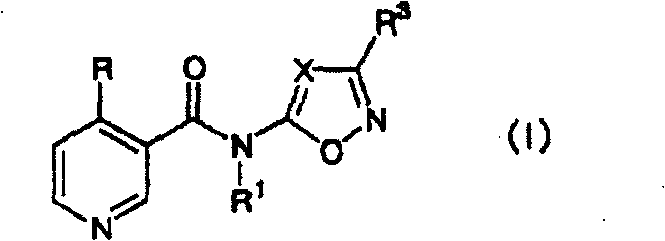


Applications Claiming Priority (4)
| Application Number | Priority Date | Filing Date | Title |
|---|---|---|---|
| JP2001355561 | 2001-11-21 | ||
| JP355561/2001 | 2001-11-21 | ||
| JP65193/2002 | 2002-03-11 | ||
| JP2002065193 | 2002-03-11 |
Publications (2)
| Publication Number | Publication Date |
|---|---|
| CN1692111A CN1692111A (en) | 2005-11-02 |
| CN100425609C true CN100425609C (en) | 2008-10-15 |
Family
ID=35160964
Family Applications (1)
| Application Number | Title | Priority Date | Filing Date |
|---|---|---|---|
| CNB028257928A Expired - Fee Related CN100425609C (en) | 2001-11-21 | 2002-11-19 | N-Heteroaryl Nicotinamide Derivatives |
Country Status (1)
| Country | Link |
|---|---|
| CN (1) | CN100425609C (en) |
Families Citing this family (2)
| Publication number | Priority date | Publication date | Assignee | Title |
|---|---|---|---|---|
| ES2651491T3 (en) * | 2013-05-31 | 2018-01-26 | Nissan Chemical Industries, Ltd. | Heterocyclic Amide Compound |
| CN113816901B (en) * | 2021-08-27 | 2023-08-15 | 淮北龙溪生物科技有限公司 | A kind of synthetic method of 4-trifluoromethyl nicotinamide |
Citations (4)
| Publication number | Priority date | Publication date | Assignee | Title |
|---|---|---|---|---|
| JPH0710841A (en) * | 1993-06-21 | 1995-01-13 | Ishihara Sangyo Kaisha Ltd | 4-trifluoromethylpyridine-3-carboxamide compound or salt thereof, their production and pest-controlling agent containing the same |
| JPH0725853A (en) * | 1993-07-14 | 1995-01-27 | Ishihara Sangyo Kaisha Ltd | Amido compound or its salt, its production and controller for harmful animal containing the same |
| EP0744400A2 (en) * | 1995-05-26 | 1996-11-27 | Ishihara Sangyo Kaisha, Ltd. | Process for producing 4-trifluoromethylnicotinic acid |
| WO2000035913A1 (en) * | 1998-12-17 | 2000-06-22 | Aventis Cropscience Gmbh | 4-trifluoromethyl-3-oxadiazolyl pyridines, methods for the production thereof, agents containing these compounds, and their use as pesticides |
-
2002
- 2002-11-19 CN CNB028257928A patent/CN100425609C/en not_active Expired - Fee Related
Patent Citations (4)
| Publication number | Priority date | Publication date | Assignee | Title |
|---|---|---|---|---|
| JPH0710841A (en) * | 1993-06-21 | 1995-01-13 | Ishihara Sangyo Kaisha Ltd | 4-trifluoromethylpyridine-3-carboxamide compound or salt thereof, their production and pest-controlling agent containing the same |
| JPH0725853A (en) * | 1993-07-14 | 1995-01-27 | Ishihara Sangyo Kaisha Ltd | Amido compound or its salt, its production and controller for harmful animal containing the same |
| EP0744400A2 (en) * | 1995-05-26 | 1996-11-27 | Ishihara Sangyo Kaisha, Ltd. | Process for producing 4-trifluoromethylnicotinic acid |
| WO2000035913A1 (en) * | 1998-12-17 | 2000-06-22 | Aventis Cropscience Gmbh | 4-trifluoromethyl-3-oxadiazolyl pyridines, methods for the production thereof, agents containing these compounds, and their use as pesticides |
Also Published As
| Publication number | Publication date |
|---|---|
| CN1692111A (en) | 2005-11-02 |
Similar Documents
| Publication | Publication Date | Title |
|---|---|---|
| WO2006043635A1 (en) | 3-triazolylphenyl sulfide derivative and insecticide/acaricide/nematicide containing the same as active ingredient | |
| WO2009022746A1 (en) | Nitrogen-containing heterocyclic compound and pest control agent | |
| MX2007016242A (en) | Amide derivative and pesticide containing such compound. | |
| JPWO2006137395A1 (en) | Amide derivative, pesticide containing such compound and use thereof | |
| JP2008260691A (en) | Insecticidal arylisoxazoline derivative | |
| KR20080031459A (en) | Insecticidal 3-acylaminobenzanilide | |
| RU2294329C2 (en) | Derivatives of n-heteroarylnicotinamide, insecticide and method for its preparing | |
| WO2017094790A1 (en) | 1,2,3-triazole derivative and insecticide/acaricide having said derivative as active ingredient | |
| WO2001000599A1 (en) | Benzamide derivatives, insecticides for agricultural and horticultural use and usage thereof | |
| JPH0256464A (en) | Morpholide acrylates, production thereof and preparation thereof | |
| EP1439169B1 (en) | Difluoroalkene derivative, pest control agent containing the same, and intermediate therefor | |
| JP2009516647A (en) | Insecticidal 2-acylaminothiazole-4-carboxamides | |
| JP2004182716A (en) | Cyclic compounds, their production and pest control agents | |
| CN100425609C (en) | N-Heteroaryl Nicotinamide Derivatives | |
| JP2007302617A (en) | Heterocyclic derivative and method for using the derivative as insecticide | |
| JPWO1999052881A1 (en) | 2-anilinopyrimidinone derivatives and intermediates, methods for producing them, and agricultural chemicals containing them as active ingredients | |
| JP3456702B1 (en) | N-heteroarylnicotinamide derivative and method for producing the same | |
| JP4205905B2 (en) | Nicotinamide derivatives | |
| JP2007284387A (en) | 3-Pyrazolylphenyl sulfide derivative and insecticide, acaricide, nematicide containing it as an active ingredient | |
| JP3913802B2 (en) | Benzyl sulfide derivative, production method thereof and pest control agent | |
| HK1083494B (en) | N-heteroarylnicotinamide derivatives | |
| JP2007284385A (en) | 2-Phenylimidazole derivatives and insecticides, acaricides, nematicides containing them as active ingredients | |
| JP4229310B2 (en) | Substituted benzylpiperidine derivatives and insecticides containing the same | |
| JP2004083415A (en) | Nicotinamidrazone derivative | |
| JP2004161713A (en) | Hydrazone derivative, method for producing the same and insecticide containing the same as active ingredient |
Legal Events
| Date | Code | Title | Description |
|---|---|---|---|
| C06 | Publication | ||
| PB01 | Publication | ||
| C10 | Entry into substantive examination | ||
| SE01 | Entry into force of request for substantive examination | ||
| REG | Reference to a national code |
Ref country code: HK Ref legal event code: DE Ref document number: 1083494 Country of ref document: HK |
|
| C14 | Grant of patent or utility model | ||
| GR01 | Patent grant | ||
| REG | Reference to a national code |
Ref country code: HK Ref legal event code: GR Ref document number: 1083494 Country of ref document: HK |
|
| CF01 | Termination of patent right due to non-payment of annual fee |
Granted publication date: 20081015 Termination date: 20161119 |
|
| CF01 | Termination of patent right due to non-payment of annual fee |