CN100425016C - code division multiple access system - Google Patents
code division multiple access system Download PDFInfo
- Publication number
- CN100425016C CN100425016C CNB991179277A CN99117927A CN100425016C CN 100425016 C CN100425016 C CN 100425016C CN B991179277 A CNB991179277 A CN B991179277A CN 99117927 A CN99117927 A CN 99117927A CN 100425016 C CN100425016 C CN 100425016C
- Authority
- CN
- China
- Prior art keywords
- signal
- mapping
- component
- bit
- receiver
- Prior art date
- Legal status (The legal status is an assumption and is not a legal conclusion. Google has not performed a legal analysis and makes no representation as to the accuracy of the status listed.)
- Expired - Fee Related
Links
- 238000013507 mapping Methods 0.000 claims abstract description 51
- 238000000034 method Methods 0.000 claims abstract description 13
- 239000013598 vector Substances 0.000 claims description 16
- 238000012545 processing Methods 0.000 abstract description 14
- 238000004891 communication Methods 0.000 abstract description 7
- 239000000654 additive Substances 0.000 description 5
- 230000000996 additive effect Effects 0.000 description 5
- 230000009897 systematic effect Effects 0.000 description 5
- 238000006243 chemical reaction Methods 0.000 description 4
- 230000000875 corresponding effect Effects 0.000 description 4
- URWAJWIAIPFPJE-YFMIWBNJSA-N sisomycin Chemical compound O1C[C@@](O)(C)[C@H](NC)[C@@H](O)[C@H]1O[C@@H]1[C@@H](O)[C@H](O[C@@H]2[C@@H](CC=C(CN)O2)N)[C@@H](N)C[C@H]1N URWAJWIAIPFPJE-YFMIWBNJSA-N 0.000 description 4
- 230000005540 biological transmission Effects 0.000 description 3
- 230000002596 correlated effect Effects 0.000 description 2
- 238000000354 decomposition reaction Methods 0.000 description 2
- 108010076504 Protein Sorting Signals Proteins 0.000 description 1
- 238000009825 accumulation Methods 0.000 description 1
- 230000006978 adaptation Effects 0.000 description 1
- 230000001427 coherent effect Effects 0.000 description 1
- 239000002131 composite material Substances 0.000 description 1
- 230000001143 conditioned effect Effects 0.000 description 1
- 238000012937 correction Methods 0.000 description 1
- 125000004122 cyclic group Chemical group 0.000 description 1
- 238000001514 detection method Methods 0.000 description 1
- 239000011159 matrix material Substances 0.000 description 1
- 238000010295 mobile communication Methods 0.000 description 1
- 238000011160 research Methods 0.000 description 1
- 238000001228 spectrum Methods 0.000 description 1
- 230000001360 synchronised effect Effects 0.000 description 1
Images


Classifications
-
- H—ELECTRICITY
- H04—ELECTRIC COMMUNICATION TECHNIQUE
- H04B—TRANSMISSION
- H04B7/00—Radio transmission systems, i.e. using radiation field
- H04B7/14—Relay systems
- H04B7/15—Active relay systems
- H04B7/204—Multiple access
- H04B7/216—Code division or spread-spectrum multiple access [CDMA, SSMA]
-
- H—ELECTRICITY
- H04—ELECTRIC COMMUNICATION TECHNIQUE
- H04L—TRANSMISSION OF DIGITAL INFORMATION, e.g. TELEGRAPHIC COMMUNICATION
- H04L1/00—Arrangements for detecting or preventing errors in the information received
- H04L1/004—Arrangements for detecting or preventing errors in the information received by using forward error control
- H04L1/0045—Arrangements at the receiver end
- H04L1/0047—Decoding adapted to other signal detection operation
- H04L1/005—Iterative decoding, including iteration between signal detection and decoding operation
-
- H—ELECTRICITY
- H04—ELECTRIC COMMUNICATION TECHNIQUE
- H04B—TRANSMISSION
- H04B1/00—Details of transmission systems, not covered by a single one of groups H04B3/00 - H04B13/00; Details of transmission systems not characterised by the medium used for transmission
- H04B1/69—Spread spectrum techniques
- H04B1/707—Spread spectrum techniques using direct sequence modulation
-
- H—ELECTRICITY
- H04—ELECTRIC COMMUNICATION TECHNIQUE
- H04L—TRANSMISSION OF DIGITAL INFORMATION, e.g. TELEGRAPHIC COMMUNICATION
- H04L1/00—Arrangements for detecting or preventing errors in the information received
- H04L1/004—Arrangements for detecting or preventing errors in the information received by using forward error control
- H04L1/0041—Arrangements at the transmitter end
- H04L1/0042—Encoding specially adapted to other signal generation operation, e.g. in order to reduce transmit distortions, jitter, or to improve signal shape
-
- H—ELECTRICITY
- H04—ELECTRIC COMMUNICATION TECHNIQUE
- H04L—TRANSMISSION OF DIGITAL INFORMATION, e.g. TELEGRAPHIC COMMUNICATION
- H04L1/00—Arrangements for detecting or preventing errors in the information received
- H04L1/004—Arrangements for detecting or preventing errors in the information received by using forward error control
- H04L1/0045—Arrangements at the receiver end
- H04L1/0047—Decoding adapted to other signal detection operation
- H04L1/0048—Decoding adapted to other signal detection operation in conjunction with detection of multiuser or interfering signals, e.g. iteration between CDMA or MIMO detector and FEC decoder
-
- H—ELECTRICITY
- H04—ELECTRIC COMMUNICATION TECHNIQUE
- H04L—TRANSMISSION OF DIGITAL INFORMATION, e.g. TELEGRAPHIC COMMUNICATION
- H04L1/00—Arrangements for detecting or preventing errors in the information received
- H04L1/004—Arrangements for detecting or preventing errors in the information received by using forward error control
- H04L1/0056—Systems characterized by the type of code used
- H04L1/0071—Use of interleaving
Landscapes
- Engineering & Computer Science (AREA)
- Computer Networks & Wireless Communication (AREA)
- Signal Processing (AREA)
- Error Detection And Correction (AREA)
- Mobile Radio Communication Systems (AREA)
- Detection And Prevention Of Errors In Transmission (AREA)
- Transceivers (AREA)
Abstract
本发明涉及一个CDMA系统,包括一个发射机和接收机,例如用于数字无线通信系统中,特别涉及用于映射和解映射CDMA信号的方法和装置。CDMA系统包括一个发射机和一个接收机。该发射机包括用于处理被传送的所述CDMA信号的一个编码器和一个比特交错器,与该编码器和比特交错器串联连接的一个映射器,以及用于传送所述处理的CDMA信号的装置。该接收机包括用于接收所述传送的CDMA信号的装置,用于处理所述接收的CDMA信号的一个比特去交错器和一个解码器,以及与该比特去交错器和解码器串联连接的一个解映射器。在该接收机中通过将该解码器的输出传送回到该解映射器可以执行迭代解映射。还公开了一种对应的方法。
The present invention relates to a CDMA system, comprising a transmitter and a receiver, such as used in a digital radio communication system, and in particular to methods and apparatus for mapping and demapping CDMA signals. A CDMA system includes a transmitter and a receiver. The transmitter comprises an encoder and a bit interleaver for processing the transmitted CDMA signal, a mapper connected in series with the encoder and the bit interleaver, and an encoder for transmitting the processed CDMA signal device. The receiver comprises means for receiving said transmitted CDMA signal, a bit deinterleaver and a decoder for processing said received CDMA signal, and a serial connection with said bit deinterleaver and decoder demapper. Iterative demapping may be performed in the receiver by passing the output of the decoder back to the demapper. A corresponding method is also disclosed.
Description
本发明涉及码分多址(CDMA)系统,包括一个发射机和接收机,例如用在数字无线通信系统中。特别本发明涉及映射和解映射CDMA信号的方法和装置。The present invention relates to Code Division Multiple Access (CDMA) systems, comprising a transmitter and receiver, such as are used in digital radio communication systems. In particular the invention relates to methods and apparatus for mapping and demapping CDMA signals.
近来迭代译码算法已经变成数字通信中的一个重要的研究领域。适合于迭代解码的首先发现和仍然最流行的编码方案是两个递归的系统的卷积码也称为‘涡轮代码(Turbo Code)’的并行链接,正如1997年9月在法国Brest的关于涡轮码讨论会J.Hagenauer的文章“TheTurbo Principle:Tutorial Introduction and State of the Art”中描述的。在过去几年中已经找到涡轮原理(Turbo Principle)的其它应用,例如1997年10月在德国波恩的EPMCC′97论文集第307-312页中G.Bauch,H.Khorram,J.Hagenauer的文章“Iterative Equalization andDecoding in Mobile Communications Systems”。Recently iterative decoding algorithms have become an important research field in digital communication. The first discovered and still most popular coding scheme suitable for iterative decoding is the parallel chaining of two recursive systematic convolutional codes also called 'Turbo Codes', as described in September 1997 in Brest, France on Turbo Code Described in the article "The Turbo Principle: Tutorial Introduction and State of the Art" by J. Hagenauer, a code seminar. Other applications of the Turbo Principle have been found in the past few years, for example G. Bauch, H. Khorram, J. Hagenauer in EPMCC'97 Proceedings pp. 307-312, Bonn, Germany, October 1997 "Iterative Equalization and Decoding in Mobile Communications Systems".
信道编码用于使得传送的数字信息信号更能抵抗噪声。为此在发射机通过信道编码来编码信息比特序列和在接收机由信道解码器解码。在该编码器中,冗余信息加到信息比特序列,以便便于在解码器中差错校正。例如,在系统的信道编码方案中,冗余信息加到信息比特序列,正象另外插入‘编码的’比特。在非系统的编码方案中,输出的比特是所有的编码比特,和没有“无保护的”(‘naked’)信息比特被剩余。在编码器输入的比特(信息比特)数量小于输出的比特(信息比特加上插入编码比特,或者所有的编码比特)的数量。输入/输出比特的比值称为‘码率R’(典型地R=1/2)。Channel coding is used to make the transmitted digital information signal more resistant to noise. For this purpose, the information bit sequence is coded at the transmitter by channel coding and decoded at the receiver by a channel decoder. In the encoder, redundant information is added to the information bit sequence to facilitate error correction in the decoder. For example, in systematic channel coding schemes, redundant information is added to the sequence of information bits, just as additional 'coded' bits are inserted. In a non-systematic coding scheme, the output bits are all coded bits, and no 'naked' information bits are left. The number of input bits (information bits) at the encoder is less than the number of output bits (information bits plus intervening code bits, or all code bits). The ratio of input/output bits is called the 'code rate R' (typically R=1/2).
链接编码方案应用于至少两个并行或者串行链接的编码器。迭代译码算法用于并行或者串行链接编码系统,而传统的‘涡轮’码是并行链接码。The chained coding scheme is applied to at least two parallel or serial chained coders. Iterative decoding algorithms are used in parallel or serial concatenated coding systems, whereas traditional 'turbo' codes are parallel concatenated codes.
图1表示在一个方框一个方框基础上执行具有该传输的真正的串行链接编码方案。信号序列以串行方式在该发射机中被编码两次。来自数字源(例如利用来自麦克风的模拟输入信号的模拟-数字转换器)的二进制信号首先由外部的编码器编码。外部编码器的输出通过一个交错器,它改变输入比特符号的顺序,使得信号更随机的出现给下列处理级。在交错器之后信号由“内部编码器”第二次编码。相应地,在接收机处该信号首先由内部的解码器解码,去交错和由该外部的解码器解码。来自外部的解码器软的值(soft value)被反馈作为另外的‘优先’输入给该内部的解码器。该软的值是解码信号的质量的可靠性值。这些值的反馈有助于减少在外部的解码器的输出还是在迭代解码步骤中的硬判定值0,1的误码率。特定传送序列的迭代解码利用一个任意的终止标准停止,例如在迭代的固定数目之后或者直到到达确定的误码率(终止标准对于本发明根本是不重要的)。应该注意,对于传送比特序列的最先解码(‘第0次迭代’),输入给内部解码器的‘优先’软值置“0”。Figure 1 shows a true serial concatenation encoding scheme with this transmission performed on a block-by-block basis. The signal sequence is coded twice in the transmitter in a serial fashion. A binary signal from a digital source (such as an analog-to-digital converter using an analog input signal from a microphone) is first encoded by an external encoder. The output of the outer encoder passes through an interleaver, which changes the order of the input bit symbols so that the signal appears more randomly to the following processing stages. After the interleaver the signal is encoded a second time by an "inner encoder". Accordingly, at the receiver the signal is first decoded by the inner decoder, deinterleaved and decoded by the outer decoder. The soft value from the external decoder is fed back as an additional 'priority' input to the internal decoder. This soft value is a reliability value of the quality of the decoded signal. The feedback of these values helps to reduce the bit error rate at the output of the external decoder or the
内部的和外部的二进制码可以是任何类型:系统的或者非系统的块码或者卷积码。The inner and outer binary codes can be of any type: systematic or non-systematic block codes or convolutional codes.
在该接收机两个解码器是软入/软出(soft-in/soft-out)解码器(SISO解码器)。软值表示相应的位符号(O或者1)的比特判断的可靠性。软入解码器接收输入比特符号的软的可靠性值。软出解码器提供关于输出的比特符号的软的可靠性输出值。软出可靠性值通常比软入可靠性值更精确,因为它们可以在译码过程期间基于冗余信息即在该发射机在每个编码步骤加上而改进。At the receiver the two decoders are soft-in/soft-out decoders (SISO decoders). A soft value indicates the reliability of the bit judgment of the corresponding bit sign (0 or 1). A soft-in decoder receives soft reliability values for input bit symbols. A soft-out decoder provides soft reliability output values with respect to the output bit symbols. Soft-out reliability values are generally more accurate than soft-in reliability values because they can be improved during the decoding process based on redundant information that is added at each encoding step at the transmitter.
迭代地解映射(demapping)信号的方法和装置在1998年4月3日提交的欧洲专利申请号98302653.5中描述,其内容引用在这里供参考。A method and apparatus for iteratively demapping signals is described in European Patent Application No. 98302653.5 filed 3 April 1998, the content of which is incorporated herein by reference.
CDMA(码分多址)系统具有由不同的码分开的多个用户。用户k的每个传送比特由称为‘片’的短比特号码NC代替,它们是根据特定用户k的信道化代码选择的。在‘替代’之后,因为占用带宽扩展NC倍,这个过程称为‘扩展’,和CDMA系统常常称为‘扩频系统’。在扩展之后,用于每个用户的信号占用全部可用带宽B。在接收机通过与适当的信道化代码的相关性检测有用的用户。A CDMA (Code Division Multiple Access) system has multiple users separated by different codes. Each transmitted bit for user k is replaced by a short bit number NC called a 'slice', which is chosen according to the channelization code for the particular user k. After the 'replacement', since the occupied bandwidth is extended N C times, this process is called 'spreading', and the CDMA system is often called a 'spread spectrum system'. After expansion, the signal for each user occupies the entire available bandwidth B. Useful users are detected at the receiver by correlation with appropriate channelization codes.
多码CDMA是在CDMA系统中提供更高的数据率给单个用户的一种方法。特定的用户被分配N个信道化代码,而在常规的CDMA系统中仅仅具有一个信道化代码。因此多码用户可以在比‘单个码’用户N倍高的数据速率传送。在多码发射机N个二进制对映(antipodal)码相加形成一个N+1级调幅的信号,代替单码情况的二进制对映的信号。Multicode CDMA is a method of providing higher data rates to individual users in a CDMA system. A particular user is assigned N channelization codes, whereas in a conventional CDMA system there is only one channelization code. Thus multicode users can transmit at N times higher data rates than 'single code' users. In the multi-code transmitter, N binary antipodal codes are added to form an N+1-level amplitude-modulated signal, which replaces the binary antipodal signal in the single-code case.
图2表示一个常规的多码CDMA(M-CDMA)单用户发送机/接收机。来自数字源(例如具有来自麦克风的模拟输入信号的模-数变换器)的二进制信号首先由信道编码器编码。信道编码器的输出通过一个交错器,该交错器改变输入比特符号的顺序,使得该信号更随机的出现在随后的处理级。在该交错器之后,编码的比特流由一个多路分解器(demux)(串行并行转换)分成N个并行比特流。每个比特流1,...,N由一个长度NC片的二进制对映信道化代码(码字1,…,N)扩展(即相乘)。典型地,N信道化代码是正交的。在扩展之后N个二进制对映片流在片速率上相加形成调幅的(N+1级)片符号。因此N个编码比特符号产生NC个片符号。每块的NC片符号被称为一个合成的多码CDMA符号。作为选择,在该片速率加扰可以适用于更加使该信号随机化。典型地加扰序列是一个二进制对映的伪随机序列。然后合成的信号被放在传输信道上。Figure 2 shows a conventional multicode CDMA (M-CDMA) single user transmitter/receiver. A binary signal from a digital source (such as an analog-to-digital converter with an analog input signal from a microphone) is first encoded by a channel encoder. The output of the channel encoder passes through an interleaver, which changes the order of the input bit symbols so that the signal appears more randomly in subsequent processing stages. After the interleaver, the coded bitstream is split into N parallel bitstreams by a demux (serial-to-parallel conversion). Each
为了清楚起见,图2仅仅表示基波处理,而对射频的上变频等等被省略了。为了描述简单,我们假定一个实际的信号处理。然而,实际的信道化代码也可以是复杂的信道化代码,或者可以是一个复杂加扰序列。For the sake of clarity, Fig. 2 shows only the fundamental wave processing, while the up-conversion to radio frequency etc. is omitted. For simplicity of description, we assume an actual signal processing. However, the actual channelization code may also be a complex channelization code, or may be a complex scrambling sequence.
关于该信道,该信号被加性噪声或者任何其它噪声形式失真了。With respect to the channel, the signal is distorted by additive noise or any other form of noise.
相应地,在该接收机,该信号被解扰(作为选择)并与N个信道化代码(码字1,..,N)相关。该相关包括与相应的信道化代码相乘和在NC片上累加。在多路复用(并行串行变换)和去交错之后,N个相关结果放到信道解码器。最后,信息比特分别在该解码器的输出或者硬判断设备是可用的。Accordingly, at the receiver, the signal is descrambled (optionally) and correlated with N channelization codes (
正如在上面描述的,常规的CDMA和M-CDMA系统例如虽然迭代解码,但是并没有减少误码率(BER)。这样对于CDMA或者M-CDMA系统有一个要求,其中可以实现改进的BER。As described above, conventional CDMA and M-CDMA systems, for example, do not reduce the bit error rate (BER) despite iterative decoding. There is thus a requirement for CDMA or M-CDMA systems in which an improved BER can be achieved.
根据本发明的第一方面提供一个CDMA系统,包括:一个发射机,它包括用于处理传送的所述CDMA信号的一个编码器和一个比特交错器;用于传送所述处理的CDMA信号的装置;用于接收所述传送的CDMA信号的装置;一个接收机,它包括用于处理所述接收的CDMA信号的一个比特去交错器和一个解码器;和其特征在于该发射机包括与该编码器以及比特交错器串联连接的一个映射器,和该接收机包括与比特去交错器以及解码器串联连接的一个解映射器。According to a first aspect of the present invention there is provided a CDMA system comprising: a transmitter comprising an encoder and a bit interleaver for processing said CDMA signal transmitted; means for transmitting said processed CDMA signal ; means for receiving said transmitted CDMA signal; a receiver comprising a bit deinterleaver and a decoder for processing said received CDMA signal; and characterized in that said transmitter comprises an encoding A mapper connected in series with the bit interleaver and the bit interleaver, and the receiver includes a demapper connected in series with the bit deinterleaver and the decoder.
根据本发明的第二方面提供一个CDMA发射机,包括:用于处理传送的所述CDMA信号的一个编码器和一个比特交错器;用于传送所述处理的CDMA信号的装置;其特征在于该发射机包括与该编码器以及比特交错器串联连接的一个映射器。According to a second aspect of the present invention there is provided a CDMA transmitter comprising: an encoder and a bit interleaver for processing said CDMA signal transmitted; means for transmitting said processed CDMA signal; characterized in that The transmitter includes a mapper connected in series with the encoder and bit interleaver.
根据本发明的第三方面提供一个CDMA接收机,包括:用于接收所述传送的CDMA信号的装置;用于处理所述接收的CDMA信号的一个比特去交错器和一个解码器;以及其特征在于该接收机包括与该比特去交错器以及解码器串联连接的一个解映射器。According to a third aspect of the present invention there is provided a CDMA receiver comprising: means for receiving said transmitted CDMA signal; a bit deinterleaver and a decoder for processing said received CDMA signal; and characterized In that the receiver comprises a demapper connected in series with the bit deinterleaver and decoder.
在该接收机中,通过将该解码器的输出传送回到解映射器执行迭代解映射。该系统可以是一个多用户CDMA系统,其中N个并行信道化代码被认为是最多N个不同的用户的信道化代码。该系统可以是一个多代码CDMA系统,其中N个信道化代码属于至少一个用户。In the receiver, iterative demapping is performed by passing the output of the decoder back to the demapper. The system may be a multi-user CDMA system, where N parallel channelization codes are considered as channelization codes for at most N different users. The system may be a multi-code CDMA system in which N channelization codes belong to at least one user.
根据本发明的第四方面提供传送CDMA信号的一种方法,包括步骤:产生传送的CDMA信号;编码和比特交错所述CDMA信号;传送所述编码和交错的CDMA信号;和其特征在于在被传送之前编码和交错的CDMA信号被映射。According to a fourth aspect of the present invention there is provided a method of transmitting a CDMA signal comprising the steps of: generating a transmitted CDMA signal; encoding and bit-interleaving said CDMA signal; transmitting said encoded and interleaved CDMA signal; and characterized in that The coded and interleaved CDMA signal is mapped before transmission.
而且提供正如在上面描述的接收所传送的CDMA信号的一种方法,包括接收传送的CDMA信号;比特去交错和解码接收的CDMA信号;和其特征在于在去交错和解码之前解映射接收的CDMA信号。Also provided is a method of receiving a transmitted CDMA signal as described above, comprising receiving the transmitted CDMA signal; bit deinterleaving and decoding the received CDMA signal; and characterized by demapping the received CDMA signal prior to deinterleaving and decoding Signal.
CDMA信号通过重复比特去交错、解码和解映射步骤迭代地解映射。CDMA signals are iteratively demapped by repeating the steps of bit deinterleaving, decoding and demapping.
通过在常规的发射机的多路分解器和N个并行CDMA信道的正交的扩展之间插入一个映射器,在该接收机可以实现通过迭代解码减少误码率。为此,在解扩展之后该接收机必须执行解映射操作。解映射器可以使用通过信道译码器获得的先验知识,使能够迭代的解映射和解码。By inserting a mapper between the conventional transmitter's demultiplexer and the orthogonal spreading of N parallel CDMA channels, bit error rate reduction by iterative decoding can be achieved at the receiver. For this reason, the receiver must perform a demapping operation after despreading. The demapper can use the prior knowledge obtained by the channel decoder, enabling iterative demapping and decoding.
‘修改的’映射可以是任意的和仅仅需要不同于该‘相同的’映射。然而,能实现的性能坚决取决于选择的‘修改的’映射。映射器不加冗余给该信号并且可以翻译为一个二进制块编码器与正交的CDMA扩展组合的速率。然而,该扩展不必是正交的。The 'modified' mapping can be arbitrary and only needs to be different from the 'same' mapping. However, the achievable performance strongly depends on the chosen 'modified' mapping. The mapper adds no redundancy to the signal and can translate to the rate at which a binary block coder is combined with orthogonal CDMA spreading. However, the extension does not have to be orthogonal.
迭代解映射和解码减少了使用普通的信道编码的多码CDMA的误码率。Iterative demapping and decoding reduces the bit error rate for multicode CDMA using conventional channel coding.
迭代解映射和解码用于CDMA工作,只要在编码器和扩展/映射之间至少有一个比特符号交错器。Iterative demapping and decoding is used for CDMA operation as long as there is at least one bit symbol interleaver between the encoder and spreading/mapping.
因为保持展开码的正交性,这种方法例如适合于在无线通信链路(基站到移动终端,多用户发射机)中同步的多用户下行链路通信,以及用于异步的上行链路通信(移动终端到基站,单个用户发射机)。Because the orthogonality of the spreading codes is preserved, this method is suitable, for example, for synchronous multi-user downlink communication in wireless communication links (base station to mobile terminal, multi-user transmitter), as well as for asynchronous uplink communication (mobile terminal to base station, single user transmitter).
本发明的一个实施例在下面和参见下列附图描述,其中:An embodiment of the invention is described below and with reference to the following drawings, in which:
图1表示使用串行链接编码方案的一个发射机和接收机;Figure 1 shows a transmitter and receiver using a serial link coding scheme;
图2表示常规的多码CDMA(M-CDMA)单个用户发射机和接收机;Figure 2 shows a conventional multicode CDMA (M-CDMA) single user transmitter and receiver;
图3表示根据本发明的多码CDMA(M-CDMA)单个用户发射机和接收机。Figure 3 shows a multicode CDMA (M-CDMA) single user transmitter and receiver in accordance with the present invention.
在图3的发射机10,二进制随机信号卷积地编码11和馈送给随机比特交错器12,该随机比特交错器12交错比特符号(可以使用任何信道代码和任何编码率,不仅仅卷积码)。在交错器之后,编码的比特流由一个多路分解器13分成N个并行比特流,该多路分解器13执行串行并行转换。At the transmitter 10 of Figure 3, the binary random signal is convolutionally coded 11 and fed to a random bit interleaver 12 which interleaves the bit symbols (any channel code and any code rate can be used, not just convolutional codes ). After the interleaver, the coded bit stream is split into N parallel bit streams by a demultiplexer 13 which performs a serial-to-parallel conversion.
映射器14执行N比特对N比特映射操作。在映射之后,由长度NC片的二进制对映信道化代码(码字1,...,N)扩展(即乘以乘数151至15N)每个比特流1,...,N。典型地,N个信道化代码是正交的。在扩展之后,码字由加法器16以片速率相加。作为选择二进制对映加扰序列可以应用(17)于更加使信号随机化。Mapper 14 performs an N-bit to N-bit mapping operation. After mapping, each bitstream 1 ,... , N. Typically, the N channelization codes are orthogonal. After spreading, the codewords are added by adder 16 at chip rate. Alternatively a binary antipodal scrambling sequence can be applied (17) to further randomize the signal.
关于该信道,该符号被加性噪声(由加法器18示出)或者任何其它噪声形式失真。With respect to the channel, the symbols are distorted by additive noise (shown by adder 18) or any other form of noise.
在接收机20,该信号被解扰21(可选择的)并与N个信道化代码(码字1,...,N)相关。该相关包括由乘数221至22N与相应的信道化代码相乘和在累加器231至23N中在NC片上累加。N个相关结果由解映射器24用于计算N个多码CDMA信道的传送的编码比特x0,..,N-1的对数似然比(也称为L值)。At the receiver 20, the signal is descrambled 21 (optional) and correlated with N channelization codes (
对数似然比在多路复用器25多路复用,由比特去交错器26去交错和放到后验概率计算器27(APP),或者任何其它SISO解码器。在解码之后,关于发送信息比特的估计在硬判断设备的输出通过取该信息比特的APP软输出值是可用的。The log-likelihood ratios are multiplexed in multiplexer 25, deinterleaved by bit deinterleaver 26 and put into a posteriori probability calculator 27 (APP), or any other SISO decoder. After decoding, an estimate about the transmitted information bit is available at the output of the hard decision device by taking the APP soft output value of that information bit.
在迭代解映射/解码路径中,‘非固有的信息’通过该比特交错器28和在输入29作为先验知识反馈给该解映射设备24。‘非固有的’信息是在该解码器的软输入/软输出值的差和描述通过该译码过程获得的新的、在统计上独立的信息(至少用于第一迭代)。该解映射设备可以利用来自解码器的先验知识用于进一步迭代解码步骤净化它的输出。In the iterative demapping/decoding path, 'extrinsic information' is fed back to the demapping device 24 through the bit interleaver 28 and at input 29 as prior knowledge. 'Extrinsic' information is the difference in soft input/soft output values at the decoder and describes new, statistically independent information obtained through the decoding process (at least for the first iteration). The demapping device can utilize prior knowledge from the decoder for further iterative decoding steps to clean its output.
注意,在比特速率而不是片速率执行迭代解码,因此复杂性低。Note that the iterative decoding is performed at bit rate rather than slice rate, so the complexity is low.
为了简单起见,下列描述假定实际的信号处理,单个传播路径和附加噪声。扩充到复杂信号处理,多路径传播和其它噪声形式是简单的。考虑一个特定的合成多码CDMA符号Z(具有NC单元的矢量)的信号处理。For simplicity, the following description assumes actual signal processing, a single propagation path and additive noise. Extensions to complex signal processing, multipath propagation and other noise forms are straightforward. Consider the signal processing of a particular synthesized multicode CDMA symbol Z (vector with N C units).
注意:黑体字表示矢量。Note: Bold fonts indicate vectors.
在该发射机:In this transmitter:
N:N映射器执行N编码比特(矢量x)映射到映射的编码比特矢量xM=map(x),x=(x0,...,xN-1),N: N mapper performs mapping of N encoded bits (vector x) to mapped encoded bit vector x M = map(x), x = (x 0 , . . . , x N-1 ),
xM=(xM,0,..,xM,N-1);x1,xM,i∈{-1,+1} xM = (xM , 0 , .., xM, N-1 ); x1 , xM , i ∈ {-1, +1}
比特矢量x,xM被看作为具有从0到2N-1范围内的值的整数和例如对于x根据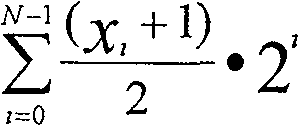
输入x 映射输出xM input x map output x M
0 50 5
1 21 2
2 72 7
3 13 1
4 04 0
5 65 6
6 36 3
7 47 4
在映射以后,以沃尔什(Walsh)码矩阵W=(w0,...,wN-1)正交扩展和以序列s进行加扰。该传送信号是After mapping, it is orthogonally spread with Walsh code matrix W=(w 0 , . . . , w N-1 ) and scrambled with sequence s. The transmit signal is
y=(xM·W)οsy=(x M ·W)οs
其中:in:
行矢量wi表示利用长度NC片的Walsh矢量,i=0...N-1;Row vector w i represents a Walsh vector utilizing length N C slices, i=0...N-1;
通常,‘循环乘法’表示两个矢量的逐个分量的方式乘法;In general, 'cyclic multiplication' means the multiplication of two vectors in a component-by-component manner;
s是加扰序列矢量;s is the scrambling sequence vector;
在信道输出接收的噪声影响的合成的多码CDMA符号是:The resulting multi-code CDMA symbol affected by the received noise at the channel output is:
z=(xM·W)os+nz=(x M ·W)os+n
具有噪声矢量n。with noise vector n.
在该接收机:In this receiver:
对于以该合成的多码CDMA符号z传送的每个编码比特x0,...,xN-1,解映射器计算关于z条件的相应比特的对数似然比(L值)。L值的绝对值表示比特判断的可靠性。例如对于比特xk,该解映射器软输出是L值For each coded bit x 0 , ..., x N-1 transmitted in the synthesized multi-code CDMA symbol z, the demapper computes the log-likelihood ratio (L value) of the corresponding bit conditioned on z. The absolute value of the L value represents the reliability of the bit judgment. For example for bit x k , the demapper soft output is the L value

在此xj,j=0.,N-1,j≠k≡bin(i)表示根据i的二进制分解,变量xj,j=0.,N-1,j≠k的联合事件取值0,1。例如对于N=4,k=1,i=5,我们得到x3=1,x2=0和x0=1。如果在i的二进制分解中设置比特号

对于实际加性白色高斯噪声信道For a real additive white Gaussian noise channel
因此therefore

表示在接收机输入到解映射器的矢量N相关结果。Denotes the vector N correlation result input to the demapper at the receiver.
注意:
进一步表示:further stated:
σ2是在信道上的加性噪声的功率。 σ2 is the power of additive noise on the channel.
‘ln’表示自然对数,‘exp’表示指数函数。'ln' means the natural logarithm, and 'exp' means the exponential function.
例如对于未映射的编码比特xk,先验的L值是For example for unmapped coded bits x k , the prior L value is
注意,在第一解码通过之后,比特x=(x0,...,xN-1)的‘先验’L值由SISO解码器提供作为软解映射设备的输入。对于第一解码通过这些值置0。Note that after the first decoding pass, the 'a priori' L values for the bits x = (x 0 , ..., x N-1 ) are provided by the SISO decoder as input to the soft demapping device. Pass these values to 0 for the first decode.
在La(xk)减法之后(参见图3)仅仅所谓的解映射器的‘非固有的信息’被传送到去交错器和信道SISO解码器。After the L a (x k ) subtraction (see Fig. 3) only the so-called 'extrinsic information' of the demapper is passed to the deinterleaver and channel SISO decoder.
对复杂信号处理的扩充(I-/Q-信道)是简单的。信道化代码不需要是正交的。Extensions to complex signal processing (I-/Q-channels) are straightforward. The channelization codes need not be orthogonal.
此外,在多路径信道环境(典型的对于无线通信信道)中的应用对于本领域技术人员是显而易见。应用一个瑞克接收机以便补偿多路径传播。用于相干检测的瑞克接收机包括许多指形相关器(finger-corelator)(理想地,每个多路径分量一个指状物)。然后指形相关器的输出在一个‘最大比合并器’中合并。然后在最大比合并器对‘合并的’相关结果处理之后执行解映射。Furthermore, applications in multipath channel environments (typical for wireless communication channels) will be apparent to those skilled in the art. A rake receiver is applied in order to compensate for multipath propagation. A rake receiver for coherent detection includes many finger-correlators (ideally, one finger for each multipath component). The outputs of the finger correlators are then combined in a 'maximum ratio combiner'. Demapping is then performed after the 'combined' correlation results are processed by the maximal ratio combiner.
分别在多码CDMA信号或者多用户CDMA信号中N个并行CDMA信道数目不必等于执行映射的比特数目。而且,映射比特数目可以比N小或者大。数学描述和图的适当的改变对于本领域的技术人员是显而易见的。The number of N parallel CDMA channels does not have to be equal to the number of bits to perform mapping in a multi-code CDMA signal or a multi-user CDMA signal, respectively. Also, the number of mapping bits can be smaller or larger than N. Appropriate adaptations of the mathematical descriptions and figures will be apparent to those skilled in the art.
Claims (19)
Applications Claiming Priority (2)
| Application Number | Priority Date | Filing Date | Title |
|---|---|---|---|
| EP98306720A EP0982870B1 (en) | 1998-08-21 | 1998-08-21 | Multicode CDMA system using iterative decoding |
| EP98306720.8 | 1998-08-21 |
Publications (2)
| Publication Number | Publication Date |
|---|---|
| CN1250284A CN1250284A (en) | 2000-04-12 |
| CN100425016C true CN100425016C (en) | 2008-10-08 |
Family
ID=8235010
Family Applications (1)
| Application Number | Title | Priority Date | Filing Date |
|---|---|---|---|
| CNB991179277A Expired - Fee Related CN100425016C (en) | 1998-08-21 | 1999-08-18 | code division multiple access system |
Country Status (10)
| Country | Link |
|---|---|
| US (1) | US6611513B1 (en) |
| EP (1) | EP0982870B1 (en) |
| JP (1) | JP3878774B2 (en) |
| KR (1) | KR100466106B1 (en) |
| CN (1) | CN100425016C (en) |
| AU (1) | AU727342B2 (en) |
| BR (1) | BR9903583A (en) |
| CA (1) | CA2277421A1 (en) |
| DE (1) | DE69839625D1 (en) |
| ES (1) | ES2308796T3 (en) |
Families Citing this family (42)
| Publication number | Priority date | Publication date | Assignee | Title |
|---|---|---|---|---|
| KR100334770B1 (en) * | 1999-07-08 | 2002-05-03 | 윤종용 | Apparatus and method for controlling demultiplexer and multiplexer for a rate matching in wireless telecommunication system |
| AU2001233237A1 (en) * | 2000-02-04 | 2001-08-14 | Interdigital Technology Corporation | Support of multiuser detection in the downlink |
| JP2001274698A (en) * | 2000-03-24 | 2001-10-05 | Sony Corp | Encoding device, recording medium on which encoding method and encoding program are recorded, and decoding device, recording medium on which decoding method and decoding program are recorded |
| US6865236B1 (en) * | 2000-06-01 | 2005-03-08 | Nokia Corporation | Apparatus, and associated method, for coding and decoding multi-dimensional biorthogonal codes |
| US6999530B2 (en) * | 2000-08-22 | 2006-02-14 | Texas Instruments Incorporated | Using SISO decoder feedback to produce symbol probabilities for use in wireless communications that utilize turbo coding and transmit diversity |
| US7120213B2 (en) * | 2000-10-27 | 2006-10-10 | Texas Instruments Incorporated | Using SISO decoder feedback to produce symbol probabilities for use in wireless communications that utilize single encoder turbo coding and transmit diversity |
| US6944123B1 (en) * | 2001-03-21 | 2005-09-13 | Cisco Technology, Inc. | Redundant packet selection and manipulation in wireless communications systems |
| US7103019B1 (en) * | 2001-03-21 | 2006-09-05 | Cisco Technology, Inc. | Error correction using redundant packet streams in wireless communications systems |
| US7023810B1 (en) | 2001-03-21 | 2006-04-04 | Cisco Technology, Inc. | Decoding using redundant packet selection information in wireless communications systems |
| US7236536B2 (en) * | 2001-07-26 | 2007-06-26 | Lucent Technologies Inc. | Method and apparatus for detection and decoding of signals received from a linear propagation channel |
| CN1309198C (en) * | 2001-08-23 | 2007-04-04 | 西门子公司 | Method of improving transmit diversity reliability by including interleaving the transmit data in a single time slot |
| US7773699B2 (en) * | 2001-10-17 | 2010-08-10 | Nortel Networks Limited | Method and apparatus for channel quality measurements |
| KR100447177B1 (en) * | 2001-12-06 | 2004-09-04 | 엘지전자 주식회사 | Method and Apparatus for Interleaving |
| US6981203B2 (en) * | 2002-04-29 | 2005-12-27 | Bae Systems Information And Electronic Systems Integration Inc. | Method and apparatus for random shuffled turbo multiuser detector |
| US7092464B2 (en) * | 2002-01-23 | 2006-08-15 | Bae Systems Information And Electronic Systems Integration Inc. | Multiuser detection with targeted error correction coding |
| US7289459B2 (en) * | 2002-08-07 | 2007-10-30 | Motorola Inc. | Radio communication system with adaptive interleaver |
| US6901083B2 (en) * | 2002-10-25 | 2005-05-31 | Qualcomm, Incorporated | Method and system for code combining at an outer decoder on a communication system |
| ATE377303T1 (en) * | 2003-09-08 | 2007-11-15 | Abb Research Ltd | DATA ENCRYPTION IN THE PHYSICAL LAYER OF A DATA TRANSMISSION SYSTEM |
| KR100512943B1 (en) * | 2003-10-14 | 2005-09-07 | 삼성전자주식회사 | Satellite Broadcast receiver and a method Satellite Broadcast receiving thereof |
| US20050111405A1 (en) * | 2003-11-25 | 2005-05-26 | Emmanuel Kanterakis | Interference cancellation method and apparatus |
| US7369620B2 (en) * | 2003-12-02 | 2008-05-06 | Mediatek Incorporation | Channel noise estimating method and apparatus applied to a multi-carrier system |
| JP4498288B2 (en) * | 2005-02-14 | 2010-07-07 | セイコーインスツル株式会社 | Tuning device wireless contact microphone |
| WO2006088942A2 (en) * | 2005-02-14 | 2006-08-24 | Viasat, Inc. | Integrated fec decoding and iterative diversity reception |
| US7366261B2 (en) * | 2005-02-14 | 2008-04-29 | Viasat, Inc. | Separate FEC decoding and iterative diversity reception |
| US7680083B2 (en) * | 2005-07-28 | 2010-03-16 | Broadcom Corporation | Rake receiver architecture within a WCDMA terminal |
| CA2601151A1 (en) * | 2005-03-14 | 2006-09-21 | Telcordia Technologies, Inc. | Iterative stbicm mimo receiver using group-wise demapping |
| EP1722570B1 (en) * | 2005-05-11 | 2020-04-29 | Beijing Xiaomi Mobile Software Co., Ltd. | Method of transmitting video data |
| KR100765317B1 (en) * | 2005-07-12 | 2007-10-09 | 삼성전자주식회사 | Channel switching apparatus and method in digital broadcasting system |
| JP4907133B2 (en) * | 2005-08-08 | 2012-03-28 | 三星電子株式会社 | Wireless communication system, wireless communication method, and communication apparatus |
| US8331465B2 (en) | 2005-08-23 | 2012-12-11 | Apple Inc. | Adaptive two-dimensional channel interpolation |
| US8363738B2 (en) | 2005-12-05 | 2013-01-29 | Qualcomm Incorporated | Hierarchical coding for multicast messages |
| US8102923B2 (en) | 2005-12-05 | 2012-01-24 | Qualcomm Incorporated | Hierarchical coding for multicast messages |
| US8437281B2 (en) * | 2007-03-27 | 2013-05-07 | Cisco Technology, Inc. | Distributed real-time data mixing for conferencing |
| US20090022242A1 (en) * | 2007-07-18 | 2009-01-22 | Texas Instruments Incorporated | Systems and methods for increased data rate modes using multiple encoders/decoders |
| GB0904862D0 (en) | 2009-03-20 | 2009-05-06 | Imp Innovations Ltd | A bit loading method and apparatus for multicode parallel channel communication |
| US8976903B2 (en) | 2009-09-02 | 2015-03-10 | Qualcomm Incorporated | Unified iterative decoding architecture using joint LLR extraction and a priori probability |
| US8989320B2 (en) | 2009-09-02 | 2015-03-24 | Qualcomm Incorporated | Hardware simplification of sic-MIMO decoding by use of a single hardware element with channel and noise adaptation for interference cancelled streams |
| US8514984B2 (en) * | 2009-09-02 | 2013-08-20 | Qualcomm Incorporated | Iterative decoding architecture with HARQ combining and soft decision directed channel estimation |
| US20110194645A1 (en) * | 2010-02-11 | 2011-08-11 | Electronics And Telecommunications Research Institute | Layered transmission apparatus and method, reception apparatus, and reception method |
| US8199034B2 (en) | 2010-04-20 | 2012-06-12 | Qualcomm Incorporated | Method and apparatus for soft symbol determination |
| CN103188038B (en) * | 2011-12-30 | 2015-10-28 | 清华大学 | Demapping coding/decoding method and system |
| KR102080607B1 (en) * | 2013-07-08 | 2020-02-25 | 삼성전자주식회사 | Apparatus and method for modulation and demodulation of nonbinary channel coding in broadcasting and communication systems |
Citations (2)
| Publication number | Priority date | Publication date | Assignee | Title |
|---|---|---|---|---|
| EP0818901A2 (en) * | 1996-07-12 | 1998-01-14 | Lucent Technologies Inc. | Multi-code code division multiple access receiver |
| DE19717546A1 (en) * | 1996-12-05 | 1998-06-10 | Deutsche Telekom Ag | Decoding method for CDMA transmission system |
Family Cites Families (6)
| Publication number | Priority date | Publication date | Assignee | Title |
|---|---|---|---|---|
| US5555268A (en) * | 1994-01-24 | 1996-09-10 | Fattouche; Michel | Multicode direct sequence spread spectrum |
| US6359938B1 (en) * | 1996-10-31 | 2002-03-19 | Discovision Associates | Single chip VLSI implementation of a digital receiver employing orthogonal frequency division multiplexing |
| DE19647833B4 (en) * | 1996-11-19 | 2005-07-07 | Deutsches Zentrum für Luft- und Raumfahrt e.V. | Method for simultaneous radio transmission of digital data between a plurality of subscriber stations and a base station |
| US6072785A (en) * | 1997-03-04 | 2000-06-06 | At&T Corp | Differential PSK signalling in CDMA networks |
| US6072770A (en) * | 1997-03-04 | 2000-06-06 | At&T Corporation | Method and system providing unified DPSK-PSK signalling for CDMA-based satellite communications |
| US6278701B1 (en) * | 1998-07-10 | 2001-08-21 | Verizon Laboratories Inc. | Capacity enhancement for multi-code CDMA with integrated services through quality of services and admission control |
-
1998
- 1998-08-21 ES ES98306720T patent/ES2308796T3/en not_active Expired - Lifetime
- 1998-08-21 DE DE69839625T patent/DE69839625D1/en not_active Expired - Lifetime
- 1998-08-21 EP EP98306720A patent/EP0982870B1/en not_active Expired - Lifetime
-
1999
- 1999-07-06 CA CA002277421A patent/CA2277421A1/en not_active Abandoned
- 1999-08-11 BR BR9903583-9A patent/BR9903583A/en not_active IP Right Cessation
- 1999-08-17 US US09/375,645 patent/US6611513B1/en not_active Expired - Lifetime
- 1999-08-18 AU AU44557/99A patent/AU727342B2/en not_active Ceased
- 1999-08-18 CN CNB991179277A patent/CN100425016C/en not_active Expired - Fee Related
- 1999-08-20 JP JP23334399A patent/JP3878774B2/en not_active Expired - Fee Related
- 1999-08-20 KR KR10-1999-0034563A patent/KR100466106B1/en not_active Expired - Fee Related
Patent Citations (2)
| Publication number | Priority date | Publication date | Assignee | Title |
|---|---|---|---|---|
| EP0818901A2 (en) * | 1996-07-12 | 1998-01-14 | Lucent Technologies Inc. | Multi-code code division multiple access receiver |
| DE19717546A1 (en) * | 1996-12-05 | 1998-06-10 | Deutsche Telekom Ag | Decoding method for CDMA transmission system |
Also Published As
| Publication number | Publication date |
|---|---|
| EP0982870B1 (en) | 2008-06-18 |
| BR9903583A (en) | 2001-03-06 |
| KR20000017420A (en) | 2000-03-25 |
| JP3878774B2 (en) | 2007-02-07 |
| EP0982870A1 (en) | 2000-03-01 |
| DE69839625D1 (en) | 2008-07-31 |
| CN1250284A (en) | 2000-04-12 |
| AU727342B2 (en) | 2000-12-14 |
| ES2308796T3 (en) | 2008-12-01 |
| US6611513B1 (en) | 2003-08-26 |
| AU4455799A (en) | 2000-03-23 |
| CA2277421A1 (en) | 2000-02-21 |
| KR100466106B1 (en) | 2005-01-13 |
| JP2000092025A (en) | 2000-03-31 |
Similar Documents
| Publication | Publication Date | Title |
|---|---|---|
| CN100425016C (en) | code division multiple access system | |
| US6501787B1 (en) | High-data-rate supplemental channel for CDMA telecommunications system | |
| JP4132088B2 (en) | Subscriber unit and method for use in a wireless communication system | |
| US6728230B2 (en) | Receiver method and apparatus with complex pilot filter | |
| KR100564213B1 (en) | Method and apparatus for processing variable rate data for transmission on fixed rate transmission media | |
| CN1197337A (en) | Method and device for transmitting CDMA modulated signal with high spectral efficiency | |
| JP2000216755A (en) | Turbo coupled multi-code multiplex data transmission circuit for cdma and data processing method | |
| KR100470010B1 (en) | Soft Handoff Between Cellular Systems Employing Different Encoding Rates | |
| Farhan et al. | Enhancement of code division multiple access system performance using raptor codes | |
| JP3648164B2 (en) | Transmitter, receiver and digital communication system using parallel concatenated convolutional coding | |
| Stirling-Gallacher et al. | Performance of a OFDM-CDMA system with orthogonal convolutional coding and interference cancellation | |
| Kuganesan et al. | High-speed data transmission with multicode modulation and turbo-codes for wireless personal communications | |
| KR100724986B1 (en) | Method and apparatus for determining scaling factor for input data of turbo decoder in code division multiple access system | |
| Maxey et al. | Optimisation of orthogonal low-rate convolutional codes in a DS-CDMA system | |
| Shukla | Performance and Analysis of Interleave Division Multiple access using Turbo Encoder | |
| Mjögeman et al. | Performance simulations of the UMTS common packet channel | |
| Zsiros et al. | Extending UTRAN Physical Layer with Coded Modulation Schemes | |
| Ayadi et al. | Iterative Multiuser Detection for Cdma System with Turbo Codes | |
| Patel | Performance of LDPC and CONVOLUTION Coded Interleave Division Multiple Access (IDMA) System | |
| Kazi | Adaptive LMS filter receivers for convolutionally and turbo coded CDMA systems | |
| HK1135245B (en) | Method and apparatus for operating a multichannel communication system | |
| HK1108980B (en) | Transmission of a plurality of channels for cdma telecommunications system | |
| HK1141633A (en) | A subscriber unit and method for use in a wireless communication system | |
| HK1104157B (en) | Subscriber unit for cdma wireless communication system | |
| HK1154716B (en) | High-data-rate supplemental channel for cdma telecommunications systems |
Legal Events
| Date | Code | Title | Description |
|---|---|---|---|
| C10 | Entry into substantive examination | ||
| SE01 | Entry into force of request for substantive examination | ||
| C06 | Publication | ||
| PB01 | Publication | ||
| C14 | Grant of patent or utility model | ||
| GR01 | Patent grant | ||
| CF01 | Termination of patent right due to non-payment of annual fee |
Granted publication date: 20081008 Termination date: 20180818 |
|
| CF01 | Termination of patent right due to non-payment of annual fee |