CN100413140C - Polymer Batteries and Polymer Electrolytes - Google Patents
Polymer Batteries and Polymer Electrolytes Download PDFInfo
- Publication number
- CN100413140C CN100413140C CNB028134125A CN02813412A CN100413140C CN 100413140 C CN100413140 C CN 100413140C CN B028134125 A CNB028134125 A CN B028134125A CN 02813412 A CN02813412 A CN 02813412A CN 100413140 C CN100413140 C CN 100413140C
- Authority
- CN
- China
- Prior art keywords
- polymer
- electrolyte
- mentioned
- battery
- phosphazene
- Prior art date
- Legal status (The legal status is an assumption and is not a legal conclusion. Google has not performed a legal analysis and makes no representation as to the accuracy of the status listed.)
- Expired - Fee Related
Links
Classifications
-
- H—ELECTRICITY
- H01—ELECTRIC ELEMENTS
- H01M—PROCESSES OR MEANS, e.g. BATTERIES, FOR THE DIRECT CONVERSION OF CHEMICAL ENERGY INTO ELECTRICAL ENERGY
- H01M10/00—Secondary cells; Manufacture thereof
- H01M10/05—Accumulators with non-aqueous electrolyte
- H01M10/056—Accumulators with non-aqueous electrolyte characterised by the materials used as electrolytes, e.g. mixed inorganic/organic electrolytes
- H01M10/0564—Accumulators with non-aqueous electrolyte characterised by the materials used as electrolytes, e.g. mixed inorganic/organic electrolytes the electrolyte being constituted of organic materials only
- H01M10/0566—Liquid materials
- H01M10/0567—Liquid materials characterised by the additives
-
- H—ELECTRICITY
- H01—ELECTRIC ELEMENTS
- H01M—PROCESSES OR MEANS, e.g. BATTERIES, FOR THE DIRECT CONVERSION OF CHEMICAL ENERGY INTO ELECTRICAL ENERGY
- H01M10/00—Secondary cells; Manufacture thereof
- H01M10/42—Methods or arrangements for servicing or maintenance of secondary cells or secondary half-cells
- H01M10/4235—Safety or regulating additives or arrangements in electrodes, separators or electrolyte
-
- H—ELECTRICITY
- H01—ELECTRIC ELEMENTS
- H01M—PROCESSES OR MEANS, e.g. BATTERIES, FOR THE DIRECT CONVERSION OF CHEMICAL ENERGY INTO ELECTRICAL ENERGY
- H01M10/00—Secondary cells; Manufacture thereof
- H01M10/05—Accumulators with non-aqueous electrolyte
- H01M10/052—Li-accumulators
-
- H—ELECTRICITY
- H01—ELECTRIC ELEMENTS
- H01M—PROCESSES OR MEANS, e.g. BATTERIES, FOR THE DIRECT CONVERSION OF CHEMICAL ENERGY INTO ELECTRICAL ENERGY
- H01M10/00—Secondary cells; Manufacture thereof
- H01M10/05—Accumulators with non-aqueous electrolyte
- H01M10/056—Accumulators with non-aqueous electrolyte characterised by the materials used as electrolytes, e.g. mixed inorganic/organic electrolytes
- H01M10/0564—Accumulators with non-aqueous electrolyte characterised by the materials used as electrolytes, e.g. mixed inorganic/organic electrolytes the electrolyte being constituted of organic materials only
- H01M10/0565—Polymeric materials, e.g. gel-type or solid-type
-
- H—ELECTRICITY
- H01—ELECTRIC ELEMENTS
- H01M—PROCESSES OR MEANS, e.g. BATTERIES, FOR THE DIRECT CONVERSION OF CHEMICAL ENERGY INTO ELECTRICAL ENERGY
- H01M2300/00—Electrolytes
- H01M2300/0088—Composites
- H01M2300/0091—Composites in the form of mixtures
-
- H—ELECTRICITY
- H01—ELECTRIC ELEMENTS
- H01M—PROCESSES OR MEANS, e.g. BATTERIES, FOR THE DIRECT CONVERSION OF CHEMICAL ENERGY INTO ELECTRICAL ENERGY
- H01M6/00—Primary cells; Manufacture thereof
- H01M6/14—Cells with non-aqueous electrolyte
- H01M6/18—Cells with non-aqueous electrolyte with solid electrolyte
- H01M6/181—Cells with non-aqueous electrolyte with solid electrolyte with polymeric electrolytes
-
- Y—GENERAL TAGGING OF NEW TECHNOLOGICAL DEVELOPMENTS; GENERAL TAGGING OF CROSS-SECTIONAL TECHNOLOGIES SPANNING OVER SEVERAL SECTIONS OF THE IPC; TECHNICAL SUBJECTS COVERED BY FORMER USPC CROSS-REFERENCE ART COLLECTIONS [XRACs] AND DIGESTS
- Y02—TECHNOLOGIES OR APPLICATIONS FOR MITIGATION OR ADAPTATION AGAINST CLIMATE CHANGE
- Y02E—REDUCTION OF GREENHOUSE GAS [GHG] EMISSIONS, RELATED TO ENERGY GENERATION, TRANSMISSION OR DISTRIBUTION
- Y02E60/00—Enabling technologies; Technologies with a potential or indirect contribution to GHG emissions mitigation
- Y02E60/10—Energy storage using batteries
Landscapes
- Chemical & Material Sciences (AREA)
- Engineering & Computer Science (AREA)
- Manufacturing & Machinery (AREA)
- Chemical Kinetics & Catalysis (AREA)
- Electrochemistry (AREA)
- General Chemical & Material Sciences (AREA)
- Physics & Mathematics (AREA)
- Condensed Matter Physics & Semiconductors (AREA)
- General Physics & Mathematics (AREA)
- Inorganic Chemistry (AREA)
- Dispersion Chemistry (AREA)
- Secondary Cells (AREA)
Abstract
一种聚合物电池,其特点是由一个正极、一个负极和一个由聚合物、支持电解质和磷腈衍生物组成的聚合物电解质。该聚合物电池显示出优异的自熄性、稳定性、低温充放电特性和高温储能特性,电池不会产生液体泄露,能够在保持电池特性的前提下做到小型化,因此可以用于各种场合。A polymer battery is characterized by having a positive electrode, a negative electrode, and a polymer electrolyte composed of a polymer, a supporting electrolyte, and a phosphazene derivative. This polymer battery exhibits excellent self-extinguishing properties, stability, low-temperature charge-discharge characteristics, and high-temperature energy storage characteristics. The battery does not leak liquid and can be miniaturized while maintaining its performance characteristics, thus making it suitable for various applications.
Description
技术领域 technical field
本发明涉及一种聚合物电池,具有电解液不漏液的特点,且能够薄型化、小型化而能够适用于各种领域。The invention relates to a polymer battery, which has the characteristic of no electrolyte leakage, can be thinned and miniaturized, and can be applied to various fields.
背景技术 Background technique
以前,特别是作为个人计算机、VTR等的AV、信息仪器的内部存储器以及这些装置的驱动电源用的充电电池,镉镍电池是主流。近年来,从具有高电压、高能源密度等优点,且显示出优秀的自身放电性方面看,作为镉镍电池的替代产品,非水电解液充电电池非常引人注目,通过多次开发试制,一部分已经商品化。例如:笔记本电脑、手机等,其半数以上使用的都是非水电解液充电电池。在这些非水电解液充电电池中,作为制作负极的材料,虽然多使用碳,但是为了达到降低在其表面生成锂时产生的危险,以及实现高驱动电压化的目的,也将各种有机溶剂作为电解液使用。而且,作为照相机用的非水电解液充电电池,由于其负极材料使用的是碱金属(特别是锂金属或锂合金)等,其电解液通常使用的是酯类有机溶剂等的非质子性有机溶剂。Nickel-cadmium batteries have been the mainstream in the past, especially as rechargeable batteries for internal memories of AV and information equipment such as personal computers and VTRs, and as driving power sources for these devices. In recent years, non-aqueous electrolyte rechargeable batteries have attracted attention as an alternative to nickel-cadmium batteries due to their high voltage, high energy density, and excellent self-discharge properties. Some of them have been commercialized. For example: laptops, mobile phones, etc., more than half of which use non-aqueous electrolyte rechargeable batteries. In these non-aqueous electrolyte rechargeable batteries, although carbon is mostly used as the material for making the negative electrode, in order to reduce the risk of generating lithium on the surface and achieve a high driving voltage, various organic solvents are also used. Used as an electrolyte. Moreover, as a non-aqueous electrolyte rechargeable battery for cameras, since the negative electrode material uses alkali metals (especially lithium metal or lithium alloys), the electrolyte usually uses aprotic organic solvents such as ester organic solvents. solvent.
但是,这些非水电解液充电电池为高性能物质,在安全性方面存在着以下问题。首先,非水电解液充电电池的负极材料使用碱金属(特别是锂金属或者锂合金等)时,由于该碱金属对于水分具有非常高的活性,例如:电池的封口处不密闭,水分侵入时,负极材料与水发生反应生成氢,会导致燃烧的危险,这是一个很严重的问题。而且,由于锂金属是低熔点(约170℃),存在发生短路等情况下,很大的电流急速流过时,电池会产生异常的热量,导致电池熔解等非常危险的情况发生等问题。此外,伴随着电池热量的产生,以上述的有机溶剂为主要成分的电解液会气化、分解,产生有害气体,产生的有害气体会引起电池的破裂、燃烧等问题。However, these non-aqueous electrolyte rechargeable batteries are high-performance materials and have the following problems in terms of safety. First of all, when the negative electrode material of the non-aqueous electrolyte rechargeable battery uses alkali metal (especially lithium metal or lithium alloy, etc.), because the alkali metal has a very high activity for moisture, for example: the seal of the battery is not sealed, when moisture invades , the negative electrode material reacts with water to generate hydrogen, which will cause the danger of combustion, which is a very serious problem. Moreover, since lithium metal has a low melting point (about 170°C), there are problems such as that when a large current flows rapidly in the event of a short circuit, abnormal heat will be generated in the battery, causing very dangerous situations such as melting of the battery. In addition, with the generation of battery heat, the electrolyte solution mainly composed of the above-mentioned organic solvent will be vaporized and decomposed to generate harmful gas, which will cause problems such as rupture and combustion of the battery.
为了解决上述的问题,例如;提出了在圆柱形电池中,当电池发生短路时,或者过分充电,温度上升,而导致电池内部的压力上升时,通过启动安全阀,同时切断电极端子的方法,在此圆柱形电池中安装抑制超过额定量的过大电流流动的装置的提案(日刊工业报社、《电子技术》1997年39卷9号)。但是,上述装置不具备一直正常工作的可靠性,由于担心其不能正常工作时,过大电流产生的热量变大,产生着火等危险,所以仍然存在问题。因此,为了解决上述问题,设置上述安全阀等附带部件的方法并无法作为安全对策,而需要开发出根本上具有高安全性之非水电解液可充电电池。In order to solve the above-mentioned problems, for example; in a cylindrical battery, when the battery is short-circuited, or overcharged, the temperature rises and the pressure inside the battery rises, the safety valve is activated and the electrode terminal is cut off at the same time. A proposal is made to incorporate a device for suppressing the flow of excessive current exceeding the rated value in this cylindrical battery (Nikkan Kogyo Shimbun, "Electronic Technology", Vol. 39, No. 9, 1997). However, the above-mentioned device does not have the reliability of normal operation all the time, and there is still a problem because there is a concern that the heat generated by the excessive current will increase and cause danger such as fire when it does not work normally. Therefore, in order to solve the above-mentioned problems, the method of providing the above-mentioned safety valve and other auxiliary components cannot be used as a safety measure, and it is necessary to develop a non-aqueous electrolyte rechargeable battery with fundamentally high safety.
作为满足此要求之一实例,而提出采用聚合物电解质,以解决习知的一次电池、充电电池因液态电解质至电池外部的漏液问题,而造成可靠度降低,电解液着火等问题。近年来由于科技进步,用此种聚合物电解质后,具有安全优良、可靠度高、电池薄型化、节省空间、效率高、适用电子器械组装等多项优点。可是它具有聚合物电解质很容易燃烧的弱点。As an example of meeting this requirement, the use of polymer electrolytes is proposed to solve the problems of conventional primary batteries and rechargeable batteries due to the leakage of liquid electrolyte to the outside of the battery, resulting in reduced reliability and ignition of the electrolyte. In recent years, due to the advancement of science and technology, the use of this polymer electrolyte has many advantages such as excellent safety, high reliability, thinner battery, space saving, high efficiency, and suitable for electronic equipment assembly. But it has the weakness that polymer electrolytes are easy to burn.
发明内容 Contents of the invention
本发明不但解决了以前遗留下来的各种问题,而且还达到了以下的目的。首先这次发明提供了一种在维持电池应有的特性的同时,还具有自熄性,阻燃性,稳定性,低温放电功能,以及高温正常工作等优良特性,电解液无漏液,可以小型化、薄型化,适用于组装至各种电子器械的聚合物电池以及最适合该聚合物电池使用的聚合物电解质。为了达到上述目的,我们做了以下的试验。The present invention not only solves various problems left over from before, but also achieves the following objectives. First of all, this invention provides a battery with excellent characteristics such as self-extinguishing, flame retardancy, stability, low-temperature discharge function, and high-temperature normal operation while maintaining the proper characteristics of the battery. Miniaturized and thinner polymer batteries suitable for assembly in various electronic devices and polymer electrolytes that are most suitable for polymer batteries. In order to achieve the above purpose, we did the following experiments.
1.本发明之聚合物电池是由正极、负极、以及包含有聚合物、支持电解质、磷腈衍生物的聚合物电解质所构成,上述磷腈衍生物如下列分子式所示:1. The polymer battery of the present invention is made of positive pole, negative pole, and the polymer electrolyte that comprises polymer, supporting electrolyte, phosphazene derivative, and above-mentioned phosphazene derivative is as shown in following molecular formula:
(PNR4 2)n(PNR 4 2 )n
式中、R4是1价的取代基团或者卤族元素、n表示3~14,上述磷腈衍生物在分子构造内部包含具有磷原子-氮原子间的重键以外的双键的基团,且在25℃时为液体。In the formula, R4 is a monovalent substituent group or a halogen element, n represents 3 to 14, and the above-mentioned phosphazene derivatives include groups having double bonds other than the double bond between the phosphorus atom and the nitrogen atom in the molecular structure , and is liquid at 25°C.
2.上述1记载的聚合物电池,其中含有上述磷原子-氮原子间的重键以外的双键的基团为丙烯基或者乙烯基中的至少一种。2. The polymer battery according to the above 1, wherein the group containing a double bond other than the multiple bond between the phosphorus atom and the nitrogen atom is at least one of an acryl group or a vinyl group.
3.上述1记载的聚合物电池,其中负极的表面的粗糙度降到0.6mm以下。3. The polymer battery according to the above 1, wherein the surface roughness of the negative electrode is reduced to 0.6 mm or less.
4.上述1记载的聚合物电池,其中上述聚合物至少是聚环氧乙烷,聚丙烯酸酯和聚环氧丙烷的一种。4. The polymer battery according to the above 1, wherein the polymer is at least one of polyethylene oxide, polyacrylate and polypropylene oxide.
5.上述1或4记载的聚合物电池,其中上述聚合物的平均分子量超过10万。5. The polymer battery according to 1 or 4 above, wherein the polymer has an average molecular weight exceeding 100,000.
6.上述1或4记载的聚合物电池,其中上述聚合物的平均分子量超过500万。6. The polymer battery according to the above 1 or 4, wherein the polymer has an average molecular weight exceeding 5 million.
7.上述1记载的聚合物电池,其中在上述聚合物电解质中,对于聚合物和支持电解质的总量,聚合物的含量在80%~95质量%内。7. The polymer battery according to the above 1, wherein the content of the polymer in the polymer electrolyte is 80% to 95% by mass based on the total amount of the polymer and the supporting electrolyte.
8.上述1记载的聚合物电池,其中在上述聚合物电解质中,磷腈衍生物的含量至少为0.5质量%。8. The polymer battery according to 1 above, wherein the content of the phosphazene derivative in the polymer electrolyte is at least 0.5% by mass.
9.上述1记载的聚合物电池,其中在上述聚合物电解质中,磷腈衍生物的含量至少为2质量%。9. The polymer battery according to 1 above, wherein the content of the phosphazene derivative in the polymer electrolyte is at least 2% by mass.
10.上述1记载的聚合物电池,其中在上述聚合物电解质中,磷腈衍生物的含量至少为2.5质量%。10. The polymer battery according to 1 above, wherein the content of the phosphazene derivative in the polymer electrolyte is at least 2.5% by mass.
11.上述1记载的聚合物电池,其中在上述聚合物电解质中,磷腈衍生物的含量至少为3质量%。11. The polymer battery according to the above 1, wherein the content of the phosphazene derivative in the above polymer electrolyte is at least 3% by mass.
12.本发明提供一种聚合物电解质,包含聚合物、支持电解质和磷腈衍生物,上述聚合物电解质用在聚合物电池中,上述磷腈衍生物如下列分子式所示:12. The present invention provides a kind of polymer electrolyte, comprises polymer, supporting electrolyte and phosphazene derivative, and above-mentioned polymer electrolyte is used in polymer battery, and above-mentioned phosphazene derivative is as shown in following molecular formula:
(PNR4 2)n(PNR 4 2 )n
式中、R4是1价的取代基团或者卤族元素、n表示3~14,上述磷腈衍生物在分子构造内部包含具有磷原子-氮原子间的重键以外的双键的基团,且在25℃时为液体。In the formula, R4 is a monovalent substituent group or a halogen element, n represents 3 to 14, and the above-mentioned phosphazene derivatives include groups having double bonds other than the double bond between the phosphorus atom and the nitrogen atom in the molecular structure , and is liquid at 25°C.
具体实施方式 Detailed ways
以下是本发明的详细说明The following is a detailed description of the invention
本次发明的聚合物电池有正极、负极、聚合物电解质、还有相应的辅助部分。The polymer battery invented this time has a positive electrode, a negative electrode, a polymer electrolyte, and corresponding auxiliary parts.
[正极][positive electrode]
上述正极的材料没有特殊的要求,到现在为止大家知道的正极材料都可以选择使用。例如,V2O5、V6O13、MnO2、MoO3、LiCoO2、LiNiO2、LiMn2O4等的金属氧化物、TiS3、MoS2等的金属硫化物、聚苯胺等导电性好的聚合物等。在它们当中,有一些容量很高、安全性很好、对溶剂的适应性好,例如、LiCoO2、LiNiO2、LiMn2O1。这些材料可以单独用来做正极,也可以用两种以上混合一起作为正极。There is no special requirement for the above-mentioned positive electrode materials, and all known positive electrode materials can be used for selection. For example, metal oxides such as V 2 O 5 , V 6 O 13 , MnO 2 , MoO 3 , LiCoO 2 , LiNiO 2 , LiMn 2 O 4 , metal sulfides such as TiS 3 , MoS 2 , etc., polyaniline, etc. Good polymer etc. Among them, some have high capacity, good safety, and good adaptability to solvents, for example, LiCoO 2 , LiNiO 2 , LiMn 2 O 1 . These materials can be used alone as the positive electrode, or two or more kinds can be mixed together as the positive electrode.
上述正极在形态方面也没有特殊的要求,在聚合物电池中可以在为人所知道电极形状中任意选择。例如、薄片状、圆柱状、板状、螺旋形等等。如果想要把电池做得很薄,最好采用薄片状。There is no special requirement on the shape of the above-mentioned positive electrode, and it can be arbitrarily selected among known electrode shapes in polymer batteries. For example, flakes, cylinders, plates, spirals, and the like. If you want to make the battery very thin, it is best to use a thin sheet.
[负极][negative electrode]
上述负极材料应该是能吸收并能放出锂及锂离子的材料。而且选取的材料只要能吸收和放出锂及锂离子,都可以没有特别的限制。众所周知的负极材料中有锂金属、或者锂和铝的合金、锂和铟的合金、锂和铅或者锌的合金、镀铝的石墨和镀铝碳材料等等都可以。在这些当中安全性高的是镀铝的黑铅和镀铝碳。这些材料可以单独使用,也可以两种以上混合使用。The above-mentioned negative electrode material should be a material capable of absorbing and releasing lithium and lithium ions. And the selected material is not particularly limited as long as it can absorb and release lithium and lithium ions. The well-known negative electrode materials include lithium metal, or alloys of lithium and aluminum, alloys of lithium and indium, alloys of lithium and lead or zinc, aluminum-coated graphite and aluminum-coated carbon materials, and the like. Among these, aluminized black lead and aluminized carbon are highly safe. These materials may be used alone or in combination of two or more.
上述负极的形状也没有特殊的要求,大体和正极的形状相同,也可以采用相应的形状。作为负极表面的形状,最好采用平滑的表面。表面的粗糙程度最好要在0.6mm以下。There is no special requirement for the shape of the above-mentioned negative electrode, which is generally the same as that of the positive electrode, and a corresponding shape can also be adopted. As the shape of the surface of the negative electrode, it is preferable to use a smooth surface. The roughness of the surface should preferably be below 0.6mm.
[聚合物电解质][Polymer Electrolyte]
上述聚合物电解质包含有聚合物、支持电解质以及磷腈衍生物和其他必要的成分。The above-mentioned polymer electrolyte contains polymer, supporting electrolyte, phosphazene derivative and other necessary components.
-聚合物--polymer-
上述聚合物也没有特殊的要求,在聚合物电池方面可以应用的聚合物都可以被使用。例如:聚环氧乙烷、聚丙烯酸酯、聚环氧丙烷、聚丙烯腈含有环氧乙烷单元之聚丙烯酸酯等等都可以,在这些物质中聚环氧乙烷、聚环氧丙烷对于电池的稳定性有很好的效应。There is no special requirement for the above-mentioned polymers, and any polymers that can be used in polymer batteries can be used. For example: polyethylene oxide, polyacrylate, polypropylene oxide, polyacrylonitrile polyacrylate containing ethylene oxide units, etc., among these substances, polyethylene oxide and polypropylene oxide are suitable for The stability of the battery has a good effect.
上述聚合物的平均分子量在10万以上比较好,达到50万以上则更好,越大越好。如果平均分子量小于10万的话,其强度较弱且会较胶体状态而形成更接近溶胶状态。The average molecular weight of the above-mentioned polymer is preferably more than 100,000, more preferably more than 500,000, and the larger the better. If the average molecular weight is less than 100,000, its strength is weak and it will form a sol state rather than a colloid state.
-支持电解质--Supporting electrolytes-
作为上述支持电解质,推荐使用由锂离子的可离子化基团构成的支持电解质。而且只要为锂离子的可离子化基团即可,没有特殊的限制。例如、LiClO4、LiBF4、LiPF6、LiCF3SO3以及LiAsF6、LiC4F2SO3、Li(CF3SO2)2N、Li(CF3SO2)2N等锂金属的盐比较合适。这些既可以单独使用也可以2种以上一起使用。As the above-mentioned supporting electrolyte, it is recommended to use a supporting electrolyte composed of ionizable groups of lithium ions. Moreover, it is not particularly limited as long as it is an ionizable group of lithium ions. For example, lithium metal salts such as LiClO 4 , LiBF 4 , LiPF 6 , LiCF 3 SO 3 , LiAsF 6 , LiC 4 F 2 SO 3 , Li(CF 3 SO 2 ) 2 N, and Li(CF 3 SO 2 ) 2 N More appropriate. These may be used individually or in combination of 2 or more types.
上述聚合物电解质中,对于上述聚合物和支持电解质的质量的比例,上述聚合物电解质的量较好占总质量的80~95%左右,更好是占90%。如果聚合物的质量不到80%的话,会影响导电率、强度也很弱,如果超过95%的话,也会引起导电率的下降。In the above polymer electrolyte, with respect to the mass ratio of the above polymer and the supporting electrolyte, the amount of the above polymer electrolyte preferably accounts for about 80-95% of the total mass, more preferably accounts for 90%. If the mass of the polymer is less than 80%, the conductivity will be affected and the strength will be weak, and if it exceeds 95%, the conductivity will also decrease.
-磷腈衍生物--Phosphazene derivatives-
上述聚合物电解质必须配有磷腈衍生物的理由如下。以前锂金属作为负极的活性物质来制造充电电池,主要存在的问题是在放电的时候溶液中的锂离子变成了锂金属,这些锂金属再次充电的时候会有一部分的锂金属以树枝状晶体析出,从而引起电池内部短路,甚至是电池破裂。使用了含有磷腈衍生物的电解质之后,可以有效抑制树枝状晶体的析出。预防电池短路、电池破裂等危险情况,从而提供了安全性,也有效延长了电池的寿命。The reason why the above-mentioned polymer electrolyte must be equipped with a phosphazene derivative is as follows. In the past, lithium metal was used as the active material of the negative electrode to manufacture rechargeable batteries. The main problem was that the lithium ions in the solution turned into lithium metal during discharge. When these lithium metals were recharged, part of the lithium metal would form dendrites. Precipitation, thereby causing internal short circuit of the battery, or even battery rupture. After using the electrolyte containing phosphazene derivatives, the precipitation of dendrites can be effectively suppressed. Prevent dangerous situations such as battery short circuit and battery rupture, thereby providing safety and effectively extending the life of the battery.
另外、以前作为充电电池的电解液,主要采用以非质子有机溶剂作为基质的电解液。可是这些非水电解液,在遇到短路等大电流通过的时候会出现气化、分解等现象,放出大量的气体,这些气体会是电池破裂,会引起燃烧,危险性很高。In addition, as the electrolyte solution of rechargeable batteries, electrolyte solutions based on aprotic organic solvents have been mainly used in the past. However, these non-aqueous electrolytes will gasify and decompose when a large current such as a short circuit passes through, and release a large amount of gas. These gases will rupture the battery and cause combustion, which is very dangerous.
另一方面,在使用含有磷腈衍生物之电解质的电池中,藉由从磷腈衍生物所引发的氮气以及卤族元素气体放出的作用。有效地使电池具有电解质自熄性和阻燃性的优良性质,并可以降低上述危险情况发生。另外,用磷的话可以有效抑制构成电池之高分子材料的连链分解反应,有效加强自熄性和阻燃性。On the other hand, in a battery using an electrolyte containing a phosphazene derivative, there is an effect of releasing nitrogen gas and halogen element gas from the phosphazene derivative. Effectively make the battery have the excellent properties of electrolyte self-extinguishing and flame retardancy, and can reduce the occurrence of the above-mentioned dangerous situations. In addition, if phosphorus is used, it can effectively inhibit the chain decomposition reaction of the polymer materials that make up the battery, and effectively enhance self-extinguishing and flame retardancy.
而且以前的可充电电池用酯系物质来做电解液,假如用支持电解质LiPF6等作为锂离子源,经过一段时间的共同作用LiF和PF5发生分解生成PF6气体和PF5气体而且它们和水反应产成氟化氢等气体,这种气体的腐蚀性很强。也就是说在溶剂导电性下降的同时产生了氟化氢,氟化氢腐蚀电极产生劣化现象(电极腐蚀之后钝化)。如果采用磷腈衍生物,如果是上述LiPF5等锂离子源的话,会抑制LiPF5的分解,而且还会使它更稳定(难以分解)。因此电解质里加入磷腈衍生物,有着抑制分解反应、抑制腐蚀、抑制劣化的多重功效。Moreover, the previous rechargeable batteries used ester-based substances as the electrolyte. If a supporting electrolyte such as LiPF 6 was used as the source of lithium ions, LiF and PF 5 would decompose after a period of time to generate PF 6 gas and PF 5 gas, and they and Water reacts to produce gases such as hydrogen fluoride, which are highly corrosive. That is to say, hydrogen fluoride is produced while the conductivity of the solvent decreases, and hydrogen fluoride corrodes the electrode to cause deterioration (passivation after electrode corrosion). If a phosphazene derivative is used, if it is a lithium ion source such as the above-mentioned LiPF 5 , it will suppress the decomposition of LiPF 5 and also make it more stable (difficult to decompose). Therefore, adding phosphazene derivatives to the electrolyte has multiple functions of inhibiting decomposition reactions, inhibiting corrosion, and inhibiting deterioration.
<磷腈衍生物的含量><Content of Phosphazene Derivatives>
在上述聚合物电解质中之磷腈衍生物的含有量,根据该磷腈衍生物含量可得到的效果,可以列举出可以“有效抑制树枝状结晶”的第1含量,使聚合物电解质中具有有效的“自熄性”的第2含量,使聚合物电解质具有有效的“阻燃性”的第3含量,以及使聚合物电解质具有有效的“耐劣化性”的第4含量等的4种含量。The content of the phosphazene derivative in the above-mentioned polymer electrolyte, according to the effect obtained by the content of the phosphazene derivative, can enumerate the first content that can "effectively inhibit dendrites", so that the polymer electrolyte has an effective The second content of "self-extinguishing property", the third content of effective "flame retardancy" in the polymer electrolyte, and the fourth content of effective "deterioration resistance" in the polymer electrolyte, etc. .
首先从“有效地抑制树枝状结晶析出”的观点来看,上述磷腈衍生物在聚合物电解质中的第1含量应该在0.5%以上比较好。First, from the viewpoint of "effectively inhibiting the precipitation of dendrites", the first content of the above-mentioned phosphazene derivatives in the polymer electrolyte should be more than 0.5%.
其次从“自熄性”的观点来看,上述磷腈衍生物在聚合物电解质中的第2含量应该在2.5%以上比较好。而且,在本发明中,“自熄性”是指在以下的判断方法中,具有扑灭25~100mm线的状态下的火焰,而且,可以确认落下物晶没有在燃烧的性质。Secondly, from the viewpoint of "self-extinguishing property", the second content of the above-mentioned phosphazene derivative in the polymer electrolyte should be more than 2.5%. In addition, in the present invention, "self-extinguishing property" refers to the property that the flame in the state of extinguishing the 25-100 mm line is extinguished, and it can be confirmed that falling crystals are not burning in the following judging method.
从“阻燃性”的观点来看,上述磷腈衍生物在聚合物电解质中的第3含量,在3%以上比较好。而且,在本发明中,“阻燃性”是指在以下的判断方法中,具有火焰未达到在25mm线,而且,可以确认落下物品没有在燃烧的性质。From the viewpoint of "flame retardancy", the third content of the above-mentioned phosphazene derivative in the polymer electrolyte is preferably 3% or more. In addition, in the present invention, "flame retardancy" refers to a property in which a flame does not reach the 25 mm line and it can be confirmed that falling objects are not burning in the following judging methods.
而且,在本发明中,按照以下的判断方法,即时添加试验用的火焰,也完全没有燃烧的性质,即,试验火焰在试验片上不燃烧(燃烧长度:0mm)的性质称为“不燃性”。Furthermore, in the present invention, according to the following judgment method, even if the flame for the test is added, there is no property of burning at all, that is, the property that the test flame does not burn (burning length: 0mm) on the test piece is called "non-combustibility". .
《自熄性、阻燃性以及不燃性的评定方法》"Evaluation method of self-extinguishing property, flame retardancy and non-combustibility"
上述自熄性、阻燃性以及不燃性的评定使用的是UL(UnderwritingLaboratory)规格的UL94HB法的安排方法,在大气环境下测定、评定火焰的燃烧情况。当时,还要观察着火性、燃烧性、碳化物的生成在二次着火时的现象。具体来说,根据UL试验基准,制作含有本发明的磷腈衍生物的聚合物电解质(127mm*12.7mm的试验片)。The evaluation of the self-extinguishing property, flame retardancy and non-combustibility mentioned above used the arrangement method of the UL94HB method of the UL (Underwriting Laboratory) standard, and measured and evaluated the combustion state of the flame in the atmospheric environment. At that time, it was also necessary to observe the phenomena of ignitability, combustibility, and formation of carbides during secondary ignition. Specifically, a polymer electrolyte (127 mm*12.7 mm test piece) containing the phosphazene derivative of the present invention was prepared according to the UL test standard.
从耐劣化性的角度来看的话,上述的磷腈衍生物在聚合物电解质中的第4含量应该在2%以上比较好。而且,在本发明中,“劣化”是指上述支持电解质类(例如:锂盐)的分解,抑制劣化的效果可以使用“稳定性的评定方法”进行判断。From the viewpoint of deterioration resistance, the fourth content of the above-mentioned phosphazene derivative in the polymer electrolyte should be 2% or more. In addition, in the present invention, "deterioration" refers to the decomposition of the above-mentioned supporting electrolytes (for example: lithium salt), and the effect of suppressing deterioration can be judged using the "evaluation method of stability".
《安定性の評価方法》(中文名:《稳定性的评价方法》)"Stability の Evaluation Method" (Chinese name: "Stability Evaluation Method")
(1)首先,做成聚合物电解质后,测定水分含有率。然后利用高速色层分析法(离子色层分析法)测定聚合物电解质中氟化氢的浓度。然后观察聚合物电解质中的颜色变化。最后算出充放电试验的充放电量。(1) First, after preparing a polymer electrolyte, the moisture content was measured. The concentration of hydrogen fluoride in the polymer electrolyte was then determined by high-speed chromatography (ion chromatography). Then observe the color change in the polymer electrolyte. Finally, the charge and discharge capacity of the charge and discharge test was calculated.
(2)上述的聚合物电解质放置2个月以后,再次测定它的水分率氟化氢浓度,观察色调的变化,再次算出充放电时的电量,根据得到的数值,来评价它的耐劣化性。(2) After the above-mentioned polymer electrolyte is left for 2 months, measure its water content, hydrogen fluoride concentration, observe the change of color tone, calculate the electric quantity during charge and discharge again, and evaluate its deterioration resistance according to the obtained value.
<磷腈衍生物的燃点><Ignition Point of Phosphazene Derivatives>
上述磷腈衍生物的燃点也是没有特别限定的。从抑制点火、燃烧着点来看,100℃以上较好,能达到150℃以上更好,230℃以上特好,最好为没有燃点的物质。上述磷腈衍生物如果燃点在100℃以上的话,可以抑制燃烧,另外,而且,即使电池内部发生着火现象,也可以降低火燃至电解液表面的危险性。The flash point of the above-mentioned phosphazene derivatives is also not particularly limited. From the point of view of suppressing ignition and burning point, it is better to be above 100°C, more preferably to be above 150°C, and especially good to be above 230°C, and it is best to be a substance with no ignition point. If the above-mentioned phosphazene derivatives have an ignition point of 100° C. or higher, combustion can be suppressed, and even if a fire occurs inside the battery, the risk of burning to the surface of the electrolytic solution can be reduced.
而且具体来说,燃点是指火焰燃至物体表面,至少覆盖了该物体表面的75%的温度。该燃点为形成空气与可燃性混合物的倾向程度的尺度。在本发明中,使用的是通过以下的微型闪点法测定的数值。即,使用密闭的容器方式,准备好具备4ml的小型容器、加热筒、框架、点火部分以及自动框架监视系统的装置(自动引火测定器)(MINIFALSH、GRABNRINSTRUMENTS公司制),将1ml的需要测定的试验品倒入加热筒中,盖上盖子,从盖子上部对加热筒开始加热。以后,按照一定的间隔,提高试验品的温度,在一定的温度间隔下,来点着筒内的蒸汽与空气混合物,观察是否燃烧。观察到燃烧时的温度确定为燃点。And specifically, the ignition point is the temperature at which the flame burns to the surface of the object, covering at least 75% of the surface of the object. The ignition point is a measure of the propensity to form a mixture of air and a flammable mixture. In the present invention, values measured by the following micro flash point method are used. That is, using a closed container method, prepare a device (automatic ignition tester) (MINIFALSH, manufactured by GRABNRINSTRUMENTS Co., Ltd.) equipped with a small container of 4 ml, a heating cylinder, a frame, an ignition part, and an automatic frame monitoring system, and put 1 ml of the liquid that needs to be measured. Pour the test product into the heating cylinder, cover the lid, and start heating the heating cylinder from the top of the lid. Afterwards, according to a certain interval, increase the temperature of the test product, and at a certain temperature interval, ignite the mixture of steam and air in the cylinder to observe whether it burns. The temperature at which combustion was observed was determined as the ignition point.
<磷腈衍生物具体的分子构造><Specific Molecular Structure of Phosphazene Derivatives>
上述磷腈衍生物的得分子内部最好有卤族元素的取代基团。在分子的构造之中,如果含有卤族元素的取代基团,从该磷腈衍生物引发出来的卤族元素的气体,可以更有效地促进电解质的自熄性能和阻燃性能。另外如果取代基团含有卤族元素的化合物的话,生成的卤族元素的单质成为一个令人头痛的问题。在上述磷腈衍生物的分子中,有磷元素,磷元素可以捕捉到氯单质,形成稳定的氯(卤)化磷,所以也就不必担心卤族单质的问题。The above-mentioned phosphazene derivative preferably has a substituent group of a halogen element inside the molecule. In the structure of the molecule, if it contains a substituent group of a halogen element, the gas of the halogen element generated from the phosphazene derivative can more effectively promote the self-extinguishing performance and flame retardancy of the electrolyte. In addition, if the substituent group contains a compound of a halogen element, the simple substance of the halogen element produced becomes a troublesome problem. In the molecules of the above-mentioned phosphazene derivatives, there is phosphorus element, which can capture elemental chlorine to form stable chlorine (halogen) phosphorus, so there is no need to worry about the problem of elemental halogen.
上述卤族元素对于磷腈衍生物的含量应该为整个磷腈衍生物的2~80%,能达到2~60%较好,能达到2~50%更好。如果含量不足2%,上述卤族元素的好处不能得到充分体现。相反如果超过80%的话,会引起导电率的下降。上边提到的卤族元素中,以氟、氯、溴、碘为好,其中氟最好。The content of the above-mentioned halogen elements in the phosphazene derivative should be 2-80% of the whole phosphazene derivative, preferably 2-60%, more preferably 2-50%. If the content is less than 2%, the benefits of the above-mentioned halogen elements cannot be fully reflected. Conversely, if it exceeds 80%, the electrical conductivity will decrease. Among the halogen elements mentioned above, fluorine, chlorine, bromine, and iodine are preferred, and fluorine is the most preferred.
上述磷腈衍生物中在常温25℃的时候只要是液体就行,没有特别的状态限制。在抑制树枝状晶体析出,自熄性,阻燃性等优点方面式(1)的链状结构和式(2)的环状结构的磷腈衍生物都表现得很好。The above-mentioned phosphazene derivatives are not particularly limited as long as they are liquid at room temperature of 25°C. The phosphazene derivatives of the chain structure of formula (1) and the ring structure of formula (2) all perform well in terms of the advantages of inhibiting the precipitation of dendrites, self-extinguishing properties, and flame retardancy.
分子式(1) Molecular formula (1)
(式子中的R1、R2以及R3表示一价取代基,或者F,Cl,Br,I等卤族元素。X表示从碳、硅、锗、锡、氮、磷、锑、铋、氧、硫、硒、碲以及钋所组成的物质组中选择的至少1种元素的基团。Y1、Y2、Y3、是2价结合基、2价的元素、或者是单键。)(R 1 , R 2 and R 3 in the formula represent monovalent substituents, or halogen elements such as F, Cl, Br, I. X represents carbon, silicon, germanium, tin, nitrogen, phosphorus, antimony, bismuth , Oxygen, Sulfur, Selenium, Tellurium and Polonium are groups of at least one element selected from the substance group. Y 1 , Y 2 , Y 3 , are divalent bonding groups, divalent elements, or single bonds .)
(PNR1 2)n---分子式(2)(PNR 1 2 )n---molecular formula (2)
(式中,R4是1价的取代基团或者卤族元素、n表示3~14。)(In the formula, R 4 is a monovalent substituent group or a halogen element, and n represents 3 to 14.)
在第一个式子中,R1、R2以及R3都是一价的取代基,也可以是卤族元素并没有特别的限制。作为一价的取代基,有烷氧基、酚基、烷基、羧基、酰基、烯丙基等等都可以使用。另外,如果用卤族元素,上述卤族元素都是很好的取代基。在这些当中从对聚合的影响来看,能使非质子性有机溶剂的粘度变低的烷氧基比较好。R1~R3可以都是同一种类的取代基,也可以是上述不同种类的取代基。In the first formula, R 1 , R 2 and R 3 are all monovalent substituents, which may also be halogen elements and are not particularly limited. As the monovalent substituent, an alkoxy group, a phenol group, an alkyl group, a carboxyl group, an acyl group, an allyl group and the like can be used. In addition, if a halogen element is used, the above-mentioned halogen elements are good substituents. Among these, an alkoxy group which can reduce the viscosity of an aprotic organic solvent is preferable from the viewpoint of influence on polymerization. R 1 to R 3 may all be the same type of substituent, or may be the above-mentioned different types of substituents.
在上述的烷氧基当中可以使用甲氧基、乙氧基、丙氧基、丁氧基、2甲氧基乙氧基(CH3OCH2CH2O)和甲乙醚基甲氧基(CH3OCH2CH2OCH2O)。从低粘度、高导电率的观点来看,甲氧基或者乙氧基可以达到最好的效果。Among the above-mentioned alkoxy groups, methoxy, ethoxy, propoxy, butoxy, 2-methoxyethoxy (CH 3 OCH 2 CH 2 O) and methyl ether methoxy (CH 3 OCH 2 CH 2 OCH 2 O). From the viewpoint of low viscosity and high conductivity, methoxy or ethoxy can achieve the best effect.
在上面提到的烷基,有甲基、乙基、丙基、丁基、戊基、己基等可以被采用。Among the above-mentioned alkyl groups, methyl, ethyl, propyl, butyl, pentyl, hexyl and the like can be used.
上述的酰基有甲酰基、乙酰基、丙酰基、丁酰基、异丁酰基、戊酰基可以选用。The above-mentioned acyl groups include formyl, acetyl, propionyl, butyryl, isobutyryl and pentanoyl for selection.
上述的烯丙基有苯基、不饱和烷氨基、不饱和硫氨基等可以使用。As the above-mentioned allyl group, phenyl, unsaturated alkylamino, unsaturated thioamino and the like can be used.
这些取代基当中的氢元素如果能被卤族元素取代,那是最好的。在第一个式子当中Y1、Y2和Y3表示的物质可以是CH2基、含有氧、硫、硒、氮、硼、铝、钪、镓、钇、铟、镧、铊、碳、硅、钛、锡、锗、锆、铅、磷、钒、砷、铌、锑、钽、铋、铬、钼、碲、钋、钨、铁、钴、镍等元素的基。在这些物质中,推荐使用CH2基以及含有氧、硫、硒、氮元素的基。特别是如果选用硒元素、氮元素,可以增加电解质的自熄性乃至阻燃性,对于提高产品的价格很有帮助。Y1、Y2和Y3可以都是同一种类的基团,也可以是上述不同种类的基团。It is best if the hydrogen element in these substituents can be replaced by halogen elements. The substances represented by Y 1 , Y 2 and Y 3 in the first formula can be CH 2 groups, containing oxygen, sulfur, selenium, nitrogen, boron, aluminum, scandium, gallium, yttrium, indium, lanthanum, thallium, carbon , silicon, titanium, tin, germanium, zirconium, lead, phosphorus, vanadium, arsenic, niobium, antimony, tantalum, bismuth, chromium, molybdenum, tellurium, polonium, tungsten, iron, cobalt, nickel and other elements. Among these substances, CH2 groups and groups containing oxygen, sulfur, selenium, and nitrogen elements are recommended. In particular, if selenium and nitrogen elements are selected, the self-extinguishing and even flame retardancy of the electrolyte can be increased, which is very helpful for increasing the price of the product. Y 1 , Y 2 and Y 3 may all be the same type of group, or may be the above-mentioned different types of groups.
在第一个式子中,从X的角度考虑,如果想要避免有害物排出,加强环保,在碳元素、硅元素、氮元素、磷元素、氧元素和硫元素当中,至少应该选用其中的一种。能做成以下的构造式(3)更好。In the first formula, from the perspective of X, if you want to avoid the discharge of harmful substances and enhance environmental protection, at least one of the elements of carbon, silicon, nitrogen, phosphorus, oxygen and sulfur should be selected. A sort of. It is better to be able to make the following structural formula (3).

分子式(3)Molecular formula (3)
在第3个式子中,R5~R9表示一价取代基或者是卤族元素。Y5~Y9是2价的元素或者是单键结构,Z可以是2价的取代基也可以是2价的元素。In the third formula, R 5 to R 9 represent monovalent substituents or halogen elements. Y 5 to Y 9 are divalent elements or have a single bond structure, and Z may be a divalent substituent or a divalent element.
在第3个式子中,R5~R9与第一个式子中的R1~R3一样可以是一价取代基也可以是卤族元素。另外它们在同一个基团内可以是相同的物质,也可以是不同的物质。R5、R6以及R8、R9可以互相结合形成环形。In the third formula, R 5 -R 9 may be a monovalent substituent or a halogen element like R 1 -R 3 in the first formula. In addition, they may be the same substance or different substances in the same group. R 5 , R 6 and R 8 , R 9 may combine with each other to form a ring.
在第三个式子中,Y5~Y9与第一个式子中的Y1、Y2、Y3一样可以是2价的基团,也可以是2价的离子。如果其含有硫元素,硒元素,可以增加电解质的灭火性和阻燃性,对于提高产品的价格很有帮助。另外它们在同一个基团内可以是相同的物质,也可以是不同的物质。In the third formula, Y 5 to Y 9 may be divalent groups or divalent ions like Y 1 , Y 2 , and Y 3 in the first formula. If it contains sulfur and selenium, it can increase the fire extinguishing and flame retardancy of the electrolyte, which is very helpful for increasing the price of the product. In addition, they may be the same substance or different substances in the same group.
在第3个式子当中的Z可以选择CH2基、CHR(R是烷基、烷氧基苯基等等。以下相同)基、NR基或者是含有氧、硫、硒、氮、硼、铝、钪、镓、钇、铟、镧、铊、碳、硅、钛、锡、锗、锆、铅、磷、钒、砷、铌、锑、钽、铋、铬、钼、碲、钋、钨、铁、钴、镍等元素的基。在这些物质中,推荐使用CH2基、CHR基、NR基或者是含有氧、硫、硒元素的物质比较好。特别是硫元素、硒元素可以增加电解质的阻燃性,所以推荐使用。Z in the third formula can be selected from CH2 group, CHR (R is alkyl, alkoxyphenyl, etc., the same below) group, NR group or containing oxygen, sulfur, selenium, nitrogen, boron, Aluminum, scandium, gallium, yttrium, indium, lanthanum, thallium, carbon, silicon, titanium, tin, germanium, zirconium, lead, phosphorus, vanadium, arsenic, niobium, antimony, tantalum, bismuth, chromium, molybdenum, tellurium, polonium, The base of tungsten, iron, cobalt, nickel and other elements. Among these substances, it is recommended to use CH 2 groups, CHR groups, NR groups, or substances containing oxygen, sulfur, and selenium elements. In particular, sulfur and selenium can increase the flame retardancy of the electrolyte, so they are recommended.
在第3个式子中,选择的基团应该取得更高的自熄性和阻燃性。在基(A)当中像图中所表示的那样,最好含有磷元素。在基(B)当中像图中所表示的那样,最好含有硫元素,这样可以有效防止电解质表面积的缩小。In the third formula, the selected groups should achieve higher self-extinguishing and flame retardancy. In the group (A), it is preferable to contain phosphorus element as shown in the drawing. As shown in the figure, the base (B) preferably contains elemental sulfur, which can effectively prevent the reduction of the surface area of the electrolyte.
在第2个式子当中R1可以是一价的取代基团也可以是卤族元素,并没有特别的要求。如果是一价的取代基团应该至少选取烷氧基、酚基和氟元素中的一种。而且在所有的R4当中也至少要有一个氟元素。也至少要有一个烷氧基。也至少要有一个酚基。In the second formula, R 1 can be a monovalent substituent group or a halogen element, and there is no special requirement. If it is a monovalent substituent group, at least one of alkoxy, phenol and fluorine should be selected. And there must be at least one fluorine element among all R4. There must also be at least one alkoxy group. There must also be at least one phenolic group.
从第一个式子到第三个式子,R1~R9、Y1~Y3、Y5~Y9和Z选择最适合的基团,想得到好的聚合物电池就得用粘度适中、溶解性好的溶剂来浸泡电解质。这些磷腈衍生物可以1种单独使用,也可以2种以上混合使用。From the first formula to the third formula, choose the most suitable group for R 1 ~ R 9 , Y 1 ~ Y 3 , Y 5 ~ Y 9 and Z. If you want to get a good polymer battery, you must use a medium viscosity , Solvent with good solubility to soak the electrolyte. These phosphazene derivatives may be used alone or in combination of two or more.
对于上述的磷腈衍生物浸泡后的聚合物电解质,从稳定化的观点来看,在分子构造的内部较佳是含有磷原子-氮原子间的重键以外的重键的基团。如果把在分子构造的内部含有磷原子-氮原子间的重键以外的重键的基团的磷腈衍生物用于制造聚合物可充电电池,电池在充电的时候,电极的表面可以形成离子导电性高的稳定的薄膜。而且随着电池的充电放电,电极和电解质之间的反应(即电极质分解反应)也被有效抑制。这样可以制出循环性好、电极稳定、长时间稳定工作的聚合物电池。From the viewpoint of stabilization, the polymer electrolyte soaked with the above-mentioned phosphazene derivative preferably contains a group having a multiple bond other than a phosphorus atom-nitrogen atom multiple bond inside the molecular structure. If the phosphazene derivatives containing heavy bonds other than the heavy bonds between phosphorus atoms and nitrogen atoms in the molecular structure are used to make polymer rechargeable batteries, when the batteries are charged, the surface of the electrodes can form ions Stable film with high conductivity. Moreover, as the battery is charged and discharged, the reaction between the electrode and the electrolyte (that is, the decomposition reaction of the electrode substance) is also effectively suppressed. In this way, a polymer battery with good cycle performance, stable electrodes and long-term stable operation can be produced.
对于上边提到的磷原子-氮原子间的重键以外的重键,例如碳原子-碳原子之间的重键,碳原子-氧原子之间的重键,碳原子-氮原子之间的重键。在这些当中,循环特性最好,电极稳定性最好,最可以长时间稳定工作的是碳原子-碳原子之间的重键和碳原子-氮原子之间的重键。For heavy bonds other than the heavy bond between phosphorus atom and nitrogen atom mentioned above, such as the heavy bond between carbon atom and carbon atom, the heavy bond between carbon atom and oxygen atom, the heavy bond between carbon atom and nitrogen atom Heavy key. Among these, the carbon atom-carbon atom heavy bond and the carbon atom-nitrogen atom heavy bond have the best cycle characteristics, the best electrode stability, and the most stable work for a long time.
对于上边提到的磷原子-氮原子间的重键以外的重键的结合状态,例如可以是二键,也可以是三键。也可以是上边提到的碳原子-碳原子之间的重键。这些状态都可以选择,其中,循环特性最好,电极稳定性最好,最可以长时间稳定工作的是双键。The bonding state of a multiple bond other than the above-mentioned multiple bond between the phosphorus atom and the nitrogen atom may be, for example, a double bond or a triple bond. It can also be a carbon-to-carbon multiple bond as mentioned above. All these states can be selected, among which, the cycle characteristics are the best, the electrode stability is the best, and the double bond can work stably for a long time.
对于上边提到的含有磷原子-氮原子间的重键以外的重键的基团,具体的例子包括,丙烯基、乙烯基、羧基、酰基(甲酰基、乙酰基、丙酰基、丁酰基、异丁酰基、戊酰基等等)。这些基团可以含有其他的取代基(例如,烷氧基、卤族元素等)或者结合基(例如,氧原子、氮原子、磷原子、碳原子等)。而且这些取代基和结合基可以相互结合,形成环。For the above-mentioned groups containing multiple bonds other than the multiple bond between the phosphorus atom-nitrogen atom, specific examples include, propenyl, vinyl, carboxyl, acyl (formyl, acetyl, propionyl, butyryl, isobutyryl, valeryl, etc.). These groups may contain other substituents (for example, alkoxy groups, halogen elements, etc.) or bonding groups (for example, oxygen atoms, nitrogen atoms, phosphorus atoms, carbon atoms, etc.). Moreover, these substituents and bonding groups may combine with each other to form a ring.
从电极稳定化的观点来看,含有磷原子-氮原子间的重键以外的重键的基团的磷腈衍生物电解质如果在总质量里边占有0.3%比较好,达到0.5~5%更好。含有磷原子-氮原子间的重键以外的重键的基团的这种分子结构的磷腈衍生物电解质如果在总质量里占有0.3%的话,电极的表面可以形成离子导电性高的稳定的薄膜。而且随着电池的充电放电,电极和电解质之间的反应(即电极质分解反应)也被有效抑制。这样可以作出循环性好,电极稳定,长时间稳定工作的聚合物电池。From the standpoint of electrode stabilization, it is better if the phosphazene derivative electrolyte containing groups other than the heavy bond between the phosphorus atom and the nitrogen atom accounts for 0.3% of the total mass, and it is better to reach 0.5 to 5%. . If the phosphazene derivative electrolyte with such a molecular structure contains 0.3% of the total mass, the surface of the electrode can form a stable electrode with high ion conductivity. film. Moreover, as the battery is charged and discharged, the reaction between the electrode and the electrolyte (that is, the decomposition reaction of the electrode substance) is also effectively suppressed. In this way, a polymer battery with good cycle performance, stable electrodes and long-term stable operation can be produced.
对于含有上边提到的含有磷原子-氮原子间的重键以外的重键的基团的磷腈衍生物,并没有特别的熔点限制。在常温(25℃)下可以是液体,也可以不是。循环性好,电极稳定,长时间稳定工作而且还要增加电解质的灭火性和阻燃性,在第1个式子当中R1、R2、R3和X中间最少应该有一个是含有磷原子-氮原子间的重键以外的重键的基团之链状磷腈衍生物。There is no particular restriction on the melting point of the phosphazene derivatives containing the above-mentioned groups containing multiple bonds other than the multiple bond between phosphorus atom-nitrogen atom. It may or may not be liquid at normal temperature (25°C). Good cycle performance, stable electrode, stable work for a long time and increase the fire extinguishing and flame retardancy of the electrolyte. In the first formula, at least one of R 1 , R 2 , R 3 and X should contain phosphorus atoms - a chain phosphazene derivative of a group having a heavy bond other than the double bond between nitrogen atoms.
在第2个式子当中R4最少应该有一个是含有磷原子-氮原子间的重键以外的重键的基团的环状磷腈衍生物。在第2个式子当中含有上边提到的含有磷原子-氮原子间的重键以外的重键的基团的环状磷腈衍生物,具有循环性好,电极稳定,长时间稳定工作的优点,而且具有电解质的灭火性和阻燃性的优点。R4是烷氧基、酚基以及氟元素,而且分子中至少含有一个氟元素,至少含有一个烷氧基,至少含有一个酚基。In the second formula, at least one R 4 should be a cyclic phosphazene derivative containing a group other than the multiple bond between the phosphorus atom and the nitrogen atom. In the second formula, the cyclic phosphazene derivatives containing the above-mentioned groups containing heavy bonds other than the heavy bond between the phosphorus atom and the nitrogen atom have good cycle performance, stable electrodes, and stable work for a long time Advantages, and has the advantages of electrolyte fire extinguishing and flame retardancy. R4 is an alkoxy group, a phenol group and a fluorine element, and the molecule contains at least one fluorine element, at least one alkoxy group, and at least one phenol group.
关于上述含有磷原子-氮原子间的重键以外的重键的基团的磷腈衍生物的制造方法,例如,首先使用(PNCl2)n(环状Cl体),把它放在乙胺中,控制温度在80℃(5小时),用氟化剂(例如NaF等)氟化后,蒸馏得到(PNF2)n(环状F体)。然后,在(PNF2)n(环状F体)中加入正己烷溶剂,加入碳酸钾,加入乙醇(丙烯基乙醇等)反应,然后减压蒸馏得到产品。With regard to the production method of the above-mentioned phosphazene derivatives containing groups other than the heavy bond between the phosphorus atom and the nitrogen atom, for example, first use (PNCl 2 )n (cyclic Cl body), put it in ethylamine , control the temperature at 80°C (5 hours), fluorinate with a fluorinating agent (such as NaF, etc.), and then distill to obtain (PNF 2 )n (cyclic F body). Then, add n-hexane solvent to (PNF 2 )n (cyclic F body), add potassium carbonate, add ethanol (propenyl alcohol, etc.) for reaction, and then distill under reduced pressure to obtain the product.
-其它的成分--Other ingredients-
上述的聚合物电池中如果含有非质子性有机溶剂就非常好。该非质子性有机溶剂的存在对于电池的安全性有很大的作用。如果在电解质当中含有非质子性有机溶剂,就会阻止负极反应的发生,可以得到很高的安全性。另外很容易让聚合物电解质到达最适合的离子导电性。It is very good if the above-mentioned polymer battery contains an aprotic organic solvent. The presence of the aprotic organic solvent has a great effect on the safety of the battery. If an aprotic organic solvent is contained in the electrolyte, the occurrence of the negative electrode reaction will be prevented, and high safety can be obtained. In addition, it is easy to make the polymer electrolyte reach the most suitable ionic conductivity.
上述的非质子性有机溶剂,也没有特别的限定。醚类化合物和脂类化合物都可以使用。具体的有1,2-二甲氧基乙烷、四氢呋喃、碳酸二甲酯、碳酸二乙酯、碳酸二丙酯、碳酸乙烯酯、碳酸丙烯酯、γ-丁内酯、γ-戊内酯、碳酸甲基乙基酯、碳酸乙基甲基酯等等。其中以碳酸乙烯酯、碳酸丙烯酯、γ-丁内酯等环状脂化合物和碳酸二甲酯、碳酸乙基甲基酯、碳酸二乙酯等直链酯化合物以及1,2-二甲氧基乙烷等链状醚化合物为佳。特别是环状的脂化合物有导电率比较高,溶解铝盐的能力比较强的特点。链状的醚化合物及脂化合物有粘度低的特点,它适于浸泡磷腈衍生物,作为非质子性有机溶剂的非水电解液,粘度低比较好。它们当中可以只使用其中的一种,也可以两种以上一起使用。对于上述非质子性有机溶剂在常温的时候对于粘度没有特定的要求,10mPa.s(10cP)以下比较好,5mPa.s(5cP)以下更好。The above-mentioned aprotic organic solvent is also not particularly limited. Both ether compounds and lipid compounds can be used. Specifically, 1,2-dimethoxyethane, tetrahydrofuran, dimethyl carbonate, diethyl carbonate, dipropyl carbonate, ethylene carbonate, propylene carbonate, γ-butyrolactone, γ-valerolactone , methyl ethyl carbonate, ethyl methyl carbonate and so on. Among them, cyclic aliphatic compounds such as ethylene carbonate, propylene carbonate, and γ-butyrolactone, linear ester compounds such as dimethyl carbonate, ethyl methyl carbonate, and diethyl carbonate, and 1,2-dimethoxy Chain ether compounds such as ethyl ethane are preferred. In particular, cyclic aliphatic compounds have relatively high conductivity and relatively strong ability to dissolve aluminum salts. Chain ether compounds and lipid compounds have the characteristics of low viscosity, which are suitable for soaking phosphazene derivatives, as non-aqueous electrolytes of aprotic organic solvents, low viscosity is better. Among them, only one kind thereof may be used, or two or more kinds thereof may be used together. There is no specific requirement for the viscosity of the above-mentioned aprotic organic solvent at room temperature, it is better below 10mPa.s (10cP), and more preferably below 5mPa.s (5cP).
--聚合物电解质的制作及形状---Production and shape of polymer electrolyte-
上述聚合物电解质的制作方法没有特别的限制。上述聚合物、支持电解质的质量比(聚合物/支持电解质)为9/1的时候,添加挥发性溶剂均匀混合,在80℃左右均匀溶解,在真空下加热到40℃左右,让刚才的挥发性溶剂挥发掉。干燥后用含有磷腈衍生物的溶剂浸泡,让它膨胀湿润,这就是得到聚合电解质的方法之一。上述的挥发性溶剂可以是酒精,也可以是乙胺。从溶解性好的角度来看,乙胺比较好。上述的聚合物电解质的形状也没有特殊的限制,从电池的薄型化的角度来看,带状的比较好。There is no particular limitation on the preparation method of the above-mentioned polymer electrolyte. When the mass ratio of the above polymer and supporting electrolyte (polymer/supporting electrolyte) is 9/1, add a volatile solvent and mix evenly, dissolve evenly at about 80°C, heat to about 40°C under vacuum, let the just volatilize The solvent evaporates. After drying, it is soaked in a solvent containing phosphazene derivatives to make it swell and wet. This is one of the ways to obtain polyelectrolytes. Above-mentioned volatile solvent can be alcohol, also can be ethylamine. From the point of view of good solubility, ethylamine is better. The shape of the above-mentioned polymer electrolyte is not particularly limited, and a ribbon shape is preferable from the viewpoint of thinning the battery.
[其他的材料][other material]
作为上述材料,通常的聚合物电池使用大家常用的材料就可以了。As the above-mentioned material, it is sufficient to use commonly used materials for common polymer batteries.
在本发明中,聚合物电池的形态没有特别限制,硬币形状、纽扣形状、薄纸形状以及角形或者螺旋形状的圆筒形电池等等,公所周知的电池形状都可以。如果使用螺旋形,可以使用带状的正极夹住集电体,然后再用负极从下边卷起,就可以制造出聚合物电池。In the present invention, the shape of the polymer battery is not particularly limited, and known battery shapes such as coin shape, button shape, thin paper shape, angular or spiral cylindrical battery, etc. are all acceptable. If you use a spiral shape, you can use a strip-shaped positive electrode to clamp the current collector, and then roll it up from the bottom with the negative electrode to make a polymer battery.
以上说明的是本次发明的聚合物充电电池,作为电池必须要有电池的基本特性,比如自熄性,阻燃性,低温放电性,高温保存特性等特性。而且要避免漏液,要尽量到达小型化、薄型化。由于易于各种机器的组装,以手提电话,电动自行车为首在各个领域被利用。特别是在极端温度下都能使用,而且存电量高,在高温下存放也能正常使用。这些性能对汽车制造领域极其有用。对于本发明提到的低温放电性,具体的测量和评价方法如下。The above is the polymer rechargeable battery of this invention. As a battery, it must have the basic characteristics of the battery, such as self-extinguishing, flame retardancy, low-temperature dischargeability, high-temperature storage characteristics and other characteristics. And to avoid leakage, try to achieve miniaturization and thinning. Since it is easy to assemble various machines, it is used in various fields including mobile phones and electric bicycles. Especially it can be used at extreme temperatures, and it has a high storage capacity, and it can be used normally even when stored at high temperatures. These properties are extremely useful in the field of automotive manufacturing. For the low-temperature discharge property mentioned in the present invention, the specific measurement and evaluation methods are as follows.
<低温放电性><Low temperature discharge properties>
首先,在常温下,放置于一个最大电压4.5伏,最小电压3伏、放电电流100mA,充电电流50mA的环境中,放电充电循环50次然后在25℃下测定放电的容量。First, at room temperature, placed in an environment with a maximum voltage of 4.5 volts, a minimum voltage of 3 volts, a discharge current of 100 mA, and a charging current of 50 mA, discharge and charge cycles 50 times and then measure the discharge capacity at 25 ° C.
然后将温度改成-30℃,放电充电循环50次然后在-30℃下测定放电的容量。Then change the temperature to -30°C, discharge and charge cycles 50 times and measure the discharge capacity at -30°C.
然后将温度-30℃与常温进行比较。从下边的式子算出放电量的减少率,从而评价低温放电性。Then compare the temperature -30°C with normal temperature. The low-temperature discharge property was evaluated by calculating the decrease rate of the discharge capacity from the following formula.
式:放电容量的减少率=Formula: Decrease rate of discharge capacity =
100-(放电容量(-30℃)/放电容量(25℃))*100%100-(discharge capacity (-30°C)/discharge capacity (25°C))*100%
另外,在本发明中上述的高温保存特性,用如下方法具体评价。In addition, in the present invention, the above-mentioned high-temperature storage characteristics are specifically evaluated by the following method.
<高温保存特性:高温试验后保存,然后进行常温放电的测定><High temperature storage characteristics: storage after high temperature test, and then measurement of discharge at room temperature>
在80℃保存10天后,在常温下作放电测定(放电容量(mAH/g)、平均放电电压(V)等)。再对放电特性进行测定,如果能保持50%的放电深度(全部容量的50%),它内部的阻抗值就为(Ω、25℃、1kHz阻抗)。After storage at 80°C for 10 days, discharge measurement (discharge capacity (mAH/g), average discharge voltage (V), etc.) was performed at room temperature. Then the discharge characteristic is measured, if it can maintain 50% of the discharge depth (50% of the full capacity), its internal impedance value is (Ω, 25°C, 1kHz impedance).
[聚合物电解质][Polymer Electrolyte]
上述聚合物电解质,含有聚合物、支持电解质、磷腈衍生物。该聚合物、支持电解质和磷腈衍生物及本发明前面叙述的所有物质一样没有特别的限制,到现在为止被人们用来制作聚合物电池的聚合物电解质都可以使用。The above-mentioned polymer electrolyte includes a polymer, a supporting electrolyte, and a phosphazene derivative. The polymer, the supporting electrolyte, the phosphazene derivative and all the substances described above in the present invention are not particularly limited, and all polymer electrolytes used to make polymer batteries can be used so far.
如上述一样,本发明的聚合物电池使用的聚合物电解质,也要使电池具有自熄性,阻燃性、低温放电性、高温保存特性等特性。而且要避免漏液,要尽量小型化、薄型化。由于易于各种机器的组装等多项优点。As mentioned above, the polymer electrolyte used in the polymer battery of the present invention should also have properties such as self-extinguishing properties, flame retardancy, low-temperature discharge properties, and high-temperature storage properties. And to avoid liquid leakage, it is necessary to minimize and make it thinner. Due to many advantages such as easy assembly of various machines.
以下为一些具体的做法和一些可供参考的做法,它们可以对本发明作一些具体的说明,可是本发明的制作方法并不局限于以下的做法。The following are some specific methods and some methods for reference, which can give some specific descriptions to the present invention, but the production method of the present invention is not limited to the following methods.
(实例1)(Example 1)
[非水电解液的配制][Preparation of non-aqueous electrolyte]
在47.5ml的碳酸二乙酯和碳酸乙烯酯混合(混合比(体积混合比)碳酸二乙酯/碳酸乙烯酯为1/1)(非质子性有机溶剂)中加入磷腈衍生物A(环状EO/F型磷腈衍生物(在第2个式子中、n=3、所有的R4都为乙氧基(EO)以及氟元素(F)其比例为(EO/F)=2/4)、粘度1.3mPa.s(1.3cP))的混合液2.5ml(体积百分比5%)配制非水电解液。In 47.5ml of diethyl carbonate and ethylene carbonate mixed (mixing ratio (volume mixing ratio) diethyl carbonate/ethylene carbonate is 1/1) (aprotic organic solvent), add phosphazene derivative A (cyclo Like EO/F type phosphazene derivatives (in the second formula, n=3, all R 4 are ethoxy groups (EO) and fluorine element (F) its ratio is (EO/F)=2 /4), viscosity 1.3mPa.s (1.3cP)) mixed solution 2.5ml (volume percent 5%) preparation non-aqueous electrolyte.
[聚合物电解质的制作][Production of Polymer Electrolyte]
准备聚环氧乙烷3.6克(Mw=500万~600万)以及支持电解质(LiPF6)0.4克。质量比(聚环氧乙烷/支持电解质(LiPF6烷)9/1,然后混合。加入挥发性溶剂(乙胺)10ml混合均匀在80℃的条件下溶解。在真空下,加热到40℃。让挥发性溶剂挥发掉,干燥。然后用上述1ml的非水电解液浸泡,然后让它吸收膨胀固化得到聚合物电解质。3.6 g of polyethylene oxide (Mw=5 million to 6 million) and 0.4 g of supporting electrolyte (LiPF 6 ) were prepared. Mass ratio (polyethylene oxide/supporting electrolyte (LiPF 6 alkane) 9/1, then mix. Add 10ml of volatile solvent (ethylamine) and mix evenly and dissolve at 80°C. Under vacuum, heat to 40°C Let the volatile solvent evaporate and dry. Then soak in the above 1ml non-aqueous electrolyte, and then let it absorb and swell and solidify to obtain a polymer electrolyte.
-自熄性,难燃性乃至不燃性的评价方法--Evaluation method of self-extinguishing property, flammability and non-combustibility-
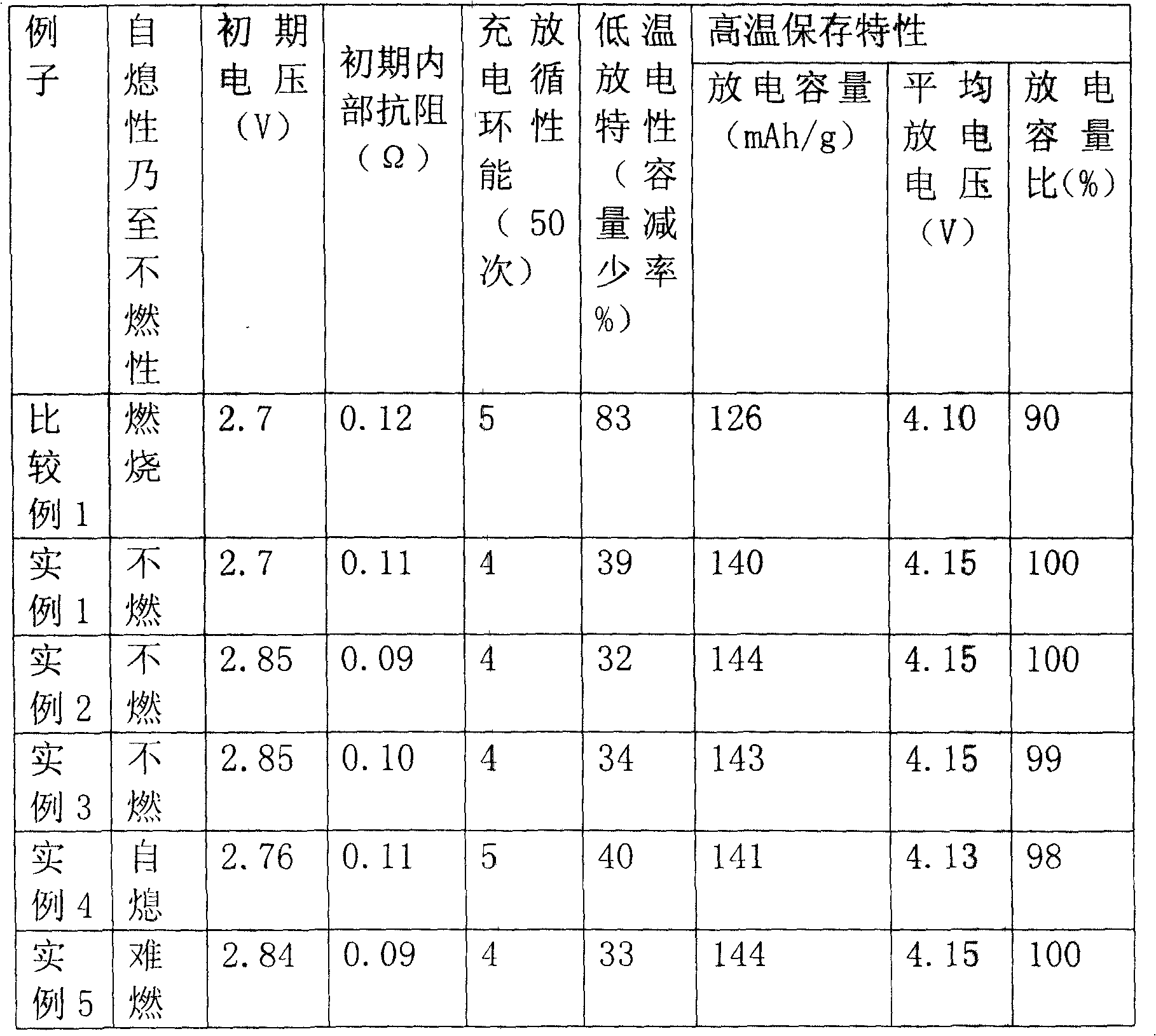
对于得到的聚合物的电解质的自熄性、难燃性乃至不燃性的评价方法,和上面提到的自熄性,难燃性乃至不燃的评价方法一样,结果见表1For the evaluation method of self-extinguishing property, flammability and even non-combustibility of the electrolyte of the polymer obtained, it is the same as the above-mentioned self-extinguishing property, flammability and even non-combustible evaluation method, and the results are shown in Table 1
<不燃性的评价方法><Evaluation method of non-combustibility>
试验火焰和试验体不着火(燃烧长度:0mm)说明具有不燃烧的性质。The test flame and the non-ignition of the test body (burning length: 0 mm) indicate that it has non-combustible properties.
<阻燃性的评价方法><Evaluation method of flame retardancy>
燃烧火焰的高度并没有达到25mm的高度线,而且从网中落下的物质并没有被引燃,说明具有难以燃烧的性质。The height of the burning flame did not reach the height line of 25mm, and the material falling from the net was not ignited, indicating that it was difficult to burn.
<自熄性的评价><Evaluation of self-extinguishing property>
燃烧的火焰在25~100mm高度之间的,自行灭掉。而且从网中落下的物质并没有被引燃,说明具有自熄的性质。If the burning flame is between 25mm and 100mm in height, it will be extinguished by itself. Moreover, the material falling from the net was not ignited, indicating that it has the property of self-extinguishing.
<燃烧性的评价><Evaluation of flammability>
燃烧的火焰超过了100mm说明具有燃烧性。Burning flames exceeding 100mm indicate flammability.
[聚合物电池的制作][Production of polymer battery]
用上述聚合物电解质,制作聚合物充电电池的具体做法如下。LiCoO2(日本化学工业社制)100部,乙炔黑10部、聚四氟乙烯(PTFE)10部和有机溶剂(乙酸和乙醇以50%/50%的体积比混合的溶剂)混合后,一起滚扎制作成厚度100um,宽度40mm的薄层状正极片,负极为厚度150um厚的石墨制成。Using the above-mentioned polymer electrolyte, the specific method of making a polymer rechargeable battery is as follows. After mixing 100 parts of LiCoO 2 (manufactured by Nippon Chemical Industry Co., Ltd.), 10 parts of acetylene black, 10 parts of polytetrafluoroethylene (PTFE), and an organic solvent (a solvent mixed with acetic acid and ethanol at a volume ratio of 50%/50%), put together Rolling is made into a thin-layer positive electrode sheet with a thickness of 100um and a width of 40mm, and the negative electrode is made of graphite with a thickness of 150um.
然后,用上述溶有聚环氧乙烷的乙腈溶液(含有聚环氧乙烷和LiPF6)涂在用聚乙烯制作的细带的两面,厚度保持在150um,然后让上述乙胺溶液挥发掉,聚环氧乙烷-锂就制成了。把它放入正极和负极之间包好,再将上边制作好的含有5%磷腈衍生物的非质子有机溶剂加入其中浸泡,这样聚合物充电电池就做成了。该电池的正极大约为260mm左右。Then, use the above-mentioned acetonitrile solution (containing polyethylene oxide and LiPF 6 ) dissolved in polyethylene oxide to coat both sides of the thin strip made of polyethylene, and keep the thickness at 150um, and then let the above-mentioned ethylamine solution evaporate. , Polyethylene oxide-lithium is made. Put it between the positive electrode and the negative electrode and wrap it well, and then add the aprotic organic solvent containing 5% phosphazene derivative prepared above to soak it, so that the polymer rechargeable battery is made. The positive electrode of this battery is about 260mm.
<电池特性的测定><Measurement of battery characteristics>
对于得到的电池放在常温下,测定初期的电池特性(电压、内部的抗阻),评价后,用下边的方法测定放电循环的性能,这个结果见表1Put the obtained battery at room temperature, measure the initial battery characteristics (voltage, internal resistance), after evaluation, use the following method to measure the performance of the discharge cycle, the results are shown in Table 1
-充放电循环性能的评价--Evaluation of charge-discharge cycle performance-
在最大电压4.5伏、最小电压3伏、放电电流100mA、充电电流50mA的环境中,放电充电循环50次,然后在25℃下测定放电的容量,和最初的放电容量比较,算出放电容量的减少率。测定3根电池,用同样的方法,取平均值。得出充放电的循环性能评价。In an environment with a maximum voltage of 4.5 volts, a minimum voltage of 3 volts, a discharge current of 100mA, and a charge current of 50mA, discharge and charge cycles 50 times, then measure the discharge capacity at 25°C, and compare it with the initial discharge capacity to calculate the decrease in discharge capacity Rate. Measure 3 batteries, use the same method, and take the average value. The cycle performance evaluation of charge and discharge is obtained.
<低温放电特性评价(低温放电容量的测定)><Evaluation of Low Temperature Discharge Characteristics (Measurement of Low Temperature Discharge Capacity)>
将得到的电池在常温下充电以后,在-30℃下放电,把这个时候得到的放电容量与常温时放电得到的容量相比较,根据下边的式子算出放电容量的减小率。对于3根电池作同样的测定,算出平均值。结果见表1。The resulting battery was charged at room temperature and then discharged at -30°C. The discharge capacity obtained at this time was compared with the capacity obtained at room temperature, and the rate of decrease in discharge capacity was calculated from the following formula. The same measurement was performed for 3 batteries, and the average value was calculated. The results are shown in Table 1.
式:放电容量的减少率=Formula: Decrease rate of discharge capacity =
100-(放电容量(-30℃)/放电容量(25℃))*100%100-(discharge capacity (-30°C)/discharge capacity (25°C))*100%
<高温保存特性的评价:高温试验后常温特性测定评价><Evaluation of high-temperature storage characteristics: Measurement and evaluation of room temperature characteristics after high-temperature test>
对于得到的电池,在80℃下保存10天在常温下测定放电特性(放电容量(mAh/g)、平均放电电压(V)等)。它的结果见表1。在测定该放电特性的同时依据50%的放电深度(全部容量的50%),其内部的阻抗值就为(Ω、25℃、1kHz阻抗),测定出的抗阻为34.6Ω。The obtained battery was stored at 80° C. for 10 days, and the discharge characteristics (discharge capacity (mAh/g), average discharge voltage (V), etc.) were measured at room temperature. Its results are shown in Table 1. While measuring the discharge characteristics, the internal impedance value is (Ω, 25°C, 1kHz impedance) based on the discharge depth of 50% (50% of the total capacity), and the measured impedance is 34.6Ω.
<抑制树枝状晶体析出的效果的评价><Evaluation of the Effect of Inhibiting Dendrite Precipitation>
在25℃下1C的充放电反复进行30次左右。让电池分解,然后观察正极和负极的内侧表面。看看有没有金属锂析出。Charge and discharge at 1C at 25°C were repeated about 30 times. Allow the battery to disassemble, then observe the inside surfaces of the positive and negative terminals. See if there is any lithium metal precipitation.
(比较例1)(comparative example 1)
在配制非水电解液的时候,用碳酸二乙酯和碳酸乙烯酯的混合溶剂(混合比(体积比)碳酸二乙酯/碳酸乙烯酯为1/1)(非质子性有机溶剂)的量变成50ml不添加磷腈衍生物,然后和第一个例子一样制作聚合物电解质,作成聚合物电池。然后作自熄性的测定、阻燃性乃至不燃性的测定、初期的电池特性的测定、(电压、内部的抗阻)、充电循环性能的测定、低温放电性的测定、高温保存特性的测定,结果见表1。在做高温保存特性测定的时候,在放电性测定的步骤中,依据50%的放电深度(全部容量的50%),其内部的阻抗值就为(Ω、25℃、1kHz阻抗),测定出的抗阻为89.5Ω。而且在和第一例作同样操作的情况下,在抑制树枝状晶体的析出性能的实验中我们发现了负极的表面析出了金属锂的固体。而且正极的表面也有颗粒状的金属锂出现,呈现出凸凹不平的状态。When preparing non-aqueous electrolyte, use the mixed solvent of diethyl carbonate and ethylene carbonate (mixing ratio (volume ratio) diethyl carbonate/ethylene carbonate is 1/1) (aprotic organic solvent) Change to 50ml without adding phosphazene derivatives, and then make a polymer electrolyte as in the first example to make a polymer battery. Then do the measurement of self-extinguishing property, flame retardancy and even non-combustibility, the measurement of initial battery characteristics, (voltage, internal resistance), the measurement of charging cycle performance, the measurement of low temperature discharge performance, and the measurement of high temperature storage characteristics , the results are shown in Table 1. When measuring the high temperature storage characteristics, in the step of measuring the discharge property, according to the discharge depth of 50% (50% of the total capacity), the internal impedance value is (Ω, 25°C, 1kHz impedance), and the measured The impedance is 89.5Ω. And in the case of doing the same operation as the first example, in the experiment of suppressing the precipitation performance of dendrites, we found that the solid metal lithium was precipitated on the surface of the negative electrode. Moreover, granular metal lithium also appeared on the surface of the positive electrode, presenting an uneven state.
(实例2)(Example 2)
在和实例1(初始的例子,以下相同)作同样操作的情况下,在配制非水电解液的时候,取代磷腈衍生物A,用磷腈衍生物B(环状EO/F型磷腈衍生物(在第2个式子中、n=3、所有的R4都为乙氧基(EO)以及氟元素(F)其比例为(EO/F)=1/5)、粘度1.1mPa.s(1.1cP))的混合液2.5ml(体积百分比5%)配制非水电解液。制作聚合物型充电电池。另外,做和第一例相同的自熄性的测定、阻燃性乃至不燃性的测定、初期的电池特性的测定、(电压、内部的抗阻)、充电循环性能的测定、低温放电性的测定、高温保存特性的测定,结果见表1。在做高温保存特性测定的时候,在放电性测定的步骤中,依据50%的放电深度(全部容量的50%),其内部的阻抗值就为(Ω、25℃、1kHz阻抗),测定出的抗阻为28.3Ω。In the case of doing the same operation with Example 1 (initial example, hereinafter the same), when preparing the non-aqueous electrolyte, replace the phosphazene derivative A with the phosphazene derivative B (cyclic EO/F type phosphazene Derivatives (in the second formula, n=3, all R4 are ethoxy groups (EO) and fluorine elements (F), the ratio of which is (EO/F)=1/5), viscosity 1.1mPa .s (1.1cP)) mixed solution 2.5ml (volume percentage 5%) to prepare non-aqueous electrolyte. Make a polymer type rechargeable battery. In addition, the same self-extinguishing measurement as the first example, the measurement of flame retardancy and non-flammability, the measurement of initial battery characteristics, (voltage, internal resistance), the measurement of charge cycle performance, and the low-temperature discharge performance Determination, the determination of high temperature storage characteristics, the results are shown in Table 1. When measuring the high temperature storage characteristics, in the step of measuring the discharge property, according to the discharge depth of 50% (50% of the total capacity), the internal impedance value is (Ω, 25°C, 1kHz impedance), and the measured The impedance is 28.3Ω.
而且和实例1一样,在抑制树枝状晶体的析出性能的实验中,在电极的正极、负极的表面没有金属锂的析出。And as in Example 1, in the experiment of suppressing the precipitation of dendrites, there was no precipitation of metal lithium on the surface of the positive electrode and the negative electrode of the electrode.
(实例3)(Example 3)
在和实例1作同样操作的情况下,在配制非水电解液的时候,取代磷腈衍生物A,用磷腈衍生物C(环状nPO/F型磷腈衍生物(在第2个式子中、n=3、所有的R1都为正丙氧基(nPO)以及氟元素(F)其比例为(EO/F)=1/5)、粘度1.1mPa.s(1.1cP)),配制非水电解液。制作聚合物型充电电池。另外,做和第一例相同的自熄性的测定、阻燃性乃至不燃性性的测定、初期的电池特性的测定、(电压、内部的抗阻)、充电循环性能的测定、低温放电性的测定、高温保存特性的测定,结果见表1。在做高温保存特性测定的时候,在放电性测定的步骤中,依据50%的放电深度(全部容量的50%),其内部的阻抗值就为(Ω、25℃、1kHz阻抗),测定出的抗阻为23.4Ω。Under the situation of doing the same operation with example 1, when preparing non-aqueous electrolyte, replace phosphazene derivative A, use phosphazene derivative C (cyclic nPO/F type phosphazene derivative (in the second formula In the child, n=3, all R 1 are n-propoxy (nPO) and fluorine element (F) whose ratio is (EO/F)=1/5), viscosity 1.1mPa.s (1.1cP)) , the preparation of non-aqueous electrolyte. Make a polymer type rechargeable battery. In addition, the same as the first example, the measurement of self-extinguishing property, the measurement of flame retardancy and non-combustibility, the measurement of initial battery characteristics, (voltage, internal resistance), the measurement of charge cycle performance, and the low-temperature discharge performance The mensuration of the mensuration, the mensuration of the high temperature preservation characteristic, the results are shown in Table 1. When measuring the high temperature storage characteristics, in the step of measuring the discharge property, according to the discharge depth of 50% (50% of the total capacity), the internal impedance value is (Ω, 25°C, 1kHz impedance), and the measured The impedance is 23.4Ω.
而且和实例1一样,在抑制树枝状晶体的析出性能的实验中,在电极的正极、负极的表面没有金属锂的析出。And as in Example 1, in the experiment of suppressing the precipitation of dendrites, there was no precipitation of metal lithium on the surface of the positive electrode and the negative electrode of the electrode.
(实例4)(Example 4)
在和实例1作同样操作的情况下,在配制非水电解液的时候,取代磷腈衍生物A,用磷腈衍生物D(环状EO/F型磷腈衍生物(在第1个式子中、X为分子式(3)才有有机基(A)的构造,Y1~Y3和Y5~Y6全都是单键,R1~R3和R5~R6全都是乙氧基,Z是氧,粘度4.9mPa.s(4.9cP)),配制非水电解液。制作聚合物型充电电池。另外,做和第一例相同的自熄性的测定、阻燃性乃至不燃性的测定、初期的电池特性的测定、(电压、内部的抗阻)、充电循环性能的测定、低温放电性的测定、高温保存特性的测定,结果见表1。在做高温保存特性测定的时候,在放电性测定的步骤中,依据50%的放电深度(全部容量的50%),其内部的阻抗值就为(Ω、25℃、1kHz阻抗),测定出的抗阻为35.1Ω。Under the situation of doing the same operation with example 1, when preparing the non-aqueous electrolyte, replace the phosphazene derivative A, use the phosphazene derivative D (cyclic EO/F type phosphazene derivative (in the first formula In the molecule, X is the molecular formula (3) to have the structure of the organic group (A), Y 1 ~ Y 3 and Y 5 ~ Y 6 are all single bonds, R 1 ~ R 3 and R 5 ~ R 6 are all ethoxy Base, Z is oxygen, viscosity 4.9mPa.s (4.9cP)), prepare non-aqueous electrolyte. Make polymer type rechargeable battery. In addition, do the same self-extinguishing measurement, flame retardancy and even non-combustibility as the first example Determination of performance, initial battery characteristics, (voltage, internal resistance), charge cycle performance, low-temperature discharge performance, high-temperature storage characteristics, the results are shown in Table 1. In the high-temperature storage characteristics measurement At that time, in the step of measuring the discharge property, according to the discharge depth of 50% (50% of the total capacity), the internal impedance value is (Ω, 25°C, 1kHz impedance), and the measured impedance is 35.1Ω.
而且和实例1一样,在抑制树枝状晶体的析出性能的实验中,在电极的正极、负极的表面没有金属锂的析出。And as in Example 1, in the experiment of suppressing the precipitation of dendrites, there was no precipitation of metal lithium on the surface of the positive electrode and the negative electrode of the electrode.
(实例5)(Example 5)
在和实例1作同样操作的情况下,在配制非水电解液的时候,取代磷腈衍生物A,用磷腈衍生物E(环状AO/F型磷腈衍生物(在第2个式子中、n=3、所有的R1都为丙烯3氧基(-O-CH2-CH=CH2)(AO)以及氟元素(F)其比例为(AO/F)=1/5)、粘度1.2mPa.s(1.2cP)),配制非水电解液。制作聚合物型充电电池。另外,做和第一例相同的自熄性的测定、阻燃性乃至不燃烧性的测定、初期的电池特性的测定、(电压、内部的抗阻)、充电循环性能的测定、低温放电性的测定、高温保存特性的测定,结果见表1。在做高温保存特性测定的时候,在放电性测定的步骤中,依据50%的放电深度(全部容量的50%),其内部的阻抗值就为(Ω、25℃、1kHz阻抗),测定出的抗阻为26.7Ω。Under the situation of doing the same operation with example 1, when preparing non-aqueous electrolyte, replace phosphazene derivative A, use phosphazene derivative E (cyclic AO/F type phosphazene derivative (in the 2nd formula Among them, n=3, all R 1 are propylene 3 oxy groups (-O-CH 2 -CH=CH 2 ) (AO) and fluorine element (F), the ratio of which is (AO/F)=1/5 ), viscosity 1.2mPa.s (1.2cP)), and prepare non-aqueous electrolyte. Make a polymer type rechargeable battery. In addition, the same as the first example, the measurement of self-extinguishing property, the measurement of flame retardancy and non-combustibility, the measurement of initial battery characteristics, (voltage, internal resistance), the measurement of charge cycle performance, and the low-temperature discharge performance The mensuration of the mensuration, the mensuration of the high temperature preservation characteristic, the results are shown in Table 1. When measuring the high temperature storage characteristics, in the step of measuring the discharge property, according to the discharge depth of 50% (50% of the total capacity), the internal impedance value is (Ω, 25°C, 1kHz impedance), and the measured The impedance is 26.7Ω.
而且和实例1一样,在抑制树枝状晶体的析出性能的实验中,在电极的正极、负极的表面没有金属锂的析出。And as in Example 1, in the experiment of suppressing the precipitation of dendrites, there was no precipitation of metal lithium on the surface of the positive electrode and the negative electrode of the electrode.
表1Table 1
产业上利用的可能性Possibility of industrial use
本发明提供一种作为电池保持了电池所必要的特性,如自熄性,难燃性,稳定性,低温放电性,高温保存特性,同时又具有无漏液,可以小型化,薄型化等特点,有利于组装各种机器的聚合物电池以及适用于此聚合物电池中的聚合物电解质。The invention provides a battery that maintains the necessary characteristics of the battery, such as self-extinguishing, flame retardancy, stability, low-temperature discharge, and high-temperature storage characteristics, and at the same time has the characteristics of no leakage, miniaturization, and thinning. , which is beneficial to assemble polymer batteries for various machines and polymer electrolytes suitable for this polymer battery.
Claims (12)
Applications Claiming Priority (8)
| Application Number | Priority Date | Filing Date | Title |
|---|---|---|---|
| JP204415/2001 | 2001-07-05 | ||
| JP2001204415 | 2001-07-05 | ||
| JP206763/2001 | 2001-07-06 | ||
| JP2001206763 | 2001-07-06 | ||
| JP242051/2001 | 2001-08-09 | ||
| JP2001242051 | 2001-08-09 | ||
| JP2001327618 | 2001-10-25 | ||
| JP327618/2001 | 2001-10-25 |
Publications (2)
| Publication Number | Publication Date |
|---|---|
| CN1522477A CN1522477A (en) | 2004-08-18 |
| CN100413140C true CN100413140C (en) | 2008-08-20 |
Family
ID=27482406
Family Applications (1)
| Application Number | Title | Priority Date | Filing Date |
|---|---|---|---|
| CNB028134125A Expired - Fee Related CN100413140C (en) | 2001-07-05 | 2002-06-28 | Polymer Batteries and Polymer Electrolytes |
Country Status (7)
| Country | Link |
|---|---|
| US (1) | US20040192853A1 (en) |
| EP (1) | EP1414096A4 (en) |
| JP (1) | JP4373207B2 (en) |
| KR (1) | KR100591058B1 (en) |
| CN (1) | CN100413140C (en) |
| CA (1) | CA2451790C (en) |
| WO (1) | WO2003005478A1 (en) |
Families Citing this family (9)
| Publication number | Priority date | Publication date | Assignee | Title |
|---|---|---|---|---|
| WO2005064734A1 (en) * | 2003-12-26 | 2005-07-14 | Bridgestone Corporation | Nonaqueous liquid electrolyte for battery, nonaqueous liquid electrolyte battery containing the same, electrolyte for polymer battery and polymer battery containing the same |
| US7285362B2 (en) * | 2004-05-17 | 2007-10-23 | Battelle Energy Alliance, Llc | Safe battery solvents |
| JP4537154B2 (en) * | 2004-08-27 | 2010-09-01 | 株式会社ブリヂストン | Non-aqueous electrolyte electric double layer capacitor |
| JP4494940B2 (en) * | 2004-11-16 | 2010-06-30 | 日本化学工業株式会社 | Method for producing phosphazene derivative containing chlorine atom |
| JP2009158460A (en) * | 2007-12-05 | 2009-07-16 | Sony Corp | Non-aqueous electrolyte secondary battery |
| WO2010101179A1 (en) * | 2009-03-03 | 2010-09-10 | 株式会社Nttファシリティーズ | Lithium-ion battery |
| KR101199597B1 (en) * | 2009-12-14 | 2012-11-12 | 삼성에스디아이 주식회사 | Lithium secondary Battery and Short Resistance control method of the Same |
| EP3353844B1 (en) | 2015-03-27 | 2022-05-11 | Mason K. Harrup | All-inorganic solvents for electrolytes |
| US10707531B1 (en) | 2016-09-27 | 2020-07-07 | New Dominion Enterprises Inc. | All-inorganic solvents for electrolytes |
Citations (5)
| Publication number | Priority date | Publication date | Assignee | Title |
|---|---|---|---|---|
| JPS63241066A (en) * | 1987-01-05 | 1988-10-06 | Teijin Ltd | Solid polyelectrolyte obtained by using phosphazene |
| JPH04167373A (en) * | 1990-10-30 | 1992-06-15 | Shin Kobe Electric Mach Co Ltd | Lithium cell |
| JPH05307975A (en) * | 1992-04-28 | 1993-11-19 | Tomoegawa Paper Co Ltd | Polymer solid electrolytic material |
| JP2001023687A (en) * | 1999-07-09 | 2001-01-26 | Sony Corp | Non-aqueous electrolyte battery |
| JP2001102088A (en) * | 1999-07-29 | 2001-04-13 | Bridgestone Corp | Non-aqueous electrolyte cell |
Family Cites Families (21)
| Publication number | Priority date | Publication date | Assignee | Title |
|---|---|---|---|---|
| JPS61254626A (en) * | 1985-04-30 | 1986-11-12 | リサ−チ・コ−ポレイシヨン | Polyphosphazene base electrolyte for electrochemical cell |
| JPH0721060B2 (en) * | 1986-12-26 | 1995-03-08 | 大塚化学株式会社 | Alkali metal secondary battery using oligoethyleneoxypolyphosphazene having allyl groups |
| JP3055536B2 (en) * | 1992-04-09 | 2000-06-26 | 株式会社ブリヂストン | Non-aqueous electrolyte battery |
| IL105341A (en) * | 1993-04-08 | 1996-12-05 | Univ Ramot | Composite solid electrolyte and alkali metal batteries using this electrolyte |
| DE4420095C1 (en) * | 1994-06-09 | 1995-10-19 | Daimler Benz Ag | Ion conductor for electrochemical storage and method for its production |
| US6025094A (en) * | 1994-11-23 | 2000-02-15 | Polyplus Battery Company, Inc. | Protective coatings for negative electrodes |
| US5830600A (en) * | 1996-05-24 | 1998-11-03 | Sri International | Nonflammable/self-extinguishing electrolytes for batteries |
| JP3619000B2 (en) * | 1997-01-28 | 2005-02-09 | キヤノン株式会社 | Electrode structure, secondary battery, and manufacturing method thereof |
| JPH11154534A (en) * | 1997-11-19 | 1999-06-08 | Asahi Chem Ind Co Ltd | Lithium ion secondary battery element |
| JPH11283631A (en) * | 1998-03-30 | 1999-10-15 | Nippon Zeon Co Ltd | Slurry for electrode of lithium ion secondary battery, binder composition, electrode, and battery |
| US6168885B1 (en) * | 1998-08-21 | 2001-01-02 | Sri International | Fabrication of electrodes and devices containing electrodes |
| JP2000082328A (en) * | 1998-09-02 | 2000-03-21 | Mitsubishi Chemicals Corp | Gel electrolyte and lithium secondary battery |
| JP2000173619A (en) * | 1998-09-29 | 2000-06-23 | Sanyo Electric Co Ltd | Lithium-ion battery |
| KR100644850B1 (en) * | 1998-11-30 | 2006-11-10 | 소니 가부시키가이샤 | Nonaqueous Electrolyte Secondary Battery |
| JP2001035250A (en) * | 1999-07-21 | 2001-02-09 | Hitachi Chem Co Ltd | High-polymer solid electrolyte, manufacture of high- polymer solid electrolyte, and electrochemical device |
| EP1205997A4 (en) * | 1999-07-29 | 2007-03-28 | Bridgestone Corp | Nonaqueous electrolyte secondary cell |
| US6955867B1 (en) * | 1999-11-25 | 2005-10-18 | Brigdestone Corporation | Non-aqueous electrolyte secondary cell and, deterioration-preventing agent for non-aqueous electrolyte secondary cell and additive for non-aqueous electrolyte secondary cell for use therein |
| KR100772496B1 (en) * | 2000-05-08 | 2007-11-01 | 가부시키가이샤 브리지스톤 | Non-aqueous Electrolyte Secondary Battery |
| JP2002075444A (en) * | 2000-08-30 | 2002-03-15 | Sony Corp | Non-aqueous electrolyte battery |
| AU2001284429A1 (en) * | 2000-09-07 | 2002-03-22 | Bridgestone Corporation | Additive for non-aqueous liquid electrolyte, non-aqueous liquid electrolyte secondary cell and non-aqueous liquid electrolyte electric double layer capacitor |
| CN1219338C (en) * | 2000-09-07 | 2005-09-14 | 株式会社普利司通 | Additives for non-aqueous electrolyte batteries |
-
2002
- 2002-06-28 CN CNB028134125A patent/CN100413140C/en not_active Expired - Fee Related
- 2002-06-28 US US10/482,804 patent/US20040192853A1/en not_active Abandoned
- 2002-06-28 EP EP02738860A patent/EP1414096A4/en not_active Withdrawn
- 2002-06-28 CA CA2451790A patent/CA2451790C/en not_active Expired - Fee Related
- 2002-06-28 WO PCT/JP2002/006570 patent/WO2003005478A1/en not_active Ceased
- 2002-06-28 JP JP2003511336A patent/JP4373207B2/en not_active Expired - Fee Related
- 2002-06-28 KR KR1020037017217A patent/KR100591058B1/en not_active Expired - Fee Related
Patent Citations (5)
| Publication number | Priority date | Publication date | Assignee | Title |
|---|---|---|---|---|
| JPS63241066A (en) * | 1987-01-05 | 1988-10-06 | Teijin Ltd | Solid polyelectrolyte obtained by using phosphazene |
| JPH04167373A (en) * | 1990-10-30 | 1992-06-15 | Shin Kobe Electric Mach Co Ltd | Lithium cell |
| JPH05307975A (en) * | 1992-04-28 | 1993-11-19 | Tomoegawa Paper Co Ltd | Polymer solid electrolytic material |
| JP2001023687A (en) * | 1999-07-09 | 2001-01-26 | Sony Corp | Non-aqueous electrolyte battery |
| JP2001102088A (en) * | 1999-07-29 | 2001-04-13 | Bridgestone Corp | Non-aqueous electrolyte cell |
Also Published As
| Publication number | Publication date |
|---|---|
| KR100591058B1 (en) | 2006-06-19 |
| CA2451790C (en) | 2010-02-23 |
| US20040192853A1 (en) | 2004-09-30 |
| JPWO2003005478A1 (en) | 2004-10-28 |
| WO2003005478A1 (en) | 2003-01-16 |
| EP1414096A1 (en) | 2004-04-28 |
| EP1414096A4 (en) | 2005-03-09 |
| CA2451790A1 (en) | 2003-01-16 |
| KR20040026674A (en) | 2004-03-31 |
| JP4373207B2 (en) | 2009-11-25 |
| CN1522477A (en) | 2004-08-18 |
Similar Documents
| Publication | Publication Date | Title |
|---|---|---|
| CA2422106C (en) | Additive for non-aqueous liquid electrolyte, non-aqueous liquid electrolyte secondary cell and non-aqueous liquid electrolyte electric double layer capacitor | |
| KR100767741B1 (en) | Nonaqueous Electrolyte Additive, Nonaqueous Electrolyte Secondary Battery and Nonaqueous Electrolyte Double Layer Capacitor | |
| JP3055358B2 (en) | Non-aqueous electrolyte battery | |
| JP4588319B2 (en) | Non-aqueous electrolyte battery and electrode stabilizer for non-aqueous electrolyte battery | |
| CA2422108C (en) | Additive for non-aqueous electrolyte secondary cell | |
| CN100380727C (en) | Additive for electric double layer capacitor and battery | |
| KR100775566B1 (en) | Non-aqueous electrolyte secondary battery and deterioration inhibitor for nonaqueous electrolyte secondary battery and additive for nonaqueous electrolyte secondary battery | |
| CN103443992A (en) | Additive for nonaqueous electrolyte, nonaqueous electrolyte, and nonaqueous electrolyte secondary battery | |
| JP3055536B2 (en) | Non-aqueous electrolyte battery | |
| KR20020043548A (en) | Nonaqueous electrolyte secondary cell | |
| CN100413140C (en) | Polymer Batteries and Polymer Electrolytes | |
| JP2001102088A (en) | Non-aqueous electrolyte cell | |
| JP4671693B2 (en) | Non-aqueous electrolyte additive for secondary battery and non-aqueous electrolyte secondary battery | |
| JP5095883B2 (en) | Non-aqueous electrolyte secondary battery additive and non-aqueous electrolyte secondary battery | |
| JP2004006301A (en) | Positive electrode for non-aqueous electrolyte secondary battery and its manufacturing method, and non-aqueous electrolyte secondary battery having the same | |
| JP2001217001A (en) | Additive for non-aqueous electrolyte secondary battery | |
| CN101740821B (en) | Electrolyte and lithium ion secondary battery containing same | |
| JP4785735B2 (en) | Nonaqueous electrolyte for battery and nonaqueous electrolyte battery provided with the same | |
| JP4666540B2 (en) | Non-aqueous electrolyte secondary battery | |
| JP2001217007A (en) | Non-aqueous electrolyte secondary battery | |
| JP7745543B2 (en) | composition | |
| JP2001217006A (en) | Non-aqueous electrolyte secondary battery | |
| JP2001217003A (en) | Non-aqueous electrolyte secondary battery |
Legal Events
| Date | Code | Title | Description |
|---|---|---|---|
| C06 | Publication | ||
| PB01 | Publication | ||
| C10 | Entry into substantive examination | ||
| SE01 | Entry into force of request for substantive examination | ||
| C14 | Grant of patent or utility model | ||
| GR01 | Patent grant | ||
| CF01 | Termination of patent right due to non-payment of annual fee | ||
| CF01 | Termination of patent right due to non-payment of annual fee |
Granted publication date: 20080820 Termination date: 20190628 |