CN100401646C - Multi-cell Joint Detection Method in Slotted Code Division Multiple Access System - Google Patents
Multi-cell Joint Detection Method in Slotted Code Division Multiple Access System Download PDFInfo
- Publication number
- CN100401646C CN100401646C CNB2004100801966A CN200410080196A CN100401646C CN 100401646 C CN100401646 C CN 100401646C CN B2004100801966 A CNB2004100801966 A CN B2004100801966A CN 200410080196 A CN200410080196 A CN 200410080196A CN 100401646 C CN100401646 C CN 100401646C
- Authority
- CN
- China
- Prior art keywords
- code channel
- code
- grouping
- channel
- detection
- Prior art date
- Legal status (The legal status is an assumption and is not a legal conclusion. Google has not performed a legal analysis and makes no representation as to the accuracy of the status listed.)
- Expired - Lifetime
Links
- 238000001514 detection method Methods 0.000 title claims abstract description 146
- 238000000034 method Methods 0.000 claims abstract description 112
- 239000011159 matrix material Substances 0.000 claims description 51
- 230000005540 biological transmission Effects 0.000 claims description 39
- 230000004044 response Effects 0.000 claims description 23
- 238000001914 filtration Methods 0.000 claims description 20
- 238000005516 engineering process Methods 0.000 claims description 8
- 230000003213 activating effect Effects 0.000 claims 2
- 238000004891 communication Methods 0.000 abstract description 3
- 210000004027 cell Anatomy 0.000 description 110
- 230000008569 process Effects 0.000 description 19
- 238000001994 activation Methods 0.000 description 15
- 230000004913 activation Effects 0.000 description 13
- 238000010276 construction Methods 0.000 description 4
- 230000002452 interceptive effect Effects 0.000 description 4
- 125000004122 cyclic group Chemical group 0.000 description 3
- 238000010295 mobile communication Methods 0.000 description 3
- 230000006855 networking Effects 0.000 description 3
- 230000000717 retained effect Effects 0.000 description 3
- 230000007480 spreading Effects 0.000 description 3
- 239000000203 mixture Substances 0.000 description 2
- 238000007476 Maximum Likelihood Methods 0.000 description 1
- 238000004364 calculation method Methods 0.000 description 1
- 230000001413 cellular effect Effects 0.000 description 1
- 230000003247 decreasing effect Effects 0.000 description 1
- 238000010586 diagram Methods 0.000 description 1
- 210000004692 intercellular junction Anatomy 0.000 description 1
- 238000005070 sampling Methods 0.000 description 1
Images


Classifications
-
- H—ELECTRICITY
- H04—ELECTRIC COMMUNICATION TECHNIQUE
- H04B—TRANSMISSION
- H04B1/00—Details of transmission systems, not covered by a single one of groups H04B3/00 - H04B13/00; Details of transmission systems not characterised by the medium used for transmission
- H04B1/69—Spread spectrum techniques
- H04B1/707—Spread spectrum techniques using direct sequence modulation
- H04B1/7097—Interference-related aspects
- H04B1/7103—Interference-related aspects the interference being multiple access interference
-
- H—ELECTRICITY
- H04—ELECTRIC COMMUNICATION TECHNIQUE
- H04B—TRANSMISSION
- H04B1/00—Details of transmission systems, not covered by a single one of groups H04B3/00 - H04B13/00; Details of transmission systems not characterised by the medium used for transmission
- H04B1/69—Spread spectrum techniques
- H04B1/707—Spread spectrum techniques using direct sequence modulation
- H04B1/7097—Interference-related aspects
- H04B1/7103—Interference-related aspects the interference being multiple access interference
- H04B1/7105—Joint detection techniques, e.g. linear detectors
-
- H—ELECTRICITY
- H04—ELECTRIC COMMUNICATION TECHNIQUE
- H04J—MULTIPLEX COMMUNICATION
- H04J13/00—Code division multiplex systems
- H04J13/16—Code allocation
-
- H—ELECTRICITY
- H04—ELECTRIC COMMUNICATION TECHNIQUE
- H04L—TRANSMISSION OF DIGITAL INFORMATION, e.g. TELEGRAPHIC COMMUNICATION
- H04L25/00—Baseband systems
- H04L25/02—Details ; arrangements for supplying electrical power along data transmission lines
- H04L25/0202—Channel estimation
- H04L25/0204—Channel estimation of multiple channels
-
- H—ELECTRICITY
- H04—ELECTRIC COMMUNICATION TECHNIQUE
- H04B—TRANSMISSION
- H04B1/00—Details of transmission systems, not covered by a single one of groups H04B3/00 - H04B13/00; Details of transmission systems not characterised by the medium used for transmission
- H04B1/69—Spread spectrum techniques
- H04B1/707—Spread spectrum techniques using direct sequence modulation
- H04B1/7097—Interference-related aspects
- H04B1/7103—Interference-related aspects the interference being multiple access interference
- H04B1/7107—Subtractive interference cancellation
-
- H—ELECTRICITY
- H04—ELECTRIC COMMUNICATION TECHNIQUE
- H04B—TRANSMISSION
- H04B2201/00—Indexing scheme relating to details of transmission systems not covered by a single group of H04B3/00 - H04B13/00
- H04B2201/69—Orthogonal indexing scheme relating to spread spectrum techniques in general
- H04B2201/707—Orthogonal indexing scheme relating to spread spectrum techniques in general relating to direct sequence modulation
- H04B2201/70702—Intercell-related aspects
Landscapes
- Engineering & Computer Science (AREA)
- Computer Networks & Wireless Communication (AREA)
- Signal Processing (AREA)
- Power Engineering (AREA)
- Mobile Radio Communication Systems (AREA)
Abstract
本发明涉及一种多小区联合检测方法,针对时隙CDMA系统中同频相邻小区信号间的相互干扰,而提出一种基于多小区结构信息的联合检测方法。步骤如下:利用多码集的信道估计方法得到各个相邻小区的信道估计结果;对各个相邻小区的码道进行码道分组,包括:基于码道所属小区的分组、基于码道功率或幅度强弱的分组、基于码道相关性强弱的分组;利用信道估计结果和码道分组的结果进行联合检测,输出检测数据。该方法充分利用多个小区信号的结构信息,对同频相邻小区的多址干扰进行有效的抑制,从而大大提高了在同频相邻小区工作时的系统性能。该方法可以用于时隙CDMA系统或采用类似信号结构的无线通信系统。
The invention relates to a multi-cell joint detection method. Aiming at the mutual interference between the same-frequency adjacent cell signals in a time-slot CDMA system, a joint detection method based on multi-cell structure information is proposed. The steps are as follows: use the channel estimation method of the multi-code set to obtain the channel estimation results of each adjacent cell; group the code channels of each adjacent cell, including: grouping based on the cell to which the code channel belongs, based on the power or amplitude of the code channel Strong and weak grouping, grouping based on code channel correlation strength; use channel estimation results and code channel grouping results for joint detection, and output detection data. The method makes full use of the structural information of the signals of multiple cells, and effectively suppresses the multiple access interference of adjacent cells of the same frequency, thereby greatly improving the system performance when working in adjacent cells of the same frequency. The method can be used in a time-slotted CDMA system or a wireless communication system using a similar signal structure.
Description
技术领域 technical field
本发明涉及移动通信技术领域的联合检测方法,更确切地说是涉及一种适用于时隙码分多址(CDMA)系统或采用类似于时隙码分多址系统信号结构的无线通信系统的多小区联合检测方法。The present invention relates to a joint detection method in the technical field of mobile communication, more specifically to a method suitable for a time-slot code division multiple access (CDMA) system or a wireless communication system that adopts a signal structure similar to a time-slot code division multiple access system Multi-cell joint detection method.
背景技术 Background technique
在CDMA移动通信系统中,存在着严重的多址干扰和符号间干扰。在时隙CDMA系统中,对接收的本小区信号可以采用联合检测技术来消除多址干扰与符号间干扰。联合检测方法是利用本小区所有用户的发送信号及其信道响应的信息,把信号检测当作一个统一的相互关联的联合检测过程来完成。由于联合检测技术有效地抑制了符号间干扰和本小区的多址干扰,故极大地提高了码分多址系统的性能。In the CDMA mobile communication system, there are serious multiple access interference and intersymbol interference. In the time-slot CDMA system, joint detection technology can be used to eliminate multiple access interference and inter-symbol interference for the received signal of the cell. The joint detection method is to use the information of the transmitted signal and the channel response of all users in the cell, and regard the signal detection as a unified interrelated joint detection process to complete. Since the joint detection technology effectively suppresses the intersymbol interference and the multiple access interference of the cell, it greatly improves the performance of the code division multiple access system.
时分双工-同步码分多址(TD-SCDMA)系统是一种对本小区多用户信号采用了联合检测方案的时隙CDMA系统。在TD-SCDMA系统中,常规时隙的突发信号结构如图1所示:突发信号中部的midamble(中间码,也称为信道估计码)用来进行信道估计,两边的数据块用来传送业务数据。Time Division Duplex-Synchronous Code Division Multiple Access (TD-SCDMA) system is a time-slotted CDMA system that uses a joint detection scheme for multi-user signals in the cell. In the TD-SCDMA system, the burst signal structure of a regular time slot is shown in Figure 1: the midamble (midamble, also called channel estimation code) in the middle of the burst signal is used for channel estimation, and the data blocks on both sides are used for Send business data.
TD-SCDMA系统的单小区联合检测的具体过程如下:The specific process of single cell joint detection in TD-SCDMA system is as follows:
首先得到时隙CDMA系统单小区接收机接收到的信号模型:Firstly, the signal model received by the single-cell receiver of the time-slotted CDMA system is obtained:
e=Ad+n (1)e=Ad+n (1)
其中,e为接收机收到信号的采样数据,d为发送数据,n为接收到的噪声,矩阵A为传输矩阵。传输矩阵A由各个码道的组合响应向量b(k)构成,k是码道编号,假设总共有K个码道(根据b(k)可以计算A矩阵,b(k)是矩阵中分布在对角线上的各个块中的一列)。Among them, e is the sampling data of the signal received by the receiver, d is the transmitted data, n is the received noise, and matrix A is the transmission matrix. The transmission matrix A is composed of the combined response vector b (k) of each code channel, k is the code channel number, assuming that there are K code channels in total (A matrix can be calculated according to b (k) , and b (k) is the distribution in the matrix a column in each block on the diagonal).
每个向量b(k)对应为一个码道编号为k的用户码道的组合信道响应:Each vector b (k) corresponds to the combined channel response of a user code channel whose code channel number is k:
其中,C(k)是对应的码道编号为k的用户码道的扩频码,
然后利用上述信息就可以进行联合检测。联合检测算法有多种,可以是干扰抵消的方法,可以是线性块均衡的方法,也可以是两者方法的混合。对线性块均衡的方法,经解调后的发送数据d估计的软输出值为:The above information can then be used for joint detection. There are many kinds of joint detection algorithms, which can be the method of interference cancellation, the method of linear block equalization, or the mixture of the two methods. For the linear block equalization method, the estimated soft output value of the demodulated transmitted data d is:
其中,矩阵T由下式给出:where the matrix T is given by:
式中,*T是共轭转置,Rd=E{d·d*T},是数据序列d的协方差矩阵,对于相互独立的数据序列,Rd=I;Rm=E{n·n*T},是噪声序列n的协方差矩阵。对于相互独立且平稳的噪声序列(如白噪声)Rn=σ2 I,I表示单位矩阵。In the formula, *T is the conjugate transpose, R d =E{d·d *T }, is the covariance matrix of the data sequence d, for mutually independent data sequences, R d =I; R m =E{n · n * T }, is the covariance matrix of the noise sequence n. For mutually independent and stable noise sequences (such as white noise) Rn = σ 2 I, I represents the identity matrix.
在Rd=I和Rn=σ2 I的条件下,(3)、(4)式可以简化表示为:Under the conditions of R d = I and Rn = σ 2 I, formulas (3) and (4) can be simplified as:
(4)、(6)式中的MF即匹配滤波,对应的就是匹配滤波的方法;ZF-BLE即迫零线性块均衡(Zero-Forcing Block Liner Equaliaer)的方法,对应的是最大似然的线性解;MMSE-BLE即最小均方误差线性块均衡(Zero-ForcingBlock Liner Equaliaer)的方法,对应的是最小均方误差的线性解。上述三种求解T的方法择其一即可,通常选择第二种ZF-BLE或第三种MMSE-BLE方法。MF in (4) and (6) is matched filtering, which corresponds to the method of matched filtering; ZF-BLE is the method of Zero-Forcing Block Liner Equaliaer (Zero-Forcing Block Liner Equaliaer), which corresponds to the maximum likelihood Linear solution; MMSE-BLE is the method of Zero-Forcing Block Liner Equaliaer (Zero-Forcing Block Liner Equaliaer), which corresponds to the linear solution of the minimum mean square error. You can choose one of the above three methods for solving T, and usually choose the second ZF-BLE or the third MMSE-BLE method.
单小区联合检测方法,利用小区所有用户发送信号的结构信息(包括扩频码和信道响应),即利用的只是本小区的信号结构信息,这时,检测方法将其它小区的干扰信号都当成是时间的高斯白噪声来进行处理,所以,单小区联合检测算法对抑制符号间干扰和本小区多址干扰有较强的能力。单小区联合检测方法对于单小区或异频组网的码分多址系统,可极大地提高系统的性能。The single-cell joint detection method uses the structural information (including spreading code and channel response) of the signals sent by all users in the cell, that is, only the signal structure information of this cell is used. At this time, the detection method regards the interference signals of other cells as Therefore, the joint detection algorithm of single cell has a strong ability to suppress intersymbol interference and multiple access interference of the cell. The single cell joint detection method can greatly improve system performance for a single cell or a code division multiple access system with inter-frequency networking.
对于相邻小区同频组网的时隙CDMA系统,采用单小区联合检测算法也可以提高系统的性能。但是,在同频组网情况下,同频相邻小区信号之间存在着较强的相互干扰,且同频相邻小区之间的干扰对系统的性能有非常重要的影响,尤其是在同频相邻小区的交界处,同频干扰往往是最重要的干扰,此时,单小区联合检测的方法对同频邻小区的干扰将无能为力,在同频相邻小区干扰存在时,系统性能将明显下降。For the time-slot CDMA system in which adjacent cells are networked at the same frequency, the performance of the system can also be improved by using a single-cell joint detection algorithm. However, in the case of co-frequency networking, there is strong mutual interference between the signals of adjacent cells of the same frequency, and the interference between adjacent cells of the same frequency has a very important impact on the performance of the system, especially in the At the junction of adjacent cells of the same frequency, the same-frequency interference is often the most important interference. At this time, the joint detection method of a single cell will be powerless to the interference of the adjacent cells of the same frequency. When the interference of the adjacent cells of the same frequency exists, the system performance will be reduced. Significantly decreased.
例如,小区交界处有同频相邻小区用户在多个码道工作时,尤其是扩频增益较小的系统,相邻小区用户信号将会对本小区用户信号造成很大的干扰。在这种情况下,单小区联合检测方法将会使系统性能严重恶化。For example, when there are adjacent cell users of the same frequency working on multiple code channels at the cell junction, especially in a system with a small spreading gain, the signals of users in adjacent cells will cause great interference to the signals of users in this cell. In this case, the single-cell joint detection method will seriously deteriorate the system performance.
因此,时隙CDMA蜂窝移动通信系统在同频相邻小区工作的情况下,采用单小区联合检测方法系统性能会明显下降,往往不能达到系统对性能的要求,需要提供性能更好的联合检测方法。如果能够利用同频相邻小区的结构信息,将联合检测技术从单小区扩展到同频多小区,就可极大地提高时隙CDMA系统同频组网时的性能。Therefore, when the time-slotted CDMA cellular mobile communication system works in adjacent cells of the same frequency, the performance of the single-cell joint detection method will be significantly reduced, and it often cannot meet the performance requirements of the system. It is necessary to provide a joint detection method with better performance. . If the structure information of adjacent cells of the same frequency can be used, the joint detection technology can be extended from a single cell to multiple cells of the same frequency, which can greatly improve the performance of the time-slotted CDMA system in the same-frequency networking.
为了获得除本小区外的同频相邻小区的结构信息,需要很多先验信息,其中很重要的一类先验信息就是除本小区外的同频相邻小区的信道估计结果,即多小区信道估计结果。因为在生成信道估计码时,每个相邻小区给定一个不同的中间码作为基本码,该小区不同的用户采用这个基本码的不同循环移位版本作为它的信道估计码,这样,一个小区的这些不同的循环移位版本可以称作一个码集,多个小区就有多个码集,因而多码集的信道估计就是多小区的信道估计。In order to obtain the structural information of adjacent cells of the same frequency except this cell, a lot of prior information is required, and one of the most important types of prior information is the channel estimation results of adjacent cells of the same frequency except this cell, that is, multi-cell Channel estimation results. Because when generating channel estimation codes, each adjacent cell is given a different midamble code as the basic code, and different users in the cell use different cyclic shift versions of the basic code as their channel estimation codes. In this way, a cell These different cyclic shift versions of can be called a code set, and there are multiple code sets for multiple cells, so the channel estimation of multiple code sets is the channel estimation of multiple cells.
在本申请人的中国专利申请号为03100670.1、发明名称为“时隙码分多址系统多码集信道估计方法”的技术方案中,公开了一种时隙码分多址系统中的多码集信道估计方法,也即多小区信道估计方法。In the technical scheme of the applicant's Chinese patent application number 03100670.1 and the title of the invention "Channel Estimation Method for Multiple Code Sets in Time-Slot Code Division Multiple Access System", a multi-code system in a time-slot Code Division Multiple Access system is disclosed. A set channel estimation method, that is, a multi-cell channel estimation method.
该技术方案对单码集信道估计结果进行有限时间判决处理,只保留具有较强信号响应的有限个抽头,由此恢复出其它码集干扰信号,并抵消该干扰信号,得到各个码集的净信号,再将各个码集的净信号进行单码集信道估计,重复上述处理直至达到迭代次数后,输出多码集即多小区信道估计结果。This technical solution performs limited-time judgment processing on the channel estimation results of a single code set, and only retains a limited number of taps with strong signal responses, thereby recovering the interference signals of other code sets, and canceling the interference signals, and obtaining the net of each code set Signals, and then perform single-code-set channel estimation on the net signals of each code set, repeat the above process until the number of iterations is reached, and output multi-code sets, that is, multi-cell channel estimation results.
发明内容 Contents of the invention
本发明的目的在于提供一种时隙码分多址系统多小区联合检测方法,针对存在同频多小区相互干扰的情况,利用多小区结构信息实现多小区联合检测。本发明提供的方法将大大提高时隙CDMA系统在同频相邻小区工作时的系统性能。The purpose of the present invention is to provide a multi-cell joint detection method of a time-slot code division multiple access system, aiming at the situation that there is mutual interference between multiple cells of the same frequency, the multi-cell joint detection is realized by using the multi-cell structure information. The method provided by the invention will greatly improve the system performance of the time-slot CDMA system when it works in the same-frequency adjacent cells.
实现本发明目的的技术方案是这样的:一种时隙码分多址系统多小区联合检测方法,利用多个同频相邻小区的结构信息进行联合检测,其特征在于包含如下步骤:The technical scheme that realizes the object of the present invention is such: a kind of time-slot code division multiple access system multi-cell joint detection method, utilizes the structure information of a plurality of same-frequency adjacent cells to carry out joint detection, it is characterized in that comprising the following steps:
A.利用多码集的信道估计方法得到各个相邻小区的信道估计结果;A. Utilize the channel estimation method of multi-code set to obtain the channel estimation result of each neighboring cell;
B.选择基于码道所属小区的分组方法,对所述各个相邻小区的码道进行码道分组,码道分组后得到码道分组数与同频小区个数相同,每个分组内的码道就是对应小区的码道;B. Select the grouping method based on the cell to which the code channel belongs, and carry out code channel grouping to the code channels of each adjacent cell. After the code channel grouping, the number of code channel groups obtained is the same as the number of cells of the same frequency. The road is the code road corresponding to the cell;
C.利用所述各个相邻小区的信道估计结果,在各分组内采用单小区线性块均衡和在分组间采用干扰抵消的联合检测方法进行联合检测,获得检测数据;C. Utilizing the channel estimation results of each adjacent cell, using a single cell linear block equalization in each group and using a joint detection method for interference cancellation between groups to perform joint detection to obtain detection data;
其中,所述的在各分组内采用单小区线性块均衡和在分组间采用干扰抵消的联合检测方法包括以下步骤:Wherein, the joint detection method using single-cell linear block equalization in each group and interference cancellation between groups includes the following steps:
C11.对各个分组分别进行单小区联合检测,检测出各分组结果,判断是否达到迭代次数,如果是则输出待检测用户所在分组的检测结果,否则执行步骤C12;C11. Carry out single-cell joint detection for each group, detect the results of each group, and judge whether the number of iterations is reached, if so, output the detection result of the group where the user to be detected is located, otherwise perform step C12;
C12.由检测出的各分组结果恢复各个分组信号响应引起的干扰分量;C12. Restoring the interference component caused by each packet signal response from the detected packet results;
C13.接收信号抵消非本组的干扰分量,获得各组的净信号;C13. The received signal offsets the interference components not in this group, and obtains the net signal of each group;
C14.将净信号作为下一步处理的分组结果,返回步骤C11。C14. Take the net signal as the grouping result of the next step, and return to step C11.
本发明还提供了一种时隙码分多址系统多小区联合检测方法,其技术方案是这样的:一种时隙码分多址系统多小区联合检测方法,利用多个同频相邻小区的结构信息进行联合检测,其特征在于包含如下步骤:The present invention also provides a multi-cell joint detection method of a time-slot code division multiple access system, and its technical solution is as follows: a multi-cell joint detection method of a time-slot code division multiple access The structural information of the combined detection is characterized in that it includes the following steps:
A.利用多码集的信道估计方法得到各个相邻小区的信道估计结果;A. Utilize the channel estimation method of multi-code set to obtain the channel estimation result of each neighboring cell;
B.选择基于码道幅度或功率的分组方法,按码道幅度或功率的强弱对所述各个相邻小区的码道进行码道分组,分成参与联合检测的码道分组和干扰码道分组;B. Select the grouping method based on code channel amplitude or power, carry out code channel grouping to the code channels of each adjacent cell according to the strength of code channel amplitude or power, and divide into code channel grouping and interference code channel grouping participating in joint detection ;
C.利用所述各个相邻小区的信道估计结果,对参与联合检测的码道分组采用线性块均衡的联合检测方法进行联合检测,获得检测数据。C. Using the channel estimation results of each adjacent cell, perform joint detection on code channel groups participating in the joint detection using a linear block equalization joint detection method to obtain detection data.
本发明又提供了一种时隙码分多址系统多小区联合检测方法,其技术方案是这样的:一种时隙码分多址系统多小区联合检测方法,利用多个同频相邻小区的结构信息进行联合检测,其特征在于包含如下步骤:The present invention also provides a multi-cell joint detection method of a time-slot code division multiple access system, and its technical scheme is as follows: a multi-cell joint detection method of a time-slot code division multiple access The structural information of the combined detection is characterized in that it includes the following steps:
A.利用多码集的信道估计方法得到各个相邻小区的信道估计结果;A. Utilize the channel estimation method of multi-code set to obtain the channel estimation result of each neighboring cell;
B.选择基于码道相关性的分组方法,按码道相关性的强弱对所述各个相邻小区的码道进行分组,分成参与联合检测的码道分组和干扰码道分组;B. Select the grouping method based on code channel correlation, group the code channels of each adjacent cell according to the strength of code channel correlation, and divide into code channel grouping and interference code channel grouping participating in joint detection;
C.利用所述各个相邻小区的信道估计结果,对参与联合检测的码道分组采用线性块均衡的联合检测方法进行联合检测,获得检测数据。C. Using the channel estimation results of each adjacent cell, perform joint detection on code channel groups participating in the joint detection using a linear block equalization joint detection method to obtain detection data.
以上所述的对参与联合检测的码道分组采用线性块均衡的联合检测方法进行检测包括以下步骤:The above-mentioned joint detection method using linear block equalization for the code channel grouping participating in the joint detection comprises the following steps:
C21.利用各个码道的组合信道响应构造出参与联合检测码道分组的传输矩阵和干扰码道分组的传输矩阵;C21. Using the combined channel response of each code channel to construct the transmission matrix of the code channel group participating in the joint detection and the transmission matrix of the interference code channel group;
C22.将参与联合检测码道分组的传输矩阵、有色噪声干扰的协方差矩阵与从接收信号中分割出的数据部分进行匹配滤波;C22. Perform matching filtering on the transmission matrix participating in the joint detection code channel grouping, the covariance matrix of the colored noise interference, and the data part segmented from the received signal;
C23.选择线性块均衡的联合检测算法对匹配滤波结果进行联合检测,将获得的发送数据估计的软输出值作为检测数据输出。C23. Select the joint detection algorithm of linear block equalization to perform joint detection on the matched filter results, and use the obtained soft output value estimated by the transmitted data as the detection data output.
可见,本发明利用多码集信道估计方法得到各个相邻小区的信道估计结果;对各个相邻小区的码道按本发明的分组方法进行码道分组,该分组方法包括基于码道所属小区的分组、基于码道功率或幅度强弱的分组、基于码道相关性强弱的分组、及其上述分组方法的混合分组;利用各个相邻小区的信道估计结果及码道分组结果进行联合检测。联合检测过程具体包括构造A矩阵;匹配滤波;和最终完成多小区联合检测。采用不同的码道分组方法时,构造的A矩阵会有所不同,因而给利用信道估计结果及码道分组结果进行联合检测带来一些差异。It can be seen that the present invention uses the multi-code set channel estimation method to obtain the channel estimation results of each adjacent cell; the code channels of each adjacent cell are grouped according to the grouping method of the present invention, and the grouping method includes Grouping, grouping based on code channel power or amplitude strength, grouping based on code channel correlation strength, and mixed grouping of the above grouping methods; use the channel estimation results of each adjacent cell and the code channel grouping results for joint detection. The joint detection process specifically includes constructing an A matrix; matching filtering; and finally completing multi-cell joint detection. When different code channel grouping methods are used, the constructed A matrix will be different, which brings some differences to the joint detection using the channel estimation results and code channel grouping results.
本发明给出的方法使联合检测技术可以用于同频多小区时隙CDMA系统。本发明的方法与单小区联合检测方法相比,可以充分地利用多个小区信号的结构信息,进行多小区联合检测,从而极大地抑制了同频相邻小区的多址干扰。本发明提供的方法将大大提高时隙CDMA系统在同频相邻小区工作时的系统性能。The method provided by the invention enables the joint detection technology to be used in the CDMA system with multiple cell time slots at the same frequency. Compared with the joint detection method of single cell, the method of the present invention can make full use of the structure information of signals of multiple cells to perform joint detection of multiple cells, thereby greatly suppressing the multiple access interference of adjacent cells of the same frequency. The method provided by the invention will greatly improve the system performance of the time-slot CDMA system when it works in the same-frequency adjacent cells.
附图说明 Description of drawings
图1为TD-SCDMA业务时隙突发结构;Fig. 1 is the TD-SCDMA service time slot burst structure;
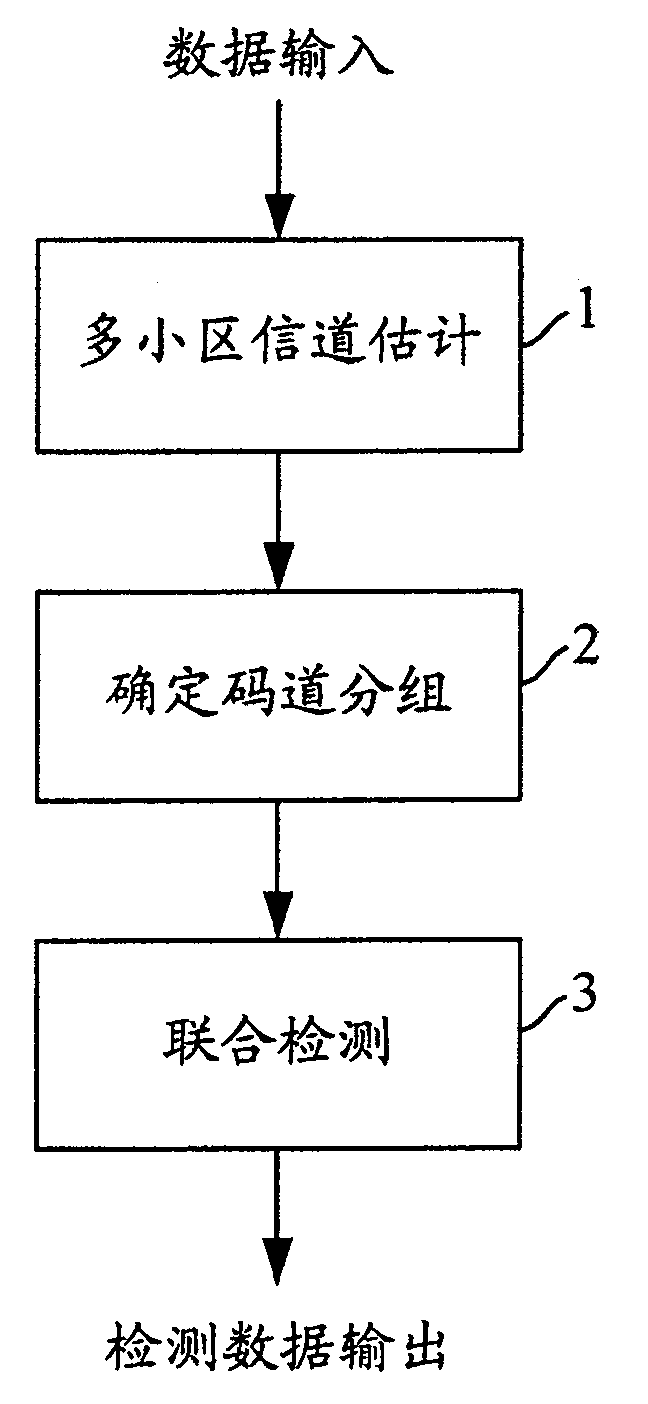
图2为时隙CDMA系统多小区联合检测总流程示意框图;Fig. 2 is a schematic block diagram of the overall process of multi-cell joint detection in the time slot CDMA system;
图3为时隙CDMA系统多小区联合检测实施例系统流程图。Fig. 3 is a system flowchart of an embodiment of multi-cell joint detection in a time-slotted CDMA system.
具体实施方式 Detailed ways
考虑到时隙CDMA系统同频相邻小区信号之间的相互干扰,本发明提出了一种基于多小区结构信息的联合检测方法。具体实现方法的步骤如图2中所示。Considering the mutual interference between the signals of the same frequency adjacent cells in the time slot CDMA system, the present invention proposes a joint detection method based on the structure information of multiple cells. The steps of the specific implementation method are shown in FIG. 2 .
第一步,多小区信道估计。利用背景技术中介绍的多码集的信道估计方法得到各个相邻小区的信道估计结果。因为在生成信道估计码时,每个相邻小区给定一个不同的中间码作为基本码,该小区不同的用户采用这个基本码的不同循环移位版本作为它的信道估计码,一个小区的这些基本码的不同的循环移位版本被称作一个码集,多个小区就有多个码集,因而多码集的信道估计就是多小区的信道估计。本发明技术方案中的多小区信道估计,利用专利申请031006701中的多码集信道估计技术,针对同频多小区工作时存在多码集信道估计码响应信号的情况,采用基于有限时间位置判决反馈处理的多码集联合信道迭代估计方法,得到多个小区的信道估计结果。信道估计的多小区是相邻小区,相邻小区包括待检测用户所在的本小区及与本小区在地域位置上最相邻的小区。The first step is multi-cell channel estimation. The channel estimation results of each adjacent cell are obtained by using the multi-code set channel estimation method introduced in the background art. Because when generating channel estimation codes, each adjacent cell is given a different intermediate code as the basic code, and different users in the cell use different cyclic shift versions of the basic code as their channel estimation codes. Different cyclically shifted versions of the basic code are called a code set, and multiple cells have multiple code sets, so the channel estimation of multiple code sets is the channel estimation of multiple cells. The multi-cell channel estimation in the technical solution of the present invention utilizes the multi-code set channel estimation technology in the patent application 031006701, and in view of the situation that there are multi-code set channel estimation code response signals when working in multiple cells at the same frequency, a decision feedback based on limited time position is adopted. The processed multi-code set joint channel iterative estimation method obtains the channel estimation results of multiple cells. The multi-cells for channel estimation are adjacent cells, and the adjacent cells include the own cell where the user to be detected is located and the closest geographically adjacent cell to the current cell.
第二步,码道分组。首先确定码道分组方法,然后按选择的一种分组方法对各个相邻小区的码道进行码道分组。本发明确定码道分组的具体方案如下:The second step is to group code channels. First determine the code channel grouping method, and then perform code channel grouping on the code channels of each adjacent cell according to the selected grouping method. The concrete scheme that the present invention determines code path grouping is as follows:
第一种是基于码道所属小区的分组方法。有几个同频小区就设成几个组,那么每组内的码道就是相应小区的码道。The first is a grouping method based on the cell to which the code channel belongs. If there are several same-frequency cells, several groups are formed, and the code channels in each group are the code channels of the corresponding cells.
第二种是基于码道功率或幅度的分组方法。由多小区信道估计结果得到的各码道的组合信道响应,或者由各个码道匹配滤波的输出结果,可以估算出各码道信号的幅度或功率(幅度通过求平方可以获得功率),然后,依据幅度或功率的强弱来进行分组。例如确定一个幅度或功率的门限值,码道信号的幅度或功率大于该门限值为强,低于该门限值为弱,幅度或功率强的码道为一组,功率或幅度弱的码道为另一组。The second is a grouping method based on code channel power or amplitude. The combined channel response of each code channel obtained from the multi-cell channel estimation result, or the output result of each code channel matched filter, can estimate the amplitude or power of each code channel signal (the amplitude can be obtained by squaring the power), and then, Group by magnitude or power. For example, determine a threshold value of amplitude or power. If the amplitude or power of the code channel signal is greater than the threshold value, it is strong, and if it is lower than the threshold value, it is weak. The code channel with strong amplitude or power is a group, and the power or amplitude is weak. The code channel is another group.
第三种是基于码道相关性的分组方法。首先由多小区信道估计结果得到的各码道的组合信道响应,估算出多小区信号中各个码道之间的相关性,然后按照相关性的强弱对所有码道进行分组。例如确定一个相关性的门限值,码道间相关性大于该门限值的为强,低于该门限值的为弱,相关性强的码道分为一组,相关性弱的码道分为另一组。多个码道的相关性可以是平均的相关性、最大的相关性或者是最小的相关性。The third is a grouping method based on code channel correlation. Firstly, from the combined channel response of each code channel obtained from the multi-cell channel estimation result, the correlation between each code channel in the multi-cell signal is estimated, and then all the code channels are grouped according to the strength of the correlation. For example, determine a threshold value of correlation, the correlation between code channels is stronger than the threshold value, and weaker than the threshold value, the code channels with strong correlation are divided into one group, and the code channels with weak correlation Tao is divided into another group. The correlation of multiple code channels may be an average correlation, a maximum correlation or a minimum correlation.
也可以采用上述方法的混合方法分组,或基于其它原则的分组。It is also possible to use a mixed method grouping of the above methods, or grouping based on other principles.
第三步,联合检测,利用多小区信道估计结果及码道分组的结果进行联合检测。获得多小区联合检测结果。The third step is joint detection, which uses multi-cell channel estimation results and code channel grouping results to perform joint detection. Obtain multi-cell joint detection results.
如背景技术中所述的,联合检测方法可以是干扰抵消方法,可以是线性块均衡的方法,也可以是两者混合的方法。例如,我们可以在各个分组内采用线性块均衡的联合检测方法,而在不同的码道分组间采用干扰抵消的方法。As mentioned in the background, the joint detection method may be an interference cancellation method, a linear block equalization method, or a mixture of the two methods. For example, we can use the joint detection method of linear block equalization in each group, and use the method of interference cancellation between different code channel groups.
需要进一步说明的是,在本发明的多小区联合检测方法中,参与进行码道分组的码道可以是各个相邻小区预先分配的码道(无需作激活处理就进行分组),也可以是对所述相邻小区的所有码道经过激活检测处理后保留下来的那些激活码道(需要先作激活处理后再进行分组)。同理,对参与进行联合检测的码道可以是各个相邻小区预先分配的码道(无需作激活处理就按码道分组进行联合检测),也可以是对所述相邻小区的所有码道经过激活检测处理后保留下来的那些激活码道(需要先作激活处理后再按码道分组进行联合检测)。实施时还可以作二次激活检测,即在分组前经过一次激活检测处理的激活码道,分组后经过匹配滤波,再进行二次激活检测,对通过检测的二次激活码道进行联合检测。It should be further explained that, in the multi-cell joint detection method of the present invention, the code channels participating in the code channel grouping can be the code channels allocated in advance by each adjacent cell (grouping without activation processing), or the All the code channels of the adjacent cells are those activated code channels that are retained after the activation detection process (activation process needs to be performed before grouping). Similarly, the code channels participating in the joint detection can be the code channels pre-allocated by each adjacent cell (the joint detection is performed in groups of code channels without activation processing), or it can be all the code channels of the adjacent cells Those activation code channels that are retained after the activation detection process (the activation process needs to be performed first and then the joint detection is performed by code channel grouping). During implementation, secondary activation detection can also be performed, that is, the activation code channels that have undergone an activation detection process before grouping are grouped and then subjected to matched filtering, and then secondary activation detection is performed, and joint detection is performed on the secondary activation code channels that pass the detection.
本发明方法中对码道进行分组的意义还在于:因为在同频相邻小区工作时,当多个相邻小区分配了大量的码道时,可以对这些码道先进行激活检测处理,而通常经过激活检测处理后,多小区仍将存在大量的激活码道,为了能够以较低的代价和良好的性能实现多小区联合检测,对经过激活检测处理后保留下来的那些激活码道进行分组,再进一步采用分组联合检测的方法。The significance of grouping the code channels in the method of the present invention is also: because when adjacent cells of the same frequency are working, when a large number of code channels are allocated to a plurality of adjacent cells, the activation detection process can be performed on these code channels first, and Usually after the activation detection process, there will still be a large number of active code channels in multiple cells. In order to realize multi-cell joint detection with low cost and good performance, the activated code channels retained after the activation detection process are grouped. , and then further adopt the method of group joint detection.
下面结合图3并以三个同频相邻小区为例,具体说明本发明的实现方法。The implementation method of the present invention will be specifically described below in conjunction with FIG. 3 and by taking three co-frequency adjacent cells as an example.
根据公式(1)的原理,本小区加两个同频小区的多用户信号可以表示为:According to the principle of formula (1), the multi-user signal of this cell plus two same-frequency cells can be expressed as:
其中,A0和d0分别是本用户本小区的传输矩阵和发送数据;Ai和di分别是第i(i=1,2)个邻小区的传输矩阵和发送数据;n0是除去相邻2个小区干扰后的干扰和噪声功率(如白噪声)。Among them, A 0 and d 0 are the transmission matrix and transmission data of the user’s own cell respectively; A i and d i are the transmission matrix and transmission data of the i-th (i=1, 2) neighbor cell respectively; n 0 is the Interference and noise power (such as white noise) after interference between two adjacent cells.
步骤31,对该多用户信号e进行数据分割,即对图1中所示的常规时隙突发结构进行分割,将分割出的中间码部分em(中间码的接收信号或称信道估计码的响应信号)送多小区信道估计,将分割出的数据符号部分ed送匹配滤波。
步骤32,多小区信道估计。三个同频小区的信道估计码部分对应的是三个码集的信道估计码信号em1、em2、em3,因而接收到的总的信道估计码部分为em=em1+em2+em3、对em采用多码集信道估计的方法,可以得到三个同频相邻小区的信道估计结果(具体方法见:CN03100670.1,2003.05.09“时隙码分多址系统多码集信道估计方法”)。
步骤33,码道分组,对三个小区的码道进行分组。
若按照本发明第一种基于码道所属小区的分组方法,可以将码道按小区个数分成三个组。按公式(7)的原理,分组后的总接收信号ed可以表示为:According to the first grouping method based on the cell to which the code channel belongs, the code channel can be divided into three groups according to the number of cells. According to the principle of formula (7), the total received signal ed after grouping can be expressed as:
ed=A0d0+A1d1+A2d2+n0 (8)e d =A 0 d 0 +A 1 d 1 +A 2 d 2 +n 0 (8)
若按照第二种基于码道幅度或功率的分组方法,如先根据信道估计结果得到各码道的组合信道响应,再由此估算出各码道信号的幅度或功率,或者由各个码道匹配滤波的输出结果,估算各码道信号的功率;然后,依据功率的强弱将所有码道分成两组,将待检测(指联合检测)用户的码道以及功率较强的干扰码道分到参与联合检测的码道组中,将不包含待检测用户且功率较弱的干扰码道分到干扰码道组中。按公式(7)的原理,分组后的总接收信号ed可以表示为:If according to the second grouping method based on code channel amplitude or power, for example, the combined channel response of each code channel is obtained according to the channel estimation result, and then the amplitude or power of each code channel signal is estimated from this, or each code channel is matched The output result of the filtering is to estimate the power of each code channel signal; then, all the code channels are divided into two groups according to the strength of the power, and the code channel of the user to be detected (referring to joint detection) and the interference code channel with strong power are divided into Among the code channel groups participating in the joint detection, the interference code channels that do not contain the user to be detected and have relatively weak power are divided into the interference code channel groups. According to the principle of formula (7), the total received signal ed after grouping can be expressed as:
ed=ASdS+(AIdI+n0) (9)e d =A S d S +(A I d I +n 0 ) (9)
其中,AS和dS是参与联合检测码道组的传输矩阵和发送数据;AI和dI是干扰码道组的传输矩阵和发送数据。Among them, A S and d S are the transmission matrix and transmission data of the code channel group participating in the joint detection; A I and d I are the transmission matrix and transmission data of the interference code channel group.
若按照第三种基于码道相关性的分组方法,首先由各相邻小区的信道估计结果得到各码道的组合信道响应,再由此估算所有非待检测用户码道与待检测用户所有码道的相关性的均值,再按照相关性均值的强弱将上述所有码道分成两组,将待检测用户的所有码道和所有与其码道平均的相关性较强的码道分到参与联合检测的码道组中,将剩下的不包含待检测用户且平均的相关性较弱的码道分到干扰码道组中。按公式(7)的原理,分组后的总接收信号ed可以表示为:According to the third grouping method based on code channel correlation, firstly, the combined channel response of each code channel is obtained from the channel estimation results of each adjacent cell, and then the code channels of all non-to-be-detected users and all codes of the to-be-detected user are estimated. The mean value of the correlation of the channel, and then divide all the above-mentioned code channels into two groups according to the strength of the mean value of the correlation, and divide all the code channels of the user to be detected and all the code channels with strong average correlation with their code channels into the participating joint Among the detected code channel groups, the remaining code channels that do not contain the user to be detected and whose average correlation is weak are classified into the interference code channel group. According to the principle of formula (7), the total received signal ed after grouping can be expressed as:
ed=ASdS+(AIdI+n0) (10)e d =A S d S +(A I d I +n 0 ) (10)
其中,AS和dS是参与联合检测码道组的传输矩阵和发送数据;AI和dI是干扰码道组的传输矩阵和发送数据(第二种与第三种分组方法,对分组后的总接收信号ed采用了相同的表达式)。 Wherein , A S and d S are the transmission matrix and the transmission data that participate in the joint detection code channel group; After the total received signal ed using the same expression).
步骤34,利用b(k)构造式(8)-(10)中的传输矩阵A(根据公式(2),由h(k)获得b(k)。根据所采用的分组方法,构造式(8)-(10)中相应的传输矩阵A。如采用第一种分组方法,构造的传输矩阵A就是三个小区的传输矩阵A0、A1、A2。如采用第二、第三种分组方法,构造的传输矩阵A就是AS(参与联合检测码道组的传输矩阵)、AI(不参与联合检测的干扰码道组的传输矩阵)。构造的传输矩阵A,在采用第一种分组方法时,三个小区的传输矩阵A0、A1、A2分别送步骤35的匹配滤波和步骤36的联合检测,在采用第二或第三种分组方法时,AS送步骤35的匹配滤波,AS、AI送步骤36的联合检测。
步骤35,根据求发送数据d估计的软输出值的公式(3),求出式中的A*TRn -1e的过程就是本步骤的匹配滤波过程。其中的e就是经数据分割后的数据符号部分ed,A是构造的矩阵。对于第一种分组方法,匹配滤波过程中的A就是A0、A1、A2,对于第二种、第三种分组方法,匹配滤波过程中的A就是AS。Rn是有色噪声序列n的协方差矩阵。
步骤36,最终完成多小区联合检测。针对不同的码道分组方法、所构造的不同传输矩阵完成多小区联合检测,即利用公式(4)中的一种方法得到T,再在匹配滤波获得A*TRn -1ed的基础上完成公式(3)。In
对于第一种码道分组方法,联合检测可以采用“线性块均衡+干扰抵消”的方法,即三个分组内采用线性块均衡的联合检测方法,三个分组间采用干扰抵消的联合检测方法。包括:For the first code channel grouping method, the joint detection can adopt the method of "linear block equalization + interference cancellation", that is, the joint detection method using linear block equalization within the three groups, and the joint detection method using interference cancellation between the three groups. include:
1)各个分组对接收信号ed用线性块均衡的联合检测方法进行各自分组的检测,即对各分组采用单小区联合检测算法进行检测,根据公式(8),ed=A0d0+A1d1+A2d2+n0当对干扰小区1作单小区联合检测时,认为:ed=A1d1+(A0d0+A2d2+n0)=A1d1+n1,n1为非干扰小区1信号的干扰,利用单小区联合检测方法(公式(3))得到d1,同理可以得到d2。1) Each group detects the received signal ed with the joint detection method of linear block equalization, that is, uses a single-cell joint detection algorithm for each group to detect, according to formula (8), ed = A 0 d 0 + A 1 d 1 +A 2 d 2 +n 0 When performing single-cell joint detection on interfering cell 1, consider: ed = A 1 d 1 +(A 0 d 0 +A 2 d 2 +n 0 )=A 1 d 1 +n 1 , where n 1 is the interference of the signal of the non-interfering cell 1, and d 1 is obtained by using the single-cell joint detection method (formula (3)), and d 2 can be obtained similarly.
2)由检测出的各组结果进行干扰恢复,分别得到干扰小区1、干扰小区2对本小区本用户的干扰A1d1、A2d2。2) Perform interference restoration based on the detected results of each group, and obtain the interference A 1 d 1 and A 2 d 2 of the interfering cell 1 and interfering cell 2 to the local user in the cell, respectively.
3)从总的接收信号ed中抵消掉非本组的干扰A1d1、A2d2,获得本组的净信号:A0d0+n0=ed-(A1d1+A2d2);3) Offset the interference A 1 d 1 and A 2 d 2 not in the group from the total received signal ed to obtain the net signal of the group: A 0 d 0 +n 0 = ed -(A 1 d 1 +A 2 d 2 );
4)对待检测用户所在分组的净信号进行线性块均衡的联合检测,得到待检测用户的发送信号结果d0(公式(3))。步骤4)获得的d0相对于直接在步骤1中用单小区联合检测的方法求得的d0,由于消除了同频邻小区干扰,将更为准确。4) Perform joint detection of linear block equalization on the net signal of the group where the user to be detected belongs to, and obtain the signal result d 0 of the user to be detected (formula (3)). The d 0 obtained in step 4) is more accurate than the d 0 obtained directly in step 1 by the method of single-cell joint detection, since the interference of co-frequency adjacent cells is eliminated.
上述过程只是使用一次干扰抵消的过程,还可以使用多次干扰抵消的过程。需要抵消一次或多次时的具体实施方法,可通过设置迭代次数并循环执行“线性块均衡+干扰抵消”步骤来完成。迭代次数即为干扰抵消的次数。步骤如下:The above process is only a process of using one interference cancellation, and multiple interference cancellation processes may also be used. The specific implementation method when one or more times of cancellation is required can be completed by setting the number of iterations and performing the steps of "linear block equalization + interference cancellation" in a loop. The number of iterations is the number of interference cancellation. Proceed as follows:
1)用线性块均衡方法对各个分组分别进行单小区联合检测,检测出各分组结果,判断是否达到迭代次数,如果是则输出待检测用户所在分组的检测结果,否则执行步骤2);1) Use the linear block equalization method to carry out single-cell joint detection for each group respectively, detect the results of each group, and judge whether the number of iterations is reached, if so, output the detection result of the group where the user to be detected is located, otherwise perform step 2);
2)由检测出的各分组结果恢复各个分组信号响应引起的干扰分量;2) Restoring the interference component caused by each packet signal response from the detected packet results;
3)接收信号抵消非本组的干扰分量,获得各组的净信号;3) The received signal offsets the interference components not in this group, and obtains the net signal of each group;
4)将净信号作为下一步处理的分组结果,返回步骤1)。4) Take the net signal as the grouping result of the next step, and return to step 1).
在采用第二种和第三种码道分组方法时,对参与联合检测的码道组,采用线性块均衡的联合检测方法进行检测。在构造传输矩阵A时所获得的AS、AI,其中AS是由本小区本用户码道加上本小区或邻小区功率或相关性大的码道构造的传输矩阵,用于多用户联合检测;AI是本小区其它用户或邻小区功率或相关性小的码道构造的传输矩阵,用于计算Rn。When the second and third code channel grouping methods are used, the code channel group participating in the joint detection is detected by the joint detection method of linear block equalization. The A S and A I obtained when constructing the transmission matrix A, where A S is a transmission matrix constructed from the code channel of the local user in the cell plus the code channel with high power or correlation in the cell or neighboring cells, is used for multi-user joint Detection; A I is the transmission matrix constructed by other users in the cell or adjacent cells with low power or code channel correlation, and is used to calculate R n .
由此,根据公式(3)经解调后的发送数据dS估计的软输出值为:Therefore, the estimated soft output value of the demodulated transmitted data d S according to formula (3) is:
其中,矩阵TS由下式给出(选择其中一种方法):where the matrix T S is given by (choose one of the methods):
其中有色噪声干扰的协方差矩阵Rn可以由干扰码道分组及背景噪声来计算,其表达式为:The covariance matrix R n of colored noise interference can be calculated from the interference code channel grouping and background noise, and its expression is:
Rn的具体计算通常有两种方法:There are usually two methods for the specific calculation of R n :
一种方法严格按公式(13)计算,即首先由干扰码道分组中码道的组合信道响应(定义见(2)式),构造干扰码道分组的传输矩阵AI,然后计算AIAI *T和背景噪声功率σ2,最后求得
另一种方法是将干扰码道分组中的同频干扰当作白噪声的简化处理,如下式(14):Another method is to treat the same-channel interference in the interference code channel group as a simplified treatment of white noise, as shown in the following formula (14):
即计算干扰码道分组中各码道的功率并求和,得到σI 2(σI 2 I也是AIAI *T的对角阵),然后计算背景噪声功率σ2,最后求得
图中步骤32、33、34、35、36被总称为本发明方法的多小区联合检测过程。即图2中的步骤1、2、3。
本发明的方法,可以用于时隙CDMA系统或采用类似信号结构的无线通信系统。The method of the invention can be used in a time slot CDMA system or a wireless communication system using a similar signal structure.
Claims (12)
Priority Applications (7)
| Application Number | Priority Date | Filing Date | Title |
|---|---|---|---|
| CNB2004100801966A CN100401646C (en) | 2004-09-24 | 2004-09-24 | Multi-cell Joint Detection Method in Slotted Code Division Multiple Access System |
| JP2007532750A JP4866357B2 (en) | 2004-09-24 | 2005-09-22 | Multi-cell joint detection method for time slot CDMA system |
| KR1020077008939A KR100874507B1 (en) | 2004-09-24 | 2005-09-22 | Multi-cell Coupling Detection in Slot Code Division Multiple Access System |
| US11/663,789 US8023486B2 (en) | 2004-09-24 | 2005-09-22 | Multicell joint detection method in slotted code division multiple access system |
| EP13163779.5A EP2618507A1 (en) | 2004-09-24 | 2005-09-22 | Multi-cell Joint Detection Method for Slot CDMA System |
| PCT/CN2005/001539 WO2006032211A1 (en) | 2004-09-24 | 2005-09-22 | Multicell joint detection method in slotted code division multiple access system |
| EP05791531A EP1793518A4 (en) | 2004-09-24 | 2005-09-22 | Multicell joint detection method in slotted code division multiple access system |
Applications Claiming Priority (1)
| Application Number | Priority Date | Filing Date | Title |
|---|---|---|---|
| CNB2004100801966A CN100401646C (en) | 2004-09-24 | 2004-09-24 | Multi-cell Joint Detection Method in Slotted Code Division Multiple Access System |
Publications (2)
| Publication Number | Publication Date |
|---|---|
| CN1753322A CN1753322A (en) | 2006-03-29 |
| CN100401646C true CN100401646C (en) | 2008-07-09 |
Family
ID=36089856
Family Applications (1)
| Application Number | Title | Priority Date | Filing Date |
|---|---|---|---|
| CNB2004100801966A Expired - Lifetime CN100401646C (en) | 2004-09-24 | 2004-09-24 | Multi-cell Joint Detection Method in Slotted Code Division Multiple Access System |
Country Status (6)
| Country | Link |
|---|---|
| US (1) | US8023486B2 (en) |
| EP (2) | EP1793518A4 (en) |
| JP (1) | JP4866357B2 (en) |
| KR (1) | KR100874507B1 (en) |
| CN (1) | CN100401646C (en) |
| WO (1) | WO2006032211A1 (en) |
Cited By (1)
| Publication number | Priority date | Publication date | Assignee | Title |
|---|---|---|---|---|
| CN104660300A (en) * | 2011-04-21 | 2015-05-27 | 联发科技(新加坡)私人有限公司 | TDSCDMA receiver and joint detection method |
Families Citing this family (55)
| Publication number | Priority date | Publication date | Assignee | Title |
|---|---|---|---|---|
| CN100409588C (en) | 2005-06-03 | 2008-08-06 | 上海原动力通信科技有限公司 | Multi-cell Joint Detection Method in Slotted Code Division Multiple Access System |
| CN100464603C (en) * | 2005-06-16 | 2009-02-25 | 上海原动力通信科技有限公司 | A handover method in a digital cellular communication system using same-frequency networking |
| CN1929323B (en) | 2005-09-07 | 2011-04-06 | 大唐移动通信设备有限公司 | Method of suppressing cross time slot interfere for time slot CDMA system |
| CN1929353B (en) * | 2005-09-09 | 2012-04-25 | 展讯通信(上海)有限公司 | Channel estimation method and device for same-frequency cell |
| CN101395812B (en) * | 2006-04-12 | 2011-11-23 | 中兴通讯股份有限公司 | A Method for Eliminating Strong Interference Between Same-Frequency Adjacent Cells in CDMA System |
| CN101056285B (en) * | 2006-04-14 | 2011-01-19 | 鼎桥通信技术有限公司 | Parallel interference elimination channel estimation method and device in the radio mobile communication system |
| CN100536360C (en) * | 2006-04-14 | 2009-09-02 | 鼎桥通信技术有限公司 | A multi-cell joint detection method of the broadcast channel in the time-division duplex system |
| CN100525131C (en) * | 2006-04-14 | 2009-08-05 | 鼎桥通信技术有限公司 | Downlink multi-user detection method in code-division multi-address wireless communication system |
| CN101060505B (en) * | 2006-04-19 | 2011-06-01 | 鼎桥通信技术有限公司 | Joint channel estimation method and estimation device in a wireless mobile communication system |
| CN101075843B (en) * | 2006-05-18 | 2010-05-12 | 大唐移动通信设备有限公司 | A method and device for selecting co-frequency adjacent cells for joint detection |
| CN101098184B (en) * | 2006-06-26 | 2012-04-25 | 上海原动力通信科技有限公司 | Method and apparatus for eliminating interference between adjacent cells |
| CN100405865C (en) * | 2006-07-19 | 2008-07-23 | 北京天碁科技有限公司 | TD-SCDMA terminal and its same-frequency cell time delay and power detecting method |
| CN101154959B (en) * | 2006-09-25 | 2010-12-08 | 中兴通讯股份有限公司 | A method for detecting system self-interference in time-division duplex wireless cellular communication network |
| CN101170366B (en) * | 2006-10-24 | 2010-12-22 | 普天信息技术研究院 | A Method of Signal Joint Detection Based on Minimum Mean Square Error Linear Block Equalization |
| CN101175296B (en) * | 2006-10-30 | 2010-08-25 | 大唐移动通信设备有限公司 | Ascending multi-code set associated detecting method and system |
| CN1949683B (en) * | 2006-11-03 | 2011-11-16 | 上海宣普实业有限公司 | Method and apparatus for cancellation eliminating common-frequency cell signal interference based on serial interference |
| CN1949682B (en) * | 2006-11-03 | 2011-09-07 | 上海宣普实业有限公司 | Method and apparatus for cancellation eliminating common-frequency cell signal interference based on serial interference |
| CN101207401B (en) * | 2006-12-22 | 2012-07-18 | 联芯科技有限公司 | Apparatus, base station, terminal unit and method for obtaining signal-noise ratio and amplitude-noise ratio |
| CN101282553B (en) * | 2007-04-05 | 2011-05-18 | 大唐移动通信设备有限公司 | Method for improving combined detection performance, baseband signal processor and base station |
| CN101286786B (en) * | 2007-04-11 | 2013-03-20 | 中兴通讯股份有限公司 | Method for inhibiting interference during identical networking by scheduling |
| CN101296463B (en) * | 2007-04-23 | 2011-08-31 | 电信科学技术研究院 | Macro diversity method, system and device using multi-community associated detection method |
| CN101304587B (en) * | 2007-05-09 | 2012-11-21 | 华为技术有限公司 | Association detection method, cognitive system, subscriber terminal and base station |
| WO2008138262A1 (en) * | 2007-05-09 | 2008-11-20 | Huawei Technologies Co., Ltd. | Joint detection method, aware system, user terminal and base station |
| CN101312359B (en) * | 2007-05-23 | 2012-02-29 | 鼎桥通信技术有限公司 | Apparatus and method for multi-cell combined channel estimation and multi-cell combined detection |
| CN101359927B (en) * | 2007-07-31 | 2012-09-05 | 鼎桥通信技术有限公司 | Method for selecting strength path in multiple cell combined channel estimation |
| WO2009038528A2 (en) * | 2007-09-18 | 2009-03-26 | Telefonaktiebolaget L M Ericsson (Publ) | Reduced interference in an mbms enabled system |
| CN101128056B (en) * | 2007-09-19 | 2012-01-18 | 中兴通讯股份有限公司 | A method for interference elimination between cooperative cells |
| CN101399803B (en) * | 2007-09-27 | 2011-04-13 | 大唐移动通信设备有限公司 | Multi-user detection method and device for OFDM signal |
| CN101409573B (en) * | 2007-10-12 | 2012-05-09 | 中兴通讯股份有限公司 | A method and device for reducing joint detection message transmission volume |
| US7995641B2 (en) * | 2007-11-06 | 2011-08-09 | Telefonaktiebolaget Lm Ericsson (Publ) | Method and apparatus for code power parameter estimation for received signal processing |
| US8306012B2 (en) | 2007-11-07 | 2012-11-06 | Telefonaktiebolaget L M Ericsson (Publ) | Channel estimation for synchronized cells in a cellular communication system |
| EP2237637B1 (en) * | 2007-12-18 | 2018-04-11 | ZTE Corporation | Method of uplink multi-cell joint detection in a time division -synchronous code division multiple access system |
| KR100966018B1 (en) * | 2008-02-04 | 2010-06-24 | 에스케이 텔레콤주식회사 | Multicell Combined Channel Estimation Method and System in Uplink of Mobile Communication Network |
| KR101457690B1 (en) * | 2008-03-05 | 2014-11-04 | 삼성전자주식회사 | Receiving apparatus and method for removing an interference signal in a communication system |
| CN101340206B (en) * | 2008-07-04 | 2013-01-23 | 重庆重邮信科通信技术有限公司 | Determination feedback multiple cell combined channel estimation method and apparatus |
| CN101630960B (en) * | 2008-07-18 | 2014-06-18 | 俊茂微电子(上海)有限公司 | Combined detection method and apparatus for communication equipment and communication equipment |
| CN101667898B (en) * | 2008-09-05 | 2013-07-03 | 中兴通讯股份有限公司 | Method for dividing and implementing uplink HARQ feedback channel resources |
| CN101959208B (en) | 2009-07-15 | 2013-04-24 | 电信科学技术研究院 | Anti-interference method and device for same-frequency networking mobile communication system |
| CN102149111B (en) * | 2010-02-08 | 2015-09-16 | 中兴通讯股份有限公司 | A kind of neighbor cell information management method and system |
| CN102202328B (en) * | 2010-03-24 | 2013-11-20 | 电信科学技术研究院 | Data detection processing method and base station under multiple subareas |
| CN102291161B (en) * | 2010-06-21 | 2014-03-19 | 中兴通讯股份有限公司 | Method and device carrying out same frequency measurement in TD-SCDMA (Time Division-Synchronization Code Division Multiple Access) system |
| CN101969657B (en) * | 2010-10-26 | 2012-10-24 | 东南大学 | Same-frequency cell detection method of FDD-LTE system |
| US20120127923A1 (en) * | 2010-11-23 | 2012-05-24 | Wanlun Zhao | Method and Apparatus for Enabling a Low Complexity Receiver |
| CN102739283A (en) * | 2011-04-07 | 2012-10-17 | 联发科技(新加坡)私人有限公司 | Combined detection method based on active code channel selection in time division synchronous code division multiple access receiver |
| CN102185631B (en) | 2011-04-28 | 2014-05-14 | 意法·爱立信半导体(北京)有限公司 | Method and device for activating code channel |
| CN102158892B (en) * | 2011-05-25 | 2013-07-24 | 哈尔滨工业大学 | System and method for testing multi-address interference resisting capacity of ISM (Industry, Scientific and Medicine) frequency band wireless products |
| CN102158242B (en) * | 2011-05-25 | 2013-07-24 | 哈尔滨工业大学 | System and method for testing antijamming capability of wireless communication products operating at ISM (Industry, Science and Medical) frequency range |
| CN102201833B (en) * | 2011-05-26 | 2013-09-25 | 南京邮电大学 | Terminal multi-cell joint detection method for time division synchronous code division multiple access cluster system |
| WO2013040754A1 (en) | 2011-09-20 | 2013-03-28 | St-Ericsson Sa | Method, apparatus, receiver, computer program and storage medium for joint detection |
| WO2013044447A1 (en) * | 2011-09-27 | 2013-04-04 | St-Ericsson Sa | Method and apparatus for code activation, computer program and storage medium thereof |
| CN103905086B (en) * | 2012-12-26 | 2016-07-20 | 联芯科技有限公司 | Associated detecting method and system |
| EP2787652B1 (en) * | 2013-04-04 | 2018-08-01 | Telefonaktiebolaget LM Ericsson (publ) | Blind code allocation detection |
| CN103701735B (en) * | 2013-12-26 | 2017-02-08 | 大唐移动通信设备有限公司 | Multiple cell-based same-frequency joint detection method and device |
| US11503609B2 (en) * | 2019-09-27 | 2022-11-15 | Qualcomm Incorporated | PUCCH repetition before RRC connection setup |
| CN113572661B (en) * | 2021-07-28 | 2022-12-27 | 迈普通信技术股份有限公司 | System and method for testing multi-activation detection performance |
Citations (3)
| Publication number | Priority date | Publication date | Assignee | Title |
|---|---|---|---|---|
| EP1264415A2 (en) * | 2000-03-15 | 2002-12-11 | Interdigital Technology Corporation | Multi-user detection using an adaptive combination of joint detection and successive interference cancellation |
| WO2003017511A1 (en) * | 2001-08-09 | 2003-02-27 | Matsushita Electric Industrial Co., Ltd. | Interference elimination apparatus and interference elimination method |
| CN1520077A (en) * | 2003-01-21 | 2004-08-11 | 大唐移动通信设备有限公司 | Method for estimating channel containing multiple code sets in time slot CDMA system |
Family Cites Families (7)
| Publication number | Priority date | Publication date | Assignee | Title |
|---|---|---|---|---|
| JP2003174431A (en) * | 2001-09-26 | 2003-06-20 | Matsushita Electric Ind Co Ltd | Wireless communication device and wireless communication method |
| JP2003174400A (en) * | 2001-12-06 | 2003-06-20 | Ntt Docomo Inc | Mobile communication terminal, interference cancellation system, interference cancellation method, and base station |
| CN1170374C (en) * | 2002-06-20 | 2004-10-06 | 大唐移动通信设备有限公司 | Space-time compilation code method suitable for frequency selective fading channels |
| US7266168B2 (en) * | 2002-07-19 | 2007-09-04 | Interdigital Technology Corporation | Groupwise successive interference cancellation for block transmission with reception diversity |
| KR100557102B1 (en) * | 2002-09-07 | 2006-03-03 | 삼성전자주식회사 | Apparatus and method for joint detection regardless of orthogonal code length in mobile communication system |
| US20040116122A1 (en) * | 2002-09-20 | 2004-06-17 | Interdigital Technology Corporation | Enhancing reception using intercellular interference cancellation |
| US20050111408A1 (en) * | 2003-11-25 | 2005-05-26 | Telefonaktiebolaget Lm Ericsson (Publ) | Selective interference cancellation |
-
2004
- 2004-09-24 CN CNB2004100801966A patent/CN100401646C/en not_active Expired - Lifetime
-
2005
- 2005-09-22 EP EP05791531A patent/EP1793518A4/en not_active Withdrawn
- 2005-09-22 JP JP2007532750A patent/JP4866357B2/en not_active Expired - Lifetime
- 2005-09-22 WO PCT/CN2005/001539 patent/WO2006032211A1/en not_active Ceased
- 2005-09-22 US US11/663,789 patent/US8023486B2/en active Active
- 2005-09-22 KR KR1020077008939A patent/KR100874507B1/en not_active Expired - Lifetime
- 2005-09-22 EP EP13163779.5A patent/EP2618507A1/en not_active Withdrawn
Patent Citations (3)
| Publication number | Priority date | Publication date | Assignee | Title |
|---|---|---|---|---|
| EP1264415A2 (en) * | 2000-03-15 | 2002-12-11 | Interdigital Technology Corporation | Multi-user detection using an adaptive combination of joint detection and successive interference cancellation |
| WO2003017511A1 (en) * | 2001-08-09 | 2003-02-27 | Matsushita Electric Industrial Co., Ltd. | Interference elimination apparatus and interference elimination method |
| CN1520077A (en) * | 2003-01-21 | 2004-08-11 | 大唐移动通信设备有限公司 | Method for estimating channel containing multiple code sets in time slot CDMA system |
Cited By (1)
| Publication number | Priority date | Publication date | Assignee | Title |
|---|---|---|---|---|
| CN104660300A (en) * | 2011-04-21 | 2015-05-27 | 联发科技(新加坡)私人有限公司 | TDSCDMA receiver and joint detection method |
Also Published As
| Publication number | Publication date |
|---|---|
| KR100874507B1 (en) | 2008-12-18 |
| JP2008515252A (en) | 2008-05-08 |
| JP4866357B2 (en) | 2012-02-01 |
| EP1793518A4 (en) | 2011-07-20 |
| EP1793518A1 (en) | 2007-06-06 |
| US20080123611A1 (en) | 2008-05-29 |
| CN1753322A (en) | 2006-03-29 |
| EP2618507A1 (en) | 2013-07-24 |
| KR20070072882A (en) | 2007-07-06 |
| US8023486B2 (en) | 2011-09-20 |
| WO2006032211A1 (en) | 2006-03-30 |
Similar Documents
| Publication | Publication Date | Title |
|---|---|---|
| CN100401646C (en) | Multi-cell Joint Detection Method in Slotted Code Division Multiple Access System | |
| CN101399803B (en) | Multi-user detection method and device for OFDM signal | |
| EP1792456A1 (en) | Iterative and turbo-based method and apparatus for equalization of spread-spectrum downlink channels | |
| CN1874189B (en) | Method and device for concurrent eliminating same frequency interference in TDS-CDMA | |
| US7944903B2 (en) | Multi-cell joint-detection method in time-slotted CDMA system | |
| CN100525528C (en) | Quadrature code CDMA signal detecting method | |
| Sengupta et al. | On multipath channel estimation for CDMA systems using multiple sensors | |
| CN102201833B (en) | Terminal multi-cell joint detection method for time division synchronous code division multiple access cluster system | |
| CN101075843B (en) | A method and device for selecting co-frequency adjacent cells for joint detection | |
| CN100376089C (en) | Multi-cell Joint Detection Method in Slotted Code Division Multiple Access System | |
| CN101133562B (en) | Signal Interference Suppression Method for Adjacent Cell Users | |
| CN101087283A (en) | Receiving device and method for TD-SCDMA system | |
| CN1905382B (en) | Combination testing method for shared frequency broadcasting/multicasting | |
| CN102664835A (en) | Multicell channel estimation method based on interference elimination route by route | |
| CN101395812B (en) | A Method for Eliminating Strong Interference Between Same-Frequency Adjacent Cells in CDMA System | |
| CN100525130C (en) | Uplink multi-user detection method in code-division multi-address wireless communication system | |
| CN103067311B (en) | Blind channel impulse response merging method and system thereof | |
| CN101167262B (en) | Baseband processing method for improving signal-to-noise ratio based on multiple sampling | |
| CN100525131C (en) | Downlink multi-user detection method in code-division multi-address wireless communication system | |
| Elezabi et al. | CDMA underlay network with cognitive interference‐minimizing code assignment and semi‐blind interference suppression | |
| Chen et al. | Space-time dynamic signature assignment for the reverse link of DS-CDMA systems | |
| CN103684522B (en) | A kind of method and apparatus of multi-cell joint detection | |
| CN1917408B (en) | Method for planning code resources in cell of SCDMA system | |
| CN1870610A (en) | Channel estimating method of array antenna | |
| CN106255219A (en) | Dynamic mode changing method based on diversity with spatial multiplexing gain compromise in interference network |
Legal Events
| Date | Code | Title | Description |
|---|---|---|---|
| C06 | Publication | ||
| PB01 | Publication | ||
| C10 | Entry into substantive examination | ||
| SE01 | Entry into force of request for substantive examination | ||
| C14 | Grant of patent or utility model | ||
| GR01 | Patent grant | ||
| ASS | Succession or assignment of patent right |
Owner name: INST OF TELECOMMUNICATION SCIENCE AND TECHNOLGOY Free format text: FORMER OWNER: DATANG MOBILE COMMUNICATION EQUIPMENT CO., LTD. Effective date: 20110707 |
|
| C41 | Transfer of patent application or patent right or utility model | ||
| COR | Change of bibliographic data |
Free format text: CORRECT: ADDRESS; FROM: 100083 NO. 40, XUEYUAN ROAD, HAIDIAN DISTRICT, BEIJING TO: 100191 NO. 40, XUEYUAN ROAD, HAIDIAN DISTRICT, BEIJING |
|
| TR01 | Transfer of patent right |
Effective date of registration: 20110707 Address after: 100191 Haidian District, Xueyuan Road, No. 40, Patentee after: CHINA ACADEMY OF TELECOMMUNICATIONS TECHNOLOGY Address before: 100083 No. 40, Haidian District, Beijing, Xueyuan Road Patentee before: DATANG MOBILE COMMUNICATIONS EQUIPMENT Co.,Ltd. |
|
| CP01 | Change in the name or title of a patent holder | ||
| CP01 | Change in the name or title of a patent holder |
Address after: 100191 No. 40, Haidian District, Beijing, Xueyuan Road Patentee after: CHINA ACADEMY OF TELECOMMUNICATIONS TECHNOLOGY Address before: 100191 No. 40, Haidian District, Beijing, Xueyuan Road Patentee before: CHINA ACADEMY OF TELECOMMUNICATIONS TECHNOLOGY |
|
| TR01 | Transfer of patent right | ||
| TR01 | Transfer of patent right |
Effective date of registration: 20210604 Address after: 100085 1st floor, building 1, yard 5, Shangdi East Road, Haidian District, Beijing Patentee after: DATANG MOBILE COMMUNICATIONS EQUIPMENT Co.,Ltd. Address before: 100191 No. 40, Haidian District, Beijing, Xueyuan Road Patentee before: CHINA ACADEMY OF TELECOMMUNICATIONS TECHNOLOGY |
|
| CX01 | Expiry of patent term | ||
| CX01 | Expiry of patent term |
Granted publication date: 20080709 |