Summary of the invention
The inventor has now found that, compares with known compound discussed above, and these compounds of a certain class show the activity of surprising antagonism cancerous cell line.
Therefore, a first aspect of the present invention is formula (I) compound and salt, solvate, chemoproection form and prodrug,
Wherein:
R
6, R
7And R
9Be independently selected from H, R, OH, OR, SH, SR, NH
2, NHR, NHRR ', nitro, Me
3Sn and halogen;
Wherein R and R ' are independently selected from optional substituted C
1-7Alkyl, C
3-20Heterocyclic radical and C
5-20Aryl;
R
8Be selected from H, R, OH, OR, SH, SR, NH
2, NHR, NHRR ', nitro, Me
3Sn and halogen, perhaps this compound is a dipolymer, each monomer is formula (I), wherein each monomeric R
8Group constitute together connect monomeric formula-X-R "-the dipolymer bridge of X-, wherein R " be C
3-12Alkylidene group, this chain can be interrupted by one or more heteroatomss, for example O, S, NH and/or aromatic ring, for example benzene or pyridine, and each X is independently selected from O, S or NH;
Perhaps from R
6To R
9Arbitrary adjacent group is constituted group-O-(CH together
2)
p-O-, wherein p is 1 or 2;
R
2Be selected from:
(i) optional substituted naphthyl;
(ii) optional substituted thienyl or furyl; With
The (iii) phenyl that is replaced by following groups:
(a) one or more chloros or fluoro group;
(b) ethyl or propyl group;
(c) the 4-tertiary butyl;
(d) 2-methyl;
(e) two methyl of 2-and 6-position.
A second aspect of the present invention is the purposes of compound in methods of treatment of first aspect present invention.
A third aspect of the present invention is a pharmaceutical composition, contains compound and the pharmaceutically acceptable carrier or the thinner of first aspect present invention.
The compound that a fourth aspect of the present invention provides first aspect present invention is used for the treatment of purposes in the medicine of proliferative disease in preparation.
Those of ordinary skills can determine easily whether candidate compound treats the proliferative disorders of any particular cell types.For example, the following examples have been described some assay methods, and they can be advantageously used in assessing the activity that is provided by specific compound.
Term " proliferative disease " relates to excessive or does not paracyticly wish or cell proliferation out of control, this be do not expect that for example superfluous natural disposition or hyperplasia growth are no matter in the external still body.
The example of proliferative disorders includes but not limited to optimum, with malignant cell propagation, include but not limited to vegetation and tumour (histiocytoma for example before worsening, neurospongioma, astrocytoma, osteoma), cancer (lung cancer for example, small cell lung cancer, gastrointestinal cancer, intestinal cancer, colorectal carcinoma, mammary cancer, ovarian cancer, prostate cancer, carcinoma of testis, liver cancer, kidney, bladder cancer, carcinoma of the pancreas, the cancer of the brain, sarcoma, osteosarcoma, Kaposi sarcoma, melanoma), leukemia, psoriatic, osteopathy, fiber proliferative disorder (for example reticular tissue) and atherosclerosis.
Any cell type be can treat, lung, stomach and intestine (for example comprising intestines, colon), mammary gland (breast), ovary, prostate gland, liver (liver), kidney (kidney), bladder, pancreas, brain and skin included but not limited to.
Substituting group
Wording used herein " optional being substituted " relates to can be unsubstituted or can be substituted precursor group.
Unless otherwise specified, term used herein " replacement " relates to and carries one or more substituent precursor groups.Term used herein " substituting group " is represented on conventional meaning and precursor group covalent attachment or (if suitably) condensed chemical part.There is multiple substituting group all to know, their generation method and also know to the method that various precursor groups are introduced.
Describe substituent example below in detail.
C
1-7Alkyl: term " C used herein
1-7Alkyl " relate to from the carbon atom of hydrocarbon compound and remove the resulting monovalence part of hydrogen atom with 1 to 7 carbon atom, it can be aliphatic series or alicyclic, and can be saturated or unsaturated (for example part is unsaturated, unsaturated fully).Thereby term " alkyl " comprises subclass alkenyl discussed below, alkynyl, cycloalkyl etc.
The example of saturated alkyl includes but not limited to methyl (C
1), ethyl (C
2), propyl group (C
3), butyl (C
4), amyl group (C
5), hexyl (C
6) and heptyl (C
7).
The example of straight chain saturated alkyl includes but not limited to methyl (C
1), ethyl (C
2), n-propyl (C
3), normal-butyl (C
4), n-pentyl (amyl group) (C
5), n-hexyl (C
6) and n-heptyl (C
7).
The example of saturated branched-chain alkyl comprises sec.-propyl (C
3), isobutyl-(C
4), sec-butyl (C
4), the tertiary butyl (C
4), isopentyl (C
5) and neo-pentyl (C
5).
C
2-7Alkenyl: term " C used herein
2-7Alkenyl " relate to alkyl with one or more carbon-to-carbon double bond.
Unsaturated non-limiting examples of alkenyls includes but not limited to vinyl (CH=CH
2), 1-propenyl (CH=CH-CH
3), 2-propenyl (allyl group ,-CH-CH=CH
2), pseudoallyl (1-methyl ethylene ,-C (CH
3)=CH
2), butenyl (C
4), pentenyl (C
5) and hexenyl (C
6).
C
2-7Alkynyl: term " C used herein
2-7Alkynyl " relate to alkyl with one or more carbon-to-carbon, three key.
The example of unsaturated alkynyl includes but not limited to ethynyl (C ≡ CH) and 2-propynyl (propargyl ,-CH
2-C ≡ CH).
C
3-7Cycloalkyl: term " C used herein
3-7Cycloalkyl " to relate to also be the alkyl of cyclic group simultaneously; Just remove the resulting monovalence part of hydrogen atom from the alicyclic ring atom of cyclic hydrocarbon (carbocyclic ring) compound, this part has 3 to 7 carbon atoms, comprises 3 to 7 annular atomses.
The example of cycloalkyl include but not limited to from the following compounds deutero-those:
Saturated mono cyclic hydrocarbon compound: cyclopropane (C
3), tetramethylene (C
4), pentamethylene (C
5), hexanaphthene (C
6), suberane (C
7), methyl cyclopropane (C
4), dimethylcyclopropane (C
5), methyl cyclobutane (C
5), dimethyl tetramethylene (C
6), methylcyclopentane (C
6), dimethylcyclopentane (C
7) and methylcyclohexane (C
7);
Unsaturated monocyclic hydrocarbon compound: cyclopropylene (C
3), cyclobutene (C
4), cyclopentenes (C
5), tetrahydrobenzene (C
6), methylcyclopropene (C
4), dimethyl cyclopropylene (C
5), methyl cyclobutene (C
5), dimethyl cyclobutene (C
6), methyl cyclopentene (C
6), dimethylcyclopentene (C
7) and tetrahydrotoluene (C
7); With
Saturated polycyclic hydrocarbon compounds: norcarane (C
7), norpinane (C
7), norbornane (C
7).
C
3-20Heterocyclic radical: term " C used herein
3-20Heterocyclic radical " relate to from the annular atoms of heterogeneous ring compound and remove the resulting monovalence part of hydrogen atom, this part has 3 to 20 annular atomses, and wherein 1 to 10 is ring hetero atom.Preferably, each ring has 3 to 7 annular atomses, wherein 1 to 4 be ring assorted former in.
In context, prefix (C for example
3-20, C
3-7, C
5-6Deng) scope of representative ring atomicity or annular atoms number, no matter carbon atom or heteroatoms.For example, term " C used herein
5-6Heterocyclic radical " relate to heterocyclic radical with 5 or 6 annular atomses.
The example of monocyclic heterocycles base include but not limited to from the following compounds deutero-those: N
1: ethylenimine (C
3), azetidine (C
4), tetramethyleneimine (Pyrrolidine) (C
5), pyrroline (for example 3-pyrroline, 2,5-pyrrolin) (C
5), 2H-pyrroles or 3H-pyrroles (different pyrroles) (C
5), piperidines (C
6), dihydropyridine (C
6), tetrahydropyridine (C
6), azepine
(C
7);
O
1: oxirane (C
3), trimethylene oxide (C
4), tetrahydrofuran (tetrahydrofuran (THF)) (C
5), oxa-cyclopentenes (dihydrofuran) (C
5), amylene oxide (tetrahydropyrans) (C
6), dihydropyrane (C
6), pyrans (C
6), oxa-
(C
7);
S
1: thiirane (C
3), Thietane (C
4), thiacyclopentane (tetramethylene sulfide) (C
5), thia hexanaphthene (tetrahydric thiapyran) (C
6), thia suberane (C
7);
O
2: dioxolane (C
5), diox (C
6) and Dioxepane (C
7);
O
3: trioxane (C
6);
N
2: imidazolidine (C
5), pyrazolidine (diazole alkane) (C
5), tetrahydroglyoxaline (C
5), pyrazoline (pyrazoline) (C
5), piperazine (C
6);
N
1O
1: Si Qing oxazole (C
5), dihydro-oxazole (C
5), tetrahydrochysene isoxazole (C
5), dihydro-isoxazole (C
5), morpholine (C
6), Si Qing oxazine (C
6), Er Qing oxazine (C
6), oxazine (C
6);
N
1S
1: thiazoline (C
5), thiazolidine (C
5), thiomorpholine (C
6);
N
2O
1: oxadiazine (C
6);
O
1S
1: oxygen thia cyclopentenes (oxathiole) (C
5) and oxathiane (oxathiane) (thioxane) (C
6); With
N
1O
1S
1: oxa-thiazine (C
6).
The example of the monocyclic heterocycles base that replaces comprise from the sugared deutero-of annular form those: furans carbohydrate (C for example
5) as furans pectinose, furans lyxose, ribofuranose and furyl xylose; With pyrans carbohydrate (C
6) as other pyranose (allopyranose), pyrans altrose, Glucopyranose, mannopyranose, pyrans gulose, pyrans idose, galactopyranose and pyrans talose.
C
5-20Aryl: term " C used herein
5-20Aryl " relate to from the aromatic ring atom of aromatic substance and remove the resulting monovalence part of hydrogen atom, this part has 3 to 20 annular atomses.Preferably, each ring has 5 to 7 annular atomses.
In context, prefix (C for example
3-20, C
5-7, C
5-6Deng) scope of representative ring atomicity or annular atoms number, no matter carbon atom or heteroatoms.For example, term " C used herein
5-6Aryl " relate to aryl with 5 or 6 annular atomses.
Annular atoms can all be a carbon atom, and this is " carbon aryl (carboaryl) ".The example of carbon aryl include but not limited to from the following compounds deutero-those: benzene (being phenyl) (C
6), naphthalene (C
10), Azulene (C
10), anthracene (C
14), luxuriant and rich with fragrance (C
14), tetracene (C
18) and pyrene (C
16).
Comprise fused rings, wherein at least one is that the example of the aryl of aromatic ring includes but not limited to from following compounds deutero-group: indane (for example 2,3-dihydro-1H-indenes) (C
9), indenes (C
9), different indenes (C
9), tetraline (1,2,3, the 4-naphthane) (C
10), acenaphthene (C
12), fluorenes (C
13), phenalene (C
13), vinegar phenanthrene (acephenanthrene) (C
15) and aceanthrene (C
16).
Select as an alternative, annular atoms can comprise one or more heteroatomss, and this is " heteroaryl ".The example of bicyclic heteroaryl include but not limited to from the following compounds deutero-those:
N
1: pyrroles's (nitrogen heterocyclic pentadiene) (C
5), pyridine (azine) (C
6);
O
1: furans (oxole) (C
5);
S
1: thiophene (dithiole) (C
5);
N
1O
1: oxazole (C
5), isoxazole (C
5), Yi oxazine (C
6);
N
2O
1: oxadiazole (furazan) (C
5);
N
3O
1: oxa-triazole (C
5);
N
1S
1: thiazole (C
5), isothiazole (C
5);
N
2: imidazoles (1, the 3-diazole) (C
5), pyrazoles (1,2-diazole) (C
5), pyridazine (1,2-diazine) (C
6), pyrimidine (1,3-diazines) (C
6) (for example cytosine(Cyt), thymus pyrimidine, uridylic), pyrazine (1,4-diazines) (C
6);
N
3: triazole (C
5), triazine (C
6); With
N
4: tetrazolium (C
5).
The example that comprises the heteroaryl of fused rings includes but not limited to:
C
9(having 2 fused rings) derives from following compounds: cumarone (O
1), isobenzofuran (O
1), indoles (N
1), isoindole (N
1), indolizine (N
1), indoline (N
1), isoindoline (N
1), purine (N
4) (for example VITAMIN B4, guanine), benzoglyoxaline (N
2), indazole (N
2), benzoxazole (N
1O
1), benzoisoxazole (N
1O
1), benzodioxole (O
2), benzo furazan (N
2O
1), benzotriazole (N
3), thionaphthene (S
1), benzothiazole (N
1S
1), diazosulfide (N
2S
1);
C
10(having 2 fused rings) derives from following compounds: chromene (O
1), heterochromatic alkene (O
1), chroman (O
1), heterochromatic full (O
1), benzodioxan (O
2), quinoline (N
1), isoquinoline 99.9 (N
1), quinolizine (N
1), benzoxazine (N
1O
1), benzodiazine (N
2), pyridopyridine (N
2), quinoxaline (N
2), quinazoline (N
2), cinnolines (N
2), phthalazines (N
2), naphthyridines (N
2), pteridine (N
4);
C
11(having 2 fused rings) is from benzodiazepine
(N
2) derive;
C
13(having 3 fused rings) derives from following compounds: carbazole (N
1), diphenylene-oxide (O
1), dibenzothiophene (S
1), carboline (N
2),
Pyridine (N
2), pyrido indoles (N
2); With
C
14(having 3 fused rings) derives from following compounds: acridine (N
1), xanthene (O
1), thioxanthene (S
1), oxygen anthracene (oxanthrene) (O
2), Fen Evil thiophene (phenoxathiin) (O
1S
1), phenoxazine (N
1O
1), thiodiphenylamine (N
1S
1), thianthrene (S
2), phenanthridines (N
1), phenanthroline (N
2), azophenlyene (N
2).
No matter above-mentioned group is separately still as another substituent part, and itself can be replaced by one or more groups alternatively, and described substituting group is selected from their self and following listed other substituting group.
Halogen :-F ,-Cl ,-Br and-I.
Hydroxyl :-OH.
Ether :-OR, wherein R is ether substituting group, for example C
1-7Alkyl (also claims C
1-7Alkoxyl group, following discussion), C
3-20Heterocyclic radical (also claims C
3-20Heterocyclic oxy group) or C
5-20Aryl (also claims C
5-20Aryloxy), preferred C
1-7Alkyl.
Alkoxyl group :-OR, wherein R is an alkyl, for example C
1-7Alkyl.C
1-7The example of alkoxyl group includes but not limited to-OMe (methoxyl group) ,-OEt (oxyethyl group) ,-O (nPr) (positive propoxy) ,-O (iPr) (isopropoxy) ,-O (nBu) (n-butoxy) ,-O (sBu) (sec-butoxy) ,-O (iBu) (isobutoxy) and-O (tBu) (tert.-butoxy).
Acetal :-CH (OR
1) (OR
2), R wherein
1And R
2Be acetal substituting group, for example C independently
1-7Alkyl, C
3-20Heterocyclic radical or C
5-20Aryl, preferred C
1-7Alkyl, perhaps under the situation of " ring-type " acetal groups, R
1And R
2The carbon atom that is connected with them with two Sauerstoffatoms that they connected constitutes the heterocycle with 4 to 8 annular atomses.The example of acetal groups includes but not limited to-CH (OMe)
2,-CH (OEt)
2With-CH (OMe) is (OEt).
Hemiacetal :-CH (OH) (OR
1), R wherein
1Be hemiacetal substituting group, for example C
1-7Alkyl, C
3-20Heterocyclic radical or C
5-20Aryl, preferred C
1-7Alkyl.The example of hemiacetal group includes but not limited to-CH (OH) (OMe) and-CH (OH) (OEt).
Ketal :-CR (OR
1) (OR
2), R wherein
1And R
2As acetal is defined, R is the ketal substituting group beyond the dehydrogenation, for example C
1-7Alkyl, C
3-20Heterocyclic radical or C
5-20Aryl, preferred C
1-7Alkyl.The example of ketal group includes but not limited to-C (Me) is (OMe)
2,-C (Me) (OEt)
2,-C (Me) (OMe) (OEt) ,-C (Et) (OMe)
2,-C (Et) (OEt)
2With-C (Et) (OMe) (OEt).
Hemiketal :-CR (OH) (OR
1), R wherein
1As hemiacetal is defined, R is the hemiketal substituting group beyond the dehydrogenation, for example C
1-7Alkyl, C
3-20Heterocyclic radical or C
5-20Aryl, preferred C
1-7Alkyl.The hemiketal examples of groups includes but not limited to-C (Me) (OH) (OMe) ,-C (Et) (OH) (OMe) ,-C (Me) (OH) (OEt) and-C (Et) (OH) (OEt).
Oxo (ketone group ,-ketone) :=O.
Thioketones (sulfo-ketone) :=S.
Imino-(imines) :=NR, wherein R is the imino-substituting group, for example hydrogen, C
1-7Alkyl, C
3-20Heterocyclic radical or C
5-20Aryl, preferred hydrogen or C
1-7Alkyl.The example of imino group includes but not limited to=NH ,=NMe ,=NEt and=NPh.
Formyl radical (formaldehyde, carboxylic aldehyde) :-C (=O) H.
(=O) R, wherein R is an acyl substituent to acyl group (ketone group) :-C, for example C
1-7Alkyl (also claims C
1-7Alkyl acyl or C
1-7Alkyloyl), C
3-20Heterocyclic radical (also claims C
3-20The heterocyclic radical acyl group) or C
5-20Aryl (also claims C
5-20Aryl-acyl), preferred C
1-7Alkyl.The example of acyl group includes but not limited to-C (=O) CH
3(ethanoyl) ,-C (=O) CH
2CH
3(propionyl) ,-C (=O) C (CH
3)
3(uncle's butyryl radicals) and-C (=O) Ph (benzoyl, benzophenone).
Carboxyl (carboxylic acid) :-C (=O) OH.
Thiocarboxyl group (thiocarboxylic acid) :-C (=S) SH.
Mercaptan carboxyl (mercaptan carboxylic acid) :-C (=O) SH.
Thion carboxyl (thiono carboxylic acid) :-C (=S) OH.
Imidic acid :-C (=NH) OH.
Hydroxamic acid :-C (=NOH) OH.
(=O) OR, wherein R is ester substituting group, for example C to ester (ester of carboxylicesters, carboxylic acid, oxygen base carbonyl) :-C
1-7Alkyl, C
3-20Heterocyclic radical or C
5-20Aryl, preferred C
1-7Alkyl.The example of ester group includes but not limited to-C (=O) OCH
3,-C (=O) OCH
2CH
3,-C (=O) OC (CH
3)
3With-C (=O) OPh.
(=O) R, wherein R is acyloxy substituting group, for example C to acyloxy (anti-ester) :-OC
1-7Alkyl, C
3-20Heterocyclic radical or C
5-20Aryl, preferred C
1-7Alkyl.The example of acyloxy includes but not limited to-OC (=O) CH
3(acetoxyl group) ,-OC (=O) CH
2CH
3,-OC (=O) C (CH
3)
3,-OC (=O) Ph and-OC (=O) CH
2Ph.
(=O) OR, wherein R is ester substituting group, for example C to oxygen base carbon acyloxy :-OC
1-7Alkyl, C
3-20Heterocyclic radical or C
5-20Aryl, preferred C
1-7Alkyl.The example of ester group includes but not limited to-OC (=O) OCH
3,-OC (=O) OCH
2CH
3,-OC (=O) OC (CH
3)
3With-OC (=O) OPh.
Amino :-NR
1R
2, R wherein
1And R
2Be amino substituting group independently, for example hydrogen, C
1-7Alkyl (also claims C
1-7Alkylamino or two-C
1-7Alkylamino), C
3-20Heterocyclic radical or C
5-20Aryl, preferred H or C
1-7Alkyl, perhaps under " ring-type " amino situation, R
1And R
2Constitute heterocycle with the nitrogen-atoms that they connected with 4 to 8 annular atomses.Amino can be primary amino (NH
2), secondary amino group (NHR
1) or uncle's amino (NHR
1R
2), also can be cationic form, promptly quaternary ammonium group (
+NR
1R
2R
3).Amino example includes but not limited to-NH
2,-NHCH
3,-NHC (CH
3)
2,-N (CH
3)
2,-N (CH
2CH
3)
2With-NHPh.The example of cyclic amino includes but not limited to that ethylenimine subbase, azetidine subbase, pyrrolidino, piperidino-(1-position only), Piperazino, morpholino base and thiomorpholine are for base.
Amide group (formamyl, carbamyl, aminocarboxyl, methane amide) :-C (=O) NR
1R
2, R wherein
1And R
2Be amino substituting group independently, such as to amino definition.The example of amide group includes but not limited to-C (=O) NH
2,-C (=O) NHCH
3,-C (=O) N (CH
3)
2,-C (=O) NHCH
2CH
3With-C (=O) N (CH
2CH
3)
2, and such amide group, wherein R
1And R
2Constitute heterocycle structure with the nitrogen-atoms that they connected, for example piperidino-(1-position only) carbonyl, morpholino carbonyl, thiomorpholine are for carbonyl and Piperazino carbonyl.
Thioamides base (thiocarbamyl) :-C (=S) NR
1R
2, R wherein
1And R
2Be amino substituting group independently, such as to amino definition.The example of thioamides base includes but not limited to-C (=S) NH
2,-C (=S) NHCH
3,-C (=S) N (CH
3)
2With-C (=S) NHCH
2CH
3
Acyl group amido (acyl amino) :-NR
1C (=O) R
2, R wherein
1Be amide substituents, for example hydrogen, C
1-7Alkyl, C
3-20Heterocyclic radical or C
5-20Aryl, preferred hydrogen or C
1-7Alkyl, R
2Be acyl substituent, C for example
1-7Alkyl, C
3-20Heterocyclic radical or C
5-20Aryl, preferred hydrogen or C
1-7Alkyl.The example of acyl group amido includes but not limited to-NHC (=O) CH
3,-NHC (=O) CH
2CH
3With-NHC (=O) Ph.R
1And R
2Can constitute ring texture together, for example succinimido, maleimide amino and phthaloyl imino:
The amino phthaloyl imino of succinimido maleimide
Aminocarboxyl oxygen base :-OC (=O) NR
1R
2, R wherein
1And R
2Be amino substituting group independently, such as to amino definition.The example of aminocarboxyl oxygen base includes but not limited to-OC (=O) NH
2,-OC (=O) NHMe ,-OC (=O) NMe
2With-OC (=O) NEt
2
Urea groups :-N (R
1) CONR
2R
3, R wherein
2And R
3Be amino substituting group independently, such as to amino definition, R
1Be the urea groups substituting group, for example hydrogen, C
1-7Alkyl, C
3-20Heterocyclic radical or C
5-20Aryl, preferred hydrogen or C
1-7Alkyl.The example of urea groups includes but not limited to-NHCONH
2,-NHCONHMe ,-NHCONHEt ,-NHCONMe
2,-NHCONEt
2,-NMeCONH
2,-NMeCONHMe ,-NMeCONHEt ,-NMeCONMe
2With-NMeCONEt
2
Guanidine radicals :-NH-C (=NH) NH
2
Tetrazyl: five yuan of aromatic rings with four nitrogen-atoms and a carbon atom:
Imino-:=NR, wherein R is the imino-substituting group, for example hydrogen, C
1-7Alkyl, C
3-20Heterocyclic radical or C
5-20Aryl, preferred H or C
1-7Alkyl.The example of imino-includes but not limited to=NH ,=NMe and=NEt.
Amidine (amidino groups) :-C (=NR) NR
2, wherein each R is the amidine substituting group, for example hydrogen, C
1-7Alkyl, C
3-20Heterocyclic radical or C
5-20Aryl, preferred H or C
1-7Alkyl.The example of amidine group includes but not limited to-C (=NH) NH
2,-C (=NH) NMe
2With-C (=NMe) NMe
2
Nitro :-NO
2
Nitroso-group :-NO.
Azido-:-N
3
Cyano group (nitrile, formonitrile HCN) :-CN.
Isocyano-:-NC.
Cyanato :-OCN.
Isocyanide acyl group :-NCO.
Thiocyano (sulphur cyanato-) :-SCN.
Isothiocyano (different sulphur cyanato-) :-NCS.
Sulfhedryl (mercaptan, sulfydryl) :-SH.
Thioether (sulfide) :-SR, wherein R is thioether substituting group, for example C
1-7Alkyl (also claims C
1-7Alkylthio), C
3-20Heterocyclic radical or C
5-20Aryl, preferred C
1-7Alkyl.C
1-7The example of alkylthio includes but not limited to-SCH
3With-SCH
2CH
3
Disulphide :-SS-R, wherein R is disulphide substituting group, for example C
1-7Alkyl, C
3-20Heterocyclic radical or C
5-20Aryl, preferred C
1-7Alkyl (also claims C
1-7Alkyl disulfide).C
1-7The alkyl disulfide examples of groups includes but not limited to-SSCH
3With-SSCH
2CH
3
(=O) R, wherein R is sulfonium compound substituting group, for example C to sulfonium compound (sulfinyl, sulfoxide) :-S
1-7Alkyl, C
3-20Heterocyclic radical or C
5-20Aryl, preferred C
1-7Alkyl.The sulfonium compound examples of groups includes but not limited to-S (=O) CH
3With-S (=O) CH
2CH
3
Sulfone (alkylsulfonyl) :-S (=O)
2R, wherein R is sulfone substituting group, for example C
1-7Alkyl, C
3-20Heterocyclic radical or C
5-20Aryl, preferred C
1-7Alkyl for example comprises and fluoridizing or perfluorination C
1-7Alkyl.The sulfone examples of groups includes but not limited to-S (=O)
2CH
3(methane sulfonyl, methylsulfonyl) ,-S (=O)
2CF
3(trifyl) ,-S (=O)
2CH
2CH
3(ethylsulfonyl) ,-S (=O)
2C
4F
9(nine fluorine fourth alkylsulfonyls) ,-S (=O)
2CH
2CF
3(trifluoro ethylsulfonyl) ,-S (=O)
2CH
2CH
2NH
2(tauryl) ,-S (=O)
2Ph (phenyl sulfonyl, benzenesulfonyl), 4-aminomethyl phenyl alkylsulfonyl (tosyl group), 4-chloro-phenyl-alkylsulfonyl (chlorobenzene alkylsulfonyl), 4-bromophenyl alkylsulfonyl (bromobenzenesulfonyl), 4-nitrophenyl alkylsulfonyl (nitre benzenesulfonyl), 2-napsylate (naphthalene sulfonyl base) and 5-dimethylamino naphthalene-1-base sulphonate (dansyl).
-sulfinic acid (sulfino) :-S (=O) OH ,-SO
2H.
Sulfonic acid (sulfo group) :-S (=O)
2OH ,-SO
3H.
(=O) OR, wherein R is-sulfinic acid ester substituting group, for example C to-sulfinic acid ester (ester of-sulfinic acid) :-S
1-7Alkyl, C
3-20Heterocyclic radical or C
5-20Aryl, preferred C
1-7Alkyl.The example of-sulfinic acid ester group includes but not limited to-S (=O) OCH
3(methoxyl group sulfinyl,-sulfinic acid methyl esters) and-S (=O) OCH
2CH
3(oxyethyl group sulfinyl,-sulfinic acid ethyl ester).
Sulphonate (ester of sulfonic acid) :-S (=O)
2OR, wherein R is sulphonate substituting group, for example C
1-7Alkyl, C
3-20Heterocyclic radical or C
5-20Aryl, preferred C
1-7Alkyl.The example of sulfonate ester group includes but not limited to-S (=O)
2OCH
3(methoxyl group alkylsulfonyl, methylmesylate) and-S (=O)
2OCH
2CH
3(oxyethyl group alkylsulfonyl, sulfonic acid ethyl ester).
(=O) R, wherein R is sulfinyl oxy substituents, for example C to sulfinyl oxygen base :-OS
1-7Alkyl, C
3-20Heterocyclic radical or C
5-20Aryl, preferred C
1-7Alkyl.The example of sulfinyl oxygen base includes but not limited to-OS (=O) CH
3With-OS (=O) CH
2CH
3
Sulfonyloxy :-OS (=O)
2R, wherein R is sulfonyloxy substituting group, for example C
1-7Alkyl, C
3-20Heterocyclic radical or C
5-20Aryl, preferred C
1-7Alkyl.The example of sulfonyloxy includes but not limited to-OS (=O)
2CH
3(methanesulfonates)-OS (=O)
2CH
2CH
3(esilate).
Sulfuric ester :-OS (=O)
2OR, wherein R is sulfuric ester substituting group, for example C
1-7Alkyl, C
3-20Heterocyclic radical or C
5-20Aryl, preferred C
1-7Alkyl.The example of sulfate group includes but not limited to-OS (=O)
2OCH
3With-SO (=O)
2OCH
2CH
3
Ammonia sulfinyl (amino sulfinyl,-sulfinic acid acid amides, sulfinyl amine) :-S (=O) NR
1R
2, R wherein
1And R
2Be amino substituting group independently, such as to amino definition.The example of sulfinamoyl group includes but not limited to-S (=O) NH
2,-S (=O) NH (CH
3) ,-S (=O) N (CH
3)
2,-S (=O) NH (CH
2CH
3) ,-S (=O) N (CH
2CH
3)
2With-S (=O) NHPh.
Sulphonamide (amino-sulfonyl, sulfonic acid amides, sulphonamide) :-S (=O)
2NR
1R
2, R wherein
1And R
2Be amino substituting group independently, such as to amino definition.The example of sulfamyl includes but not limited to-S (=O)
2NH
2,-S (=O)
2NH (CH
3) ,-S (=O)
2N (CH
3)
2,-S (=O)
2NH (CH
2CH
3) ,-S (=O)
2N (CH
2CH
3)
2With-S (=O)
2NHPh.
Sulfoamino-:-NR
1S (=O)
2OH, wherein R
1Be amino substituting group, such as to amino definition.The example of sulfoamino-includes but not limited to-NHS (=O)
2OH and-N (CH
3) S (=O)
2OH.
Sulfonamido :-NR
1S (=O)
2R, wherein R
1Be amino substituting group, such as to amino definition, R is sulfonamido substituting group, for example C
1-7Alkyl, C
3-20Heterocyclic radical or C
5-20Aryl, preferred C
1-7Alkyl.The example of sulfonamido includes but not limited to-NHS (=O)
2CH
3With-N (CH
3) S (=O)
2C
6H
5
Sulfonamido :-NR
1S (=O) R, wherein R
1Be amino substituting group, such as to amino definition, R is sulfonamido substituting group, for example C
1-7Alkyl, C
3-20Heterocyclic radical or C
5-20Aryl, preferred C
1-7Alkyl.The example of sulfonamido includes but not limited to-NHS (=O) CH
3With-N (CH
3) S (=O) C
6H
5
Phosphino-(phosphine) :-PR
2, wherein R is the phosphino-substituting group, for example-and H, C
1-7Alkyl, C
3-20Heterocyclic radical or C
5-20Aryl, preferred-H, C
1-7Alkyl or C
5-20Aryl.The example of phosphino-includes but not limited to-PH
2,-P (CH
3)
2,-P (CH
2CH
3)
2,-P (t-Bu)
2With-P (Ph)
2
Dioxy phosphino :-P (=O)
2
Phosphinyl (phosphine oxide) :-P (=O) R
2, wherein R is phosphinyl substituting group, for example C
1-7Alkyl, C
3-20Heterocyclic radical or C
5-20Aryl, preferred C
1-7Alkyl or C
5-20Aryl.The example of phosphinyl includes but not limited to-P (=O) (CH
3)
2,-P (=O) (CH
2CH
3)
2,-P (=O) (t-Bu)
2With-P (=O) (Ph)
2
Phosphonic acids (phosphono) :-P (=O) (OH)
2
Phosphonic acid ester (phosphonic ester) :-P (=O) (OR)
2, wherein R is the phosphonate substituted base, for example-and H, C
1-7Alkyl, C
3-20Heterocyclic radical or C
5-20Aryl, preferred-H, C
1-7Alkyl or C
5-20Aryl.The example of phosphonate groups includes but not limited to-P (=O) (OCH
3)
2,-P (=O) (OCH
2CH
3)
2,-P (=O) (O-t-Bu)
2With-P (=O) (OPh)
2
Phosphoric acid (phosphonato) :-OP (=O) (OH)
2
Phosphoric acid ester (phosphonato ester) :-OP (=O) (OR)
2, wherein R is the phosphoric acid ester substituting group, for example-and H, C
1-7Alkyl, C
3-20Heterocyclic radical or C
5-20Aryl, preferred-H, C
1-7Alkyl or C
5-20Aryl.The example of bound phosphate groups includes but not limited to-OP (=O) (OCH
3)
2,-OP (=O) (OCH
2CH
3)
2,-OP (=O) (O-t-Bu)
2With-OP (=O) (OPh)
2
Phosphorous acid :-OP (OH)
2
Phosphorous acid ester :-OP (OR)
2, wherein R is the phosphorous acid ester substituting group, for example-and H, C
1-7Alkyl, C
3-20Heterocyclic radical or C
5-20Aryl, preferred-H, C
1-7Alkyl or C
5-20Aryl.The phosphorous acid ester examples of groups includes but not limited to-OP (OCH
3)
2,-OP (OCH
2CH
3)
2,-OP (O-t-Bu)
2With-OP (OPh)
2
Amino phosphorous acid ester :-OP (OR
1)-NR
2 2, R wherein
1And R
2Be amino phosphorous acid ester substituting group, for example-H, (optional substituted) C
1-7Alkyl, C
3-20Heterocyclic radical or C
5-20Aryl, preferred-H, C
1-7Alkyl or C
5-20Aryl.Amino phosphorous acid ester examples of groups includes but not limited to-OP (OCH
2CH
3)-N (CH
3)
2,-OP (OCH
2CH
3)-N (i-Pr)
2With-OP (OCH
2CH
2CN)-N (i-Pr)
2
Phosphoramidate :-OP (=O) (OR
1)-NR
2 2, R wherein
1And R
2Be the phosphoramidate substituting group, for example-H, (optional substituted) C
1-7Alkyl, C
3-20Heterocyclic radical or C
5-20Aryl, preferred-H, C
1-7Alkyl or C
5-20Aryl.The phosphoramidate examples of groups includes but not limited to-OP (=O) (OCH
2CH
3)-N (CH
3)
2,-OP (=O) (OCH
2CH
3)-N (i-Pr)
2With-OP (=O) (OCH
2CH
2CN)-N (i-Pr)
2
Alkylidene group
C
3-12Alkylidene group: term " C used herein
3-12Alkylidene group " relate to from the same carbon atom of hydrocarbon compound and remove two hydrogen atoms or respectively remove a resulting bidentate part of hydrogen atom (have in addition appointment except) from two different carbon atoms with 3 to 12 carbon atoms; it can be aliphatic series or alicyclic, and can be saturated, part is undersaturated or undersaturated fully.Thereby term " alkylidene group " comprises subclass alkenylene, alkynylene, cycloalkylidene of following discussion etc.
The saturated C of straight chain
3-12The example of alkylidene group includes but not limited to-(CH
2)
n-, wherein n is an integer 3 to 12, for example-and CH
2CH
2CH
2-(propylidene) ,-CH
2CH
2CH
2CH
2-(butylidene) ,-CH
2CH
2CH
2CH
2CH
2-(pentylidene) and-CH
2CH
2CH
2CH
2CH
2CH
2CH
2-(inferior heptyl).
The saturated C of side chain
3-12The example of alkylidene group includes but not limited to-CH (CH
3) CH
2-,-CH (CH
3) CH
2CH
2-,-CH (CH
3) CH
2CH
2CH
2-,-CH
2CH (CH
3) CH
2-,-CH
2CH (CH
3) CH
2CH
2-,-CH (CH
2CH
3)-,-CH (CH
2CH
3) CH
2-and-CH
2CH (CH
2CH
3) CH
2-.
The unsaturated C of linear fraction
3-12Alkylidene group (C
3-12Alkenylene and alkynylene) example include but not limited to-CH=CH-CH
2-,-CH
2-CH=CH
2-,-CH=CH-CH
2-CH
2-,-CH=CH-CH
2-CH
2-CH
2-,-CH=CH-CH=CH-,-CH=CH-CH=CH-CH
2-,-CH=CH-CH=CH-CH
2-CH
2-,-CH=CH-CH
2-CH=CH-,-CH=CH-CH
2-CH
2-CH=CH-and-CH
2-C ≡ C-CH
2-.
Prop up the unsaturated C of chain portion
3-12Alkylidene group (C
3-12Alkenylene and alkynylene) example include but not limited to-C (CH
3)=CH-,-C (CH
3)=CH-CH
2-,-CH=CH-CH (CH
3)-and-C ≡ C-CH (CH
3)-.
Alicyclic saturated C
3-12Alkylidene group (C
3-12Cycloalkylidene) example includes but not limited to cyclopentylidene (for example inferior ring penta-1,3-yl) and cyclohexylidene (for example inferior hexamethylene-1,4-yl).
The unsaturated C of alicyclic part
3-12Alkylidene group (C
3-12Cycloalkylidene) example includes but not limited to cyclopentenylidene (for example the inferior cyclopentenes-1 of 4-, 3-yl), phenylidene (for example the inferior tetrahydrobenzene-1 of 2-, 4-base, the inferior tetrahydrobenzene-1 of 3-, 2-base, 2, the inferior cyclohexadiene-1 of 5-, 4-yl).
Comprise other forms
Unless otherwise specified, more than comprise these substituent ions of knowing, salt, solvate and protected form.For example, (appellation COOH) also comprises its negatively charged ion (carboxylate radical) form (COO to carboxylic acid
-), salt or solvate, and conventional protected form.Similarly, the appellation to amino comprises amino protonated form (N
+HR
1R
2), salt or solvate, for example hydrochloride, and amino conventional protected form.Similarly, the appellation to hydroxyl also comprises its anionic form (O
-), salt or solvate, and conventional protected form.
Isomer, salt, solvate, protected form, prodrug
Some compound may exist one or more specific how much, optically-active, enantiomerism, diastereo-isomerism, epimerization, resistance to change isomery, stereoisomerism, tautomerism, conformation or end group isomeric form, include but not limited to cis-with trans-form; E-and Z-form; C-, t-and r-form; In-with outward-form; R-, S-and meso-form; D-and L-form; D-and l-form; (+) and (-) form; Ketone-, enol-with enolate-form; Syn-and anti-form; Synclinal-with anticlinal-form; α-with β-form; Uprightly with calm form; Ship-, chair-, reverse-, envelope-with half chair-form; And combination, below be generically and collectively referred to as " isomer " (or " isomeric form ").
Should be noted that, except following discussion to tautomeric form, excluded from term used herein " isomer " especially is structure (or structure) isomer (just such isomer, their difference is the connection between the atom, and is not only the atoms in space position).For example, to methoxyl group-OCH
3Appellation should not be construed as its constitutional isomer methylol-CH
2The appellation of OH.Similarly, to the appellation of neighbour-chloro-phenyl-should not be construed as between its constitutional isomer-appellation of chloro-phenyl-.But, the appellation to a class formation can comprise Structural Isomerism form (for example, the C that belongs to such fully
1-7Alkyl comprises n-propyl and sec.-propyl; Butyl just comprising-, different-, secondary-with tert-butyl; P-methoxy-phenyl comprise the neighbour-,-with right-p-methoxy-phenyl).
Above-mentioned eliminating does not relate to tautomeric form, for example ketone-, enol-with enolate-form, for example following tautomerism is right: ketone/enol (as follows set forth), imines/enamine, acid amides/imino-alcohol, amidine/amidine, nitroso-group/oxime, sulfo-ketone/alkene mercaptan, N-nitroso-group/hydroxyl azo and nitro/aci-nitro group.
Ketone enol enolate
It is noted that in term " isomer " particularly including having the compound that one or more isotropic substances replace.For example, H can be any isotropic substance form, comprises
1H,
2H (D) and
3H (T); C can be any isotropic substance form, comprises
12C,
13C and
14C; O can be any isotropic substance form, comprises
16O and
18O; Or the like.
Unless otherwise specified, the appellation of specific compound is comprised all these class isomeric form, comprise its (wholly or in part) racemize and other mixture.The preparation of this class isomeric form (for example asymmetric synthesis) is known in the art with the method for separating (for example fractional crystallization and chromatography), perhaps obtains easily by adjusting method teaching herein or currently known methods in a known way.
Unless otherwise specified, the appellation to specific compound also comprises its ion, salt, solvate and protected form, for example discussion as follows.
May suit or what need is preparation, purifying and/or the corresponding salt of handling active compound, for example pharmacy acceptable salt.The example of pharmacy acceptable salt is people such as Berge, J.Pharm.Sci., and 66,1-19 touches upon in (1977).
For example, if compound is an anionic property, perhaps have possibility and be anionic functional group (for example-COOH may be-COO
-), can generate salt with the positively charged ion that is fit to so.The example of the inorganic cation that is fit to includes but not limited to alkalimetal ion such as Na
+And K
+, alkaline earth metal cation such as Ca
2+And Mg
2+And other positively charged ions such as Al
3+The organic cations example that is fit to includes but not limited to that ammonium ion (is NH
4 +) and the ammonium ion that replaces (NH for example
3R
+, NH
2R
2 +, NHR
3 +, NR
4 +).The example of the ammonium ion of the replacement that some are fit to have from the following compounds deutero-those: ethamine, diethylamine, dicyclohexyl amine, triethylamine, butylamine, quadrol, thanomin, diethanolamine, piperazine, benzylamine, phenylbenzylamine, choline, meglumine and Trometamol, and amino acid such as Methionin and arginine.The example of common quaternary ammonium ion is N (CH
3)
4 +
If compound is a cationic, perhaps have possibility and be cationic functional group (for example-NH
2May be-NH
3 +), can generate salt with the negatively charged ion that is fit to so.The example of the inorganic anion that is fit to include but not limited to from following mineral acid deutero-those: hydrochloric acid, Hydrogen bromide, hydroiodic acid HI, sulfuric acid, sulfurous acid, nitric acid, nitrous acid, phosphoric acid and phosphorous acid.
The example of the organic anion that is fit to include but not limited to from following organic acid deutero-those: the 2-acetoxy-benzoic acid, acetate, xitix, aspartic acid, phenylformic acid, camphorsulfonic acid, styracin, citric acid, edetic acid, ethionic acid, ethyl sulfonic acid, fumaric acid, glucoheptonic acid, glyconic acid, L-glutamic acid, oxyacetic acid, hydroxymaleic acid, hydroxynaphthoic acid, isethionic acid, lactic acid, lactobionic acid, lauric acid, toxilic acid, oxysuccinic acid, methylsulfonic acid, glactaric acid, oleic acid, oxalic acid, palmitinic acid, pounce on acid, pantothenic acid, toluylic acid, Phenylsulfonic acid, propionic acid, pyruvic acid, Whitfield's ointment, stearic acid, succsinic acid, Sulphanilic Acid, tartrate, toluenesulphonic acids and valeric acid.The example of the polymerization organic anion that is fit to include but not limited to from following polymeric acid deutero-those: tannic acid, carboxymethyl cellulose.
May suit or what need is preparation, purifying and/or the corresponding solvent compound of handling active compound.Term " solvate " uses conventional sense in this article, the title complex of expression solute (for example salt of active compound, active compound) and solvent.If solvent is a water, solvate can be called as hydrate, for example monohydrate, dihydrate, trihydrate etc. aptly.
The solvate relevant especially with the present invention is such, and wherein solvent is set forth as follows by the imine linkage addition of PBD part, and wherein this solvent is water or alcohol (R
AOH, wherein R
ABe aforesaid ether substituting group):
These forms can be called as carbinolamine and the methyl alcohol amidogen ether form of PBD.These equilibrated equilibriums depend on the condition of compound existence and the attribute of this part itself.
Generally speaking, any nucleophilicity solvent can both generate this kind solvent compound, and is as above described about hydroxylic solvent.Other nucleophilicity solvents comprise the sulphur alkohol and amine.
May suit or what need is preparation, purifying and/or the chemoproection form of handling active compound.Term " chemoproection form " uses conventional chemical implication in this article; relate to a kind of like this compound, wherein one or more reactive functional groups protected in case under specified requirements (for example pH, temperature, radiation, solvent etc.) worthless chemical reaction takes place.In practice, adopting the chemical process of knowing reversibly to make functional group is non-reacted under specified requirements, otherwise it will be for reactive.In the chemoproection form, one or more reactive functional groups are the form (also claim conductively-closed or shielding group or be closed or the closure group) of protected or protectiveness group.By protective reaction functional group, can involve other not reactions of protected reactive functional groups, and not influence protected group; Usually can in step subsequently, remove blocking group, can not influence the rest part of molecule basically.For example referring to " protecting group in the organic synthesis " (Green, T. and Wuts, P.; The 3rd edition; John Wiley and sons, 1999).
In organic synthesis, there are multiple this class " protection ", " sealing " or " shielding " method to be used widely, and to know.For example, have two non-equivalence reactive functional groups, the two all will be that reactive compound can be derived to making one of functional group " protected " under specified requirements, be anergy under specified requirements therefore; So after the protection, this compound can be used as reactant, and it in fact only has a reactive functional groups.After required reaction (involving another functional group) was finished, protected group can " be gone protection ", reverts to its original functionality.
For example, hydroxyl can protectedly be ether (OR) or ester (OC (=O) R), for example tertbutyl ether; Benzyl, diphenyl-methyl (diphenyl methyl) or trityl (trityl group) ether; Trimethylsilyl or t-butyldimethylsilyl ether; Perhaps ethanoyl ester (OC (=O) CH
3,-OAc).
For example, the aldehydes or ketones group can be distinguished the protected acetal (R-CH (OR) that is
2) or ketal (R
2C (OR)
2), wherein carbonyl (>C=O) be converted into diether (>C (OR)
2), by reacting with for example primary alconol.With a large amount of excessive water hydrolysis in the presence of acid, the aldehydes or ketones group of regenerating easily.
For example, amine groups can be protected for for example acid amides (NRCO-R) or carbamate (NRCO-OR), for example: methyl nitrosourea (NHCO-CH
3), benzyloxy acid amides (NHCO-OCH
2C
6H
5,-NH-Cbz), tert.-butoxy acid amides (NHCO-OC (CH
3)
3,-NH-Boc), 2-biphenyl-2-propoxy-acid amides (NHCO-OC (CH
3)
2C
6H
4C
6H
5-NH-Bpoc), (NH-Fmoc), (NH-Nvoc), 2-trimethylsilyl oxyethyl group acid amides (NH-Teoc), 2 for 6-nitro black false hellebore oxygen base acid amides for 9-fluorenyl methoxy acid amides, 2, (NH-Troc), (NH-Alloc), 2-(benzenesulfonyl) oxyethyl group acid amides (NH-Psec) for the allyloxy acid amides for 2-three chloroethoxy acid amides; Perhaps under suitable situation (for example cyclic amine), protected is nitrogen oxide group (>N-O
-).
For example, hydroxy-acid group can protectedly be an ester, for example: C
1-7Alkyl ester (for example methyl ester, tertiary butyl ester), C
1-7Haloalkyl ester (C for example
1-7Three alkylhalide group esters), three-C
1-7Alkyl silyl-C
1-7Alkyl ester or C
5-20Aryl-C
1-7Alkyl ester (for example benzyl ester, nitrobenzyl ester); Perhaps acid amides, for example methyl nitrosourea.
For example, thiol group can protectedly be thioether (SR), for example: benzyl thioether, acetylamino methyl thioether (S-CH
2NHC (=O) CH
3).
May suit or what need is preparation, purifying and/or the prodrug form of handling active compound.Term used herein " prodrug " relates to a kind of like this compound, and its by metabolism the time (for example in body) produces required active compound.Usually, prodrug is a non-activity, and perhaps activity is lower than active compound, but can provide favourable processing, use or metabolisming property.
For example, some prodrugs are esters (for example acceptable on the physiology, metabolism on unsettled ester) of active compound.Between metabilic stage, ester group (C (=O) OR) is cleaved, produces active medicine.This class ester can generate like this, and any esterification of hydroxy-acid group (C (=O) OH) in the parent compound is for example taken the circumstances into consideration protection in advance and is present in any other reactive groups in the parent compound, if necessary succeeded by going protection.
And some prodrugs are activated by enzymatic and produce active compound or produce the compound (for example ADEPT, GDEPT, LIDEPT etc.) of active compound after further chemical reaction.For example, prodrug can be sugar derivatives or other glucosides conjugates, perhaps can be amino acid ester derivative.
Definite, the pyrrolo-benzodiazepine has been described in WO00/12507
Prodrug, quote as a reference at this.In these prodrugs, the nitrogen-protecting group group that can remove (for example enzymatic, use up) in vivo combines with the nitrogen of imido grpup, and the carbon of imido grpup carries hydroxyl, ester or thioester group.The example of this protection form comprises:
It is to nitroreductase instability (for example using ADEPT/GDEPT);
They are to photo-labile; With
It is to gsh instability (for example using NPEPT).
General route of synthesis
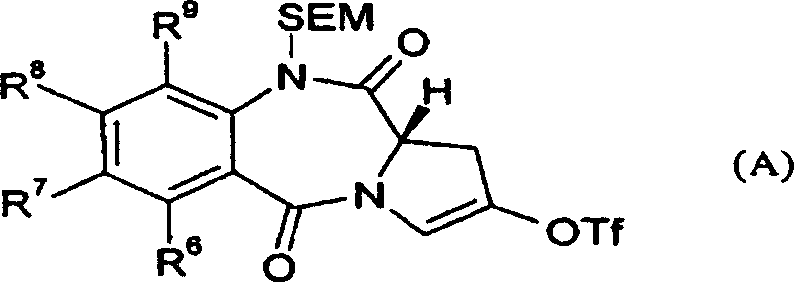
Key intermediate during The compounds of this invention is synthetic is a following compounds, i.e. the enol triflate of formula (A):
Radicals R wherein
6To R
9Define as final product, SEM represents the trimethylsilyl ethoxyl methyl, and OTf represents group-OSO
2CF
3In WO00/12508, describe the synthetic of this compound in detail, quote as a reference at this.Definite, with reference to the 24th page flow process 7, wherein above-claimed cpd is called as intermediate P.The SEM protecting group can replace with other nitrogen-protecting groups that is fit to.
Approach from this compound to required final product is as described in the flow process 1.
Flow process 1
Crucial enol triflate intermediate (A) can utilize the Suzuki linked reaction to be converted into two lactan (B) that suitable SEM-protects, just catalytic enol triflate of palladium (A) and the suitably cross-coupling effect of aryl boron derivative.
Two lactan (B) of SEM-protection can form protected carbinolamine intermediate, it can be handled to remove the SEM protecting group then then by reduction, are converted into required final formula (I) compound.The reductive action of two lactan (B) can realize by for example sodium borohydride, and the measure that is suitable for removing the SEM protecting group is to use silica gel treatment.
This route of synthesis is equally applicable to the synthetic of dipolymer.
Other purposes
The present invention also provide adjusting (for example suppressing) cell proliferation as the described compound of first aspect present invention.Thereby the present invention also provides in external or the body method of regulating (for example suppressing) cell proliferation, comprises cell is contacted with the compound of the first aspect present invention of significant quantity.
Definite, this inhibition can be at as disclosed some clone of embodiment.
(for example suppressing) cell proliferation that those of ordinary skills can determine easily whether a kind of candidate compound is regulated.For example, described in the following embodiments and can be advantageously used in assessing the active assay method that provides by specific compound.
For example, can make cell sample (for example from tumour) growth in vitro, make test compound and described cells contacting, observe the effect of this compound these cells.As the example of " effect ", can measure the morphology state (for example survival or death etc.) of cell.Wield influence if find the test compound pair cell, then this can carry the prognosis or the diagnostic markers of the effect in same cell type cell patient's the method in treatment as compound.
Methods of treatment
As mentioned above, a second aspect of the present invention provides the purposes of compound in methods of treatment of first aspect present invention.Methods of treatment also is provided, has comprised compound, be preferably the pharmaceutical compositions of third aspect present invention to the first aspect present invention of the object administering therapeutic significant quantity of needs treatments.Term " treatment significant quantity " is the amount that is enough to the patient is shown benefit.This class benefit can be that at least a symptom has improvement at least.Attribute and seriousness that actual amount of application and the speed of using and time-histories will depend on the disease for the treatment of.The prescription of treatment, the decision of for example dosage belong to general medical worker and other doctors' responsibility.
Compound can by separately or with other treatment simultaneously or co-administered in succession, this depends on the illness of being treated.The example of treatment and therapy includes but not limited to chemotherapy (administering active agents for example comprises medicine), operation and radiotherapy.
According to the present invention and be used for pharmaceutical composition of the present invention except activeconstituents, be can also comprise pharmaceutically acceptable vehicle, carrier, buffer reagent, stablizer or other materials well known to those skilled in the art formula (I) compound.This class material should be avirulent, and effect that should the interferon activity composition.The accurate attribute of carrier or other materials will depend on route of administration, and this can be oral or injection, for example through skin, subcutaneous or intravenous injection.
For Orally administered pharmaceutical composition can be tablet, capsule, pulvis or liquid form.Tablet can comprise solid carrier or auxiliary agent.Composition of liquid medicine generally comprises liquid vehicle such as water, oil, animal or plant oil, mineral oil or synthetic oil.Can comprise normal saline solution, glucose or other sugar solns or glycols such as ethylene glycol, propylene glycol or polyoxyethylene glycol.Capsule can comprise solid carrier such as gelatin.
With regard to intravenously, through skin or subcutaneous injection or with regard to the patient part injection, activeconstituents will be the acceptable aqueous solution form of parenteral, and it is pyrogen-free and has suitable pH, isotonicity and stability.Various equivalent modifications can prepare suitable solution fully, for example use to wait to ooze carrier such as sodium chloride injection, ringer's inj, lactic acid ringer's inj.Can comprise sanitas, stablizer, buffer reagent, antioxidant and/or other additives as required.
Preferably
Following all aspects that preferably go for the invention described above perhaps can relate to single aspect.These preferably can be combined with arbitrary combination.
R
6
To R
9
If compound is a dipolymer, preferred dipolymer bridge is formula-O-(CH
2)
n-O-, wherein n is 3 to 12, more preferably 3 to 7.
R
9H preferably.
R
6Be preferably selected from H, OH, OR, SH, NH
2, nitro and halogen, more preferably H or halogen, H most preferably.
R
7And R
8(when compound is not dipolymer) preferably is independently selected from H, OH, OR, SH, SR, NH
2, NHR, NHRR ' and halogen, more preferably be independently selected from H, OH and OR, wherein R preferably is selected from optional substituted C
1-7Alkyl, C
3-10Heterocyclic radical and C
5-10Aryl.Particularly preferred substituting group is OMe and OCH on 7-and the 8-position
2Ph.
R
2
In one group of embodiment, R
2It is optional substituted naphthyl.Preferred substituted comprises: halogen, and more definite is chlorine and fluorine; C
1-7Alkyl, more definite be C
1-4Alkyl, for example methyl and the tertiary butyl; Ether, more definite be C
1-4Alkoxyl group, for example methoxyl group and benzyloxy; C
5-20Aryl, definitely be phenyl.
Naphthyl can partly be connected optional position on its ring system with main PBD.For example, if naphthyl is unsubstituted, this group can be naphthalene-1-base or naphthalene-2-base so, and naphthalene-2-base is preferred.
Especially preferred naphthyl comprises: the naphthyl that naphthalene-2-base, 6-methoxynaphthalene-2-base, 6-oxyethyl group naphthalene-2-base and fluorine and/or chlorine replace, the fluorine or chlorine naphthalene-2-base of single replacement is most preferred.
Optionally substituting group also can encircle the position arbitrarily.Preferably the none substituting group is positioned at the either side of the key that partly is connected with main PBD.
In one group of embodiment, R
2It is optional substituted thienyl.Preferred substituted comprises: halogen, and more definite is chlorine and fluorine; C
1-7Alkyl, more definite be C
1-4Alkyl, for example methyl and the tertiary butyl; Ether, more definite be C
1-4Alkoxyl group, for example methoxyl group and benzyloxy; C
5-20Aryl, definitely be phenyl.
Thienyl can partly be connected any available position on its ring system with main PBD.For example, if thienyl is unsubstituted, this group can be thiophene-2-base or thiene-3-yl-so, and thiophene-2-base is preferred.
Especially preferred thienyl comprises: thiophene-2-base, 5-chlorothiophene-2-base and 5-thiotolene-2-base.
Optionally substituting group also can encircle the position arbitrarily.If thienyl is a thiene-3-yl-, so preferably the none substituting group is positioned at the either side of the key that partly is connected with main PBD.
In one group of embodiment, R
2It is optional substituted furyl.Preferred substituted comprises: halogen, and more definite is chlorine and fluorine; C
1-7Alkyl, more definite be C
1-4Alkyl, for example methyl and the tertiary butyl; Ether, more definite be C
1-4Alkoxyl group, for example methoxyl group and benzyloxy; C
5-20Aryl, definitely be phenyl.
Furyl can partly be connected any available position on its ring system with main PBD.For example, if furyl is unsubstituted, this group can be furans-2-base or furans-3-base so, and furans-2-base is preferred.
Especially preferred furyl comprises: furans-2-base, 5-chlorine furans-2-base and 5-methyl furan-2-base.
Optionally substituting group also can encircle the position arbitrarily.If furyl is furans-3-base, so preferably the none substituting group is positioned at the either side of the key that partly is connected with main PBD.
In another group embodiment, R
2Be phenyl, by ethyl or propyl group replace, preferably by ethyl or n-propyl, more preferably replaced by ethyl.These groups are preferably located in position, the position of neighbour-(2-) or right-(4-), adjacent-(2-) position is preferred.
Thereby, especially preferred this type R
2Group is the 4-ethylphenyl.
In another group embodiment, R
2Be phenyl, replaced by one or more chloros or fluoro group.If a substituting group is only arranged, it is preferably located in the position of neighbour-(2-) or right-(4-), more preferably right-(4-) position.If two or more substituting groups are arranged, generally speaking, ortho position and contraposition are the preferred substituted positions.But, preferably there are not two chlorine substituents to be positioned at 2-and 6-position.Also preferred all substituting groups are not that fluorine is exactly a chlorine.
Especially preferred this type R
2Group is 4-chloro-phenyl-, 4-fluorophenyl, 2-chloro-phenyl-, 2-fluorophenyl, 2,6-difluorophenyl and 3,4-dichlorophenyl.
Following compounds is particularly preferred:
(11aS)-1,11a-dihydro-7,8-dimethoxy-2-(2-naphthyl)-5H-pyrrolo-[2,1-c] [1,4] benzodiazepine
-5-ketone (11);
(11aS)-1,11a-dihydro-7,8-dimethoxy-2-(4-tert.-butylbenzene)-5H-pyrrolo-[2,1-c] [1,4] benzodiazepine
-5-ketone (13);
(11aS)-1,11a-dihydro-7,8-dimethoxy-2-(4-chlorobenzene)-5H-pyrrolo-[2,1-c] [1,4] benzodiazepine
-5-ketone (15);
(11aS)-1,11a-dihydro-7,8-dimethoxy-2-(4-fluorobenzene)-5H-pyrrolo-[2,1-c] [1,4] benzodiazepine
-5-ketone (17);
(11aS)-1,11a-dihydro-7,8-dimethoxy-2-(2-methylbenzene)-5H-pyrrolo-[2,1-c] [1,4] benzodiazepine
-5-ketone (19);
(11aS)-1,11a-dihydro-7,8-dimethoxy-2-(4-ethylbenzene)-5H-pyrrolo-[2,1-c] [1,4] benzodiazepine
-5-ketone (21);
(11aS)-1,11a-dihydro-7,8-dimethoxy-2-(2-thienyl)-5H-pyrrolo-[2,1-c] [1,4] benzodiazepine
-5-ketone (23);
(11aS)-1,11a-dihydro-7,8-dimethoxy-2-(2-furans)-5H-pyrrolo-[2,1-c] [1,4] benzodiazepine
-5-ketone (25); With
(11aS)-1,11a-dihydro-7,8-dimethoxy-2-(2, the 6-dimethyl benzene)-5H-pyrrolo-[2,1-c] [1,4] benzodiazepine
-5-ketone (27).
The compound of first aspect present invention is preferably used for treating cancer, particularly mammary cancer, kidney and lung cancer and inhibition mammary cancer, kidney and lung cancer cell line are grown, and is preferred for preparing to have above treatment and inhibiting medicine.
Definite, R wherein
2Be that the compound of optional substituted naphthyl or thienyl is preferably used for treating lung cancer, mammary cancer and kidney and melanoma, more preferably mammary cancer, and be preferred for preparing medicine with above therapeutic action.
R wherein
2Be that the compound with ethyl or the substituent phenyl of propyl group is preferably used for treating lung cancer, mammary cancer and kidney and melanoma, and be preferred for preparing medicine with above therapeutic action.
R wherein
2Be that the compound with phenyl of one or more fluoro substituents (preferred 4-fluoro substituents) is preferably used for treating kidney, and be preferred for preparing the medicine for the treatment of kidney.
R wherein
2Be that the compound with phenyl of 4-tertiary butyl substituting group, one or more chlorine substituent (preferred 4-chlorine substituent) or 2-methyl substituents is preferably used for treating mammary cancer, and be preferred for preparing the medicine for the treatment of mammary cancer.R wherein
2Be that the compound with 4-tert-butyl substituents phenyl also is preferably used for treating melanoma and kidney, and be preferred for preparing the medicine of treatment melanoma and kidney.
R wherein
2Be that the compound with phenyl of 2-methyl substituents is preferably used for treating kidney, and be preferred for preparing the medicine for the treatment of kidney.
R wherein
2Be to have 2, the compound of the substituent phenyl of 6-dimethyl is preferably used for treating kidney, and is preferred for preparing the medicine for the treatment of kidney.
Embodiment
General experimental technique
Fusing point (mp) is measured on Gallenkamp P1384 numeral fusing point instrument, and is not calibrated.Infrared (IR) spectrum Perkin-Elmer 297 spectrophotometer records.
1H-and
13C-NMR spectrum is record on Jeol GSX 270MHz FT-NMR spectrometer or Brucker AMX-250MHz NMR spectrometer, 20 ℃+/-1 ℃ operation down.Chemical shift is with 1,000,000/umber (δ) report of low of tetramethylsilane (TMS).Spin multiplicity is described to: s (unimodal), bs (wide unimodal), d (bimodal), dd (doublet of doublet), t (triplet), q (quartet), p (quintet) or m (multiplet).Mass spectrum (MS) Jeol JMS-DX 303GC mass spectrograph (EI pattern: 70eV, ion source 117-147 ℃) record.Accurately molecular mass (HRMS) is measured by peak matching method, uses perfluorokerosene (PFK) (PFK) as the internal soundness mark, and the FAB mass spectrum obtains from glycerine/thioglycerin/trifluoroacetic acid (1: 1: 0.1) matrix, 180 ℃ of ion source temperatures.The specific rotation at Na-D line place obtains with Perkin-Elmer 141 polariscopes at ambient temperature.Analytical results generally theoretical value+/-0.2% within.Flash chromatography carries out with Aldrich flash chromatography silica gel-60 (E.Merck, 230-400 order).Automatically flash chromatography carries out on Jones Flashmaster II.Thin-layer chromatography (TLC) is used GF
254Silica gel (containing fluorescent indicator) carries out on sheet glass.All solvent and reagent all by Aldrich Chemical Company Ltd. supply, need not during use to be further purified unless otherwise prescribed.Anhydrous solvent is prepared as follows: distill in dry nitrogen atmosphere in the presence of suitable siccative, store with 4A molecular sieve or sodium wire.Sherwood oil is illustrated in 40-60 ℃ of following ebullient cut.
Synthesizing of key intermediate
N-(4,5-dimethoxy-2-nitro benzoyl) oxyproline methyl ester (3)
At room temperature, to the 2-nitro-4 that is stirring, 5-dimethoxybenzoic acid (1) (25.01g, and disposable adding oxalyl chloride in anhydrous DCM (100mL) suspension 110.10mmol) (15.38g, 121.11mmol).Add the DMF (2) of catalytic amount, reaction mixture was stirred 16 hours under inert atmosphere.Under-20 ℃, solution of acid chloride is added drop-wise to azole compounds (2) (34.90g, the 110.10mmol that vigorous stirring; JOC 5,13, and 3621 (1994)) (45.95mL, 33.36g is in anhydrous DCM (100mL) solution 330.29mmol) with TEA.Reaction mixture was at room temperature stirred 16 hours.With the saturated NaHCO of reaction mixture
3(2 * 200mL), saturated NH
4Cl (2 * 200mL), water (2 * 200mL), salt solution (2 * 200mL) washing, through anhydrous MgSO
4Dry.Filter, evaporating solvent obtains crude product (3) in a vacuum, through the flash column chromatography purifying, uses EtOAc as eluent.Merge pure fraction, evaporate excessive eluent in a vacuum, obtain product, be foam (33.26g, 93.9mmol, 85%).
1H NMR(270MHz,CDCl
3)δ7.69(s,1H),6.87(s,1H),5.31(s,2H),4.97-4.82(m,1H),4.44(br s,1H),3.99(s,3H),3.98(s,3H),3.81(s,3H),3.54-3.48(m,1H),3.18(d,1H,J=2.02Hz),2.87(br s,1H),2.45-2.16(m,2H);
13C NMR(67.8MHz,CDCl
3)δ172.6,172.5,167.5,166.8,154.4,154.0,149.3,137.5,137.4,127.0,126.2,109.5,107.2,107.1,69.9,69.1,59.2,57.4,56.9,56.8,56.6,56.4,54.6,53.5,52.5,52.4,39.4,38.0。
(11aS)-6,7-dimethoxy-2 (R)-hydroxyl-2,3,5,10,11,11a-six hydrogen-5,11-dioxo-1H-pyrrolo-[2,1-c] [1,4-] benzodiazepine
(4)
To 3 (33.0g, anhydrous EtOH (250mL) solution adding 10%Pd/C catalyzer (3.3g) 93.1mmol).With reaction mixture 55psi H
2The hydrogenation 18 hours under pressure of Parr hydrogenator.By diatomite filtration, diatomite washs with hot MeOH with reaction mixture, notes filter cake is parched.Remove excessive solvent, obtain crude product (20.14g).With crude product at 1N HCl (200mL) and CHCl
3Stirred 30 minutes (200mL).Organic layer washs with 1N HCl (100mL), and combining water layer is used saturated NaHCO
3Aqueous solution neutralization.Keep somewhere water extract and spend the night, generate fine white precipitate (4), filter and collect, dry (7.81g, 26.72mmol, 29%).
1H NMR(270MHz,CDCl
3)δ10.06(s,1H,NH),7.61(s,1H,ArH),7.36(s,1H,ArH),4.49-4.41(m,1H,2),4.22-4.17(m,1H,11a),3.88(s,6H),3.82-3.55(m,2H,3),3.20(br s,1H,OH),2.87-2.77(m,1H,1),2.10-2.05(m,1H,1);
13C NMR(CDCl
3)δ170.2,165.9,152.0,145.7,130.7,118.2,111.9,104.2,68.1,56.0,55.6,54.2,34.6,18.8。
(11aS)-6,7-dimethoxy-2 (R)-[(t-butyldimethylsilyl) oxygen base]-2,3,5,10,11,11a-six hydrogen-5,11-dioxo-1H-pyrrolo-[2,1-c] [1,4-] benzodiazepine
(5)
(7.23g, 24.74mmol) (8.42g, (8.22g 54.44mmol), at room temperature stirred 16 hours the disposable adding solid of dry DMF 123.72mmol) (75mL) solution chloro TBDMS with imidazoles to 4.Reaction mixture is poured in the water (500mL), filtered, obtain crude product (5), recrystallization purifying from EtOH (800mL) is fine white needles thing (6.995g, 17.21mmol, 70%).
1H NMR(270MHz,CDCl
3)δ10.06(s,1H,NH),7.37(s,1H,ArH),6.68(s,1H,ArH),4.19-4.14(m,1H,2),4.06-4.01(m,1H,11a),3.90(s,3H,OMe),3.88(s,3H,OMe),3.69-3.63(m,2H,3),2.85-2.80(m,1H,1),2.05-2.01(m,1H,1);
13C NMR(67.8MHz,CDCl
3)δ170.4,170.2,165.9,152.1,145.8,145.6,131.1,130.7,118.1,111.9,104.3,104.1,69.2,69.1,56.0,55.9,55.7,54.3,54.0,35.0,25.8,25.7,25.6,17.9,-3.0,-3.5,-4.9,-5.0。
(11aS)-6,7-dimethoxy-2 (R)-[(t-butyldimethylsilyl) oxygen base]-2,3,5,10,11,11a-six hydrogen-10-[2-(trimethylsilyl) ethoxyl methyl]-5,11-dioxo-1H-pyrrolo-[2,1-c] [1,4-] benzodiazepine
(6)
Under 0 ℃, (18.34mmol) (6.50g, dry DMF 15.99mm0l) (27.5mL) solution stir reaction mixture 30 minutes the suspension Dropwise 5 for 0.422g, 0.704g 60% mineral oil dispersion to the NaH that is stirring.(dry DMF 17.59mmol) (5mL) solution at room temperature stirred 16 hours for 3.11mL, 2.93g to drip SEM chlorine to the reaction mixture that is stirring under 0 ℃.Reaction mixture is poured in the water (200mL), obtained white precipitate, with diethyl ether extraction (4 * 300mL).With the organic layer water (2 * 50mL), salt solution (2 * 50mL) washing, through anhydrous MgSO
4Dry.Filter, evaporating solvent obtains crude product in a vacuum, and through the flash column chromatography purifying, 80: 20 mixtures that use sherwood oil: EtOAc are as eluent.Merge pure fraction, evaporation obtains product (6) in a vacuum, is yellow oil (7.01g, 13.1mmol, 82%).
1H NMR (270MHz, CDCl
3) δ 7.35 (s, 1H, ArH), 7.24 (s, 1H, ArH), 5.52 (d, 2H, J=9.89Hz, SEM amido-acetal CH
2), 4.65 (d, 2H, J=9.90Hz, SEM amido-acetal CH
2), 4.61-4.56 (m, 1H, 2), 4.23 (dd, 1H, J=4.40Hz, 8.24Hz, 11a), 3.94 (s, 3H, OMe), 3.92 (s, 3H, OMe), 3.68 (m, 4H, SEM 1=CH
2+ 3), 2.86 (m, 1H, 1), 2.02 (m, 1H, 1), 0.98 (t, 2H, J=8.25Hz, SEM 2=CH
2), 0.88 (s, 9H, TBDMSt-Bu CH
3), 0.10 (s, 6H, 2x TBDMS SiCH
3), 0.03 (s, 9H, 3x SEM SiCH
3);
13C NMR (67.8MHz, CDCl
3) δ 170.0,165.6,151.8,147.1,133.9,121.5,111.2,105.5,78.1,69.6,67.0,56.5,56.2,56.1,53.6,35.5,25.7,18.4 ,-1.3 ,-4.8.(11aS)-6,7-dimethoxy-2 (R)-hydroxyl-2,3,5,10,11,11a-six hydrogen-10-[2-(trimethylsilyl) ethoxyl methyl]-5,11-dioxo-1H-pyrrolo-[2,1-c] [1,4-] benzodiazepine
(7)
To stirring 6 (7.0g, THF 13.05mmol) (50mL) solution add 1N TBAF THF solution (19.58mL, 19.58mmol).Reaction mixture was at room temperature stirred 2 hours, with DCM (200mL) dilution, water (2 * 200mL), salt solution (2 * 200mL) washing, through anhydrous MgSO
4Dry.Filter, remove excessive solvent, obtain crude product, through the flash column chromatography purifying, use 50: 50 sherwood oils: EtOAc is as eluent.Evaporate pure fraction in a vacuum, obtain product (7) (5.9g).
1H NMR (270MHz, CDCl
3) δ 7.30 (s, 1H, ArH), 7.24 (s, 1H, ArH), 5.52 (d, 1H, J=9.9Hz, SEM amido-acetal CH
2), 4.68-4.64 (m, 2H, SEM amido-acetal CH
2+ 2), 4.30 (dd, 1H, J=5.86,8.24Hz), 3.91 (s, 3H, OMe), 3.90 (s, 3H, OMe), 3.87-3.51 (m, 4H, SEM 1=CH
2+ 3), 2.95 (dt, 1H, J=5.31,13.56Hz, 1), 2.17-2.08 (m, 1H, 1), 1.02-0.93 (m, 2H, SEM 2=CH
2), 0.03 (s, 9H, 3x SiCH
3);
13C NMR (67.8MHz, CDCl
3) δ 169.7,165.9,151.9,147.1,134.0,121.1,111.2,105.5,78.2,69.1,67.1,56.5,56.1,53.9,34.9,18.4 ,-1.3.
(11aS)-6,7-dimethoxy-2,3,5,10,11,11a-six hydrogen-10-[2-(trimethylsilyl) ethoxyl methyl]-2,5,11-trioxy--1H-pyrrolo-[2,1-c] [1,4-] benzodiazepine
(8)
Under-50 ℃ of nitrogen atmosphere, to the oxalyl chloride that is stirring (10.48mL 2N DCM solution, 20.97mmol) go through the anhydrous DMSO that dripped in 5 minutes among the anhydrous DCM (20mL) (3.28g, 41.94mmol).Stir after 5 minutes, (5.90g, anhydrous DCM (45mL) solution 13.98mmol) stirred other 45 minutes down at-50 ℃ then to go through dropping 7 in 45 minutes to reaction mixture.To mixture go through dripped in 15 minutes TEA (9.89g, 97.87mmol), succeeded by stirring other 15 minutes.Make reaction mixture be warmed to room temperature, use H
2O (150mL) and DCM (100mL) dilution.With organic phase with 1N HCl (2 * 100mL), water (2 * 100mL), (2 * 100mL) washings are through MgSO for salt solution
4Dry.Filter, evaporation obtains crude product (8), and through the flash column chromatography purifying, use 50: 50 sherwood oils (40-60 ℃): EtOAc is as eluent.Evaporate pure fraction in a vacuum, obtain product (4.33g, 10.3mmol, 74%).
1H NMR (270MHz, CDCl
3) δ 7.30 (s, 1H, ArH), 7.24 (s, 1H, ArH), 5.60 (d, 1H, J=9.89Hz, SEM amido-acetal CH
2), 4.69 (d, 1H, J=9.89Hz, SEM amido-acetal CH
2), 4.62 (dd, 1H, J=9.89,3.12Hz, 11a), 4.26-4.19 (m, 1H, 3), 3.95 (s, 3H, OMe), 3.94 (s, 3H, OMe), 3.81-3.49 (m, 4H, SEM 1=CH
2+ 1+3), 2.82-2.71 (m, 1H, 1), 0.95 (t, 2H, J=2.01Hz, SEM 2=CH
2) ,-0.04 (s, 9H, SEM CH
3);
13C NMR (67.8MHz, CDCl
3) δ 206.8,168.8,165.9,152.4,147.5,134.0,120.4,111.1,105.6,78.2,67.2,56.2,54.8,52.3,37.3,18.3 ,-1.3.
(11aS)-5,10,11,11a-tetrahydrochysene-7,8-dimethoxy-10-[2-(trimethylsilyl) ethoxyl methyl]-the 2-[[(trifluoromethyl) alkylsulfonyl] the oxygen base]-5,11-dioxo-1H-pyrrolo-[2,1-c] [1,4] benzodiazepine
(9)
To vigorous stirring 8 (2.0g, (0.46mL, 0.452g 5.73mmol), at room temperature stirred mixture 10 minutes the disposable adding anhydrous pyridine of anhydrous DCM (100mL) solution 4.77mmol).(1.25mL, 1.48g 5.25mmol), at room temperature stirred reaction mixture 4.5 hours the anhydrous trifluoromethanesulfanhydride anhydride of disposable quick adding.Pour the homogeneous reaction mixture of deepening into cold saturated NaHCO
3(200mL), mixture extracts (3 * 50mL) with DCM.Merge organic layer, water (2 * 200mL), (2 * 200mL) washings are through anhydrous MgSO for salt solution
4Dry.Filter, evaporation obtains crude product, and through the flash column chromatography purifying, use 80: 20 sherwood oils: EtOAc is as eluent.Evaporate pure fraction in a vacuum, obtain product (9), be yellow oil (1.79g, 3.25mmol, 68%).
1H NMR (270MHz, CDCl
3) δ 7.29 (s, 1H, ArH), 7.23 (s, 1H, ArH), 7.15 (t, 1H, J=2.01Hz, H3), 5.53 (d, 1H, J=10.07Hz, SEM amido-acetal CH
2), 4.68 (d, 1H, J=9.89Hz, SEM amido-acetal CH
2).
Embodiment 1:(11aS)-1,11a-dihydro-7,8-dimethoxy-2-(2-naphthyl)-5H-pyrrolo-[2,1-c] [1,4] benzodiazepine
Synthesizing of-5-ketone (11)
(a) 2-(2-naphthyl)-7,8-dimethoxy-10-(2-trimethylsilyl-ethoxyl methyl)-1,11a-dihydro-5H-pyrrolo-[2,1-c] [1,4] benzodiazepine
-5-ketone (10)
To 9 (517mg, ethanol/water/benzene 0.93mmol) (20/20/20mL) solution add yellow soda ash (300mg, 2.83mmol), the 2-naphthalene for boric acid (171mg, 0.99mmol) and four (triphenyl phosphine) palladium (0) (30mg), at room temperature stirred 96 hours.Reaction mixture is diluted with ethyl acetate (220mL), and water (50mL) and salt solution (50mL) washing are through dried over mgso.Crude product uses the hexane that contains 70% ethyl acetate as eluent through the flash column chromatography purifying, obtains pure products 10, is yellow oil.
1H(250MHz,CDCl
3)NMR:δ7.85-7.71(m,4H,Ar-H x 4),7.67-7.54(m,2H,H-3,Ar-H x 1),7.52-7.39(m,3H,H-6,Ar-H x 2),7.33-7.27(s,1H,H-9),5.58(d,1H,J=9.93Hz,N-CH
2-OSEM x 1),4.79-4.66(m,2H,N-CH
2-OSEM x 1,H-11a),4.11(d,1H,J=16.28Hz,H-1x 1),3.97 & 3.95(2s,6H,7-& 8-MeO),3.90-3.65(m,2H,O-CH
2-SEM),3.28(dd,1H,J=10.92,16.23Hz,H-1x 1),1.00(t,2H,J=8.23Hz,CH
2-SEM),0.04(s,9H,SEM-Si(CH
3)
3)。
(b) (11aS)-1,11a-dihydro-7,8-dimethoxy-2-(2-naphthyl)-5H-pyrrolo-[2,1-c] [1,4] benzodiazepine
-5-ketone (11)
To stirring 10 (971mg, 1.8mmol) solution in dehydrated alcohol (19mL) and anhydrous THF (37mL) mixture added solid sodium borohydride in three batches at interval with two hours (654mg 17.2mmol), at room temperature stirred 24 hours.With reaction mixture water (50mL) dilution, with ethyl acetate extraction (3 * 50mL).Evaporate organic layer in a vacuum.Crude product is handled with ethanol (50mL), water (30mL) and silica gel (18.3g), at room temperature stirred 24 hours.Reaction mixture is filtered product ethyl acetate extraction (3 * 50mL).Merge organic layer, with salt solution (20mL) washing, through anhydrous magnesium sulfate drying.Filter, evaporation obtains crude product in a vacuum, uses the flash column chromatography purifying, uses to contain the ethyl acetate of 70-50% hexane as eluent.Merge pure fraction, evaporation obtains pure products 11 in a vacuum, is yellow powder (151mg, 0.39mmol, 22% yield).
1H(250MHZ,CDCL
3)NMR:δ7.9(d,1H,J=4.0Hz,H11),7.86-7.40(m,8H,H3,H6,6x Ar-H),6.85(s,1H,H9),4.48(dt,1H,J=4.9,11.2Hz,H11a),3.98 & 3.95(2s,6H,7-& 8-MeO),3.80-3.46(m,2H,2x H1)。
Embodiment 2:(11aS)-1,11a-dihydro-7,8-dimethoxy-2-(4-tert.-butylbenzene)-5H-pyrrolo-[2,1-c] [1,4] benzodiazepine
Synthesizing of-5-ketone (13)
(a) 2-(4-tert.-butylbenzene)-7,8-dimethoxy-10-(2-trimethylsilyl-ethoxyl methyl)-1,11a-dihydro-5H-pyrrolo-[2,1-c] [1,4] benzodiazepine
-5-ketone (12)
To 9 (502mg, ethanol/water/benzene 0.91mmol) (20/20/20mL) solution add yellow soda ash (302mg, 2.85mmol), the 4-tert.-butylbenzene for boric acid (177mg, 0.99mmol) and four (triphenyl phosphine) palladium (0) (30mg), at room temperature stirred 41 hours.Reaction mixture is diluted with ethyl acetate (220mL), and water (50mL) and salt solution (50mL) washing are through dried over mgso.Crude product uses the ethyl acetate gradient system that contains the 100-50% hexane as eluent through automatic flash column chromatography purifying, obtains pure products 12 (408mg, 0.76mmol, 84% yield).
1H (250MHz, CDCl
3) NMR: δ 7.45-7.29 (m, 7H, H-6 ﹠amp; H-3 ﹠amp; H-9 ﹠amp; Ar-H x 4), 5.56 (d, 1H, J=9.97Hz, N-CH
2-OSEM x 1), 4.78-4.55 (m, 2H, N-CH
2-OSEM x 1, H-11a), 4.04-3.60 (m .9H, 7-﹠amp; 8-MeO and H-1x 1 ﹠amp; O-CH
2-SEM), 3.16 (dd, 1H, J=10.35,15.52Hz, H-1x 1), (a plurality of unimodal, non-all methyl are equal to 1.38-1.21,9H, t-Bu (CH
3)
3), 1.04-0.80 (m, 2H, CH
2-SEM), (a plurality of unimodal, non-all methyl are equal to 0.09-(0.04), 9H, SEM-Si (CH
3)
3).
(b) (11aS)-1,11a-dihydro-7,8-dimethoxy-2-(4-tert.-butylbenzene)-5H-pyrrolo-[2,1-c] [1,4] benzodiazepine
-5-ketone (13)
To stirring 12 (398mg, 0.74mmol) solution in dehydrated alcohol (7.5mL) and anhydrous THF (15mL) mixture added in three batches at 0,5 and 30 hour sodium borohydride (531mg, 14.0mmol).Reaction mixture was at room temperature stirred 44 hours.With reaction mixture water (50mL) dilution, with ethyl acetate extraction (3 * 50mL).Evaporate organic layer in a vacuum.Crude product is handled with ethanol (50mL), water (25mL) and silica gel (7.5g), at room temperature stirred 24 hours.Reaction mixture is filtered product ethyl acetate extraction (3 * 50mL).Merge organic layer, with salt solution (20mL) washing, through anhydrous magnesium sulfate drying.Filter, evaporation obtains crude product in a vacuum, uses the flash column chromatography purifying, uses to contain the ethyl acetate of 70-50% hexane as eluent.Merge pure fraction, evaporation obtains pure products 13 in a vacuum, is yellow glass shape solid (193mg, 0.49mmol, 67% yield).
1H(250MHZ,CDCL
3)NMR:δ7.89(d,1H,J=3.94Hz,H11),7.58-7.17(m,6H,H3,H6,4x Ar-H),6.84(s,1H,H9),4.49-4.35(m,1H,H11a),4.05-3.51(m,7H,7-& 8-MeO,H1),3.49-3.33(m,1H,H1),1.34(s,9H,Ar-tBu)。
Embodiment 3:(11aS)-1,11a-dihydro-7,8-dimethoxy-2-(4-chlorobenzene)-5H-pyrrolo-[2,1-c] [1,4] benzodiazepine
Synthesizing of-5-ketone (15)
(a) 2-(4-chlorobenzene)-7,8-dimethoxy-10-(2-trimethylsilyl-ethoxyl methyl)-1,11a-dihydro-5H-pyrrolo-[2,1-c] [1,4] benzodiazepine
-5-ketone (14)
To 9 (500mg, 0.90mmol) ethanol/water/benzene (20/20/20mL) solution add yellow soda ash (300mg, 2.83mmol), chlorobenzene is for boric acid (155.28mg, 1.00mmol) and four (triphenyl phosphine) palladium (0) (30mg), at room temperature stirred 46 hours, this moment add other chlorobenzene for boric acid (155mg, 0.99mmol) and four (triphenyl phosphine) palladium (0) (30mg).With other 44 hours of solution stirring, use ethyl acetate (220mL) dilution then, water (50mL) and salt solution (50mL) wash.Solution through the flash column chromatography purifying, uses the hexane that contains 70% ethyl acetate as eluent through dried over mgso, obtains pure products 14, is brown oil (411mg, 0.86mmol, 95% yield).
1H (250MHz, CDCl
3) NMR: δ 7.46-7.22 (m, 7H, H-3 ﹠amp; H-6 ﹠amp; Ar-H x4 ﹠amp; H-9), 5.55 (d, 1H J=9.92Hz, N-CH
2-OSEM x 1), 4.77-4.61 (m, 2H, N-CH
2-OSEM x 1 ﹠amp; H-11a), 4.01-3.87 (m, 7H, H-1x 1 and 7-﹠amp; 8-MeO), 3.87-3.63 (m, 2H, O-CH
2-SEM), 3.13 (ddd, 1H, J=2.09,10.56,16.15Hz, H-1x 1), 0.98 (t, 2H, J=8.20Hz, CH
2-SEM), 0.03 (s, 9H, SEM-Si (CH
3)
3).
(b) (11aS)-1,11a-dihydro-7,8-dimethoxy-2-(4-chlorobenzene)-5H-pyrrolo-[2,1-c] [1,4] benzodiazepine
-5-ketone (15)
To stirring 14 (386mg, 0.75mmol) solution in dehydrated alcohol (7.5mL) and anhydrous THF (15mL) mixture added sodium borohydride in three batches (531mg 14mmol), at room temperature stirred 24 hours at 0,5 and 12 hour.With reaction mixture water (50mL) dilution, with ethyl acetate extraction (3 * 50mL).Evaporate organic layer in a vacuum.Crude product is handled with ethanol (50mL), water (25mL) and silica gel (7.5g), at room temperature stirred 24 hours.Reaction mixture is filtered product ethyl acetate extraction (3 * 50mL).Merge organic layer, with salt solution (20mL) washing, through anhydrous magnesium sulfate drying.Filter, evaporation obtains crude product in a vacuum, uses the flash column chromatography purifying, uses to contain the ethyl acetate of 70-50% hexane as eluent.Merge pure fraction, evaporation obtains pure products 15 in a vacuum, is yellow solid (97.5mg, 0.26mmol, 35% yield).
1H(250MHZ,CDCL
3)NMR:δ7.90(d,1H,J=3.9Hz,H11),7.53(s,1H,H6),7.50(bs,1H,H3),7.32(s,4H,4x Ar-H),6.84(s,1H H9),4.44(ddd,1H,J=4.1,5.3,11.4Hz,H11a),3.97 & 3.95(2s,6H,7-& 8-MeO),3.58(ddd,1H,J=1.98,11.6,16.3Hz,H1),3.4(ddd,1H,J=1.7,5.4,16.3Hz,H1)。
Embodiment 4:(11aS)-1,11a-dihydro-7,8-dimethoxy-2-(4-fluorobenzene)-5H-pyrrolo-[2,1-c] [1,4] benzodiazepine
Synthesizing of-5-ketone (17)
(a) 2-(4-fluorobenzene)-7,8-dimethoxy-10-(2-trimethylsilyl-ethoxyl methyl)-1,11a-dihydro-5H-pyrrolo-[2,1-c] [1,4] benzodiazepine
-5-ketone (16)
To 9 (500mg, ethanol/water/benzene 0.90mmol) (20/20/20mL) solution add yellow soda ash (308mg, 2.91mmol), the 4-fluorobenzene for boric acid (139mg, 0.99mmol) and four (triphenyl phosphine) palladium (0) (30mg), at room temperature stirred 93 hours.Reaction mixture is diluted with ethyl acetate (220mL), and water (50mL) and salt solution (50mL) washing are through dried over mgso.Crude product uses the ethyl acetate gradient system that contains the 100-50% hexane as eluent through automatic flash column chromatography purifying, obtains pure products 16, is yellow oil (441mg, 0.88mmol, 99% yield).
1H (250MHz, CDCl
3) NMR: δ 7.45-7.32 (m, 5H, H-6 ﹠amp; H-3 ﹠amp; Ar-H x2), 7.27 (s, 1H, H-9), 7.04 (t, 2H, Ar-H x 2), 5.56 (d, 1H, J=9.80Hz, N-CH
2-OSEM x 1), 4.72 (d, 1H, J=9.49Hz, N-CH
2-OSEM x 1), 4.65 (dd, 1H, J=3.28,10.17Hz, H-11a), 4.04-3.88 (m, 7H, 7-﹠amp; 8-MeO and H-1x 1), 3.88-3.64 (m, 2H, O-CH
2-SEM), 3.14 (ddd, 1H, J=2.26,10.57,16.25Hz, H-1x 1), 0.99 (t, 2H, J=8.33Hz, CH
2-SEM), 0.03 (s, 9H, SEM-Si (CH
3)
3).
(b) (11aS)-1,11a-dihydro-7,8-dimethoxy-2-(4-fluorobenzene)-5H-pyrrolo-[2,1-c] [1,4] benzodiazepine
-5-ketone (17)
To stirring 16 (429mg, 0.861mmol) solution in dehydrated alcohol (8.6mL) and anhydrous THF (17.2mL) mixture added in two batches at 0 and 5 hour sodium borohydride (201mg, 5.3mmol).Reaction mixture was at room temperature stirred 24 hours.With reaction mixture water (50mL) dilution, with ethyl acetate extraction (3 * 50mL).Evaporate organic layer in a vacuum.Crude product is handled with ethanol (50mL), water (25mL) and silica gel (8.6g), at room temperature stirred 24 hours.Reaction mixture is filtered product ethyl acetate extraction (3 * 50mL).Merge organic layer, with salt solution (20mL) washing, through anhydrous magnesium sulfate drying.Filter, evaporation obtains crude product in a vacuum, uses the flash column chromatography purifying, uses to contain the ethyl acetate of 70-50% hexane as eluent.Merge pure fraction, evaporation obtains pure products 17 in a vacuum, is yellow glass shape solid (139mg, 0.39mmol, 46% yield).
1H(250MHZ,CDCL
3)NMR:δ7.90(d,1H,J=3.9Hz,H11),7.53(s,1H,H6),7.45(s,1H,H3),7.40-7.20(m,1H,1x Ar-H),7.10-6.90(m,3H,3xAr-H),6.84(s,1H,H9),4.43(ddd,1H,J=4.1,5.4,11.4Hz,H11a),3.97 &3.95(2s,6H,7-& 8-MeO),3.69-3.50(m,1H,H1),3.39(ddd,1H,J=1.5,5.3,16.3Hz,H1)。
Embodiment 5:(11aS)-1,11a-dihydro-7,8-dimethoxy-2-(2-methylbenzene)-5H-pyrrolo-[2,1-c] [1,4] benzodiazepine
Synthesizing of-5-ketone (19)
(a) 2-(2-methylbenzene)-7,8-dimethoxy-10-(2-trimethylsilyl-ethoxyl methyl)-1,11a-dihydro-5H-pyrrolo-[2,1-c] [1,4] benzodiazepine
-5-ketone (18)
To 9 (500mg, ethanol/water/benzene 0.90mmol) (20/20/20mL) solution add yellow soda ash (300mg, 2.83mmol), the 2-methylbenzene for boric acid (135mg, 0.99mmol) and four (triphenyl phosphine) palladium (0) (30mg), at room temperature stirred 20 hours.Reaction mixture is diluted with ethyl acetate (220mL), and water (50mL) and salt solution (50mL) washing are through dried over mgso.Crude product uses the ethyl acetate gradient system that contains the 100-50% hexane as eluent through automatic flash column chromatography purifying, obtains pure products 18, is xanchromatic oil (439mg, 0.89mmol, 98% yield).
1H(250MHz,CDCl
3)NMR:δ7.44-7.09(m,7H,H-6 & H-3 & H-9 &Ar-H x 4),5.59(d,1H,J=9.97Hz,N-CH
2-OSEM x 1),4.78-4.50(m,2H,N-CH
2-OSEM x 1,H-11a),4.06-3.60(m,9H,7-& 8-MeO,O-CH
2-SEM,H-1x 1),3.22(dd,1H,J=10.23,16.31Hz,H-1x 1),2.48(bs,3H,Ar-2-Me),1.06-0.79(m,2H,CH
2-SEM),0.03(bs,9H,SEM-Si(CH
3)
3)。
(b) (11aS)-1,11a-dihydro-7,8-dimethoxy-2-(2-methylbenzene)-5H-pyrrolo-[2,1-c] [1,4] benzodiazepine
-5-ketone (19)
To stirring 18 (429mg, 0.87mmol) solution in dehydrated alcohol (8.5mL) and anhydrous THF (17.5mL) mixture added in three batches at 0,5 and 12 hour sodium borohydride (500mg, 13.2mmol).Reaction mixture was at room temperature stirred 24 hours.With reaction mixture water (50mL) dilution, with ethyl acetate extraction (3 * 50mL).Evaporate organic layer in a vacuum.Crude product is handled with ethanol (50mL), frozen water (25mL) and silica gel (8.5g), at room temperature stirred 24 hours.Reaction mixture is filtered product ethyl acetate extraction (3 * 50mL).Merge organic layer, with salt solution (20mL) washing, through anhydrous magnesium sulfate drying.Filter, evaporation obtains crude product in a vacuum, uses the flash column chromatography purifying, uses to contain the ethyl acetate of 70-50% hexane as eluent.Merge pure fraction, evaporation obtains pure products 19 in a vacuum, is yellow solid (74mg, 0.21mmol, 25% yield).
1H(250MHZ,CDCL
3)NMR:δ7.92(d,1H,J=3.9Hz,H11),7.55(s,1H,H6),7.34-7.14(m,5H,H3,4x Ar-H),6.85(s,1H,H9),4.39(dt,1H,J=4.7,11.4Hz,H11a),3.97 & 3.95(2s,6H,7-& 8-MeO),3.78-3.59(m,1H,H1),3.47(dd,1H,J=5.2,16.2Hz,H1),2.49(s,3H,Ar-CH
3)。
Embodiment 6:(11aS)-1,11a-dihydro-7,8-dimethoxy-2-(4-ethylbenzene)-5H-pyrrolo-[2,1-c] [1,4] benzodiazepine
Synthesizing of-5-ketone (21)
(a) 2-(4-ethylbenzene)-7,8-dimethoxy-10-(2-trimethylsilyl-ethoxyl methyl)-1,11a-dihydro-5H-pyrrolo-[2,1-c] [1,4] benzodiazepine
-5-ketone (20)
To 9 (501mg, ethanol/water/benzene 0.91mmol) (20/20/20mL) solution add yellow soda ash (302mg, 2.85mmol), the 4-ethylbenzene for boric acid (149mg, 0.993mmol) and four (triphenyl phosphine) palladium (0) (30mg), at room temperature stirred 41 hours.Reaction mixture is diluted with ethyl acetate (220mL), and water (50mL) and salt solution (50mL) washing are through dried over mgso.Crude product uses the ethyl acetate gradient system that contains the 100-50% hexane as eluent through automatic flash column chromatography purifying, obtains pure products 20, is yellow solid (342mg, 0.67mmol, 74% yield).
1H (250MHz, CDCl
3) NMR: δ 7.46-7.15 (m, 7H, H-6 ﹠amp; H-3 ﹠amp; H-9 ﹠amp; Ar-H x 4), 5.57 (d, 1H, J=9.88Hz, N-CH
2-OSEM x 1), 4.72 (d, 1H, J=9.95Hz, N-CH
2-OSEM x 1), 4.65 (dd, 1H, J=3.52,10.85Hz, H-11a), 4.03-3.88 (m, 7H, 7-﹠amp; 8-MeO and H-1x 1), 3.88-3.64 (m, 2H, O-CH
2-SEM), 3.16 (dd, 1H, J=10.84,16.51Hz, H-1x 1), 2.66 (q, 2H, J=7.68Hz, Ar-CH
2-Me x 2), 1.24 (t, 3H, J=7.57Hz, ArCH
2-CH
3), 0.99 (t, 2H, J=8.29Hz, CH
2-SEM), 0.04 (s, 9H, SEM-Si (CH
3)
3).
(b) (11aS)-1,11a-dihydro-7,8-dimethoxy-2-(4-ethylbenzene)-5H-pyrrolo-[2,1-c] [1,4] benzodiazepine
-5-ketone (21)
To stirring 20 (429mg, 0.87mmol) solution in dehydrated alcohol (8.5mL) and anhydrous THF (17.5mL) mixture added in three batches at 0,5 and 12 hour sodium borohydride (500mg, 13.2mmol).Reaction mixture was at room temperature stirred 24 hours.With reaction mixture water (50mL) dilution, with ethyl acetate extraction (3 * 50mL).Evaporate organic layer in a vacuum.Crude product is handled with ethanol (50mL), frozen water (25mL) and silica gel (8.5g), at room temperature stirred 24 hours.Reaction mixture is filtered product ethyl acetate extraction (3 * 50mL).Merge organic layer, with salt solution (20mL) washing, through anhydrous magnesium sulfate drying.Filter, evaporation obtains crude product in a vacuum, uses the flash column chromatography purifying, uses to contain the ethyl acetate of 70-50% hexane as eluent.Merge pure fraction, evaporation obtains pure products 21 in a vacuum, is yellow solid (74mg, 0.21mmol, 25% yield).
1H(250MHZ,CDCL
3)NMR:δ7.92(d,1H,J=3.9Hz,H11),7.55(s,1H,H6),7.34-7.14(m,5H,H3,4x Ar-H),6.85(s,1H,H9),4.39(dt,1H,J=4.7,11.4Hz,H11a),3.97 & 3.95(2s,6H,7-& 8-MeO),3.78-3.59(m,1H,H1),3.47(dd,1H,J=5.2,16.2Hz,H1),2.49(s,3H,Ar-CH
3)。
Embodiment 7:(11aS)-1,11a-dihydro-7,8-dimethoxy-2-(2-thiophene)-5H-pyrrolo-[2,1-c] [1,4] benzodiazepine
Synthesizing of-5-ketone (23)
(a) 2-(2-thiophene)-7,8-dimethoxy-10-(2-trimethylsilyl-ethoxyl methyl)-1,11a-dihydro-5H-pyrrolo-[2,1-c] [1,4] benzodiazepine
-5-ketone (22)
To 9 (500mg, 0.90mmol) ethanol/water/benzene (20/20/20mL) solution add yellow soda ash (305mg, 2.88mmol), the 2-thiophene for boric acid (127mg, 0.99mmol) and four (triphenyl phosphine) palladium (0) (30mg), at room temperature stirred 164.5 hours, and refluxed other 4 hours down at 80 ℃.Reaction mixture is diluted with ethyl acetate (200mL), and water (50mL) and salt solution (50mL) washing are through dried over mgso.Crude product uses the ethyl acetate gradient system that contains the 100-50% hexane as eluent through automatic flash column chromatography purifying, obtains pure products 22, is yellow oil (353mg, 0.73mmol, 80% yield).
1H(250MHz,CDCl
3)NMR:δ7.39(s,1H,H-6),7.32-7.17(m,3H,H-3,H-9,Ar-H x 1),7.06-6.94(m,2H,Ar-H x 2),5.56(d,1H,J=9.97Hz,N-CH
2-OSEM x 1),4.71(d,1H,J=9.91Hz,N-CH
2-OSEM x 1),4.64(dd,1H,J=3.51,10.56Hz,H-11a),4.02-3.88(m,7H,7-& 8-MeO,H-1x 1),3.88-3.63(m,2H,O-CH
2-SEM),3.18(ddd,1H,J=2.38,10.76,16.11Hz,H-1x 1),0.99(t,2H,J=8.24Hz,CH
2-SEM),0.04(s,9H,SEM-Si(CH
3)
3)。
(b) (11aS)-1,11a-dihydro-7,8-dimethoxy-2-(2-thiophene)-5H-pyrrolo-[2,1-c] [1,4] benzodiazepine
-5-ketone (23)
To stirring 22 (333mg, 0.69mmol) solution in dehydrated alcohol (6.9mL) and anhydrous THF (13.8mL) mixture added sodium borohydride in three batches (520mg 13.7mmol), at room temperature stirred 30 hours at 0,7 and 14 hour.With reaction mixture water (50mL) dilution, with ethyl acetate extraction (3 * 50mL).Evaporate organic layer in a vacuum.Crude product is handled with ethanol (50mL), water (25mL) and silica gel (6.9g), at room temperature stirred 24 hours.Reaction mixture is filtered product ethyl acetate extraction (3 * 50mL).Merge organic layer, with salt solution (20mL) washing, through anhydrous magnesium sulfate drying.Filter, evaporation obtains crude product in a vacuum, uses the flash column chromatography purifying, uses to contain the ethyl acetate of 70-50% hexane as eluent.Merge pure fraction, evaporation obtains pure products 23 in a vacuum, is yellow solid (49.6mg, 0.15mmol, 21% yield).
MS (ES) m/z (relative intensity): 389.2 (22), 373.2 (14), 341 (8), 194.3 (100).
Embodiment 8:(11aS)-1,11a-dihydro-7,8-dimethoxy-2-(2-furans)-5H-pyrrolo-[2,1-c] [1,4] benzodiazepine
Synthesizing of-5-ketone (25)
(a) 2-(2-furans)-7,8-dimethoxy-10-(2-trimethylsilyl-ethoxyl methyl)-1,11a-dihydro-5H-pyrrolo-[2,1-c] [1,4] benzodiazepine
-5-ketone (24)
To the 9 (700mg that stirring, 1.27mmol), LiCl (161mg, 3.8mmol) and 2-(tributyl stannyl) furans (0.526mL, 615mg, 1.65mmol) add four (triphenyl phosphine) palladium (the 0) (5mol% of catalytic amount in the mixture in anhydrous THF (20mL), 73mg, 0.063mmol), heating is 2.5 hours under refluxing.Chilled reaction mixture is diluted with DCM (100mL), and mixture washs with 10% ammonium hydroxide aqueous solution (100mL).With organic layer water (100mL), salt solution (100mL) washing, through anhydrous MgSO
4Dry.Filter, evaporating solvent obtains crude product in a vacuum, further passes through purification by flash chromatography, and 75: 25 mixtures that use hexane: EtOAc are as eluent.Merge pure fraction, evaporating solvent obtains product 24 (484mg, 1.03mmol, 81%) in a vacuum.
1H NMR(CDCl
3)δ7.35(s,2H),7.27(s,1H),7.23(d,J
1=1.5Hz,1H),6.37(dd,J
1=1.7Hz,J
2=3.2Hz,1H),6.26(d,J
1=3.2Hz),5.52(d,J=10Hz,1H,SEM),4.67(d,J=10Hz,1H,SEM),4.58(dd,J
1=3.3Hz,J
2=10.6Hz,1H,H11a),3.91(s,3H,OMe),3.90(s,3H,OMe),3.86-3.74(m,2H,1SEM,1H1),3.69-3.63(m,1H,1SEM),3.05(ddd,J
1=2.0Hz,J
2=10.6Hz,J
3=15.8Hz,1H1),0.95(m,2H,SEM),0(s,9H,SEM)。
13C NMR(CDCl
3)δ169.5,163,153.4,150.6,148.7,143.7,135,122.6,122.4,117.7,112.7,108.6,107.2,79.7,68.51,58.75,57.5,31.8,19.7,0。
IR 2952,1689,1640,1606,1518,1453,1430,1358,1276,1248,1209,1102,1069,1010,858,836,787,757。
MS ES
+471.2(M+H,100%),353.1(65%)。
[a]
d=+175°,c=20mg/10mL,T=18.6℃,CHCl
3。
(b) (11aS)-1,11a-dihydro-7,8-dimethoxy-2-(2-furans)-5H-pyrrolo-[2,1-c] [1,4] benzodiazepine
-5-ketone (25)
At room temperature, to rapid 24 (400mg, 0.85mmol) the disposable adding solid sodium borohydride of the solution (NaBH in the mixture of anhydrous EtOH (3mL) and anhydrous THF (7mL) that stirring
4, 95mg 2.51mmol), stirred 4 hours.(60mg 1.58mmol), at room temperature stirs mixture and to spend the night to add more sodium borohydride.Reaction mixture with cold water (50mL) dilution, is extracted (2 * 30mL) with EtOAc.Organic layer is washed with salt solution (30mL), through anhydrous MgSO
4Dry.Filter, evaporating solvent obtains crude product in a vacuum, stirs in EtOH (10mL) and water (5mL) with silica gel (1g) and spends the night.Filtering mixt is removed excessive EtOH by rotary evaporation then.Remaining mixture extracts (2 * 20mL) with EtOAc.Organic layer is washed with salt solution (30mL), through anhydrous MgSO
4Dry.Filter, evaporating solvent obtains crude product in a vacuum, through the flash column chromatography purifying, uses hexane: 60: 40 mixture wash-outs of EtOAc.Merge pure fraction, obtain 25, be yellow solid (80mg, 0.246mmol, 29%).
1H NMR(CDCl
3)δ7.89(d,J=4.0Hz,1H,H-11),7.54(s,1H),7.42(d,J=1.4Hz,1H),7.38(s,1H),6.84(s,1H)6.44(dd,J
1=1.7Hz,J
2=3.2Hz,1H),6.28(d,J=3.2Hz,1H),4.41(m,1H,H11a),3.98(s,3H,MeO),3.96(s,3H,MeO),3.50(m,1H1),3.35(ddd,J
1=1.6Hz,J
2=5.2Hz,J
2=16.2Hz,1H,1H1)。
13C NMR(CDCl
3)δ163.8,162.8,153.4,150.7,149.3,143.9,141.8,124.3,120.5,115.8,113.1,112.9,111.3,108.2,57.7,57.6,55.2,36。
IR 3117,2936,1626,1601,1559,1508,1450,1426,1377,1344,1265,1215,1102,1072,1039,1007,956,914,882,778,730。
MS ES
+325.1(M+H,100%)。
[a]
d=+457°,c=15mg/10mL,T=20℃.CHCl
3。
Embodiment 9:(11aS)-1,11a-dihydro-7,8-dimethoxy-2-(2, the 6-dimethyl benzene)-5H-pyrrolo-[2,1-c] [1,4] benzodiazepine
Synthesizing of-5-ketone (27)
(a) 2-(2, the 6-dimethyl benzene)-7,8-dimethoxy-10-(2-trimethylsilyl ethoxyl methyl)-1,11a-dihydro-5H-pyrrolo-[2,1-c] [1,4] benzodiazepine
-5-ketone (26)
To 9 (500mg, 0.90mmol) ethanol/water/benzene (2/2/6mL) solution in add yellow soda ash (300mg, 2.85mmol), 2, the 6-dimethyl benzene is for boric acid (149mg, 0.99mmol) and four (triphenyl phosphine) palladium (0) (30mg), at room temperature stirs 306.5 hours.Reaction mixture is diluted with ethyl acetate (50mL), and water (20mL) and salt solution (20mL) washing are through dried over mgso.Crude product uses the ethyl acetate gradient system that contains the 100-50% hexane as eluent through automatic flash column chromatography purifying, obtains pure products 26 (218mg, 0.43mmol, 47% yield).
1H (250MHz, CDCl
3) NMR: δ 7.42 (s, 1H, H-6), 7.28 (s, 1H, H-9), 7.22-7.02 (m, 3H, Ar-H x 3), 6.82 (bs, 1H, H-3), 5.62 (d, 1H, J=9.85Hz, N-CH
2-OSEM x 1), 4.74 (d, 1H, J=9.72Hz, N-CH
2-OSEM x 1), 4.64 (dd, 1H, J=3.08,10.51Hz, H-11a), 3.96 ﹠amp; 3.94 (2s, 6H, 7-﹠amp; 8-MeO), 3.89-3.64 (m, 3H, O-CH
2-SEM, H-1x 1), 3.02 (ddd, 1H, J=2.39,10.58,16.89Hz, H-1x 1), 2.32 (s, 6H, Ar-2,6-two Me x 6), 1.00 (t, 2H, J=8.27Hz, CH
2-SEM), 0.03 (s, 9H, SEM-Si (CH
3)
3).
(b) (11aS)-1,11a-dihydro-7,8-dimethoxy-2-(2,6-dimethyl-benzene)-5H-pyrrolo-[2,1-c] [1,4] benzodiazepine
-5-ketone (27)
To stirring 26 (208mg, 0.41mmol) solution in dehydrated alcohol (4.1mL) and anhydrous THF (8.2mL) mixture added in two batches at 0 and 24 hour solid sodium borohydride (276mg, 7.3mmol).Reaction mixture was at room temperature stirred 47 hours.With reaction mixture water (50mL) dilution, with ethyl acetate extraction (3 * 50mL).Evaporate organic layer in a vacuum.Crude product is handled with ethanol (50mL), frozen water (25mL) and silica gel (8.2g), at room temperature stirred 24 hours.Reaction mixture is filtered product ethyl acetate extraction (3 * 50mL).Merge organic layer, with salt solution (20mL) washing, through anhydrous magnesium sulfate drying.Filter, evaporation obtains crude product in a vacuum, uses the flash column chromatography purifying, uses to contain the ethyl acetate of 70-50% hexane as eluent.Merge pure fraction, evaporation obtains pure products 27 in a vacuum, is yellow solid (43.3mg, 0.12mmol, 29% yield).
1H(250MHZ,CDCL
3)NMR:δ7.92(d,1H,J=3.9Hz,H11),7.55(s,1H,H6),7.34-7.14(m,5H,H3,4x Ar-H),6.85(s,1H,H9),4.39(dt,1H,J=4.7,11.4Hz,H11a),3.97 & 3.95(2s,6H,7-& 8-MeO),3.78-3.59(m,1H,H1),3.47(dd,1H,J=5.2,16.2Hz,H1),2.49(s,6H,Ar-CH
3)。
Biological assay
External-clone's founder cell system
The activity of synthetic compound in order to measure, under aseptic condition, subcutaneous continuous passage grown in thymic aplasia nude mice (Naval Medical Research Institute, USA nu/nu strain) the entity people tumor xenogeneic graft in is extractd, machinery decomposes, hatched 30 minutes in 37 ℃ of RPMI 1640 substratum (Life Technologies) with enzyme cocktail subsequently, described enzyme cocktail is by collagenase (41U/ml, Sigma), DNA enzyme I (125U/ml, Roche), (1000U/ml Sigma) forms with Dispase II (1.0U/ml) Unidasa.Make cell pass through the sieve of 200 μ m and 50 μ m mesh sizes, with aseptic PBS damping fluid washed twice.Utilize trypan blue exclusion method in Neubauer cytometry meter, to measure viable cell per-cent.The cell that is generated is as follows:
Mammary gland MACL MCF7
Kidney 9442
Lung 629L
Melanoma MEXF 462NL
The clone generates assay method with 24 hole forms, carry out according to improved two-layer agar assay method, as Hamburger, and A.W. and Salmon, S.E., Science, 197,461-643 (1977) introduces.Bottom is made up of 0.2mL/ hole Iscove ' s modification Dulbecco substratum (being supplemented with 20% foetal calf serum and 1% gentamicin) and 0.75% agar.In the 0.2mL same medium that is supplemented with 0.4% agar, add 4 * 10
4To 8 * 10
4Individual cell, plating 24 porous plates on bottom.In the 0.2mL substratum, apply test compound by continuous exposure (medicine covering).Each plate comprises six carrier-containing control wells, and the disposition of drug group, and 6 kinds of concentration are triplicate.With culture at 37 ℃ and 7.5%CO
2Hatched in the humid atmosphere 8-20 days, and utilized inverted microscope to monitor growth of colony closely.During this period, external tumor growth causes that colony forms diameter>50 μ m.In maximum colony formation, utilize automatic image analysis system (OMNICOM FASIV, Biosys GmbH) to count.In evaluation preceding 24 hours, with the colony of living aseptic aqueous solution (1mg/ml, 100 μ l/ holes) dyeing with 2-(4-iodophenyl)-3-(4-nitrophenyl)-5-phenyl tetrazolium chloride.
With the mapping of compound concentration pair cell vigor, measure the IC of test compound
50Value.
Tested following compounds (people such as Cooper.N., Chem.Commun., 16,1764-1765 (2002) and WO00/12508) as a comparison:
The result is as shown in the table.
Table 1-mammary gland MACL MCF7
| Compound |
IC
50(nM)
|
| C1 |
19.33 |
| C2 |
1.96 |
| C3 |
1.59 |
| 11 |
0.22 |
| 13 |
0.26 |
| 15 |
0.15 |
| 19 |
0.35 |
| 21 |
<0.1 |
| 23 |
0.35 |
Table 2-kidney RXF 944L
| Compound |
IC
50(nM)
|
| C1 |
20.50 |
| C2 |
1.50 |
| C3 |
0.89 |
| 17 |
0.17 |
| 21 |
<0.1 |
Table 3-lung 629L
| Compound |
IC
50(nM)
|
| C1 |
44.50 |
| C2 |
5.00 |
| C3 |
8.00 |
| 19 |
1.00 |
| 21 |
0.36 |
Table 4-melanoma MEXF 462NL
| Compound |
IC
50(nM)
|
| C1 |
40.00 |
| C2 |
2.85 |
| C3 |
2.00 |
| 21 |
<0.1 |
The research of NCI vitro cytotoxicity
National Cancer Institute (NCI), Bethesda, Maryland, USA have the vitro cytotoxicity screening system, are made up of about 60 kinds of human tumor cell lines, test the effect of the compound of minimum five kinds of concentration to them, and every kind of concentration differs 10 times.Adopt 48 hours continuous exposure schemes, wherein utilize the SRB albuminometry to estimate cell viability or growth.
Method
Estimate test compound at about 60 kinds of human tumor cell lines.Monks and co-worker describe NCI screening procedure (Monks, people such as A, Journal of the National CancerInstitute, 1991,83,757) in detail.In brief, according to particular cell types and expectation target cell density (based on the cell growth characteristics is 5000-40, the every hole of 000 cell) diluting cells suspension, (100 μ L) joins in the 96 hole microtitration flat boards with volumetric pipette.Make cell 37 ℃ of following preincubates 24 hours, for stable.Add the diluent that doubles expected test concentration in the zero-time to each hole with 100 μ L aliquots containigs.With five kinds of 10 times of Dilution ratios (10
-4, 10
-5, 10
-6, 10
-7With 10
-8μ M) estimates test compound.With test compound at 5%CO
2Hatched 48 hours under atmosphere and 100% humidity.Utilize sulfo group rhodamine B assay method to measure cell then.Utilize plate reader to read optical density(OD), utilize minicomputer that reading is processed into GI
50Value (in mole), this is that restrictive cell grows to 50% required dosage.
The result of these researchs may be summarized as follows, and will cross over the log GI of test cell system of whole institutes
50Be averaged, derivation MG_MID value, this is worth demonstration: compound 25 (MG_MID=-7.18) is more effective than compound 23 (MG_MID=-6.34).
NCI tubular fibre assay method for preliminary body build-in test
The biological experiment branch of the therapeutics evolutionary operation(EVOP) of NCI has taked the interior screening implement of a kind of preliminary body to assess the potential antitumour activity of the compound that screens through extensive cell in vitro.With regard to these assay methods, human tumor cells is cultivated in polyvinylidene difluoride (PVDF) (PVDF) tubular fibre, every kind of clone sample is implanted two physiological compartments (intraperitoneal and subcutaneous) of mouse.Every supplies the examination mouse to accept to amount to 6 fibers (3 intraperitoneal, 3 subcutaneous), has represented 3 kinds of different cancerous cell lines.These mouse are handled by the intraperitoneal approach with the potential anticancer compound that respectively is 2 kinds of proof loads, adopt QD x 4 processing schemes.Vehicle Control is made up of 6 mouse of only accepting the diluted chemical compound agent.In the end collected the fiber culture same day behind the disposal sky.In order to assess anticancer effect, utilize formazyn stain (MTT) transformation assay method to measure the viable cell quality of each clone.Thus, use compound to dispose the average optical of the average optical of sample, can calculate T/C% divided by vehicle Control.In addition, the cell quality that can measure every duplicate samples has a net increase of length, because implanting the viable cell quality that mouse was assessed the fiber culture samples same day.Thereby, can assess the cell growth inhibiting ability of test compound and kill cell ability.
Generally speaking, test every kind of compound at minimum 12 kinds of human carcinoma cell lines.This representative amounts to 4 experiments, because every experiment contains 3 kinds of clones.Data are reported the T/C% of each clone respectively with 2 kinds of compound dosage, to intraperitoneal and the independent evaluation of subcutaneous sample.
Select compound based on some tubular fibre bioassay standards, for further in the subcutaneous heteroplastic transplantation model of standard, carrying out the body build-in test.These comprise: (1) has 10 kinds T/C% in 48 kinds of possible test combinations (2 kinds of compound dosage of 2 position x of 12 kinds of clone x) be below 50 or 50; (2) the rarest 4 kinds of activity (activity ata distance) (intraperitoneal medicine/subcutaneous culture) that certain distance is arranged in 24 kinds of possible combinations; And/or the clean cell kill ratio of (3) arbitrary implant site is a clone more than a kind or a kind.In order to simplify evaluation, taked a kind of dot system (point system) that can estimate given compound activity rapidly.Thus, be 2 to causing the minimizing 50% of viable cell quality or more every kind of compound dosage assignment.Separately to intraperitoneal and the scoring of subcutaneous sample, so that can judgement criteria (1) and (2).Arrange that associating IP+SC scoring is 20, the SC scoring be 8 or clean cell kill ratio be one or more clones compound is tested for xenotransplantation.This contrast shows that if adopt the tubular fibre assay method as screening implement in the first initial body, the possibility of then missing active compound is very low.Except these standards, other factors (for example particular structure, the mechanism of action) also can cause compound to be arranged to carry out the xenotransplantation test, satisfy these standards and need not compound.
In the variant of these assay methods, tested some The compounds of this invention, to assess their activity to kidney cell line and melanoma cell series.In the melanoma assay method, only use 6 kinds of clones, therefore arrange associating IP+SC scoring be 10 or the SC scoring be that 4 compound is tested for xenotransplantation.In the kidney assay method, only use 3 kinds of clones, therefore arrange associating IP+SC scoring be 5 or SC to mark be that 2 compound is tested for xenotransplantation.
The results are shown in following table 5 and 6 of this assay method comprises that some are disclosed in people such as Cooper.N., Chem.Commun., and 16, the result of the compound among 1764-1765 (2002) and the WO00/12508:
Table 5-kidney
| Compound |
IP |
SC |
IP+SC |
| C1 |
0 |
0 |
0 |
| C3 |
2 |
0 |
2 |
| 13 |
4 |
2 |
6 |
| 27 |
4 |
4 |
8 |
Table 6-melanoma
| Compound |
IP |
SC |
IP+SC |
| C1 |
4 |
0 |
4 |
| C3 |
0 |
2 |
2 |
| 13 |
2 |
4 |
6 |
| 19 |
4 |
4 |
8 |
| 21 |
10 |
0 |
10 |
Based on these results, select compound 13 and 27 pairs of kidneys to test in the next stage of NCI program (xenotransplantation), and select compound 12 and 21 pairs of melanoma to test.