CN100384501C - Device and method for classifying emulsion, and method for demulsifying emulsion - Google Patents
Device and method for classifying emulsion, and method for demulsifying emulsion Download PDFInfo
- Publication number
- CN100384501C CN100384501C CNB2004800033457A CN200480003345A CN100384501C CN 100384501 C CN100384501 C CN 100384501C CN B2004800033457 A CNB2004800033457 A CN B2004800033457A CN 200480003345 A CN200480003345 A CN 200480003345A CN 100384501 C CN100384501 C CN 100384501C
- Authority
- CN
- China
- Prior art keywords
- emulsion
- runner
- droplets
- droplet
- liquid
- Prior art date
- Legal status (The legal status is an assumption and is not a legal conclusion. Google has not performed a legal analysis and makes no representation as to the accuracy of the status listed.)
- Expired - Fee Related
Links
Images


Abstract
Description
技术领域 technical field
本发明涉及使粒径(液滴直径)不同的乳剂中的液体颗粒(液滴)中的大液滴彼此聚结化而只分级成微小液滴的分级装置以及分级方法,更详细地说,涉及通过使液滴分级成为无法目视观察到乳剂的程度的液滴直径而结果可以将液滴去乳化成连续相的分级装置以及分级方法。The present invention relates to a classifying device and a classifying method for coalescing large droplets among liquid particles (droplets) in emulsions having different particle diameters (droplet diameters) to classify only fine droplets. More specifically, The present invention relates to a classifying device and a classifying method capable of de-emulsifying the liquid droplets into a continuous phase by classifying the liquid droplets so that the diameter of the emulsion cannot be observed visually.
背景技术 Background technique
在将溶解于水相的有用物质萃取到油相中之后,或者在将溶解于油相中的盐等萃取到水相中之后,分离水相和油相,取出上述有用物质或盐等,进行上述等操作的液液萃取被广泛实施于例如废水处理等环境事业、医农药工业、化学工业以及商品工业等中。上述液液萃取是指例如使溶解于水相或油相中的有用物质或盐移动到不同液相中的操作。After extracting the useful substances dissolved in the water phase into the oil phase, or after extracting the salts etc. dissolved in the oil phase into the water phase, the water phase and the oil phase are separated, the above-mentioned useful substances or salts etc. are taken out, and the The liquid-liquid extraction of the above-mentioned operations is widely implemented in environmental industries such as waste water treatment, medical and agricultural chemical industry, chemical industry, and commodity industry. The above-mentioned liquid-liquid extraction means, for example, an operation of moving a useful substance or salt dissolved in an aqueous phase or an oil phase to a different liquid phase.
接着,在液液萃取中,为了提高该液液萃取的效率,通常进行的是在通过搅拌等使一方的液滴分散于另一方的液相中而形成乳剂之后,进行分液操作。即,通过增加彼此不同相的界面的面积(界面积),可以进一步提高液液萃取的效率。具体地说,一般已知在上述乳剂中含有的液滴的直径越小,则不同的2个相的界面积越增加,所以可以迅速地萃取有用物质或盐(例如,非专利文献1)。Next, in liquid-liquid extraction, in order to increase the efficiency of the liquid-liquid extraction, liquid separation is generally performed after one liquid droplet is dispersed in the other liquid phase by stirring or the like to form an emulsion. That is, the efficiency of liquid-liquid extraction can be further improved by increasing the area (interfacial area) of interfaces of different phases from each other. Specifically, it is generally known that the smaller the diameter of the droplets contained in the above-mentioned emulsion, the larger the interface area between two different phases is, so that useful substances or salts can be extracted rapidly (for example, non-patent document 1).
然而,在上述液液萃取中,例如为了应对有用物质与一种相发生反应而分解或者在萃取操作中在必要的温度范围内有用物质发生分解的情况等,需要更快速地实施液液萃取。最近,在非专利文献2中提出通过使用被称为“微混合机(micromixer)”的装置产生具有亚微细粒度(submicronorder)的液滴直径的乳剂,迅速地将有用物质(酚)从水相萃取到油相(十二烷相)的方法。However, in the above-mentioned liquid-liquid extraction, for example, in order to cope with the case where a useful substance reacts with one phase and decomposes, or the useful substance decomposes within a necessary temperature range during the extraction operation, it is necessary to perform liquid-liquid extraction more quickly. Recently, it is proposed in
但是,例如,用上述非专利文献2中公开的方法生成的乳剂或添加有乳化剂的乳剂,在该乳剂中含有的液滴不会聚结化而稳定存在,所以有时即使经过长时间也不会消除乳剂的状态。因而,在为上述稳定的乳剂的情况下,即,在不容易进行去乳化的情况下,即使能够快速地进行萃取操作自身,分离成2种液体还是需要时间。However, for example, in the emulsion produced by the method disclosed in the above-mentioned Non-Patent
作为解决上述问题的方法,例如有在专利文献1,2中公开的方法。As a method for solving the above-mentioned problems, there are methods disclosed in
具体地说,用专利文献1,2中公开的方法,使用由孔径非常小的纤维构成的过滤器,使乳剂通过该过滤器,进行上述乳剂的油水分离。当用上述专利文献1,2中公开的方法使乳剂通过过滤器时,乳剂中含有的液滴被过滤器所收集,当这些液滴聚集变大时,从该过滤器排出。Specifically, by the methods disclosed in
非专利文献1:《化学机械的理论和计算》第2版p.288龟井三郎编产业图书(1975)Non-Patent Document 1: "Theory and Calculation of Chemical Mechanics" 2nd Edition p.288 Industrial Books edited by Saburo Kamei (1975)
非专利文献2:牧、前等,化学工学会第35届秋季大会予稿集G216(2002)Non-Patent Document 2: Mu, Qian, etc., Collection G216 of the 35th Autumn Conference of the Chinese Society of Chemical Engineering (2002)
专利文献1:日本专利第2572068号(注册日;1996年10月24日)Patent Document 1: Japanese Patent No. 2572068 (registration date; October 24, 1996)
专利文献2:日本专利申请;特开2000-288303号公报(公开日;2000年10月17日)Patent Document 2: Japanese Patent Application; Japanese Patent Laid-Open No. 2000-288303 (publication date; October 17, 2000)
然而,在专利文献1,2中公开的结构是使用过滤器进行乳剂的油水分离。这些过滤器是由纤维构成,所以不能使该过滤器的孔眼的开口直径一定。因而,例如在过滤器的开口直径比较大的部分流出比该开口直径小的液滴的情况下,该液滴通过过滤器的开口部但不进入,结果无法与其它液滴聚结。即,在乳剂中含有的液滴由于其通过滤器中的流道而不能聚结。However, in the structures disclosed in
因而,在上述专利文献1中记载的结构中,不能将在乳剂中含有的液滴通过过滤器内的流道的开口直径控制成一定大小,所以例如不能将通过该过滤器的液滴分级为需要的液滴直径以下。Therefore, in the structure described in the above-mentioned
另外,在上述专利文献1、2公开的结构中,不能控制乳剂中含有的液滴的流道,所以为了高效率地进行油水分离,需要严格地控制在流道中流动的乳剂的流速。即,在上述专利文献1、2公开的结构中,在乳剂的流速快或慢的情况下,在该乳剂中含有的液滴未聚结化且未形成1个连续相,所以乳剂没有去乳化而被排出。In addition, in the configurations disclosed in
进而,在上述专利文献1、2公开的结构中,不能使过滤器的孔眼的开口直径均匀,另外,例如,过滤器的孔眼的开口直径变得越小,就越难以使开口直径的分布一定,所以例如使用在上述非专利文献2公开的微混合机对生成的液滴的直径非常小的乳剂进行分级是非常困难的。Furthermore, in the structures disclosed in the above-mentioned
另外,在使用上述专利文献1、2所公开的过滤器的情况下,如果进行长时间油水分离,则在过滤器处会逐渐慢产生凸起,该过滤器的通液阻力增大,所以通常保持一定的油水分离能力是非常困难的。In addition, in the case of using the filters disclosed in the above-mentioned
发明内容 Contents of the invention
本发明就是鉴于上述课题而提出的,其目的在于,提供可以更简单地将乳剂中含有的液滴分级成为需要的液滴直径以下的分级装置以及分级方法。The present invention was made in view of the above problems, and an object of the present invention is to provide a classifying device and a classifying method that can more easily classify droplets contained in an emulsion to a required droplet diameter or less.
本发明的分级装置为了解决上述课题,其特征在于,具有用上板和下板夹持具有相当于乳剂流动的流道的中空部的中板的构造,在所述上板上设置有提供该乳剂的供给口和该乳剂流过流道在流道中经分级或去乳化后将其排出的排出口,所述流道具有比乳剂中含有的液滴的最大直径小的且是需要的高度或幅度,上述流道的至少一部分是用与该乳剂中含有的液滴具有亲和性的材料形成。In order to solve the above-mentioned problems, the classification device of the present invention is characterized in that it has a structure in which an upper plate and a lower plate sandwich a middle plate having a hollow portion corresponding to a flow path through which the emulsion flows, and the upper plate is provided with a A supply port for the emulsion and a discharge port for discharging the emulsion after it is classified or de-emulsified in the flow channel having a height smaller than the maximum diameter of the liquid droplets contained in the emulsion and is required or In other words, at least a part of the flow path is formed of a material having an affinity for the droplets contained in the emulsion.
通过使乳剂通过上述流道,在该乳剂中含有的液滴中,比在上述流道的乳剂中含有的液滴的最大直径小、比需要的高度或幅度(下面称为最小间隔)大的液滴,发生变形以便与上述最小间隔一致,同时成为与对该液滴具有亲和性的材料(下面有时称为液滴亲合性材料)相润湿的状态。接着,在向上述流道连续供给乳剂的情况下,液滴成为与液滴亲和性材料润湿的状态,分散介质难以润湿到液滴亲和性材料,所以流过流道的分散介质与液滴之间的相对速度变得不同。接着,流道上流的液滴与流道下流的液滴相比,在其尺寸小的情况下,该水流的液滴追上下流的液滴。此时,液滴成为润湿到液滴亲和性材料中的状态,所以为了维持自身的稳定状态,使表面积变得更小,而使其与其它液滴聚结。由此,比流道的最小间隔大的液滴借助通过上述流道而被聚结。另一方面,比流道的最小间隔小的液滴不润湿到液滴亲和性材料而是通过,所以不与其它液滴聚结。因而,即使在通过流道之后也可以保持其形状。By passing the emulsion through the flow path, among the droplets contained in the emulsion, those that are smaller than the maximum diameter of the droplets contained in the emulsion in the flow path and larger than the required height or width (hereinafter referred to as the minimum interval) The droplet is deformed so as to conform to the above-mentioned minimum interval, and at the same time, it is in a wet state with a material having an affinity for the droplet (hereinafter sometimes referred to as a droplet-affinity material). Next, when the emulsion is continuously supplied to the flow channel, the droplets become wet with the droplet-affinity material, and the dispersion medium hardly wets the droplet-affinity material, so the dispersion medium flowing through the flow channel The relative velocity between the droplets becomes different. Next, when the size of the liquid droplets flowing up the flow path is smaller than that of the liquid droplets flowing down the flow path, the liquid droplets of the water flow catch up with the liquid droplets flowing down the flow path. At this time, the droplet is in a state of being wetted into the droplet-affinity material, so in order to maintain its own stable state, the surface area is made smaller to coalesce with other droplets. Thus, droplets larger than the minimum interval of the flow channels are coalesced by passing through the flow channels. On the other hand, droplets smaller than the minimum interval of the channel pass through without wetting the droplet-affinity material, so they do not coalesce with other droplets. Thus, the shape can be maintained even after passing through the flow channel.
根据上述结构,使乳剂中含有的液滴通过最小间隔的流道,更具体地说,使其在润湿该流道的状态下通过,由此可以使大于上述最小间隔的液滴变成更大的液滴(聚结化)。由此,上述液滴可以发生聚结化而成为连续相,进而从乳剂分离。另外,关于小于上述最小间隔的液滴,可以维持其原来状态。According to the above structure, the liquid droplets contained in the emulsion can be passed through the flow channel with the minimum interval, more specifically, in the state of wetting the flow channel, so that the liquid droplets larger than the above-mentioned minimum interval can be more closely spaced. Large droplets (coalescence). Thereby, the above-mentioned liquid droplets can be coalesced to form a continuous phase, and further separated from the emulsion. In addition, the original state can be maintained for the liquid droplets smaller than the above-mentioned minimum interval.
即,通过上述的结构,可以使乳剂中含有的液滴确实可靠地在上述最小间隔的流道中流动。由此,可以将乳剂中含有的液滴分级为需要的液滴直径以下。That is, with the above-mentioned structure, the liquid droplets contained in the emulsion can surely flow through the above-mentioned flow channels with the minimum interval. Thereby, the liquid droplets contained in the emulsion can be classified to a required droplet diameter or less.
为了解决上述课题,本发明的乳剂的分级方法,其特征在于,在如下所述的分级装置中的流道内使乳剂通过,其中,所述的分级装置具有用上板和下板夹持具有相当于乳剂流动的流道的中空部的中板的构造,在所述上板上设置有提供该乳剂的供给口和该乳剂流过流道在流道中经分级或去乳化后将其排出的排出口,所述流道小于乳剂中含有的液滴的最大直径的且是需要的高度或幅度,形成该流道的壁的至少一部分是由与该乳剂中含有的液滴具有亲和性的材料形成。In order to solve the above-mentioned problems, the emulsion classification method of the present invention is characterized in that the emulsion is passed through the flow channel in the classification device as described below, wherein the classification device has an upper plate and a lower plate clamped by an equivalent The structure of the middle plate in the hollow part of the flow channel where the emulsion flows is provided with a supply port for providing the emulsion and a drain for discharging the emulsion after it flows through the flow channel and is classified or de-emulsified in the flow channel. an outlet, the flow channel being less than the largest diameter of the droplets contained in the emulsion and of a desired height or magnitude, at least a portion of the walls forming the flow channel being of a material having an affinity for the droplets contained in the emulsion form.
根据上述结构,使乳剂中含有的液滴通过最小间隔的流道,更具体地说,使其在润湿该流道内的状态下通过,由此可以使大于上述最小间隔的液滴变成更大的液滴(聚结化)。另外,关于小于上述最小间隔的液滴,可以维持其原来状态。According to the above-mentioned structure, the liquid droplets contained in the emulsion can be passed through the flow channel with the smallest interval, more specifically, the liquid droplets larger than the above-mentioned minimum interval can be made more Large droplets (coalescence). In addition, the original state can be maintained for the liquid droplets smaller than the above-mentioned minimum interval.
即,通过上述的结构,可以确实可靠地使乳剂中含有的液滴在上述最小间隔的流道中流动。因而,可以使比上述最小间隔大的液滴聚结化,作为连续相而从乳剂分离。由此,可以将乳剂中含有的液滴分级为需要的直径以下。That is, with the above-mentioned structure, the liquid droplets contained in the emulsion can surely flow in the above-mentioned flow channels with the minimum interval. Therefore, it is possible to coalesce droplets larger than the aforementioned minimum interval and separate them from the emulsion as a continuous phase. Thereby, the liquid droplets contained in the emulsion can be classified to a required diameter or smaller.
另外,本发明的乳剂的去乳化方法,其特征在于,在如下所述的分级装置中的流道内使乳剂通过,其中,所述的分级装置具有用上板和下板夹持具有相当于乳剂流动的流道的中空部的中板的构造,在所述上板上设置有提供该乳剂的供给口和该乳剂流过流道在流道中经分级或去乳化后将其排出的排出口,所述流道具有小于乳剂中含有的液滴的最大直径的且是需要的高度或幅度,形成该流道的壁的至少一部分是由与该乳剂中含有的液滴具有亲和性的材料形成。In addition, the emulsion demulsification method of the present invention is characterized in that the emulsion is passed through the flow passage in the classification device as described below, wherein the classification device has an upper plate and a lower plate clamped with a liquid equivalent to the emulsion. The structure of the middle plate of the hollow part of the flowing flow channel, on which the supply port for supplying the emulsion and the discharge port for discharging the emulsion flowing through the flow channel after being graded or de-emulsified in the flow channel are provided on the upper plate, The flow channel has a desired height or width less than the largest diameter of the droplets contained in the emulsion, at least a portion of the walls forming the flow channel are formed of a material having an affinity for the droplets contained in the emulsion .
根据上述结构,使乳剂中含有的液滴通过最小间隔的流道,更具体地说,使其在润湿该流道内的状态下通过,由此可以使大于上述最小间隔的液滴变成更大的液滴(聚结化),可以容易地对乳剂进行分液、去乳化。According to the above-mentioned structure, the liquid droplets contained in the emulsion can be passed through the flow channel with the smallest interval, more specifically, the liquid droplets larger than the above-mentioned minimum interval can be made more Large droplets (coalescing) can easily separate and de-emulsify the emulsion.
本发明的其它目的、特征以及优点可以通过如下所述的内容来理解。另外,本发明的好处可以通过参照附图的下面的说明来理解。Other objects, features, and advantages of the present invention can be understood from the contents described below. In addition, the benefits of the present invention can be understood by the following description with reference to the accompanying drawings.
附图说明 Description of drawings
图1是表示本实施方式中的分级装置的简要结构的立体图。FIG. 1 is a perspective view showing a schematic configuration of a classification device in this embodiment.
图2是表示图1的分级装置中的上板的结构的立体图。Fig. 2 is a perspective view showing the structure of an upper plate in the classifying device of Fig. 1 .
图3是表示在图1的分级装置中具有带来使乳剂流动的流道的中空部、带来上板与下板的相隔幅度(最小间隔)的中板的结构的立体图。3 is a perspective view showing the structure of the classifying device in FIG. 1 having a hollow portion providing a flow path for the emulsion to flow, and a middle plate providing a distance (minimum interval) between the upper plate and the lower plate.
图4是表示图1的分级装置中的下板的结构的立体图。Fig. 4 is a perspective view showing the structure of a lower plate in the classifying device of Fig. 1 .
图5(a)是说明测量动态前进角的测量方法的正面图,(b)是说明测量动态后掠角的测量方法的正面图。5( a ) is a front view illustrating a method of measuring a dynamic advance angle, and (b) is a front view illustrating a method of measuring a dynamic sweep angle.
图6(a)~(c)是说明通过流道的油在水中型乳剂被分级的机构的截面图。6( a ) to ( c ) are cross-sectional views illustrating a mechanism for classifying an oil-in-water emulsion passing through a channel.
图7是说明通过流道的油在水中型乳剂通过的机构的截面图。Fig. 7 is a cross-sectional view illustrating the mechanism by which the oil-in-water emulsion passes through the channel.
图8是表示对油在水中型乳剂在只由玻璃构成的流道中流动时的行迹进行说明的截面图。Fig. 8 is a cross-sectional view illustrating the behavior of an oil-in-water emulsion when it flows through a channel made of glass alone.
图9是说明与上述分级装置连接的装置的一个例子的正面图。Fig. 9 is a front view illustrating an example of a device connected to the above-mentioned classification device.
图10是说明与上述分级装置连接的装置的其它例子的正面图。Fig. 10 is a front view illustrating another example of a device connected to the above-mentioned classification device.
图11是表示实施例5中分级前与分级后的乳剂中含有的液滴的液滴直径分布的曲线图。11 is a graph showing droplet diameter distributions of droplets contained in emulsions before and after classification in Example 5. FIG.
图12是表示显示实施例5中的分级前的乳剂的状态并基于显微镜的图像的图面。FIG. 12 is a diagram showing a microscope image showing the state of the emulsion before classification in Example 5. FIG.
图13是表示显示实施例5中的分级后的乳剂的状态并基于显微镜的图像的图面。13 is a diagram showing a state of the classified emulsion in Example 5 and an image by a microscope.
图14是表示比较例2、3中分级前与分级后的乳剂中含有的液滴的液滴直径分布的曲线图。14 is a graph showing droplet diameter distributions of droplets contained in emulsions before and after classification in Comparative Examples 2 and 3. FIG.
图15是表示实施例10、11中分级前与分级后的乳剂中含有的液滴的液滴直径分布的曲线图。Fig. 15 is a graph showing droplet diameter distributions of droplets contained in emulsions before and after classification in Examples 10 and 11.
具体实施方式 Detailed ways
下面对本发明的一个实施方式进行说明。本实施方式中的分级装置,包含具有比乳剂中含有的液滴的最大直径小的需要的高度或幅度且使该乳剂通过上述需要的高度或幅度的流道,形成上述流道的壁的至少一部分是由与该乳剂中含有的液滴具有亲和性的材料形成。One embodiment of the present invention will be described below. The classifying device in this embodiment includes a flow channel having a required height or width smaller than the maximum diameter of the liquid droplets contained in the emulsion and allowing the emulsion to pass through the above-mentioned required height or width, and at least one part of the wall forming the above-mentioned flow channel A portion is formed of a material having an affinity for the droplets contained in the emulsion.
更具体地说,作为本实施方式中的分级装置,可以举例为具有在以小于乳剂中含有的液滴的最大直径的幅度而相隔的至少2块板之间使乳剂流动的构造(流道)等的装置。More specifically, as the classification device in this embodiment, there can be exemplified a structure (flow path) in which the emulsion flows between at least two plates separated by a width smaller than the maximum diameter of the droplets contained in the emulsion. and other devices.
接着,通过上述结构,通过使乳剂在上述流道中流通,大于上述流道的最小高度或最小幅度的液滴发生聚结化,被分成聚结而变大的液滴和未聚结而维持原样的微小液滴。另外,如果大的液滴充分聚结化到成为1个连续相的程度,则去乳化。通常,对其进行分液成为来源于液滴的连续相和来源于乳剂的分散介质的连续相2个相而被排出。另外,例如,即使是有类似通过上述“微混合机”等装置生成的微小直径的液滴分散而成的乳剂或含有乳化剂(表面活性剂)的乳剂,都能快速分级(去乳化)。下面对此进行说明。Next, with the above-mentioned structure, when the emulsion flows through the flow channel, droplets larger than the minimum height or minimum width of the flow channel are coalesced, and are divided into coalesced and enlarged droplets and non-coalesced droplets that remain as they are. tiny droplets. In addition, when the large droplets are sufficiently coalesced to form one continuous phase, de-emulsification is performed. Usually, this is liquid-separated into two phases, a continuous phase derived from liquid droplets and a continuous phase derived from a dispersion medium of an emulsion, and discharged. In addition, for example, even emulsions in which micro-diameter droplets generated by a device such as the above-mentioned "micro-mixer" are dispersed or emulsions containing emulsifiers (surfactants) can be quickly classified (de-emulsified). This is explained below.
首先,使用本实施方式中的分级装置对分级的乳剂进行说明。First, a classified emulsion using the classifying device in this embodiment will be described.
本实施方式中的乳剂是指在液体的分散介质中与该液体(分散介质)不同的液体的颗粒作为胶体颗粒或比它大的粗大颗粒而分散的乳剂。还有,在下面的说明中,将液体的颗粒作为液滴进行说明。The emulsion in the present embodiment refers to an emulsion in which particles of a liquid different from the liquid (dispersion medium) are dispersed as colloidal particles or larger coarse particles in a liquid dispersion medium. In addition, in the following description, liquid particles will be described as liquid droplets.
作为通过本实施方式中的分级装置被分级(去乳化)的上述乳剂中含有的液滴的直径,更优选为1~100μm的范围内左右,进一步优选为10~50μm的范围内左右。The diameter of the droplets contained in the emulsion classified (de-emulsified) by the classifying device in this embodiment is more preferably about 1 to 100 μm, more preferably about 10 to 50 μm.
另外,作为上述乳剂,通常是水与有机相的分散系。即在不溶解液滴的其它的液体中分散液滴的体系,具体地说,可以举出有机相(液滴)分散于水(分散介质)中的油在水中型(O/W型)乳剂、水(液滴)分散于有机相(分散介质)中的水在油中型(W/O型)乳剂等。In addition, the above-mentioned emulsion is usually a dispersion system of water and an organic phase. That is, a system in which droplets are dispersed in another liquid that does not dissolve droplets, specifically, an oil-in-water (O/W type) emulsion in which the organic phase (droplets) is dispersed in water (dispersion medium) , Water-in-oil type (W/O type) emulsion in which water (droplets) is dispersed in an organic phase (dispersion medium), etc.
在这里,作为构成有机相的有机溶剂,可以举例为苯、甲苯、二甲苯等芳香族烃类,庚烷、己烷、庚烷、辛烷、壬烷、癸烷、十二烷、十三烷等脂肪族烃类,环戊烷、环己烷等脂环式烃类,二氯甲烷、氯仿、氯苯等卤化烃类,二甲醚、二乙醚、乙二醇二甲醚、丙二醇二丁醚、四氢呋喃等醚类,己醇、庚醇、辛醇、癸醇、十二烷醇等碳原子数6~20左右的醇类(构成醇类的烃基也可以是直链状、分枝状、环状等任意一种),甲基异丁酮、醋酸丁酯等。Here, as the organic solvent constituting the organic phase, aromatic hydrocarbons such as benzene, toluene, and xylene, heptane, hexane, heptane, octane, nonane, decane, dodecane, tridecane, etc. Aliphatic hydrocarbons such as alkanes, alicyclic hydrocarbons such as cyclopentane and cyclohexane, halogenated hydrocarbons such as methylene chloride, chloroform, and chlorobenzene, dimethyl ether, diethyl ether, ethylene glycol dimethyl ether, and propylene glycol Ethers such as butyl ether and tetrahydrofuran, alcohols with about 6 to 20 carbon atoms such as hexanol, heptanol, octanol, decyl alcohol, and dodecanol (the hydrocarbon groups constituting the alcohols can also be linear, branched, etc.) Shape, ring, etc.), methyl isobutyl ketone, butyl acetate, etc.
在上述例示的有机溶剂中,从溶质(有机化合物)的分配系数(油相/水相)大、溶质被分配于油相中的比例高的观点出发,适合使用芳香族烃类、脂肪族烃类、脂环式烃类以及醇类。因而,作为有机溶剂,在使用上述芳香族烃类、脂肪族烃类、脂环式烃类以及醇类的情况下,通过本实施方式中的分级装置,可以容易地使从水相萃取溶质时产生的乳剂去乳化,同时可以迅速地将溶质萃取到油相中。Among the organic solvents exemplified above, aromatic hydrocarbons and aliphatic hydrocarbons are suitably used from the viewpoint of a large partition coefficient (oil phase/water phase) of the solute (organic compound) and a high ratio of the solute to the oil phase. Hydrocarbons, alicyclic hydrocarbons and alcohols. Therefore, when the above-mentioned aromatic hydrocarbons, aliphatic hydrocarbons, alicyclic hydrocarbons, and alcohols are used as organic solvents, the fractionation device in this embodiment can easily make The resulting emulsion de-emulsifies and rapidly extracts the solute into the oil phase.
进而,上述乳剂为了使该乳剂稳定化也可以含有表面活性剂、保护胶体等乳化剂。Furthermore, the above emulsion may contain emulsifiers such as surfactants and protective colloids in order to stabilize the emulsion.
在这里,作为表面活性剂,可以举例为烷基硫酸磺酸盐、烷基苯磺酸盐、烷基磺基琥珀酸盐、烷基二苯基醚二磺酸盐、聚亚氧乙基碱硫酸盐、聚亚氧乙基烷基磷酸酯等阴离子系表面活性剂,聚亚氧乙基-聚亚氧丙基嵌段共聚物、聚亚氧乙基烷基醚、聚亚氧乙基烷基酚醚、聚亚氧乙基脂肪酸酯、山梨糖醇酐脂肪酸酯、聚亚氧乙基山梨糖醇酐脂肪酸酯、聚亚氧乙基烷基胺、甘油脂肪酸酯等非离子系表面活性剂,四烷基铵卤化物、苄基三烷基铵卤化物等季铵盐、烷基胺盐等阳离子性表面活性剂等。Here, examples of surfactants include alkyl sulfate sulfonates, alkyl benzene sulfonates, alkyl sulfosuccinates, alkyl diphenyl ether disulfonates, polyoxyethylene bases Sulfate, polyoxyethylene alkyl phosphate and other anionic surfactants, polyoxyethylene-polyoxypropylene block copolymers, polyoxyethylene alkyl ethers, polyoxyethylene alkanes Nonionic phenol ethers, polyoxyethylene fatty acid esters, sorbitan fatty acid esters, polyoxyethylene sorbitan fatty acid esters, polyoxyethylene alkylamines, glycerin fatty acid esters, etc. Surfactants, cationic surfactants such as quaternary ammonium salts such as tetraalkylammonium halides and benzyltrialkylammonium halides, alkylamine salts, etc.
另外,作为保护胶体,可以举出部分皂化聚乙烯醇、完全皂化聚乙烯醇、磺酸改性聚乙烯醇、羧基改性聚乙烯醇、硅烷醇基改性聚乙烯醇等聚乙烯醇类,羟乙基纤维素、甲基纤维素、羧基甲基纤维素等纤维素衍生物等保护胶体。In addition, examples of the protective colloid include polyvinyl alcohols such as partially saponified polyvinyl alcohol, fully saponified polyvinyl alcohol, sulfonic acid-modified polyvinyl alcohol, carboxyl-modified polyvinyl alcohol, and silanol-modified polyvinyl alcohol. Protective colloids such as cellulose derivatives such as hydroxyethyl cellulose, methyl cellulose, and carboxymethyl cellulose.
另外,上述乳化剂可以并用多种不同的乳化剂,例如可以并用表面活性剂和保护胶体。In addition, the above-mentioned emulsifiers may be used in combination of various emulsifiers, for example, a surfactant and a protective colloid may be used in combination.
另外,例如在有机合成反应中,使用表面活性剂(具体地说为四烷基铵盐、苄基三烷基铵盐等)作为相间移动催化剂,或者在有机合成反应的基质或反应产物为铵盐、羧酸盐的情况下,在对通过上述有机合成反应得到的有机相进行水洗的情况下,产生乳剂。该乳剂中含有的液滴的直径为10~50μm左右,所以通过使用本实施方式中的分级装置,可以更好地对该乳剂进行分级(去乳化)。In addition, for example, in organic synthesis reactions, surfactants (specifically, tetraalkylammonium salts, benzyltrialkylammonium salts, etc.) are used as interphase transfer catalysts, or the substrate or reaction product of organic synthesis reactions is ammonium In the case of salts and carboxylates, when the organic phase obtained by the above-mentioned organic synthesis reaction is washed with water, an emulsion is produced. The diameter of the droplets contained in this emulsion is about 10 to 50 μm, so by using the classifier in this embodiment, the emulsion can be better classified (de-emulsified).
图1是表示本实施方式中的分级装置1的简要的结构的立体图。如图1所示,分级装置1具有用上板(板状构件)2(参照图2)和下板(板状构件)4(参照图4)夹持具有相当于乳剂流动的流道的中空部的中板3(参照图3)的构造。即,如图3所示,在用中板3隔离的上板2与下板4之间形成的中空部,成为使该乳剂通过的流道。另外,如图1以及图2所示,在上板2上设置有提供乳剂的供给口5和排出已被分级(去乳化)的液体的排出口6。FIG. 1 is a perspective view showing a schematic configuration of a
在本实施方式中的分级装置1中的上板2与下板4之间的最小间隔(相隔幅度)即中板3的厚度,为通过的乳剂中含有的液滴的最大直径以下,对其进行设定以成为想要分级的需要的距离即让想要分级的乳剂中含有的液滴成为需要的直径以下。优选设定成为液滴的体积平均直径以下。例如,即使在液滴为油滴,是在水相中有液滴分散的油在水中型乳剂且在水相中有最大10μm的油滴存在的情况下,当大于10μm的液滴发生聚结化而形成的油相作为连续相被分液时,作为最小间隔即中板3的厚度,可以设成10μm以下。In the
具体地说,作为上述最小间隔,根据被分级(去乳化)的乳剂的种类而不同,如果在1~100μm的范围内,分液所需要的滞留时间有缩短的倾向,所以优选。其中,在是像通过微混合机生成的乳剂那样具有可以快速进行液液萃取的微小的液滴的乳剂的情况下,上述最小间隔优选在1~50μm的范围内。还有,本实施方式中的“流道”是指在分级装置1的乳剂流动的区域中具有小于该流动的乳剂中所含有的液滴的最大直径的高度或幅度的区域。接着,通过使用本实施方式的分级装置,可以很好地对液滴直径(液滴的体积平均直径)在1~100μm的范围内左右、更优选在10~50μm的范围内左右的液滴进行分级。Specifically, the above-mentioned minimum interval varies depending on the type of emulsion to be classified (de-emulsified), but it is preferable if it is in the range of 1 to 100 μm because the residence time required for liquid separation tends to be shortened. Among them, in the case of an emulsion having minute droplets capable of rapid liquid-liquid extraction, such as an emulsion produced by a micromixer, the above-mentioned minimum interval is preferably within a range of 1 to 50 μm. In addition, the "flow path" in the present embodiment refers to a region having a height or width smaller than the maximum diameter of liquid droplets contained in the flowing emulsion in the region of the
即,上述中板3的厚度,即流道的最小幅度或最小高度(最小间隔)比进行分级的乳剂中含有的液滴的最大液滴小,而且其中操作者可以将其设定为需要的间隔。换言之,操作者通过在满足上述条件的范围内将其设定为需要的间隔,已通过上述流道的且直径大于该间隔的液滴的大部分发生聚结而成为连续相。That is, the thickness of the above-mentioned
接着,在本实施方式的分级装置1中,在上板2与下板4之间,成为使乳剂流动的流道。在该流道的截面上,作为在与流动方向垂直的方向上的乳剂与板接触的边的长度(流道截面中的上板2或下板4的延伸方向的距离),更优选为上板2与下板4之间的最小间隔的10倍以上,进一步优选为100倍以上。换言之,在上述流道的截面形状为矩形、上述流道的高度为最小间隔的情况下,与该高度正交的方向即幅度(横向幅度)更优选为上述高度的10倍以上,进一步优选为100倍以上。例如,如果参照图3进行说明,当图中的箭头为乳剂的流动方向时,在与该流动方向垂直的面上,横向幅度(水平方向)k的长度(距离)更优选为高度(垂直方向)d的长度(距离)的10倍以上,进一步优选为100倍以上。Next, in the
乳剂与板接触的边的长度(横向幅度),如果是最小间隔的10倍以上,分级(去乳化)效果好,所以优选。即,在流道截面上,通过使最大幅度相对该截面的最小幅度为10倍以上,可以使乳剂中含有的液滴在流道内变形以与最小幅度一致,同时在最大幅度方向上扩展。因而,可以更简单地提供上述乳剂,所以可以进一步减少将乳剂提供给分级装置1时的压力损失。If the length (width) of the side where the emulsion is in contact with the plate is 10 times or more the minimum interval, the effect of classification (de-emulsification) is good, so it is preferable. That is, by setting the maximum amplitude to 10 times or more the minimum amplitude in the channel cross section, droplets contained in the emulsion can be deformed in the flow channel to match the minimum amplitude and expand in the direction of the maximum amplitude. Therefore, the above-mentioned emulsion can be supplied more simply, so the pressure loss when supplying the emulsion to the
作为使上板2与下板4隔离的方法即形成流道的方法,具体地说,可以举例为如图1所示地用不同的上板2与下板4对具有成为乳剂的流道的中空部的中板3进行夹持的方法;研磨2块板(上板2和下板4)的至少一个表面的内部而形成中空部(流道)的方法;在2块板的至少1块板上涂布抗蚀材料而对该抗蚀剂材料的相当于流道的部分进行蚀刻,使该抗蚀剂材料固化之后贴合而在2块板之间形成流道的方法等。As a method of isolating the
在本发明的分级装置1中,作为乳剂流动的流道的长度,只要是可以向乳剂分级(去乳化)提供足够的滞留时间的长度,则除了装置的构造上的限制例如用于充分提供最小间隔的构造上的条件等以外,没有特别限制。In the
作为上述流道的长度(流道长度),更优选为乳剂中含有的至少2个液滴可以存在于该流道内的长度,进一步优选为其以上的长度。通过为上述流道长度,可以在流道内更确切地聚结乳剂中含有的液滴。还有,关于2个液滴聚结的机构,如后所述。The length of the flow path (flow path length) is more preferably a length at which at least two liquid droplets contained in the emulsion can exist in the flow path, and more preferably a length longer than that. By setting the length of the flow path as described above, the liquid droplets contained in the emulsion can be coalesced more accurately in the flow path. Also, the mechanism for coalescing two droplets will be described later.
具体地说,作为上述流道长度,更优选在1mm~10cm的范围内,进一步优选在2mm~5cm的范围内。在上述流道长度比1mm短的情况下,制作分级装置变得困难,同时,有时无法对乳剂中含有的液滴进行充分分级。另一方面,在上述流道长度比10cm长的情况下,乳剂在上述流道流动时产生的压力损失有时增大而效率变差。Specifically, as the said flow path length, it is more preferable to exist in the range of 1 mm - 10 cm, and it is still more preferable to exist in the range of 2 mm - 5 cm. When the above-mentioned channel length is shorter than 1 mm, it becomes difficult to manufacture a classification device, and at the same time, it may not be possible to sufficiently classify the droplets contained in the emulsion. On the other hand, when the length of the flow channel is longer than 10 cm, the pressure loss generated when the emulsion flows through the flow channel may increase and the efficiency may deteriorate.
在这里,参照图3对乳剂流动的流道的流道长度进行说明,上述流道的流道长度是在形成中板3的中空部区域中的与乳剂流动方向的距离相当的长度(相当于图中I的长度)。还有,在上述图3中,在流道中最短的流道长度相当于从在上板2上设置的供给口5到排出口6的距离。Here, the flow path length of the flow path through which the emulsion flows will be described with reference to FIG. The length of I in the figure). In addition, in the above-mentioned FIG. 3 , the shortest flow path length among the flow paths corresponds to the distance from the
在本实施方式的分级装置1中,上述流道的至少一部分是由和该乳剂中含有的液滴具有亲和性的材料(液滴亲和性材料)构成。In the
上述液滴亲和性是指乳剂中含有的液滴可以润湿的性质。另一方面,非亲和性是指排斥乳剂中含有的液滴的性质。例如,在上述乳剂为油在水中型(O/W)的情况下,液滴亲和性材料为显示亲油性的材料,非亲和性材料为显示亲水性的材料。另一方面,在上述乳剂为水在油中型(W/O)的情况下,液滴亲和性材料为显示亲水性的材料,非亲和性材料为显示亲油性的材料。The aforementioned droplet affinity refers to the wettability of droplets contained in an emulsion. Non-substantivity, on the other hand, refers to the property of repelling liquid droplets contained in an emulsion. For example, when the aforementioned emulsion is an oil-in-water type (O/W), the droplet-affinity material is a material exhibiting lipophilicity, and the non-affinity material is a material exhibiting hydrophilicity. On the other hand, when the above-mentioned emulsion is a water-in-oil type (W/O), the droplet-affinity material is a material exhibiting hydrophilicity, and the non-affinity material is a material exhibiting lipophilicity.
具体地说,在本实施方式中的分级装置1中,板(上板2和下板4)的表面既可以是亲水性,也可以是亲油性(疏水性),但形成上述流道的壁的至少一部分由液滴亲和性材料构成。具体地说,在对油在水中型乳剂进行分级时,即当在分级装置1的流道中使该油在水中型乳剂流动时,与该乳剂接触的上板2和下板4中的至少一块板的表面优选为亲油性。另一方面,在对水在油中型乳剂进行分级的情况下,即当在分级装置1的流道中使该水在油中型乳剂流动时,与该乳剂接触的上板2和下板4中的至少一块板的表面优选为亲水性。Specifically, in the
在这里,亲水性是指容易被水润湿的性质,具有亲水性的材料(亲水性材料)是指油中的水的动态接触角比90°小的材料。亲水性材料的表面自由能如果为70mN/m(70dyne/cm)以上,则有容易被水润湿的趋势,所以更优选。Here, hydrophilicity refers to the property of being easily wetted by water, and a material having hydrophilicity (hydrophilic material) refers to a material having a dynamic contact angle of water in oil smaller than 90°. When the surface free energy of the hydrophilic material is 70 mN/m (70 dyne/cm) or more, it tends to be easily wetted by water, so it is more preferable.
作为上述亲水性材料,可以具体举例为玻璃、纤维素、离子交换树脂、聚乙烯醇、金属等,其中优选玻璃和金属。Specific examples of the above-mentioned hydrophilic material include glass, cellulose, ion exchange resin, polyvinyl alcohol, metal and the like, among which glass and metal are preferable.
另一方面,亲油性(疏水性)是指容易被有机溶剂润湿的性质,具有亲油性的材料(亲油性材料)是指油中的水的动态接触角为90°以上的材料。更具体地说,作为亲油性材料,表面自由能为65mN/m(65dyne/cm)以下的材料有容易被有机溶剂润湿的趋势,所以更优选,进一步优选1~50mN/m(1~50dyne/cm)的范围内的材料。On the other hand, lipophilicity (hydrophobicity) refers to the property of being easily wetted by an organic solvent, and a material having lipophilicity (lipophilic material) refers to a material having a dynamic contact angle of water in oil of 90° or more. More specifically, as a lipophilic material, a material having a surface free energy of 65 mN/m (65 dyne/cm) or less tends to be easily wetted by an organic solvent, so it is more preferable, and more preferably 1 to 50 mN/m (1 to 50 dyne/cm). /cm) range of materials.
作为上述亲油性材料,具体可以举出由聚四氟乙烯、乙烯-四氟乙烯共聚物、聚偏二氟乙烯等氟树脂,聚乙烯、聚丙烯、乙烯-丙烯共聚物、聚苯乙烯、聚氯乙烯等烯烃系树脂,聚二甲基硅氧烷等构成的表面。其中,优选耐药品性出色的氟树脂。As the above-mentioned lipophilic material, specifically, fluorine resins such as polytetrafluoroethylene, ethylene-tetrafluoroethylene copolymer, polyvinylidene fluoride, polyethylene, polypropylene, ethylene-propylene copolymer, polystyrene, polyvinyl Surface made of olefin resin such as vinyl chloride, polydimethylsiloxane, etc. Among them, a fluororesin excellent in chemical resistance is preferable.
在这里,参照图5(a)、(b),对上述油中的水的动态接触角进行说明。还有,上述“油中”的“油”是指与构成上述乳剂的液滴的材料(有机溶剂)相同的材料。Here, the dynamic contact angle of water in the above-mentioned oil will be described with reference to FIGS. 5( a ) and ( b ). In addition, the "oil" in the said "oil" means the same material as the material (organic solvent) which comprises the liquid droplet of the said emulsion.
动态接触角可以使用接触角计进行测量。接着,将在乳剂中的有机溶剂(有机相)作为“油”,对在该“油”(例如十二烷或者辛醇)中的水在亲水性材料或亲油性材料(玻璃或氟树脂)上的静态接触角以及动态前进角、动态后掠角进行测量。更为具体地说,如图5(a)所示,强行从针尖喷出液滴(水),测量此时的润湿扩展的液滴的接触角(动态前进角)。另外,,如图5(b)所示,关于动态接触角的测量,当从针尖吸引上述液滴时,测量液滴后退时的接触角(动态后掠角),由此得到。还有,上述动态接触角比90°小,是表示动态前进角和动态后掠角的值都比90°小。动态接触角为90°以上,是表示动态前进角和动态后掠角的值都为90°以上。The dynamic contact angle can be measured using a contact angle meter. Next, the organic solvent (organic phase) in the emulsion is used as "oil", and the water in the "oil" (such as dodecane or octanol) is mixed with a hydrophilic material or an lipophilic material (glass or fluororesin). ) on the static contact angle and the dynamic advance angle, dynamic backsweep angle to measure. More specifically, as shown in FIG. 5( a ), a droplet (water) is forcibly ejected from the needle tip, and the contact angle (dynamic advancing angle) of the droplet wetting and spreading at this time is measured. In addition, as shown in FIG. 5( b ), regarding the measurement of the dynamic contact angle, when the above-mentioned droplet is sucked from the needle tip, the contact angle (dynamic sweep angle) when the droplet recedes is measured and obtained. In addition, the above-mentioned dynamic contact angle is smaller than 90°, which means that the values of the dynamic advance angle and the dynamic sweep angle are both smaller than 90°. The dynamic contact angle being 90° or more means that both the values of the dynamic advance angle and the dynamic sweep angle are 90° or more.
接着,对使用本实施方式中的分级装置分级乳剂时的液滴聚结的机构进行说明。另外,在下面的说明中,作为具体例,对油的液滴向水(分散介质)中分散而成的乳剂通过由玻璃和氟树脂构成的流道的例子进行说明。还有,玻璃是油中的水的动态接触角小于90°的亲水性材料。另外,氟树脂是油中的水的动态接触角为90°以上的亲油性材料。Next, the mechanism of droplet coalescence when the emulsion is classified using the classification device in this embodiment will be described. In addition, in the following description, as a specific example, an example in which an emulsion obtained by dispersing oil droplets in water (dispersion medium) passes through a channel made of glass and a fluororesin will be described. Also, glass is a hydrophilic material having a dynamic contact angle of water in oil of less than 90°. In addition, the fluororesin is an oleophilic material having a dynamic contact angle of water in oil of 90° or more.
i)流道的高度(最小间隔)<乳剂中含有的油滴(液滴)的直径的情况i) When the height (minimum interval) of the flow channel < the diameter of the oil droplet (droplet) contained in the emulsion
图6(a)~图6(c)是说明将通过流道的油在水中型乳剂进行分级的机构的截面图。如图6(a)所示,当乳剂中含有的油滴(下面称为液滴)的直径大于分级装置1的流道的截面的最小间隔(流道的高度)时,液滴在进入流道内(微通道内)时变形。由此,液滴的表面积增大,该液滴的界面变得不稳定。更为具体地说,通过液滴与形成流道的材料的亲和性,液滴在氟树脂的表面成为润湿状态。另一方面,乳剂中含有的水对玻璃的亲和性非常高(上述水对玻璃的动态接触角为0°),所以水在玻璃的表面上经常会成为润湿扩展的状态。6(a) to 6(c) are cross-sectional views illustrating a mechanism for classifying an oil-in-water emulsion passing through a channel. As shown in Figure 6 (a), when the diameter of the oil droplets (hereinafter referred to as droplets) contained in the emulsion is greater than the minimum interval (height of the flow channel) of the flow channel of the
即,如图6(a)所示,水在氟树脂(PTFE)的上面会被排斥,相对该水的流动而发生滑动现象,其中,所述的氟树脂的油中的水的动态接触角(图中的角度2)和动态后掠角(图中的角度4)都为90°以上。另一方面,液滴在氟树脂上润湿扩展,在玻璃表面被排斥(图中的角度1、3)。接着,在该氟树脂上的水与液滴的润湿性的不同使流道内的水与液滴产生速度差。更具体地说,在流道内,水比液滴更快地通过流道。That is, as shown in Figure 6(a), water will be repelled on the fluororesin (PTFE), and a sliding phenomenon occurs relative to the flow of the water, wherein the dynamic contact angle of water in the oil of the fluororesin (
接着,如图6(b)所示,当比在流道内滞留的液滴小的小液滴(其中,液滴的直径比流道的高度大)进入流道时,该小液滴与上述液滴一样在流道内发生变形。此时的形状与上述液滴一样。接着,这些液滴与小液滴一起在流道内流动。此时,小液滴受到的与来自壁面的水的流动方向相反的力比上述液滴小,所以与上述液滴相比,在流道内的速度相对较快。因而,小液滴追上上述液滴。对此,下面进行详细说明。Next, as shown in FIG. 6(b), when a small liquid droplet (wherein the diameter of the droplet is larger than the height of the flow channel) enters the flow channel than the liquid droplet remaining in the flow channel, the small liquid droplet and the above-mentioned Deformation occurs in the flow channel like a droplet. The shape at this time is the same as the above-mentioned droplet. These droplets then flow in the flow channel together with the smaller droplets. At this time, the small liquid drop receives a smaller force against the flow direction of the water from the wall surface than the above liquid drop, so the speed in the flow channel is relatively faster than the above liquid drop. Thus, the small liquid droplets overtake the above-mentioned liquid droplets. This will be described in detail below.
例如,刚刚从微混合机生成的乳剂中存在液滴直径分布。接着,当上述乳剂进入流道内时,作用于该乳剂中所含有的液滴的力F用式(1)表示。For example, there is a distribution of droplet diameters in an emulsion fresh from a micromixer. Next, when the above-mentioned emulsion enters the flow channel, the force F acting on the liquid droplets contained in the emulsion is represented by the formula (1).
F=F1+F2+F3 …(1)F=F1+F2+F3 ...(1)
其中,F1表示液滴受到地来自水的流动(水流)的力,F2表示液滴受到的来自氟树脂面的且与水的流动方向相反的力,F3表示液滴受到的来自玻璃面上的且与水的流动方向相反的力。Among them, F1 represents the force that the droplet receives from the flow of water (water flow), F2 represents the force that the droplet receives from the fluororesin surface and is opposite to the flow direction of the water, and F3 represents the force that the droplet receives from the glass surface. And the force that is opposite to the flow of water.
在这里,将乳剂中的任意的大的液滴的体积设为VL,小的液滴的体积设为VS。此时,大的液滴和小的液滴受到的来自壁面的力用式(2)表不。Here, VL is the volume of any large liquid droplet in the emulsion, and VS is the volume of a small liquid droplet. At this time, the force from the wall that the large droplet and the small droplet receive is represented by Equation (2).
F2=-K2A2 F3=-K3A3 …(2)F2=-K2A2 F3=-K3A3 ...(2)
其中,A2表示在氟树脂上液滴接触的面积,A3表示在玻璃面上液滴接触的面积,K2、K3表示比例常数。Here, A2 represents the area where the droplet contacts the fluororesin, A3 represents the area where the droplet contacts the glass surface, and K2 and K3 represent proportional constants.
另外,液滴与流道的壁面接触的面积用式(3)表示。In addition, the contact area of the liquid droplet with the wall surface of the flow channel is represented by Equation (3).
A2∝V A3∝V …(3)A2∝V A3∝V ...(3)
接着,如果将大的液滴受到的来自氟树脂面的力设为F2,L、受到的来自玻璃面的力设为F3,L、以及小的液滴(小液滴)受到的来自氟树脂面的力设为F2,S、受到的来自玻璃面的力设为F3,S,那么式(4)成立。Then, if the force from the fluororesin surface that the large droplet is subjected to is F2, L, the force from the glass surface that is received is F3, and the force from the fluororesin that the small droplet (small droplet) is subjected to is F3. The force on the surface is set as F2, S, and the force received from the glass surface is set as F3, S, then formula (4) holds.
(F2,L)/(F2,S)=VL/VS(F2,L)/(F2,S)=VL/VS
(F3,L)/(F3,S)=VL/VS …(4)(F3, L)/(F3, S)=VL/VS ... (4)
另外,液滴受到的来自水的流动的力F1同与水的相对速度以及液滴向流动方向的投影面积S成比例。在这里,投影面积S在式(5)的关系成立。In addition, the force F1 from the flow of water that the droplet receives is proportional to the relative velocity of the water and the projected area S of the droplet in the flow direction. Here, the relation of the projected area S in the expression (5) is established.
S∝V0.5 …(5)S∝V 0.5 …(5)
在这里,如果将大的液滴受到的来自水的流动的力设为F1,L、以及小的液滴受到的来自水的流动的力设为F1,S,那么式(6)成立。Here, if the force from the flow of water received by the large droplet is F1,L, and the force from the flow of water received by the small droplet is F1,S, Equation (6) holds.
(F1,L)/(F1,S)=(VL/VS)0.5 …(6)(F1,L)/(F1,S)=(VL/VS) 0.5 …(6)
接着,如果比较对作用于大的液滴以及小的液滴的力,从式(1)、式(4)、式(6)可以得出Then, if we compare the forces acting on large droplets and small droplets, it can be drawn from formula (1), formula (4) and formula (6)
(FL/FS)<(VL/VS) …(7)(FL/FS)<(VL/VS) …(7)
在这里,将大的液滴、小的液滴的质量分别设为mL、mS,如果液滴的运动方程式成立。那么式(8)、式(9)成立。Here, the masses of the large droplet and the small droplet are respectively set as mL and mS, if the motion equation of the droplet is established. Then formula (8) and formula (9) are established.
F=m·a …(8)F=m·a ...(8)
(mL/mS)=(VL/VS) …(9)(mL/mS)=(VL/VS) ...(9)
在这里,将作用于大液滴的加速度设为aL、以及将作用于小液滴的加速度设为aS,那么式(10)成立。Here, assuming that the acceleration acting on the large droplet is aL and the acceleration acting on the small droplet is aS, equation (10) holds.
aL<aS …(10)aL<aS ...(10)
在这里,aL、aS是相对水流在相反侧发挥作用的加速度,都为负值。Here, aL and aS are accelerations acting on opposite sides of the relative water flow, and both are negative values.
另外,刚刚进入流道内之后的液滴不管大小都与水的流动速度(v0)相等,将液滴进入流道内后经历的时间设为t,流道内大的液滴的速度设为vL,以及流道内小的液滴的速度设为vS,此时vL、vS可以表示成式(11)、(12)。In addition, the liquid droplets just after entering the flow channel are equal to the flow velocity (v0) of water regardless of their size, the time elapsed after the droplet enters the flow channel is set as t, the velocity of the large droplet in the flow channel is set as vL, and The velocity of the small droplets in the channel is set as vS, and vL and vS can be expressed as formulas (11) and (12).
vL=v0+aL×t …(11)vL=v0+aL×t...(11)
vS=v0+aS×t …(12)vS=v0+aS×t ... (12)
接着,从上述式(8)~(12)可以得出vL>vS。即,当进入流道的内部时,通过液滴受到的来自壁面的力的大小差异,在大液滴与小液滴之间产生速度差。如此,如图6(b)所示,小液滴追上大液滴。Next, vL>vS can be derived from the above formulas (8) to (12). That is, when entering the inside of the flow channel, a difference in speed occurs between the large liquid droplet and the small liquid droplet due to the magnitude difference in the force received by the liquid droplet from the wall surface. Thus, as shown in FIG. 6( b ), the small droplet catches up with the large droplet.
接着,如图6(c)所示,在小液滴追上大液滴时,在氟树脂的表面上,通过液滴彼此润湿扩展,2个液滴聚结化而形成1个液滴。Next, as shown in FIG. 6(c), when the small droplet overtakes the large droplet, the droplets wet and spread on the surface of the fluororesin, and the two droplets coalesce to form one droplet. .
ii)流道的高度(最小间隔)>乳剂中含有的液滴的直径的情况ii) When the height of the channel (minimum interval) > the diameter of the liquid droplets contained in the emulsion
如图7所示,液滴完全不受来自分级装置1的壁面的影响,以与水相同的速度在流道的出口被排出。即,当乳剂中含有的液滴的直径小于流道的高度时,该液滴不润湿氟树脂而通过,即,不受构成流道的材料的影响,因此可以以与水相同的速度被排出。因而,在该情况下,不会发生由流道的壁面的影响而引起的液滴之间的聚结。还有,有时液滴会通过惯性彼此发生碰撞而聚结。As shown in FIG. 7 , the liquid droplets are completely unaffected by the wall surface of the
另外,如图8所示,例如在流道只由玻璃形成的情况下,当油在水中型乳剂在该流道中流动时,不管乳剂中含有的液滴的直径为多少,该液滴不在玻璃表面润湿,所以不会发生由流道的壁面的影响而引起的液滴之间的聚结。另外,例如即使当2个液滴在流道内接触时,二者没有处于在壁面润湿的状态,所以难以发生聚结。In addition, as shown in FIG. 8, for example, in the case where the channel is formed of only glass, when the oil-in-water emulsion flows in the channel, the droplets contained in the emulsion do not appear on the glass regardless of the diameter of the droplets contained in the emulsion. The surface is wetted, so coalescence between droplets caused by the influence of the walls of the flow channel does not occur. Also, for example, even when two droplets come into contact in the flow channel, they are not in a state of being wetted on the wall surface, so coalescence hardly occurs.
通过上述,为了使液滴在流道内聚结,需要(a)液滴的直径比流道的高度大,(b)液滴相对于形成流道的材料而至少一部分成为润湿状态。As described above, in order for the droplets to coalesce in the channel, (a) the diameter of the droplets must be larger than the height of the channel, and (b) at least a part of the droplets must be in a wet state with respect to the material forming the channel.
其中,在上述的说明中,对使油在水中型乳剂中含有的液滴聚结的机构进行说明,水在油中型的情况也与上述相同,使乳剂中含有的液滴聚结。In the above description, the mechanism for coalescing the droplets contained in the oil-in-water emulsion was described, but the water-in-oil type also coalesces the droplets contained in the emulsion in the same manner as above.
在这里,对本实施方式中的分级方法进行说明。Here, the classification method in this embodiment will be described.
为了对乳剂进行分级(去乳化),从上述分级装置1的供给口5提供该乳剂,只要通过上述流道即可。即,乳剂从供给口5被提供,该乳剂流过流道,在流道中被分级(去乳化)而从排出口6排出。In order to classify (de-emulsify) the emulsion, the emulsion is supplied from the
作为上述流道内的乳剂的滞留时间,可以设定足够长的时间来分级(去乳化)该乳剂中含有的液滴,更优选设定在0.001~10秒的范围内。The residence time of the emulsion in the flow channel can be set long enough to classify (de-emulsify) the liquid droplets contained in the emulsion, and it is more preferably set within the range of 0.001 to 10 seconds.
当上述乳剂的滞留时间为0.001秒以上时,装置的制作有变容易的趋势,当为10秒以下时,装置有小型化的趋势,所以优选。另外,在乳剂的滞留时间比0.001秒短的情况下,在乳剂中含有的液滴有时在聚结之前被排出,有时无法充分分液。When the residence time of the above-mentioned emulsion is 0.001 second or more, the fabrication of the device tends to be easier, and when it is 10 seconds or less, the device tends to be miniaturized, so it is preferable. In addition, when the residence time of the emulsion is shorter than 0.001 second, liquid droplets contained in the emulsion may be discharged before coalescing, and sufficient liquid separation may not be possible.
作为在本实施方式的分级装置1中的流过流道的乳剂的流速(乳剂的提供速度),根据乳剂的种类而不同,通常,当是像水/十二烷那样通过静置分液显示出1m/分钟以上的分液速度的分液性出色的乳剂时,在流道中流动的乳剂的流速为1m/分钟以上,优选为2~10m/分钟左右,就可以使其充分分级。当是通过静置分液显示出不到1m/分钟的分液速度的分液性差的乳剂时,在流道中流动的乳剂的流速如果不到1m/分钟,有时即使使用本发明的分级装置也不能使其分级。例如,当是像在水/十二烷中含有表面活性剂的乳剂那样在1天中不分液的稳定的乳剂时,通过将在流道中流动的乳剂的速度调整为约0.01~1m/s的范围内,可以使液滴聚结化并使其分级。The flow velocity (supply velocity) of the emulsion flowing through the channel in the
即,为了使乳剂的滞留时间在上述范围内,可以向流道提供该乳剂。That is, the emulsion may be supplied to the flow path so that the residence time of the emulsion falls within the above-mentioned range.
如同上述,本实施方式的分级装置,包含具有比乳剂中含有的液滴的最大直径小的需要的高度或幅度的流道,形成上述流道的壁的至少一部分是由与该乳剂中含有的液滴具有亲和性的材料构成的。As described above, the classification device of this embodiment includes a flow channel having a desired height or width smaller than the maximum diameter of the liquid droplets contained in the emulsion, and at least a part of the wall forming the above-mentioned flow channel is made of the liquid contained in the emulsion. The droplets are made of materials with affinity.
由此,比在上述流道中的液滴的最大直径小且尺寸比需要的高度或幅度大的液滴,在通过该流道中时发生变形,液液界面变成不稳定的状态。接着,当不稳定状态的液滴之间在被液滴亲和性材料润湿的部分(状态)接触时,成为彼此稳定的状态而聚结。As a result, droplets smaller than the maximum diameter of the droplets in the flow channel and larger than the required height or width are deformed when passing through the flow channel, and the liquid-liquid interface becomes unstable. Next, when the liquid droplets in the unstable state come into contact with each other at the portion (state) wetted by the droplet-affinity material, they become mutually stable and coalesce.
即,当液滴在上述流道内通过时,比上述需要的高度或幅度大的液滴变得容易与其它液滴聚结。另一方面,比上述需要的高度或幅度小的液滴在通过流道内时不会受到来自该流道的壁面的力而通过。因而,比上述需要的高度或幅度小的液滴在流道内几乎不会与其它液滴聚结。That is, when the liquid droplets pass through the flow channel, the liquid droplets having a height or width larger than the above-mentioned requirements tend to coalesce with other liquid droplets. On the other hand, liquid droplets smaller than the above-mentioned required height or width pass through the flow channel without receiving force from the wall surface of the flow channel. Therefore, liquid droplets having a smaller height or width than the above-mentioned requirements hardly coalesce with other liquid droplets in the flow channel.
由此,通过将流道的最小间隔设定为需要的值,比该最小间隔小的液滴不会直接聚结而从流道排出。另一方面,比该最小间隔大的液滴与其它液滴聚结变为更大的液滴而排出。接着,在排出更大的液滴之后,该更大的液滴彼此进一步聚结,形成1个相(连续相)。另外,比上述最小间隔小的液滴在从流道排出之后,也仍然维持小液滴的状态。因而,通过上述结构,可以只对乳剂中含有的液滴当中的需要的大小以下的液滴进行分级。Thus, by setting the minimum distance between the flow channels to a desired value, droplets smaller than the minimum distance are not directly coalesced and discharged from the flow channel. On the other hand, droplets larger than the minimum interval coalesce with other droplets to become larger droplets and are discharged. Next, after larger liquid droplets are discharged, the larger liquid droplets are further coalesced to form one phase (continuous phase). In addition, even after the liquid droplets smaller than the aforementioned minimum interval are discharged from the flow channel, they remain in the state of small liquid droplets. Therefore, with the above configuration, it is possible to classify only the droplets having a size smaller than required among the droplets contained in the emulsion.
另外,当形成流道的壁的至少一部分进而由非亲和性材料构成时,可以进一步减少在提供乳剂时的压力损失,所以优选。In addition, when at least a part of the wall forming the flow path is further made of a non-affinity material, since the pressure loss at the time of supplying the emulsion can be further reduced, it is preferable.
尤其是,形成流道的壁的2个面是由以小于乳剂中含有的液滴的最大直径的间隔而隔开的2块板状构件构成,该板状构件优选为液滴亲和性材料以及非亲和性材料的2块板状材料。In particular, the two surfaces of the wall forming the flow channel are composed of two plate-shaped members separated by an interval smaller than the maximum diameter of the droplets contained in the emulsion, and the plate-shaped members are preferably droplet-affinity materials. and 2 slabs of non-affinity material.
在这里,在乳剂中的液体颗粒(液滴)为水滴的情况下,液滴亲和性材料是指亲水性材料,非亲和性材料相当于亲油性材料。另外,当乳剂中的液滴为油滴时,液滴亲和性材料是指亲油性材料,非亲和性材料相当于亲水性材料。Here, when the liquid particles (droplets) in the emulsion are water droplets, the droplet-affinity material refers to a hydrophilic material, and the non-affinity material corresponds to a lipophilic material. In addition, when the droplets in the emulsion are oil droplets, the droplet-affinity material refers to an lipophilic material, and the non-affinity material corresponds to a hydrophilic material.
其中,关于上述分级装置1,通过用上板2和具有中空部的中板3、下板4这3块板形成流道,只通过改变中板3的厚度就可以制造出任意的流道高度(幅度)的上述分级装置1。因而,与过去相比,具有非常廉价、易于维护、完全不需要微细加工的优点。Among them, with regard to the above-mentioned
另外,在本实施方式的分级装置1中,乳剂确实可靠地通过截面被设定为具有需要的幅度或高度的截面的流道,所以可以将从流道排出的液滴的直径控制在一定的大小以下。另外,与以往的结构相比,能够得到液滴直径分布更狭窄的液滴。换言之,与以往相比,能够得到液滴直径更均匀的液滴。In addition, in the
另外,在本实施方式的分级装置1中,会使通过流道内的乳剂中含有的液滴的形状变化为不稳定的形状而成为该液滴彼此容易聚结的状态。即,在流道内存在的2个液滴通过与液滴亲和性材料润湿的部分接触,为了使自身更(自发减小表面积的力发挥作用)稳定化而聚结。因而,与以往相比,即使在使提供给该分级装置1的乳剂的流速(供给量)稍微发生变化的情况下,只要是能够使液滴(形状不稳定化的液滴之间)在流道内彼此接触的流速,就可以很好地进行分级。In addition, in the
还有,作为用于本实施方式的分级装置1的板(上板2,下板4),是至少具有亲水性和/或疏水性的表面的板,可以具体举出亲水性材料、疏水性材料、任意材料与乳剂接触的表面被亲水性和/或疏水性材料覆盖的板等。即,可以是只有乳剂接触的表面显示出亲水性或亲油性的板,例如,也可以通过对玻璃基板等实施氟树脂加工等而将玻璃基板表面改性成为亲油性。In addition, as the plate (
另外,上述板可以以小于乳剂中含有的液滴的最大直径的幅度而有至少1处相隔,例如,也可以使上述板的一部分屈曲。其中,在该情况下,上述“流道”是指显示幅度比液滴的最大直径小的区域。In addition, the above-mentioned plates may be separated by at least one place with a width smaller than the maximum diameter of the liquid droplets contained in the emulsion, for example, a part of the above-mentioned plates may be bent. Here, in this case, the above-mentioned "flow path" refers to a region whose display width is smaller than the maximum diameter of the droplet.
本发明的分级装置1的供给口5可以与能够生成具有微小液滴的乳剂的微混合机相连接。即,如图9所示,可以是能够将通过微混合机产生的乳剂直接提供给上述流道的结构。在这里,微混合机是指能够制造亚微细粒度的液滴的装置,可以例示为“Utilization of Micromixer for ExtractionProcesses”(Kurt Benz其他7名,Chem.Eng.Technol.24,1,2001,p11-17)中记载的微混合机等。还有,在上述情况下,提供给微混合机的水相(水)和油相(有机溶剂)的总供给量决定向分级装置1提供的供给量(供给速度)。The
另外,如图10所示,例如也可以将在上述微混合机中生成的乳剂加到其它供给装置(微量注射器)等中,从该供给装置向分级装置1提供乳剂。还有,在该情况下,对于提供给分级装置1的供给量(供给速度),与提供给微混合机上的水相和油相的供给量无关,可以任意设定。In addition, as shown in FIG. 10 , for example, the emulsion produced in the above-mentioned micro mixer may be added to another supply device (micro syringe), and the emulsion may be supplied from the supply device to the
进而,为了连续且迅速地对从分级装置1的排出口6排出的溶液进行分液,可以使称为セトラ一的分液装置与该分级装置1的排出口6连接。Furthermore, in order to continuously and rapidly separate the solution discharged from the discharge port 6 of the
另外,作为供给口5以及排出口6的方向,除了如图1和图2所示的方向以外,例如也可以是向上、向下以及横向。具体地说,例如在分级装置1由上板2、中板3、下板4这3块板构成的情况下,供给口5和/或排出口6可以安装在上板2上,也可以安装在中板3上,也可以安装在下板4上。In addition, the direction of the
另外,作为供给口5和排出口5的数量,可以是分别1个,也可以是多个。In addition, the number of the
另外,在图2中,流道(中空部)显示为长方形,而对于乳剂流通的流道的形状,例如可以是供给口5侧狭窄而排出口6侧宽的形状或排出口6侧狭窄而供给口5侧宽的形状等。In addition, in FIG. 2, the flow path (hollow portion) is shown as a rectangle, but the shape of the flow path through which the emulsion flows may be, for example, a shape in which the
另外,在图1中,显示了流道为1个的分级装置1,而对于流道数量,例如可以是多个。In addition, in FIG. 1 , the
作为分级装置1,具体地说,可以举例为如图1的装置;将图1的装置配置为多个放射状、供给口5为共通的一个而排出口6为多个的装置;板(上板2、中板3、下板4)为圆盘状、从圆盘的中央提供乳剂而从圆周部排出的装置;上板2与下板4以及具有流道的中板3交替层叠的装置等。As classifying
另外,在上述说明中,使用板(上板2、中板3、下板4)形成分级装置1的流道,但例如可以用管形成该流道。In addition, in the above description, plates (
另外,通过使用本实施方式的分级装置1,例如,即使是含有表面活性剂(乳化剂)的稳定的乳剂,也可以进行分级。In addition, by using the
另外,本实施方式的分级装置,可以具有在以小于乳剂中含有的液滴的最大直径的幅度相隔的至少2块板之间使该乳剂流动的构造。In addition, the classifier of this embodiment may have a structure in which the emulsion flows between at least two plates separated by a width smaller than the maximum diameter of the liquid droplets contained in the emulsion.
另外,本实施方式的分级装置,上述板的最小间隔可以是1~100μm。In addition, in the classification apparatus of the present embodiment, the minimum interval between the plates may be 1 to 100 μm.
另外,本实施方式的分级装置,在使乳剂流动的构造的截面上,与流动方向垂直的方向的乳剂和板接触的边的长度可以是板的相隔幅度(最小间隔)的10倍以上。In addition, in the classifier of this embodiment, the length of the side where the emulsion contacts the plate in the direction perpendicular to the flow direction may be 10 times or more the separation width (minimum interval) of the plates in the cross section of the structure in which the emulsion flows.
另外,本实施方式的分级装置,与乳剂接触的上述板的至少一方的表面可以是疏水性。In addition, in the classifier of this embodiment, at least one surface of the above-mentioned plate that contacts the emulsion may be hydrophobic.
另外,本实施方式的分级装置,上述疏水性的表面可以是氟树脂或聚烯烃树脂。In addition, in the classifier of this embodiment, the hydrophobic surface may be a fluororesin or a polyolefin resin.
另外,本实施方式的分级装置,其乳剂可以是通过在微混合机中混合乳剂原料而得到的乳剂。In addition, in the classifier of this embodiment, the emulsion may be an emulsion obtained by mixing emulsion raw materials in a micro mixer.
另外,本实施方式的分级装置,可以在排出口上连接セトラ一而成。In addition, the classifier of the present embodiment may be formed by connecting Setra to the discharge port.
另外,本实施方式的分级装置,包含具有比油在水中型乳剂中含有的液滴的最大直径小的间隔的流道,是对油在水中型乳剂进行分级的乳剂的分级装置,形成上述流道的壁的至少一部分是由油中的水的动态前进角和动态后掠角为90°以上的材质的材料形成的。In addition, the classifying device of this embodiment is an emulsion classifying device for classifying oil-in-water emulsions including flow channels having intervals smaller than the maximum diameter of droplets contained in oil-in-water emulsions, and the above-mentioned flow channels are formed. At least a part of the wall of the channel is formed of a material having a dynamic advancing angle and a dynamic sweeping angle of water in oil of 90° or more.
另外,本实施方式的分级装置,包含具有比水在油中型乳剂中含有的液滴的最大直径小的间隔的流道,是对水在油中型乳剂进行分级的乳剂的分级装置,形成上述流道的壁的至少一部分是由油中的水的动态前进角和动态后掠角小于90°的材质的材料形成的。In addition, the classifying device of this embodiment is an emulsion classifying device for classifying a water-in-oil emulsion including flow channels having intervals smaller than the maximum diameter of droplets contained in a water-in-oil emulsion, and the above-mentioned flow channel is formed. At least a portion of the wall of the channel is formed from a material having a dynamic advance angle and a dynamic sweep angle of water in oil less than 90°.
另外,通过使用本实施方式中的分级装置,例如,可以使将有机化合物的溶质萃取到水相中时生成的乳剂迅速去乳化。由此,上述分级装置例如可以适合进行在水中不稳定的溶质的水洗和从水相的洗提的萃取等。In addition, by using the classification device in this embodiment, for example, the emulsion generated when the solute of the organic compound is extracted into the water phase can be rapidly de-emulsified. Accordingly, the above-mentioned classifier can be suitably used for, for example, water washing of a solute unstable in water, extraction of elution from an aqueous phase, and the like.
进而,通过使用本实施方式中的分级装置,例如,可以制造只由极微小的直径的液滴构成的乳剂。接着,使用该分级装置制造的只由极微小的直径的液滴构成的乳剂,例如在食品、农药、医药等领域中,可以很好地应用于制造液滴直径越小越好被体内吸收的产品的情况等。Furthermore, by using the classifying device in this embodiment, for example, an emulsion composed of only extremely fine-diameter droplets can be produced. Then, the emulsion made of only extremely small diameter droplets, for example, in the fields of food, pesticides, medicine, etc., can be well applied to the production of the smaller the diameter of the droplets, the better it can be absorbed by the body. The condition of the product, etc.
[实施例][Example]
下面通过实施例和比较例进一步详细地对本发明进行说明,但本发明并不被它们所限定。The present invention will be described in further detail through examples and comparative examples below, but the present invention is not limited by them.
(乳剂中含有的液滴的直径)(the diameter of the droplets contained in the emulsion)
使用激光衍射、散射式粒度分布测量装置(HORIBA LA-920)测量刚刚制造后的乳剂中含有的液滴的直径。The diameter of the liquid droplets contained in the emulsion immediately after production was measured using a laser diffraction and scattering type particle size distribution measuring device (HORIBA LA-920).
具体地说,将刚刚制造后的乳剂投入0.5重量%十二烷基硫酸钠水溶液中,在使乳剂中含有的液滴稳定化之后,测量液滴直径。Specifically, the emulsion immediately after production was poured into a 0.5% by weight sodium lauryl sulfate aqueous solution, and after the droplets contained in the emulsion were stabilized, the droplet diameter was measured.
还有,通过数字显微镜(VH-8000Keyence公司)观察刚刚制造后的乳剂中含有的液滴的观察结果和使用上述激光衍射、散射式粒度分布测量装置(HORIBA LA-920)进行测量的测量结果,几乎相同。In addition, the observation results of liquid droplets contained in the emulsion immediately after production were observed with a digital microscope (VH-8000 Keyence Co.), and the measurement results were measured using the above-mentioned laser diffraction and scattering type particle size distribution measuring device (HORIBA LA-920), almost the same.
(分级装置)(grading device)
对在下面的实施例1~4中使用的分级装置进行说明。The classifying apparatus used in Examples 1 to 4 below will be described.
作为分级装置,如图1所示,是用包含乳剂的供给口5和排出口6的上板2和下板4夹持形成有中空部的中板3的装置。As a classifying device, as shown in FIG. 1 , a
具体地说,在中板3上,作为乳剂的流道设置有具有用于使乳剂流动的流道长度5cm(乳剂的流动距离5cm、相当于图3的1)、横向幅度(在乳剂的流道的截面中与最小间隔正交的方向的距离,相当于图3的k)1cm的中空部。更具体地说,为了使上述上板2和下板4之间的相隔幅度(最小间隔)为需要的值,使用中板3的厚度与该需要的厚度相同的厚度(d)为12μm的铝合金轮圈(アルミホイル)(サン·アルミニウム工业株式会社制)(参照图2)。Specifically, on the
接着,上述分级装置1通过在按顺序层叠上板2(参照图2)、给予乳剂的流道的中板(参照图3)以及下板4(参照图4)之后密封其侧面并夹入来制作的(参照图1)。Next, the above-mentioned
还有,作为上板2和下板4使用的板为以下所述的板,未特别实施表面处理。In addition, the boards used as the
·玻璃:预制薄片(プレパラ一ト)(厚2mm,石英玻璃,英兴株式会社制)・Glass: prefabricated sheet (プレパララト) (thickness 2mm, quartz glass, manufactured by Yingxing Co., Ltd.)
·PE:聚乙烯薄片(厚6mm,商品名:サンクリツク,一般耐磨耗等级,UE550,株式会社キヨ一ド一制)PE: Polyethylene sheet (thickness 6mm, trade name: Sanklitsuku, general wear resistance grade, UE550, manufactured by Kiyoichido Co., Ltd.)
·PP:聚丙烯薄片(厚6mm,商品名:神户ポリシ一トPP,新神户电机株式会社制)・PP: Polypropylene sheet (thickness 6 mm, trade name: Kobe Polyshito PP, manufactured by Shin-Kobe Electric Co., Ltd.)
·PTFE:聚四氟乙烯薄片(厚2mm,商品名:PTFE薄片,淀川化成株式会社制)・PTFE: polytetrafluoroethylene sheet (
[实施例1][Example 1]
向微混合机(IMM公司制,标准单一混合机)中,分别以2.7ml/分钟提供水,以0.3ml/分钟提供十二烷,制造乳剂。接着,使用激光衍射、散射式粒度分布测量装置(HORIBALA-920)测量刚刚制造后的乳剂中含有的液滴的直径。Water was supplied at 2.7 ml/min and dodecane was supplied at 0.3 ml/min to a micromixer (manufactured by IMM, standard single mixer) to prepare an emulsion. Next, the diameter of the liquid droplets contained in the emulsion immediately after production was measured using a laser diffraction and scattering type particle size distribution measuring device (HORIBALA-920).
接着,在使用玻璃作为上板2、使用PE作为下板4的分级装置的供给口5上连接微混合机出口,以3ml/分钟的比例提供上述乳剂。接着,将从分级装置的排出口6排出的液体蓄积量筒(直径7mm)中,观察所生成的水相部与油相部中的水相部,如果水相部发生白浊则乳剂没有去乳化,所以为×,如果水相部透明则乳剂去乳化,所以为○。将其结果显示于表1。Next, the outlet of the micromixer was connected to the
[实施例2][Example 2]
除了使用将玻璃用作上板2、将PP用作下板4的分级装置以外,与实施例1一样,观察得到的液体。将其结果显示于表1。Obtained liquid was observed similarly to Example 1 except having used the classification apparatus which used glass as the
[实施例3][Example 3]
除了使用将玻璃用作上板2、将PTFE用作下板4的分级装置以外,与实施例1一样,观察得到的液体。将其结果显示于表1。The obtained liquid was observed in the same manner as in Example 1, except that a classifier using glass as the
[实施例4][Example 4]
除了使用将PTFE用作上板2、将PTFE用作下板4的分级装置以外,与实施例1一样,观察得到的液体。将其结果显示于表1。The resulting liquid was observed in the same manner as in Example 1, except that a classifier using PTFE as the
[表1][Table 1]
[比较例1][Comparative example 1]
将实施例1中使用的乳剂(5ml)蓄积量筒(直径7mm)中并静置1个小时,然后进行观察,在水相部与油相部的界面上有白浊相残存。The emulsion (5 ml) used in Example 1 was stored in a graduated cylinder (
(分级装置)(grading device)
对下面实施例5~9中使用的分级装置进行说明。The classification apparatus used in Examples 5 to 9 below will be described.
使用上板为上述玻璃、下板为上述PTFE的分级装置。详细地说,中板使用具有10mm×10mm的中空部且厚度为12μm的铝合金轮圈。另外,在上板上设置的供给口与排出口的距离设定为5mm(乳剂的流动距离为5mm,相当于图3的1)。接着,与在上述实施例1中使用的分级装置一样进行制作。A classifier in which the upper plate is the above-mentioned glass and the lower plate is the above-mentioned PTFE is used. Specifically, an aluminum alloy rim having a hollow portion of 10 mm×10 mm and a thickness of 12 μm was used for the center plate. In addition, the distance between the supply port and the discharge port provided on the upper plate was set to 5 mm (the flow distance of the emulsion is 5 mm, corresponding to 1 in FIG. 3 ). Next, it was fabricated in the same manner as the classifier used in Example 1 above.
另外,在实施例9中使用的分级装置,其上述铝合金轮圈的厚度为5μm(株式会社ニラコ制);在实施例10中使用的分级装置,其上述铝合金轮圈的厚度为12μm,在实施例11中使用的分级装置,其上述铝合金轮圈的厚度为24μm。其它与在实施例5中使用的分级装置的结构相同。In addition, in the classification device used in Example 9, the thickness of the above-mentioned aluminum alloy rim is 5 μm (manufactured by Nirako Co., Ltd.); in the classification device used in Example 10, the thickness of the above-mentioned aluminum alloy rim is 12 μm, In the grading device used in Example 11, the thickness of the above-mentioned aluminum alloy rim is 24 μm. Others are the same as the structure of the classifier used in Example 5.
另外,在比较例2、3中使用的分级装置使用上述玻璃作为下板。其它与在实施例5中使用的分级装置的结构相同。In addition, the classifiers used in Comparative Examples 2 and 3 used the above-mentioned glass as the lower plate. Others are the same as the structure of the classifier used in Example 5.
另外,在实施例7以及比较例2、3中使用的是在上述分级装置的供给口上直接连接微混合机的分级装置。另外,在实施例8~11中,将用微混合机生成的乳剂放入到注射器中之后,从该注射器提供乳剂。In addition, in Example 7 and Comparative Examples 2 and 3, a classifier in which a micro mixer was directly connected to the supply port of the classifier was used. In addition, in Examples 8 to 11, after putting the emulsion produced by the micro mixer into the syringe, the emulsion was supplied from the syringe.
(动态接触角)(dynamic contact angle)
使用接触角计(协和界面科学株式会社制;CA-V),对油(十二烷或辛醇;测量的乳剂中含有的有机溶剂)中的且在玻璃以及PTFE上的水的静态接触角和动态前进角以及动态后掠角(动态接触角)进行测量。如图5(a),(b)所示,关于动态接触角的测量,是以时间序列摄取强行从针尖喷出液体而润湿扩展的液体的接触角(动态前进角)、还有通过从针尖的吸引而使液体后退时的接触角(动态后掠角)的图像,进行分析。将其结果显示于表2。Static contact angle to water in oil (dodecane or octanol; organic solvent contained in the measured emulsion) and on glass and PTFE using a contact angle meter (manufactured by Kyowa Interface Science Co., Ltd.; CA-V) and dynamic advance angle and dynamic backsweep angle (dynamic contact angle) are measured. As shown in Fig. 5(a) and (b), the dynamic contact angle is measured by ingesting the contact angle (dynamic advancing angle) of the liquid that is forcibly ejected from the needle tip and wetted and expanded in time series, and by The image of the contact angle (dynamic sweep angle) when the liquid recedes due to the suction of the needle tip is analyzed. The results are shown in Table 2.
[表2][Table 2]
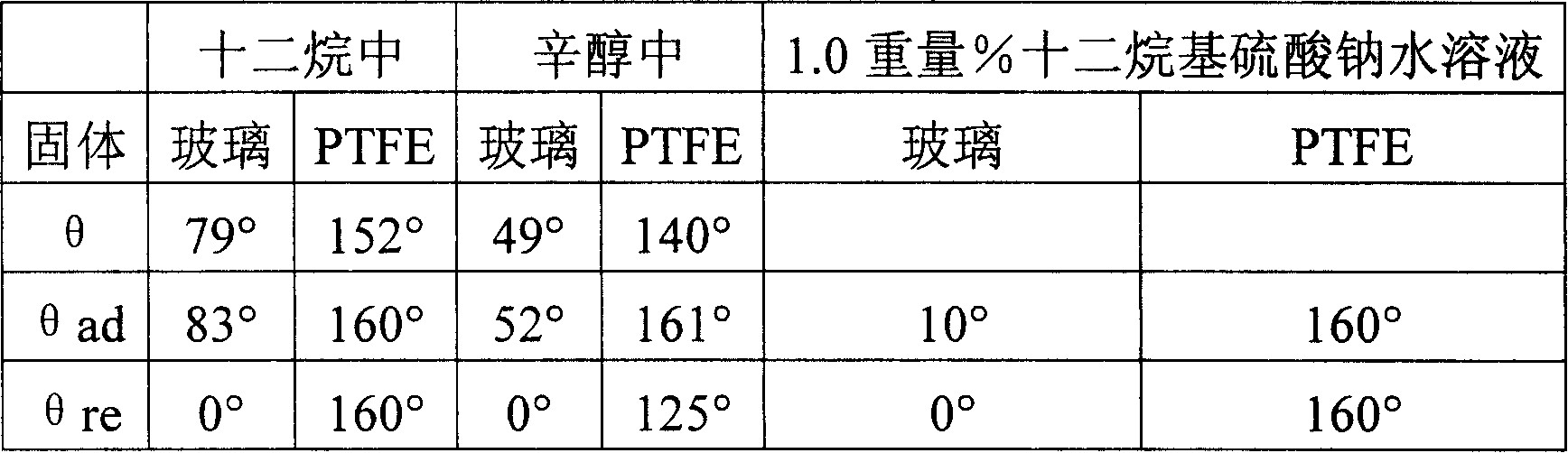
θ:静态接触角θ: static contact angle
θad:动态前进角θad: dynamic advance angle
θre:动态后掠角θre: dynamic sweep angle
[实施例5][Example 5]
向实施例1的微混合机中,以2ml/分钟提供含十二烷基硫酸钠1重量%的水,以2ml/分钟提供十二烷,制造乳剂。接着,使用微型注射器泵以0.3ml/分钟的比例,向将玻璃用作上板2、将PTFE用作下板4、重叠4块铝合金轮圈用作中板3且使流道幅度为48μm的分级装置1中,提供预先制造的乳剂(Type2),进行分级。将其结果显示于表3、4。To the micromixer of Example 1, water containing 1% by weight of sodium lauryl sulfate was supplied at 2 ml/min, and dodecane was supplied at 2 ml/min to prepare an emulsion. Next, use a micro-syringe pump at a rate of 0.3ml/min to use glass as the
[实施例6][Example 6]
除了将重叠6块铝合金轮圈用作中板3且使流道幅度为72μm以外,与实施例5一样,进行分级,其结果汇总于表3、4。Classification was carried out in the same manner as in Example 5, except that six overlapping aluminum alloy rims were used as the
[实施例7][Example 7]
向实施例1中使用的微混合机中,以2.7ml/分钟提供水,以0.3ml/分钟提供十二烷,生成乳剂。To the micromixer used in Example 1, water was supplied at 2.7 ml/min and dodecane was supplied at 0.3 ml/min to form an emulsion.
接着,用硅管将微混合机出口与分级装置的供给口连接,以3.0ml/分钟的比例从供给口向分级装置提供上述乳剂(Typel)并进行分级。将其结果显示于表3、4。Next, the outlet of the micromixer was connected to the supply port of the classification device with a silicon tube, and the above-mentioned emulsion (Type 1) was supplied from the supply port to the classification device at a rate of 3.0 ml/min and classified. The results are shown in Tables 3 and 4.
另外,将分级前的乳剂中含有的液滴和分级后的液体中含有的液滴的液滴直径分布显示于图11的曲线图中。还有,图中,虚线表示分级后的液滴直径分布,实线表示分级前的液滴直径分布。In addition, the droplet diameter distributions of the droplets contained in the emulsion before classification and the droplets contained in the liquid after classification are shown in the graph of FIG. 11 . In the figure, the dotted line indicates the droplet diameter distribution after classification, and the solid line indicates the droplet diameter distribution before classification.
另外,将显示分级前和分级后的乳剂的状态的通过显微镜的图像显示于图12、13中。In addition, images through a microscope showing the state of the emulsion before and after classification are shown in FIGS. 12 and 13 .
[实施例8][Example 8]
以20.0ml/分钟的条件向微混合机(山武株式会社制;YM-1)提供水,以5.0ml/分钟的条件提供辛醇,生成乳剂之后,在注射器内蓄积放置乳剂,使用泵以0.3ml/分钟的比例提供上述乳剂,除此之外,与实施例7一样,进行乳剂的分级。将其结果显示于表3、4。Water was supplied to a micro-mixer (manufactured by Yamatake Co., Ltd.; YM-1) at a rate of 20.0 ml/min, and octanol was supplied at a rate of 5.0 ml/min. The fractionation of the emulsion was carried out as in Example 7, except that the ratio of ml/min provided the above-mentioned emulsion. The results are shown in Tables 3 and 4.
[比较例2][Comparative example 2]
除了使用下板的材质不同的分级装置(下板;玻璃、上板;玻璃)以外,与实施例7一样,进行乳剂的分级。将其结果显示于表3、4。Classification of the emulsion was carried out in the same manner as in Example 7 except that a classifier (lower plate; glass, upper plate; glass) having a different material for the lower plate was used. The results are shown in Tables 3 and 4.
另外,将分级前的乳剂中含有的液滴和分级后的液体中含有的液滴的液滴直径分布显示于图14的曲线图中。还有,图中,虚线表示分级后的液滴直径分布,实线表示分级前的液滴直径分布。In addition, the droplet diameter distributions of the droplets contained in the emulsion before classification and the droplets contained in the liquid after classification are shown in the graph of FIG. 14 . In the figure, the dotted line indicates the droplet diameter distribution after classification, and the solid line indicates the droplet diameter distribution before classification.
[比较例3][Comparative example 3]
以5.4ml/分钟的条件向微混合机(与实施例7相同)提供水,以0.6ml/分钟的条件提供十二烷,生成乳剂之后,以6.0ml/分钟的比例向分级装置提供上述乳剂,除此以外,与比较例2一样,进行乳剂的分级。将其结果显示于表3、4。Provide water to the micro-mixer (same as Example 7) with the condition of 5.4ml/min, provide dodecane with the condition of 0.6ml/min, after generating the emulsion, provide the above-mentioned emulsion to the classification device with the ratio of 6.0ml/min , except that, in the same manner as in Comparative Example 2, the classification of the emulsion was carried out. The results are shown in Tables 3 and 4.
另外,将分级前的乳剂中含有的液滴和分级后的液体中含有的液滴的液滴直径分布显示于图14的曲线图。还有,图中,虚线表示分级后的液滴直径分布,实线表示分级前的液滴直径分布。In addition, the droplet diameter distributions of the droplets contained in the emulsion before classification and the droplets contained in the liquid after classification are shown in the graph of FIG. 14 . In the figure, the dotted line indicates the droplet diameter distribution after classification, and the solid line indicates the droplet diameter distribution before classification.
[实施例9][Example 9]
以2.0ml/分钟的条件向微混合机(与实施例7相同)中提供1.0重量%的十二烷基硫酸钠水溶液,以2.0ml/分钟的条件提供十二烷,预先生成乳剂之后,以0.3ml/分钟的比例向分级装置提供上述乳剂,进行乳剂的分级。将其结果显示于表3、4。Provide 1.0% by weight sodium lauryl sulfate aqueous solution with the condition of 2.0ml/min in micro-mixer (same as embodiment 7), provide dodecane with the condition of 2.0ml/min, after generating the emulsion in advance, with The above-mentioned emulsion was supplied to a classifying device at a rate of 0.3 ml/min, and the emulsion was classified. The results are shown in Tables 3 and 4.
[实施例10][Example 10]
以2.0ml/分钟的条件向微混合机(与实施例7相同)中提供1.0重量%的十二烷基硫酸钠水溶液,以2.0ml/分钟的条件提供十二烷,预先生成乳剂之后,以0.3ml/分钟的比例向与实施例7相同的分级装置提供上述乳剂,进行乳剂的分级。将其结果显示于表3、4。Provide 1.0% by weight sodium lauryl sulfate aqueous solution with the condition of 2.0ml/min in micro-mixer (same as embodiment 7), provide dodecane with the condition of 2.0ml/min, after generating the emulsion in advance, with The above-mentioned emulsion was supplied to the same classification apparatus as in Example 7 at a rate of 0.3 ml/min, and the emulsion was classified. The results are shown in Tables 3 and 4.
还有,在分级前的乳剂中含有的液滴和在流道高度分别为5μm(实施例9)、12μm(实施例10)的分级装置中使上述乳剂流动之后(分级后)的液体中含有的乳剂的液滴直径分布显示于图15的曲线图中。In addition, the liquid droplets contained in the emulsion before classification and the liquid after the above-mentioned emulsion was flowed (after classification) in a classification device with a channel height of 5 μm (Example 9) and 12 μm (Example 10) respectively contained The droplet diameter distribution of the emulsion is shown in the graph of FIG. 15 .
[实施例11][Example 11]
以2.0ml/分钟的条件向微混合机(与实施例7相同)中提供1.0重量%的十二烷基硫酸钠水溶液,以2.0ml/分钟的条件提供十二烷,生成乳剂之后,以0.3ml/分钟的比例向分级装置(流道高度24μm)提供上述乳剂,进行乳剂的分级。将其结果显示于表3、4。Provide 1.0% by weight sodium lauryl sulfate aqueous solution in the micro mixer (same as embodiment 7) with the condition of 2.0ml/min, provide dodecane with the condition of 2.0ml/min, after generating the emulsion, with 0.3 The above-mentioned emulsion was supplied to a classifying device (flow path height: 24 μm) at a rate of ml/min, and the emulsion was classified. The results are shown in Tables 3 and 4.

[表4][Table 4]

另外,根据上述结果,以2.0ml/分钟的条件向微混合机(与实施例7相同)提供1.0重量%的十二烷基硫酸钠水溶液,以2.0ml/分钟的条件提供十二烷,生成乳剂之后,以0.3ml/分钟的比例向流道高度各不相同的分级装置提供上述乳剂,将进行乳剂的分级的结果显示于表5。In addition, based on the above results, a 1.0% by weight aqueous solution of sodium lauryl sulfate was supplied to a micro-mixer (same as Example 7) at a rate of 2.0 ml/min, and dodecane was supplied at a rate of 2.0 ml/min to generate After the emulsion, the above-mentioned emulsion was supplied at a rate of 0.3 ml/min to classification devices having different channel heights, and the results of classification of the emulsion are shown in Table 5.
[表5][table 5]

[实施例12][Example 12]
以2.0ml/分钟的条件向微混合机(与实施例7相同)提供1.0重量%的十二烷基硫酸钠水溶液,以2.0ml/分钟的条件提供十二烷,生成乳剂之后,用实施例10的分级装置,将向分级装置提供上述乳剂的供给速度设定为1.0ml/分钟的比例,进行乳剂的分级。With the condition of 2.0ml/min, provide 1.0% by weight sodium lauryl sulfate aqueous solution to micro-mixer (same as embodiment 7), provide dodecane with the condition of 2.0ml/min, after generating the emulsion, use embodiment The classifying device of 10 sets the supply rate of the emulsion to the classifying device at a rate of 1.0 ml/min, and classifies the emulsion.
[实施例13][Example 13]
以2.0ml/分钟的条件向微混合机(与实施例7相同)提供1.0重量%的十二烷基硫酸钠水溶液,以2.0ml/分钟的条件提供十二烷,生成乳剂之后,用实施例10的分级装置,将向分级装置提供上述乳剂的供给速度设定为0.6ml/分钟的比例,进行乳剂的分级。With the condition of 2.0ml/min, provide 1.0% by weight sodium lauryl sulfate aqueous solution to micro-mixer (same as embodiment 7), provide dodecane with the condition of 2.0ml/min, after generating the emulsion, use embodiment The classifying device of 10 sets the supply rate of the emulsion to the classifying device at a rate of 0.6 ml/min, and classifies the emulsion.
接着,将除了供给速度以外而在其它条件下进行分级的结果(实施例10、12、13)显示于表6。Next, Table 6 shows the results (Examples 10, 12, and 13) of classification under other conditions than the supply rate.
[表6][Table 6]

根据上述结果,已知通过使流道高度小于乳剂中含有的液滴的最大直径且使形成流道的壁的至少一部分由与上述液滴具有亲和性的液滴亲和性材料形成,可以很好地进行分级。From the above results, it is known that by making the flow channel height smaller than the maximum diameter of the liquid droplets contained in the emulsion and forming at least a part of the walls forming the flow channel with a droplet-affinity material having affinity with the above-mentioned liquid droplets, it is possible to Well graded.
另外,例如,即使是含有表面活性剂的乳剂,通过本发明的分级装置,可以很好地对液滴进行分级。In addition, for example, even if it is an emulsion containing a surfactant, liquid droplets can be favorably classified by the classifying device of the present invention.
如上所述,本发明中的分级装置包含具有比乳剂中含有的液滴的最大直径小的、需要高度或幅度的流道,上述流道的至少一部分是由与该乳剂中含有的液滴具有亲和性的材料形成。As described above, the classifying device in the present invention includes a flow channel having a desired height or width smaller than the maximum diameter of the liquid droplets contained in the emulsion, at least a part of which is formed by the liquid droplets contained in the emulsion. Affinity material formation.
通过使乳剂通过上述流道,在该乳剂中含有的液滴当中,比小于上述流道乳剂中含有的液滴的最大直径的需要的高度或幅度(下面称为最小间隔)大的液滴发生变形而与上述最小间隔一致,同时成为和与该液滴具有亲和性的材料(下面有时称为液滴亲和性材料)润湿的状态。接着,在连续地向上述流道提供乳剂时,液滴成为和液滴亲和性材料润湿的状态,分散介质难以与液滴亲和性材料润湿,所以在流道中流动的分散介质和液滴的相对速度变得不同。接着,流道上流的液滴与流道下流的液滴相比,当其尺寸小时,该上流的液滴追上下流的液滴。此时,诸液滴成为与液滴亲和性材料润湿的状态,所以为了使自身处于稳定状态,而产生使表面积进一步减小的作用,与其它液滴聚结。由此,比流道的最小间隔大的液滴通过上述流道而聚结。另一方面,比流道的最小间隔小的液滴由于不与液滴亲和性材料润湿而通过,所以不与其它液滴聚结、因而,即使在通过流道之后,也保持其形状。By passing the emulsion through the above-mentioned channel, among the droplets contained in the emulsion, droplets larger than the required height or width (hereinafter referred to as the minimum interval) smaller than the maximum diameter of the droplets contained in the emulsion of the above-mentioned channel are generated. It is deformed so as to conform to the above-mentioned minimum gap, and at the same time, it is in a wet state with a material having an affinity for the droplet (hereinafter sometimes referred to as a droplet-affinity material). Next, when the emulsion is continuously supplied to the flow channel, the droplets become wet with the droplet-affinity material, and the dispersion medium is difficult to wet with the droplet-affinity material, so the dispersion medium flowing in the flow channel and the The relative velocity of the droplets becomes different. Next, when the size of the liquid droplet flowing up the flow channel is smaller than that of the liquid droplet flowing down the flow channel, the liquid droplet flowing up the flow channel catches up with the liquid droplet flowing down the flow channel. At this time, the droplets are in a wet state with the droplet-affinity material, so in order to stabilize themselves, the effect of further reducing the surface area occurs and coalesces with other droplets. As a result, droplets larger than the minimum interval between the flow channels pass through the flow channels and coalesce. On the other hand, droplets smaller than the minimum interval of the flow channel pass without wetting with the droplet-affinity material, so they do not coalesce with other droplets, and thus maintain their shape even after passing through the flow channel .
通过上述结构,使乳剂中含有的液滴通过最小间隔的流道,更具体地说是使其在润湿该流道内的状态下通过,由此可以使比上述最小间隔大的液滴成为更大的液滴(聚结化)。由此,上述液滴聚结化而成为连续相,可以从乳剂分离。另外,对于比上述最小间隔小的液滴,可以维持其原来状态。With the above structure, the liquid droplets contained in the emulsion pass through the flow channel with the minimum interval, more specifically, they pass while wetting the inside of the flow channel, thereby making it possible to make the liquid droplets larger than the above minimum interval more compact. Large droplets (coalescence). Thereby, the above-mentioned droplets coalesce to form a continuous phase, which can be separated from the emulsion. In addition, the original state can be maintained for droplets smaller than the above-mentioned minimum interval.
即,通过成为上述结构,可以使乳剂中含有的液滴确实可靠地在上述最小间隔的流道中流动。由此,可以使乳剂中含有的液滴分级成需要的液滴直径以下。That is, with the above-mentioned structure, the droplets contained in the emulsion can reliably flow through the above-mentioned flow paths with the smallest intervals. Thereby, the droplets contained in the emulsion can be classified into a required droplet diameter or less.
另外,本发明的分级装置,更优选其上述高度或幅度为乳剂中含有的液滴的体积平均直径以下。In addition, in the classification device of the present invention, it is more preferable that the above-mentioned height or width is equal to or smaller than the volume average diameter of liquid droplets contained in the emulsion.
根据上述结构,通过使上述高度或幅度为乳剂中含有的液滴的体积平均直径以下,可以得到液滴直径分布更一致的液滴。According to the above structure, by setting the above-mentioned height or width to be equal to or less than the volume average diameter of the droplets contained in the emulsion, droplets having a more uniform droplet diameter distribution can be obtained.
另外,本发明的分级装置,更优选上述流道是具有乳剂中含有的至少2个液滴可以在该流道内存在的长度的流道。In addition, in the classifying device of the present invention, it is more preferable that the flow path is a flow path having a length such that at least two liquid droplets contained in the emulsion can exist in the flow path.
通过上述的结构,乳剂中含有的液滴中的至少2个液滴可以在上述流道内存在,所以可以使这些液滴更确实可靠地聚结。With the above-mentioned structure, at least two of the liquid droplets contained in the emulsion can exist in the above-mentioned flow channel, so that these liquid droplets can be coalesced more reliably.
另外,本发明的分级装置,更优选形成上述流道的壁的一部分是由与该乳剂中含有的液滴相比对分散介质更具亲和性的材料(下面有时称为非亲和性材料)的结构。In addition, in the classification device of the present invention, it is more preferable that a part of the wall forming the above-mentioned flow channel is made of a material having a higher affinity for the dispersion medium than the liquid droplets contained in the emulsion (hereinafter sometimes referred to as non-affinity material). )Structure.
非亲和性材料是指易于被乳剂的分散介质润湿的材料。通过上述的结构,通过使流道的一部分由非亲和性材料构成,非亲和性材料易于被乳剂的分散介质润湿,所以可以减少在将乳剂提供给流道时产生的压力损失。Non-substantive materials refer to materials that are easily wetted by the dispersion medium of the emulsion. With the above configuration, since the non-affinity material is easily wetted by the dispersion medium of the emulsion by making a part of the flow path by the non-affinity material, it is possible to reduce the pressure loss that occurs when the emulsion is supplied to the flow path.
另外,本发明的分级装置,进一步更优选上述乳剂为油在水中型乳剂,液滴亲和性材料是油中的水的动态接触角为90°以上的亲油性材料。In addition, in the classification device of the present invention, it is still more preferable that the emulsion is an oil-in-water type emulsion, and the droplet affinity material is a lipophilic material having a dynamic contact angle of water in oil of 90° or more.
根据上述结构,作为液滴亲和性材料,使用油中的水的动态接触角为90°以上的亲油性材料,所以当作为乳剂使用油在水中型的乳剂时,可以确实可靠地使流道内流动的油在水中型乳剂中含有的液滴处于润湿状态。由此,可以更好地对油在水中型乳剂进行分级。还有,上述“油中”是指与上述乳剂中含有的油滴(液滴)的成分(有机溶剂)相同的物质。According to the above-mentioned structure, as the droplet affinity material, the dynamic contact angle of water in oil is used as the lipophilic material of 90° or more, so when the oil-in-water type emulsion is used as the emulsion, it is possible to reliably make the liquid inside the flow channel Flowing oil-in-water emulsions contain liquid droplets in a wetting state. Thus, oil-in-water emulsions can be better fractionated. In addition, the above-mentioned "in the oil" means the same thing as the component (organic solvent) of the oil droplet (liquid droplet) contained in the above-mentioned emulsion.
另外,本发明的分级装置,进一步更优选亲油性材料为氟树脂。In addition, in the classification device of the present invention, it is still more preferable that the lipophilic material is a fluororesin.
氟树脂的耐药品性出色。因而,根据上述的结构,通过使用氟树脂作为亲油性材料,例如即使是对构成流道的材料反应性高的乳剂等的情况下,也能很好地进行分级。Fluoroplastics have excellent chemical resistance. Therefore, according to the above structure, by using the fluororesin as the lipophilic material, for example, even in the case of an emulsion having high reactivity to the material constituting the flow channel, classification can be favorably performed.
另外,本发明的分级装置,进一步更优选上述乳剂为水在油中型,液滴亲和性材料是油中的水的动态接触角小于90°的亲水性材料。In addition, in the classification device of the present invention, it is still more preferable that the emulsion is a water-in-oil type, and the droplet-affinity material is a hydrophilic material having a dynamic contact angle of water in oil of less than 90°.
如果为上述结构,作为液滴亲和性材料使用油中的水的动态接触角小于90°的亲水性材料,所以,当作为乳剂使用水在油中型的乳剂时,可以确实可靠地使在流道内流动的水在油中型乳剂中含有的液滴处于润湿状态。由此,可以更好地对油在水中型乳剂进行分级。还有,上述“油中”是指与构成上述乳剂的液体的成分(有机溶剂)相同的物质。According to the above-mentioned structure, a hydrophilic material whose dynamic contact angle of water in oil is less than 90° is used as a droplet affinity material, so when a water-in-oil type emulsion is used as an emulsion, the The water flowing in the channel wets the droplets contained in the oil-in-oil emulsion. Thus, oil-in-water emulsions can be better fractionated. In addition, the said "in oil" means the same thing as the liquid component (organic solvent) which comprises the said emulsion.
另外,本发明的分级装置,进一步更优选上述流道的截面形状为矩形,该截面形状的最小间隔比上述乳剂中含有的液滴的最大直径小,而且上述流道的截面形状的最大间隔为上述最小间隔的10倍以上。In addition, in the classification device of the present invention, it is still more preferable that the cross-sectional shape of the above-mentioned channel is rectangular, the minimum interval of the cross-sectional shape is smaller than the maximum diameter of the droplets contained in the above-mentioned emulsion, and the maximum interval of the cross-sectional shape of the above-mentioned flow channel is More than 10 times the above minimum interval.
通过上述结构,上述流道的截面形状变为矩形,该形状的最小(短)间隔(高度或幅度)成为比上述乳剂中含有的液滴的最大直径小的距离。接着,上述流道的截面形状的最大间隔成为是上述最小间隔的10倍以上的距离。由此,在使乳剂中含有的液滴通过流道时,可以更简单地使其变形。即,乳剂中含有的液滴,例如与截面形状为圆形且直径为上述液滴的最大直径以下的流道的情况相比,可以更容易地在流道的最小间隔处变形,同时从间隔宽处逃出。由此,可以进一步减少在向上述流道提供乳剂时的压力损失。另外,与上述截面形状为圆形的流道的情况相比,可以扩大流道的截面积,所以可以使更多的乳剂在流道中流过。因而,可以提高生产率。With the above structure, the channel has a rectangular cross-sectional shape, and the minimum (short) interval (height or width) of the shape is smaller than the maximum diameter of the liquid droplets contained in the emulsion. Next, the maximum distance between the cross-sectional shapes of the flow channels is 10 times or more the minimum distance. This makes it possible to more easily deform the liquid droplets contained in the emulsion when passing through the flow channel. That is, the liquid droplets contained in the emulsion can be deformed at the minimum interval of the flow passage more easily than the case where the cross-sectional shape is circular and the diameter is not more than the maximum diameter of the above-mentioned liquid droplet, and at the same time, the liquid droplets contained in the emulsion can be deformed from the interval Wide escape. Thereby, the pressure loss at the time of supplying the emulsion to the flow path can be further reduced. In addition, since the cross-sectional area of the flow path can be enlarged compared with the case of the above-mentioned flow path having a circular cross-sectional shape, more emulsion can flow through the flow path. Thus, productivity can be improved.
另外,本发明的分级装置,进一步更优选形成上述流道的壁包括2块板状构件,是该2块板状构件以比乳剂中含有的液滴的最大直径小的间隔相隔的构成。In addition, in the classification device of the present invention, it is still more preferable that the wall forming the flow path includes two plate-shaped members, and the two plate-shaped members are separated by an interval smaller than the maximum diameter of the liquid droplets contained in the emulsion.
根据上述结构,形成流道的壁的一部分是由板状构件构成的,所以可以更简单地形成流道。According to the above configuration, since a part of the wall forming the flow path is formed of the plate-shaped member, the flow path can be formed more easily.
另外,本发明的分级装置,进一步更优选乳剂是通过用微混合机对乳剂原料进行混合而得到的乳剂。In addition, in the classification apparatus of the present invention, it is still more preferable that the emulsion is an emulsion obtained by mixing emulsion raw materials with a micro mixer.
对于通过在微混合机中混合上述原料而生成的乳剂,该乳剂中含有的液滴的尺寸非常小。接着,在液滴的尺寸非常小的情况下,由于稳定性高,所以一般很难使该液滴聚结。根据上述结构,即使是通过微混合机生成的液滴的尺寸非常小的乳剂,也可以很好地聚结化。For an emulsion produced by mixing the above-mentioned raw materials in a micro-mixer, the size of the liquid droplets contained in the emulsion is very small. Then, in the case of very small droplet size, it is generally difficult to coalesce the droplet due to the high stability. According to the above structure, even an emulsion in which droplets generated by a micromixer are very small can be favorably coalesced.
另外,本发明的分级装置,进一步更优选上述流道具有排出乳剂的排出口且在该排出口上连接分液装置而构成。In addition, in the classification device of the present invention, it is still more preferable that the flow path has a discharge port for discharging the emulsion, and a liquid separator is connected to the discharge port.
根据上述结构,由于在流道的乳剂的排出口上设有分液装置(セトラ一),所以可以连续且快速地对已分级的乳剂进行分液。According to the above structure, since the liquid separation device (setra) is provided at the discharge port of the emulsion in the flow path, it is possible to continuously and quickly liquid-separate the classified emulsion.
另外,本发明的分级装置,进一步更优选设有多个上述流道。In addition, the classifying device of the present invention is still more preferably provided with a plurality of the above-mentioned flow channels.
根据上述结构,由于设置多个上述流道,所以可以一次对更多的乳剂进行分级。According to the above structure, since a plurality of the above-mentioned flow channels are provided, more emulsions can be classified at one time.
如上所述,本发明的乳剂的分级方法是使乳剂通过如下所述的分级装置中的流道的构成,其中,所述的分级装置包含具有比乳剂中含有的液滴的最大直径小的需要的高度或幅度的流道,形成该流道的壁的至少一部分是由与该乳剂中含有的液滴具有亲和性的材料形成。As described above, the method for classifying the emulsion of the present invention is a configuration in which the emulsion is passed through a flow path in a classifying device including a liquid droplet having a size smaller than the maximum diameter of liquid droplets contained in the emulsion. A flow channel of height or width, at least a portion of the walls forming the flow channel is formed of a material having an affinity for the droplets contained in the emulsion.
根据上述结构,使乳剂中含有的液滴通过最小间隔的流道,更具体地说是使其在润湿该流道内的状态下通过,由此可以使比上述最小间隔大的液滴变成更大的液滴(聚结化)。另外,对于比上述最小间隔小的液滴,可以维持其原来状态。According to the above structure, the liquid droplets contained in the emulsion can be passed through the flow channel with the smallest interval, more specifically, the liquid droplets with a larger interval than the above-mentioned minimum interval can be made to pass through while wetting the flow channel. Larger droplets (coalescence). In addition, the original state can be maintained for droplets smaller than the above-mentioned minimum interval.
即,通过上述的结构,可以确实可靠地使乳剂中含有的液滴在上述最小间隔的流道中流动。因而,使比上述最小间隔大的液滴聚结化,可以从作为连续相从乳剂分离。由此,可以将乳剂中含有的液滴分级为需要的直径以下。That is, with the above-mentioned structure, the liquid droplets contained in the emulsion can surely flow in the above-mentioned flow channels with the minimum interval. Therefore, it is possible to coalesce droplets larger than the above-mentioned minimum interval and separate them from the emulsion as a continuous phase. Thereby, the liquid droplets contained in the emulsion can be classified to a required diameter or smaller.
本发明的乳剂的分级方法,进一步更优选上述乳剂在流道内的滞留时间为0.001~10秒的范围内。In the emulsion classification method of the present invention, it is still more preferable that the residence time of the above-mentioned emulsion in the flow channel is within the range of 0.001 to 10 seconds.
通过为上述结构,可以更确实可靠地对乳剂中含有的液滴进行分级。By adopting the above structure, the liquid droplets contained in the emulsion can be classified more reliably.
另外,本发明的乳剂的去乳化方法,是使乳剂通过如下所述的分级装置的流道而对通过液体进行分液,其中,所述的分级装置包含具有比乳剂中含有的液滴的最大直径小的需要的高度或幅度的流道,形成该流道的壁的至少一部分是由与该乳剂中含有的液滴具有亲和性的材料形成。In addition, the emulsion demulsification method of the present invention is to separate the passing liquid by passing the emulsion through the flow channel of a classifying device including the largest particle having a liquid droplet ratio larger than that contained in the emulsion. For a flow channel having a small diameter and a desired height or width, at least a part of the wall forming the flow channel is formed of a material having an affinity with the liquid droplets contained in the emulsion.
根据上述结构,使乳剂中含有的液滴通过最小间隔的流道,更具体地说是使其在润湿该流道内的状态下通过,由此可以使比上述最小间隔大的液滴变成更大的液滴(聚结化),所以可以容易地对乳剂进行分液并使其去乳化。According to the above structure, the liquid droplets contained in the emulsion can be passed through the flow channel with the smallest interval, more specifically, the liquid droplets with a larger interval than the above-mentioned minimum interval can be made to pass through while wetting the flow channel. Larger droplets (coalescing), so the emulsion can be easily separated and de-emulsified.
另外,在用于实施发明的最佳方式的项目中的具体的实施方式或实施例,最终目的是使本发明的技术内容明确,所以不应该被这样的具体例所限定而进行狭义的解释,在本发明的精神和技术方案的范围内,可以进行各种变更并实施。In addition, the specific embodiments or examples in the item of the best mode for carrying out the invention are intended to clarify the technical contents of the present invention, and therefore should not be limited by such specific examples and interpreted in a narrow sense. Various modifications can be made and implemented within the scope of the spirit and technical solutions of the present invention.
工业上的可利用性Industrial availability
本发明的分级装置适合用于使粒径(液滴直径)不同的乳剂中的液滴颗粒(液滴)中的大液滴彼此聚结化而只对微小的液滴进行分级的用途等中。The classifier of the present invention is suitable for use in applications such as classifying only minute droplets by coalescing large droplets among droplet particles (droplets) in emulsions having different particle diameters (droplet diameters). .
Claims (15)
Applications Claiming Priority (3)
| Application Number | Priority Date | Filing Date | Title |
|---|---|---|---|
| JP023913/2003 | 2003-01-31 | ||
| JP2003023913 | 2003-01-31 | ||
| JP209390/2003 | 2003-08-28 |
Publications (2)
| Publication Number | Publication Date |
|---|---|
| CN1744935A CN1744935A (en) | 2006-03-08 |
| CN100384501C true CN100384501C (en) | 2008-04-30 |
Family
ID=36139953
Family Applications (1)
| Application Number | Title | Priority Date | Filing Date |
|---|---|---|---|
| CNB2004800033457A Expired - Fee Related CN100384501C (en) | 2003-01-31 | 2004-01-26 | Device and method for classifying emulsion, and method for demulsifying emulsion |
Country Status (1)
| Country | Link |
|---|---|
| CN (1) | CN100384501C (en) |
Families Citing this family (2)
| Publication number | Priority date | Publication date | Assignee | Title |
|---|---|---|---|---|
| CN107349638B (en) * | 2017-08-30 | 2020-05-22 | 武汉工程大学 | A Liquid-Liquid Separation Method Constructed by Differences in Surface Force Fields of Plate-Type Solids |
| CN107569872B (en) * | 2017-08-30 | 2019-12-06 | 武汉工程大学 | A Liquid-Liquid Separation Method Constructed by the Differential Force Field on the Solid Surface of a Barrel |
Citations (1)
| Publication number | Priority date | Publication date | Assignee | Title |
|---|---|---|---|---|
| JPH11276802A (en) * | 1998-03-30 | 1999-10-12 | Natl Food Res Inst | Continuous producing devide of microsphere |
-
2004
- 2004-01-26 CN CNB2004800033457A patent/CN100384501C/en not_active Expired - Fee Related
Patent Citations (2)
| Publication number | Priority date | Publication date | Assignee | Title |
|---|---|---|---|---|
| JPH11276802A (en) * | 1998-03-30 | 1999-10-12 | Natl Food Res Inst | Continuous producing devide of microsphere |
| US6177479B1 (en) * | 1998-03-30 | 2001-01-23 | Japan As Represented By Director Of National Food Research Institute, Ministry Of Agriculture, Forestry And Fisheries | Continuous manufacturing method for microspheres and apparatus |
Also Published As
| Publication number | Publication date |
|---|---|
| CN1744935A (en) | 2006-03-08 |
Similar Documents
| Publication | Publication Date | Title |
|---|---|---|
| CN105050718B (en) | Apparatus and method for forming relatively monodisperse droplets | |
| Tottori et al. | Separation of main and satellite droplets in a deterministic lateral displacement microfluidic device | |
| Tan et al. | Droplet coalescence by geometrically mediated flow in microfluidic channels | |
| US9446360B2 (en) | Microfluidic system and methods for highly selective droplet fusion | |
| Lee et al. | Generation of monodisperse mesoporous silica microspheres with controllable size and surface morphology in a microfluidic device | |
| US9126127B2 (en) | Apparatus and method for separating hydrophilic and hydrophobic components | |
| CN102458630A (en) | Microfluidic apparatus and method for generating a dispersion | |
| Mulligan et al. | Deformation and breakup of micro-and nanoparticle stabilized droplets in microfluidic extensional flows | |
| Wang et al. | Coalescences of microdroplets at a cross-shaped microchannel junction without strictly synchronism control | |
| Zhang et al. | Functional nanoemulsions: Controllable low-energy nanoemulsification and advanced biomedical application | |
| Josephides et al. | Increased drop formation frequency via reduction of surfactant interactions in flow-focusing microfluidic devices | |
| Sun et al. | Controlled production of size-tunable Janus droplets for submicron particle synthesis using an electrospray microfluidic chip | |
| CN100384501C (en) | Device and method for classifying emulsion, and method for demulsifying emulsion | |
| Roques-Carmes et al. | Influence of the plate-type continuous micro-separator dimensions on the efficiency of demulsification of oil-in-water emulsion | |
| US12172155B2 (en) | Emulsion production microfluidic device | |
| Chen et al. | De-emulsification of kerosene/water emulsions with plate-type microchannels | |
| AU2020300137B2 (en) | Liquid phase ejection nozzle | |
| Lu et al. | Removal of excess interfacial material from surface-modified emulsions using a microfluidic device with triangular post geometry | |
| JP4455072B2 (en) | Emulsion classification device | |
| US20090273105A1 (en) | Method and system for performing an interfacial reaction in a microfluidic device | |
| CN110998280B (en) | Anchored liquid stationary phase for separation and filtration systems | |
| KR101128119B1 (en) | Device and method of classifying emulsion and method of demulsifying emulsion | |
| WO2024007588A1 (en) | Surfactant-free preparation methods of polymer microspheres and microcapsules | |
| JP2005054023A (en) | Method for producing polymer particles | |
| Lin et al. | Synthesis of twin alginate microparticles via microfluidic emulsification and sorting |
Legal Events
| Date | Code | Title | Description |
|---|---|---|---|
| C06 | Publication | ||
| PB01 | Publication | ||
| C10 | Entry into substantive examination | ||
| SE01 | Entry into force of request for substantive examination | ||
| C14 | Grant of patent or utility model | ||
| GR01 | Patent grant | ||
| C17 | Cessation of patent right | ||
| CF01 | Termination of patent right due to non-payment of annual fee |
Granted publication date: 20080430 Termination date: 20140126 |