CN100374986C - Methods, systems and software for interactive communication and analysis - Google Patents
Methods, systems and software for interactive communication and analysis Download PDFInfo
- Publication number
- CN100374986C CN100374986C CNB200480022250XA CN200480022250A CN100374986C CN 100374986 C CN100374986 C CN 100374986C CN B200480022250X A CNB200480022250X A CN B200480022250XA CN 200480022250 A CN200480022250 A CN 200480022250A CN 100374986 C CN100374986 C CN 100374986C
- Authority
- CN
- China
- Prior art keywords
- user
- electric signal
- tabulation
- list
- value
- Prior art date
- Legal status (The legal status is an assumption and is not a legal conclusion. Google has not performed a legal analysis and makes no representation as to the accuracy of the status listed.)
- Expired - Lifetime
Links
Images


Classifications
-
- G—PHYSICS
- G06—COMPUTING OR CALCULATING; COUNTING
- G06F—ELECTRIC DIGITAL DATA PROCESSING
- G06F3/00—Input arrangements for transferring data to be processed into a form capable of being handled by the computer; Output arrangements for transferring data from processing unit to output unit, e.g. interface arrangements
-
- G—PHYSICS
- G06—COMPUTING OR CALCULATING; COUNTING
- G06F—ELECTRIC DIGITAL DATA PROCESSING
- G06F3/00—Input arrangements for transferring data to be processed into a form capable of being handled by the computer; Output arrangements for transferring data from processing unit to output unit, e.g. interface arrangements
- G06F3/01—Input arrangements or combined input and output arrangements for interaction between user and computer
- G06F3/011—Arrangements for interaction with the human body, e.g. for user immersion in virtual reality
- G06F3/015—Input arrangements based on nervous system activity detection, e.g. brain waves [EEG] detection, electromyograms [EMG] detection, electrodermal response detection
-
- G—PHYSICS
- G06—COMPUTING OR CALCULATING; COUNTING
- G06F—ELECTRIC DIGITAL DATA PROCESSING
- G06F3/00—Input arrangements for transferring data to be processed into a form capable of being handled by the computer; Output arrangements for transferring data from processing unit to output unit, e.g. interface arrangements
- G06F3/14—Digital output to display device ; Cooperation and interconnection of the display device with other functional units
Landscapes
- Engineering & Computer Science (AREA)
- Theoretical Computer Science (AREA)
- General Engineering & Computer Science (AREA)
- Human Computer Interaction (AREA)
- Physics & Mathematics (AREA)
- General Physics & Mathematics (AREA)
- Health & Medical Sciences (AREA)
- Biomedical Technology (AREA)
- Dermatology (AREA)
- General Health & Medical Sciences (AREA)
- Neurology (AREA)
- Neurosurgery (AREA)
- User Interface Of Digital Computer (AREA)
- Debugging And Monitoring (AREA)
- Stored Programmes (AREA)
Abstract
一种用于交互通信以便由用户响应所述用户产生的电信号的方法、系统和软件,它包括:(A)为所述用户提供表示目标项目列表的交互式显示;(B)接收由所述用户响应所述交互式显示而产生的检测到的电信号;(C)将所述检测到的电信号处理并转换成数字数据;(D)分析所述数字数据,以将使周所述交互式显示呈现给所述用户的所述目标项目列表之一与所述用户的选择相关联。步骤(A)-(D)基于呈现给所述用户的目标项目列表的层次关系,以选择所述用户需要的一个目标项目。
A method, system, and software for interactive communication so that a user responds to electrical signals generated by the user, comprising: (A) providing the user with an interactive display representing a list of target items; (B) receiving detected electrical signals generated by the user in response to the interactive display; (C) processing the detected electrical signals and converting them into digital data; and (D) analyzing the digital data to associate one of the target item lists presented to the user by the interactive display with the user's selection. Steps (A)-(D) involve selecting a target item desired by the user based on the hierarchical relationship of the target item list presented to the user.
Description
相关申请交叉引用Related Application Cross Reference
本申请根据35U.S.C§119(e)要求享有2003年6月12日提出的美国临时专利申请No.60/477762的优先权,该申请的内容通过引用全部结合于本文中。This application claims priority under 35 U.S.C §119(e) to U.S. Provisional Patent Application No. 60/477762, filed June 12, 2003, the contents of which are incorporated herein by reference in their entirety.
发明领域field of invention
本发明一般地涉及一种交互式通信或分析系统与方法,其包括显示和分析从模拟信号获得的数字数据流,从所述分析的数据流确定选择指示并基于指数缩减算法执行迭代选择。The present invention generally relates to an interactive communication or analysis system and method comprising displaying and analyzing digital data streams obtained from analog signals, determining selection indications from said analyzed data streams and performing iterative selection based on an exponential reduction algorithm.
发明背景Background of the invention
所遇到的问题之一涉及与伤残或残疾人士的交互沟通。此类人士通常无能力(如活动或移动能力范围)以肯定地交互沟通,因此需要他人的帮助以完成所有任务中最基本的任务如表达其需要。此外,由于他们不能轻松地表达他们的需要,因此,他们不能有效地沟通和利用适于伤残人士使用的交互式装置来表达其需要。随着此类交互式装置的处理能力快速提高而尺寸减小,这些交互式装置如果使以上指出的缺点得到解决,则现在非常适用于残疾人沟通。One of the problems encountered involved interacting with disabled or handicapped persons. Such individuals are often incapable (eg, range of activity or mobility) to interact positively and thus require the assistance of others to perform the most basic of all tasks such as expressing their needs. Furthermore, since they cannot express their needs easily, they cannot effectively communicate and express their needs using interactive devices adapted for use by the disabled. With the rapidly increasing processing power and reduced size of such interactive devices, these interactive devices are now well suited for disabled communication if the disadvantages noted above are resolved.
发明概述Summary of the invention
在一个方面,本发明为用户提供了响应用户产生的电信号的交互式通信方法、软件和系统,包括:(A)为所述用户提供表示目标项目列表的交互式显示;(B)接收由所述用户响应所述交互式显示而产生的检测到的电信号;(C)将所述检测到的电信号处理并转换成数字数据;(D)分析所述数字数据,以将使用所述交互式显示呈现给所述用户的所述目标项目列表之一与所述用户的选择相关联;以及(E)基于呈现给所述用户的目标项目列表的层次关系,迭代地重复步骤(A)-(D),以选择所述用户需要的目标项目。In one aspect, the present invention provides a user with an interactive communication method, software and system responsive to a user-generated electrical signal, comprising: (A) providing said user with an interactive display representing a list of target items; the detected electrical signal generated by the user in response to the interactive display; (C) processing and converting the detected electrical signal into digital data; (D) analyzing the digital data to use the interactively displaying that one of the target item lists presented to the user is associated with the user's selection; and (E) iteratively repeating step (A) based on the hierarchical relationship of the target item lists presented to the user -(D) to select the target item required by said user.
在一个方面,电信号代表在所述用户神经肌肉部位产生的生物信号。In one aspect, the electrical signal represents a biological signal generated at the neuromuscular site of said user.
在另一方面,处理和转换所述数字数据的步骤还包括以图形显示来显示对应于所述检测到的电信号的转换十进制值,其特征在于,最近时间周期的所述十进制值替代在所述图形显示上显示的连续(或时间周期性)时间周期滚动范围内一个较早时间周期(例如,前一个)的所述十进制值。In another aspect, the step of processing and converting said digital data further comprises displaying in a graphical display the converted decimal value corresponding to said detected electrical signal, characterized in that said decimal value for the most recent time period is substituted in said Said decimal value of an earlier time period (eg, previous) within a rolling range of continuous (or time-periodic) time periods displayed on said graphical display.
在又一方面中,本发明提供一种用于处理和显示电信号的方法,包括:生成表示接收的电信号的数字数据流;生成表示在一个时间周期内电信号值的十进制值;以图形显示来显示所述十进制值,其中,最近时间周期的十进制值替代在所述图形显示上显示的连续(或时间周期性)时间周期滚动范围内更早(例如,前一个)时间周期的所述十进制值。In yet another aspect, the invention provides a method for processing and displaying an electrical signal comprising: generating a digital data stream representing a received electrical signal; generating a decimal value representing the value of the electrical signal over a period of time; graphically display to display the decimal value, wherein the decimal value for the most recent time period replaces the decimal value for an earlier (e.g., previous) time period within a scrolling range of consecutive (or time-periodic) time periods displayed on the graphical display decimal value.
在又一方面,基于在一个时间周期或连续时间周期内收到的所述接收电信号的最大值和最小值,自动确定所述图形显示的最大值和最小值。In yet another aspect, the maximum and minimum values of said graphical display are automatically determined based on the maximum and minimum values of said received electrical signal received over a period of time or consecutive periods of time.
在另一方面,本发明提供一种从目标项目列表中交互选择的方法,包括:(A)将目标项目分成n个列表;(B)向用户显示所述n个列表;(C)确定用户选择的所述n个列表之一;(D)通过只使用在步骤(C)和步骤(A)中选择的所述列表中的所述目标项目,迭代重复步骤(A)-(C),直至在步骤(C)中的所述选择的列表只有1个目标项目。In another aspect, the present invention provides a method for interactively selecting from a list of target items, comprising: (A) dividing the target item into n lists; (B) displaying the n lists to the user; (C) determining the user one of said n lists selected; (D) iteratively repeating steps (A)-(C) by using only said target items in said lists selected in steps (C) and (A), The list up to said selection in step (C) has only 1 target item.
附图简述Brief description of the drawings
结合于说明书并作为其一部分的附图示出了本发明的实施例,并且与以上给出的一般描述和如下对上述实施例的详细说明一起用于解释本发明的原理。The accompanying drawings, which are incorporated in and constitute a part of this specification, illustrate embodiments of the invention and together with the general description given above and the detailed description of the foregoing embodiments that follow, serve to explain the principles of the invention.
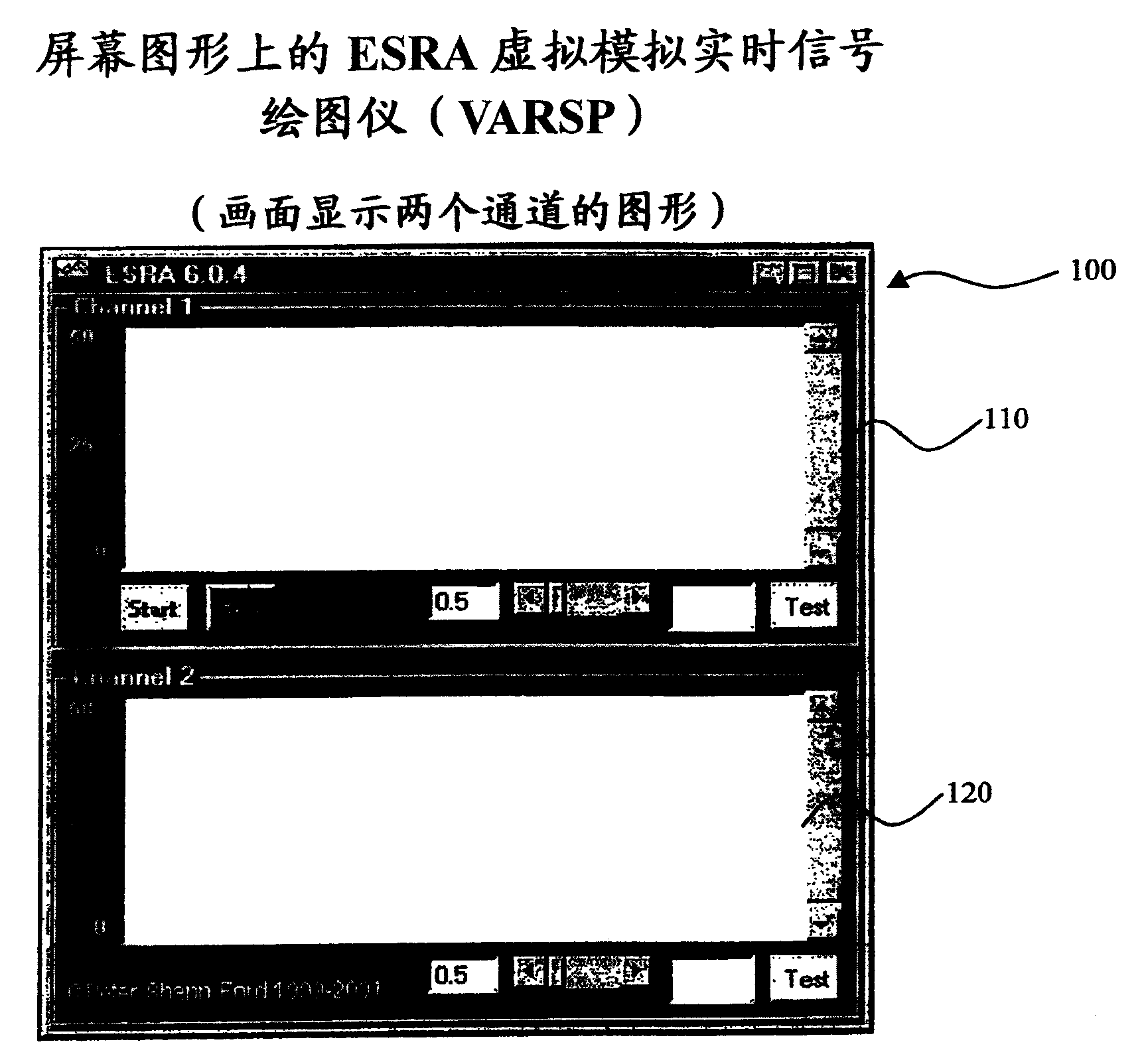
图1显示用于检测到的电信号的图形显示的计算机屏幕显示;Figure 1 shows a computer screen display for a graphical display of detected electrical signals;
图2显示示范初始交互屏幕;Figure 2 shows an exemplary initial interaction screen;
图3是显示初始类与目标项目列表之间的关系的方框图;Figure 3 is a block diagram showing the relationship between the initial class and the target item list;
图4是显示两个目标项目列表的示范屏幕;Figure 4 is an exemplary screen displaying two target item lists;
图5是公开选择的目标项目的示范屏幕;FIG. 5 is an exemplary screen disclosing a selected target item;
图6是显示本发明的交互式通信系统的组件的方框图。FIG. 6 is a block diagram showing components of the interactive communication system of the present invention.
实施例详细说明Detailed description of the embodiment
本发明涉及一种用于交互式通信和分析的方法(和相关系统与软件),其利用对从模拟源获得的数字数据的改进显示并对该数字数据进行分析,根据对该数字数据的分析确定选择指示,并利用将上述选择指示与指数缩减算法一起用于迅速从大得多的目标项目列表中选择目标项目的选择系统。The present invention relates to a method (and related system and software) for interactive communication and analysis utilizing improved display and analysis of digital data obtained from analog sources, based on the analysis of the digital data A selection indicator is determined and a selection system is utilized that uses the above selection indicator together with an exponential reduction algorithm to rapidly select a target item from a much larger list of target items.
下面将参照附图描述本发明。这些附图显示了实施本发明系统、方法与程序的特定实施例的某些细节。然而,通过附图描述本发明不应视为对本发明施加了可能存在于附图中的任何限制。本发明设想到了方法和系统以及用于完成其操作的在任何计算机可读介质上的程序产品。本发明的实施例可使用现有计算机处理器实施,或者通过为此目的或另一目而结合的专用计算机处理器来实现。The present invention will be described below with reference to the accompanying drawings. These figures show certain details of specific embodiments implementing the systems, methods and programs of the invention. However, the description of the present invention by means of the drawings should not be construed as imposing on the invention any limitations that may exist in the drawings. The present invention contemplates methods and systems, as well as program products on any computer-readable medium for accomplishing their operations. Embodiments of the invention may be implemented using existing computer processors, or by special purpose computer processors incorporated for this purpose or another.
如上所述,本发明范围内的实施例包括计算机可读介质上的程序产品和用于承载或在其上存有计算机可执行指令或数据结构的载体。此类计算机可读介质可以是可由通用或专用计算机访问的任何可用介质。此类计算机可读介质可包括例如RAM、ROM、EPROM、EEPROM、CD-ROM或其它光盘存储器、磁盘存储器或其它磁性存储装置,或者可由通用或专用计算机存取的、可用于承载或存储可执行指令或数据结构形式的所需程序代码的任何其它介质。可通过网络或另一通信连接(硬连线、无线或硬连线或无线的组合)将信息传送或提供给计算机时,计算机将该连接完全视为计算机可读介质。因此,任何此类连接完全可称为计算机可读介质。上述组合还应包括在计算机可读介质范围内。计算机可执行指令例如包括使通用计算机、专用计算机或专用处理装置执行某一功能或某组功能的指令与数据。As noted above, embodiments within the scope of the present invention include program products on computer-readable media and carriers for carrying or having computer-executable instructions or data structures stored thereon. Such computer-readable media can be any available media that can be accessed by a general purpose or special purpose computer. Such computer-readable media may include, for example, RAM, ROM, EPROM, EEPROM, CD-ROM, or other optical disk storage, magnetic disk storage, or other magnetic storage devices, or memory devices accessible by a general-purpose or special-purpose computer that can be used to carry or store executable Any other medium with the desired program code in the form of instructions or data structures. When information can be transmitted or provided to a computer over a network or another communication link (hardwired, wireless, or a combination of hardwired or wireless), the computer is solely to consider that connection to be a computer-readable medium. Thus, any such connection is properly termed a computer-readable medium. Combinations of the above should also be included within the scope of computer-readable media. Computer-executable instructions comprise, for example, instructions and data which cause a general purpose computer, special purpose computer, or special purpose processing devices to perform a certain function or group of functions.
下面将就可以在一个实施例中通过包括由在联网环境中的计算机执行的计算机可执行指令如程序模块的程序产品来实现的一般方法步骤来描述本发明。通常,程序模块包括执行特定任务或实现特定抽象数据类型的例程、程序、对象、组件、数据结构等。计算机可执行指令、相关联数据结构和程序模决代表了用于执行本文所公开方法的步骤的程序代码示例。此类可执行指令或相关联数据结构的特定序列代表了用于执行此类步骤中所述功能的相应动作的示例。The invention is described below in terms of general method steps that can be implemented in one embodiment by a program product comprising computer-executable instructions, such as program modules, that are executed by computers in a networked environment. Generally, program modules include routines, programs, objects, components, data structures, etc. that perform particular tasks or implement particular abstract data types. Computer-executable instructions, associated data structures and program modules represent examples of program code for executing steps of the methods disclosed herein. The particular sequence of such executable instructions or associated data structures represents examples of corresponding acts for performing the functions described in such steps.
本发明适于在使用至具有处理器的一个或多个远程计算机的逻辑连接的联网环境中应用。逻辑连接可包括局域网(LAN)和广域网(WAN),它们在这里作为示例而非限制。此类联网环境在办公范围或企业范围的计算机网络、企业内部网和因特网中是常见的。本领域技术人员会理解,此类网络计算环境通常会包括许多类型的计算机系统配置,包括个人计算机、手持装置、多处理器系统、基于微处理器的或可编程的消费电子产品、网络PC、微计算机、大型机等。本发明还可在分布式计算环境中实施,在这些环境中,任务由通过通信网络链接(通过硬连线链路、无线链路或硬连线或无线链路的组合链接)的本地和远程处理装置执行。在分布式计算环境中,程序模块可位于本地和远程存储装置中。The invention is suitable for application in networked environments using logical connections to one or more remote computers having processors. Logical connections may include local area networks (LANs) and wide area networks (WANs), which are presented here as examples and not limitations. Such networking environments are commonplace in office-wide or enterprise-wide computer networks, intranets and the Internet. Those skilled in the art will appreciate that such networked computing environments will typically include many types of computer system configurations, including personal computers, handheld devices, multiprocessor systems, microprocessor-based or programmable consumer electronics, networked PCs, Microcomputers, mainframes, etc. The invention may also be practiced in distributed computing environments where tasks are performed by local and remote computers linked (by hardwired links, wireless links, or a combination of hardwired or wireless links) through a communications network. The processing means executes. In a distributed computing environment, program modules may be located in both local and remote storage devices.
如上所述,在一个实施例中,本发明涉及用于伤残或残疾人的交互式通信装置,并包括以下三个组件:(1)虚拟模拟实时信号绘图仪(VARSP);(2)指数杠杠作用的字母数字字符串选择器(ELASS);以及(3)自动信号范围调整(ASRA)。其中每个组件将在本文中作进一步详细讨论。应该认识到,虽然这些组件中的每个组件在本文中是参照(例如用于伤残或残疾人士的)交互式通信装置实施例进行描述的,但它们还设计成与本文中进一步描述的各种其它应用一起使用。As mentioned above, in one embodiment, the present invention relates to an interactive communication device for the disabled or handicapped, and includes the following three components: (1) Virtual Analog Real-Time Signal Plotter (VARSP); (2) Index Leveraged Alphanumeric String Selector (ELASS); and (3) Automatic Signal Range Adjustment (ASRA). Each of these components is discussed in further detail in this article. It should be appreciated that while each of these components is described herein with reference to an embodiment of an interactive communication device (e.g., for a disabled or handicapped person), they are also designed to be compatible with each further described herein. use with other applications.
虚拟模拟实时信号绘图仪(VARSP)Virtual Analog Real-Time Signal Plotter (VARSP)
VARSP设计为处理和绘制适当的电信号,例如肌电图仪(EMG)信号。然而,这些信号可从任一来源收到,在一个实施例中,它设计为处理和利用由市场上可购买到、由Therapeutic Alliances公司开发的NeuroEDUCATORTM EMG处理器(以下称为“NeuroEudcator”)发送的以独特方式排列的数据流。本领域技术人员会认识到,NeuroEducator EMG捕获和处理装置只是EMG捕获和处理(或数字化)装置的一个示例。也可考虑使用其它EMG捕获和处理装置而非NeuroEducator。例如,NeuroEducator的四个通道每个均轮询粘附于目标神经肌肉部位上的皮肤的单独一组EMG处理器,例如每50毫秒轮询一次。NeuroEducator将模拟EMG信号数字化,并使之成为独特双字节组十六进制代码,表示在该50毫秒时间间隔内跨目标神经肌肉部位中心上的正中微伏(mV)电位降。该双字节十六进制组由NeuroEducator在数据流中沿电缆发送到例如9针串行插头,该插头与台式或膝上型个人计算机(PC)的标准COM1端口配对。本领域技术人员会认识到,在替代实施例中可使用无线或其它通信手段来代替电缆。VARSP is designed to process and map appropriate electrical signals, such as electromyography (EMG) signals. However, these signals may be received from either source, and in one embodiment it is designed to be processed and utilized by the commercially available NeuroEDUCATOR ™ EMG processor (hereinafter "NeuroEudcator") developed by Therapeutic Alliances, Inc. A uniquely arranged stream of data sent. Those skilled in the art will recognize that the NeuroEducator EMG capture and processing device is only one example of an EMG capture and processing (or digitizing) device. Other EMG capture and processing devices may also be considered instead of the NeuroEducator. For example, the NeuroEducator's four channels each poll a separate set of EMG processors attached to the skin over the targeted neuromuscular site, eg, every 50 milliseconds. The NeuroEducator digitizes the analog EMG signal into a unique two-byte hexadecimal code representing the median microvolt (mV) potential drop across the center of the targeted neuromuscular site during that 50 millisecond time interval. This two-byte hexadecimal group is sent in the data stream by the NeuroEducator down the cable to, for example, a 9-pin serial plug that mates with the standard COM1 port of a desktop or laptop personal computer (PC). Those skilled in the art will recognize that in alternative embodiments wireless or other means of communication may be used instead of cables.
VARSP以超过50千赫兹(kHz)的频度轮询COM1端口,并验证十六进制代码的每个双字节组后才将它转换为单个十进制值,以表示在该50毫秒间隔内目标神经肌肉部位上的mV读数。VARSP polls the COM1 port at a frequency in excess of 50 kilohertz (kHz) and verifies each two-byte group of hexadecimal code before converting it to a single decimal value representing the target within that 50 millisecond interval mV readings on neuromuscular sites.
在一个实施例中,VARSP算法由数据流绘制5秒mV读数轨迹,并按如下方式每50毫秒将其更新一次:(I)它绘制5秒轨迹,然后丢弃轨迹中最早的mV值并添加最新的mV值;(II)它擦除具有丢弃的mV值的旧5秒轨迹(在开始处),并重画具有新mV值的新5秒轨迹(在结尾处);(III)这样,图形看起来似乎每50毫秒前移越过屏幕。In one embodiment, the VARSP algorithm draws a 5-second trace of mV readings from the data stream and updates it every 50 milliseconds as follows: (I) it draws a 5-second trace, then discards the oldest mV values in the trace and adds the newest mV value; (II) it erases the old 5-second trace (at the beginning) with the discarded mV value, and redraws the new 5-second trace (at the end) with the new mV value; (III) this way, the graph looks It appears to move across the screen every 50 milliseconds.
该过程每50毫秒重复一次,产生实时模拟图、一个从NeuroEducator接收的数字数据流获得的虚拟模拟实时信号的外观。This process repeats every 50 milliseconds, producing a real-time analog map, the appearance of a virtual analog real-time signal obtained from the digital data stream received by the NeuroEducator.
在一个实施例中,VARSP算法将自然地从左到右跨屏幕流动一个线性时基数字数据流表现为具有模拟图(或显示)外观的右到左的流式图,但利用了处理数字数据的特征特性和熟知的优点。In one embodiment, the VARSP algorithm presents a linear time-based stream of digital data flowing naturally from left to right across the screen as a right-to-left streaming graph with the appearance of an analog graph (or display), but takes advantage of the characteristic features and well-known advantages.
VARSP图的绘制对输入数据流的实时可视分析是必要的,并且对用户、特别是伤残用户评估他们努力在目标神经肌肉部位发生的神经肌肉活动的程度的能力也是必要的。The rendering of VARSP maps is necessary for real-time visual analysis of incoming data streams, and for the ability of users, especially disabled users, to assess the extent of neuromuscular activity they are striving to occur at targeted neuromuscular sites.
正如本领域技术人员会认识到的一样,VARSP算法可应用在生物和医疗监控的各个领域,其中,信号发源于模拟(例如生物)部位,但转换成数字数据流并从传感器发送。As will be appreciated by those skilled in the art, the VARSP algorithm can be applied in various fields of biological and medical monitoring, where signals originate from analog (eg, biological) sites but are converted to digital data streams and sent from sensors.
在一个方面,VARSP算法(如上所述)能够使任一数字数据流变为具有实时模拟图所有特征的图形显示。例如,这种数字数据流可源于监控数据或天文、地质、气象、电子和/或机械源的遥测。In one aspect, the VARSP algorithm (described above) enables any digital data stream to be turned into a graphical display with all the characteristics of a real-time analog graph. For example, such digital data streams may originate from surveillance data or telemetry from astronomical, geological, meteorological, electronic and/or mechanical sources.
在一个实施例中,本发明提出,基于处理接收的EMG信号可检测用户产生的选择或指示信号。通过改变其EMG活动水平(例如以微伏为单位测量),伤残或其它人士可以多种方式产生“开启(on)”信号。一种方式是使其EMG信号升到某水平(“触发线”)之上。例如,如果ELASS(如下所述)在运行,则该水平可动态改变,其中中线(如本文以下所述)作为触发线。In one embodiment, the invention proposes that a user-generated selection or indication signal may be detected based on processing received EMG signals. By changing their level of EMG activity (measured, for example, in microvolts), a disabled or other person can generate an "on" signal in a variety of ways. One way is to have its EMG signal rise above a certain level ("trigger line"). For example, if ELASS (described below) is running, the level can change dynamically, with the midline (described below in this article) acting as the trigger line.
另一种方式(“Delta系统”)是:如果用户在设定时间内使EMG信号以某种方式变化,则基于该EMG信号检测选择指示,所述方式例如为通过分析可从两个顺序值样本变化到扩充数量的值样本的周期内的变化率。例如,在每50毫秒抽样的情况下,该周期的变化可从51毫秒(两个样本)变化到一秒(19个样本)或更长。Delta系统可以从简单的直线加速变为一组复杂的增加和/或减少。Another approach ("Delta system") is to detect selection indications based on the EMG signal if the user causes the EMG signal to vary in a certain way within a set time, e.g. The rate of change over a period of sample change to the value sample of the augmented quantity. For example, with sampling every 50 milliseconds, the period can vary from 51 milliseconds (two samples) to one second (19 samples) or longer. Delta systems can vary from a simple linear acceleration to a complex set of increases and/or decreases.
指数杠杆作用的字母数字字符串选择器(ELASS)Exponential Leveraged Alphanumeric String Selector (ELASS)
ELASS算法设计为通过简单的键击或EGM产生(或其它电信号)的“开启”指示信号,对字母数字字符和字符串(或者甚至符号或图形要素)提供高度有效的控制。The ELASS algorithm is designed to provide highly efficient control over alphanumeric characters and strings (or even symbols or graphic elements) via simple keystrokes or EGM-generated (or other electrical signals) "on" indication signals.
ELASS是一个选择系统,允许用户通过按分子为1且分母为任一整数(“缩减因数”)的分数迭代地缩减(或“指数缩减”)列表,从而定位项目列表中的特定项目(“目标项目”)。例如,对于缩减因数2,列表渐次地(或迭代地)折半缩减,每次缩减选择包含目标项目的那一半,直至只剩下目标项目。ELASS is a selection system that allows the user to target a specific item in a list of items by iteratively reducing (or "exponentially reducing") the list by a fraction with a numerator of 1 and a denominator of any integer ("reduction factor"). project"). For example, for a reduction factor of 2, the list is gradually (or iteratively) reduced in half, and each reduction selects the half that contains the target item until only the target item remains.
ELASS利用指数数学方法从列表中选择(或挑选)一个目标项目,比需要决定逐个选择或拒绝列表中每个项目的连续循环快得多。例如,采用顺序循环查找具有64个项目的列表时,如果目标项目是列表中的第64个项目,则会采用64次选择以循环通过整个列表来定位目标项目。对于ELASS,使用缩减因数2,无论目标项目位于列表中何处,始终只需6次选择来确定其位置,也就是说,在缩减时将每次选择的剩余列表减半,从64到32到16到8到4到2到1(64是2的6次方,因此为6次选择)。ELASS utilizes exponential mathematics to select (or pick) a target item from a list much faster than a continuous loop requiring decisions to select or reject each item in the list one by one. For example, when sequentially looping through a list with 64 items, if the target item is the 64th item in the list, 64 selections will be used to cycle through the entire list to locate the target item. For ELASS, with a reduction factor of 2, no matter where the target item is in the list, it always takes only 6 selections to determine its position, that is, when reducing, the remaining list is halved for each selection, from 64 to 32 to 16 to 8 to 4 to 2 to 1 (64 is 2 to the 6th power, so 6 choices).
ELASS指数缩减也可按任一其它缩减因数进行,如按四分之一(缩减因数2)或按八分之一(缩减因数8)等进行缩减。The ELASS index can also be reduced by any other reduction factor, such as by one quarter (reduction factor 2) or by one eighth (reduction factor 8).
ELASS采用此指数杠杆作用来处理任意长度的列表。ELASS takes this exponential leverage to handle lists of arbitrary length.
由于列表上的任一项目本身可能是列表,因此,ELASS也可组合采用指数杠杆作用。列表中的任一项目本身可能是任一长度的另外列表,该列表又可通过指数杠杆作用缩减。例如,本领域的技术人员会认识到,不是目标项目存在于显示给用户(或选择者)的每个目标项目列表集合中,而是可在初始迭代中向用户呈示代表目标项目的列表(或类),这样,通过一组迭代可向用户呈现数量更多的项目。在随后的迭代中,类可展开以揭示供用户选择的实际目标项目列表。在简化的示例中,对用户的初始显示可显示以下两个类:“食品”和“饮料”。在另一示例中,初始选择可以为以下四类之一:要求、食品与饮料、问候语和个人护理,一旦初始选择了“食品与饮料”,则要在食品与饮料之间进行选择。一旦用户选择了这些类之一(例如,“食品”),则随后可将与所选择的类对应的目标项目列表(如食品项目或食品项目类)提供给用户以便进一步选择。此迭代选择过程(基于显示的目标项目类、目标项目或其组合)将继续,直至选择了所需的目标项目。Since any item on the list may itself be a list, ELASS can also be combined with exponential leverage. Any item in the list may itself be another list of any length, which in turn can be reduced by exponential leverage. For example, those skilled in the art will recognize that rather than the target item being present in every set of target item lists displayed to the user (or selector), the user may be presented with a list representing the target item (or selector) in an initial iteration. class) so that a greater number of items can be presented to the user through a set of iterations. In subsequent iterations, the class can be expanded to reveal the actual list of target items for the user to select. In a simplified example, the initial display to the user may show the following two categories: "Food" and "Beverages". In another example, the initial selection may be one of four categories: Requirements, Food & Beverages, Greetings, and Personal Care, once "Food & Beverages" is initially selected, to choose between Food & Beverages. Once the user selects one of these categories (eg, "food"), a list of target items (eg, food items or categories of food items) corresponding to the selected category may then be presented to the user for further selection. This iterative selection process (based on the displayed target item class, target item, or combination thereof) will continue until the desired target item is selected.
ELASS是一种独特的选择方法,它在计算机屏幕(或其它设备显示器)上显示列表并按指数规律缩减列表。本领域的技术人员会认识到,虽然本文的说明涉及计算机屏幕或显示器,但诸如在PDA或无线电话或设备上的其它可选显示器也在本文所述本发明的范围内。ELASS is a unique selection method that displays a list on a computer screen (or other device display) and shrinks the list exponentially. Those skilled in the art will recognize that while the description herein refers to a computer screen or display, other alternative displays, such as on a PDA or wireless phone or device, are also within the scope of the invention described herein.
在一个实施例中,使用缩减因数2时,ELASS在屏幕上各窗口(屏幕上有两个“列表窗口”)中显示相应列表中的各一半目标项目,使用户查看列表中每个项目的能力最大化。在用户选择显示包含了目标项目列表的列表窗口时,ELASS擦除两个列表窗口并将所选列表中的目标项目分为两半来显示该列表。随后,所选列表的每一半在计算机屏幕上其自己的窗口中作为单独的列表显示,该屏幕上同时显示了两个列表窗口。这样,ELASS允许用户循环通过整个原始列表或目标项目,直至屏幕上显示的两个列表窗口之一中剩下所需的目标项目。随着此迭代过程继续,所需目标项目会单独出现在计算机屏幕上显示的其列表窗口中。ELASS设计成:一旦所需目标项目是屏幕上显示的列表窗口中存在的唯一目标项目时,发起与该特定所需目标项目对应的响应。例如,ELASS能够在屏幕上以更大的打印来显示项目,并通过扬声器或耳机将其从文本转换为语音。ELASS还设计成使其可以:启动诸如机器人装置移动之类的相当功能(或甚至一组功能);发起对诸如空调、灯、电视、无线电或立体音响系统等设备的控制;发起电子邮件活动;发起因特网活动(浏览或查找);以及发起诸如启动、操作或关闭诸如字处理程序等程序或打开、操作或保存电子文件的计算机活动;或甚至调整ELASS系统本身上的设置以便系统可更好地针对每个用户进行定制。In one embodiment, when using a reduction factor of 2, ELASS displays each half of the target items in the corresponding list in each window on the screen (there are two "list windows" on the screen), giving the user the ability to view each item in the list maximize. When the user selects to display a list window containing a list of target items, ELASS erases both list windows and splits the target item in the selected list in half to display the list. Each half of the selected list is then displayed as a separate list in its own window on the computer screen, on which both list windows are displayed simultaneously. In this way, ELASS allows the user to cycle through the entire original list or target items until the desired target item remains in one of the two list windows displayed on the screen. As this iterative process continues, the desired target item appears individually in its list window displayed on the computer screen. ELASS is designed to initiate a response corresponding to a specific desired target item once the desired target item is the only target item present in the list window displayed on the screen. For example, ELASS is able to display items in larger print on the screen and convert them from text to speech through speakers or headphones. ELASS is also designed so that it can: initiate equivalent functions (or even a set of functions) such as robotic device movement; initiate control of equipment such as air conditioners, lights, televisions, radios or stereo systems; initiate email campaigns; Initiate Internet activity (browsing or searching); and initiate computer activity such as starting, operating, or closing programs such as word processing programs or opening, manipulating, or saving electronic documents; or even adjusting settings on the ELASS system itself so that the system works better Customized for each user.
自动信号范围调整(ASRA)和选择检测Automatic Signal Range Adjustment (ASRA) and Selection Detection
ASRA描绘设定时间周期内的最大EMG值(以微伏为单位)和最小EMG值(以微伏为单位),并将最大Y轴值调整为更接近包括这些最大和最小EMG值的新值。随后,它调整用作待执行命令触发器的中间线值(在该设定周期期间抽样的最大EMG值与抽样的最小EMG值之间中间的Y轴值)。本领域的技术人员会认识到,中间线值无需为中间值,而是可替换为介于检测到的最大与最小EMG信号值之间的另一值(例如,可使用最大与最小EMG值之间60%或75%的阈值)。ASRA plots the maximum EMG value (in microvolts) and the minimum EMG value (in microvolts) for the set time period and adjusts the maximum Y-axis value to be closer to a new value that includes these maximum and minimum EMG values . It then adjusts the midline value (the Y-axis value midway between the maximum EMG value sampled and the minimum EMG value sampled during the set period) that serves as a trigger for the command to be executed. Those skilled in the art will recognize that the median line value need not be a median value, but may instead be another value between the detected maximum and minimum EMG signal values (for example, a value between the maximum and minimum EMG values may be used). 60% or 75% threshold).
在用户基于检测的EMG值生成超过中间线或另一预定标准的EMG信号的瞬时,可生成选择信号或指示信号。例如,一些预定的标准可包括与如上所述基于检测的EMG信号值而绘制或显示的曲线时基形状相关的标准。本发明的一个实施例支持一旦在该瞬时检测到选择或指示信号时,执行对应于该瞬时的命令选择。对应于该瞬时的命令选择可通过各种方法显示或表示,例如,通过计算机屏幕图形(例如,使光标或其它指示符在计算机屏幕上显示的活动列表窗口之间旋转)、声音或其组合。在本发明的某些实施例中,ASRA允许自动调整对应于某个特定用户能够在其神经部位产生的EMG信号的显示的EMG范围(以微伏为单位)。这种自动调整会消除(或降低)另一人手动定期改变该范围的要求。显示的EMG信号范围的这种自动调整有助于对检测到的EMG信号进行更敏感的分析,这是因为所显示和分析的是检测到的EMG信号值的更具体的范围。A selection signal or an indication signal may be generated at the instant a user generates an EMG signal that exceeds a median line or another predetermined criterion based on a detected EMG value. For example, some predetermined criteria may include criteria related to the time-based shape of the curve plotted or displayed based on the detected EMG signal values as described above. One embodiment of the present invention supports performing a command selection corresponding to an instant once a selection or indication signal is detected at that instant. The command selection corresponding to the instant may be displayed or represented by various methods, for example, by computer screen graphics (eg, rotating a cursor or other indicator between active list windows displayed on the computer screen), sound, or combinations thereof. In some embodiments of the present invention, ASRA allows for automatic adjustment of the displayed EMG range (in microvolts) corresponding to the EMG signals that a particular user is able to generate at his neural site. This automatic adjustment would eliminate (or reduce) the need for another person to manually change the range periodically. This automatic adjustment of the displayed EMG signal range facilitates a more sensitive analysis of the detected EMG signal since a more specific range of detected EMG signal values is displayed and analyzed.
本领域的技术人员会认识到,所述ASRA可在监控可变范围数据流的不同应用中使用。此类应用包括例如:地质数据(如逐步增强地震活动)自动调节监视器、气象数据(如恶化的天气或气候条件)自动调节监视器、天文数据(诸如与非随机事件如从智能源发出的信号相关联的模式行为)自动调节监视器。这些应用可程序化,以发起警报、通知、警告、响应指示和类似的活动或这些的任何组合。Those skilled in the art will recognize that the ASRA described can be used in different applications for monitoring variable range data streams. Such applications include, for example, self-regulating monitors for geological data (e.g., gradually increasing seismicity), meteorological data (for example, deteriorating weather or climate conditions), astronomical data (such as signal-associated mode behavior) automatically adjusts the monitor. These applications can be programmed to initiate alerts, notifications, warnings, response indications and similar activities or any combination of these.
这种应用还包括存在于诸如模糊逻辑系统中用以改变切换行为,例如微波炉、干衣机或空调的切换行为的自调节响应功能。这些应用可包括复杂系统,例如,诸如国际空间站之类轨道对象的复合定位和状态到诸如色班清除medbot之类毫微米工艺设备的活动,所有这些系统工作在经常变化、可能伴随有严重后果的动态状态中。Such applications also include self-regulating response functions found in systems such as fuzzy logic to change switching behavior, such as that of microwave ovens, clothes dryers or air conditioners. These applications can range from complex systems, for example, the complex positioning and status of orbiting objects such as the International Space Station, to the activity of nanoscale process equipment such as the color shift clearing medbot, all of which operate under frequently changing conditions with potentially serious consequences in a dynamic state.
这样的应用还包括生物医学监视功能,该功能监视诸如生命迹象、神经肌肉活动以及从整个身体定位(站直、移动、静止)到子分子事件(如跨场或跨空间的粒子交换或粒子特征变化)的所有可检测生物活动等要素。Such applications also include biomedical surveillance capabilities that monitor things such as vital signs, neuromuscular activity, and everything from whole-body positioning (standing upright, moving, stationary) to sub-molecular events such as particle exchange or particle signature across fields or spaces. Changes), all detectable biological activities and other elements.
从目标项目列表中进行交互选择的示例Example of interactive selection from a list of target items
图1示出了计算机屏幕100显示,其中呈现了两个显示两通道图形的窗口110和120,每个通道对应于在肌肉神经部位检测到的生物活动产生的EMG信号活动。如以上参照VARSP和ASRA所述,本发明的某些实施例规定:为伤残用户在适合的神经肌肉部位配备EMG传感器(例如,与NeuroEducator EMG兼容的传感器)。可以设置传感器的肌肉神经部位的示例包括身体上每个外部可接触到的神经肌肉部位(在表皮外层上带有皮肤传感器),例如,二头肌上皮肤的表面,或前臂的屈肌或伸肌,以及极度残疾情况下,前额额肌上的表皮。还要理解,如上所述,可取代接触式传感器(或除这种传感器外还),采用基于检测变化的电阻、电容、磁场或光透射或反射的远程传感器。FIG. 1 shows a
图2示出向用户显示的示范初始屏幕200。初始屏幕展现了四个文本框,其中显示了用户可能需要的目标项目初始类。例如,所显示的初始类包括要求205、个人护理210、食品与饮料215及问候语220。光标或其它指示符循环通过四个文本框205、210、215和220中的每个框,以便向用户指示在特定瞬时哪一个文本框(或类)是活动或可选的。根据本发明的某些实施例,基于系统处理的EMG信号,检测选择指示EMG信号,例如,如以上针对ARSA所述。在检测到选择指示EMG信号的瞬时,由光标(或其它指示符)突出显示的类或文本框被视为在该瞬时正被用户选择,并随后基于选择的类或文本框执行进一步处理。如图2所示,如果在光标突出显示类或文本框220时检测到选择指示EMG信号,则“问候语”类或文本框220被视为要由用户选择。FIG. 2 shows an exemplary
图3是说明初始类与目标项目列表之间关系的方框图。显示系统从起始显示150引导到初始类要求205、个人护理210、食品与饮料215和问候语220的显示。一旦用户选择了初始类之一,系统接着便使用二进制选择器250交互显示对应的目标项目列表205L、210L、215L或220L,直至选择了所需目标项目。也就是说,如果选择了要求205类,则会迭代显示对应的列表窗口205L。如果选择了个人护理210类,则会迭代显示对应的列表窗口210L。如果选择了食品与饮料215类,则会迭代显示对应的列表窗口215L。最后,如果选择了问候语220类,则会显示对应的列表窗口220。选择的动作列表窗口只剩下一个目标项目时,则该目标项目由用户有效地选择,并且系统随后根据选择的目标项目执行进一步处理。根据选择的目标项目的进一步处理可以只是向另一系统传送通信消息,或者可以在其它设备或系统上发起动作,例如激活机器人、计算机应用或开始获得某服务的过程。Figure 3 is a block diagram illustrating the relationship between the initial class and the target item list. The display system leads from the initial display 150 to the display of
因此,当用户选择图2中的问候语220类或文本框时,如图4所示会向用户显示两个对应的列表窗口220L。列表窗口222呈示6个问候语的列表,同时列表窗口224呈示具有另外6个问候语的列表,而光标或其它类似的指示符在两个列表窗口222与224之间循环。使用本文较早前所述的选择方法,用户随后基于两个列表窗口中哪一个窗口包含所需目标项目(问候语)而选择两个列表窗口222或224之一。之后,一旦用户选择了两个列表窗口222或224之一,则6个目标项目(或问候语)现在分成两个另外的列表窗口,每个列表窗口包含上述6个目标项目中的3个项目。这样,选择过程按指数方式缩减目标项目的数量,直到选择的列表窗口只包含一个目标项目(即,所需的目标项目)。Therefore, when the user selects the
因此,如图5所示,列表窗口226只包含在列表窗口222中显示的目标项目列表中的目标项目之一。本领域技术人员会认识到,每个屏幕(或每次选择)使用两个列表窗口本质上会实现对二叉树的遍历,直到在叶节点处找到所需的目标项目为止。本领域技术人员还会认识到,三叉树或其它n叉树也可用于进一步加快选择过程。当然,将更高阶的树算法用于选择过程还将要求在计算机屏幕上同时显示附加的列表窗口,并因此要求用户进行更麻烦的决策过程。因此,例如,使用三叉树选择算法会要求向用户同时显示三个列表窗口。Therefore, as shown in FIG. 5 ,
图6是用于实施本文上述过程步骤的系统组件的方框图。EMG传感器300从贴到身体神经肌肉部位的传感器捕获神经肌肉信号(以mV为单位)。如上所述,可设置传感器的一些肌肉神经部位包括身体上每个外部可接触到的神经肌肉部位(在表皮外层上带有皮肤传感器),如二头肌上的皮肤表面,或前臂的屈肌或伸肌,以及极度残疾情况下,前额额肌上的表皮。这种检测神经肌肉活动的EMG传感器已为本领域技术人员所熟知,目前已获得广泛的商业使用。来自神经肌肉部位的EMG信号传送到滤波和A/D转换系统320,如以上针对VARSP所述的NeuroEducator系统。滤波和A/D转换系统320提供数字数据流到如本文上面针对VARSP所述的计算单元。之后,设在计算单元340内的VARSP组件也如本文针对VARSP所述的那样,将数字数据流作为虚拟模拟图接收、处理并显示。计算单元340还包含向用户(显示单元)交互地提供屏幕显示的硬件和定制软件,以便用户可通过提供随后由EMG传感器300拾取的生物或EMG信号来响应屏幕显示。显示单元还包含实现如以上针对ELASS所述的指数缩减选择过程的软件。计算单元340还包含对从滤波和A/D转换系统320接收的数字数据流进行处理的信号处理单元和确定接收的EMG信号是否指示用户选择例如在由计算单元340提供给用户的屏幕显示上呈现的列表窗口之一的选择单元。Figure 6 is a block diagram of system components for implementing the process steps described above herein. The
以上为举例和说明目的给出了对本发明实施例的描述。其目的并非为了穷举本发明的实施方式或将本发明限制于所公开的精确形式,各种修改和变化科根据上述教导进行或可从本发明的实践中获得。所选择并描述的实施例用于解释本发明的原理及其实际应用,以使本领域的技术人员能够在不同的实施例中,通过适用于所设想的特定应用的各种修改来利用本发明。The foregoing description of embodiments of the present invention has been presented for purposes of illustration and description. It is not intended to be exhaustive or to limit the invention to the precise form disclosed, and modifications and variations may be made in light of the above teaching or may be acquired from practice of the invention. The embodiment was chosen and described in order to explain the principles of the invention and its practical application to enable those skilled in the art to utilize the invention in various embodiments with various modifications as are suited to the particular use contemplated. .
Claims (25)
Applications Claiming Priority (2)
| Application Number | Priority Date | Filing Date | Title |
|---|---|---|---|
| US47776203P | 2003-06-12 | 2003-06-12 | |
| US60/477,762 | 2003-06-12 |
Publications (2)
| Publication Number | Publication Date |
|---|---|
| CN1833217A CN1833217A (en) | 2006-09-13 |
| CN100374986C true CN100374986C (en) | 2008-03-12 |
Family
ID=33551759
Family Applications (1)
| Application Number | Title | Priority Date | Filing Date |
|---|---|---|---|
| CNB200480022250XA Expired - Lifetime CN100374986C (en) | 2003-06-12 | 2004-06-14 | Methods, systems and software for interactive communication and analysis |
Country Status (9)
| Country | Link |
|---|---|
| US (1) | US7761390B2 (en) |
| EP (1) | EP1634155A2 (en) |
| JP (1) | JP2007505423A (en) |
| KR (1) | KR20060023149A (en) |
| CN (1) | CN100374986C (en) |
| AU (1) | AU2004248641C1 (en) |
| BR (1) | BRPI0411346A (en) |
| CA (1) | CA2529203C (en) |
| WO (1) | WO2004111820A2 (en) |
Families Citing this family (52)
| Publication number | Priority date | Publication date | Assignee | Title |
|---|---|---|---|---|
| US20120001748A1 (en) * | 2010-06-30 | 2012-01-05 | Norman Ladouceur | Methods and apparatus for visually supplementing a graphical user interface |
| GB201212878D0 (en) | 2012-07-20 | 2012-09-05 | Pike Justin | Authentication method and system |
| US20140198034A1 (en) * | 2013-01-14 | 2014-07-17 | Thalmic Labs Inc. | Muscle interface device and method for interacting with content displayed on wearable head mounted displays |
| WO2014186370A1 (en) | 2013-05-13 | 2014-11-20 | Thalmic Labs Inc. | Systems, articles and methods for wearable electronic devices that accommodate different user forms |
| US11921471B2 (en) | 2013-08-16 | 2024-03-05 | Meta Platforms Technologies, Llc | Systems, articles, and methods for wearable devices having secondary power sources in links of a band for providing secondary power in addition to a primary power source |
| US11426123B2 (en) | 2013-08-16 | 2022-08-30 | Meta Platforms Technologies, Llc | Systems, articles and methods for signal routing in wearable electronic devices that detect muscle activity of a user using a set of discrete and separately enclosed pod structures |
| US12504816B2 (en) | 2013-08-16 | 2025-12-23 | Meta Platforms Technologies, Llc | Wearable devices and associated band structures for sensing neuromuscular signals using sensor pairs in respective pods with communicative pathways to a common processor |
| US20150124566A1 (en) | 2013-10-04 | 2015-05-07 | Thalmic Labs Inc. | Systems, articles and methods for wearable electronic devices employing contact sensors |
| US10042422B2 (en) | 2013-11-12 | 2018-08-07 | Thalmic Labs Inc. | Systems, articles, and methods for capacitive electromyography sensors |
| US9788789B2 (en) | 2013-08-30 | 2017-10-17 | Thalmic Labs Inc. | Systems, articles, and methods for stretchable printed circuit boards |
| WO2015081113A1 (en) | 2013-11-27 | 2015-06-04 | Cezar Morun | Systems, articles, and methods for electromyography sensors |
| US9600030B2 (en) | 2014-02-14 | 2017-03-21 | Thalmic Labs Inc. | Systems, articles, and methods for elastic electrical cables and wearable electronic devices employing same |
| US10199008B2 (en) | 2014-03-27 | 2019-02-05 | North Inc. | Systems, devices, and methods for wearable electronic devices as state machines |
| US9880632B2 (en) | 2014-06-19 | 2018-01-30 | Thalmic Labs Inc. | Systems, devices, and methods for gesture identification |
| US9477079B2 (en) | 2014-06-25 | 2016-10-25 | Thalmic Labs Inc. | Systems, devices, and methods for wearable heads-up displays |
| US9807221B2 (en) | 2014-11-28 | 2017-10-31 | Thalmic Labs Inc. | Systems, devices, and methods effected in response to establishing and/or terminating a physical communications link |
| US9958682B1 (en) | 2015-02-17 | 2018-05-01 | Thalmic Labs Inc. | Systems, devices, and methods for splitter optics in wearable heads-up displays |
| CA2976903A1 (en) | 2015-02-17 | 2016-08-25 | Thalmic Labs Inc. | Systems, devices, and methods for eyebox expansion in wearable heads-up displays |
| US10078435B2 (en) | 2015-04-24 | 2018-09-18 | Thalmic Labs Inc. | Systems, methods, and computer program products for interacting with electronically displayed presentation materials |
| US10197805B2 (en) | 2015-05-04 | 2019-02-05 | North Inc. | Systems, devices, and methods for eyeboxes with heterogeneous exit pupils |
| GB201520760D0 (en) | 2015-05-27 | 2016-01-06 | Mypinpad Ltd And Licentia Group Ltd | Encoding methods and systems |
| US10078219B2 (en) | 2015-05-28 | 2018-09-18 | Thalmic Labs Inc. | Wearable heads-up display with integrated eye tracker and different optical power holograms |
| CN108474873A (en) | 2015-09-04 | 2018-08-31 | 赛尔米克实验室公司 | System, product and method for combining holographic optical elements (HOE) and eyeglass |
| US20170097753A1 (en) | 2015-10-01 | 2017-04-06 | Thalmic Labs Inc. | Systems, devices, and methods for interacting with content displayed on head-mounted displays |
| US9904051B2 (en) | 2015-10-23 | 2018-02-27 | Thalmic Labs Inc. | Systems, devices, and methods for laser eye tracking |
| US10802190B2 (en) | 2015-12-17 | 2020-10-13 | Covestro Llc | Systems, devices, and methods for curved holographic optical elements |
| US10303246B2 (en) | 2016-01-20 | 2019-05-28 | North Inc. | Systems, devices, and methods for proximity-based eye tracking |
| US10151926B2 (en) | 2016-01-29 | 2018-12-11 | North Inc. | Systems, devices, and methods for preventing eyebox degradation in a wearable heads-up display |
| CN109313383A (en) | 2016-04-13 | 2019-02-05 | 赛尔米克实验室公司 | For focusing the system, apparatus and method of laser projecting apparatus |
| US11216069B2 (en) | 2018-05-08 | 2022-01-04 | Facebook Technologies, Llc | Systems and methods for improved speech recognition using neuromuscular information |
| WO2020112986A1 (en) | 2018-11-27 | 2020-06-04 | Facebook Technologies, Inc. | Methods and apparatus for autocalibration of a wearable electrode sensor system |
| CN110300542A (en) | 2016-07-25 | 2019-10-01 | 开创拉布斯公司 | Method and apparatus for predicting musculoskeletal location information using wearable automated sensors |
| US10277874B2 (en) | 2016-07-27 | 2019-04-30 | North Inc. | Systems, devices, and methods for laser projectors |
| WO2018027326A1 (en) | 2016-08-12 | 2018-02-15 | Thalmic Labs Inc. | Systems, devices, and methods for variable luminance in wearable heads-up displays |
| US10215987B2 (en) | 2016-11-10 | 2019-02-26 | North Inc. | Systems, devices, and methods for astigmatism compensation in a wearable heads-up display |
| CA3045192A1 (en) | 2016-11-30 | 2018-06-07 | North Inc. | Systems, devices, and methods for laser eye tracking in wearable heads-up displays |
| US10365492B2 (en) | 2016-12-23 | 2019-07-30 | North Inc. | Systems, devices, and methods for beam combining in wearable heads-up displays |
| US10718951B2 (en) | 2017-01-25 | 2020-07-21 | North Inc. | Systems, devices, and methods for beam combining in laser projectors |
| CN112040858B (en) | 2017-10-19 | 2024-06-07 | 元平台技术有限公司 | Systems and methods for identifying biological structures associated with neuromuscular source signals |
| US20190121135A1 (en) | 2017-10-23 | 2019-04-25 | North Inc. | Free space multiple laser diode modules |
| WO2019099831A1 (en) * | 2017-11-16 | 2019-05-23 | Control Bionics Holdings Pty Ltd | Electromyography (emg) assistive communications device with context-sensitive user interface |
| US11961494B1 (en) | 2019-03-29 | 2024-04-16 | Meta Platforms Technologies, Llc | Electromagnetic interference reduction in extended reality environments |
| US10937414B2 (en) | 2018-05-08 | 2021-03-02 | Facebook Technologies, Llc | Systems and methods for text input using neuromuscular information |
| US11493993B2 (en) | 2019-09-04 | 2022-11-08 | Meta Platforms Technologies, Llc | Systems, methods, and interfaces for performing inputs based on neuromuscular control |
| US11481030B2 (en) | 2019-03-29 | 2022-10-25 | Meta Platforms Technologies, Llc | Methods and apparatus for gesture detection and classification |
| US11150730B1 (en) * | 2019-04-30 | 2021-10-19 | Facebook Technologies, Llc | Devices, systems, and methods for controlling computing devices via neuromuscular signals of users |
| US11907423B2 (en) | 2019-11-25 | 2024-02-20 | Meta Platforms Technologies, Llc | Systems and methods for contextualized interactions with an environment |
| US10592001B2 (en) | 2018-05-08 | 2020-03-17 | Facebook Technologies, Llc | Systems and methods for improved speech recognition using neuromuscular information |
| CN112996430B (en) | 2018-08-31 | 2024-10-15 | 元平台技术有限公司 | Camera-guided interpretation of neuromuscular signals |
| WO2020061451A1 (en) | 2018-09-20 | 2020-03-26 | Ctrl-Labs Corporation | Neuromuscular text entry, writing and drawing in augmented reality systems |
| GB201916441D0 (en) | 2019-11-12 | 2019-12-25 | Mypinpad Ltd | Computer-implemented system and method |
| US11868531B1 (en) | 2021-04-08 | 2024-01-09 | Meta Platforms Technologies, Llc | Wearable device providing for thumb-to-finger-based input gestures detected based on neuromuscular signals, and systems and methods of use thereof |
Citations (7)
| Publication number | Priority date | Publication date | Assignee | Title |
|---|---|---|---|---|
| US4109145A (en) * | 1974-05-20 | 1978-08-22 | Honeywell Inc. | Apparatus being controlled by movement of the eye |
| WO1991001699A1 (en) * | 1989-08-04 | 1991-02-21 | Gec-Marconi Limited | Control system |
| CN1060940A (en) * | 1990-07-24 | 1992-05-06 | 生物控制系统有限公司 | eye-operated controller |
| WO1998028678A1 (en) * | 1996-12-24 | 1998-07-02 | Vyacheslav Vladimirovich Minin | A method for manual entry of data into a computer and a device for realization of the method |
| EP1008925A2 (en) * | 1998-12-07 | 2000-06-14 | Hitachi, Ltd. | Device for controlling equipment by using signals from a living body |
| US6244873B1 (en) * | 1998-10-16 | 2001-06-12 | At&T Corp. | Wireless myoelectric control apparatus and methods |
| US20030046254A1 (en) * | 2001-02-27 | 2003-03-06 | Ryu Chang Su | Apparatus for controlling electrical device using bio-signal and method thereof |
Family Cites Families (9)
| Publication number | Priority date | Publication date | Assignee | Title |
|---|---|---|---|---|
| GB2145257B (en) * | 1983-07-15 | 1987-01-28 | Charles George Smith | Display systems for operation by persons of limited controllable mobility |
| US4951190A (en) * | 1985-04-30 | 1990-08-21 | Prometrix Corporation | Multilevel menu and hierarchy for selecting items and performing tasks thereon in a computer system |
| JPH062146B2 (en) | 1987-03-30 | 1994-01-12 | 竹井機器工業株式会社 | Will transmission device |
| DE8809941U1 (en) * | 1988-08-04 | 1988-09-22 | Turnwald, Peter, 6648 Wadern | Shelf of a sales shelf |
| US5124942A (en) * | 1988-09-28 | 1992-06-23 | Solatrol, Inc. | Machine interface with cyclically displayed hierarchical menus and user selection of menu items by actuation of a single switch |
| US6160536A (en) * | 1995-03-27 | 2000-12-12 | Forest; Donald K. | Dwell time indication method and apparatus |
| US6154750A (en) * | 1998-04-01 | 2000-11-28 | Cyberpulse Llc | Method and system for navigation and data entry in heirarchically-organized database views |
| GB2364493B (en) * | 2000-06-30 | 2004-11-10 | Nokia Mobile Phones Ltd | Improved data input |
| US6688311B2 (en) * | 2002-03-14 | 2004-02-10 | Allergan, Inc. | Method for determining effect of a clostridial toxin upon a muscle |
-
2004
- 2004-06-14 CN CNB200480022250XA patent/CN100374986C/en not_active Expired - Lifetime
- 2004-06-14 AU AU2004248641A patent/AU2004248641C1/en not_active Expired
- 2004-06-14 JP JP2006533786A patent/JP2007505423A/en active Pending
- 2004-06-14 US US10/866,183 patent/US7761390B2/en not_active Expired - Lifetime
- 2004-06-14 CA CA2529203A patent/CA2529203C/en not_active Expired - Lifetime
- 2004-06-14 BR BRPI0411346-2A patent/BRPI0411346A/en not_active IP Right Cessation
- 2004-06-14 WO PCT/US2004/018881 patent/WO2004111820A2/en not_active Ceased
- 2004-06-14 EP EP04755195A patent/EP1634155A2/en not_active Withdrawn
- 2004-06-14 KR KR1020057023925A patent/KR20060023149A/en not_active Withdrawn
Patent Citations (7)
| Publication number | Priority date | Publication date | Assignee | Title |
|---|---|---|---|---|
| US4109145A (en) * | 1974-05-20 | 1978-08-22 | Honeywell Inc. | Apparatus being controlled by movement of the eye |
| WO1991001699A1 (en) * | 1989-08-04 | 1991-02-21 | Gec-Marconi Limited | Control system |
| CN1060940A (en) * | 1990-07-24 | 1992-05-06 | 生物控制系统有限公司 | eye-operated controller |
| WO1998028678A1 (en) * | 1996-12-24 | 1998-07-02 | Vyacheslav Vladimirovich Minin | A method for manual entry of data into a computer and a device for realization of the method |
| US6244873B1 (en) * | 1998-10-16 | 2001-06-12 | At&T Corp. | Wireless myoelectric control apparatus and methods |
| EP1008925A2 (en) * | 1998-12-07 | 2000-06-14 | Hitachi, Ltd. | Device for controlling equipment by using signals from a living body |
| US20030046254A1 (en) * | 2001-02-27 | 2003-03-06 | Ryu Chang Su | Apparatus for controlling electrical device using bio-signal and method thereof |
Also Published As
| Publication number | Publication date |
|---|---|
| US20050012715A1 (en) | 2005-01-20 |
| EP1634155A2 (en) | 2006-03-15 |
| CN1833217A (en) | 2006-09-13 |
| CA2529203A1 (en) | 2004-12-23 |
| AU2004248641C1 (en) | 2011-02-10 |
| BRPI0411346A (en) | 2006-07-11 |
| WO2004111820A3 (en) | 2005-12-08 |
| AU2004248641A1 (en) | 2004-12-23 |
| CA2529203C (en) | 2015-03-03 |
| AU2004248641B2 (en) | 2010-09-30 |
| JP2007505423A (en) | 2007-03-08 |
| US7761390B2 (en) | 2010-07-20 |
| KR20060023149A (en) | 2006-03-13 |
| WO2004111820A2 (en) | 2004-12-23 |
Similar Documents
| Publication | Publication Date | Title |
|---|---|---|
| CN100374986C (en) | Methods, systems and software for interactive communication and analysis | |
| US11422623B2 (en) | Wrist worn computing device control systems and methods | |
| Laput et al. | Em-sense: Touch recognition of uninstrumented, electrical and electromechanical objects | |
| Kallio et al. | Online gesture recognition system for mobile interaction | |
| KR20130009123A (en) | Apparuatus and method for recognition of user's emotion | |
| EP3019963A1 (en) | Augmentative and alternative communication | |
| CN106527716A (en) | Wearable equipment based on electromyographic signals and interactive method between wearable equipment and terminal | |
| WO2021003160A1 (en) | Dynamic command remapping for human-computer interface | |
| Adnan et al. | The development of a low cost data glove by using flexible bend sensor for resistive interfaces | |
| KR101440059B1 (en) | Information inputting device using an electromyogram signal, and method thereof | |
| CN105046429A (en) | Evaluation method of user's thinking workload in the interaction process based on mobile phone sensor | |
| WO2016046653A1 (en) | Control unit and method of interacting with a graphical user interface | |
| CN115857696A (en) | A device interaction method, wearable device and storage medium | |
| Sukreep et al. | Recognizing Falls, Daily Activities, and Health Monitoring by Smart Devices. | |
| JP2020190936A (en) | Information processing device, low-order mental state estimation system, and low-order mental state estimation method | |
| Tongrod et al. | Gestural system based on multi-functional sensors and ZigBee networks for squad communication | |
| CN106484101A (en) | A kind of terminal control method and equipment | |
| CN109582136B (en) | Three-dimensional window gesture navigation method and device, mobile terminal and storage medium | |
| Singh et al. | Review of skinput technology: Input through skin | |
| Wu et al. | Realization of natural user interface for computer control with KNN classifier enhanced smart glove | |
| Miyauchi et al. | Simple Measurement System for Biological Signal Using a Smartphone. | |
| Schmidt et al. | Situated interaction in ubiquitous computing | |
| Pratap et al. | RETRACTED CHAPTER: A Novel Approach for Communication Among Deaf and Dumb People | |
| US20100177101A1 (en) | Constellation graph record display device and its method | |
| Lee et al. | SMS application using EMG signal of clenching teeth for e-health communication |
Legal Events
| Date | Code | Title | Description |
|---|---|---|---|
| C06 | Publication | ||
| PB01 | Publication | ||
| C10 | Entry into substantive examination | ||
| SE01 | Entry into force of request for substantive examination | ||
| C14 | Grant of patent or utility model | ||
| GR01 | Patent grant | ||
| CX01 | Expiry of patent term |
Granted publication date: 20080312 |
|
| CX01 | Expiry of patent term |