BR112017023472B1 - BENEFICIAL AGENT SUPPLY PARTICLE, COMPOSITION AND PARTICLE PRODUCTION PROCESS - Google Patents
BENEFICIAL AGENT SUPPLY PARTICLE, COMPOSITION AND PARTICLE PRODUCTION PROCESS Download PDFInfo
- Publication number
- BR112017023472B1 BR112017023472B1 BR112017023472-6A BR112017023472A BR112017023472B1 BR 112017023472 B1 BR112017023472 B1 BR 112017023472B1 BR 112017023472 A BR112017023472 A BR 112017023472A BR 112017023472 B1 BR112017023472 B1 BR 112017023472B1
- Authority
- BR
- Brazil
- Prior art keywords
- particle
- amino acid
- chitosan
- beneficial agent
- composition
- Prior art date
Links
Classifications
-
- A—HUMAN NECESSITIES
- A61—MEDICAL OR VETERINARY SCIENCE; HYGIENE
- A61Q—SPECIFIC USE OF COSMETICS OR SIMILAR TOILETRY PREPARATIONS
- A61Q5/00—Preparations for care of the hair
-
- A—HUMAN NECESSITIES
- A61—MEDICAL OR VETERINARY SCIENCE; HYGIENE
- A61K—PREPARATIONS FOR MEDICAL, DENTAL OR TOILETRY PURPOSES
- A61K8/00—Cosmetics or similar toiletry preparations
- A61K8/02—Cosmetics or similar toiletry preparations characterised by special physical form
- A61K8/11—Encapsulated compositions
-
- A—HUMAN NECESSITIES
- A61—MEDICAL OR VETERINARY SCIENCE; HYGIENE
- A61K—PREPARATIONS FOR MEDICAL, DENTAL OR TOILETRY PURPOSES
- A61K8/00—Cosmetics or similar toiletry preparations
- A61K8/02—Cosmetics or similar toiletry preparations characterised by special physical form
-
- A—HUMAN NECESSITIES
- A61—MEDICAL OR VETERINARY SCIENCE; HYGIENE
- A61K—PREPARATIONS FOR MEDICAL, DENTAL OR TOILETRY PURPOSES
- A61K8/00—Cosmetics or similar toiletry preparations
- A61K8/18—Cosmetics or similar toiletry preparations characterised by the composition
- A61K8/30—Cosmetics or similar toiletry preparations characterised by the composition containing organic compounds
- A61K8/40—Cosmetics or similar toiletry preparations characterised by the composition containing organic compounds containing nitrogen
- A61K8/44—Aminocarboxylic acids or derivatives thereof, e.g. aminocarboxylic acids containing sulfur; Salts; Esters or N-acylated derivatives thereof
-
- A—HUMAN NECESSITIES
- A61—MEDICAL OR VETERINARY SCIENCE; HYGIENE
- A61K—PREPARATIONS FOR MEDICAL, DENTAL OR TOILETRY PURPOSES
- A61K8/00—Cosmetics or similar toiletry preparations
- A61K8/18—Cosmetics or similar toiletry preparations characterised by the composition
- A61K8/30—Cosmetics or similar toiletry preparations characterised by the composition containing organic compounds
- A61K8/40—Cosmetics or similar toiletry preparations characterised by the composition containing organic compounds containing nitrogen
- A61K8/44—Aminocarboxylic acids or derivatives thereof, e.g. aminocarboxylic acids containing sulfur; Salts; Esters or N-acylated derivatives thereof
- A61K8/445—Aminocarboxylic acids or derivatives thereof, e.g. aminocarboxylic acids containing sulfur; Salts; Esters or N-acylated derivatives thereof aromatic, i.e. the carboxylic acid directly linked to the aromatic ring
-
- A—HUMAN NECESSITIES
- A61—MEDICAL OR VETERINARY SCIENCE; HYGIENE
- A61K—PREPARATIONS FOR MEDICAL, DENTAL OR TOILETRY PURPOSES
- A61K8/00—Cosmetics or similar toiletry preparations
- A61K8/18—Cosmetics or similar toiletry preparations characterised by the composition
- A61K8/30—Cosmetics or similar toiletry preparations characterised by the composition containing organic compounds
- A61K8/49—Cosmetics or similar toiletry preparations characterised by the composition containing organic compounds containing heterocyclic compounds
- A61K8/4906—Cosmetics or similar toiletry preparations characterised by the composition containing organic compounds containing heterocyclic compounds with one nitrogen as the only hetero atom
- A61K8/4913—Cosmetics or similar toiletry preparations characterised by the composition containing organic compounds containing heterocyclic compounds with one nitrogen as the only hetero atom having five membered rings, e.g. pyrrolidone carboxylic acid
-
- A—HUMAN NECESSITIES
- A61—MEDICAL OR VETERINARY SCIENCE; HYGIENE
- A61K—PREPARATIONS FOR MEDICAL, DENTAL OR TOILETRY PURPOSES
- A61K8/00—Cosmetics or similar toiletry preparations
- A61K8/18—Cosmetics or similar toiletry preparations characterised by the composition
- A61K8/30—Cosmetics or similar toiletry preparations characterised by the composition containing organic compounds
- A61K8/49—Cosmetics or similar toiletry preparations characterised by the composition containing organic compounds containing heterocyclic compounds
- A61K8/494—Cosmetics or similar toiletry preparations characterised by the composition containing organic compounds containing heterocyclic compounds with more than one nitrogen as the only hetero atom
- A61K8/4946—Imidazoles or their condensed derivatives, e.g. benzimidazoles
-
- A—HUMAN NECESSITIES
- A61—MEDICAL OR VETERINARY SCIENCE; HYGIENE
- A61K—PREPARATIONS FOR MEDICAL, DENTAL OR TOILETRY PURPOSES
- A61K8/00—Cosmetics or similar toiletry preparations
- A61K8/18—Cosmetics or similar toiletry preparations characterised by the composition
- A61K8/30—Cosmetics or similar toiletry preparations characterised by the composition containing organic compounds
- A61K8/60—Sugars; Derivatives thereof
-
- A—HUMAN NECESSITIES
- A61—MEDICAL OR VETERINARY SCIENCE; HYGIENE
- A61K—PREPARATIONS FOR MEDICAL, DENTAL OR TOILETRY PURPOSES
- A61K8/00—Cosmetics or similar toiletry preparations
- A61K8/18—Cosmetics or similar toiletry preparations characterised by the composition
- A61K8/72—Cosmetics or similar toiletry preparations characterised by the composition containing organic macromolecular compounds
- A61K8/73—Polysaccharides
-
- A—HUMAN NECESSITIES
- A61—MEDICAL OR VETERINARY SCIENCE; HYGIENE
- A61Q—SPECIFIC USE OF COSMETICS OR SIMILAR TOILETRY PREPARATIONS
- A61Q5/00—Preparations for care of the hair
- A61Q5/02—Preparations for cleaning the hair
-
- B—PERFORMING OPERATIONS; TRANSPORTING
- B01—PHYSICAL OR CHEMICAL PROCESSES OR APPARATUS IN GENERAL
- B01J—CHEMICAL OR PHYSICAL PROCESSES, e.g. CATALYSIS OR COLLOID CHEMISTRY; THEIR RELEVANT APPARATUS
- B01J13/00—Colloid chemistry, e.g. the production of colloidal materials or their solutions, not otherwise provided for; Making microcapsules or microballoons
- B01J13/02—Making microcapsules or microballoons
- B01J13/06—Making microcapsules or microballoons by phase separation
- B01J13/14—Polymerisation; cross-linking
-
- B—PERFORMING OPERATIONS; TRANSPORTING
- B01—PHYSICAL OR CHEMICAL PROCESSES OR APPARATUS IN GENERAL
- B01J—CHEMICAL OR PHYSICAL PROCESSES, e.g. CATALYSIS OR COLLOID CHEMISTRY; THEIR RELEVANT APPARATUS
- B01J13/00—Colloid chemistry, e.g. the production of colloidal materials or their solutions, not otherwise provided for; Making microcapsules or microballoons
- B01J13/02—Making microcapsules or microballoons
- B01J13/20—After-treatment of capsule walls, e.g. hardening
- B01J13/22—Coating
-
- A—HUMAN NECESSITIES
- A61—MEDICAL OR VETERINARY SCIENCE; HYGIENE
- A61K—PREPARATIONS FOR MEDICAL, DENTAL OR TOILETRY PURPOSES
- A61K2800/00—Properties of cosmetic compositions or active ingredients thereof or formulation aids used therein and process related aspects
- A61K2800/40—Chemical, physico-chemical or functional or structural properties of particular ingredients
- A61K2800/56—Compounds, absorbed onto or entrapped into a solid carrier, e.g. encapsulated perfumes, inclusion compounds, sustained release forms
-
- A—HUMAN NECESSITIES
- A61—MEDICAL OR VETERINARY SCIENCE; HYGIENE
- A61K—PREPARATIONS FOR MEDICAL, DENTAL OR TOILETRY PURPOSES
- A61K2800/00—Properties of cosmetic compositions or active ingredients thereof or formulation aids used therein and process related aspects
- A61K2800/40—Chemical, physico-chemical or functional or structural properties of particular ingredients
- A61K2800/60—Particulates further characterized by their structure or composition
- A61K2800/61—Surface treated
- A61K2800/62—Coated
- A61K2800/624—Coated by macromolecular compounds
-
- A—HUMAN NECESSITIES
- A61—MEDICAL OR VETERINARY SCIENCE; HYGIENE
- A61K—PREPARATIONS FOR MEDICAL, DENTAL OR TOILETRY PURPOSES
- A61K2800/00—Properties of cosmetic compositions or active ingredients thereof or formulation aids used therein and process related aspects
- A61K2800/80—Process related aspects concerning the preparation of the cosmetic composition or the storage or application thereof
-
- C—CHEMISTRY; METALLURGY
- C11—ANIMAL OR VEGETABLE OILS, FATS, FATTY SUBSTANCES OR WAXES; FATTY ACIDS THEREFROM; DETERGENTS; CANDLES
- C11D—DETERGENT COMPOSITIONS; USE OF SINGLE SUBSTANCES AS DETERGENTS; SOAP OR SOAP-MAKING; RESIN SOAPS; RECOVERY OF GLYCEROL
- C11D3/00—Other compounding ingredients of detergent compositions covered in group C11D1/00
- C11D3/50—Perfumes
- C11D3/502—Protected perfumes
- C11D3/505—Protected perfumes encapsulated or adsorbed on a carrier, e.g. zeolite or clay
Landscapes
- Life Sciences & Earth Sciences (AREA)
- Health & Medical Sciences (AREA)
- General Health & Medical Sciences (AREA)
- Animal Behavior & Ethology (AREA)
- Public Health (AREA)
- Veterinary Medicine (AREA)
- Birds (AREA)
- Epidemiology (AREA)
- Chemical & Material Sciences (AREA)
- Organic Chemistry (AREA)
- Chemical Kinetics & Catalysis (AREA)
- Dispersion Chemistry (AREA)
- Cosmetics (AREA)
Abstract
partícula de fornecimento de agente benéfico, composição e processo de produção de partículas. é descrita uma partícula de fornecimento de agente benéfico que compreende um agente benéfico e um sal de chitosan na superfície externa da partícula, em que o sal de chitosan compreende um componente de chitosan e ânion de aminoácido, em que o aminoácido compreende fenilalanina; o aminoácido não compreende tirosina; e o aminoácido não compreende histidina ou o aminoácido compreende não mais de 20% de histidina em mol do total de aminoácido, em que o agente benéfico compreende fragrância, pró-fragrância, agente condicionador capilar, agente anticaspa, umectantes, emolientes, tinturas, pigmentos, aditivos de cuidados com as cores ou uma de suas misturas.beneficial agent supply particle, composition and particle production process. A beneficial agent delivery particle is described comprising a beneficial agent and a chitosan salt on the outer surface of the particle, wherein the chitosan salt comprises a chitosan component and amino acid anion, wherein the amino acid comprises phenylalanine; the amino acid does not comprise tyrosine; and the amino acid does not comprise histidine or the amino acid comprises no more than 20% histidine by mol of the total amino acid, wherein the beneficial agent comprises fragrance, pro-fragrance, hair conditioning agent, anti-dandruff agent, humectants, emollients, dyes, pigments , color care additives or one of their mixtures.
Description
[0001] A presente invenção refere-se a partículas de fornecimento de benefícios que possuem eficiência de deposição superior sobre as pontas dos cabelos. Além disso, a presente invenção também se refere a composições que compreendem as partículas e ao processo de produção das partículas.[0001] The present invention relates to particles providing benefits that have superior deposition efficiency on the ends of hair. Furthermore, the present invention also relates to compositions comprising the particles and the process for producing the particles.
[0002] Muitos produtos de cuidados domésticos e pessoais buscam fornecer agentes benéficos a substratos tais como tecidos, superfícies duras, cabelo e pele. Para atingir desempenho de liberação de agente benéfico de longa duração, propôs-se a encapsulação do agente benéfico em partículas como meio, particularmente para o perfume.[0002] Many home and personal care products seek to provide beneficial agents to substrates such as fabrics, hard surfaces, hair and skin. To achieve long-lasting beneficial agent release performance, it has been proposed to encapsulate the beneficial agent in particles as a medium, particularly for perfume.
[0003] Para algum produto especial, entretanto, particularmente produto de tratamento capilar, algum agente benéfico necessita ser fornecido para posição específica. É desejável, por exemplo, fornecer mais silicone condicionador à extremidade e/ou ao meio do cabelo para atingir melhor efeito condicionador e/ou evitar sensação suja e graxa desagradável.[0003] For some special product, however, particularly hair care product, some beneficial agent needs to be provided for the specific position. It is desirable, for example, to provide more conditioning silicone to the end and/or the middle of the hair to achieve a better conditioning effect and/or to avoid a dirty feeling and unpleasant grease.
[0004] Reconhecemos, portanto, a necessidade de desenvolver novas partículas de encapsulação que possam ser depositadas sobre a ponta dos cabelos com deposição superior quando incluídas em uma composição de tratamento capilar. Desenvolvemos, portanto, uma partícula de fornecimento de agente benéfico, que compreende um agente benéfico e um sal de chitosan na superfície externa da partícula, em que o sal de chitosan compreende um componente de chitosan e ânion de aminoácido, em que o aminoácido compreende fenilalanina; o aminoácido não compreende tirosina; e o aminoácido não compreende histidina ou o aminoácido compreende não mais de 20% de histidina em mol do total de aminoácido, em que o agente benéfico compreende fragrância, pró-fragrância, agente condicionador capilar, agente anticaspa, umectantes, emolientes, tinturas, pigmentos, aditivos de cuidados com as cores ou uma de suas misturas. Descobriu-se, surpreendentemente, que, quando incluídas em xampu, as partículas possuem melhor deposição sobre as pontas dos cabelos.[0004] We therefore recognize the need to develop new encapsulation particles that can be deposited on the tip of hair with higher deposition when included in a hair care composition. We have therefore developed a beneficial agent delivery particle, which comprises a beneficial agent and a chitosan salt on the outer surface of the particle, where the chitosan salt comprises a chitosan component and amino acid anion, where the amino acid comprises phenylalanine ; the amino acid does not comprise tyrosine; and the amino acid does not comprise histidine or the amino acid comprises not more than 20% histidine in moles of the total amino acid, wherein the beneficial agent comprises fragrance, pro-fragrance, hair conditioning agent, anti-dandruff agent, humectants, emollients, dyes, pigments , color care additives or one of their mixtures. It was found, surprisingly, that when included in shampoo, the particles have better deposition on the ends of the hair.
[0005] Em primeiro aspecto, a presente invenção refere-se a uma partícula de fornecimento de agente benéfico, que compreende um agente benéfico e um sal de chitosan na superfície externa da partícula, em que o sal de chitosan compreende um componente de chitosan e ânion de aminoácido, em que o aminoácido compreende fenilalanina; o aminoácido não compreende tirosina; e o aminoácido não compreende histidina ou o aminoácido compreende não mais de 20% de histidina em mol do total de aminoácido, em que o agente benéfico compreende fragrância, pró-fragrância, agente condicionador capilar, agente anticaspa, umectantes, emolientes, tinturas, pigmentos, aditivos de cuidados com as cores ou uma de suas misturas.[0005] Firstly, the present invention relates to a beneficial agent delivery particle, comprising a beneficial agent and a chitosan salt on the outer surface of the particle, wherein the chitosan salt comprises a chitosan component and amino acid anion, wherein the amino acid comprises phenylalanine; the amino acid does not comprise tyrosine; and the amino acid does not comprise histidine or the amino acid comprises not more than 20% histidine in moles of the total amino acid, wherein the beneficial agent comprises fragrance, pro-fragrance, hair conditioning agent, anti-dandruff agent, humectants, emollients, dyes, pigments , color care additives or one of their mixtures.
[0006] Em segundo aspecto, a presente invenção refere-se a uma composição que compreende uma partícula de acordo com a presente invenção e pelo menos um tensoativo.[0006] In second aspect, the present invention relates to a composition comprising a particle according to the present invention and at least one surfactant.
[0007] Em terceiro aspecto, a presente invenção refere-se a um processo de produção de partículas de acordo com a presente invenção, em que o processo compreende (a) encapsulação de núcleo utilizando polimerização de emulsão para formar uma partícula; e (b) fixação de sal de chitosan sobre a superfície externa da partícula, em que o agente benéfico está presente no núcleo ou como o núcleo durante a etapa (a) do processo ou é adsorvido ao núcleo em etapa subsequente.[0007] In third aspect, the present invention relates to a process for producing particles according to the present invention, wherein the process comprises (a) core encapsulation using emulsion polymerization to form a particle; and (b) fixation of chitosan salt on the outer surface of the particle, wherein the beneficial agent is present in the core or as the core during step (a) of the process or is adsorbed to the core in a subsequent step.
[0008] Todos os outros aspectos da presente invenção tornar-se- ão mais facilmente evidentes mediante consideração da descrição detalhada e dos exemplos a seguir.[0008] All other aspects of the present invention will become more readily apparent upon consideration of the detailed description and examples below.
[0009] Exceto nos exemplos ou quando indicado explicitamente em contrário, todos os números no presente relatório descritivo que indicam quantidades de material ou condições de reação, propriedades físicas de materiais e/ou uso podem ser opcionalmente compreendidos como modificados pela expressão “cerca de”.[0009] Except in the examples or where explicitly stated to the contrary, all numbers in this specification that indicate material quantities or reaction conditions, physical properties of materials and/or use may be optionally understood as modified by the expression "about" .
[0010] Todos os valores em são em peso da composição, a menos que especificado em contrário.[0010] All values in are by weight of the composition, unless otherwise specified.
[0011] Dever-se-á observar que, ao especificar qualquer faixa de valores, qualquer valor superior específico pode ser associado a qualquer valor inferior específico.[0011] It should be noted that when specifying any range of values, any specific upper value can be associated with any specific lower value.
[0012] Para evitar dúvidas, a expressão “que compreende” destina- se a indicar “que inclui”, mas não necessariamente “que consiste de” ou “composto de”. Em outras palavras, as etapas ou opções relacionadas não necessitam ser exaustivas.[0012] For the avoidance of doubt, the expression "comprising" is intended to indicate "which includes", but not necessarily "consisting of" or "composed of". In other words, the steps or related options need not be exhaustive.
[0013] O relatório descritivo da presente invenção deve ser considerado cobrindo todas as realizações encontradas nas reivindicações como apresentando múltiplas dependências entre si, independentemente do fato de que as reivindicações podem ser encontradas sem múltiplas dependências ou redundância.[0013] The descriptive report of the present invention should be considered covering all realizations found in the claims as having multiple dependencies on each other, regardless of the fact that the claims can be found without multiple dependencies or redundancy.
[0014] “Tamanho de partículas”, da forma utilizada no presente, designa diâmetro de partículas, a menos que indicado em contrário. Para amostras que possuem partículas com diâmetro de não mais de 1 μm, diâmetro indica o tamanho de partícula médio z medido, por exemplo, utilizando difusão de luz dinâmica (vide o padrão internacional ISO 13321) com um instrumento como Zetasizer Nano® (Malvern Instruments Ltd., Reino Unido). Para amostras que possuem partículas com diâmetro de mais de 1 μm, diâmetro indica o diâmetro médio em volume aparente (D50, também conhecido como x50 ou, às vezes, d(0,5)) das partículas mensuráveis, por exemplo, por meio de difração a laser utilizando um sistema (tal como Mastersizer® 2000 disponível por meio da Malvern Instruments Ltd.) que atende às exigências definidas em ISO 13320.[0014] "Particle size", as used herein, means particle diameter, unless otherwise indicated. For samples that have particles with a diameter of no more than 1 µm, diameter indicates the z-average particle size measured, for example using dynamic light scattering (see international standard ISO 13321) with an instrument such as Zetasizer Nano® (Malvern Instruments Ltd., United Kingdom). For samples that have particles with a diameter of more than 1 μm, diameter indicates the mean diameter in apparent volume (D50, also known as x50 or sometimes d(0.5)) of the measurable particles, for example, by means of laser diffraction using a system (such as Mastersizer® 2000 available from Malvern Instruments Ltd.) that meets the requirements defined in ISO 13320.
[0015] “Insolúvel em água”, da forma utilizada no presente, indica que a solubilidade em água é de menos de 1 grama por 100 gramas de água, preferencialmente menos de 1 grama por 1 kg de água, a 25 °C e sob pressão atmosférica.[0015] "Insoluble in water", as used herein, indicates that the solubility in water is less than 1 gram per 100 grams of water, preferably less than 1 gram per 1 kg of water, at 25 °C and under atmospheric pressure.
[0016] Um benefício das partículas pequenas é que elas são menos visíveis em produtos transparentes. Caso as partículas sejam pequenas demais, entretanto, pode tornar-se difícil rompê-las para liberar o agente benéfico. As partículas preferencialmente possuem, portanto, tamanho médio de partícula de 0,1 a 50 μm, de maior preferência de 0,3 a 40 μm, de preferência ainda maior de 0,5 a 20 μm, de preferência ainda maior de 1 a 10 μm e, de preferência superior, de 1,4 a 6 μm.[0016] A benefit of small particles is that they are less visible in clear products. If the particles are too small, however, it can be difficult to break them up to release the beneficial agent. The particles therefore preferably have an average particle size from 0.1 to 50 µm, more preferably from 0.3 to 40 µm, even more preferably from 0.5 to 20 µm, most preferably from 1 to 10 µm, and preferably higher, from 1.4 to 6 µm.
[0017] Para ter melhor deposição sobre os cabelos, o potencial zeta das partículas medidas utilizando um aparelho Malvern Nano ZS90 em água DI com teor de sólidos de 50 ppm e pH 7 a 25 °C é preferencialmente de pelo menos 5 mV, de maior preferência pelo menos 15 mV e, de preferência ainda maior, pelo menos 20 mV.[0017] To have better deposition on the hair, the zeta potential of the particles measured using a Malvern Nano ZS90 device in DI water with solids content of 50 ppm and pH 7 at 25 °C is preferably at least 5 mV, higher preferably at least 15 mV and even more preferably at least 20 mV.
[0018] Agentes benéficos de acordo com a presente invenção designam agentes que podem fornecer uma série de benefícios aos cabelos e/ou ao couro cabeludo e, de maior preferência, a cabelos humanos. O agente benéfico encontra-se tipicamente presente em quantidade de 10 a 90% em peso total da partícula, de maior preferência de 30 a 80% em peso total da partícula.[0018] Beneficial agents according to the present invention designates agents that can provide a series of benefits to the hair and/or the scalp and, more preferably, to human hair. The beneficial agent is typically present in an amount from 10 to 90% by total particle weight, more preferably from 30 to 80% by total particle weight.
[0019] Diversos agentes benéficos podem ser incorporados às partículas. Quando o uso final das partículas for relacionado às formulações que contêm tensoativos preferidas, pode-se utilizar qualquer agente benéfico compatível que possa fornecer benefício a um substrato que seja tratado com uma composição que contém tensoativo preferível. As vantagens das partículas de acordo com a presente invenção são boa deposição sobre a ponta dos cabelos, mesmo na presença de tensoativo.[0019] Several beneficial agents can be incorporated into the particles. Where the end use of the particles is related to preferred surfactant-containing formulations, any compatible beneficial agent which can provide benefit to a substrate which is treated with a preferred surfactant-containing composition may be used. The advantages of the particles according to the present invention are good deposition on the hair tips, even in the presence of surfactant.
[0020] Os agentes benéficos incluem fragrância, pró-fragrância, agente condicionador capilar, agente anticaspa, umectantes, emolientes, tinturas e/ou pigmentos, aditivos de cuidados com as cores (incluindo agentes fixadores das tinturas) ou uma de suas misturas. Preferencialmente, o agente benéfico compreende fragrância, pró-fragrância, agente condicionador capilar ou uma de suas misturas. De maior preferência, o agente benéfico é fragrância e/ou pró- fragrância e, de preferência superior, o agente benéfico é fragrância.Beneficial agents include fragrance, pro-fragrance, hair conditioning agent, anti-dandruff agent, humectants, emollients, dyes and/or pigments, color care additives (including dye fixing agents) or one of their mixtures. Preferably, the beneficial agent comprises fragrance, pro-fragrance, hair conditioning agent or a mixture thereof. Most preferably, the beneficial agent is fragrance and/or pro-fragrance, and most preferably, the beneficial agent is fragrance.
[0021] Componentes úteis da fragrância incluem materiais de origem natural e sintética. Eles incluem compostos isolados e misturas. Exemplos específicos desses componentes podem ser encontrados na literatura atual, tal como em Fenaroli’s Handbook of Flavor Ingredients, 1975, CRC Press; Synthetic Food Adjuncts, 1947, de M. B. Jacobs, editado por Van Nostrand; ou Fragrance and Flavour Chemicals de S. Arctander, 1969, Montclair NJ (Estados Unidos). Essas substâncias são bem conhecidas pelos técnicos no assunto de produtos de consumo aromatizantes, perfumantes e/ou odorizantes, ou seja, fornecimento de odor e/ou aroma ou sabor a produtos de consumo tradicionalmente aromatizados ou perfumados, ou modificação do odor e/ou sabor do mencionado produto de consumo.[0021] Useful components of fragrance include materials of natural and synthetic origin. They include isolated compounds and mixtures. Specific examples of these components can be found in current literature, such as Fenaroli's Handbook of Flavor Ingredients, 1975, CRC Press; Synthetic Food Adjuncts, 1947, by M.B. Jacobs, edited by Van Nostrand; or Fragrance and Flavor Chemicals by S. Arctander, 1969, Montclair NJ (United States). These substances are well known to those skilled in the art of flavoring, perfuming and/or odorant consumer products, i.e. providing odor and/or aroma or flavor to traditionally flavored or scented consumer products, or modification of odor and/or flavor of the aforementioned consumer product.
[0022] Por fragrância no presente contexto, indica-se não apenas fragrância de produto totalmente formulada, mas também componentes selecionados daquela fragrância, particularmente aqueles propensos a perdas, como as chamadas “notas superiores”.[0022] By fragrance in the present context, it is meant not only a fully formulated product fragrance, but also selected components of that fragrance, particularly those prone to loss, as the so-called "higher notes".
[0023] Notas superiores são definidas por Poucher (Journal of the Society of Cosmetic Chemists 6 (2): 80 (1955)). Exemplos de notas superiores bem conhecidas incluem óleos de cítricos, linalool, acetato de linalila, lavanda, di-hidromircenol, óxido de rosas e cis-3-hexanol. Notas superiores compreendem tipicamente 15-25% em peso de uma composição de fragrância e, nas realizações da presente invenção que contêm nível mais alto de notas superiores, idealiza-se que pelo menos 20% em peso estariam presentes na partícula.[0023] Top grades are set by Poucher (Journal of the Society of Cosmetic Chemists 6(2): 80 (1955)). Examples of well-known top notes include citrus oils, linalool, linalyl acetate, lavender, dihydromyrcenol, rose oxide and cis-3-hexanol. Top notes typically comprise 15-25% by weight of a fragrance composition and, in embodiments of the present invention which contain a higher level of top notes, it is envisioned that at least 20% by weight would be present in the particle.
[0024] Outro grupo de fragrâncias com as quais a presente invenção pode ser aplicada são os chamados materiais de “aromaterapia”. Estes incluem muitos componentes também empregados em perfumaria, incluindo componentes de óleos essenciais como sálvia aromática, eucalipto, gerânio, lavanda, extrato de flor de noz-moscada, néroli, noz-moscada, hortelã, folha de violeta doce e valeriana.[0024] Another group of fragrances with which the present invention can be applied are the so-called "aromatherapy" materials. These include many components also used in perfumery, including essential oil components such as aromatic sage, eucalyptus, geranium, lavender, nutmeg flower extract, neroli, nutmeg, mint, sweet violet leaf and valerian.
[0025] Componentes de fragrância típicos cujo emprego é vantajoso nas realizações da presente invenção incluem aqueles com ponto de ebulição relativamente baixo, preferencialmente aqueles com ponto de ebulição de menos de 300, preferencialmente 100-250 °C, medido a uma atmosfera.[0025] Typical fragrance components which are advantageous to employ in the embodiments of the present invention include those with a relatively low boiling point, preferably those with a boiling point of less than 300, preferably 100-250 °C, measured at one atmosphere.
[0026] Também é vantajoso encapsular componentes de fragrância que possuem baixo LogP (ou seja, aqueles que serão repartidos em água), preferencialmente com LogP de menos de 3,0.[0026] It is also advantageous to encapsulate fragrance components that have low LogP (ie, those that will be broken down in water), preferably with a LogP of less than 3.0.
[0027] A pró-fragrância pode ser, por exemplo, um lipídio alimentar. Os lipídios alimentares contêm tipicamente unidades estruturais com hidrofobicidade pronunciada. A maior parte dos lipídios é derivada de ácidos graxos. Nesses lipídios “acila”, os ácidos graxos estão predominantemente presentes na forma de ésteres e incluem mono, di, triacil gliceróis, fosfolipídios, glicolipídios lipídios de diol, ceras, esterol ésteres e tocoferóis.[0027] The pro-fragrance can be, for example, a dietary lipid. Dietary lipids typically contain structural units with pronounced hydrophobicity. Most lipids are derived from fatty acids. In these "acyl" lipids, fatty acids are predominantly present in the form of esters and include mono, di, triacyl glycerols, phospholipids, diol lipid glycolipids, waxes, sterol esters and tocopherols.
[0028] A fragrância encontra-se tipicamente presente em quantidade de 10 a 85% em peso total da partícula, de maior preferência de 15 a 75% em peso total da partícula. A fragrância possui adequadamente peso molecular de 50 a 500 Daltons. Pró-fragrâncias podem ter peso molecular superior, que é tipicamente de 1 a 10 kD.The fragrance is typically present in an amount from 10 to 85% by total particle weight, more preferably from 15 to 75% by total particle weight. The fragrance suitably has a molecular weight of 50 to 500 Daltons. Pro-fragrances can have a higher molecular weight, which is typically 1 to 10 kD.
[0029] Agente condicionador capilar pode ser selecionado a partir de agente condicionador de silicone, tensoativo catiônico, polímero de deposição catiônico, material oleoso não de silicone ou uma de suas combinações. De maior preferência, o agente condicionador capilar compreende agente condicionador de silicone, polímero de deposição catiônico ou uma de suas misturas e, de preferência superior, o agente condicionador capilar é agente condicionador de silicone.[0029] Hair conditioning agent can be selected from silicone conditioning agent, cationic surfactant, cationic deposition polymer, non-silicone oily material or one of their combinations. More preferably, the hair conditioning agent comprises a silicone conditioning agent, cationic deposition polymer or one of their mixtures, and more preferably, the hair conditioning agent is a silicone conditioning agent.
[0030] Agentes condicionadores de silicone apropriados incluem polidiorganossiloxanos, particularmente polidimetilsiloxanos que possuem a designação CTFA dimeticone. Também são apropriados polidimetil siloxanos que possuem grupos terminais hidroxila, que possuem a denominação CTFA dimeticonol. Também são apropriadas gomas de silicone conforme descrito, por exemplo, em WO 96/31188. Esses materiais podem fornecer corpo, volume e capacidade de modelagem aos cabelos, bem como bom condicionamento seco e úmido. Também são apropriados silicones funcionalizados, particularmente silicones aminofuncionalizados.Suitable silicone conditioning agents include polydiorganosiloxanes, particularly polydimethylsiloxanes bearing the CTFA designation dimethicone. Also suitable are polydimethyl siloxanes having hydroxyl end groups, which are known as CTFA dimethiconol. Silicone gums as described, for example, in WO 96/31188 are also suitable. These materials can provide body, volume and styling ability to hair, as well as good dry and wet conditioning. Functionalized silicones, particularly amino-functionalized silicones, are also suitable.
[0031] Agentes condicionadores oleosos não de silicone apropriados são selecionados a partir de óleos de hidrocarboneto, ésteres graxos e suas misturas.[0031] Suitable non-silicone oily conditioning agents are selected from hydrocarbon oils, fatty esters and mixtures thereof.
[0032] O sal de chitosan apropriado para a presente invenção compreende um componente de chitosan e um ânion de aminoácido. Preferencialmente, o componente de chitosan do sal (na forma de material protonado) possui peso molecular ponderal médio de viscosidade de pelo menos 10.000 Daltons, de maior preferência na faixa de 30.000 a 1.000.000 Daltons, de preferência ainda maior de 70.000 a 600.000 Daltons e, de preferência superior, de 150.000 a 400.000 Daltons. Preferencialmente, o grau de desacetilação do componente de chitosan é de pelo menos 65%, de maior preferência de 70 a 95%, de preferência ainda maior de 72 a 90% e, de preferência superior, de 75 a 85%.[0032] The chitosan salt suitable for the present invention comprises a chitosan component and an amino acid anion. Preferably, the chitosan component of the salt (in the form of protonated material) has a viscosity average weight molecular weight of at least 10,000 Daltons, more preferably in the range of 30,000 to 1,000,000 Daltons, more preferably still of 70,000 to 600,000 Daltons and, preferably higher, from 150,000 to 400,000 Daltons. Preferably, the degree of deacetylation of the chitosan component is at least 65%, more preferably from 70 to 95%, even more preferably from 72 to 90%, and most preferably from 75 to 85%.
[0033] Preferencialmente, o componente de chitosan compreende pelo menos 5%, de maior preferência pelo menos 10% de grupo amino primário protonado, em mol da quantidade total de grupo amino primário e grupo amino primário protonado.[0033] Preferably, the chitosan component comprises at least 5%, more preferably at least 10% of protonated primary amino group, by mol of the total amount of primary amino group and protonated primary amino group.
[0034] O sal de chitosan compreende um componente de chitosan e um ânion de aminoácido. Preferencialmente, o aminoácido compreende glutamina, ácido glutâmico, histidina, leucina, lisina, serina, treonina ou uma de suas misturas. De maior preferência, o aminoácido compreende histidina, lisina ou uma de suas misturas. De preferência ainda maior, o aminoácido compreende lisina e fenilalanina. De preferência superior, o aminoácido compreende fenilalanina, lisina e ácido glutâmico. Preferencialmente, o aminoácido compreende fenilalanina em quantidade de pelo menos 20% e, de maior preferência, pelo menos 29% molar do total de aminoácidos. Dever-se-á observar que, quando o sal de chitosan compreender mais de um ânion de aminoácido, indica-se tipicamente que o sal de chitosan contém mais de um ânion de aminoácido em vez de uma mistura de sais de chitosan que contém um único ânion de aminoácido.[0034] Chitosan salt comprises a chitosan component and an amino acid anion. Preferably, the amino acid comprises glutamine, glutamic acid, histidine, leucine, lysine, serine, threonine or one of their mixtures. Most preferably, the amino acid comprises histidine, lysine or a mixture thereof. Even more preferably, the amino acid comprises lysine and phenylalanine. Most preferably, the amino acid comprises phenylalanine, lysine and glutamic acid. Preferably, the amino acid comprises phenylalanine in an amount of at least 20% and more preferably at least 29 mol% of the total amino acid. It should be noted that when the chitosan salt comprises more than one amino acid anion, it is typically indicated that the chitosan salt contains more than one amino acid anion rather than a mixture of chitosan salts containing a single amino acid anion.
[0035] Tipicamente, a partícula compreende polímero não de polissacarídeo insolúvel em água, sal inorgânico insolúvel em água ou uma de suas misturas e, de maior preferência, a partícula compreende polímero não de polissacarídeo insolúvel em água. Pode-se selecionar sal inorgânico a partir de argila, zeólito, sílica, silicato amorfo, silicato não em camadas cristalino, silicato em camadas, carbonato de cálcio, carbonato de sódio, sodalita e fosfatos de metais alcalinos.[0035] Typically, the particle comprises water-insoluble non-polysaccharide polymer, water-insoluble inorganic salt or one of their mixtures, and more preferably, the particle comprises water-insoluble non-polysaccharide polymer. One can select inorganic salt from clay, zeolite, silica, amorphous silicate, crystalline non-layered silicate, layered silicate, calcium carbonate, sodium carbonate, sodalite and alkali metal phosphates.
[0036] Preferencialmente, o polímero não de polissacarídeo insolúvel em água compreende polivinil pirrolidona, álcool polivinílico, éter de celulose, poliestireno, poliacrilato, polimetacrilato, poliolefina, polímero aminoplasta, poliacrilamida, copolímero de acrilato e acrilamida, condensado de melamina e formaldeído, condensado de ureia e formaldeído, poliuretano, polissiloxano, poliureia, poliamida, póli-imida, polianidrido, poliolefina, polissulfona, polissacarídeo, polilactídeo, poliglicolídeo, poliortoéster, polifosfazeno, silicone, lipídio, poliéster, copolímero de etileno e anidrido maleico, copolímero de estireno e anidrido maleico, copolímero de etileno vinil acetato, copolímero de lactídeo glicolídeo ou combinações desses materiais. De maior preferência, a cobertura interna compreende poliestireno, álcool polivinílico, poliacrilato, polimetacrilatos, poliolefinas, polímero aminoplasta, poliacrilamida, copolímero de acrilato e acrilamida, condensado de melamina e formaldeído, condensado de ureia e formaldeído, poliuretano, polissacarídeo ou uma de suas misturas. De maior preferência, o polímero não de polissacarídeo insolúvel em água compreende poliestireno, álcool polivinílico modificado, poliacrilato, polimetacrilato, poliolefina, polímeros aminoplastas, condensado de melamina e formaldeído, condensado de ureia e formaldeído, poliuretano ou uma de suas misturas. De preferência ainda maior, o polímero não de polissacarídeo insolúvel em água compreende poliestireno, álcool polivinílico modificado, poliolefina, poliuretano ou uma de suas misturas. De preferência ainda maior, o polímero não de polissacarídeo insolúvel em água compreende poliestireno, álcool polivinílico modificado ou uma de suas combinações e, de preferência superior, o polímero não de polissacarídeo insolúvel em água é poliestireno, álcool polivinílico modificado ou uma de suas combinações.[0036] Preferably, the non-water insoluble polysaccharide polymer comprises polyvinyl pyrrolidone, polyvinyl alcohol, cellulose ether, polystyrene, polyacrylate, polymethacrylate, polyolefin, aminoplast polymer, polyacrylamide, copolymer of acrylate and acrylamide, condensate of melamine and formaldehyde, condensate of urea and formaldehyde, polyurethane, polysiloxane, polyurea, polyamide, polyimide, polyanhydride, polyolefin, polysulfone, polysaccharide, polylactide, polyglycolide, polyorthoester, polyphosphazene, silicone, lipid, polyester, copolymer of ethylene and maleic anhydride, copolymer of styrene and maleic anhydride, ethylene vinyl acetate copolymer, lactide glycolide copolymer or combinations of these materials. More preferably, the inner covering comprises polystyrene, polyvinyl alcohol, polyacrylate, polymethacrylates, polyolefins, aminoplast polymer, polyacrylamide, acrylate and acrylamide copolymer, melamine and formaldehyde condensate, urea and formaldehyde condensate, polyurethane, polysaccharide or one of their mixtures . More preferably, the water-insoluble non-polysaccharide polymer comprises polystyrene, modified polyvinyl alcohol, polyacrylate, polymethacrylate, polyolefin, aminoplast polymers, melamine formaldehyde condensate, urea formaldehyde condensate, polyurethane or one of their mixtures. Even more preferably, the water-insoluble non-polysaccharide polymer comprises polystyrene, modified polyvinyl alcohol, polyolefin, polyurethane or one of their mixtures. Even more preferably, the water-insoluble non-polysaccharide polymer comprises polystyrene, modified polyvinyl alcohol or one of their combinations, and most preferably, the water-insoluble non-polysaccharide polymer is polystyrene, modified polyvinyl alcohol or one of their combinations.
[0037] Tipicamente, as partículas compreendem uma região interna que forma um “núcleo” que compreende o agente benéfico, uma “cobertura interna” que compreende o polímero não de polissacarídeo insolúvel em água, sal inorgânico insolúvel em água ou uma de suas misturas e uma “cobertura externa” que compreende o sal de chitosan na superfície externa da partícula. O núcleo pode compreender uma gotícula do agente benéfico ou pode compreender uma matriz de polímero na qual o agente benéfico é adsorvido. De maior preferência, a partícula compreende um núcleo que compreende o agente benéfico, uma cobertura interna que compreende o polímero não de polissacarídeo insolúvel em água e uma cobertura externa que compreende o sal de chitosan na superfície externa da partícula.[0037] Typically, the particles comprise an inner region that forms a "core" comprising the beneficial agent, an "inner shell" comprising the water-insoluble non-polysaccharide polymer, water-insoluble inorganic salt or one of their mixtures, and an "outer coat" comprising the chitosan salt on the outer surface of the particle. The core can comprise a droplet of the beneficial agent or it can comprise a polymer matrix onto which the beneficial agent is adsorbed. More preferably, the particle comprises a core comprising the beneficial agent, an inner shell comprising the water-insoluble non-polysaccharide polymer and an outer shell comprising the chitosan salt on the outer surface of the particle.
[0038] Preferencialmente, o núcleo compreende pelo menos 5% de fragrância em peso do núcleo, de maior preferência de 10% a 100% em peso do núcleo, de preferência ainda maior de 35% a 100% em peso do núcleo.[0038] Preferably, the core comprises at least 5% fragrance by weight of the core, more preferably from 10% to 100% by weight of the core, more preferably still from 35% to 100% by weight of the core.
[0039] Por clareza, dever-se-á observar que a cobertura externa é diferente da cobertura interna. Preferencialmente, pelo menos 20% da cobertura externa em peso, de maior preferência pelo menos 50% da cobertura externa em peso, de preferência ainda maior pelo menos 80% em peso da cobertura externa são de sal de chitosan. De preferência superior, a cobertura externa é o sal de chitosan.[0039] For clarity, it should be noted that the outer coverage is different from the inner coverage. Preferably, at least 20% of the outer coating by weight, more preferably at least 50% of the outer coating by weight, even more preferably at least 80% by weight of the outer coating is chitosan salt. Most preferably, the outer covering is chitosan salt.
[0040] Preferencialmente, o sal de chitosan é ligado à partícula por meio de uma ligação covalente, entrelaçamento ou adsorção forte, de maior preferência por uma ligação covalente ou entrelaçamento e, de preferência superior, por meio de uma ligação covalente. É importante que o sal de chitosan não seja removido por água da partícula, pois, desta forma, ele não pode funcionar efetivamente como auxiliar de fornecimento. Desta forma, o revestimento com secador por pulverização de chitosan sobre partículas, por exemplo, não resultaria em chitosan como auxiliar de fornecimento eficaz, pois chitosan seria removido das partículas mediante exposição à água. “Entrelaçamento”, da forma utilizada no presente, indica que o sal de chitosan é adsorvido sobre a partícula à medida que se processa a polimerização e a partícula cresce de tamanho. Acredita-se que, sob essas circunstâncias, parte do sal de chitosan adsorvido fica enterrado no interior da partícula. Ao final da polimerização, portanto, parte do sal de chitosan é capturada e ligada à matriz de polímero da partícula, enquanto o restante é livre para estender-se na fase aquosa.[0040] Preferably, the chitosan salt is attached to the particle via a covalent bond, entanglement or strong adsorption, more preferably by a covalent bond or entanglement, and most preferably via a covalent bond. It is important that the chitosan salt is not removed by water from the particle, as in this way it cannot effectively function as a supply aid. Thus, spray dryer coating of chitosan on particles, for example, would not result in chitosan as an effective delivery aid, as chitosan would be removed from the particles upon exposure to water. "Entanglement", as used herein, indicates that the chitosan salt is adsorbed onto the particle as polymerization proceeds and the particle grows in size. It is believed that, under these circumstances, some of the adsorbed chitosan salt gets buried inside the particle. At the end of polymerization, therefore, part of the chitosan salt is captured and bound to the polymer matrix of the particle, while the rest is free to extend into the aqueous phase.
[0041] A partícula de acordo com a presente invenção pode ser fabricada por meio de qualquer processo, mas prefere-se que o processo de produção da partícula de fornecimento de agente benéfico compreenda a etapa de: a. encapsulação de núcleo utilizando polimerização de emulsão para formar uma partícula; e b. fixação de sal de chitosan à superfície externa da partícula; em que o agente benéfico está presente no núcleo ou como o núcleo durante a etapa (a) do processo ou é adsorvido ao núcleo em uma etapa subsequente.[0041] The particle according to the present invention can be manufactured by any process, but it is preferred that the process of producing the beneficial agent delivery particle comprises the step of: a. core encapsulation using emulsion polymerization to form a particle; and b. attachment of chitosan salt to the outer surface of the particle; wherein the beneficial agent is present in the core either as the core during step (a) of the process or is adsorbed to the core in a subsequent step.
[0042] Preferencialmente, o sal de chitosan é fixado à partícula por meio de ligação química após a formação essencialmente completa da partícula.[0042] Preferably, the chitosan salt is fixed to the particle by means of chemical bonding after essentially complete formation of the particle.
[0043] A presente invenção também fornece uma composição de tratamento capilar. A composição de produto final de acordo com a presente invenção pode apresentar-se em qualquer forma física, mas preferencialmente um gel ou líquido. A composição é, de maior preferência, um líquido com base aquosa.[0043] The present invention also provides a hair care composition. The final product composition according to the present invention can be in any physical form, but preferably a gel or liquid. The composition is most preferably an aqueous-based liquid.
[0044] A partícula é tipicamente incluída na composição em níveis de 0,001% a 10%, preferencialmente de 0,005% a 7,55% e, de preferência superior, de 0,01% a 5% em peso da composição total.The particle is typically included in the composition at levels from 0.001% to 10%, preferably from 0.005% to 7.55% and most preferably from 0.01% to 5% by weight of the total composition.
[0045] Dependendo das composições de uso final de acordo com a presente invenção, elas tipicamente conterão um ou mais dentre tensoativos (que podem ser aniônicos, catiônicos, não iônicos, zwitteriônicos e anfotéricos), agentes condicionadores de silicone e agentes condicionadores oleosos não de silicone, agentes formadores de suspensão, agentes anticaspa, espessantes, polímeros de deposição catiônicos e agentes formadores de sombra. De maior preferência, a composição compreende partículas de acordo com a presente invenção e pelo menos um tensoativo.[0045] Depending on the end-use compositions according to the present invention, they will typically contain one or more of surfactants (which may be anionic, cationic, nonionic, zwitterionic and amphoteric), silicone conditioning agents and non-fat oily conditioning agents. silicone, suspension forming agents, anti-dandruff agents, thickeners, cationic deposition polymers and shadow forming agents. More preferably, the composition comprises particles according to the present invention and at least one surfactant.
[0046] Tensoativos aniônicos preferidos são os sulfatos de alquila e éter sulfatos de alquila. Estes materiais possuem as fórmulas respectivas R2OSO3M e R1O(C2H4O)xSO3M, em que R2 é alquila ou alquenila ou de 8 a 18 átomos de carbono, x é um número inteiro que possui valor de cerca de 1 a cerca de 10 e M é um cátion tal como amônio, alcanolaminas, tais como trietanolamina, metais monovalentes, tais como sódio e potássio, e cátions de metais polivalentes, tais como magnésio e cálcio. De preferência superior, R2 possui 12 a 14 átomos de carbono, em cadeia linear e não ramificada. A quantidade total de tensoativo de limpeza aniônico em composições de tratamento capilar de acordo com a presente invenção varia geralmente de 0,5 a 45% em peso, de maior preferência de 1,5 a 20% em peso.[0046] Preferred anionic surfactants are alkyl sulfates and alkyl ether sulfates. These materials have the respective formulas R2OSO3M and R1O(C2H4O)xSO3M, where R2 is alkyl or alkenyl or from 8 to 18 carbon atoms, x is an integer having a value from about 1 to about 10, and M is one cation such as ammonium, alkanolamines such as triethanolamine, monovalent metals such as sodium and potassium, and polyvalent metal cations such as magnesium and calcium. Most preferably, R2 has 12 to 14 carbon atoms, straight-chain and unbranched. The total amount of anionic cleaning surfactant in hair care compositions according to the present invention generally ranges from 0.5 to 45% by weight, more preferably from 1.5 to 20% by weight.
[0047] Preferencialmente, o tensoativo compreende pelo menos 3% em peso sobre a composição total de éter sulfato de alquila, por exemplo, em xampu. Quando a composição for um condicionador, é preferencialmente incluído um tensoativo catiônico tal como material de alquil amônio.[0047] Preferably, the surfactant comprises at least 3% by weight on the total composition of alkyl ether sulfate, for example in shampoo. When the composition is a conditioner, a cationic surfactant such as an alkyl ammonium material is preferably included.
[0048] Composições de tratamento capilar de acordo com a presente invenção, tais como xampus e condicionadores, contêm agentes condicionadores tais como agentes condicionadores de silicone e agentes condicionadores oleosos não de silicone.Hair care compositions according to the present invention, such as shampoos and conditioners, contain conditioning agents such as silicone conditioning agents and non-silicone oily conditioning agents.
[0049] Agentes condicionadores de silicone apropriados incluem polidiorganossiloxanos, particularmente polidimetilsiloxanos que possuem a designação CTFA dimeticone. Também são apropriados para uso em composições de acordo com a presente invenção (particularmente, xampus e condicionadores) são polidimetil siloxanos que contêm grupos terminais hidroxila e possuem a denominação CTFA dimeticonol. Também são apropriadas para uso em composições de acordo com a presente invenção gomas de silicone que possuem leve grau de retícula, conforme descrito, por exemplo, em WO 96/31188. Esses materiais podem fornecer corpo, volume e capacidade de modelagem aos cabelos, bem como bom condicionamento seco e úmido. Também são apropriados silicones funcionalizados, particularmente silicones aminofuncionalizados.Suitable silicone conditioning agents include polydiorganosiloxanes, particularly polydimethylsiloxanes bearing the CTFA designation dimethicone. Also suitable for use in compositions according to the present invention (particularly shampoos and conditioners) are polydimethyl siloxanes which contain hydroxyl end groups and are known as CTFA dimethiconol. Also suitable for use in compositions according to the present invention are silicone gums which have a slight degree of crosslinking, as described, for example, in WO 96/31188. These materials can provide body, volume and styling ability to hair, as well as good dry and wet conditioning. Functionalized silicones, particularly amino-functionalized silicones, are also suitable.
[0050] O agente condicionador de silicone é adequadamente presente em composições de tratamento capilar em nível de 0,05 a 10, preferencialmente de 0,2 a 5, de maior preferência de 0,5 a 3% com base no peso total da composição.[0050] The silicone conditioning agent is suitably present in hair care compositions at the level of from 0.05 to 10, preferably from 0.2 to 5, more preferably from 0.5 to 3% based on the total weight of the composition .
[0051] Agentes condicionadores oleosos não de silicone apropriados são preferencialmente selecionados a partir de óleos de hidrocarboneto, ésteres graxos e suas misturas.[0051] Suitable non-silicone oily conditioning agents are preferably selected from hydrocarbon oils, fatty esters and mixtures thereof.
[0052] Prefere-se que a composição de tratamento capilar compreenda um polímero de deposição catiônico, que pode assistir na deposição de ingredientes na composição. Preferencialmente, o polímero de deposição catiônico é (ou compreende) poligalactomanano catiônico, especialmente poligalactomanano derivado de guar ou cássia modificado por cloreto de hidroxipropil trimônio.[0052] It is preferred that the hair care composition comprises a cationic deposition polymer, which can assist in deposition of ingredients in the composition. Preferably, the cationic deposition polymer is (or comprises) cationic polygalactomannan, especially polygalactomannan derived from guar or cassia modified by hydroxypropyl trimonium chloride.
[0053] É de alta preferência que as composições de acordo com a presente invenção devem conter 0,01% a 2% em peso da composição de polímero de deposição catiônico, de maior preferência de 0,05 a 0,5% em peso e, de preferência superior, de 0,08 a 0,25% em peso da composição.[0053] It is highly preferred that the compositions according to the present invention should contain 0.01% to 2% by weight of the cationic deposition polymer composition, more preferably from 0.05 to 0.5% by weight and preferably in excess of from 0.08 to 0.25% by weight of the composition.
[0054] Agentes anticaspa são compostos que são ativos contra caspa, tipicamente agentes antimicrobianos e, preferencialmente, agentes antifúngicos.[0054] Anti-dandruff agents are compounds that are active against dandruff, typically antimicrobial agents and, preferably, antifungal agents.
[0055] Agentes antifúngicos tipicamente exibem concentração inibidora mínima de cerca de 50 mg/ml ou menos contra Malassezia spp.Antifungal agents typically exhibit minimal inhibitory concentration of about 50 mg/ml or less against Malassezia spp.
[0056] Agentes anticaspa apropriados incluem compostos selecionados a partir de agentes antifúngicos com base em azol, octopirox, sulfeto de selênio, sais de piritiona metálica e suas misturas. Os agentes antifúngicos com base em azol preferidos são cetoconazol e climbazol. Sais de piritiona metálica preferidos são piritiona de zinco, cobre, prata e zircônio. É de preferência superior piritiona de zinco.Suitable antidandruff agents include compounds selected from antifungal agents based on azole, octopirox, selenium sulfide, metallic pyrithione salts and mixtures thereof. The preferred azole-based antifungal agents are ketoconazole and climbazole. Preferred metal pyrithione salts are zinc pyrithione, copper, silver and zirconium. It is preferably superior to zinc pyrithione.
[0057] Preferencialmente, o agente anticaspa está presente em 0,01 a 5% em peso da composição, de maior preferência de 0,1 a 2,5% em peso da composição.[0057] Preferably, the antidandruff agent is present in 0.01 to 5% by weight of the composition, more preferably 0.1 to 2.5% by weight of the composition.
[0058] Agente formador de suspensão, quando incluído, estará preferencialmente presente em uma composição de acordo com a presente invenção em níveis de 0,1 a 10%, de maior preferência de 0,5 a 6%, de preferência ainda maior de 0,9 a 4% em peso total de agente formador de suspensão com base no peso total da composição.[0058] Suspension-forming agent, when included, will preferably be present in a composition according to the present invention at levels from 0.1 to 10%, more preferably from 0.5 to 6%, most preferably even greater than 0 .9 to 4% by total weight of suspension-forming agent based on the total weight of the composition.
[0059] A composição de acordo com a presente invenção pode conter outros ingredientes para melhorar o desempenho e/ou a capacidade de aceitação do consumidor. Esses ingredientes incluem tinturas e pigmentos, agentes de ajuste do pH, perolizantes ou opacificantes, modificadores da viscosidade e conservantes ou antimicrobianos. Cada um desses ingredientes estará presente em quantidade eficaz para atingir o seu propósito. Geralmente, esses ingredientes opcionais são incluídos individualmente em nível de até 5% em peso da composição total.[0059] The composition according to the present invention may contain other ingredients to improve performance and/or consumer acceptance. These ingredients include dyes and pigments, pH adjusting agents, pearling or opacifying agents, viscosity modifiers, and preservatives or antimicrobials. Each of these ingredients will be present in an effective amount to achieve its purpose. Generally, these optional ingredients are included individually at a level of up to 5% by weight of the total composition.
[0060] A composição compreende preferencialmente pelo menos 30% de água em peso da composição, de maior preferência de 35 a 95%, de preferência ainda maior de 45 a 88%, de preferência ainda maior de 55 a 82% e, de preferência superior, 65 a 80% em peso da composição total.[0060] The composition preferably comprises at least 30% water by weight of the composition, more preferably from 35 to 95%, even more preferably from 45 to 88%, even more preferably from 55 to 82% and most preferably higher, 65 to 80% by weight of the total composition.
[0061] A presente invenção também fornece um método de tratamento de substrato, em que o método compreende uma etapa de tratamento do substrato com uma composição que compreende a partícula de acordo com a presente invenção. Preferencialmente, o substrato é cabelo e/ou escalpo.[0061] The present invention also provides a method of treating substrate, wherein the method comprises a step of treating the substrate with a composition comprising the particle according to the present invention. Preferably, the substrate is hair and/or scalp.
[0062] A presente invenção será agora descrita com referência aos exemplos não limitadores a seguir.[0062] The present invention will now be described with reference to the following non-limiting examples.

[0063] Este exemplo demonstra a preparação de sal de chitosan.TABELA 1 COMPONENTE DA MISTURA DE AMINOÁCIDOS
[0064] O sal de aminoácido e chitosan foi preparado utilizando umúnico aminoácido ou mistura de aminoácidos da Tabela 1. Tomando-se a mistura de aminoácidos P1 como exemplo, o procedimento típico de preparação de sal de chitosan é descrito conforme segue. Foram adicionados 200 mg de chitosan a 20 ml de solução aquosa de ácido acético a 0,5% para formar uma mistura e a mistura foi agitada até a dissolução completa de chitosan. A solução foi indicada por meio de solução de chitosan-Ac. Adicionou-se 1,48 g de mistura de aminoácidos P1 (a quantidade molar total de aminoácidos foi calculada e é igual à quantidade molar do grupo -NH2 de chitosan) à solução de chitosan-Ac. A solução de mistura foi agitada em seguida por 24 horas até dissolução completa. O produto aquoso resultante foi indicado como chitosan-P1. Outros sais de aminoácidos e chitosan e sais de mistura de aminoácidos e chitosan da Tabela 2 foram preparados por meio de processo similar.TABELA 2SAL DE CHITOSAN COM ÁCIDOS OU MISTURAS DE ÁCIDOS DIFERENTES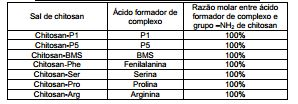
[0065] Este exemplo demonstra a ligação à superfície de sal de chitosan sobre partículas de látex por meio de acoplamento de EDAC.[0065] This example demonstrates surface binding of chitosan salt on latex particles via EDAC coupling.
[0066] O látex PS foi purificado por meio de centrifugação, lavado por água DI por três vezes e disperso em seguida em água DI para formar dispersão com nível de sólidos de 5% em peso.[0066] The latex PS was purified by means of centrifugation, washed with DI water three times and then dispersed in DI water to form dispersion with a solids level of 5% by weight.
[0067] 40 mg de EDAC em 0,5 ml de água DI foram adicionados em gotas aos 5 ml de dispersão de látex (teor de sólidos de 5% em peso) e agitados em seguida à temperatura ambiente por três horas. A dispersão de látex foi centrifugada para obter as partículas de látex de PS. As partículas de látex PS foram lavadas em seguida por 1,0 ml de tampão (pH 7,0) duas vezes, seguidas por centrifugação a cada vez. As partículas de látex PS foram lavadas em seguida por 1,0 ml de água DI duas vezes, seguidas por centrifugação a cada vez. A pelota obtida foi novamente dispersa em 1,0 ml de água DI com teor de sólidos de 2,5% em peso.[0067] 40 mg of EDAC in 0.5 ml of DI water were added dropwise to the 5 ml of latex dispersion (solids content 5% by weight) and then stirred at room temperature for three hours. The latex dispersion was centrifuged to obtain the PS latex particles. The PS latex particles were then washed by 1.0 ml of buffer (pH 7.0) twice, followed by centrifugation each time. The PS latex particles were then washed by 1.0 ml DI water twice, followed by centrifugation each time. The obtained pellet was again dispersed in 1.0 ml of DI water with solids content of 2.5% by weight.
[0068]Tipicamente, 100 μl do látex PS ativado por EDAC foram misturados com 150 μl de solução de complexo de chitosan (razão em peso entre sal de chitosan e partícula de látex PS: 0,6:1) e foram adicionalmente agregados 600 μl de água DI. A mistura foi agitada em seguida a 40 °C por 24 horas. Em seguida, o látex PS modificado foi centrifugado, seguido por lavagem com água DI por duas vezes. A partícula modificada foi dispersa para formar dispersão com teor de sólidos de 0,5% em peso. A partícula modificada foi indicada como sal de PS-enxerto-Chitosan. Uma amostra comparativa (PS) sem enxerto de nenhum complexo de chitosan foi preparada com látex PS com teor de sólidos de 0,5% em peso.TABELA 3 TAMANHOS E POTENCIAIS ZETA DE PS E PARTÍCULAS DE PS MODIFICADAS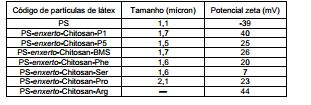
[0069] Os tamanhos e potenciais zeta das partículas de PS modificadas foram medidos por meio de analisador de potencial zeta (Zetasizer Nano ZS90, Malvern, Estados Unidos) a 25 °C. As partículas foram dispersas em água com teor de sólidos de 50 ppm e o pH da dispersão foi ajustado em cerca de 7 para medição. Cada teste foi repetido por três vezes. Os resultados médios de tamanhos e potenciais zeta foram relacionados na Tabela 3.[0069] The sizes and zeta potentials of the modified PS particles were measured using a zeta potential analyzer (Zetasizer Nano ZS90, Malvern, USA) at 25 °C. The particles were dispersed in 50 ppm solids water and the pH of the dispersion was adjusted to about 7 for measurement. Each test was repeated three times. The average results of sizes and zeta potentials were listed in Table 3.
[0070] Este exemplo demonstra o desempenho de deposição de partículas de látex de poliestireno sobre cabelo virgem e pontas de cabelos.[0070] This example demonstrates the deposition performance of polystyrene latex particles on virgin hair and hair ends.
[0071] A base de xampu foi formulada seguindo-se processo padrão para xampu. A base de xampu continha 12% em peso de laureth sulfato de sódio, 1,60% em peso de cocamidopropil betaína, 1% em peso de cloreto de sódio e foi equilibrada por água.[0071] The shampoo base was formulated following standard shampoo procedure. The shampoo base contained 12% by weight sodium laureth sulfate, 1.60% by weight cocamidopropyl betaine, 1% by weight sodium chloride and was balanced by water.
[0072] Mechas de cabelo (cabelo virgem que possui comprimento de 5,5 cm e peso de 750 mg ou pontas de cabelos que possuem comprimento de 5,5 cm e peso de 350 mg) foram embebidas em solução aquosa de 14% em peso de SLES a 40 °C com agitação contínua por trinta minutos. Essas mechas de cabelos foram completamente enxaguadas em seguida com água da torneira e secas à temperatura ambiente por uma noite.[0072] Locks of hair (virgin hair that has a length of 5.5 cm and weight of 750 mg or ends of hair that have a length of 5.5 cm and weight of 350 mg) were soaked in an aqueous solution of 14% by weight of SLES at 40 °C with continuous agitation for thirty minutes. These locks of hair were then completely rinsed with tap water and dried at room temperature overnight.
[0073] Três mechas de cabelos foram umedecidas com água da torneira e agitadas para remover o excesso de água. As três mechas de cabelos foram esfregadas, respectivamente, com uma mistura de 70 mg de base de xampu (ou base de condicionador) e 20 μl de 0,5% em peso de partículas de dispersão em água da Tabela 4 e enxaguadas por 500 ml de água da torneira.[0073] Three locks of hair were moistened with tap water and shaken to remove excess water. The three locks of hair were rubbed, respectively, with a mixture of 70 mg of shampoo base (or conditioner base) and 20 µl of 0.5% by weight of water dispersion particles from Table 4 and rinsed per 500 ml. of tap water.
[0074]A mecha foi agitada seca e imersa em seguida em uma ampola contendo 20 mililitros de acetato de etila por trinta minutos. 200 microlitros do líquido de extração foram retirados da ampola e adicionados a uma microplaca com 96 cavidades para medição da fluorescência (excitação de 441 nm e emissão de 500 nm) para gerar leitura de E1. A segunda mecha foi umedecida com água da torneira, agitada para secar e a ela foram adicionados 20 μl de 0,5% de látex não modificado. A mecha também foi extraída com 20 mililitros de acetato de etila por trinta minutos. 200 microlitros do líquido de extração foram retirados, adicionados à microplaca e submetidos a medição utilizando o método mencionado acima, gerando leitura de E0. A terceira mecha foi extraída sem adição de látex em 20 mililitros de acetato de etila por trinta minutos. 200 microlitros do líquido de extração foram retirados para a microplaca e geraram leitura Eb mediante medição da fluorescência.[0074] The swab was shaken dry and then immersed in an ampoule containing 20 milliliters of ethyl acetate for thirty minutes. 200 microliters of the extraction liquid were removed from the ampoule and added to a 96-well microplate for fluorescence measurement (excitation of 441 nm and emission of 500 nm) to generate E1 reading. The second lock was moistened with tap water, shaken to dry, and 20 µl of 0.5% unmodified latex was added. The swab was also extracted with 20 milliliters of ethyl acetate for thirty minutes. 200 microliters of the extraction liquid were removed, added to the microplate and subjected to measurement using the method mentioned above, generating an E0 reading. The third strand was extracted without adding latex in 20 milliliters of ethyl acetate for thirty minutes. 200 microliters of the extraction liquid were drawn into the microplate and generated an Eb reading by measuring the fluorescence.
[0075] O percentual de deposição (% deposição) foi calculado de acordo com a equação a seguir: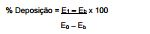
[0076] A Tabela 4 exibe os resultados de deposição sobre cabelo virgem pontas de cabelos por meio de incorporação das partículas em base de xampu. As médias e os desvios padrão são calculados a partir de cinco testes.TABELA 4DESEMPENHO DA DEPOSIÇÃO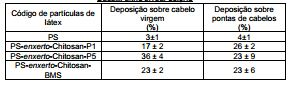
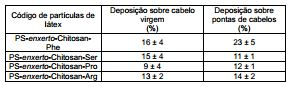
[0077] Como se pode observar por meio da Tabela 4, quando incorporadas a base de xampu, as partículas de PS-enxerto-Chitosan-P1, PS- enxerto-Chitosan-P5, PS-enxerto-Chitosan-BMS e PS-enxerto-Chitosan-Phe apresentaram maior razão de deposição de pontas de cabelos que PS-enxerto- Chitosan-Arg. As partículas de PS-enxerto-Chitosan-P1 e PS-enxerto-Chitosan- Phe apresentaram razão de deposição mais alta sobre pontas de cabelo que cabelo virgem.[0077] As can be seen from Table 4, when incorporated into the shampoo base, PS-graft-Chitosan-P1, PS-graft-Chitosan-P5, PS-graft-Chitosan-BMS and PS-graft particles -Chitosan-Phe had higher hair tip deposition ratio than PS-graft-Chitosan-Arg. PS-graft-Chitosan-P1 and PS-graft-Chitosan-Phe particles showed higher deposition ratio on hair ends than virgin hair.
Claims (12)
Applications Claiming Priority (5)
| Application Number | Priority Date | Filing Date | Title |
|---|---|---|---|
| CNPCT/CN2015/078846 | 2015-05-13 | ||
| CN2015078846 | 2015-05-13 | ||
| EP15176072.5 | 2015-07-09 | ||
| EP15176072 | 2015-07-09 | ||
| PCT/EP2016/060311 WO2016180769A1 (en) | 2015-05-13 | 2016-05-09 | Benefit delivery particle and composition comprising the particle |
Publications (2)
| Publication Number | Publication Date |
|---|---|
| BR112017023472A2 BR112017023472A2 (en) | 2018-07-31 |
| BR112017023472B1 true BR112017023472B1 (en) | 2021-10-13 |
Family
ID=55967252
Family Applications (1)
| Application Number | Title | Priority Date | Filing Date |
|---|---|---|---|
| BR112017023472-6A BR112017023472B1 (en) | 2015-05-13 | 2016-05-09 | BENEFICIAL AGENT SUPPLY PARTICLE, COMPOSITION AND PARTICLE PRODUCTION PROCESS |
Country Status (6)
| Country | Link |
|---|---|
| US (1) | US10383798B2 (en) |
| EP (1) | EP3294420B1 (en) |
| JP (1) | JP2018515462A (en) |
| CN (1) | CN107567326B (en) |
| BR (1) | BR112017023472B1 (en) |
| WO (1) | WO2016180769A1 (en) |
Families Citing this family (7)
| Publication number | Priority date | Publication date | Assignee | Title |
|---|---|---|---|---|
| WO2018077570A1 (en) * | 2016-10-28 | 2018-05-03 | Unilever N.V. | A personal care composition comprising particles |
| WO2018077578A1 (en) * | 2016-10-28 | 2018-05-03 | Unilever N.V. | Personal care compositions comrising surface-modified particles and non-volatile functionalised silicone |
| KR102044364B1 (en) * | 2016-11-11 | 2019-11-13 | 주식회사 엘지화학 | Thermoplastic resin and thermoplastic resin composition |
| EP3616755A1 (en) * | 2018-08-28 | 2020-03-04 | The Procter & Gamble Company | Conditioner compositions with increased deposition of polyacrylate microcapsules |
| GB201815293D0 (en) * | 2018-09-20 | 2018-11-07 | Givaudan Sa | Improvements in or relating to organic compounds |
| GB201912382D0 (en) * | 2019-08-29 | 2019-10-16 | Givaudan Sa | Improvements in or relating to organic compounds |
| JP7642643B2 (en) * | 2019-12-13 | 2025-03-10 | フイルメニツヒ ソシエテ アノニム | Hybrid Microcapsules |
Family Cites Families (11)
| Publication number | Priority date | Publication date | Assignee | Title |
|---|---|---|---|---|
| GB9507130D0 (en) | 1995-04-06 | 1995-05-31 | Unilever Plc | Hair treatment composition |
| KR100523479B1 (en) * | 2003-05-06 | 2005-10-25 | 주식회사 대하맨텍 | Microcapsule which is made of chitosan and composition which contains the microcapsule |
| ES2235642B2 (en) * | 2003-12-18 | 2006-03-01 | Gat Formulation Gmbh | CONTINUOUS MULTI-MICROENCAPSULATION PROCESS FOR THE IMPROVEMENT OF STABILITY AND STORAGE OF BIOLOGICALLY ACTIVE INGREDIENTS. |
| EP1547625A1 (en) * | 2003-12-23 | 2005-06-29 | The Procter & Gamble Company | Superabsorbent material comprising multicomponent particles |
| KR20170042364A (en) | 2006-06-05 | 2017-04-18 | 디에스엠 뉴트리셔널 프라덕츠 아게 | Microcapsules with improved shells |
| KR20090014568A (en) * | 2007-08-06 | 2009-02-11 | (주)바이오제닉스 | Coated Alpha Lipoic Acid Particles, Compositions Comprising The Same, And Methods For Making The Same |
| KR20130008002A (en) * | 2009-12-31 | 2013-01-21 | 솔-겔 테크놀로지스 리미티드 | Core stabilized microcapsules, method of their preparation and uses thereof |
| US9078818B1 (en) * | 2011-04-29 | 2015-07-14 | Michael Mark Anthony | Method of preparing a hair treatment formulation comprising nanoparticles in solution and method of hair treatment utilizing a treatment formulation comprising nanoparticles in solution |
| US8795643B1 (en) * | 2011-04-29 | 2014-08-05 | Michael Mark Anthony | Method of preparing a hair treatment formulation comprising nanoparticles in solution and method of hair treatment utilizing a treatment formulation comprising nanoparticles in solution |
| EA201490485A1 (en) * | 2011-08-24 | 2014-06-30 | Унилевер Н.В. | PARTICLES FOR DELIVERY OF USEFUL AGENT, INCLUDING DEXTRAN |
| WO2014064121A2 (en) * | 2012-10-25 | 2014-05-01 | Unilever Plc | Improvements relating to surface treatment compositions |
-
2016
- 2016-05-09 BR BR112017023472-6A patent/BR112017023472B1/en active IP Right Grant
- 2016-05-09 WO PCT/EP2016/060311 patent/WO2016180769A1/en not_active Ceased
- 2016-05-09 EP EP16722158.9A patent/EP3294420B1/en active Active
- 2016-05-09 US US15/572,359 patent/US10383798B2/en active Active
- 2016-05-09 JP JP2017556168A patent/JP2018515462A/en not_active Ceased
- 2016-05-09 CN CN201680025172.1A patent/CN107567326B/en active Active
Also Published As
| Publication number | Publication date |
|---|---|
| WO2016180769A1 (en) | 2016-11-17 |
| US20180116918A1 (en) | 2018-05-03 |
| JP2018515462A (en) | 2018-06-14 |
| US10383798B2 (en) | 2019-08-20 |
| EP3294420A1 (en) | 2018-03-21 |
| BR112017023472A2 (en) | 2018-07-31 |
| EP3294420B1 (en) | 2025-08-06 |
| CN107567326A (en) | 2018-01-09 |
| CN107567326B (en) | 2021-03-23 |
Similar Documents
| Publication | Publication Date | Title |
|---|---|---|
| BR112017023472B1 (en) | BENEFICIAL AGENT SUPPLY PARTICLE, COMPOSITION AND PARTICLE PRODUCTION PROCESS | |
| EP3532025B1 (en) | Personal care compositions comprising surface-modified particles and non-volatile functionalised silicone | |
| US10653592B2 (en) | Microcapsules and compositions providing controlled release of actives | |
| US9962321B2 (en) | Compositions providing delayed release of actives | |
| JP6598781B2 (en) | Hybrid microcapsule | |
| BR112020021814A2 (en) | microcapsule composition, methods for preparing a microcapsule composition and for imparting a clean, fresh feel to a fabric product or hair care product, and, consumer product | |
| BR112013029422B1 (en) | CORE-COATING CAPSULES | |
| BR112016010994B1 (en) | particle, particle preparation process and personal care composition | |
| CN115279485B (en) | Microcapsules and cosmetic compositions comprising the same | |
| WO2016000912A1 (en) | Benefit agent delivery particle and composition comprising the particle | |
| CN109862945B (en) | Personal care compositions comprising particles | |
| RU2824000C1 (en) | Microcapsules and cosmetic compositions containing thereof | |
| JP6880054B2 (en) | Personal cleansing composition |
Legal Events
| Date | Code | Title | Description |
|---|---|---|---|
| B06U | Preliminary requirement: requests with searches performed by other patent offices: procedure suspended [chapter 6.21 patent gazette] | ||
| B25A | Requested transfer of rights approved |
Owner name: UNILEVER IP HOLDINGS B.V. (PB) |
|
| B07A | Application suspended after technical examination (opinion) [chapter 7.1 patent gazette] | ||
| B09A | Decision: intention to grant [chapter 9.1 patent gazette] | ||
| B16A | Patent or certificate of addition of invention granted [chapter 16.1 patent gazette] |
Free format text: PRAZO DE VALIDADE: 20 (VINTE) ANOS CONTADOS A PARTIR DE 09/05/2016, OBSERVADAS AS CONDICOES LEGAIS. |