BR112015030619B1 - absorbent article - Google Patents
absorbent article Download PDFInfo
- Publication number
- BR112015030619B1 BR112015030619B1 BR112015030619-5A BR112015030619A BR112015030619B1 BR 112015030619 B1 BR112015030619 B1 BR 112015030619B1 BR 112015030619 A BR112015030619 A BR 112015030619A BR 112015030619 B1 BR112015030619 B1 BR 112015030619B1
- Authority
- BR
- Brazil
- Prior art keywords
- absorbent article
- weight
- fibers
- additive
- fiber
- Prior art date
Links
- 230000002745 absorbent Effects 0.000 title claims description 85
- 239000002250 absorbent Substances 0.000 title claims description 85
- 239000000835 fiber Substances 0.000 claims abstract description 208
- 239000000203 mixture Substances 0.000 claims abstract description 105
- 239000000654 additive Substances 0.000 claims abstract description 98
- 229920000098 polyolefin Polymers 0.000 claims abstract description 90
- 230000000996 additive effect Effects 0.000 claims abstract description 82
- 229920000642 polymer Polymers 0.000 claims abstract description 77
- 229920001169 thermoplastic Polymers 0.000 claims abstract description 51
- 239000004416 thermosoftening plastic Substances 0.000 claims abstract description 51
- 239000011159 matrix material Substances 0.000 claims abstract description 47
- 239000011148 porous material Substances 0.000 claims description 25
- 229920000747 poly(lactic acid) Polymers 0.000 claims description 24
- 229920000647 polyepoxide Polymers 0.000 claims description 22
- 239000004626 polylactic acid Substances 0.000 claims description 22
- 238000002844 melting Methods 0.000 claims description 20
- 230000008018 melting Effects 0.000 claims description 20
- 239000000155 melt Substances 0.000 claims description 19
- 229920000728 polyester Polymers 0.000 claims description 19
- 238000012546 transfer Methods 0.000 claims description 19
- 239000010410 layer Substances 0.000 claims description 18
- 239000003607 modifier Substances 0.000 claims description 15
- 239000004711 α-olefin Substances 0.000 claims description 13
- VGGSQFUCUMXWEO-UHFFFAOYSA-N Ethene Chemical compound C=C VGGSQFUCUMXWEO-UHFFFAOYSA-N 0.000 claims description 12
- 239000005977 Ethylene Substances 0.000 claims description 10
- 230000016507 interphase Effects 0.000 claims description 10
- QQONPFPTGQHPMA-UHFFFAOYSA-N propylene Natural products CC=C QQONPFPTGQHPMA-UHFFFAOYSA-N 0.000 claims description 10
- 125000004805 propylene group Chemical group [H]C([H])([H])C([H])([*:1])C([H])([H])[*:2] 0.000 claims description 7
- 229920002689 polyvinyl acetate Polymers 0.000 claims description 5
- 229920000089 Cyclic olefin copolymer Polymers 0.000 claims description 4
- 229920005629 polypropylene homopolymer Polymers 0.000 claims description 4
- 239000011118 polyvinyl acetate Substances 0.000 claims description 4
- 229920002451 polyvinyl alcohol Polymers 0.000 claims description 4
- 239000004372 Polyvinyl alcohol Substances 0.000 claims description 3
- 229920001384 propylene homopolymer Polymers 0.000 claims description 3
- 229920002313 fluoropolymer Polymers 0.000 claims description 2
- 239000004811 fluoropolymer Substances 0.000 claims description 2
- 239000012792 core layer Substances 0.000 claims 3
- 210000005069 ears Anatomy 0.000 claims 1
- 229920005606 polypropylene copolymer Polymers 0.000 claims 1
- 229920006249 styrenic copolymer Polymers 0.000 claims 1
- 238000009423 ventilation Methods 0.000 claims 1
- 238000000605 extraction Methods 0.000 abstract description 30
- 239000000463 material Substances 0.000 description 57
- -1 polypropylene Polymers 0.000 description 56
- IJGRMHOSHXDMSA-UHFFFAOYSA-N Atomic nitrogen Chemical compound N#N IJGRMHOSHXDMSA-UHFFFAOYSA-N 0.000 description 42
- 239000000306 component Substances 0.000 description 39
- 238000000034 method Methods 0.000 description 39
- 239000007788 liquid Substances 0.000 description 34
- 239000000178 monomer Substances 0.000 description 32
- 238000012360 testing method Methods 0.000 description 28
- 239000003570 air Substances 0.000 description 26
- XLYOFNOQVPJJNP-UHFFFAOYSA-N water Substances O XLYOFNOQVPJJNP-UHFFFAOYSA-N 0.000 description 26
- 230000035882 stress Effects 0.000 description 23
- 229910052757 nitrogen Inorganic materials 0.000 description 21
- 239000004744 fabric Substances 0.000 description 20
- 229920001155 polypropylene Polymers 0.000 description 20
- 239000000047 product Substances 0.000 description 19
- 229910052799 carbon Inorganic materials 0.000 description 18
- 229920001577 copolymer Polymers 0.000 description 18
- 239000004743 Polypropylene Substances 0.000 description 17
- 239000000523 sample Substances 0.000 description 15
- 239000007787 solid Substances 0.000 description 15
- 125000002496 methyl group Chemical group [H]C([H])([H])* 0.000 description 13
- 229920003043 Cellulose fiber Polymers 0.000 description 12
- 125000001495 ethyl group Chemical group [H]C([H])([H])C([H])([H])* 0.000 description 12
- 238000002156 mixing Methods 0.000 description 12
- 230000008569 process Effects 0.000 description 12
- 230000009477 glass transition Effects 0.000 description 11
- JVTAAEKCZFNVCJ-UHFFFAOYSA-N lactic acid Chemical compound CC(O)C(O)=O JVTAAEKCZFNVCJ-UHFFFAOYSA-N 0.000 description 11
- JRZJOMJEPLMPRA-UHFFFAOYSA-N 1-nonene Chemical compound CCCCCCCC=C JRZJOMJEPLMPRA-UHFFFAOYSA-N 0.000 description 10
- 238000010521 absorption reaction Methods 0.000 description 10
- NIXOWILDQLNWCW-UHFFFAOYSA-N acrylic acid group Chemical group C(C=C)(=O)O NIXOWILDQLNWCW-UHFFFAOYSA-N 0.000 description 10
- 230000015572 biosynthetic process Effects 0.000 description 10
- 239000002131 composite material Substances 0.000 description 10
- 239000002657 fibrous material Substances 0.000 description 10
- 238000010438 heat treatment Methods 0.000 description 10
- YWAKXRMUMFPDSH-UHFFFAOYSA-N pentene Chemical compound CCCC=C YWAKXRMUMFPDSH-UHFFFAOYSA-N 0.000 description 10
- 125000001436 propyl group Chemical group [H]C([*])([H])C([H])([H])C([H])([H])[H] 0.000 description 10
- 230000001681 protective effect Effects 0.000 description 10
- JVTAAEKCZFNVCJ-REOHCLBHSA-N L-lactic acid Chemical compound C[C@H](O)C(O)=O JVTAAEKCZFNVCJ-REOHCLBHSA-N 0.000 description 9
- 238000006243 chemical reaction Methods 0.000 description 9
- 239000007789 gas Substances 0.000 description 9
- LIKMAJRDDDTEIG-UHFFFAOYSA-N 1-hexene Chemical compound CCCCC=C LIKMAJRDDDTEIG-UHFFFAOYSA-N 0.000 description 8
- KWKAKUADMBZCLK-UHFFFAOYSA-N 1-octene Chemical compound CCCCCCC=C KWKAKUADMBZCLK-UHFFFAOYSA-N 0.000 description 8
- 239000004593 Epoxy Substances 0.000 description 8
- 230000005540 biological transmission Effects 0.000 description 8
- 238000010128 melt processing Methods 0.000 description 8
- 239000002243 precursor Substances 0.000 description 8
- 229920005989 resin Polymers 0.000 description 8
- 239000011347 resin Substances 0.000 description 8
- FPYJFEHAWHCUMM-UHFFFAOYSA-N maleic anhydride Chemical compound O=C1OC(=O)C=C1 FPYJFEHAWHCUMM-UHFFFAOYSA-N 0.000 description 7
- 229920000573 polyethylene Polymers 0.000 description 7
- 238000012545 processing Methods 0.000 description 7
- 238000009941 weaving Methods 0.000 description 7
- VXNZUUAINFGPBY-UHFFFAOYSA-N 1-Butene Chemical compound CCC=C VXNZUUAINFGPBY-UHFFFAOYSA-N 0.000 description 6
- ZGEGCLOFRBLKSE-UHFFFAOYSA-N 1-Heptene Chemical compound CCCCCC=C ZGEGCLOFRBLKSE-UHFFFAOYSA-N 0.000 description 6
- AFFLGGQVNFXPEV-UHFFFAOYSA-N 1-decene Chemical group CCCCCCCCC=C AFFLGGQVNFXPEV-UHFFFAOYSA-N 0.000 description 6
- IMSODMZESSGVBE-UHFFFAOYSA-N 2-Oxazoline Chemical compound C1CN=CO1 IMSODMZESSGVBE-UHFFFAOYSA-N 0.000 description 6
- BAPJBEWLBFYGME-UHFFFAOYSA-N Methyl acrylate Chemical compound COC(=O)C=C BAPJBEWLBFYGME-UHFFFAOYSA-N 0.000 description 6
- KDLHZDBZIXYQEI-UHFFFAOYSA-N Palladium Chemical compound [Pd] KDLHZDBZIXYQEI-UHFFFAOYSA-N 0.000 description 6
- 239000004927 clay Substances 0.000 description 6
- 238000001816 cooling Methods 0.000 description 6
- 238000000113 differential scanning calorimetry Methods 0.000 description 6
- 238000001125 extrusion Methods 0.000 description 6
- 230000008014 freezing Effects 0.000 description 6
- 238000007710 freezing Methods 0.000 description 6
- 239000002655 kraft paper Substances 0.000 description 6
- 239000004310 lactic acid Substances 0.000 description 6
- 235000014655 lactic acid Nutrition 0.000 description 6
- 239000012802 nanoclay Substances 0.000 description 6
- 239000000126 substance Substances 0.000 description 6
- 238000010998 test method Methods 0.000 description 6
- 239000004604 Blowing Agent Substances 0.000 description 5
- LYCAIKOWRPUZTN-UHFFFAOYSA-N Ethylene glycol Chemical compound OCCO LYCAIKOWRPUZTN-UHFFFAOYSA-N 0.000 description 5
- PPBRXRYQALVLMV-UHFFFAOYSA-N Styrene Chemical compound C=CC1=CC=CC=C1 PPBRXRYQALVLMV-UHFFFAOYSA-N 0.000 description 5
- 125000003700 epoxy group Chemical group 0.000 description 5
- 239000012530 fluid Substances 0.000 description 5
- 125000000524 functional group Chemical group 0.000 description 5
- VOZRXNHHFUQHIL-UHFFFAOYSA-N glycidyl methacrylate Chemical compound CC(=C)C(=O)OCC1CO1 VOZRXNHHFUQHIL-UHFFFAOYSA-N 0.000 description 5
- 230000035515 penetration Effects 0.000 description 5
- 229920002959 polymer blend Polymers 0.000 description 5
- 239000011122 softwood Substances 0.000 description 5
- CRSBERNSMYQZNG-UHFFFAOYSA-N 1-dodecene Chemical group CCCCCCCCCCC=C CRSBERNSMYQZNG-UHFFFAOYSA-N 0.000 description 4
- NLXLAEXVIDQMFP-UHFFFAOYSA-N Ammonia chloride Chemical compound [NH4+].[Cl-] NLXLAEXVIDQMFP-UHFFFAOYSA-N 0.000 description 4
- CURLTUGMZLYLDI-UHFFFAOYSA-N Carbon dioxide Chemical compound O=C=O CURLTUGMZLYLDI-UHFFFAOYSA-N 0.000 description 4
- 229930182843 D-Lactic acid Natural products 0.000 description 4
- JVTAAEKCZFNVCJ-UWTATZPHSA-N D-lactic acid Chemical compound C[C@@H](O)C(O)=O JVTAAEKCZFNVCJ-UWTATZPHSA-N 0.000 description 4
- 239000004698 Polyethylene Substances 0.000 description 4
- 238000004458 analytical method Methods 0.000 description 4
- 210000001124 body fluid Anatomy 0.000 description 4
- 239000010839 body fluid Substances 0.000 description 4
- 150000001875 compounds Chemical class 0.000 description 4
- 229940022769 d- lactic acid Drugs 0.000 description 4
- GUJOJGAPFQRJSV-UHFFFAOYSA-N dialuminum;dioxosilane;oxygen(2-);hydrate Chemical compound O.[O-2].[O-2].[O-2].[Al+3].[Al+3].O=[Si]=O.O=[Si]=O.O=[Si]=O.O=[Si]=O GUJOJGAPFQRJSV-UHFFFAOYSA-N 0.000 description 4
- 125000000118 dimethyl group Chemical group [H]C([H])([H])* 0.000 description 4
- 238000009826 distribution Methods 0.000 description 4
- 230000002209 hydrophobic effect Effects 0.000 description 4
- 230000001965 increasing effect Effects 0.000 description 4
- 230000004048 modification Effects 0.000 description 4
- 238000012986 modification Methods 0.000 description 4
- TVMXDCGIABBOFY-UHFFFAOYSA-N n-Octanol Natural products CCCCCCCC TVMXDCGIABBOFY-UHFFFAOYSA-N 0.000 description 4
- 210000003739 neck Anatomy 0.000 description 4
- 239000003348 petrochemical agent Substances 0.000 description 4
- 229920001748 polybutylene Polymers 0.000 description 4
- 229920001343 polytetrafluoroethylene Polymers 0.000 description 4
- 239000004810 polytetrafluoroethylene Substances 0.000 description 4
- 238000004381 surface treatment Methods 0.000 description 4
- 239000003760 tallow Substances 0.000 description 4
- 239000001993 wax Substances 0.000 description 4
- CERQOIWHTDAKMF-UHFFFAOYSA-M Methacrylate Chemical compound CC(=C)C([O-])=O CERQOIWHTDAKMF-UHFFFAOYSA-M 0.000 description 3
- 229920002266 Pluriol® Polymers 0.000 description 3
- 239000004952 Polyamide Substances 0.000 description 3
- 239000004721 Polyphenylene oxide Substances 0.000 description 3
- DNIAPMSPPWPWGF-UHFFFAOYSA-N Propylene glycol Chemical compound CC(O)CO DNIAPMSPPWPWGF-UHFFFAOYSA-N 0.000 description 3
- 150000001336 alkenes Chemical class 0.000 description 3
- 230000009286 beneficial effect Effects 0.000 description 3
- 230000008901 benefit Effects 0.000 description 3
- 238000009960 carding Methods 0.000 description 3
- 239000003054 catalyst Substances 0.000 description 3
- 229920002678 cellulose Polymers 0.000 description 3
- 239000001913 cellulose Substances 0.000 description 3
- 230000008859 change Effects 0.000 description 3
- 239000011248 coating agent Substances 0.000 description 3
- 238000000576 coating method Methods 0.000 description 3
- 238000007796 conventional method Methods 0.000 description 3
- 238000004132 cross linking Methods 0.000 description 3
- MTHSVFCYNBDYFN-UHFFFAOYSA-N diethylene glycol Chemical compound OCCOCCO MTHSVFCYNBDYFN-UHFFFAOYSA-N 0.000 description 3
- 239000006185 dispersion Substances 0.000 description 3
- 238000011067 equilibration Methods 0.000 description 3
- 239000000945 filler Substances 0.000 description 3
- PCHJSUWPFVWCPO-UHFFFAOYSA-N gold Chemical compound [Au] PCHJSUWPFVWCPO-UHFFFAOYSA-N 0.000 description 3
- 239000010931 gold Substances 0.000 description 3
- 229910052737 gold Inorganic materials 0.000 description 3
- 229910052621 halloysite Inorganic materials 0.000 description 3
- 229920001519 homopolymer Polymers 0.000 description 3
- 230000002706 hydrostatic effect Effects 0.000 description 3
- 229910052500 inorganic mineral Inorganic materials 0.000 description 3
- 125000001449 isopropyl group Chemical group [H]C([H])([H])C([H])(*)C([H])([H])[H] 0.000 description 3
- 229910052622 kaolinite Inorganic materials 0.000 description 3
- 229920001684 low density polyethylene Polymers 0.000 description 3
- 239000004702 low-density polyethylene Substances 0.000 description 3
- 238000004519 manufacturing process Methods 0.000 description 3
- 239000012968 metallocene catalyst Substances 0.000 description 3
- 229910052901 montmorillonite Inorganic materials 0.000 description 3
- 229910052763 palladium Inorganic materials 0.000 description 3
- 239000000123 paper Substances 0.000 description 3
- 229920003023 plastic Polymers 0.000 description 3
- 239000004033 plastic Substances 0.000 description 3
- 229920002647 polyamide Polymers 0.000 description 3
- 229920000570 polyether Polymers 0.000 description 3
- 239000005020 polyethylene terephthalate Substances 0.000 description 3
- 229920000139 polyethylene terephthalate Polymers 0.000 description 3
- 235000019422 polyvinyl alcohol Nutrition 0.000 description 3
- 238000004626 scanning electron microscopy Methods 0.000 description 3
- 238000004904 shortening Methods 0.000 description 3
- 238000009987 spinning Methods 0.000 description 3
- 238000004544 sputter deposition Methods 0.000 description 3
- 229920001897 terpolymer Polymers 0.000 description 3
- PUPZLCDOIYMWBV-UHFFFAOYSA-N (+/-)-1,3-Butanediol Chemical compound CC(O)CCO PUPZLCDOIYMWBV-UHFFFAOYSA-N 0.000 description 2
- LPIQIQPLUVLISR-UHFFFAOYSA-N 2-prop-1-en-2-yl-4,5-dihydro-1,3-oxazole Chemical compound CC(=C)C1=NCCO1 LPIQIQPLUVLISR-UHFFFAOYSA-N 0.000 description 2
- PKXHXOTZMFCXSH-UHFFFAOYSA-N 3,3-dimethylbut-1-ene Chemical compound CC(C)(C)C=C PKXHXOTZMFCXSH-UHFFFAOYSA-N 0.000 description 2
- YHQXBTXEYZIYOV-UHFFFAOYSA-N 3-methylbut-1-ene Chemical compound CC(C)C=C YHQXBTXEYZIYOV-UHFFFAOYSA-N 0.000 description 2
- 239000004925 Acrylic resin Substances 0.000 description 2
- 229920000178 Acrylic resin Polymers 0.000 description 2
- 235000017166 Bambusa arundinacea Nutrition 0.000 description 2
- 235000017491 Bambusa tulda Nutrition 0.000 description 2
- SOGAXMICEFXMKE-UHFFFAOYSA-N Butylmethacrylate Chemical compound CCCCOC(=O)C(C)=C SOGAXMICEFXMKE-UHFFFAOYSA-N 0.000 description 2
- VTYYLEPIZMXCLO-UHFFFAOYSA-L Calcium carbonate Chemical compound [Ca+2].[O-]C([O-])=O VTYYLEPIZMXCLO-UHFFFAOYSA-L 0.000 description 2
- OKTJSMMVPCPJKN-UHFFFAOYSA-N Carbon Chemical compound [C] OKTJSMMVPCPJKN-UHFFFAOYSA-N 0.000 description 2
- VEXZGXHMUGYJMC-UHFFFAOYSA-M Chloride anion Chemical compound [Cl-] VEXZGXHMUGYJMC-UHFFFAOYSA-M 0.000 description 2
- 229920001634 Copolyester Polymers 0.000 description 2
- 229920002943 EPDM rubber Polymers 0.000 description 2
- 244000166124 Eucalyptus globulus Species 0.000 description 2
- VZCYOOQTPOCHFL-OWOJBTEDSA-N Fumaric acid Chemical compound OC(=O)\C=C\C(O)=O VZCYOOQTPOCHFL-OWOJBTEDSA-N 0.000 description 2
- 101100365516 Mus musculus Psat1 gene Proteins 0.000 description 2
- 239000004677 Nylon Substances 0.000 description 2
- 244000082204 Phyllostachys viridis Species 0.000 description 2
- 235000015334 Phyllostachys viridis Nutrition 0.000 description 2
- 241000218657 Picea Species 0.000 description 2
- 229920002319 Poly(methyl acrylate) Polymers 0.000 description 2
- 239000004793 Polystyrene Substances 0.000 description 2
- 229920001328 Polyvinylidene chloride Polymers 0.000 description 2
- GWEVSGVZZGPLCZ-UHFFFAOYSA-N Titan oxide Chemical compound O=[Ti]=O GWEVSGVZZGPLCZ-UHFFFAOYSA-N 0.000 description 2
- 239000000853 adhesive Substances 0.000 description 2
- 230000001070 adhesive effect Effects 0.000 description 2
- 230000002411 adverse Effects 0.000 description 2
- 229920003232 aliphatic polyester Polymers 0.000 description 2
- 229910052782 aluminium Inorganic materials 0.000 description 2
- XAGFODPZIPBFFR-UHFFFAOYSA-N aluminium Chemical compound [Al] XAGFODPZIPBFFR-UHFFFAOYSA-N 0.000 description 2
- 229910000323 aluminium silicate Inorganic materials 0.000 description 2
- 235000019270 ammonium chloride Nutrition 0.000 description 2
- YZXBAPSDXZZRGB-DOFZRALJSA-N arachidonic acid Chemical compound CCCCC\C=C/C\C=C/C\C=C/C\C=C/CCCC(O)=O YZXBAPSDXZZRGB-DOFZRALJSA-N 0.000 description 2
- 125000003118 aryl group Chemical group 0.000 description 2
- 239000011425 bamboo Substances 0.000 description 2
- 238000005452 bending Methods 0.000 description 2
- WERYXYBDKMZEQL-UHFFFAOYSA-N butane-1,4-diol Chemical compound OCCCCO WERYXYBDKMZEQL-UHFFFAOYSA-N 0.000 description 2
- CQEYYJKEWSMYFG-UHFFFAOYSA-N butyl acrylate Chemical compound CCCCOC(=O)C=C CQEYYJKEWSMYFG-UHFFFAOYSA-N 0.000 description 2
- 125000004432 carbon atom Chemical group C* 0.000 description 2
- 239000001569 carbon dioxide Substances 0.000 description 2
- 229910002092 carbon dioxide Inorganic materials 0.000 description 2
- 235000013339 cereals Nutrition 0.000 description 2
- 239000002666 chemical blowing agent Substances 0.000 description 2
- 239000003795 chemical substances by application Substances 0.000 description 2
- 239000000470 constituent Substances 0.000 description 2
- 239000012967 coordination catalyst Substances 0.000 description 2
- 238000005520 cutting process Methods 0.000 description 2
- 238000013461 design Methods 0.000 description 2
- 229910001649 dickite Inorganic materials 0.000 description 2
- 235000014113 dietary fatty acids Nutrition 0.000 description 2
- HNPSIPDUKPIQMN-UHFFFAOYSA-N dioxosilane;oxo(oxoalumanyloxy)alumane Chemical compound O=[Si]=O.O=[Al]O[Al]=O HNPSIPDUKPIQMN-UHFFFAOYSA-N 0.000 description 2
- 229940069096 dodecene Drugs 0.000 description 2
- 150000002148 esters Chemical class 0.000 description 2
- 229920001038 ethylene copolymer Polymers 0.000 description 2
- 239000000194 fatty acid Substances 0.000 description 2
- 229930195729 fatty acid Natural products 0.000 description 2
- 238000012681 fiber drawing Methods 0.000 description 2
- 238000001914 filtration Methods 0.000 description 2
- 238000005187 foaming Methods 0.000 description 2
- 230000006870 function Effects 0.000 description 2
- 229920001903 high density polyethylene Polymers 0.000 description 2
- 239000004700 high-density polyethylene Substances 0.000 description 2
- 239000012510 hollow fiber Substances 0.000 description 2
- 229930195733 hydrocarbon Natural products 0.000 description 2
- 150000002430 hydrocarbons Chemical class 0.000 description 2
- 238000009413 insulation Methods 0.000 description 2
- 239000012774 insulation material Substances 0.000 description 2
- 229920000092 linear low density polyethylene Polymers 0.000 description 2
- 239000004707 linear low-density polyethylene Substances 0.000 description 2
- 239000011707 mineral Substances 0.000 description 2
- 238000000465 moulding Methods 0.000 description 2
- 229920001778 nylon Polymers 0.000 description 2
- LYRFLYHAGKPMFH-UHFFFAOYSA-N octadecanamide Chemical compound CCCCCCCCCCCCCCCCCC(N)=O LYRFLYHAGKPMFH-UHFFFAOYSA-N 0.000 description 2
- 150000002892 organic cations Chemical class 0.000 description 2
- 125000000466 oxiranyl group Chemical group 0.000 description 2
- SECPZKHBENQXJG-FPLPWBNLSA-N palmitoleic acid Chemical compound CCCCCC\C=C/CCCCCCCC(O)=O SECPZKHBENQXJG-FPLPWBNLSA-N 0.000 description 2
- 239000002245 particle Substances 0.000 description 2
- 230000002572 peristaltic effect Effects 0.000 description 2
- 230000035699 permeability Effects 0.000 description 2
- 239000000049 pigment Substances 0.000 description 2
- 229920002493 poly(chlorotrifluoroethylene) Polymers 0.000 description 2
- 229920003229 poly(methyl methacrylate) Polymers 0.000 description 2
- 229920002037 poly(vinyl butyral) polymer Polymers 0.000 description 2
- 229920000070 poly-3-hydroxybutyrate Polymers 0.000 description 2
- 229920000058 polyacrylate Polymers 0.000 description 2
- 239000005023 polychlorotrifluoroethylene (PCTFE) polymer Substances 0.000 description 2
- 239000004926 polymethyl methacrylate Substances 0.000 description 2
- 229920005862 polyol Polymers 0.000 description 2
- 150000003077 polyols Chemical class 0.000 description 2
- 229920002223 polystyrene Polymers 0.000 description 2
- 229920002635 polyurethane Polymers 0.000 description 2
- 239000004814 polyurethane Substances 0.000 description 2
- 239000004800 polyvinyl chloride Substances 0.000 description 2
- 229920000915 polyvinyl chloride Polymers 0.000 description 2
- 239000005033 polyvinylidene chloride Substances 0.000 description 2
- 230000009257 reactivity Effects 0.000 description 2
- 230000002829 reductive effect Effects 0.000 description 2
- 230000002787 reinforcement Effects 0.000 description 2
- 239000002904 solvent Substances 0.000 description 2
- 238000003860 storage Methods 0.000 description 2
- 239000002344 surface layer Substances 0.000 description 2
- 239000004094 surface-active agent Substances 0.000 description 2
- 229920002994 synthetic fiber Polymers 0.000 description 2
- 239000012209 synthetic fiber Substances 0.000 description 2
- 239000010936 titanium Substances 0.000 description 2
- VZCYOOQTPOCHFL-UHFFFAOYSA-N trans-butenedioic acid Natural products OC(=O)C=CC(O)=O VZCYOOQTPOCHFL-UHFFFAOYSA-N 0.000 description 2
- 230000032258 transport Effects 0.000 description 2
- 238000002604 ultrasonography Methods 0.000 description 2
- 239000002759 woven fabric Substances 0.000 description 2
- DNIAPMSPPWPWGF-VKHMYHEASA-N (+)-propylene glycol Chemical compound C[C@H](O)CO DNIAPMSPPWPWGF-VKHMYHEASA-N 0.000 description 1
- LBHPSYROQDMVBS-UHFFFAOYSA-N (1-methylcyclohexyl) 2-methylprop-2-enoate Chemical compound CC(=C)C(=O)OC1(C)CCCCC1 LBHPSYROQDMVBS-UHFFFAOYSA-N 0.000 description 1
- LTVUCOSIZFEASK-MPXCPUAZSA-N (3ar,4s,7r,7as)-3a-methyl-3a,4,7,7a-tetrahydro-4,7-methano-2-benzofuran-1,3-dione Chemical compound C([C@H]1C=C2)[C@H]2[C@H]2[C@]1(C)C(=O)OC2=O LTVUCOSIZFEASK-MPXCPUAZSA-N 0.000 description 1
- JJTUDXZGHPGLLC-ZXZARUISSA-N (3r,6s)-3,6-dimethyl-1,4-dioxane-2,5-dione Chemical compound C[C@H]1OC(=O)[C@H](C)OC1=O JJTUDXZGHPGLLC-ZXZARUISSA-N 0.000 description 1
- PSGCQDPCAWOCSH-UHFFFAOYSA-N (4,7,7-trimethyl-3-bicyclo[2.2.1]heptanyl) prop-2-enoate Chemical compound C1CC2(C)C(OC(=O)C=C)CC1C2(C)C PSGCQDPCAWOCSH-UHFFFAOYSA-N 0.000 description 1
- OYHQOLUKZRVURQ-NTGFUMLPSA-N (9Z,12Z)-9,10,12,13-tetratritiooctadeca-9,12-dienoic acid Chemical compound C(CCCCCCC\C(=C(/C\C(=C(/CCCCC)\[3H])\[3H])\[3H])\[3H])(=O)O OYHQOLUKZRVURQ-NTGFUMLPSA-N 0.000 description 1
- YPFDHNVEDLHUCE-UHFFFAOYSA-N 1,3-propanediol Substances OCCCO YPFDHNVEDLHUCE-UHFFFAOYSA-N 0.000 description 1
- FQXGHZNSUOHCLO-UHFFFAOYSA-N 2,2,4,4-tetramethyl-1,3-cyclobutanediol Chemical compound CC1(C)C(O)C(C)(C)C1O FQXGHZNSUOHCLO-UHFFFAOYSA-N 0.000 description 1
- GZZLQUBMUXEOBE-UHFFFAOYSA-N 2,2,4-trimethylhexane-1,6-diol Chemical compound OCCC(C)CC(C)(C)CO GZZLQUBMUXEOBE-UHFFFAOYSA-N 0.000 description 1
- STMDPCBYJCIZOD-UHFFFAOYSA-N 2-(2,4-dinitroanilino)-4-methylpentanoic acid Chemical compound CC(C)CC(C(O)=O)NC1=CC=C([N+]([O-])=O)C=C1[N+]([O-])=O STMDPCBYJCIZOD-UHFFFAOYSA-N 0.000 description 1
- GOXQRTZXKQZDDN-UHFFFAOYSA-N 2-Ethylhexyl acrylate Chemical compound CCCCC(CC)COC(=O)C=C GOXQRTZXKQZDDN-UHFFFAOYSA-N 0.000 description 1
- BQBSIHIZDSHADD-UHFFFAOYSA-N 2-ethenyl-4,5-dihydro-1,3-oxazole Chemical compound C=CC1=NCCO1 BQBSIHIZDSHADD-UHFFFAOYSA-N 0.000 description 1
- CHNGPLVDGWOPMD-UHFFFAOYSA-N 2-ethylbutyl 2-methylprop-2-enoate Chemical compound CCC(CC)COC(=O)C(C)=C CHNGPLVDGWOPMD-UHFFFAOYSA-N 0.000 description 1
- JGRXEBOFWPLEAV-UHFFFAOYSA-N 2-ethylbutyl prop-2-enoate Chemical compound CCC(CC)COC(=O)C=C JGRXEBOFWPLEAV-UHFFFAOYSA-N 0.000 description 1
- VSKJLJHPAFKHBX-UHFFFAOYSA-N 2-methylbuta-1,3-diene;styrene Chemical compound CC(=C)C=C.C=CC1=CC=CC=C1.C=CC1=CC=CC=C1 VSKJLJHPAFKHBX-UHFFFAOYSA-N 0.000 description 1
- RUMACXVDVNRZJZ-UHFFFAOYSA-N 2-methylpropyl 2-methylprop-2-enoate Chemical compound CC(C)COC(=O)C(C)=C RUMACXVDVNRZJZ-UHFFFAOYSA-N 0.000 description 1
- CFVWNXQPGQOHRJ-UHFFFAOYSA-N 2-methylpropyl prop-2-enoate Chemical compound CC(C)COC(=O)C=C CFVWNXQPGQOHRJ-UHFFFAOYSA-N 0.000 description 1
- 125000003504 2-oxazolinyl group Chemical group O1C(=NCC1)* 0.000 description 1
- OCSXKMIYKAIBCF-UHFFFAOYSA-N 2-undecyl-4,5-dihydro-1,3-oxazole Chemical compound CCCCCCCCCCCC1=NCCO1 OCSXKMIYKAIBCF-UHFFFAOYSA-N 0.000 description 1
- LQJBNNIYVWPHFW-UHFFFAOYSA-N 20:1omega9c fatty acid Natural products CCCCCCCCCCC=CCCCCCCCC(O)=O LQJBNNIYVWPHFW-UHFFFAOYSA-N 0.000 description 1
- AGULWIQIYWWFBJ-UHFFFAOYSA-N 3,4-dichlorofuran-2,5-dione Chemical compound ClC1=C(Cl)C(=O)OC1=O AGULWIQIYWWFBJ-UHFFFAOYSA-N 0.000 description 1
- REKYPYSUBKSCAT-UHFFFAOYSA-N 3-hydroxypentanoic acid Chemical compound CCC(O)CC(O)=O REKYPYSUBKSCAT-UHFFFAOYSA-N 0.000 description 1
- UZAAWTQDNCMMEX-UHFFFAOYSA-N 4,4-dimethyl-2-prop-1-en-2-yl-5h-1,3-oxazole Chemical compound CC(=C)C1=NC(C)(C)CO1 UZAAWTQDNCMMEX-UHFFFAOYSA-N 0.000 description 1
- JJTUDXZGHPGLLC-IMJSIDKUSA-N 4511-42-6 Chemical compound C[C@@H]1OC(=O)[C@H](C)OC1=O JJTUDXZGHPGLLC-IMJSIDKUSA-N 0.000 description 1
- RSPAIISXQHXRKX-UHFFFAOYSA-L 5-butylcyclopenta-1,3-diene;zirconium(4+);dichloride Chemical compound Cl[Zr+2]Cl.CCCCC1=CC=C[CH-]1.CCCCC1=CC=C[CH-]1 RSPAIISXQHXRKX-UHFFFAOYSA-L 0.000 description 1
- NSBZPLSMZORBHY-UHFFFAOYSA-L 5-methylcyclopenta-1,3-diene;titanium(4+);dichloride Chemical compound [Cl-].[Cl-].[Ti+4].C[C-]1C=CC=C1.C[C-]1C=CC=C1 NSBZPLSMZORBHY-UHFFFAOYSA-L 0.000 description 1
- NUXLDNTZFXDNBA-UHFFFAOYSA-N 6-bromo-2-methyl-4h-1,4-benzoxazin-3-one Chemical compound C1=C(Br)C=C2NC(=O)C(C)OC2=C1 NUXLDNTZFXDNBA-UHFFFAOYSA-N 0.000 description 1
- RUZXDTHZHJTTRO-UHFFFAOYSA-N 7-amino-4h-1,4-benzoxazin-3-one Chemical compound N1C(=O)COC2=CC(N)=CC=C21 RUZXDTHZHJTTRO-UHFFFAOYSA-N 0.000 description 1
- 244000283070 Abies balsamea Species 0.000 description 1
- 235000007173 Abies balsamea Nutrition 0.000 description 1
- 241000208140 Acer Species 0.000 description 1
- NIXOWILDQLNWCW-UHFFFAOYSA-M Acrylate Chemical compound [O-]C(=O)C=C NIXOWILDQLNWCW-UHFFFAOYSA-M 0.000 description 1
- DPUOLQHDNGRHBS-UHFFFAOYSA-N Brassidinsaeure Natural products CCCCCCCCC=CCCCCCCCCCCCC(O)=O DPUOLQHDNGRHBS-UHFFFAOYSA-N 0.000 description 1
- BGZIPDABODPYKI-UHFFFAOYSA-M Cl[Sc](C1C=CC=C1)C1C=CC=C1 Chemical compound Cl[Sc](C1C=CC=C1)C1C=CC=C1 BGZIPDABODPYKI-UHFFFAOYSA-M 0.000 description 1
- 229920000742 Cotton Polymers 0.000 description 1
- XFXPMWWXUTWYJX-UHFFFAOYSA-N Cyanide Chemical compound N#[C-] XFXPMWWXUTWYJX-UHFFFAOYSA-N 0.000 description 1
- 235000014466 Douglas bleu Nutrition 0.000 description 1
- 229920003314 Elvaloy® Polymers 0.000 description 1
- UAUDZVJPLUQNMU-UHFFFAOYSA-N Erucasaeureamid Natural products CCCCCCCCC=CCCCCCCCCCCCC(N)=O UAUDZVJPLUQNMU-UHFFFAOYSA-N 0.000 description 1
- URXZXNYJPAJJOQ-UHFFFAOYSA-N Erucic acid Natural products CCCCCCC=CCCCCCCCCCCCC(O)=O URXZXNYJPAJJOQ-UHFFFAOYSA-N 0.000 description 1
- KGWDUNBJIMUFAP-KVVVOXFISA-N Ethanolamine Oleate Chemical compound NCCO.CCCCCCCC\C=C/CCCCCCCC(O)=O KGWDUNBJIMUFAP-KVVVOXFISA-N 0.000 description 1
- JIGUQPWFLRLWPJ-UHFFFAOYSA-N Ethyl acrylate Chemical compound CCOC(=O)C=C JIGUQPWFLRLWPJ-UHFFFAOYSA-N 0.000 description 1
- 229920003317 Fusabond® Polymers 0.000 description 1
- UFHFLCQGNIYNRP-UHFFFAOYSA-N Hydrogen Chemical compound [H][H] UFHFLCQGNIYNRP-UHFFFAOYSA-N 0.000 description 1
- WOBHKFSMXKNTIM-UHFFFAOYSA-N Hydroxyethyl methacrylate Chemical compound CC(=C)C(=O)OCCO WOBHKFSMXKNTIM-UHFFFAOYSA-N 0.000 description 1
- 206010021639 Incontinence Diseases 0.000 description 1
- 241000721662 Juniperus Species 0.000 description 1
- 235000014556 Juniperus scopulorum Nutrition 0.000 description 1
- 235000014560 Juniperus virginiana var silicicola Nutrition 0.000 description 1
- 241000218652 Larix Species 0.000 description 1
- 235000005590 Larix decidua Nutrition 0.000 description 1
- BGRDGMRNKXEXQD-UHFFFAOYSA-N Maleic hydrazide Chemical compound OC1=CC=C(O)N=N1 BGRDGMRNKXEXQD-UHFFFAOYSA-N 0.000 description 1
- PEEHTFAAVSWFBL-UHFFFAOYSA-N Maleimide Chemical compound O=C1NC(=O)C=C1 PEEHTFAAVSWFBL-UHFFFAOYSA-N 0.000 description 1
- 239000004594 Masterbatch (MB) Substances 0.000 description 1
- VVQNEPGJFQJSBK-UHFFFAOYSA-N Methyl methacrylate Chemical compound COC(=O)C(C)=C VVQNEPGJFQJSBK-UHFFFAOYSA-N 0.000 description 1
- 235000021319 Palmitoleic acid Nutrition 0.000 description 1
- ALQSHHUCVQOPAS-UHFFFAOYSA-N Pentane-1,5-diol Chemical compound OCCCCCO ALQSHHUCVQOPAS-UHFFFAOYSA-N 0.000 description 1
- 240000009002 Picea mariana Species 0.000 description 1
- 235000008145 Picea mariana Nutrition 0.000 description 1
- 235000008331 Pinus X rigitaeda Nutrition 0.000 description 1
- 241000018646 Pinus brutia Species 0.000 description 1
- 235000011613 Pinus brutia Nutrition 0.000 description 1
- 235000005018 Pinus echinata Nutrition 0.000 description 1
- 241001236219 Pinus echinata Species 0.000 description 1
- 235000017339 Pinus palustris Nutrition 0.000 description 1
- 229920000034 Plastomer Polymers 0.000 description 1
- 239000002202 Polyethylene glycol Substances 0.000 description 1
- 229920000954 Polyglycolide Polymers 0.000 description 1
- 229920001756 Polyvinyl chloride acetate Polymers 0.000 description 1
- 241000183024 Populus tremula Species 0.000 description 1
- OFOBLEOULBTSOW-UHFFFAOYSA-N Propanedioic acid Natural products OC(=O)CC(O)=O OFOBLEOULBTSOW-UHFFFAOYSA-N 0.000 description 1
- 240000001416 Pseudotsuga menziesii Species 0.000 description 1
- 235000005386 Pseudotsuga menziesii var menziesii Nutrition 0.000 description 1
- 229920001131 Pulp (paper) Polymers 0.000 description 1
- 235000008691 Sabina virginiana Nutrition 0.000 description 1
- 241001116459 Sequoia Species 0.000 description 1
- UWHCKJMYHZGTIT-UHFFFAOYSA-N Tetraethylene glycol, Natural products OCCOCCOCCOCCO UWHCKJMYHZGTIT-UHFFFAOYSA-N 0.000 description 1
- 229920002522 Wood fibre Polymers 0.000 description 1
- 239000011954 Ziegler–Natta catalyst Substances 0.000 description 1
- IAXXETNIOYFMLW-COPLHBTASA-N [(1s,3s,4s)-4,7,7-trimethyl-3-bicyclo[2.2.1]heptanyl] 2-methylprop-2-enoate Chemical compound C1C[C@]2(C)[C@@H](OC(=O)C(=C)C)C[C@H]1C2(C)C IAXXETNIOYFMLW-COPLHBTASA-N 0.000 description 1
- OXOPJTLVRHRSDJ-SNAWJCMRSA-N [(e)-but-2-enyl] 2-methylprop-2-enoate Chemical compound C\C=C\COC(=O)C(C)=C OXOPJTLVRHRSDJ-SNAWJCMRSA-N 0.000 description 1
- LUSFFPXRDZKBMF-UHFFFAOYSA-N [3-(hydroxymethyl)cyclohexyl]methanol Chemical compound OCC1CCCC(CO)C1 LUSFFPXRDZKBMF-UHFFFAOYSA-N 0.000 description 1
- YIMQCDZDWXUDCA-UHFFFAOYSA-N [4-(hydroxymethyl)cyclohexyl]methanol Chemical compound OCC1CCC(CO)CC1 YIMQCDZDWXUDCA-UHFFFAOYSA-N 0.000 description 1
- 239000006096 absorbing agent Substances 0.000 description 1
- WJGAPUXHSQQWQF-UHFFFAOYSA-N acetic acid;hydrochloride Chemical compound Cl.CC(O)=O WJGAPUXHSQQWQF-UHFFFAOYSA-N 0.000 description 1
- 150000008065 acid anhydrides Chemical class 0.000 description 1
- 150000001252 acrylic acid derivatives Chemical class 0.000 description 1
- 239000002390 adhesive tape Substances 0.000 description 1
- 125000001931 aliphatic group Chemical group 0.000 description 1
- 125000000217 alkyl group Chemical group 0.000 description 1
- 230000004075 alteration Effects 0.000 description 1
- HPTYUNKZVDYXLP-UHFFFAOYSA-N aluminum;trihydroxy(trihydroxysilyloxy)silane;hydrate Chemical compound O.[Al].[Al].O[Si](O)(O)O[Si](O)(O)O HPTYUNKZVDYXLP-UHFFFAOYSA-N 0.000 description 1
- 239000012080 ambient air Substances 0.000 description 1
- 150000001412 amines Chemical class 0.000 description 1
- 150000003868 ammonium compounds Chemical group 0.000 description 1
- 150000003863 ammonium salts Chemical class 0.000 description 1
- 150000008064 anhydrides Chemical class 0.000 description 1
- 238000000137 annealing Methods 0.000 description 1
- 239000003831 antifriction material Substances 0.000 description 1
- 239000003963 antioxidant agent Substances 0.000 description 1
- 238000013459 approach Methods 0.000 description 1
- 229940114079 arachidonic acid Drugs 0.000 description 1
- 235000021342 arachidonic acid Nutrition 0.000 description 1
- 230000000386 athletic effect Effects 0.000 description 1
- QVGXLLKOCUKJST-UHFFFAOYSA-N atomic oxygen Chemical compound [O] QVGXLLKOCUKJST-UHFFFAOYSA-N 0.000 description 1
- 230000002238 attenuated effect Effects 0.000 description 1
- 230000004888 barrier function Effects 0.000 description 1
- 239000011324 bead Substances 0.000 description 1
- 229910000278 bentonite Inorganic materials 0.000 description 1
- 239000000440 bentonite Substances 0.000 description 1
- SVPXDRXYRYOSEX-UHFFFAOYSA-N bentoquatam Chemical compound O.O=[Si]=O.O=[Al]O[Al]=O SVPXDRXYRYOSEX-UHFFFAOYSA-N 0.000 description 1
- 125000001797 benzyl group Chemical group [H]C1=C([H])C([H])=C(C([H])=C1[H])C([H])([H])* 0.000 description 1
- 235000013361 beverage Nutrition 0.000 description 1
- 238000004061 bleaching Methods 0.000 description 1
- 229920001400 block copolymer Polymers 0.000 description 1
- FACXGONDLDSNOE-UHFFFAOYSA-N buta-1,3-diene;styrene Chemical compound C=CC=C.C=CC1=CC=CC=C1.C=CC1=CC=CC=C1 FACXGONDLDSNOE-UHFFFAOYSA-N 0.000 description 1
- VXTQKJXIZHSXBY-UHFFFAOYSA-N butan-2-yl 2-methylprop-2-enoate Chemical compound CCC(C)OC(=O)C(C)=C VXTQKJXIZHSXBY-UHFFFAOYSA-N 0.000 description 1
- RNOOHTVUSNIPCJ-UHFFFAOYSA-N butan-2-yl prop-2-enoate Chemical compound CCC(C)OC(=O)C=C RNOOHTVUSNIPCJ-UHFFFAOYSA-N 0.000 description 1
- NIHJEJFQQFQLTK-UHFFFAOYSA-N butanedioic acid;hexanedioic acid Chemical compound OC(=O)CCC(O)=O.OC(=O)CCCCC(O)=O NIHJEJFQQFQLTK-UHFFFAOYSA-N 0.000 description 1
- CZQIDPLTQBOKMO-UHFFFAOYSA-L butylcyclopentane;dichlorotitanium Chemical compound Cl[Ti]Cl.CCCC[C]1[CH][CH][CH][CH]1.CCCC[C]1[CH][CH][CH][CH]1 CZQIDPLTQBOKMO-UHFFFAOYSA-L 0.000 description 1
- 229910000019 calcium carbonate Inorganic materials 0.000 description 1
- 238000004364 calculation method Methods 0.000 description 1
- 239000006229 carbon black Substances 0.000 description 1
- 239000002134 carbon nanofiber Substances 0.000 description 1
- 239000002041 carbon nanotube Substances 0.000 description 1
- 229910021393 carbon nanotube Inorganic materials 0.000 description 1
- 150000004649 carbonic acid derivatives Chemical class 0.000 description 1
- 125000003178 carboxy group Chemical group [H]OC(*)=O 0.000 description 1
- 230000015556 catabolic process Effects 0.000 description 1
- 150000001768 cations Chemical class 0.000 description 1
- 230000001413 cellular effect Effects 0.000 description 1
- 239000007795 chemical reaction product Substances 0.000 description 1
- SECPZKHBENQXJG-UHFFFAOYSA-N cis-palmitoleic acid Natural products CCCCCCC=CCCCCCCCC(O)=O SECPZKHBENQXJG-UHFFFAOYSA-N 0.000 description 1
- 238000004140 cleaning Methods 0.000 description 1
- ILZSSCVGGYJLOG-UHFFFAOYSA-N cobaltocene Chemical compound [Co+2].C=1C=C[CH-]C=1.C=1C=C[CH-]C=1 ILZSSCVGGYJLOG-UHFFFAOYSA-N 0.000 description 1
- 230000006835 compression Effects 0.000 description 1
- 238000007906 compression Methods 0.000 description 1
- 230000001143 conditioned effect Effects 0.000 description 1
- 239000008358 core component Substances 0.000 description 1
- 238000012937 correction Methods 0.000 description 1
- 239000011557 critical solution Substances 0.000 description 1
- 239000010779 crude oil Substances 0.000 description 1
- 125000004122 cyclic group Chemical group 0.000 description 1
- 230000001351 cycling effect Effects 0.000 description 1
- OIWOHHBRDFKZNC-UHFFFAOYSA-N cyclohexyl 2-methylprop-2-enoate Chemical compound CC(=C)C(=O)OC1CCCCC1 OIWOHHBRDFKZNC-UHFFFAOYSA-N 0.000 description 1
- KBLWLMPSVYBVDK-UHFFFAOYSA-N cyclohexyl prop-2-enoate Chemical compound C=CC(=O)OC1CCCCC1 KBLWLMPSVYBVDK-UHFFFAOYSA-N 0.000 description 1
- VYZZYIJFEPWENJ-UHFFFAOYSA-N cyclopenta-1,3-diene niobium(2+) Chemical compound [Nb++].c1cc[cH-]c1.c1cc[cH-]c1 VYZZYIJFEPWENJ-UHFFFAOYSA-N 0.000 description 1
- MKNXBRLZBFVUPV-UHFFFAOYSA-L cyclopenta-1,3-diene;dichlorotitanium Chemical compound Cl[Ti]Cl.C=1C=C[CH-]C=1.C=1C=C[CH-]C=1 MKNXBRLZBFVUPV-UHFFFAOYSA-L 0.000 description 1
- CSEGCHWAMVIXSA-UHFFFAOYSA-L cyclopenta-1,3-diene;hafnium(4+);dichloride Chemical compound [Cl-].[Cl-].[Hf+4].C=1C=C[CH-]C=1.C=1C=C[CH-]C=1 CSEGCHWAMVIXSA-UHFFFAOYSA-L 0.000 description 1
- KZPXREABEBSAQM-UHFFFAOYSA-N cyclopenta-1,3-diene;nickel(2+) Chemical compound [Ni+2].C=1C=C[CH-]C=1.C=1C=C[CH-]C=1 KZPXREABEBSAQM-UHFFFAOYSA-N 0.000 description 1
- QOXHZZQZTIGPEV-UHFFFAOYSA-K cyclopenta-1,3-diene;titanium(4+);trichloride Chemical compound Cl[Ti+](Cl)Cl.C=1C=C[CH-]C=1 QOXHZZQZTIGPEV-UHFFFAOYSA-K 0.000 description 1
- IDASTKMEQGPVRR-UHFFFAOYSA-N cyclopenta-1,3-diene;zirconium(2+) Chemical compound [Zr+2].C=1C=C[CH-]C=1.C=1C=C[CH-]C=1 IDASTKMEQGPVRR-UHFFFAOYSA-N 0.000 description 1
- 125000000058 cyclopentadienyl group Chemical group C1(=CC=CC1)* 0.000 description 1
- WRAABIJFUKKEJQ-UHFFFAOYSA-N cyclopentyl 2-methylprop-2-enoate Chemical compound CC(=C)C(=O)OC1CCCC1 WRAABIJFUKKEJQ-UHFFFAOYSA-N 0.000 description 1
- BTQLDZMOTPTCGG-UHFFFAOYSA-N cyclopentyl prop-2-enoate Chemical compound C=CC(=O)OC1CCCC1 BTQLDZMOTPTCGG-UHFFFAOYSA-N 0.000 description 1
- 230000007423 decrease Effects 0.000 description 1
- FWLDHHJLVGRRHD-UHFFFAOYSA-N decyl prop-2-enoate Chemical compound CCCCCCCCCCOC(=O)C=C FWLDHHJLVGRRHD-UHFFFAOYSA-N 0.000 description 1
- 238000006731 degradation reaction Methods 0.000 description 1
- 238000000151 deposition Methods 0.000 description 1
- 150000004985 diamines Chemical class 0.000 description 1
- 229910003460 diamond Inorganic materials 0.000 description 1
- 239000010432 diamond Substances 0.000 description 1
- IVTQDRJBWSBJQM-UHFFFAOYSA-L dichlorozirconium;indene Chemical compound C1=CC2=CC=CC=C2C1[Zr](Cl)(Cl)C1C2=CC=CC=C2C=C1 IVTQDRJBWSBJQM-UHFFFAOYSA-L 0.000 description 1
- LOKCKYUBKHNUCV-UHFFFAOYSA-L dichlorozirconium;methylcyclopentane Chemical compound Cl[Zr]Cl.C[C]1[CH][CH][CH][CH]1.C[C]1[CH][CH][CH][CH]1 LOKCKYUBKHNUCV-UHFFFAOYSA-L 0.000 description 1
- 238000001938 differential scanning calorimetry curve Methods 0.000 description 1
- 238000009792 diffusion process Methods 0.000 description 1
- 238000001035 drying Methods 0.000 description 1
- 229920001971 elastomer Polymers 0.000 description 1
- 238000010894 electron beam technology Methods 0.000 description 1
- ZSWFCLXCOIISFI-UHFFFAOYSA-N endo-cyclopentadiene Natural products C1C=CC=C1 ZSWFCLXCOIISFI-UHFFFAOYSA-N 0.000 description 1
- 230000002708 enhancing effect Effects 0.000 description 1
- UAUDZVJPLUQNMU-KTKRTIGZSA-N erucamide Chemical compound CCCCCCCC\C=C/CCCCCCCCCCCC(N)=O UAUDZVJPLUQNMU-KTKRTIGZSA-N 0.000 description 1
- DPUOLQHDNGRHBS-KTKRTIGZSA-N erucic acid Chemical compound CCCCCCCC\C=C/CCCCCCCCCCCC(O)=O DPUOLQHDNGRHBS-KTKRTIGZSA-N 0.000 description 1
- 230000032050 esterification Effects 0.000 description 1
- 238000005886 esterification reaction Methods 0.000 description 1
- HDERJYVLTPVNRI-UHFFFAOYSA-N ethene;ethenyl acetate Chemical class C=C.CC(=O)OC=C HDERJYVLTPVNRI-UHFFFAOYSA-N 0.000 description 1
- QHZOMAXECYYXGP-UHFFFAOYSA-N ethene;prop-2-enoic acid Chemical class C=C.OC(=O)C=C QHZOMAXECYYXGP-UHFFFAOYSA-N 0.000 description 1
- 238000006266 etherification reaction Methods 0.000 description 1
- SUPCQIBBMFXVTL-UHFFFAOYSA-N ethyl 2-methylprop-2-enoate Chemical compound CCOC(=O)C(C)=C SUPCQIBBMFXVTL-UHFFFAOYSA-N 0.000 description 1
- 229920006228 ethylene acrylate copolymer Polymers 0.000 description 1
- 238000001704 evaporation Methods 0.000 description 1
- 230000008020 evaporation Effects 0.000 description 1
- 230000001747 exhibiting effect Effects 0.000 description 1
- 230000006355 external stress Effects 0.000 description 1
- 239000000284 extract Substances 0.000 description 1
- 150000004665 fatty acids Chemical class 0.000 description 1
- KTWOOEGAPBSYNW-UHFFFAOYSA-N ferrocene Chemical compound [Fe+2].C=1C=C[CH-]C=1.C=1C=C[CH-]C=1 KTWOOEGAPBSYNW-UHFFFAOYSA-N 0.000 description 1
- 239000006260 foam Substances 0.000 description 1
- 235000013305 food Nutrition 0.000 description 1
- 239000000446 fuel Substances 0.000 description 1
- 239000002828 fuel tank Substances 0.000 description 1
- 239000001530 fumaric acid Substances 0.000 description 1
- 230000004927 fusion Effects 0.000 description 1
- LQJBNNIYVWPHFW-QXMHVHEDSA-N gadoleic acid Chemical compound CCCCCCCCCC\C=C/CCCCCCCC(O)=O LQJBNNIYVWPHFW-QXMHVHEDSA-N 0.000 description 1
- 125000003055 glycidyl group Chemical group C(C1CO1)* 0.000 description 1
- 229920000578 graft copolymer Polymers 0.000 description 1
- 229920001112 grafted polyolefin Polymers 0.000 description 1
- 239000011121 hardwood Substances 0.000 description 1
- KWLMIXQRALPRBC-UHFFFAOYSA-L hectorite Chemical compound [Li+].[OH-].[OH-].[Na+].[Mg+2].O1[Si]2([O-])O[Si]1([O-])O[Si]([O-])(O1)O[Si]1([O-])O2 KWLMIXQRALPRBC-UHFFFAOYSA-L 0.000 description 1
- 229910000271 hectorite Inorganic materials 0.000 description 1
- XXMIOPMDWAUFGU-UHFFFAOYSA-N hexane-1,6-diol Chemical compound OCCCCCCO XXMIOPMDWAUFGU-UHFFFAOYSA-N 0.000 description 1
- LNCPIMCVTKXXOY-UHFFFAOYSA-N hexyl 2-methylprop-2-enoate Chemical compound CCCCCCOC(=O)C(C)=C LNCPIMCVTKXXOY-UHFFFAOYSA-N 0.000 description 1
- LNMQRPPRQDGUDR-UHFFFAOYSA-N hexyl prop-2-enoate Chemical compound CCCCCCOC(=O)C=C LNMQRPPRQDGUDR-UHFFFAOYSA-N 0.000 description 1
- 239000001257 hydrogen Substances 0.000 description 1
- 229910052739 hydrogen Inorganic materials 0.000 description 1
- XLYOFNOQVPJJNP-UHFFFAOYSA-M hydroxide Chemical compound [OH-] XLYOFNOQVPJJNP-UHFFFAOYSA-M 0.000 description 1
- 125000002887 hydroxy group Chemical group [H]O* 0.000 description 1
- WGCNASOHLSPBMP-UHFFFAOYSA-N hydroxyacetaldehyde Natural products OCC=O WGCNASOHLSPBMP-UHFFFAOYSA-N 0.000 description 1
- 229910052738 indium Inorganic materials 0.000 description 1
- APFVFJFRJDLVQX-UHFFFAOYSA-N indium atom Chemical compound [In] APFVFJFRJDLVQX-UHFFFAOYSA-N 0.000 description 1
- 239000004790 ingeo Substances 0.000 description 1
- 239000004615 ingredient Substances 0.000 description 1
- 125000003010 ionic group Chemical group 0.000 description 1
- 229940119545 isobornyl methacrylate Drugs 0.000 description 1
- 238000005304 joining Methods 0.000 description 1
- CYPPCCJJKNISFK-UHFFFAOYSA-J kaolinite Chemical compound [OH-].[OH-].[OH-].[OH-].[Al+3].[Al+3].[O-][Si](=O)O[Si]([O-])=O CYPPCCJJKNISFK-UHFFFAOYSA-J 0.000 description 1
- 238000003475 lamination Methods 0.000 description 1
- 229940094522 laponite Drugs 0.000 description 1
- 239000011344 liquid material Substances 0.000 description 1
- XCOBTUNSZUJCDH-UHFFFAOYSA-B lithium magnesium sodium silicate Chemical compound [Li+].[Li+].[OH-].[OH-].[OH-].[OH-].[OH-].[OH-].[OH-].[OH-].[OH-].[OH-].[OH-].[OH-].[Na+].[Na+].[Mg+2].[Mg+2].[Mg+2].[Mg+2].[Mg+2].[Mg+2].[Mg+2].[Mg+2].[Mg+2].[Mg+2].[Mg+2].[Mg+2].[Mg+2].[Mg+2].[Mg+2].[Mg+2].O1[Si](O2)([O-])O[Si]3([O-])O[Si]1([O-])O[Si]2([O-])O3.O1[Si](O2)([O-])O[Si]3([O-])O[Si]1([O-])O[Si]2([O-])O3.O1[Si](O2)([O-])O[Si]3([O-])O[Si]1([O-])O[Si]2([O-])O3.O1[Si](O2)([O-])O[Si]3([O-])O[Si]1([O-])O[Si]2([O-])O3.O1[Si](O2)([O-])O[Si]3([O-])O[Si]1([O-])O[Si]2([O-])O3.O1[Si](O2)([O-])O[Si]3([O-])O[Si]1([O-])O[Si]2([O-])O3 XCOBTUNSZUJCDH-UHFFFAOYSA-B 0.000 description 1
- 238000011068 loading method Methods 0.000 description 1
- FSQQTNAZHBEJLS-UPHRSURJSA-N maleamic acid Chemical compound NC(=O)\C=C/C(O)=O FSQQTNAZHBEJLS-UPHRSURJSA-N 0.000 description 1
- VZCYOOQTPOCHFL-UPHRSURJSA-N maleic acid Chemical compound OC(=O)\C=C/C(O)=O VZCYOOQTPOCHFL-UPHRSURJSA-N 0.000 description 1
- 239000011976 maleic acid Substances 0.000 description 1
- 229940127554 medical product Drugs 0.000 description 1
- 239000000289 melt material Substances 0.000 description 1
- 239000012803 melt mixture Substances 0.000 description 1
- 238000002074 melt spinning Methods 0.000 description 1
- 230000005906 menstruation Effects 0.000 description 1
- 229910052751 metal Inorganic materials 0.000 description 1
- 239000002184 metal Substances 0.000 description 1
- 229910000000 metal hydroxide Inorganic materials 0.000 description 1
- 150000004692 metal hydroxides Chemical class 0.000 description 1
- 229910021645 metal ion Inorganic materials 0.000 description 1
- 239000002082 metal nanoparticle Substances 0.000 description 1
- 125000005395 methacrylic acid group Chemical group 0.000 description 1
- VNWKTOKETHGBQD-UHFFFAOYSA-N methane Chemical class C VNWKTOKETHGBQD-UHFFFAOYSA-N 0.000 description 1
- 125000006178 methyl benzyl group Chemical group 0.000 description 1
- 239000004200 microcrystalline wax Substances 0.000 description 1
- 235000019808 microcrystalline wax Nutrition 0.000 description 1
- 239000002480 mineral oil Substances 0.000 description 1
- 230000004001 molecular interaction Effects 0.000 description 1
- RSVIRMFSJVHWJV-UHFFFAOYSA-N n,n-dimethyloctan-1-amine oxide Chemical compound CCCCCCCC[N+](C)(C)[O-] RSVIRMFSJVHWJV-UHFFFAOYSA-N 0.000 description 1
- RKISUIUJZGSLEV-UHFFFAOYSA-N n-[2-(octadecanoylamino)ethyl]octadecanamide Chemical compound CCCCCCCCCCCCCCCCCC(=O)NCCNC(=O)CCCCCCCCCCCCCCCCC RKISUIUJZGSLEV-UHFFFAOYSA-N 0.000 description 1
- 239000002086 nanomaterial Substances 0.000 description 1
- 239000002105 nanoparticle Substances 0.000 description 1
- SLCVBVWXLSEKPL-UHFFFAOYSA-N neopentyl glycol Chemical compound OCC(C)(C)CO SLCVBVWXLSEKPL-UHFFFAOYSA-N 0.000 description 1
- 239000002667 nucleating agent Substances 0.000 description 1
- 238000007344 nucleophilic reaction Methods 0.000 description 1
- ANISOHQJBAQUQP-UHFFFAOYSA-N octyl prop-2-enoate Chemical compound CCCCCCCCOC(=O)C=C ANISOHQJBAQUQP-UHFFFAOYSA-N 0.000 description 1
- 239000003921 oil Substances 0.000 description 1
- 235000019198 oils Nutrition 0.000 description 1
- FATBGEAMYMYZAF-KTKRTIGZSA-N oleamide Chemical compound CCCCCCCC\C=C/CCCCCCCC(N)=O FATBGEAMYMYZAF-KTKRTIGZSA-N 0.000 description 1
- FATBGEAMYMYZAF-UHFFFAOYSA-N oleicacidamide-heptaglycolether Natural products CCCCCCCCC=CCCCCCCCC(N)=O FATBGEAMYMYZAF-UHFFFAOYSA-N 0.000 description 1
- 230000000399 orthopedic effect Effects 0.000 description 1
- RPQRDASANLAFCM-UHFFFAOYSA-N oxiran-2-ylmethyl prop-2-enoate Chemical compound C=CC(=O)OCC1CO1 RPQRDASANLAFCM-UHFFFAOYSA-N 0.000 description 1
- 239000001301 oxygen Substances 0.000 description 1
- 229910052760 oxygen Inorganic materials 0.000 description 1
- 230000036961 partial effect Effects 0.000 description 1
- 230000037361 pathway Effects 0.000 description 1
- 239000008188 pellet Substances 0.000 description 1
- 238000005453 pelletization Methods 0.000 description 1
- CWEFIMQKSZFZNY-UHFFFAOYSA-N pentyl 2-[4-[[4-[4-[[4-[[4-(pentoxycarbonylamino)phenyl]methyl]phenyl]carbamoyloxy]butoxycarbonylamino]phenyl]methyl]phenyl]acetate Chemical compound C1=CC(CC(=O)OCCCCC)=CC=C1CC(C=C1)=CC=C1NC(=O)OCCCCOC(=O)NC(C=C1)=CC=C1CC1=CC=C(NC(=O)OCCCCC)C=C1 CWEFIMQKSZFZNY-UHFFFAOYSA-N 0.000 description 1
- ULDDEWDFUNBUCM-UHFFFAOYSA-N pentyl prop-2-enoate Chemical compound CCCCCOC(=O)C=C ULDDEWDFUNBUCM-UHFFFAOYSA-N 0.000 description 1
- PNJWIWWMYCMZRO-UHFFFAOYSA-N pent‐4‐en‐2‐one Natural products CC(=O)CC=C PNJWIWWMYCMZRO-UHFFFAOYSA-N 0.000 description 1
- 239000012466 permeate Substances 0.000 description 1
- 230000021715 photosynthesis, light harvesting Effects 0.000 description 1
- 229910052615 phyllosilicate Inorganic materials 0.000 description 1
- 230000000704 physical effect Effects 0.000 description 1
- 229920001281 polyalkylene Polymers 0.000 description 1
- 229920002961 polybutylene succinate Polymers 0.000 description 1
- 239000004631 polybutylene succinate Substances 0.000 description 1
- 229920001707 polybutylene terephthalate Polymers 0.000 description 1
- 229920001610 polycaprolactone Polymers 0.000 description 1
- 239000004632 polycaprolactone Substances 0.000 description 1
- 238000012643 polycondensation polymerization Methods 0.000 description 1
- 229920006149 polyester-amide block copolymer Polymers 0.000 description 1
- 229920000921 polyethylene adipate Polymers 0.000 description 1
- 229920001223 polyethylene glycol Polymers 0.000 description 1
- 239000004633 polyglycolic acid Substances 0.000 description 1
- 238000006116 polymerization reaction Methods 0.000 description 1
- 229920001451 polypropylene glycol Polymers 0.000 description 1
- 229920001296 polysiloxane Polymers 0.000 description 1
- 229920000166 polytrimethylene carbonate Polymers 0.000 description 1
- NHARPDSAXCBDDR-UHFFFAOYSA-N propyl 2-methylprop-2-enoate Chemical compound CCCOC(=O)C(C)=C NHARPDSAXCBDDR-UHFFFAOYSA-N 0.000 description 1
- PNXMTCDJUBJHQJ-UHFFFAOYSA-N propyl prop-2-enoate Chemical compound CCCOC(=O)C=C PNXMTCDJUBJHQJ-UHFFFAOYSA-N 0.000 description 1
- 238000010526 radical polymerization reaction Methods 0.000 description 1
- 150000003254 radicals Chemical class 0.000 description 1
- 229920005604 random copolymer Polymers 0.000 description 1
- 238000005057 refrigeration Methods 0.000 description 1
- 238000007151 ring opening polymerisation reaction Methods 0.000 description 1
- 238000007142 ring opening reaction Methods 0.000 description 1
- 238000005096 rolling process Methods 0.000 description 1
- 239000005060 rubber Substances 0.000 description 1
- FZHCFNGSGGGXEH-UHFFFAOYSA-N ruthenocene Chemical compound [Ru+2].C=1C=C[CH-]C=1.C=1C=C[CH-]C=1 FZHCFNGSGGGXEH-UHFFFAOYSA-N 0.000 description 1
- 150000003839 salts Chemical class 0.000 description 1
- 229910000275 saponite Inorganic materials 0.000 description 1
- 229920006395 saturated elastomer Polymers 0.000 description 1
- 235000001520 savin Nutrition 0.000 description 1
- 238000007789 sealing Methods 0.000 description 1
- 239000012056 semi-solid material Substances 0.000 description 1
- 238000007086 side reaction Methods 0.000 description 1
- 230000003584 silencer Effects 0.000 description 1
- 229910021647 smectite Inorganic materials 0.000 description 1
- 241000894007 species Species 0.000 description 1
- 239000003381 stabilizer Substances 0.000 description 1
- 230000003068 static effect Effects 0.000 description 1
- 229940037312 stearamide Drugs 0.000 description 1
- 230000001954 sterilising effect Effects 0.000 description 1
- 238000004659 sterilization and disinfection Methods 0.000 description 1
- 239000004575 stone Substances 0.000 description 1
- 238000005482 strain hardening Methods 0.000 description 1
- 229920000468 styrene butadiene styrene block copolymer Polymers 0.000 description 1
- 229920001935 styrene-ethylene-butadiene-styrene Polymers 0.000 description 1
- KDYFGRWQOYBRFD-UHFFFAOYSA-L succinate(2-) Chemical compound [O-]C(=O)CCC([O-])=O KDYFGRWQOYBRFD-UHFFFAOYSA-L 0.000 description 1
- 238000009864 tensile test Methods 0.000 description 1
- SJMYWORNLPSJQO-UHFFFAOYSA-N tert-butyl 2-methylprop-2-enoate Chemical compound CC(=C)C(=O)OC(C)(C)C SJMYWORNLPSJQO-UHFFFAOYSA-N 0.000 description 1
- 239000004753 textile Substances 0.000 description 1
- 230000000930 thermomechanical effect Effects 0.000 description 1
- 239000004408 titanium dioxide Substances 0.000 description 1
- 238000012549 training Methods 0.000 description 1
- 230000007704 transition Effects 0.000 description 1
- ZIBGPFATKBEMQZ-UHFFFAOYSA-N triethylene glycol Chemical compound OCCOCCOCCO ZIBGPFATKBEMQZ-UHFFFAOYSA-N 0.000 description 1
- 235000015112 vegetable and seed oil Nutrition 0.000 description 1
- 239000008158 vegetable oil Substances 0.000 description 1
- 239000011800 void material Substances 0.000 description 1
- 238000005303 weighing Methods 0.000 description 1
- 239000002025 wood fiber Substances 0.000 description 1
- VPGLGRNSAYHXPY-UHFFFAOYSA-L zirconium(2+);dichloride Chemical compound Cl[Zr]Cl VPGLGRNSAYHXPY-UHFFFAOYSA-L 0.000 description 1
- QMBQEXOLIRBNPN-UHFFFAOYSA-L zirconocene dichloride Chemical compound [Cl-].[Cl-].[Zr+4].C=1C=C[CH-]C=1.C=1C=C[CH-]C=1 QMBQEXOLIRBNPN-UHFFFAOYSA-L 0.000 description 1
Images


Classifications
-
- D—TEXTILES; PAPER
- D01—NATURAL OR MAN-MADE THREADS OR FIBRES; SPINNING
- D01F—CHEMICAL FEATURES IN THE MANUFACTURE OF ARTIFICIAL FILAMENTS, THREADS, FIBRES, BRISTLES OR RIBBONS; APPARATUS SPECIALLY ADAPTED FOR THE MANUFACTURE OF CARBON FILAMENTS
- D01F6/00—Monocomponent artificial filaments or the like of synthetic polymers; Manufacture thereof
- D01F6/02—Monocomponent artificial filaments or the like of synthetic polymers; Manufacture thereof from homopolymers obtained by reactions only involving carbon-to-carbon unsaturated bonds
- D01F6/04—Monocomponent artificial filaments or the like of synthetic polymers; Manufacture thereof from homopolymers obtained by reactions only involving carbon-to-carbon unsaturated bonds from polyolefins
- D01F6/06—Monocomponent artificial filaments or the like of synthetic polymers; Manufacture thereof from homopolymers obtained by reactions only involving carbon-to-carbon unsaturated bonds from polyolefins from polypropylene
-
- A—HUMAN NECESSITIES
- A61—MEDICAL OR VETERINARY SCIENCE; HYGIENE
- A61F—FILTERS IMPLANTABLE INTO BLOOD VESSELS; PROSTHESES; DEVICES PROVIDING PATENCY TO, OR PREVENTING COLLAPSING OF, TUBULAR STRUCTURES OF THE BODY, e.g. STENTS; ORTHOPAEDIC, NURSING OR CONTRACEPTIVE DEVICES; FOMENTATION; TREATMENT OR PROTECTION OF EYES OR EARS; BANDAGES, DRESSINGS OR ABSORBENT PADS; FIRST-AID KITS
- A61F13/00—Bandages or dressings; Absorbent pads
- A61F13/15—Absorbent pads, e.g. sanitary towels, swabs or tampons for external or internal application to the body; Supporting or fastening means therefor; Tampon applicators
- A61F13/51—Absorbent pads, e.g. sanitary towels, swabs or tampons for external or internal application to the body; Supporting or fastening means therefor; Tampon applicators characterised by the outer layers of the pads
-
- A—HUMAN NECESSITIES
- A61—MEDICAL OR VETERINARY SCIENCE; HYGIENE
- A61L—METHODS OR APPARATUS FOR STERILISING MATERIALS OR OBJECTS IN GENERAL; DISINFECTION, STERILISATION OR DEODORISATION OF AIR; CHEMICAL ASPECTS OF BANDAGES, DRESSINGS, ABSORBENT PADS OR SURGICAL ARTICLES; MATERIALS FOR BANDAGES, DRESSINGS, ABSORBENT PADS OR SURGICAL ARTICLES
- A61L15/00—Chemical aspects of, or use of materials for, bandages, dressings or absorbent pads
- A61L15/16—Bandages, dressings or absorbent pads for physiological fluids such as urine or blood, e.g. sanitary towels, tampons
- A61L15/22—Bandages, dressings or absorbent pads for physiological fluids such as urine or blood, e.g. sanitary towels, tampons containing macromolecular materials
- A61L15/225—Mixtures of macromolecular compounds
-
- A—HUMAN NECESSITIES
- A61—MEDICAL OR VETERINARY SCIENCE; HYGIENE
- A61L—METHODS OR APPARATUS FOR STERILISING MATERIALS OR OBJECTS IN GENERAL; DISINFECTION, STERILISATION OR DEODORISATION OF AIR; CHEMICAL ASPECTS OF BANDAGES, DRESSINGS, ABSORBENT PADS OR SURGICAL ARTICLES; MATERIALS FOR BANDAGES, DRESSINGS, ABSORBENT PADS OR SURGICAL ARTICLES
- A61L15/00—Chemical aspects of, or use of materials for, bandages, dressings or absorbent pads
- A61L15/16—Bandages, dressings or absorbent pads for physiological fluids such as urine or blood, e.g. sanitary towels, tampons
- A61L15/22—Bandages, dressings or absorbent pads for physiological fluids such as urine or blood, e.g. sanitary towels, tampons containing macromolecular materials
- A61L15/24—Macromolecular compounds obtained by reactions only involving carbon-to-carbon unsaturated bonds; Derivatives thereof
-
- A—HUMAN NECESSITIES
- A61—MEDICAL OR VETERINARY SCIENCE; HYGIENE
- A61L—METHODS OR APPARATUS FOR STERILISING MATERIALS OR OBJECTS IN GENERAL; DISINFECTION, STERILISATION OR DEODORISATION OF AIR; CHEMICAL ASPECTS OF BANDAGES, DRESSINGS, ABSORBENT PADS OR SURGICAL ARTICLES; MATERIALS FOR BANDAGES, DRESSINGS, ABSORBENT PADS OR SURGICAL ARTICLES
- A61L15/00—Chemical aspects of, or use of materials for, bandages, dressings or absorbent pads
- A61L15/16—Bandages, dressings or absorbent pads for physiological fluids such as urine or blood, e.g. sanitary towels, tampons
- A61L15/42—Use of materials characterised by their function or physical properties
- A61L15/425—Porous materials, e.g. foams or sponges
-
- B—PERFORMING OPERATIONS; TRANSPORTING
- B01—PHYSICAL OR CHEMICAL PROCESSES OR APPARATUS IN GENERAL
- B01D—SEPARATION
- B01D39/00—Filtering material for liquid or gaseous fluids
-
- B—PERFORMING OPERATIONS; TRANSPORTING
- B01—PHYSICAL OR CHEMICAL PROCESSES OR APPARATUS IN GENERAL
- B01D—SEPARATION
- B01D69/00—Semi-permeable membranes for separation processes or apparatus characterised by their form, structure or properties; Manufacturing processes specially adapted therefor
- B01D69/08—Hollow fibre membranes
- B01D69/087—Details relating to the spinning process
-
- B—PERFORMING OPERATIONS; TRANSPORTING
- B01—PHYSICAL OR CHEMICAL PROCESSES OR APPARATUS IN GENERAL
- B01D—SEPARATION
- B01D69/00—Semi-permeable membranes for separation processes or apparatus characterised by their form, structure or properties; Manufacturing processes specially adapted therefor
- B01D69/14—Dynamic membranes
- B01D69/141—Heterogeneous membranes, e.g. containing dispersed material; Mixed matrix membranes
- B01D69/1411—Heterogeneous membranes, e.g. containing dispersed material; Mixed matrix membranes containing dispersed material in a continuous matrix
- B01D69/14111—Heterogeneous membranes, e.g. containing dispersed material; Mixed matrix membranes containing dispersed material in a continuous matrix with nanoscale dispersed material, e.g. nanoparticles
-
- B—PERFORMING OPERATIONS; TRANSPORTING
- B01—PHYSICAL OR CHEMICAL PROCESSES OR APPARATUS IN GENERAL
- B01D—SEPARATION
- B01D71/00—Semi-permeable membranes for separation processes or apparatus characterised by the material; Manufacturing processes specially adapted therefor
- B01D71/06—Organic material
- B01D71/26—Polyalkenes
- B01D71/261—Polyethylene
-
- B—PERFORMING OPERATIONS; TRANSPORTING
- B01—PHYSICAL OR CHEMICAL PROCESSES OR APPARATUS IN GENERAL
- B01D—SEPARATION
- B01D71/00—Semi-permeable membranes for separation processes or apparatus characterised by the material; Manufacturing processes specially adapted therefor
- B01D71/06—Organic material
- B01D71/26—Polyalkenes
- B01D71/262—Polypropylene
-
- B—PERFORMING OPERATIONS; TRANSPORTING
- B01—PHYSICAL OR CHEMICAL PROCESSES OR APPARATUS IN GENERAL
- B01D—SEPARATION
- B01D71/00—Semi-permeable membranes for separation processes or apparatus characterised by the material; Manufacturing processes specially adapted therefor
- B01D71/06—Organic material
- B01D71/46—Epoxy resins
-
- B—PERFORMING OPERATIONS; TRANSPORTING
- B01—PHYSICAL OR CHEMICAL PROCESSES OR APPARATUS IN GENERAL
- B01D—SEPARATION
- B01D71/00—Semi-permeable membranes for separation processes or apparatus characterised by the material; Manufacturing processes specially adapted therefor
- B01D71/06—Organic material
- B01D71/48—Polyesters
- B01D71/481—Polyarylates
-
- B—PERFORMING OPERATIONS; TRANSPORTING
- B01—PHYSICAL OR CHEMICAL PROCESSES OR APPARATUS IN GENERAL
- B01J—CHEMICAL OR PHYSICAL PROCESSES, e.g. CATALYSIS OR COLLOID CHEMISTRY; THEIR RELEVANT APPARATUS
- B01J20/00—Solid sorbent compositions or filter aid compositions; Sorbents for chromatography; Processes for preparing, regenerating or reactivating thereof
- B01J20/22—Solid sorbent compositions or filter aid compositions; Sorbents for chromatography; Processes for preparing, regenerating or reactivating thereof comprising organic material
- B01J20/26—Synthetic macromolecular compounds
- B01J20/261—Synthetic macromolecular compounds obtained by reactions only involving carbon to carbon unsaturated bonds
-
- B—PERFORMING OPERATIONS; TRANSPORTING
- B01—PHYSICAL OR CHEMICAL PROCESSES OR APPARATUS IN GENERAL
- B01J—CHEMICAL OR PHYSICAL PROCESSES, e.g. CATALYSIS OR COLLOID CHEMISTRY; THEIR RELEVANT APPARATUS
- B01J20/00—Solid sorbent compositions or filter aid compositions; Sorbents for chromatography; Processes for preparing, regenerating or reactivating thereof
- B01J20/28—Solid sorbent compositions or filter aid compositions; Sorbents for chromatography; Processes for preparing, regenerating or reactivating thereof characterised by their form or physical properties
- B01J20/28002—Solid sorbent compositions or filter aid compositions; Sorbents for chromatography; Processes for preparing, regenerating or reactivating thereof characterised by their form or physical properties characterised by their physical properties
- B01J20/28011—Other properties, e.g. density, crush strength
-
- B—PERFORMING OPERATIONS; TRANSPORTING
- B01—PHYSICAL OR CHEMICAL PROCESSES OR APPARATUS IN GENERAL
- B01J—CHEMICAL OR PHYSICAL PROCESSES, e.g. CATALYSIS OR COLLOID CHEMISTRY; THEIR RELEVANT APPARATUS
- B01J20/00—Solid sorbent compositions or filter aid compositions; Sorbents for chromatography; Processes for preparing, regenerating or reactivating thereof
- B01J20/28—Solid sorbent compositions or filter aid compositions; Sorbents for chromatography; Processes for preparing, regenerating or reactivating thereof characterised by their form or physical properties
- B01J20/28014—Solid sorbent compositions or filter aid compositions; Sorbents for chromatography; Processes for preparing, regenerating or reactivating thereof characterised by their form or physical properties characterised by their form
- B01J20/28023—Fibres or filaments
-
- B—PERFORMING OPERATIONS; TRANSPORTING
- B01—PHYSICAL OR CHEMICAL PROCESSES OR APPARATUS IN GENERAL
- B01J—CHEMICAL OR PHYSICAL PROCESSES, e.g. CATALYSIS OR COLLOID CHEMISTRY; THEIR RELEVANT APPARATUS
- B01J20/00—Solid sorbent compositions or filter aid compositions; Sorbents for chromatography; Processes for preparing, regenerating or reactivating thereof
- B01J20/28—Solid sorbent compositions or filter aid compositions; Sorbents for chromatography; Processes for preparing, regenerating or reactivating thereof characterised by their form or physical properties
- B01J20/28014—Solid sorbent compositions or filter aid compositions; Sorbents for chromatography; Processes for preparing, regenerating or reactivating thereof characterised by their form or physical properties characterised by their form
- B01J20/28028—Particles immobilised within fibres or filaments
-
- B—PERFORMING OPERATIONS; TRANSPORTING
- B01—PHYSICAL OR CHEMICAL PROCESSES OR APPARATUS IN GENERAL
- B01J—CHEMICAL OR PHYSICAL PROCESSES, e.g. CATALYSIS OR COLLOID CHEMISTRY; THEIR RELEVANT APPARATUS
- B01J20/00—Solid sorbent compositions or filter aid compositions; Sorbents for chromatography; Processes for preparing, regenerating or reactivating thereof
- B01J20/28—Solid sorbent compositions or filter aid compositions; Sorbents for chromatography; Processes for preparing, regenerating or reactivating thereof characterised by their form or physical properties
- B01J20/28014—Solid sorbent compositions or filter aid compositions; Sorbents for chromatography; Processes for preparing, regenerating or reactivating thereof characterised by their form or physical properties characterised by their form
- B01J20/28033—Membrane, sheet, cloth, pad, lamellar or mat
-
- B—PERFORMING OPERATIONS; TRANSPORTING
- B01—PHYSICAL OR CHEMICAL PROCESSES OR APPARATUS IN GENERAL
- B01J—CHEMICAL OR PHYSICAL PROCESSES, e.g. CATALYSIS OR COLLOID CHEMISTRY; THEIR RELEVANT APPARATUS
- B01J20/00—Solid sorbent compositions or filter aid compositions; Sorbents for chromatography; Processes for preparing, regenerating or reactivating thereof
- B01J20/28—Solid sorbent compositions or filter aid compositions; Sorbents for chromatography; Processes for preparing, regenerating or reactivating thereof characterised by their form or physical properties
- B01J20/28014—Solid sorbent compositions or filter aid compositions; Sorbents for chromatography; Processes for preparing, regenerating or reactivating thereof characterised by their form or physical properties characterised by their form
- B01J20/28042—Shaped bodies; Monolithic structures
-
- B—PERFORMING OPERATIONS; TRANSPORTING
- B01—PHYSICAL OR CHEMICAL PROCESSES OR APPARATUS IN GENERAL
- B01J—CHEMICAL OR PHYSICAL PROCESSES, e.g. CATALYSIS OR COLLOID CHEMISTRY; THEIR RELEVANT APPARATUS
- B01J20/00—Solid sorbent compositions or filter aid compositions; Sorbents for chromatography; Processes for preparing, regenerating or reactivating thereof
- B01J20/28—Solid sorbent compositions or filter aid compositions; Sorbents for chromatography; Processes for preparing, regenerating or reactivating thereof characterised by their form or physical properties
- B01J20/28054—Solid sorbent compositions or filter aid compositions; Sorbents for chromatography; Processes for preparing, regenerating or reactivating thereof characterised by their form or physical properties characterised by their surface properties or porosity
- B01J20/28078—Pore diameter
- B01J20/28085—Pore diameter being more than 50 nm, i.e. macropores
-
- B—PERFORMING OPERATIONS; TRANSPORTING
- B01—PHYSICAL OR CHEMICAL PROCESSES OR APPARATUS IN GENERAL
- B01J—CHEMICAL OR PHYSICAL PROCESSES, e.g. CATALYSIS OR COLLOID CHEMISTRY; THEIR RELEVANT APPARATUS
- B01J20/00—Solid sorbent compositions or filter aid compositions; Sorbents for chromatography; Processes for preparing, regenerating or reactivating thereof
- B01J20/30—Processes for preparing, regenerating, or reactivating
- B01J20/3007—Moulding, shaping or extruding
-
- B—PERFORMING OPERATIONS; TRANSPORTING
- B29—WORKING OF PLASTICS; WORKING OF SUBSTANCES IN A PLASTIC STATE IN GENERAL
- B29C—SHAPING OR JOINING OF PLASTICS; SHAPING OF MATERIAL IN A PLASTIC STATE, NOT OTHERWISE PROVIDED FOR; AFTER-TREATMENT OF THE SHAPED PRODUCTS, e.g. REPAIRING
- B29C48/00—Extrusion moulding, i.e. expressing the moulding material through a die or nozzle which imparts the desired form; Apparatus therefor
- B29C48/001—Combinations of extrusion moulding with other shaping operations
- B29C48/0012—Combinations of extrusion moulding with other shaping operations combined with shaping by internal pressure generated in the material, e.g. foaming
-
- B—PERFORMING OPERATIONS; TRANSPORTING
- B29—WORKING OF PLASTICS; WORKING OF SUBSTANCES IN A PLASTIC STATE IN GENERAL
- B29C—SHAPING OR JOINING OF PLASTICS; SHAPING OF MATERIAL IN A PLASTIC STATE, NOT OTHERWISE PROVIDED FOR; AFTER-TREATMENT OF THE SHAPED PRODUCTS, e.g. REPAIRING
- B29C48/00—Extrusion moulding, i.e. expressing the moulding material through a die or nozzle which imparts the desired form; Apparatus therefor
- B29C48/001—Combinations of extrusion moulding with other shaping operations
- B29C48/0018—Combinations of extrusion moulding with other shaping operations combined with shaping by orienting, stretching or shrinking, e.g. film blowing
-
- B—PERFORMING OPERATIONS; TRANSPORTING
- B29—WORKING OF PLASTICS; WORKING OF SUBSTANCES IN A PLASTIC STATE IN GENERAL
- B29C—SHAPING OR JOINING OF PLASTICS; SHAPING OF MATERIAL IN A PLASTIC STATE, NOT OTHERWISE PROVIDED FOR; AFTER-TREATMENT OF THE SHAPED PRODUCTS, e.g. REPAIRING
- B29C48/00—Extrusion moulding, i.e. expressing the moulding material through a die or nozzle which imparts the desired form; Apparatus therefor
- B29C48/03—Extrusion moulding, i.e. expressing the moulding material through a die or nozzle which imparts the desired form; Apparatus therefor characterised by the shape of the extruded material at extrusion
- B29C48/04—Particle-shaped
-
- B—PERFORMING OPERATIONS; TRANSPORTING
- B29—WORKING OF PLASTICS; WORKING OF SUBSTANCES IN A PLASTIC STATE IN GENERAL
- B29C—SHAPING OR JOINING OF PLASTICS; SHAPING OF MATERIAL IN A PLASTIC STATE, NOT OTHERWISE PROVIDED FOR; AFTER-TREATMENT OF THE SHAPED PRODUCTS, e.g. REPAIRING
- B29C48/00—Extrusion moulding, i.e. expressing the moulding material through a die or nozzle which imparts the desired form; Apparatus therefor
- B29C48/25—Component parts, details or accessories; Auxiliary operations
- B29C48/88—Thermal treatment of the stream of extruded material, e.g. cooling
- B29C48/91—Heating, e.g. for cross linking
-
- C—CHEMISTRY; METALLURGY
- C08—ORGANIC MACROMOLECULAR COMPOUNDS; THEIR PREPARATION OR CHEMICAL WORKING-UP; COMPOSITIONS BASED THEREON
- C08J—WORKING-UP; GENERAL PROCESSES OF COMPOUNDING; AFTER-TREATMENT NOT COVERED BY SUBCLASSES C08B, C08C, C08F, C08G or C08H
- C08J9/00—Working-up of macromolecular substances to porous or cellular articles or materials; After-treatment thereof
- C08J9/0061—Working-up of macromolecular substances to porous or cellular articles or materials; After-treatment thereof characterized by the use of several polymeric components
-
- D—TEXTILES; PAPER
- D01—NATURAL OR MAN-MADE THREADS OR FIBRES; SPINNING
- D01D—MECHANICAL METHODS OR APPARATUS IN THE MANUFACTURE OF ARTIFICIAL FILAMENTS, THREADS, FIBRES, BRISTLES OR RIBBONS
- D01D1/00—Treatment of filament-forming or like material
- D01D1/10—Filtering or de-aerating the spinning solution or melt
-
- D—TEXTILES; PAPER
- D01—NATURAL OR MAN-MADE THREADS OR FIBRES; SPINNING
- D01D—MECHANICAL METHODS OR APPARATUS IN THE MANUFACTURE OF ARTIFICIAL FILAMENTS, THREADS, FIBRES, BRISTLES OR RIBBONS
- D01D5/00—Formation of filaments, threads, or the like
- D01D5/24—Formation of filaments, threads, or the like with a hollow structure; Spinnerette packs therefor
-
- D—TEXTILES; PAPER
- D01—NATURAL OR MAN-MADE THREADS OR FIBRES; SPINNING
- D01D—MECHANICAL METHODS OR APPARATUS IN THE MANUFACTURE OF ARTIFICIAL FILAMENTS, THREADS, FIBRES, BRISTLES OR RIBBONS
- D01D5/00—Formation of filaments, threads, or the like
- D01D5/24—Formation of filaments, threads, or the like with a hollow structure; Spinnerette packs therefor
- D01D5/247—Discontinuous hollow structure or microporous structure
-
- D—TEXTILES; PAPER
- D01—NATURAL OR MAN-MADE THREADS OR FIBRES; SPINNING
- D01D—MECHANICAL METHODS OR APPARATUS IN THE MANUFACTURE OF ARTIFICIAL FILAMENTS, THREADS, FIBRES, BRISTLES OR RIBBONS
- D01D5/00—Formation of filaments, threads, or the like
- D01D5/28—Formation of filaments, threads, or the like while mixing different spinning solutions or melts during the spinning operation; Spinnerette packs therefor
- D01D5/30—Conjugate filaments; Spinnerette packs therefor
- D01D5/34—Core-skin structure; Spinnerette packs therefor
-
- D—TEXTILES; PAPER
- D01—NATURAL OR MAN-MADE THREADS OR FIBRES; SPINNING
- D01F—CHEMICAL FEATURES IN THE MANUFACTURE OF ARTIFICIAL FILAMENTS, THREADS, FIBRES, BRISTLES OR RIBBONS; APPARATUS SPECIALLY ADAPTED FOR THE MANUFACTURE OF CARBON FILAMENTS
- D01F1/00—General methods for the manufacture of artificial filaments or the like
- D01F1/02—Addition of substances to the spinning solution or to the melt
- D01F1/08—Addition of substances to the spinning solution or to the melt for forming hollow filaments
-
- D—TEXTILES; PAPER
- D01—NATURAL OR MAN-MADE THREADS OR FIBRES; SPINNING
- D01F—CHEMICAL FEATURES IN THE MANUFACTURE OF ARTIFICIAL FILAMENTS, THREADS, FIBRES, BRISTLES OR RIBBONS; APPARATUS SPECIALLY ADAPTED FOR THE MANUFACTURE OF CARBON FILAMENTS
- D01F1/00—General methods for the manufacture of artificial filaments or the like
- D01F1/02—Addition of substances to the spinning solution or to the melt
- D01F1/10—Other agents for modifying properties
-
- D—TEXTILES; PAPER
- D01—NATURAL OR MAN-MADE THREADS OR FIBRES; SPINNING
- D01F—CHEMICAL FEATURES IN THE MANUFACTURE OF ARTIFICIAL FILAMENTS, THREADS, FIBRES, BRISTLES OR RIBBONS; APPARATUS SPECIALLY ADAPTED FOR THE MANUFACTURE OF CARBON FILAMENTS
- D01F6/00—Monocomponent artificial filaments or the like of synthetic polymers; Manufacture thereof
- D01F6/28—Monocomponent artificial filaments or the like of synthetic polymers; Manufacture thereof from copolymers obtained by reactions only involving carbon-to-carbon unsaturated bonds
- D01F6/30—Monocomponent artificial filaments or the like of synthetic polymers; Manufacture thereof from copolymers obtained by reactions only involving carbon-to-carbon unsaturated bonds comprising olefins as the major constituent
-
- D—TEXTILES; PAPER
- D01—NATURAL OR MAN-MADE THREADS OR FIBRES; SPINNING
- D01F—CHEMICAL FEATURES IN THE MANUFACTURE OF ARTIFICIAL FILAMENTS, THREADS, FIBRES, BRISTLES OR RIBBONS; APPARATUS SPECIALLY ADAPTED FOR THE MANUFACTURE OF CARBON FILAMENTS
- D01F6/00—Monocomponent artificial filaments or the like of synthetic polymers; Manufacture thereof
- D01F6/44—Monocomponent artificial filaments or the like of synthetic polymers; Manufacture thereof from mixtures of polymers obtained by reactions only involving carbon-to-carbon unsaturated bonds as major constituent with other polymers or low-molecular-weight compounds
- D01F6/46—Monocomponent artificial filaments or the like of synthetic polymers; Manufacture thereof from mixtures of polymers obtained by reactions only involving carbon-to-carbon unsaturated bonds as major constituent with other polymers or low-molecular-weight compounds of polyolefins
-
- D—TEXTILES; PAPER
- D01—NATURAL OR MAN-MADE THREADS OR FIBRES; SPINNING
- D01F—CHEMICAL FEATURES IN THE MANUFACTURE OF ARTIFICIAL FILAMENTS, THREADS, FIBRES, BRISTLES OR RIBBONS; APPARATUS SPECIALLY ADAPTED FOR THE MANUFACTURE OF CARBON FILAMENTS
- D01F8/00—Conjugated, i.e. bi- or multicomponent, artificial filaments or the like; Manufacture thereof
- D01F8/04—Conjugated, i.e. bi- or multicomponent, artificial filaments or the like; Manufacture thereof from synthetic polymers
- D01F8/06—Conjugated, i.e. bi- or multicomponent, artificial filaments or the like; Manufacture thereof from synthetic polymers with at least one polyolefin as constituent
-
- D—TEXTILES; PAPER
- D01—NATURAL OR MAN-MADE THREADS OR FIBRES; SPINNING
- D01F—CHEMICAL FEATURES IN THE MANUFACTURE OF ARTIFICIAL FILAMENTS, THREADS, FIBRES, BRISTLES OR RIBBONS; APPARATUS SPECIALLY ADAPTED FOR THE MANUFACTURE OF CARBON FILAMENTS
- D01F8/00—Conjugated, i.e. bi- or multicomponent, artificial filaments or the like; Manufacture thereof
- D01F8/04—Conjugated, i.e. bi- or multicomponent, artificial filaments or the like; Manufacture thereof from synthetic polymers
- D01F8/14—Conjugated, i.e. bi- or multicomponent, artificial filaments or the like; Manufacture thereof from synthetic polymers with at least one polyester as constituent
-
- D—TEXTILES; PAPER
- D01—NATURAL OR MAN-MADE THREADS OR FIBRES; SPINNING
- D01F—CHEMICAL FEATURES IN THE MANUFACTURE OF ARTIFICIAL FILAMENTS, THREADS, FIBRES, BRISTLES OR RIBBONS; APPARATUS SPECIALLY ADAPTED FOR THE MANUFACTURE OF CARBON FILAMENTS
- D01F8/00—Conjugated, i.e. bi- or multicomponent, artificial filaments or the like; Manufacture thereof
- D01F8/04—Conjugated, i.e. bi- or multicomponent, artificial filaments or the like; Manufacture thereof from synthetic polymers
- D01F8/16—Conjugated, i.e. bi- or multicomponent, artificial filaments or the like; Manufacture thereof from synthetic polymers with at least one other macromolecular compound obtained otherwise than by reactions only involving carbon-to-carbon unsaturated bonds as constituent
-
- D—TEXTILES; PAPER
- D02—YARNS; MECHANICAL FINISHING OF YARNS OR ROPES; WARPING OR BEAMING
- D02J—FINISHING OR DRESSING OF FILAMENTS, YARNS, THREADS, CORDS, ROPES OR THE LIKE
- D02J1/00—Modifying the structure or properties resulting from a particular structure; Modifying, retaining, or restoring the physical form or cross-sectional shape, e.g. by use of dies or squeeze rollers
- D02J1/22—Stretching or tensioning, shrinking or relaxing, e.g. by use of overfeed and underfeed apparatus, or preventing stretch
- D02J1/224—Selection or control of the temperature during stretching
-
- D—TEXTILES; PAPER
- D04—BRAIDING; LACE-MAKING; KNITTING; TRIMMINGS; NON-WOVEN FABRICS
- D04H—MAKING TEXTILE FABRICS, e.g. FROM FIBRES OR FILAMENTARY MATERIAL; FABRICS MADE BY SUCH PROCESSES OR APPARATUS, e.g. FELTS, NON-WOVEN FABRICS; COTTON-WOOL; WADDING ; NON-WOVEN FABRICS FROM STAPLE FIBRES, FILAMENTS OR YARNS, BONDED WITH AT LEAST ONE WEB-LIKE MATERIAL DURING THEIR CONSOLIDATION
- D04H1/00—Non-woven fabrics formed wholly or mainly of staple fibres or like relatively short fibres
- D04H1/40—Non-woven fabrics formed wholly or mainly of staple fibres or like relatively short fibres from fleeces or layers composed of fibres without existing or potential cohesive properties
- D04H1/42—Non-woven fabrics formed wholly or mainly of staple fibres or like relatively short fibres from fleeces or layers composed of fibres without existing or potential cohesive properties characterised by the use of certain kinds of fibres insofar as this use has no preponderant influence on the consolidation of the fleece
- D04H1/4282—Addition polymers
- D04H1/4291—Olefin series
-
- D—TEXTILES; PAPER
- D04—BRAIDING; LACE-MAKING; KNITTING; TRIMMINGS; NON-WOVEN FABRICS
- D04H—MAKING TEXTILE FABRICS, e.g. FROM FIBRES OR FILAMENTARY MATERIAL; FABRICS MADE BY SUCH PROCESSES OR APPARATUS, e.g. FELTS, NON-WOVEN FABRICS; COTTON-WOOL; WADDING ; NON-WOVEN FABRICS FROM STAPLE FIBRES, FILAMENTS OR YARNS, BONDED WITH AT LEAST ONE WEB-LIKE MATERIAL DURING THEIR CONSOLIDATION
- D04H1/00—Non-woven fabrics formed wholly or mainly of staple fibres or like relatively short fibres
- D04H1/40—Non-woven fabrics formed wholly or mainly of staple fibres or like relatively short fibres from fleeces or layers composed of fibres without existing or potential cohesive properties
- D04H1/42—Non-woven fabrics formed wholly or mainly of staple fibres or like relatively short fibres from fleeces or layers composed of fibres without existing or potential cohesive properties characterised by the use of certain kinds of fibres insofar as this use has no preponderant influence on the consolidation of the fleece
- D04H1/4391—Non-woven fabrics formed wholly or mainly of staple fibres or like relatively short fibres from fleeces or layers composed of fibres without existing or potential cohesive properties characterised by the use of certain kinds of fibres insofar as this use has no preponderant influence on the consolidation of the fleece characterised by the shape of the fibres
-
- A—HUMAN NECESSITIES
- A61—MEDICAL OR VETERINARY SCIENCE; HYGIENE
- A61F—FILTERS IMPLANTABLE INTO BLOOD VESSELS; PROSTHESES; DEVICES PROVIDING PATENCY TO, OR PREVENTING COLLAPSING OF, TUBULAR STRUCTURES OF THE BODY, e.g. STENTS; ORTHOPAEDIC, NURSING OR CONTRACEPTIVE DEVICES; FOMENTATION; TREATMENT OR PROTECTION OF EYES OR EARS; BANDAGES, DRESSINGS OR ABSORBENT PADS; FIRST-AID KITS
- A61F13/00—Bandages or dressings; Absorbent pads
- A61F13/15—Absorbent pads, e.g. sanitary towels, swabs or tampons for external or internal application to the body; Supporting or fastening means therefor; Tampon applicators
- A61F13/53—Absorbent pads, e.g. sanitary towels, swabs or tampons for external or internal application to the body; Supporting or fastening means therefor; Tampon applicators characterised by the absorbing medium
-
- A—HUMAN NECESSITIES
- A61—MEDICAL OR VETERINARY SCIENCE; HYGIENE
- A61F—FILTERS IMPLANTABLE INTO BLOOD VESSELS; PROSTHESES; DEVICES PROVIDING PATENCY TO, OR PREVENTING COLLAPSING OF, TUBULAR STRUCTURES OF THE BODY, e.g. STENTS; ORTHOPAEDIC, NURSING OR CONTRACEPTIVE DEVICES; FOMENTATION; TREATMENT OR PROTECTION OF EYES OR EARS; BANDAGES, DRESSINGS OR ABSORBENT PADS; FIRST-AID KITS
- A61F13/00—Bandages or dressings; Absorbent pads
- A61F13/15—Absorbent pads, e.g. sanitary towels, swabs or tampons for external or internal application to the body; Supporting or fastening means therefor; Tampon applicators
- A61F13/51—Absorbent pads, e.g. sanitary towels, swabs or tampons for external or internal application to the body; Supporting or fastening means therefor; Tampon applicators characterised by the outer layers of the pads
- A61F2013/51092—Absorbent pads, e.g. sanitary towels, swabs or tampons for external or internal application to the body; Supporting or fastening means therefor; Tampon applicators characterised by the outer layers of the pads characterized by the dimensions
-
- A—HUMAN NECESSITIES
- A61—MEDICAL OR VETERINARY SCIENCE; HYGIENE
- A61L—METHODS OR APPARATUS FOR STERILISING MATERIALS OR OBJECTS IN GENERAL; DISINFECTION, STERILISATION OR DEODORISATION OF AIR; CHEMICAL ASPECTS OF BANDAGES, DRESSINGS, ABSORBENT PADS OR SURGICAL ARTICLES; MATERIALS FOR BANDAGES, DRESSINGS, ABSORBENT PADS OR SURGICAL ARTICLES
- A61L15/00—Chemical aspects of, or use of materials for, bandages, dressings or absorbent pads
- A61L15/16—Bandages, dressings or absorbent pads for physiological fluids such as urine or blood, e.g. sanitary towels, tampons
- A61L15/42—Use of materials characterised by their function or physical properties
-
- B—PERFORMING OPERATIONS; TRANSPORTING
- B01—PHYSICAL OR CHEMICAL PROCESSES OR APPARATUS IN GENERAL
- B01D—SEPARATION
- B01D2239/00—Aspects relating to filtering material for liquid or gaseous fluids
- B01D2239/06—Filter cloth, e.g. knitted, woven non-woven; self-supported material
- B01D2239/0604—Arrangement of the fibres in the filtering material
- B01D2239/0618—Non-woven
-
- B—PERFORMING OPERATIONS; TRANSPORTING
- B29—WORKING OF PLASTICS; WORKING OF SUBSTANCES IN A PLASTIC STATE IN GENERAL
- B29K—INDEXING SCHEME ASSOCIATED WITH SUBCLASSES B29B, B29C OR B29D, RELATING TO MOULDING MATERIALS OR TO MATERIALS FOR MOULDS, REINFORCEMENTS, FILLERS OR PREFORMED PARTS, e.g. INSERTS
- B29K2023/00—Use of polyalkenes or derivatives thereof as moulding material
- B29K2023/10—Polymers of propylene
- B29K2023/12—PP, i.e. polypropylene
-
- B—PERFORMING OPERATIONS; TRANSPORTING
- B82—NANOTECHNOLOGY
- B82Y—SPECIFIC USES OR APPLICATIONS OF NANOSTRUCTURES; MEASUREMENT OR ANALYSIS OF NANOSTRUCTURES; MANUFACTURE OR TREATMENT OF NANOSTRUCTURES
- B82Y30/00—Nanotechnology for materials or surface science, e.g. nanocomposites
-
- C—CHEMISTRY; METALLURGY
- C08—ORGANIC MACROMOLECULAR COMPOUNDS; THEIR PREPARATION OR CHEMICAL WORKING-UP; COMPOSITIONS BASED THEREON
- C08J—WORKING-UP; GENERAL PROCESSES OF COMPOUNDING; AFTER-TREATMENT NOT COVERED BY SUBCLASSES C08B, C08C, C08F, C08G or C08H
- C08J2323/00—Characterised by the use of homopolymers or copolymers of unsaturated aliphatic hydrocarbons having only one carbon-to-carbon double bond; Derivatives of such polymers
- C08J2323/02—Characterised by the use of homopolymers or copolymers of unsaturated aliphatic hydrocarbons having only one carbon-to-carbon double bond; Derivatives of such polymers not modified by chemical after treatment
- C08J2323/10—Homopolymers or copolymers of propene
- C08J2323/12—Polypropene
-
- C—CHEMISTRY; METALLURGY
- C08—ORGANIC MACROMOLECULAR COMPOUNDS; THEIR PREPARATION OR CHEMICAL WORKING-UP; COMPOSITIONS BASED THEREON
- C08J—WORKING-UP; GENERAL PROCESSES OF COMPOUNDING; AFTER-TREATMENT NOT COVERED BY SUBCLASSES C08B, C08C, C08F, C08G or C08H
- C08J2323/00—Characterised by the use of homopolymers or copolymers of unsaturated aliphatic hydrocarbons having only one carbon-to-carbon double bond; Derivatives of such polymers
- C08J2323/02—Characterised by the use of homopolymers or copolymers of unsaturated aliphatic hydrocarbons having only one carbon-to-carbon double bond; Derivatives of such polymers not modified by chemical after treatment
- C08J2323/10—Homopolymers or copolymers of propene
- C08J2323/14—Copolymers of propene
-
- D—TEXTILES; PAPER
- D01—NATURAL OR MAN-MADE THREADS OR FIBRES; SPINNING
- D01F—CHEMICAL FEATURES IN THE MANUFACTURE OF ARTIFICIAL FILAMENTS, THREADS, FIBRES, BRISTLES OR RIBBONS; APPARATUS SPECIALLY ADAPTED FOR THE MANUFACTURE OF CARBON FILAMENTS
- D01F6/00—Monocomponent artificial filaments or the like of synthetic polymers; Manufacture thereof
- D01F6/02—Monocomponent artificial filaments or the like of synthetic polymers; Manufacture thereof from homopolymers obtained by reactions only involving carbon-to-carbon unsaturated bonds
- D01F6/04—Monocomponent artificial filaments or the like of synthetic polymers; Manufacture thereof from homopolymers obtained by reactions only involving carbon-to-carbon unsaturated bonds from polyolefins
-
- D—TEXTILES; PAPER
- D10—INDEXING SCHEME ASSOCIATED WITH SUBLASSES OF SECTION D, RELATING TO TEXTILES
- D10B—INDEXING SCHEME ASSOCIATED WITH SUBLASSES OF SECTION D, RELATING TO TEXTILES
- D10B2321/00—Fibres made from polymers obtained by reactions only involving carbon-to-carbon unsaturated bonds
- D10B2321/02—Fibres made from polymers obtained by reactions only involving carbon-to-carbon unsaturated bonds polyolefins
- D10B2321/022—Fibres made from polymers obtained by reactions only involving carbon-to-carbon unsaturated bonds polyolefins polypropylene
-
- D—TEXTILES; PAPER
- D10—INDEXING SCHEME ASSOCIATED WITH SUBLASSES OF SECTION D, RELATING TO TEXTILES
- D10B—INDEXING SCHEME ASSOCIATED WITH SUBLASSES OF SECTION D, RELATING TO TEXTILES
- D10B2401/00—Physical properties
- D10B2401/10—Physical properties porous
-
- D—TEXTILES; PAPER
- D10—INDEXING SCHEME ASSOCIATED WITH SUBLASSES OF SECTION D, RELATING TO TEXTILES
- D10B—INDEXING SCHEME ASSOCIATED WITH SUBLASSES OF SECTION D, RELATING TO TEXTILES
- D10B2509/00—Medical; Hygiene
- D10B2509/02—Bandages, dressings or absorbent pads
- D10B2509/026—Absorbent pads; Tampons; Laundry; Towels
Landscapes
- Chemical & Material Sciences (AREA)
- Engineering & Computer Science (AREA)
- Chemical Kinetics & Catalysis (AREA)
- Textile Engineering (AREA)
- Organic Chemistry (AREA)
- Analytical Chemistry (AREA)
- Health & Medical Sciences (AREA)
- General Chemical & Material Sciences (AREA)
- Mechanical Engineering (AREA)
- Nanotechnology (AREA)
- Veterinary Medicine (AREA)
- Epidemiology (AREA)
- Life Sciences & Earth Sciences (AREA)
- Animal Behavior & Ethology (AREA)
- General Health & Medical Sciences (AREA)
- Public Health (AREA)
- Dispersion Chemistry (AREA)
- Materials Engineering (AREA)
- Hematology (AREA)
- Manufacturing & Machinery (AREA)
- Heart & Thoracic Surgery (AREA)
- Physics & Mathematics (AREA)
- Vascular Medicine (AREA)
- Biomedical Technology (AREA)
- Thermal Sciences (AREA)
- Polymers & Plastics (AREA)
- Medicinal Chemistry (AREA)
- Nonwoven Fabrics (AREA)
- Laminated Bodies (AREA)
- Compositions Of Macromolecular Compounds (AREA)
- Absorbent Articles And Supports Therefor (AREA)
- Artificial Filaments (AREA)
- Spinning Methods And Devices For Manufacturing Artificial Fibers (AREA)
- Manufacture Of Porous Articles, And Recovery And Treatment Of Waste Products (AREA)
- Condensed Matter Physics & Semiconductors (AREA)
- General Physics & Mathematics (AREA)
- Crystallography & Structural Chemistry (AREA)
- Multicomponent Fibers (AREA)
- Composite Materials (AREA)
- Yarns And Mechanical Finishing Of Yarns Or Ropes (AREA)
Abstract
FIBRAS DE POLIOLEFINA POROSA. É provida uma fibra de poliolefina que é formada por uma composição termoplástica a qual contém uma fase contínua que inclui um polímero matricial de poliolefina e aditivo de nanoinclusão. O aditivo de nanoinclusão é dispersado dentro da fase contínua como domínios de fase nanoescalar retos. Quando da extração, os domínios de fase nanoescalar têm capacidade de interagir com a matriz de maneira única para criar uma rede de nanoporos.POROUS POLYOLEFIN FIBERS. A polyolefin fiber is provided which is formed of a thermoplastic composition which contains a continuous phase which includes a polyolefin matrix polymer and nanoinclusion additive. The nanoinclusion additive is dispersed within the continuous phase as straight nanoscale phase domains. Upon extraction, the nanoscale phase domains have the ability to interact with the matrix in a unique way to create a network of nanopores.
Description
[1] O presente pedido reivindica prioridade aos Pedidos Provisórios dos EUA n°. 61/833.981, depositado em 12 de junho de 2013, e 61/907.580, depositado em 22 de novembro de 2013, os quais são incorporados a este documento em sua totalidade à guisa de referência.[1] This application claims priority to US Interim Applications no. 61/833,981, filed on June 12, 2013, and 61/907,580, filed on November 22, 2013, which are hereby incorporated in their entirety by reference.
[2] Esforços significativos já foram empreendidos para produzir fibras de poliolefina de baixa densidade para melhorar o uso de recursos naturais e a redução da pegada de carbono em produtos acabados. Uma abordagem típica para produzir fibras de poliolefina de baixa densidade é o espumamento do polímero por meio de agentes de expansão físicos ou químicos, os quais criam células de gás através do volume. Agentes de expansão químicos são compostos que sofrem uma reação química com liberação de gás que cria a estrutura de poros através do volume do polímero. Agentes de expansão físicos geralmente são gases comprimidos que são dispersos no polímero e que se expandem, criando as células. Independentemente disso, os processos de formação de espuma típicos induzem uma baixa orientação molecular, pois a formação de células ocorre quando o polímero se encontra no estado fundido. Isso evita que o polímero endureça, o que geralmente ocorre a temperaturas bem acima da temperatura de fusão ou temperatura de transição vítrea do polímero, dando origem a produtos com baixa resistência mecânica. Além disso, os processos de formação de espuma típicos geram tamanhos grandes de células, tais como maior do que 100 μm. Isto reduz a força de fusão, o que ocasiona as rupturas na fibra durante fiação.[2] Significant efforts have already been undertaken to produce low-density polyolefin fibers to improve the use of natural resources and reduce the carbon footprint of finished products. A typical approach to producing low density polyolefin fibers is to foam the polymer using physical or chemical blowing agents, which create gas cells through the bulk. Chemical blowing agents are compounds that undergo a chemical reaction with the release of gas that creates the pore structure through the bulk of the polymer. Physical blowing agents are usually compressed gases that are dispersed in the polymer and expand, creating the cells. Regardless, typical foaming processes induce a low molecular orientation, as cell formation occurs when the polymer is in the molten state. This prevents the polymer from hardening, which usually occurs at temperatures well above the polymer's melting temperature or glass transition temperature, resulting in products with low mechanical strength. In addition, typical foaming processes generate large cell sizes, such as greater than 100 μm. This reduces the fusion force, which causes the fiber to break during spinning.
[3] Desta forma, existe neste momento a necessidade de uma técnica melhorada para a criação de uma estrutura porosa em fibras de poliolefina de forma que possam ter uma densidade menor.[3] Therefore, there is currently a need for an improved technique for creating a porous structure in polyolefin fibers so that they can have a lower density.
[4] Em conformidade com uma modalidade da presente invenção, divulga-se uma fibra de poliolefina que é formada por uma composição termoplástica contendo fase contínua que inclui um polímero matricial de poliolefina, em que se dispersa um aditivo de nanoinclusão dentro dos limites da fase contínua na forma de domínios discretos. Uma rede porosa é definida na composição que inclui uma pluralidade de nanoporos com uma largura média de cerca de 800 nanômetros ou menos.[4] In accordance with one embodiment of the present invention, there is disclosed a polyolefin fiber which is formed of a continuous phase-containing thermoplastic composition that includes a polyolefin matrix polymer, wherein a nanoinclusion additive is dispersed within the boundaries of the phase. continuous in the form of discrete domains. A porous network is defined in the composition that includes a plurality of nanopores with an average width of about 800 nanometers or less.
[5] Em conformidade com outra modalidade da presente invenção, divulga-se um método para formar uma fibra de poliolefina que compreende a formação de uma composição termoplástica que contém uma fase contínua a qual inclui um polímero matricial de poliolefina e um aditivo de nanoinclusão dispersado no interior da fase contínua na forma de domínios discretos. A composição é extrusada através de uma matriz de modo a formar uma fibra, e a fibra é extraída a uma temperatura inferior à temperatura de fusão do polímero matricial, formando, portanto, uma rede porosa que inclui uma pluralidade de nanoporos com dimensão de corte transversal média de cerca de 800 nanômetros ou menos.[5] In accordance with another embodiment of the present invention, there is disclosed a method of forming a polyolefin fiber which comprises forming a thermoplastic composition that contains a continuous phase which includes a polyolefin matrix polymer and a dispersed nanoinclusion additive. within the continuous phase in the form of discrete domains. The composition is extruded through a matrix to form a fiber, and the fiber is extracted at a temperature below the melting temperature of the matrix polymer, thereby forming a porous network that includes a plurality of nanopores with a cross-sectional dimension. average of about 800 nanometers or less.
[6] Outras propriedades e aspectos da presente invenção serão discutidos com mais detalhes abaixo.[6] Other properties and aspects of the present invention will be discussed in more detail below.
[7] Uma descrição completa e esclarecedora da presente invenção, incluindo o seu melhor modo, direcionada às pessoas versadas na técnica, é estabelecida mais particularmente no restante do relatório descritivo, que faz referência às figuras anexas nas quais: A Fig. 1 é uma ilustração esquemática de um processo que pode ser usado em uma modalidade da presente invenção para formar fibras; A FIG. 2 é uma fotomicrografia de SEM (1.000X) da fibra do Exemplo 1 (polipropileno, ácido polilático e poliepóxi) após fraturamento por congelamento em nitrogênio líquido; A FIG. 3 é uma fotomicrografia de SEM (5.000X) da fibra do Exemplo 1 (polipropileno, ácido polilático e poliepóxi) após fraturamento por congelamento em nitrogênio líquido; A FIG. 4 é uma fotomicrografia de SEM (10.000X) da superfície da fibra do Exemplo 1 (polipropileno, ácido polilático e poliepóxi); A FIG. 5 é uma fotomicrografia de SEM (1.000X) ao longo da dimensão axial da fibra do Exemplo 2 (polipropileno e poliepóxi) após fraturamento por congelamento em nitrogênio líquido; A FIG. 6 é uma fotomicrografia de SEM (5.000X) ao longo da dimensão axial da fibra do Exemplo 2 (polipropileno e poliepóxi) após congelamento por fraturamento em nitrogênio líquido; A FIG. 7 é uma fotomicrografia de SEM (1.000X) ao longo da dimensão axial da fibra do Exemplo 3 (polipropileno, ácido polilático, poliepóxi e modificador interfásico) após congelamento por fraturamento em nitrogênio líquido; A FIG. 8 é uma fotomicrografia de SEM (5.000X) ao longo da dimensão axial da fibra do Exemplo 2 (polipropileno, ácido polilático, poliepóxi e modificador interfásico) após congelamento por fraturamento em nitrogênio líquido; A FIG. 9 é uma fotomicrografia de SEM (4.270X) da fibra do Exemplo 5 após fraturamento por congelamento em nitrogênio líquido; A FIG. 10 é uma fotomicrografia de SEM (9.170X) da fibra do Exemplo 5 após fraturamento por congelamento em nitrogênio líquido; As Figuras 11-12 são fotomicrografias de SEM da fibra do Exemplo 6 após fraturamento por congelamento em nitrogênio líquido; A FIG. 13 é uma fotomicrografia de SEM da fibra do Exemplo 7 após fraturamento por congelamento em nitrogênio líquido; e A FIG. 14 é uma fotomicrografia de SEM da trama unida do Exemplo 7.[7] A complete and enlightening description of the present invention, including its best mode, addressed to persons skilled in the art, is set out more particularly in the remainder of the specification, which makes reference to the accompanying figures in which: Fig. 1 is a schematic illustration of a process that can be used in an embodiment of the present invention to form fibers; FIG. 2 is an SEM photomicrograph (1000X) of the fiber of Example 1 (polypropylene, polylactic acid and polyepoxy) after freeze fracturing in liquid nitrogen; FIG. 3 is an SEM photomicrograph (5000X) of the fiber of Example 1 (polypropylene, polylactic acid and polyepoxy) after freeze fracturing in liquid nitrogen; FIG. 4 is an SEM photomicrograph (10,000X) of the fiber surface of Example 1 (polypropylene, polylactic acid and polyepoxy); FIG. 5 is a SEM photomicrograph (1000X) along the axial dimension of the fiber of Example 2 (polypropylene and polyepoxy) after freeze fracturing in liquid nitrogen; FIG. 6 is a SEM photomicrograph (5000X) along the axial dimension of the fiber of Example 2 (polypropylene and polyepoxy) after freezing by fracturing in liquid nitrogen; FIG. 7 is a SEM photomicrograph (1000X) along the axial dimension of the fiber of Example 3 (polypropylene, polylactic acid, polyepoxy and interphase modifier) after freezing by fracturing in liquid nitrogen; FIG. 8 is a SEM photomicrograph (5000X) along the axial dimension of the fiber of Example 2 (polypropylene, polylactic acid, polyepoxy and interphase modifier) after freezing by fracturing in liquid nitrogen; FIG. 9 is an SEM photomicrograph (4270X) of the fiber of Example 5 after freeze fracturing in liquid nitrogen; FIG. 10 is an SEM photomicrograph (9170X) of the fiber of Example 5 after freeze fracturing in liquid nitrogen; Figures 11-12 are SEM photomicrographs of the fiber from Example 6 after freeze fracturing in liquid nitrogen; FIG. 13 is an SEM photomicrograph of the fiber from Example 7 after freeze-fracking in liquid nitrogen; and FIG. 14 is a SEM photomicrograph of the stitched weave of Example 7.
[8] Serão feitas referências detalhadas a diversas modalidades da invenção, com um ou mais exemplos descritos a seguir. Cada exemplo é fornecido à título de explicação da invenção, sem limitação da invenção. Na verdade, estará evidente aos versados na técnica que várias modificações e variações podem ser feitas na presente invenção sem se afastar do escopo ou do espírito da invenção. Por exemplo, características ilustradas ou descritas como parte de uma modalidade, podem ser usadas em outra modalidade para produzir ainda uma outra modalidade. Assim, pretende-se que a presente invenção abranja tais modificações e variações que estejam dentro do escopo das reivindicações anexas e seus equivalentes.[8] Detailed references will be made to various embodiments of the invention, with one or more examples described below. Each example is provided by way of explanation of the invention, without limitation of the invention. Indeed, it will be apparent to those skilled in the art that various modifications and variations may be made to the present invention without departing from the scope or spirit of the invention. For example, features illustrated or described as part of one embodiment can be used in another embodiment to produce yet another embodiment. Thus, the present invention is intended to cover such modifications and variations as are within the scope of the appended claims and their equivalents.
[9] Em linhas gerais, a presente invenção orienta-se a uma fibra de poliolefina que é formada a partir de uma composição termoplástica contendo uma fase contínua que inclui um polímero matricial de poliolefina. A composição também contém um aditivo de nanoinclusão que é pelo menos parcialmente incompatível com o polímero matricial de poliolefina de modo que é dispersado dentro dos limites da fase contínua como domínios de fase nanoescalar discretos. Durante a extração da fibra, quando a composição é sujeitada a uma deformação e deformação de alongamento, os presentes inventores descobriram que estes domínios de fase nanoescalar são capazes de interagir em uma maneira única de modo a criar uma rede de poros. Nominalmente, acredita-se que a deformação por alongamento pode iniciar zonas de intensivo cisalhamento localizado e/ou zonas de intensidade de tensão (por exemplo, tensões normais) próximo aos domínios de fase discreta como resultado de concentrações de tensão que surgem da incompatibilidade dos materiais. Estas zonas de cisalhamento e/ou de intensidade de tensão causam uma certa descolagem inicial na matriz de poliolefina adjacente aos domínios. Uma vez formados os poros iniciais, a matriz localizada entre domínios pode deformar-se plasticamente de modo a criar áreas internas estiradas que, localmente, estreitam (ou "gargalam") e endurecem por deformação. Este processo possibilita formação de poros através do volume da composição que cresce no sentido do estiramento, conduzindo, portanto, à formação de uma rede porosa ao passo que a orientação molecular conduz a endurecimento por deformação que aperfeiçoa força mecânica.[9] In general terms, the present invention is directed to a polyolefin fiber which is formed from a thermoplastic composition containing a continuous phase that includes a polyolefin matrix polymer. The composition also contains a nanoinclusion additive that is at least partially incompatible with the polyolefin matrix polymer so that it is dispersed within the confines of the continuous phase as discrete nanoscale phase domains. During fiber extraction, when the composition is subjected to deformation and elongation deformation, the present inventors have found that these nanoscale phase domains are able to interact in a unique way so as to create a pore network. Nominally, it is believed that elongation deformation can initiate zones of intensive localized shear and/or zones of stress intensity (e.g. normal stresses) near discrete phase domains as a result of stress concentrations arising from material mismatches. . These shear and/or stress intensity zones cause some initial debonding in the polyolefin matrix adjacent to the domains. Once the initial pores are formed, the matrix located between domains can plastically deform to create internal stretched areas that locally narrow (or "bottle") and harden by deformation. This process enables pore formation through the volume of the composition which grows in the stretching direction, therefore leading to the formation of a porous network while molecular orientation leads to strain hardening which improves mechanical strength.
[10] Através das técnicas acima descritas, uma rede porosa única pode ser formada na fibra de poliolefina de modo que o volume percentual médio ocupado pelos poros no interior de determinada unidade, o volume da fibra pode ser de cerca de 15% a cerca de 80% por cm3, em algumas modalidades de cerca de 20% a cerca de 70% e em algumas modalidades, de cerca de 30% a cerca de 60% por centímetro cúbico da fibra. Com tal volume de poro, a composição pode ter densidade relativamente baixa, como, por exemplo, cerca de 0,90 gramas por centímetro cúbico (“g/cm3”) ou menos, em algumas modalidades cerca de 0,85 g/cm3 ou menos, em algumas modalidades 0,80 g/cm3 ou menos, em algumas modalidades de cerca de 0,10 g/cm3 a cerca de 0,75 g/cm3, e em algumas modalidades, de cerca de 0,20 g/cm3 a cerca de 0,70 g/cm3. Uma porção substancial de poros na rede de poros tem igualmente tamanho "nanoescalar" ("nanoporos"), tais como os que têm uma dimensão de corte transversal médio de cerca de 800 nanômetros ou menos, em algumas modalidades de cerca de 5 a cerca de 700 nanômetros, e em algumas modalidades, de cerca de 10 a cerca de 500 nanômetros. O termo "dimensão transversal" refere-se geralmente a uma dimensão características (por exemplo, largura ou diâmetro) de um poro, que é substancialmente ortogonal a seu eixo principal (por exemplo, comprimento) e também normalmente ortogonal ao sentido da tensão aplicada durante a estiragem. Os nanoporos também podem ter uma dimensão axial média dentro do intervalo de cerca de 100 a cerca de 5000 nanômetros, em algumas modalidades de cerca de 50 a cerca de 2000 nanômetros e em algumas modalidades, de cerca de 100 a 1000 nanômetros. A "dimensão axial" é a dimensão no sentido do eixo principal (por exemplo, comprimento), que é normalmente no sentido do estiramento. Tais nanoporos podem, por exemplo, constituem cerca de 15% vol. ou mais, em algumas modalidades cerca de 20% vol. ou mais, em algumas modalidades de cerca de 30% vol. a 100% vol. e em algumas modalidades, de cerca de 40% vol. a cerca de 90% vol. do volume de poro total na fibra de poliolefina.[10] Through the techniques described above, a unique porous network can be formed in the polyolefin fiber so that the average percentage volume occupied by the pores within a given unit, the fiber volume can be from about 15% to about 10%. 80% per cm 3 , in some embodiments from about 20% to about 70% and in some embodiments from about 30% to about 60% per cubic centimeter of fiber. With such a pore volume, the composition can have relatively low density, such as about 0.90 grams per cubic centimeter ("g/cm3") or less, in some embodiments about 0.85 g/cm3 or less. less, in some embodiments 0.80 g/cm3 or less, in some embodiments from about 0.10 g/cm3 to about 0.75 g/cm3, and in some embodiments from about 0.20 g/cm3 at about 0.70 g/cm 3 . A substantial portion of the pores in the pore network are also "nanoscale" ("nanopores") in size, such as those having an average cross-sectional dimension of about 800 nanometers or less, in some embodiments from about 5 to about 5 nanometers. 700 nanometers, and in some embodiments, from about 10 to about 500 nanometers. The term "transverse dimension" generally refers to a characteristic dimension (e.g. width or diameter) of a pore which is substantially orthogonal to its major axis (e.g. length) and also normally orthogonal to the direction of the applied stress during the stretch. Nanopores can also have an average axial dimension within the range of about 100 to about 5000 nanometers, in some embodiments from about 50 to about 2000 nanometers, and in some embodiments from about 100 to 1000 nanometers. The "axial dimension" is the dimension in the main axis direction (eg length), which is normally in the stretch direction. Such nanopores may, for example, constitute about 15% vol. or more, in some embodiments about 20% vol. or more, in some embodiments of about 30% vol. at 100% vol. and in some embodiments, around 40% vol. at about 90% vol. of the total pore volume in the polyolefin fiber.
[11] Serão descritas agora diversas modalidades da presente invenção com mais detalhes. I. Composição Termoplástica A. Matriz de Poliolefina[11] Various embodiments of the present invention will now be described in more detail. I. Thermoplastic Composition A. Polyolefin Matrix
[12] Normalmente, poliolefinas constituem cerca de 60% em peso a cerca de 99% em peso, em algumas modalidades, de cerca de 60% em peso a cerca de 98% em peso e, em outras modalidades, de cerca de 80% em peso a cerca de 95% em peso da composição termoplástica. A poliolefina pode ter temperatura de fusão de cerca de 100°C a cerca de 220°C, em algumas modalidades de cerca de 120°C a cerca de 200°C, e, em algumas modalidades, de cerca de 140°C até cerca de 180°C. A temperatura de fusão pode ser determinada utilizando calorimetria exploratória diferencial (“DSC”), em conformidade com a norma ASTM D-3417. As poliolefinas adequadas podem, por exemplo, incluir polímeros de etileno (por exemplo, polietileno de baixa densidade (“PE-LD”), polietileno de alta densidade (“PEAD”), polietileno linear de baixa densidade (“PELBD”), etc.), homopolímeros de propileno (por exemplo, sindiotáticos, atáticos, isotáticos, etc.), copolímeros de propileno e assim por diante. Em uma determinada modalidades, o polímero é um polímero de propileno, como o homopolipropileno, ou um copolímero de propileno. O polímero de propileno pode, por exemplo, ser formado a partir de um homopolímero de polipropileno substancialmente isotático ou um copolímero contendo quantidade igual ou inferior a cerca de 10% de outros monômeros, ou seja, ao menos cerca de 90% por peso de propileno. Tais homopolímeros podem ter um ponto de fusão de cerca de 140°C a cerca de 170°C.[12] Typically, polyolefins constitute from about 60% by weight to about 99% by weight, in some embodiments from about 60% by weight to about 98% by weight, and in other embodiments from about 80% by weight. by weight to about 95% by weight of the thermoplastic composition. The polyolefin may have a melt temperature of from about 100°C to about 220°C, in some embodiments from about 120°C to about 200°C, and in some embodiments from about 140°C to about 140°C to about 200°C. of 180°C. The melting temperature can be determined using differential scanning calorimetry (“DSC”), in accordance with ASTM D-3417. Suitable polyolefins may, for example, include ethylene polymers (e.g. low density polyethylene ("LDPE"), high density polyethylene ("HDPE"), linear low density polyethylene ("LDPE"), etc. .), propylene homopolymers (eg syndiotactic, atactic, isotactic, etc.), propylene copolymers, and so on. In one embodiment, the polymer is a propylene polymer, such as homopolypropylene, or a propylene copolymer. The propylene polymer can, for example, be formed from a substantially isotactic polypropylene homopolymer or a copolymer containing about 10% or less of other monomers, i.e. at least about 90% by weight of propylene. . Such homopolymers may have a melting point of from about 140°C to about 170°C.
[13] Naturalmente, outras poliolefinas podem ser igualmente empregadas na composição da presente invenção. Em uma modalidade, por exemplo, a poliolefina pode ser um copolímero de etileno ou propileno com outra α- olefina, como por exemplo, C3-C20 α-olefina ou C3-C12 α-olefina. Exemplos específicos de α-olefinas adequadas incluem 1-buteno; 3-metil-1-buteno; 3,3-dimetil-1-buteno; 1-penteno; 1-penteno com um ou mais substituintes de metil, etil ou propil; 1-hexeno com um ou mais substituintes de metil, etil ou propil; 1-hepteno com um ou mais substituintes de metil, etil ou propil; 1- octeno com um ou mais substituintes de metil, etil ou propil; 1-noneno com um ou mais substituintes de metil, etil ou propil; 1-deceno substituído por etil, metil ou dimetil; 1-dodeceno; e estireno. Os comonômeros particularmente desejados de α-olefina são 1-buteno, 1-hexeno e 1-octeno. O teor de etileno ou propileno de tais copolímeros pode variar de cerca de 60% em mol a cerca de 99% em mol, em algumas modalidades, de cerca de 80% em mol a cerca de 98,5% em mol, e em algumas modalidades, de cerca de 87% em mol a cerca de 97,5% em mol. O teor de α-olefina pode variar de cerca de 1% em mol a cerca de 40% em mol, em algumas modalidades, de cerca de 1,5% em mol a cerca de 15% em mol, e em algumas modalidades, de cerca de 2,5% em mol a cerca de 13% em mol.[13] Of course, other polyolefins can also be used in the composition of the present invention. In one embodiment, for example, the polyolefin may be a copolymer of ethylene or propylene with another α-olefin, such as, for example, C3-C20 α-olefin or C3-C12 α-olefin. Specific examples of suitable α-olefins include 1-butene; 3-methyl-1-butene; 3,3-dimethyl-1-butene; 1-pentene; 1-pentene with one or more methyl, ethyl or propyl substituents; 1-hexene with one or more methyl, ethyl or propyl substituents; 1-heptene with one or more methyl, ethyl or propyl substituents; 1-octene with one or more methyl, ethyl or propyl substituents; 1-nonene with one or more methyl, ethyl or propyl substituents; 1-decene substituted by ethyl, methyl or dimethyl; 1-dodecene; and styrene. Particularly desired α-olefin comonomers are 1-butene, 1-hexene and 1-octene. The ethylene or propylene content of such copolymers can range from about 60 mol% to about 99 mol%, in some embodiments from about 80 mol% to about 98.5 mol%, and in some modalities, from about 87% by mol to about 97.5% by mol. The α-olefin content can range from about 1 mol % to about 40 mol %, in some embodiments from about 1.5 mol % to about 15 mol %, and in some embodiments, from about 1.5 mol % to about 15 mol %. about 2.5% by mol to about 13% by mol.
[14] Exemplos de copolímeros de olefina para uso na presente invenção incluem copolímeros à base de etileno disponíveis sob a designação de EXACT™, da ExxonMobil Chemical Company de Houston, Texas. Outros copolímeros de etileno adequados estão disponíveis sob a designação de ENGAGE™, AFFINITY™, DOWLEX™ (LLDPE) e ATTANE™ (ULDPE) da Dow Chemical Company de Midland, Michigan. Outros polímeros de etileno adequados são descritos nas Patentes dos EUA N°s 4.937.299 para Ewen et al.; 5.218.071 para Tsutsui et al.; 5.272.236 para Lai, et al.; e 5.278.272 para Lai, et al. Copolímeros de propileno adequados também estão comercialmente disponíveis sob as designações de VISTAMAXX™ da ExxonMobil Chemical Co. de Houston, Texas; FINA™ (por exemplo, 8573) da Atofina Chemicals de Feluy, Bélgica; TAFMER™ disponível pela Mitsui Petrochemical Industries; e VERSIFY™, disponível pela Dow Chemical Co. de Midland, Michigan. Homopolímeros de polipropileno adequados podem incluir polipropileno Exxon Mobil 3155, resinasExxon Mobil Achieve™ e resina Total M3661 PP. Outros exemplos de polímeros de propileno adequados são descritos nas Patentes dos EUA N°s 6.500.563 para Datta et al.; 5.539.056 para Yang et al.; e 5.596.052 para Resconi et al.[14] Examples of olefin copolymers for use in the present invention include ethylene-based copolymers available under the designation EXACT™ from ExxonMobil Chemical Company of Houston, Texas. Other suitable ethylene copolymers are available under the names ENGAGE™, AFFINITY™, DOWLEX™ (LLDPE) and ATTANE™ (ULDPE) from the Dow Chemical Company of Midland, Michigan. Other suitable ethylene polymers are described in US Patent Nos. 4,937,299 to Ewen et al.; 5,218,071 to Tsutsui et al.; 5,272,236 to Lai, et al.; and 5,278,272 to Lai, et al. Suitable propylene copolymers are also commercially available under the names VISTAMAXX™ from ExxonMobil Chemical Co. from Houston, Texas; FINA™ (eg 8573) from Atofina Chemicals of Feluy, Belgium; TAFMER™ available from Mitsui Petrochemical Industries; and VERSIFY™, available from Dow Chemical Co. from Midland, Michigan. Suitable polypropylene homopolymers may include Exxon Mobil 3155 polypropylene, Exxon Mobil Achieve™ resins and Total M3661 PP resin. Other examples of suitable propylene polymers are described in US Patent Nos. 6,500,563 to Datta et al.; 5,539,056 to Yang et al.; and 5,596,052 to Resconi et al.
[15] Uma grande variedade de técnicas conhecidas pode ser empregada, de forma geral, para formar os copolímeros de olefina. Por exemplo, os polímeros de olefina podem ser formados usando um radical livre ou um catalisador de coordenação (por exemplo, Ziegler-Natta). Preferencialmente, o polímero de olefina é formado por um catalisador de coordenação de sítio único, tal como um catalisador metalocênico. Tal sistema de catalisador produz copolímeros de etileno, nos quais o comonômero é distribuído aleatoriamente dentro de uma cadeia molecular e distribuído uniformemente entre as diferentes frações de peso molecular. Poliolefinas catalisadas por metaloceno são descritas, por exemplo, na Patente dos EUA n° 5.571.619 para McAlpin et al.; 5.322.728 para Davis et al.; 5.472.775 para Obijeski et al.; 5.272.236 para Lai et al.; e 6.090.325 para Wheat, et al. Exemplos de catalisadores metalocênicos incluem dicloreto de bis(n- butilciclopentadienil)titânio, dicloreto de bis(n-butilciclopentadienil)zircônio, cloreto de bis(ciclopentadienil)escândio, dicloreto de bis(indenil)zircônio, dicloreto de bis(metilciclopentadienil)titânio, dicloreto de bis(metilciclopentadienil)zircônio, cobaltoceno, tricloreto de ciclopentadieniltitânio, ferroceno, dicloreto de hafnoceno, dicloreto de isopropil(ciclopentadienil,-1-flourenil)zircônio, dicloreto de molibdoceno, niqueloceno, dicloreto de nioboceno, rutenoceno, dicloreto de titanoceno, hidreto de cloreto de zirconoceno, dicloreto de zirconoceno, e assim por diante. Os polímeros produzidos usando catalisadores metalocênicos normalmente têm uma faixa estreita de peso molecular. Por exemplo, polímeros catalisados por metaloceno podem ter números de polidispersividade (Mw/Mn) abaixo de 4, distribuição controlada de ramificação de cadeia curta e isotaticidade controlada. 8. Aditivo de Nanoinclusão[15] A wide variety of known techniques can be generally employed to form olefin copolymers. For example, olefin polymers can be formed using a free radical or a coordination catalyst (eg Ziegler-Natta). Preferably, the olefin polymer is formed by a single-site coordination catalyst, such as a metallocene catalyst. Such a catalyst system produces ethylene copolymers, in which the comonomer is randomly distributed within a molecular chain and evenly distributed among different molecular weight fractions. Metallocene-catalyzed polyolefins are described, for example, in US Patent No. 5,571,619 to McAlpin et al.; 5,322,728 to Davis et al.; 5,472,775 to Obijeski et al.; 5,272,236 to Lai et al.; and 6,090,325 to Wheat, et al. Examples of metallocene catalysts include bis(n-butylcyclopentadienyl)titanium dichloride, bis(n-butylcyclopentadienyl)zirconium dichloride, bis(cyclopentadienyl)scandium chloride, bis(indenyl)zirconium dichloride, bis(methylcyclopentadienyl)titanium dichloride, dichloride bis(methylcyclopentadienyl)zirconium, cobaltocene, cyclopentadienyltitanium trichloride, ferrocene, hafnocene dichloride, isopropyl(cyclopentadienyl,-1-fluorenyl)zirconium dichloride, molybdocene dichloride, nickelocene, niobocene dichloride, ruthenocene, titanocene dichloride, zirconocene chloride, zirconocene dichloride, and so on. Polymers produced using metallocene catalysts typically have a narrow molecular weight range. For example, metallocene-catalyzed polymers can have polydispersity numbers (Mw/Mn) below 4, controlled distribution of short chain branching, and controlled isotacticity. 8. Nanoinclusion Additive
[16] Tal como utilizado neste documento, o termo "aditivo de nanoinclusão" geralmente refere-se a um material que seja capaz de ser dispersado no interior da matriz polimérica na foma de domínios discretos de tamanho nanoescalar. Por exemplo, antes do estiramento, os domínios podem ter uma dimensão transversal média de cerca de 1 a cerca de 1000 nanômetros, em algumas modalidades, de cerca de 5 a cerca de 800 nanômetros e, em algumas modalidades, de cerca de 10 a cerca de 500 nanômetros, e em algumas modalidades, de cerca de 20 a cerca de 200 nanômetros. Os domínios podem ter uma variedade de diferentes formas, tais como elíptica, esférica, cilíndrica, semelhante a placa, tubular, etc. Em uma modalidade, por exemplo, os domínios têm uma forma substancialmente elíptica. O aditivo de nanoinclusão é empregado normalmente em uma quantidade de cerca de 0,05% em peso a cerca de 20% em peso, em algumas modalidades de cerca de 0,1% em peso a cerca de 10% em peso, e em algumas modalidades, de cerca de 0,5% em peso a cerca de 5% em peso da composição termoplástica, com base no peso da matriz de poliolefina de fase contínua. A concentração do aditivo de nanoinclusão em toda a composição termoplástica pode ser de cerca de 0,01% em peso a cerca de 15% em peso, em algumas modalidades, de cerca de 0,05% em peso a cerca de 10% em peso e, em algumas modalidades, de cerca de 0,3% em peso a cerca de 6% em peso da composição termoplástica.[16] As used herein, the term "nanoinclusion additive" generally refers to a material that is capable of being dispersed within the polymer matrix in the form of discrete domains of nanoscale size. For example, before stretching, domains may have an average cross-sectional dimension of about 1 to about 1000 nanometers, in some embodiments from about 5 to about 800 nanometers, and in some embodiments from about 10 to about 800 nanometers. 500 nanometers, and in some embodiments, from about 20 to about 200 nanometers. Domains can have a variety of different shapes such as elliptical, spherical, cylindrical, plate-like, tubular, etc. In one embodiment, for example, the domains are substantially elliptical in shape. The nanoinclusion additive is typically employed in an amount of from about 0.05% by weight to about 20% by weight, in some embodiments from about 0.1% by weight to about 10% by weight, and in some embodiments. embodiments, from about 0.5% by weight to about 5% by weight of the thermoplastic composition, based on the weight of the continuous phase polyolefin matrix. The concentration of the nanoinclusion additive in the entire thermoplastic composition can be from about 0.01% by weight to about 15% by weight, in some embodiments, from about 0.05% by weight to about 10% by weight. and, in some embodiments, from about 0.3% by weight to about 6% by weight of the thermoplastic composition.
[17] O aditivo de nanoinclusão é parcialmente incompatível com a poliolefina no sentido de que ela pode ser distribuída de maneira substancialmente uniforme dentro dos limites da matriz de poliolefina, mas na forma de domínios discretos. Tal incompatibilidade parcial pode ser realizada de várias maneiras. Em determinadas modalidades, por exemplo, o aditivo de nanoinclusão pode possuir um componente não-polar (por exemplo, olefina) que seja compatível com a matriz de poliolefina e possibilite que a mesma seja uniformemente distribuída na mesma. Não obstante, o aditivo também pode incluir um componente polar que seja incompatível com a matriz de poliolefina, permitindo, portanto, que este coalesça ou segregue- se em domínios discretos. Tal componente pode incluir segmentos moleculares polares de alto ou baixo peso molecular ou blocos, grupos iônicos, domínios polares carregados ou não-carregados e /ou grupos moleculares polares. Alternativamente, o aditivo pode ser inteiramente apolar na natureza, mas possui certas propriedades física que ainda permitem a formação de domínios discretos. Por exemplo, em determinadas modalidades, o aditivo de nanoinclusão pode ser compatível ou miscível com a poliolefina acima de certa temperatura, mas constituir fase separada em temperaturas inferiores à temperatura de solução crítica. Desta forma, o aditivo de nanoinclusão pode formar uma mistura estável com a poliolefina na fase fundida, porém, à media que a temperatura desce, a fase contínua cristaliza-se e segrega-se de modo que o aditivo de nanoinclusão pode constituir fase separada, coalescer e formar domínios nanoescalares separados.[17] The nanoinclusion additive is partially incompatible with polyolefin in the sense that it can be substantially uniformly distributed within the boundaries of the polyolefin matrix, but in the form of discrete domains. Such partial incompatibility can be accomplished in several ways. In certain embodiments, for example, the nanoinclusion additive may have a non-polar component (e.g., olefin) that is compatible with the polyolefin matrix and enables it to be uniformly distributed therein. However, the additive may also include a polar component that is incompatible with the polyolefin matrix, thus allowing it to coalesce or segregate into discrete domains. Such a component may include high or low molecular weight polar molecular segments or blocks, ionic groups, charged or uncharged polar domains and/or polar molecular groups. Alternatively, the additive may be entirely non-polar in nature, but it has certain physical properties that still allow for the formation of discrete domains. For example, in certain embodiments, the nanoinclusion additive may be compatible or miscible with the polyolefin above a certain temperature, but be phase separated at temperatures below the critical solution temperature. In this way, the nanoinclusion additive can form a stable mixture with the polyolefin in the molten phase, however, as the temperature drops, the continuous phase crystallizes and segregates so that the nanoinclusion additive can form a separate phase, coalesce and form separate nanoscale domains.
[18] O estado ou forma particular do aditivo de nanoinclusão não é crítico enquanto os domínios desejados puderem ser formados. Por exemplo, em algumas modalidades, o aditivo de nanoinclusão pode encontrar-se na forma de um líquido ou semissólido em temperatura ambiente (por exemplo, 25°C). Tal um líquido pode ser facilmente disperso na matriz a dispersão metaestável e então extinto para preservar o tamanho do domínio, reduzindo a temperatura da mistura. A viscosidade cinemática de tal material líquido ou semissólido é, tipicamente, de cerca de 0,7 a cerca de 200 centistokes (“cs”), em algumas modalidades de cerca de 1 a cerca de 100 cs, e em algumas modalidades de cerca de 1,5 a cerca de 80 cs, determinada a 40°C. Líquidos ou semissólidos adequados podem incluir, por exemplo, silicones, copolímero de silicone-polieter, poliésters alifáticos, poliéstees aromáticos, alquileno glicóis (por exemplo, etilenoglicol, dietilenoglicol, trietilenoglicol, tetraetilenoglicol, propilenoglicol, polietilenoglicol, polipropilenoglicol, polibutilenoglicol, etc.), dióis de alcano (por exemplo, 1,3-propanodiol, 2,2- dimetil-1,3-propanodiol, 1,3-butanodiol, 1,4-butanodiol, 1,5-pentanodiol, 1,6- hexanodiol, 2,2,4-trimetil-1,6 hexanodiol, 1,3-ciclohexanodimetanol, 1,4- ciclohexanodimetanol, 2,2,4,4-tetrametil-1,3-ciclobutanediol, etc.), óxidos de amina (por exmeplo, óxido de octildimetilamina), ésteres de ácidos graxos, amidas de ácidos graxos (por exemplo, oleamida, erucamida, estearamida, etileno bis(estearamida), etc.), óleos mineirasi e vegfetais e assim em diante. Um líquido ou semissólido especificamente adequado é poliol poliéter, tal como comercialmente disponível sob o nome comercial de Pluriol® WI pela BASF Corp.[18] The particular state or shape of the nanoinclusion additive is not critical as long as the desired domains can be formed. For example, in some embodiments, the nanoinclusion additive may be in the form of a liquid or semi-solid at room temperature (eg, 25°C). Such a liquid can be easily dispersed in the metastable dispersion matrix and then quenched to preserve the domain size by reducing the temperature of the mixture. The kinematic viscosity of such a liquid or semi-solid material is typically from about 0.7 to about 200 centistokes ("cs"), in some embodiments from about 1 to about 100 cs, and in some embodiments from about 100 cs. 1.5 at about 80 cs, determined at 40°C. Suitable liquids or semi-solids may include, for example, silicones, silicone-polyether copolymer, aliphatic polyesters, aromatic polyesters, alkylene glycols (e.g. ethylene glycol, diethylene glycol, triethylene glycol, tetraethylene glycol, propylene glycol, polyethylene glycol, polypropylene glycol, polybutylene glycol, etc.), alkane diols (e.g. 1,3-propanediol, 2,2-dimethyl-1,3-propanediol, 1,3-butanediol, 1,4-butanediol, 1,5-pentanediol, 1,6-hexanediol, 2 ,2,4-trimethyl-1,6-hexanediol, 1,3-cyclohexanedimethanol, 1,4-cyclohexanedimethanol, 2,2,4,4-tetramethyl-1,3-cyclobutanediol, etc.), amine oxides (e.g. , octyldimethylamine oxide), fatty acid esters, fatty acid amides (eg, oleamide, erucamide, stearamide, ethylene bis(stearamide), etc.), mineral and vegetable oils, and so on. A specifically suitable liquid or semi-solid is polyether polyol, as commercially available under the tradename Pluriol® WI from BASF Corp.
[19] Em outras modalidades adicionais, o aditivo de nanoinclusão encontra-se na forma de um sólido, o qual pode ser amorfo, cristalino ou semicristalino. Por exemplo, o aditivo de nanoinclusõa pode ser polimérico na natureza e possuir peso molecular relativamente alto para ajudar a melhorar a força de fusão e estabilidade da composição termoplástica. Tal como indicado acima, o aditivo de nanoinclusão é parcialmente incompatível com a matriz de poliolefina. Um exemplo de um tal aditivo é uma cera de poliolefina microcristalina a qual é tipicamente extraída a partir de etileno e/ou C3-C10-alqu-1-enos, como, por exemplo, de propileno, 1-buteno, 1-penteno, 1-hexeno, 1-hepteno, 1-octeno, 1-noneno e 1-deceno. Ceras microcristalinas têm, tipicamente, temperatura de fusão relativamente baixa, tal como de cerca de 30°C a cerca de 150°C, em algumas modalidades de cerca de 50°C a cerca de 140°C e em algumas modalidades, de cerca de 80°C a cerca de 130°C. Em tais temperaturas reduzidas de fusão, a cera pode formar uma mistura miscível com a poliolefina quando na fase de fusão, porém, conforme diminui a temperatura e o polímero se cristaliza ou solidifica, a cera irá se segregar e coalescer, formando domínios nanoescalares separados.[19] In additional embodiments, the nanoinclusion additive is in the form of a solid, which may be amorphous, crystalline or semi-crystalline. For example, the nanoinclusion additive may be polymeric in nature and have a relatively high molecular weight to help improve the melt strength and stability of the thermoplastic composition. As indicated above, the nanoinclusion additive is partially incompatible with the polyolefin matrix. An example of such an additive is a microcrystalline polyolefin wax which is typically extracted from ethylene and/or C3-C10-alken-1-enes, such as, for example, propylene, 1-butene, 1-pentene, 1-hexene, 1-heptene, 1-octene, 1-nonene and 1-decene. Microcrystalline waxes typically have a relatively low melting temperature, such as from about 30°C to about 150°C, in some embodiments from about 50°C to about 140°C, and in some embodiments, from about 50°C to about 140°C. 80°C to about 130°C. At such reduced melting temperatures, the wax may form a miscible mixture with the polyolefin when in the melting phase, however, as the temperature decreases and the polymer crystallizes or solidifies, the wax will segregate and coalesce, forming separate nanoscale domains.
[20] Outro exemplo de um aditivo de nanoinclusão polimérico é uma poliolefina funcionalizada que contém um componente polar e não-polar. O componente polar pode, por exemplo, ser provido por um ou mais grupos funcionais e o componente não-polar pode ser provido por uma olefina. O composto de olefina do aditivo de nanoinclusão pode geralmente ser formado por qualquer monômero de α-olefina ramificado ou linear, oligômero ou polímero (incluindo copolímeros) derivados de um monômero de olefina, tal como descrito acima. O grupo funcional do aditivo de nanoinclusão pode ser qualquer grupo, segmento molecular e/ou bloco que provenha à molécula um componente polar e não seja compatível com o polímero matricial de poliolefina. Exemplos de segmento e/ou blocos moleculares não compatíveis com a poliolefina podem incluir acrilatos, estirênicos, poliésteres, poliamida, etc. O grupo funcional pode ter uma natureza iônica e compreender íons metálicos carregados. Grupos funcionais particularmente adequados são anidrido maleico, ácido maleico, ácido fumárico, maleimida, hidrazida do ácido maleico, um produto da reação do anidrido maleico e diamina, anidrido metilnádico, anidrido dicloromaleico, amida de ácido maleico, etc. Poliolefinas modificadas por anidrido maleico são particularmente adequados para uso na presente invenção. Essas poliolefinas modificadas são normalmente formadas pelo enxerto de anidrido maleico em um material da estrutura principal polimérica. Essas poliolefinas maleatadas estão disponíveis pela E. I. du Pont de Nemours and Company sob a designação de Fusabond®, tal como a série P (polipropileno modificado quimicamente), série E (polietileno modificado quimicamente), série C (acetato de etileno vinil modificado quimicamente), série A (copolímeros ou terpolímeros de acrilato de etileno modificados quimicamente), ou série N (etileno-propileno, monômero de dieno de etileno-propileno ("EPDM") ou etileno-octeno modificados quimicamente). Como alternativa, as poliolefinas maleatadas também são comercializadas pela Chemtura Corp. sob o nome de Polybond® e pela Eastman Chemical Company sob o nome de Eastman série G, e pela Arkema sob a designação de Orevac®.[20] Another example of a polymeric nanoinclusion additive is a functionalized polyolefin that contains both a polar and a non-polar component. The polar component may, for example, be provided by one or more functional groups and the non-polar component may be provided by an olefin. The olefin compound of the nanoinclusion additive may generally be formed from any branched or linear α-olefin monomer, oligomer or polymer (including copolymers) derived from an olefin monomer as described above. The functional group of the nanoinclusion additive can be any group, molecular segment and/or block that provides the molecule with a polar component and is not compatible with the polyolefin matrix polymer. Examples of non-polyolefin compatible segment and/or molecular blocks may include acrylates, styrenics, polyesters, polyamide, etc. The functional group may be ionic in nature and comprise charged metal ions. Particularly suitable functional groups are maleic anhydride, maleic acid, fumaric acid, maleimide, maleic acid hydrazide, a reaction product of maleic anhydride and diamine, methylnadic anhydride, dichloromaleic anhydride, maleic acid amide, and the like. Maleic anhydride modified polyolefins are particularly suitable for use in the present invention. These modified polyolefins are typically formed by grafting maleic anhydride onto a polymeric backbone material. Such maleated polyolefins are available from E.I. du Pont de Nemours and Company under the name Fusabond®, such as P series (chemically modified polypropylene), E series (chemically modified polyethylene), C series (chemically modified ethylene vinyl acetate), A series (chemically modified ethylene acrylate copolymers or terpolymers), or N series (chemically modified ethylene-propylene, ethylene-propylene diene monomer ("EPDM") or ethylene-octene). Alternatively, maleated polyolefins are also marketed by Chemtura Corp. under the name Polybond® and by Eastman Chemical Company under the name Eastman G-series, and by Arkema under the name Orevac®.
[21] Em certas modalidades, o aditivo de nanoinclusão polimérico pode ser também reativo. Um exemplo desse aditivo de nanoinclusão reativo é um poliepóxido que contém, em média, pelo menos dois anéis de axirano por molécula. Sem intenção de nos limitarmos pela teoria, crê-se que tais moléculas de poliepóxi podem sofrer uma reação (por exemplo, extensão de cadeia, ramificação de cadeia lateral, enxertamento, formação de copolímero, etc) com certos componentes da composição para melhorar força de fusão sem reduzir de maneira significativa a temperatura de transição vítrea. O aditivo reativo pode também prover compatibilização entre a poliolefina e outros aditivos mais polares, tais como aditivos de microinclusão, e pode melhorar a uniformidade de dispersão e reduzir o tamanho dos aditivos de microinclusão. Por exemplo, conforme será descrito mais detalhadamente abaixo, determinadas modalidades da presente invenção podem empregar um poliéster como aditivo de microinclusão. Em tais modalidades, o aditivo de nanoinclusão reativo pode permitir uma reação nucleofílica para abertura de anel por meio um grupo terminal de carboxila do poliéster (esterificação) ou por meio de um grupo de hidroxila (eterificação). As reações laterais da oxazolina podem ocorrer para formar frações de ésteramida. Por meio de tais reações, o peso molecular de um aditivo de microinclusão de poliéster pode ser aumentado para contrabalancear a degradação comumente observa durante o processamento de fusão. Os presentes inventores descobriram que reação em demasia pode conduzir à reticulação entre espinhas dorsais de polímeros. Se for permitido que a reticulação prossiga até um ponto significativo, a mistura de polímero resultante pode tornar-se quebradiça e difícil de processar em formato de fibra com as propriedades desejadas de alongamento e força.[21] In certain embodiments, the polymeric nanoinclusion additive may also be reactive. An example of such a reactive nanoinclusion additive is a polyepoxide that contains, on average, at least two oxirane rings per molecule. Without intending to be bound by theory, it is believed that such polyepoxy molecules may undergo a reaction (e.g., chain extension, side chain branching, grafting, copolymer formation, etc.) with certain components of the composition to improve strength. melting without significantly reducing the glass transition temperature. The reactive additive can also provide compatibilization between the polyolefin and other more polar additives, such as microinclusion additives, and can improve dispersion uniformity and reduce the size of the microinclusion additives. For example, as will be described in more detail below, certain embodiments of the present invention may employ a polyester as a microinclusion additive. In such embodiments, the reactive nanoinclusion additive may allow a nucleophilic reaction to ring opening via a terminal carboxyl group of the polyester (esterification) or via a hydroxyl group (etherification). Oxazoline side reactions can occur to form esteramide moieties. Through such reactions, the molecular weight of a polyester microinclusion additive can be increased to counterbalance the degradation commonly observed during melt processing. The present inventors have discovered that over-reaction can lead to crosslinking between polymer backbones. If crosslinking is allowed to proceed to a significant extent, the resulting polymer blend can become brittle and difficult to process into fiber form with the desired elongation and strength properties.
[22] Nesse sentido, os presentes inventores descobriram que poliepóxis com funcionalidade de epóxi relativamente baixa pode ser particularmente eficaz, a qual pode ser quantificada por seu "peso equivalente de epóxi". O peso equivalente em epóxi reflete a quantidade de resina que contém uma molécula de um grupo epóxi, e pode ser calculado dividindo o peso molecular médio em número do modificador pelo número de grupos epóxi na molécula. O poliepóxido da presente invenção normalmente tem um peso molecular médio em número de cerca de 7.500 a cerca 250.000 gramas por mol, em algumas modalidades, de cerca de 15.000 a cerca de 150.000 gramas por mol e, em algumas modalidades, de cerca de 20.000 a cerca de 100.000 gramas por mol, com um índice de polidispersividade que varia de 2,5 a 7. O poliepóxido pode conter menos de 50, em algumas modalidades, de 5 a 45 e, em algumas modalidades, de 15 a 40 grupos epóxi. Por sua vez, o peso equivalente em epóxi pode ser menor que cerca de 15.000 gramas por mol, em algumas modalidades, de cerca de 200 a cerca de 10.000 gramas por mol e, em algumas modalidades, de cerca de 500 a cerca de 7.000 gramas por mol.[22] In this regard, the present inventors have found that polyepoxies with relatively low epoxy functionality can be particularly effective, which can be quantified by their "epoxy equivalent weight". The epoxy equivalent weight reflects the amount of resin that contains one molecule of an epoxy group, and can be calculated by dividing the number average molecular weight of the modifier by the number of epoxy groups in the molecule. The polyepoxide of the present invention typically has a number average molecular weight of from about 7,500 to about 250,000 grams per mole, in some embodiments from about 15,000 to about 150,000 grams per mole, and in some embodiments from about 20,000 to about 20,000 to about 150,000 grams per mole. about 100,000 grams per mole, with a polydispersity index ranging from 2.5 to 7. The polyepoxide may contain less than 50, in some embodiments 5 to 45, and in some embodiments 15 to 40 epoxy groups. In turn, the epoxy equivalent weight may be less than about 15,000 grams per mole, in some embodiments, from about 200 to about 10,000 grams per mole, and in some embodiments, from about 500 to about 7,000 grams. per mole
[23] O poliepóxido pode ser um homopolímero ou copolímero linear ou ramificado (por exemplo, aleatório, enxerto, bloco, etc.) contendo grupos epóxi terminais, unidades de oxirano esquelético, e/ou grupos epóxi pendentes. Os monômeros empregados para formar esses poliepóxidos podem variar. Em uma modalidade específica, por exemplo, o poliepóxido contém pelo menos um componente monomérico (met)acrílico epóxi- funcional. Conforme usado neste documento, o termo “(met)acrílico” inclui monômeros acrílicos e metacrílicos, bem como seus sais ou ésteres, tais como monômeros de acrilato e metacrilato. Por exemplo, os monômeros (met)acrílicos epóxi-funcionais adequados podem incluir, mas não estão limitados a, aqueles contendo grupos 1,2-epóxi, tais como acrilato de glicidil e metacrilato de glicidil. Outros monômeros epóxi-funcionais adequados incluem o alil glicidil éter, etacrilato de glicidil e itoconato de glicidil.[23] The polyepoxide can be a linear or branched (eg, random, graft, block, etc.) homopolymer or copolymer containing terminal epoxy groups, skeletal oxirane units, and/or pendant epoxy groups. The monomers used to form these polyepoxides can vary. In a specific embodiment, for example, the polyepoxide contains at least one epoxy-functional (meth)acrylic monomeric component. As used herein, the term "(meth)acrylic" includes acrylic and methacrylic monomers, as well as their salts or esters, such as acrylate and methacrylate monomers. For example, suitable epoxy-functional (meth)acrylic monomers may include, but are not limited to, those containing 1,2-epoxy groups, such as glycidyl acrylate and glycidyl methacrylate. Other suitable epoxy-functional monomers include allyl glycidyl ether, glycidyl ethacrylate and glycidyl isoconate.
[24] O poliepóxido normalmente tem um peso molecular relativamente alto, como indicado acima, para que possa não apenas resultar na extensão de cadeia, mas também a atingir a morfologia desejada da mistura. A taxa de fluxo à fusão resultante do polímero está, assim, normalmente dentro de uma faixa de cerca de 10 a cerca de 200 gramas por 10 minutos, em algumas modalidades, de cerca de 40 a cerca de 150 gramas por 10 minutos e, em algumas modalidades, de cerca de 60 a cerca de 120 gramas por 10 minutos, determinada numa carga de 2160 gramas e a uma temperatura de 190°C.[24] Polyepoxide typically has a relatively high molecular weight, as indicated above, so that it can not only result in chain extension, but also achieve the desired blend morphology. The resulting melt flow rate of the polymer is thus typically within a range of about 10 to about 200 grams for 10 minutes, in some embodiments, from about 40 to about 150 grams for 10 minutes, and in some embodiments, from about 40 to about 150 grams for 10 minutes. in some embodiments, from about 60 to about 120 grams for 10 minutes, determined at a load of 2160 grams and at a temperature of 190°C.
[25] Tipicamente, o poliepóxido inclui também pelo menos um monômero de α-olefina linear ou ramificado, como aqueles que têm de 2 a 20 átomos de carbono e, de preferência, de 2 a 8 átomos de carbono. Exemplos específicos incluem etileno, propileno, 1-buteno; 3-metil-1-buteno; 3,3- dimetil-1-buteno; 1-penteno; 1-penteno com um ou mais substituintes de metil, etil ou propil; 1-hexeno com um ou mais substituintes de metil, etil ou propil; 1-hepteno com um ou mais substituintes de metil, etil ou propil; 1- octeno com um ou mais substituintes de metil, etil ou propil; 1-noneno com um ou mais substituintes de metil, etil ou propil; 1-deceno substituído por etil, metil ou dimetil; 1-dodeceno; e estireno. Os comonômeros de α-olefina particularmente desejados são etileno e propileno. Outro monômero adequado pode incluir um monômero (meta)acrílico que não seja epóxi- funcional. Exemplos desses monômeros (met)acrílicos podem incluir acrilato de metil, acrilato de etil, acrilato de n-propil, acrilato de i-propil, acrilato de n- butil, acrilato de s-butil, acrilato de i-butil, acrilato de t-butil, acrilato de n-amil, acrilato de i-amil, acrilato de isobornil, acrilato de n-hexil, acrilato de 2-etilbutil, acrilato de 2-etilhexil, acrilato de n-octil, acrilato de n-decil, acrilato de metilciclohexil, acrilato de ciclopentil, acrilato de ciclohexil, metacrilato de metil, metacrilato de etil, metacrilato de 2-hidroxietil, metacrilato de n-propil, metacrilato de n-butil, metacrilato de i-propil, metacrilato de i-butil, metacrilato de n-amil, metacrilato de n-hexil, metacrilato de i-amil, metacrilato de s-butil, metacrilato de t-butil, metacrilato de 2-etilbutil, metacrilato de metilciclohexil, metacrilato de cinamil, metacrilato de crotil, metacrilato de ciclohexil, metacrilato de ciclopentil, metacrilato de 2-etoxietil, metacrilato de isobornil, etc., bom como combinações dos mesmos.[25] Typically, the polyepoxide also includes at least one linear or branched α-olefin monomer, such as those having from 2 to 20 carbon atoms, and preferably from 2 to 8 carbon atoms. Specific examples include ethylene, propylene, 1-butene; 3-methyl-1-butene; 3,3-dimethyl-1-butene; 1-pentene; 1-pentene with one or more methyl, ethyl or propyl substituents; 1-hexene with one or more methyl, ethyl or propyl substituents; 1-heptene with one or more methyl, ethyl or propyl substituents; 1-octene with one or more methyl, ethyl or propyl substituents; 1-nonene with one or more methyl, ethyl or propyl substituents; 1-decene substituted by ethyl, methyl or dimethyl; 1-dodecene; and styrene. Particularly desired α-olefin comonomers are ethylene and propylene. Another suitable monomer may include a (meth)acrylic monomer which is not epoxy-functional. Examples of such (meth)acrylic monomers may include methyl acrylate, ethyl acrylate, n-propyl acrylate, i-propyl acrylate, n-butyl acrylate, s-butyl acrylate, i-butyl acrylate, t-acrylate -butyl, n-amyl acrylate, i-amyl acrylate, isobornyl acrylate, n-hexyl acrylate, 2-ethylbutyl acrylate, 2-ethylhexyl acrylate, n-octyl acrylate, n-decyl acrylate, acrylate methylcyclohexyl, cyclopentyl acrylate, cyclohexyl acrylate, methyl methacrylate, ethyl methacrylate, 2-hydroxyethyl methacrylate, n-propyl methacrylate, n-butyl methacrylate, i-propyl methacrylate, i-butyl methacrylate, methacrylate of n-amyl, n-hexyl methacrylate, i-amyl methacrylate, s-butyl methacrylate, t-butyl methacrylate, 2-ethylbutyl methacrylate, methylcyclohexyl methacrylate, cinnamyl methacrylate, crotyl methacrylate, cyclohexyl methacrylate , cyclopentyl methacrylate, 2-ethoxyethyl methacrylate, isobornyl methacrylate, etc., good as a combination nations of the same.
[26] Em uma modalidade particularmente desejável da presente invenção, o poliepóxido é um terpolímero formado por um componente monomérico (met)acrílico epóxi-funcional, um componente monomérico de α-olefina, e um componente monomérico (met)acrílico não epóxi-funcional. Por exemplo, o poliepóxido pode ser metacrilato de poli(etileno-co-metilacrilato-co-glicidil), que tem a seguinte estrutura: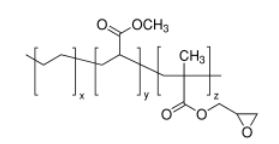
[27] O monômero epóxi-funcional pode ser transformado em um polímero usando uma variedade de técnicas conhecidas. Por exemplo, um monômero contendo grupos funcionais polares pode ser enxertado na estrutura principal de um polímero para formar um copolímero de enxerto. Tais técnicas de enxerto são bem conhecidas na técnica e descritas, por exemplo, na Patente dos EUA N° 5.179.164. Em outras modalidades, um monômero contendo grupos epóxi-funcionais pode ser copolimerizado com um monômero para formar um bloco ou copolímero aleatório usando técnicas conhecidas de polimerização de radical livre, tais como reações de alta pressão, sistemas de reação com catalisador Ziegler-Natta, sistemas de reação com catalisador de sítio único (por exemplo, metaloceno), etc.[27] The epoxy-functional monomer can be made into a polymer using a variety of known techniques. For example, a monomer containing polar functional groups can be grafted onto the backbone of a polymer to form a graft copolymer. Such grafting techniques are well known in the art and described, for example, in US Patent No. 5,179,164. In other embodiments, a monomer containing epoxy-functional groups can be copolymerized with a monomer to form a block or random copolymer using known free radical polymerization techniques, such as high pressure reactions, Ziegler-Natta catalyst reaction systems, reaction with single-site catalyst (eg metallocene), etc.
[28] A parte relativa do(s) componente(s) monomérico(s) pode ser selecionada para atingir um equilíbrio entre a reatividade de epóxi e a taxa de fluxo à fusão. Mais especificamente, elevados teores de monômeros de epóxi podem resultar em reatividade boa, mas um teor demasiado alto pode reduzir a taxa de fluxo-fusão a um grau tal que o poliepóxido impacta de maneira adversa a força de fusão da mistura de polímero. Assim, na maioria das modalidades, o(s) monômero(s) (met)acrílico(s) epóxi-funcionais constitui(em) cerca de 1% em peso a cerca de 25% em peso, em algumas modalidades, de cerca de 2% em peso a cerca de 20% em peso e, em algumas modalidades, de cerca de 4% em peso a cerca de 15% em peso do copolímero. O(s) monômero(s) de α-olefina também pode(m) constituir de cerca de 55% em peso a cerca de 95% em peso, em algumas modalidades, de cerca de 60% em peso a cerca de 90% em peso e, em algumas modalidades, de cerca de 65% em peso a cerca de 85% em peso do copolímero. Quando empregados, outros componentes monoméricos (por exemplo, monômeros (met)acrílicos não epóxi-funcionais) podem constituir de cerca de 5% em peso a cerca de 35% em peso, em algumas modalidades, de cerca de 8% em peso a cerca de 30% em peso e, em algumas modalidades, de cerca de 10% em peso a cerca de 25% em peso do copolímero. Um exemplo específico de um poliepóxido adequado que pode ser usado na presente invenção está comercialmente disponível pela Arkema sob o nome de LOTADER® AX8950 ou AX8900. O LOTADER® AX8950, por exemplo, tem uma taxa de fluxo à fusão de 70 a 100 g/10 min e tem um teor de monômero de metacrilato de glicidil de 7% em peso a 11% em peso, um teor de monômero de acrilato de metil de 13% em peso a 17% em peso, e um teor de monômero de etileno de 72% em peso a 80% em peso. Outro poliepóxido adequado está comercialmente disponível pela DuPont sob o nome de ELVALOY® PTW, que é um terpolímero de etileno, acrilato de butil, e metacrilato de glicidil e tem uma taxa de fluxo à fusão de 12 g/10 min.[28] The relative portion of the monomeric component(s) can be selected to achieve a balance between epoxy reactivity and melt flow rate. More specifically, high levels of epoxy monomers can result in good reactivity, but too high a content can reduce the flow-melt rate to such a degree that the polyepoxide adversely impacts the melt strength of the polymer blend. Thus, in most embodiments, the epoxy-functional (meth)acrylic monomer(s) constitute(s) from about 1% by weight to about 25% by weight, in some embodiments, from about 2% by weight to about 20% by weight and, in some embodiments, from about 4% by weight to about 15% by weight of the copolymer. The α-olefin monomer(s) may also comprise from about 55% by weight to about 95% by weight, in some embodiments, from about 60% by weight to about 90% by weight. weight and, in some embodiments, from about 65% by weight to about 85% by weight of the copolymer. When employed, other monomeric components (e.g., non-epoxy-functional (meth)acrylic monomers) may constitute from about 5% by weight to about 35% by weight, in some embodiments, from about 8% by weight to about from 30% by weight and, in some embodiments, from about 10% by weight to about 25% by weight of the copolymer. A specific example of a suitable polyepoxide that can be used in the present invention is commercially available from Arkema under the name LOTADER® AX8950 or AX8900. LOTADER® AX8950, for example, has a melt flow rate of 70 to 100 g/10 min and has a glycidyl methacrylate monomer content of 7 wt. of methyl from 13% by weight to 17% by weight, and an ethylene monomer content from 72% by weight to 80% by weight. Another suitable polyepoxide is commercially available from DuPont under the name ELVALOY® PTW, which is a terpolymer of ethylene, butyl acrylate, and glycidyl methacrylate and has a melt flow rate of 12 g/10 min.
[29] Além de controlar o tipo e o teor relativo dos monômeros usados para formar o poliepóxido, a porcentagem em peso geral também pode ser controlada para atingir os benefícios desejados. Por exemplo, se o nível de modificação for muito baixo, o aumento desejado na resistência à fusão e nas propriedades mecânicas pode não ser obtido. Os presentes inventores também descobriram, no entanto, que se o nível de modificação for muito alto, o processamento poderá ficar restrita devido às fortes interações moleculares (por exemplo, reticulação) e formação de rede física pelos grupos epóxi-funcionais. Portanto, o poliepóxido é empregado tipicamente em uma quantidade de cerca de 0,05% em peso a cerca de 10% em peso, em algumas modalidades de cerca de 0,1% em peso a cerca de 8% em peso, em algumas modalidades de cerca de 0,5% em peso a cerca de 5% em peso, e em algumas modalidades, de cerca de 1% em peso a cerca de 3% em peso, com base no peso das poliolefinas empregadas na composição. O poliepóxido também pode constituir cerca de 0,05% em peso a cerca de 10% em peso, em algumas modalidades, de cerca de 0,05% em peso a cerca de 8% em peso, em algumas modalidades, de cerca de 0,1% em peso a cerca de 5% em peso e, em algumas modalidades, de cerca de 0,5% em peso a cerca de 3% em peso, com base no peso total da composição.[29] In addition to controlling the type and relative content of the monomers used to form the polyepoxide, the overall weight percentage can also be controlled to achieve desired benefits. For example, if the level of modification is too low, the desired increase in melt strength and mechanical properties may not be achieved. The present inventors have also discovered, however, that if the level of modification is too high, processing may be restricted due to strong molecular interactions (eg, cross-linking) and physical network formation by the epoxy-functional groups. Therefore, the polyepoxide is typically employed in an amount of from about 0.05% by weight to about 10% by weight, in some embodiments from about 0.1% by weight to about 8% by weight, in some embodiments. from about 0.5% by weight to about 5% by weight, and in some embodiments, from about 1% by weight to about 3% by weight, based on the weight of the polyolefins employed in the composition. The polyepoxide can also constitute from about 0.05% by weight to about 10% by weight, in some embodiments, from about 0.05% by weight to about 8% by weight, in some embodiments, from about 0 .1% by weight to about 5% by weight, and in some embodiments, from about 0.5% by weight to about 3% by weight, based on the total weight of the composition.
[30] Outros aditivos de nanoinclusão reativos também podem ser empregados na presente invenção, tais como polímeros de oxazolina funcionalizados, polímeros de cianeto funcionalizados, etc. Quando empregados, tais aditivos de nanoinclusão reativos podem ser empregados dentro das concentrações observadas acima para o poliepóxido. Em uma modalidade específica, uma poliolefina enxertada com oxazolina pode ser empregada, ou seja, uma poliolefina enxertada com um monômero contendo um anel de oxazolina. A oxazolina pode incluir uma 2-oxazolina, tal como 2- vinil-2-oxazolina (por exemplo, 2-isopropenil-2-oxazolina), 2-graxo-alquil-2- oxazolina (por exemplo, obteníveis pela etanolamina de ácido oleico, ácido linoleico, ácido palmitoleico, ácido gadoleico, ácido erúcico e/ou ácido araquidônico) e combinações dos mesmos. Em outra modalidade, a oxazolina pode ser selecionada dentre maleinato de ricinoloxazolina, undecil- 2-oxazolina, soja-2-oxazolina, rícino-2-oxazolina e combinações dos mesmos, por exemplo. Ainda em outra modalidade, a oxazolina é selecionada dentre 2-isopropenil-2-oxazolina, 2-isopropenil-4,4-dimetil-2- oxazolina e combinações dos mesmos.[30] Other reactive nanoinclusion additives can also be employed in the present invention, such as functionalized oxazoline polymers, functionalized cyanide polymers, etc. When employed, such reactive nanoinclusion additives can be employed within the concentrations noted above for the polyepoxide. In a specific embodiment, an oxazoline-grafted polyolefin may be employed, i.e., a polyolefin grafted with a monomer containing an oxazoline ring. The oxazoline may include a 2-oxazoline, such as 2-vinyl-2-oxazoline (e.g. 2-isopropenyl-2-oxazoline), 2-graxo-alkyl-2-oxazoline (e.g. obtainable from oleic acid ethanolamine , linoleic acid, palmitoleic acid, gadoleic acid, erucic acid and/or arachidonic acid) and combinations thereof. In another embodiment, the oxazoline can be selected from ricinoloxazoline maleinate, undecyl-2-oxazoline, soy-2-oxazoline, ricin-2-oxazoline and combinations thereof, for example. In yet another embodiment, the oxazoline is selected from 2-isopropenyl-2-oxazoline, 2-isopropenyl-4,4-dimethyl-2-oxazoline and combinations thereof.
[31] Em determinadas modalidades da presente invenção, vários aditivos de nanoinclusão podem ser empregados em combinação. Por exemplo, um primeiro aditivo de nanoinclusão (por exemplo, poliepóxido) pode ser disperso na forma de domínios com uma dimensão transversal média de cerca de 50 a cerca de 500 nanômetros, em algumas modalidades, de cerca de 60 a cerca de 400 nanômetros, e em algumas modalidades, de cerca de 80 a cerca de 300 nanômetros. Um segundo aditivo de nanoinclusão pode ser também dispersado na forma de domínios que sejam menores que o primeiro aditivo de nanoinclusão, tais como aqueles que têm dimensão de corte transversal média entre cerca de 1 a cerca de 50 nanômetros, em algumas modalidades entre cerca de 2 a cerca de 45 nanômetros, e em algumas modalidades de cerca de 5 a cerca de 40 nanômetros. Quando empregados, o primeiro e/ou segundo aditivos de nanoinclusão normalmente constituem de cerca de 0,05% em peso a cerca de 20% em peso, em algumas modalidades, de cerca de 0,1% em peso a cerca de 10% em peso, e em algumas modalidades, de cerca de 0,5% em peso a cerca de 5% em peso da composição termoplástica, com base no peso da fase contínua (polímero(s) da matriz). A concentração do primeiro e/ou segundo aditivos de nanoinclusão na composição termoplástica inteira pode de cerca de 0,01% em peso a cerca de 15% em peso, em algumas modalidades, de cerca de 0,05% em peso a cerca de 10% em peso, e em algumas modalidades, de cerca de 0,1% em peso a cerca de 8% em peso da composição termoplástica.[31] In certain embodiments of the present invention, various nanoinclusion additives may be employed in combination. For example, a first nanoinclusion additive (e.g., polyepoxide) may be dispersed in the form of domains with an average cross-sectional dimension of about 50 to about 500 nanometers, in some embodiments, from about 60 to about 400 nanometers, and in some embodiments, from about 80 to about 300 nanometers. A second nanoinclusion additive may also be dispersed in the form of domains that are smaller than the first nanoinclusion additive, such as those having an average cross-sectional dimension between about 1 to about 50 nanometers, in some embodiments between about 2 nanometers. to about 45 nanometers, and in some embodiments from about 5 to about 40 nanometers. When employed, the first and/or second nanoinclusion additives typically constitute from about 0.05% by weight to about 20% by weight, in some embodiments, from about 0.1% by weight to about 10% by weight. weight, and in some embodiments, from about 0.5% by weight to about 5% by weight of the thermoplastic composition, based on the weight of the continuous phase (matrix polymer(s)). The concentration of the first and/or second nanoinclusion additives in the entire thermoplastic composition can be from about 0.01% by weight to about 15% by weight, in some embodiments, from about 0.05% by weight to about 10 % by weight, and in some embodiments, from about 0.1% by weight to about 8% by weight of the thermoplastic composition.
[32] Nanocargas podem ser empregadas opcionalmente para o segundo aditivo de nanoinclusão, de que podem ser exemplos negro de fumo, nanotubos de carbono, nanofibras de carbono, nanoargilas, nanopartículs de metal, nanosílica, nanoalumina, etc. Nanoargilas são particularmente adequadas. O termo "nanoargila" refere-se geralmente a nanopartículas de um material de argila (um mineral de ocorrência natural, um mineral organicamente modificado, ou um nanomaterial sintético), que normalmente têm uma estrutura de plaquetas. Exemplos de nanoargilas incluem, por exemplo, montmorillonita (estrutura de argila de esmectita em camadas de 2:1), bentonita (filossilicato de alumínio formado principalmente por montmorillonita), caulinita (aluminossilicato de 1:1 com uma estrutura achatada e fórmula empírica de Al2Si2O5(OH)4), haloisita (aluminossilicato de 1:1 com uma estrutura tubular e fórmula empírica de Al2Si2O5(OH)4), etc. Um exemplo de nanoargila adequado é Cloisite®, que é uma nanoargila de montmorillonita e está comercialmente disponível pela Southern Clay Products, Inc. Outros exemplos de nanoargilas sintéticas incluem, mas não estão limitadas a, nanoargila de hidróxido de metal misturado, nanoargila de hidróxido duplo em camada (por exemplo, sepiocita), laponita, hectorita, saponita, indonita, etc.[32] Nanofillers can be optionally employed for the second nanoinclusion additive, examples of which can be carbon black, carbon nanotubes, carbon nanofibers, nanoclays, metal nanoparticles, nanosilica, nanoalumina, etc. Nanoclays are particularly suitable. The term "nanoclay" generally refers to nanoparticles of a clay material (a naturally occurring mineral, an organically modified mineral, or a synthetic nanomaterial), which typically have a platelet structure. Examples of nanoclays include, for example, montmorillonite (2:1 layered smectite clay structure), bentonite (aluminum phyllosilicate formed primarily by montmorillonite), kaolinite (1:1 aluminosilicate with a flattened structure and empirical formula of Al2Si2O5 (OH)4), halloysite (1:1 aluminosilicate with a tubular structure and empirical formula of Al2Si2O5(OH)4), etc. An example of a suitable nanoclay is Cloisite®, which is a montmorillonite nanoclay and is commercially available from Southern Clay Products, Inc. Other examples of synthetic nanoclays include, but are not limited to, mixed metal hydroxide nanoclay, double layered hydroxide nanoclay (e.g. sepiocite), laponite, hectorite, saponite, indonite, etc.
[33] Se desejado, a nanoargila pode conter um tratamento de superfície para ajudar a melhorar a compatibilidade com o polímero da matriz (por exemplo, poliéster). O tratamento de superfície pode ser orgânico ou inorgânico. Em uma modalidade, é empregado um tratamento de superfície orgânico que é obtido pela reação de um cátion orgânico com a argila. Cátions orgânicos adequados podem incluir, por exemplo, compostos de amônio organoquaternário que são capazes de trocar cátions com a argila, tais como cloreto de dimetil bis [sebo hidrogenado] amônio (2M2HT), cloreto de metil benzil bis [sebo hidrogenado] amônio (MB2HT), cloreto de metil tris [alquil de sebo hidrogenado] (M3HT), etc. Exemplos de nanoargilas orgânicas comercialmente disponíveis podem incluir, por exemplo, Dellite® 43B (Laviosa Chimica de Livorno, Itália), que é uma argila de montmorillonita modificada com sal de dimetil sebo benzil-hidrogenado amônio. Outros exemplos incluem Cloisite® 25A e Cloisite® 30B (Southern Clay Products) e Nanofil 919 (Süd Chemie). Se desejado, a nanocarga pode ser misturada com uma resina transportadora para formar um masterbatch que aumenta a compatibilidade do aditivo com os outros polímeros na composição. Resinas transportadoras particularmente adequadas incluem, por exemplo, poliésteres (por exemplo, ácido polilático, tereftalato de polietileno, etc.); poliolefinas (por exemplo, polímeros de etileno, polímeros de propileno, etc.); e assim por diante, conforme descrito em mais detalhes acima.[33] If desired, the nanoclay can contain a surface treatment to help improve compatibility with the matrix polymer (eg polyester). The surface treatment can be organic or inorganic. In one embodiment, an organic surface treatment is employed which is obtained by the reaction of an organic cation with the clay. Suitable organic cations may include, for example, organoquaternary ammonium compounds that are capable of exchanging cations with clay, such as dimethyl bis[hydrogenated tallow] ammonium chloride (2M2HT), methyl benzyl bis[hydrogenated tallow] ammonium chloride (MB2HT). ), methyl tris chloride [hydrogenated tallow alkyl] (M3HT), etc. Examples of commercially available organic nanoclays may include, for example, Dellite® 43B (Laviosa Chimica of Livorno, Italy), which is a montmorillonite clay modified with dimethyl tallow benzyl hydrogenated ammonium salt. Other examples include Cloisite® 25A and Cloisite® 30B (Southern Clay Products) and Nanofil 919 (Süd Chemie). If desired, the nanofiller can be blended with a carrier resin to form a masterbatch that enhances the additive's compatibility with the other polymers in the composition. Particularly suitable carrier resins include, for example, polyesters (e.g. polylactic acid, polyethylene terephthalate, etc.); polyolefins (e.g. ethylene polymers, propylene polymers, etc.); and so on, as described in more detail above.
[34] Independentemente do material empregado, o aditivo de nanoinclusão é selecionado, tipicamente, de modo a ter uma determinada viscosidade (ou taxa de fluxo-fusão), de modo a assegurar que domínios discretos e poros resultante possam ser mantidos adequadamente. Por exemplo, se a viscosidade do aditivo de nanoinclusão for muito baixa (ou muito alta a taxa de fluxo fusão), ele tende a fluir e dispersa-se incontrolavelmente através da fase contínua. Isto resulta em domínios lamelares ou semelhantes a placa ou em estruturas de fase co-contínua que são difíceis de manter e também prováveis de rachar prematuramente. Por outro lado, se a viscosidade for muito alta (ou muito baixa a taxa de fluxo- fusão), ele tende a agrupar-se e formar domínios elípticos muito grandes, que são difíceis de dispersar durante a misturação. Isto pode provocar distribuição desigual do aditivo de nanoinclusão por toda a fase contínua. Por exemplo, a razão da taxa de fluxo-fusão da poliolefina para a taxa de fluxo- fusão de um aditivo de nanoinclusão polimérico, por exemplo, pode ser entre cerca de 0,2 a cerca de 8, em algumas modalidades de cerca de 0,5 a cerca de 6 e em algumas modalidades de cerca de 1 a cerca de 5. O aditivo de nanoinclusão pode, por exemplo, ter uma taxa de fluxo-fusão (em uma base seca) de a partir de cerca de 0,1 a cerca de 100 gramas por 10 minutos, em algumas modalidades de cerca de 0,5 a cerca de 50 gramas por 10 minutos, e em algumas modalidades, de cerca de 5 a cerca de 15 gramas por 10 minutos, determinada a uma carga de 2160 gramas e a uma temperatura pelo menos 40°C superior à temperatura de fusão (por exemplo, a 190°C) em conformidade com a norma ASTM D1238. A poliolefina pode ter também uma taxa de fluxo-fusão (em base seca) de a partir de cerca de 0,5 a cerca de 80 gramas por 10 minutos, em algumas modalidades de cerca de 1 a cerca de 40 gramas por 10 minutos, e em algumas modalidades, de cerca de 5 a cerca de 20 gramas por 10 minutos, determinada a uma carga de 2160 gramas e a uma temperatura pelo menos cerca de 40°C superior à temperatura de fusão (por exemplo, a 230°C) em conformidade com a norma ASTM D1238. C. Aditivo de Microinclusão[34] Regardless of the material employed, the nanoinclusion additive is typically selected to have a certain viscosity (or flow-melt rate) to ensure that discrete domains and resulting pores can be properly maintained. For example, if the viscosity of the nanoinclusion additive is too low (or the melt flow rate too high), it tends to flow and disperse uncontrollably through the continuous phase. This results in lamellar or plate-like domains or co-continuous phase structures that are difficult to maintain and also likely to crack prematurely. On the other hand, if the viscosity is too high (or the flow-melt rate too low), it tends to clump together and form very large elliptical domains, which are difficult to disperse during mixing. This can cause uneven distribution of the nanoinclusion additive throughout the continuous phase. For example, the ratio of the flow-melt rate of the polyolefin to the flow-melt rate of a polymeric nanoinclusion additive, for example, can be between about 0.2 to about 8, in some embodiments from about 0 .5 to about 6 and in some embodiments from about 1 to about 5. The nanoinclusion additive may, for example, have a flow-melt ratio (on a dry basis) of from about 0.1 to about 100 grams for 10 minutes, in some embodiments from about 0.5 to about 50 grams for 10 minutes, and in some embodiments from about 5 to about 15 grams for 10 minutes, determined at a load of 2160 grams and at a temperature at least 40°C higher than the melting temperature (eg, 190°C) in accordance with ASTM D1238. The polyolefin may also have a melt flow rate (on a dry basis) of from about 0.5 to about 80 grams per 10 minutes, in some embodiments from about 1 to about 40 grams per 10 minutes, and in some embodiments, from about 5 to about 20 grams per 10 minutes, determined at a load of 2160 grams and at a temperature at least about 40°C higher than the melting temperature (e.g., at 230°C) conforms to ASTM D1238. C. Microinclusion Additive
[35] Embora isto não seja necessário, a composição da presente invenção pode empregar igualmente um aditivo de microinclusão. Tal como utilizado neste documento, o termo "aditivo de microinclusão" refere-se, em linhas gerais, a qualquer material que seja capaz de ser dispersado dentro da matriz polimérica na forma de domínios discretos de tamanho microescalar. Por exemplo, antes da extração, os domínios podem ter dimensão de corte transversal média a partir de cerca de 0,1 μm a cerca de 25 μm, em algumas modalidades de cerca de 0,5 μm a cerca de 20 μm, e em algumas modalidades de cerca de 1 μm a cerca de 10 μm. Quando do emprego, os presentes inventores descobriram que domínios de fase nanoescalar e microescalar são capazes de interagir de maneira única quando submetidos á deformação e à tensão de alongamento (por exemplo, extração) de modo a criar uma rede de poros. Ou seja, acredita-se que a força de alongamento possa iniciar as zonas de cisalhamento localizado intensivo e/ou zonas de intensidade de tensão (por exemplo, tensões normais) perto dos domínios de fase discretos em microescala, como resultado de concentrações de tensão que surgem da incompatibilidade dos materiais. Estas zonas de intensidade de tensão e/ou cisalhamento provocam algumas descolagens iniciais na matriz de poliolefina adjacente aos domínios microescalares. Notavelmente, no entanto, as zonas de intensidade de tensão e/ou cisalhamento localizadas, criadas proximamente aos domínios nanoescalares de fase discreta, podem se sobrepôr às zonas microescalares de modo a causar ainda mais descolagens na matriz polimérica, criando, portanto, um número substancial de nanoporos adjacentes aos domínios nanoescalar e/ou domínios microescalares.[35] Although this is not necessary, the composition of the present invention may also employ a microinclusion additive. As used herein, the term "microinclusion additive" broadly refers to any material that is capable of being dispersed within the polymer matrix in the form of discrete domains of microscale size. For example, prior to extraction, domains may have an average cross-sectional dimension from about 0.1 μm to about 25 μm, in some embodiments from about 0.5 μm to about 20 μm, and in some modalities from about 1 μm to about 10 μm. Upon employment, the present inventors have discovered that nanoscale and microscale phase domains are capable of uniquely interacting when subjected to deformation and stretching stress (eg, extraction) so as to create a pore network. That is, it is believed that the stretching force can initiate zones of intensive localized shear and/or zones of stress intensity (e.g. normal stresses) near discrete microscale phase domains as a result of stress concentrations that arise from the incompatibility of materials. These zones of stress and/or shear intensity cause some initial debonding in the polyolefin matrix adjacent to the microscalar domains. Notably, however, localized stress and/or shear intensity zones created close to discrete-phase nanoscale domains can overlap with microscalar zones to cause even more debonding in the polymer matrix, thus creating a substantial number of nanopores adjacent to nanoscale domains and/or microscalar domains.
[36] A natureza específica do aditivo de microinclusão não é critica, e pode incluir líquidos, semissólidos ou sólidos (por exemplo, amorfos, cristalinos ou semicristalinos). Em certas modalidades, o aditivo de microinclusão é polimérico na natureza e possui peso molecular relativamente alto de modo a aperfeiçoar a força de fusão e estabilidade da composição termoplástica. Normalmente, o polímero de aditivo de microinclusão pode ser, no mais dos casos, incompatível com o polímero matricial. Dessa forma, o aditivo pode ser melhor espalhado como os domínios de fase discretos dentro de uma fase contínua do polímero da matriz. Os domínios discretos são capazes de absorver energia que emerja de uma força externa, o que aumenta a dureza geral e força da fibra resultante. Os domínios podem ter uma variedade de diferentes formas, tais como elíptica, esférica, cilíndrica, semelhante a placa, tubular, etc. Em uma modalidade, por exemplo, os domínios têm uma forma substancialmente elíptica. A dimensão física de um domínio individual é, tipicamente, pequena o bastante para minimizar a propagação de trincos ao longo da fibra quando da aplicação de uma tensão externa, mas grande o suficiente para iniciar deformação plástico microscópica e permitir zonas de cisalhamento em e à volta de inclusão de partícula.[36] The specific nature of the microinclusion additive is not critical, and may include liquids, semi-solids, or solids (eg, amorphous, crystalline, or semi-crystalline). In certain embodiments, the microinclusion additive is polymeric in nature and has a relatively high molecular weight in order to improve the melt strength and stability of the thermoplastic composition. Typically, the microinclusion additive polymer may, in most cases, be incompatible with the matrix polymer. In this way, the additive can be better spread out as discrete phase domains within a continuous phase of the matrix polymer. Discrete domains are capable of absorbing energy emerging from an external force, which increases the overall hardness and strength of the resulting fiber. Domains can have a variety of different shapes such as elliptical, spherical, cylindrical, plate-like, tubular, etc. In one embodiment, for example, the domains are substantially elliptical in shape. The physical dimension of an individual domain is typically small enough to minimize crack propagation along the fiber when external stress is applied, but large enough to initiate microscopic plastic deformation and allow for shear zones in and around it. of particle inclusion.
[37] O aditivo de microinclusão pode ter uma determinada taxa de fluxo- fusão (ou viscosidade) para assegurar que domínios discretos e poros resultantes sejam adequadamente mantidos. Por exemplo, se a taxa de fluxo à fusão do aditivo for muito alta, ele tende a fluir e a se dispersar de forma incontrolável pela fase contínua. Isto resulta em domínios lamelares ou semelhantes a placa ou em estruturas de fase co-contínua que são difíceis de manter e também prováveis de rachar prematuramente. Por outro lado, se a taxa de fluxo à fusão do aditivo for muito baixa, ele tenderá a se aglutinar e formar domínios elípticos muito grandes, que são difíceis de dispersar durante a mistura. Isto poderá provocar uma distribuição irregular do aditivo por toda a fase contínua. Nesse sentido, os presentes inventores descobriram que a razão da taxa de fluxo-fusão do aditivo de microinclusão para a taxa de fluxo-fusão do polímero matricial é, tipicamente, de cerca de 0,5 a cerca de 10, em algumas modalidades de cerca de 1 a cerca de 8, e em algumas modalidades, de cerca de 2 a cerca de 6. O aditivo de microinclusão pode, por exemplo, ter uma taxa de fluxo-fusão de cerca de 5 a cerca de 200 gramas por 10 minutos, em algumas modalidades de cerca de 20 a cerca de 150 gramas por 10 minutos, e em algumas modalidades, de cerca de 40 a cerca de 100 gramas por 10 minutos, determina a uma carga de 2160 gramas e a uma temperatura pelo menos 40°C superior à sua temperatura de fusão (por exemplo, 210°C).[37] The microinclusion additive may have a certain flow-to-melt ratio (or viscosity) to ensure that discrete domains and resulting pores are properly maintained. For example, if the melt flow rate of the additive is too high, it tends to flow and disperse uncontrollably through the continuous phase. This results in lamellar or plate-like domains or co-continuous phase structures that are difficult to maintain and also likely to crack prematurely. On the other hand, if the melt flow rate of the additive is too low, it will tend to clump together and form very large elliptical domains, which are difficult to disperse during mixing. This may cause uneven distribution of the additive throughout the continuous phase. In this regard, the present inventors have found that the ratio of the flow-to-melt rate of the microinclusion additive to the flow-to-melt rate of the matrix polymer is typically from about 0.5 to about 10, in some embodiments of about from 1 to about 8, and in some embodiments, from about 2 to about 6. The microinclusion additive may, for example, have a flow-melt rate of from about 5 to about 200 grams per 10 minutes, in some embodiments from about 20 to about 150 grams for 10 minutes, and in some embodiments from about 40 to about 100 grams for 10 minutes, determines at a load of 2160 grams and at a temperature of at least 40°C higher than its melting temperature (eg 210°C).
[38] Além das propriedades observadas acima, as características mecânicas do aditivo de microinclusão podem também ser selecionadas para alcançar a rede porosa desejada. Por exemplo, aplicadas com uma força externa, concentrações de tensão (por exemplo, incluindo tensões normais e de cisalhamento) e zonas de rendimento plásticas e/ou de cisalhamento podem ser principiadas nos e à volta dos domínios de fase discreta como resultado de concentrações de tensão que emergem da diferença no módulo elástico do aditivo e do polímero matricial. Concentrações maiores de tensão promovem um fluxo plástico localizado mais intenso nos domínios, permitindo que eles se tornem significativamente alongados quando tensões são aplicadas. Esses domínios alongados permitem que a composição exiba comportamento mais flexível e suave. Para intensificar as concentrações de tensão, o aditivo de microinclusão pode ser selecionado para ter um módulo de Young de elasticidade relativamente alto em comparação à matriz de poliolefina. Por exemplo, a razão do módulo de elasticidade do aditivo para o da matriz de poliolefina é, tipicamente, de cerca de 1 a cerca de 250, em algumas modalidades de cerca de 2 a cerca de 100, e em algumas modalidades, de cerca de 2 a cerca de 50. O módulo de elasticidade do aditivo de microinclusão pode, por exemplo, estar no intervalo entre cerca de 200 a cerca de 3.500 Megapascals (Mpa), em algumas modalidades de cerca de 300 a cerca de 2.000 Mpa, e em algumas modalidades, de cerca de 400 a cerca de 1.500 MPa. Ao contrário, o módulo de elasticidade da poliolefina pode, por exemplo, variar de cerca de 100 a cerca de 1.500 MPa, e em algumas modalidades, de cerca de 200 a cerca de 1000 MPa. Como alternativa, o módulo de elasticidade do aditivo de microinclusão aditivo pode ser menor que o módulo de elasticidade de matriz de poliolefina. O módulo de elasticidade pode, por exemplo, variar de cerca de 10 MPa a cerca de 100 MPa e, opcionalmente, de cerca de 20 MPA a cerca de 80 MPa.[38] In addition to the properties noted above, the mechanical characteristics of the microinclusion additive can also be selected to achieve the desired porous network. For example, applied with an external force, stress concentrations (e.g. including normal and shear stresses) and plastic and/or shear yield zones can be initiated in and around discrete phase domains as a result of concentrations of stress arising from the difference in the elastic modulus of the additive and the matrix polymer. Higher stress concentrations promote more intense localized plastic flow in the domains, allowing them to become significantly elongated when stresses are applied. These elongated domains allow the composition to exhibit more flexible and smoother behavior. To enhance stress concentrations, the microinclusion additive can be selected to have a relatively high Young's modulus of elasticity compared to the polyolefin matrix. For example, the ratio of the modulus of elasticity of the additive to that of the polyolefin matrix is typically from about 1 to about 250, in some embodiments from about 2 to about 100, and in some embodiments from about 2 to about 50. The modulus of elasticity of the microinclusion additive may, for example, range from about 200 to about 3,500 Megapascals (Mpa), in some embodiments from about 300 to about 2,000 Mpa, and in some embodiments from about 300 to about 2,000 Mpa. some embodiments, from about 400 to about 1,500 MPa. Conversely, the modulus of elasticity of the polyolefin can, for example, range from about 100 to about 1500 MPa, and in some embodiments from about 200 to about 1000 MPa. Alternatively, the modulus of elasticity of the microinclusion additive may be less than the modulus of elasticity of the polyolefin matrix. The modulus of elasticity can, for example, range from about 10 MPa to about 100 MPa and, optionally, from about 20 MPa to about 80 MPa.
[39] Embora uma grande variedade de aditivos de microinclusão dotados das propriedades identificadas acima possa ser empregada, exemplos particularmente adequados de tais aditivos podem incluir copolímeros estirênico (por exemplo, estireno-butadieno-estireno, estireno-isopreno- estireno, estireno-etileno-propileno-estireno, estireno-etileno-butadieno- estireno, etc.); fluoropolímeros, tais como cloreto de polivinal (PVC), politetrafluoroetileno (PTFE), policlorotrifluoroetileno (PCTFE), etc.; alcoois de polivinila; acetatos de polivinila; poliésteres, tais como poliésters alifáticos, tais como policaprolactono, poliesteramidas, ácido polilático (PLA) e seus copolímeros, ácido poliglicólico, carbonatos de polialquileno (por exemplo, carbonato de polietileno), poli-3-hidroxibutirato (PHB), poli-3-hidroxivalerato (PHV), poli-3-hidroxibutirato-co-4-hidroibutirato, copolímeros de poli-3- hidroxibutirato-co-3-hidroxivalerato (PHBV), poli-3-hidroxibutirato-co-3- hidroxihexanoato, poli-3-hidroxibutirato-co-3-hidroxioctanoato, poli-3- hidroxibutirato-co-3-hidroxidecanoato, poli-3-hidroxibutirato-co-3- hidroxioctadecanoato, epolímeros alifáticos com base em sucinato (por exemplo, sucinato de polibutileno, adipato de sucinato de polibutileno, sucinato de polietileno, etc.), copoliésteres aromático-alifáticos (por exemplo, terenftalato de adipato de polibutileno, terenftalato de adipato de polietileno, isoftalato de adipato de polietileno, isoftalato de adipato de polibutileno, etc.), poliésteres aromáticos (por exemplo, terenftalato de polietileno, terenftalado de polibutileno, etc.); e por aí em diante.[39] Although a wide variety of microinclusion additives having the properties identified above can be employed, particularly suitable examples of such additives may include styrene copolymers (e.g. styrene-butadiene-styrene, styrene-isoprene-styrene, styrene-ethylene- propylene-styrene, styrene-ethylene-butadiene-styrene, etc.); fluoropolymers such as polyvinal chloride (PVC), polytetrafluoroethylene (PTFE), polychlorotrifluoroethylene (PCTFE), etc.; polyvinyl alcohols; polyvinyl acetates; polyesters such as aliphatic polyesters such as polycaprolactone, polyesteramides, polylactic acid (PLA) and its copolymers, polyglycolic acid, polyalkylene carbonates (e.g. polyethylene carbonate), poly-3-hydroxybutyrate (PHB), poly-3- hydroxyvalerate (PHV), poly-3-hydroxybutyrate-co-4-hydroxybutyrate, copolymers of poly-3-hydroxybutyrate-co-3-hydroxyvalerate (PHBV), poly-3-hydroxybutyrate-co-3-hydroxyhexanoate, poly-3- hydroxybutyrate-co-3-hydroxyoctanoate, poly-3-hydroxybutyrate-co-3-hydroxydecanoate, poly-3-hydroxybutyrate-co-3-hydroxyoctadecanoate, succinate-based aliphatic polymers (e.g. polybutylene succinate, succinate adipate polybutylene, polyethylene succinate, etc.), aliphatic-aromatic copolyesters (e.g. polybutylene adipate terenphthalate, polyethylene adipate terenphthalate, polyethylene adipate isophthalate, polybutylene adipate isophthalate, etc.), aromatic polyesters (e.g. example, terenphthala polyethylene, polybutylene terephthalate, etc.); and so on.
[40] Particularmente adequados são aditivos de microinclusão que são tipicamente rígidos na natureza a ponto de terem temperatura de transição vítrea relativamente alta. Por exemplo, a temperatura de transição vítrea (“Tg”) pode ser cerca de 0°C ou mais, em algumas modalidades de cerca de 5°C a cerca de 100°C, em algumas modalidades de cerca de 30°C a cerca de 80°C, e em algumas modalidades, de cerca de 50°C a cerca de 75°C. A temperatura de transição vítrea pode ser determinada por uma análise mecânica dinâmica em conformidade com a norma ASTM E1640-09.[40] Particularly suitable are microinclusion additives which are typically rigid in nature to the extent that they have a relatively high glass transition temperature. For example, the glass transition temperature ("Tg") can be about 0°C or more, in some embodiments from about 5°C to about 100°C, in some embodiments from about 30°C to about 100°C. from 80°C, and in some embodiments, from about 50°C to about 75°C. The glass transition temperature can be determined by dynamic mechanical analysis in accordance with ASTM E1640-09.
[41] Um poliéster rígido particularmente adequado é o ácido polilático, que pode ser derivado geralmente de unidades monoméricas de qualquer isômero de ácido lático, tal como ácido lático levógiro (“ácido L-lático”), ácido lático dextrógiro (“ácido D-lático”), ácido meso-lático ou combinações dos mesmos. As unidades monoméricas também podem ser formadas por anidridos de qualquer isômero do ácido lático, incluindo L-lactídeo, D- lactídeo, meso-lactídeo ou combinações dos mesmos. Dímeros cíclicos desses ácidos láticos e/ou lactídeos também podem ser empregados. Qualquer método de polimerização conhecido, tal como a policondensação ou polimerização por abertura de anel, pode ser usado para polimerizar o ácido lático. Uma pequena quantidade de um agente de extensão de cadeia (por exemplo, um composto di-isocianato, um composto epóxi ou anidrido ácido) também pode ser empregada. O ácido polilático pode ser um homopolímero ou um copolímero, tal como um que contenha unidades monoméricas derivadas do ácido L-lático e unidades monoméricas derivadas do ácido D-lático. Embora não seja necessária, a taxa do conteúdo de uma das unidades monoméricas derivadas do ácido L-lático e da unidade monomérica derivada do ácido D-lático é preferencialmente de cerca de 85% em mol ou mais, em algumas modalidades, de cerca de 90% em mol ou mais e, em outras modalidades, de cerca de 95% em mol ou mais. Vários ácidos poliláticos, cada um com uma razão diferente entre a unidade monomérica derivada do ácido L-lático e da unidade monomérica derivada do ácido D- lático, podem ser misturados em qualquer porcentagem aleatória. Claro, o ácido polilático pode ser misturado com outros tipos de polímeros (por exemplo, poliolefinas, poliésteres, etc.).[41] A particularly suitable rigid polyester is polylactic acid, which can be derived generally from the monomer units of any isomer of lactic acid, such as levorotatory lactic acid ("L-lactic acid"), dextrorotatory lactic acid ("D-lactic acid"). lactic acid”), meso-lactic acid or combinations thereof. The monomer units can also be formed by anhydrides of any isomer of lactic acid, including L-lactide, D-lactide, meso-lactide or combinations thereof. Cyclic dimers of these lactic acids and/or lactides can also be used. Any known polymerization method, such as polycondensation or ring opening polymerization, can be used to polymerize lactic acid. A small amount of a chain extending agent (e.g., a diisocyanate compound, an epoxy compound, or acid anhydride) may also be employed. The polylactic acid can be a homopolymer or a copolymer, such as one that contains monomer units derived from L-lactic acid and monomer units derived from D-lactic acid. Although not required, the content ratio of one of the L-lactic acid-derived monomer units and the D-lactic acid-derived monomer unit is preferably about 85 mol% or more, in some embodiments, about 90 % by mol or more and, in other embodiments, about 95% by mol or more. Several polylactic acids, each with a different ratio between the monomer unit derived from L-lactic acid and the monomer unit derived from D-lactic acid, can be mixed in any random percentage. Of course, polylactic acid can be mixed with other types of polymers (eg polyolefins, polyesters, etc.).
[42] Em uma modalidade específica, o ácido polilático tem a seguinte estrutura geral: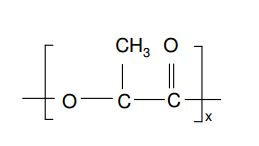
[43] Em exemplo específico de um polímero de ácido polilático adequado que pode ser usado na presente invenção está comercialmente disponível pela Biomer, Inc. de Krailling, Alemanha) sob o nome BIOMER™ L9000. Outros polímeros de ácido polilático adequados estão comercialmente disponíveis pela Natureworks LLC de Minnetonka, Minnesota (NATUREWORKS®) ou Mitsui Chemical (LACEA™). Outros ácidos poliláticos adicionais adequados podem ser descritos nas Patentes dos EUA N.° 4.797.468; 5.470.944; 5.770.682; 5.821.327; 5.880.254 e 6.326.458, que estão inclusas na íntegra no presente documento, à guisa de referência, para todos os propósitos.[43] A specific example of a suitable polylactic acid polymer that can be used in the present invention is commercially available from Biomer, Inc. of Krailling, Germany) under the name BIOMER™ L9000. Other suitable polylactic acid polymers are commercially available from Natureworks LLC of Minnetonka, Minnesota (NATUREWORKS®) or Mitsui Chemical (LACEA™). Additional suitable polylactic acids can be described in US Patent Nos. 4,797,468; 5,470,944; 5,770,682; 5,821,327; 5,880,254 and 6,326,458, which are incorporated in their entirety herein, by way of reference, for all purposes.
[44] O ácido polilático normalmente tem um número de peso molecular médio (“Mn”) que varia de cerca de 40.000 a cerca de 180.000 gramas por mol, em algumas modalidades, de cerca de 50.000 a cerca de 160.000 gramas por mol e, em algumas modalidades, de cerca de 80.000 a cerca de 120.000 gramas por mol. Da mesma forma, o polímero normalmente também tem um peso molecular ponderal médio (“Mw”) que varia de cerca de 80.000 a cerca de 250.000 gramas por mol, em algumas modalidades, de cerca de 100.000 a cerca de 200.000 gramas por mol e, em algumas modalidades, de cerca de 110.000 a cerca de 160.000 gramas por mol. A razão entre o peso molecular ponderal médio e o número do peso molecular médio (“Mw/Mn”), isto é, o "índice de polidispersividade", também é relativamente baixa. Por exemplo, o índice de polidispersividade varia normalmente de cerca de 1,0 a cerca de 3,0, em algumas modalidades, de cerca de 1,1 a cerca de 2,0, e, em modalidades, de cerca de 1,2 a cerca de 1,8. Os números dos pesos moleculares médio e ponderal médio podem ser determinados por métodos conhecidos aos versados na técnica.[44] Polylactic acid typically has a number average molecular weight (“Mn”) that ranges from about 40,000 to about 180,000 grams per mole, in some embodiments from about 50,000 to about 160,000 grams per mole, and in some embodiments from about 50,000 to about 160,000 grams per mole. in some embodiments, from about 80,000 to about 120,000 grams per mole. Likewise, the polymer typically also has a weight average molecular weight ("Mw") that ranges from about 80,000 to about 250,000 grams per mole, in some embodiments from about 100,000 to about 200,000 grams per mole, and in some embodiments from about 100,000 to about 200,000 grams per mole. in some embodiments, from about 110,000 to about 160,000 grams per mole. The ratio of weight average molecular weight to number average molecular weight ("Mw/Mn"), i.e. the "polydispersity index", is also relatively low. For example, the polydispersity index typically ranges from about 1.0 to about 3.0, in some embodiments from about 1.1 to about 2.0, and in some embodiments from about 1.2 at about 1.8. The weight average and weight average molecular weight numbers can be determined by methods known to those skilled in the art.
[45] Alguns tipos de poliéster puro (por exemplo, ácido polilático) podem absorver água do ambiente, tal que tenha um teor de umidade de cerca de 500 a 600 partes por milhão (“ppm”), ou ainda maior, com base no peso seco do ácido polilático inicial. O teor de umidade pode ser determinado de várias maneiras, conforme é conhecido na técnica, tal como de acordo com ASTM D 7191-05, como descrito abaixo. Uma vez que a presença da água durante o processamento por fusão pode degradar hidroliticamente o poliéster e reduzir seu peso molecular, às vezes é desejado secar o poliéster antes de misturá-lo. Na maioria das modalidades, por exemplo, é desejável que o poliéster renovável tenha teor de umidade de cerca de 300 partes por milhão ("ppm") ou menos, em algumas modalidades cerca de 200 ppm ou menos, em algumas modalidades de cerca de 1 a cerca de 100 ppm antes da mistura com aditivos de nanoinclusão. A secagem do poliéster pode ocorrer, por exemplo, numa temperatura de cerca de 50°C a cerca de 100°C e, em algumas modalidades, de cerca de 70°C a cerca de 80°C.[45] Some types of pure polyester (e.g. polylactic acid) can absorb water from the environment such that it has a moisture content of about 500 to 600 parts per million (“ppm”), or even higher, based on dry weight of starting polylactic acid. Moisture content can be determined in various ways as is known in the art, such as in accordance with ASTM D 7191-05, as described below. Since the presence of water during melt processing can hydrolytically degrade the polyester and reduce its molecular weight, it is sometimes desired to dry the polyester prior to blending. In most embodiments, for example, it is desirable for the renewable polyester to have a moisture content of about 300 parts per million ("ppm") or less, in some embodiments about 200 ppm or less, in some embodiments of about 1 to about 100 ppm before mixing with nanoinclusion additives. Drying of the polyester can occur, for example, at a temperature of from about 50°C to about 100°C and, in some embodiments, from about 70°C to about 80°C.
[46] Independentemente dos materiais empregados, a porcentagem relativa do aditivo de microinclusão na composição termoplástica é selecionada a fim de atingir as propriedades desejadas sem afetar consideravelmente a composição resultante. Por exemplo, o aditivo de microinclusão é normalmente empregado em quantidade de cerca de 1% a cerca de 30% em peso, em algumas modalidades, de cerca de 2% a cerca de 25% em peso e, em outras modalidades, de cerca de 5% a cerca de 20% em peso dos compostos termoplásticos, com base no peso da matriz de poliolefina na composição. A concentração do aditivo de microinclusão em toda a composição termoplástica pode constituir cerca de 0,1% em peso a cerca de 30% em peso, em algumas modalidades, de cerca de 0,5% em peso a cerca de 25% em peso e, em algumas modalidades, de cerca de 1% em peso a cerca de 20% em peso. D. Outros Componentes[46] Regardless of the materials employed, the relative percentage of the microinclusion additive in the thermoplastic composition is selected in order to achieve the desired properties without appreciably affecting the resulting composition. For example, the microinclusion additive is normally employed in an amount of from about 1% to about 30% by weight, in some embodiments, from about 2% to about 25% by weight, and in other embodiments, from about 25% by weight. 5% to about 20% by weight of the thermoplastic compounds, based on the weight of the polyolefin matrix in the composition. The concentration of the microinclusion additive in the entire thermoplastic composition can be from about 0.1% by weight to about 30% by weight, in some embodiments, from about 0.5% by weight to about 25% by weight, and , in some embodiments, from about 1% by weight to about 20% by weight. D. Other Components
[47] Uma ampla variedade de ingredientes pode ser usada na composição por diversos motivos diferentes. Por exemplo, em uma modalidade específica, um modificador interfásico pode ser utilizado na composição termoplástica de modo a auxiliar na redução do grau de fricção e conectividade entre os aditivos de nanoinclusão e/ou microinclusão e matiz de poliolefina, intensificando, portanto, o grau e uniformidade de descolagem. Desse modo, os poros podem ser distribuídos de uma forma mais homogênea por toda a composição. O modificador pode estar na forma líquida ou semissólida em temperatura ambiente (por exemplo, 25°C) para que possua uma viscosidade relativamente baixa, permitindo que seja incorporado mais facilmente na composição termoplástica e migre mais facilmente para as superfícies do polímero. Ao reduzir as forças físicas nas interfaces entre a matriz de poliolefina e o aditivo, acredita-se que a natureza hidrofóbica e de baixa viscosidade do modificador possa ajudar a facilitar a descolagem. Conforme usado neste documento, o termo “hidrofóbico” normalmente se refere a um material que tem um ângulo de contato da água e ar de cerca de 40° ou mais e, em alguns casos, de cerca de 60° ou mais. Em contrapartida, o termo “hidrofílico” normalmente se refere a um material que tem um ângulo de contato da água e ar menor que cerca de 40°. Um teste adequado para medir o ângulo de contato é o ASTM D5725-99 (2008).[47] A wide variety of ingredients can be used in the composition for several different reasons. For example, in a specific embodiment, an interphase modifier can be used in the thermoplastic composition in order to assist in reducing the degree of friction and connectivity between the nanoinclusion and/or microinclusion additives and polyolefin hue, thereby enhancing the degree and take-off uniformity. In this way, the pores can be distributed more evenly throughout the composition. The modifier can be in liquid or semi-solid form at room temperature (eg, 25°C) so that it has a relatively low viscosity, allowing it to be more easily incorporated into the thermoplastic composition and migrate more easily to polymer surfaces. By reducing the physical forces at the interfaces between the polyolefin matrix and the additive, it is believed that the hydrophobic and low viscosity nature of the modifier can help facilitate debonding. As used herein, the term "hydrophobic" typically refers to a material that has a contact angle of water and air of about 40° or more, and in some cases of about 60° or more. In contrast, the term “hydrophilic” typically refers to a material that has a contact angle of water and air of less than about 40°. A suitable test for measuring contact angle is ASTM D5725-99 (2008).
[48] Embora não seja obrigatório, o modificador interfásico pode ser particularmente adequado em modalidades em que um aditivo de microinclusão é empregado e em que o aditivo de nanoinclusão é um sólido (por exemplo, material polimérico). Modificadores interfásicos hidrofóbicos de baixa viscosidade podem incluir, por exemplo, os líquidos e/ou semissólidos acima aludidos. Um modificador interfásico particularmente adequado é poliol de poliéter, como o que é comercialmente disponível sob o nome comercial PLURIOL ® WI pela BASF Corp. Outro modificador apropriado é um éster parcialmente renovável, como o comercialmente disponível sob o nome comercial HALLGREEN ® IM de Hallstar.[48] Although not mandatory, the interphase modifier may be particularly suitable in embodiments where a microinclusion additive is employed and where the nanoinclusion additive is a solid (eg, polymeric material). Low viscosity hydrophobic interphase modifiers may include, for example, the liquids and/or semi-solids alluded to above. A particularly suitable interphase modifier is polyether polyol, such as is commercially available under the tradename PLURIOL ® WI from BASF Corp. Another suitable modifier is a partially renewable ester, such as that commercially available under the tradename HALLGREEN ® IM from Hallstar.
[49] Quando empregado, o modificador interfásico pode constituir de cerca de 0,1% em peso a cerca de 20% em peso, em algumas modalidades, de cerca de 0,5% em peso a cerca de 15% em peso e, em outras modalidades, de cerca de 1% em peso a cerca de 10% em peso dos compostos termoplásticos, com base no peso da matriz de poliolefina de fase contínua. A concentração dos modificadores interfásicos em toda a composição termoplástica pode constituir de cerca de 0,05% em peso a cerca de 20% em peso, em algumas modalidades de cerca de 0,1% em peso a cerca de 15% em peso e, em algumas modalidades, de cerca de 0,5% em peso a cerca de 10% em peso. Quando empregadas as quantidades observadas acima, o modificador interfásico terá uma característica que permite que ele migre rapidamente para a superfície interfacial dos polímeros e facilitem o descolamento sem danificar as propriedades de fusão da composição termoplástica. Por exemplo, o índice de fluxo-fusão da composição termoplástica pode também ser similar ao da matriz de poliolefina. Por exemplo, o índice de fluidez da composição (em base seca) pode ser de cerca de 0,1 a cerca de 250 gramas por 10 minutos, em algumas modalidades de cerca de 0,5 a cerca de 200 gramas por 10 minutos e, em outras modalidades, de cerca de 5 a cerca de 150 gramas por 10 minutos, determinado a uma carga de 2160 gramas e a uma temperatura de 190°C em conformidade com a norma ASTM D1238.[49] When employed, the interphase modifier can comprise from about 0.1% by weight to about 20% by weight, in some embodiments, from about 0.5% by weight to about 15% by weight, and, in other embodiments, from about 1% by weight to about 10% by weight of the thermoplastic compounds, based on the weight of the continuous phase polyolefin matrix. The concentration of the interphase modifiers in the entire thermoplastic composition can be from about 0.05% by weight to about 20% by weight, in some embodiments from about 0.1% by weight to about 15% by weight, and, in some embodiments, from about 0.5% by weight to about 10% by weight. When the amounts noted above are employed, the interphase modifier will have a characteristic that allows it to rapidly migrate to the interfacial surface of the polymers and facilitate debonding without damaging the melting properties of the thermoplastic composition. For example, the flow-melt index of the thermoplastic composition may also be similar to that of the polyolefin matrix. For example, the pour index of the composition (on a dry basis) can be from about 0.1 to about 250 grams for 10 minutes, in some embodiments from about 0.5 to about 200 grams for 10 minutes, and, in other embodiments, from about 5 to about 150 grams for 10 minutes, determined at a load of 2160 grams and a temperature of 190°C in accordance with ASTM D1238.
[50] Compatibilizantes também podem ser empregados para melhorar a aderência interfacial e reduzir a tensão interfacial entre o domínio e a matriz, permitindo, assim, a formação de domínios menores durante a mistura. Exemplos de compatibilizantes adequados podem incluir, por exemplo, copolímeros funcionalizados com epóxi ou frações químicas de anidrido maleico. Um exemplo de um compatibilizante de anidrido maleico é o anidrido maleico enxertado com polipropileno, que está comercialmente disponível pela Arkema sob os nomes Orevac™ 18750 e Orevac™ CA 100. Quando empregados, os compatibilizadores podem constituir de cerca de 0,05% em peso a cerca de 10% em peso, em algumas modalidades, de cerca de 0,1% em peso a cerca de 8% em peso, e em algumas modalidades, de cerca de 0,5% em peso a cerca de 5% em peso da composição termoplástica, com base no peso da matriz de fase contínua.[50] Compatibility agents can also be used to improve interfacial adhesion and reduce the interfacial tension between the domain and the matrix, thus allowing the formation of smaller domains during mixing. Examples of suitable compatibilizers may include, for example, epoxy functionalized copolymers or chemical moieties of maleic anhydride. An example of a maleic anhydride compatibilizer is polypropylene-grafted maleic anhydride, which is commercially available from Arkema under the names Orevac™ 18750 and Orevac™ CA 100. When employed, the compatibilizers can constitute from about 0.05% by weight to about 10% by weight, in some embodiments, from about 0.1% by weight to about 8% by weight, and in some embodiments, from about 0.5% by weight to about 5% by weight of the thermoplastic composition, based on the weight of the continuous phase matrix.
[51] Outros materiais adequados podem ser também utilizados na composição termoplástica, tais como catalizadores, antioxidantes, estabilizadores, surfactantes, ceras, solventes sólidos, agentes nucleantes, particulatos, nanopreenchimentos e outros materiais acrescentados para intensificar a processabilidade e propriedades mecânicas da composição termoplásticas. No entanto, um aspecto benéfico da presente invenção é que boas propriedades podem ser fornecidas sem a necessidade de diversos aditivos convencionais, tais como agentes de expansão (por exemplo, clorofluorocarbonos, hidroclorofluorocarbonos, hidrocarbonetos, dióxido de carbono, dióxido de carbono supercrítico, nitrogênio, etc.) e enchimentos iniciadores de poros (por exemplo, carbonato de cálcio). Na verdade, a composição termoplástica pode geralmente ser livre de agentes de expansão e/ou enchimentos iniciadores de poros. Por exemplo, tais agentes de expansão e/ou preenchimentos podem encontrar-se presentes em quantidade não maior que cerca de 1% em peso, em algumas modalidades não maior que cerca de 0,5% em peso, e em algumas modalidades, de cerca de 0,001% em peso a cerca de 0,2% em peso da composição termoplástica. Além disso, devido às propriedades de branqueamento por tensão, conforme descrito com mais detalhes abaixo, a composição resultante pode atingir uma cor opaca (por exemplo, branca) sem a necessidade de pigmentos convencionais, tais como dióxido de titânio. Em certas modalidades, por exemplo, os pigmentos podem estar presentes em uma quantidade de não mais que cerca de 1% em peso, em algumas modalidades, não mais que cerca de 0,5% em peso e, em algumas modalidades, de cerca de 0,001% em peso a cerca de 0,2% em peso da composição termoplástica. II. Misturação[51] Other suitable materials can also be used in the thermoplastic composition, such as catalysts, antioxidants, stabilizers, surfactants, waxes, solid solvents, nucleating agents, particulates, nanofillers and other materials added to enhance the processability and mechanical properties of the thermoplastic composition. However, a beneficial aspect of the present invention is that good properties can be provided without the need for various conventional additives such as blowing agents (e.g. chlorofluorocarbons, hydrochlorofluorocarbons, hydrocarbons, carbon dioxide, supercritical carbon dioxide, nitrogen, etc.) and pore-initiating fillers (eg calcium carbonate). Indeed, the thermoplastic composition may generally be free of blowing agents and/or pore-initiating fillers. For example, such blowing agents and/or fillers may be present in an amount of not more than about 1% by weight, in some embodiments not more than about 0.5% by weight, and in some embodiments, of about 0.5% by weight. from 0.001% by weight to about 0.2% by weight of the thermoplastic composition. Furthermore, due to the stress bleaching properties, as described in more detail below, the resulting composition can achieve an opaque color (e.g. white) without the need for conventional pigments such as titanium dioxide. In certain embodiments, for example, the pigments may be present in an amount of not more than about 1% by weight, in some embodiments, not more than about 0.5% by weight, and in some embodiments, of about 0.5% by weight. 0.001% by weight to about 0.2% by weight of the thermoplastic composition. II. mixing
[52] Para formar a composição termoplástica, os componentes são, tipicamente, misturados usando-se uma ou uma variedade de técnicas conhecidas. Em uma modalidade, por exemplo, os componentes podem ser fornecidos separadamente ou em combinação. Por exemplo, os componentes podem ser primeiro misturados a seco para formar uma mistura seca essencialmente homogênea, e podem ser fornecidos simultaneamente ou em sequência a um dispositivo de processamento por fusão que mistura dispersivamente os materiais. Podem ser empregadas técnicas de processamento por fusão em descontínuas e/ou contínuas. Por exemplo, um misturador/amassador, misturador Banbury, misturador contínuo Farrel, extrusora de rosca única, extrusora de rosca dupla, laminadores, etc., podem ser usados para misturar e processar os materiais por fusão. Dispositivos de processamento por fusão particularmente adequados podem ser uma extrusora de rosca dupla de co-rotação (por exemplo, extrusora ZSK-30 disponível pela Werner & Pfleiderer Corporation de Ramsey, Nova Jersey ou uma extrusora USALAB 16 Thermo Prism™, disponível pela Thermo Electron Corp., Stone, Inglaterra). Essas extrusoras podem incluir portas de alimentação e de ventilação e proporcionar uma mistura distributiva e dispersiva de alta intensidade. Por exemplo, os componentes podem ser introduzidos nas mesmas portas de alimentação da extrusora de rosca dupla e misturados por fusão para formar uma mistura fundida substancialmente homogênea. Se desejado, outros aditivos também podem ser injetados na fusão do polímero e/ou introduzidos separadamente na extrusora em um ponto diferente ao longo de seu comprimento.[52] To form the thermoplastic composition, the components are typically mixed using one or a variety of known techniques. In one embodiment, for example, the components may be provided separately or in combination. For example, the components may first be dry blended to form an essentially homogeneous dry blend, and may be supplied simultaneously or sequentially to a melt processing device which dispersively blends the materials. Batch and/or continuous melt processing techniques may be employed. For example, a mixer/kneader, Banbury mixer, Farrel continuous mixer, single screw extruder, twin screw extruder, rolling mills, etc. can be used to mix and melt materials. Particularly suitable melt processing devices may be a co-rotating twin screw extruder (e.g. ZSK-30 extruder available from Werner & Pfleiderer Corporation of Ramsey, New Jersey or a USALAB 16 Thermo Prism™ extruder available from Thermo Electron Corp., Stone, England). These extruders can include feed and vent ports and provide high-intensity distributive and dispersive mixing. For example, the components can be fed into the same feed ports as the twin screw extruder and melt blended to form a substantially homogeneous melt mixture. If desired, other additives can also be injected into the polymer melt and/or introduced separately into the extruder at a different point along its length.
[53] Independentemente da técnica de processamento específica escolhida, o a composição misturada por fusão contém tipicamente domínios nanoescalares do aditivo de nanoinclusão e, opcionalmente, domínios microescalares do aditivo de microinclusão. O grau de cisalhamento/pressão e de calor pode ser controlado para garantir a dispersão suficiente, mas não tão alto a ponto de reduzir negativamente o tamanho dos domínios, de modo que eles fiquem incapazes de atingir as propriedades desejadas. Por exemplo, a mistura ocorre normalmente numa temperatura de cerca de 180°C a cerca de 300°C, em algumas modalidades, de cerca de 185°C a cerca de 250°C, e em algumas modalidades, de cerca de 190°C a cerca de 240°C. Da mesma forma, a taxa de cisalhamento aparente durante o processamento por fusão varia de cerca de 10 segundos-1 a cerca de 3000 segundos-1, em algumas modalidades, de cerca de 50 segundos-1 a cerca de 2000 segundos-1, e em algumas modalidades, de cerca de 100 segundos-1 a cerca de 1200 segundos-1. A taxa de cisalhamento aparente pode ser igual a 4Q/πR3, onde Q é a taxa de fluxo volumétrica (“m3/s”) da fusão do polímero e R é o raio (“m”) do capilar (por exemplo, molde da extrusora) através do qual o polímero fundido flui. Obviamente, outras variáveis, tais como o tempo de permanência durante o processamento por fusão, que é inversamente proporcional à taxa de produção, também podem ser controladas para atingir o grau desejado de homogeneidade.[53] Regardless of the specific processing technique chosen, the melt-blended composition typically contains nanoscale domains of the nanoinclusion additive and, optionally, microscalar domains of the microinclusion additive. The degree of shear/pressure and heat can be controlled to ensure sufficient dispersion, but not so high as to negatively reduce the size of the domains so that they are unable to achieve the desired properties. For example, mixing typically occurs at a temperature of about 180°C to about 300°C, in some embodiments, from about 185°C to about 250°C, and in some embodiments, from about 190°C. at about 240°C. Likewise, the apparent shear rate during melt processing ranges from about 10 seconds-1 to about 3000 seconds-1, in some embodiments from about 50 seconds-1 to about 2000 seconds-1, and in some embodiments, from about 100 seconds-1 to about 1200 seconds-1. The apparent shear rate can be equal to 4Q/πR3, where Q is the volumetric flow rate (“m3/s”) of the polymer melt and R is the radius (“m”) of the capillary (e.g. extruder) through which the molten polymer flows. Of course, other variables, such as residence time during melt processing, which is inversely proportional to the production rate, can also be controlled to achieve the desired degree of homogeneity.
[54] Para atingir as condições de cisalhamento desejadas (por exemplo, taxa, tempo de permanência, taxa de cisalhamento, temperatura de processamento por fusão, etc.), a velocidade da(s) rosca(s) da extrusora pode ser selecionada com um determinado intervalo. Geralmente, é observado um aumento na temperatura do produto com o aumento da velocidade da rosca devido à entrada adicional de energia mecânica no sistema. Por exemplo, a velocidade da rosca pode variar de cerca de 50 a cerca de 600 revoluções por minuto (“rpm”), em algumas modalidades, de cerca de 70 a cerca de 500 rpm, e em algumas modalidades, de cerca de 100 a cerca de 300 rpm. Isso pode resultar em uma temperatura suficientemente alta para dispersar o aditivo de nanoinclusão sem afetar negativamente o tamanho dos domínios resultantes. A taxa de cisalhamento por fusão e, por sua vez, o grau em que os aditivos são dispersos, também podem ser aumentados durante o uso de um ou mais elementos de mistura distributiva e/ou dispersiva dentro da seção de mistura da extrusora. Misturadores distributivos adequados para extrusoras de rosca única podem incluir, por exemplo, misturadores Saxon, Dulmage, Cavity Transfer, etc. Da esma forma, misturadores dispersivos adequados podem incluir anel Blister, Leroy/Maddock, misturadores CRD, etc. Como é bem conhecido na técnica, a mistura pode ser melhorada ainda pelo uso de pinos no barril que criam um dobramento e reorientação da fusão do polímero, tais como aqueles usados nas extrusoras Buss Kneader, misturadores Cavity Transfer, e misturadores Vortex Intermeshing Pin (VIP). III. Formação da Fibra[54] To achieve the desired shear conditions (e.g. rate, dwell time, shear rate, melt processing temperature, etc.), the speed of the extruder screw(s) can be selected with a certain range. Generally, an increase in product temperature is observed with increasing screw speed due to the additional input of mechanical energy into the system. For example, screw speed can range from about 50 to about 600 revolutions per minute ("rpm"), in some embodiments from about 70 to about 500 rpm, and in some embodiments from about 100 to about 500 rpm. about 300 rpm. This can result in a temperature high enough to disperse the nanoinclusion additive without adversely affecting the size of the resulting domains. The melt shear rate and, in turn, the degree to which the additives are dispersed, can also be increased when using one or more distributive and/or dispersive mixing elements within the mixing section of the extruder. Distributive mixers suitable for single screw extruders may include, for example, Saxon, Dulmage, Cavity Transfer mixers, etc. Accordingly, suitable dispersive mixers may include Blister ring, Leroy/Maddock, CRD mixers, etc. As is well known in the art, mixing can be further improved by the use of barrel pins that create bending and reorientation of the polymer melt, such as those used in Buss Kneader extruders, Cavity Transfer mixers, and Vortex Intermeshing Pin (VIP) mixers. ). III. Fiber Formation
[55] Conforme utilizado no presente documento, o termo “fibras” refere-se a extrusados alongados, formados pela passagem de um polímero por meio de um orifício de moldagem, como uma matriz Salvo especificação em contrário, o termo “fibras” abarca tanto as fibras descontínuas com comprimentos definidos como filamentos substancialmente contínuos. Os filamentos longos podem, por exemplo, ter comprimento muito maior do que o diâmetro, com razão comprimento para diâmetro (“proporção de formato”) superior a cerca de 15.000 para 1 e, em alguns casos, a cerca de 50.000 para 1.[55] As used herein, the term "fibers" refers to elongated extrudates formed by passing a polymer through a molding hole, such as a die. Unless otherwise specified, the term "fibers" encompasses both staple fibers of defined lengths as substantially continuous filaments. Long filaments can, for example, be much longer than their diameter, with a length-to-diameter ratio (“shape ratio”) greater than about 15,000 to 1, and in some cases, about 50,000 to 1.
[56] As fibras formadas a partir da composição termoplástica podem geralmente ter qualquer configuração desejada, incluindo monocomponente e multicomponente (por exemplo, configuração de revestimento-núcleo, configuração lado-a-lado, configuração misturada segmentada, configuração de ilha-no-mar, e assim por diante). Fibras ocas (monocomponente e/ou multicomponente) também podem ser empregadas, como descrito na Patente EUA N° 6.642.429 para Carter, et al. Em algumas modalidades, as fibras podem conter um ou mais polímero adicional como componente (por exemplo, bicomponente) ou constituinte (por exemplo, biconstituinte) para aumentar ainda mais a força, a processabilidade e/ou outras propriedades. Por exemplo, a composição termoplástica pode formar um componente nuclear de uma fibra bicomponente de núcleo excêntrico, ao passo que um polímeor adiiconal pode formar um componente de bainha, ou vice-versa. O polímero adicional pode ser qualquer polímero desejado, como, por exemplo, poliésteres, por exemplo, ácido polilático, tereftalato de polietileno, etc; poliolefinas, por exemplo, polietileno, polipropileno, polibutileno, etc.; politetrafluoretileno; acetato de polivinila; cloreto de acetato de polivinila; polivinil butiral; resinas acrílicas, por exemplo, poliacrilato, polimetilacrilato, polimetilmetacrilato, e assim por diante; poliamidas, por exemplo, náilon; cloreto de polivinila; cloreto de polivinilideno; poliestireno; álcool polivinílico; e poliuretanos.[56] Fibers formed from the thermoplastic composition can generally have any desired configuration, including single-component and multi-component (e.g., shell-core configuration, side-by-side configuration, segmented mixed configuration, island-in-sea configuration). , and so on). Hollow fibers (single-component and/or multi-component) may also be employed, as described in US Patent No. 6,642,429 to Carter, et al. In some embodiments, the fibers may contain one or more additional polymer as a component (e.g., bi-component) or constituent (e.g., bi-constituent) to further enhance strength, processability, and/or other properties. For example, the thermoplastic composition may form a core component of an eccentric core bicomponent fiber, whereas an additional polymer may form a sheath component, or vice versa. The additional polymer can be any desired polymer, for example polyesters, for example polylactic acid, polyethylene terephthalate, etc.; polyolefins, for example polyethylene, polypropylene, polybutylene, etc.; polytetrafluoroethylene; polyvinyl acetate; polyvinyl acetate chloride; polyvinyl butyral; acrylic resins, for example, polyacrylate, polymethylacrylate, polymethylmethacrylate, and so on; polyamides, for example nylon; polyvinyl chloride; polyvinylidene chloride; polystyrene; polyvinyl alcohol; and polyurethanes.
[57] Qualquer um de uma variedade de processos pode ser usado para formar fibras de acordo com a presente invenção. Por exemplo, a composição termoplástica descrita acima pode ser extrudada através de uma fieira e resfriada. Referindo-se à Fig. 1, por exemplo, é mostrada mais detalhadamente uma modalidade de um método para a formação de fibras. Nesta modalidade específica, a composição termoplástica da presente invenção pode ser inserida em uma extrusora 12 a partir de um funil 14. A mistura pode ser provida ao funil 14 por meio de qualquer técnica convencional. A extrusora 12 é aquecida a uma temperatura suficiente para fazer a extrusão do polímero fundido. O composto extrudado é então passado por um duto de polímero 16 para uma fieira 18. Por exemplo, a fieira 18 pode incluir uma carcaça contendo um conjunto giratório com uma pluralidade placas empilhadas umas sobre as outras e com um padrão de aberturas dispostas para criar caminhos de fluxo para direcionar os componentes do polímero. A fieira 18 pode também ter aberturas dispostas em uma ou mais fileiras. As aberturas formam uma cortina de filamentos extrusora descendente, quando os polímeros são extrudados por ela. O processo 10 também emprega um soprador de resfriamento 20 posicionado adjacente à cortina de fibras, se estendendo a partir da fieira 18. O ar originado no soprador de ar de resfriamento 20 resfria as fibras que se estendem a partir da fieira 18. O ar de resfriamento pode ser direcionado de um lado da cortina de fibra, como mostrado na Fig.1, ou ambos os lados da cortina de fibra.[57] Any of a variety of processes can be used to form fibers in accordance with the present invention. For example, the thermoplastic composition described above can be extruded through a die and cooled. Referring to Fig. 1, for example, an embodiment of a method for forming fibers is shown in more detail. In this specific embodiment, the thermoplastic composition of the present invention may be fed into an extruder 12 from a
[58] Para formar uma fibra com o comprimento desejado, as fibras resfriadas são geralmente estiradas por fusão, tal como uma unidade de estiramento de fibra 22 na Fig. 1. As unidades de estiramento ou aspiradores de fibras, para uso nos polímeros de fiação por fusão, são bem conhecidos na técnica. Unidades de estiramento de fibra adequadas no processo para a presente invenção incluem um aspirador de fibra linear do tipo mostrado na Patente dos EUA N°s 3.802.817 e 3.423.255. A unidade de estiramento de fibra 22 geralmente inclui uma passagem vertical alongada por meio da qual as fibras são puxadas por aspiração do ar que entra pelos lados da passagem e fluindo para baixo pela passagem. Um aquecedor ou soprador 24 fornece o ar de aspiração à unidade de estiramento de fibra 22. O ar aspirado extrai por fusão as fibras e o ar ambiente por meio da unidade de extração de fibras 22. O fluxo de gás faz com que as fibras sejam extraídas por fusão ou atenuadas, o que aumenta a orientação molecular ou cristalinidade dos polímeros que formas as fibras. Quando se emprega uma unidade de estiramento de fibra, a taxa de "tração" pode ser selecionada para ajudar a atingir o comprimento desejado da fibra. A taxa de "tração" é a velocidade linear das fibras após o estiramento (por exemplo, a velocidade linear do cilindro godet 42 ou de uma superfície foraminosa (não mostrada) dividida pela velocidade linear das fibras após a extrusão). Por exemplo, a taxa de tração durante a estiramento por fusão pode ser calculada da seguinte maneira: Taxa de Tração = A/B em que, A é a velocidade linear da fibra após o estiramento por fusão (por exemplo, a velocidade do godet) e é medida diretamente; e B é a velocidade linear da fibra extrudada e pode ser calculada desta forma: Velocidade linear da fibra extrudada = C/(25*π*D*E2) em que, C é a produção através um único furo (gramas por minuto); D é a densidade de fusão do polímero (gramas por centímetro cúbico); e E é o diâmetro do orifício (em centímetros) por onde a fibra é extrudada. Em algumas modalidades, a taxa de tração pode variar de cerca de 20:1 a cerca de 4000:1, em algumas modalidades, de cerca de 25:1 a cerca de 2000:1, em algumas modalidades, de cerca de 50:1 a cerca de 1000:1 e, em algumas modalidades, de cerca de 75:1 a cerca de 800:1.[58] To form a fiber of the desired length, the cooled fibers are generally melt drawn, such as a fiber drawing unit 22 in Fig. 1. Stretching units or fiber aspirators for use in melt spinning polymers are well known in the art. Suitable fiber stretching units in the process for the present invention include a linear fiber aspirator of the type shown in US Patent Nos. 3,802,817 and 3,423,255. The fiber stretching unit 22 generally includes an elongated vertical passageway through which the fibers are drawn in by drawing in air from the sides of the passageway and flowing down the passageway. A heater or
[59] Depois de formadas, as fibras podem ser depositadas através da abertura de saída da unidade de estiramento de fibra 22 e em um cilindro godet 42. Se desejado, as fibras coletadas no cilindro godet 42 podem, opcionalmente, ser submetidas a um processamento em série adicional e/ou a etapas de conversão (não mostrado), como será entendido pelos versados na técnica. Por exemplo, as fibras podem ser coletadas e depois onduladas, texturizadas e/ou cortadas em um comprimento de fibra médio na faixa de cerca de 3 a 80 milímetros, em algumas modalidades, de cerca de 4 a cerca de 65 milímetros e, em algumas modalidades, de cerca de 5 a cerca de 50 milímetros. As fibras descontínuas podem ser então incorporadas a uma trama não-tecida, tal como se conhece no âmbito da técnica, como, por exemplo, tecidos cardados e penteados, tecidos penteados por fluxo de ar, etc. Tais fibras podem ser depositadas também em uma superfície foraminosa de modo a formar uma trama não-tecida, tal como descrito mais detalhadamente abaixo.[59] Once formed, the fibers can be deposited through the outlet opening of the fiber drawing unit 22 and into a
[60] Independentemente da maneira como é formada, a composição pode ser extraída no sentido longitudinal (por exemplo, sentido da máquina), direção transversal (por exemplo, sentido transversal), etc, bem como combinações dos mesmos, para formar uma rede porosa. Se desejado, a composição pode ser extraída em-linha enquanto estiver sendo formada em fibra. Alternativamente, a composição pode ser extraída em seu estado sólido após ter sido formada em uma fibra, antes e/ou depois da laminação a quaisquer materiais opcionais. Por extração em "estado sólido", geralmente quer-se dizer que a composição é mantida a uma temperatura abaixo da temperatura de fusão do polímero matricial de poliolefina. Dentre outras coisas, isto ajuda a garantir que as cadeias poliméricas não sejam alteradas em tal grau que a rede porosa se torne instável. Por exemplo, a composição pode ser extraída a uma temperatura de cerca de -50 ° C a cerca de 150 ° C, em algumas modalidades de cerca de -40 ° C a cerca de 140 ° C, em algumas modalidades, de cerca de -20 ° C a cerca de 100 ° C e em algumas modalidades, de cerca de 0 ° C a cerca de 50 ° C. Em certos casos, a temperatura de extração pode, opcionalmente, ser pelo menos cerca de 10°C, em algumas modalidades pelo menos cerca de 20°C, e em algumas modalidades, pelo menos cerca de 30°C inferior à temperatura de transição vítrea do componente com temperatura de transição vítrea mais elevada (por exemplo, aditivo de microinclusão). Em tais modalidades, a composição pode ser extraída a uma temperatura de a partir de cerca de 0°C a cerca de 50°C, em algumas modalidades de cerca de 15°C a cerca de 40°C, e em algumas modalidades, de cerca de 20°C a cerca de 30°C.[60] Regardless of the way it is formed, the composition can be extracted in the longitudinal direction (e.g. machine direction), transverse direction (e.g. transverse direction), etc, as well as combinations thereof, to form a porous network. . If desired, the composition can be extracted in-line while being formed into fiber. Alternatively, the composition may be extracted in its solid state after it has been formed into a fiber, before and/or after lamination to any optional materials. By "solid state" extraction, it is generally meant that the composition is maintained at a temperature below the melting temperature of the polyolefin matrix polymer. Among other things, this helps to ensure that the polymer chains are not altered to such a degree that the porous network becomes unstable. For example, the composition can be extracted at a temperature from about -50°C to about 150°C, in some embodiments from about -40°C to about 140°C, in some embodiments from about - 20°C to about 100°C and in some embodiments from about 0°C to about 50°C. In certain cases, the extraction temperature may optionally be at least about 10°C, in some embodiments at least about 20°C, and in some embodiments, at least about 30°C lower than the glass transition temperature of the higher glass transition temperature component (e.g., microinclusion additive). In such embodiments, the composition may be extracted at a temperature of from about 0°C to about 50°C, in some embodiments from about 15°C to about 40°C, and in some embodiments, from about 15°C to about 40°C. about 20°C to about 30°C.
[61] A extração das fibras pode ocorrer em um ou múltiplos estágios. Em uma modalidade, por exemplo, a extração é completada em-linha sem que seja necessário removê-la para processamento em separado. Na Fig. 1, por exemplo, as fibras podem ser, de início, extraídas por fusão pela unidade de extração de fibra 22, transferidas a um bico (não ilustrado) onde se permite que o polímero matricial arrefeça até chegar abaixo de sua temperatura de fusão, submetendo, portanto, as fibras a uma etapa adicional de extração antes de ser depositado em um rolo de godet 42. Em outros casos, no entanto, as fibras podem ser removidas a partir da maquinaria formadora de fibras e submetidas a uma etapa de extração adicional. Independentemente disso, várias técnicas de extração podem ser empregadas, tais como aspiração (por exemplo, unidades de extração de fibra), extração por quadro de tensão, extração biaxial, extração multiaxial, extração de perfil, extração a vácuo, etc. A composição é tipicamente extraída em estado sólido (por exemplo, no sentido da máquina) a uma taxa de tração de cerca de 1,1 a cerca de 3,5, em algumas modalidades de cerca de 1,2 a cerca de 3,0 e em algumas modalidades, de cerca de 1,3 a cerca de 2,5. A taxa de tração em estado sólido pode ser determinada dividindo-se o comprimento da fibra extraída por seu comprimento antes de extração. A taxa de tração também pode variar para ajudar a atingir as propriedades desejadas, tais como dentro do intervalo de cerca de 5% a cerca de 1500% por minuto de deformação, em algumas modalidades, de cerca de 20% a cerca de 1000% por minuto de deformação, e em algumas modalidades, de cerca de 25% a cerca de 850% por minuto de deformação. Embora a composição seja tipicamente extraída sem a aplicação de calor externo (por exemplo, rolos aquecidos), tal calor pode ser opcionalmente empregado para melhorar a processabilidade, reduzir força de extração, aumentar taxas de tração e melhorar uniformidade da fibra.[61] Fiber extraction can occur in one or multiple stages. In one embodiment, for example, the extraction is completed in-line without having to remove it for separate processing. In Fig. 1, for example, the fibers may initially be melt-extracted by the fiber-extraction unit 22, transferred to a nozzle (not shown) where the matrix polymer is allowed to cool below its melting temperature, subjecting Therefore, the fibers undergo an additional extraction step before being deposited on a
[62] A extração, quando realizada da maneira supradescrita, pode resultar na formação de poros de dimensão nanoescalar ("nanoporos"), tais como dimensão de corte transversal média de cerca de 800 nanômetros ou menos, em algumas modalidades de cerca de 5 a cerca de 700 nanômetros e em algumas modalidades, de cerca de 10 a cerca de 500 nanômetros. Os nanoporos podem ter também dimensão axial média (por exemplo, comprimento) de cerca de 100 a cerca de 5000 nanômetros, em algumas modalidades de cerca de 50 a cerca de 2000 nanômetros e em algumas modalidades de cerca de 100 a cerca de 1000 nanômetros. Microporos podem ser igualmente formados durante a extração que tenham dimensão de corte transversal de cerca de 0,2 micrômetros ou mais, em algumas modalidades cerca de 0,5 micrômetros ou mais e em algumas modalidades de cerca de 0,5 micrômetros a cerca de 5 micrômetros. Em certos casos, a dimensão axial dos microporos e/ou nanoporos pode ser maior que a dimensão de corte transversal de modo a proporção de aspecto (a razão da dimensão axial para a dimensão de corte transversal) é de cerca de 1 a cerca de 30, em algumas modalidades de cerca de 1,1 a cerca de 15 e em algumas modalidades de cerca de 1,2 a cerca de 5. Por exemplo, a dimensão axial dos microporos pode ser de 1 microporo ou superior, em algumas modalidades cerca de 1,5 micrômetros ou mais e em algumas modalidades de cerca de 2 a cerca de 30 micrômetros.[62] Extraction, when performed in the manner described above, can result in the formation of nanoscale-sized pores ("nanopores"), such as an average cross-sectional dimension of about 800 nanometers or less, in some embodiments of about 5 to 5 nanometers. about 700 nanometers and in some embodiments from about 10 to about 500 nanometers. Nanopores may also have an average axial dimension (e.g. length) of about 100 to about 5000 nanometers, in some embodiments from about 50 to about 2000 nanometers, and in some embodiments from about 100 to about 1000 nanometers. Micropores may also be formed during extraction that have a cross-sectional dimension of about 0.2 micrometers or more, in some embodiments about 0.5 micrometers or more, and in some embodiments from about 0.5 micrometers to about 5 micrometers. In certain cases, the axial dimension of the micropores and/or nanopores may be greater than the cross-sectional dimension so the aspect ratio (the ratio of the axial dimension to the cross-sectional dimension) is from about 1 to about 30 , in some embodiments from about 1.1 to about 15 and in some embodiments from about 1.2 to about 5. For example, the axial dimension of the micropores can be 1 micropore or greater, in some embodiments about 1.5 micrometers or more and in some embodiments from about 2 to about 30 micrometers.
[63] Independentemente de seu tamanho particular, os presentes inventores descobriram que os poros (por exemplo, nanoporos, microporos ou ambos) podem ser distribuídos de maneira substancialmente homogênea através da composição. Por exemplo, os poros podem ser distribuídos em colunas que são orientadas em um sentido geralmente perpendicular ao sentido em que a tensão é aplicada. Essas colunas podem ser, geralmente, paralelas uma à outra ao longo da largura da composição. Sem a intenção de impor limitações teóricas, acredita-se que a presença dessa rede de espaços vazios distribuídos de forma homogênea possa resultar em boas propriedades mecânicas (por exemplo, dissipação de energia sob carga e força de impacto). Há um grande contraste com as técnicas convencionais para criar poros que envolvem o uso de agentes de expansão, que tende a resultar uma distribuição descontrolada de poros e fracas propriedades mecânicas.[63] Regardless of their particular size, the present inventors have found that pores (eg, nanopores, micropores, or both) can be substantially homogeneously distributed throughout the composition. For example, pores can be distributed in columns that are oriented in a direction generally perpendicular to the direction in which the stress is applied. These columns can generally be parallel to each other across the width of the composition. Without intending to impose theoretical limitations, it is believed that the presence of this network of evenly distributed voids can result in good mechanical properties (eg energy dissipation under load and impact force). There is a stark contrast to conventional techniques for creating pores that involve the use of blowing agents, which tends to result in uncontrolled pore distribution and poor mechanical properties.
[64] Além de formar uma rede porosa, a extração pode também aumentar de maneira significativa a dimensão axial de alguns dos domínios discretos de modo que tenha um formato geralmente linear, alongado. Por exemplo, os domínios em microescala alongados podem ter uma dimensão axial de cerca de 10% ou mais, em algumas modalidades de cerca de 20% a cerca de 500% e, em algumas modalidades, de cerca de 50% a cerca de 250% maior que a dimensão axial dos domínios antes do estiramento. A dimensão axial (por exemplo, comprimento) após extração pode, por exemplo, varia entre cerca de 1 μm a cerca de 400 μm, em algumas modalidades de cerca de 5 μm a cerca de 200 μm e, em algumas modalidades de cerca de 10 μm a cerca de 150 μm. Os domínios microescalares podem ser relativamente delgados e podem, portanto, tem uma pequena dimensão de corte transversal, como, por exemplo, de cerca de 0,02 a cerca de 20 micrômetros, em algumas modalidades de cerca de 0,1 a cerca de 10 micrômetros e em algumas modalidades, de 0,4 a cerca de 5 micrômetros. Isso pode resultar em uma proporção de aspecto dos domínios (a razão da dimensão axial para a dimensão ortogonal para a dimensão axial) de cerca de 2 a cerca de 150, em algumas modalidades de cerca de 3 a cerca de 100 e, em outras modalidades, de cerca de 4 a cerca de 50. Devido a seu tamanho pequeno, os domínios nanoescalares não são tipicamente alongados da mesma maneira que os domínios microescalares. Portanto, os domínios nanoescalares podem reter uma dimensão axial média (por exemplo, comprimento) de cerca de 1 a cerca de 1000 nanômetros, em algumas modalidades de cerca de 5 a cerca de 800 nanômetros, em algumas modalidades de cerca de 10 a cerca de 500 nanômetros e em algumas modalidades de cerca de 20 a cerca de 200 nanômetros.[64] In addition to forming a porous network, the extraction can also significantly increase the axial dimension of some of the discrete domains so that it has a generally linear, elongated shape. For example, elongated microscale domains can have an axial dimension of about 10% or more, in some embodiments from about 20% to about 500%, and in some embodiments from about 50% to about 250% greater than the axial dimension of the domains before stretching. The axial dimension (e.g. length) after extraction can, for example, range from about 1 µm to about 400 µm, in some embodiments from about 5 µm to about 200 µm, and in some embodiments from about 10 µm. μm to about 150 μm. Microscalar domains can be relatively thin and can therefore have a small cross-sectional dimension, for example from about 0.02 to about 20 micrometers, in some embodiments from about 0.1 to about 10 micrometers. micrometers and in some embodiments from 0.4 to about 5 micrometers. This can result in an aspect ratio of the domains (the ratio of the axial dimension to the orthogonal dimension to the axial dimension) of about 2 to about 150, in some embodiments from about 3 to about 100, and in other embodiments , from about 4 to about 50. Due to their small size, nanoscale domains are not typically elongated in the same way as microscalar domains. Therefore, nanoscale domains can retain an average axial dimension (e.g. length) of about 1 to about 1000 nanometers, in some embodiments from about 5 to about 800 nanometers, in some embodiments from about 10 to about 1000 nanometers. 500 nanometers and in some embodiments from about 20 to about 200 nanometers.
[65] A extração em estado sólido pode também criar uma ou mais regiões em gargalo localizadas ao longo do eixo longitudinal da fibra, as quais são espaçadas entre regiões não em gargalo. As fibras com formação de pescoço podem ter também um diâmetro não-uniforme de seção transversal ao longo de seu eixo longitudinal, o qual pode prover uma variedade de benefícios de diferenciação, tais como área de superfície ampliada, etc. O número de regiões com formação de pescoço pode geralmente variar e pode ser controlado com base na razão de estiramento selecionada. Contudo, geralmente o número de regiões com formação de pescoço pode variar de cerca de 1 a cerca de 400 pescoços por centímetro, em algumas modaliades de cerca de 2 a cerca de 200 pescoços por centímetro, e em algumas modalidades, de cerca de 5 a cerca de 50 pescoços por centímetro. O número de regiões com formação de pescoço pode ser determinado a partir da seguinte equação: N = (1 - L2)/(L1+L2) em que N é o número de regiões com formação de pescoço, L1 é o comprimento médio de uma região com formação de pescoço e L2 é o comprimento médio de uma região sem formação de pescoço (inclui transição da região com pescoço para a região sem pescoço).[65] Solid-state extraction can also create one or more bottleneck regions located along the longitudinal axis of the fiber, which are spaced between non-bottleneck regions. Neck-forming fibers may also have a non-uniform diameter in cross-section along their longitudinal axis, which may provide a variety of differentiating benefits, such as increased surface area, etc. The number of neck-forming regions can generally vary and can be controlled based on the stretch ratio selected. However, generally the number of neck-forming regions can range from about 1 to about 400 necks per centimeter, in some modalities from about 2 to about 200 necks per centimeter, and in some embodiments from about 5 to about 5 to 200 necks per centimeter. about 50 necks per centimeter. The number of neck-forming regions can be determined from the following equation: N = (1 - L2)/(L1+L2) where N is the number of neck-forming regions, L1 is the average length of a necked region and L2 is the average length of a non-necked region (includes transition from necked to non-necked region).
[66] Mesmo nas densidades muito baixas conseguidas pela presente invenção, as fibras resultantes não são quebradiças e podem, portanto, deformar-me sob aplicação de tensão, em vez de se quebrarem. As fibras podem, assim, continuar a funcionar como membros de suporte de carga, mesmo depois da fibra tiver apresentado alongamento substancial. Nesse aspecto, as fibras da presente invenção são capazes de exibir propriedade de alongamento máximo melhoras, por exemplo, porcentagem de alongamento da fibra a seu máximo carregamento. Por exemplo, as fibras da presente invenção podem exibir um alongamento de pico de cerca de 50% ou mais, em algumas modalidades, cerca de 100% ou mais, em algumas modalidades, de cerca de 200% a cerca de 1500%, e em algumas modalidades, de cerca de 400% a cerca de 800%, tal como determinado de acordo com ASTM D638-10 a 23°C. Esses alongamentos podem ser obtidos para fibras que têm uma ampla variedade de diâmetros médios, tais como aqueles que variam de cerca de 0,1 a cerca de 50 micrômetros, em algumas modalidades, de cerca de 1 a cerca de 40 micrômetros, em algumas modalidades, de cerca de 2 a cerca de 25 micrômetros, e em algumas modalidades, de cerca de 5 a cerca de 15 micrômetros.[66] Even at the very low densities achieved by the present invention, the resulting fibers are not brittle and can therefore deform under application of stress rather than breaking. The fibers can thus continue to function as load-bearing members even after the fiber has exhibited substantial elongation. In this regard, the fibers of the present invention are capable of exhibiting improved maximum elongation property, for example, percentage elongation of the fiber at its maximum loading. For example, the fibers of the present invention can exhibit a peak elongation of about 50% or more, in some embodiments, about 100% or more, in some embodiments, from about 200% to about 1500%, and in in some embodiments, from about 400% to about 800%, as determined in accordance with ASTM D638-10 at 23°C. These elongations can be obtained for fibers that have a wide range of average diameters, such as those ranging from about 0.1 to about 50 micrometers, in some embodiments, from about 1 to about 40 micrometers, in some embodiments. , from about 2 to about 25 micrometers, and in some embodiments, from about 5 to about 15 micrometers.
[67] Embora possuam a habilidade de estirar-se sob pressão, as fibras da presente invenção podem permanecer também relativamente fortes. Por exemplo, as fibras podem apresentar um pico de tensão de resistência de cerca de 25 MPa a cerca de 600 Megapascais ("MPa"); em algumas modalidades, de cerca de 50 MPa a cerca de 450 MPa; e em outras modalidades, de cerca de 60 MPa a cerca de 350 MPa, tal como determinado de acordo com a norma ASTM D638-10 a 23°C. Outro parâmetro que é indicativo da força relativa das fibras da presente invenção é "tenacidade", que indica a resistência à tração de uma fibra expressa como a força por unidade de densidade linear. Por exemplo, as fibras da presente invenção podem apresentar tenacidade a partir de cerca de 0,75 a cerca de 7,0 gramas-força (“gf”) por denier, em algumas modalidades de cerca de 1,0 a cerca de 6,0 gf por denier, e em algumas modalidades de cerca de 1,5 a cerca de 5,0 gf por denier. O denier das fibras pode variar, dependendo da aplicação desejada. Normalmente as fibras são formadas de modo a apresentarem um denier por filamento (ou seja, a unidade de densidade linear igual à massa em gramas por 9000 metros de fibra) inferior a cerca de 15, em algumas modalidades, inferior a cerca de 12 e, em algumas modalidades, de cerca de 0,5 a cerca de 6.[67] While possessing the ability to stretch under pressure, the fibers of the present invention can also remain relatively strong. For example, the fibers may have a peak tensile strength from about 25 MPa to about 600 Megapascals ("MPa"); in some embodiments, from about 50 MPa to about 450 MPa; and in other embodiments, from about 60 MPa to about 350 MPa, as determined in accordance with ASTM D638-10 at 23°C. Another parameter that is indicative of the relative strength of the fibers of the present invention is "tenacity", which indicates the tensile strength of a fiber expressed as the force per unit of linear density. For example, the fibers of the present invention may have tenacity from about 0.75 to about 7.0 grams-force ("gf") per denier, in some embodiments from about 1.0 to about 6. 0 gf per denier, and in some embodiments from about 1.5 to about 5.0 gf per denier. The denier of the fibers may vary depending on the desired application. Fibers are normally formed to have a denier per filament (i.e., the linear density unit equal to the mass in grams per 9000 meters of fiber) of less than about 15, in some embodiments less than about 12, and in some embodiments, from about 0.5 to about 6.
[68] Por exemplo, as fibras resultantes podem ser igualmente incorporadas a um material fibroso, tal como tecido tecido, tecido tricotado, trama não-tecida, etc. Por exemplo, as fibras podem ser formadas em uma estrutura de trama não-tecida depositando-se de forma aleatória as fibras sobre a superfície de formação (opcionalmente com o auxílio de um vácuo) e depois ligando o tecido resultante usando-se qualquer técnica conhecida. A trama não-tecida pode ser formada antes ou depois da extração das fibras. Em certas modalidades, por exemplo, pode ser desejável formar uma trama não-tecida a partir de uma pluralidade de fibras e, portanto, extrair as fibras estirando-se trama não-tecida ao grau desejado para formar a rede porosa. Numa modalidade alternativa, uma superfície de formação contínua pode simplesmente ser posicionada abaixo de uma unidade de aspiração de fibras que extrai as fibras até a extensão desejada, antes de formar a trama.[68] For example, the resulting fibers can also be incorporated into a fibrous material, such as woven fabric, knitted fabric, non-woven weft, etc. For example, fibers can be formed into a non-woven weft structure by randomly depositing the fibers onto the forming surface (optionally with the aid of a vacuum) and then bonding the resulting fabric using any known technique. . The non-woven web can be formed before or after the fibers are extracted. In certain embodiments, for example, it may be desirable to form a nonwoven web from a plurality of fibers and, therefore, extract the fibers by stretching the nonwoven web to the desired degree to form the porous network. In an alternative embodiment, a continuous forming surface may simply be positioned below a fiber suction unit which draws the fibers to the desired extent prior to forming the web.
[69] Uma vez formada, a trama não-tecida pode ser então ligada usando- se qualquer técnica convencional, tal como por meio de um adesivo ou de forma autogênica (por exemplo, fusão e/ou auto-adesão das fibras sem aplicação de adesivo externo). A adesão autogênica, por exemplo, pode ser obtida por meio do contato com as fibras enquanto estão semiderretidas ou pegajosas, ou pela simples mistura de resina e/ou solvente aderente com os polímeros usados na formação das fibras. Técnicas de adesão autogênica adequadas podem incluir adesão por ultrassom, adesão térmica, adesão por fluxo de ar, adesão por calandra, e assim por diante. Por exemplo, a trama pode ser adicionalmente ligada ou estampada com um padrão por um processo termomecânico em que o tecido é passado através de um rolo de bigorna liso aquecido e um rolo de padronagem aquecido. O rolo de padronagem pode ter padronagem em relevo, o qual provê as propriedades ou aparência desejados do tecido. É preferível que o rolo de padronagem defina um padrão em relevo que defina uma pluralidade de locações de ligação a qual defina uma ligação de área de cerca de 2% e 30% da área total do rolo. Exemplos de padrões de ligação incluem, por exemplo, aqueles descritos nas Patentes dos EUA N° 3.855.046 para Hansen et al., Patente dos EUA N° 5.620.779 para Levy et al., Patente dos EUA N° 5.962.112 para Haynes et al., Patente dos EUA N° 6.093.665 para Sayovitz et al., assim como nas Patentes de Designs dos EUA Patente dos EUA N°s. 428.267 para Romano et al.; 390.708 para Brown; 418.305 para Zander et al.; 384.508 para Zander et al.; 384.819 para Zander et al.; 358.035 para Zander et al.; e 315.990 para Blenke, et al. A pressão entre os rolos pode ser de cerca de 5 a 2000 libras por polegada linear. A pressão entre os rolos e a temperatura dos rolos é equilibrada, para obter as propriedades ou aparência desejadas da trama ao mesmo tempo em que mantém propriedades similares a tecidos. Como é de conhecimento de indivíduos versados na técnica, a temperatura e a pressão exigidas podem variar dependendo de muitos fatores, incluindo, mas não se limitando a, área de padrão de ligação, propriedades de polímero, propriedades de fibra e propriedades não-tecidas.[69] Once formed, the non-woven web can then be bonded using any conventional technique, such as by means of an adhesive or autogenically (e.g., melting and/or self-adhesion of the fibers without application of external sticker). Autogenic adhesion, for example, can be obtained by contacting the fibers while they are semi-melted or sticky, or by simply mixing resin and/or adhering solvent with the polymers used to form the fibers. Suitable autogenic adhesion techniques may include ultrasound adhesion, thermal adhesion, airflow adhesion, calender adhesion, and so on. For example, the weft may be additionally bonded or patterned by a thermomechanical process in which the fabric is passed through a heated smooth anvil roll and a heated pattern roll. The pattern roll may have an embossed pattern, which provides the desired properties or appearance of the fabric. It is preferred that the pattern roll defines an embossed pattern that defines a plurality of bonding locations which define a bonding area of about 2% and 30% of the total area of the roll. Examples of binding patterns include, for example, those described in US Patent No. 3,855,046 to Hansen et al., US Patent No. 5,620,779 to Levy et al., US Patent No. 5,962,112 to Haynes et al., US Patent No. 6,093,665 to Sayovitz et al., as well as US Design Patents US Patent Nos. 428,267 to Romano et al.; 390,708 to Brown; 418,305 to Zander et al.; 384,508 to Zander et al.; 384,819 to Zander et al.; 358,035 to Zander et al.; and 315,990 to Blenke, et al. The pressure between the rollers can be from about 5 to 2000 pounds per linear inch. The pressure between the rollers and the temperature of the rollers is balanced, to obtain the desired properties or appearance of the weft while maintaining fabric-like properties. As is known to those skilled in the art, the temperature and pressure required can vary depending on many factors, including, but not limited to, area of bonding pattern, polymer properties, fiber properties, and non-woven properties.
[70] Além de tecidos "spunbound", uma variedade de tramas não-tecidas pode também ser formada a partir da composição termoplástica em conformidade com a presente invenção, como, por exemplo, tecidos "meltblown" (fundidos e soprados), tecidos cardados e penteados, tecidos formados por via úmida, tecidos formado por via aérea, tecidos coformes, tecidos hidraulicamente entrelaçados, etc. Por exemplo, a composição termoplástica pode ser extraída através de uma pluralidade de capilaridades de matriz fina, formando fluxos convergentes de gás de alta velocidade (por exemplo, ar) os quais atenuam as fibras de modo a reduzir diâmetro. Por conseguinte, as fibras "meltblown" são carregadas pelo jato de gás de alta velocidade e são depositadas em uma superfície de coleta de modo a formar uma trama de fibras "meltblown" dispersas aleatoriamente. Opcionalmente, o polímero pode ser formado em uma trama cardada colocando-se fardos de fibras formadas a partir da composição termoplásticas em uma colheitaderia que separa as fibras. Em seguida, as fibras são enviadas por uma unidade de penteamento ou cardamento que decompõe e alinha adicionalmente as fibras no sentido da máquina de modo a formar uma rede não-tecida fibrosa no sentido da máquina. Uma vez formada, a trama não-tecida é tipicamente estabelecida por uma ou mais técnicas conhecidas de ligação.[70] In addition to spunbound fabrics, a variety of non-woven wefts can also be formed from the thermoplastic composition in accordance with the present invention, such as, for example, meltblown fabrics (blown and blown), carded fabrics and combed, wet-formed fabrics, air-formed fabrics, conformal fabrics, hydraulically woven fabrics, etc. For example, the thermoplastic composition can be drawn through a plurality of fine matrix capillaries, forming converging flows of high velocity gas (e.g., air) which attenuate the fibers to reduce diameter. Therefore, the meltblown fibers are carried by the high-velocity gas jet and are deposited on a collection surface to form a web of randomly dispersed meltblown fibers. Optionally, the polymer can be formed into a carded web by placing bales of fibers formed from the thermoplastic composition in a harvester that separates the fibers. The fibers are then sent through a combing or carding unit which further decomposes and aligns the machine direction fibers to form a machine direction fibrous non-woven web. Once formed, the non-woven is typically established by one or more known bonding techniques.
[71] Se desejado, a trama não tecida pode também ser um compósito que contém uma combinação das fibras da composição termoplástica e outros tipos de fibras (por exemplo, fibras cortadas, filamentos, etc.). Por exemplo, as fibras sintéticas termoplásticas adicionais podem ser utilizadas, tais como aquelas formadas a partir de poliolefinas, por exemplo, polietileno, polipropileno, polibutileno, assim em diante; politetrafluoretileno; poliésteres, por exemplo, tereftalato de polietileno e assim por diante; acetato de polivinila; acetato de cloreto de polivinila; polivinil butiral; resinas acrílicas, por exemplo, poliacrilato, polimetilacrilato, polimetilmetacrilato, e assim por diante; poliamidas, por exemplo, náilon; cloreto de polivinila; cloreto de polivinilideno; poliestireno; álcool polivinílico; poliuretanos; ácido polilático; etc. Se desejado, polímero renováveis também podem ser empregados. Alguns exemplos de fibras sintéticas conhecidas incluem as fibras bicomponentes de revestimento e núcleo, comercializadas pela KoSa Inc. de Charlotte, North Carolina sob as designações T-255 e T-256, ambas utilizando revestimento de poliolefina, ou T-254, que apresenta revestimento de copoliéster de baixa fusão. Ainda outras fibras bicomponentes conhecidas que podem ser usadas incluem as comercializadas pela Chisso Corporation de Moriyama, Japão, ou a Fibervisions LLC de Wilmington, Delaware. As fibras cortadas de ácido polilático também podem ser empregadas, com as comercializadas pela Far Eastern Textile, Ltd. de Taiwan.[71] If desired, the non-woven web can also be a composite containing a combination of the fibers of the thermoplastic composition and other types of fibers (e.g. staple fibers, filaments, etc.). For example, additional thermoplastic synthetic fibers can be used, such as those formed from polyolefins, for example polyethylene, polypropylene, polybutylene, and so on; polytetrafluoroethylene; polyesters, for example polyethylene terephthalate and so on; polyvinyl acetate; polyvinyl chloride acetate; polyvinyl butyral; acrylic resins, for example, polyacrylate, polymethylacrylate, polymethylmethacrylate, and so on; polyamides, for example nylon; polyvinyl chloride; polyvinylidene chloride; polystyrene; polyvinyl alcohol; polyurethanes; polylactic acid; etc. If desired, renewable polymers can also be employed. Some examples of known synthetic fibers include the bicomponent sheath and core fibers, available from KoSa Inc. of Charlotte, North Carolina under the designations T-255 and T-256, both using a polyolefin coating, or T-254, which has a low melting copolyester coating. Still other known bicomponent fibers that can be used include those available from Chisso Corporation of Moriyama, Japan, or Fibervisions LLC of Wilmington, Delaware. Chopped polylactic acid fibers can also be used, with those available from Far Eastern Textile, Ltd. from Taiwan.
[72] O composto pode também conter fibras de celulose, como celuloses com comprimento médio de fibra maior, celuloses com comprimento médio de fibra menor, ou combinações destas. Um exemplo de fibra de celulose com lanugem com comprimento médio maior são as fibras de celulose kraft de madeira macia. As fibras de celulose kraft de madeira macia derivam de árvores coníferas e incluem fibras de celulose como, entre outras, das espécies do norte, do oeste e do sul, inclusive sequoia, cedro vermelho, cicuta, abeto de Douglas, abeto verdadeiro, pinho (por exemplo, pinho do sul), picea (por exemplo, picea mariana) bambu, combinações destas e assim por diante. As fibras de celulose kraft de madeira macia do norte podem ser usadas na presente invenção. Um exemplo de fibras de celulose kraft de madeira macia do sul, adequada para a presente invenção, são as comercializadas pela Weyerhaeuser Company, que conta com escritórios em Federal Way, Washington, sob a designação comercial de “NF-405”. Outra celulose adequada para uso na presente invenção é uma celulose de madeira sulfatada alvejada, contendo principalmente fibras de madeira macia, comercializada pela Bowater Corp., que conta com escritórios em Greenville, South Carolina, sob o nome comercial de celulose CoosAbsorb S. As fibras de baixa média de comprimento também podem ser usadas na presente invenção. Um exemplo de fibras de celulose de baixa média de comprimento são as fibras de celulose kraft de coníferas. Fibras de celulose kraft de madeira dura são derivadas de árvores decíduas e incluem fibras de celular tais como, mas não limitadas a, eucalipto, bordo, lariço, álamo tremedor, etc. Fibras de celulose de eucalipto podem ser particularmente desejáveis para melhorar maciez, intensificar brilho, intensificar opacidade e mudar as estruturas de poros do tecido para aumentar sua habilidade de absorção. Fibras de bambu ou algodão também podem ser empregadas.[72] The composite may also contain cellulose fibers, such as longer average fiber length pulps, shorter average fiber length pulps, or combinations thereof. An example of cellulose fiber with longer average length fluff is softwood kraft cellulose fibers. Softwood kraft cellulose fibers are derived from coniferous trees and include cellulose fibers such as, among others, northern, western and southern species, including sequoia, red cedar, hemlock, Douglas fir, true spruce, pine ( eg southern pine), picea (eg picea mariana), bamboo, combinations of these, and so on. Northern softwood kraft cellulose fibers can be used in the present invention. An example of southern softwood kraft cellulose fibers suitable for the present invention are those sold by the Weyerhaeuser Company, which has offices in Federal Way, Washington, under the trade name "NF-405". Another pulp suitable for use in the present invention is a bleached sulfated wood pulp, containing primarily softwood fibers, marketed by Bowater Corp., which has offices in Greenville, South Carolina, under the trade name CoosAbsorb S pulp. medium length lengths can also be used in the present invention. An example of low to medium length cellulose fibers is coniferous kraft cellulose fibers. Hardwood kraft cellulose fibers are derived from deciduous trees and include cellular fibers such as, but not limited to, eucalyptus, maple, larch, aspen, etc. Eucalyptus cellulose fibers may be particularly desirable to improve softness, enhance shine, enhance opacity and change the pore structures of the fabric to increase its absorbency. Bamboo or cotton fibers can also be used.
[73] Compósitos não tecidos podem ser formados por meio de diversas técnicas conhecidas. Por exemplo, a composição não-tecido pode ser "material coforme" que contenha uma mistura ou matriz estabilizada das fibras de composição termoplásticas e um material absorvente. Por exemplo, materiais coformes podem ser produzidos por meio de um processo em que pelo menos uma cabeça de matriz "meltblown" (soprada e fundida) é disposta próximo a uma calha através da qual os materiais absorventes são acrescentados à trama enquanto a mesma se forma. Tais materiais absorventes podem incluir, mas não se limitam a, fibras de celulose, partículas superabsorventes, materiais absorventes orgânicos e/ou inorgânicos, fibras poliméricas descontínuas cortadas e assim por diante. As porcentagens relativas do material absorvente podem variar dentro de um amplo intervalo, dependendo das características desejadas da composição não-tecido. Por exemplo, a composição não-tecido pode conter de cerca de cerca de 1% em peso a cerca de 60% em peso; em algumas modalidades, de 5% a cerca de 50%; e em outras modalidades, de cerca de 10% a cerca de 40% de fibras de composição termoplástica. O compósito não-tecido pode, da mesma forma, conter de cerca de 40% a cerca de 99% em peso, em algumas modalidades, de 50% a cerca de 95% em peso e, em outras modalidades, de cerca de 60% a cerca de 90% em peso de material absorvente. Alguns exemplos de tais materiais coformados são descritos nas Patentes dos EUA N.° 4.100.324 para Anderson, et al.; 5.284.703 para Everhart, et al.; e 5.350.624 para Georger, et al.[73] Non-woven composites can be formed using several known techniques. For example, the non-woven composition may be "conform material" that contains a stabilized blend or matrix of the thermoplastic composition fibers and an absorbent material. For example, conformal materials can be produced through a process in which at least one meltblown die head is disposed next to a trough through which absorbent materials are added to the web as it forms. . Such absorbent materials may include, but are not limited to, cellulose fibers, superabsorbent particles, organic and/or inorganic absorbent materials, staple staple fibers, and so on. The relative percentages of the absorbent material can vary within a wide range, depending on the desired characteristics of the non-woven composition. For example, the nonwoven composition may contain from about 1% by weight to about 60% by weight; in some modalities, from 5% to about 50%; and in other embodiments, from about 10% to about 40% thermoplastic composition fibers. The non-woven composite may likewise contain from about 40% to about 99% by weight, in some embodiments, from about 50% to about 95% by weight, and in other embodiments, from about 60% to about 90% by weight of absorbent material. Some examples of such co-formed materials are described in US Patent No. 4,100,324 to Anderson, et al.; 5,284,703 to Everhart, et al.; and 5,350,624 to Georger, et al.
[74] Os laminados não tecidos também podem ser formados na presente invenção, em que uma ou mais camadas são formadas a partir da composição termoplástica. Por exemplo, a manta não tecida de uma camada pode ser um termossoldado contendo uma composição termoplástica, enquanto a manta não tecida de outra camada contém composição termoplástica, outros polímeros renováveis e/ou qualquer outro tipo de polímero (como poliolefinas). Em uma modalidade, o laminado não tecido contém uma camada meltblown disposta entre duas camadas spunbond, para formar um laminado spunbond/meltblown/spunbond (“SMS”). Se desejado, as camadas termossoldadas podem ser formadas a partir da composição termoplástica. A camada meltblown pode ser formada a partir da composição termoplástica, de outros polímeros renováveis e/ou quaisquer outros polímeros (como poliolefinas). Diversas técnicas de formação de laminados SMS são descritas nas Patentes dos EUA N° 4.041.203 para Brock et al.; 5.213.881 para Timmons et al.; 5.464.688 para Timmons et al.; 4.374.888 para Bornslaeger; 5.169.706 para Collier et al.; e 4.766.029 para Brock et al., assim como nas Publicações de Pedidos de Patentes dos EUA N° 2004/0002273 para Fitting et al. Naturalmente, o laminado não-tecido pode ter uma configuração diferente e possuir qualquer número desejado de camadas meltblown e spunbound, como, por exemplo, laminados spunbond/meltblown/meltblown/spunbond ("SMMS"), laminados spunbound/meltblown ("SM"), etc. Embora o peso base do laminado não- tecido possa ser personalizado conforme a aplicação desejada, ele geralmente varia entre cerca de 10 a cerca de 300 gramas por metro quadrado ("g/m2"), em algumas modalidades de cerca de 25 a cerca de 200 g/m2, e em algumas modalidades, de cerca de 40 a cerca de 150 g/m2.[74] Nonwoven laminates can also be formed in the present invention, wherein one or more layers are formed from the thermoplastic composition. For example, the nonwoven batt of one layer may be a thermoweld containing a thermoplastic composition, while the nonwoven batt of another layer contains thermoplastic composition, other renewable polymers, and/or any other type of polymer (such as polyolefins). In one embodiment, the nonwoven laminate contains a meltblown layer disposed between two spunbond layers to form a spunbond/meltblown/spunbond ("SMS") laminate. If desired, heat-sealed layers can be formed from the thermoplastic composition. The meltblown layer can be formed from the thermoplastic composition, other renewable polymers and/or any other polymers (such as polyolefins). Several techniques for forming SMS laminates are described in US Patent No. 4,041,203 to Brock et al.; 5,213,881 to Timmons et al.; 5,464,688 to Timmons et al.; 4,374,888 for Bornslaeger; 5,169,706 to Collier et al.; and 4,766,029 to Brock et al., as well as US Patent Application Publication No. 2004/0002273 to Fitting et al. Of course, the non-woven laminate can be of a different configuration and have any desired number of meltblown and spunbound layers, such as spunbond/meltblown/meltblown/spunbond ("SMMS") laminates, spunbound/meltblown ("SM" laminates) ), etc. Although the basis weight of the non-woven laminate can be customized to the desired application, it generally ranges from about 10 to about 300 grams per square meter ("g/m2"), in some embodiments from about 25 to about 200 g/
[75] Se desejado, as fibras, a trama não tecida e etc. também podem ser recozidas para ajudar a garantir a manutenção da forma desejada. O recozimento normalmente ocorre a temperaturas a partir de cerca de 40°C a cerca de 120°C, em algumas modalidades de cerca de 50°C a cerca de 110°C, e em algumas modalidades, de cerca de 80°C a cerca de 100°C. As fibras podem também ter suas superfícies tratadas usando-se qualquer um dentre uma variedade de técnicas conhecidas para a melhoria de suas propriedades. Por exemplo, feixes de alta energia (por exemplo, plasma, raios-x, feixe de elétrons, etc.) pode ser usado na remoção ou redução de quaisquer camadas superficiais que sejam formadas sobre as fibras, para mudar a polaridade de superfície, fragilizar uma camada de superfície, etc. Se desejado, tais tratamentos de superfície podem ser utilizados antes e/ou depois da formação de uma trama, bem como antes e/ou depois da extração a frio das fibras.[75] If desired, the fibers, non-woven weft, etc. they can also be annealed to help ensure the desired shape is maintained. Annealing typically occurs at temperatures from about 40°C to about 120°C, in some embodiments from about 50°C to about 110°C, and in some embodiments from about 80°C to about 80°C. of 100°C. The fibers may also be surface treated using any of a variety of known techniques to improve their properties. For example, high energy beams (e.g. plasma, x-rays, electron beam, etc.) can be used to remove or reduce any surface layers that are formed on the fibers, to change surface polarity, weaken a surface layer, etc. If desired, such surface treatments can be used before and/or after forming a weft, as well as before and/or after cold-extraction of the fibers.
[76] Além de uma densidade reduzida, a estrutura de nanoporos pode também prover uma variedade de benefícios diferentes a um material fibroso que contenha as fibras de poliolefina da presente invenção. Por exemplo, de modo que a estrutura de nanoporos possa auxiliar na restrição do fluxo de fluidos e ser, geralmente, impermeável a fluidos (por exemplo, água líquida), permitindo, portanto, que o material fibroso isole uma superfície da penetração de água. Neste respeito, o material fibroso pode ter um valor hidroabsorvente relativamente alto de cerca de 50 centímetros ("cm") ou mais, em algumas modalidades cerca de 100 cm ou mais, em algumas modalidades, cerca de 150 cm ou mais, e em algumas modalidades, a partir de cerca de 200 cm a cerca de 1000 cm, tal como determinado em conformidade com a norma ATTCC 127-2008. Outras propriedades benéficas também podem ser alcançadas. Por exemplo, o material fibroso pode ser geralmente permeável a vapores d'água. A permeabilidade do material fibroso a vapor d'água pode ser caracterizada por sua taxa de transmissão de vapor d''água relativamente água ("WVTR"), que é a taxa em que o vapor d'água permeia um material tal como medido em unidades de gramas por metro quadrado por 24 horas (g/m2/24 hrs). Por exemplo, o material fibroso pode apresentar uma WVTR de cerca de 300 g/m2-24 horas ou mais, em algumas modalidades cerca de 500 g/m2-24 horas ou mais, em algumas modalidades cerca de 1.000 g/m2-24 horas ou mais, e em algumas modalidades, de cerca de 3.000 a cerca de 15.000 g/m2-24 horas, tal como determinado em conformidade com a norma AQSTM E96/96M-12, Procedimento B ou Procedimento Teste INDA IST-70.4 (01).[76] In addition to a reduced density, the nanopore structure can also provide a variety of different benefits to a fibrous material that contains the polyolefin fibers of the present invention. For example, so the nanopore structure can assist in restricting the flow of fluids and is generally impermeable to fluids (e.g. liquid water), thus allowing the fibrous material to insulate a surface from water penetration. In this regard, the fibrous material can have a relatively high water absorbent value of about 50 centimeters ("cm") or more, in some embodiments about 100 cm or more, in some embodiments, about 150 cm or more, and in some modalities, from about 200 cm to about 1000 cm, as determined in accordance with the ATTCC 127-2008 standard. Other beneficial properties can also be achieved. For example, the fibrous material may be generally permeable to water vapor. The water vapor permeability of fibrous material can be characterized by its water vapor-to-water transmission rate ("WVTR"), which is the rate at which water vapor permeates a material as measured in units of grams per square meter per 24 hours (g/m2/24 hrs). For example, the fibrous material may have a WVTR of about 300 g/m2-24 hours or more, in some embodiments about 500 g/m2-24 hours or more, in some embodiments about 1000 g/m2-24 hours or more, and in some embodiments, from about 3,000 to about 15,000 g/m2-24 hours, as determined in accordance with AQSTM E96/96M-12, Procedure B or INDA Test Procedure IST-70.4 (01) .
[77] O material fibroso pode agir também como barreira térmica que exibe condutividade térmica relativamente baixa, como, por exemplo, cerca de 0,40 watts por metro-kelvin (“W/m-K”) ou menos, em algumas modalidades cerca de 0,20 W/m-K ou menos, em algumas modalidades cerca de 0,15 W/m-K ou menos, em algumas modalidades de cerca de 0,01 a cerca de 0,12 W/m- K, e em algumas modalidades, de cerca de 0,02 a cerca de 0,10 W/m-K. Notavelmente, o material é capaz de alcançar tais valores de condutividade térmica baixos a espessuras relativamente baixas, o que pode permitir que o material possua maior grau de flexibilidade e conformabilidade, bem como reduzir o espaço que ocupa em um artigo. Por esta razão, o material fibroso pode também apresentar "admitância térmica" relativamente baixa", que é igual à condutividade térmica do material dividido por sua espessura e é fornecido em unidades de watts por metro quadrado-kelvin ("W/m2K"). Por exemplo, o material pode apresentar admitância térmica 1000 W/m2K ou menos, em algumas modalidades de cerca de 10 a cerca de 800 W/m2K, em algumas modalidades de cerca de 20 a cerca de 500 W/m2K, e em algumas modalidades, de cerca de 40 a cerca de 200 W/m2K. A real espessura do fibroso pode depender de sua forma particular, mas tipicamente varia de cerca de 5 micrômetros a cerca de 100 milímetros, em algumas modalidades de cerca de 10 micrômetros a cerca de 50 milímetros, em algumas modalidades de cerca de 200 micrômetros a cerca de 25 milímetros. IV. Artigos[77] The fibrous material can also act as a thermal barrier that exhibits relatively low thermal conductivity, e.g. about 0.40 watts per meter-kelvin (“W/m-K”) or less, in some embodiments about 0 .20 W/m-K or less, in some embodiments about 0.15 W/m-K or less, in some embodiments from about 0.01 to about 0.12 W/m-K, and in some embodiments, from about from 0.02 to about 0.10 W/m-K. Notably, the material is able to achieve such low thermal conductivity values at relatively low thicknesses, which can allow the material to have a greater degree of flexibility and conformability, as well as reduce the space it takes up in an article. For this reason, fibrous material may also have relatively low "thermal admittance", which is equal to the thermal conductivity of the material divided by its thickness and is given in units of watts per square meter-kelvin ("W/m2K"). For example, the material may have a thermal admittance of 1000 W/m2K or less, in some embodiments from about 10 to about 800 W/m2K, in some embodiments from about 20 to about 500 W/m2K, and in some embodiments , from about 40 to about 200 W/m2K. The actual thickness of the fibrous may depend on its particular shape, but typically ranges from about 5 micrometers to about 100 millimeters, in some embodiments from about 10 micrometers to about 100 millimeters. 50 millimeters, in some embodiments from about 200 micrometers to about 25 millimeters IV.
[78] Devido a suas propriedades únicas e benéficas, a fibra de poliolefina resultante da presente invenção é adequada para uso em uma variedade de tipos diferentes de artigos, tais como artigos absorventes, produtos médicos (por exemplo, avental, bata cirúrgica, máscara facial, touca cirúrgica, cobertura para pés, invólucro de esterilização, manta para aquecimento, compressa de aquecimento, etc) e assim por diante. Por exemplo, a fibra de poliolefina pode ser incorporada a um "artigo absorvente" que seja capaz de absorver águas ou outros fluidos. Exemplos de alguns artigos absorventes, entre outros: artigos absorventes para cuidados pessoais, como fraldas, fraldas de treinamento, calcinhas absorventes, produtos para incontinência, produtos de higiene feminina (por exemplo, absorventes higiênicos, etc.), roupas de banho, lenços para bebês, e assim por diante; artigos absorventes médicos, como roupas, materiais para fenestração, resguardos para colchão, forros para cama, curativos, panos cirúrgicos absorventes e lenços médicos; toalhas de papel para limpeza pesada em cozinhas, artigos de vestimenta; bolsas e assim por diante. Materiais e processos adequados para a moldagem de tais produtos são bastante conhecidos por indivíduos versados na técnica. Artigos absorventes, por exemplo, normalmente incluem uma camada substancialmente impermeável a líquidos (por exemplo, cobertura externa), uma camada permeável a líquidos (por exemplo, revestimento em contato com o corpo, camada expansível, etc.) e um núcleo absorvente. Em uma modalidade, por exemplo, a fibra de poliolefina pode encontrar-se na forma de um material fibroso (por exemplo, trama não-tecida) e usada para formar uma cobertura externa de um artigo absorvente. Se desejado, a trama não-tecida pode ser laminada até tornar-se uma película impermeável a líquido que seja ou permeável ou impermeável ao vapor. Da mesma forma, a fibra de poliolefina pode encontrar-se na forma de uma película que é usada em artigo absorvente, tal como película impermeável a líquidos da cobertura externa, que é ou permeável ou impermeável ao vapor.[78] Due to its unique and beneficial properties, the resulting polyolefin fiber of the present invention is suitable for use in a variety of different types of articles, such as absorbent articles, medical products (e.g., gown, surgical gown, face mask, etc.). , surgical cap, foot cover, sterilization wrap, heating blanket, heating pad, etc) and so on. For example, the polyolefin fiber can be incorporated into an "absorbent article" that is capable of absorbing water or other fluids. Examples of some absorbent articles, among others: absorbent personal care articles such as diapers, training diapers, absorbent panties, incontinence products, feminine hygiene products (e.g. sanitary napkins, etc.), swimwear, wipes for babies, and so on; medical absorbent articles such as clothing, fenestration materials, mattress pads, bed covers, dressings, absorbent surgical drapes and medical wipes; paper towels for heavy cleaning in kitchens, articles of clothing; bags and so on. Suitable materials and processes for molding such products are well known to those of skill in the art. Absorbent articles, for example, typically include a substantially liquid impermeable layer (e.g. outer covering), a liquid permeable layer (e.g. body contact coating, expandable layer, etc.) and an absorbent core. In one embodiment, for example, the polyolefin fiber may be in the form of a fibrous material (e.g., non-woven web) and used to form an outer covering of an absorbent article. If desired, the nonwoven web can be laminated to a liquid impermeable film which is either vapor permeable or impermeable. Likewise, the polyolefin fiber may be in the form of a film which is used in an absorbent article, such as a liquid impermeable film of the outer covering, which is either permeable or impermeable to vapor.
[79] Sendo assim, uma determinada modalidade de um produto absorvente que pode empregar a fibra de poliolefina da presente invenção será agora descrita mais detalhadamente. Por exemplo, um produto absorvente pode incluir uma porção de corpo principal contendo uma folha superior, uma cobertura externa ou folha inferior, um núcleo absorvente posicionado entre a folha inferior e a folha superior e duas abas estendendo- se de cada lado longitudinal da porção de corpo principal. A folha superior define uma superfície do produto absorvente, voltada para o corpo. O núcleo absorvente fica posicionado para dentro a partir do perímetro externo do produto absorvente, e inclui uma lateral virada para o corpo, posicionada de forma adjacente à folha superior, e uma superfície virada para a roupa, posicionada de forma adjacente à folha inferior. Caso seja desejado, as fibras de poliolefinas da presente invenção podem ser usadas para formar folha superior, folha inferior e/ou núcleo absorvente. Em uma modalidade particular, por exemplo, a folha inferior é um laminado formado a partir de trama não-tecida e uma película respirável. A trama não-tecida pode ser formada a partir de uma pluralidade de fibras de poliolefina formada em conformidade com a presente invenção.[79] Accordingly, a particular embodiment of an absorbent product that may employ the polyolefin fiber of the present invention will now be described in more detail. For example, an absorbent product may include a main body portion containing a topsheet, an outer cover, or backsheet, an absorbent core positioned between the backsheet and the topsheet, and two flaps extending on each longitudinal side of the backsheet portion. main body. The topsheet defines a body-facing surface of the absorbent product. The absorbent core is positioned inwardly from the outer perimeter of the absorbent product, and includes a body facing side positioned adjacent the top sheet and a garment facing surface positioned adjacent the back sheet. If desired, the polyolefin fibers of the present invention can be used to form the topsheet, backsheet and/or absorbent core. In a particular embodiment, for example, the backsheet is a laminate formed from non-woven weft and breathable film. The non-woven web may be formed from a plurality of polyolefin fibers formed in accordance with the present invention.
[80] A folha superior, geralmente, é projetada para ficar em contato com o corpo do usuário e é permeável a líquido. A folha superior pode cercar o núcleo absorvente de maneira a cobrir completamente o produto absorvente. De forma alternativa, a folha superior e a folha inferior podem estender-se além do núcleo absorvente e unirem perifericamente, total ou parcialmente, usando técnicas conhecidas. Normalmente, a folha superior e a inferior são unidas por meio de adesivos, por ultrassom, ou qualquer outro método de união conhecido na área. A folha superior é higiênica, limpa na aparência e relativamente opaca para esconder descargas corporais coletadas e absorvidas pelo núcleo absorvente. A folha superior exibe também boas características de penetração e de re-umedecimento, permitindo que as descargas penetrem rapidamente pela folha superior e se encaminhem para o núcleo absorvente, mas não permitindo que o fluido corporal volte pela folha superior e entre em contato com a pele do usuário. Por exemplo, alguns materiais adequados que podem ser usados para a folha superior incluem materiais não tecidos, películas termoplásticas perfuradas ou uma combinação delas. Uma trama não-tecida (por exemplo, trama spunbound) produzida a partir de fibras de poliolefina da presente invenção pode ser empregada para este propósito.[80] The top sheet is generally designed to be in contact with the wearer's body and is permeable to liquid. The topsheet may surround the absorbent core so as to completely cover the absorbent product. Alternatively, the topsheet and backsheet may extend beyond the absorbent core and peripherally join, in whole or in part, using known techniques. Typically, the top and bottom sheet are joined using adhesives, ultrasound, or any other joining method known in the art. The topsheet is hygienic, clean in appearance and relatively opaque to hide bodily discharges collected and absorbed by the absorbent core. The topsheet also exhibits good penetration and rewetting characteristics, allowing discharges to quickly penetrate the topsheet and travel to the absorbent core, but not allowing body fluid to flow back through the topsheet and into contact with the skin. of user. For example, some suitable materials that can be used for the topsheet include non-woven materials, perforated thermoplastic films, or a combination thereof. A non-woven web (e.g., spunbound web) produced from the polyolefin fibers of the present invention may be employed for this purpose.
[81] A folha superior pode conter também uma variedade de aberturas formadas através dela, para permitir que o fluido corporal chegue mais rapidamente ao núcleo absorvente. As aberturas podem ser dispostas de forma uniforme ou aleatória por toda a folha superior ou podem ser dispostas somente na faixa estreita longitudinal posicionada ao longo do eixo longitudinal do produto absorvente. As aberturas permitem a penetração rápida dos fluidos corporais no núcleo absorvente. O tamanho, a forma, o diâmetro e o número de aberturas pode variar para atender às necessidades específicas de cada pessoa.[81] The topsheet may also contain a variety of openings formed therethrough to allow body fluid to more readily reach the absorbent core. The openings may be arranged uniformly or randomly throughout the topsheet or may be arranged only in the narrow longitudinal strip positioned along the longitudinal axis of the absorbent product. The openings allow rapid penetration of body fluids into the absorbent core. The size, shape, diameter and number of openings can be varied to suit each person's specific needs.
[82] O produto absorvente pode conter também um núcleo absorvente posicionado entre a folha superior e a folha inferior. O núcleo absorvente pode ser formado por um único membro absorvente ou por um composto contendo membros absorventes diferentes e separados. Deve-se entender, no entanto, que qualquer número de membros absorventes pode ser utilizado na presente invenção. Por exemplo, em uma modalidade, o núcleo absorvente pode conter um membro de absorção posicionado entre a folha superior e um membro de atraso de transferência. O membro de absorção pode ser feito de um material capaz de transferir rapidamente, na direção z, o fluido corporal recebido pela folha superior. O membro de absorção pode, de forma geral, ter qualquer forma e/ou tamanho desejado. Em uma modalidade, o membro de absorção tem uma forma retangular, com um comprimento igual ou menor ao comprimento total do produto absorvente, e uma largura menor que a largura do produto absorvente. Por exemplo, um comprimento de entre cerca de 150 mm a cerca de 300 mm e uma largura de entre cerca de 10 mm a cerca de 60 mm pode ser utilizado.[82] The absorbent product may also contain an absorbent core positioned between the topsheet and the backsheet. The absorbent core may be formed from a single absorbent member or from a composite containing separate and different absorbent members. It should be understood, however, that any number of absorbent members may be used in the present invention. For example, in one embodiment, the absorbent core may contain an absorption member positioned between the topsheet and a transfer delay member. The absorption member may be made of a material capable of rapidly transferring, in the z-direction, body fluid received by the topsheet. The absorption member can generally be of any desired shape and/or size. In one embodiment, the absorption member is rectangular in shape, with a length equal to or less than the total length of the absorbent product, and a width less than the width of the absorbent product. For example, a length of between about 150mm to about 300mm and a width of between about 10mm to about 60mm can be used.
[83] Pode-se utilizar uma variedade de materiais diferentes para o membro de absorção, de maneira a realizar as funções descritas acima. O material pode ser sintético, celulósico, ou uma combinação de materiais sintéticos e celulósicos. Por exemplo, tecidos de celulose formados por fluxo de ar podem ser adequados para uso no membro de absorção. O tecido de celulose formado por fluxo de ar pode ter uma gramatura que varia de cerca de 10 gramas por metro quadrado (g/m2) a cerca de 300 g/m2 e, em algumas modalidades, entre cerca de 100 g/m2 a cerca de 250 g/m2. Em uma modalidade, o tecido de celulose formado por fluxo de ar tem um peso de base de cerca de 200 g/m2. O tecido formado por fluxo de ar pode ser formado a partir de fibras curtas e/ou longas de madeira. O tecido formado por fluxo de ar tem uma fina estrutura de poros e proporciona uma excelente capacidade de evaporação, especialmente para a menstruação.[83] A variety of different materials can be used for the absorption member in order to perform the functions described above. The material may be synthetic, cellulosic, or a combination of synthetic and cellulosic materials. For example, airflow formed cellulose fabrics may be suitable for use in the absorption member. The airflow formed cellulose fabric can have a weight ranging from about 10 grams per square meter (g/m2) to about 300 g/m2 and, in some embodiments, from about 100 g/m2 to about of 250 g/
[84] Se desejado, o membro de atraso de transferência pode ser posicionado verticalmente abaixo do membro de absorção. O membro de atraso de transferência pode conter um material menos hidrofílico que os outros membros absorventes e pode, de maneira geral, ser caracterizado como substancialmente hidrofóbico. Por exemplo, o membro de atraso de transferência pode ser uma trama não-tecida (por exemplo, trama spunbound) composta com as fibras de poliolefina da presente invenção. As fibras podem ser arredondadas, com três lobos ou múltiplos lobos em formato de corte transversal e que pode ser oca ou sólida em termos de estrutura. Normalmente, as tramas são ligadas, por exemplo, por ligação térmica, acima de 3% a cerca de 30% da área da trama. Outros materiais adequados ao uso como membros de atraso de transferênica são descritos nas Patentes dos EUA N° 4.798.603 para Meyer, et al. e 5.248.309 to Serbiak, et al. Para ajustar o desempenho, o membro de artaso de transferência pode também ser tratado com uma quantidade selecionada de surfactante, para aumentar sua capacidade inicial de absorção de água.[84] If desired, the transfer delay member can be positioned vertically below the absorption member. The transfer delay member may contain a material that is less hydrophilic than the other absorbent members and may generally be characterized as substantially hydrophobic. For example, the transfer delay member may be a non-woven web (e.g., spunbound weft) composed of the polyolefin fibers of the present invention. Fibers can be rounded, three-lobed or multiple-lobed in cross-sectional shape and can be hollow or solid in structure. Typically, wefts are bonded, for example, by thermal bonding, above 3% to about 30% of the weft area. Other materials suitable for use as transference delay members are described in US Patent No. 4,798,603 to Meyer, et al. and 5,248,309 to Serbiak, et al. To fine-tune performance, the transfer rod member may also be treated with a selected amount of surfactant to increase its initial water absorption capacity.
[85] O membro de atraso de transferência pode, de forma geral, ter qualquer tamanho, como um tamanho aproximado de 150 mm a cerca de 300 mm. Normalmente, o comprimento do membro de atraso de transferência é quase igual ao comprimento do produto absorvente. O membro de atraso de transferência pode também ser igual em largura ao membro de absorção, mas geralmente é mais largo. Por exemplo, a largura do membro de atraso de transferência pode ser entre cerca de 50 mm a cerca de 75 mm, e especialmente cerca de 48 mm. O membro de atraso de transferência normalmente tem uma gramatura menor que a dos outros membros absorventes. Por exemplo, a gramatura do membro de atraso de transferência é normalmente menor que 150 gramas por metro quadrado (g/m2) e, em algumas modalidades, entre cerca de 10 g/m2 a cerca de 100 g/m2. Em uma modalidade específica, o membro de atraso de transferência é formado por uma trama termossoldada ("spunbound") com uma gramatura de cerca de 30 g/m2.[85] The transfer delay member can generally be any size, such as an approximate size from 150 mm to about 300 mm. Typically, the length of the transfer delay member is nearly equal to the length of the absorbent product. The transfer delay member may also be equal in width to the absorption member, but is generally wider. For example, the width of the transfer delay member may be between about 50mm to about 75mm, and especially about 48mm. The transfer delay member normally has a lighter weight than the other absorbent members. For example, the weight of the transfer delay member is typically less than 150 grams per square meter (g/m 2 ) and, in some embodiments, between about 10 g/
[86] Além dos membros supracitados, o núcleo absorvente pode incluir também um membro absorvente composto, como um material conformado. Nesse caso, os fluidos podem ser transferidos do membro de atraso de transferência para o membro absorvente composto. O membro absorvente composto pode ser formado separadamente do membro de absorção e/ou do membro de atraso de transferência, ou pode ser formado simultaneamente com eles. Em uma modalidade, por exemplo, o membro absorvente composto pode ser formado no membro de atraso de transferência ou no membro de absorção, que age como transportador durante o processo de coformação descrito acima.[86] In addition to the aforementioned members, the absorbent core may also include a composite absorbent member, such as a shaped material. In that case, fluids may be transferred from the transfer delay member to the composite absorbent member. The composite absorbent member may be formed separately from the absorption member and/or the transfer delay member, or may be formed simultaneously with them. In one embodiment, for example, the composite absorbent member may be formed on the transfer delay member or the absorber member, which acts as a carrier during the coforming process described above.
[87] As fibras de poliolefina podem ser igualmente empregadas em uma ampla gama de outros tipos de artigos. Exemplos não-limitantes incluem, por exemplo, materiais de isolamento para unidade de refrigeração (por exemplo, refrigeradores, freezers, máquina de venda automática, etc.); componentes automotivos (por exemplo, assentos traseiro e dianteiros, descansos para a cabeça, descansos para o braço, guarnições de porta, prateleiras traseiras/bandejas de pacote, volantes e acabamento interior, painéis de controle, etc.); painés e seções de construção (por exemplo, tetos, cavidades de parede, sob chãos, etc.); indumentária (por exemplo, casacos, camisas, calças, luvas, aventais, macacões, calçados, botas, adereços de cabeça, forro de meia, etc.); mobília e roupa de cama (por exemplo, sacos de dormir, edredons, etc.); sistemas de armazenagem/transferência de fluido (por exemplo, tubos ou tanques para hidrocarbonetos líquidos ou a gás, nitrogênio líquido, oxigênio, hidrogênio ou petróleo bruto); ambientes extremos (por exemplo, submarino ou espacial); produtos alimentícios ou bebidas (por exemplo, xícaras, amparos para xícaras, pratos, etc.); contêineres e frascos, e por assim em diante. A fibra de poliolefina pode também ser utilizada em uma "veste", o que inclui, no mais dos casos, qualquer artigo que seja moldado de forma a cobrir uma porção de um corpo. Exemplos de tais artigos incluem, sem limitação, roupas (por exemplo, camisas, calças, jeans, calças largas, saias, casacos, roupas para esportes, roupas atléticas, aeróbicas, e para exercícios, roupas para nadar, camisas ou shorts de ciclismo, roupas de natação/banho, roupas de corrida, roupas de neopreno, collant, etc.), calçados (por exemplo, sapatos, meias, botas, etc.), roupas protetoras (por exemplo, casaco de bombeiro), acessórios de roupas (por exemplo, cintos, tiras de sutiã, tiras laterais, luvas, meias, leggings, aparelhos ortopédicos, etc.), roupas íntimas (por exemplo, roupas de baixo, t-shirts, etc.), roupas de compressão, roupas drapeadas (por exemplo, saiotes, togas, ponchos, mantos, xales, etc.), se assim por diante.[87] Polyolefin fibers can also be used in a wide range of other types of articles. Non-limiting examples include, for example, insulation materials for refrigeration unit (eg refrigerators, freezers, vending machines, etc.); automotive components (eg, rear and front seats, headrests, armrests, door trims, rear shelves/pack trays, steering wheels and interior trim, dashboards, etc.); building panels and sections (eg ceilings, wall cavities, under floors, etc.); clothing (eg coats, shirts, pants, gloves, aprons, overalls, shoes, boots, headdresses, sock lining, etc.); furniture and bedding (eg sleeping bags, comforters, etc.); fluid storage/transfer systems (eg, pipes or tanks for liquid or gas hydrocarbons, liquid nitrogen, oxygen, hydrogen or crude oil); extreme environments (eg submarine or space); food or beverage products (eg cups, cup holders, plates, etc.); containers and jars, and so on. Polyolefin fiber can also be used in a "garment", which includes, in most cases, any article that is shaped to cover a portion of a body. Examples of such articles include, without limitation, clothing (e.g., shirts, pants, jeans, baggy pants, skirts, coats, sportswear, athletic, aerobic, and exercise clothing, swimwear, cycling shirts or shorts, swimwear/swimwear, running wear, wetsuit, leotard, etc.), footwear (e.g. shoes, socks, boots, etc.), protective clothing (e.g. firefighter coat), clothing accessories (e.g. e.g. belts, bra straps, side straps, gloves, socks, leggings, orthopedic braces, etc.), underwear (e.g. underwear, t-shirts, etc.), compression garments, draped garments ( e.g. petticoats, togas, ponchos, cloaks, shawls, etc.), and so on.
[88] As fibras de poliolefina pode ser empregada em uma ampla gama de artigos dentro dos limites de qualquer aplicação específica. Por exemplo, quando consideramos aplicações automotivas, as fibras de poliolefinas podem ser empregadas em artigos que podem aperfeiçoar conforto e/ou estética de um veículo (por exemplo, coberturas e/ou forramentos para viseiras, coberturas e alojamentos para alto-falantes, coberturas de assentos, agentes de vedação e anti-fricção, e recostos para coberturas de assento, carpete e reforço de carpete incluindo forro de carpete, capachos de carro e forros para capacho de carro, coberturas para cintos de segurança e fixações para cinto de segurança, coberturas e forros para bagageiros, painéis de prateleira traseira, revestimento e forro para teto, forro para estofo, tecidos decorativos em geral, etc), materiais em geral que possam prover isolamento sonoro e térmico (por exemplo, preenchimento de coluna, preenchimento para acabamento de porta, forro de capuz, materiais gerais de insonoração e isolamento, cobertura para silenciador de escapamento, partes de carroceria, janelas, tetos berlina e tetos solares, reforços de pneu, etc), e materiais de filtração/motor (por exemplo, filtros de combustível, filtros de óleo, separadores de bateria, filtros de ar de cabine, materiais para túnel de transmissão, tanques de combustível, etc.).[88] Polyolefin fibers can be employed in a wide range of articles within the confines of any specific application. For example, when considering automotive applications, polyolefin fibers can be employed in articles that can enhance a vehicle's comfort and/or aesthetics (e.g., visor covers and/or linings, speaker covers and housings, seats, sealing and anti-friction agents, and backrests for seat covers, carpet and carpet reinforcement including carpet lining, car mats and car mat linings, seat belt covers and seat belt anchorages, covers and linings for luggage racks, rear shelf panels, ceiling lining and lining, upholstery lining, decorative fabrics in general, etc.), materials in general that can provide sound and thermal insulation (for example, column padding, door, hood lining, general soundproofing and insulation materials, exhaust silencer cover, body parts, windows, roofs berli and sunroofs, tire reinforcements, etc.), and engine/filtration materials (e.g. fuel filters, oil filters, battery separators, cabin air filters, transmission tunnel materials, fuel tanks, etc.).
[89] Ampla aplicação da fibra de poliolefina é aplicável a uma ampla variedade de campos de transporte, e não se destina a ser, de qualquer modo, limitada à indústria automotiva. Por exemplo, as fibras de poliolefina podem ser usadas em qualquer aplicação apropriada, incluindo, sem limitação, aplicações aéreas e espaciais (por exemplo, aviões, helicópteros, transportes espaciais, dispositivos aeroespaciais militares, etc.), aplicações marítimas (barcos, navios, veículos de recreio), trens e assim por diante. As fibras de poliolefina podem ser utilizadas em aplicações de transporte de qualquer forma desejada, por exemplo, em aplicações estéticas, para o isolamento de temperatura e/ou ruído, em componentes de filtragem e/ou motor, componentes de segurança, etc.[89] Wide application polyolefin fiber is applicable to a wide variety of transportation fields, and is not intended to be limited to the automotive industry in any way. For example, polyolefin fibers can be used in any suitable application, including, without limitation, air and space applications (e.g. airplanes, helicopters, space transports, military aerospace devices, etc.), marine applications (boats, ships, recreational vehicles), trains and so on. Polyolefin fibers can be used in transport applications in any desired shape, for example in aesthetic applications, for temperature and/or noise insulation, in filtering and/or motor components, safety components, etc.
[90] A presente invenção pode ser melhor compreendida com referência aos seguintes exemplos. Métodos de Teste Taxa de Fluxo à Fusão:[90] The present invention can be better understood with reference to the following examples. Melting Flow Rate Test Methods:
[91] A taxa de fluxo de fusão ("MFR") é o peso de um polímero (em gramas) forçado através de um orifício de reômetro de extrusão (diâmetro de 0,0825 polegadas), quando submetido a uma carga de 2160 gramas em 10 minutos, tipicamente a 190°C, 210°C, ou 230°C. Salvo especificação em contrário, a taxa de fluxo de fusão é medida de acordo com o método de teste ASTM D1238 com um plastômero de extrusão Tinius Olsen. Propriedades Térmicas:[91] Melt flow rate ("MFR") is the weight of a polymer (in grams) forced through an extrusion rheometer orifice (0.0825 inch diameter) when subjected to a load of 2160 grams in 10 minutes, typically at 190°C, 210°C, or 230°C. Unless otherwise specified, melt flow rate is measured according to ASTM test method D1238 with a Tinius Olsen extrusion plastomer. Thermal Properties:
[92] A temperatura de transição vítrea (Tg) pode ser determinada por meio de análise dinâmico-mecânica (DMA), de acordo com ASTM E1640-09. Um instrumento Q800 da TA Instruments pode ser usado. As execuções experimentais podem ser executadas em geometria de tensão/tensão, em um modo de varrimento de temperatura na faixa de -120°C a 150°C com uma taxa de aquecimento de 3°C/min. A frequência de amplitude de força pode ser mantida constante (2 Hz) durante o teste. Três (3) amostras independentes podem ser testadas para obter uma temperatura de transição vítrea média, que é definida pelo valor de pico da curva da tangente δ, em que a tangente δ é definida como a razão entre o módulo de perda e o módulo de armazenamento (tangente δ = E”/E’).[92] The glass transition temperature (Tg) can be determined using dynamic-mechanical analysis (DMA) in accordance with ASTM E1640-09. A TA Instruments Q800 instrument can be used. Experimental runs can be performed in stress/stress geometry, in a temperature sweep mode in the range of -120°C to 150°C with a heating rate of 3°C/min. The force amplitude frequency can be kept constant (2 Hz) during the test. Three (3) independent samples can be tested to obtain an average glass transition temperature, which is defined by the peak value of the tangent curve δ, where the tangent δ is defined as the ratio of the loss modulus to the loss modulus. storage (tangent δ = E”/E').
[93] A temperatura de fusão pode ser determinada por meio de calorimetria diferencial de varredura (DSC). O calorímetro de varredura diferencial pode ser um calorímetro DSC Q100, que foi equipado com um acessório de arrefecimento de nitrogênio líquido e com um software de análise UNIVERSAL ANALYSIS 2000 (versão 4.6.6), que são disponibilizados pela T.A. Instruments Inc. de New Castle, Delaware. Para evitar o manuseamento das amostras diretamente, pinças ou outros instrumentos são utilizados. As amostras são colocadas em uma panela de alumínio e pesadas com uma precisão de 0,01 miligrama em uma balança analítica. Uma tampa é dobrada sobre o material de amostra sobre a panela. Normalmente, os grãos de resina são colocados diretamente no prato de pesagem.[93] The melting temperature can be determined using differential scanning calorimetry (DSC). The differential scanning calorimeter may be a DSC Q100 calorimeter, which has been equipped with a liquid nitrogen cooling accessory and UNIVERSAL ANALYSIS 2000 analysis software (version 4.6.6), which are available from T.A. Instruments Inc. of New Castle, Delaware. To avoid handling the samples directly, forceps or other instruments are used. Samples are placed in an aluminum pan and weighed to an accuracy of 0.01 milligram on an analytical balance. A lid is folded over the sample material over the pan. Normally, resin grains are placed directly on the weighing pan.
[94] O equipamento de varredura diferencial de calorimetria é calibrado por meio de um padrão de metal índio, e é feita uma correção de base, conforme descrito no manual de operação do equipamento. A amostra do material é colocada na câmara de testes do equipamento de varredura diferencial de calorimetria para ser testado e é usada um prato vazio como referência. Todos os testes são executados com a aplicação de 55 centímetros cúbicos por minuto de nitrogênio (grau industrial) sobre a câmara de testes. Para as amostras de grãos de resina, o programa de aquecimento e resfriamento é um teste de 2 ciclos, que começou com o equilíbrio da câmara a -30°C, seguido por um primeiro período de aquecimento até uma taxa de 10°C por minuto até uma temperatura de 200°C, seguido por um equilíbrio da amostra a 200°C por 3 minutos, seguido por um primeiro período de resfriamento de 10°C por minuto até uma temperatura de -30°C, seguido pelo equilíbrio da amostra a -30°C por 3 minutos, e em seguida um segundo período de aquecimento, a uma taxa de 10°C por minuto até uma temperatura de 200°C. Todos os testes são realizados com a descarga de 55 centímetros cúbicos de nitrogênio por minuto (escala industrial) na câmara de testes.[94] Differential scanning calorimetry equipment is calibrated using an indium metal standard, and a base correction is made as described in the equipment's operating manual. The material sample is placed in the testing chamber of the differential scanning calorimetry equipment to be tested and an empty plate is used as a reference. All tests are performed with 55 cubic centimeters per minute of nitrogen (industrial grade) applied to the test chamber. For resin grain samples, the heating and cooling program is a 2-cycle test, which began with chamber equilibration at -30°C, followed by a first heating period at a rate of 10°C per minute. to a temperature of 200°C, followed by an equilibration of the sample at 200°C for 3 minutes, followed by a first cooling period of 10°C per minute to a temperature of -30°C, followed by equilibration of the sample at -30°C for 3 minutes, followed by a second heating period at a rate of 10°C per minute to a temperature of 200°C. All tests are performed with the discharge of 55 cubic centimeters of nitrogen per minute (industrial scale) into the test chamber.
[95] Os resultados são avaliados utilizando o software de análise UNIVERSAL ANALYSIS 2000, que identifica e quantifica a temperatura de transição vítrea (Tg ) de inflexão, os picos endotérmicos e exotérmicos e as áreas sob os picos nos gráficos DSC. A temperatura de transição vítrea é identificada como a região na linha narrativa em que uma clara mudança de inclinação ocorreu, e a temperatura de fusão é determinada através de um cálculo automático de inflexão. Propriedades Elásticas:[95] Results are evaluated using UNIVERSAL ANALYSIS 2000 analysis software, which identifies and quantifies inflection glass transition temperature (Tg ), endothermic and exothermic peaks, and areas under peaks on DSC plots. The glass transition temperature is identified as the region on the narrative line where a clear change in slope has occurred, and the melting temperature is determined through an automatic inflection calculation. Elastic Properties:
[96] As propriedades elásticas podem ser determinadas de acordo com ASTM 638-10 a 23°C. Por exemplo, as amostras de fibra individuais podem ser inicialmente encurtadas (por exemplo, cortados com tesouras) em 38 milímetros de comprimento, e colocadas separadamente sobre um pano de veludo preto. Podem ser coletadas de 10 a 15 amostras dessa forma. As amostras de fibra podem ser, então, montadas numa condição substancialmente reta em uma estrutura de papel retangular, com dimensões externas de 51 milímetros x 51 milímetros e dimensões internas de 25 milímetros x 25 milímetros. As extremidades de cada amostra de fibra podem ser operacionalmente fixadas à estrutura, prendendo-se cuidadosamente as extremidades das fibras aos lados da estrutura com fita adesiva. Cada amostra de fibra pode ser então medida para sua dimensão de fibra cruzada, externa, relativamente mais curta, empregando-se um microscópio convencional de laboratório, que pode ser devidamente calibrado e ajustado com ampliação de 40X. A dimensão da fibra cruzada pode ser registrada como o diâmetro da amostra de fibra individual. A estrutura auxilia a montagem das extremidades das amostras de fibra nas fixações superior e inferior de uma taxa constante do testador elástico do tipo de extensão, de forma a evitar o dano excessivo às amostras de fibra.[96] Elastic properties can be determined according to ASTM 638-10 at 23°C. For example, individual fiber samples can initially be shortened (eg, cut with scissors) to 38 millimeters in length, and placed separately on a black velvet cloth. 10 to 15 samples can be collected this way. The fiber samples can then be mounted in a substantially straight condition on a rectangular paper frame, with external dimensions of 51mm x 51mm and internal dimensions of 25mm x 25mm. The ends of each fiber sample can be operatively secured to the frame by carefully securing the fiber ends to the sides of the frame with adhesive tape. Each fiber sample can then be measured for its relatively shorter, outer, cross-fiber dimension using a conventional laboratory microscope, which can be properly calibrated and adjusted at 40X magnification. The cross fiber dimension can be recorded as the diameter of the individual fiber sample. The frame helps to mount the ends of the fiber samples to the top and bottom fixtures of a constant rate stretch-type elastic tester so as to avoid excessive damage to the fiber samples.
[97] Uma taxa constante do tipo de extensão do testador elástico e uma célula de carga apropriada podem ser empregadas no teste. A célula de carga pode ser escolhida (por exemplo, 10N) para que o valor do teste fique entre 10-90% da escala total da carga. O testador elástico (isto é, MTS SYNERGY 200) e a célula de carga podem ser obtidos pela MTS Systems Corporation, de Eden Prairie, Michigan. As amostras de fibra na montagem da estrutura podem ser então montadas entre as garras do testador elástico, tal que as extremidades das fibras sejam operacionalmente mantidas pelas garras do testador elástico. Em seguida, os lados da estrutura de papel que se estendem paralelamente ao comprimento da fibra podem ser cortados ou, de outra forma, separados para que o testador elástico aplique a força de teste somente sobre as fibras. As fibras podem ser, então, submetidas a um teste de tração, com uma taxa de tração e velocidade de garra de 12 polegadas por minuto. Os dados resultantes podem ser analisados usando um programa de software TESTWORKS 4, da MTS Corporation, com a seguinte configuração de teste:
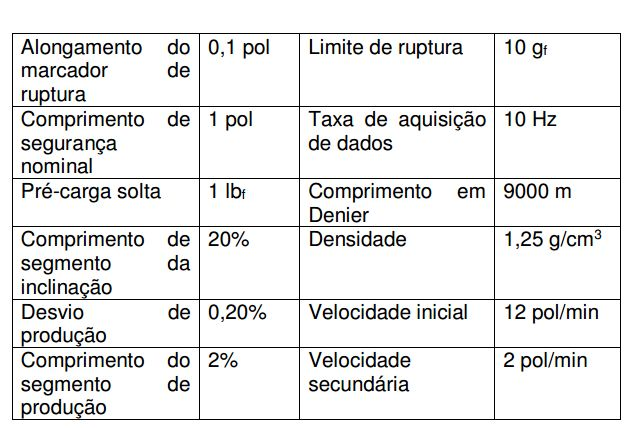
[98] Os valores de tenacidade podem ser expressos em termos de força- grama por denier. O alongamento de pico (% de força na ruptura) e a tensão de pico também podem ser calculados.[98] Tenacity values can be expressed in terms of forcegram per denier. Peak elongation (% force at break) and peak stress can also be calculated.
[99] A carga máxima de uma trama pode ser determinada usando-se uma tira 2”x6” cortada ao longo do sentido de comprimento (MD) e largura (CD). O teste pode ser executado em um testador de resistência à tração universal equipado com dois elementos de pega revestidos de borracha de 1”x3”. O comprimento do indicador pode ser 76 ± 1mm (3 ± 0,04"). Densidade e porcentagem de volume vazio:[99] The maximum load of a weft can be determined using a 2”x6” strip cut along the length (MD) and width (CD) direction. The test can be performed on a universal tensile strength tester equipped with two 1”x3” rubber coated grip elements. The length of the indicator can be 76 ± 1mm (3 ± 0.04"). Density and percentage of empty volume:
[100] Para determinar a densidade e a porcentagem de volume vazio, a largura (Wi) e espessura (Ti) do espécime foram inicialmente medidos antes da extração. O comprimento (Li) antes do estiramento também pôde ser determinado pela medição da distância entre duas marcas numa superfície da amostra. Posteriormente, o espécime pode ser extraído de modo a iniciar formação de poro. A largura (Wf), espessura (Tf) e comprimento (Lf) da amostra puderam então ser medidos o mais próximo de 0,01 mm usando um Compasso Digimatic (Mitutoyo Corporation). O volume (Vi) antes do estiramento pôde ser calculado por Wi x Ti x Li = Vi. O volume (Vf) após o estiramento pôde ser calculado por Wf x Tf x Lf = Vf. A densidade (Pf) pode ser calculada por Pf = Pi/Φ, onde Pi é densidade de material precursor e a porcentagem do volume vazio (% Vv) foi calculada por: %Vv = (1 - 1/ Φ) x 100. Teste de Pressão Hidrostática ("Carga hidrostática"):[100] To determine the density and percentage of void volume, the width (Wi) and thickness (Ti) of the specimen were initially measured before extraction. The length (Li) before stretching could also be determined by measuring the distance between two marks on a surface of the sample. Subsequently, the specimen can be extracted in order to initiate pore formation. The width (Wf), thickness (Tf) and length (Lf) of the sample could then be measured to the nearest 0.01 mm using a Digimatic Compass (Mitutoyo Corporation). The volume (Vi) before stretching could be calculated by Wi x Ti x Li = Vi. The volume (Vf) after stretching could be calculated by Wf x Tf x Lf = Vf. The density (Pf) can be calculated by Pf = Pi/Φ, where Pi is the precursor material density and the percentage of empty volume (% Vv) was calculated by: %Vv = (1 - 1/ Φ) x 100. Test of Hydrostatic Pressure ("Hydrostatic Load"):
[101] O teste de pressão hidrostática é uma medida da resistência de um material à penetração pela água em estado líquido sob uma pressão estática e é realizada de acordo com o Método de Teste AATCC 127-2008. Os resultados para cada amostra podem ter a média calculada e registrada em centímetros (cm). Um valor mais alto indica maior resistência à penetração da água. Taxa de Transmissão de Vapor d'Água (“WVTR”):[101] Hydrostatic pressure testing is a measure of a material's resistance to penetration by liquid water under static pressure and is performed in accordance with Test Method AATCC 127-2008. Results for each sample can be averaged and recorded in centimeters (cm). A higher value indicates greater resistance to water penetration. Water Vapor Transmission Rate (“WVTR”):
[102] O teste usado para determinar a WVTR de um material pode variar com base na natureza do material. Uma técnica para medir o valor de WVTR é ASTM E96/96M-12, Procedimento B. Outro método envolve o uso do Procedimento de Teste INDA IST-70.4 (01). O precedimento de teste INDA é resumido conforme se segue. Uma câmara seca é separada de uma câmara úmida de temperatura e umidade conhecidas por uma película protetora permanente e pelo material da amostra a ser testada. O objetivo da película protetora é definir uma lacuna de ar definitiva e acalmar ou sossegar o ar na lacuna de ar enquanto ele é caracterizado. A câmara seca, a película protetora e a câmara úmida formam uma célula de difusão, em que a película de teste é vedada. O suporte de amostras é conhecido como Permatran-W modelo 100K fabricado pela Mocon/Modem Controls, Inc., Minneapolis, Minnesota. É feito um primeiro teste da WVTR da película protetora e da lacuna de ar entre a montagem do evaporador, gerando 100% de umidade relativa. O vapor d'água se difunde pela lacuna de ar e a película protetora e então se mistura com o fluxo de gás seco, proporcional à concentração de vapor d'água. O sinal elétrico é roteado para um computador para processamento. O computador calcula a taxa de transmissão da lacuna de ar e da película protetora e armazena o valor para uso posterior.[102] The test used to determine the WVTR of a material may vary based on the nature of the material. One technique for measuring the WVTR value is ASTM E96/96M-12, Procedure B. Another method involves the use of the INDA Test Procedure IST-70.4 (01). The INDA test procedure is summarized as follows. A dry chamber is separated from a wet chamber of known temperature and humidity by a permanent protective film and the sample material to be tested. The purpose of the protective film is to define a definitive air gap and calm or calm the air in the air gap while it is characterized. The dry chamber, protective film and wet chamber form a diffusion cell, in which the test film is sealed. The sample holder is known as the Permatran-W Model 100K manufactured by Mocon/Modem Controls, Inc., Minneapolis, Minnesota. A first test is made of the WVTR of the protective film and the air gap between the evaporator assembly, generating 100% relative humidity. The water vapor diffuses through the air gap and the protective film and then mixes with the dry gas stream, proportional to the water vapor concentration. The electrical signal is routed to a computer for processing. The computer calculates the transmission rate of the air gap and protective film and stores the value for later use.
[103] A taxa de transmissão da película protetora e da lacuna de ar é armazenada no computador como CalC. O material da amostra é então vedado na célula de teste. Novamente, o vapor d'água se difunde pela lacuna de ar para a película protetora e o material de teste, e então se mistura com o fluxo de gás seco que varre o material de teste. Também, novamente, a mistura é conduzida para o sensor de vapor. O computador então calcula a taxa de transmissão da combinação da lacuna de ar, da película protetora e do material de teste. Essa informação é então usada para calcular a taxa de transmissão em que a umidade é transmitida pelo material de teste de acordo com a equação:
[104] A taxa de transmissão de vapor d'água ("WVTR") é então calculada conforme se segue:
[105] A condutividade térmica (W/mK) e resistência térmica (m2K/W) podem ser determinadas de acordo com ASTM E-1530-11 (“Resistance to Thermal Transmission of Materials by the Guarded Heat Flow Meter Technique”) usando um testador Anter Unitherm modelo 2022. A temperatura de teste alvo pode ser 25°C e a carga aplicada pode ser 0,17 MPa. Antes do teste, as amostras podem ser condicionadas por 40+ horas numa temperatura de 23°C (+2°C) e umidade relativa de 50% (+10%). A admitância térmica (W/m2K) também pode ser calculada pela divisão de 1 pela resistência térmica. Porosidade de Frazier:[105] Thermal conductivity (W/mK) and thermal resistance (m2K/W) can be determined in accordance with ASTM E-1530-11 (“Resistance to Thermal Transmission of Materials by the Guarded Heat Flow Meter Technique”) using a Anter Unitherm model 2022 tester. The target test temperature can be 25°C and the applied load can be 0.17 MPa. Prior to testing, samples can be conditioned for 40+ hours at a temperature of 23°C (+2°C) and relative humidity of 50% (+10%). Thermal admittance (W/m2K) can also be calculated by dividing 1 by thermal resistance. Frazier porosity:
[106] A porosidade de Frazier foi medida em um Testador de Permeabilidade de Ar de Diferencial Baixo Frazier® (FAP-LP) cortando-se uma tira de 8” (medida oa longo do sentido da máquina) de uma amostra e dobrando-se a amostra à maneira de um acordeão (sentido transversal) de modo obter seis camadas. EXEMPLO 1[106] Frazier porosity was measured on a Frazier® Low Differential Air Permeability Tester (FAP-LP) by cutting an 8” strip (measured along the machine direction) from a sample and bending the sample in the manner of an accordion (transverse direction) so as to obtain six layers. EXAMPLE 1
[107] Uma mistura precursora foi formada a partir de 91,8% em peso de homopolímero de propileno isotático (M3661, taxa de fluxo de fusãa de 14 g/10 a 230°C e temperatura de fusão de 150°C, Total Petrochemicals), 7,4% em peso de ácido polilático (PLA 6252, taxa de fluxo de fusão de 70 a 85 g/10 min a 210°C, Natureworks®), e 0,7% em peso de um poliepóxido. O poliepóxido foi o poli(etileno-co-metil acrilato-co-glicidil metacrilato) (LOTADER® AX8900, Arkema) tendo uma taxa de fluxo à fusão de 6 g/10 min (190°C/2160 g), um teor de metacrilato de glicidil de 8% em peso, teor de acrilato de metil de 24% em peso, e teor de etileno de 68% em peso. Os componentes foram compostos em uma extrusora de rosca dupla de co- rotação (Werner and Pfleiderer ZSK-30 com um diâmetro de 30 mm e um L/D=44). A extrusora tinha sete zonas de aquecimento. A temperatura na extrusora variou de 180°C a 220°C. O polímero foi introduzido por gravimetria na extrusora no funil em 15 libras por hora e o líquido foi injetado no barril usando uma bomba peristáltica. A extrusora foi operada a 200 revoluções por minuto (RPM). Na última seção do barril (frente), um molde com 3 furos de 6 mm de diâmetro foi usado para formar o extrudado. O extrudado foi resfriado por ar em uma correia transportadora e peletizado usando um peletizador Conair.[107] A precursor mixture was formed from 91.8% by weight isotactic propylene homopolymer (M3661, melt flow rate of 14 g/10 at 230°C and melt temperature of 150°C, Total Petrochemicals ), 7.4% by weight of polylactic acid (PLA 6252, melt flow rate 70 to 85 g/10 min at 210°C, Natureworks®), and 0.7% by weight of a polyepoxide. The polyepoxide was poly(ethylene-co-methyl acrylate-co-glycidyl methacrylate) (LOTADER® AX8900, Arkema) having a melt flow rate of 6 g/10 min (190°C/2160 g), a glycidyl methacrylate of 8% by weight, methyl acrylate content of 24% by weight, and ethylene content of 68% by weight. The components were compounded in a co-rotating twin screw extruder (Werner and Pfleiderer ZSK-30 with a diameter of 30 mm and an L/D=44). The extruder had seven heating zones. The temperature in the extruder ranged from 180°C to 220°C. The polymer was gravimetrically fed into the extruder into the hopper at 15 pounds per hour and the liquid was injected into the keg using a peristaltic pump. The extruder was operated at 200 revolutions per minute (RPM). In the last section of the barrel (front), a mold with 3 holes of 6 mm in diameter was used to form the extrudate. The extrudate was air cooled on a conveyor belt and pelleted using a Conair pelletizer.
[108] A fibra foi então produzida a partir da mistura precursora usando uma linha de rotação de fibra Davis-Standard equipada com uma extrusora de rosca única de 0,75 polegada e uma fieira de 16 furos com um diâmetro de 0,6 mm. As fibras foram coletadas em diferentes razões de tração. A velocidade de encurtamento variou de 1 a 1000 m/min. A temperatura da extrusora variou de 175°C a 220°C. As fibras foram esticadas em uma máquina testadora elástica a 300 mm/min até 400% de alongamento a 25°C. Para analisar a morfologia do material, as fibras foram rompidas por congelamento em nitrogênio líquido e analisadas através de microscópio eletrônico de varredura Jeol 6490LV em alto vácuo. Os resultados são mostrados nas Figuras 2-4. Como mostrado, poros esferoidais são formados, os quais são altamente alongados no sentido do estiramento. Foram formados tanto nanoporos (~50 nanômetros de largura, ~500 nanômetros de comprimento) quanto microporos (~0,5 micrômetro de largura, ~4 micrômetros de comprimento). EXEMPLO 2[108] The fiber was then produced from the precursor blend using a Davis-Standard fiber spin line equipped with a 0.75 inch single screw extruder and a 16-hole spinneret with a diameter of 0.6 mm. Fibers were collected at different tensile ratios. The shortening speed ranged from 1 to 1000 m/min. The extruder temperature ranged from 175°C to 220°C. The fibers were stretched in an elastic testing machine at 300 mm/min to 400% elongation at 25°C. To analyze the morphology of the material, the fibers were broken by freezing in liquid nitrogen and analyzed using a Jeol 6490LV scanning electron microscope in high vacuum. The results are shown in Figures 2-4. As shown, spheroidal pores are formed, which are highly elongated in the stretching direction. Both nanopores (~50 nanometers wide, ~500 nanometers long) and micropores (~0.5 micrometers wide, ~4 micrometers long) were formed. EXAMPLE 2
[109] Uma mistura de 93% em peso de polipropileno (Total M3661) e 7% em peso de Lotader® AX8900 foi colocada em uma extrusora de parafusos geminados de co-rotação (Werner e Pfleiderer ZSK-30 com diâmetro de 30 mm e um L/d=44). A extrusora tinha sete zonas de aquecimento. A temperatura na extrusora variou entre 180°C e 220°C. O polímero foi alimentado gravimetricamente à extrusora no funil a 15 libras por hora. A extrusora foi operada a 200 revoluções por minuto (RPM). Na última seção do barril (frente), um molde com 3 furos de 6 mm de diâmetro foi usado para formar o extrudado. O extrudado foi resfriado por ar em uma correia transportadora e peletizado usando um peletizador Conair. Produziu-se então fibra a partir da mistura precursora usando-se uma linha de fiação de fibra Davis-Standard equipada com uma extrusora de parafuso único de 0,75 polegadas e uma fieira de 16 orifícios com um diâmetro de 0,6 mm. As fibras foram coletadas em diferentes razões de tração. A velocidade de encurtamento variou de 1 a 1000 m/min. A temperatura da extrusora variou de 175°C a 220°C. As fibras foram esticadas em uma máquina testadora elástica a 300 mm/min até 400% de alongamento a 25°C. Para analisar a morfologia do material, as fibras foram rompidas por congelamento em nitrogênio líquido e analisadas através de microscópio eletrônico de varredura Jeol 6490LV em alto vácuo. Os resultados são mostrados nas Figs. 5-6. EXEMPLO 3[109] A mixture of 93% by weight of polypropylene (Total M3661) and 7% by weight of Lotader® AX8900 was placed in a co-rotating twin screw extruder (Werner and Pfleiderer ZSK-30 with a diameter of 30 mm and an L/d=44). The extruder had seven heating zones. The temperature in the extruder varied between 180°C and 220°C. The polymer was gravimetrically fed to the extruder into the hopper at 15 pounds per hour. The extruder was operated at 200 revolutions per minute (RPM). In the last section of the barrel (front), a mold with 3 holes of 6 mm in diameter was used to form the extrudate. The extrudate was air cooled on a conveyor belt and pelleted using a Conair pelletizer. Fiber was then produced from the precursor blend using a Davis-Standard fiber spinning line equipped with a 0.75 inch single screw extruder and a 16-hole spinneret with a diameter of 0.6 mm. Fibers were collected at different tensile ratios. The shortening speed ranged from 1 to 1000 m/min. The extruder temperature ranged from 175°C to 220°C. The fibers were stretched in an elastic testing machine at 300 mm/min to 400% elongation at 25°C. To analyze the morphology of the material, the fibers were broken by freezing in liquid nitrogen and analyzed using a Jeol 6490LV scanning electron microscope in high vacuum. The results are shown in Figs. 5-6. EXAMPLE 3
[110] Uma mistura de 91,1% em peso (Total M3661), 7,4% em peso de ácido polilático (NatureWorks 6251) e 1,5% de Lotader® AX8900) foi colocada na extrusora e nas condições descritas no Exemplo 2. Neste caso, 5% de Pluriol ® WI 285 foi então injetado no barril usando-se bomba peristáltica. Produziu-se então fibra a partir da mistura precursora usando-se uma linha de fiação de fibra Davis-Standard equipada com uma extrusora de parafuso único de 0,75 polegadas e uma fieira de 16 orifícios com um diâmetro de 0,6 mm. As fibras foram coletadas em diferentes razões de tração. A velocidade de encurtamento variou de 1 a 1000 m/min. A temperatura da extrusora variou de 175°C a 220°C. As fibras foram esticadas em uma máquina testadora elástica a 300 mm/min até 400% de alongamento a 25°C. Para analisar a morfologia do material, as fibras foram rompidas por congelamento em nitrogênio líquido e analisadas através de microscópio eletrônico de varredura Jeol 6490LV em alto vácuo. Os resultados são mostrados nas Figs. 7-8.[110] A mixture of 91.1% by weight (Total M3661), 7.4% by weight of polylactic acid (NatureWorks 6251) and 1.5% of Lotader® AX8900) was placed in the extruder and under the conditions described in Example 2. In this case, 5% of Pluriol ® WI 285 was then injected into the barrel using a peristaltic pump. Fiber was then produced from the precursor blend using a Davis-Standard fiber spinning line equipped with a 0.75 inch single screw extruder and a 16-hole spinneret with a diameter of 0.6 mm. Fibers were collected at different tensile ratios. The shortening speed ranged from 1 to 1000 m/min. The extruder temperature ranged from 175°C to 220°C. The fibers were stretched in an elastic testing machine at 300 mm/min to 400% elongation at 25°C. To analyze the morphology of the material, the fibers were broken by freezing in liquid nitrogen and analyzed using a Jeol 6490LV scanning electron microscope in high vacuum. The results are shown in Figs. 7-8.
[111] Uma mistura de polímero precursor foi realizada que continha 91,8% em peso de polipropileno isotático (M3661, taxa de fluxo de fusão de 14 g/10 min a 230°C e temperatura de fusão de 150°C, Total Petrochemicals), 7,45% em peso de ácido polilático (PLA) (Ingeo 6251D, taxa de fluxo de fusão 7085 g/10 a 210°C, Natureworks), e 0,75% de compatibilizador de poliepóxido (Arkema Lotader® AX8900). O modificador poliepóxi foi poli(etileno-co-metil acrilato-co-glicidil metacrilato) (Lotader® AX8900, Arkema), com taxa de fluxo de fusão de 5-6 g/10 min (190°C/2160 g), um conteúdo de glicidil metacrilato de 7 a 11% em peso, um conteúdo de acrilato de metil de 13% em peso a 17% em peso, e um conteúdo de etileno de 72% em peso a 80% em peso. Os componentes foram colocados em uma extrusora de parafusos geminados de co-rotação (Werner e Pfleiderer ZSK-30 de 30 mm de diâmetro e um L/D = 44). A extrusora tinha sete zonas de aquecimento. A temperatura na extrusora variou entre 180°C e 220°C. O polímero foi alimentado por gravimetria à extrusora no funil a 6,8 quilogramas por hora (15 libras por hora). A extrusora foi operada a 200 revoluções por minuto (RPM). Na última seção do barril (frente), um molde com 3 furos de 6 mm de diâmetro foi usado para formar o extrudado. O extrudado foi resfriado por ar em uma correia transportadora e peletizado usando um peletizador Conair. EXEMPLO 5[111] A precursor polymer blend was made that contained 91.8% by weight of isotactic polypropylene (M3661, melt flow rate of 14 g/10 min at 230°C and melt temperature of 150°C, Total Petrochemicals ), 7.45% by weight polylactic acid (PLA) (Ingeo 6251D, melt flow rate 7085 g/10 at 210°C, Natureworks), and 0.75% polyepoxide compatibilizer (Arkema Lotader® AX8900) . The polyepoxy modifier was poly(ethylene-co-methyl acrylate-co-glycidyl methacrylate) (Lotader® AX8900, Arkema), with a melt flow rate of 5-6 g/10 min (190°C/2160 g), a glycidyl methacrylate content from 7 to 11% by weight, a methyl acrylate content from 13% by weight to 17% by weight, and an ethylene content from 72% by weight to 80% by weight. The components were placed in a co-rotating twin screw extruder (Werner and Pfleiderer ZSK-30 30 mm in diameter and an L/D = 44). The extruder had seven heating zones. The temperature in the extruder varied between 180°C and 220°C. The polymer was gravimetrically fed to the extruder in the hopper at 6.8 kilograms per hour (15 pounds per hour). The extruder was operated at 200 revolutions per minute (RPM). In the last section of the barrel (front), a mold with 3 holes of 6 mm in diameter was used to form the extrudate. The extrudate was air cooled on a conveyor belt and pelleted using a Conair pelletizer. EXAMPLE 5
[112] Foram produzidas fibras bicomponentes em uma linha de fibra bicomponente equipada com 2 extrusoras de parafuso único (1,25 em diâmetro). A fibra bicomponente tinha uma configuração de bainha/núcleo de 30/70, em que a bainha foi formada a partir de 100% em peso de polipropileno (M3661, Total Petrochemicals) e o núcleo foi formado a partir da mistura do Exemplo 4. As extrusora alimentou as composições poliméricas de bainha/núcleo em uma fieira de 288 capilaridade de 0,5 mm em diâmetro e razão comprimento/diâmetro 4:1 (L/D). As fibras foram tecidas a uma taxa de 8 kg/hr a uma velocidade de tecelagem de 660 metros por minuto e coletadas em carreteis para processamentos pós-estiramento.[112] Two-component fibers were produced on a two-component fiber line equipped with 2 single screw extruders (1.25 in diameter). The bicomponent fiber had a 30/70 sheath/core configuration, where the sheath was formed from 100% by weight polypropylene (M3661, Total Petrochemicals) and the core was formed from the blend of Example 4. The extruder fed the sheath/core polymeric compositions into a capillary spinneret of 0.5 mm in diameter and length/diameter ratio 4:1 (L/D). The fibers were woven at a rate of 8 kg/hr at a weaving speed of 660 meters per minute and collected on spools for post-stretch processing.
[113] O perfil de temperatura de extrusão, tanto para bainha quanto para núcleo, foi o seguinte: Zona 1 = 220°C, Zona 2= 225°C, Zona 3 = 230°C, Zona 4 = 240°C, e Feixe de Tecelagem = 240°C. As fibras tecidas por fusão foram então estiradas em tempertura ambiente (25°C) até 200% entre dois rolos de godete (extração de etapa única) a uma taxa de 1200 metros por minuto. Então, as fibras foram frisadas (19 frisos por polegada) e cortadas a um cumprimento de 38 mm. As fibras foram, então, cortadas com uma lâmina em nitrogênio líquido e analisadas por meio de microscopia de varredura eletrônica. As superfícies fraturadas foram revestidas de ouro paládio por pulverização catódica em um Sistema de Pulverização Denton Vacuum Desk V, usando-se 15 mA para 75 segundos, e analisados por meio de SEM em um Quanta de Emissão Campal 650. Os resultados são apresentados nas Figs. 9-10.[113] The extrusion temperature profile for both sheath and core was as follows: Zone 1 = 220°C,
[114] Várias propriedades das fibras foram igualmente testadas tal como se provê na tabela abaixo.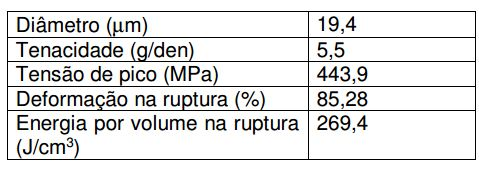
[115] Uma trama de 100 gsm cardada e penteada por fluxo de ar (TABCW) também foi formada com uma mistura das fibras do Exemplo 5 (70% em peso) e fibras bicomponentes bainha/núcleo (30% em peso). A trama foi formada em um Cardo de Alta Velocidade Truetzschler EWK 413 equipado com Perfil Asselin 415-FD "crosslapper" e um Forno Fleissner (Universidade Estadual de NC). A trama cardada foi ligada por fluxo de ar a 260°F e sua espessura final foi 5,5 mm.[115] A 100 gsm airflow combed and carded weft (TABCW) was also formed with a blend of the fibers of Example 5 (70% by weight) and bicomponent sheath/core fibers (30% by weight). The weft was formed on a Truetzschler EWK 413 High Speed Thistle equipped with an Asselin 415-FD "crosslapper" Profile and a Fleissner Oven (NC State University). The carded weft was airflow bonded at 260°F and its final thickness was 5.5 mm.
[116] Uma mistura polimérica precursora foi feita tal como descrito no Exemplo 4 que continha 93% em peso de matriz de polipropileno (M3661, Total Petrochemicals) e 7% em peso de Lotader® AX8900. Fibras ocas bicomponentes foram produzidas em uma linha de fibra bicomponente equipada com duas extrusoras de parafuso único (1,25 em diâmetro). A fibra bicomponente tinha uma configuração de bainha/núcleo 50/50, em que a bainha foi formada a partir de 100% em peso de polipropileno (Achieve 3854) e o núcleo foi formado a partir da mistura supradescrita. As extrusoras alimentaram as composições de polímero de bainha e núcleo a uma fieira de 72 capilaridades de concepção capilar de segmentos 4C. As fibras foram tecidas a uma taxa de 2kg/hr a uma velocidade de tecelagem de 198 metros por minutos e coletada em carreteis para processamento pór-estiramento. O perfil de temperatura de extrusão tanto para a bainha quanto para o núcleo foi o seguinte: Zona 1 = 220°C, Zona 2= 225°C, Zona 3 = 230°C, Zona 4 = 240°C, e Feixe de Tecelagem = 240°C. A fibra foi arrefecida em um banho de água localizado 35 abaixo da fieira. As fibras arrefecidas foram em seguida estiradas a temperatura ambiente (25°C) até 200% entre dois rolos de godet (extrusão de etapa única) a uma velocidade de 1200 metros por minuto. As fibras foram, então, cortadas com uma lâmina em nitrogênio líquido e analisadas por meio de microscopia de varredura eletrônica. As superfícies fraturadas foram revestidas de ouro paládio por pulverização catódica em um Sistema de Pulverização Denton Vacuum Desk V, usando- se 15 mA para 75 segundos, e analisados por meio de SEM em um Quanta de Emissão Campal 650. Os resultados são apresentados nas Figs. 11-12. Várias propriedades das fibras foram igualmente testadas tal como se provê na tabela abaixo.

[117] Uma mistura precursora foi formada tal como descrito no Exemplo 4, salvo pelo fato de que o material foi produzido usando-se uma extrusora de parafuso geminado de co-rotação de 64 mm a uma taxa de produção de 270 quilogramas por hora (600 libras por hora) e temperatura de 220°C. A mistura polimérica fundida foi extrusada através de uma matriz multifilamento, arrefecida com água e cortada em pelete por meio de um sistema de peletização subaquática tal como aquele disponíveis através de Gala Industries de Eagle Rock, Virginia. Uma fibra monocomponente foi formada a partir da mistura a uma velocidade de 22,5 quilogramas por hora em uma linha de tecelagem de fibra monocomponente (FiberVisions) equipada com um extrusora de parafuso único de 1,25 polegadas e 24 LD e duas fieiras, cada qual tendo 675 capilaridades arredondadas (total de 1.350) com diâmetro de 0,35 mm e razão L/D 4:1. A velocidade de tecelagem foi de 435 metros por minuto. As sete zonas de aquecimento da extrusora e o perfil de temperatura de feixe de tecelagem foram mantidas a 220°C. A linha de tecelagem foi equipada com uma caixa de esfriamento com fluxo de ar unilateral e a temperatura do ar foi 21°C. As fibras extraídas por fusão foram coletadas em carreteis de 5 libras sem extração a frio. As fibras orientadas por fusão tinham denier de 10,7 denier por filamento.[117] A precursor mixture was formed as described in Example 4, except that the material was produced using a 64 mm co-rotating twin screw extruder at a production rate of 270 kilograms per hour ( 600 pounds per hour) and temperature of 220°C. The molten polymer mixture was extruded through a multifilament die, cooled with water and cut into pellets using an underwater pelletizing system such as those available from Gala Industries of Eagle Rock, Virginia. A single component fiber was formed from the blend at a speed of 22.5 kilograms per hour on a single component fiber weaving line (FiberVisions) equipped with a 1.25
[118] As fibras foram estiradas a 100% a uma velocidade de 50 metros por minutos em uma unidade de estiramento que consiste de três bancos de cinco rolos (quintetos). A temperatura do primeiro quinteto foi mantida a 50°C e o segundo e terceiro quinteto foram mantidos a uma temperatura de 25°C. Fibras foram frisadas e cortadas a 1,5 polegadas. O acabamento de tecelagem foi ajustado antes da unidade de corte a 0,5%. As fibras foram, então, cortadas com uma lâmina em nitrogênio líquido e analisadas por meio de microscopia de varredura eletrônica. As superfícies fraturadas foram revestidas de ouro paládio por pulverização catódica em um Sistema de Pulverização Denton Vacuum Desk V, usando-se 15 mA para 75 segundos, e analisados por meio de SEM em um Quanta de Emissão Campal 650. Os resultados são apresentados na Fig. 13. Várias propriedades das fibras foram igualmente testadas tal como se provê na tabela abaixo.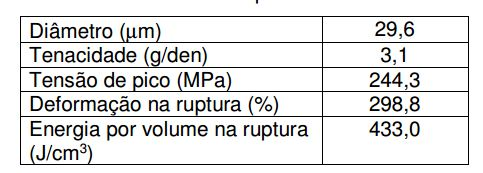
[119] Tramas cardadas ligadas termicamente (30 gsm) foram também produzidas em uma linha de cardamento. Para ligar as tramas termicamente, usou-se padrão de ligação de diamante, tal como mostrado na Fig. 14. A temperatura de calandra foi 150°C e a velocidade de cardamento foi 250 pés por minuto. Várias propriedades da trama formam então testadas, tal como se provê abaixo.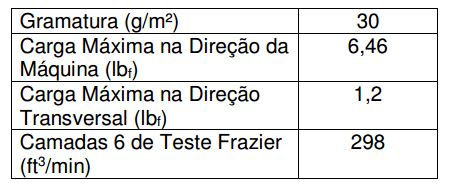
[120] Embora a invenção tenha sido descrita em detalhes em relação às suas modalidades específicas, será contemplado que os versados na técnica, após obter uma compreensão do exposto anteriormente, poderão facilmente conceber alterações, variações e equivalentes dessas modalidades. Nesse sentido, o escopo da presente invenção seve ser avaliado como aquele das reivindicações anexas e quaisquer equivalentes a estas.[120] While the invention has been described in detail with respect to its specific embodiments, it will be appreciated that those skilled in the art, after gaining an understanding of the foregoing, can readily devise alterations, variations, and equivalents of these embodiments. In that sense, the scope of the present invention should be evaluated as that of the appended claims and any equivalents thereto.
Claims (29)
Applications Claiming Priority (5)
| Application Number | Priority Date | Filing Date | Title |
|---|---|---|---|
| US201361833981P | 2013-06-12 | 2013-06-12 | |
| US61/833,981 | 2013-06-12 | ||
| US201361907580P | 2013-11-22 | 2013-11-22 | |
| US61/907,580 | 2013-11-22 | ||
| PCT/IB2014/062016 WO2014199269A1 (en) | 2013-06-12 | 2014-06-06 | Porous polyolefin fibers |
Publications (2)
| Publication Number | Publication Date |
|---|---|
| BR112015030619A2 BR112015030619A2 (en) | 2017-07-25 |
| BR112015030619B1 true BR112015030619B1 (en) | 2022-02-22 |
Family
ID=52021715
Family Applications (3)
| Application Number | Title | Priority Date | Filing Date |
|---|---|---|---|
| BR112015030619-5A BR112015030619B1 (en) | 2013-06-12 | 2014-06-06 | absorbent article |
| BR112015030879-1A BR112015030879B1 (en) | 2013-06-12 | 2014-06-06 | ABSORBENT ARTICLE CONTAINING NON-WOVEN WEAP FORMED FROM POROUS POLYOLEFIN FIBERS |
| BR112016025301-9A BR112016025301B1 (en) | 2013-06-12 | 2014-12-11 | HOLLOW FIBER, NON-WOVEN WOVEN, ABSORBENT ARTICLE AND METHOD FOR FORMING A HOLLOW FIBER |
Family Applications After (2)
| Application Number | Title | Priority Date | Filing Date |
|---|---|---|---|
| BR112015030879-1A BR112015030879B1 (en) | 2013-06-12 | 2014-06-06 | ABSORBENT ARTICLE CONTAINING NON-WOVEN WEAP FORMED FROM POROUS POLYOLEFIN FIBERS |
| BR112016025301-9A BR112016025301B1 (en) | 2013-06-12 | 2014-12-11 | HOLLOW FIBER, NON-WOVEN WOVEN, ABSORBENT ARTICLE AND METHOD FOR FORMING A HOLLOW FIBER |
Country Status (11)
| Country | Link |
|---|---|
| US (3) | US11001944B2 (en) |
| EP (2) | EP3008230B1 (en) |
| JP (3) | JP2016529939A (en) |
| KR (4) | KR102439981B1 (en) |
| CN (3) | CN105358107B (en) |
| AU (3) | AU2014279790B2 (en) |
| BR (3) | BR112015030619B1 (en) |
| MX (3) | MX369558B (en) |
| RU (3) | RU2641861C2 (en) |
| SG (2) | SG11201510046UA (en) |
| WO (2) | WO2014199272A1 (en) |
Families Citing this family (49)
| Publication number | Priority date | Publication date | Assignee | Title |
|---|---|---|---|---|
| JP5579337B1 (en) * | 2013-06-11 | 2014-08-27 | ユニ・チャーム株式会社 | Absorber and absorbent article including the absorber |
| US10857705B2 (en) | 2013-06-12 | 2020-12-08 | Kimberly-Clark Worldwide, Inc. | Pore initiation technique |
| ES2837999T3 (en) | 2013-06-12 | 2021-07-01 | Kimberly Clark Co | Polymeric material with a multimodal pore size distribution |
| RU2632842C2 (en) * | 2013-06-12 | 2017-10-10 | Кимберли-Кларк Ворлдвайд, Инк. | Polymer material for application in heat insulation |
| BR112015030695B1 (en) | 2013-06-12 | 2020-12-15 | Kimberly-Clark Worldwide, Inc. | POLYOLEFINE FILM FOR USE IN PACKAGES |
| BR112015030619B1 (en) | 2013-06-12 | 2022-02-22 | Kimberly-Clark Worldwide, Inc | absorbent article |
| US11965083B2 (en) | 2013-06-12 | 2024-04-23 | Kimberly-Clark Worldwide, Inc. | Polyolefin material having a low density |
| JP2016527375A (en) * | 2013-08-09 | 2016-09-08 | キンバリー クラーク ワールドワイド インコーポレイテッド | Flexible polymer material with shape retention properties |
| EP3128972A4 (en) * | 2014-04-10 | 2017-09-27 | 3M Innovative Properties Company | Fibers and articles including them |
| WO2015187924A1 (en) | 2014-06-06 | 2015-12-10 | Kimberly-Clark Worldwide, Inc. | Thermoformed article formed from a porous polymeric sheet |
| EP3152348B1 (en) | 2014-06-06 | 2020-08-05 | Kimberly-Clark Worldwide, Inc. | Hollow porous fibers |
| US9580845B2 (en) | 2014-06-09 | 2017-02-28 | The Procter & Gamble Company | Nonwoven substrate comprising fibers comprising an engineering thermoplastic polymer |
| BR112017011385B1 (en) | 2014-12-19 | 2022-09-06 | Kimberly-Clark Worldwide, Inc. | HOLLOW FIBER, NON-WOVEN WEFT, ABSORBENT ARTICLE, SPINNER TO FORM A HOLLOW FIBER, AND, METHOD OF FORMING A HOLLOW FIBER |
| WO2016122621A1 (en) | 2015-01-30 | 2016-08-04 | Kimberly-Clark Worldwide, Inc. | Film with reduced noise for use in an absorbent article |
| CN107205854B (en) | 2015-01-30 | 2019-11-29 | 金伯利-克拉克环球有限公司 | The package of absorbent articles that noise reduces |
| CN108368656B (en) * | 2015-12-11 | 2022-08-12 | 金伯利-克拉克环球有限公司 | Method for forming porous fibers |
| MX379077B (en) | 2015-12-11 | 2025-03-11 | Kimberly Clark Co | MULTI-STAGE STRETCHING TECHNIQUE TO FORM POROUS FIBERS. |
| CN109563283B (en) * | 2016-08-11 | 2022-06-03 | 金伯利-克拉克环球有限公司 | Reinforced thermoplastic polyolefin elastomer film |
| WO2018102521A1 (en) * | 2016-12-02 | 2018-06-07 | 3M Innovative Properties Company | Muscle or joint support article with a strap |
| WO2018144241A1 (en) | 2017-01-31 | 2018-08-09 | Kimberly-Clark Worldwide, Inc. | Porous polyester material |
| WO2018144242A1 (en) * | 2017-01-31 | 2018-08-09 | Kimberly-Clark Worldwide, Inc. | Polymeric material |
| US11724002B2 (en) | 2017-02-28 | 2023-08-15 | Kimberly-Clark Worldwide, Inc. | Technique for forming porous fibers |
| KR101869656B1 (en) * | 2017-07-19 | 2018-07-23 | 한국섬유개발연구원 | Shaped cross-section fiber with excellent absorption and dry property and wearing resistance and manufacturing process thereof |
| WO2019023061A2 (en) | 2017-07-28 | 2019-01-31 | Kimberly-Clark Worldwide, Inc. | Absorbent article containing nanoporous superabsorbent particles |
| GB2579300B (en) | 2017-07-28 | 2022-10-05 | Kimberly Clark Co | Nanoporous superabsorbent particles |
| WO2019039373A1 (en) * | 2017-08-21 | 2019-02-28 | 日本エイアンドエル株式会社 | Resin fiber and method for producing same |
| US11433158B2 (en) | 2017-12-12 | 2022-09-06 | The Procter & Gamble Company | Recycle friendly and sustainable absorbent articles |
| EP3779016B8 (en) * | 2018-03-30 | 2023-05-24 | Mitsui Chemicals, Inc. | Non-woven fabric laminate, stretchable non-woven fabric laminate, and textile product |
| US20190322168A1 (en) * | 2018-04-24 | 2019-10-24 | Intellectual Property Holdings, Llc | Molded Vehicle Component With Integral Heat Shield and Method of Making the Same |
| GB2589785B (en) * | 2018-06-27 | 2022-10-19 | Kimberly Clark Co | Absorbent article containing nanoporous superabsorbent particles |
| CN108716027B (en) * | 2018-08-31 | 2024-03-01 | 江苏江南高纤股份有限公司 | Preparation method and application of HDPE-PET composite ultrashort fiber and post-spinning system |
| KR102071475B1 (en) * | 2018-10-30 | 2020-03-02 | 윤대완 | Sanitary gloves for food and method for manufacturing of the same |
| CN112020578B (en) * | 2018-10-30 | 2022-10-18 | 喜恩吉股份有限公司 | Three-dimensional net structure |
| WO2020107422A1 (en) | 2018-11-30 | 2020-06-04 | The Procter & Gamble Company | Methods of creating soft and lofty nonwoven webs |
| CN113166994B (en) | 2018-11-30 | 2022-09-30 | 宝洁公司 | Method for producing a through-flow bonded nonwoven web |
| EP4310229A3 (en) | 2018-11-30 | 2024-04-03 | The Procter & Gamble Company | Methods for through-fluid bonding nonwoven webs |
| EP3984395A4 (en) * | 2019-06-13 | 2023-07-12 | Toray Industries, Inc. | Protective garment |
| CN110755209A (en) * | 2019-11-24 | 2020-02-07 | 李丽 | an absorbent article |
| JP2023519775A (en) * | 2019-12-03 | 2023-05-15 | ファイバービジョンズ リミテッド パートナーシップ | Fibers, composites formed from same, and methods of forming same |
| CN115461022A (en) * | 2020-04-27 | 2022-12-09 | 住友精化株式会社 | absorbent article |
| CN112726029B (en) * | 2020-12-22 | 2022-09-30 | 杭州诺邦无纺股份有限公司 | Filament non-woven composite material and preparation method thereof |
| CN112941653A (en) * | 2021-01-26 | 2021-06-11 | 无锡优佳无纺科技有限公司 | Preparation method of high-strength hollow polypropylene fiber |
| CN113512775B (en) * | 2021-04-27 | 2023-01-17 | 嘉兴学院 | Preparation facilities of micron order fibre non-woven fabrics |
| CN114984768A (en) * | 2022-06-27 | 2022-09-02 | 上海翊科聚合物科技有限公司 | Surface modification method of hollow fiber membrane for artificial membrane lung |
| CN115537991A (en) * | 2022-10-20 | 2022-12-30 | 杭州中丽化纤有限公司 | High-strength chemical fiber production system and production method thereof |
| CN120153142A (en) | 2022-11-03 | 2025-06-13 | 舒万诺知识产权公司 | Porous fiber nonwoven web and method of making the same |
| EP4611922A1 (en) | 2022-11-03 | 2025-09-10 | 3M Innovative Properties Company | Microporous hollow fiber webs and methods of making same |
| CN116770456B (en) * | 2023-06-06 | 2024-06-11 | 大白熊(广州)新材料科技有限公司 | Thermoplastic elastomer hollow porous fiber and preparation method and application thereof |
| CN118286809B (en) * | 2024-04-02 | 2024-12-17 | 首都医科大学 | Degradable segmented copolymer and application thereof in prevention and control of atmospheric particulate pollution |
Family Cites Families (233)
| Publication number | Priority date | Publication date | Assignee | Title |
|---|---|---|---|---|
| US2972349A (en) | 1958-12-24 | 1961-02-21 | Univ Minnesota | Capillary oxygenator |
| US3354506A (en) | 1962-04-30 | 1967-11-28 | Union Carbide Corp | Apparatus for melt extrusion of multi-wall plastic tubing |
| US3423255A (en) | 1965-03-31 | 1969-01-21 | Westinghouse Electric Corp | Semiconductor integrated circuits and method of making the same |
| US3373876A (en) | 1966-05-12 | 1968-03-19 | Dow Chemical Co | Artificial body organ apparatus |
| US3801429A (en) | 1969-06-06 | 1974-04-02 | Dow Chemical Co | Multilayer plastic articles |
| DE1939528A1 (en) | 1969-08-02 | 1971-02-11 | Barmag Barmer Maschf | Device for the continuous production of multilayer blown films |
| DE2048006B2 (en) | 1969-10-01 | 1980-10-30 | Asahi Kasei Kogyo K.K., Osaka (Japan) | Method and device for producing a wide nonwoven web |
| CA948388A (en) | 1970-02-27 | 1974-06-04 | Paul B. Hansen | Pattern bonded continuous filament web |
| GB1453447A (en) | 1972-09-06 | 1976-10-20 | Kimberly Clark Co | Nonwoven thermoplastic fabric |
| US4100324A (en) | 1974-03-26 | 1978-07-11 | Kimberly-Clark Corporation | Nonwoven fabric and method of producing same |
| US4031012A (en) | 1975-09-17 | 1977-06-21 | Gics Pharmaceuticals, Inc. | Separatory apparatus |
| US4282735A (en) | 1979-04-02 | 1981-08-11 | Van Mark Products Corporation | Brake for sheet metal or the like |
| US4374888A (en) | 1981-09-25 | 1983-02-22 | Kimberly-Clark Corporation | Nonwoven laminate for recreation fabric |
| US4405688A (en) | 1982-02-18 | 1983-09-20 | Celanese Corporation | Microporous hollow fiber and process and apparatus for preparing such fiber |
| US4886512A (en) | 1983-04-04 | 1989-12-12 | Kimberly-Clark Corporation | Incontinent garment with elasticized pouch |
| US4937299A (en) | 1983-06-06 | 1990-06-26 | Exxon Research & Engineering Company | Process and catalyst for producing reactor blend polyolefins |
| US4557132A (en) | 1984-02-03 | 1985-12-10 | Tapco Products Company, Inc. | Sheet bending brake |
| CA1341430C (en) | 1984-07-02 | 2003-06-03 | Kenneth Maynard Enloe | Diapers with elasticized side pockets |
| JPS6190705A (en) * | 1984-10-09 | 1986-05-08 | Terumo Corp | Hollow yarn membrane and its production |
| WO1987000213A1 (en) * | 1985-06-27 | 1987-01-15 | Mitsubishi Rayon Co., Ltd. | Composite hollow yarn and a process for producing the same |
| US4698372A (en) | 1985-09-09 | 1987-10-06 | E. I. Du Pont De Nemours And Company | Microporous polymeric films and process for their manufacture |
| US4789699A (en) | 1986-10-15 | 1988-12-06 | Kimberly-Clark Corporation | Ambient temperature bondable elastomeric nonwoven web |
| JPS63135569A (en) | 1986-11-18 | 1988-06-07 | 三井東圧化学株式会社 | Air permeable waterproof nonwoven fabric |
| EP0275581B1 (en) | 1986-12-19 | 1992-08-12 | Akzo N.V. | Preparation of polylactic acid and copolymers thereof |
| US4908026A (en) | 1986-12-22 | 1990-03-13 | Kimberly-Clark Corporation | Flow distribution system for absorbent pads |
| US4766029A (en) | 1987-01-23 | 1988-08-23 | Kimberly-Clark Corporation | Semi-permeable nonwoven laminate |
| US4801494A (en) | 1987-04-10 | 1989-01-31 | Kimberly-Clark Corporation | Nonwoven pad cover with fluid masking properties |
| US5186835A (en) * | 1987-09-11 | 1993-02-16 | Agency Of Industrial Science And Technology | Porous hydrophilic polypropylene membrane, method for production thereof, and blood plasma separation apparatus |
| US4798603A (en) | 1987-10-16 | 1989-01-17 | Kimberly-Clark Corporation | Absorbent article having a hydrophobic transport layer |
| US5179164A (en) | 1988-02-20 | 1993-01-12 | Basf Aktiengesellschaft | Thermoplastic polypropylene/polyamide molding composition |
| JPH0214011A (en) * | 1988-06-27 | 1990-01-18 | Mitsubishi Rayon Co Ltd | porous polyethylene fiber |
| USD315990S (en) | 1988-08-04 | 1991-04-09 | Kimberly-Clark Corporation | Embossed wipe or similar article |
| US5218071A (en) | 1988-12-26 | 1993-06-08 | Mitsui Petrochemical Industries, Ltd. | Ethylene random copolymers |
| JPH0747644B2 (en) | 1989-05-19 | 1995-05-24 | 宇部興産株式会社 | Polyamide composite material and method for producing the same |
| US5169706A (en) | 1990-01-10 | 1992-12-08 | Kimberly-Clark Corporation | Low stress relaxation composite elastic material |
| US5254111A (en) | 1990-02-12 | 1993-10-19 | Clopay Plastic Products Company, Inc. | Barrier cuff for disposable absorbent articles |
| US5213881A (en) | 1990-06-18 | 1993-05-25 | Kimberly-Clark Corporation | Nonwoven web with improved barrier properties |
| US5464688A (en) | 1990-06-18 | 1995-11-07 | Kimberly-Clark Corporation | Nonwoven web laminates with improved barrier properties |
| US5272236A (en) | 1991-10-15 | 1993-12-21 | The Dow Chemical Company | Elastic substantially linear olefin polymers |
| US5248309A (en) | 1990-07-19 | 1993-09-28 | Kimberly-Clark Corporation | Thin sanitary napkin having a central absorbent zone and a method of forming the napkin |
| CA2048905C (en) | 1990-12-21 | 1998-08-11 | Cherie H. Everhart | High pulp content nonwoven composite fabric |
| US5232642A (en) * | 1991-02-08 | 1993-08-03 | Mitsubishi Rayon Co., Ltd. | Process of making porous polypropylene hollow fiber membrane of large pore diameter |
| US5192606A (en) | 1991-09-11 | 1993-03-09 | Kimberly-Clark Corporation | Absorbent article having a liner which exhibits improved softness and dryness, and provides for rapid uptake of liquid |
| US5278272A (en) | 1991-10-15 | 1994-01-11 | The Dow Chemical Company | Elastic substantialy linear olefin polymers |
| US5743129A (en) | 1991-11-26 | 1998-04-28 | Tapco International Corporation | Heavy duty sheet bending brake |
| US6326458B1 (en) | 1992-01-24 | 2001-12-04 | Cargill, Inc. | Continuous process for the manufacture of lactide and lactide polymers |
| US5470944A (en) | 1992-02-13 | 1995-11-28 | Arch Development Corporation | Production of high molecular weight polylactic acid |
| US5288555A (en) * | 1992-03-05 | 1994-02-22 | Exxon Research Engineering Company | Composites with interphases and methods of making the same |
| US5330348A (en) | 1992-08-05 | 1994-07-19 | E. I. Du Pont De Nemours And Company | Spinneret for the production of hollow filaments |
| US5405682A (en) | 1992-08-26 | 1995-04-11 | Kimberly Clark Corporation | Nonwoven fabric made with multicomponent polymeric strands including a blend of polyolefin and elastomeric thermoplastic material |
| US5350624A (en) | 1992-10-05 | 1994-09-27 | Kimberly-Clark Corporation | Abrasion resistant fibrous nonwoven composite structure |
| US5322728A (en) | 1992-11-24 | 1994-06-21 | Exxon Chemical Patents, Inc. | Fibers of polyolefin polymers |
| US5284309A (en) | 1992-12-18 | 1994-02-08 | Hughes Aircraft Company | Propellant immobilizing system and method |
| IT1256260B (en) | 1992-12-30 | 1995-11-29 | Montecatini Tecnologie Srl | ATACTIC POLYPROPYLENE |
| CA2114663A1 (en) | 1993-02-05 | 1994-08-06 | Joshua B. Sweeney | Microporous polymer structures |
| US5472775A (en) | 1993-08-17 | 1995-12-05 | The Dow Chemical Company | Elastic materials and articles therefrom |
| US6093665A (en) | 1993-09-30 | 2000-07-25 | Kimberly-Clark Worldwide, Inc. | Pattern bonded nonwoven fabrics |
| US5558659A (en) | 1993-12-09 | 1996-09-24 | Kimberly-Clark Corporation | Incontinence article for males |
| EP0657502A1 (en) | 1993-12-13 | 1995-06-14 | Du Pont De Nemours International S.A. | Thermoplastic composition containing compatibilizer |
| CA2116081C (en) | 1993-12-17 | 2005-07-26 | Ann Louise Mccormack | Breathable, cloth-like film/nonwoven composite |
| CA2123330C (en) | 1993-12-23 | 2004-08-31 | Ruth Lisa Levy | Ribbed clothlike nonwoven fabric and process for making same |
| USD358035S (en) | 1994-01-10 | 1995-05-09 | Kimberly-Clark Corporation | Embossed wipe |
| DE69510707T2 (en) | 1994-03-04 | 1999-11-04 | Kimberly-Clark Worldwide, Inc. | Nonwoven fabric with improved fluid flow properties for personal care absorbent articles and the like |
| US5486166A (en) | 1994-03-04 | 1996-01-23 | Kimberly-Clark Corporation | Fibrous nonwoven web surge layer for personal care absorbent articles and the like |
| US5571619A (en) | 1994-05-24 | 1996-11-05 | Exxon Chemical Patents, Inc. | Fibers and oriented films of polypropylene higher α-olefin copolymers |
| US5669896A (en) | 1994-06-16 | 1997-09-23 | Kimberly-Clark Worldwide, Inc. | Absorbent garment comprising dual containment flaps |
| WO1996006591A2 (en) | 1994-08-31 | 1996-03-07 | Kimberly-Clark Worldwide, Inc. | Thin absorbent article having wicking and crush resistant properties |
| US5702377A (en) | 1994-09-01 | 1997-12-30 | Kimberly-Clark Worldwide, Inc. | Wet liner for child toilet training aid |
| US5695376A (en) | 1994-09-09 | 1997-12-09 | Kimberly-Clark Worldwide, Inc. | Thermoformable barrier nonwoven laminate |
| US5770318A (en) | 1995-01-13 | 1998-06-23 | Norton Performance Plastics Corporation | Thermoplastic seal and wrapping film |
| US5539056A (en) | 1995-01-31 | 1996-07-23 | Exxon Chemical Patents Inc. | Thermoplastic elastomers |
| US5760121A (en) | 1995-06-07 | 1998-06-02 | Amcol International Corporation | Intercalates and exfoliates formed with oligomers and polymers and composite materials containing same |
| DE69631305T2 (en) | 1995-07-25 | 2004-11-18 | Toyota Jidosha K.K., Toyota | Process for the production of polylactic acid |
| US5770682A (en) | 1995-07-25 | 1998-06-23 | Shimadzu Corporation | Method for producing polylactic acid |
| BR9612111A (en) | 1995-12-01 | 1999-02-17 | Ciba Geigy Ag | Poli (9'9- spirobisfluorenes), their preparation and use |
| US5880197A (en) | 1995-12-22 | 1999-03-09 | Amcol International Corporation | Intercalates and exfoliates formed with monomeric amines and amides: composite materials containing same and methods of modifying rheology therewith |
| US6060638A (en) | 1995-12-22 | 2000-05-09 | Kimberly-Clark Worldwide, Inc. | Matched permeability liner/absorbent structure system for absorbent articles and the like |
| JP3588907B2 (en) | 1996-03-22 | 2004-11-17 | トヨタ自動車株式会社 | Method for producing polylactic acid |
| USD384819S (en) | 1996-03-22 | 1997-10-14 | Kimberly-Clark Corporation | Top surface of a wipe |
| US5762840A (en) * | 1996-04-18 | 1998-06-09 | Kimberly-Clark Worldwide, Inc. | Process for making microporous fibers with improved properties |
| US5853886A (en) | 1996-06-17 | 1998-12-29 | Claytec, Inc. | Hybrid nanocomposites comprising layered inorganic material and methods of preparation |
| US6037033A (en) | 1996-07-08 | 2000-03-14 | Hunter; Rick Cole | Insulation panel |
| US5843057A (en) | 1996-07-15 | 1998-12-01 | Kimberly-Clark Worldwide, Inc. | Film-nonwoven laminate containing an adhesively-reinforced stretch-thinned film |
| US5662671A (en) | 1996-07-17 | 1997-09-02 | Embol-X, Inc. | Atherectomy device having trapping and excising means for removal of plaque from the aorta and other arteries |
| NZ333655A (en) * | 1996-07-23 | 1999-10-28 | Kimberly Clark Co | Microporous fibres having a denier of not more than 50, a elongation break of not less than 30% and a break strength of not less than 200 mpa |
| US5766760A (en) | 1996-09-04 | 1998-06-16 | Kimberly-Clark Worldwide, Inc. | Microporous fibers with improved properties |
| USD384508S (en) | 1996-08-22 | 1997-10-07 | Kimberly-Clark Worldwide, Inc. | Wipe |
| USD390708S (en) | 1996-10-31 | 1998-02-17 | Kimberly-Clark Worldwide, Inc. | Pattern for a bonded fabric |
| US5962112A (en) | 1996-12-19 | 1999-10-05 | Kimberly-Clark Worldwide, Inc. | Wipers comprising point unbonded webs |
| US6037281A (en) | 1996-12-27 | 2000-03-14 | Kimberly-Clark Worldwide, Inc. | Cloth-like, liquid-impervious, breathable composite barrier fabric |
| US6111163A (en) | 1996-12-27 | 2000-08-29 | Kimberly-Clark Worldwide, Inc. | Elastomeric film and method for making the same |
| TW526066B (en) | 1996-12-27 | 2003-04-01 | Kimberly Clark Co | Stable and breathable films of improved toughness, their products, and the method of making the same |
| US6015764A (en) | 1996-12-27 | 2000-01-18 | Kimberly-Clark Worldwide, Inc. | Microporous elastomeric film/nonwoven breathable laminate and method for making the same |
| US5947944A (en) | 1996-12-30 | 1999-09-07 | Kimberly-Clark Worldwide, Inc. | Stretched-thinned films comprising low crystallinity polymers and laminates thereof |
| US5912076A (en) | 1996-12-31 | 1999-06-15 | Kimberly-Clark Worldwide, Inc. | Blends of polyethylene and peo having inverse phase morphology and method of making the blends |
| US5931823A (en) | 1997-03-31 | 1999-08-03 | Kimberly-Clark Worldwide, Inc. | High permeability liner with improved intake and distribution |
| US6368990B1 (en) * | 1997-08-04 | 2002-04-09 | Bba Nonwovens Sweden Ab | Fabrics formed of hollow filaments and fibers and methods of making the same |
| NL1006743C2 (en) | 1997-08-08 | 1999-02-09 | Tno | Nanocomposite material. |
| US5932497A (en) | 1997-09-15 | 1999-08-03 | Kimberly-Clark Worldwide, Inc. | Breathable elastic film and laminate |
| US5997981A (en) | 1997-09-15 | 1999-12-07 | Kimberly-Clark Worldwide, Inc. | Breathable barrier composite useful as an ideal loop fastener component |
| US5968643A (en) | 1997-09-16 | 1999-10-19 | Kimberly-Clark Worldwide, Inc. | Microporous film with improved properties |
| US6090325A (en) | 1997-09-24 | 2000-07-18 | Fina Technology, Inc. | Biaxially-oriented metallocene-based polypropylene films |
| US6197404B1 (en) | 1997-10-31 | 2001-03-06 | Kimberly-Clark Worldwide, Inc. | Creped nonwoven materials |
| US6277479B1 (en) | 1997-12-19 | 2001-08-21 | Kimberly-Clark Worldwide, Inc. | Microporous films having zoned breathability |
| US6071451A (en) | 1997-12-31 | 2000-06-06 | Kimberly-Clark Worldwide, Inc. | Process for making a nonwoven, porous fabric from polymer composite materials |
| US6348258B1 (en) | 1998-06-25 | 2002-02-19 | Kimberly-Clark Worldwide, Inc. | Breathable film having organic filler |
| USD418305S (en) | 1998-09-24 | 2000-01-04 | Kimberly-Clark Worldwide, Inc. | Wipe |
| AR022137A1 (en) * | 1998-12-31 | 2002-09-04 | Kimberly Clark Co | A COMPOSITION OF MATTER, A FILM AND AN ARTICLE THAT INCLUDE SUCH COMPOSITION |
| JP2000226725A (en) * | 1999-02-09 | 2000-08-15 | Tokuyama Corp | Microporous fiber and method for producing the same |
| US6586073B2 (en) | 1999-05-07 | 2003-07-01 | 3M Innovative Properties Company | Films having a microfibrillated surface and method of making |
| US6500563B1 (en) | 1999-05-13 | 2002-12-31 | Exxonmobil Chemical Patents Inc. | Elastic films including crystalline polymer and crystallizable polymers of propylene |
| US6461457B1 (en) | 1999-06-30 | 2002-10-08 | Kimberly-Clark Worldwide, Inc. | Dimensionally stable, breathable, stretch-thinned, elastic films |
| US6642429B1 (en) | 1999-06-30 | 2003-11-04 | Kimberly-Clark Worldwide, Inc. | Personal care articles with reduced polymer fibers |
| US6455161B1 (en) | 1999-06-30 | 2002-09-24 | Dow Global Technologies Inc. | Essentially amorphous, non-chlorinated polymeric barrier films and method of using such films |
| US6511465B1 (en) | 1999-08-23 | 2003-01-28 | Kimberly-Clark Worldwide, Inc. | Absorbent article having a refastenable mechanism |
| USD428267S (en) | 1999-08-27 | 2000-07-18 | Kimberly-Clark Worldwide, Inc. | Repeating pattern for a bonded fabric |
| US6663611B2 (en) | 1999-09-28 | 2003-12-16 | Kimberly-Clark Worldwide, Inc. | Breathable diaper with low to moderately breathable inner laminate and more breathable outer cover |
| JP2001233982A (en) | 1999-12-14 | 2001-08-28 | Tokuyama Corp | Porous polyolefin film and method for producing the same |
| US6234988B1 (en) | 1999-12-15 | 2001-05-22 | I-Tek, Inc. | Heel locking, energy absorbing, support and cushioning device |
| US7060351B2 (en) | 2000-04-24 | 2006-06-13 | Avery Dennison Corporation | Adhesive article with improved air egress |
| FR2808470B1 (en) | 2000-05-03 | 2003-04-11 | Trioplanex France | BREATHABLE MICROPOROUS MULTILAYER FILM WITH IMPROVED LIQUID WATERPROOFING AND PROCESS FOR PRODUCING THE SAME |
| US6737464B1 (en) | 2000-05-30 | 2004-05-18 | University Of South Carolina Research Foundation | Polymer nanocomposite comprising a matrix polymer and a layered clay material having a low quartz content |
| US8207070B2 (en) * | 2000-11-22 | 2012-06-26 | Techmer Pm, Llc | Wettable polyolefin fibers and fabrics |
| US6582810B2 (en) | 2000-12-22 | 2003-06-24 | Kimberly-Clark Worldwide, Inc. | One-step method of producing an elastic, breathable film structure |
| US6846532B1 (en) | 2001-02-15 | 2005-01-25 | Sonoco Development, Inc. | Laminate packaging material |
| US6824680B2 (en) | 2001-05-07 | 2004-11-30 | New Jersey Institute Of Technology | Preparation of microporous films from immiscible blends via melt processing and stretching |
| EP1407740A4 (en) | 2001-05-22 | 2004-11-10 | Uni Charm Corp | Interlabial pad individual packaging body |
| US6824734B2 (en) | 2001-10-09 | 2004-11-30 | Kimberly-Clark Worldwide, Inc. | Method of producing latent elastic, cross-direction-oriented films |
| US6765028B2 (en) * | 2001-12-14 | 2004-07-20 | North Carolina State University | Porous fibers from natural/synthetic polymer blends |
| US6716203B2 (en) | 2001-12-18 | 2004-04-06 | Kimberly-Clark Worldwide, Inc. | Individual absorbent articles wrapped in a quiet and soft package |
| US20030116462A1 (en) | 2001-12-20 | 2003-06-26 | Kimberly-Clark Worldwide, Inc. | Pouch configuration for wrapped absorbent articles |
| US6844389B2 (en) | 2001-12-20 | 2005-01-18 | Equistar Chemicals, Lp | Ethylene polymer compositions having improved melt strength |
| AUPS146402A0 (en) | 2002-03-28 | 2002-05-09 | Compco Pty Ltd | Nanofiller compositions |
| WO2003106162A1 (en) | 2002-06-17 | 2003-12-24 | Tredegar Film Products Corporation | Extruded super absorbent web |
| US20040002273A1 (en) | 2002-07-01 | 2004-01-01 | Kimberly-Clark Worldwide, Inc. | Liquid repellent nonwoven protective material |
| CN101003681A (en) * | 2002-08-05 | 2007-07-25 | 东丽株式会社 | Porous fiber |
| CN1312335C (en) * | 2002-08-05 | 2007-04-25 | 东丽株式会社 | Nanoporous fiber |
| US7998579B2 (en) | 2002-08-12 | 2011-08-16 | Exxonmobil Chemical Patents Inc. | Polypropylene based fibers and nonwovens |
| US20040060112A1 (en) | 2002-09-27 | 2004-04-01 | Kimberly-Clark Worldwide, Inc. | Bed pad |
| US7341776B1 (en) | 2002-10-03 | 2008-03-11 | Milliren Charles M | Protective foam with skin |
| CN100363541C (en) * | 2002-10-23 | 2008-01-23 | 东丽株式会社 | Nanofiber assembly, polymer alloy fiber, hybrid fiber, fiber structure and methods for their manufacture |
| TWI311594B (en) | 2002-10-23 | 2009-07-01 | Toray Industries | Nanofiber aggregate, liquid dispersion, process for producing hybrid fiber, fiber structure and process for producing the same |
| KR200310940Y1 (en) | 2002-11-23 | 2003-04-18 | 이동환 | pile fabric comprising hollow polypropylene yarn |
| US7060867B2 (en) | 2002-11-27 | 2006-06-13 | Kimberly-Clark Worldwide, Inc. | Absorbent article with a body facing liner having discretely placed lotion deposits |
| US6888044B2 (en) | 2002-12-23 | 2005-05-03 | Kimberly-Clark Worldwide, Inc. | High capacity absorbent structure and method for producing same |
| EP1590168A4 (en) | 2003-01-16 | 2008-08-06 | Ian Orde Michael Jacobs | Methods, compositions and blends for forming articles having improved environmental stress crack resistance |
| KR100910294B1 (en) | 2003-01-23 | 2009-08-03 | 삼성토탈 주식회사 | Polypropylene Resin Compositions Containing Nanoclays |
| US20050054255A1 (en) | 2003-09-08 | 2005-03-10 | Kimberly-Clark Worldwide, Inc. | Nonwoven fabric liner and diaper including a nonwoven laminate liner |
| US20050059941A1 (en) | 2003-09-11 | 2005-03-17 | Kimberly-Clark Worldwide, Inc. | Absorbent product with improved liner treatment |
| DE10348876B4 (en) | 2003-10-21 | 2014-04-03 | Jnc Corporation | Porous polyolefin membrane |
| US7758557B2 (en) | 2003-11-21 | 2010-07-20 | Kimberly-Clark Worldwide, Inc. | Reduced-noise composite materials and disposable personal care devices employing same |
| US7273894B2 (en) | 2003-12-02 | 2007-09-25 | Eastman Chemical Company | Compositions for the preparation of void-containing articles |
| US20050131370A1 (en) | 2003-12-10 | 2005-06-16 | Kimberly-Clark Worldwide, Inc. | Individually wrapped personal care absorbent articles |
| US20050136773A1 (en) * | 2003-12-22 | 2005-06-23 | Kimberly-Clark Worldwide, Inc. | Treated nonwoven material |
| US8182456B2 (en) | 2004-03-29 | 2012-05-22 | The Procter & Gamble Company | Disposable absorbent articles with components having both plastic and elastic properties |
| US20050245162A1 (en) | 2004-04-30 | 2005-11-03 | Kimberly-Clark Worldwide, Inc. | Multi-capable elastic laminate process |
| ES2392644T3 (en) | 2004-06-29 | 2012-12-12 | Aspen Aerogels Inc. | Enclosures for energy efficient and insulated buildings |
| US8603614B2 (en) | 2004-07-26 | 2013-12-10 | Borgwarner Inc. | Porous friction material with nanoparticles of friction modifying material |
| TWI265090B (en) | 2004-11-01 | 2006-11-01 | Lg Chemical Ltd | Multi-layer container having barrier property |
| US7575707B2 (en) * | 2005-03-29 | 2009-08-18 | University Of Washington | Electrospinning of fine hollow fibers |
| US20070073255A1 (en) | 2005-09-29 | 2007-03-29 | Kimberly-Clark Worldwide, Inc. | Absorbent personal care article with a wrap member having distinct component layers |
| WO2007061883A2 (en) | 2005-11-18 | 2007-05-31 | Research Foundation Of State University Of New York | Flame retardant plastic compositions |
| US7872169B2 (en) | 2005-12-22 | 2011-01-18 | The Procter & Gamble Company | Reduced noise level fastening system |
| US20070254143A1 (en) | 2006-04-28 | 2007-11-01 | The Procter & Gamble Company | Polymeric webs with nanoparticles |
| US20100121295A1 (en) | 2006-04-28 | 2010-05-13 | The Procter & Gamble Company | Products comprising polymeric webs with nanoparticles |
| US20070264897A1 (en) | 2006-05-15 | 2007-11-15 | The Procter & Gamble Company | Polymeric webs with nanoparticles |
| US8168292B2 (en) | 2006-06-15 | 2012-05-01 | Innegra Technologies, Llc | Composite materials including amorphous thermoplastic fibers |
| AU2006347731B2 (en) * | 2006-08-31 | 2012-09-13 | Kimberly-Clark Worldwide, Inc. | Highly breathable biodegradable films |
| WO2008028134A1 (en) | 2006-09-01 | 2008-03-06 | The Regents Of The University Of California | Thermoplastic polymer microfibers, nanofibers and composites |
| JP2008144039A (en) * | 2006-12-11 | 2008-06-26 | Asahi Kasei Chemicals Corp | Fine fluid-permeable porous body and method for producing the same |
| US20080152894A1 (en) | 2006-12-20 | 2008-06-26 | Amcol Health & Beauty Solutions | Treated substrates having improved delivery of impregnated ingredients |
| CA2674027A1 (en) | 2006-12-29 | 2008-10-23 | Pliant Corporation | Peelable films containing nano particles |
| BRPI0807117A2 (en) | 2007-02-05 | 2014-04-08 | Lankhorst Pure Composites Bv | STRAPED POLYLEPHINE MATERIAL, UNIDIRECTIONAL BOARDS AND CROSS BLADE BOARDS, PROCESS FOR THE PRODUCTION OF A STRAIGHT MATERIAL, OBJECT, AND, WOVEN AND NON Woven Cloth |
| JP5309628B2 (en) | 2007-03-23 | 2013-10-09 | 住友化学株式会社 | Porous film |
| US8323258B2 (en) | 2007-07-27 | 2012-12-04 | The Procter & Gamble Company | Quiet adhesive fastening system for a disposable absorbent article |
| US7984591B2 (en) | 2007-08-10 | 2011-07-26 | Fiberweb, Inc. | Impact resistant sheet material |
| EP2028219A1 (en) | 2007-08-24 | 2009-02-25 | Total Petrochemicals Research Feluy | Resin compositions comprising polyolefins, poly(hydroxy carboxylic acid) and nanoclays. |
| US20100313507A1 (en) | 2008-01-23 | 2010-12-16 | Carlos Castro | Building structures containing external vapor permeable foam insulation |
| BRPI0822434B1 (en) * | 2008-05-30 | 2018-05-29 | Kimberly-Clark Worldwide, Inc. | Nonwoven weft, absorbent article and method for forming nonwoven weft |
| MX2010013783A (en) * | 2008-06-13 | 2010-12-21 | Procter & Gamble | Absorbent article with absorbent polymer material, wetness indicator, and reduced migration of surfactant. |
| US20090318884A1 (en) * | 2008-06-20 | 2009-12-24 | Axel Meyer | Absorbent structures with immobilized absorbent material |
| US8759446B2 (en) * | 2008-06-30 | 2014-06-24 | Fina Technology, Inc. | Compatibilized polypropylene and polylactic acid blends and methods of making and using same |
| US8545971B2 (en) * | 2008-06-30 | 2013-10-01 | Fina Technology, Inc. | Polymeric compositions comprising polylactic acid and methods of making and using same |
| US8268913B2 (en) * | 2008-06-30 | 2012-09-18 | Fina Technology, Inc. | Polymeric blends and methods of using same |
| ES2335847B9 (en) | 2008-10-01 | 2016-12-30 | Nanobiomatters, S.L. | NANOCOMPOSED MATERIALS WITH BARRIER PROPERTIES TO ELECTROMAGNETIC RADIATION AND PROCEDURE FOR OBTAINING |
| US9221963B2 (en) * | 2008-11-27 | 2015-12-29 | Speciality Fibres And Materials Ltd. | Absorbent material |
| JP4815496B2 (en) * | 2009-01-26 | 2011-11-16 | エンパイア テクノロジー ディベロップメント エルエルシー | Method for producing a three-dimensional product having a nanoporous surface |
| JP5437660B2 (en) | 2009-02-19 | 2014-03-12 | 興和株式会社 | Coagulogen raw material, method for producing the same, method and apparatus for measuring biologically active substances derived from organisms using the same |
| US8551378B2 (en) | 2009-03-24 | 2013-10-08 | North Carolina State University | Nanospinning of polymer fibers from sheared solutions |
| AU2010235035B2 (en) * | 2009-03-31 | 2014-12-04 | 3M Innovative Properties Company | Dimensionally stable nonwoven fibrous webs and methods of making and using the same |
| CN101885869A (en) | 2009-05-15 | 2010-11-17 | 金伯利-克拉克环球有限公司 | Flexible thermoplastic films and articles |
| US20100305529A1 (en) | 2009-06-02 | 2010-12-02 | Gregory Ashton | Absorbent Article With Absorbent Polymer Material, Wetness Indicator, And Reduced Migration Of Surfactant |
| US9067384B2 (en) * | 2009-06-10 | 2015-06-30 | Ppg Industries Ohio, Inc. | Microporous material having degradation properties and articles prepared therefrom |
| US9345802B2 (en) * | 2009-06-25 | 2016-05-24 | The Procter & Gamble Company | Absorbent article with barrier component |
| RU2530885C2 (en) | 2009-07-29 | 2014-10-20 | ДАУ ГЛОБАЛ ТЕКНОЛОДЖИЗ ЭлЭлСи | Composite for heat-insulating panel |
| WO2011047252A1 (en) | 2009-10-16 | 2011-04-21 | E. I. Du Pont De Nemours And Company | Monolithic films having zoned breathability |
| KR101211303B1 (en) | 2009-10-22 | 2012-12-11 | 주식회사 엘지화학 | Clay-reinforced polylatic acid-polyolefin alloy composition |
| JP5856974B2 (en) | 2009-11-25 | 2016-02-10 | ダウ グローバル テクノロジーズ エルエルシー | Nanoporous polymer foam with high porosity |
| WO2011071667A1 (en) | 2009-12-08 | 2011-06-16 | International Paper Company | Thermoformed article made from polybutylene succinate (pbs) and modified polybutylene succinage (mpbs) |
| CN102115576B (en) | 2009-12-31 | 2014-09-17 | 金伯利-克拉克环球有限公司 | Natural biological polymer thermoplastic film |
| WO2011111679A1 (en) * | 2010-03-09 | 2011-09-15 | 東洋紡績株式会社 | Porous, hollow fiber membrane for liquid treatment containing protein |
| JP2011194650A (en) * | 2010-03-18 | 2011-10-06 | Mitsubishi Plastics Inc | Polyolefin resin porous film and separator for battery |
| US8722804B2 (en) | 2010-04-13 | 2014-05-13 | Univation Technologies, Llc | Polymer blends and films made therefrom |
| US8435631B2 (en) | 2010-04-15 | 2013-05-07 | Ppg Industries Ohio, Inc. | Microporous material |
| US9139935B2 (en) * | 2010-04-21 | 2015-09-22 | Taipei Medical University | Electrostatic-assisted fiber spinning method and production of highly aligned and packed hollow fiber assembly and membrane |
| CN101871136B (en) * | 2010-06-11 | 2012-11-07 | 东华大学 | Preparation method of infrared camouflage fiber |
| US8167677B2 (en) | 2010-08-10 | 2012-05-01 | Liquidleds Lighting Corp. | Method of assembling an airtight LED light bulb |
| US8936740B2 (en) * | 2010-08-13 | 2015-01-20 | Kimberly-Clark Worldwide, Inc. | Modified polylactic acid fibers |
| US10753023B2 (en) | 2010-08-13 | 2020-08-25 | Kimberly-Clark Worldwide, Inc. | Toughened polylactic acid fibers |
| US20120164905A1 (en) * | 2010-08-13 | 2012-06-28 | Kimberly-Clark Worldwide, Inc. | Modified Polylactic Acid Fibers |
| KR101221211B1 (en) * | 2010-12-07 | 2013-01-11 | 도레이첨단소재 주식회사 | Nonwoven fabric having biodegradable and low carbon-discharging property and preparing method thereof |
| TWI432480B (en) | 2010-12-14 | 2014-04-01 | Ind Tech Res Inst | High thermal resistant transparent polyester film and fabrication thereof |
| TWM413137U (en) | 2011-02-21 | 2011-10-01 | Chunghwa Picture Tubes Ltd | Display panel |
| DE102011012209A1 (en) | 2011-02-23 | 2012-08-23 | Huhtamaki Forchheim Zweigniederlassung Der Huhtamaki Deutschland Gmbh & Co. Kg | A low-impact opening wrapping |
| ES2592530T3 (en) | 2011-06-17 | 2016-11-30 | Fiberweb, Llc | Multi-layer vapor permeable article, substantially waterproof |
| US9302922B2 (en) | 2012-01-30 | 2016-04-05 | California Institute Of Technology | Filtration membranes and related compositions, methods and systems |
| US20130081850A1 (en) | 2011-09-30 | 2013-04-04 | Ticona Llc | Fire-Resisting Thermoplastic Composition for Plenum Raceways and Other Conduits |
| US10858762B2 (en) * | 2012-02-10 | 2020-12-08 | Kimberly-Clark Worldwide, Inc. | Renewable polyester fibers having a low density |
| CN202968809U (en) * | 2012-09-18 | 2013-06-05 | 上虞弘强彩色涤纶有限公司 | Anti-ultraviolet terylene modified short fiber with honeycomb structure |
| ES2837999T3 (en) | 2013-06-12 | 2021-07-01 | Kimberly Clark Co | Polymeric material with a multimodal pore size distribution |
| RU2605179C1 (en) | 2013-06-12 | 2016-12-20 | Кимберли-Кларк Ворлдвайд, Инк. | Clothing article, containing porous polymer material |
| RU2632842C2 (en) | 2013-06-12 | 2017-10-10 | Кимберли-Кларк Ворлдвайд, Инк. | Polymer material for application in heat insulation |
| JP2016530409A (en) | 2013-06-12 | 2016-09-29 | キンバリー クラーク ワールドワイド インコーポレイテッド | Building insulation |
| SG11201510051WA (en) | 2013-06-12 | 2016-01-28 | Kimberly Clark Co | Energy absorbing member |
| BR112015030695B1 (en) | 2013-06-12 | 2020-12-15 | Kimberly-Clark Worldwide, Inc. | POLYOLEFINE FILM FOR USE IN PACKAGES |
| EP3008231B1 (en) | 2013-06-12 | 2019-05-08 | Kimberly-Clark Worldwide, Inc. | Multi-functional fabric |
| BR112015030619B1 (en) | 2013-06-12 | 2022-02-22 | Kimberly-Clark Worldwide, Inc | absorbent article |
| US10857705B2 (en) | 2013-06-12 | 2020-12-08 | Kimberly-Clark Worldwide, Inc. | Pore initiation technique |
| EP3099280B1 (en) | 2014-01-31 | 2018-12-12 | Kimberly-Clark Worldwide, Inc. | Stiff nanocomposite film for use in an absorbent article |
| EP3105053B1 (en) | 2014-01-31 | 2021-09-22 | Kimberly-Clark Worldwide, Inc. | Thin nanocomposite film for use in an absorbent article |
| RU2647314C2 (en) | 2014-01-31 | 2018-03-15 | Кимберли-Кларк Ворлдвайд, Инк. | Nanocompose packaging film |
| EP3152348B1 (en) | 2014-06-06 | 2020-08-05 | Kimberly-Clark Worldwide, Inc. | Hollow porous fibers |
| WO2015187924A1 (en) | 2014-06-06 | 2015-12-10 | Kimberly-Clark Worldwide, Inc. | Thermoformed article formed from a porous polymeric sheet |
-
2014
- 2014-06-06 BR BR112015030619-5A patent/BR112015030619B1/en active IP Right Grant
- 2014-06-06 AU AU2014279790A patent/AU2014279790B2/en active Active
- 2014-06-06 RU RU2016100227A patent/RU2641861C2/en active
- 2014-06-06 KR KR1020217002141A patent/KR102439981B1/en active Active
- 2014-06-06 JP JP2016518608A patent/JP2016529939A/en not_active Withdrawn
- 2014-06-06 CN CN201480031359.3A patent/CN105358107B/en active Active
- 2014-06-06 MX MX2015017049A patent/MX369558B/en active IP Right Grant
- 2014-06-06 WO PCT/IB2014/062022 patent/WO2014199272A1/en not_active Ceased
- 2014-06-06 RU RU2016100018A patent/RU2622431C1/en active
- 2014-06-06 EP EP14811472.1A patent/EP3008230B1/en active Active
- 2014-06-06 CN CN201480030814.8A patent/CN105247119B/en active Active
- 2014-06-06 KR KR1020167000594A patent/KR20160010650A/en not_active Ceased
- 2014-06-06 US US14/895,064 patent/US11001944B2/en active Active
- 2014-06-06 EP EP14811737.7A patent/EP3007662B1/en active Active
- 2014-06-06 US US14/895,237 patent/US10240260B2/en active Active
- 2014-06-06 BR BR112015030879-1A patent/BR112015030879B1/en active IP Right Grant
- 2014-06-06 SG SG11201510046UA patent/SG11201510046UA/en unknown
- 2014-06-06 KR KR1020167000677A patent/KR20160019109A/en not_active Ceased
- 2014-06-06 JP JP2015563174A patent/JP6128712B2/en active Active
- 2014-06-06 WO PCT/IB2014/062016 patent/WO2014199269A1/en not_active Ceased
- 2014-06-06 MX MX2015016874A patent/MX383673B/en unknown
- 2014-06-06 AU AU2014279699A patent/AU2014279699B2/en active Active
- 2014-12-11 MX MX2016014681A patent/MX377466B/en active IP Right Grant
- 2014-12-11 BR BR112016025301-9A patent/BR112016025301B1/en active IP Right Grant
- 2014-12-11 AU AU2014396148A patent/AU2014396148B2/en active Active
- 2014-12-11 SG SG11201609509VA patent/SG11201609509VA/en unknown
- 2014-12-11 JP JP2016567233A patent/JP2017519122A/en active Pending
- 2014-12-11 KR KR1020167034753A patent/KR20170015924A/en not_active Ceased
- 2014-12-11 CN CN201480079054.XA patent/CN106559999B/en active Active
- 2014-12-11 RU RU2016148011A patent/RU2016148011A/en unknown
-
2021
- 2021-09-21 US US17/480,179 patent/US11767615B2/en active Active
Also Published As
Similar Documents
| Publication | Publication Date | Title |
|---|---|---|
| BR112015030619B1 (en) | absorbent article | |
| KR102257717B1 (en) | Polyolefin material having a lowdensity | |
| KR101767851B1 (en) | Garment containing a porous polymeric material | |
| CN105264128B (en) | Multifunctional fabric | |
| BR112015029119B1 (en) | POLYMERIC MATERIAL WITH MULTIMODAL PORE SIZE DISTRIBUTION | |
| BR112016002218B1 (en) | ANISOTROPIC POLYMERIC MATERIAL | |
| KR20160020447A (en) | Pore initiation technique | |
| BR112016002594B1 (en) | METHOD TO SELECTIVELY CONTROL THE DEGREE OF POROSITY IN A POLYMERIC MATERIAL, AND, POLYMERIC MATERIAL | |
| US20170304482A1 (en) | Porous Polyolefin Material | |
| WO2016085713A1 (en) | Porous polyolefin material containing a butene polymer | |
| US11965083B2 (en) | Polyolefin material having a low density | |
| WO2016085712A1 (en) | Annealed porous polyolefin material |
Legal Events
| Date | Code | Title | Description |
|---|---|---|---|
| B06F | Objections, documents and/or translations needed after an examination request according [chapter 6.6 patent gazette] | ||
| B06U | Preliminary requirement: requests with searches performed by other patent offices: procedure suspended [chapter 6.21 patent gazette] | ||
| B350 | Update of information on the portal [chapter 15.35 patent gazette] | ||
| B06A | Patent application procedure suspended [chapter 6.1 patent gazette] | ||
| B09A | Decision: intention to grant [chapter 9.1 patent gazette] | ||
| B16A | Patent or certificate of addition of invention granted [chapter 16.1 patent gazette] |
Free format text: PRAZO DE VALIDADE: 20 (VINTE) ANOS CONTADOS A PARTIR DE 06/06/2014, OBSERVADAS AS CONDICOES LEGAIS. |