BR112015005310B1 - MULTILAYER STRUCTURE - Google Patents
MULTILAYER STRUCTURE Download PDFInfo
- Publication number
- BR112015005310B1 BR112015005310B1 BR112015005310-6A BR112015005310A BR112015005310B1 BR 112015005310 B1 BR112015005310 B1 BR 112015005310B1 BR 112015005310 A BR112015005310 A BR 112015005310A BR 112015005310 B1 BR112015005310 B1 BR 112015005310B1
- Authority
- BR
- Brazil
- Prior art keywords
- layer
- weight
- polymer
- ethylene
- crystalline
- Prior art date
Links
Images


Classifications
-
- B—PERFORMING OPERATIONS; TRANSPORTING
- B32—LAYERED PRODUCTS
- B32B—LAYERED PRODUCTS, i.e. PRODUCTS BUILT-UP OF STRATA OF FLAT OR NON-FLAT, e.g. CELLULAR OR HONEYCOMB, FORM
- B32B27/00—Layered products comprising a layer of synthetic resin
- B32B27/06—Layered products comprising a layer of synthetic resin as the main or only constituent of a layer, which is next to another layer of the same or of a different material
- B32B27/08—Layered products comprising a layer of synthetic resin as the main or only constituent of a layer, which is next to another layer of the same or of a different material of synthetic resin
-
- B—PERFORMING OPERATIONS; TRANSPORTING
- B32—LAYERED PRODUCTS
- B32B—LAYERED PRODUCTS, i.e. PRODUCTS BUILT-UP OF STRATA OF FLAT OR NON-FLAT, e.g. CELLULAR OR HONEYCOMB, FORM
- B32B27/00—Layered products comprising a layer of synthetic resin
- B32B27/30—Layered products comprising a layer of synthetic resin comprising vinyl (co)polymers; comprising acrylic (co)polymers
- B32B27/306—Layered products comprising a layer of synthetic resin comprising vinyl (co)polymers; comprising acrylic (co)polymers comprising vinyl acetate or vinyl alcohol (co)polymers
-
- B—PERFORMING OPERATIONS; TRANSPORTING
- B32—LAYERED PRODUCTS
- B32B—LAYERED PRODUCTS, i.e. PRODUCTS BUILT-UP OF STRATA OF FLAT OR NON-FLAT, e.g. CELLULAR OR HONEYCOMB, FORM
- B32B27/00—Layered products comprising a layer of synthetic resin
- B32B27/30—Layered products comprising a layer of synthetic resin comprising vinyl (co)polymers; comprising acrylic (co)polymers
- B32B27/308—Layered products comprising a layer of synthetic resin comprising vinyl (co)polymers; comprising acrylic (co)polymers comprising acrylic (co)polymers
-
- B—PERFORMING OPERATIONS; TRANSPORTING
- B32—LAYERED PRODUCTS
- B32B—LAYERED PRODUCTS, i.e. PRODUCTS BUILT-UP OF STRATA OF FLAT OR NON-FLAT, e.g. CELLULAR OR HONEYCOMB, FORM
- B32B27/00—Layered products comprising a layer of synthetic resin
- B32B27/32—Layered products comprising a layer of synthetic resin comprising polyolefins
-
- B—PERFORMING OPERATIONS; TRANSPORTING
- B32—LAYERED PRODUCTS
- B32B—LAYERED PRODUCTS, i.e. PRODUCTS BUILT-UP OF STRATA OF FLAT OR NON-FLAT, e.g. CELLULAR OR HONEYCOMB, FORM
- B32B27/00—Layered products comprising a layer of synthetic resin
- B32B27/34—Layered products comprising a layer of synthetic resin comprising polyamides
-
- B—PERFORMING OPERATIONS; TRANSPORTING
- B32—LAYERED PRODUCTS
- B32B—LAYERED PRODUCTS, i.e. PRODUCTS BUILT-UP OF STRATA OF FLAT OR NON-FLAT, e.g. CELLULAR OR HONEYCOMB, FORM
- B32B2250/00—Layers arrangement
- B32B2250/03—3 layers
-
- B—PERFORMING OPERATIONS; TRANSPORTING
- B32—LAYERED PRODUCTS
- B32B—LAYERED PRODUCTS, i.e. PRODUCTS BUILT-UP OF STRATA OF FLAT OR NON-FLAT, e.g. CELLULAR OR HONEYCOMB, FORM
- B32B2250/00—Layers arrangement
- B32B2250/40—Symmetrical or sandwich layers, e.g. ABA, ABCBA, ABCCBA
-
- B—PERFORMING OPERATIONS; TRANSPORTING
- B32—LAYERED PRODUCTS
- B32B—LAYERED PRODUCTS, i.e. PRODUCTS BUILT-UP OF STRATA OF FLAT OR NON-FLAT, e.g. CELLULAR OR HONEYCOMB, FORM
- B32B2274/00—Thermoplastic elastomer material
-
- B—PERFORMING OPERATIONS; TRANSPORTING
- B32—LAYERED PRODUCTS
- B32B—LAYERED PRODUCTS, i.e. PRODUCTS BUILT-UP OF STRATA OF FLAT OR NON-FLAT, e.g. CELLULAR OR HONEYCOMB, FORM
- B32B2307/00—Properties of the layers or laminate
- B32B2307/30—Properties of the layers or laminate having particular thermal properties
- B32B2307/31—Heat sealable
-
- B—PERFORMING OPERATIONS; TRANSPORTING
- B32—LAYERED PRODUCTS
- B32B—LAYERED PRODUCTS, i.e. PRODUCTS BUILT-UP OF STRATA OF FLAT OR NON-FLAT, e.g. CELLULAR OR HONEYCOMB, FORM
- B32B2307/00—Properties of the layers or laminate
- B32B2307/70—Other properties
- B32B2307/724—Permeability to gases, adsorption
- B32B2307/7242—Non-permeable
- B32B2307/7244—Oxygen barrier
-
- B—PERFORMING OPERATIONS; TRANSPORTING
- B32—LAYERED PRODUCTS
- B32B—LAYERED PRODUCTS, i.e. PRODUCTS BUILT-UP OF STRATA OF FLAT OR NON-FLAT, e.g. CELLULAR OR HONEYCOMB, FORM
- B32B2307/00—Properties of the layers or laminate
- B32B2307/70—Other properties
- B32B2307/732—Dimensional properties
- B32B2307/734—Dimensional stability
-
- B—PERFORMING OPERATIONS; TRANSPORTING
- B32—LAYERED PRODUCTS
- B32B—LAYERED PRODUCTS, i.e. PRODUCTS BUILT-UP OF STRATA OF FLAT OR NON-FLAT, e.g. CELLULAR OR HONEYCOMB, FORM
- B32B2307/00—Properties of the layers or laminate
- B32B2307/70—Other properties
- B32B2307/738—Thermoformability
-
- B—PERFORMING OPERATIONS; TRANSPORTING
- B32—LAYERED PRODUCTS
- B32B—LAYERED PRODUCTS, i.e. PRODUCTS BUILT-UP OF STRATA OF FLAT OR NON-FLAT, e.g. CELLULAR OR HONEYCOMB, FORM
- B32B2439/00—Containers; Receptacles
- B32B2439/70—Food packaging
-
- Y—GENERAL TAGGING OF NEW TECHNOLOGICAL DEVELOPMENTS; GENERAL TAGGING OF CROSS-SECTIONAL TECHNOLOGIES SPANNING OVER SEVERAL SECTIONS OF THE IPC; TECHNICAL SUBJECTS COVERED BY FORMER USPC CROSS-REFERENCE ART COLLECTIONS [XRACs] AND DIGESTS
- Y10—TECHNICAL SUBJECTS COVERED BY FORMER USPC
- Y10T—TECHNICAL SUBJECTS COVERED BY FORMER US CLASSIFICATION
- Y10T428/00—Stock material or miscellaneous articles
- Y10T428/31504—Composite [nonstructural laminate]
- Y10T428/31725—Of polyamide
- Y10T428/3175—Next to addition polymer from unsaturated monomer[s]
- Y10T428/31757—Polymer of monoethylenically unsaturated hydrocarbon
-
- Y—GENERAL TAGGING OF NEW TECHNOLOGICAL DEVELOPMENTS; GENERAL TAGGING OF CROSS-SECTIONAL TECHNOLOGIES SPANNING OVER SEVERAL SECTIONS OF THE IPC; TECHNICAL SUBJECTS COVERED BY FORMER USPC CROSS-REFERENCE ART COLLECTIONS [XRACs] AND DIGESTS
- Y10—TECHNICAL SUBJECTS COVERED BY FORMER USPC
- Y10T—TECHNICAL SUBJECTS COVERED BY FORMER US CLASSIFICATION
- Y10T428/00—Stock material or miscellaneous articles
- Y10T428/31504—Composite [nonstructural laminate]
- Y10T428/31855—Of addition polymer from unsaturated monomers
- Y10T428/31909—Next to second addition polymer from unsaturated monomers
- Y10T428/31913—Monoolefin polymer
Landscapes
- Laminated Bodies (AREA)
- Extrusion Moulding Of Plastics Or The Like (AREA)
- Blow-Moulding Or Thermoforming Of Plastics Or The Like (AREA)
- Shaping By String And By Release Of Stress In Plastics And The Like (AREA)
- Adhesives Or Adhesive Processes (AREA)
- Addition Polymer Or Copolymer, Post-Treatments, Or Chemical Modifications (AREA)
- Compositions Of Macromolecular Compounds (AREA)
Abstract
estrutura em multicamada. são divulgadas estruturas em multicamada compreendendo uma camada de poliolefina, uma camada de amarração e uma camada de barreira, sendo que a camada de barreira é uma formulação compreendendo um compósito de copolímero com blocos cristalinos (cbc) compreendendo i) um polímero de etileno (ep) compreendendo pelo menos 90 moles% de etileno polimerizado; ii) um polímero cristalino baseado em alfa-olefina (caop); e iii) um copolímero em bloco compreendendo (a) um bloco de polímero de etileno compreendendo pelo menos 90 moles% de etileno polimerizado e (b) um bloco de alfa-olefina cristalino (caob).multilayer structure. Multilayer structures comprising a polyolefin layer, a tethering layer and a barrier layer are disclosed, the barrier layer being a formulation comprising a crystalline block copolymer (cbc) composite comprising i) an ethylene polymer (ep ) comprising at least 90 mole% polymerized ethylene; ii) a crystalline polymer based on alpha-olefin (caop); and iii) a block copolymer comprising (a) an ethylene polymer block comprising at least 90 mole% polymerized ethylene and (b) a crystalline alpha-olefin block (caob).
Description
[0001] A invenção se refere a uma película retortável, termo-selável baseada em poliolefina. A invenção também se refere a métodos para fazer e usar a película termo-selável, retortável.[0001] The invention relates to a retortable, heat-sealable film based on polyolefin. The invention also relates to methods for making and using the heat-sealable, shrinkable film.
[0002] O processo de retorta esteriliza alimentos embalados em seus recipientes para criar um produto estável no armazenamento. Películas poliméricas usadas na retortagem de embalagens deverão suportar alto calor (tipicamente 121oC e superior) e alta umidade. A atual estrutura de película para embalagens para alimentos retortável contém pelo menos três camadas funcionais: camada selante, camada de barreira e, no meio, camada de amarração. A camada selante é geralmente uma poliolefina, preferivelmente polipropileno para resistência térmica. A camada de barreira é uma poliamida (PA) ou etileno álcool vinílico (EVOH) ou poli(cloreto de vinilideno)(PVDC), preferivelmente PA que mantém as propriedades de resistência mecânica e de barreira a oxigênio durante o processo de retortagem. A camada de amarração cria adesão entre as duas camadas incompatíveis. Tipicamente, são poliolefinas funcionalizadas com anidrido maléico (MAH), especificamente MAH-g-PP ou MAH-g-PE. Uma vez que a camada selante é preferivelmente polipropileno (PP), a escolha da poliolefina funcionalizada é geralmente MAH-g-PP para a camada de amarração. Entretanto, o processo com MAH-g-PP degrada o PP e ocasiona um significativo aumento na taxa de fluxo de fundido e uma dificuldade de em combinar a viscosidade para uma co- extrusão. Adicionalmente, é necessária uma lavagem para oligômeros de PP e, daí, o custo para produzir é alto.[0002] The retort process sterilizes packaged foods in their containers to create a storage stable product. Polymeric films used in packaging retort must withstand high heat (typically 121oC and above) and high humidity. The current retortable food packaging film structure contains at least three functional layers: sealing layer, barrier layer and, in the middle, tie layer. The sealing layer is generally a polyolefin, preferably polypropylene for heat resistance. The barrier layer is a polyamide (PA) or ethylene vinyl alcohol (EVOH) or poly(vinylidene chloride) (PVDC), preferably PA which maintains mechanical strength and oxygen barrier properties during the retorting process. The tie layer creates adhesion between the two incompatible layers. Typically, they are maleic anhydride (MAH) functionalized polyolefins, specifically MAH-g-PP or MAH-g-PE. Since the seal layer is preferably polypropylene (PP), the choice of functionalized polyolefin is generally MAH-g-PP for the tie layer. However, the MAH-g-PP process degrades the PP and causes a significant increase in the melt flow rate and a difficulty in matching the viscosity for a co-extrusion. Additionally, a wash is required for PP oligomers and hence the cost to produce is high.
[0003] Seria desejável prover uma camada de amarração alternativa que mantivesse a resistência de selagem requerida e não apresentasse problemas de névoa ou encolhimento e permitisse para coextrusão.[0003] It would be desirable to provide an alternative tie layer that maintains the required sealing strength and does not present haze or shrinkage problems and allows for co-extrusion.
[0004] A invenção provê uma estrutura em multicamada compreendendo uma camada de poliolefina (camada A), uma camada de amarração (camada B) e uma camada de barreira (camada C), cada camada tendo superfícies faciais opostas em contato aderente umas com as outras, sendo que: a camada A tem uma superfície facial superior e uma superfície facial inferior e compreende uma poliolefina, preferivelmente polipropileno; a camada B tem uma superfície facial superior e uma superfície facial inferior e compreende: a) um componente compósito em bloco cristalino (CBC) compreendendo: i) um polímero de etileno (EP) compreendendo pelo menos 90% em moles em peso do polímero de etileno de etileno polimerizado; ii) um polímero cristalino baseado em alfa-olefina (CAOP) e iii) um copolímero em bloco compreendendo (a) um bloco de polímero de etileno compreendendo pelo menos 90% em moles polimerizados de etileno em peso do bloco de polímero de etileno e (b) um bloco de alfa-olefina cristalina (CAOB); b) um elastômero de poliolefina; copolímero de etileno homogeneamente ramificado/alfa-olefina; c) polietileno enxertado com anidrido maléico (MAH-g-PE) ou polipropileno enxertado com anidrido maléico (MAH-g-PP); e, opcionalmente, d) polipropileno ou polietileno; e, a camada C compreendendo uma poliamida (PA) ou etileno álcool vinílico (EVOH) e tendo uma camada facial superior e uma camada facial inferior, a superfície facial superior da camada C estando em contato aderente com a camada facial inferior da camada B.[0004] The invention provides a multilayer structure comprising a polyolefin layer (layer A), a tie layer (layer B) and a barrier layer (layer C), each layer having opposite facial surfaces in adherent contact with each other. others, wherein: layer A has an upper face surface and a lower face surface and comprises a polyolefin, preferably polypropylene; layer B has an upper face surface and a lower face surface and comprises: a) a crystalline block composite (CBC) component comprising: i) an ethylene polymer (EP) comprising at least 90% mole by weight of the polymer of ethylene from polymerized ethylene; ii) an alpha-olefin based crystalline polymer (CAOP) and iii) a block copolymer comprising (a) an ethylene polymer block comprising at least 90% polymerized moles of ethylene by weight of the ethylene polymer block and ( b) a crystalline alpha-olefin block (CAOB); b) a polyolefin elastomer; homogeneously branched ethylene/alpha-olefin copolymer; c) maleic anhydride grafted polyethylene (MAH-g-PE) or maleic anhydride grafted polypropylene (MAH-g-PP); and, optionally, d) polypropylene or polyethylene; and, layer C comprising a polyamide (PA) or ethylene vinyl alcohol (EVOH) and having an upper face layer and a lower face layer, the upper face surface of layer C being in adherent contact with the lower face layer of layer B.
[0005] A figura 1 mostra o perfil de DSC do CBC1;[0005] Figure 1 shows the DSC profile of CBC1;
[0006] A figura 2 mostra a TREF do CBC1;[0006] Figure 2 shows the TREF of CBC1;
[0007] A figura 3 mostra a HTLC do CBC1;[0007] Figure 3 shows the HTLC of CBC1;
[0008] A figura 4 mostra um esquemático para estruturas de películas fundidas;[0008] Figure 4 shows a schematic for cast film structures;
[0009] A figura 5 mostra uma análise de delaminação para os Exs. 16, 18 e H antes e após a retortagem;[0009] Figure 5 shows a delamination analysis for Exs. 16, 18 and H before and after retorting;
[0010] A figura 6 mostra uma análise de delaminação para os Exs. 23, L e N antes e após a retortagem; e[0010] Figure 6 shows a delamination analysis for Exs. 23, L and N before and after retorting; and
[0011] A figura 7 mostra a resistência de selagem térmica de películas tomada do fundo de copos termoformados. Descrição detalhada[0011] Figure 7 shows the thermal sealing resistance of films taken from the bottom of thermoformed cups. Detailed Description
[0012] “Composição” e termos afins significam uma mistura de dois ou mais materiais, tais como um polímero que esteja misturado com outros polímeros ou que contenha aditivos, películas, ou assemelhados. Incluídas em composições estão misturas de reação e pós-reação, as últimas das quais incluindo produtos de reação e subprodutos bem como componentes não reagidos da mistura de reação e produtos de decomposição, caso os haja, dos um ou mais componentes da mistura de pré-reação ou reação.[0012] "Composition" and related terms mean a mixture of two or more materials, such as a polymer that is mixed with other polymers or that contains additives, films, or the like. Included in compositions are reaction and post-reaction mixtures, the latter of which include reaction products and by-products as well as unreacted components of the reaction mixture and decomposition products, if any, of one or more components of the pre-reaction mixture. reaction or reaction.
[0013] “Mistura” ou “mistura de polímeros” e termos afins significam uma composição de dois ou mais polímeros. Uma tal mistura poderá ou não conter uma ou mais configurações de domínio, conforme determinado por espectroscopia eletrônica de transmissão, dispersão de luz, dispersão de raios-X, e qualquer outro método conhecido na técnica. Misturas não são laminados, porém uma ou mais camadas de um laminado poderão conter uma mistura.[0013] "Mixture" or "mixture of polymers" and related terms mean a composition of two or more polymers. Such a mixture may or may not contain one or more domain configurations as determined by transmission electronic spectroscopy, light scattering, X-ray scattering, and any other method known in the art. Blends are not laminates, however one or more layers of a laminate may contain a blend.
[0014] “Polímero” significa um composto preparado polimerizando monômeros, quer do mesmo tipo, quer diferentes. O termo genérico polímero, portanto, engloba o termo homopolímero, geralmente empregado para se referir a polímeros preparados a partir de um único tipo de monômero, e o termo interpolímero conforme definido abaixo. Ele também engloba todas as formas de interpolímeros, p.ex., aleatórios, em bloco, etc. Os termos “polímero de etileno/α-olefina” e “polímero de propileno/α-olefina” são indicativos de interpolímeros conforme descritos abaixo. É notado que apesar de um polímero ser frequentemente referido como sendo “feito de monômeros” “baseado em” um monômero ou tipo de monômero especificado, “contendo” um teor de monômero especificado, ou assemelhados, fica evidentemente entendido estar se referindo ao remanescente polimerizado do monômero especificado e não da espécie não polimerizada.[0014] "Polymer" means a compound prepared by polymerizing monomers, either of the same type or different. The generic term polymer, therefore, encompasses the term homopolymer, generally used to refer to polymers prepared from a single type of monomer, and the term interpolymer as defined below. It also encompasses all forms of interpolymers, eg random, block, etc. The terms "ethylene/α-olefin polymer" and "propylene/α-olefin polymer" are indicative of interpolymers as described below. It is noted that although a polymer is often referred to as being "made from monomers" "based on" a specified monomer or type of monomer, "containing" a specified monomer content, or the like, it is evidently understood to refer to the polymerized remainder. of the specified monomer and not of the unpolymerized species.
[0015] “Interpolímero” e termos semelhantes significam um polímero preparado pela polimerização de pelo menos dois diferentes monômeros. Este termo genérico inclui copolímeros, geralmente empregado para se referir a polímeros preparados a partir de dois diferentes monômeros, e polímeros preparados a partir de mais que dois diferentes monômeros, p.ex., terpolímeros, tetrapolímeros, etc.[0015] "Interpolymer" and similar terms mean a polymer prepared by polymerizing at least two different monomers. This generic term includes copolymers, generally used to refer to polymers made from two different monomers, and polymers made from more than two different monomers, eg, terpolymers, tetrapolymers, etc.
[0016] “Poliolefina”, “polímero de poliolefina”, “resina de poliolefina” e termos afins significam um polímero produzido a partir de uma simples olefina (também chamada de alqueno com a fórmula geral CnH2n) como monômero. Polietileno é produzido polimerizando etileno com ou sem outros comonômeros, polipropileno polimerizando propileno com ou sem um ou mais comonômeros, etc. Portanto, poliolefinas incluem interpolímeros tais como copolímeros de etileno/α-olefina, copolímeros de propileno/α-olefina, etc.[0016] "Polyolefin", "polyolefin polymer", "polyolefin resin" and related terms mean a polymer produced from a simple olefin (also called alkene with the general formula CnH2n) as a monomer. Polyethylene is produced by polymerizing ethylene with or without other comonomers, polypropylene by polymerizing propylene with or without one or more comonomers, etc. Therefore, polyolefins include interpolymers such as ethylene/α-olefin copolymers, propylene/α-olefin copolymers, etc.
[0017] “Ponto de fusão”, conforme usado aqui (também referido como pico de fusão com referência ao formato da curva de DSC plotada), é tipicamente medido pela técnica de DSC (Calorimetria de Varredura Diferencial) para medir os pontos ou picos de fusão de poliolefinas conforme descrito na patente U.S. no 5.783.638. Deverá ser notado que muitas misturas compreendendo duas ou mais poliolefinas terão mais que um ponto ou pico de fusão; muitas poliolefinas individuais compreenderão apenas um ponto ou pico de fusão.[0017] "Melting point", as used herein (also referred to as melting peak with reference to the shape of the plotted DSC curve), is typically measured by the DSC (Differential Scanning Calorimetry) technique to measure the points or peaks of polyolefin fusion as described in U.S. Patent No. 5,783,638. It should be noted that many blends comprising two or more polyolefins will have more than one melting point or peak; many individual polyolefins will comprise only one melting point or peak.
[0018] As estruturas em multicamada têm três ou mais camadas de camada A, camada B e camada C, em uma estrutura tal como A/B/C, ou preferivelmente A/B/C/B/D onde A seja uma camada de poliolefina, C seja uma camada de barreira, B seja uma camada de amarração entre a camada de poliolefina e a camada de barreira, e D seja uma camada selante. A camada A e a camada D poderão ser da mesma ou de diferentes composições. Opcionalmente, estruturas com 7 camadas e mais camadas poderão ser incorporadas para funcionalidade adicional com unidades repetitivas de A/B/C ou A/B/C/B/D, por exemplo.[0018] Multilayer structures have three or more layers of layer A, layer B and layer C, in a structure such as A/B/C, or preferably A/B/C/B/D where A is a layer of polyolefin, C is a barrier layer, B is a tie layer between the polyolefin layer and the barrier layer, and D is a sealing layer. Layer A and layer D can be of the same or different compositions. Optionally structures with 7 layers and more layers can be incorporated for additional functionality with repeating units of A/B/C or A/B/C/B/D, for example.
[0019] Os componentes da camada B poderão estar presentes nas seguintes quantidades, baseadas no peso total de polímero da camada B: 20% p/p a 90% p/p, preferivelmente 40-60% p/p de CBC; opcionalmente 0% p/p a 30% p/p, preferivelmente 10% p/p a 30% p/p de elastômero de poliolefina; 10% p/p a 30% p/p de polietileno enxertado com anidrido maléico (MAH-g-PE); e opcionalmente 0% p/p a 20% p/p de polipropileno, ou 0% p/p a 20% p/p de polietileno. A concentração de MAH enxertado na formulação da camada B poderá variar de 0,05 a 1,0%. Opcionalmente, o MAH-g-PE poderá ser substituído por polipropileno enxertado com anidrido maléico (MAH-g-PP) ou uma combinação de MAH-g-PE e MAH-g-PP.Layer B components may be present in the following amounts, based on the total polymer weight of layer B: 20% w/w to 90% w/w, preferably 40-60% w/w CBC; optionally 0% w/w to 30% w/w, preferably 10% w/w to 30% w/w polyolefin elastomer; 10% w/w to 30% w/w maleic anhydride grafted polyethylene (MAH-g-PE); and optionally 0% w/w to 20% w/w polypropylene, or 0% w/w to 20% w/w polyethylene. The concentration of MAH grafted onto the layer B formulation may vary from 0.05 to 1.0%. Optionally, MAH-g-PE may be replaced with maleic anhydride grafted polypropylene (MAH-g-PP) or a combination of MAH-g-PE and MAH-g-PP.
[0020] A formulação da camada de amarração B compreende um elastômero de poliolefina. Elastômeros de poliolefina adequados incluem qualquer elastômero baseado em polietileno ou polipropileno, incluindo copolímero de etileno homogeneamente ramificado/alfa-olefina, interpolímero de propileno/alfa-olefina, e borracha de etileno-propileno-dieno monômero (EPDM).[0020] The formulation of the tie layer B comprises a polyolefin elastomer. Suitable polyolefin elastomers include any polyethylene or polypropylene based elastomer, including homogeneously branched ethylene/alpha-olefin copolymer, propylene/alpha-olefin interpolymer, and ethylene-propylene-diene rubber monomer (EPDM).
[0021] O copolímero de etileno homogeneamente ramificado/alfa-olefina poderá ser feito com um catalisador de sítio único tal como um catalisador de metaloceno ou um catalisador de geometria constrita, e tipicamente tem um ponto de fusão de menos que 105, preferivelmente menos que 90, mais preferivelmente menos que 85, ainda mais preferivelmente menos que 80 e ainda mais preferivelmente menos que 75oC. O ponto de fusão é medido por calorimetria de varredura diferencial (DSC) conforme descrito, por exemplo, na patente U.S. no 5.783.638. A α-olefina é preferivelmente uma α-olefina C3-20 linear, ramificada ou cíclica. Exemplos de α-olefinas C3-20 incluem propeno, 1-buteno, 4-metil-1-penteno, 1-hexeno, 1-octeno, 1-deceno, 1-dodeceno, 1-tetradeceno, 1- hexadeceno, e 1-octadeceno. As α-olefinas também poderão conter uma estrutura cíclica tal como ciclohexano ou ciclopentano, resultando em uma α-olefina tal como 3- ciclohexil-1-propeno (alil ciclohexano) e vinil ciclohexano. Apesar de não serem α-olefinas no sentido clássico do termo, para os propósitos desta invenção, certas olefinas cíclicas, tais como norborneno e olefinas correlatas, são α-olefinas e podem ser usadas no lugar de algumas ou todas as α-olefinas descritas acima. Semelhantemente, estireno e suas olefinas correlatas (por exemplo, α-metilestireno, etc.) são α- olefinas para os propósitos desta invenção. Copolímeros de etileno homogeneamente ramificado/alfa-olefina adequados incluem etileno/propileno, etileno/buteno, etileno/1-hexeno, etileno/1-octeno, etileno/propileno/buteno, etileno/buteno/1- octeno, e etileno/buteno/estireno. Os copolímeros poderão ser aleatórios ou em blocos.The homogeneously branched ethylene/alpha-olefin copolymer may be made with a single-site catalyst such as a metallocene catalyst or a constrained geometry catalyst, and typically has a melting point of less than 105, preferably less than 90, more preferably less than 85, even more preferably less than 80 and even more preferably less than 75°C. Melting point is measured by differential scanning calorimetry (DSC) as described, for example, in U.S. Patent No. 5,783,638. The α-olefin is preferably a linear, branched or cyclic C3-20 α-olefin. Examples of C3-20 α-olefins include propene, 1-butene, 4-methyl-1-pentene, 1-hexene, 1-octene, 1-decene, 1-dodecene, 1-tetradecene, 1-hexadecene, and 1- octadecene. α-olefins may also contain a cyclic structure such as cyclohexane or cyclopentane, resulting in an α-olefin such as 3-cyclohexyl-1-propene (allyl cyclohexane) and vinyl cyclohexane. Although not α-olefins in the classical sense of the term, for the purposes of this invention, certain cyclic olefins, such as norbornene and related olefins, are α-olefins and can be used in place of some or all of the α-olefins described above. . Similarly, styrene and its related olefins (eg, α-methylstyrene, etc.) are α-olefins for the purposes of this invention. Suitable homogeneously branched ethylene/alpha-olefin copolymers include ethylene/propylene, ethylene/butene, ethylene/1-hexene, ethylene/1-octene, ethylene/propylene/butene, ethylene/butene/1-octene, and ethylene/butene/ styrene. Copolymers may be random or block.
[0022] Exemplos mais específicos de interpolímeros de etileno homogeneamente ramificado/alfa-olefina úteis nesta invenção incluem copolímeros de etileno substancialmente , , „.,„„® linear, homogeneamente ramificado/α-olefina (p.ex., TAFMER da Mitsui Petrochemicals Company Limited e EXACT® da Exxon Chemical Company), e os polímeros de etileno substancialmente linear, homogeneamente ramificado/α-olefina (p.ex., polietileno AFFINITYMR e ENGAGEMR comercialmente disponíveis da The Dow Chemical Company). Os copolímeros de etileno substancialmente linear são especialmente preferidos, e estão mais detalhadamente descritos nas patentes U.S. nos 5.272.236, 5.278.272 e 5.986.028. Misturas de quaisquer destes interpolímeros também poderão ser usadas na prática desta invenção. No contexto desta invenção, interpolímeros de etileno homogeneamente ramificado/alfa-olefina não são copolímeros em bloco.More specific examples of homogeneously branched ethylene/alpha-olefin interpolymers useful in this invention include substantially linear, homogeneously branched/α-olefin copolymers of ethylene (e.g., TAFMER from Mitsui Petrochemicals). Company Limited and EXACT® from Exxon Chemical Company), and substantially linear, homogeneously branched ethylene/α-olefin polymers (eg, polyethylene AFFINITYMR and ENGAGEMR commercially available from The Dow Chemical Company). Substantially linear ethylene copolymers are especially preferred, and are more fully described in U.S. Patent Nos. 5,272,236, 5,278,272 and 5,986,028. Blends of any of these interpolymers may also be used in the practice of this invention. In the context of this invention, homogeneously branched ethylene/alpha-olefin interpolymers are not block copolymers.
[0023] O polipropileno que poderá ser usado como a camada de poliolefina, camada A, camada selante, camada D, caso presente, e opcionalmente camada de amarração, camada B, poderá ser um homopolímero de polipropileno (hPP), polipropileno copolímero aleatório (rcPP), polipropileno copolímero de impacto (hPP + pelo menos um modificador de impacto elastomérico) (ICPP) ou polipropileno de alto impacto (HIPP), polipropileno de alta resistência de fundido (HMS- PP), polipropileno isotático (iPP), polipropileno sindiotático (sPP), e combinações destes.[0023] The polypropylene that can be used as the polyolefin layer, layer A, sealing layer, layer D, if present, and optionally tie layer, layer B, may be a homopolymer of polypropylene (hPP), polypropylene random copolymer ( rcPP), impact copolymer polypropylene (hPP + at least one elastomeric impact modifier) (ICPP) or high impact polypropylene (HIPP), high melt strength polypropylene (HMS-PP), isotactic polypropylene (iPP), syndiotactic polypropylene (sPP), and combinations thereof.
[0024] O polipropileno que poderá ser usado na camada de poliolefina, camada A, camada selante, camada D, caso presente, e opcionalmente na camada de amarração, camada B, também poderá ser um interpolímero de propileno-alfa-olefina. O interpolímero de propileno-alfa-olefina é caracterizado por ter sequências de propileno substancialmente isotáticas. Os interpolímeros de propileno-alfa-olefina incluem elastômeros baseados em propileno (PBE). “Sequências de propileno substancialmente isotáticas” significa que as sequências têm uma tríade isotática (mm) medida por NMR de C13 superior a 0,85; na alternativa superior a 0,90; em outra alternativa superior a 0,92, e em outra alternativa superior a 0,93. Tríades isotáticas são bem conhecidas na técnica e estão descritas, por exemplo, na patente U.S. no 5.504.172 e publicação internacional no WO/00/001745, que se refere à sequência isotática em termos de uma unidade de tríade na cadeia molecular do copolímero determinada por espectros de NMR de C13.[0024] The polypropylene which may be used in the polyolefin layer, layer A, sealing layer, layer D, if present, and optionally in the tie layer, layer B, may also be a propylene-alpha-olefin interpolymer. The propylene-alpha-olefin interpolymer is characterized by having substantially isotactic propylene sequences. Propylene-alpha-olefin interpolymers include propylene-based elastomers (PBE). "Substantially isotactic propylene sequences" means that the sequences have an isotactic triad (mm) measured by C13 NMR greater than 0.85; in the alternative greater than 0.90; in another alternative greater than 0.92, and in another alternative greater than 0.93. Isotactic triads are well known in the art and are described, for example, in US Patent No. 5,504,172 and International Publication No. WO/00/001745, which refers to the isotactic sequence in terms of a triad unit in the given copolymer molecular chain by C13 NMR spectra.
[0025] O interpolímero de propileno/alfa-olefina poderá ter uma taxa de fluxo de fundido de 0,1 a 500 gramas por 10 minutos (g/10 min), medida de acordo com ASTM D-1238 (a 230oC/2,16 kg). Todos os valores e sub-faixas de 0,1 a 500 g/10 min estarão incluídos aqui e divulgados aqui; por exemplo, a taxa de fluxo de fundido poderá ser desde um limite inferior de 0,1 g/10 min, ou 0,2 g/10 min, ou 0,5 g/10 min até um limite superior de 500 g/10 min, ou 200 g/10 min, ou 100 g/10 min, ou 25 g/10 min. Por exemplo, o copolímero de propileno/alfa-olefina poderá ter uma taxa de fluxo de fundido na faixa de 0,1 a 200 g/10 min; ou, na alternativa, o copolímero poderá ter uma taxa de fluxo de fundido na faixa de 0,2 a 100 g/10 min; ou, na alternativa, o copolímero poderá ter uma taxa de fluxo de fundido na faixa de 0,2 a 50 g/10 min; ou, na alternativa, o copolímero poderá ter uma taxa de fluxo de fundido na faixa de 0,5 a 50 g/10 min; ou, na alternativa, o copolímero poderá ter uma taxa de fluxo de fundido na faixa de 1 a 50 g/10 min; ou, na alternativa, o copolímero poderá ter uma taxa de fluxo de fundido na faixa de 1 a 40 g/10 min; ou, na alternativa, o copolímero poderá ter uma taxa de fluxo de fundido na faixa de 1 a 30 g/10 min.[0025] Propylene/alpha-olefin interpolymer may have a melt flow rate of 0.1 to 500 grams per 10 minutes (g/10 min), measured in accordance with ASTM D-1238 (at 230oC/2, 16 kg). All values and sub-ranges from 0.1 to 500 g/10 min will be included here and disclosed here; for example, the melt flow rate could be from a lower limit of 0.1 g/10 min, or 0.2 g/10 min, or 0.5 g/10 min to an upper limit of 500 g/10 min, or 200 g/10 min, or 100 g/10 min, or 25 g/10 min. For example, the propylene/alpha-olefin copolymer may have a melt flow rate in the range of 0.1 to 200 g/10 min; or, alternatively, the copolymer may have a melt flow rate in the range of 0.2 to 100 g/10 min; or, alternatively, the copolymer may have a melt flow rate in the range of 0.2 to 50 g/10 min; or, alternatively, the copolymer may have a melt flow rate in the range of 0.5 to 50 g/10 min; or, alternatively, the copolymer may have a melt flow rate in the range of 1 to 50 g/10 min; or, alternatively, the copolymer may have a melt flow rate in the range of 1 to 40 g/10 min; or, alternatively, the copolymer may have a melt flow rate in the range of 1 to 30 g/10 min.
[0026] O interpolímero de propileno/alfa-olefina poderá ter uma cristalinidade na faixa de 1 por cento em peso (um calor de fusão (Hf) de pelo menos 2 Joules/grama (J/g)) a 30 por cento em peso (um Hf de menos que 50 J/g). Todos os valores e sub-faixas de 1 por cento em peso (um calor de fusão (Hf) de pelo menos 2 Joules/grama (J/g)) a 30 por cento em peso (um Hf de menos que 50 J/g) estarão incluídos aqui e divulgados aqui; por exemplo, a cristalinidade poderá ser desde um limite inferior de 1 por cento em peso (um Hf de pelo menos 2 J/g), 2,5 por cento em peso (um Hf de pelo menos 4 J/g), ou 3 por cento em peso (um Hf de pelo menos 5 J/g) até um limite superior 30 por cento em peso (um Hf de pelo menos 50 J/g), 24 por cento em peso (um Hf de pelo menos 40 J/g), 15 por cento em peso (um Hf de pelo menos 24,8 J/g), ou 7 por cento em peso (um Hf de pelo menos 11 J/g). Por exemplo, o copolímero de propileno/alfa-olefina poderá ter uma cristalinidade na faixa de pelo menos 1 por cento em peso (um Hf de menos que 2 J/g) a 24 por cento em peso (um Hf de menos que 40 J/g); ou, na alternativa, o copolímero de propileno/alfa-olefina poderá ter uma cristalinidade na faixa de pelo menos 1 por cento em peso (um Hf de menos que 2 J/g) a 15 por cento em peso (um Hf de menos que 24,8 J/g); ou, na alternativa, o copolímero de propileno/alfa-olefina poderá ter uma cristalinidade na faixa de pelo menos 1 por cento em peso (um Hf de menos que 2 J/g) a 7 por cento em peso (um Hf de menos que 11 J/g); ou, na alternativa, o copolímero de propileno/alfa-olefina poderá ter uma cristalinidade na faixa de pelo menos 1 por cento em peso (um Hf de menos que 2 J/g) a 5 por cento em peso (um Hf de menos que 24,8 J/g). Comonômeros exemplificativos utilizados para manufaturar o copolímero de propileno/alfa-olefina são alfa-olefinas C2 e de C4 a C10; por exemplo, alfa-olefinas C2, C4, C6 e C8.[0026] The propylene/alpha-olefin interpolymer may have a crystallinity in the range of 1 percent by weight (a heat of fusion (Hf) of at least 2 Joules/gram (J/g)) to 30 percent by weight (an Hf of less than 50 J/g). All values and sub-ranges from 1 percent by weight (a heat of fusion (Hf) of at least 2 Joules/gram (J/g)) to 30 percent by weight (a Hf of less than 50 J/g ) will be included here and posted here; for example, crystallinity could be from a lower limit of 1 percent by weight (an Hf of at least 2 J/g), 2.5 percent by weight (an Hf of at least 4 J/g), or 3 percent by weight (an Hf of at least 5 J/g) to an
[0027] O interpolímero de propileno/alfa-olefina compreende de 1 a 40 por cento em peso de um ou mais comonômeros de alfa-olefina. Todos os valores e sub-faixas de 1 a 40 por cento em peso estarão incluídos aqui e divulgados aqui; por exemplo, o teor de comonômero poderá ser desde um limite inferior de 1 por cento em peso, 3 por cento em peso, 4 por cento em peso, 5 por cento em peso, 7 por cento em peso, ou 9 por cento em peso até um limite superior de 40 por cento em peso, 35 por cento em peso, 30 por cento em peso, 27 por cento em peso, 20 por cento em peso, 15 por cento em peso, 12 por cento em peso, ou 9 por cento em peso. Por exemplo, o copolímero de propileno/alfa-olefina compreende de 1 a 35 por cento em peso de um ou mais comonômeros de alfa-olefina; ou, na alternativa, o copolímero de propileno/alfa-olefina compreende de 1 a 30 por cento em peso de um ou mais comonômeros de alfa-olefina; ou, na alternativa, o copolímero de propileno/alfa-olefina compreende de 3 a 27 por cento em peso de um ou mais comonômeros de alfa-olefina; ou, na alternativa, o copolímero de propileno/alfa-olefina compreende de 3 a 20 por cento em peso de um ou mais comonômeros de alfa-olefina; ou, na alternativa, o copolímero de propileno/alfa-olefina compreende de 3 a 15 por cento em peso de um ou mais comonômeros de alfa-olefina.[0027] The propylene/alpha-olefin interpolymer comprises from 1 to 40 percent by weight of one or more alpha-olefin comonomers. All values and sub-ranges from 1 to 40 percent by weight will be included here and disclosed here; for example, the comonomer content may be from a lower limit of 1 percent by weight, 3 percent by weight, 4 percent by weight, 5 percent by weight, 7 percent by weight, or 9 percent by weight. to an upper limit of 40 percent by weight, 35 percent by weight, 30 percent by weight, 27 percent by weight, 20 percent by weight, 15 percent by weight, 12 percent by weight, or 9 percent by weight. hundred by weight. For example, the propylene/alpha-olefin copolymer comprises from 1 to 35 percent by weight of one or more alpha-olefin comonomers; or, in the alternative, the propylene/alpha-olefin copolymer comprises from 1 to 30 percent by weight of one or more alpha-olefin comonomers; or, in the alternative, the propylene/alpha-olefin copolymer comprises from 3 to 27 percent by weight of one or more alpha-olefin comonomers; or, in the alternative, the propylene/alpha-olefin copolymer comprises from 3 to 20 percent by weight of one or more alpha-olefin comonomers; or, in the alternative, the propylene/alpha-olefin copolymer comprises from 3 to 15 percent by weight of one or more alpha-olefin comonomers.
[0028] O interpolímero de propileno/alfa-olefina tem uma densidade tipicamente de menos que 0,895 g/cm3; ou, na alternativa, menos que 0,890 g/cm3; ou, na alternativa, menos que 0,880 g/cm3; ou, na alternativa, menos que 0,870 g/cm3. O interpolímero de propileno/alfa-olefina tem uma densidade tipicamente de mais que 0,855 g/cm3, ou, na alternativa, mais que 0,860 g/cm3; ou, na alternativa, mais que 0,865 g/cm3.[0028] The propylene/alpha-olefin interpolymer has a density typically of less than 0.895 g/cm3; or, in the alternative, less than 0.890 g/cm3; or, in the alternative, less than 0.880 g/cm3; or, in the alternative, less than 0.870 g/cm3. The propylene/alpha-olefin interpolymer typically has a density of greater than 0.855 g/cm3 or, alternatively, greater than 0.860 g/cm3; or, in the alternative, more than 0.865 g/cm3.
[0029] O interpolímero de propileno/alfa-olefina tem uma temperatura de fusão (Tm) tipicamente de menos que 120oC; ou, na alternativa, <100oC; ou, na alternativa, <90oC; ou, na alternativa, <80oC; ou, na alternativa, <70oC; e um calor de fusão (Hf) tipicamente de menos que 70 Joules por grama (J/g) conforme medido por calorimetria de varredura diferencial (DSC) conforme descrito na patente U.S. no 7.199.203.[0029] The propylene/alpha-olefin interpolymer has a melting temperature (Tm) typically of less than 120°C; or, in the alternative, <100oC; or, in the alternative, <90oC; or, in the alternative, <80oC; or, in the alternative, <70oC; and a heat of fusion (Hf) typically of less than 70 Joules per gram (J/g) as measured by differential scanning calorimetry (DSC) as described in U.S. Patent No. 7,199,203.
[0030] O interpolímero de propileno/alfa-olefina tem uma distribuição de peso molecular (MWD), definida como o peso molecular médio ponderal dividido pelo peso molecular médio numérico (Mw/Mn) de 3,5 ou menos; ou 3,0 ou menos; ou de 1,8 a 3,0.[0030] The propylene/alpha-olefin interpolymer has a molecular weight distribution (MWD), defined as the weight average molecular weight divided by the number average molecular weight (Mw/Mn) of 3.5 or less; or 3.0 or less; or from 1.8 to 3.0.
[0031] Tais interpolímeros de propileno/alfa-olefina são adicionalmente descritos nas patentes U.S. nos 6.960.635 e 6.525.157. Tais interpolímeros de propileno/alfa-olefina estão comercialmente disponíveis da The Dow Chemical Company, sob a designação comercial de VERSIFY, ou da ExxonMobil Chemical Company, sob a designação comercial de VISTAMAXX.Such propylene/alpha-olefin interpolymers are further described in U.S. Patent Nos. 6,960,635 and 6,525,157. Such propylene/alpha-olefin interpolymers are commercially available from The Dow Chemical Company under the tradename VERSIFY or from ExxonMobil Chemical Company under the tradename VISTAMAXX.
[0032] O polipropileno que pode ser usado na camada de poliolefina, camada A, camada selante, camada D, caso presente, e opcionalmente na camada de amarração, camada B, também poderá ser materiais de EPDM. Materiais de EPDM são interpolímeros lineares de etileno, propileno, e um dieno não conjugado tal como 1,4-hexadieno, diciclopentadieno, ou etilideno norborneno. Uma classe preferida de interpolímeros tendo as propriedades divulgadas aqui é obtida a partir da polimerização de etileno, propileno, e um dieno não conjugado para fazer um elastômero de EPDM. Monômeros de dieno não conjugados poderão ser um dieno de cadeia de hidrocarboneto linear, cadeia ramificada ou cíclica tendo de 6 a 15 átomos de carbono. Exemplos de dienos não conjugados incluem, mas não estão limitados a, dienos acíclicos de cadeia linear, tais como 1,4-hexadieno, 1,6-octadieno, 1,7-octadieno, 1,9- decadieno, dienos acíclicos de cadeia ramificada, tais como 5-metil-1,4-hexadieno, 3,7-dimetil-1,6-octadieno; 3,7- dimetil-1,7-octadieno e isômeros mistos de dihidromiriceno e dihidrocineno, dienos de anel simples, tais como 1,3- ciclopentadieno; 1,4-ciclohexadieno; 1,5-ciclooctadieno e 1,5-ciclodecadieno, e dienos de anéis múltiplos fusionados ou em ponte, tais como tetrahidroindeno, metil tetrahidroindeno, diciclopentadieno, biciclo-(2,2,1)-hepta-2,5-dieno; alquilenil, alquilideno, cicloalquenil e cicloalquilideno norbornenos, tais como 5-metileno-2-norborneno (MNB); 5- propenil-2-norborneno; 5-isopropilideno-2-norborneno; 5-(4- ciclopentenil)-2-norborneno; 5-ciclohexilideno-2-norborneno; 5-vinil-2-norborneno; e norbornadieno. Dos dienos tipicamente usados para preparar EPDMs, os dienos particularmente preferidos são 1,4-hexdieno (HD), 5-etilideno-2-norborneno (ENB), 5-vinilideno-2-norborneno (VNB), 5-metileno-2- norborneno (MNB) e diciclopentadieno (DCPD). Os dienos especialmente preferidos são 5-etilideno-2-norborneno (ENB) e 1,4-hexdieno (HD).[0032] The polypropylene that can be used in the polyolefin layer, layer A, sealing layer, layer D, if present, and optionally in the lashing layer, layer B, may also be EPDM materials. EPDM materials are linear interpolymers of ethylene, propylene, and an unconjugated diene such as 1,4-hexadiene, dicyclopentadiene, or ethylidene norbornene. A preferred class of interpolymers having the properties disclosed herein is obtained from the polymerization of ethylene, propylene, and an unconjugated diene to make an EPDM elastomer. Unconjugated diene monomers may be a straight hydrocarbon chain, branched chain or cyclic diene having 6 to 15 carbon atoms. Examples of unconjugated dienes include, but are not limited to, straight-chain acyclic dienes, such as 1,4-hexadiene, 1,6-octadiene, 1,7-octadiene, 1,9-decadiene, branched-chain acyclic dienes , such as 5-methyl-1,4-hexadiene, 3,7-dimethyl-1,6-octadiene; 3,7-dimethyl-1,7-octadiene and mixed isomers of dihydromyricene and dihydrocinene, single ring dienes such as 1,3-cyclopentadiene; 1,4-cyclohexadiene; 1,5-cyclooctadiene and 1,5-cyclodecadiene, and fused or bridged multiple ring dienes, such as tetrahydroindene, methyl tetrahydroindene, dicyclopentadiene, bicyclo-(2,2,1)-hepta-2,5-diene; alkylenyl, alkylidene, cycloalkenyl and cycloalkylidene norbornenes, such as 5-methylene-2-norbornene (MNB); 5-propenyl-2-norbornene; 5-isopropylidene-2-norbornene; 5-(4-cyclopentenyl)-2-norbornene; 5-cyclohexylidene-2-norbornene; 5-vinyl-2-norbornene; and norbornadiene. Of the dienes typically used to prepare EPDMs, particularly preferred dienes are 1,4-hexdiene (HD), 5-ethylidene-2-norbornene (ENB), 5-vinylidene-2-norbornene (VNB), 5-methylene-2- norbornene (MNB) and dicyclopentadiene (DCPD). Especially preferred dienes are 5-ethylidene-2-norbornene (ENB) and 1,4-hexdiene (HD).
[0033] Em algumas concretizações, os polímeros de EPDM têm um teor de etileno de 50% a 75% em peso, um teor de propileno de 20% a 49% em peso, e um teor de dieno não conjugado de 1% a 10% em peso, todos os pesos baseados no peso total do polímero. Exemplos de polímeros de EPDM representativos para uso incluem Nordel IP 4770R, Nordel 3722 IP comercialmente disponíveis da The Dow Chemical Company, Midland, MI, Vistalon 3666 comercialmente disponível da ExxonMobil, Baton Rouge, LA, e Keltan 5636A comercialmente disponível da DSM Elastomers Americas, Addis, LA.[0033] In some embodiments, the EPDM polymers have an ethylene content of 50% to 75% by weight, a propylene content of 20% to 49% by weight, and an unconjugated diene content of 1% to 10 % by weight, all weights based on total polymer weight. Examples of representative EPDM polymers for use include Nordel IP 4770R, Nordel 3722 IP commercially available from The Dow Chemical Company, Midland, MI, Vistalon 3666 commercially available from ExxonMobil, Baton Rouge, LA, and Keltan 5636A commercially available from DSM Elastomers Americas, Addis, LA.
[0034] Os polímeros de EPDM, também conhecidos como copolímeros elastoméricos de etileno, uma alfa-olefina superior e um polieno, têm pesos moleculares de 20.000 a 2.000.000 Daltons ou mais. Sua forma física varia de materiais céreos a borrachas a polímeros do tipo plástico duro. Eles têm viscosidades de solução diluída (DSV) de 0,5 a 10 dL/g, medidas a 30oC em uma solução de 0,1 grama de polímero em 100 cm3 de tolueno. Os polímeros de EPDM também têm uma viscosidade Mooney de mais que 50 ML(1+4) a 125oC; e, uma densidade de 0,870 g/cm3 a 0,885 g/cm3 ou de 0,875 g/cm3 a 0,885 g/cm3.[0034] EPDM polymers, also known as elastomeric copolymers of ethylene, a higher alpha-olefin and a polyene, have molecular weights of 20,000 to 2,000,000 Daltons or more. Its physical form ranges from waxy materials to rubbers to hard plastic-type polymers. They have dilute solution viscosities (DSV) of 0.5 to 10 dL/g, measured at 30oC in a solution of 0.1 gram polymer in 100 cm3 of toluene. EPDM polymers also have a Mooney viscosity of more than 50 ML(1+4) at 125oC; and, a density of from 0.870 g/cm3 to 0.885 g/cm3 or from 0.875 g/cm3 to 0.885 g/cm3.
[0035] O polietileno opcionalmente usado na camada de amarração, camada B, é selecionado dentre polietileno de ultra baixa densidade (PEUBD), polietileno de baixa densidade (PEBD), polietileno de baixa densidade linear (PEBDL), polietileno de média densidade (PEMD), polietileno da alta densidade (PEAD), polietileno de alta densidade alta resistência de fundido (PEAD-ADF), polietileno de ultra alta densidade (PEUAD), e combinações destes. Em uma concretização adicional, o polietileno tem uma densidade maior que 0,950 g/cm3 (i.é, um PEAD).[0035] The polyethylene optionally used in the mooring layer, layer B, is selected from ultra low density polyethylene (LDPE), low density polyethylene (LDPE), linear low density polyethylene (LDPE), medium density polyethylene (LDPE) ), high density polyethylene (HDPE), high density high melt strength polyethylene (HDPE-ADF), ultra high density polyethylene (HDPE), and combinations thereof. In a further embodiment, the polyethylene has a density greater than 0.950 g/cm3 (i.e. a HDPE).
[0036] O MAH-g-PE usado na camada de amarração, camada B, é um polietileno enxertado com anidrido maléico. O polietileno enxertado poderá ser qualquer um dos polietilenos conforme descritos acima. A quantidade de anidrido maléico enxertada na cadeia do polietileno é maior que 0,05 por cento em peso a 2,0 por cento p/p (com base no peso do interpolímeros de olefina), conforme determinada por análise de titulação, análise de FTIR, ou qualquer outro método apropriado. Mais preferivelmente, esta quantidade é maior que 0,25 por cento em peso a 2,0 por cento em peso, e em ainda outra concretização adicional, esta quantidade é maior que 0,3 por cento em peso a 2,0 por cento em peso. Em uma concretização preferida, 0,5 por cento em peso a 2,0 por cento em peso de anidrido maléico são enxertados.[0036] The MAH-g-PE used in the tie layer, layer B, is a polyethylene grafted with maleic anhydride. The grafted polyethylene may be any of the polyethylenes as described above. The amount of maleic anhydride grafted onto the polyethylene chain is greater than 0.05 percent by weight to 2.0 percent w/w (based on the weight of the olefin interpolymer), as determined by titration analysis, FTIR analysis , or any other appropriate method. More preferably, this amount is greater than 0.25 weight percent to 2.0 weight percent, and in yet another further embodiment, this amount is greater than 0.3 weight percent to 2.0 weight percent. Weight. In a preferred embodiment, 0.5 weight percent to 2.0 weight percent maleic anhydride is grafted.
[0037] O processo de enxertia para MAH-g-PE poderá ser iniciado decompondo iniciadores de maneira a formar radicais livres, incluindo compostos contendo azo, peroxiácidos carboxílicos e peroxiésteres, hidroperóxidos de alquila, e peróxidos de dialquila e diacila, dentre outros. Muitos desses compostos e suas propriedades foram bem descritos (Referência: J. Branderup, E. Immergut, E. Grulke, Eds. “Polymer Handbook”, 4a ed., Wiley, Nova York, Seção II, págs. 1-76). É preferível que as espécies sejam formadas pela decomposição do iniciador para se tornarem um radical livre baseado em oxigênio. É mais preferível que o iniciador seja selecionado dentre peroxiésteres carboxílicos, peroxicetais, peróxidos de dialquila, e peróxidos de diacila. Alguns dos iniciadores mais preferidos comumente usados para modificar a estrutura de polímeros, estão listados na patente U.S. no 7.897.689, na tabela abrangendo da col.48, linha 13 à col. 49, linha 29, que é aqui incorporada por referência. Alternativamente, o processo de enxertia para MAH-g-PE poderá ser iniciado por radicais livres gerados por um processo oxidativo térmico.[0037] The grafting process for MAH-g-PE can be started by decomposing initiators in order to form free radicals, including compounds containing azo, carboxylic peroxyacids and peroxyesters, alkyl hydroperoxides, and dialkyl and diacyl peroxides, among others. Many of these compounds and their properties have been well described (Reference: J. Branderup, E. Immergut, E. Grulke, Eds. "Polymer Handbook", 4th ed., Wiley, New York, Section II, pp. 1-76). It is preferable that the species are formed by the decomposition of the initiator to become an oxygen-based free radical. It is more preferable that the initiator is selected from carboxylic peroxyesters, peroxyketals, dialkyl peroxides, and diacyl peroxides. Some of the most preferred initiators commonly used to modify the structure of polymers are listed in U.S. Patent No. 7,897,689, in the table covering col.48, line 13 to col. 49, line 29, which is incorporated herein by reference. Alternatively, the grafting process for MAH-g-PE could be initiated by free radicals generated by a thermal oxidative process.
[0038] Opcionalmente, um concentrado de MAH-g-PP poderá ser usado. O polietileno enxertado poderá ser qualquer dos polipropilenos conforme descritos para a camada A. A quantidade de anidrido maléico constituinte enxertada na cadeia de polietileno é maior que 0,05 por cento em peso a 2,0 por cento p/p (baseada no peso do interpolímero de olefina), conforme determinada por análise de titulação, análise de FTIR, ou qualquer outro método. Mais preferivelmente, esta quantidade é maior que 0,25 por cento em peso a 2,0 por cento em peso, e ainda em uma concretização adicional, esta quantidade é maior que 0,3 por cento em peso a 2,0 por cento em peso. Em uma concretização preferida, 0,5 por cento em peso a 2,0 por cento em peso de anidrido maléico são enxertados.[0038] Optionally, a MAH-g-PP concentrate may be used. The grafted polyethylene may be any of the polypropylenes as described for layer A. The amount of constituting maleic anhydride grafted onto the polyethylene chain is greater than 0.05 percent by weight to 2.0 percent w/w (based on weight of olefin interpolymer) as determined by titration analysis, FTIR analysis, or any other method. More preferably, this amount is greater than 0.25 weight percent to 2.0 weight percent, and in yet a further embodiment, this amount is greater than 0.3 weight percent to 2.0 weight percent. Weight. In a preferred embodiment, 0.5 weight percent to 2.0 weight percent maleic anhydride is grafted.
[0039] Opcionalmente, o MAH-g-PE poderá ser substituído ou combinado com uma variedade de poliolefinas enxertadas que compreendam espécies radicalmente enxertáveis. Estas espécies incluem moléculas insaturadas, cada qual contendo pelo menos um heteroátomo. Estas espécies incluem, mas não estão limitadas a, anidrido maléico, maleato de dibutila, maleato de diciclohexila, maleato de diisobutila, maleato de dioctadecila, N-fenilmaleimida, anidrido citracônico, anidrido tetrahidroftálico, anidrido bromomaléico, anidrido cloromaléico, anidrido nádico, anidrido metilnádico, anidrido alquenilsuccínico, ácido maléico, ácido fumárico, fumarato de dietila, ácido itacônico, ácido citracônico, ácido crotônico, e seus respectivos ésteres, imidas, sais, e adutos de Diels- Alder destes compostos.[0039] Optionally, MAH-g-PE may be substituted or combined with a variety of grafted polyolefins comprising radically graftable species. These species include unsaturated molecules, each containing at least one heteroatom. These species include, but are not limited to, maleic anhydride, dibutyl maleate, dicyclohexyl maleate, diisobutyl maleate, dioctadecyl maleate, N-phenylmaleimide, citraconic anhydride, tetrahydrophthalic anhydride, bromomaleic anhydride, chloromaleic anhydride, methyl anhydride , alkenylsuccinic anhydride, maleic acid, fumaric acid, diethyl fumarate, itaconic acid, citraconic acid, crotonic acid, and their respective esters, imides, salts, and Diels-Alder adducts of these compounds.
[0040] A camada de barreira, camada C, poderá compreender uma ou mais poliamidas (náilons), copolímeros de etileno álcool vinílico (EVOH), poli(cloreto de vinilideno), policarbonato, ou combinações de dois ou mais destes e poderão incluir um material expurgador e compostos de metais pesados tais como cobalto com náilon MXD6.[0040] The barrier layer, layer C, may comprise one or more polyamides (nylons), copolymers of ethylene vinyl alcohol (EVOH), poly(vinylidene chloride), polycarbonate, or combinations of two or more of these and may include one scavenger material and heavy metal compounds such as cobalt with MXD6 nylon.
[0041] EVOH inclui um copolímero de álcool vinílico tendo 27 a 44% em moles de etileno, e é preparado, por exemplo, por hidrólise de copolímeros de acetato de vinila. EVOH está comercialmente disponível como EVALMR da Kuraray e NoltexMR da Nippon Goshei.[0041] EVOH includes a vinyl alcohol copolymer having 27 to 44 mole% ethylene, and is prepared, for example, by hydrolysis of vinyl acetate copolymers. EVOH is commercially available as EVALMR from Kuraray and NoltexMR from Nippon Goshei.
[0042] A poliamida poderá incluir poliamida 6, poliamida 9, poliamida 10, poliamida 11, poliamida 12, poliamida 6,6, poliamida 6/66 e poliamidas aromáticas tais como poliamida 61, poliamida 6T, MXD6, ou combinações de duas ou mais destas.Polyamide may include
[0043] As composições divulgadas aqui opcionalmente poderão compreender um antioxidante ou um estabilizante. Qualquer antioxidante conhecido daquele medianamente entendido no assunto poderá ser usado na composição de adesão divulgada aqui. Exemplos não limitativos de antioxidantes adequados incluem antioxidantes baseados em amina, tais como alquil difenilaminas, fenil-α-naftilamina, fenil-α-naftilamina substituída com alquila ou aralquila, p-fenileno diaminas alquiladas, tetrametil-diaminodifenilamina e assemelhados; e compostos de fenol impedido, tais como 2,6-di-t-butil-4- metilfenol; 1,3,5-trimetil-2,4,6-tris(3’,5’-di-t-butil-4’- hidroxibenzil)benzeno; tetraquis[(metileno(3,5-di-t-butil-4- hidroxihidrocinamato)]metano (p.ex., IRGANOXMR 1010, da Ciba- Geigy, Nova York); octadecil-3,5-di-t-butil-4-hidroxicinamato (p.ex., IRGANOXMR 1076, comercialmente disponível da Ciba Geigy) e combinações destes. Quando usado, a quantidade de antioxidante na composição poderá ser de maior que 0 a 1% p/p, de 0,05 a 0,75% p/p, ou de 0,1 a 0,5% p/p do peso total da composição.[0043] The compositions disclosed herein may optionally comprise an antioxidant or a stabilizer. Any antioxidant known to one of ordinary skill in the art may be used in the bonding composition disclosed herein. Non-limiting examples of suitable antioxidants include amine-based antioxidants such as alkyl diphenylamines, phenyl-α-naphthylamine, phenyl-α-naphthylamine substituted with alkyl or aralkyl, alkylated p-phenylene diamines, tetramethyl-diaminodiphenylamine and the like; and hindered phenol compounds such as 2,6-di-t-butyl-4-methylphenol; 1,3,5-trimethyl-2,4,6-tris(3',5'-di-t-butyl-4'-hydroxybenzyl)benzene; tetrakis[(methylene(3,5-di-t-butyl-4-hydroxyhydrocinnamate)]methane (e.g., IRGANOXMR 1010, from Ciba-Geigy, New York); octadecyl-3,5-di-t-butyl -4-hydroxycinnamate (eg, IRGANOXMR 1076, commercially available from Ciba Geigy) and combinations thereof. When used, the amount of antioxidant in the composition may be from greater than 0 to 1% w/w, from 0.05 to 0.75% w/w, or 0.1 to 0.5% w/w of the total weight of the composition.
[0044] Em concretizações adicionais, as composições divulgadas aqui opcionalmente poderão compreender um estabilizante de UV que poderá evitar ou reduzir a degradação das composições por radiação UV. Qualquer estabilizante de UV conhecido daquele medianamente entendido no assunto poderá ser usado na composição de adesão divulgada aqui. Exemplos não limitativos de estabilizantes de UV adequados incluem benzofenonas, benzotriazóis, aril ésteres, oxanilidas, ésteres acrílicos, formamidina, negro-de-fumo, aminas impedidas, extintores de níquel, antioxidantes fenólicos, sais metálicos, compostos de zinco e combinações destes. Quando usado, a quantidade de estabilizante de UV na composição poderá ser de mais que 0 a 1% p/p, de 0,05 a 0,75% p/p, ou de 0,1 a 0,5% p/p, do peso total da composição.[0044] In further embodiments, the compositions disclosed herein may optionally comprise a UV stabilizer that may prevent or reduce degradation of the compositions by UV radiation. Any UV stabilizer known to one of ordinary skill in the art may be used in the adhesion composition disclosed herein. Non-limiting examples of suitable UV stabilizers include benzophenones, benzotriazoles, aryl esters, oxanilides, acrylic esters, formaidine, carbon black, hindered amines, nickel quenchers, phenolic antioxidants, metal salts, zinc compounds and combinations thereof. When used, the amount of UV stabilizer in the composition may be from more than 0 to 1% w/w, from 0.05 to 0.75% w/w, or from 0.1 to 0.5% w/w , of the total weight of the composition.
[0045] Em concretizações adicionais, as composições divulgadas aqui opcionalmente poderão compreender um colorante ou pigmento. Qualquer colorante ou pigmento conhecido daquele medianamente entendido no assunto poderá ser usado na composição de adesão divulgada aqui. Exemplos não limitativos de colorantes ou pigmentos adequados incluem pigmentos inorgânicos, tais como dióxido de titânio e negro- de-fumo, pigmentos de ftalocianina, e outros pigmentos orgânicos tais como IRGAZIN®, CROMOFTAL®, MONASTRAL®, CINQUASIA®, IRGALITE®, ORASOL®, todos os quais estando comercialmente disponíveis da Ciba Specialty Chemicals, Tarrytown, NY. Quando usado, a quantidade de colorante ou pigmento na composição poderá ser de mais que 0 a 10% p/p, de 0,1 a 5% p/p, ou de 0,5 a 2% p/p do peso total da composição.[0045] In further embodiments, the compositions disclosed herein may optionally comprise a colorant or pigment. Any colorant or pigment known to one of ordinary skill in the art may be used in the bonding composition disclosed herein. Non-limiting examples of suitable colorants or pigments include inorganic pigments such as titanium dioxide and carbon black, phthalocyanine pigments, and other organic pigments such as IRGAZIN®, CROMOFTAL®, MONASTRAL®, CINQUASIA®, IRGALITE®, ORASOL ®, all of which are commercially available from Ciba Specialty Chemicals, Tarrytown, NY. When used, the amount of colorant or pigment in the composition may be from more than 0 to 10% w/w, from 0.1 to 5% w/w, or from 0.5 to 2% w/w of the total weight of the composition.
[0046] A composição da camada B nas películas de acordo com a presente invenção, frequentemente referida como a camada de “amarração”, é selecionada para ser aderida, ou preferivelmente por co-extrusão, ou alternativamente, porém menos preferivelmente, por um processo de laminação (tal como laminação por extrusão, laminação térmica, ou laminação adesiva) às camadas C e opcionalmente A (ou opcionalmente outra camada) na produção de películas de acordo com a invenção. Conforme mencionado acima, a camada B compreende uma Resina Compósita de Copolímero em Bloco Cristalino (“CBC”).[0046] The composition of layer B in the films according to the present invention, often referred to as the "tying" layer, is selected to be adhered, either preferably by co-extrusion, or alternatively, but less preferably, by a process of lamination (such as extrusion lamination, thermal lamination, or adhesive lamination) to layers C and optionally A (or optionally another layer) in the production of films according to the invention. As mentioned above, layer B comprises a Composite Crystalline Block Copolymer (“CBC”) Resin.
[0047] O termo “copolímero em bloco” ou “copolímero segmentado” refere-se a um polímero compreendendo duas ou mais regiões ou segmentos quimicamente distintos (referidos como “blocos”) ligados de uma maneira linear, isto é, um polímero compreendendo unidades quimicamente diferenciadas que estejam ligadas (covalentemente ligadas) extremo a extremo com relação à funcionalidade polimerizada, ao invés de uma maneira pendente ou enxertada. Em uma concretização preferida, os blocos diferem na quantidade ou tipo de comonômero incorporado aos mesmos, a densidade, a quantidade de cristalinidade, o tipo de cristalinidade (p.ex., polietileno versus polipropileno), o tamanho de cristalito atribuível a um polímero de tal composição, o tipo ou grau de taticidade (isotático ou sindiotático), régio-regularidade ou régio-irregularidade, a quantidade de ramificação, incluindo ramificações de cadeia longa ou hiper-ramificação, a homogeneidade, ou qualquer outra propriedade física ou química. Os copolímeros em bloco da invenção são caracterizados por distribuições únicas tanto de polidispersidade de polímero (PDI ou Mw/Mn) quanto de distribuição de comprimento de bloco, devido, em uma concretização preferida, ao efeito de (um) agente(s) de translado em combinação com o(s) catalisador(es).[0047] The term "block copolymer" or "segmented copolymer" refers to a polymer comprising two or more chemically distinct regions or segments (referred to as "blocks") connected in a linear fashion, that is, a polymer comprising units chemically differentiated that are bonded (covalently bonded) end-to-end with respect to polymerized functionality, rather than in a pendant or grafted manner. In a preferred embodiment, the blocks differ in the amount or type of comonomer incorporated therein, the density, the amount of crystallinity, the type of crystallinity (eg, polyethylene versus polypropylene), the crystallite size attributable to a polymer of such composition, the type or degree of tacticity (isotactic or syndiotactic), regio-regularity or regio-irregularity, the amount of branching, including long-chain branching or hyper-branching, homogeneity, or any other physical or chemical property. The block copolymers of the invention are characterized by unique distributions of both polymer polydispersity (PDI or Mw/Mn) and block length distribution, due, in a preferred embodiment, to the effect of (a) translation agent(s) in combination with the catalyst(s).
[0048] O termo “compósito em bloco cristalino” (CBC) (incluindo o termo “compósito de copolímero em bloco cristalino”) refere-se a um compósito compreendendo três partes: um polímero baseado em etileno cristalino (CEP), um polímero baseado em alfa-olefina cristalino (CAOP), e um copolímero em bloco tendo um bloco de etileno cristalino (CEB) e um bloco de alfa-olefina cristalino (CAOB), sendo que o CEB do copolímero em bloco tem a mesma composição que o CEP no bloco compósito e o CAOB do copolímero em bloco tem a mesma composição que o CAOP do compósito em bloco. As três partes estão presentes em conjunto como um componente. Adicionalmente, a partição composicional entre a quantidade de CEP e CAOP será a mesma que aquela entre os correspondentes blocos no copolímero em bloco. Os copolímeros em bloco poderão ser lineares ou ramificados. Mais especificamente, cada um dos respectivos segmentos de bloco poderá conter ramificações de cadeia longa, porém o segmento do copolímero em bloco é substancialmente linear em oposição a conter blocos enxertados ou ramificados. Quando produzidos em um processo contínuo, os compósitos em bloco cristalinos desejavelmente possuem um PDI de 1,7 a 15, preferivelmente de 1,8 a 10, preferivelmente de 1,8 a 5, mais preferivelmente de 1,8 a 3,5. Tais copolímeros em bloco cristalinos estão descritos, por exemplo, nos seguintes pedidos de patente depositados: PCT/US11/41189; US 13/165054; PCT/US11/41191; US 13/165073; PCT/US11/41194; e US 13/165096; todos depositados em 21 de junho de 2011 e incorporados aqui por referência com relação às descrições dos compósitos em bloco cristalinos, processos para fazê-los e métodos para analisá-los.[0048] The term "crystalline block composite" (CBC) (including the term "crystalline block copolymer composite") refers to a composite comprising three parts: a polymer based on crystalline ethylene (CEP), a polymer based in crystalline alpha-olefin (CAOP), and a block copolymer having a crystalline ethylene block (CEB) and a crystalline alpha-olefin block (CAOB), the block copolymer CEB having the same composition as the CEP in the composite block and the CAOB of the block copolymer has the same composition as the CAOP of the block composite. The three parts are present together as a component. Additionally, the compositional partition between the amount of CEP and CAOP will be the same as that between the corresponding blocks in the block copolymer. Block copolymers may be linear or branched. More specifically, each of the respective block segments may contain long chain branches, however the block copolymer segment is substantially linear as opposed to containing grafted or branched blocks. When produced in a continuous process, the crystalline block composites desirably have a PDI from 1.7 to 15, preferably from 1.8 to 10, preferably from 1.8 to 5, more preferably from 1.8 to 3.5. Such crystalline block copolymers are described, for example, in the following filed patent applications: PCT/US11/41189; US 13/165054; PCT/US11/41191; US 13/165073; PCT/US11/41194; and US 13/165096; all filed June 21, 2011 and incorporated herein by reference with respect to descriptions of the crystalline block composites, processes for making them, and methods for analyzing them.
[0049] CAOB refere-se a blocos altamente cristalinos de unidades de alfa-olefina polimerizadas cujo monômero esteja presente em uma quantidade maior que 90% em moles, preferivelmente maior que 93 por cento em moles, mais preferivelmente maior que 95 por cento em moles, e preferivelmente mais que 96 moles por cento. Em outras palavras, o teor de comonômero nos CAOBs é menor que 10% em moles, e preferivelmente menor que 7% em moles, e mais preferivelmente menor que 5% em moles, e o mais preferivelmente menor que 4% em moles. CAOBs com cristalinidade de propileno têm correspondentes pontos de fusão que são de 80oC ou mais, preferivelmente 100oC ou mais, mais preferivelmente 115oC ou mais, e o mais preferivelmente 120oC ou mais. Em algumas concretizações, o CAOB compreende todo ou substancialmente todo, unidades de propileno. CEB, por outro lado, refere-se a blocos de unidades de etileno polimerizadas nas quais o teor de comonômero seja de 10% em moles ou menos, preferivelmente entre 0% em mol e 10% moles, mais preferivelmente entre 0% mol e 7% em moles e o mais preferivelmente entre 0% em mol e 5% em moles. Tais CEBs têm correspondentes pontos de fusão que são preferivelmente de 75oC ou mais, mais preferivelmente 90oC, e 100oC e mais.[0049] CAOB refers to highly crystalline blocks of polymerized alpha-olefin units whose monomer is present in an amount greater than 90% mole, preferably greater than 93 mole percent, more preferably greater than 95 mole percent , and preferably more than 96 mole percent. In other words, the comonomer content in CAOBs is less than 10% mole, and preferably less than 7% mole, and more preferably less than 5% mole, and most preferably less than 4% mole. CAOBs with propylene crystallinity have corresponding melting points that are 80°C or more, preferably 100°C or more, more preferably 115°C or more, and most preferably 120°C or more. In some embodiments, the CAOB comprises all or substantially all of the propylene units. CEB, on the other hand, refers to blocks of polymerized ethylene units in which the comonomer content is 10 mol% or less, preferably between 0 mol% and 10 mol%, more preferably between 0 mol% and 7 % by moles and most preferably between 0% by mole and 5% by mole. Such CEBs have corresponding melting points that are preferably 75°C or more, more preferably 90°C, and 100°C and more.
[0050] Segmentos “duros” refere-se a blocos altamente cristalinos de unidades polimerizadas nas quais o monômero esteja presente em uma quantidade maior que 90% em moles, e preferivelmente maior que 93% em moles, e mais preferivelmente maior que 95% em moles, e o mais preferivelmente maior que 98% em moles. Em outras palavras, o teor de comonômero nos segmentos duros é mais preferivelmente menor que 2% em moles, e mais preferivelmente menor que 5% em moles, e preferivelmente menor que 7% em moles, e menor que 10% em moles. Em algumas concretizações, os segmentos duros compreendem todos ou substancialmente todos, unidades de propileno. Segmentos “moles”, por outro lado, refere-se a blocos amorfos, substancialmente amorfos ou elastoméricos de unidades polimerizadas nas quais o teor de comonômero seja maior que 10% em moles e menor que 90% em moles e preferivelmente maior que 20% em moles e menor que 80% em moles, e o mais preferivelmente maior que 33% em moles e menor que 75% em moles.[0050] "Hard" segments refer to highly crystalline blocks of polymerized units in which the monomer is present in an amount greater than 90% mole, and preferably greater than 93% mole, and more preferably greater than 95% mole moles, and most preferably greater than 98% mole. In other words, the comonomer content in the hard segments is more preferably less than 2% mole, and more preferably less than 5% mole, and preferably less than 7% mole, and less than 10% mole. In some embodiments, the hard segments comprise all, or substantially all, propylene units. "Soft" segments, on the other hand, refer to amorphous, substantially amorphous or elastomeric blocks of polymerized units in which the comonomer content is greater than 10% mole and less than 90% mole and preferably greater than 20% mole moles and less than 80% moles, and most preferably greater than 33% moles and less than 75% moles.
[0051] Os CBCs são preferivelmente preparados por um processo compreendendo contatar um monômero ou uma mistura de monômeros polimerizável por adição sob condições de polimerização por adição com uma composição compreendendo pelo menos um catalisador de polimerização por adição, um cocatalisador e um agente de translado de cadeia, o dito processo sendo caracterizado por formação de pelo menos algumas cadeias de polímero em crescimento sob condições de processo diferenciadas em dois ou mais reatores operando sob condições de polimerização em estado estacionário ou em duas ou mais zonas de reator operando sob condições de polimerização em fluxo pistonado. Em uma concretização preferida, os CBCs compreendem uma fração do polímero em bloco que possua uma distribuição mais provável de distribuição de comprimentos de blocos.[0051] CBCs are preferably prepared by a process comprising contacting an addition polymerizable monomer or a mixture of monomers under addition polymerization conditions with a composition comprising at least one addition polymerization catalyst, a cocatalyst and a transfer agent. chain, said process being characterized by formation of at least some growing polymer chains under different process conditions in two or more reactors operating under steady state polymerization conditions or in two or more reactor zones operating under steady state polymerization conditions. piston flow. In a preferred embodiment, the CBCs comprise a fraction of the block polymer that has a more likely distribution of block length distribution.
[0052] Processos adequados úteis para produzir os compósitos em bloco e compósitos em bloco cristalinos poderão ser encontrados, por exemplo, na publicação de pedido de patente U.S. no 2008/0269412, publicado em 30 de outubro de 2008, que é aqui incorporado por referência.[0052] Suitable processes useful for making the block composites and crystalline block composites will be found, for example, in US Patent Application Publication No. 2008/0269412, published October 30, 2008, which is incorporated herein by reference. .
[0053] Quando produzindo um polímero em bloco tendo um bloco de etileno cristalino (CEB) e um bloco de alfa-olefina cristalino (CAOB) em dois reatores ou zonas, é possível produzir o CEB no primeiro reator ou zona e o CAOB no segundo reator ou zona ou produzir o CAOB no primeiro reator ou zona e o CEB no segundo reator ou zona. É mais vantajoso produzir o CEB no primeiro reator ou zona com agente de translado de cadeia fresco sendo adicionado. A presença de níveis aumentados de etileno no reator ou zona produzindo o CEB conduzirá tipicamente a um peso molecular muito mais alto naquele reator ou zona que no reator ou zona produzindo o CAOB. O agente de translado de cadeia fresco irá reduzir o Mw do polímero no reator ou zona produzindo o CEB conduzindo assim a um balanço global melhor entre o comprimento dos segmentos CEB e CAOB.[0053] When producing a block polymer having a crystalline ethylene block (CEB) and a crystalline alpha-olefin block (CAOB) in two reactors or zones, it is possible to produce the CEB in the first reactor or zone and the CAOB in the second reactor or zone or produce the CAOB in the first reactor or zone and the CEB in the second reactor or zone. It is more advantageous to produce the CEB in the first reactor or zone with fresh chain transfer agent being added. The presence of increased levels of ethylene in the reactor or zone producing the CEB will typically lead to a much higher molecular weight in that reactor or zone than in the reactor or zone producing the CAOB. The fresh chain-translator will reduce the Mw of the polymer in the reactor or zone producing the CEB thus leading to a better overall balance between the CEB and CAOB segment length.
[0054] Quando operando reatores ou zonas em série, é necessário manter diferentes condições de reação de maneira tal que um reator produza CEB e o outro reator produza CAOB. A transferência de etileno do primeiro reator para o segundo reator (em série) ou do segundo reator de volta para o primeiro reator por meio de um sistema de reciclagem de solvente e monômero é preferivelmente minimizada. Existem muitas operações unitárias para remover este etileno, porém devido ao etileno ser mais volátil que alfa-olefinas superiores, uma maneira simples é remover grande parte do etileno não reagido por uma etapa de flasheamento reduzindo a pressão do efluente do reator produzindo CEB e flasheando o etileno para fora. Uma abordagem mais preferível é evitar operações unitárias adicionais e utilizar a reatividade muito maior do etileno relativamente às alfa-olefinas superiores de maneira tal que a conversão do etileno através do reator de CEB se aproxime de 100%. A conversão global de monômeros através dos reatores poderá se controlada mantendo a conversão da alfa-olefina em um nível alto (90 a 95%).[0054] When operating reactors or zones in series, it is necessary to maintain different reaction conditions in such a way that one reactor produces CEB and the other reactor produces CAOB. The transfer of ethylene from the first reactor to the second reactor (in series) or from the second reactor back to the first reactor via a solvent and monomer recycling system is preferably minimized. There are many unit operations to remove this ethylene, but because ethylene is more volatile than higher alpha-olefins, a simple way is to remove much of the unreacted ethylene by a flashing step by reducing the reactor effluent pressure producing CEB and flashing the ethylene out. A more preferable approach is to avoid additional unit operations and utilize the much higher reactivity of ethylene relative to higher alpha-olefins such that the ethylene conversion through the CEB reactor approaches 100%. The overall conversion of monomers through the reactors can be controlled by keeping the alpha-olefin conversion at a high level (90 to 95%).
[0055] Catalisadores e precursores de catalisador adequados para uso na preparação de CBCs incluem complexos metálicos tais como divulgados em WO2005/090426, em particular, aqueles divulgados iniciando na página 20, linha 30 até a página 53, linha 20, que é aqui incorporado por referência. Catalisadores adequados também estão divulgados em US 2006/199930; US 2007/0167578; US 2008/0311812; US 7.355.089 B2; ou WO 2009/012215, que são aqui incorporados por referência com relação a catalisadores.Suitable catalysts and catalyst precursors for use in the preparation of CBCs include metal complexes such as disclosed in WO2005/090426, in particular those disclosed beginning on
[0056] Preferivelmente, os CBCs compreendem propileno, 1- buteno ou 4-metil-1-penteno e um ou mais comonômeros. Preferivelmente, os polímeros em bloco dos CBCs compreendem, na forma polimerizada, propileno e etileno e/ou um ou mais comonômeros de α-olefinas C4-20, e/ou um ou mais comonômeros copolimerizáveis adicionais ou poderão compreender 4-metil-1- penteno e/ou um ou mais comonômeros C4-20, ou poderão compreender 1-buteno e etileno, propileno e/ou um ou mais comonômeros de α-olefina C5-20 e/ou um ou mais comonômeros copolimerizáveis adicionais. Comonômeros adequados adicionais são selecionados dentre diolefinas, olefinas cíclicas, e diolefinas cíclicas, compostos de vinila halogenados, e compostos aromáticos de vinilideno.[0056] Preferably, the CBCs comprise propylene, 1-butene or 4-methyl-1-pentene and one or more comonomers. Preferably, the CBC block polymers comprise, in polymerized form, propylene and ethylene and/or one or more C4-20 α-olefin comonomers, and/or one or more additional copolymerizable comonomers or may comprise 4-methyl-1- pentene and/or one or more C4-20 comonomers, or may comprise 1-butene and ethylene, propylene and/or one or more C5-20 α-olefin comonomers and/or one or more additional copolymerizable comonomers. Additional suitable comonomers are selected from diolefins, cyclic olefins, and cyclic diolefins, halogenated vinyl compounds, and vinylidene aromatic compounds.
[0057] O teor de comonômero nos CBCs resultantes poderá ser medido usando qualquer técnica adequada, com técnicas baseadas em espectroscopia de ressonância magnética nuclear (NMR) sendo preferidas. É altamente desejável que alguns ou todos os blocos de polímero compreendam polímeros amorfos ou relativamente amorfos, tais como copolímeros de propileno, 1- buteno ou 4-metil-1-penteno e um comonômero, especialmente copolímeros aleatórios de propileno, 1-buteno ou 4-metil-1- penteno e um comonômero, especialmente copolímeros aleatórios de propileno, 1-buteno ou 4-metil-1-penteno com etileno, e quaisquer blocos de polímero restantes (segmentos duros), caso os haja, predominantemente compreendem propileno, 1- buteno ou 4-metil-1-penteno em forma polimerizada. Preferivelmente, tais segmentos são polipropileno, polibuteno ou poli-4-metil-1-penteno altamente cristalinos ou estereoespecíficos, especialmente homopolímeros isotáticos.[0057] The comonomer content in the resulting CBCs may be measured using any suitable technique, with techniques based on nuclear magnetic resonance (NMR) spectroscopy being preferred. It is highly desirable that some or all of the polymer blocks comprise amorphous or relatively amorphous polymers such as copolymers of propylene, 1-butene or 4-methyl-1-pentene and a comonomer, especially random copolymers of propylene, 1-butene or 4 -methyl-1- pentene and a comonomer, especially random copolymers of propylene, 1-butene or 4-methyl-1-pentene with ethylene, and any remaining polymer blocks (hard segments), if any, predominantly comprise propylene, 1 - butene or 4-methyl-1-pentene in polymerized form. Preferably, such segments are highly crystalline or stereospecific polypropylene, polybutene or poly-4-methyl-1-pentene, especially isotactic homopolymers.
[0058] Adicionalmente, preferivelmente, os copolímeros em bloco dos CBCs compreendem de 10 a 90 por cento em peso de segmentos cristalinos ou relativamente duros e 90 a 10 por cento de segmentos amorfos ou relativamente amorfos (segmentos moles), preferivelmente de 20 a 80 por cento em peso de segmentos cristalinos ou relativamente duros e 80 a 20 por cento em peso de segmentos amorfos ou relativamente amorfos (segmentos moles), o mais preferivelmente de 30 a 70 por cento em peso de segmentos cristalinos ou relativamente duros e 70 a 30 por cento em peso de segmentos amorfos ou relativamente amorfos (segmentos moles). Dentre os segmentos moles, o percentual molar de comonômero poderá variar de 10 a 90% em moles, preferivelmente de 20 a 80% em moles, e o mais preferivelmente de 33 a 75% em moles. No caso onde o comonômero seja etileno, este estará preferivelmente presente em uma quantidade de 10 moles% a 90 moles%, mais preferivelmente de 20% em moles a 80% em moles, e o mais preferivelmente de 33% em moles a 75% em moles. Preferivelmente os copolímeros compreendem segmentos duros que constituem 90% em moles a 100% em moles de propileno. Os segmentos duros poderão constituir mais que 90% em moles, preferivelmente mais que 93% em moles e mais preferivelmente mais que 95% em moles de propileno, e o mais procedimento mais que 98% em moles de propileno. Tais segmentos duros têm correspondentes pontos de fusão que são de 80oC e acima, preferivelmente 100oC e acima, mais preferivelmente 115oC e acima, e o mais preferivelmente 120oC e acima.[0058] Additionally, preferably, the block copolymers of CBCs comprise from 10 to 90 percent by weight of crystalline or relatively hard segments and 90 to 10 percent of amorphous or relatively amorphous segments (soft segments), preferably from 20 to 80 percent by weight of crystalline or relatively hard segments and 80 to 20 percent by weight of amorphous or relatively amorphous segments (soft segments), most preferably from 30 to 70 percent by weight of crystalline or relatively hard segments and 70 to 30 weight percent of amorphous or relatively amorphous segments (soft segments). Among the soft segments, the molar percentage of comonomer may range from 10 to 90% by moles, preferably from 20 to 80% by moles, and most preferably from 33 to 75% by moles. In the case where the comonomer is ethylene, it will preferably be present in an amount of 10 mole% to 90 mole%, more preferably from 20% mole to 80% mole, and most preferably from 33% mole to 75% soft. Preferably the copolymers comprise hard segments which constitute 90% mole to 100% mole propylene. The hard segments may make up more than 90% mole, preferably more than 93% mole and more preferably more than 95% mole propylene, and most preferably more than 98% mole propylene. Such hard segments have corresponding melting points that are 80°C and above, preferably 100°C and above, more preferably 115°C and above, and most preferably 120°C and above.
[0059] Os CBCs preferivelmente tem uma Tm maior que 100oC, preferivelmente maior que 120oC, e o mais preferivelmente maior que 125oC. Preferivelmente, a MFR do compósito com blocos é de 0,1 a 1000 dg/min, mais preferivelmente de 0,1 a 50 dg/min e mais preferivelmente de 0,1 a 30 dg/min.[0059] CBCs preferably have a Tm greater than 100oC, preferably greater than 120oC, and most preferably greater than 125oC. Preferably, the MFR of the block composite is from 0.1 to 1000 dg/min, more preferably from 0.1 to 50 dg/min and most preferably from 0.1 to 30 dg/min.
[0060] Preferivelmente, os polímeros compósitos com blocos compreendem etileno, propileno, 1-buteno ou 4-metil-1-penteno e opcionalmente um ou mais comonômeros em forma polimerizada. Preferivelmente, os copolímeros em bloco de compósitos com blocos compreendem em forma polimerizada etileno, propileno, 1-buteno ou 4-metil-1-penteno e opcionalmente um ou mais comonômeros de α-olefina C4-20. Comonômeros adequados adicionais são selecionados dentre diolefinas, olefinas cíclicas, e diolefinas cíclicas, compostos de vinila halogenados, e compostos aromáticos de vinilideno.Preferably, the composite block polymers comprise ethylene, propylene, 1-butene or 4-methyl-1-pentene and optionally one or more comonomers in polymerized form. Preferably, the block composite block copolymers comprise in polymerized form ethylene, propylene, 1-butene or 4-methyl-1-pentene and optionally one or more C4-20 α-olefin comonomers. Additional suitable comonomers are selected from diolefins, cyclic olefins, and cyclic diolefins, halogenated vinyl compounds, and vinylidene aromatic compounds.
[0061] O teor de comonômero nos polímeros compósitos em bloco resultantes poderá ser medido usando qualquer técnica adequada, com técnicas baseadas em espectroscopia de ressonância magnética nuclear (NMR) sendo preferidas.[0061] The comonomer content in the resulting composite block polymers may be measured using any suitable technique, with techniques based on nuclear magnetic resonance (NMR) spectroscopy being preferred.
[0062] Preferivelmente, os polímeros compósitos em bloco cristalinos da invenção compreendem de 0,5 a 95% p/p de CEP, de 0,5 a 95% p/p de CAOP, e de 5 a 99% p/p de copolímero em bloco. Os percentuais em peso são baseados no peso total do compósito com blocos cristalinos. A soma dos percentuais em peso de CEP, CAOP e copolímero em bloco é igual a 100%.[0062] Preferably, the crystalline block composite polymers of the invention comprise from 0.5 to 95% w/w CEP, from 0.5 to 95% w/w CAOP, and from 5 to 99% w/w of block copolymer. Weight percentages are based on the total weight of the crystalline block composite. The sum of the weight percentages of CEP, CAOP and block copolymer equals 100%.
[0063] Preferivelmente, os copolímeros em bloco do CBC compreendem de 5 a 95 por cento em peso de blocos de etileno cristalinos (CBE) e 95 a 5 por cento p/p de blocos de alfa- olefina cristalinos (CAOB). Estes poderão compreender 10% p/p a 90% p/p de CEB e 90% a 10% p/p de CAOB. Mais preferivelmente, os copolímeros em bloco compreendem 25 a 75% p/p de CEB e 75 a 25% p/p de CAOB, e ainda mais preferivelmente, eles compreendem 30 a 70% p/p de CEB e 70 a 30% p/p de CAOB.[0063] Preferably, the CBC block copolymers comprise from 5 to 95 percent by weight of crystalline ethylene blocks (CBE) and 95 to 5 percent w/w of crystalline alpha-olefin blocks (CAOB). These may comprise 10% w/w to 90% w/w CEB and 90% to 10% w/w CAOB. More preferably, the block copolymers comprise 25 to 75% w/w CEB and 75 to 25% w/w CAOB, and even more preferably, they comprise 30 to 70% w/w CEB and 70 to 30% w/w /p of CAOB.
[0064] Em algumas concretizações, os compósitos em bloco da invenção têm um Índice de Compósito com Blocos Cristalinos (CBCI), conforme definido abaixo, que é maior que zero, porém menor que 0,4 ou de 0,1 a 0,3. Em outras concretizações, o CBCI é maior que 0,4 e até 1,0. Em algumas concretizações, o CBCI é na faixa de 0,1 a 0,9, de 0,1 a 0,8, de 0,1 a 0,7 ou de 0,1 a 0,6. Adicionalmente, o CBCI poderá ser na faixa de 0,4 a 0,7, de 0,5 a 0,7, ou de 0,6 a 0,9. Em algumas concretizações, o CBCI é na faixa de 0,3 a 0,9, de 0,3 a 0,8, ou de 0,3 a 0,7, ou de 0,3 a 0,6, ou de 0,3 a 0,5, ou de 0,3 a 0,4. Em outras concretizações, o CBCI é na faixa de 0,4 a 1,0, ou de 0,5 a 1,0, ou de 0,6 a 1,0, ou de 0,7 a 1,0, ou de 0,8 a 1,0, ou de 0,9 a 1,0.[0064] In some embodiments, the block composites of the invention have a Crystalline Block Composite Index (CBCI), as defined below, that is greater than zero but less than 0.4 or from 0.1 to 0.3 . In other embodiments, the CBCI is greater than 0.4 and up to 1.0. In some embodiments, the CBCI is in the range of 0.1 to 0.9, 0.1 to 0.8, 0.1 to 0.7, or 0.1 to 0.6. Additionally, the CBCI may be in the range of 0.4 to 0.7, from 0.5 to 0.7, or from 0.6 to 0.9. In some embodiments, the CBCI is in the range of 0.3 to 0.9, 0.3 to 0.8, or 0.3 to 0.7, or 0.3 to 0.6, or 0 .3 to 0.5, or from 0.3 to 0.4. In other embodiments, the CBCI is in the range from 0.4 to 1.0, or from 0.5 to 1.0, or from 0.6 to 1.0, or from 0.7 to 1.0, or from 0.8 to 1.0, or from 0.9 to 1.0.
[0065] Ademais, preferivelmente, os compósitos com blocos cristalinos desta concretização da invenção têm um peso molecular médio ponderal (Mw) de 1.000 a 2.500.000, preferivelmente de 35.000 a 1.000.000 e mais preferivelmente de 50.000 a 500.000, ou de 50.000 a 300.000, e preferivelmente de 50.000 a 200.000.[0065] Furthermore, preferably, the crystalline block composites of this embodiment of the invention have a weight average molecular weight (Mw) of from 1,000 to 2,500,000, preferably from 35,000 to 1,000,000 and more preferably from 50,000 to 500,000, or 50,000 to 300,000, and preferably from 50,000 to 200,000.
[0066] A composição como um todo de cada resina é determinada conforme apropriado por DSC, NMR, Cromatografia de Permeação em Gel, Espectroscopia Mecânica Dinâmica, e/ou Micrografia Eletrônica de Transmissão. Fracionamento em xileno e cromatografia líquida em alta temperatura (“HTLC”) poderão adicionalmente ser usados para estimar o rendimento de copolímero em bloco e, em particular, o índice de compósito com blocos. Estes estão descritos em mais detalhe nas publicações de pedido de patente U.S. nos US2011-0082257, US2011-0082258 e US2011-0082249, todos publicados em 7 de abril de 2011, e incorporados aqui por referência com relação a descrições de métodos de análise.The overall composition of each resin is determined as appropriate by DSC, NMR, Gel Permeation Chromatography, Dynamic Mechanical Spectroscopy, and/or Transmission Electron Micrography. Xylene fractionation and high temperature liquid chromatography (“HTLC”) may additionally be used to estimate the block copolymer yield and, in particular, the block composite index. These are described in more detail in U.S. patent application publications nos. US2011-0082257, US2011-0082258 and US2011-0082249, all published April 7, 2011, and incorporated herein by reference with respect to descriptions of methods of analysis.
[0067] Compósitos em bloco cristalinos tendo CAOP e CAOB compostos de polipropileno cristalino e CEP e CEB compostos de polietileno cristalino não podem ser fracionados por meios convencionais. Técnicas baseadas em solvente ou fracionamento em temperatura, por exemplo, usando fracionamento em xileno, separação de solvente/não solvente, fracionamento por eluição em temperatura crescente, ou fracionamento por eluição com cristalização não são capazes de resolver o copolímero em bloco uma vez que o CEB e o CAOB cocristalizam com o CEP e o CAOP, respectivamente. Entretanto, usando um método tal como a cromatografia líquida em alta temperatura que separa cadeias poliméricas usando uma combinação de solvente/não solvente mistos e uma coluna grafítica, espécies de polímeros cristalinos tais como polipropileno e polietileno podem ser separados um do outro e do copolímero em bloco.[0067] Crystalline block composites having CAOP and CAOB composed of crystalline polypropylene and CEP and CEB composed of crystalline polyethylene cannot be fractionated by conventional means. Solvent-based techniques or temperature fractionation, for example using xylene fractionation, solvent/non-solvent separation, increasing temperature elution fractionation, or crystallization elution fractionation are not able to resolve the block copolymer since the CEB and CAOB co-crystallize with CEP and CAOP, respectively. However, using a method such as high temperature liquid chromatography that separates polymer chains using a mixed solvent/non-solvent combination and a graphitic column, crystalline polymer species such as polypropylene and polyethylene can be separated from each other and from the copolymer into block.
[0068] Para compósitos em bloco cristalinos, a quantidade de PP isolada é menor do que no caso de o polímero ser uma simples mistura de homopolímero de iPP (neste exemplo, o CAOP) e polietileno (neste caso o CEP). Consequentemente, a fração polietileno contém uma quantidade apreciável de propileno que de outra maneira não estaria presente caso o polímero fosse simplesmente uma mistura de iPP e polietileno. Para justificar este “propileno extra”, um cálculo de balanço de massa poderá ser realizado para estimar um índice de compósito com blocos cristalinos a partir da quantidade de frações de polipropileno e polietileno e o % em peso de propileno presente em cada uma das frações que são separadas por HTLC. Os polímeros contidos dentro do compósito com blocos cristalinos inclui diblocos de iPP-PE, iPP não ligado, e PE não ligado onde os componentes PP ou PE individuais poderão conter uma quantidade minoritária de etileno ou propileno, respectivamente.[0068] For crystalline block composites, the amount of isolated PP is less than if the polymer is a simple mixture of iPP homopolymer (in this example, CAOP) and polyethylene (in this case, CEP). Consequently, the polyethylene fraction contains an appreciable amount of propylene that would otherwise not be present if the polymer were simply a mixture of iPP and polyethylene. To justify this "extra propylene", a mass balance calculation can be performed to estimate a composite index with crystalline blocks from the amount of polypropylene and polyethylene fractions and the % by weight of propylene present in each of the fractions that are separated by HTC. Polymers contained within the crystalline block composite include diblocks of iPP-PE, unbound iPP, and unbound PE where the individual PP or PE components may contain a minor amount of ethylene or propylene, respectively.
[0069] Um somatório do % em peso de propileno de cada componente no polímero de acordo com a equação 1 resulta em um peso% global dos iPP e PE presentes no copolímero em dibloco. Esta equação de balanço de massa também poderá ser usada para quantificar a quantidade de iPP e PE contida dentro dos blocos presentes no dibloco e os polímeros de iPP e PE não ligados.
[0070] Note-se que o peso% global de propileno (C3) é preferivelmente medido por NMR de C13 ou alguma outra medição de composição que represente a quantidade total de C3 presente em todo o polímero. O peso% de propileno no bloco de iPP (wt%C3PP) é ajustado em 100 ou caso de outra maneira conhecida a partir do seu ponto de fusão por DSC, medição por NMR, ou outra estimativa de composição, tal valor poderá ser posto no seu lugar.[0070] Note that the overall weight% of propylene (C3) is preferably measured by C13 NMR or some other composition measurement that represents the total amount of C3 present in the entire polymer. The weight% propylene in the iPP block (wt%C3PP) is set to 100 or if otherwise known from its melting point by DSC, measurement by NMR, or other compositional estimate, such value may be entered in the your place.
[0071] Com base na equação 1, a fração em peso global de PP presente no polímero poderá ser calculada usando a equação 2 a partir do balanço de massa do total de C3 medido no polímero. Alternativamente, ela também poderia ser estimada a partir de um balanço de massa do consumo de monômero e comonômero durante a polimerização. No geral, isto representa as quantidades de PP e PE presentes no polímero independentemente de estarem presentes nos componentes não ligados ou no copolímero em dibloco. Para uma mistura convencional, a fração em peso de PP e a fração em peso de PE correspondem às quantidades individuais de polímeros de PP e PE presentes. Para o compósito com blocos cristalinos, é assumido que a razão da fração em peso de PP para PE também corresponda à razão de bloco média entre PP para PE presentes neste copolímero em bloco estatístico.
[0072] Aplicando as equações 3 a 5, a quantidade do PP isolado que é medida por análise de HTLC é usada para determinar a quantidade de polipropileno presente no copolímero em dibloco. a quantidade isolada ou separada primeiro na análise de HTLC representa o “PP não ligado”e sua composição é representativa do bloco durante de PP presente no copolímero em dibloco. Substituindo o peso% de C3 total de todo o polímero no lado esquerdo da equação 3, e a fração em peso de PP (isolado da HTLC) e a fração em peso de PE (separado pela HTLC) no lado direito da equação 3, o peso% de C3 na fração de PE poderá ser calculado usando as equações 4 e 5. A fração de PE é descrita como a fração separada do PP não ligado e contém o PE do dibloco e o não ligado. A composição do PP isolado é assumida ser igual ao peso% de propileno no bloco de iPP conforme descrito anteriormente. wt%C3global = wPPi
[0073] A quantidade de % p/p de C3 na fração polietileno da HTLC representa a quantidade de propileno presente na fração de copolímero em bloco que é superior à quantidade presente no “polietileno não ligado”.[0073] The amount of % w/w of C3 in the polyethylene fraction of the HTLC represents the amount of propylene present in the block copolymer fraction that is greater than the amount present in the "unalloyed polyethylene".
[0074] Para justificar o propileno “adicional” presente na fração polietileno, a única maneira de haver PP presente nesta fração, é que a cadeia do polímero de PP deve estar conectada a uma cadeia de polímero de PE (ou senão ela teria que ter sido isolada com a fração PP separada por HTLC). Portanto, o bloco de PP permanece adsorvido com o bloco de PE até que a fração de PE seja separada. A quantidade de PP presente no dibloco é calculada usando a equação 6.
[0075] A quantidade de dibloco presente nesta fração de PE poderá ser estimada assumindo que a razão de bloco de PP para bloco de PE seja igual à razão global de PP para PE em todo o polímero. Por exemplo, caso a razão global de PP para PE seja de 1:1 no polímero todo, então é assumido que a razão de PP para PE no dibloco também seja de 1:1. Assim, a fração em peso de dibloco presente na fração de PE seria a fração em peso de PP no dibloco (wPP-dibloco) multiplicada por dois. Uma outra maneira de calcular seria dividindo a fração em peso de PP no dibloco (wPP-dibloco) pela fração em peso de PP em todo o polímero (equação 2).[0075] The amount of diblock present in this PE fraction can be estimated by assuming that the PP block to PE block ratio is equal to the overall PP to PE ratio in the entire polymer. For example, if the overall ratio of PP to PE is 1:1 in the whole polymer, then it is assumed that the ratio of PP to PE in the diblock is also 1:1. Thus, the fraction by weight of diblock present in the PE fraction would be the fraction by weight of PP in the diblock (wPP-diblock) multiplied by two. Another way to calculate would be to divide the weight fraction of PP in the diblock (wPP-diblock) by the weight fraction of PP in the entire polymer (equation 2).
[0076] Para adicionalmente estimar a quantidade de dibloco presente em todo o polímero, a quantidade estimada de dibloco na fração de PE é multiplicada pela fração em peso da fração de PE medida da HTLC.[0076] To further estimate the amount of diblock present in the entire polymer, the estimated amount of diblock in the PE fraction is multiplied by the weight fraction of the PE fraction measured from the HTLC.
[0077] Para estimar o índice de compósito em bloco cristalino, a quantidade de copolímero em bloco é determinada pela equação 7. Para estimar o CBCI, a fração em peso de dibloco na fração de PE calculada usando a equação 6 é dividida pela fração em peso global de PP (conforme calculada na equação 2) e então multiplicada pela fração em peso da fração de PE. O valor do CBCI poderá variar de 0 a 1, onde 1 seria igual a 100% de dibloco e zero seria para um material tal como uma mistura tradicional ou aleatória de copolímero.
[0078] Por exemplo, caso um polímero de iPP-PE contenha um total de 62,5% de C3 e seja feito sob condições para produzir um polímero de PE com 10% p/p de C3 e um polímero de iPP contendo 97,3% p/p de C3, as frações em peso de PE e PP são de 0,400 e 0,600, respectivamente (conforme calculadas usando a equação 2). Uma vez que o percentual de PE é de 40,0% p/p e o iPP é de 60,0% p/p, a razão relativa de PE:PP é expressa como 1:1,5.[0078] For example, if an iPP-PE polymer contains a total of 62.5% C3 and is made under conditions to produce a PE polymer with 10% w/w C3 and an iPP polymer containing 97, 3% w/w C3, the weight fractions of PE and PP are 0.400 and 0.600, respectively (as calculated using equation 2). Since the percentage of PE is 40.0% w/w and the iPP is 60.0% w/w, the relative ratio of PE:PP is expressed as 1:1.5.
[0079] Portanto, caso aquele entendido no assunto realize uma separação por HTLC do polímero e isole 28% p/p e 72% p/p da fração de PE, este seria um resultado inesperado e isto iria conduzir à conclusão de que uma fração de copolímero em bloco estava presente. Caso o teor de C3 da fração de PE (wPE- fração) seja subsequentemente calculado como sendo de 48,9% p/p de C3 das equações 4 e 5, a fração de PE contendo o propileno adicional teria uma fração de propileno adicional teria uma fração em peso de 0,556 de polímero de PE e 0,444 uma fração em peso de polímero de PP (wPP-dibloco, calculada usando a equação 6).[0079] Therefore, if one skilled in the art performs an HTLC separation of the polymer and isolates 28% w/p and 72% w/w of the PE fraction, this would be an unexpected result and this would lead to the conclusion that a fraction of block copolymer was present. If the C3 content of the PE fraction (wPE- fraction) is subsequently calculated to be 48.9% w/w of C3 from
[0080] Uma vez que a fração de PE contém uma fração em peso de PP de 0,444, deverá estar ligada a uma fração em peso adicional de 0,293 de polímero de PE baseada na razão de bloco de iPP:PE de 1,5:1. Portanto, a fração em peso de dibloco presente na fração de PE é de 0,741; um cálculo adicional da fração em peso de dibloco presente em todo o polímero é de 0,533. Para todo o polímero, a composição está descrita como 53,3% p/p de dibloco de iPP-PE, 28% p/p de polímero de PP, e 18,7% p/p de polímero de PE. O índice de compósito com blocos cristalinos (CBCI) é a fração em peso estimada de dibloco presente em todo o polímero. Para o exemplo descrito acima, o CBCI para o compósito em bloco cristalino é de 0,533.[0080] Since the PE fraction contains a PP weight fraction of 0.444, it should be linked to an additional 0.293 weight fraction of PE polymer based on the iPP:PE block ratio of 1.5:1 . Therefore, the weight fraction of diblock present in the PE fraction is 0.741; a further calculation of the weight fraction of diblock present in the entire polymer is 0.533. For the entire polymer, the composition is described as 53.3% w/w iPP-PE diblock, 28% w/w PP polymer, and 18.7% w/w PE polymer. The crystalline block composite index (CBCI) is the estimated weight fraction of diblock present in the entire polymer. For the example described above, the CBCI for the crystalline block composite is 0.533.
[0081] O índice de compósito com blocos cristalinos (CBCI) provê uma estimativa da quantidade de copolímero em bloco dentro do compósito com blocos cristalinos sob a suposição de que a razão de CEB para CAOB dentro do dibloco seja igual à razão de etileno cristalino para alfa-olefina cristalina no bloco cristalino global. Esta suposição é válida para estes copolímeros em bloco de olefina estatísticos com base no entendimento ds cinéticas de catalisador individuais e o mecanismo de polimerização para a formação dos diblocos via catálise de translado de cadeia conforme descritos no descritivo.[0081] The crystalline block composite index (CBCI) provides an estimate of the amount of block copolymer within the crystalline block composite under the assumption that the ratio of CEB to CAOB within the diblock is equal to the ratio of crystalline ethylene to crystalline alpha-olefin in the global crystalline block. This assumption is valid for these statistical olefin block copolymers based on an understanding of the individual catalyst kinetics and polymerization mechanism for formation of the diblocks via chain translation catalysis as described in the specification.
[0082] O calculo de CBCI é baseado na observação analítica de que a quantidade de CAOP livre é mais baixa que a quantidade de CAOP que foi produzida na polimerização. O restante do CAOP está ligado ao CEP e ao polímero em dibloco, a quantidade observada de propileno para esta fração sendo superior àquela do CEP. Esta diferença poderá ser usada para calcular o CBCI.[0082] The CBCI calculation is based on the analytical observation that the amount of free CAOP is lower than the amount of CAOP that was produced in the polymerization. The remainder of the CAOP is linked to the CEP and the diblock polymer, the observed amount of propylene for this fraction being higher than that of the CEP. This difference can be used to calculate the CBCI.
[0083] Com base unicamente nas observações analíticas sem conhecimento anterior das estatísticas de polimerização, as quantidades mínimas e máximas de copolímero em bloco presentes em um polímero poderão ser calculadas, distinguindo assim um compósito com blocos cristalinos de um copolímero ou mistura de copolímeros simples.[0083] Based solely on analytical observations without prior knowledge of polymerization statistics, the minimum and maximum amounts of block copolymer present in a polymer can be calculated, thus distinguishing a composite with crystalline blocks from a copolymer or mixture of simple copolymers.
[0084] O limite superior na quantidade de copolímero em bloco presente dentro de um compósito com blocos cristalinos, wDBmáx, é obtido subtraindo a fração de PP não ligado medida por HTLC de um conforme na equação 8. Este máximo assume que a fração de PE da HTLC seja inteiramente dibloco e que todo o etileno cristalino esteja ligado a PP cristalino sem nenhum PE não ligado. O único material no CBC que não é dibloco é aquela porção de PP separada via HTLC.
[0085] O limite inferior na quantidade de copolímero em bloco presente dentro de um compósito com bloco cristalino, wDBmín, corresponde à situação onde pouco ou nenhum PE esteja ligado a PP. Este limite inferior é obtido subtraindo a quantidade de PP não ligado conforme medida por HTLC da quantidade total de PP na amostra conforme mostrado na equação 9.
[0086] Ademais, o índice de compósito com blocos cristalinos cairá entre estes dois valores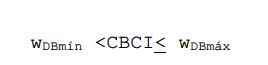
[0087] Com base no mecanismo de polimerização para a produção dos compósitos com blocos cristalinos, o CBCI representa a melhor estimativa da fração efetiva de copolímero em dibloco no compósito. Para amostras de polímero desconhecidas, wDBmín poderá ser usado para determinar se o material é um compósito com blocos cristalinos. Para uma mistura física de PE e PP, a fração em peso global de PP deverá ser igual àquela do % p/p de PP da HTLC e o limite inferior no conteúdo de diblocos, equação 9, é zero. Caso esta análise seja aplicada a uma amostra de PP que não contenha PE tanto a fração em peso de PP quanto a quantidade de PP obtida por HTLC serão 100% e novamente o limite inferior no conteúdo de diblocos, equação 9, será zero. Finalmente, caso esta análise seja aplicada a uma amostra de PE que não contenha PP, então a fração em peso de PP e a fração em peso de PP recuperado via HTLC serão zero e o limite inferior no dibloco, equação 9, será zero. Uma vez que o limite inferior do conteúdo de diblocos não é maior que zero em nenhum destes três casos, estes materiais não são compósitos com blocos cristalinos. Calorimetria de Varredura Diferencial (DSC)[0087] Based on the polymerization mechanism for the production of composites with crystalline blocks, the CBCI represents the best estimate of the effective fraction of diblock copolymer in the composite. For unknown polymer samples, wDBmin can be used to determine if the material is a composite with crystalline blocks. For a physical mixture of PE and PP, the overall weight fraction of PP should equal that of the HTLC % w/w PP and the lower limit on the diblock content, equation 9, is zero. If this analysis is applied to a PP sample that does not contain PE, both the fraction by weight of PP and the amount of PP obtained by HTLC will be 100% and again the lower limit on the content of diblocks, equation 9, will be zero. Finally, if this analysis is applied to a PE sample that does not contain PP, then the weight fraction of PP and the weight fraction of PP recovered via HTLC will be zero and the lower limit in the diblock, equation 9, will be zero. Since the lower limit of the content of diblocks is not greater than zero in any of these three cases, these materials are not composite with crystalline blocks. Differential Scanning Calorimetry (DSC)
[0088] A Calorimetria de Varredura Diferencial é usada para medir, dentre outras coisas, os calores de fusão dos blocos cristalinos e compósitos com blocos e esta é realizada usando um DSC Q1000 da TA Instruments equipado com um acessório de resfriamento RCS e um autoamostrador. Um fluxo de gás de purga de nitrogênio de 50 mL/min é usado. A amostra é prensada como uma película fina e fundida na prensa a cerca de 190°C e então resfriada ao ar até a temperatura ambiente (25°C). Cerca de 3-10 mg de material são então cortados, precisamente pesados, colocados em uma panela de alumínio leve (cerca de 50 mg), que é posteriormente fechada e recravada. O comportamento térmico da amostra é investigado com o seguinte perfil de temperatura: a amostra é rapidamente aquecida até 190°C e mantida isotermicamente durante 3 minutos para remover qualquer histórico térmico prévio. A amostra é então resfriada até -90°C a uma taxa de resfriamento de 10°C/min e mantida a -90°C durante 3 minutos. Em seguida, a amostra é aquecida até 190°C a uma taxa de aquecimento de 10°C/min. As curvas de resfriamento e segundo aquecimento são registradas. Para as medições de calor de fusão para o CBC e resinas de BC especificadas, conforme conhecido e rotineiramente realizado por aqueles entendidos no assunto, a linha base para o cálculo é traçada a partir da seção inicial plana antes do surgimento de fusão (tipicamente na faixa de cerca de -10 a cerca de 20oC para estes tipos de materiais) e se estende até o fim da fusão para a segunda curva de aquecimento.[0088] Differential Scanning Calorimetry is used to measure, among other things, the melting heats of crystalline blocks and composites with blocks and this is performed using a TA Instruments DSC Q1000 equipped with an RCS cooling accessory and an autosampler. A nitrogen purge gas flow of 50 mL/min is used. The sample is pressed as a thin film and melted in the press at about 190°C and then air-cooled to room temperature (25°C). About 3-10 mg of material is then cut, accurately weighed, placed in a lightweight aluminum pan (about 50 mg), which is subsequently closed and crimped. The thermal behavior of the sample is investigated with the following temperature profile: the sample is rapidly heated to 190°C and held isothermally for 3 minutes to remove any previous thermal history. The sample is then cooled to -90°C at a cooling rate of 10°C/min and held at -90°C for 3 minutes. The sample is then heated to 190°C at a heating rate of 10°C/min. Cooling and second heating curves are recorded. For heat of fusion measurements for the CBC and specified BC resins, as known and routinely performed by those skilled in the art, the baseline for the calculation is drawn from the initial flat section before the onset of melt (typically in the range from about -10 to about 20oC for these types of materials) and extends to the end of melting for the second heating curve.
[0089] (Uma) outra(s) resina(s) que poderá(ão) ser usada(s) na camada B é(são) compósito(s) em bloco compreendendo: i) um polímero de etileno compreendendo pelo menos 80% em moles de etileno polimerizado, preferivelmente pelo menos 85% moles, mais preferivelmente pelo menos 90% em moles, e o mais preferivelmente pelo menos 93% em moles de etileno polimerizado; ii) um polímero cristalino baseado em alfa-olefina (CAOP) e iii) um copolímero em bloco compreendendo (a) um bloco de polímero de etileno compreendendo pelo menos 80% em moles de etileno polimerizado, preferivelmente pelo menos 85% em moles, mais preferivelmente pelo menos 90% em moles, e o mais preferivelmente pelo menos 93% em moles de etileno polimerizado e (b) um bloco de alfa-olefina cristalino (CAOB).[0089] (Another resin(s) that may be used in layer B is(are) block composite(s) comprising: i) an ethylene polymer comprising at least 80% in moles of polymerized ethylene, preferably at least 85% mole, more preferably at least 90% mole, and most preferably at least 93% mole polymerized ethylene; ii) a crystalline polymer based on alpha-olefin (CAOP) and iii) a block copolymer comprising (a) an ethylene polymer block comprising at least 80% by moles of polymerized ethylene, preferably at least 85% by moles, more preferably at least 90% mole, and most preferably at least 93% mole polymerized ethylene and (b) a crystalline alpha-olefin block (CAOB).
[0090] Resina(s) de CBC adequada(s) para a camada B tem(êm) uma quantidade de CAOB (na parte (iii)) na faixa de 30 a 70% em peso (com base em (iii)), preferivelmente pelo menos 40% p/p, mais preferivelmente pelo menos 45% p/p, e o mais preferivelmente pelo menos 50% p/p, e preferivelmente até 60% p/p, e preferivelmente até 55% p/p (o balanço em cada caso sendo polímero de etileno). Também foi descoberto que a(s) resina(s) de CBC adequada(s) para camada B tem(êm) um índice de compósito com blocos (cristalinos) de pelo menos 0,1, preferivelmente pelo menos 0,3, preferivelmente pelo menos 0,5 e mais preferivelmente pelo menos 0,7. Outra maneira de caracterizar a(s) resina(s) de CBC adequada(s) essencial(is) para a camada B é como tendo uma MFR na faixa de 1 a 50 dg/min; preferivelmente pelo menos 2, mais preferivelmente pelo menos 3; e preferivelmente até 40, e preferivelmente até 30 g/min.[0090] Suitable CBC resin(s) for layer B have(have) an amount of CAOB (in part (iii)) in the range of 30 to 70% by weight (based on (iii)), preferably at least 40% w/w, more preferably at least 45% w/w, and most preferably at least 50% w/w, and preferably up to 60% w/w, and preferably up to 55% w/w (the balance in each case being ethylene polymer). It has also been found that the CBC resin(s) suitable for layer B has(have) a (crystalline) block composite index of at least 0.1, preferably at least 0.3, preferably at least minus 0.5 and more preferably at least 0.7. Another way to characterize suitable CBC resin(s) essential for layer B is as having an MFR in the range of 1 to 50 dg/min; preferably at least 2, more preferably at least 3; and preferably up to 40, and preferably up to 30 g/min.
[0091] Em geral, CBCs que poderão ser usados na camada B de acordo com a presente invenção terão valores de calor de fusão (refletindo o teor de etileno relativamente mais alto no CEP e no CEB) conforme medido por DSC de pelo menos 85 Joules por grama (J/g), mais preferivelmente pelo menos 90 J/g. Em qualquer dos casos, os valores de calor de fusão para polímeros destes tipos geralmente teriam um máximo na área de 125 J/g. Para medições de calor de fusão, conforme geralmente conhecido e praticado por aqueles entendidos no assunto, a DSC é realizada conforme geralmente descrito abaixo sob nitrogênio a 10oC/min de 23oC a 220oC, mantido isotermicamente a 220oC, reduzido para 23oC a 10oC/min e rampeado novamente até 220oC a 10oC/min. Os dados do segundo aquecimento são usados para calcular o calor de fusão da transição de fusão.[0091] In general, CBCs that may be used in layer B according to the present invention will have heat of fusion values (reflecting the relatively higher ethylene content in CEP and CEB) as measured by DSC of at least 85 Joules per gram (J/g), more preferably at least 90 J/g. In either case, the heat of fusion values for polymers of these types would generally have a maximum in the area of 125 J/g. For heat of fusion measurements, as generally known and practiced by those skilled in the art, DSC is performed as generally described below under nitrogen at 10oC/min from 23oC to 220oC, held isothermally at 220oC, reduced to 23oC at 10oC/min and ramped up again to 220oC at 10oC/min. The second heat data is used to calculate the heat of fusion for the fusion transition.
[0092] MAH-m-poliolefinas são outro material de selagem preferido e incluem MAH-g-poliolefinas e interpolímeros de MAH, i.é, a funcionalidade MAH estará presente na poliolefina ou por enxertia sobra a cadeia polimérica principal ou incorporando a funcionalidade na cadeia principal por copolimerização de MAH com outro monômero de olefina.[0092] MAH-m-polyolefins are another preferred sealing material and include MAH-g-polyolefins and MAH interpolymers, i.e. the MAH functionality will be present in the polyolefin either by grafting onto the main polymer chain or incorporating the functionality into the main chain by copolymerization of MAH with another olefin monomer.
[0093] O teor de composto orgânico insaturado da poliolefina enxertado é de pelo menos 0,01% p/p, e preferivelmente de pelo menos 0,05% p/p, com base no peso combinado da poliolefina e o composto orgânico. A quantidade máxima de teor de composto orgânico insaturado poderá variar de acordo com a conveniência, porém tipicamente não excede 10% p/p, preferivelmente não excede 5% p/p, e mais preferivelmente não excede 2% p/p. Este teor de orgânico insaturado do polímero de enxertia é medido por um método de titulação, p.ex., uma solução de poliolefina enxertada/xileno é titulada com uma solução de hidróxido de potássio (KOH). A funcionalidade MAH poderá estar presente na poliolefina, p.ex., por enxertia, ou até por copolimerização com o monômero de olefina.[0093] The unsaturated organic compound content of the grafted polyolefin is at least 0.01% w/w, and preferably at least 0.05% w/w, based on the combined weight of the polyolefin and the organic compound. The maximum amount of unsaturated organic compound content will vary according to convenience, but typically does not exceed 10% w/w, preferably does not exceed 5% w/w, and more preferably does not exceed 2% w/w. This unsaturated organic content of the graft polymer is measured by a titration method, eg a grafted polyolefin/xylene solution is titrated with a potassium hydroxide (KOH) solution. The MAH functionality can be present in the polyolefin, e.g., by grafting, or even by copolymerization with the olefin monomer.
[0094] O composto orgânico insaturado poderá ser enxertado na poliolefina por qualquer técnica conhecida, tal como aquelas ensinadas nas patentes U.S. nos 3.326.917 e 5.194.509. Por exemplo, na patente ‘917, o polímero é introduzido em um misturador de dois rolos e misturado a uma temperatura de 60oC. O composto orgânico insaturado é então adicionado juntamente com um iniciador de radical livre, tal como, por exemplo, peróxido de benzoíla, e os componentes são misturados a 30oC até que a enxertia seja completada. Na patente ‘509, o procedimento é semelhante, exceto que a temperatura de reação é mais alta, p.ex., 210 a 300oC, e um iniciador de radical livre não é usado ou é usado a uma concentração reduzida.The unsaturated organic compound may be grafted onto the polyolefin by any known technique, such as those taught in U.S. Patents Nos. 3,326,917 and 5,194,509. For example, in the '917 patent, the polymer is introduced into a two-roll mixer and mixed at a temperature of 60oC. The unsaturated organic compound is then added together with a free radical initiator, such as, for example, benzoyl peroxide, and the components are mixed at 30°C until grafting is complete. In the '509 patent, the procedure is similar, except that the reaction temperature is higher, eg, 210 to 300°C, and a free radical initiator is not used or is used at a reduced concentration.
[0095] Um método alternativo e preferido de enxertar é ensinado na patente U.S. no 4.950.541 usando uma extrusora desvolatilizadora de rosca dupla como aparelhagem de misturação. O polímero e o composto orgânico insaturado são misturados e reagidos com a extrusora em temperaturas nas quais os reagentes são fundidos e na presença de um iniciador de radical livre. Preferivelmente, o composto orgânico insaturado é injetado em uma zona mantida sob pressão dentro da extrusora.An alternative and preferred method of grafting is taught in U.S. Patent No. 4,950,541 using a twin screw devolatilizing extruder as a mixing apparatus. The polymer and unsaturated organic compound are mixed and reacted with the extruder at temperatures at which the reactants are melted and in the presence of a free radical initiator. Preferably, the unsaturated organic compound is injected into a pressure-held zone within the extruder.
[0096] Na descrição do uso dos componentes de polímero acima para fazer estruturas laminadas ou estratificadas, existe um número de termos que são regularmente usados e definidos conforme segue.[0096] In describing the use of the above polymer components to make laminated or laminated structures, there are a number of terms that are regularly used and defined as follows.
[0097] “Camada” significa um único espessura, revestimento ou estrato continuamente ou descontinuamente espalhado sobre ou recobrindo uma superfície.[0097] “Layer” means a single thickness, coating or layer continuously or discontinuously spread over or covering a surface.
[0098] “Multicamada” significa pelo menos duas camadas.[0098] “Multilayer” means at least two layers.
[0099] “Superfície facial”, “superfície planar” e termos afins, conforme relacionados a películas ou camadas, significa que as superfícies das camadas estejam em contato com as superfícies opostas e adjacentes das camadas vizinhas. Superfícies faciais são diferenciadas de camadas de borda. Uma película ou camada retangular compreende duas superfícies faciais e quatro superfícies de borda. Uma camada circular compreende duas superfícies faciais e uma superfície de borda contínua.[0099] “Facial surface”, “planar surface” and related terms, as related to films or layers, means that the surfaces of the layers are in contact with the opposite and adjacent surfaces of the neighboring layers. Facial surfaces are distinguished from edge layers. A rectangular film or layer comprises two facial surfaces and four edge surfaces. A circular layer comprises two facial surfaces and a continuous edge surface.
[0100] “Em contato aderente” e termos afins significam que uma superfície facial de uma camada e uma superfície facial de outra camada estejam se tocando e em contato ligante uma com a outra de maneira tal que uma camada não possa ser removida da outra camada sem danos às superfícies em contato ou ambas as camadas.[0100] "In sticky contact" and related terms mean that a face surface of one layer and a face surface of another layer are touching and in bonding contact with each other in such a way that one layer cannot be removed from the other layer no damage to contacting surfaces or both layers.
[0101] “Relação de selagem” e termos afins significam que dois ou mais componentes, p.ex., duas camadas de polímero, ou uma camada de polímero e um dispositivo eletrônico, ou uma camada de polímero e uma folha de cobertura de vidro, etc. unem-se uma com a outra de uma maneira tal, p.ex., por co- extrusão, laminação, revestimento, etc., que a interface formada pela sua junção seja separada do seu ambiente imediatamente externo.[0101] "Seal ratio" and related terms mean two or more components, eg, two polymer layers, or a polymer layer and an electronic device, or a polymer layer and a glass cover sheet , etc. they are joined together in such a way, e.g., by co-extrusion, lamination, coating, etc., that the interface formed by their joining is separated from its immediately external environment.
[0102] Dependendo do seu uso pretendido, a película ou estruturas de folhas em multicamada de acordo com a presente invenção podem ser projetadas de maneira a atenderem a certos requisitos de desempenho tais como nas áreas de propriedades de desempenho físico incluindo tenacidade, transparência, resistência tensional, adesão intercamadas, e resistência térmica.[0102] Depending on their intended use, the multilayer film or sheet structures according to the present invention may be designed to meet certain performance requirements such as in the areas of physical performance properties including toughness, clarity, strength tension, intercoat adhesion, and thermal resistance.
[0103] Em algumas concretizações, a espessura da estrutura total poderá variar de 0,025 cm a 2,5 cm(25 micra-2,5 cm) ou, preferivelmente, de 0,05 cm (50 micra) a 1 mm. Em algumas concretizações, a camada B tem uma espessura de 0,004 cm (4 micra) a 0,05 cm (50 micra).[0103] In some embodiments, the thickness of the total structure may range from 0.025 cm to 2.5 cm (25 microns-2.5 cm) or preferably from 0.05 cm (50 microns) to 1 mm. In some embodiments, layer B has a thickness of 0.004 cm (4 microns) to 0.05 cm (50 microns).
[0104] Adicionalmente às estruturas em multicamada, a invenção também compreende qualquer estrutura em multicamada incluindo recipientes e garrafas, canos, tubagens, fios e cabos e películas e folhas, incluindo laminados, moldados por injeção e moldados por sopro. Exemplos de estruturas compreendem aquelas divulgadas em, por exemplo, CA 2 735 182, publicação de pedido de patente U.S. no 2003/0215655, US 2004/0241360, e US 2007/0160788. Estas estruturas incluem artigos moldados por sopro rígidos, estruturas em multicamada tendo perfis anelares, e artigos moldados por sopro coextrudados. Exemplos[0104] In addition to multilayer structures, the invention also comprises any multilayer structure including containers and bottles, pipes, tubing, wires and cables and films and sheets, including laminates, injection molded and blow molded. Examples of structures include those disclosed in, for example,
[0105] Películas de amostra em multicamada experimentais (camadas indicadas aqui por letras, p.ex., A, B, e C), conforme sumarizadas nas tabelas abaixo, são feitas usando materiais de resinas termoplásticas sumarizadas na tabela 1 abaixo. Quando indicadas, as Taxas de Fluxo de Fundido (MFR) são medidas de acordo com ASTM D1238 (230oC/2,16 kg) e reportadas em gramas por 10 minutos (g/10 min) e valores de Índice de Fusão (MI) são medidos de acordo com ASTM D1238 (190oC/2,16 kg) e reportados em g/10 min. A densidade é medida de acordo com ASTM D792 e dada em gramas por centímetro cúbico (g/cm3). Processo de Retortagem[0105] Experimental multilayer sample films (layers indicated here by letters, eg A, B, and C), as summarized in the tables below, are made using thermoplastic resin materials summarized in table 1 below. Where indicated, Melt Flow Rates (MFR) are measured in accordance with ASTM D1238 (230oC/2.16 kg) and reported in grams per 10 minutes (g/10 min) and Melt Index (MI) values are measured in accordance with ASTM D1238 (190oC/2.16 kg) and reported in g/10 min. Density is measured in accordance with ASTM D792 and given in grams per cubic centimeter (g/cm3). Retort Process
[0106] O tratamento de retortagem é realizado em um vaporizador de fios (“yarn steamer”) Contexxor. As películas são cortadas em 200 X 15 mm na direção de máquina e seladas com barras de selagem constante a 150oC durante 1 seg. Quatro selagens são feitas e os sacos são mantidos vazios. Os sacos vazios são esterilizados no vaporizador a 122oC durante 40 min. Ensaios de Adesão[0106] The retort treatment is carried out in a Contexxor yarn steamer. The films are cut to 200 X 15 mm in machine direction and sealed with constant sealing bars at 150oC for 1 sec. Four seals are made and the bags are kept empty. The empty bags are sterilized in the vaporizer at 122oC for 40 min. Adhesion Tests
[0107] Para testar a adesão, as películas são seladas ao longo da direção transversal a 150oC durante 1 seg. Tiras com 15 mm de largura por 100 mm de comprimento são cortadas da área selada. A adesão é medida ao longo da direção de máquina. A delaminação é iniciada cuidadosamente abrindo a selagem. Os corpos de ensaio são descascados a 125 mm min-1 à temperatura ambiente em um dinamômetro INSTRON 5564. Pelo menos 5 corpos de ensaio são testados e a média da carga pico é reportada. Ensaio de Névoa[0107] To test adhesion, the films are sealed along the transverse direction at 150oC for 1 sec. Strips 15mm wide by 100mm long are cut from the sealed area. Adhesion is measured along the machine direction. Delamination is started by carefully opening the seal. The test specimens are peeled at 125 mm min-1 at room temperature in an INSTRON 5564 dynamometer. At least 5 test specimens are tested and the average peak load is reported. Mist Test
[0108] A névoa da película é medida com base no método padrão ISO 14782. A adesão e a névoa são medidas tanto antes quanto depois do tratamento de retortagem. Ensaio de Resistência de Selagem Térmica[0108] Film haze is measured based on standard ISO 14782 method. Adhesion and haze are measured both before and after the retort treatment. Thermal Sealing Resistance Test
[0109] A resistência de selagem térmica é baseada no Método de Ensaio Padrão ASTM F88, STM para Resistência de Selagem de Materiais de Barreira Flexíveis. Ela mede a força requerida para separar uma tira de ensaio contendo a selagem. Ela também identifica o modo de falha da peça de ensaio. As peças de ensaio são tiras cortadas em matriz tendo 15 mm de largura. O resultado do ensaio é uma medida da força requerida para separar puxando a selagem térmica, ou a força requerida para romper a película em casos onde a película se rompa antes das partes termosseladas. Microscopia Ótica[0109] The thermal seal strength is based on the ASTM F88 Standard Test Method, STM for Sealing Strength of Flexible Barrier Materials. It measures the force required to separate a test strip containing the seal. It also identifies the test piece's failure mode. The test pieces are die-cut strips being 15 mm wide. The test result is a measure of the force required to pull apart the heat seal, or the force required to break the film in cases where the film breaks before the heat sealed parts. Optical Microscopy
[0110] Para a preparação de amostras, seções óticas com aproximadamente 0,005 cm (5 micra) de espessura foram coletadas a -120oC usando uma faca de diamante em um micrótomo Leica UCT equipado com uma câmara crio-seccionadora FCS. As seções foram transferidas para uma lâmina de microscópio contendo uma gota de óleo de silicone Dow Corning E-200 e recobertas com um vidro de cobertura antes da análise. Luz de fundo clara transmitida sob iluminação de contraste diferencial foi usada para visualizar as seções óticas usando um microscópio composto AxioImager Z1m da Carl Zeiss e imagens foram adquiridas com o auxílio de uma câmera digital HRc. Materiais Tabela 1. Descrição dos Materiais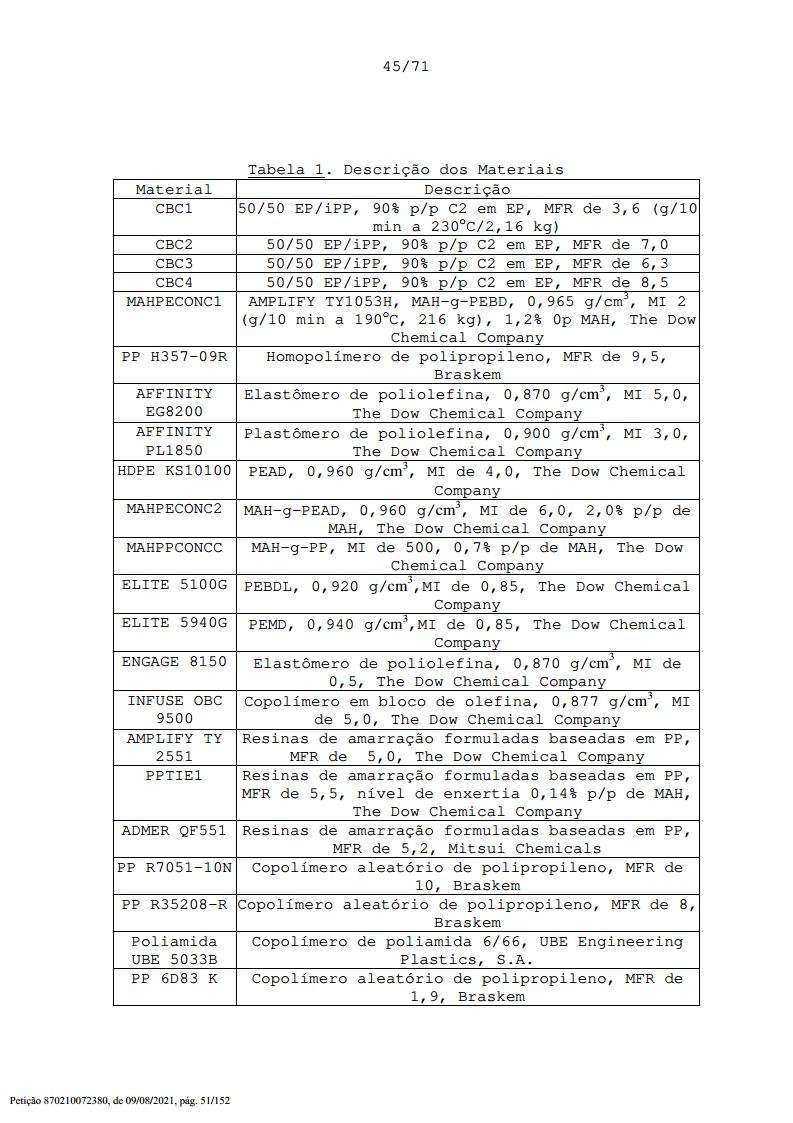

[0111] Catalisador-1 ([[rel-2’-2”-[(1R,2R)-1,2-ciclohexano- diilbis(metilenooxi-kO)]bis[3-(9H-carabzol-9-il)-5- metil[1,1’-bifenil]-2-olato-kO]](2-)]dimetil-háfnio) e cocatalisador-1, uma mistura de sais de tetraquis (pentafluorfenil)borato de metildi(alquil C14-18)amônio, preparado pela reação de uma trialquilamina de cadeia longa (ArmeenMR M2HT, comercialmente disponível da Azo-Nobel, Inc.) HCl e Li[B(C6F5)4], substancialmente conforme divulgado na patente U.S. no 5.919.983, ex. 2, são adquiridos da Boulder Scientific e usados sem purificação adicional.[0111] Catalyst-1 ([[rel-2'-2"-[(1R,2R)-1,2-cyclohexane-diylbis(methyleneoxy-kO)]bis[3-(9H-carabzol-9-yl) -5- methyl[1,1'-biphenyl]-2-olate-kO]](2-)]dimethylhafnium) and cocatalyst-1, a mixture of tetrakis(pentafluorophenyl)borate salts of methyldi(C14-alkyl) 18) ammonium, prepared by the reaction of a long-chain trialkylamine (ArmeenMR M2HT, commercially available from Azo-Nobel, Inc.) HCl and Li[B(C6F5)4], substantially as disclosed in US Patent No. 5,919,983, ex . 2, are purchased from Boulder Scientific and used without further purification.
[0112] CSA-1 (dietil zinco ou DEZ) e cocatalisador 2 (metilalumoxano modificado (MMAO)) foram adquiridos da Akzo- Nobel e usados sem purificação adicional. O solvente para as reações de polimerização é uma mistura de hidrocarbonetos (ISOPAR® E) obtenível da ExxonMobil Chemical Company e purificada através de leitos de peneiras moleculares 13-X antes do uso.[0112] CSA-1 (diethyl zinc or TEN) and cocatalyst 2 (modified methylalumoxane (MMAO)) were purchased from Akzo-Nobel and used without further purification. The solvent for the polymerization reactions is a mixture of hydrocarbons (ISOPAR® E) obtainable from ExxonMobil Chemical Company and purified through beds of 13-X molecular sieves prior to use.
[0113] Os compósitos com blocos cristalinos dos presentes exemplos são denominados de CBC1 e CBC2. Eles foram preparados usando dois reatores tanque agitados contínuos (CSTR) conectados em série. O primeiro reator tinha aproximadamente 12 galões de volume enquanto que o segundo reator tinha aproximadamente 26 galões. Cada reator foi hidraulicamente enchido e ajustado de maneira a operar em condição de estado estacionário. Monômeros, solvente, hidrogênio, catalisador-1, cocatalisador-1, cocatalisador-2 e CSA-1 foram alimentados ao primeiro reator de acordo com as condições de processo apresentadas na tabela 2. O conteúdo do primeiro reator conforme descrito na tabela 2 fluiu para o segundo reator em série. Monômeros, solvente, hidrogênio, catalisador-1, cocatalisador-1 e, opcionalmente, cocatalisador-2 opcionais, foram adicionados ao segundo reator. A tabela 3 mostra as características analíticas de CBC1-CBC4. Tabela 2. Condições de Processo de Reatores para Produzir Compósitos com Blocos Cristalinos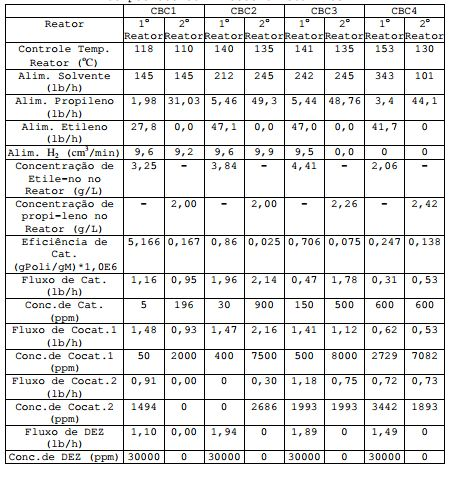

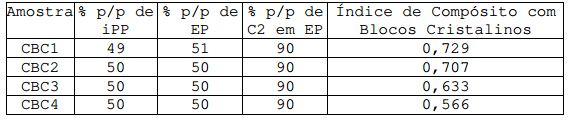
[0114] A figura 1 mostra o perfil de DSC para CBC1. O perfil de DSC mostra um pico de fusão em 129oC que é representativo do CAOP e do CAOB e 113oC que corresponde ao CEP e ao CEB. A entalpia de fundido observada foi de 115oC e a temperatura de transição vítrea foi observada em -11oC.[0114] Figure 1 shows the DSC profile for CBC1. The DSC profile shows a melting peak at 129oC which is representative of CAOP and CAOB and 113oC which corresponds to CEP and CEB. The melt enthalpy observed was 115oC and the glass transition temperature was observed at -11oC.
[0115] A figura 2 mostra a análise por TREF de CBC1. O perfil de eluição por TREF mostra que CBC1 é altamente cristalino e, em contraste com o perfil de fusão por DSC, mostra pouca ou nenhuma separação de CEP e CAOP ou do copolímero em bloco. Apenas 2,4% p/p de purga foram medidos, o que também indica a cristalinidade muito alta dos componentes em CBC1.[0115] Figure 2 shows the TREF analysis of CBC1. The TREF elution profile shows that CBC1 is highly crystalline and, in contrast to the DSC melt profile, shows little or no separation of CEP and CAOP or the block copolymer. Only 2.4% w/w of purge was measured, which also indicates the very high crystallinity of the components in CBC1.
[0116] A figura 3 mostra a análise por HTLC de CBC1. O perfil de eluição de CBC1 por HTLC mostrou que 13,2% de um pico eluindo cedo entre 1-2 mL, e 86,8% p/p de um pico eluindo mais tarde entre 3-5 mL foram eluídos. Da medição de concentração e composição, foi determinado que o pico primeiro eluindo era de PP isolado que era CAOP e representativo do CAOB. Isto é mostrado pelo perfil de composição do % p/p de C3 presente. O segundo pico e pico eluindo mais tarde é rico em C2 e mostra um gradiente de C3. Poderá ser interpretado que este pico seja a fase PE e contém o copolímero em bloco e CEP. O gradiente de composição mostra que o copolímero em bloco é eluído mais cedo e o CEP é eluído por último. Exemplos de Películas Fundidas Preparação de Formulações de Camada de Amarração[0116] Figure 3 shows the HTLC analysis of CBC1. The HTLC elution profile of CBC1 showed that 13.2% of a peak eluting early between 1-2 ml, and 86.8% w/w of a peak eluting later between 3-5 ml were eluted. From the concentration and composition measurement, it was determined that the first eluting peak was isolated PP which was CAOP and representative of CAOB. This is shown by the composition profile of the % w/w of C3 present. The second peak and later eluting peak is rich in C2 and shows a gradient of C3. It can be interpreted that this peak is the PE phase and contains the block copolymer and CEP. The composition gradient shows that the block copolymer is eluted earlier and CEP is eluted last. Examples of Cast Films Preparation of Lashing Layer Formulations
[0117] As misturas para formulações de camada de amarração são preparadas usando uma TSE (uma máquina Leistriz) de 30 mm. A extrusora tinha cinco zonas aquecidas, uma zona de alimentação, e uma fieira de filamento de 3 mm. A zona de alimentação é resfriada por água corrente através de seu núcleo, enquanto que as zonas 1-5 restantes e fieira são aquecidas eletricamente e controladas por resfriamento a ar até as temperaturas especificadas dependendo dos materiais sendo misturados. Os seguintes ajustes de temperatura são usados no processo de extrusão: zonas 1-5 são aquecidas a 130, 186, 190, 190 e 190oC, e a fieira é aquecida a 190oC. A unidade de acionamento da extrusora é operada a 150 rpm. As formulações para a preparação são mostradas na tabela 5. Tabela 5. Formulações de Camada de Amarração para Películas Fundidas
[0118] Para comparar com formulação de camada de amarração baseada em INFUSE OBC, INFUSE OBC 9500 (OBC) é misturado com MAH enxertado com INFUSE OBC 9500 (MAH-g-OBC) ou com MAHPECONC1. Para preparar MAh-g-OBC, é usado um Megacompounder ZSK-92 com 11 cilindros (“barrels”) (C/D de 45). A resina de OBC é alimentada com um alimentador K-Tron T-60. MAH é injetado no cilindro 3, abertura 1 usando uma bomba Lewa. A mistura de peróxido/óleo (50/50 p/p) foi injetada no cilindro 3, abertura 2 usando uma bomba de êmbolo Prominent Sigma. A temperatura do cilindro é ajustada em 80oC para a zona 1 e 225oC para as zonas 2 a 11. Um sistema de bomba de vácuo é usado para a desvolatilização no cilindro 9. As RPM da rosca são ajustadas em 200 e 230, o torque varia de 56% a 61%. A taxa de alimentação para OBC1 é ajustada em 1500 lb/h. A formulação de alimentação é de 1,70% de MAH, 0,20% de mistura de peróxido/óleo mineral (50/50 p/p). O nível de enxertia final com MAH é de 1,1% e o índice de fusão do MAH- g-OBC é de 3,0 (2,16 kg, 190oC). Para a fabricação de fundido, o OBC é MAH-g-OBC misturado a seco com MAHPECONC1. Processo de Película Fundida[0118] To compare with INFUSE OBC based tie coat formulation, INFUSE OBC 9500 (OBC) is mixed with MAH grafted with INFUSE OBC 9500 (MAH-g-OBC) or with MAHPECONC1. To prepare MAh-g-OBC, a Megacompounder ZSK-92 with 11 barrels (C/D of 45) is used. The OBC resin is fed from a K-Tron T-60 feeder. MAH is injected into
[0119] Películas de cinco camadas segundo uma estrutura de A/B/C/B/A são extrudadas em uma Linha de Fundido de 5 Camadas Collins. A espessura de película total é de 150 μm, na qual A é a camada de pele (40 μm) , B é a camada de amarração (10 μm) e C é a camada de barreira (50 μm) . Poliamida UBE 5033B é usada como a camada de barreira, e Dow PP R7051-10N (MFR 10) é usado como camada de pele. Esta linha possui 5 extrusoras. As extrusoras 1 e 5 são usadas para camadas de pele, as extrusoras 2 e 4 são usadas para camadas de amarração e a extrusora 3 é usada para camada de barreira. Os perfis de temperatura das extrusoras são mostrados na tabela 6. Tabela 6. Condições de Extrusora para Película Fundida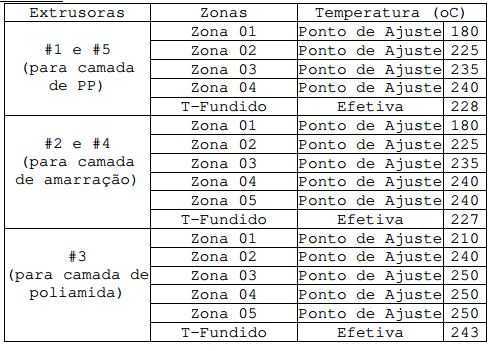
[0120] As formulações para camadas de amarração usadas para películas fundidas são mostradas na tabela 6. O ex. A1 e os exs. 1-5 contêm plastômero de poliolefina conforme representado por AFFINITY PL 1850. Nestes exemplos, o carregamento de MAH-g-PEAD (MAHPECONC1) é mantido constante. Antes do tratamento de retortagem, os exs. 1-5 exibem excelente adesão intercamadas variando de 13 a 15 N/15 mm. Após a retortagem, entretanto, a adesão do ex. A1 torna- se pobre. Adicionando-se 20% de CBC1 (ex. 1) à camada de amarração melhora significativamente a propriedade de adesão após a retortagem. Nos exs. 2-5, a quantidade de CBC2 é aumentada de 20% para 50%. O valor de adesão aumenta à medida que a concentração de CBC2 aumenta. Quando a concentração de CBC2 na formulação de camada de amarração muda entre 40% (ex. 4) e 50% (ex. 5), o valor de adesão após a retortagem é comparável àquele da camada de amarração baseada em polipropileno (ex. B). Os exs. 4 e 5 exibem boa suavidade de película após a retortagem.[0120] The formulations for tie layers used for cast films are shown in table 6. O ex. A1 and exs. 1-5 contain polyolefin plastomer as represented by AFFINITY PL 1850. In these examples, the loading of MAH-g-HDPE (MAHPECONC1) is held constant. Before the retort treatment, exs. 1-5 exhibit excellent intercoat adhesion ranging from 13 to 15 N/15 mm. After the retort, however, the ex. A1 becomes poor. Adding 20% CBC1 (eg 1) to the tie layer significantly improves the adhesion property after retorting. In the exs. 2-5, the amount of CBC2 is increased from 20% to 50%. The adhesion value increases as the concentration of CBC2 increases. When the concentration of CBC2 in the tie layer formulation changes between 40% (ex. 4) and 50% (ex. 5), the adhesion value after retorting is comparable to that of the polypropylene based tie layer (ex. B ). Exs. 4 and 5 exhibit good film smoothness after retorting.
[0121] No ex. 6, 25% de polipropileno são adicionados adicionalmente ao CBC2. Um valor de adesão intercamadas de 6,1 N/15 mm é atingido após a retortagem. Nos exs. 7 e 8, o plastômero de poliolefina conforme representado por AFFINITY PL1850 é substituído por PEAD KS10100. Com 40% de CBC2 adicionados ao ex. 8, um excelente valor de adesão de 9,4 N/15 mm é atingido após a retortagem.[0121] In the ex. 6, 25% polypropylene is additionally added to CBC2. An intercoat adhesion value of 6.1 N/15 mm is achieved after retorting. In the exs. 7 and 8, the polyolefin plastomer as represented by AFFINITY PL1850 is replaced by HDPE KS10100. With 40% CBC2 added to ex. 8, an excellent adhesion value of 9.4 N/15 mm is achieved after retorting.
[0122] Os exemplos comparativos (A2 e A3) baseados em formulação de INFUSE OBC exibem boa adesão antes e após a retortagem; entretanto, a película apresenta enrugamentos sérios como resultado de encolhimento após a retortagem. O ex. A3 apresenta uma alta névoa após a retortagem, como resultado de fundir e recristalizar durante o processo de retortagem.[0122] Comparative examples (A2 and A3) based on INFUSE OBC formulation exhibit good adhesion before and after retorting; however, the film exhibits severe wrinkling as a result of shrinkage after retorting. The ex. A3 has a high haze after retorting as a result of melting and recrystallizing during the retort process.
[0123] Em termos de névoa, o ex. 5 é melhor que o ex. B enquanto que o ex. 8 é comparável com o ex. B. Tabela 7. Resultados de Adesão Intercamadas e Névoa de Películas Fundidas (camada de pele sendo PP R7051-10N e camada de núcleo sendo Poliamida UBE 5033B)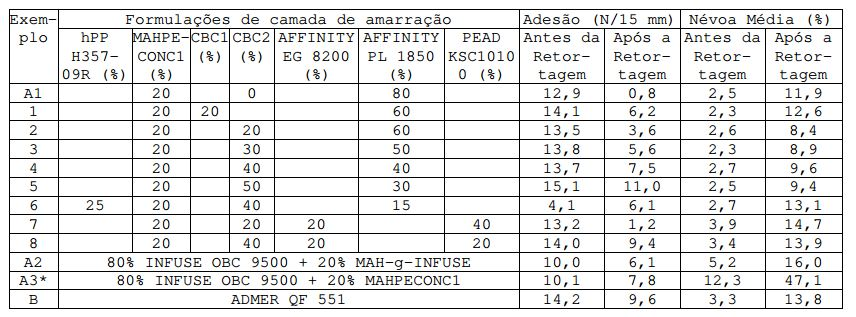
[0124] As misturas para formulações de camadas de amarração usadas para experiências de películas sopradas são compostas em uma extrusora de rosca dupla Coperion ZSK 26. O diâmetro de rosca é de 25,5 mm com uma profundidade de filete de 4,55 mm. A taxa de alimentação é de 50 lb/h e uma RPM de rosca de 500 foi usada. O comprimento do cilindro é de 100 mm com 15 cilindros compreendendo toda a seção de processamento. Os seguintes ajustes de temperatura são usados no processo de extrusão: as zonas 1-2 são aquecidas a 140oC, e as outras zonas e a fieira são aquecidos a 190oC. O material formulado foi extrudado através de uma fieira de dois furos para dentro de um banho d’água refrigerado com 16 pés de comprimento. Os fios foram então passados através de uma Faca de Ar Berlyn para remover o excesso de água. Uma vez secos e resfriados os fios, eles são pelotizados com um pelotizador de corte lateral Lab Tech. Tabela 8. Formulações de Camada de Amarração para Películas Sopradas
[0125] Películas de cinco camadas segundo uma estrutura A/B/C/B/A são sopradas em uma linha de película soprada de 5 camadas Lab Tech. O diâmetro da fieira de extrusão é de 75 mm e a folga de fieira é de 2 mm. A razão de inflação (“blow-up”(BUR)) é de 2,7 e a largura plana é de 12,7 polegadas. A velocidade do pressor (“nip”) é de 13,5 pés/min. A espessura total da película é de 100 μm, na qual A é a camada de pele, B é a camada de amarração e C é a camada de barreira. Dow PP 6D83K é usado como camada de pele. Ambos poliamida e EVOH são usados como camada de barreira. Quando a poliamida UltramidMR C33L01 é usado como camada de barreira, a estrutura de camadas é A/B/C/B/A (30/10/20/10/30 μm). Quando EVOH EVALMR H171B é usado como camada de barreira, a estrutura de camadas é A/B/C/B/A (35/10/10/10/35 μm). A linha tem 5 extrusoras. As extrusoras 1 e 5 são usadas para as camadas de pele, as extrusoras 2 e 4 são usadas para as camadas de amarração e a extrusora 3 é usada para a camada de barreira. Os perfis de temperatura das extrusoras são mostrados na tabela 10 para amostras com EVOH como barreira. Tabela 9. Condições de Extrusoras para Linha de Película Soprada Lab Tech com Amostras de Camada de Poliamida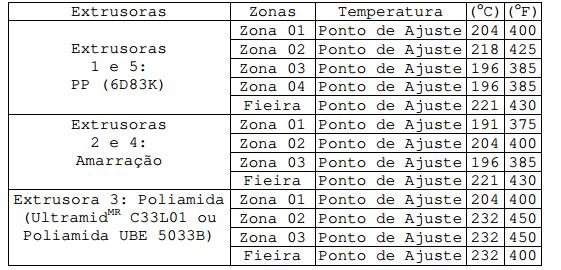
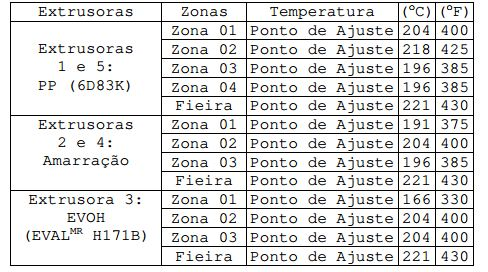
[0126] Os resultados de adesão e névoa para estruturas de películas sopradas contendo poliamida são mostrados na tabela 11. Os exs. 9 a 13 exibem uma excelente propriedade de adesão tanto antes quanto depois da retortagem conforme comparação com as camadas de amarração baseadas em PP (exs. C e D). Note-se que os exs. 9-11 usam MAH-g-PEAD (MAHPECONC1) como poliolefina enxertada com MAH, o ex. 12 usa MAH-g-PEAD (MAHPECONC2) como poliolefina enxertada com MAH, enquanto que o ex. 13 usa MAH-g-PP (MAHPPCONC) como poliolefina enxertada com MAH. O ex.16 contém apenas MAH-g- PEAD (MAHPECONC1) e CBC3 não contém nenhum elastômero. Em termos de névoa, os exs. 9-13 têm um valor de 6 a 8% antes da retortagem e 13 a 15% após a retortagem. Os exs. 8-13 também exibem boa suavidade de película após a retortagem. Tabela 11. Resultados de Adesão Intercamadas de Amarração e Névoa de Películas Sopradas Produzidas na Linha Lab Tech (camada de barreira sendo Poliamida C33L01)

[0127] Películas de cinco camadas segundo uma estrutura A/B/C/B/A são sopradas em uma linha de película soprada de 7 camadas Alpine. A camada A é a camada de pele, B é a camada de amarração e C é a camada de barreira e D é a camada de pele. PP 6D83K é usado como a camada selante A. Ambos a Poliamida (UltramidMR C40LN07) e EVOH (EVALMR F171B) são usados como a camada de barreira C. PP H110-02N é usado como camada de pele D. O diâmetro da fieira de extrusão é de 205 mm e a folga de fieira é de 2 mm. A produção da fieira é de 11,35 lb por polegada de circunferência da fieira. A razão de inflação (BUR) é de 2,5 e a razão de estirabilidade é de 7,86. Espessuras totais da película de 100 μm, e 50 μm são feitas. A velocidade do pressor é de 46,5 pés/min para a película com 100 μm enquanto que a velocidade do pressor é de 93,0 pés/min para a película com 50 μm. Quando a poliamida C40LN07 é usada como camada de barreira, a estrutura de camadas é A/B/C/B/A (34/6/20/6/34%). Quando EVOH EVALMR H171B é usada como camada de barreira, a estrutura de camadas é A/B/C/B/A (39/6/10/6/39%). A linha tem 7 extrusoras. As extrusoras 1 e 2 são usadas para a camada selante A, as extrusoras 3 e 5 são usadas para as camadas de amarração B, a extrusora 5 é usada para a camada de barreira C e as extrusoras 6 e 7 são usadas para a camada de pele D. Os perfis de temperatura das extrusoras são mostrados na tabela 13 para amostras com poliamida como barreira. Os perfis de temperatura são mostrados na tabela 14 para amostras com EVOH como barreira. Tabela 13. Condições de Extrusoras para Linha de Películas Sopradas Lab Tech para Amostras com Camada de Poliamida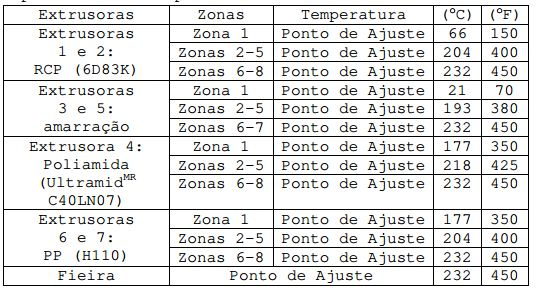
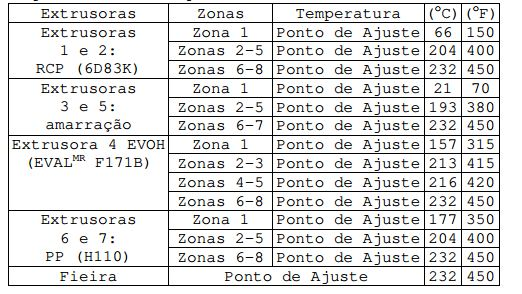
[0128] Os resultados de ensaios para películas com 100 μm de espessura contendo camada de poliamida produzidas na Linha de Película Soprada Alpine são mostrados na tabela 15. O desvio padrão do ensaio de adesão é mostrado entre parênteses. Os exs. 16 a 18 mostram resistência de adesão comparável tanto antes quanto depois da retortagem comparativamente com camadas de amarração baseadas em PP (Exs. F, G e H). A névoa dos exs. 16-18 também é semelhante àquela dos exemplos comparativos. Os exemplos 9-13 também exibem boa suavidade de película após a retortagem.[0128] Test results for 100 µm thick films containing polyamide layer produced in the Alpine Blown Film Line are shown in table 15. The standard deviation of the adhesion test is shown in parentheses. Exs. 16 to 18 show comparable bond strengths both before and after retorting compared to PP based tie layers (Ex. F, G and H). The fog of exs. 16-18 is also similar to that of the comparative examples. Examples 9-13 also exhibit good film smoothness after retorting.
[0129] Uma microscopia ótica é realizada para identificar a interface de delaminação. Conforme mostrado na figura 5, o exame das seções transversais de estruturas testadas para descascamento indicam que falhas ocorrem no mesmo local nos exs. 16, 18 e H. Falhas adesivas são observadas ao longo da fronteira interfacial entre a camada de poliamida e a camada de amarração. Tabela 15. Resultados de Adesão Intercamadas de Amarração de Películas com 100 μm Produzidas na Linha de Películas Sopradas Alpine (camada de barreira sendo Poliamida C40LN07)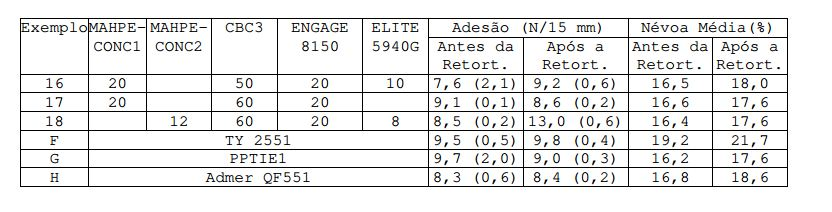
[0130] Os resultados de ensaios para películas com 100 μm de espessura contendo camada de EVOH (EVALMR F171B) produzidas na linha de películas sopradas Alpine são mostrados na tabela 16. O desvio padrão do ensaio de adesão é mostrado entre parênteses. Os exs. 19 a 21 exibem adesão mais forte tanto antes quanto depois da retortagem do que a camada de amarração baseada em PP (exs. I a K). Tabela 16. Resultados de Adesão Intercamadas de Amarração de Películas Sopradas Produzidas na Linha Alpine (camada de barreira sendo EVOH EVALMR F171B)
[0131] Uma tentativa de camada de amarração de polietileno/poliamida foi conduzida para testar se a invenção pode ser usada como camada de amarração para polietileno/poliamida. Películas de cinco camadas segundo estruturas A/B/C/B/A semelhantes foram sopradas na linha de películas sopradas de 5 camadas Lab-Tech. O diâmetro da fieira de extrusão era de 75 mm e a folga de fieira era de 2 mm. A razão de inflação (BUR) era de 2,5 e a largura plana era de 11,6 polegadas. A velocidade do pressor era de 14,5 pés/min. A espessura total da película é de 100 μm, na qual A era a camada de pele, B era a camada de amarração e C era a camada de barreira. DOWLEX 2045G foi usado como camadas de pele. Poliamida UltramidMR C33L01 foi usada como camada de barreira. A estrutura de camadas era A/B/C/B/A (30/10/20/10/30 μm). A linha tinha 5 extrusoras. As extrusoras 1 e 5 foram usadas para camadas de pele, as extrusoras 2 e 4 foram usadas para camadas de amarração e a extrusora 3 foi usada para as camadas de barreira. Os perfis de temperatura são mostrados na tabela 17. Tabela 17. Condições de Extrusoras para Linha de Película Soprada Lab Tech para Estruturas de Polietileno/Poliamida Extrusoras Zonas Temperatura (oC) (oF)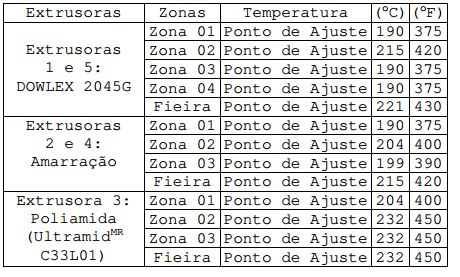
[0132] As camadas de amarração inventivas, camadas de amarração baseadas em PP, e camadas de amarração baseadas em PE são comparadas na tabela 18. Para camadas de amarração de PE/poliamida, o nível de adesão mínimo aceitável era de películas com 4 mil sendo acima de ~7 N/15 mm. Conforme poderá ser visto na tabela 18, as camadas de amarração baseadas em PP, exs. L e M, não atendem ao requisito de adesão, enquanto que as camadas de amarração inventivas 22 e 23 e as de PE comerciais (exs. N e O) passam no requisito de adesão.[0132] The inventive lashing layers, PP-based lashing layers, and PE-based lashing layers are compared in table 18. For PE/polyamide lashing layers, the minimum acceptable adhesion level was 4 mil films being above ~7 N/15 mm. As can be seen in table 18, the PP-based mooring layers, exs. L and M do not meet the adhesion requirement, while the inventive lashing layers 22 and 23 and commercial PE layers (ex. N and O) pass the adhesion requirement.
[0133] A comparação de falhas no ensaio de descascamento revelaram diferenças em local de delaminação, figura 6. Falha adesiva interfacial entre a camada de amarração e a camada de poliamida ocorreu nas formulações feitas com a camada inventiva 23, figura 6a. O mesmo local de delaminação foi observado na camada de amarração baseada em PE AMPLIFY TY 1353 (ex. N), figura 6c. Inversamente, para uma camada de amarração baseada em PP, ex. L, a falha adesiva ocorreu entre a camada externa de DOWLEX 2945G e a camada de amarração baseada em PP, figura 19b. Uma compatibilidade fraca entre o PP e o PE fez da interface de amarração/DOWLEX 2045G o ligamento fraco e o ponto de falha. Tabela 18. Resultados de Películas Sopradas Consistindo de Películas Sopradas e DOWLEX 2045G como Peles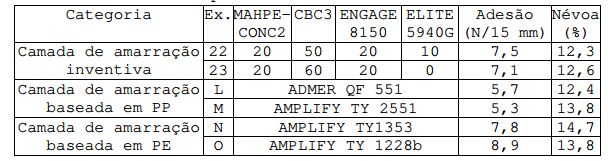
[0134] Uma tentativa de termoformação foi conduzida para verificar se a invenção pode ser usada como camada de amarração para aplicações de termoformação. Películas de sete camadas segundo estruturas A/B/C/D/C/B/E foram sopradas na linha de películas sopradas de 7 camadas Alpine. A camada A é a camada selante A (RCP 6D83K), B é a camada de amarração, C é uma poliamida (UltramidMR B36 01), D é EVOH (EVALMR LR171B) e E é PP H110-02N. A estrutura em camadas é A/B/C/D/C/B/E (22,5%/7,5%/12,5%/15,0%/12,5%/7,5%/22,5%). A espessura da película é de 152 μm (6 mils) . A produção total é de 425 lb/h. O diâmetro da fieira de extrusão é de 250 mm e a folga de fieira é de 2 mm. A produção da fieira é de 13,7 lb por polegada de circunferência da fieira. A razão de inflação (BUR) é de 2,5 e a razão de estirabilidade é de 5,24. A espessura total da película é de 152,4 μm (6 mils). A velocidade de pressor é de 35,9 pés/min. A linha 7 possui extrusoras. A extrusora 1 é usada para a camada selante A, as extrusoras 2 e 6 são usadas para as camadas de amarração B, as extrusoras 3 e 5 são usadas para a camada C, a extrusora é usada para a camada D, e a extrusora 7 para a camada E. Os perfis de temperatura das extrusoras são mostrados na tabela 19. Tabela 19. Condições de Extrusoras para Linha de Películas Sopradas Alpine para Tentativa de Termoformação
[0135] As películas sopradas foram subsequentemente termoformadas em uma máquina termoformadora Multivac R530. A profundidade de formação é de 63,5 mm. A temperatura da fieira é de 135oC, com um tempo de retardo de 7 seg. para aquecer e um tempo de retardo de 5 seg. para formar. Após a extração, uma dimensão de copo de 18 (comprimento) X 12 (largura) X 6 (profundidade) cm é formado. A película inferior do copo formado tem uma espessura de 25,4 μm (1,0 mil). Os ensaios de adesão e selagem térmica são realizados na película tomada do fundo dos copos formados.[0135] The blown films were subsequently thermoformed on a Multivac R530 thermoforming machine. The formation depth is 63.5 mm. The temperature of the die is 135oC, with a delay time of 7 sec. to warm up and a delay time of 5 sec. to form. After extraction, a cup dimension of 18 (length) X 12 (width) X 6 (depth) cm is formed. The bottom film of the formed cup is 25.4 µm (1.0 mil) thick. The adhesion and thermal sealing tests are carried out on the film taken from the bottom of the formed cups.
[0136] Após a termoformação, a camada de amarração inventiva ex. 24 tem um valor de adesão de 2,4 N/15 mm antes da retortagem, que é comparável com a camada de amarração baseada em PP exemplo P (2,9 N/15 mm). Após a retortagem, o ex. 24 exibe uma adesão significativamente mais alta que o exemplo comparativo P. Tabela 20. Adesão de Películas Tomadas do Fundo dos Copos Termoformados
[0137] A resistência de selagem das películas termoformadas tomadas do fundo dos copos termoformados é mostrada na figura 7. A resistência de selagem do ex. 24 é significativamente mais alta que aquela do exemplo comparativo P.[0137] The sealing strength of thermoformed films taken from the bottom of thermoformed cups is shown in figure 7. The sealing strength of ex. 24 is significantly higher than that of comparative example P.
[0138] Salvo observação em contrário, implícito do contexto, ou costumeiro na técnica, todas as partes e percentagens são em peso e todos os métodos de ensaio são atuais com relação à data de depósito desta divulgação. Para propósitos da prática patentária dos Estados Unidos, o conteúdo de qualquer patente, pedido de patente ou publicação referenciado é aqui integralmente incorporado por referência (ou a sua versão US é assim incorporada por referência) especialmente com relação à divulgação de técnicas sintéticas, definições (até onde não sejam inconsistentes com quaisquer definições especificamente providas nesta divulgação), e conhecimento geral na técnica.[0138] Unless otherwise noted, implied by the context, or customary in the art, all parts and percentages are by weight and all test methods are current as of the filing date of this disclosure. For purposes of United States patent practice, the contents of any referenced patent, patent application, or publication are hereby incorporated by reference in their entirety (or its US version is hereby incorporated by reference) especially in connection with the disclosure of synthetic techniques, definitions ( to the extent not inconsistent with any definitions specifically provided in this disclosure), and general knowledge in the art.
Claims (7)
Applications Claiming Priority (5)
| Application Number | Priority Date | Filing Date | Title |
|---|---|---|---|
| US201261701331P | 2012-09-14 | 2012-09-14 | |
| US61/701,331 | 2012-09-14 | ||
| US201261739778P | 2012-12-20 | 2012-12-20 | |
| US61/739,778 | 2012-12-20 | ||
| PCT/US2013/059743 WO2014043522A1 (en) | 2012-09-14 | 2013-09-13 | Multilayered polyolefin-based films |
Publications (2)
| Publication Number | Publication Date |
|---|---|
| BR112015005310A2 BR112015005310A2 (en) | 2017-07-04 |
| BR112015005310B1 true BR112015005310B1 (en) | 2021-11-16 |
Family
ID=49226593
Family Applications (1)
| Application Number | Title | Priority Date | Filing Date |
|---|---|---|---|
| BR112015005310-6A BR112015005310B1 (en) | 2012-09-14 | 2013-09-13 | MULTILAYER STRUCTURE |
Country Status (10)
| Country | Link |
|---|---|
| US (1) | US9511567B2 (en) |
| EP (1) | EP2895328B1 (en) |
| JP (1) | JP6254166B2 (en) |
| CN (1) | CN104797424B (en) |
| AR (1) | AR092871A1 (en) |
| BR (1) | BR112015005310B1 (en) |
| ES (1) | ES2617728T3 (en) |
| MX (1) | MX359534B (en) |
| PL (1) | PL2895328T3 (en) |
| WO (1) | WO2014043522A1 (en) |
Families Citing this family (43)
| Publication number | Priority date | Publication date | Assignee | Title |
|---|---|---|---|---|
| EP2969529B1 (en) * | 2013-03-11 | 2018-08-15 | The Procter and Gamble Company | Absorbent articles with multilayer laminates |
| KR102311420B1 (en) | 2013-12-31 | 2021-10-13 | 다우 글로벌 테크놀로지스 엘엘씨 | Multilayered films, methods of manufacture thereof and articles comprising the same |
| WO2015123829A1 (en) * | 2014-02-19 | 2015-08-27 | Dow Global Technologies Llc | Multilayer film, methods of manufacture thereof and articles comprising the same |
| US20150231862A1 (en) | 2014-02-19 | 2015-08-20 | Dow Global Technologies Llc | Multilayered polyolefin films, methods of manufacture thereof and articles comprising the same |
| WO2015123827A1 (en) | 2014-02-19 | 2015-08-27 | Dow Global Technologies Llc | High performance sealable co-extruded oriented film, methods of manufacture thereof and articles comprising the same |
| FR3022732B1 (en) | 2014-06-25 | 2016-07-15 | Soc D'extrusion Du Polyethylene A Barbier Et Cie | OXYGEN BARRIER MATERIAL PARTICULARLY FOR SILAGE COVERING |
| US10526431B2 (en) | 2014-06-30 | 2020-01-07 | Dow Global Technologies Llc | Catalyst systems for olefin polymerization |
| EP3161021B1 (en) | 2014-06-30 | 2019-11-20 | Dow Global Technologies LLC | Process for olefin polymerization |
| BR112017003388B1 (en) * | 2014-08-21 | 2022-03-15 | Dow Global Technologies Llc | Hot melt adhesive composition |
| JP6405451B2 (en) * | 2014-08-21 | 2018-10-17 | ダウ グローバル テクノロジーズ エルエルシー | Hot melt adhesive composition comprising crystalline block composite |
| MX2017007378A (en) * | 2014-12-30 | 2017-11-06 | Dow Global Technologies Llc | Sulfonylazide derivative for tie layer. |
| EP3313950A4 (en) * | 2015-06-29 | 2018-11-21 | Dow Global Technologies LLC | Article with adhesive composition having a block composite compatibilizer |
| WO2017039953A1 (en) | 2015-08-31 | 2017-03-09 | Dow Global Technologies Llc | Resins for use as tie layer in multilayer structure and multilayer structures comprising the same |
| US20190001636A1 (en) * | 2015-09-24 | 2019-01-03 | Dow Global Technologies Llc | Multilayer films, articles comprising the same, and methods of making multilayer films |
| JP6728707B2 (en) * | 2016-01-21 | 2020-07-22 | 住友ベークライト株式会社 | Multi-layer film and packaging |
| JP6234500B2 (en) | 2016-03-16 | 2017-11-22 | 株式会社アイセロ | Thermoplastic adhesive film |
| US11279780B2 (en) | 2016-05-27 | 2022-03-22 | Cornell University | Polyethylene and polypropylene block copolymers |
| AR109065A1 (en) | 2016-07-28 | 2018-10-24 | Dow Global Technologies Llc | MULTI-PAPER STRUCTURES, MULTI-PAPER FILMS AND FORMED CONTAINERS FROM THEM |
| ES2980965T3 (en) | 2016-09-28 | 2024-10-03 | Dow Global Technologies Llc | Multilayer film and bag with the same |
| JP7037557B2 (en) * | 2016-10-12 | 2022-03-16 | ダウ グローバル テクノロジーズ エルエルシー | Multi-layered structures, articles containing them, and methods for manufacturing multi-layered structures |
| CN110475666A (en) * | 2017-03-30 | 2019-11-19 | 住友电木株式会社 | Multilayer film and package body |
| CA3068535A1 (en) | 2017-06-29 | 2019-01-03 | Dow Global Technologies Llc | Plastic living hinges with block composite polymer |
| MX2019014968A (en) | 2017-06-29 | 2020-02-20 | Dow Global Technologies Llc | Plastic living hinges with block composite polymer. |
| US11312119B2 (en) * | 2017-07-18 | 2022-04-26 | Dow Global Technologies Llc | Resins, multilayer films and packages comprising the same |
| EP3431546A1 (en) | 2017-07-18 | 2019-01-23 | Dow Global Technologies Llc | Resins, multilayer films and packages comprising the same |
| US11066489B2 (en) | 2017-09-29 | 2021-07-20 | Dow Global Technologies Llc | Bis-phenyl-phenoxy polyolefin catalysts having two methylenetrialkylsilicon ligands on the metal for improved solubility |
| KR102590973B1 (en) | 2017-09-29 | 2023-10-19 | 다우 글로벌 테크놀로지스 엘엘씨 | Bis-phenyl-phenoxy polyolefin catalysts with alkoxy or amido ligands on metal for improved solubility |
| CN111108132B (en) | 2017-09-29 | 2023-06-20 | 陶氏环球技术有限责任公司 | Bis-phenyl-phenoxy polyolefin catalysts with methylene trialkyl silicon ligands on metal for improved solubility |
| SG11202012988RA (en) | 2018-06-29 | 2021-01-28 | Dow Global Technologies Llc | Foam bead and sintered foam structure |
| JP7282300B2 (en) * | 2018-08-31 | 2023-05-29 | 大日本印刷株式会社 | Laminates for packaging materials and packaging materials |
| SG11202101925UA (en) * | 2018-08-31 | 2021-03-30 | Dow Global Technologies Llc | Polypropylene laminate sheet |
| JP7368465B2 (en) | 2018-11-06 | 2023-10-24 | ダウ グローバル テクノロジーズ エルエルシー | Additive manufacturing with olefin block copolymers and articles made therefrom |
| EP3891079B1 (en) * | 2018-12-04 | 2023-03-15 | Clariant International Ltd | Antimicrobial polymer composition for shelf-life extension |
| CA3153140A1 (en) | 2019-10-11 | 2021-04-15 | Craig F. GORIN | Additive manufacturing using recycled polyolefins with olefin block copolymers and articles made therefrom |
| MX2022006924A (en) | 2019-12-18 | 2022-07-12 | Dow Global Technologies Llc | HALOGEN-FREE FLAME RETARDANT POLYMERIC COMPOSITIONS. |
| KR20220152572A (en) * | 2020-03-17 | 2022-11-16 | 리퀴-박스 코포레이션 | Recyclable flexible films and bags for packaging of flowable materials |
| US12017434B2 (en) | 2020-04-24 | 2024-06-25 | Kuraray Co., Ltd. | Multilayer structure, method for producing same, sheet for preventing diffusion of hazardous substances, landfill geomembrane, and multilayer pipe |
| MX2022015510A (en) | 2020-06-08 | 2023-01-24 | Amcor Flexibles North America Inc | STERILIZABLE CONTAINER IN HEAT RESISTANT RETORT READY FOR RECYCLING. |
| JP7585676B2 (en) * | 2020-09-17 | 2024-11-19 | 大日本印刷株式会社 | Highly moisture-absorbent and flexible laminate |
| WO2024259090A1 (en) * | 2023-06-13 | 2024-12-19 | UbiQD, Inc. | Extruded fluorescent films |
| EP4596232A1 (en) | 2024-01-31 | 2025-08-06 | Dow Global Technologies LLC | Tie layers comprising crystalline block composite components and functionalized polyethylene and coated substrates incorporating same |
| EP4596233A1 (en) * | 2024-01-31 | 2025-08-06 | Dow Global Technologies LLC | Tie layers comprising propylene-based polymers, functionalized propylene, and modifiers and coated substrates incorporating same |
| EP4596231A1 (en) | 2024-01-31 | 2025-08-06 | Dow Global Technologies LLC | Tie layers comprising crystalline block composite components and functionalized polyethylene and multilayer films incorporating same |
Family Cites Families (30)
| Publication number | Priority date | Publication date | Assignee | Title |
|---|---|---|---|---|
| DD20232A (en) | 1957-01-09 | 1900-01-01 | ||
| US4650721A (en) | 1983-12-23 | 1987-03-17 | Mobil Oil Corporation | Polypropylene barrier film and method of forming same |
| US4561920A (en) | 1984-02-08 | 1985-12-31 | Norchem, Inc. Formerly Northern Petrochemical Company | Biaxially oriented oxygen and moisture barrier film |
| US4950541A (en) | 1984-08-15 | 1990-08-21 | The Dow Chemical Company | Maleic anhydride grafts of olefin polymers |
| US5194509A (en) | 1986-11-20 | 1993-03-16 | Basf Aktiengesellschaft | Peroxide-free grafting of homopolymers and copolymers of ethylene having densities equal to or greater than 0.930 g/cm3, and use of the graft copolymers for the preparation of ionomers of adhesion promoters |
| JP2656818B2 (en) * | 1988-12-02 | 1997-09-24 | 三井東圧化学株式会社 | Adhesive polypropylene composition |
| DE69501957T2 (en) | 1994-06-13 | 1998-07-30 | Allied Signal Inc | STERILIZABLE, POLYMERIC OXYGEN BARRIER FILMS |
| US6472081B1 (en) | 1994-09-26 | 2002-10-29 | Exxonmobil Oil Corporation | Semi-transparent high barrier film |
| EP0889912B1 (en) | 1996-03-27 | 2000-07-12 | The Dow Chemical Company | Highly soluble olefin polymerization catalyst activator |
| US20030215655A1 (en) | 2001-05-11 | 2003-11-20 | Barger Mark A. | Polyester compositions for multilayer extrusion and barrier performance |
| US6906160B2 (en) | 2001-11-06 | 2005-06-14 | Dow Global Technologies Inc. | Isotactic propylene copolymer fibers, their preparation and use |
| US6960375B2 (en) | 2003-05-27 | 2005-11-01 | Unilever Home & Personal Care Usa, Division Of Conopco, Inc. | Bottle containing recycled polymers |
| JP4710219B2 (en) | 2003-09-17 | 2011-06-29 | 宇部興産株式会社 | Polyamide multilayer film |
| US7608668B2 (en) | 2004-03-17 | 2009-10-27 | Dow Global Technologies Inc. | Ethylene/α-olefins block interpolymers |
| EP2357203B1 (en) | 2004-03-17 | 2017-05-24 | Dow Global Technologies LLC | Catalyst composition comprising shuttling agent for higher olefin multi-block copolymer formation |
| US7897689B2 (en) | 2004-03-17 | 2011-03-01 | Dow Global Technologies Inc. | Functionalized ethylene/α-olefin interpolymer compositions |
| US7355089B2 (en) | 2004-03-17 | 2008-04-08 | Dow Global Technologies Inc. | Compositions of ethylene/α-olefin multi-block interpolymer for elastic films and laminates |
| EP1735154B1 (en) | 2004-04-08 | 2017-05-17 | Dow Global Technologies LLC | Multicomponent structures having improved adhesion between components |
| CN1733397A (en) * | 2004-07-09 | 2006-02-15 | 朱春蕾 | Biaxial tension co-extrusion high-obstruct base material membrane and process for preparing the same |
| WO2007035485A1 (en) | 2005-09-15 | 2007-03-29 | Dow Global Technologies Inc. | Catalytic olefin block copolymers with controlled block sequence distribution |
| US20070160788A1 (en) | 2006-01-11 | 2007-07-12 | Wurtzel Kenneth C | Multilayer container with barrier protection |
| US7713636B2 (en) | 2006-12-15 | 2010-05-11 | Exxonmobil Chemical Patents Inc. | Multi-layer films comprising propylene-based polymers |
| BRPI0812643B1 (en) | 2007-07-13 | 2019-01-15 | Dow Global Technologies Inc | ethylene / α-olefin interpolymer |
| BRPI0819051A2 (en) * | 2007-12-05 | 2015-05-05 | Dow Global Technologies Inc | Resin, film and retort pouch composition |
| AU2010228314B9 (en) * | 2009-03-25 | 2015-06-18 | Unitika Ltd. | Highly adhesive polyamide film and production method therefor |
| US8716400B2 (en) | 2009-10-02 | 2014-05-06 | Dow Global Technologies Llc | Block composites and impact modified compositions |
| US8785554B2 (en) | 2010-06-21 | 2014-07-22 | Dow Global Technologies Llc | Crystalline block composites as compatibilizers |
| EP2582748B1 (en) * | 2010-06-21 | 2019-06-05 | Dow Global Technologies LLC | Crystalline block composites as compatibilizers |
| EP2622014B1 (en) | 2010-09-30 | 2017-08-16 | Dow Global Technologies LLC | Polymeric composition and sealant layer with same |
| JP5968321B2 (en) * | 2010-09-30 | 2016-08-10 | ダウ グローバル テクノロジーズ エルエルシー | Polymer composition and sealant layer using the same |
-
2013
- 2013-09-13 BR BR112015005310-6A patent/BR112015005310B1/en active IP Right Grant
- 2013-09-13 JP JP2015532092A patent/JP6254166B2/en active Active
- 2013-09-13 ES ES13765923.1T patent/ES2617728T3/en active Active
- 2013-09-13 WO PCT/US2013/059743 patent/WO2014043522A1/en not_active Ceased
- 2013-09-13 US US14/425,400 patent/US9511567B2/en active Active
- 2013-09-13 PL PL13765923T patent/PL2895328T3/en unknown
- 2013-09-13 EP EP13765923.1A patent/EP2895328B1/en active Active
- 2013-09-13 MX MX2015003369A patent/MX359534B/en active IP Right Grant
- 2013-09-13 CN CN201380059293.4A patent/CN104797424B/en active Active
- 2013-09-16 AR ARP130103308A patent/AR092871A1/en active IP Right Grant
Also Published As
| Publication number | Publication date |
|---|---|
| CN104797424A (en) | 2015-07-22 |
| EP2895328B1 (en) | 2017-01-04 |
| EP2895328A1 (en) | 2015-07-22 |
| JP6254166B2 (en) | 2017-12-27 |
| BR112015005310A2 (en) | 2017-07-04 |
| MX2015003369A (en) | 2015-06-05 |
| MX359534B (en) | 2018-10-01 |
| AR092871A1 (en) | 2015-05-06 |
| ES2617728T3 (en) | 2017-06-19 |
| JP2015531324A (en) | 2015-11-02 |
| US9511567B2 (en) | 2016-12-06 |
| CN104797424B (en) | 2017-05-31 |
| PL2895328T3 (en) | 2017-07-31 |
| US20150217544A1 (en) | 2015-08-06 |
| WO2014043522A1 (en) | 2014-03-20 |
Similar Documents
| Publication | Publication Date | Title |
|---|---|---|
| BR112015005310B1 (en) | MULTILAYER STRUCTURE | |
| CN1689801B (en) | Biaxially oriented multilayer film using propylene-ethylene random block copolymer as skin layer | |
| US20190001636A1 (en) | Multilayer films, articles comprising the same, and methods of making multilayer films | |
| US8598277B2 (en) | Polyolefin compositions having improved sealability | |
| US20080268221A1 (en) | Polypropylene Resin Composition, Film or Sheet, Stretched Film Obtained From the Film or the Sheet, Laminate and Stretched Film Obtained From the Laminate | |
| EP2480597A1 (en) | Heat-sealable polyolefin films | |
| CN107405871A (en) | The Multi-layer cast film of uniaxial orientation | |
| BR112015029370B1 (en) | BIO-ORIENTED MULTILAYER STRUCTURE | |
| BR112019007278B1 (en) | MULTI-LAYER STRUCTURE AND METHOD TO PREPARE THE MULTI-LAYER STRUCTURE | |
| WO2011064119A1 (en) | Polyolefin compositions having a low seal temperature and improved hot tack | |
| US4481336A (en) | Olefinic block copolymers of ethylene propylene and 1-butene | |
| BR112019014162B1 (en) | MIXING OF POLYMERS AND MULTI-LAYER STRUCTURE | |
| US20220251260A1 (en) | PROPYLENE-ETHYLENE-alpha-OLEFIN COPOLYMER, POLYPROPYLENE COMPOSITION, AND USE THEREFOR | |
| CN1611538B (en) | Polymer composition and film thereof | |
| JP6545479B2 (en) | Polypropylene resin composition and laminated film obtained therefrom | |
| JP5786608B2 (en) | Laminated film | |
| BR112019027184B1 (en) | SEALING LAYER, MULTI-LAYER FILM AND PACKAGING | |
| JP7752480B2 (en) | Olefin polymer composition and film | |
| JP2002192671A (en) | Laminate |
Legal Events
| Date | Code | Title | Description |
|---|---|---|---|
| B06F | Objections, documents and/or translations needed after an examination request according [chapter 6.6 patent gazette] | ||
| B06F | Objections, documents and/or translations needed after an examination request according [chapter 6.6 patent gazette] | ||
| B06I | Publication of requirement cancelled [chapter 6.9 patent gazette] |
Free format text: ANULADA A PUBLICACAO CODIGO 6.6.1 NA RPI NO 2462 DE 13/03/2018 POR TER SIDO INDEVIDA. |
|
| B06U | Preliminary requirement: requests with searches performed by other patent offices: procedure suspended [chapter 6.21 patent gazette] | ||
| B06A | Patent application procedure suspended [chapter 6.1 patent gazette] | ||
| B06A | Patent application procedure suspended [chapter 6.1 patent gazette] | ||
| B09A | Decision: intention to grant [chapter 9.1 patent gazette] | ||
| B16A | Patent or certificate of addition of invention granted [chapter 16.1 patent gazette] |
Free format text: PRAZO DE VALIDADE: 20 (VINTE) ANOS CONTADOS A PARTIR DE 13/09/2013, OBSERVADAS AS CONDICOES LEGAIS. |