BR112015001829B1 - adhesion method using thin adhesive layers - Google Patents
adhesion method using thin adhesive layers Download PDFInfo
- Publication number
- BR112015001829B1 BR112015001829B1 BR112015001829-7A BR112015001829A BR112015001829B1 BR 112015001829 B1 BR112015001829 B1 BR 112015001829B1 BR 112015001829 A BR112015001829 A BR 112015001829A BR 112015001829 B1 BR112015001829 B1 BR 112015001829B1
- Authority
- BR
- Brazil
- Prior art keywords
- adhesive
- substrate
- substrates
- heating
- film
- Prior art date
Links
- 238000000034 method Methods 0.000 title claims abstract description 40
- 239000012790 adhesive layer Substances 0.000 title abstract description 18
- 239000000758 substrate Substances 0.000 claims abstract description 139
- 238000004026 adhesive bonding Methods 0.000 claims abstract description 20
- 239000000853 adhesive Substances 0.000 claims description 93
- 230000001070 adhesive effect Effects 0.000 claims description 93
- 238000010438 heat treatment Methods 0.000 claims description 41
- 239000000463 material Substances 0.000 claims description 19
- 229920001169 thermoplastic Polymers 0.000 claims description 19
- 239000004416 thermosoftening plastic Substances 0.000 claims description 13
- 230000005855 radiation Effects 0.000 claims description 8
- 239000002985 plastic film Substances 0.000 claims description 7
- 229920006255 plastic film Polymers 0.000 claims description 7
- 238000002604 ultrasonography Methods 0.000 claims description 4
- 239000005038 ethylene vinyl acetate Substances 0.000 claims description 3
- 239000011248 coating agent Substances 0.000 claims description 2
- 238000000576 coating method Methods 0.000 claims description 2
- 238000009832 plasma treatment Methods 0.000 claims description 2
- 229920000058 polyacrylate Polymers 0.000 claims description 2
- 239000004433 Thermoplastic polyurethane Substances 0.000 claims 1
- 238000013532 laser treatment Methods 0.000 claims 1
- 229920002803 thermoplastic polyurethane Polymers 0.000 claims 1
- 239000010410 layer Substances 0.000 abstract description 25
- 239000002131 composite material Substances 0.000 abstract description 13
- 239000007787 solid Substances 0.000 description 13
- -1 polypropylene Polymers 0.000 description 12
- 239000002904 solvent Substances 0.000 description 12
- XLYOFNOQVPJJNP-UHFFFAOYSA-N water Substances O XLYOFNOQVPJJNP-UHFFFAOYSA-N 0.000 description 9
- 238000010030 laminating Methods 0.000 description 7
- 229920000642 polymer Polymers 0.000 description 7
- XEKOWRVHYACXOJ-UHFFFAOYSA-N Ethyl acetate Chemical compound CCOC(C)=O XEKOWRVHYACXOJ-UHFFFAOYSA-N 0.000 description 6
- 238000003475 lamination Methods 0.000 description 6
- 239000000123 paper Substances 0.000 description 6
- 239000004743 Polypropylene Substances 0.000 description 5
- 238000009835 boiling Methods 0.000 description 5
- 229920000728 polyester Polymers 0.000 description 5
- 229920001155 polypropylene Polymers 0.000 description 5
- 238000007639 printing Methods 0.000 description 5
- 238000007789 sealing Methods 0.000 description 5
- 238000012360 testing method Methods 0.000 description 5
- 239000004831 Hot glue Substances 0.000 description 4
- 238000004132 cross linking Methods 0.000 description 4
- 230000032798 delamination Effects 0.000 description 4
- 238000002844 melting Methods 0.000 description 4
- 230000008018 melting Effects 0.000 description 4
- 229920003023 plastic Polymers 0.000 description 4
- 239000004033 plastic Substances 0.000 description 4
- 229920002635 polyurethane Polymers 0.000 description 4
- 239000004814 polyurethane Substances 0.000 description 4
- 229920002799 BoPET Polymers 0.000 description 3
- 239000003795 chemical substances by application Substances 0.000 description 3
- 239000006185 dispersion Substances 0.000 description 3
- 229920000092 linear low density polyethylene Polymers 0.000 description 3
- 239000004707 linear low-density polyethylene Substances 0.000 description 3
- 239000007788 liquid Substances 0.000 description 3
- 239000002184 metal Substances 0.000 description 3
- 229910052751 metal Inorganic materials 0.000 description 3
- 238000003825 pressing Methods 0.000 description 3
- 239000000126 substance Substances 0.000 description 3
- 230000003746 surface roughness Effects 0.000 description 3
- 239000012815 thermoplastic material Substances 0.000 description 3
- 239000004821 Contact adhesive Substances 0.000 description 2
- 239000004716 Ethylene/acrylic acid copolymer Substances 0.000 description 2
- XEEYBQQBJWHFJM-UHFFFAOYSA-N Iron Chemical compound [Fe] XEEYBQQBJWHFJM-UHFFFAOYSA-N 0.000 description 2
- 239000004952 Polyamide Substances 0.000 description 2
- 239000004698 Polyethylene Substances 0.000 description 2
- 239000004823 Reactive adhesive Substances 0.000 description 2
- BLRPTPMANUNPDV-UHFFFAOYSA-N Silane Chemical compound [SiH4] BLRPTPMANUNPDV-UHFFFAOYSA-N 0.000 description 2
- 229920001577 copolymer Polymers 0.000 description 2
- 229920001038 ethylene copolymer Polymers 0.000 description 2
- 239000012943 hotmelt Substances 0.000 description 2
- 238000005304 joining Methods 0.000 description 2
- 238000004519 manufacturing process Methods 0.000 description 2
- 239000011159 matrix material Substances 0.000 description 2
- 229920002647 polyamide Polymers 0.000 description 2
- 229920000098 polyolefin Polymers 0.000 description 2
- 239000004800 polyvinyl chloride Substances 0.000 description 2
- 229910000077 silane Inorganic materials 0.000 description 2
- 230000000007 visual effect Effects 0.000 description 2
- KUDUQBURMYMBIJ-UHFFFAOYSA-N 2-prop-2-enoyloxyethyl prop-2-enoate Chemical compound C=CC(=O)OCCOC(=O)C=C KUDUQBURMYMBIJ-UHFFFAOYSA-N 0.000 description 1
- UPMLOUAZCHDJJD-UHFFFAOYSA-N 4,4'-Diphenylmethane Diisocyanate Chemical compound C1=CC(N=C=O)=CC=C1CC1=CC=C(N=C=O)C=C1 UPMLOUAZCHDJJD-UHFFFAOYSA-N 0.000 description 1
- NIXOWILDQLNWCW-UHFFFAOYSA-M Acrylate Chemical compound [O-]C(=O)C=C NIXOWILDQLNWCW-UHFFFAOYSA-M 0.000 description 1
- 229920000298 Cellophane Polymers 0.000 description 1
- 241000694440 Colpidium aqueous Species 0.000 description 1
- VGGSQFUCUMXWEO-UHFFFAOYSA-N Ethene Chemical compound C=C VGGSQFUCUMXWEO-UHFFFAOYSA-N 0.000 description 1
- JOYRKODLDBILNP-UHFFFAOYSA-N Ethyl urethane Chemical compound CCOC(N)=O JOYRKODLDBILNP-UHFFFAOYSA-N 0.000 description 1
- 239000004818 Non-reactive adhesive Substances 0.000 description 1
- 239000004793 Polystyrene Substances 0.000 description 1
- HCHKCACWOHOZIP-UHFFFAOYSA-N Zinc Chemical compound [Zn] HCHKCACWOHOZIP-UHFFFAOYSA-N 0.000 description 1
- 239000004676 acrylonitrile butadiene styrene Substances 0.000 description 1
- 230000002411 adverse Effects 0.000 description 1
- 229910052782 aluminium Inorganic materials 0.000 description 1
- XAGFODPZIPBFFR-UHFFFAOYSA-N aluminium Chemical compound [Al] XAGFODPZIPBFFR-UHFFFAOYSA-N 0.000 description 1
- 238000004873 anchoring Methods 0.000 description 1
- 125000003118 aryl group Chemical group 0.000 description 1
- 230000015572 biosynthetic process Effects 0.000 description 1
- DQXBYHZEEUGOBF-UHFFFAOYSA-N but-3-enoic acid;ethene Chemical compound C=C.OC(=O)CC=C DQXBYHZEEUGOBF-UHFFFAOYSA-N 0.000 description 1
- 150000001875 compounds Chemical class 0.000 description 1
- 230000006835 compression Effects 0.000 description 1
- 238000007906 compression Methods 0.000 description 1
- 230000007547 defect Effects 0.000 description 1
- 150000002009 diols Chemical class 0.000 description 1
- 238000001035 drying Methods 0.000 description 1
- 239000000975 dye Substances 0.000 description 1
- 230000000694 effects Effects 0.000 description 1
- 230000005489 elastic deformation Effects 0.000 description 1
- 230000005670 electromagnetic radiation Effects 0.000 description 1
- 238000002474 experimental method Methods 0.000 description 1
- 239000012530 fluid Substances 0.000 description 1
- 239000011888 foil Substances 0.000 description 1
- 125000000524 functional group Chemical group 0.000 description 1
- 239000007789 gas Substances 0.000 description 1
- 229920001903 high density polyethylene Polymers 0.000 description 1
- 239000004700 high-density polyethylene Substances 0.000 description 1
- 230000001771 impaired effect Effects 0.000 description 1
- 239000003999 initiator Substances 0.000 description 1
- 229920000554 ionomer Polymers 0.000 description 1
- 229910052742 iron Inorganic materials 0.000 description 1
- 229920001684 low density polyethylene Polymers 0.000 description 1
- 239000004702 low-density polyethylene Substances 0.000 description 1
- 230000014759 maintenance of location Effects 0.000 description 1
- 238000005259 measurement Methods 0.000 description 1
- 150000002739 metals Chemical class 0.000 description 1
- 229920000620 organic polymer Polymers 0.000 description 1
- 239000003960 organic solvent Substances 0.000 description 1
- 229920006280 packaging film Polymers 0.000 description 1
- 239000012785 packaging film Substances 0.000 description 1
- 239000000049 pigment Substances 0.000 description 1
- 239000006223 plastic coating Substances 0.000 description 1
- 229920001200 poly(ethylene-vinyl acetate) Polymers 0.000 description 1
- 229920000747 poly(lactic acid) Polymers 0.000 description 1
- 229920001281 polyalkylene Polymers 0.000 description 1
- 229920005906 polyester polyol Polymers 0.000 description 1
- 229920000573 polyethylene Polymers 0.000 description 1
- 229920000139 polyethylene terephthalate Polymers 0.000 description 1
- 229920006254 polymer film Polymers 0.000 description 1
- 238000012545 processing Methods 0.000 description 1
- 229920005989 resin Polymers 0.000 description 1
- 239000011347 resin Substances 0.000 description 1
- 230000000717 retained effect Effects 0.000 description 1
- 239000002356 single layer Substances 0.000 description 1
- 239000011343 solid material Substances 0.000 description 1
- 239000012940 solvent-free polyurethane adhesive Substances 0.000 description 1
- 238000005507 spraying Methods 0.000 description 1
- 238000003860 storage Methods 0.000 description 1
- 230000035882 stress Effects 0.000 description 1
- 230000008646 thermal stress Effects 0.000 description 1
- 229920001187 thermosetting polymer Polymers 0.000 description 1
- 238000005303 weighing Methods 0.000 description 1
- 239000002023 wood Substances 0.000 description 1
- 229910052725 zinc Inorganic materials 0.000 description 1
- 239000011701 zinc Substances 0.000 description 1
Classifications
-
- B—PERFORMING OPERATIONS; TRANSPORTING
- B32—LAYERED PRODUCTS
- B32B—LAYERED PRODUCTS, i.e. PRODUCTS BUILT-UP OF STRATA OF FLAT OR NON-FLAT, e.g. CELLULAR OR HONEYCOMB, FORM
- B32B7/00—Layered products characterised by the relation between layers; Layered products characterised by the relative orientation of features between layers, or by the relative values of a measurable parameter between layers, i.e. products comprising layers having different physical, chemical or physicochemical properties; Layered products characterised by the interconnection of layers
- B32B7/04—Interconnection of layers
- B32B7/12—Interconnection of layers using interposed adhesives or interposed materials with bonding properties
-
- B—PERFORMING OPERATIONS; TRANSPORTING
- B32—LAYERED PRODUCTS
- B32B—LAYERED PRODUCTS, i.e. PRODUCTS BUILT-UP OF STRATA OF FLAT OR NON-FLAT, e.g. CELLULAR OR HONEYCOMB, FORM
- B32B15/00—Layered products comprising a layer of metal
- B32B15/04—Layered products comprising a layer of metal comprising metal as the main or only constituent of a layer, which is next to another layer of the same or of a different material
- B32B15/08—Layered products comprising a layer of metal comprising metal as the main or only constituent of a layer, which is next to another layer of the same or of a different material of synthetic resin
-
- B—PERFORMING OPERATIONS; TRANSPORTING
- B32—LAYERED PRODUCTS
- B32B—LAYERED PRODUCTS, i.e. PRODUCTS BUILT-UP OF STRATA OF FLAT OR NON-FLAT, e.g. CELLULAR OR HONEYCOMB, FORM
- B32B27/00—Layered products comprising a layer of synthetic resin
- B32B27/06—Layered products comprising a layer of synthetic resin as the main or only constituent of a layer, which is next to another layer of the same or of a different material
-
- B—PERFORMING OPERATIONS; TRANSPORTING
- B32—LAYERED PRODUCTS
- B32B—LAYERED PRODUCTS, i.e. PRODUCTS BUILT-UP OF STRATA OF FLAT OR NON-FLAT, e.g. CELLULAR OR HONEYCOMB, FORM
- B32B27/00—Layered products comprising a layer of synthetic resin
- B32B27/06—Layered products comprising a layer of synthetic resin as the main or only constituent of a layer, which is next to another layer of the same or of a different material
- B32B27/08—Layered products comprising a layer of synthetic resin as the main or only constituent of a layer, which is next to another layer of the same or of a different material of synthetic resin
-
- B—PERFORMING OPERATIONS; TRANSPORTING
- B32—LAYERED PRODUCTS
- B32B—LAYERED PRODUCTS, i.e. PRODUCTS BUILT-UP OF STRATA OF FLAT OR NON-FLAT, e.g. CELLULAR OR HONEYCOMB, FORM
- B32B27/00—Layered products comprising a layer of synthetic resin
- B32B27/06—Layered products comprising a layer of synthetic resin as the main or only constituent of a layer, which is next to another layer of the same or of a different material
- B32B27/10—Layered products comprising a layer of synthetic resin as the main or only constituent of a layer, which is next to another layer of the same or of a different material of paper or cardboard
-
- B—PERFORMING OPERATIONS; TRANSPORTING
- B32—LAYERED PRODUCTS
- B32B—LAYERED PRODUCTS, i.e. PRODUCTS BUILT-UP OF STRATA OF FLAT OR NON-FLAT, e.g. CELLULAR OR HONEYCOMB, FORM
- B32B27/00—Layered products comprising a layer of synthetic resin
- B32B27/32—Layered products comprising a layer of synthetic resin comprising polyolefins
-
- B—PERFORMING OPERATIONS; TRANSPORTING
- B32—LAYERED PRODUCTS
- B32B—LAYERED PRODUCTS, i.e. PRODUCTS BUILT-UP OF STRATA OF FLAT OR NON-FLAT, e.g. CELLULAR OR HONEYCOMB, FORM
- B32B27/00—Layered products comprising a layer of synthetic resin
- B32B27/36—Layered products comprising a layer of synthetic resin comprising polyesters
-
- B—PERFORMING OPERATIONS; TRANSPORTING
- B32—LAYERED PRODUCTS
- B32B—LAYERED PRODUCTS, i.e. PRODUCTS BUILT-UP OF STRATA OF FLAT OR NON-FLAT, e.g. CELLULAR OR HONEYCOMB, FORM
- B32B29/00—Layered products comprising a layer of paper or cardboard
- B32B29/002—Layered products comprising a layer of paper or cardboard as the main or only constituent of a layer, which is next to another layer of the same or of a different material
-
- B—PERFORMING OPERATIONS; TRANSPORTING
- B32—LAYERED PRODUCTS
- B32B—LAYERED PRODUCTS, i.e. PRODUCTS BUILT-UP OF STRATA OF FLAT OR NON-FLAT, e.g. CELLULAR OR HONEYCOMB, FORM
- B32B37/00—Methods or apparatus for laminating, e.g. by curing or by ultrasonic bonding
- B32B37/04—Methods or apparatus for laminating, e.g. by curing or by ultrasonic bonding characterised by the partial melting of at least one layer
-
- B—PERFORMING OPERATIONS; TRANSPORTING
- B32—LAYERED PRODUCTS
- B32B—LAYERED PRODUCTS, i.e. PRODUCTS BUILT-UP OF STRATA OF FLAT OR NON-FLAT, e.g. CELLULAR OR HONEYCOMB, FORM
- B32B37/00—Methods or apparatus for laminating, e.g. by curing or by ultrasonic bonding
- B32B37/06—Methods or apparatus for laminating, e.g. by curing or by ultrasonic bonding characterised by the heating method
-
- B—PERFORMING OPERATIONS; TRANSPORTING
- B32—LAYERED PRODUCTS
- B32B—LAYERED PRODUCTS, i.e. PRODUCTS BUILT-UP OF STRATA OF FLAT OR NON-FLAT, e.g. CELLULAR OR HONEYCOMB, FORM
- B32B37/00—Methods or apparatus for laminating, e.g. by curing or by ultrasonic bonding
- B32B37/12—Methods or apparatus for laminating, e.g. by curing or by ultrasonic bonding characterised by using adhesives
-
- B—PERFORMING OPERATIONS; TRANSPORTING
- B32—LAYERED PRODUCTS
- B32B—LAYERED PRODUCTS, i.e. PRODUCTS BUILT-UP OF STRATA OF FLAT OR NON-FLAT, e.g. CELLULAR OR HONEYCOMB, FORM
- B32B37/00—Methods or apparatus for laminating, e.g. by curing or by ultrasonic bonding
- B32B37/12—Methods or apparatus for laminating, e.g. by curing or by ultrasonic bonding characterised by using adhesives
- B32B37/1207—Heat-activated adhesive
-
- B—PERFORMING OPERATIONS; TRANSPORTING
- B32—LAYERED PRODUCTS
- B32B—LAYERED PRODUCTS, i.e. PRODUCTS BUILT-UP OF STRATA OF FLAT OR NON-FLAT, e.g. CELLULAR OR HONEYCOMB, FORM
- B32B37/00—Methods or apparatus for laminating, e.g. by curing or by ultrasonic bonding
- B32B37/12—Methods or apparatus for laminating, e.g. by curing or by ultrasonic bonding characterised by using adhesives
- B32B37/1284—Application of adhesive
-
- B—PERFORMING OPERATIONS; TRANSPORTING
- B32—LAYERED PRODUCTS
- B32B—LAYERED PRODUCTS, i.e. PRODUCTS BUILT-UP OF STRATA OF FLAT OR NON-FLAT, e.g. CELLULAR OR HONEYCOMB, FORM
- B32B37/00—Methods or apparatus for laminating, e.g. by curing or by ultrasonic bonding
- B32B37/14—Methods or apparatus for laminating, e.g. by curing or by ultrasonic bonding characterised by the properties of the layers
- B32B37/16—Methods or apparatus for laminating, e.g. by curing or by ultrasonic bonding characterised by the properties of the layers with all layers existing as coherent layers before laminating
- B32B37/20—Methods or apparatus for laminating, e.g. by curing or by ultrasonic bonding characterised by the properties of the layers with all layers existing as coherent layers before laminating involving the assembly of continuous webs only
- B32B37/203—One or more of the layers being plastic
-
- B—PERFORMING OPERATIONS; TRANSPORTING
- B32—LAYERED PRODUCTS
- B32B—LAYERED PRODUCTS, i.e. PRODUCTS BUILT-UP OF STRATA OF FLAT OR NON-FLAT, e.g. CELLULAR OR HONEYCOMB, FORM
- B32B38/00—Ancillary operations in connection with laminating processes
- B32B38/0008—Electrical discharge treatment, e.g. corona, plasma treatment; wave energy or particle radiation
-
- B—PERFORMING OPERATIONS; TRANSPORTING
- B32—LAYERED PRODUCTS
- B32B—LAYERED PRODUCTS, i.e. PRODUCTS BUILT-UP OF STRATA OF FLAT OR NON-FLAT, e.g. CELLULAR OR HONEYCOMB, FORM
- B32B38/00—Ancillary operations in connection with laminating processes
- B32B38/0036—Heat treatment
-
- C—CHEMISTRY; METALLURGY
- C08—ORGANIC MACROMOLECULAR COMPOUNDS; THEIR PREPARATION OR CHEMICAL WORKING-UP; COMPOSITIONS BASED THEREON
- C08J—WORKING-UP; GENERAL PROCESSES OF COMPOUNDING; AFTER-TREATMENT NOT COVERED BY SUBCLASSES C08B, C08C, C08F, C08G or C08H
- C08J5/00—Manufacture of articles or shaped materials containing macromolecular substances
- C08J5/12—Bonding of a preformed macromolecular material to the same or other solid material such as metal, glass, leather, e.g. using adhesives
- C08J5/121—Bonding of a preformed macromolecular material to the same or other solid material such as metal, glass, leather, e.g. using adhesives by heating
-
- C—CHEMISTRY; METALLURGY
- C08—ORGANIC MACROMOLECULAR COMPOUNDS; THEIR PREPARATION OR CHEMICAL WORKING-UP; COMPOSITIONS BASED THEREON
- C08J—WORKING-UP; GENERAL PROCESSES OF COMPOUNDING; AFTER-TREATMENT NOT COVERED BY SUBCLASSES C08B, C08C, C08F, C08G or C08H
- C08J5/00—Manufacture of articles or shaped materials containing macromolecular substances
- C08J5/12—Bonding of a preformed macromolecular material to the same or other solid material such as metal, glass, leather, e.g. using adhesives
- C08J5/124—Bonding of a preformed macromolecular material to the same or other solid material such as metal, glass, leather, e.g. using adhesives using adhesives based on a macromolecular component
-
- C—CHEMISTRY; METALLURGY
- C09—DYES; PAINTS; POLISHES; NATURAL RESINS; ADHESIVES; COMPOSITIONS NOT OTHERWISE PROVIDED FOR; APPLICATIONS OF MATERIALS NOT OTHERWISE PROVIDED FOR
- C09J—ADHESIVES; NON-MECHANICAL ASPECTS OF ADHESIVE PROCESSES IN GENERAL; ADHESIVE PROCESSES NOT PROVIDED FOR ELSEWHERE; USE OF MATERIALS AS ADHESIVES
- C09J5/00—Adhesive processes in general; Adhesive processes not provided for elsewhere, e.g. relating to primers
- C09J5/06—Adhesive processes in general; Adhesive processes not provided for elsewhere, e.g. relating to primers involving heating of the applied adhesive
-
- B—PERFORMING OPERATIONS; TRANSPORTING
- B32—LAYERED PRODUCTS
- B32B—LAYERED PRODUCTS, i.e. PRODUCTS BUILT-UP OF STRATA OF FLAT OR NON-FLAT, e.g. CELLULAR OR HONEYCOMB, FORM
- B32B37/00—Methods or apparatus for laminating, e.g. by curing or by ultrasonic bonding
- B32B37/12—Methods or apparatus for laminating, e.g. by curing or by ultrasonic bonding characterised by using adhesives
- B32B2037/1253—Methods or apparatus for laminating, e.g. by curing or by ultrasonic bonding characterised by using adhesives curable adhesive
-
- B—PERFORMING OPERATIONS; TRANSPORTING
- B32—LAYERED PRODUCTS
- B32B—LAYERED PRODUCTS, i.e. PRODUCTS BUILT-UP OF STRATA OF FLAT OR NON-FLAT, e.g. CELLULAR OR HONEYCOMB, FORM
- B32B2250/00—Layers arrangement
- B32B2250/03—3 layers
-
- B—PERFORMING OPERATIONS; TRANSPORTING
- B32—LAYERED PRODUCTS
- B32B—LAYERED PRODUCTS, i.e. PRODUCTS BUILT-UP OF STRATA OF FLAT OR NON-FLAT, e.g. CELLULAR OR HONEYCOMB, FORM
- B32B2307/00—Properties of the layers or laminate
- B32B2307/70—Other properties
- B32B2307/718—Weight, e.g. weight per square meter
-
- B—PERFORMING OPERATIONS; TRANSPORTING
- B32—LAYERED PRODUCTS
- B32B—LAYERED PRODUCTS, i.e. PRODUCTS BUILT-UP OF STRATA OF FLAT OR NON-FLAT, e.g. CELLULAR OR HONEYCOMB, FORM
- B32B2309/00—Parameters for the laminating or treatment process; Apparatus details
- B32B2309/02—Temperature
-
- B—PERFORMING OPERATIONS; TRANSPORTING
- B32—LAYERED PRODUCTS
- B32B—LAYERED PRODUCTS, i.e. PRODUCTS BUILT-UP OF STRATA OF FLAT OR NON-FLAT, e.g. CELLULAR OR HONEYCOMB, FORM
- B32B2309/00—Parameters for the laminating or treatment process; Apparatus details
- B32B2309/04—Time
-
- B—PERFORMING OPERATIONS; TRANSPORTING
- B32—LAYERED PRODUCTS
- B32B—LAYERED PRODUCTS, i.e. PRODUCTS BUILT-UP OF STRATA OF FLAT OR NON-FLAT, e.g. CELLULAR OR HONEYCOMB, FORM
- B32B2309/00—Parameters for the laminating or treatment process; Apparatus details
- B32B2309/12—Pressure
-
- B—PERFORMING OPERATIONS; TRANSPORTING
- B32—LAYERED PRODUCTS
- B32B—LAYERED PRODUCTS, i.e. PRODUCTS BUILT-UP OF STRATA OF FLAT OR NON-FLAT, e.g. CELLULAR OR HONEYCOMB, FORM
- B32B2309/00—Parameters for the laminating or treatment process; Apparatus details
- B32B2309/14—Velocity, e.g. feed speeds
-
- B—PERFORMING OPERATIONS; TRANSPORTING
- B32—LAYERED PRODUCTS
- B32B—LAYERED PRODUCTS, i.e. PRODUCTS BUILT-UP OF STRATA OF FLAT OR NON-FLAT, e.g. CELLULAR OR HONEYCOMB, FORM
- B32B2310/00—Treatment by energy or chemical effects
- B32B2310/08—Treatment by energy or chemical effects by wave energy or particle radiation
- B32B2310/0806—Treatment by energy or chemical effects by wave energy or particle radiation using electromagnetic radiation
- B32B2310/0825—Treatment by energy or chemical effects by wave energy or particle radiation using electromagnetic radiation using IR radiation
-
- B—PERFORMING OPERATIONS; TRANSPORTING
- B32—LAYERED PRODUCTS
- B32B—LAYERED PRODUCTS, i.e. PRODUCTS BUILT-UP OF STRATA OF FLAT OR NON-FLAT, e.g. CELLULAR OR HONEYCOMB, FORM
- B32B2367/00—Polyesters, e.g. PET, i.e. polyethylene terephthalate
-
- C—CHEMISTRY; METALLURGY
- C09—DYES; PAINTS; POLISHES; NATURAL RESINS; ADHESIVES; COMPOSITIONS NOT OTHERWISE PROVIDED FOR; APPLICATIONS OF MATERIALS NOT OTHERWISE PROVIDED FOR
- C09J—ADHESIVES; NON-MECHANICAL ASPECTS OF ADHESIVE PROCESSES IN GENERAL; ADHESIVE PROCESSES NOT PROVIDED FOR ELSEWHERE; USE OF MATERIALS AS ADHESIVES
- C09J2301/00—Additional features of adhesives in the form of films or foils
- C09J2301/40—Additional features of adhesives in the form of films or foils characterized by the presence of essential components
- C09J2301/416—Additional features of adhesives in the form of films or foils characterized by the presence of essential components use of irradiation
-
- Y—GENERAL TAGGING OF NEW TECHNOLOGICAL DEVELOPMENTS; GENERAL TAGGING OF CROSS-SECTIONAL TECHNOLOGIES SPANNING OVER SEVERAL SECTIONS OF THE IPC; TECHNICAL SUBJECTS COVERED BY FORMER USPC CROSS-REFERENCE ART COLLECTIONS [XRACs] AND DIGESTS
- Y10—TECHNICAL SUBJECTS COVERED BY FORMER USPC
- Y10T—TECHNICAL SUBJECTS COVERED BY FORMER US CLASSIFICATION
- Y10T156/00—Adhesive bonding and miscellaneous chemical manufacture
- Y10T156/10—Methods of surface bonding and/or assembly therefor
Landscapes
- Chemical & Material Sciences (AREA)
- Engineering & Computer Science (AREA)
- Organic Chemistry (AREA)
- Physics & Mathematics (AREA)
- Thermal Sciences (AREA)
- Polymers & Plastics (AREA)
- Manufacturing & Machinery (AREA)
- Materials Engineering (AREA)
- Health & Medical Sciences (AREA)
- Chemical Kinetics & Catalysis (AREA)
- Medicinal Chemistry (AREA)
- Plasma & Fusion (AREA)
- Laminated Bodies (AREA)
- Adhesives Or Adhesive Processes (AREA)
- Lining Or Joining Of Plastics Or The Like (AREA)
- Combinations Of Printed Boards (AREA)
- Adhesive Tapes (AREA)
- Application Of Or Painting With Fluid Materials (AREA)
Abstract
MÉTODO DE ADESÃO UTILIZANDO CAMADAS ADESIVAS FINAS. A presente invenção refere-se a um método de aderência de substratos flexíveis, a camada adesiva de ligação sendo formada de uma maneira delgada. A invenção adicionalmente refere-se a um substrato compósito, em que os dois substratos são conectados por meio de uma camada adesiva fina flexível.ADHESION METHOD USING FINE ADHESIVE LAYERS. The present invention relates to a method of adhering to flexible substrates, the adhesive bonding layer being formed in a thin manner. The invention additionally relates to a composite substrate, in which the two substrates are connected by means of a flexible thin adhesive layer.
Description
[001] A presente invenção refere-se a um método de ligação adesiva de substratos flexíveis, em que a camada adesiva de ligação é fina. A invenção adicionalmente refere-se a um substrato compósito, em que os dois substratos são conectados por meio de uma camada adesiva flexível fina.[001] The present invention relates to a method of adhesive bonding of flexible substrates, wherein the adhesive bonding layer is thin. The invention additionally relates to a composite substrate, in which the two substrates are connected by means of a thin flexible adhesive layer.
[002] DE 10 2005 028 661 descreve um método em que filmes de materiais termoplásticos de camadas duplas podem ser manufaturados continuamente. Esses envolvem um filme mais espesso e um segundo filme mais fino produzidos do mesmo material. Os dois filmes são aquecidos sob uma razão definida, de tal modo que as superfícies tornam-se mais amolecidas e começam a fundir-se. Estes são em seguida conectados um com o outro, imediatamente, logo após. A utilização de um adesivo para ligar os materiais não é descrita.[002] DE 10 2005 028 661 describes a method in which films of double layered thermoplastic materials can be manufactured continuously. These involve a thicker film and a second thinner film produced from the same material. The two films are heated under a defined ratio, in such a way that the surfaces become more soft and start to merge. These are then connected with each other, immediately, right after. The use of an adhesive to bond the materials is not described.
[003] EP 1 465 959 descreve um método para filmes de laminação em elementos moldados, em que um adesivo de poliuretano reativo de fusão a quente é aplicado sobre a superfície do filme. O filme é então ativado por meio de aquecimento, e adesivamente ligado ao elemento moldado.[003] EP 1 465 959 describes a method for laminating films on molded elements, in which a reactive hot melt polyurethane adhesive is applied to the surface of the film. The film is then activated by heating, and adhesive-bonded to the molded element.
[004] EP 0 659 829 descreve a ligação de filmes de laminação a um substrato transportador, em que um filme de camadas múltiplas é fabricado a partir de duas camadas diferentes de filmes por meio de laminação e estampagem, com aquecimento, utilizando cilindros de calandra. Esses filmes decorativos de duas camadas são laminados sobre um perfil plástico por meio de um adesivo de cura a frio.[004] EP 0 659 829 describes the bonding of laminating films to a carrier substrate, in which a multilayer film is manufactured from two different layers of films by means of lamination and printing, with heating, using calender rolls. . These two-layer decorative films are laminated to a plastic profile using a cold-curing adhesive.
[005] DE 44 19 414 A1 descreve um método para fabricação de papéis apresentando um filme plástico, em que o filme plástico é primeiramente equipado com um agente de laminação e o papel é subsequentemente laminado contra o filme plástico, por exemplo, em um laminador de rolos sob pressão. O filme plástico pode ser produzido, entre outros, de polipropileno ou poliéster, isto é, materiais termoplásticos. De acordo com as modalidades exemplificativas, o agente de laminação é aplicado em quantidades de, entre 3 e 8 g/m2. Por exemplo, adesivos de dispersão aquosa, resinas, ou materiais fundidos a quente, adesivos contendo solventes ou livres de solventes na forma de adesivos de um ou dois componentes podem ser utilizados. Se uma dispersão aquosa é usada como um agente de laminação, uma quantidade suficiente da água presente no papel é evaporada por meio de um tratamento térmico. Este tratamento térmico ocorre após a laminação e não serve para amolecer o filme plástico, imediatamente antes, durante ou após ligação adesiva. Um método em que o adesivo é aplicado em primeiro lugar sobre o papel e, em seguida, é ligado com um termoplástico aquecido não é descrito.[005] DE 44 19 414 A1 describes a method for making papers featuring a plastic film, in which the plastic film is first equipped with a laminating agent and the paper is subsequently laminated against the plastic film, for example, in a laminator pressure rollers. The plastic film can be produced, among others, from polypropylene or polyester, that is, thermoplastic materials. According to the exemplary modalities, the lamination agent is applied in quantities of between 3 and 8 g / m2. For example, aqueous dispersion adhesives, resins, or hot-melt materials, solvent-containing or solvent-free adhesives in the form of one or two component adhesives can be used. If an aqueous dispersion is used as a laminating agent, a sufficient amount of the water present in the paper is evaporated by means of a heat treatment. This heat treatment occurs after lamination and does not serve to soften the plastic film, immediately before, during or after adhesive bonding. A method in which the adhesive is first applied to the paper and then bonded with a heated thermoplastic is not described.
[006] DE 10 2005 023 280 A1 descreve um filme adesivo de contato para retenção liberável de objetos. O filme adesivo de contato compreende duas camadas de filme à base de polímero que podem ser ligadas usando um adesivo de polímero. Os filmes podem ser produzidos de material termoplástico. Apenas filmes de polímero que apresentam propriedades especiais mutuamente coordenadas são adequados, no entanto. Essas propriedades incluem, por exemplo, diferentes valores de extensibilidade, diferentes capacidades de casca, capacidade de vedação e não vedação, e diferentes temperaturas de amolecimento de Vicat. A espessura da camada de adesivo de polímero em camada é de preferência de 0,5 a 5 μm, em particular, de 1 a 3 μm. O método de fabricação dos laminados não é descrito.[006] DE 10 2005 023 280 A1 describes an adhesive contact film for releasable retention of objects. The contact adhesive film comprises two layers of polymer-based film that can be bonded using a polymer adhesive. Films can be produced from thermoplastic material. Only polymer films that exhibit special mutually coordinated properties are suitable, however. These properties include, for example, different values of extensibility, different shell capacities, sealing and non-sealing capacity, and different Vicat softening temperatures. The thickness of the layer of polymer adhesive layer is preferably from 0.5 to 5 μm, in particular from 1 to 3 μm. The method of manufacturing the laminates is not described.
[007] DE 10 2009 045 395 A1 descreve fitas adesivas de dupla face de contato produzidas a partir de uma camada de suporte revestida com um composto adesivo. A camada portadora é um laminado que é construído a partir de pelo menos duas camadas de filmes ligadas uma com a outra por uma camada adesiva laminada. As camadas de filmes são produzidas de polímeros extrusíveis ou fundíveis. Para melhor ancoragem química estes podem ser fisicamente e/ou quimicamente pré-tratados, por exemplo, por tratamento de coroa, plasma ou por chama e por causticação, tratamento com iniciadores químicos, ou fotoiniciadores de UV. A espessura da camada do adesivo laminado é dita ser pelo menos de 2 μm (aproximadamente, 2 g/m2), melhor, pelo menos, de 3 μm (aproximadamente, 3 g/m2), mas pode também ser apreciavelmente maior, especificamente, maior que 10 μm (aproximadamente, 10 g/m2), maior que 50 μm (aproximadamente, 50 g/m2), ou, de fato, maior que 100 μm (aproximadamente, 100 g/m2). As modalidades exemplificativas descrevem camadas transportadoras que são, cada uma, produzidas de dois filmes de PET pré-tratados com coroa que são ligados um com o outro com pelo menos 5 g/m2 de um adesivo laminado curável com UV. A fim de produzir a camada de suporte, um dos dois filmes é para esse propósito revestido com o adesivo, utilizando uma lâmina, laminado contra o outro filme, e os filmes são adesivamente ligados um com o outro sob radiação ultravioleta. Um tratamento térmico para amolecer o filme plástico, imediatamente, antes, durante, ou após a ligação adesiva não é descrito.[007] DE 10 2009 045 395 A1 describes double-sided contact adhesive tapes produced from a backing layer coated with an adhesive compound. The carrier layer is a laminate that is constructed from at least two layers of films bonded together with a laminated adhesive layer. Film layers are made of extrusible or meltable polymers. For better chemical anchoring these can be physically and / or chemically pretreated, for example, by crown, plasma or flame treatment and by caustication, treatment with chemical initiators, or UV photoinitiators. The thickness of the laminated adhesive layer is said to be at least 2 μm (approximately 2 g / m2), better at least 3 μm (approximately 3 g / m2), but it can also be appreciably greater, specifically, greater than 10 μm (approximately 10 g / m2), greater than 50 μm (approximately 50 g / m2), or, in fact, greater than 100 μm (approximately 100 g / m2). The exemplary embodiments describe carrier layers which are each made from two pre-treated PET films with a crown that are bonded to each other with at least 5 g / m 2 of a UV curable laminated adhesive. In order to produce the backing layer, one of the two films is for this purpose coated with the adhesive, using a foil, laminated against the other film, and the films are adhesively bonded with each other under ultraviolet radiation. A heat treatment to soften the plastic film, immediately before, during, or after adhesive bonding is not described.
[008] Métodos de produção de filmes que são ligados um com o outro sem uma camada adesiva são conhecidos. Uma seleção especial de materiais de filme e um processo de método correspondentemente coordenado são necessários para isso. A fim de obter ligação adesiva correspondente, as superfícies e os materiais dos substratos que devem ser ligados têm de ser coordenados uns com os outros. É, além disso, conhecido aplicar substratos de filme flexível em substratos sólidos de plástico ou de metal. Isto pode ser feito utilizando um adesivo, mas nesse caso, é usual para uma camada adesiva de espessura suficiente que deve ser aplicada.[008] Methods of producing films that are bonded together without an adhesive layer are known. A special selection of film materials and a correspondingly coordinated method process are required for this. In order to obtain a corresponding adhesive bond, the surfaces and materials of the substrates that must be bonded must be coordinated with each other. It is furthermore known to apply flexible film substrates to solid plastic or metal substrates. This can be done using an adhesive, but in this case, it is usual for an adhesive layer of sufficient thickness to be applied.
[009] Quando substratos que apresentam uma superfície rugosa são utilizados, é necessário introduzir uma quantidade de adesivo que cobre completamente a superfície. Apenas com este pré-requisito é possível ligação adesiva com cobertura total. Este é pretendido para evitar delaminação, como um resultado de influência de água, intempérie, ou outras influências. Defeitos são frequentemente evidentes como bolhas. Imperfeições visíveis desse tipo são indesejadas. É sabido que por essa razão, uma quantidade elevada de adesivo deve ser aplicada.[009] When substrates with a rough surface are used, it is necessary to introduce an amount of adhesive that completely covers the surface. Only with this prerequisite is it possible to bond adhesive with full coverage. This is intended to prevent delamination, as a result of water, weather, or other influences. Defects are often evident as blisters. Visible imperfections of this type are undesirable. It is known that for this reason, a high amount of adhesive must be applied.
[0010] Quando substratos flexíveis são adesivamente ligados, sabe-se que, a camada adesiva, por um lado, visa garantir ligação adesiva com cobertura total. Por outro lado, contudo, essa camada não deve ser muito espessa, de modo que o substrato compósito adesivamente ligado tenha flexibilidade. Isso pode resultar em seguida, em rachaduras e delaminação na ligação adesiva. Para muitos propósitos, a camada adesiva também, não deve ser detectável entre os substratos de filme.[0010] When flexible substrates are adhesively bonded, it is known that the adhesive layer, on the one hand, aims to ensure adhesive bonding with full coverage. On the other hand, however, this layer should not be too thick, so that the adhesive bonded composite substrate has flexibility. This can then result in cracks and delamination in the adhesive bond. For many purposes, the adhesive layer must also not be detectable between the film substrates.
[0011] O objetivo da presente invenção é, portanto, tornar disponível um método em que filmes podem ser adesivamente ligados em substratos diferentes, por exemplo, substratos sólidos ou substratos flexíveis. Apenas uma pequena quantidade de adesivo deve ser aplicada. Ligação adesiva com cobertura total deve, além disso, ser assegurada. Um aspecto adicional do presente método é que ligação rápida adesiva é obtida graças ao procedimento de método, processamento adicional dos substratos adesivamente ligados resultantes sendo acelerado.[0011] The purpose of the present invention is, therefore, to make available a method in which films can be adhesively bonded to different substrates, for example, solid substrates or flexible substrates. Only a small amount of adhesive should be applied. Adhesive bonding with full coverage must also be ensured. An additional aspect of the present method is that adhesive fast bonding is obtained thanks to the method procedure, further processing of the resulting adhesive bonded substrates being accelerated.
[0012] O objetivo é obtido por um método de ligação adesivamente de dois substratos, em que um adesivo é aplicado sob um peso de revestimento de, menos de 2 g/m2 sobre um substrato, esse substrato é ligado com um segundo substrato em forma de filme produzido de um termoplástico, em que a superfície do segundo substrato é convertida em um estado amolecido por meio de aquecimento, e os substratos são adesivamente ligados, uns com os outros, antes, durante e/ou imediatamente, após aquecimento, por meio de pressão.[0012] The purpose is achieved by a method of adhesive bonding of two substrates, in which an adhesive is applied under a coating weight of less than 2 g / m2 on one substrate, that substrate is bonded with a second shaped substrate of film produced from a thermoplastic, in which the surface of the second substrate is converted into a softened state by means of heating, and the substrates are adhesively bonded, with each other, before, during and / or immediately, after heating, by means of depression.
[0013] Uma pluralidade de diferentes materiais pode ser utilizada como substratos para o método de acordo com a presente invenção. Esses podem ser materiais sólidos, por exemplo, materiais de madeira, metais, por exemplo, alumínio, ferro ou zinco, plásticos termorrígidos ou termoplásticos, tais como, cloreto de polivinila (PVC), polipropileno (PP), poliestireno (PS), copolímeros de acrilonitrila-butadieno-estireno (ABS), poliésteres, ou poliamidas, polímeros orgânicos, tais como celofane; papel, cartão ou outros materiais, embora materiais moldados de filme flexível possam também ser utilizados como um primeiro substrato. Substratos de camadas múltiplas podem ser selecionados; a superfície pode ser revestida, por exemplo, com metal, óxido, ou revestimentos plásticos, impressa, colorida, ou quimicamente modificada. Tais materiais são adequados, por exemplo, como um primeiro substrato. Substratos podem também ser selecionados, contudo, a partir dos materiais que são adequados como um segundo substrato.[0013] A plurality of different materials can be used as substrates for the method according to the present invention. These can be solid materials, for example, wood materials, metals, for example, aluminum, iron or zinc, thermoset or thermoplastic plastics, such as polyvinyl chloride (PVC), polypropylene (PP), polystyrene (PS), copolymers acrylonitrile-butadiene-styrene (ABS), polyesters, or polyamides, organic polymers, such as cellophane; paper, cardboard or other materials, although molded flexible film materials can also be used as a first substrate. Multilayer substrates can be selected; the surface can be coated, for example, with metal, oxide, or plastic coatings, printed, colored, or chemically modified. Such materials are suitable, for example, as a first substrate. Substrates can also be selected, however, from materials that are suitable as a second substrate.
[0014] Materiais de filme flexível são adequados como um segundo substrato, por exemplo, aqueles produzidos de termoplásticos em forma de filme, por exemplo, poliolefinas, tais como, polietileno (LDPE, LLDPE, PE catalisado por metaloceno, HDPE) ou polipropileno (PP, CPP, OPP); cloreto de polivinila (PVC); copolímeros de etileno, tais como, acetato de etileno vinila (EVA), copolímeros de acrilato de etileno (EMA), EMMA, EAA; poliésteres; PLA, poliamida, ou ionômeros, tais como, copolímeros de etileno/ácido acrílico. Os materiais de filme podem, também, ser modificados, por exemplo, modificando a superfície plástica com grupos funcionais, ou componentes adicionais, por exemplo, pigmentos, corantes, podem estar contidos nos filmes. Esses termoplásticos devem apresentar um ponto de amolecimento (medidos por DSC) abaixo de 200°C, em particular, abaixo de 150°C. Substratos compósitos são, também, possíveis, como um segundo substrato, desde que a superfície a ser adesivamente ligada seja revestida termoplasticamente. Os filmes podem em geral ser coloridos, incolores, ou transparentes. Poliolefinas e outros copolímeros de etileno são especialmente adequados como polímeros. "Filmes flexíveis"devem ser entendidos como os substratos usuais finos em forma de bobinas que são conhecidos, por exemplo, como filme de embalagem, filme decorativo, fita ou em formas similares.[0014] Flexible film materials are suitable as a second substrate, for example, those produced from film-shaped thermoplastics, for example, polyolefins, such as polyethylene (LDPE, LLDPE, metallocene catalyzed PE, HDPE) or polypropylene ( PP, CPP, OPP); polyvinyl chloride (PVC); ethylene copolymers, such as ethylene vinyl acetate (EVA), ethylene acrylate (EMA) copolymers, EMMA, EAA; polyesters; PLA, polyamide, or ionomers, such as ethylene / acrylic acid copolymers. The film materials can also be modified, for example, by modifying the plastic surface with functional groups, or additional components, for example, pigments, dyes, can be contained in the films. These thermoplastics must have a softening point (measured by DSC) below 200 ° C, in particular, below 150 ° C. Composite substrates are also possible as a second substrate, as long as the surface to be adhesively bonded is thermoplastic coated. Films can generally be colored, colorless, or transparent. Polyolefins and other ethylene copolymers are especially suitable as polymers. "Flexible films" are to be understood as the usual thin coil-shaped substrates that are known, for example, as packaging film, decorative film, tape or similar forms.
[0015] O ponto de amolecimento é o ponto de fusão (temperatura de pico de fusão Tpf) que pode ser determinado, de acordo com o padrão DIN EN ISO 11357-3: 2001, sob uma taxa de aquecimento de 10 K/minuto.[0015] The softening point is the melting point (peak melting temperature Tpf) that can be determined, according to DIN EN ISO 11357-3: 2001, under a heating rate of 10 K / minute.
[0016] Um pré-tratamento da superfície dos substratos pode ser realizado. As superfícies de plástico podem ser limpas, e podem, opcionalmente, também ser submetidas, antes de ligação adesiva, a um pré-tratamento físico, químico ou eletroquímico.[0016] A pretreatment of the substrate surface can be carried out. The plastic surfaces can be cleaned, and can optionally also be subjected, before adhesive bonding, to a physical, chemical or electrochemical pretreatment.
[0017] De acordo com o procedimento inventivo, um adesivo é aplicado sobre um primeiro substrato. O adesivo pode ser aplicado utilizando procedimentos conhecidos, por exemplo, pulverização, laminação, aplicação com rolos, impressão, ou outros métodos conhecidos. De acordo com a presente invenção, o adesivo deve ser aplicado em uma espessura de camada fina. Esse substrato pode ser um substrato sólido, mas pode também, ser um substrato flexível em forma de filme. O adesivo que deve ser aplicado pode ser adaptado às exigências de ligação com adesivo. Se adesivos aquosos são utilizados, estes são úteis se água é removida a partir da superfície. Se adesivos contendo solventes são selecionados, a superfície deve ser estável em relação ao solvente contido. Se adesivos fundidos a quente são selecionados, a superfície não deve ser negativamente afetada pela possível entrada de calor. Adesivos reativos podem, opcionalmente, proporcionar uma melhor adesão aos substratos. Se os adesivos de reticulação por radiação são utilizados, uma irradiação da camada adesiva pode ocorrer, preferencialmente, antes dos substratos serem unidos entre si, a fim de obter reticulação.[0017] According to the inventive procedure, an adhesive is applied on a first substrate. The adhesive can be applied using known procedures, for example, spraying, laminating, roller application, printing, or other known methods. According to the present invention, the adhesive must be applied in a thin layer thickness. This substrate can be a solid substrate, but it can also be a flexible film-shaped substrate. The adhesive to be applied can be adapted to the adhesive bonding requirements. If aqueous adhesives are used, these are useful if water is removed from the surface. If adhesives containing solvents are selected, the surface must be stable in relation to the solvent contained. If hot melt adhesives are selected, the surface must not be adversely affected by the possible entry of heat. Reactive adhesives can optionally provide better adhesion to substrates. If radiation crosslinking adhesives are used, an irradiation of the adhesive layer can preferably occur before the substrates are joined together in order to obtain crosslinking.
[0018] O procedimento de método pode incluir se necessário, características correspondentes tais como, zonas de secagem, zonas de aquecimento, ou outras medidas de suporte, a fim de adaptar-se ao adesivo. Após aplicação de um adesivo adequado sobre o primeiro substrato, o segundo substrato é unido com o primeiro substrato e adesivamente ligado.[0018] The method procedure may include, if necessary, corresponding characteristics such as drying zones, heating zones, or other support measures, in order to adapt to the adhesive. After applying a suitable adhesive to the first substrate, the second substrate is joined with the first substrate and adhesive bonded.
[0019] É necessário de acordo com a presente invenção que o segundo substrato seja aquecido, imediatamente, antes ou durante, ou após a ligação adesiva dos substratos, na superfície que deve ser adesivamente ligada. O aquecimento é preferencialmente realizado de modo que apenas a superfície seja aquecida; há tão pouca influência desfavorável quanto possível nas propriedades mecânicas do segundo substrato. O aquecimento pode ocorrer diretamente na superfície que deve ser adesivamente ligada, mas é também possível utilizar métodos de aquecimento sem contato.[0019] It is necessary according to the present invention that the second substrate be heated, immediately, before or during, or after the adhesive bonding of the substrates, on the surface that must be adhesively bonded. Heating is preferably carried out so that only the surface is heated; there is as little unfavorable influence as possible on the mechanical properties of the second substrate. Heating can take place directly on the surface that must be adhesive bonded, but it is also possible to use non-contact heating methods.
[0020] Métodos de aquecimento de substratos são conhecidos. Isso pode ser feito, por exemplo, por aquecimento com objetos quentes; por exemplo, um rolo a quente pode ser passado sobre os substratos. Outra modalidade aquece a superfície pela passagem de gases quentes; esta pode ser tratada com chama; um tratamento com plasma pode ser realizado. Uma modalidade adicional utiliza radiação eletromagnética na região de frequência de rádio, na região de radiação de microondas, em particular, radiação IR ou radiação IRN. Uma modalidade adicional utiliza aquecimento por meio de ultrassom. Aparelhos para aquecimento de uma superfície são conhecidos, em princípio, por aquele versado no estado da técnica.[0020] Methods of heating substrates are known. This can be done, for example, by heating with hot objects; for example, a hot roll can be passed over the substrates. Another modality heats the surface by passing hot gases; this can be treated with flame; a plasma treatment can be performed. An additional modality uses electromagnetic radiation in the radio frequency region, in the microwave radiation region, in particular, IR radiation or IRN radiation. An additional modality uses heating by means of ultrasound. Apparatus for heating a surface is known, in principle, to be skilled in the art.
[0021] É útil se o aquecimento ocorre rapidamente, e se apenas a região da superfície que deve ser adesivamente ligada seja aquecida. É, desse modo, possível assegurar que há pouco ou nenhum efeito negativo nas propriedades mecânicas do segundo substrato. É, além disso, também possível proporcionar um suporte no lado posterior do segundo substrato, a fim de manter a forma. Em uma primeira modalidade, os dois substratos são unidos um ao outro e adesivamente ligados, imediatamente, após o aquecimento. Para assegurar que a superfície do segundo substrato não esfrie demais após aquecimento, antes que os substratos sejam adesivamente ligados, os substratos devem ser preferencialmente unidos por pelo menos 10 segundos, mais preferivelmente, menos de 1 segundo, em particular, menos de 0,1 segundo, após aquecimento do segundo substrato[0021] It is useful if the heating occurs quickly, and if only the area of the surface that should be bonded adhesive is heated. It is thus possible to ensure that there is little or no negative effect on the mechanical properties of the second substrate. In addition, it is also possible to provide a support on the back side of the second substrate, in order to maintain the shape. In a first embodiment, the two substrates are joined to each other and adhesive bonded immediately after heating. To ensure that the surface of the second substrate does not cool too much after heating, before the substrates are adhesive bonded, the substrates should preferably be bonded for at least 10 seconds, more preferably, less than 1 second, in particular, less than 0.1 second, after heating the second substrate
[0022] Especialmente, para o caso de aquecimento por meio de ultrassom, é útil se, primeiramente, os dois substratos sejam unidos e, em seguida, aquecimento da superfície adesivamente ligada é realizado por meio do substrato de filme. Neste caso, o aquecimento ocorre após os substratos serem unidos, especificamente, enquanto o adesivo não foi ainda curado. O tempo máximo disponível depende do adesivo utilizado. Aquecimento, de preferência, ocorre, contudo, dentro de 1 hora, mais preferencialmente, dentro de 10 minutos, em particular, dentro de 1 segundo, após os dois substratos serem unidos.[0022] Especially, in the case of heating by means of ultrasound, it is useful if, first, the two substrates are joined and then heating of the adhesive bonded surface is carried out by means of the film substrate. In this case, heating occurs after the substrates are bonded, specifically, while the adhesive has not yet cured. The maximum time available depends on the adhesive used. Heating preferably takes place, however, within 1 hour, more preferably within 10 minutes, in particular, within 1 second, after the two substrates are joined.
[0023] Em uma modalidade adicional, os substratos são adesivamente ligados um com o outro por meio de pressão, enquanto que a superfície do segundo substrato que deve ser ligado adesivamente seja levada a um estado amolecido por meio de aquecimento.[0023] In an additional embodiment, the substrates are adhesively bonded to each other by means of pressure, while the surface of the second substrate that is to be bonded adhesive is brought to a softened state by means of heating.
[0024] Aquecimento deve ocorrer na superfície a uma temperatura que, preferencialmente, corresponda a aproximadamente à temperatura de amolecimento do substrato termoplástico. Por exemplo, a superfície do segundo substrato deve ser preferencialmente aquecida a uma temperatura de +/-40°C a partir da temperatura de amolecimento (temperatura de amolecimento medida por DSC) do polímero na superfície, particular e preferivelmente +/-20°C. Nessas temperaturas, a superfície do substrato torna-se mole e, opcionalmente, fluida ou deformável sob pressão. É conhecido daquele versado no estado da técnica que polímeros podem apresentar um ponto de amolecimento reduzido, por exemplo, um ponto de fusão, mas que uma faixa de amolecimento, em que o material se encontra em um estado amolecido, pode também existir.[0024] Heating must take place on the surface at a temperature that preferably corresponds approximately to the softening temperature of the thermoplastic substrate. For example, the surface of the second substrate should preferably be heated to a temperature of +/- 40 ° C from the softening temperature (softening temperature measured by DSC) of the polymer on the surface, particularly and preferably +/- 20 ° C . At these temperatures, the substrate surface becomes soft and, optionally, fluid or deformable under pressure. It is known to those skilled in the art that polymers can have a reduced softening point, for example, a melting point, but that a softening strip, in which the material is in a softened state, can also exist.
[0025] Em uma modalidade preferida, o primeiro substrato não se destina a apresentar uma superfície termoplástica na temperatura de aquecimento. A superfície do primeiro substrato é, portanto, destinada a ser amolecida sob a temperatura de aquecimento. Este é o caso, se quando um substrato não termoplástico é selecionado como um primeiro substrato, ou quando um substrato termoplástico que apresenta uma temperatura de amolecimento suficientemente alta é utilizado.[0025] In a preferred embodiment, the first substrate is not intended to have a thermoplastic surface at the heating temperature. The surface of the first substrate is therefore intended to be softened under the heating temperature. This is the case, whether when a non-thermoplastic substrate is selected as a first substrate, or when a thermoplastic substrate that has a sufficiently high softening temperature is used.
[0026] Sem prejudicar qualquer teoria, supõe-se que a rugosidade da superfície do substrato seja diminuída por meio de aquecimento e por compressão contra a primeira superfície revestida com adesivo. Isso torna possível uma espessura de camada particularmente fina do adesivo aplicado entre os substratos. Pode-se supor que a superfície torna-se suavizada de modo que menos adesivo seja necessário para ligação adesiva.[0026] Without prejudice to any theory, it is assumed that the surface roughness of the substrate is reduced by means of heating and by compression against the first surface coated with adhesive. This makes a particularly thin layer thickness of the adhesive applied between the substrates possible. It can be assumed that the surface becomes smoothed so that less adhesive is needed for adhesive bonding.
[0027] A quantidade de adesivo aplicada deve ser inferior a 2 g/m2, de preferência, inferior a 1 g/m2, em particular, inferior a 0,5 g/m2. Para cada uma dessas três faixas relacionadas, a quantidade de adesivo aplicada é de preferência, superior a 0,05 g/m2, em particular, de 0,2 g/m2 ou mais. A quantidade ótima aplicada é selecionada de acordo com a rugosidade de superfície ou irregularidade do substrato. As irregularidades podem resultar, por exemplo, de impressão do substrato, e depende do padrão impresso e da quantidade de tinta de impressão aplicada. Ligação adesiva sob pressão resulta em uma ligação planar apesar da pequena quantidade de adesivo.[0027] The amount of adhesive applied should be less than 2 g / m2, preferably less than 1 g / m2, in particular, less than 0.5 g / m2. For each of these three related bands, the amount of adhesive applied is preferably greater than 0.05 g / m2, in particular, 0.2 g / m2 or more. The optimum amount applied is selected according to the surface roughness or irregularity of the substrate. Irregularities can result, for example, from printing on the substrate, and depends on the printed pattern and the amount of printing ink applied. Adhesive bonding under pressure results in a planar bond despite the small amount of adhesive.
[0028] Os aparelhos usuais de união e de ligação adesiva podem ser utilizados. Por exemplo, matrizes, cilindros, rolos, placas podem ser utilizadas para unir o substrato em conjunto, em particular, por meio de prensagem ou laminação do substrato, juntamente. A pressão nos substratos ocorrendo quando estes são unidos por meio de laminação pode ser, por exemplo, entre 0,02 MPa e 0,15 MPa (0,2 e 15 bar). Na modalidade particular de ligação adesiva de dois substratos de filme, tais aparelhos de laminação são comumente conhecidos daqueles versados no estado da técnica.[0028] The usual bonding and adhesive bonding devices can be used. For example, dies, cylinders, rollers, plates can be used to join the substrate together, in particular, by pressing or laminating the substrate together. The pressure in the substrates occurring when they are joined by lamination can be, for example, between 0.02 MPa and 0.15 MPa (0.2 and 15 bar). In the particular embodiment of adhesive bonding of two film substrates, such laminating devices are commonly known to those skilled in the art.
[0029] A camada fina de adesivo pode também ser aquecida sendo unida juntamente com a superfície aquecida. Isso pode resultar na formação mais rápida de aderência e na reticulação mais rápida.[0029] The thin layer of adhesive can also be heated by being joined together with the heated surface. This can result in faster adhesion formation and faster crosslinking.
[0030] Um adesivo adequado para o método de acordo com a presente invenção deve ser selecionado a partir de adesivos que podem ser aplicados quando em estado líquido. Esses podem ser dispersões não aquosas, adesivos não reativos ou reativos contendo solventes; adesivos fundíveis líquidos ou sólidos livres de solventes podem ser utilizados. Estes podem ser sistemas de um componente ou um sistema de dois componentes.[0030] An adhesive suitable for the method according to the present invention must be selected from adhesives that can be applied when in a liquid state. These can be non-aqueous dispersions, non-reactive or reactive adhesives containing solvents; liquid or solid solvent-free melt adhesives can be used. These can be one-component systems or a two-component system.
[0031] Exemplos de adesivos adequados são aqueles baseados em polímeros termoplásticos, tais como, poliuretanos, EVA, poliacrilatos; adesivo contendo solvente, tais como, adesivos de acrilatos, adesivos de poliuretano de um ou dois componentes, adesivos de reticulação de silano; adesivos reativos por fusão, tais como adesivos de poliuretano de um componente; ou adesivos de poliuretano livres de solvente de um ou dois componentes, sistema de silano, ou adesivos reticuláveis por radiação.[0031] Examples of suitable adhesives are those based on thermoplastic polymers, such as, polyurethanes, EVA, polyacrylates; solvent-containing adhesive, such as acrylate adhesives, one- or two-component polyurethane adhesives, silane crosslinking adhesives; reactive melt adhesives, such as one-component polyurethane adhesives; or one- or two-component solvent-free polyurethane adhesives, silane system, or radiation crosslinkable adhesives.
[0032] É útil de acordo com a presente invenção, se o adesivo apresenta uma baixa viscosidade. A viscosidade de um adesivo adequado sob aplicação é, por exemplo, até 10.000 mPas, preferencialmente, até 5.000 mPas (medida com um viscosímetro de Brookfield; ISO 2555:2000) A temperatura de medição é adaptada à temperatura de aplicação. Para adesivos que são líquidos sob temperatura ambiente, a viscosidade é determinada, por exemplo, de 20 a 40°C; para adesivos de fusão a quente, a temperatura de medição pode ser de 100 a 150°C. Para adesivos de maior viscosidade é também possível, medir de 40 a 100°C. Adesivos aquosos ou contendo solventes, frequentemente apresentam uma baixa viscosidade de até 500 mPas; adesivos de fusão a quente, frequentemente, apresentam uma viscosidade acima de 1.000 mPas.[0032] It is useful according to the present invention, if the adhesive has a low viscosity. The viscosity of a suitable adhesive under application is, for example, up to 10,000 mPas, preferably up to 5,000 mPas (measured with a Brookfield viscometer; ISO 2555: 2000) The measurement temperature is adapted to the application temperature. For adhesives that are liquid at room temperature, the viscosity is determined, for example, from 20 to 40 ° C; for hot melt adhesives, the measuring temperature can be from 100 to 150 ° C. For adhesives with higher viscosity it is also possible to measure from 40 to 100 ° C. Aqueous or solvent-containing adhesives often have a low viscosity of up to 500 mPas; Hot melt adhesives often have a viscosity above 1,000 mPas.
[0033] Em conformidade com o método de acordo com a presente invenção, ligações adesivas podem ser efetuadas sobre uma ampla faixa de aplicações. Quando substratos sólidos são adesivamente ligados a substratos em forma de filme, o adesivo é aplicado sobre o substrato sólido (opcionalmente, pré-tratado). Sobre a superfície revestida dessa maneira, um filme apresentando uma superfície produzida de polímeros termoplásticos é aplicado como um segundo substrato. Aquecimento da superfície do filme termoplástico leva o último a tornar-se amolecido na superfície. Por meio de aplicação de pressão sob ligação adesiva é possível assegurar que uma superfície particularmente lisa do substrato termoplástico que deve ser adesivamente ligado é obtida. Bolhas e delaminações não são observadas. Outra modalidade trabalha com um primeiro substrato flexível em que um adesivo é aplicado em uma camada fina. Sobre essa superfície um segundo substrato de filme, que é para compreender na superfície uma camada de polímeros termoplásticos, é então aplicado igualmente sob pressão. Aqui também, aquecimento e junção ao primeiro substrato asseguram que uma superfície particularmente lisa do segundo substrato é obtida.[0033] In accordance with the method according to the present invention, adhesive connections can be made over a wide range of applications. When solid substrates are adhesively bonded to film-shaped substrates, the adhesive is applied over the solid substrate (optionally, pretreated). On the surface coated in this way, a film showing a surface produced from thermoplastic polymers is applied as a second substrate. Heating of the surface of the thermoplastic film causes the latter to become soft on the surface. By applying pressure under adhesive bonding it is possible to ensure that a particularly smooth surface of the thermoplastic substrate which is to be bonded adhesive is obtained. Bubbles and delamination are not observed. Another modality works with a first flexible substrate in which an adhesive is applied in a thin layer. On that surface a second film substrate, which is to comprise a layer of thermoplastic polymers on the surface, is then applied equally under pressure. Here too, heating and joining to the first substrate ensures that a particularly smooth surface of the second substrate is obtained.
[0034] Junção pode ser auxiliada, por exemplo, por pressão. Esta pode, por exemplo, quantificar a 0,02 MPa a 0,16 MPa (0,2 a 16 bar), exercida em roletes de pressão. É possível de acordo com a presente invenção obter ligação adesiva com cobertura total dos substratos com pesos de aplicação de adesivo de camada fina.[0034] Junction can be aided, for example, by pressure. This can, for example, quantify at 0.02 MPa to 0.16 MPa (0.2 to 16 bar), exerted on pressure rollers. It is possible according to the present invention to obtain adhesive bonding with full coverage of the substrates with thin layer adhesive application weights.
[0035] Também uma questão da invenção é um substrato compósito constituído de um primeiro substrato, um segundo substrato apresentando uma superfície produzida de polímeros termoplásticos, e uma camada adesiva localizada entre estes, em que a camada adesiva apresenta preferencialmente, uma espessura de 0,05 a 2 μm.[0035] Also a matter of the invention is a composite substrate consisting of a first substrate, a second substrate having a surface produced from thermoplastic polymers, and an adhesive layer located between them, where the adhesive layer preferably has a thickness of 0, 05 to 2 μm.
[0036] A espessura da camada pode ser determinada pelo peso de aplicação do adesivo sobre a área, por exemplo, de 0,05 a 2 g/m2. O primeiro substrato pode ser um substrato rígido ou sólido, por exemplo, um elemento moldado produzido de vários materiais. Esses se destinam a apresentar pouca rugosidade de superfície. Como uma modalidade adicional, o primeiro substrato pode ser produzido de um substrato flexível; neste caso, o material e propriedades desse substrato flexível são variáveis dentro de limites amplos. O material pode, também, ser o mesmo como o segundo substrato, mas em particular, os dois substratos são diferentes. O primeiro substrato pode, opcionalmente, também ser processado ou impresso. A superfície do primeiro substrato não é influenciada pela aplicação de uma camada adesiva fina. Um teor de água possível, um teor de solvente orgânico, ou o baixo teor de calor do adesivo aplicado são selecionados de modo que as propriedades da superfície do primeiro substrato sejam substancialmente não degradadas.[0036] The thickness of the layer can be determined by the weight of application of the adhesive on the area, for example, from 0.05 to 2 g / m2. The first substrate can be a rigid or solid substrate, for example, a molded element produced from various materials. These are intended to have little surface roughness. As an additional embodiment, the first substrate can be produced from a flexible substrate; in this case, the material and properties of this flexible substrate vary within wide limits. The material can also be the same as the second substrate, but in particular, the two substrates are different. The first substrate can optionally also be processed or printed. The surface of the first substrate is not influenced by the application of a thin adhesive layer. A possible water content, an organic solvent content, or the low heat content of the applied adhesive are selected so that the surface properties of the first substrate are substantially not degraded.
[0037] Um substrato que é produzido, pelo menos na superfície deve ser adesivamente ligado, de polímeros termoplásticos é selecionado como um segundo substrato do objeto compósito de acordo com a presente invenção. Este pode ser um filme de camada única, mas filmes de camadas múltiplas podem também ser selecionados. O substrato compósito de acordo com a presente invenção é obtido unindo um com o outro e pressionando os dois substratos diferentes.[0037] A substrate that is produced, at least on the surface must be adhesively bonded, from thermoplastic polymers is selected as a second substrate of the composite object according to the present invention. This can be a single layer film, but multiple layer films can also be selected. The composite substrate according to the present invention is obtained by joining together and pressing the two different substrates.
[0038] Os substratos compósitos de acordo com a presente invenção exibem alta resistência nos substratos individuais adesivamente ligados. A espessura da camada fina da camada adesiva assegura alta coesão do adesivo. A espessura de camada fina do substrato, além disso, produz flexibilidade aperfeiçoada para a camada adesiva. Substratos compósitos de acordo com a presente invenção podem, portanto, exibir um alto nível de estabilidade com relação às deformações elásticas.[0038] The composite substrates according to the present invention exhibit high strength in the individual adhesive bonded substrates. The thickness of the thin layer of the adhesive layer ensures high cohesion of the adhesive. The thin layer thickness of the substrate, in addition, produces improved flexibility for the adhesive layer. Composite substrates according to the present invention can, therefore, exhibit a high level of stability with respect to elastic deformations.
[0039] Uma vantagem adicional do método de acordo com a presente invenção e dos elementos compósitos manufaturados com estes é que há pouca alteração visível nas superfícies. Porque a camada adesiva é fina, a camada é visualmente incolor. As propriedades visuais do objeto compósito são aperfeiçoadas ou são retidas.[0039] An additional advantage of the method according to the present invention and the composite elements manufactured with these is that there is little visible change in the surfaces. Because the adhesive layer is thin, the layer is visually colorless. The visual properties of the composite object are enhanced or retained.
[0040] Uma vantagem adicional do método de acordo com a presente invenção é as menores tensões no contexto do processo de produção. Devido à baixa concentração de solventes ou de água, ou devido ao baixo teor de calor de um adesivo adequado de acordo com a presente invenção, as propriedades dos vários substratos não são prejudicadas. Por exemplo, pequenas quantidades de água são vantajosas para substratos de papel. Deixando de lado higiene industrial, pequenas quantidades de solventes são também úteis para substratos que podem ser sensíveis a solventes. Como um resultado de espessura de camada fina, a superfície do primeiro substrato também experimenta apenas um pouco de tensão térmica sob aplicação de um adesivo de fusão a quente. O aquecimento breve do segundo substrato também significa que não há tensão no primeiro substrato.[0040] An additional advantage of the method according to the present invention is the lower stresses in the context of the production process. Due to the low concentration of solvents or water, or due to the low heat content of a suitable adhesive according to the present invention, the properties of the various substrates are not impaired. For example, small amounts of water are advantageous for paper substrates. Leaving aside industrial hygiene, small amounts of solvents are also useful for substrates that may be sensitive to solvents. As a result of thin layer thickness, the surface of the first substrate also experiences just a little bit of thermal stress under the application of a hot melt adhesive. The brief heating of the second substrate also means that there is no tension in the first substrate.
[0041] O método de acordo com a presente invenção, desse modo, torna disponível um método de ligação adesiva de elementos compósitos de camadas múltiplas em que apenas um pouco de adesivo precisa ser utilizado. Substratos adesivamente ligados aperfeiçoados são, além disso, obtidos.[0041] The method according to the present invention thus makes available a method of adhesive bonding of multilayer composite elements in which only a small amount of adhesive needs to be used. Improved adhesive bonded substrates are furthermore obtained.
[0042] Adesivo 1: (uretano de poliéster terminado em NCO):[0042] Adhesive 1: (NCO-terminated polyester urethane):
[0043] Um poliol poliéster produzido de ácidos dicarboxílicos aromáticos e alifáticos e de dióis de polialquileno é reagido com um excesso de 4,4’-MDI.[0043] A polyester polyol produced from aromatic and aliphatic dicarboxylic acids and polyalkylene diols is reacted with an excess of 4,4'-MDI.
[0044] O adesivo apresenta um teor de NCO de 3,4% em peso, NCO com base nos sólidos.[0044] The adhesive has an NCO content of 3.4% by weight, NCO based on solids.
[0045] Sólidos: 50% em peso em acetato de etila, baseados em adesivo 1.[0045] Solids: 50% by weight in ethyl acetate, based on adhesive 1.
[0046] Viscosidade: 140 mPas (LVT de Brookfield a 20oC, eixo 2, taxa de cisalhamento 30 rpm, ISO 2555).[0046] Viscosity: 140 mPas (Brookfield LVT at 20oC, axis 2, shear rate 30 rpm, ISO 2555).
[0047] Adesivo 2:[0047] Sticker 2:
[0048] Um pré-polímero de poliéster é manufaturado utilizando o protocolo de Exemplo 1.[0048] A polyester prepolymer is manufactured using the protocol of Example 1.
[0049] O adesivo apresenta um teor de NCO de 4,0% em peso de NCO com base nos sólidos.[0049] The adhesive has an NCO content of 4.0% by weight of NCO based on the solids.
[0050] Sólidos: 60% em peso em acetato de etila, baseados em adesivo 2.[0050] Solids: 60% by weight in ethyl acetate, based on adhesive 2.
[0051] Viscosidade: 300 mPas (LVT de Brookfield a 20oC, eixo 2, taxa de cisalhamento 30 rpm, ISO 2555).[0051] Viscosity: 300 mPas (Brookfield LVT at 20oC, axis 2, shear rate 30 rpm, ISO 2555).
[0052] Substrato 1: filme de PET, 12 μm.[0052] Substrate 1: PET film, 12 μm.
[0053] Substrato 2: filme de LLDPE, 60 μm (ponto de fusão: 114oC, DSC por DIN EN ISO 11357-3:2011; taxa de aquecimento: 10 K/minuto).[0053] Substrate 2: LLDPE film, 60 μm (melting point: 114oC, DSC by DIN EN ISO 11357-3: 2011; heating rate: 10 K / minute).
[0054] Métodos de ligação adesiva:[0054] Adhesive bonding methods:
[0055] Método 1: Aplicar os adesivos com uma lâmina sobre o substrato 1.[0055] Method 1: Apply the adhesives with a blade on the substrate 1.
[0056] Substrato 2: calor com um radiador IR (1,5 a 1,8 μm de comprimento de ondas; 10 cm de espaçamento).[0056] Substrate 2: heat with an IR radiator (1.5 to 1.8 μm wavelength; 10 cm spacing).
[0057] Imediatamente, por conseguinte, liga adesivamente os substratos, manualmente.[0057] Immediately, therefore, manually bond the substrates.
[0058] Método 2: aplica-se mecanicamente um adesivo diluído (aproximadamente, 10% em peso de teor de sólidos) sobre substrato 1 utilizando um rolo matricial, sob uma velocidade linear de bobina de 10 m/minutos.[0058] Method 2: a diluted adhesive (approximately 10% by weight of solids content) is mechanically applied to substrate 1 using a matrix roller, under a linear coil speed of 10 m / minutes.
[0059] Remover os solventes em um secador de três zonas.[0059] Remove the solvents in a three-zone dryer.
[0060] Ligar adesivamente utilizando uma unidade de laminação a 60oC.[0060] Connect adhesive using a lamination unit at 60oC.
[0061] Tratamento com ultrassom (20 kHz) de compósito em espaçamento de 5 mm de substrato 1.[0061] Treatment with ultrasound (20 kHz) of composite at a spacing of 5 mm of substrate 1.
[0062] Método 3: Aplicar mecanicamente um adesivo diluído (aproximadamente 10% em peso de teor de sólidos) sobre substrato 1, usando um rolo matricial, sob uma velocidade linear de 60 m/minuto.[0062] Method 3: Mechanically apply a diluted adhesive (approximately 10% by weight of solids content) on substrate 1, using a matrix roller, under a linear speed of 60 m / minute.
[0063] Remover os solventes em secador de três zonas.[0063] Remove the solvents in a three-zone dryer.
[0064] Substrato 2: calor com um radiador IR (ver, acima), 40 kW, durante um comprimento de ondas de 1 m ao longo da direção de percurso.[0064] Substrate 2: heat with an IR radiator (see above), 40 kW, for a wavelength of 1 m along the direction of travel.
[0065] Ligar adesivamente utilizando uma unidade de laminação a 60oC.[0065] Connect adhesive using a lamination unit at 60oC.
[0066] Determinar o peso de aplicação pesando filmes adesivamente ligados e filmes limpos com solvente.[0066] Determine the application weight by weighing adhesive-bonded films and films cleaned with solvent.
[0067] Adesão de ligação (teste de casca em tiras amplas de 15 mm, 100 mm/minuto), medida por DIN 52278, 2 x 90o.[0067] Bonding adhesion (peel test on 15 mm wide strips, 100 mm / minute), measured by DIN 52278, 2 x 90o.
[0068] Adesão de vedação (teste de casca em tiras amplas de 15 mm, 100 mm/minuto), medida por DIN 53278, 2 x 90o).[0068] Sealing adhesion (peel test on wide strips of 15 mm, 100 mm / minute), measured by DIN 53278, 2 x 90o).
[0069] Teste de ebulição: após quatro dias de armazenamento, as amostras adesivamente ligadas foram submetidas a um teste de ebulição em água fervente. Para isso, as amostras foram primeiramente cortadas (30 cm x 16 cm) e, em seguida, dobradas de modo que o filme de LLDPE situa-se contra si próprio, e ao longo dos lados do laminado é reduzido à metade (15 cm x 16 cm). Os dois lados curtos (15 cm) são selados com uma unidade de vedação de bancada de laboratório apresentando dois mordentes de selagem de aquecimento, sobre uma largura de 1 cm, sob 150°C por um segundo e sob uma pressão de 50 N/cm2. A bolsa assim produzida, aberta de um lado, é preenchida com 100 ml de água, e a abertura de 16 cm do lado comprido é novamente selada como acima sobre uma largura de 1 cm. A bolsa selada é então aquecida em água fervente por 30 minutos.[0069] Boiling test: after four days of storage, the adhesive-bonded samples were subjected to a boiling test in boiling water. For this, the samples were first cut (30 cm x 16 cm) and then folded so that the LLDPE film is against itself, and along the sides of the laminate it is halved (15 cm x 16 cm). The two short sides (15 cm) are sealed with a laboratory bench sealing unit featuring two heating sealing jaws, over a width of 1 cm, under 150 ° C for one second and under a pressure of 50 N / cm2 . The bag thus produced, opened on one side, is filled with 100 ml of water, and the 16 cm opening on the long side is again sealed as above over a width of 1 cm. The sealed pouch is then heated in boiling water for 30 minutes.
[0070] Experimentos: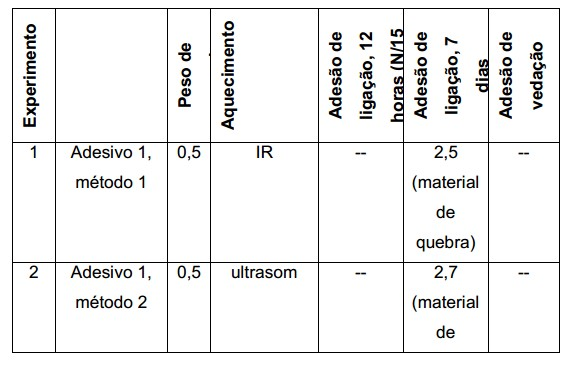
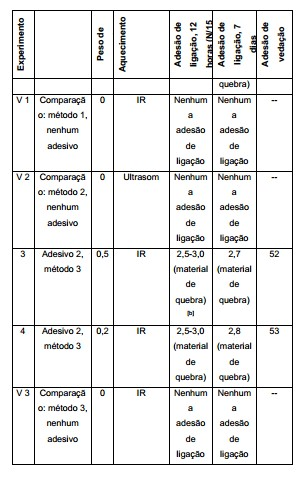
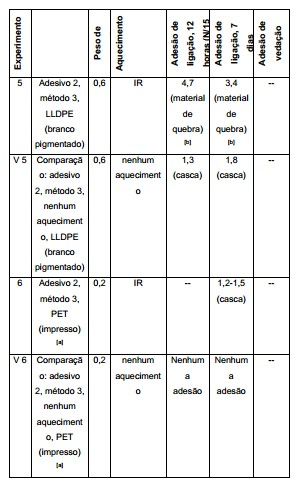
[0071] Os laminados, em que o substrato 2 foi submetido a um tratamento térmico, e em que os dois filmes foram adesivamente ligados um com o outro; foram todos visualmente sem objeções, transparentes, sem bolhas).[0071] The laminates, in which the substrate 2 was subjected to a heat treatment, and in which the two films were adhesively bonded with each other; they were all visually unobjectionable, transparent, bubble free).
[0072] Esses filmes adesivamente ligados foram, além disso, ainda firmemente ligados após ebulição, sem delaminação. Adesão de ligação permaneceu inalterada (teste de casca produziu material de quebra).[0072] These adhesive bonded films were furthermore still firmly bonded after boiling, without delamination. Bonding adhesion remained unchanged (peel test produced breaking material).
[0073] Laminados, dos quais substrato 2 foi aquecido, mas em que adesivo foi omitido, exibiram nenhuma adesão de ligação.[0073] Laminates, of which substrate 2 was heated, but in which adhesive was omitted, exhibited no bonding adhesion.
[0074] Laminados, dos quais os filmes foram adesivamente ligados, mas em que o substrato 2 não foi aquecido, exibiram pouca ou nenhuma adesão de ligação.[0074] Laminates, of which the films were adhesive-bonded, but on which substrate 2 was not heated, exhibited little or no bonding adhesion.
[0075] Observou-se que, além disso, os laminados que foram produzidos sem nenhum aquecimento de substrato 2, imperfeições visuais foram capazes de ocorrer. Quanto menor a quantidade de adesivo aplicada, mais provável que essas imperfeições ocorram.[0075] It was observed that, in addition, laminates that were produced without any heating of substrate 2, visual imperfections were able to occur. The smaller the amount of adhesive applied, the more likely these imperfections will occur.
Claims (6)
Applications Claiming Priority (3)
| Application Number | Priority Date | Filing Date | Title |
|---|---|---|---|
| DE102012213397 | 2012-07-31 | ||
| DE102012213397.6 | 2012-07-31 | ||
| PCT/EP2013/065492 WO2014019891A1 (en) | 2012-07-31 | 2013-07-23 | Adhesion method using thin adhesive layers |
Publications (2)
| Publication Number | Publication Date |
|---|---|
| BR112015001829A2 BR112015001829A2 (en) | 2017-07-04 |
| BR112015001829B1 true BR112015001829B1 (en) | 2021-03-09 |
Family
ID=48874288
Family Applications (1)
| Application Number | Title | Priority Date | Filing Date |
|---|---|---|---|
| BR112015001829-7A BR112015001829B1 (en) | 2012-07-31 | 2013-07-23 | adhesion method using thin adhesive layers |
Country Status (17)
| Country | Link |
|---|---|
| US (1) | US10934458B2 (en) |
| EP (2) | EP2880084B1 (en) |
| JP (2) | JP6408465B2 (en) |
| KR (1) | KR102216494B1 (en) |
| CN (1) | CN104508019B (en) |
| AU (1) | AU2013298716B2 (en) |
| BR (1) | BR112015001829B1 (en) |
| CA (1) | CA2878995A1 (en) |
| DK (1) | DK2880084T3 (en) |
| ES (1) | ES2745213T3 (en) |
| MX (1) | MX373456B (en) |
| PH (1) | PH12015500191A1 (en) |
| PL (1) | PL2880084T3 (en) |
| PT (1) | PT2880084T (en) |
| RU (1) | RU2641734C2 (en) |
| TW (1) | TW201406907A (en) |
| WO (1) | WO2014019891A1 (en) |
Families Citing this family (15)
| Publication number | Priority date | Publication date | Assignee | Title |
|---|---|---|---|---|
| CA2878995A1 (en) * | 2012-07-31 | 2014-02-06 | Henkel Ag & Co. Kgaa | Adhesion method using thin adhesive layers |
| DE102014201778A1 (en) * | 2014-01-31 | 2015-08-06 | Henkel Ag & Co. Kgaa | Method for bonding with adhesive layers with the aid of a laser |
| DE102014216633A1 (en) * | 2014-08-21 | 2016-02-25 | Henkel Ag & Co. Kgaa | Method for bonding two film-shaped substrates |
| DE102015220116A1 (en) | 2015-10-15 | 2017-04-20 | Hofer Textilveredelungs GmbH | Method and device for producing a multilayer material and a multilayer material produced in this way |
| DE202016002170U1 (en) * | 2016-04-05 | 2016-12-30 | Goldina Loy Gmbh & Co. Kg | Ringelband for decorating gifts |
| EP3672797B1 (en) * | 2017-08-24 | 2022-06-01 | BASF Coatings GmbH | Preparation of composite materials from film, solid adhesive polymer, and a polyurethane layer |
| GB2571256B (en) * | 2018-02-14 | 2020-08-19 | Camvac Ltd | Thermally laminated film |
| US11814558B2 (en) * | 2018-02-21 | 2023-11-14 | Basf Se | Method for producing articles coated with adhesive |
| CN113272142A (en) | 2019-01-11 | 2021-08-17 | 汉高股份有限及两合公司 | Method and device for bonding substrates in the form of films and composite obtained thereby |
| EP3733410B1 (en) | 2019-05-02 | 2025-03-26 | Henkel AG & Co. KGaA | Process for bonding flexible films and device for carrying out the same |
| TWI745721B (en) * | 2019-07-23 | 2021-11-11 | 凌巨科技股份有限公司 | Method for reducing substrate warpage |
| PL3936338T3 (en) * | 2020-07-07 | 2024-06-10 | Jesús Francisco Barberan Latorre | Method for adhesive bonding of substrates |
| FR3136243B1 (en) * | 2022-06-02 | 2024-05-03 | Safran Aerosystems | Process for attaching a layer of elastomeric material to an aluminum substrate. |
| JP7650471B2 (en) * | 2022-10-04 | 2025-03-25 | Okage株式会社 | Server device, seat, table, order code sheet, delivery support method, and program |
| DE102024117060A1 (en) * | 2024-06-18 | 2025-12-18 | Synhelion Germany GmbH | Reflector element for a reflector of a heliostat, reflector for a heliostat and method for manufacturing a reflector element |
Family Cites Families (34)
| Publication number | Priority date | Publication date | Assignee | Title |
|---|---|---|---|---|
| JPS6023713B2 (en) * | 1976-06-14 | 1985-06-08 | 凸版印刷株式会社 | How to attach melamine resin board |
| US4794030A (en) * | 1987-09-17 | 1988-12-27 | Celia Wayne M | Low density material bonded to a plastic substrate |
| DE3824286A1 (en) * | 1988-07-16 | 1990-02-08 | Wolff Walsrode Ag | Multilayer film for coating substrate by contacting and applying heat |
| GB2234704B (en) * | 1989-07-28 | 1993-04-14 | Toyo Kohan Co Ltd | Method for producing steel sheet laminated with a polyester resin film |
| DE4103347A1 (en) * | 1991-02-05 | 1992-08-06 | Bayer Ag | WAFER POLYURETHANE DISPERSIONS AND THEIR USE AS CASCASING ADHESIVES |
| DE9319153U1 (en) | 1993-12-14 | 1995-04-13 | Röhm GmbH, 64293 Darmstadt | Weather protection film and molded article coated with it |
| DE4419414A1 (en) | 1994-06-03 | 1995-12-07 | Feron Aluminium | Laminated paper mfr. for packaging |
| DK171704B1 (en) * | 1995-07-19 | 1997-04-01 | Max Otto Henri Rasmussen | Process for preparing a laminate, laminate obtainable by the method, use of this laminate and packaging comprising laminate |
| TW362067B (en) * | 1996-04-10 | 1999-06-21 | Toyo Kohan Co Ltd | Metal sheet with highly workable polyterephthalic acid ethyl hydroxide ester resin coating |
| JP3834887B2 (en) * | 1996-08-30 | 2006-10-18 | 豊田合成株式会社 | Method of sticking tape member to rubber extrusion |
| US20020006484A1 (en) * | 1998-05-20 | 2002-01-17 | Balasubramaniam Ramalingam | Adhesive and coating formulations for flexible packaging |
| DE19850143B4 (en) * | 1998-10-30 | 2004-05-13 | Advanced Photonics Technologies Ag | Method for laminating an adhesive tape to an elastic profiled body |
| ATE288457T1 (en) * | 1999-04-02 | 2005-02-15 | Basell Poliolefine Spa | CONNECTION OF METAL PARTS WITH PLASTIC MATERIAL |
| KR20020001860A (en) * | 1999-04-30 | 2002-01-09 | 메리 이. 보울러 | Composite Sheet |
| DE19954970A1 (en) * | 1999-11-16 | 2001-06-07 | Daimler Chrysler Ag | Coating agent for coating the surface of a substrate and method for coating the surface of a substrate |
| EP1268189A4 (en) * | 2000-03-15 | 2003-04-16 | Cpfilms Inc | Flame retardant optical films |
| JP2003025426A (en) * | 2001-07-17 | 2003-01-29 | Oji Paper Co Ltd | Method for producing pseudo-adhesive biaxially oriented polypropylene film |
| DE10201190A1 (en) | 2002-01-14 | 2003-07-31 | Henkel Kgaa | Thermal activation of foils |
| US6870006B2 (en) * | 2003-05-19 | 2005-03-22 | Henkel Kommanditgesellschaft Auf Aktien (Henkel Kgaa) | Water-soluble hotmelt adhesive |
| US20060078741A1 (en) * | 2004-10-12 | 2006-04-13 | Ramalingam Balasubramaniam Jr | Laminating adhesives containing microencapsulated catalysts |
| US8382937B2 (en) * | 2005-02-14 | 2013-02-26 | Henkel Corporation | Laminating adhesives based on triglyceride-derived polyols |
| JP4824333B2 (en) * | 2005-03-31 | 2011-11-30 | 日本バイリーン株式会社 | Manufacturing method of laminate |
| DE102005023280A1 (en) | 2005-05-20 | 2006-11-23 | Pütz GmbH + Co. Folien KG | cling film |
| DE102005028661B4 (en) | 2005-06-15 | 2010-10-28 | Kiv Kreis Gmbh | Method and device for producing a two-layer film and a two-layer film produced therewith |
| US9623631B2 (en) * | 2005-06-22 | 2017-04-18 | Henkel IP & Holding GmbH | Radiation-curable laminating adhesives |
| PT2208749E (en) * | 2006-07-10 | 2016-03-04 | Borealis Tech Oy | Biaxially oriented polypropylene films |
| US20100136347A1 (en) * | 2006-08-07 | 2010-06-03 | Simons J Brandon Simons | Two component solventless polyurethane laminating adhesives based on 1,4:3,6 dianhydrohexitols |
| DE102007015801A1 (en) * | 2007-03-30 | 2008-10-02 | Henkel Ag & Co. Kgaa | Radiation-crosslinking hotmelt adhesive |
| DE102009027329A1 (en) * | 2009-06-30 | 2011-01-05 | Henkel Ag & Co. Kgaa | 2-component laminating adhesive |
| DE102009045395A1 (en) | 2009-10-06 | 2011-04-07 | Tesa Se | Double-sided pressure-sensitive adhesive tape with flexible carrier |
| EP2489760B1 (en) * | 2009-10-14 | 2017-06-14 | Toyo Kohan Co., Ltd. | Method for producing resin-coated metal plate |
| DE102010028870A1 (en) * | 2010-05-11 | 2011-11-17 | Henkel Ag & Co. Kgaa | Film-forming radiation-crosslinking adhesive |
| JP5937830B2 (en) * | 2011-02-17 | 2016-06-22 | 株式会社日本触媒 | Adhesive resin composition |
| CA2878995A1 (en) * | 2012-07-31 | 2014-02-06 | Henkel Ag & Co. Kgaa | Adhesion method using thin adhesive layers |
-
2013
- 2013-07-23 CA CA2878995A patent/CA2878995A1/en not_active Abandoned
- 2013-07-23 PT PT13740274T patent/PT2880084T/en unknown
- 2013-07-23 KR KR1020157005279A patent/KR102216494B1/en active Active
- 2013-07-23 WO PCT/EP2013/065492 patent/WO2014019891A1/en not_active Ceased
- 2013-07-23 EP EP13740274.9A patent/EP2880084B1/en active Active
- 2013-07-23 JP JP2015524716A patent/JP6408465B2/en active Active
- 2013-07-23 MX MX2015001437A patent/MX373456B/en active IP Right Grant
- 2013-07-23 DK DK13740274.9T patent/DK2880084T3/en active
- 2013-07-23 RU RU2015106985A patent/RU2641734C2/en active
- 2013-07-23 EP EP17209269.4A patent/EP3323846A1/en active Pending
- 2013-07-23 BR BR112015001829-7A patent/BR112015001829B1/en active IP Right Grant
- 2013-07-23 PL PL13740274T patent/PL2880084T3/en unknown
- 2013-07-23 CN CN201380040092.XA patent/CN104508019B/en active Active
- 2013-07-23 AU AU2013298716A patent/AU2013298716B2/en active Active
- 2013-07-23 ES ES13740274T patent/ES2745213T3/en active Active
- 2013-07-26 TW TW102126798A patent/TW201406907A/en unknown
-
2015
- 2015-01-28 PH PH12015500191A patent/PH12015500191A1/en unknown
- 2015-01-30 US US14/609,832 patent/US10934458B2/en active Active
-
2018
- 2018-07-25 JP JP2018139159A patent/JP2018193561A/en active Pending
Also Published As
| Publication number | Publication date |
|---|---|
| TW201406907A (en) | 2014-02-16 |
| JP2018193561A (en) | 2018-12-06 |
| EP2880084B1 (en) | 2019-07-17 |
| KR20150040988A (en) | 2015-04-15 |
| BR112015001829A2 (en) | 2017-07-04 |
| WO2014019891A1 (en) | 2014-02-06 |
| JP6408465B2 (en) | 2018-10-17 |
| PL2880084T3 (en) | 2020-01-31 |
| CN104508019B (en) | 2018-12-21 |
| AU2013298716B2 (en) | 2016-09-29 |
| EP3323846A1 (en) | 2018-05-23 |
| KR102216494B1 (en) | 2021-02-16 |
| PH12015500191A1 (en) | 2015-04-06 |
| CN104508019A (en) | 2015-04-08 |
| MX373456B (en) | 2020-04-07 |
| MX2015001437A (en) | 2015-05-15 |
| JP2015530425A (en) | 2015-10-15 |
| US10934458B2 (en) | 2021-03-02 |
| RU2015106985A (en) | 2016-09-20 |
| AU2013298716A1 (en) | 2015-02-19 |
| PT2880084T (en) | 2019-08-21 |
| US20150140307A1 (en) | 2015-05-21 |
| DK2880084T3 (en) | 2019-10-21 |
| CA2878995A1 (en) | 2014-02-06 |
| RU2641734C2 (en) | 2018-01-22 |
| ES2745213T3 (en) | 2020-02-28 |
| EP2880084A1 (en) | 2015-06-10 |
Similar Documents
| Publication | Publication Date | Title |
|---|---|---|
| BR112015001829B1 (en) | adhesion method using thin adhesive layers | |
| ES2725702T3 (en) | Procedure and device for gluing two sheet-shaped substrates | |
| RU2012146605A (en) | METHOD FOR APPLYING SELF-ADHESIVE SHRINKING LABEL ON THE PRODUCT | |
| CN103826854B (en) | A kind of label laminate and the method and system of manufacture label laminate | |
| CN105524565A (en) | Anisotropic adhesive sheet | |
| WO2014041239A1 (en) | A linerless label | |
| CN106221601A (en) | The laminating adhesive material of Novel hot makes and technique for applying | |
| CN103547444B (en) | Stacking mesh sheet | |
| CN103857527A (en) | A label laminate and a method and a system for manufacturing a label laminate | |
| CN108473828A (en) | The transition zone with security feature of lateral edges for adhesive tape | |
| RU2447116C2 (en) | Method of fabricating laminar material for labels | |
| US20110020641A1 (en) | Tamper resistant security sealing tape and the process of manufacturing the same | |
| JP6690416B2 (en) | Laminate having hot-melt adhesive layer for electromagnetic induction heating, adhesive structure using the same, and peeling method | |
| JP4880993B2 (en) | Thermal labels and labeled containers | |
| US20220126559A1 (en) | Process for producing adhesive-free laminates |
Legal Events
| Date | Code | Title | Description |
|---|---|---|---|
| B06F | Objections, documents and/or translations needed after an examination request according [chapter 6.6 patent gazette] | ||
| B06F | Objections, documents and/or translations needed after an examination request according [chapter 6.6 patent gazette] | ||
| B06I | Publication of requirement cancelled [chapter 6.9 patent gazette] |
Free format text: ANULADA A PUBLICACAO CODIGO 6.6.1 NA RPI NO 2462 DE 13/03/2018 POR TER SIDO INDEVIDA. |
|
| B06U | Preliminary requirement: requests with searches performed by other patent offices: procedure suspended [chapter 6.21 patent gazette] | ||
| B09A | Decision: intention to grant [chapter 9.1 patent gazette] | ||
| B16A | Patent or certificate of addition of invention granted [chapter 16.1 patent gazette] |
Free format text: PRAZO DE VALIDADE: 20 (VINTE) ANOS CONTADOS A PARTIR DE 23/07/2013, OBSERVADAS AS CONDICOES LEGAIS. |