BR112013029345B1 - METHOD FOR INCREASING OIL RECOVERY FROM A PETROLEUM FORMATION WITHIN A RESERVOIR - Google Patents
METHOD FOR INCREASING OIL RECOVERY FROM A PETROLEUM FORMATION WITHIN A RESERVOIR Download PDFInfo
- Publication number
- BR112013029345B1 BR112013029345B1 BR112013029345-4A BR112013029345A BR112013029345B1 BR 112013029345 B1 BR112013029345 B1 BR 112013029345B1 BR 112013029345 A BR112013029345 A BR 112013029345A BR 112013029345 B1 BR112013029345 B1 BR 112013029345B1
- Authority
- BR
- Brazil
- Prior art keywords
- group
- fact
- carbon atoms
- foaming composition
- oil
- Prior art date
Links
Classifications
-
- C—CHEMISTRY; METALLURGY
- C09—DYES; PAINTS; POLISHES; NATURAL RESINS; ADHESIVES; COMPOSITIONS NOT OTHERWISE PROVIDED FOR; APPLICATIONS OF MATERIALS NOT OTHERWISE PROVIDED FOR
- C09K—MATERIALS FOR MISCELLANEOUS APPLICATIONS, NOT PROVIDED FOR ELSEWHERE
- C09K8/00—Compositions for drilling of boreholes or wells; Compositions for treating boreholes or wells, e.g. for completion or for remedial operations
- C09K8/58—Compositions for enhanced recovery methods for obtaining hydrocarbons, i.e. for improving the mobility of the oil, e.g. displacing fluids
- C09K8/584—Compositions for enhanced recovery methods for obtaining hydrocarbons, i.e. for improving the mobility of the oil, e.g. displacing fluids characterised by the use of specific surfactants
-
- E—FIXED CONSTRUCTIONS
- E21—EARTH OR ROCK DRILLING; MINING
- E21B—EARTH OR ROCK DRILLING; OBTAINING OIL, GAS, WATER, SOLUBLE OR MELTABLE MATERIALS OR A SLURRY OF MINERALS FROM WELLS
- E21B43/00—Methods or apparatus for obtaining oil, gas, water, soluble or meltable materials or a slurry of minerals from wells
- E21B43/16—Enhanced recovery methods for obtaining hydrocarbons
- E21B43/164—Injecting CO2 or carbonated water
-
- C—CHEMISTRY; METALLURGY
- C09—DYES; PAINTS; POLISHES; NATURAL RESINS; ADHESIVES; COMPOSITIONS NOT OTHERWISE PROVIDED FOR; APPLICATIONS OF MATERIALS NOT OTHERWISE PROVIDED FOR
- C09K—MATERIALS FOR MISCELLANEOUS APPLICATIONS, NOT PROVIDED FOR ELSEWHERE
- C09K8/00—Compositions for drilling of boreholes or wells; Compositions for treating boreholes or wells, e.g. for completion or for remedial operations
- C09K8/58—Compositions for enhanced recovery methods for obtaining hydrocarbons, i.e. for improving the mobility of the oil, e.g. displacing fluids
- C09K8/588—Compositions for enhanced recovery methods for obtaining hydrocarbons, i.e. for improving the mobility of the oil, e.g. displacing fluids characterised by the use of specific polymers
-
- C—CHEMISTRY; METALLURGY
- C09—DYES; PAINTS; POLISHES; NATURAL RESINS; ADHESIVES; COMPOSITIONS NOT OTHERWISE PROVIDED FOR; APPLICATIONS OF MATERIALS NOT OTHERWISE PROVIDED FOR
- C09K—MATERIALS FOR MISCELLANEOUS APPLICATIONS, NOT PROVIDED FOR ELSEWHERE
- C09K8/00—Compositions for drilling of boreholes or wells; Compositions for treating boreholes or wells, e.g. for completion or for remedial operations
- C09K8/58—Compositions for enhanced recovery methods for obtaining hydrocarbons, i.e. for improving the mobility of the oil, e.g. displacing fluids
- C09K8/594—Compositions used in combination with injected gas, e.g. CO2 orcarbonated gas
Landscapes
- Chemical & Material Sciences (AREA)
- Life Sciences & Earth Sciences (AREA)
- Engineering & Computer Science (AREA)
- General Life Sciences & Earth Sciences (AREA)
- Oil, Petroleum & Natural Gas (AREA)
- Materials Engineering (AREA)
- Organic Chemistry (AREA)
- Mining & Mineral Resources (AREA)
- Geology (AREA)
- Physics & Mathematics (AREA)
- Environmental & Geological Engineering (AREA)
- Fluid Mechanics (AREA)
- Chemical Kinetics & Catalysis (AREA)
- Geochemistry & Mineralogy (AREA)
- Emulsifying, Dispersing, Foam-Producing Or Wetting Agents (AREA)
- Cosmetics (AREA)
- Agricultural Chemicals And Associated Chemicals (AREA)
- Organic Low-Molecular-Weight Compounds And Preparation Thereof (AREA)
- Lubricants (AREA)
Abstract
aplicações e métodos de estabilidade de espuma melhorada. um método para melhorar a estabilidade da espuma em composições espumantes para utilização em aplicação de tratamento de campos petrolíferos, incluindo mas não se limitando ao uso em controle de mobilidade para a inundação de gás. o método compreende o passo de adição à uma composição espumante um estabilizador de espuma de fórmula (i): em que r1 é um grupo alquilamido ou um grupo alquil linear ou ramificado, r2 e r3 são individualmente hidrogênio ou um grupo metil, r4, r5 e r6 são individualmente hidrogênio ou um grupo hidroxi, com a condição de que pelo menos um dos grupos r4, r5 ou r6 é um grupo hidroxila, em que o grupo alquil tem mais do que cerca de 10 átomos de carbono. também divulgados são métodos para melhorar a estabilidade de espuma em uma composição espumante aquosa, que compreende o passo de adição de um estabilizador de espuma selecionado a partir de alquil dimetil betaína, alquil amidopropil hidroxi sulfobetaína ou alquil hidroxi sulfobetaína, em que o grupo alquil tem mais do que 10 átomos de carbono, ou 12 átomos de carbono, ou 16 átomos de carbono.applications and methods of improved foam stability. a method for improving foam stability in foaming compositions for use in oilfield treatment applications, including but not limited to use in mobility control for gas flooding. the method comprises the step of adding to a foaming composition a foam stabilizer of formula (i): wherein r1 is an alkyl starch group or a linear or branched alkyl group, r2 and r3 are individually hydrogen or a methyl group, r4, r5 and r6 are individually hydrogen or a hydroxy group, with the proviso that at least one of the groups r4, r5 or r6 is a hydroxyl group, in which the alkyl group has more than about 10 carbon atoms. also disclosed are methods for improving foam stability in an aqueous foaming composition, which comprises the step of adding a foam stabilizer selected from alkyl dimethyl betaine, alkyl amidopropyl hydroxy sulfobetaine or alkyl hydroxy sulfobetaine, where the alkyl group has more than 10 carbon atoms, or 12 carbon atoms, or 16 carbon atoms.
Description
Esta invenção refere-se à utilização de estabilizadores de espuma em sistemas aquosos e, mais particularmente, o uso de estabilizadores de espuma para reforçar o controle da mobilidade durante as operações de recuperação de óleo.This invention relates to the use of foam stabilizers in aqueous systems and, more particularly, the use of foam stabilizers to reinforce mobility control during oil recovery operations.
Reservatórios fraturados contendo óleo geralmente consistem de dois elementos distintos: a rede de fratura e uma matriz (por exemplo, uma matriz micro porosa). A rede de fratura é uma série de fissuras interligadas que podem facilmente transmitir fluidos (muito alta permeabilidade), mas compõem apenas uma pequena fração da porosidade total. A porção de matriz consiste na rocha porosa petrolífera que exibe tipicamente permeabilidade muito mais baixa do que a rede de fratura, mas tem a maior parte do volume total de poros do reservatório. Produção de hidrocarbonetos normalmente é menos eficiente em reservatórios fraturados. Durante a produção primária, as pressões do reservatório natural para produzir o óleo no local diminuem rapidamente, deixando cerca de mais de 90% do óleo original deixado ainda no lugar, preso na sua maioria da matriz (incluindo, por exemplo, rede micro porosa). De modo semelhante, os métodos convencionais de recuperação secundária não deslocam volumes substanciais de óleo "deixado no local".Fractured reservoirs containing oil generally consist of two distinct elements: the fracture network and a matrix (for example, a micro porous matrix). The fracture network is a series of interconnected cracks that can easily transmit fluids (very high permeability), but make up only a small fraction of the total porosity. The matrix portion consists of porous petroleum rock that typically exhibits much lower permeability than the fracture network, but has most of the total pore volume in the reservoir. Hydrocarbon production is usually less efficient in fractured reservoirs. During primary production, the pressures of the natural reservoir to produce the oil at the site decrease rapidly, leaving about more than 90% of the original oil left in place, trapped in most of the matrix (including, for example, micro porous mesh) . Similarly, conventional secondary recovery methods do not displace substantial volumes of oil "left in place".
Técnicas convencionais de inundação com água apresentam eficiência relativamente baixa nos reservatórios altamente fraturados. Inundação com água nesses reservatórios é caracterizada pelo avanço da água no início e aumentando rapidamente proporções de óleo-água a um nível não rentável. A água injetada tende a percorrer somente através das fraturas e não interagir com o óleo preso em rocha matriz (por exemplo, micro porosa). A água injetada não pode penetrar na matriz e, assim, deslocar e recuperar o óleo retido na matriz porosa. A água injetada tende a recuperar apenas o óleo deixado para trás no sistema de fratura após a produção primária. A interação limitada ou inexistente da água injetada com o óleo retido na matriz é também causada, em parte, pela porção de matriz não sendo molhada com água.Conventional water flooding techniques have relatively low efficiency in highly fractured reservoirs. Flooding with water in these reservoirs is characterized by the advance of water in the beginning and rapidly increasing oil-water proportions to an unprofitable level. The injected water tends to travel only through the fractures and does not interact with the oil trapped in the matrix rock (for example, micro porous). The injected water cannot penetrate the matrix and, thus, displace and recover the oil trapped in the porous matrix. The injected water tends to recover only the oil left behind in the fracture system after primary production. The limited or non-existent interaction of the water injected with the oil retained in the matrix is also caused, in part, by the matrix portion not being wetted with water.
A matriz não vai absorver ou tomar espontaneamente em água. Isto é em grande parte devido à tendência de mobilidade da água em zonas de elevada permeabilidade, e não a zonas de baixa permeabilidade (que tem a maior parte do óleo retido).The matrix will not absorb or take spontaneously in water. This is largely due to the tendency of water mobility in areas of high permeability, and not in areas of low permeability (which has most of the oil retained).
Uma abordagem para aumentar a penetração de uma fase de água com as zonas da matriz de óleo preso tem sido adicionar um tensoativo à água para modificar a molhabilidade do carbonato a partir do óleo molhado para água húmida. Pesquisa anterior e experiência de campo tem demonstrado que a inclusão de uma baixa concentração do tensoativo devidamente selecionado à água irá reduzir a tensão interfacial e também criar agora uma condição úmida por água na área perto da face de fratura. Com esta condição alterada, a fase aquosa, em seguida, penetra certa distância na matriz porosa e, assim, empurra para fora um pouco do óleo que estava dentro dos poros. Neste processo de imbibição em contracorrente, o óleo que é deslocado da matriz, em seguida, move-se para o sistema de fraturas. Uma vez empurrado para dentro do sistema de fraturas, o óleo pode ser deslocado facilmente para um poço de produção. Em um processo de embebição em contracorrente, com ou sem a adição de um tensoativo de umedecimento por água, a taxa de recuperação de óleo é dependente das características da pressão capilar da matriz de pedra porosa. Isto é, o processo de embebição é essencialmente não afetado por meio de técnicas convencionais de controle das operações de campo, tais como a seleção das pressões e taxas de fluxo.One approach to increase the penetration of a water phase with the trapped oil matrix zones has been to add a surfactant to the water to modify the wettability of carbonate from wet oil to wet water. Previous research and field experience has shown that adding a low concentration of the properly selected surfactant to water will reduce interfacial tension and also now create a wet condition in the area near the fracture face. With this altered condition, the aqueous phase then penetrates a certain distance in the porous matrix and, thus, pushes out some of the oil that was inside the pores. In this countercurrent imbibition process, the oil that is displaced from the matrix then moves to the fracture system. Once pushed into the fracture system, the oil can be moved easily to a production well. In a countercurrent soaking process, with or without the addition of a water-wetting surfactant, the oil recovery rate is dependent on the capillary pressure characteristics of the porous stone matrix. That is, the imbibition process is essentially unaffected by conventional techniques for controlling field operations, such as the selection of pressures and flow rates.
Técnicas para o uso de tensoativos na recuperação de óleo na formação de carbonato são divulgadas por G. Hirasaki e D. L Zhang em "Surface Chemistry of Oil Recovery from Fractured, Oil-Wet Carbonate Formations" (2000); por Austad e Standes em "Spontaneous Imbibition of Water onto Oil-Wet Carbonates", Journal of Petroleum Science and Engineering, vol. 39, páginas 363-376, (2003); por W.W. Weiss em "Artificail Intelligence Used to Evaluate 23 Single-Well Surfactant Soak Treatments", SPE Reservoir Evaluation & Engineering, Junho de 2006; Patente U.S. nos 2.792.894; 4.364.431; 4.842.065; 5.247.993 e Pedido de Patente Publicado dos EUA no 2007/0215347 A1.Techniques for using surfactants to recover oil in the formation of carbonate are disclosed by G. Hirasaki and D. L Zhang in "Surface Chemistry of Oil Recovery from Fractured, Oil-Wet Carbonate Formations" (2000); by Austad and Standes in "Spontaneous Imbibition of Water onto Oil-Wet Carbonates", Journal of Petroleum Science and Engineering, vol. 39, pages 363-376, (2003); by W.W. Weiss in "Artificail Intelligence Used to Evaluate 23 Single-Well Surfactant Soak Treatments", SPE Reservoir Evaluation & Engineering, June 2006; U.S. Patent No. 2,792,894; 4,364,431; 4,842,065; 5,247,993 and U.S. Patent Application No. 2007/0215347 A1.
Outra abordagem é a utilização de técnicas de inundação tal como de gás, ar, CO2, inundação de gás natural, ou qualquer combinação dos mesmos, que é uma forma de recuperação avançada de petróleo (EOR). Geralmente, EOR com CO2 é onde o gás CO2 é bombeado/injetado para dentro de um poço de injeção ou produção para uma formação subterrânea (por exemplo, reservatório de fratura) e, sob determinadas condições físicas, mistura de forma miscível com óleo retido ou deixado no local. Isto permite que o óleo deixado no local seja mais facilmente deslocado para dentro das zonas de elevada permeabilidade e recuperado. O CO2, a alta pressão e temperatura do reservatório, mistura de forma miscível com o óleo para formar um fluido de baixa viscosidade que pode ser mais facilmente mobilizado. Além disso, CO2 tem a capacidade de invadir zonas anteriormente não invadidas por água, assim como liberar e reduzir óleo retido. O óleo residual e gás misturados pode também ser substituído por uma fase de perseguição, por exemplo, com água em um processo WAG (água alternando gás).Another approach is to use flooding techniques such as gas, air, CO2, flooding of natural gas, or any combination thereof, which is a form of advanced oil recovery (EOR). Generally, EOR with CO2 is where the CO2 gas is pumped / injected into an injection or production well for an underground formation (for example, fracture reservoir) and, under certain physical conditions, mixes miscibly with retained oil or left in place. This allows the oil left in place to be more easily moved into the areas of high permeability and recovered. CO2, the high pressure and temperature of the reservoir, mixes miscibly with the oil to form a low viscosity fluid that can be more easily mobilized. In addition, CO2 has the ability to invade areas previously not invaded by water, as well as to release and reduce trapped oil. The mixed waste oil and gas can also be replaced by a chase phase, for example, with water in a WAG process (water alternating gas).
Também podem ser utilizadas inundações de nitrogênio e gases de combustão (gases não-hidrocarbonetos). O nitrogênio, no entanto, tem uma viscosidade baixa, com fraca miscibilidade com óleo, e exige uma pressão muito mais elevada para gerar ou desenvolver miscibilidade, em comparação com a inundação de CO2: Como tal, inundações de nitrogênio e de gás de combustão são geralmente utilizados como um "gás de arraste" em inundação de miscível em hidrocarboneto e gás CO2 (ou seja, nitrogênio ou outros gases de baixo custo, sendo utilizados para fornecer uma unidade de gás em que uma porção significativa do volume do reservatório é preenchida com tal gás (es)). No entanto, enquanto que o nitrogênio pode ser utilizado como gás de arraste, que é entendido que o nitrogênio e/ou gás de combustão pode ser utilizado em qualquer técnica de inundação a gás aqui descrita.Floods of nitrogen and flue gases (non-hydrocarbon gases) can also be used. Nitrogen, however, has a low viscosity, with poor miscibility with oil, and requires a much higher pressure to generate or develop miscibility, compared to the CO2 flood: As such, floods of nitrogen and flue gas are generally used as a "carrier gas" in a miscible flood in hydrocarbon and CO2 gas (ie nitrogen or other low-cost gases, being used to supply a gas unit in which a significant portion of the reservoir volume is filled with such gas (s)). However, while nitrogen can be used as carrier gas, it is understood that nitrogen and / or flue gas can be used in any gas flooding technique described here.
Como explicado acima, um reservatório fraturado é extremamente heterogêneo e tem zonas de alta permeabilidade na proximidade de zonas de baixa permeabilidade. Assim, técnicas de inundação com CO2 e de gás semelhante - análogas à algumas técnicas de inundações à água - sofrem pela tendência de o gás injetado varrer o óleo a partir de apenas uma área limitada do reservatório, isto é, das zonas de alta permeabilidade. Isto ocorre, em parte, porque a viscosidade de CO2 em condições de reservatório é muito mais baixa do que a da maioria dos óleos, o que limita a eficiência de varrimento do deslocamento e, por conseguinte, a recuperação do petróleo.As explained above, a fractured reservoir is extremely heterogeneous and has areas of high permeability in the vicinity of areas of low permeability. Thus, CO2 and similar gas flooding techniques - analogous to some water flooding techniques - suffer from the tendency for the injected gas to sweep the oil from only a limited area of the reservoir, that is, from areas of high permeability. This is partly because the viscosity of CO2 under reservoir conditions is much lower than that of most oils, which limits the sweeping efficiency of displacement and, therefore, oil recovery.
Assim, uma abordagem para aumentar a penetração de um gás no interior dos blocos de matriz contendo óleo retido foi de injetar espuma sob pressão dentro da formação petrolífera. A espuma é geralmente formada por arejamento de uma mistura de tensoativo e água. As espumas tendo viscosidade alta aparente e aumentada vão reduzir a mobilidade da água/soluções de tensoativos para as grandes fraturas ou zonas de alta permeabilidade efetivamente fechando-as e/ou fornecendo uma barreira à entrada. Com a condição alterada, um gás introduzido subsequentemente (tal como CO2, gás natural) é desviado e/ou capaz de penetrar na matriz porosa de baixa permeabilidade. Em algumas formas de realização especiais, o reservatório é um reservatório não fraturado, mas um reservatório petrolífero contendo zonas de alta permeabilidade que ocorrem naturalmente e zonas de baixa permeabilidade que ocorrem naturalmente.Thus, an approach to increase the penetration of a gas into the matrix blocks containing retained oil was to inject foam under pressure into the petroleum formation. The foam is usually formed by aerating a mixture of surfactant and water. Foams having high apparent and increased viscosity will reduce the mobility of water / surfactant solutions for large fractures or areas of high permeability by effectively closing them and / or providing a barrier to entry. With the condition changed, a subsequently introduced gas (such as CO2, natural gas) is bypassed and / or capable of penetrating the low permeability porous matrix. In some special embodiments, the reservoir is a non-fractured reservoir, but an oil reservoir containing naturally occurring areas of high permeability and naturally occurring areas of low permeability.
Um problema com o uso de espumas de controle de mobilidade de gás, no entanto, é a inerentemente vida curta das espumas. Por exemplo, em aplicações em campos de petróleo, as espumas dissipam relativamente rapidamente diminuindo a eficácia de bloquear aos elevados grandes fraturas altamente permeáveis e qualquer melhoramento na recuperação de óleo. Seria desejável dispor de um método para aumentar a estabilidade de espuma em aplicações aquosas, tal como em aplicações para campos petrolíferos.A problem with the use of gas mobility control foams, however, is the inherently short life of the foams. For example, in oil field applications, foams dissipate relatively quickly, decreasing the effectiveness of blocking high, highly permeable high fractures and any improvement in oil recovery. It would be desirable to have a method for increasing foam stability in aqueous applications, such as in applications for oil fields.
Foi descoberto que o uso de estabilizadores de espuma e/ou agentes tensoativos descritos aqui melhoram significativamente o desempenho em fluidos de tratamento de campos petrolíferos ou aplicações, em particular, no controle da mobilidade em gás de inundação.It has been found that the use of foam stabilizers and / or surfactants described here significantly improves performance in oilfield treatment fluids or applications, in particular, in controlling flood gas mobility.
O problema da estabilidade de espuma em alguns casos tem sido direcionado à utilização de ambos os polímeros naturais e sintéticos; mas a utilização de tais polímeros enfrenta inconvenientes. Por exemplo, devido aos seus elevados pesos moleculares estes polímeros são difíceis de formular em formulações tensoativas. Sua fraca hidratação e capacidade de dispersão, incompatibilidade dos polímeros (nomeadamente, catiônicos) com tensoativos aniônicos utilizados frequentemente, alta sensibilidade à concentração versus desempenho em espuma contribui para a dificuldade no uso desses polímeros como aditivos em melhora na formação de espuma em soluções aquosas de espuma. Mesmo quando formulados idealmente, estes polímeros são ainda limitados pela expansão de espuma, devido principalmente às suas fracas taxas de difusão para as interfaces de criação da espuma.The problem of foam stability in some cases has been directed to the use of both natural and synthetic polymers; but the use of such polymers faces drawbacks. For example, due to their high molecular weights, these polymers are difficult to formulate in surfactant formulations. Its poor hydration and dispersion capacity, incompatibility of polymers (namely, cationic) with anionic surfactants used frequently, high sensitivity to concentration versus foam performance contributes to the difficulty in using these polymers as additives in improving foaming in aqueous solutions of foam. Even when ideally formulated, these polymers are still limited by foam expansion, mainly due to their low diffusion rates for the foam creation interfaces.
Em um aspecto, é aqui descrito um método para aumentar a recuperação de óleo a partir de uma formação petrolífera dentro de um reservatório, compreendendo: (a) introdução de uma composição espumante sob pressão na formação petrolífera, (b) introdução de um gás sob pressão na formação petrolífera, em que a presença da composição espumante afeta o fluxo de gás no interior da formação petrolífera e (c) extração de petróleo através de um poço para o reservatório. A composição espumante pode compreender um estabilizador de espuma. O estabilizador de espuma pode ser alquil dimetil betaina, alquil amidopropil hidroxi sulfobetaína ou alquil hidroxi sulfobetaína ou qualquer combinação destes, em que o grupo alquil tem mais de 10 átomos de carbono, ou 12 átomos de carbono, ou em outra forma de realização, de 16 átomos de carbono. Em outras formas de realização, a composição espumante pode compreender, opcionalmente, um gás espumante. Em outras formas de realização, a composição espumante pode compreender água. Em outras formas de realização, a composição espumante pode compreender qualquer uma ou uma combinação selecionada a partir de um gás espumante, água ou um ou mais agentes tensoativos ou tensoativos adicionais. Em algumas formas de realização, os componentes da composição espumante são misturados antes de serem introduzidos dentro do reservatório ou formação de formação de óleo. Em outras formas de realização, um ou mais componentes da composição espumante são injetados na formação petrolífera em momentos diferentes (por exemplo, sequencialmente) e, assim, tornam-se misturado no fundo do poço.In one aspect, a method for increasing oil recovery from an oil formation within a reservoir is described herein, comprising: (a) introducing a foaming composition under pressure into the oil formation, (b) introducing a gas under pressure in the oil formation, in which the presence of the foaming composition affects the gas flow inside the oil formation and (c) extraction of oil through a well into the reservoir. The foaming composition may comprise a foam stabilizer. The foam stabilizer can be alkyl dimethyl betaine, alkyl amidopropyl hydroxy sulfobetaine or alkyl hydroxy sulfobetaine or any combination thereof, where the alkyl group has more than 10 carbon atoms, or 12 carbon atoms, or in another embodiment, of 16 carbon atoms. In other embodiments, the foaming composition may optionally comprise a foaming gas. In other embodiments, the foaming composition may comprise water. In other embodiments, the foaming composition may comprise any one or a combination selected from a foaming gas, water or one or more additional surfactants or surfactants. In some embodiments, the components of the foaming composition are mixed before being introduced into the reservoir or formation of oil formation. In other embodiments, one or more components of the foaming composition are injected into the oil formation at different times (for example, sequentially) and thus become mixed at the bottom of the well.
Em outro aspecto, são aqui descrito métodos para aumentar a recuperação de óleo de uma formação petrolífera dentro de um reservatório, compreendendo: (a) introdução de uma composição espumante sob pressão na formação petrolífera, (b) introdução de um gás sob pressão na formação petrolífera, em que a presença da composição de formação de espuma afeta o fluxo de gás no interior da formação petrolífera e (c) extração de petróleo através de um poço para o reservatório, em que a composição espumante compreende um estabilizador de espuma que tem a fórmula (I):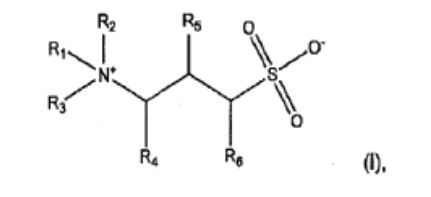
Em uma forma de realização, o grupo alquilamido tem a fórmula (II):
Em uma forma de realização, o estabilizador de espuma é de fórmula (III):
Em ainda outro aspecto, são aqui descritos métodos para aumentar a estabilidade da espuma em uma composição espumante aquosa, compreendendo o passo de adicionar a tal composição espumante um estabilizador de espuma de fórmula (I):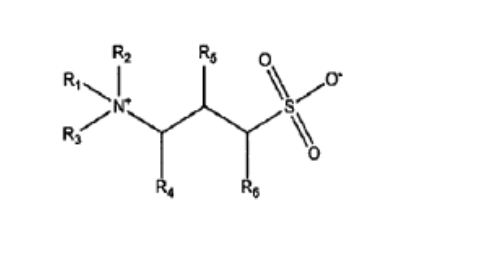
Em uma forma de realização, o estabilizador de espuma é de fórmula (III):
Em ainda outro aspecto, são aqui descritos métodos para aumentar a estabilidade da espuma em composições aquosas espumantes, compreendendo o passo de adição a uma composição espumante um estabilizador de espuma selecionado 25 a partir de alquil dimetil betaína, alquil amidopropil hidroxi sulfobetaína, alquil hidroxi sulfobetaina ou qualquer combinação destes, em que o grupo alquil tem mais do que 10 átomos de carbono. A composição espumante aquosa pode ser parte de um fluido de tratamento de campo de 30 petróleo.In yet another aspect, methods for increasing foam stability in aqueous foaming compositions are described herein, the step of adding to a foaming composition a foam stabilizer selected from alkyl dimethyl betaine, alkyl amidopropyl hydroxy sulfobetaine, alkyl hydroxy sulfobetaine or any combination of these, where the alkyl group has more than 10 carbon atoms. The aqueous foaming composition may be part of an oil field treatment fluid.
São aqui descritos estabilizadores de espuma ou tensoativos que são encontrados para aumentar a espuma, taxa de expansão de espuma e estabilidade de espuma, dentro de um intervalo mais amplo de concentrações, bem como conferir outros benefícios para as formulações aquosas. Devido a pesos moleculares muito mais baixos em comparação com os polímeros utilizados tradicionalmente, os tensoativos aqui descritos são facilmente incorporados em soluções espumantes. Em uma forma de realização, certos tensoativos zwiteriônicos/anfotéricos são compatíveis com (formação de espuma) tensoativos aniônicos usados na maioria das formulações utilizadas para a geração de espumas.Foam stabilizers or surfactants that are found to increase foam, foam expansion rate and foam stability within a broader range of concentrations are described herein, as well as conferring other benefits to aqueous formulations. Due to much lower molecular weights compared to the polymers traditionally used, the surfactants described here are easily incorporated into foaming solutions. In one embodiment, certain zwitterionic / amphoteric surfactants are compatible with (foaming) anionic surfactants used in most formulations used for the generation of foams.
Tal como aqui utilizado, o termo "alquil" significa um grupo monovalente saturado de cadeia linear ou ramificada de hidrocarboneto, tipicamente um radical hidrocarboneto monovalente (C1-C20), tal como, por exemplo, saturado, metil, etil, n-propil, iso-propil, n -butil, sec-butil, t- butil, pentil, ou n-hexil, que pode opcionalmente ser substituído em um ou mais dos átomos de carbono do radical. Em uma forma de realização, um radical alquil é substituído em um ou mais átomos de carbono do radical com hidroxi, alcoxi, amino, halo, carboxi, ou fosfono, tais como, por exemplo, hidroximetil, hidroxietil, metoximetil, etoximetil, isopropoxietil, aminometil, clorometil ou triclorometil, carboxietil, ou fosfonometil. O termo "alquil" pode também significar uma cadeia linear insaturada, cadeia ramificada, ou radical hidrocarboneto cíclico, que contém uma ou mais ligações duplas carbono-carbono, tais como, por exemplo, etenil, 1-propenil, ou 2-propenil, que pode facultativamente ser substituído em um ou mais dos átomos de carbono do radical.As used herein, the term "alkyl" means a saturated straight-chain or branched hydrocarbon monovalent group, typically a monovalent (C1-C20) hydrocarbon radical, such as, for example, saturated, methyl, ethyl, n-propyl, iso-propyl, n-butyl, sec-butyl, t-butyl, pentyl, or n-hexyl, which can optionally be substituted on one or more of the carbon atoms of the radical. In one embodiment, an alkyl radical is substituted on one or more carbon atoms of the radical with hydroxy, alkoxy, amino, halo, carboxy, or phosphono, such as, for example, hydroxymethyl, hydroxyethyl, methoxymethyl, ethoxymethyl, isopropoxyethyl, aminomethyl, chloromethyl or trichloromethyl, carboxyethyl, or phosphonomethyl. The term "alkyl" can also mean an unsaturated linear chain, branched chain, or cyclic hydrocarbon radical, which contains one or more carbon-carbon double bonds, such as, for example, ethenyl, 1-propenyl, or 2-propenyl, which it can optionally be substituted on one or more of the carbon atoms of the radical.
Tal como aqui utilizado, o termo "alcoxil" significa um radical oxi que é substituído com um grupo alquil, tal como, por exemplo, metoxil, etoxil, propoxil, isopropoxil, ou butoxi, o qual pode, opcionalmente, ser ainda substituído por um ou mais átomos de carbono do radical.As used herein, the term "alkoxy" means an oxy radical that is substituted with an alkyl group, such as, for example, methoxy, ethoxy, propoxy, isopropoxy, or butoxy, which can optionally be further substituted by or more carbon atoms of the radical.
Tal como aqui utilizado, o termo "cicloalquil" significa um radical hidrocarboneto cíclico saturado, tipicamente um grupo (C1-C18), radical hidrocarboneto cíclico saturado, tais como, por exemplo, ciclo-hexil ou ciclooctil, o qual pode, opcionalmente, ser substituído por um ou mais do carbono átomos do radical.As used herein, the term "cycloalkyl" means a saturated cyclic hydrocarbon radical, typically a group (C1-C18), saturated cyclic hydrocarbon radical, such as, for example, cyclohexyl or cyclooctyl, which can optionally be replaced by one or more of the carbon atoms of the radical.
Tal como aqui utilizado, o termo "aril" significa um hidrocarboneto insaturado monovalente contendo um ou mais anéis de carbono de seis membros, em que a insaturação pode ser representada por três ligações duplas conjugadas, tais como, por exemplo, fenil, naftil, antril, fenantril, ou bifenil, que pode opcionalmente ser substituído em um ou mais dos átomos de carbono do anel. Em uma forma de realização, um radical aril é substituinte de um ou mais átomos de carbono do radical com hidroxi, alquil, halo, haloalquil, ou amino, tal como, por exemplo, metilfenil, dimetilfenil, hidroxifenil, clorofenil, triclorometilfenil, ou aminofenil.As used herein, the term "aryl" means a monovalent unsaturated hydrocarbon containing one or more six-membered carbon rings, where unsaturation can be represented by three conjugated double bonds, such as, for example, phenyl, naphthyl, anthryl , phenanthryl, or biphenyl, which can optionally be substituted on one or more of the ring's carbon atoms. In one embodiment, an aryl radical is a substituent of one or more carbon atoms of the radical with hydroxy, alkyl, halo, haloalkyl, or amino, such as, for example, methylphenyl, dimethylphenyl, hydroxyphenyl, chlorophenyl, trichloromethylphenyl, or aminophenyl .
Tal como aqui utilizado, o termo "aralquil" significa um grupo alquil substituído com um ou mais grupos aril, tais como, por exemplo, fenilmetil, feniletil, ou trifenilmetil, o qual pode, opcionalmente, ser ainda substituído por um ou mais dos átomos de carbono do radical.As used herein, the term "aralkyl" means an alkyl group substituted with one or more aryl groups, such as, for example, phenylmethyl, phenylethyl, or triphenylmethyl, which can optionally be further substituted by one or more of the atoms carbon of the radical.
Tal como aqui utilizado, o termo "alcaril" significa um grupo aril substituído com um ou mais grupos alquil, tais como, por exemplo, metilfenil, dimetilfenil, ou trimetilfenil, o qual pode, opcionalmente, ser ainda substituído por um ou mais dos átomos de carbono do radical.As used herein, the term "alkaryl" means an aryl group substituted with one or more alkyl groups, such as, for example, methylphenyl, dimethylphenyl, or trimethylphenyl, which can optionally be further substituted by one or more of the atoms carbon of the radical.
Tal como aqui utilizado, a indicação de que um radical pode ser "opcionalmente substituído" ou "opcionalmente ainda substituído" significa, em geral, que a menos que ainda limitado, quer explicitamente ou pelo contexto de tal referência, que tais radicais podem ser substituídos com um ou mais grupos substituintes orgânicos ou inorgânicos, tais como, por exemplo, alquil, aril, aralquil, alcaril, um heteroátomo, ou heterociclil, ou com um ou mais grupos funcionais que são capazes de coordenação com íons metálicos, tais como hidroxila, carbonila, carboxila, amino, imino, amido, ácido fosfônico, ácido sulfônico, ou arsenato, ou ésteres orgânicos e inorgânicos destes, tais como, por exemplo, sulfato ou fosfato, ou os seus sais.As used herein, the indication that a radical may be "optionally substituted" or "optionally still substituted" means, in general, that unless still limited, either explicitly or by the context of such reference, that such radicals may be substituted with one or more organic or inorganic substituent groups, such as, for example, alkyl, aryl, aralkyl, alkaryl, a heteroatom, or heterocyclyl, or with one or more functional groups that are capable of coordination with metal ions, such as hydroxyl, carbonyl, carboxyl, amino, imino, starch, phosphonic acid, sulfonic acid, or arsenate, or organic and inorganic esters thereof, such as, for example, sulfate or phosphate, or their salts.
Tal como aqui utilizado, o termo "(Cx-Cy)", em referência a um grupo orgânico, em que x e y são cada um inteiros, indica que o grupo pode conter de x átomos de carbono a y átomos de carbono por grupo.As used herein, the term "(Cx-Cy)", in reference to an organic group, where x and y are each integers, indicates that the group may contain from x carbon atoms to y carbon atoms per group.
Tal como aqui utilizado, o termo "controle da mobilidade" é para ser interpretado no seu sentido mais lato e pretende também incluir um processo em que a eficiência de varrimento de um reservatório ou formação petrolífera é melhorada.As used herein, the term "mobility control" is to be interpreted in its broadest sense and is also intended to include a process in which the sweeping efficiency of a reservoir or oil formation is improved.
Em um aspecto, são aqui descritos métodos para melhorar a estabilidade da espuma em uma composição espumante aquosa, que compreende o passo de adição à composição espumante aquosa de um estabilizador de espuma. Em um aspecto, são aqui descritos métodos para aumentar a recuperação de óleo de uma formação petrolífera de dentro de um reservatório, que compreende a introdução de uma composição espumante em uma formação petrolífera; introdução de um gás sob pressão na formação petrolífera; e extração de petróleo através de um poço no reservatório, em que a composição espumante introduzida na formação petrolífera afeta ou desvia o fluxo de gás para as zonas de baixa permeabilidade da formação petrolífera. Em uma forma de realização, a utilização das composições espumantes aqui descritas é usada como controle de mobilidade.In one aspect, methods for improving foam stability in an aqueous foaming composition are described herein, comprising the step of adding a foam stabilizer to the aqueous foaming composition. In one aspect, methods for increasing oil recovery from an oil formation from within a reservoir are described herein, which comprises introducing a foaming composition into an oil formation; introduction of a gas under pressure in the oil formation; and extraction of oil through a well in the reservoir, in which the foaming composition introduced in the oil formation affects or diverts the gas flow to the areas of low permeability of the oil formation. In one embodiment, the use of the foaming compositions described herein is used as a mobility control.
Em uma forma de realização, a composição espumante constitui por água e um estabilizador de espuma, tal como aqui descrito. Em uma outra forma de realização, a composição espumante compreende água e um gás espumante. O gás espumante pode ser qualquer gás que confere propriedades espumantes para a composição espumante, tais como nitrogênio, ar, dióxido de carbono, vapor, gás natural ou qualquer combinação dos mesmos. Entende-se que a composição espumante pode compreender outros componentes, incluindo, por exemplo, um ou mais tensoativos. Os tensoativos são tipicamente um ou mais tensoativos não iônicos, um ou mais tensoativos catiônicos, um ou mais tensoativos anfotéricos, um ou mais tensoativos zwitteriônicos, um ou mais agentes tensoativos aniônicos ou qualquer combinação dos mesmos. Em uma forma de realização particular, a composição espumante é constituída pelo estabilizador de espuma, água e pelo menos um tensoativo aniônico utilizado como um agente espumante. Em uma forma de realização, o tensoativo aniônico é uma alquil olefina sulfonada.In one embodiment, the foaming composition consists of water and a foam stabilizer, as described herein. In another embodiment, the foaming composition comprises water and a foaming gas. The foaming gas can be any gas that gives foaming properties to the foaming composition, such as nitrogen, air, carbon dioxide, steam, natural gas or any combination thereof. It is understood that the foaming composition may comprise other components, including, for example, one or more surfactants. Surfactants are typically one or more nonionic surfactants, one or more cationic surfactants, one or more amphoteric surfactants, one or more zwitterionic surfactants, one or more anionic surfactants or any combination thereof. In a particular embodiment, the foaming composition consists of the foam stabilizer, water and at least one anionic surfactant used as a foaming agent. In one embodiment, the anionic surfactant is a sulfonated alkyl olefin.
Em uma forma de realização, a composição espumante pode ser ou ser parte de qualquer espuma industrial ou utilizada comercialmente, incluindo, mas não se limitado às espumas de combate a incêndio, produtos de limpeza de espuma, espumas industriais, espumas agrícolas, espumas usadas em casa e produtos de cuidados pessoais.In one embodiment, the foaming composition may be or be part of any industrial foam or used commercially, including, but not limited to, fire fighting foams, foam cleaning products, industrial foams, agricultural foams, foams used in home and personal care products.
Em outro aspecto, são aqui descrito métodos para melhorar a recuperação de óleo de uma formação petrolífera utilizando um estabilizador de espuma. Em uma forma de realização, o estabilizador de espuma aqui descrito aumenta a estabilidade da espuma de um fluido de tratamento de poços de petróleo. Em uma outra forma de realização, o estabilizador de espuma aqui descrito aumenta a estabilidade da espuma de uma composição espumante, qual composição espumante pode ser utilizada como parte de um fluido de tratamento de poços de petróleo. A composição espumante também pode ser utilizada em conjunto com um fluido de tratamento de poços de petróleo em um processo de múltiplos passos para recuperar o óleo de uma formação.In another aspect, methods for improving oil recovery from an oil formation using a foam stabilizer are described herein. In one embodiment, the foam stabilizer described herein increases the foam stability of an oil well treatment fluid. In another embodiment, the foam stabilizer described herein increases the foam stability of a foaming composition, which foaming composition can be used as part of an oil well treatment fluid. The foaming composition can also be used in conjunction with an oil well treatment fluid in a multi-step process to recover oil from a formation.
O estabilizador de espuma pode ser parte de um pacote (por exemplo, pacote de tensoativo) introduzido no interior da formação, por si só ou com outra composição de fluido, ou fluidos, por exemplo, a composição espumante ou o fluido de tratamento de poços de petróleo.The foam stabilizer can be part of a package (for example, surfactant package) introduced into the formation, either alone or with another fluid composition, or fluids, for example, the foaming composition or well treatment fluid of oil.
Em uma forma de realização, são aqui descritos processos para melhorar a recuperação do óleo de uma formação petrolífera que compreende o passo de adicionar à composição espumante aquosa ou fluido de tratamento de poços de petróleo (ou ambos) um estabilizador de espuma. Em o estabilizador de espuma é de fórmula (I):
Em uma forma de realização, o grupo alquil linear ou ramificado é um grupo alquil C10-C24, em outra forma de realização, um grupo alquil C12-C22, em ainda uma outra forma de realização, um grupo alquil C14-C22, e em ainda uma outra forma de realização, um grupo alquil C16-C18. R2 e R3 são individualmente hidrogênios, um grupo metil ou um grupo hidroxietil. Em uma forma de realização, R2 e R3 são ambos grupos metil. R4, R5 e R6 são individualmente hidrogênio ou um grupo hidroxi, com a condição de que pelo menos um de R4, R5 ou R6 é um grupo hidroxila. Em uma forma de realização particular, R5 representa um grupo hidroxila, e R4 e R6 são ambos hidrogênio. Em tal forma de realização particular, a estrutura tem a fórmula (III):
Em uma forma de realização, o grupo alquilamido tem a fórmula (II):
"N" pode ser qualquer número inteiro de entre cerca de 1 e 15, mais tipicamente um número inteiro de entre cerca de 2 a cerca de 10. Em uma forma de realização, "n" é um número inteiro de entre 3 a cerca de 5. Em uma outra forma de realização "n" é um número inteiro de entre cerca de 2 e cerca de 4. Em uma forma de realização, "n" é um número inteiro de 3, e em uma outra forma de realização "n" é um número inteiro de 4."N" can be any integer between about 1 and 15, more typically an integer between about 2 to about 10. In one embodiment, "n" is an integer between 3 to about 5. In another embodiment "n" is an integer between about 2 and about 4. In one embodiment, "n" is an integer of 3, and in another embodiment "n "is an integer of 4.
Em uma forma de realização, o fluido de tratamento é uma composição espumante, em que a composição espumante pode compreender um componente espumante, água e um estabilizador de espuma aqui descrito. Em uma outra forma de realização, a composição espumante compreende um componente espumante e água, em que o componente espumante é o estabilizador de espuma aqui descrito. Em ainda outra forma de realização, a composição espumante compreende um estabilizador de espuma, um ou mais agentes tensoativos utilizados como agentes espumantes, facultativamente, um gás, opcionalmente, um ou mais tensoativos, e opcionalmente, água.In one embodiment, the treatment fluid is a foaming composition, wherein the foaming composition may comprise a foaming component, water and a foam stabilizer described herein. In another embodiment, the foaming composition comprises a foaming and water component, wherein the foaming component is the foam stabilizer described herein. In yet another embodiment, the foaming composition comprises a foam stabilizer, one or more surfactants used as foaming agents, optionally, a gas, optionally, one or more surfactants, and optionally, water.
Em um método da presente divulgação, uma composição espumante que tem uma parte componente de um ou mais estabilizadores de espuma aqui descritos é introduzida, por exemplo, injetada, dentro de um reservatório ou formação a uma pressão elevada para a finalidade de empurrar ou expulsar o óleo deste. A composição espumante, que assume uma forma ou consistência do tipo espuma, entra e se instala dentro das grandes fraturas dentro da formação (ou seja, zonas de alta permeabilidade) e desvia substancialmente um ou mais gases, ou uma mistura gás/tensoativo ou uma mistura gás/fluido aquoso na matriz de suporte de petróleo menos permeável (isto é, zonas de baixa permeabilidade). Este, por sua vez, pode mobilizar o óleo retido e/ou gás da matriz através da rede de fratura. Essencialmente, a composição de espuma atua como uma barreira à entrada na rede de fratura. Quando a rede de fratura é eficaz ou substancialmente ligada, o gás penetra na matriz porosa de formação em vez da rede de fratura. O gás empurra o óleo retido na matriz para a rede de fratura, onde ele pode ser facilmente recuperado por meios convencionais.In a method of the present disclosure, a foaming composition that has a component part of one or more foam stabilizers described herein is introduced, for example, injected, into a reservoir or formation at high pressure for the purpose of pushing or expelling the oil from this. The foaming composition, which takes on a foam-like shape or consistency, enters and settles within the large fractures within the formation (ie, areas of high permeability) and substantially diverts one or more gases, or a gas / surfactant mixture or a gas / aqueous fluid mixture in the less permeable oil support matrix (ie, areas of low permeability). This, in turn, can mobilize the retained oil and / or gas from the matrix through the fracture network. Essentially, the foam composition acts as a barrier to entry into the fracture network. When the fracture network is effective or substantially bonded, the gas penetrates the porous forming matrix instead of the fracture network. The gas pushes the oil retained in the matrix to the fracture network, where it can be easily recovered by conventional means.
Em uma forma de realização, além de um ou mais estabilizadores de espuma ou um ou mais agentes espumante, tensoativos ou outros polímeros podem estar presentes na composição de formação de espuma aqui descrita. Os tensoativos podem agir para reduzir a IFT entre o fluido de tratamento e óleo retidos na matriz da formação e/ou aumentar a viscosidade da água injetada, durante o tratamento.In one embodiment, in addition to one or more foam stabilizers or one or more foaming agents, surfactants or other polymers can be present in the foaming composition described herein. Surfactants can act to reduce IFT between the treatment fluid and oil retained in the formation matrix and / or increase the viscosity of the injected water during treatment.
Em algumas formas de realização, o gás utilizado na operação de inundação a gás aqui descrita é um gás ou uma combinação de gases e fluidos aquosos. O fluido pode estar em um estado supercrítico. O gás ou mistura de gás/líquido pode ser injetado na forma de uma bala ou uma injeção contínua. Em algumas formas de realização, uma injeção de gás é empregue em conjunto com uma injeção de água, em um processo de água-alternando-gás (WAG).In some embodiments, the gas used in the gas flooding operation described herein is a gas or a combination of gases and aqueous fluids. The fluid may be in a supercritical state. The gas or gas / liquid mixture can be injected in the form of a bullet or a continuous injection. In some embodiments, a gas injection is used in conjunction with a water injection, in a water-alternating-gas (WAG) process.
Tal como aqui utilizado, o termo "reservatório" é inclusivo do termo "formação petrolífera" (incluindo mas não se limitando a uma formação petrolífera de carbonato) como tal uma formação está localizado normalmente dentro de um reservatório. Um ou mais de poços podem ser localizados na proximidade do reservatório e/ou a com o objetivo de extrair o óleo. O fluido de tratamento pode ser introduzido através do poço ou outra saliência, furo ou abertura para dentro do reservatório. O fluido de tratamento será introduzido a uma pressão elevada suficiente para assegurar a infiltração substancial do fluido de tratamento para a rede de fratura da formação e exposição substancial da matriz porosa de tal formação. O óleo pode ser extraído, ao mesmo ou a um local diferente do local do ponto de introdução do fluido de tratamento.As used herein, the term "reservoir" is inclusive of the term "petroleum formation" (including but not limited to a petroleum carbonate formation) as such a formation is normally located within a reservoir. One or more wells can be located in the vicinity of the reservoir and / or the one in order to extract the oil. The treatment fluid can be introduced through the well or other protrusion, hole or opening into the reservoir. The treatment fluid will be introduced at a pressure high enough to ensure substantial infiltration of the treatment fluid into the fracture network of the formation and substantial exposure of the porous matrix of such formation. The oil can be extracted, at the same or a different location from the point where the treatment fluid is introduced.
Em algumas formas de realização, os tensoativos estão presentes no fluido de tratamento a uma quantidade suficiente para fornecer o fluido de tratamento (antes da injeção no interior da formação ou reservatório) com uma tensão da superfície interfacial (IFT) de óleo em bruto de cerca de 10 mNm ou menos, de preferência cerca 1 mNm ou menos, e mais de preferência cerca de 0,1 ou menos. Os tensoativos estão de preferência, presentes no líquido de tratamento em uma quantidade de cerca de 0,1 a cerca de 10% em peso e mais preferivelmente cerca de 0,5 a cerca de 6% em peso com base no peso total da fluido de tratamento. A quantidade de tensoativo necessária irá variar consideravelmente dependendo de fatores, incluindo o tipo de tensoativo, conteúdo de salmoura no fluido, e impurezas no fluido de tratamento. Os tensoativos são eficazes em fornecer os desejados níveis de IFT, mesmo em fluidos de tratamento com alta salinidade, ou seja, até cerca de 9 Kg/l (20 lbs/galão) de concentração. Sais podem ser sais inorgânicos ou orgânicos, incluindo espécies monovalentes, bivalentes, e trivalentes. Sais inorgânicos vulgarmente encontrados em água salobra e água salgada, incluem, mas não estão limitados a, sais de cloreto e brometo de potássio, sódio, cálcio, magnésio, zinco, ferro, e amônio.In some embodiments, the surfactants are present in the treatment fluid in an amount sufficient to supply the treatment fluid (before injection into the formation or reservoir) with a crude oil surface tension (IFT) of roughly about 10 mNm or less, preferably about 1 mNm or less, and more preferably about 0.1 or less. The surfactants are preferably present in the treatment liquid in an amount of about 0.1 to about 10% by weight and more preferably about 0.5 to about 6% by weight based on the total weight of the treatment fluid. treatment. The amount of surfactant required will vary considerably depending on factors, including the type of surfactant, brine content in the fluid, and impurities in the treatment fluid. Surfactants are effective in providing the desired levels of IFT, even in treatment fluids with high salinity, that is, up to about 9 Kg / l (20 lbs / gallon) of concentration. Salts can be inorganic or organic salts, including monovalent, divalent, and trivalent species. Inorganic salts commonly found in brackish and salt water include, but are not limited to, potassium chloride and bromide salts, sodium, calcium, magnesium, zinc, iron, and ammonium.
Os agentes espumantes de interesse podem incluir, mas não estão limitados a tensoativos não iônicos, tensoativos catiônicos, tensoativos anfotéricos, tensoativos zwiteriônicos e tensoativos aniônicos. Tensoativos não iônicos que não contêm uma porção carregada. Tensoativos Anfotéricos têm ambos uma unidade de carga positiva e uma parte com carga negativa ao longo de um certo intervalo de pH (por exemplo, tipicamente ligeiramente ácido), apenas uma parte com carga negativa ao longo de um certo intervalo de pH (por exemplo, tipicamente ligeiramente alcalino), e apenas uma porção positivamente carregada a uma diferente intervalo de pH (por exemplo, tipicamente moderadamente ácida). Tensoativos Zwiteriônicos tem uma porção permanentemente carregada positivamente na molécula independente do pH, e uma porção permanentemente carregada negativamente a pH alcalino. Os tensoativos catiônicos têm uma porção permanentemente carregada positivamente na molécula, independentemente do pH. Tensoativos aniônicos têm uma porção permanentemente carregada negativamente, exceto a pH muito ácido. Entende-se, no entanto, que qualquer agente tensoativo ou uma composição que pode formar uma espuma moderada a forte é útil nas composições e métodos aqui descritos.Foaming agents of interest may include, but are not limited to, nonionic surfactants, cationic surfactants, amphoteric surfactants, zwitterionic surfactants and anionic surfactants. Non-ionic surfactants that do not contain a charged portion. Amphoteric surfactants both have a positively charged unit and a negatively charged part over a certain pH range (for example, typically slightly acidic), only a negatively charged part over a certain pH range (for example, typically slightly alkaline), and only a positively charged portion at a different pH range (for example, typically moderately acidic). Zwiterionic surfactants have a permanently charged portion positively in the pH-independent molecule, and a permanently charged portion negatively at alkaline pH. Cationic surfactants have a permanently positively charged portion in the molecule, regardless of pH. Anionic surfactants have a permanently negatively charged portion, except at very acidic pH. It is understood, however, that any surfactant or composition that can form a moderate to strong foam is useful in the compositions and methods described herein.
Em uma forma de realização, o agente espumante deve estar presente nas composições espumantes aqui descritas, em uma quantidade suficiente para proporcionar uma espuma adequada. Em algumas formas de realização, o agente espumante está presente em uma quantidade na faixa de cerca de 0,1% e cerca de 15% em volume de água presente na composição espumante. Em outras formas de realização, o agente espumante está presente em uma quantidade na faixa de cerca de 0,5% e cerca de 5% em volume de água presente na composição espumante.In one embodiment, the foaming agent must be present in the foaming compositions described herein, in an amount sufficient to provide a suitable foam. In some embodiments, the foaming agent is present in an amount in the range of about 0.1% and about 15% by volume of water present in the foaming composition. In other embodiments, the foaming agent is present in an amount in the range of about 0.5% and about 5% by volume of water present in the foaming composition.
Tensoativos Não iônicos Em algumas formas de realização, os tensoativos não iônicos úteis incluem, mas não se limitam a ésteres de ácidos graxos, ésteres de glicerol, ésteres etoxilados de ácidos graxos do glicol, ésteres de ácidos graxos etoxilados de polietilenoglicol, aminas, ésteres de sorbitano, alcoxilatos de álcoois secundários, alcoxilatos de alquilfenol. Os tensoativos não iônicos típicos são os ésteres de glicerol, ésteres de ácidos graxos etoxilados de glicol e ésteres de ácidos graxos etoxilados de polietilenoglicol.Nonionic surfactants In some embodiments, useful nonionic surfactants include, but are not limited to esters of fatty acids, glycerol esters, ethoxylated esters of glycol fatty acids, esters of ethoxylated polyethylene glycol fatty acids, amines, esters of sorbitan, alkoxylates of secondary alcohols, alkoxylates of alkylphenol. Typical non-ionic surfactants are glycerol esters, glycol ethoxylated fatty acid esters and polyethylene glycol ethoxylated fatty acid esters.
Tensoativos não iônicos selecionados têm as estruturas: R3C(O)O-(CH2CH2O)p-R4; e R3C(O)OCH2CH(OH)CH2O-R4 e suas combinações.Selected non-ionic surfactants have the structures: R3C (O) O- (CH2CH2O) p-R4; and R3C (O) OCH2CH (OH) CH2O-R4 and their combinations.
R3 é cadeia de hidrocarboneto que contém cerca de 10 a cerca de 22 átomos de carbono e pode ser de cadeia ramificada ou linear e saturada ou insaturada; R4 hidrogênio ou uma cadeia de hidrocarboneto contendo cerca de 1 a cerca de 20 átomos de carbono e pode ser de cadeia ramificado ou linear e saturado ou insaturado; "p" é de cerca de 1 a cerca de 20, de preferência de cerca de 5 a cerca de 20, mais preferivelmente de cerca de 5 a cerca de 12.R3 is a hydrocarbon chain that contains about 10 to about 22 carbon atoms and can be branched or linear and saturated or unsaturated; R4 hydrogen or a hydrocarbon chain containing about 1 to about 20 carbon atoms and can be branched or linear and saturated or unsaturated; "p" is about 1 to about 20, preferably about 5 to about 20, more preferably about 5 to about 12.
As aminas têm a seguinte fórmula estrutural: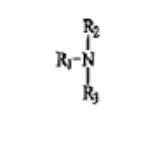
As aminas representativas da estrutura acima incluem cocoalquilaminas polioxietilenadas (2-15), alquilaminas de sebo polioxietilenadas (12-18), e aminas oleil e erucil polioxietilenadas (2-15).Representative amines of the above structure include polyoxyethylenated cocoalkylamines (2-15), polyoxyethylenated tallow alkylamines (12-18), and polyoxyethylenated oleyl and erucyl amines (2-15).
Tensoativos catiônicos Em algumas formas de realização, os tensoativos catiônicos úteis incluem, mas não estão limitados a: i) sais quaternários e ii) óxidos de amina, iii) e suas combinações. Alguns agentes tensoativos catiônicos representativos são apresentados abaixo.Cationic surfactants In some embodiments, useful cationic surfactants include, but are not limited to: i) quaternary salts and ii) amine oxides, iii) and combinations thereof. Some representative cationic surfactants are shown below.
Os sais quaternários tendo a fórmula estrutural:
Tensoativos aniônicos representativos incluem os de seguintes fórmulas estruturais: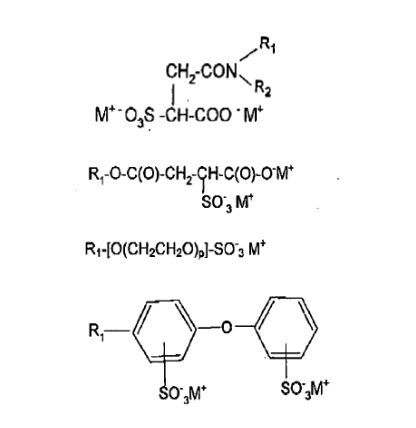
M é hidrogênio, um metal alcalino, tal como sódio ou potássio, ou um sal de amônio. M é de preferência um metal alcalino, tal como sódio ou potássio, de preferência sódio. Em outras formas de realização, os agentes tensoativos aniônicos úteis incluem, mas não estão limitados a, compostos de acordo com as seguintes fórmulas estruturais, bem como as suas misturas: ROSO3- R(OCH2CH2)m(OCH2CHCH3)n)pOSO3- RSO3- R((OCH2CH2)m'(OCH2CHCH3)n')p'OCH2CH(OH)CH2SO3- RC6H4SO3- em que R representa um grupo alquil, arilalquil, ou um grupo hidroxialquil, cada m, n, m', e n' representa, independentemente, um número inteiro de 0 a cerca de 50 e p e p' são cada um números inteiros de 1 a cerca de 25. R tem cerca de 10 a cerca de 24 átomos de carbono e mais preferivelmente cerca de 12 a cerca de 20 átomos de carbono. R pode ser saturado ou insaturado, ramificado ou de cadeia linear, em que os grupos alquil ramificados têm de 1 a cerca de 6 átomos de carbono. Os grupos alquil representativos para R incluem decil, dodecil, tetradecil (miristil), hexadecil (cetil), octadecil (oleil), estearílico, erucil, e os derivados de coco, sebo, soja, e óleos de colza.M is hydrogen, an alkali metal, such as sodium or potassium, or an ammonium salt. M is preferably an alkali metal, such as sodium or potassium, preferably sodium. In other embodiments, useful anionic surfactants include, but are not limited to, compounds according to the following structural formulas, as well as mixtures thereof: ROSO3- R (OCH2CH2) m (OCH2CHCH3) n) pOSO3- RSO3- R ((OCH2CH2) m '(OCH2CHCH3) n') p'OCH2CH (OH) CH2SO3- RC6H4SO3- where R represents an alkyl, arylalkyl group, or a hydroxyalkyl group, each m, n, m ', en' represents, independently, an integer from 0 to about 50 epep 'are each integers from 1 to about 25. R has about 10 to about 24 carbon atoms and more preferably about 12 to about 20 carbon atoms . R can be saturated or unsaturated, branched or straight-chain, where the branched alkyl groups have from 1 to about 6 carbon atoms. Representative alkyl groups for R include decyl, dodecyl, tetradecyl (myristyl), hexadecyl (cetyl), octadecyl (oleyl), stearyl, erucil, and derivatives of coconut, tallow, soy, and rapeseed oils.
Em uma forma de realização do composto de acordo com a fórmula (II), m e n são cada um 0. Em uma outra forma de realização do composto de acordo com a fórmula (II), um dos m e n é 0 e o outro é diferente de zero. Em uma outra forma de realização do composto de acordo com a fórmula (II), m e n são, cada um não-zero. Em uma forma de realização do composto de acordo com a fórmula (IV), m' e n' são cada um 0. Em uma outra forma de realização do composto de acordo com a fórmula (IV), um de m' e n' é 0 e o outro é diferente de zero. Em uma outra forma de realização do composto de acordo com a fórmula (IV), m' e n' são cada um deles não- zero.In one embodiment of the compound according to formula (II), men are each 0. In another embodiment of the compound according to formula (II), one of the men is 0 and the other is different from zero. In another embodiment of the compound according to formula (II), m and n are each non-zero. In one embodiment of the compound according to formula (IV), m 'and n are each 0. In another embodiment of the compound according to formula (IV), one of m' and n is 0 and the other is different from zero. In another embodiment of the compound according to formula (IV), m 'and n' are each non-zero.
Se ambos os tipos de unidades de alquilenoxi estão presentes nos compostos de acordo com as estruturas (II) ou (IV), isto é, se o m e n do composto de acordo com a estrutura (II) são cada um deles não-zero, ou, se m' e n' do composto de acordo com a estrutura (IV) são cada um zero, então tais grupos alquilenoxi podem ser dispostos em alternância em, de forma aleatória, ou ordem de bloco.If both types of alkylenoxy units are present in the compounds according to structures (II) or (IV), that is, if the omen of the compound according to structure (II) are each non-zero, or, if m 'en' of the compound according to structure (IV) are each zero, then such alkyleneoxy groups can be alternately arranged in a random or block order.
Em uma forma de realização, o número total de grupos alquilenoxi por molécula, que é, no caso do composto de acordo com a fórmula (II), a soma do número de grupos alquilenoxi, (m + n), para o número de unidades, p, de tais grupos alquilenoxi, e no caso de o composto de acordo com a fórmula (IV), a soma do número de grupos alquilenoxi, (m' + n'), para o número de unidades, p' de tais grupos alquilenoxi, varia de 0 a cerca de 35 e mais preferencialmente de 0 a cerca de 10. Tensoativos Zwitteriônicos Em algumas formas de realização, tensoativos zwiteriônicos úteis incluem, mas não estão limitados a compostos que têm a fórmula:
Exemplos específicos de tensoativos zwitteriônicos adequados incluem as seguintes estruturas: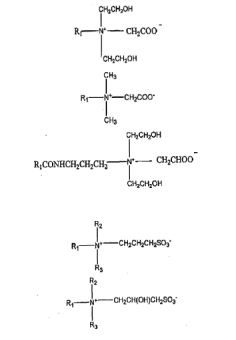
Outro exemplo de um tensoativo zwittenonic adequado selecionado é um óxido de amina. Este material tem a seguinte estrutura:


Tensoativos zwitteriônicos e anfotéricos úteis incluem aqueles divulgados nas Patentes U.S. Nos 6.831.108 B2 e 7.461.694 B2, que são aqui incorporadas por referência.Useful zwitterionic and amphoteric surfactants include those disclosed in U.S. Patent Nos. 6,831,108 B2 and 7,461,694 B2, which are hereby incorporated by reference.
O fluido de tratamento, opcionalmente tem um ou mais membros do grupo de ácidos orgânicos, sais de ácidos orgânicos e ácidos inorgânicos, e sais inorgânicos. O ácido orgânico, ou seu sal, auxilia no desenvolvimento de um aumento de viscosidade. Desde que a água salobra seja frequentemente usada como um fluido de tratamento no campo petrolífero, o teor de sal em algum nível pode estar já presente.The treatment fluid optionally has one or more members of the group of organic acids, salts of organic acids and inorganic acids, and inorganic salts. Organic acid, or its salt, assists in the development of an increase in viscosity. Since brackish water is often used as a treatment fluid in the oil field, the salt content at some level may already be present.
Os ácidos orgânicos úteis são tipicamente aqueles de um ácido sulfônico ou um ácido carboxílico. Contra-íons aniônicos de sais de ácidos orgânicos são tipicamente sulfonatos ou carboxilatos. Representativos de tais moléculas orgânicas incluem sulfonatos e carboxilatos aromáticos, tais como p-tolueno-sulfonato, naftaleno- sulfonato, ácido clorobenzóico, ácido salicílico, ácido ftálico e similares, em que tais contra-íons são solúveis em água. Os mais preferidos são o salicilato, ftalato, p- tolueno-sulfonato, carboxilatos de hidroxinaftaleno, por exemplo, ácido 5-hidroxi-1-naftóico, ácido 6-hidroxi-1- naftóico, ácido 7-hidroxi-1-naftóico, ácido 1-hidroxi-2- naftóico, de preferência ácido 3-hidroxi-2-naftóico, ácido 5-hidroxi-2-naftóico, ácido 7-hidroxi-2-naftóico, e ácido 1,3-hidroxi-2-naftóico e 3,4-diclorobenzoato. O ácido orgânico ou seu sal, opcionalmente, irá estar presente no fluido de tratamento de desde cerca de 0,1% em peso a cerca de 10% em peso, mais tipicamente de cerca de 0,1% em peso a cerca de 7% em peso, e ainda mais tipicamente de cerca de 0,1% em peso a cerca 6% em peso, com base no peso total do fluido de tratamento.Useful organic acids are typically those of a sulfonic acid or a carboxylic acid. Anionic counterions of organic acid salts are typically sulfonates or carboxylates. Representatives of such organic molecules include aromatic sulfonates and carboxylates, such as p-toluenesulfonate, naphthalenesulfonate, chlorobenzoic acid, salicylic acid, phthalic acid and the like, where such counterions are soluble in water. Most preferred are salicylate, phthalate, p-toluene sulfonate, hydroxynaphthalene carboxylates, for example, 5-hydroxy-1-naphthoic acid, 6-hydroxy-1-naphthoic acid, 7-hydroxy-1-naphthoic acid, 1-hydroxy-2-naphthoic acid, preferably 3-hydroxy-2-naphthoic acid, 5-hydroxy-2-naphthoic acid, 7-hydroxy-2-naphthoic acid, and 1,3-hydroxy-2-naphthoic acid and 3 , 4-dichlorobenzoate. The organic acid or its salt will optionally be present in the treatment fluid from about 0.1% by weight to about 10% by weight, more typically from about 0.1% by weight to about 7% by weight, and even more typically from about 0.1% by weight to about 6% by weight, based on the total weight of the treatment fluid.
Sais e ácidos inorgânicos úteis incluem potássio solúvel em água, sódio, e sais de amônio, tais como cloreto de potássio e cloreto de amônio. Além disso, o cloreto de cálcio, brometo de cálcio e sais de haleto de zinco, também podem ser usados. O sal inorgânico está, opcionalmente, presente no fluido de tratamento em uma concentração de peso compreendido entre cerca de 0,1% em peso a cerca de 30% em peso, mais tipicamente de cerca de 0,1% em peso a cerca de 10% em peso, e ainda mais tipicamente de cerca de 0,1% em peso a cerca 8% em peso. Sais orgânicos, por exemplo, cloridrato de trimetilamônio e de cloreto de tetrametilamônio, pode também ser utilizados em adição a, ou como um substituto para os sais inorgânicos.Useful inorganic acids and salts include water-soluble potassium, sodium, and ammonium salts, such as potassium chloride and ammonium chloride. In addition, calcium chloride, calcium bromide and zinc halide salts can also be used. The inorganic salt is optionally present in the treatment fluid at a concentration of weight from about 0.1% by weight to about 30% by weight, more typically from about 0.1% by weight to about 10 % by weight, and even more typically from about 0.1% by weight to about 8% by weight. Organic salts, for example, trimethylammonium hydrochloride and tetramethylammonium chloride, can also be used in addition to, or as a substitute for inorganic salts.
Um dos componentes do fluido de tratamento é a água. Em uma forma de realização, a água será uma quantidade principal, em peso, do fluido. Em outras formas de realização, contudo, a água não vai ser o componente principal, em peso, do fluido. A água pode ser proveniente de qualquer fonte, desde que a fonte não contenha contaminantes que sejam química ou fisicamente incompatíveis com os outros componentes do fluido (por exemplo, causando precipitação indesejável). A água não necessita ser potável e pode ser salobra e conter sais de metais como o sódio, potássio, cálcio, zinco, magnésio, etc., ou outros materiais típicos de fontes de água existentes em ou perto dos campos de petróleo.One of the components of the treatment fluid is water. In one embodiment, water will be a major amount, by weight, of the fluid. In other embodiments, however, water will not be the main component, by weight, of the fluid. The water can come from any source, as long as the source does not contain contaminants that are chemically or physically incompatible with the other components of the fluid (for example, causing undesirable precipitation). The water does not need to be potable and can be brackish and contain salts of metals such as sodium, potassium, calcium, zinc, magnesium, etc., or other materials typical of water sources in or near oil fields.
Opcionalmente, polímeros naturais ou sintéticos podem ser adicionados ao fluido de tratamento para regular ainda mais a viscosidade. Polímeros úteis incluem, mas não estão limitados a, guar e goma de guar, xantana, derivados de poliacrilamida (PAM), amido e derivados de amido, derivados celulósicos, e poliacrilatos.Optionally, natural or synthetic polymers can be added to the treatment fluid to further regulate viscosity. Useful polymers include, but are not limited to, guar and guar gum, xanthan, polyacrylamide derivatives (PAM), starch and starch derivatives, cellulosic derivatives, and polyacrylates.
O fluido de tratamento pode conter um gás, tal como ar, nitrogênio, gás natural e dióxido de carbono para fornecer um fluido ou espuma energizada. Dióxido de carbono supercrítico pode também estar presente.The treatment fluid can contain a gas, such as air, nitrogen, natural gas and carbon dioxide to provide an energized fluid or foam. Supercritical carbon dioxide may also be present.
Opcionalmente, outros agentes tensoativos, poliméricos ou não poliméricos, podem ser adicionados ao fluido de tratamento para conferir redução de IFT adicional e/ou modificar a viscosidade. Tais outros tensoativos podem impactar na IFT e/ou viscosidade. Outros tensoativos úteis podem ser aniônicos, catiônicos, não iônicos, anfotéricos zwitteriônicos e suas combinações. Quando presentes, os outros tensoativos irão de preferência estar presentes em quantidades limitadas, isto é, cerca de 0,5% ou menos, mais preferivelmente cerca de 0,2% ou menos, e ainda mais preferencialmente 0,1% ou menos em peso, com base no peso total do fluido de tratamento.Optionally, other surfactants, polymeric or non-polymeric, can be added to the treatment fluid to provide additional IFT reduction and / or modify viscosity. Such other surfactants can impact IFT and / or viscosity. Other useful surfactants can be anionic, cationic, non-ionic, zwitterionic amphoteric and their combinations. When present, the other surfactants will preferably be present in limited amounts, that is, about 0.5% or less, more preferably about 0.2% or less, and even more preferably 0.1% or less by weight. , based on the total weight of the treatment fluid.
O fluido de tratamento proporciona a vantagem de substancialmente reduzir ou prevenir a infiltração de gás a partir de formações de suporte de gás adjacentes à rede de fratura da formação petrolífera e reservatório. A redução ou a prevenção da infiltração de gás permite que a pressão interna e a formação e reservatório sejam substancialmente mantidas. A manutenção da pressão interna impede a migração ou empuxe para baixo do óleo dentro das formações contendo petróleo a ser minimizado ou evitado fazendo o óleo mais fácil de recuperar.The treatment fluid provides the advantage of substantially reducing or preventing the infiltration of gas from gas support formations adjacent to the fracture network of the oil formation and reservoir. The reduction or prevention of gas infiltration allows the internal pressure and the formation and reservoir to be substantially maintained. Maintaining internal pressure prevents migration or pulls down oil within formations containing oil to be minimized or avoided making the oil easier to recover.
EXEMPLOS No exemplo a seguir, a estabilidade da espuma obtida, com o estabilizador de espuma aqui descrito, o qual numa forma de realização é alquil amido propil sulfobetaínas (também denotado como sultaínas) é medido. A estabilidade da espuma das formulações aqui descritas é comparada com as das formulações como descrito em WO2010/068082.EXAMPLES In the following example, the foam stability obtained, with the foam stabilizer described here, which in one embodiment is alkyl starch propyl sulfobetaines (also denoted as sultaines) is measured. The foam stability of the formulations described herein is compared to those of the formulations as described in WO2010 / 068082.
O teste é realizado a 25°C e à pressão atmosférica de acordo com o protocolo seguinte: - 7 mL de formulação tensoativa aquosa são colocadas na parte inferior de um tubo de 30 mL de volume de filtro Allihn. Este sistema consiste em cerca de 30 mL de tubo reto (2 centímetros de diâmetro, com 10 cm de altura) com uma frita de tamanho de poro característico que varia entre 10 e 16 mm, montada na parte inferior do tubo (VWR International). - Gás nitrogênio é injetado a 50 mL/min de taxa de fluxo durante 30 segundos na parte inferior do tubo de filtro através da frita na formulação aquosa. A espuma pode formar, que inicialmente, preenche totalmente o tubo. - Altura da espuma é registrada como uma função do tempo utilizando uma câmara CCD. Uma primeira, rápida queda de altura da espuma é observada nos primeiros dez minutos do experimento e está ligada à drenagem por gravidade através de lamelas da espuma. De acordo com o protocolo experimental descrito em [Georgieva et al., Soft Matter, 5, 2063, 2009], a altura inicial de espuma ho é escolhida como a altura de espuma após esta primeira fase de drenagem por gravidade (10 minutos após o início da experiência).The test is carried out at 25 ° C and at atmospheric pressure according to the following protocol: - 7 ml of aqueous surfactant formulation are placed in the bottom of a 30 ml tube of Allihn filter volume. This system consists of about 30 mL of straight tube (2 cm in diameter, 10 cm high) with a frit with a characteristic pore size that varies between 10 and 16 mm, mounted on the bottom of the tube (VWR International). - Nitrogen gas is injected at 50 mL / min flow rate for 30 seconds into the bottom of the filter tube through the frit in the aqueous formulation. The foam can form, which initially fills the tube completely. - Foam height is recorded as a function of time using a CCD camera. A first, rapid drop in height of the foam is observed in the first ten minutes of the experiment and is linked to gravity drainage through the foam lamellae. According to the experimental protocol described in [Georgieva et al., Soft Matter, 5, 2063, 2009], the initial foam height ho is chosen as the foam height after this first gravity drainage phase (10 minutes after the beginning of the experiment).
Altura da espuma h é então medida a cada minuto após a fase de drenagem por gravidade e em comparação com a altura de espuma inicial ho. Os tensoativos usados estão listados abaixo: Cocamido propil betaína: Mirataine BET C30 fabricado pela Rhodia. C12 alfa olefina sulfonato: Calsoft AOS 1245 fabricado pela Pilot. Cocamido hidroxipropil sultaína: Mirataine CBS fabricado pela Rhodia. C22 amido propil hidroxi sultaina Lauril trimetil cloreto de amônio: Arquad 1237 fabricada pela Akzo. Todas as formulações são testadas a 0,66% em peso de tensoativo total, em água deionizada e incluem (expressa para uma formulação de tensoativo 100%): - Formulação 1: 50% em peso de cocamido propil betaína, 50% em peso de C12 alfa olefina sulfonato. - Formulação 2: 50% em peso de cocamido propil hidroxi sultaína, 50% em peso de C12 alfa olefina sulfonato. - Formulação 3: 50% em peso de C22 amido propil hidroxi sultaína, 50% em peso de C12 alfa olefina sulfonato. - Formulação 4: 50,3% em peso de cocamido propil betaína, 45,7% em peso de C12 alfa olefina sulfonato, 4% de cloreto de lauril trimetil amônio. - Formulação 5: 50,3% em peso de cocamido propil hidroxi sultaina, 45,7% em peso de C12 alfa-olefina sulfonato, 4% de cloreto de lauril trimetil amônio. - Formulação 6: 50,3% em peso de C22 amido propil hidroxi sultaina, 45,7% em peso de C12 alfa-olefina sulfonato, 4% de cloreto de lauril trimetil amônio.Foam height h is then measured every minute after the gravity drain phase and compared to the initial foam height ho. The surfactants used are listed below: Cocamido propyl betaine: Mirataine BET C30 manufactured by Rhodia. C12 alpha olefin sulfonate: Calsoft AOS 1245 manufactured by Pilot. Hydroxypropyl sultaine cocamido: Mirataine CBS manufactured by Rhodia. C22 starch propyl hydroxy sultaine Lauryl trimethyl ammonium chloride: Arquad 1237 manufactured by Akzo. All formulations are tested at 0.66% by weight of total surfactant, in deionized water and include (expressed for a 100% surfactant formulation): - Formulation 1: 50% by weight of cocamido propyl betaine, 50% by weight of C12 alpha olefin sulfonate. - Formulation 2: 50% by weight of cocamido propyl hydroxy sultaine, 50% by weight of C12 alpha olefin sulfonate. - Formulation 3: 50% by weight of C22 propyl hydroxy sultaine starch, 50% by weight of C12 alpha olefin sulfonate. - Formulation 4: 50.3% by weight of cocamido propyl betaine, 45.7% by weight of C12 alpha olefin sulfonate, 4% of lauryl trimethyl ammonium chloride. - Formulation 5: 50.3% by weight of cocamido propyl hydroxy sultaine, 45.7% by weight of C12 alpha-olefin sulfonate, 4% of lauryl trimethyl ammonium chloride. - Formulation 6: 50.3% by weight of C22 propyl hydroxy sultaine starch, 45.7% by weight of C12 alpha-olefin sulfonate, 4% of lauryl trimethyl ammonium chloride.
As formulações 1 e 4 servem como uma referência para ilustrar uma composição espumante utilizando o estabilizador de espuma aqui descrito. Os resultados, expressos em percentagem da altura inicial de espuma como uma função do tempo (h(t)/ho) após 1, 2, 3 e 4 horas foram relatados na tabela 1.Formulations 1 and 4 serve as a reference to illustrate a foaming composition using the foam stabilizer described herein. The results, expressed as a percentage of the initial foam height as a function of time (h (t) / ho) after 1, 2, 3 and 4 hours were reported in table 1.
Os resultados mostram um aumento na estabilidade da espuma quando o composto de cloreto de lauril trimetil amônio catiônico é adicionado a uma mistura de cocamido propilo anfotéricos e uma C12 alfa olefina sulfonato. Os resultados também mostram que, dentro do erro experimental, 5 cocamido propilo hidroxi sultaínas proporcionam uma estabilidade da espuma comparável ao obtido com cocamido propilo betaínas. A mesma tendência é observada com C22 amido propil hidroxi sultaínas que fornecem estabilidade da espuma comparável, e até mesmo um pouco maior do que o C12 10 cocamido propil betaínas. Portanto, enquanto fornece vantagens técnicas tais como menor adsorção (possivelmente) em rocha de reservatório e uma estabilidade térmica melhorada em comparação com as betaínas, sultaínas provam ser tão eficientes quanto na estabilização de espuma quando 15 utilizadas em formulações como descritas no documento WO 2010/068082. Tabela 1: altura de espuma em função do tempo para as formulações selecionadas

Deve ser entendido que a descrição anterior é apenas ilustrativa da presente divulgação. Várias alternativas e modificações podem ser concebidas pelos peritos na arte sem se afastar da divulgação. Por conseguinte, a presente 5 descrição destina-se a abarcar todas essas alternativas, modificações e variações que caem dentro do âmbito das reivindicações anexas.It should be understood that the foregoing description is only illustrative of the present disclosure. Various alternatives and modifications can be devised by those skilled in the art without departing from disclosure. Therefore, the present description is intended to cover all such alternatives, modifications and variations that fall within the scope of the appended claims.
Claims (22)


Applications Claiming Priority (3)
| Application Number | Priority Date | Filing Date | Title |
|---|---|---|---|
| US201161518904P | 2011-05-13 | 2011-05-13 | |
| US61/518,904 | 2011-05-13 | ||
| PCT/US2012/037442 WO2012158489A2 (en) | 2011-05-13 | 2012-05-11 | Enhanced foam stability applications and methods |
Publications (2)
| Publication Number | Publication Date |
|---|---|
| BR112013029345A2 BR112013029345A2 (en) | 2017-02-07 |
| BR112013029345B1 true BR112013029345B1 (en) | 2021-02-23 |
Family
ID=47141101
Family Applications (1)
| Application Number | Title | Priority Date | Filing Date |
|---|---|---|---|
| BR112013029345-4A BR112013029345B1 (en) | 2011-05-13 | 2012-05-11 | METHOD FOR INCREASING OIL RECOVERY FROM A PETROLEUM FORMATION WITHIN A RESERVOIR |
Country Status (9)
| Country | Link |
|---|---|
| US (1) | US8985206B2 (en) |
| EP (1) | EP2707571B1 (en) |
| CN (1) | CN103649459B (en) |
| BR (1) | BR112013029345B1 (en) |
| CA (1) | CA2836064C (en) |
| MX (1) | MX365721B (en) |
| MY (1) | MY151309A (en) |
| RU (1) | RU2629034C2 (en) |
| WO (1) | WO2012158489A2 (en) |
Families Citing this family (83)
| Publication number | Priority date | Publication date | Assignee | Title |
|---|---|---|---|---|
| US9040468B2 (en) | 2007-07-25 | 2015-05-26 | Schlumberger Technology Corporation | Hydrolyzable particle compositions, treatment fluids and methods |
| US10011763B2 (en) | 2007-07-25 | 2018-07-03 | Schlumberger Technology Corporation | Methods to deliver fluids on a well site with variable solids concentration from solid slurries |
| US9080440B2 (en) | 2007-07-25 | 2015-07-14 | Schlumberger Technology Corporation | Proppant pillar placement in a fracture with high solid content fluid |
| US9222013B1 (en) | 2008-11-13 | 2015-12-29 | Cesi Chemical, Inc. | Water-in-oil microemulsions for oilfield applications |
| US8985206B2 (en) | 2011-05-13 | 2015-03-24 | Rhodia Operations | Enhanced foam stability applications and methods |
| US9133387B2 (en) | 2011-06-06 | 2015-09-15 | Schlumberger Technology Corporation | Methods to improve stability of high solid content fluid |
| US9580639B2 (en) | 2011-07-18 | 2017-02-28 | Saudi Arabian Oil Company | Controlled release of surfactants for enhanced oil recovery |
| US9803457B2 (en) | 2012-03-08 | 2017-10-31 | Schlumberger Technology Corporation | System and method for delivering treatment fluid |
| US9863228B2 (en) | 2012-03-08 | 2018-01-09 | Schlumberger Technology Corporation | System and method for delivering treatment fluid |
| DK2838970T3 (en) | 2012-04-15 | 2017-03-20 | Flotek Chemistry Llc | Density formulations for foam filling |
| US9200192B2 (en) | 2012-05-08 | 2015-12-01 | Cesi Chemical, Inc. | Compositions and methods for enhancement of production of liquid and gaseous hydrocarbons |
| US11407930B2 (en) | 2012-05-08 | 2022-08-09 | Flotek Chemistry, Llc | Compositions and methods for enhancement of production of liquid and gaseous hydrocarbons |
| WO2013184116A1 (en) * | 2012-06-07 | 2013-12-12 | Rhodia Operations | Enhanced foam stability applications and methods |
| FR2997605B1 (en) * | 2012-11-08 | 2015-12-11 | Rhodia Operations | AQUEOUS SUSPENSIONS FOR AGRICULTURAL COMPOSITIONS |
| MX338862B (en) * | 2012-12-05 | 2016-04-28 | Mexicano Inst Petrol | Foaming composition with wettability modifying and corrosion inhibitory properties for high temperature and ultra-high salinity. |
| US10000693B2 (en) | 2013-03-14 | 2018-06-19 | Flotek Chemistry, Llc | Methods and compositions for use in oil and/or gas wells |
| US9464223B2 (en) | 2013-03-14 | 2016-10-11 | Flotek Chemistry, Llc | Methods and compositions for use in oil and/or gas wells |
| US10577531B2 (en) | 2013-03-14 | 2020-03-03 | Flotek Chemistry, Llc | Polymers and emulsions for use in oil and/or gas wells |
| US10287483B2 (en) | 2013-03-14 | 2019-05-14 | Flotek Chemistry, Llc | Methods and compositions for use in oil and/or gas wells comprising a terpene alcohol |
| US9428683B2 (en) | 2013-03-14 | 2016-08-30 | Flotek Chemistry, Llc | Methods and compositions for stimulating the production of hydrocarbons from subterranean formations |
| US10941106B2 (en) | 2013-03-14 | 2021-03-09 | Flotek Chemistry, Llc | Methods and compositions incorporating alkyl polyglycoside surfactant for use in oil and/or gas wells |
| US10053619B2 (en) | 2013-03-14 | 2018-08-21 | Flotek Chemistry, Llc | Siloxane surfactant additives for oil and gas applications |
| US10590332B2 (en) | 2013-03-14 | 2020-03-17 | Flotek Chemistry, Llc | Siloxane surfactant additives for oil and gas applications |
| US9868893B2 (en) | 2013-03-14 | 2018-01-16 | Flotek Chemistry, Llc | Methods and compositions for use in oil and/or gas wells |
| US9884988B2 (en) | 2013-03-14 | 2018-02-06 | Flotek Chemistry, Llc | Methods and compositions for use in oil and/or gas wells |
| US10717919B2 (en) | 2013-03-14 | 2020-07-21 | Flotek Chemistry, Llc | Methods and compositions for use in oil and/or gas wells |
| US11180690B2 (en) | 2013-03-14 | 2021-11-23 | Flotek Chemistry, Llc | Diluted microemulsions with low surface tensions |
| US9321955B2 (en) | 2013-06-14 | 2016-04-26 | Flotek Chemistry, Llc | Methods and compositions for stimulating the production of hydrocarbons from subterranean formations |
| US9068108B2 (en) | 2013-03-14 | 2015-06-30 | Cesi Chemical, Inc. | Methods and compositions for stimulating the production of hydrocarbons from subterranean formations |
| US10421707B2 (en) | 2013-03-14 | 2019-09-24 | Flotek Chemistry, Llc | Methods and compositions incorporating alkyl polyglycoside surfactant for use in oil and/or gas wells |
| US11254856B2 (en) | 2013-03-14 | 2022-02-22 | Flotek Chemistry, Llc | Methods and compositions for use in oil and/or gas wells |
| DK2970744T3 (en) * | 2013-03-15 | 2018-12-03 | Akzo Nobel Chemicals Int Bv | SYNERGISTIC EFFECT OF CO-SURFACTURING AGENTS ON REOLOGICAL PROPERTIES OF DRILLING, COMPLETING AND FRAGHTING FLUIDS |
| CN104277807B (en) * | 2013-07-09 | 2018-04-06 | 中国石油化工股份有限公司 | It is adapted to alkali-free oil displacement system and its application of high temperature high-content wax oil reservoir |
| US9388335B2 (en) | 2013-07-25 | 2016-07-12 | Schlumberger Technology Corporation | Pickering emulsion treatment fluid |
| CN104559986B (en) * | 2013-10-28 | 2018-05-11 | 中国石油化工股份有限公司 | Binary is driven poly- table pack thing and its is applied in intensified oil reduction |
| US9890624B2 (en) | 2014-02-28 | 2018-02-13 | Eclipse Ior Services, Llc | Systems and methods for the treatment of oil and/or gas wells with a polymeric material |
| US9890625B2 (en) | 2014-02-28 | 2018-02-13 | Eclipse Ior Services, Llc | Systems and methods for the treatment of oil and/or gas wells with an obstruction material |
| CN103937466A (en) * | 2014-03-14 | 2014-07-23 | 长江大学 | Foaming agent used for oilfield development |
| WO2015171163A1 (en) * | 2014-05-09 | 2015-11-12 | Halliburton Energy Services, Inc. | Cationic polymers for foam fracturing applications |
| CA2891278C (en) | 2014-05-14 | 2018-11-06 | Cesi Chemical, Inc. | Methods and compositions for use in oil and / or gas wells |
| FR3021052A1 (en) * | 2014-05-15 | 2015-11-20 | Rhodia Operations | FOAM STABILIZERS OF THE AMINOSULFONATE TYPE |
| US9611422B2 (en) | 2014-05-29 | 2017-04-04 | Baker Hughes Incorporated | Methods of obtaining hydrocarbons using suspensions including organic bases |
| CN104130767A (en) * | 2014-07-14 | 2014-11-05 | 安徽奔马先端科技有限公司 | Salt-resistant and acid-resistant concentrated foaming agent as well as preparation method and application thereof |
| US10294757B2 (en) | 2014-07-28 | 2019-05-21 | Flotek Chemistry, Llc | Methods and compositions related to gelled layers in oil and/or gas wells |
| CN104152128A (en) * | 2014-08-18 | 2014-11-19 | 中国科学院理化技术研究所 | Foam oil displacement agent with oil resistance and application thereof |
| CN104213870B (en) * | 2014-08-19 | 2016-08-31 | 中国石油天然气股份有限公司 | A kind of artificial foam oil production method of water driving heavy oil reservoir |
| US9828815B2 (en) | 2014-09-11 | 2017-11-28 | Baker Hughes, A Ge Company, Llc | Foamed fluid compositions having high salinity using anionic surfactants and methods therefor |
| MX376710B (en) * | 2014-11-18 | 2025-03-07 | Mexicano Inst Petrol | MULTIFUNCTIONAL FOAMING COMPOSITION WITH WETTING MODIFYING, CORROSION INHIBITING AND MINERAL SCALE INHIBITING/DISPERSING PROPERTIES FOR HIGH TEMPERATURE AND ULTRA HIGH SALINITY. |
| CN104629706A (en) * | 2014-12-26 | 2015-05-20 | 王庆 | Salt tolerant supercritical CO2 mobility control foaming agent and use method thereof |
| CN106318362B (en) * | 2015-06-16 | 2019-01-18 | 中国石油化工股份有限公司 | A kind of novel displacement of reservoir oil carbon dioxide foaming agent and preparation method thereof |
| CN106590572B (en) * | 2015-10-20 | 2020-05-05 | 中国石油化工股份有限公司 | Composite surfactant composition for displacement of reservoir oil of hypersalinity |
| CN106590578B (en) * | 2015-10-20 | 2020-10-16 | 中国石油化工股份有限公司 | Composite surfactant composition for medium-salinity reservoir flooding |
| CN106590576B (en) * | 2015-10-20 | 2019-04-12 | 中国石油化工股份有限公司 | Steam combination flooding foam compositions and preparation method |
| MY195072A (en) * | 2016-12-30 | 2023-01-09 | Petroliam Nasional Berhad Petronas | Composition with Foaming Properties |
| CN106634931A (en) * | 2017-01-19 | 2017-05-10 | 中国科学院理化技术研究所 | Foam oil displacement agent with anti-adsorption performance and application thereof |
| US11066594B2 (en) | 2017-03-09 | 2021-07-20 | Saudi Arabian Oil Company | Fluoropolymers to reduce retention of nanosurfactants to carbonate reservoir rock for applications in oil fields |
| US11084972B2 (en) | 2017-03-09 | 2021-08-10 | Saudi Arabian Oil Company | Surface charge modified nanosurfactants for reduced retention by reservoir rock |
| CA3055130A1 (en) * | 2017-03-09 | 2018-09-13 | Saudi Arabian Oil Company | Nanosurfactants for improved and enhanced oil recovery applications |
| US11078405B2 (en) | 2017-03-09 | 2021-08-03 | Saudi Arabian Oil Company | 3 in 1 foam formulation for enhanced oil recovery including conformance control, ultra-low interfacial tension, and wettability alteration |
| US11066914B2 (en) | 2017-03-09 | 2021-07-20 | Saudi Arabian Oil Company | Foam from low cost petroleum sulfonate surfactants for fracturing along with wettability alteration |
| US10934472B2 (en) | 2017-08-18 | 2021-03-02 | Flotek Chemistry, Llc | Compositions comprising non-halogenated solvents for use in oil and/or gas wells and related methods |
| CN109679612B (en) * | 2017-10-18 | 2021-05-28 | 中国石油化工股份有限公司 | Solid oil-resistant foam drainage agent composition, preparation method and application thereof |
| WO2019108971A1 (en) | 2017-12-01 | 2019-06-06 | Flotek Chemistry, Llc | Methods and compositions for stimulating the production of hydrocarbons from subterranean formations |
| CN110776893B (en) * | 2018-07-31 | 2022-02-22 | 中国石油化工股份有限公司 | Low-interfacial-tension strong-foam oil displacement agent |
| CA3106979C (en) * | 2018-11-13 | 2023-08-15 | Halliburton Energy Services, Inc. | Rapid reversal of wettability of subterranean formations |
| US10793767B2 (en) | 2018-11-29 | 2020-10-06 | Saudi Arabian Oil Company | Stabilized foams with tailored water chemistry for mobility control in gas injection processes |
| EP3699255A1 (en) * | 2019-02-22 | 2020-08-26 | Rhodia Operations | Foam formulations for assisted recovery of oil |
| CN111763507B (en) * | 2019-04-02 | 2022-10-04 | 中国石油天然气股份有限公司 | Strength-adjustable star polymer gel foam profile control agent and preparation and application thereof |
| CN114303003B (en) | 2019-08-15 | 2025-01-03 | 陶氏环球技术有限责任公司 | Additives for enhanced oil recovery |
| US11104843B2 (en) | 2019-10-10 | 2021-08-31 | Flotek Chemistry, Llc | Well treatment compositions and methods comprising certain microemulsions and certain clay control additives exhibiting synergistic effect of enhancing clay swelling protection and persistency |
| US11352867B2 (en) | 2020-08-26 | 2022-06-07 | Saudi Arabian Oil Company | Enhanced hydrocarbon recovery with electric current |
| US11447687B2 (en) | 2020-09-29 | 2022-09-20 | Saudi Arabian Oil Company | Enhancing rheological properties of foam using aloe-barbadensis gel |
| US11512243B2 (en) | 2020-10-23 | 2022-11-29 | Flotek Chemistry, Llc | Microemulsions comprising an alkyl propoxylated sulfate surfactant, and related methods |
| US20220186107A1 (en) * | 2020-12-11 | 2022-06-16 | Sanyo Chemical Industries, Ltd. | Thickener for wellbore acid treatment liquid and wellbore acid treatment liquid using same |
| US11608723B2 (en) | 2021-01-04 | 2023-03-21 | Saudi Arabian Oil Company | Stimulated water injection processes for injectivity improvement |
| US11649693B2 (en) | 2021-02-11 | 2023-05-16 | Saudi Arabian Oil Company | Handling produced water in a wellbore |
| US11421148B1 (en) | 2021-05-04 | 2022-08-23 | Saudi Arabian Oil Company | Injection of tailored water chemistry to mitigate foaming agents retention on reservoir formation surface |
| CN113006753B (en) * | 2021-05-08 | 2023-04-07 | 中国石油天然气股份有限公司 | Method and equipment for filling foam drainage agent and foam drainage ball for equipment |
| US11867036B2 (en) | 2021-06-23 | 2024-01-09 | Saudi Arabian Oil Company | Insitu foam generation to fasten and increase oil production rates in gravity drainage CO2 gas injection |
| FR3129950B1 (en) * | 2021-12-02 | 2025-04-04 | Arkema France | STEEL-COMPATIBLE FOAMING COMPOSITION FOR ENHANCED HYDROCARBON RECOVERY |
| US11993746B2 (en) | 2022-09-29 | 2024-05-28 | Saudi Arabian Oil Company | Method of waterflooding using injection solutions containing dihydrogen phosphate |
| WO2024097116A1 (en) | 2022-10-31 | 2024-05-10 | Energy Solutions (US) LLC | Synergistic combination of surfactants with friction reducers |
| US12352146B2 (en) | 2023-09-11 | 2025-07-08 | Saudi Arabian Oil Company | Method for well stimulation using nanobubbles |
Family Cites Families (28)
| Publication number | Priority date | Publication date | Assignee | Title |
|---|---|---|---|---|
| US2623596A (en) | 1950-05-16 | 1952-12-30 | Atlantic Refining Co | Method for producing oil by means of carbon dioxide |
| US2792894A (en) | 1953-09-03 | 1957-05-21 | Exxon Research Engineering Co | Method of increasing oil production |
| US2866507A (en) | 1956-12-24 | 1958-12-30 | Pure Oil Co | Gas drive oil recovery process |
| US3185634A (en) | 1961-07-14 | 1965-05-25 | Pan American Petroleum Corp | Oil recovery by foam drive |
| US4364431A (en) | 1980-12-17 | 1982-12-21 | National Iranian Oil Company | Method for recovering oil from an underground formation |
| US4703797A (en) * | 1983-12-28 | 1987-11-03 | Cities Service Co. | Sweep improvement in enhanced oil recovery |
| US4706752A (en) * | 1984-12-03 | 1987-11-17 | Union Oil Company Of California | Method for foam emplacement in carbon dioxide enhanced recovery |
| US4842065A (en) * | 1988-05-11 | 1989-06-27 | Marathon Oil Company | Oil recovery process employing cyclic wettability alteration |
| WO1989012158A1 (en) * | 1988-06-02 | 1989-12-14 | Chevron Research Company | Miscible gas enhanced oil recovery method using ethoxylated alkylphenol sulfonate |
| US4852653A (en) | 1988-07-06 | 1989-08-01 | Shell Oil Company | Method to obtain rapid build-up of pressure in a steam foam process |
| US5952285A (en) * | 1990-04-10 | 1999-09-14 | Albright & Wilson Limited | Concentrated aqueous surfactant compositions |
| US5076357A (en) | 1990-05-31 | 1991-12-31 | Chevron Research & Technology Company | Method of enhancing recovery of petroleum from an oil-bearing formation |
| US5363915A (en) | 1990-07-02 | 1994-11-15 | Chevron Research And Technology Company | Enhanced oil recovery technique employing nonionic surfactants |
| US5074358A (en) * | 1990-07-03 | 1991-12-24 | Alberta Oil Sands Technology And Research Authority | Surfactant-stabilized foams for enhanced oil recovery |
| US5203411A (en) | 1992-03-11 | 1993-04-20 | The Dow Chemical Company | Oil recovery process using mobility control fluid comprising alkylated diphenyloxide sulfonates and foam forming amphoteric surfactants |
| US5247993A (en) * | 1992-06-16 | 1993-09-28 | Union Oil Company Of California | Enhanced imbibition oil recovery process |
| US5614473A (en) | 1995-05-22 | 1997-03-25 | Rhone-Poulenc Inc. | Use of high purity imidazoline based amphoacetate surfactant as foaming agent in oil wells |
| US6258859B1 (en) | 1997-06-10 | 2001-07-10 | Rhodia, Inc. | Viscoelastic surfactant fluids and related methods of use |
| AU2001256023A1 (en) * | 2000-05-03 | 2001-11-12 | Trican Well Service Ltd. | Fracturing fluid |
| US7624804B2 (en) | 2001-05-15 | 2009-12-01 | Baker Hughes Incorporated | Method for recovering oil from a gas-lifted oil well penetrating a subterranean oil-bearing formation |
| US7461694B2 (en) | 2005-11-16 | 2008-12-09 | Rhodia Inc. | Methods for recovering oil from an oil reservoir |
| US7134497B1 (en) | 2006-02-15 | 2006-11-14 | Halliburton Energy Services, Inc. | Foamed treatment fluids and associated methods |
| US7581594B2 (en) * | 2006-03-15 | 2009-09-01 | Chemeor, Inc. | Surfactant method for improved oil recovery from fractured reservoirs |
| CA2704171C (en) | 2007-10-31 | 2017-01-24 | Rhodia Inc. | Addition of zwitterionic surfactant to water soluble polymer to increase the stability of the polymers in aqueous solutions containing salt and/or surfactants |
| US8551925B2 (en) * | 2007-11-15 | 2013-10-08 | Nalco Company | Imidazoline-based heterocyclic foamers for downhole injection |
| MX2008015989A (en) | 2008-12-12 | 2010-06-14 | Mexicano Inst Petrol | Foaming composition for high temperature and salinity. |
| US8579035B2 (en) | 2009-07-31 | 2013-11-12 | Baker Hughes Incorporated | Method for recovering oil from an oil well |
| US8985206B2 (en) | 2011-05-13 | 2015-03-24 | Rhodia Operations | Enhanced foam stability applications and methods |
-
2012
- 2012-05-11 US US13/469,282 patent/US8985206B2/en active Active
- 2012-05-11 CN CN201280034176.8A patent/CN103649459B/en active Active
- 2012-05-11 EP EP12785594.8A patent/EP2707571B1/en active Active
- 2012-05-11 WO PCT/US2012/037442 patent/WO2012158489A2/en not_active Ceased
- 2012-05-11 BR BR112013029345-4A patent/BR112013029345B1/en active IP Right Grant
- 2012-05-11 CA CA2836064A patent/CA2836064C/en active Active
- 2012-05-11 MX MX2013003029A patent/MX365721B/en active IP Right Grant
- 2012-05-11 MY MYPI2013702151 patent/MY151309A/en unknown
- 2012-05-11 RU RU2013150923A patent/RU2629034C2/en active
Also Published As
| Publication number | Publication date |
|---|---|
| MX365721B (en) | 2019-06-11 |
| WO2012158489A3 (en) | 2013-03-14 |
| CA2836064A1 (en) | 2012-11-22 |
| MX2013003029A (en) | 2013-06-17 |
| RU2013150923A (en) | 2015-06-20 |
| EP2707571B1 (en) | 2020-10-07 |
| EP2707571A2 (en) | 2014-03-19 |
| US20120285694A1 (en) | 2012-11-15 |
| MY151309A (en) | 2014-05-07 |
| EP2707571A4 (en) | 2015-04-15 |
| CN103649459A (en) | 2014-03-19 |
| RU2629034C2 (en) | 2017-08-24 |
| WO2012158489A2 (en) | 2012-11-22 |
| CA2836064C (en) | 2020-07-14 |
| US8985206B2 (en) | 2015-03-24 |
| CN103649459B (en) | 2016-10-19 |
| BR112013029345A2 (en) | 2017-02-07 |
Similar Documents
| Publication | Publication Date | Title |
|---|---|---|
| BR112013029345B1 (en) | METHOD FOR INCREASING OIL RECOVERY FROM A PETROLEUM FORMATION WITHIN A RESERVOIR | |
| US7789143B2 (en) | Methods for recovering oil from an oil reservoir | |
| WO2013184116A1 (en) | Enhanced foam stability applications and methods | |
| US9598629B2 (en) | Desorbants for enhanced oil recovery | |
| JP6479143B2 (en) | Surfactant formulation for releasing underground fossil fluids | |
| US10793766B2 (en) | Sulfosuccinate surfactant compositions and methods using the same | |
| CN103834379B (en) | A kind of vermiculate glues foam system and the method improving recovery ratio with it | |
| US8851187B2 (en) | Method for mobility control in oil-bearing carbonate formations | |
| CN104968759B (en) | Method of treating oil-bearing subterranean formations containing carbonate rocks | |
| US20160215200A1 (en) | Composition and method for enhanced hydrocarbon recovery | |
| US20160215201A1 (en) | Composition and method for enhanced hydrocarbon recovery | |
| US20160177173A1 (en) | Method of treating a hydrocarbon containing formation | |
| US10858576B2 (en) | Selection of optimal surfactant blends for waterflood enhancement | |
| US10563116B2 (en) | Ethoxylated desorbing agents for enhanced oil recovery | |
| US9903188B2 (en) | Alkyl polyglucoside desorbents for enhanced oil recovery | |
| US20160237337A1 (en) | Composition and method for enhanced hydrocarbon recovery | |
| US20140353250A1 (en) | Use of long chain internal olefin sulfonates | |
| US20160230079A1 (en) | Composition and method for enhanced hydrocarbon recovery | |
| Moayedi et al. | An experimental study on optimization of SAG process utilizing nonionic surfactants and sodium lignosulfonate | |
| RU2554651C1 (en) | Acid composition for treatment of bottom-hole zone of carbonate reservoir | |
| CN112513224B (en) | Alkyl alkoxylated carboxylates as vapor foam additives for heavy oil recovery |
Legal Events
| Date | Code | Title | Description |
|---|---|---|---|
| B06F | Objections, documents and/or translations needed after an examination request according [chapter 6.6 patent gazette] | ||
| B06U | Preliminary requirement: requests with searches performed by other patent offices: procedure suspended [chapter 6.21 patent gazette] | ||
| B25A | Requested transfer of rights approved |
Owner name: IFP ENERGIES NOUVELLES (FR) |
|
| B25L | Entry of change of name and/or headquarter and transfer of application, patent and certificate of addition of invention: publication cancelled |
Owner name: RHODIA OPERATIONS (FR) Free format text: ANULADA A PUBLICACAO CODIGO 25.1 NA RPI NO 2573 DE 28/04/2020 POR TER SIDO INDEVIDA. |
|
| B25A | Requested transfer of rights approved |
Owner name: RHODIA OPERATIONS (FR) ; IFP ENERGIES NOUVELLES (FR) |
|
| B09A | Decision: intention to grant [chapter 9.1 patent gazette] | ||
| B16A | Patent or certificate of addition of invention granted [chapter 16.1 patent gazette] |
Free format text: PRAZO DE VALIDADE: 20 (VINTE) ANOS CONTADOS A PARTIR DE 11/05/2012, OBSERVADAS AS CONDICOES LEGAIS. |
|
| B25G | Requested change of headquarter approved |
Owner name: RHODIA OPERATIONS (FR) ; IFP ENERGIES NOUVELLES (FR) |
|
| B25A | Requested transfer of rights approved |
Owner name: IFP ENERGIES NOUVELLES (FR) ; ENERGY SOLUTIONS (US) LLC (US) |