US20050215517A1 - Use of an anti-endotoxin drug in the prevention and treatment of disease - Google Patents
Use of an anti-endotoxin drug in the prevention and treatment of disease Download PDFInfo
- Publication number
- US20050215517A1 US20050215517A1 US11/010,550 US1055004A US2005215517A1 US 20050215517 A1 US20050215517 A1 US 20050215517A1 US 1055004 A US1055004 A US 1055004A US 2005215517 A1 US2005215517 A1 US 2005215517A1
- Authority
- US
- United States
- Prior art keywords
- infusion
- patient
- hours
- hour
- lps
- Prior art date
- Legal status (The legal status is an assumption and is not a legal conclusion. Google has not performed a legal analysis and makes no representation as to the accuracy of the status listed.)
- Abandoned
Links
- 229940079593 drug Drugs 0.000 title claims abstract description 25
- 239000003814 drug Substances 0.000 title claims abstract description 25
- 238000011282 treatment Methods 0.000 title claims description 13
- 230000001986 anti-endotoxic effect Effects 0.000 title abstract description 6
- 208000037265 diseases, disorders, signs and symptoms Diseases 0.000 title abstract description 3
- 201000010099 disease Diseases 0.000 title abstract 2
- 230000002265 prevention Effects 0.000 title description 3
- 238000000034 method Methods 0.000 claims abstract description 51
- 238000001802 infusion Methods 0.000 claims description 51
- 238000001990 intravenous administration Methods 0.000 claims description 16
- 206010040047 Sepsis Diseases 0.000 claims description 9
- 150000001875 compounds Chemical class 0.000 claims description 9
- 206010040070 Septic Shock Diseases 0.000 claims description 7
- 238000002347 injection Methods 0.000 claims description 7
- 239000007924 injection Substances 0.000 claims description 7
- 230000036303 septic shock Effects 0.000 claims description 7
- 208000037487 Endotoxemia Diseases 0.000 claims description 6
- 230000037396 body weight Effects 0.000 claims description 6
- 210000004185 liver Anatomy 0.000 claims description 6
- 208000024893 Acute lymphoblastic leukemia Diseases 0.000 claims description 5
- 208000014697 Acute lymphocytic leukaemia Diseases 0.000 claims description 5
- 208000032791 BCR-ABL1 positive chronic myelogenous leukemia Diseases 0.000 claims description 5
- 208000010833 Chronic myeloid leukaemia Diseases 0.000 claims description 5
- 208000033761 Myelogenous Chronic BCR-ABL Positive Leukemia Diseases 0.000 claims description 5
- 208000006664 Precursor Cell Lymphoblastic Leukemia-Lymphoma Diseases 0.000 claims description 5
- 230000001154 acute effect Effects 0.000 claims description 5
- 210000003734 kidney Anatomy 0.000 claims description 5
- 210000004072 lung Anatomy 0.000 claims description 5
- 208000031261 Acute myeloid leukaemia Diseases 0.000 claims description 4
- 238000010322 bone marrow transplantation Methods 0.000 claims description 4
- 210000002216 heart Anatomy 0.000 claims description 4
- 208000026278 immune system disease Diseases 0.000 claims description 4
- 208000032839 leukemia Diseases 0.000 claims description 4
- 208000033776 Myeloid Acute Leukemia Diseases 0.000 claims description 3
- 238000002512 chemotherapy Methods 0.000 claims description 3
- 210000001035 gastrointestinal tract Anatomy 0.000 claims description 3
- 150000003839 salts Chemical class 0.000 claims description 3
- 210000002798 bone marrow cell Anatomy 0.000 claims description 2
- 230000005855 radiation Effects 0.000 claims description 2
- 210000000130 stem cell Anatomy 0.000 claims description 2
- 208000024340 acute graft versus host disease Diseases 0.000 claims 1
- 208000017760 chronic graft versus host disease Diseases 0.000 claims 1
- 239000002158 endotoxin Substances 0.000 description 79
- 229920006008 lipopolysaccharide Polymers 0.000 description 63
- 210000004369 blood Anatomy 0.000 description 35
- 239000008280 blood Substances 0.000 description 35
- 230000000694 effects Effects 0.000 description 26
- 210000004027 cell Anatomy 0.000 description 25
- 241000282472 Canis lupus familiaris Species 0.000 description 23
- 208000009329 Graft vs Host Disease Diseases 0.000 description 18
- 208000024908 graft versus host disease Diseases 0.000 description 18
- 230000004044 response Effects 0.000 description 17
- 241001465754 Metazoa Species 0.000 description 14
- 238000004458 analytical method Methods 0.000 description 13
- 108060008682 Tumor Necrosis Factor Proteins 0.000 description 12
- 102000000852 Tumor Necrosis Factor-alpha Human genes 0.000 description 12
- MZOFCQQQCNRIBI-VMXHOPILSA-N (3s)-4-[[(2s)-1-[[(2s)-1-[[(1s)-1-carboxy-2-hydroxyethyl]amino]-4-methyl-1-oxopentan-2-yl]amino]-5-(diaminomethylideneamino)-1-oxopentan-2-yl]amino]-3-[[2-[[(2s)-2,6-diaminohexanoyl]amino]acetyl]amino]-4-oxobutanoic acid Chemical compound OC[C@@H](C(O)=O)NC(=O)[C@H](CC(C)C)NC(=O)[C@H](CCCN=C(N)N)NC(=O)[C@H](CC(O)=O)NC(=O)CNC(=O)[C@@H](N)CCCCN MZOFCQQQCNRIBI-VMXHOPILSA-N 0.000 description 11
- 238000004166 bioassay Methods 0.000 description 10
- 230000005764 inhibitory process Effects 0.000 description 10
- 102000004127 Cytokines Human genes 0.000 description 9
- 108090000695 Cytokines Proteins 0.000 description 9
- HEMHJVSKTPXQMS-UHFFFAOYSA-M Sodium hydroxide Chemical compound [OH-].[Na+] HEMHJVSKTPXQMS-UHFFFAOYSA-M 0.000 description 9
- 239000005557 antagonist Substances 0.000 description 9
- 238000003556 assay Methods 0.000 description 8
- 239000000463 material Substances 0.000 description 7
- XLYOFNOQVPJJNP-UHFFFAOYSA-N water Chemical compound O XLYOFNOQVPJJNP-UHFFFAOYSA-N 0.000 description 7
- 210000001744 T-lymphocyte Anatomy 0.000 description 6
- 238000002835 absorbance Methods 0.000 description 6
- 238000010790 dilution Methods 0.000 description 6
- 239000012895 dilution Substances 0.000 description 6
- 230000003285 pharmacodynamic effect Effects 0.000 description 6
- 239000000243 solution Substances 0.000 description 6
- UCSJYZPVAKXKNQ-HZYVHMACSA-N streptomycin Chemical compound CN[C@H]1[C@H](O)[C@@H](O)[C@H](CO)O[C@H]1O[C@@H]1[C@](C=O)(O)[C@H](C)O[C@H]1O[C@@H]1[C@@H](NC(N)=N)[C@H](O)[C@@H](NC(N)=N)[C@H](O)[C@H]1O UCSJYZPVAKXKNQ-HZYVHMACSA-N 0.000 description 6
- 238000001356 surgical procedure Methods 0.000 description 6
- 206010028980 Neoplasm Diseases 0.000 description 5
- 102100040247 Tumor necrosis factor Human genes 0.000 description 5
- 230000001413 cellular effect Effects 0.000 description 5
- 238000001727 in vivo Methods 0.000 description 5
- 238000002054 transplantation Methods 0.000 description 5
- 108091003079 Bovine Serum Albumin Proteins 0.000 description 4
- RJURFGZVJUQBHK-UHFFFAOYSA-N actinomycin D Natural products CC1OC(=O)C(C(C)C)N(C)C(=O)CN(C)C(=O)C2CCCN2C(=O)C(C(C)C)NC(=O)C1NC(=O)C1=C(N)C(=O)C(C)=C2OC(C(C)=CC=C3C(=O)NC4C(=O)NC(C(N5CCCC5C(=O)N(C)CC(=O)N(C)C(C(C)C)C(=O)OC4C)=O)C(C)C)=C3N=C21 RJURFGZVJUQBHK-UHFFFAOYSA-N 0.000 description 4
- 201000011510 cancer Diseases 0.000 description 4
- 231100000673 dose–response relationship Toxicity 0.000 description 4
- CXKWCBBOMKCUKX-UHFFFAOYSA-M methylene blue Chemical compound [Cl-].C1=CC(N(C)C)=CC2=[S+]C3=CC(N(C)C)=CC=C3N=C21 CXKWCBBOMKCUKX-UHFFFAOYSA-M 0.000 description 4
- 229960000907 methylthioninium chloride Drugs 0.000 description 4
- 239000000203 mixture Substances 0.000 description 4
- 238000012360 testing method Methods 0.000 description 4
- DGVVWUTYPXICAM-UHFFFAOYSA-N β‐Mercaptoethanol Chemical compound OCCS DGVVWUTYPXICAM-UHFFFAOYSA-N 0.000 description 4
- QJLCNQLRCQZBOR-QTJYBMPWSA-N CCCCCC/C=C\CCCCCCCCCC(=O)N[C@@H]1/C(=O/CC[C@@H](CCCCCCC)OC)[C@H](OP(=O)(O)O)[C@@H](COC)O[C@H]1OC[C@H]1O[C@H](OP(=O)(O)O)[C@H](NC(=O)CC(=O)CCCCCCCCCCC)/C(=O\CCCCCCCCCC)[C@@H]1O Chemical compound CCCCCC/C=C\CCCCCCCCCC(=O)N[C@@H]1/C(=O/CC[C@@H](CCCCCCC)OC)[C@H](OP(=O)(O)O)[C@@H](COC)O[C@H]1OC[C@H]1O[C@H](OP(=O)(O)O)[C@H](NC(=O)CC(=O)CCCCCCCCCCC)/C(=O\CCCCCCCCCC)[C@@H]1O QJLCNQLRCQZBOR-QTJYBMPWSA-N 0.000 description 3
- WQZGKKKJIJFFOK-GASJEMHNSA-N Glucose Natural products OC[C@H]1OC(O)[C@H](O)[C@@H](O)[C@@H]1O WQZGKKKJIJFFOK-GASJEMHNSA-N 0.000 description 3
- 241000725303 Human immunodeficiency virus Species 0.000 description 3
- 229930182555 Penicillin Natural products 0.000 description 3
- JGSARLDLIJGVTE-MBNYWOFBSA-N Penicillin G Chemical compound N([C@H]1[C@H]2SC([C@@H](N2C1=O)C(O)=O)(C)C)C(=O)CC1=CC=CC=C1 JGSARLDLIJGVTE-MBNYWOFBSA-N 0.000 description 3
- 230000004913 activation Effects 0.000 description 3
- 238000013459 approach Methods 0.000 description 3
- 230000008901 benefit Effects 0.000 description 3
- 230000001684 chronic effect Effects 0.000 description 3
- 230000003247 decreasing effect Effects 0.000 description 3
- 230000006698 induction Effects 0.000 description 3
- 238000010253 intravenous injection Methods 0.000 description 3
- 239000002609 medium Substances 0.000 description 3
- 210000000056 organ Anatomy 0.000 description 3
- 229940049954 penicillin Drugs 0.000 description 3
- 230000036470 plasma concentration Effects 0.000 description 3
- 239000008223 sterile water Substances 0.000 description 3
- 230000000638 stimulation Effects 0.000 description 3
- 229960005322 streptomycin Drugs 0.000 description 3
- 208000024891 symptom Diseases 0.000 description 3
- 238000002560 therapeutic procedure Methods 0.000 description 3
- 210000001519 tissue Anatomy 0.000 description 3
- 210000003462 vein Anatomy 0.000 description 3
- AZKSAVLVSZKNRD-UHFFFAOYSA-M 3-(4,5-dimethylthiazol-2-yl)-2,5-diphenyltetrazolium bromide Chemical compound [Br-].S1C(C)=C(C)N=C1[N+]1=NC(C=2C=CC=CC=2)=NN1C1=CC=CC=C1 AZKSAVLVSZKNRD-UHFFFAOYSA-M 0.000 description 2
- WSVLPVUVIUVCRA-KPKNDVKVSA-N Alpha-lactose monohydrate Chemical compound O.O[C@@H]1[C@@H](O)[C@@H](O)[C@@H](CO)O[C@H]1O[C@@H]1[C@@H](CO)O[C@H](O)[C@H](O)[C@H]1O WSVLPVUVIUVCRA-KPKNDVKVSA-N 0.000 description 2
- 241000894006 Bacteria Species 0.000 description 2
- 108010092160 Dactinomycin Proteins 0.000 description 2
- 241000588724 Escherichia coli Species 0.000 description 2
- 239000012981 Hank's balanced salt solution Substances 0.000 description 2
- 101001076408 Homo sapiens Interleukin-6 Proteins 0.000 description 2
- 208000001953 Hypotension Diseases 0.000 description 2
- KFZMGEQAYNKOFK-UHFFFAOYSA-N Isopropanol Chemical compound CC(C)O KFZMGEQAYNKOFK-UHFFFAOYSA-N 0.000 description 2
- 206010037660 Pyrexia Diseases 0.000 description 2
- 239000012980 RPMI-1640 medium Substances 0.000 description 2
- 240000005578 Rivina humilis Species 0.000 description 2
- DBMJMQXJHONAFJ-UHFFFAOYSA-M Sodium laurylsulphate Chemical compound [Na+].CCCCCCCCCCCCOS([O-])(=O)=O DBMJMQXJHONAFJ-UHFFFAOYSA-M 0.000 description 2
- RJURFGZVJUQBHK-IIXSONLDSA-N actinomycin D Chemical compound C[C@H]1OC(=O)[C@H](C(C)C)N(C)C(=O)CN(C)C(=O)[C@@H]2CCCN2C(=O)[C@@H](C(C)C)NC(=O)[C@H]1NC(=O)C1=C(N)C(=O)C(C)=C2OC(C(C)=CC=C3C(=O)N[C@@H]4C(=O)N[C@@H](C(N5CCC[C@H]5C(=O)N(C)CC(=O)N(C)[C@@H](C(C)C)C(=O)O[C@@H]4C)=O)C(C)C)=C3N=C21 RJURFGZVJUQBHK-IIXSONLDSA-N 0.000 description 2
- 239000008186 active pharmaceutical agent Substances 0.000 description 2
- 238000010171 animal model Methods 0.000 description 2
- 230000003115 biocidal effect Effects 0.000 description 2
- 230000000903 blocking effect Effects 0.000 description 2
- 230000030833 cell death Effects 0.000 description 2
- 239000003153 chemical reaction reagent Substances 0.000 description 2
- 210000001151 cytotoxic T lymphocyte Anatomy 0.000 description 2
- 229960000640 dactinomycin Drugs 0.000 description 2
- 230000001419 dependent effect Effects 0.000 description 2
- 238000013461 design Methods 0.000 description 2
- 238000007865 diluting Methods 0.000 description 2
- 238000001647 drug administration Methods 0.000 description 2
- 229940126534 drug product Drugs 0.000 description 2
- 230000009977 dual effect Effects 0.000 description 2
- 238000010228 ex vivo assay Methods 0.000 description 2
- 238000002474 experimental method Methods 0.000 description 2
- 238000000605 extraction Methods 0.000 description 2
- 239000012091 fetal bovine serum Substances 0.000 description 2
- 239000012894 fetal calf serum Substances 0.000 description 2
- 238000009472 formulation Methods 0.000 description 2
- 239000008103 glucose Substances 0.000 description 2
- 230000012010 growth Effects 0.000 description 2
- 238000004128 high performance liquid chromatography Methods 0.000 description 2
- 102000052611 human IL6 Human genes 0.000 description 2
- 230000036543 hypotension Effects 0.000 description 2
- 210000002865 immune cell Anatomy 0.000 description 2
- 230000000977 initiatory effect Effects 0.000 description 2
- 239000000825 pharmaceutical preparation Substances 0.000 description 2
- 125000002924 primary amino group Chemical group [H]N([H])* 0.000 description 2
- 230000002035 prolonged effect Effects 0.000 description 2
- 238000002271 resection Methods 0.000 description 2
- 239000011734 sodium Substances 0.000 description 2
- 241000894007 species Species 0.000 description 2
- 238000011476 stem cell transplantation Methods 0.000 description 2
- 230000001225 therapeutic effect Effects 0.000 description 2
- 210000001364 upper extremity Anatomy 0.000 description 2
- -1 1,3-dioxotetradecyl Chemical group 0.000 description 1
- VHUUQVKOLVNVRT-UHFFFAOYSA-N Ammonium hydroxide Chemical compound [NH4+].[OH-] VHUUQVKOLVNVRT-UHFFFAOYSA-N 0.000 description 1
- FBPFZTCFMRRESA-KVTDHHQDSA-N D-Mannitol Chemical compound OC[C@@H](O)[C@@H](O)[C@H](O)[C@H](O)CO FBPFZTCFMRRESA-KVTDHHQDSA-N 0.000 description 1
- 239000012591 Dulbecco’s Phosphate Buffered Saline Substances 0.000 description 1
- 239000006144 Dulbecco’s modified Eagle's medium Substances 0.000 description 1
- SXRSQZLOMIGNAQ-UHFFFAOYSA-N Glutaraldehyde Chemical compound O=CCCCC=O SXRSQZLOMIGNAQ-UHFFFAOYSA-N 0.000 description 1
- 208000031886 HIV Infections Diseases 0.000 description 1
- 208000037357 HIV infectious disease Diseases 0.000 description 1
- HTTJABKRGRZYRN-UHFFFAOYSA-N Heparin Chemical compound OC1C(NC(=O)C)C(O)OC(COS(O)(=O)=O)C1OC1C(OS(O)(=O)=O)C(O)C(OC2C(C(OS(O)(=O)=O)C(OC3C(C(O)C(O)C(O3)C(O)=O)OS(O)(=O)=O)C(CO)O2)NS(O)(=O)=O)C(C(O)=O)O1 HTTJABKRGRZYRN-UHFFFAOYSA-N 0.000 description 1
- 241000282412 Homo Species 0.000 description 1
- 208000022559 Inflammatory bowel disease Diseases 0.000 description 1
- 102000000589 Interleukin-1 Human genes 0.000 description 1
- 108010002352 Interleukin-1 Proteins 0.000 description 1
- WHUUTDBJXJRKMK-VKHMYHEASA-N L-glutamic acid Chemical compound OC(=O)[C@@H](N)CCC(O)=O WHUUTDBJXJRKMK-VKHMYHEASA-N 0.000 description 1
- ZDXPYRJPNDTMRX-VKHMYHEASA-N L-glutamine Chemical compound OC(=O)[C@@H](N)CCC(N)=O ZDXPYRJPNDTMRX-VKHMYHEASA-N 0.000 description 1
- 229930182816 L-glutamine Natural products 0.000 description 1
- GUBGYTABKSRVRQ-QKKXKWKRSA-N Lactose Natural products OC[C@H]1O[C@@H](O[C@H]2[C@H](O)[C@@H](O)C(O)O[C@@H]2CO)[C@H](O)[C@@H](O)[C@H]1O GUBGYTABKSRVRQ-QKKXKWKRSA-N 0.000 description 1
- 206010025323 Lymphomas Diseases 0.000 description 1
- 229930195725 Mannitol Natural products 0.000 description 1
- 229910019142 PO4 Inorganic materials 0.000 description 1
- 206010033645 Pancreatitis Diseases 0.000 description 1
- 206010033647 Pancreatitis acute Diseases 0.000 description 1
- ISWSIDIOOBJBQZ-UHFFFAOYSA-N Phenol Chemical compound OC1=CC=CC=C1 ISWSIDIOOBJBQZ-UHFFFAOYSA-N 0.000 description 1
- 206010053879 Sepsis syndrome Diseases 0.000 description 1
- 206010051379 Systemic Inflammatory Response Syndrome Diseases 0.000 description 1
- 238000012084 abdominal surgery Methods 0.000 description 1
- 201000003229 acute pancreatitis Diseases 0.000 description 1
- 230000002411 adverse Effects 0.000 description 1
- 230000000735 allogeneic effect Effects 0.000 description 1
- WQZGKKKJIJFFOK-UHFFFAOYSA-N alpha-D-glucopyranose Natural products OCC1OC(O)C(O)C(O)C1O WQZGKKKJIJFFOK-UHFFFAOYSA-N 0.000 description 1
- WQZGKKKJIJFFOK-DVKNGEFBSA-N alpha-D-glucose Chemical compound OC[C@H]1O[C@H](O)[C@H](O)[C@@H](O)[C@@H]1O WQZGKKKJIJFFOK-DVKNGEFBSA-N 0.000 description 1
- 239000003242 anti bacterial agent Substances 0.000 description 1
- 230000000844 anti-bacterial effect Effects 0.000 description 1
- 230000003110 anti-inflammatory effect Effects 0.000 description 1
- 229940088710 antibiotic agent Drugs 0.000 description 1
- 229940124572 antihypotensive agent Drugs 0.000 description 1
- 230000001580 bacterial effect Effects 0.000 description 1
- 230000009286 beneficial effect Effects 0.000 description 1
- 229960000074 biopharmaceutical Drugs 0.000 description 1
- 210000001185 bone marrow Anatomy 0.000 description 1
- 230000000747 cardiac effect Effects 0.000 description 1
- 238000007675 cardiac surgery Methods 0.000 description 1
- 230000002612 cardiopulmonary effect Effects 0.000 description 1
- 230000010261 cell growth Effects 0.000 description 1
- 230000004663 cell proliferation Effects 0.000 description 1
- 239000006285 cell suspension Substances 0.000 description 1
- 230000007541 cellular toxicity Effects 0.000 description 1
- 238000005119 centrifugation Methods 0.000 description 1
- 229940125904 compound 1 Drugs 0.000 description 1
- 230000001010 compromised effect Effects 0.000 description 1
- 210000004351 coronary vessel Anatomy 0.000 description 1
- 239000013078 crystal Substances 0.000 description 1
- 230000000120 cytopathologic effect Effects 0.000 description 1
- 230000034994 death Effects 0.000 description 1
- 239000008121 dextrose Substances 0.000 description 1
- 208000035475 disorder Diseases 0.000 description 1
- 208000009190 disseminated intravascular coagulation Diseases 0.000 description 1
- 229940088679 drug related substance Drugs 0.000 description 1
- 230000002526 effect on cardiovascular system Effects 0.000 description 1
- 230000007893 endotoxin activity Effects 0.000 description 1
- 229930195712 glutamate Natural products 0.000 description 1
- 239000001963 growth medium Substances 0.000 description 1
- 229960002897 heparin Drugs 0.000 description 1
- 229920000669 heparin Polymers 0.000 description 1
- 230000002440 hepatic effect Effects 0.000 description 1
- 208000033519 human immunodeficiency virus infectious disease Diseases 0.000 description 1
- 230000002209 hydrophobic effect Effects 0.000 description 1
- 238000002650 immunosuppressive therapy Methods 0.000 description 1
- 238000005462 in vivo assay Methods 0.000 description 1
- 208000015181 infectious disease Diseases 0.000 description 1
- 210000004969 inflammatory cell Anatomy 0.000 description 1
- 230000002401 inhibitory effect Effects 0.000 description 1
- 210000000936 intestine Anatomy 0.000 description 1
- 229960001375 lactose Drugs 0.000 description 1
- 239000008101 lactose Substances 0.000 description 1
- 229960001021 lactose monohydrate Drugs 0.000 description 1
- 231100001231 less toxic Toxicity 0.000 description 1
- 231100000518 lethal Toxicity 0.000 description 1
- 230000001665 lethal effect Effects 0.000 description 1
- 210000000265 leukocyte Anatomy 0.000 description 1
- GZQKNULLWNGMCW-PWQABINMSA-N lipid A (E. coli) Chemical compound O1[C@H](CO)[C@@H](OP(O)(O)=O)[C@H](OC(=O)C[C@@H](CCCCCCCCCCC)OC(=O)CCCCCCCCCCCCC)[C@@H](NC(=O)C[C@@H](CCCCCCCCCCC)OC(=O)CCCCCCCCCCC)[C@@H]1OC[C@@H]1[C@@H](O)[C@H](OC(=O)C[C@H](O)CCCCCCCCCCC)[C@@H](NC(=O)C[C@H](O)CCCCCCCCCCC)[C@@H](OP(O)(O)=O)O1 GZQKNULLWNGMCW-PWQABINMSA-N 0.000 description 1
- 230000007774 longterm Effects 0.000 description 1
- 231100000053 low toxicity Toxicity 0.000 description 1
- 210000002540 macrophage Anatomy 0.000 description 1
- 238000012423 maintenance Methods 0.000 description 1
- 239000000594 mannitol Substances 0.000 description 1
- 235000010355 mannitol Nutrition 0.000 description 1
- 230000001404 mediated effect Effects 0.000 description 1
- 210000001616 monocyte Anatomy 0.000 description 1
- 244000052769 pathogen Species 0.000 description 1
- 230000001717 pathogenic effect Effects 0.000 description 1
- 230000001991 pathophysiological effect Effects 0.000 description 1
- 239000008188 pellet Substances 0.000 description 1
- NBIIXXVUZAFLBC-UHFFFAOYSA-K phosphate Chemical compound [O-]P([O-])([O-])=O NBIIXXVUZAFLBC-UHFFFAOYSA-K 0.000 description 1
- 239000010452 phosphate Substances 0.000 description 1
- 239000002953 phosphate buffered saline Substances 0.000 description 1
- 230000001766 physiological effect Effects 0.000 description 1
- 239000000902 placebo Substances 0.000 description 1
- 229940068196 placebo Drugs 0.000 description 1
- 231100000572 poisoning Toxicity 0.000 description 1
- 230000000607 poisoning effect Effects 0.000 description 1
- 238000002360 preparation method Methods 0.000 description 1
- 230000037452 priming Effects 0.000 description 1
- 230000000770 proinflammatory effect Effects 0.000 description 1
- 230000035755 proliferation Effects 0.000 description 1
- 238000001959 radiotherapy Methods 0.000 description 1
- 230000002829 reductive effect Effects 0.000 description 1
- 238000011160 research Methods 0.000 description 1
- 230000035939 shock Effects 0.000 description 1
- 210000003491 skin Anatomy 0.000 description 1
- AJPJDKMHJJGVTQ-UHFFFAOYSA-M sodium dihydrogen phosphate Chemical compound [Na+].OP(O)([O-])=O AJPJDKMHJJGVTQ-UHFFFAOYSA-M 0.000 description 1
- 229910000162 sodium phosphate Inorganic materials 0.000 description 1
- 238000007447 staining method Methods 0.000 description 1
- 229910001220 stainless steel Inorganic materials 0.000 description 1
- 238000003756 stirring Methods 0.000 description 1
- 210000002784 stomach Anatomy 0.000 description 1
- 230000036962 time dependent Effects 0.000 description 1
- 230000002588 toxic effect Effects 0.000 description 1
- 231100000563 toxic property Toxicity 0.000 description 1
- 238000001665 trituration Methods 0.000 description 1
- 231100000402 unacceptable toxicity Toxicity 0.000 description 1
- 239000005526 vasoconstrictor agent Substances 0.000 description 1
- 230000003519 ventilatory effect Effects 0.000 description 1
- 238000005406 washing Methods 0.000 description 1
Images


Classifications
-
- A—HUMAN NECESSITIES
- A61—MEDICAL OR VETERINARY SCIENCE; HYGIENE
- A61K—PREPARATIONS FOR MEDICAL, DENTAL OR TOILETRY PURPOSES
- A61K31/00—Medicinal preparations containing organic active ingredients
- A61K31/70—Carbohydrates; Sugars; Derivatives thereof
- A61K31/7016—Disaccharides, e.g. lactose, lactulose
-
- A—HUMAN NECESSITIES
- A61—MEDICAL OR VETERINARY SCIENCE; HYGIENE
- A61K—PREPARATIONS FOR MEDICAL, DENTAL OR TOILETRY PURPOSES
- A61K31/00—Medicinal preparations containing organic active ingredients
- A61K31/70—Carbohydrates; Sugars; Derivatives thereof
-
- A—HUMAN NECESSITIES
- A61—MEDICAL OR VETERINARY SCIENCE; HYGIENE
- A61K—PREPARATIONS FOR MEDICAL, DENTAL OR TOILETRY PURPOSES
- A61K31/00—Medicinal preparations containing organic active ingredients
- A61K31/70—Carbohydrates; Sugars; Derivatives thereof
- A61K31/715—Polysaccharides, i.e. having more than five saccharide radicals attached to each other by glycosidic linkages; Derivatives thereof, e.g. ethers, esters
-
- A—HUMAN NECESSITIES
- A61—MEDICAL OR VETERINARY SCIENCE; HYGIENE
- A61K—PREPARATIONS FOR MEDICAL, DENTAL OR TOILETRY PURPOSES
- A61K31/00—Medicinal preparations containing organic active ingredients
- A61K31/70—Carbohydrates; Sugars; Derivatives thereof
- A61K31/715—Polysaccharides, i.e. having more than five saccharide radicals attached to each other by glycosidic linkages; Derivatives thereof, e.g. ethers, esters
- A61K31/739—Lipopolysaccharides
Definitions
- This invention relates to the prevention or treatment of graft-versus-host disease.
- ICU Intensive Care Unit
- ICU therapy for septic shock is limited to antibiotic therapy, cardiovascular resuscitation, vasopressor/ionotrope therapy, and ventilatory support. This ICU care can cost up to $1,500/day and average a total of $13,000 to $30,000 per patient.
- E5564 also known as compound 1287 and SGEA
- SGEA SGEA
- E5564 has the formula: ( ⁇ -D-Glucopyranose, 3-O-decyl-2-deoxy-6-O-[2-deoxy-3-O-[(3R)-3-methoxydecyl)-6-O-methyl-2-[[(11Z)-1-oxo-11-octadecenyl)amino]-4-O-phosphono- ⁇ -D-glucopyranosyl]-2-[(1,3-dioxotetradecyl)amino]-,1-(dihydrogen phosphate), which can be provided as a tetrasodium salt.
- E5564 has a molecular weight of 1401.6.
- the invention features methods of treating patients suffering from medical conditions amenable to treatment with E5564.
- medical conditions amenable to treatment with E5564.
- examples of such conditions include endotoxemia (e.g., surgery-related endotoxemia), sepsis, septic shock, HIV infection, and immunological disorders, such as allograft rejection and graft-versus-host disease.
- the methods of the invention can also be used with patients suffering from damage to the gastrointestinal tract due to chemotherapy or radiation, and patients that have undergone bone marrow transplantation.
- E5564 is administered to patients by intravenous infusion over a period of 12-100, e.g., 60-80 or 72 hours.
- Activity in the ICU is often hectic, and minor variations in the time period of infusion of the drug are included within the scope of the invention.
- the infusion dosage rate can be, for example, 0.001-0.5 mg/kg body weight/hour, e.g., 0.01-0.2 mg/kg/hour or 0.03-0.1 mg/kg/hour.
- the infusion of E5564 can, if desired, be preceded by a bolus injection of E5564, which can be given at a dosage of 0.001-0.5 mg/kg.
- the total amount of E5564 administered to a patient can be, for example, 50-600 mg of drug, e.g., 150-500 mg, by infusion over a period of 60-80 hours.
- Patients that can be treated according to the methods of the invention include, for example, surgical patients (e.g., cardiac surgical patients), patients that have or are at risk of developing endotoxemia, sepsis, or septic shock, patients that are infected with HIV, and patients that are suffering from an immunological disorder, such as allograft rejection or graft-versus-host disease.
- the methods of the invention can also be carried out with any patients that have had, will have, or are having any type of transplant.
- the methods can be carried out with patients having leukemia (e.g., chronic myeloid leukemia, acute myeloid leukemia, or acute lymphocytic leukemia) or another cancer, and that are treated by bone marrow or stem cell transplantation.
- the patients can also be kidney, liver, heart, or lung transplant patients.
- the graft-versus-host disease that is prevented or treated, according to the invention can be acute or chronic.
- the total dosage of drug used in the methods of the invention can be advantageously quite high, providing a maximum therapeutic effect, but not be accompanied by unacceptable toxicity.
- E5564 has a relatively long pharmacokinetic half-life
- the period during which it is active i.e., its pharmacodynamic half-life
- An additional advantage of the methods of the invention is that they are easily carried out, as many of the patients treated according to the methods of the invention already have intravenous lines inserted, as part of their treatment in the ICU. Further, the methods of the invention provide an approach to preventing and treating graft-versus-host disease.
- FIG. 1 is a graph showing the anti-endotoxin activity of E5564 after a single bolus injection.
- LPS endotoxin 300 ng/kg was injected intravenously into untreated dogs ( ⁇ ) or simultaneously with 0.1 mg/kg E5564 ( ⁇ ) one hour after E5564 administration ( ⁇ ) or three hours after E5564 administration ( ⁇ ).
- Blood was drawn and analyzed for TNF- ⁇ concentration by bioassay, as is described in the Materials and Methods section, below. Each value represents the mean ⁇ S.E.M. of four animals.
- FIG. 2 is a graph showing induction of IL-6 in dog blood ex vivo; dose response to LPS in pre-dose blood samples. Blood samples from male dogs #101 ( ⁇ ) and #201 ( ⁇ ), and female dogs #151 ( ⁇ ) and #251 ( ⁇ ), were drawn prior to dosing, treated with the indicated amount of LPS for 3 hours, and assayed for release of IL-6 (see Materials and Methods).
- FIG. 3 is a graph showing the plasma levels of E5564 after a single bolus injection. After bolus administration of 0.1 mg/kg E5564 ( ⁇ ), 0.3 mg/kg E5564 ( ⁇ ), and 1 mg/kg E5564 ( ⁇ ), blood was drawn and analyzed for E5564 concentration by extraction and analysis by HPLC. Each value represents the mean ⁇ S.E.M. of three animals. No drug was detectable in samples drawn prior to dosing.
- FIG. 4 is a graph showing the plasma levels of E5564 during and after 72 hours of intravenous infusion.
- Plasma levels of E5564 were determined during and after 72 hours of intravenous infusion of 0.03 mg/kg/hour E5564 ( ⁇ , ⁇ ), 0.1 mg/kg/hr E5564 ( ⁇ , ⁇ ), and 1 mg/kg/hour E5564 ( ⁇ , ⁇ ) into female (closed symbols) or male (open symbols) beagle dogs.
- blood was drawn and analyzed for E5564 concentration by extraction and analysis by HPLC. Each value represents the mean ⁇ S.E.M. of three animals. No drug was detectable in samples drawn prior to dosing.
- FIG. 5 is a pair of graphs showing ex vivo analysis of active E5564 during intravenous infusion.
- Activity of E5564 was determined during intravenous infusion of 0.24 mg/kg/hour E5564 ( ⁇ , ⁇ ) or 2.4 mg/kg/hour E5564 ( ⁇ , ⁇ ) into female (upper panel) or male (lower panel) beagle dogs.
- blood was drawn and analyzed for E5564 activity by adding 1 ng/ml LPS, incubating for three hours at 37° C., and assaying the plasma fraction for IL-6 by bioassay, as is described in the Materials and Methods section (below). Each value represents the mean ⁇ standard deviation of samples assayed in duplicate from each animal. The zero hour sample was taken prior to infusion.
- FIG. 6 is a pair of graphs showing ex vivo analysis of active E5564 during intravenous infusion.
- Activity of E5564 was determined during intravenous infusion of 0.24 mg/kg/hour E5564 ( ⁇ , ⁇ ) or 2.4 mg/kg/hour E5564 ( ⁇ , ⁇ ) into female (upper panel) or male (lower panel) beagle dogs.
- blood was drawn and analyzed for E5564 activity by adding 10 ng/ml LPS, incubating for three hours at 37° C., and assaying the plasma fraction for IL-6 by bioassay, as is described in the Materials and Methods section (below). Each value represents the mean ⁇ standard deviation of samples assayed in duplicate from each animal. The zero hour sample was taken prior to infusion.
- FIG. 7 is a pair of graphs showing ex vivo analysis of active E5564 during intravenous infusion.
- Activity of E5564 was determined during intravenous infusion of 0.24 mg/kg/hour E5564 ( ⁇ , ⁇ ) or 2.4 mg/kg/hour E5564 ( ⁇ , ⁇ ) into female (upper panel) or male (lower panel) beagle dogs.
- blood was drawn and analyzed for E5564 activity by adding 100 ng/ml LPS, incubating for three hours at 37° C., and assaying the plasma fraction for IL-6 by bioassay, as is described in the Materials and Methods section (below). Each value represents the mean ⁇ standard deviation of samples assayed in duplicate from each animal. The zero hour sample was taken prior to infusion.
- the methods of the invention can be used to prevent or treat endotoxemia and related conditions and disorders (e.g., sepsis) in humans.
- the methods can be used in conjunction with any type of surgery or medical procedure that could lead to the occurrence of endotoxemia or related complications (e.g., sepsis syndrome).
- the methods of the invention can be used in conjunction with cardiac surgery (e.g., coronary artery bypass graft, cardiopulmonary bypass, or valve replacement), transplantation (of, e.g., liver, heart, kidney, lung, or bone marrow), cancer surgery (e.g., resection of a tumor), or any abdominal surgery.
- Additional examples of surgical procedures with which the methods of the invention can be used include surgery for treating acute pancreatitis, inflammatory bowel disease, placement of a transjugular intrahepatic portosystemic stent shunt, hepatic resection, burn wound revision, and burn wound escharectomy.
- the methods of the invention can also be used in conjunction with non-surgical procedures in which the gastrointestinal tract is compromised.
- the methods of the invention can be used in association with chemotherapy or radiation therapy in the treatment of cancer.
- the methods of the invention can also be used in the treatment of conditions associated with human immunodeficiency virus (HIV) infection, and immunological disorders, such as allograft rejection and graft-versus-host disease (GVHD), in particular, acute GVHD.
- GVHD is the most common complication of patients who have undergone allogeneic bone marrow or stem cell transplantation. These patients include, for example, patients that have chronic myeloid leukemia (CML), acute myeloid leukemia (AML), or acute lymphocytic leukemia (ALL).
- CML chronic myeloid leukemia
- AML acute myeloid leukemia
- ALL acute lymphocytic leukemia
- T lymphocytes immune cells from the donor attack cells of the transplant recipient, which the donor immune cells recognize as being foreign.
- Any types of cells in the recipient can be recognized as being foreign, and thus attacked, by the donor T lymphocytes. These cells include cancer cells, in which case the effect, referred to as graft-versus-leukemia (GVL) effect, is beneficial to the recipient.
- the recognized and attacked cells can also include normal cells of, e.g., the skin, stomach, intestines, liver, and mucosal surfaces, and this recognition can lead to very severe or even lethal damage.
- Acute GVHD occurs shortly after transplantation and is caused by T lymphocytes present in the donor preparation, while chronic GVHD occurs 2-3 months after the transplant, and may be caused by T lymphocytes that have grown in an adverse manner from the graft.
- GVHD The primary route by which donor T lymphocytes cause GVHD is by priming inflammatory cells (monocytes and macrophages) to secrete cytopathic amounts of cytokines when stimulated by bacterial lipopolysaccharide (LPS).
- the cytokines in turn directly damage tissues and organs, as well as provoke T cell expansion and increases in cytotoxic T lymphocytes (CTL) and natural killer (NK) cells, responses that can also damage tissues and organs.
- CTL cytotoxic T lymphocytes
- NK natural killer
- the LPS antagonist can be administered just before, during, and/or shortly after (e.g., during the first 4-7 days after) transplantation to prevent GVHD.
- GVHD has been detected with other types of transplantations as well, for example, with kidney, liver, heart, and lung transplants.
- the methods of the invention can be used in the prevention and treatment of GVHD occurring with these types of transplantations as well.
- antiendotoxin compounds can be administered using the doses and regimens described herein, or by use of other approaches determined to be appropriate by those of skill in the art.
- the drug can be formulated according to standard pharmaceutical practice.
- a specific example of a formulation of the drug is described in detail in U.S. Ser. No. 60/452,022, the contents of which are incorporated herein by reference.
- endotoxin can vary depending on dose, route of administration, and species tested, but generally include symptoms such as elevated temperature (fever), hypotension, changes in cellular composition of blood (decreased white blood cells, etc.), and elevation of proinflammatory cytokines, such as TNF- ⁇ and IL-6, and some anti-inflammatory cytokines.
- the activity of a drug designed to antagonize the effects of endotoxin can be tested in animal model studies by determining if it blocks any or all of these physiological markers of endotoxin activity.
- the candidate antagonist is administered to a test species of animal, and an appropriate dose of endotoxin (lipopolysaccharide (LPS)) is administered to test the ability of the candidate antagonist to block the effects of endotoxin.
- endotoxin lipopolysaccharide (LPS)
- LPS lipopolysaccharide
- Some of the experiments described below use an in vivo challenge of LPS given intravenously both during and after intravenous infusion of E5564.
- Activity of an antagonist can also be assayed ex vivo by removing blood samples from animals treated with the candidate antagonist and testing that blood to determine if the drug is active and/or present in sufficient quantities to inhibit cellular activation by LPS. In both assays, activity of the antagonist is quantitated by analysis of the cytokines induced by LPS administration.
- E5564 demonstrates a relatively long half-life in blood after injection either as a bolus ( FIG. 3 and Table 2) or after infusion ( FIG. 4 and Table 3).
- This analysis of E5564 levels indicates that E5564 remains in the blood (or plasma), and is not rapidly removed or “cleared” by organs such as the liver, lungs, or kidneys, etc.
- This long-term presence of unmodified E5564 in blood initially led us to believe that active drug was likely present for very long periods of time after cessation of drug administration. As subsequent experiments demonstrated, this initial, reasonable supposition turned out to be wrong.
- Blood samples were taken from these dogs at predose, 4 hours after initiation of infusion, and 24 hours after initiation of infusion.
- the blood samples were challenged with 0, 1, 10, or 100 ng/ml LPS, and then incubated for three hours.
- the samples were then analyzed for activation by LPS, using induction of cytokine response as a readout. As is shown in FIGS. 5-7 , E5564 dose-dependently inhibited the LPS response in a time-dependent fashion.
- E5564 infused at 0.24 mg/kg/hour inhibited LPS response in ex vivo blood samples when compared to predose levels. Differences in inhibitory activity of E5564 were seen with respect to the amount of LPS added. Nearly complete ( ⁇ 98%) inhibition of response to 1 ng/ml LPS was seen with blood samples tested ex vivo at 4 hours after beginning infusion (see FIG. 5 ). At the end of infusion, inhibition of 1 ng/ml LPS challenge was complete in samples obtained from both low dose LPS treated dogs. When blood samples were challenged with 10 ng/ml LPS, 29 to 70% inhibition was observed at 4 hours ( FIG. 5 ), and ⁇ 85% inhibition was observed at the end of infusion. Challenges using 100 ng/ml LPS were only poorly inhibited by this rate of drug infusion; maximum inhibition was 34-52% ( FIG. 7 ) at the end of infusion.
- samples taken 4 hours after beginning infusion of 2.4 mg/kg/hour E5564 exhibited complete inhibition of response to 1 ng/ml LPS, as compared to samples taken prior to beginning infusion, and nearly completely inhibited challenges of 10 and 100 ng/ml LPS.
- inhibition was complete for the 1 and 10 ng/ml LPS challenges, and was >90% for the higher dose challenge of 100 ng/ml LPS.
- E5564 was synthesized by Eisai Research Institute of Boston, Andover, Mass., U.S.A. E5564 drug product was manufactured at the Eisai Preclinical Laboratory (Tsukuba, Japan) by dissolving 35.4 mg of drug substance in 52.1 ml 0.01 N NaOH, stirring for one hour at room temperature, and diluting into phosphate-buffered lactose. After adjusting the pH to 7.3 and diluting to a final concentration of 0.1 mg/ml E5564, the solution was filter-sterilized and lyophilized.
- Escherichia coli LPS (Serotype 0111:B4; phenol extracted, Cat. # L-2630) was purchased from Sigma Chemical Co. Ltd., St. Louis, Mo., U.S.A. Lyophylized E5564 was solubilized in 5 ml of sterile water (Otsuka Pharm. Co. Ltd., Tokyo, Japan). LPS was weighed to an accuracy of 1/10 mg and solubilized in 5% glucose (Otsuka Pharm. Co. Ltd., Tokyo, Japan). The LPS solution was sonicated with a bath-type sonicator for 15 minutes after which aliquots were immediately prepared and stored at ⁇ 20° C. Prior to use, the solution was sonicated for one or two minutes, and then dilutions were prepared in 5% glucose.
- LPS endotoxin 300 ng/0.1 ml/kg was injected into the vein of the right foreleg at a rate of 1-2 ml/minute, and E5564 was injected into the vein of the left foreleg at a rate of 10-20 ml/minute.
- L-P3 cells were cultured in RPMI 1640 medium containing 10% heat inactivated fetal calf serum, 100 U/ml penicillin, and 100 ⁇ g/ml streptomycin. Plasma samples to be assayed were diluted 5-100 fold, and 0.1 ml of each was serially diluted into 96-well culture plates. 7 ⁇ 10 4 L-P3 cells in 100 ⁇ l medium containing 1 ⁇ g/ml actinomycin D mannitol (Sigma Chemical Co. Ltd., St. Louis, Mo., U.S.A.) were added to each well containing the plasma samples and incubated for 15 hours at 37° C. in 5% CO 2 . TNF-induced cell toxicity was measured using methylene blue as follows.
- IL-6 activity was tested for IL-6 activity by measuring IL-6-dependent proliferation of the mouse-derived lymphoma cell line, B9.
- Cells were cultured in RPMI 1640 medium containing 10% heat inactivated fetal calf serum, 50 ⁇ M 2-mercaptoethanol, 100 U/ml penicillin, 100 ⁇ g/ml streptomycin, and 2 mM glutamate.
- Plasma samples diluted ten-fold or 500 pg/ml of IL-6 standard human recombinant IL-6; Genzyme Corporation, Boston, Mass.
- 1.5 ⁇ 10 3 B9 cells in 50 ⁇ l medium were added to each well and the plates were incubated for three days at 37° C. in 5% CO 2 .
- B9 cell proliferation was measured by the MTT (3-[4,5-Dimethylthiazol-2-yl]-2,5-diphenyltetrazolium bromide; Sigma Chemical Co., St. Louis, Mo, USA) staining method. Twenty microliters of 6 mg/ml of MTT in Dulbecco phosphate-buffered saline were added to each well and the plates were incubated for 3 hours at 37° C. in 5% CO 2 . Next, 100 ⁇ l/well of 10% SDS (sodium dodecyl sulfate; Nacalai Tesque Co. Ltd., Kyoto, Japan) in 1 mM NH 4 OH was added and the cells were then solubilized overnight.
- MTT 3-[4,5-Dimethylthiazol-2-yl]-2,5-diphenyltetrazolium bromide; Sigma Chemical Co., St. Louis, Mo, USA
- LPS from Escherichia coli (0111:B4) was purchased from List Biologicals (Campbell, Calif.). LPS was dissolved in sterile water at 1 mg/ml and stored at ⁇ 20° C. Prior to use, LPS was sonicated in a bath sonicator (VW-380; Heat Systems-Ultrasonics Inc., Farmingdale, N.Y.) for 1-2 minutes immediately before use and diluted into Ca 2+ , Mg 2+ free Hanks balanced salt solution (HBSS; Sigma).
- VW-380 Heat Systems-Ultrasonics Inc., Farmingdale, N.Y.
- Dogs were treated with E5564 (0.24 or 2.4 mg/kg/hour) dissolved in a mixture of placebo solution (10% lactose monohydrate, 0.045% Na 2 HPO 4 .7H 2 O, 0.035% NaH 2 PO 4 .H 2 O, 0.006% NaOH; pH 7.4 ⁇ 0.3) and 5% dextrose (1:4) by intravenous infusion via indwelling catheter for 24 hours at a rate of 2 mg/kg/hour.
- the study design is shown in the following table: Animal Group Dose Level Numbers No. (mg/kg/hour) Male Female 1 0.24 101 151 2 2.4 201 251 (2.3) Analysis of E5564 Activity in Dog Whole Blood
- blood Prior to and during infusion of E5564, blood was drawn into heparinized syringes, and either aseptically reduced to plasma by centrifugation and frozen to ⁇ 80° C. (for time zero samples), or incubated with the indicated concentrations of LPS for three hours. Plasma was then prepared and immediately frozen at ⁇ 80° C. Samples were stored at ⁇ 80° C. until assay.
- B9 cells were the gift of Dr. Mary Rodrick (Beth Israel Deaconess Hospital, Boston, Mass.). They were grown in Iscove's DMEM medium containing 5% fetal bovine serum (FBS), 20 mM 2-mercaptoethanol, 2 mM L-glutamine, and 100 U/ml penicillin/streptomycin. For maintenance of growth, these cells were kept in growth media containing 50 U/ml (or 1 ng/ml) recombinant human IL-6 (Genzyme).
- IL-6 growth dependence by IL-6 (IL-6 bioassay)
- B9 cells were washed three times in assay media and counted, cell concentration was adjusted to 4 ⁇ 10 5 /ml (2 ⁇ 10 4 /50 ⁇ l) in assay media, and 50 ⁇ l of media was added to each well of a 96-well tissue culture plate.
- Standard curves were prepared (2-4 rows/plate, depending on plate space) using human rIL-6 as a standard (10 ⁇ g/ml), diluted 1:100, and then diluted another 1:10 to 10 ng/ml. Two hundred microliters of this dilution were added to a dilution plate, then each was serially diluted 1:4, and 2 blank wells received 50 ⁇ l assay media only. After the culture period, actively metabolizing cells were quantitated by adding 10 ⁇ l of a 5 mg/ml solution of MTT (3-[4,5-Dimethylthiazol-2-yl]-2,5-diphenyltetrazolium bromide) in sterile PBS to each well.
- MTT 3-[4,5-Dimethylthiazol-2-yl]-2,5-diphenyltetrazolium bromide
- IL-6 concentration was determined by calculation of a linear relationship for response to IL-6 standards that yielded the greatest dose-response region of the standard curve.
- samples of blood were drawn at approximately one hour prior to beginning administration (predose). While we did not extensively analyze the dose response relationship of dog blood to LPS, we used 1, 10, and 100 ng/ml LPS to ensure that a measurable response could be generated. Responses to LPS in these samples resulted in 6,000 pg/ml IL-6 to as high as 40,000 pg/ml IL-6 in response to 100 ng/ml LPS in the four dogs. Some samples (particularly from the two female dogs) demonstrated a more graded response to the three different concentrations of LPS. However, all LPS-challenged predose samples generated between 3,000 pg/ml IL-6 and 32,000 pg/ml IL-6. Blood from the male beagles responded more vigorously than blood from the female dogs.
Landscapes
- Health & Medical Sciences (AREA)
- Life Sciences & Earth Sciences (AREA)
- Molecular Biology (AREA)
- Chemical & Material Sciences (AREA)
- Medicinal Chemistry (AREA)
- Pharmacology & Pharmacy (AREA)
- Epidemiology (AREA)
- Animal Behavior & Ethology (AREA)
- General Health & Medical Sciences (AREA)
- Public Health (AREA)
- Veterinary Medicine (AREA)
- Pharmaceuticals Containing Other Organic And Inorganic Compounds (AREA)
Abstract
Description
- This application is a continuation of PCT/US03/18678, filed Jun. 13, 2003, which claims priority from U.S. Ser. No. 10/171,465, filed Jun. 13, 2002, which is a continuation-in-part of U.S. Ser. No. 09/889,274, filed Jul. 12, 2001, which claims priority from PCT/US00/01043, filed Jan. 14, 2000, which claims priority from U.S. Ser. No. 60/116,202, filed Jan. 14, 1999. The contents of each of the aforementioned applications are incorporated herein by reference.
- This invention relates to the prevention or treatment of graft-versus-host disease.
- Since the 1930's, the increasing use of immunosuppressive therapy and invasive devices, as well as the increased incidence of antibiotic resistance in bacteria, have led to a gradual rise in the occurrence of sepsis and septic shock. Currently, the estimated incidences in the U.S. of sepsis and septic shock are 400,000 and 200,000 patients/year, respectively. This results in about 100,000 fatalities/year, making septic shock the most common non-coronary cause of death in the hospital Intensive Care Unit (ICU). Currently, ICU therapy for septic shock is limited to antibiotic therapy, cardiovascular resuscitation, vasopressor/ionotrope therapy, and ventilatory support. This ICU care can cost up to $1,500/day and average a total of $13,000 to $30,000 per patient.
- It is likely that antibiotics themselves can worsen morbidity associated with sepsis; their bactericidal action can result in the release of endotoxin from gram negative bacteria, which are believed to induce many pathophysiological events such as fever, shock, disseminated intravascular coagulation (DIC), and hypotension. Further, endotoxin can be detected in the blood of patients regardless of pathogen. Consequently, medicines for the treatment of gram-negative sepsis have been desired for some time, especially drugs capable of blocking endotoxin or cytokines derived from endotoxin-mediated cellular stimulation. To this end, various strategies for treatment have included use of antibodies against LPS or cytokines, such as tumor necrosis factor-α (TNF-α) and interleukin-1. For various reasons, these approaches have failed.
- While endotoxin itself is a highly heterogenous molecule, the expression of many of the toxic properties of endotoxin is attributed to a highly conserved hydrophobic lipid A portion. An effective drug that acts as an antagonist to this conserved structure is known as E5564 (also known as compound 1287 and SGEA). This drug is described as
compound 1 in U.S. Pat. No. 5,681,824, which is hereby incorporated by reference. E5564 has the formula: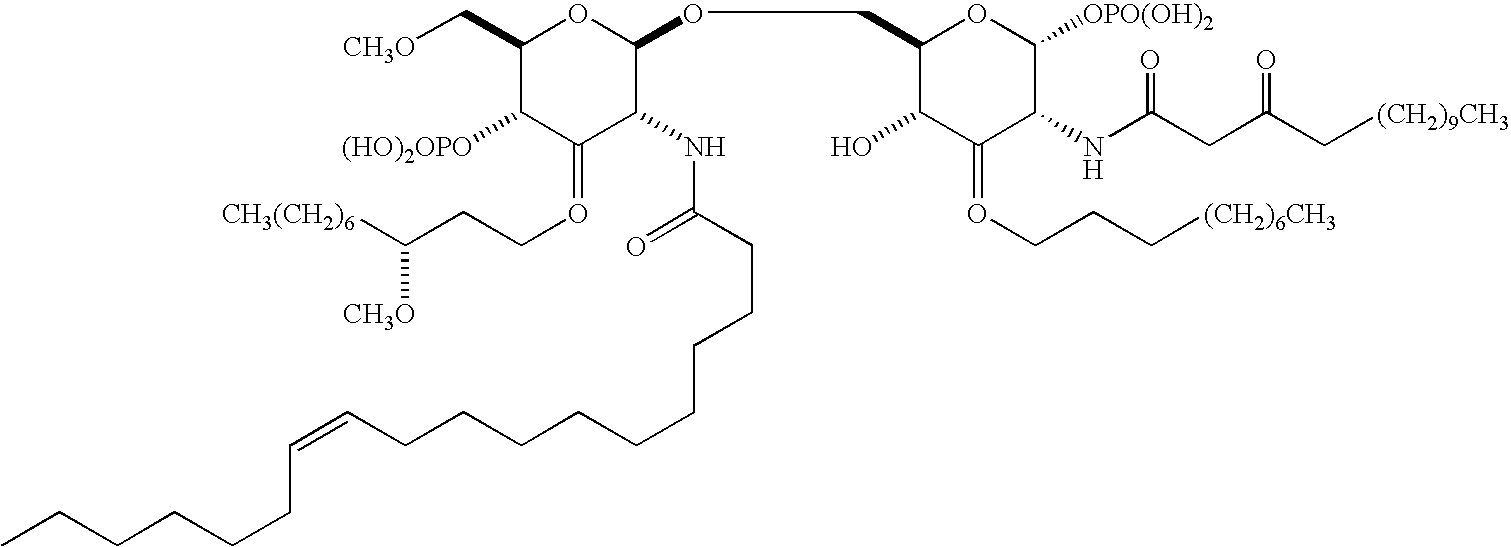
(α-D-Glucopyranose, 3-O-decyl-2-deoxy-6-O-[2-deoxy-3-O-[(3R)-3-methoxydecyl)-6-O-methyl-2-[[(11Z)-1-oxo-11-octadecenyl)amino]-4-O-phosphono-β-D-glucopyranosyl]-2-[(1,3-dioxotetradecyl)amino]-,1-(dihydrogen phosphate), which can be provided as a tetrasodium salt. E5564 has a molecular weight of 1401.6. - We have discovered that administration of E5564 by continuous infusion over a relatively long period of time overcomes an unexpectedly short pharmacodynamic half-life of the drug, which surprisingly has been observed even though E5564 demonstrates a long pharmacokinetic half-life in circulation in the blood.
- Accordingly, the invention features methods of treating patients suffering from medical conditions amenable to treatment with E5564. Examples of such conditions include endotoxemia (e.g., surgery-related endotoxemia), sepsis, septic shock, HIV infection, and immunological disorders, such as allograft rejection and graft-versus-host disease. The methods of the invention can also be used with patients suffering from damage to the gastrointestinal tract due to chemotherapy or radiation, and patients that have undergone bone marrow transplantation.
- In the methods of the invention, E5564 is administered to patients by intravenous infusion over a period of 12-100, e.g., 60-80 or 72 hours. Activity in the ICU is often hectic, and minor variations in the time period of infusion of the drug are included within the scope of the invention.
- The infusion dosage rate can be, for example, 0.001-0.5 mg/kg body weight/hour, e.g., 0.01-0.2 mg/kg/hour or 0.03-0.1 mg/kg/hour. The infusion of E5564 can, if desired, be preceded by a bolus injection of E5564, which can be given at a dosage of 0.001-0.5 mg/kg. The total amount of E5564 administered to a patient can be, for example, 50-600 mg of drug, e.g., 150-500 mg, by infusion over a period of 60-80 hours.
- Patients that can be treated according to the methods of the invention include, for example, surgical patients (e.g., cardiac surgical patients), patients that have or are at risk of developing endotoxemia, sepsis, or septic shock, patients that are infected with HIV, and patients that are suffering from an immunological disorder, such as allograft rejection or graft-versus-host disease. The methods of the invention can also be carried out with any patients that have had, will have, or are having any type of transplant. For example, the methods can be carried out with patients having leukemia (e.g., chronic myeloid leukemia, acute myeloid leukemia, or acute lymphocytic leukemia) or another cancer, and that are treated by bone marrow or stem cell transplantation. The patients can also be kidney, liver, heart, or lung transplant patients. The graft-versus-host disease that is prevented or treated, according to the invention, can be acute or chronic.
- The total dosage of drug used in the methods of the invention can be advantageously quite high, providing a maximum therapeutic effect, but not be accompanied by unacceptable toxicity. In particular, as is described further below, it has been found that, although injected or infused E5564 remains present in the blood for a relatively long period of time (i.e., E5564 has a relatively long pharmacokinetic half-life), the period during which it is active (i.e., its pharmacodynamic half-life) is relatively short. Thus, it is advantageous to administer the drug by continuous infusion over a prolonged period of time.
- It is unexpected that such prolonged administration is possible, because a related, three- to ten-fold less active anti-endotoxin compound, B531 (U.S. Pat. No. 5,530,113, which is hereby incorporated by reference), could not be safely administered to patients in such a manner, due to its lack of safety margin in animal studies. Surprisingly, E5564 is about twenty-fold less toxic than B531, and thus can be administered at relatively high levels, for relatively long periods of time, according to the methods of the invention. Thus, the methods of the invention provide significant therapeutic benefits, with acceptably low toxicity. An additional advantage of the methods of the invention is that they are easily carried out, as many of the patients treated according to the methods of the invention already have intravenous lines inserted, as part of their treatment in the ICU. Further, the methods of the invention provide an approach to preventing and treating graft-versus-host disease.
- Other features and advantages of the invention will be apparent from the following detailed description, the drawings, and the claims.
-
FIG. 1 is a graph showing the anti-endotoxin activity of E5564 after a single bolus injection. LPS endotoxin (300 ng/kg) was injected intravenously into untreated dogs (∘) or simultaneously with 0.1 mg/kg E5564 (Δ) one hour after E5564 administration (□) or three hours after E5564 administration (●). Blood was drawn and analyzed for TNF-α concentration by bioassay, as is described in the Materials and Methods section, below. Each value represents the mean±S.E.M. of four animals. -
FIG. 2 is a graph showing induction of IL-6 in dog blood ex vivo; dose response to LPS in pre-dose blood samples. Blood samples from male dogs #101 (∘) and #201 (●), and female dogs #151 (□) and #251 (▪), were drawn prior to dosing, treated with the indicated amount of LPS for 3 hours, and assayed for release of IL-6 (see Materials and Methods). -
FIG. 3 is a graph showing the plasma levels of E5564 after a single bolus injection. After bolus administration of 0.1 mg/kg E5564 (∘), 0.3 mg/kg E5564 (□), and 1 mg/kg E5564 (▪), blood was drawn and analyzed for E5564 concentration by extraction and analysis by HPLC. Each value represents the mean±S.E.M. of three animals. No drug was detectable in samples drawn prior to dosing. -
FIG. 4 is a graph showing the plasma levels of E5564 during and after 72 hours of intravenous infusion. Plasma levels of E5564 were determined during and after 72 hours of intravenous infusion of 0.03 mg/kg/hour E5564 (∘,●), 0.1 mg/kg/hr E5564 (□,▪), and 1 mg/kg/hour E5564 (Δ,▴) into female (closed symbols) or male (open symbols) beagle dogs. At the indicated times, blood was drawn and analyzed for E5564 concentration by extraction and analysis by HPLC. Each value represents the mean±S.E.M. of three animals. No drug was detectable in samples drawn prior to dosing. -
FIG. 5 is a pair of graphs showing ex vivo analysis of active E5564 during intravenous infusion. Activity of E5564 was determined during intravenous infusion of 0.24 mg/kg/hour E5564 (□,∘) or 2.4 mg/kg/hour E5564 (▪,●) into female (upper panel) or male (lower panel) beagle dogs. At the indicated times, blood was drawn and analyzed for E5564 activity by adding 1 ng/ml LPS, incubating for three hours at 37° C., and assaying the plasma fraction for IL-6 by bioassay, as is described in the Materials and Methods section (below). Each value represents the mean±standard deviation of samples assayed in duplicate from each animal. The zero hour sample was taken prior to infusion. -
FIG. 6 is a pair of graphs showing ex vivo analysis of active E5564 during intravenous infusion. Activity of E5564 was determined during intravenous infusion of 0.24 mg/kg/hour E5564 (□,∘) or 2.4 mg/kg/hour E5564 (▪,●) into female (upper panel) or male (lower panel) beagle dogs. At the indicated times, blood was drawn and analyzed for E5564 activity by adding 10 ng/ml LPS, incubating for three hours at 37° C., and assaying the plasma fraction for IL-6 by bioassay, as is described in the Materials and Methods section (below). Each value represents the mean±standard deviation of samples assayed in duplicate from each animal. The zero hour sample was taken prior to infusion. -
FIG. 7 is a pair of graphs showing ex vivo analysis of active E5564 during intravenous infusion. Activity of E5564 was determined during intravenous infusion of 0.24 mg/kg/hour E5564 (□,∘) or 2.4 mg/kg/hour E5564 (▪,●) into female (upper panel) or male (lower panel) beagle dogs. At the indicated times, blood was drawn and analyzed for E5564 activity by adding 100 ng/ml LPS, incubating for three hours at 37° C., and assaying the plasma fraction for IL-6 by bioassay, as is described in the Materials and Methods section (below). Each value represents the mean±standard deviation of samples assayed in duplicate from each animal. The zero hour sample was taken prior to infusion. - We have discovered that administration of E5564 by continuous infusion over a relatively long period of time overcomes the short pharmacodynamic half-life of the drug, which has been observed even though E5564 demonstrates a long pharmacokinetic half-life in circulation in the blood. The methods of the invention, as well as experimental data related to these methods, are described further, as follows.
- The methods of the invention can be used to prevent or treat endotoxemia and related conditions and disorders (e.g., sepsis) in humans. For example, the methods can be used in conjunction with any type of surgery or medical procedure that could lead to the occurrence of endotoxemia or related complications (e.g., sepsis syndrome). For example, the methods of the invention can be used in conjunction with cardiac surgery (e.g., coronary artery bypass graft, cardiopulmonary bypass, or valve replacement), transplantation (of, e.g., liver, heart, kidney, lung, or bone marrow), cancer surgery (e.g., resection of a tumor), or any abdominal surgery. Additional examples of surgical procedures with which the methods of the invention can be used include surgery for treating acute pancreatitis, inflammatory bowel disease, placement of a transjugular intrahepatic portosystemic stent shunt, hepatic resection, burn wound revision, and burn wound escharectomy. The methods of the invention can also be used in conjunction with non-surgical procedures in which the gastrointestinal tract is compromised. For example, the methods of the invention can be used in association with chemotherapy or radiation therapy in the treatment of cancer.
- The methods of the invention can also be used in the treatment of conditions associated with human immunodeficiency virus (HIV) infection, and immunological disorders, such as allograft rejection and graft-versus-host disease (GVHD), in particular, acute GVHD. GVHD is the most common complication of patients who have undergone allogeneic bone marrow or stem cell transplantation. These patients include, for example, patients that have chronic myeloid leukemia (CML), acute myeloid leukemia (AML), or acute lymphocytic leukemia (ALL). In GVHD, immune cells (T lymphocytes) from the donor attack cells of the transplant recipient, which the donor immune cells recognize as being foreign. Any types of cells in the recipient can be recognized as being foreign, and thus attacked, by the donor T lymphocytes. These cells include cancer cells, in which case the effect, referred to as graft-versus-leukemia (GVL) effect, is beneficial to the recipient. The recognized and attacked cells can also include normal cells of, e.g., the skin, stomach, intestines, liver, and mucosal surfaces, and this recognition can lead to very severe or even lethal damage. Acute GVHD occurs shortly after transplantation and is caused by T lymphocytes present in the donor preparation, while chronic GVHD occurs 2-3 months after the transplant, and may be caused by T lymphocytes that have grown in an adverse manner from the graft.
- The primary route by which donor T lymphocytes cause GVHD is by priming inflammatory cells (monocytes and macrophages) to secrete cytopathic amounts of cytokines when stimulated by bacterial lipopolysaccharide (LPS). The cytokines in turn directly damage tissues and organs, as well as provoke T cell expansion and increases in cytotoxic T lymphocytes (CTL) and natural killer (NK) cells, responses that can also damage tissues and organs. Thus, according to the present invention, patients that have or are at risk of developing acute or chronic GVHD (e.g., patients with CML, AML, or ALL that are treated by bone marrow or stem cell transplant) can be treated by the administration of an LPS antagonist, which blocks such stimulation. The LPS antagonist can be administered just before, during, and/or shortly after (e.g., during the first 4-7 days after) transplantation to prevent GVHD. GVHD has been detected with other types of transplantations as well, for example, with kidney, liver, heart, and lung transplants. The methods of the invention can be used in the prevention and treatment of GVHD occurring with these types of transplantations as well.
- In the case of preventing or treating GVHD, antiendotoxin compounds can be administered using the doses and regimens described herein, or by use of other approaches determined to be appropriate by those of skill in the art.
- The drug can be formulated according to standard pharmaceutical practice. A specific example of a formulation of the drug is described in detail in U.S. Ser. No. 60/452,022, the contents of which are incorporated herein by reference.
- Analysis of Anti-Endotoxin Drug Activity
- Many of the signs and symptoms of sepsis can be mimicked in vivo by administration of endotoxin to an animal model system. The physiological effects of endotoxin can vary depending on dose, route of administration, and species tested, but generally include symptoms such as elevated temperature (fever), hypotension, changes in cellular composition of blood (decreased white blood cells, etc.), and elevation of proinflammatory cytokines, such as TNF-α and IL-6, and some anti-inflammatory cytokines. The activity of a drug designed to antagonize the effects of endotoxin can be tested in animal model studies by determining if it blocks any or all of these physiological markers of endotoxin activity.
- In general, the candidate antagonist is administered to a test species of animal, and an appropriate dose of endotoxin (lipopolysaccharide (LPS)) is administered to test the ability of the candidate antagonist to block the effects of endotoxin. Some of the experiments described below use an in vivo challenge of LPS given intravenously both during and after intravenous infusion of E5564. Activity of an antagonist can also be assayed ex vivo by removing blood samples from animals treated with the candidate antagonist and testing that blood to determine if the drug is active and/or present in sufficient quantities to inhibit cellular activation by LPS. In both assays, activity of the antagonist is quantitated by analysis of the cytokines induced by LPS administration. In addition, other physiological symptoms of endotoxin poisoning can be used as readouts of activity. Studies described herein use TNF-α and/or IL-6 as readouts of cellular activation, but a variety of other cytokines and cellular mediators can also be used for this purpose.
- Pharmacodynamic Analysis of E5564 in vivo
- As is shown in
FIG. 1 and Table 1, delivery of 300 ng/kg of LPS into beagle dogs (“control” inFIG. 1 ) elicits a strong, reproducible response, as measured by levels of plasma TNF-α. Administration of 0.1 mg/kg E5564 is completely effective in blocking this LPS challenge when given at the same time as LPS (compare control to simultaneous administration inFIG. 1 ). Similar results are obtained when LPS is given one hour after drug administration. Surprisingly, however, efficacy of E5564 decreased thereafter. That is, if this same challenge of endotoxin is administered three hours after administration of the E5564 dose (E5564 3 hours before LPS administration), activity of the endotoxin antagonist is greatly decreased, to about 48% of its original activity. This short activity lifetime (i.e., pharmacodynamic half-life) is an unexpected result, as the pharmacokinetic half-life of E5564 is extremely long in comparison (see below). Thus, while the unmodified (unmetabolized) drug appears to remain in circulation for a relatively long period of time, it loses activity. Because of this unexpected discovery, we have chosen to administer E5564 by infusion. - In vivo Pharmacokinetic Analysis of E5564 After Bolus Injection
- As is shown in
FIGS. 3 and 4 and in Tables 2 and 3, E5564 demonstrates a relatively long half-life in blood after injection either as a bolus (FIG. 3 and Table 2) or after infusion (FIG. 4 and Table 3). This analysis of E5564 levels indicates that E5564 remains in the blood (or plasma), and is not rapidly removed or “cleared” by organs such as the liver, lungs, or kidneys, etc. This long-term presence of unmodified E5564 in blood initially led us to believe that active drug was likely present for very long periods of time after cessation of drug administration. As subsequent experiments demonstrated, this initial, reasonable supposition turned out to be wrong. - In vivo Pharmacokinetic Analysis of E5564 During Infusion
- To assess the activity of E5564 over multiple time points from a single treated animal, we employed an ex vivo assay, as is mentioned above, to test for active drug in samples of blood drawn from a treated animal. Samples of blood were drawn from beagle dogs infused with E5564 over a period of 24 hours. One dog of each sex was tested under each of two dose regimens: a low dose of 0.24 mg/kg/hour and a high dose of 2.4 mg/kg/hour.
- Blood samples were taken from these dogs at predose, 4 hours after initiation of infusion, and 24 hours after initiation of infusion. The blood samples were challenged with 0, 1, 10, or 100 ng/ml LPS, and then incubated for three hours. The samples were then analyzed for activation by LPS, using induction of cytokine response as a readout. As is shown in
FIGS. 5-7 , E5564 dose-dependently inhibited the LPS response in a time-dependent fashion. - Inhibition of LPS-Induced IL-6 Release in ex vivo Blood Samples by Intravenous Infusion of E5564 in Beagle Dogs
- Effect of Infusion of E5564 at 0.24 mg/kg/hour
- As is shown in
FIGS. 5-7 , E5564 infused at 0.24 mg/kg/hour inhibited LPS response in ex vivo blood samples when compared to predose levels. Differences in inhibitory activity of E5564 were seen with respect to the amount of LPS added. Nearly complete (≧98%) inhibition of response to 1 ng/ml LPS was seen with blood samples tested ex vivo at 4 hours after beginning infusion (seeFIG. 5 ). At the end of infusion, inhibition of 1 ng/ml LPS challenge was complete in samples obtained from both low dose LPS treated dogs. When blood samples were challenged with 10 ng/ml LPS, 29 to 70% inhibition was observed at 4 hours (FIG. 5 ), and ˜85% inhibition was observed at the end of infusion. Challenges using 100 ng/ml LPS were only poorly inhibited by this rate of drug infusion; maximum inhibition was 34-52% (FIG. 7 ) at the end of infusion. - Effect of Infusion of E5564 at 2.4 mg/kg/hour
- As is shown in
FIG. 5 , samples taken 4 hours after beginning infusion of 2.4 mg/kg/hour E5564 exhibited complete inhibition of response to 1 ng/ml LPS, as compared to samples taken prior to beginning infusion, and nearly completely inhibited challenges of 10 and 100 ng/ml LPS. At the end of infusion (24 hours), inhibition was complete for the 1 and 10 ng/ml LPS challenges, and was >90% for the higher dose challenge of 100 ng/ml LPS. - These results show that infusion of E5564 at a dose of either 0.24 mg/kg/hour or 2.4 mg/kg/hour inhibits LPS response in blood over the period of infusion. Inhibition of LPS response is dose dependent for both E5564 and for the concentration of LPS used as challenge.
TABLE 1 Pharmacodynamic analysis of E5564 after single bolus intravenous injection to dogs. Response to LPS1 Response Sum of to LPS Inhibition TNF-α at TNF-α at TNF-α (% of of LPS Treatment 1 hour 22 hours2 (AUC) control) response None 2369 ± 187 590 ± 108 2959 100 N/A (LPS only) E5564 0 0 0 0 100 simulta- neously with LPS E5564 0 0 0 0 100 one hour before LPS E5564 1353 ± 340 190 ± 113 1543 52 48 three hours before LPS
1Response to LPS was measured in groups of four beagle dogs for each treatment.
2Plasma levels of TNF-α induced at one and two hours after LPS administration. All TNF-α measured in units/ml.
-
TABLE 2 Pharmacokinetic parameters for E5564 in plasma after single bolus intravenous injection to dogs. Dose Parameter 0.1 mg/kg dose 0.3 mg/ kg 1 mg/kg T½ (hours) 41.7 ± 2.7 50.4 ± 2.2 46.4 ± 2.7 AUC 71825.5 ± 1981 270897.2 ± 743544.6 ± (ng · hour/ml) 28260.8 90918.6 -
TABLE 3 Pharmacokinetic parameters for E5564 in plasma after 72 hours intravenous infusion into dogs. Parameter C72 hours AUC0-144 hours Dose Sex (μg/ml) (μg · hour/ml)1 T½ (hour)2 0.1 mg/kg Male 13.07 ± 1.22 1069 ± 139 38.4 ± 4.5 Female 10.35 ± 0.93 790 ± 51 40.9 ± 9.5 0.3 mg/kg Male 41.29 ± 7.18 3309 ± 485 39.9 ± 11.2 Female 32.40 ± 5.72 2616 ± 737 38.0 ± 11.6 1 mg/kg Male 366 ± 69.3 27114 ± 5737 35.1 ± 8.7 Female 393.9 ± 14.2 29642 ± 1514 32.0 ± 2.8
1Rounded to the nearest whole number
2T½ after end of infusion
- Materials and Methods
- (1) In vivo Assays
- (1.1) Reagents
- E5564 was synthesized by Eisai Research Institute of Boston, Andover, Mass., U.S.A. E5564 drug product was manufactured at the Eisai Preclinical Laboratory (Tsukuba, Japan) by dissolving 35.4 mg of drug substance in 52.1 ml 0.01 N NaOH, stirring for one hour at room temperature, and diluting into phosphate-buffered lactose. After adjusting the pH to 7.3 and diluting to a final concentration of 0.1 mg/ml E5564, the solution was filter-sterilized and lyophilized.
- The formulation of drug product in 1 ml vials is shown below.
Material amount E5564 100 μg NaH2PO4.4H2O 0.35 mg NaOH 0.06 mg Lactose hydrous 100 mg Na2HPO4.7H2O 0.45 mg sterile water 1 ml - Escherichia coli LPS (Serotype 0111:B4; phenol extracted, Cat. # L-2630) was purchased from Sigma Chemical Co. Ltd., St. Louis, Mo., U.S.A. Lyophylized E5564 was solubilized in 5 ml of sterile water (Otsuka Pharm. Co. Ltd., Tokyo, Japan). LPS was weighed to an accuracy of 1/10 mg and solubilized in 5% glucose (Otsuka Pharm. Co. Ltd., Tokyo, Japan). The LPS solution was sonicated with a bath-type sonicator for 15 minutes after which aliquots were immediately prepared and stored at −20° C. Prior to use, the solution was sonicated for one or two minutes, and then dilutions were prepared in 5% glucose.
- (1.2) Animals
- Nine month-old beagles were obtained from Kawashima-shoji Co. Ltd., Gifu, Japan) and housed in stainless steel wire cages (
W 800 mm×D 680 mm×H 680 mm; one dog per cage) in a room with a constant temperature of 20-24° C., humidity of 45-65%, and 12 hour light-dark cycle. The animals were provided with pellet food (DS, Oriental Yeast Co., Tokyo, Japan) and water ad libitum. LPS endotoxin (300 ng/0.1 ml/kg) was injected into the vein of the right foreleg at a rate of 1-2 ml/minute, and E5564 was injected into the vein of the left foreleg at a rate of 10-20 ml/minute. - (1.3) Blood Collection and Treatment
- Immediately before or 1, 2, or 4 hours after intravenous injection of LPS and E5564, 1.5 ml of blood was drawn from the left cephalic vein. One milliliter was transferred into a tube containing 10 U of heparin (Mochida Pharm. Co. Ltd., Tokyo, Japan), centrifuged (2000×g, 5 minutes, 4° C.), and the plasma was used for bioassays for TNF-α and IL-6.
- (1.4) TNF Bioassay
- Aliquots of the plasma were tested for TNF in a bioassay based on the TNF-dependent cell death of L-P3 cells in the presence of actinomycin D. The L-P3 cell line is more sensitive to TNF-induced cell death than the L-929 cell line that is more commonly used.
- L-P3 cells were cultured in RPMI 1640 medium containing 10% heat inactivated fetal calf serum, 100 U/ml penicillin, and 100 μg/ml streptomycin. Plasma samples to be assayed were diluted 5-100 fold, and 0.1 ml of each was serially diluted into 96-well culture plates. 7×10⁴ L-P3 cells in 100 μl medium containing 1 μg/ml actinomycin D mannitol (Sigma Chemical Co. Ltd., St. Louis, Mo., U.S.A.) were added to each well containing the plasma samples and incubated for 15 hours at 37° C. in 5% CO2. TNF-induced cell toxicity was measured using methylene blue as follows. Wells were washed with water at least 5 times to remove dead cells, after which cells were fixed with 50 μl glutaraldehyde and stained with 0.1 ml of a 0.05% methylene blue solution in water for 15 minutes. Excess methylene blue was removed by washing at least 5 times, after which the plate was dried. Methylene blue was then re-extracted from cells by addition of 0.2 ml of 0.33 N HCl to each well, and absorbance was read with dual wavelengths of λ1405 and λ2660 nm on a microplate reader (ImmunoReader NJ-2000; Japan InterMed Co. Ltd., Tokyo, Japan).
- (1.5) IL-6 Bioassay
- Aliquots of the plasma were tested for IL-6 activity by measuring IL-6-dependent proliferation of the mouse-derived lymphoma cell line, B9. Cells were cultured in RPMI 1640 medium containing 10% heat inactivated fetal calf serum, 50 μM 2-mercaptoethanol, 100 U/ml penicillin, 100 μg/ml streptomycin, and 2 mM glutamate. Plasma samples diluted ten-fold or 500 pg/ml of IL-6 standard (human recombinant IL-6; Genzyme Corporation, Boston, Mass.) were added to each well of a 96-well culture plate and then diluted serially. 1.5×10³ B9 cells in 50 μl medium were added to each well and the plates were incubated for three days at 37° C. in 5% CO2.
- B9 cell proliferation was measured by the MTT (3-[4,5-Dimethylthiazol-2-yl]-2,5-diphenyltetrazolium bromide; Sigma Chemical Co., St. Louis, Mo, USA) staining method. Twenty microliters of 6 mg/ml of MTT in Dulbecco phosphate-buffered saline were added to each well and the plates were incubated for 3 hours at 37° C. in 5% CO2. Next, 100 μl/well of 10% SDS (sodium dodecyl sulfate; Nacalai Tesque Co. Ltd., Kyoto, Japan) in 1 mM NH4OH was added and the cells were then solubilized overnight. Absorbance of each well was read by a plate reader (Model 3550, Bio-Rad Labs, Richmond, Calif., U.S.A.) with dual wavelengths of λ1540 and λ2660 nm. One unit/ml of human IL-6 is equivalent to 100 pg/ml.
- (2) Ex vivo Assays
- (2.1) Reagents
- LPS from Escherichia coli (0111:B4) was purchased from List Biologicals (Campbell, Calif.). LPS was dissolved in sterile water at 1 mg/ml and stored at −20° C. Prior to use, LPS was sonicated in a bath sonicator (VW-380; Heat Systems-Ultrasonics Inc., Farmingdale, N.Y.) for 1-2 minutes immediately before use and diluted into Ca2+, Mg2+ free Hanks balanced salt solution (HBSS; Sigma).
- (2.2) Origin of Samples and Study Design
- Dogs were treated with E5564 (0.24 or 2.4 mg/kg/hour) dissolved in a mixture of placebo solution (10% lactose monohydrate, 0.045% Na2HPO4.7H2O, 0.035% NaH2PO4.H2O, 0.006% NaOH; pH 7.4±0.3) and 5% dextrose (1:4) by intravenous infusion via indwelling catheter for 24 hours at a rate of 2 mg/kg/hour. The study design is shown in the following table:
Animal Group Dose Level Numbers No. (mg/kg/hour) Male Female 1 0.24 101 151 2 2.4 201 251
(2.3) Analysis of E5564 Activity in Dog Whole Blood - Prior to and during infusion of E5564, blood was drawn into heparinized syringes, and either aseptically reduced to plasma by centrifugation and frozen to −80° C. (for time zero samples), or incubated with the indicated concentrations of LPS for three hours. Plasma was then prepared and immediately frozen at −80° C. Samples were stored at −80° C. until assay.
- (2.4) Bioassay for IL-6
- B9 cells were the gift of Dr. Mary Rodrick (Beth Israel Deaconess Hospital, Boston, Mass.). They were grown in Iscove's DMEM medium containing 5% fetal bovine serum (FBS), 20 mM 2-mercaptoethanol, 2 mM L-glutamine, and 100 U/ml penicillin/streptomycin. For maintenance of growth, these cells were kept in growth media containing 50 U/ml (or 1 ng/ml) recombinant human IL-6 (Genzyme). For growth dependence by IL-6 (IL-6 bioassay), B9 cells were washed three times in assay media and counted, cell concentration was adjusted to 4×10⁵/ml (2×10⁴/50 μl) in assay media, and 50 μl of media was added to each well of a 96-well tissue culture plate.
- To the above-described cell suspension, 50 μl of standard or sample was added to each well, and the cells cultured for 68-72 hours at 37° C./5% CO2. Dog plasma samples were added to the assay at a 1:20 dilution (10 μl+190 μl) in assay media (in duplicate), then serially diluted 1:4 (to a final dilution of 1:327,680) in 96-well microtitre plates. Fifty microliters of each dilution were then transferred to an appropriately labeled assay microtitre plate. Standard curves were prepared (2-4 rows/plate, depending on plate space) using human rIL-6 as a standard (10 μg/ml), diluted 1:100, and then diluted another 1:10 to 10 ng/ml. Two hundred microliters of this dilution were added to a dilution plate, then each was serially diluted 1:4, and 2 blank wells received 50 μl assay media only. After the culture period, actively metabolizing cells were quantitated by adding 10 μl of a 5 mg/ml solution of MTT (3-[4,5-Dimethylthiazol-2-yl]-2,5-diphenyltetrazolium bromide) in sterile PBS to each well. Plates were incubated 4-5 hours at 37° C., acid-isopropanol (150 μl 40 mM HCL in isopropanol) was added to each well, plates were incubated for 1 hour at 37° C., followed by repeated trituration to solubilize crystals, and absorbance was read at 540 and 690 nm (background absorbance). IL-6 concentration was determined by calculation of a linear relationship for response to IL-6 standards that yielded the greatest dose-response region of the standard curve. (In general, this range is between 0.016 and 0.063 ng/ml IL-6, yielding net absorbances of ˜0.3 to 0.4 for the low dose and ˜0.8 to 1.0 for the high dose.) Only absorbances that fell between the above values for standards (or ±0.05 AU) were used to calculate IL-6 by interpolation from the linear curve drawn by the Four Parameter Curve Fit program (Delta Soft) through the standard points.
- (2.5) Induction of IL-6 by LPS Challenge in ex vivo Blood Samples
- To obtain baseline values for LPS stimulation, samples of blood were drawn at approximately one hour prior to beginning administration (predose). While we did not extensively analyze the dose response relationship of dog blood to LPS, we used 1, 10, and 100 ng/ml LPS to ensure that a measurable response could be generated. Responses to LPS in these samples resulted in 6,000 pg/ml IL-6 to as high as 40,000 pg/ml IL-6 in response to 100 ng/ml LPS in the four dogs. Some samples (particularly from the two female dogs) demonstrated a more graded response to the three different concentrations of LPS. However, all LPS-challenged predose samples generated between 3,000 pg/ml IL-6 and 32,000 pg/ml IL-6. Blood from the male beagles responded more vigorously than blood from the female dogs.
- All references cited herein are incorporated by reference in their entirety. Other embodiments are within the following claims.
Claims (19)


Priority Applications (1)
| Application Number | Priority Date | Filing Date | Title |
|---|---|---|---|
| US11/010,550 US20050215517A1 (en) | 1999-01-14 | 2004-12-13 | Use of an anti-endotoxin drug in the prevention and treatment of disease |
Applications Claiming Priority (6)
| Application Number | Priority Date | Filing Date | Title |
|---|---|---|---|
| US11620299P | 1999-01-14 | 1999-01-14 | |
| PCT/US2000/001043 WO2000041703A1 (en) | 1999-01-14 | 2000-01-14 | Administration of an anti-endotoxin drug by intravenous infusion |
| US88927401A | 2001-07-12 | 2001-07-12 | |
| US10/171,465 US20030130212A1 (en) | 1999-01-14 | 2002-06-13 | Administration of an anti-endotoxin drug by intravenous infusion |
| PCT/US2003/018678 WO2003105861A1 (en) | 2002-06-13 | 2003-06-13 | Use of an anti-endotoxin drug in the prevention and treatment of disease |
| US11/010,550 US20050215517A1 (en) | 1999-01-14 | 2004-12-13 | Use of an anti-endotoxin drug in the prevention and treatment of disease |
Related Parent Applications (1)
| Application Number | Title | Priority Date | Filing Date |
|---|---|---|---|
| PCT/US2003/018678 Continuation WO2003105861A1 (en) | 1999-01-14 | 2003-06-13 | Use of an anti-endotoxin drug in the prevention and treatment of disease |
Publications (1)
| Publication Number | Publication Date |
|---|---|
| US20050215517A1 true US20050215517A1 (en) | 2005-09-29 |
Family
ID=29732777
Family Applications (2)
| Application Number | Title | Priority Date | Filing Date |
|---|---|---|---|
| US10/171,465 Abandoned US20030130212A1 (en) | 1999-01-14 | 2002-06-13 | Administration of an anti-endotoxin drug by intravenous infusion |
| US11/010,550 Abandoned US20050215517A1 (en) | 1999-01-14 | 2004-12-13 | Use of an anti-endotoxin drug in the prevention and treatment of disease |
Family Applications Before (1)
| Application Number | Title | Priority Date | Filing Date |
|---|---|---|---|
| US10/171,465 Abandoned US20030130212A1 (en) | 1999-01-14 | 2002-06-13 | Administration of an anti-endotoxin drug by intravenous infusion |
Country Status (3)
| Country | Link |
|---|---|
| US (2) | US20030130212A1 (en) |
| AU (1) | AU2003243551A1 (en) |
| WO (1) | WO2003105861A1 (en) |
Cited By (57)
| Publication number | Priority date | Publication date | Assignee | Title |
|---|---|---|---|---|
| US20040254128A1 (en) * | 2001-08-10 | 2004-12-16 | Seiichi Kobayashi | Treatment and prevention of heat shock protein-associated diseases and conditions |
| US20070072824A1 (en) * | 2001-08-10 | 2007-03-29 | Eisai Co., Ltd. | Methods of reducing the severity of mucositis |
| WO2007031879A3 (en) * | 2005-05-13 | 2007-10-04 | Eisai Co Ltd | Lipid a analogs for treating oral and gastrointestinal mucositis |
| WO2008020335A2 (en) | 2006-06-09 | 2008-02-21 | Novartis Ag | Immunogenic compositions for streptococcus agalactiae |
| US20090149647A1 (en) * | 2005-08-31 | 2009-06-11 | Eisai R&D Management Co., Ltd. | Process for production of lipid a analogue |
| US20090232844A1 (en) * | 2006-03-23 | 2009-09-17 | James Sutton | Immunopotentiating compounds |
| US20090311288A1 (en) * | 2006-03-23 | 2009-12-17 | Novartis Ag | Imidazoquinoxaline compounds as immunomodulators |
| US20100010217A1 (en) * | 2006-03-23 | 2010-01-14 | Valiante Nicholas M | Methods for the preparation of imidazole-containing compounds |
| WO2010100632A2 (en) | 2009-03-06 | 2010-09-10 | Novartis Ag | Chlamydia antigens |
| US20100239600A1 (en) * | 2007-07-17 | 2010-09-23 | Novartis Vaccines And Diagnostics | Conjugate purification |
| WO2011004263A2 (en) | 2009-07-07 | 2011-01-13 | Novartis Ag | Conserved escherichia coli immunogens |
| WO2011007257A1 (en) | 2009-07-16 | 2011-01-20 | Novartis Ag | Detoxified escherichia coli immunogens |
| WO2011008974A2 (en) | 2009-07-15 | 2011-01-20 | Novartis Ag | Rsv f protein compositions and methods for making same |
| EP2298795A1 (en) | 2005-02-18 | 2011-03-23 | Novartis Vaccines and Diagnostics, Inc. | Immunogens from uropathogenic escherichia coli |
| WO2011048561A1 (en) | 2009-10-20 | 2011-04-28 | Novartis Ag | Diagnostic and therapeutic methods for rheumatic heart disease based upon group a streptococcus markers |
| WO2011058302A1 (en) | 2009-11-10 | 2011-05-19 | Guy's And St Thomas's Nhs Foundation Trust | Bacteremia-associated antigen from staphylococcus aureus |
| WO2011080595A2 (en) | 2009-12-30 | 2011-07-07 | Novartis Ag | Polysaccharide immunogens conjugated to e. coli carrier proteins |
| EP2351772A1 (en) | 2005-02-18 | 2011-08-03 | Novartis Vaccines and Diagnostics, Inc. | Proteins and nucleic acids from meningitis/sepsis-associated Escherichia coli |
| EP2368573A2 (en) | 2005-11-04 | 2011-09-28 | Novartis Vaccines and Diagnostics S.r.l. | Influenza vaccines including combinations of particulate adjuvants and immunopotentiators |
| EP2368572A2 (en) | 2005-11-04 | 2011-09-28 | Novartis Vaccines and Diagnostics S.r.l. | Adjuvanted vaccines with non-virion antigens prepared from influenza viruses grown in cell culture |
| EP2377551A2 (en) | 2005-11-04 | 2011-10-19 | Novartis Vaccines and Diagnostics S.r.l. | Adjuvanted influenza vaccines including cytokine-inducing agents |
| EP2377552A2 (en) | 2005-11-04 | 2011-10-19 | Novartis Vaccines and Diagnostics S.r.l. | Influenza vaccines with reduced amount of emulsion adjuvant |
| EP2382987A1 (en) | 2006-03-24 | 2011-11-02 | Novartis Vaccines and Diagnostics GmbH | Storage of influenza vaccines without refrigeration |
| EP2382988A1 (en) | 2006-03-31 | 2011-11-02 | Novartis AG | Combined mucosal and parenteral immunization against HIV |
| WO2011149564A1 (en) | 2010-05-28 | 2011-12-01 | Tetris Online, Inc. | Interactive hybrid asynchronous computer game infrastructure |
| WO2011151726A2 (en) | 2010-06-01 | 2011-12-08 | Novartis Ag | Concentration of vaccine antigens with lyophilization |
| WO2011151723A2 (en) | 2010-06-01 | 2011-12-08 | Novartis Ag | Concentration of vaccine antigens without lyophilization |
| WO2011161551A2 (en) | 2010-06-11 | 2011-12-29 | Novartis Ag | Omv vaccines |
| WO2012006359A1 (en) | 2010-07-06 | 2012-01-12 | Novartis Ag | Delivery of self-replicating rna using biodegradable polymer particles |
| WO2012023044A1 (en) | 2010-08-20 | 2012-02-23 | Novartis Ag | Soluble needle arrays for delivery of influenza vaccines |
| EP2478916A1 (en) | 2006-01-27 | 2012-07-25 | Novartis Vaccines and Diagnostics GmbH | Influenza vaccines containing hemagglutinin and matrix proteins |
| WO2012103361A1 (en) | 2011-01-26 | 2012-08-02 | Novartis Ag | Rsv immunization regimen |
| EP2484377A1 (en) | 2007-06-27 | 2012-08-08 | Novartis AG | Low-additive influenza vaccines |
| EP2497495A2 (en) | 2006-09-11 | 2012-09-12 | Novartis AG | Making influenza virus vaccines without using eggs |
| EP2510947A1 (en) | 2009-04-14 | 2012-10-17 | Novartis AG | Compositions for immunising against Staphylococcus aureus |
| EP2514437A1 (en) | 2006-07-20 | 2012-10-24 | Novartis AG | Frozen stockpiling of influenza vaccines |
| WO2012158613A1 (en) | 2011-05-13 | 2012-11-22 | Novartis Ag | Pre-fusion rsv f antigens |
| EP2532362A1 (en) | 2006-12-06 | 2012-12-12 | Novartis AG | Vaccines including antigen from four strains of influenza virus |
| EP2548895A1 (en) | 2007-01-11 | 2013-01-23 | Novartis AG | Modified saccharides |
| EP2572726A1 (en) | 2007-08-01 | 2013-03-27 | Novartis AG | Compositions comprising pneumococcal antigens |
| EP2586790A2 (en) | 2006-08-16 | 2013-05-01 | Novartis AG | Immunogens from uropathogenic Escherichia coli |
| WO2013068949A1 (en) | 2011-11-07 | 2013-05-16 | Novartis Ag | Carrier molecule comprising a spr0096 and a spr2021 antigen |
| EP2614835A1 (en) | 2007-11-26 | 2013-07-17 | Novartis AG | Vaccination with multiple clades of H5 influenza A virus |
| WO2013108272A2 (en) | 2012-01-20 | 2013-07-25 | International Centre For Genetic Engineering And Biotechnology | Blood stage malaria vaccine |
| USH2283H1 (en) | 2009-04-27 | 2013-09-03 | Novartis Ag | Vaccines for protecting against influenza |
| WO2013132043A1 (en) | 2012-03-08 | 2013-09-12 | Novartis Ag | Combination vaccines with tlr4 agonists |
| WO2013132041A2 (en) | 2012-03-08 | 2013-09-12 | Novartis Ag | Adjuvanted formulations of booster vaccines |
| WO2014037472A1 (en) | 2012-09-06 | 2014-03-13 | Novartis Ag | Combination vaccines with serogroup b meningococcus and d/t/p |
| WO2014053521A2 (en) | 2012-10-02 | 2014-04-10 | Novartis Ag | Nonlinear saccharide conjugates |
| WO2014057132A1 (en) | 2012-10-12 | 2014-04-17 | Novartis Ag | Non-cross-linked acellular pertussis antigens for use in combination vaccines |
| WO2014118305A1 (en) | 2013-02-01 | 2014-08-07 | Novartis Ag | Intradermal delivery of immunological compositions comprising toll-like receptor agonists |
| EP2801372A2 (en) | 2013-05-10 | 2014-11-12 | Novartis AG | Avoiding narcolepsy risk in influenza vaccines |
| EP2870974A1 (en) | 2013-11-08 | 2015-05-13 | Novartis AG | Salmonella conjugate vaccines |
| EP2889042A2 (en) | 2008-03-18 | 2015-07-01 | Novartis AG | Improvements in preparation of influenza virus vaccine antigens |
| EP2891498A1 (en) | 2007-12-20 | 2015-07-08 | Novartis AG | Fermentation processes for cultivating streptococci and purification processes for obtaining CPS therefrom |
| RU2636622C2 (en) * | 2012-03-28 | 2017-11-24 | Юниверсити Оф Мэриленд, Балтимор | Introduction of erythorane or its pharmaceutically acceptable salts for orthomyxoviral infections treatment |
| EP3639850A1 (en) | 2014-03-26 | 2020-04-22 | GlaxoSmithKline Biologicals S.A. | Mutant staphylococcal antigens |
Families Citing this family (12)
| Publication number | Priority date | Publication date | Assignee | Title |
|---|---|---|---|---|
| US20060051821A1 (en) * | 2003-02-12 | 2006-03-09 | Rossignol Daniel P | Methods and kits for use in the diagnosis and treatment of endotoxemia |
| US8470316B2 (en) | 2005-10-14 | 2013-06-25 | Chugai Seiyaku Kabushiki Kaisha | Agents for suppressing damage to transplanted islets after islet transplantation |
| CA2626688C (en) | 2005-10-21 | 2017-10-03 | Chugai Seiyaku Kabushiki Kaisha | Agents for treating cardiopathy |
| AR057582A1 (en) * | 2005-11-15 | 2007-12-05 | Nat Hospital Organization | AGENTS TO DELETE INDUCTION OF CYTOTOXIC T LYMPHOCYTES |
| CN101370521A (en) | 2006-01-27 | 2009-02-18 | 学校法人庆应义塾 | Therapeutic agent for diseases accompanied by choroidal angiogenesis |
| US9260516B2 (en) | 2006-04-07 | 2016-02-16 | Osaka University | Method for promoting muscle regeneration by administering an antibody to the IL-6 receptor |
| WO2008090901A1 (en) | 2007-01-23 | 2008-07-31 | Shinshu University | Chronic rejection inhibitor |
| CN104906581A (en) | 2008-06-05 | 2015-09-16 | 国立研究开发法人国立癌症研究中心 | Neuroinvasion inhibitor |
| US9539322B2 (en) | 2010-05-28 | 2017-01-10 | National University Corporation Hokkaido University | Method of enhancing an antitumor T cell response by administering an anti-IL-6 receptor antibody |
| WO2012047656A1 (en) * | 2010-09-27 | 2012-04-12 | The University Of British Columbia | Lipid a analog compositions |
| US11851486B2 (en) | 2017-05-02 | 2023-12-26 | National Center Of Neurology And Psychiatry | Method for predicting and evaluating therapeutic effect in diseases related to IL-6 and neutrophils |
| EP3698808B1 (en) | 2017-10-20 | 2025-01-01 | Hyogo College Of Medicine | Anti-il-6 receptor antibody-containing medicinal composition for preventing post-surgical adhesion |
Citations (14)
| Publication number | Priority date | Publication date | Assignee | Title |
|---|---|---|---|---|
| US5681824A (en) * | 1995-06-05 | 1997-10-28 | Eisai Co., Ltd. | Substituted liposaccharides useful in the treatment and prevention of endotoxemia |
| US5952309A (en) * | 1995-09-29 | 1999-09-14 | Eisai Company, Ltd. | Method for treating alcoholic liver disease |
| US6417172B1 (en) * | 1995-06-05 | 2002-07-09 | Eisai Co., Ltd. | Prevention and treatment of pulmonary bacterial infection or symptomatic pulmonary exposure to endotoxin by inhalation of antiendotoxin drugs |
| US20030190313A1 (en) * | 2003-06-05 | 2003-10-09 | Rossignol Daniel P. | Diagnostic tests for anti-endotoxin core antibodies |
| US20040198652A1 (en) * | 2001-04-24 | 2004-10-07 | Carter J. Paul | Methods and compositions for preventing and treating septic shock and endotoxemia |
| US6861512B2 (en) * | 2000-03-01 | 2005-03-01 | Eisai Co., Ltd. | Separation of olefinic isomers |
| US20050101549A1 (en) * | 2000-01-14 | 2005-05-12 | Melvyn Lynn | Prevention and treatment of endotoxemia and related complications associated with surgery |
| US6906042B2 (en) * | 2000-02-18 | 2005-06-14 | Eisai Co., Ltd. | Micelles |
| US20060051821A1 (en) * | 2003-02-12 | 2006-03-09 | Rossignol Daniel P | Methods and kits for use in the diagnosis and treatment of endotoxemia |
| US20060160999A1 (en) * | 2003-02-20 | 2006-07-20 | Rulin Fan | Reagents and methods for preparing lps antagonist b1287 and stereoisomers thereof |
| US20060276431A1 (en) * | 2003-07-14 | 2006-12-07 | Rossignol Daniel P | Methods for treating severe acute respiratory syndrome |
| US7348316B2 (en) * | 2000-06-09 | 2008-03-25 | Eisai R&D Management Co., Ltd. | Use of an anti-endotoxin drug in the prevention and treatment of disease |
| US20080095786A9 (en) * | 2003-03-05 | 2008-04-24 | Mcshane James | Compositions And Methods For Preventing And Treating Endotoxin-Related Diseases And Conditions |
| US20090149647A1 (en) * | 2005-08-31 | 2009-06-11 | Eisai R&D Management Co., Ltd. | Process for production of lipid a analogue |
-
2002
- 2002-06-13 US US10/171,465 patent/US20030130212A1/en not_active Abandoned
-
2003
- 2003-06-13 WO PCT/US2003/018678 patent/WO2003105861A1/en not_active Ceased
- 2003-06-13 AU AU2003243551A patent/AU2003243551A1/en not_active Abandoned
-
2004
- 2004-12-13 US US11/010,550 patent/US20050215517A1/en not_active Abandoned
Patent Citations (21)
| Publication number | Priority date | Publication date | Assignee | Title |
|---|---|---|---|---|
| US5681824A (en) * | 1995-06-05 | 1997-10-28 | Eisai Co., Ltd. | Substituted liposaccharides useful in the treatment and prevention of endotoxemia |
| US5750664A (en) * | 1995-06-05 | 1998-05-12 | Eisai Co., Ltd. | Substituted liposaccharides useful in the treatment and prevention of endotoxemia |
| US5935938A (en) * | 1995-06-05 | 1999-08-10 | Eisai Co., Ltd. | Substituted liposaccharides useful in the treatment and prevention of endotoxemia |
| US6184366B1 (en) * | 1995-06-05 | 2001-02-06 | Eisai Co., Ltd | Substituted liposaccharides useful in the treatment and prevention of endotoxemia |
| US6417172B1 (en) * | 1995-06-05 | 2002-07-09 | Eisai Co., Ltd. | Prevention and treatment of pulmonary bacterial infection or symptomatic pulmonary exposure to endotoxin by inhalation of antiendotoxin drugs |
| US20080214802A1 (en) * | 1995-06-05 | 2008-09-04 | Eisai Co., Ltd. | Substituted Liposaccharides Useful in the Treatment and Prevention of Endotoxemia |
| US6683063B2 (en) * | 1995-06-05 | 2004-01-27 | Eisai Co., Ltd. | Prevention and treatment of pulmonary bacterial infection or symptomatic pulmonary exposure to endotoxin by inhalation of antiendotoxin drugs |
| US5952309A (en) * | 1995-09-29 | 1999-09-14 | Eisai Company, Ltd. | Method for treating alcoholic liver disease |
| US20050101549A1 (en) * | 2000-01-14 | 2005-05-12 | Melvyn Lynn | Prevention and treatment of endotoxemia and related complications associated with surgery |
| US6906042B2 (en) * | 2000-02-18 | 2005-06-14 | Eisai Co., Ltd. | Micelles |
| US7390793B2 (en) * | 2000-02-18 | 2008-06-24 | Eisai Co., Ltd. | Micelles |
| US20090136564A1 (en) * | 2000-02-18 | 2009-05-28 | Eisai R&D Management Co., Ltd. | Micelles |
| US6861512B2 (en) * | 2000-03-01 | 2005-03-01 | Eisai Co., Ltd. | Separation of olefinic isomers |
| US7348316B2 (en) * | 2000-06-09 | 2008-03-25 | Eisai R&D Management Co., Ltd. | Use of an anti-endotoxin drug in the prevention and treatment of disease |
| US20040198652A1 (en) * | 2001-04-24 | 2004-10-07 | Carter J. Paul | Methods and compositions for preventing and treating septic shock and endotoxemia |
| US20060051821A1 (en) * | 2003-02-12 | 2006-03-09 | Rossignol Daniel P | Methods and kits for use in the diagnosis and treatment of endotoxemia |
| US20060160999A1 (en) * | 2003-02-20 | 2006-07-20 | Rulin Fan | Reagents and methods for preparing lps antagonist b1287 and stereoisomers thereof |
| US20080095786A9 (en) * | 2003-03-05 | 2008-04-24 | Mcshane James | Compositions And Methods For Preventing And Treating Endotoxin-Related Diseases And Conditions |
| US20030190313A1 (en) * | 2003-06-05 | 2003-10-09 | Rossignol Daniel P. | Diagnostic tests for anti-endotoxin core antibodies |
| US20060276431A1 (en) * | 2003-07-14 | 2006-12-07 | Rossignol Daniel P | Methods for treating severe acute respiratory syndrome |
| US20090149647A1 (en) * | 2005-08-31 | 2009-06-11 | Eisai R&D Management Co., Ltd. | Process for production of lipid a analogue |
Cited By (85)
| Publication number | Priority date | Publication date | Assignee | Title |
|---|---|---|---|---|
| US7727974B2 (en) | 2001-08-10 | 2010-06-01 | Eisai R & D Management Co., Ltd. | Methods of reducing the severity of mucositis |
| US20070072824A1 (en) * | 2001-08-10 | 2007-03-29 | Eisai Co., Ltd. | Methods of reducing the severity of mucositis |
| US20040254128A1 (en) * | 2001-08-10 | 2004-12-16 | Seiichi Kobayashi | Treatment and prevention of heat shock protein-associated diseases and conditions |
| US20080096841A1 (en) * | 2001-08-10 | 2008-04-24 | Eisai R&D Management Co. Ltd. | Treatment and Prevention of Heat Shock Protein-Associated Diseases and Conditions |
| EP2298795A1 (en) | 2005-02-18 | 2011-03-23 | Novartis Vaccines and Diagnostics, Inc. | Immunogens from uropathogenic escherichia coli |
| EP2351772A1 (en) | 2005-02-18 | 2011-08-03 | Novartis Vaccines and Diagnostics, Inc. | Proteins and nucleic acids from meningitis/sepsis-associated Escherichia coli |
| WO2007031879A3 (en) * | 2005-05-13 | 2007-10-04 | Eisai Co Ltd | Lipid a analogs for treating oral and gastrointestinal mucositis |
| US20090149647A1 (en) * | 2005-08-31 | 2009-06-11 | Eisai R&D Management Co., Ltd. | Process for production of lipid a analogue |
| EP2377552A2 (en) | 2005-11-04 | 2011-10-19 | Novartis Vaccines and Diagnostics S.r.l. | Influenza vaccines with reduced amount of emulsion adjuvant |
| EP2368572A2 (en) | 2005-11-04 | 2011-09-28 | Novartis Vaccines and Diagnostics S.r.l. | Adjuvanted vaccines with non-virion antigens prepared from influenza viruses grown in cell culture |
| EP3714900A1 (en) | 2005-11-04 | 2020-09-30 | Seqirus UK Limited | Adjuvanted vaccines with non-virion antigens prepared from influenza viruses grown in cell culture |
| EP2368573A2 (en) | 2005-11-04 | 2011-09-28 | Novartis Vaccines and Diagnostics S.r.l. | Influenza vaccines including combinations of particulate adjuvants and immunopotentiators |
| EP2377551A2 (en) | 2005-11-04 | 2011-10-19 | Novartis Vaccines and Diagnostics S.r.l. | Adjuvanted influenza vaccines including cytokine-inducing agents |
| EP3753574A1 (en) | 2006-01-27 | 2020-12-23 | Seqirus UK Limited | Influenza vaccines containing hemagglutinin and matrix proteins |
| EP2478916A1 (en) | 2006-01-27 | 2012-07-25 | Novartis Vaccines and Diagnostics GmbH | Influenza vaccines containing hemagglutinin and matrix proteins |
| US20090311288A1 (en) * | 2006-03-23 | 2009-12-17 | Novartis Ag | Imidazoquinoxaline compounds as immunomodulators |
| US20100010217A1 (en) * | 2006-03-23 | 2010-01-14 | Valiante Nicholas M | Methods for the preparation of imidazole-containing compounds |
| US8063063B2 (en) | 2006-03-23 | 2011-11-22 | Novartis Ag | Immunopotentiating compounds |
| US20090232844A1 (en) * | 2006-03-23 | 2009-09-17 | James Sutton | Immunopotentiating compounds |
| US8173657B2 (en) | 2006-03-23 | 2012-05-08 | Novartis Ag | Imidazoquinoxaline compounds as immunomodulators |
| EP2357184A1 (en) | 2006-03-23 | 2011-08-17 | Novartis AG | Imidazoquinoxaline compounds as immunomodulators |
| EP2382987A1 (en) | 2006-03-24 | 2011-11-02 | Novartis Vaccines and Diagnostics GmbH | Storage of influenza vaccines without refrigeration |
| EP2382988A1 (en) | 2006-03-31 | 2011-11-02 | Novartis AG | Combined mucosal and parenteral immunization against HIV |
| WO2008020335A2 (en) | 2006-06-09 | 2008-02-21 | Novartis Ag | Immunogenic compositions for streptococcus agalactiae |
| EP2514437A1 (en) | 2006-07-20 | 2012-10-24 | Novartis AG | Frozen stockpiling of influenza vaccines |
| EP2586790A2 (en) | 2006-08-16 | 2013-05-01 | Novartis AG | Immunogens from uropathogenic Escherichia coli |
| EP3456348A1 (en) | 2006-09-11 | 2019-03-20 | Seqirus UK Limited | Making influenza virus vaccines without using eggs |
| EP2497495A2 (en) | 2006-09-11 | 2012-09-12 | Novartis AG | Making influenza virus vaccines without using eggs |
| EP2679240A1 (en) | 2006-12-06 | 2014-01-01 | Novartis AG | Vaccines including antigen from four strains of influenza virus |
| EP2532362A1 (en) | 2006-12-06 | 2012-12-12 | Novartis AG | Vaccines including antigen from four strains of influenza virus |
| EP2548895A1 (en) | 2007-01-11 | 2013-01-23 | Novartis AG | Modified saccharides |
| EP2484377A1 (en) | 2007-06-27 | 2012-08-08 | Novartis AG | Low-additive influenza vaccines |
| EP2659912A2 (en) | 2007-07-17 | 2013-11-06 | Novartis AG | Conjugate purification |
| US9463250B2 (en) | 2007-07-17 | 2016-10-11 | Glaxosmithkline Biologicals Sa | Conjugate purification |
| US20100239600A1 (en) * | 2007-07-17 | 2010-09-23 | Novartis Vaccines And Diagnostics | Conjugate purification |
| EP2572726A1 (en) | 2007-08-01 | 2013-03-27 | Novartis AG | Compositions comprising pneumococcal antigens |
| EP2614835A1 (en) | 2007-11-26 | 2013-07-17 | Novartis AG | Vaccination with multiple clades of H5 influenza A virus |
| EP2891498A1 (en) | 2007-12-20 | 2015-07-08 | Novartis AG | Fermentation processes for cultivating streptococci and purification processes for obtaining CPS therefrom |
| EP2889042A2 (en) | 2008-03-18 | 2015-07-01 | Novartis AG | Improvements in preparation of influenza virus vaccine antigens |
| EP3459563A1 (en) | 2008-03-18 | 2019-03-27 | Seqirus UK Limited | Improvements in preparation of influenza virus vaccine antigens |
| EP3549602A1 (en) | 2009-03-06 | 2019-10-09 | GlaxoSmithKline Biologicals S.A. | Chlamydia antigens |
| WO2010100632A2 (en) | 2009-03-06 | 2010-09-10 | Novartis Ag | Chlamydia antigens |
| EP3263128A2 (en) | 2009-04-14 | 2018-01-03 | GlaxoSmithKline Biologicals S.A. | Compositions for immunising against staphylococcus aureus |
| EP2510947A1 (en) | 2009-04-14 | 2012-10-17 | Novartis AG | Compositions for immunising against Staphylococcus aureus |
| USH2283H1 (en) | 2009-04-27 | 2013-09-03 | Novartis Ag | Vaccines for protecting against influenza |
| USH2284H1 (en) | 2009-04-27 | 2013-09-03 | Novartis Ag | Vaccines for protecting against influenza |
| WO2011004263A2 (en) | 2009-07-07 | 2011-01-13 | Novartis Ag | Conserved escherichia coli immunogens |
| EP3178490A2 (en) | 2009-07-15 | 2017-06-14 | GlaxoSmithKline Biologicals S.A. | Rsv f protein compositions and methods for making same |
| WO2011008974A2 (en) | 2009-07-15 | 2011-01-20 | Novartis Ag | Rsv f protein compositions and methods for making same |
| EP2837386A1 (en) | 2009-07-16 | 2015-02-18 | Novartis AG | Detoxified Escherichia coli immunogens |
| WO2011007257A1 (en) | 2009-07-16 | 2011-01-20 | Novartis Ag | Detoxified escherichia coli immunogens |
| WO2011048561A1 (en) | 2009-10-20 | 2011-04-28 | Novartis Ag | Diagnostic and therapeutic methods for rheumatic heart disease based upon group a streptococcus markers |
| WO2011058302A1 (en) | 2009-11-10 | 2011-05-19 | Guy's And St Thomas's Nhs Foundation Trust | Bacteremia-associated antigen from staphylococcus aureus |
| WO2011080595A2 (en) | 2009-12-30 | 2011-07-07 | Novartis Ag | Polysaccharide immunogens conjugated to e. coli carrier proteins |
| WO2011149564A1 (en) | 2010-05-28 | 2011-12-01 | Tetris Online, Inc. | Interactive hybrid asynchronous computer game infrastructure |
| WO2011151723A2 (en) | 2010-06-01 | 2011-12-08 | Novartis Ag | Concentration of vaccine antigens without lyophilization |
| WO2011151726A2 (en) | 2010-06-01 | 2011-12-08 | Novartis Ag | Concentration of vaccine antigens with lyophilization |
| EP3827843A1 (en) | 2010-06-01 | 2021-06-02 | Seqirus UK Limited | Concentration of influenza vaccine antigens without lyophilization |
| WO2011161551A2 (en) | 2010-06-11 | 2011-12-29 | Novartis Ag | Omv vaccines |
| EP3399021A1 (en) | 2010-06-11 | 2018-11-07 | GlaxoSmithKline Biologicals S.A. | Omv vaccines |
| EP3611269A1 (en) | 2010-07-06 | 2020-02-19 | GlaxoSmithKline Biologicals SA | Delivery of self-replicating rna using biodegradable polymer particles |
| WO2012006359A1 (en) | 2010-07-06 | 2012-01-12 | Novartis Ag | Delivery of self-replicating rna using biodegradable polymer particles |
| WO2012023044A1 (en) | 2010-08-20 | 2012-02-23 | Novartis Ag | Soluble needle arrays for delivery of influenza vaccines |
| WO2012103361A1 (en) | 2011-01-26 | 2012-08-02 | Novartis Ag | Rsv immunization regimen |
| EP4144368A1 (en) | 2011-01-26 | 2023-03-08 | GlaxoSmithKline Biologicals S.A. | Rsv immunization regimen |
| EP3527224A1 (en) | 2011-01-26 | 2019-08-21 | GlaxoSmithKline Biologicals S.A. | Rsv immunization regimen |
| EP4159232A1 (en) | 2011-01-26 | 2023-04-05 | GlaxoSmithKline Biologicals S.A. | Rsv immunization regimen |
| EP3275892A2 (en) | 2011-05-13 | 2018-01-31 | GlaxoSmithKline Biologicals S.A. | Pre-fusion rsv f antigens |
| WO2012158613A1 (en) | 2011-05-13 | 2012-11-22 | Novartis Ag | Pre-fusion rsv f antigens |
| WO2013068949A1 (en) | 2011-11-07 | 2013-05-16 | Novartis Ag | Carrier molecule comprising a spr0096 and a spr2021 antigen |
| WO2013108272A2 (en) | 2012-01-20 | 2013-07-25 | International Centre For Genetic Engineering And Biotechnology | Blood stage malaria vaccine |
| WO2013132043A1 (en) | 2012-03-08 | 2013-09-12 | Novartis Ag | Combination vaccines with tlr4 agonists |
| WO2013132041A2 (en) | 2012-03-08 | 2013-09-12 | Novartis Ag | Adjuvanted formulations of booster vaccines |
| RU2636622C2 (en) * | 2012-03-28 | 2017-11-24 | Юниверсити Оф Мэриленд, Балтимор | Introduction of erythorane or its pharmaceutically acceptable salts for orthomyxoviral infections treatment |
| US9526776B2 (en) | 2012-09-06 | 2016-12-27 | Glaxosmithkline Biologicals Sa | Combination vaccines with serogroup B meningococcus and D/T/P |
| WO2014037472A1 (en) | 2012-09-06 | 2014-03-13 | Novartis Ag | Combination vaccines with serogroup b meningococcus and d/t/p |
| WO2014053521A2 (en) | 2012-10-02 | 2014-04-10 | Novartis Ag | Nonlinear saccharide conjugates |
| WO2014057132A1 (en) | 2012-10-12 | 2014-04-17 | Novartis Ag | Non-cross-linked acellular pertussis antigens for use in combination vaccines |
| EP3620172A1 (en) | 2012-10-12 | 2020-03-11 | GlaxoSmithKline Biologicals SA | Non-cross-linked acellular pertussis antigens for use in combination vaccines |
| WO2014118305A1 (en) | 2013-02-01 | 2014-08-07 | Novartis Ag | Intradermal delivery of immunological compositions comprising toll-like receptor agonists |
| US9827190B2 (en) | 2013-02-01 | 2017-11-28 | Glaxosmithkline Biologicals Sa | Intradermal delivery of immunological compositions comprising toll-like receptor 7 agonists |
| EP2801372A2 (en) | 2013-05-10 | 2014-11-12 | Novartis AG | Avoiding narcolepsy risk in influenza vaccines |
| EP2870974A1 (en) | 2013-11-08 | 2015-05-13 | Novartis AG | Salmonella conjugate vaccines |
| WO2015068129A1 (en) | 2013-11-08 | 2015-05-14 | Novartis Ag | Salmonella conjugate vaccines |
| EP3639850A1 (en) | 2014-03-26 | 2020-04-22 | GlaxoSmithKline Biologicals S.A. | Mutant staphylococcal antigens |
Also Published As
| Publication number | Publication date |
|---|---|
| AU2003243551A1 (en) | 2003-12-31 |
| WO2003105861A1 (en) | 2003-12-24 |
| US20030130212A1 (en) | 2003-07-10 |
Similar Documents
| Publication | Publication Date | Title |
|---|---|---|
| US20050215517A1 (en) | Use of an anti-endotoxin drug in the prevention and treatment of disease | |
| KR100785656B1 (en) | Sodium glycocholate or its derivatives used as anti-inflammatory agents | |
| US5684045A (en) | Method of treating pancreatic atrophy | |
| Bahrami et al. | Monoclonal antibody to endotoxin attenuates hemorrhage-induced lung injury and mortality in rats | |
| US5397803A (en) | Use of glutamine to reduce rate of pathogenic microorganism infection | |
| US20080096841A1 (en) | Treatment and Prevention of Heat Shock Protein-Associated Diseases and Conditions | |
| US7348316B2 (en) | Use of an anti-endotoxin drug in the prevention and treatment of disease | |
| Tulkens | Efficacy and safety of aminoglycosides once-a-day: experimental and clinical data | |
| US5360790A (en) | Method and formulations for the therapy of acute renal failure | |
| EP1158990B1 (en) | Use of e5564 for the treatment of sepsis by intravenous infusion | |
| JP2013060447A (en) | Administration of anti-endotoxin drug by bolus or intermittent intravenous infusion | |
| US20080279958A1 (en) | Snake venom compositions and methods of use | |
| US5763485A (en) | Method of treating catabolic, gut-associated pathological processes and impaired host defenses | |
| JP2012517472A (en) | Composition for treating sepsis comprising reduced genome bacteria | |
| US20080095786A9 (en) | Compositions And Methods For Preventing And Treating Endotoxin-Related Diseases And Conditions | |
| US20040235786A1 (en) | Highly purified antiendotoxin compound | |
| US6231847B1 (en) | Method of treating vascular proliferative responses | |
| US8206760B2 (en) | Composition for inhibition of transplant rejection containing the cordyceps mycellia extract as an active ingredient | |
| US20030109565A1 (en) | Antipyretic preparation containing xylitol | |
| KR20210039414A (en) | Combination therapy for the treatment of cancer | |
| RU2316321C1 (en) | Anti-viral agent for systemic application | |
| CN114832088A (en) | Application of Larazolid polypeptide in preparation of medicines for relieving adriamycin cardiotoxicity | |
| Palmieri et al. | Septic Shock Pathophysiology: Focus on Therapeutic Approach | |
| JP2004189682A (en) | Antiplatelet effect of glycyrrhizin |
Legal Events
| Date | Code | Title | Description |
|---|---|---|---|
| AS | Assignment |
Owner name: EISAI CO., LTD., JAPAN Free format text: ASSIGNMENT OF ASSIGNORS INTEREST;ASSIGNORS:ROSSIGNOL, DANIEL R.;LYNN, MELVYN;KERNS, WILLIAM D.;REEL/FRAME:016532/0069;SIGNING DATES FROM 20020802 TO 20021209 |
|
| AS | Assignment |
Owner name: EISAI CO., LTD., JAPAN Free format text: ASSIGNMENT OF ASSIGNORS INTEREST;ASSIGNORS:ROSSIGNOL, DANIEL P.;LYNN, MELVYN;KERNS, WILLIAM D.;REEL/FRAME:016532/0009;SIGNING DATES FROM 20020802 TO 20021209 |
|
| AS | Assignment |
Owner name: EISAI R&D MANAGEMENT CO., LTD., JAPAN Free format text: ASSIGNMENT OF ASSIGNORS INTEREST;ASSIGNOR:EISAI CO., LTD.;REEL/FRAME:020314/0687 Effective date: 20070511 |
|
| STCB | Information on status: application discontinuation |
Free format text: ABANDONED -- FAILURE TO RESPOND TO AN OFFICE ACTION |