US20050043455A1 - Modified polyolefin waxes - Google Patents
Modified polyolefin waxes Download PDFInfo
- Publication number
- US20050043455A1 US20050043455A1 US10/922,303 US92230304A US2005043455A1 US 20050043455 A1 US20050043455 A1 US 20050043455A1 US 92230304 A US92230304 A US 92230304A US 2005043455 A1 US2005043455 A1 US 2005043455A1
- Authority
- US
- United States
- Prior art keywords
- wax
- partially crystalline
- crystalline polyolefin
- homopolymer
- polyolefin
- Prior art date
- Legal status (The legal status is an assumption and is not a legal conclusion. Google has not performed a legal analysis and makes no representation as to the accuracy of the status listed.)
- Abandoned
Links
- 229920000098 polyolefin Polymers 0.000 title claims abstract description 69
- 239000001993 wax Substances 0.000 title abstract description 55
- -1 silane compound Chemical class 0.000 claims abstract description 30
- 229920001577 copolymer Polymers 0.000 claims abstract description 28
- 229920001519 homopolymer Polymers 0.000 claims abstract description 26
- 229910000077 silane Inorganic materials 0.000 claims abstract description 21
- 230000004927 fusion Effects 0.000 claims abstract description 18
- 230000004048 modification Effects 0.000 claims abstract description 14
- 238000012986 modification Methods 0.000 claims abstract description 14
- 229910052710 silicon Inorganic materials 0.000 claims abstract description 8
- 239000010703 silicon Substances 0.000 claims abstract description 5
- 238000004519 manufacturing process Methods 0.000 claims abstract description 3
- 239000000155 melt Substances 0.000 claims description 11
- 229910052751 metal Inorganic materials 0.000 claims description 11
- 239000002184 metal Substances 0.000 claims description 11
- 125000004432 carbon atom Chemical group C* 0.000 claims description 10
- 150000001875 compounds Chemical class 0.000 claims description 10
- NKSJNEHGWDZZQF-UHFFFAOYSA-N ethenyl(trimethoxy)silane Chemical compound CO[Si](OC)(OC)C=C NKSJNEHGWDZZQF-UHFFFAOYSA-N 0.000 claims description 9
- QQONPFPTGQHPMA-UHFFFAOYSA-N propylene Natural products CC=C QQONPFPTGQHPMA-UHFFFAOYSA-N 0.000 claims description 9
- 239000004831 Hot glue Substances 0.000 claims description 8
- 230000001070 adhesive effect Effects 0.000 claims description 8
- 229920000642 polymer Polymers 0.000 claims description 8
- 239000000853 adhesive Substances 0.000 claims description 7
- 150000001336 alkenes Chemical class 0.000 claims description 7
- FWDBOZPQNFPOLF-UHFFFAOYSA-N ethenyl(triethoxy)silane Chemical compound CCO[Si](OCC)(OCC)C=C FWDBOZPQNFPOLF-UHFFFAOYSA-N 0.000 claims description 7
- 239000002023 wood Substances 0.000 claims description 7
- VGGSQFUCUMXWEO-UHFFFAOYSA-N Ethene Chemical compound C=C VGGSQFUCUMXWEO-UHFFFAOYSA-N 0.000 claims description 6
- 239000005977 Ethylene Substances 0.000 claims description 6
- 125000004435 hydrogen atom Chemical group [H]* 0.000 claims description 6
- 239000003999 initiator Substances 0.000 claims description 6
- 239000000835 fiber Substances 0.000 claims description 5
- 239000011521 glass Substances 0.000 claims description 5
- 125000004805 propylene group Chemical group [H]C([H])([H])C([H])([*:1])C([H])([H])[*:2] 0.000 claims description 5
- 239000004952 Polyamide Substances 0.000 claims description 4
- 239000011111 cardboard Substances 0.000 claims description 4
- 235000013312 flour Nutrition 0.000 claims description 4
- 239000003365 glass fiber Substances 0.000 claims description 4
- 238000000034 method Methods 0.000 claims description 4
- 239000000123 paper Substances 0.000 claims description 4
- 229920002647 polyamide Polymers 0.000 claims description 4
- 229920000728 polyester Polymers 0.000 claims description 4
- 230000008569 process Effects 0.000 claims description 4
- 229910052739 hydrogen Inorganic materials 0.000 claims description 3
- 239000001257 hydrogen Substances 0.000 claims description 3
- 239000012968 metallocene catalyst Substances 0.000 abstract description 5
- VPGLGRNSAYHXPY-UHFFFAOYSA-L zirconium(2+);dichloride Chemical compound Cl[Zr]Cl VPGLGRNSAYHXPY-UHFFFAOYSA-L 0.000 description 15
- 210000002445 nipple Anatomy 0.000 description 10
- BLRPTPMANUNPDV-UHFFFAOYSA-N Silane Chemical group [SiH4] BLRPTPMANUNPDV-UHFFFAOYSA-N 0.000 description 9
- 150000003254 radicals Chemical class 0.000 description 9
- 125000003118 aryl group Chemical group 0.000 description 8
- 238000006243 chemical reaction Methods 0.000 description 8
- 239000000523 sample Substances 0.000 description 7
- 239000003054 catalyst Substances 0.000 description 6
- 239000000463 material Substances 0.000 description 6
- XUIMIQQOPSSXEZ-UHFFFAOYSA-N Silicon Chemical compound [Si] XUIMIQQOPSSXEZ-UHFFFAOYSA-N 0.000 description 5
- 0 [1*]C([2*])([3*])[4*] Chemical compound [1*]C([2*])([3*])[4*] 0.000 description 5
- 239000007788 liquid Substances 0.000 description 5
- 125000002496 methyl group Chemical group [H]C([H])([H])* 0.000 description 5
- IJGRMHOSHXDMSA-UHFFFAOYSA-N Atomic nitrogen Chemical compound N#N IJGRMHOSHXDMSA-UHFFFAOYSA-N 0.000 description 4
- 229910052801 chlorine Inorganic materials 0.000 description 4
- 239000000460 chlorine Substances 0.000 description 4
- LSXWFXONGKSEMY-UHFFFAOYSA-N di-tert-butyl peroxide Chemical compound CC(C)(C)OOC(C)(C)C LSXWFXONGKSEMY-UHFFFAOYSA-N 0.000 description 4
- 125000005843 halogen group Chemical group 0.000 description 4
- 239000000203 mixture Substances 0.000 description 4
- 238000003860 storage Methods 0.000 description 4
- VXNZUUAINFGPBY-UHFFFAOYSA-N 1-Butene Chemical compound CCC=C VXNZUUAINFGPBY-UHFFFAOYSA-N 0.000 description 3
- PXGOKWXKJXAPGV-UHFFFAOYSA-N Fluorine Chemical compound FF PXGOKWXKJXAPGV-UHFFFAOYSA-N 0.000 description 3
- 125000000217 alkyl group Chemical group 0.000 description 3
- 125000004429 atom Chemical group 0.000 description 3
- 238000004132 cross linking Methods 0.000 description 3
- 229910052731 fluorine Inorganic materials 0.000 description 3
- 239000011737 fluorine Substances 0.000 description 3
- 229910052757 nitrogen Inorganic materials 0.000 description 3
- 229920001155 polypropylene Polymers 0.000 description 3
- 229920005989 resin Polymers 0.000 description 3
- 239000011347 resin Substances 0.000 description 3
- 150000004756 silanes Chemical class 0.000 description 3
- 239000000758 substrate Substances 0.000 description 3
- 125000006273 (C1-C3) alkyl group Chemical group 0.000 description 2
- 125000006274 (C1-C3)alkoxy group Chemical group 0.000 description 2
- 125000004178 (C1-C4) alkyl group Chemical group 0.000 description 2
- 125000006656 (C2-C4) alkenyl group Chemical group 0.000 description 2
- LIKMAJRDDDTEIG-UHFFFAOYSA-N 1-hexene Chemical compound CCCCC=C LIKMAJRDDDTEIG-UHFFFAOYSA-N 0.000 description 2
- KWKAKUADMBZCLK-UHFFFAOYSA-N 1-octene Chemical compound CCCCCCC=C KWKAKUADMBZCLK-UHFFFAOYSA-N 0.000 description 2
- YBYIRNPNPLQARY-UHFFFAOYSA-N 1H-indene Natural products C1=CC=C2CC=CC2=C1 YBYIRNPNPLQARY-UHFFFAOYSA-N 0.000 description 2
- WKBOTKDWSSQWDR-UHFFFAOYSA-N Bromine atom Chemical group [Br] WKBOTKDWSSQWDR-UHFFFAOYSA-N 0.000 description 2
- KZBUYRJDOAKODT-UHFFFAOYSA-N Chlorine Chemical compound ClCl KZBUYRJDOAKODT-UHFFFAOYSA-N 0.000 description 2
- ZAMOUSCENKQFHK-UHFFFAOYSA-N Chlorine atom Chemical compound [Cl] ZAMOUSCENKQFHK-UHFFFAOYSA-N 0.000 description 2
- VEXZGXHMUGYJMC-UHFFFAOYSA-N Hydrochloric acid Chemical compound Cl VEXZGXHMUGYJMC-UHFFFAOYSA-N 0.000 description 2
- 239000004698 Polyethylene Substances 0.000 description 2
- 239000004743 Polypropylene Substances 0.000 description 2
- PPBRXRYQALVLMV-UHFFFAOYSA-N Styrene Chemical compound C=CC1=CC=CC=C1 PPBRXRYQALVLMV-UHFFFAOYSA-N 0.000 description 2
- QAOWNCQODCNURD-UHFFFAOYSA-N Sulfuric acid Chemical compound OS(O)(=O)=O QAOWNCQODCNURD-UHFFFAOYSA-N 0.000 description 2
- RTAQQCXQSZGOHL-UHFFFAOYSA-N Titanium Chemical compound [Ti] RTAQQCXQSZGOHL-UHFFFAOYSA-N 0.000 description 2
- QCWXUUIWCKQGHC-UHFFFAOYSA-N Zirconium Chemical compound [Zr] QCWXUUIWCKQGHC-UHFFFAOYSA-N 0.000 description 2
- UKLDJPRMSDWDSL-UHFFFAOYSA-L [dibutyl(dodecanoyloxy)stannyl] dodecanoate Chemical compound CCCCCCCCCCCC(=O)O[Sn](CCCC)(CCCC)OC(=O)CCCCCCCCCCC UKLDJPRMSDWDSL-UHFFFAOYSA-L 0.000 description 2
- 125000003710 aryl alkyl group Chemical group 0.000 description 2
- 125000000058 cyclopentadienyl group Chemical group C1(=CC=CC1)* 0.000 description 2
- 239000012975 dibutyltin dilaurate Substances 0.000 description 2
- 238000004821 distillation Methods 0.000 description 2
- 230000000694 effects Effects 0.000 description 2
- ZSWFCLXCOIISFI-UHFFFAOYSA-N endo-cyclopentadiene Natural products C1C=CC=C1 ZSWFCLXCOIISFI-UHFFFAOYSA-N 0.000 description 2
- 125000003983 fluorenyl group Chemical group C1(=CC=CC=2C3=CC=CC=C3CC12)* 0.000 description 2
- 229910052732 germanium Inorganic materials 0.000 description 2
- GNPVGFCGXDBREM-UHFFFAOYSA-N germanium atom Chemical compound [Ge] GNPVGFCGXDBREM-UHFFFAOYSA-N 0.000 description 2
- 229910052735 hafnium Inorganic materials 0.000 description 2
- VBJZVLUMGGDVMO-UHFFFAOYSA-N hafnium atom Chemical compound [Hf] VBJZVLUMGGDVMO-UHFFFAOYSA-N 0.000 description 2
- 239000012943 hotmelt Substances 0.000 description 2
- 230000007062 hydrolysis Effects 0.000 description 2
- 238000006460 hydrolysis reaction Methods 0.000 description 2
- 230000006872 improvement Effects 0.000 description 2
- 125000003454 indenyl group Chemical group C1(C=CC2=CC=CC=C12)* 0.000 description 2
- 239000011261 inert gas Substances 0.000 description 2
- 238000002844 melting Methods 0.000 description 2
- 230000008018 melting Effects 0.000 description 2
- 125000000956 methoxy group Chemical group [H]C([H])([H])O* 0.000 description 2
- CCCMONHAUSKTEQ-UHFFFAOYSA-N octadec-1-ene Chemical compound CCCCCCCCCCCCCCCCC=C CCCMONHAUSKTEQ-UHFFFAOYSA-N 0.000 description 2
- JRZJOMJEPLMPRA-UHFFFAOYSA-N olefin Natural products CCCCCCCC=C JRZJOMJEPLMPRA-UHFFFAOYSA-N 0.000 description 2
- 125000000538 pentafluorophenyl group Chemical group FC1=C(F)C(F)=C(*)C(F)=C1F 0.000 description 2
- 150000002978 peroxides Chemical class 0.000 description 2
- 125000001997 phenyl group Chemical group [H]C1=C([H])C([H])=C(*)C([H])=C1[H] 0.000 description 2
- 229920000573 polyethylene Polymers 0.000 description 2
- 230000009257 reactivity Effects 0.000 description 2
- 239000000126 substance Substances 0.000 description 2
- CIHOLLKRGTVIJN-UHFFFAOYSA-N tert‐butyl hydroperoxide Chemical compound CC(C)(C)OO CIHOLLKRGTVIJN-UHFFFAOYSA-N 0.000 description 2
- 238000002076 thermal analysis method Methods 0.000 description 2
- 229910052719 titanium Inorganic materials 0.000 description 2
- 239000010936 titanium Substances 0.000 description 2
- JOXIMZWYDAKGHI-UHFFFAOYSA-N toluene-4-sulfonic acid Chemical compound CC1=CC=C(S(O)(=O)=O)C=C1 JOXIMZWYDAKGHI-UHFFFAOYSA-N 0.000 description 2
- 229910052726 zirconium Inorganic materials 0.000 description 2
- 125000000008 (C1-C10) alkyl group Chemical group 0.000 description 1
- 125000000229 (C1-C4)alkoxy group Chemical group 0.000 description 1
- OSIHYASBAJHECK-UHFFFAOYSA-L 1,2-dimethylcyclopenta-1,3-diene;zirconium(4+);dichloride Chemical compound [Cl-].[Cl-].[Zr+4].CC1=C(C)[C-]=CC1.CC1=C(C)[C-]=CC1 OSIHYASBAJHECK-UHFFFAOYSA-L 0.000 description 1
- KPZGRMZPZLOPBS-UHFFFAOYSA-N 1,3-dichloro-2,2-bis(chloromethyl)propane Chemical compound ClCC(CCl)(CCl)CCl KPZGRMZPZLOPBS-UHFFFAOYSA-N 0.000 description 1
- UCMZDKNUMKBJAA-UHFFFAOYSA-N 2,2-diethoxyethenyl(methyl)silane Chemical compound C[SiH2]C=C(OCC)OCC UCMZDKNUMKBJAA-UHFFFAOYSA-N 0.000 description 1
- ZEQZEDMQGNNIKJ-UHFFFAOYSA-N 2,2-dimethoxyethenyl(methyl)silane Chemical compound C[SiH2]C=C(OC)OC ZEQZEDMQGNNIKJ-UHFFFAOYSA-N 0.000 description 1
- OZAIFHULBGXAKX-UHFFFAOYSA-N 2-(2-cyanopropan-2-yldiazenyl)-2-methylpropanenitrile Chemical compound N#CC(C)(C)N=NC(C)(C)C#N OZAIFHULBGXAKX-UHFFFAOYSA-N 0.000 description 1
- XMNIXWIUMCBBBL-UHFFFAOYSA-N 2-(2-phenylpropan-2-ylperoxy)propan-2-ylbenzene Chemical compound C=1C=CC=CC=1C(C)(C)OOC(C)(C)C1=CC=CC=C1 XMNIXWIUMCBBBL-UHFFFAOYSA-N 0.000 description 1
- MALIONKMKPITBV-UHFFFAOYSA-N 2-(3-chloro-4-hydroxyphenyl)-n-[2-(4-sulfamoylphenyl)ethyl]acetamide Chemical compound C1=CC(S(=O)(=O)N)=CC=C1CCNC(=O)CC1=CC=C(O)C(Cl)=C1 MALIONKMKPITBV-UHFFFAOYSA-N 0.000 description 1
- WYGWHHGCAGTUCH-UHFFFAOYSA-N 2-[(2-cyano-4-methylpentan-2-yl)diazenyl]-2,4-dimethylpentanenitrile Chemical compound CC(C)CC(C)(C#N)N=NC(C)(C#N)CC(C)C WYGWHHGCAGTUCH-UHFFFAOYSA-N 0.000 description 1
- BGGKSZPSSRGVTP-UHFFFAOYSA-L 2-methyl-1h-inden-1-ide;zirconium(4+);dichloride Chemical compound [Cl-].[Cl-].[Zr+4].C1=CC=C2[CH-]C(C)=CC2=C1.C1=CC=C2[CH-]C(C)=CC2=C1 BGGKSZPSSRGVTP-UHFFFAOYSA-L 0.000 description 1
- FRIBMENBGGCKPD-UHFFFAOYSA-N 3-(2,3-dimethoxyphenyl)prop-2-enal Chemical compound COC1=CC=CC(C=CC=O)=C1OC FRIBMENBGGCKPD-UHFFFAOYSA-N 0.000 description 1
- XDLMVUHYZWKMMD-UHFFFAOYSA-N 3-trimethoxysilylpropyl 2-methylprop-2-enoate Chemical compound CO[Si](OC)(OC)CCCOC(=O)C(C)=C XDLMVUHYZWKMMD-UHFFFAOYSA-N 0.000 description 1
- UQRONKZLYKUEMO-UHFFFAOYSA-N 4-methyl-1-(2,4,6-trimethylphenyl)pent-4-en-2-one Chemical group CC(=C)CC(=O)Cc1c(C)cc(C)cc1C UQRONKZLYKUEMO-UHFFFAOYSA-N 0.000 description 1
- RSPAIISXQHXRKX-UHFFFAOYSA-L 5-butylcyclopenta-1,3-diene;zirconium(4+);dichloride Chemical compound Cl[Zr+2]Cl.CCCCC1=CC=C[CH-]1.CCCCC1=CC=C[CH-]1 RSPAIISXQHXRKX-UHFFFAOYSA-L 0.000 description 1
- 229910001369 Brass Inorganic materials 0.000 description 1
- AGKZDUBMFACJPR-UHFFFAOYSA-L C12=CC=CC=C2C2=CC=CC=C2C1[Zr](Cl)(Cl)(=C(C)C)C1C=CC=C1 Chemical compound C12=CC=CC=C2C2=CC=CC=C2C1[Zr](Cl)(Cl)(=C(C)C)C1C=CC=C1 AGKZDUBMFACJPR-UHFFFAOYSA-L 0.000 description 1
- KPWMGUMUJVLSHH-UHFFFAOYSA-L CC(C)=[Zr](Cl)(Cl)(C1C=CC=C1)C1C=CC2=CC=CC=C12 Chemical compound CC(C)=[Zr](Cl)(Cl)(C1C=CC=C1)C1C=CC2=CC=CC=C12 KPWMGUMUJVLSHH-UHFFFAOYSA-L 0.000 description 1
- OXLXAPYJCPFBFT-UHFFFAOYSA-L CC1=CC(C)(C=C1)[Zr](Cl)(Cl)C1(C)C=CC(C)=C1 Chemical compound CC1=CC(C)(C=C1)[Zr](Cl)(Cl)C1(C)C=CC(C)=C1 OXLXAPYJCPFBFT-UHFFFAOYSA-L 0.000 description 1
- CKNXPIUXGGVRME-UHFFFAOYSA-L CCCCC1(C=CC(C)=C1)[Zr](Cl)(Cl)C1(CCCC)C=CC(C)=C1 Chemical compound CCCCC1(C=CC(C)=C1)[Zr](Cl)(Cl)C1(CCCC)C=CC(C)=C1 CKNXPIUXGGVRME-UHFFFAOYSA-L 0.000 description 1
- MPJLHVOQWLKMRN-UHFFFAOYSA-L C[SiH](C)[Zr](Cl)(Cl)(C1C=CC=C1)C1c2ccccc2-c2ccccc12 Chemical compound C[SiH](C)[Zr](Cl)(Cl)(C1C=CC=C1)C1c2ccccc2-c2ccccc12 MPJLHVOQWLKMRN-UHFFFAOYSA-L 0.000 description 1
- 244000025254 Cannabis sativa Species 0.000 description 1
- 235000012766 Cannabis sativa ssp. sativa var. sativa Nutrition 0.000 description 1
- 235000012765 Cannabis sativa ssp. sativa var. spontanea Nutrition 0.000 description 1
- 239000004215 Carbon black (E152) Substances 0.000 description 1
- VYZAMTAEIAYCRO-UHFFFAOYSA-N Chromium Chemical compound [Cr] VYZAMTAEIAYCRO-UHFFFAOYSA-N 0.000 description 1
- SVHPGKHHBXQFLQ-UHFFFAOYSA-L Cl[Zr](Cl)(C1C=CC=C1)(C1c2ccccc2-c2ccccc12)=C(c1ccccc1)c1ccccc1 Chemical compound Cl[Zr](Cl)(C1C=CC=C1)(C1c2ccccc2-c2ccccc12)=C(c1ccccc1)c1ccccc1 SVHPGKHHBXQFLQ-UHFFFAOYSA-L 0.000 description 1
- RYGMFSIKBFXOCR-UHFFFAOYSA-N Copper Chemical compound [Cu] RYGMFSIKBFXOCR-UHFFFAOYSA-N 0.000 description 1
- 229920000089 Cyclic olefin copolymer Polymers 0.000 description 1
- 241000208202 Linaceae Species 0.000 description 1
- 235000004431 Linum usitatissimum Nutrition 0.000 description 1
- ZOKXTWBITQBERF-UHFFFAOYSA-N Molybdenum Chemical compound [Mo] ZOKXTWBITQBERF-UHFFFAOYSA-N 0.000 description 1
- ATJFFYVFTNAWJD-UHFFFAOYSA-N Tin Chemical compound [Sn] ATJFFYVFTNAWJD-UHFFFAOYSA-N 0.000 description 1
- 229910021626 Tin(II) chloride Inorganic materials 0.000 description 1
- 229910001297 Zn alloy Inorganic materials 0.000 description 1
- ISKQADXMHQSTHK-UHFFFAOYSA-N [4-(aminomethyl)phenyl]methanamine Chemical compound NCC1=CC=C(CN)C=C1 ISKQADXMHQSTHK-UHFFFAOYSA-N 0.000 description 1
- KRWXNHYCEZBMTL-UHFFFAOYSA-L [Cl-].[Cl-].C(CCCCCCCCCCCCCCCCC)C1(C=CC=C1)[Zr+2]C1(C=CC=C1)CCCCCCCCCCCCCCCCCC Chemical compound [Cl-].[Cl-].C(CCCCCCCCCCCCCCCCC)C1(C=CC=C1)[Zr+2]C1(C=CC=C1)CCCCCCCCCCCCCCCCCC KRWXNHYCEZBMTL-UHFFFAOYSA-L 0.000 description 1
- JWCAYMSCCIFHCW-UHFFFAOYSA-L [Cl-].[Cl-].C1=CC(C(=CC=C2)C)=C2C1[Zr+2]C1C(C=CC=C2C)=C2C=C1 Chemical compound [Cl-].[Cl-].C1=CC(C(=CC=C2)C)=C2C1[Zr+2]C1C(C=CC=C2C)=C2C=C1 JWCAYMSCCIFHCW-UHFFFAOYSA-L 0.000 description 1
- CUNNBZZJTYAIAL-UHFFFAOYSA-L [Cl-].[Cl-].C1=CC2=CC(C)=CC=C2C1[Zr+2]C1C2=CC=C(C)C=C2C=C1 Chemical compound [Cl-].[Cl-].C1=CC2=CC(C)=CC=C2C1[Zr+2]C1C2=CC=C(C)C=C2C=C1 CUNNBZZJTYAIAL-UHFFFAOYSA-L 0.000 description 1
- DHOIFLAXQKMNNF-UHFFFAOYSA-L [Cl-].[Cl-].C1=CC2=CC=CC=C2C1[Zr+2](C1C2=CC=CC=C2C=C1)[SiH](C=1C=CC=CC=1)C1=CC=CC=C1 Chemical compound [Cl-].[Cl-].C1=CC2=CC=CC=C2C1[Zr+2](C1C2=CC=CC=C2C=C1)[SiH](C=1C=CC=CC=1)C1=CC=CC=C1 DHOIFLAXQKMNNF-UHFFFAOYSA-L 0.000 description 1
- FJMJPZLXUXRLLD-UHFFFAOYSA-L [Cl-].[Cl-].C1=CC2=CC=CC=C2C1[Zr+2]([SiH](C)C)C1C2=CC=CC=C2C=C1 Chemical compound [Cl-].[Cl-].C1=CC2=CC=CC=C2C1[Zr+2]([SiH](C)C)C1C2=CC=CC=C2C=C1 FJMJPZLXUXRLLD-UHFFFAOYSA-L 0.000 description 1
- JENZZDVXJFMHSJ-UHFFFAOYSA-L [Cl-].[Cl-].C1=CC=C2C(C)C([Zr+2]C=3C(C4=CC=CC=C4C=3)C)=CC2=C1 Chemical compound [Cl-].[Cl-].C1=CC=C2C(C)C([Zr+2]C=3C(C4=CC=CC=C4C=3)C)=CC2=C1 JENZZDVXJFMHSJ-UHFFFAOYSA-L 0.000 description 1
- RLEZACANRPOGPQ-UHFFFAOYSA-L [Cl-].[Cl-].C1CC2CC=CC=C2C1[Zr+2]([SiH](C)C)C1C2=CC=CCC2CC1 Chemical compound [Cl-].[Cl-].C1CC2CC=CC=C2C1[Zr+2]([SiH](C)C)C1C2=CC=CCC2CC1 RLEZACANRPOGPQ-UHFFFAOYSA-L 0.000 description 1
- SLARNVPEXUQXLR-UHFFFAOYSA-L [Cl-].[Cl-].CC1=C(C)C(C)([Zr++]C2(C)C=CC(C)=C2C)C=C1 Chemical compound [Cl-].[Cl-].CC1=C(C)C(C)([Zr++]C2(C)C=CC(C)=C2C)C=C1 SLARNVPEXUQXLR-UHFFFAOYSA-L 0.000 description 1
- OQEZQFDIHSVABQ-UHFFFAOYSA-L [Cl-].[Cl-].CC1=CC(C(=CC(=C2)C(C)C)C(C)C)=C2C1[Zr+2]C1C(C=C(C=C2C(C)C)C(C)C)=C2C=C1C Chemical compound [Cl-].[Cl-].CC1=CC(C(=CC(=C2)C(C)C)C(C)C)=C2C1[Zr+2]C1C(C=C(C=C2C(C)C)C(C)C)=C2C=C1C OQEZQFDIHSVABQ-UHFFFAOYSA-L 0.000 description 1
- AWXKEFJIQBQSSC-UHFFFAOYSA-L [Cl-].[Cl-].CC1=CC(C)([Zr++]C2(C)C=C(C)C(C)=C2)C=C1C Chemical compound [Cl-].[Cl-].CC1=CC(C)([Zr++]C2(C)C=C(C)C(C)=C2)C=C1C AWXKEFJIQBQSSC-UHFFFAOYSA-L 0.000 description 1
- NBJODVYWAQLZOC-UHFFFAOYSA-L [dibutyl(octanoyloxy)stannyl] octanoate Chemical compound CCCCCCCC(=O)O[Sn](CCCC)(CCCC)OC(=O)CCCCCCC NBJODVYWAQLZOC-UHFFFAOYSA-L 0.000 description 1
- 239000002253 acid Substances 0.000 description 1
- 150000007513 acids Chemical class 0.000 description 1
- 239000002318 adhesion promoter Substances 0.000 description 1
- 125000003545 alkoxy group Chemical group 0.000 description 1
- 150000001412 amines Chemical class 0.000 description 1
- 229920013640 amorphous poly alpha olefin Polymers 0.000 description 1
- 238000004458 analytical method Methods 0.000 description 1
- 230000003466 anti-cipated effect Effects 0.000 description 1
- 238000007080 aromatic substitution reaction Methods 0.000 description 1
- 125000004104 aryloxy group Chemical group 0.000 description 1
- 239000011230 binding agent Substances 0.000 description 1
- 239000010951 brass Substances 0.000 description 1
- 125000000484 butyl group Chemical group [H]C([*])([H])C([H])([H])C([H])([H])C([H])([H])[H] 0.000 description 1
- 235000009120 camo Nutrition 0.000 description 1
- 239000001913 cellulose Substances 0.000 description 1
- 229920002678 cellulose Polymers 0.000 description 1
- 235000005607 chanvre indien Nutrition 0.000 description 1
- 229910052804 chromium Inorganic materials 0.000 description 1
- 239000011651 chromium Substances 0.000 description 1
- 239000011248 coating agent Substances 0.000 description 1
- 238000000576 coating method Methods 0.000 description 1
- 150000001868 cobalt Chemical class 0.000 description 1
- 238000013329 compounding Methods 0.000 description 1
- 238000006482 condensation reaction Methods 0.000 description 1
- 230000021615 conjugation Effects 0.000 description 1
- 239000000470 constituent Substances 0.000 description 1
- 229910052802 copper Inorganic materials 0.000 description 1
- 239000010949 copper Substances 0.000 description 1
- TVZPLCNGKSPOJA-UHFFFAOYSA-N copper zinc Chemical compound [Cu].[Zn] TVZPLCNGKSPOJA-UHFFFAOYSA-N 0.000 description 1
- 125000000113 cyclohexyl group Chemical group [H]C1([H])C([H])([H])C([H])([H])C([H])(*)C([H])([H])C1([H])[H] 0.000 description 1
- QRUYYSPCOGSZGQ-UHFFFAOYSA-L cyclopentane;dichlorozirconium Chemical compound Cl[Zr]Cl.[CH]1[CH][CH][CH][CH]1.[CH]1[CH][CH][CH][CH]1 QRUYYSPCOGSZGQ-UHFFFAOYSA-L 0.000 description 1
- SSLYIXHGTXGSJZ-UHFFFAOYSA-L cyclopentane;dichlorozirconium;indene Chemical compound Cl[Zr]Cl.[CH]1[CH][CH][CH][CH]1.C1=CC=C[C]2[CH][CH][CH][C]21 SSLYIXHGTXGSJZ-UHFFFAOYSA-L 0.000 description 1
- JJQHEAPVGPSOKX-UHFFFAOYSA-L cyclopentyl(trimethyl)silane;dichlorozirconium Chemical compound Cl[Zr]Cl.C[Si](C)(C)[C]1[CH][CH][CH][CH]1.C[Si](C)(C)[C]1[CH][CH][CH][CH]1 JJQHEAPVGPSOKX-UHFFFAOYSA-L 0.000 description 1
- 238000010586 diagram Methods 0.000 description 1
- MIILMDFFARLWKZ-UHFFFAOYSA-L dichlorozirconium;1,2,3,4,5-pentamethylcyclopentane Chemical compound [Cl-].[Cl-].CC1=C(C)C(C)=C(C)C1(C)[Zr+2]C1(C)C(C)=C(C)C(C)=C1C MIILMDFFARLWKZ-UHFFFAOYSA-L 0.000 description 1
- IVTQDRJBWSBJQM-UHFFFAOYSA-L dichlorozirconium;indene Chemical compound C1=CC2=CC=CC=C2C1[Zr](Cl)(Cl)C1C2=CC=CC=C2C=C1 IVTQDRJBWSBJQM-UHFFFAOYSA-L 0.000 description 1
- LOKCKYUBKHNUCV-UHFFFAOYSA-L dichlorozirconium;methylcyclopentane Chemical compound Cl[Zr]Cl.C[C]1[CH][CH][CH][CH]1.C[C]1[CH][CH][CH][CH]1 LOKCKYUBKHNUCV-UHFFFAOYSA-L 0.000 description 1
- HQQADJVZYDDRJT-UHFFFAOYSA-N ethene;prop-1-ene Chemical group C=C.CC=C HQQADJVZYDDRJT-UHFFFAOYSA-N 0.000 description 1
- 125000001301 ethoxy group Chemical group [H]C([H])([H])C([H])([H])O* 0.000 description 1
- 125000001495 ethyl group Chemical group [H]C([H])([H])C([H])([H])* 0.000 description 1
- 125000003709 fluoroalkyl group Chemical group 0.000 description 1
- 125000004407 fluoroaryl group Chemical group 0.000 description 1
- 125000001188 haloalkyl group Chemical group 0.000 description 1
- 238000010438 heat treatment Methods 0.000 description 1
- 239000011487 hemp Substances 0.000 description 1
- 229930195733 hydrocarbon Natural products 0.000 description 1
- 150000002432 hydroperoxides Chemical class 0.000 description 1
- 239000005457 ice water Substances 0.000 description 1
- 238000011835 investigation Methods 0.000 description 1
- 239000003446 ligand Substances 0.000 description 1
- 239000000314 lubricant Substances 0.000 description 1
- 239000011159 matrix material Substances 0.000 description 1
- 230000007246 mechanism Effects 0.000 description 1
- QSHDDOUJBYECFT-UHFFFAOYSA-N mercury Chemical compound [Hg] QSHDDOUJBYECFT-UHFFFAOYSA-N 0.000 description 1
- 229910052753 mercury Inorganic materials 0.000 description 1
- 238000006011 modification reaction Methods 0.000 description 1
- 229910052750 molybdenum Inorganic materials 0.000 description 1
- 239000011733 molybdenum Substances 0.000 description 1
- 125000002950 monocyclic group Chemical group 0.000 description 1
- TVMXDCGIABBOFY-UHFFFAOYSA-N n-Octanol Natural products CCCCCCCC TVMXDCGIABBOFY-UHFFFAOYSA-N 0.000 description 1
- 229910052758 niobium Inorganic materials 0.000 description 1
- 239000010955 niobium Substances 0.000 description 1
- GUCVJGMIXFAOAE-UHFFFAOYSA-N niobium atom Chemical compound [Nb] GUCVJGMIXFAOAE-UHFFFAOYSA-N 0.000 description 1
- 150000002829 nitrogen Chemical group 0.000 description 1
- 238000005457 optimization Methods 0.000 description 1
- 150000001451 organic peroxides Chemical class 0.000 description 1
- 238000004806 packaging method and process Methods 0.000 description 1
- 239000012188 paraffin wax Substances 0.000 description 1
- 235000019809 paraffin wax Nutrition 0.000 description 1
- 230000000737 periodic effect Effects 0.000 description 1
- 125000000864 peroxy group Chemical group O(O*)* 0.000 description 1
- 235000019271 petrolatum Nutrition 0.000 description 1
- 229910052698 phosphorus Inorganic materials 0.000 description 1
- 230000000704 physical effect Effects 0.000 description 1
- 239000002574 poison Substances 0.000 description 1
- 231100000614 poison Toxicity 0.000 description 1
- 229920001200 poly(ethylene-vinyl acetate) Polymers 0.000 description 1
- 229920013639 polyalphaolefin Polymers 0.000 description 1
- 238000002360 preparation method Methods 0.000 description 1
- 125000001436 propyl group Chemical group [H]C([*])([H])C([H])([H])C([H])([H])[H] 0.000 description 1
- 229920001384 propylene homopolymer Polymers 0.000 description 1
- 239000011541 reaction mixture Substances 0.000 description 1
- 239000013074 reference sample Substances 0.000 description 1
- 238000000518 rheometry Methods 0.000 description 1
- 150000003839 salts Chemical class 0.000 description 1
- 235000002316 solid fats Nutrition 0.000 description 1
- 239000002904 solvent Substances 0.000 description 1
- 235000011150 stannous chloride Nutrition 0.000 description 1
- 125000001424 substituent group Chemical group 0.000 description 1
- 229910052715 tantalum Inorganic materials 0.000 description 1
- GUVRBAGPIYLISA-UHFFFAOYSA-N tantalum atom Chemical compound [Ta] GUVRBAGPIYLISA-UHFFFAOYSA-N 0.000 description 1
- 229920001897 terpolymer Polymers 0.000 description 1
- GJBRNHKUVLOCEB-UHFFFAOYSA-N tert-butyl benzenecarboperoxoate Chemical compound CC(C)(C)OOC(=O)C1=CC=CC=C1 GJBRNHKUVLOCEB-UHFFFAOYSA-N 0.000 description 1
- SWAXTRYEYUTSAP-UHFFFAOYSA-N tert-butyl ethaneperoxoate Chemical compound CC(=O)OOC(C)(C)C SWAXTRYEYUTSAP-UHFFFAOYSA-N 0.000 description 1
- 125000000999 tert-butyl group Chemical group [H]C([H])([H])C(*)(C([H])([H])[H])C([H])([H])[H] 0.000 description 1
- 239000004753 textile Substances 0.000 description 1
- 229920001169 thermoplastic Polymers 0.000 description 1
- 239000004416 thermosoftening plastic Substances 0.000 description 1
- 229910052718 tin Inorganic materials 0.000 description 1
- 150000003606 tin compounds Chemical class 0.000 description 1
- AXZWODMDQAVCJE-UHFFFAOYSA-L tin(II) chloride (anhydrous) Chemical compound [Cl-].[Cl-].[Sn+2] AXZWODMDQAVCJE-UHFFFAOYSA-L 0.000 description 1
- 125000003944 tolyl group Chemical group 0.000 description 1
- 125000005270 trialkylamine group Chemical group 0.000 description 1
- SQBBHCOIQXKPHL-UHFFFAOYSA-N tributylalumane Chemical compound CCCC[Al](CCCC)CCCC SQBBHCOIQXKPHL-UHFFFAOYSA-N 0.000 description 1
- VOITXYVAKOUIBA-UHFFFAOYSA-N triethylaluminium Chemical compound CC[Al](CC)CC VOITXYVAKOUIBA-UHFFFAOYSA-N 0.000 description 1
- WFKWXMTUELFFGS-UHFFFAOYSA-N tungsten Chemical compound [W] WFKWXMTUELFFGS-UHFFFAOYSA-N 0.000 description 1
- 229910052721 tungsten Inorganic materials 0.000 description 1
- 239000010937 tungsten Substances 0.000 description 1
- 229910052720 vanadium Inorganic materials 0.000 description 1
- GPPXJZIENCGNKB-UHFFFAOYSA-N vanadium Chemical compound [V]#[V] GPPXJZIENCGNKB-UHFFFAOYSA-N 0.000 description 1
- 125000000391 vinyl group Chemical group [H]C([*])=C([H])[H] 0.000 description 1
- XLYOFNOQVPJJNP-UHFFFAOYSA-N water Substances O XLYOFNOQVPJJNP-UHFFFAOYSA-N 0.000 description 1
- 125000005023 xylyl group Chemical group 0.000 description 1
- 239000004711 α-olefin Substances 0.000 description 1
Classifications
-
- C—CHEMISTRY; METALLURGY
- C08—ORGANIC MACROMOLECULAR COMPOUNDS; THEIR PREPARATION OR CHEMICAL WORKING-UP; COMPOSITIONS BASED THEREON
- C08F—MACROMOLECULAR COMPOUNDS OBTAINED BY REACTIONS ONLY INVOLVING CARBON-TO-CARBON UNSATURATED BONDS
- C08F255/00—Macromolecular compounds obtained by polymerising monomers on to polymers of hydrocarbons as defined in group C08F10/00
-
- C—CHEMISTRY; METALLURGY
- C09—DYES; PAINTS; POLISHES; NATURAL RESINS; ADHESIVES; COMPOSITIONS NOT OTHERWISE PROVIDED FOR; APPLICATIONS OF MATERIALS NOT OTHERWISE PROVIDED FOR
- C09J—ADHESIVES; NON-MECHANICAL ASPECTS OF ADHESIVE PROCESSES IN GENERAL; ADHESIVE PROCESSES NOT PROVIDED FOR ELSEWHERE; USE OF MATERIALS AS ADHESIVES
- C09J151/00—Adhesives based on graft polymers in which the grafted component is obtained by reactions only involving carbon-to-carbon unsaturated bonds; Adhesives based on derivatives of such polymers
- C09J151/06—Adhesives based on graft polymers in which the grafted component is obtained by reactions only involving carbon-to-carbon unsaturated bonds; Adhesives based on derivatives of such polymers grafted on to homopolymers or copolymers of aliphatic hydrocarbons containing only one carbon-to-carbon double bond
Definitions
- the present invention relates to partially crystalline polyolefin homopolymer or copolymer waxes modified free-radically with a silane compound and having a viscosity as measured at 170° C. of between 10 and 50 000 mPa.s and a heat of fusion of >10 J/g, their preparation and their use.
- EP-A-0 944 670 describes mixtures which in addition to unmodified polyolefin include elastomeric, silane-grafted ethylene-alpha-olefin copolymers having melt indices of between 0.1 and 500 g/10 min.
- EP-A-0 827 994 describes the use of silane-grafted, substantially amorphous poly- ⁇ -olefins as hot-melt adhesives.
- Poly- ⁇ -olefins used include atactic polypropylene or poly-1 -butene or copolymers or terpolymers of C 4 -C 10 ⁇ -olefines with ethylene or propylene, the latter either being completely amorphous or having a low degree of crystallinity at best.
- Olefinically unsaturated alkoxysilanes are used for grafting.
- the reactivity of the alkoxysilane groups produces first an improvement in the cohesion of the hot-melt adhesives through crosslinking and secondly an improvement in the adhesion, through chemical attachment to the substrate surfaces to be bonded, where those surfaces are themselves reactive.
- the modification products described therein have performance disadvantages, particular mention being deserved by the inadequate storage stability and color stability.
- Hot-melts are solvent-free adhesives which are applied in the hot, liquid-melt state to the substrates to be bonded and which develop their adhesive effect after they solidify. Because of their multifarious advantages they are increasingly being used in industries including those of packaging, furniture, textiles and footwear as an economic and environment-friendly alternative to conventional, solvent-based adhesives. Constituents of common hot-melt formulas are polar or apolar polymers (generally ethylene-vinyl acetate copolymers), resins and waxes.
- the polar or apolar polymers serve as scaffold material: they ensure the cohesion of the adhesive and at the same time contribute to the adhesion to the substrate.
- the resin addition improves the adhesion and may exert a compatibilizing effect on the various components of the adhesive.
- Waxes are used for modification, but where appropriate may also serve as scaffold material. They regulate important physical properties of the adhesives, such as hardness, melt viscosity and softening point, and in their effect on open time, setting time, adhesion, cohesion, etc. they decisively influence the performance characteristics.
- Waxes used to date have included macrocrystalline and microcrystalline paraffin waxes, Fischer-Tropsch waxes and polyolefin waxes.
- polyolefin waxes modified with silane compounds and prepared using metallocene catalysts are outstandingly suitable for use in hot-melt adhesives.
- the modified waxes can be used per se or in blends with suitable further components customary for hot-melt adhesive compositions, such as resins, polymers, nonreactive polyefin waxes, etc.
- Hot-melt adhesives which include such silane-modified waxes possess not only the particular adhesion and cohesion properties as a result of the chemical reactivity but also, in particular, advantages in respect of storage stability and color stability and also in the setting time.
- the silane-modified metallocene waxes of the invention are additionally suitable as adhesion promoters for improving fiber/matrix adhesion in the compounding of thermoplastics, examples being polyamides, polyesters or polyolefins such as polyethylene or polypropylene, with glass fibers, with natural fibers such as flax or hemp or with wood flour.
- the waxes of the invention are suitable for coating other functional surfaces, such as glass, metal, cellulose-based surfaces such as paper, cardboard, etc.
- the present invention accordingly provides partially crystalline polyolefin homopolymer or copolymer waxes modified free-radically with a silane compound and having a viscosity as measured at 170° C. of between 10 and 50 000 mPa.s and a heat of fusion >10 J/g, wherein the silane compound used for modification includes at least one olefinic double bond and at least one alkoxy radical attached directly to silicon and wherein the polyolefin waxes used for modification have been prepared using a metallocene catalyst.
- the partially crystalline polyolefin homopolymer or copolymer waxes modified free-radically with a silane compound preferably have a melt viscosity as measured at 170° C. of between 50 and 10 000 mPa.s, a dropping point or ring & ball softening point of between 75 and 170° C., preferably between 85 and 150° C., and a heat of fusion of >20 J/g, preferably >30 J/g.
- polyolefin homopolymer or copolymer waxes more preferably have a heat of fusion of >40 J/g, very preferably >50 J/g.
- the waxes in question are therefore waxes having a notable or high degree of crystallinity.
- the modified polyolefin homopolymer wax is preferably prepared from a 1-olefin having 2 to 18 carbon atoms.
- the modified polyolefin copolymer wax is preferably prepared from at least two
- the modified polyolefin wax is more preferably prepared from 80 to 100 mol % of propylene and from 0 to 20 mol % of ethylene or from 80 to 100 mol % of propylene and from 0 to 20 mol % of a C 4 -C 10 1-olefin.
- the modified polyolefin wax of the invention it is preferred to use for the grafting reaction at least one alkoxyvinylsilane of the general formula CH 2 ⁇ CR 1 —(COO) x (C n H 2n ) y Si(R 2 ) z (OR 3 ) 3-z , where R 1 is hydrogen or CH 3 and R 2 and R 3 are branched or unbranched alkyl radicals having 1 to 6 carbon atoms, n is 1 to 6, x and y are 0 or 1, y being 1 if x is 1, and z is 0 to 2.
- modified partially crystalline polyolefin wax it is particularly preferred to use for the grafting reaction vinyltrimethoxysilane or vinyltriethoxysilane.
- the modified partially crystalline polyolefin wax preferably has a dropping point of between 75 and 170° C.
- the invention also relates to a process for preparing partially crystalline polyolefin waxes modified free-radically with at least one silane compound and having a viscosity as measured at 170° C. of between 10 and 50 000 mPa.s and a heat of fusion of >10 J/g by reacting a polyolefin wax with unsaturated silane compounds, using a free-radical initiator, the polyolefin waxes used for modification having been prepared using a metallocene catalyst.
- the unsaturated silane compound is preferably vinyltrimethoxysilane or vinyltriethoxysilane.
- the invention also provides, finally, for the use of modified polyolefin waxes in hot-melt adhesives.
- the invention likewise provides for the use of modified polyolefin waxes in polymer compounds comprising glass fibers, natural fibers or wood flour.
- the invention further provides for the use of modified polyolefin waxes for adhesively bonding paper, cardboard, wood, glass, metal, polyamides, polyesters or polyolefins, including polyolefins containing partly fluorinated or perfluorinated olefins.
- suitable polyolefin wax base materials for the silane modification include homopolymers of ethylene or higher 1-olefins or the copolymers thereof with one another.
- 1-Olefins used are linear or branched olefins having 3 to 18 carbon atoms, preferably 3 to 6 carbon atoms. These olefins may contain aromatic substitution in conjugation with the olefinic double bond. Examples thereof are propene, 1-butene, 1-hexene, 1-octene or 1-octadecene and styrene. Preference is given to homopolymers of ethylene or propene or copolymers thereof with one another.
- the copolymers are composed of from 70 to 99.9%, preferably from 80 to 99% by weight, of one kind of olefin.
- Suitable olefin homopolymer and copolymer waxes are those having a weight-average molar mass M w of between 1000 and 30 000 g/mol, preferably between 2000 and 20 000 g/mol, a number-average molar mass M n of between 500 and 20 000 g/mol, preferably between 1000 and 10 000 g/mol, a dropping point or ring & ball softening point of between 80 and 165° C., preferably between 90 and 160° C., and a melt viscosity as measured at 170° C. of not more then 40 000 mPa.s, preferably between 100 and 20 000 mPa.s.
- polyolefin waxes used in accordance with the invention are prepared using metallocene compounds of the formula I.
- This formula also embraces compounds of the formula Ia of the formula Ib and of the formula Ic
- Ia and Ib M 1 is a metal from group IVb, Vb or VIb of the Periodic Table, examples being titanium, zirconium, hafnium, vanadium, niobium, tantalum, chromium, molybdenum and tungsten, preferably titanium, zirconium or hafnium.
- R 1 and R 2 are identical or different and are each a hydrogen atom, a C 1 -C 10 , preferably C 1 -C 3 alkyl group, especially methyl, a C 1 -C 10 , preferably C 1 -C 3 alkoxy group, a C 6 -C 10 , preferably C 6 -C 8 aryl group, a C 6 -C 10 , preferably C 6 -C 8 aryloxy group, a C 2 -C 10 , preferably C 2 -C 4 alkenyl group, a C 7 -C 40 , preferably C 7 -C 10 arylalkyl group, a C 7 -C 40 , preferably C 7 -C 12 alkylaryl group, a C 8 -C 40 , preferably C 8 -C 12 arylalkenyl group or a halogen atom, preferably chlorine.
- R 3 and R 4 are identical or different and are each a monocyclic or polycyclic hydrocarbon radical which can form a sandwich structure with a central atom M 1 .
- R 3 and R 4 are preferably cyclopentadienyl, indenyl, tetrahydroindenyl, benzoindenyl or fluorenyl, it being possible for the parent structures to carry additional substituents or to be bridged with one another.
- one of the radicals R 3 and R 4 can be a substituted nitrogen atom, with R 24 having the definition of R 17 and being preferably methyl, tert-butyl or cyclohexyl.
- R 5 , R 6 , R 7 , R 8 , R 9 and R 10 are identical or different and are each a hydrogen atom, a halogen atom, preferably a fluorine, chlorine or bromine atom, a C 1 -C 10 , preferably C 1 -C 4 alkyl group, a C 6 -C 10 , preferably C 6 -C 8 aryl group, a C 1 -C 10 , preferably C 1 -C 3 alkoxy group, a radical —NR 16 2 , —SR 16 , —OSiR 16 3 , —SiR 16 3 or —PR 16 2 radical, in which R 16 is a C 1 -C 10 , preferably C 1 -C 3 alkyl group or C 6 -C 10 , preferably C 6 -C 8 aryl group or else, in the case of radicals containing Si or P, is a halogen atom, preferably chlorine, or pairs of adjacent radicals R 5 , R 6
- R 13 is ⁇ BR 17 , ⁇ AlR 17 , —Ge—, —Sn—, —O—, —S—, ⁇ SO, ⁇ SO 2, ⁇ NR 17 , ⁇ CO, ⁇ PR 17 or ⁇ P(O)R 17 , where R 17 , R 18 and R 19 are identical or different and are each a hydrogen atom, a halogen atom, preferably a fluorine, chlorine or bromine atom, a C 1 -C 30 , preferably C 1 -C 4 alkyl, especially methyl, group, a C 1 -C 10 fluoroalkyl, preferably CF 3 group, a C 6 -C 10 fluoroaryl, preferably pentafluorophenyl, group, a C 6 -C 10 , preferably C 6 -C 8 aryl group, a C 1 -C 10 , preferably C 1 -C 4 alkoxy, especially methoxy, group, a C 2 -
- M 2 is silicon, germanium or tin, preferably silicon and germanium.
- R 13 is preferably ⁇ CR 17 R 18 , ⁇ SiR 17 R 18 , ⁇ GeR 17 R 18 , —O—, —S—, ⁇ SO, ⁇ PR 17 or ⁇ P(O)R 17 .
- R 11 and R 12 are identical or different and are as defined for R 17 .
- m and n are identical or different and are zero, 1 or 2, preferably zero or 1, where m plus n is zero, 1 or 2, preferably zero or 1.
- R 14 and R 15 have the definition of R 17 and R 18 .
- Suitable cocatalysts for metallocenes of the formula I are organoaluminum compounds, especially aluminoxanes, or else aluminum-free systems such as R 20 x NH 4-x BR 21 4 , R 20 x PH 4-x BR 21 4 ,
- organoaluminum compounds such as triethylaluminum, tributylaluminum and others, for example, and also mixtures.
- Preferred catalyst systems are those in which the residual levels of support material and cocatalyst do not exceed a concentration of 100 ppm in the product.
- the silane for the modification reaction contains at least one olefinic double bond: for example, a vinyl group attached directly to the silicon atom, and also contains at least one alkoxy group linked directly to the silicon atom: a methoxy or ethoxy group, for example.
- Suitable silanes are alkoxyvinylsilanes of the general formula CH 2 ⁇ CR 1 —(COO) x (C n H 2n ) y Si(R 2 ) z (OR 3 ) 3-z , where R 1 is hydrogen or CH 3 and R 2 and R 3 are branched or unbranched alkyl radicals having 1-6 carbon atoms, n is 1-6t, x and y are 0 or 1, y being 1 if x is 1, and z is 0-2.
- silanes examples include trimethoxyvinylsilane, triethoxyvinylsilane, methyldimethoxyvinylsilane or methyldiethoxyvinylsilane or 3-methacryloyloxypropyltrimethoxysilane. Preference is given to trimethoxyvinylsilane or triethoxyvinylsilane, particular preference to trimethoxyvinylsilane.
- the silane is used in an amount, based on polyolefin wax employed, of from 0.1 to 40%, preferably from 0.5 to 30%, more preferably from 1 to 10%, by weight.
- the modification is carried out in the presence of free-radical initiators.
- free-radical initiators Compounds suitable for this purpose are those which break down to a sufficient extent into free radicals under the modification conditions.
- Particularly suitable are organic peroxides, examples being alkyl, aryl or aralkyl peroxides such as di-tert-butyl peroxide or dicumyl peroxide, peroxy esters such as tert-butyl peracetate or tert-butyl perbenzoate, or hydroperoxides such as tert-butyl hydroperoxide or cumene hydroperoxide.
- free-radical initiators are aliphatic azo compounds such as azobis(2-methylpropionitrile) or 2,2′-azobis(2,4-dimethylvaleronitrile). Preference is given to dialkyl peroxides, and di-tert-butyl peroxide is particularly preferred.
- the free-radical initiator is employed in concentrations, based on polyolefin wax used, of from 0.1 to 10% by weight.
- the wax is heated to a temperature above its melting point. Both the silane and the peroxide are introduced into the melt, separately or together, with inert gas blanketing where appropriate.
- the metered addition can take place continuously over a defined period or in one or more portions.
- the reaction temperature is situated above the melting point of the polyolefin wax, preferably between 100 and 200° C., more preferably between 130 and 180° C.
- the end of metered addition may be followed—optionally after an additional amount of free-radical initiator has been added—by an afterreaction at the same or a different temperature. Volatile fractions formed during the reaction, and/or unreacted silane, can be separated off by distillation and/or by stripping with inert gas.
- the reaction can be conducted either batchwise or continuously and under either atmospheric or superatmospheric pressure.
- the silane-modified waxes of the invention have a melt viscosity as measured at 170° C. of between 10 and 50 000 mPa.s, preferably between 50 and 10 000 mPa.s, a dropping point or ring & ball softening point of between 75 and 170° C., preferably between 85 and 150° C., and a heat of fusion of >10 J/g, preferably >20 J/g, more preferably >30 J/g and in particular >40 J/g, with particular preference 50 J/g.
- the modified polyolefin waxes of the invention are largely stable to hydrolysis and crosslinking at room temperature but can be induced to crosslink rapidly by adding suitable catalysts and exposing the waxes to water or moisture.
- suitable catalysts include organotin compounds such as dibutyltin dilaurate, dibutyltin diacetate and dibutyltin dioctoate, and also inorganic tin compounds such as tin dichloride or tetrachloride, cobalt salts or lead salts, organic amines such as di- or trialkylamines, and organic or inorganic protic acids such as p-toluenesulfonic acid, sulfuric acid or hydrochloric acid.
- the dropping points were determined in accordance with DIN 51801, the melt viscosities in a rotational viscometer in accordance with DIN 53019, and the heats of fusion by differential thermoanalysis to DIN 51007.
- the dropping point characterizes the melt behavior of solid fats, lubricants, bitumens, etc.
- the dropping point is the temperature point at which the test material, applied to the mercury bulb of a thermometer—or to nipples, fastened thereto, of dropping point measuring instruments (of the Ubbelohde type, for example)—drops off under its own weight.
- the determination of dropping point with an Ubbelohde-type dropping point apparatus is performed as follows: Cemented to the lower part of a thermometer is a cylindrical metal sleeve onto which a second metal sleeve can be screwed. At the side of this second metal sleeve there is a small opening for pressure compensation and, in the lower part, three locking pins at a distance of 7.5 mm from the lower edge of the sleeve.
- a cylindrical nipple with a downward taper made from a copper-zinc alloy (brass) with a copper content of between 58% and 63% by weight, fits into the sleeve.
- the upper part of the metal sleeve must be cemented to the thermometer such that when the lower part is screwed on tightly the lower edge of the thermometer vessel ends at the same point as the lower edge of the metal sleeve.
- the locking pins in the metal sleeve allow the nipple to be introduced into the sleeve in such a way that at any given point the thermometer vessel is equidistant from the walls of the nipple.
- the prepared sample in a pourable state is introduced to excess into the nipple, which stands on the plate.
- the nipple is pushed carefully onto the mount on the thermometer so that the thermometer vessel is not in contact with the nipple wall.
- thermometer with the nipple is fixed in the middle of the test tube by means of a stopper which has a central through-bore and a notch at one side.
- the distance between the bottom edge of the nipple and the base of the test tube should be 25 mm.
- the test tube is suspended vertically in the beaker at up to two thirds of its length.
- the beaker contains ice-water as the bath liquid.
- the dropping point instrument is then heated so that, starting from about 10° C. below the anticipated dropping point, the temperature increases uniformly by 1° C. per minute.
- the melt viscosity in accordance with DIN 53019 is determined as follows: The liquid under investigation is located in an annular gap between two coaxial cylinders of which one (the rotor) rotates at a constant speed while the other (the stator) is stationary. A determination is made of the rotary speed and of the torque required to overcome the frictional resistance of the liquid within the annular gap. From the geometric dimensions of the system and from the torque and speed values determined it is possible to calculate the shear stress prevailing in the liquid, and the shear rate.
- the aforementioned standard describes a standard flow pattern for measuring the rheology of newtonian and non-newtonian liquids in rotational viscometers with coaxial cylinders.
- the sample under analysis and the reference sample are subjected to heating or to another temperature program and the different heat flows (as temperature differences) are measured over defined periods of time. They can be reproduced in a diagram which is characteristic of each sample.
- Example 3 To test for storage stability a sample of the wax described in Example 3 was cast to form a plate having a diameter of 7 cm and a thickness of 0.5 cm. The plate was stored under standard atmospheric conditions (23° C., 50% humidity) for 8 days. The melt viscosity of the stored sample was 350 mPa.s at 170° C.
Landscapes
- Chemical & Material Sciences (AREA)
- Chemical Kinetics & Catalysis (AREA)
- Organic Chemistry (AREA)
- Health & Medical Sciences (AREA)
- Medicinal Chemistry (AREA)
- Polymers & Plastics (AREA)
- Adhesives Or Adhesive Processes (AREA)
- Addition Polymer Or Copolymer, Post-Treatments, Or Chemical Modifications (AREA)
- Graft Or Block Polymers (AREA)
- Compositions Of Macromolecular Compounds (AREA)
Abstract
Description
- The present invention is described in the German priority application DE 103 38 344.1, filed Aug. 21, 2003, which is hereby incorporated by reference as is fully disclosed herein.
- The present invention relates to partially crystalline polyolefin homopolymer or copolymer waxes modified free-radically with a silane compound and having a viscosity as measured at 170° C. of between 10 and 50 000 mPa.s and a heat of fusion of >10 J/g, their preparation and their use.
- The modification of polyolefin polymers by free-radical grafting with unsaturated alkoxysilanes is known. As an example Ullmann's Encyclopedia of Industrial Chemistry, 5th ed. 1993, Vol. A 24, pp. 47-48 describes the reaction of polyethylene polymer with trimethoxyvinylsilane. The functionalized material obtained in the course of this reaction can be shaped appropriately and then crosslinked by hydrolysis and condensation reactions in order to obtain optimization of the mechanical properties (Monosil or Sioplas process).
- EP-A-0 944 670 describes mixtures which in addition to unmodified polyolefin include elastomeric, silane-grafted ethylene-alpha-olefin copolymers having melt indices of between 0.1 and 500 g/10 min.
- EP-A-0 827 994 describes the use of silane-grafted, substantially amorphous poly-α-olefins as hot-melt adhesives. Poly-α-olefins used include atactic polypropylene or poly-1 -butene or copolymers or terpolymers of C4-C10 α-olefines with ethylene or propylene, the latter either being completely amorphous or having a low degree of crystallinity at best. Olefinically unsaturated alkoxysilanes are used for grafting. The reactivity of the alkoxysilane groups produces first an improvement in the cohesion of the hot-melt adhesives through crosslinking and secondly an improvement in the adhesion, through chemical attachment to the substrate surfaces to be bonded, where those surfaces are themselves reactive. The modification products described therein, however, have performance disadvantages, particular mention being deserved by the inadequate storage stability and color stability.
- Hot-melts are solvent-free adhesives which are applied in the hot, liquid-melt state to the substrates to be bonded and which develop their adhesive effect after they solidify. Because of their multifarious advantages they are increasingly being used in industries including those of packaging, furniture, textiles and footwear as an economic and environment-friendly alternative to conventional, solvent-based adhesives. Constituents of common hot-melt formulas are polar or apolar polymers (generally ethylene-vinyl acetate copolymers), resins and waxes.
- The polar or apolar polymers serve as scaffold material: they ensure the cohesion of the adhesive and at the same time contribute to the adhesion to the substrate. The resin addition improves the adhesion and may exert a compatibilizing effect on the various components of the adhesive. Waxes are used for modification, but where appropriate may also serve as scaffold material. They regulate important physical properties of the adhesives, such as hardness, melt viscosity and softening point, and in their effect on open time, setting time, adhesion, cohesion, etc. they decisively influence the performance characteristics.
- Waxes used to date have included macrocrystalline and microcrystalline paraffin waxes, Fischer-Tropsch waxes and polyolefin waxes.
- It has now surprisingly been found that polyolefin waxes modified with silane compounds and prepared using metallocene catalysts are outstandingly suitable for use in hot-melt adhesives. The modified waxes can be used per se or in blends with suitable further components customary for hot-melt adhesive compositions, such as resins, polymers, nonreactive polyefin waxes, etc. Hot-melt adhesives which include such silane-modified waxes possess not only the particular adhesion and cohesion properties as a result of the chemical reactivity but also, in particular, advantages in respect of storage stability and color stability and also in the setting time.
- The silane-modified metallocene waxes of the invention are additionally suitable as adhesion promoters for improving fiber/matrix adhesion in the compounding of thermoplastics, examples being polyamides, polyesters or polyolefins such as polyethylene or polypropylene, with glass fibers, with natural fibers such as flax or hemp or with wood flour. In addition the waxes of the invention are suitable for coating other functional surfaces, such as glass, metal, cellulose-based surfaces such as paper, cardboard, etc.
- The present invention accordingly provides partially crystalline polyolefin homopolymer or copolymer waxes modified free-radically with a silane compound and having a viscosity as measured at 170° C. of between 10 and 50 000 mPa.s and a heat of fusion >10 J/g, wherein the silane compound used for modification includes at least one olefinic double bond and at least one alkoxy radical attached directly to silicon and wherein the polyolefin waxes used for modification have been prepared using a metallocene catalyst.
- The partially crystalline polyolefin homopolymer or copolymer waxes modified free-radically with a silane compound preferably have a melt viscosity as measured at 170° C. of between 50 and 10 000 mPa.s, a dropping point or ring & ball softening point of between 75 and 170° C., preferably between 85 and 150° C., and a heat of fusion of >20 J/g, preferably >30 J/g.
- These polyolefin homopolymer or copolymer waxes more preferably have a heat of fusion of >40 J/g, very preferably >50 J/g.
- Since the heat of fusion is a measure of the crystallinity, the waxes in question are therefore waxes having a notable or high degree of crystallinity.
- The modified polyolefin homopolymer wax is preferably prepared from a 1-olefin having 2 to 18 carbon atoms.
- The modified polyolefin copolymer wax is preferably prepared from at least two
-
- 1-olefins each having 2 to 18 carbon atoms.
- The modified polyolefin wax is more preferably prepared from 80 to 100 mol % of propylene and from 0 to 20 mol % of ethylene or from 80 to 100 mol % of propylene and from 0 to 20 mol % of a C4-C10 1-olefin.
- In respect of the modified polyolefin wax of the invention it is preferred to use for the grafting reaction at least one alkoxyvinylsilane of the general formula
CH2═CR1—(COO)x(CnH2n)ySi(R2)z(OR3)3-z,
where R1 is hydrogen or CH3 and R2 and R3 are branched or unbranched alkyl radicals having 1 to 6 carbon atoms, n is 1 to 6, x and y are 0 or 1, y being 1 if x is 1, and z is 0 to 2. - In respect of the modified partially crystalline polyolefin wax it is particularly preferred to use for the grafting reaction vinyltrimethoxysilane or vinyltriethoxysilane.
- The modified partially crystalline polyolefin wax preferably has a dropping point of between 75 and 170° C.
- The invention also relates to a process for preparing partially crystalline polyolefin waxes modified free-radically with at least one silane compound and having a viscosity as measured at 170° C. of between 10 and 50 000 mPa.s and a heat of fusion of >10 J/g by reacting a polyolefin wax with unsaturated silane compounds, using a free-radical initiator, the polyolefin waxes used for modification having been prepared using a metallocene catalyst.
- The unsaturated silane compound is preferably vinyltrimethoxysilane or vinyltriethoxysilane.
- The invention also provides, finally, for the use of modified polyolefin waxes in hot-melt adhesives.
- The invention likewise provides for the use of modified polyolefin waxes in polymer compounds comprising glass fibers, natural fibers or wood flour.
- The invention further provides for the use of modified polyolefin waxes for adhesively bonding paper, cardboard, wood, glass, metal, polyamides, polyesters or polyolefins, including polyolefins containing partly fluorinated or perfluorinated olefins.
- As already referred to above, suitable polyolefin wax base materials for the silane modification include homopolymers of ethylene or higher 1-olefins or the copolymers thereof with one another. 1-Olefins used are linear or branched olefins having 3 to 18 carbon atoms, preferably 3 to 6 carbon atoms. These olefins may contain aromatic substitution in conjugation with the olefinic double bond. Examples thereof are propene, 1-butene, 1-hexene, 1-octene or 1-octadecene and styrene. Preference is given to homopolymers of ethylene or propene or copolymers thereof with one another. The copolymers are composed of from 70 to 99.9%, preferably from 80 to 99% by weight, of one kind of olefin.
- Suitable olefin homopolymer and copolymer waxes are those having a weight-average molar mass Mw of between 1000 and 30 000 g/mol, preferably between 2000 and 20 000 g/mol, a number-average molar mass Mn of between 500 and 20 000 g/mol, preferably between 1000 and 10 000 g/mol, a dropping point or ring & ball softening point of between 80 and 165° C., preferably between 90 and 160° C., and a melt viscosity as measured at 170° C. of not more then 40 000 mPa.s, preferably between 100 and 20 000 mPa.s.
- The polyolefin waxes used in accordance with the invention are prepared using metallocene compounds of the formula I.

This formula also embraces compounds of the formula Ia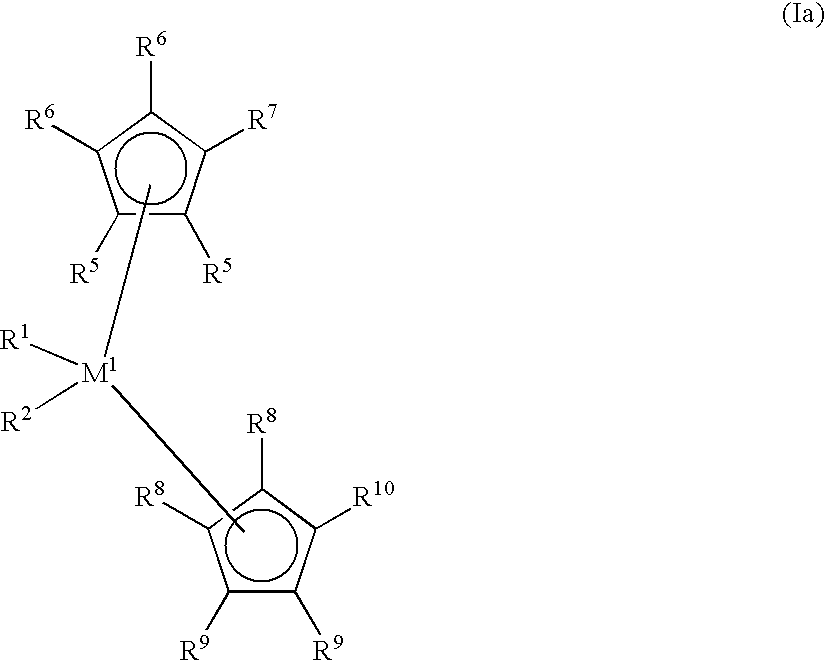
of the formula Ib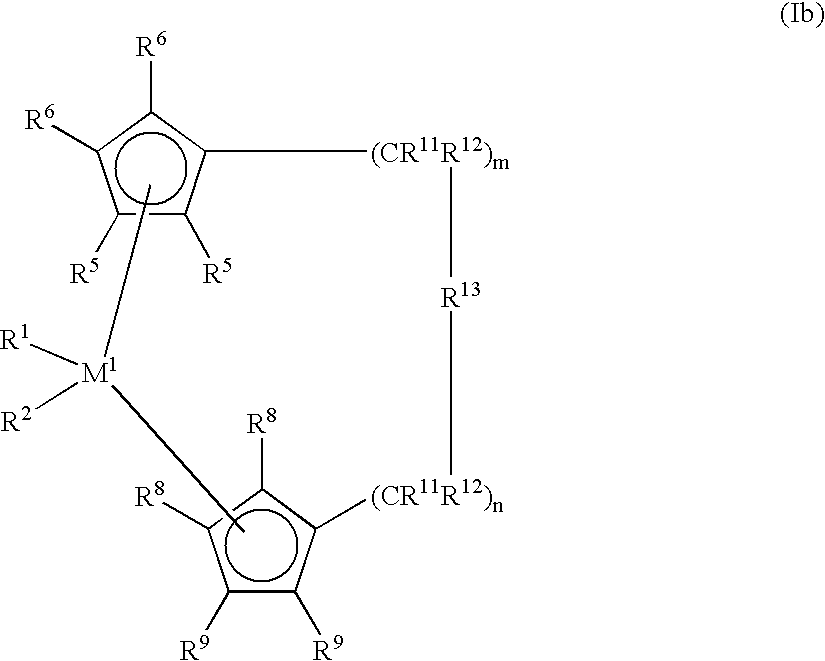
and of the formula Ic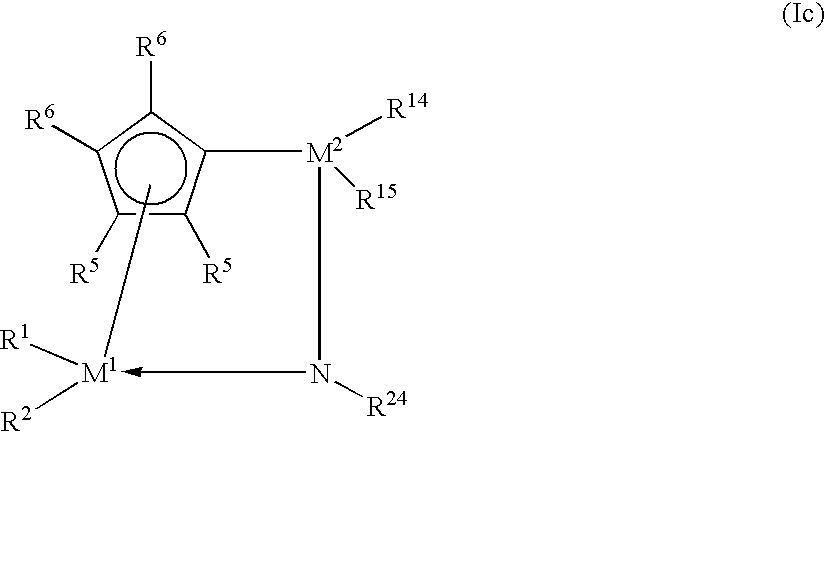
- In the formulae I, Ia and Ib M1 is a metal from group IVb, Vb or VIb of the Periodic Table, examples being titanium, zirconium, hafnium, vanadium, niobium, tantalum, chromium, molybdenum and tungsten, preferably titanium, zirconium or hafnium.
- R1 and R2 are identical or different and are each a hydrogen atom, a C1-C10, preferably C1-C3 alkyl group, especially methyl, a C1-C10, preferably C1-C3 alkoxy group, a C6-C10, preferably C6-C8 aryl group, a C6-C10, preferably C6-C8 aryloxy group, a C2-C10, preferably C2-C4 alkenyl group, a C7-C40, preferably C7-C10 arylalkyl group, a C7-C40, preferably C7-C12 alkylaryl group, a C8-C40, preferably C8-C12 arylalkenyl group or a halogen atom, preferably chlorine.
- R3 and R4 are identical or different and are each a monocyclic or polycyclic hydrocarbon radical which can form a sandwich structure with a central atom M1. R3 and R4 are preferably cyclopentadienyl, indenyl, tetrahydroindenyl, benzoindenyl or fluorenyl, it being possible for the parent structures to carry additional substituents or to be bridged with one another. Additionally one of the radicals R3 and R4 can be a substituted nitrogen atom, with R24 having the definition of R17 and being preferably methyl, tert-butyl or cyclohexyl.
- R5, R6, R7, R8, R9 and R10 are identical or different and are each a hydrogen atom, a halogen atom, preferably a fluorine, chlorine or bromine atom, a C1-C10, preferably C1-C4 alkyl group, a C6-C10, preferably C6-C8 aryl group, a C1-C10, preferably C1-C3 alkoxy group, a radical —NR16 2, —SR16, —OSiR16 3, —SiR16 3 or —PR16 2 radical, in which R16 is a C1-C10, preferably C1-C3 alkyl group or C6-C10, preferably C6-C8 aryl group or else, in the case of radicals containing Si or P, is a halogen atom, preferably chlorine, or pairs of adjacent radicals R5, R6, R7, R8, R9 or R10 form a ring together with the carbon atoms connecting them. Particularly preferred ligands are the substituted compounds of the parent structures cyclopentadienyl, indenyl, tetrahydroindenyl, benzoindenyl or fluorenyl.
- R13 is
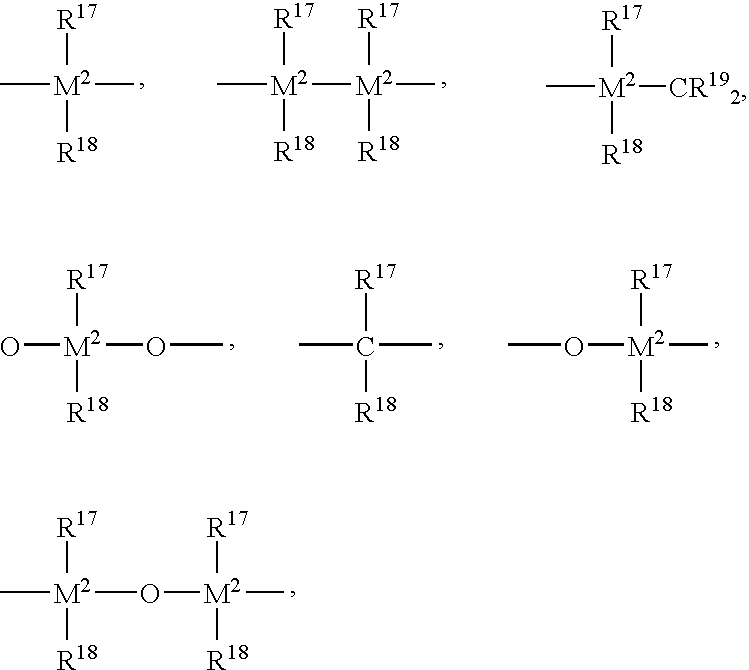
═BR17, ═AlR17, —Ge—, —Sn—, —O—, —S—, ═SO, ═SO2, ═NR17, ═CO, ═PR17 or ═P(O)R17, where R17, R18 and R19 are identical or different and are each a hydrogen atom, a halogen atom, preferably a fluorine, chlorine or bromine atom, a C1-C30, preferably C1-C4 alkyl, especially methyl, group, a C1-C10 fluoroalkyl, preferably CF3 group, a C6-C10 fluoroaryl, preferably pentafluorophenyl, group, a C6-C10, preferably C6-C8 aryl group, a C1-C10, preferably C1-C4 alkoxy, especially methoxy, group, a C2-C10, preferably C2-C4 alkenyl group, a C7-C40, preferably C7-C10 aralkyl group, a C8-C40, preferably C8-C12 arylalkenyl group, or a C7-C40, preferably C7-C12 alkylaryl group, or R17 and R18 or R17 and R19 in each case form a ring together with the atoms connecting them. - M2 is silicon, germanium or tin, preferably silicon and germanium. R13 is preferably ═CR17R18, ═SiR17R18, ═GeR17R18, —O—, —S—, ═SO, ═PR17 or ═P(O)R17.
- R11 and R12 are identical or different and are as defined for R17. m and n are identical or different and are zero, 1 or 2, preferably zero or 1, where m plus n is zero, 1 or 2, preferably zero or 1.
- R14 and R15 have the definition of R17 and R18.
- Examples of suitable metallocenes are:
-
- bis(1,2,3-trimethylcyclopentadienyl)zirconium dichloride,
- bis(1,2,4-trimethylcyclopentadienyl)zirconium dichloride,
- bis(1,2-dimethylcyclopentadienyl)zirconium dichloride,
- bis(1,3-dimethylcyclopentadienyl)zirconium dichloride,
- bis(1-methylindenyl)zirconium dichloride,
- bis(1-n-butyl-3-methylcyclopentadienyl)zirconium dichloride,
- bis(2-methyl-4,6-diisopropylindenyl)zirconium dichloride,
- bis(2-methylindenyl)zirconium dichloride,
- bis(4-methylindenyl)zirconium dichloride,
- bis(5-methylindenyl)zirconium dichloride,
- bis(alkylcyclopentadienyl)zirconium dichloride,
- bis(alkylindenyl)zirconium dichloride,
- bis(cyclopentadienyl)zirconium dichloride,
- bis(indenyl)zirconium dichloride,
- bis(methylcyclopentadienyl)zirconium dichloride,
- bis(n-butylcyclopentadienyl)zirconium dichloride,
- bis(octadecylcyclopentadienyl)zirconium dichloride,
- bis(pentamethylcyclopentadienyl)zirconium dichloride,
- bis(trimethylsilylcyclopentadienyl)zirconium dichloride,
- biscyclopentadienylzirconium dibenzyl,
- biscyclopentadienylzirconium dimethyl,
- bistetrahydroindenylzirconium dichloride,
- dimethylsilyl-9-fluorenylcyclopentadienylzirconium dichloride,
- dimethylsilylbis-1-(2,3,5-trimethylcyclopentadienyl)zirconium dichloride,
- dimethylsilylbis-1-(2,4-dimethylcyclopentadienyl)zirconium dichloride,
- dimethylsilylbis-1-(2-methyl-4,5-benzoindenyl)zirconium dichloride,
- dimethylsilylbis-1-(2-methyl-4-ethylindenyl)zirconium dichloride,
- dimethylsilylbis-1-(2-methyl-4-isopropylindenyl)zirconium dichloride,
- dimethylsilylbis-1-(2-methyl-4-phenylindenyl)zirconium dichloride,
- dimethylsilylbis-1-(2-methylindenyl)zirconium dichloride,
- dimethylsilylbis-1-(2-methyltetrahydroindenyl)zirconium dichloride,
- dimethylsilylbis-1-indenylzirconium dichloride,
- dimethylsilylbis-1-indenylzirconium dimethyl,
- dimethylsilylbis-1-tetrahydroindenylzirconium dichloride,
- diphenylmethylene-9-fluorenylcyclopentadienylzirconium dichloride,
- diphenylsilylbis-1-indenylzirconium dichloride,
- ethylenebis-1-(2-methyl-4,5-benzoindenyl)zirconium dichloride,
- ethylenebis-1-(2-methyl-4-phenylindenyl)zirconium dichloride,
- ethylenebis-1-(2-methyltetrahydroindenyl)zirconium dichloride,
- ethylenebis-1-(4,7-dimethylindenyl)zirconium dichloride,
- ethylenebis-1-indenylzirconium dichloride,
- ethylenebis-1-tetrahydroindenylzirconium dichloride,
- indenylcyclopentadienylzirconium dichloride
- isopropylidene(1-indenyl)(cyclopentadienyl)zirconium dichloride,
- isopropylidene(9-fluorenyl)(cyclopentadienyl)zirconium dichloride,
- phenylmethylsilylbis-1-(2-methylindenyl)zirconium dichloride,
- and also the alkyl or aryl derivatives of each of these metallocene dichlorides.
- The single-center catalyst systems are activated using suitable cocatalysts. Suitable cocatalysts for metallocenes of the formula I are organoaluminum compounds, especially aluminoxanes, or else aluminum-free systems such as R20 xNH4-xBR21 4, R20 xPH4-xBR21 4,
-
- R20 3CBR21 4 or BR21 3. In these formulae x is a number from 1 to 4, the radicals R20 are identical or different, preferably identical, and are each C1-C10 alkyl or C6-C18 aryl, or two radicals R20 form a ring together with the atom connecting them, and the radicals R21 are identical or different, preferably identical, and are each C6-C18 aryl which may be substituted by alkyl, haloalkyl or fluorine. In particular R20 is ethyl, propyl, butyl or phenyl and R21 is phenyl, pentafluorophenyl, 3,5-bistrifluoromethylphenyl, mesityl, xylyl or tolyl.
- Additionally a third component is often needed in order to maintain protection against polar catalyst poisons. Suitable for this purpose are organoaluminum compounds such as triethylaluminum, tributylaluminum and others, for example, and also mixtures.
- Depending on the process it is also possible for supported single-center catalysts to be used. Preferred catalyst systems are those in which the residual levels of support material and cocatalyst do not exceed a concentration of 100 ppm in the product.
- The silane for the modification reaction contains at least one olefinic double bond: for example, a vinyl group attached directly to the silicon atom, and also contains at least one alkoxy group linked directly to the silicon atom: a methoxy or ethoxy group, for example. Suitable silanes are alkoxyvinylsilanes of the general formula
CH2═CR1—(COO)x(CnH2n)ySi(R2)z(OR3)3-z,
where R1 is hydrogen or CH3 and R2 and R3 are branched or unbranched alkyl radicals having 1-6 carbon atoms, n is 1-6t, x and y are 0 or 1, y being 1 if x is 1, and z is 0-2. Examples that may be mentioned of suitable silanes include trimethoxyvinylsilane, triethoxyvinylsilane, methyldimethoxyvinylsilane or methyldiethoxyvinylsilane or 3-methacryloyloxypropyltrimethoxysilane. Preference is given to trimethoxyvinylsilane or triethoxyvinylsilane, particular preference to trimethoxyvinylsilane. - The silane is used in an amount, based on polyolefin wax employed, of from 0.1 to 40%, preferably from 0.5 to 30%, more preferably from 1 to 10%, by weight.
- The modification is carried out in the presence of free-radical initiators. Compounds suitable for this purpose are those which break down to a sufficient extent into free radicals under the modification conditions. Particularly suitable are organic peroxides, examples being alkyl, aryl or aralkyl peroxides such as di-tert-butyl peroxide or dicumyl peroxide, peroxy esters such as tert-butyl peracetate or tert-butyl perbenzoate, or hydroperoxides such as tert-butyl hydroperoxide or cumene hydroperoxide. Further possible free-radical initiators are aliphatic azo compounds such as azobis(2-methylpropionitrile) or 2,2′-azobis(2,4-dimethylvaleronitrile). Preference is given to dialkyl peroxides, and di-tert-butyl peroxide is particularly preferred. The free-radical initiator is employed in concentrations, based on polyolefin wax used, of from 0.1 to 10% by weight.
- For reacting the polyolefin wax with the silane the wax is heated to a temperature above its melting point. Both the silane and the peroxide are introduced into the melt, separately or together, with inert gas blanketing where appropriate. The metered addition can take place continuously over a defined period or in one or more portions. The reaction temperature is situated above the melting point of the polyolefin wax, preferably between 100 and 200° C., more preferably between 130 and 180° C. The end of metered addition may be followed—optionally after an additional amount of free-radical initiator has been added—by an afterreaction at the same or a different temperature. Volatile fractions formed during the reaction, and/or unreacted silane, can be separated off by distillation and/or by stripping with inert gas.
- The reaction can be conducted either batchwise or continuously and under either atmospheric or superatmospheric pressure.
- The silane-modified waxes of the invention have a melt viscosity as measured at 170° C. of between 10 and 50 000 mPa.s, preferably between 50 and 10 000 mPa.s, a dropping point or ring & ball softening point of between 75 and 170° C., preferably between 85 and 150° C., and a heat of fusion of >10 J/g, preferably >20 J/g, more preferably >30 J/g and in particular >40 J/g, with particular preference 50 J/g.
- The modified polyolefin waxes of the invention are largely stable to hydrolysis and crosslinking at room temperature but can be induced to crosslink rapidly by adding suitable catalysts and exposing the waxes to water or moisture. Examples of suitable catalysts include organotin compounds such as dibutyltin dilaurate, dibutyltin diacetate and dibutyltin dioctoate, and also inorganic tin compounds such as tin dichloride or tetrachloride, cobalt salts or lead salts, organic amines such as di- or trialkylamines, and organic or inorganic protic acids such as p-toluenesulfonic acid, sulfuric acid or hydrochloric acid.
- The dropping points were determined in accordance with DIN 51801, the melt viscosities in a rotational viscometer in accordance with DIN 53019, and the heats of fusion by differential thermoanalysis to DIN 51007.
- The dropping point characterizes the melt behavior of solid fats, lubricants, bitumens, etc. The dropping point is the temperature point at which the test material, applied to the mercury bulb of a thermometer—or to nipples, fastened thereto, of dropping point measuring instruments (of the Ubbelohde type, for example)—drops off under its own weight.
- According to DIN 51801/2 the determination of dropping point with an Ubbelohde-type dropping point apparatus is performed as follows: Cemented to the lower part of a thermometer is a cylindrical metal sleeve onto which a second metal sleeve can be screwed. At the side of this second metal sleeve there is a small opening for pressure compensation and, in the lower part, three locking pins at a distance of 7.5 mm from the lower edge of the sleeve. A cylindrical nipple with a downward taper, made from a copper-zinc alloy (brass) with a copper content of between 58% and 63% by weight, fits into the sleeve.
- The upper part of the metal sleeve must be cemented to the thermometer such that when the lower part is screwed on tightly the lower edge of the thermometer vessel ends at the same point as the lower edge of the metal sleeve. The locking pins in the metal sleeve allow the nipple to be introduced into the sleeve in such a way that at any given point the thermometer vessel is equidistant from the walls of the nipple.
- The prepared sample in a pourable state is introduced to excess into the nipple, which stands on the plate.
- At a temperature at which push-on application is still just possible the nipple is pushed carefully onto the mount on the thermometer so that the thermometer vessel is not in contact with the nipple wall.
- The thermometer with the nipple is fixed in the middle of the test tube by means of a stopper which has a central through-bore and a notch at one side. The distance between the bottom edge of the nipple and the base of the test tube should be 25 mm. The test tube is suspended vertically in the beaker at up to two thirds of its length. The beaker contains ice-water as the bath liquid. The dropping point instrument is then heated so that, starting from about 10° C. below the anticipated dropping point, the temperature increases uniformly by 1° C. per minute.
- As the temperature rises, the sample gradually softens. An observation is made of the temperature at which the binder running out from the nipple has reached the base of the test tube.
- The melt viscosity in accordance with DIN 53019 is determined as follows: The liquid under investigation is located in an annular gap between two coaxial cylinders of which one (the rotor) rotates at a constant speed while the other (the stator) is stationary. A determination is made of the rotary speed and of the torque required to overcome the frictional resistance of the liquid within the annular gap. From the geometric dimensions of the system and from the torque and speed values determined it is possible to calculate the shear stress prevailing in the liquid, and the shear rate.
- By specifying defined geometrical proportions, the aforementioned standard describes a standard flow pattern for measuring the rheology of newtonian and non-newtonian liquids in rotational viscometers with coaxial cylinders.
- The determination of the heats of fusion by differential thermoanalysis to
-
- DIN 51007 is performed as follows:
- The sample under analysis and the reference sample are subjected to heating or to another temperature program and the different heat flows (as temperature differences) are measured over defined periods of time. They can be reproduced in a diagram which is characteristic of each sample.
- 500 g of each of the polyolefin waxes listed in Table 1, prepared using metallocene catalysts, were melted in a glass apparatus equipped with stirrer mechanism, internal thermometer and distillation bridge and under nitrogen blanketing. At a temperature of 160° C. the quantity of silane indicated in Table 2 was metered in continuously over the course of 3 h from a metering funnel, while at the same time 10 g of di-tert-butyl peroxide were added continuously from a second dropping funnel. After the end of the metered addition a further 1.1 g of di-tert-butyl peroxide were added to the reaction mixture and the reaction was allowed to continue for 1 h at 160° C. Then a vacuum (approximately 30 mbar) was applied and the volatile fractions were distilled off. After about 30 minutes the system was let down to atmospheric pressure by introduction of nitrogen. The properties of the resulting modification products are specified in Table 2.
TABLE 1 Dropping Heat of Visc./170° C. point fusion Wax type mPa · s ° C. J/g A Ethylene homopolymer 40 127 260 wax B Ethylene-propylene 110 115 145 copolymer wax C Propylene homopolymer 550 145 78 wax D Propylene-ethylene 60 120 60 copolymer wax -
TABLE 2 Silane used Heat Ex- Silane relative Dropping Viscosity/ of am- Wax com- to wax point 170° C. fusion ple used ponent % by weight ° C. mPa · s J/g 1 A TMVS*) 10 116 70 210 2 B TMVS*) 5 104 180 110 3 C TMVS*) 10 136 320 65 4 D TEVS**) 10 111 60 40
*)Trimethoxyvinylsilane
**)Triethoxyvinylsilane
- To test for storage stability a sample of the wax described in Example 3 was cast to form a plate having a diameter of 7 cm and a thickness of 0.5 cm. The plate was stored under standard atmospheric conditions (23° C., 50% humidity) for 8 days. The melt viscosity of the stored sample was 350 mPa.s at 170° C.
- To test the crosslinking capacity, 50 g of the wax were blended in the melt with 0.05 g (0.1%) of dibutyltin dilaurate. A plate was cast as above. After 8 days' storage under standard atmospheric conditions the sample had crosslinked fully and was no longer meltable.
Claims (21)
CH2═CR1—(COO)x(CnH2n)ySi(R2)z(OR3)3-z,
Applications Claiming Priority (2)
| Application Number | Priority Date | Filing Date | Title |
|---|---|---|---|
| DE10338344.1 | 2003-08-21 | ||
| DE10338344A DE10338344A1 (en) | 2003-08-21 | 2003-08-21 | Modified polyolefin waxes |
Publications (1)
| Publication Number | Publication Date |
|---|---|
| US20050043455A1 true US20050043455A1 (en) | 2005-02-24 |
Family
ID=34042218
Family Applications (1)
| Application Number | Title | Priority Date | Filing Date |
|---|---|---|---|
| US10/922,303 Abandoned US20050043455A1 (en) | 2003-08-21 | 2004-08-19 | Modified polyolefin waxes |
Country Status (4)
| Country | Link |
|---|---|
| US (1) | US20050043455A1 (en) |
| EP (1) | EP1508579A1 (en) |
| JP (1) | JP2005068423A (en) |
| DE (1) | DE10338344A1 (en) |
Cited By (31)
| Publication number | Priority date | Publication date | Assignee | Title |
|---|---|---|---|---|
| US20050107511A1 (en) * | 2002-02-14 | 2005-05-19 | Gerd Hohner | Utilization of oxidized polyolefin waxes for textile finishing |
| US20050256245A1 (en) * | 2004-05-13 | 2005-11-17 | Clariant Gmbh | Expandable polystyrene |
| US20060074171A1 (en) * | 2004-10-06 | 2006-04-06 | Clariant Gmbh | Use of polyolefin waxes in hot melt compositions |
| US20070141337A1 (en) * | 2005-12-20 | 2007-06-21 | Mehta Sameer D | Cellulosic-reinforced composites having increased resistance to water absorption |
| US20070259012A1 (en) * | 2006-05-03 | 2007-11-08 | John Castro | Clear Cosmetic Compositions and Methods Of Use |
| WO2007131958A1 (en) * | 2006-05-17 | 2007-11-22 | Clariant International Ltd | Use of propylene copolymer waxes for production of tacky plastics films |
| US20080008885A1 (en) * | 2006-02-17 | 2008-01-10 | Christian Terfloth | Method for laminating plastic films with wood-base substrates, in particular for producing high-gloss surfaces |
| US20080167421A1 (en) * | 2005-07-11 | 2008-07-10 | Selim Yalvac | Silane-Grafted Olefin Polymers, Compositions and Articles Prepared Therefrom, and Methods For Making the Same |
| US20090036619A1 (en) * | 2007-08-03 | 2009-02-05 | Clariant International Ltd. | Highly crystalline polypropylene waxes |
| US20090042040A1 (en) * | 2007-08-10 | 2009-02-12 | National Starch And Chemical Investment Holding Corporation | Reactive Hot Melt Adhesive |
| US20090054861A1 (en) * | 2004-06-28 | 2009-02-26 | Dow Global Technoligies Inc. | Adhesion promoters for multistructural laminates |
| US20100008880A1 (en) * | 2006-05-03 | 2010-01-14 | John Castro | Clear Cosmetic Compositions And Methods Of Using |
| US20100160497A1 (en) * | 2006-06-15 | 2010-06-24 | Teresa P Karjala | Functionalized olefin interpolymers, compositions and articles prepared therefrom, and methods for making the same |
| US20100320693A1 (en) * | 2006-10-17 | 2010-12-23 | Citco Building, Wickhams Cay | Projectile Trap Material With Improved Trapping Behavior For Projectiles |
| US20110015338A1 (en) * | 2008-03-14 | 2011-01-20 | Idemitsu Kosan Co., Ltd. | Polyolefin graft copolymer and adhesive composition |
| US20110020634A1 (en) * | 2008-04-28 | 2011-01-27 | Sika Technology Ag | Hotmelt adhesives having an extended open time |
| US20110060078A1 (en) * | 2008-08-15 | 2011-03-10 | Evonik Degussa Gmbh | Silane-modified polyolefins having a high degree of functionalization |
| US8101681B2 (en) | 2006-12-14 | 2012-01-24 | Henkel Ag & Co. Kgaa | Prepolymer mixture containing silyl groups and use thereof |
| US8101276B2 (en) | 2008-09-16 | 2012-01-24 | Henkel Corporation | Pressure sensitive adhesive compositions and articles prepared using such compositions |
| US8440304B2 (en) | 2008-09-16 | 2013-05-14 | Henkel Corporation | Acrylic pressure sensitive adhesive formulation and articles comprising same |
| US9023946B2 (en) | 2009-12-22 | 2015-05-05 | Henkel IP & Holding GmbH | Moisture cure hot melt adhesives |
| US9365751B2 (en) | 2012-07-24 | 2016-06-14 | Henkel IP & Holding GmbH | Reactive hot melt adhesive |
| CN105778331A (en) * | 2016-03-14 | 2016-07-20 | 江苏华源手套有限公司 | Antistatic environmentally-friendly bamboo charcoal polyvinyl chloride gloves and shaping technology thereof |
| US9428677B2 (en) | 2013-01-24 | 2016-08-30 | Henkel IP & Holding GmbH | Reactive hot melt adhesive |
| WO2019004675A1 (en) | 2017-06-30 | 2019-01-03 | 코오롱인더스트리 주식회사 | Curable petroleum resin, preparation method therefor, and use thereof |
| US10183474B2 (en) | 2014-02-26 | 2019-01-22 | Kiefel Gmbh | Method for providing a lamination film with adhesive, method for applying hot melt, application, lamination plant and method for upgrading such a plant |
| US10221346B2 (en) | 2014-01-14 | 2019-03-05 | Henkel IP & Holding GmbH | Reactive hot melt adhesives with improved adhesion |
| US10954420B2 (en) | 2016-09-27 | 2021-03-23 | Kolon Industries, Inc. | Curable modified petroleum resin, and preparation method and use thereof |
| US11655398B2 (en) | 2016-06-30 | 2023-05-23 | Kolon Industries, Inc. | Curable petroleum resin, preparation method therefor, and use thereof |
| US20240034920A1 (en) * | 2020-12-30 | 2024-02-01 | Bostik Sa | Silylated adhesive composition with improved adhesion on metallic substrates |
| CN117580877A (en) * | 2021-07-01 | 2024-02-20 | 科莱恩国际有限公司 | Processing-optimized reactive polymer compositions |
Families Citing this family (19)
| Publication number | Priority date | Publication date | Assignee | Title |
|---|---|---|---|---|
| AU2005311655A1 (en) * | 2004-12-03 | 2006-06-08 | Dow Global Technologies Llc | Wood fiber plastic composites |
| DE102005015340B4 (en) | 2005-04-01 | 2011-11-17 | Jowat Ag | Process for the preparation of printed or decorated moldings and moldings produced in this way |
| JP5064662B2 (en) * | 2005-06-15 | 2012-10-31 | 出光興産株式会社 | Modified α-olefin polymer and method for producing crosslinked product thereof |
| DE102008002163A1 (en) | 2008-06-02 | 2009-12-03 | Wacker Chemie Ag | Binders based on polymers containing alpha-silane groups |
| DE102008041277A1 (en) | 2008-08-15 | 2010-02-18 | Evonik Degussa Gmbh | Modified polyolefin comprising 1-butene, and an isotactic poly(1-butene)-triad useful e.g. as or in molding composition and adhesive, in protective composition, sealants, marking composition, coating composition and sealing strips |
| DE102008041281A1 (en) | 2008-08-15 | 2010-02-18 | Evonik Degussa Gmbh | Modified polyolefin based on a base polyolefin, which has specific content of propylene and isotactic poly(propylene)-triad and is grafted with silane e.g. vinyltrimethoxy silane, useful as or in molding composition and adhesives |
| DE102009001885A1 (en) | 2009-03-26 | 2010-09-30 | Evonik Degussa Gmbh | Primer for polyolefin surfaces based on polyolefin-graft-poly (meth) acrylate copolymers |
| DE102009001886A1 (en) | 2009-03-26 | 2010-10-07 | Evonik Degussa Gmbh | Adhesion promoter for coating polyolefin surfaces based on polyolefin-graft-poly (meth) acrylate copolymers |
| DE102009027445A1 (en) | 2009-07-03 | 2011-01-05 | Evonik Degussa Gmbh | Modified polyolefins with a particular property profile, process for their preparation and their use |
| DE102009027446A1 (en) | 2009-07-03 | 2011-01-05 | Evonik Degussa Gmbh | Modified polyolefins with a particular property profile, process for their preparation and their use |
| DE102009027447A1 (en) | 2009-07-03 | 2011-01-05 | Evonik Degussa Gmbh | Modified polyolefins with a particular property profile, process for their preparation and their use |
| DE102009028353A1 (en) | 2009-08-07 | 2011-04-14 | Wacker Chemie Ag | Binders based on silane-containing hyperbranched polyolefins |
| ES2374490T3 (en) | 2009-09-02 | 2012-02-17 | Rhein Chemie Rheinau Gmbh | USE OF CARBODIIMIDES AS A COLOR STABILIZER IN THERMOFUSABLE ADHESIVES. |
| WO2012124345A1 (en) * | 2011-03-16 | 2012-09-20 | 出光興産株式会社 | Reactive polyolefin, method for producing same, and composition containing same |
| WO2014046134A1 (en) | 2012-09-18 | 2014-03-27 | 出光興産株式会社 | FUNCTIONALIZED α-OLEFIN POLYMER, AS WELL AS CURED COMPOSITION AND CURED ARTICLE USING SAME |
| DE102013005089A1 (en) * | 2013-03-23 | 2014-09-25 | Clariant International Ltd. | Ready-to-use hot-melt adhesive with improved property profile |
| EP2933089A1 (en) | 2014-04-14 | 2015-10-21 | Jowat SE | Laminating method with grid-shaped adhesive application |
| CN107922517B (en) * | 2015-09-25 | 2022-02-08 | 陶氏环球技术有限责任公司 | Non-extrusion process for functionalizing low viscosity polyolefins |
| CN111253887B (en) * | 2018-12-03 | 2021-10-26 | 丰田纺织株式会社 | Two-component hot-melt adhesive, cured product, and method for controlling crosslinking time |
Citations (14)
| Publication number | Priority date | Publication date | Assignee | Title |
|---|---|---|---|---|
| US4914253A (en) * | 1988-11-04 | 1990-04-03 | Exxon Chemical Patents Inc. | Method for preparing polyethylene wax by gas phase polymerization |
| US5264028A (en) * | 1990-10-23 | 1993-11-23 | Beshay Alphons D | Modified waxes and applications thereof |
| US5994474A (en) * | 1996-09-04 | 1999-11-30 | Heuls Aktiengesellschaft | Use of silane-grafted amorphous poly-α-olefins as moisture-crosslinking adhesive base material or adhesive |
| US6080902A (en) * | 1997-07-11 | 2000-06-27 | Clariant Gmbh | Method of using polyolefin waxes |
| US6107530A (en) * | 1997-11-15 | 2000-08-22 | Clariant Gmbh | Use of polyolefin waxes in solvent pastes |
| US6143846A (en) * | 1997-07-11 | 2000-11-07 | Clariant Gmbh | Polypropylene wax |
| US6211303B1 (en) * | 1997-07-11 | 2001-04-03 | Clariant Gmbh | Process for the oxidation of polyethylene waxes |
| US6311590B1 (en) * | 1999-05-05 | 2001-11-06 | The Gleason Works | Cutting tool for producing gears by face hobbing |
| US6383281B2 (en) * | 1999-12-17 | 2002-05-07 | Clariant Gmbh | Molding composition for producing powder metallurgical or ceramic products |
| US6407189B1 (en) * | 1994-12-28 | 2002-06-18 | Clariant Gmbh | Polyolefin wax |
| US20030134969A1 (en) * | 2001-12-06 | 2003-07-17 | Degussa Ag | Moisture-crosslinked and filled cable compounds |
| US6761764B2 (en) * | 2000-05-12 | 2004-07-13 | Clariant Gmbh | Use of wax mixtures for coatings |
| US20050107511A1 (en) * | 2002-02-14 | 2005-05-19 | Gerd Hohner | Utilization of oxidized polyolefin waxes for textile finishing |
| US7005224B2 (en) * | 2001-12-06 | 2006-02-28 | Clariant Gmbh | Polyolefin waxes modified to make them polar in photocopier toners |
Family Cites Families (4)
| Publication number | Priority date | Publication date | Assignee | Title |
|---|---|---|---|---|
| JPS54145785A (en) * | 1978-05-08 | 1979-11-14 | Mitsui Petrochem Ind Ltd | Silane-modified wax and its preparation |
| JPS63282751A (en) * | 1987-05-15 | 1988-11-18 | Mitsubishi Petrochem Co Ltd | Toner for electrophotography |
| JPH0288610A (en) * | 1988-09-26 | 1990-03-28 | Mitsui Petrochem Ind Ltd | Polyolefin-modified polymer and production thereof |
| CA2203595A1 (en) * | 1996-04-26 | 1997-10-26 | Robert F. Hurley | Cross-linked polyolefin tape |
-
2003
- 2003-08-21 DE DE10338344A patent/DE10338344A1/en not_active Withdrawn
-
2004
- 2004-08-10 EP EP04018897A patent/EP1508579A1/en not_active Withdrawn
- 2004-08-19 US US10/922,303 patent/US20050043455A1/en not_active Abandoned
- 2004-08-20 JP JP2004240192A patent/JP2005068423A/en not_active Withdrawn
Patent Citations (14)
| Publication number | Priority date | Publication date | Assignee | Title |
|---|---|---|---|---|
| US4914253A (en) * | 1988-11-04 | 1990-04-03 | Exxon Chemical Patents Inc. | Method for preparing polyethylene wax by gas phase polymerization |
| US5264028A (en) * | 1990-10-23 | 1993-11-23 | Beshay Alphons D | Modified waxes and applications thereof |
| US6407189B1 (en) * | 1994-12-28 | 2002-06-18 | Clariant Gmbh | Polyolefin wax |
| US5994474A (en) * | 1996-09-04 | 1999-11-30 | Heuls Aktiengesellschaft | Use of silane-grafted amorphous poly-α-olefins as moisture-crosslinking adhesive base material or adhesive |
| US6080902A (en) * | 1997-07-11 | 2000-06-27 | Clariant Gmbh | Method of using polyolefin waxes |
| US6143846A (en) * | 1997-07-11 | 2000-11-07 | Clariant Gmbh | Polypropylene wax |
| US6211303B1 (en) * | 1997-07-11 | 2001-04-03 | Clariant Gmbh | Process for the oxidation of polyethylene waxes |
| US6107530A (en) * | 1997-11-15 | 2000-08-22 | Clariant Gmbh | Use of polyolefin waxes in solvent pastes |
| US6311590B1 (en) * | 1999-05-05 | 2001-11-06 | The Gleason Works | Cutting tool for producing gears by face hobbing |
| US6383281B2 (en) * | 1999-12-17 | 2002-05-07 | Clariant Gmbh | Molding composition for producing powder metallurgical or ceramic products |
| US6761764B2 (en) * | 2000-05-12 | 2004-07-13 | Clariant Gmbh | Use of wax mixtures for coatings |
| US20030134969A1 (en) * | 2001-12-06 | 2003-07-17 | Degussa Ag | Moisture-crosslinked and filled cable compounds |
| US7005224B2 (en) * | 2001-12-06 | 2006-02-28 | Clariant Gmbh | Polyolefin waxes modified to make them polar in photocopier toners |
| US20050107511A1 (en) * | 2002-02-14 | 2005-05-19 | Gerd Hohner | Utilization of oxidized polyolefin waxes for textile finishing |
Cited By (53)
| Publication number | Priority date | Publication date | Assignee | Title |
|---|---|---|---|---|
| US20050107511A1 (en) * | 2002-02-14 | 2005-05-19 | Gerd Hohner | Utilization of oxidized polyolefin waxes for textile finishing |
| US20050256245A1 (en) * | 2004-05-13 | 2005-11-17 | Clariant Gmbh | Expandable polystyrene |
| US20090054861A1 (en) * | 2004-06-28 | 2009-02-26 | Dow Global Technoligies Inc. | Adhesion promoters for multistructural laminates |
| US20080262148A1 (en) * | 2004-10-06 | 2008-10-23 | Clariant Produkte (Deutschland) Gmbh | Use of polyolefin waxes in hot melt road marking compositions |
| US20060074171A1 (en) * | 2004-10-06 | 2006-04-06 | Clariant Gmbh | Use of polyolefin waxes in hot melt compositions |
| EP1645608A1 (en) * | 2004-10-06 | 2006-04-12 | Clariant Produkte (Deutschland) GmbH | Use of polyolefin waxes in hot melts |
| US7825186B2 (en) | 2004-10-06 | 2010-11-02 | Clariant Produkte (Deutschland) Gmbh | Use of polyolefin waxes in hot melt road marking compositions |
| US9012563B2 (en) * | 2005-07-11 | 2015-04-21 | Dow Global Technologies Llc | Silane-grafted olefin polymers, compositions and articles prepared therefrom, and methods for making the same |
| AU2006269238B2 (en) * | 2005-07-11 | 2012-04-26 | Dow Global Technologies Llc | Silane-grafted olefin polymers, compositions and articles prepared therefrom, and methods for making the same |
| US20080167421A1 (en) * | 2005-07-11 | 2008-07-10 | Selim Yalvac | Silane-Grafted Olefin Polymers, Compositions and Articles Prepared Therefrom, and Methods For Making the Same |
| EP2407496A1 (en) | 2005-07-11 | 2012-01-18 | Dow Global Technologies LLC (formerly Known As Dow Global Technologies Inc.) | Silane-grafted olefin polymers, compositions and articles prepared therefrom, and methods for making the same |
| EP2407495A1 (en) | 2005-07-11 | 2012-01-18 | Dow Global Technologies LLC (formerly Known As Dow Global Technologies Inc.) | Silane-Grafted Olefin Polymers, Compositions and Articles Prepared Therefrom, and Methods For Making The same |
| US7348371B2 (en) | 2005-12-20 | 2008-03-25 | Equistar Chemicals, Lp | Cellulosic-reinforced composites having increased resistance to water absorption |
| WO2007073416A1 (en) * | 2005-12-20 | 2007-06-28 | Equistar Chemicals, Lp | Cellulosic-reinforced composites having increased resistance to water absorpiton |
| US20070141337A1 (en) * | 2005-12-20 | 2007-06-21 | Mehta Sameer D | Cellulosic-reinforced composites having increased resistance to water absorption |
| US8506742B2 (en) * | 2006-02-17 | 2013-08-13 | Jowat Ag | Method for laminating plastic films with wood-base substrates, in particular for producing high-gloss surfaces |
| US20080008885A1 (en) * | 2006-02-17 | 2008-01-10 | Christian Terfloth | Method for laminating plastic films with wood-base substrates, in particular for producing high-gloss surfaces |
| US20070259012A1 (en) * | 2006-05-03 | 2007-11-08 | John Castro | Clear Cosmetic Compositions and Methods Of Use |
| US20100008880A1 (en) * | 2006-05-03 | 2010-01-14 | John Castro | Clear Cosmetic Compositions And Methods Of Using |
| WO2007131958A1 (en) * | 2006-05-17 | 2007-11-22 | Clariant International Ltd | Use of propylene copolymer waxes for production of tacky plastics films |
| EP2363444A1 (en) | 2006-06-15 | 2011-09-07 | Dow Global Technologies LLC | Functionalized olefin interpolymers, compositions and articles prepared therefrom, and methods for making the same |
| US9120888B2 (en) | 2006-06-15 | 2015-09-01 | Dow Global Technologies Llc | Functionalized olefin interpolymers, compositions and articles prepared therefrom and methods for making the same |
| EP2363420A1 (en) | 2006-06-15 | 2011-09-07 | Dow Global Technologies LLC | Functionalized olefin interpolymers, compositions and articles prepared therefrom, and methods for making the same |
| EP3205698A1 (en) | 2006-06-15 | 2017-08-16 | Dow Global Technologies LLC | Functionalized olefin interpolymers, compositions and articles prepared therefrom, and methods for making the same |
| EP2363445A1 (en) | 2006-06-15 | 2011-09-07 | Dow Global Technologies LLC | Functionalized propylene interpolymers, compositions and articles prepared therefrom, and methods for making the same |
| US20100160497A1 (en) * | 2006-06-15 | 2010-06-24 | Teresa P Karjala | Functionalized olefin interpolymers, compositions and articles prepared therefrom, and methods for making the same |
| US9902882B2 (en) | 2006-06-15 | 2018-02-27 | Dow Global Technologies Llc | Functionalized olefin interpolymers, compositions and articles prepared therefrom, and methods for making the same |
| US20100320693A1 (en) * | 2006-10-17 | 2010-12-23 | Citco Building, Wickhams Cay | Projectile Trap Material With Improved Trapping Behavior For Projectiles |
| US8101681B2 (en) | 2006-12-14 | 2012-01-24 | Henkel Ag & Co. Kgaa | Prepolymer mixture containing silyl groups and use thereof |
| US20090036619A1 (en) * | 2007-08-03 | 2009-02-05 | Clariant International Ltd. | Highly crystalline polypropylene waxes |
| US9212300B2 (en) | 2007-08-10 | 2015-12-15 | Henkel Ag & Co. Kgaa | Reactive hot melt adhesive |
| US20090042040A1 (en) * | 2007-08-10 | 2009-02-12 | National Starch And Chemical Investment Holding Corporation | Reactive Hot Melt Adhesive |
| US8507604B2 (en) | 2008-03-14 | 2013-08-13 | Idemitsu Kosan Co., Ltd. | Polyolefin graft copolymer and adhesive composition |
| US20110015338A1 (en) * | 2008-03-14 | 2011-01-20 | Idemitsu Kosan Co., Ltd. | Polyolefin graft copolymer and adhesive composition |
| US9375895B2 (en) | 2008-04-28 | 2016-06-28 | Sika Technology Ag | Hotmelt adhesives having an extended open time |
| US20110020634A1 (en) * | 2008-04-28 | 2011-01-27 | Sika Technology Ag | Hotmelt adhesives having an extended open time |
| US20110060078A1 (en) * | 2008-08-15 | 2011-03-10 | Evonik Degussa Gmbh | Silane-modified polyolefins having a high degree of functionalization |
| US8399571B2 (en) | 2008-08-15 | 2013-03-19 | Evonik Degussa Gmbh | Silane-modified polyolefins having a high degree of functionalization |
| US8101276B2 (en) | 2008-09-16 | 2012-01-24 | Henkel Corporation | Pressure sensitive adhesive compositions and articles prepared using such compositions |
| US8440304B2 (en) | 2008-09-16 | 2013-05-14 | Henkel Corporation | Acrylic pressure sensitive adhesive formulation and articles comprising same |
| US9023946B2 (en) | 2009-12-22 | 2015-05-05 | Henkel IP & Holding GmbH | Moisture cure hot melt adhesives |
| US9365751B2 (en) | 2012-07-24 | 2016-06-14 | Henkel IP & Holding GmbH | Reactive hot melt adhesive |
| US9428677B2 (en) | 2013-01-24 | 2016-08-30 | Henkel IP & Holding GmbH | Reactive hot melt adhesive |
| US10221346B2 (en) | 2014-01-14 | 2019-03-05 | Henkel IP & Holding GmbH | Reactive hot melt adhesives with improved adhesion |
| US10183474B2 (en) | 2014-02-26 | 2019-01-22 | Kiefel Gmbh | Method for providing a lamination film with adhesive, method for applying hot melt, application, lamination plant and method for upgrading such a plant |
| CN105778331A (en) * | 2016-03-14 | 2016-07-20 | 江苏华源手套有限公司 | Antistatic environmentally-friendly bamboo charcoal polyvinyl chloride gloves and shaping technology thereof |
| US11655398B2 (en) | 2016-06-30 | 2023-05-23 | Kolon Industries, Inc. | Curable petroleum resin, preparation method therefor, and use thereof |
| US10954420B2 (en) | 2016-09-27 | 2021-03-23 | Kolon Industries, Inc. | Curable modified petroleum resin, and preparation method and use thereof |
| WO2019004675A1 (en) | 2017-06-30 | 2019-01-03 | 코오롱인더스트리 주식회사 | Curable petroleum resin, preparation method therefor, and use thereof |
| US11499068B2 (en) | 2017-06-30 | 2022-11-15 | Kolon Industries, Inc. | Curable petroleum resin, preparation method thereof, and use thereof |
| US20240034920A1 (en) * | 2020-12-30 | 2024-02-01 | Bostik Sa | Silylated adhesive composition with improved adhesion on metallic substrates |
| CN117580877A (en) * | 2021-07-01 | 2024-02-20 | 科莱恩国际有限公司 | Processing-optimized reactive polymer compositions |
| US12319847B2 (en) | 2021-07-01 | 2025-06-03 | Clariant International Ltd | Processing-optimized, reactive polymer composition |
Also Published As
| Publication number | Publication date |
|---|---|
| JP2005068423A (en) | 2005-03-17 |
| DE10338344A1 (en) | 2005-03-24 |
| EP1508579A1 (en) | 2005-02-23 |
Similar Documents
| Publication | Publication Date | Title |
|---|---|---|
| US20050043455A1 (en) | Modified polyolefin waxes | |
| US7825186B2 (en) | Use of polyolefin waxes in hot melt road marking compositions | |
| US20060235134A1 (en) | Hot-melt adhesive materials | |
| JP6416868B2 (en) | Ready-to-use hot melt adhesive with improved property profile | |
| US20050159566A1 (en) | Process for producing highly flowable propylene polymer and highly flowable propylene polymer | |
| CN1126786C (en) | Compositions comprising substantially random interpolymer of at least one alpha-olefin and at least one vinylidene aromatic monomer or hindered aliphatic vinylidene monomer | |
| KR101369127B1 (en) | Low molecular weight ethylene interpolymers, methods of making, and uses thereof | |
| US20070117894A1 (en) | Use of polyolefin waxes in hot melt compositions | |
| EP1295925A1 (en) | Polyolefin resin for hot-melt adhesive | |
| KR20070015579A (en) | Multiple catalyst and reactor systems for olefin polymerization, and polymers prepared therefrom | |
| WO2011025587A1 (en) | Polyolefin adhesive compositions and method of making thereof | |
| US20070117907A1 (en) | Use of polyolefin waxes in hot melt compositions | |
| EP2152769A1 (en) | Ethylene elastomer compositions | |
| US20160304756A1 (en) | Hot Melt Adhesive Composition with Ethylene/a-Olefin Multi-Block Copolymer | |
| CN1852959A (en) | Copolymer suitable for hot-melt adhesive and its preparation method | |
| US20210230460A1 (en) | Adhesive Composition Including Ethylene/Alpha-Olefin Copolymer | |
| RU2734859C2 (en) | Pressure-sensitive adhesives | |
| US20090018243A1 (en) | Polyolefin-Based Building Materials | |
| US20070117906A1 (en) | Use of polyolefin waxes in hot melt compositions | |
| EP4431565A1 (en) | Curable resin composition | |
| US20090118409A1 (en) | Embedding compositions specifically based on metallocene-catalyzed polyolefins, in particular for the encapsulation of electronic instruments and components | |
| HK1090658B (en) | Hot-melt adhesive materials | |
| MXPA99002105A (en) | Compositions comprising a substantially random interpolymer of at least one alpha-olefin and at least one vinylidene aromatic monomer or hindered aliphatic vinylidene monomer |
Legal Events
| Date | Code | Title | Description |
|---|---|---|---|
| AS | Assignment |
Owner name: CLARIANT GMBH, GERMANY Free format text: ASSIGNMENT OF ASSIGNORS INTEREST;ASSIGNOR:HOHNER, GERD;REEL/FRAME:015710/0499 Effective date: 20040720 |
|
| AS | Assignment |
Owner name: CLARIANT PRODUKTE (DEUTSCHLAND) GMBH,GERMANY Free format text: CHANGE OF NAME;ASSIGNOR:CLARIANT GMBH;REEL/FRAME:018637/0058 Effective date: 20051128 Owner name: CLARIANT PRODUKTE (DEUTSCHLAND) GMBH, GERMANY Free format text: CHANGE OF NAME;ASSIGNOR:CLARIANT GMBH;REEL/FRAME:018637/0058 Effective date: 20051128 |
|
| STCB | Information on status: application discontinuation |
Free format text: EXPRESSLY ABANDONED -- DURING EXAMINATION |